/


Author: Marozzi J.
Tags: history ethnography ancient history reign
ISBN: 978-0-306-81621-5
Year: 2008
Similar


Text
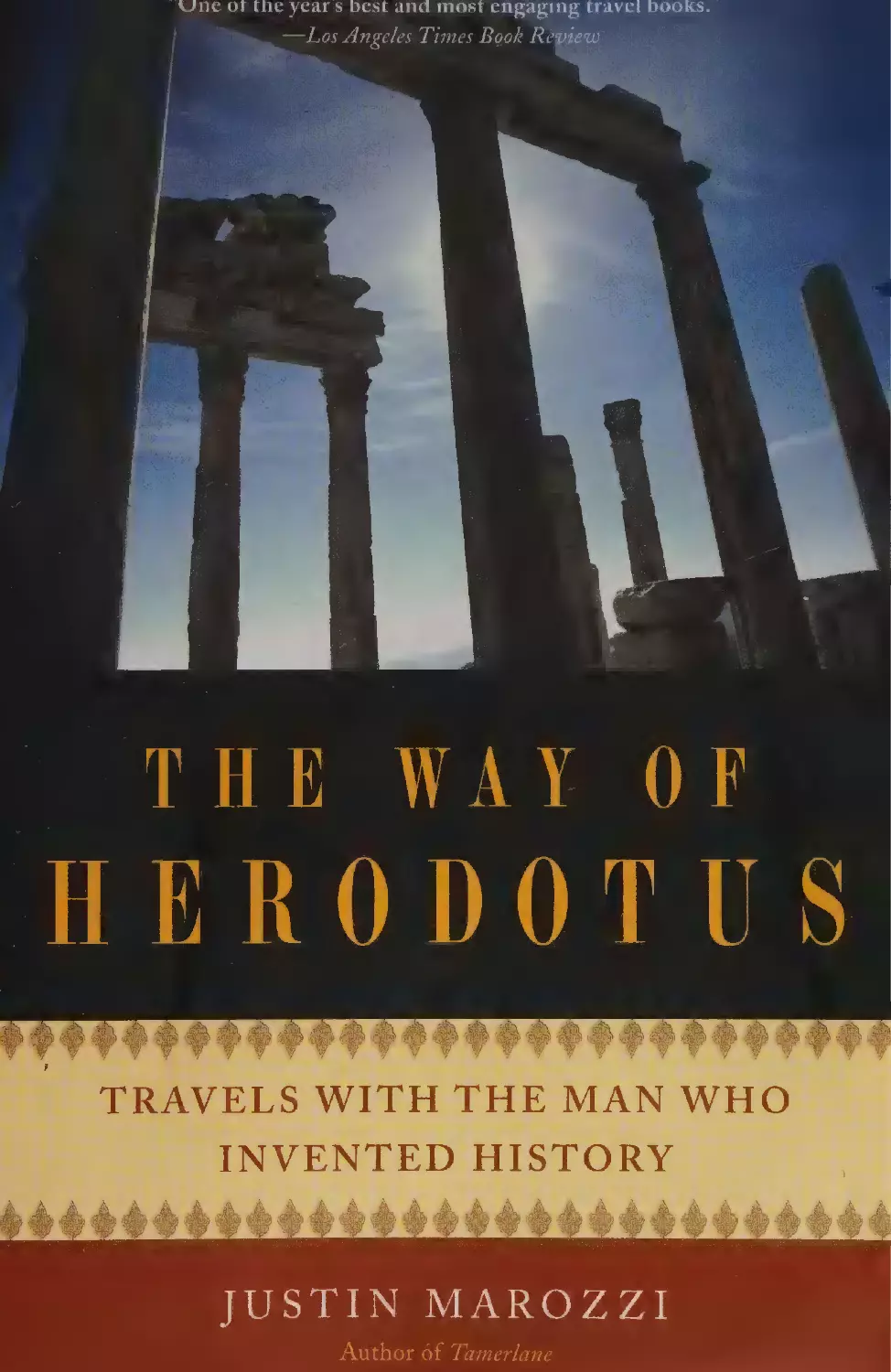
                    kjne or rue years nest and most engaging travel books.
—Los Annies Times Book Review
T 11 E W A Y 0 F
HERODOTUS
JUSTIN MAROZZI
Author of Tamerlane
Praise for Justin Marozzi’s The Way oj Herodotus
"‘A delightful scrawl .. .Marozzi’s book is an excellent introduction
to [Herodotus] and is great fun in its own right.”
—National Geographic Adventure
"An excellent new book . . . [Marozzi is] excellent at evoking
character and scene... His descriptions sparkle.”
—Washington Post
“An enjoyable, highly readable book, and its digressive, loose
structure and high entertainment quotient make it a pleasant
descendant of Herodotus’ writings.”
—Richmond Times-Dispatch
“Open-hearted and deft, Marozzi does for us what Herodotus does
for him: provides an introduction to places new to us”
—Raleigh News and Observer
"This isn’t just a dusty look at history.”	—NewYork Press
‘Marozzi has penned something of a classic, taking on the ancient
world through modern eyes and bringing fresh impressions to such
familiar, even cliche, places ”	—Washington Times
“[A] vivid travelog ... a lively and accessible narrative that’s often as
eclectic as its spiritual predecessor”	—Library Journal
“Never less than entertaining ... a tour de force of travel writing.”
—Literary Review
“A "remarkable travel history.”	—Booklist
“[A] scintillating, thought-provoking and entertaming homage.”
—Paul Cartledge, Professor of Greek History,
Cambridge University

T he Way oi Herodotus
Also by Justin Marozzi
South from Barbary
Tamerlane
The Way of Herodotus
Travels with the Man
Who Invented History
JUSTIN MAROZZI
DA CAPO PRJESS
A Member of the Perseus Books Group
Copyright © 2008 by Justin Marozzi
All rights reserved No part of this publication may be reproduced, stored in a
retrieval system, or transmitted, in any form or by any means, electronic,
mechanical, photocopying, recording, or otherwise, without the prior written
permission of the publisher Printed in the United States of America.
Cataloging-in-Publication data for this book is available from the Library of
Congress.
First Da Capo Press edition 2008
First Da Capo Press paperback, edition 2010
Reprinted by arrangement with John Murray fPublishers)
An Hachette L ivre UK Company
HC ISBN: 978-0-306-81621-5
PB ISBN; 978-0-306-81857-8
Library of Congress Control Number: 2008938709
Published by Da Capo Press
A Member of the Perseus Books Group
www dacapopress com
Da Capo Press books are available at special discounts for bulk purchases in the
U.S. by corporations, institutions, and other organizations. For more information,
please contact the Special Markets Department at the Perseus Books Group, 2300
Chestnut Street, Suite 200, Philadelphia. PA 19103, or call (800) 810-4145,
extension 5000, or e-mail special marketsfg jperseusbonks.com.
10 987654321
Once again to Julia


The appeal of history to us all is in the last analysis poetic. But the
poetry of history does not consist of imagination roaming at large,
but of imagination pursuing the fact and fastening upon it. That
which compels the historian to ‘scorn delights and Eve laborious
days’ is the ardour of his own curiosity to know what really hap-
pened long ago in that land of mystery which we call the past. To
peer into that magic mirror and see flesh figures there every dav
is a burning desire that consumes and satisfies him all his life, that
carries him each morning, eager as a lover, to the library and
muniment room. It haunts him like a passion of terrible potency,
because it is poetic. The dead were and are not. Their place knows
them no more, and is ours today. Yet they were once as real as we,
and we shall tomorrow be shadows like them . ..
G M Trevelyan, Autobiography and Other Essays
I need not apologise for the digression. It has been my habit
throughout this work.
Herodotus, Histories
P.eader, I think proper, before we proceed any farther together,
to acquaint thee, that I intend to digress, through this whole
History, as often as I see Occasion.
Henry Fielding, Tom Jones

Contents
A'knot^edgement:	xi
Maps	xvi
Dog-Headed Met G'Jd-Digging
Ar.t; acd F?/".g Snakes. or Why We Should
All Read Herodotus	i
PART I TURKEY	29
1.	Pr   . with Beards	3 r
2,	Underwater Herodotus	46
RAPT II IRAQ	67
3.	Fools and Wars	69
x Baghdad E’-ange.i'.ah and .Mocking Madmen	87
5. Babylon	111
PART III EGYPT	135
< .Merxp.o:-. ani T .песет Tai Stories and
bed'-Irrwwikatir.g Gats. or No Sex in Temples.
Pleate. We re Egyptian	137
~ HerO’lota: .r. Hohsosood'an.S the Sahara;	164
'Zotr.er nt the 'X'orln	179
PARTW GREECE	195
9. Athens. City HaT of Wisdom	197
ic Herodotus .Meets Aristode	224
11 Thessaloniki. History on the Front Line	247
CONTENTS
12	. An Exorcism	258
13	. Lunch (and a Good Deal of Retsina) with
Patrick Leigh Feimor	262
14	‘Fill HigF the Bowl with	Samian	Wine!’	274
15	Wassailing Gods, Pious	Priests and Tearful
Monks	299
Bibliography	327
x
Acknowledgements
A journey with hefodotus is the work - and pleasure - of a
lifetime. 1 have had the great fortune to be accompanied every step
of the way by Paul Cartledge, Professor of Greek History at Cambridge
University, to whom I offer my greatest thanks. Although Herodotus
died almost 2,500 years ago, he remains capable of inspiring lasting
friendships, a wonderful posthumous tribute to his breadth of vision and
generosity of spirit. I count myself lucky to have met Paul and so to
have benefited undeservedly from his font of Herodotean wisdom
Thank you to my friend Tom Sutherland, who first put me on the
fail of Herodotus, and to Dr Angus Bowie. Lobel Praelector in
Classics at Oxford University, for providing an initial steer in the dense
and often impenetrable world of Herodotean studies
Travels with Herodotus can take you anywhere He is as relevant to
ancient Egypt as to contemporary Washington. I concentrated on
Turkey, Iraq, Egypt and Greece, an ambitious itinerary made possible
in large part thanks to the enlightened support of Rahul Jacob, the
incomparable travel editor of the Financial Times, who consistently said
yes when others would have said no.
The Herodotus who kept me company during my journeys, and
from whom I quote most often, can be found in the highly access-
ible — and portable — Penguin Classics edition of the Histories.
In Turkey. I enjoyed the water-borne hospitality of Gurkan Kinaci
in Bodrum, onetime Halicarnassus, Herodotus hometown. Thanks to
Meltem Ozer, Mazlum Agan, the town’s mayor, Oguz Alpozen, direc-
tor of the Bodrum Museum of Underwater Archaeology, Tufan Turanli
and Dr George Bass of the Institute of Nautical Archaeology, and
Qanan Kufiikeren, historian and irrepressible Herodotus devotee.
xi
ACKNOWLEDGEMENTS
In Iraq, I am grateful first of all to Lieutenant-Colonel T;m Spicer
OBE for giving me the opportunity to live and work in Baghdad
for more than a year and take Herodotus to war. Thank you to
His Excellency Samir Sumaida’ie, Iraq’s ambassador to Washington,
National Security Adviser Mowaffak Rubaie, Defence Minister
Saadoun Dulaimi, Brigadier James Ellery CBE, Dr Thair Ah and
Catriona Laing for their friendship, support and humour in challeng-
ing times and to Dr Donny George, director of the National Museum
in Baghdad, for a private tour of one of the world’s greatest collections
of antiquities. Dr Abdul Aziz Hamid, chairman of the State Boara of
Antiquities, enabled us to make a small donation to preserving the
house in Baghdad that houses the museum’s archives. The Polish
archaeologist Agnieszka Dolatowska gave a memorable guided tour of
Babylon during its catastrophic occupation by Coalition forces. Joan
Porter Maclver and Dr Lamia al Gailani of the British School of
Archaeology in Iraq and Professor Amelie Kuhrr FBA of University
College, London, kindly assisted with later research. Thank you to all
those unnamed colleagues who kept me out of harm’s way.
In Egypt, my thanks to Philip Hamilton-Grierson and Mark Stacey
of Cox & Kings for arranging a long Herodotean itinerary so master-
fully. My friend Mandi Mourad was an inspired and indefatigable
guide to getting hold of all the right people in Cairo. Herodotus has
a good deal to teach the modern world about interfaith relations. In
this regard, I enjoyed revealing conversations with Ali Gomaa. the
Grand Mufti of Egypt, Mouneer Anis, the Anglican Bishop of Egypt,
and Dr Ali al Semman of the Supreme Council for Islamic Affairs.
Thanks also to Gamila Ismail, wife of the jailed opposition leader
Ayman Nur, the human rights lawyer Amir Salem, Leila Soueif,
Professor Assem Deif, for sharing his understanding of pyramidal
mathematics, Heba Saleh of the BBC, the novelists Alaa al Aswany and
Bahaa Taher, Max Rodenbeck, Salima Ikram, professor of Egyptology
at the American University in Cairo, the Luxor Museum of
Mummification for helping me test Herodotus’ reliability in the crusty
world of embalming, Ehab Gaddis, Dr Nasry Iskander, director general
of Conservation and Preservation in the Egyptian Antiquities
Organisation, generally regarded as the Daddy of Mummies at the
ACKNOWLEDGEMENTS
Egyptian Museum, Abd al Monein Abu al Futuh of the Muslim
Brotherhood, Hani Shukrallah, director of the Heikal Foundation, the
democracy activist Saad Eddin Ibrahim, chairman of the Ibn Khaldun
Centre for Democracy Studies, the prolific blogger Issandr al Amrarn,
the activist Bothaina Kamel, the actor Khaled Abul Naga and Rabab
Abdelaziz Othman, who can dance with a blazing candelabrum on
her head. Herodotus would have been thrilled, as I was, to listen to the
controversial film director Inas al Deghedy and Hind al Hinnawy, the
country’s most famous and infamous single mother, breaking taboos
and lifting the lid on Egypt’s sexual mores. In the oasis of Siwa my
research into illicit homosexuality, among other things, was assisted by
the anthropologist Fathi Malim and the tribal leaders Sheikhs Fathi
Kilane and Omar Rageh and Mohammed Abd al Wahab Tayeb
Mosallim. In Aswan, thanks to Esmat Abd al Malak, director of the
Elephantine Museum, and Mohammed Talat Abdul Aziz, chairman of
the High Dam and Aswan Dams Authority, for explaining the mys-
terious workings of the Nile. Good guides in Egypt were as indispen-
sable to me as they were to Herodotus Thank you to Abd al Sattar in
Aswan, Refaat al Hakim in Luxor, Atef in Siwa and Galal Moawad
in Cairo.
In Greece, thank you to Rachel Howaid for setting the ball rolling
and pointing me towards so many helpfully Herodotean people in
A thens, beginningwith Cleopatra van de Winkel, Vassiiis Papadimitriou,
his wife Sotka Zinovieffand colleague Anna Bakola, who all displayed
humbling hospitality and kindness. Thank you to former prime min-
ister Tzannis Tzannetakis, to Irene Noel-Baker and Garth Fowden for
providing the perfect start to a journey in Greece in the form of a
classically Herodotean conference in Athens, at which I had the
good fortune to meet Professor Vassos Karageorghis of the University
of Cyprus and Dr Miltiades Hatzopoulos, director of the Institute of
Greek and Roman Antiquity at the National Hellenic Research
Foundation. Thank you to Amalia Zepou for pointing the way to
groundbreaking history in Thessaloniki, where I am indebted to
Nenad Sebek of the Centre for Democracy and Reconciliation in
South-east Europe. On the open seas to Samos Captain Vassiiis
Theodore was a generous guide to Greek seafaring.
xiii
ACKNOWLEDGEMFNTS
Herodotus sought out priests wherever he went, hitting them for
information. I would like to thank the writer Takis Michas, Haralambos
Koiiidari* and Father Timotheos of the late Archbishop Chri«todoulos
office, and Father Sotirios in Samos, for sharing their thoughts on the
Greek Orthodox Church.
Michael Cullen led me to Jonathan Tite and his wife Eleni Halkias,
who treated me to Persian Wars battlefield tours at Salamis and Plataea
The visit to Thermopylae was a truly suspension-challenging retrac-
ing of the treacherous Ephialtes route across the mountains that led to
the glorious defeat of the Spartans under their brave king Leonidas m
480 вс. Jonathan’s car was no less brave. Kerin Hope, the FT's corre-
spondent in Athens, and Catherina Mytilineou paved the way for
more discoveries (and boundless hospitality) in Samos, where Apostolos
Sikelianos was my guide and mentor. On the same island thanks also
to the archaeologist Nikolaos Tsoulos, the historian Christos Landros,
the philologist Professor Giorgos Angelinaras and my soinna-fueiled
companion Dimos. I am indebted to Marianna Koromila. great-great-
granddaughter of the man who published the first edition of the
Histories in modern Greek, for showing me his monumental 1836
edition. Thank you to Iannis Trephilis, Maria Papaconstantinou ai the
British School at Athens, Anna Missirian for the decidedly unSpartan
accommodation of the Imaret in Kavala, and to Maria Strati at the
King George II Palace in Athens, to Stavros Karkaletsis, and the Greek
and Turkish diplomats at Xanthi and Komotiin respectively. Michael
Lychounas, Thodoros Mouriadis and Theodoras Spanellis were all
generous with their time and historical expertise in Kavala. In the
Peloponnese village of Kardamyli, I spent the afternoon of my life
with the great Sir Patrick Leigh Fermor, the first sight of whom
mugging up on Herodotus before our lunch meeting will live with
me for ever. Thank you to Giorgos Giannakeas for helping me find
him
Particular thanks to MairiYossi, shining beacon of Greek philoxenia
and wisdom, and Alexandra Melista, who took me under her
Herodotcan wing during my travels in Greece and continued answer-
ing all sorts of questions great and small when she must have hoped I
had disappeared for good.
xiv
ACKNOWLEDGEMENTS
Thank you to Andrew Roberts, John Adamson at Peterhouse,
Cambridge, and Richard Evans, Professor of Modern History at
Cambridge, for theii historical encouragement, the staff of the much
loved Rare Books and Music room of the British Library, my London
home, and to Michael Prodger at the Sunday Telegraph, David Sexton
at the Evening Standard. Nancy Sladek at the Literary Review and Gail
Pirkis at Slightly Foxed for providing a constant flow of literary diver-
sions. In Norfolk, I pay tribute to the excessive hospitality of my uncle
and aunt, Nick and Susan Ward, who kept the wine flowing in the
darkest days of winter.
Sincere thanks to my agent Georgina Capel for maintaining stoic
optimism in the face of a lack of progress that would have led others
to despair. At John Murray I am unspeakably grateful to my ediror
Prnland Philipps for exhibiting patience that can only be described as
epic and for his acute comments on the manuscript. Thank you also
to Rowan Yapp, Peter James and Nikki Barrow for all their help.
Finally, my thanks as ever to my stepdaughter and budding
Herodotean Clemmie, for putting up writh my many disappearances,
and to my darling Julia, to whom this book is dedicated. Having been
married to Tamerlane for four years, she found herself thiough no
fault of her own saddled with Herodotus for another four. I like to
think he has proved better company, but that may have been little
consolation when her husband was holed up in Baghdad and the
mortars and rockets were coming in.
xv

R peln,u<i
Sardis
Bosphorus
В у zan 11
{Istanbul) Jl
PROPONTIS
. (Sea of Marmara.
?L_ Ф
THRACE
Xanthi ,Komatini
Kava a
(Dardanelles)
LEMNOS
LESBOS
Smyrna
KYTHERA
RHODES
kilometres
Thebes Ancient cities
Komotini Modern cities
CHALCIDICE-
otidae
Mt A
Olympus
Thermopylae
Mt Parnassus
Delphi. ifTh
D,
Dodona
Thessaloniki
THESSALY
Artemisiu
Corinth
Argosf
PELOPONNESE
Sparta
ATHOS
AEGEAN
Eleusis VXa(hor;
ANDROS
DELOS
NAXOS
Pnene
♦^Mile
MELOS
GREECE
AND WESTERN
ASIA MINOR

MACEDONIA
BLACK
SARMATIANS
Si nope51
^r
MASSAGETAE
HYRCANIA
MEDIA
Ecbatana
CISS1A
Susa
0
0
Pasargadae
(4 Perse polls
1
SYRIA
L I В Y
Babylon
Basrah
250
miles
Nineveh Ancient cities
Baghdad Modern cities
Ammon
(Siwa Oasis/
First
Cataract
Elephantine
(Aswan)
PHRYGIA
tjo
SiR Maeandtr
kilometres 400
Nineveh
(Mosul)
ASSYRIA

CARIA


MATTIENIYj
Barca* Aziris
CYRENAICA
4^Alexandria
Mersa Matruh*^^ .
CYPRUS
Sidon
ТугеУ
Ascalon
Gaza^
El Alamein {.
MemphisX Bubastis
Heliopolis
Lake Z
Moeris/^
Bisitun
(Behistun
Baghdad
IThebesV
(Luxor)\
ETHIOPIA
(KUSH)
THE
MIDDLE EAST
AND
NORTH AFRICA

Introduction
Dog-Headed Men, Gold-Digging Ants and
Flying Snakes, or Why We Should All Read
I lerodocus
Anybody can make history. Only a great man can write it.
Oscar Wilde, The Critic as Artist’, Intentions (1891)
r~J—'ms is how it begins:
Herodotus of Halicarnassus here displays his inquiry, so that human
achievements may not become forgotten in time, and great and mar-
vellous deeds — some displayed by Greeks, some by barbarians — may
not be without their glory; and especially to show why the two peoples
fought each other.
There it is. The birth of history in a paragraph. With these few words,
written in the fifth century BC, Herodotus first formulates human-
kind’s burning interest in the past, an obsession that has remained with
us ever since. His mission, as noble as it is ambitious, is to record and
explain what has been before, to ensure that glorious achievements
and remarkable events are preserved in memory and not forgotten, to
make sense of the cataclysm of the Persian Wars and try to understand
why the weaker side won and the more powerful lost, to examine,
through his travels and on-the-road researches, the clash of cultures
and customs between the Greek and barbarian worlds. Technically
history will come later, but it will come from the Greek word
Herodotus uses here: imopiri or historic, inquiry or investigation.
' Although I never came across Herodotus at university, I wish I had.
Quite by accident I found myself reading history at Cambridge in the
early Nineties. I went up to read Arabic and French but quickly revolted,
dilhed with English, dallied with social and political science and worKed
INTRODUC PION
my way methodically if unsuccessfully around the entire corpus of the
humanities until, after a brief flirtation with philosophy, a sceptical look
at archaeology and anthropology and dire warnings of immediate
expulsion, eventually there was nothing else left to study. Not having a
history A Level didn’t seem to matter. By sheer chance, Gonville and
Caius College was at that time the closest thing the country had to a
history factory. Year after year its conveyor belt churned out historians
ready tc don tweed and do battle with the past. Some of them became
extremely distinguished, if unknown beyond the world of dreaming
spires and ivory towers Others, like Norman Stone, Quentin Skinner,
Oilando Figes, Andrew Roberts, Simon Sebag Montefiore and Alain
de Botton, became familiar to a wider public (to the inevitable chagrin,
and occasionally green-tinged disgust, of the academics).
I didn’t give it a second thought at the time, but over the next three
years Herodotus, the Father of History, was nowhere to be seen among
the Renaissance--with-a-dash-of-Gothic-splendour of Caius. Had I
been more attentive, I might have picKed up on references to him in
E. H. Carr’s vituperative classic What is History? and Geoffrey Elton’s
elegantly vitriolic The Practice of History and understood why.
Hovering nervously between subjects one bleak weekend in
December, steeling myself for a stab at theology, on the brink of being
sent down in humiliation, I went to see Neil McKcndrick, the legend-
ary head of the Caius history factory, a latter-day Bismarck (history
was his empire) with an astonishing record ot producing first-class
degrees. Perhaps it was worth having a crack at history.
‘You’re in danger of becoming a laughing-stock,’ he said, slowly
crushing a piece of paper in his perfectly manicured hands.
He handed me Carr and Elton, those feuding giants of English
history, as an encouragement to make up my mind. Failure to do so, he
reminded me, would end my university career before it had started.
'History’s your last chance,’ he said
I made up my mind there and then. History was the future.
Carr, my first brush with history since long-forgotten О Levels, gave
Herodotus a couple of mentions, neither of which inspired great con-
fidence. ‘He found few disciples in the ancient world’ was his first
comment. ‘Herodotus as the father of history had few children’was the
2
INTRODUCTION
second. And beyond that Carr did not go. In his own book, Elton
observed, in a strikingly similar phrase, that ‘Herodotus may have been
the father of history, but for a good many centuries the child he begot
was to enjoy but a restricted and intermittent life.’ He continued:
‘History had barely begun when Thucydides attacked the methods and
purposes of Herodotus.’ And that was the only look-in Herodotus got.
The thing about Herodotus, and it was years before I discovered
this, is he doesn't really feature on historians’ radars any more. It has
been a long time since he did. He has been cast off, jettisoned, thrown
to the dogs, forgotten. History, grown-up, self-confident and profes-
sional, has committed patricide, rubbing out the man who gave birth
to it.With few exceptions, historians have become, in their own minds
at least, far too sophisticated for simple old Herodotus, who is but an
entertaining amateur. Nowadays he belongs to the classicists.
And yet, although a few ancients put the boot in, it had all started
out more promisingly. Lucian, the second-century ad satirist and
rhetorician, said he wished he could match Herodotus’ ineffable style,
captivated by ‘the beauty of his diction, the careful arrangement of
his words, the aptness of his native Ionic, his extraordinary power
of thought, the countless jewels which he has wrought into a unity
beyond hope of imitation’. Cicero called his prose ‘copious and pol-
ished’, Quintilian, ‘sweet, pure and flowing’. Longinus thought
him ‘the most Homeric of historians . His fellow Greek and fellow-
Halicarnassian Dionysius, won overby the marrying of sublime beauty
with rigorous historical method, sensibly preferred him to that earnest
windbag Thucydides.
But it was an uncharacteristically mean-spirited Plutarch who really
did the damage in what has been called literature’s first ‘slashing
review’, devoting a whole bock to trashing the poor man. Turning
Cicero’s more affectionate ‘Father of History’ moniker on its head, he
christened Herodotus the ‘Father of Lies’ in The Malice of Herodotus, a
mphcious title of a book if ever there was one. As with the best stink-
ing reviews, it’s a wonderfully readable put-down
‘I’m reminded of Hippocleides, who danced with his legs on the
table,’ he writes of one of Herodotus’ many stories about the Persian
Great King Xerxes. ‘Herodotus seems to be dancing away the truth,
3
INTRODUCTION
and saying, “I could hardly care less.’” Plutarch doesn’t pull his
punches. Herodotus is a smooth-talking deceiver. ‘ “Persuasion’s
face”, as Sophocles says, “is fearsome to behold,” especially when it is
part of a style so charming and effective as to conceal not just an
author’s historical but especially his personal flaws." Ouch. ‘Herodotus
outdoes the tragic poets in all... sorts of nonsense.’ He’s a dangerous
‘barbarian-lover’ (than which no greater heresy can be imagined)
who praises foreigners and denigrates ‘the most solemn and holy
truths of Greek religion with Egyptian humbug and fairytale’.
With every page of this fantastically unpleasant little volume,
Plutarch plunges the dagger further in. ‘The malice ш Herodotus is
certainly less chafing and gentler than that in Thecpompus, but it takes
better hold and bites deeper, like winds that comt as draughts through
cracks compared with those that blow in the open. With an entertain-
ing if unintentional irony, Plutarch launches repeated broadsides
against a dead man he accuses of‘mean and partisan attacks’.
The lasting effect was devastating. Ever since Plutarch, Herodotus
has never quite escaped the slur that he was a bit of a fibber, a fantasist,
an elegant charlatan, a classical-world Walter Mitty who told whop-
pers, a peerless stylist who simply made a lot of it up. Not that I knew
any of this when I was studying history. I only picked up the Histories
years later, curious to read a man whose name had a forbidding ring
to it, a distant voice from an impenetrable, ancient world that my
history education had drawn a curtain smartly across. As soon as I did,
I was instantly hooked.
The Histories is a masterpiece on the grandest scale, a chronological
history of the Persian Wars — a sweeping survey from the invasions of
empire-building Cyrus in the middl e of the sixth century вс through
the stories of ill-fated Cambyses and the opportunist regicide Darius
to the depredations of arch-megalomaniac Xerxes in the early fifth.
Writing with a novelist’s flair for pace and suspense, Herodotus builds
up to this spectacular confrontation over the course of almost 400 pages.
The fearful tumult of the Persian Wars wells up like a wave and only
comes crashing down upon his narrative in the final tlurd of the book.
4
INTRODUCTION
Before he gets there he takes us back into the world of myth and legend
to try to understand the quarrel between Greeks and barbarians. He
explores the reign of the Lydian king Croesus and his fateful encounter
with world-conquering Cyrus and his wondrous campaigns; the rise of
Sparta and the accession of Cyrus’ son Cambyses to the Persian throne
in 530 вс; the new Great King’s rage-fuelled invasion of Egypt and
Ethiopia; Sparta s war against Samos, the first time the military regime
flexed its naval muscles. Then it’s back to Persia for the revolt of the
Magi, the death of Cambyses in 522 and the rise of Darius, setting about
his conquests in the Aegean, Scythia, North Africa and Thrace. With
the seeds of democracy planted in Athens in around 508 and the out-
break of the Ionian revolt against the Persian empire in 499, the drum-
beat of war becomes ever louder. Darius leads the way with his invasion
of Greece and the debacle at Marathon, and now it’s the clash of civi-
lisations and war all the way, on into the reign of Xerxes and the glori-
ous battles of Thermopylae, Salamis and Plataea that echo — only
because Herodotus has preserved them - across the millennia.
Yet the Histones is much, much more than that. This is no conven-
tional history as we understand the word today. It is an epic about war
and empire, the frailty of the human condition, fortune’s ebb and flow,
freedom versus tyranny, history with a piercing moral message.
Herodotus tells us he’ll look at cities great and small because those
which were once great have now declined and those which were once
modest have since risen to greatness. It is about the immutability of
fate, the vanity of power, religion, love, the importance of custom and
the capriciousness of the gods. ‘Often enough God gives man a
glimpse of happiness then utterly ruins him,’ Herodotus wise man
Solon warns the prodigiously rich Croesus shortly before bis cata-
strophic fall. Through the stories of recklessly powerful men, above all
the Persian kings, it offers sobering lessons about hubris and its tragic-
ally inevitable consequences of nemesis, an eloquent caution against
going beyond one’s natural limits. It explores the human motives of
greed and lust and overweening pride without ever sounding dull
or worthy. Tolerance rings out clearly on every page.
It may be that as Herodotus watched feuding Athens and Sparta
diift towards the ruinous Peloponnesian War (431-404 вс), the
5
INTRODUCTION
Histories also stood as a prophetic warning. He gives one of the most
memorable lines in the book to the conquered Croesus, who has just
lost his empire to Cyrus in 546 вс. Brought before the Persian King
ot Kings, he tries to explain why he decided to fight him. ‘No one is
fool enough to choose war instead of peace — in peace sons bury
fathers, but in war fathers bury sons,’ he says ruefully. Perhaps,
Herodotus may be thinking, if Greeks can understand the past, they
will be able to avoid making the same mistakes twice. It is one of his-
tory’s most enduring illusions.
Herodotus deliberately awards himself the widest possible remit in
his history. Announcing nis interest in ‘great and marvellous deeds’
provides him with the stepping stones from which to spring the most
elaborate digressions, from a penetrating study of the Nile to a survey
of the strange sexual practices of the Scythians. He celebrates the
wonders of the world with a life-grabbing energy that is never less
than infectious. The weird and wonderful roam like wild animals
through ids pages. He introduces us to dog-headed men that live in
mountains, the gold-digging ants of India, bigger than a fox, smaller
than a dog, and the fabulous flying snakes of Arabia.* The anecdotes
jostle for space in a lively narrative full of verve, blithely zigzagging
through time and place yet without ever losing track of his over-
arching themes which are set within a clearly discernible moral
universe.
Interwoven within the central political narrative are discrete sec-
tions on foreign nations that give Herodotus the opportunity to rove
exuberantly from one subject to the next. The 600 pages teem with
illicit eroticism, sex, love, violence, crime, strange customs of foreign
peoples, imagined scenes in royal bedrooms, flashbacks, dream
sequences, political theory, philosophical debate, encounters with
oracles, geographical speculation, natural history, short stories and
Greek myths. If this is the world’s first history book, it is also — without
* Some scholars believe the gold-digging ants may have been marmots. As for the
flying snakes, ‘a fiery flying serpent’ is also mentioned in Isaiah 14:29. Once consid-
ered to be locusts, these curious animals are now thought to have been inspired by
the pictures of snakes with wings that Herodotus would have seen on Egyptian
monumen ts dui ing his travels in the country.
6
INTRODPCTION
question — the world’s first page-turner. Even more astonishing, the
Histories is its first prose epic.
Herodotus celebrates the glory of human diversity with a vigour
that infuriated parochial Plutarch. Like a nineteenth-century explorer
kicking off African dust from his boots as he lectures in the hallowed
halls of the Royal Geographical Society on some far-off tribe
unknown to his audience, Herodotus takes us into the mysterious
world of the Libyans and Lydians, Egyptians and Ethiopians, the
Massagetae and the Scythians, Thracians, Persians, Babylonians and
Indians . . Who are these people, he asks, what are they like, where
did they come from, what makes them tick? How do their customs
and traditions — political, social, sexual, architectural, religious, com
mercial — differ from our own?
So Herodotus is the world’s first historian, but he is also its first
foreign correspondent, investigative journalist, anthropologist and
travel writer. He is an aspiring geographer, a budding moralist, a skilful
dramatist, a high-spirited explorer and an inveterate storyteller. He is
part learned scholar, part tabloid hack, but always broad-minded,
humorous and generous-hearted, which is why he's so much fun. He
examines the world around him with the benevolence of a Micawber,
with an unerring eye for thrilling material to inform and amuse, to
horrify and entertain. As Edward Gibbon noted, ‘Herodotus some-
times writes for children, and sometimes for philosophers.’
He also writes for the normal man and woman. Like any tabloid
newspaper editor who know s that sex sells, Herodotus understands his
audiences' desire for titillation. The Histories was written to be read
aloud, probably in symposia around the Greek world, the fifth-century
BC equivalent of a high-toned series of Reith Lectures or a talk and
book-signing at a literary festival. Heroaotus knows he’s got to hold
the attention of the people sitting cross-legged in front of him with
aching backs and pins and needles in their legs. He’s got to keep them
interested for hours at a time.
So sex figures prominently. He describes how every Babylonian
woman is forced to sit outside the temple of Aphrodite until a man
throws a coin into her lap for the right to have sex with her. Only after
that is she set free. He describes the prostitute tomb-builders of
7
INTRODUCTION
Lydia and their phallic pillars of stone, shows us an ancient India
where tribes ‘copulate in the open like cattle’ ejaculating semen as
black as their skins. Some of the tribes eat anyone who is sick, he
reports, killing them before the disease worsens to avoid wasting the
meat. ‘The invalid, in these circumstances, protests that there is nothing
wrong with him — but to no purpose. His friends refuse to accept his
protestations, kill him and hold a banquet.’ Into the pot he goes. Then
there are the Massagetae of the Caspian Sea region where ‘all wives
are used promiscuously’. This is very much a male world. ‘If a man
wants a woman, all he does is to hang up his quiver in front of her
wagon and then enjoy her without misgiving.’ Herodotu' does not
shrink from delicate subjects. Anal sex even gets a look-in. He writes
of Pisistratus, son of Hippocrates and tyrant of Athens, who ‘did not
want children from his new wife, and to prevent her from having any
refused normal intercourse and lay with her in an unnatural way’ to
the great fury of the woman’s father, who considered this a terrible
dishonour to his daughter and ran Pisistratus out of town. (It is
amusing to discover that Herodotus was less repressed than his
Victorian translators. George Rawlinson, the most celebrated among
them, was one of the most squeamish. Pisistratus, he wrote in the late
1850s, ‘determined that there should be no issue from the marriage’,
and left it at that). He tells us of the peculiar post-coital habits of the
Babylonians, who fumigate their genitals with incense after a bout of
love-making, and the ’most curious incident’ in Egypt of a goat having
sex with a woman in public
The Histories overflows with the room-filling personality of its
creator. Discussing the Scythians of the Black Sea region, who delight
in getting high by iiihaling the smoke of burning cannabis plants (it
makes them ‘howl with pleasure’), Herodotus suddenly feels impelled
to discuss the difficulties of breeding mules. ‘I need not apologise for
the digression,’ he says. ‘It has been my habit throughout this work.’
These authorial interventions come thick and fast, no fewer than 1,086
times, as one academic has had the patience to count. The frequency
of the first-person gives the book its distinctive personality and flavour,
a refreshing riposte to the more impersonal history writing of today
where the word T is virtually unacceptable. What was Orwell thinking
8
INTRODUCTION
of when he argued, in Why I Write, that ‘one can write nothing read-
able unless one constantly struggles to efface one’s own personality’?
Herodotus’ first-person comments and asides reveal an educated,
enlightened, adventurous, endlessly curious man with a dancing intel-
lect and a felicitous turn of phrase, someone with a powerful sense of
wonder and an all-encompassing humanity, brimming with relentless
wanderlust and an irrepressible storytelling zeal, revelling in his fizzing
sexual curiosity and fierce tolerance of other cultures, buoyed along
on the currents of historical inquiry by his continent-spanning
humour, ranging wit and questing wisdom. His intrusion into the text
gives us the chance, again and again, to see how the mind of a man
who lived twenty-six centuries ago works as he seeks to understand
the world about him. Everything about it. To give just one example,
rubbishing the tales of feathers falling from the Scythian sky so thickly
that people can neither see nor travel, Herodotus puts forward his own
eminently sensible explanation. ‘My own opinion is that to the north
of this country it snows continually, though less in summer than
winter, as you would expect; anyone, for example, who has seen a bliz-
zard of snow at close quarters knows what I mean: the snow is very
like feathers.’
Sometimes, especially to a contemporary audience, the stories
appear tall, to say the least, a feature of the Histories which was seized
upon by Plutarch among others to ridicule its author. Take, for instance,
the endearing account of the celebrated lyre-player and singer Arion
narrowly avoiding death at the hands of a crew of murderous sailors.
Jumping into the sea to escape, he was rescued by a helpful dolphin
which brought him safely back to the Lacoiran peninsula, from where
he made his way back to the court of the tyrant ruler Periander at
Corinth. Questioned by the king, the ciew said they had delivered
Anon safely to his port. When he glided into the royal audience
chamber m his finest singing costume, their lies were revealed.
Sometimes, as a man, you hope he is having you on. How about
the leg-crossingly awful story of an embittered eunuch called
Hermotimus, favourite servant of Xerxes, who in later life ran into
Panionius, the very man who had castrated him as a boy? Telling his
tormentor how happy he now was, how greatly he had prospered,
9
INTRODUCTION
Hermotimus promised to do as much for his former master and family
if they came to settle in his home town of Sardis No sooner had
Panionius arrived with his four sons than Hermotimus turned on him,
vowing vengeance for the ‘beastly practice’ that had turned him into
‘a nothing instead of a man’. At which point he forced Panionius to
castrate all four sons, one by one, with his own hands. And then, as it
that wasn’t horrendously painful — or messy — enough, his sons were
made to castrate him. Herodotus is always fascinated by the concept
of tisis or divine retribution. In this case, revenge is a dish best served
with a sharp knife.
Life-saving dolphins, multiple testicle sheers, otherworldly animals,
beard-growing priestesses... it’s hardly surprising Herodotus has taken
such a knocking from the critics, or that he is no longer required reading
for today’s historians. In fact, more often than not he is scrupulous about
sourcing his stories. He knows a good deal of the information he has
gleaned on his travels is hearsay, rumour and legend, some of it nonsense.
He’s quite clear about this. ‘I am obliged to record the things I am told,
but I am certainly not required to believe them - this remark may be
taken to apply to the whole of my account.’ he writes.
It is easy to mock Herodotus, but his achievement was nothing
short of phenomenal. In an era when poetry was the ultimate form of
literary expression, overnight he became a pioneer of prose and author
of what was then the world’s longest volume by far. The Histories is
twice the length of Homer’s Iliad, a work as distant from Herodotus’
time as Milton from our own. Prose was the new kid on the block,
literally in its infancy, a second-class citizen dismissively referred to as
pedzos logos, language that walks on foot, rather than soaring aloft in
poetry’s winged chariot. Herodotus changed all that. Little wonder
that the Histories was likened by one critic to a voyage of discovery on
a par with Columbus’ crossing of the Atlantic. On the ground, across
seas, over deserts, Herodotus was a fearless, indefatigable traveller. Ht
was also a literary explorer without equal.
The first historian, travel writer, anthropologist, political theorist,
foreign correspondent, prose stylist... So many firsts. There seems no
end to the man's accolades, but astonishingly we can still find room
for another.
io
INTRODUCTION
Herodotus invented the West. It is a big claim and it might appear
presumptuous (Aeschylus, the father of tragedy, and the lyric poet
Simonides both wrote about the Persian Wars, too), but to see how he
did it and why this is no idle boast we must first travel back to ancient
Greece to take a look at one of history’s most decisive, world-changing
encounters Herodotus was in the thick of it.
If you want to put a finger on it and say, that’s when the West was born,
you could make a decent case for 490 вс. Battle of Marathon. Perhaps
that sounds a little arbitrary, as is often the case when plucking dates
from history. We might rephrase it and say the West was conceived at
Marathon, went through a difficult pregnancy that lasted a decade, was
almost aborted, survived the scare and was then delivered, kicking and
screaming in its ovm blood, and that of the East, on the battlefield of
Plataea and the foam-flecked seas ofMycale in 479 вс. And the Greek
historian Herodotus, born around 490 himseif, was its retrospective
literarv midwife.
We’ll begin in September 490, when a Persian fleet loyal to the Great
King Darius I, hell-bent on destroying Athens, sailed across the Aegean
from Asia and landed on Greek soil at Marathon. The bristling expe-
ditionary force was commanded by the generals Datis and Artaphernes.
We don’t know what the weather was like that day, but as it was late
summer we can guess that it would have been delightful: playful breezes,
powder- blue skies and seas seared into a pointillist blaze in this archi-
pelago of light. It was a glorious day on which to kill or be killed.
The Persian plan was straightforward One half of the expeditionary
force, led by Artaphernes, would sail around Attica to begin the attack
on Athens, the other would remain at Marathon under Datis to pin
down the Greek defenders. Athens, in their absence, would be sacked
and burned, raped and pillaged in revenge for its support of the Ionian
revolt against the Persian empire a decade earlier. I hat much was
certain. The Persian fleet had already inflicted carnage upon Naxos
and Eretria. Athens was next. Darius had been planning this expedition
for years. ‘Remember Athens,’ a specially tasked servant had been
whispering in his ear daily, stoking the fires of imperial fury.
11
INTRODUCTION
Facing the Persians across the mountam-rinimed coastal plain was
a flimsy-looking Athenian and Platoean army numbering around
10,000 hoplites, or heaviiy armed infantrymen, tucked away on higher
ground in the foothills of the Vrana valley with a small detachment of
reinforcements from Plataea. The Greeks were under the military
commander, or War Archon, Callimachus. One of his subordinate
generals, Miltiades, was to play the decisive role on the battlefield. The
swarming ranks of Persians, who outnumbered them considerably,
sharpened their swords and prepared for a rout.
Success seemed to have been scorched into their DNA. They were
part of a formidable war machine that was accustomed to winning
victory after blood-soaked victory. From the time of Cyrus the Great,
slayer of Medes, Lydians and Babylonians, scourge of Central Asia,
founder of the earth-shaking Persian empire from the middle of the
sixth-century вс, Persians had terrorised the world
The Athenians had never scared anyone. As they stared across the
mile or so of empty ground that separated the two forces, treading
time in those dreadful slow moments before battle, some of the
younger men probably discovered a warm trickle of fear running
down their legs. The sharp stench of urine mingled with sweat, stale
onion garlic and wine
And then, unexpectedly, came the call to charge, a desperate ruse
by Miltiades to close on the enemy before the Persian archers were
able to unleash more than a few volleys of arrows. Miltiades, who had
anticipated the Persian plan to sail agamst Athens, wanted to force the
issue as quickly as possible.
Down rushed the Greeks to do battle with the mighty Persians,
screaming their war-cry of eleleu! The Persians, wrote Herodotus,
could scarcely believe their eyes, ‘thinking it suicidal madness for
the Athenians to risk an assault with so small a force - rushing in
with no support from either cavalrv or archers’. Lunacy or no, the
smaller army had stolen the initiative. The Athenians, Herodotus
continued, ‘fought m a way not to be forgotten; they were the first
Greeks, so far as we know, to charge at a run. and the first who dared
to look without flinching at Persian dress and the men who wore
it ..
12
IN1RODUCTION
The Greek line, stretched to the limit to prevent the greater Persian
numbers outflank ng it, immediately buckled in the centre under the
onslaught of Dads’ cavalry charges. Miltiades, who was familiar with
Persian military strategy, had deliberately reinforced nis wings, leaving
the centre a good deal weaker than the twelve-man depth favoured
for the phalanx. The centre was broken, but both wings now surgt d
forward with their heavy shields, driving back the lightly armed
Persian flanks and wheeling inward so that the Greek army soon
encircled the larger force. As the Athenians drove on in a hedgehog of
spears, the Persians, led by their wings, turned tan and beat a turbulent
retreat towards the shore and the safety of their ships, harried every
step of the way. Many were cut down on the beach, where the
Athenian general Callimachus fell in frenzied hand-to- hand righting.
Seven Persian ships were seized. The rest of the fleet got away, pulling
away in stinging disbelief from a shore curdled with the flowing
entrails and hacked corpses of their defeat. The final casualties, accord-
ing to Herodotus, were astounding. The Persians lost 6,400 men, the
Athenians just 192.
It was now a race for Athens The Persian fleet had to sail south
around Cape Sunium to Phalerum, on the fringes of Athens, a distance
of seventy miles The Athenians were left with a march of around
twenty-six miles. Miltiades is said to have despatched the famously
fleet-footed runner Pheidippides to announce the victory and bolster
morale among the city s defenders. Legend has it that his headlong
dash to Athens was the world’s first marathon. By the time the Persian
fleet was approaching the shores, its leaders saw the Greek army had
beaten them to it. Artaphernes was too late. The order to withdraw,
to sail back to Asia, was given Athens breathed again.
Marathon changed everything. It shattered the long-held dread of
Persian invincibility, Herodotus wrote, ‘for until that day came, no
Greek could hear even the word Persian without terror’. For Aristotle,
writing more than a century later, the battle was a defining moment
for Greek confidence, the birth-pangs of democracy. Aeschylus was so
proud of his participation in the battle that he mentioned it - to the
complete exclusion of his literary triumphs — in the epitaph he wrote
for himself:
И
INTRODUCTION
This tomb the dust of Aeschylus doth hide,
Eupbonun’s son and fruitful Gela’s pride.
How tried his valour, Marathon may tell
And iong-haired Medes, who knew it all too well
In the words of John Stuart Mill, ‘the battle of Marathon, even as an
event in English history, is more important than the battle of
Hastings’.
Fast-forward a decade. It is 480 вс. Darius is dead. Persia is ruled by
his world-conquering son and heir Great King Xerxes, King of Kings,
worshipper of Ahura Mazda, Lord of Light. Revolts in Babylon and
Egypt have delayed his plans to invade Greece and make it pay for the
humiliation of Marathon, but Xerxes is now ready. He addresses his
nobles. An expedition against Greece, he says in Herodotus’ account,
is in accordance with the Persian tradition of action and expansion.
Of our past history you need no reminder; for you know well enough
the famous deeds of Cyrus, Cambyses and my father Darius, and their
additions to our empire. Now I myself, ever since my accession, have
been thinking how not to fall short of the kings who have sat upon
this throne before me.
The invasion of Greece, a large and rich country, is the fitting course
of action. With Athens and her neighbours crushed, ‘we shall so
extend the empire of Persia that its boundaries will be God’s own sky,
so that the sun will not look down upon any land beyond the bound-
aries of what is ours’. (His words were an early harbinger of much later
imperial boasts. The Spanish king Charles V in the sixteenth century,
and the British in the nineteenth, used to crow that the sun never set
on their empires either)
Arid so in May 480 вс the largest army the world had ever wit-
nessed thundered west over two specially constructed pontoon bridges
across the Hellespont (Dardanelles). The force was so large, Herodotus
tells us, that it took seven days and nights to make the crossing from
Asia into Europe. Not until the Second World War would a larger
14
INTRODUCTION
invasion force be put into the field. Victory, once again, was assured.
It was the birthright of the Persians. They would march and ride and
sail to glory just as they had stormed across the plains and mountains
and deserts of Asia, amassing an empire that stretched from India to
the Aegean, subduing everything in their path. The embarrassment at
Marathon was a freak hiccup. Xerxes would have the dreadful revenge
that his father had not lived long enough to exact.
In the stifling heat ot late August, Xerxes’ all-powerful army found
its route south out of Thessaly blocked at the narrow pass of
Thermopylae by a ragtag rump of Greek defenders commanded by
the Spartan king Leonidas. Precipitous cliffs and mountains to the
south, to the north the frothing sea And threading its way between
them for three miles a sliver of land the width of a stone’s throw, in
places only wide enough for a wagon. To the east, the steaming
sulphur springs that gave the Hot Gates their name.
For several days, Xerxes waited patiently at the entrance to the pass,
concentrating the minds of the 7,000 or so Greeks with the terrifying
sight of his vast host approaching under rolling storm-clouds of dust.
According to Greek spies, it numbered a horizon-filling 1,700,000.
Modern historians prefer something closer to 250,000, a size that would
still have made the heart beat quicker and the adrenaline surge.
A message was sent to Leonidas, ordering him to surrender his arms.
Back came the defiantly laconic reply: ’Melon label’’, ‘Come and get
them!’ Every hour the pass was held was an hour gained for Athens to
prepare for a naval battle, every day Xerxes lost was a day won for the
Greeks to organise fheir defences against this monstrous invading army.
Outnumbered by the massed lines of the Persian soldiers, Leonidas’
men carefully combed their hair, stripped naked for a spot of exercise,
polished their shields and sharpened their weapons, resolved to do and
die Such fatalism was incomprehensible to Xerxes who was offering
the Greeks an honoured place in his god-given empire 111 return for
thqir surrender. Opposition was pointless.Yet the Spartan' were glori-
ously unperturbed by all this pomp and menace. Herodotus describes
a local Greek warning the Spartan warrior Dieneces before the battle
that Xerxes had so many archers in his army that when they shot their
arrows, they eclipsed the sun. ‘This is pleasant news that the stranger
15
INTRODUCTION
from Trachis brings us,’ the magnificently unruffled Dieneces replied.
‘If the Persians hide the sun, we shall have our battle in the shade.’
Xerxes stationed his throne where he could watch the battle, sat
back and prepared to watch the inevitable victory unfold. First into
the Hot Gates went the Medes, able soldiers but with their shorter
spears and wicker shields no match for the Spartan hoplites in bronze
armour. Revelling in the patriotic glory of spilling enemy blood in
hand-to-hand combat, Leonidas’ men, trained to be rhe most ferocious
and disciplined soldiers the world had ever seen, saw them off con-
temptuously. The pass filled with blood. Beneath the cliffs, the stink
of putrefying fly-ridden corpses hung heavy in the air.
AX' ith the Medes despatched, Xerxes sent in an elite detachment of
the Immortals, feared across a continent as the finest of the Great
King’s soldiers. The Spartans found they had a tougher adversary. They
fought, says Herodotus, ‘in a manner never to be forgotten’, and still
the pass was defended, the Persians held back. A third force of men
handpicked from the subject countries of the empire fared no better.
For two days the fighting raged as Spartan heroics inflicted untold
damage on the invaders. The Great King’s blood boiled. Three times
Xerxes leapt to his feet as some of his best men fell before his eyes.
The resistance was intolerable. Then, on the second day, a traitor called
Ephialtes, ‘in hope of a rich reward’, says Herodotus, gave the Persians
a crucial piece of intelligence. He told them of the Aiiopaea Path, a
tiny trail that climbed Mount Calhdromus through thick oak forests,
ran along its ridge and descended sharply to the east. If taken, this route
would outflank the Greeks and bring their defence of the Hot Gates
to a swift end. Xerxes ordered immediate action. It was time for one
f history’s earliest special-forces operations. During a moonlit night-
a corps of Persians selected from the royal guard of Immortals, guided
by Ephialtes (whose name, appropriately, means ‘nightmare’in modern
Greek), marched into the mountains, overcame the defenders of the
forest track and emerged largely unscathed into the Hot Gates below.
Leonidas was undone.
On the morning of the third day, by which time most of his army
had either been dismissed or fled, the rest of his 300 Spartans, together
with a body of hostage Thebans and valiant Thespians, made their last
16
INTRODUCTION
stand. The Persians advanced relentlessly. The front lines were driven
forward with the whip, says Herodotus, and their sheer numbers
started to tell. Leonidas, encircled by his enemy, withdrew his men on
to a small hill in the pass, fighting with reckless bravery. After their
spears and swords were shattered, they fought on with hands and teeth
until not a single man breathed. Leonidas fell with his men in a hail of
sun-darkening arrows, his corpse seized by the Persians, decapitated
and crucified Xerxes had lost 20,000 men in an unimaginable — and
unforgettable — encounter.
Thermopylae was the turning point. As the French essayist Michel
de Montaigne wrote in 1580, ‘there are triumphant defeats that rival
victories. Nor did those four sister victories, the fairest that the sun
ever set eyes on — Salamis, Plataea, Mycale, and Sicily - ever dare match
all their combined glory against the glory of the annihilation of King
Leonidas and his men at the pass of Thermopylae.’ In defeat, victory.
In victory for Xerxes, the seeds of his ultimate defeat.
The suicidal last stand galvanised the ever-feuding band of Greek
city-states into a united, impassioned and heroic defence of their
freedom. 'Without victory in the Persian Wars, the West would not
have been born (it is difficult to imagine the Aristotles, Platos and,
Socrates of the world emerging from a Greece subject to the Persian
empire). And without the magnificent defeat at Thermopylae, that
victory might never have come.
But we are getting a little ahead of ourselves. Other battles awaited.
At Artemisinin, fought within a few days of Leonidas’ heroics, Greek
and Persian fleets engaged in the naval counterpart to Thermopylae.
Persian losses, multiplied by a violent storm that destroyed 200 ships,
were heavy, but so were those suffered by the Greeks under the bril-
liant Athenian ruffian Themistocles, who withdrew his battered fleet
to Salamis across the water from Athens.
With Thermopylae forced open, the Persian army poured through
and flooded south. Athens fell. The Acropolis and her defenders were
put to the sword then burnt to the ground. As Tom Holland writes in
his history of the Persian Wars, ‘The great storehouse of Athenian
memories, accumulated over centuries - the city’s very past - was
wiped out in a couple of hours.’
17
INTRODUCTION
At Salamis later that summer, once again the grandstanding Xerxes
selected higher ground from which to watch his hordes romp to
victory, this time by sea. The imperial throne was set down on the base
of Mount Aegaleos across the strait. According to Herodotus, ‘when-
ever he saw one of his officers behaving with distinction, he would
find out his name, and his secretaries wrote it down, together with his
city and parentage’. But as the hours passed, Xerxes’ secretaries had
less and less good news to record. Themistocles’ stroke of genius in
lurmg the Persian fleet into the narrow straits, where their numerical
advantage no longer worked in their favour but positively counted
against them, wreaked havoc. Half of the Persian fleet of some 700
fighting vessels were sunk or captured. Greek losses were just forty
ships. When the remarkable Artemisia, his only female commander,
was pointed out to him fighting with conspicuous gallantry and
success, Herodotus reports a furious Xerxes remarking, ‘My men have
turned into women, my women into men.’ And with that the Great
King bowed out of the wars and returned to Sardis, unable to stomach
the sight of further Greek resistance. Buoyed by events at Thermopylae,
the Greeks had dealt a mortal blow to the greatest ever invasion.
Xerxes left behind his general Maidonius to prosecute the rest of
the campaign. In the high summer of 479 вс, Greeks and Persians
faced each other one last time on the battlefield at Plataea. Rallying
to the defence of a nation that had yet to be founded, the Greeks
mustered the largest ever army of hoplites, a force of 40,000 men
hunkered down on the slopes of Mount Cithaeron. Mardonius’
Persians, swelled with the ranks of turncoat Thebans, probably out-
numbered them two to one, but his men were lightly armed and
armoured. It was a desperately hard-fought battle, the advantage
swinging like a pendulum between the sides. One of the decisive
moments came with the very public killing of the Persian commander
Masistius, brought to the ground after a well-aimed shot had felled his
horse. Then followed a far more damaging loss, when Mardonius
himself, astride his white charger, was killed bv a Spartan missile. His
death hastened the rout. The hybrid army of squabbling Spartans,
Athenians, Tegeans and Corinthians, boosted by smaller contingents
from a host of other Greek cities, had prevailed. Tradition has it that
18
INTRODUCTION
on the same day as the Persians stumbled to a calamitous defeat at
Plataea, Greek forces smashed the Persian fleet at the battle of Mycale,
off the Ionian island of Samos in the Aegean, putting an ignominious
end to Xerxes’ invasion in a crescendo of violence. The Great King
and his empire never recovered. He was assassinated in 465.
The few had defeated the many in the most momentous clash of
civilisations. The odds had counted heavily against the Greeks. Victory
had appeared inconceivable, the consequences of defeat incalculable.
As Hegel wrote with the benefit of twenty-four centuries of hindsight,
the history of the world ‘hung trembling in the balance’ as the two
sides did their worst. The fractious Greek mainland and archipelago
had united to repel a far more powerful enemy. Invaders from the east
had mer defenders in the west and the encounter proved decisive. So
decisive, in fact, that east became East and west became West. It was
Herodotus, in his unrivalled account of the Persian Wars, who sup-
pEed the capital letters. Never again would Persia attempt a conquest
of Greece.
Something truly extraordinary had happened.
Something equally extraordinary followed. To give it its familiar
shorthand, it was the golden age of Greece. From the vantage point of
the twenty-first century, fabled fifth-century вс Greece looks like a
small and sunlit world of limitless possibility, excellence and invention.
Human civilisation seemed to soar to the heights. The glorious mili-
tary triumphs were just one aspect of this sudden supremacy.
Off the battlefield the achievements were even more remarkable.
With Athens as its centre, there was an efflorescence of Greek culture.
Drama took root and tragedy was born. Sculpture discovered lines
whose easy beauty came close to perfection. Architecture evolved into
models of grace still aspired to - and slavishly copied - in the modern
wofld. The investigation of the human condition began in philo
sonhical earnest. Painting developed into a fine art. The concentration
of genius within such a short space of time in such a -mall city is
difficult to fathom. Athens was the beacon which attracted the most
brilliant minds of the Greek world
19
INTRODUCTION
J. C. Stobart encapsulated it in The Glory that was Greece (1911): ‘One
Athenian family’, he wrote, ‘might have known Miltiades, Themisto-
cles, Aeschylus, Sophocles, Euripides, Socrates, Phidias, Pericles,
Anaxagoras, Aristophanes, Herodotus, Thucydides, Polygnotus, and
Ictinus.’ To that list might be added the orator Antiphon, the musician
Damon, philosophers Protagoras and Democritus, the paradoxical
Zeno, the prizewinning comic poets Cratinus and Crates, Cimon the
statesman and admiral, Hippocrates of medical fame . . . When you
think that some of these great men also had day jobs, that Socrates
served in the army, that Sophocles was a senioi military official, that
Thucydides was a general and Antiphon briefly at the head of the state,
you start to appreciate that the gods had blessed this modest little
corner of Attica with staggering talent.
Only one of those men from the fifth-century Greek IT/io’s Who
concerns us here. It is tempting to argue that rather than being out-
shone by these brilliant contemporaries — a more daunting fist ot
which it is virtually impossible to contrive - he blazed across the stage
with his own inimitable sparkle and chutzpah. His invention, though
he may not have known it at the time, was one of the greatest of all:
history. And his lifetime’s preoccupation was to explain the most
incomprehensible drama of his lifetime. How had the Greeks managed
to ovetcome the might of Persia?
Herodotus and his fellow Greeks knew that something astonishing
had tiken place on the mainland and in the waters of the Aegean.You
can hear in those opening lines — in the desire to ensure that ‘human
achievements may not become forgotten in time, and great and mar-
vellous deeds . . . may not be without their glory; and especially to
show why the two peoples fought each other’ — the insistent question,
some forty years or so after Xerxes’ invasion had been sent packing:
What the hell happened? The Persian Wars had changed the world as
Greeks — and Persians — knew it. Turned it upside down.
Herodotus chose his moment to invent history and the West bril-
liantly. The Persian Wars were still within living memory, allowing him
to talk to survivors, veterans and witnesses to help him understand
how they happened and why.
20
INTRODUCTION
History has come a long way since Herodotus. Our innately human
fascination with the past has guaranteed that. Ask people why they
thronged to Pall Mall to celebrate Queen Elizabeth Il’s golden
jubilee, for example, and chances are you'll hear they wanted ‘to be
a part of history’ As a species, we are inordinately vain. History is
our mirror.
Yet the puzzling irony about the history Herodotus invented is this.
Although he demonstrated an extraordinary breadth of vision, the
historians he sired for the best part of 2,50c years proved acutely short-
sighted. At almost any point during that time, the answer to the
age-old question (and title of Carr’s classic monograph), What is
History?, was straightforward. History was the exclusive pageant of
kings, battles, empires, statesmen and laws, what was later called polit-
ical and constitutional history. The rest of the human race, the seething
mass of men and women who weren’t monarchs, statesmen or gen-
erals, simply weren’t invited. When Carr wrote that Herodotus found
‘few disciples in the ancient world’ he neglected to say there weren’t
very many for the next two millennia either. It was the uniquely
political model of Thucydides, emphatically not that of Herodotus,
which historians followed, right into the twentieth century.
Only with the birth of social history - presented as the ‘new
history’ by the American historian James Harvey Robinson in 1912
— did the freewheeling spirit of Herodotean inquiry return. History,
ever since, has rolled back the barriers. The historian’s proper field of
inquiry has expanded dizzyingly across miles and miles of uncharted
terrain. It is perhaps the greatest posthumous tribute Herodotus could
have hoped for. There is economi: history, women’s history; demo-
graphic history, intellectual history, feminist history, gender history,
sexual history, black history, attitudinal history, microhistory, oral
history, cultural history, environmental history, psychohistory, history
of history, and so it goes on. Historians no longer blush when they say
they study the history of slaves, witches, criminals, deviants, capitalists,
farmers, virgins.
Later we will come across brand-new history textbooks in which
the echoes of Herodotus sound like thunder. We will hear them in
the stories of famines, earthquakes and plagues, sexual assignations,
21
INTRODUCTION
battlefield reporting, sporting achievements, religious rites and regula-
tions, personal letters between husbands and wives, atrocities, drinking
songs and madcap journeys.
History rumbles on like an insatiable omnivore, devouring every-
thing before it. Science, economics,business, agriculture, anthropology,
exploration, art, literature, law, sex, love, sport, the full spectrum of
human life feeds its relentless hunger. In the 1980s, postmodernism
mounted a fierce attack on the very discipline of history, challenging
its assumptions and methods and arguing that history was merely one
discourse among many. Many histor 1 ms wondered whether Herodotus’
creation would survive the onslaught. What happened? History simply
swallowed up postmodernist theory, keeping what was useful (a little)
and spitting out the lest (a lot).
Outside the world of academe, storytelling is prized again, literary
talent is admired and thrilling historical narratives are eagerly con-
sumed by record numbers. (Inside academe is another matter. Carr
rightly dismissed the ‘vast and growing mass of dry-as-dust factual
histories, of minutely specialised monographs of would-be historians
knowing more and more about less and less, sunk without trace in an
ocean of facts’. That mass is still growing.)
We have come a long way but we have also come full circle.
Historians may not realise it but Herodotus is back
When you read Herodotus, you discover a wonderful companion. He
kept the globe-trotting Polish war correspondent and writer Ryszard
Kapuscinski company for most of his life, a voice of sanity, restraint
and humanity amid the barbarism of the many conflicts he covered.
He never left the side of another wartime devotee, Count Laszlo de
Almasy, the enigmatic Hungarian soldier, spy and explorer whose real-
life exploits in North Africa were fictionalised in Michael Ondaatje’s
novel The English Patient. The Oscar-winning film was such a hit that
sales of the Histories went stratospheric.
One of the joys of Herodotus, and there are many, is that you can
dip in and out at whim, pick him up for a foray among the Scythians
or a blood-curdling battle in Greece, join him on his architectural
22
INTRODUCTION
survey of Egypt or on a grand tour of ancient-world geography, take
him on holiday, read him on the loo, there’s no end to it.
Over the years I have come back again and again to Herodotus.
People do that with books all the time, of course; there’s nothing
unusual about it. But with Herodotus it’s different.You return not to
the Histories so much as to its author. It’s not the book, in other words,
it’s the man: his voice and his thoughts, his hopes, jokes and asides, a
personality so obviously effervescent, startlingly modern m outlook,
highly amusing, freedom-loving, broad-minded and humane. In time
I started to think of him as the ideal travel companion, though we
never went much further than the beach together.
I remember reading him one afternoon beneath a slate-grey
Norfolk sky unravelling across a wilderness of sand. Skeins of pink-
footed geese arrowed across the gloaming in their thousands, honking
away like pigs possessed as they dropped out of the cloud, gently spiral-
ling down to form a tufty grey carpet across the reclaimed saltmarshes.
The wintering birds were a reminder of the dark months ahead and I
found myself longing for Herodotus’ turquoise world, a light so pierc-
ing you had to squint to see anything, the warmth of a topaz sun that
wasn’t a wan white disc besieged by cloud, a limpid sea you wanted to
swim in rather than one so gaspingly cold it was a childish dare just to
plunge in for a few seconds. I wanted olives and oranges, feta cheese
and filafel, bobbing fishing boats and battlefields, pyramids, tombs and
temples, marble columns hurled across sylvan groves in Ozymandian
disarray. I wanted grand civilisation and the birth of history, not dark-
ness at three o’clock and cold wet patches on my moleskins.
Idly, I started wondering where the two of us — because we were a
team now — could go. Willed into life as the Norfolk chill took hold,
a Herodotean expedition started to emerge from the frost-wrapped
fields. It made more sense the longer I considered it, as anything sun-
kissed and exotic will in the draughty ooze of a British winter. Rather
than just returning to Herodotus and the Histories, I would go one
better and take Herodotus with me and together we would return to
his (much warmer) world. I would travel with the world’s first travel
writer. A journey in history with the Father of History.
At a time when the confrontation between East and West was, once
23
INTRODUCTION
again, at the centre of international affairs, who better to take than the
man who described their first clash? When the Western world was
fretting about the spread of freedom and democracy to benighted
parts, who could be a more engaging mind than the man who
recorded the birth of democracy in Athens, who wondered aloud
about tyranny and freedom 2,500 years ago? Cultural awareness, insults
against religion, the dangers of offending foreign civilisations, it was
all straight from Herodotus, the world’s first multiculturalist. ‘Everyone
without exception beheves his own native customs, and the religion
he was brought up in, to be the best,’ he writes in a telling remark
whose truth has reverberated throughout history.
Unlike so many of the other ancients, there was nothing formal or
fusty about him. To hell with Nietzsche and his patronising remark
that ‘To old age belongs the old man’s business of looking back and
casting up his accounts, of seeking consolation in the memories of the
past, in historical culture.’ Herodotus had been dead for something like
2,423 years and I was wading into my fourth decade, but we both still
had a spring m our step. As did history itself which, not unlike its father
Herodotus, was beyond fashion. History was life’s only guaranteed
growth industry.
Travelling with a dead man held a number of other, more pragmatic
attractions. There would never be any arguments, none of the tedious
irritations that come from spending too much time on the road with
one person. I wouldn’t come to blows with nim over pinching the
aisle seat on a cramped bus in Greece. His ham-fisted attempts to speak
foreign languages, or perhaps his linguistic brilliance, couldn’t annoy
me. I wouldn’t have to lend him money, he wouldn’t keep the hghts
on after I wanted to go to sleep and he would never embarrass me in
front of a pretty girl
I began to see Herodotus all over the place. He wouldn’t leave me
alone. A newspaper report revealed he had been quite correct in sug-
gesting - contrary to received archaeological opinion - that the
Etruscans originally came from Lydia, now western Turkey, before
resettling in Italy. DNA analysis confirmed it. It turned out history had
proved him right in all sorts of other instances where his account had
been dismissed, from sacred prostitution and Assyr tan burials in oil to
24
INTRODUCTION
the length of the Royal Road from Sardis to Susa and the size of grain
in Mesopotamia.
He started appearing when least expected. One evening he even
stole into the final scenes cf Ridley Scott’s dystopian classic Blade
Rutnun The dying replicant Roy, played by a platinum-shocked
Rutger Hauer, was recalling the marvels he had seen in his short life,
the time he watched attack ships on fire off the shoulder of Orion,
bright as magnesium, the mesmerising sight of C-beams glittering in
the dark near Tannhauser Gate. ‘All those moments will be lost in
time, like tears in rain,’ were his dying words. There it was again, that
heart-rendingly human need to record the past, to lend meaning to
the meaninglessness of our lives and achievements, to ensure that they
were not, in Herodotus’ phrases, ‘forgotten in time or ‘without their
glory’.
There were some nagging questions and a biographical void to
contend with. Piecing together the skeletal records of his life, I wanted
to know where Herodotus went after Halicarnassus and why, precisely
what was his role in the coup against the tyrant Lygdamis and if he
really was exiled to Samos. It would be helpful to know how long he
stayed on the island he seemed to know so well, where he lived and
how he travelled. What about his circle of friends and acquaintances
during the sojourn in Athens? Was he a friend of the tragedian
Sophocles, who composed a poem for him and the great statesman
Pericles? Did he receive Athenian patronage as Plutarch suggested
(in an attempt to make him look like a paid hack)? Might he have
delivered a public reading from his Histories at the Olympics in an
enterprising bid for publicity, as Lucian claimed? How long did he
travel around the Aegean and Mediterranean to research Ins master-
piece, where did he write it, how many years did it take, and did he
retire to the Greek colony of Thurii to put brush-pen to papyrus?
There would never be any answers. Herodotus’ life was an almost
entirely blank canvas, with just the faintest pencil line here and there
suggestive of place and movement. None of that mattered, I came to
see The trick would be to take Herodotus wherever I could (as long
as it was warm), to places he knew or visited, to those he wrote about,
might have dropped in on, recorded in jaunty anecdotes, to cities and
25
INTRODUCTION
monuments, temples, rivers, mountains, deserts. I would take a leaf
from his book and give myself the widest possible remit, exploring
history and histories, collecting wonders and marvels, plunging into
digressions, taking excursions into sex, war and religion, clashes of
civilisations, adventures in hubris and nemesis.
Where would we go? Greece, certainly, the heart of Herodotus’
world. Egypt was another certainty, notwithstanding the sniffiest sus-
picions of academics in the so-called ‘Liar School’ of Herodotus, who
treat much of the Histories, especially his travel claims, with glacial
distrust.
The Times Comprehensive Atlas of the World started competing for
desk space with various editions of Herodotus, edging out Cicero,
Gibbon and Thucydides, overwhelming the squabbling duumvirate of
Carr and Elton (who had returned to the fray), giving the Oxford
Dictionary of the Classical World a decent run for its money, bludgeoning
the Cadogan guides to Greece and Egypt into squashed submission
and banishing the contemptible Plutarch to the section of my book-
shelves reserved for minor writers. This wasn’t just an atlas, it was a
Herodoiean all-terrain vehicle. Coolly, it transformed a mooted ex-
pedition dreamt up on a wind-lashed beach into an itinerary of
infinite range and possibility.
From its pages rose the splintering backbone of the Taygetus moun-
tains in the southern Peloponnese, jaded Sparta, faded Olympia, the
tumbled columns of Corinth, divine Delphi and dreamlike Athens,
languidly east across the tepid Aegean to the island of Samos and its
trio of architectural treasures that caught Herodotus’ eye, on to the
Turkish mainland and the Persian empire that was, his hometown of
Halicarnassus-Bodrum, the coastal jewels of Miletus, Priene, Ephesus.
What else? To Plate 84 and the unfurling of Africa, the sapphire cleft
of the Nile hissing through the Western Desert and the roiling dunes
of the storm-tossed Sand Sea that curl around the Oracle of Ammon
in Siwa, where Alexander confirmed his world-conquering destiny,
on to storied Memphis, monumental, many-templed Thebes, a linger-
ing digression to Cairo, self-styled Mother of the World with her
age-old history and the flaunting pyramids of Giza that so engrossed
Herodotus two-and-a-half millennia ago. Unable to stop myself, I
26
INTRODUCTION
flicked through to Plate 35 and there was the beginning of the world,
the birth of civilisation and the dawn of history, Mesopotamia, from
the Greek for ‘between the rivers’. Hemmed in by the Tigris and the
Euphrates, Babylon winked at me challengingly, daring me to visit.
On the adas it was irresistible, but with the war in Iraq it seemed a
Herodotean step too far.
There was no doubt about it. A journey was taking root. I started
buying maps and books and more maps and more books and gradually
retreated into the sun-bleached world of fifth-century вс Greece,
North Africa and the Middle East.
My wife, unmoved by the obvious glory of the Herodotean trail,
started panicking. ‘What about the dog?' she asked.
27

PART I
Turkey
They are very fond of wine and no one is allowed to vomit or urinate in
the presence of another person.
Themselves they considet in every way superior to everyone else in the
world
Herodotus, Histories, I 133:1.134

I
Priestesses with Beards
My first answer therefore to the question ‘What is history?' is that it is
a continuous process of interaction between the historian and his facts, an
unending dialogue between the present and the past.
E H, Carr, What is History? (1961)
Where better to begin a Herodotean voyage of discovery
than in the historian’s hometown of Bodrum? In Herodotus’
day, when it was known as Halicarnassus, it was a Dorian town on a
bulbous promontory extending from the south-western corner of
Asia Minor. If you imagine the peninsula as the head of a dragon
poised to strike a wandering whale in the Aegean (the whale being
the Greek island of Kos), then Halicarnassus was the underside of
the dragon’s neck, where the mainland torso squeezes into the
promontory.
Two-and-a-half thousand years ago. this coastline was dotted with
Greek cities and was steeped in Greek culture on the margins of Asia.
It wasn’t a bad stepping-off point for a man who liked to travel. Egypt
was less than 400 miles away to the south. The islands of the Aegean
and the Greek cities on the mainland — Miletus, Priene, Ephesus -
were on his doorstep. Across the water, beyond the haphazard sprink-
ling of the Dodecanese and the Cyclades, great Athens glimmered like
a beacon. To his east, the centre of the Persian empire, Sardis, Babylon
and beyond.
Today the resort town is steeped not so much in Greek as in
European culture, both elite and popular. Bodrum is beloved by two
very different types of traveller: at one end of the spectrum are the
3i
TURKEY
primly polo-shirted yachting Euro-bankers and their lustrous wives,
on the other British package tourists hunting for sun, sex, beer and, in.
some cases, a good fight
An early Herodotean challenge. This may have been his home-
town — as the first three words of the Histories, ‘Herodotus of
Halicarnassus . . proclaim — but our chatty historian says precious
little about it.
There are just seven references to Halicarnassus in 600 pages, and
this is one of them. The others don’t add much to a picture of the city
either, concentrating as they do on people rather than place. He men-
tions a Halicarnassian athlete called Agasicles who got too big for his
boots after winning a bronze tripod and instead of dedicating it to
Apollo, as was the custom, took it home and hung it on his wall, which
got Hahcarnassus struck off temple privileges. More bizarrely, he refers
to people east of the city who used to receive warnings of impending
d masters ‘by the priestess of Athene growing a long beard, a thing
which has actually happened on three occasions’. Then there’s the
cameo part played by the opportunist Hahcarnassian mercenary
Phanes who escapes trom Egypt and shamelessly advises the Persian
Great King Cambyses how to invade his former master’s kingdom
across the desert. He tells us that Xerxes’ only female admiral, the
doughty Artemisia, was half Halicarnassian. And finally there’s the
brave Hahcarnassian Xenagoras who intervenes in an about-to-be-
fatal dispute between Darius’ son Masistes and a Persian general whom
he’s roundly abused (‘To call a man “worse than a woman” is the great-
est insult one can offer a Persian,’ Herodotus explains). Xenagoras’
quick response saves Masistes’ life.
And, as far as Halicarnassus goes, that’s it. This is all very well, and
a lot of it is hugely entertaining, as you’d expect from Herodotus, but
it isn’t much to go on. Understandably, Herodotus tends to go in for
more exuberant description when he visits foreign places, which
would have been of much greater interest to his less-travelled Greek
audiences. They would have been less than riveted, one suspects, by
detailed accounts of Hahcarnassus.
Biographically, there isn’t a great deal to go on, either. The first page
of my Penguin Histories makes this abundantly clear. ‘Few facts are
32
PRIESTESSES WITH BEARDS
known about the life of Herodotus. Brief, brutal and mcontrovertibly
true.
What about clues in the Histories? You’d think, with all those 1,086
first-person comments, that he might slip in some personal back-
ground, tell us something about his childhood and the problems he
had with his parents as a teenager, the late nights and the occasional
binges, the feuds and friendships. He could share the early years on the
road with us, the scrapes and adventures, the highs and lows of his
journeys, but he doesn’t. It wasn’t his thing. So much left unsaid, unre-
corded, forgotten in time. We think about all the gossipy sexual titbits
in his work and we wonder about the women he loved and whether
he get married and had children. Could there be a Herodotean line
somewhere in twenty-first-century Greece, Turkey or Italy? We arc
left with a host of chirpy asides and gossipy wink-winks that offer a
tantalising glimpse of a man on the move.
The Suda, a tenth-century Byzantine lexicon, gives us a few biograph-
ical crumbs, but it’s pretty thin and, besides, its reliability is uncertain. It
tells us that Herodotus was the son of Lyxes and Dryo, brother of
Theodorus and nephew or cousin of the epic poet Panyassis. He was exiled
to Samos by Lygdamis.the tyrant of Halicarnassus. Later, he is said to have
returned, assisted in a coup against Lygdamis, only to be sent packing again,
this time by his fellow citizens. At some point after this,perhaps following
a stint ±n Athens, he may have joined the fledgling Greek colony at Thurii
in the southern instep of Italy, where he may have died (Aristotle knew
him as Herodotus of Thurii). It’s all a litde precarious.
The Dorian colony of old is today the land of the laissez-faire summer
holiday. Bodrum’s promotional guide sets the tone, warning women
to expect lots of attention from ‘the local Turkish man’ and advising
them how to minimise it by wearing clothes that do not reveal ‘too
much naked skin’.
In fact, the sexual free-for-all — undeniably one of the place’s chief
attractions for the younger generation — is not so far from Herodotus,
after all. The Histories is vigorous testimony to his boundless fascina-
tion with sex. He writes of incestuous sex (father and daughter), divine
33
TURKEY
sex (god and priestess), licentious sex, romantic sex, adulterous sex,
comic sex (a king with impotence), animal sex, bestiality (woman and
goat) and necrophilia (embalmer and corpse). There’s no end of it.
Bodrum’s promiscuity recalls Herodotus’ notes on the Nasamones
tribe of Libya, where ‘It is the custom, at a man’s first marriage, to give
a party, at which the bride is enjoyed by each of the guests in turn;
they take her one after the other, and then give her a present ...’ Or
the Gindanes tribe where women wear leather bands round their
ankles, indicating the number of their lovers: ‘whoever has the greatest
number enjoys the greatest reputation because she has been loved by
the greatest number of men’.
The crowds of Pied Piper girls in the skimpiest outfits, trading
shiny-shirted, silk-tongued Turkish admirers behind them, remind me
of another passage in the Histories. Do these girls’ fathers know what
their daughters are getting up to at night or are they like the Thracians,
of whom Herodotus wrote, ‘they exercise no control over young girls,
allowing them to have intercourse with any man they please’?
The Bodrum waterfront is the busiest part of town, as it surely was in
Herodotus’ time. Boats coming in, boats going out. On and off step
fishermen, island-hoppers, sailors, shoppers, day-trippers, traders, touts
and toddlers, restaurateurs, commuters, businessmen, students, hoteliers,
hustlers and sunbathers. Across the water, on a rocky outcrop beyond
the leafless forest ofjostling masts, the town’s most celebrated historical
landmark, the fifteenth-century Castle of St Peter, its splendid war-
battered bulk jutting out into the sea beneath a boastfully blue sky,
marks the central prong in tne ‘3’-shaped harbour. Further off, begin-
ning to be lost in the rebounding haze, is the Greek island of Kos, raising
her smooth rump from the sea to bask scandalously in the sun.
It is the first reminder of Muslim East and Christian West in close
proximity. In Herodotus’ time, this was the great fault-line between two
civilisations, East and embryonic West at war before Islam and
Christianity, those tireless pretexts for conflict, had even been invented.
Old rivals Turkey and Greece, Them and Us, the Other and the EU,
descendants, metaphorical and literal, of the Persians and Greeks —
34
PRIESTESSES WITH BEARDS
Dictatorship versus Democracy - who eyed each other across the
Aegean with such suspicion two-and- a -half millennia ago. These warm
waters, bristling with navies, foaming with blood and consequence,
played host to the world’s greatest conflicts of that era, at Marathon,
Thermopylae, Salamis, Plataea and Mycale, each battle meticulously
recorded by Herodotus. Yet no sooner had the mighty menace of the
Persians been rebuffed than the exhausted Greeks, tired of looking east,
turned inwards and against each other for the next three decades Athens
and her allies versus Sparta and hers in the Peloponnesian Wars that
erupted in the Greek historian’s final years and tore that wor.d apart.
Today these scattered islands and the Turkish mainland, too sun-
shatteied to rouse themselves from Aegean lethargy, go about their
dozy business, the once blood-spilling rivalry reduced to competition
for tourist euros, pounds and dollars, the odd gripe about divided
Cyprus, and Turkish membership of the EU.
Peace has brought plenty. It has paid for the sleek white yachts
moored in what looks like a milhonaircs-only marina, where the only
rivalry comes down to size and price tag. The owners go to impressive
lengths to show off their impressive lengths and the all-over quality of
their tans, posing on decks with the complacency of the very rich
while their sun-polished, slim-waisted wives, chic in sunglasses, shop
in the nearby boutiques, gliding between Polo, Fa^onnable, Nautica
and Tommy Hilfiger, disappointed by the diamonds in the Turkish
jewellers, before reuniting with their husbands to pick at Caesar Salads
and sip white-wine spritzers in the Marina Yacht Club. These are the
modern aristocrats of Bodrum at play, the sott-skmned second-home
crowd from Istanbul and the yachting bankers and hedge-fund man-
agers of Europe. Herodotus would have recognised these global
citizens as members of the same elite tribe to which be belonged:
footloose, prosperous and confident.
I
Qanan is an excitable local historian with a dark bob and flashing eyes
When she hears I have come to Bodrum to begin a Hercdotean quest,
she becomes almost apoplectic with enthusiasm. ‘Oh, this is a great
idea! No one is interested in Herodotus any more, believe me I’ve
35
TURKEY
beer trying to get the city to make more of him but they never listen.
All they’re interested in is making money from sailing and discos.’
She says this in a spirit of despair at the city council’s obvious phil-
istinism, as though between making more of Herodotus and making
money from tourists there should surely be no contest. She shoots me
a warning look. ‘Of course, everyone thinks Herodotus was a Greek,’
she says, eyeing me carefully to see if 1 share this delusion ‘He wasn’t.
He was a Carian.’
In fact, Herodotus’ Halicarnassus was a Dorian, not a Carian, town
on a highly Hellenised coast. It used the Ionic Greek dialect in its
puolic inscriptions, the same language Herodotus used to write his
Histories. The non-Greek Carian civilisation, which was subject to
Persian rule, came from the hinterland to the east. Regular intercourse
between the two communities, the most ardent frequently leading to
intermarriage, is thought to have contributed to a cosmopolitanism —
already natural to a prominent port town — which shaped Herodotus’
enlightened and distinctly ahead-of-his-time views about other cul-
tures. It also led to Greeks with Carian names — such as his father Lyxes
and one of his uncles or cousins, the epic poet Panyassis — and Carians
with Greek names. Herodotus may have been a multiculturalist before
the term existed. But he certainly wasn’t a Carian.
The Carians, he writes, were 'by far the most famous of all nations’
due to their military service for the semi-mythical Minos of Crete
whose conquests spanned the Aegean. Given his interest in strange
sexual practices, Herodotus must have been unaware of the legislative
pederasty Minos is said to have introduced as a form of population
control on the island, because unlike Aristotle he makes no mention
of it. Minos is supposed to have separated the men from women and
encouraged ‘sexual relations among the males’, conjuring homosex-
uals from a captive heterosexual market.
Herodotus goes on to say of the Carians, ‘The Greeks are indebted
to them for three inventions: fitting crests on helmets, putting devices
on shields, and making shields with handles.’ He relates that while they
claim to be native to the mainland, the Cretans say the Carians were
originally islanders who were driven out by the Dorians and lonians
and forced to resettle. Indulging his love of the bizarre, he mentions
36
PRIESTESSES WITH BEARDS
expatriate Carians in Egypt who ‘cut their foreheads with knives’
dunng the f estival of Isis at В asiris to show they are foreigners and not
Egyptians. He also writes about them en passant in lists of the various
armies in which they served, describes theii role in the revolt against
Darius, remarks how a number of them were given land in Egypt by
the pharaoh Psammetichus (mid-seventh century вс) to thank them
for their military assistance in helping him seize the throne, and gives
them a tragically swift finale at the hands of the Persians who defeat
them without breaking into too much of a sweat. And that is the end
of the Carians in the Histories.
One afternoon Qanan and I make an appointment to visit the
museum. We walk along the waterfront, past the main drag of bars,
restaurants, cafes, shops, motorcyclists and music. After the ’yrannical
neatness of the marina and yacht club the rest of Bodrum harbour
revels in scruffiness and lazy, sun-baked charm: boats and boat-trips for
people with less money. Some are weatherworn, recycled fishing boats,
brazenly tatty. Others, more picturesque still, are the famous Bodrum
gulets, big-bottomed boats with broad beams, rounded sterns, two
masts, vast white sails and striped hulls, multi-coloured matrons of the
Aegean. Small gangways, advertising daily island trips, lead to the
gulets’ sterns, many of them crowned with the Turkish flag, white
crescent and star on a red background. Fishing nets dry in the sun.
Piped music and the sweet smell of suncream waft across the water-
front, mingling with the crowd of pink-skinned sunseekers blinking
in the white light.
Qenan, a slim, diminutive woman harmoniously dressed in a black
linen dress, wide-brimmed sunhat and Jackie Kennedy sunglasses,
winces at the sight of these visitors. ‘These people are not interested in
Herodotus,’ she says darkly, as though this is an unforgivable offence.
We drift on towards the castle past a prominent sign on the seafront:
Come on our Boat for Fun and Frolic,
The C iptani is an Alcoholic.
Herodotus was probably not a natural Booze Cruise man, though the
concept might have amused him. He is easier to picture in Halicarnassus’
harbour taverns, talking to sailors about the journeys they had made, the
37
TURKEY
foreign lands they had visited, quizzing them about distances, climates,
cultures, monuments and languages, standing a few rounds to loosen
their tongues, palling up with merchants and foreign passengers from
North Africa, Cyprus, Persia, Palestine and across the Greek archipelago
in his efforts to understand and explain the world about him.
The writer of the Histories was not, it is probably fair to say, the shy,
retiring, solitary traveller with his nose buried in a papyrus, aloof from
his fellow men. He would have been out and about, as his writing
suggests, engaged and engaging, talking to anyone with a story to tell,
collecting facts and folktale fiction, histories, genealogies, legends and
anecdotes, entertaining us at every turn. His inquiries and investiga-
tions did not consist of analysing, synthesising and criticising other
people’s research from the comfort of an office and library. He didn’t
have that luxury. He could never have been an armchair historian even
if he had wanted to be because there were no other historians to study.
He was the first.
‘Here he is!’ Qanan grins, interrupting these thoughts.
Outside the museum, which is housed in the castle, a bust is
mounted on a stone plinth. At last! Herodotus in the town of his birth.
Up to this point, he has proved all too predictably elusive. There is no
Bar Herodotus, no Herodotus Hotel — though there once was —
nothing in Bodrum to commemorate her most distinguished son.
It is a measure of the desperation of the writer in search of his
ancient quarry that such a trivial find should elicit such unbridled joy.
I was beginning to think that searching for a Greek hero in Turkey
was doomed. The superficially secularised land of Ataturk, founder
and first president of the Turkish Republic, might not be able to
accommodate such a powerful symbol of Greek civilisation. But here
he is, finally, centre-stage no less, guarding the entrance to the museum,
a seer-like figure with wide blank eyes, a prominent nose, high fore-
head and a gently flowing beard. His hair is so neatly trimmed it
resembles a skullcap, conferring a prophetic calm. His lips, pressed
between moustache and beard, are etched into horizontal neutrality.
The sculptor has deliberately omitted both pupils and irises so that the
eyeballs are completely plain. Yet rather than dehumanising him the
effect is to give Herodotus the austere air of a visionary, blind but
38
PRIESTESSES WITH BEARDS
all-seeing, unruffled by time, staring out to sea expressionless in stone.
Beneath the bust a plaque supplies a potted biography in Turkish and
English
Herodotos
B.C. 480-425
He was from Bodrum (Ancient Halikarnassos)
He is known as the Father of History
After a few reverent photographs, I join Canan inside the castle.
Like many buildings of a similar vintage it has been rudely bastardised
over the centuries. In 1522, fearing an imminent attack from the
Ottoman sultan Suleiman the Magnificent, the Grand Master of
Rhodes sent some of his knights across the water to fortify the castle
in Bodrum. They attended to their task with the sort of zeal that today
would land them 111 prison after a high-profile court case. Casting
around for some decent material with which to make their repairs,
they headed over to the nearby site of the Mausoleum, once one of
the Seven Wonders of the ancient world. First they dug up the steps
of white marble above ground level and then, when they had exhausted
that source, continued digging below ground level for more stone,
ransacking the remains of the monument with a ruthlessness that
would have pleased the Grand Master.
It was thus that this magnificent tomb, which ranked among the seven
wonders of the world, after having escaped the fury of the barbarians,
and remained standing for the space of 2,247 years, was discovered and
destroyed to repair the Castle of St Peter, by the Knights of Rncdes,
who immediately after this were driven completely out of Asia by the
Turks.
Not Bodrum’s tourist guide, but the words of Sir Charles Newton, the
British archaeologist who in 1857 became the first person to excavate
the Mausoleum properly. Yet who was he to pronounce so piously
against the knightly mischief? You could argue (if you felt strongly
enough about it) that Newton was an imperialist hypocrite who
behaved far worse than the knights because a good deal of his excav-
ations ended up back in London, where they can be viewed today in
39
TURKEY
the Mausoleum Room of the British Museum. At least the knights
left the fruits of their mausolean pillaging in Bodrum, several hundred
yards away across the harbour.
Qanan leads the way up some steps to an office and introduces me
to Oguz Alpozen with a deference I have not yet suspected in her. He
is a stern-faced man who looks more prize fighter than museum direc-
tor The impression is of a tough who has been shoved into a dark suit
against his wishes. A cowboy string tie hangs around his neck, an
unexpected sartorial flourish in a man otherwise untroubled by
fashion. A permanent frown, together with a pugnacious hauteur and
impatience, suggests he is not going to talk about Herodotus for long.
He has been in the museum almost his entire career, arriving in 1962
as an archaeology student, later becoming its first official underwater
archaeologist and, in 1978, its director.
The walls of his office are covered in framed exhibition posters.
There are piles of books, tables bearing pieces of glass retrieved from
ancient shipwrecks, amphorae, kitschy watercolours of the castle set
against a sea and sky of sickly turquoise. It is the office of a man who
has been immersed (often literally) in history, Herodotus’ brainchild,
for most of his life His present has been the past.
‘I had the statue of Herodotus erected at the entrance to the
museum in 1995,’ he begins with some pomp. ‘He is one of the most
distinguished citizens of Bodrum ’
I ask him whether he would like to see a little more Herodotus here.
The Greek is virtually invisible Alpozen shrugs
‘I have shown my respect to him. But I have no connection with the
city, really. I am just a lonely old man in his castle.’ He says this in a way
which implies he is really a bit of a player. ‘Of course, I would like to see
more of him in the town,’ he goes on, ‘a Hotel Herodotus, for example,
or something like that. You should talk to the mayor about this. When
Qanan wrote to the authorities suggesting we had more recognition of
Herodotus in our town, do you know what their reply was?’
I didn’t.
‘They said, “We already have a junction named after him.” ’
This is true. Inland, on a main road high above the harbour, there
is a busy crossroads with a petrol station on one side. I have already
40
PRIESTESSES WITH BEARDS
made my pilgrimage to the site, wondering at the time whether this
was the most appropriate way for his hometown to honour him. Great
men have statues made of them, standing proudly before parliaments
and in parks, bestriding avenues, dominating piazzas. Buildings, streets,
museum wings and galleries, hotels and restaurants all bear their
names. But a road junction? A road junction to remember the man
who invented history’
Recollection of the town’s snub to Herodotus has animated
Alpbzen. He never stud's d him at school, he says, but when he first
came to Bodrum he immediately wanted to learn more about the
historian, ‘Herodotus is very important to me because he’s the most
important person from this town. That’s why as museum director I put
him in front of the castle. In the fifth century вс, no one knew what
history was until Herodotus came along. Here, in our castle, we make
history come alive. It grips visitors and transports them back hundreds
of years. Gods and goddesses, king?, queens, knights and sailors from
across the ages are brought back to life. There is history in the castle,
in the shipwrecks we display in our museum, in the beautiful artefacts
they reveal to us, the coins and jewellery, the stories of civilisations that
otherwise would be lost to us. And it all began v ith Herodotus.’
He pauses and smiles. I almost fall off my chair tn shock. ‘A man
came into the museum once and asked to see Herodotus’ house. My
coffee boy said he didn t know where his house was but he could show
him Hotel Herodotus. Now even that has gone.’
The Hotel Herodotus was closed in the Nineties. 1 hat leaves a bust
outside the castle and a nondescript road junction to commemorate
the town’s greatest son
It isn’t a case of a prophet without honour in his own country: This
isn’t his country any more. And that is the point, Herodotus was —
Qangn’s Carian protests aside - a Greek and his hometown of
Halicarnassus is now called Bodrum and Bodrum is in Turkey. Herodotus
might have been disappointed by this lack of public recognition but
he is unlikely to have been surprised by it. As he noted throughout
his Histories, different cultures have different customs. The dead are
4i
TURKEY
honoured - and buried, embalmed, worshipped even - in different ways
in different countries. Empires rise and fall, great cities diminish over
lime, minnows prosper and grow /V corner of Greek culture has become
Turkish. Given the often strained, sometimes downright hostile, bilateral
relations between the two countries, Herodotus, the man who recorded
the birth of the West, is an unlikely hero for Bodrum.
On the surface, then, there is little evidence of him here. But if you
plunge beneath the surface, literally, rather than simply scratching at it,
the intangible Herodotus reveals himself- obliquely, indirectly, mag-
nificently — in one of the most spectacular finds of the twentieth
century. Displayed in Bodrum’s Museum of Underwater Archaeology
in the heart of Alpozen’s medieval castle, it is the most fitting, uncon-
scious tribute his hometown could pay him. Had he been alive to see
it, Herodotus would have been captivated.
ш I -- I*
In the summer of 1984, some 500 feet below the surface of the
Mediterranean, the pioneering American underwater archaeologist
(Herodotus would already have been on the edge of his seat) George
Bass rested one of his fins on a boulder as he stood in front of the
world’s oldest shipwreck.
Before him, tumbling down a steep stretch of rocky seabed, loomed
the outlines of jars, amphorae and copper ingots, the Late Bronze Age
cargo of a ship that sank 3,300 years ago. Bass, founder of the Texas-
based Institute of Nautical Archaeology (INA), had been diving along
Turkey’s Aegean coast for twenty-seven years excavating ancient ship-
wrecks. He had never come across anything like this. Nor did he, at
that stage, have the slightest inkling of just how remarkable the con-
tents of this sunken vessel - carrying what looked suspiciously like a
royal cargo — would prove.
The initial tip came from Mehmed Qakir, a young sponge-diver
who in 1982 told his captain he had seen ‘metal biscuits with ears’ on
the seabed off the Uluburun promontory, around 130 miles south-east
of Bodrum. That set off alarm bells. Bodrum’s sponge-divers had
specifically been asked to keep an eye out for these biscuits with ears,
code for copper ingots produced within a relatively narrow period of
42
PRIESTESSES WITH BEARDS
200—300 years within the Bronze Age. No one had ever excavated a
boat from that period.
A preliminary survey was carried out in 1983, confirming a fiftv-
foot vessel from the fourteenth or thirteenth century вс. Looking at
the pictures from that early survey, Bass quickly understood the
importance of the wreck. 'We’re looking at an archaeologists dream,’
he told a colleague.
Dendrochronological dating of a small piece of firewood — tech-
nology sadly unavailable to Herodotus during the course of his
researches — indicated a date of approximately 1318 BC for the sinking
of the ship. That made it the highpoint of the Late Bronze Age, when
mankind was beginning to up the technological ante, moving away
from bronze to the altogether greater potential — for war. agriculture,
life — of iron. The difficulty with these sorts of too long-ago dates is
that they don’t mean much to most of us. The Herodotean era is
difficult enough to conjure up as it is. This vessel was almost a mil-
lennium older than that. The Bronze Age Greeks — or Mycenaeans
— who sailed in her were the forefathers of Homer’s mythical heroes,
men like Agamemnon, Achilles and Odysseus who took to the seas
a century later and sailed to Troy.
If we were to step into a time-travel machine today to make a
1,ooo-year journey through British history, we would have to go back
through the shattering twentieth century of the Wmdsors, the trans-
forming eighteenth and nineteenth centuries of the Hanoverians,
across the trauma of the Stuarts and the glones of the Tudors, past the
feuding Houses of York and Lancaster, past the Plantagenets, King
John and Magna Carta to the opportunist, throne-seizing twelfth-
century Norman king Henry 1. To get back to the Late Bronze Age
of the shipwreck, an Egyptian time-traveller would have to say farewell
— probably with some relief — to the pharaonic President Mubarak and
hurtle back to Tutankhamun and beyond. The Uluburun, as she was
christened, was so ancient she made Herodotus look like an arriviste.
Bass assembled his dream team. The INA already had a Turkish base
in Bodrum’s Museum of Underwater Archaeology (it now has its own
elegantly expensive headquarters in the hills above the harbour) so was
well placed to survey and excavate the wreck. Over the next decade,
43
TURKEY
his archaeologists made 22,500 dives at the site. The depth of the
wreck ranged from 140 to 170 feet, with some artefacts having
tumbled down as low as 200 feet beneath the surface. At those depths
diving the site was fraught with danger.
From 1984 to 1994, they unearthed an expanding catalogue of
treasures from seven civilisations of the eastern Mediterranean. The
Ulubivun contained products from the Mycenaeans, Canaanites,
Cypriots, Egyptians, Kassites, Nubians and Assyrians. The ‘metal bis-
cuits with ears’ were copper ingots shaped like oxhides, the ore for
which was almost certainly mined in Cyprus. The cargo contained
354 of them, weighing approximately 10 tons. There was another ton
of tin ingots. Mixing the two together would have created enough
bronze to equip an entire army.
There was a ton of yellow resin, possibly to burn as incense, stored
in 150 Canaanite amphorae. Next came 175 whole ingots of glass, the
earliest ever found, in striking cobalt, turquoise and lavender Among
the scattered cargo were logs of Egyptian ebony, ostrich shells, elephant
tusks, hippopotamus teeth, tortoise shells with which to make musical
instruments, Cypriot ceramics, highly stylised drinking cups in the
shape of rams’ heads, copper cauldrons and bowls.
The Uluburun provided a fascinating window into the timeless, glit-
tering world of women’s jewellery. Assuming a substantial quantity of
disposable income, Late Bronze Age upper-class woman in the eastern
Mediterranean might have adorned herself with gold pendants and
medallions bearing images of falcons, hooded cobras and fertility
figures. Middle-class girls might have had to settle for something a
little more modest, silver bangles, rings of shell inset with glass, signet
rings of electrum, beads of agate, carnelian, quartz, faience, ostrich
eggshell, Baltic amber and glass. Those who fancied something a little
flashier might have plumped for a gold ring with swivel scarab setting.
But the most dazzling treasure recovered, the Tiffany diamond neck-
lace of its day, the ne plus ultra for the dazzlingly rich girl about town,
was the fabulous gold scarab, the only one ever found in Asia Minor
or the Aegean bearing the cartouche of Nefertiti, the famously beau-
tiful wife of the eighteenth-dynasty, heretically monotheistic Egyptian
pharaoh Akheuaten.
44
PRIESTESSES WITH BEARDS
Apart from the jewellery, there were tin and bronze figurines, a
golden chalice, duck-shaped ivory cosmetics containers, a trumpet
carved from a hippopotamus tooth, bronze awls, drills, chisels, axes and
saws. The crew, Cypriot or Canaanite - Bronze Age Phoenicians -
evidently fished from the ship, for Bass’s team found lead net and line
sinkers, together with fishhooks, a harpoon, netting needles to repair
the nets, even a bronze trident. Was this an early arms-dealing exped-
ition, Bass’s team asked, surveying the mass of tin and copper ingots,
the bronze spearheads, arrowheads, swords and daggers?
The Uluburun offered a number of answers to the uncertainties
surrounding Bronze Age international trade. It seemed likely, accord-
ing to Bass, that ships like this once plied the Mediterranean on
anticlockwise circular trade routes, sailing north-west from Canaanite
Syria and Palestine to Cyprus, thence into the Aegean then back —
sometimes from as far west as Italy and Sardinia — via North Africa
and Egypt.
From a literary point of view there was no contest as to the greatest
item discovered on the Uluburun: fragments of three notebook sized
folding wooden writing boards or diptychs, recessed to house a layer
of beeswax for a stylus to scribble on. One of them, after careful recon-
struction, was better preserved than the others, retaining two of its
three cream ivory hinges. The inner faces of the boards were etched
with crosshatched lines to retain the wax The Moleskine notebook
of its day, it was displayed to full dramatic effect beneath spotlights in
its own case in the Bodrum Museum, together with a line from
Homer’s Iliad, Book 6: ‘he sent him to Lycia and gave him baneful
signs in a wooden writing tablet’.
Herodotus would have been delighted. He would surely have been
thrilled to see that ancient Halicarnassus was now the Turkish head-
quarters of the Institute of Nautical Archaeology, where teams of
young divers plunged into history every summer bringing lost frag-
ments to the surface to reveal ever more information about our
predecessors. And he would have been fascinated by this find above all
others. These wooden tablets were a posthumous compliment from his
hometown to the man who gave prose a good name.You couldn’t have
given him a better present. It was — by far - the world’s oldest book.
45
2
Underwater Herodotus
Does history repeat itself, the first time as tragedy, the second time as farce?
No, that’s too grand, too considered a process. History just burps, and we
taste again that raw-onion sandwich it swallowed centuries ago.
Julian Barnes, A History of the World in io'/s Chapters (1989)
One afternoon in Bodrum I drop in on Tufan Turanli, the
underwater archaeologist who worked with George Bass on the
Ulubumti. He was the diver on the cover of the December 1987 issue of
National Geographic in which Bass announced the discovery to the
world. In the picture he is looking to the right, his face and shoulders
partially obscuring the magazine’s title. Wearing a natty two-tone dive
suit, he clutches what looks like a terrifically heavy four-handled copper
ingot. On the seabed to his right are rows of encrusted amphorae illu-
minated by a powerful light. ‘OLDEST KNOWN SHIPWRECK’ is
the headline.
My first impression of Turanli is more Greek god than Turkish
diver. For some reason be makes me think of Alexander the Great. I
don’t know what Alexander looked like, I know that Turkey and
Greece are old enemies, but none of that matters. This is an Alexander,
past his prime admittedly, but with the unmistakable whiff of greatness
about him. Broad-shouldered, dark-haired, classically handsome and
intensely male with a short salt-and-pepper beard, he oozes more
charisma than is seemly in one man. His eyes have a faraway quality
about them, giving him the simultaneously focused and distracted
look of a man who has spent most of his life staring into ancient
history. He moves like a languid bear, lovingly dandling his angelic
46
UNDERWATER HERODOTUS
eleven-month-old daughter on his knee and trying to talk about
archaeology beneath the waves as she pokes fingers in his eyes, mouth
and nose.
luranli has been involved with the INA since 1975, was appointed
director of surveys in 1994 and is now its director in Bodrum.
His house, a stone’s throw from the institute, is the sort of place you
immediately wish was yours, tucked away in the hills in the breezy
Belgravia of Bodrum, a world away from the All-Day English Breakfasts
of the seafront. Airy, high-ceilinged and smartly, archaeologically
scruffv, it opens on to a feitile jungle of a garden, all bougainvillaea,
banana palm, hibiscus and grapevine-shaded terraces, fresh beneath the
bossy sun. We sit down for tea. Bodrum stretches beneath us, tumbling
down towards the sea in its rush to cool off. Sitting there, I wonder
whether there could be a better place to five or a more interesting
profession — hobby? — to have than underwater archaeology, luranli is
the sort of man who inspires a career change on the spot.
‘What’s interesting about shipwrecks is that they’re like time-
capsules,’ he says, fending off an infantile finger from his nostril When
they go down, the sands cover them and preserve them for centuries.
They can tell us enormous amounts about a particular period.’
Herodotus had had to make do with priests. There must have been
times during his travels across the Aegean and Mediterranean when
he would have been only fifty feet or so above these ancient secrets of
the seabed. How much they would have revealed to him about so
many of the foreign cultures which fascinated him. These shipwrecks
contained the nuts and bolts of the discipline he had founded. They
spoke of wars and empires, armies, dynasties, trade, agr'culture, fashion,
sex, celebration, religion, sacrifice, ways of life and rituals that had long
since changed and which, in his day, remained millennial mysteries
obscured bv shadowy folklore.
He relied for his historical inquiries on the priests, with whom he
appears to have checked in on every trip. He was forever consulting
them, especially in Egypt. Priests were to Herodotus as Google is to
the early-twenty-first-century information-seeker: a valuable and
ubiquitous source of information, not all of it accurate. He described
how the priests of Zeus took him around the temple in Thebes
47
TURKEY
(modern-day Luxor), showing him wooden statues and explaining the
genealogies of the high priests Discussing the age and origin of the
Greek gods, he cited the authority of the priestesses of Dodona in
Greece. In Tyre (the Lebanese town of Sour) he was at it again, travel-
ling theie explicitly to ask the priests how old their temple of Heracles
was. It was a typically ambitious, unlikely and romantic effort to find
out how far the tradition of Heracles went back. Shipwrecks might
have helped him pontificate with a little more accuracy.
We wander across to the institute from the perfect house to the
perfect office in the late-afternoon sun. Around us are the old — very
old - walls of Halicarnassus and acres of green gardens teeming with
pink and yellow flowers, olive trees, firs and a carefully clipped lawn.
The domed dormitory block seems to have wandered off a Byzantine
film set. Misplaced medieval turrets guard the marine archaeologists
from imaginary attack. The sun singes the warm Bodrum stone.
In the domed hall of the building is a framed picture of Turanli on
the National Geographic cover, alongside other pictures and artefacts
from the underwater world, an early diving suit, photographs of
amphora experts, divers in the depths, wrecks discovered and recon-
structed, treasures salvaged, history preserved
In i960, Bass, then a twenty-six-year-old archaeology PhD student
at the University of Pennsylvania, was asked to excavate what was then
the oldest shipwreck in the world, off Cape Gelidonya, south of
Antalya. He didn t know how to dive then, but quickly learnt. The
vessel, inevitably named the Cape Gelidonya, was a twelfth-century вс
vessel which had sunk in 90 feet of water.
Tver since that time, Turanli continues, ‘we’d been looking for a
Late Bronze Age shipwreck. We were surveying wrecks and we’d find
ten to twenty every year.’
But none of them was old enough. In 1979 the quest began in
earnest. The institute gathered eighty five sponge-diving boats at
Bodrum and tola the divers they were looking for shipwrecks. ‘At first
they were confused because they thought we’d be looking for sails on
the seabed. We told them, no, we’re looking for mounds of pottery,
that’s how you normally find the wrecks with the amphorae protrud-
ing from the sand. The wood of the hull disintegrates in a very short
48
UNDERWATER HERODOTUS
time and then the sand comes in so there’s not much of that left. One
indicator of a Bronze Age shipwreck is ingots, so we used to tell the
divers to look out for metal biscuits with ears too. Then one day this
sponge-diver came in, Mehmed fiakir, he said he’d seen something
like it m Kaj, Antalya. We went to check it out, saw the remains, there
wasn t much on display, and we thought, okay, we’ll be finished here
in two to three years.’
In the end it took eleven. The size, depth and sheer richness of the
cargo in the vessel meant that the team of up to eighteen divers bad to
dive twice a day for three to four months every year. Due to the nitro-
gen build-up in the bloodstream at these depths, which can hamper
thinking and ultimately cause the bends, the dives were limited to
twenty minutes in the morning and twenty minutes in the afternoon.
‘That wreck was incredible. It changed all the information we knew
about the Late Bronze Age. It was by far the most valuable ship ever
uncovered in terms of its cargo and the information it provided. Every
moment was exciting, people were bringing up important stuff all
around you. You’d go to the lab just to see what had been recovered
that day and it was always amazing I felt privileged to dive the world’s
oldest shipwreck. The richness of it was mind-boggling.’
On one dive he spotted plates with bones on them. ‘The sailors had
been having a feast before the ship crashed and sank. The plates had
just been lying there, completely still and undisturbed, for over 3,000
years.’ In terms of material value ihey were next to worthless, the
humdrum dregs of a sailors’ meal. But it was one of the most dra-
matically human discoveries, a moment suspended in watery time,
quite possibly from a very real lull before a storm.
What happened next? What disturbed the sailors’ meal? Wc don’t
know. Perhaps a violent, unexpected squall broke over the vessel.
Mavbe the waves pounded over the bulwarks, tearing down the pro-
tective wickerwork barrier and flooding into the ship, perhaps water
burst in after the vessel hit the rocks. Then the dreadful weight of the
cargo, the ten tons of copper ingots and the ton of tin. the twenty-four
heavy stone anchors and gravity combined in an irresistible, unassail-
able force and pulled the royal cargo — and how many men and
women’ — to the bottom of the sea.
49
TUBKEY
Turanli strikes me as a fortunate man, the sort you could end up
envying. If you were running the excavation, as Bass was, he was just
what you wanted. He was the man with the Midas touch. ‘I was lucky
to have a lot of gold in my area,’ he said. He was allocated one square
metre of the wreck to examine and excavate. It wasn’t long before he
was gasping at the surface with a very serious discovery. One morning
he came up holding a small plastic box containing a shiny oval piece
of solid gold It was, hieroglyphic study revealed, the Nefertiti scarab,
perhaps the greatest secret offered up by the vessel.
Turanli’s delicate caresses, with a brush and an airlift, roused the
most beautiful woman in ancient history from a sleep that had lasted
more than three millennia. Starved of male company for all this time,
Nefertiti willingly opened her arms to him. ‘It was fantastic to find
that scarab. Gold never deteriorates, you see, it never oxidises, so it
shines through at any depth. It was very exciting. We had wanted to
find things with writing on them, tablets, stones, anything like that.
But there was nothing like that on the ship. The scarab of Nefertiti
was the only thing on the entire ship ’
Even after he was moved to another area, Turanli took his good
fortune with him, bringing back spears, swords and daggers. He couldn’t
put a fin wrong. Slowly, over time, dive by dive, month by month and
year by year, the Uluburun surrendered her secrets one by one.
‘Antiquities are history defaced, or some remnants of history which
have casually escaped the shipwreck of time,’ Francis Bacon wrote in
The Advancement of Learning (1605). The Uluburun shipwreck is time,
at least as much of it as you can realistically comprehend. Predating
Herodotus by the best part of 1,000 years, she is a vessel that encapsu-
lates millennia, seabed-still yet sailing motionless across the centuries
to her next — who could possibly say final? — destination in the
Museum of Underwater Archaeology. History has steered her this far,
carrying her back to the shores of the Aegean and dropping her at the
portal of the present. The antiquities she carries, Bacon’s remnants of
history, are time-travellers from an age so fantastically remote it is
known as pre-history, as though that makes any more sense of it. It
might as well be called pre-Herodotus.
Nautical archaeology, unlike history, does not have a long pedigree.
50
UNDERWATER HERODOTUS
Assuming Herodotus as its father, history dates back two-and-a-hilf
millennia. Nautical archaeology has been around for less than fifty
years.
History, in the Bodrum basement of the INA, is lab work in
progress. It isn’t history as Herodotus would have written it, but its
innovative use of technology to delve deeper into our past and throw
open a new, hitherto hidden world is something he would have wel-
comed. In fact, we have pretty good evidence for Herodotus using all
available technology to understand his environment. In Egypt,
for example, fascinated by the Nile’s alluvial deposits, he recorded
measurements from soundings off the coast.You can plot a linear pro-
gression across the millennia from sounding ropes to the latest tools of
underwater archaeology. There is no reason to believe he would have
embraced modern research tools and methods with anything other
than full-thiottle. Herodotean gusto.
Had he been able to visit Bodrum’s Institute of Nautical Archaeology,
he would have wanted to know when the next boat was going out.
From there it is only the sprightliest imaginative step to see Herodotus
going into action, donning his diving suit and scuba gear, spitting in his
mask to preserve its transparency, and rolling backwards off the boat,
splashing coolly into the liquid aquamarine to begin his investigations.
After reading George Bass’s article in National Geographic. I want to speak
to him to check a few things. The article appeared in 1987, but the
excavation of the Uluburnn continued for another seven years. Going
back to check details like that must have been mghtmarishly difficult,
more often than not impossible, for Herodotus. A long conversation
with a priest in Memphis was all very well, but how to check the facts
of his story several decades later when he finally set about writing up
the fruits of his world-spanning research? It was a Herculean task.
I call Bass at his home in Texas to discuss his unusual, briny branch
of history. At seventy-three, after forty-six years of underwater archae-
ology, he has finally hung up his fins, he says, but still spends up to six
months a year in Bodrum, where he has a house. He helps the INA
out on various business.
51
TURKEY
Bass says he was ‘fated’ to be an underwater archaeologist, the sort
of language Herodotus used (he has Apollo telling Croesus that ‘he
had been unable to divert the course of destiny’). It wasn’t something
he ever planned. In 1958, a New York photojournalist and diver who
was writing a book about sponge-divers in Bodrum approached the
University of Pennsylvania, saying sponge-divers had located a Bronze
Age shipwreck. Would they like to excavate it? The faculty passed it
to Bass. He thought, why not? He took a diving course, flew to Turkey
and got to work. ‘It all began as a bit of a lark.’ The Cape Gelidonya
wreck proved to be early Phoenician, the worlds oldest shipwreck.
There was no turning back after that.
Bass setup the INA in 1973, initially in Cyprus, ideally located from
an eastern Mediterranean and Aegean shipwreck-hunter’s point of
view. After the Turkish invasion of 1974, the institute was relocated to
the US, at Texas A&M University, where it has remained ever since.
Bass says he has always been motivated by history, driven by the desire
to discover unknown information from the past. He has been fortu-
nate, unlike a good many other academics, that his field of research has
tremendous popular appeal. ‘People relate to the romance of ship-
wrecks. Wrecks make history come alive. When I was a child I loved
reading about shipwrecks. Like all kids I loved stories about pirates and
buried treasure.’
Herodotus, the founder of a new academic discipline, had a bruising
time with his invention. His methods were attacked, his history chal-
lenged, his integrity and honesty impugned, his reputation traduced.
Bass, generally acknowledged as the father of nautical archaeology,
experienced similar problems with the rubber-suited infant he
brought splashing noisily into the world. Archaeologists were sceptical.
Some still are.
‘It was a long uphill batde,’ he says. ‘We were dismissed by everyone
except the giants of archaeology who alone had the vision to see that
what we were doing could contribute immensely to our knowledge
of the past. People used to say to us, “Aren’t you the guys who go
diving on your summer holidays and bring amphorae out of the sea?”
It was very dismissive. They had no idea we were rewriting history.’
The Ultiburun excavation helped shift opinion. ‘It made Pre-Classical
52
UNDERWATER HERODOTUS
archaeologists sit up and take notice and realise the incredible import-
ance of it. One of the greatest enjoyments in my field of archaeology
has been to rewrite some history through our excavations.’
Rewriting history proved as contentious for Bass as writing it had
been for Herodotus. ‘With the Cape Gelidonya wreck, for example, our
conclusions were extremely controversial because we redatvd the
Odyssey, pushing evidence for dating it from the Iron Age back into
the Bronze Age. Up to that point the eighth century вс had been the
accepted date for its composition because Homer makes frequent
mention of Phoenician sailors and metal-smiths, who were not
thought to be actwe seafarers as early as the Bronze Age.’ People
said their conclusions were impossible. ‘There was assumed to be a
Mycenaean monopoly on sailing because Mycenaean pottery was all
over the Mediterranean. Now I’m no good at economics but I knew
these Mycenaean sailors weren’t going around the Aegean and
Mediterranean giving out freebies. There had to be two-way trade
going on. I suspected Near Eastern raw materials were the return trade
for these manufactured goods. Then the Ulubunin confirmed our
findings. We uncovered a vast invisible trade in which raw materials —
copper, gold, tin, ivory — were shipped from the Near East to Greece
and manufactured into other products. That was why you didn’t see
Near Eastern goods in Greece.’
The early ‘books’ discovered on the Uluburun likew ise had pushed
back dramatically the date for the world’s oldest book, Bass said.
‘Everyone assumed that because there was only one line in all of
Homer’s Iliad and Odyssey referring to a book — “a wooden writing
tablet” — that there couldn’t have been books before the eighth century
вс. The Uluburun moved that back four or five centuries to around
1300 вс.’
INA students in Texas still study Herodotus and Thucydides for
their descriptions of naval battles. Bass says he had to read a random
page of both authors to test his Greek as a student ‘I’ve never looked
at the Persian vessels Herodotus mentions going down in the seas,
though.’
1 ask him if he thinks humans learn from history. ‘One of the things
we’re not learning, but that we should, is that commerce leads to
53
TURK!Y
peaceful relations between people even in times of great turmoil. We
see it in the Bronze Age with Greece and the Near East, We see it in
the eleventh century ad between Byzantium and the Fatimid Arabs,
trading very peacefully. This is something history is trying to teach us.’
He’s thinking about America and Iran, he says.
Herodotus announced at the outset of the Histories that he would deal
with ‘small cities of men no less than of great. For most of those which
were great once are small today; and those which used to be small were
great in my own time.’ These days, the concept cf cities rising and
falling, of empires coming and going, is a truism, rather like saying the
sun rises in the east and sets in the west. It is not a penetrating obser-
vation. It was a more original remark, however, in an era when history
was in its infancy. He was discerning an important, even fundamental,
pattern in human history.
Herodotus’ Halicarnassus was a Greek city in a distant corner of the
Persian empire. It was neither great nor small. Nevertheless, its fortunes
and its size have, over the years, ebbed and flowed in keeping with his
observations on history as the great recycler. In the twentieth century
alone, Bodrum grew from small to great. Mazlum Agan, the town’s
mayor, recalls an idyllic place before the invasion of the tourist and
second-home-owning hordes in the latter part of the century altered it
almost beyond recognition. ‘When I was a child I remember Bodrum as
a fishing village with a population of around 5,000. Everyone knew each
other. These days the population in the summer is 100,000,’ he says.
Agan has the sort of professorial mien I expected to find in Oguz
Alpozen, the museum director. Someone with a mischievous sense of
humour - the Greek gods at play? — has apparently swapped their
clothes and characters. Alpozen is stern politician, Agan Kindly bohe-
mian. The museum director wears a suit, the msyoi a scruffy brown
shirt. Alpozen is master of all he surveys, Agan timidly overwhelmed
by the world. Aipozen looks terrifyingly organised, Agan endearingly
scatty T he museum man is bald, the mayor rejoices in a tousled, mad-
professor head of hair
It reminds me of the famous passage in the Histories in which
54
UNDERWATER HERODOTUS
Herodotus expresses his wonder at the similarly unexpected contrasts
and contradictions he encounters in Egypt. Women are out and about
in the markets, men are stay-at-home weavers, most priests grow their
hair long, but in Egypt they shave their heads, and so it goes on,
through circumcision, writing, mourning, animal Husbandry, fashion
]t is his way of expressing his wonder at the sheer otherness, the for-
eignness, of Egypt, the pleasing symmetry of opposites, of the ordinary
and the extraordinary.
A black-and-white photograph of Bodrum hanging in the mayor’s
office, taken in 1964, confirms his childhood memories The familiar
arc of the harbour is unchanged, though the waterfront is empty by
comparison with the commercial development today. Slender white
minarets slimly rise above the whitewashed houses, pushing through
a canopy of eucalyptus, olive, pine, palm, oleander, citrus grove, bou-
gainvillaea and morning glory. The castle stands alone on high. But
the biggest difference now is the encroachment of houses on the hills,
sweeping up from the harbour like an advancing tide. In 1964 most of
these slopes were virgin territory, shaded by frees and smothered by
plants. In recent years they have surrendered to the developers, whose
houses climb steadily higher, a wave of white froth rising towards the
summits.
Bodrum has become too developed, according to Agan. He has
walked out of George Orwell’s novel Coming Up for Air: George
Bowling marooned m the present, hanging on to the past. His history
has been bulldozed, filled in and forgotten. ‘Herodotus would be sur-
prised and angry if he returned today,’ he says.
The mayor intends to market Bodrum more widely through its great
history. There are plans to conduct more excavations. The Myndos
Gate on the western fringes of the town, destroyed by Alexander the
Great during his siege of Habcarnassus in 334 вс, is being restored.
Only its sides remain sunk in the ground like a pair cf vast, shattered
incisors. My hotel overlooks the site and I have spent a couple of hours
up on the hill, clambering over the boulders, trying in vain to conjure
something up from the neatly cobbled, over-zealously restored site.
‘The objective of the project ... is to contrioute protection to our
cultural values which are in the risk of to be vanished,’ a plaque reads.
55
TURKEY
People often feel their cultural values are on the point of vanishing,
as anyone who has ever listened to a discussion of multiculturalism and
immigration will know. Traditions, languages, ways of life are always
under threat. To face the onslaught many hang on to history -
Herodotus’ custom. It is one of our default settings.
In Bodrum, the mayor fears the all-conquering All-Day English
Breakfasts that are steadily swallowing up his seafront in a humus-
harassing tidal wave of carbohydrate. If the number of cafes that serve
them keeps on growing unchecked, his town will be awash in sizzling
fat, reeking of bacon, eggs and sausages, teeming with John Bull fatties
sweating out beer, black pudding, and vodka and Red Bull. He doesn’t
like it. ‘I don’t understand why these tourists want to eat English
breakfasts all the time, but I don’t think they are interested in Turkish
customs and culture. We have to hold on to onr history. We want our
children and the tourists who come here to know our history. Your
Herodotus would understand that.’
If Herodotus failed to provide a lasting description of Halicarnassus,
we can fast-forward 400 years or so to the time of the Roman architect
Vitruvius whose De Architectura provides one of the most detailed
ancient descriptions of the city under Mausolos, its fourth-century вс
satrap. ‘Mausolus, perceiving that Halicarnassus was a place naturally
fortified, favourable for trade, and with a convenient harbour, made it
his royal residence,’Vitruvius wrote.
As the form of the site was curved like a theatre, on the lowest ground
near the port was placed the forum. Along the curve, about half-way up
its height, was made a broad street: as it were, a praecinctio. In the centre
of this street stood the Mausoleum, constructed with such marvellous
works that it is considered one of the seven wonders of the world.
Vitruvius’ literary mapping of Halicarnassus was critical to another
man we have come across in passing, the nineteenth-century British
archaeologist Sir Charles Newton. He read the passage carefully again
and again, comparing it with other less detailed descriptions of the city,
because it provided the best clues to the location of what had once
56
UNDERWATER HERODOTUS
been the greatest building in Halicarnassus, one of the finest in the
world, a monument of skyline-challenging dimensions and such epic
grandeur that forever after it lent its name and that of the man buried
inside it to an entire style of funerary architecture- the mausoleum.
Herodotus would have wanted to know more. As for Newton, he,
like Bass, couldn’t wait. He wanted to find it and start digging.
Ask anyone to list the Seven Wonders of the ancient world - a list
whose origins can be traced back to Herodotus — and most get little
further than the pyramids, the only one of the wonders still standing
today (which Herodotus discusses in some detail, as we’ll see). Perhaps
the next most popular is the Hanging Gardens of Babylon and then
the Colossus of Rhodes. After that it’s anyone’s guess. I can’t list them
myself without a discreet look at my Oxford Reference Dictionary. In no
particular order they are: the Pharos Lighthouse in Alexandria, the
Mausoleum of Halicarnassus, the Temple of Artemis at Ephesus and
the Statue of Zeus at Olympia (my Oxford Dictionary of the Classical
World suggests the walls of Babylon might be a becter bet than the
Pharos as a bona-fide wonder, but we won’t worry about that).
The Mausoleum is the one that interests us here. Herodotus’ failure
to mention it can be excused. It hadn’t even been built while he was
alive. It dates to the mid-fourth century BC, seventy years or so after
his death, to the reigns of King Mausolos and, after his death, his sister-
wife Queen Artemisia. Mausolos, an ambitious ruler who from 377 вс
nominally ruled Caria on behalf of the declining Persian empire, took
advantage of the centre’s weakness and steadily expanded his domin-
ions until he controlled much of south-western Asia Minor. It is not
clear whether he started the building towards the end of his life in a
fit of grandiloquence or whether it was an incestuous tribute from his
devastated wife after he died in 353 вс. What is not disputed is the
building’s greatness. It was a Graeco-Egyptian mountain of multi-
coloured marble columns topped with a pyramid whose crest was
graced with the colossal figures of Mausolos and Artemisia in a four-
horsed chariot charging across the sky - the whole edifice, according
to Pliny the Elder, soaring 140 feet into the heavens.
57
TURKEY
Had he been alive to see it, Herodotus - compulsive collector of
marvels that he was — would probably have had something to say about
the Mausoleum. Pliny did. He said the fabulous decoration of the
Mausoleum bv the sculptors Scopas,Bryaxis,Timotheus and Leochares,
each man given one of the four elevations to work on, was the main
reason the monument was considered one of the Seven Wonders. The
size must have been a contributing factor, too. It would have been
visible for miles, dominating the city from every approach, dwarfing
every other building in sight, more dramatic than New York’s Twin
Towers in their heyday. Sailors approaching Halicarnassus would have
known their journey was nearing an end once the chariot-pulling
horses and their royal riders, sculpted by a fifth artist, Pythios, first
reared above the horizon.
Phny said that Artemisia died before the sculptors had finished their
work but that they continued undeterred until it was complete. Why
would they do that? Why spend all that time - and possibly their own
money — on a monument when the royal patron(s) who had commis-
sioned it had died? It seems the royal desire to leave an unforgettable
legacy had unleashed an equally fervent bid for immortality among
the sculptors. Conscious of posterity, they wanted history to remem-
ber them, said Pliny, ‘regarding it as a monument of their own fame
and of art’.
No one knows exactly what the Mausoleum looked like because
the earliest references to it, such as those from Pliny and Vitruvius, are
literary rather than pictorial. Pliny left a fairly detailed account but,
like Herodotus, he appears to have made his fair share of mistakes. We
can get a pretty good idea, however, from a number of reconstructions
and drawings. We can also see some of the best-preserved fragments,
including the colossal statues Newton said were Mausolos (ten feet
high") and Artemisia (nine feet), in the British Museum.
The British have form when it comes to digging up ruins all over
the world and then taking the best pieces back to Britain. They helped
themselves to the remains of another of the Seven Wonders, the Temple
of Artemis at Ephesus, which Herodotus thought one of the most
‘remarkable’ monuments in Greece. All that survives on the site today
is a solitary column. In Bodrum, they had been warming up to the main
58
UNDERWATER HERODOTUS
event from 1846, when the then British ambassador in Constantinople,
Sir Stratford Canning (a.k.a. Lord Stratford de Redcliffe), discovered
some of the Amazon reliefs in the castle that he believed belonged to
the Mausoleum. For a nineteenth-century Englishman convinced of
his nation’s superiority to the barbarian lurks, it went without saying
that the swarthy, moustachioed Orientals could not be trusted to pre-
serve these important historical objects in situ.
‘A wish was very generally expressed among the archaeologists and
students of art in England, that these reliefs might be rescued from their
perilous and obscure situation at Budrum, and brought to England; but
it was not till the year 1846 that this wish was carried into execution
by the zealous and praiseworthy exertions of Viscount Stratford de
Redcliffe, at that time British ambassador at Constantinople,’ Newton
explained with an obsequious flourish in A History of Discoveries at
Halicarnassus, Cnidus and Branchidae (1862). ‘Having obtained from the
Porte [the Ottoman government] a firman authorising the removal of
these marble; from the castle walls, Lord Stratford de Redcliffe caused
them to be sent to England in H.M.S. Siren, and presented them to the
British Museum ..
First blood to the British. Newton went out of his way to toady up
to the Old Etoman diplomat, praising him for ‘not forgetting the
claims of Archaeology even amid the momentous distractions of the
Russian war’. There were good reasons for his transparent sycophancy.
Not the least was Canning’s assistance in getting another firman from
the Turkish government to help Newton launch his own expedition
The reliefs whetted Newton’s appetite for more. As Herodotus
would have understood, it wasn t every day you had the opportunity
of unearthing one of the Seven Wonders. Once he had overcome the
difficulties of getting his hands on funding (^2,000), transport (‘Her
Majesty’s steam corvette Gorgon, under the command of Captain
Towsey, with a crew of 150 men’), an archaeological team (Lieutenant
R M- Smith, Royal Engineers, commanding the sappers, Corporal
William Jenkins, senior NCO, Corporal В Spackman as photog-
rapher and two lance-corporals, one a smith, the other a mason),
Newton’s first problem was one of location. Where exactly was the
Mausoleum? He turned to Vitruvius, who was about as explicit with
59
TURKEY
his directions as one could hope for in an ancient writing almost
2,000 years earlier. Along the curve, about half-wav up its height, was
made a broad street . . he wrote. ‘In the centre of this street stood
the Mausoleum.’
Newton began digging in the middle of the arc, halfway between
the Agora on the shore and the Temple of Mars on the heights, on i
January 1857. Understandably, local residents did not take kindly to a
group of imperious Englishmen prodding about the place, digging
here and there looking for they knew not what. Then Newton came
across fragments of white marble in a field near the house of a man
called Hadji Nalban. quickly followed by fragments from a frieze in
high relief, one of them — showing a foot — matching friezes previously
discovered in the castle. He was getting closer
He marked out a quadrangle he estimated to be the foundations of
the Mausoleum, home-owners only letting him dig with ‘great reluc-
tance’. The going was tough. ‘Houses and garden-plots hemmed me
in on every side, and, as every one of these belonged to a different
owner, the difficulties of negotiation were infinite.’
You can imagine the Englishman squatting uncomfortably on the
ground with his Turkish hosts and would-be vendors, sweating pro-
fusely as he sat through innumerable glasses of tea with Hadji Nalban
first of all, the Turk twirling his moustache and assuring him that it
would be his greatest pleasure and the most profound honour to sell
the esteemed Englishman his house, Allah be praised, only he had to
consider most carefully where his family would go, everything was
becoming much more expensive in town these days and he, Hadji
Nalban, had so many mouths to feed, Allah be praised for blessing him
with a large family. So although it would delight him to give the
Englishman his house for nothing — because they were brothers now,
Mr Newton Pasha understood, not friends — what was he to do about
all these expenses? As Mohammed was his witness, he was not a greedy
man, and Mr Newton Pasha — who was also married, was he not? -
would surely understand how much his wife loved their little house,
with its airy rooms, its views on to the harbour and its most excellent
location for the markets of the town. Mr Newton Pasha would also
understand, would he not - most merciful Allah having perhaps also
60
UNDERWATER HERODOTUS
blessed him with children? — how happy his sons were here, playing
in the garden, climbing trees and walking to school every morning.
Perhaps Mr Newton Pasha would have another glass of tea . ..
And then, when the interminable, knee-stiffening negotiations
with Hadji Nalban were successfully completed, there was another
family to deal with, and another, and so on R eading his account, it is
impossible not to admire the man’s stamina.
Newtons excavations continued, with spectacular success. On the
north side of the site he discovered the colossal statue of a bearded
Asiatic man in cloak and tunic. With one eye on posterity, perhaps, not
unlike the statue’s sculptor, he identified the figure as Mausolos. In fact,
according to the British Museum, it was probably one of thirty-six such
statues standing between the Ionic columns of the peristyle and there-
fore not Mausolos, but Newton’s claim was more romantic. Likewise
the colossal statue of a woman found near by was inevitably Mausolos'
queen, Artemisia, glamorous in a figure-hugging tunic and cloak.
One by one, the treasures were exhumed, dusted off, packed away
and despatched to England. The discovery of the hindquarters of one
of the monument-topping horses caused a sensation. ‘After being duly
hauled out, he was placed on a sledge and dragged to the shore by 80
Turkish workmen,’ Newton wrote. ‘On the walls and house-tops as we
went along sat the veiled ladies of Bodrum. They had never seen any-
thing so big before, and the sight overcame the reserve imposed upon
them by Turkish etiquette. The ladies of Troy gating at the wooden
horse as he entered the breach, could not have been more astonished.’
The giant testicles must have brought a flush to a few cheeks. The
horse’s head joined his nether regions on the boat back to England.
Then there was the head of Apollo, alongside Newton’s Mausolos and
Artemisia, the Amazon frieze, fragments and more fragments.
The excavations made Newton’s name. Within three years, having
turned down the offer of the Regius professorship of Greek at Oxford,
he >vas appointed keeper of the Greek and Roman section of the
British Museum, a position he held for the next twenty-five years
Having discovered one of the Seven Wonders of the World, the rest
of Newton’s career must have seemed something of an anticlimax,
rather like life for Tufan Turanli and George Bass after excavating the
61
TURKEY
Uluburun. He had unearthed so many finds he had to build a new
space - the British Museum’s Mausoleum Room, completed in 1882,
now P.oom 21 - just to accommodate them.
	- I*
‘Believe me, the Mausoleum is unbelievable,’ Qanan says with a
fervour undimmed by several hundred visits. ‘Of course, you must see
it.’ She is scowling at me.
I have been wondering aloud whether it is worth visiting a com-
prehensively ruined. post-Herodotus monument.
‘Do you think Herodotus would not have been to see one of the
Seven Wonders of the World if he had had the chance?’ she presses on.
‘And in his hometown? Don t be crazy. Come on, let’s go.’
So we do. As we walk through the town, sunlight shooting through
cobbled streets, bouncing off whitewashed walls, she chatters away,
reeling off bttle-known facts about her beloved Carians. My interest
in seeking out Herodotus in and around his hometown opens me to
endless Carian broadsides, reading recommendations, unsolicited and
impassioned advice on must-see Carian sites, ancient Carian burial
techniques, flanking movements in which she reminds me sternly that
Herodotus was a Carian, and castigation of the Greeks for claiming
him as one of their own.
One of her better stories is the legend that after the death of her
husband Mausolos Queen Artemisia used to sprinkle his ashes into
her wine. ‘She loved drinking and she liked making love so much she
wanted his body inside her, even after he had died!’
A fancifully Herodotean anecdote, you could say: all sex and no
evidence. That, at least, is the sort of accusation routinely levelled at
Herodotus by the Liar School of academics who don’t trust Herodotus
as far as they can throw him. According to this rather mean-spirited
lot, our roving Greek is notoriously unreliable, inaccurate, far too
casual with his facts and all too liable to make things up. Some consider
him an out-and-out liar, rubbishing his claims, for example, even to
have travelled to Egypt. I prefer a more forgiving view: that Herodotus,
seeking to do something truly extraordinary, something no one before
had ever attempted, had to contend with the sort of difficulties these
62
UNDERWATER HERODOTUS
armchair critics scarcely seem to comprehend, challenges he by and
large overcame with the monumentally successful achievement of the
Histories. He travelled to the ends of the known world with limited
resources, recording intricate details of foreign cultures at a time when
written records were laughably limited and oral accounts the norm.
That his magnificent work should contain numerous errors along the
way is only to be expected given the nature of his quest and the time
at which he undertook it. Modern academics have been known to
make far bigger howlers with much less excuse. It is worth noting, as
a parting shot at the Liar School, that a good deal of Herodotean
scholarship, unlike the wonderfully breezy Histories, is notoriously
unreadable. Anyone want to dip into ‘Temporal and Causal Conjunctions
in Ancient Greek, with Special R eference to the Use of epei and os in
Herodotus’? I thought not.
The setting of the Mausoleum is enough to dispel any doubts about
the wisdom of a visit, as exciting for a gardener as for a historian or
archaeologist It is a walled quadrangle of open ground, dripping with
jacaranda, pink bougainvillaea, red and lilac hibiscus,Japanese rose and
prickly cacti, a wistful garden strewn with ruins and a peaceful retreat
from the modern world.
The romance of the place offers floral compensation for the lack of
vertical splendour. Where once the Mausoleum thrust into the blue
heavens with priapic vigour, today it lies scatters across the ground, the
royal erection subdued into flaccid marble. In its more vital years it
towered over the entire town, a monument to masculine strength and
glory, overlooking the harbour for almost seventeen centuries before
being felled by an earthquake in the Middle Ages and subsequently
plundered by the knights sent by the Grand Master of Rhodes in 1522.
In their original format, with sunlight streaming between them, the
thirty-six slender columns helped create the illusion from afar of a
marble pyramid floating on air, Mausolos and Artemisia riding trium-
phant atop it, charging stallions to the fore, destination apotheosis.
Displays give an indication of how the mausoleum has been envis-
aged over the centuries, with thirty-three drawings from 1521 to 1939
showing variations on the pyramidal mausoleum theme, some of them
not unlike the top of New York's Trump Building on Wall Street or
63
TURKEY
the upper reaches of Big Ben. But as one of the world’s great wonders,
it is a disappointment. There is no getting away from it. It is, as a
Canadian writer once described it, a hole in the ground.
Qanan doesn't seem to mind at all. For her the ruins, however
limited, are the finest proof of what a world-beating culture the Carians
once were.
The Bodrum authorities take a different view. They don’t think
what Sir Charles Newton left them after two-and-a-half years of ex-
cavations is good enough. In 2005, Turkish laivyers launched a
campaign for the restitution of the Mausoleum and said they were
filing a suit against the British Museum in the British courts. Perhaps
anticipating failure from that quarter — the artefacts had been con-
veyed to London with the explicit permission of the Ottoman sultan
— the lawyers said they would take their case to the European Court
of Human Rights if they couldn’t get results in the UK. For good
measure they laid a black wreath at the British Museum.
The campaign gathered pace. The following year, a story appeared
in the Turkish Daily News headlined ‘Bodrum Wants its Mausoleum
Back’. Eighteen months m the making, an $80,000 documentary
called Ancient Halicarnassus Bodrum was being shown in the town’s
cinemas free of charge to stir up a bit of patriotic mausolean pride.
The sixty-minute film, shot on location in the town’s historical sites,
starred the ageing Lothario and Turkish singer Fedon and the former
model Merve Ildeniz as wife of the Emperor Augustus. But it was
Herodotus, appearing in a lively animated section, who completely
stole the show.
Drawn by the name if not the dance floor, I spend my last night in
Bodrum in Halikarnas, which describes itself as the most beautiful disco
in the world. As wave upon wave of dancers surge across the dance
floor, ebbing and flowing from the bar, splashing into discreet corners
to enjoy private encounters, I look back on the quest to find my own
quarry in his hometown. Herodotus was everywhere and nowhere in
Bodrum. In sheer physical terms his great age underlined the difficulty
of laying hands upon him. Even the town’s oldest monument was no
64
UNDERWATER HERODOTUS
match for his antiquity and today it lay in piles of glorified rubble,
brought low by man, nature and time. The Halicarnassus in which he
grew up, in whose streets he ran and played and studied, had sunk deep
into the limestone, had merged with the soil and disappeared. Only the
glittering waters and the amphitheatre of 1 dlls above town recalled the
backdrop of a city that was once his ow n
He left clues. Outside the walls of the castle, fortified by the mau-
solean pillagers of history, he gazed serenely across the Aegean. Above
the town he presided over an otherwise anonymous road junction lost
in the roar of traffic. Then, abruptly, he went to ground. To find
Herodotus here you had to look beyond the shattered columns, plinths
and pedestals, to seek nim in ways and places not immediately obvious.
Nudged along by the absence of Herodotean references in stone and
marble, I came to realise how he made his presence felt where least
expected, almost as though it had been decided that I would find him
only when I wasn’t looking.
Herodotus innabited the imagination. His spirit haunted the cor-
ridors of the Institute of Nautical Archaeology, dived down to the
shimmering turquoise depths to examine shipwrecks from vanished
civilisations, smiled down indulgently on the sexual adventures of
tourists partying on the Aegean coast. Men like Newton, Bass, Turanli
and Alpozen were immersed in the discipline Herodotus had
invented.
T he humanity of Herodotus’ views on foreign cultures, the vision
of tolerance and openness, remained relevant in the waters that two-
and-a-half millennia ago ran with Greek and Persian blood and which
today divided distrustful Turkey and Greece. The revelry in front of
me represented a freedom of expression and behaviour that continued
to separate East from West. One man’s disco was another man’s dia-
bolic inferno.Yet the dance floor was also where East met West in each
other’s arms. In the world of the Harvard University political scientist
Sanuiel Huntington, civilisations clashed. In Halikarnas they caressed.
Whistles from the dance floor tear into the night. Red lasers shoot
across the sky, the bass boom-booms away. Fountains play over lithe
professional dancers in postage-stamp bikinis, drenching them as they
whip the crowd into a frenzy. A dancer glides on to the stage, long
65
TURKEY
blonde hair and tiny thong, acres of naked skin glistening in the lights.
The throbbing dance floor cheers as one and whistles rise into a cre-
scendo as she slinks towards a cannon pointing at the party. She holds
it lovingly in her hands, dipping before it, dancing around it, caressing
it, toying with the machine and teasing her hoarse-from-screaming
admirers, bottom swaying with the beat. Then she flicks her hair
ccquettishly to one side, rests one hand on her hip, presses a button
and the cannon ejaculates a torrent of white foam in an arc across the
dance floor.
Laughter and lusty roars of approval. More whistles. Couples clinch
as the foam engulfs them. Drunken men slip and fall to the floor.
Halikarnas is a modern marvel in Herodotus’ hometown. I can’t help
thinking he would have enjoyed himself at the Crazy Foam Party.
66
PART II
Iraq
№ one is fool enough to choose war instead of peace — in peace sons bury
fathers, but in war fathers bury sons.
Herodotus, Histories, 1.87

3
Fools and Wars
И-ТглГ experience and history teach is this - that nations and governments
have never learned anything from history, or acted upon any lessons they
might have drawn from it.
G. W. F. Hegel, Lectures on the Philosophy of World History (1830)
In July 2004, Herodotus took me to Baghdad. And I took him
with me
One word explains the journey to Iraq and it is not Baghdad but
Babylon, the ancient city fifty-five miles to the south. A name and
place familiar to most of us from our very first Biblical forays — the
fabled capital of warring Nebuchadnezzar, Old Testament king of
Babylon, conqueror of Jerusalem, slayer of the Jews — yet utterly alien
in its inaccessible foreignness. As the king Hezekiah tells the prophet
Isaiah of recently arrived envoys: ‘They are come from a far country,
even from Babylon’ (2 Kings 20:14). A city punished by God for build-
ing a tower that dared to reach for the heavens: ‘Therefore its name is
called Babel, because there the Lord confused the language of all the
earth; and from there the Lord scattered them abroad over the face of
all the earth’ (Genesis 11:9).
A name that somehow defines the remoteness of the past and sym-
bolises the troubles of the present — the encounter between America
and Iraq - through the destruction of one of the world's greatest heri-
tage' sites. If Mesopotamia is the cradle of civilisation, Babylon is its
firstborn child.
Babylon appeals because it is a genuinely Herodotean destination.
Did he travel there himself? As ever, scholars can’t agree. They are
69
IRAQ
divided into two camps: those who believe he was an astonishing
world traveller of boundless spirit and energy who should be taken at
face value when he claims to have visited these places, and those who
argue he simply made up much, if not most, of the travel writing
which is inteispersed throughout the Histories. For his part, in his
passages on Babylon, Herodotus implies very strongly he has been
there.
My own inclination is to believe him, while retaining a gently raised
eyebrow at some of his taller stories. If, m his foreign reportage, we
judge him as an ancient travel writer, rather than as a twenty-first-
century historian, then the verdict is more favourable. We shouldn’t
forget that Herodotus is the first great travel writer as well as historian
and that travel writing has a long and distinguished tradition of artifice
and exaggeration. It often lets its literary ambition ger the better of it,
valuing a good story or an amusing quote over strict accuracy. If we’re
going to be literal about it, we could argue there is an inherent dishon-
esty in some of the best recent examples of the genre in English, from
Bruce Chatwin to Sir Patrick Leigh Fermor. And it’s also worth
remembering, when we’re wondering how accurate and truthful
Herodotus is about the places he describes and whether he really went
to Babylon, that the Histories were probably written to be delivered in
public. When we attend lectures, we want tall stories, we want drama.
When we’re listening to a mountaineer discuss his latest expedition, we
want frostbite and arguments in raging snowstorms, we’d like a broken
leg, disaster on the summit, an avalanche on the descent, perhaps an
abortive rescue mission, maybe a death while we’re at it, above all we
want triumph and tragedy for this is an intoxicating cocktail. There’s
nothing worse than the bloodlessly teetotal story that everything went
to plan, the expedition was successful and no one was hurt. Herodotus
knew that and he understood that he was out to entertain as well as
educate. The most eloquent tribute to his success is the fact that he is
still m print today, 2,500 years after he was first published.
lather way, whether he actually visited Babylon or simply culled
information about the place from as many sources as he could muster,
the point is that Herodotus devotes a good deal of time and effort
to writing about the city. He provides us with one of the earliest
70
FOOIS ANDWARS
descriptions of Nebuchadnezzar’s capital, an urban marvel that once
boasted one, possibly two, of the Seven Wonders of the World. He
discusses the famous Babylonian tradition of brick-baking and explains
how the city’s walls - possible candidates for Seven Wonders status -
were built. As you might expect, he does a spot of temple-hunting and,
just as inevitably, compiles a wide-ranging survey of Babylonian life
and customs: religion, agriculture, medicine, marriage markets, prosti-
tution and a deliberately startling overview of strange sexual practices,
etiquette and hygiene.
Babylon,in other words,is an essential destination in the Herodotean
itinerary. If the ancient site is the main physical attraction of a journey
to post-Saddam Iraq, a challenging Ultima Thule on the trail of
Herodotus, then war is its equally compelling conceptual counter-
part. Conceptual because it offers the opportunity to test some of
Herodotus’ views and observations in the crucible of conflict.
War, above all the defining struggle between Greek city-states and
the rapacious Persian empire over the reigns of its kings Cyrus,
Cambvses, Darius and Xerxes, forms the narrative spine of the Histories.
In the very first sentence Herodotus says he will be looking at ‘great
and marvellous deeds — some displayed by Greeks, some by barbarians’.
He is going to try, he tells us, ‘especially to show why the two peoples
fought each other’. He was writing at a time when the Peloponnesian
Wars were overshadowing his world.
From April 2003, the war in Iraq, the most controversial in a gen-
eration, was doing the same thing. It thrust itself to the heart of
international affairs, watched by the world with growing horror.
Herodotus, for all his fascination with war, was really a bit of a pea-
cenik. which is why he wrote that no one would choose peace over
war. Yet President Bush had done just that. This was his personal
conflict. He had chosen war — a very big one - instead of peace, and
American and Iraqi fathers were burying their sons daily.
All the elements of the war in Iraq carried an unmistakably
Herodotean echo: they sounded the enduring themes of empire,
imperial over-reach, the sensible limits of power, cultural confrontation
and the clash of civilisations, democracy versus dictatorship, West versus
East, religion, greed, hubris and its consequences. Who could forget
71
IPAQ
the now infamous moment on i May 2003, when Bush landed on the
USS Abraham Lincoln aircraft carrier, emerging from a navy jet in full
flight suit with helmet tucked under his arm to raucous hoo-rahs from
the assembled troops before giving a rousing victory speech beneath a
banner that read ‘MISSION ACCOMPLISHED’? ‘Major combat
operations in Iraq have ended,’Bush began. ‘In the Battle of Iraq, the
United States and our allies have nrevailed.’ The Washington Post called
it ‘the ultimate self-destructing image of victory’. It was the defining
act of hubris in a conflict that was only just getting under way and
would kill many more Iraqis and Americans. The Herodotean world-
view suggested that hubris led to nemesis — destruction — and the
example of Iraq seemed, from afar, only to confirm it.
Further study required greater proximity. Once I had established
there would be no marital nemesis in the event of my own departure
for Iraq, had persuaded my wife that this was bona-fide service in the
cause of Herodotus (and my bank balance) if not quite of spreading
freedom and democracy to benighted parts, I flew to Baghdad.
How did we get here? How did we end up with the war in Iraq’
Herodotus offers some telling parallels. In his world, wars tend to
begin only after kings and emperors have ignored all the warnings.
The wise adviser pops up regularly in the Histories to give these warn-
ings and counsel against war. It is Herodotus’ favourite literary device
to underline the gravity of decision-making, the folly of unstoppable
arrogance and the tragic inevitability of fate. He has a character called
Artabanus, fraternal adviser to Darius, his brother and king, warning
against war with the Scythians, blood-drinking Eurasians who lived in
the Black Sea and Caspian Sea region. He ‘did his utmost to make him
abandon the enterprise, on the ground that the Scythians were such
difficult people to get at. Good though the advice was,’ says Herodotus,
‘it had no effect upon Darius.’ The Persian king ignores him and in 513
вс presses on with his ruinous war in what is now Ukraine.
Darius marches into the empty steppes but finds his enemy is always
one step ahead, one moment withdrawing before him, the next attack-
ing his flanks and rear before disappearing into the endless wastes
72
FOOLS AND WARS
again. Darius is unable to master the art of nomadic warfare. The
Scythian cavalry launches skirmishing raids, falling on the ravenous
Persian foraging parties and worsting the invaders. Eventually, after
incurring severe losses, Darius is ignominiously harried out of Scythia
by an elusive army whose hit-and-run tactics prove his undoing.
Humil.at.ngly for the man who would rule the world, he is forced to
retreat under the cover of night. The campaign is a failure.
So much for Artabanus’ shrewd advice to Darius. It is simply
ignored. This tends to be the fate of anti-war advisers. Their w isdom
is disregarded, indeed that is their point. They serve as a reminder of
what might have been
Later, Artabanus appears again, this time advising his nephew
Xerxes against wai with the Greeks. He recalls his earlier advice to
Darius and how his brother dismissed it to his cost. This time, the
enemy contemplated is ‘a nation greatly superior to the Scythians: a
nation with the highest reputation for valour both on land and sea’.
He outlines the formidable risks inherent in Xerxes’ policy for war. ‘I
urge you, therefore, to abandon this plan; take my advice and do not
run any such terrible risk when there is no necessity to do so.’ In the
run-up to April 2003, many argued there was no necessity for America
to invade Iraq. Artabanus goes on to give a classically Herodotean
warning against overweening pride:
You know, my lord, that amongst living creatures it is the great ones
that God smites with his thunder, nor does he allow them to show off.
The little ones do not vex him. It is always the great buildings and the
tall trees which are struck by lightning. It is God’s way to bring the lofty
low. Often a great army is destroyed by a little one, when God in his
envy puts fear into men’s hearts, or sends a thunderstorm, and they are
cut to pieces in a way that they do not deserve. For God tolerates pride
in none but Himself. Haste is the mother of failure - and for failure we
always pay a heavy price.
f
Furious, Xerxes excoriates Artabanus for his ‘cowardice and lack of
spirit’ and says the only reason he isn’t going to kill him is that
Artabanus is his uncle. He ignores the advice. But in taking on the
Greeks Xerxes has bitten off much more than he can chew. After a
73
IRAQ
Pyrrhic victory at Thermopylae, his forces are cut to pieces at Salamis
in 480 вс and again in 479 at Plataea and Mycale, defining battles
which bring his massive expedition to a sorry close. The invaders from
the East are repelled, their adventures in the West over. Greece, land
of freedom and democracy, is triumphant. And Herodotus’ wise
adviser Artabanus is vindicated.
One afternoon in London, I was talking to the Dutch writer Cees
Nooteboom about his latest book, a collection of travel essays. As rain
leaked from a leaden sky outside, our conversation drifted on to the
Iraq war. All of a sudden Nooteboom brought up the wise adviser.
The context was Napoleon’s disastrous war against Russia in 1812.
‘When Napoleon wanted to go to Moscow, Talleyrand said, “Don’t
do it. It’ll be a catastrophe.’ What did Napoleon do? He fired him.
The problem for Bush was that he didn’t even have a Talleyrand.’ Like
Herodotus’ Darius and Xerxes, Napoleon and Bush had landed them-
selves in a quagmire of their own making
Bush’s principal advisers, the most powerful people around him, did
not advise against war. In the Dick Cheney—Donald Rumsfeld camp,
restraint and diplomacy were not the order of the day. The juggernaut
of war with Iraq started revving up amid the fall-out from 9/11 and,
with Vice-President Cheney, Defense Secretary Rumsfeld and tiis
deputy Paul Wolfowitz at the advisory wheel, the engine got louder
and louder ‘Powell might have expressed some opposition to the war,
but he was no Talleyrand,’ Nooteboom said.
The absence of a Talleyrand or Artabanus figure counselling the
American president against war with Iraq was one thing. But if Bush
was unable or unwilling to find a Herodotean wise adviser in the
White House, he was certainly aware of anti-war opinion: on the
streets of Washington, in foreign capitals and parliaments, in the UN,
above all in the international media.
Did history, brainchild of Herodotus, have any wise advice on Iraq?
What, if any, were the predictive powers of a subject that looked back-
wards rather than forwards’
On 19 February 2003, the Guardian published a survey of views on
74
FOOLS AND WARS
the impending war from leading historians on both sides of the Atlantic.
Though the verdicts were varied, the weight of opinion, as you would
expect from the Guardian, was anti-war. Most disputed the historical
analogies being made by both the pro-war (Munich 1939) and the anti-
war (Suez 1956) camps. The Bush and Blair governments were portray-
ing anti-war opinion as appeasement of a dangerous dictator who
threatened world peace. Some of their opponents regarded the looming
conflict as another Suez, an imperial fiasco revisited.
‘I don’t think it’s a case either of 1939 or of 1956,’ Simon Schama
argued. ‘I’m allergic to lazy historical analogies. History never repeats
itself, ever. That’s its murderous charm. The poet Joseph Brodsky, in
his great essay A Profile of Clio”, wrote that when history comes, it
always takes you by surprise, and that’s what I believe, too.’
Schama went on to make a fairly clear and thoughtful forecast
which suggested that there were some discernible outcomes of the
invasion, that history wouldn’t necessarily take him by surprise. First,
the war would be easy to win. No surprises there. What concerned
him most, however, was that there had been extraordinarily little
debate about a post-war settlement. This led him to predict ‘a teddy
bears’ picnic for terrorism’. It was a remarkably prescient forecast from
a man who believed that history was a series of surprises.
At Yale, Paul Kennedy sounded another cautionary note. There
were shades of Artabanus’ ‘Haste is the mother of failure . . .’ in his
warning. In the absence of a second UN resolution authorising war
Kennedy said military action would be a falie de grandeur likely to
backfire. As for how long the American military remained in Iraq after
the invasion, history offered a significant parallel. When Gladstone’s
government intervened in Egypt in 1882 to uphold order against anti-
Western Muslim firebrands, Kennedy noted, it claimed it would leave
Iraq soon. ‘As it turned out, Britain didn’t leave for another 73 years.’
The lessons of history: it’s a portentous phrase, but what exactly
doesat mean? What are these lessons? We’re always told that politicians
should learn from the past and condemn them because they never do
(as if the rest of us are any better at using history to regulate our behav-
iour). The Guardian’s brief survey of historians showed that history
offers no certain paths to enlightenment. The nineteenth-century
75
IRAQ
French philosopher Ernest Renan was quite right, surely, when he
wrote that ‘Getting history wrong is an essential part of being a
nation.’ Or of being human, he might have added. If there are lessons
to heed from studies of the past, they are a gloriously subjective pick-
’n’-rmx. Take what you will and dispute the rest. Whatever you want
to draw from a particular historical event to suit your intended course
of action is legitimate. Anything suggesting the opposite course of
action, however, is a false analogy.
Historians themselves are not shy in acknowledging the limitations
of the ‘learn from history’ thesis. ‘History never repeats itself, so
anyone looking for parallels between the present situation and past
events is likely to be disappointed,’ said Richard Evans of Cambridge
University, who considered the parallels with both Munich and Suez
specious ‘I belong to the school that doesn’t put much trust in his-
torical precedents,’ said Norman Davies, a fellow of the British
Academy and of Wolfson College, Oxford. They only show that no
precedent ever fits exactly and that history never quite repeats itself’
Michael Burleigh at Stanford agreed. ‘Historical analogies are rarely
useful,' he argued. He predicted a quick war that Iraqis would regard
as ‘liberation’.
In an article in the New York Times on 5 January, Michael Ignatieff
wrote the following passage whose message could have come straight
from Herodotus.
What every schoolchild also knows about empires is that they eventu-
ally face nemeses. To call America the new Rome is at once to recall
Rome’s glory and its eventual fate at the hands of the barbarians. A
confident and carefree republic - the city on a hill, whose people have
always believed they are immune from history’s harms - now has to
confront not just an unending imperial destiny but also a remote pos-
sibility that seems to haunt the history of empire: hubris followed by
defeat.
Ignatieff reminded his readers that the great English historian Edward
Gibbon - following Herodotus - had argued that empires lasted as
long as their rulers took care not to overextend their natural borders.
Bush’s vision of the course of history was different. ‘We meet here
76
FOOLS AND WARS
during; a crucial period in the history of our nation, and of the civ-lised
world,’ he told an audience of 1,400 at a black-tie dinner hosted by
the American Enterprise Institute in Washington on 26 February
2001. ‘Part of that history was written by others; the rest will be
written by us.’
It was as though Bush and America could simply lift themselves
above the forces and currents of history and impose themselves upon it
as its sole master, unchecked by other forces, untroubled by unintended
consequences. The president’s remark reminded me of the famous
passage in Herodotus in which Xerxes vents his fury on the Hellespont—
the ancient name for the Dardanelles - after a storm has smashed up the
bridges constructed for his troops to cross over from Asia into Europe.
‘Xerxes was very angry when he learned of the disaster, and gave orders
that the Hellespont should receive three hundred lashes and have a pair
of fetters thrown into it,’ Herodotus wrote. ‘I have heard before now
that he also sent people to bran 1 it with hot irons.’
As the countdown to war in Iraq gathered pace, the warnings
mounted. And in these warnings, history cast a long shadow over the
future. In March, Dominique de Villepin, the elegantly tailored French
foreign minister, a latter-day Talleyrand, recalled Europe’s own history
of conflict in a warning to America not to rush to war. The implica-
tion was that the United States, with a less traumatic history of war —
with less history, period — was less inclined to exnaust every diplomatic
option to avert conflict.
Bush, like Darius and Xerxes before him, like Nooteboom’s
Napoleon and every other wartime leader we can think of, dismissed
all this anti-war advice. He had his own trusted advisers who wanted
war and they carried the day. Like the God of Genesis, they wanted to
remake Iraq and the Middle East in their own image They wanted to
break from the region’s dictatorial past and forge a democratic future.
They wanted to make history.
F
The war against Saddam, as many commentators, historians and pol-
iticians had predicted, did not last long. It began on 20 March. Saddam's
government fell on 9 April.
77
IRAQ
History, however, did not disappear in the euphoria of victory.
Writing in the Washington Post on 20 April, Paul Kennedy summoned
it to caution against the glib neoconservative assumption that America
could remodel the Middle East along democratic lines. ‘To be sure,
history never repeats itself exactly, but it often deals hard blows to those
who ignore it entirely,’ Kennedy insisted, advising caution, scepticism
and humility. Humility seemed almost entirely absent from Bush.
mission to topple Saddam. There was a swagger about the wartime
president which offended not only critics of the war but many of its
supporters.
For a brief honeymoon period in 2003 American forces were
indeed looked upon as liberators in Iraq. The ease with which Saddam’s
regime was overthrown seemed to justify Bush’s bold attempt to write
history. The hawks were in the ascendancy. Democracy was infectious,
after all. The talk was of Iran next. And then Syria. It did not take long,
however, for a vicious insurgency to take root which cooled the en-
thusiasm of the president and bis advisers to start new wars in the
Middle East. It challenged some of America’s most basic assumptions
about invading the country and contested Bush’s determination to
place himself beyond the bounds of history.
When Bush announced the end of‘major combat operations’ on 1
May, the American death toll stood at 139. In May and June another
sixty-seven American soldiers were killed. Bush was unrepentant. On
2 July, he said, ‘There are some who feel . . . they can attack us there.
My answer is bring them on. We’ve got the force necessary to deal
with the security situation.’
In July another forty-eight American soldiers were killed. By the
time I flew to Baghdad a year later, on 14 July 2004, the Americans were
losing an average of sixty soldiers a month. Clio, the muse of history,
was flaunting her ‘murderous charm’ in classically Herodotean style.
Baghdad International Airport. It used to be called Saddam Inter-
national Airport but Sadd im is history now.
Hot metal and blinding light. Forty-four degrees Celsius. Hairdryer
wind. The roar of generators, jet engines and machinery. Palm trees
78
FOOLS AND’WARS
swirling through the shimmering waves. Black Hawk helicopters
overhead, blades ripping through the air, dust clouds surging in the
down-draught. A parking lot filled with armoured four-wheel drives,
bonnets boiling in the sun. Groups of security teams wainng for their
passengers. Guns and sunglasses. Sirens in the distance. Sporadic
gunfire. Grit in my mouth, eyes and ears. Sweat pouting down my
back into the waistband of my boxers. Fear in my stomach. A fury of
noise, heat and light.
Two American men from a team sent to collect me. Their mission
is to drive me to the protective bubble of the International Zone Both
wear black wraparound sunglasses (or Wiley X low-profile ballistic eye
protectors) and what look like cut-off helmets, also black. Matching
black M4 rifles suspended from a chp on tneir chest, already bulging
with magazines, medical packs, identity badges, combat knives and
radios. Glock 17 pistols tn their thigh holsters Tactical combat trousers
festooned with pockets. The black vest they wear over their body
armour is made by an American company called Blackhawk. Its
motto: ‘Honor as a way of life’.
One steps forward and shakes my hand. I can see myself in the
reflective lenses of his sunglasses. I don’t look very military. He does.
‘Welcome to Baghdad, sir. Please step this way for your security
briefing,’ he begins. ‘My name is Matt and I’m your team leader
today This afternoon we wiU be travelhng in a convoy of three
armoured vehicles into the Eye Zee [he means the International
ZoneJ. There is only one wav into the Eye Zee and that is via Route
Irish. You will be in the principal’s vehicle in the middle. Please
have your seat belt fastened at aU times. We have a lead vehicle in
front and a gun-truck in the rear. I will be travelling in the lead
vehicle.’
The heat is aU over me. My shirt is sodden. There’s so much sweat
running down into my hnen trousers it looks as though I have wTet
myself. Matt looks preternaturally cool.
‘Our route from BIAP into Baghdad is dangerous The bad guys
have been attacking it a whole lot recently. They may attack us today.
If they do, we have B6 armour in these vehicles to protect us. It will
stop automatic fire but it wiU not stop RPGs or VBlEDs and it may
79
IRAQ
not stop IEDs.* If we lose a vehicle, if one of the Toyotas goes down,
you are to stay in your vehicle. Do not attempt to leave the vehicle on
your own. I repeat, do not attempt to exit the vehicle by yourself. This
is the way to get killed. We will take care of the situation. If we have
to debus, follow the instructions of the team leader in your vehicle and
do exactly what he says. If everything goes okay, our journey should
take us around twelve minutes. Please ensure you are wearing your
body armour and helmet at all times. Good to go?’
‘Excuse me?’
‘Are you good to go?’
‘Oh sorry, yes.’
I have been fixated on this seven-mile stretch of road for weeks,
ever since accepting a job with a British security company in Baghdad
to set up a nationwide civil affairs programme. I’m not thinking of the
schools and hospitals I’m here to help, I'm wondering if we will even
make it to the International Zone. I’m thinking about what Matt just
said about the recent spate of attacks on the road and how the
armoured vehicle offers no protection against suicide car bombers.
I’m remembering the newspaper articles describing Route Irish as
‘Ambush Alley’ and ‘the most dangerous stretch of road in the world’.
I’m wondering what I’m doing here when this is a war zone — four-
teen months after the speech on the USS Abraham Lincoln, Bush’s
Mission has still not been Accomplished - and all the men around me
are ex-military and I’m the only one who isn’t. I’m wondering
whether this particular part of the Herodotean quest is strictly neces-
sary and I’m thinking of my wife and nine-year-old stepdaughter
saving goodbye- to me back in London in tears.
I sit in the back. In the front the driver and the man in the passen-
ger seat with an M4 rifle are talking about a suicide bombing at the
‘Assassin’s Gate’ checkpoint on the edge of the International Zone
earlier that morning. Ten people were killed. They speak about it as
office chitchat, round-the-water-cooler gossip.
* Baghdad International Airport; Rocket-Propelled Grenade; Vehicle-Borne
Improvised Explosive Device (car bomb); Improvised Explosive Device. A war zone
is a world of acronyms, most, though by no means all, TLAs or Three-Letter
Acronyms.
80
FOOLS AND' WARS
‘I don’t get these dudes at all,’ says the driver, whose name is Shane.
He has a sun-whitened goatee beard and is in his early thirties. ‘What’s
the point of blowing yourself up for a load of virgins who don’t
even exist? Y’know what I mean? Think about al) that pussy they’re
missing out on right here. That’s what they should be concentrating
on, getting laid in this world Leave the next till later.’
That’s the whole problem,’ says his colleague Carl. No goatee
‘They’re not getting any pussy. When was the last time you saw a disco
in downtown Baghdad? These boys don’t get to fuck. They reckon if
they blow up you. me and some other Jews and Christians, Allah’s going
to lay on some hot chicks for them. Seventy-two virgins, dude.’
‘Sure, but would you wanna gamble on that if you weren t get-
ting any? Seems kinda extreme to me. Strapping on explosives because
they can’t get laid. And what happens when they find out that it’s all
bullshit?’
Carl sighs. Weary how-can-you-expect-me-to-answer-theological-
crap-like-that resignation. ‘Dude, I’m notj fucking Muslim.’
Fucktn ragheads,’ says Shane.
I scarcely think about these remarks. I don’t relate them to
Herodotus’ astonishingly tolerant views about other people’s religions
and his respect for different cultural traditions around the world
because my mind is on the road. Our three-vehicle convoy drives out
of the airport into the rest of what is known as Camp Victory,
Coalition headquarters in Iraq. I remember this first instance of
Victory only because of its Orwellian ring. There are other references
here, too. Herodotus on doomed impel lai adventures collides with the
bleakly black humour of Catch-22.1 haven’t yet encountered Freedom
and Liberty bu t soon there will be no avoiding them
Sharp rnetallii click-clicks as the three men around me — two in the
front, one in the back - load their weapons We are approaching the
beginning of Route Irish. A sign outside warns us we are leaving a
secured area. The war is not over Weapons should be locked and
loaded. Convoys must consist of a minimum of three Mshicles. There
is a last radio check between the cars. Matt’s voice comes on. ‘Let’s
roll,’ he says. ‘Eyes on.’
‘Hoo-rah,’says Shane Bring it on!’
81
IRAQ
Hotter than ever beneath the body armour and helmet. Outside,
palm trees wilt. There is a statue of what looks like a giant angel-
soldier, a fascist sculpture straight out of Mussolini’s Italy.
We pick up speed and soon the palm trees in the central reservation
become charred stumps. They have been cut down by the American
army to deny attackers cover from which to shoot up convoys.
Nothing behind us. An expanse of rutted tarmac. Melting. The rear
gunner is keeping the traffic back several hundred yards. A Minimi
machine gun poking out of the boot — together with occasional
display of clenched fist and orders to ‘BACK OFF!’ — concentrates
minds. The lead vehicle in our convoy weaves from side to side, pulling
a'ongside Iraqi vehicles and waving them off to the side of the road.
From time to time the rear vehicle speeds up, flashes past us and directs
traffic out of our way. We are travelling faster and faster now, but not
so fast I can’t see the faces of the moustachioed drivers whose journeys
we have disrupted. They have a range of expressions: nervous, neutral,
studiously indifferent, hostile. Some turn their faces away from us.
None of them are smiling. Their reaction helps me understand why
there is an insurgency. Within a few months of arriving in Baghdad, I
will thuik that, if I was an Iraqi, I would join it.
We pass a dead dog on the verge and I pray it doesn’t conceal a
roadside bomb. In the world of the insurgent explosive expert, dead
dogs are the latest thing. But there’s no explosion and we race on,
arrowing through traffic, Moses parting the waves. Western culture in
the driving seat. Over-paid and over-confident. Seventy miles an hour
now, up to eightv. Iraqi cars peeling away before us. It feels like a com-
puter game, swerving, racing, braking hard, avoiding vehicles, pushing
those who get in our way off the road, only the stakes are higher.
Houses line our route on either side. Shane tells me he was shot at
from this area a few days ago. No one was hurt. ‘The bad guys can’t
shoot straight,' he says.
The central reservation narrows to a sliver, the road curves to the
right, we slow down and then we are suddenly static in a line of vehi-
cles - army Humvees, white Toyota Land Cruisers, black GMC
Suburbans, armoured personnel carriers — queuing to enter the check-
point. We are on the threshold of arrival. We are entering a world of
82
FOOLS AND WARS
concrete blast walls and razoiwire, a bolder that divides Us from
Them
‘This is the worst bit,’ says Carl. ‘Just when you think you’re back
in one piece, some asshole with a beard blows himself up right next
to you. And the thing that sucks most about it is there ain’t nothing
you can do. They get into position in the line, between a couple of
nice-looking American cars, wait until they’re right next to the soldier
on the checkpoint, press the switch and then ... BOOM!’ He throws
his arms out in a theatrical explosion. He’s not talking to anyone in
particular but it’s obvious the remarks are meant for me, the new guy,
the sucker in the back for whom car bombs and suicide bombers are
not yet part of the dairy routine of life in Baghdad, who has not yet
consigned them to the category of black humour as a way of coping
with the daily horror. "Trying not to listen, I pick up a copy of Stars
and Stripes, the American military’s newspaper, which is lying on the
seat next to me.
‘Car bomb in Baghdad kills io, wounds 40’ is the headline. In the
picture on the cover there are five helmets resting on five rifles above
five framed portraits of soldiers and five pairs of desert boots standing
on camouflage netting. Dog tags hang from the rifles. The portraits
show the faces of five young American men. Most of them are smiling.
One is holding a rifle. Another seems to be holding candyfloss up to
the camera, obscuring half of his face. There is a pair of candles on a
table that looks like an altar. Behind it are the American and German
flags, next to what is probably a military flag. ‘Last farewell — Germany
memorial honors five 1st ID GIs killed in Iraq’ is the caption. The five
men were killed in Samarra on 8 July in a mortar attack on the Iraqi
National Guard headquarters.
I don’t want to know any more about the car bomb but find myself
turning to page three to read more A. column on the right-hand side
of the page catches my eye. ‘U.S. deaths in Iraq’. The death toll of
American servicemen and women is 880. Britain has lost fifty-nine,
Italy eighteen, Spain eight, Bulgaria and Poland six each, Ukraine four,
Slovakia three, Thailand two, Denmark, El Salvador, Estonia, Hungary,
Latvia and the Netherlands one each. The Coalition of the Willing.
There seems to be something accusatory about the sentence ‘Since
83
IRAQ
May i, 2003, when President Bash declared that major combat oper-
ations in Iraq had ended, 742 U.S. servicemembers have died - 542 as
a result of hostile action and 200 of non-hostile causes.’ As though the
military felt let down by the politicians.
Next to the deaths column is the mam story, ‘Bomb blast shakes
Baghdad’. It opens: ‘A suicide attacker detonated a massive car bomb
Wednesday at a checkpoint near the British Embassy and headquarters
of the interim Iraqi government, killing at least 10 people and wound-
ing 40, including a U.S. soldier, authorities said.’ I scan past several
paragraphs reporting the separate assassinations of a provincial gov-
ernor near Mosul (a hand-grenade and machine-gun attack) and an
official in the industry ministry (drive-by shooting as he was leaving
his office) until the car-bombing story continues. ‘The morning
suicide attack outside the main gate of the International Zone was the
worst in Baghdad since the Unitea States transferred sovereignty to
the interim Iraqi government on June 28.’
I stop at the last sentence. It makes me think of a radio interview I
heard a few weeks earlier, when an anti-war commentator was arguing
that the Americans were in no position tc transfer sovereignty because
Iraq had never lost its sovereignty in the first place. The Americans
had never taken it because you couldn’t take someone else’s sover-
eignty. It wasn’t yours — or theirs — to take. By definition.
The explosion shook buildings throughout central Baghdad at about
9:15 a.m., when a suicide bomber detonated a car packed with 1,000
pounds of explosives.
‘We were thrown on the ground. Then I saw many dead people on
the ground,' witness Alla Hassan said. Black and gray smoke billowed
from the blast site, leaving a crater two yards wide and a yard deep in
the road. The charred remains of five cars stood by a protective blast
wall that had been partially destroyed. Two other trucks and a car lay
smouldering nearby.
So much detail about just one day in the Iraq war in just one news-
paper. Each new conflict more comprehensively recorded than the last.
Newspaper and magazine reports, television news, radio broadcasts,
books, letters, speeches, emails, blogs, photographs, films. Protective
84
FOOLS AND WARS
technology for the past, wrapping it up in layer upon layer of informa-
tion for future historians to pore over. Herodotus had to make do with
a lot less than this. History has become easier and infinitely more
complicated.
The man next to me, who is called John, up to now a strong, silent
type, notices the car-bomb story I’m reading. He whistles through his
teeth. ‘Jesus, that was a big one,’ he says. ‘I was in the office when that
went off. The whole place shook. Pieces of the celling came down and
everything. Assassins Gate again. We were just about to go into town
A few minutes later and we’d have been fucked. Danny and me, we
went to have a look at it later. Blood everywhere A second bomber
came in a few minutes after the first one, killed the ambulancemen
and policemen just as thev were getting the place under control.
Fuckin’ assholes, man.’
Suddenly, a scream outside
‘STOP! STOP!’
My stomach tightens again. Something very bad is about to happen.
A soldier is pointing his rifle at the man driving a car just in front of
us. The Iraqi has moved forward before being called by the soldier on
the checkpoint. I don’t want to watch but I can’t take my eyes off him.
The man must be a suicide bomber. He stops. Another soldier is
looking at him through binoculars. Long, time-telescopmg pause.
How is this going to unfold? In a hail of blood and metal? The soldier
with the binoculars lowers them and says something to his colleague
who now waves the car forward.
‘You understand STOP? he shouts at the driver. The Iraqi looks
terrified. The second soldier searches the car. Next time, don’t
FLTCK1N move until I say you can go!’ He shows him a clenched fist.
‘This means STOP!’
He waves him through. The dilapidated vehicle limps into the
International Zone, a scrawny mongrel compared with the muscular,
foun-wheel-diive thoroughbreds driven by the Americans.
We are next in line at the checkpoint. Only yards from safety now.
The soldier waves us forward. Shane, Carl and John show him their
security badges through the windows. Carl opens his door because the
windows in an armoured vehicle do not open.
85
IPAQ
‘These hajjis are going to get themselves killed,’ he says to the
soldier.
‘If they don’t stop at checkpoints, they will,’ the soldier replies. ‘I’ll
fuckin’ shoot them.’ He waves us through. ‘Have a good day,’ he says.
‘Be safe.’ Carl replies.
We are in. The ordeal is over.
Mesopotamia has become the International Zone. History com-
pressed. Miles and miles of razorwire, sharply glinting in the sun.
Everything apart from the palm trees seems to be grey. Concrete blast
walls everywhere you look, dividing compound from compound, build-
ing from building, even separating driving lanes in the approach to the
checkpoints. Guardhouses. Bulletproof glass. The infrastructure of the
war on terror. The architecture of freedom. The checkpoints, manned
by Marines, are located every few hundred yards even though we have
reached the bosom of the American presence in Iraq, symbolically head-
quartered in Saddam’s republican palace on the banks of the Tigris.
Land of the fertile crescent, bounded by the Tigris and Euphrates,
home to mankind’s earliest beginnings. This is the realm of Herodotus,
the birth of history and the desert city of Babylon. Adam and Eve’s
Garden of Eden is said to have been in southern Iraq. Baghdad, seat
of the Abbasid caliphate, once known as Dar as Salam, the House of
Peace, now runs with blood. Bodies are being found in the Tigris
every day. Most have been shot in the head. Their arms are bound.
Many have been tortured. Their bodies betray the marks left by their
torturers. Holes made by electric drills. Bruises from beatings. Skin
peeled off. Ears removed. Eyes gouged out.
I don’t know it yet but these three square miles on the banks of the
Tigris will be my home for the next year. I am halfway to Herodotus.
‘Welcome to hell,’ says Shane.
86
4
Baghdad, Evangelicals and Mocking Madmen
War makes rattling good history; but Peace is poor reading.
Thomas Hardy, The Dynasts (1904)
In bodrum, Herodotus emerged most clearly through living
history. His spirit presided over the pioneering band of nautical
archaeologists and their history-changing underwater discoveries,
seeped through the crumbling marble stones of the Mausoleum and
stood on guard outside the castle. It was in the study of the past, pulsing
strongly beneath the surface of everyday life in a modern tourist
resort, that he was most discernible in his hometown. If this was
the Herodotean splash m Bodrum, there was also a gentler ripple
spreading out across the sun-bright waters disputed by historically
squabbling Greece and Turkey, a liquid reflection of Herodotus’ por-
trait of clashing Greek and Persian civilisations in the Aegean.
In Baghdad it was different. Before leaving for Iiaq, Babylon was
my main goal. There are only so many places Herodotus writes about
in the Histories with a level of detail suggesting he had visited them
himself, and Babylon, which he describes with a sense of sheer wonder
and delight, is one of them.
But I was also drawn to Babylon in the same way that nineteenth-
century explorers were attracted to the Nile. They were searching for its
source, tracing the elusive beginnings of the world’s greatest river as it
oiled its way through palm-studded sands. Babylon was history’s equiva-
lent of those dark clumps of oozing soil, as close to the source of human
civilisation as one could hope to approach, seat of a world-spanning
empire which had given its name ever after to denote greatness, untold
87
IRAQ
wealth and ostentation, not to mention decadence and outright
debauchery. The Oxford English Dictionary described the Chaldaean
capital as ‘the mystical city of the Apocalypse’, an irresistible siren to any
traveller. If I’m honest about it, I was also attracted by Babylon’s desert-
bound exoticism, by the chance to travel to a once cosmopolitan city
whose links to the outside world had recently been severed. A veil had
been drawn across Babylon, and what could be more tempting than the
opportunity to draw that veil aside and stare upon her naked form?
To Baghdad, on the other hand, I gave little thought. The Iraqi
capital, former jewel of the Islamic world, home of the Abbasid
caliphate that held sway from 750 to 1258, was interesting in its own
right. But in the world of the Histories it wasn’t even an impostor. It
didn’t even appear for the very simple reason that it didn’t exist at the
time. Which is why, at this stage, I regarded the city only as a diverting
stepping-stone towards the historied Herodotean prize less than sixty
miles to the south.
And yet. Herodotus introduced himself in Baghdad before I could
even contemplate a journey in an armoured convoy to Babylon.
I was having dinner one evening in the heart of Saddam’s old head-
quarters, a vast ballroom—canteen in his high-kitsch presidential palace
in Baghdad. The Americans called it the DFAC (Dining Facility).
Naively, I had been looking forward to local Iraqi and Arab cuisine,
fresh humus and tabouleh, fatoush, baba ghanoush, lamb kebab, shish
taouk, bulging olives and succulent dates, perhaps even the occasional
Iraqi delicacy of masgouf, fish from the Tigris and Euphrates marin-
ated in lemon and tamarind juice and grilled whole on an open wood
fire. Herodotus hailed this region as the richest grain-producing
country in the world, also mentioning its dates, sesame oil, wine and
honey. None of these local foods, I soon discovered, was an option
under Halliburton’s subsidiary Kellogg Brown and Root (KBR),
which supplied all our food and drink, trailers, beds, desks, televisions,
linens, laundry and cleaning services, air-conditioning units, pens,
stationery .. .You could barely eat, drink, breathe, shit, work, sleep or
shop without using an expensively contracted KBR service.
88
BAGHDAD, EVANGELICALS AND MOCKING MADMEN
This was an American war serving American food to American
soldiers and American contractors. Other members of the Coalition
of the Willing (once you got past Britain the list looked pretty thm)
were welcome in the DFAC, but the deal was that DFAC food, flown
in from abroad, was American in style, substance and size: fried
chicken, burgers, hot dogs, limp vegetables boiled into sad submission;
under-seasoned meat microwaved into oblivion; crunchy factory
salads notable only for their lack of flavour.
Although it took me by surprise, Herodotus would have understood
the situation immediately. He probably wouldn’t even have batted an
eyelid (though he would have had a good deal of fun writing about
the Americans’ eating habits, tastes, appetites, manners and waistlines).
The simple point was that Americans thought their customs — in this
case cuisine - were best. Why eat weird Iraqi food when you could
have a Sloppy Joe and ch'lled soda instead'You could venture outside
to try your luck in what was known as the Red Zone - a small group
of us, rebels against the War on Terrors official lexicon, called it Iraq
- but in the end most people tended to prefer a hamburger, fries and
Coke inside the International (or Green) Zone to humus, fatoush and
kebab (and a possible bullet in the head) outside.
This evening I was having dinner alone. A weary-looking, middle-
aged Iraqi man, also alone, shared the table a couple of places down
from me Between us, propped against a bottle of Buffalo Bob’s Extra
Spicy Everything Sauce (an essential condiment given the lack of
flavour anywhere), was a little gold-and-black leaflet, not much larger
than a couple of business cards. It was called ‘The Pilgrimage’ and on
the cover it had a picture of the Kaaba at Mecca, Islam’s holiest place,
the sacred cube of granite Muslims believe was built by Abraham and
his son Ishmael. A devotional blur of pilgrims swirled around it The
Koran enjoins all able Muslims to make the pilgrimage or haj to
Mecca at least once in their lives. It is one of the five pillars of Islam.
I picked up the leaflet and started reading. My Iraqi neighbour spotted
me but carried on munching away on his fried chicken without
enthusiasm.
Inside was a cartoon story. A group of Muslims are returning from
the pilgrimage to Mecca on board Flight 727 to Heathrow. The lead
89
IRAQ
character is a pious and respected man called Dr Abdul Ali. Suddenly,
there is a problem. ‘We have an EMERGENCY1’ the pilot barks to air
traffic control. Flight 727 has onlv one landing gear locked down. The
passengers are instructed to prepare for an emergency landing. ‘Dr Ah,
I’m AFRAID to die,’ the man next to him whimpers. ‘Be of courage,
my brothers,’ he replies. ‘If Allah wills it, we may be in paradise in just
a few minutes.’ The plane crashes. All 246 people on board are killed.
Next an angel appears lifting Abdul Ali out of the fire. Now we see the
distraught relatives waiting for their loved ones on the ground. A
woman asks, ‘Why?’ ‘It was the will of Allah,’ her companion replies.
‘Thankfully, their sins were forgiven because they performed the haj.’
Alas, it is not so straightforward. Dr Aii assumes the winged angel
is taking him express to paradise as they hurtle across a starry, sci-fi sky.
But no. First there is some celestial bureaucracy to contend with, a
heavenly dose of health and safety. The angel has to see whether his
charge s name is in the Book of Life. Would you beheve it, it isn’t. Dr
All’s having a day from hell. He doesn’t know it yet, but hell is where
he’s going. ‘Depart from me, ye cursed, into everlasting fire,’ a giant,
enthroned God commands him. (There is a helpful asterisk at this
point, indicating that God’s words are taken from Matthew 25:4i.) But
Dr Ali isn’t going to accept it just like that. ‘No, wait! I’m supposed to
stand before Allah,’ he says. ‘Who are YOU?’You have to admire the
man’s pluck. He’s not taking his banishment to the everlasting inferno
lying down. The Amrighty booms back: ‘I am the Lord Jesus Christ,
to whom is given all judgement [John 5:22). Because Mohammed
rejected Me, he is not in Heaven.’ God is in full fire-and-brimstone
mood now. ‘And Allah is a satanic counterfeit. He is one of many false
gods that have deceived millions." Dr Ali is understandably confused
by all this, not to say a bit miffed It’s not fair, he counters, no one ever
told him the truth, he was simply following the religion of his family.
God isn’t having any of it. He’s heard all these lame excuses before. He
reminds Dr Ali that when he was a medical student, a Christian tried
to show him the light, tried telling him that the only way to heaven
was through faith in Jesus Christ But Abdul Ali, as he then was, didn’t
listen. So now he’s toast. ‘You must pay the penalty for your own sins,’
God pronounces. And off to hell he goes
90
BAGHDAD, EVANGELICALS AND MOCKING MADMEN
The final picture is of Dr Ali, sweat — or are they tears? — pouring
down his face. Perhaps he’s already in hell. ‘Dear Reader... like Abdul
Ab YOU have been told the truth,’ the leaflet says. ‘Your religion will
NOT get you into heaven. Jesus is the ONLY way. Will you trust him
as YOUR personal Saviour? Your eternal destiny hangs in the
balance.’
On the last page was a sort of sign-up-for-Christianity-as-the-
only-passport-to-heaven pledge. It included a guide to prayer which
began, ‘Dear God, thank you for showing me what You think about
Islam. I also reject it!’
I put the leaflet down mildly shocked, though probably not quite as
taken aback as Dr Ali appearing before an unexpectedly Christian God.
After a few weeks in Baghdad, I was growing used to the daily reports -
and sounds — of car bombs, suicide bombings, attacks on American
soldiers and civilians, kidnappings and beheadings of contractors and
so on. I no longer stared in disbelief at civilians wearing two bolstered
pistols to lunch. The International Zone had its own micro-culture m
which the normally strange soon became strangely normal. The abrupt
discovery of Christian missionary work in Baghdad took me com-
pletely by surprise. I looked across at my Iraqi neighbour.
‘Perhaps this is the first time you have seen this?’ he asked. His
English was lightly perfumed with an Iraqi accent. It had a courtly
style that evoked 1950s England: tweed and starch
‘I’ve never seen anything like it,’ I replied, slightly embarrassed.
We introduced ourselves. Fadel was a Baghdad University professor
working for the American State Department in the US Embassy. He
looked a beaten man, a flat football, as though the life really had been
kicked out of him. Instead of offering me his card, he pulled out
another leaflet from his breast pocket, this time green and black, and
passed it to me. ‘1 think you will like this one even more,’ he said.
There was a white star and crescent on a green background. ‘Allah
Had No Son’ was the title. An angry, bearded Muslim overhears an
American boy asking his father what the congregation of men in a
mosque courtyard are doing prostrating themselves. They look like
tows of turtles. ‘They’re praying to their moon god, son,’ the father
replies dismissively. The Muslim is enraged and threatens to kill them
9i
IRAQ
for the remark. He boasts that a Muslim flag will fly over the White
House by 2010. ‘It will be the end of Christianity m America,’ he
snarls. ‘Think it’s impossible? England was our first target and the
Islamic religion is bringing England to her knees.’ The illustrator had
excelled himself in drawing a face so thoroughly menacing and evil
that it would have sent small children diving under their duvets in
terror to escape it — perhaps also leaving them with the indelible
impression that all Muslims were killers.
In due course, however, and much to our surprise, Mr Angry
Bearded Muslim is persuaded that Islam is a false religion based on the
pagan worship of the Sabean moon god. He accepts that Allah is just
an idol, one of 360 in the Kaaba, and is converted to Christianity. ‘O,
God, I’ve been deceived. Allah is a false god, Mohammed is not Your
prophet and the Koran is notYour holy book. I trustYou as my Saviour.
Come into my heart, Lord Jesus.’ Exit stage left, tears streaming from
his eyes, on a divinely inspired mission to convert his errant Muslim
brethren. ‘It may cost you your life,’ the American warns him sympa-
thetically. No matter. ‘It will be worth it, because I’ll be with my loving
Father in heaven for all eternity (see Luke 9:23—24),’ the game new
convert replies. The tract ends with a reading recommendation for
those who want to discover ‘more of the truth about Islam’: Islamic
In>>asioh by Dr Robert Morey.
‘Unbelievable,’ I said. ‘Must be evangelicals.’
‘Some of the language is regrettable, 1 agree, but I don’t think it is
quite as bad as al Zarqawi slitting Christian and Jewish throats in the
name of Islam [Abu Musab al Zarqawi, leader of Al Qaeda in Iraq, was
killed by American forces in 2oo6|. His methods of conversion are
even less subtle than those of our evangelical friends here. And this is
terrible for us Muslims because people in your country and in America
and the West, they think we are all like this. Bloodthirsty killers and
terrorists. These Al Qaeda leaders are evil men but also very brilliant
because they make Jews and Christians hate Muslims more and more
and this is exactly what they want. They use mosques to store weapons
and plan attacks and then, when American soldiers raid the mosques
to catch the terrorists, they tell the people the Americans are attacking
their religion and that this was is a war against Islam.’
92
BAGHDAD, EVANGELIC ALS  AND MOCKING MADMEN
I asked him if he shared this view. He frowned. A pair of salt-and-
pepper caterpillar eyebrows made a dash for it down his forehead.
‘No, no, I do not think this at all, of course not, but unfortunately
more and more of the people are saying this. They hear about the
attacks on mosques, they see pictures of the minarets damaged by the
American irmy in Fallujah, they see all the innocent Iraqis being killed
in Tikrit, Ramadi, Baghdad, Mosul, ah over the country, and they start
to believe the bad propaganda It is very dangerous. Sometimes I think
the Americans do not understand how dangerous it is to offend our
religion.’
Herodotus alert, in the heart of America’s headquarters in Iraq, over
a hamburger with an Iraqi academic. Fadel’s description of American
soldiers raiding mosques and offending Islam, however innocently,
recalled one of the most important passages in the Histories. It’s one
which provides us with the clearest indication of Herodotus’ passion
for religious tolerance.
It comes in Book 3 and the context is Cambyses’ invasion and con-
quest of Egypt in 525 вс. The Persian Great King has been forced to
abandon his campaign against Ethiopia due to abysmal planning and
the resulting lack of provisions for his army. Herodotus goes on to
discuss what he calls the Persian king’s 'maniacal savagery’ in Memphis.
The bloodshed begins with a calculated assault on the Egyptians’ reli-
gion when Cambyses sees the city celebrating the appearance of Apis,
the sacred bull of Memphis. He wants to know why the people weren’t
celebrating when he first visited their city but have waited until now,
just after he has lost a large part of his army in the Egyptian desert.
‘They replied that a god had appeared amongst them; he was wont to
reveal himself only at long intervals of time, and whenever he did so,
all Egypt rejoiced and celebrated a festival. Cambyses’ answer to this
was, that the men were liars, and as such he had them executed.’
Religious tolerance is not high on his agenda in Egypt. Next he
calls in the priests, questions them about Apis and orders them to bring
him the bull.
The priests brought the animal and Cambyses, half mad as he was,
drew his dagger, aimed a blow at Apis’ belly, but missed and struck
93
IRAQ
his thigh. Then he laughed, and said to the priests: ‘Do you call that
a gcd, you poor creatures? Are your gods flesh and blood? Do they
feel the prick of steel? No doubt a god like that is good enough for
the Egyptians; but you won’t get away with trying to make a fool of
me.’ He then ordered the priests to be whipped by the men whose
business it was to carry out such punishments, and any Egyptian
who was found still keeping holiday to be put to death. In this way
the festival was broken up, the priests punished, and Apis, who lay in
the temple for a time wasting away from the wound in his thigh,
finally died and was buried by the priests without the knowledge
of Cambyses
After this initial display of aggression, Cambyses embarks on a killing
spree. First of all, he has his brother Smerdis killed. Then, bloodlust up,
he kills the younger of the two sisters he has married in defiance of local
custom. According to the Egyptian version of the story, Herodotus says,
‘Cambyses, in a fury, kicked her; and, as she was pregnant at the time,
she had a miscarriage and died.
A brother and sister down. The bloodshed is purely familial up to
this point. Poor old Prexaspes is next to get it in the neck. Or at least
his son, the king’s cupbearer, is. Cambyses suddenly recalls an earlier
comment from Prexaspes that the people thought their king was a bit
of a tippler, ‘too fond of his wine’. Cambyses says to Prexaspes, ‘You
see your son standing there by the door? If I shoot him right through
the middle of the heart, I shall have proved the Persians’ words empty
and meaningless; if I miss, then say, if you will, that the Persians are
right and my wits are gone.’ He draws his bow, fells the boy and orders
the body to be cut open and examined. The arrow is found to have
pierced the heart. Cambyses laughs hysterically. ‘Now tell me if you
ever saw anyone else shoot so straight.’
The mayhem continues with further desecration of sacred sites.
According to Herodotus, Cambyses ‘broke open ancient tombs’ and
examined the corpses inside, went into the temple of Hephaestus
and jeered at the god’s statue’, and ‘entered the temple of the Cabin,
which no one but the priest is allowed to do, made fun of the images
there ... and actually burnt them’. Herodotus is astonished. The crime
is so awful there can only be one explanation for it. The Persian king
94
BAGHDAD, EVANGELICALS AND MOCKING MADMEN
must have been unhinged. Why else would he insult another people’s
religion?
In view of all this, I have absolutely no doubt whatever that Cambyses
was completely out of his mind, it is the only possible explanation of
his assault upon, and mockery of, everything which ancient law and
custom have made sacred in Egypt. For if anyone, no matter who, were
given the opportunity of choosing from amongst all the nations in the
world the beliefs which he thought best, he would inevitably, after
careful consideration of their relative merits, choose those of his own
country. Fveryone without exception believes his own native customs,
and the religion he was brought up in, to be the best; and that being
so, it is unlikely that anyone but a madman would mock at such
things
You can see Herodotus on stage, bamming it up and working
himself up into a lather of incredulity in front of his transfixed audience.
He’s enjoying every minute of it. Mocking another religion? Who
would do such a thing? His conclusion that Cambyses’ insanity' is ‘the
only possible explanation’ for the outrage strikes the early-twenty-
first-century reader as quaintly naive. Today we are inured to religious
hatred and persecution across the world. We see zealous intolerance in
the Balkans,Kashmir,Egypt, Lebanon,Palestine and Israel, in Northern
Ireland, Saudi Arabia, Pakistan, Iraq, Iran. Afghanistan, America, the
UK, US, France, Turkey, China, the Philippines, the list is endless.
Herodotus’ message is even more timely and relevant today than it
was two-and-a-half millennia ago. But it goes unheeded, as it always
has and as it always will,because history teaches us that we do not learn
from history, that we fight the same wars against the same enemies for
the same reasons in different eras, as though time really stood still and
history itself as moving narrative was nothing but an artful illusion.
Everyone is instinctively loyal to his national customs, Herodotus
goes on.
f
There is abundant evidence that this is the universal feeling about the
ancient customs of one’s country. One might recall, in particular, an
account told of Darius. When he was king of Persia, he summoned
the Greeks who happened to be present at his court, and asked them
95
IRAQ
what they would take to eat the dead bodies of their fathers. They
replied that they would not do it for any money in the world. Later,
in the presence of the Greeks, and through an interpreter, so that they
could understand what was said, he asked some Indians of the tribe
called Callatiae, who do in fact eat their parents’ bodies, what they
would take to burn them. They uttered a cry of horror and forbade
him to mention such a dreadful thing. One can see by this what
custom can do, and Pindar, in my opinion, was right when he called
it ‘king of all’.
Herodotus is referring to his contemporary the great lyric poet who
wrote,
Custom, the king of all
Of mortal1, and immortals,
Leads, justifying that which is most violent
By its very powerful hand.
‘This passage is sometimes seen as an example of the tolerant attitude
of Herodotus towards other lands, a type of cultural relativism,’ a foot-
note in my edition tells me. ‘Herodotus may indeed be tolerant but
the point in Pindar seems to be that custom is a tyrant, compelling
people to behave in a certain way.’
An indication, in other words, that multiculturalism can be a
double-edged sword. Tolerance of different customs in Western soci-
eties is admirable, particularly when compared with the repression
practised against minorities in many developing countries. It runs into
difficulties, however, when someone else s customs call for the very
destruction of Western societies and their freedoms. We can’t, unfor-
tunately, seek out Herodotus on this. Such problems were yet to
appear. But we can speculate that, had he been around to grapple with
the conundrum posed by Islamist militancy in Western societies, he
would have been a powerful and eloquent advocate against it in the
op-ed pages of national newspapers, in television studios and probably
in his own blog. It seems reasonable to assume be would have identi-
fied the ideology of Al Qaeda and its sympathisers as a threat to the
West, and one that needed to be engaged, confronted and defeated,
more in the marketplace of ideas, perhaps, than on the battlefield. I
96
BAGHDAD, EVANGELICALS. AND MOCKING MADMEN
think he would have opposed the Iraq War, objecting to pre-emptive
action and arguing it was a dangerous case of imperial overstretch that
would inevitably result in nemesis. But he surely would have had no
truck with those who sought to demonise Islam — or Christianity. He
would have understood only too clearly from personal experience the
seismk dangers inherent in a clash of civilisations.
The profound loyalty attached to customs, as identified by
Herodotus, is such that you break open tombs (Cambyses) or raid
mosques (the American military in Iraq) at your peril. Customs are
not passing whims. They evolve over time, harden over history into
cultural cement. They become defining, all-important badges of
identity, for nations, tribes, religions, individuals. Herodotus knows
this, understands the need to recognise and tolerate differences, appre-
ciates the danger of riding roughshod over other peoples traditions.
‘The Americans are not interested in our history,’ Fadel continued.
‘Unlike miny of my countrymen, I think they came here with good
intentions but they seem to believe they can just sweep all our past to
one side as if it doesn’t matter and install democracy overnight.’
He told me about his neighbourhood in Baghdad, where the
Americans had recently established an elected Neighbourhood
Advisory Council or NAC. ‘Of course it’s good to have democracy
and elections, but we already have tribal authority exerc’sed through
our sheikh. Suddenly we have two leaders in the community and now
there are problems all the time because no one knows who is in charge
Everyone respects the sheikh but the Americans are giving all the
money to the NAC. They don’t like the tribal system. They say it’s not
democratic. They disapprove of the sheikhs having all this hereditary
power without any elections. The problem is, it’s part of our culture.
It’s a custom which goes back long before America or Britain even
existed.’
Over the months in Baghdad, these cultural collisions became cus-
topiary. The template of freedom and democracy didn’t always fit as
neatly as its ideological architects had hoped in Iraq. In which case
they pushed harder and forced it. It was like an imperial default setting.
Contrast this with Cyrus, whose more enlightened behaviour after
capturing Babylon saw him later revered by Jews as a messiah.
97
IRAQ
The American gospel of free-maiket capitalism brought with it its
own faith-filled preachers in the form of the Office of Private Sector
Development, an organisation founded on perversely optimistic assump-
tions that looked increasingly incongruous as the fires of the insurgency
consumed ever greater swathes of the country. Earnest seminars on
strengthening liquidity, asset monetisation and managing market trans-
parency, held against the fearful baritone of car bombs, rocket and
mortar attacks and staccato small-arms fire, belonged more to an Evelyn
Waugh satire than to twenty-first-century nation-building.
Then there were the fantastically well-paid Women’s Rights and
Equality consultants. One of them, an Iraqi-American woman called
Zeinab, who was less evangelistic than some of her colleagues, became
a friend. Her Iraqi side saw the funny side of it. ‘It’s all bullshit,’ she
confessed to me once. ‘Contractually, I’m not even allowed to leave
the Green Zone for security reasons, so how much empowering Iraqi
women am I going to do stuck inside this bubble? We’re creating a
national assembly where 25 per cent of the politicians will be women,
and you know what, we don’t have anywhere like that proportion of
women legislators in Congress and I bet you Brits don’t in your parlia-
ment, either. And nor does any other Western democracy I know
about. But, hey, it’s going to work here, because we say so. Never mind
about Iraqi culture, history or anything.’
The British were not much better. In their case, they knew more
than the Americans. About everything. This was abundantly true
among the brisk army officers who believed their experience in
Northern Ireland gave them unique insight into an insurgency that
was daily breaking new ground in terms of its utter, beheading brutal-
ity and, frankly, made the Troubles in Ulster look like a half-hearted
scrap in a children’s playground. The Americans had no history, the
British argued, no tradition of empire and peacekeeping overseas, they
didn’t understand other cultures like the British did, weren’t able to
build rapport with the Iraqis, had no idea how to win hearts and
minds. Of course, if the UK was running the show, they wittered on,
it would all be different. They spoke with the overconfidence common
to fallen empires. History had removed much of the swagger, but the
hubris was hanging on.
98
BAGHDAD, EVANGELICALS AND MOCKING MADMEN
‘You asked me a moment ago if I thought this was a religious war,’
Fadel said. ‘Well, I don’t think it is. There are all sorts of other reasons
for this war. But many Iraqis do feel President Bush is attacking Islam.
They listen to the language he uses, they listen to his call for a crusade,
and they remember the history of Islam and the West. History matters
very much here.’
On 16 September 2001, five days after the attacks on the Twin
Towers, Bush warned Americans they were in for a long struggle. ‘This
crusade, this war on terrorism, is going to take a while,’ he said. An
international uproar, especially loud in the Muslim world, quickly fol-
lowed. A couple of days later, the president’s spokesman Ari Fleischer
was wheeled out for damage-limitation purposes. ‘Any connotations
that would upset any of our partners, or anybody eise in the world, the
president would regret if anything like that was conveyed,’ he said, as
though the notion of Muslim s being offended by the use of the word
crusade was tlightly fanciful.
In one sense, it was a minor gaffe. In the largely non Muslim West,
the word crusade is not considered so offensive. Over the past thou-
sand years it has managed to shed much of its historical baggage in
general usage so that outside discussions of the eleventh-, twelfth- and
thirteenth-century attempts to retake Jerusalem from the Muslims, we
understand it more in the sense of the Oxford English Dictionary's ‘vig-
orous movement or enterprise against poverty or a similar social evil’
or as a ‘personal campaign undertaken for a particular cause’. Many
would excuse Bush for what might have been - claims of presidential
Christian fundamentalism notwithstanding - a simple slip of the
tongue. Yet Muslims, with a more narrowly historical definition and
understanding of the word, are unlikely to be so forgiving. Victims
tend to have longer historical memories. If the leader of the Western
world used the word crusade in the context of launching a war on
terrorism, was it any wonder that many Muslims considered this a war
on, Islam?
The episode was a reminder that history doesn’t just belong in the
corridors of otherworldly academe It isn’t something to be dismissed
lightly, to be brushed under the carpet without a thought. It is a vital
force, as integral to decision-making in the worlds of international
99
IRAQ
affairs, statesmanship and war as contemporary politics. In 2007, the
History & Policy initiative was launched in London with a view to
introducing historical advisers to British government departments.
Professor David Cannadine, director of the Institute of Historical
Research, said: ‘I believe Whitehall departments should have historical
advisers and the government should have a Chief Historical Adviser’
to improve policymaking. It was Herodotus’ wise adviser revisited.
If it is a mistake to seek solutions in history, it is equally unwise not
to search for suggestions. To use a maritime analogy, historians are a
little like the local pilots that ships’ captains use to guide them into ports
and harbours around the world. These professionals have an intimate
understanding of the terrain below the water, they are familiar with all
the shipping lanes, contours, channels, sandbanks and other obstacles.
Their local knowledge and navigational expertise provide a reasonable
assurance of safety. One could argue that Bush’s neocon advisers were
Eke the unhinged ship captain who says, to hell with the pilot, I’ll just
ram through anything that gets in my way. They were attempting to
put themselves above history, to remake and rewrite it in Iraq: tear
down all the bricks and start building again from scratch. Perhaps it was
the comprehensive failure to understand the unique history of Iraq —
every nation prides itself on a distinctive history - that lay at the root
of American failure in that country. Maybe, as some of the defenders
of the war argued (taking their cue from Zhou Enlai’s famous remark
in 1972 that it was ‘too early to tell’ the impact of the French
Revolution), it was premature to offer firm historical judgements.
Herodotus would simply observe that hubris tends to lead to
nemesis and, however lacking in sophistication that explanation may
be, however quaintly old fasmoned it might appear, the argument has
an enduring appeal. It is limited, certainly, but it accords with our basic
instincts.
Had Herodotus been working as President’s Bush’s speechwriter or
spokesman, quite possibly he would have thrown his hands up in despair
at the president’s announcement of a crusade. As an observer of the war
in Iraq he would have been deeply saddened by the conflict, disturbed
by American and British arrogance and equally horrified by the slaugh-
ter of‘infidels’ at Muslim hands. We suspect he would have been struck
100
BAGHDAD, EVANGELICALS, AND MOCKING MADMEN
by the tragedy of a vicious civil conflict pitting one group of people
with one set of customs (the Sunni) against another group with slightly
different ones (the Shia). The historian in him would certainly have
deployed the looting of the National Museum in Baghdad. He would
have been troubled, above all, by the poisonous effect the war has had
on relations between the Muslim world and the West, a toxic blast that
has corroded common ground, helped entrench prejudices on both
sides of the civilisational divide and made future confrontation, conflict
and terrorism more likely. And, had he lived to see it, he would have
been utterly devastated by the destruction of Babylon.
I had a theory: that the road to Babylon led through Baghdad Time
spent in the developing world had taught me the lesson that provincial
permission often required capital approval. Without it, historical
quests — Herodotean or otherwise — could be doomed before they
began. The Iraqis were meant to be running Iraq, but everyone knew
the Americans were the real power. Then again, in Hillah and Babylon
the Poles were supposed to be in charge. Were they’
It had the potential to be a multilingual minestrone, a Babel of
confusion (not unlike Saddam’s forked-tongued daily newspaper
Babel). Which was, thematically, just as it should have been, because
the Biblical Tower of Babel was thought to be based on the heaven-
grazing temple tower — or ziggurat — of Etemenanki in Babylon, the
‘House of the frontier between heaven and earth’. In his account of
Babylon Herodotus described it, less evocatively for once, as ‘a solid
central tower’. I was happy to put up with as much confusion as
Babylon could throw at me. As long as I could get there.
The National Museum of Iraq, repository of the nation’s history,
legacy of the British Orientalist Gertrude Bell, seemed a sensible place
to start. I made an appointment to see Dr Donny George, its director,
and, several days later, on an intensely bright morning cracking with
heat, we punctured the Green Zone bubble and set off in a three-
vehicle armoured convoy. The first sight of a stiff summer sky in pierc-
ing cornflower blue was a heart-lifting inspiration every morning. I
was more used to sagging grey skies that leaked and leaked and wore
ioi
IRAQ
you down. But with the insurgency showing no signs of abating, only
reaching new levels of surreal viciousness with every week that went
by, the stabbing heat and crystalline light seemed also to reek of danger.
There was a ferocity about the temperature that complemented the
savagery of the suicide bombers who ripped through crowds in a
maelstrom of boiling metal ind molten rain.
The convoy was commanded by Team Leader Luis (pronounced
Lou-ees), an improbably languid, barrel-chested Cuban-American
colleague with the sort of glamorously hypogean voice that evoked
nightclubs, velvet jackets, cocktails, dim lighting and cigars and was
designed expressly to get women into bed.
Sometimes I forget, but not everyone is interested in history. I had
been thinking that Luis and his team, who were more used to taking
out American army engineers to visit ministries and inspect infra-
structure projects, might relish the change in routine. They would
inevitably share my enthusiasm for visiting a museum that housed
some of civilisation’s greatest treasures but was otherwise closed to the
public, a huge, unlikely-to-be-repeated treat. It wasn’t to be. Inside the
Land Cruiser there was a conspicuous lack of interest in the museum,
offset by a considerable interest in women, ambushes, magazines about
women, pictures of women with no clothes on, small-arms attacks,
women in Baghdad generally, roadside bombs, available women spe-
cifically’ and suicide bombers. The priority was staying alive — and
talking about women.
I wanted to talk to George about getting to Babylon and also to see
if there was anything we could do with a modest budget of $10,000
to help his museum, which had infamously lost so many artefacts
shortly after Baghdad fell to American forces. History had walked out
of his doors in April 2003. Some of it had found new homes with
private dealers, others had gone to unscrupulous collectors, some
reappeared later in auction houses and even, in the most brazen cases,
on eBay.
Nothing is ever very clear in war. After the initial outcry around
the world at the loss of a reported 170,000 items, it later emerged that
nothing like that number had been stolen. The museum had, in fact,
removed much of its collection to bank vaults and other hiding places
102
BAGHDAD, EVANGELICALS AND MOCKING MADMEN
before the war began. There were rumblings against George, in
particular his Baathist background, and murmurings of an inside job.
In the Guardian, David Aaronovitch criticised ‘the credulousness of
many western academics and others who cannot conceive that a
plausible and intelligent fellow professional might have been an appa-
ratchik of a fascist regime and a propagandist for his own past’. During
a conversation with George’s then boss, Dr Abdul Aziz Hameed,
chairman of the State Board of Antiquities and Heritage, on 14
December 2004,1 was told that 15,000 items were missing, still a ter-
rible loss.
George was a short, pear-shaped man, a jovial, welcoming Weeble,
a slimmed-down Iraqi version of the English actor Richard Griffiths,
complete with matching moustache. He haa an air of merriment about
him, and a twinkle in the eye that made me think of Father Christmas.
He had probably never dressed up as St Nicholas, but the religion was
right. He was one of the more prominent members of Iraq’s tiny
Christian community, part of the Assyrian Church of the East. That
connection unlocked another historical doorway which led, of all
things, to the See of Babylon, said to have been founded by the Apostle
St Thomas and regarded as the origin of the Assyrian Church of the
East. He normally worshipped at St George’s Church in Baghdad,
where he had been married, he told me, but it had been damaged in a
recent terrorist attack and was now too dangerous to attend.
Herodotus’ generalised observations on religion — each man thinks
his own is the best — were being confirmed across the country in pools
of blood Like Syria and Jordan, Iraq had long been proud of
the peaceful coexistence between its Muslim majority and Christian
minority, but Christians were being attacked in their droves. Churches
had been bombed in Baghdad and Mosul, Christian-owned shops
selling alcohol and music had been firebombed and Christians were
receiving leaflets warning them to stop ‘corrupting Islamic society’
The era of religious tolerance that would have delighted Herodotus —
under secular Saddam — was over
Though he was obviously busy, George insisted on showing me
around his museum. I needed no encouragement It had been closed
since the first Gulf War in 1990 and had never opened again. No one
103
IRAQ
had decorated it during that time, either, and the fabric of the building,
invaded by termites long before the Americans arrived, was decaying
steadily. As we walked along, Luis padded discreetly behind us with
his M4 rifle, oblivious or indifferent to the history around him. Now
and then, like many government buildings in Baghdad, the place came
under fire. Occasionally I made way for him so he could listen in on
George’s commentary.
‘Go ahead, man, you do your history thing,’ he growled. ‘I want to
make sure you’re not history.’
My abiding memory of the visit is of dust and closed doors, locked
gates, sealed storehouses and regret. The museum Gertrude Bell had
laboured so hard to establish had, less than a century later, given up the
ghost. It was a mortuary for history. We ambled disconsolately through
neglected galleries, shafts of sunlight lancing through the gloom, illu-
minating dancing motes of dust thrown up by our funereal procession.
The museum had lost its grip on the present. Blurring time it was
falkng back into the past, becoming part of the history it contained.
The treasures of classical antiquity were suffocating. So, too, some of
the greatest artefacts ever culled from the Muslim world, fruits of
Islamic jihad when Baghdad was the illustrious, sparkling-domed
capital of the Dar al Islam, seat of the Abbasid caliphate. Now imperial
hubris, jihad and greed had snatched many of those treasures back and
dealt the museum a fatal blow
I remember a magnificent pair of Assyrian statues glowing gold in
the light, winged bulls from the palace of Sargon in Khorsabad, stand-
ing tall like bearded sentinels, aloof from the chaos outside. I can picture
George bobbing about enthusiastically before an arch-shaped panel of
glazed bricks in faded green and brown, rich with floral and geometric
decorations and pictures of animals, telling me they were the oldest
decorated bricks known to man, from Fort Shalmaneser in Nimrud.
There were gorgeously ornate statues of deities, stone mihrabs (a mihrab
is an internal niche in a mosque indicating the direction of Mecca in
which the faithful should pray), friezes and tablets and statues hidden
in darkened corridors and unlit galleries, surrounded by piles of
masonry and plaster, the odd wheelbarrow, broken windows, half-
finished scaffolding. The cradle of civilisation had been shattered.
104
BAGHDAD, EVANGELICALS AND MOCKING MADMEN
I had experienced something similar before in Afghanistan, when I
visited the Kabul Museum after the fall of the Taliban. A tearful
curator led me through a sad series of empty galleries, pausing here
and there to show me ancient Buddhist artefacts smashed by the tur-
baned iconoclasts. He had managed to preserve them for years during
the dark days of the Russian invasion and the factional mujahideen
fighting that followed their withdrawal a decade later. Then the
Taliban came along and non-Islamic history was just something to
destroy For the greater glory of Islam.
On an earlier trip to Afghanistan, I had marvelled at the colossal
Buddhas ofBamiyan, 125- and 180-feet statues sculpted into sandstone
cliffs almost 2,000 years ago, with the same sense of wonder as the count-
less visitors and pilgrims who had come to see them before me. Weeks
later, after condemning them as unlslamic, the Taliban blew them up in
one of the more shocking assaults on history of recent years. Religion,
despising Clio’s studied indifference to the chronological story of man’s
worship of God over the centuries, its lack of preference for one band
of zealots over another, had taken offence and wreaked havoc.
I mentioned Gertrude Bell to George while we were walking
through the museum. Like many British visitors to Iraq, I was fas-
cinated by a woman whose name is permanently inscribed in Iraqi
history. Inevitably, there were historical parallels between the British
invasion of Iraq and the American-led campaign eighty-six years later
‘We shall, I trust, make it a centre for Arab civilisation and prosperity,’
Bell wrote to her father as British troops entered Baghdad in March
1917. The optimistic neocons said the same sort of thing.
Bell was also a Herodotus fan. In 1903, then aged thirty-four, she
was travelling alone in Asia Minor. She began by visiting Smyrna,
bphesus and Pergamum. Moving on to Sardis, the opulent capital of
Croesus before Cyrus took it from him in 546 вс, she turned to the
Greek historian as her guide. ‘I was delighted I had Herodotus so fresh
in my mind,’ she wrote. In 1927,Bell’s brilliant colleague, archaeologist
and lifelong friend, the ‘wandering scholar’ David Hogarth, in his last
public speech as president of the Royal Geographical Society, said that
he was looking forward to ‘spending quite a respectable portion of
Eternity in talking to Herodotus’.
105
IPAQ
‘Ah, Miss Bell.,’ George said wistfully. ‘She was a very great lady.’ He
spoke her name tenderly as though recalling a lover from a golden era.
He led me to a section of wall in the entrance lobby on which a large
square outline was visible. Whatever it was that had been attached
there originally had been removed. ‘This is where Miss Bell should
be,’ said George. ‘We’re trying to have her returned to the museum
where she belongs. She’s part of our history.’
George said the bust and plaque had been sent to the holy southern
city of Najaf for safekeeping prior to the 2003 invasion. Later, I offered
to help restore Gertrude Bell to her rightful home in Baghdad and a
team was sent to bring her back. Unfortunately, the museum in Najaf
had been taken over by the Mahdi Army of firebrand cleric Muqtada
al Sadr and out infioels were told to clear off, empty-handed.
Through the museum she founded. Bell had sought to preserve the
antiquities of — in reverse historical order — Iraq, Mesopotamia,
Babylonia and Assyria and their earlier, Biblical incarnations of Sumer
and Akkad. It was a hugely important, unifying act for the new nation
she had helped create, giving Iraq a shared history — national life-
blood — for the first time. Her achievements were commemorated in
a bronze plaque which had hung on the wall in front of us, together
with a bust by Anne Acheson. I later tracked down a picture of the
plaque in situ, in a volume of Bell’s personal papers. It read:
GERTRUDE BELL
Her memory the Arabs will always hold in reverence and affection.
She created the Museum in 1923
Being then Honorary Director of Antiquities for the Iraq
With wonderful knowledge and devotion
She assembled the most precious objects in it
And through the heat of summer
Worked on them until the day of her death
On TZthJuly, 1926
King Faisal and the government of Iraq
In gratitude for her deeds in this country
Have ordered that the Principal Wing shall bear her name
And with their permission
Her friends have erected this Tablet
106
BAGHDAD, EVANGELICALS AND MOCKING MADMEN
We said farewell to Bell and returned to George’s office. He said the
$10,000 donation I was offering — a drop in the ocean of international
funding that he was more accustomed to dealing with — could help
renovate one ofBaghdad’s oldest buildings, owned by the museum and
used to house its archives on Haifa Street, which had become the city’s
most dangerous road. It was a small contribution to preserving
Baghdad’s endangered historv But that morning, once we had finished
our tour of the depleted galleries, he was more interested in talking
about Babylon.
He was apoplectic about the damage done to the site since the
invasion. Although it was the Americans who had decided to con-
struct a military base at Babylon, just outside the town of Hillah, in
April 2003, George blamed the Polish forces, to whom the site had
been handed over in September, for its physical destruction (the Poles,
naturally, blamed the Americans). He wanted them to provide com-
pensation, which seemed a forlorn hope. Recently he had spoken to
a Polish colonel who admitted his men had scraped off some topsoil
to make parking lots in the camp.
‘If a farmer did this to Babylon, we’d put him in jail,’ George said,
scarcely able to believe such thoughtless philistinism. ‘He told me it
was “nothing much, just a bit of topsoil”. We’re talking about Babylon
here. Wnat did he think he was doing7 In 1987, when I was a field
director at Babylon, the electricity department wanted to build a room
for a transformer. We told them they weren’t allowed to dig any foun-
dations. Scraping off less than ten centimetres of soil we discovered a
Parthian plate from 200 ad, a beautiful, delicate piece of pottery. You
find things like that in Babylon. You’re standing a few centimetres
above the history of the world. It’s mankind’s greatest heritage site. You
don’t just start digging it up to make more room for your tanks.’
George said the Poles had dug two huge trenches, fifty and eighty
metres long respectively, in the south central area of the site. ‘This is
the most sacred area of Babylon, the main temple, priests houses.
What they were doing wasn’t archaeology. They were excavating to
make parking lots. I mean, can you believe it?’
Wars shape history, define its contours, give it form and substance,
reroute it, dispose of old powers and bring new ones to the fore. Yet
107
IRAQ
in Babylon war seemed not to have shaped history so much as to have
erased it. That the world seemed to be so surprised - as well as justly
horrified — by the violent rape of the site is evidence of our inability
to see ourselves as nothing more than a tiny part of a historical con-
tinuum, a frozen still in a film spanning untold millennia. This is now,
we say, the present. We have nothing to do with history. We stand
apart from it We are modern and civilised. It shouldn’t happen in
the twenty-first century, we insist, as though now renders null and
void the sorry history of human behaviour in war.
The PoEsh and American soldiers and the Iraqi looters, who had
all played fast and loose with civilisation’s greatest historical site, were
digging away, scraping, stealing and selling just as their ancient-world
counterparts had done
You see the same thing happening in Herodotus. Indulging his love
for the dramatic moment over strict historical accuracy as we would
understand it today, he stages a conversation between Cyrus and
Croesus, shortly after the Persian conqueror has taken the Lydian
capital of Sardis after a two-week siege. One empire is making way for
another. World-changing history is being made. Flushed with his
success, Cyrus kicks off the victory celebrations by condemning his
rival to death. Croesus is clapped in chains and placed on a pyre. There,
the man whose name came to define wealth beyond our most exuber-
antly avaricious dreams — rich as Croesus — ponders his spectacular
downfall.
How he wishes he had listened to the wise man Solon who, on an
eariier visit to Sardis, had been conspicuously unimpressed by the
magnificent capital, making light of Croesus’ legendary wealth and
good fortune. ‘Often enough God gives man a glimpse of happiness,
and then utterly ruins him,’ Solon warned, and now, as the flames lick
around him, Croesus remembers these nuggets of wisdom every king
in the world should heed.
Pride, once again, has brought about a man’s ruin. But no. Cyrus
learns of his rival’s brink-of-death repentance and is sufficiently moved
by it to order a dramatic, last-minute reprieve. Spared this exquisitely
painful execution, the defeated monarch is in an understandably
reflective mood. Surveying the scene around him, he sees the Persian
108
BAGHDAD, EVANGELICALS AND MOCKING MADMEN
soldiers ransackmg the rich city he has just lost. He begs Cyrus for
permission to speak. The Persian nods encouragement.
‘What is it’, he asked, ‘that all those men of yours are so intent upon
doing?'
‘They are plundering your city ar.d carrying off your treasures.’
‘Not my city or my treasures,’ Croesus answered. ‘Nothing there
any longer belongs to me. It is you they are robbing.’
These days, with our more inclusive ways (and love of emotive
platitudes) we might say those who defiled Babylon and Sardis were
robbing humanity of its shared history. But it’s unlikely the soldiers,
the men who owed their allegiance to Cyrus or Presioent Bush, ever
thought that. Soldiers are like locusts. They consume everything that
is put in front of them. Some of the more legacy-minded celebrate
their actions for future generations to discover. The Marines who
scrawled graffiti all over Babylon, including memorably banal mes-
sages such as ‘Cruz chillen’ in Saddam’s spot’ and ‘Hi Vanessa. I love
you. From Saddam’s palace’ were adding their own records, displaying
the common impulse to inscribe their names and those of their loved
ones in history
I asked George how I could visit Babylon, what I would need in
terms of permission. He laughed sadly and rocked in his chair The
Weeble wobbled but it didn’t fall down. It was a lot easier for me, who
had ridden into Iraq on the coat-tails of the Coalition and had access
to a fleet of armoured vehicles and colleagues working in a security
company, to get to Babylon than it was for him. director of the
National Museum. To his great dismay the Poles still controlled the
site. Getting inside, once I reached Camp Babylon, would be a formal-
ity. As for official permission, I was just in time. The Poles were about
to hand the site back tc the Iraqis, at which point Babylon would once
again close its doors to the outside world to take stock of its most
recent battering and audit the latest losses in its time-stretching
history.
On the way back from the museum we drove through the capital
at high speed, mounting and crossing central reservations at will,
driving along streets the wrong way to avoid dangerous traffic jams.
Baghdad flew past in a haze of resentful faces and burnt rubber. I was
100
IRAQ
buzzing after our VIP visit to the museum, bristling with excitement
about the trip to Babylon.
‘How about that, then, Luis?’ I said, feeling full of it. ‘Not bad for a
morning’s work? A private tour of the Baghdad Museum. Beats going
to the Ministry of Electricity, doesn’t it?’
But history, haqi or otherwise, held no interest for Luis. He was as
unimpressed as Solon had been in Sardis. He looked at me in the
mirror. ‘Just a bunch of fucking stones, man,’ he said.
no
5
Babylon
Human blunders, usually, do more to shape history than human wickedness,
A. J. P. Taylor, The Origins of the Second World War (1961)
Babylon first looms from the beige desert plain and prods into
our consciousness in around 1792 вс, a spectacularly long time
ago. For once we can be reasonably specific with the date Ii marked
the beginning of the reign of Hammurabi, one ofBabvlon’s two most
famous kings. He’s known, above all else, for his promulgation of a
fairly uncompromising code of law's which bear his name and which
sit today in the Louvre in Paris in the impressive form of an eight foot
stela of carved black diorite.
There are other ways of contextualising 1792 вс. We might calcu-
late, for example, that Hammurabi’s reign began roughly 1,300 years
before Herodotus was born. About half as much time as separates
the early twenty-first century from Herodotus. It seems a little pre-
sumptuous for this prolific Babylonian lawmaker and monarch so
comprehensively to predate the Father of History, but perhaps the
presumption is Herodotus’. It was awarded posthumously, so we
shouldn’t blame him for it, but the Father of History moniker draws
a neat line between the pre- and post-Herodotean worlds, as though
consigning anything that happened before the Histories into the realm
of non-history- Hammurabi didn’t even get the title Father of Law; You
could argue that his achievements are remembered in the popular
expression ‘written in stone’, which is possibly the case, but it’s really
not very much in terms of name recognition and you couldn’t ever
prove it anyway So much for capricious Clio.
111
IRAQ
Before we start feeling too sorry for Hammurabi, we need to check
in with our chronology again. Brilliant though this trailblazing,
territorially acquisitive, irrigationally enlightened king undoubtedly
was, he’s much too early for us. We may be interested in his laws, most
of which seem to end in the ominous phrase ‘he shall be put to
death’, but anyone who can make Herodotus look so much younger
by comparison falls outside this discussion.
We ll put Hammurabi and his formalised control-freakery to one
side, use him as the most convenient marker ofBabylon’s vast antiquity
and then fast-forward a millennium or so - make that i, 188 years —
until we’re just about in the Herodotean orbit. We’ll stop in, say, 604
вс, which happens to be the date at which Babylon’s even better-
known king, Nebuchadnezzar II, Old Testament anti-hero, succeeded
to the throne.
He, too, predates Herodotus, by over a century, but his importance
here is in the terrific building programme he orchestrated, the fruits
of which so impressed the Greek historian. It was Nebuchadnezzar’s
imperial frenzy of construction which resulted in the most glorious
city of the ancient world, a dazzling urban vista of towering temples,
shrines and palaces clad in blue-glazed tiles, resplendent in gold, silver
and bronze, all encircled by city walls so massive, said the Greek geog-
rapher Strabo, that two chariots, each drawn by four horses, could pass
each other with ease on the road that ran atop them.
Babylon lies in a wide plain, a vast city in the form of a square with
sides nearly fourteen miles long and a circuit of some fifty-six miles,
and in addition to its enormous size it surpasses in splendour any city
of the known world,’ Herodotus’ ten-page description of Babylon
begins. ‘It is surrounded by a broad deep moat full of water, and within
the moat there is a wall fifty royal cubits wide and two hundred
high.’
Nebuchadnezzar’s fame or notoriety in the Western world owes
more to the Bible than to our history books. He’s forever popping up
doing dastardly deeds in Kings, Chronicles, Ezra, Jeremiah and Daniel,
with cameo appearances in Nehemiah and Esther. He’s as Old
Testament as they come, an exemplar of thieving, slaying, kidnapping
idolatry, a mighty, rich, slightly deranged, Jew-killing, temple-bashing
112
ВABYBON
despot, the incinerator of Shadrach, Meshach and Abednego for
whom there is no such thing as too many graven golden images.
Daniel 3:1—2 gives us a graphic impression of his passion for building
and opulence-
Nebuchadnezzar the king made an image of gold, whose height was
threescore cubits, and the breadth thereof six cubits: he set it up in the
plain of Dura, in the province of Babylon.
Then Nebuchadnezzar the king sent to gather together the princes,
the governors, and the captains, the judges, the treasurers, the counsel-
lors, the sheriffs, and all the rulers of the provinces, to come to the
dedication of the image which Nebuchadnezzar the king had set up.
The Babylonian king’s subjects were subsequently ordered on pain of
death by incineration in a ‘burning fiery furnace’ to worship this gold-
god. Wisely, they quickly adapted to their king’s peculiar religious
tastes. As a child, I remember staring awestruck at a picture of this
golden idol in my illustrated Bible.
Nebuchadnezzar’s more enduring success — which lasted longer tnan
either his golden images or other monuments — was the publication of
his architectural legacy for posterity. His inscriptions followed the trad-
ition of Babylonian kings in relating their building achievements rather
than their military record. Not that this in any way implied a show of
monarchical modesty.You cannot accuse Nebuchadnezzar of hiding his
light under a bushel. In one inscription he talked about tearing down
two gates on the celebrated ‘Processional Way’, the most important
street in Babylon, leading from the inner city through the Ishtar Gate
and onwards to the Bit Akitu, the ‘House of the New Year’s Festival’:
I laid their foundations of mortar and bricks and with shining blue-
glaze tiles with pictures of bulls and awful dragons I adorned the inter-
ior; mighty cedars to roof them over I caused to be stretched out, the
wings of the gates of cedar wood coated with bronze, the lintels and
the door knobs of brass I fastened into the openings of the gates;
massive bulls of bronze and dreadful, awe-inspiring serpents I set up at
their thresholds, the two gates J ornamented with great splendour to
the amazement of all men. In order that the onslaught of battle might
not draw nigh to Iingur-Bel, the wall of Baby lon.
ИЗ
IRAQ
Nebuchadnezzar wanted history to record ]iis transformational work in
burnt-brick-building and his boasts were virtually ubiquitous for
Babylonians, whichever way they looked. They must have been heartily
sick of them. He granted himself titles such as ‘Nebuchadnezzar, king
of Babylon, the judicious prince, shepherd of the widespread people,
who like the sun-god oversees the totality of the lands, who determines
right and justice, who destroys evil-doers and criminals’. He completed
the most celebrated monument Babylon had ever seen, a construction
so hubristically horizon-dominating it became the most famous be ild-
ing in the world, a byword for mankind’s god-rivalling arrogance.
As to Etemenanki, the ziggurat of Babylon, of which Nabopolossar,
king of Babylon, my father, my begetter, had fixed the foundation — and
had raised it 30 cubits but had not erected its top, I set my hand to build
it. Great cedars which were on Mount Lebanon in its forest, with my
clean hands, I cut down, and placed them for its roof. The gate of Ea,
the gate of Lamassu, the gate of Plenty, the gate of Vision, its huge gates
about Etemenanki as the day I made brilliant I fitted them in, huge
cedar beams for their roof I fitted into place ...
The rush of building came, as it often does in history, against a
background of military conquest. The campaigning began even before
he succeeded to the throne. As son and heir of Nabopolossar,
Nebuchadnezzar led the Babylonian army into Egypt in 605 вс,
routing his enemy at Carchemish, then again at Hamath, after suffering
serious losses. In 597, his forces attacked Jerusalem, taking its leaders
captive after one of the Bible’s better-known sieges. According to the
Book of Kings, he:
carried away all Jerusalem, and all the princes, and all the mighty men
of valour, even ten thousand captives, and all the craftsmen and smiths:
none remained, save the poorest sort of the people of the land.
And he carried away Jehoiachm [the king ofjudah] to Babylon, and
the king’s mother, and the king’s wives, and his officers, and the mighty
of the land, those carried he into captivity from Jerusalem to Babylon.
And all the men of might, even seven thousand, and craftsmen and
smiths a thousand, all that were strong and apt for war, even them the
king of Babylon brought captive to Babylon.
114
BABYLON
Kidnapping was going strong in Iraq almost three millennia before the
beheading thugs of Al Qaeda took to it with such throat -slitting gusto.
Where Nebuchadnezzar led, the godless jihadis followed.
Master of Palestine and Syria, Nebuchadnezzar retook Jerusalem in
586 after the Egyptians had been impudent enough to seize it from
him, and then put the city of Tyre under siege. In 571, after holding
out bitterly for thirteen years, it fell to him. He returned to Egypt, less
successfully this time, in 567. By the time of his death in 562, after
a masterfol reign of forty-two years, he had built upon his father’s
military successes to establish a powerful empire with Babylon as its
unparalleled capital. At three square miles, its size alone was worthy of
legend.
Nebuchadnezzar’s immediate successors came and went in a whirl-
wind of bloodshed and underachievement, three in the space of six
years. It was the fourth, Nabonidus, who made more of an impression,
ruling from 555 to 539. He was not related to the royal family and
came to the fore instead in a military coup, one reason why he turned
to history so frequently to legitimate his reign, portraying it m inscrip-
tions as part ofBabylon’s smooth continuum of religious devotion and
architectural munificence. But for all his shamelessly self-serving
respect for history, he was unable to do much about the arrival of an
infinitely greater history-maker before his city walls in 539. Cyrus had
his own designs on posterity — and took Babylon by the sword.
I have sex on my mind when I arrive at Babylon. Nothing to do with
my companions on the drive down from Baghdad, two men with guns
and a retired British brigadier. Nothing to do, either, with the comely'
blonde Polish archaeologist whom I bump into after jumping over
several rolls of razorwire laid around the main entrance to the sue m
a desultory attempt to keep out intruders.
bjo, sex has bubbled up because I have been reading Herodotus en
route. After the adrenaline-filled exit from Baghdad, a high-speed and
sw’ervy business which always concentrates the mind and quickens the
heartbeat, I settle down in the back seat with the Histories. Outside, the
motorway nules stretch with pitiless horizontality across a landscape
115
IRAQ
of Etter, squat, square houses, date palms, desert and the occasional
shepherd boy or girl driving their tousled flocks along the verges,
heads shaded beneath shabby scoops and twirls of cotton. The sun
burns the plain into oblivion.
To the south lies the Biblical land of Shinar (Sumer) where some
of the earliest humans settled and learnt for the first time how to bulla
with baked mud bricks. As Genesis n: 2-3 records, ‘And it came to
pass, as they journeyed from the east, that they found a plain in the
land of Shinar, and they dwelt there Then they said to one another,
“Come, let us make bricks and bake them thoroughly.” They had
brick for stone, and they had asphalt tor mortar.’
Herodotus has been discussing the curiosities of Babylonian medi-
cine. The city’s population, he tells us, did not enjoy access to a good
local GP.
Thev have no doctors, but bring their invalids out into the street, where
anyone who comes along offers the sufferer advice on his complaint,
either from personal experience or observation of a similar complaint
in others. Anyone will stop by the sick man’s side and suggest remedies
which he has himself proved successful in whatever the trouble may be,
or which he has known to succeed with other people. Nobody is
allowed to pass a sick person in silence; but everyone must ask him what
is the matter.
Scarcely pausing for breath, barely allowing us time to digest this mag-
nificently haphaza'd approach to healthcare, he goes on to observe
that the people bury their dead in honey and their funeral dirges
remind him of those you hear in Egypt. And then suddenly, com-
pletely out of the blue (to the extent that sex is ever a surprise in
Herodotus), he comes out with the following ejaculatory — or perhaps
post-coital — aside: ‘When a Babylonian has had intercourse with his
wife, he sits over incense to fumigate himself, with his wife opposite
doing the same, and at daybreak they both wash. Before they have
washed they will not touch any household utensils’.
What a picture1 No high-pressure rainforest shower to blast away
the dirt, no moisturising shampoo for dry or damaged hair, no exfoli-
ating soap to peel away the dead skin. No deep bath in which to
116
BABYLON
luxuriate and relax those aching muscles after such a strenuous sexual
encounter. Husband and wife have to hunch over a pathetic little fire
to perfume their exposed genitals in clouds of sweet incense, wafting
the smoke over their nether regions while making sure they don’t
crouch too low and singe them. What on earth would their children
have made of it if they caught a glimpse of their parents behaving so
oddly? ‘Murimy, why are you burning your bottom?’ their baffled
little daughter might have asked. And the last sentence, that snippet
of domesticity, utterly brilliant. A little extra detail from a virtuoso
storyteller. No chopping up garlic and onions or sweeping out the
kitchen until both of them have scrubbed up nicely.
Outside, Iraq’s melting horizons of flashing mercury speed by. Heat
seeps into the vehicle Eke gas, overpowering the air-conditioning
whose whirring gives way to a whimper. My clothes are starting to
stick to me and I taste salt in my mouth. It is too hot to speak. Closing
my eyes, I retreat down the cool corridor of history and see Herodotus
on stage again, working his wide-eyed audience like an old pro. Once
he’s started on sex, there’s no stopping him. It’s too good to pass up.
And sex and foreigners: a deliciously titillating combination.
‘There is one custom amongst these people which is wholly shame-
ful,’ he says, pausing coquettishly. The consummate tease. What is it,
his audience wants to know? What Babylonian practice can be so low,
so depraved that it elicits outright disapproval from this wonderfully
tolerant, non-judgemental man? He continues: ‘Every woman who is
a native of the country must once in her life go and sit in the temple
of Aphrodite and there give herself to a strange man.’A snigger or two
in the back row. A nudge and a knowing glance here and there. No
one can take their eyes off Herodotus.
Many of the rich women, who are too proud to mix with the rest,
drive to the temple in covered carriages with a whole host of servants
following behmd, and there wait; most, however, sit in the precinct of
the temple with a band of plaited string around their heads — and a
great crowd they are, what with some sitting there, others arriving,
others going away — and through them all gangways are marked off
running in every direction for the men to pass along and make their
choice.
117
IB AQ
No! Surely it cannot be? A sexual supermarket for Babylonian men
with neatly laid-out aisles? Its too good to be true. The Greek men
in Herodotus’ audience are all Babylonians now. They love this story.
Once a woman has taken her seat she is not allowed to go home until
a man has thrown a silver coin into her lap and taken her outside to lie
with her. As he throws the coin, the man has to say, ‘In the name of the
goddess Mylitta’ - that being the Assyrian name for Aphrodite.* The
value of the coin is of no consequence; once thrown it becomes sacred,
and the law forbids that it should ever be refused. The woman has no
privilege of choice — she must go with the first man who throws her
the money. When she has lain with him, her duty to the goddess is
discharged and she may go home, after which it will be impossible to
seduce her by any offer, however large.
You only get one chance, boys, so make it count, Herodotus seems to
be saying. Choose carefully. And it doesn’t even matter if you’re dirt-
poor with hardly a bean to your name.You still get the girl.
I like to think of a slave in the audience at this point. I know, a slave
would never have been at a snooty symposium like this, you’re think-
ing, it’s anachronistic, inaccurate, plain wrong. What’s he talking about?
And you’d be right. Your scepticism would be entirely justified. But
indulge the thought if you will, in the spirit of some of Herodotus’
infinitely taller tales and digressions. All right then, I picture a hoary
man of toil fantasising about his master’s sumptuously soft-skinned
wife. If only he was Babylonian, he thinks! How he would enjoy her,
ripping off her gown and tumbling about in the grass with this high-
handed aristocratic beauty, her dark ringlets cascading down a swan-
like neck. He would show her! How sweet it would be to take her,
even if just the once. And what a glorious insult to his master. The
slave’s lost in a blissful, escapist reverie now and he misses Herodotus’
playful punchline, delivered in a way which suggests he doesn’t find
this practice ‘wholly shameful’ at all: ‘Tall, handsome women soon
manage to get home again but the ugly ones stay a long time before
they can fulfil the condition which the law demands, some of them,
* The Babylonians would have known and worshipped the Greek goddess Aphrodite
as Ishtar.
Il8
BABYLON
indeed, as much as three or four years.’ It’s a long time to wait to be
prostituted to a complete stranger
Agnieszka Dolatowska would not have had to hang around so long.
One of three Polish archaeologists attached to the Multinational
Division headquartered in Camp Babylon, she is an attractive woman
with wavy blonde hair, a light sprinkling of freckles and an air of
windswept dreaminess. She is neither tall nor slender — the French
would call her costaude rather than svelte — but she would have been
considered handsome enough to avoid having to languish in the
Temple of Aphrodite for three or four years.
If the practice really existed, of course. It is time, once again, to con-
front Herodotus' reliability. In 1986 the archaeologist Drjohn MacGlnnis
published ‘Herodotus’ Description of Babylon’, an article in which he
acknowledged the story of temple prostitution in Babylon had caused
‘much controversy’. Many, if not most, academics think the whole thing
was a typically Herodotean fantasy. MacGinnis is less inclined to dismiss
it out of hand. He argues there were temple employees who may have
been prostitutes and notes that the Babylonian goddess Ishtar (a nym-
phomaniac who was said to have managed a sexual bout with 120 men
without so much as pausing for breath) ‘assumes the specifically sexual
role as the Prostitute and Mother of Love-making’. Augustine, he adds,
also refers to sacred prostitution in De Civitate Dei. ‘It seems that a
genuine tradition is recorded,’ MacGinnis concludes.
Agnieszka, who has a PhD in the archaeology of death, is doing her
afternoon rounds, part of the daily routine to check everything in
Babylon is 111 order (it isn't). She walks along using a black-and-white
staff as a walking stick It resembles an oversize magician’s wand. If she
could, she would wave it to restore Babylon to its unscathed glory.
Though she seems overtaken by melancholy, an understandable reac-
tion, in a youthful archaeologist contemplating the destruction of
Babylon, meeting her is a happy coincidence because there is no one
else to act as guide. Babylon is in the heart of a war zone and isn’t open
for business. She can spare an hour to show me around.
We begin next to the Ishtar Gate. Here, almost certainly, we are
119
IRAQ
treading in the serially victorious sandalled footsteps of both Cyrus
and Alexander, who took Babylon in 539 вс and 331 вс respectively.
Assuming they had wanted to make the appropriately triumphal
entrance after their hard-won conquest, this is where it would have
begun. Here, too, in my own mind, at least, my suede desert boots,
submerged in the dust and history of Babylon, are scuffing along in
the phantom footprints of Herodotus.
He introduces his account of Babylon towards the end of Book 1,
in the context of Cyrus’ invasion of Babylonia - which he, Eke most
ancient writers, wrongly caUs Assyria. The story begins with Cyrus
crossing the River Gyndes and seeing ‘one of his sacred white horses’
swept away to its death in front of him. What follows next is a harbin-
ger of Xerxes’ HeUespont-whipping tantrum much later in the
Histories: ‘Cyrus was so furious with the river for daring to do such a
thing, that he swore he would punish it by making it so weak that even
a woman could get over in future without difficulty and without
wetting her knees.’
We will pass over Cyrus’ sexist aside and examine what he did next.
First, he halted the army’s march on Babylon, split his army in two,
marked out 180 channels on each side of the river and ‘ordered his
men to set to work and dig. Having a vast number of hands employed,
he managed to finish the job, but only at the cost of wasting the entire
summer. Then, having punished the Gyndes by splitting it into 360
separate channels, Cyrus, at the beginning of the fob owing spring,
resumed his march to Babylon.’ There is something ormnous about
this punishment of a river. Interfei ing with nature, in the Herodotean
worldview, is a recipe for disaster. We have been warned.
Since the city had enough provisions to last many years, says
Herodotus, Cyrus was despairing of success with his siege of Babylon
until one of his men came up with an outlandish - they always are in
the Histories — suggestion: dram the Euphrates until its level was so low
the army could force an entrance along the riverbed. This, like the
Gyndes-bashing story, smacks of the fantastic (it ‘is not to be accepted’,
the Penguin footnotes caution, though MacGinnis considers it a pos-
sibility. Who to believe?). Cyrus liked the sound of this cunning plan,
had the Euphrates diverted into a lake, and the Persian army marched
120
BAB'Y LON
into the city to take it, the water lapping only up to the soldiers’ thighs.
Cyrus had conquered two rivers and a city.
But Cyrus wouldn’t have made his putative triumphal entrance
through the gate we pass through for the simple reason that it is a
replica. After several years of excavations, the original and best-known
entrance to Babylon was carted off by German archaeologists tn 1914,
together with the lion’s share of the hons in relief that once decorated
the walls of the Processional Way and now stand in the sanitised safety
of the Pergamon Museum in Berlin. Most Iraqis consider that looting.
Turks feel likewise about the relocation of friezes and statues from the
Mausoleum of Halicarnassus to the British Museum, Greeks about
their loss of the Elgin Marbles. If archaeologists have a weakness, it is
that they take liberties with other people's history.
The reproduction of the Ishtar Gate is a pristine slice of Legoland,
a blue-tiled backdrop for Marines to pose before in photographs
emailed to loved ones at home1 digiused history from Iraq. 1 have
travelled halfway across the world into a disturbingly vicious war- zone
to see this. Things can only look up from here. They do. Sections of
the Processional Way, having shed their glazed revetment, glow rather
than sparkle in the bullying blaze of light, giant teeth of sun-burnt
bricks decorated with Nebuchadnezzar’s ‘awful dragons’, bulls and
what look like a pair of unicorns in relief. Once brightly coloured,
they have all faded into the colour of brick but have lost none of their
lithe-limbed elegance. One of the famous dragons is missing a large
chunk of its neck, a painful and all-too-visible example of the looting
that has happened since the fall of Saddam.
‘What’s happened here is a crime,’ Agnieszka says.
She must have had many conversations with people arriving in
Babylon scandalised by the recent damage. She must have explained
to these visitors again and again that Saddam had a much more perni-
cious effect on the city with his monomaniacal reconstruction efforts;
that had the Coalition not secured the archaeological ruins the looting
by Iraqis would have been much worse; that the Poles have been
responsible guardians of Babylon since taking over from the Americans
in September 2003. They have sponsored the reconstruction of the
local museum, have fenced off the most vulnerable archaeological
121
IRAQ
areas, are monitoring the site daily and have even placed cameras
among the ruins to make sure nothing more is looted. I wonder what
she knows and whether she is telling the truth as she knows it. Perhaps
she is making — or even making up - her own history. She is an archae-
ologist attached to Pohsh forces in Camp Babylon, probably less
influential than even the most junior officer on the base. A general
who wanted more space for his tanks or armoured vehicles, a helipad
here, a car park there, would not have bothered to ask her permission
before sending in the diggers and gravel.
A colony of pigeons lands among the high-walled ruins of the
Processional Way. Every few minutes they take off in a flutter, only to
land on another parapet a few moments later to rest in the sun and
shit all over history. The sound of their flapping echoes along the
walkway like a muffled round of applause, an ironic congratulation for
the latest round of Babylon’s desecration. It reminds me of the clap-
ping of sheepskin gloves on the sideline of school rugby matches three
decades ago, amid the tracery of frozen breath hanging in the air.
The sun wouldn’t allow that to happen here. It sucks up my breath,
dry-cures my skin and fires the life out of a landscape of crushed
parchment. It is so hot the sky can barely contain it. I stare across
the remnants of the city, besieged on all sides by a foreign army of
occupation - tents, temporary accommodation, armoured vehicles,
helicopters, soldiers — and search in vain for any structure imposing
itself on the skyline.
Like any visitor to Babylon, I want to see the Tower of Babel, even
though deep down I know it has long since descended from its heav-
enly heights. Herodotus offers a characteristically graphic description
of this luminous beacon as the centre of the temple of the god Bel.
He was known as Marduk by Babylonians and his temple was called
Esagila.
The temple is a square building, two furlongs in each way, with bronze
gates, and was still in existence in my time; it has a solid central tower,
one furlong square, with a second erected on top of it and then a third,
and so on up to eight. All eight towers can be climbed by a spiral way
running round the outside, and about half-way up there are seats and
a shelter for those who make the ascent to rest on. On the summit of
122
BA BYLON
the topmost tower stands a great temple with a fine large couch on it,
richly covered, and a golden table beside it. The shrine contains no
image and no one spends the night there except, as the Chaldaeans
who are the priests of Bel say, one Assyrian woman, all alone, whoever
it may be that the god has chosen.
He can’t help dropping in another piece of sexual innuendo. This time
he’s reporting godly libidinousness and, good historian that he is, dis-
tances himself from the tale he’s been told: ‘The Chaldaeans also say —
though 1 do not believe them — that the god enters the temple in
person and takes his rest upon the bed.’ With the woman of his choice,
no doubt.
Agnieszka says what I have known all along, but dreaded hearing
confirmed: the sky-scraping Tower of Babel has long gone. Some say
it was badly damaged after Cyrus’ invasion of 539 вс. Certainly by the
time Alexander the Great took Babylon in 331, it was in pieces. The
Greek conqueror planned to reconstruct it at a later date and the
debris of the tower was removed to prepare the site. And then, while
staying in Babylon again in 323, he spoiled these ambitious plans by
dying suddenly.
Babel-hunting Gertrude Bell was more fortunate than me (or so
she claimed), despite visiting Babylon as late as 1911. ‘I rode off with
a guide, and lunched on the top of the Tower of Babel,’ she wrote in
a letter on 10 March. ‘You know what it was? It was an immense
Babylonian temple dedicated to the seven spheres of heaven and the
sun god. There remains now an enormous mound of sun-dried brick,
with the ruins of a temple to the North of it and on top a great tower
of burnt brick, most of which has fallen down. But that which remains
stands up, like a finger pointing heavenwards, over the Babylonian
plain and < an be seen from Nejef to Babylon.’
Nebuchadnezzar, as his inscriptions make plain, wanted to rebuild
his father’s ziggurat of Etemenanki, as his Babylonian subjects knew
our Tower of Babel, and he managed to pull it off, if Herodotus’
account is anything to go by. Alexander wanted to do the same but his
untimely death proved a stumbling block too far for the bricklayers.
And then, millennia later, an Iraqi leader who saw himself as another
Nebuchadnezzar was filled with similar desires to be remembered in
123
IRAQ
history as The Man Who Rebuilt the Tower of Babel. This time an
expensive war with Iran intervened and Saddam’s priorities shifted
from architecture to Armageddon Babel has not been rebuilt.
Saddam might have failed to resurrect the tower from its horizontal
slumber but most of the Babylon I walk through with Agnieszka today
is of his, rather than Nebuchadnezzar’s, vintage. The dictator put the
comprehensive rebuilding programme in the reluctant hands of Dr
Donny George among others (whatever the archaeologists’ reserva-
tions, they kept them to themselves; Saddam had a way with words).
Nebuchadnezzar made his mark with stunning, convention-
challenging architecture which defied technology and awed the world.
Saddam’s approach was simpler. Rebuild on top of whatever ruins
remained, make a new city and don’t worry about what the original
incarnation looked like. It is, as one writer christened it, Disney for a
Despot. Through an archway on the Processional Way, piled on to an
artificially raised mound overlooking the entire site, I glimpse Saddam’s
monstrous four-storey palace, which is meant to resemble a ziggurat but
in practice is more low-budget Gotham City with a touch of Dubai.
Nebuchadnezzar’s boasts in burnt brickwork had a magnificent
architectural foundation. Those of his twenty-first-century imitator,
who had one of Nebuchadnezzar’s palaces ‘restored’, are vainglorious:
This was built by Saddam Hussein, son of Nebuchadnezzar, to glorify
Iraq.
In the reign of the victorious Saddam Hussein, the president of the
Republic, may God keep him, the guardian of the great Iraq and the
renovator of its renaissance and the builder of its great civilisation,
the rebuilding of the great city of Babylon was done in 1987.
Dictators are no slouches when it comes to history. Saddam had
what one psychologist called a ‘Nebuchadnezzar Imperial Complex’.
Symptoms of this rare historical condition included posing for portraits
standing in a copy of Nebuchadnezzar’s war chariot and even appearing
alongside Nebuchadnezzar m the sky over Baghdad as part of a night-
time laser show. In 1979 Saddam was quoted as saying, ‘Nebuchadnezzar
stirs in me everything relating to pre-Islamic ancient history. And what
124
BABYLON
is most important to me about Nebuchadnezzar is the link between the
Arabs’ abilities and the liberation of Palestine. Nebuchadnezzar was,
after all, an Arab from Iraq, albeit ancient Iraq .. That is why whenever
I remembei Nebuchadnezzar I like to remind the Arabs, Iraqis in par-
ticular. of their historical responsibilities It is a burden that should ...
spur them into action because of their his tory ’ What he really meant
was that the Arabs - like his other historical hero Saladin - should retake
Jerusalem, and put the Jews to the sword
Nebuchadnezzar’s Babylon, like Saddam’s, was a monument to his
vanity (that is one aspect of historical continuity in the city’s story).
Hence the inscriptions such as ‘The fortifications of Esagila and
Babylon I strengthened and made an everlasting name for my
kingdom.’
You do not need to be an archaeologist or historian to spot where
one man’s building programme ended and the other’s begins. The
remains of Nebuchadnezzar’s brickwork can be seen at the bottom of
the temple walls, a crumbly frontier of masonry extending up to three
feet from the ground. The original bricks were laid with bitumen as
mortar, a process which Herodotus selects for special notice. He says
the bitumen came from a city called Is, eight days’journey away on a
tributary of the Euphrates, and describes how the outer wall of
Babylon was built: 'While the digging was going on, the earth that was
shovelled out was formed into bricks, which were baked in ovens as
soon as a sufficient number were made, then, using hot bitumen for
mortar, the workmen began by revetting with brick each side of the
moat, and then went on to erect the actual wall.’ MacGinnis says
Herodotus gets the details of this process ‘exactly right’.
On top of the Nebuchadnezzar-era bricks and bitumen Saddam’s
builders piled bricks that less than twenty years later are cracking. At
the join of the old and the new yellow sand is leaking out like pus
from a wound,as though Saddam ha' inflicted a terrible internal injury
on these creaking walls. The weight above is too much to bear. It is a
bad job and it isn’t going to last, but at least history has been given
a new lease of life.
The Iraqi art historian Dr Lamia al Gailani doesn’t think much of
Saddam’s restoration either, but tells the New York 7imes she has been
125
IRAQ
won over by her compatriots’ enthusiasm for it. ‘It is not just about
Saddam’s time,’ she says. ‘Ruins in Iraq are ugly for most people.
Ordinary Iraqis want something they can be impressed by like this.’
There is something in this line of argument. Saddam was cavalier with
Babvlon, damaged it incalculably in its very rebuilding, but he at least
restored some vertical vigour to the place. Babylon had long ago been
brought to earth, besieged by wars, weather and time. The looting and
levelling in 2003 were merely the latest attack on the shrinking fabric
of the city. Saddam, in his crude, dictatorial fashion — another aspect
of continuity in the Babylon story — reclaimed a piece of history and
brought it forcibly into the present. Archaeologists might have been
horrified by what they saw as his destruction of the ruins but they
cannot be the sole stewards of the past. In his brutal way Saddam pro-
vided another layer of history for future generations to pore over and
condemn, some perhaps even to praise.
Apart from Saddam’s grotesque or inspired rebuilding — take your
pick, to me it looks Eke Barratts-home with battlements — there is only
so much ancient Babylon to look at. I would hke to spend several more
days at least here, but Agnieszka can only spare an hour and in any case
I have to leave later this afternoon because the military convoy to
Diwaniyah, in which I have managed to secure one of the last available
places, departs shortly.
Before we say goodbye, Agnieszka takes me to the statue of the
2,600-year-old Lion of Babylon, something else Saddam restored, with
greater sensitivity. We stop en route among some teetering cliffs of bricks
so precariously overhanging there is little danger of them surviving
much longer without some sort of Saddamite rebuilding. Scattered
around my feet are tiny fragments of brick. An inner voice urges me to
slip one into my pocket. ‘Go on,’ it whispers, ‘take some history home
with you. Then another one chimes in. ‘Don’t you dare ’ I pick up a
piece and agonise. Agnieszka must have seen me. ‘What will be left of
Babylon if everyone takes a stone home?’ she asks pointedly. I open my
hand and let it drop to the ground, feeling disappointed and virtuous.
The grizzled old lion is snub-nosed after a group of Turkish soldiers
tried to blow him up a century earlier, mistakenly thinking there
was some gold inside the statue, according to one account. He is
126
BABYLON
mounted on a pyramidal plinth in the centre of a middle-En gland.
Barratts home patio and looks as though he is having the time of his life,
having athletic sex with a woman beneath him. The woman seems to be
enjoying it, too, if her raised knees and one hand caressing the Eon’s flank
are any guide. ‘Iraqis say this is why they arc so strong,’ says Agnieszka.
‘The lion mating with a woman symbolises the birth of Iraq.’
A young Marine in desert fatigues, black, wraparound sunglasses
and sunhat approaches us as we contemplate this picture ofBabylonian
bestiality. He is chewing gum.‘Excuse me Ma’m, I got a question for
you.,’ he says Winch way’s the Hanging Gardens?’
The Marine’s faith in its longevity is touching, but Babylon’s most
famous water feature has long since dried up and disappeared. In fact,
some archaeologists believe it never really existed, at least not in
Babylon or on the epic scale in which it was described by some of
Herodotus’ successors.
Diodorus the Sicilian, the first-century вс Greek historian records
that this most elusive of the Seven Wonders was 400 feet square It was,
he says, born out of one man’s love for a woman. ‘There was likewise
a hanging garden (as it is called) near the citadel, not built by Semiramis,
but by a later prince called Cyrus, for the sake of a courtesan, who,
being a Persian, they say, by birth and coveting meadows on mountain
tops, desired the King by an artificial plantation to imitate the land in
Persia.’ Other accounts agree that the lush, gravity-defying gardens
were a gift from a monarch to his homesick consort but that it was
Nebuchadnezzar who gave them to his wife Amyitis, daughter of the
king of the Medes. Either way, it was one of history’s more romantic
and technologically challenging presents.
Strabo, writing a little later, gives us a detailed architectural descrip-
tion of what this vast mountain of greenery must have looked Eke
climbing up from the parched desert plain:
The shape of the garden is a square, and each side of it measures four
plethra. It consists of vaulted terraces, raised one above another, and
resting upon cube-shaped piliars. These are hollow and filled with earth
127
IR^Q
to allow trees of the largest size to be planted. The pillars, the vaults, and
the terraces, are constructed of baked brick and asphalt. The ascent to
the highest storey is by stairs, and at their side are water engines, by
means of which persons appointed expressly for the purpose, are con-
tinually employed in raising water from the Euphrates into the garden.
For the river, which is a stadium in breadth, flows through the middle
of the city and the earden is on the side of the river.
All of which makes Herodotus’ failure even to mention the Hanging
Gardens a mystery
Hanging Gardens aside, Herodotus’ account of Babylon is admirably
detailed. He covers everything from its general geography, the con-
struction of the outer wall and the street plan of the city to the main
crops grown (wheat, barley, millet, sesame and dates), the various uses
of the palm tiee (food, wiiie and honey), religious, medical and sexual
practices and the types of boats used to navigate the Euphrates.
Though we can never be entirely sure, there is a weight of evidence
here which suggests he visited the city in person.
Accoiding to MacGinnis s forensic study, Herodotus is right about the
general geography of Babylon, its rainfall, canals, irrigation, main crops,
uses of the date palm, boats, double walls, quay wall, gates, brick-making,
ziggurat tower, upper temple, lower temple, worship of Bel, streets,
bridge, seals, Nebuchadnezzar’s Median Wall, staffs, clothes and drinking
water of the Persian king. He’s also correct in saying that knowledge of
the sundial and rhe gnomon (its shadow-maker) came to Greece from
Babylon He is wrong about the technique of palm fertilisation and the
length and height of the city walls (most writers would be even today)
and mistakenly calls Babylonia Assyria (only one classical writer, Claudius
Ptolemaeus, consistently gets the two right). He makes a number of
errors in his potted history of Babylon, in particular attributing its archi-
tecturalgloriestoaqueencalledNitocrisratheithanKingNebuchadnezzar.
MacGinnis says Herodotus’ description is ‘obscure’ about the three- to
four-roofed houses, burial in noney. the stairway of the ziggurat, temple
prostitution, auctioning girls, laying out the sick, a nearby village called
Ardericca, and fish-eating among three of the clans.
128
BABYLON
‘In short,’ he concludes, ‘we may be astonished at the accuracy of
the account; and when noting that Herodotus’ saying in 1.193.4, “I
shall not record the height to which the sesame and millet grows ...
because no one who has not been to Babylonia would ever believe
me”, is a virtual acknowledgement that he had been there, I find no
possible remaining reason to doubt that he did.’
Perhaps we can leave it at that.
We cannot bid farewell to Babylon without having one last session on
sex. Herodotus would approve of the digression, I think, not least since
it is in his honour. Our Greek historian has been describing local dress
(think linen tunics and woollen cloaks); coiffure and toiletries (‘they
grow their hair long, wear turbans, and perfume themselves all over’);
walking sticks (everyone has one, with a carved picture of‘an apple or
rose or lily or eagle or something of the sort’ on the top). Then, all of
a sudden, he breaks off with the customary Herodotean that’s-enough-
of-diis-nme-for-somethmg-difterent device. ‘I will say no more about
dress and so forth.' he announces abruptly, and then returns to one of
his favourite crowd-pleasing subjects. Cue more sex.
Renewed shuffling on seats. This I lerodotus chap is pretty damn
good, some of the men think. No end of racy stories. Sex in foreign
cultures, prostitution, genital peculiarities in the animal kingdom
(he has delighted in regaling them with details about the camel’s back-
wards-pointing genitals). He’s got it all. Herodotus says he wants to talk
about Babylonian practices’ and without further ado describes what he
calls an ‘ingenious’ local custom that sadly is no longer observed.
In every village once a year all the girls of marriageable age used to be
collected together in one place, while the men stood round them in a
circle; an auctioneer then called each one to stand up and offered her
for sale, beginning with the best-looking and going on to the second
best as soon as the first had been sold for a good price. Marriage was
the object of the transaction. The rich men who wanted wives bid
against each other for the prettiest girls, while the humbler folk, who
had no use for good looks in a wife, were actually paid to take the ugly
ones, for when the auctioneer had got through all the pretty girls he
129
IRAQ
would call upon the plainest, or even perhaps a crippled one, to stand
up, and then ask who was willing to take the least money to marry
her - and she was offered to whoever accepted the smallest sum.
It’s always the same, the poorer men in his audience grumble, the rich
always get the best. Of everything. The biggest houses, best land, finest
clothes, choicest food, most beautiful wives There’s no justice.
Alas, such marvellous marriage arrangements are no more, Herod-
otus tells his audience in a tone of regret: This admirable practice has
now fallen into disuse and they have of late years hit upon another
scheme, namely the prostitution of all girls of the lower classes to
provide some relief from the poverty which followed upon the con-
quest with its attendant hardship and general ruin.’
I spot a man in the audience at this point nudging his anachronistic
wife (who wouldn’t really have been there). He’s been chortling away
at every one of Herodotus’ Babylonian sex stories. His wife has had it
with him.‘Prostitution of all the lower-clas> girls, hey?’ he says, grin-
ning stupidly. ‘The fellow’s right. It is ingenious!’
His wife doesn’t reply. Calmly she collects her belongings, stands up.
slaps him in the face and storms out. For once Herodotus is lost for
words
I entered Babylon with an invading army and now I leave in the last
available Coalition convoy. The occupation forces are moving on.
Camp Babylon is closing down and Polish and American forces are
relocating south- east to the town of Diwamyah. The desecration of
Babylon, for the time being at least, is over.
I hitch a ride in one of the few unarmoured Humvees and imme-
diately feel uncomfortably exposed. It’s too late to do anything about
it. I’m lucky to get a seat. Body armour has been hung over the doors,
almost as an afterthought, to provide a modicum of protection, but
serves only to underline how vulnerable the vehicle is. We set off in
an untidy straggle like a snake slithering away from trouble. The end-
of-an-era atmosphere hangs heavily in the air. I am a short-term
impostor but these men have been here for months in what will be a
130
BABYLON
shameful footnote in Babylon’s history. Everyone knows the Iraqis
can’t wait for the invaders to leave this place, the symbol of their coun-
try’s unrivalled history. Most of the soldiers couldn’t care less They
have just been doing their job.
Babylon is dissolving behind me into my personal history, a fleeting
encounter with Herodotus in a city stormed by Cyrus, lead man in
the starring quartet of the Histories. My only chance to visit it has been
in the midst of a war pitting East against West — which bears, in other
words, the echoes of the Persian Wars Herodotus describes. Babylon,
in the thousands of years since he wrote about it, has become a one-
word code for luxury, extravagance, decadence, confusion, sexual
licentiousness and abandon. You could say Herodotus’ early focus on
sex in Babylon has left an indelible mark on its reputation as a more
upmarket version of Sodom and Gomorrah. The closest we corne to
it today, perhaps, is Hollywood — without the walls, Tower of Babel
and monumental temples
‘Dudes, get this,’ says one of the sergeants in the Humvee, turning
to me. I see a dusty self-portrait in his wraparound sunglasses. ‘Justin,
you’ll like this, these guys are Brits. Check out our farewell-to-all-tliis-
bullshlt song.’
He pushes a button on his portable stereo and a tinny voice vibrates
through the sand-smothered speakers. It is an anthem of my child-
hood. Boney M. 1978
By the rivers of Babylon,
There we sat down
Ye ah we wept,
When we remembered Zion .
The wind rushing through the Humvee snatches some of the music
away, but I know the words. They have longed in my memory and
cannot be removed. The soldiers hoo-rah and whistle. ‘Rock ’n’ roll,
baby!’ one of them screams, kicking off another round cf celebrations.
Theft time in Babylon has come to an end. They are a step nearer
home.
The ‘Rivers of Babylon’ lyrics were directly lifted from Psalm 137,
a melancholic meditation on slavery by the Jewish captives in Babylon,
131
IRAQ
sitting on the banks of the Euphrates. They are enslaved in a foreign
land, far from their home, where their captors mock their religion and
demand they entertain them with ‘one of the songs of Zion’.
‘How shall we sing the Lord’s song in a strange land?’ they reply,
utterly bereft. The Babylonians are foreigners, no part of the covenant
God made with Abraham. These barbarians have laid waste to
Jerusalem, and the Jews, missing their religion, longing for their
temples, urge each other not to forget what happened ir. their home-
land, to remember their tormentors’ orders to raze the holy city to the
ground - ‘Raze it, raze it, to its very foundation!’ Now they wish only
vengeance upon their captors. This is no New Testament turn-the-
other-cheek response to their humiliation and captivity because we
are in the fire-and-brim stone Old Testament world of an eye for an
eye, tooth for a tooth. But all this bloodlust proved too much for
Boney M, otherwise so faithful to Psalm 137. The group wisely left
out the final verses.
О daughter of Babylon, who are to be destroyed.
Happy the one whe repays you as you have served us!
Happy the one who takes and dashes
'itoui little ones against the rock!
According to Jewish tradition, the Psalms were written by King
David, most righteous of the kings of Israel, some time around 1000
вс. The prayers of the Jews of Psalm 137 were answered, albeit half
a millennium later, with the fall of Babylon to Cyrus. Showing a
touch of Herodotean enlightenment, the Persian allowed the Jewish
population to return to Jerusalem and ordered their temple to be
rebuilt. The Jews considered his behaviour towards them so just
that he earned the unusual accolade, as we have seen, of being desig-
nated a Messiah in the Tanakh, the only Gentile to enjoy such an
honour.
The road slides south, a dull grey ribbon pasted across the desert
plain. Boiling horizons come and go, flowing like liquid in the heat.
As we leave it behind us, I try to fix Babylon in my mind, feeling
the links weaken with the widening miles. The story of Babylon is an
ebb and flow of slaughter and mercy, war and peace, a microcosm of
132
BABYION
human history. It is a story of greed, hubris, empire and religious
persecution, also one of human civilisation, prodigious wealth,
monumental architectural achievement, religious tolerance and yes, of
course, sex, Herodotean and otherwise. It encapsulates humankind s
finest and most deplorable characteristics and burst on to the front
pages of newspapers around the world during the Iraq war precisely
because it is hallowed as the source of our history. The birth of human
civilisation belongs to us all.
Reports of soldieri filling sandbags with earth containing archaeo-
logical fragments, of armoured vehicles crushing sixth-century вс
bricks on the Processional Way, of looters gouging out pieces of
dragons from the original foundations of the Ishtar Gate, of digging,
levelling, compacting and gravelling on what was a sacred historical
site disgusted the world
Dr John Curtis, keeper of the Department of the Ancient N ear East
at the British Museum, was invited to visit Babylon a month after my
visit, in December 2004, prior to its formal handover by Coalition
forces to the Iraqi authorities in January. In his report ne acknow-
ledged that a military presence in Babylon served a useful purpose to
prevent looting in the early days after the war. ‘But it is regrettable
that a military camp of this size should then have been established on
one of the most important archaeological sites in the world. This is
tantamount to establishing a military camp around the Great Pyramid
in Egypt or around Stonehenge in Britain.’
Virtually inconceivable, in other words. The understated language
only accentuates the horror at what the occupying forces have done.
‘Months of war that ruined centuries of history,’ was the Guardians
headline. War, history’s perennial rapist, its most savage sculptor, has
struck again. It has descended on Babylon 2,542 years after Cyrus’
triumph, and another piece of the past has been chiselled away, another
layer of history added.
Bpney M s lyrics drill into the rushing desert air. On the seat beside
me, my tatty copy of the Histories lies next to the butt of an M4 rifle
and a couple of clips of ammunition. Its back cover is face up and as
we bump along away from Babylon I can see the bouncing orange
script with the famous Herodotean epigram: ‘No one is fool enough
ИЗ
IRAQ
to choose war instead of peace — in peace sons bury fathers, but in war
fathers bury sons.’
It is tune to get away from all this. Time to leave Iraq and revisit the
country which most fascinated Herodotus with its constant surprises,
bizarre customs (some of them sexual) and humbhng history.
It is the place in which Herodotus revealed his loyful embrace of
other cultures most clearly, a society whose sophistication and an-
tiquity startled him into re-evaluating the Greeks’ adamantine faith in
their own supremacy at a time when this was akin to heresy. The fact
that it is a nation at peace not war only adds to its appeal. Herodotus
is taking us to Egypt.
134
PART III
Egypt
About Egypt I shall have a great deal more to relate because of the
number of remarkable things which the country contains, and because of
the fact that more monuments which beggar description are to be found
there than anywhere else in the world. That is reason enough for my
dwelling on it at greater length.
Herodotus, Histories, 2.35

6
Memphis and Thebes:Tall Stories and
Self-Immolating Cats, or No Sex in Temples,
Please, We re Egyptian
swindon: What will history say?
burgoyne: History, 5ii, will tell lies as usual
George Bernard Shaw, The Devil’s Disciple (1901)
The road to Egypt runs through the Fens. Sheikh Ali Gomaa,
Grana Mufti of Cairo’s Al Azhar, the highest seat of religious
learning in the Islamic world, is making an historic visit to Cambridge
University to deliver a speech with an unmistakably Herodotean ring:
‘Building Bridges of Understanding’, part of an mterfaith dialogue
between East and West
No Grand Mufti has ever visited the university before and it is
standing room only in the faculty of divinity. Dog < ollars and cruci-
fixes mingle with skullcaps and hijabs. The auditorium is crackling
with anticipation, student excitement temperea with pious gravitas.
Gomaa, soberly dressed in a long black kaftan and simple white hat
that matches his beard, has an air of high-minded austerity about him.
He surprises his audience with an eloquent denunciation of terrorism.
‘I am here with you today to tackle the issue of terrorism and extrem-
ism in order to build bridges of understanding between the Muslim
world and the West,’ he begins. Terrorists are criminals, not Muslim
activists, he says, making his case with multiple references to the Koran
stressing the importance of peace and mercy. There should be no
compulsion 01 violence in religion.
He says he speaks on behalf of the vast majority of the 1.3 billion
Muslims worldwide who are ‘ordinary peace-loving, decent people’.
He is here ‘to repudiate the actions of a misguided criminal minority’
137
EGY”T
who see inevitable conflict between East and West. The Islamic world
is rich in history with a cosmopolitan and humanitarian world view.
‘We see ourselves as a people who have absorbed a multiplicity of
civilisations; we have been exposed to and assimilated the great civili-
sations of the Persians, Indians, Chinese, and Greeks into our cultural
and intellectual life, and we benefited from all of them as well as con-
tributing to them.’ He concludes with a rousing appeal for greater
education, the most powerful weapon against extremism. The applause
is deafening. The divinity faculty has never heard anything like it.
With his first assignment over, the Grand Mufti moves on to Ridley
Hall, the theological training college, for a more relaxed talk alongside
his old friend the Anglican Bishop of Egypt, Mouneer Anis, a smiling
vision of maroon splendour. The lecture room is bursting with reli-
gious goodwill. Serenely he discusses the 1,035-year history of Al
Azhar, the institution of the Grand Mufti (he is Egypt's eighteenth)
and its role in issuing fatwas (120,000 in no years, an average of three
a day, governing all aspects of human behaviour), and stresses, to con-
siderable chuckles, including his own, that his sermons never last more
than twenty minutes. Beyond that, people don’t listen. 7 he would-be
vicars have been warned.
I catch the Grand Mufti later that evening in his room in the
Garden House Hotel. An ever-hovering diplomat from the Egyptian
Embassy, slightly suspicious of Herodotus, volunteers to translate.
There is no reason why the Christian West and Muslim East cannot
coexist peacefully, Gomaa argues. ‘We utterly refute Huntington’s
theory of a clash of civilisations. It contradicts the law of God and His
creatures. He created day and night, male and female, heaven and earth,
everything to complement each other not conflict with one another.’
The relationship between the West and Islam during the past half-
century has been a great improvement on the first half of the twenti-
eth century, when much of the Muslim world was occupied by
European countries while there was no Islamic presence in the West.
He is an optimist.
Dialogue between the faiths is essential, he says, rubbing his beard
thoughtfully. He considers terrorism a passing crisis. 'History demon-
strates that terrorists do not survive more than one or two generations.’
138
MEMPHIS AND THEBES
Continuing dialogue and education are the best way to overcome it.
‘In dialogue we search for common ground. Where there is knowledge
there is better understanding and wherever we find ignorance we find
blind fanaticism.’
I can see Herodotus applauding wildly. Gomaa, an academic who
has published more than thirty books, is familiar with our Greek
friend. He says he has an Arabic copy of the Histories in his library. The
book on Egypt was translated into Arabic in the late nineteenth
century. ‘There are different interpretations of Herodotus. Some
studies say he was an evil man, others that he was a deep thinker. Some
claim he called for interaction between civilisations, some think he
was a symbol of bigotry who was against everything that wasn’t Greek.
I consider him a great thinker.’
A clerical yawn and a diplomatic scowl indicate the interview with
the Grand Mufti is over. He wishes me well for the journey to Egypt,
we pose for a photograph (so that our meeting will not be ‘forgotten
in time’) and then Herodotus and I disappear into a watery winter
night.
It is the rnid-fifth century вс. Herodotus, in his mid- to late thirties,
weary from his long voyage by sea, sets foot on African soil for the first
time. Long has he waited for this moment, for the opportunity to visit
the ancient kingdom of Egypt, land of boundless antiquity. The country
is labouring under the Persian yoke, following the conquest of
Cambyses in 525 вс, but life along the Nile valley goes on unchanged,
as it has for thousands of years. Like today’s tourists, he has an itinerary
in mind. I le has dreamt of sailing up the Nile to learn more about tlus
mysteriously majestic river. He is already fascinated, having discussed
the subject with the captain, by how far out from the coast the silt from
this life-giving river pours forth. He has seen the ship’s crew take
soundings showing ‘eleven fathoms, muddy bottom’, a day’s sail from
the coast, to prove it. There is plenty more to discover. Maybe he will
make it as far south as the First Cataract and talk to people about the
unknown source of the great river. Memphis is a must, so too the august
city of Thebes and - if he can find a good guide and fellow travellers
139
EGYPT
to make the thirsty trek — the elusive desert oasis of Siwa which
Alexander the Great will make famous a century later on a history-
changing journey to confirm his divine destiny with the Oracle of
An unon. Perhaps, if there is time, he will travel up the delta to Bubastis
to visit a particularly magnificent temple. Then there is the astonishing
Labyrinth, the temple of Athene in Sais, the Greek emponon or trading
colony at Naucratis, on the Canopic branch of the Nile, where he can
rub shoulders with some of his more commercially minded country-
men. He has heard lurid tales of Egyptian mummification that he
would like to investigate. And, it goes without saying, he will make the
pilgrimage to the magical, sky-grazing pyramids of Giza.
His heartbeat quickens as he contemplates the treasures ahead. So
much to see and learn. But first he will rest after the long journey by
boat. All around him the sounds, smells and sights of the port are new
and utterly foreign. The sun streams down and rebounds off the waters
with an intensity he has never known. A throng of Egyptians hurries
up to him as he stands there, squinting in the blinding light, offering
him their services in a language he cannot understand The captain of
the boat has warned his passengers about this before disembarking.
Have nothing to do with these touts in the port, he advises his captive
audience, smiling to himself. I’ll fix you up with the best guides in
Egypt. I’ve already negotiated a special price. Herodotus adjusts his
tunic, makes sure he’s got everything (the ancient-world equivalent of
passport—wallet-mobile—keys check), and steps off into the blazing
unknown.
Many Greeks have made this journey before him. Many have
visited the sites that will so captivate him. But no traveller has returned
from Egypt with so much information about the country’s history,
geography, religion, politics, its culture and customs, sacrificial rituals,
manners and morals, flora and fauna, architecture, agriculture and diet,
sex, burial practices and the mummification process — and then
written about it. Herodotus’ landmark research here, unchallenged in
its scope and detail, will prove one of the finest achievements of his
life It will provide the world with the greatest store of information on
Egypt Until the nineteenth century.
140
MEMPHIS AND THEBES
I have returned to Egypt to seek out Herodotus, but I have aiso come
back because, in the words of the old proverb, ‘He who drinks the
water ot the Nile is destined to taste its sweetness again.’ I first tasted
the waters as an cighteen-year-old hungry to learn Arabic. Cairo
devoured me and I allowed myself to be swallowed up whole, for there
is no resistance to this most all-consuming of cities. It was overpower-
ing, suffocating, intoxicating, impossibly splendid, darkly squalid,
monumentally inspiring, sp hit-lifting, maddening, arrogant, whisper-
ingly seductive, intimidating, insouciant and always totally compelling,
for better or worse.
When I was not immersed in the encyclopaedia-sized tome of
Modern Standard Arabic, fretting with enclitic pronouns and indefin-
ite genitive plurals, I traipsed around the pyramids by day and by night,
groping around their stuffy, sweat-filled chambers, meandered duti-
fully down the polluted passageways of the Egyptian Museum, got lost
among the checkerboard splendours of Islamic Cairo with its rambling
suqs and ferocious merchants, drifted idly down the oily Nile, staring
up at the dazz.mg puffed-up lateen sail of a felucca piloted by a captain
high on hashish, trundled around the crowd-thronged tombs and
temples of Luxor, hiked up biblically trembling Mount Sinai to meet
the hoar}’ monks of St Catherine’s and fell in love with a country that
has been welcoming — and enthralling — visitors for many millennia.
There is nothing new or unusual in any of this. Egypt, Oum al Dounia,
the Mother of the World, has been collecting travellers’ superlatives
from as far back in history as anyone can imagine, so long ago in fact
that you might as well consider it the beginning of time itself.
Herodotus was no exception. He was so taken by Egypt he devoted
an enormous chunk of the Histories to it. It’s the longest digression in
the book, in fact, as though he got so carried away he just couldnt
stop. It was simply too interesting not to dwell on ‘at greater length’.
How these people lived! In my travelling edition,Book 2, the Egyptian
section, runs to 174 pages, a shade under a third of the Histories. This
is rather a lot, particularly when you consider Herodotus’ main objec-
tive — as he expresses it in his first sentence — is to explain why Greeks
and Persians came to fight each other. There is a clue to his devotion
of so much space to Egypt and the Egyptians in that very same
141
EGYPT
sentence. He is interested, he says, in ‘great and marvellous deeds’, erga
megala te kai thomasta, and these marvels range way beyond the battle-
fields of the Persian Wars, from stupendous temples and human
adventures to curious sexual practices and the workings of the Nile.
Herodotus is awarding himself a licence to thrill — and be thrilled.
The truth is that, like so many visitors to Egypt before and since, he
was overcome by the place, by monuments whose splendour was
unrivalled ‘anywhere else in the world’. It was a humbling admission
from a man who came from a culture that luxuriated in the architec-
tural grace and sophistication of its own monuments and tended to
consider itself a cut above the uncouth barbarians who surrounded
Gieece.
And if there were more monuments that beggared description in
Egypt, there were more tall stories too, a number of them vouchsafed
by the ubiquitous priests consulted by Herodotus throughout his
travels. He wastes no tune in reporting them. On the very first page
of Book 2, after the briefest introduction to Cambyses, son and heir
of the great Persian king Cyrus, poised to invade Egypt in 525 вс, he’s
off. The subject in question: which is the oldest race in the world?
Right up the budding historian’s street.
‘The Egyptians before the reign of Psammetichus [664—610 вс]
used to think that of all races in the world they were the most ancient,’
he writes. Then, when Psammetichus became pharaoh, he came up
with ‘an ingenious method’ to determine whether this was indeed
true. ‘He took at random, from an ordinary family, two newly born
infants and gave them to a shepherd to be brought up amongst his
flocks, under strict orders that no one should utter a word in their
presence.’ The shepherd was instructed to keep them in a lonely
cottage and take a goat in from time to time so that they had enough
mflk Psammetichus wanted to see which word they would speak first.
Two years later, in walks the shepherd and both children run towards
him saying the word ‘becos’. At first he doesn’t report this but when
they repeat the word every time he visits, he lets his master know.
Psammetichus ordered the children to be brought to him, and when
he himself heard them say ‘becos’ he determined to find out to what
142
MEMPHIS AND THEBES
language the word belonged. His inquiries revealed that it was the
Phrygian word for ‘bread’, and in consideration of this the Egyptians
yielded their claims and admitted the superior antiquity of the
Phrygian.-,
Jn fact, the Phrygians, who settled in Asia Minor from around 1200
вс, were arrivistes by comparison with the E gyptians who at that rime
were already on their nineteenth dynasty. But Herodotus is going on
what he’s told and he’s doing his best to track down the most reliable
sources available. 'That this was what really happened I myself learnt
from the priests of Hephaestus at Memphis, though the Greeks have
various improbable versions of the story, such as that Psammetichus had
the children brought up by women whose tongues he had cut out, he
explains. ‘The version of the priests, however, is the one I have given.’
And from there he’s off again, leaping from one subject to the next
in giddy exuberance, religion, astronomy and geography, at breakneck
speed How the Egyptians were the first to divide the year into twelve
parts, first to bring into use the names of the twelve gods (Zeus,
Poseidon, Apollo, Hera, Athene, Artemis, Ares, Demeter, Hephaestus,
Aphrodite, Hermes and Dionysus), first to assign altars and images
and temples to them and to carve statues in stone. As a rule, he’s careful
to attribute the information to the priests. 'There were other things,
too, which I learnt at Memphis in conversation with the priests of
Hephaestus, and I actually went to Thebes and Heliopolis for the
express purpose of finding out if the priests in those cities would agree
in vTiat they told me with the priests at Memphis,’ he writes. Not
unlike a journalist corroborating his sources.
When Herodotus visited Persian-administered Egypt, Memphis,
though it had declined in status to a provincial capital of the empire,
was nevertheless on a par with the ancient city of Thebes in terms of
architectural grandeur and cosmopolitan glamour. He mentions it a
number of times. Greeks lived here, he reports, together with Indians,
Canaanites, Medes, Scythians, Sumerians and Kurds. The priests told
him the city had been built by King Min (also known as Menes, who
43
bGYPT
is thought to have founded the First Dynasty of Egypt in around 3000
вс), who diverted and dammed the Nile and raised his capital on the
land that had been drained. Herodotus also provided the clues to the
city’s ultimate disappearance. The Persians governing Egypt kept a
close watch on the dam at the elbow of the Nile there ‘for should the
river burst it, Memphis might be completely overwhelmed’. In time,
the city was indeed overtaken by the Nile, dams or no, worn down by
the annual deposits of silt that accumulated until the whole place had
been submerged, reclaimed by the relentless river from whence it had
risen. Today, a few lonely muddy mounds, interlaced with barbed wire,
weary palms and acacias and a recumbent colossus of Ramses II, aban-
doned by the British Museum, are all that is left. Ramses has given up
the ghost and so has his once magnificent city. Memphis and her
memories sit sadly on the west bank of the Nile, in the shadow of the
megapolis of Cairo which lurks fifteen miles to the north and threat-
ens further encroachment. However hard it shines here, the sun can’t
quite dispel a sense of gloom.
‘Muslims are very pessimistic about living among the ancient ruins
ofnon-Muslim civilisations,’ my guide Galal says as we wander around
the site. ‘It comes from a hadith When the Prophet was passing Sodom
and Gomorrah, he covered his head and told his followers, “Go
quickly, these people were destroyed by God, I can hear their screams
in hell.” This is why Muslims don’t like having their mosques or
houses next to ancient ruins.’
When you walk around ancient sites with a trained Egyptologist and
guide like Galal, a self-confident and fluent young man who knows his
subject, you are, to a certain extent, at his mercy. Herodotus was prob-
ably in exactly the same position when he was visiting the monuments
or deep in priestly tete-a-tetes. ‘A good guide should have the courage
and honesty to say he doesn’t know something,’ says Galal, ‘but a lot
of guides find it easier just to say anything, even make it up.’
I ask him if he knows of any tall stories told by guides, the sort of
nonsense that from time to time came Herodotus’ way. He smiles. ‘Min,
the ancient fertility god, is always seen with his penis erect in reliefs.
144
MEMPHIS AND THEBES
You can’t miss it. It’s huge. Now you only ever see him with one arm
and some guides tell their groups that his arm is missing because a king
cut it off, after Min impregnated all the women in Thebes with his seed
while the king was away fighting with his army. The king returned, got
mad with Min. and made him choose between having his arm or dick
cut off. Later, the king realised Min had done a good thing because the
war had wiped out so тгпу young men and Min had sired only male
children to replace them. Now the guides never say which king it was
or anything. It’s a myth. The whole story is rubbish The only reason
you don’t see his left arm is because it’s hidden in his gown.’
Guides should always show the greatest cultural sensitivity, Galal
says. ‘American men don’t like to be touched, for example, if you do
this you could be considered gay. In Egypt, it’s normal for men to kiss
each other. Americans don’t like their kids to be touched, but Egyptian
girls love picking up blonde children and kissing them. This might not
be acceptable.’ He sighs complacently. ‘The tiling is even if vou’re a
bad guide, eventually they’ll like you because they come to depend on
you completely
His la»t words are twenty-first-century Herodotus. ‘You always have
to be aware of other people’s customs
If Memphis no longer attracts the streams of visitors it once did, an
Egyptian itinerary that doesn’t include Luxor — Herodotus’ Thebes,
seat of pharaonic power from the sixteenth to the eleventh centuries
вс — is virtually unthinkable today. For whereas the Nile has erased
Memphis from the face of the earth, Luxor still boasts ‘more monu-
ments which beggar description’ than anywhere else in Egypt,
remnants of a city that represented the apogee of New Kingdom
grandeur and excess. For once Herodotus is, as the notes in my
Histories put it, ‘strangely silent’ about the monuments of Thebes.
Strange because you’d expect him to be in his element here, dis-
solving into paroxysms of excitement at yet another temple with
thunderous pylon facades, soaring statues and mysterious inscrip-
tions. Yet there is nothing, for example, on Karnak Temple with its
feast of obelisks and the sky-dimming columns of its Death on the Nile
i<5
EGYPT
Hypostyle Hall, not a word about the fabulously revolutionary
Mortuary Temple of mighty queen—pharaoh Hatshepsut hewn from
the mountain, no mention of the Ramesseum and the jaunty reliefs
of dog-faced baboons with hearty erections. Why this is so we can
never know.
Hit most vivid piece of reporting in the city is also one of the most
memorable. He is trying, with the help of the priests, to chart the
genealogy of the pharaohs on the one hand, and establish their
mortal — as opposed to divine — ancestry on the other. Why he does
this will become clear in a moment. ‘They declare that three hundred
and forty-one generations separate the first ki ig of Egypt from the last
I have mentioned — the priest of Hephaestus — and that there was a
king and a high priest corresponding to each generation.’ Take three
generations as one hundred years, he goes, on, showing us his calcula-
tions like a good maths student, so 300 generations make 10,000 years,
add forty-one generations x 33.3 years and you get a total of 11,340
years, ‘during which time, they say, no god ever assumed mortal
form’.
So far so good. Having established that, he’s keen to show how his
illustrious sixth-century predecessor Hecataeus of Miletus, who laid
the foundations for historical research, got it all wrong (some things
never change; historians have been doing this ever since) A. spot of
one-upmanship
When the historian Hecataeus was in Thebes, the priests of Zeus, after
listening to him trace his family back to a god in the sixteenth genera-
tion, did to him precisely what they did to me — though unlike
Hecataeus, I kept clear of personal genealogies They took me into the
great hall of the temple, and showed me the wooden statues there,
which they counted; and the number was just what I have said, for each
high priest has a statue of himself erected there before he dies. As they
showed them to me, and counted them up, beginning with the statue
of the high priest who had last died, and going on from him right
through the whole number, they assured me that each had been the
son of the one who preceded him. When Hecataeus traced his geneal-
ogy and connected himself with a god sixteen generations back, the
priests refused to believe him, and denied that any man had a divine
146
MEMPHIS AND THEBES
ancestor They countered his claim by tracing the descent of their own
high priests, pointing out that each of the statues represented a ‘piromis’
(a word which means something like ‘gentleman’) who was the son of
another piromis’, and made no attempt to connect them with either
a god or a hero. Such, then, were the beings represented by the statues;
they were far from being gods - they were men.
There he rests his case. Wow, you think, what a superb bit of empir-
ical research. Good on Herodotus. Ahead of his time as ever. Rather
mean to poor old Hecataeus, perhaps, but he’s made his point. And
then, just when you’re thinking how terrifically modern he is, out
comes the following passage:
Nevertheless, before their time Egypt was, indeed, ruled by gods, who
lived on earth amongst men, sometimes one of them, sometimes
another being supreme above the rest. The last of them was Horus the
son of Osiris — Horus is the Apollo, Osiris the Dionysus, of the Greeks.
It was Horus who vanquished Typhon and was the last god to sit upon
the throne of Egypt.
Beware the dangers of spending too much time with priests.
Or pharaohs. Who have never really disappeared from Egyptian life.
Friends in Cairo have warned me that my time in Luxor may coincide
with a presidential visit and pharaoh-presidents have a nasty habit of
shutting down roads and valleys and tombs. Normal life comes to a
complete standstill. Pharaohs like to be reminded of their absolute
authority. They take comfort tn demonstrations of their mastery of the
common people. Picture the countless throngs of workers assembled
to build the mortuary temple of Ramses II, compulsive builder bar
none, and imagine the pride that would have swelled in his breast as he
watched them toiling away in the oven-hke heat for his greater glory.
Today it is in the interest of security, rather than architectural grand-
iloquence, that thousands upon thousands of Egyptian policemen and
soldiers have been brought out, standing for hours on end, for milt upon
mile, with their backs to the road, guarding the president against an invis-
ible (and almost certainly non-existent) threat. I lose count of the
147
EGYPT
number of these poor creatures standing in the middle ofluminous green
fields in the shadowless sun. Other lonely colleagues stand on rocky
precipices in the mountains that rear above the Valley of the Kings like
startled waves. Only pharaonic power could muster such an astonishing
show of strength and only a pharaoh could tolerate such a staggering
waste of human time. A pharaonic policeman’s lot is not a happy one.
A few lines from the Egyptian writer Alaa al Aswany’s novel Ute
Yacoubian Budding come to mind. A politician is explaining to an aspir-
ing candidate why there’s never any need to fix elections because the
people are congenitally loyal to whichever government is in power.
‘The Egyptians are the easiest people in the world to rule,’ he explains.
‘The moment you take power, they submit to you and grovel to you
and you can do what you want -with them ‘
This ruthless display of power becomes more striking when news
eventually breaks out - hours later, by which time the policemen and
soldiers have wilted - that the president has decided to travel to the
Theban necropolis on the west bank of the Nile by helicopter rather
than motor cavalcade. Like a god from the sky he drops on the ancient
monuments, a wonder for the fellahin peasants to behold as they scratch
away in their fields in age-old drudgery. There was no need for all these
policemen and soldiers to line the roads for eight hours, after all.
The president has been admiring the subterranean splendours of his
predecessors’ tombs. I follow in his wake, down into the tomb of
Ramses IV, past reams of Ptolemaic and Coptic graffiti, a fury of scrib-
bles and crosses, past the ram-headed god Amun and scenes from the
Book of the Dead, till I reach the square sarcophagus of glistening pink
granite. For a moment I can see the sculptors chiselfing away at this
block, peering in the gloom that is only relieved by a flickering flame
from a lamp burning sesame-seed oil and animal fat to minimise the
choking smoke. I can smell the sand-specked sweat dripping oflf the
workers’ shoulders as they crane their necks upwards to paint the pro-
tective sky goddess Nut stretched across the stone ceiling in an indigo
heaven. For an instant I can picture the artisans working together on
scenes from the Book of Caverns and the Litany of Ra, etching hiero-
glyphics in red, tracing green pastels alongside details in brown, blue
and yellow and gossiping about one of their colleagues’ shapely new
148
MEMPHIS AND THEBES
wife, grumbling about pay and returning to their homes in Deir al
Medina after their two-week shift has ended. And then, just as I have
hauled them from the forgotten sleep of three millennia, the picture
disappears m a Hash, interrupted by a toothy tomb guardian soliciting
a bribe from a hapless Japanese tourist.
Dear old Herodotus. If only he’d been able to see the eye-popping
treasures of the Valley of the Kings, indicated by a roadside sign which
reads ‘YOU ARE IN THE EMBRACE OF THE HISTORY’.You
can only imagine his hyperactive joy, scurrying from one royal tomb
to the next, beavering away through the dynasties: a long morning on
Ramses I to IV, VI, VII, IX, X, XII, then, after a quick lunch, on to
Seti I and II, the woman—king Hatshepsut (a marvel in her own right),
Tuthmosis I to IV, boy—king weakling Tutankhamun, Ainenophis II
and III, Horemheb .. . He was fascinated by the dynasties that came
and went in the kingdom of the sun god More than half of Book 2
consists of a Herodotean — that is, madcap, freewheeling and totally
engaging — history of one pharaoh to the next, from King Min to
Amasis. Sadly for Herodotus, the archaeologists had yet to reveal these
resting places of the pharaohs
That they would have fascinated him there can be no doubt. And
yet, for all their stately pomp and august scale, the royal tombs are dis-
appointingly xmpersonal. They are ideological statements in stone,
monuments of relentlessly religious and political convention. After a
while, in fact, they become tedious. The more personal, rough-and-
ready Tombs of the Nobles, though less visited, are far more thrilling.
I find myself returning several times to a tomb high on the southern
hillside of the village of Sheikh Abd al Gurna, overlooking successively
the Ramesseum, the iridescent, Nile-girdling belt of green and the
distant desert. It belonged to Sennefer, mayor of Thebes under King
Amenhotep II in the late fifteenth century вс. Sennefer was a busy
man and a big noise. In addition to his duties as mayor, he doubled up
as ‘Overseer of the Granaries and Fields, Gardens and Cattle of Amun’.
He also found time to serve as high priest of Amun in Memsut. No
wonder he could get away with calling himself the ‘Great Confidant
of the Lord of the Two Lands’
After the stylised austerity of the royal tombs, his resting-place is an
149
EGYPT
extraordinary feast of colour and character, h'.dden away down a
treacherously steep stairwell of crudely hacked limestone. The human
touch is everywhere. Where the ceilings of the royal tombs are im-
maculately chiselled to within an inch of their lives, here it is a craggy
mountainscape of troughs and peaks, teeming with vines traced in
green, brown and black. Stand underneath this bountiful trellis and
you can almost feel the grapes dripping on to you. If the brightness of
the colours and the rustic finishing come as a refreshing shock, the
gloriously personal, romantic scenes of Sennefer and his beautiful wife
Meryt, ‘Chantress of Amun’, are utterly arresting. In the many domes-
tic scenes that line the walls, the couple can barely take their eyes — or
hands -- off each other
Meryt is a rangy, gracefully rounded woman in a dress of sleek,
diaphanous linen. While her husband has a dark complexion and
goatee beard, her pale, lustrous skin is offset by thick black hair ele-
gantly held in place by a floral diadem. A lotus bud is resplendent on
her forehead. Sweetly she offers her husband dishes of fruit, papyrus
flowers, a gold necklace and a scarab of gold and lapis lazuli to speed
his passage mto eternity, staring into his eyes with the rapturous flame
of first love. In one scene they hold hands beneath the succulent,
shade-giving vires, in another, radiant with beauty, she snakes an arm
tenderly around his waist. He caresses her wrist, shoulder and fingers.
She is his stalwart partner in life. Everything they do, from worship-
ping their gods to munching fruit and sailing undaunted into the
afterhfe on a boat laden with provisions, they do together, their eyes
locked in the tenderest of embraces. Daily tasks and pleasures are
shared in innocent enjoyment, cocooned in their flourishing arbour.
They look inseparable. It is a fife-affirming place and we respond so
acutely to it because in steadfast Sennefer and his loyal wife Meryt we
see ourselves, an unconscious reminder of what it is to be human. We
see a man and a woman deeply in love 3,400 years ago and we empa-
thise with them because we know exactly how they feel.
Now and then, you get the impression that it was a bit of a struggle
for Herodotus to get the information he wanted in Egypt. The
150
MEMPHIS AND THEBES
problem was be was a Greek tourist who didr i t speak the language.
The dearest example of the sort of difficulties he faced comes when
he visits the famous Labyrinth at Hawara in the central Fayourn. ‘I
have seen this building, and it is beyond my power to describe it,’ he
begins, before describing it. ‘It must have cost more in labour and
money than all the walls and public works of the Greeks put together
...’ But he confesses there’s a limit to what he can report
I went through the rooms in the upper storey, so that what I shall say
of them is from my own observation, but the underground ones I can
speak of only from report, because the Egyptians in charge refused to
let me see them, as they contain the tombs of the kings who built the
labyrinth and also the tombs of the sacred crocodiles.
Herodotus had to contend with these sorts of challenges daily If
you think about it, it’s really not that surprising that the Egyptian
priests should restrict the movements of a strange foreigner poking
about in some of their most sacred sites and asking interminable ques-
tions. It is offiy to be expected. Try it today and many Egyptians think
you’re a spy
Take mummification. The ancient art of embalming is probably
less controversial than, say, nuclear-weapons technology. As non-
contentious research goes, you d be hard pressed to think of some-
thing better. But try to fix an interview with the director of Luxor’s
Museum of Mummification and no one Knows which way to look.
Not allowed. Absolutely forbidden. An edict has come from On
High. From faraway Cairo. From the office of Dr Zahi Hawass, sec-
retary general of the Supreme Council of Antiquities. Dr Hawass,
they say, has prohibited anyone in Egypt from speaking to foreign
writers or journalists without his personal approval. It seems odd for
a country whose government frequently boasts of its 7,000-year-old
history (historians usually reckon on 5,000) to allow one man to
monopolise it To sew up Egyptian history, as it were, ah by himself.
Strange in a country that relies so heavily on its fabulous heritage to
promote tourism, lifeblood of the economy. And it turns out that Dr
Hawass is not available to approve an interview with the mummifica-
tion man. He’s out of the country having an operation. ‘I hope he
151
EGYPT
comes back in a sarcophagus,’ says one of my grumpier acquaintances
in the Valley of the Kings There are mutterings that Dr Hawass is
doing rather well for himself out of Egyptian antiquities.
My interest is purely Herodotean. I’m not trying to steal Egypt’s
latest mummification technology on behalf ofMI6.1 haven’t been sent
by Mossad to sabotage Luxor’s newest museum. I’m just trying to test
the reliability of what Herodotus wrote about Egyptian mummi-
fication. Totally absorbed by this unusual custom, as be knew his
audiences would be, he researches it, learns how it’s done, explains the
different techniques that vary according to cost and then presents us
with his findings:
The embalmers, when a body is brought to them, produce specimen
models in wood, painted to resemble nature, and graded in quality; the
best and most expensive kind is said to represent a being whose name
I shrink from mentioning in this connection; the next best is somewhat
inferior and cheaper, while the third sort is cheapest of all. After point-
ing out these differences in quality, they ask which of the three is
required, and the family of the dead man, having agreed upon a price,
go away and leave the embalmers to their work.
You can see the embalmer’s suddenly grave expression as he
addresses the bereaved family, trying to steer them towards the most
expensive model. 'Of course, it’s your choice, sir, I know these are hard
times, but the cheapest way is a little, how can I put it, messy. It doesn’t
last as long, either, which can be a problem. Had a terrible case the
other day . . . But don’t let me influence you. No, you must choose
the model that suits you and I’m sure you’ll want to do your best by
your lovely wife.You were very close, weren’t you? Such a charming
woman ...’
Herodotus then explains the most expensive treatment:
The most perfect process is as follows: as much as possible of the brain
is extracted through the nostrils with an iron hook, and what the hook
cannot reach is rinsed out with drugs; next the flank is laid open with
a flint knife and the whole contents of the abdomen removed; the
cavity is then thoroughly cleansed and washed out, first with palm wine
and again with an infusion of ground spices. After that it is filled with
152
MEMPHIS AND THEBES
pure bruised myrrh, cassia,and every ocher aromatic substance with the
exception of frankincense, and sewn up again, after which the body
is placed in natron, covered entirely over, for seventy days — never
longer.* When this period, which must not be exceeded, is over, the
body is washed and then wrapped from head to foot in linen cut into
strips and smeared on the underside with gum, which is commonly
used by the Egyptians instead of glue.
What luxury! Good stuff if you can afford it. And if you can’t, how
about the middle-class option? It differs in that ‘no incision is made
and the intestines are not removed, but oil of cedar is injected with a
syringe into the body through the anus which is afterwards stopped
up to prevent the liquid from escaping’. After a session of natron pick-
ling, the anus is uncorked (with a pop?) and the oil is drained off. Its
effects are so powerful that flesh, stomach and intestines rush out in
liquid form, leaving only skin and bones.
The poor have to dispense with all this high-end embalming. Never
mind pure bruis^S myrrh and the finest spices known to mankind, the
cheapest method ‘is simply to clear out the intestines with a purge and
keep the body seventy days in natron’. That’s your lot, you nasty little
peasant.
Herodotus’ passage on mummification would have had his Greek
audiences hanging on his every word. There is no reason to suppose
they would have been any less fascinated by this uniquely exotic
process than we are today. But just in case their interest is flagging — it’s
been a long morning in the symposium, after all, and a few stomachs
are rumbling in the back row — he drops in this brilliantly vivid, and
shocking, titbit.
When the wife of a distinguished man dies, or any woman who happens
to be beautiful or well known, her body is not given to the embalmers
immediately, but only after the lapse of three or four days. This is a
precautionary measure to prevent the embalmers from violating a
* Natron is a naturally occurring deposit of sodium carbonate, sodium bicarbonate,
sodium chloride and sodium sulphate found in salty lake-beds. Its name comes from
the western Egyptian town of Wadi Natrun, where natron was harvested from the
earliest times. Its water-absorbing qualities made it an excellent compound for use in
mummification.
153
EGYPT
corpse, a thing which is said actually to have happened in the case of a
woman who had just died. The culprit was given away by one of his
fellow workmen.
Hang on to the corpse, then, until the bitter-sweet pong deters even
the most shameless necrophiliac
Eventually, the director of Luxor’s Museum of Mummification
agrees to a strictly off-the-record interview. He is intensely uncom-
fortable about it and you feel for him. Such is the power of the poor
man’s boss 2,500 years after Herodotus was writing about free speech
and equality before the law.
I read him the mummification passage, asking him every few
moments whether the information is correct He nods repeatedly.
The removal of the brain via the nostrils, tick, an incision on the left
flank, tick, use of myrrh and other spices, tick. Correct about linen — 375
strips required, with a total length of 138 metres, amulets inserted
between the layers. Herodotus is less accurate about the length of the
natron pickling process. It would have taken forty days, not seventy. The
mummification process as a whole would have taken seventy days,
which perhaps explains the confusion. The anal cedar oil injection
was used for animals, not humans, he says. And as for necrophiliacs’
delight, he’s never heard of it. Scurrilous! Overall, he’s highly impressed
with Herodotus’ account, not least because he says it would have
been extremely difficult to get that sort of detailed information as a for-
eigner travelling around Egypt in the middle of the fifth century вс.
T think he was a good man,’ he says. ‘He spoke to the priests a lot
because they were the most important class, an aristocracy, with the
best information and records. Obviously he knew how to deal with
them because you can see how much detail they provided him with.
Maybe he even entered temples with their permission, although nor-
mally this would have been forbidden.’
It makes you wonder. Who was Herodotus travelling with? Had he
lined himself'up the best guides available (as I have)? Were they bilin-
gual or how otherwise did he get by? Some of the information he
compiles, for example on the roll-call of Egyptian pharaohs — an early
Ladybird guide to the dynasties of Egypt - is highly detailed and
154
MEMPHIS AND THEBES
would have required a good deal more expertise than the local guide
who could spin tall stories about the pyramids.
The museum director dutifully recommends Dr Zahi Hawass’s
book Secrets from the Past in case I need any more information, and the
awkward .nterview is over On the way back to my hotel I mull over
how difficult it seems to be getting Egyptians to speak freely. My guide
Refaat, a quietly spoken, studious man thin as a reed, looks at me
reprovingly. ‘You’re starting to sound like Herodotus,’ he says. ‘He was
always complaining, too.’
For the past few days walking up and down Luxor’s corniche, the
glimmering Nile has been reminding me that it is time to take
Herodotus on to the water, to join him in his studies of a river that
has fired the imagination of mankind from the earliest day s.
Herodotus is ne? afraid to admit he’s baffled by its behaviour. What
particularly interests him is its mystifying annual flood, which he
reports as beginning in the summer solstice and lasting a hundred days
before subsiding once again and remaining low throughout the winter
until the next summer’s flood. He does his best to discover why this is
so but for once his usual correspondents fail him. ‘About why the Nile
behaves precisely as it does I could get no information from the priests
or anyone else,’ he says. He then summarises (and rubbishes) three
far-fetched theories posited by ‘certain Greeks, hoping to advertise
how clever they are’. First, that summer north winds block the water
flowing into the Mediterranean, as suggested by Thales, the sixth
century вс philosopher and polymath. Second, that the Nile flows
from ‘the Ocean’ which encircles the earth, as Hecataeus believed.
Third, that melting snows empty into the sources of the Nile, as men-
tioned in Anaxagoras, Aeschylus and Euripides.
Having comprehensively dismissed this trio of theories, Herodotus
is then sufficiently rash (engagingly so) to advance his own explan-
ation, ‘that during winter the sun is driven out of his course by storms
towards the upper parts of Libya’. He develops this fanciful hypothesis
for a couple of pages, opening himself to greater ridicule in the eyes
of modern readers, who may know that the annual flood is caused by
155
EGYPT
nothing more exotic than the monsoon rains that fall on the Ethiopian
plateau and flow into the Blue Nile and Atbara rivers.
So much for the flooding. Next he wants to discuss the most endur-
ing question: where does the river come from? ‘Concerning the
sources of the Nile, nobody I have spoken with, Egyptian, Libyan or
Greek, professed to have any knowledge, except the scribe who kept
the register of the treasures of Athene in the Egyptian city of Sals. But
even this person,’ Herodotus adds in a caustic aside, ‘though he pre-
tended to exact knowledge, seemed to me hardly serious’ with his
declaration that the springs of the Nile flowed from between two
conically shaped mountains close to Syene, near Thebes (Luxor), and
Elephantine (Aswan). ‘On this subject I could get no further informa-
tion from anybody. As far as Elephantine I speak as an eye-witness, but
fuither south from hearsay.’
Herodotus’ failure here is hardly surprising. The quest for the source
of the Nile, one of the great riddles of exploration, continued for cen-
turies. It was only in the fifteenth and sixteenth centuries that Europeans
first set eyes on Lake Tana and the mountains to its south that form the
source of the Blue Nile in Ethiopia. The source of the White Nile
proved even more elusive, discovered on the northern shores of Lake
Victoria by the British explorer John Hanning Speke as late as 1858.
The story didn’t even end there. Explorers, always an argumentative lot,
have continued searching for the ‘true source’ of the Nile into the early
twenty-first century with expeditions to the ‘remote source’ of the Blue
Nile deep in the Nyungwe rainforest of Rwanda. Perhaps we should
just applaud Herodotus for getting into the spirit of the quest and sailing
as far south as Aswan. As far as the Histories was concerned, this was a
sideshow. The Nile had nothing whatsoever to do with the Persian
Wars. It was simply too magnificent a marvel to ignore.
Of course, when Herodotus visited Egypt in the middle of the fifth
century вс, there were no dams at Aswan and the annual flooding of
the great river continued unchanged as it had since the dawn of time.*
* References to the Nile, and its mighty floods, abound in the Bible Jeremiah 46:8:
Egypt rises up like a flood And its waters move like the rivers; And he says, “I will
go up and cover the earth, I will destroy the city and its inhabitants.” ’
156
MEMPHIS AND THEBES
Two dams, the first British-built between 1899 and 1902, the second
a Soviet-Egvptian construction of the Sixties, put an end to that
age-old cycle, creating one of the largest lakes in the world and com-
pletely changing rhe fabric of Egypt. The landscape of the delta during
the natural floods would have been less land than river. As Herodotus
writes, When the Nile overflows, the whole country is converted into
a sea, and the towns, which alone remain above water, look like the
Hands in the Aegean. At these times water transport is used all over
the country . .’ If that seems odd to us today, it is only because our
memories are so short. In the sweep of Egyptian history, the high dams
and absence of annual floods are the novelty rather than the norm.
To learn more, I make a beeline for Mohammed Talat Abdul Aziz,
chairman of the High Dam and Aswan Dams Authority, a jolly,
middle-aged man in an office the size of an imperial suite. Among the
thick jungle of palms and plants, the models and maps of the Nile,
several monitors show c arious images of the great grey dam curled up
in the sun like a basking snake. Others flash figures from around the
country. He introduces himself, points to one of the screens and
declaims grandly, ‘I hold all of Egypt’s water in my hands!' Then he
chuckles. "You know, without the dam there would be no Egypt! Our
share of the Nile is 55.5 billion cubic metres and because there are no
other dams to the south we have more than 90 billion cubic metres
during the floods. If that amount of water came down into Egypt
without a dam, both sides of the Nile would be flooded and Egypt
would disappear.’ Or return to its seasonally submerged landscape of
old
What does he make of Herodotus’ comments about Egypt being
‘the gift of the Nile’? Some Egyptians don’t like it at all. ‘What about
ah the other countries the Nile flows through?’ one asked me in
irritation. ‘Wh.it about Sudan, Ethiopia, Tanzania, Kenya, Burundi
Rwanda and Uganda? Eight countries but only Egypt has created such
a civilisation and all the monuments that go with it. Herodotus should
have said Egypt was the gift of the Nile and the Egyptians. He gives
us no credit.’
Mohammed takes a more relaxed view. Other countries on the
Nile have rains, in Egypt we have none. We depend completely on the
157
EGYPT
Nile for out water. We have always had to control and use the water
and this has helped our civilisation develop, so Herodotus was quite
correct. The Nile is the heart of Egypt, its lifeblood.’
The new dams also revolutionised Egyptian agriculture and the
rural economy. Herodotus, entranced by the Nile, reckoned that ‘As
things are at present these people get their harvests with less labour
than anyone else in the world . . . they have no need to work with
plough or hoe, or to use any other of the ordinary methods of cultivat-
ing their land: they merely wait for the river of its own accord to flood
their fields; then, when the water has receded, each farmer sows his
plot, turns pigs into it to tread in the seed, and then waits for the
harvest.’
A slight exaggeration, perhaps, but the fundamentals were true. Each
flood brought with it deposits of the marvellously life-giving silt. W hat
the dams, by ending the single annual flood, allowed were multiple
harvests with a regulated year-round supply of water. ‘Before the dam,
you’d have one harvest a year,’ says Mohammed. ‘In years when the
Nile flood was low, we’d suffer from famine, as you know from your
Bible, the story in Genesis when seven thin cows come out of the Nile
and eat seven fat cows, a sign that feast would be followed by famine.
Now you have three crops a year and production has trebled.’
And yet despite this revolutionary upset the scenes along the banks
of the Nile stiff strike the visitor as utterly timeless as he floats down
the river. When you get away from the towns of Luxor and Aswan,
dodging the behemoth Nile cruisers, you escape the modern world
and sail blithely into the many-layered past. As Lady Duff Gordon
wrote in 1863, ‘This country is a palimpsest, in which the Bible is
written over Herodotus, and the Koran over that. In the towns the
Koran is most visible, in the country Herodotus.’ Children and old
whitebeards bump along dusty paths on flabbergasted donkeys and
permanently aggrieved camels, trotting past green-glowing fields on
their way to market. On the river egrets break upon the skyline in a
blinding ripple of applause, disturbed by a flotilla of white-sailed fel-
uccas whose sails twist and billow like fluid sculptures. Ducks take off
in a flash of pale feathers, ibis spear through the busy sky, cows graze
with the stupefying languor that the Nile induces. Palms whisper in
158
MEMPHIS AND THEBES
the breeze. The ponderous river slides by beneath granite boulders, a
steaming band of silver slicing through the desert. Green and grey
herons join the aerial dance, with grebes and yellow-billed storks,
cranes, Nile Valley sunbirds, painted snipe and plovers, descendants of
the birds revered by the ancient Egyptians and traced with such care
on the walls of their tombs and temples.
Although the crocodiles that Herodotus spends so much time dis-
cussing are gone now, driven south by the Aswan dams, our itinerant
Greek is still an amusing, if erratic, guide to Egvptian wildlife. ‘Other
animals avoid the crocodile,’ he says, ‘with one exception - the sand-
piper or Egyptian plover; this bird is of service to the crocodile and
lives, in consequence, in the greatest amity with him; for when the
crocodile comes ashore and lies with bis mouth wide open ... the bird
hops in and swallows the leeches. The crocodile enjoys this, and never,
in consequence, hiSAs the bird.’
I take a felucca bound for Kom Ombo, once a centre of worship of
the snout-faced crocodile god Sobek. In between sunlit snoozes thal
are interrupted regularly by a spattering of chilly Nile spray I leaf
through Boek 2 of the Histories. What my edition calls the ‘nadir of
Herodotean zoology’ is his description of a hippopotamus, complete
with ‘horse's mane and tail, conspicuous tusks, a voice like a horse’s
neigh’. He probably based this wild portrait on the creature’s Greek
name, which means ‘river-horse’. It is difficult not to be amazed by
the range of fact (and sometimes fiction) Herodotus records in Egypt.
Sometimes it’s the sober voice of an encyclopaedia, at others it’s
Lonely Planet on acid.
A small selection of Herodotus on tour culled from a couple of days
on the Nile.
On age-old good manners: ‘There is another point in which
the Egyptians resemble one section of the Greek people — the
Lacedaemonians: I mean the custom of young men stepping aside to
make room for their seniors when they meet them in the street, and
of getting up from their seats when older men come in.’
On the prohibition of sex in temples: ‘It was the Egyptians who
159
EGYPT
first made it an offence against piety to have intercourse with women
in temples, or to enter temples after intercourse without having previ-
ously washed
On a curious case of bestiality: ‘In this province in my lifetime a
goat had intercourse with a woman, in full view of everybody — a most
surprising incident, which became publicly known.’
On how the Egyptian celebration of the phallic festival of Dionysus
differs from the Greek: ‘Instead of the phallus they have puppets,
about eighteen inches high; the genitals of these figures are made
almost as big as the rest of their bodies, and they are pulled up and
down by strings as the women carry them round the villages.’
On self-immolating cats:
Whir happens when a house catches fire is most extraordinary: nobody
takes the least trouble to put it out, for it is only the cats that matter:
everyone stands in a row, a little distance from his neighbour, trying to
protect the cats, who nevertheless slip through the line, or jump over
it, and hurl themselves into the flames This causes the Egyptians deep
distress.
On a morbid custom at plutocratic Egyptian dinner parties:
When the rich give a party and the meal is finished, a man carries
round amongst the guests a wooden image of a corpse in a coffin,
carved and painted to look as much like the real thing as possible, and
anything from eighteen inches to three foot long; he shows it to each
guest in turn, and says: ‘Look upon this body as you drink and enjoy
yourself; for you will be just like it when you are dead.’
On the birth of horoscopes, a prelude to Roman astrology: ‘The
Egyptians were also the first to assign each month and each day to a
particular deity, and to foretell by the date of a man’s birth his charac-
ter, his fortunes, and the day of his death ...’
Probably the most famous passage in Book 2 is Herodotus’ discus-
sion of‘opposites’, how everything about Egypt, from its climate and
its customs to the workings of the Nile and its people, is completely
different from the rest of the worid. What is lovely about it is the sense
of his delight at these peculiarities. There is nothing scornful or
160
MEMPHIS AND THEBES
dismissive in his tone The Egyptians, he begins, ‘seem to have reversed
the ordinary practices of mankind’.
For instance, women attend market and are employed in trade, while
men stay at home and do the weaving. In weaving the normal way is
to work the threads of the weft upwards, but the Egyptians work them
downwards Men in Egypt carry loads on their head, women on their
shoulders; women urinate standing up, men sitting down. To ease
themselves they go indoors,but eat outside in the streets.. .Elsewhere
priests grow their hair long; in Egypt they shave their heads. In other
nations the relatives of the deceased in time of mourning cut their
hair, but the Egyptians, who shave at all other times, mark a death by
letting the hair grow both on head and chin. They live with their
animals - unlike the rest of the world, who live apart from them.
Other men live oj^wheat and barley, but any Egyptian who does so
is blamed for it . . . Dough they knead with their feet, but clay with
their hands — and even handle dung. They practise circumcision,
wliile men of other nations — except those who have learned from
Egypt - leave their private parts as nature made them. Men in Egypt
have two garments, women only one. The ordinary practice at sea is
to make sheets fast to ring-bolts fitted outboard; the Egyptians fit
them inboard. In writing or calculating, instead of going, like the
Greeks, from left to right, the Egyptians go from right to left — and
obstinately maintain that theirs is the dexterous method, ours being
left-handed and awkward.
We’re all different, he’s saying. Wc all have our own ways of doing
things, our own customs. Some things foreigners do may strike us as
weird or unseemly, but doubtless our own traditions seem odd to
others, too. The richness and diversity of human life is something to
cherish, not to fear or despise.
Herodotus was as fascinated by the natural world as by man-made
monuments and Egyptian history. He couldn’t resist offering his audi-
ence a portrait of what the Greeks called the pebble lizard, kroke dilos,
which gave us the word crocodile. He describes it quite correctly as
a four-footed amphibious creature which lays and hatches its eggs
161
EGYPT
on land. ‘It has eyes like a pig’s but great fang-like teeth in proportion to
its body ..he continues, slipping up with his observation that it has no
tongue (it does) and a stationary jaw (it doesn’t). Then, after the com-
ments on the friendly, symbiotic relationship of the leech-seeking plover
and the crocodile, he gets on to the animal’s religious significance:
Some Egyptians reverence the crocodile as a sacred beast; others do not,
but treat it as an enemy. The strongest belief in its sanctity is to be found
in Thebes and round about Lake Moeris; in these places they keep one
particular crocodile, which they tame, putting rings made of glass or
goid into its ears and bracelets round its front feet, giving it special food
and ceremonial offerings. In fact, while these creatures are alive they
treat them with every kindness, and when they die, they embalm them
and bury them in sacred tombs.
Kom Ombo looms high on a sandy hill on the east bank of the Nile,
a confident cluster of columns and an amalgam of two temples, one
dedicated to the worship of Haroeris, the older falcon-headed Horus,
solar god of war, the other to Sobek, the crocodile-headed god of
fertility and creator of the world. We can excuse Herodotus for not
mentioning it because it was only built a couple of centuries after his
death, during the Ptolemaic dynasty of the second century вс when
our travelling historian would have been intrigued to discover Egypt
rejoicing in Hellenistic rule, a time of cultural and military glory.
Two millennia have passed but the flying vultures painted on the
ceiling of the pronaos are still decked in joyful red, white and blue, the
colours of their magnificent plumage softened but not eclipsed by
time. My guide points out a relief dep.cting what he says is the world’s
earliest record of surgical instruments, a collection of scalpels and
suction cups, scales and saws, lances, retractors, chisels and various
dental tools so awful they make you wince.
Step inside the bijou Roman chapel of the goddess Hathor, let your
eyes grow accustomed to the darkness and slowly a roomful of mum-
mified crocodiles appear before you like a vision. And there, in the
snarling fangs, the timeworn scales and, if you can see them, the pig-
like eyes, is a tiny reminder of Herodotus.
162
MEMPHIS AND THEBES
Black geese fly overhead into a sunset of wind-ruffled pink clouds that
hang completely still in the sky. The sun sinks into the desert, singeing
the sandstone cliffs and sucking down plumes of golden light on to
the sands sloping above the river. The river’s modest green skirt fades
into darkness and the history-shrugging timelessness of the Nile
returns. Silhouettes stiffen Palm trees bristle Felucca captains lower
the sails and haul out their cudgel-oars to row home. Naked masts
point to the glittering stars sprinkled across a steely sky. For a few
moments they are transformed, with the slanting hypotenuse yard-
arms, into clusters of right-angled triangles. Now the Nile is a slick of
pitch-black oil, stained with the smudged glares of reflected lights
Muaddins from their minargts call into the gloanung, urging the faith-
ful to prayer. Some details change — Allah has displaced the crocodile-
headed Sobek — but man’s worship of an umcnown god continues.
For a moment we wait as the Nubian skipper Ah attends to the call
of nature. He hoists up bis voluminous gaiabiya, squats on the deck and
pees into the Nile. Then, with a vigorous fart, we are off into the
nigh'.
163
7
Herodotus in Hollywood (and the Sahara)
HISTORY, n. An account, mostly false, of events, mostly unimportant,
which are brought about by rulers, mostly knaves, and soldiers, mostly
fools.
Ambrose Bierce, The Cynic’s Word Book (1906)
As the crow flies, it is 350 miles from Cairo Oh to be the eter-
nally short-cutting crow, flying high over the Great Sand Sea! In
real life it is a lot further away, half as much again. To get there from
the Egyptian capital, first you have to travel north-west through the
small town of Wadi Natrun (supplier of the natron used by ancient
Egyptian embalmers, then west along the Mediterranean road to
Mersa Matruh, before diving south another 200 miles on a dubious
road across a featureless limestone desert until, after many bone-
crunching hours, a mystifying flash of water and mile upon mile of
green palms surrounded by roiling rocks and dunes tell you that you
have finally arrived in the remote (and deeply Herodotean) oasis of
Siwa, home to one of the ancient world’s most celebrated oracles The
first sight of it is unforgettable.
Many visitors break their journey to Siwa by stopping at the El
Alamein War Cemetery to pay their respects to the dead, honouring
those who fell in the Western Desert campaigns of the Second World
War. It is a moving place, fifty acres carpeted in beige headstones that
brighten into blinding white beneath the desert sun. Clusters of
crimson and mauve hibiscus strike a surprising note of serenity among
164
HERODOTUS IN HOLLYWOOD (AND THE SAHARA)
lines of graves that are laid out with crisp precision. There is an echo
of Herodotus (and Ecclesiasticus, from where it was borrowed) in the
legend ‘Their name liveth for ever more’, a recognition that the sac-
rifice made by these men must never be ‘forgotten in time Above the
entrance to the cloister the dedicatory inscription pays tr ibute to the
soldiers, airmen and naval forces who ‘turned the tide of the war’, a
reminder of Herodotus’ determination to ensure that great deeds ‘may
not be without their glory’.
The sea of loss is overwhelming, row upon row of young men felled
in conflict. There are 7,367 burials in the cemetery, in addition to the
603 cremations and the 11,874 soldiers and airmen with no known
grave, whose names are insfpbed beneath a slender stone cross on the
AJamein Memorial, unveiled by Field Marshal Montgomery on 24
October 1951. The words on the top of the headstones are briskly
official, detailing the man’s name, age (if known), number, rank and
military unit next to an engraved regimental or services crest and the
date of his death. On the bottom, beneath a large crucifix, is a smaller
space for the bereaved families to add personal tributes.
84782 DRIVER
I. PARK
ROYAL ARMY SERVICE CORPS
41 н OCTOBER 1942 AGE 21
SO HE PASSED OVER
AND ALL THE TRUMPETS
SOUNDED FOR HIM
ON THE OTHER SIDE
6285910 L CPL
H.M. CHEESE MAN
THE BUFFS
1 sth AUGUST 1941
HIS LIFE A BEAUTIFUL MEMORY
HIS DEATH A SILENT GRIEF.
SADLY MISSED BY ALL
Many fell during the battle of El Alamcin that raged for a fortnight
from 23 October to 4 November 1942. Allied victory in what was one
165
EGYPT
cf history’s most ferocious battles led to the final expulsion of Axis
forces from North Africa in April the following year.
556861 TROOPER
P. V. HARRIS
THE ROYAL WILTSHIRE YEOMANRY
ROYAL ARMOURED CORPS
KILLED ON 24ГН OCTOBER 1942 AGE 25
GREATER LOVE
HATH NO MAN THAN THIS;
THAT A MAN LAY DOWN
HIS LIFE FOR HIS FRIENDS
2936192 PRIVATE
M. M. NEWTON
THE ARGYLL AND
SUTHERLAND HIGHLANDERS
KILLE D ON 24TH OCTOBEP 1942 AGE 21
FOR YOU REST. LAD
FOR US MEMORIES.
MOTHER AND DAD
r 122275 GUNNER
A. HESELTINE
ROYAL ARTILLERY
3RD NOVEMBER 1942 AGE 21
FOR HONOUR
LIBERTY AND TRUTH
HE SACRIFICED
HIS GLORIOUSYOUTH
And then there are the 821 graves honouring the unidentified dead.
A SOLDIER
OF THE
1939-1945
WAR
KNOWN UNTO GOD
★
There is no memorial, though, to the soldiers who lost their lives in a
much earlier campaign in the Western Desert. The most disastrous
166
HERODOTUS IN HOLLYWOOD (AND THE SAHARA)
expedition across the Sahara took place around 2,467 years before the
batde of El Alamein. What little we know about it comes from
Herodotus.
In Book 3 he tells the story of Cambyses’ turbulent Egyptian cam-
paign. The date is about 525 вс, still fresh enough in living memory
for Herodotus, who was travelling in Egvpt barely seventy-five years
later, to report upon with some confidence. Having conquered the
Nile Valley, the Persian king has now moved to Thebes, from where
he is launching fresh expeditions, one against the Ethiopians to the
south, the other, a formidable force of 50,000 men, against ‘the
Ammonians’ of the desert to the west. Herodotus never refers to Siwa,
only to ‘the oracle of AmmcflMn Libya’ and the people who live there,
‘the Ammonians, whom he supposes quite logically to have taken
their name from the famous oracle ‘for Amun is the Egyptian name
for Zeus'. Cambyses’ soldiers are sent with orders to ‘reduce them to
slavery, and burn the oracle of Zeus’. Such unholy intentions do not
augur well in Herodotus’ world. According to the Greek, the Persian
king had already ‘lost his wits’ and was behaving like ‘the madman he
was’, having launched a fatally id-prepared expedition against Frh'opia
that went so badly that his men, having exhausted their supplies in the
Nubian wilderness south of the cataracts at Aswan, were reduced for
survival to choosing one man in ten to be eaten by his fellows. The
conquest of Ethiopia had to be abandoned.
The expedition against the Ammonians in Siwa proved far worse.
Herodotus’ story of what happened inspired one of the world’s great-
est archaeological riddles, unsolved to this day
The force which was sent against the Ammonians started from Thebes
with guides, and can be traced as far as the town of Oasis [Kharga] ...
seven days’journey across the sand from Thebes. The place is known
in Greek as the Islands of the Blessed. General report has it that the
army got as far as this, but of its subsequent fate there is no news what-
ever. It never reached the Ammonians and it never returned to Egypt.
There is, however, a story told by the Ammonians themselves and by
others who heard it from them, that when the men had left Oasis, and
in their march across the desert had reached a point about mid-way
between the town and the Ammonian border, a southerly wind of
167
EGYPT
extreme violence drove the sand over them in heaps as they were taking
their mid-day meal, so that they disappeared forever.
Thus ended the most catastrophic lunch in the annals of desert pic-
nicking. Generations ofEgyptologists and archaeologists have dreamt of
finding Cambyses’ lost army ever since, none more enigmatic than the
Hungarian aristocrat we met briefly earlier, Count Laszlo de Almasy,
aviator, explorer, soldier and sometime spy, whose action-packed life
inspired the Herodotus-loving protagonist of Michael Ondaatje’s novel
The English Patient. A recent study suggested that, in addition to astrol-
ogy and necromancy, Almasy s exotic interests may have embraced
Occult Templarism with its tradition of ‘satanic practices and blas-
phemies, including the worship of a huge androgynous idol called
Baphomet in phallic-cult orgies, involving sodomy and fellatio’.
Be that as it may, in 1934 Almasy discovered an intact Greek amphora
between Dakhla Oasis and the Bir Abu Mungar well. He believed
Cambyses had stockpiled supplies of water along the marching route
across the Great Sand Sea. In 1935, driving north from near Farafra
Oasis, he came across a number of hollow pyramids of stone the size
ofa man, apparent cairns that stretched for at least ninety miles towards
Siwa. When he was 155 miles south of Siwa, he was engulfed by a sear-
ingly hot sandstorm that lasted eight days He was lucky to escape alive.
Convinced that Cambyses’ army had been wiped out by such a storm,
he hoped to continue his explorations, only for the Second World War
to intervene. Almasy died in 1951. Recent archaeological finds in the
Western Desert, including arrowheads and a dagger near Siwa, together
with textiles, weapon fragments and human remains, have offered tan-
talising glimpses of Cambyses’ lost army, but final confirmation has
proved elusive. The nddle of the sands remains.
A journey to Siwa, then, was no small undertaking in the ancient
world. When visitors today moan about the rigours of their day-long
drive, having enjoyed a sandstorm-free lunch of fresh fish and calamari
in Mersa Matruh, they might remember that the more direct journey
across the desert from the Nile - as taken by Cambyses’ armv — was
once a matter of life and death.
168
HERODOTUS IN HOLIYWODD (AND THF SAHARA)
The temple of the ram headed Libyan-Egyptian god Ammon and the
famous Siwan spring Herodotus describes already justify a visit to this
far-flung oasis, but there is another, quirkilv Herodotean reason for
making the long trek across the Sahara. Siwa has a reputation as a
bastion of illicit homosexuality. Illicit because this ancient settlement
is a conservative place and Islam does not look favourably, to put it
mildly, on homosexuality. In certain quarters a sense of shame Ungers
about the oa«is to this day. In others, especially among gay foreign
tourists, lustier concerns prevail. Siwa is featured on gayegypt.com,
for example, which unequivocally recommends it as ‘one of the best
cruising places in the world’. The urge to investigate is irresistible.
It is a strange tale, so perha^ft it’s only appropriate that it has a weird
beginning. It all started with town planning and a well -meaning
regulation that had far-reaching consequences. Until well into the
nineteenth century, the Siwan elders prohibited anyone from building
their houses outside the fortified walls encircling the original settle-
ment of Shah, for fear of the regular Bedouin raids across the desert
Mohammed AU, founder of the modern state of Egypt (whom we will
meet in Greece), sent soldiers to occupy Siwa in 1820, ensuring the
town’s security against these invaders. By 1826, the ciders, by now
presiding over a town of tottering eight-storey houses and streets so
narrow that if two donkeys met in the street one had to reverse awk-
wardly into a home, finally gave their permission for houses to be built
beyond the wralls
At the bottom of the strictly hierarchical Siwan society were the
gawalah (club-bearers), poor young men akin to feudal serfs, who
worked on the landowners’ groves of date palms and olive trees by day,
and who by night were security guards, hence their name. According
to Siwan custom, the zaggalah, who were not allowed to marry before
the age of forty, were forbidden from entering the city walls, lest they
encounter the girl of their dreams who might - perish the thought —
already be married. No prospect of a dark-skinned Lady Chatterley’s
Lover here.
With time on their hands, no girls to party with and nowhere to
go, the zaggalah had to make their own fun. At night they took to
meeting en masse in the deserted groves and gardens, drinking draughts
169
EGYPT
of the local firewater laghi, fermented juice from the date palm. Friends
whipped out their flutes and drums, riotous music rang out beneath
the stars and m the flickering light of campfires svelte young men
danced away. Over time, the innocent fumbles and furtive clinches
developed into something more enduring.
Homosexuality among the zaggalah became such an institution in
Siwa that gay marriage contracts were drawn up specifying the dowry
pavable to the younger partner — generally a boy — who was consid-
ered the ‘wife’. They were still being written openly as late as 1928,
when the practice was outlawed after a rare visit from King Farouk,
who reminded the tribal elders of their Islamic heritage and berated
them furiously for condoning the town’s ‘certain vice’. It was said to
continue underground, however, until the early 1950s.
In a 1991 paper on the universality ofincest, the American psycho-
historian (what would Herodotus have made of th it?) Lloyd de Mause
wrote:
Pederastic marriages and pederastic prostitution have been so wide-
spread in Siwa until just recently that everyone is accustomed to the
proposition that men normally love boys more than they do women,
saying: ‘They will kill each other for a boy. Never for a woman.’ Muslim
holy men (imaam) regularly have boys available for sex, saying the
ingestion of the imaam’s semen is necessary for absorbing his spiritual
powers, sometimes even extending to formal marriage with the boy.
The controversy refuses to go away. A book on Siwan customs
published in 2001 by Fath Malim, a twenty-seven-year-old local
anthropologist, caused a terrific uproar and almost led to his tribe
disowning, expelling and disinheriting him, the fiercest sanctions in
such a traditional tribal society. His crime was to have laid bare some
aspects of Siwan society the elders thought it improper to reveal.
Although the book tiptoed delicately around the issue of homosexu-
ality, Malim was still forced to white-out several passages considered
offensive by the tribal elders. One revealed how a groom whose wife
does not bleed on their wedding night cuts his hand and bleeds on to
the sheet to prove she was a virgin. Another detailed how a husband
and wife who commit adultery are made to divorce, given sixty lashes
170
HERODOTUS IN HOLLYWOOD (AND THE SAHARA)
with an olive branch (wonderful irony) and then fined 10,000 Egyptian
pounds. The only possible reference to homosexuality in the book is
the poem, entitled The Poet
You could beat me with an iron bar
But I will still love my boyfriend ..,
All those who love him
Feel as if their liver is burning in a fire
Oh. beautiful boy, please do not sin
Be kind to us, lovely boy
Oh, beautiful boy, be kind to us
You are the medicine for our wounds
Before we die, find us
We will love you more and more.
My driver Bahaa, a laconic fortysomethnig with a love of the desert,
has a dim view of Siwans. He regards them, with the withering per-
spective of the superior Cairene, as provincial primitives. I ask him
whether the old tradition of homosexuality continues. Why not?’ he
replies dismissively. ‘These people fuck, donkeys. I’m serious. I once
heard two teenage boys discussing fucking a donkey. It’s completely
normal for them. They’re not allowed to do anything with girls before
they get married so they’ve either got each other or donkeys.’
It is true that contact between young men and women before mar-
riage is almost unthinkable. Women in Siwa flit like phantoms through
the streets and groves, shrouded in the all-encompassing blue cotton
sheet or tarfottet, embroidered with silk, that resembles a more dec-
orative and colourful version of the Afghan burqa. Their faces are
permanently covered. They remind the visitor how different Siwa is
from the rest of Egypt, a cultural independence forged by geography,
treasured and defended in the Siwi language, proclaimed in local dress
and quietly maintained in age-old customs and, however violently
Islam disapproves of it, an enduring belief in magic.
One evening I head into the town centre to hunt out Fathi Malim.
Twilight falls gently through the palms. Donkey carts driven by young
children rush by in a flurry of raised arms and beatings, blue-parcelled
171
EGYPT
sisters and mothers perched on the back like an afterthought. The
main square of Siwa stretches out beneath the illuminated ruins of
Shah. By night the abandoned old town is a magical mountain of
twisting alleys and crumbling, jagged walls and houses made from
karshif, the local soil that glitters with rocks of salt. Paths wind and steps
climb past shattered-teeth silhouettes to a broken house reincarnated
as a lonely watchtower on a windy summit. The new town spreads
and sparkles beneath a crescent moon lodged in a swirling, ink-stained
sky that Van Gogh might have painted. Shali is derelict now, left long
ago, but it lords it above the new town like an inescapable memory.
Fathi Malim is easy to find. A red-and-biue sign reads ‘Siwa
Information Center and internet Service Authors Shop Mr Fathi
Malim’. A young man with a beard and hunted look in his eyes sits in
a shop whose shelves are lined with copies of Oasis Siwafrom the Inside:
Traditions, Customs and Magic, a local bestseller to the chagrin of the
town’s elders. A semicircular section of a date palm trunk sits on his
desk,inscribed with the legend ‘Mr Fathi Malim’. Next to it is another
which reads Anthropologist’. Lest there be any doubt that this is
indeed the anthropologist Fathi Malim, a third announces the happy
synthesis, ‘Fathi Malim Anthropologist’.
Malim says there is less magic practised in Siwa today than in earlier
times because people are more educated now. But it still happens.
Curses are used by jealous rivals to prevent girls getting married and
men and women from having children. There are a couple of practi-
tioners of black magic in Siwa who are widely feared. My eyebrows
must involuntarily twitch because Fathi fixes me with a look of deadly
seriousness. ‘No one in Siwa can say they don't believe in magic,’ he
warns me. Three weeks ago, a thirty-two-year-old man from Siwa got
lost in the desert. For three days his friends and family looked for him
with cars and donkeys, driving up and down calling for him with
megaphones. Then they found him under a tamarisk tree. He told
them he had spent three days eating and drinking with the jinn spirits.
‘This happens every year. The jinn approach people in the form of
their friends or family and then Satan lures people into the desert.’
He tells the story of his sister falling to the ground once when the
Koran was being recited. ‘She fainted and then her body was shaking.
172
HERODOTUS IN HOLLYWOOD (AND THE SAHARA)
It took her half an hour to wake up and then, when I was going to
put the television on, she screamed “No! Please don’t do it!” because
the Koran was being recited on a religious programme. Satan and the
jinn had taken her over and they can’t stand the holy words of the
Koran.’
The section on magic is one of the longest and, for a Western reader,
most unusual in Mabin's book. ‘The occult and the supernatural have
a very strong presence in the oasis,’ he writes, giving details of how
sorceresses used to raid graves to extract various body parts — brain,
Ever, left arm, bones, hair, fingernails — from which to make their
magic potions. The most common speUs cast are those to bring about
divorce, illness, infertility and love. A groom’s wedding-night nerves
are unlikely to be calmed by his knowledge that a popular spell, usually
requested by a jealous rival, is tc transform his penis into a vagina so
that he is unable to consummate the marriage. How (short of popping
a discreet Viagra) to protect oneself against this magic? Holy water
from Mecca must be sprinkled around the bedroom before the couple
go to bed and the bude must wear a (rather unromantic) hijab veil to
protect her from Satan.
Aftei the furore over his book, Malim would rather not discuss
homosexuality in Siwa. He blames a lot of the ‘gay Siwa’ controversy
on an earlier book on the oasis written by the late Ahmed Fakhry, a
history professor at Cairo University, who made much of it. The
unpleasant experience with his first book has taught him a lesson. He
won’t write anything sensitive again. His next project is a lavishly
illustrated Siwan cookery book containing eighty-eight recipes. T
don’t think there will be a problem with this,’ he says nervously.
Apart from the Oracle of Ammon, Herodotus refers specifically to one
other landmark in Siwa. As so often in the Histories, it is a crowd-
pleasing marvel.
They have another spring there, of which the water is tepid in the eariy
morning and cools down toward market time; by noon it is very cold,
and that is the moment when they water their gardens; then, as the days
draw towards evening, the chill gradually goes off it, until by sunset it
is tepid again; after that it gets hotter and hotter as the night advances,
173
EGYPT
and at midnight it boils furiously. Then, after midnight, the process is
reversed, and it steadily cools off until dawn. The spring is known as
the Fountain of the Sun.
Siwans used to know it as Ain Gubah, the Well of Jupiter. Today,
with a canny eye on tourist income, they call it Cleopatra’s Spring,
though there is no evidence whatsoever that the doe-eyed Egyptian
queen ever set foot here. T tell visitors that Antony and Cleopatra
bathed here with no clothes on,' the Alexandrine owner of a cafe next
to the bubbling water chuckles. ‘I tell them anything and they believe
it because they want to.’
Harmless enough, you might think, though enough to make the
high-minded Frenchman Alain Blottiere, author of a romanticised
portrait of Siwa, apoplectic. ‘It would have been better to have avoided
such a pathetic falsehood just a few hundred metres from the temple
of the oracle where, for centuries, people have come in search of the
truth,’ he huffs. ‘If one wanted to ensure its prestige in the eyes of
casual visitors, it would have been more than sufficient to point out
that it was regarded as a marvel of the natural world by the ancients.’
Apart from Herodotus, he notes, the spring attracted comment from
Aristotle, Lucretius, Diodorus, Ovid, Quintus Curtius, Arrian and St
Augustine. None of whom, it might be remarked, is quite as exotic as
Cleopatra, but never mind.
The spring is the largest in Siwa and one of the most romantic
open-air swimming pools in the world, collected within a circular
stone wall sixty feet in diameter and fringed by a garland of date palms
beneath the wide desert sky. Bubbles rise up like chains of diamonds
from the rocky depths. Craters, mountains and zigzagging fissures,
magnified by the crystalline clarity, mark the unruly bottom that is
twenty-five feet below. A couple of boys hurl themselves into the
fizzing water, their cries rebounding and echoing within the stone
surround. I slip into the limpid waters, agog at the thought of swim-
ming in Herodotus’ slipstream. A drooling Bahaa, dressed like an urban
gangster with wraparound shades, Chicago White Sox satin bomber
jacket, moustache and permanent scowl, is less interested in Herodotus
than the more compelling prospect of watching two giggly young
174
Double-headed bust of the historians Herodotus (left) and Thucydides (right), Museo
Archeologic j Nazionale. Naples
Я I

Above: Herodotus
hometown of Halicarnassus,
now the Turkish resort town
of Bodrum on the Aegean
coast. The fifteenth century
Castle of St Peter, built from
the ruins of the Mausoleum
of King Mausolos, one of the
Seven Wonders ot the World,
crowns the promontory
jutting into the harbour

Left: A bust of Herodotus
outside the Bodrum Museum,
the only trace of the Greek
historian - with the dubious
exception of a road junction -
in the town
Right: Taking liberties
with other nations’
histories. In 1857, the
British archaeologist and
inveterate pillager
Charles Newton began
excavating the
Mausoleum of
Halicarnassus, which
dates to the mid-fourth
century BC. Here he
supervises the raising of
a colossal lion from
Cnidus, now in the
Great Court of the
British Museum
Belon. An eighteenth-
century Austrian
interpretation of what
the Mausoleum might
have looked like in all its
glory
Left: Dr Donny George, former director of the
National Museum, in front of an arch-shaped pane
of glazed bricks with floral and geometric patterns
and pictures of animals, the world's oldest
decorated bricks (ninth century BC), from bort
Shalmaneser in Nimrud
Above: An Assyrian human-headed winged bull
from the palace of Sargon in Khorsabad, late eightf
century BC, National Museum, Baghdad
Below: Brueghel’s Tower of Babel (1563). ‘Therefore its name is called Babel, because there
the Lord confused the language of all the earth; and from there the Lord scattered them
abroad over the face of all the earth’ (Genesis 11:9). Herodotus would have understood the
story as human hubris meeting with divine nemesis
Above: Aswan, Egypt,
from Elephantine
island, Herodotus’
southernmost point
during his exploration
of the country and his
quest for the source of
the Nile. ‘As far as
Elephantine I speak as
an eye-witness, but
furthet south from
hearsay,’ he wrote
Right: Felucca captain
Ali on the Nile. The
river, particularly its
seasonal floods,
fascinated Herodotus.
‘Aoout why the Nile
behaves precisely as it
does I could get no
information from the
priests or anyone else,’
he confessed
Above The Temple of
Luxor, ancient Thebes. Of
the Egyptians Herodotus
wrote, ‘They are religious to
excess, beyond any other
nation in the world’
Left- The famous fragment
of the colossus ot the
pharaoh Ramses II from his
mortuary temple, Luxor.
Diodotus, the first centuty
BC Greek historian,
transliterated the pharaoh’s
cartouche as ‘Ozymandias’,
inspiring Shelley’s
eponymous sonnet
describing a ‘half sunk ...
shattered visage’ ly ing on
the sand. ‘My name is
Ozymandias, king of kings:
Look on my works, ye
Mighty, and despair!’
Above- Siwa, the ancient
oasis 350 miles west of
Cairo
Right: The Oracle of
Ammon, Siwa, one of the
most prestigious in the
ancient world. Seeking
confirmation of his divine,
woild-conquering destiny,
Alexander made a death-
defying journey to consult
the oracle in 3 31 BC
Sand Sea, Siwa. Herodotus tells the story of the Persian Great King Cambyses’ army,
marching across the desert to attack the oasis m about 525 BC and being wiped out by a
ferocious sandstorm. Generations of archaeologists have hunted in vain for the lost army
ever since
Fountain of the Sun, Siwa, now known as Cleopatra’s Spring. According to Herodotus, ‘the
water is tepid in the early morning and cools down toward market time; by noon it is very
cold ... at midnight it boils furiously’. In fact, it is only warmer or colder to the touch,
depending on the time of day and the air temperature
' %.
A recumbent Ramses II at Memphis, Old Kingdom capital of Egypt
An eighteenth-century engraving of the pyramids of Giza. In one of his taller stories
Herodotus described how the pharaoh Cheops prostituted his daughter to raise funds for
the construction of his Great Pyramid (c. Z500 BC). When he visited the pyramids in about
450 BC, they were almost as distant from his time as he is from our own
frw VtllJitfliJ tH p 'i\lX вМНкЬгИГ ЮТ! Ann f /. fa A Kl 1 '•‘>rhrn lixtjl < 1ч f/4. ,fui nuffr ,Hiert"ir n mt ' • !<-.. 1 V I) Lt ’-«• rfr
The Parthenon, (447-432 BC), symbol of Athenian democracy and the golden age of Greece.
Herodotus records how Xerxes’ invading army stormed the Acropolis and burnt it to the
ground in 480 BC
The Spartan king Leonidas at Thermopylae by Jacques-Louis David, who began the painting
in 1800 and finished it in 1814. What we know of the glorious defeat of the 300 Spartans in
480 BC we owe to Herodotus, who described the epic confrontation in riveting detail
The statue of Leonidas at the Thermopylae memorial
The view from the hill on which the Spartans made their last stand. ‘Here they resisted to the
last, with their swords, if they had them, and, if not, with their hands and teeth, until the
Persians, coming on from the front over the ruins of the wall and closing in from behind,
finally overwhelmed them with missile weapons'
Left: The Tholos in the
Sanctuary of Athene
Pionaea, Delphi
Below: The Treasury of
the Athenians at Delphi,
built to commemorate
the Athenian victory at
the battle of Marathon
in 490 BC
Above: Olympia, where
Herodotus may have given live
performances of his writings

Right: Hoplite helmet,
Archaeological Museum,
Olympia. The collection includes
the helmet dedicated to Zeus by
Miltiades, the victorious general
mentioned bj Herodotus at the
battle of Marathon
Herodotus singles out the
island of Sanios for ‘three of
the greatest building and
engineering feats in the
Greek world’ carried out
during the reign (c. 535-522
BC) of the expansionist
tyrant Polycrates
Left: The Temple of Hera,
‘the biggest of all Greek
temples known’
Below The breakwater
‘which runs out into twenty
fathoms of water and has a
total length of over a quarter
of a mile’
The extraordinary Eupalinos
Tunnel, 1,133 yards long,
bored through Mount
Kastro from both ends
simultaneously, designed to
bring a secure supply of
water to the town of Samos
The English writer and Second World War hero Sir Patrick Leigh Fermor at his home in
Kardamyli, in the Peloponnese
East meets West. A church on the easternmost point of the island of Samos, with the Turkish
mountain of Mycale in the background. The battle of Mycale in 479 BC, possibly on the
same day as the battle of Plataea, brought Xerxes’ ill-fated invasion of Greece to an end

HFRODOTUS IN HOLLYWOOD (AND THE SAHARA)
Japanese girls undress by the side of the pool. Lascivious eyes follow
their every move.
It is just as Herodotus described it: warm in the early morning,
cooler under the desert sun, then ever warmer as the hours slide by
and the temperature falls. Only it is not the water that changes tem-
perature. of course, but the air outside, making the water seem cooler
or warmer to the touch, depending on the time of day. And boiling
furiously? Not quite. Perhaps the bubbles fooled him.
The most famous visitor to the Oracle of Ammon, Lord of Counsels,
arrived in February 331 вс, about a century after Herodotus’ death It
had taken his party eight tormenting days to reach the oasis just from
the coast, four of them without water after a sandstorm had engulfed
them. His name was Alexander. He was twenty-four years old and
already had defeated Darius III at the battle of Issus. Legend has it that
he had come to ask the oracle whether he was the son of god. Con-
firmation of his divine ancestry would provide heavenly endorsement
of the world conquest to follow.
A path v,finds gently up through a fortified karshif gatehouse, past a
bulbous minaret in the same material, to the rocky outcrop of
Aghurmi on which the ruins of the oracle he came to consult still sit,
overlooking the green immensity of Siwa. The unearthly glory of this
miraculous oasis — life in the midst of death — must have fuelled
Alexander and other truth-seeking visitors over the centuries with
faith in the oracle’s supernatural powers. To the north the sun-singed
escarpment of limestone, folded in shadow; to the east the flashing
jewel of Lake Aghurmi; Jebel Mawta, mountain of the dead, to the
west and beyond it the incomprehensibly vast mirror of Lake Siwa;
to the south the snub-nosed mountain Jebel Dakrur, the whole
panorama overwhelmed by a floating sea of feathery palms that melt
eventually into the crashing ocean of army-crushing dunes, wave
upon glittering wave of the Great Sand Sea.
How long the Temple of Ammon has withstood the onslaught of
time. Yet how unstable it looks today, perched above the abandoned
village of fanged houses on a perilously flaking limestone cliff The
175
EGYPT
lower reaches are falling away like sheets of paper so that the whole
site is overhanging. The final approach to the oracle is through a
series of three square stone entrances, the last opening on to the
innermost shrine, an unremarkable rectangular room perhaps nine
feet wide by eighteen, roofless and empty. Enfolded in this tmy space
you stand here in the footsteps of Alexander the Great and countless
other seekers of destiny, his mythical ancestors Heracles and Perseus
among them. Today the ruination of the monument has laid bare its
secrets, revealing a detail unseen by Alexander: a narrow passage
running behind the right-hand wall perforated with rows of little
holes through which the priest’s otherworldly voice rang out as
though all-powerful Ammon himself — and no mere mortal — was
answering.
The Oracle confirmed that Alexander was indeed the son of a god.
His world-conquering rampages could begin.
Sheikh Fathi Kilane plucks a satsuma from the coffee table in front of
him, peels it deliberately, rearranges his burgundy shenna skullcap with
one hand, breaks off a segment of the fruit with the other and pops it
into his mouth with a sigh that widens into a yawn. Somewhere deep
in the innards of this large house a baby bawds into the night.
Some of the State Department Americans I knew in Iraq would
have called this a ‘sheikh-up’, a meeting with the tribal leaders. Sheikh
Kilane, a kindly man in his mid-fifties, is sitting in his main reception
room alongside the younger, taller and more voluble Sheikh Omar
Rageh of the Awlad Moussa tribe, whose elongated face reminds me
of that sleek-cheeked monotheist pharaoh Akhenaten.
There are eleven tribes in Siwa that owe their allegiance to twelve
sheikhs, the largest tribe - Kilane — having the privilege of two sheikhs,
one of whom sits in the national parliament. ‘We are the symbols of
the tribe,’ says Kilane, ‘solving all the problems people have in their
lives.’ Crime is low in Siwa, he goes on, so most of these problems
concern agricultural issues, with disputes over land, water and irriga-
tion pre-eminent. Anything involving the government must also go
through the sheikhs.
г 76
HERODOTUS IN HOLLYWOOD (AND THE SAHARA)
We discuss the zaggalah question, which prompts Kilane and Rageh
to launch into their own tongue for a couple of minutes. Voices are
raised. It’s still controversial. ‘They did these things,’ says Rageh at last.
‘I want to be honest about it with you. They were very poor, they
worked for food, they couldn’t marry until they had saved enough
money which was not until they were forty to forty-five. The zaggalah
were uneducated men, I am sure you find people like this in Scotland,
drinking in the streets and doing wrong things. They drank to forget.
The Siwans then were Muslims in name only, they didn’t know any-
thing about Islam. Then King Farouk came and built a mosque and
school and the people's education improved and so now there are less
people doing these things.’
Kilane picks up another satsuma and disposes of it remorselessly,
happy to let the younger man do the talking. I ask them why Fathi
Malim’s book was censored. ‘There were some things we didn’t like
in it, but we didn’t want to twist his arm so we found a solution to
remove certain passages. There was a big meeting of all the sheikhs.
Some things in the book were not true, you see.’
Kilane acknowledges that black magic remains a problem in Siwa.
The tribal and religious leaders are doing their best to stamp it out. ‘It
comes from Morocco and Sudan. We’re fighting it, the imams are
trying to get the devil out of men and women. A week ago I found a
woman practising magic against a man. I made her pay the man’s
expenses to go and get cured, so it cost her 27,000 Egyptian pounds
which is a big fortune here. To test whether there is a jinn inside
someone I read from the Koran and if there is, the person shivers.
Sometimes the jinn will answer, blaming someone else for the magic,
lying and trying to cause fights between people. In some rare cases the
imam beats the feet of the person, burning the jinn by reading the
Koran and then pricking the sufferer’s feet with a needle so that Satan
leaves the body through the drops of blood.’
Modern life, with the arrival of television (only introduced in 1986),
cars and mass tourism, is exposing Siwa to a host of new influences.
The traditional Siwan life, as recorded in Fathi Malim’s book, is under
threat. ‘We don’t want to become like Sharm el Sheikh where you
can’t tell which man is Bedouin and which is from Cairo,’ says Rageh
177
EGYPT
defiantly. ‘The whole country is changing but we’re holding on to our
traditions and customs.’ Herodotus would have understood.
The sun slips behind the dunes and hisses into the horizon, casting a
golden veil across their shifting shapes. The soft scoops of caramel
darken into fearful silhouettes. Lights flicker in the ancient town. The
tumbledown ruins of Shah twitch into life. An interlude in this impos-
sible oasis draws to a close.
Herodotus in the desert. The natural home of storytellers. The
desert campfire, Lawrence wrote, was the Arabs’ university, the place
they learnt ‘the news of their tribe, its poems, histories, love tales, law-
suits and bargainings’. One of the most piercing moments in the film
The English Patient is set around a campfire in the Egyptian desert. It’s
pure Herodotus.
Kristin Scott Thomas, playing the wife of the explorer Geoffrey
Clifton (Colin Firth), is telling a story beneath the stars. She takes one
from the Histories, the dark tale of the Lydian king Candaules who,
brimming with braggadocio and convinced his wife is the most beau-
tiful woman on earth, instructs his favourite bodyguard Gyges to
watch her undressing and admire her naked one night. Candaules’
servant is horrified but has to go along with it. The queen spots him
hiding in her bedroom but says nothing to her husbana. Next morning
she summons the luckless Gyges and addresses him icily. Kill Candaules
and become king with me as your wife, or be killed for gazing upon
what you have no right to see, she says. Gyges kills Candaules and
becomes king of Lydia. There is an awkward silence as Herodotus’
story ends. F.rth looks uncomfortable. Ralph Fiennes, playing the
Herodotus-loving Almasy, and Scott Thomas lock eyes across the fire.
Looming infidelity simmers among the sparks.
After the film was released, thousands rushed out to buy the
Histories, drawn by the inscrutable Almasy and the vicious romance of
the desert. One university bookstore in the US reported sales up 450
per cent. Twenty-four centuries after his death, Herodotus had finally
achieved his Hollywood moment.
178
8
Cairo. Mother of the World
Clio, the muse of history, is as thoroughly infected with lies as a street
whore with syphilis.
Arthur Schopenhauer, Parerga und Paralipomena (1851)
Encounters with a secretly gay movie star, a flirtatious Pakistani
Egyptologist with a passion for Herodotus, a Muslim Brotherhood
Islamist arguing for greater women’s rights, the combative bestselling
novelist Alaa al Aswany, a soft-skinned belly dancer in a dingy night
club, the Egyptian Museum’s Daddy of Mummies, a compulsively
name-dropping pioneer of mterfaith dialogue, the hamster-like head
of the Anglican Church, Egypt’s most famous — or infamous — single
mother, an unorthodox, pyramid-theorising mathematician, the stun-
ningly feline director who infuriates the religious establishment with
sex and immorality in her films, a perennially pessimistic political sci-
entist, the mournful wife of Egypt’s jailed, ailing opposition leader, the
formerly jailed democracy activist Saad Eddin Ibrahim, a professional
dancer who dances with a candelabra of blazing candles on her head,
madly brave demonstrators at a rally against police torture, tales of
gynaecologists making a killing refurbishing young women’s broken
hymens, of free-spirited girls foliating in veils, of policemen raping
protesters by thrusting batons into their backsides, rumours of stray cats
being exported for thousands of euros as rare pharaonic breeds - Cairo,
the mother of civilisation, is the ultimate Herodotean destination and
distraction, a digression on a monumental scale. All the world is here.
But first we must begin with the pyramids which, in the absence of
Cairo (which hadn’t been born yet), is exactly what Herodotus did,
179
EGYPT
dutiful tourist and seeker of marvels that he was. Of all the many
continuities we can lay our hands on in this Herodotean miscellany,
the fascination with the pyramids must be one of the most fascinating.
Of all the many marvels in Egypt, the pyramids are generally held to
be the most marvellous. No other monument on the planet is as
instantly recognisable, none so identifiable with the country that pro-
duced it. The ancients included them among the Seven Wonders and
to this day they are the only survivors. For many it is a lifetime’s ambi-
tion simply to set eyes upon them.
Herodotus was the first to describe their construction, sparking a
debate that has lasted ever since. How exactly were they built? How
many workers were needed to finish this staggering project? Were
slaves used? How long did it take? What sort of mathematical cal-
culations would have been necessary? How did they attain such
purity of form, such wondrous perfection, such geometrical accu-
racy? Herodotus would have been astonished to see how this interest
in the pyramids has evolved, over time, mto a limitless obsession.
How, for instance, someone we might consider an arch-rationalist
like Sir Isaac Newton dabbled in pyramidology (not to mention
alchemy), how the nineteenth-century Scottish Astronomer Royal
Charles Piazzi Smyth believed the proportions of the pyramids were
inspired by the Christian God. How the zanier outpourings of pyra-
midology (or pyramidiocy as it is also known) offer otherworldly
explanations such as that championed by the onetime Swiss hotelier
Erich von Diiniken who since the Sixties has been convinced — and
convinced tens of millions of others in his books and films — that
the pyramids of Giza were built by visiting aliens flaunting their
superior technological wizardry. It was the modern age, not the
ancient world, which suggested that the pyramids predicted, among
other events, the First World War, the Second Coming of Christ and
the rise of the Third Reich, and which posited an alignment
between the pyramids and the so-called ‘Face on Mars’. Pyramid
fashions come and go in a technicolor parade of cranks, gurus,
occultists, black magicians, mystics and mediums, necromancers and
sun-worshipping New Agers. The pyramids of Giza really are mind-
boggling.
180
CAIRO, MOTHER OF THE WORLD
Herodotus’ two-page description of them is a model of understate-
ment by comparison. He opens with a dig against the pharaoh Cheops,
bujlder of the Great Pyramic. that bears his name, who, he says,
‘brought the country into all sorts of misery’ by closing temples, for-
bidding people to practise their religion and forcing the population
into slavery. Many of the slaves were made to transport blocks of stone
from the quarries. He says work was carried out in three-monthly
shifts, each shift comprising 100,000 men. ‘It took ten years of this
oppressive slave labour to build the track along which the blocks were
hauled — a work, in my opinion, of hardly less magnitude than the
py ramid itself.’ The pyramid itself took twenty years, he goes on,
describing its dimensions with remarkable accuracy.
Now picture the scene. Herodotus, clutching hrs traveller’s papyrus
jotter with sweat-sticky hands, surveys the pyramids of Giza. They
dominate the desert plateau in a way unthinkable today, when Cairo laps
at their feet like a greedy ocean. The Greek is in a state of great excite-
ment, he’s never seen anything like them (no one ever has). He’s hanging
on his guide s every word, committing the stories to memory, noting
down as much as he can. The Egyptian guide to the pyramids, as a breed
one of the world’s greatest storytelling hustlers, spins a sensational tale
for his tourist. Perhaps Herodotus has told him he’s researching a book
or preparing material for a series of lectures on Egypt. Whatever, the
guide tell' him just the sort of story he’s dving to hear.
No crime was too great for Cheops: when he was short of money, he
sent his daughter to a brothel with instructions to charge a certain
sum — they did not say how much. This she actually did, adding to it a
further transaction of her own; for with the intention of leaving some-
thing to be remembered by after her death, she asked each of her
customers to give her a block of stone, and of these stones (the story
goes) was built the middle pyramid of the three which stand in front
of the great pyramid. It is a hundred and fifty feet square.
Entertaining nonsense. Imagine hew many satisfied clients she would
have had to find. To give you an idea, the Great Pyramid contains 2.3
million blocks of limestone, each one weighing 2.5 tons. That’s a lot
of tricks.
181
EGYPT
It’s worth pointing out this story does net go down well with
Egyptians. The anecdote about Cheops renting out his daughter as a
hooker because he’s run out of stone and the remark that Egypt is ‘the
gift of the Nile’ account for the defensive, occasionally downright
hostile, reaction to our man.
There’s one last Herodotean anecdote on the Great Pyramid which
is about as reliable as the first. Perhaps his tip-seeking guide was over-
doing it again.
An inscription is cut upon it in Egyptian characters recording the
amount spent on radishes, onions and leeks for the labourers, and I
remember distinctly that the interpieter who read me the inscription
said the sum was 1,600 talents of silver If this is true, how much must
have been spent in addition on tools and bread and clothing for rhe
labourers during all those years the building was going on — not to
mention the time it took (not a little, I should think) to quarry and
haul the stone, and to construct the underground chamber?
You can see how his mind works. The inscription is a discovery for
him. It sets off a train of thoughts, flights of fancy, exactly the sort of
reaction we have 2,500 years later when we stand in the shadows of
these magnificendy incomprehensible shapes, set in the sands like a row
of uneven teeth.The Great Pyramid,largest of them all, was built around
2467 вс. When Herodotus saw them, they were already over 2,000
years old, a similar gulf of time to that which separates our world from
his.Yet his response to them is just like our own. And that seems to be
one of the greatest, time-shrinking marvels of all.
An article in Al Ahram newspaper on ancient maths and the construc-
tion of the pyramids. Assem Deif, a maths professor at Cairo University,
suggests that ancient Egyptians must have possessed a much greater
degree of sophistication in maths than has hitherto been recognised.
They couldn’t have built the pyramids without it. ‘The Giza pyramids
offer definitive evidence of the ancient accuracy of measuring,’ he
writes. ‘Built in the middle of the third millennium вс, shortly after
the first known evidence of Egyptian writing, they predate by 600
182
CAIRO, MOTHER OF THE WURID
years any early mathematical tools.’ He offers some startling Great
Pyramids facts to support his argument.
i.	The sides agree m length to within o.oi per cent
2.	The 350-foot descending passage deviates from a central axis by less
than a quarter of an inch horizontally and just one-tenth of an inch
vertically. This compares with the best laser-controlled drilling of
today.’
3.	The casing stones covering the pyramid are so perfectly aligned
that the mortar-filled joints are just one-fifteenth of an inch wide.
The Egyptologist Flinders Petrie (1853-1942) argued that such
phenomenal precision was beyond the capabilities of modern
technology.
4.	It is said to be the most accurately aligned structure on earth, facing
true north with only three-sixticths of a degree of error Deif says
that the misalignment in the Paris observatory is twice that.
5.	A Japanese team came to Giza in the early Nineties to construct a
pyramid using modern technology. They gave up, after concluding
it would take 1,000 years.
I meet Professor Deif for a coffee one morning. He says his article
has caused a stir. He’s been inundated with correspondence from all
over the world. ‘I’ve had a successful career, I’ve written lots of books,
I've never had a reaction like this,’ he says, baffled by the fuss, but
obviously enjoying it. Such is the pyramids’ tahsmanic hold on our
collective imagination Then obvious perfection is a shocking chal-
lenge to our inbuilt notions of superiority over the dusty ancients.
He says the Greeks got the credit for inventing mathematics as we
know it, a new science culminating in the groundbreaking treatise —
and history’s most successful maths textbook — Elements, written by
Euclid of Alexandria, the father of geometry, somewhere around
300 вс. Yet where did all the expertise come from originally?
Pythagoras, Thales, Eudoxus and Archimedes, to name just a few
Greek mathematicians, all worked in Egypt, some of them for many
years. Deif reckons that Egyptian mathematics was simply absorbed
into the body of Greek mathematics during the Hellenistic period.
At this point he leaves layman’s territory behind, veering off on a
183
EGYPT
distinctly mathematical tangent which, with О Level maths a blissfully
distant memory, I struggle to follow. He mentions a couple of import-
ant Egyptian mathematics texts, one dating to 1890 вс, the other to
1650 вс, both containing a number of problems of varying complex-
ity, but sufficiently difficult to lose me in a whirring vortex of isosceles
trapezoids, pyramid frustum volumes and unfathomable calculations
about rectangular co-ordinates on limestone ostracons. His point is
that, although the textual evidence has largely disappeaied, we know
that Egyptians had been practising mathematics for an awfully long
time before the Greeks arrived.
‘Alexandria was like a Greek institute in Egypt, the library attracted
the greatest minds of the time Science was written in Greek, all that
knowledge flew to Greece. Then, once the great fire at Alexandria had
destroyed the library, everything was lost, 700,000 scrolls or volumes
gone up in smoke . . .’ — he throws up both hands - ‘just like that.
Hieroglyphs and hieratic script on fragile parchment and papyrus
didn’t survive, so that left everything in Greece. It’s very clear to me,’
he adds. ‘The West considers Greece the cradle of civilisation. It prefers
the mother of civilisation to be European, not African. But the know-
ledge the West regaids as coming mostly from Babylon and Greece is
beyond any doubt inherited from the ancient Egyptians.’ Herodotus
would have got up and applauded
Guides still tell tall stories at the pyramids. They probably always have.
They know storytelling pays. Within a few minutes of arriving in Giza,
I have attracted an army of hustlers.Young men, spotting that I am not
part of a large group, and am therefore undefended, charge forth. On
foot, on horse, on camel. Reflexively I check my wallet. After a month
in Egypt I’m beginning to feel I’ve become a baksheesh ATM. The
traveller in Egypt can barely move without a tip. I’m offered camels,
horses, photos, papyrus, never-before-seen tombs, lost treasures and -
in whispered asides - women who will do anything— ‘ANYTHING!’—
for foreign tourists. When I say I’m after something a little more
historical, one tells me that pharaonic workers were much stronger
than modern men so they could lift the massive stones to the top
184
CAIRO, MOTHER OF THE WORID
during the construction of the Great Pyramid. Another says the
pharaoh was buried upside down, feet pointing to rhe stars. One of
them shares a joke.
A competition between Egyptian, British, French and American
intelligence to catch rampaging wolves in a forest First in are MI6.
Twenty minutes later, they return triumphantly through the trees with
a dead wolf. Next are the Americans. They come back in an hour with
their trophy. The French take two hours. The Egyptians go in last,
quietly confident. Nothing is heard trom them for an hour. Time passes.
Two hours, twelve hours. Two days. Eventually a team of rescuers goes
in to find out what has happened. They find the Egyptian spies standing
over a rabbit pinned to a tree. ‘Confess!’ the officer is screaming at the
bloodied animal, beating it with a stick. ‘Admit you’re a wolf!’
The tallest stories these days tend to have a ring of truth about them.
And it is the Egyptian guides, rather than the foreign tourists, who
speak about them with a sense of wonder bordering on disbelief. How
sun-worshipping American New Agers descend on Giza once a year,
dressed in white, holding hands in a circle and praying before indulg-
ing in wild sex, then slipping into the Great Pyramid at midnight to
make their pilgrimage through the granite darkness of the Great
Gallery to the millennial stillness of the King’s Chamber for a bout of
soul-searching and exploration of their consciousness.
Suddenly the atmosphere turns poisonous. One moment come-my-
friend-ride-camel/horse/caleche hustle, the next fear, suspicion and
hostility The sight of my notebook proves fatal. ‘Don’t talk to him,’ one
of them hisses to a younger man approaching us. ‘He’s recording us.’
Moments later nay translator and I are engulfed in a scrum of
glinting-eyed Giza Mafiosi. 1 am a spy, a foreign investigator compiling
evidence of guides behaving badly, I’m going to report them to the
police, get him out of here. I’m persona non grata at the pyramids. A
tourist policeman on a threadbare camel trots over to find out what’s
going on. Voices are raised. Some pushing around. A scuffle. My trans-
lator is becoming frightened. The gang of men pressing around us in
an intimidating circle are making nasty threats. The blood-red sky
darkens. It’s time to leave.
185
EGYPT
Hind al Hinnawy is a modern-day marvel. We meet in her parent'’
home in the Moqattam Hills, a prosperous eastern suburb overlooking
the seething city below. She is a striking woman with large almond
eyes and swept-back hair, fine-boned and birclike. The low-cut,
figure-hugging black top and a denim mini-skirt worn over black
tights and high boots announce that she is an uoper-clasc Egyptian
woman, a sleek pharaoh’s queen in shades.
In 2005, the twenty-seven-year-old costume designer scandalised
Egyptian society - and much of the Arab world - by having a child
out of wedlock and then going public by filing a paternity suit against
Ahmed al Fishawy, a famous actor and outwardly religious scion of a
movie-star family. Conventional Egyptian mores dictated a discreet
abortion but Hinnawy refused to go quiedy. Lina, the two-year-old,
adorably tousle-haired fruit of their union, is being dandled on her
knee.
Hinnawy claimed that she and Fishawy had contracted an uifi mar-
riage, a secret, sex-sanctioning arrangement favoured by the young
(and married men who don’t want to feel guilty about screwing their
mistresses). Premarital sex remains taboo in Egypt. Fishawy initially
denied any relationship, but the television talk show in which he gave
advice to devout Muslim youth was abruptly cancelled. ‘Newspapers
and television cameras were chasing us around everywhere we went
and Ahmed said he didn’t know me, maybe he’d met me twice — can
you imagine? He said to me, “You re scandalising me, you’re destroy-
ing my reputation, now I’m going to destroy yours. The Prophet
Mohammed said the son of a sin cannot be given his father’s name,
I’m just obeying God.”’
Hinnawy lost the first stage of the battle. The court ruled against
her because she had no evidence of the urfi marriage. After she got
pregnant, she says, Fishawy asked for her copy of the uifi contract,
telling her he was going to have the papers registered officially. She
never saw them again. Under pressure, Fishawy subsequently aamitted
they had had an affair, but not a marriage. He then refused to comply
with the court order to take a DNA test. She says he also tried to
discourage her from having the baby, arguing it was a sin against Islam.
‘It seemed stupid to me. He was trying to be religious but he drank
186
CAIRO, MOTHER QF THE WORLD
alcohol and was sleeping with other women while he was married to
me. Then a religious scholar called me up out of the blue and said,
“You’re a very weak woman. The best thing for you to do is throw
yourself off a ten-storey building. You have nothing to live for.”’
Another religious sheikh advised the couple to sacrifice five camels
each and fast for sixty days. Only then would God absoive them of
their sins. The Grand Mufti AE Gomaa (whom we met in Cambridge),
head of Egypt’s highest theological authority, Dar al Ifta the House of
the Fatwa, weighed into the debate, urging Fishawy to recognise the
child on the grounds that the marriage had been valid and that he
therefore bore a responsibility towards his child. My father said he’d
support me with the last drop of his blood, but my mother didn't talk
to me until I was six months pregnant.’
Hinnawy describes both parents as liberals. Her father is a university
economist, her mother a psychology professor. Their liberalism was
put under the severest test as the fight between their daughter and her
onetime boyfriend was played out in the national media. Her father
was told he had a loose daughter with no values. Her mother’s family
severed all contact, her father’s side became distant and aloof. Egyptian
society, says Hinnawy, prefers hypocrisy to public disgrace.
Although her motivation was questioned — some considered her a
gold-digger — she says she was simply lighting for her daughter’s
official recognition. A woman in Egypt cannot obtain a birth certifi-
cate for her child without the father’s consent. ‘A man can get it
without documents, just his ID. He can name the mother of the baby
and just get it. A woman can t, even with a marriage certificate. The
father must come or the grandfather. The certificate can’t be issued
without the father’s name.’ Fishawy refused to give the baby his name.
‘After the first stage, Ahmed was very happy. There were pictures of
him in all the papers. He said the ruling showed he was a good Muslim
and an upright man. I was destroyed. I had no papers for Lina, nothing
to show that she existed.’
In May 2006, Hinnawy appealed the court’s ruling. ‘The whole
country was speaking about it. My lawyer told me to take Lina to
court, to show her to the judge. I was so scared I knew the ruling
would either be the end or the beginning of my life. I went to court,
187
EGYPT
together with Ahmed, and the judge asked us a lot of questions about
our relationship, how many times we had had sex, had we discussed
not having babies, and so on. Normally it would take four years to get
the ruling. Foi us, it took one day.’ The judge ruled in Hinnawy’s
favour. My whole life changed that day. I got sixteen copies of the
birth certificate and gave them as presents to my supporters.’
Hinnawy then enrolled at the American University in Cairo to read
a masters in women’s studies. The experience has galvanised her. She
says she now wants to devote her life to women’s rights. ‘I just feel
there’s hypocrisy everywhere. 1 have the feeling that I’m living among
plastic people, people who aren’t real. On the one hand you’ve got all
these people pretending to be religious and then there’s this whole
scene of sex parties, people drinking and smoking, where everyone is
у all ah come on, let’s have sex.’
She shows me a recent text message from Fishawy. ‘Look at this. He
calls Lina “your amazing daughter”. He wants to meet her to tell her
she’s illegitimate. He says, “It’s Allah’s orders, not mine. If you don’t
believe it we’re worshipping two different gods.” And there he is still
pretending to be a good Muslim while he carries on drinking and
having sex with other girls.’
Lady Macbeth stares down at us spookily from a Shakespeare coster
on the nursery wall. ‘The problem these days is that we’re always
talking about religion. Egyptians are getting more religious on the
outside, but it’s all fake. These days, it’s really rare to find a girl who
hasn t had sex before marriage It's a secret, though, of course. They’ll
deny it. It’s haram, against our tradition. I’m just one of the few who
adrmts it. The horrifying thing is that lots of girls believe it’s their fault
if they get pregnant. Some girls commit suicide, some kill their babies.
Can you believe it. there are hvmen repair operations for 500 Egyptian
pounds? I’ve got friends who are gynaecologists making a fortune
from this. It’s a whole industry. Everyone’s talking about the veil and
Islamic values. It’s a lot of rubbish. There are girls in veils giving blow-
job' in parked cars in Moqattam ’
What would Herodotus have made of it? Outwardly pious Egyptian
girls giving head in car parks You can bet he would have written about
it for a start. But perhaps, putting oral sex to one side, he wouldn’t
188
CAIRO, MOTHER OF THE WORLD
have been surprised to discover that religion remains centre-stage in
Egyptian life, governing many aspects of society, culture, politics and
even the economy. ‘They are religious to excess, beyond any other
nation in the world,’ he wrote of the Egyptians people we now
consider ancient but who were, of course, entirely contemporary to
him. Are they excessively religious today7 Is there something about
Egyptians that makes them inherently receptive towards rehgion, in
the same way that Orwell pronounced that English civilisation was
bound up with ‘solid breakfasts and gloomy Sundays, smoky towns
and winding roads, green fields and red pillarboxes’?
Outward displays of religiosity certainly are on the rise. A growing
majority of Egyptian women wear the hijab veil. More and more are
taking to its all-enveloping black cousin the niqab, which covers the
entire face bar a slit for the eyes, historically not a garment worn by
Egyptian women. Increasing numbers of men sport ostentatious zabiba
‘raisins’ on their foreheads, bumpy calluses that advertise to the world
how zealously they perform their five daily prayers. The long-banned
Muslim Brotherhood, an avowedly religious political party, is growing
in popularity. The desert road from Mersa Matruh to Siwa is lined with
Islamic exhortations to drivers: Praise God, God is great, and so on.
Yet this random collection of developments may be less an Egyptian
than a broader Islamist trait. It may reflect political as much as reli-
gious conditions, an act of defiance against Western values, say The
hijab might be worn for any number of reasons. A woman might wear
it simply in submission to the Koran’s call for women to ‘draw their
veils over their bosoms’. It might be worn, as one Egyptian woman
told me she used it, to w ard off groping men on the bus to work, out
of obedience to a husband who insists upon it, by poor women who
can’t afford expensive hairdos, or even, as Hinnawy says, to enable a
woman to perform oral sex on a willing boyfriend without losing the
virtually sacrosanct image of conventional piety.
As Herodotus understood, sometimes it is wise not to delve too
deep in matters of faith. ‘I am not anxious to repeat what I was told
about the Egyptian rehgion for I do not think that any one nation
knows much more about such things than any other,’ he wrote.
189
EGYPT
The hiiab and the niqab come up a few days later during a conversation
with Abd al Monem Abu al Futuh, a senior official in the Muslim
Brotherhood and general secretary of the Arab Medical Union. Smartly
suited with a white shirt, striped tie, neatly clipped white beard and
rimless spectacles, he looks more World Bank technocrat than the
dangerous Islamic fundamentalist the government considers him.
‘You must distinguish in the West between what is required in Islam
and what is invited, like the hijab,’ he says. ‘There is nothing in Islam
or sharia law to impose the hijab. If you force a woman to be decent
in her dress, she’ll do it because you’re oppressing her, or to please you,
not because she’s sincere before God. It’s just promoting hypocrisy. If
a woman comes into a room without a hijab and a man looks sternly
at her, that’s a form of terrorism.’ He says his wife and three daughters
all wear the hijab of their own choice. ‘If they don’t want to wear it,
no problem. I never imposed it in the first place. My relationship with
my wife is based on honesty, free discussions and arguments . . .’ He
creases into a smile. ‘And occasional mutiny!’
As for the niqab, he dismisses it curtly. It has no relation with Islam.
I try to draw him out on a historical analogy between the Egyptian
president and ancient pharaohs. He has suffered personally under the
present regime, serving five years in prison during a clampdown on
Islanusts in the late Nineties in what he says were ‘inhumane condi-
tions’. He is openly scathing of government oppression, corruption
and its manipulation of religion (through the Grand Mufti’s Al Azhar,
among other organisations), but he won’t have any of my Herodotean
gambit. ‘Trying to link the pharaohs and today’s heads of state is incor-
rect because different contexts, circumstances and beliefs apply.’ He's
being a bit too literal, I think.
I wonder what Dr al Futuh would make of Inas al Deghedy, Egypt’s
most controversial film director and the leading woman of Arab
cinema. Films such as Diaries of a Teenage Girl, Cheap Flesh and Search
for Freedom, dealing with rape, sexual problems, hymen-repair surgery
and relationships between the sexes, have transfixed Egyptian audi-
ences and horrified the soberly robed clerics who regard her as
190
CAIRO, MOTHER OF THE WORLD
society’s arch-corrupter. They have also won her cinematic laurels all
over the world.
Deghedy is magnificently attractive, beautiiufly coiffed, expensively
dressed and languidly self-confident. There is a formidable feminine
challenge to the patriarchal Egyptian society in her very style and
bear ing. When we meet late one evening in her sleek modern offices,
I imagine trim-bearded Islamists gulping in her wake, overwhelmed
by her sexuality, emasculated by her charisma. She is a full-figured^
fire-breathing lioness with long dark eyelashes, a mane of flaming hair,
gold-gl tter make-up, deep brown eyes, plump red bps and long pink
fingernails A large opal ring, diamond clusters and gold earrings glint
in the spotlights
‘Some men are afraid to come near me,’ she purrs. I try not to gulp.
‘I don’t try to hide my femininity, I’m proud of it, I show it. I’m strong
and I have a good mind.’ She swivels in her chair, tilts her head to one
side and strokes an earring. ‘The media gives a very bad image to
emancipated women in the Arab world. Some men fight me because
they think I’m a loose woman, they know I influence the younger
generation. Lots of girls aspire to be like me, to be feminine, have a
career They tell me they don’i want to be oppressed by anyone Be
' your own person, I tell them.’
She says her films explore taboos that have been constructed in a
culture dominated by men. ‘Society teaches us that sex is haram, that
women aren’t meant to enjoy sex, whereas it’s the opposite for men,
they can do what they like. Mothers often tell their daughters that sex
is no good to strike fear into the girls’ hearts, but the girls are still
curious, of course, they discover sex, make mistakes like getting preg-
nant or contracting an urfi. marriage The next thing you know they’re
having an operation to repair the hymen so they can still be virgins
when they get married properly.’
I ask her how she gets on with the censors. As far as Egyptian society
is concerned, much of her w’ork is too hot jp handle. ‘The strange thing
now is that the public is stricter than the censors.You have the funda-
mentalists, the Islamists, women in veils, who go to the cinema, summon
the manager and warn him that unless he cuts the risky scenes out of
the films, they won’t bring their families to the cinema any more. After
191
EGYPT
Diary of a Teenage Girl came out, even though the censors had approved
it, objections were raised in the people’s assembly and I was asked to
remove certain scenes. It was the first movie to be put on trial.’
What about Herodotus’ remark about Egyptians being excessively
religious? She jumps in her seat. ‘It’s true! These days Egyptians are
more religious tnan the Saudis, where Islam originated. I agree too
per cent, there’s too much religion here. Some people just use the
Koran to shut down debate. We’re supposed to take the spirit of the
Koran. Some verses were inspired by certain circumstances,like those
that talk about infide.s. As long as you don’t touch the essence of the
religion, the five pillars of Islam, then you have the freedom of ijtihad,
interpretation.* I think Herodotus is absolutely right. We’ve got much
too much religion in Egypt.’
A final farewell to Herodotus on the banks of the Nile. Salima Ikram,
the high-spirited professor of Egyptology at the American University
in Cairo (the sort of place our man would have found so useful), is one
of Herodotus’ greatest fans. Ikram is a leading authority on animal
mummies and Egyptian funerary archaeology. She bobs with animation
at the merest mention of Herodotus, eyes aglow, pearl necklace bounc-
ing up and down from her black V-neck jumper, gold bracelets jingling
on her wrists as her arms fly this way and that to emphasise a point.
Behind her, silently sombre by comparison, are two framed prints of
animals from the Middle Kingdom tombs of Beni Hassan, outlines
of copulating gazelles, sharp-nosed jackals, long-necked quasi-dinosaurs,
a sulking leopard, a rhinoceros lookalike and a jaunty hound.
‘I love Herodotus, I adore him! The poor man’s been much
maligned but so often proved right. At the pyramids, for example, he
wrote about the underground tombs and he was spot on He might
be the Father of Lies, but which historian isn’t? If the soi-disant his-
torians think they’re any better, they’re full of bullshit.’ This is no fusty
* The five pillars of Islam are: shahadah, the profession offaith; salah, the requirement
to pray five times daily; zakah, alms-giving to the poor; the haj or pilgrimage to
Mecca; sawm, the annual month-long fast of Ramadan.
192
CAIRO, MOTHER OF THE WORLD
academic. She’s getting in to her stride now, throwing herself back
in her chair and swinging her legs on to her desk. A Herodotean
coquette. ‘He’s a travel writer, really. You can imagine him at the
pyramids, the whole place reeking of piss, no camels but lots more
donkeys, loads of palanquins carrying VIPs around, lots of graffiti from
the pharaonic and Hellenistic peiiod, guides spinning these far-
fetched stories and dear old Herodotus taking it all in, agog with
excitement. I think he’s quite wonderful, charming, he’s an absolute
riot, a great storyteller, the best way to get people to read history. All
Egyptologists in Pakistan read him, but you know what Egyptians are
like, they’re fed all that nationalist stuff about foreigners so he’s not so
popular here, the “Egypt is the gift of the Nile” thing, but you know
what, it ц! The flood plain’s here, not in Nubia. It was simple geology
and he got it right. The Egyptians are ridiculous because, until the
Rosetta Stone, Herodotus was the Bible of Egyptology.* Of course you
can’t take him hook, line and sinker, but the more confident you are
with him the more you get out of hint.’
Though he’s more in vogue now, with our interest in foreign cultures
and the rise of social history, Herodotus has long suffered by comparison
with Thucydides. Ikram’s eyes roll towards the ceiling. ‘Oh please! Okay,
so Thucydides is a finer historian, but he’s so dull, so tedious, oh my
God, I’m going to shoot myself And Plutarch calling him the Father
of Lies, he must have been very jealous - I’ve been allowed into mote
temples than you. Can you imagine? It was like a pissing contest! The
thing I love about Herodotus is that you can take him to the beach and
he’s a rollicking good read. He’s much more human. He’s like a cheerful
pal going oft on this great trip and telling you about it with all these
wonderful stories, getting confused along the way’
We compare notes on mummification and Luxor. The mention of
mummies lights another touchpaper. A pair of dark crescent eyebrows
leaps up in enthusiasm. The pearls jump up in tandem. ‘I’ve got some
* The translation of the Rosetta Stone by the pillaging French Orientalist Jean-
Franyois Champoilion in the 1820s proved the decisive breakthrough in deciphering
Egyptian hieroglyphs. The stone was inscribed with the same text, a decree from the
second-century king Ptolemy V, in three languages, hieroglyphic and demotic
Egyptian script and classical Greek.
193
EGYPT
mummified rabbits downstairs if you want a look. I didn’t want to kill
cats so I thought I’d use Flopsy,Mopsy and Tufty and follow Herodotus’
recipe. I was particularly keen on doing the enema. People thought it
was rubbish they said it wouldn’r work The poor rabbit had a pipette
stuck up its arse, then some turpentine - Herodotus would have had
juniper oil - and then it was plugged with linen.You know what? It
works. Herodotus was right. Again. The most important thing to
remember is not to stand behind it when you pull the plug out and
all the insides squirt out Whoooosh! Very messy! I’ll never forget it.
I almost lost two students.’
The sky twists into a carpet of ruffled crimson above the Nile.
Herodotus prepares to leave Egypt for the last time. He’s going back
to Greece. We don’t know how long he has been travelling across the
country but his exhausting journey has been a triumph of discovery.
He might even have a bestseller on his hands.
The ship’s captain greets the returning Greeks in the party with a
knowing smile. Well, how was it? Come on, what was it like? Didn’t
I tell you the Egyptians were a load of thieving, hustling, sun-
worshipping, stinking barbarians? Not at all, thinks Herodotus,
shaking his head quietly in the stern. They’re the most extraordinary
people on earth.
194
PART IV
Greece
There is the Greek nation — the community of blood and language,
temples and ritual, and our common customs.
The Greeks have never been simpletons;for centuries past they have been
distinguished from other nations by superior wits.
Herodotus, Histories, 8 144; 1.60

9
Athens, City Hall of Wisdom
History is philosophy from examples.
Dionysius of Halicarnassus, Ars Rhetorica, first century вс
I AM itching TO get at the priests, in the spirit of Herodotus, but my
first port of call in Athens is a potentially enlightening, possibly
deadly, three-day conference. ‘Ancient Greece and Ancient Iran: Cross-
Cultural Encounters’. It has Herodotus all over it. And in it A modern-
day version of a fifth-century вс symposium and a good way, perhaps,
to acclimatise to Greece. ‘You might even get a few fines out of it for
your book,’ says Chris, an academic friend of a friend of a friend who
is helping organise the conference. He sounds doubtful.
I decide to dip in and out. Lectures on ‘Pseudo-Aristotelian Politics
and Theology: From Rome to Qom’ and ‘The Adaptation of the
Achaemenid Griffin in a Macedonian Tomb-painting and a Sikyonian
Mosaic’ can be missed. ‘The Death of Masistius and the Mourning for
his Loss (Herodotus 9:20—25)’ sounds a little specialist but at this early
stage in Greece anything with the word Herodotus in the title is on,
even ‘The Settlement of Artaphernes—Mardonius in Herodotus as an
example of imperial nostalgia'
The conference opens on a mild November evening. The anti-
quated auditorium, a hangover from the Seventies, is packed to the
rafters with beards, turbans, professorial tweeds and priestly cassocks.
Jostling television crews are on hand to record the moment. Speakers
come and go in a blizzard of acronyms. The National Hellenic
Research Foundation (NHRF), whose boxy headquarters are playing
host to these largely Greek and Iranian scholars; the Iranian Cultural
197
GREECE
Heritage and Tourism Organisation (ICHTO); the Institute of Greek
and Roman Antiquity (KERA;; Musee Achemenide Virtuel et
Interactif (MAVI); UNESCO It is not so much an ivory tower as an
academic Tower of Babel.
The talk is of exchange and solidarity, dialogue and civilisation. As
if to embody this cultural cross-fertilisation, a bearded Greek Orthodox
priest sits alongside a bearded Iranian mullah in the front row, both
men clicking away at their worry beads Dr Seyed Tana Hashemi
Toghrajerdi of ICHTO speaks ponderously of economic, military and
religious exchange, of how Alexander’s victory over Darius III was not
a lasting spiritual defeat for the Iranians. ‘I told you a lot of it would
be bloody boring,’ says Chris. Several conference-savvy academics
make a beeline for the exit as waves of mellifluous Farsi roll over the
audience. Toghrajerdi winds up his address: ‘May the two great powers
that helped define history and civilisation play a role in shaping the
future of the entire world.’ A polite ripple of applause.
Mohammed Reza Darbandi, cultural counsellor from the Iranian
Embassy in Athens, sounds a more political note. Greece is really an
Eastern country, he says, and shares much in common with Iran. Both
countries are deeply religious, warm and hospitable, both are block-
aded by the West. He discusses Montesquieu’s observations on
Alexander the Great adopting Persian customs: ‘He resisted those who
wanted him to treat the Greeks as masters and the Persians as slaves;
he thought only of uniting two nations and wiping out the distinc-
tions between the conquerors and the vanquished.’
A diminutive Professor Vassos Karageorghis, a chirpy, silver-haired
Greek Cypriot whom I like as soon as I listen to him, criticises the
introversion of Greek academe. No universities in Greece or Cyprus
have ever created chairs for the study of the civilisations of Egypt,
Assyria, Phoenicia, the Near East, the Americas or the Far East, he
notes And then my ears really prick up
‘In this respect we have to follow the noble tradition of one of our
great historians, Herodotus, who was convinced that in order to
understand the reasons which caused the Greco-Persian wars he had
to study profoundly the achievements of both Modern scholarship
has given Herodotus his rightful place in modern historiography as a
198
ATHENS, CITY HALL OF WISDOM
broadminded researcher who had the intellectual curiosity to get to
know the peoples he was writing about.’
Profoundly ahead of his time, in other words, flow disappointed he
would surely have been to see scholars from Greece — the nation he
was the first to define, ‘the community of blood and language, temples
and ritual, and our common customs’ — turning their back on the
study of other cultures 2,500 years after his breathtakingly ‘broad-
minded’ researches. I make a note to grab a few minutes with
Kaiageorghis later
There is a final Herodotean flourish from Dr Miltiades Hatzopoulos,
ar amusing and self-deprecating man who says that writing his wel-
coming address triggered memories more than fifty years old of what
Persia meant to a Greek schoolboy. Some words and expressions from
Herodotus and later authors had passed into everyday speech but now
mean something completely different. ‘For example, the word satrap,
a Persian governor, which figured as a compliment to a lady in a
popular song called rembetico, which nice boys were not supposed to
know, had somehow acquired for me the connotation of a generously
endowed lady who could completely subjugate her lover.’
He concludes with the first technical Herodotus gag I have ever
heard.
‘The single historical event that most impressed Greek school-
boys half a century ago was the glorious defeat of the Spartans at
Thermopylae. No wonder, for Greeks no less than Iranians are prone
to celebrate defeat. Unfortunately, Herodotus had retained the
Laconian dialect of Leonidas’ speech in the famous answer of the
Spartan king to the envoy of Xerxes who had demanded the immedi-
ate surrender of the Spartan army’s weapons: Melon labe, come and cake
them. A Greek schoolboy could readily understand labe, take, but the
aorist participle of the uncouth verb рксоокю sounded utterly foreign
to him . So the boy in my brother’s class who was asked to narrate these
memorable events confidently related how Leonidas, in order to reply
to Xerxes’ demand, mustered the little Persian he knew and pro-
nounced melon labe.’The lad didn’t realise it was Greek. Titters among
the audience A suitably scholarly joke. ‘Unbeknown to him, the
anonymous schoolboy, though he had never heard anything about the
199
GREECE
Indo-European family of languages, was advancing the hypothesis of
a close linguistic affinity between Greeks and Persians that made com-
munication possible. It is because we believe that communication
between peoples, Greeks and Iranians, Easterners and Westerners, is
both possible and profitable that we have come together today in order
to explore the cross-cultural encounters between ancient Greece and
ancient Iran.’ Prolonged applause. Herodotus would have approved.
The odd thing about Hatzopoulos’ story is that the great melon labe
moment is nowhere to be found in Herodotus. It comes from the
rather more obscure work, Laconic Apophthegms, traditionally attrib-
uted to Plutarch Ask most Greeks where the famous one-liner comes
from, however, and everyone will answer Herodotus, because that is
what they were taught at school. Herodotus has made the Thermopylae
story his own
The chuckles subside. This is not a crowd I suspect, that would have
thought much of the Hollywood film joo. Certainly not the Iranians.
Tehran reacted furiously to the Hollywood epic, which depicts many
of the Persians facing Leonidas at Thermopylae as grotesque monsters
and Xerxes as an effete, heavily made-up pervert with numerous body
piercings. Chris interrupts these thoughts. ‘Quicker we get out of here,
the quicker we can get a cross-cultural glass of wine,’ he says. ‘I can’t
listen to any more of this stuff
There is no wine. The organisers of the conference have decided
that having alcohol would be insensitive in front of their Iranian guests.
Cross-cultural encounters only go so far.
You can tell if someone is a Herodotean. There is a sparkle in the eyes
and a flash of fun Perhaps even a dash of mischief (you don’t get that
with Thucydides). Professor Vassos Karageorghis is one. He is a tubby,
genial man, nattily dressed in a dark-grey suit with a red-and-blue
striped de. Unlike most of his more po-faced colleagues here, he
exudes bonhomie and is constantly smiling. I could be wrong, but I
have him down as an irrepressible Herodotean.
A snatched conversation over coffee with him:
‘One could understand the absence of chairs for the study of
200
ATHENS, CITY HALL OF WISDOM
foreign civilisations if there was no scope for it, but we’re part of the
EU now. Greek students and the public should be exposed to foreign
civilisations. How can you understand the Mycenaeans, for example,
unless you know something about Egypt, the Levant and Anatolia?’
He says the move by Western scholars in the nineteenth century to
dissociate modern Greeks from their classical ancestors put Greeks on
the defensive, where they have remained ever since. Political geog-
raphy narrowed historical horizons even further. ‘After independence
the Greeks were confined to a small territory in the Balkans, whereas
in the classical world they spread from Marseilles to Anatolia. This
caused a lot of introversion, what we call endostrefia. Herodotus was the
first to look beyond the Aegean. Sometimes he relied on hearsay, but
he was always trying to find out more. Remember his opening sen-
tence — he was trying to understand both sides, Greek and Persian. He
was the first to have an interest in foreign civilisations. He was trying
to understand the whole world. Of course, he would feel let down to
see such a lack of interest in other cultures in Greece today.’
He summai ily rubbishes those who deplore Herodotus for his unre-
liability ‘Who can claim complete accuracy? We all make mistakes and
have lacunae in our work. I have a huge respect for Herodotus, He was
so ahead ofhis time in trying to go as profoundly as he could into other
civilisations to make comparisons between them.’ So he is a bona-fide
Herodotean, then? His face creases into a broad grin. ‘I took Homer
and Herodotus as a special subject at University College London from
1948 to 1952. As soon as I read Herodotus, I was converted.’
The Masistius story, which features on the first day of the conference,
is classic Herodotus It takes us back to the summer of 479 вс, Greek
and Persian forces are manoeuvring for position and skirmishing in the
run-up to the battle of Plataea. The Greeks are on the parched lower
slopes of Mount Cithaeron. Beneath them, camped on the banks of the
River Asopus, are the Persians under their general Mardonius
Among the Persians there is a sense of foreboding. Although they
are as numerous as the sands of the desert, they are about to face the
large't hoplite army ever put into the field, around 40,000 committed
201
GREECE
Greeks. A Theban collaborator hosts a large banquet for the most
distinguished Persians and Thebans. One of the Persian guests, prob-
ably in his cups, starts weeping, turns to his Greek neighbour, a man
called Thersander, and referring to the Persian guests around them and
the soldiers by the river tells him that ‘in a short time from now you
will see but a few of all these men left alive’. Thersander is shocked.
Shouldn’t he be saying this to Mardonius, the Greek asks him?
‘My friend,’ the Persian replies, ‘what God has ordained no man
can by any means prevent. Many of us know that what I have said is
true yet, because we are constrained by necessity, we continue to take
orders from our commander. No one would believe us, however true
our warning. This is the worst pain a man can have: to know much
and have no power to act.’
It.is a remarkable passage summing up some of Herodotus’ essential
beliefs: divine fate, the consequences of failure to listen to prophetic
warnings and the contrast between freedom and subjection. Herodotus
then names the man who told b.m this story — Thersander — one of
only three times he does so in the entire Histories. It is Herodotus the
travel writer-reporter again, out and about interviewing the veterans
of‘the great and marvellous deeds’ he is chronicling.
Mardonius sends his cavalry commander Masistius to dislodge the
Greeks from the high ground. The Persians are having by far the better
of it, Herodotus says, until the Greeks are reinforced by a detachment of
300 Athenians and a body of archers. Masistius, astride ‘a Nisaean horse
with a bridle of gold and other splendid trappings’, rides out bravely at
the head of his men. His horse is shot in the side, rears and throws him
to the ground. The Athenians fall on him and, after a fierce struggle, kill
him. ‘The reason why they could not kill him at once was the armour
he wore,’ Herodotus explains, zooming in on the detail, ‘a corslet of
golden scales under his scarlet tunic. No blow upon the corslet had any
effect, until at last a soldier saw how it was and struck him in the eye.’
As soon as the Persians see the Greeks have their commander’s body,
they are beside themselves. They charge and, being a larger force,
overrun the Athenians and seize back the body. The Greeks reinforce
again, and, with overwhelming numbers, retake Masistius’ bloodied
corpse for the last time. The dejected Persians slink back to Mardonius
202
ATHENS, С1ТУ HALL OI WISDOM
and report the loss of their commander: ‘they shaved their heads, cut
the manes of their horses and mules, and abandoned themselves to
such cries of grief that the whole of Boeotia was loud with the noise
of then?
The Greeks gloat. ‘They put Masistius’ body on a cart and paraded
it along the lines. It was certainly worth looking at, for Masistius was
a tall and splendidly handsome man — this was why they did it — and
men broke their rank' to get a sight of Masistius.’
This is the only significant account of the death and mourning of a
Persian in the Persian Wars and once again Herodotus comes up
trumps. He presents Masistius as a true hero, a noble man of great virtue
and bravery, who led from the front at enormous risk to his own Efe.
There are no pejorative words, no cultural condescension. Masistius is
of such stature, both moral and physical, that he is of interest to the
entire Greek army. Herodotus chooses to emphasise the stellar qualities
of a Persian warrior whose death triggers unprecedented mourning
from Mardonius down to the common soldier. It is one of the many
remarkable cross-cultural encounters in the Histories.
The Eon of the conference is not Masistius, however. Nor is it
Herodotus, though 1 Eke to think his spirit hovers benevolently over
us for the three days. It is Professor Pierre Briant, whose splendidly
pompous title — chair, History and Civilisation of the Achaemeiud
World and the Empire of Alexander, College de France — reflects one
of the larger egos among this confusion of scholars. He is a physically
imposing and handsome man, with a windswept thatch of salt-and-
pepper hair and an aura of greatness. His less celebrated peers take a
dim view of him
’Winker,’says one.
‘DieteticaUy barbarous,’ says another. ‘Doesn’t eat cheese or fish.’
‘Bet he would have liked a glass of wine, though.’
T’U never understand how he wrote 600 pages about Darius III
without knowing the slightest thing about him ’
Briant has the unique honour of addressing the conference twice.
First he dehvers the opening lecture, a gaEop through the history of
203
GREECE
Western judgements of the Persians, almost uniquely unflattering, ht
says, summarised as a long slide into decadence from the time of Cyrus
onwaids. Montesquieu set the tone with his ‘Oriental despotism’, a
tradition picked up by William Loftus, John Gillies and the German
historians Niebuhr and Hceren.John Stuart Mill is spared criticism for
his famous observation that the battle of Marathon was a more im-
portant event tor English history than the battle of Hastings.
It is his second lecture, however, that really hits the Herodotus alert
button. It is an introduction to the virtual museum he has created,
the online Musee Achememde which opens up the world’s finest
Aehaemenid collections to scholars and the general public alike.
Herodotus was a modern man, an insatiably curious pioneer commit-
ted to using the latest technology available to research his history. In
his time it was priests and papyrus scrolls. In the dawn of the twenty-
first century it is projects like Briant’s virtual museum.
He plays film clips from its website about Cyrus’ conquests, a potted
history of his empire, pictures of his royal tomb at sun-bleached
Pasargadae, reliefs and stately monuments, fortresses and palaces, sacri-
ficial sites roamed over by shepherds and their flocks. Researchers can
access the digitised Achaemenid collections from fifteen of the world’s
leading museums, including the British Museum, the Bibliotheque
Nationale, the Louvie and the Cairo Museum
Wherever you are in the world, if you have a high-speed internet con-
nection, you can enter the virtual museum and start creating your own
archive for whatever it is you are researching. You can look at coins,
reliefs, statues, travellers’ drawings,jewellery, weaponry, everyday items.
We’re bringing together historical artefacts that have been separated
and scattered across the world and we’re putting them in one place for
everyone who’s interested in seeing them and studying them.
He selects a relief panel with barely discernible decoration and then
zooms in steadily, until first the outline of a figure emerges and then,
as he continues clicking, the minutely detailed features of an enthroned
king, complete with hair, pointed beard and crenellated crown. He
does the same again, this time with a coin from the British Museum’s
Great King collection, revealing the head of Athena in a crested
204
ATHENS, CITY HALL OF WISDOM
helmet decorated with olive leaves, on the obverse side a Persian satrap
with extravagant head-dress. The magnification is thrilling and draws
appreciative murmurs from the assembled scholars, who for a moment
have managed to suppress their jealousy of the great Frenchman.
It is an impressive creation, a powerful tool for historians that would
have thrilled Herodotus, just as he would have been entranced m
Bodrum by the Institute of Nautical Archaeology’s underwater
researches in the Aegean. Our fascination with our past, our boundless
amour-propre, is the engine that drives this questing narrative forward,
harnessing the power of new technology to probe deeper into the
story of humankind’s time on planet earth The desire to know more
about our ancestors is one of the most profoundly human instincts.
Briant exits the stage to rousing applause. Acolytes, especially the
prettiest young women in the auditorium, close m around him. deter-
mined to share a private Achaemenid moment with this distinguished
scholar. I run the gauntlet of sharp female elbows and penetrate this
inner sanctum as he is sweeping out of the conference room. ‘What
do you think Herodotus would have made of your virtual museum?’
I ask, feeling faintly ridiculous.
He looks me up and down — whether out of disbehef at the stupid-
ity of the question or my cheek in accosting him like this it isn’t clear.
A couple of seconds pass. Then, just as I am preparing to receive a few
bans mots for my notebook, he gives a magnificently disdainful Gallic
shrug, turns on his heels and strides out without a word, leaving me
staring at the back of a grey tweed jacket
The thing about Herodotus is that he doesn’t really belong in academic
circles. He’s much too fun for that. And, in most cases,for them. The man
who crafted the elegantly breezy prose ofthe Histories would have choked
on his olive reading today s Herodotean studies. Try this for instance:
If one broadens the notion of authorial presence to include not only
the overt first-person pronouns and verbs but also all of the places
where the authorial T is effectively present as a tacit register of
authoritative control over what is being recounted, as narratology has
taught us now to do, the picture one forms of Herodotus’ authorial
205
GREECE
interventions is more complex than this initial binary separation into
narrator and localised logoi suggests.
Herodotus wouldn’t have put up with that. To quote a line from
Richard Evans’s rambunctious volume In Defence of History, one of the
books I have been humping around this ancient archipelago:
Most history books are hopelessly unreadable. Professional historians
publish works that no sane person would attempt to read from begin-
ning to end; works thal are designed explicitly for reference rather than
for reading. They usually lack the kind of literary ability that would
make their work rival that of minor poets or novelists. If they had it,
no doubt most of them would be writing poetry or fiction.
★
High in the howling wind, the Parthenon sits complacently atop the
Acropolis, presiding over a sea of white rooftops. I have broken free
from the conference to wander across town. It is endlessly agreeable to
drift along the streets of Plaka, tourist trap and neighbourhood of the
gods, counting the different views of the suddenly close Parthenon
that rears up from changing perspectives in the shifting light. The trick
is to incline your head a few degrees towards the skyline, ignoring the
shop windows teeming with busts of Pericles and Plato, Hercules and
Hera, Neptune, Athena and all their capricious chums (but no
Herodotus!), tourist phalli, vases depicting fine-boned, buggering
Greeks, and all the other touristic delights and simply admire the
architectural snapshots of the nineteenth century that are regularly
interrupted by glimpses of something infinitely older. And after an
hour or two in Plaka, I am drawn ineluctably to one of the most
instantly recognisable monuments in the world, a place that would
have been familiar to Herodotus, who writes about it m the Histories.
Today the highpoint of classicism looks down on a brutalist sprawl.
There are other acropoleis in Greece —in Argo',Thebes and Corinth —
but this is the Acropolis. There are many other temples in Greece, too,
but there is only one Parthenon. It is the most famous temple in the
world, admired as much for its architec tural grace as for its repre-
sentative power. These sun-bronzed columns are symbols of the cradle
206
ATHENS, CITY HALL ОГ WISDOM
of democracy. As a sign announces, ‘The great temple of Athena
Paithenos 447—432 вс. Highest achievement of ancient Greek classical
art and the most significant and representative moment of Athenian
democracy at the height of its glory ’
This is exactly what a latter-day Athena — tall, fiercely beautiful,
flaming locks — is telling her American charges on a chilly afternoon.
The west side of the Parthenon is suspended before us in a sagging sky
‘Was it really democracy?’ a woman in a Stars and Stripes sunhat asks
sceptically.
‘Historians date the birth of democracy in Athens to this time—’
‘What about women’s rights?
‘Well, these were only the beginnings and—’
‘And immigrants'’
‘Of course, there were some groups that—’
‘And all the slaves?’
‘It’s true that not everyone participated, but—’
‘Okay, so really it was a bunch of rich white guys running every-
thing.’
‘Just like the US, then,’ a middle-aged man in a baseball hat chuck-
les. His wife elbows him in the ribs.
Athena looks deflated.
If Athens was the world’s first democracy, Herodotus was its first
literary witness (putting to one side, a little unfairly, the playwrights
Aeschylus and Sophocles). He was the man who recorded this history-
making moment for posterity. We can date this revolutionary political
flirtation with the common man—not, as our aggrieved American tourist
correctly notes, woman - to Cleisthenes, the Alcmaeonid aristocrat and
leading figure of Athens who, in 508 or 507 вс, broadened the franchise
as part of a series of political reforms. It was he, says Herodotus, ‘who
bribed the priestess at Delphi’. It is worth noting in this brief discussion
of fledgling Athenian democracy that Cleisthenes emerges as much a
populist, gerrymandering opportunist as democratic hero. In other
words, from its earliest days, from Herodotus’ survey of its embryonic
beginnings, democracy was no miracle cure. It was flawed from the start.
First some background. Athens has just been freed from four
decades of tyranny, first under Pisistratus (the anal-sex man we met
207
GREECE
earlier), who seized power in 546 вс, then under his son Hippias who
ruled from 527 until 511 or 510. Hope, suddenly, is in the air. ‘Athens
had been great before,’ says Herodotus; ‘now, her liberty won, she grew
greater still.' He describes the birth of democracy without fanfare.
It’s boiled down to six words and comes in the context of a power
struggle between Cleisthenes and Isagoras, ‘son of Tisander, a man of
reputable family’. Blink md you’ll miss it.
‘These two were rivals for power, and Cleisthenes, who was getting
the worst of it, took the people into his party.’ My 1936 edition says he
‘called to his aid the common people’. To ths day no one really knows
precisely what this expression means or how it was put into practice,
but it is clear that Cleisthenes gave the people some sort of voice in
government in return for their support.
Either way, there it is. Almost over before it’s begun. The messy
birth of Athenian democracy and Herodotus as literary midwife again.
It is strangely satisfying in this era of democratic disenchantment to
see Herodotus’ healthy scepticism about political motives 2,500 years
ago. Cleisthenes didn’t embrace the smelly hoi-polloi out of the good-
ness of his heart, didn't take ‘the people into his party’ or call them ‘to
his aid’ from any desire to spread freedom, he did it because he was
‘getting the worst of it’ in a naked fight for power. Remember, this is
a priest-bribing politician on the make. In any case, the people -
demos — had made their political debut.
When it comes to evaluating this new system of government in
Athens, Herodotus seems to be interested not so much in arguments
about freedom, ethics and the common good as in a more hard-
headed assessment of what works. And it turns out that the removal
of the tyrant dynasty in Athens and the introduction of more popular
government coincides with a renewed supremacy on the battlefield.
The Spartan king Cleomenes, who has been plotting to install
Isagoras as tyrant in Athens, has attacked the city and occupied the
Acropolis. After being blockaded there for two days, says Herodotus, a
truce is agreed and the Spartans withdraw. But all know now that Sparta
and Athens are at war. Cleomenes soon returns to the fray and Athens
faces a formidable alliance of Spartans, Boeotians, Corinthians and
Chalcidians. The situation looks grim,but differences begin to emerge
208
ATHENS, CITY HAIL OL WISDOM
among the invaders. First, the Corinthians decide to leave, unsettled by
Spartan plans to restore the Athenian tyranny, then Demaratus, one of
the two Spartan kings, decides to follow suit, leaving Cleomenes in sole
command. Athens watches this ‘inglorious dispersal of the invading
army’ in relief and is hell-bent on revenge. First the Athenians march
agamsr the Boeotians and trounce them. Then they engage the
Chalcidians in Euboea (Evia) and rout them, too. Hundreds of prisoners
are kept in chains and later ransomed for 200 drachmas apiece.
Herodotus the journalist then adds a wonderfully vivid piece of
reportage:
The fetters they were bound with, the Athenians hung up in the
Acropolis; they were still there in mv time, hanging on the walls which
the Persian fire had scorched, opposite the shrine which faces westward.
With a tenth of the ransom money they had a chariot-and-four made
in bronze and consecrated it as an offering co Athene. It is the first thing
you see on the left as you pass through the Propylaea on the Acropolis.
The ‘Persian fire’, of course, is a lasting reminder of the Persian Wars,
when Xerxes stripped the Acropolis bare in 480 and burnt much of
Athens to the ground.
Herodotus is in no doubt why Athenian fortunes have been
reversed so quickly. His analysis would bring a smile to any free-
market Thatcherite No Marxist he.
Thus Athens went from strength to strength, and proved, if proof were
needed, how noble a thing freedom is, not in one respect only, but in
all; for while they were oppressed under tyrants, they had no better
success in war than any of their neighbours, yet, once the yoke was
flung off, they proved the finest fighters in the world. This clearly shows
that, so long as they were held down by authority, they deliberately
shirked their duty in the field, as slaves shirk working for their masters;
but when freedom was won, then every man amongst them was inter-
ested in his own cause.
Self-interest is a powerful thing.
But Herodotus is no mug about democracy. He’s acutely conscious
of its shortcomings. Only a few pages after his apparent endorsement,
he has Aristagoras, the tyrant ruler of Miletus, deceiving the Athenians
209
GREECE
in a master-class of demagoguery. Having been sent packing by the
Spartan king Cleomenes, he’s trying to rally Athens to join the Ionian
revolt against Darius (499—494 вс, prelude to the Persian Wars) and
uses every argument he can muster. Herodotus’ observation that
Aristagoras ‘promised everything that came into his head’ has a sadly
familiar ring to those of us used to listening to politicians tell us what
they’ll do for us come election time Swayed by his smooth words, the
Athenians agree to send twenty ships to Ionia ‘These ships were the
beginning of evils for Greeks and barbarians,’ Herodotus writes with
a Homeric flourish, a warning of terrible things to come. In three
words, the Persian Wars.
Yet if democratic—demagogic Athens was partly to blame for this
cataclysmic conflict, it was also responsible for ultimate victory, says
Hercdotus (despite an initial, thoroughly inglorious attempt to seek
an alliance with Persia):
one is surely right in saying that Greece was saved by the Athenians...
It was the Athenians . . . who having chosen that Greece should live
and preserve her freedom, roused to battle the other Greek states which
had not yet submitted. It was the Athenians who — after the gods —
drove back the Persian king . . . they stood firm and had the courage
to meet the invader.
So by the time the foreign invaders had been overwhelmed in the
concluding battles of Plataea and Mycale in 479, free Greeks had pre-
vailed over Persian tyranny. As Leonidas tells Xerxes in the film 300,
‘The world will know that free men stood against a tyrant, that few
stood against many . . .’ But, to borrow a phrase from Wellington, it
was a damn near-run thing Athens might have been the birthplace of
democracy, but that was no guarantee of success. A ragtag band of
noisy, feuding island-states and statelets had come perilously close to
destruction. Greek culture, the foundation of Western civilisation, had
stood on the brink. Herodotus was only too aware that tyranny — not
democracy - had provided the unity and strength to make Persia the
most formidable power on earth.
210
ATHENS, CITY HALL OF WISDOM
There is a remarkable passage in the Histories in which Herodotus
turns political philosopher. It’s known as the Constitutional Debate
and sees three Persian nobles discussing the best - or rather least bad —
form of government. One by one, they consider the merits of democ-
racy, oligarchy and monarchy before putting their respective cases to
the vote What’s particularly interesting about the discussion is that it’s
history’s first ever example of political theory. Anywhere. Remember,
Plato was only a toddler by the time Herodotus died in around
425—420 and Aristotle was one of Plato’s students. Once again,
Herodotus is in pioneer territory. In the words of the Italian historian
Arnaldo Momigliano, ‘there was no Herodotus before Herodotus’.
The context is the aftermath of the counter-coup in around 521 вс
againsv Smerdis and Patizeithes, the Magi usurpers of the Persian throne
after Cambyses’ death. Seven Persian conspirators have revolted against
the two leading Magi, the hereditary caste of priests - the ‘wise men’
of the Bi ole — and killed them in the royal palace at Susa. Five days later,
after moppmg up the remaining Magi throughout the city, the con-
spirators meet to decide what sort of government they should have.
Otanes, one of the wealthiest Persian nobles, is the first to speak,
He urges popular government, on the grounds that monarchy cor-
rupts. The dme has passed for any one man among them to have
absolute power. Monarchy has no place in ‘any sound system of ethics’
because it ‘allows a man to do whatever he likes without an) respon-
sibility or control’. He adds: ‘The typical vices of a monarch are envy
and pride . These two vices are the root cause of all wickedness:
both lead to acts of savage and unnatural violence.’ The great problem
with monarchy is that it relies on the character of one man and that
character, corrupted by unchecked power, becomes dangerously
fickle. There is a fine line between monarchy and tyranny. Worse still,
Otanes continues, a monarchy breaks up the structure of ancient
tradition and iaw, forces women to serve his pleasure, and puts men
to death without trial’
So what form of government would he suggest for the mighty
Persian empire? Wait for it. The rule of the people. Isonomia, or popular
government, literally equality before the law, a system in which the
people in power cannot rule unchecked. He doesn’t use the newer
211
GREECE
word demokratia, but this is as close as you can get to what we would
understand as democrats government.
Under a government of the people a magistrate is appointed by lot and
is held responsible for his conduct in office and all questions are put up
for open debate. For these reasons I propose that we do away with the
monarchy, and raise the people to power; for the state and the people
are synonymous terms.
A Persian nobleman recommending democracy in the sixth century
вс? It doesn’t seem very credible and certainly wouldn’t have to
Herodotus’ Greek audiences. This looks like a quintessentially Greek
debate, in fact, but suspend your disbelief for a moment. Look at this
whole episode as Herodotus flexing his political-philosophy muscles
rather than as a strictly historical account of Darius’ accession. The
debate is a literarv device
Next up is fellow conspirator Megabyzus. He agrees they should
abolish the monarchy but disagrees with handing power to the people.
‘The masses are a feckless lot — nowhere will you find more ignorance
or irresponsibility or violence.’ It would be intolerable, he says, to
exchange ‘the murderous caprice of a king’ for ‘the equally wanton
brutality of the rabble’.
Megabyzus would have had a diftic ult time of it in twenty-first-
century Britain. Not for him the proletar ‘an vulgarity of parliamen-
tary democracy, trades unions and Big Brother. He’s got no time for the
common people. Let Persia’s enemies — that is, the feeble Greeks -
practise this form of government if that’s what they want, but we seven
should choose "a certain number of the best men in the country, and
give them political power’. Oligarchy — or, strictly, aristocracy — is the
way forward. His suggestion is not entirely disinterested. ‘We person-
ally shall be amongst them, and it is only natural to suppose that the
best men will produce the best policy.’
Silence. All eyes turn to Darius, son of Hystaspes, the governor of
Susa. Darius, still in his twenties, is emerging as the young pretender
to the Persian throne. He shares Megabyzus’ distaste for the wretched
masses and doesn’t think much of oligarchy either. It leads to rivalries
and ‘violent personal feuds’ between the oligarchs, triggering civil
212
ATHENS, CITY HALL OF WISDOM
wars from which ‘the only way out is a return to monarchy — a clear
proof that monarchy is best’. As long as the man at the helm is the best
available, what form of government could be better? ‘His judgement
will be in keeping with his character; his control of the people will be
beyond reproach; his measures against enemies and traitors will be kept
secret more easily than under other forms of government.’ Who could
Darius be thinking of? Does he have someone in mind?
The debate ends. The four conspirators who haven’t spoken take a
vote. The result is unammous. Darius’ argument wins the day.
Democracy is out. Persia will be ruled by one man.
This being Herodotus, there’s a limit to how long he can discuss
something serious without throwing in the fantastical. So back to the
Persian conspirators, who must choose who among them will be king.
They agree to meet at dawn the following day, get on their horses on
the outskirts of Susa and the man whose horse neighs first after sunrise
wins the throne. A bizarre way to select a monarch, perhaps, but there
we are.
The ambitious Darius rushes off to his groom, Oebares, and tells
him of the agreement. If that’s all there is to it, this ancient-world
Jeeves replies, then consider it done, my lord. Nothing could be more
straightforward. Oebares takes the mare that Darius’ horse was par-
ticularly fond of’ and ties her up on the outskirts of the city. Then he
brings up the stallion and walks him round and round the marc,
driving the poor horse to distraction until finally he allows the lusty
beast to mount her and take his pleasure.
Dawn the next dav. The would-be kings are riding through the
suburbs, steely glint of absolute power in their eyes. Ancient Persia
meets The Good, the Bad and the Ugly When they reach the spot where
the mare had been tethered — and mounted — the previous night,
Darius’ stallion suddenly gives a mighty snort. Simultaneously there’s
a flash of lightning and a thunderclap from the heavens. Destiny has
spoken. Darius is the new king. All bow before him.
Herodotus is not done. Before he signs off on this fanciful little
story, he tells his spellbound audience that there is another, earthier
version told by the Persians. According to this one, Oebares rubs his
hand all over the mare’s genitals then hides it in his breeches. The next
213
GREECE
morning he thrusts his stinking hand under the stallion’s nostrils and
Darius’ oversexed horse neighs triumphantly. ‘In this way Darius son
of Hystaspes became king of Persia.’ Only Herodotus could combine
high political theory with tales of horse sex.
Two-and-a-half-thousand years later, Greeks are still passionate about
their democracy. An intensely independent lot, they have an uneasy
relationship with authority and don’t like being told what to do. Take
smoking. Huffy health ministers tell the people that cigarettes are
harmful, quickest way to the grave, must be stopped, but the freedom-
loving Greeks don’t give a hoot. They keep puffing away, everyone
from fresh-cheeked children to wrinkled crones. Better to die of lung
cancer and remain free than obey the bossy government’s orders.
So much for smoking, as Herodotus might have said. Strikes and
protest marches are further indications of the enduringly fierce attach-
ment to democratic rights. Greeks strike and take to the streets at the
drop of a hat
One of the most hallowed dates in the calendar is 17 November.
Ostensibly, this is a march in memory of the 1973 Athens Polytechnic
uprising against the military regime of the junta under George
Papadopoulos. Hunkered down on their campus, the students began by
going on strike (only in Greece could students strike. They still do. They
were occupying universities dui mg my visit, locking themselves in and
refusing to let anyone in. 1 hey’d been doing it for months. No question
of lectures. High-school students caught the bug and were striking too).
With the self-dramatising flamboyance of youth they called themselves
the ‘Free Besieged’, in honour of the poem of the same name written
by the nineteenth-century Greek national poet Dionysios Solomos,
a tribute to the siege of Missolonglii, cornerstone of the Greek fight
for independence. Then they set up a radio station and started broad-
casting across the city: ‘Here is Polytechneion! People of Greece, the
Polytechneion is the flag bearer of our struggle and your struggle, our
common struggle against the dictatorship and for democracy!’
This was not a message the junta appreciated going out on the
airwaves. The students had to be stopped. The city fights were switched
214
ATHENS, CITY HALL OF WISDOM
off and at 3 a.m. on the morning of 17 November an AMX 30 battle
tank crashed through the steel gate of the Polytechnic. In the ensuing
chaos, more than twenty people were killed. The bloodshed set in
motion a series of events that Jed, via the calamitous Turkish invasion
of Cyprus in 1974, to the collapse of the junta, the return of a foimer
prime minister, Constantine Karamanlis, and parliamentary elections
later that year. Democracy was restored.
Greeks have been marching through Athens on 17 November ever
since, their route finishing in front of the American Embassy where
things frequently turn violent. I say the demonstration is ostensibly in
memory of the uprising because over time it has evolved into as much
of an anti-American, anti-capitalism protest as a commemoration of
the student uprising. Many Greeks are instinctively anti-Ameiican and
hold the US responsible for its support of the junta (as well as many,
if not most, of the world's ills). Dislike of the Nixon administration has
been followed by dislike of most of its successors.
At a dinner party a couple of mghts before 17 November one of
the grandes dames of Greek broadcasting has warned me on no account
to join the march ‘My dear, you really have no idea. Of course you
can’t go. It’s very dangerous.You can’t speak Greek and if the mob find
out you’re British, it could get very ugly. A lot of them are socialists
and communists, you know.’ Perhaps I am becoming a bit Greek,
because as soon as the Medusa-like matron tells me I mustn t go on
the march, I know I have no option but to join it. Would Herodotus
have missed such an important event m the capital of a foreign country
in which he was travelling? Something that might shed some light on
that country’s people’ Not a chance.
Being British, I arrive at the Polytechnic two hours early. Being
Greek, the protesters arrive two hours late. Another Herodotean clash
of customs. Three o’clock means different things to the British and
Greeks. It gives me time to beetle about the Archaeological Museum
next door while they get ready.
In the opening galleries, with the kouroi statues of naked youths and
their far-off ‘Archaic smile’, we are teetering on the edge of Herodotus
world. The last of the kouroi date to around 490 вс. ‘The new era that
begins for Greece and particularly Attica after the victorious Persian
215
GREECE
Wars will lay a new base for sculptors and lead the wav to the splendid
Classical art,’ a notice reads. And a new era of Athenian democracy
and the golden era of Greece, a period which Herodotus — with the
good fortune of being born in the right place at the right time — was
perfectly placed to observe.
Anything that dates to Herodotus’ time is instantly exciting. How
about the sublime bronze of a rippling Poseidon (or Zeus) poised to
throw his trident (or thunderbolt) in about 460, when Herodotus
would probably have been around thirty? The Thermopylae section
is like an electric shock. There, in a small glass case, are arrowheads and
spearheads from the battlefield. It’s scarcely possible. Archaeological
treasures from one of the most famous, poignant, history-changing
battles in the world. Imagine, if you are British, the thrill of coming
face to face with war trophies from the battle of Hastings, say. A
defining moment of British history a millennium ago Norman con-
quest and one in the eye for King Harold. And then compare that with
these scattered pieces of metal, clearly sharpened for destruction, the
few remnants from a terrifying encounter that helped reshape the
world, never mind the fortunes of one nation. That 2,500 years ago
played a rallying role in the subsequent Greek triumph over the
Persians, a victory that ushered in Western civilisation, freedom and
democracy. Who knows — and it is the sort of schoolboy thought that
quickens the historical imagination like nothing else — one of these
very arrowheads could have killed the brave Spartan king Leonidas.
A notice next to these extraordinary artefacts hails the Greek self-
sacrifice as ‘a shining example of belief and dedication to duty and
higher moral values and ideals’, a glorious deed commemorated in the
epigram written by the poet Simonides and carved on the tomb of
the fallen heroes:
• Go tell the Spartans, passerby,
That here, by Spartan law, we he.
Ruskin considered these the noblest set of words ever uttered by man.
While I m standing lost in these romanticised thoughts about
ancient warfare, Western civilisation and freedom there comes, wafting
through the airy galleries, the distant chanting of the protesters Inside,
216
ATHENS, CITY HALL OF WISDOM
these totems of nascent democracy, signs and sculptures fiom an
ancient world on the cusp of seismic change. Outside, the sounds of
democracy being practised with a thoroughly Greek, freedom-loving
robustness. And more than that another little twist. Here in the bosom
of Western democracy, the democracy-loving demonstrators are
marching against the world’s greatest democracy. Enough to confuse
and amuse even Herodotus.
A swelling crowd is milling about the Polytechnic campus.
Everyone’s smoking. Lots of noise. Chanting. An invisible man on a
megaphone driving himself to a fever pitch of anti-Americanism. An
old man in a Deret, neatly turned out in shirt and tie, holding a noose
in one hand and a placard in another. ‘Death to the whore America!’
I try not to look too British or American. Banners. Posters. Pictures.
Hammers and sickles. Clenched fists. Some tell Bush to go home.
‘Stop the war.’ Others tell Prime Minister Kostas Karamanlis to get
lost. ‘We need jobs not bombs.’ Others want communism not NATO.
A solitary pro-Palestinian. A stall selbng books: Trotsky’s Fascism: What
It Is and How to Fight It; Feminism and the Marxist Movement; Che
Guevara and the Imperialist Reality; Malcolm X Talks to Young People;
Israel: A Colonial Settler State? My favourite is Cuba for Beginners The
Working Class and the Transformation of Learning: The Failure of Education
Reform under Capitalism is probably not a page-turner.
The koulouria (sesame-bread rings) sellers are doing a roaring busi-
ness at о 5 euros a go. A young man smeared in mud is cravding along
the street on all fours, filmed by some friends. Student film project,
perhaps, a protest against world slavery under imperial America. I
approach one of the prettier girls I have seen on the campus and ask
her why she’s here. ‘In 1973 the students marched for bread, freedom
and democracy,’ she says. ‘Today we are fighting for the same thing.
We want education to be free and the government is changing the law
to force us to pay. The Greek people are starving, the students have to
work or they cannot afford to study and if they -work it is very difficult
to study and pass the exams.’ Not unlike the lot of your average
American student, perhaps, but it’s not the moment to suggest it.
She excuses herself to place a few red carnations on a recumbent
statue, a monument inscribed with the names of student martyrs killed
217
GREECE
in the early 1940s. Photographers come and go. The megaphone
haranguing continues. Outside the campus the streets have been
closed to vehicles, shops are shuttered and a strange calm prevails. The
quiet before the storm, presumably. A helicopter buzzes overhead.
We start shuffling along towards the beginning of the march.
There’s a greater urgency about things now. Leaders of the various
groups boss their followers about this way and that. Foiward a bit on
that side with the banner, back a bit, pull it tighter, that’s right. The
Greeks know how to do this. They’re the oldest protesters in the
world. A student leader marches up and down with a megaphone,
whipping up his throng into an ecstasy of outrage. Redundant traffic
lights flick in a silent cycle from orange to red to orange to green. Here
and there a moped scoots past. Passersby grip their shopping bags more
tightly and hurry away. The streets around us are empty. In a city that
never sleeps, that is disconcerting.
A large group of bikers arrives, carrying armfuls of red flags which
they distribute among their group. They are a faintly menacing lot,
each man carrying a motorbike helmet on one arm, brandishing a flag
in the other. There’s something wrong with the flags, too. They’re
much too short and too broad and they look like cudgels. I take a few
photographs as inconspicuously as possible but then one of the toughs
in a biker jacket decorated with BMW and COMPAQ logos — perhaps
not an anti-globalisation protester — spots me. He barks something, a
hundred grima, ing faces turn my way, then he rushes at me with a
raised cudgel-flag and a blood-curdling roar that in cooler moments
might have reminded me of the ancient eleleu! war-cry. I stop taking
pictures.
Then we’re ctf I hang back a bit, keeping my distance from the
red-flag brigade after this exchange. The marchers have their different
groups, most of them with their own megaphone man who maintains
discipline and leads the chanting. There are mild-mannered, middle-
aged socialists, young Marxist revolutionaries, anti-war firebrands.
Most of the march is uneventful but the atmosphere is building up to
something. Suddenly there is a series of pistol cracks and the acid whiff
of tear gas in the air. The marchers don bandanas but within minutes
we all have hot, streaming eyes.
218
ATHENS, CITY HALL ОГ WISDOM
By the time we close in on the heavily fortified American Embassy -
sensibly closed for the day - night has fallen, which gives those bent
on violence greater anonymity Hundreds of riot police are drawn up
in tight lines between the marchers and the Embassy. We are on the
brinK of confrontation.
More tear gas rockets into the crowds and the sky is lanced with
home-made missiles raining down on the police Flashing Molotovs
are thrown into the mix, the cue for the red-flag posse to charge.
They race forward in a blur of flailing fists and flag -cudgels, hoplites
in helmets, beating anything foolish or unlucky enougli to stand in
their way. There is a frightening randomness about their attack,
directed less against the police specifically than against anyone who
might give them a good fignt or who looks deserving of an
impromptu beating. It is not a good time to be British. Smashed
bottles zing through the air, a shop window explodes in a hail of glass.
The police charge back, homing in on roving packs of red- flag bikers
with windmilling batons and renewed volleys of tear gas. With eyes
burning beneath a red polka-dot handkerchief, I beat a discreet but
determined retreat.
Maybe the broadcaster was right. There are better places to be than
on the streets of central Athens on the evening of 17 November. But
she was wrong about one thing. Herodotus is with me in spwit. He’s
been with me all evening.
I’ve been neglecting the priests, I know’ The cross-cultural conference,
Athenian democracy and the 17 November march have intervened.
But we’re going to get to them now. I haven’t rushed to them imme-
diately because, intrinsically interesting as Greek priests and the Greek
Orthodox Church are to anyone studying Greece, things have moved
on a lot since Herodotus’ day He was a priest obsessive for a very good
reason. They were the ones with all the information. This is why he
was always sucking up to them wherever he travelled. Mmd if I have
a look at that papyrus showing the pharaonic dynasties of Egypt? Any
chance we could have a chat about how long you've been worshipping
Hercules in this temple, good priest? And so on. In Herodotus’ time,
219
GREECE
information was the preserve of a tiny minority. In our era, it’s never
been so democratic. In short, priests aren’t what they were.
But a Greek priest is still interesting for a number of reasons. The
history of the Greek Church runs parallel to the history of Greek
independence and identity. There are Herodotean themes of religion
and freedom to explore. There’s the nagging question of why Greek
intellectuals are so vehemently opposed to the Church. And then
there’s the impossibly juicy fact that the Greek Orthodox Church is
run by Archbishop Chnstodoulos, an ultra-conservative who has
publicly referred to the Turks as ‘barbarians’.* It doesn’t get more
Herodotean — given the old historian’s explicit interest in Greeks and
barbarians — than that.
In a speech that provoked a diplomatic storm with Turkey in 2003,
the archbishop harked back to Athanasios Diakos, a Greek national
hero killed by the Ottomans during the struggle for independence.
‘They impaled him,’ he told his flock, ‘those who want today to get
into the European Union.’ They - the blood-soaked Ottomans of
1821, not the Turks of today — now wanted to join the EU. It was an
astonishingly crude and manipulative use of history to serve nation-
alist purposes. As far as Archbishop Christodoulos was concerned,
there was no question of forgiving or forgetting. Greeks could not
share political union with the murderers of Diakos. It was as simple
as that. ‘The barbarians cannot become part of the Christian family
because we cannot live together,’ he said. So much for Christian
goodwill towards all men and cross-cultural encounters with one’s
neighbours.
It’s not easy to make an appointment with the archbishop’s office.
After repeated attempts have failed, I tell his staff that everyone,
especially writers and intellectuals, keeps telling me what an awful
institution the Church has become: bow corrupt, lazy and disgustingly
rich it is, more concerned with keeping priests in a certain style than
attending to the needs of the poor, uninterested in offering spiritual
guidance, narrow-minded, mean-spirited and xenophobic. There is a
pause on the other end of the line. Theologically ignorant and illiterate,
* Archbishop Christodoulos died in Athens in January 2008.
220
ATHENS, CITY HAIL OF WISDOM
I add A meeting is arranged with Father Timotheos, Christodoulos’
spokesman, for the following morning
The archbishop’s office is a genuinely palatial building a stone’s
throw from the Mitiopoli, Athens Cathedral. It is a quiet, prosperous-
looking neighbourhood teeming with ecclesiastical bling: shop
windows gaudy with magnificently lurid vestments, robes and dalmat-
ics, sparkling candelabra and crucifixes, medallions, incense burners
and thuribles, oil candles, votive cups, gold-leaf icons, diptychs and
triptychs, praying ropes and worry beads, cufflinks, amulets, silver, gold,
anything and everything your most discerning, well-heeled and
worldly priest could ever need.
Father Timotheos is a bald but bearded Rasputin, beavering away
at his desk like a senior civil servant, laying waste to the documents in
front of him with the scouige of a fluorescent yellow marker-pen. A
crick-necked Virgin Mary stares at him reprovingly from an icon
behind bis desk.
We begin with some history. This is where, in its own mind at least,
the Church derives much of its authority and legitimacy within Greek
culture, and a good deal of its self-belief, too. ‘The Church played a
crucial role in Greek history from before the fall of the Byzantine
Empire,’ Father Timotheos says. ‘Ties with the people were very
strong during the Muslim occupation and after the fight for liberation
and independence. Many priests gave their lives in the struggle. It was
the Church that kept alive Greek identity and Greek history.’
The special role played by the Church in that all-defining struggle
for independence goes some way to explaining its undoubted interest
in matters temporal. Few Christian Churches can have spilled so much
of their own blood in a national cause in recent times. Political strug-
gle is in the Greek Orthodox Church’s DNA. ‘Intellectuals talk about
the Church’s interference in political hie but we cannot talk about
interference,’ Father Timotheos goes on. ‘The constitution gives the
Church of Greece a very precise position in Greek society as the pre-
vailing religion in Greece for historical reasons ' The Church is like a
valiant old general rewarded for his distinguished war record with a
political sinecure where he can rest on his laurels and twirl his mous-
tache. Its privileged position has important consequences for Greek
221
GREECE
society. It means that to be fullv Greek you really need to be part of
the Orthodox Church. The Church is, as the writer Takis Michas told
me one morning over coffee, ‘the cement of ethnic identity’, Greece’s
‘social glue’. Without it you can come unstuck.
Given the extraordinary centrality of the Church to Greek life, the
security of its status in a country where in Father Timotheos’ estimate
94 per cent of the people belong to it, why the need to bash the Turks?
‘When the archbishop is asked about the relationship between Europe
and Turkey, he gives his opinion. It’s not just Christodoulos, it’s also
Pope Benedict. It’s not a question of being anti-Turkey, it’s about the
Christian identity of Europe. Many intellectuals interpret this as being
anti-Turk It’s not. It’s pro-Christian Europe.’
Is it possible to be pro-Christian Europe without calling one’s
Muslim neighbours barbarians? Father Timotheos shakes his head.
‘No, this is not true. The archbishop has spoken about people involved
in the atrocities against our people, meaning the lurks against the
Greek copulation during the Muslim occupation. It doesn’t mean the
Turks are barbarians. He doesn’t use the word [he does], but you can’t
hide the truth. Too many Greeks were slaughtered during the five
centuries of Muslim occupation. The archbishop believes, as does the
pope, that one of the foundations of Europe is the Christian faith. The
other two pillars are ancient Greek literature and philosophy and the
legal system of the Roman Empire.’
Why do Greeks .till call Istanbul Constantinople? Does this indicate
some deep-seated inability to move on, to accept that the city is lost to
them for ever? ‘It’s everyone’s right to call it what they like. Histor-
ically *fs Constantinople for the Greeks and the Turks call it Istanbul.*
Most Greek intellectuals say the Greek people dream of retaking
Constantinople,’ Timotheos continues, ‘but that’s in the past.’
He’s more concerned with what he sees as Turkey’s denial of reli-
gious freedom to Greek Christians to worship in the Church of Holy
Wisdom, the incomparable Aghia Sophia, successively a church,
* In fact, even Istanbul is thought to derive from the Greek expression, Eig rr|V n6A.iv,
L tin Polin, ‘to the city’, Poli being the name by which Greeks referred to
Constantinopolis, which we better know as Constantinople, the City of Constantine.
222
ATHENS, CITY HALL OF WISDOM
mosque and now a museum. Yet as this was the beating heart of the
Orthodox Byzantine empire for the best part of a millennium — and
therefore highly Greek and Christian - it seems wildly unrealistic to
expect secular Turkey to hand back such a landmark building to the
tiny Greek flock in Istanbul. Whit about the 500 years from 1453,
when Sultan Mehmed II took Constantinople and converted the
Aghia Sophia into a mosque complete with four, sky-lancing mina-
rets? Does that Muslim history not count? But then, 1453 — the
shattering, heart-rending fall of the Byzantine empire — still burns in
the hearts of millions of Greeks, a date that dare not speak its name.
Greeks hardly go to church these days. Mai ry only ever interact with
it in the ume-honoured ritual' of weddings, baptisms, funerals, feast
days and festivals, Christmas and Easter. Religion to a lot of Greeks
may be little more than a superstitious flick of the fingers crossing
oneself when passing a church, but few would deny the entrancing
hold the Orthodox faith has across the country. And no one, probably
not even the Church’s fiercest critics, would ever argue that intellec-
tuals were closer to the people, more in touch with thtir daily
concerns, than the Orthodox Church. This lasting truth probably
explains the often intemperate tone of the criticism.
Herodotus would recognise a familiar human trait in Father
Timotheos’ final remarks. ‘The archbishop believes that the origin of
the Christian faith is the Orthodox Church. As far as the Orthodox
Cnurch is concerned, we have the truth of religion.’ No one else comes
close. You could say Christodoulos has history on his side. After all,
Rome blew it with the schism of 1054, the final rupture between the
Latin Church and Constantinople, a date that marked the still unhealed
division of Christianity into Western Catholicism on the one hand and
Eastern Orthodoxy on the other. As for the dreary, upstart Protestants,
they’re barely worth talking about; the schismatics’ schismatics, an end-
lessly splintering babble of Adventists and Anabaptists, Calvinists and
Charismatics, Pentecostals and Presbyterians, Lutherans, Quakers,
Anglicans, Baptists, Unitarians, Methodists.. .no wonder the Orthodox
Church sees itself as the sole true protector of the Christian flame.
And no wonder, also, because everyone, as Herodotus loved to point
out, thinks his own customs are best.
223
10
Herodotus Meets Aristotle
Indeed, history is nothing more than a tableau of crimes and misfortunes.
Voltaire, L’Ingenu (1767)
My travelling hfrodotean library is expanding fast. Like
Cyrus' acquisitive Persian empire, it is devouring new frontiers
and damning the consequences. The Persian Great King’s considera-
tions were global. My worries are for my Globetrotter, an elderly
suitcase struggling to cope with this literary assault. The thing is,
wh« rever I go, perfect strangers press another volume into my hands.
There’s my friend Paul Cartledge’s celebrated study The Greeks,
former Prime Minister Tzannis Tzannetakis travelogue on India, a
guide to Samos, a book about the founder of modern Egypt
Mohammed Ali Pasha’s house in Kavala, several volumes of new
history textbooks, an elegant coffee-table book illustrating the reli -
gious monuments of’Xanth;, Henry Miller’s The Colossus ofMaroussi.
The latest additions to the literary empire squeeze in alongside various
He rodotus editions. Patrick Leigh Fermor’s Mani and Roumeli, Richard
Evans’s broadside In Defence of History (a bust of Herodotus on the
cover but, scandalously, not a single reference to him in the text),
Thermopylae (another Cartledge) and Tom Holland’s impressively
heavv Persian Fire.
The generous literary gifts from strangers are one of my most
remarkable — and entirely unexpected — experiences in Greece. What
could be more appropriate in the land that provided the foundations
of Western literature, philosophy, political theory, history? And one in
which the tradition of philoxenia — expressing love to a visitor or
224
HERODOTUS MEETS ARISTOTLE
stranger; in a word, hospitality — has been refined over the millennia
into such a humbling art form.
The only volume I leave behind, with a sense of shame and guilt, is
a Greek ultra-nationalist history of the Turkish invasion of Cyprus,
and it isn’t just because the book is in Greek.
I meet its writer, Stavros Karkaletsis, on one of my first days in
Athens. He is a spokesman for Giorgios Karatzaferis, leader of the far-
right Popular Orthodox Rally or LAOS party, and 1 want to talk to
him about Turkey to explore some parallels between the ancient
Greeks’views of the Persians and modern Greeks’views of the Turks.
The fact that I have to go to an extremist political party for such a
perspective shows how unrepresentative such views are, which is
reveahng in itself.
Karkaletsis, an affable, hyperactive man with an open-necked yellow
shirt and hairy chest, is obsessed by Turkey. The first thing be did on
getting married, he tells me, was to take Turkey to the European Court
of Human Rights for illegal occupation of his wife’s house What a
start to the honeymoon! Quite what his new bride made of this he
doesn’t say. Perhaps she thought it romantic. She is a Greek Cypriot
from the north of the island. The case is ongoing.
Karkaletsis has an almost comical ability to insert the Turks into any
subject we discuss and then say something negative about them. When
I tell him I am writing about Herodotus, his eyes narrow into distrust-
ful slits. ‘What did our friends in Turkey tell you about Herodotus?
Let me guess. I think they told you he was a local man, a Carian or
something like that.* He was Greek, of course, but they can never
admit that. According to the Turks, there were no Greeks on the
Aegean coast, just local people.’
I tell him I have been having a grand time in Greece, bowled over
by the hospitality. The writer Sofka Zinovieff and her Greek husband
Vassihs have adopted me and arc supplying Herodotean leads left, right
and centre. New friends Alexandra and her fellow academic Main
have suggested useful lines of inquiry, another new friend and his
Greek wife have offered to take me to Thermopylae. I’m drinking
* See p. 36: ‘everyone thinks Herodotus was a Greek’.
225
GREECE
retsina like it’s going out of fashion. Life could hardly be better.
Karkaletsis nods. ‘Greece is a nice place, but if only we had Sweden or
Portugal on the other side of the Aegean and not Turkey.’
He discusses some of LAOS s overarching principles. First, the party
is against Turkish entry into the EU. Greece will be finished demo-
grapnically if three or four million Turks move in. Second, LAOS
supports EU political union as long as national cultures are respected.
Next, ‘We are strongly anti-American.’ He pauses. ‘We are totally anti-
American,’ he adds, lest there be any doubt. Then his eyes narrow
again, ‘We are also anti -British.’
With 5 per cent support, LAOS is the fourth party after Pasok,
New Democracy and the Communists. The American State
Department’s latest human rights report attacked it as an ultra-right
organisation. ‘They say we are anti-Semitic but we are not. We just
criticise the crimes of Israel, for example the invasion of southern
Lebanon. They used to call us the Greek Le Pen. We are not. There
is a party even more extreme than us, the Greek National Front.’
This is one of the most amusing uses of the word ‘even’ I have ever
heard.
On immigration, Karkaletsis deplores the ‘waves’ of immigrants
flooding the country. At around two million, Greece has the highest
number of immigrants, legal and illegal, in Europe, he claims. This
represents 16—18 per cent of the population. LAOS wants a limit of
5-10 per cent. ‘Then we will make them legal. Not Greeks,’ he adds
quickly. Legal immigrants will not be naturalised.
The one thing Karkaletsis is positive about is the Church. ‘The
Orthodox Church is extremely important. It’s anti-globalisation, anti-
Amcrican and anti-Turk.’ He doesn’t say what it is for.
Many Turks speak of splitting the Aegean fifty-fifty. This is unac-
ceptable. Many of the islands, like Samos and Lesbos, are totally Greek.
The Turks have no demographic base in the Aegean. They use Hitler’s
Lebensraum argument, saying the Greek islands are so close to the
Turkish mainland that they can’t breathe. Every day they make psy-
chological war against us, in the Aegean, above Samos, flying F-i6s.
They say, okay, Samos is Greek but the airspace above it is Turkish.
They’re crazy!’
226
HERODOTUS MEETS ARISTOTLE
From there we lump to a notional Turkish invasion of Britain. T
think you’d agree that if they did that, changed the culture, made a third
of the population refugees through ethnic cleansing, then that would
be a war crime. And you think if they invaded Britain and then wanted
to join the EU, Britain would agree? We have right on our side.’
I ask him about the songs that Greek conscripts sing about Turkey
during boot camp. He smiles. ‘There are many. ’ He remembers two
from his own time in the army Neither does particularly well in
translation.
Fire! Fire!
To the Turkish dogs!
Into the Turkish village I jump
With my parachute,
Take two Turkish girls
And шск them!
Before we say goodbye, he gives me a copy of his book about Turkey
and Cyprus. He flicks through it to show me pictures of Turkish
atrocities There is a desecrated cemetery with smashed tombs and
crosses, streets and houses destroyed by fighting. The images are terri-
ble, but the insistence on Turkey as unspeakable villain is relentless.
Greeks and Persians, Greeks and Turks. Herodotus reached beyond
the standards of his time, made the effort to study ‘barbarian’ cultures
and admire what he found good ir? them. That he was able to cast a
dispassionate eye on Persia, the country which only recently had acted
the aggressor and invaded Greece with the largest army the world had
ever seen, speaks volumes about his enlightened spirit
‘Just look at this. This is what we’re dealing with.’ Karkaletsis shows
me another picture of a ransacked church, badly burnt by fire. Jesus
has had his arms amputated, his crucifix hes in smithereens on the
floor. ‘It’s a complete catastrophe,’ he says. ‘This is Turkish civilisation.
I say this not as a Greek but as a historian. They’re barbarians.’
A happier literary discovery awaits. One afternoon, my academic
guide Chris and I bump into his friend Marianna Koromila, tne
227
GREECE
popular historian, writer and broadcaster. She invites us to her apart-
ment overlooking the Acropolis and the original, white-marbled
Oh mpic stadium.
Koromila is a chain -smoking force of nature, a mass of flaming hair
and charisma. Her apartment resembles a fragile model city viewed
from above, teeming with skyscrapers of teetering books. The strain-
ing bookshelves have long since been filled. Among the Persian rugs
and throws and stackea-up pictures, the piles of books and magazines,
objets and treasures, prowls Xanthos, a huge, slavering dog that looks
more Great Dane than the Labrador Koromfla claims he is.
She whips out a bottle of firewater. ‘Here, we will have a drink.’ It’s
a bit early for me (another way of saying it is not my custom), but
when in Athens ... ‘I like Herodotus very much,’ she says. ‘He’s great.’
She pauses to light a cigarette and have a drink. ‘You know.it was only
recently that he became popular again. The Histories appeared in a
pocket-book edition in 1970, it was a real shock because up to then
books had only been for the rich and intellectuals, then these volumes
came along and they were very cheap, ten drachmas each, the same
price as a newspaper or packet of cigarettes You know, I think I have
something that will interest you,’ she says and retreats to inspect a
bookshelf. Her fingers run briskly along it like pistons then stop
abruptly. ‘Aha!’ she says. Here he is. This is what I was looking for.’
She pulls out a tatty, obviously very old, volume, a hardback in
muted pink, and starts leafing through the first few pages. ‘That’s it.
1836. Andreas Koromilas. My great-great-grandfather. The first
edition of Herodotus in modern Greek.’ She walks across to a picture
on the wall of a handsome, nineteenth-century villa. Above the tall,
arched windows on the ground floor are the prominent signs
MAGASIN and IMPRIMER.IE. ‘This is his old house, the first one
built on Syntagma Square. It’s only two floors because King Otto told
him not to build a third floor, he said it would ruin his view dcwn to
the port of Piraeus! This was where Andreas set up his publishing and
printing house before fleeing to Aegina when it became too danger-
ous to stay in Athens. Homer came first, of course, in 1835, then
Herodotus was second.’
She reads from the introduction. ‘This will be very interesting foi
228
HERODOTUS MEETS ARISTOTLE
you. I think, yes, you see, he says he published Herodotus to inspire
the Greeks in the age of the struggles against the Ottomans. If you’re
interested, come back one afternoon before you go and I’ll make you
a copy.’
As we leave, slightly the worse for wear, she gives me her
encyclopaedia-sized magnum opus, The Greeks and the Black Sea. It’s
been sitting on my desk in Norfolk ever since, handsomely sand-
wiched between the 1936 edition of the Histories and a bookend from
one of Saddam’s palaces in Baghdad.
Keromila is right Her great-great-grandfather’s edition of the Histories
is fascinating. I go through a copy of it a month later with Antigoni,
a new, higldy argumentative friend who has taken me under her
Aristotelian—Herodotean wing. We have spent the morning driving
out to Delphi. We don’t see eye to eye on Herodotus or much else. In
fact, we lock horns almost immediately. The battleground is drawn as
soon as she makes her opening pronouncement on Herodotus, anath-
ema to anyone who believes there is romance in history.
‘What you’ve got to understand about Herodotus,Justin, is that he’s
not a man. He’s a text.’
For me this is unthinkable. It makes me see red. Okay, so all we really
have to go on is the Histories, but what a treasure trove it is. Herodotus
the man shines forth on almost every page. Wry, amusing, intelligent,
deft, humane, chatty, ingenious, cosmopolitan, teasing, moral - the
many facets of his personality are laid bare in his prose. I mark Antigoni
down as a postmodernist — all the world’s a text — but it turns out she’s
a philologist, which seems to amount to the same thing. ‘Really, I am
an Aristotelian,’ she corrects me firmly, ‘but you can’t say that when
people ask what your job is so I just say I’m a philologist.’
Either way, none of the discussions about what Herodotus might
have been like are real. It’s only the text that counts. Wc have been
arguing ем route to Delphi, Antigoni weaving terrifyingly all over the
road while she munches on a tiropita cheese pie. ‘I’m a bloody ration-
alist,’ she says, swerving to avoid a dead animal. ‘I’m not crazy for all
these fantastical stories like Croesus boiling up a tortoise and lamb to
229
GREECE
test the oracles and things Eke thal The most important thing about
Herodotus is not that he’s a cosmopolitan or the things you re talking
about. It’s his message, know the limits of the human condition. Its
nothing to do with don’t exploit other people, be nice to them, that's
Kapuscinski’s Christian, humanist nonsense.* Completely ridiculous.
No, Herodotus is saying, don’t think you’ll be happv for ever and don’t
place yourself above the gods ’
We talk about Greece and Turkey. She knows a Turkish girl who is
dating a Greek man. ‘They were having an argument one day and he
said to her, “Thank God we’re not the Turks’ slaves any more!” Can you
believe it? Was he there’ What does he know about it? This is how they
teach the Turkish occupation in Greek schools. They call it slavery.’
The war in Iraq comes up. Antigoni, as anti-war as the next Greek,
is horrified that President Bush had the effrontery to justify the inva-
sion of Iraq with a reference to Herodotus’ famous contemporary. It’s
sacrilege to trespass on Greek history to defend a policy few Greeks
could stomach. ‘Can you believe Bush used Thucydides to justify the
war in Iraq?’ she says, narrowly missing an oncoming lorry overtaking
a tractor. You know, the strong do what they can and the weak suffer what
they must . . . Greeks were furious about this. It was only one idea
among many in Thucydides and we don’t even know he approved of
it. You think Bush had ever heard of Thucydides, let alone read him?
He get his history wrong. He should have listened to Herodotus and
what he said about the foolishness of war.’
We spend an hour or so zooming up and down the terraces of
Delphi. In between lectures on the Oracle, Antigoni berates me con-
stantly for not concentrating properly. I’m scribbling in my Moleskine
and taking pictures. She’s used to more attentive students. ‘You’re not
listening,’ she says disapprovingly.
She’s right. I m trying to have my Delphi moment, the lamentable
lot of the writer reaching out for history like Tantalus with the elusive
fi uit and water receding from his reach, trying to shut everything out
and imagine Herodotus m this ethereal mountainscape. Beneath us,
* Ryszard Kapuscinski’s Travels with Herodotus was the Polish writer’s last book,
published in England short’y after his death in 2007.
230
HERODOTUS MEETS ARISTOTLE
below these twin fangs of rock that enclose the sacred site, the lower
slopes of Mount Parnassus are locked in shade before tailing oft into
the sun-stung haze of the Pleistos Valley, studded with olive trees and
the green lances of cypresses. The setting is preternaturally beautiful,
precisely why the Greeks chose it as a place in which to honour
Apollo and Dionysus and consul) the all-knowing Oracle. Herodotus
knew this place, almost certainly would have visited it, and writes
about it with authority and exuberance.
Sometimes he overdoes it. Take the breathless story of how Delphi
managed to withstand Xerxes’ invasion of 480 вс, starting with the
miraculous appearance of ‘sacred weapons’ in front of the shrine.
Either he has been taken in by the priestly propaganda or he’s happy
to recycle the myth to entertain nis audience.
It is marvellous enough that weapons of war should move of their own
accord and appear upon the ground outside the shrine; but what
occurred next is surely one of the most amazing things ever known —
for just as the Persians came to the shrine of Athene Pronaea, thunder-
bolts fell on them from the sky, and two pinnacles of rock, torn from
Parnassus, came crashing and rumbling down amongst them, killing a
large number ...
The Persian troops panicked and were cut down by the Delphlans
as they fled. The great shrine and its untold wealth were saved. Then the
travel writer—journalist’s final flourish. The I’ve-been-there-myself
moment: ‘The rocks which fell from Parnassus wete still there in my
time; they lay in the enclosure round the shrme of Pronaea, where they
embedded themselves after crashing through the Persian troops.’
A house-sized boulder still lies insouciant!'/ amid the ruins of the
temple of Athene Pronaea, remnant of the divine thunderbolt or more
prosaic landslide It doesn’t matter. This is Herodotus' rock and 1 run
my hands over it.
‘Hey. Justin, are you listening? My God, you’re just like Herodotus,’
Antigoni says. This is not intended as a compliment. ‘Taking notes
everywhere you go, behaving like a tourist, only half understanding
what’s going on around you. I should call you Herodysseus. By the
wav, you must read the first few verses of the Ody ssey.’
231
GREECE
Tell me, О muse, of that ingenious hero who travelled far and wide
after he had sacked the famous town of Troy, Many cities did he visit,
and many were the nations with whose manners and customs he was
acquainted
‘Herodotus wants to join this Homeric tradition. He travels far and
wide and he studies different nations and their manners and customs.
Are you writing this down? Good. You should also know that
Herodotus is the first to incorporate the hubris-leads-to-nemesis
argument into a historical framework Personally, I prefer Aristotle’s
discussion of human happiness in the Nicomachean Ethics, but I’m an
Aristotelian, so never mind. And you should have a look at Solon, too,
because Herodotus uses him to express his own views about travel,
history, happiness and hubris.’
Solon, the great Athenian sage and statesman born in the seventh
century вс, has an important walk-on part in the Histories. Herodotus
uses him as a foil to Croesus. Tell me, the Ly dian king asks Solon, who
is the happiest man you have ever seen? The question follows a tour
of the gold-packed royal treasuries of Sardis. An Athenian called Tellus,
Solon answers. What’s so good about this nobody, a tetchy Croesus
asks? His city was prosperous, he hud fine sons, who each gave him
grandchildren, was moderately wealthy and died a glorious death in
battle for his country, earning the great honour of a public funeral,
Solon replies. Okay, says Croesus, getting angrier by the minute, who’s
second happiest? Two young men of Argos, Solon answers, successful
athletes who died a peaceful death in glorious circumstances. Croesus
is disgusted. Is my own happiness so contemptible? ‘Great wealth can
make a man no happier than moderate means, unless he has the luck
to continue in prosperity to the end,’ Solon answers. Rich men lose
their fortune, the poor get lucky. The important things are to avoid
trouble and enjoy ‘the blessings of a sound body, health, freedom from
trouble, fine children and good looks’. If you can have — and keep — all
that until you die a peaceful death, only then can you be called happy.
Then, the coup de grace: ‘Look to the end, no matter what it is you are
considering. Often enough God gives man a glimpse of happiness,
232
HERODOTUS MEETS ARISTOTLE
then utterly ruins him.’ With the snubbed ego of the super-rich,
Croesus dismisses Solon coldly, ‘firmly convinced he was a fool’. And
what happens to him? Atys, his only son and heir, is promptly killed
in a hunting accident, then he loses his empire to Cyrus. You always
pay for your hubris in Herodotus
We have a late lunch in town, hunched over a bottle of retsina and a
copy of the introduction to Mariannas 1836 edition of the Histories.
I’m fast acquiring Patrick Leigh Fermor’s passion for this much
maligned wine, converted to his conviction that ‘one of its secrets is
drinking it with unstinted abundance. It seems to have an alliance with
the air in the promotion of well-being. Many people think that it
bestows the gift of bodily health as well; a belief I accept at once
without further scrutiny.’ I’m getting through a litre of the stuff a day
and have never felt better.
Marianna’s great-great-grandfather Andreas Koromilas chose to
publish Herodotus as a patriotic inspiration for his embattled country-
men, still reeling from the wars of independence. Freed at last from the
Ottoman hold in 1829, Greece was still an embryonic state whose
borders would continue to evolve over decades of more turmoil. It
was only recognised by the Ottomans in the Treaty of Constantinople
in 1832, the same year the Great Powers saw fit to install the Bavarian
King Otto as the new Greek monarch. You could say Greek con-
fidence and identity needed bolstering. Who better to provide it than
Herodotus?
‘Why have I chosen Herodotus above any other Greek writer?’ asks
rhe translator. A. Radinns. Antigoni reads on:
Herodotus is the oldest historian. He can show us that Greeks who live
in Asia Minor and the Balkans come from the Greek mainland. Greeks
will discover through Herodotus that they are not barbarians, thev’ll
learn who they are, where they come from and who their neighbours
are.
Greeks need to understand the historical context of their relationship
with their neighbours. ‘Greece, which is separated from Asia Minor
233
GREECE
by a narrow sea, today has virtually the same relationship vath Asia
which it had at the time of Triops, Dorus and later Pericles.’ (Triops
was the mythical founder of Cnidus Dorus, son ot Hellen, the myth-
ological forefather of the Hellenes or Greeks, was said to be the
foundei of the Dorian tribe.) For Persia then, in other words, read
Turkey in 1836. ‘The victories of our ancestors inspire the victories of
this war.’ The road of history, with a bit of help from Byron, runs
straight and true from Thermopylae to Missolonghi.
Radinos was harchy alone in drawing such parallels, of course. In
‘The Isles of Greece’ {Don Juan, canto 3) Byron plays up this roman-
ticised history of ancient Greece:
The mountains look on Marathon -
And Marathon looks on the sea;
And musing theie an hour alone,
I dreamed that Greece might still be free;
For standing on the Persians’ grave,
I could not deem myself a slave.
A king sat on the rocky brow
Which looks on sea born Salamis;
And ships, by thousands, lay below,
And men in nations; — all were his!
He counted them at break of day -
And when the sun set, where were they?
Must we but weep o’er days more blest?
Must we but blush? - Our fathers bled.
Earth! render back from out thy breast
A rem nant ot our Spartan dead!
Of the three hundred grant but three,
To make a new Thermopylae!
Antigoni looks at me. ‘I had a student who told me once that the
Greeks fought the Turks - not the Persians - at Marathon. I was furious
with her, but maybe she wasn’t so stupid after all.’ She continues:
‘Talkmg about the Turks, I was in Constantinopoli fifteen years ago and
234
HERODOTUS MEETS ARISTOTLE
this Greek man saw me and asked me where I was staying. When I told
him 1 was living with a Turkish classmate, he went crazy and started
saving, do you know how these people live, they’re barbarians, they eat
with their hands, they don’t use knives and forks, they’ll abuse you,
they’ll rape you, they think all foreign women are prostitutes. He kept
telling me how much I d suffer at the hands of the Turks. Of course, I
didn’t suffer in the slightest. I had one of the best times of my life.’
>	1*1 •
‘If you really want to have a look at Greek—Turkish relations,’ says
Sofka, ‘you should go up to Thrace and visit Xanthi and Komotini.
You’ll see Turkish Muslims and Greek Christians living side by side,
mosques right next to churches.’
We are sitting in Brasserie Valaoritou in the heart of Kclonaki, the
chic, coffee-drinking heart of Athens beloved by writers, intellectuals
and luxury-goods shoppers with money to burn. Sofka and her
husband Vassilis have become my Herodotean travel guides, helping
devise an itinerary in Greece that takes in war, religion, history, politics,
architecture, the Aegean, places Herodotus wrote about or visited,
travel bv sea and land, Greek—Tundsh relations and pointers towards
Patrick Leigh Fermor (who is to travel writers what Delphi was to
ancient Greeks). I’m after sex, too, as much as I can get. All in tribute
to the sexually curious Herodotus.
One of the most Herodotean tales I’ve come across in this vein is the
story of Dimitra - or Mimi - Papandreou, the onetime air hostess who
in the late 1980s caught the eye of the sixty-nine-year-old prime
minister Andreas Papandreou. Although he had just recovered from
major heart surgerv, Papandreou, founder of rhe Greek socialist party
Pasok, suddenly discovered a new zest — or was it lust? — for life and
started bringing his blonde mistress to European summits and diplo-
matic receptions, horrifying many Greeks and prompting the joke that
he had discovered a new sexual position: making love with one foot
in the grave. After ditching his wire of thirty-seven years, Papandreou
married Mimi, who was half his age. She quickly revealed she had no
235
GREECE
intention of remaining above the political fray and angered Pasok
politicians by running the prime minister’s office and screening access
to her ailing husband, maintaining an entourage that one critic
described as consisting of ‘wizards, witches, astrologers, priests, con-
fidence tricksters and lesbians’ and repeatedly threatening to run for
office. She was called a new Eva Peron, a presidential harlot and many
things far worse. Pictures and montages of a topless Mimi started
appearing in the Greek tabloid press, including one that purported to
show her in an intimate pose with another naked woman, one of her
holding a penis and another of a naked Mimi in church Financial and
political scandals stalked the Papandreous throughout the 1990s, the
most embarrassing of which was a $200 million bank embezzlement
of which he was later cleared in dubious circumstances Andreas died,
sick and doubtless exhausted in 1996. He was seventy-seven.
Herodotus might have considered Mnni, who went on to have a
short-lived career as a chat-show hostess, both his saviour and his
nemesis.
Sex aside, some of the places, for instance the battle sites of Plataea,
Salamis, Mycale and Thermopylae, are straightforward. Delphi,
Olympia, Samos and Sparta likewise. Herodotus and I have made the
foray to Plataea, beginning with the end, as it were, traipsing across
brown corduroy fields, clambering over rocks among shepherds and
their flocks on the site of the battle that in 479 put paid to Xerxes’
plans to conquer Greece. We have made the obligatory pilgrimage to
Thermopylae, headed mto the dark-shadowed Asopos Gorge and
retraced the secret Anopaia Path across the hills, the route made infam-
ous by the Greek traitor Ephialtes. Herodotus tells us that Ephialtes
indicated the route to Xerxes ‘in hope of a rich reward’ and provides
a mine of detail about the topography of Thermopylae, which has
enabled historians ever after to gain a clear understanding of how one
of the world s most important battles was fought
We have clambered up the mound - ‘the little hill at the entrance
to the pass’ - where the 300 Spartans made their last stand and saluted
the roadside statue of a spear-brandishing Leonidas above the legend
236
HERODOTUS MEETS ARISTOTLE
MOAQN Л ABE, MOLON LABE, come and take them. We have
paid our respects at the statue of Eros honouring the 700 Thespian
dead, who are otherwise airbrushed out of the Thermopylae story,
though not as ruthlessly as the 400 Thebans, who don’t even get a
statue. We have even been for a dip in the sulphurous hot-water
springs that give the place its name.
In Athens I’ve taken Herodotus for a walk up and down the street
named after him. He’s flattered to find himself in Kolonaki, rubbing
shoulders - streetwise - with Plutarch, Pindar, Solon, Cleomenes and
Heraclitus, which is no more than he desetves. Herodotus Street is home
to Enny di Monaco, one ot the most expensive boutiques in Athens, a
bank, a maritime corporation, hair salon, gourmet cheese shop, preppy
men’s outfitters, art gallery, elegant jewellers, an S. T. Dupont outlet,
cosmetics shop, furr iture store and Italian ice-cream seller. Having come
this far, I feel duty-bound to ask Greeks on Herodotus Street what they
think of the great man. ‘He was a great writer,’ says a security guard
standing outside Dioryx Maritime Corporation. ‘I’m very proud of
him I don’t know the details, but he was a fine historian.’
So with Athens nearing its Herodotean end, we’re ready for the north.
Thrace is about as far away from the capital as you can get in Greece,
tucked away like an afterthought in the little-visited north-eastern
corner of the country. Xanthi and Komotini are so far east they’re not
even included on my map. It is a hike, to say the least, but who am I to
complain? Herodotus scoured the known world for his stories, sailed to
the ends of the earth (almost) to research his work of a lifetime. He
wouldn’t have let little logistical details like that get in the way. He d have
been booking the next boat, donkey, horse, mule, ox-cart — perhaps the
occasional chariot if he was feeling flush - and getting on with it.
So far I have been travelling on the writer’s miserly budget, keeping
expenses down in the Spartan simplicity of the British School in
Athens. Herodotus would have been travelling in greater style, I feel,
indulging in more luxury. I owe him some glamour. As Voltaire
observed, ‘The luxury of Athens formed great men of every descrip-
tion. ’
All this is an excuse for breaking the journey north at the hein-
ously expensive Imaret (from the Turkish for ‘pilgrims’ hostel’) in the
237
GREECE
port town of Kavala, one of the world’s most inspired conversions of
historical properties in recent years. The former madrassah (religious
school) complex belonging to Mohammed Ah Pasha, founder of the
modern Egyptian state, is more monument and museum than hotel.
Built in 1817 by Kavala-born Mohammed Ah, it was once a school,
hammatn. offices, prayer hall and soup-kitchen. Strictly speaking it is
a digression, but a journey without digressions is not worth making
and few writers have been as digressive as Herodotus.
I arrive late one night beneath a loose black sky lazily folded into
the sea. Orion is askew tonight, knocked off balance by his celestial
hunting dogs. The town is stacked up like a theatre on the slopes of
Mount Simvolon overlooking the port. Battalions of whitewashed
houses and trees form a defensive barricade around the shore. The
Imaret stretches out in the lower reaches of this theatre like a serene
fortress in thrall to the Turkish—Venetian citadel whose crenellated
walls graze the skyline far above.
If the Imaret is a museum, its curator is the formidable Anna
Missirian, an elegant Egyptophile with deep pockets (the restoration
cost 7 million euros) and no time for nonsense. She is a handsome
middle-aged woman with the effortlessly bored demeanour of the
super-rich. Diamonds the size of pearls only add to her allure. Light
sparkles from her at every angle: flashing rocks jostle for space on her
fingers, forests of silver chains are draped around her neck, and
diamond clusters drip from her ears. She is something of a jewel.
We chat over several glasses of whisky and endless volleys of cigar-
ettes, all the while Missirian keeping a gimlet eye trained on her guests
for any signs of indecorum. Tales abound of plutocratic visitors sent
packing for failing to show due reverence to her monument. The
madrassah students’ cells have been exquisitely restored into seductively
lit rooms of Oriental charm and comfort in courtyards lined with
orange trees, stone arches and fountains. It is hard to imagine amid all
this refinement, but only a few years ago the Imaret was a rotting hulk
on the hillside of Panagia, abandoned by the Egyptian government
that owned it.
‘The Imaret isn’t a hotel,’ she says with a hint of warning. ‘It’s a
monument. And everyone who comes here has got to remember that
238
HERODOTUS MEETS ARISTOTIE
and treat it with respect.’ She has no qualms about expelling guests.
An upmarket, Greek Basil Fawlty, she once threw out a vastly rich
Russian who made repeated complaints about the service and then
compounded his errors by opening his door with a determined
erection to the fore much to the shock, if not the awe, of the chamb-
ermaid. As if this was not enough he then threw a plate at the poor
womai.. He was ejected in half-naked ignominy minutes later (another
example of hubris lead’ng to nemesis, you could say).
Missir’an, a tobacco-magnate-cum-hotelier of Olympian wealth, is
also a devout Herodotean. ‘Oh, I loooowe him!’ she purrs, ordering
another pair of malt whiskies and lighting a cigarette. ‘Herodotus is
the world’s first cosmopolitan.’ After three hours on a bus gliding
through the dark wilderness of eastern Macedonia and Thrace, rum-
bling catatonically past neon-lit urban wastelands, the whisky has gone
to my head like a tracer-bullet and this bejewelled plutocrat’s interest
in Herodotus is startling, to say the least. But perhaps it shouldn’t be,
given her love of Egypt. It was Herodotus, after all, who first unlocked
the doors to Greece’s antique neighbour
A waitress brings two whiskies and deposits plates crowded with
foie gras on toast, smoked-salmon blinis and dainty club sandwiches.
Hurrah for luxury! I have done the Spartan thing m Athens long
enough, it is time to wallow in speculative Herodotean splendour.
Even the light is extravagant here, with bright chandehers and candle-
light glittering in an array of brilliant crystal and lustrous diamonds. I
sit back whisky-dazed and gem-bedazzled listening to Missirian
pouring forth on Greek and Turkish identity Herodotus has set her
ablaze
‘I believe in cosmopolitanism!’ she declaims grandly I see myself as
a descendant of both the Byzantine and Ottoman empires. I see myself
as part of a crescent moon arcing from Kavala to Constantinople to
Cairo, not from Kavala to Athens. It’s ridiculous that Turkey ends and
Greece begins at Alexandroupoli. The north is rich in both Byzantine
and Ottoman history Herodotus would have understood all this. The
notion of pure Greek blood is rubbish. Think about it. We’ve had the
Crusaders, the Slavs, the Ottomans coming in, of course we’re a mixed
race. Greeks are completely stupid to think they are related to the
239
GREECE
ancient Greeks. I’d love to be Pericles’ cousm, but it’s just not true.
’Who are the Greeks? Greece never even became a nation until the
middle of the nineteenth century. Until then it was just an idea based
on culture and ancient liistory.’
She leans forward conspiratorially. Diamonds twinkle. Her voice
lowers to a nicotine-laced whisper. ‘People exaggerate the differences
between Greeks and Turks. Even Mehmed the Conqueror was quite
Greek in culture, you know, but Greeks don’t like to admit this.’ She
sighs at the stupidity of her fellow countrymen, drains her whisky and
looks at me sadly ‘He was even fluent in Greek.’
In an effort to build bridges between Arab and Western cultures
(an expression which recalls Xerxes building his bridge across the
Hellespont not so much to admire Greek culture as to destroy it),
Missirian founded the Institute of Mohammed Ali It is dedicated to
researching what she calls ‘Eastern traditions’, playing host to Egyptian
academics and organising cultural events. A celebration of the life of
the Greek poet Constantine Cavafy, a native of Alexandria, is planned
with the Biblioteca Alexandrina Greek governments, she says, have
mishandled the Turkish-minority issue in Thrace until recently,
making the people feel like Turkish rather than Greek Muslims. ‘You
must talk to the Turkish consulate in Komotini and the Greek consu-
late in Xanthi about this. Now let’s have another whisky. I think you’ll
have another, won’t you?’ I will.
She remembers reading Herodotus when she was an eighteen-year-
old girl sitting by the Nile, totally absorbed in her surroundings,
watching cats, mosquitoes and the palm trees and plants along the
riverbanks. ‘I thought, my God, Herodotus got it completely right! He
was so clever in what he wrote about Egypt, how he described it, so
accurate about the nature and wildlife, the people and the places.You
know, he appreciated Egyptian culture so much. Since that time I’ve
been more interested in Egypt than anywhere else in the world. Oh,
I just looooooove Herodotus!’
I have had my fill of Herodotus for the day, primarily because I have
had my fill of fine malt whisky and Virginia tobacco. The elegant bar
is swaying before me, in time with Missirian’s talismanic diamond
earrings and the alternately rising and dipping, dripping cut-glass
240
HERODOTUS MEETS ARISTOTLE
chandeliers. I seem to have been surveying this scene through the
bottom of a crystal tumbler all evening, but it is quickening now.
Curtains billow around the windows like phantoms. The Oriental
rugs on the wooden floor are taking on a life of their own, rolling up,
up and away, borne aloft on a magic-carpet zephyr that picks up my
floating body and carries it off into the swimming night. My limbs are
alternately weightless skimming across this star-filled sky and drowsily
heavy inside the revolving bar. The crackling fire is spitting sparks,
Missirian is talking away a dime to the dozen but I can’t make any of
it out now, she’s spinning away into a spiral of Egypt and Turkey,
candlelight and Cafavy, golden Greece, Orphean mysteries, Alexandria
and diamonds and somewhere out there, lost in this seething mael-
strom, Herodotus is telling me it is time to go to bed.
What did he get up to in his spare time? Did he have late nights, carous-
ing into the early hours with fellow travellers, clinking wine-filled
mugs with merchants waiting for the next boat across the turquoise
waters? I think he did. He would have been the finest drinking com-
panion imaginable. Did he wake up with a thick head from time to
time, ruing his overindulgence the night before and swearing he would
never touch the damned grape again? How did he treat his hangovers?
A spoonful of honey and a bite of lerron’ What did he eat for breakfast
on the move, how did he live? If only we knew. If only there was a bit
more to go on. But history has swallowed up the answers so we can
only imagine. The potted biography we can piece together is woefully
incomplete Dionysios of Halicarnassus, Hermogenes of Tarsus, Photius
the Patriarch of Constantinople, Diodorus Siculus, Aulus Gellius and
the Byzantine lexicon the Suda, all are impenetrably silent on the
human details of Herodotus’ life.
I am wondering about this — Herodotus’ hangovers and breakfasts —
this morning because my head is thiobbing, my brain has turned to
glue and I’m transfixed by the sight of a soft-boiled egg sitting in front
of me resplendent in a starched linen hat Fortnum & Mason teas
whichever way you look. Hand-Picked First-Flush Darjeeling. The
winding blue, green and gold florals of Haviland Imperatrice Eugenie
241
GREECE
china. A cleaner in impeccable period linens and matching bonnet is
waxing the floor. A muffled sheen works its way across the surface,
sending forth a soothingly sweet, woody perfume that lingers in the
air. Outside, gulls float across the windows hke bright motes, drifting
lazily in and out of the skyline. Some pause to sit — and shit — on the
forest of Imaiet chimneys sprouting from the many-domed roof
shrouded in lead flashing, surveying the scene with glassy eyes. Behind
the grey cashmere sea the tip of the harbour mole is just visible as a
red-and-white barber-pole. Fishing boats bob in the ruffled harbour
and wind whips through palm trees on the corniche. A gleaming
white crucifix stands defiantly atop the mountain, divine protection
for the cascading town below.
Before heading off to tackle Greek and Turkish officialdom further
east, I wander slowly around this Egyptian-Greek mosque—madrassah-
soup-kitcben—hotel, given to the town of Kavala by Mohammed Ali
before Greece even existed. Generations of devoted buttocks have
worn smooth grooves into the square stone seats on which the faith-
ful sat and performed their pre-prayer ablutions around a semi-circular
congregation of taps. The cavernous, broad-domed edifice which was
once the mosque is now a chic library housing Missirian’s designer
mezzanine office. The chessboard is a clash of civilisations, a religious
battlefield on which rival armies of red-crossed Crusaders and tur-
baned Saracens — with their discreetly veiled queen — vie for victory.
Lozenges in the old mosque’s ochre dome proclaim the supremacy of
Allah and Mohammed, veneration for the caliphs Amr and All. The
hammered brass crescent that once adorned the roof lies on the stone
floor, displaced by a twinkling icon of the Virgin Mary and Christ
sitting triumphantly on an office shelf.
The road cast of Kavala is an exercise in desolation this morning.
Trembling in the wan winter sunlight, the landscape has had a collective
nervous breakdown. Worn out by all these wars and treaties, the ethnic
questions and endless disputes over identity and nationality, it collapses
into the bleak, mist-nured horizontality of the Low Countries. Gaunt
trees shiver in tightly marshalled little copses. Only as we near the town
of Xanthi, driving alongside the Nestos river, does the landscape perk
up to the point of offering a backdrop of fir-clad mountains to raise the
242
HERODOTUS MEETS ARISTOTLE
spirits Mosque minarets and church crosses joust for supremacy — or
perhaps they coexist quite happily - in the fringe of villages tumbling
down from the valleys towards the local capital.
The director of Xanthi’s Ministry of Foreign Affairs bureau is an
urbane diplomat wearing a buttoned-up black shirt in fine wool, a
blue blazer and grey flannels. Elegant European football manager
meets silver-haired professor and citizen of the world. He smiles when
he discusses the ‘games of identification’ plaved in Greece’s north-
eastern region. The ‘Turkish minority’ is no such thing. Instead, he
talks breezily of the ‘Muslim minority’. The government wants to help
them integrate, not assimilate, into Greek society, so that they can learn
their own language, practise their own religion and learn enough
Greek to circulate in Greek society as citizens with all their rights. The
Turks, however, are bent on exporting their ‘nation-building tenden-
cies’ to Muslim minorities not just in Greece but also in Bulgaria,
Romania and Skopje (the Greek government objects to the republic’s
use of the name Macedonia).
In the past, the Greek government pursued a counterproductive
communitarian policy, he argues, keeping the minority out of main-
stream society and damaging the economic and cultural development
of Thrace. Then, in 1991, Athens suddenly saw the error of its ways
and changed tack, reaffirming the principle of isonomia — equality
before the law (the very word used by Otanes in the Histories when
urging his fellow Persian conspirators to choose popular govern-
ment) — and isopoliteia, equality of civil rights.
The Greek and Turkish governments disagree on two specific
issues First, what he calls ‘the mufti game’. Greece reserves the right
to appoint religious leaders for the Muslim minority. There are two
‘official’ muftis. Iloweve", the minority wants to choose its own clerics,
so has elected two other muftis from within ‘a very narrow constitu-
ency’. Second, minority education. The nunority would Eke to see
more minority’ schools. Athens would Eke fewer. There are regular
squabbles over the curriculum, religious education, textbooks and
so on.
The diplomat’s eyes twinkle. ‘We'll manage with these small games.
It’s not big stuff. Our partners in the EU understand our problems with
243
GREECE
Cyprus, the Aegean and the Greek minority in Constantinople
[though he admits no corresponding Turkish minority in Greece], the
seizure of Greek lands and properties and so on But we believe in
the future of Greek-Turkish relations. They must relax a bit. They feel
offended, not just by Greeks, but by Europe and the West in general.’
On my way out, he stops in front of his bookcase and pulls out a
Turkish edition of Herodotus, smoothly telling me what an excellent
translation it is. Then, after presenting me with a handsome book on
local architecture, he takes out another volume. The cover shows a
shattered street scene, shop windows smashed in, bewildered shop-
keepers sitting amid piles of rubble and pedestrians gingerly picking
their way through the carnage. Mechanisms of Catastrophe: Иге Turkish
Pogrom of September 6—7,1955, and the Destruction of the Greek Community
in Istanbul.
Twenty-five miles to the east, the Turkish Consulate-General is a fort-
ress of high walls, security fences, closed-circuit television cameras and
a heavily armed guard force. I haven’t seen so many pistols since I was
living in Baghdad. My guidebook says Komotini is a shining example
of Greeks and Turks living together. Crescent and cross throng the
skyline.
The vice-consul, a serious young man in a black suit, striped tie and
rimless specs, seems less sanguine - certainly less relaxed — than his
Greek counterpart. He accuses Athens of denying the ethnic identity
of the Turkish minority. ‘The Greek position is that there is no Turkish
minority in Thrace,’ he begins. Although this is strictly correct under
the provisions of the Treaty of Lausanne in 1923, which among other
things governed the exchange of populations between Greece and
Turkey and refers to a Mushm - rather than Turkish - minority,
Turkey sees no reason why those who consider themselves Turkish
should not call themselves a Turkish minority.
I grip the chair leg tightly. 1 his is going to be a long haul, especially
with a hangover. I’m already sweating Perhaps it was a mistake to call
on the Greek Ministry of Foreign Affairs and the Turkish Consulate-
General on the same morning.
244
HERODOTUS MEETS ARISTOTLE
Next, there is an ongoing problem of freedom of association for the
Turkish minority. In 1984. the government closed down the Turkish
Union ofXanthi and the Turkish Youth Association ofKomotmi,both
established in the 1920s, because it objected to the use of‘Turkish m
the title. Ankara’s official policy is that there is only one minority in
Thrace and it’s Turkish. Athens acknowledges Pomaks and Romanies
within the Muslim minority but no Turks.
‘So who are the others, then, those who aren’t Pomaks or Romanies?
This community has lived here for 800 years. They came here in the
thirteenth century, before the Ottomans, and lived here under the
Ottoman empire, for a long time as a majority. In 1923, around 75 per
cent of the population was Turkish, now it’s fifty—fifty. They see them-
selves as dilferent, due to the proximity to Turkey, due to religion and
language, and because Greeks and Turks have waged war against each
other.’
The list of grievances and points of contention between Athens and
Ankara rumbles on. Denial of citizenship, disagreements over muftis
and the administration of wa^/'lslamic foundations, the lack of minor-
ity schools, arguments over whether they should be called Turkish
Minority Schools or Muslim Minority Schools, grumbling compro-
mises to call them Minority Schools. He says it’s impossible to elect
an independent MP from within the Turkish minority under Greek
law. The minority population is too small to meet the 3 per cent
national support required for a candidate's election.
Despite all these uifficulties, despite the wrangling intransigence
between the old adversaries, the vice-consul - like his Greek counter-
part — remains optimistic about the future of bilateral relations.
Diplomats are professional optimists. Relations are better than they
have beer in the past The vice-consul’s Greek colleague recently paid
a visit to Komotin and though they disagreed on almost everything,
they agreed that dialogue was the way forward.
There is something terribly formulaic — occasionally spirit-sapping
- about all this oificialspeak, but if that’s what’s required to keep the
peace between these historically hostile antagonists, 11’s a small price
to pay. The heartfelt disagreements about muftis and minority schools
are profoundly important to the two communities, but they are no
245
GREECE
more th?n petty quarrels when you consider the history of these two
peoples and nations at war. In Marianna Koromila’s dusty edition of
the Histories, the translator drew a dark parallel between ancient
Greece’s traumatic relations with Persia and the young nation’s hostile
relationship with the Ottoman empire. They were ‘virtually the same’,
he argued, writing amid the desperate turbulence of 1836.
And yet we have come a long way from the battlefields of Marathon
and Missolonghi. We have, for now at least, said farewell to these
deadly confrontations. None of this means that man’s boundless cap-
acity for war will not suddenly re-emerge between Greeks and Turks
amid the high passes of Thrace or the sun-kissed waters and cerulean
skies of the Aegean. For the time being we will leave the Greek and
Turkish diplomats in their more or less cordial antagonism and simply
observe that peace prevails
We must leave because Herodotus is calling us several hundred
miles away. Something historically irresistible is happening in the
Balkans
246
II
Thessaloniki: History on the Front Line
happy is the country which has no history.
Attributed to Montesquieu
Nenad sebek is sitting in his office eyrie, high on a hill in the
old quarter of Thessaloniki, holding forth on an extraordinary
new history. He is director of the Centre for Democracy’ and
Reconciliation in South-east Europe, an organisation with a mission
that sounds challenging, to say the least. Perhaps this is why he smokes
with such a controlled intensity, lighting cigarettes back to back in
neat, practised movements as though only through a constant intake
of tobacco can peace and prosperity be brought to this feuding corner
of the continent. The ashtray is fighting a desperate battle, over-
whelmed by the frontal assault of stubs. His office sits on the first floor
of one of the freshly restored old Turkish houses tucked away among
the spider-web streets of labyrinthine Ano Polis, the Upper City,
separated and protected from the downtown bustle by the massive
ramparts erected by Emperor Theodosius in 390. It is smart for an
NGO, with high ceilings, wooden flooring and black -and-white por-
traits of needy people, just the right side of elegant without being over
the top. Sebek’s style, like that of his office, is NGO chic, a brown suede
waistcoat thrown over a checked shirt and a pair of dark jeans. A pair
of glasses magnifies an animated pair of almond eyes beneath an
ordered nest of dark hair. An atmosphere of brisk sincerity hovers in
the room. It is noon and he has a five o’clock shadow.
247
GREECE
I have made this pilgrimage, this Herodotean digression, to Thessaloniki
to discover how Herodotus’ invention — the study of the past — is being
used to shape the contours of the future. The ambition of this brave
new history in the Balkans is genuinely startling and would appeal to
our enlightened Greek. It is to wrest peace and understanding from
conflict and antagonism.
On my overnight journey on a rusting hulk of a ferry, 1 have been
dogged by a sense of guilt for having booked a berth in a cabin, shortly
after reading the story of an eighty-three-year-old Patrick Leigh
Fermor (whom Herodotus and I dearly hope to drop in on at his home
in the Peloponnese) taking an overnight boat from Crete to Athens
and only paying for a chair on deck, content with Jane Austen and a
bottle of red wine for al fresco company. Another voice says, to hell
with it, Herodotus travelled like an aristocrat and it’s too cold for such
heroics.
A journey by sea offers the chance to dwell on our itinerant histor-
ian as he pursues his world-changing quest across these waters. I stare
down from the deck at a blue sea following like a roaring blanket
alongside the hull. Three distinct layers of patterns on the water fan
out from the ferry: white marble gives way to petticoat frills that
widen in turn into placid troughs and gentle valleys. Further off, silver-
white sunlight burns off rhe divide between sun and sky so that gulls
swim effortlessly through the waters while above them fishing boats
glide gracefully across the heavens.
I wonder how Herodotus dealt with the banality — never mind the
romance - of travel. How did he cope with language barriers? Did he
ever have financial worries? Was he trading along the way? How did
be occupy himself waiting for the next boat, who did he speak to on
board? Did he mix with the hoi-polloi or was he secreted away from
the illiterate masses in luxurious seclusion? Was he travelling with
friends or farmlv or were his the solo footsteps of the pioneer? Did his
heart ache,just like ours, during long journeys into strange lands? Had
he left a wife and children behind? Herodotean travels oscillate regu-
larly between the sadness and serendipity of solitude.
248
THESSALONIKI: HISTORY.ON THE FRONT LINE
‘Herodotus, hey?’ Sebek begins. Lips curl around a cigarette into a
smile. ‘You know, Ataturk said that history writing is as important as
historical events. It probably was in Herodotus’ time, too. How he
wrote about the Persian Wars, how he described Greece’s neighbour
and enemy, how he preserved all those important events in the
Histories. It certainly is today in this region with all these old adversar-
ies sharing borders. Serbia—Croatia, Greece—Turkey, Bosnia—Serbia
and so on.
He talks as fluently and passionately as he smokes, outlining an
innovative Balkan history amid room-filling clouds of nicotine The
monologue pours forth. Questions and attempted interruptions are
brushed away with the impatienl flick of an extended cigarette. Sebek’s
Joint History Project is intended to combat Balkan nationalism in the
region’s school history books. It offers an alternative version of the
past, a more balanced portrayal, shorn of ethnocentric stereotypes and
nationalist ideology, of the seven centuries from rhe emergence of the
Ottoman empire to the cataclysm of the Second World War.
It is history on the front line. Herodotus unbound. Taken out of the
classroom and thrown on to the political stage. A story of how history
can foment discord and wars, sharpen divisions, demonise neighbours,
how it can increase understanding and tolerance, help promote peace
and reconcihation. For once, it is history as an active force, with a
message and a moral voice. Passionately dispassionate.
Thessaloniki, or Salonica, as the city is known more romantically, is
not strictly on our Herodotean itinerary. It was only founded a ceniury
after his death, in 315 BC, when the future King Cassander of Macedon
named it after his wife the Pnncess Thessalonica, a half-sister of
Alexander the Great. But we wander in his spirit, not just his slip-
stream. I can’t see Herodotus passing on the opportunity to witness
history in the making.
The Centre’s first step into history was the Joint History Project.
Before introducing new textbooks, it kicked off with a study of how
the subject was taught The result was Cho in the Balkans, a 550-page
whopper, the only comparative study of history teaching in the
Balkans. ‘Everyone here teaches history from an ethnocentric perspec-
tive,’ Sebek says. ‘We are good, everyone else is sliit. We are the victims,
249
GREECE
all the others are aggressors. Clio shows how history has been abused,
how it depicts Us versus Them, Our Country Right or Wrong.’
Clio is impressively wide-ranging. It surveys Islamic religious
education in Bosnia, ‘Otherness in the Turkish Historical Discourse’,
Tyranny and Despotism in Greek Historiography, the presentation of
Europe in Former Yugoslav Republic history books, multi-ethnic
empires and national rivalry in those of Bulgaria, and so it goes on.
There are painstaking studies of how Greece and lurkey teach
the disputed history of Cyprus. Turkish Cypriots wallow in the
marty rdom of victim—heroes killed by ‘murderous’ Greeks. Greek
schoolbooks indoctrinate students with the ‘Hellenism’ of Cyprus,
deploring the Turkish ‘massacres’ of Venetians in Nicosia and
Famagusta during the Ottoman conquest of the island in 1570-1 and
the more recent desecration of Christian cemeteries by Turkish sol-
diers. There is an unconsciously Herodotean echo in the slogan used
by both sides: T won’t forget
Broadly speaking, according to Clio, the rewriting of history in
Yugoslavia since 1989 has seen the suppression of those themes and
forces that once unified its peoples and a fresh emphasis on those that
divide them. Conflicts between them in the present are presented
as unchanging throughout the past so that wars and separation are
inevitable, what Christina Koulouri, series editor of the new text-
books, calls the ‘logic of dissolution’.
The study includes a forensic examination of the Serb vilification of
Croats and the Croat denigration of ‘greater-Serb hegemonism’.
Serbian histories proudly depict the Serbs as the most vigorous fighters
of fascism during the Second World War. The Ustasha are ‘extreme
nationalists, chauvinists and racists’. Half a century later, a Serbian his-
toi ian lays the blame for the break-up of Yugoslavia squarely at the
door of the Vatican and its old bugbear Croatia. Present difficulties are
explained through past injustices, lodged deep in the historical memory
so that national history becomes no more than a badge of victimhood.
Croatian historians, in turn, sink their knives into the war-ravaged
corpse of Serb nationalism, dismissing the first Yugoslavia as an exercise
in Croat-crushing and greater-Serb belligerence. Ustasha atrocities
pale into insignificance when compared with the vicious brutality of
250
THESSALONIKI HISTORY-ON THE FRONT LINE
the Serbian Chetniks. Moving into the Nineties, Croatian historians
have little doubt who bears responsibility for the wars in Yugoslavia.
‘Driven by tne hate towards everything Croatian and Carhohc, the
great-Serb aggressors have tortured, killed, slaughteied and chased
Croatians and other non-Serbs,’writes one.
The pages of our muse Clio run with crude stereotyping and
hatred. In secular Turkey, history books stress the Muslim identity of
Turks while presenting Christendom as essentially hostile. The words
‘Crusader’, ‘Christian’ and ‘European’ are used interchangeably
throughout. Special opprobrium, of course, is reserved for the Greeks,
who are accused of calling their neighbours ‘barbarians’, just as
Hemdotus referred to the Persians in the first sentence of the Histories,
when many among his Greek audiences would have understood the
word as meaning genuinely barbarous and barbaric. Coverage of the
1919—22 Greco-Turkish War - known here as the Turkish Liberation
War — quickly descends to sarcasm and satire-
The Greek soldiers showed that they were wonderful runners Hoping
to save their own lives, they ran so fast that even our cavalry could not
catch them. A coward is dangerous. V/hile fleeing, the Greek units
burned the villages and towns where they passed through. They
pierced even defenseless persons with their bayonets. The Greeks,
always and everywhere, describe the Turks as Barbarians When they
launched soldiers to Anatolia, they said: ‘We are providing civilisation
to the Turkish Barbars.’But, when they left our beautiful Anatolia, thev
spread blood and tears, they left behind them pierced corpses of babies
and women, and rums and ruins . . . This is the Greek conception of
humanism and civilisation.
Greek history books emphasise a serene cultural continuity from
ancient Greek civilisation to the present day, underlining the nation’s
ancestry as founder of the civilised West and highlighting its European
identity at the expense of the Balkan. They largely exclude any posi-
tive Ottoman contribution from the fall of Constantinople in 1453.
Byzantine glory is allowed to continue only in the teeth of ‘slavery’
and repression under the aggressive and uncivilised Turks. Ottoman
rule is ‘Ottoman tyranny’, four centuries of untold suffering under
barbarian despots’, ‘tyrants’ and ‘warlike Turks’.
251
GREECE
History here is cultural and intellectual terrain, fought over by rival
armies of tweedy professors, education ministries and bureaucrats with
the same blinkered tenacity and aggression the armies of these frac-
tious nation-states so recently paraded on the battlefield. History is
war, religion and contested identity.
So what to do about this melting pot of antagonistic, nationalist his-
tories stirring up ideological soup for future conflicts? Replacing
them isn’t an option. It’s a political impossibility. ‘National history is
something people are very touchy about,’ Sebek says, chain-smoking
away and talking a mile a minute. Nationalism and ethnicity remain
extremely deeply rooted here.’ The lobes of his ears rise and fall like
empires. ‘If you think France, Britain or America are any different
you’re wrong. I went through the British education system and it was
incredibly Anglocentric
Sebek’s organisation, in recognition of these sensitivities, offers four
new textbooks as an alternative history syllabus, to be used as supple-
mentary’ texts in the classroom, taught alongside the more traditional,
nationalist histories in those countries that wish to participate. To
Sebek s surprise, the Serbian government was the first to support the
project. Editions nave been published in the Serbian, Greek and English
languages, to be followed by versions in Albanian, Bosnian, Croatian
and Macedonian. Funding has come from the US, Germany and the
Stability Pact for South-eastern Europe. The four volumes in the series
cover the Ottoman Empire, Nations and States in South-east Europe,
the Balkan Wars and the Second World War. They are intended
primarily for fifteen- to eighteen-year-old secondary school students.
‘When I learnt history at school, I was just taught this is what hap-
pened, these are the facts. That was it. In these textbooks we give
original sources and provide multiple perspectives. For example, in 1912
the Serbs marched into Kosovo. Was that occupation or liberation? We
give both versions. We say, this is what the people wrote at the time.You
have the grey matter. Figure it out. We don’t give conclusions.'
Once the final text is agreed, nothing can be removed from future edi-
tions but an extra paragraph is allowed on a particular subject if it is con-
252
THESSALONIKI: HISTORY ON THE FRONT LINE
sidered extremely sensitive. It’s history as an ongoing dialogue, not a final
verdict. Thus in the Serb edition extra material has been added on the
controversial Croatian Cardinal Alojsije Stepinac. ‘Most Croats consider
him a martyr,’ says Sebek ‘He was jailed by communists, died in prison
and was later beatified by Pope John Paul II Most Serbs consider him a
murderer, Croats think he’s a saint. Serbs see him as a war criminal because
he did nothing to stop the massacres m the concentration camps. So in
the Serb edition there is an extra paragraph which says, okay, these are the
Croat sources, these are the Serb sources. Both views are presented.’
In fact, the Second World War proved the most contentious subject
for the historians involved in the project. ‘That war probably gave us
more headaches chan anything else because first, it was more recent,
and second, the Serb-versus-Croat thing today is basically a continu-
ation of the Second World War. The Serbs teach that in Croatian
concentration camps it was official policy to kill a third, convert a third,
and expel the rest. The Serbs believe 700,000 were killed inJasenovac,
mostly Serbs. The Croats admit to 30,000. How can you reconcile
700,000 with 30,000? The answer is you can’t.’
The volume on the Ottoman Empire proved relatively smooth,
something of a surprise given the traditionally controversial, fiercely
contested historical ground. ‘Turkish history says the Ottoman Empire
was incredibly enlightened, a heaven of religious tolerance, a golden
age for the Balkans - basically, you lot were lucky to have us. According
to Greek history books, it was 5 centuries of rape, slavery and butchery.
We’ve moved away from all that. In our Ottoman Empire workbook,
for example, we’ve got a Turkish historian talking openly about the
Armenian massacres.’
Sebek, a microcosm of the Balkans' identity crisis, combines Serbian
and Croatian blood with Bratish citizenship. The multicultural spirit
is also reflected in the assorted nationalities of his staff, who come from
Bosnia, Macedonia, Germany, Greece, Ireland, the US and the UK He
says it was ‘a minor miracle’ to get the sixty historians from eleven
countries to agree on the material for the four history volumes. This
in itself is a historical-cum-diplomatic triumph. There is little more
contentious in life than having one’s history edited and rewritten bv
scholars from other — historically hostile — countries.
253
GREECE
He lights another cigarette, summons his German assistant and asks
her to fetch the quartet of books.
Herodotus would have a lot to take on board — apart from two-and-
a-half millennia of history to catch up on - if he flicked through one
of the workbooks. This is an intensely political concept of history. And
yet some of its messages might have appealed to the man whose
history calls, elegantly and explicitly, for greater underslandmg
between rival nations and cultures.
Its stated aims are to change the teaching of history by rejecting
nationalist history, presenting differences and conflicts openly instead of
painting 'a false picture of лаптопу’, encouraging children to develop
identities beyond ‘the boundaries of political geography’, stimulating
critical thought by presenting different versions and interpretations of
rhe same event, and promoting an ability to evaluate human acts and
make moral judgements. It seeks ‘to mould responsible citizens with
moral values, able to resist any attempt to manipulate them’.
The new, morally charged history can be a lot of fun. Storytelling
reigns triumphant. There are Croatian soldiers writing about lice in
their underwear, the Greek Nobel laureate Odysseas Elytis describing
life on the Albanian front, poems about the ideal qualities of the
Ottoman sultan (‘Let him give up drinking’), children playing war
games, Muslim men divorcing Christian women, Russian propaganda,
Greek famines, Turkish earthquakes, Romanian plagues, Bosnian
blood-brotherhood, national anthems, newspaper front covers and
reports, royal decrees, sporting contests, patriotic flag-waving, suffering
animals at war, doctors’ battlefield reports, outbreaks of cholera,
nursing anecdotes, Red Cross missions, the burning of villages and the
flight of refugees, excerpts from memoirs, letters from nusbands to
wives and from sons to mothers, eyewitness reports, such as Fitzroy
Ms clean’s portrait of Tito, music and dancing, tavern songs, religious
rites and regulations, papal correspondence, apprentice contracts, agri-
culture and spinning nulls, chartets of the guilds of grocers and soap-
makers, the treatment of prisoners, executions, picaresque tales of
travelling by camel on the haj to Mecca, cartoons, maps, manifestos,
254
THESSALONIKI: HISTORY ON THE FRONT LINE
posters, searching questions to test the imagination as much as the
intellect — the range is extraordinary. In fact, it is positively Herodotean
in its freewheeling move beyond the narrowly political and constitu
tional history first conceived by Thucydides.
Students are left in no doubt about the undesirability of war and
the ‘universality of human suffering’it entails. Sometimes the human
tragedies are so wrenching, the brutality of war so sickemng, the
misery so pervasive, you feel like slitting your wrists. This is peacenik
history for a post-war generation.
Inspiring stories are scattered throughout the text to ‘insert a
glimpse of optimism’ into the darkness of war and illustrate humanity
surviving in even the most difficult conditions. We find ‘sport as a way
of overcoming nationalism’, in which Greek Cypriots support a
Turkish Cypriot football team on the brink of relegation, a moment
of battlefield solidarity between the Ustasha and communist Partisans,
the rescue of Jewish Turks by a Tundsh diplomat in Marseilles, a
touching act of generosity from Romanian soldiers to Russian prison-
ers of war. In 1913, an observer spots a Serb soldier sharing his meagie
rations with Turkish children dying from famine. 'Have you read
about any humanitarian acts earned out by the “opposite side” in your
textbooks?’ the new history book asks. ‘Do you believe that such acts
of compassion are possible in times of war?' And then, before we get
too swept away by these currents of idealism, ‘Do you think that this
is a real situation or could it be a propaganda story?’
Herodotus would be thrilled to discover there’s even space for sex.
In the Ottoman Empire volume there’s a delicious extract about adul-
ter)7 from the magnificently entitled Adventures of Baron Wenceslas
Wratislaw of Mitrowitz: What He Saw in the Turkish Metropolis,
Constantinople, Experienced in His Captivity, and after His Happy Return
to His Country, Committed to Writing in the Year of Our Lord 1599. ‘What
was the author’s attitude towards the adultery?’ the book asks the spotty
teenagers. The story could have come straight out of the Histories.
It is impossible for me to avoid narrating the story of a Turkish lady
who had an affair with our janissary Mustafa She was young and
her face was quite pretty. Mustafa invited her for entertainment one
255
GREECE
afternoon and I supplied him with candies and the best wine ... That
lady had a very old husband, who had little confidence in her. She did
not know how otherwise to reach the place of assignation in good time,
that is at the agreed moment just before sunset (our sergeant usually
went out for his prayers at this time). So she told her husband she was
going to the bath. She took also her two maid-servants, who carried
her clothes, as usual, in big tubs made of copper covered with carpets,
and who were walking just behind her and passing in front of our
building. The beautiful women’s public bath was not far away, Ruka —
the wife of the Turkish Sultan - had the bath built and entry was
forbidden to men on penalty of death. The lady; while she was walking
and passing by our building, notified the janissary that she would come
to the assignation. The distrustful husband was walking just a little
behind her and when she entered in the public bath he stayed just
opposite and waited for her. But who is able to foil the wile of a
woman? She passed by our house in a green dress, but in the public
bath she changed into other clothes she had brought with her and,
leaving her maid-servants there, she came out and met the janissary
wearing a red dress. He welcomed her and greeted her in his apartment,
he entertained her excellently and after the dinner, he let her go out
again from the back door. She went to the public bath for a second
time, washed and went back to her house with her husband. I cannot
admire the wile of that woman to the degree it deserves, and many
times I and the janissary used to laugh when we recalled it.
It beats the history I learnt at school.
Reactions to this ambitious history project have, predictably, differed
wildly. Sebek has received ‘tons and tons of compliments’. Universities
in America, Germany and Japan are already using the books. ‘At the
same time we’ve been crucified.’ A flash-of-teeth smile sparkles
through the fug. Another cigarette flies into a pair of pursed lips. The
most vociferous criticism has come not from Serbia, Croatia or Turkey,
he says, but from within Greece. ‘The best attack we’ve had is that we
are a “Soros-inspired Anglo-American Zionist conspiracy' to reinstate
the Ottoman empire in the Balkans.” ’
Critics never engage directly with the content of the history books,
256
THESSALONIKI: HISTORYON THE FRONT LINE
he says, never point out any factual inaccuracies. They rely instead on
name-calling,branding the project a ‘this or that conspiracy’. ‘We knew
we d be a finger in the eye for every ethnocentric historian in the
region. We knew we couldn t survive if someone said, look, on page
57 you got this wrong or you made a mistake on page 33 or something.
We had to get everything right.’ Sebek says it’s too early to judge the
success of this regional history programme. The new history has to bed
in. ‘We need to be present in schools for at least ten years to have an
effective impact on people’s mentality It’s a long-term process.’
Sebek was a journalist for twenty-seven years before he entered the
NGO world. Much of his career was with Radio Belgrade and the
BBC World Service. As a former war correspondent who covered-
conflicts all over the world, he says he has witnessed firsthand the
dangers of history taught irresponsibly. ‘This is where you instil into
the young a sense of victim mentality, a feehng that everyone around
them is their adversary and that’s how it’s always been. I’ve seen the
destructive elements of history on the front line. I believe history is one
of the fields where if you teach it badly you produce serious damage
way ahead in the future. If you tell a ten-year-old his country has always
been beaten up by its neighbour throughout its history, and then ten
years later it’s war, he’s wearing uniform and he’s got a gun in his hands
and his leaders are saying, “They’re still slaughtering us,” this is what
he believes and he goes on the rampage. I’ve seen it happen.’
Sebek has another target in his sights. Now that there is a new
regional history from the Ottoman empire to the Second World War,
he wants to take the story forward to cover more recent conflicts. He
shakes his head, looking down at an ashtray overflowing from his exer-
tions. ‘What’s being taught now about the wars of the Nineties is
graphic porn.’ he says. ‘We re the good guys and we’re innocent, every-
one else are guilty bastards. It’s immensely damaging and we’ve got to
do something about it ’
For a moment there is silence. Smoke drifts towards the ceiling. The
distant groan of a ship’s horn filters up from the port. ‘Tudjman,
Milosevic, Izetbegovic, they all played a part in this. I believe this old
style of history teaching — which is nationalistic, hateful and wrong —
contributed enormously to the savagery of the wars in the Balkans.’
257
12
An Exorcism
Human history becomes more and more a race between education and
catastrophe.
H. G Wells, The Outline of History (1920)
IT was the roaring that drew me nearer. One moment I was sitting
peacefully in the golden light of Thessaloniki’s Basilica of Aghios
Dimitrios, the largest church in Greece, admiring the fading wall
paintings, mosaics and carved Byzantine eagles, quietly plotting the
next stage on the Herodotus trail, when suddenly a strange rumbling
began, low and barely audible at first, then steadily getting louder and
more menacing. Some sort of struggle was taking place: a series of
blows, slaps, punches, like the sound of pillows being plumped, fol-
lowed by gasping, tortured screams. An old woman in widow s weeds
praying several rows ahead of me looked up, startled, crossed herself
quickly and bowed her head again, anxious to escape the evil of what-
ever was making the noise.
I got up and walked down the nave, unable to suppress my curios-
ity. This was not the kind of sound you ever heard in a church. There
was nothing musical or serene about it, no solemn chant or heart-
lifting chorus. It was dark, violent, demented. A woman strode out of
the basilica in a hurry, then another man left. The old woman finished
her prayers and left, too Towards the apse three women were grouped
in an apprehensive huddle, faces visibly shocked. One, a doll-like
beauty with white face, raven hair and fragile features, wore an elegant
fur jacket over spray-on tight jeans and teetering high heels, kitted
out for the catwalk rather than the church.
258
AN EXORCISM
Then another rushing roar and I could see it came from a small
booth with glass windows, the sort of small shop you find in cathedrals
selling ecclesiastical souvenirs and religious paraphernalia. Lines of
icons hung inside, facing out, frosted images of dragon-slaying St
George, Christ the Life-giver with burnished halo, the Lamentation
at the Tomb with a madly wailing Mary Magdalene, hands thrown
towards the heavens over a recumbent Jesus. An elderly, cassocked
greybeard sat on a chair. Kneeling in front of him was a slumped figure,
head buried in the priest’s lap so that all you could see was the outline
of his back, rocking back and forth uncontrollably. If it didn’t sound
so evil, you’d think you were watching a priestly blowjob. Every few
moments the old man thumped rhe figure hard on the back.
Then both figures were still. The priest was panting and out ofbreath.
Candlelight ghstened in drops of sweat that dripped down his brow like
tears. Beside me, the snooping trio of women were murmuring to each
other, ashen-faced. A menacing monologue rose from the booth, a bab-
bling stream of anger and hatred. Suddenly, the priest picked up his Bible
and started reciting from it, whacking the figure on the back again and
again with his free hand as the scriptural torrent and the hellish ranting
raged on. The kneeling man groaned in pain every time he was hit.
Suddenly he lunged away from the priest, desperately trying to get away,
but the old man clung on, shaking, and only then I noticed that the
victim was a woman, not a man. It seemed impossible because no
woman, surely, could snarl with a voice of such Stygian depth and dark-
ness. The women next to me were frightened. Voices were raised for an
instant and then they hurried away on high heels, click-clacking on
echoing stone, and were gone. My heart was thumping against my ribs.
Another unearthly growl started up again. The air felt chill around
me The old priest looked tired and haggard. I had a vision of him
loc ked in a monumental battle between good and evil.
A whisper behind me made me jump. ‘It’s an exorcism,’ said the
voice. It was a young, French-speaking priest who introduced himself
as Father Athanasios. Rarely has the sight of a black cassock and
crucifix brought so much relief. Inside the booth, the woman was
writhing around in front of the priest, arms flailing and striking his
upper body while the flood of venom poured forth. ‘She’s possessed
259
GREECE
by demons,’ Father Athanasios said. His tone was matter of fact. He
could have been telling me she had a cold.
The wild-animal movements, the guttural snarls, the spitting-rage
monologue that was like vomiting speech, were disturbing to watch,
but it was impossible to turn away. All that was missing were the
vapour trails as the woman spoke. I could almost fancy I saw them.
The demonic voice was that of the white-eyed girl Regan strapped to
her bed in The Exorcist.
‘What’s she saying’ I asked.
‘This is not her speaking, of course,’ he corrected me. ‘This all
comes from the Devil, He contiols these demons inside her.’
'What’s he saying, then?’
There was another blood-curdling yelp. The old priest whacked the
prostrate woman, who was sobbing uncontrollably now. The violence
was taking its toll on both of them. In an hour or two purple bruises
would be spreading like continents across the woman’s back. Father
Athanasios listened.
‘He’s saying how terrible Lazarus smelt when he came out of the
tomb. He’s saying he has taken this woman, that she belongs to him
now.’ He winced as the stream-of-demon-consciousness sped on.
‘He’s insulting Jesus Christ and mocking Father Dimitrios and our
religion. He says he 11 eat Father’s heart, that he’s a murderer.’ He
turned away in disgust. ‘It’s all evil.’
Inside the booth, Father Dimitrios poured a few drops of holy
water on to the woman. Immediately, she was in a frenzy again, hissing
and growling, as though scorched by the water. In a film steam would
have risen from her back. The elderly priest was mumbling prayers,
commanding the devil to leave the woman’s body, straining to speak
over a voice that came straight from hell. Both of them kept at it, one
voice frail yet insistent, the other a subterranean baritone. It was the
culmination of the duel and it lasted several minutes.
And then there was a final, ejaculatory howl and the woman col-
lapsed silently to the floor. Calm returned to the amber gloom of the
basilica. The priest passed a folded white handkerchief across his brow,
head still bowed. He had prevailed but he looked shattered. It was the
end of the performance.
260
AN EXORCISM
The woman rose to her feet, looking stunned, exchanged a few
words with Father Dimitrios and marched out quickly, handbag
swinging. Still shocked, I asked Father Athanasios who the woman
was.
‘Oh, she’s a doctor,’ he said blithely. ‘She comes in every Monday.’
261
13
Lunch (and a Good Deal of Retsina) with
Patrick Leigh Fernior
I never thought it would come to this, to my speaking on history. But as
concessions to one's age go, a lecture on the subject appears inevitable. An
invitation to deliver it suggests not so much the value of the speaker’s
views as his perceptible moribundity. ‘He is history, ’goes the disparaging
remark, referring to a has-been . ..
Joseph Brodsky, Profile of Clio (1991)
From one end of the country to the other. Eleven hundred miles
south by train and car. From the sludgy skies and twisting valleys
of Thrace to the sky-cracking chiaroscuro of the Taygetus mountains
and the limpid seas of the Peloponnese.
A pause on the other end of the line. A lot is hanging on this. Will
he or won’t he? Has the journey across the length of Greece to meet
a Herodotean hero been in vain? I have turned up in the Outer Mani
fishing village of Kardamyli where the great man lives, cunningly
holed up in the hotel run by a friend of his to give me the best chance
of a meeting. All that’s needed now is an invitation.
All, an inner voice says - what are you talking about? You’re trying
to doorstep one of the greatest British heroes of the Second World
War, one of the finest writers in the English language, an icon of travel
writing who is now in his nineties, who’s hard at work trying to finish
the elusive third volume of what would be among the greatest trilogies
in modern literature, a man who doesn’t even know you and has
already declined an interview, a knight of the realm who has walked
across a continent, secluded himself silently with Trappist monks,
fallen in love and run away with a princess, fought for his country,
262
LUNCH WITH PATRICK LEIGH FERMOK
joined a Greek cavalry charge and swum the Hellespont - and you say
all?
Oh, come off it, says the other voice, don’t be so bloody feeble. This
is a man who kidnapped a German general on Crete in 1944 and then
drove through twenty-two checkpoints impersonating him, evaded
capture for eighteen days during an island-wide manhunt before
spiriting Inm on to a boat bound for Cairo - having first bonded, in
Latin, over a shared passion for Horace’s Odes. This is no time for
reticence. It’s all or nothing.
Who’ll break the silence first? I have called to announce my arrival
in Kardamyli, already mentioned in a blizzard of correspondence and
phone calls on my behalf from mutual friends in Athens. The intro-
ductions have been made. There’s nothing more to be said.
Then, at last, the words I have been longing for,
‘Well, why don’t you come for lunch?’
Eureka!
It is probably stretching it to call him a Herodotus of our times, but
the thought has occurred. When you get the chance to meet the man
known to all his English friends as Paddy and to Greeks by his nom de
guerre Mihali, you drop whatever it is you are doing - in Thrace or
otheiwise — and beat a path to his door. I can dress it up in any number
of ways I can claim to be pursuing him as a war veteran just as
Herodotus interviewed veterans of the Persian Wars; or I can be
hoping to speak to him as travel writer to travel writer across the
generations; perhaps as cross-cultural philhellene. I could call it another
Herodotean digression, I suppose. It doesn’t matter. I would do battle
with the shapely Sirens, tackle the labours of Hercules, run the gaunt-
let of Scylla and Charybdis, suffer the throat-parching torments of
Tantalus and the muscle-ripping agonies of Sisyphus to meet the ven-
erable Sir Patrick Leigh Fermor.
I have been pestering him in letters from England, requesting some
time to discuss his life and travels and Herodotus. Back came a card in
scratchy spider mk telling me that unfortunately he would be travel-
ling, Herodotus wasn’t really his thing and he was sorry he couldn’t
263
GREECE
help. It took me a while to realise it was probably better not to mention
Herodotus in initial contacts with people, especially in Greece, where
everyone thinks if you’re writing about him you must be an academic
and possibly, therefore, a bit weird. He scares people off.
The only option was to seek him out in Kardamyli and give no
quarter. Direct action. In the finest tradition of Herodotus. If he ever
needed to check out a detail, to speak to someone for certain informa-
tion, he went off and did it.
There is a lovely passage — one of my favourites in the Hilaries —
when he is discussing the worship of Hercules and how in his opinion
it was the Greeks who took the name from the Egyptians, not the
other way round. So what does he do to investigate his theory? Simple.
He takes to the seas, travelling across much of the known world wish
wonderful nonchalance, downplaying the whole thing as though it
was nothing more than a jaunt. ‘To satisfy my wish to get the best
information I possibly could on this subject, I made a voyage to Tyre
in Phoenicia, because I had heard that there was a temple there, of
great sanctity, dedicated to Heracles.’
What a traveller!
I turn up late, flustered, flushed and sweating horribly. I have been
hiking up to the tiny, mountaintop church of Aghia Sophia, high
above the prickly Viros gorge, past the mythical graves of the mythical
Dioscouri, the twins Castor and Polydeuces, sons of Zeus and
Clytemnestra, immortalised in the constellation of Gemini. It’s not
every day you get to see the tombs of Zeus’ children and I have spent
too long admiring these shadow-filled hollows cut into the mountain.
Then, after rushing up to the wide-skirted summit and rushing back
down again, I couldn’t find his house and got lost.
The housekeeper waves me down a vaulted stone gallery, cool air
ruffling through the arches, an architectural reminder, perhaps, of
Byzantium which in a sense has always been Leigh Fermor’s true
north It was to historic Constantinople - never Istanbul - that he set
out on his serendipitous, marathon walking tour from the Hook of
Holland as a thrusting eighteen-year-old, a journey immortalised half
264
LUNCH WITH PATRICK LEIGH FERMOR
a century later in the densely beautiful prose of A Time of Gifts and
Between the Woods and the Water. The world has been awaiting the
longed-for third volume ever since
From Byzantium I step back into England, through the leaves of a
stout beech door, into the sort of room to make a writer swoon.
Betjeman called it one of the rooms in the world’. Leigh Fermor once
wrote that it passed ‘the stern Mitford test’ (‘all nice rooms are a bit
shabby’) with flying colours. Whitewashed walls, flagstone floor and
panelled wood ceidng frame a space that is both sitting room and
library. Bookshelves rise from floor to ceiling. Light streams in from tall
windows thrown open towards the sea In the garden to the north I can
pick out a congregation of tufty cypresses, olive trees and rosemary
hedges. Inside, piles of books jostle for space with armc hairs, cushions,
icons, sculptures, lamps, bowls and boxes, maps, Turkish kilims,flokkati
rugs of shaggy goats’ hair, Browning, James Joyce, Madame de Stabl,
several feet of dictionaries, atlases, Greek— English lexicons. Oxford
Companions and Cambridge histories, Harrap and Larousse, a 1984.
Who’s Who, Leinpriere Fowler, Brewer, Liddell and Scott, pictures by
the late Greek artist and Leigh Fermor’s friend Nico Ghika, three
Edward Lear Cretan scenes, goats by John Craxton, Jamaica foliage by
Lucian Freud, a Robm Ironside of a statue waking up in a museum. In
Leigh Fermor’s words, ‘Wnere a man’s Eleventh Edition of the
Encyclopaedia Britannica is, there shall his heart be also.’*
My first sight of him is etchea indelibly into my otherwise dreadful
memory. An alarmingly handsome figure is sitting m the sun-bleached
garden room a step down from the library, clasping a Loeb edition of
Herodotus. For a moment, I think the man who stands up to greet me
in this literary Elysium must be a house guest since he looks no more
than seventy
‘How very nice to see you,’ he says. His English is polished gravel,
the voice of a more civilised generation.
* For a lovely essay on this room see ‘Sash Windows Opening on the Foam’ in
Patrick Leigh Fermor’s Words of Mercury. Writing about his groaning bookcases, he
observes that ‘if one is settling in the wilds, a dozen reference shelves is the minimum;
and they must be near the dinner table where arguments spring up which have to be
settled then or never’.
265
GREECE
There is something poignant about coming face to face with a man
of action and literary hero no longer at the height of his powers, sur-
rounded by the history of his travels, a life of writing exquisitely. On
these shelves stand the tools of his craft, pored over lovingly and plun-
dered for decades to bring forth books of dreamlike brilliance.
Nothing so unusual about meeting a ninety-one-year-old diminished
by his years. It is the knowledge of what he once was, a vigorous
soldier—scholar who sashayed through life with a con brio flourish on
the battlefield and in print, that makes the present seem so brutal. He
is young and vital for his years, but time is catching up. The great grow
small, said Herodotus and the small grow great.
I begin by calling him Sir Patrick. He insists on Paddy. When I
apologise for arriving late, he takes vicarious pleasure in my lung-
busting climb. Later, I discover from his old friend the former prime
minister Tzannis Tzannetakis, who translated some of his writing into
Greek, that when they worked together on the island of Kythera,
Leigh Fermor used to go hiking in the mountains for hours every day.
Business only began in earnest at 5 p.m. when the Englishman would
hit the tobacco and whisky, pushing on through with these bibulous
literary adventures until 1 a.m. when Tzannetakis couldn't take
another drop (shades of Churchill and Roosevelt).
‘You’ve kept me up till 1.30 in the morning with this,’ he says
breezily, waving Herodotus in front of me. ‘I’ve been reading about
the battle of Marathon.’
I apologise for inflicting the Father of History on him.
‘Absolutely not. He’s rather engaging. Now what would you like to
drink? My sight’s not very good so do help yourself.’
We walk over to a table lost beneath a shimmering forest of glass
bottles. After his pro-Herodotus opening gambit, I have a spring in
my step. This is going to go well. En route to the drinks table we pass
one of the room’s greatest treasures, a circular inlaid marble table
made by Freya Stark’s marmorista in Venice. Only Leigh Fermor
could get away wnth describing it thus: ‘Based on a tondo in the
chancel of S. Anastasio in Mantua, white flames of Udine stone
radiate from the centre of a design of subtle grey carsico and rosso di
Verona.'
266
LUNCH WITH PATRICK LEIGH FERMOR
He still has an enviable head of hair and is crisply dressed in blue
checked shirt, russet tie, a blue jumper and corduroys. Red socks betray
a note of flamboyance. In fact, he looks preposterously well for a man
of his vintage. A more debonair specimen of the literary warrior
would be difficult to imagine. In an instant I understand something I
have had difficulty believing in a emogising profile of Leigh Fermor
in the New Yorker: the story of a dinner party in which a woman in
her early thirties, dazzled by his dash, made a concerted play for him.
He was in his early eighties at the time
I’ve already had a vodla and tonic so I won’t have anything,’ he
says. I pour myself a stiff drink from a very large, obviously much used,
green bottle with the handwritten legend ‘OUZO’. He draw: dis-
creetly alongside and pours himself a second vodka. His constitution
is said by friends to be as robust as his w artime record.
The ouzo seeps joyously through my system and I’m desperate for
a cigarette Is it all right to smoke?
‘Oh, please do,’ he says in magnificent approval. ‘I used to smoke a
hundred a day ’ He excuses himself to hunt down an ashtray.
One question hangs over our meeting which I am keen to dispense
with as soon as possible. What news for all the Leigh Fermor devotees
awaiting the third volume which would see him reach his beloved
Constantinople after all these decades?
‘That’s the plan, of course,’ he says. ‘I’ve been rereading my notes
and getting things in order. Clearing the decks. It’s all I seem to do
these days. But it’s all a bit grim. I’m finding writing rather difficult.’
He says he has tunnel vision and at the moment is confronting the
disconcerting sight of an interviewer with two pairs of eyes and four
nostrils. He does not type, has never been very keen on dictating and
has no secretary. It is, as they say, in the lap of the gods
‘Charge on,’ is the cue for lunch. We leave the library and return
to the world of Byzantium, taking our places in the gallery at a table
set for two. A hmestone arch encircles a sunlit scene of bougainvillaea
amid a diaphanous blaze of green foliage. Olives, oaks and fruit trees
descend in the distance. Paddy - as he has now become — sits beneath
a headless statue of Earth Mother Cybele, dug up near Palestrina. Four
well-fed cats hover expectantly (‘They do rather well, the beasts’) and
267
GREECE
a squadron of buzzing flies makes merry around us. Centre-stage is a
tall carafe of irresistibly chilled white wine. In fact, it’s retsina for
which my host apologises when I ask what we are drinking.
‘I’m terribly sorry. Dreadfully rude of me. I didn’t ask you. I have
some proper wine next door.’
Absolutely not. I tell him I can’t drink enough of it and have been
quaffing my way through Greece in a pine-scented haze of retsina.
He nods in vigorous agreement. ‘I’ve been drinking it for fifty years
and it’s done me no harm.’
We set to our lunch of Herculean pork chops, luxuriating on a bed
of garlic and onions, with spinach, potatoes and tzatziki. The retsina
in the carafe descends with the winter sun. We chat about all things
great and small, prowling the corridors of a mind which has rejoiced
in life, love and learning with the freewheeling passion of the true
autodidact. A comment about his time at King’s School Canterbury,
where his housemaster diagnosed ‘a dangerous mixture of sophistica-
tion and recklessness’, elicits affectionate thoughts of Christopher
Marlowe, another King’s man who got into high-spirited scrapes.
Leigh Fermor’s career at the school came to a premature end when he
was expelled for fraternising too closely with the town’s female popu-
lation. Nellie, the greengrocer’s daughter, was heartbroken.
The kidnapping of General Karl Heinrich Kreipe on Crete on 26
April 1944, when Leigh Fermor was living rough in occupied Crete
as a major in the Special Operations Executive, is a Boy’s Own tale of
unimaginable derring-do from an era — virtually gone — where indi-
vidual valour was still possible on the battlefield. It reminds me
curiously of Herodotus, who regularly singles out warriors who have
distinguished themselves in battle and, God knows, in those days it was
slashing, stinking, brutal hand-to-hand fighting. At Marathon, for
example, he mentions a number of men killed ‘fighting bravely’,
including the unfortunate Cynegirus, brother of Aeschylus and son of
Euphorion, who had his hand cut off with an axe. At Thermopylae,
he praises a number of soldiers, among them the Spartan Dieneces
with his famous ‘we shall have our battle in the shade’ remark.
And the reason Herodotus records these heroic acts, of course, goes
r’ght back to his famous opening line, the earliest formulation of
268
LUNCH WITH PATRICK LEIGH FERMOR
history, so that great deeds are neither ‘forgotten in time’ nor ‘without
their glory’. The fact that we are even able to discuss Dieneces’
battlefield braggadocio 2,500 years later shows how successful he has
been. Dieneces’joyful bravery in the face of certain death has not been
forgotten. In fact, it is one of several Herodotean vignettes used to
memorable effect in the film 500.
If Herodotus had witnessed the Second World War, he might well
have commented on the ‘marvel’ of the kidnapping of General Kreipe
on Crete, a nail shredding operation fraught with danger. If he had, he
would have singled out Leigh Fermor for special notice.
At half past nine that night, the general’s car was driving towards
Heiaklion. On a quiet bend, two Feldpolizei corporals stepped into
the road, waved down the car and asked whether this was General
Kreipe’s vehicle. It was. Suddenly men sprang from ditches, swarmed
all over the car and pulled out the driver after bashing him on the
head. The stunned Kreipe was hustled into the back where he was
encouraged to keep quiet by three Cretans and a knife at his throat.
Leigh Fermor was one of the corporals. Now he took his place
suavely in the front, lit a cigarette, swiped Kreipe’s hat and promoted
himself immediately to the rank of general. The car sped on towards
Heraklion which the Anglo-Cretan team of brigands had to pass
through to get to the pre-arranged droppmg-off point. Before they
reached it, however, they had the small matter of those twenty-two
separate checkpoints to negotiate. Leigh Fermor spoke only halting
German. The slightest mistake could end with a bullet in the head.
One by one they bluffed their way through. At one particularly heart-
stopping checkpoint it started to look sticky. The car was slowed
down until it was almost stationary. Inside the vehicle pistols were
cocked in a spirit of do or die. This was General Kreipe’s car, they
barked imperiously, and the driver put his foot down again. They
escaped into the night, feigned a beach getaway to deter pursuit and
unloaded their simmering general. The outrageous escapade had been
a triumph.
Being a literary fellow, Herodotus would have been unable to resist
reporting the now legendary exchange between Leigh Fermor and
Kreipe recorded in A Time of Gifts. The conversation took place in the
269
GREECE
hills as German search parties consisting of thousands of soldiers
scoured the island in a terrifying manhunt.
During a lull in the pursuit, we woke up among the rocks just as a
brilliant dawn was breaking over the crest of Mount Ida. We had been
toiling over it, through snow and then rain, for the last two days.
Looking across the valley at this flashing mountain-crest, the general
murmured to himself: Tides ut alte stet nive candidum Soracte ... It was
one of the ones I knew! I continued from where he had broken off: nec
iam sustineant onus Silvae laborantes, geluque Flumina constiterint acuto, and
so on, through the remaining five stanzas to the end. The general’s blue
eyes had swivelled away from the mountain-top to mine - and when
I'd finished, after a long silence, he said: ‘Ach so, Herr Major!’ It was very
strange. As though, for a long moment, the war had ceased to exist. We
had both drunk at the same fountains long before; and things were
different between us for the rest of our time together.
Horace’s Odes 1.9, an exhortation to pile on the logs, let the wine
flow and dance the night away, provided a common cultural reference
point amid the tumult of war. Don’t worry what tomorrow will bring,
it says,just enjoy the moment. Within a couple of weeks of the magical
Horace exchange, General Kreipe was herded on to a boat and spirited
off to Allied headquarters 111 Cairo.
Leigh Fermor’s awards have flowed ever since. His typically intrepid
exploits in the SOE, where he rubbed shoulders with David Stirling,
Fitzroy Maclean and Wilfred Thesiger, above all the audacious kidnap-
ping, were recognised with an immediate DSO An OBE followed.
Literary laurels greeted the pubheation of his first book, The Traveller’s
Tree, in 1950 and the plaudits have never stopped. Cretans adore him to
this day. He is an honorary citizen of Heraklion, not to mention
Kardamyli and Gytheio. The Greek government made him Commander
of the Order of the Phoenix, and in 2004 he was knighted in the UK
for services to literature and Anglo-Greek relations. ‘The queen touched
both shoulders with the sword,’ he says. T wasn’t expecting that. My wife
Joan wasn’t keen on all these honours and things and I oiled out of it
the first time I was asked. Her father, though, was terrifically keen.’
His latest honour comes from the Travellers Club, which pre-
sented a specially commissioned bust of Leigh Fermor that now sits
270
LUNCH WITH PATBICK LEIGH FERMOR
in pride of place alongside Sir Wilfred Thesiger, another of the club’s
favourite sons and fellow soldier—writer. He describes it as ‘rather
terrifying’
Ice cream arrives, ‘I couldn’t resist it,’ he says.
I ask him whether he shares the feeling of nostalgia and regret,
apparently so pervasive in Greece, at the loss of Constantinople to the
Ottomans m 1453 His writing seems to reflect this pain.
‘Only in a romantic sense,' he says. You can’t just forget 2,500 years
of history and call it Istanbul. I deplore the Turkish role in Eastern
Europe, but of course you can’t blame them It would be like blaming
the laws of hydrostatics for flood damage. And I’ve liked every Turk
I've ever met.’
Though he is not a political man, preferring to remain beyond the
fray, he is, above all, a European. In the confrontation between East and
West there seems little doubt as to where his sympathies might he. I
wonder whether he feels the Western world and its way of life are
under threat?
‘It does rather feel like that, though I haven’t been keeping up on
it as much as I should have,’ he replies.
We head back to the library for Greek - not Turkish — coffee. At
my elbow there is a splendid photograph, taken recently, of Leigh
Fermor and Earl Jellicoe, wartime comrade and commander of the
Special Boat Service.* Both men wear dark suits, their chests a riotous
patchwork of medals. Leigh Fermor’s left hand rests jauntily on his hup,
his right leans suggestively on a walking stick. Even in his tenth decade,
there is an unmistakable poise and defiant swagger.
He picks up Herodotus again and I tell him a Greek academic has
advised me to regard him not as a person but as a text.
‘Oh dear,’ he frowns sympathetically. ‘What a terrible way of
looking at him. He seems frightfully engaging. I’m enjoying discover-
ing him enormously.’
The text is laid out with Ancient Greek on one page and the
English translation on the other I can’t help hoping he is reading the
Histories in English. Anything else would be too demoralising. He
* George Jellicoe, the 2nd Earl Jellicoe, died in February 2007.
271
GREECE
looks at me with a twinkle in his eyes. ‘You know, if I gave myself a
month, I think I could brush up on my Greek and get cracking on
this. I’m rather rusty, but I don’t think it would be all that difficult.
Your chap Herodotus might be just the encouragement I need.’
Ancient Greek and I parted company when I was nine. To hear a
man in his early nineties talk about buckling down to his alpha declen-
sions, aorist tenses and passive deponents almost brings me to tears — of
elation and despair.
After coffee, we walk through the French windows on to the
terrace, a harmonious symphony of olive trees and stone benches set
among terracotta tiles and pebble mosaics beneath a cloud-troubled
sky. Across the water to the west lies the rump of Messenia and the
mountains of Morea. Beneath us is Leigh Fermor’s private cove and
steps down to the sea. This is the house that Paddy built, w ith his late
wife Joan, in the mid-1960s.
He sits for a few photographs while we swap notes on travel writers
young and old. He asks after my travels in Greece and when I say I
have just returned from the north, he says, ‘I did some wandering
around up there when I first came to Greece, when I was twenty.’ This
is an understatement on a Herodotean scale. The ‘wandering’ led to
Rmimeli, one of the twentieth century’s finest travel books. He admires
Bruce Chatwin, who was a frequent visitor to the Mani - and the
Leigh Fermors — m the Eighties, and Jan Morris. On the back cover
of Words of Mercury Morris salutes him as ‘the greatest of living travel
writers’. Leigh Fermor abhors the travel-writer label, though, regard-
ing it as a lesser literary category. ‘It’s rather like being called a sports
writer,’ he grumbles.
I have trespassed on his time long enough. On our way out, he sud-
denly leads me to another building, half hidden by the olives and
cypresses. A fleeting glimpse into his writing room and inner sanctum:
papers everywhere, more zigzagging stacks of books, a towering blue-
and-white ceramic light from Portugal. His hero Byron stares at us
from a plate in the centre of a broad chimneypiece. The door closes
and the momentary magic spell is over.
‘Do drop in again if you’re ever in the area,’ he says Mentally, I start
making plans to leave my wife and become his amanuensis. I thank
272
LUNCH WITH PATRICK LEIGH FERMOR
him for the afternoon and wish him luck with Herodotus, in English
or in Ancient Greek.
‘There s lots of sex in it, you know,’ I say by way of encouragement.
‘Really?’ he says, suddenly galvanised. He chuckles. ‘Could you
point out the best bits?’
273
14
‘Fill High the Bowl with Samian Wine!’
History is not what you thought. It is what you can ri member.
W. C. Sellar and R.J.Yeatman, 1066 and AU That (1930)
Apiece of ash from Captain Vassilis Theodore’s cigarette lands on
the Cycladic island of Kea. The bridge is dimly lit and thick with
smoke. Officers pace up and down, pausing occasionally to consult a
chart beneath the blue green glow of tilted computer screens, before
walking off trailing slipstreams of nicotine behind them. They are like
white-shirted ghouls of the night looming in and out of the smoke-
torn darkness against the steady baritone of the engines. Outside the
sea glistens darkly beneath the constellations, an endlessly writhing
sheet of hquid metal.
Captain Theodore is outlining our overnight journey to Samos on
board the Express Santorini. With a Beaufort scale-9 gale roiling the
eastern Aegean with winds of over fifty miles an hour, our departure
from Athens has been delayed several hours. From the port of Piraeus
we will head first south and then, once the mainland is behind us, east
to Kea. Poised above the chart like Aeolus, god of wind, he sends the
piece of ash tumbling east in the hurricane of his breath. Anticipating
the arc of our own crossing, it skims across his charts towards Siros,
onwards to Tinos and Mikonos, breaking up and getting smaller with
every island hop until I wonder whether it will make the final leg, a
long stretch north-east into the fringes of the Dodecanese, past Ikaria
and on towards the Turkish coast. In the end, there is no telling. Just
as it is closing in on our final destination of Samos, where Herodotus
and I will say goodbye on the island of his exile, another pile of ash
274
‘FILL HIGH THE BOWJ WITH SAMIAN WINEl’
falls from his cigarette and the eastern Aegean is momentarily obscured
beneath a heating storm.
Herodotus probably enjoyed a number of conversations with the
skippers who bore him across the Aegean and Mediterranean on his
lifelong travels. We have seen him, for example, noting that a day’s sail
from the Egyptian coast the water was ‘eleven fathoms, muddy
bottom’. Ship captains would have been excellent sources of local
information and, equally, of tall stories. Both would have appealed to
the travel writer and indefatigable raconteur.
Coming from Britain, a country that treasures its seafaring heritage,
revelling in the heroics of men like Nelson, Collingwood Ralegh,
Rodney, Drake, Cook, Jellicoe (father of Leigh Fermor’s wartime
comrade George) and Beatty, I’m also thinking about the Greeks’
prowess on the seas, a tradition already well established by Herodotus’
time that makes British boasts seem somewhat inflated by comparison.
Describing the build-up to the battle of Salamis, Herodotus has
Artemisia, Xerxes’ only female commander, advise the Persian general
Mardonius against taking on the Greeks at sea. ‘Spare your ships and
do not fight at sea, for the Greeks are as far superior to your men in
naval matters as men are to women,’ she warns. Xerxes admires the
woman’s spirit but doesn’t listen His fleet is routed.
In a brief history of Greek shipping, Spyros Polemis, chairman of
the International Chamber of Shipping and President of the Inter-
national Shipping Federation, a man who describes himself as a
passionate sailor and yachtsman, writes that ‘The Greeks, more than
any other people in the world, have remained, during their entire, very
long history, mariners without interruption, they have loved the sea,
they have thought of it as a beautiful element, and they believed it had
godlike powers.’
Seamanship came naturally to the Greeks, he writes, due to several
uniquely favourable circumstances. The first was landscape. The
relentlessly mountainous terrain has always proved a serious challenge
to productive farming, which occurs on only 20 per cent of the Greek
landmass, and harvests have generally been poor. The sea was a rational
way out, a bridge to new trading opportunities. Greece’s geographical
location was the second advantage, sitting at the crossroads of the
275
GREECE
ancient world’s shipping lanes. To the south, Egypt and I ibya. To the
west. Italy, Asia to the east and the Balkans to the north. ‘The distances
were not great and for thousands of years our seamen were navigating
under clear skies, almost always in sight of land.’ Third, the vast coast-
line, with its inlets and natural harbours, wide bays, beaches and innu-
merable islands, offered the perfect playground for the budding sailor.
‘It was natural that such beautiful surroundings would inspire the
Greeks and would also instil in them a love for the sea. ’ The final factor
in Polemis’ affectionate analysis is the Greek climate, which rarely
allowed anything as unpleasant as a hurricane or typhoon to spoil the
idyll. His concluding observation on Greek weather would bring tears
to the eyes of rain-sodden British sailors shivering uncontrollably in
their thermals and waterproofs: ‘The temperature was always pleasant,
bit e skies, clear atmosphere, and the sun almost a permanent source
of light. Such an environment does make for a freer spirit, strengthens
the imagination and makes people optimistic, liberal and daring. In
other words, it created the necessary conditions for the Greeks to
become very good shipping men.’
Greek control of the modern world’s shipping suggests this pre-
eminence on the high seas is no mere flash in the historical pan. The
country has the largest fleet in the world and Greek shipping carries
a scarcely credible 95 per cent of the planet’s total volume of trade
There’s no question about it: the shipping expertise and commercial
acumen live on. But, and this is a rather different question, are the
Greeks still a nation of sailors?
‘I tell you, in summer everyone’s a captain,’ Theodore says with a
conductor’s flourish, scattering the ash away with a sideways sweep of
his hand, stubbing out his cigarette and lighting another. Samos, perched
provocatively close to the Turkish mainland, disappears beneath an
ebullient grey smudge. ‘The passengers are always questioning the cap-
tain’s decision, why is he going into the port like this, he’s got his line
all wrong, he can’t be any good. The old people are the worst. They’ve
got a little fishing boat and they think they know everything about the
sea. And then in the winter they all disappear below like rats.’
Like many salt-encrusted skippers, Captain Theodore delights in
recounl ing scrapes on the high - or, in fact, generally calm - seas.
276
‘fill HIGH IHF BOWL WITH SAMIAN WINEl’
These waters see a lot of smuggling and trafficking in speedboats, he
says, and more leisurely stowaways on the Patras—Brindisi route. Boats
built for ten sink under the weight of 300 desperate dreamers There’s
the story of the Italian coastguard whizzing around his ship having a
running — or sailing — gun battle with a boat of Albanian smugglers
and illegal immigrants. ‘What could I do?’ he guffaws. His ghoulish
officers, sending a yarn, step out of the shadows to listen. ‘We were in
the middle of a pitched battle ...’ With his right hand he describes an
enormous circle, his cigarette a glowing epicentre representing the
Express Santorini, to re-enact the high-speed chase around his ship. He
mimics a man cradling a gun. ‘We just carried on as they raced around
us shooting. Both boats had machine guns, can you believe it? Bullets
flying everywhere. I didn’t care too much about the Albanians, it was
my ship I was worried about.’ He breaks into laughter, looks up, and
the officers scurry back to tneir monitors like cockroaches darting
away at the flick of a light switch.
The seas were no less adventurous in Herodotus’ time, with ship-
wreck a constant danger. Sailing close to land had its navigational
advantages, but bore its own risks in the event of a sudden change in
the weather. Storms cause havoc throughout the Histories, more often
than not for the landlubber Persians, mighty warriors on the land,
slightly pathetic at sea. The first victim is a section of Darius’ fleet
which, after sailing from Croton in southern Italy, is quickly wrecked
off the lapygian coast. Later, leaving Acanthus, the Persians are
attempting to double Athos but before rounding the promontory.
Herodotus writes, ‘they were caught by a violent northerly gale, which
proved too much for the ships to cope with’. Three hundred ships
with over 20,000 men were lost. Many drowned, still others died of
hypothermia. And for those shipwrecked mariners left kicking and
gasping at the surface, thinking they had survi ved the worst, the sea
had a final, fatal surprise in store ‘The sea in the neighbourhood of
Athos is full of monsters,’ Herodotus explains, ‘so that those of the
ships’ companies who were not dashed to pieces on the rocks, wTere
seized and devoured ’
Xerxes fares little better at sea. His uncle Artabanus, who has already
W'arned him against invading Greece, tells Xerxes the sea is one of his
277
GREECE
greatest enemies. There is no harbour large enough to protect the vast
Persian fleet in the event of storms. The king is in no mood to listen.
His fleet has reached the Magnesian coast between the town of
Casthanea and Cape Sepias. The first ships that arrive make fast to the
land, those that follow are forced to anchor offshore in lines, eight
deep, since there is extremely limited mooring space on the beach. ‘At
dawn next day the weather, which was clear and calm, suddenly
changed, and the fleet was caught in a heavy blow trom the east — a
“Hellespontian”, as the people there call it — which raised a confused
sea like a pot on the boil,’ Herodotus writes. ‘Four hundred ships, at
the lowest estimate, are said to have been lost in this disaster, and the
loss of life and treasure was beyond reckoning.’
The shipwreck was not all bad news, Herodotus explains in a classic
postscript.
It proved, however, to be a very good thing indeed for a certain
Magnesian named Ameinocles ... for he subsequently picked up a large
number of gold and silver drinking-cups which were washed ashore,
and found Persian treasure-chests containing more gold, beyond
counting. This made him a very rich man, though in other respects he
proved less fortunate; for he met with the distressing disaster of having
killed his son.
Quite how is never explained
Perhaps the most famous example of the Persians being over-
whelmed by the sea comes, as we have seen, when Xerxes, having
succeeded against all the odds in building a bridge across the Hellespont
linking Asia to Europe, then watches as a ‘storm of great violence’
smashes it up. Incandescent with rage, he orders the Hellespont to
receive 300 lashes and hurls a symbolic pair of fetters into the water.
We aon't Know bow or when Herodotus got to Samos, but he may
well have sailed there into exile from Halicarnassus, some time after
falling foul of Lygdamis. Perhaps he was sent creeping up the island-
strewn coastline, swinging out south from the peninsula before turning
north inside sleek, whale-shaped Kos, then skirting the Dodecanese
past KaLmnos, Leros, Lipsoi, Arkoi and Ankathonisi, ‘almost always in
sight of land’ as Polemis observes, before touching down on the south-
278
‘FILL HIGH THE BOWL WITH SAMIAN WINE!’
ern shore of Samos with a lifetime before him. If he did arrive at the
ancient harbour of Samos, now the fishing village and resort of
Pydiagorio, he would have been able to gaze up at the mighty hilltop
fortifications built by the islands sixth-century tyrant Polycrates, neatly
zigzagging around the town. They are still there today, splendidly
crumbling walls and squat towers watching over a colourful tableau of
fishing boats and waterfront restaurants far below. And if this is where
he did disembark for his first taste of exile, Herodotus would certainly
have drawn up alongsid e the vast mole, a quarter of a mile long, another
survivor of the megalomaniac’s monumental building spree.
In later years he may even have made this same journey from
Athens, sailing out from Piraeus, the port we have left behind this
evening in an unconscious, indirect connection to Herodotus It was
Themistocles, one of Greece’s most famous and controversial mari-
time figures, who fortified Piraeus heavily as part of his polity of
Athenian naval expansion. Themistocles, one of Herodotus’ contem-
poraries, is a leading character in the climactic stages of the Histories.
Whatever the truth about Herodotus’ time in Sanios, whether he
spent a decade there or never set eyes on the place, we know he’s
familiar with much of its history as well as its chief monuments
because there are numerous references to the island throughout the
Histories. Here he is on the island’s trio of marvels:
I have dwelt longer upon the history of the Samians than I should oth-
erwise have done, because they are responsible for three of the greatest
building and engineering feats in the Greek world: the first is a tunnel
nearly a mile long, eight feet wide and eight feet high, driven clean
through the base of a hill nine hundred feet in height The whole length
of it carries a second cutting thirty feet deep and three broad, along
which water from an abundant source is led through pipes into the
town. This was the work of a Megarian named Eupalinus, son of
Naustrophus. Secondly there is the artificial harbour enclosed by a
breakwater, which runs out into twenty fathoms of water and has a total
length of a quarter of a mile; and last, the island has the biggest of all
Greek temples known. The first architect of it was Rhoecus, son of
Phileus, a Samian. These three works seemed to me sufficiently import-
ant to justify a rather full account of the history of the island.
279
GREECE
And the passage seems to me sufficiently important to justify a
rather full visit. Or, to be more precise, a revisit because I have been
to Samos once before, fleetingly, before Herodotus and I were in a
comnntted relationship. I can remember a Captain Iannis Mamuzalos,
master of the Flying Dolphin Samos 4, discussing ancient navigation
techniques, grumbling about the Turks, and telling me proudly that
‘sailing is in our blood’; 1 recall a traipse through the Temple of Hera
in warm, streaming winds, a torch-lit scramble into the Eupalinos
Tunnel and a skin-chastening snorkelling expedition alongside the
Polycrates harbour mole, but the scribbles in my litde black Moleskine
are all too spare and sparse from this short-lived trip. I have toyed with
the idea of ignoring Samos on this Herodotean tour through Greece
and making do with the material I’ve got, but in the end 1 am return-
ing because otherwise I will be defeated by memory. I am not yet
eighty-eight — perhaps I never will be - but I feel like the American
writer Martha Gellhorn who cursed her geriatric memory shortly
before she died in 1998:
I have no grasp of time and no control over my memory. I cannot order
it to deliver. Unexpectedly, it flings up pictures, disconnected with no
before or after. It makes me feel a fool. What is the use in having lived
so long, travelled so widely, listened and looked so hard if at the end
you could know what you know5
I mention this now because as I sail to Samos in an anonymous
black night, slipping through the molten metal waters, I can’t help
dwelling on the problem of memory, both mine and Herodotus’, and
wondering how on earth he dealt with it. I am returning to Samos
after only three years to refresh my memory. He wouldn’t have been
able to revisit places at the drop of a hat to check something he wasn’t
sure about, he didn’t have the options we have in our bristling
technological arsenal - books, cameras, telephones, digital recording
devices, laptops, internet, email and all the rest of it (and how soon
these will seem quaintly old-fashioned). Often, he would have had to
reconstruct scenes, conversations, encounters, descriptions and argu-
ments from information that presumably he had acquired many years
earlier.
280
‘FILI HIGH THE BOWL WITH SAMIAN WINE!’
Leigh Fermor did much the same in Л Time of Gifts, published in
1977, more than forty years after his original journey across Europe. It
was ‘like reconstructing a brontosaur from half an eye socket and a
basket full of bones’, he wrote of the demands it made on his memory’.
In some instances, he resorted to creative writing. Not unlike our
Greek historian, perhaps.
So was Herodotus noting things down furiously wherever he trav-
elled, with his fifth-century’ вс equivalent of a Moleskme notebook
and pen? Or was he committing prodigious amounts of material to
memory’? Some combination of the two? However he did it, one can
only man-el at the scale of his achievement.
‘No one in Samos knows anything about Herodotus. You’re wasting
your time here.’ Dimos, a magnificent Samian version of Asterix’s
hefty friend Obelix (with ponytail rather than pigtails;, downs another
shot of souma, the island’s eye-watering local spirit. He pauses, tweaks
his vigorous chestnut moustache thoughtfully and wipes his mouth on
his shirtsleeve. ‘No one cares about him, either,’ he adds, burping dis-
dainfull” for good measure.
We are mooning about in a cafe in the mountaintop village of
Manolates, high above the northern coast of Samos, overlooking a
valley that during the long, cool nights rings to the rejoicing song of
the nightingale. Beneath us, cascadmg pell-mell down the slopes of
Mount Ampelos, are forests, bijoux vineyards and the occasional
explosion of a flame-orange tobacco field. Smoke twists into the sky
from the homespun souma distillery below us. The vines, moist in the
morning dew, glisten like jewels. Beyond them is the quiet beach
resort of Aghios Konstantinos and then, raising the eye into the sun-
steamed haze, nothing but burnt sea for miles and miles. The next
piece of land, fifteen miles to the north, is Turkey. Clouds roE past like
pearls, chased off by a treacly sun. The crystalline light slows every-
thing down, though this may be the effect of drinking several rounds
of souma at ten o’clock in the morning.
‘All we learn about Herodotus is that he was Father of History.’
Dimos goes on. ‘That’s it. Everyone has to learn ancient history in
281
GREECE
Greece but no one pays attention.’ Yet Dimos himself, an occasional
olive farmer in his thirties, is something of a Herodotean. And he must
have paid some attention because he can still remember. When I was
a small boy my father used to read me passages from the Histories as
bedtime stories. He always chose the exciting stuff, mostly battles in
the Persian Wars. Scenes like the Spartan soldiers oiling their bodies
and combing their hair before the battle of Thermopylae, the fighting
at Plataea, Salamis. Mycale. I loved it. It was my favourite book. It still
is. The thing about Herodotus is that his language is very easy.’ So it
is. Lucian was one among many classical authors to admire the limpid
style. ‘Herodotus’ prose’, Aubrey de Selincourt remarked more recently,
’has rhe flexibility, ease and grace of a man superbly talking.’
Dimos needs galvanising. We clink our glasses once more in a final
toast to Herodotean adventures on Samos, down another glass of
souma and head off for the Eupalinos Tunnel, a maudlin Dimos
moaning about the lack of women on the island. We motor down the
mountain, negotiating a series of hairpin bends through what could
almost be a lush rainforest, a vista of soaring pines, dripping vines and
liver water sloshing across a leaf-stencilled road. After the sun up on
the summit, this sudden chill is blissful, the soothing shock of plunging
your head into a basin of iced water. The landscape is a surprise.
Samos defies the conventional picture of a Greek island that is all
rock, beaches and tourists. How clever of Zeus and Hera, Antony and
Cleopatra to seek out such a quiet corner of the Aegean for their
romantic trysts, a temperate, mountainous island and a place so fertile,
joked the fourth-century вс comic poet Menander, that even the hens
gave milk. As Professor Graham Shipley notes in his history of Samos,
the ancients admired the island greatly, remarking upon its natural
beauty and the bountiful crops that its favourable chmate allowed.You
get a good sense of how it was regarded by studying the series of names
by which Samos was known: Anthemis (flowery one); Melamphyllos
(dark-leaved one); Dryoussa (Oak Island); in his Natural History Pliny
referred to it as Kyparissia (Cypress Island). Then there were Aeschylus
and the lyric poet Anacreon, who both wrote of the island’s numerous
olive trees. Samian olive oil was praised to the skies for being the
‘whitest’ of them all, a reference to the most coveted first pressing. It
282
‘fill HIGH THE BOWI WITH SAMIAN WINEl’
was only the irreverent humorist and knockabout sarcastic bugger
Apuleius who spoiled the party. ‘The soil is not receptive to corn, not
worth ploughing, and more fertile for olive-groves,’ he jeered. ‘It is
scratched neither by the vine-dresser nor by the kitchen-gardener,’ an
entertaining observation that hardly tallies with the verdict of Aethlius
of Samos, who remarked on the twice-yearlv crops of figs, grapes,
apples, pears and roses. As late as 1610, wine growing was noticeable
by its absence, according to the English poet and traveller George
Sandys, who described Samos as ‘fruitfull in all things but vines’.
To this day, Samos is still noted for the excellence of its honey, while
oenophiles know that the island’s ‘vine-dressers scratch the soil profit-
ably to grow the splendid muscat grapes that go into the gorgeously
ambrosial dessert wines that so appealed to Byron. ‘Fill high the bowl
with Samian wine!’ he roared and I have been doing little else since I
arrived. As for the name by which we know the island today, the
meticulous Professor Shipley goes on, Strabo thought it came from a
Phoenician word meaning ‘high’, a distinct possibility when you dis-
cover that between them Mounts Kerkis (4,700 feet) and Karvounis
(3,780 feet) account for more than half of the island’s surface area.
The mountain-jungle peters out as we descend, eventually giving
way to a coast-hugging road, threaded through an outer girdle of
rocks, that takes us towards the town of Pythagorio, named after the
island’s favourite son Pythagoras, the sixth-century вс polymath, phi-
losopher and mathematician. I wonder what he would make of this
curious posthumous tribute if he returned todav. He is celebrated in
cafes, restaurants and bars along the waterfront, on Pythagorean
theorem a2 + h2 — c2 T-shirts and, more formally, in a handsome
sculpture facing the Polycrates harbour mole. Here he stands at the
base of a right-angled triangle, opposite a leaning hypotenuse bronze,
his right hand stretching up towards the heavens to make his history-
changing measurement. His left hand holds a right angle.
Sadly, there is no sign of Herodotus in this pretty little harbour of
Bar Iliads and Restaurant Pythagorios because he wasn’t a local boy
who made good. The Herodotean connections in Samos are monu
mental. And unlike so many of the other monuments described in the
Histories, the Tunnel of Eupalinos, which seems to have impressed him
283
GREECE
the most of the three great Samian engineering feats he describes, has
survived in robust health. Being underground and empty, it has been
spared both the ravages of the elements and the pillaging of thieves.
It’s difficult to get excited about a tunnel. Whichever way you look
at it, it’s basically just a hole in the ground. As long or as short as you
like. Probably damp, possibly dark. The Tunnel of Eupahnos, however,
is in a category all of its own. In fact, it’s a triumph of engineering
which deserves nothing less than amazement and wonder. At the risk
of becoming a tunnel bore, let me explain
Designed to bring water to ancient Samos (today’s Pythagorio)
from the bubbling Ayades spring north-west of the town on the other
side of Mount Kastro, it was built in the sixth century вс by Polycrates,
the tyrant ruler of Samos. The tunnel and the aqueduct it contained
represented a secure water supply part of a series of defensive measures
taken in the face of a Persian threat emerging from the middle of the
century. Polycrates, flexing his muscles in the Aegean and amassing the
region’s most formidable fleet, had his own expansionist ambitions in
these waters. Fortifications at home were the prelude to, and sequel of,
conquests abroad.
In its time the tunnel was justly considered the eighth wonder of
the world, an elegant demonstration of the sophistication of Greek
engineering and the extent of Samian power under Polycrates. Like
many autocrats before him and since, Polycrates wanted the project
completed yesterday, so it was decided - and this is where the story
gets really interesting — to start tunnelling from both sides of the
mountain to halve the building time.
This was the most remarkable feature of the tunnel that Herodotus
specifically mentioned in his description of Samos. For once the grace-
ful de Sei incourt translation misses a trick because there is no reference
to the Greek word apipioTOpov, amfistomon, meaning ‘having two
openings’ or ‘with a mouth at either end’, as the nineteenth-century
Rawlinson translation puts it. It sounds a minor omission, but
Herodotus admired the Eupahnos Tunnel precisely because it was dug
from both ends simultaneously. This immediately created two for-
midable problems. In order to meet in the middle, the two tunnels had
to be correctly aligned and at the same elevation.
284
‘fill HIGH THE BOWL WITH SIMIAN WINE!’
How did he do it? To this day, we don’t know the answer. We know
that Greek technology did not extend to magnetic compasses, survey-
ing instruments or topographical maps. And notwithstanding
Pythagoras’pioneering efforts, maths did not offer the Greek engineer
very much to go on either The first major compendium of ancient
mathematics, Euclid s Elements, only hit the bookshops two centuries
later.
So two teams of slaves, armed only with picks hammers and chisels,
hacked through 1,133 yards of solid limestone, 590 feet beneath the
mountain summit, for somewhere between eight and fifteen years,
meeting each other in the middle with only the slightest, most mar-
ginal, deviation Where the two tunnels came together, the northern
shaft was just two teet higher than the southern, a discrepancy of less
than one-eighth of a per cent of the distance excavated, according to
the American mathematician Professor Apostol, who calls it ‘an engi-
neering achievement of the first magnitude’.
In fact, the Tunnel of Eupalinos is really two tunnels. One of them,
the main shaft, is on the level throughout. The second, much narrower
and deeper than the mam tunnel which it runs alongside, is the water
channel, which drops steadily as it hurries towards the town, further
complicating overall construction. At the northern end of the tunnel,
the water channel is about ten feet lower than the floor of the tunnel.
By the time it reaches the southern end, it is thirty feet beneath it.
Barely wide enough for one man to stand in, the water chute is nev-
ertheless meticulously carved, lined at the bottom with clay gutters.
Craning your neck over for a peek into the stony depths is enough to
give you vertigo and claustrophobia.
I low Eupalinos managed to do all this is still a mystery. There are no
written records of the construction. It is possible the calculations were
based on a series of right-angled traverses around Mount Kastro from
one tunnel entrance point to the other, keeping the same elevation
throughout. This would have allowed Eupalinos to calculate two
lengths of a right-angled triangle, leaving Pythagoras’ famous hypot-
enuse as the necessary line to tunnel, The precise direction in which to
dig could then be deduced by laying out two more triangles at the
respective entrances and extending the hypotenuse from the rock, as we
285
GREECE
can see in the diagram. The only problem with this theory is that the
technique of using a surveying instrument called a dioptra to measure
triangular traverses is credited to Hero of Alexandria, who lived 500
years after the Eupalinos Tunnel was finished. Other possibilities include
placing a series of sighting markers over the mountain to calculate the
required elevation. The true story may never be known.
Whichever methods he used, he created a masterpiece. It was the
longest tunnel in the world and only the second to be excavated from
both ends. The first, the Hezekiah Tunnel of Jerusalem, built in about
700 вс, is thought to have followed an existing water course, thereby
avoiding the sort of engineering difficulties facing Eupalinos with his
mountain of limestone. We know the tunnel was a success, so much
so that it was still being used to bring water into the town until
Byzantine times. Some time between then and the nineteenth century
286
‘FILL HIGH THE BOWL WITH SAMIAN WINE1’
it retreated into obscurity - not difficult when you are a tunnel — and
then disappeared, more or less, from the sources. French, and German
archaeologists dabbled in the nineteenth century and it was left to the
Greeks to install lighting and open up a section of the southern half
to visitors in the twentieth.
Another difficulty Eupaiinos had to contend with, of course, was
working for a tyrant. He might have been the finest engineer of
Megara, but reputation would have been no protection in the event
of a cock-up. Get the project wrong and he was toast. This would have
concentrated the mind.
The most pressing difficulty Dimos and I face is locating the thing.
We have been hacking around for an age in the long grass looking for
the northern entrance, which has a lot of kudos attached to it on the
grounds that it is not the southern entrance, a tourist attraction which
only allows visitors a hundred yards or so in before a large iron gate
prevents further access. The disadvantage of the northern entrance is
not so much that it is inaccessible as completely invisible on a vast,
tree-studded mountain face submerged in grass, prickly bushes and
uprooted pines. After a couple of hours gathering mosquito bites and
scratc hes, the light-headed jollity of the souma has been replaced by a
temple-throbbing headache. Dimos is fast losing what little faith he
had in me and my risible tourist map of the island. As a rule, Greeks
do not ‘do’ travel writing.*
‘I mean, why this tunnel is so .important?’ he asks, slashing at a mos-
quito ‘It is hole in the ground Why so exciting?’
I murmur something about exploring connections with Herodotus.
He is unconvinced.
‘But if you must see it, we can go to main entrance. We don’t find
nothing with that map ’ He is sweating so heavily I can almost see him
losing weight in front of me. A melting obelisk.
* The most notable exception is Nikos Kazantzakis, the lion of twentieth-century
Greek literature. Famous the world over for his novel Zorba the Greek, he is also
cherished by Greeks for a body of exquisite travel writing. The epitaph on his simple
stone tomb in Heraklion harks back to the defiantly Greek spirit that runs through
the pages of Herodotus: Aev eLitiy-o rirtora. Acv <f>oPoupcii tutora. Eipat ksvTEpo^,
T hope for nothing. I fear nothing. I am free ’
287
GREECE
Eventually, we stumble across a stone-walled passage, open to the
air but well hidden beneath half-a-dozen fallen pines. It slopes down
dramatically to a tiny, arched aperture in the rock. An iron gate that
once guarded the entrance has been thrown to one side. The tunnel
is as open as you like. My heartbeat quickens. Often enough on the
I lerodotean trail, I have been staring into the void where once great
cities and monuments have risen and fallen. The inevitable disappear-
ance of the architectural evidence beyond a pile of stones that are more
or less evocative, depending on your mood, can be a little wearying
sometimes. "Yet here, for once, the perfectly dark void is something
tangible, the strongest Samian link to Herodotus. Without waiting for
Dimos, I switch on my torch and plunge in. It is a grand start to the
tunnel expedition.
A few seconds in and something soft flutters past my face in a
whisper of cool air. The atmosphere does not feel at all Herodotean in
the jaunty sense of the word. It’s positively scary. Now I can feel some-
thing scrabbling around my feet. Then something collides with my hair
wiih a squeak and I bang my head sharply against the wall, which only
intensifies the headache. More furry swishing about my ankles.
'Aaaargh! Dimos! Get out!’
I don’t even Know if Dimos has come into the tunnel yet, and I
don’t stop to find out, because within seconds of my descent into
the tunnel I’m rampaging out again, hands and arms flailing, legs con-
vulsing like a scarecrow on hot coals, shouting maniacally as I try to
dislodge a bat from my hair and a rat that has shot up my trouser leg.
Dimos surveys me doubtfully. ‘Just little animals,’he says in the same
tone I use with my stepdaughter when she is shrieking about spiders
in the bathroom. ‘What is problem? I think you need more souma.’
After this inglorious beginning, our next entrance is more stately,
though I am reduced to surreptitiously scuffing my shoes and tapping
the walls with my torch to encourage the tunnel’s residents to move
on ahead of me. Shafts of torchlight struggle through a darkness so
complete it is viscous. The narrow beam of naked light seems only to
wrap it around us more tightly.
Turn off the torches several hundred yards in and there is no light
at the end of the tunnel. The chill and silence are millennial and
288
‘fill HIGH THE BOWL WITH SAMIAN WINEl’
belong only to the dead. The tunnel could be an ancient tomb
complex entered for the first time in centuries; a sense of trespass and
danger hangs in the musty air. This is not a place for children or
anyone who believes in ghosts Deeper in still, thickets of stalactites
dr ip-grow from the ceiling.* Tiny globes of suspended mineral water
at their tips glitter and glow like diamonds.
And yet, apart from all the bats, rats and spiders, apart from the
teeming spirits of the dead, it is wonderfully human and alive. The
hand of man is there for all to see. It is evident in the rows of neat
brickwork and the carefully set roof, shaped Eke a tight circumdex
accent.You can feel it most poignantly when the tunnel is at its widest
and you run your fingers over the chiselled lines of rock, step by tiny,
serrated step, along the floor and roof. Each chisel blow lives on in
jagged stone and when you stand still for a moment and collect your
straying thoughts, you’re whisked back more than twenty-five cen-
turies to a scene of dark, choking confusion.
Two men from the digging team of a dozen are working on the
face together, a cloth tied round their mouths and noses to protect
them from flying shards of rock and the dust that envelops them. The
acrid smoke from oil lamps that hangs in the air around the clock
only adds to their discomfort. Lungs burn and fingers are raw, hands
patterned with scars from several years of tunneUing. Legs and arms
are bleeding, sweat and rock-dust mingling in the open wounds.
Backs, necks and knees are ruined, forever sore from the hours of
unnatural hunching, hauling, stretching, craning, Efting, squatting.
How many hours have they spent in thb poUuted darkness, longing
for the touch of sun on their skin and a fresh, pine-perfumed breeze
in their faces?
* For anyone who loves words there is something etymologically satisfying about
seeing a stalactite in Greece. Seeing them in an ancient Greek monument is even
better. The word comes from the modern Greek аталактггг]<;, stalaktitis, which in
turn comes from the French stalactite. The French word derives in turn from the
Greek stalaktos, meaning ‘that which drips’. And what about etymology itself? Where
else would the word come from, via Latin, but Greek: Etupokoyta, etymologia, the
branch of linguistics which studies the origin of words, from the ancient Greek
etymos, meaning true or authentic. A history of words, in other words.
289
GREECE
The connection you feel here is nothing to do with kings, battles
or empires. It is an atavistic tie that springs up instinctively, without
prompting, and binds us to our fellow man across an otherwise
unbridgeable divide of so many centuries it barely makes sense.
History separates us from these struggling tunnel slaves yet at the same
time unites us with them in a narrative that emphasises the human
qualities at work. The tunnel is much more than a rat-infested old
monument. It represents the unquenchable spirit of human endeavour,
man’s primordial efforts to master his environment and harness the
forces of nature to meet his needs. The signs and signals are every-
where. The tunnel is about back-breaking work to complete the
virtually impossible, a vital part of one man’s preparations for war. It
shows us a touch of vanity, too, perhaps a dash of arrogance, the desire
of a ruler to impose himself, on nature, science, his people, the island
of Samos itself Polycrate' was a bit of a show-off
Had the tunnel been perfectly aligned, we would probably marvel
even more and applaud Eupalinos’ unbridled genius. As it is, a survey
of the two shafts shows that about haltway between the northern
entrance and the meeting point in the middle, the tunnel starts zig-
zagging curiously, while the southern route is much straighter. Another
mystery presents itself. What was the point of these changes of direc-
tion w'hen the calculations must have been made so carefully? Perhaps
the northern team was forced to avoid patches of softer rock unsuitable
for tunnelling, a little to the left here, then right, left again and so on.
Had this been the case, imagine how much the deviations would have
thrown Eupalinos’ calculations, how much harder the project became.
With a cross-section of about six feet by six, he only had to be a couple
of yards out, over about 567 yards - giving a margin of error of less than
0.4 per cent - and the tunnels would miss each other completely.
Or maybe, and this is the more humanly irresistible suggestion, the
northern team was ordered to switch course like this to maximise the
chances of meeting in the middle. The one thing to avoid at aU costs
was having two parallel shafts that never met, a disaster that would
probably have resulted in the swift execution of Eupalinos and his
team of engineers and luckless slaves. Assuming the elevation was
correct, if one tunnel remained straight the other, if it zigzagged,
290
‘FILL HIGH THE BOWI WITH SAMIAN WINE1’
would eventually meet it, as we can see in the diagram. And there are
signs, too, that Eupaiinos did something similar with the vertical align-
ment of the two shafts to minimise the risks of missing each other in
the rock. As they approached the anticipated join, the northern team
started raising the height of the roof while maintaining a level floor,
the southern crew doing exactly the opposite, keeping the roof at its
set level and lowering the floor. So the two shafts don’t meet in the
middle with perfect precision. That would be too obvious. Whatever
we might think about the wiggles and the wobbles, Eupaiinos has
taken another secret to his grave.
Far beneath the summit of Mount Kastro. the slave-diggers can at
last hear something faint. The northern tunnel is veering sharply to
the left. Tap, tap, tap, Is that the southern crew at last, after all these
years? It seems haidly possible. More digging, more chiselling and the
noises are getting louder and louder until there is no mistaking it.
They start calling out to each other, their greetings muted by the stone
that still separates them, each man, desperate to be the first to break
through suddenly throwing himself into the task with furious
abandon, faster and faster, splinters of rock flying in the choking
gloom until, with a final frenzied blow, the last chunk of limestone
between the two crews is sent smashing to the ground in a cloud of
rock-dust and the two history-making teams are united. More than
291
GREECE
500 feet underground, the narrow chamber they have cut with their
callused hands vibrates to the sound of shouting and celebratory
cheers, slaps on the back, sweaty hugs and handshakes amid the fearful,
noisy, reeking darkness. One of the team rushes back to convey the
good news to Eupalinos who, when he hears it, cannot disguise a
distinctly relieved smile. Of course, he knew it was going to be ah right
all along, he says to himself. It had just taken a very long time.
‘This is enough now,’ Dimos says. ‘Enough! I don’t want any more
Herodotus.’ There is an edge to his voice. He can go no furthei. He
is firmly wedged between the walls. The tunnel has narrowed and the
roof has dropped to the point where all I can see in front of me is a
mass of sweating flesh and rock. I can’t resist the urge to give him a
firm push from behind to try to force him through but the only result
is an exasperated gasp and a plaintive fart. He’s stuck. The tunnelling
expedition has come to a sticky end.
Late afternoon a couple of days later. White airplane snags rip across
a denim sky. Something is missing. I can feel it Or rather I can't
because it has gone. I’ve spent an hour or so in the south side of the
tunnel, taking pictures for the last time, and instead of going home to
my room on the other side of the island, have climbed up the ridge
above Pythagorio to clamber among the wind-whipped walls and
towers of Polycrates’ scattered fortifications. Something has disap-
peared and I don’t know what it is. I pat my pockets one by one and
suddenly realise with horror that the one thing I can’t possibly afford
to lose has gone. My Moleskine notebook, with a month’s writing in
it. The contents of my pockets spill to the ground. Cigarettes, lighter,
handkerchief, sunglasses ... No sign of the book. When your memory
is as bad as mine, this is a disaster. Cameras, wallet, car keys, all pale into
insignificance when compared with that black rectangle. Somewhere
in its back sleeve is the little slip of paper containing a potted history
of the travel writer’s favourite notebook and the horribly appropriate
words from Bruce Chatwin to which I have never given much
292
‘FILL HIGH THE BOWL WITH SAMIAN WINE1’
thought' ‘Losing my passport was the least of my worries; losing a
notebook was a catastrophe ’ It is.
The light slips away. The sky that was pink a few moments ago is
bruising into night, towards the impenetrable blackness of a Whistler
Nocturne. There is menace m the wine-dark sea. I must find the book.
Hurrying down the mountain, I console myself with the comforting
thought that it is almost certainly on the passenger seat of the hire car
parked hundreds of feet below outride the Eupalinos Tunnel. No need
to panic. But when I get to the car, it isn’t there. My stomach feels
more twisted by the minute. I can’t lose the book. It just can’t happen.
I am not Herodotus, or Paddy Leigh Fermor. I need those notes. I start
up the car and drive mto town. A glimmer of relief when 1 realise 1
must have left the book on a local supermarket shelf while choosing
a bottle of retsina earlier in the day. Thank God The man in the shop
recognises me and smiles. He must have it But he doesn’t. He is
gravely sympathetic, says he saw me holding the book when I came
in, but is sure I didn’t leave it behind. There aren’t many options lefr.
If it is on the vast face of the mountain, thick with long grasses, bushes
and rocks, it’s gone. The last chance is around the statue of Pythagoras
on the waterfront, but this is starting to feel desperate and the sky is
indigo. A familiar shape sits among the shadows by the philosopher-
mathematician’s feet. Eureka! I stoop to pick it up with pounding
heart. It’s an abandoned radio. Until now I have been convinced I’ll
find the book, but I’m beginning to feel sick. The Herodotean history
I have been compiling has melted into the night
There’s no point going back to the mountain, but what else to do?
The sky has merged mto the rock and night has arrived. Listlessly,
knowing the notebook is gone for ever, I hack around, slipping, trip-
ping, going through the motions, peering into the inky mountainside
with the torch’s feeble beam. In my mind I go through all the notes and
numbers, interviews, thoughts, digressions, meandenngs and meetings
contained in those pages. It’s too much to lose. I can’t do all that again.
Minutes drag by, then an hour, and another. Time has run out. When
should I accept the inevitable and give up? I’ve cut my wrists on a
prickly bush, twisted an ankle hauling myself over a rocky outcrop. I’ve
been zigzagging uselessly across the side of this immense mountain, this
293
GREECE
giant literary thief, for hours and still it won’t give me back my book.
I stumble back down in sickly silence. It is time for divine intervention.
I close my eyes arid pray. God, please return my notebook to me. Give
me back Herodotus. A long pause. I will it to happen, envisaging the
book sitting on the mountain. I open my eyes. The faltering beam of
the torch is pointing straight ahead to a bare block of rock, a fragment
of the Polycrates wall. And there, insouciant in the glare, indifferent to
the heart-stopping panic it has caused, is my Moleskine. I give thanks
to God, to Herodotus for this fancifully Herodotean moment, and to
Polycrates for building his wall - and tunnel - where he did.
So who was this mountain-cutting megalomaniac and what was he up
to? For the answers to these questions we must turn to Herodotus.
‘Polycrates was the first Greek we know of to plan the dominion of
the sea,’ he tells us, before adding the wonderfully endearing catch-all
caveat, ‘unless we count Minos of Cnossus and any other who may
possibly have ruled the sea at a still earlier date.’ This is like saying
Herodotus was the first historian we know of, unless you count all
those who may have come before him, whose writings were lost in
the silence of time. Herodotus’ colourful pen-portrait of the tyrant of
Samos shows a muscular opportunist at the height of his powers, a
power-crazed Pirate of the Aegean.
Polycrates had seized power in the island, and at the outset had divided
his realm into three and gone shares with his brothers, Pantagnotus
and Syloson; later, however, he killed the former, banished the latter
(the younger of the two) and held the whole island himself. Once
master of it, he concluded a pact of friendship with Amasis, king of
Egypt, sealing it by a mutual exchange of presents. It was not long
before the rapid increase of his power became the talk of Ionia and the
rest of Greece. All his campaigns were victorious, his every venture a
success. He had a fleet of a hundred penteconters [fifty-oared galleys]
and a force of a thousand bowmen. His plundering raids were
widespread and indiscriminate - he used to say that a friend would be
more grateful if he gave him back what he had taken, than if he had
never taken it.
294
‘FILL HIGH THE BOWI WITH SAMIAN WINE]’
A number of observations:
I.	Fratricide has rarely stood in the way of an ambitious man and a
thione.
2.	Samos was one of Egypt’s earliest Greek trading partners. Perhaps
it was in this cosmopolitan atmosphere, fostered by open commer-
cial and cultural exchange, that Herodotus, already exposed to
different influences in Hahcarnassus, first heard tales of the wonders
of Egypt, a powerful incentive to travel there himself.
3.	Even in the sixth century вс, the Greeks loved a celebrity. Polycrates’
brazen conquests were ‘the talk of Ionia and the rest of Greece’.
4.	His force of 100 fifty-oared galleys and 1,000 archers does not
sound huge by today’s standards, more bijou island army than
embryonic national fleet Herodotus’ numbers are always suspect,
but Poly crates obviously' had enough men under arms and warships
at sea to cause havoc in the Aegean and along the Greek littoral.
5.	The expression that someone would be more grateful if given back
what had been taken from him than if nothing had been taken in
the first place has been around for ever
Piracy paid, as it always has done, and trade with Egypt flourished
during the tyrant's reign, so that Herodotus could observe that ‘apart
from those of Syracuse [in Sicily], no other tyrant in the Greek world
can be compared with Polycrates for magnificence’ A good deal of
the revenue flowing into Polycrates’ coffers was spent in a frenzy of
architectural exhibitionism. It was a good time to be an engineer,
architect, surveyor or bricklayer
Herodotus tells us that the pharaoh Amasis (570—526 вс) demon-
strated his goodwill to Greece by sending presents to be dedicated in
Greek temples across the archipelago. The temple of Hera in Samos
received two statues of Amasis ‘which until my own time stood
behind the doors in the great temple’, a token of the Egyptian’s friend-
ship with Polycrates. Part of the exchange between Samos and Egypt,
it seems, was sexual, though we know by now that Herodotus was
hardly shy about dropping sex in wherever he could.
He writes of a Samian called Xanthus taking the beautiful, wildly
glamorous prostitute Rhodopis to Egypt to ply her trade In Naucratis.
295
GREECE
She became ‘so famous’, says Herodotus, ‘that every Greek was famil-
iar with her name’. He goes on to rubbish the theories that Rhodopis
ever earned enough money to have a pyramid raised in her honour.
She was good, but she wasn’t that good.
The story of Rhodopis is Egypt’s Cinderella. Herodotus says the
Thracian slave girl knew another celebrity among her fellow slaves,
none other than the world’s most famous storyteller, ‘Aesop the fable-
writer’. The story that has come down to us, perhaps via Aesop, was
first documented by Strabo about 400 years after Herodotus. It mingles
fact with fiction, relating how the bottom-of-the-pile Thracian girl
comes to marry the Egyptian pharaoh Amasis. Kidnapped by pirates
and sold into slavery, she’s taken to Egvpt where the other servant girls
mock her mercilessly for her pale skin, green eyes and blonde hair. She
is given all the hardest chores. One day her libidinous owner spots her
dancing alone and is so enraptured by her beauty that he gives her
a pair of golden slippers. Amasis, meanwhile, is holding court in
Memphis and invites the local population to attend a festival of
dancing, singing and feasting. The other servant girls get dolled up for
the party but don’t allow Rhodopis to join them, giving her a long list
of unpleasant chores to do instead. Sadly, she takes herself off to wash
a bundle of clothes in the Nile and puts her slippers on a rock, only
to see the falcon-god Horus swoop down from the sky, snatch one up
in his beak and fly off. Whose lap should he drop it in but that of
Amasi-' The Egyptian king, understanding this is a divine sign, decrees
that every girl in Egypt must try the slipper on. She whom it fits will
be bis queen. The nationwide hunt begins. After much searching,
Amasis fails to finds his mate by land so takes to the Nile on his royal
barge, the wind filling the purple silk sails as he continues his roman-
tic quest. Seeing the royal vessel approach, the servant girls rush down
to the landing to try their luck while the ever-modest Rhodopis hides
in the rushes. Amasis spots her and now it’s her turn The other girls
watch aghast as it slips on perfecdy. And the charmingly bashful
Rhodopis has the other golden slipper to prove it Amasis is enchanted,
but the servant girls still haven’t given up. Spiteful to the last, they tell
296
‘FILL HIGH THE BOWL WITH SAMIAN WINEl’
the pharaoh Rhedopis is a slave and not even Egyptian so he can’t
marry her. On the contrary, he replies, ‘She is the most Egyptian of all
... for her eyes are as green as the Nile, her hair as feathery as papyrus,
and her skin the pink of a lotus flower.’ .And so, we presume, they live
happily ever after in one of history’s earliest rags-to-riches tales.
Any reckoning of Polycrates’ career must take into account the grand-
eur of his building projects and the security and prosperity they
conferred. Before Polycrates, the twin pillars of Samian defence had
been its fleet of warships and the straits dividing the island from the
mainland Polycrates added the protective cordon of truly monumen-
tal city walls, the size of whose stone blocks still inspires awe today, as
does the remarkable preservation of a number of towers high above
the town. Wandering around the windswept hills above Pythagorio,
you can’t fail to be impressed by the robustness and precision of these
fortifications and the vigorous sense of power and style they project.
A large (by ancient standards) fleet of pirate warships required a safe
harbour Polycrates built one, grand enough to be singled out for par-
ticular notice by Herodotus with a breakwater so long it completely
altered the shape of the coastline and, in time, spawned a new name
for the town, Tigani, meaning frying-pan, though this is not what
comes to mind when you see it on a map.
It is a deep hollow enclosed by seven artificially straight lines and a
long seaw'all, creating a harbour whose distinctive shape sends the
imagination whirling off on a mythical tangent. A careless Greek god,
speedboating with his cousin Poseidon, has been knocking back jars
of sweet Samian wine for a few lazy hours and is becoming more
capricious bv the minute He’s on holiday for a few days from Thrace
where the weather isn’t quite as gorgeous - it s grim up north - and
the sun and the wine are starting to get to him. Here, give me the
wheel, he bellows to Poseidon, draining another jar, barging his host
out of the way with a violent guifaw, the wind whistling in his beard.
Poseidon, who has been matching him jar for jar, is too drunk to
object, thinks the whole thing is a bit of a laugh In his stupor he
forgets to tell his northern visitor, a landlubber if ever there was one,
297
GREECE
that the waters round here are quite narrow, fails to mention there’s
this huge breakwater in Polycrates’ brand-new harbour, got to be a bit
careful as you come round, come to think of it should be somewhere
around heeeeEEERE ... STOPPPPPPP' But it is too late.
There is a terrific smash, a thunderclap from the heavens, and
Poseidon’s sparkling speedboat, pride of the oceans, a gift from his
latest nymph, rams straight into the Polycrates breakwater. With a
wrenching roar the great stone edifice is hurled across the water by
the force of the impact, the giant blocks of marble submerged beneath
the foaming waters that heave and buckle. The boat is crushed in
an instant, Poseidon sinks to the sea-floor in a daze as his cousin cart-
wheels through the heavens and across the harbour, handlebar
moustache splayed against his cheeks, before landing with a crash
halfway up the mountain in a smoking crater amid a volley of
skyward-shooting rocks. Hundreds of feet beneath him, the swirling
sea drains away from the base of the breakwater, the stones rise drip-
ping from the foam as they tear across the seafloor behind a tidal wave
that rises higher and higher as it sweeps over the harbour, curls and
crashes over the far shore, sending a sheet of water ripping up the
mountain. Fishermen’s homes are flattened, cats and dogs are drowned
in the deluge and a pair of teenage lovers heavy petting in one of the
fortified towers die in a watery embrace, skulls smashed like coconuts
against the walls. And then, when the waves have subsided, the rocks
from the crater have fallen back to earth, the last ripples from the
sinking boat have finally disappeared and all is quiet, Poseidon’s
country cousin hauls himself groggily to his feet, stares out at the sun-
bright waters and scans in vain for his sunken friend of whom there
is no trace. No sign, either, of the speedboat. Something odd has hap-
pened. The harbour looks very different all of a sudden. He could
swear something has changed. He rubs his eyes to make sure, cranes
his neck to one side and squints in the blinding fulgor of sunlight.
There is no question about it. The frying-pan has disappeared. And
there, in its place, is a pair of thunderously large buttocks.
298
15
Wassailing Gods, Pious Priests and Tearful Monks
[Hii/ory] hath triumphed over time, which besides it, nothing but eternity
hath triumphed over.
Walter R alegh, The History of the World (1614.)
The still smarting, sowwa-befuddled Dimos has no interest in
joining Round Two of the Polycrates Monuments Mentioned by
Herodotus Tour (‘And I don’t come to the temple either’) so I slope off
alone to Pytnagorio with a snorkel and flippers for company. From the
road that snakes across the mountains high above the town, the sea is a
sudden flash of mercury and even from here, several miles away, the
harbour mole is clearly visible, the modern incarnation of Pelycrates’
525-yard breakwater that surged out into twenty fathoms of water. In
the nineteenth century the mole was rebuilt using material from the
original structure.
Down in the harbour, a scoop of pastels and primaries bright with
white houses, a handful of fishermen bob about in tiny boats, mending
their nets and calling out greetings to passing friends. A chorus of ‘ Ti
karris?’, What are you doing?, ‘ Ti omotfi mera’, What a beautiful day, ‘ C)la
kalla’, Everything’s fine, and the day wears on. A platoon of cats lan-
guidly prowls the waterfront, noses tilted to the sea. Once in a while a
discarded scrap of fish describes a graceful parabola across the azure sky,
all languor vanishes in a flash and the morsel lands in a maelstrom of
raised hackles, bloodcurdling howls, hisses, flashing claws and fighting
fur. Past the strip of afternoon-sleepy bars the old seawall begins its
vigorous thrust out into the water towards the Turkish mainland.
It is tempting to see something hugely symbolic about the direction
299
GREECE
in which it points its defiant finger, straight towards the formidable
bulk of Mycale which even in the white glare looms unmistakably
beioie us, rocky reminder of the Greek naval triumph in these waters
that brought the cataclysmic Persian invasion to an end in 479 вс.
There is a grim resolution, too, in the crisp blue-and-white church
that sits in draughty isolation atop the ridge high above me, overlook-
ing the Mycale Straits. At the summit of the bell-tower a crucifix
stands watchful guard against the island’s eastern neighbour. It’s far too
laid back to admit it, and few on the island would even think it, but a
glance at an atlas confirms the point: Samos is Europe’s final frontier,
its easternmost redoubt. Across the water lies the old enemy, today the
Dar al Islam, the Muslim world, the Persian empire that was.
Had it been built half a century later, you would think that Polycrates’
harbour wall, an ostentatiously powerful example of Greek technology
and engineering, was dehberately aligned like this to commemorate the
victory over the Persians in stone. In fact, the local weather conditions
would have been paramount in deciding which line to take out to sea,
but the precision of the one-in-the-eye jab at Mycale is uncanny. If, like
Jesus, you could walk on the water and wanted to go from Pythagorio
to Mycale your route couldn’t be simpler: start on Polycrates’ break-
water and carry on straight. The grey-green Turkish mountain grows
higher and higher with every step, dominating the prospect.
Halfway up the breakwater the Pythagorio ferry languishes in rusty
oblivion, an elderly matron suffering the indignity of an internal exam-
ination and refit. Peeping behind its hull, two boys fish on the harbour
side. Silvering bait plops into the turquoise. The woolly hat clapped over
their ears does not augur well for a snorkelling expedition on a late
afternoon in November. At the southern end of the mole, as near to the
Turkish coast as it gets, I peel off my clothes reluctantly and plunge in
for a bracing inspection of these quasi-Herodotem ruins.
The water is dagger-cold, a stabbing blade that slices your breath
away and then punches you in the solar plexus to make sure it hurts.
With an involuntary thrashing of legs and arms I am enveloped in a
cocoon of phosphorescence, bubbles foaming up like soda from the
hyaline depths. Vistas of shattered stone are nothing new on the
Herodotus trail but underwater, magnified in their secret desolation,
300
WASSAILING GODS, PIOUS PRIFSTS AND TEARFUL MONKS
they startle. The building blocks of a pirate kingdom, foundations of
an empire that came and went in a Hurry of island conquest, are scat-
tered pell-mell across the seabed in a luminous grave. Needles of
sunlight illuminate a flotilla of tiny fish darting this way and that,
escaping into the shadows beneath my clumsy strokes. 1 splash around
uselessly for a few minutes, lost amid the rubble, and return spluttering
to the surface to the general hilarity of the fishermen.
- *
Fishermen and fish feature in one of Herodotus’ taller stories about
Poly crates. The Egypiian pharaoh Amasis, a superstitious fellow, is
troubled by his ally’s apparent invincibility and the countless victories
he’s notching up at sea. He writes the tyrant of Samos a letter express-
ing his unease. It is another reminder of Herodotus’ conviction that
human fortune is a distinctly finite commodity. Greatness is fine while
it lasts, but the gods can’t abide endless success and innumerable vic-
tories. Sooner or later, they’ll ruin you. So beware.
Amasis to Polycrates:- It is a pleasure to hear of a friend and ally doing
well, but, as I know that the gods are jealous of success, I cannot rejoice
at your excessive prosperity . . . Now 1 suggest that you deal with the
danger of your continual success in the following way: think of whatever
it is you value most - whatever you would most regret the loss of- and
throw it away: throw it right away, so that nobody can ever see it again.
For some reason, Polycrates, instead of telling the pharaoh to mind his
own business and get lost or dismissing him privately as a jealous crank,
is impressed w ith the unsolicited advice. He rummages through his burst-
ing treasure chests until he fishes out his most prized possession: a signet
ring of emerald set in gold, ‘the work of a Samian named Theodoras’ *
* There is a ring of truth, so to speak, about this little detail in an otherwise apocryphal
tale. Theodorus of Samos was a well-known sculptor and architect living in about
560—520 BC, when the island was a major centre for Greek sculpture. He is mentioned
once elsewhere in the Histories as the possible sculptor of a silver mixing bowl which
could hold over 5,000 gallons of wine for the festival of Theophania at Delphi. The
bowl was given to the sanctuary by Croesus of Lydia. Theodorus was one of the pioneers
of hollow casting in bronze, what Professor Shipley calls 'the crowning achievement of
the Greek sculptor’s art’, the other being Rhoecus, who may have been his father and
is cited by Herodotus as one of the first architects of the Temple of Hera on Samos.
301
GREECE
He commands a penteconter to take him out to sea and then, when he is
far from shore, whips the ring out and hurls it into the water.
Several days later, a fisherman catches a fish so magnificent he thinks
it will make a worthy present for his lord. He presents it to Polycrates,
who receives it graciously and invites the fisherman to join him for
dinner. Off the fish goes to the royal kitchen, where the cooks slice it
open, only to find the signet ring in its belly. Hurrah, they cry, sensing
a reward, and hurry off to the king to present it to him. Stunned,
Polycrates fires off a letter to Amasis telling him what has happened.
Five hundred miles to the south, sitting in his capital of Sais on the
western Nile delta, Amasis shakes his head as he reads the letter. He
knew there was something fishy about Polycrates, he knew it all along,
he says. ‘He forthwith sent a messenger to Samos to say that the pact
between Polycrates and himself was at an end. This he did in order
that when the destined calamity fell upon Polycrates, he might avoid
the distress he would have felt, had Polycrates still been his friend.’
The portrait of Polycrates warns us that no good will come of his
piratical triumphs. And so Herodotus makes the graceful segue, still
pursuing this story, to Sparta’s fateful campaign against Samos, its first
foray across the Aegean. It is 525 and Polycrates has sneakily thrown
his lot in with the Persian king Cambyses, who is in the midst of
mounting his expedition against Egypt, now under Amasis’ son and
short-lived successor Psammetichus III. Polycrates kills two birds with
one stone. He secretly sends Cambyses ‘a request to apply to Samos
for a contingent of troops’ and the Persian gladly complies. The
Samian contribution is forty triremes, every man among the carefully
selected crews suspected by Polycrates of dislovalty. The force is des-
patched to Cambyses with instructions never to allow them to return
to Samos. Later, however, they make their escape, have some incon-
clusive skirmishes with Polycrates before travehing to the Peloponnese
to persuade the Spartans to join them in common cause against the
tyrant. Their numbers swell with the addition of the Corinthians.
But for once the legendary martial prowess of the Spartans is held
in check. Herodotus describes the pitched fighting with an immediacy
and sense of position that is striking to anyone familiar with the local
topography. ‘In an assault on the defences they fought their way
302
WASSAILING GODS, PIOUS PRIESTS AND TEARFUL MONKS
forward to the tower near the sea, on the side of the town where the
suburbs are, but Polycrates brought a strong party to meet the threat
and drove them off.’ The fortifications along the ridge above town
held. But then the Spartans broke through ‘at the upper tower on the
ridge which joins the high ground’ and swarmed through into the
town. If the Spartans had all fought as valiantly as Archias and Lycopes,
says Herodotus, they would have carried the day, but the small force
of invaders was cut off and killed.
There is a classic pro-Samos aside from Herodotus here. ‘I myself
once met at Pitana — his native village [in Spaita] - the grandson of
this Archias,’ he says, showing off his journalistic skills. ‘He told me his
father had been called Samius in memory of his grandfather’s heroic
death in Samos, and his respect for the Samians was due to the fact
that they had honoured his grandfather with a public funeral.’
After an unsuccessful siege of forty days, the Spartans return empty-
handed to the Peloponnese, and Polycrates lives to fight another day.
So what of the tragic inevitability of a great man’s ruin? How does his
stiiring defeat of the invading Spartans square with the Herodotean
worldview? The answer is, it doesn’t. Not yet. But Herodotus is not
finished with Polycrates and nor, it seems, are the vengeful gods. His
version of the last chapter of the Polycrates story is as entertaining as —
and only marginally more credible than - the ring-in-the-tish tale.
A man called Oroetes, the Persian governor of Sardis, has it in for
Polycrates. Determined to crush the Samian tyrant, he sends him a
message, the gist of which is this: I know you want to master the whole
of Greece. I can help you do it. You haven’t got enough money to do it,
but 1 have. Why am I offering to help you? Because I know Cambyses is
planning to have me killed. Come and spring me from here and I will
reward you with enough money to make Greece yours. If you don’t
believe how rich I am, send me your most trusted man and I’ll open up
my coffers to him so you’ll know I'm serious. Polycrates, his lust for
power unsated, despatches a man called Maeandrius to inspect the loot.
‘Oroetes, however, as soon as he knew that someone was actually on
the way and must shortly be expected to come and view his treasure,
filled eight chests with stones very nearly to the brim, topped them up
with a thin layer of gold, fastened them securely and kept them ready
303
GREECE
for inspection.’ It is the stuff of fairytales. Maeandrius, perhaps discour-
aged from inspecting the chests too closely, doesn’t dig a little deeper
to see whether all that glitters really is gold. He sends the all-clear to
Polycrates, who at once prepares to visit Orcetes in person.
His daughter does her best to dissuade him, but he tells her to shut
up, threatening her with the ultimate paternal sanction in sixth-
century Greece, to ‘delay her marriage for many years’ if she doesn’t.
He should have listened to her, of course. As soon as he lands he is
impaled and killed. ‘Oroetes had him murdered, and the dead body
hung on a cross.’ You can almost hear Herodotus sigh as he brings the
Polycrates story to a close with a rueful nod to rhe role of fate, the
gods and the vicissitudes of human fortune: ‘This, then, was the end
of the long-continued prosperity of Polycrates. It was just as Amasis,
king of Egypt, had previously foretold’.
Polycrates would have been encouraged to see the Persian Great King
Darius avenge his death with the murder of Oroetes, part of an imper-
ial campaign to bump off troublesome nobles. But his perforated body
would have squirmed in its grave to see what the Persian monarch did
next to his island kingdom
To find out what happened we must return to the Histories. Darius
is in bed with his wife Atossa (where else would he be with
Herodotus?). The unfortunately named woman is one of history’s
earliest examples of the ambitious wife. And the sequence is one of
the first royal bed scenes in world literature.
‘My Lord, with the immense resources at your command, the fact
that you are making no further conquests to increase the power of
Persia, must mean that you lack ambition,’ she purrs. Her hand slides
softly down his chest to stiffen his resolve. ‘Surely a young man like
you, who is master of great wealth, should be seen engaged in some
active enterprise, to show the Persians that they have a man to rule
them.’ Darius groans. He’s been preparing to bridge the straits of
Bosphorus between Asia and Europe to attack the Scythians, he says
with a slightly quavering voice. Atossa disappears beneath the sheets
to begin her own active enterprise.
304
WASSAILING GODS, PIOUS PRIESTS AND TEARFUL MONKS
The story - not to mention Atossa’s foreplay - gets more gripping.
‘Never mind about the Scythians for the moment,’ she reproaches her
husband. They are yours for the asking at any moment you please.
Look - what I want you to do is invade Greece.’ What strategic objec-
tives lie behind this suggestion? What carefully considered calculations
put an invasion of Greece ahead of Scythia? Atossa is admirably clear
about it. ‘I have heard people talk of the women there, and I should
like to have Spartan girls, and girls from Argos and Attica and Corinth,
to wait upon me.’ These Persian maids are such a bore, darling, she’s
saying. I need some new help about the palace. Something more
exotic.
In fact, there’s rather more to Atossa than the conviction that Greek
servant girls are the latest must-have accessory. Darius’ beautiful wife
is moti vated less by the need for home help than by an abscess on her
bosom. First it was merely embarrassing, now she is ‘dangerously ill’.
The only man who can treat it is Democedes, Polycrates’ doctor of
old, a physician of such skill and renown that the Samian poached him
from Athens by multiplying his salary twelve times, the sort of thing
that keeps Premiership football running two-and-a-half millennia
later.
Democedes has told Atossa he’ll only cure her if she swears to do
him any service he asks, ‘adding that he would not ask for anything
she could blush to give’.You can picture Herodotus lowering his head
as he relates this little caveat, surveying his audience knowingly over
his half-moon spectacles, enjoying the innuendo. Atossa agrees. And
what is it Democedes wants? Quite simple. He wants to go home. So
an invasion of Greece it must be.
Darius, who is not in the most commanding position to argue the
point, agrees with his wife. Who wouldn’t? Atossa reminds him he has
in his court the perfect source of information on Greece. Democedes,
she suggests, would make an excellent guide. The guileless Darius says
he’ll send a reconnaissance mission to Greece and, when he has all the
intelligence he needs, he’ll launch h>s war.
And so the Persian fleet sails west. Samos is ‘the first place, either
inside or outside the Greek world, to fall to Darius’, Herodotus
remarks. It is Sanios in particular, he continues, because a very curious
305
GREECE
thing happened once in Egypt which bound Darius to the island
Polycrates’ exiled brother Syloson was in Egypt during Cambyses’
campaign there. Darius, who at this time was a member of Cambyses’
guard and not a man of great consequence, caught sight of Syloson’s
flarne-coloured cloak while he was in Memphis, and was suddenly
seized with a desire to possess this sartorial treasure. He offered Syloson
money for it but the Greek refused and gave it to him for nothing,
slightly starded by the request, as you would be.
Spool forward to the death of Cambyses, the revolt against the Magi
and now Darius is on the throne. Time to cash in the favour, thinks
Syloson, and journeys to the royal capital of Susa to see what he can
extract from the king. Darius offers to shower him with gold and silver
but no, says Syloson, all he wants is for the Persian king to recover his
native Samos for him because it has been seized by one of the family’s
servants, a man called Maeandrius. Do this, he asks, without killing or
enslaving a single man on the island. Darius agrees to the request.
Samos is in turmoil after the murder of Polycrates (it was for several
decades). Maeandrius calls a public meeting of all the citizens of Samos
and tells them things arc going to change. Tyranny and dictatorship are
not his style. Though he could be their ‘absolute master’ if he wanted,
instead he’s going to give up his power and make everyone ‘equal
before the law’ He’s offering them their liberty, he says grandly and
Waits for a tumultuous applause. Nothing. No sign of gratitude what-
soever. Only a deafening silence. The Samians are a truculent lot.
One of his audience, a man of repute named Telesarchus, at once sprang
to his feet. ‘What?’ he cried; ‘that’s a fine speech to hear from a low-
born rogue like you! Far from being fit to govern us, you ought rather
to account for the money you have had your bands on.’ This was
enough to show Maeandrius that, if he surrendered the tyranny,
somebody else would be sure to seize it; so he changed his mind and
determined to hold on to what he had got.
He w ithdraws to his citadel, sends for the leading men of the island
one by one, under the hilarious pretence of showing them ‘his
accounts’, and claps them in irons. Shortly after this, he falls ill and his
ambitious brother Lycaretus decides to have them all put to death as
306
WASSAILING GODS, PIOUS PRIESTS AND TEARFUL MONKS
a prelude to taking power. ‘So, it seems, the people of Samos did not
want liberty,’ say» Herodotus sharply. The Persian threat is mounting
to the east and all the Samians can do is fight among themselves.
Darius’ force lands on Samos to restore the exiled Syloson and
‘nobody lifted a finger against them’. Maeandrius’ ‘crazy brother called
Charilaus’, disgusted by this feeble display, urges resistance to the
Persians from his prison cell and offers to lead it in person. Maeandrius
agrees, slips quietly off the island and leaves his brother to it. Charilaus
and h.s men slaughter the leading Persians, but the general Otanes, as
soon as he learns of the outrage, sends the main force back to the island
to regain control. Boiling with rage he puts out of his mind Darius’
command not to kill or capture any Samian and return the island to
Syloson intact. Instead, he orders a scorched-earth response. It is a
massacre. People are killed indiscriminately, in the citadel, in temples,
wherever they hide. And w ith a last reference to fish, Herodotus brings
his story to its dramatic and bloody end: ‘As for Samos, the Frisians
took the entire population Eke fish in a drag-net, and presented
Syloson with an empty island.’
There is a final Herodotean flourish, unexpected even by his stand-
ards. ‘Some years later, however, Otanes contracted some disease of the
genital organs and that, in conjunction with a drcam he had, induced
him to repopulate the place.’ History, conquest and sexually transmit-
ted diseases, warts and all.
So Polycrates paid with his life for his addiction to conquest. And the
island he had made into a pirate kingdom, feared across the seas,
formidably defended, rich in produce, and with some of the most
magnificent monuments in Greece, passed easily into the hands of the
Persians, who depopulated the place before returning it to his younger
brother. The days of unchallenged rape and plunder were over,
replaced from about 517 by an altogether less glamorous era of pliant,
pro-Persian quiescence.
The Eupalinos Tunnel and the harbour breakwater pay silent tribute
to those earlier, halcyon times, but perhaps even more evocative is the
Temple of Hera, or Heraion, which rots away in sublime solitude on
307
GREECE
the coastal plain of Chora. Samos is shaped like a whale, a little like Kos
albeit without the svelte good looks of its southern colleague, and the
Heraion sits — these days it is difficult to say stands - in the heart of its
abdomen, east of either its flipper or paunch, depending on how you
see it, on the south-east of the island.
In its time, Polycrates’ great religious centrepiece was of an unearthly
splendour. Our Samos expert Professor Shipley reminds us how the
Samian aristocrats used to frolic winsomely at the festival of Hera with
this quotation from the island’s epic poet Asios in the fifth or sixth
centurv вс:
And they, too, when they had combed their flowing locks, used to go
to Hera’s precinct, all bound m fine robes. Their snow-white tunics
used to reach to the floor of the broad earth, with golden brooches
shaped like grasshoppers on them. Their tresses waved in the wind like
golden bands, and cunningly worked bracelets were about their arms.
The construction of the temple was a powerful sign. It denoted
prosperity and prestige, a sort of island one-upmanship, while bestow-
ing Hera’s godly favour — or, in Shipleys phrase, ‘hegemonic force’ —
upon Polycrates’ relentlessly piratical campaigns. According to Samian
tradition, Hera, the cow-eyed sister-wife of Zeus and goddess of mar-
riage, was born here on the banks of the Imbrasos river, beneath a
wicker bush. That plant supposedly survived until the time of
Pausanias, the Greek travel writer of the second century ad, and was
at the heart of this cult of Hera. In 1963, a felled tree trunk was dis-
covered in excavations near the great altar of Rhoecus — our Samian
architect — prompting jaw-dropping claims that this was the very bush
originally honoured as Hera’s birthplace. Legend has it that the god-
dess’s marriage to Zeus also took place here.
So, although the low-lying land was a uniquely unfavourable site,
thanks to the river’s shifting alluvial deposits, there was no question of
building the temple elsewhere. This was where it had to be. A sanctuary
to Hera had existed here since at least the second half of the second mil-
lennium вс. If Polycrates could run the world’s longest tunnel through
a mountain, building a super-sized temple (more than 360 feet long by
180 feet wide) on dodgy ground was not going to be beyond him.
3°8
WASSAILING GODS, PIOUS PBIESTS AND TEARIUI. MONKS
Today, the once magnificent edifice has subsided, leaving only a
single teetering column as reminder of a more august age. The scale
of the temple complex is more impressive in an aerial view. Here what
look like a powerful set of perimeter walls but are actually only the
remains of the temple foundations convey a sense both of the difficulty
of building in this marshy corner of the island and of the sheer size of
the sanctuary in its full glory. If these massive walls were only the
foundations, you can’t help wondering how high it must have soared
into the sky. The temple would have been visible for miles at sea, a
welcome mark of divine protection for sailors and fishermen, travellers
and traders. Quite simply, it was, as Herodotus remarked, ‘the biggest
of all Greek temples known’
This afternoon, it crouches beneath mighty Mycale, the mountain’s
lower flanks invisible in the distorted light so that the triangulai,
Pythagorean peak seems to float -ightly or. the sea, a volcanic eruption
roaring out of the depths. This is an arid corner of the island a world
away from the rainforest, mountaintop Manolates, flanked by a bank of
swaying rushes, autumn- tinted trees and smaller, sun-dried, green-
flecked hills, dwarfed by Mycale. High on the ridge running above the
plain of Chora, eight wind towers roll and revolve in the piercing sky It
is endless work, as thankless as the dozen labours of Hercules that Hera,
jealous of the hero who had been born to Zeus after |his three-night
tryst with lovely Alcmene, did her utmost to make even more ghastly.
Close to, the single standing column, sole survivor of raids, wars, earth-
quakes, vandalism and time, looks like a clumsy tower of aspirins or
recreational drugs erected by some pill-popping obsessive. The third
and fourth tablets down from the top have been knocked out of line,
as has the eighth, adding to the sense of precariousness. And yet it has
stood like this for centuries. For hundreds of years travellers have been
painting their Orientalised oils and watercolours, all peach sunsets and
red-capped, moustachioed men in voluminous pantaloons, standing
next to a lopsided column by the edge of the water.
I am not alone, after all. First of all, there is the insistent chorus of
birdsong, a musical accompaniment that has been here far longer than
309
GREECE
the temple. Then there is the human sound of history in the making,
a team of bearded-scruff archaeologists knocking mud off their shovels
and banging scrapers together in a unnient dm.
Next to me, posing superbly, a tragic-looking archaeologist with
bohemian movie-star glamour is staring into the wind, auburn hair
scattering across her face as she rolls herself a cigarette with liquorice
papers. I join her on a bench overlooking the rubble-ruin of the
Heraion, giant columnar pills strewn pell-mell across the grasses by
our pharmaceutically inclined friend. A shattered Monopteros here, a
fragment of Hekatompedos there, marble trochjjus, Ionic capitals,
peripterals and peribolos, pteron, amphiprostyles, stoas ...
The mayhem of these tumbled stones, bleached marble and soft
buff Samian limestone, is less the hallowed site of religious serenity
than the aftermath of a particularly wild party of wassailing gods.
Something Eke the morning after the millennium before. Divinely
sized debris every which way you look. Piles of Titans’ Paracetamols,
Dionysian Diazepam, Herculean Ecstasy, Apollonian Alka-Seltzers,
heroic-sized Extra Strong Mints for the drug-free gods with a sweet
tooch looking for that restorative sugar kick. Poseidon, having recov-
ered from his speedboat accident, has been celebrating the departure
of the oikish, provincial cousin who caused it. To the weary irritation
of the other gods, with the inevitable exception of Dionvsus, who is
goading him to drink ever more and faster, he is downing 5 ,ooo-gallon
mixing bowls of wine and smashing up Hera’s temple, uprooting
columns and hurting colonnades this way and that in his drunken
high spirits. Reeling, weaving, staggering, he teeters and totters across
Hera’s sanctuary, bellowing, burping and guffawing in drunken con-
fusion before he crashes down with an earth-quaking roar, flattening
the great Altar of Rhoecus with his outstretched hands which are
punctured at once by a voUey of marble splinters. He groans and
curses with the pain of a dislocated shoulder, clutching a sprained
ankle as he crawls off into his watery home. Far-fetched and fanciful,
of course, but there are few things more capricious, wanton or
destructive than a Greek god in a fury. Or on a bender. And here, right
in front of me, is the proof. Nothing left standing bar the eccentric
stash-of-pills column.
310
WASSAILING GODS, PIOUS PRIESTS AND TEARFUL MONKS
Flektra, the archaeologist with a glinting nose-stud, thinks this is
all nonsense. She would probably prefer Patrick Leigh Fermor’s evo-
cation of a more innocent sort of ecstasy experienced in sites like this.
‘A spell of peace lives in the ruins of ancient Greek temples,’ he writes
in Mani. ‘As the traveller leans back among the fallen capitals and
allows the hours to pass, it empties the mind of troubling thoughts
and anxieties and slowly refills it, like a vessel that has been drained
and scoured, with a quiet ecstasy’
She surveys the scene with the tragic seriousness of a compulsive
rearranger of fallen stones, seeking order from the chaos of history. It’s
a mess. ‘This is the biggest Ionic temple in Greece and yet the govern-
ment doesn’t even have enough money to excavate it,’ she says. ‘We
archaeologists are very sad about this.' When she was a little child she
says she used to feel a sense of awe when she visited an archaeological
site. Aged fifteen she watched the third Indiana Jones film and then,
in an instant, she knew she would be an archaeologist. ‘I always loved
history and I like very much to be out, to be able to see, to imagine
what these places were like in ancient times,’ she says dreamily. ‘It is a
great thing, no?’ Her face is lit with the passion of the impractical
romantic. In her widening eyes I can see the reflected white discs of
stone, stacked (now that the picture of the godlv revels has faded) like
mislaid backgammon counters, as she smokes away.
Herodotus leaves us with a last glimpse of the Temple of Hera in
Book 4, in an aside about another Samian celebrity, the engineer
Mandrocles who built Darius’ pontoon bridge across the Bosphorus,
opening the way to a Persian attack on rhe Scythians and an invasion
of Europe. The king was so delighted with the result, says Herodotus,
that he loaded Mandrocles down with presents. Mandrocles spent
some of his reward on commissioning a painting of the bridge-
building, with an enthroned Darius surveying his army crossing the
water in front of him. He then presented the picture to the temple
of Hera, with these words inscribed upon it as a memorial to his
achievement:
Goddess, accept this gift from Mandrocles,
Who bridged the Bosphorus’ tish-haunted seas.
311
GREECE
His labour, priised by King Darius, won
Honour for Samos, for himself a crown.
A case of history being written bv the winners? Yes, but not entirely.
The inscription does not tell the whole story. Mandrocles evidently
did very nicely for himself out of the Persian campaign He had a good
war, as they say. Funnily enough, he completely forgot to mention one
thing: Darius’ invasion of Scythia was a humiliating failure.
Herodotus’ interest in religion in the Histories is a constant, as is his
fascination with how two civilisations with different customs — and
religions — came to confront each other in war. Today it is the Greek
Orthodox Church which serves as the bastion of Greek identity and,
in some minds at least, a European bulwark against the encroaches of
Islam from the East. Occasionally you feel that in Samos.
As the writer Takis Michas said back in Athens, religion in Greece
is the cement of identity, the country’s social glue. ‘It’s Eke we are
Greeks, we are Orthodox. It’s not a question of metaphysics or of
finding solutions to life’s mysteries. That’s not the point of the Greek
Church. Its origins are very different from those of the West. The wars
of independence were also wars against Muslims, so part of the Greek
identity is defined against Muslim domination.’
This Greek concept of a national religion has important conse-
quences for those who do not subscribe to the faith. ‘In a certain sense
the minorities are second-class Greeks,’ Michas said. ‘Jews, Muslims
and Catholics are seen as lacking something because the constitution
says Greece is Greek Orthodox, implying that if you’re not there’s
something wrong with you. The Orthodox Church is like com-
munism, either you belong or you don’t. When you join, you’re
joining the Mafia.’
One evening, relaxing after the Herodotean triathlon of tunnel,
temple and breakwater, I drive off into the heart of southern Samos,
right in the middle of the island-whale’s flipper—paunch. The monas-
312
WASSAILING GODS, PIOUS PRIESTS AND TEARFUL MONKS
tery of Megali Panaghia, built in the sixteenth century, occupies a
special place in Samian hearts as a meeting place of the resistance
during the struggle for independence in the early 1820s.
Dimos is unimpressed when I tell him I am off to meet Father
Sotirios, chancellor to Bishop Etsevius of Samos. I have been put in
touch by the office of Archbishop Christodoulos, the lurks-are-
barbarians head of the Greek Orthodox Church. Dimos is quick to
squash the name-dropping Pah!’ he snorts, downing a souma. ‘You
know what we call Christodoulos? Juntodoulos, after the junta.’ Like
many younger Greeks, he’s no great supporter of the Church He says
it’s mired in an idealised view of its own history. ‘Ah these priests are
the same, their minds are stuck in Byzantine empire. They want to
retake Constantinople, reconquer Asia Minor. They say the Church
ended the Turkish occupation. The Church did this, the Church did
that, they have nothing to do with Christianity. Nothing! These
priests only talk fear, fear of the Turks, fear of NATO, fear of globali-
sation, fear we lose our Greek Orthodox character, they say the anti-
Christ is coming from the Jews. The young do not Eke this, we are
not following them This is why the churches are empty.’
He pauses. ‘They’re always caUing the Turks barbarians. Now
remember Herodotus, what he wrote about the end of the battle of
Plataea. One of the Greek soldiers said, let’s cut Mardonius’ head off,
just like the Persians did to Leonidas at Thermopylae. And the Spartans
said, no, we’re not Eke the barbarians. The Church is not like that.
There is no love thy neighbour. MusUms can’t even worship in Athens
because there is no mosque. They have to worship underground. And
in Juntodoulos’ mind, they’re all barbarians.’
Dimos’ Herodotus reference is spot on, though it is more a critique
of the Persians and the Aegmetans than an injunction to love thy
neighbour After the Greek victory at Plataea, Lampon, an Aeginetan,
approaches Pausanias, Spartan commander of the Greek forces, and
advises him to decapitate Mardonius’ corpse and impale it on a pike.
This will avenge the Persian dishonour to the body of Pausanias’ uncle
Leomdas. Pausanias bristles. ‘First,you exalt me and my country to the
skies by your praise of my success; and then you would bring it ali to
nothing by advising me to insult a dead body, and by saying that my
ЗИ
GREECE
good name would be increased if I were to do an improper thing fitter
for barbarians than Greeks ..
Dimos downs another shot of souma with majestic disdain - and
streaming eyes — and lights a cigarette. Talk to Sotirios, you will see I
am right. Pih1’
Father Sotirios is a magnificently bearded and bespectacled specimen
of holiness, tranquillity and charm. He is wrapped in a black, wide-
sleeved cassock and the obligatory matching kalimafhi, an elongated,
pillbox hat. An oversize crucifix dangling from his neck rests halfway
up the mountain of his stomach, as though the onward journey to the
summit of such a prodigious peak is just too much to tackle. He is a
Greek Friar Tuck, exuding the bonhomie of a practised gourmand.
This is a man, one suspects, who could eat half a cow, a couple of
chickens, a side of ham and still have room for baklava and ice cream,
washed down with a bumper of wine and a carafe of sweet Samos
muscat to round it off.
He is the same age as me, in his mid-thirdes, and is enchanted by
my middle name of Salvatore, the Italian equivalent of his priestly tide.
He is something of a Church historian, too. St Justin, he tells me as
soon as we meet, was the second-century philosopher martyred by the
Romans. As for the Church in Samos, it dates back to the very earliest
times, brought across the water by St John of Patmos, author of the
Book of P^evelation. The island of Samos has a distinguished Biblical
pedigree. It is mentioned in Acts 20:15 in the course of Paul’s journey
to Ephesus: ‘And we sailed thence, and came the next day over against
Chios; and the next day we arrived at Samos, and tarried at Trogyllium;
and the next day we came to Miletus.’ Moving on from Church
history, he says Samos was famous in ancient times because of the
superb timber its forests produced, perfect material from which to
build fleets of trireme:.
Of all the 6,000 Greek islands, or at least the 227 inhabited ones,
Samos lies closest to the Islamic world that is regarded with such misgiv-
ing in certain, especially ecclesiastical, quarters in Greece. I ask Sotirios
about the Church’s relations with Islam. ‘Under the Turkish occupation,
314
WASSAILING GODS, PIOUS PRIESTS AND TEARFUL MONKS
we had 400 years of Islam on top of us,’ he chuckles. ‘Not in Samos,but
the rest of Greece. Samos has never had a mosque.’ A number of people
on the island have already pointed this out to me with pride. Everyone
is equal in the eyes of Christ, he hastens to say, then adds a caveat. ‘People
in Greece who are not Orthodox cannot be Greek in the full sense of
the word. We have been united for seventeen centuries since we
received the Christian faith. From 1453 to 1821 many gave their lives,
just because they were Christian.’ He says that when Archbishop
Chiistodoulos used the word ‘barbarians’ to describe Turks, he did so
in good faith. ‘This was to protect the people from dangers.’
I ask him what he makes of Olympianisin, an increasingly fashion-
able - if fringe — return to the worship of the twelve gods of ancient
Greece. A Greek court has recently given the rehgion official recogni-
tion. The Church has not welcomed this novel example of historical
continuity, dismissing its followers as ’miserable resuscitators of a
degenerate dead religion who wish to return to the monstrous dark
delusions of the past’. You can imagine what fun Herodotus would
have had with this. The first morning I met Dimos, he was having a
vigorous, soiwM-fuelled argument with the cafe owner, a noisy
Olympian who was taunting him, as a member of the Orthodox
Church, for worshipping icons. Father Sotirios shares his Church’s
contempt for these neo -historical Olympians. ‘They don’t believe in
anything. They just want a free life without any laws. If 1 believe in a
god who has two women, I can have two women. If Ares can kill, so
can I. If I believe life consists only of drinking and dancing, I’ll believe
in Dionysus. This is not religion. If you are ini erested in real religion,
I will show you something very special tonight.’*
He invites me to return to the monastery to attend a very rare sac-
rament at the heart of Orthodox religion, the initiation of a new
monk. Among the small population of the island such events hardly
ever happen - the last time was several years ago — which is why Alexis,
a new friend on the island, is so eager to accompany me. Alexis is a
* Contrast this with Joseph Brodsky’s argument that ‘one of the saddest things that
ever transpired in the course of our civilisation was the confrontation between
Greco-Roman polytheism and Christian monotheism, and its known outcome.
Neither intellectually nor spiritually was this confrontation really necessary.’
315
GREECE
louche, shaven headed hotelier whose ensemble of jeans, anorak,
baseball hat and chewing gum suggest he’s not a church-goer in the
traditional mould of this evening’s congregation: middle-class Samos
in its Sunday best. Alexis surveys Father Sotirios carefully. He looks
like a heavy-metal guy,’ he says dispassionately. ‘ All these guys look the
same to me. Lots of fat priests with big beards ’
We move into the golden gloom of the candlelit church. A handful
of coloured glass lamps suspended in mid-air glow like fireflies, clusters
of orange, pink, green and red illuminating icons of stern-faced saints
among the muted frescoes. The vaulted roof is a harmony of russets,
forest greens and faded mustards and astronaut-helmet haloes that have
long lost their lustre. A pair of ostrich eggs hang from the shimmering
brass orbs of the two chandeliers, trailing red velvet tassels beneath them.
Above them, regularly spaced among the row of saintly icons, are the
twin-headed Byzantine eagles, guardians of this fortress of the faith.
Outside the church, there is a rhythmic knocking of wood on stone,
steadily getting faster. Inside, a murmuring hush of anticipation amid the
perfumed gloaming. This is a religion that communicates powerfully,
magnificently, to the senses. The great and good of Samos make their
way towards the iconostasis as they arrive, bowing, crossing themselves
with a practised flick of the fingers, reverently kissing a pair of icons.
Alexis is attracting disapproving stares. ‘I’m the worst person you
could be here with,’ he says. ‘Guess which one’s the monk s mother.’
He points across to a red-eyed woman snivelling into a handkerchief.
The man next to her, smartly uncomfortable in a new suit, looks bereft
and bewildered. He is struggling to contain the emotion. ‘They’ve lost
their son. He’s getting married to the Church and there aren’t going
to be any grandchildren for Mum and Dad.’
The ceremony begins. Priests come and go, preening ecclesiastical
peacocks among the drab, grey-suited, head-scarved pigeons of the
bourgeoisie. Rich vestments, embroidered and brocaded, red and gold,
sky-blue and silver, purple and gold, green and gold, with the sus-
pended orbs of light they are like fireworks fizzing through the night.
Some carry three-pronged candles, swishing in fine silks and satins,
another, shining in a magenta vestment emblazoned in gold, wafts
through the vaulted church swinging a golden incense burner, bells
3i6
WASSAILING GODS, PIOUS PRIESTS AND TEARFUL MONKS
ringing half hiddm in his smoky trails. One of the most gorgeously
dressed priests, in iridescent aquamarine and gold, stiides in with a staff
bearing an icon flanked by candles, a cloaked Poseidon bearing his
burning trident. All of the costumes are different, each one highly
personalised, yet every member of the priestly entourage has one thing
in common. They are all extremely well fed.
Bishop Efsevius takes his place on a stately pulpit—throne several
steps above the common herd with the dignified sloth of high office.
He presides like a pontiff, imperial resignation in every movement,
supreme authority in his almond eyes. He has the biggest beard.
One hand rests on a gold-and-silver staff. Around his neck hang
two spectacularly ornate, jewel-encrusted medallions, one a crucifix,
rhe other an enamelled portrait of Mary and the infant Jesus. A scrum
of supplicants bows before him, priests and deacons jostle to kiss the
ring on a wearily extended hand. To others, further afield, Efsevius
flashes his fingers in a wizardly, evil-dispelling benediction, thumb
touching fourth finger, a gesture reflected across the centuries in the
icon of a richly robed crimson Christ hanging above his pulpit. A peal
of bells rings out like rain, then a deep drumbeat, while next to us a
choir of micdle-aged men and one woman begin a dirge-like chant.
Lost in this seduction of the senses, I wonder what sort of impression
religion made on the ancient Greeks, with their soaring temples alight
with fires of sacrificial flesh, splendid priests murmuring mysterious
incantations amid the smoke. In both ages, sound and spectacle lifted
man from the mortal sphere towards the heavens
The Greek Church takes pi ide in this appeal to the senses. There
is the story in an old Russian chronicle of Prince Vladimir of Kiev, in
search of a religion for himself and his people, sending out envoys in
987 to report to him on the various faiths of liis proselytising neigh-
bours. The Muslim Bulgars on the Volga were dismissed as miserable,
pork-resistant teetotals. the Jews chided for losing Jerusalem, a sure
sign of God’s disfavour. In Constantinople, however, his envoys were
overwhelmed by a divine liturgy in Aghia Sophia. ’We knew not
whether we were in heaven or on earth for on earth there is no such
splendour or such beauty, and we are at a loss to describe it,’ they are
said to have reported. ‘We know only that God dwells there among
317
GREECE
men.’ When they reported back to their sovereign, so the story goes,
Prince Vladimir opted for the Orthodox Christian faith.
‘It reminds me of the Ham Krishnas,’ says Alexis.
Bishop Efsevius reads from the Scriptures, a junior priest holding a
Bible in front of him though ne knows the verses by heart and barely
lowers his eyes to the text. One of the more elderly deacons, with
flowing Moses beard, brings in a lace-lined basket of five giant bread
loaves. Five candelabra are placed on top. His colleague with the incense
follows, circling the basket in swirling smoke. Efsevius flicks another
wizard finger at Sotirios who rushes off to fetch the loaves, presenting
them in a show of priestly deference to the bishop to be kissed. An
acolyte arrives at the bishop’s feet to present him with a cream silk shawl,
then Efsevius rises from his pulpit—throne in all his glory, a priest holding
his sparkling train. He addresses the congregation with soothing words.
Megali Panaghia, empty for so many years, is now filling up once again.
The parents of Konstantinos, soon to be Father Amphilochios, are not
losing a son, they are gaining one. It is a great pleasure seeing a young
man and talented theologian like Father Amphilochios pledging his life
to Christ. It is yet another sign of the Church’s solid health.
Childlike Konstantinos appears before him and now the parents are
sobbing. A ripple of raised handkerchiefs flutters across the front row.
The young man is in tears, too, as he takes off his priestly robes and
dons the monk’s habit, shedding the skin of one life and taking another
for the new. Friends and family swarm about him like moths attracted
by the glittering iconostasis and honeyed candlelight. Once again, the
air is woven with incense, bright with strutting-peacock priests and
vibrating to the celebratory dirge of the choir. My last sight of the
Church’s latest lecruit is a slight young man being tugged and pushed
like flotsam, hugged, clasped and kissed, submerged in the bitter-
joyous emotion of the moment, face wet with tears amid a swirling
mass of well-wishers.
‘I ike a lamb to the slaughter,’ says Alexis.
Teasing out Herodotus’ religious views, or at least what we know of
them from the Histories, is an exercise in literary archaeology. To begin
3i8
WASSAILING CODS, PIOUS PRIESTS AND TEARFUI MONKS
with, we know he was writing at a time when controversy over religion
was raging in Greece. The inroads of science and rational examination
were advancing, but religious convention was challenged at one’s peril.
Herodotus would not have had to look far to see the consequences of
questioning established religion too closely. His contemporary, the
philosopher Anaxa goras, had fallen foul of prevailing Athenian mores
by arguing that natural phenomena such as earthquakes, meteors, rain-
bows and eclipses were the product of scientific processes, as opposed
to the result of divine intervention, signals of the gods’ displeasure or
approval. He considered the sun a piece of molten metal rather than a
deity. After three decades in Athens he was arrested tor these dangerous
opinions and released only after Pericles’ personal intervention. Even
that did not stop him being packed off into exile tc the Ionian city of
Lampsacus (in the eastern Dardanelles in Turkey). Socrates’ fall from
grace, and his ultimate execution, can also be explained, in part, as a
reflection of what James Romm, author of an excellent little volume
on Herodotus, calls the ‘religious conservatism’ of his age.
So what clues does Herodotus leave which can shed some light on
his attitude towards religion in this febrile climate? The answer is quite
a number, scattered apcarendy randomly across 600 pages. And as we
might expect, the picture that emerges is bright, typically characterful
and nuanced. Herodotus, in religion as in politics, was a moderate.
Were the gods responsible for shaping the earth or was there a scien-
tific explanation for phenomena such as gorges? Herodotus allows h>s
audience to decide for itself, while dropping hints to indicate where
his own sympathies lie.
The natives of Thessaly have a tradition that the gorge which forms
the outlet for the river was made by Poseidon, and the story is a reason-
able one; for if one believes that it is Poseidon who shakes the earth
and that chasms caused by earthquake are attributable to him, then the
mere sight of this place would be enough to make one say that it is
Poseidon’s handiwork. It certainly appeared to me that the cleft in the
mountains had been caused by an earthquake
As he says, ‘if one believes’ in earth-shaking Poseidon, then the story
is perfectly ‘reasonable’. Does he beheve it? Diplomatically, he avoids
319
GREECE
spelling it out, contenting himself with the once again entirely
‘reasonable’ observation that the landscape does indeed look like it has
been formed by some terrific upheaval.
Sometimes, if people get too carried away, he tilts his lance against
what he considers extreme gullibility in the field of divine interven-
tion and apparition. For example, he rubbishes those Greeks who fell
for ‘what seems to me the silliest trick which history has to record’,
the disguise of a six-foot beauty called Phye as the goddess Athene,
part of a hilariously elaborate trick intended to restore Pisistratus, the
deposed tyrant of Athens, to power. ‘The Greeks have never been
simpletons,’ Heroaotus remarks. ‘For centuries past they have been
distinguished from other nations by superior wits; and of Greeks the
Athenians are allowed to be the most intelligent; yet it was at the
Athenians’ expense that this ridiculous trick was played.’
The story is too good not to dwell on a little longer. The mightily
tall blonde, dressed up in a shimmering suit of armour, was mounted
on a chariot. Messengers ran ahead telling the people that the goddess
Athene herself was on her way. She was showing Pisistratus a great
honour by bringing him home to her Acropolis, and so they should
welcome their old ruler back. ‘They spread this nonsense all over the
town,’ Herodotus explains to his audience’s amusement, ‘and it was
not long before rumour reached the outlying villages that Athene was
bringing Pisistratus back, and both villagers and townsfolk, convinced
that the woman Phye was indeed the goddess, offered her their prayers
and received Pisistratus with open arms.’ One of the first recorded
examples of the talismanic spell a long-legged woman can cast and an
indication, if the tale is not as tall as Phye herself, of the religious
climate of Athens only a century earlier.
And now I hope that both gods and heroes will forgive me for
saying what I have said on these matters!’ he says in typically cheerful
style. There is no desire to inflame religious sensibilities, no wish to
say something that might get him into trouble with the authorities and
jeopardise the lucrative nationwide lecture tour.
Elsewhere, as Romm remarks, Herodotus seems happy to report
nameless gods descending on to battlefields, joined sometimes by
semi-divine heroes, without blushing. In Herodotus’ world, gods pop
320
WASSAILING GODS, PIOUS PRIESTS AND TEARFUL MONKS
up in important dreams, too, such as the elusive phantom who urges
a sleeping Xerxes not to renege on his decision to invade Greece. He
does not challenge the story of the Athenian messenger Pheidippides
who claimed to have met the god Pan on a mountaintop en route to
the Peloponnese, nor does he question the notion of Helen of Sparta
transforming an ugly baby into the most beautiful woman in Sparta.
Sometimes he does nail his colours to the mast in the clearest sign
of what looks like a traditional, if less and less intellectually fashionable,
outlook in fifth-century Athens. He is the avuncular, generous-hearted
Spectator reader, minus the tweeds, clinging on to an orthodoxy that is
slowly slipping away. There are times when he expresses conventional
views, for example on gods punishing men for failing to accord them
due respect. Thus, when he talks about a Persian army involved in a
long siege against the Greek town of Potidaea in Thrace being destroyed
by a sudden and entirely unexpected tide, he sees a pattern at work:
‘This excessive tide and the consequent disaster to the Persians are put
down by the people of Potidaea to the fact that the men who met their
deaths were the same ones as had previously desecrated a shrine of
Poseidon, and the statue of him which stands just outside the town.’
Far-fetched? Ludicrously naive and old-fashioned? Herodotus doesn’t
think so. ‘Personally, I think their explanation is the true one,’ he says.
Nor is this the only example of Herodotus seeking a traditional
religious explanation for significant,history-changing events.Reporting
the battle of Plataea, he expresses his ‘wonder’ that the Persians hadn’t
been able to seek sanctuary in the holy precinct of Demeter. Not a
single Persian body was found on consecrated ground, he says, though
there were a huge number of corpses all around outside. How did this
come about? ‘My own view is — if one may have views at all about
divine matters — that the Goddess herself would not let them in,
because they had burnt her sanctuary at Eleusis.’ Divine vengeance for
a mortal blunder. In the story of what happened to Delphi during
Xerxes’ invasion, he accepts without question Delphi’s miraculous
escape. Straight-faced, he reports sixty Greeks and a priest, aided by
magically appearing weapons, thunderbolts and conveniently crashing
rocks, overcoming the Persian hordes.
Just as Herodotus seems to uphold convention in his stated positions
321
GREECE
on religion, so he seems equally keen on dreams, seers and oracles. In
one instance he is quite straightforward about it. ‘Now I cannot deny
that there is truth in prophecies, and I have no wish to discredit them
when they are expressed in unambiguous language,’ he states in the
midst of a portrait of the battle of Salamis, citing these verses from the
oracle of Bacis foretelling a Greek victory at sea.
When they shall span the sea with ships from Cynosura
To the holy shore of Artemis of the golden sword,
Wild with hope at the ruin of shining Athens,
Then shall bright Justice quench Excess, the child of Pride,
Dreadful and furious, thinking to swallow up all things.
Bronze shall mingle with bronze, and Ares with blood
Incarnadine the sea; and ill-seeing Zeus
And gracious Victory shall bring Greece the day of freedom.
Not only that. Herodotus will brook no opposition on this point,
he tells his audience with a steely glint m his eyes. When the language
of a prophecy is as clear as this, ‘I do not venture to say anything against
prophecies, nor will I listen to criticism from others.’
Dreams come horn the gods and Eke oracles they may be misinter-
preted but cannot be wrong. The Median king Astyages has a dream in
which his daughter Mundane passes water in history’s greatest feat of
urination, a pee of such epic proportions that it inundates the entire
continent of Asia, a sign that the girl’s child - Cyrus - will one day
become its sovereign. Later, when he is king of Persia, Cyrus has a trou-
bhng dream of Darius with a pair of wings, one spreading over Europe,
the other over Asia. Rightly, he interprets this as a sign of the younger
man's preordained rise to power. He seeks to have him executed but dies
himself shortly afterwards, campaigning against the Massagetae, clearing
the way for Darius to take the Persian throne and fulfil the dream. Fate,
the will of the gods, call it what you will, cannot be avoided.
So is Herodotus unable or unwilling to listen to other people’s
views on religion? Is he so clear in his mind that he will not entertain
any ‘criticism from others’? From what we already know about him,
wc would think perhaps not. There is a lovely passage in which Xerxes
and his uncle Artabanus Darius’ brother, discuss the significance of a
322
WASSAILING GODS, PIOUS PRIESTS AND TEARFUL MONKS
disconcerting dream the king has had warning him not to put off his
invasion of Greece. Darius interprets this, as Herodotus would, as a
divine sign. The older man has an altogether different explanation, one
which most of us would subscribe to today:
You imagine, my son, that your dream was sent by some god or other;
but dreams do not come from God. I, who am oldei than you by many
years, will tell you what these visions are that float before our eyes in sleep:
nearly always these drifting phantoms are the shadows of what we have
been thinking ibout during the day; and during the days before your
dream we were, you know, very much occupied with this campaign.
Yet Artabanus admits he may be wrong. The two men agree to test
the origins of the vision by having Artabanus sleep in the royal bed to
see whether he is visited by the same dream. He is, of course, and is
terrified by what he sees. A phantom leaps out of the darkness and
confirms the warning he gave the Persian king. He is on the point of
‘burning out Artabanus’ eyes with hot irons’ when the courtier jumps
up with a shriek and runs off to Xerxes to go through the dream with
his master He has a sudden change of heart (as you might) — w hat we
would call a policy U-turn today -ma vindication of the Herodotean
worldview. Tell the Persians about the vision which God has sent us;
make them prepare for war ... and, as God is offering you this great
opportunity, play your own part to the full in realising it.’ Never mind
that this dream, divine or otherwise, is luring Xerxes to defeat.
Herodotus’ gods are perfectly content to drive a man to his destruc-
tion. We go back once again to the gospel of Solon: ‘Often enough
God gives man a glimpse of happiness, and then utterly ruins him.’
The Artabanus and Xerxes dream sequence is a littie like removing
the back of a finely crafted Swiss timepiece to study its complicated
movement. In it we see the workings of Herodotus’ mind, how he
posits two alternatives, assesses their merits and then reaches his —
admittedly predetermined — conclusion. The process is completely
modern, the underlying belief quaintly antiquated, an excellent illus-
tration of how easily Herodotus encompasses both ages.
Religion and religious traditions are not to be sneered at in
Herodotus They’re too important to be mocked. As Romm writes,
323
GREECE
‘One finds no trace in the Histories of the scoffing sophistication of
Aristophanes’ Socrates - so much more in tune with our own, postmod-
ern sensibilities . .Those who would mock another man's faith will,
in Herodotus’ world, pay dearly. Cambyses is punished for his arrogance
in mocking Egyptian religion. His unholy behaviour brings about the
devastating defeat of his campaign. The army he sends to destroy sacred
Siwa is, as we have seen, swallowed up for ever in the burning sands of
the Sahara, a fitting end to its impious mission. When Cambyses dies,
after gangrene has set in from an accidental, self-inflicted wound to his
thigh, it is no coincidence that the fatal injury is ‘just in the spot where
he had previously struck Apis the sacred Egyptian bull’. Herodotus’
verdict is quite clear: the overweening Persian has met his just deserts.
From a religious sneer to an agonising death is but a small step.
The journey with Herodotus is drawing to a close.
Father Sotirios presents me with a sprig of basil on my last night in
Samos. It is a Greek tradition to give basil to departing travellers, he says.
‘There is a very beautiful Christian story about basil. In 327, St Helena,
the mother of Emperor Constantine, travelled from Rome to Jerusalem
to look for the Holy Cross. Of course, they didn’t know where to dig
to find it - Jerusalem was full of ruins - and so they could not find
anything for a long time. Then they were drawn by the perfume of basil
in the air to a small hill and suddenly they discovered many basil plants.
And this was where the cross of Christ was buried. So God revealed the
site of the crucifixion to St Helena through basil. This is a true story.
You will find it in Eusebius of Caesarea’s writings.’
All myths have a nucleus of truth,’ says Alexis.
Father Sotirios glares at him. ‘This is not a myth,’ he replies sternly.
‘This is Church history.’
We are sitting in a waterfront restaurant in the squintingly bright
harbour of Samos town with Professor Giorgos Angelinaras, a phil-
ologist friend of Father Sotirios whom he wants me to meet to talk
about Herodotus. Angelinaras is more of a Thucydides man. He is a
pleasant, buttoned up member of the Samos bourgeoisie, a quietly
religious chorister and Byzantine specialist. For someone like this,
324
WASSAILING GODS, PIOUS PRIESTS AND TEARFUL MONKS
Herodotus is bound to be a bit too exuberant, fun, flash and, in the final
analysis, fanciful. Thucydides is the honest grafter some people will
always prefer over the stylist showman. In cricketing terms, it’s method-
ical Boycott versus cavalier Gower, the one all dour application and
sleep-inducing rigour, the other a joyful expression of easy grace. The
first you can always rely on, the other, for all the sublime beauty of his
craft, can be maddeningly erratic: one day an exquisite century of
flashing finesse, the next a cheap dismissal wafting lazily to third slip.
But there is a ray of Herodotean light amid the professor’s gloom.
It turns out that even thL sceptic has been smitten by the mellifluous
prose of the Histones. ‘I found him fascinating because he offered this
great panorama of civilisation and information about everything
under the sun. It was as though you could go travelling with him. This
v-’as at a time when we had no television, no comics, nothing Eke that.
We all liked him because of his many strange stories, for example, the
way he writes about Egyptians, all their mannerisms and customs, their
religion and history, everything about them. I suppose the attraction
was that it wasn’t a straightforward history.’
Alexis is sitting next to Father Sotirios. The gum-chewing arch-
secularist has suddenly discovered an interest in the Orthodox Church.
‘I used to want to be a priest,’ he says. Til ask Sotirios about it. Maybe
it’s not too late.’
I almost collapse with laughter. Divorce, drinking, getting high on
Samos’ finest grass, not to mention his laid-back interest in New Age
spirituality and a tireless dedication to the island’s nightlife, do not
suggest a putative priest.
‘Sotirios is a very good contact to have,’ he says conspiratorially,
telling me the story of how, after a Samian was arrested recently for
possession of drugs, a priest intervened on his behalf and, Kyrie eleison,
the lad was released.
The two unlikely companions, brought together by a random
Herodotean connection, chat away Alas, it’s not possible for Alexis to
become a priest. He is married to a woman who is not Orthodox, so
there go the beard, the splendid vestments and the ecclesiastical jewel-
lery. The good news Й that he can become a monk if he likes, although
this will require his wife’s written approval. He looks crestfallen. The
325
GREECE
dream is fading almost as quickly as it appeared. The monasfc life is
too austere for this irrepressible hedonist.
Outside, the Penelope ferry slides into the harbour, cleaving the
reflected constellations in the oil-black water. Passengers prepare to
leave on this brief skip across the sea. The stars and planer overhead
speak of grander journeys, future history-making voyages of discovery
where new frontiers will be crossed to reach new worlds millions of
miles from this quiet corner of the Aegean. We will continue explor-
ing, guided on these epic quests for knowledge — though few will
know it — by the smiling spirit of Herodotus.
Professor 4ngelinaras bow's a dignified farewell and I leave Alexis
deep in conversation with Father Sotirios, who asks for Christ’s pro-
tection for my journey home and repeats his invitation to join him on
his annual pilgrimage to Mount Athos,
326
Bibliography
Ali, Tariq, Bush in Babylon: The Recclomsation of Iraq, Verso, London,
2003
Anderson, Brian and Eileen, Landscapes of Samos, Sunflower Books,
London,1989
Anderson, Jon Lee, The Fall of Baghdad, Abacus, London, 2006
Andrewes, A., The Greek Tyrants, Hutchinson, London, 1956
Apostol, Tom, ’The Tunnel of Samos’, Engineering & Science No. 1,
2004
Bakker, Egbert J., de Jong, Irene J. E, and van Wees, Hans (eds),
Brill's Companion to Hetodotus, E. J. Brill, Leiden and Boston,
2002
Beck, Sara, and Downing Malcolm (eds), The Battle for Iraq, BBC,
London,2003
Bicbler, Reinhold, Herodots Welt, Akademie Verlag, Berlin, 2000
Blottiere. Alam Siwa: The Oasis, Harpocrates, Alexandria, 2000
Boedeker, Deborah (ed ), 'Herodotus and the Invention of History’,
Arethusa 20,1987
Bonnard Andre, Greek Civilization from the Antigone to Socrates, George
Allen, London, 1959
Briant, Pierre, Hislotre de I’empire Perse: De Cyrus <1 Alexandre, Fayard,
Paris, 1996
Brodsky, Joseph, ‘Profile of Clio’, in On Grief and Reason: Essays,
Haimsh Hamilton, London, 1995
Burckhardt, Jacoh, The Greeks and Greek Civilization, HarperCollins,
London,1998
Burn. A R.., Persia and the Greeks, Duckworth, London, 1984
Burrow, John, A History of Histories: Epics, Chronicles, Romances and
327
BIBLIOGRAPHY
Inquiries from Herodotus and Thucydides to the Twentieth Century Allen
Lane, London, 2007
Bury, J. B., The Ancient Greek Historians, Dover, New York, 1958 [repr.
of 1909 original]
Carr, E. H., What Is History?, Penguin, London, 1987
Cartledge, Paul, The Greeks: A Portrait of Self and Others, Oxford
University Press, Oxford, new edn, with Afterword by R. Evans,
Palgrave, 2001. 2nd edn 2002
-----, Thermopylae The Battle That Changed the World, Macmillan,
London,2006
-----, The Spartans. An Epic History, Pan London, 2003
-----, ‘Sparta and Samos: A Special Relationship?’, Classical Quarterly
32,1982
Chandrasekaran,Rajiv, Imperial Life in the Emerald City:Inside Baghdad’s
Green Zone, Bloomsbury, London, 2007
Cole, Erma Louise, The Samos of Herodotus, Tuttle, Morehouse &
Taylor, New Haven, Connecticut, 1912
Cook, J. M.. The Greeks in Ionia and the East, Thames & Hudson,
London,1962
....., The Persian Empire,]. M. Dent. London, 1983
Davies, Vivian, and Friedman, Renee, Egypt, British Museum, London,
1998
Dewaid, Carolyn, and Marincolajohn (eds), The Cambridge Companion
to Herodotus, Cambridge University Press, Cambridge. 2006
-----, ‘A Selective Introduction to Herodotean Studies’, Arethusa 20,
1987
Elton, G. R., The Practice of History, Flamingo, London, 1984
Evans, J. A. S., ‘Father of History or Father of Lies?’, Classical Journal
Vol 64, No 1,1968
-----, Herodotus, Explorer of the Past: Three Essays, Princeton University
Press, Princeton, 1991
Evans, Richard, In Defence of History, Granta, London, 2000
Fagan, Brian, From Stonehenge to Samarkand: An Anthology of
Archaeological Travel Writing, Oxford University Press, Oxford, 2006
Fehling, Detlev, Herodotus and His ‘Sources’, trans. J. G. Howie, Cairns,
Leeds, .1989
328
B1BLIOGB APHY
Fisher, Nick, and van Wees, Hans (eds), Archaic Greece: New Approaches
and New Evidence, Duckworth, London, 1998
Flory, Stewart, The Archaic Smile of Herodotus, Wayne State University
Press Detroit 1987
-----, ‘Who Read Herodotus’ Histories?’, American Journal of Pntlology
101,1980
Fornara, Charles, Herodotus: An Interpretative Essay, Oxford University
Press, Oxford. 1971
-----, The Nature of History in Ancient Greece and Rome, University of
California Press, Berkeley and London, 1983
Gellhorn, Martha, Memory’, in Ian Hamilton (ed.), Иге Penguin Book
of Twentieth-Century Essays. Penguin, London, 1999
Gould, John, Herodotus, Weidenfeld & Nicolson, London, 1989
-----, ‘Herodotus and Religion’, in S. Hornblower (ed.), Greek
Historiography, Oxford University Press, Oxford, 1994
Graves Robert, The Greek Myths, 2 vols, Folio Society, London, 2000
Green, Peter, The Greco-Persian Wars, University of California Press,
Berkeley and Los Angeles, 1996
Harrison, Thomas, Divinity and History: The Religion of Herodotus,
Oxford University Press Oxford, 2002
-----, ‘Herodotus and The English Patient’, Classics Ireland 5,1988
Hart, John, Herodotus and Greek History, Croom Helm, London, 1982
Hartog, Francois, The Mirror of Herodotus: Иге Representation of the Other
in the Writing of History, trans. Janet Lloyd, University of California
Press, California and London, 1988
Herodotus, The Histories, trans A. de Selincourt, ed. with notes and
introduction by John Marmcola, Penguin, London, 2003
-----, Иге Histories, trans. R. Waterfield, ed. with notes and introduc-
tion by Carolyn Dewaid, Oxford University Press, Oxford, 1998
-----, The Histories, trans. G. Rawlinson, ed. with notes and introduc-
tion by Rosalind Thomas, Everyman’s Library, London, 1997
-----, Иге History of Herodotus, trans. George Rawlinson, Dent,
London,1936
Holland, Tom, Persian Fire: First World Empire and the Battle for the West,
Doubleday, New York. 2005
Hornblower, S., Mausolus, Clarendon Press, Oxford, 1982
329
BIBLIOGRAPHY
How, W W, and Wells, J., A Commentary on Herodotus, 2 vols,
Clarendon Press, Oxford, 1912
Howell, Georgina, Daughter of the Desert: The Remarkable Life of
Gertrude Bell, Mat niillan, London, 2006
Immerwahr, H., ‘Historical Action in Herodotus’ Transactions and
Proceedings of the American Philological Association 8j, 1954
Kapuscinski, Ryszard, Travels with Herodotus, Allen Lane, London,
2007
Karabell, Zachary, Parting the Desert: The Creation of the Suez Canal,
John Murray, London, 2003
Kelly, Saul, The Hunt for Zerzura: The Lost Oasis and the Desert War,
John Murray, London, 2002
Kenrick, J., The Egypt of Herodotus, B. Fellowes, London, 1841
Koromik, Marianna, The Greeks and the Black Sea: From the Bronze Age
to the Early 20th Century, Panorama Cultural Society, Athens, 2002
Kouiouri, Christina (ed.), Clio in the Balkans: The Politics of History
Education, Center for Democracy, Reconciliation in South-east
Europe (CDRSEE), Thessaloniki, 2002
—----—, (ed.), Teaching Modern South-east European History Workbooks
1—4, CDRSEE, Thessaloniki, 2005
Kuhrt, Amelie, The Ancient Near East c. 3000-330 BC, 2 vols, Routledge,
London and New York, 1995
L ane, William Horsburg, Babylonian Problems, John Murray, London,
1923
Lang, Mabel, Herodotean Narrative and Discourse, Harvard University
Press, Cambridge, Massachusetts. 1984
Lateiner, D., The Historical Method of Herodotus, University of Toronto
Press, Toronto, 1989
I attimore, R., ‘The Wise Advisor in Herodotus’, Classical Philology 34,
1939
Layard, Austen Henry, Discoveries in the Ruins of Nineveh and Babylon,
John Murray London, 1853
Leigh Fermor, Patrick, Mani: Travels in the Southern Peloponnese, John
Murray; London, 2004 (originally 1958)
-----, Roumeli: Travels in Northern Greece, John Murray, London,
1966
330
BIBIIOGPAPHY
Lister, R. P, The Travels of Herodotus, Gordon &' Cremonesi, London,
1979
Lloyd Alan B., Herodotus: Book II. Introduction (I) and Commentary (II,
III), 3 vols, E. J. Brill, Leiden, 1975- 88
Luraghi, Nino (ed.), The Historian’s Craft in the Age of Herodotus, Oxford
University Press, Oxford, 2001
MacGinnis,John, ‘Herodotus’ Description of Babylon’, Bulletin of the
Institute of Classical Studies 33,1986
McNeal, R.A., ‘The Brides ofBabylon: Herodotus 1.196’, Historia 37,
1988
Mahdy, Christine al, The Pyramid Builder, Headline, London, 2003
Malim, Fathi, Oasis Siwafrom the Inside: Traditions, Customs and Magic,
Al Katan, Egypt, 2001
Manley, Deborah, and Abdel-Hakim, Sahar (eds), Travelling through
Egypt from 450 BC to the Twentieth Century, American University in
Cairo Press, Cairo, 2004
Marincola, John, Authority and Tradition in Ancient Historiography,
Cambridge University Press, Cambridge, 1997
-----, Greek Historians, Oxford University Press, Oxford, 2001
Marett, R . R., ‘Herodotus and Anthropology’, in Anthropology and the
Classics, Clarendon Press, Oxford, 1908
Mitchell, В. M., ‘Herodotus and Samos’, Journal of Hellenic Studies, 95,
1975
Momigliano, Arnaldo. ‘The Place of Herodotus in the History of
Historiography’, Historia 43,1958
-----, Studies in Historiography, Harper & Row, New York, 1966
Murray, Oswyn, ‘Herodotus & Hellenistic Culture’, Classical Quarterly
22,1972
Myres, John L., Herodotus: Father of History, Clarendon Press, Oxford,
1953
Newton, С. T., A History of Discoveries at Halicarnassus, Cnidus and
Branchidae, Day & Son, London, 1862
-----, Travels and Discoveries in the Levant, London, 1865
Nightingale, Florence, Letters from Egypt: A Journey on the Nile
1849-1850. Parkway, London, 1987
Oates,Joan, Babylon, Folio Society, London, 2005
331
BIBLIOGRAPHY
Ondaatje, Michael, The English Patient, Vintage, New York, 1993
Oppenheim, A. L., The Interpretation of Dreams in the Ancient Near East,
Transactions of the American Philosopnical Society, Philadelphia,
1956
Plutarch, The Malice of Herodotus, trans, with an introduction and
commentary by Anthony Bowen, Aris & Phillips, Warminster,
1992
Powell,J. E., A Lexicon to Herodotus, Georg Olms Verlagsbuchhandlung,
Hildesheim, i960
Pritchett, W. K., The Liar School of Herodotus,]. C. Gieben, Amsterdam,
1993
-----, ‘Some Recent Critiques on the Veracity of Herodotus’, in
Studies in Ancient Greek Topography IV, Berkeley and Los Angeles,
California, 1982
Rtaflaub, Kurt, ‘Herodotus, Political Thought and the Meaning of
History’, Arethusa 20,1987
P edfield, James, "Herodotus the Tourist’, Classical Philology 80, 1985
Rennell, James, The Geographical System of Herodotus, 2 vols, London,
1800,1830
Rihll, T. E , and Tucker, J. V, ‘Greek Engineering: The Case of
Eupalinos’ Tunnel’, in Anton Powell (ed.), The Greek World,
Routledge, London, 1997
Rijksbaron, Albert, Temporal and Causal Conjunctions in Ancient Greek,
with Special Reference to the Use of epei and os in Herodotus, Hakkert,
Amsterdam, 1976
Rodenbeck, Max, Cairo: The City Victorious, American University in
Cairo Press, Cairo, 2005
Romm, James, Herodotus, Yale University Press, New Haven and
London,1998
Roux, Georges, Ancient Iraq, Penguin, London, 1980
Saggs. H.W. E, The Greatness That Was Babylon, Sidgwick & Jackson,
London, 1988
Sandys, George, A Relation of a Journey begun An. Dom: 1610, Barrett,
London, 1615
Sattin, Anthony, The Pharaoh’s Shadow: Travels in Ancient and Modern
Egypt, Indigo. London, 2000
332
BIBLIOGRAPHY
de Selincourt, Aubrey, The World of Herodotus, Seeker & Warburg
London,1962
Shipley, Graham, A History of Samos 800-188 BC, Clarendon, Oxford,
1987
Starkey, Paul, and Starkey, Janet (eds), Travellers in Egypt, I. B. Tauris,
London and New York, 2001
Steele, James, Turkey: A Traveller’s Historical and Architectural Guide,
Scorpion Publishing, Buckhurst Hill, 1990
Stern, Fritz (ed.), The Varieties of History: From Voltaire to the Present,
Macmillan, London, 1970
Stobart, J. C., 7 he Glory That Was Greece, Sidgwick & Jackson, London,
1978
Strassler, Robert (ed.), The Landmark Herodotus: The Histones, Pantheon
Books, New York, 2007
Tannahill, Reay, Sex in History, Cardinal, London, 1989
Thomas, Rosalind, Herodotus in Context: Ethnography Science and the Art
of Persuasion, Cambridge University Press, Cambridge, 2000
Tyldesley, Joyce, Pyramids: The Real Story Behind Egypt's Most Ancient
Monuments, Viking, London, 2003
Waters, К. H., Herodotus the Historian: His Problems. Methods and
Originality, Croom Helm London, 1985
-----, Herodotus on Tyrants and Despots: A Study in Objectivity, Franz
Steiner Verlag, W lesbaden, 1971
Waywell, G. B., The Free-Standing Sculptures of the Mausoleum at
Halicarnassus in the British Museum, British Museum Publications,
London, T978
Winstone, H.V E, Gertrude Bell, Barzan, London, 2004
Zinovieff, Sofka, Eurydice Street: A Place in Athens, Granta, London,
2005
333

Index
Aaronevib'h, David, 103
Achaemenid collections in Mvsee
Achemenide, 21)4—205
Acropobs, 17,209
Acropolis f Athens), 206
Adultery in Ottoman emphe, 255—256
Adt -ancemi nt of Learning, The (Bacon),
50
Aegean Sea, 226,275-276,277
Aeschylus, 13—14,282
Aesop, 296-297
Aethhus of Sanios, 283
Afghanistan. 105
Agan, Mazlum, 54
Agasicles, 32
Aghia Sophia (Ch arch of Holy Wisdom),
222-223,264,317
Agriculture in Egypt, 158
Ahram, Al (newspaper), 182—183
Ain Gubah, Siwa, Egypt, 173-175
Al Azhar, 137, 138
Alamein Memorial, 165—166
AlameinWar Cemetery, El, 164-166
Alexander the Great, 120,123,175-176,
198
Alexandria, Egypt, 184
Alexis (friend on Samos), 315—318,
324-326
Ali Mohammed, 169
“Allah Had No Son” (Christians in
Baghdad), 91—92
Almasy, Count Laszlo de, 22,168,178
Atpozen, Oguz, 40-41,54
Amasis, pharaoh of Egypt, 294,295,
296-297
Ameinocles. 278
American Enterprise Institute, 77
Ammon, oracle and temple, 167,169,
174,175-176
Ammonians, 167-168
Amphilochios, Father, 318
Anacreon, 282
Anaxagoras ,318
Ancient Greece, 183,207,234,239-240,
311
Ancient Greece and Ancient Iran
conference (Athens), 197—200,
201-205
Ancient Halicarnassus Bodrum (film). 64
Aug, Imaras, Giorgos, 324—326
Anis, Mouneer, 138
Ano Polis, Greece, 247
Anopaea Path, 16-17
Antigoni (friend in Athens), 229-232,
233-235
Apuleius, 283
Archaeological Museum (Athens),
215-217
Archaeologists, 53,121,311
Archaeologist», nautical, 42—45,50—51,
52-53
Archias, 303
Architectura, De (Vitruvius), 56, 59—60
Architectural legacy of Nebuchadnezzar,
113-114
Arion (lyre-player and singer), 9
Aristagoras, 209-210
Aristotle, 13,232
At tabanus (Herodotus’wise man),
72-73,322-323
335
INDEX
Artaphernes (Persian military
commander), 11,13
Artemi., Temple of (Ephesus), 58
Artemisia (Persian comnund, r), 18,32,
275
Artemisia, queen of Caria, 57,62
Artemisium, Rattle of, 17
Asia Minor,Western, Greece and (map),
xvi
Ada Minor and Greece, 233—234
Assyrians. 44,103
Astyages Mt dian king, 322
Aswjny, Ala i al, 148
Athene, goddess, 520
Athene, priestess of, 32
Athenians, in Battle of Marathon, 12-14
Athens, Greece
Ancient Greece and Ancient Iran
conference, 197-200,201-205
Archaeological Museum, 215-217
birth of Greek democracy, 207-208
and golden age of Greece. 19-20
November 17th inarches, 215,
217-219
Parthenon, 206-207
priests in, 219-223
strolling through. 206
war with Sparta, 208-209
Xerxes' destruction of, 17
Athens Polytechnic, 214- 215,217-219
Atossa, wife of Darius, 304—305
Augustine, 119
Babylon
author s attraction to, 87-88
Biblical references, 69
destruction of, during Iraq war,
107-108,121-122,133
Esagila. temple of Marduk, 122-123
Hanging Gardens, 127-128
Herodotus on, 101,112,128-129
Jewish captives in, 131-132
Lion of Babylon, 126-127
Processional Way, 121—122
returning to Iraqis, 109,130-131
Saddam s “restorations,” 123—126
See also Iraq
Babylonians 7,8,111-112,116-119
Bacis, oracle of, 322
Bacon, Francis, 50
Baghdad, Iraq
arriving at Baghdad International
Airport, 78-81
Assassin’s Gate suicide bombing, 80-81
history of, 86
International Zone, 82-91
National Museum, 101—1'04,
105-108,109-110
Neighborhood Advisory Councils, 97
Red Zone, 89
Route Irish, 81—82
soldiers’ driving style in, 82,109
See also Babylon, Iraq war
Bahaa (driver in Siwa), 171
Balkan nationalism, alternative version
of, 252-256
Basil, C hristian story about, 324
Basilica ofAgnios Dimitrios
(Thessaloniki, Greece), 258-261
Bass, George, 42,43—44,46, 48,51-54
Bell, Gertrude, 104,105-107 123
Bestiality, 126-127,160,171
Between the Woods and the Water (Leigh
Fermor), 265
Bible, 69,112-113,114,116,131-132,
156,314
Bitumen (mortar), 125
Black magic in Siwa, Egypt. 172—173,177
Blade Runner (Scott), 25
Blair, Tony, 75
Blottiere, Alam, 174
Bodrum,Turkev
aristocratic elite, 35
^anans guidance in, 35-36
Castle museum, 38—11
growth of. 55
Halikarnas disco, 64,65-66
Herodotus in, 64-65, 87
336
INDEX
Herodotus junction, 40-41
Mausoleum of Mausolos, 39-40,
56-62,63-64
Museum of Underwater Archaeology,
42,45
restoration of, 55-56
tourist business, 33—34,56
and Uuburun 42-45,48-50,52-53
waterfront 34,37,55
See also Halicarnassus
Bodrum gulets, 37
“Bodrum Wants its Mausoleum Back”
(Turkish Daily News), 64
Boeotians, 209
“Books” found on Uluhurun, 45,53
Breakwater at Polycrates’ harbor
296-298
Briant, Pierre, 203—205
Britam, speculation on invasion by
Turkey, 227
British, 75,98,100,105. See also Iraq war
British Museum. 58,61-62,64,204-205
Brodsk), Joseph, 75,315
Bronze Age, 42-45,48-50,53
Buddhas of Bamiyan 105
Burleigh. Michael, 76
Bush, George W.
advisors of, 74,100
and anti-war advice, 77
Iraq war as personal conflict, 71
lack of humility, 78
Mission Accomplished speech, 71-72,
80
Muslims’ fear of attack on Islam, 99
using Thucydides to justify Iraq war,
230
writing history, 76—77, 100
Byron, Lord, 234
Byzantine empire. 223,239-240
Cairo,Egypt. 141,179-185, 186-189
Qakir. Mehmed, 42,49
Callimachus (War Archon), 12-13
Cambridge University, 137-139
Cambyses, Great King of Persia
Egyptian campaign, 93—95,139,
166-168
lost army of, 168
overview, 4-5,71
and Polycrates, 302-303
price for arrogance, 324
Canaanites, 44, 45
Canan (historian in Bodruin), 35—36,
40-41,62-64
Candaules, king or Lydia, 178
Canradine, David, 100
Canning, Sir Stratford, 59
Cape Gelidonya (shipwreck). 48,52,53
Carian civilisation, 36-37,62-64,225
Carr, E.H., 2—3,21,22
Cardedge, Paul, 224
Cassander, king of Macedon, 249
Casde of St. Peter (Bodrum,Turkey). 34,
38-41
Cats, self-inunolating. 160
Cavafy, Constantine. 240
Chalcidians, 209
Charnpollioii.Jean-franyois, 193
Chanlaus, 307
Cheney Dick, 74,100
Cheops, pharaoh of Egypt, 181-182
Children ±n Egypt brought up in silence,
142-143
Christianity, 89-92, 219-223,317-318,
324. See also Greek Orthodox
Church
Christodoulos, Archbishop. 220,313
Church of Holy Wisdom (Aghia
Sophia), 222-223, 264,317
Cicero, 3
Cinderella story, 295—297
Cithaeron, Mount, 18,201-202
Cwitate Da, De (Augustine), 119
Cleisthenes, 207-208
Cleomenes, king of Sparta, 208-209
Cleopatra’s Spring (Siwa, Egypt), 173-175
Clio in the Balkans (Joint History
Project), 249-252
337
INDEX
Co/niitg Up for Air (Orwell) 55
Communication, feasibility of, 199-200
Constantinople/istanbul Turkey 222,271
Constitutional Debate (Histories),
211-213
Copper ingors from Bronze Age, 42-43,
44
Corinthians, 209 302-303
Croatians, 250-251,253
Crocodiles and Egypnrn plovers, 159,
162
Croesus king of Lydia, 5,6,108-109,
232-233
Culture and customs
belief in one’s own as best, 24,
95-100,252
defiling at your peril, 97
of Egypt, 160-161
Gomans tolerance, 138-139
Herodotean focus on, 9,21,41-42
Herodotean tolerance, 5,65,81,93,
145,160-161,249
historical inquiries into, 21—22
introve rsion of Greek ac ademe,
198-199
Joint History Project vs. ethnocentric
history lessons, 249—256
Pindar on, 96
recognition of Byzantine and
Ottoman history, 239-240
of suicide bombers, 8G-81
See also Sex and sexuality
Curtis, John, 133
Cypriots, 44,45,250.255
Cyprus, 250
Cyrus, king of Lyoia
in Babylon, 120-121,127,132
and Croesus, 108—109
dream about Darius taking power
322
exploits of, 12,120-121
Musee Achemenide presentation on,
204
and River Gyndes 120
Daniken, Erich von, 180
Dar al Ifta (House of Fatwa), 187
Darbandi Mohammed Reza, 198
Dardanelles (Hellespont), 14-15,77,278
Darius, king of Persia
Atossa's r.onvinc ing request, 304—305
conquests of, 5
demonstration of cultural
conditioning, 95- 96
Ionian revolt against, 210
loss of ships at sea, 277
plan for destruction ofAtbens, 11-12
and Syloson, 306,307
war with Scythian», 72-73
Darius, son of Hystaspes, 212-214
Datis (Persian military commander) 11,
13
Davies, Norman, 76
Deghedy, Inas al, 190-192
Deif, Assem. 182—184
Delphi, Greece, 230-231,301,321
Demaratus, king of Sparta, 209
Demeter, holy smetuary of, 321
Democedcs, 305
Democracy, 71-72,77-78,97-98,
207-213. See also Greek democracy
Demes (the people), 208
Diakos.Athanasios, 220
Diary of a Teenage Girl (film), 191-192
Dieneces, 15-16
Dimos (guide on Samos), 281-282,
287-292,313-314
Diodorus the Sicilian, 127
Dionysius, 3
Diptychs found on Uluburuti, 45,53
Divine ancestry, 146-147,175—176
Divine intervention, 294,296-297,
319-320
Divine retribution, 10,202,321
Dohtowska, Agnieszka, 119-126
Dorian tribe, 36-37
Duff Gordon, Ladv, 158
East, 34-35,137-139
33*
INDEX
See also West vs. the East; specific eastern
countries
Efievius, Bishop, 317-318
Egypt
agriculture, 158
British intervention and occupation,
75
Cambys* s rmlitarv campaign against.
166-168
Canans in, 37
contrast s and contradictions 55
Herodotus in, 150-151,159—161
Labyrinth at Hawara, 151
mathematics in, 183-184
Missirian s interest in. 240
mummification process, 151-154,
193-194
pharaohs of, 146-149., 154—155,
181-182,294,295,296-297
religion in, 189-190,192
and Samos, 294,295
sights and splendor of, 139—140,141,
142
tomb of Sennefer, mayor ofThebes,
149-150
traveling jn, 139—141, 184-185
women in, 186-188 190-192
See also Cairo, Egypt: Nile River;
specific Egyptian cities
Egyptians, 44
Elektra (archaeologist on Samos),
310-311
Elements (Euclid of Alexandria). 183.285
Elton, Geoffrey, 2-3
English Patient. The (film). 22,178
English Patient, The (Ondaatje), 22,168
Ephialtes (traitor), 16
Esagila, temple of Marduk (Babylon),
122-123
Eteinenaki, Babylon, 114
Ethiopia, 167
Etruscans, 24
EU (European Union), 201, 220
226-227,243-244
Euclid of Alexandria 183,285
Eupalinos Tunnel (Samos, Greece)
author’s adventure, 287—290,292
building of, 283-287,290-292
Euphrates River (Babylonia), 120-121
Europe in Union (EU), 201,220,
226-227,243-244
Evans, Richard, 76,206,224
Exon ism, 258-261
Express Santorini (vessel), 274-275,
276-277
Fadel (man in Baghdad Dining Facility),
91-92,97-99
Fakhry,Ahmed, 173
Farouk. KangofEgypt, 177
Fatwas, 138
Festival of Theophania (Delphi, Greece),
301
Fishawv, Ahmed al, 186—188
Five p illars of Islam, 192
Fleischer, Ari, 99
Flying Dolphin t>amos 4 (vessel), 280
Flyir.g serpents, 6
“Free Besieged ' (Solomos), 214
Al Futuh Abd al Moncm Abu, 190
Gailani. Lamia al, 125-126
Galal (guide in Egypt) 144—145
Gellhorn Martha, 280
George, Donny, 101-104,105,124
German archaeologies in Babylon, 121
German memorial to soldiers killed in
Itaq, 83
Gibbon, Edward, 76
Gmdancs tribe, 34
Glory That Mis Greece The (Stobart), 20
Gold-diggmg ants, 6
Golden age of Greece 19-20
Gomaa, Sheikh Ali, 137-139,187
Gonvillc and Caius College
(Cambridge, England), 2
Great Pyramid of Giza, 181-184
Greco—Turkish War (1919—22), 251
339
INDEX
Greece
Ancient Greece, 183,207,234,
239-240,311
and Asia Minor, 233-234
culture of, 19—20
drinking wine in, 233
introversion of academe, 198-199
militan training, 227
prowess on the seas, 275—276
studen* strikes and uprisings, 214—215,
217-219
and US relations, 215,226
See also specific Greek cities
Greece and Western Asia Minor (map),
xvi
Greek democracy
and Battle of Marathon, 13
birth of, in Athens, 207—208
I lerodotus as recorder of, 24
Herodotus on, 209—210
Orthodox Church in constitution, 312
Parthenon as symbol of, 207
as political expedient, 208
religion and, 221-223
Greek islands, 34,226,274,278,314. See
also Samos, Greece
Greek Orthodox Church
appeal to the senses, 316-318
history of, 219—223
importance of, 226,312
and Islam, 314—315
Megali Panaghi a monastery on Samos,
312-313,314-318
youth ofGreecr versus, 313
Greeks, The (Cartledge), 224
Greek-Turkish relations
and Aghia Sophia, 222-223,317
Greek national rehgion and, 312
and Istanbul/Constantinople, 222,271
and Muslim minority in Thrace,
243-244
public animosity, 220,222,225-227
schooling in, 230
Turks and Persianr compared, 234- -235
Green Zone. Sec International Zone
Guardian (newspaper), 74—70,103,133
Gyges kang of Lydia, 178
Halicarnassus, 31—32,34-35,36, 48,
54—56,57. See also Bodrum.Turkey
Halikaruas disco (Bodrum, Turkey), 64,
65-66
Halliburton, 88
Hameed, Abdul Aziz 103
Hammurabi, king of Babylon, 111-112
Hanging Gardens (Babylon), 127—128
Happiness, Solon on, 232—233
Harbor mole (breakwater) of Polycrates,
242,279,283,296-298,299-301
Haroeris (solar god of war), 162
Hatzopoulos, Miltiades, 199—200
Hawass, Zahi, 151-152,155
Healthcare in Babylonia, 116
Hecataeus of Miletus, 146-147
Hegel, 19
Hellenism of Capras, 250
Hellespont (Dardanelles), 14—15, 77,278
Hera, temple of, 280,307-311
Heracles/Hercules, 48,264
Hermotimus (eunuch), 9-10
Hero of Alexandria, 286
Herodotean studies, 205-206
Herodotus
beliefs of, 202-203
biographical information, 33,36,
41-42
bust of, in Bodrum,Turkey, 38-39,40
critics of, 3-4,10,26,62-63
digressions celebrating Efe, 6-8
in exile, 278—279
focus of, 20,37-38,201
Greek professors support for,
198-199,200-201
Ikram’s description of, 192-193
memory skills, 280-281
moral and spiritual message, 5,71
personahty, 7-9,23,38, 51,182,229
prophetic wilting, 5—6
340
INDEX
religious views, 318-324
style, 3,10-11,200
travel writing. 7-10,69-71,325
See also Histories (Herodotus)
“Herodotus’ Description of Babylon”
(MacGinnis), 119,128-129
Herodotus Street, Athens, 237
Hezekiah Tunnel (Jerusalem!, 286
Hijab veil in Egypt 189-190
Hinnawy Hind al, 186—188
Hippias, 208
Historians, 3-4,10,26,62-63,74-76
Historical advisors for world leaders, 100
Histories (Herodotus)
joys of reading, 22—25
Leigh Fermor! edition, 271-272
as oral presentation, 70
pocket bock edition, 228
History
human fascination with, 21,25, 56
as inquiry vs. reports, 1,5—1C
non-Herodotean interpretations of,
21,22
as vital force, 99-100,252-256
Historv and Policy initiative (British),
100
History of Discoveries at Halicarnassus,
Cnidus and Brachtdae (Newton), 59
Hogarth. David, 105
Holland, Tom, 17
Homer, 10,45,53,231-232
Homer, archaeological interpretations
of, 53
Homosexuality, 36,169—171,170,173
Hoplites (Greek infantrymen), 12-13,
16,18,219
Horace, 263, 270
Horosc opes, birth of, 160
Horus, son of Osiris, 147
Hospitality (philoxenia), 224—225
Hot Gates (Thermopylae pass), 15,16
Hubris leads-to -nemesis argument,
71-72,76,100,232-233,239
Humvee, unarmoured, 130
Hussein, Saddam, 77—78,103. 123—126
Hymen repair operations, 188
Ignatieff, Michael, 76
Ijtihad (interpretation), 192
Ikram, Salima, 192—194
Iliad (Homer), 10,45
Imaret (pdgnms’ hostel), Kavala, 237—242
Immigration into Greece, 226
Immortal forces, 16
Imperialism of US in Iraq, 97-98
In Defenc of History (Evans), 206,224
India, 8
Institute of Mohammed All, 240
Institute of Nautical Archaeology (INA),
42,43-45,51,52
International Zone (Baghdad)
checkpoint mto, 82-86
dining in, 88—91
Ionian revolt against Darius, 210
Iran, 197-200
Iraq, 78, 86,97,115-116. Set also
Babylon: Baghdad Iraq
Iraq war
acronyms for, 79-80
Herodotus possible response to, 97,
100-101
historians’ anti-war opinions, 75-76,78
looting, 108,121-122,126,133
Peloponnesian War compared to,
71-72
Stars and Stripes news stones, 83-85
See also Bush, George W; United
States Marines in Iraq
Is (Babylon), 125
Isagoras, 208
Ishtar (Babylonian goddess), 118,119
Ishtar Gate (Babylon), 119-120,121
Islam, 169, 189-190,192,314-315. See
also Muslims
Islamic Invasion (Morey), 92
“Isles of Greece. The' (Byron), 234
Isonomia (equality before the law, 243
Isonomia (popular government), 211—212
341
INDEX
IsopoHtria (equality cf civil rights). 243
Istanbul? Constantinople Turkey, 222,271
Japanese ai tempt to construct a pyramid,
183
Jellicoe Lari George, 271
Jerusalem, 114,115
Jewelry found on duburun, 44
Jinn spirits, 172-173,177
John of Patmos, Saint, 314
Joint History Project
four new textbook-- written by,
252-256
global reception of, 256-257
overview, 249
Sebek interview, 247,249-250,
252-253,256-257
study of how Balkan history is taught,
249-252
Kabul Museum (Afghanistan), 105
Kapusciriski, Ryszard, 230
Karagecrgfjs.Vassos, 198-199,200-201
Kaiatzaferis, Giorgios, 225
Kardamyii Greece, 262,264,272. See also
Leigh Fermor, Sn Patrick
Karkaletsis, Stavros, 225-227
Karnak Temple (Luxor. Egypt), 145-146
Karehif (soil with salt rocks, Siwa), 172,
175
Kassites. 44
Kavala, Greece, 237-242
Kazan tzakis, Nikos 287
Kea island (Cycladic, Greece), 274
Kellogg Brown and Root (KBR), 88-89
Kennedy. Paul, 7.5-76,78
Kilanc, Sheikh Fathi, 176-178
Kom Umbo,Egypt, 159,162
Komotim, Greece, 244-246
Koromila, Marianna, 227-229
Koromilas, Andreas, 228-229,233
Kos (Greek island), 34,278
Koulouri, Christina, 250
Kouroi statues of naked youths, 215--216
Kreipe, Karl Heinrich. 268-270
Kroke dilos (pebble hzard), 161—162
Labyrinth at Hawara, 151
Lacedaemonians 159
Laconic Apophthegms (Plutarch), 200
Lagbi (fermented juice), 170
Lampon (Acginenin), 313
Late Bronze Age, 42-45,48—50, 53
Leigh Fermor, Sir Patrick “Paddy”
author's lunch with, 266—273
Between the Woods and the Water, 265
biographical information. 262-263.
264-266
books by, 265.269-270,272,281,311
Mani, 311
on retsina, 233
Roumeli, 272
Time of Gifts, A, 265, 269-270,281
Traveller's Tree, 270
Words of Mercury, 265
Leonidas, king of Sparta, 15-17,199,
210,236-237
Libya, 34,167,174,175-176
Lion ofBabyion, 126—127
Longinus, 3
Looting after US invasion of Iraq, 108,
121-122,126,133
Lucian 3
Luis (US security contractor Marine in
Iraq), 102,104,110
Luxor (Thebes). Egypt, 143,145-116,
151-152,154,158-163
Lydia, 5-8,24,108-109,178,232-233.
See also Cyrus, king of Lydia
Lygdamis, the tyrant of Halicarnassus. 33
MacGinnis John “Herodotus’
Description ofBabyion,” 119,
128-129
Madrassah (relig.ous school) complex 238
Maeandrius, 303-304, 306-307
Magic in Siwa. Egypt, 172-173,177
Magnesian coast, 278
342
INDEX
Malice of Herodotus, The (Plutarch), 3-4
Malim, Fathi, 170-173,177
Mamuzalos, Iannis, 280
Mandrocles, 311—312
Mani (Leigh Fermor), 311
Manolates, Samos, 281—282
Marathon, 11
Marathon, Battle of (490 BC), 11,12-14
Mardoruus, 18,201—203
Marriage by auction in Babylon, 129—130
Masistes, 32
Masistius, 18,201-203
Massagetae (Caspian Sea region), 8
Mithematics, 182-184
Mause, Lloyd de, 170
Mausoleum ofMausolos (Bodrum,
Turkey), 39—40,56—62,63 64
M»usolos, King of Caria, 56, 57
McKendrick, Neil, 2
Mecca, leaflet on pilgrimage to, 89-91
Mechanisms of Catastrophe (Vryonis),244
Medes forces (Persun), 16
Mediterranean trade routes m Late
Bronze Age 45, 53
Megabyzus, 212,213
Megali Panaghia monastery on Samos,
312-313,314-318
Mehmed II, sultan ofTurkey, 223
Mehmed the Conqueror, 240
Memphis, Egypt, 143-144
Meryt, “Chautress ofAmun,” 150
Mesopotamia, 27
Michas,Takis, 312
Middle East and North Africa (map), xvii
Mihrabs (internal niche in mosques), 104
Military junta of Papadopoulos, 214—215
Militiades, 12—13
Mill, John Stuart, 14,204
Мш (fertility god), 144—145
Min 'Menes. king of Egypt, 143-144
Minos of Crete, 36
Missirian, Anna, 238-241
Mmopcli (Athens), 221
Mohammed AH Pasha, 238
Moleskine notebook, search for, 292-294
Molon lake (“come and take them”), 15,
199-200,236-237
Momlgliano, Arnaldo, 211
Monarchy, 211-213
Montaigne, Michel de, 17
Montesquieu, 204
Morey, Robert, 92
Mortar .(bitumen), 125
Mortuary Temple (Luxor, Egypt), 146
Mummification process, 151-154,
193-194
Musee Achemenide (virtual museum),
204—205
Museum of Mummification (Luxor,
Egypt), 151-152,154
Museum of Underwater Archaeology
(Bodrum,Turkey), 42, 45
Mushm Brotherhood, 189,190
Muslims
and Bush’s use of the term “crusade,”
99
civil conflict, 100-101
false religiosity in Egypt 186-189
fear of living near non-Muslim ruins,
144
as minority in Thrace, 243--246
as part of Greek identity, 312
pilgrimage to Mecca, 89-90
religious tolerance of, 137—139
stereotyping of, 92
Mycale, battle of, 19
Mycale mountain, 309
Mycale Straits, 300
Mycenaeans, 42, 44,53
Myndos Gate (Bodrurn,Turkey), 55
Nabonidus, king of Babylon, 115
Nabopolossar, king of Babylon, 114
Najaf, Iraq, 106
Nalban, Hadji, 60-61
Napoleon and Talleyrand, 74
Nasamones tribe (Libya), 34
National Geographic, 46, 48, 51
343
INDEX
National Hellenic Research Foundation
(NHRF), 197
National Museum of Iraq, 101-104,
105-108,109 110
Nationalism in the Balkans, alternative
version of, 252-256
Natron for mummitieation procesr,
153-154
Nautical archaeology, 42-45, 50-51,
52-53
Nebuchadnt zzar II, king of Babylon,
112-115,123,124-125,127
“Nebuchadnezzar Imperial Complex”
ot Saddam, 124—125
Nefernti’s gold scarab, 44, 50
Neighborhood (UK spelling again)
Advisory Council (NAC),97
New York Times (newspaper), 76
Newton, Sir Charles, 39-40, 56 -57,
59-62
Newton, Sir Isaac. 180
Nicomarhean Ethics (Aristotle), 232
Nietzsche, 24
Nile River
above Luxor and Aswan, 158-163
Biblical references, 156
dams on the, 156-158
Herodotus’ interest in, 51,139-140
the source of, 156
yeaily flooding, 155-156
Niqab veil in Egvpt 189-190
Nooteboom, Cees, 74
North Africa and the Middle East
(map), xvn
Nubians, 44
Oasis Siwa Jrom the Inside (Malim),
170-171,172,177
Odes (Horace), 263.270
Odyssey (Homer), 53,231—232
Oebares, 213—214
Office of Private Sector Development
(Iraq), 98
Oligarchy, 211-212
Olympianism, 315
Ondaatje Michael, 22,168
Oracle of Ammon in Libya (Siwa,
Egypt) 167,174,175-176
Oracle of Bacis, 322
Oroetes, Persian governor of Sardis,
303-304
Orthodox Byzantine <-mpite, 223
Orwell, George, 8-9,55
Otanes, 211-212,213,307
Otto king of Greece, 233
Ottoman empire
conquest ot Cyprus, 250
and Greek battle for independence,
220,233
in Greek history books, 251
Greek relations with Persia and, 246
as integral part of Greek history,
239-240
Joint History Project volume on, 253,
255-256
Treaty of Constantiuople, 233
Turkish minority in Thrace leftover
from, 245
Oum al Dounia. See Egypt
Paniomus and Hermotimus, 9-10
Papadopoulot, George, 214-215
Papandreou, Andreas, 235—236
Papandi ei >u, Dimiti a “Mimi,’' 235—236
Parnassus, 231
Parthenon (Athens), 206-207
Pasha, Mohammed Ah, 238
Patizeithes king of Persia, 211
Pausanias of Sparta, 313-314
Pebble heard (kroke dilof), 161-162
Pedzos logos (language that walks on
foot, prose), 10
Peloponnese, 302-303. See also Sparta
Peloponnesian War (431-404 BC), 5-6,
35,71-72
Penelope ferry. 326
Prrgamon Museum (Berlin, Germany),
121
344
INDEX
Persian empire
roups and counters oups in 521 BC.
211
incompetence at sea, 275,277-278
punishment for desecrating shrine of
Poseidon 321
and Samos, Greece, 306-307
as terrorizers of tne world, 12,14, 71
'Western judgements of, 203- 204
Persian Wars (499-448 BC)
Art ibanus advises Xerxes against,
73-74
Battle of Marathon, 11,12-14
battle ofMycale, 19
Batde of Plataea, 11,18-19,201-203,
313,321
Batde ofThermopylae, 15—17,199,
200,236-237
death of Masistius, 202-203
democracy and, 209-210
destruction ot Athens, 209
overview, 4-5,19-20,34—35
Thebans in, 16-17,18,202,237
Thespians in, 16-17,237
Petrie, Flinders, 183
Pnallic festival in Egypt, 160
Phanes, 32
Pharaohs of Egypt, 146-149, 154—155,
181-182,294,295,296-297
Pheidippides, 13,321
Philoxema (hospitality), 224-225
Phrygians, 143
Phye (disguised as Athene), 320
“Pilgrimage, The” (Christians in
Baghdad), 89-91
Pindar, 96
Pisisrratus, 8,207-208,320
Plataea, Batde of (47« BC), 11 18-19,
201-203,313,321
Pliny the Elder, 57-58
Plutarch 3—4,193,200
“Poet,The’ (Malun), 171
Polemis, Spyros, 275
Polish soldiers in Iraq. 107-108,121—122
Political concept of history, 254—256
Political theory, 211-213
Politics and religion in Greece, 221—223,
225-227
Polycrates, tyrant of Samos, 294-295,
301—304,306. See also Samos
Popular Orthodox Ralley (LAOS) party,
225-227
Poseidon, 297-298,310,319,321
Poridaea (Thrace, Greece), 321
Pow ell, Colin, 74
Prartice of History, The (Elton), 2-3
Prexaspes 94
Priests
in Athens 219-223
Herodotus' consultations with, 47-48,
142-143.154,219-220
politically-involved M agi m Persia,
211
Processional Way (Babylon), 121-122
"Profile of Clio, A” (Brodsky), 75
Prophecies, Herodotus on, 322
Prose, Herodotus as first writer of. 10
Psamnietichus. king of Egypt, 37,142,
302
Ptolemy V, king, 193
Pyramids of Giza, 179-185
Pythagoras, 283
Pythagorio, Greece, 283, 297
Pythagotiv ferry, 300
Al Qaeda, 92-93,96
Rageh, Sheikh Omir, 176-178
Ramesseum (Luxor, Egypt), 146
Ramses II, 144,147
Ramses IV. tomb of. 148- 149
Rawlinson, George, 8
Red Zone. See Iraq
Redcliffe. l ord Stratford de 59
Refaat (guide in Egypt), 155
Religion and politics in Greece,
221-223,315. See also Greek
Orthodox Church
345
INDEX
Religious intolerance, 8R-92,93-95,
103. See also Greek-Turkish relations
Religious school (madrassah) complex,
238
Religious tolerance, 103,137—139
Religious views of Herodotus, 318—324
Renan, Ernest, 76
Retsina, 233,268
Rhodes, Grand Master of, 39
Rhodopn (Thracian slave), 295-297
Rjver Gyndes tBabylonia), 120
Robinson, James Harvey, 21
Romm, James, 318,320- 321,323—324
Rosetta Stone (Champollion, trans.), 193
Roumeli (Leigh Fermor) 272
Route lush (Baghdad, Iraq), 78-79,
81-82
Rumsfeld, Donald, 74,100
Saddam, 77-78,103,123-126
Salamis 17,322
Samarra, Iraq, 83
Samians, 279
Samos, Greece
Darius' conquering of, 305-306, 307
Eupaiinos Tunnel, 283-292
as Europe s easternmost redoubt, 300
harbour mole, 242,279,283,296-298,
299-301
Heraion, 307-311
Maeandrius, tyrant of, 306 -307
Mandates, 281-282
Megali Panaghia monestary 312-313,
314-318
overview, 278—279,282—283
Polycrates, tyrant of, 294—295,
301-304,306
traveling to, 274-275,276-277
Sandys, George, 283
Sardis, 105,108-109
Satrap (Persian governor), 199
Schama, Simon, 75
Scott, Radley 25
Scythians (Black Sea region), 8,9,72-73
Sebek, Nenad, 247,249-250, 252-253,
256-257. See also Joint History
Project
Secrets from the Past (Hawiss). 155
Set ofBabylon. 103
Selincourt, Aubrey de, 282
Sennefer, mayor ofThebes, 149—150
Serbians, 250—251,253
Seven Wonders of the ancient world, 57,
180
Sex and sexuality
anal sex, 8
in Babylon, 115,116-119,123,
129-130
bestiality, 126-127,160,171
in Egypt, 144-145,159-160,
186-188,190-192
Herodotus’ fascination with, 33-34
practices of different cultures, 7—8
and Samian/Egyptian trade, 295-296
Shall Egypt, 172
Sharrr cl Sheikh, Egypt, 177-178
Shinar (Sumer), 116
Shipley, Graham, 282,283,308
Shipwrecks. 42-45,47-50, 52-53
Simonides, 216
Siwa, Egypt
homosexuality in, 169—171,173
interview with Sheikhs Kilane and
Rageh, 176-178
magic in, 172-173,177
Malim. Fathi, 170-173,177
Oracle of Ammon, 167,174,175-176
spring at, 173-175
traveling to, 164,167-168,175
women in, 171
Smerdi » king of Persia, 211
Smyth, C harles Piazzi 180
Sobek (god of fertility), 162
Socrates, 318,324
Solomos, Dionysios, 214
Solon (Herodotus’ wise man), 5,108,
232-233,323
Sophocles, 4
346
INDEX
Sotirios, Father, 313,314—316,324-326
Souma (alcoholic spirits on Samos), 281
Sparta, 15-17,149,208-210,236-237,
302-303
Spartans, 313-314
St Georges Church (Baghdad,Iraq), 103
St. Helena, mother of Constantine, 324
Stalactites in Eupalinos Tunnel, 289
Stars and Stripes (newspaper), 83—85
Stepmac, Cardinal Alojsije, 253
Stobart. J. C., 20
Strabo, 112,127-128,296-297
Student strikes and upi isings in Greece,
214-215,217-219
Suda (Byzantine lexicon), 33
Syloson, 306
Talat Abdul Aziz, Mohammed, 157-158
Taliban, 105
Talleyrand-Perigord, Charles-Maurice
de 74
Tarf'ottet (women’s shrouds), 171
Television in Siwa, Egypt, 177-178
Temple of Athena Parthcnos (the
Parthenon), 206-207
Temple of Athene Pronaea, 231
Terrorism as passing crisis, 138-139
Terrorists as criminals, not Muslims,
137-138
Texas A&M University, 52, 53
Thebans in Persian Wars, 16-17,18,202,
237
Thebes (Luxor). Egypt, 143,145-146,
151-152,154,158-163
Therrustocles, 17,18,279
Theodore. Vasnlis, 274-275,276-277
Theodoras of Samos. 301
Theophania, festival of (Delphi, Greece),
301
Thermopylae, Battle of (480 BC), 15—17,
199,200,236-237
Thersander, 202
Thespians in Persian Wars, 16-17, 237
Thessalonians, 318
Thessaloniki, Greece, 248. See also Joint
History Project
Thomas, Kustin Scott, 178
Thrace. Greece, 235,237
300 (film), 200,210
Thucydides, 3,21,193,230,324-325
Tigns River (Iraq), 86
Time :j Gifts,A (Leigh Fermor). 265,
269-270,281
Timotheos, Father, 221
Toghrajerdi, Seyed Taha Hashemi, 198
Tolerance, 5,103,137-139
Tower ofBabel ^Babylon), 101,121-124
Trade, multinational, 45, 52-53,276,295
Travel writing of Herodotus. 7—10,
69-71,325
Travel writing of Kazantzakis, 287
Travellers Club, 270-271
Traveller's Tree, The (Leigh Fermor), 270
Travels with Heiodotus ( Kapuscinski},
230
Treaty of Constantinople (1832), 234
Treaty of Lausanne (1923), 244
Turanli, Tufan, 46- 47
Turkey, 64,245. See also Greek-Turkish
relations; Muslims
Turkish Consulate-General (Komotini,
Greece), 244—246
Turkish Daily News, 64
Turkish Liberation War (1919—22), 251
Turkish-minority issues in Thrace, 240,
243-246
Tyre, Egypt, 114,115
Tzannetakis,Tzannis, 266
Uluburun (Late Bronze Age sea vessel),
42-45,48-50,52-53
United States, lkr-11,215,226. See also
Bush, George W
Umted States Marines in Iraq
in Babylon, 127,130—131
at checkpoints, 85—86
constructing military base at Babylon,
107
347
INDEX
United States Marines in haq (continual)
looting by, 133
trip from BIAP to International
Zone, 79-83
Urfi marriage, 18ft
USS Abraham Lincoln, 71-72, 80
Ustasha, 250-251
Victim mentality, 99,249-250,257
Villepin, Dominique de, 77
Vitruvius, 56, 59-60
Vladimir, prince of Kiev, 317-318
Wadi Natrun, Egypt, 164
War
morally-charged history teaching
futility of, 255
as result of ignoring warnings, 11-~П
soldiers’ destruction of conquered
lands, 107-108,109,121-122,133
See also specific wars
War on terrorism, 99
Washington Post, 78
Well of Jupiter (Siwa, Egypt) 173—175
West, 11 19,34-35
West vs. the East
American soldiers on suicide bombers,
80-81
Catholicism vs. Orthodoxy. 223
Christian leaflets ridiculing Muslim
beliefs, 89—92
cultural differences, 65
longevity of dispute, 34—35
Peloponnesian War, 5-6, 35.71—72
and source of mathematics, 183-184
See also Greek-Turkish relations. Iraq
war; Persian wars
Wiiif is History? (Carr;, 2-3,21,22
Why IWtite (Orwell), 8- 9
Women’s Rights and Equality
Consultants (Iraq;, 98
Women's rights in Egypt, 187-188
Words oj Mercury (Leigh fermor), 265
World War II, 253
Writing boards found on Ulubuiun, 45,
53
Xanthi, Greece, 242—244
Xanthu» (Samian pimp), 295—296
Xenagoras, 32
Xerxes. Great King of Persia
advice against war with Greece,
73-74,275
and Artabanus’ dream inttrpretation,
322-323
assassination of, 19
and Battle ofThermopylae, 15-17,
199,200,236-237
Delphi withstands invasion of, 231,
321
destruction of Athens, 17
fury with Hellespont, 77,278
loss of ships at sea, 277—278
plan for destruction of Greece, 14—15
at Salamis, 18
Yacoubian Building,The (Aswany), 148
Yugoslavia, 250-251
Zahiha (calluses from prayer), 189
Zaggalah (club-bearers), 169-170,177
Zarqawi, Abu Musab al, 92
Zhou Enlai, 100
Ziggurit (heaven-glazing temple tower),
101
Zinovietf.Vassilis and Sofka, 225,235
34«

THE WAY OF H E R О 1) О T U S
TWpOTWif f	ф f f t f f f ф
"Most rewarding ... a stellar digression.”
—New York Times Book Review
Tn The Way of Herodotus, intrepid travel historian Justin Marozzi
retraces the footsteps of Herodotus through the Mediterranean and
the Middle East, examining Herodotus’s 2,500-year-old observations
about the cultures and places he visited and finding echoes of his legacj
reverberating to this day. The result is a lively yet thought-provoking
excursion into the world of Herodotus, with the man who invented
history ever present, guiding the narrative with his discursive spirit.
“A digressive, witty blend of travel writing and popular history.”
—Kirkus Reviews
With 16 pages of photographs
Justin Marozzi is a writer, journalist, and his-
torian who has traveled extensively throughout the
Herodotean world. Author of the highly acclaimed
Tamerlane, he has also been a foreign correspon -
dent for Financial Times and contributed to the
Washington Post, Economist, Spectator, Times, Sunday
Telegraph, and Guardian. A Fellow of the Royal Geographical Society
and a member of the International Institute of Strategic Studies,
Marozzi lives in London.
»11. is US/fl.54 /«ai.so CAN
Da Capa Press
A Member of the Perseus Books Group
www.dacapopress.com
HISTORY
Cover design by Cooley Design lab
Cover photograph © Iconica/Getty Images
Author photograph by Hugo Philpott