
























































Author: Джонатон Грин
Tags: сельское и лесное хозяйство сельскохозяйственные и лесохозяйственные науки английский язык иностранный язык иностранная литература изучение языков английская грамматика издательство вече
ISBN: 5-7141-0177-4
Year: 1996



                    Dictionary
of New
Words
Словарь
новых
слов
Bloomsbur
Jonathon Green
Dictionary
New
Words
Bloomsbur
Джонатон Грин
Словарь
новых
слов
МОСКВА
ВЕЧЕ • ПЕРСЕЙ
1996
ББК 4 И (Англ)
Г 8 .5
Вниманию оптовых покупателей!
Словари, справочники, энциклопедии и книги других жанров
можно приобрести по адресу: 129348, Москва, ул.Красной сосны, 7,
Акционерное общество «Вече», телефон: 188-16-50, 188-04-54.
ISBN 5-7141-0177-4(«Вече») Copyright © 1991 by Jonathon Green. All
ISBN 5-88421-062-0 («Персей») rights reserved, no part of this publication may be
reproduced, stored in a retrieval system, or
transmitted in any form or by any means,
electronic, mechanical, photocopying or otherwise,
without the prior written permission of the
Publishers.
©Издание на русском языке, Персей, Вече,
1996.
ВВЕДЕНИЕ
Это словарь из 2 700 новых слов и выражений, которые вошли в
употребление с 1960 года.
В данном словаре я попытался охватить как можно большой
диапазон необходимых слов. При этом слово и способ его употребления
должны были войти в язык в течение последних тридцати лет.
Основная часть словаря состоит из неологизмов (новых слов), хотя
здесь неизбежно присутствуют и старые слова, которые стали
употребляться в новом значении. Главным обоснованием д ля включения
слов служило их широкое употребление. За основу был взят английский
язык, употребляющийся в Великобритании, а не в США. Хотя в целом
обе ветви английского языка развивались близко друг от друга, а
различия не носят принципиального характера, я исходил из того, что
лишь после того, как слово, рожденное в Америке, пересекало
Атлантический океан, оно обретало полноценный статус. Для
иллюстрации я постарался приводить как можно больше цитат, но не
примеров первоначального использования того или иного слова.
Разумеется, то, что является общеупотребительным для одного
человека, является редким для другого, но, имея это в виду, я хотел
сосредоточиться на самом главном. Поэтому это не словарь жаргона
или слэнга, хотя здесь имеются примеры и того, и другого, но лишь
в том случае, если подобные слова перешли из разряда специфического
в категорию общеупотребительного. Я не включил в словарь огромные
и бесконечно разрастающиеся запасы технических терминов. В то же
время я попытался исключить огромное число временных слов, понятий
разового пользования. Порой создается впечатление, что таким словам
после их рождения предстоит долгая жизнь, но они скоро исчезают,
теряясь среди лингвистических однодневок. Взяв за основу
тридцатилетний период, я постарался сосредоточить свое внимание на
главных кандидатах, на тех, кто выдержал испытание временем и
достиг статуса общеупотребительного слова.
Разумеется, трудно соблюсти точность при попытке создать словарь
за тридцать лет. Как и человеческая деятельность, которую он
отражает, язык трудно вместить в хронологические рамки. Он не
может замереть в конце одного десятилетия и приготовиться к новому
рождению в начале следующего. Составитель словаря, который решил
взять за основу тот или иной временной рубеж, должен объяснить свой
выбор. Я исходил из общего представления, которое было широко
распространено (хотя это возможно и является ошибочным), что
«Шестидесятые» стали новой эрой в западном обществе. Черты этой
v
Введение
новой эры, как тогда утверждалось, были отражены в словаре. Я
надеюсь, что это можно увидеть в словах, которые приведены ниже.
При составлении словаря существует две основные проблемы,
вокруг которых могут вестись споры. Их можно назвать проблемами
количества и качества. В данном случае вопрос количества связан с тем,
какие слова стоит включать, а какие надо исключать. Вопрос качества
решается в зависимости от того, соответствует ли слово хронологическим
рамкам или нет.
Самой большой трудностью при определении количества слов
является выбор принципа, с помощью которого можно решать, что
включать, а что не включать в словарь. Проблемы отбора встают перед
всеми, кто работает над составлением книг, подобных «Оксфордскому
английскому словарю» или «Словарю Уэбстера»? Что впускать, а что
не пропускать? При составлении словаря слэнга возникает проблема:
на какой стадии слэнговое выражение становится обычным разговорным
оборотом и утрачивает свой специфический характер? При составлении
словаря жаргона возникает проблема: на какой стадии профессиональный
слэнг сливается с технической терминологией, которая является
закрытой для всех, кроме специалистов?
С помощью простого рисунка сэр Джеймс Мэррей попытался
изобразить словарный запас английского языка. Он показал, что язык
распространяется, как спицы колеса из общего центра, разделяясь на
«литературное» и «разговорное» полушария, азатем подразделяясь на
научный язык, техническую речь, слэнг, диалект и так далее. В то же
время понятно, что на самом деле это не так легко проиллюстрировать.
Как признавал сэр Мэррей, «круг английского языка имеет ярко
выраженный центр, но у него нет определенной периферии». И все же,
стремясь достичь максимальной полноты, составитель словаря вынужден
выбирать периферию, хотя и весьма туманную и неопределенную.
Эта книга отнюдь не является новым вариантом «Оксфордского
словаря», но поскольку ее автор имеет дело со словарным запасом, он
сталкивался с аналогичными проблемами. Существуют тысячи
нововведений, которые мне пришлось игнорировать. Главным источником
такой созидательной деятельности является наука, и именно она
создала самое длинное слово в английском языке ( название одного
фермента, включающего 267 аминокислот, состоит из 1 913 букв). Вы
не найдете подобных примеров в данном словаре. Другим мощным
источником новых слов является компьютерная технология. Я попытался
выбрать наиболее общеупотребительные слова, такие как «floppy disk»
vi
Введение
(диск), «laptop» (переносной компьютер), «windows» (окна),
«workstation» (терминал) и отбросил слова из закрытого лексикона
специалистов. Читатели, которые захотят понять такой текст: «This I/О
registers pertain predominantly to the XGA’ s display controller. The
memory-mapped registers, however, refer primarily to the graphics
coprocessor. The XGA’s power-on self-test routines set the base addresses
for both registers», придется прибегнуть к помощи других словарей. В
то же время я попытался заглянуть в будущее, а по этой причине ввел
в словарь понятия, которые становятся все более известными по мере
того, как все больше людей используют компьютеры, как, например,
«OOP (Object Oriental Processing)» и «GUI (Graphic User Interface)»
(См. объяснения в словаре. — Прим, перев.)
Однако пытаться предугадать будущее — задача не из легких.
Язык, который долгое время лежал под спудом, может неожиданно
вырваться наружу. Типичным примером этого является язык войны в
Персидском заливе. Хотя шестинедельная война не произвела или
почти не произвела своего слэнга (а по этой причине Эрик Партридж,
известный знаток лексикона двух мировых войн, вряд ли смог бы чем-
нибудь здесь поживиться) она вынесла на поверхность всеобщего
внимания несколько терминов, которые до сих пор использовались
лишь военными. «Collateral damage», «friendly fire», «К1А» и другие
слова ворвались в материалы средств массовой информации как модные
новинки. На самом деле эти словечки были в ходу со времен войны
во Вьетнаме и даже раньше. Пожалуй, здесь родилось лишь
оригинальное изобретение генерала Шварцкопфа в области словесного
камуфляжа «scenario-dependent» (буквально: «зависящее от
сценария». — Прим, перев.), что означает: «Мы не знаем, но мы
посмотрим, что получится».
Вернемся назад к теме компьютеров. Как известно первые компьютеры
появились в начале 50-х гг. и по мере того, как они совершенствовались,
они обрели тот словесный багаж, который ныне широко известен. Но
это была техника до наступления эры персонального компьютера, то
есть до 1988 года, поэтому она были достоянием посвященных, а их
язык был закрытым для большинства. С начала компьютерной
революции 80-х гг. этот словарный запас и новые приращения к нему
стали общим достоянием и поэтому они могут быть допущены в этот
словарь.
Обсуждение «запоздалого развития» слов подводит меня к другому
вопросу — о качестве, то есть о соответствии слов хронологическим
vii
Введение
рамкам. Обычно выбор был прост. Достаточно проглядеть словарь,
чтобы убедиться в том, что большая часть слов являются неологизмами,
появившимися после 1960 г. Среди них есть прозаичные — «саг coat»,
«bottle bank», «invisible earnings», или же более утонченные —
«blitter», «cabbage patch kid», «window of opportunity» ( См. значение
этих выражений в данном словаре. — Прим, перев.) Насколько это
известно мне и консультантам, с которыми я советовался, их первое
употребление приходится на данный период.
Однако не все так просто. Меньше уверенности испытываешь с
новыми словами, которые отражали стороны жизни, существовавшие
до 1960 г., но, по общему мнению, стали употребляться после этого
срока. К ним относились ядерная война, употребление наркотиков,
пост-фрейдистская терапия, персональные компьютеры, охрана
окружающей среды, а также вторжение маркетинга, бизнеса и средств
массовой информации в каждодневную жизнь.
Все эти стороны жизни нашли отражение в больших словарях и хотя
некоторые из них возникли до начала избранного мною рубежа во
времени, я утвержд аю, что они стали широко употребляться после 1960 г.
(хотя возможно они были широко известны среди специалистов по
этим вопросам, будь то наркоманы или стратеги ядерной войны). Таких
терминов немало в этой книге. Хорошими примерами такого рода
являются «jet-set» (круг людей, пользующихся реактивными
лайнерами. — Прим, перев.) и «detente» (разрядка. — Прим, перев.)
Дать определение этим словам не составляет труда, но установить
время их рождения не так легко.
Первый реактивный самолет, который дост^рил пассажиров на
своем борту, был самолет «Комета», прибывший в Иоханесбург в 1952 г.
Вскоре после этого начались трансатлантические полеты, и в 1954 г.
«Боинг-707» присоединился к кругу реактивных пассажирских самолетов.
Примерно в 1963 г. возникло понятие «jet-set», которое стало
синонимом для слов «Cafe Society» и «smart set» ( оба термина
обозначают «высшее общество». — Прим, перев.). Так обозначали
высший круг людей, которые отказались от роскошных океанских
лайнеров в пользу тесных, но быстрых самолетов. Таким образом, хотя
в техническом отношении понятие «jet-set» возникло до 1960 г., с точки
зрения широкого употребления оно возникло в течение обозреваемого
мною периода.
Слово «detente», означающее ослабление напряженных
международных отношений и согласие соперничающих держав мирно
viii
Введение
разрешать свои разногласия, относится к 1908 г. Именно так
определила текущее равновесие международных отношений в Европе
лондонская газета «Таймс». Но использование слова «detente» в
современном смысле как более теплый период «холодной войны» —
это явление специфического периода: после 1971-72 гг., когда США
и СССР достигли невиданной до тех пор степени взаимопонимания (
что нашло отражение в Договоре о противоракетной обороне 1972 г.).
Я вновь готов утверждать, что по этой причине слово «detente», в этом
контексте и ныне используемое широкой публикой за пределами
дипломатического мира, заслуживает включения в словарь.
Можно привести и более заземленный пример — «the Filofax»
(папка-скоросшиватель). Фирменное название «the Filofax» было
зарегистрировано в 1941 г., и так возникло это слово. За сорок лет даже
другие фирмы, производящие аналогичную продукцию, были вынуждены
применять название конкурирующего продукта как нарицательное
понятие для обозначения этого вида оргтехники. К этому времени
подобные папки стали непременными предметами у всякого делового
мужчины и деловой женщины, стремящихся шагать в Hoiy с модой.
Поскольку это слово является символом 80-х гг. его нелепо игнорировать.
Возникает вопрос и о том, возможно ли отразить в книге все
тенденции, развивающиеся в языке. Например, технология вошла в
язык в небывалой степени. Само распространение технических средств
информации и компьютеров, влияние маркетинга и предпринимательства
(особенно в период расцвета молодых предпринимателей 80-х гг.)
ознаменовались вторжением лексикона закрытого круга в массовый
оборот. Язык очевидно отражает время, в котором живет человек. В
то же время безмятежное безразличие, с которым непрофессионалы
поглощают эти термины в каждодневной жизни, не имеет прецедента.
Итак, я предлагаю вашему вниманию эту работу, открытую для
добавлений, не идеально точную (разумеется, это не относится к
определениям слов и выражений) и, как и любое произведение такого
рода, являющуюся неполным собранием слов, выхваченных из основного
потока нашего современного языка. Я надеюсь, что этот словарь
получился полезным, интересным и увлекательным.
Джонатон Грин
Март 1991 г.
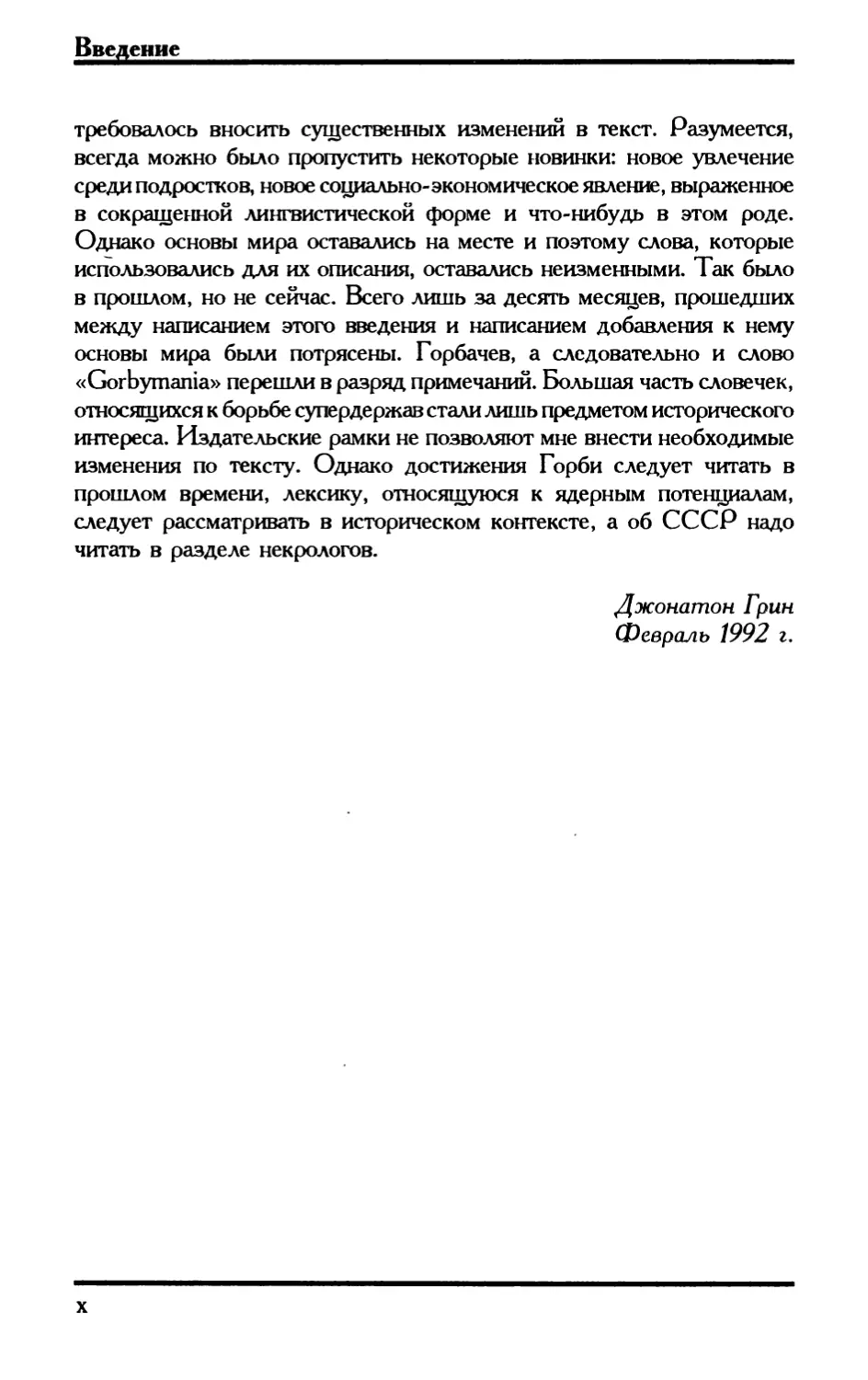
Было время, когда за период, проходивший между изданием книги
в твердом переплете и ее переизданием в мягкой обложке, не
ix
Введение
требовалось вносить существенных изменений в текст. Разумеется,
всегда можно было пропустить некоторые новинки: новое увлечение
среди подростков, новое социально-экономическое явление, выраженное
в сокращенной лингвистической форме и что-нибудь в этом роде.
Однако основы мира оставались на месте и поэтому слова, которые
использовались для их описания, оставались неизменными. Так было
в прошлом, но не сейчас. Всего лишь за десять месяцев, прошедших
между написанием этого введения и написанием добавления к нему
основы мира были потрясены. Горбачев, а следовательно и слово
«Gorbymania» перешли в разряд примечаний. Большая часть словечек,
относящихся к борьбе супердержав стали лишь предметом исторического
интереса. Издательские рамки не позволяют мне внести необходимые
изменения по тексту. Однако достижения Горби следует читать в
прошлом времени, лексику, относящуюся к ядерным потенциалам,
следует рассматривать в историческом контексте, а об СССР надо
читать в разделе некрологов.
Джонатон Грин
Февраль 1992 г.
ABM abbrtv. [1972]
Anti-Ballistic Missile: a missile used to shoot
down another missile, e.g. the Patriot missiles
used against the Scuds during the Gulf War.
Thus the ABM Treaty (Anti-Ballistic Missile
Treaty): signed in 1972 by President Nixon
and General Secretary Brezhnev, a treaty
which severely limited both sides’ deployment
of anti-ballistic missiles and as such put
a temporary but vital brake on the arms
race; it remains the single most concrete
achievement of every round of arms talks to
date. It may be assumed that with the end of
the Cold War this treaty, while important, has
become less vital to world peace.
♦	‘Scientists recalled, a similar optimism (which
soon proved to be unfounded) about ABM
defence in the 1960s, and strategists predicted
a serious instability if one superpower appeared
to be nearing invulnerability.' (A. Wilson,
The Disarmer’s Handbook, 1983)
♦	The 1972 ABM Treaty severely limited the
number of anti-ballistic missiles allowed each
country. ’ (R.C. Aldridge, First Strike!, 1983)
abort v. [1966]
to abandon, to bring to an abrupt halt; origi-
nally found in space terminology (e.g. ‘abort a
mission’), but currently used in a variety of
technological situations, especially that of
computing where one can ‘abort’ a Opro-
gram.
♦	There were capacities to abort the mission on
the ground and in the air, by automation and
by decision, by the crew and by Mission
Control.' (N. Mailer, Of a Fire on the Moon,
1970)
Absurd, theatre of the n. [1962]
a form of theatre that concentrates on the
absurdity of the human condition, as epito-
mized by the work of Samuel Beckett, Eugene
Ionesco, et aL
♦ This does not mean that the.. . more startling
manifestations of the Theatre of the Absurd
did not provoke hostile demonstrations. ’
(M. Esslin, The Theatre of the Absurd,
1968)
AC/DC adv., adj. [1970]
bisexual, ‘swinging both ways’; from the two
forms of electrical current, in which the
abbreviations stand for ‘alternating current’
and ‘direct current’.
acapulco goM n. [1967]
a particularly potent variety of marijuana,
allegedly grown in or around the area of
Acapulco, Mexico. Like every ‘recreational’
drug, marijuana and hashish have gained a
wide variety of nicknames, e.g.: Lebanese
gold, I^ebanese red, Afghani, Af, black Pak,
Turkish pollen, Mexican green, Durban poi-
son, Congo bush, and Acapulco red.
* ‘Cheers go up in the dark. Acapulco Gold! oh
shit were esoteric heads and we know the
creamiest of all the marijuana. ’ (T. Wolfe,
The Electric Kool-Aid Acid Test, 1969)
1
а
access
♦ ’Name your poison! Durban? Gold from
Acapulco ? Burnt Congo Brown ? Red Lebanese
suncakes? A touch of tincture?' (N. Fury,
Agro, 1971)
access v., adj. [1973]
to use, to understand and (for those who
‘have access’), to influence; like ^interface
and c>hands-on, access offers a technological
edge to an otherwise pedestrian meaning.
also: the concept of offering time on the
state or independent TV networks to minority
or special interest groups to promote their
own opinions and cases, usually with
some professional guidance; thus access
broadcasting; access programmes.
♦ The working party is against “access courses",
believing that if blacks were helped to the start-
ing line, once they were in the force they would
be seen as second class citizens, and would
struggle to keep up.’ (R. Chesshyre, The Force,
1989)
acid n., adj. [1966]
a slang term fort>LSD\ the same term was used
in the 1980s to describe OEcstasy. Other than
Oacid head and Oacid rock, the 1960s used
the word mainly as a noun; its use as an adj. in
a variety of combinations (see below) came in
the 1980s.
♦ The add was in some orange juice in the
refrigerator and you drank a paper cup full of
it and you were zonked.' (T. Wolfe, The
Electric Kool-Aid Acid ТеЛ, 1969)
♦ ‘Guru Josh. He's big, he's bad, he's mad, he’s
back. Add noises plus. Get those pyjamas on.'
(The Independent, 24 May 1990)
acid head n. [1966]
see head.
add house n., adj. [1988]
a style of music, with a frequency of 122-135
beats per minute, (plus the attendant clothes,
parties, and allied paraphernalia), that blends
Ohouse music with the drug OEcstasy, other-
wise known as Oacid. Further developments
(probably shortlived) included add ska a
mix of West Indian Oska music and the
music that supposedly accompanied the con-
sumption of and was inspired by Ecstasy, the
preferred combination of contemporary
Oskinheads, whose parents liked unadorned
ska.
acid house party n. [1988]
an illegal party, often held in a large building
such as a warehouse, and often outside the big
cities, where thousands of young people pay
for their entertainment and, allegedly, con-
sume Oacid and other illegal drugs. In the way
of all such youthful pleasures, the parties
caused a good deal of furore among MPs,
policemen, tabloid journalists, and kindred
upholders of the national morality.
♦ Two teenage girls had provided information
that Rastafarians were selling tickets to
Saturday night “add house parties" at which
drugs were being traded.' (R Chesshyre, The
Force, 1989)
acid rain n. [1975]
rain that contains a high concentration of
acidity, which is created by the release into the
atmosphere of a variety of pollutants, primari-
ly sulphur and nitrogen oxides. Similar forms
of pollution include acid mist and acid precip-
itation.
♦ It is more realistic to talk of redudng the effects
of add rain than removing it altogether. '(Daily
Telegraph, Student Extra, 1989)
2
advance (man) Ц
ackl rock n. [1967]
a form of rock music that emerged in the late
1960s, pioneered by the ^psychedelic bands
of America’s West Coast and by the Beatles’
album Sergeant Pepper's Lonely Hearts Club Band.
The songs and music were infused with the
ethos and philosophies of psychedelia, and
when (as they all too often were) they were
bad, the inflated pretensions that came from
taking OLSD or ‘acid’.
♦ ‘And it was that sound that the Beatles picked
up on, after they started taking acid, to do a
famous series of add rock record albums,
Revolver, Rubber Soul, and Sergeant
Pepper’s Lonely Hearts Club Band.’ (T.
Wolfe, The Electric Kool-Aid Acid Test, 1969)
act, get one’s - together phrase
[1976]
also get one’s head together: to calm down, to
take stock; the image is of recovery from a dis-
orientating drug experience.
♦	‘Looking for a proper place to sit down . . . and
get my head together. ’ (H.S. Thompson, Fear
and Loathing in Las Vegas, 1971)
♦	Tm on a real heavy trip right now, you
know* Like, I cant get my act together.'
(C. McFadden, The Serial, 1976)
actioner n. [1968]
industry and critical slang for an action movie,
e.g. the Indiana Jones series; the term echoes
the pattern of oater (western) or meller
(melodrama). Actioners are the eternally
popular species of escapist film plotting,
containing a mix of thrills, spills, sex and
violence.
action replay n. [1973]
see instant replay
additive n. [1970]
any form of chemical adulterant - whether to
enhance the flavour or preserve the commod-
ity - that has been added to a foodstuff. While
these additives can be natural, the usual
assumption is that they are artificial, and thus
assumed to be potentially harmful. The most
frequent use of the term is in labelling, where
supposedly Ogreen manufacturers cite their
products as ‘additive-free’.
adult adj. [1972]
1. a euphemism for pornographic; thus adult
bookstore, adult anema, etc.
♦ ‘Buy and exchange the very best in Genuine
Adult Videos from the USA and Continent with
Galaxy Video Private Members Club.' (Cheap
Thrills magazine, August 1990)
2. reasonably sophisticated, by the standards
of current television; in the UK this implies
those programmes shown after 9pm, the cut-
off point at which broadcasters optimistically
assume that children are in bed.
advance (man) ». [ 1968J
the preparation in advance of a live audience,
or the briefing of radio or TV stations to obtain
the maximum vote-catching exposure for a
political candidate. Such activities are per-
formed by the ‘advance man’ whose job
includes arranging ‘spontaneous’ banner-wav-
ing demonstrations ready for the cameras,
writing ‘local’ inserts for the candidate’s rote
speech and generally geeing up the local party
activists. Depending on their efforts there can
be ‘good advance’ or ‘bad advance’. Such pro-
motions descend from carnival and circus
hucksters who would always send someone on
ahead of the show to whip up enthusiasm in
the next town they were due to play.
3
P advertorial
The negative side of advance is known as
black advance: the deliberate disruption of an
opponent’s campaign by a series of dirty
tricks. An inverted version of traditional
‘advance’ that a candidate sends out ahead of
his canvassing to promote his cause: both
legal and illegal methods are used to harass
and confuse the candidate’s supporters and
alienate potential voters.
advertorial n. [1986]
from advertisement + editorial: a newspaper
feature which appears from its design to be a
piece of editorial, but which is in fact a large
advertisement, and has been paid for as such.
* ‘The videos which accompanied them have
such flimsy storylines that they are nothing
more than advertorials. ’ (The Independent, 15
October 1990)
advocacy n., adj. [1967]
any form of media in which the writing,
broadcasting or advertising is geared towards
pushing forward a given point of view.
Derivatives include advocacy journalism,
advocacy advertising, etc.
aerobics n., adj. [1980]
a fashionable keep-fit exercise regime which
depends on increasing oxygen intake in order
to stimulate the activity of the heart and lungs.
♦ 7t all seemed to start off with a group who all
seemed to know each other - they went to the
same aerobics classes or coffee mornings. ’ (The
Independent, 16 October 1990) ,
aerobie n.[i986]
a plastic ring, the equivalent to a hollow Ofris-
bee, approximately the size of a record album,
which can be thrown either over distance or
from person to person. Its aerodynamic qual-
ities have made it, according to the Guinness
Book of Records, the man-made object
thrown furthest, a distance of 1114.5 feet.
Af n. [1969]
see Acapulco gold.
affinity card n. [1989]
a form of credit card that automatically sub-
tracts a tithe of any transaction and donates it
to the charity of the user’s choice - specified
on the card.
affirmative action n.[i965]
the hiring of minority/Odisadvantaged/poor
individuals for jobs - or the enrolling of simi-
lar groups in college/university courses - that
might require higher credentials than those
they can offer, on the principle that their
poverty, etc., has made it impossible for them
to obtain such credentials. The problem for
those who criticise such schemes, is that
despite their basic worthiness, good inten-
tions cannot replace necessary credentials
and it may be that those so employed still can-
not perform the job or academic work as
required. From the other side, those who
benefit have their own criticisms, seeing
affirmative action as just a euphemism for the
old ‘quota systems’.
See also positive discrimination; tokenism.
♦ ‘The contractor will take affirmative action to
ensure that applicants are employed, and
employees treated . . . without regard to their
race, creed, colour or national origin. ’ (US
Government Executive Order 10925,
March 1961)
4
aggro/agro
afghan (coat) n. [1969]
a fur-lined sheepskin coat (worn with the skin
side outside), first imported to the West in the
late 1960s by early returnees from the Ohippie
trail to Afghanistan, and soon registered as a
badge of true hippiedom.
* 'His lean body engulfed in an off-white afghan
coat. ' (N. Fury, Agro, 1971)
Afghani n. [1969]
see Acapulco gold.
AfrO n. [1967]
a hairstyle which features extremely bushy
hair; the style, which was supposed to reflect
natural ‘African’ hair, rather than the artificially
straightened styles of the despised ‘Uncle Tom’,
was particularly popular among liberation-mind-
ed blacks in the late 1960s and 1970s and can be
seen at its best on a variety of OBlack Panthers,
rock stars such asjimi Hendrix, etc. Some whites
(e.g. Eric Clapton) also paraded the style.
See also natural.
♦ 'The tension had been too great. Debbie
Reynolds was yukking across the stage in a
silver Afro wig ... to the tune of “Sergeant
Pepper”.' (H.S. Thompson, Fear and
Loathing in Las Vegas, 1971)
ageism n. [1970]
a bias against the old simply because they are
old; emanating from the same spirit, and
originating at around the same period as
Osexism. Pressure groups against ageism
include the Grey Panthers (modelled on the
OBlack Panthers of the 1960s).
-ageist, adj.
♦	"We let her move in because we wanted to
make a statement about ageism in America. ’
(C. McFadden, The Serial, 1976)
agent orange n., sometimes caps. [1970]
also agent blue/purple/white: a variety of
herbicides, the best known of which is agent
orange, containing a deadly toxin, dioxin.
Used in South-East Asia (notably Vietnam) by
US forces for defoliation purposes, the poison
affected not only plant life but, without their
knowing it at the time, both the local civilian
and the US military personnel. The short-
term result was the destruction of much of
Vietnam’s agriculture; the long-term is still
showing up in a mass of infant birth defects,
both in Vietnam and in the US.
♦	'So US soldiers absorbed Agent Orange
through the skin, or in water they drank.'
(G. Emerson, Winners and Losers, 1976)
Age of Aquarius n. [1967]
an astrological term referring to a new age of
peace, freedom, brotherhood and the con-
quest of space; it neatly coincided with the
1960s, at which point all such phenomena
seemed feasible and for which, among the
more starry-eyed, it became a synonym.
*	7 mean, who among us is ready to follow Spiro
Agnew, torch in hand, into the Aquarian AgeV
(A. Hoffman, Woodstock Nation, 1969)
aggTO/agTO n. [1969]
an abbreviation far aggravation, with the impli-
cit assumption of violence; now in more gen-
eral use, but coined specifically for the
Oskinhead gangs who emerged in 1969; a
more recent version is agg, used as a verb or
noun.
♦	"When Hell's Angels and Skinheads meet
6
И a-gogo
there’s only one outcome: Aggro!’ (N. Fury,
Agro, 1971)
♦	Inside one of the houses the search team has
encountered a bit of aggro. ’ (A.F.N. Clarke,
Contact, 1983)
a-go-go adv [1966]
fashionable, exciting, full of energy; the impli-
cation is of the frenetic action of a Odis-
cotheque, among the earliest of which was the
Whiskey A-Go-Go; thus go-go dancer: the
exhibition dancer at a discotheque.
agony aunt/uncle n.
an advisor to the lovelorn or, more usually,
sexually perturbed or otherwise unhappy and
confused; such "aunts’ and ‘uncles’ appear in
the newspapers and on radio and (less often)
television; the term descends directly from the
old ‘agony columns’ or personal columns,
published in the daily press, most famously on
the (pre-1966) front page of The Times, where
anguished appeals rubbed shoulders with the
more mundane advertisements, and notices
of births, marriages, and deaths.
agrt- prefix. [1976]
an abbreviation of agriculture and hence a pre-
fix used in a variety of combinations to refer
to farm-related topics. The best known is
^agribusiness, but other compounds include
agricorporation, agricrime (the stealing of
farm machinery), agripower, agriproletariat,
etc.
♦	"The deal is one of a series struck by BOCM in
its drive to expand its UK agrifeeds operations. ’
(The Independent, 6 April 1990)
agribusiness n. [1976]
those wide-ranging enterprises which produce,
process, and distribute farm products, as well as
their ancillary suppliers and allied businesses.
-aholic suffix.
a number of nonce words have appeared,
some more durable than others, based on the
pattern of alcoholic (for all that the real suffix
is -ic)\ they include bookaholic (1977), golf-
aholic (1971), hashaholic (1972), and sweet-
aholic (1977).
See also chocoholic; workaholic.
Al abbrev. [1971]
Artificial Intelligence: the continuing re-
search into creating computers that are less
like machines and more like humans in their
approach to problems and their solutions.
The addition of human-type thought, intu-
ition, speech and similar attributes will theo-
retically lead to the first real androids, the
exemplars of Al in action.
See also artificial intelligence.
-Aid suffix. [1984]
the original ‘Aid’ was Band Aid, which began
as a Christmas record in 1984, recorded by a
wide range of stars as a means of raising
money for famine relief in Africa; this devel-
oped into Live Aid, a pair of superstar charity
concerts held on the same day - 7 July 1985 -
in Wembley Stadium, London and JFK
Stadium, Philadelphia. Since then Aid has
been tacked onto a variety of similar projects,
notably Sport Aid (run by sports stars) and
(for smaller causes) Mandarin Aid and Sheep
Aid. A similar project, created by British
comedians, ran under the name Comic Relief.
♦ At the Live Aid benefit, Madonna shows her

ALCM И|
navel for a good cause.’ (Chronicle of
America, 1990)
AIDS abbrev. [1982]
an acronym for Acquired Immune Deficiency
Syndrome: after much debate, this term was
coined in July 1982 by researchers at the Cen-
tre for Disease Control in Washington, DC. A
number of alternatives had been put forward,
notably GRID: Gay-Related Immune Deficiency
and ACIDS: Acquired Community Immune
Deficiency Syndrome, both of which were
intended to reflect what was seen as the
uniqueness of the problem to the Ogay com-
munity. These were rejected as intravenous
drug users, haemophiliacs, and heterosexuals
began to be diagnosed with similar symptoms.
AIDS, with the grim ironies of ‘help’ for those
who were initially seen as actually helpless,
remains a compromise, but has stuck. Certainly
HTLV and HIV, more technically accurate
acronyms, surface far less often in general use.
♦ ’Twelve of the fifteen men there are HIV posi-
tive, and two have AIDS. ’ (The Independent,
23 May 1990)
air breather n. [i960]
a jet engine that requires an intake of air for
the combustion of its fuel.
♦ ‘The final portion of the strategic triad is the
air wing - or, as former Defense Secretary
Brown called it, “the air breathing leg”. ’ (R.C.
Aldridge, First Strike!, 1983)
air burst n. [i960]
a nuclear explosion that is detonated suffi-
ciently far above the ground to ensure that
none of the fireball actually touches the
ground and thus none of the effect of the
explosion is dissipated by local geographical
factors. It ensures the maximum production
and dissemination of radiation in the immedi-
ate area of the detonation, and is designed for
use against any large-scale concentration -
notably large cities or industrial areas.
♦	‘Low yield air bursts over cities or near forests
will tend to produce massivefires. ’ (P. Ehrlich,
C. Sagan et al., The Nuclear 'Winter, 1984)
aillMIS n. [1960]
a short-range passenger aircraft designed, like
the ‘bus’ its name incorporates, to ferry pas-
sengers on regular journeys. The aircraft was
built by a consortium of European firms.
♦	‘When the airline takes delivery of the 19 new
European Airbuses it has ordered . . . ’
(Independent on Sunday, 17 June 1990)
airhead n., adj. [1982]
a fool, an idiot, one whose head contains not
brains but empty space.
♦	‘Redundant city whizz kid Thornton Streeter. ..
is cushioning downward mobility by letting out
rooms to his airhead Sloane friends.’ (The
Independent, 29 May 1990)
air miss n. [1970]
the official description of a narrow escape
from collision by two. aeroplanes flying exces-
sively close to each other.
airplay n. [1973]
the broadcasting of a given record on the
radio.
See also needle time.
ALCM abbrev. [1977]
Air-Launched Cruise Missile: a subsonic air-to-
ground Ocruise missile which is deployed on a
variety of US strategic bombers in addition to
7
Д al dente
nuclear bombs and other missiles. Like all
cruise missiles it is highly accurate and deliv-
ers its 200 kiloton warhead after a 2500 km
flight to within 30m of a target. The Russians
also deploy ALCMs, the most accurate and
penetrative of which are the AS-4 (Kitchen)
andAS-6 (Kingfish).
♦ ‘The “high-low flight" scenario for an ALCM
begins when the missile is released from the
bomber at about 45,000feet.' (R.C. Aldridge,
First Strike!, 1983)
al dente adj. [1970]
from Italian ‘for the teeth’, thus slightly resis-
tant to the bite; originally used only for pasta,
but now extended to vegetables.
♦	'The real perils of 20th century designer living
. . . are expresso coffeemaker's wrist and chok-
ing from eating al dente vegetables while wear-
ing a brace.' (The Independent, 22 June
1990)
A8 Fatah n. [1966]
originally the Syrian wing of the Palestine
Liberation Organization (see PLO), it was
incorporated into the PLO under its leader
Yasir Arafat (b. 1929) and came to dominate
the organization. The word ‘fatah’ means
‘fight’ or ‘resistance’ in Arabic.
♦	From 1967 onwards [the PLO] was dominat-
ed by Al Fatah, the Syrian wing associated with
Yasir Arafat.' (A. Palmer, Dictionary of 20th
Century History, 1981)
ALGOL abbrev. [1961]
an acronym for Algorithmic Language: a com-
puter language intended for programming in
higher mathematics and complex technology;
designed by a committee of European aca-
demics and still more popular in Europe than
in the US.
♦ ALGOL. A programming language much
loved by some European academics.' (D.
Jarrett, The Good Computing Book for
Beginners, 1980)
alHn-one n., adj. [i960]
a garment such as a Obody or Ocatsuit which
covers the entire body, rather than being com-
posed of a separate top and bottom.
all-nighter n. [1967]
anything that lasts all night, usually a party or,
more recently, a Orock concert or similar
event.
all singing, all dancing phrase. [1970]
particularly spectacular. Originally a military
term, it has been adopted to civilian use, espe-
cially in marketing and business where it is
often found describing a presentation or pro-
motion.
See also bells and whistles.
all systems go phrase. [1962]
everything functioning correctly, all in work-
ing order; thus ready to proceed; coined in
the US and referring to the checking out
of a system, for example that of a space-
craft prior to launch, the ‘go’ can be traced
back to the late 19th century when two parties
agreeing on a successful deal would say, ‘It’s
ago.’
all-terrain vehicle n. [1988]
a cross between a car and a motorbike, featur-
ing four large low-pressure tyres which permit
the vehicle to ‘bounce’ across difficult terrain.
See also off-road.
8
aitemative society И
alktlme dj. [1970]
unrivalled, one of a kind, record-breaking;
often found as all-time high; all-time low, all-
time great, etc.
♦	'Capital FM: the all-time great radio station'
(advertisement for Capital Radio, 1991)
alpha test n. [1980]
see alpha version.
alpha version n. [1980]
the earliest usable version of a piece of com-
puter software; thus alpha test: the tests that
can be carried out on that version; alpha ver-
sions, of which there may be many, never
leave the software development house and are
strictly for internal assessment. The alpha ver-
sion precedes the more developed Obeta ver-
sion, which is often that which is given out to
magazine reviewers, professional testers, etc.
♦	'Apple finally distributed an alpha version
with the System 7.0 development kit.' {Byte,
July 1990)
aitemative adj. [1967]
originally a back-formation from ^alternative
society, alternative was used initially in a num-
ber of compounds, all indicating a set of cul-
tural values that ran contrary to the
mainstream. Typical among these were
«^alternative medicine, alternative press,
«^alternative therapies {see also New Age). As
the Ohippie dream faded, alternative by itself
came more and more to be used as a pejora-
tive, which other than in compounds, notably
«^alternative comedy, is its primary use today.
♦	'The Maginnises, who lived next door and
whose kids went to the same aitemative nursery
school as hers.' (C. McFadden, The Serial,
1976)
♦	'Sitting on top of a former garage beside the
canal in deepest alternative Camden Town. ’ (J.
Meades, Peter Knows What Dick Likes, 1989)
alternative comedy n. [1984]
a style of comedy that developed in the early
1980s, particularly at such venues as London’s
Comedy Store, and featured such performers
as Rik Mayall, Robbie Coltrane, Dawn French
and Jennifer Saunders, et aL At the time they
did indeed offer an alternative to television’s
tired stereotypes, but increasing fame has
gradually rendered them as mainstream as
any predecessor.
♦	ТЛг "Keith Allen Show” . . . features the erst-
while aitemative comedian interviewing
famous "personalities”.' {Private Eye, 16
March 1990)
alternative medicine n. [1967]
any of a variety of medical methods -
homoeopathy, Bach flower remedies,
acupuncture - which are simply rejected, or at
best grudgingly recognized by the medical
establishment, but which are seen as viable
alternatives by those who are similarly dismis-
sive, in their turn, of the efficacy of main-
stream cures. In many cases such methods
reject the synthetic drugs prescribed by main-
stream doctors, preferring to rely on natural
cures.
See also alternative therapies.
♦	‘Who uses alternative medicine? (headline in
Independent on Sunday, 25 March 1990)
aitemative society n. [1967]
also known as the Ocounter-culture (to the aca-
demic) and the «^underground (to the
media), the alternative society was a coverall
brand-name for the world the Ohippies of the
9
EL. alternative therapy
1960s believed they could create. In many
ways similar to conventional, ^straight society,
with newspapers, shops, restaurants and small
businesses of many types, its enterprises still
claimed a set of cultural values that ran con-
trary to the mainstream.
* They will try to crush any part of the alterna-
tive society that they cannot buy.’ (M. Farren,
Watch Out Kids, 1972)
attemative therapy n. [1986]
any of a variety of therapies that are based on
theories outside mainstream medicine or
(Freudian) therapy. Thus the alternative ther-
apist: one who practises such therapies.
See also alternative medicine; new therapy.
Amnesty International n. [ 1961 ]
an international organization formed in 1961
to campaign for human rights and to support
articles 18 and 19 of the United Nations
Universal Declaration of Human Rights,
which deal with freedom of thought and con-
science and freedom of expression. It was
directly inspired by lawyer Peter Benenson,
who had been appalled by the seven-year sen-
tences meted out to a group of Portuguese
students who were overheard toasting
‘Freedom’ in a restaurant. A major article,
written by Benenson, called ‘The Forgotten
Prisoners’ and published around the world in
late May 1961, led to the year-long ‘Appeal for
Amnesty’ and thence to the founding of
Amnesty International.
♦	‘Amnesty International plays a specific role in
the international protection of human rights. ’
(Amnesty International, Voices for Freedom,
1986)
anabolic steroids n. [1961 ]
the bete-noire of modem sporting competi-
tion, anabolic steroids, which are used in
medicine to accelerate the healing of wounds,
are consumed by a variety of sportsmen and
women (and racehorses and greyhounds) to
increase their strength and stamina. Steroids,
a term coined in 1936, is a generic term for a
group of compounds which include the
sterols, bile acids, heart poisons, saponids and
sex hormones. Their use can lead to pro-
found changes in growth; ‘anabolic’ (from
Greek meaning ‘throwing up’) means that
this growth process is accentuated.
♦	‘Larkey McBuffum was a crooked Chicago
pharmacist who had been selling steroid pills to
junior high, school football players. ’ (C.
Hiaasen, Skin Tight, 1989)
апЫЮГ n. [1960]
an abbreviation of the slightly earlier ‘anchor-
man’: the compere (or commere) of a televi-
sion programme, especially a news show. Such
‘anchors’ have graduated from simply reading
the news, to becoming celebrities in their own
right - as seen in the Gulf Crisis where such
US anchors as Dan Rather or Ted Koppell
appeared to be offering their own diplomatic
interventions, rather than simply reporting on
events.
♦ Anchorman Desmond Lynam - so smooth that
it has been suggested that he wouldn 4 be ruf-
fled by a mid-Grandstand announcement of
nuclear war.' (Independent on Sunday, 3
June 1990)
angel n. [1976]
used in the tabloid press as a synonym for
‘nurse’ and derived from the eponymous BBC
television soap opera of the 1970s.
10
Anton ЯНег application И
angel duet n. [1970]
a slang nickname for phencyclidine or OPCP.
An animal tranquillizer (allegedly designed
for pigs, thus earning its alternative nickname
of ‘hog’) which gained some popularity
among recreational drug users in the early
1970s; like marijuana it is consumed by mix-
ing the drug - in powder form - with tobacco,
and smoking the resulting cigarette.
♦	‘AU the fine ladies are making a fuss/But I
can't pay attention 'cos Гт on that dust.'
(Beastie Boys, ‘No Sleep Till Brooklyn’,
1985)
animal rights n., adj. [1978]
the concept of animals, as well as humans,
having ‘civil rights’, and thus deserving fair
treatment on both ethical and moral grounds;
thus animal rights protest/protestor: a cam-
paign or one who campaigns (with increasing
violence of a sort that is more usually associat-
ed with guerrilla warfare) for such rights.
♦	Trancis Kelly... was conditionally discharged
. . . after admitting stealing 32 rabbits from a
farm at Lymm, Cheshire, as part of an animal
rights protest.' (The Independent, 24 May
1990)
anorexia (nervosa) n. [1963]
a condition, most usually found in weight-con-
scious teenage girls, of serious emaciation,
which is thought to be brought on by the
denial of appetite due to some form of emo-
tional disturbance. The term was coined as
early as 1650, when it was usually written
‘anorexy’, and has been found in medical lit-
erature ever since, but its more general use
has emerged only over the last thirty years.
♦	‘Wfon Karen began to waste away from
anorexia, they would whittle away the dolls
with kitchen knives.' (Sunday Correspondent,
17june 1990)
antl-psycMatry n. [1967]
a movement in therapeutic practice, pio-
neered in the 1960s by R.D. Laing, David
Cooper and other analysts, which rejects tradi-
tional concepts of psychiatry - especially such
treatments as ECT, leucotomy, major tran-
quillizers and any form of authoritarian psy-
chiatry - in favour of the properly self-
directed resolution of personality disorders.
Psychiatrists and mental hospitals were seen as
socially repressive and ostensible ‘madness’
quite possibly as a healthy response to a sick
world.
♦	‘[David] Cooper had already experimented with
an “anti-psychiatry unit” at Shenley Mental
Hospital.' (R. Hewison, Too Much, 1986)
Anton Piller application n. [1976]
a legal application, e.g. for a search warrant
for documents, of which the defendants are
not notified, since the judge believes that
were they to know of the application, they
would tamper with the evidence in question.
The name comes from the case of Anton
Piller (a German firm) v. Manufacturing
Processes and others. Piller wished to bring a
copyright action against their London agents,
for which they required certain documents;
since they believed that it would be in the
defendants’ interests for those documents to
vanish, their counsel was able to persuade the
judge to make a secret order for a search.
♦	‘The requirement in an Anton Piller order that
the defendant “forthwith ”permits the plaintiff's
representatives to enter the premises to be
searched.' (The Independent, 28 January
1991)
11
И APR__________________________________________
AOR Mm. [1980]
an acronym /or Adult Orientated Rock/Album
Orientated Rock: music aimed at those who
were teenagers in the 1960s and who are now
assumed to have adopted ‘mature’ lifestyles,
although still true to the idols of their youth.
Such music lacks the gut appeal of rock ’n’
roll, retaining only the banality of its lyrics.
*	‘AOR is formulated to make any sort of compre-
hension on the part of the listener unnecessary
by softening the subconscious. ’ (T. Hibbert,
Rockspeak, 1983)
APEX abbreu. [1971]
an acronym for Advance Purchase Excursion:
cheap fares available for holiday-makers who
purchase their tickets in advance; APEX fares
cover holidays that are of a declared length,
usually 22-45 days. Thus backdated APEX:
cheap tickets issued on the APEX scheme but
sold illegally through ^bucket shops and
demanding neither any form of mandatory
advance booking period nor minimum stay
requirement.
♦	‘APEX tickets are not open; the scheme is
designed for holiday-makers who are only inter-
ested in travelling between one or two places at
set times. ’ (The Flier's Handbook, 1978)
appearance money n. [1980]
a thinly disguised bribe - usually dignified by
the euphemism ‘fee’ - that is paid to star ath-
letes in the form of ‘expenses money’, but
really to ensure their appearance at a given
venue and thus bring in the paying customers
to a stadium.
See also boot money.
APR abbreu. [1979]
annual percentage rate: the rate at which
interest is assessed over a twelve-month period.
♦ ‘Always find out the true rate of interest - the
annual percentage rate (APR) - and what
your monthly repayment will be.’ (The
Independent, 31 March 1990)
Aqua Libra n. [1988]
a form of non-alcoholic soft drink, imbued
with a variety of herbs, which was merchan-
dised successfully to the health-conscious in
the late 1980s.
architecture n. [1980]
the internal design of a computer, describing
the way in which its components are sited and
linked together, in the same way as are those
of buildings. The architecture is a concept
lying behind the construction of the machine,
and does not refer to the actual chips, boards,
wiring, etc.
♦	‘In computers, an architecture describes what a
machine will look like to the people who are
going to write software for it. ’ (T. Kidder, The
Soul of a New Machine, 1981)
arc light n. [1968]
a bomb strike delivered by a B52 bomber; the
flash and explosion of the massive bomb pay-
load gives the bright light that earned this
nickname.
*	"We can see an arc light reflect off the clouds,
then hear the sound.’ (D. Bodey, F.N.G.,
1985)
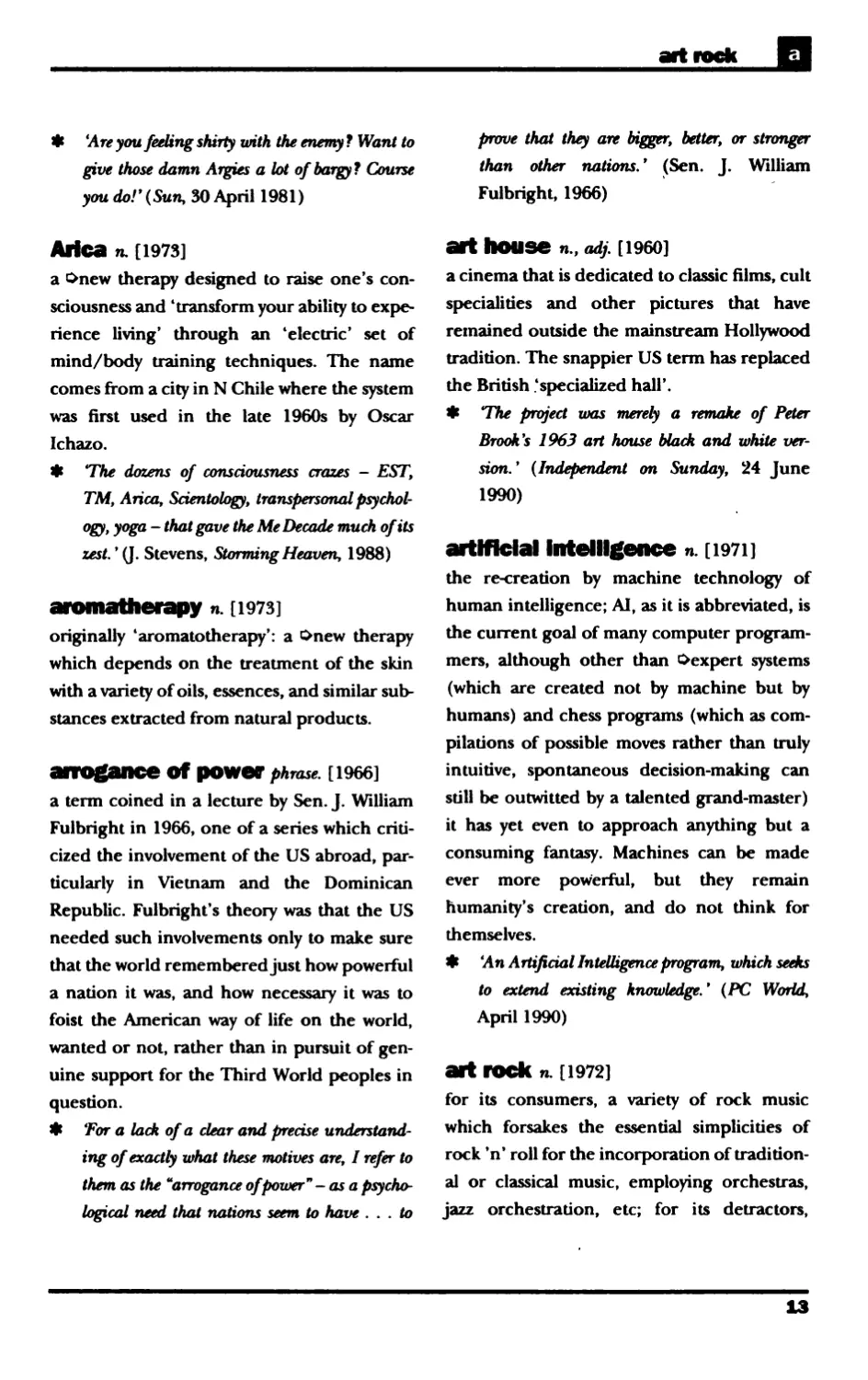
n. [1982]
a slang diminutive coined by the Sun newspa-
per to describe the Argentinians during the
Falklands War of April-June 1982.
12
art rock Д
♦ ‘Are you feding shirty with the enemy ? Want to
give those damn Argies a lot of bargy* Course
you do!’ (Sun, 30 April 1981)
Arica n. [1973]
a Onew therapy designed to raise one’s con-
sciousness and ’transform your ability to expe-
rience living’ through an ‘electric’ set of
mind/body training techniques. The name
comes from a city in N Chile where the system
was first used in the late 1960s by Oscar
Ichazo.
♦ ‘The dozens of consciousness crazes - EST,
TM, Arica, Scientology, transpersonal psychol-
ogy, yoga - that gave the Me Decade much of its
zest. ’ (J. Stevens, Storming Heaven, 1988)
aromatherapy n. [1973]
originally ‘aromatotherapy’: a Onew therapy
which depends on the treatment of the skin
with a variety of oils, essences, and similar sub-
stances extracted from natural products.
arrogance of power phrase. [1966]
a term coined in a lecture by Sen. J. William
Fulbright in 1966, one of a series which criti-
cized the involvement of the US abroad, par-
ticularly in Vietnam and the Dominican
Republic. Fulbright’s theory was that the US
needed such involvements only to make sure
that the world remembered just how powerful
a nation it was, and how necessary it was to
foist the American way of life on the world,
wanted or not, rather than in pursuit of gen-
uine support for the Third World peoples in
question.
♦ ‘For a lack of a clear and precise understand-
ing of exactly what these motives are, I refer to
them as the “arrogance of power” -as a psycho-
logical need that nations seem to have ... to
prove that they are bigger, better, or stronger
than other nations. ’ (Sen. J. William
Fulbright, 1966)
art house n., adj. [i960]
a cinema that is dedicated to classic films, cult
specialities and other pictures that have
remained outside the mainstream Hollywood
tradition. The snappier US term has replaced
the British ‘specialized hall’.
♦ The project was merely a remake of Peter
Brook's 1963 art house black and white ver-
sion.' (Independent on Sunday, 24 June
1990)
artificial Intelligence ». [ 1971 ]
the re-creation by machine technology of
human intelligence; Al, as it is abbreviated, is
the current goal of many computer program-
mers, although other than ^expert systems
(which are created not by machine but by
humans) and chess programs (which as com-
pilations of possible moves rather than truly
intuitive, spontaneous decision-making can
still be outwitted by a talented grand-master)
it has yet even to approach anything but a
consuming fantasy. Machines can be made
ever more powerful, but they remain
humanity’s creation, and do not think for
themselves.
* ‘An Artificial Intelligence program, which seeks
to extend existing knowledge.' (PC World,
April 1990)
art FOCk n. [1972]
for its consumers, a variety of rock music
which forsakes the essential simplicities of
rock ’n’ roll for the incorporation of tradition-
al or classical music, employing orchestras,
jazz orchestration, etc; for its detractors,
13
P ASCII
heavyweight, pretentious music far from the
spirit of rock ’n’ roll.
♦ They.. . started mixing all the musics stored
in their well-educated little beans... and before
we knew it we had art-rock.' (L. Bangs,
Psychotic Reactions and Carburetor Dung,
1988)
ASCII abbrev. [1963]
an acronym for American Standard Code for
Information Interchange: a standard charac-
ter encoding scheme that was introduced in
1963 and is now used on many machines; files
written in ASCII can be read by most editing
(word processing) programs, and are thus ide-
al for transferring data between different pro-
grams or users working on different
machines.
♦ ‘ASCII American Standard Code for
Information Interchange. This was established
by ANSI in 1963.’ (D. Jarrett, The Good
Computing Book for Beginners, 1980)
ASEAN abbrev. [1967]
an acronym for the Association of South East
Asian Nations, an association of non-commu-
nist SE Asian states founded in August 1967
after the signing of the Bangkok Declaration;
members include Malaysia, Indonesia, the
Philippines, Singapore, and Thailand.
♦ ‘In foreign affairs, Malaysia joined ASEAN in
1967 and originally . . . adopted a pro-
Western, anti-communist posture. ’ (J.D. & I.
Darbyshire, Political Systems of the World,
1989)
aspirationaladj. [1988]
used as a noun as a synonym for a self-help
manual - a book that gives advice on the best
way in which to achieve one’s aspirations.
Used as an adjective when reflecting or sym-
bolizing a lifestyle to which someone aspires.
assertiveness training n. [1975]
the training of otherwise submissive individu-
als to be confident, even aggressive in their
social and professional life.
See also Arica, est, new therapy, rolfing
♦ ‘Gestalt therapists, rolfers, assertiveness train-
ers, transactional analysts, all stress the partic-
ular, the idiosyncratic nature of what they have
to offer. ’ (A.W. Clare & S. Thompson, Let's
Talk About Me, 1981)
asset stripping n. [1972]
the process whereby a financier buys up a
company or companies with the intention not
of expanding or improving them, but simply
of selling off such profitable assets as they still
possess, dismissing their employees, and keep-
ing the money thus gained either for invest-
ment in unconnected enterprises, or possibly
for buying further companies for further asset
stripping.
♦	‘Mr Richardson strenuously denies that this is
their intention: “We are not colonial asset strip-
pers”. ’ {Independent on Sunday, 8 April
1990)
♦	The company's interests in property, asset strip-
ping and the loans sector. ’ (T. Blacker, Fixx,
1989)
assured destruction n. [1966]
the philosophy of nuclear deterrence that
assures one’s enemy that whatever aggression
he attempts, you will be able to inflict ^unac-
ceptable damage upon his forces, and, more
importantly, his human population. In
essence a form of nuclear blackmail that, for
all the fine-tuning of superpower foreign poli-
14
ам pair girl
ties, ensured that the Cold War remained
‘cold’ from 1945-89.
♦ *The deterrent policy has been dubbed MAD, an
appropriate acronym which stands for “mutual
assured destruction”.' (R.C. Aldridge, First
Strike!, 1983)
astroturf n. [1966]
an artificial surface used primarily for sports
fields, especially in US football stadia; from
the Houston Astrodome, where the surface
was first used.
♦ ‘“What's the difference between grass and
Astroturf* "Joe Namath: “I don't know. I never
smoked Astroturf.”' (J. Green & D. Atyeo,
The Book of Sports Quotes, 1978)
A team n. [ 1980]
a picked team of highly trained and resource-
ful people, created to tackle a specific prob-
lem; ‘A teams’ were originally devised in
Vietnam, where they represented a select
group of soldiers, deputed for particular mis-
sions.
♦ 'Why this little history lesson ? Because the “A
team” was the brainchild of John Wakeham,
then the government Chief Whip.' (The
Independent, 23 May 1990)
-athon/-ethon suffix.
all uses of the suffixes -athon or -ethon, come
from the Marathon, a race first run in the
Olympic games of 1896; its length - 26 miles,
385 yards (which was standardized in 1924) -
commemorates the battle of Marathon of
490вс, when the Athenian Pheidippedes
ran from Athens to Sparta, a distance of
around 23 miles, to alert Spartan aid for the
struggle against the invading Persians. Thus
the story as recorded by Herodotus, although
the race was based on a corruption of this
legend: that the run was from Marathon to
Athens, bringing news of Persia’s defeat. Since
then the suffix has denoted any prolonged
or extended activity, usually involving a good
deal of endurance; examples include bikeathon
(cycling, 1973), jigathon (country dancing,
1978) and workathon (intense work, 1977).
See also telethon.
ATM abbreu. [1988]
automated teller machine: an unmanned ter-
minal, usually activated by a magnetically
coded card, which can be used to dispense
cash, take instructions on fund transfers, sum-
marize information on the state of an
account, etc.
attrit abbreu. [1960]
attrition: as used in a military sense to mean
death or simply the wearing down of a hostile
force; deaths on the nuclear battlefield are
measured in ‘attrits per second’.
See also degrade.
♦ The goal is the “attrit” of his military powers
down to half of what it was before the bombard-
ment.' (The Independent on Sunday, 10
February 1991)
auntie n. [1963]
a nickname for the BBC that dates back to the
Reithian era, but has gained far wider use
today as used affectionately, if slightly deroga-
torily, by the commercial network (IBA)
towards the state medium.
♦ *BBC1: Ben Elton: The Man from Auntie.'
(Independent on Sunday, 28 October 1990)
ЭН pair gill n. [1964]
from the French ‘on equality’: a young girl
15
Д auteur (theory)
who is employed as a child-minder/nanny in a
foreign country and uses her spare time to
learn that country’s language. As opposed to
the traditional nanny, who was, in theory, a
servant, the au pair is meant to be treated as
one of the family with whom she lives.
♦ The moral forces of the Nanny, as so much else
about her, are in disarray. The au pair girl
bears little or no resemblance to her. ’ (J.
Gathome-Hardy, The Rise and Fall of the
British Nanny, 1972)
auteur (theory) n. [i960]
from the French ‘author’: a film term beloved
of writers in the journal Cahiers du Cinema who
preached that the great directors were in fact
‘authors’ who transformed any scripts they
were given into vehicles for their own preoc-
cupations and creative genius. An acceptable
theory in moderation, it led too often to the
canonization of the third-rate and the arro-
gant dismissal of any other contemporary tal-
ents who might have contributed to the films
under discussion.
♦ ‘. . . seeing the case as emblematic of the way
French auteur cinema was being stifled by mass
commercialization. * (The Independent, 30
October 1990)
automatic adj.
referring specifically to any make of washing
powder deemed by its manufacturers to be
ideally suitable for use in automatic washing
machines.
See also biological.
AWACS abbrev. [1979]
an acronym for Airborne Warning And Control
System: an aircraft-carried early warning sysr
tern; by working high over the earth AWACS,
operating from converted Boeing 707s, has a
far greater range than a static ground-based
radar. AWACS replaced the earlier EC-121
radar surveillance planes as from January
1979.
* AWACS are not armed in the sense that they do
not have rockets hanging from their wings or
guns fore and aft. ’ (C. Lee, The Final Decade,
1981)
-aware suffix. [1983]
a popular suffix that has moved from describ-
ing the ‘soft’ human world, into that of‘hard’
technology. Usually referring to computer sys-
tems, programs, etc.
See also compatible.
axe n. [1969]
a guitar; like much contemporary slang, ‘axe’
comes from black origins - the jazz players of
the 1950s, for whom it meant any instrument;
for the rock musicians of the 1960s and
beyond, it generally refers to a guitar.
It can also be used, by those who appreci-
ate the musical use, to describe any ‘instru-
ment’ - e.g. a journalist’s typewriter - as an air
pilot might call the cockpit his ‘office’.
♦ 7 lugged my axe - Smith-Corona, Mr
Advertiser! - into the dressing room and set in
a comer. ’ (L. Bangs, Psychotic Reactions and
Carburetor Dung, 1988)
ayatollah n. [1979]
from the Arabic ‘sign of God’: a religious lead-
er of the Shi’ite sect of Islam in Iran; there are
around 1200 ayatollahs, who in turn com-
mand around 180,000 mullahs. The term
was coined in 1963, but came to Western ears
after the return to Iran of the Ayatollah
Ruhollah Khomeini, religious inspiration of
16
Azanla
the revolution against the Shah.
♦ The most effective challenge came from the
exiled religious leader, Ayatollah Khomeini,
who carried on his campaign from France. ’
(J.D. & I. Darbyshire, Political Systems of the
World, 1989)
Azanla n. [1976]
the name given to South Africa by African
nationalists; it is assumed that were they to
gain power, this name would replace the old,
‘colonial’ one. Azania was an Iron Age civiliza-
tion, that flourished in what is now South
Africa.
* The Azanian People's Organization (AZA-
PO), a militant, socialist party which advo-
cates the exclusion of all whites from any
political role in the future “Azania”, the name
they propose to give to South Africa. ’ (P.
Brogan, World Conflicts, 1989)
17
I
B1*B bomber n. [1976]
see stealth.
* ‘They say the Bl-B has 90 percent penetration
capability of stealth and therefore stealth is not
needed so soon.’ (R.C. Aldridge, First Strike!,
1983)
Ba’ath n. [1963]
the Ba’ath party was founded in 1955, promot-
ing a mixture of socialism and Arab national-
ism. The word means ’Arab renaissance’. Its
leading exponents today are the regimes that
govern Syria and Iraq (although they profess
somewhat different versions), and it was the
coup in Iraq of February 1963, when the
Ba’athist Colonels Arif and al-Bakr overthrew
President Kassem, that introduced the term to
a non-specialist Western audience. The rise of
Saddam Hussein and the Gulf War extended
its use even further.
♦ ‘In 1953 a government was formed mainly
from members of the Arab Socialist Renaissance
(Ba'ath) Party, but three years later it was
removed in another coup by the army. ’ (J.D. &
I. Darbyshire, Political Systems of the World,
1989)
baby-batterer/battering n. [1972]
one who physically abuses a baby or small
child, or the act of physical child abuse. The
phenomenon is obviously all too old, but the
popular term to describe it was not coined
until 1972. This in turn was a colloquial version
of’battered child syndrome’ or ’battered baby
syndrome’, which has been used by social
workers and similar professions since 1970.
baby boom n. [1967]
see baby boomer.
baby boomer n. [1974]
an adult member of that generation of babies
who were bom in the aftermath of the Second
World War. The original ‘baby boom’
occurred after the Second World War when
the returning soldiers and their wives plunged
eagerly into procreation. No-one, however,
used the term in the Forties, but it did appear
once these babies had come of age in the
1960s. In the 1970s, when that now grown-up
generation started making its impact on soci-
ety, its members found themselves catego-
rized as ‘baby-boomers’, at least in the US. By
extension there is baby bust (1972), logically a
period of lower-than-average birth rate.
♦ Ttas could isolate the company from a genera-
tion of baby boomers. ’ {Independent on
Sunday, 8 April 1990)
Babylon n. [1969]
white society, especially in its racist aspects, as
seen by blacks in general, and (originally)
Rastafarians in particular. The word, with its
biblical overtones, reflects the religious basis
of Rastafarianism.
♦ ‘He prowled the streets with Bogart and the
boys, went to blues dances where highly ampli-
fied black-American music dominated, faced
18
Ь*1** и
down other gangs» fled the dutches of Babylon,
and rode with John Wayne . . . out of places
with names like Fort Apache. ’ (M. Thelwell,
The Harder They Come, 1980)
back burner, on the phrase. [1973]
awaiting attention, in reserve; the image is of
taking a saucepan of food off a fast-burning
gas ring and moving it onto a slower one,
where it can simmer until required. It can, in
context, also mean simply to relegate to the
second-rate.
♦ The hostages have been put on the back burner
by the American government. . . ’ (Sunday
Correspondent, 10 June 1990)
backchannel n. [1975]
secret lines of communication within a gov-
ernment, or between two ostensibly rival gov-
ernments; such communications -
particularly useful as a balance to the formali-
ty of summits, arms talks, etc. - can often facil-
itate political decision-making, especially
where the public image of a government
means that such otherwise sensible moves
cannot be considered; from the CIA’s net-
work of clandestine cable channels that run in
parallel to the normal traffic between US
embassies and Washington.
♦ ‘Moss had handled the so-called backchannel
discussions with the Panamanians. Many
credited him with having saved the treaty. ’ (D.
Rieff, Going to Miami, 1987)
backhander n. [i960]
a tip or payoff; the implication is of a secretive,
underhand arrangement.
back up V., adj. [1982]
used in computing to describe the process of
copying one’s data in order to ensure some
form of insurance against the corruption of
the primary storage system. - backup, adj.
♦	‘Datasave ABA/2 5.12, a backup/restore util-
ity for IBM PCs . . . backs up your hard disk
onto floppy disks. ’ (Byte, July 1990)
bad adj. [1967]
in a classic slang formation, reversing the
meaning of a mainstream word, ‘bad’ means
good, even the very best. It originates in the
black jazz world of the 1950s, and moved into
white vocabulary a 1970. Pop singer Michael
Jackson’s hit album ‘Bad’ gave it a new boost,
and introduced it to a younger, prepubescent
generation.
♦	‘Huey P Newton, Minister of the Black Panther
Party, the baddest motherfucker ever to set foot
in history. ’ (B. Seale, Seize the Time, 1968)
bag n. [1968]
the situation, way of life; an all-purpose ^hip-
pie term, with much in common with the
equally indefinable ^number.
♦	‘You and I have to get clear, you know? Right
up front. I mean you are into this incredibly
destructive bag. ’ (C. McFadden, The Serial,
1976)
baggies n. [1965]
baggy shorts, as worn by California’s surfers.
bag lady n. [1972]
originally a ‘shopping bag lady’, the term
refers to the female tramps who wander the
streets burdened down by their vast collec-
tions of brimming shopping bags, the con-
tents of which are often taken out, picked
over and sorted, but which have little rele-
vance to anyone but the owner.
19
И Ь*"”"
* ‘The shopping bag lady known to locals as Owl
(and to the rookie cop patrolling the station as,
simply, “one of your cleaner types”).' (A.KL
Shulman, On The Stroll, 1981)
bagman n. [1976]
1. the intermediary in any form of political
payoff or corruption - the person who actual-
ly carries the bag of money from A to B.
Directly taken from criminal use, but always
carrying the implication that one user of the
‘bag’ is an allegedly ‘honest’ politician, police-
man, etc.
2. the officer who continually accompanies
the US President and who is charged with car-
rying the ^football which holds the nuclear
Ogo codes.
Baker day «. [1988]
a colloquialism for the regular training days
instituted in British schools, which took over
teachers’ time and paradoxically gave their
pupils a day off; named for the then Minister
of Education, Kenneth Baker, whose educa-
tional reforms had caused this extensive, time-
consuming on-the-job retraining.
♦ ‘Days allotted to training - Baker days - we
thought would simply formalise the time
we already spent in school in the holidays
doing preparation and planning: ’ (The
Independent)
balance of terror phrase. [1965]
the international stalemate which is based on
the ability of both superpowers to wreak
nuclear havoc on the other; it was hoped that
this has become somewhat less terrifying with
the rundown of the Cold War. Probably
coined by Canadian PM Lester Pearson in
1955, on the tenth anniversary of the UN
Charter, in saying: ‘The balance of terror has
replaced the balance of power.’ The phrase
entered more general use during the 1960s
when smaller nations began to join the nucle-
ar family.
Balearic adj. [1988]
a type of dance music, similar to Oacid house,
but slightly slower, rating at 115-130 beats per
minute rather than acid house’s 122-135. The
music comes from Ibiza and Formentera,
which in the 1960s were much haunted by hol-
idaying Chippies, keen to escape the package
tours of the Costa del Sol, but now the play-
ground of a different clientele.
ball park (figure) n. [1962]
an approximate number, an estimated
amount; the term comes from baseball, which
is played in the ‘ball park’, thus an estimate of
the crowd at the day’s game. Often found as
‘in that ball park’.
bandit country n. [ 1971 ]
that area of Northern Ireland that runs next
to the border with Eire and as such provides
an excellent bolthole for the ‘bandits’ of the
IRA.
* ‘Bandit country, the media have called it, and
it’s not a bad label. The law, as such, does not
apply here. ’ (A.F.N. Clarke, Contact, 1983)
Bangladesh n. [1971]
founded as an independent nation in 1971,
Bangladesh was formerly East Pakistan.
- Bangladeshi, adj.
♦ ‘The establishment of a Bangladesh (“Bengal
nation”) government in exile, in Calcutta.’
(J.D. 8c I. Darbyshire, Political Systems of the
World, 1989)
20
BASIC В
bankable adj. [1964]
referring to the financial aspect of‘star quality’,
the ability of a performer, or possibly a director
or cameraman, to guarantee that any film with
which he/she is involved will make large profits
for its backers; by extension, an individual
whose name will help the producer of a film
gain the necessary investment for making it.
♦ 'Knowing that her bankability will ensure pro-
duction, Jackson has exhibited an attractive
habit of taking parts in projects in which she
believes. ’ (The Independent, 31 March 1990)
Barbour (Jacket) n.[i975]
the proprietary name for a type of waterproof
oilskin jacket, worn originally by OSloane
Rangers for country use only, but gradually
adopted by urban Oyuppies as a badge of their
upward mobility.
♦ The Barbour. The country jacket for shooting
etc. though of course it does appear in London.
The Barbour appeal is its green oily pre-synthet-
ic look.' (A. Barr & P. York, The Official
Sloane Ranger Handbook, 1982)
bar code n. [1973]
a code of parallel lines of discrete thickness
printed on paper and readable by a computer
using a scanner. Bar codes have become
increasingly popular in stores where they have
replaced the traditional price tag; the infor-
mation they contain is used for stock control
and can be tagged and automatically regis-
tered on the cash register.
See also EPOS.
♦ 'Bar code readers designed forfast, reliable, cost
effective data entry. Looks just like keyboard
data! Chose from stainless steel wand or laser
interface. ’ (advertisement for Seagull
Scientific Systems, Byte, July 1990)
bargaining chip n. [1972]
any form of leverage, of concession or com-
promise, that one might use during negotia-
tions. The term is derived from gambling
chips, of which the more one has, the stronger
is one’s ostensible position, and it is the 1970s
successor in international relations to ‘trade-
offs’. Bargaining chips gained real interna-
tional currency during the OSALT I arms
limitations talks of 1969-72 and are generally
seen to imply the niceties of nuclear weapons
talks. Such ‘chips’ have taken on increasingly
complex forms and while they often refer to
actual pieces of hardware - I’ll withdraw my
rockets if you withdraw your tanks - they can
often, as in the case of the OStar Wars defen-
sive system (still essentially in its research
stage), be based on theoretical advantages
alone. Such advantages, realised only on
paper, can still be used to extort sacrifices
from an opponent, without actually making
any material sacrifice - only that of a potential
threat - oneself.
* 'He reiterated his position that nuclear weapons
could not be used as international bargaining
chips. ’ (R.W. Howe, Weapons, 1980)
bargaining counter n. [1972]
see bargaining chip.
bash n. [1989]
an improvised shelter in which one can live;
typically the ‘homes’ created in Britain’s
OCardboard Cities.
BASIC abbrev. [1966]
an acronym /or Beginners’ All-Purpose Symbol-
ic Instruction Code: simple, albeit somewhat
lengthy and inelegant (to programmers)
computer language for learners. The usual
21
И basket
starting language for those using micropro-
cessors; thus tiny BASIC: a special form of
BASIC geared specifically to microcomputers.
♦ ‘This book teaches us Elementary and
Intermediate BASIC, up to but not including
Random and Sequential file handling.’ (D.
Lien, Learning IBM Basic, 1982)
basket n. [1973]
from the French corbeiUe. a group of inter-
related issues, especially when such issues are
to be discussed in an international confer-
ence, such as at Helsinki in 1977; the term is
often used in combination with currency as in
‘a basket of currencies’.
basket case n. [1967]
a nervous wreck, and by extension, an insane
person or, most recendy, anything or anyone
that is failing to function properly. The term
was coined in 1919 and originally referred
only to physical disabilities - especially as suf-
fered by First World War quadriplegics - but
its modern slangy use almost invariably refers
to mental, and not physical inadequacy,
whether of an individual or of a malfunction-
ing organization.
♦	‘It was never a near basket case. Its morale and
labour relations were never falling through the
floor like Jaguar or British Steel.' (The
Independent, 21 April 1990)
baton round n. [1971]
the official nomenclature for plastic bullets
used in riot control.
♦	Another white card on the use of PVC baton
rounds, and yet another on how M79 grenade
launchers can be used.' (AF.N. Clarke,
Contact, 1983)
BCBG abbrev. [1975]
an acronym for bon chic, bon gens: the French
version of the UK/US Oyuppie.
beanbag (chair) n. [ 1972]
a chair made of a large bag (often of leather
or plastic) filled with small pellets - usually ol
polystyrene rather than actual beans; such
chairs became very popular in Ohippie
homes, where the only other furnishings were
probably a few posters, a stereo, and the
records to play on it
♦ 'His rooms were neat but sparsely furnished,
with an old couch, a beanbagtype chair, and a
bookcase.’ (T. Kidder, The Soul of a New
Machine, 1981)
bear n. (i960]
the general NATO definition of the Soviets
and anything pertaining to them, specifically
the NATO description of all Russian bomber
planes. The term comes from the traditional
identification of the Russian state, since a
least the 18th century, with a bear.
♦ Exit the tanks, but not the Bear. Eastern
Europe is in desperate need of a new security
order. It is up to the West to provide it with
one. ’ (The Independent, 5 February 1991)
beat box n. [1985]
1.	an electronic drum machine, central to the
creation of Ohip-hop music.
♦ ’The human beat box is ready and willing. ’
(Fat Boys, ‘Fat Boys’, 1986)
2.	another term for Oghetto blaster.
Beetle boot n. [1962]
see Chelsea boot.
22
bells and whistles И
Beatlemania n. [1963]
the hysterical response (much of it initially
engineered by the band’s management and
record company) that greeted the rise to fame
of the Beades. The term was coined by the
Daily Mirror who greeted one eruption of fan
madness with the headline: ’Beatlemania!’
* 'It was a slightly scaled-down version of the
Beatlemania of past days. ’ (R DiLello, The
Longest Cocktail Party, 1971)
Beaujolais nouveau n
the latest vintage of Beaujolais, which is given
only 4-5 days of fermenting and released for
sale on the third Wednesday in November.
The race to bring the first case of Beaujolais
nouveau back to England became for a while
an obsession with rugby clubs, subalterns,
youthful City gentlemen and the like.
* 'Beaujolais de I'annee: The Beaujolais of the
latest vintage, until the next. Beaujolais
Primeur (or Nouveau): The same made in a
8 hurry. ’ (H. Johnson, Pocket "Wine Book, 1987)
beautiful people, the n. [1966]
the chic, the fashionable, the elite of the
1960s youth scene; used especially of the
Onew aristocracy - the models, photogra-
phers and slumming young nobility of
‘Swinging London’. Given the prevailing use
of drugs, there was an implication of inner, as
well as purely surface beauty.
♦	'How does it feel to be/One of the beautiful peo-
ple?' (The Beatles, ‘Baby You’re a Rich
Man’, 1967)
beauty n. [1977]
in physics a property of a subatomic particle
known as a bottom quark.
See also charm, quark.
bedhop v. [1965]
to sleep around, to lead a sexually promiscu-
ous life.
♦	'Never in my less than sheltered career. . . have
I ever encountered bedhopping on the scale it
took place at Melton Hall. ’ (T. Blacker, Fixx,
1989)
beehive hairstyle n. [i960]
a woman’s hairstyle in which the hair is piled
up on the head in the shape of a conical bee-
hive. Especially beloved of rocker girls, New
York Italian close-harmony groups, and
Country and Western chanteuses.
bell bottoms n. [1967]
exaggeratedly flared trousers, similar to those
worn by sailors, with wide hems. Also used as
an adjective, when it drops the final ‘s’. Bell
bottoms were a fashion must in the late 1960s,
and reached absurd widths (similar to the
Oxford bags of the 1920s) by the early 1970s.
They were revived, alongside Otie-dyed T-
shirts and other Ohippie styles, by the hip
young people who touted the Manchester
style of 1988-90.
♦	'Pam Stacy, 16 years old, a cute girl here in La
Jolla, California, with a pair of orange bell-bot-
tom hip-huggers on. ’ (T. Wolfe, The Mid-
Atlantic Man, 1968)
bells and whistles phrase. [1985]
in marketing the special features that a given
product possesses: it is these features that are
most heavily advertised and their existence, or
otherwise, is what is expected to influence a
customer in making a particular purchase.
The phrase is particularly popular in the
world of computing, whether referring to a
sophisticated piece of hardware, or a program
2 Зак. № 19
23
И b«iaw<er
that hopes to satisfy every potential user.
See also all ringing, all dancing.
♦ 'Analysis paralysis - “what happens when you
study excessively bells and whistles - “hyper-
bole to sell a system1*; horseholder - unhyphen-
ated, “executive assistant".’ (International
Herald Tribune, 21 May 1990)
belonger n. [1986]
one of the system of Values and Lifestyles
evolved by advertising agency Young and
Rubicam, to define the groups into which
society falls; VALs replaced the old system of
ABC1C2DE. The belonger is a large, stable,
middle-class group, the bedrock of ‘normal’
society, with conservative, conventional views
and attitudes, low on political activism and
high on backing the status quo and obtaining
material comforts. Other VALs include the
survivors - the lowest group; the sustainers -
those who are neither well-off nor actually
impoverished; the emulators - those who are
making their way up the social ladder by aping
those whom they would like to be; and the
achievers - those who have succeeded.
bends n.
^rapture of the deep.
benign neglect n. [ 1970]
the deliberate disregard of a problematical
issue in the hope that it will go away, or at least
right itself unaided. Coined in 1970 by US sen-
ator Daniel Patrick Moynihan when he
remarked of the civil rights movement that,
‘The time may have come when the issue of
race could benefit from a period of “benign
neglect”.’ This dismissive response to a major
issue attracted a great deal of hostility (and
Moynihan always claimed that he had no
intention of minimizing the importance of
the movement), but it coined a phrase that
has stuck.
♦ 'Benign neglect: a suggestion to allow tension
to ease, interpreted as a plot to abandon the
civil rights movement.' (W. Safire, Safire's
Political Dictionary, 1978)
Bennism n. [1975]
any policy that follows the (perceived) hard-
left Socialist principles espoused by Tony
Benn, MP. At the time of its coinage, Mr Benn
had recendy emerged from his role as
Labour’s Minister of Technology - and thus a
darling of the pro-progress media - to
become a popular bugbear, whose position
was seen as well to the left of Stalin. This vilifi-
cation only ceased when he was defeated in
the Labour deputy leadership contest of 1981,
since when he has been portrayed as the epit-
ome of the Oloony left. - Bennery n., -
Bennite adj.
*	'Hence the decision to diminish, it is hoped, the
ogre of Bennery without sacking Mr Benn. ’
(Daily Telegraph, 1 May 1975)
♦	'From now on its advance was impaired by the
deepening split between the “hard" or Bennite,
and the “soft" or Footite, Left. ’ (P. Jenkins,
Mrs Thatcher's Revolution, 1987)
benny n. [1981]
in British Army use. an inhabitant of the
Falkland Islands; a derogatory reference
derived from an intellectually deficient rural
character in the TV serial ‘Crossroads’.
♦	'The islanders presumably latched on to it as a
riposte to the derogatory “benny ” used of them
by the soldiers.' (J. Ayto (ed.), The Longman
Register of New Words, 1990)
24

Bermuda Triangle n. [1964]
an area of the North Atlantic, near Bermuda,
in which an allegedly disproportionate num-
ber of boats and aircraft have disappeared in
mysterious circumstances. A number of vari-
ously far-fetched theories exist to explain the
phenomenon - the bulk of which involve
some form of extra-terrestrial interference.
Most can be found in Charles Berlitz’ best-
seller The Bermuda Triangle (1974).
best and the brightest, the phrase.
[1972]
the term comes from David Halberstam’s
book The Best and the Brightest (1972) and orig-
inally referred to the American statesmen and
soldiers who were recruited first by President
Kennedy and then by President Johnson to
underpin US involvement in the Vietnam
War. Given the fate of many of those individu-
als, and that of the War itself, the phrase is
tinged with not inconsiderable irony.
♦ The Kennedy intellectuals had been praised as
the best and the briglitest men of a generation
and yet they were the architects of a war which
I. . . thought the worst tragedy to befall this
country since the Civil War. ’ (D. Halberstam,
The Best and the Briglitest, 1972)
* ‘A sprinkling of the best and the brightest were
there - MPs, businessmen, the odd jumped-up
journalist. ’ (T. Blacker, Fixx, 1989)
beta-blocker n.[i966]
a drug that prevents the absorption of
adrenalin into the heart and blood by blocking
the relevant cells’ beta receptors. Used medic-
ally to stop sudden heart-attacks, beta-blockers
have become very popular (albeit oudawed)
among sportsmen whose occupation demands
intense concentration, notably snooker players.
butamax n„ adj. [1982]
one of the two rival formats used for ^video-
recorders; designed by Sony and generally
believed to be better than its opposite number
OVHS, it is particularly popular in the US.
beta test n. [ 1980]
the completely developed test version of a
piece of computer hard- or software, which is
given out for their assessment to magazine
reviewers, professional testers, etc.
See also alpha test
♦ ‘While the Mac version was being developed I
received a great deal of help and advice from a
small group of beta testers who were never slow
with constructive criticism. ’ (Ace, December
1990)
beta version n. [1980]
see beta test.
Bhangra n. [1987]
originally the traditional music of the Punjab,
but in its modem evocation, as recreated dur-
ing the 1980s by the young immigrant com-
munity in England, the music has been mixed
with contemporary rock and dancehall styles
and played with a variety of electronic instru-
ments to create a new fusion.
* ‘Bhangra is the staple diet of Asian youth, and
this exhilarating music provides the central
axis of Choranji's show. ’ (Sunday
Correspondent, 4 November 1990)
Biafra n. [1967]
a region of Nigeria that seceded from the par-
ent nation in 1967, thus occasioning a three-
year war before the stronger federal forces
overcame its resistance and reunited the
country. - Biafran adj.
2*
25
Q_BjgBang
♦ 'The civil war (in which the British sent sup-
plies to the federal forces while the French sup-
ported Biafra) dragged on for another twenty
months. ’ (A. Palmer, Dictionary of 20th
Century History, 1989)
Big Bang n. [1987]
the deregulation of the Stock Exchange on 27
October 1986, whereby stockbrokers could
now make markets in shares as well as deal for
their clients. Formerly such functions were
restricted to separate organizations.
♦ 'In the aftermath of Big Bang, the group was
slow to see the need to integrate some of its
domestic and international operations.’
(Independent on Sunday, 3 June 1990)
big bang theory n. [1966]
a theory of the creation of the Universe which
posits the massive explosion of a single com-
pact mass of extremely hot matter (in the tril-
lions of degrees), from which spring all the
subsequent elements. This explosion
occurred around 20 billion years ago and the
Universe has been expanding ever since. The
big bang, with its concept of infinite expan-
sion from the same origin, is opposed to the
earlier steady-state theory, which claims that
rather than coming from a single source, the
Universe is filled with material that is con-
standy being replaced.
♦ ‘As with so many other concepts, it would be
more accurate to speak of the big bang theories,
since there are variations on the basic model. ’
(D. Kirby, Dictionary of Contemporary
Thought, 1984)
blgc n. [1977]
a nickname for cancer, popularized by John
Wayne, a victirti.
Mg enchilada n. [1973]
the most important person, the boss; presum-
ably a development of the older ‘big cheese’.
The usage dates from the Watergate era,
when H.R ‘Bob’ Haldeman used the phrase to
describe Attorney-General John Mitchell.
♦	Haldeman: "He is as high up as they've got. ”
Ehrlichman: "He's the Big Enchilada”.'
(ThePresidential Transcripts, 1974)
Bigfoot n. [1972]
the Sasquatch, a legendary' creature, shaggy,
humanoid, and with the requisite big feet,
that supposedly inhabits the forests of North
America’s Pacific North-West. Like the yeti of
the Himalayas, the Sasquatch exists largely in
travellers’ tales.
big science n. [1961]
scientific research that requires massive capi-
tal investment but which should yield con-
comitantly ‘big’ results.
biker n. [1970]
a motorcycle rider, specifically a member of
an oudaw gang such as the Hell’s Angels.
*	7 played it gleefully and often for a year or so
until it was ripped off by some bikers.' (L.
Bangs, Psychotic Reactions and Carburetor
Dung, 1988)
bikini line n.
the limit of pubic hair, thus ensuring that
nothing can be seen protruding around the
edges of one’s bikini. Thus bikini wax: the
removal of excess pubic hair to ensure a good
bikini line.
♦	‘Sex, bikini waxes, pasta recipes and men -
it’s only Girl Talk.' (C. Blake, Girl Talk,
1990)
26
bkmfc P|
Umbo n. [1988]
a young girl, usually something of a gold-
digger and indulged as such by rich and/or
powerful older men and the media to whom
. they tell or sell their tales. The earliest use of
bimbo is found c. 1900 in America, where it
was synonymous with ‘bozo’ to mean a tough
guy. A parallel use was that to mean ‘baby’,
abbreviated from the Italian bambino. By the
1920s the word meant young woman, often a
prostitute. The current use stems from the
revelations of a ‘model’, Fiona Wright, of her
relationship with Sir Ralph Halpern, a mil-
lionaire businessman. Bimbos may also be
masculine, and as such are synonymous with
the slighdy older Otoyboy.
♦ Instead of a topless bimbo, Class War's page
three usually has a photo of a “hospitalised
copper”.' (The Independent, 26 June 1990)
ЫП v. [1987]
to discard, to throw away - to throw in the
waste-paper bin; the term extends to the milit-
ary, where it means to discard a weapons
system from the inventories after it has been
tried in battle and found inadequate.
biO- prefix. [1970]
this prefix entered wide use through the cur-
rent fashion for all things Ogreen and envi-
ronmentally conscious; combinations include
biohazardous (anything that presents a hazard
either to the environment at large or to
human beings); biomotor (a computer-driven
device that mimics the working of the human
musculature); biotech (abbreviation for
biotechnology); and biopreneur (anyone who
merchandises the environmental movement
for profit).
See also eco-.
biodegradable adj. [1963]
used of matter that will break down naturally
through the action of biological agents, espe-
cially bacteria.
biofeedback (training) n. [1971 j
the use of electronic monitoring and measur-
ing equipment, such as a portable electroen-
cephalograph, to teach people to exert
conscious control over otherwise unnoticed
bodily functions, including heartbeat, blood
pressure, stomach acidity, mental and physi-
cal tension, etc.
biological adj.
referring specifically to any make of washing
powder deemed by its manufacturers to be
ideally suitable in using its biological proper-
ties to eradicate stains. Such powders have
their drawbacks - they produce allergies in
certain individuals.
See also automatic.
biological dock n. [1965]
an interior mechanism that regulates the vari-
ous cyclic and rhydimic activities of an organ-
ism; usually used with reference to humans.
blonlC adj. [1976]
consisting of a blend of electronic and
mechanical elements and natural human
body structure; the technological upgrade
thus created supposedly augments the usual
human abilities. Originally coined in 1960 to
describe a mechanical or electronic system
that could be made to resemble or reproduce
the functions of living systems, the popular
use of the word came with the television series
‘The Six Million Dollar Man’ featuring one
‘Steve Austin’, much of whose body had been
27
П btortiythm
replaced by high-tech robotics. Bionic
entered general use as meaning ‘extremely
strong’.
♦	'“No flesh, no bones, everything’s turned to
ashes except for your boobs. They’re bionic.
Eternal”' (C. Hiassen, Skin Tight, 1989)
biorhythm n. [1964]
a method of analysing and predicting per-
sonal performance on the basis of three
body/brain cycles: the 23-day physical cycle,
the 28-day emotional cycle and the 33-day
intellectual cycle. By charting these cycles one
can predict highs, lows, peaks, and valleys and
plan one’s life accordingly for maximum
efficiency and benefit.
♦	'When the biorhythms were at their lowest ebb,
just before dawn, they showed “Dangerous
Liaisons”. ’ {Independent on Sunday, 27 May
1990)
Bircher n. [1960]
a member of thejohn Birch Society, America’s
leading anti-Communist, far right political
group. John Birch was a USAF officer killed by
Chinese Communists in 1945 and instandy
canonized by America’s far right as ‘the first
casualty of the Cold War’. According to the
John Birch Society, which was founded in 1958
by a retired sweet manufacturer Robert Welch
Jr, Birch’s death was deliberately hushed up by
left-wing elements in the US government.
♦	'Bircher a member or supporter of the John
Birch Society, best known ... of the ultra-con-
servative, militantly anti-Communist splinter
groups. ’ (W. Safire, Safire’s Political
Dictionary, 1978)
Mack adj. [1967]
a popular label of racial identity, it was taken
up in the 1960s as a badge of verbal self-aware-
ness by a community that had for the previous
sixty-odd years both been called and called
itself Negro. It was used in a number of slo-
gans - notably Black Is Beautiful - and as the
description of certain political and social
standpoints - black consciousness, black
power. Its adoption (at first by activists and
gradually by the larger community) demoted
‘Negro’, once an acceptable euphemism for
the nakedly racist ‘nigger’, to the status of a
term that would only be accepted by the de-
rided ‘Uncle Tom’ figure, who was unwilling
to recognize the strength of his or her iden-
tity, and still happy to kow-tow to white society.
* ‘When we say blackness, we mean relating to
black culture. These cats, they hang themselves
up. ’ (B. Seale, Seize the Time, 1968)
Mack bOX n. [1961]
1.	in technological use. an instrument or compo-
nent that can be dealt with as a discrete entity,
and extended in governmental or business
use to define a separate area of knowledge
within a larger system which can be dealt with
as it is without needing any specialist knowl-
edge of its mechanism or internal structure.
2.	in military use. modular components (in air-
craft, weapons, etc.) that can be moved or
changed with speed and simplicity in case of a
breakdown.
3.	as black box recorder: a supposedly inde-
structible flight data recorder which holds on
wire a record of everything that happens on a
given journey; most civil airliners have two
boxes, one to record the operation of instru-
ments, the other monitoring the cabin crew’s
conversations both in the plane and with
ground controllers. Such boxes are invaluable
in reconstructing events immediately prior to
28
Black Panthers Щ
a crash. Derived from the RAF slang for any
navigational aid.
♦	*We break systems down into sub-systems, and
sub-systems into electronic entities or black box-
es. Then we assign to each of these black boxes
an obscure name that has at least five words in
its title. Finally ... we refer to them by an
unpronounceable acronym. ’ (New York Times,
1979)
♦	'Black box blues are not just confined to once-
competent DIYers.’ (Sunday Correspondent, 10
June 1990)
Mack consciousness n. [1967]
a political movement in South Africa that
stressed the common heritage of all blacks,
irrespective of their tribal affiliations, in the
face of the dominant, oppressive, white cul-
ture. It was heavily influenced by similar
movements in the US.
♦	‘Another opposition group is the National
Forum, organised by survivors of Steve Biko's
Black Consciousness movement. ’ (P. Brogan,
World Conflicts, 1989)
Mack economy n. [1979]
the parallel economy of those who perform
their normal jobs but outside normal working
hours and without admitting to such earnings
(usually in cash) for the payment of tax.
Mack hole n. [ 1970]
a hypothetical ‘hole’ in space which acts as an
all-powerful, ever ‘hungry’ vortex into which
all matter is sucked. Nothing, not even light,
has sufficient velocity to escape. A black hole
is created when the gravitational force on the
surface of a star becomes too great for the
interior pressures that otherwise stop it from
contracting under that gravitational force,
and the star collapses in on itself. This occurs
when the star has used up all its energy pro-
ducing internal nuclear fuels, the absence of
which reduce that necessary pressure.
♦	‘Because light and other forms of energy and
matter are permanently trapped inside a black
hole by the enormous pull of gravitation, a
black hole can be observed only indirectly/
(Longman Encyclopaedia, 1989)
Black Monday n. [1987]
the worldwide stock exchange crash of Mon-
day, 19 October 1987 when the Dow Jones
Index plunged a record 22.6% and other
financial indicators followed suit. All in all it
was the worst day since the end of the Second
World War.
♦	‘ “We bought the company then a month later,
Black Monday, you name it, we lost it.
About three million quid went down/' ’
(Independent on Sunday, 21 October 1990)
Black Muslim n. [i960]
a member of a black separatist sect, the Nation
of Islam, which was founded in 1931 by one
Wallace Farad and which from 1934 had been
developed and popularized by Elijah Muham-
mad. The Nation’s best-known member was the
boxer Cassius Clay who on his conversion in
1964 changed his name to Muhammad Ali.
♦	‘He remained for four years in Paradise Valley,
nurturing a flock of some 8000 souls - the
Lost-Found Nation of Islam, later to be dispar-
aged by the press as “Black Muslims”.’ (D.
Atyeo & F. Dennis, Muhammad Ali, 1975)
Black Panthers n. [1965]
the militant black organization which
emerged in the US in 1965. It took its name
from the black panther symbol adopted by the
И Black Power
black civil rights Student Non-Violent Co-
ordinating Committee (SNCC), but took an
uncompromisingly militant stand, unlike that
of SNCC.
♦	Weatherman stands second only to the Black
Panthers in its ability to conjure up the spectre
of Revolution within America. ’ (H. Jacobs,
ed., Weatherman, 1970)
Black Power n. [1966]
Black Power was developed as a slogan and as
a political philosophy by the civil rights cam-
paigner Stokely Carmichael, a leading mem-
ber of SNCC, and laid out in his eponymous
book. The concept embraced all forms of
black self-awareness, and the means-whether
violent or otherwise - whereby these might be
achieved.
♦	The black consciousness which we see as vital
to Black Power and to the ending of racism. ’ (S.
Carmichael & C. Hamilton, Black Power,
1967)
black sections n. [1987]
the proposed, but as yet unachieved, establish-
ment of a discrete black caucus in the House
of Commons.
♦	‘A lot of people who say quite happily that
they'll vote far black sections, say, are not so
good at actually living next door to a black per-
son. ' (J. Green, Them, 1990)
Black September n. [1972]
a group of Palestinian terrorists formed in
summer 1971 and named for the Palestine
Liberation Organization’s defeat in Jordan in
September 1970. As well as Israel, they
attacked a variety of Jordanian targets. Their
greatest triumph was the murder of 11 Israeli
athletes at the Munich Olympics in 1972.
♦	*. . . actions usually attributed to George
Habash and the PLO's Black September
branch.' (Independent on Sunday, 10 June
1990)
blackwash n. [1984]
in cricketing use. denotes the outright winning
of a test series by the West Indies against
England, Australia or New Zealand in which
the rival team are unable to score a single
victory.
blank generation n [1977]
young people who claimed to have rejected
the values, aspirations and other supposed
inducements of contemporary society.
Modelled, consciously or otherwise, on the
‘lost generation’ of the 1920s, the term was
essentially a synonym for Opunk, its theme
tune the Sex Pistols’ song ‘No Future’.
blaxploitation n„ adj. [1972]
the making of a series of films featuring black
stereotypes, albeit as heroes and very macho
men, that dominated the production sched-
ules for a period in the early 1970s. The term
is derived from ^sexploitation - referring to
films that emphasize their sexual content.
Blaxploitation films included the ‘Shaft’
series, ‘Superfly’ and many lesser offerings. In
the event, for all the money, sex, and allied
vestiges of white liberal guilt/fear/envy, these
films made litde advance over the era of an
earlier black stereotype, the ever-smiling, ever
subservient Stepin Fetchit.
♦ ТЛЙ sketch (was) devised and produced by
“Black Pack ” graduate Keenan Ivory Wynans,
director of blaxploitation hit “Гт Gonna Git
You Sucka”.' (The Independent, 5
September 1990)
30
blow-dry Ц
bleeper n. [1966]
an electronic device that generates telephonic
signals; bleepers are carried in all walks of life,
notably by doctors, travelling salesmen and
other constantly mobile people. They have, to
an extent, been replaced by the portable tele-
phone.
MISS (Hit v. [1967]
to experience intense bliss or ecstasy; to cause
another to have these experiences. The con-
cept originated with the followers of the
1960s* most visible guru, the Maharishi
Mahesh Yogi.
blitter n. [1986]
a purpose-built chip used in computing to
accelerate, and thus improve, the processing
of programs that produce animated graphics.
The term originated at Xerox PARC (Palo
Alto Research Center) as an abbreviation for a
technique - then created in ^software -
known as ‘bit block transfer*. In house jargon
this became BitBLT, a word that was pro-
nounced ‘bitblit’ and thence, ‘blit*. To use
this software was ‘to blit*. When the software
was incorporated into a chip, that chip
became the ‘blitter’.
Blitz kids n
see new romantics.
blockbusting n. [1962]
originally a population shift in the inner city
whereby the black population began moving
into formerly white areas, causing the whites
to flee and turning such areas into increas-
ingly depressed ghettos; in the last decade the
process has begun to be reversed, after thirty
years of one-way traffic, as young reasonably
affluent white bourgeoisie are moving back to
ghetto and working-class areas. The first
middle-class purchaser in a given street or
block is the blockbuster.
blocked adv. [1962]
intoxicated on drugs, especially ampheta-
mines.
♦	'Terry's blocked on pills, tiny blue ones that
make you throb like you had a dynamo inside
you. ’ (N. Fury, Agro, 1971)
blotter n. [1966]
in drug use. a small square of blotting paper
onto which had been dripped a tiny amount
of liquid LSD; blotters and sugar lumps (onto
which LSD had similarly been dripped)
were among the earliest means of taking the
drug.
*	'He was rummaging around in the kit-bag. “/
think it's about time to chew up a Hotter" he
said.' (H.S. Thompson, Fear and Loathing
in Las Vegas, 1971)
blOW n. [1970]
a slang term for. cocaine.
♦	'Lynda called it "crap blow” and John had it
more often than not.' (B. Woodward, Wired,
1984)
blow away v. [1970]
to devastate, to shock deeply.
♦	'Martha's last wedding had just Mown Kate
away, so she was looking forward to this one
too.' (C. McFadden, The Serial, 1976)
blOW-dry v., n. [1969]
to dry someone’s hair while holding the dryer
and simultaneously brushing their hair into
shape. Blow-drying replaced the old method
31
И btowlt
of putting curlers into the wet hair and then
having the person sit under a dryer.
NOW К v. [1968]
to fail.
♦	'There is not much satisfaction in knowing
that he blew it for himself, because he took
too many others down with him. ’ (H.S.
Thompson, Fear and Loathing in Las Vegas,
1971)
blow job n. [1968]
oral stimulation of the penis.
♦	'Ifyou fre going to give forty blow jobs in a night
its no doubt just as well to be blocked. ’ (J.
Meades, Peter Knows What Dick Likes, 1989)
NOW OUt v. [1970]
to cancel, to cut off.
blow (your) mind phrase. [1966]
originally, to experience the effects of a hallu-
cinogenic drug, and thence more generally to
amaze, to alarm, to astound.
♦	'He blew his mind out in a car/He didn’t notice
that the lights had changed. ’ (The Beatles, ‘A
Day in the Life’, 1967)
bluebeat n., adj. [1963]
a type of West Indian dance music, very popu-
lar among the Omods of the early 1960s.
♦	'He would have preferred some reggae, ska or
bluebeat, but then they never put anything
decent in Juke-boxes.’ (N. Fury, Agro, 1971)
blue*rinse set/brlgade n. [1964]
elderly ladies who have their hair tinted slight-
ly blue, to offset the natural grey; thus ladies
who are presumed to share the conservative
attitudes inevitably attributed to such a group.
Huey n. [1991]
an airmail letter, from the colour of its paper;
used by the troops in the Gulf.
blush (wine) n. [1987]
a synonym for rose wine, coined in California as
a marketing ploy to shift a surplus of red wine
grapes in a market where palates were better
attuned to the less demanding flavours of
light white wines.
BMX abbrev.
bicycle motocross: bicycles built for a variety
of stunts; highly popular among the young,
BMX bikes preceded ^skateboards as a fash-
ionable preteen accessory.
♦ 'Eurosport. 9:00 am BMX. 9:30 Surfer
Magazine. ’ (Sunday Correspondent, Satellite
TV listings, 8 April 1990)
Boat people n. [1977]
Vietnamese refugees, originally political, sub-
sequently often economic, who escaped from
Communist Vietnam by sea; these journeys
were beset with danger: it was necessary to
escape Vietnamese security, then to navigate
the inevitably unseaworthy boat, then to avoid
the depredations of marauding pirates and, if
the natural hazards had been surmounted, to
find a country willing to resettle a refugee.
♦ 'The interviews with the Vietnamese, many of
them boat people, who ojien at great peril have
made their way to the United Stales. ’ (New
York Review of Books, 16 August 1990)
bodice-ripper n. [1980]
a traditional ‘woman’s romance’, set invari-
ably in a fantasized 18th or 19th century, but
enjoying the added sales potential of a
salting of sex and violence, possibly even a
32
body language И
rape, whereby once chaste bodices are duly
ripped, until, as ever, Mr Right triumphs once
again.
♦	'Prototype bodice-ripper with 17th-century wild
child Loma (Victoria Hopper, above) falling
for her dans avowed enemy (fohn Loder).’
(TheIndependent, 30 October 1990)
body n. [1986]
a tight form-fitting garment, very similar to a
leotard, which is worn by women.
♦	'Above: red velour long-sleeved body, also in
gunmetal grey or black.’ (Independent on
Sunday, 21 October 1990)
body armour n.
bullet-proof clothing, worn by police and riot
squads.
♦	‘Almost everyone is putting on body armour. It
is about half an inch thick and comes with a
comforting printed claim by its manufacturer. ’
(J. McClure, Cop World, 1984)
body bag n. [1967]
a specially made zippered rubber container in
which battlefield corpses can be stored and
transported prior to burial. During the Gulf
War the body bag was given a new
euphemism: human remains pouch, or HRP.
That war also created a psychological phe-
nomenon: the body bag factor, which refers
to the presumed erosion of public support
for a once-popular war when the casualties
increase and a regular flow of full body bags
begins to come home from the front.
♦	4 don’t want to know you, because to me you
will be just another number when I shovel
what’s left into a body bag. ’ (A.F.N. Clarke,
Contact, 1983)
body ClOCk n.[1970]
an internal bodily mechanism which suppos-
edly regulates one’s mental and physical func-
tions and to which are attributed the ‘ups’ and
‘downs’ that most people experience during a
given time period. The body clock is most
noticeable after a lengthy jet flight, when the
geographical change outpaces the physical
one, and produces Ojet lag when the ‘clock’
gets out of synchronization with its physical
surroundings.
body conscious adj. [1985]
referring to a fashion style that requires the
wearer to have an attractive and above all fit
body, honed to perfection by careful exercise
and diet.
♦	‘Space Age. Martine Sitbon's cadets in mould-
ed satin and body-conscious shapes. ’ (Sunday
Correspondent, 25 March 1990)
body COUnt n. [1966]
the totalling up, after any level of convention-
al military engagement, of the numbers of
enemy dead. Commanders tend to exaggerate
their successes, since a good body count, as in
Vietnam, proves to those concerned that
one’s own side is doing well.
See also kill ratio.
♦	‘The accomplishments of the Phoenix program
were subordinated to the military’s obsession
with high body counts. ’ (New York Review of
Books, 16 August 1990)
body gold n. [1975J
see medallion man.
body language n. [1970]
the way a person demonstrates their feelings
through unconscious movements and postures.
33
П body popping
* ‘Something in her body language as she sat in
the Eames chair poking her needle in and out,
reminded him of Madame Defarge knitting
while the tumbrils rolled. ’ (C. McFadden, The
Serial, 1976)
body popping n. [1985]
see break-dance.
body scanner n. [1975]
a machine that produces three-dimensional
X-ray pictures - either of the whole body, the
brain, or a given area or part - by
using Computerized Axial Tomatography
(CAT) .
body Shirt n. [1970]
a tight shirt that emphasizes the contours of
the (male) body; very popular in the discothe-
ques of the mid-1970s.
bog standard n., adj. [1980]
a slang term for average, run of the mill.
See also vanilla.
bogusware n. [1985]
see -ware.
boilerplate n. [1965]
in general, a synonym for 'standard’, whether
of standard legal documents which are used
by large institutions for drawing up regularly
needed legal papers (especially contracts), or
in journalism, when referring to nationally
syndicated wire service material that runs
unchanged in hundreds of newspapers.
See also vanilla.
bomber n. [1962]
in drug use. 1. an abbreviation for 'black
bomber’, a large black capsule containing
strong amphetamine.
♦	The amphetamine drugs (purple hearts, ben-
zedrine, black bombers, etc) . . . ’ (J. Aitken,
The Young Meteors, 1967)
♦	‘Keep your voices down and dose him up with
those nice brightly coloured bombers.' (T.
Blacker, Fixx ,1989)
2. a large cannabis cigarette.
Bond gM n. [1962]
any of the pretty young starlets who were
recruited by the makers of the ‘James Bond’
films. These girls, initially no more than
extras, became a regular ingredient of all the
films, and a role - albeit tiny - as such an
adornment added an extra cachet to one’s
curriculum vitae.
*	‘Capital City ... is horribly addictive . . .
because of its lurid comic book characterisa-
tions. The bond girls are really just Bond girls,
the whiz boys caped crusaders.' (The
Independent, 13 October 1990)
bOllg n. [1976]
a pipe used for smoking hashish; the funnel-
shaped bong is similar to the West Indian
Ochillum - both give a more intense effect
than smoking a regular joint.
ЬОПк n., v. [1986]
sexual intercourse, to have sexual intercourse;
the most recent graduate of the school of sex
as a DIYeuphemism - screw, bang, shaft, etc.,
though before succumbing to the tabloids,
bonk meant the feelings of tiredness experi-
enced by competition cyclists.
♦	‘AU this bonk on four wheels has spawned an
audience of voyeurs who have their own clubs
and contact each other through small ads.'
34
bom again, to be
(J. Meades, Peter Knows What Dick Likes,
1989)
♦	The key questions for Sun readers are Ts He
Bonkers?”, Ts She Bonking?”' (Sunday
Correspondent, 8 April 1990)
boob tube n. [1974]
1. a disparaging nickname for television, refer-
ring to the ‘boobs’ who watch it; once abbrevi-
ated to ‘the tube’, however, it seems to have
lost its pejorative aspect.
♦ ‘Rad, dudes! Now we can relax an ’ watch some
tube and forget about all the weirdness we just
went through.' (Teenage Mutant Hero Turtles,
June 1990)
♦ ‘Boob Tube Liberation Front Storms CBS,
ABC, PBS & Quaking Independents From
Coast To Coast. ’ (L. Bangs, Psychotic
Reactions and Carburetor Dung, 1988)
2. a cylindrical sleeveless garment, often elasti-
cated, worn by women over their breasts
or ‘boobs*.
boofer box n.
see ghetto blaster.
bOOk n. [1968]
a magazine or newspaper; very popular among
media people and those who gain kudos from
imitating them; usually found as ‘back of the
book’/‘front of the book’ and as such refer-
ring to the various sections of the magazine in
question: the front tends to hard news, the
back to general features and reviews.
bOOt v. [1962]
in computing, to turn on a computer; from
bootstrap program, which in turn evolves from
‘pulling oneself up by one’s own bootstraps’: a
resident program within the machine’s oper-
ating system which is activated by turning on
the machine; thus warm boot: the resetting of
the machine without actually turning off the
power, but still requiring that application pro-
grams, utilities, etc., should be reloaded.
♦ ‘No Warm Boot. My 20-megabyte Seagate hard
disk drive won't successfully do a warm reboot
anymore. ’ (Byte, June 1990)
♦ ‘Each virtual machine inherits and can cus-
tomize the boot DOS session.' (Byte, June
1990)
bOOtleg n., v. [1966]
an illegally recorded record album - some-
times from pirated studio tapes, often from a
live concert - which is then sold at a premium
price to the fans. Thus ‘to bootleg’: to make
and sell an illegal copy of an album, tapes, or
a live concert.
♦ A review for Rolling Stone (which never got
printed) of a Bob Dylan bootleg. ’ (L. Bangs,
Psychotic Reactions and Carburetor Dung,
1988)
boot money n. [1980]
a form of Oappearance money that is paid to
rugby players for wearing specific pieces of kit,
notably their boots. Rugby fans know which
boot is made by which maker since the soles -
easily visible during play - are often dyed an
unmistakable, brand-identifying colour.
bom again, to be v. [1976]
said of Christians who have been saved, with
Christ controlling their lives and Christ’s
Spirit literally living within them; from John
3:3. - born-again adj.
♦ ‘“She's also just been bom again.” Carol
dropped her chopsticks. “Martha's gotten reli-
gion?”'^. McFadden, The Serial, 1976)
35
И bossanova
bossa nova n. [1962]
a dance step that enjoyed a brief popularity in
the early 1960s; imported from Brazil, where
it meant ‘new style’, it was related to the
Samba.
bottle bank n. [1971]
a container - often some form of closed, con-
verted skip - into which empty glassware can
be placed (often sorted as to colour) ready for
recycling.
♦ ‘Sally Kolker is talking about life over the road
from a bottle bank, one of the latest hazards for
unwitting house buyers.’ {Independent on
Sunday, 27 May 1990)
bottomless adj. [1972]
totally naked, as in bottomless bar.
See also topless.
bottom line n. [1972]
from the Yiddish di untershte store. the end
result, the final score. Originally a direct refer-
ence to the final tally of figures in a profit and
loss account, and popularized by the Jewish
employees of New York’s garment district, the
phrase encompasses both financial and more
general usage today. Its increased popularity
can doubtless be equated with the money-con-
scious society of the 1980s.
* ‘It would put money on the bottom line, of
course. Lots of money. They were going to do it
in record time, because the company needed this
machine desperately. ’ (T. Kidder, The Soul of
a New Machine, 1981)
boutique n., adj. [1987]
small-scale, specialized; the original boutiques
(from the Italian bottega, meaning small shop)
were popularized during the early 1960s by
Mary Quant in the King’s Road, and such
owners as John Stephen and Irving Sellars in
Carnaby Street. Used as an adjective the term
is by no means restricted to the clothing trade.
Implying a specialized business, performing
one task very well rather than a number of
tasks less efficiently, the modem boutique, as
in an advertising agency or bond dealers, may
in fact be a discrete organization, within a
much larger firm.
bower boys/boots n. [1969]
a synonym for: Oskinheads, who specialized in
bovver (the London pronunciation of
‘bother’). Cf aggro.
♦ ‘He’s worried about a gang of boot boys he saw
hanging around . . . Bovver is one thing
Barney doesn’t deal in. ’(N. Fury, Agro, 1971)
bOX n. [1983]
in retailing use: refers to a variety of commodi-
ties such as televisions, computers, etc. which
are regarded by salesmen as no more than
boxes bought from the wholesalers and
passed on to the consumer.
* ‘We won’t be selling the software and the add-in
board - you have to buy the complete box. ’ (PC
World, April 1990)
brahbumer n. [1972]
a feminist, a member of the О Women’s
Liberation Movement Among the various
canards aimed at the Women’s Liberation
Movement of the early 1970s was the idea that
their main gesture of defiance was to bum
their brassieres. The label remains one of the
more convenient put-downs, although the
actual instances of bra-burning were very rare.
36
breathalyser П
brain death n. [1968]
the cessation of all electrical activity in the
brain; the trace on an encephalograph will
cease to flicker, producing only a flat line. The
establishment of brain death is necessary
before any organs can be removed from the
body for transplantation. - brain dead adj.
brain drain n. [1963]
the loss of highly skilled or qualified people,
often academics and usually in the fields of
science, technology or medicine, to better-
paid jobs; the phrase was coined to categorize
such losses from Britain to America and the
drain still flows in that direction.
♦ Faced with a cash crisis in universities
here, many were lured into the so-called
“brain drain” by the promise of plentiful
research money across the Atlantic. ’ (Sunday
Correspondent, 22 April 1990)
brand extension (or stretching) n.
[1990]
the use of a famous, best-selling brandname,
as a merchandising fillip for non-related pro-
ducts; the customer may not know the new
product, but will be attracted by a proven
name.
♦ 'Brand extension, or brand stretching, a prac-
tise that allows consumer products companies
to capitalise on the popularity of their brand-
names by using them to launch new products. ’
(Independent on Sunday, 8 April 1990)
brat pack n. [1984]
the original brat pack were the youthful
Hollywood up-and-comers of the mid-1980s;
the term is now applicable to any selection of
successful young hopefuls - novelists, chefs,
black success stories ('black pack’), whatever.
Taken presumably from Hollywood’s Holmby
Hills Rat Pack, a coterie of movie stars and
singers led by Humphrey Bogart in the 1950s.
♦ 'Prix Femina-winning whimsy from a best-
selling member of Frances brat pack."
(Independent on Sunday, 21 October 1990)
breadhead n. [1969]
a Chippie term to denote those who cared
about money (‘bread’) rather than revolution
or, at least, drugs.
♦	'No, Barney's no breadhead. He's strictly street
people. ’ (N. Fury, Agro, 1971)
break-dance (or dancing) n. [1984]
a form of dancing originated in the black
ghettos of America. Highly athletic, it was
invariably performed to the complex beat of
Ohip-hop or Orap music.
♦	'In one comer Indian children proudly showed
off their break-dancing and body-popping,
unaware that it's six years out of date.'
(Sunday Correspondent, 13 May 1990)
breaker n. [1963]
1. Citizens Band (OCB) radio code indicating
that the speaker wishes to join in or initiate a
conversation on the air; from ‘break in’
meaning interrupt.
♦ 'They will probably say something like,
“Breaker, come on”. Then identify yourself.'
(Complete CB Dictionary, 1980)
2. used to describe records that are moving up
the Top Forty charts, in which context the
idea of ‘breaking in’ is one of breaching
defences.
breathalyser n. [i960]
from breath + (an)alyser: the breathalyser, ‘an
American instrument for measuring the
37
P brintfdown
percentage of alcohol in the blood from a
breath sample' (The Times) was introduced to
Britain in 1960, where it was first demonstrat-
ed on 18 January. The machine involves the
allegedly drunken motorist blowing into a bag
which in turn is attached to sensitive crystals,
the colour of which alters according to the
amount of drink consumed. Measuring by a
breathalyser became known as the breath-test,
a term which is also used as a transitive verb.
bringdown n., v. [1967]
a disappointment; also as a transitive verb: to
bring (someone) down.
♦	‘“Some dealers are cooling it. ” “What a bring-
down, "sighs Sweetpea. ’(N. Fury, Agro, 1971 )
British Telecom n. [ 1981 ]
the public corporation, formerly part of the
Post Office, which was set up on 1 October
1981, to provide telecommunications and
data-processing services.
♦	‘The “Code of Practice for Consumers ” sets out
the standard of service British Telecom aims to
give its customers and explains what you
should do when things go wrong.’ (British
Telecom Telephone Account, 1990)
broadbrush adj.
rough, within wide limits; often as broadbrush
estimate; the image is of a housepainter’s wide
distemper brush which covers a wide area but
cannot be used for detailed work.
See also ballpark.
♦	‘No. A sketchy broadbrush account should do
the trick. ’ (T. Blacker, Fixx, 1989)
Brompton cocktail n. [1978]
a pain-relieving mixture of narcotics, usually
based on heroin or morphine, and often
supplied in an alcoholic drink (hence ‘cock-
tail’) administered to alleviate the pain of
those suffering from terminal cancer; derived
from the Brompton Chest Hospital, London,
where the dose was first created and used.
brother n. [1965]
an abbreviation ofsovA brother and used widely
in the black community, especially in a politi-
cal context.
♦	‘Early the next morning 6 April, the brothers
and sisters were cooking the food.. .for the ral-
ly and barbeque at De Fremery park. ’ (B.
Seale, Seize the Time, 1968)
brownie point n. [1972]
merit marks awarded on any assessment of
ranking or job evaluation tables; the idea is of
a (fictitious) system of awarding points to
enthusiastic and well-behaved Brownies, the
junior Girl Guides.
♦	‘Perhaps he was trying to pick up some Brownie
points with the local UVF ar Tartan gang. ’
(A.F.N. Clarke, Contact, 1983)
brown sugar n. [1974]
a variety of Chinese heroin, known as No. 3;
the slang term refers to its colour and consis-
tency.
brushfire wars n. [1983]
small wars which, like brushfires, flare up and
then die down again quickly. They do not
involve the superpowers directly - although the
armaments employed will almost certainly have
come from one or other of them - but like cer-
tain brushfires, they can spread and grow.
brutalism n. [1962]
a movement that emphasized the basic ele-
38
b""»bag___Q
ments of architecture - space, materials and
structure - in their most basic, unadorned,
unaltered form. The main practitioners were
Le Corbusier and Mies van der Rohe, both of
whom offered buildings with rough brickwork,
open service ducts, exposed floor beams, etc.
BSE abbreu. [1989]
see mad cow disease.
bubblegum n., adj. [1968]
pure pop music aimed straight at the young
adolescent and preteen audience; the bub-
blegum in question is supposedly consumed
by such youngsters. Often used as an adjective,
either in a musical context, e.g. ‘bubblegum
band’, or simply, as below, denoting the under-
developed tastes of the audience in question.
♦ 'Then redo his dome Hitler Youth blond so he
resembled a bubblegum Kenneth Anger.' (L.
Bangs, Psychotic Reactions and Carburetor
Dung, 1988)
bucket Shop n., adj. [1970]
a cut-rate travel agency. The original use dates
back to the 19th century, when a bucket shop
was quite simply an illicit betting shop, special-
izing in stocks and shares, where a sham share
broker gambled with his customers on the
fluctuations of shares that neither party ever
actually possessed. - bucket-shop adj.
♦ 'Even travellers on a two-week bucket-shop hol-
iday to the Costa del Sol are beginning to
demand a better quality of service. ’
(Independent on Sunday, 10 June 1990)
buddy n. [1983]
a volunteer who acts as a companion and
helper to a Person with AIDS.
SeePWA.
buggy (or baby buggy) n. [1975]
the pervasive replacement for the traditional
pram; pioneered by Mclaren in the mid-
1970s, the ubiquitous buggy - a small seat on
wheels - has almost ousted the pram. The
term originated in the US, where, as well the
old stroller it described the old-fashioned per-
ambulator.
♦ 'A real man - a new man - should be able to
... say, T want a Mammas and Pappas buggy
combo”. ’ (Independent on Sunday, 24 June
1990)
bulimia n. [1963]
an obsessive condition, antithetical to
Oanorexia, in which the sufferer gorges on
large quantities of food, then immediately
forces themselves to regurgitate it.
* 'Stranahan had seen some bizarros in his day,
but this one took the cake. He looked like Fred
Munster with bulimia/ (C. Hiaasen, Skin
Tight, 1989)
bulletin board n. [1980]
a personal computer, linked to the telephone
system by a Omodem, that is left open for any-
one who knows the number and dials in.
The boards, like electronic notice boards,
offer a variety of information, from the ano-
dyne to the arcane, from the popular to the
illegal.
♦ 'Computers and bulletin boards have engen-
dered whole new categories of crime, and thus
new problems for police agencies. ’ (Sunday
Correspondent, 22 April 1990)
bum bug n. [1986]
a small bag that is worn around the waist (and
occasionally across the shoulder); originally
worn by skiers and windsurfers, and then by a
39
И bununer
wide range of tourists, seeking to keep an eye
on their cash and passports, the bum bag
enjoyed its fashion heyday in more general
use c. 1989-90.
bummer n. [1965]
an unpleasant experience, whether direcdy
drug-related or otherwise; thus the verb bum
out: to give or have such an experience.
♦	‘Bummer was the Angels ’ term for a bad trip on
a motorcycle and very quickly it became the hip
world's term for a bad trip on LSD. ’ (T. Wolfe,
The Electric Kool-Aid Acid Test, 1969)
♦	‘AU the negative vibes outweigh the good ones
and everbody gets constipated and bummed
out. ’ (L. Bangs, Psychotic Reactions and
Carburetor Dung, 1988)
bump v. [1988]
in airline use: to move a passenger's reservation
from one (full) flight to the next one; the sim-
ple means of dealing with over-booking.
♦ ‘[Club class] facilities vary, but many include
... a generous view of excess baggage and a
priority position if some passengers have to be
“bumped” through over-booking. ’ (The Flier's
Handbook, 1978)
bum n. [1968]
the physical pain involved in extending one-
self to the full while performing aerobics exer-
cises. Aerobics trainers urge their classes to
‘go for the burn’, basing their exhortation
on the belief that ‘there’s no gain without
pain’.
bum V. [1969]
to steal from, especially during a drug deal
when one party either runs off with the money
without delivering the drugs, or alternatively
delivers the drugs, which turn out to be adul-
terated or completely phoney.
See also rip off.
♦ ‘The only bedrock rule is Don't Bum the Locals.
Beyond that, nobody cares. ’(H.S. Thompson,
Fear and Loathing in Las Vegas, 1971)
bum OUt v. [1985]
an occupational ailment of frustrated or
exhausted employees; essentially a state of
depleted emotions and mental faculties, poss-
ibly accompanied by heart attacks, ulcers, high
blood pressure, etc. - burn-out, n.
♦ ‘When you bum out, you lose enthusiasm. I
always loved computers. AU of a sudden I just
didn't care. ’ (T. Kidder, The Soul of a New
Machine, 1981)
bUS n. [1988]
that stage of a nuclear OMIRV missile which
contains guidance systems and directional jets
and delivers the various ‘passengers’ (the
actual nuclear missiles themselves) onto their
targets.
♦ ‘The post-boost vehicle with its dispensing and
releasing mechanism (sometimes called the
‘bus \ because warheads get off along the way). ’
(S. Talbott, Deadly Gambits, 1984)
bUSing n. [1964]
to take schoolchildren away from their own
neighbourhood to attend schools outside that
area for the purposes of ensuring a correct
racial balance in all the schools. The intention
was to combat the drift of white students from
the inner cities, and the creation of ‘ghetto
schools’ for those (generally black or
Hispanic) pupils who remained. The policy
caused a great deal of tension, with resent-
ment voiced on both sides. - bus, v.
40
ЬУ** И
♦	The most controversy-laden code word of the
late sixties and early seventies was “busing”. ’
(W. Safire, Saftre's Political Dictionary,
1978)
bUStler n. [1986]
a bodice-like garment worn by women as a
top, either without any outer covering or
beneath a jacket
♦	‘Close encounters of the nicest kind - Top:
Cockerel's neat grey and white bustier in cool
cotton stripes.' {Harrods Catalogue, March
1990)
bate n. [1966]
a tradename for. phenylbutazone, a painkiller
used for racehorses; it does not actually
enhance performance, nor does it slow the
horse, but by alleviating pain, it is judged to let
even injured horses still perform at their best.
butterfly effect n. [1987]
a colloquial description for what scientists
term ‘sensitive dependence on initial condi-
tions’: the concept that a tiny cause can have a
massive effect, e.g. a butterfly flapping its
wings in Japan can, eventually, cause a hurri-
cane over Britain. The idea of the butterfly
effect is directly related to the Ochaos theory,
but is more generally used figuratively.
♦	‘The butterfly effect - the notion that a butterfly
stirring the air today in Peking can transform
storm system next month in New York.' (J.
Gleick, Chaos, 1987)
buyout n. [1980]
from management buyout: a situation where
the management of a company (often in
financial trouble, or even on the verge of actu-
al liquidation) pool their own economic
resources to buy up the firm and start it work-
ing again.
See also LBO.
♦	‘What is known in Europe as a management
buyout or MBO and in America as a leveraged
buyout or LBO.' (M. Lewis, Liar's Poker,
1989)
bUZZWONfl n. [1970]
a popular jargon word or phrase; buzzwords
like ‘on-going’, ‘power’, ‘parameter’, tend to
have a short life, but a busy one, and like most
of this rather general jargon, give a spurious
sophistication to otherwise mundane state-
ments and are thus particularly beloved with-
in the world of business, advertising and
similar professions.
♦	‘Scratch the subject of defence and acronyms,
abbreviations, and buzzwords fly out. ’ (C.
Campbell, War Facts Now, 1982)
bypass (surgery) n. [1970]
any form of surgery that depends on the cre-
ation of a natural or artificial passage or path-
way that directs circulation, digestion, etc.
away from its normal, malfunctioning or dis-
eased routes.
byte n. [1964]
a group of eight consecutive bits which are
considered by the computer as a single unit.
Multiple bytes are grouped as kilobytes (one
thousand), megabytes (one million), giga-
bytes (one thousand million), and terabytes
(one million million).
#	The system will most likely come with 32MB of
main memory (expandable up to 256MB);
address up to four gigabytes of virtual memory.'
{Byte,July 1990)
41
cabbage patch kid n. [1983]
a form of soft-bodied doll which became a
massive craze in the US c. 1983. Millions were
sold, complete with "adoption papers’, but the
craze never really extended outside the US.
♦	‘The dough-faced, chinless, engaging dolls that
have become Holy Crail of the the 1983
Christmas shopping season: the Cabbage Patch
Kids. ’ (Newsweek, 12 December 1983)
cable television n. [1966]
any system whereby television signals are
transmitted to the consumer through coaxial
cables rather than to an aerial; cable was orig-
inally developed to improve reception where
natural features, such as hills and deep valleys,
interfered with broadcasting. Today it is seen
as an alternative to satellite TV.
♦	"With the three networks struggling against
cable TV, satellites and home video. ’
(Independent on Sunday, lOJune 1990)
cache n. [1983]
in computing use. a means of speeding up
access to the machine’s (relatively) slow disk
memory; the cache is a buffering system which
attempts to work out whatever material the
program will need next and to have it extract-
ed from memory (and stored in the cache)
ready for instant use.
♦	‘Like the IP's, the Sys Cache storage consists of
expensive memory chips that operate with great
speed. ’ (T. Kidder, The Soul of a New
Machine, 1981)
CAD/CAM abbrev. [1968]
acronyms forcompyiler aided design/computer
aided manufacture: the marriage of comput-
ing technology to design and manufacturing
processes, especially in the engineering sector.
♦	‘The new features of RoboCAD, the two-dimen-
sional CAD software package. ' (Byte, July,
1990)
Callanetics n. [1975]
a proprietary name for an exercise technique,
developed by US health guru Callan Pinckney,
which is designed to improve muscle tone and
general fitness. The system gained much
favourable publicity when it was revealed that
the Duchess of York used it in an attempt to
lose weight following the birth of her daughter
Beatrice.
camcorder n.
from camera + video-recorder: a portable
videotape camera with built-in synchronized
sound recording; supposedly for the nascent
director, but still used mainly for home
movies.
♦	‘If you've ever fancied yourself as Cecil В
DeMiUe, here's the camcorder Cecil В DeMille
would have chosen.' (ad for Panasonic,
Sunday Correspondent, 10 June 1990)
camp v., n., adj. [1965]
1. ostentatious, exaggerated, affected, theatri-
cal; specifically used to describe stereotypical
effeminate homosexual behaviour (and as
42
capitalist reader Ц
such dating back to 1909); thus camp it up,
camp about, etc. Its origins remain a mystery.
♦ Ttere’j boastful wickedness here, hints of
dandyish camp - the double agent adept at
using his pristine cuff and well-oiled accent to
get away with murder. ’ (Sunday Correspon-
dent, 22 April 1990)
2. camp came, as it were, out of the closet, in
1964 after Susan Sontag’s essay ‘Notes on
Camp’ in the Partisan Review. This downplayed
the Ogay element of the word and stressed the
aesthetic side: something that is considered
clever or amusing not because of its originality
or excellence, but because of its banality or
(deliberate) lack of sophistication.
♦ The verb “to camp ”, as soon as it stopped mere-
ly meaning to sleep with a lot of soldiers in a
field, came to signify the performance of an
action not for its intrinsic value to you or any-
one else but, rather, to display and to relish
your talent in doing it, or, if talent is lacking,
your style, or, failing style, your sheer nerve. ’
(Quentin Crisp, How To Go To The Movies,
1990)
Caibtto adj. [1987]
positive, purposive, ambitious.
♦ The engineers at Westborough, who felt of
course that they were good, productive, “can-
do” engineers, picked up the Boston Globe.’
(T. Kidder, The Soul of a New Machine,
1981)
canned laughter n. [1962]
a tape of pre-recorded laughter which is
dubbed onto television shows, typically situa-
tion comedies, to create the impression of a
live audience and to prompt the viewers as to
what they ought to find amusing.
See also laugh track.
canteen culture n.
the philosophies and opinions - usually cynical,
right-wing and conservative - that permeate the
lower ranks of the British police; such philo-
sophies are given their most regular airing and
receive their most enthusiastic reception in the
station canteen.
* The canteen culture ... is the below-the-stairs
attitude to the job and the world which is a far
more powerful influence on a police officer’s
behaviour and beliefs than the official policies
devised at the top. ’ (R. Chesshyre, The Force,
1989)
CAP abbrev. [1967]
an acronym for the Common Agricultural
Policy: the programme of price supports for a
variety of agricultural products administered
by the EC; the CAP is widely blamed for the
existence of the numerous butter mountains,
wine lakes, etc.
capability n. [1965]
the possession of a range of armaments
and/or strategic potential by a nation or mili-
tary force.
♦ For the United States to seek a first strike capa-
bility seems implausible when initially consid-
ered. ’ (R.C. Aldridge, First Strike!, 1983)
capital transfer tax n. [1975]
a tax imposed on the transfer of money or
property from one person to another; inheri-
tance is especially vulnerable.
capitalist reader n. [1966]
from the Chinese (pinyin) Ziben zhuyi daolu,
coined during the ^Cultural Revolution to vil-
ify those who persisted in maintaining Soviet-
style policy and practice: a governmental elite,
43
P car bomb
‘private’ elements in industry, bonuses for
production, etc.
♦ ‘When the young Red Guard fighters rose in
rebellion against the handful of capitalist
roaders within the Party during the current
Great Proletarian Cultural Revolution, the
reactionary bourgeois forces. . .got hard blows.'
{Peking Review, 30 August 1968)
car bomb n. [1972]
a bomb placed in a car and detonated remote-
ly or by suicide bombers; such bombs have
become essential terrorist weapons. A new
twist on car bombing, known as the human
bomb, developed in 1990 when the IRA began
forcing innocent drivers to drive cars already
loaded with explosives, towards their targets.
The driver, whose family would be held at
gunpoint to ensure he carried out the task,
had only seconds to escape.
♦ ‘Thinking back to the ten о 'clock news and the
piece of film about a car bomb in the city.'
(A.F.N. Clarke, Contact, 1983)
car-boot sale n. [ 198O)
a jumble sale organized not from the tradi-
tional stall, but from the boots of cars; such
sales developed alongside the vogue for five-
door hatchback cars, which were ideally
adapted for the purpose.
♦ ‘Damn. It's the Lufthansa Apex shuttle from
Cologne. We'll have to delay the Tooting car-
boot sale fly past.' (Private Eye, 28 September
1990)
car coat n. [1963]
a short coat, usually of sheepskin, designed
for use in cars. The point of these coats was
both to keep the driver warm and, since they
were shorter than the traditional overcoat, to
keep their folds from becoming entangled
with one’s feet, the brakes, gear levers, etc.
card, play the-phrase. [1973]
from the older ‘playing one’s trump card’, to
augment one’s position by emphasizing or
playing on one single especially emotive issue;
given the varying contexts, among the most
popular contemporary ‘cards’ are the race
card, the nuclear card, and the green card.
♦	‘The themes of her speech were Tory innovation
and socialist. . . proflifacy. She also played the
race card. ’ (Independent on Sunday, 13 May
1990)
cardboard city n. [1986]
the cardboard box ‘homes’ that are used as
shelter by the homeless; the original card-
board city was situated on London’s South
Bank, but rising homelessness has meant that
the term now applies to any such gathering.
♦	‘But are the inhabitants of Cardboard City now
becoming more used to the sight of camera crews
than carers?' (Independent on Sunday, 3June
1990)
Carer n. [1987]
anyone who takes care of someone else,
whether an orphaned or battered child, an
invalid or whoever.
See also caring professions.
♦	‘Suzanne has been living with her foster carer
since she was bom.' (The Independent, 31
March 1990)
Caring adj. [1975]
a synonym for sensitive, often found combined
as in the Ocaring professions.
See also loving.
♦	'Seijert... is now perpetrating a new “caring”,
44
CAT В
“sensitive”, “fitting-in” sort of excrescence.’
(J. Meades, Peter Knows What Dick Likes,
1989)
# ‘The controversy over the redevelopment of
Wimbledon town centre (Greycoat versus
Speyhawk, or Caring Architects versus Greedy
Planners).’ (N. Williams, The Wimbledon
Poisoner, 1990)
caring professions n. [1975]
those professions that have arisen as ancillar-
ies of the welfare state, and particularly of the
National Health Service, intended to ‘care’
for those whom, it is felt, cannot help them-
selves. Critics of such professions believe
either (from the right) that they are merely
mollycoddling those who should be able to
look after themselves, or (from the left) that
for all the earnest ideology and undeniably
sincere efforts that the whole concept is little
advanced on the traditionally patronizing
middle-class ‘do-gooders’ who help ‘the poor’
only in an attempt to regiment their individu-
ality.
car phone n. [1980]
a mobile telephone operated from one’s car;
once a luxury of the wealthy, the car phone
has become a necessary status symbol for the
upwardly mobile.
car sticker n. [1967]
stickers, often professing some form of jocular
message, which can be attached to the
bumpers or windows of cars.
♦ ‘I had to go and browse earnestly through the
. .. car stickers (“Baby on Board”, “Mother-in-
law in Boot”).’ (Independent on Sunday, 24
June 1990)
Cash COW n. [1960]
any business that generates a continuous flow
of cash; shares that create a similarly depend-
able income are also cash cows.
cashless society n. [1972]
a society in which all cash transactions,
whether in shops, banks, booking agencies, or
wherever, are administered by computers or
other electronic technology.
cassette n. [i960]
a small cartridge containing magnetic tape;
cassettes are usually used to tape record
and play back speech or music, to hold pre-
recorded music or, on the lower end of the
games computer market, to hold computer
programs.
♦ ‘Cream’s “Wheels of Fire” was on the cassette,
but rotating wearily, as the batteries in
Marrakesh are from Shanghai, called White
Elephant. ’ (R. Neville, Play Power, 1990)
♦ ‘Cassettes as used with computers are much the
same as ordinary audio cassettes. ’ (D. Jarrett,
The Good Computing Book for Beginners,
1980)
Casual n.. adj. [1986]
a youth cult that emerged in Britain in the
mid-1980s, its members were distinguished by
their taste for expensive designer clothing
which was combined with an equally enthusi-
astic taste for hooligan violence, often exhi-
bited on the terraces of football stadia.
CAT abbrev. [1964]
an acronym forebear air turbulence: one of the
main hazards of modern passenger air travel,
a violent disturbance in air currents, caused
by rapid changes of temperature associated
45
Д CAT scanner
with the jet stream; CAT is experienced as
severe updrafts and downdrafts at high
altitudes cause aircraft to plunge hundreds of
feet at a time.
♦	‘Suddenly she was scared to death of dear air
turbulence. What would happen if they
dropped thousands of feetV (C. Blake, Girl
Talk, 1990)
CAT scanner n. [ 1975]
see body scanner.
catalytic converter n. [ 1970]
a device fitted to an automobile exhaust
which uses a chemical catalyst - typically com-
posed of platinum and indium - to eliminate
the pollution otherwise produced by exhaust
vapours; several countries plan to make the
devices mandatory, but some experts claim
that while they reduce hydrocarbons, they
may simultaneously increase the gases that
attack the ozone layer.
♦	4 “So you 're not having a catalytic converter fit-
ted to your new car?” “No. I ve heard they pro-
duce malodorous fumes. (The Independent,
23 October 1990)
catastrophe theory n. [1972]
a mathematical system proposed by the
French mathematician Rene Thom for
describing a discontinuity or phenomenon of
sudden change in a continuous process by fit-
ting the attributes of change into a geometric
model consisting of dimensional planes that
describe the change; a descendant of the 19th
century catastrophism, which suggested that
certain geological and biological phenomena
were caused by catastrophes, or sudden and
violent disturbances in nature, rather than by
continuous uniform processes.
Catdb22 n., adj. [1961]
a phrase and concept that comes from Joseph
Heller’s eponymous book, published in 1961,
a satire based on his own experiences as a
bombardier in the USAF during the Second
World War. The basis of Catch-22 is the
viciously anomalous law that governs the
rights of bomber crews to escape the seem-
ingly endless extension of their tour of
duty, flying missions over hostile anti-aircraft
emplacements on their way to targets in Italy
and beyond. The only way out of a mission was
to prove oneself insane; as the definition
below points out, merely claiming that con-
tinued flying was dangerous and utterly terri-
fying was quite a rational response. But, since
such a response proved one’s sanity, it was not
one that would keep you grounded.
♦	‘There was only one catch and that was Catch-
22, which specified that a concern for one's
awn safety in the face of dangers that were real
and immediate was the process of a rational
mind.'(J. Heller, Catch-22, 1961)
♦	‘They complain of being in a “Catch-22 ” situa-
tion in which they cannot find work because
they are homeless and do not have enough mon-
ey for accommodation.' (The Independent, 12
September 1990)
CatSUlt n. [1960]
a one-piece garment, usually worn by women,
which resembles a tight boiler suit.
CB abbrev. [1976]
Citizen’s Band radio: a network of personal
radio communications used by motorists,
especially truck drivers; full of slang and
elaborate nicknames, CB communications are
used to while away the monotony of long
journeys as well as to warn fellow travellers
cellphone/cell radio Д
of various hazards, notably the police. CB
originated in the US, where it was suited to
the vast distances, and spread to the UK in the
mid-1970s, where the distances were hardly
comparable, but the success of a pop song, C.
W. McCall’s ‘Convoy’ pushed hundreds of
^‘breakers’ into the CB fold, if only for a
while.
♦	The United States, a country which has taken
CB to its heart since its introduction in 1958. ’
(C. Moore, CB Language in Great Britain,
1981)
CD abbreu. [1980]
Ocompact disc: a disk in which sound signals
are converted to a stream of binary digits and
recorded on an optical disk. The disk is
scanned by a laser beam, which exempts it
from the wear and tear that a normal acetate
LP record suffers from the contact of the sty-
lus. CDs are supposed to produce a finer qual-
ity of sound, although there has been a recent
backlash against them, with some music buffs
claiming that CD sound is actually too perfect
and the old albums are still the best.
♦	Through, a process of osmosis involving many
things Japanese (TVs, CDs, cars, hi-fis and so
on) . . . ’ (Independent on Sunday, 10 June
1990)
CD-I(nteractlve) n. [1988]
OCompact disk - interactive: the next wave of
computer gaming, in which players will be
able to ‘take part’ in complex fast-moving sto-
ries and adventures that have been pro-
grammed onto compact disks.
♦	CD-I is “compact disk interactive”, and it is
based on a Philips design in which the CD
drive incorporates a 68000 chip. * (Byte, June
1990)
CD-ROM abbreu. [1988]
Ocompact disk - Oread-only memory: a form
of compact disk, used in conjunction with a
computer rather than an aural stereo system,
on which large amounts of information can
be stored and accessed, although, like
OWORM drives, it cannot be altered by the
user.
♦	The new CD-ROM presentation of Mozart's
Magic Flute . . . couples more than 7000
screens of information with 143 minutes of
digital music. '(Byte, May 1990)
CD-V abbrev. [1988]
Ocompact disk - video: the next wave of CD
technology, which will offer a compact disk
which holds both video and aural data, thus
creating a ‘home rock video’, or reference
work which mixes pictures and spoken text,
etc.
celebrity adj., n. [1985]
as used in celebrity interviewer, celebrity cook, etc:
any otherwise run-of-the-mill occupation
which gains a new degree of importance sim-
ply because the person doing it is a ‘celebrity’.
♦ 'Nowadays there is not a newspaper that does
not feature, flagged on the front page and ban-
nered on its own page, a celebrity interview.
The celebrity is not the person who is answering
the questions, but the person who is asking
them. ’ (The Independent, 6 October 1990)
cellphone/cell radio n. [1986]
a computer-controlled network of portable
radio telephones, notably those used in cars.
♦	There are a lot of cheap cellphones around. But
are you sure that the cellphone you buy will actu-
ally do what you want Г (ad for Nokia-Mobira,
Sunday Correspondent, 13 May 1990)
47
П centred______________________________________________________________
Centred adv., adj. [1975]
a therapeutic term that implies one’s aware-
ness of one’s own personality and the ability to
balance its contrasting demands. Thus the
verb to centre used both transitively and
intransitively.
♦	7 mean, all this time Id thought Bill was cen-
tred, and suddenly, wow, it absolutely tapped
me, Id married another MCP. ’ (C.
McFadden, The Serial, 1976)
CEO abbreu.
chief executive officer, the senior executive in
a firm or organization.
♦	‘“CEOs [chief executive officers] loved him, ”
says Stephen McGrath, an executive vice presi-
dent of Warner Lambert Co.’ (Sunday
Correspondent, 18 March 1990)
CFCS abbreu. [1977]
chlorofluorocarbons: any one of a variety of
compounds made up of chlorine, carbon, flu-
orine, and hydrogen, used particularly in
refrigerators and aerosols and judged to be
harmful to the ozone layer. CFCs have been
restricted in a number of countries as part of a
greater awareness of such dangers to the
Earth’s ecology.
♦	‘CfCs are: (a) Chelsea Football Clubs; (b)
Commies for Christ; (c) Ozone damaging
chlorofluorocarbons which are used as propel-
lants in .. . aerosols, fridges, . . . and ham-
burger packaging. ’ (Daily Telegraph, Student
Extra, 1989)
Chair n., V. [1971]
an abbreviation for chairman, chairwoman or
chairperson; a carefully neutral term which
simultaneously rules out any complaints of
linguistic Osexism, and sidesteps other, more
cumbersome formations.
♦ ‘Advice comes under various headings, includ-
ing “How to be an effective Chair” and “How
to enjoy being a Chair”. ’ (The Independent, 25
July 1990)
chairperson n. [1971]
the non-Osexist alternative to the traditional
‘chairman’; coined along with a number of
similar neologisms in the early years of femi-
nism.
chalice n. [1969]
a pipe used for smoking marijuana or hashish;
used originally by Rastafarians (hence the bib-
lical overtones) but quickly spread among the
О soft drug consuming public.
See also bong, chilium.
challenged adj. [1986]
a popular euphemism, originated by social
workers but now used widely in the media, for
the more pejorative ‘crippled’.
See also disadvantaged.
champagne socialist n. [1970]
a wealthy liberal whose verbal allegiance to
ideological purity is belied by his or her
lifestyle, in which the privations that beset
those with whom they ostentatiously sympa-
thize are notable only by their absence.
- champagne socialism n.
See also limousine liberal.
changes, go through some
phrase. [1969]
to experience a range of new emotions,
usually unpleasant ones; also ‘put people
through changes’.
48
Charter 77
♦ ‘Oh man, those cats are gonna go through some
changes.'(N. Fury, Agro, 1971)
ChaOS n. [1981]
from the Greek chaos meaning a gulf or
chasm: the irregular and unpredictable
behaviour displayed by dynamic systems, and
the belief that the basic assumptions of
Newtonian physics - that the universe is
ordered on a system of mathematically based
and thus provable rules - are no longer ten-
able. To the ancient Greeks chaos was the
primeval ‘abyss’ from which the universe
evolved. A state of chaos was a state of confu-
sion, a mixture of parts or elements bereft of
any governing system. Modern chaos theory,
which sprang from experiments with the com-
puter modelling of weather patterns in the
1950s, deals with the unpredictability of
dynamic systems. Based in physics, it touches
on many aspects of everyday life: art and eco-
nomics, biological rhythms, traffic jams,
waterfalls, and weather.
♦ ‘A decade later chaos has become a shorthand
name for a fast-growing movement that is
reshaping the fabric of the scientific establish-
ment.' (J. Cleick, Chaos, 1988)
chapess n. [1987]
a facetious term for a woman, used by those
who refer to men as ‘chaps’.
charge-cap v. [1990]
to place a limit, or ‘cap’ on the amount of poll
tax that can be charged by an individual coun-
cil - such limits are ordered by central govern-
ment. Charge-capping is the logical replace-
ment for rate-capping, which had the same
effect on what were seen by central govern-
ment as excessive demands for local rates.
♦	‘Education “will suffer'' in charge-capped bor-
oughs.' (headline in The Independent, 5
April 1990)
charisma n. [1967]
strong personal appeal, personal ‘magnetism’
which may have its sexual element, but derives
equally from the individual’s power and/or
abilities: it comes from the Greek word mean-
ing ‘the gift of grace’ and was a theological
term referring specifically to the divine gift of
healing. Non-religious usage has developed in
the last thirty years, and today’s wider use is
often synonymous with ‘star-quality’.
♦	‘It must have been a power thing his charisma,
because no-one could have been less attractive.'
(T. Blacker, Fixx, 1989)
Charlie n. [1970]
1. a slang term for cocaine; on the same pattern
‘henry’ means heroin. Similar usages include
‘charles’ and ‘Uncle Charlie’.
♦ ‘Shitnik - that's our word for a beatnik who
pushes horse and charlie.’ (J. Aitken, The
Young Meteors, 1967)
2. see VC.
charm n. [1975]
see quark.
Chart v. [1970]
for a record to enter the Top 40 or similar
charts; to do so denotes a certain degree of
success.
See also breaker.
Charter 77 n. [1977]
a petition circulated in 1977 by a number of
leading Czechoslovak dissidents, including
today’s President Vaclav Havel, calling for
49
H Charter 88
political and civil rights and full freedom of
expression; it cited the Helsinki Final Act of
1975 as the basis for these demands.
♦	‘In 1977a number of Czechoslovak intellectuals
issued Charter 77 (Charta 77), a gloss on the
progress of the Helsinki Conference (1975). ’ (J.
Green, Encyclopaedia of Censorship, 1990)
Charter 88 n. [1988]
a petition circulated in the UK by a number of
leading liberals - writers, academics, politi-
cians - calling for the establishment of a
written constitution, proportional representa-
tion, a Freedom of Information Act, and a
number of ancillary measures. Consciously
echoing Czechoslovakia’s OCharter 77 the
campaign, which has been quietly continuing
ever since, has had nothing like the same
impact and on the whole has been dismissed
as an example of ill thought-out wishful think-
ing on behalf of the Ochattering classes.
chase the dragon phrase. [1966]
to smoke heroin; the heroin is placed on a
piece of kitchen foil, beneath which heat is
applied. The heroin liquefies and gives off
smoke, this is drawn through a hollow tube
(also of kitchen foil) into the mouth. The
term is a literal translation of that used in
Hong Kong.
chatline n. [1983]
the modern version of a party line, a system
set up by OBritish Telecom to enable a
number of users to carry on a conversation
between themselves, each talking on their
own telephone. Chatlines are targeted at
teenagers, and ВТ have run into a good deal
of complaints, as these youngsters use their
parents’ phones to run up substantial bills.
chat show n. [1970]
any television or radio programme featuring a
regular host and revolving cast of guest
celebrities, who appear, in most cases, to tout
their latest book, film, or other professional
attainment; the chat show is by definition
entertainment, no hard questions are asked,
the conversation is resolutely banal, and every-
one - the show and the guests - are allowed to
appear to their best advantage.
♦	7 have heard “Stop the Week” “admired” as a
chat show, and I have heard it derided as a
chat show, but both judgements are beside the
point as it is not a chat show at all, it is a soap
opera.’ (Independent on Sunday, 25 March
1990)
chattering classes n. [1985]
the opinionated, usually liberal, usually
metropolitan middle classes; the main chat-
terers are employed by the media and are
actually paid to express their opinions in print
or on screen, but qualifiers are often quite
amateur. The implication, much derided by
the usually right-wing Oenterprise culture,
that like contemporary lilies of the field, they
talk a good deal, but create very little.
♦	‘The absurd idea of a playwright in Number 10.
Britain’s intellectuals are confined to the “chat-
tering” classes, says Nicholas Faith.’(headline
in The Independent, 5 April 1990)
Chelsea boot n. [1962]
an elastic-sided boot, on the lines of a cut-
down riding boot, which was first worn by
members of the 1950s Chelsea set and adopt-
ed (and widely popularized) by the Beatles,
hence its alternative name of ‘Beatle boot’.
♦	“The Chelsea boot. . . comes in so many permu-
tations this winter (including Jimmy Choo’s
50
Chinese walls ЕИ
tangerine and patent versions) that some of
them are bound to be comfortable. ’ (Indepen-
dent on Sunday, 21 October 1990)
chequebook journalism n. [1963]
the payment of large sums of money either to
celebrities or, more usually, to individuals -
mass murderers, royal girlfriends, etc. - who
are currently notorious and newsworthy; such
payments are intended to sell newspapers and
isolate the recipients from any advances by
rival papers.
♦	‘As the tabloids have hit on hard times, the
cheques of chequebook journalism have
shrunk. ’ (The Independent, 5 February 1991)
cherry picker n. [1961]
a mobile crane that may be lowered or raised
as required.
Chlantishlre n. [1985]
that part of Tuscany beloved by those of the
English middle classes sufficiently well-off to
holiday or even purchase homes there; like
France’s Dordogne, the area has become an
English home from home, with more of the
Home Counties about it than Italy.
♦	fohn Mortimer's novel Summer’s Lease
about English carryings-on in “Chiantishire”.'
(TheIndependent, 7July 1990)
child abuse n. [1972]
the deliberate harming of children by (pri-
marily) parents, a relation, or another adult;
child abuse is usually physical, and can be
sexual, but can include the psychological or
verbal. See also baby-battering.
♦	7 only relive the strange events ... in order to
cast light on my later life. Child abuse scars for
ever. ’ (T. Blacker, Fixx. 1989)
Chili (Oilt) v. [1985]
to relax, to take things easy, a suitable pose for
one who is ’cool’; originally in US black use,
but brought across the Atlantic and extended
to white teenagers.
♦	‘Now Bruce was chillin ’ one Saturday/Was by
himself with nothing to say/When this big
hairy creature came from sky/Bruce ran away -
thought he was gonna die. ’ (Fat Boys, Tat
Boys’, 1986)
Chillum n. [1969]
from the Hindi chillum meaning that part of
the hookah used to hold the tobacco and
charcoal balls: a pipe used for smoking mari-
juana or hashish.
China syndrome n. [1970]
a catastrophe in a nuclear reactor whereby the
cooling system fails causing a resultant melt-
down that would create a nuclear lava flow of
unassailable intensity; from the concept of the
flow burning ‘all the way through to China’.
♦	‘This “fast-breeder reactor” required a large
flow of coolant to keep control and prevent the
“China syndrome” - a constant worry to tech-
nicians, for once she starts melting, she ’ll melt
her way all the way down to China. ’ (Esquire
magazine, June 1970)
Chinese gooseberry n
suldwi fruit.
Chinese walls n. [1986]
a variety of rules and safeguards - a ‘Great
Wall of China’ - designed to prevent price-
sensitive information, on which the un-
scrupulous can make profits, from passing
between the dealing, fund management and
corporate finance areas of the same financial
H ch»
conglomerate or other business enterprise;
from the Stock Exchange, which also uses
‘green baize doors’.
Chip n. [1966]
an abbreviation o/silicon chip, the basis of mod-
em computer technology: a tiny square or
rectangle of thin semi-conducting material -
usually silicon, although some companies are
trying to push the more efficient, but infinite-
ly more expensive gallium arsenide - which
contains a large number of circuit compo-
nents; a number of chips can be combined to
make up a miniaturized integrated circuit.
♦ 'Techniques were developed to hook many tran-
sistors together into complicated circuits . . .
called integrated circuits or chips (imagine the
wiring diagram of an office building, inscribed
on your little toe). ’ (T. Kidder, The Soul of a
New Machine, 1981)
ChOCOholiC n. [1979]
on the pattern of ‘alcoholic’, one who is
obsessed and addicted to the consumption of
chocolate.
♦	'Happily I am married to a self-confessed choco-
holic, and have produced a family who seem
more than content to have a chocolate dessert
every day.’ (H. Rubinstein, The Chocolate
Book, 1981)
Chopper n. [1969]
a motorcycle that has been customized or
‘chopped’; the original choppers were cus-
tomized Harley Davidson 74s, as used by the
Hell’s Angels, but a chopper can be any bike
that has been remodelled, typically with ‘ape-
hanger’ handlebars, specially extended front
suspension forks, and similar modifications.
♦	'Choppers. Beautiful sleek Harley 74s, black
against the sky, stripped down to their dynamic
steel souls. ’ (N. Fury, Agro, 1971)
cimetidine n. [1977]
an abbreviation of cyano-imidazol-methyl-
guanidine (C10 H16N6S): the pharmaceutical
name for the world’s leading blood-clotting
agent, which blocks the histamine that stimu-
lates the production of gastric acid; it is used
widely for the control of peptic ulcers.
dnepftex n. [1987]
a cinema that offers a choice of several screens
and auditoria.
City suffix. [1972]
a variety of hypothetical metropolises which
stand as metaphors for certain states; the state
in question is delineated by the adjective that
precedes ‘city’. Particular uses include Oedge
city and Ofat city.
See also -ville.
city technology coliege n. [1987]
a form of secondary school designed to pro-
vide a science-based education and sited in a
number of Oinner city areas.
class action n. [1970]
a legal proceeding enacted to take into
account not merely the specific defendant
and plaintiff involved, but everyone to whom
the case might actively refer.
classic n. [1965]
a car manufactured between 1925 and 1942;
the category that succeeds ‘vintage’.
52
CkNli Q
ciassist adj. [1986]
on the pattern of elitist, Osexist, Oageist, etc.,
the notion that one class is naturally superior
to another.
classless adj. [1966]
beyond or outside Britain’s stultifying, claus-
trophobic class system: one of the underlying
myths of the 1960s was that the old class
system had finally been knocked on the head;
this was not so. The Onew aristocracy (or
those that proved themselves enduring suc-
cesses) were absorbed by the old, and the
mass of consumers, once their months of flash
and filigree had passed by, retreated to the
same old jobs as clerks and shopgirls. The
concept, relatively dormant since its excited
beginnings, has been relaunched with the
election of John Major - an unassailable son
of the lower middle classes - as Prime
Minister.
♦	‘The swinging elite (i.e. the self-styled classless
society) talks so much about being cool. ’
(J. Aitken, The Young Meteors, 1967)
♦	‘You think you re so clever and classless and
free/but you 're all fucking peasants as far as I
can see. ’(J. Lennon, ‘Working Class Hero’,
1970)
Clean n. [1960]
a nuclear device that produces maximum blast
and thermal effects but keeps radiation fallout
to a minimum and thus, in theory, produces
most of the deaths immediately, rather than
slowly over the succeeding months or years.
Clean up one’s act phrase. [1970]
to alter one’s lifestyle, especially if one has
pur-ged it of what are seen as its antisocial
aspects.
See also get one’s act together, under act.
♦ ‘Whatever he once was like he has cleaned up his
act. Like everyone else in the Eighties he wears a
suit, wears it with zealous negligence.' (J.
Meades, Peter Knows What Dick Likes, 1989)
clear air turbulence n. [1964]
see CAT.
Clone n. [1986]
in computing, a machine that resembles the
industry standard, and which will perform all
the same functions, but which is cheaper, and
may be assembled from parts supplied by less
reputable manufacturers; clones are invari-
ably of IBM machines, usually the ‘AT’ model.
♦ ‘Other computer companies soon started to pro-
duce lower cost copies, machines which generi-
cally became known as “clones''.' (PC World,
April 1990)
ClOUt n. [1960]
power or influence. The term was originally
used in politics and government, and clout
accrued to an individual, whether or not they
stood for election; indeed, sufficient clout
makes the process of offering oneself for elec-
tion wasteful of time and (in the US) money,
as well as an unnecessary risk. When applied to
an elected politician it implies the power to see
his programmes carried through; when
applied to his fellow citizens, it implies the
influence to determine what those pro-
grammes shall be. Clout is no longer restricted
to politics, but can be found in any institution
or organization where power struggles go on.
* ‘Clout, in its power sense, applies to the ability
of an individual or a group to put across a pro-
gram, decide a nomination, sway votes.' (W.
Safire, Safire's Political Dictionary, 1978)
БЗ
ца ыиь________________________________
♦	‘Dell, NeXT and, in the UK, Acorn, all lacked
the clout necessary to kick the market into life. ’
(PC World, April 1990)
Club adj. [1975].
an intermediate class between first and econo-
my provided by many airlines. The target
customer for such tickets is the businessman
or woman, whose flight, with its attendant
perks - wider seats, better meals - is paid for
by the company.
♦	‘Competition for the rich lode of commercial
traffic runs high, so many airlines offer special
“club” facilities for regular customers.' (The
Flier's Handbook, 1978)
COBOL abbrev. [1970]
an acronym for Common Business-Orientated
Language: the most popular and widely recog-
nized of the high-level languages developed
for commercial (rather than technical) com-
puting.
cock-up (or conspiracy) theory n.
the two rival theories of why things happen,
usually used as a pair: the cock-up assumes
that things are the result of blundering
humans, the conspiracy that they are down to
scheming ones.
* ‘Most accidents can be explained by cock-up
rather than conspiracy theory. ’ (The Indepen-
dent, 31 March 1990)
CO<COUnselllllg n. [1970]
an abbreviation of re-evaluation co-counselling:
a form of resolutely non-authoritative therapy
that is based on mutual supportiveness and
appreciation, and aims to help people by
infusing them with optimism,, love and coop-
eration. Based on non-qualified, ‘ordinary
people’ - the cocounsellors - who simply
listen to one’s problems, it appears remark-
ably similar to talking things over with a
sympathetic friend. - co-counsellor, n.
♦	Tn co-counselling as in any effective therapy,
the individual is encouraged to assume respon-
sibility for his distress and not perceive it as
caused by a conspiracy. ’ (R. D. Rosen, Psycho-
babble, 1977)
code word n. [1965]
a euphemism for злу one of a number of offen-
sive or sensitive words; thus ‘law and order’
disguises (if one believes Gore Vidal) the
more honest, if pernicious ‘get the niggers’
and to the diplomat ‘defensible borders’
mean ‘no turning back’.
♦	The most controversy-laden code word of the
late sixties and early seventies was “busing”. ’
(W. Safire, Safire's Political Dictionary, 1978)
coffee-table book n. [1962]
a large book, almost invariably illustrated, ren-
dered in a wealth of glossy colour, and usually
highly priced, which is intended primary
to be displayed, and only secondarily to L
opened or read.
СЫП-ОР n. [1986]
a computer game that was originally designed
for use in an arcade, where players must feed
coins into the machines for each go, and h£’
now been reprogrammed for home use.
♦	‘Most coin-ops score well here because they art
designed for instant satisfaction. ’ (Ace,
August 1990)
collateral damage n. [1966]
in military jargon, a euphemism for. civilian casu-
alties that will inevitably accompany warfare
(especially large-scale bombing or missile
54
community charge ЕД
attacks), no matter how far the targeting is
supposed to hit military forces and establish-
ments only.
♦	'Collateral damage: physical harm done to per-
sons or property near targets such as missile
silos. ’ (C. Campbell, War Facts Now, 1982)
collectible n. [1976]
any object deemed worthy of being collected;
often a modern artefact of some type, rather
than an antique.
♦	'If your child simply grows up to be someone who
does not use the word “collectible” as a noun,
you can consider yourself an unqualified suc-
cess.' (F. Lebowitz, Social Studies, 1981)
colour field painting
see hard-edge painting.
COlOUrlze v. [1986]
the colouring of classic black and white
movies of the 1930s and 1940s in what many
film buffs feel is the mistaken belief that the
mass audience is unable to appreciate the
monochrome originals. - colorization n.
'Media mogul Ted Turner has announced his
intention to “colorize” (that's “computerized
tinting” to jargophobes) old MGM black and
white movies.' (Charles Shaar Murray,
Crosstown Traffic, 1989)
colour man/announcer n. [ 1971 ]
.1 broadcaster employed to add colour to com-
mentary, or backup/editorial material to
«news programmes. Sometimes, derogatorily,
as ‘colour babbler’.
colour supplement n. [1962]
any supplement to a newspaper which fea-
tures large coloured illustrations and adver-
tisements; colour supplements had existed for
some time in the US and UK, but the concept
of such supplements as being able to define
ways of life, and create a discernible ‘colour
supplement lifestyle’, came with the Sunday
Times colour supplement, first published on 4
February 1962.
♦ 'Anxious to start a colour supplement for his
paper, he approached Mark Boxer through his
editor.' (J. Aitken, The Young Meteors, 1967)
come out v. [1969]
an abbreviation of the slang come out of the clos-
et: for a homosexual to declare him or herself
in their true sexual orientation. The term was
well known in Ogay circles, but did not fully
enter mainstream use until the growth of
OGay Liberation in the late 1960s and
beyond.
See also out.
coming from, where you’re
phrase. [1970]
the way you feel, what your emotional state is.
See also where you’re at.
♦ 'Well, I can dig where you 're coming from.' (B.
Woodward, Wired, 1984)
comint n. [1969]
an acronym for communications intelligence:
all forms of intelligence derived from satel-
lites, the monitoring of foreign radio, and
other broadcast media (both public and mili-
tary), listening in to foreign codes and tele-
phone calls, etc.
comms abbrev. [1982]
in computing, communications.
community charge n. [1986]
the official name for the poll tax, introduced
to Scotland in 1989 and England and Wales in
1990, and officially abandoned in 1991.
3 Зак. № 19
55
П community politics
♦ 'From April 1 1990 the existing rating system
will be replaced by the community charge and a
national business rate.’ (Westminster City
Council leaflet, April, 1990)
community politics n. [1967]
a synonym for grass-roots politics; the local
issues and personalities that make up politics
at the community level. Community can also
be used as an all-purpose adjective:
♦ 'A so-called “community garden” in Seven
Sisters was brought up to help the local popu-
lace. ’ (T. Blacker, Fixx, 1989)
compassion fatigue n. [1987]
the feeling that world events are so distressing
and thanks to the media we are so heavily
exposed to them that as earthquake follows
earthquake, and famine succeeds famine,
each will blend into the other and the bat-
tered viewer will lose his or her ability to
extend compassion to the myriad victims.
♦ 'One danger of showing young children the
beauty of the world and the mess their parents
. . . have made of it so far, is that they will get
compassion fatigue before reaching puberty. ’
{The Independent, 31 March 1990)
-compatible suffix. [1982]
in computing use. denoting systems that will
work with each other. Thus downward com-
patible: a piece of ^software that will work
with previous (less complex) versions; upward
compatible: a piece of software that will work
with a later version; plug-compatible: pieces of
^hardware that will work simply by plugging
them into each other. - compatibility n.
See also -aware, -friendly.
♦ 'These outfits went by the names of “plug-
compatibles ” and “third-party peripheral
manufacturers ”. ’ (T. Kidder, The Soul of a
New Machine, 1981)
♦ 'A package that includes desk accessory soft-
ware for Windows-compatible desktop publish-
ing with Presentation Manager. ’ {Byte, May
1990)
* ' Naturally we thought that maximum IBM com-
patibility would be gained by buying an IBM
computer. Fools!’ {PC World, March 1991)
compliance n. [1986]
in economic use. acting in accordance with the
Financial Services Act of 1986, which provided
an new and extensive set of rules, designed to
eliminate corrupt practices within Britain’s
financial institutions.
computeracy n. [1982]
see computer literacy.
computer crime n. [1972]
any form of crime that requires a computer
for its success; it includes the placing of
destructive Oviruses in programs and systems,
but refers more specifically to a variety of
larcenous financial transactions which are
achieved simply through the manipulations of
bank accounts, credit cards and other instru-
ments that are nowadays held electronically.
♦ 'Whereas burglary is a familiar crime with well-
established procedures, computer crime is not. ’
{PC World, March 1991)
computer dating n., adj. (1968)
the finding of a new partner through consult-
ing a computer database of suitable individu-
als; these databases are held by a number of
companies, who take customers through a
questionnaire and attempt to find a number
of suitable dates for them.
56
conglomerate П
♦	‘A questionnaire by Dateline - the biggest com-
puter dating agency with 35-40, 000 clients on
its books - showed 93 per cent of its members are
looking to wed. ’ (The Independent, 7 February
1991)
computerize v. [1965]
to introduce computers into a workplace.
computer literacy n. [1982]
the ability to understand and use computers.
♦	‘Of course it has its imitators. Some limited by
their capabilities. Others restricted by their mem-
ory. Many requiring computer literacy. ’ (ad for
Sharp in The Independent, 26 May 1990)
comrade n. [1986]
a member of a group of young black radicals
who play a leading role in the politics of South
African townships.
♦	‘In the townships the comrades had petrol-
bombed 7700 buses, torched 1447 schools and
985 black-owned businesses. ’ (R. Mai an, My
Traitor's Heart, 1990)
concept n.
a philosophy of marketing that creates a
whole range of interlocking interests, all of
which can be grouped together; essentially a
synonym for ‘idea’, concept has the added
‘sexiness’ required of the profession that
uses it.
concert party n. [1967]
1.	in banking use. a method of evading the UK
law (the Companies Acts 1967, 1976) that
states that any single shareholder with 5% or
more of a company must inform the company
in writing at once: a number of purchasers
acting in concert’ all buy less than 5% shares,
then consolidate their holdings, thus gradu-
ally taking over a company.
♦ The Companies Act (1981) has attempted to
remedy this by declaring such gradual takeovers
as illegal and stating that any “concert party "
must by law inform the target company of their
joint interest.' (F.E. Perry, Dictionary of
Banking, 1983)
2.	in management use: a term employed by the
(UK) City Code on Take-overs and Mergers to
refer to ‘persons acting in concert’ to cooper-
ate in the purchase of shares with a view to
gaining control of a company; a pun on the
traditional show business term.
3.	in stock market use: a group of people who
agree secretly (and, in some countries, illeg-
ally) to make separate purchases of shares in a
given company, with the intention of amalga-
mating all their shares in a single holding
later.
♦	‘The officials believed that Tiny Rowland . . .
was engaged in a “concert party" with the
Fayeds to purchase Harrods.' (Private Eye, 16
March 1990)
condo/condomlnium n. [1962]
a type of shared-ownership apartment block,
popular in the US, where the tenants buy a
building jointly, then divide up the apart-
ments between them.
♦	‘He found a terrific crash pad right away, a
one-bedroom condo on Eliseo Drive overlooking
the Greenbrae Canal.' (C. McFadden, The
Serial, 1976)
conglomerate n. [1967]
a large business group, often international,
which has been formed from a wider variety of
diverse commercial enterprises.
See also multinational.
57
3*
П connectivity
♦ ’And here I’ve observed the successful conglom-
erates (whose structure is inevitably networked
to some extent) like Owen Green’s BTR and
Chris Hogg’s Courtaulds. ’ (Independent on
Sunday, 8 April 1990)
Connectivity adj., n. [1985]
1.	in military use. the improvement of the com-
mana and control of nuclear forces to ensure
that in the event of an actual nuclear conflict,
despite its magnitude and potential chaos, the
war-fighting plans would succeed as required.
♦ ’In the new Pentagon buzzword, those reviews
are referred to as “connectivity” studies.’ (D.
Ford, The Button, 1985)
2.	in computing use. the ability for computers
of different types to communicate with each
other and to run each other’s programs.
Consciousness l/ll/lll n. [ 1970]
the three types of cultural consciousness, as
set down in Charles Reich’s best-selling The
Greening of America (1970): I ‘is the traditional
outlook of the American farmer, small busi-
nessman or worker trying to get ahead’; II
‘represents the values of an organizational
society . .. the machinelike rationality of
the corporate state’; HI ‘which is spreading
rapidly among wider and wider segments of
our youth ... is the process of revolutionizing
the structure of our society.’ Reich espoused
Consciousness III with all the enthusiasm of
an ageing convert. Time has shattered the
myth, although one can see certain parallels
in the work of another futurologist, Alvin
Toffler, whose The Third Wave (1980) bears
certain similarities, although from a very
different standpoint.
♦	The contrast to her own oppressively regi-
mented childhood made her feel truly optimistic
about the future of humanity in the hands of
Consciousness III. ’ (C. McFadden, The
Serial, 1976)
consciousness-raising n. [1969]
essentially the greater awareness of one’s own
position in the world, and with it one’s needs
and one’s potential as a human being, the
phrase was swiftly coopted into the women’s
movement to the exclusion of all else. Thus a
risen consciousness now means the fulfilment
of one’s true femininity, and is not open for
use by other groups. Often found as an adjec-
tive, especially in consciousness-raising group.
♦	’Carol had been the first woman in their con-
scious-raising group ... to wear black finger-
nail polish. ’ (C. McFadden, The Serial,
1976)
♦	’Costa-Gavras makes films that are more or less
uneasy mixes of entertainment and political
consciousness-raising.’ (The Independent, 14
June 1990)
consumerism n.
1. (1969) the protection of the consumer, as
advocated by the great consumer advocate of
the 1960s, Ralph Nader and his ‘Raiders’.
2. (1960) the belief in the paramountcy of
consumption as the basis of a sound economy,
and (especially in the 1980s) of the ideal life.
♦ ’The dissatisfied 1960s generation who
dropped out of the blatant consumerism of the
“me decades”.’ (Sunday Correspondent, 3
June 1990)
consumer terrorism n. [1989]
the deliberate and dangerous tampering with
foodstuffs, e.g. putting ground glass into cer-
tainjars - often as displayed in bulk on super-
market shelves - by those who wish to extract
58
cop out
large payments from the shops and manufac-
turers concerned.
container ship «. [1966]
a ship that has been specifically designed to
transport container units, up to 40 feet long,
which can then be offloaded onto purpose-
built trucks and thus distributed around a
country. Thus containerization: the shipping
of cargo in such containers.
contextualize v. [1972]
to place in context.
Contra n. [1981]
a member of the opposition forces recruited
from supporters of the deposed Somoza
regime, who until 1989 fought a bitter, bloody
guerrilla war (with substantial US backing)
against the left-wing government of Nicaragua.
♦ ‘The Contras never had more than 4000-5000
men in Nicaragua and were thus outnumbered
by approximately 16:1. ’ (P. Brogan, World
Conflicts, 1989)
convenience food n. [1961]
any form of frozen, dried, vacuum-packed or
similar foodstuff, prepared in the factory and
sold ready-to-eat, with little consumer input
other than opening the packet and heating
the contents.
♦ ‘Master Foods is a successful and expanding
producer of quality convenience foods, includ-
ing many exciting new lines. ’ {Independent on
Sunday, 8 April 1990)
convenience store n. [1965]
a general store which combines extended
opening hours with a wide range of foods and
household items; the classic example is the
7-11 chain.
Convoy, the n. [1983]
a group of modem gypsies - ex-hippies,
punks, a variety of Odropouts from main-
stream society - who move around England in
a convoy of rundown trucks, vans, and buses,
appalling the locals and, by their own
account, desiring nothing more than a peace-
ful, if ^alternative, life.
♦ ‘Over such shells our ancestors stretched turves,
hanks of bark, peat. The Convoy stretches
tarpaulins and thick agricultural polythene
instead.' (J. Meades, Peter Knows What Dick
Likes, 1989)
COOk-Chill v., adj. [1987]
a method of mass-catering in which meals are
cooked, flash frozen and then defrosted as
and when required.
cookware n. [1988]
the contemporary description of cooking
utensils and equipment; possibly drawn on
the high-tech world of computing hardware
and software.
cop out V., n. [1967]
to give up, especially by betraying one’s anti-
establishment ideals, when it becomes a syn-
onym for Osell out.
♦ ‘The time had come to pull back ... to retire,
hunker down, back off and “cop out”, as it
were.' (H.S. Thompson, Fear and Loathing
in Las Vegas, 1971)
Used as a noun and hyphenated it is essentially
‘an excuse’, although the grounds for that
excuse are presumed to be somewhat shame-
ful and certainly indicative of moral cow-
ardice.
59
Н -core
-core, suffix. [1987]
an all-purpose rock music suffix: it includes
thrashcore, grindcore and grunge core.
* 'The sound is dancecore, the heaviest
dance/hardcore crossover in the world.' (The
Independent, 4 October 1990)
♦	'Hardcore: Pornography with oodles of fucking
and sucking usually supplied by those sexy
Scandies . . . Sometimes foolishly applied as a
tag for yankee punk music. ’ {Britcore: The
Street Suss Encyclopedia, 1990)
corporate hospitality n. [1985]
a form of business entertaining that is linked
to major sporting or cultural events; a firm
purchases a box at Lords or Ascot, the best
seats at Glyndeboume, etc., and offers them,
gratis, to favoured clients.
♦	'Company guests arrive via the hospitality
village, with separate access from the 16,000
spectators. ’ {Independent on Sunday, 10 June
1990)
♦	'There'd be headhunters roaming the floors of
the conference in search of young engineers,
whom they'd take back to “hospitality suites”,
ply with liquor and caviar, and talk into defect-
ing. ’ (T. Kidder, The Soul of a New Machine,
1981)
corporate state n. [1970]
a state that is less a political entity than a busi-
ness one, written enormously large. The cor-
porate state, according to the term’s coiner
Charles A. Reich, is beyond human control
and cares nothing for human values; it pre-
scribes and proscribes as dictated by current
market forces.
corporate welfare n. [1987]
used in the US to describe the compulsory
funding of welfare programmes by large cor-
porations.
corporatize v. [1987]
the reverse of nationalize: to return a large
public institution to private ownership. -
corporatization, n.
Cosa Nostra n. [1963]
from the Italian meaning ’our thing’ or ’this
thing of ours’: a synonym for the Mafia. The
term was revealed in 1963 by former Mafia
‘soldier’Joe Valachi.
♦ 'Joe Bananas . . . had ordered the deaths of the
Cosa Nostra's entire top board members and
elder statesmen: the dons, the consigliere who
ruled America's crime empire.' (J.R. Nash,
Bloodletters and Badmen, 1973)
cost effective adj. [1967]
referring to any piece of work, proposal or
piece of equipment that pulls its economic
weight and repays in profit the investment
that has been made in it.
Costa del Crime n. [ 1980]
on the pattern of the Costa del Sol, the tourist
centre of south-eastern Spain, that area of the
country which attacts a disproportionate num-
ber of British criminals, often dependent on
the proceeds of their crimes, who are able to
live there safe from the fear of extradition
back to the UK.
♦ ‘The sunny “Costa del Crime” also attracted
retired CID officers and it was rumoured that
both sides used to spend time together reminisc-
ing. ’ (The Independent, 15 May 1990)
cot death n. [1970]
the unexplained death of a baby in its sleep;
no consistent cause of cot deaths has yet been
60
coupling |Д
established, although theories abound as to
breathing patterns, sleeping postures, the
type of sheet or blanket on which the baby
rests, and many more. Thus cot death syn-
drome: the phenomenon of cot deaths, which
has yet to be explained.
See also SIDS.
COUCh potato n. [1986]
an inveterate television watcher.
♦ ‘[The programme is] a novel experience for any
couch potato - and heaven in the sitting room
for the sports fan.' (TV listing in The
Independent, 23 May 1990)
COUIlCll tax n. [1991]
The Conservative replacement for the ill-fated
^community charge or C>poll tax. Introduced
in April 1991, the council tax, designed like its
predecessors to raise revenue for local govern-
ment spending, is to be levied from 1994.
Based on house prices, it will be assessed in
seven different bands with house owners pay-
ing ± a predetermined average.
counter-culture n. [1968]
also known as the ^‘alternative society’ (to its
devotees) or the О‘underground’ (to the
media), the counter-culture was a coverall
brandname for the world the 1960s hippies
aimed to create. In many ways similar to
‘straight’ society, with newspapers, shops,
restaurants, and small businesses of many
types, its enterprises were infused with a set of
cultural values that ran contrary to the main-
stream.
♦ ‘Apart from the lightning evolution of a
counter-culture, the One Great Youth Unifier
has been Vietnam.' (R. Neville, Play Power,
1970)
♦	‘Our first job is to convince the younger genera-
tion, and ourselves, that the counter-culture
was an enriching and educational experience. ’
(independent on Sunday, 27 May 1990)
counterforce adj., n. [I960]
a nuclear strike against the enemy’s weapons
rather than at his centres of population; thus
counterforce weapons, counterforce optian, counter-
force strike, etc.
♦	‘As a nuclear strategy, counterforce means aim-
ing attack missiles at military targets. ’ (R.C.
Aldridge, First Strike!, 1983)
counter-insurgency n., adj. [1962]
any form of military action aimed at guerrillas
or other insurgents. Also found as an adjec-
tive, as in counter-insurgency actions.
♦	‘He has [the] user's manual right there in his
desk, written by an American counter-insur-
gency expert whose research has clearly estab-
lished the water cannon's effectiveness. To
intimidate and discourage white riots, you put
green dye in the water.' (R. Malan, My
Traitor’s Heart, 1990)
countervalue adj., n. [i960]
a nuclear strike against the enemy’s cities and
population; thus countervalue option, counter-
value strike, etc.
♦	‘A stream of terms befuddling even to those
familiar with military jargon . . . counterforce,
countervalue, and damage limitation.' (P.
Pringle & W. Arkin, SIOP, 1983)
coupling n. [1983]
usually known as strategic coupling: the linking
of low-level conflict - Soviet/Warsaw Pact
aggression in Europe - to the threatened use
of US nuclear weapons.
61
5L_COWboy
♦	'Extended deterrence has been a way ... of
"coupling” American and West European
defenses.’ (S. Talbott, Deadly Gambits, 1984)
COWboy adj., n. [1979]
second rate, probably illicit, almost certainly
part of the oblack economy; the term is usually
applied to plumbers, builders, and similar occu-
pations - who may be the ‘cowboys’ themselves,
or known generically as ‘cowboy builders’ or
‘cowboy plumbers’ - who promise gullible cus-
tomers cut-price work, but often end up leaving
them with a whole new set of bills for the work
that has to be performed by genuine profession-
als in clearing up the cowboy’s mess.
♦	'These cowboy outfits are bottom of the jousting
pile, just as jousting itself is fairly near the bot-
tom of the equestrian hierarchy. ’ (J. Meades,
Peter Knows What Dick Likes, 1989)
CPA abbrev. [1960]
see critical path analysis.
CPS abbrev.
Crown Prosecution Service: the civilian ser-
vice that has taken over the prosecution of
criminal cases from the police.
♦	ТЛг handing over of court prosecution to the
Crown Prosecution Service (CPS) had been
matched by the creation of crime support groups
(CSG) within divisions. ’ (R. Chesshyre, The
Force, 1989)
CPU abbrev. [1967]
Central Processing Unit: that part of the com-
puter’s system which controls all its opera-
tions and performs the arithmetical and
logical functions.
♦	'Among these new CPUs will be several new
Macintosh Portables, including models that are
actually portable. ’ (Byte, June 1990)
СГаСк n. [1988]
a purified and potent form of cocaine which,
unlike the normal powdered form, is smoked
rather than snorted; crack, a mixture of
cocaine, baking powder, and water, is heated
and then resultant pellets are smoked through
a small glass pipe. Its strength, alleged addic-
tiveness, and destructive popularity have made
it the current bete noire among narcotics
agents and government officials.
♦	'When I was dealing in crack I was told I could
keep one rock for every four I sold. But I got
greedy. ’ (Sunday Correspondent, 8 April
1990)
Crash n., v. [1968]
in general slang used as a verb meaning to
sleep.
♦	Td crashed Friday afternoon - I hadn 4 com-
pletely recovered from the infection.' (Byte,
June 1990)
also in computing use: as a noun, meaning a sit-
uation in which the machine has stopped
working. This is an abbreviation of ‘head
crash’: the accumulation of even a tiny
amount (a few microns) of dust between the
read/write head of the computer and the disk
which can destroy the information on that
disk.
♦	'File access from all computers on the network;
user customization; and crash protection.'
(Byte, July 1990)
Here too the term is found as a verb, both
intransitive - ‘The PC just crashed’ and transi-
tive - ‘X crashed the system’.
crash barrier n. [1970]
a barrier erected along the centre of a motor-
way to prevent cars skidding across into the
opposite lanes.
62
СЯ«Р Ц
crash pad n. [1968]
a temporary home where hippies could
‘crash*, or sleep, usually for no more than a
few nights.
♦	'Hippies took a lot of crap. Illegal busts of crash
pads and communes in the Lower East Side. ’
(A. Hoffman, Woodstock Nation, 1969)
creation science n. [1981]
the belief that scientific evidence affirms
rather than (as scientists tend to feel) denies
the biblical version of the creation.
♦	'Adherents of this view. . . seek to have creation
science taught as a scientific theory no less
valid than the theory of evolution. ’ (American
Speech, 1983)
creative accountancy
(or accounting) n. [1969]
inventive or imaginative accounting proce-
dures, in which figures are manipulated so as
to bend, but never actually break the tax rules
in favour of the firm or client. This slightly
ironic use of‘creative’, meaning manipulative
or deceitful, is occasionally found in other
combinations, but the primary meaning
always implies the somewhat underhand.
♦	‘Hobbies: Hunting, shooting, fishing, propaga-
tion of lysteria, drinking, cruelty to animals,
creative accountancy, mad cows.' {Sunday
Correspondent, lOJune 1990)
Cred n., adj., adv. [1977]
♦	an abbreviation of credibility, e.g. ‘Cliff is
seriously low on cred.’ It is also used as an
adjective either referring to objects, e.g. ‘a
cred pair of boots’, or people, ‘she’s well
cred*, and as an adverb, synonymous with
‘appealing to’ or ‘accepted by*.
See also street cred.
♦	'He has cardigan-cred, granny appeal -
whether this will endure as he ages is question-
able. ’ (J. Meades, Peter Knows What Dick
Likes, 1989)
credibility n. [1965]
the concept of making an ally or an enemy
believe that you mean what you say, will do
what you promise or threaten, and have the
weapons to carry it out.
♦	'According to Haig's evidence to a US Senate
Hearing in 1981, ''Strategic nuclear forces
affect the quality and credibility of deterrence". '
(M. Dando & P. Rogers, The Death of
Deterrence, 1984)
credibility gap n. [1968]
coined during the Vietnam War to underline
the American public’s growing inability to
take the statements (as opposed to the
actions) of the Johnson Administration at face
value, and since used to point up the discrep-
ancies between the actions and words of any
government. Coined properly in 1968, when
the television-viewing public witnessed the
perceived (if not actual) defeat of US forces in
the Tet Offensive, the term possibly originat-
ed as early as 1966. A series of pieces in the
New York Times, filed from Hanoi, made it
clear that the Administration’s positive assess-
ment of the war was some way from the nega-
tive reality. A Pentagon spokesman termed
the reports ‘a credibility disaster’.
♦	'But it was a crucial moment for [Walter
Cronkite] because for the first time the credibili-
ty gap had surfaced in front of everyone's eyes. ’
(D. Halberstam, The Powers That Be, 1979)
CREEP abbrev. [1972]
an acronym for the Committee to Re-Elect the
63
Q
crew
President: a body organized by the White
House to ensure the re-election of Richard
Nixon in the 1972 presidential elections; so
assiduous was CREEP, and so careless of the
legal norms, that while Nixon was elected in
1972, he was forced to resign, the first US
president so to do, two years later, the most
important victim of the Watergate Affair.
♦ 'It was going to be another year before CREEP
was finally revealed as the crucial mechanism
used to distort democracy in the United Stales.’
(C. MacCrystal, L. Chester, et at, Water-
gate, 1973)
СГвШ n. [1969, 1987]
a gang of young men, used both by «^skin-
heads in the late 1960s and by black Ohip-hop
fans in the 1980s.
♦	‘He’s the only member of the crew wearing one,
so everyone can see he’s the leader. ’ (N. Fury,
Agro, 1971)
♦	They got a wacky-wack record with a wacky-
wack crew. Yo! What about the lyric* That
shit’s wacky-wack too. ’ (N.W.A., Compton’s In
The House, 1988)
cricket test n. [1990]
devised by right-wing populist Norman Tebbit
who proposed in a debate on the admission of
Hong Kong refugees to the country that the
loyalty of immigrants to the UK could and
should be judged by the side they chose to
support in a Test match between England and
their native country.
crimper n. [1967]
a hairdresser, who ‘crimps’ one’s hair.
♦ 'Mane Man. Leonard the Crimper. ’ (J.
Meades, Peter Knows What Didi Likes,
1989)
crisis management n. [1961]
1. originally a military usage, coined after the
Cuban Missile Crisis (1961) by US Secretary of
State Robert MacNamara who declared that
‘there is no longer any such thing as strategy,
only crisis management’. Thus, the concept
that foreign relations is in essence a process of
keeping such international crisis that must
occur beneath such a level at which actual
conflict would be inevitable.
♦ 'According to Haig’s evidence to a US Senate
Hearing in 1981, "Strategic nuclear forces
affect. . . our ability and success in crisis man-
agement and the conduct and results of
American diplomacy”.’ (M. Dando & P.
Rogers, The Death of Deterrence, 1984)
2. now in general use, extending the basic
meaning to civilian affairs.
♦ 'The ultimate test of Carter Van Pollen’s crisis
management skills. ’ {Independent on Sunday,
25 March 1990)
critical path analysis (CPA)
n. [1960]
the analysis of the most important sequence
of the individual stages of an operation, thus
determining the time required to perform the
whole of the operation.
Crombie n., adj. [1969]
a type of overcoat, named for its manufactur-
er, which had once been the province of the
well-heeled, but by the late 1960s had been
usurped by its many Oskinhead wearers.
♦ 'He’s got on a black Crombie coat, the type you
only used to see in the Burlington arcade. ’ (N.
Fury, Agro, 1971)
crossfader n. [1988]
a device used by DJs who operate twin turn-
64
cuisine mlnceur E|
tables: it permits them to lower the volume on
one record while simultaneously raising it on
the other, thus achieving a seamless transfer
of sounds.
CfOSSOVer adj., n. [1972]
1. in film, a film that can attract a number of
different specialist audiences; thus crossover
star, a performer who can attain the same mul-
tiple success.
2. in musia music that crosses over from one
specialized area into another; often used of
black stars who appeal to the white audience,
but also of country-and-westem material that
is enjoyed by pop fans, etc.
♦	Tvejust signed this heavy band with a pedal
steel guitarist - real HM/Country crossover
stuff. ’ (T. Hibbert, (ed.), Rockspeak, 1984)
СП1 n. [1966]
an international monetaiy unit designed to
ease the strain on gold and hard-currency
reserves in settling accounts between nations.
crucial adj. [1985]
the mass market's equivalent to yuppiedom’s
‘serious’; originally promoted by American
Wrappers, it joined the mainstream youth
vocabulary, alongside ‘rad’(ical), ‘wicked’ (as
in excellent), ‘distress’ (cause unpleasant-
ness) , etc.
cruise missile n. [1977]
essentially a small, pilotless aeroplane that
hugs the ground and uses its on-board radar
and guidance system to deliver a nuclear (or,
as in the Gulf War, ^conventional) warhead
over great distances and with sufficient accura-
cy to threaten Ohard targets. Relatively slow by
missile standards it can, as was seen in the Gulf
War, be shot down by conventional anti-
aircraft fire. Nonetheless its accuracy and
comparative cheapness of production makes it
in military eyes almost the ideal modern
weapon. Cruise missiles include the OALCM
(‘alkum’: Air-Launched Cruise Missile),
OSLCM (‘slickem’: Sea-Launched Cruise
Missile) and OGLCM (‘glockem’: Ground-
Launched Cruise Missile).
♦	'Because the cruise missile is so small it can be
adapted to a great number of mobile carrier
vehicles. ’ (R. C. Aldridge, First Strike!, 1983)
crumbly n. [1972]
see wrinkly.
CryMlCS n. [1962]
the process of freezing a dead body as soon as
possible after decease, and preserving the
corpse in the assumption that at some future
date science will have made it possible to
revive the preserved organs and tissues.
♦ 'Cryonics is the American pastime of freezing
the departed in readiness for the happy day
when science unlocks the secret of everlasting
life. ’ (The Independent, 6 October 1990)
CSE abbrev. [1963]
Certificate of Secondary Education: an exami-
nation equivalent to the lower grades of О
Level pass and which, with О Level, was
replaced by the GCSE.
cuisine mlnceur n. [1975]
cuisine minceur (cooking for slimmers) and
its close cousin cuisine nouvelle appeared in
the 1970s as cookery’s answer to the small is
beautiful philosophy that lies behind the exer-
cise and diet fads of the period. Such French
chefs as Paul Bocuse and the Troisgros
65
cuisine nouvelle
Brothers jettisoned the creams, liqueurs, and
animal fats of traditional haute cuisine for a
new regime of lighter-than-light, fatless, aes-
thetic cookery, using the finest ingredients
and heavily influenced by the minimalism and
artistry of Japanese cooking. Unfortunately
this innovatory style has all too frequently
paled into the insubstantial, cliched imita-
tions served up by second-rate artisans in the
rash of restaurants capitalizing on this new
culinary fashion.
See also nouvelle cuisine.
♦ Tn the Cuisine Minceur version, whatever the
butcher may say, veal and beef should be cooked
“naked ” and not wrapped up in layers of fat. ’
(M. Guerard, Cuisine Minceur, 1976)
cuisine nouvelle n. [1975]
see nouvelle cuisine.
CUtt adj. [1966]
any thing or person that is the subject of adu-
lation from a specific group of mutually fasci-
nated fans. The term is usually used in such
combinations as cult figure, cult hero, cult movie,
or cult object.
♦ Superstar - The Karen Carpenter Story
(1987) - a quasi-documentary shot over two
weekends and acted entirely by Ken and Barbie
dolls - was a cult hit. ’ (The Independent, 1
March 1991)
Cultural adj. [1970]
traditional, pertaining to West Indian culture,
especially as practised by Rastafarians.
♦ “This mellow and very successful reggae club. The
emphasis is on cultural rather than Dance
Hall reggae. ’ (The Independent, 29 May
1990)
cultural Icon n. [1980]
like the religious icon, which represented the
religious ideal, a cultural icon represents the
peak symbolic achievement of a given cultural
form; typical contemporary icons are the late
film stars James Dean and Marilyn Monroe.
Cultural Revolution n. [1966]
the cultural, political, social and concomit-
antly economic upheaval in China between
1965 and 1969, launched by Chairman Mao to
regain some of his depleted power, lost
through the failure of the Great Leap
Forward. Intended to crush the bureaucracy
and install true egalitarianism, the Cultural
Revolution, with its massive purges, its vio-
lence and its growing personality cult devoted
to Mao, proved a major disaster for China and
its people - and one from which the nation
has yet fully to recover.
♦	“The scale and momentum of the Great
Proletarian Cultural Revolution . . . have no
parallel in history and the tremendous drive
and momentum and boundless wisdom of the
working people . . . exceed the imagination of
the lords of the bourgeoisie. ’ (People's Daily, 1
June 1966)
♦	‘The fear of chaos . . . remains deeply
entrenched in the minds of people who remem-
ber only too well the torments of the Cultural
Revolution.' (The Independent, 16 May
1990)
culturatl n. [1966]
on the pattern of ‘literati’, the cultured class.
♦ ‘Thousands of straight intellectuals and cul-
turati and square hippies, North Beach style,
gawking and learning.' (T. Wolfe, The
Electric Kool-Aid Acid Test, 1969)
66
cyborg Щ
culture shock n. [1967]
the sense of confusion and alienation often
experienced by those suddenly exposed to a
culture and society which is totally outside
their previous experience. Often it appears
that the ‘hosts’ have no sense or logic in their
ways of living and communication.
♦	7 had travelled so there wasn 't as great a culture
shock as there might have been, but there was
some confusion. ’ (J. Green, Them, 1990)
Cursor n. [1972]
a small square or line of flashing light that
can be moved around a computer screen and
indicates where a letter may be inserted, a
command indicated, etc.
♦	The cursor changes shape according to the part
of the screen and the mode you 're in.' (J.
Cavuoto & J. Berst, Inside Xerox Ventura
Publisher, 1989)
curtain track n. [ 1971 ]
a track on which curtains are fixed and
on which they can be pulled and drawn
smoothly.
CUt It v. [1970]
to manage, to achieve; an abbreviation of the
older ‘cut the mustard’.
*	-If I can 4 cut it at work, I may as well give up
now.' (Independent on Sunday, 25 March
1990)
cutting edge n.
the forefront, the most advanced position,
used of businesses, technological develop-
ment and similar areas of activity.
♦	‘Our success comes from using top quality profes-
sionals to work directly at the cutting edge with
clients. ’ (ad for Kinsley Lord management
consultants in Independent on Sunday, 3
June 1990)
cyberpunk n. [1984]
a form of science fiction in which the imag-
ined future world is post-apocalyptically grim,
and concomitantly violent, all subject to some
faceless computer which controls humans and
machines alike.
♦	The big movement in sciencefiction in the middle
of the 1980s was called cyberpunk. It promoted a
stylish techno-noir atmosphere that owed more to
Raymond Chandler than to Isaac Asimov. ’ (The
Independent, 31 October 1990)
Cyborg abbreu. [1964]
cybernetic organism: a predecessor of bionic,
a human body that has been taken over either
in whole or in part by electronic or electro-
mechanical devices.
I
daisywheel n. [1972]
in computing, a printer that was introduced by
Diablo System in 1972; it uses a removable
font element in the shape of a disk, the char-
acters are placed at the end of small metal
stalks that are arranged around the central
hub - creating, for the fanciful, a metal ‘flow-
er’.
♦	'The early honours have been taken by the daisy-
wheel or petal printers. ’ (D. Jarrett, The Good
Computing Book for Beginners, 1980)
Dalek n. [1964]
the principal ‘baddies’ in the Dr Who televi-
sion series; the name for these robots, whose
oft-repeated motto ‘Ex-ter-min-ate’ was echoed
across Britain’s playgrounds during the show’s
heyday, allegedly came from the spine of a
dictionary: DA-LEK
damage limitation n. [1985]
1. in general use: any attempt in business,
bureaucracy, government, etc. to deal
with an unavoidable crisis by minimizing
its effects to the best extent possible. The
damage has been done, all that the ‘sur-
vivors’ can hope to do is establish what
controls are feasible.
2. in military use: the concept that judicious
planning can limit the damage, and thus
the virulence of the conflict and the
deaths it must cause, incurred in a nucle-
ar war. The damage that is to be limited is
that sustained by one’s own side, and such
thinking lies behind the current belief in
‘winnable’ nuclear wars.
♦	'Including super-accurate missiles, damage
limitation policies, and anti-submarine
warfare.’ (R.C. Aldridge, First Strike!, 1983)
DAT abbrev. [1986]
an acronym for digital audio tape: the latest
form of sophisticated audio tape which
records sound in a digital format.
♦	7 trillion bytes of data in a single package just
slightly bigger than a digital audio tape car-
tridge. ’ {Byte, July 1990)
database n., adj. [1970]
any collection of information kept on an elec-
tronic file, though if taken literally, even a file
of yellowing press cuttings could comprise a
database. Thus database management system,
a feature of the ‘electronic office’: a software
package geared to arranging, sorting, and
retrieving information and generally manag-
ing the operation and accumulation of a
database.
♦ 'Informix is the only company in the Unix
world able to provide true integration between
its own corporate database products and its PC
software. ’ (ad for Informix software in the
Sunday Correspondent, 8 April 1990)
dawn raid n. [1980]
a method of forcing a takeover by the surrep-
titious purchasing of as many shares as possi-
ble of the company in which one is interested
68
deck 1Д
at ‘dawn’ - starting as soon as the stock
exchange opens for business and completing
one’s purchases by 10am. One can purchase
up to 29% of a company using such methods
before legally being forced to announce one’s
intentions. All purchases over 30% must be
declared.
 ч
dayglO adj. [1968]
the proprietary name of a range of highly flu-
orescent colours - notably red, yellow, and
green.
♦ There is a panel truck parked just outside,
painted in blue, yellow, orange, red dayglo,
with the word BAM in huge letters on the
hood.’ (T. Wolfe, The Electric Kool-Aid Acid
Test, 1969)
DBS abbreu. [1986]
direct broadcasting by satellite: a system that
broadcasts television programmes directly
into one’s home via a satellite rotating in the
earth’s orbit.
de-accession n. [1987]
also known as de-acquisition: the selling off of all
or part of its treasures by a museum or similar
institution. Such sales are presumably
arranged in order to make up for financial
shortfalls in the institution’s budget.
death squad n. [1969]
any of a number of vigilante groups who oper-
ate (especially in the countries of South
America); right-wing, and often sanctioned, if
not acknowledged by the relevant govern-
ment, these squads specialize in the abduction
and murder of prominent liberals and left-
wingers.
♦ Blanca de Rosal was celebrating her own
escape from the death squads. ’ (Amnesty
International, Voices for Freedom, 1986)
decapitate v. [1974]
in military use: to launch an attack, often as a
pre-emptive strike, which might be able to
‘decapitate’ the war effort, i.e. by knocking
out the massively computerized command
and control systems that dominate each side’s
war-planning; if this concept proved true,
then the military ‘torso’ would be rendered
powerless once its ‘head’, containing the
^high-tech and human facilities essential to
warfighting, was lopped off - decapitation n.
♦ A nuclear strike to decapitate Soviet leadership
and its political infrastructure dales back at
least to the Ford administration. ’ (R.C.
Aldridge, First Strike!, 1983)
decay n.
the date of re-entry of a satellite into the
earth’s atmosphere, either through natural
causes or on human/computer-activated
command.
decimalize v. [ 1970]
to change a national currency to a decimal
system. - decimalization n.
decision tree n. [1968]
a flow chart or similar visual aid designed to
aid in the analysis of complex situations in
which various alternative strategies are
advanced and which should make available
data on the possible outcome, profitability,
potential problems, and any other informa-
tion pertinent to such a situation.
deck n. [1977]
a record turntable.
69
deconstruction
deconstruction n. [1972]
a philosophy of criticism (usually of litera-
ture or film) that seeks to expose the deep-
seated contradictions in the work being con-
sidered by delving beneath the surface
meaning - the rhetoric - and setting out the
deeper implications of what has been written
or filmed. According to its guru, Jacques
Derrida, deconstruction is a practice of read-
ing that ‘must always aim at a certain relation-
ship, unperceived by the author, between
what he commands and does not command of
the patterns of language he uses’ {Dissemina-
tion, 1972).
See also structuralism.
♦ 'It engages in fact and speculation in the most
eccentrically provocative manner. This is
free-range deconstruction, dense and funny. '
{Sunday Correspondent, 10 June 1990)
decoupling n. [1981]
the decision by the US to sacrifice Europe,
and the forces it holds there, rather than per-
mit an international conflict to affect the US
itself. Such a decision would fly in the face of
the coupling’ theory, which presumes that
the permitting of the US to base missiles in
Europe will act as an extra guarantee against
Russian incursions. Thus European leaders
continue to encourage the deployment of
missiles on their national soil. The logical
extension of this European fear is that both
superpowers might choose to fight a nuclear
war outside their own boundaries, pitting
NATO against the Warsaw Pact and each pre-
serving their own territory.
♦ 'Cancellation of the NATO deployments . . .
would risk decoupling the American nuclear
deterrent from the defense of Europe. ’
(S. Talbott, Deadly Gambits, 1984)
decriminalize v. [1972]
to remove from the category of a crime; most
commonly used by those who argue for and
against the legalization of cannabis. - decrim-
inalization n.
♦ 'Somebody could, sign the ad without necessari-
ly being in favour of legislation, and the basic
idea was decriminalization. ’ (J. Green, Days
in the Life, 1988)
dedicated adj. [1981]
in computing: a machine or program or a
single part of a machine or system that is
completely given over to a specific task; thus
‘dedicated word processor’, etc.
♦ 'I remain unconvinced as to whether or not
there is a market for the dedicated word proces-
sor, post Amstrad PCW. ’ {PC World, April
1990)
deep throat n. [1973]
the original Deep Throat was the super-confi-
dential high-level source used by reporters
Carl Bernstein and Bob Woodward in their
investigation of the Watergate Affair for the
Washington Post; the name was taken from
1972’s popular ‘art pom’ film of the same
name, starring Linda Lovelace as a girl whose
clitoris is sited in her throat. Since Watergate
the term has been used for any secret source.
♦ 'When Deep Throat heard Woodward's voice,
there was a long pause. This would have to be
their last telephone conversation . . . Both the
FBI and the White House were determined to
learn how the Post was getting its information. ’
(B. Woodward & C. Bernstein, All the
President's Men, 1974)
de-escalation n. [1965]
the reversal of escalation, thus the defusing of
70
dependency culture
a situation that is moving towards military
conflict.
See also escalation; re-escalation.
def adj. [1987]
definitive: excellent, first-rate.
♦	Hey what about the scratching, is it deft Fuck
no. ’(N.WA., Compton’s In The House, 1988)
defensible space n.
the area in which one lives and which, in an
increasingly hostile world, requires defending
with a variety of gates, entry phones, etc.
against incursion from outside.
♦	‘Probably the best the present tenants can hope
for is a fair share of “personal defensible
space”.’ (Independent on Sunday, 17 June
1990)
defensive medicine n. [1987]
a style of medicine characterized by its ultra-
cautious methods and resistance to innova-
tion; such methods have been adopted in the
face of a surge of costly malpractice suits by
patients in the US, who sue at the slightest
opportunity, and the huge price hikes in med-
ical insurance that have accompanied the
trend.
degrade v. [1965]
in military jargon: to wear down an enemy’s
offensive capability.
degradable adj. [1965] capable of being
broken down by natural processes.
demhyeg n. [1989]
a vegetarian who eats fish, eggs, and poultry,
none of which would be permitted to a strict
observer, let alone a vegan.
demo abbrev. [1963]
demonstration: a demo disc (latterly a demo
tape) contains the rough recording of a song
by a new band, which can be hawked around
the record business in the hope of finding
professional interest and, thus, a contract.
♦	7 would spend hour after hour listening to
tapes and demo discs in the hope of finding a
hit. ’ (T. Blacker, Fixx, 1989)
denlabllity n. [1973]
the ability of any high official to disassociate
themselves from any illegal or improper activ-
ity performed by a subordinate.
denial n. [1965]
in military use. any aggressive operations
directed at securing a military position; thus
denial of space would mean the immediate
destruction of any hostile attempts to place
satellites and/or weapons in what was claimed
as ‘one’s own’ space-based areas.
Denver boot n., adj. [1986]
the clamp used to immobilize illegally parked
cars, both by the police and by an increasing
number of private clamping firms. The ‘boot’
takes its name from the city where it was first
used, Denver, Colorado.
♦	Finding the Denver Boot brigade still at work,
the motorists vented their frustration, setting
about the camper and his 22^year-old female
assistant. ’ (Sunday Correspondent, 21 Octo-
ber 1990)
dependency culture n. [1987]
a derogatory synonym for the very poor and most
socially disadvantaged: a coinage of right-wing
Conservatives, who deplore what they see as a
culture in which people find it easier to fall
71
deprogram
back on the various financial provisions of the
welfare state rather than ‘get on their bike’
and look for work, and in general take respon-
sibility for the inadequacies of their lives.
♦ ‘“Dependency culture”, with its connotations
of something nastily non-human growing in a
petri dish, along with “enterprise culture”, has
been one of the great successes of the Tory New
Right in the jargon war.’ (Sunday Corres-
pondent, 23 September 1990)
deprogram v. [1973]
to release a member of a religious cult -
whether an adherent of the Revd Moon,
Bhagwan, or whoever - from the psychologi-
cal control that is being exerted over their
free will; such cults ensnare their members
with an intense programme of ideological
brainwashing. Deprogramming reverses the
process with an equally intense period of
indoctrination back into the ‘real world’. -
deprogramming n.
♦ W? really flipped out when foannie pulled
that whole Moonie number, but it came out
okay after we got her deprogrammed.’ (C.
McFadden, The Serial, 1976)
deregulate v. [1974]
to remove from controls; especially when
those controls have been governmental or leg-
islative. The term became particularly
widespread when the US and later the British
stock exchanges were freed from earlier
restrictions and opened up to a far wider
membership, -deregulation n.
deschool v. [1970]
to abolish traditional schooling, and thus to
eradicate the philosophies of such schooling
from the teaching process; the term was
coined by Ivan Illich in 1970 and popularized
in his book Deschooling Society.
♦ ‘The radical deschooling of society begins, there-
fore, with the unmasking by cultural revolu-
tionaries of the myth of schooling. ’ (I. Illich,
Saturday Review, 17 October 1970)
deselect v. [1985]
under the rules of the British Labour Party,
for the local constituency party to decide to
withdraw their support from a sitting mem-
ber and to opt for a replacement who will
fight the next by- or general election. - dese-
lection n.
♦ ‘Ron Brown MP was deselected by his local
Edinburgh Leith labour party as a candidate
for the next election. ’ (The Independent, 6
April 1990)
designer adj. [1980]
an all-purpose adjective, developed in the
image-conscious 1980s and denoting
unashamed display, whether quite literally of
the designer’s label or not. Hitherto labels
had been a secret for the wearer alone, a
source of quiet self-satisfaction if suitably
grand, but certainly not to be attached to the
outside of the garment. ‘Designer’ epitomized
an era determined to advertise its devotion to
conspicuous consumption. Labelling was all
and the adjective embraced not merely
clothes (Armani, Gaultier), but water
(Perrier), drugs (Oecstacy) and even stubble.
The word stems from US millionairess Gloria
Vanderbilt, whose name was featured on the
well-turned (and expensive) jeans promoted
as her special creation.
♦ ‘Loosely termed the designer-wally, these figures
became unpleasantly prominent in the 1980s. ’
(Sky, December 1989)
72
detente Ц
♦	*The Hans Crescent shop ... is reckoned, by
many to be the most influential designer bou-
tique in the land. ’ (The Independent, 9 June
1990)
♦	*The real perils of 20th century designer living
- for the beautiful people of California at any
rate. ’ (The Independent, 22 June 1990)
designer drug n. [1986]
any of a variety of illegal recreational drugs
that have been created by chemists specifically
for a variety of effects. The best known is
Oecstacy, but there are many others.
desktop (computer) n. [1985]
a computer system that sits on one’s desk, the
most popular and widely-used type of ^per-
sonal computer.
♦ 'The systems are packaged in three basic mod-
els: desktop, deskside (or tower) and rack-
mount. ’ (Byte, April 1990)
desktop metaphor n. [ 1985]
a concept popular in computer design where-
by the screen is supposed to simulate one’s
office desktop - with calculator, notepad,
files, address book, etc.; the idea is also known
as a ‘pen and pencil idiom’ (TheIndependent, 9
April 1990).
♦ 'Desktop metaphors are great, if they are fast
enough. ’ (PC World, May 1990)
desktop publishing n. [1988]
essentially high-level word-processing, using
^dedicated ^programs and printing out copy
on a sophisticated Olaser printer. DTP (as it is
generally known) supposedly gives the user
the opportunity of rivalling professional type-
setting and magazine production from the
comfort of their own desk. The technology is
certainly sophisticated, but, unless it takes
advantage of the skills of a professional
designer, the product rarely is.
♦ 'CAD and desktop publishing continue to be
improved with ever new and faster PCs. ’ (PC
World, April, 1990)
des res abbrev. [1987]
desirable residence: once no more than
(widely understood) estate agent’s jargon, the
term has come to mean no more than a desir-
able property, which one might wish to own.
destabilize v. [1974]
the using of clandestine methods by the intel-
ligence services of a major power to under-
mine and ultimately to destroy an incumbent
foreign government which is unfriendly to
one’s policies and to have it replaced by one
which is more amenable. This process can
include the use of propaganda (both press
and radio), the financing and advising of
opposition parties, the arming and advising of
their military wings, and a variety of black
operations up to and including the assassina-
tion of heads of state. - destabilization n.
♦ 'He begins to give you a bad name. So you
destabilize him. You get rid of him. ’ (Indepen-
dent on Sunday, 27 May 1990)
detente n. [1972]
a policy wljich encouraged a degree of mutual
understanding between the superpowers and
even created some short-lived Ode-escalation
of the nuclear arms race; encouraged in
particular by Dr Henry Kissinger, the policy
flourished between 1972 and 1973, with its
highest achievement being the О ABM Treaty
of 1972. The term originated c. 1908 when it
had the general meaning of easing political
73
Д deterrence
relations. It was not, however, until the 1970s
that it gained its specific modem use. During
the Reagan period detente was vilified as ‘a
sellout’ and was replaced by an increasingly
icy Cold War, 1980s style. The winding down
of that Cold War in 1989 led to a renewed use
of detente, although the general view is that
detente implied only a pause, whereas the
status quo might indicate the absolute end of
hostilities.
♦ ‘Л was . . . under the aegis of detente and arms
control that the United States seemed to
acknowledge temporarily its loss of nuclear
advantage.’ (R.C. Aldridge, First Strike!,
1983)
deterrence n. [i960]
literally ’dissuasion by terror’, deterrence -
‘the highest priority task of the strategic
forces’ (Herman Kahn) - sets out to prevent
an enemy from doing something through fear
of the consequences that will inevitably follow
such an act. Deterrence is in effect psycholog-
ical - and the metaphors surrounding it refer
to chess, bridge and poker - but the threat
may require a material backup. Nuclear deter-
rence, planning not for World War III but to
ensure that such hostilities never occur, is
based on the possession and deployment of
OICBMs and OSLBMs, the heavyweights of
the nuclear armoury.
♦ ’There is a semantic abyss created by the word
“deterrence”.' (R.C. Aldridge, First Strike,
1983)
developing (countries) n. [1962]
a euphemism for poor nations which has
replaced ‘under-developed’, which in turn
replaced ‘backward’ and which, in its turn, is
being rivalled by OThird World and the
OSouth. It is always assumed that ‘developing’
countries are gradually creating some form of
wealth/stability along Western capitalist lines.
See also South; Third World.
devolution n. [1976]
the granting of an increased degree of self-
government, particularly as regards the split-
ting off of Scotland and Wales from England
and their developing discrete legislative bodies.
dice v. [1963]
to jostle for position in a race.
diet adj.
a less sweet than usual version of a given com-
modity, often a soft drink, e.g. Diet Coke, Diet
Pepsi.
See also lite.
dietary fibre n. [1976]
the roughage contained in vegetables and
fruit; dietary fibre became quite literally the
dieter’s ^flavour of the month around 1978
when it was touted as the latest cure-all, cut-
ting down weight and promoting good health.
diethylene glycol n. [1984]
a chemical that was found to be used for adul-
terating a large amount of Austrian wine.
digital audio tape n. [1987]
s^DAT.
dinky abbrev. [1985]
an acronym for dual income no kids yet: the
most desirable of 1980s states, although some-
what tarnished by the fashion for offspring
which (as much biologically as sociologically)
has overtaken the dinkies as they move into
74
dL«CO Д
the 1990s. The opposite to a dinky was a nilky:
no income lots of kids.
See also yuppie.
dllBOSaur n. [1977]
a slang term for an ageing rock musician,
usually of the 1960s generation and resolutely
impervious to suggestions that they should
hang up their guitars.
♦	Dinosaurs walk the earth again next Sunday at
Knebworth Park . . . Genesis, Cliff Richard
and the Shadows, Elton John. ’ (Independent
on Sunday, 24 June 1990)
dirty adj. [1960]
referring to a nuclear explosion that carries
the maximum fallout.
See also clean.
dirty tricks n. [1973]
illegal activities by a political party or its
hirelings (notably the great trickster of 1960s
campaigns - Dick Tuck) which are designed
to sabotage the smooth progress of their
rival’s political campaign. It derived from the
CIA’s ‘Department of Dirty Tricks’ (actually
the Directorate of Plans), which specialized in
covert operations, allegedly restricted to over-
seas targets.
♦	‘This was the side of the CIA that lived and
operated under the wraps of maximum security
and which figured in Communist demonology
as the “dirty tricks ” extension of “US imperial-
ism”.' (C. McCrystal, L. Chester et al.,
Watergate, 1973)
disadvantaged adj [1962]
a blanket term, some say euphemism, for
those suffering from poverty, inadequate
parenting, mental inadequacies, environ-
mental deprivation and all the other prob-
lems that are considered as detrimental to
living the idealized social role. cf. challenged.
♦	‘Not poor, not rich, we were nonetheless more
disadvantaged than all of those around us. ’
(T. Blacker, Fixx, 1989)
disappear v. [1976]
a literal translation of the Spanish desaparecer,
and as such used to refer to the arrest and
subsequent disappearance of many alleged
members of opposition groups in Argentina
(prior to the Alfonsin government), El
Salvador, Chile, and other South American
states. Once disappeared it is assumed that
those concerned, known as the disappeared,
are dead, imprisoned, suffering torture, etc.
♦	‘The children are Anatole and Victoria Julien,
who “disappeared” with their parents when
security forces invaded their home in Buenos
Aires. ’ (Amnesty International Newsletter,
November 1981)
disaster fllm/movle n. [1975]
any film that concentrates on one of a variety
of natural or technological disasters, notably
Earthquake and The Towering Inferno. Filled
with major stars in cameo roles, they capitalize
on special effects and, despite a good deal of
obligatory death, comfort the audience with
an equally obligatory happy ending.
disco n. [1975]
1. in general, the music played in Odisco-
theques; specifically a style of music popular
for dancing, accentuating a regular rhythmic
beat, coupled to banal or non-existent lyrics.
See also House.
♦ ‘One reason for the popularity of rap music, like
disco and punk before it, is that it's so utterly
75
Д discotheque
annoying.* (L. Bangs, Psychotic Reactions
and Carburetor Dung, 1988)
2. an abbreviation qfOdiscotheque.
discotheque n. [1965]
a club which features recorded, rather than
live music for dancing.
♦	Down in the throbbing ultra-violet bowel of a
discotheque, Terry and a few of the lads are
backed to a wall. ’ (N. Fury, Agro, 1971)
discourse n. [1977]
a mode of systematic representation of the
world, what Marx called ‘consciousness’ and
what Michel Foucault has termed the systems
of linguistic representations through which
power sustains itself. The discourse is used to
order and arrange an otherwise random
world, and in so doing to exert one’s mastery
over it. On a more general level this bedrock
term of structuralist criticism is a synonym for
the way we see a given topic, discipline, or just
a way of talking about things.
♦	codified his likes and dislikes. We decon-
structed his discourse. We analysed his doo-
dles.’ (Independent on Sunday, 17 June
1990)
disinformation n. [1966]
1. in business use. the deliberate spreading of
inaccurate information about designs, sales,
marketing, etc., which is intended to confuse
and worry trading rivals.
2. in espionage or military use. distorted or false
information deliberately disseminated either
at home to confuse foreign agents operating
in one’s own country, or in a foreign country
to confuse its inhabitants.
♦ ’The policy of “disinformation ”, supplying the
other side with deliberately misleading informa-
tion, reached its apotheosis during the early
1970s. ’ (T. Blacker, Fixx, 1989)
dlslnvest V. [1986]
to end or withdraw one’s investment; thus the
ending or withdrawal of investment; specifi-
cally the withdrawal of investment in South
Africa by countries who have hitherto braved
the wrath of the anti-apartheid lobby but now
see a move towards ideological purity as a
good commercial move. - disinvestment n.
dlSS abbrev. [1986]
disrespect: to undermine another person’s
self-esteem; current liberal philosophy in the
US attributes lack of self-esteem as the cause
of many crimes.
♦ The man alleged to have started the murderous
fire . . . claimed he did it because his girlfriend
had “dissed” him. “Getting dissed ain’t good
for your self-esteem”, explained one young
man. ’ (The Times, 7 April 1990)
DMT abbrev. [1967]
dimethyltryptamine: a synthetic hallucino-
genic drug allied to LSD-25.
❖ ’Hooking down mathematical lab drugs, LSD-
25, ГТ-290, DMT, instead of some water. . .’
(T. Wolfe, The Electric Kool-Aid Acid Test,
1969)
do a number v. [1967]
to make emotional demands upon, or deliber-
ately to try to mystify or bamboozle. Also to
subject to deceit or confidence trickery.
docking n. [1965]
in spaceflight terminology the linking togeth-
er of two vehicles in space; thus undocking:
the disengagement of two vehicles.
76
do one’s own thing П
Doctor Martens n. [1969]
the proprietary name for large high-laced
workman’s boots, featuring their unique air-
cushioned sole (with or without steel toe-
caps), which were adopted by the first
generation of Oskinheads c.1969. Since then
Doc Martens (as they are generally known)
have put their name to a number of fashion
designs, and their original boots have been
adopted as popular street fashion in • the
1980s, but they remain the footwear of choice
for the youthful hooligan.
♦ 'Dr Martens, Cherry reds, Tuf! Heavy-heeled,
tank-soled, lace-up soul boots. ’ (N. Fury, Agro,
1971)
docudrama n. [i960]
from docu(mentary) + drama: a television
dramatization, using actors, sets, and a script,
which is based on facts. It is often presented in
the style of a documentary to intensify the
sense of authenticity, cf. faction.
Other uses of the prefix docu- include
documusical (1974), docuhistory (1981), and
docurecreation (1983).
docutainment n. [i960]
see infotainment.
doggy-bag n. [1968]
a bag into which a diner can have the remains
of a restaurant meal placed in order that they
may be taken home ‘for the dog’.
dog(s) of war n. [i960]
a mercenary; popularized by the eponymous
novel by Frederick Forsyth, who in turn took
his title from Shakespeare: ‘Cry “Havoc!” and
let slip the dogs of war.’ (Julius Caesar, III. i.),
although Mark Antony was referring to the
general phenomenon of war, rather than to
its paid fighters.
♦	A dog of war who had his day ’ (headline in
the Sunday Correspondent, 22 April 1990)
Dolby n. [1969]
a patented electronic device that reduces
peripheral noise on a recording; the name is
taken from Ray Dolby (b. 1933) who patented
his Dolby System in 1969.
dolly (-bird) n. [1965]
the quintessential description of young, pret-
ty, usually working-class girls in the 1960s; the
customers of Biba and Bus Stop, the tempo-
rary secretaries, etc. Often found in contem-
porary media with the obligatory adjective
‘mini-skirted’.
♦	‘Our biggest source of customers are the dolly
birds . . . working class girls. ’ (J. Aitken, The
Young Meteors, 1967)
dontopedalogy n. [1964]
a coinage of the royal consort Prince Philip
and meaning the ability to put one’s foot in
one’s mouth.
doomwatch(er) n. [1972]
on the pattern of China-watchers and Russia-
watchers, one who surveys and analyses cur-
rent events for signs of impending doom,
usually of an environmental nature.
do one's own thing v. [1967]
the core curriculum of the hippie 1960s: stay
untrammelled by the demands of ‘straight’
society, live out one’s life as one wishes and
create one’s own world.
♦	'One could do this thing, live together with
other kids - Our own thing!’ (T. Wolfe, The
Electric Kool-Aid Acid Test, 1969)
77
П doorstep
* ‘Just thought Vd let you know what I mean
when I say, “Гт just doin my thing”. ’ (A.
Hoffman, Woodstock Nation, 1969)
doorstep v.
for a reporter to wait on a person’s doorstep
in order to attempt to gain an interview when
that person either arrives home or goes out.
doper n. [1967]
a drug user.
♦ ‘It had long been clear to everybody except a
handful of rock industry dopers and the
national press. ’ (H. S. Thompson, Fear and
Loathing in Las Vegas, 1971)
Dormobile n. [1963]
a small van which has been equipped for
mobile living; it often has a roof that can be
raised to offer space for a bunk bed, as well as
a kitchenette; the word is an elision of dormi-
tory and automobile; known in the US as a
camper.
dot-matrix printer n. [ 1980]
a printer that creates each character from an
array of dots that are usually formed by trans-
ferring ink by mechanical impact; the print
head is formed of a number of wires, which
produce the actual dots as programmed by
the word-processing software; clarity and print
quality differs as to the number of dots - cur-
rent models offer 9, 18, 24 or 48 dot printers.
♦ ‘It supports dot-matrix printers, ink jet printers,
laser printers and phototypesetters. ’ (J.
Cavuoto &J. Berst, Inside Xerox, 1989)
double-digit adj. [1974]
any figure from 10 to 99; usually used of infla-
tion statistics.
doublespeak n.
any form of language which pretends to com-
municate but doesn’t, ameliorative language
which makes the bad seem good (slums are
the ‘inner city’), the cheap seem expensive
(second-hand is ‘preowned’), and the negative
positive (the poor are ‘fiscal underachievers’).
*	‘In the world of doublespeak dying is “terminal
living”.’ (C. Ricks & L. Michaels (eds.),
The State of the Language, 1990)
dO UP (ОГ do) v. [1969]
to consume, usually drugs and implying
(though not invariably) the use of a needle,
with which one ‘shoots up’.
♦	‘To this end you spend tomorrow morning
doing up brandies in a bad-oil gaff in the Plaza
Real. ’ (J. Meades, Peter Knows What Dick
Likes, 1989)
♦	‘You have stuff to do, but so do we - the best
stuff any Army helicopter can carry in. ’ (B.
Woodward, Wired, 1984)
dOVe n. [1962]
anyone who prefers negotiations to armed
conflict in the conduct of international rela-
tions; coined by US political writers Stewart
Alsop and Charles Bartlett in 1962.
dOWn adj. [1980]
1. in the technical use. not working, out of
commission; the general use springs from
computer-speak and like similar adoptions
confers upon the speaker a certain techno-
logical sophistication.
2. in the emotional sense, depressed, unhappy.
dOWner n. [1970]
1. an unfortunate, depressing, saddening
experience.
78
drive-by —El
See also bummer.
♦ 7 recollect another mighty sad downer stretch
about the beginning of the seventies.* (L.
Bangs, Psychotic Reactions and Carburetor
Dung, 1988)
2. depressant drugs, especially barbiturates
(the opposite of Oupper).
♦ ‘Coupled with alcohol, downers can wipe out
reality completely. * (M. Farren, Watch Out
Kids, 1972)
downmarket [1973]
1.	adj. aimed at the lower income consumer.
♦ ‘A growing desire to discourage what is bluntly
referred to as the “downmarket holidaymaker”. ’
(The Times, 6 October 1990)
2.	v. to adopt a merchandising/packaging/
marketing strategy firmly aimed at the poorer
end of the market, including the altering of
an otherwise ‘up-market’ product so that it
will appeal to the lower income groups.
downscale v.
see upscale.
downside adj. [1985]
referring to the negative aspect of a given
situation; thus downside risk: an estimate that a
given share will decline in value, as well as an
estimate of the extent of that decline, taking
into account all the relevant factors.
downsize v. [1987]
to shrink, especially of a workforce.
Down's syndrome n. [ 1971 ]
the current description of what was known as
mongolism, a relatively common form of
mental deficiency caused by chromosome
abnormality and characterized by physical
signs which might be seen to resemble the
characteristics of Mongolians; the term was
considered both racist and pejorative, and has
generally been replaced by this one, which is
taken from the medical researcher J. L. H.
Down (1828-96) who first specialized in the
condition.
downward compatibility n. [1964]
see upward compatibility.
Dr Feelgood n. [1972]
any easy-going, complaisant doctor who pre-
scribes drugs without asking any difficult ques-
tions.
♦ A couple of Dr Feelgood's gaily coloured pills
which had become so much a part of Mila's
life.' (T. Blacker, Fixx, 1989)
dread [1968]
1. n. a generic term for any Rasta man.
2. adj. implies seriousness, importance -
whether positive or negative. There is an over-
tone, as in C>Babylon, of a Biblical element.
dreadlocks n., adj. [1969]
the distinctive hairstyle worn by Rastafarians-
long, matted ‘locks’ that are often concealed
beneath large woolly hats.
♦ ‘Natty dread lock in a fifth street/And then I skip
one fence to sixth street/I've got to reach seventh
street' (B. Marley, ‘Natty Dread’, 1975)
drive-by n., adj. [1987]
a killing (usually as reported from the US)
which takes place when the killer drives by in
their car, pausing only to shoot dead the tar-
get. Drive-by deaths (the models for which
can be seen in a variety of classic gangster
movies of the 1930s) are especially widespread
among the warring gangs of Los Angeles.
79
И -driven
-driven (or-led) suffix. [1980]
despite their opposite meanings in general
use, for jargonauts both state the same thing:
a technospeak way of saying impelled by a
given force. Usually as market-led, design-driven,
etc.
♦ There was little doubt . . . which manu-
facturer was design and engineering driven
rather than led by men in snappy suits. ’
(Independent on Sunday, SJune 1990)
♦ TM? have a vision and it $ market-driven in the
sense that were always keeping the user in
sight. ’ (PC World, November 1990)
* ‘A good demand-led idea is rapidly turning
into a speculative farce. ’ (The Independent, 15
May 1990)
drop v. [1968]
to take a drug, from dropping a pill down
one’s throat; especially common as drop acid:
to take LSD.
drop-out n. [1960]
one who chooses to quit mainstream society;
particularly those who, in the 1960s, began
leaving universities and colleges before they
had finished their courses, preferring to drop
formal education for the alternative lifestyle. -
drop out v.
druggie n. [1970]
rarely used by actual drug-takers, the term is
popular among the uninformed, notably the
pundits who write or talk about drugs in the
media.
♦ ‘Not only has he been labelled a “druggie” . . .
but he also faces a third consecutive year of
record-breaking losses. ’ (Independent on Sun-
day, 8 April 1990)
dry n. [1979]
in political as in metereological use, the oppo-
site of Owet and essentially a back-formation
from that term of schoolboy (and thence
political) slang: a Conservative politician who
followed the political ideology of former
prime minister Margaret Thatcher, especially
as regards her monetarist policies which the
wets saw as causing great misery, and the dries
praised as being necessary, if nasty medicine.
DTP n. [1987]
see desktop publishing.
dual track adj., n. [1979]
originated at a meeting of NATO leaders on
Guadeloupe in January 1979, the policy that
NATO deployment of new weapons would
proceed in parallel to the continuous seeking
of arms limitation talks with the Russians
to reduce, limit, or even eliminate the very
weapons that were to be deployed.
♦ ‘Not to the point of thinking that the dual track
decision be scrapped altogether; such a recom-
mendation, he said, would be “unhelpful”. ’
(S. Talbott, Deadly Gambits, 1984)
dUb v., n. [1970]
for disc jockeys to improvise their own lyrics
over a soundtrack. Taken from the much ear-
lier film use.
♦ Ttying to join my fanclub/Lip-synchin ’ over
one of my dubs.' (N.WA, Compton*s In The
House, 1988)
dude n. [1970]
slang for boy, man, fellow. Dude began life as
rural US slang for a city slicker or dandy;
it gained its first resurgence in the late
1960s, when, as a more general term, it had its
80
dusty |Д
moment of popularity in the hip community;
its most recent use was concentrated among
preteen fans of the ‘heroes in a half shell’, the
Teenage Mutant Ninja (Hero in the UK)
Turtles, who use the term continually.
♦ ‘Carol had been having some problems with the
dude when she joined their consciousness-
raising group. ’ (C. McFadden, The Serial,
1976)
♦ ‘Robots! Ya-hoo. Let's rock, dudes!' Teenage
Mutant Hero Turtles comic, 1990)
dumb terminal n. [ 1972]
attached via a network to a mainframe com-
puter, it has no computing capacity itself, and
can be used purely to access material. Typical
are the screens found at airport check-ins.
The opposite, the smart terminal, is similarly
attached to a mainframe, but can perform
some computing functions by itself.
dump Ып n. [1972]
a display unit, usually made of strong card-
board, that is placed in a bookshop to show
off a given title.
♦ ‘Would you be pleased at the prospect of its
going on sale in dump bins?' (Independent on
Sunday, 24 June 1990)
dune buggy n. [1965]
a cross between a jeep and an automobile with
large tyres and high suspension, designed for
travelling over sand-dunes and deserts.
♦ ‘It's the richest off-theroad race for motorcycles
and dune buggies in the history of organised
sport.' (H. S. Thompson, Fear and Loathing
in Las Vegas, 1971)
Dungeons and Dragons n. [1980]
a fantasy Orole-playing game, drawing its
primary inspiration like most of its kind from
J.R.R. Tolkien’s ‘sword and sorcery’ epic Lord
of the Rings (1954). ‘D&D’ games have been
modified for computer use, but the essential
game is played with dice, maps, model charac-
ters, their weapons and other implements,
and a good deal of additional paraphernalia.
♦ ‘The Dungeons and Dragons game system pro-
vides a framework within which the imagina-
tion can turn lifeless numbers into characters
and gives them a world to live in.' (J. Butter-
field, P. Parker, D. Honigman, What Is
Dungeons & Dragons?, 1982)
dUSty n. [1972]
see wrinkly.
81
Е п. [1987]
see ecstasy.
earner (nice little) phrase. [1979]
a slang term fora profitable (and probably ille-
gal) job or deal; the use, which certainly goes
back to the Second World War in police and
criminal circles, was given vast popularity with
Thames Television’s hit series Minder, which
began life in 1978, and owed much of its
appeal to the lowlife slang paraded by its chief
character Arthur Daley.
earth shoes n. [1970]
square-toed shoes with thicker soles in the
front than the back, designed to adapt to the
contours of the Earth and by lowering the
heel, give the wearer greater comfort. The
shoes were launched in Denmark on 22 April
(‘Earth Day’) 1970.
See also flip-flop, thong.
EC abbreu. [1987]
European Community: an abbreviation of the
original European Economic Community that
has become increasingly popular in the last five
years, especially since it was chosen as the reg-
ular term by the new Independent newspaper.
♦ 'Yet she jibs ai the best antidote - a more tightly
knit EC - and seeks refuge in visions of wider
. . . European cooperation. ’ (The Independent,
31 March 1990)
©CO- prefix. [1972]
denoting various combinations that refer to
events, occupations, and concerns keyed to
ecology.
See also green.
♦	'Actions like these have made Foreman a
wanted but respected man, says eco-activist
and postman Bob Kaspar.' (Sunday Corres-
pondent, 3June 1990)
♦	'Edward Abby’s 1975 novel about eco-
saboteurs, The Monkey-Wrench Gang.’
(Sunday Correspondent, 3 June 1990)
ecodoomsters n. [1975]
those who watch for and forecast the immi-
nent collapse of the world’s ecology.
♦	'Somebody was bound ... to bring out a book
named for the new decade, gesture at millenial
anxieties (button pushers in Washington,
ecodoom, disease) . . . ’ (Independent on Sun-
day, 25 March 1990)
economic refugee n. [1986]
a refugee who leaves his or her native country
in the hope of finding a better life; such
refugees, who have every right to seek such
material improvements, are often looked
down upon by their peers, the political
refugees.
ecopolicy n. [1970]
any policy that concentrates on ways of modi-
fying or preserving the ecology.
82
ego trip ВЦ
eco-terrorism n. [1991]
the deliberate destruction of the environment
during a war. The term, which had previously
applied to sabotage carried out by ecology
activists (Oeco-), was reworked in the context
of the 1991 Gulf War, when it described the
release of large quantities of oil into the Persian
Gulf and burning of Kuwaiti oilwells by Iraqi
troops under the orders of Saddam Hussein.
♦	'In the US radical greens are turning to eco-terror-
ism. ’ {Sunday Correspondent, 3 June 1990)
♦	‘The fact that... it was still uncertain whether
Saddam was trying to make a political point or
hamper the allies ’ military operations indicates
the strategic futility of this ‘‘eco-terrorism”.'
{The Independent, 1 March 1991)
ecstasy n. [1986]
a slang term for the drug known officially as
MDMA or methylene dioxymethamphetamine.
Ecstasy existed in the 1960s as one of many
synthetic hallucinogens, but only reached its
apotheosis as the Oacid of the late 1980s.
♦	‘Soft drugs were common, but there was talk of
how ecstasy . . . was now hard to find and had
been replaced by cannabis and amyl nitrate. ’
{Independent on Sunday, 3 June 1990)
ECU abbrev. [1972]
an acronym /or European Currency Unit, usual-
ly printed in lower-case as ‘ecu’ (which
already meant ‘coin’ in French). This ‘euro-
currency’ was created in 1972 to help EC
members settle their debts and to act as a
standard against which the various national
currencies could be measured.
♦	To sign up for monetary union, for a single
currency, an ecu note without a portrait of the
Queen, would split her [Margaret Thatcher's]
party. ’ (The Independent, 30 October 1990)
edge city n. [1969]
the extremes of experience, whether physical
or spiritual, drug induced or whatever; often
carrying overtones of fear and challenge.
See also city, Fat City, -ville.
♦ ‘327,000 horsepower, a whole superhighway
long and soaring, screaming on toward . . .
Edge City, and ultimate fantasies. ' (T. Wolfe,
The Electric Kool-Aid Acid Test, 1969)
EFL abbrev. [1963]
English as a Foreign Language.
EFT/POS abbrev. [1985]
an acronym for electronic funds transfer at
point of sale: any form of electronic payment
for goods. As opposed to a credit card which
delays payment, these charges, as in the
Switch system, are instantly debited to the
account holder.
EFTS abbrev. [1973]
an acronym for electronic funds transfer
system: any computerized system which
enables its user to transfer funds by electronic
rather than paper means.
egO trip n. [1969]
self-aggrandisement, boasting, egocentricity;
a mix of the analytic Freudian ‘ego’, with the
hallucinogenic, Learyesque Otrip.
♦	'It's not like I'm on any kind of a personal ego
trip, I mean I'm not asking for anything for
myself.' (R. DiLello, The Longest Cocktail
Party, 1971)
A similar combination is power trip, using trip
to mean ‘the way in which one acts’.
♦	‘Rule number one is no power tripping. No-
body needs power tripping, Harvey.' (C.
McFadden, The Serial, 1976)
83
ekistics
ekistics n. [1970]
the science of human settlements: elastics col-
lates the relevant information from many dis-
ciplines, including economics, anthropology,
social sciences, urban planning, a variety of
technologies, etc. Coined by the Greek archi-
tect CA. Doxiadis, ekistics posits megalopolis-
es of fifty to one hundred million inhabitants,
as well as ecumenopolises that stretch from
London to Beijing.
electronic cottage n. [1987]
the Ohigh-tech country home, replete with
personal computer (plus Omodem), Ofax,
Xerox machine and whatever else is required,
that makes it possible for one to conduct
one’s working life far away from the city while
in no way sacrificing the technological and
informational facilities hitherto unavailable
outside the metropolis.
electronic office n. [1980]
the office of the future, laden with Ohigh-tech
electronic equipment - computer, Omodem,
Ofax, Olaser printer, etc.
♦ ‘The electronic office will mean a revision of exist-
ing office procedures and job roles. ’ (D. Jarrett,
The Good Computing Book for Beginners,
1980)
electronic tagging n. [1989]
a system of tagging convicted prisoners, origi-
nated in the US by a judge who first saw the
idea in a children’s comic; a band which emits
an electronic signal is fixed around the sub-
ject’s ankle, he or she can be traced by this sig-
nal and thus, since the band cannot be
removed, held as secure in their own home as
if they were in a prison.
elint n.
Electronic Intelligence: the monitoring, mea-
suring, identifying and analysing of all vari-
eties of hostile communications and radar
activity.
E-mail n. [1986]
electronic mail: transmitted between indivi-
duals via their computer screens.
♦ ‘Our new building will have all the new infor-
mation technology - desktop computers, E-mail
(electronic messaging) - and the offices will be
openplan to facilitate the team process.’
(Independent on Sunday, 8 April 1990)
Eminent Persons Group n. [1986]
the original EPG consisted of seven Common-
wealth statesmen who in May 1986 visited
South Africa in the hope of pushing forward
a negotiated settlement of the country’s polit-
ical crisis; since then the term has been
extended to describe a number of such high-
ranking deputations.
♦ ‘Last month, I went back to the Soviet Union as
part of an Eminent Persons Group, sponsored
by the Student and Academic Campaign for
Soviet Jews.’ (The Independent, 31 March
1990)
EMP abbrev. [1970]
an acronym o/electromagnetic pulse: the result
of a nuclear explosion - the release of intense
bursts of energy across the electromagnetic
spectrum. These bursts can temporarily or
permanently damage or destroy all kinds of
electronic equipment, both on the ground
and in space and could be fatal to satellite, as
well as earth communications systems. It is
quite feasible that the EMP alone that results
from a first strike impact would be sufficient,
84
enemies list
irrespective of the concomitant and devastat-
ing heat and blast damage, to wreck the
greater proportion of all communications and
render further organization - defensive or
offensive, civil or military - virtually impossi-
ble.
♦ ‘77te tremendous speed of an incoming war-
head . . . would generate a higher electromag-
netic pulse (EMP) in its circuitry.' (R.C.
Aldridge, First Strike!, 1983)
EMU abbrev. [1988]
an acronym for European Monetary Union: a
system, which it is hoped will come on stream
by 2000, in which the various separate curren-
cies of the EC will be united in a single curren-
cy which will be legal tender throughout the
member states. This may be the ecu (which is
certainly the most likely name for the curren-
cy), or it may be that each country keeps their
‘pounds’, ‘marks’, or ‘francs’ and prints its
own design of note, even though each individ-
ual name will only mask a local version of the
same basic system.
♦ ‘As with her [Margaret Thatcher] objection to
EMU, this is because government and parlia-
ment lose direct control of interest rates. ’ (The
Independent, 30 October 1990)
encounter group (or session)
n. [1970]
a group of people who meet under the guid-
ance of a trained therapist in order to use the
situation to bring out their own feelings
through interacting, often in a highly emo-
tional manner, with others in the group.
See also group therapy.
end-user n., adj. [1963]
1. the customer or purchaser of a given item;
or if not the actual purchaser, then the indi-
vidual who will actually use the computer, the
weapon, etc.
♦ ‘It can't hurt to let the people who are designing
OS/2 and Windows ... to come to the oldest
computer show of the lot and talk to end users. ’
(Byte, June 1990)
2. in government use. those on the receiving end
of all bureaucratically and politically created
programmes and ideas: the public; from the
industrial use, referring to the customer of a
given line of goods or consumer durable.
See also end-user certificate.
emMiser certificate n. [1963]
1. in military use. a declaration that must be
made by private arms dealers citing those who
will actually be using their wares; this is
intended to prevent such arms falling into ter-
rorist hands but in reality is of little use against
the many methods of avoiding such restric-
tions.
2. in commercial use. a declaration that must be
signed by the user of a licensed product -
especially computer hardware or software -
that is intended to prevent piracy and breach
of copyright.
enemies list n. [1973]
a list of ‘enemies’ compiled by the Nixon
White House in 1972; this list included politi-
cal and cultural enemies (notably the liberal
establishment), who were seen as a threat to
the administration.
♦ ‘At its peak the enemies list contained the
names of over two hundred individuals and
eighteen organizations, loosely divided into dif-
ferent categories. ’ (C. McCrystal, L. Chester,
etal., Watergate, 1973)
85
energy crisis
energy crisis n. [1970]
1. the acute shortage of energy-producing
fuels, especially of oil; this crisis emerged in
1973, after the Yom Kippur War in the Middle
East led to massive price rises from OPEC, and
continued under the Carter presidency from
1976-80.
2. the idea that our main source of energy
- oil - is damaging the environment so badly
as to cause a crisis, and thus the belief
that alternative sources of energy must be cre-
ated.
engine n. [1985]
in computing, the basic technology that lies at
the heart of hard- or software; thus the
‘Canon engine’ is used as the basis for a wide
variety of Olaser printers, although they are
each badged under an individual manufactur-
er’s name.
♦ 'Nelson Taylor looks at a hypertext engine for
the computer age.’ (PC World, April 1990)
English (or British disease)
n. [1969]
the original use of English disease was by the
French who, returning the xenophobia
embodied in the term ‘French pox’, used it to
mean venereal disease; today it usually refers
to the alleged propensity of the British worker
to indulge in injurious strikes, and that of
their managers to resist gaining proper knowl-
edge of the business of which they are in
charge; taken together, it can be seen as the
continuing class struggle that dominates
English life.
♦ 'The second, broadcast directly afterwards, is
the “British Disease”, which is diagnosed here
as class.' (The Independent, 4 September
1990)
enterprise adj. [1981]
a keyword for the supposed age of the (Tory)
entrepreneur, role model for a much-touted
‘enterprise culture’; thus the enterprise zone,
backdrop for such skills, the decaying inner
city, thrown open for tax-free deregulated
profit-making.
♦ 'An avenging angel cypher who solves enter-
prise culture crime while looking good in a fast-
changing world. ’ (The Independent, 29 May
1990)
entry-level adj. [1986]
basic, primary level; used in computing to
describe the first machine (or specific piece of
^software) a user either purchases or learns
to use.
♦ 'Tell them Dell have systems and everything
that goes with them, from entry-level 286s to
mighty networking 486 models. ’ (ad for Dell
Computer Corporation in The Indepen-
dent, 16 October 1990)
entryism n. [1981]
the infiltration of democratic institutions by
those who use such democracy to gain admis-
sion, but once in control of them ensure that
such democracy is no longer available to their
opponents. The charge of entryism has typ'
cally been raised against the Trotskyist left
e.g. ^Militant, but the political right is equally
culpable.
E-number n. [1986]
an abbreviation о/European number: a variety
of coded numbers, all preceded by the letter
‘E’, which denote a range of О additives that
are to be found in a given food; E-numbers
are mandatory on all packaging. Thus E-free:
a food that contains no additives.
86
escalation
envelope, back of an phrase. [1973]
quick and easy; usually of calculations; the
idea is of jotting them down on the back of an
envelope or similar small piece of paper.
environment n. [1972]
as well as its widespread ecological/conserva-
tionist use, environment is commonly used as
a chic synonym for ‘area’, a redundant usage
that is reminiscent of the older ‘situation’.
♦	‘You ought to send John-John to Camp Middle
Earth ... It's Jive hundred a week, but it’s a
nurturing environment. ’ (C. McFadden, The
Serial, 1976)
♦	‘An impressive graduate-calibre individual with
proven experience of the retail sales environ-
ment. ’ (recruitment ad for Master Foods in
Independent on Sunday, 8 April 1990)
EPG
see Eminent Persons Group.
EPOS abbrev. [1973]
an acronym /or electronic point of sale.
See also bar code.
equal opportunity adj. [1963]
nondiscriminatory hiring which promises
equality of employment regardless of race,
creed, or colour; the phrase is often found as
‘EOE’ in recruitment ads.
See also affirmative action, positive discrimina-
tion.
♦	‘Trinity College is an Equal Opportunities
Employer.' (ad for Trinity College, Dublin,
in Independent on Sunday, 3 June 1990)
ERA abbrev. [1970]
an acronym for Equal Rights Amendment, a
proposed amendment to the US Constitution
which was to guarantee equal rights to all citi-
zens, irrespective of sex. The first ERA was
proposed in 1923, following on women being
given the suffrage in 1920, but it was rejected.
Feminist groups continued to campaign for
ERA without success until 12 October 1971
when the House of Representatives approved
it; the Senate followed suit on 22 March 1972.
One final hurdle was not surmounted: for the
amendment to be passed two-thirds of the
states had to ratify it within seven years;
despite intense lobbying by the Women’s
Movement (and due in part to equally intense
opposition from the conservative right) the
ERA was not ratified in time.
ERM abbrev. [1979]
exchange rate mechanism: established as part
of the European monetary system to promote
cooperation and currency stability in the
OEC, the ERM is designed to keep the fluctu-
ations in value between member currencies to
a minimum.
See also snake.
♦	‘The discipline imposed by the ERM is going to
be at least as distressing for British chancellors
as for British industrialists.' (The Indepen-
dent, 17 October 1990)
escalation n. [1965]
a military coinage as early as 1938, but popu-
larized by nuclear futurologist Herman Kahn
(&1922) in the 1950s and 1960s: the concept
of a build-up of military forces and inter-pow-
er conflict that leads from a minor crisis
through a series of major crises and thence to
nuclear war, itself developing in intensity
from merely ‘exemplary’ explosions, probably
on theatre troops, to full-scale no-holds-
barred, no-targets-excluded ‘spasm war’.
4 Зак. № 19
87
escalation control
escalation control n. [1965]
also known as Ode-escalation: a concept cen-
tral to contemporary ideas of ‘winnable’ and
‘limited’ nuclear wars: the belief that the
^escalation of such wars - even after the mis-
siles have been fired - can still be held in
check. De-escalation from the lower rungs of
Kahn’s О escalation ladder seems feasible -
the stepping back from any crisis that threat-
ens the use of nuclear weapons is likely to be
greeted with relief, albeit with the proviso that
something must be done to make sure that
such an event does not recur - and that ‘some-
thing’ need by no means be simply appease-
ment. De-escalation from the higher rungs,
once missiles are actually exploding, seems
less likely.
escalation dominance n. [1965]
the theory that, all things being equal, one
side must possess the capability to mount the
^escalation ladder one step ahead of the
opponent and thus reach the top, or at least
the highest rung prior to Ode-escalation (we
escalation control) in the dominant position.
Escalation dominance is ‘a function of where
one is on the . . . ladder. It depends on the net
effect of the competing capabilities on the
rung being occupied, the estimate by each
side of what would happen if the confronta-
tion moved to other rungs and the means
each side has to shift the confrontation to
these other rungs.’ (Herman Kahn, On
Escalation)
See also escalation ladder.
♦ ‘The United States seeks to use its nuclear
advantage to achieve what the strategists call
“escalation dominance”, that is, to make the
Soviet Union back down. ’ (R.C. Aldridge,
First Strike!, 1983)
escalation ladder n. [1965]
proposed in Herman Kahn’s On Escalation
(1965) as ‘a generalised or abstract scenario
[for nuclear war]’: an ‘escalation ladder’,
described as ‘a linear arrangement of roughly
increasing levels of intensity of crisis’ divided
into 44 ‘rungs’ grouped in seven categories,
moving through six thresholds. From rung 1
(ostensible crisis) to rung 44 (spasm or insen-
sate war) the progress of a putative Third
World War runs from Sub-Crisis Manoeuvring
(Don’t Rock the Boat Threshold) through
Traditional Crises (Nuclear War is Unthink-
able Threshold), Intense Crises (No Nuclear
Use Threshold), Bizarre Crises (Central Sanc-
tuary Threshold), Exemplary Central Attacks
(Central War Threshold), Military Central
Wars (City Targeting Threshold), Civilian
Central Wars and thence to Aftermath.
ESDI abbreu. [1980]
an acronym for Enhanced Small Drive Inter-
face: a low-level serial interface that was
initially designed to work with mini-
computers. It is one of the fastest hard disk
interfaces available, although no disk as yet
produced can utilize the speeds it offers.
♦ 'The Ultra-Max 386-33 is an inexpensive
system . . . that comes with a 64К byte cache, 4
MB of RAM, a 160-MB 28-ms ESDI hard disk
drive, VGA graphics {including the monitor).'
(Byte, May, 1990)
©Sky n. [1974]
Eskimo: a portable container for food and
drink, which originated in Australia, where
the name is a trademark.
Essex man n. [1990]
a derogatory description of the lower middle
class and working class Conservatives whose
88
ew В
votes had been drawn away from their tradi-
tional allegiance to the Labour Party by the
social and economic policies of Thatcherism.
The term refers to the culture and opinions of
that population, originally east Londoners,
who since the war have moved out of the
inner city and into the dormitory towns of
south Essex. Epitomized in their favourite
son Norman Tebbit, they err to the right
wing, promoting old-fashioned Little Eng-
land nationalism, disapproving of excessive
immigration and deploring anything - not-
ably any form of intellectual culture - that
smacks of the middle class.
♦ T suggested that perhaps what people meant
was that Mr Hurd lacked Essex appeal. He
enjoyed this thought and poured us a drink. ’
(The Independent, 21 November 1990)
©St abbrev. [1971]
an acronym for Erhard Seminars Training: the
creation of Werner Erhard (formerly John
Rosenberg), an eclectic package of ‘self-real-
ization* which is on offer to those who desire it
during a course comprising three weekends of
abuse, sensory deprivation and psychological
processing, all geared to creating in the devo-
tee an improved state of mind. This basic
course can be followed by more intense
immersion, which mixes more conditioning
with varieties of game-playing and physical
challenges.
See also co-counselling; Rolfing.
♦ *The presence of Erhard Seminars Training is
undeniable. Est has by now claimed over
90,000graduates, among them corporate exec-
utives, politicians, actors, educators, and mem-
bers of the mental health profession. ’ (R.D.
Rosen, Psychobabble, 1977)
EurO- prefix. [1962]
denoting European within the context of the
OEC, this prefix has created a number of com-
binations including Eurobanking, Eurodebt;
Eurodeposit, and Euromarket.
eurobond n. [1965]
a bond, especially that of a US corporation,
sold outside the US on the European markets,
but which is denominated and paid for in US$
and which yields interest in dollars.
Eurocrat n. [1962]
one of those bureaucrats, culled from the
member states of the Common Market (EC)
who staff the myriad agencies of the OEC
headquarters in Brussels; the term carries with
it much of the same disdain that attaches to its
root ‘bureaucrat*.
euro-currency n. [1965]
see ecu
Euro-doilar n. [1965]
deposits of US$ held with banks outside the
US; these overseas banks need not necessarily
be sited in Europe. Such currency is barred
from being re-imported into the US.
EW abbrev. [1965]
electronic warfare:
♦ TA&use of a wide range of electronic systems and
subsystems to conduct active or passive mea-
surement of an enemy's offensive or defensive
electronic capabilities, attack or defend against
those systems, and reach tactical or strategic
mission objectives using personnel and/or
weapons that include ground forces, ships,
submarines, air-craft and missiles. ’ (C.
Campbell, War Facts Now, 1982)
4*
89
El executive
executive adj. [1987]
once referring specifically to the senior
management of large corporations, and the
lifestyle that was perceived as theirs, the word
is now used as a general adjective, synony-
mous with luxury.
executive flu n. [1986]
see ME.
executive toys n. [ 1970]
a variety of gadgets created for the amuse-
ment of office-bound executives and the
West’s equivalent to the Eastern ‘worry beads’.
Typical are the chromed balls suspended in a
line from a metal framework.
Exocet n. [1982]
an anti-ship missile (which can be carried
either by other ships or by aeroplanes) which
gained worldwide prominence during the
Falklands War of 1982, when the Argentine
forces used them with great effect against the
Royal Navy. The missile is the brainchild of
Emile Stauff, a French engineer. Stauff began
designing such missiles in the early 1960s -
the first trials came in 1967. The type used in
1982 was the improved AM39, a ‘fire and
forget’ missile with its own guidance system,
travelling ten feet above the waves at 680mph,
to deliver a warhead of 3631bs of high explo-
sive. See also Scud.
* ‘He failed to recognise what it was, but then
neither he nor anybody else had ever seen an
Exocet approaching head on at near supersonic
speed. ’ (The Sunday Times Insight Team, The
Falklands War, 1982)
expert system n. [1985]
a computer system which reflects the decision-
making processes of a human specialist. The
system embodies organized knowledge of a
defined area of expertise and is intended to
work as a skilful, cost-effective consultant.
Such a system comprises a knowledge base, the
distilled and codified knowledge of the human
experts, often the result of years of sophisti-
cated experience; an inference machine,
the Oprogram which drives the system; an
explanation program, which ‘queries’ the
rules laid down by the expert and makes them
acceptable to the user; a knowledge refining
program which enables the expert to update
the knowledge base; and a natural language
processor, which enables the user to commu-
nicate with the machine in a natural manner.
While expert systems are currently limited, the
fifth generation (see first generation, fourth
generation) of ^artificial intelligence (OAI)
computers should make their deployment and
development far greater.
♦	‘An expert system, that is, a program which
organises and presents pre-existing knowledge. ’
(PC World, April, 1990)
expletive deleted phrase. [ 1974]
an expression that indicates an obscene word
or phrase has been cut from printed material;
the term originated during the Watergate
Affair, when the official transcript of the
White House Tapes was littered with such del-
icate parentheses.
♦	‘Mr Nixon: (expletive deleted) Of course I am not
dumb and I will never forget when I heard
about this. ’ (The Presidential Transcripts,
1974)
90
extra-terrestrial
exploitation n. [i960]
in films. 1. all phases of publicity, advertising
and promotion to market the finished prod-
uct.
2. the making of films that depend on one
specific topic - aimed direcdy at a specific
audience - which is worked hard for a number
of decreasingly successful attempts, and then
abandoned, e.g.: ^sexploitation, Oblaxploita-
tion. Such films lack any intrinsic value other
than the possibility of spectacularly vulgar
promotional techniques.
extra-terrestrial n. [1982]
any form of non-human life that may or may
not exist in the Universe. The term became
widely popular with the release of the film ET
in 1982.
91
fab abbrev. [1961]
fabulous: a vogue word along with Ogear,
Ogrotty, and other linguistic artefacts of
OBeatlemania.
face time n. [1989]
that period of the working day in which one
is visibly present in the office; those who put
in most face time are seen as the hardest
workers.
♦	‘Another, more insidious factor, is that of
spending “face time" in the office. * {Indepen-
dent on Sunday, 25 March 1990)
faction n. [1966]
a work of fiction that derives with only mini-
mal alterations from events that actually
happened; the printed version of a TV docu-
drama.
factoid n. [1973]
a published statement that takes on the reality
of the ‘fact’ purely by virtue of its having been
published and thus assimilated into the public
consciousness. Often referring to unsubstanti-
ated events that have developed into modern
myth, it was coined in 1973 by Norman Mailer
as a defence of such factoids in his heavily crit-
icized ‘biography’ of Marilyn Monroe.
fag hag n. [1972]
a pejorative term for any woman, often mid-
dleaged or older, who prefers the company of
homosexual men to that of heterosexuals.
♦	‘I'd had a deadly relationship the previous
summer with another media maiden who was a
self declared faghag so gee whiz.* (L. Bangs,
Psychotic Reactions and Carburetor Dung,
1988)
fail-safe n„ adj. [1962]
1.	in aerospace, industry, etc. an in-built mecha-
nism that should in theory take over in the
case of mechanical breakdown and restore
the system to safety.
2.	in military use. the US strategic bomber
force has a fail-safe point whereby when
alerted they fly only so far towards their
targets and then loiter there until issued a
code ordering them either to proceed or to
return to base. This makes bombers, already
the slowest means of weapons delivery, also
the safest: unlike them, ground or submarine
launched C>ICBMs cannot be recalled if the
emergency turns out not to have led to war.
♦ ‘Inside the airplane the six men of the crew were
looking forward now to turning at their failsafe
point. ’ (P. George, Dr Strangelove, 1963)
3.	in international relations: the concept of
establishing a series of precautions, agreed by
both sides, that will ensure that a nuclear war
cannot be triggered ‘by mistake’ or by some
lone psychotic.
4.	used generally as an extension of 2.
♦ ‘What follows is not only the sole fail-safe
account of segments and offsets I’ve seen, it's
also the most useful exposition of what CPU
registers do. ’ {Byte, July 1990)
92
fare Ц
Falklands factor n. [1982]
initially proposed by Mrs Thatcher as the
modern equivalent of the Dunkirk spirit - the
belief that the nation could and should pull
together in times of crisis - it developed into
the idea that public perceptions of Mrs
Thatcher’s role during the Falklands war
substantially boosted her popularity and (in
1983) won her her second term as prime min-
ister
♦	'The Falklands factor was the spirit of a new
age, she told the Cheltenham Tories. What the
country had done in war... it could surely do
in peace. ’ (H. Young, One Of Us, 1989)
♦	'Not only was the Falklands factor making the
trains run on time, it was - it seems - rallying
the nation behind the Medium Term Financial
Strategy. ’(P. Jenkins, Mrs Thatcher's Revolu-
tion, 1987)
fallback (position) n. [i960]
a tacitly accepted position which a politician
or negotiator accepts from the outset of a new
policy or of talks, that he will be willing if
needs be to retreat to. The term originates in
military use.
fallOIlt n. [1970]
any unpleasant side-effects that accompany a
political decision, statement, or allied activity;
fallout is not invariably negative, and can sim-
ply apply to a variety of knock-on effects,
by-products, contingent ideas, responses, etc.
The term was originally used to refer to the
radioactive refuse of a nuclear bomb explo-
sion and the process of the deposition of such
refuse on the surrounding land and human
and animal population. The extent of this fall-
out differs as to the type of explosion: an Oak-
burst will be limited as to local effects, but
with the greater dispersion into the atmos-
phere will have far greater potential as a
global pollutant.
family credit n. [1988]
introduced under the Social Security Act of
1988, family credit has replaced family
income supplement, and provides a social
security payment for Britain’s low-income
families. Calculated on net rather than gross
income (as was the case with family income
supplement) only those who work less than 24
hours per week and have at least one child are
eligible.
♦	‘Single mothers on family credit, though, will be
allowed to keep £15.00 of their maintenance. ’
(TheIndependent, 30October 1990)
family jewels n. [1978]
from the slang ‘family jewels’ (male genitals):
used by the CIA to denote such internal and
potentially embarrassing secrets that the
agency would prefer were never disclosed in
public; skeletons in the espionage closet, e.g.:
CIA assassinations and allied illegal forms of
^destabilization.
farOUt adj. [1969]
extreme.
See also way out.
♦	'He was really on farout trip ... he was like
so wise . . . у know he knows so much.' (J.
Meades, Peter Knows What Dick Likes, 1989)
fare n. [1980]
this ‘olde worlde’ term for food can be found
in many British pubs, underlining the coun-
try’s move into C>theme park ^heritage cul-
ture; it has some C/foodie credibility however:
Andre Simon, doyen of the Wine and Food
93
fashion victim
Society, headed one handwritten menu in
1953, ‘The Fare’.
fashion victim n. [1985]
anyone who is obsessed by fashion and per-
mits its vicissitudes to dominate those of their
own life.
О ‘New Age hippies don't care for labels. They
love fashion but don't want to be fashion
victims. ’(TheIndependent, 19July 1990)
fastback n. [1962]
a type of car style that slopes backwards in a
continuous line from the top of the car to the
rear bumper.
fast food n., adj. [1970]
any form of quickly cooked commercially pro-
vided food, notably hamburgers and pizzas;
fast food is the industry’s polite description of
what critics would term Qjunk food.
О ‘He started a fast food chain and operated taxis,
long-distance lorries, and petrol stations.'
(Independent on Sunday, 3June 1990)
fast lane (or track) n. [1976]
the way to the top, with plenty of scope for
overtaking, the image is of motorways, where
the term ‘fast lane’ originated c.1966 and is
synonymous with ‘overtaking’ lane.
See also high flier.
♦	‘The perils of life in the fast lane. ’ (headline
in the Independent on Sunday, 25 March
1990)
♦	‘Bill had a feeling he was on a fast track.
“Listen, Martha, I don't feel guilty. I didn *t
turn Kate on to bargeUo”.' (C. McFadden,
The Serial, 1976)
fat City n. [1965]
prosperity, material comfort, and satisfaction,
although as below, the term can be used iron-
ically.
See also city, edge city, -ville.
♦	'Harvey had . . . watched the needle on the
scale swing slowly to the right, shaken his head
and hit her with, “Wow . . . Fat City". ’ (C.
McFadden, The Serial, 1976)
fatwa n. [1989]
an edict as proclaimed under the sharia, or
Muslim religious law. This otherwise obscure
term came to worldwide notice on 14
February 1989 when the late Ayatollah
Khomeini pronounced a fatwa on the author
Salman Rushdie, condemning him to death
for the alleged blasphemy of his novel The
Satanic Verses.
♦	44 Feb. 1989 Ayatollah Khomeini of Iran pro-
claims a fatwa on Salman Rushdie. ’ (L.
Appignanesi & S. Maitland, The Rushdie
File, 1989)
fave rave n. [1963]
slang for favourite person, experience or occu-
pation.
fax abbrev. [1985]
facsimile: originally the transmission by wire
or radio of graphic material from one newspa-
per to another, or from a remote source to a
newspaper, the fax machine has become a sta-
ple of business and professional life, whether
in an office, a home, or as a vital adjunct of the
^electronic cottage. The noun is often used as
a verb, as in ‘Fax me the contract...’ etc.
♦ ‘It just spewed out of my fax machine, this torrent
of filth, saying what this person would like to
do tome.’ (The Independent, 6 April 1990)
94
first generation Ц
feedback n. [1970]
1.	in new therapy, one person's reaction to
another person’s action or speech, conveyed
by analysing, criticizing, rejecting or agreeing,
but always in some way modifying the original
statement or action by their response.
2.	in politics the response from one’s peers,
supporters, potential voters, and opponents
that emerges as the response to a politician’s
action or statement. Such a response is avail-
able both during a campaign and after an
election to office, although the candidate’s
own feedback may well differ as to his/her
altering status.
3.	in commercial use any reviews, comments, or
opinions from the media, retailers, or con-
sumers concerning a new product.
♦ ‘Mr Ross says that despite a tumultuous week
for VPI, he is touched by the overwhelming
positive feedback from the Carter Organiza-
tion ’$ 173 active clients.' (Independent on
Sunday, March 1990)
fighter n. [1982]
any of the guerrilla forces engaged in the civil
war in Lebanon, or in fighting either the
Israelis or Syrians.
♦ ‘He shouted defiantly at a Phalangist fighter
and was instantly shot in the belly. ’
(Independent on Sunday, 30 September
1990)
Filofax n.
a 7” x 5” ring binder stuffable with supposedly
vital information that was a long-running mer-
chandising hit during the 1980s. The binders
had existed since their launch in 1941, but
very few would hear of them for the next four
decades. Given Filofax’s possession of its
name, the various imitations were forced to
coin a synonym: ^personal organizer.
♦	Tilofax Group, manufacturers of the epony-
mous personal organizer, is desperate to throw
off ‘the wretched tag of being a yuppie product ’
according to chairman David Collischon. ’
(The Independent, 6 April 1990)
Flmbra abbrev.
an acronym for Financial Intermediaries, Man-
agers, and Brokers Association.
♦	‘Fimbra wanted it to be cheap and simple, and
asked several large companies to tender for the
contract.' (Independent on Sunday, 8 April
1990)
Finlandization n. [1969]
neutrality; especially when, as in the case of
Finland which is ostensibly Western but abuts
onto the USSR, a country is caught between
the demands of two major powers.
♦	‘In the Expert Level game, you attempt to
encourage or discourage Finlandization
among the nations of the world. You have two
weapons to help you: pressure and treaties.'
(C. Crawford, Balance of Power, 1988)
Firmware n. [ 1980]
a handwired logic circuit that can perform the
functions of a C>program.
See also -ware
♦	Firmware is essentially software fixed in the
computer in Read-Only Memory (ROM).'
(D. Jarrett, The Good Computing Book for
Beginners, 1980)
first generation n., adj. [i960]
that series of computers and calculating
machines designed between 1940-55 and
which are characterized by electronic tube
(valve) circuitry and delay line, rotating or
95
P first strike
electrostatic memory. Most had primitive
input/output, using punched paper tape,
punched card, magnetic wire, magnetic tape,
and primitive printers. Despite this, such pro-
totype machines performed admirably for
their mainly scientific and military users.
See also fourth generation.
first Strike n., adj. [1962]
the first attack in a nuclear war; thus first
strike capability: the ability to launch a first
strike with the intention of destroying at the
outset of the war any capacity the enemy may
have to retaliate.
♦	'The first strike capability is intended mainly to
intimidate adversaries. ’ (R. C. Aldridge, First
Strike!, 1983)
first USe n. [1962]
the first use in war of a specific intensity or
type of military measure: thus if a first strike
were conventional, a nuclear retaliatory strike
would still represent the first use of such
weapons. - first-use adj.
♦	'Such use of nuclear weapons would be on a
first-ше basis, before any nuclear attack from
Warsaiq Pact forces.' (M. Dando & P.
Rogers, The Death of Deterrence, 1984)
First World n. [1974]
the major industrialized nations: most of
Western Europe, the US, USSR, and Japan.
See also Second World; Third World.
fish finger n. [1962]
a popular convenience food consisting of a
small rectangular-shaped chunk of fish,
approximating the size of a (large) finger,
which has been dipped in egg and bread-
crumbs and must be fried or grilled before
eating.
♦	'Only the fish finger has ever seriously chal-
lenged the baked bean. ’ (Independent on Sun-
day, 19 August 1990)
flaky adj. [1967]
a slang term (mainly in the US) meaning un-
conventional, eccentric or actually crazy. Thus
the noun flake: one who has these qualities.
♦	'Seven African men she couldn't talk to and a
notoriously flaky daughter.' (Independent on
Sunday, 25 March 1990)
flares n. [1971]
an abbreviation for flared trousers (cf loon
pants).
♦	'Heavy, flapping denim spreading from the hip
not the knees, nearer Oxford bags than flares.'
(Independent on Sunday, 3June 1990)
flashback n. [1966]
the recurrence of part or all of an USD trip;
such flashbacks could be terrifying, certainly,
since one could never prepare for them, they
were extremely disorientating.
♦	'It came stuttering out through a fog of
tears and obscene acid flashbacks.' (H.S.
Thompson, Fear and Loathing in Ims Vegas,
1971)
flash on V. [1970]
to have an inspiration, to realize (used transi-
tively).
♦	'She just flashed on it: for once in her life she
ought to put her own needs right up front and
then get behind them.' (C. McFadden, The
Serial, 1976)
flavour of the month phrase. [1986]
a derisory reference to a contemporary and,
it is presumed, short-lived fashion or fad.
96
FLOPS Д
♦ ‘The Greenhouse Effect. Television's flavour of
the month enjoys another airing. ’ (Indepen-
dent on Sunday, 25 March 1990)
flexible response n., adj. [1967]
the concept of meeting aggression with a suit-
able level of counter-aggression and in the
relevant environment; always» unless the initial
aggression is a nuclear Ofirst strike, leaving the
options of ^escalation and Ode-escalation
available if required or feasible. It was first
accepted by NATO forces in Europe in 1967.
♦ ‘It surfaced . . . in Jimmy Carter's endorsement
of a ‘flexible response' doctrine in Presidential
Directive 59. ’ (R. C. Aldridge, First Strike!,
1983)
flex(i)tlme n. [1973]
the staggering of working hours in an attempt
to improve an employee’s working standards
by offering a more relaxed ‘day’ than the
traditional ‘nine to five’. Research has shown
that this choice (within certain limits) of one’s
working hours has improved both the quality
and quantity pf productivity, since the workers
are using those hours at which they them-
selves are most alert and efficient.
♦ ‘Flexible time, orflexitime allows an employee to
choose, within guidelines, his own starting and
finishing times.' (New York Times, 4
February 1973)
flight recorder n. [1962]
otherwise known as the О‘black box’, a wire
recorder that is placed in every commercial
aeroplane and keeps track of the relevant
technical details of each flight, including the
actual conversations between the crew and
air-traffic control, and the progress of
on-board computers and other technology.
flipflops n. [1970]
a plastic or rubber sandal, usually worn at the
beach. The sandal is secured simply by the
strap that crosses the toes, thus when walking
it makes a ‘flip-flop’ sound, creating its ono-
matopoeic name.
flirtyflshlng n. [1985]
see love-bombing.
floating point n.
see scientific notation.
floppy disk n. [1975]
a flexible storage medium, either 5.25 (the
most popular), 8 or 3.5 inches in diameter, on
which data can be stored, memorized and
retrieved by a computer. The average double-
sided, double-density 5.25” floppy can store
approx. 360,000 Obytes or at best 1.2MB of
data; the 3.5 inch version offers either 720KB
or 1.44MB, with plans to expand this to 2.8MB
in the very near future. Despite this, any
floppy disk remains gready inferior in capac-
ity, and in operational speed to the larger
Ohard disks or OWinchesters with storage in
the millions of bytes.
♦ ‘The code would exist on the so-called floppy
disk, like a 45 rpm record, not in unalterable
ROM inside the machine. ’ (T. Kidder, The
Soul of a New Machine, 1981)
FLOPS abbrev. [1968]
an acronym for floating-point operations per
second: the measure of power used for extra-
powerful computers; this is always qualified by
a statement of the precision to which the
operations are carried out.
See also MIPS.
97
EL. gene-splteing
youth and its plethora of sociological jargon,
to create a suitable phrase.
♦	'How to build confidence across the generation
gap. ’ (headline in the Independent on
Sundayt 25 March 1990)
gene-splicing n.
see recombinant DNA.
genetic code n.
seeRNA.
genetic engineering n. [1969]
the scientific alteration of genes or genetic
material either to produce desirable new traits
in the given organism, or to eliminate unde-
sirable ones.
♦	'Making these or other agrichemicals from
genetically engineered bacteria is no different
from making other chemicals this way. ’ (Chris-
tian Science Monitor, 7 July 1981)
genetic fingerprinting n. [1986]
a means of identifying an individual by check-
ing the pattern of repeated DNA sequences
that are unique to each individual.
gene transplantation n.
see recombinant DNA.
gentrification n. [1973]
in property development, the taking over -
usually by young, upwardly mobile, profes-
sional middle-class people - of former slums
or similarly run down ‘inner city’ housing
(which may in its earlier days have in fact been
smart, bourgeois homes) and renovating
them back towards their former status. -
gentrify v.
♦	"What is perhaps best about Coney Island, and
most nostalgic, is that it has escaped the gen-
trification so prevalent in Manhattan.’ (The
Independent, 26 May 1990)
get behind v. [ 1970]
to back up, to approve of, to support.
See also relate.
♦	‘Weddings were much less conformist now that
people were getting behind marriage again.' (C.
McFadden, The Serial, 1976)
get in touch with (oneself)
phrase. [1972]
to understand one’s inner feelings.
♦	*1 asked how things were going and received
this reply: “I’ve really been getting in touch with
myself lately. I've struck some really deep
chords”. ’ (R.D. Rosen, Psychobabble, 1977)
get It on (with) phrase. [1969]
to make love (to).
♦	'Maybe the answer to her dissatisfactions with
Harvey was to get it on with somebody else. ’
(C. McFadden, The Serial, 1976)
get Off ОП phrase. [1973]
to enjoy, appreciate; to find sexually stimulat-
ing.
ghetto blaster n. [1980]
also known as C*beat box, boofer box, wog box:
a large, portable tape-recorder-cum-radio; as
the various names imply, particularly beloved
in their early-1980s heyday by youths in ghetto
or inner city areas.
♦ 'Market economy: streets, open spaces, even
whole sports stadiums have been turned into
vast bazaars, selling everything from shoelaces
to ghetto blasters.' (The Independent, 2
November 1990)
108
Q__fk>ptica£
floptical n., adj. [1987]
usually combined with disk, and referring to a
form of electronic storage that is read by an
optical reading device and which is capable of
storing many times more data than is the
normal ^floppy disk.
flower children n. [1967]
the chippies, whose most widespread (and
commercialized) symbol of the love and
peace they espoused was a flower. Thus the
hippies themselves became known (mainly to
the media) as the flower children. At the
height of hippie optimism, in 1967’s ‘Summer
of Love’, it was fondly believed that with love
and peace paramount, flower power rather
than military or political power, would take
over in a new better world.
C ‘A phosphorescent fascist fandango, King
Herod spavanning the Floxver Children, О
Fuch Corruption, G-narl, G-nash. ’ (T.
Wolfe, The Electric Kool-Aid Acid Test, 1969)
C 'The three-day Festival of the Flower Children
faded out at Woburn Abbey ... to the tinkling
of necklace bells and cash registers ringing up
more than £20,000 profits. ’ {Daily Telegraph,
29 August 1967)
flower power n. [1967]
see flower children.
fly-by/flyby n. [1960]
a space mission, usually undertaken by a long-
distance space probe, that flies past a planet
or similar heavenly body, taking pictures and
relaying them back for analysis on earth.
fly-by-wire adj. [1986]
a computerized control system in which com-
mands - typically to a missile - are transmitted
electronically.
fly-drive (holiday) n. [1976]
a package holiday in which one flies to and
from a main foreign destination, then uses a
car to tour the local areas. Thus the cruise
drive: one flies to join a ship in, say, the
Caribbean, and then cruises around before
returning home by air.
flyover n. [1962]
a road bridge that crosses another road.
folk-rOCk n., adj. [1966]
a mixture of folk music and rock ‘n’ roll; a
creation of the 1960s, its first and best-known
exponents were the band Fairport Conven-
tion. - folk-rockers n.
C 'Like most of the early acid bands they started as
folk rockers, Marty Balin . . . had taken the
same inspiration from 'A Hard Day's Night' as
the Byrds and Lovin ’ Spoonful.' (The Rolling
Stone Illustrated History of Rock Roll,
1976)
fOOdle n. [1985]
spawned by the C>nouvelle cuisine boom of
the late 1970s, the professional eater, culin-
arily and sociologically several courses ahead
of the merely hungry; you are, pace the 1960s,
what you eat.
♦ 'Such gems are not designed for foodies; they are
destined for the millions of us who love Good
Bad Food.' {Independent on Sunday, 19
August 1990)
food processor n. [1977]
an electrical appliance that, with the help of
various attachments cuts, slices, chops, shreds,
minces and generally replaces a variety of
human kitchen tasks with a single high-speed
machine.
98
fourth generation
♦ 'After just three months, a first prize of £500!
And now, a food processor, a £100 gourmet
hamper, and would you believe it, a Renault
GTX!' (ad for Competitor's Companion maga-
zine in the Sunday Correspondent, 10 June
1990)
food stamps n. [1962]
stamps that are issued to the badly off, allow-
ing them to gain a substantial discount on
food purchases in designated stores.
football n. [1960]
the attache case holding the day’s nuclear
launch codes that is carried by an officer whose
duty it is never to leave the president’s side.
footprint n., adj. [1966]
1. in nuclear warfare, the pattern into which it is
calculated that the descending warheads of a
OMARV bus will fall when completing their
intercontinental trajectory on target.
2. in computing, the space a given machine or
^peripheral takes up on the desk.
♦ ‘AMT packs its 486 Personal Mainframe into
a small footprint case. ’ (PC World, April
1990)
Footsie abbrev. [1984]
an acronym for Financial Times - Stock
Exchange 100 Share Index. Established on 3
January 1984 the Index monitors the fluctua-
tions in share prices of the 100 largest compa-
nies in the UK.
♦ ‘Footsie follows close behind the galloping Dow ’
(headline in The Independent, 15 May
1990)
for openers phrase. [1960]
a colloquialism for to begin with; probably taken
from the idea of making an opening bet or
ante in card games.
FORTH n. [1969]
a programming language especially popular
in the control of a scientific instrument by
means of its flexibility and compactness. As
opposed to such languages as OBASIC the
user is not forced to work with pre-set symbols,
but can define words as required, which words
then can be used in expressions on equal
terms with the system operators. FORTH is
written in reverse Polish notation. FORTH
was created by Charles Moore in the late
1960s as the language for Ofourth generation
computing. The machine on which he worked
would accept only five-letter words, thus the
mis-spelt FORTH appeared.
FOSbUry flop n. [1968]
a style of high-jumping in which the jumper
approaches the bar backwards and stretches
out faceup, landing on his or her back; origin-
ated by the US jumper Dick Fosbury, winner
of the Olympic gold medal in 1968.
found object n. [1963]
from the French objet trouve. in Surrealist
theory, the taking of any random object and
presenting it as art, worthy of comparison with
more respectable traditional art.
fourth generation n., adj. [1980]
the current generation of computer designs,
covering those that appeared after 1970 and
which feature integrated circuit technology
and very large (1 MB+) main memory. Fourth
generation machines also offer networking
facilities and support a wide variety of lan-
guages.
See also first generation.
99
P Fourth Wortd
Fourth World n„ adj. [1974]
the world’s poorest and most underdeveloped
countries.
fractal n. [1977]
any of a class of highly irregular and frag-
mented shapes of surfaces that are not repre-
sented in classical geometry.
See also chaos.
♦ ‘At $25 this is the fastest and cheapest way to
find out if you like playing with fractals. ’
(Byte, June 1990)
franglais n. [1964]
a mix of French and English, most notably
parlayed in a series of successful books by
humorist Miles Kington.
fratricide n. [1971]
the theoretical result of the detonation of a
number of OMIRV/MARV warheads out of
absolute and simultaneous synchronicity -
which, given the distance travelled to their
targets would most likely be the case: the vari-
ous massive explosions would tend to destroy
other incoming warheads or at least interfere
seriously with the accuracy of their guidance
systems.
♦ ‘No one knows enough about fratricide to reli-
ably predict what will happen, let alone to
incorporate this effect into a system design. ’
(R.C. Aldridge, First Strike!, 1983)
freak n. [1965]
an extreme Ohippie, less of a Oflower child
than a Ohardcore Ocounter-culturist, who
tended to reject ‘peace and love’ in favour of
a Ohigh-profile assault on ‘straight society’.
♦ Freak referred to styles and obsessions, as in
“Stewart Brand is an Indian freak”, or, “the
zodiac - that ’s herfreak ” or just to heads in cos-
tume. ’ (T. Wolfe, The Electric Kool-Aid Acid
Test, 1969)
♦ ‘The crowd was yelling for the Freaks. By the
end of the film everyone was jumping up and
down, hissing the cops, laughing their asses
off. ’ (A. Hoffman, Woodstock Nation, 1969)
freak out [1965]
1.	v.t. to alarm or amaze a third party (often
used simply as ‘freak’).
♦ ‘Paul and Harvey were still alive and well and
freaking the locals. No way to get any peace
here. ’ (A. F. N. Clarke, Contact, 1983)
2.	v.i. to become alarmed or worried, espe-
cially as a result of drug use.
♦ ‘Some of the girls told me there was this really
weird guy in here who’s kind of freaked out and
I should come in. ’ (R. DiLello, The Longest
Cocktail Party, 1971)
3.	freaked out, adj. disturbed, terrified, dis-
orientated.
4.	freakout, n. a breakdown or a notably bizarre
experience (probably caused by drugs).
♦ ‘Owsley’s freakout! Owsley became obsessed with
it himself. ’ (T. Wolfe, The Electric Kool-Aid
Acid Test, 1969)
freaky adj. [1965]
weird, bizarre, probably with connotations of
drug use - although given the drug-hazed
tenor of the era, the term was by no means an
automatic pejorative.
freebase v. [1972]
a fashionable method of taking cocaine:
instead of the usual ‘snorting’ of powdered
lines, the user consumes cocaine base, which
must be heated first and is then smoked. The
‘high’ is much more intense, but the equip-
100
fringe theatre
ment, given that it requires a stoned drug-
user to operate a naked flame, may prove dan-
gerous.
♦ ‘All the apparatus, including a blowtorch, for
freebasing cocaine.' (B. Woodward, Wired,
1984)
Freedom ride n. [19611
an organized ride through areas of the US
south - in buses or cars - by anti-segregationist
civil rights campaigners (the Freedom Riders).
♦ ‘Over 300 Freedom Riders arrested in Jackson,
Mississippi, in May and June 1961 were sen-
tenced. ' (Amnesty International, Voices for
Freedom, 1986)
free-range adj. [i960]
the opposite of battery-farming: poultry that is
allowed to forage freely for food, rather than
being penned in a shed and fed as and when
the farmer decides.
freeze-dry v. [1962]
a method of drying foodstuffs, blood plasma,
pharmaceuticals, etc., and then freezing
them; this retains the physical structure. To
restore the material it is warmed in a high
vacuum.
freeze-frame n. [ 1969]
a device whereby the action on film appears to
freeze into a still; accomplished by printing
one frame a number of times.
FRELIMO abbrev. [1964]
an acronym for Frente de Libertafao de
Mozambique: the leftwing guerillas who from
1964—74 fought for Mozambique’s indepen-
dence from the Portuguese colonial govern-
ment.
♦ ‘Instead of trying to develop into a mass party,
Frelimo remained a small tightly organized
cabal. ’(P. Brogan, World Conflicts, 1989)
fridge-freezer n.
a combination of refrigerator and freezer,
usually in the form of a large cabinet divided
into two ‘boxes’, each with its own door.
♦ ‘A dishwasher, a microwave, a fridgefreezer, a
food processor, a cordless kettle and a £200
Breadsmade. ’ (ad in the Sunday Correspon-
dent, for Competitor's Companion, 10 June
1990)
-friendly suffix. [1986]
in favour of, kind to, in sympathy with; the
original -friendly suffix was user-friendly, refer-
ring to computer hard- or software that was
(relatively) easy to use; the term has been
extended to several other uses, e.g. environ-
mentally-friendly, computer-friendly, etc.
♦ ‘What about tampons that say on the packet
they're uenvironmentally-friendly”"?' I ven-
tured. ’ (The Independent, 5 April 1990)
♦ ‘Because San Jose cops are, in McNamara's
phrase, ‘‘computer-friendly”, the suggestion . . .
was generated from within the rank and file.'
(Sunday Correspondent, 22 April 1990)
Friends of the Earth n. [1972]
an organization of conservationists and envi-
ronmentalists, founded in 1972.
♦ ‘Friends of the Earth kept its head in all the
Careen hype.' (Daily Telegraph, Student
Extra, 1989)
fringe theatre n. [1970]
experimental, low-cost theatre; the equivalent
of America’s ‘off-off Broadway’, the fringe
takes its name from the annual Edinburgh
101
P Frisbee
Festival where its productions are seen to take
place on the fringe of the mainstream activi-
ties.
♦	7 especially dislike fringe theatres as places in
which to pass an evening - uncomfortable
seats, sycophantic audiences, etc. ’ (J. Meades,
Peter Knows What Dick Likes, 1989)
Frisbee n. [1968]
a small plastic disk that can sail through the
air; playing with frisbees was popular with the
hippies of the 1960s, and has become a sport,
albeit on a relatively small scale.
See also aerobie.
♦	'Which does not mean that we should reject our
traditional games and throw ourselves whole-
heartedly into frisbee. ’ (D. Atyeo, Blood and
Guts, 1979)
frisee n. [1987]
from the French, meaning ‘endive’: along
with radiccio and lamb’s lettuce frisee became
one of the chic staples of 1980s cookery, and
moved on from the Onouvelle cuisine restau-
rants to the supermarket shelves.
frit adv., adj. [1983]
a veteran of many English dialects and mean-
ing no more than ‘frightened’, frit rose to
national prominence when on 19 April 1983
Margaret Thatcher used it in the House of
Commons to taunt her opponents on the
Labour benches whom she said were ‘afraid of
an election - frightened - frit!’. The term
then became a part of British political vocabu-
lary, most often used by the Opposition to
taunt the then prime minister herself.
frontage frals n. [1978]
a variety of curd cheese, the consistency of
double cream, which became popular in
England during the Onouvelle cuisine boom
of the late 1970s and 1980s.
♦ 'Fromages Frais, Tome de Vache, Jean Jemet
sells on farms at Preau on Mondays and at
Wednesday and Saturday markets at Lafayette,
Angers.' (P. Rance, The French Cheese Book,
1989)
front-end adj. [1987]
originally an abbreviation of ‘front end pro-
cessor’ - a secondary unit designed to back up
the functioning of the main processor by
taking on a variety of basic tasks and perform-
ing them ready so that the main unit can take
advantage of this spade-work and concen-
trate on performing major tasks. Latterly a
euphemism for Ouser-friendly Ointerface,
some form of graphical system (OGUI)
designed to help the less computerate deal
with running ^programs and dealing with the
often problematical operating system.
♦ 'Nelson Taylor looks at the aitemative graphi-
cal interface to Lotus 1-2-3 which offers a
graphical front-end and extending graphing
capabilities. * (PC World, May 1990)
frontlash n. [1964]
the reverse of a backlash, coined by President
Lyndon B. Johnson in 1964 to explain how
the threatened racist backlash against his civil
rights legislation would be submerged in the
frontlash of its many supporters.
front line n. [1981]
from the military definition of a line of con-
frontation: certain streets in the UK’s West
Indian areas (e.g. Railton Road, SW9 and All
Saints Road, Wil in London) where the black
community feel that their rights and freedoms
102
future shock П
are most heavily under assault, and where, in
white/police eyes, such rights and freedoms
are paraded most provocatively.
♦ ‘Sb while the rest of us were living dangerously
on the front line, taking chances . . . ’ (T.
Blacker, Fixx, 1989)
frontline (states) n. [1976]
those black African nations that border South
Africa and, formerly, Rhodesia before it
became Zimbabwe.
♦ 'President Kenneth Kaunda of Zambia, chair-
man of the southern African frontline states. ’
(TheIndependent, 22 March 1990)
front money n. [1972]
a deposit, an advance; especially used in drug
dealing where ‘front’ has become a verb: ‘You
have to front some bread.’
fhlg n. [1964]
a modern dance, of the same era as such peers
of the OTwist as the Swim, the Monkey, and
the Watusi; like them its signature was that the
partners never touched.
♦ ‘Kids dancing not rock dances, but the frug
and the - what? - swim, mother, but dancing
ecstasy, leaping, dervishing. ' (T. Wolfe, The
Electric Kool-Aid Acid Test, 1969)
fudge and mudge n. [1986]
the failure of policymakers to come to a deci-
sion; a phrase coined by Lord Jenkins and
popularized by the words and deeds of succes-
sive permutations of the ‘fruit salad’ party -
Social Democrats.
funky adj. [1970]
originally a black slang term meaning smelly
(with overtones of post-coital odours); from
there it moved into meaning messy or dirty,
but its current popular meaning errs towards
pleasantly eccentric or unconventional.
♦ ТЛг fabric . . . will be made into children's
clothes and looks quite funky despite the serious
message.' (Sunday Correspondent, 10 June
1990)
funny money n. [i960]
counterfeit money; also money obtained
through crime, fraud, or similar dishonest
means, which is put through the Isle of Man
and similar Ooffshore banks for Olaundering.
♦ We have suggested that the Isle of Man forget
all the “funny money” - and simply concen-
trate on the honest people who are not afraid to
show their bank statements.' (Independent on
Sunday, 13 May 1990)
ftm ГОП n. [1976]
a run undertaken purely for pleasure, albeit
in a crowd; fun runs were initiated by the
Sunday Times as the paper’s contribution to
the newly health-conscious 1970s.
♦ ‘One could easily imagine him beginning the
24th mile in second place and . . . stopping to
assure the reporter that he is on a lone fun run,
nothing to do with the race.' (Sunday
Correspondent, 13 May 1990)
fusion n. [1976]
any blend of two disparate streams of music,
notably jazz and rock.
future shock n. [1970]
coined in Alvin Toffler’s eponymously titled
book, published in 1970: a state of stress and
disorientation occasioned by an excess of dra-
matic and continuing changes in society -
especially the technological changes that alter
103
fuzzbox
the entire social basis and assumptions of that
society.
♦	'Future shock arises from the superimposition of
a new culture on an old one. It is culture shock
in one's own society.' (A. Toffler, Future
Shock, 1970)
fllZZbOX n. [1968]
a small electronic device used to distort ampli-
fied guitar sounds.
fuzzy logic (or theory)
n. [1965]
a form of logic in which the variables may
assume a continuum of values between 1 and
0. This branch of logic is especially amenable
for the representation of knowledge and
human reasoning in terms useful for comput-
er processing. Fuzzy logic is applicable to
Oexpert systems, knowledge engineering and
^artificial intelligence (OAI).
104
Gaia theory n. [ 1990]
the idea that the earth’s life forms are part of
a great living being that regulates its own
stability. Modern industrial society is a suicidal
process. Progress is measured simply in the
flow of money - Gaia, the earth mother, is
ignored.
♦	Amozonia is at the heart, of Dr Lutzenberger’s
near-mystical doctrine of a sentient global
being, Gaia, developed by the British scientist
James Lovelock.’ (Independent on Sunday, 22
April 1990)
♦	And try playing Sim Earth with the Gaia
principle turned off - that’s when it really starts
getting difficult. ’ (Ace, August 1990)
game plan n. [1969]
derived from the US football term for a strate-
gy prepared for a given game: taken by politi-
cians (especially the Nixon White House,
where the president actually sent in a play to
the Washington Redskins - which play result-
ed in their opponents scoring) and by busi-
nessmen to mean a planned strategy aimed at
achieving given goals within defined rules.
♦	A game plan goes into unscheduled
turnaround, were talking major short-term
depression. ’ (T. Blacker, Fixx, 1989)
games console n. [1988]
in computing, a purpose-built computer, such
as the Nintendo Gameboy or the Sega
Megadrive, which contains its own screen and
controls and which is used specifically for
playing a variety of computer games, available
on ^dedicated disk or Ocassette.
♦	‘What, no games console* It’s one of the more
winning evocations of the power of youthful
thought, a nostalgia that doesn’t have to apol-
ogize for its indulgence. ’ (The Independent, 26
October 1990)
Gang of Four n.
1. in China (1976): the former leaders of the
^Cultural Revolution who were immediately
pilloried after the death in October 1976 of
Mao Tse Tung. They were: Wang Hun-Wen
(vice-chairman of the cultural committee of
the Party and sentenced to life imprison-
ment) ; Chang Ch’un Chiao (politburo mem-
ber sentenced to death); Chiang Ch’ing -
Jiang Qing (pinyin) - (Mao’s widow and cul-
tural supremo sentenced to death, commuted
to life imprisonment) and Yao Wen-Yuan
(sentenced to 20 years in gaol). All four
were tried between 1980-81 for ‘counter-
revolutionary revisionism’ and duly found
guilty.
♦ ‘In October 1976, one month after Mao’s
death, Jiang and her three colleagues were
arrested, expelled from the Party and accused
(as the Gang of Four) of committing numerous
crimes. ’ (International Dictionary of 20th
Century Biography, 1987)
2. in the UK (1981): four leading members of
the Labour Party who broke away in 1981 to
found the Social Democratic Party (SDP): Roy
Jenkins, David Owen, William Rodgers and
105
и garage sale
Shirley Williams; their nickname was mod-
elled facetiously by the British media on their
Chinese ‘counterparts.’
♦ ‘Had the Gang of Four stayed, the chances are
that Dennis Healey would have been elected
leader. '{TheIndependent, 8June 1990)
garage sale n. [1967]
a sale of old or worthless belongings, tradi-
tionally held in the garage.
gas guzzler n. [1968]
the traditionally over-sized American automo-
bile of the 1950s and 1960s, which ran at rela-
tively few miles to the gallon at a time when
petrol was cheap and environmental concerns
as to exhaust pollution were the preserve of a
few ‘cranks’.
♦	‘“Making the world safe for gas-guzzlers” was
Thomas Friedman’s summary of American
aims in the Gulf crisis. ’ {Independent on Sun-
day, 19 August 1990)
-gate suffix. [1974]
the Watergate affair of 1972-74 created, inter
alia, a new linguistic suffix which has been
attached to a wide range of proper nouns to
denote a form of political or allied scandal.
Among the best known are Muldergate (1979,
the scandal in South Africa centred on gov-
ernment official Cornelius Mulder), and
Irangate (1986, the sale of arms to Iran by the
US and the investment of the profits in the
Nicaraguan Contras); other, lesser ‘-gates’,
have included Billygate (problems for Billy
Carter, President Carter’s brother), Abdul-
gate (referring to the fictional Abdul Enter-
prises of the 1980 Abscam scandal), and many
others.
♦	Then we hear about Irangate ... I think we
should talk openly and honestly to Syria and
Iran.’ {Sunday Correspondent, 10 February
1990)
gay adj. [1969]
homosexual; as a slang term the word dates
back to the late eighteenth century, when it
meant a promiscuous woman, even a prosti-
tute. The use of gay by homosexuals origin-
ates during the Second World War, when it
was probably an abbreviation of the old US
tramps’ slang ‘geycat’; the wider use in the
heterosexual world began around 1970, with
the emergence of the OGay Liberation Front,
first in the US and subsequently in the UK.
♦	This book would never have reached the pub-
lishers without the perseverance and encourage-
ment of Jim Anderson ... I look forward to his
first book Gay Power.’ (R. Neville, Play
Power, 1970)
♦	‘Up at Balboa Park the Gay Pride Day rally
and pop concert is reaching its climax. ’ (J.
McClure, Cop World, 1984)
♦	‘A homosexual, {he loathed the word ugay”) in a
straight world.’ {Independent on Sunday, 10
June 1990)
gay liberation n. [1969]
on the pattern of Owomen’s liberation, the
movement to improve the status of homosex-
uals through a programme of self-definition,
assertion, and the refusal to be bound by the
traditional negative stereotypes.
♦	‘From the Stonewall riot, on the last weekend
of June 1969, the gay liberation movement
was bom, peopled by angry women and men. ’
(R. Shilts, And the Band Played On, 1987)
gazump v. [1971]
originally used by Jewish tradesmen to mean
106
generation fap |Д
‘cheat or swindle* (which is what the word
means in Yiddish) it spread during the 1920s
into the motor trade, where it described the
fraudulent technique whereby the salesman
closed a sale with one buyer but then, realizing
that another buyer would pay more, offering
the same vehicle to that buyer before the first
one was able to pay for and collect the vehicle.
The modem use stems from the early 1970s,
when the UK property market was booming:
estate agents and their clients adopted the
term (and the practice); as prices calmed
down, so did the practice, but it will doubdess
continue to parallel their fluctuations.
GSCE abbrev. [1986]
General Certificate of Secondary Education:
the replacement (as of 1986) for О-level (itself
a substitute for the older School Certificate).
With its greater emphasis on coursework and
practical experience GCSE is seen by its sup-
porters as a better way of testing real learning
than the more academic О-level; its opponents
suggest that it merely panders to the inade-
quacy of the less intelligent and gives them a
false sense of their own (limited) abilities.
♦	‘Around 8.7 per cent more girls than boys got
GCSE grades A to C in craft, design, and
technology. ' (Sunday Correspondent, 8 April
1990)
gear adj. [1963]
wonderful, excellent, good; a traditional piece
of Liverpudlian vocabulary, brought into the
mainstream by the Beatles’ popularity.
♦	‘The Sunday Times commented on how they
had enlarged the English language, bringing
Liverpool words like “gear” (meaninggood or
great) into general usage. ' (H. Davies, The
Beatles, 1968)
gear n. [1965]
a slang term for clothing, as in the Hugh
Lloyd/Terry Scott sitcom ‘Hugh and Г in
which the pair shopped at ‘Fab Gear’ of
Tooting.
gender-bender n. [1986]
a synonym for transvestism or transexuality:
bending or eroding the line between the two
sexes; the term was popularized during the
rise to fame of the pop star Boy George, whose
outrageous clothes and ostentatious makeup
managed to disturb many observers.
♦	‘Gender-bending version of Pygmalion myth. ’
(Sunday Correspondent, 13 May 1990)
generation n. [1962]
successive developments of a piece of equip-
ment - a computer, hifi, weapons systems, etc.
- in which each new generation can be
assumed to be more sophisticated, efficient,
capable, etc.
See also first generation.
♦	‘The Qi 300 delivers 386SX power for around
the price of IBM. and Compaq 286 machines,
which are a generation behind.' (ad for
Apricot computers in PC World, May
1990)
♦	‘Japan's Ministry of International Trade and
Industry will spend $46 million on its Fifth
Generation Computer Project this year.' (Byte,
July 1990)
generation gap n. [1967]
cultural and attitudinal differences between
successive generations, especially as experi-
enced between teenagers and their parents.
Generational differences have always existed,
but it took the 1960s, with its premium on
107
в
GIGO abbreu. [1966]
an acronym for garbage in garbage out: a dic-
tum that states that if one puts worthless data
into a computer the machine can only give
worthless data back; it possesses no alchemical
ability to transmute the ‘garbage’ into ‘gold’.
♦ 'GIGO: acronym for garbage in garbage out,
signifying that a program working on incorrect
data produces incorrect results. ’ (Sphere Dic-
tionary of Computing, 1983)
give v.
to operate, to put across, as in ‘give good
meeting’, ‘give good phone’; the term stems
from the slang term for fellatio: to ‘give head’.
♦ 'This woman gives such good phone she should
be a Hollywood agent. ’ {The Independent, 19
July 1990)
glam-rock n., adj. [ 1973]
a form of rock music in which the externals -
dress, make-up - are as important if not even
more important than the actual music and
lyrics themselves. The main message was of a
contrived sexual decadence, and was epito-
mized by David Bowie in his ‘Ziggy Stardust’
persona (c.1973), the New York Dolls,
Jobriath, and others.
glasnost n. [1987]
from the Russian, meaning ‘openness’, and as
such the central tenet of Mikhail Gorbachev’s
attempt to introduce into Russia the greatest
revolution in Soviet life since the last war and
possibly since the Revolution itself. See also
perestroika.
♦ 'The era of "perestroika ” or economic restruc-
turing, and "glasnost ” or openness, represents
a new and positive phase in the US-Soviet rela-
tionship. ’ (Chronicle of America, 1990)
glass COCkpH n. [1989]
computer-based aircraft navigation, in which
the old systems of dials and switches have
been replaced by OVDU screens on which the
relevant information is displayed and moni-
tored.
♦ The computer systems that run "glass cockpits ”
are also subject to question after two crashes of
the world's most advanced computerised air-
liner. ' (The Independent, 23 May 1990)
GLCM abbreu. [1977]
an acronym for Ground-Launched Cruise
Missile (pronounced ‘glockem’): 464 of these
Ocruise missiles were deployed in the UK and
Europe, after this deployment was agreed by
NATO in 1979. The missile has a range of
2500 km, a speed of 550 mph and delivers a
200 kiloton warhead to an accuracy of 30m. It
was against the GLCM that Europe’s anti-
cruise campaigners focused their attentions.
♦ 'With their 1600 nautical mile range, GLCMs
could reach all Warsaw Pact countries from
England.’ (R. C. Aldridge, First Strike!,
1983)
glitch n. [1962]
a hitch or snag, a malfunction: first popular-
ized by US astronauts, ‘glitch’ originates in
electronics jargon, where it refers to a sudden
change in voltage that results in the addition
of a new load to the circuit. Such Ospikes, as
they are known, can cause a malfunction,
especially in the sensitive circuits of a com-
puter. There are thus a number of usages:
1.	in computing, from Yiddish glitchen (slide):
any form of unexpected electronic inter-
ference that involves the computer, either in
the power supply or in the ^program func-
tion. Possibly first used by German scientists
109
И gutter
working at NASA for the US space pro-
gramme.
2.	in politics: a situation when an unexplained
but crucial electronic breakdown or burst of
interference can result in major problems for
a candidate or an office-holder; e.g. faulty
transmissions of speeches, especially those in
translation, can ruin otherwise satisfactory
communications or conferences; similarly
badly printed campaign literature, malfunc-
tioning microphones, etc., all take their toll.
3.	in astronomy: a sudden change in the rota-
tion of any heavenly body, planet, or star.
4.	as well as in the computing use this term for
a slight and unexpected error is used through-
out technology, including TV, radio, radar,
motor racing (where the Yiddish ‘to slide’ is
most literally interpreted), space flight and
more.
glitter n., adj. [1973]
a style of rock music popular in the early
1970s; it mixed its banal lyrics and cliched
tunes with brightly-coloured, glitter-bedecked
costumes, awash with cosmetics and facepaint;
its two stars were Marc Bolan, a former star
Omod, and the suitably named Gary Glitter,
the former Paul Raven
♦	‘He, like most of this audience, leaned much
farther to denims than to glitter. ’ (L. Bangs,
Psychotic Reactions and Carburetor Dung,
1988)
glitterati n.
a combination of Oglitz and Oliterati, the
smarter sections of the literary world; typic-
ally, the Booker Prize-giving audience.
♦	‘Rut he brought in a new elite of glitterati. . .
as betrayers of right-wing populism. ’ {New
York Review of Books, 19 July 1990)
glltZ n. [1968]
dazzling superficiality, meretricious gloss.
-	glitzy adj.
♦	‘Trump is a master of glitz - a talent he dis-
played to the full at Thursday night's official
opening.' {Sunday Correspondent, 8 April
1990)
♦	‘A glitzy maze of shops which . . . will sell you
nothing you really want at prices your bank
manager will not thank you for paying.'
{Independent on Sunday, 25 March 1990)
global music n.
see world music.
global village n. [1967]
the concept, popularized by Marshall
McLuhan, that rather than living separately
in our various houses, towns, countries and
continents, the entire world is unified in a
single ‘global village’, thanks to the prolifera-
tion of the mass media - available to all and
with access to everything.
♦ ‘“Time has ceased; “space" has vanished. We
now live in a global village... a simultaneous
happening.' (M. McLuhan, The Medium is
the Message, 1967)
global warming n. [1988]
the phenomenon whereby due to two cen-
turies of industrial production, and the con-
comitant erosion of the protective ozone
layer, the earth is gradually heating up, a pro-
cess that may, if left unchecked, lead to a full-
blown Ogreenhouse effect.
♦ ‘Last month in Washington, President Bush
outlined to another ministerial meeting on
global warming a strategy consisting largely of
masterly inaction.' {Independent on Sunday,
13 May 1990)
110
go-go (fund) П
glue-sntfHng n. [1963]
the sniffing of various forms of plastic cement
for their narcotic effects. - glue-sniffer n.
♦	'Michael Hurley, a former glue sniffer, who is
now a professional former glue sniffer. ’ (J.
Meades, Peter Knows What Dick Likes, 1989)
goalposts, shift (or move) the
phrase [1986]
to change the target, to alter the rules, espe-
cially when that alteration is perceived as
somewhat underhand and the agents of
change, who might otherwise have found
themselves in some degree of embarrassment,
are able to emerge undeservingly unscathed.
gobsmacked adv. [1986]
an increasingly popular synonym for shocked
or appalled; deriving from the age-old ‘gob’
(mouth), it implies an earthy, possibly north-
ern origin. - gobsmack v.t.
♦	7 was slightly flummoxed. Well, totally gob-
smacked. ’ (Independent on Sunday, 27 May
1990)
go codes n. [1963]
the US codes that would be transmitted in the
event of launching a nuclear war or in
response to a hostile attack: these codes,
which change daily, are carried in a briefcase
called the Ofootball by an officer who must
never leave the president’s side. Only on
receiving these codes, which must match with
counter codes and similar security devices,
can the military begin a nuclear strike.
gofer n. [1970]
a corruption of‘go for’ and originally identify-
ing anyone around a TV or film studio,
theatre, or record company (now the term
extends to any place of employment) who is
employed basically to run errands, make cof-
fee, and serve as a general dogsbody. Some
gofers, like newspaper copy boys, can rise
high, but the description is essentially deroga-
tory, especially when used of executives who
would not like to admit that they occupy so
lowly a position.
♦	If you are a 22 year-old man you get promoted
to editor, if you 're a woman you 're a gofer all
your life.' (Sunday Correspondent, 25 March
1990)
gO fbr ft phrase. [1980]
an all-purpose exhortation to energy and
effort; certainly Californian, and probably tak-
en from the devotees of Oaerobics (Hitler’s
‘strength through joy’ for the 1980s) and their
motto ‘Go for the burn!’.
♦	'Go for it, Henry! he said, once again to him-
self. Go for it! the evening has a new agenda,
detoxification followed by strangulation. Go for
it, Henry! he said.' (N. Williams, The
Wimbledon Poisoner, 1990)
gO-gO adj. [1965]
1. exciting, plentiful, see a go-go.
2. as in go-go dancer: a girl who is hired to
dance - often on a bar or in a cage - in a disco-
theque.
♦ 'Go-go dancer, topless waitress, massage parlor,
call girl ... it all boiled down to the same
thing.' (L. Bangs, Psychotic Reactions and
Carburetor Dung 1988)
gO-gO (fund) n. [1968]
risky, short-term, volatile and above all specu-
lative investment dealing; the implication is of
the frenetic atmosphere of a discotheque, the
home of Ogo-go dancing.
Ill
Ц ЙОИ
♦ 7n the late 1960s, the period memorialized
in John Brooks 5 The Go-Go Years, venture
capital (among other things) abounded.' (T.
Kidder, The Soul of a New Machine, 1981)
gold adj. [1969]
referring to a record - single or album - that
has sold one million units; thus to ‘go gold’ is
to sell one million records.
See also platinum, silver.
gold card n. [1982]
the superior form of credit card, issued first by
American Express in 1982 and soon after-
wards by such rivals as Diners Club, Visa and
Mastercard. The gold card is available to those
on higher incomes (£30,000+), and offers a
substantial line of credit and various concomi-
tant perks. So popular were the gold cards
that they soon forfeited their initial exclusivity
and Amex followed them up with the even
more rarefied platinum card.
gOldeil adj. [1960]
referring to any large sum of money directly
related to one’s employment; the first such
term was golden handshake (coined in 1960),
but the others, all mimicking the original,
developed during the boom years of the
1980s. Thus golden hello a joining-up bonus;
golden handcuffs high bonuses and commis-
sions which, if one leaves the firm, must be (in
part) returned; golden parachute major pay
rises paid out to themselves by executives who
fear for their jobs with a takeover looming;
platinum handshake an even more remunera-
tive farewell than the golden version.
♦ ‘And of course, everybody understands what
they call the “golden handcuffs ” clause. ’
(Sunday Correspondent, 1 April 1990)
♦ 'Inventing golden parachutes, wilder buyouts,
trickier S & L investments. ’ (New York Review
of Books, 19 July 1990)
golden oldie n. [1966]
anything old, long-established and well-
beloved; often used of old hit pop records.
golden parachute n.
see tin parachute.
Golden Rose/Sllver Rose n. [1961]
the television awards presented at the annual
International Television Festival at Montreux
and presented to the year’s best light enter-
tainment programme.
♦ 'The Pythons gained respectability in the eyes of
the BBC by winning a Silver Rose at the
Montreux festival, with a special compilation
edition. ’ (R. Wilmut, From Fringe to Flying
Circus, 1980)
Golden Triangle n. [1972]
the opium-growing area of South-East Asia,
responsible for the production of the bulk of
the world’s heroin, approximately contained
by China’s Yunnan province, northeastern
Burma, northern Thailand, and northern
Ijlos.
gOnk n. [1964]
an egg-shaped doll, often ‘clothed’ in brightly
coloured material, which was briefly popular
amongst teenage girls during the early 1960s.
The predecessor, perhaps, of the Ocabbage
patch doll.
gOnZO adj. [1971]
bizarre, eccentric, unrestrained; the word is
most frequently found in ‘gonzo journalism’,
112

a phrase coined by the writer Hunter S.
Thompson in 1971 to describe his own brand
of reporting, a subdivision of the ONew
Journalism, where the usual intrusion of the
reporter’s ego into the reporting of the story
was additionally fuelled by what appeared to
be superhuman degrees of multiple drug and
drink consumption.
♦ ‘Horatio Alger gone mad on drugs in Las
Vegas. Do it now: pure gonzo journalism.'
(H.S. Thompson, Fear and Loathing in Ims
Vegas, 1971)
go public v. [1965]
to reveal a plan to the public gaze; also, for a
hitherto private company to offer its shares
for public purchase on the Stock Market.
Gorbymanla n. [1988]
on the pattern of Beademania, the near hys-
terical adulation that greeted former Soviet
premier Mikhail Gorbachev when he visited
foreign countries, especially Germany and the
US; such enthusiasm was not, however,
repeated in his home country.
See also Beademania.
gorillagram n.
seekissagrani.
gOth(lc) (punk) n. [1986]
a subgroup of Opunk rock fans who dress in
austere black and enjoy a suitably grim joyless
music.
♦ ‘Goth, like punk, is a predominantly gestural
genre, in this case indicative of a fondness for
the darker side of life.' (The Independent, 26
October 1990)
gourd, out of one’s phrase.
see skull, out of one’s.
go with V. [1970]
to accept, to tolerate, to permit life to sweep
one along; the term is often combined as ‘go
with the flow’, the image here is of the
Beatles’ ‘Tomorrow Never Knows’: ‘Turn off
your mind, relax and float downstream ...’.
♦	This is the Aquarian Age and the time to be
yourself, to love one's beauty, to go with one's
process.' (R. D. Rosen, Psychobabble, VdTT)
♦	‘By now I'm ready to go with the flow, with any-
thing as it has begun to seem to me, delusory or
not.' (L. Bangs, Psychotic Reactions and
Carburetor Dung, 1988)
graceful degradation n. [1981]
1. in military use. the concept inherent in posit-
ing a possibly ‘winnable’, ‘limited’ nuclear
war: that one’s own command, and control
and communications facilities, and the
weapons that they administer will survive
longer, or at least collapse less speedily than
those of the enemy. They will thus continue
(albeit damaged) to work to a greater effect
than those of the enemy. It is accepted that
massive loss and destruction on both sides will
accompany this process; thus it would seem
that such a victory would merely go to the side
that was last to die of its wounds.
* ‘Systems which will be resistant to enemy attack
and which will degrade gracefully . . . after the
initial clash' (P. Pringle & W. Arkin, SIOP,
1983)
2. in computing, a synonym for ‘failsoft’ - pro-
grams or machines that can tolerate a degree
of failure or breakdown without impairing the
running of the complete program or stopping
the machine from running.
grannex
see granny annexe.
113
И
granny adj. [1966]
descriptive of a type of ‘antique’ style adopted
for a while in the 1960s by the fashionable
young; typical combinations were granny
glasses wire-rimmed spectacles, worn by both
sexes and granny dresses long lace dresses
which, with such accessories as crushed velvet
shawls, were all supposed to give a flavour of
Victoriana and thus one’s grandmother.
♦ “*Hoo wot, ” repeats the girl in the granny dress,
pulling on the negro's arm.' (N. Fury, Agro,
1971)
granny annexe (or flat)
n. [1978]
also known as grannex: the extension to a
house in which one’s elderly parent(s) can be
housed in adjacent privacy.
granny battering n. [1988]
on the pattern of Obaby-battering or wife-
battering, the systematic beating of the old
carried on within the family situation.
gray (ОГ gray) adj. [1974]
used since the 1960s to denote pensioners or
senior citizens, usually those formed into pres-
sure groups or advocating some form of
activism, on the analogy of the US OBlack
Panthers who fought and demonstrated for
the black cause. Thus the Gray Panthers
(founded in the US c. 1972) who demand
attention for the elderly in the areas of health,
housing, protection from crime, finance and
utilities; and a study on elderly homosexuals
published in 1982: ‘Gay and Gray’.
* “The file is updated each month and all
WWA V’s mailings targeted at the “grey ” market
will be run against it.' (Independent on
Sunday, 3June 1990)
grebo n. [1963]
a British youth cult featuring a cultivatedly
sordid appearance, a boorish manner, and a
devotion to Oheavy metal music.
green adj. [1972]
current shorthand for ecologically/environ-
mentally concerned. Germany’s Green Party
emerged after the 1960s (and gained substan-
tial successes in the national elctions of 1982),
but British concerns, and the success of the
homegrown Greens, are a more recent phe-
nomenon.
♦	‘I own only two of those new green cleaning
products. '(Independent on Sunday, 25 March
1990)
♦	*The typical Green voter is youthful, lives in
the south, and he or she (neither gender pre-
dominates significantly) prefers green wellies to
green terrorism.' (Daily Telegraph, Student
Extra, 1989)
green channel n. [1968]
see red channel.
green cross code n. [1969]
the highway code as applied to crossing roads,
a development of the traditional ‘Look right,
look left and look right again’.
♦	‘The green cross code grows up.' (heading in
The Independent, 24 May 1990)
green currency n. [1977]
see green pound.
greenfield (site) n. [1962]
those rural and undeveloped sites, often near
towns or cities but not designated as part of
the protected green belts - the strips of land
that surround the urban centres and prevent
114
grey market K
one large town simply sliding into the out-
skirts of another through builders' continuing
greed for new land.
♦ ‘An explosion of business parks on greenfield
sites - 800 are in the pipeline - has swept away
distinctions between office and factory. ’ (The
Independent, 15 May 1990)
greenhouse effect «. [1962]
the major current environmental worry - the
‘heating up’ of the planet due to pollution -
increased carbon dioxide in the atmosphere
allows the sun’s heat in, but no longer lets it
out. The greenhouse effect was originally a
theory of post-nuclear civilization whereby the
effect of multiple explosions would have
caused the ozone layer in the atmosphere to
be destroyed and would thus permit the harm-
ful rays of the sun to penetrate; the result of
this would be akin to living in a superheated
greenhouse, water supplies would dry up,
plants would ‘burn’ away and humanity would
duly collapse without vital liquids and crops.
Its current usage embraces the effects of non-
nuclear waste products.
♦	‘Also let me stress that the CO2 greenhouse effect
is a long-term trend.' (P. Ehrlich, C. Sagan
et al, The Nuclear Winter, 1984)
green monkey disease «. [1967]
also known as Marburg disease: a contagious,
even fatal disease characterized by high fever
and haemorrhaging, transmitted by West
African monkeys of the species Cercopithecus
aethioops. It gained the name ‘Marburg dis-
ease’ after a number of W. German laboratory
technicians who were researching the virus
died of the disease after handling green mon-
keys in 1967.
Greenpeace n. [1977]
a militant environmentalist movement whose
high profile activities in opposing whaling and
the dumping of toxic waste at sea have
brought them into worldwide renown.
♦	The image Greenpeace carries is of heroics on
board inflatable boats. ’ (Daily Telegraph,
Student Extra, 1989)
green pound n. [1974]
the British version of the green currency by
which agricultural transactions are made
through the EC. Sterling is thus the ‘green
pound’ and there are similarly ‘green lire’,
francs, deutschmarks, etc.
green revolution n. [1970]
originally the increase in production of cereal
crops in developing countries after the intro-
duction of high-yield varieties and the applica-
tion of scientific and planned methods to
their cultivation. Now referring to the world-
wide interest in ‘green’ (environmentalist)
issues that emerged during the 1980s.
green sweater worker n. [1990]
anyone involved in conservation or environ-
mentalism. (Sunday Times, 25 March 1990)
grey Imports n. [1982]
see grey market.
grey market n. [1982]
on the pattern of black market and grey area:
the importation of computer goods (usually
manufactured in the US) before they are fully
available in the UK. Such imports are not
actually illegal, but while they benefit the
enthusiastic consumer, they go against the
policy of companies who have deliberately
115
H gridlock
chosen to postpone their official launch of
the product outside the US. The first big grey
market emerged with the launch in the US in
1981, but not for a further year in the UK, of
the IBM PC.
♦ One of the problems of ordering Apple equip-
ment through the grey market... is that there
are no guarantees. ’ (PC World, July 1990)
gridlock n„ v. [1983]
a complete and extensive traffic jam in which
traffic has become interlocked at a road junc-
tion and cannot move in any direction; also
used figuratively to imply any deadlocked situ-
ation. Occasionally used as a verb, e.g. ‘Traffic
has gridlocked’.
* ‘If VS management and labor could break the
economic gridlock. . . what would the resulting
new American economy look like?’ (Atlantic,
April 1982)
grief therapy n. [1963]
supportive therapy for the recently bereaved,
often carried out between an ‘encounter
group’ of four or five similarly bereaved indi-
viduals, under the direction of a highly moti-
vated counsellor.
GRIT abbrev. [1962]
an acronym for Graduated Reciprocated
Reduction in Tension: the strategic version of
‘turning the other cheek’, a version of conflict
management that implies not weakness but
the desire to avoid all-out conflict and initiate
some process of de-escalation. GRIT was
developed in 1962 by US professor of psychol-
ogy Charles E. Osgood in his book Alternative
to War or Surrender. Under a GRIT scenario,
the major problems of international relations
- notably the weapons themselves - should be
put aside, and nations should concentrate on
removing lesser, but more easily accessible,
sources of tension. The intent of GRIT is to
draw from the opponent a similar degree of
restraint, pulling further and faster away from
the potential war.
grockle n. [i960]
a tourist; the term originated in Torbay,
where a local remarked that the stream of
visitors to the town resembled litde Grocks, or
clowns, but spread throughout Britain’s holi-
day resorts.
grok v. [1961]
to understand, to communicate meaningfully;
coined by science fiction author Robert
Heinlein in his novel Stranger in a Strange
Land (1961).
*	7n his movie - right right right - and they all
grok over that Grok - and then it's clear, with-
out anybody having to say it.' (T. Wolfe, The
Electric Kool-Aid Acid Test, 1969)
groOVy adj. [1966]
a general term of hippie approbation.
*	‘If he can bring himself to approve of what's
happening, he becomes groovy.' (H.S. Thomp-
son, Fear and Loathing in Las Vegas, (1971)
gross adj. [1968]
a slang term for utterly disgusting, especially
referring to the physically unpleasant - vomit,
blood, grotesque injuries, etc.
gross-out adj. [1973]
disgusting, highly distasteful. - gross out, v.
♦ 'His early gross-out comedies earned enough to
set him up as Hollywood's golden boy.' (The
Independent, 27 July 1990)
116
guerilla (theatre) И
groupie n. [1968]
a girl who follows and sleeps with rock groups.
The phenomenon of groupiedom is hardly
new, but it gained a universal currency when
Rolling Stone magazine ran an entire ‘Groupie
Issue’ (no. 27) early in 1969. The term is
also used figuratively, to mean a particularly
devoted fan.
♦	'Known as groupies, these people are a sexo-
logical phenomenon of the Sixties, as fashion-
able anthropological specimens as were the
Trobriand islanders in their day.' (R. Neville,
Play Power, 1970)
♦	7 used to be a bit of a groupie. I thought they
had glamour, but all they wanted was money
and a mock Tudor mansion.' (J. Meades,
Peter Knows What Dick Likes, 1989)
group SOX n. (1964)
a synonym for the traditional orgy, albeit touted
in the 1960s as some form of personal libera-
tion.
♦	‘When she and one of her husbands tried to
experience group sex by answering an advertise-
ment in a swingers' magazine, the only result
was a rendezvous . . . with a portly burgher
wearing a Goldwater button.' (G. Talese, Thy
Neighbor's Wife, 1980)
group therapy n. [ 1970]
the treatment of a number of psychothera-
peutic patients in a group, rather than as indi-
viduals; the individual therapies are seen as
being augmented by the dynamics of the
group.
See also encounter group.
♦	‘Only this was group therapy not for the middle-
aged and fucked-up but for the Young! and
Immune!' (T. Wolfe, The Electric Kool-Aid
Acid Test, 1969)
groupuscule n [1964]
a very small group, usually a splinter group of
an already minuscule political party (usually
of the left).
grungy adj. [1965]
bad, ugly, inferior, boring.
♦	‘It sounds just as grungy and jumbled now as
it did way back in 1967.' (L. Bangs, Psychotic
Reactions and Carburetor Dung, 1988)
gnint n. [1965]
a US infantryman, a nickname supposedly
derived from his inarticulacy, and the grunts
of effort as he strains to carry a heavy pack.
♦	‘Sometimes an especially smart grunt or an-
other correspondent would even ask me what I
was really doing there.' (M. Herr, Dispatches,
1977)
Gspotn.
that area of the female anatomy which, if suit-
ably stimulated, will create the maximum of
sexual pleasure. Thus used figuratively.
♦	'Most of Prince's work heads straight for the
aural G-spot, consistently breaking pop's cast-
iron taboo against naming the dirty bits it's so
obsessed with.' (The Independent, 14 June
1990)
guerilla (theatre) n. [1965]
spontaneous street theatre that aims to make
a political point and thus take the same role in
the theatre as does a real guerrilla in conven-
tional warfare.
♦	‘The aim of the Yippies, as described by Rubin
was “guerilla theatre media politics".' (F.
Wheen, The 1960s, 1982)
117
Hi guesstimate
guesstimate n, v.
a rough estimate, with a large element (as has
the combination word) of guesswork.
See also ball park.
GUI abbrev. [1981]
Graphic User Interface: a method of operat-
ing the computer via the manipulation of
screen Oicons rather than by typing lengthy
and often convoluted script commands; also
known as OWIMPs (windows, icons, mice and
pointers). GUIs were pioneered in the early
1980s by Xerox (Palo Alto Research
Corporation) but came to real prominence
with the launch of the Apple Corporation’s
Macintosh machines in 1985 and with that of
‘Windows 3.0’ (a GUI designed for the IBM-
PC and its Oclones) in 1990.
♦ ‘As easy to use as the non-graphical^user-inter-
face (GUI) DESQuiew (although Apple is mov-
ingforward to its own updates).’ (Byte, June
1990
gUlSg n. [1974]
from the Russian Gulag- Qavnoye Upravleniye
Lagerei (Chief Administration of Corrective
Labour camps): the network of camps initiated
by Lenin, vasdy expanded by Stalin, and still
maintained (albeit in fast shrinking numbers)
by the Soviet authorities. The word was brought
to Western ears by author Alexander
Solzhenitsyn in his trilogy The Gulag Archipelago
(1974).
♦ ‘That amazing country of Gulag which,
though scattered in an archipelago geographi-
cally, was, in the psychological sense, fused into
a continent - an almost invisible, almost
imperceptible country inhabited by the zek peo-
ple.' (A. Solzhenitsyn, The Gulag Archi-
pelago, Vol. 1, 1974)
♦	‘I might be languishing today, pale and un-
shaven, in some distant gulag' (T. Blacker,
Fixx, 1989)
gilt adj. [1964]
visceral, deeply felt, instinctive; ‘gut’ is usually
found in such combinations as gut feeling gut
reaction and gut issue, where the word is
extended to mean ‘core’ or ‘basic’.
♦	‘Gut sensibility lends us all to work with what
is familiar to us, or with what we think we can
make our own.' (J. Meades, Peter Knows
What Dick Likes, 1989)
gypsy (cab) n. [1966]
the US version of a minicab: an unlicensed
cab that can be called to take a passenger
from one place to another but may not cruise
the streets for fares.
♦	‘Finally the boat docked. They whisked Don
Johnson into a limousine and we looked
around and found a couple of gypsy cabs. ’
(A. Warhol, Diaries, 4 July 1986)
118
hack n., v. [i960]
1. the exploitation of a computer’s potential
for the pure delight of its technical abilities; to
perform such operations.
See also hacker, 1.
♦ A project undertaken or a product built not
solely to fulfil some constructive goal, but with
some wild pleasure taken in mere involvement,
was called a “hack ”... to qualify as a hack,
the feat must be imbued with innovation, style,
and technical virtuosity.’ (S. Levy, Hackers,
1984)
2. whacker, 2.
* Ten-year-olds can hack into NATO; a cat can
fax to a king.’ (Sunday Correspondent, 10
June 1990)
hacker n. [i960]
1. anyone who enjoys computing for its own
sake rather than for its applications; those
who learn about both hard- and software with
the intention of stretching and modifying
both to their greatest extent
2. computer enthusiasts who devote their
energies and abilities to penetrating major
computer networks, notably those of banks,
defence systems, and the like. In their own
eyes simply adepts of a ‘recreational and edu-
cational sport’, they are widely condemned as.
at best a nuisance and at worst as criminals.
See also virus.
♦	‘5 out of 5 hackers prefer other software protec-
tion methods to Hardlock E-Y-E. ’ (ad for Fast
Electronic GmbH in Byte, February 1991)
hack К v. [1969]
to manage, to get along.
See also cut it.
♦	*“I just can’t hack it back in the World, ” he
said. ’ (M. Herr, Dispatches 1977)
hair gel n. [1977]
a jellylike substance that is applied to the hair
so that it retains the style.
hair Implant n. [1974]
the grafting of strands of artificial hair (usually
made of an acrylic fibre) stitched into a bald
area of the scalp or attached to small metal
barbs forced into the scalp under pressure.
hair lacquer n.
a mix of shellac and alcohol that is sprayed
onto the hair to hold it in place.
hair transplant n. [1973]
a graft or grafting of one’s own hair by remov-
ing follicles and inserting them in a bald area
of the scalp.
hairy adj. [1962]
exciting, but dangerous; hair-raising.
hammer n. [1975]
as used by OCB radio broadcasters: the accel-
erator; thus put the hammer down: to acceler-
ate.
♦	’Smoking into Texas with the hammer down. ’
(S. Earle, ‘Guitar Town’, 1988)
119
5 Зак. № 19
П hand-bag
hand-bag v. [1985]
to hit with a handbag; the original ‘hand-bag-
ger’ was ‘Miss Piggy’ of the Muppets, but the
term became far more widely applied to the
former prime minister Margaret Thatcher,
whose dressings-down of various figures, inter-
national or Parliamentary, are likened to the
flattings of the latex prima donna.
♦	‘Dorn ’$ face collapsed into a variety of rubbery
emotions, tike Kermit the Frog being hand-
bagged by Miss Piggy-’ (Independent on
Sunday, 10 June 1990)
handle n.
a particular aspect of an advertising or mar-
keting campaign, geared to make the maxi-
mum impact and attract as many as possible of
the target audience; the marketing equivalent
of the media’s ‘angle’ and the recording
industry’s ‘hook’.
hands-on adj. [1971]
personal practical involvement in a job; the
implication is of sleeves rolled high and hands
covered in oil; although the original use is in
computing, where the user, not the machine,
controls the program.
♦ ‘Hands-on management, extensive consulta-
tion, plenty of commitment and networking at
all levels throughout the group. ’ (Independent
on Sunday, 3 June 1990)
hang-glider «. [1972]
a suspension glider, controlled and stabilized
by the movements of the pilot, who is sus-
pended beneath the framework of the
glider’s wing. The first hang-glider appeared
around 1930, but the contemporary sport
only emerged in the early 1970s. - hang-
gliding n.
hang In there v. [1968]
to hold on, to hang on; to maintain one’s posi-
tion despite the odds. Often used as a cry of
encouragement, ‘Hang in there, man ...’.
See also hang tough.
hang (or stay) loose v. [1968]
the opposite of being Ouptight: to coast
through life taking good or bad as one finds
them and letting neither disturb one’s equi-
librium.
See also go with the flow.
♦	‘“And remember, ” he told him, waving, “stay
loose”. ’ (C. McFadden, The Serial, 1976)
hang tough v. [1968]
a variation on ‘toughing it out’, first coined to
encourage heroin addicts who were attempt-
ing to withdraw from drugs at the Synanon
Foundation in California: used by politicians
to stress that once they have adopted a posi-
tion or stance, they intend to stick by it.
Politicians also refer to changing in there, in
much the same way.
hang-up n. [1965]
a problem or difficulty, usually emotional and
often in the form of an inhibition or an obses-
sion. - hung-up adj.
♦	‘I feel hung up and I don 7 know why. ’ (The
Beades, ‘I Want To Tell You’, 1966)
♦	‘Cassady brought in a Scandinavian-style
blonde who was always talking about hangups.
Everybody had hang-ups.' (T. Wolfe, The
Electric Kool-Aid Acid Test, 1969)
happening n. [1962]
a spontaneous or improvised public perfor-
mance, often involving the audience; happen-
ings originated in the US around 1959, they
120
hanldtafc П
arrived in England in 1962, when at that year’s
Edinburgh Festival a nude girl was wheeled
across a theatre stage, much to the consterna-
tion of the assembled audience.
♦	‘Smoke billows through a resulting aperture. A
previously unnoticed object above her head
repeatedly explodes. The happening is aver.'
(R. Neville, Play Power, 1970)
♦	‘Yoko's 1960s happening isn't everyone's bag. ’
{Independent on Sunday, 25 March 1990)
hard adj. [i960]
in military use: referring to bases, silos, and
similar missile installations or military com-
mand posts which have extra protection,
usually in the form of reinforced concrete
defences and the construction of subter-
ranean bunkers, against incoming nuclear
weapons; such hardening must be reinforced
to keep pace with advances in the strength
and accuracy of new weapons and it is gener-
ally accepted that if the hardened silo is to be
anything but a static concrete shroud rather
than a useful asset to a weapons system, it can-
not realistically be expected to survive a direct
hit.
♦	‘Neither side, however, can presently destroy the
opponent's hard military targets, such as mis-
sile silos.' (R.C. Aldridge, First Strike*. 1983)
hardball, play v. [1973]
from professional baseball’s use of the correct
hard ball, rather than that used in the
amateur, if popular game of softball: used
in politics to imply a tough, no-nonsense atti-
tude to governmental problems in general
and confrontations in particular; equally pop-
ular in business use, often referring to the
refusal to give way easily on a contract or simi-
lar deal.
hard copy n. [1964]
copy that has been printed out from the elec-
tronic records held in any of the retrieval sys-
tems held in the machine’s memory; the
opposite of the ‘magnetic’ records held either
on tape or disc.
♦	‘Hard copy is computer output on paper, print-
ing or graphics.' (D. Jarrett, The Good Com-
puting Book for Beginners, 1980)
hardcore adj. [i960]
1. hardline, extreme, uncompromising,
aggressive. This (essentially US) use, often
found as a self-description by tough young
men, is probably a back-formation from 2.
2. specifically (and found more frequently)
the most extreme pornography, invariably
involving some form of violence, portraying
(usually on film or video, but also in books
and magazines) such activities as child abuse,
bestiality, sado-masochism, etc.
♦ ‘Women's groups and Labour women MPs
claim there is a direct link between hard-core
pom and sexual violence. ’ {Independent on
Sunday, 3June 1990)
hardcore
see -core.
hard disk n. [1983]
a rigid storage disk made from aluminium
substrate plated or coated usually on both
sides, with a magnetic material; it is used for
the mass storage of computerized data and
offers retrieval times far faster than those of
Ofloppy disks.
See also Winchester.
♦ ‘Server-based LAN operating systems typically
can handle very large hard disks.' (Byte, June
1990)
121
5*
hard drugs
hard drugs n. [1968]
drugs that are judged to be physiologically or
psychologically addictive, e.g. heroin and
cocaine (and its derivatives such as <^crack).
See also soft drugs.
hard-edge painting n. [1966]
also known as colour field painting: colour
field painters replace tonal contrasts and
brushwork by solid areas of colour which
usually extend across the canvas from edge to
edge and imply that the fields of colour
stretch on to infinity, far beyond the confines
of the canvas; a type of painting that views the
entire picture surface as one unit and thus
has no division between the ‘ground’ and
‘figures’ on it; paintings that are crisp, geo-
metrical, and have no apparent interest in
personal emotional statements.
♦ ’The indirect lights spotting an assortment of
hard-edge paintings in silver frames. ’ (R.
DiLello, The Longest Cocktail Party, 1971)
hard landscaping n.
permanent features in landscape architec-
ture. An extension of the figurative use of
^hardwired.
♦ ’Hard landscaping - paving, ornaments and
brickwork - is regarded with deep suspicion. ’
{Independent on Sunday, 3 June 1990)
hard landing n. [1967]
a sudden downturn in the economy after a
period of relative prosperity: the reverse, soft
landing is an improvement in the economy
after a period of austerity and falling prices.
hard-line adj. [1962]
rigid, inflexible, especially in industrial or
political relations. Those who adopt such posi-
tions are hard-liners.
♦ ’Thus some professional Jewish hard-liners offer
us an Israel, not as a home for Israelis, but as
one big museum of martyrdom. ’ (A. Oz, ‘The
Slopes of Lebanon’, 1987)
hardware n. [1965]
1. in computing: the actual machinery - electri-
cal, mechanical, structural - that comprises
the working parts of a computer, as opposed
to the ^software with which it is programmed
and otherwise made to work.
♦ ‘As the head of Oracle’s engineering depart-
ment you will be responsible for co-ordinating
the work of our team of highly skilled hardware
and software engineers. ’ {Independent on Sun-
day, 8 April 1990)
2. in military use: a general term for military
materiel, weapons, and equipment; in these
terms software tends to imply the human
beings involved in wars.
♦	’It really showed what you could do if you had
the know-how and the hardware. ’ (M. Herr,
Dispatches, 1977)
♦	’The Soviets have chosen to concentrate on sim-
pler, more redundant, and more durable hard-
ware. ’ (D. Ford, The Button, 1985)
hard-wired adj. [1971]
in computing: any circuit that is direcdy wired
into the computer; it can be used figuratively
to mean ‘permanent’.
♦	‘A computer in which the stairway ends there,
at the level of assembly language, is said to be
’’hard-wired”. ’ (T. Kidder, The Soul of a New
Machine, 1981)
Hare Krishna n., adj. [1969]
the International Society for Krishna Con-
sciousness, a sect devoted to the Hindu God
Krishna, whose devotees, often white, can be
122
head Щ
seen in their saffron robes, parading through
the world’s great cities, banging drums, chant-
ing and asking for money; the Hare Krishnas
appeared in England around 1969, direcdy
imported by Beatie George Harrison.
♦	'Student sitters-in have had their ranks swelled
by visitors from the local Arts Lab, Hare
Krishna chanters, et al.’ (R. Neville, Play
Power, 1970)
♦	'A Hare Krishna combo is in full wail, compet-
ing with a chain-smoking woman evangelist,
who shouts about what Jesus has done for her.'
(J. McClure, Cop World, 1984)
hash abbrev. [1964]
hashish.
See also Acapulco gold.
*	'Only two quid deals and a ten bob deal of hash
still. . . chafe against his balls in their tight
crinkly silver paper wrapping. ’ (N. Fury, Agro,
1971)
hatchback n., adj. [1970]
a design of car that has dispensed with the tra-
ditional boot and replaced it with a sloping
rear which is a single door that can be lifted to
open.
♦ 'Fickle buyers turned to dynamically superior
hatchbacks - wolves in sheep's clothing, rather
than the other way about.' {Independent on
Sunday, 10 June 1990
have-a-go adj. [1971]
a term used of any member of the public who
voluntarily attempts to hinder the perfor-
mance of a crime - grabbing a bankrobber,
knocking down a mugger, etc. The term, and
the practice, was encouraged by a Commis-
sioner of the Metropolitan Police who sug-
gested that the public should ‘have a go’ and
thus help the official police; in an increasingly
violent society, current police chiefs stress that
the public should resist such heroics and let
the professionals work as best they can.
♦ 'A wages snatch in which a "have-a-go" hero
was battered.' {Sunday Correspondent, 8 April
1990)
hawk n. [1962]
an advocate of an aggressive posture and pol-
icy on foreign relations. Coined in 1798 as
‘war hawks’ by Thomas Jefferson, to describe
those who wanted a war with France, and later
for those who actually promoted the War of
1812 with England, and revived in 1962 by US
writers Stewart Alsop and Charles Bartlett, in a
piece on the Cuban Missile Crisis. With its
opposite O‘dove’ hawk has gained a perma-
nent place in the political/military lexicon
ever since.
♦ 'Influential right-wing "hawks" in the United
States voiced much concern over the possibility
of Soviet nuclear superiority. ’ (M. Dando &
P. Rogers, The Death of Deterrence, 1984)
* 'Bush holds back hawks on Lithuanian crisis.*
{Independent on Sunday, 25 March 1990)
Hazchem abbrev. [1976]
Hazardous Chemical: used to label any con-
tainer of potentially dangerous chemicals or
the vehicle or building in which they are kept.
head n. [1968]
a drug user, thus a general term for a Ohippie,
all of whom were presumed to use some form
of (usually Osoft) drug. Head can be suffixed
to the drug names or types themselves, thus
acid head; pill head; hash head; etc. There were
also head shops, the first of which was the
^Psychedelic Shop, opened in San Francisco
123
П headbanger
in 1967, which specialized in drug parapher-
nalia.
♦	A. . . pair of shiny low cut black shoes doesn't
set them all to doing the Varsity Rag in the
head world in San Francisco.' (T. Wolfe, The
Electric Kool-Aid Add Test, 1969)
♦	Embroiled in a freaking mass of amphetamine-
heads. ' (N. Fury, Agro, 1971)
♦	‘Drugs served ... to give the pill head confi-
dence in himself to the point offeeling rightness
and omnipotence.' (M. Farren, 'Watch Out
Kids, 1972)
♦	‘Leonard's office in the bark of a remodelled ark
he shared with a head shop.' (C. McFadden,
The Serial, 1976)
♦	‘A yuppie cokehead who dodges the heat by
hiding out in a detox clinic.' {Sunday Corres-
pondent, 3June 1990)
♦	Tor “crack heads” in need of a “fix” even the
poorest churches represent an oasis of prosperity.'
(Independent on Sunday, 24June 1990)
headbanger n. [1970]
a fan of Oheavy metal music, whose enthusi-
asms lead him to bang his head against hard
surfaces, in or out of time with the music. -
headbang v.
♦	‘They were singing about them in ghastly
raucous voices to deeply proletarian, headbang-
ing drunken crowds.' (The Independent, 26
May 1990)
headhunt v. [197O]
to search out and recruit top executives, often
with the implication of stealing them from
their current employer in order to capitalize
on their special abilities, rather than wait-
ing for them to tire of that job and make
an approach themselves; thus headhunters
the individuals or firms who perform such
recruitment. They may be either regular
employees of the headhunting firm, or may
operate as consultants, with specific knowl-
edge of the executives in question and hire
themselves out to any interested party.
♦	‘There'd be headhunters roaming the floors of
the conference, in search of young engineers,
whom they'd .. . ply with liquor and caviar,
and talk into defecting to other computer com-
panies' (T. Kidder, The Soul of a New
Machine, 1981)
head, out of (one’s) phrase. [1966]
intoxicated with drugs or drink.
♦	Td been out of my head for so long now, that a
gig like this seemed perfectly logical.' (H.S.
Thompson, Fear and Loathing in Las Vegas,
1971)
head up v. [i960]
to lead, organize; often as, ‘X heads up the
project’.
head-up (display) n. [i960]
a projection of instrument readings - in a car,
aircraft cockpit, or any equipped vehicle -
that is taken off the actual dials and appears
on the windscreen so that drivers, pilots, etc.,
can read the information without taking their
eyes off the road or sky ahead.
See also glass cockpit.
♦ ‘Flight deck instruments. Flight control systems.
Electronic displays. Military controls. Head-
up displays. Multi-purpose colour displays.'
(ad for Smiths Industries, Aerospace and
Defence Systems, Independent on Sunday,
25 March 1990)
heavy adj. [1970]
giving an emotional charge, whether positive
or negative; intense, important, or notably
124
heritage П
unpleasant. Like O‘wicked’ in the late
1980s, ‘heavy’ was an all-purpose word for the
Ohippies, and meant whatever it had to mean
according to context.
♦ Tve been able to meet some very heavy dealers,
like the guy who produced most of the STP in
the world and has a net-work of ten laborato-
ries. ' (A. Hoffman, Woodstock Nation, 1969)
heavy metal n., adj. [ 1975]
a type of rock music (in full ‘heavy metal
music’) which is invariably played very loud,
depends on a succession of repeated sound-
alike riffs; its main audience is composed of
adolescent boys, slightly too old for computer
games, who revel in its images of macho men
and yielding beauties, set against the bloodier
end of the sword and sorcery market.
♦ 'Drag racers do it to heavy metal music. ’
{Independent on Sunday, 22 April 1990)
hegemony n. [1970]
from the Greek hegemon (leader or ruler).
1.	in politics: term that describes the sort of
superpower policies used in dealing with
smaller nations, which is seen by its critics as
similar to traditional imperialism.
2.	in China: used by Mao Tse Tung specifically
to attack the Soviet Union’s neo-colonialism
especially as regarded parts of China.
3.	as bourgeois hegemony: in Marxist terms,
the aspirations of any one class (especially the
bourgeoisie) to rule the others, particularly by
conditioning the masses to accept such rule as
‘natural’ and ‘common sense’.
Heimlich manoeuvre n. [1975].
a first-aid technique that dislodges a given
object (usually food) from a person’s throat.
The rescuer embraces the victim from
behind, clasping his or her hands just below
the rib cage and presses the closed fist under
the breastbone with a quick upwards thrust.
♦	‘Here are the instructions for the Heimlich
manoeuvre, which has just been officially
endorsed by the AMA as a lifesaving rescue
device. ’ {House & Garden, January 1976)
helpline n. [1980]
any of a variety of public access information
services, whether dealing with legal problems,
Ochild abuse, housing queries, OAIDS advice,
or any similar service - available either on a
specially manned telephone line, or as phone-
in services run by radio stations.
♦	‘Dial-a-solicitor, night or day. Sue Fieldman
looks for advice from some of the Samaritan-
style legal helplines.' {The Independent, 6
April 1990)
her Indoors n. [1979]
a synonym for wife, a term popularized by the
television series Minder.
♦	‘Today the kids 'are round the computer and
Dad is watching the telly with a pint, while Her
Indoors has nothing to say to anybody.'
{Independent on Sunday, 10 June 1990)
heritage n., adj. [1985]
traditional history as interpreted by
Disneyworld, the commercial exploitation of
a nation’s past, justified by its supporters as
offering greater access for the mass market.
♦	‘What is our “heritage”! Surely more than
whatever is pretty, pompous or ancient . . .'
{PrivateEye, 16 March 1990)
♦	‘This decade has seen the tectonic accumula-
tion that we have learned to call “the heritage”
less threatened than at any time since the War.'
(J. Meades, Peter Knows What Didi lakes,
1989)
125
hermeneutics «. [1965]
the theory and method of interpreting mean-
ingful human action; the word was coined to
describe the problem of discovering the
authentic version of a text at a time when
books were still hand-copied and thus filled
with many errors; its use subsequendy devel-
oped to deal with the way in which lived
human experience is studied by looking both
at individuals and the world view of which
they are a part.
herstory n. [1978]
the feminist response to the traditional ‘his-
tory’; both a linguistic and an ideological
alteration, which uses a pun to change the
word (on the lines of Owimmin for women,
etc.) and stresses the masculine bias that
informs the bulk of traditional historical
study.
♦ ‘The rewriting ar respecting of history as her-
story - coined by some feminists in the 1970s -
is guaranteed to annoy most men, many
women, and almost all linguists.' (J. Mills,
Womanwords, 1989)
heterosexism n. [1986]
on the pattern of Osexism, Oageism, etc.: the
belief that heterosexuality is inherently supe-
rior to any other sexual predilection.
heuristic adj. [1960]
1. in computing, in essence, trial and error: a
situation in which a computer, faced with a set
problem, will analyse all the possible solutions
before coming up with the ideal one and
then, if necessary, move onto the next stage of
its activity.
2. in education: especially of science teaching;
the emphasis that such teaching must centre
on practical methods of experimentation and
investigation.
hex n. [1968]
any mathematical system that uses the deci-
mal number 16 as a base for calculations, the
norm for computer arithmetic systems which
use binaiy - base 2 - arithmetic which is
further organized into 8-bit chunks, also using
a base of 2. - hexadecimal adj.
♦	‘Hex is a number system to base of 16, just as
decimal is to the base of 10, binary to the base of
2, and octal to the base 8. ’ (D. Jarrett, The
Good Computing Book for Beginners, 1980)
hidden agenda n. [ 1975]
originally used as a management term to
denote those matters that are vitally impor-
tant to an individual at a given meeting but
which are neither on the official agenda nor
can they be placed there since they arise from
that individual’s emotions rather than the
company’s business, e.g. the personal antago-
nisms between two members of the board/
committee etc. Now more frequent in politi-
cal use, where the implication is of devious
long-term plotting.
*	"The obvious question which might be over-
looked by interviewers more preoccupied with
their own hidden agenda.' (Sunday Corres-
pondent, 1 April 1990)
high five n. [1966]
ritual palm slapping, originated by US blacks,
and now popular among a wide range of indi-
viduals, especially sportsmen who raise their
hands and slap palms together to celebrate a
victory or on-field success.
♦	‘West Germany: Voller and Klinsman make
with the high fives in Milan.' (Independent on
Sunday, 17June 1990)
126
hippie (or Ырру) В
high flier n. [1970]
originally the top ranks of the civil service,
often selected early in their career, both on the
instinct of their superiors as well as on the
indication of their potential, and groomed
from their early twenties onwards as future
mandarins; now in general use to describe any
potential star.
♦	'He was a high-flyer in the straight establish-
ment; I had the “alternative” world at my
fingertips.' (T. Blacker, Fixx, 1989)
hl(ghFtedl [1975]
a design fashion popularized in the mid-late
1970s in which styles more usually found on or
around the factory floor - exposed pipes, steel
staircases, heavy duty materials for floor and
wall-coverings, etc. - were transmuted into the
home or office where one would now find
various technical artefacts - dentists’ trolleys,
hospital-style taps, etc., all unearthed from
wholesalers’ catalogues - in place of the tradi-
tional domestic supplies. This factory/work-
shop style originally used the actual materials
employed in the ‘tech’ environments, but
soon degenerated into slick tech when the
look was mass-produced for easy purchase.
♦	'The entire legal bulletin . . . was intended to
bring together individuals with unusual
sexual preferences, a kind of high-tech dating
service for the kinky. ’ (Sunday Correspondent,
22 April 1990)
Thus its opposite low tech [1972].
♦	'Low tech against high tech; the barrow boy
approach against the public school way. ’
(Independent on Sunday, 25 March 1990)
hip capitalism n. [ 1969]
capitalism as practised by the Ohip entre-
preneurs of the ^alternative society, typical
hip capitalists were the illustrator Peter Max
and the Thelin brothers, who in 1967 opened
the world’s first ^Psychedelic Shop in San
Francisco.
♦ 'A cultural revolutionary - not a cultural
nationalist, for that would embrace a concept
of hip capitalism which I reject.* (A. Hoffman,
Woodstock Nation, 1969)
hip-hop n. [1985]
a musical form, originated in New York, that
mixes a heavy Odisco beat, often played on
drum machines and synthesizers, with spo-
ken, rhymed lyrics, sometimes of a political/
sociological nature, but equally often cele-
brating the Wrapper’s strength, verbal agility
or sexual prowess; thus the youth subculture
that grew up around and is typified by the
musical style. See alsonp.
♦	'“About a year ago things started to happen in
hip-hop and rap, ” says Billboard's Latin music
writer Carlos Agudelo. ’ (The Independent, 27
July 1990)
hippie (or hippy) n. [1966]
the 1960s Ocounter-culture made flesh, that
decade’s youth cult, resplendent in beads and
bells, proffering flowers and murmuring of
peace, love, and ‘getting it together in the
country’. The word descended direcdy from
hip, a black coinage of the 1930s (if not earli-
er) and the style descended from that of the
beatniks, middle-class white youth’s previous
attempt to break away from established soci-
ety.
♦	'In almost all cases the hippie is a schizophrenic
who leads a double or even triple life in his
head. ’ (S. Grunwald, The Great Hippie Hoax,
1967)
127
П hippie trail
hippie trail n. [1969]
the ^alternative tourist route, taking in India,
Afghanistan, and Nepal, with excursions to
the Balearic Islands, North Africa, and South-
East Asia, which was popular among the hip-
pies of the mid-1960s to mid-1970s, at which
point many national governments (notably
that of Nepal) took measures to bar the ever-
increasing influx. The hippies often claimed
to be looking for the mental stimulation of
the East, but on the whole went for the cheap
(semi-) legal drugs.
♦	‘Most people had taken the boat, but I got very
much sucked into the hippie trail, which was
just beginning. ’ (J. Green, Them, 1990)
hOg n. [1967]
a customized motorcycle, usually a Harley
Davidson, also known as a ^chopper, and rid-
den primarily by the Hell’s Angels and other
outiaw motorcyclists.
♦	‘The hard core, the outlaw elite, were the Hell's
Angels. . . wearing the winged death *s head on
the back of their sleeveless jackets and packing
their “mammas ” behind them on big “chopped
hogs”.' (H.S. Thompson, Hell's Angels,
1966)
hold n. [1961]
a delay or postponement, originally in space
launch use, thus on hold.
*	‘It was time to put lave on hold, lust on the back
burner.' (T. Blacker, Fixx, 1989)
holism n. [1970]
coined in 1926 by Gen J.C. Smuts
(1870-1950) to define ‘the one synthesis
which makes the elements or parts act as one
or holistically’ and revived in the 1970s by a
variety of Onew therapies, all of which like to
emphasize the relationship between biologi-
cal and psychological well-being which togeth-
er make up the ‘whole’ person. - holistic, adj.
♦ Ai gem, talisman or touchstone, or for use in
holistic and alternative medicine.' {The
Independent, 31 March 1990)
Holocaust n. [1965]
The mass murder of Jews by the Nazis during
the Second World War, especially as part of
the ‘Final Solution’ which was set in motion at
the Wannsee conference of 1941. It comes
from the Greek word meaning ‘whole burn-
ing’, and was used, in general, to mean mass
human destruction as early as 1833.
♦	‘The systematic attempt to destroy all European
Jewry - an attempt now known as the Holo-
caust - began in the last week of June 1941,
within hours of the German invasion of the
Soviet Union.' (M. Gilbert, The Holocaust,
1986)
home beat officer n.
a policeman who, in the traditional manner,
walks a beat round a regular pattern of streets,
this should enable him to be better known,
and have better relations with his local com-
munity.
♦	‘The house had been targetted as a result of
information from the local home beat officer.'
(R. Chesshyre, The Force, 1989)
homeboy n. [1985]
a synonym for friend or ally, literally someone
from one’s home town or, given its urban ori-
gins, from one’s street or block. Primarily
used by US black youth, it has spread, as has
their culture, to the UK.
♦	‘The homeboys in the place are holding up the
waU/While the girls are on the floor/Giving
their all.' (Fat Boys, ‘Crushin”, 1987)
128
hook Щ
home computer n. [1979]
often used (especially in the US) as a synonym
for ^personal computer, and referring to any
microcomputer that is used in the home. In
the US, where prices are lower and incomes
higher, this often meant the relatively expen-
sive IBM PC, while in the UK home users, at
least in the early 1980s, tended to have
machines such as the Spectrum, which used
tape cassettes rather than the more sophisticat-
ed Ofloppy disk. In the last five years, with the
growing popularity of the Amstrad computers,
which offer cheaper versions of the IBM
machines, the British too, have brought these
more powerful computers into their homes.
* 'You’re not going to believe this, but a home
computer is a computer which can be used in
the home.’ (D. Jarrett, The Good Computing
Book for Beginners, 1980)
homeland n. [1963]
any of the autonomous areas of South Africa
that have been set aside by the white govern-
ment as separate (but totally dependent)
black states; such areas were originally known
as Bantustans but were relabelled in the
1970s, ostensibly to offset charges of racism in
the name.
♦ 'South Africa’s dependencies consist of four
so-called “independent”Bantu homelands and
the state of Namibia. The homelands were
created as part of the racial separatism policy
(apartheid). ’ (J.D. & I. Derbyshire, Political
Systems of the 'World, 1989)
home watch n.
see neighbourhood watch.
homophobia n. [1969]
the hatred of homosexuals, engendered like
arachnophobia, as much by irrational, blind
fear as by any logical reason.
♦ 4 was dismayed by your leading article
“Homophobia and the Underclass ” [14 May]. ’
(The Independent, 16 May 1990)
honchO n., v. [1964]
from Japanese han cho (squad leader):
1.	n. the boss, the senior figure.
♦ 'She wasn’t into making coffee for the head
honcho.’ (C. McFadden, The Serial, 1976)
2.	v.t. to take care of something personally
and ensure that it is carried out.
honkle (or hookey) n. [1965]
originally in US black use meaning a white
man or woman; it gained widespread use in
the 1960s and inferred an element of racism
or general prejudice in the person so
described. Honkie is a direct descendent of
the earlier ‘hunkie’, which was coined in
Chicago to describe Baltic or Slavic immi-
grants working in the stockyards.
♦ 'And with our entrance into the straight media
we have demonstrated to the honkies that any-
thing they do to fuck with us will be exposed to
their children.’ (MC5 album note, ‘Kick
Out the Jams’, 1969)
hOOk n. [1970]
1.	in music: a catchy ‘jingle’ or musical phrase
that sticks in the brain and keeps one
humming the tune.
2.	in marketing and advertising: any aspect of a
campaign that has been deliberately inserted
to beguile the consumer and lodge in his or
her mind.
3.	in television drama: a cliffhanger, any aspect
of a script that deliberately sustains an audi-
ence’s fascination; among the great hooks was
129
П horizontal
‘Who shot J.R?’ furore deliberately implanted
in an episode of Dallas.
horizontal adj.
see vertical.
hormone replacement therapy n.
a therapy which is given to replace those
hormones which are no longer produced in
sufficient quantities during or after the meno-
pause. It helps prevent such conditions as
osteoporosis (a disease which renders the
bones porous or spongy).
♦ The Royal College of Physicians. . . sent a spe-
cial report. . . describing hormone replacement
therapy as “the only effective means of preven-
tion” to counter the “osteoporosis epidemic”.'
(The Independent, 23 October 1990)
horse opera n.
see oater.
hOSt n., adj. [1970]
1. a host computer which is attached to a
Onetwork and provides other services than
simply acting as a store-and-forward processor
or communication switch. Such computers
are divided into ‘servers’, which provide
resources within the network, and ‘users’
which access them.
2. in a network, the computer that controls a
multiple computer installation.
♦ ‘It seems that using modems and a mouse and
connecting to a host all require more and more
communications ports. ’ (Byte, June, 1990)
hostile merger (or takeover)
n. [1970]
a merger of two companies which is created
not through mutual consent, but because one
(the stronger) targets the other and sets about
manipulating the market, the financial and
trade media, and any other necessary levers to
attain its end.
♦ The quintessential hostile takeover ... in
which companies were consumed without their
consent. ’ (D. Halberstam, The Reckoning,
1986)
hot НПО n. [1963]
1. {often caps.) a telex link between the White
House and the Kremlin designed for use
during any international crisis and specific-
ally during a potential ^escalation towards
nuclear war. Established by President
Kennedy and Premier Khruschev in the Hot
Line Agreement (1963) the Hot Line Modera-
tion Agreement of 1971 added two additional
circuits which use satellite communications
systems. Current moves are aimed to update
the hot line with modem computer techno-
logy, but this decision has not been finalized.
2. in general use; a telephone line to be used
for a specific purpose, implying that the caller
will receive help or information promptly.
♦ ‘Real customer service . . . and real customer
support (toll-free telephone hotlines as a
starter).'(Byte, June 1990)
hot pailtS n., adj. [1970]
ultra-short shorts worn by women in the early
1970s.
♦ ‘Thierry Mugler's multi-coloured Star Trek jer-
seys and hotpant suits and silver astronaut
jackets.' (Sunday Correspondent, 25 March
1990)
hot tub n. [1973]
a large tub, often made of wood, which
contains heated water and in which a number
130
hydrofoil П
of people may bathe together, more for relax-
ation than for actual washing.
♦ ‘More recently, a form offolliculitis attributable
to contamination of communal hot tubs and
whirlpool baths is being seen. ’ (N. L. Novick,
Super Skin, 1988)
HOUSe n. [1987]
the most popular form of contemporary
dance music, originated at Chicago’s
Warehouse Club and spread across the
Western world; a direct descendant of Odisco,
it features similarly mindless rhythms and
banal lyrics, with the sole difference that elec-
tronic special effects - synthesizers, Osam-
pling, drum machines - have replaced the
original instrumental playing.
See also add house.
♦ ‘A loose, trance-like hand-flail popularised in
the House clubs. ’ {Independent on Sunday, 3
June 1990)
househusband n. [ 1970]
a man, either the husband or live-in partner,
who takes over the running of the household
- traditionally the female role - from the
woman with whom he lives. Househusband is
the deliberate reverse of housewife; both have
been, in some instances, replaced by house-
person. See also new man.
house, in the phrase. [1986]
here, in the same place (usually an auditor-
ium or club).
hovercraft n. [1961]
any form of vehicle or craft that is supported
on a cushion of air which is ejected down-
wards against the surface (solid or liquid)
beneath it.
HRT abbrev.
see hormone replacement therapy.
human potential movement
n. [1970]
an amalgam of various mental therapies,
including the many cults that seem invariably
to start in California, and a number of simpli-
fied theories that have trimmed classical
psychoanalysis of the need for any real dedica-
tion by patient, replacing it with a simple
‘cure’ available to anyone who is able to pay
the fees and which is somewhat removed from
Freud’s original conception.
♦ ‘Meanwhile, from another side of the youth
movement, the human potential movement
and the New Age Consciousness was emerg-
ing. ’ (B. Miles, Ginsberg, 1990)
humlnt abbrev. [1969]
human intelligence: the traditional intelli-
gence network of spies who collect informa-
tion themselves, rather than the impersonal
surveillance by t ctronic technology that has
become inr easingly common.
humongous adj. [1976]
enormous, gigantic, tremendous; presumably
a mixture of huge and monstrous.
hung UP adj.
see hang-up.
hydrofoil n. [1975]
a narrow steel plane which can be attached to
the bottom of a vessel and which, by reducing
the natural drag of the water, enables that ves-
sel to move faster.
131
П__!Э2£
hype n. [1969]
the building up of an act, a record, a film, a
performer, or any other saleable commodity
by the exaggeration of its potential appeal,
and the maximum possible use of promotion
and advertising. The image is always one of
slightly fraudulent huckstering: the hype that
succeeds is a major merchandising success,
but the one that fails is simply a hype.
The word stems from a number of sources:
essentially an abbreviation of ‘hyper bole’, it
encompasses two US slang usages. Hype, as an
abbreviation of hypodermic syringe, and thus
the idea of being ‘hyped up’ or high on drugs;
hype as the giving of short change, and thus
any form of confidence trick or deception.
♦ ‘“Hype!” shouted the commentators as IBM
launched its RS/6000. Well, the news may
be that it wasn't hype.' (PC World, April
1990)
hype v. [1969]
to promote - a product, an individual per-
former, or any saleable commodity - beyond
its intrinsic merits. Sometimes found as the
transitive verb, to ‘hype up’.
hyper adj. [1970]
an abbreviation of hyper-active: over-intense,
obsessive.
♦ ‘Rapping at her in this very hyper way about
how he was into corporal punishment.' (C.
McFadden, The Serial, 1976)
hypercartfl n. [1988]
a proprietary brand of computer ^database
which is based on Ohypertext, the linking of
disparate pieces of information in a non-
linear way.
♦ We plan to include software and an interface
that will make it easy to get things started, like
radio buttons in a HyperCard stack.' (Byte,
May 1990)
hypermarket n. [1970]
a very large supermarket, usually sited outside
a town, possibly in a ^shopping mall; the word
is a direct translation of the French hyper-
marche.
* Who are we?fust the UK's biggest hypermarket
chain - with eight stores already open and more
planned.' (ad for Savacentre in The Inde-
pendent, 14June 1990)
hypertext n. [1988]
a multi-layered system of ^database storage,
whereby a wide variety of documents and
graphics can be linked to each other and
accessed in a random way, each single piece of
data being linked to every other one that
relates to it.
♦ The term hypertext originated more than 23
years ago when Theodore H. Nelson formed his
ideas of a fabulous literary utility which he
called Xanadu.' (PC World, July 1990)
hypothetical n.
a variety of television programme in which a
panel of experts debate a given problem
under the guidance of a moderator; each
expert plays him- or herself, and the modera-
tor poses them a variety of ‘what-if questions
in order to elicit their response, and that of
others of opposing views on the topic.
* ‘At their best hypotheticals provide genuine
insights into professional bias; the different pre-
conceptions and vested interests.' (The
Independent, 2 May 1990)
ICBM abbrev. [1960]
Inter-Continental Ballistic Missile: a missile
that is capable of penetrating targets in either
the USA or the USSR after being fired from a
site on the territory of the opposite super-
power or from a strategic submarine. As
defined by both sides in the OSALT II talks:
‘land based launchers of ballistic missiles
capable of a range in excess of the shortest dis-
tance between the north-east border of the US
and the north-west border of the continental
part of the USSR, that is, a range in excess of
5500 kilometres’.
♦	*There would still be over 250 US ICBMs
unscathed and ready to launch. ’ (R.C.
Aldridge, First Strike!, 1983)
ICOII. n. [1967]
in computing: a small graphic, representing a
given application or function, which is used in
a OGUI to facilitate the running of such Opro-
grams. See also WIMP.
♦	'When he clicked on a video display icon, the
slide show ran with full anumation and digi-
tal sound.' {Byte, May 1990)
Identikit n., adj. [1961]
a composite picture of a police suspect which
is put together from a number of pre-existing
parts - noses, eyes, chins, etc. - on the basis of
eye-witness testimony.
idiot testing n. [1963]
any form of test that allegedly reproduces the
sort of handling a given object - typically a
piece of technology - would receive from the
lowest common denominator of user, ‘the
idiot*, who has not read the instructions, has
no understanding of the item in question and
thus subjects it to a variety of problems that a
more intelligent user would manage to avoid.
In adj. [1965]
popular, fashionable, chic; thus in-crowd:
fashionable people. Also used by itself, e.g.
‘Motorcycle jackets are in this year’.
♦	Гт in with the in-crowd. Igo where the in-crowd
go. ’ (Dobie Gray, ‘The In-Crowd’, 1965)
	In suffix. [1965]
the use of -in as a suffix began with the
‘teach-ins’ of the mid-1960s: informal debates,
originally on university campuses and usually
concerning the Vietnam War. The use spread,
particularly in the Ohippie community, where
‘be-ins’ and ‘love-ins’ became synonyms for
any form of large-scale get-together, alterna-
tively termed, when sufficiently grandiose, a
‘gathering of the tribes’.
♦	‘Anyway, just a couple of weeks before, the
heads had held their first big “be-in ” in Golden
Gate Park. ’ (T. Wolfe, The Electric Kool-Aid
Add Test, 1969)
♦	‘I was present at a yippie meeting in Union
Park at which a department store loot-in was
being planned.' (R. Neville, Play Power,
1970)
133
И income support
Income support n. [1988]
introduced under the Social Security Act of
1988, income support has replaced supple-
mentary benefit; simpler than the old system,
it requires no means test and has replaced the
multiplicity of different special needs
allowances with far fewer broad categories of
eligibility.
Incomes policy n. [1963]
a policy introduced by the labour govern-
ment in 1964 in the hope of curbing inflation
by controlling wage and price increases.
Index-linked adj. [1970]
any payment (especially wages or pensions)
that is adjusted in accordance with the fluctu-
ations of the cost-of-living index.
♦ In the case of a lowfaid public service worker
on an index-linked pension scheme, there will
simply not be enough money. ’ {Independent on
Sunday, 3 June 1990)
Indie n., adj. [1977]
an abbreviation o/independent:
1. in the film industry: independent: any inde-
pendent production company, and the films
which they make; such companies are the
opposite of the Omajors. Cinemas, distribu-
tors and any other parts of the industry not
directly connected to a major corporation are
also ‘indies’.
2. in the record business: independent record
companies, usually small and depending on
the major companies for distribution, which,
although currently in eclipse, have been
responsible for the bulk of the rock industry’s
innovations in the last decade.
♦ ‘A performance by “indie” contenders the Heart
Throbs.' {Independent on Sunday, 17 June
1990)
industrial action n. [1971]
a euphemism for a strike, an event epitomized,
in the eyes of its critics, by its industrial inac-
tion.
In-flight adj. [1964]
referring to a variety of services provided dur-
ing a commercial air flight. Typically in-flight
magazine; in-flight catering, etc.
♦	‘On one domestic US service, the in-flight enter-
tainment begins on the ground, where passengers
can watch flight-deck activity ;.. on short-cir-
cuit TV. ’ (The Flier's Handbook, 1978)
INF Talks n. [1980]
an acronym for Intermediate-range Nuclear
Forces Talks: a series of eventually abortive
talks, initiated by the Carter Administration in
1980, which attempted to deal with the prob-
lem of intermediate-range nuclear weapons,
notably US cruise and Tomahawk missiles,
based in Europe and threatening the USSR.
Both sides preferred a series of propaganda
coups to real initiatives and the talks
foundered in late 1981.
♦	"With strains developing between them, it
became all the easier for Richard Burt to take
command of INF policymaking.' (S. Talbott,
Deadly Gambits, 1984)
Informatics n. [1967]
information science: a branch of science that
concentrates on the procedures whereby
information, especially that which deals with
technical or scientific subjects, is collected,
transmitted, stored, processed or displayed.
Information technology n. [ 1971 ]
a popular generality that covers many innova-
tions in the abilities of computers, micro-
134
Instamatfc
electronics and telecommunications to pro-
duce, store, and transmit a wide spectrum of
information in ways that are supposedly des-
tined to revolutionize contemporary society.
♦ ‘Six core skills: communication, problem solv-
ing, personal skills, numeracy, information
technology, modern language competence. ’
(TheIndependent, 17 May 1990)
infotainment n. [i960]
also known as docutainment: a type of news
broadcasting which minimizes factual infor-
mation and its import, and places everything
within a context more akin to a purely enter-
tainment programme. Low on ‘importance’
but easily assimilable by those who cannot
bear too many demands on their intelligence.
See also docudrama.
in-house adj., adv. [1966]
anything that is created/designed/built and
otherwise originated within a company, rather
than being contracted for elsewhere.
♦	‘He is keen to use outside experts to develop new
systems ... a change from the old policy of
developing it all in-house. ’ (Independent on
Sunday, 25 March 1990)
ink-jet (printer) n. [1973]
a type of printer, usually used in conjunction
with a computer, in which jets of ink are bro-
ken up into magnetized droplets and directed
by the program to form letters, numbers, and
other symbols on paper.
♦	‘Ink-jet printers are still expensive, though, and
that alone prevents them from competing with
the daisywheels. ’ (D. Jarrett, The Good
Computing Book for Beginners, 1980)
(П-joke n. [1964]
a joke that is only understood and appreci-
ated by a small group.
inner city n., adj. [1968]
a euphemism for the slums; run-down areas of
once prosperous city centres which have
declined since their Victorian heyday and
have now been abandoned by the majority of
those who can afford to live elsewhere; thus
inner city also refers to those who tend to live
in these areas, usually coloured immigrant
groups.
♦	‘The 75 rule tends to punish inner-city councils
(mainly Labour-controlled}'. (Sunday Corres-
pondent, 8 April 1990)
inner space n. [1961]
the subconscious, often used by Ohippies to
refer to that part of the mind which is affected
by hallucinogenic drugs, meditation, or simi-
lar mind-expanding methods.
♦	‘The centre of the infinite black expanse span-
ning the inner space between his ears. (N.
Fury, Agro, 1971)
Insider trading/dealing n. [1966]
the use of privileged information by members
of the Stock Exchange to line their own pock-
ets; definitely illegal, if increasingly wide-
spread.
♦	‘Some are worried about the SEC's attempts to
crack down on insider trading. But most are
trying to lie low. ’ (Independent on Sunday, 8
April 1990)
instamatkc n. [1964]
the proprietary name for Eastman-Kodak’s
lightweight, fixed focus camera with a non-
adj us table lens; the direct descendant of the
‘Box Brownie’.
135
ДД Instant book
instant book n. [1968]
any book that is produced in response to a
recent event: the Falklands War, the massacre
in Tiananmen Square, Satanic abuse in
Rochdale; such books are usually produced by
the same journalists who originally covered
the story; long on fact, short on analysis, they
satisfy the immediate demands of those who
want an expanded news story, if not a consid-
ered assessment; the idea of‘instant’ creativity
comes directly from that of instant food,
which dates back to the turn of the century.
instant replay n. [1973]
an immediate replay of televised action (usu-
ally sporting) by using videotape.
♦	You can see the graphics but just avoid the
instant replay.' (XOR Corporation, NFL
Challenge User's Guide, 1985)
integrated battlefield n. [1980]
a battlefield in which any combination of con-
ventional, nuclear, chemical, and biological
weapons may be employed.
intelligent adj. [1974]
equipped with some form of computer guid-
ance, usually an integral Ochip or chips.
See also smart.
-intensive suffix. [1970]
a number of combinations have been created
by the addition of -intensive to a variety of
words, all modelled on capital-intensive
(1959), and implying the need for a large
quantity or an accentuation of whatever is
specified in the first word; examples include
calorie-intensive (1980, filled with calories,
fattening); export-intensive (1971, accentuat-
ing the need for exports); research-intensive
(1976, depending heavily upon research);
and technology-intensive (1972, dependent
on technology, incorporating a high level of
technology).
Intensive care n. [1963]
a form of medical care during which a seri-
ously ill patient is kept under continual
observation. Most hospitals carry out such
observation in an intensive care unit.
interact v. [1967]
popular among sociologists and psychologists
as a jargoneering way of saying relate to, or
have a relationship with.
interactive adj. [1972]
used originally of video, but also applied to
TV, computers, computer games, etc.
1. any video product that requires some
degree of physical involvement by the user to
complete its function; videogames are the
obvious example.
2. any kind of video hardware (the actual
recorder or disc player) that allows a viewer to
make decisions as to the course of a program,
as in pausing the tape, playing back scenes,
slow motion, etc.
♦ 'The cable franchises which prosper will be those
that develop telephony and interactive services
such as home shopping.' (The Independent, 23
May 1990)
interactive fiction n. [1988]
a form of fiction that is available on computer
disk: each story is composed of a set of inter-
linked branching plot lines, which can be
assembled according to taste by each indivi-
dual user.
136
Invisible earnings Ц
interface n. [1966]
strictly any thing or area that connects two
systems in a machine; in general use no more
than ‘meeting’ (both physical and concep-
tual), but given a little technological fillip.
♦	‘A ward much laved by the jargon writers, an
interface is the boundary between two systems. ’
(D.. Jarrett, The Good Computing Book for
Beginners, 1980)
♦	‘My interface with Marjorie was not going at
all as planned. ’ (T. Blacker, Fixx, 1989)
interferon n. [1961]
a protein produced in the cells of many verte-
brates and which prevents the replication of
viruses through its sensitivity to foreign
nucleic acid; interferon is among the many
‘cures’ put forward for both OAIDS and some
cancers.
♦	‘Dormont described the comparative benefits of
AIDS drugs on trial, such as isoprinosine,
interferon, ribavirin, and HPA-23. ’ (R.
Shilts, And the Band Played On, 1987)
intermediate technology n. [1973]
a form of technology that combines small-
scale simplicity and self-sufficiency with mod-
ern technology; such technology is often seen
as suitable for introduction into developing
nations where traditional methods can thus
be preserved, but augmented by modern tech-
nological expertise.
intifada n. [1987]
the Palestinian uprising on the West Bank and
the Gaza Strip, started in December 1987
and still going strong; ‘people power’ where
twenty years of PLO efforts are seen to have
failed.
♦	‘The intifada began in a fabalaya refugee camp
in Gaza on 9 December 1987, when four Arab
workers returning from their jobs in Israel were
killed in a collision with an Israeli truck.'
(New York Review of Books, 29 March 1990)
Into adv. [1969]
strongly involved with, interested in, con-
cerned with, fascinated by, etc.
♦	‘About ten years ago, when I was into psycho-
logy stuff, I bumped into a guy I knew from
high school days. ’ (A. Hoffman, Steal This
Book, 1969)
investigative journalism n. [1972]
the use of methods more usually associated
with the solving of crime to cover a news story;
the phrase entered popular use during the
Watergate affair of 1972-74 when Bob
Woodward and Carl Bernstein, two young
reporters on the Washington Post, set about
tracking their way through the maze of Odis-
information to publish the details of a story
that eventually brought down a president.
♦	‘With the kind of investigative journalism that
won their newspaper the Pulitzer Prize for its
Watergate coverage ... the authors portray the
participants in this backstage drama. ’ (blurb
for B. Woodward & C. Bernstein, The
Final Days, 1976)
invisible earnings n. [1969]
that part of a country’s balance of payments
that is composed of receipts and payments for
services (as opposed to material goods). This
includes cash gifts (e.g. legacies), and other
transfers for which no services are performed,
the tourist industry, and (for a financial cen-
tre like London) the two-way flow of the inter-
national money markets.
137
Irradiation
♦ ‘The bulk of Britain’s invisible export earnings
come from this sector. ’ {Independent on Sun-
day, 8 April 1990)
irradiation n. [1986]
means of preserving food by exposing it to low
levels of radiation; mooted in 1986, the
scheme ran into a storm of opposition and,
openly at least, it has yet to be widely
employed.
ISBN abbrev. [1972]
International Standard Book Number: a
number that has been assigned to all new
books (usually seen as a Obarcode on their
back cover) to facilitate stock taking, ordering,
etc. The codes were adopted in 1972 at a meet-
ing of the International Standards Organiza-
tion Technical Committee at Scheveningen in
Holland.
IUD abbrev. [1966]
intrauterine device: a contraceptive loop or
coil which is placed within the uterus as a
physical barrier to sperm.
138
jacket crisp n. [1988]
a form of potato crisp which is made from
potatoes which have not been peeled and thus
includes the allegedly nutritious skin.
JaCUZZi n. [1966]
a trade name for a device that creates swirling
water in a bath; thus the bath that incorpo-
rates that device.
Jesus freak/people n. [1970]
one of the many cults that followed Ohippie
disillusionment with the Ocounter-culture at
the end of the 1960s, and replaced a search
for a better world through peace, love and
drugs, with one based on religion. Despite
their avowedly intense relationship with the
Christian saviour, and their espousal of such
Pentecostalist phenomena as speaking in
tongues and healing by faith, the Jesus people
have no actual affiliation to any established
church.
jet lag n. [1969]
the sense of exhaustion and disorientation
that for many people follows a lengthy jet
flight that crosses two or more time zones; the
Obody clock fails to keep up with the flight
and the body requires several days to adjust to
its new regime, - jet-lagged adj.
♦	'She wished Georgia would concentrate on the
road ahead. "Гт tired and jet-lagged, Гт
sorry".'{C. Blake, Girl Talk, 1990)
Jet set n., adj. [1963]
a set of smart rich people, beloved of the
gossip columns, who travel the world by jet,
seeking a succession of expensive pleasures.
Also used as an adjective, e.g. ‘jet-set trav-
ellers’. Jet travel began on 2 May 1952 when
the first jet airliner flew from London to
Johannesburg, but the term itself did not
develop until the early 1960s.
♦	'Eight in the middle of a glug of champagne at
some jet-set hot spot the ineluctible truth hits
him. ’ (L. Bangs, Psychotic Reactions and
Carburetor Dung, 1988)
Job centre n. [ 1971]
a government-sponsored centre where work-
ers (usually the unemployed) can check on
the availability of local work; the euphemism
for what in Britain was originally called the
Labour Exchange.
JobSWOrth n. [1970]
a time server, a petty official, anyone who
refuses a request or prohibits an activity with
the stock intonation ‘It’s more than my job’s
worth . . .’
♦	'The midget jobsworth sort of smiles in confirm-
ation . . . And you sibilate gratitude. ' (J.
Meades, Peter Knows What Dick Lakes, 1989)
Jogging n. [1968]
a popular form of exercise, especially among
the overweight and middle-aged, which re-
quires one to move at a gentle pace somewhere
139
И Joint
between running and walking; the prolif-
eration of combinations - jogging shoes, jog-
ging suit, etc. show the extent to which the
exercise has been commercialized. Those who
enjoy jogging are joggers, and the verb form
is to jog.
♦	However, my critic charmingly tells me jogging
is part of her new exercise regime. ’ (The Inde-
pendent, 16 May 1990)
Joint n. [1964]
a cannabis cigarette in which tobacco and
cannabis - whether as hashish or marijuana -
is ‘joined’ to tobacco. The term originated in
the US in the 1930s, but did not properly cross
the Atlantic until the mid-1960s.
♦	Have a seat or have a cigarette or have a joint
and I will be back in three minutes. ’ (R. Di-
I^llo, The longest Cocktail Party, 1971)
Joystick n. [1980]
in computing: modelled on the original aircraft
steering control, a moveable stick controller
that can be attached to the computer and
used in the playing of many games.
♦	‘Floppy disk drives; keyboard, mouse, MIDI,
joystick and analog device control support.'
(Byte, June 1990)
Juggernaut n. [1969]
a large truck, 35-40 feet long, often used for
moving containers; the original Juggernaut,
an Indian idol, was a corruption of the
Sanskrit word Jagannatha meaning Lord of the
Universe and referring to Krishna. It was
dragged through the streets at an annual cele-
bration, carried on a large wheeled carriage,
surrounded by worshippers who, in the hope
of attaining a devout death, threw themselves
beneath the wheels.
jumbo (jet) n. [1964]
a Boeing 747 aircraft; the original ‘Jumbo’ was
an elephant, kept at London Zoo and sold in
1882 to Barnum and Bailey’s Circus. He
weighed 6.5 tons and was accidentally killed
by a railway engine in 1885.
♦ ‘Or, most poignant of all, a jumbo jet flying
noisily overhead. ’ (T. Blacker, Fixx, 1989)
Jumpjet n. [1964]
colloquial name for the vertical or short take-
off/landing jet aircraft.
See also V/STOL.
Jump-suit n. [1965]
a one-piece garment modelled on the tradi-
tional suits worn by pilots.
♦	He also has four hand-crafted rhinestone
jumpsuits and a devoted following.' (Sunday
Correspondent, 10 June 1990)
Junk bond n. [1981]
the dubious underpinning of much of the
high-profit takeover market of the 1980s; a
company raises money for a takeover by issu-
ing bonds whose security is the current value
of the company which it intends to purchase.
Such bonds form the basis of the t>LBO
(lever-aged buy-out).
♦	‘An acceptable form of financing known as
“junk bonds”, which one stock analyst called
paper whose worth lay somewhere below cash
and above Monopoly money. ’ (D. Halberstam,
The Reckoning, 1986)
Junk fOOd n. [1970]
any of a number of Ofast foods, usually sold
as Otakeaways, which provide minimal nutri-
tional value but satisfy the taste buds and, for
a while, the pangs of hunger: MacDonald’s
140
Junk mall P|
hamburgers, Pizza Hut pizzas, Kentucky Fried
Chicken, etc.
♦ ‘Maisie finished her last chocolate and got to
work on a packet of crisps, a tube of Rolos, half
a pound of jellybabies and a jumbo bar of
Turkish delight . . . Sometimes Henry won-
dered whether the junk food industry was going
to be able to take the kind of demands Maisie
was going to make on it.’ (N. Williams, The
Wimbledon Poisoner, 1990)
Junk mall n. [1967]
unsolicited commercial advertising, posted to
millions of homes, couched in highly appeal-
ing prose, and rarely taken further than the
waste paper bin; the proliferation of the fax
machine has now added a new version: junk
faxes.
♦ ‘Take all the junk mail and then the package
and open it. Leave through the window. ’ (Ace,
August 1990)
141
К abbrev [1970]
from kilo-, meaning one thousand: one thou-
sand pounds or dollars.
♦	'Marketing Services. £15k-£22k + benefits'
(recruitment ad for Yellow Pages in
Independent on Sunday, 8 April 1990)
Kabouter n. [1970]
a member of a Dutch group of political
activists who promoted pacifism and anar-
chism; the kabouters - literally the ‘dwarves’ -
were best known outside Holland for their
‘white bicycles’ scheme of the mid-1960s:
white bicycles were left all over Amsterdam,
free for anyone to use.
♦	With this money the Kabouters started their
own newspaper, the Kabouterkrant, and set up
various free and cut-price services throughout
the city.' (P. Stansill 8c D.Z. Mairowitz
(eds.), BAMN, 1971)
kalashnlkov n. [1970]
the brand name of a type of automatic rifle
made in the USSR; the kalashnikov has
become synonymous with urban guerrilla
movements, whether in Beirut or Belfast.
Kampuchea n. [1975]
the official name of Cambodia since the Khmer
Rouge took power in 1975; the name has been
maintained, although after the Vietnamese
invasion of 1979 the country’s official name was
changed from Democratic Kampuchea to the
People’s Republic of Kampuchea.
♦	'Opposing them is a loose grouping known as
the Coalition Government of Democratic Kam-
puchea. ' (P. Brogan, World Conflicts, 1989)
karaoke n. [1989]
the term means ‘empty orchestra’ in Japan-
ese, and the ‘karaoke machine’ was designed
originally to provide backing tracks for solo
cabaret pierformers. It has been taken up in
the UK, but with more of a music hall feel, or
a hi-tech version of the family singing round
the piano, a loud and raucous singalong
rather than that of Japan, where bars are full
of determinedly jolly businessmen fighting
their way through ‘My Way’.
♦	'A spirited "Teddy Bear” accompanied by a
backing tape on a karaoke machine. ’ (Sunday
Correspondent, lOJune 1990)
Kevin n. [1986]
see Sharon.
keyboard (or key (in)) v. [1961]
to type material - copy, spreadsheet figures,
other data - into a computer. The performing
of this operation is keyboarding.
♦	'An АТС centre can request the crew ... to key
in data, but most of the exchanges between
ground and aircraft will be automatic.' (PC
World, November 1990)
key club n. [1962]
a members-only club which required a key - a
form of membership card - to gain entry.
142
kinky Q
Such clubs had existed for some time before
Hugh Hefner, creator of Playboy magazine,
took over the idea for his Playboy Clubs. -
♦ ‘Playboy published a story, in 1959, about the
new “Gaslight” key clubs, which featured
buxom cocktail waitresses laced into saucy cos-
tumes said to be inspired by the gay nineties. ’
(R. Miller, Bunny, 1985)
keypad n. [1967]
a small console with a set of buttons which
operate a telephone, an electronic calculator,
or any similar machine.
Khmer Rouge n. [1970]
the force of Communist guerillas, formed
c. 1970, in opposition to the then ruler of
Cambodia, the pro-American Lon Nol. The
Khmer Rouge took power in 1975, and over
the next four years subjected their country to
an unparalleled degree of brutality, killing
several million people in their drive to impose
absolute ideological purity on the population.
♦ The Khmer Rouge began their rule by driving
the entire population of Phnom Penh -2.5 mil-
lion people - into the countryside. ’ (P. Brogan,
World Conflicts, 1989)
kick-start n. [1988]
to set going with an initial sudden impetus;
from the kick-starting of a motorbike.
kiddle pom n. [1985]
pornography that features the sexual exploita-
tion of young (sometimes very young) chil-
dren. The practice has been going on for
many years, the term emerged into wider use
during the mid-1980s.
♦ Tm looking for a certain picture. Kiddie pom.
My client is concerned that a picture was taken
of a certain kid. ’ (A. Vachss, Strega, 1987)
killer bee n. [1976]
the African honeybee Apis meUifera which is
known for its exceptional aggressiveness; the
bees, which are hard workers and excellent
producers of honey, were imported into
Brazil in 1956. There they interbred with the
native bees to produce a particularly vicious
strain; this hybrid has been spreading north,
into the southern US since the early 1960s. Its
propensity to attack anything that disturbs it
gave it the name killer bee or Mau Mau bee.
killing fields n. [1984]
the rural killing grounds of the OKhmer
Rouge, where hundreds of Cambodians were
murdered as part of the ideological purging
of the country; the term gained worldwide
acceptance with the release of an eponymous
film in 1984.
♦ ‘Less important Cambodians were taken to the
killing fields, and butchered. The skulls were
set out in rows and their bones laid in heaps
together. ’ (P. Brogan, World Conflicts, 1989)
kill ratio n. [1968]
the difference between the number of hostile
troops and of one’s own forces killed in an
engagement.
See also body count.
kinky adj. [1960]
bizarre, eccentric, usually with a sexual over-
tone and as such a synonym for ‘bent’; kinky
appeared around 1960, and gained its popu-
larity with the television series The Avengers, in
which the female star Honor Blackman was
regularly outfitted in a variety of ‘kinky’ cos-
tumes - high boots, leather, etc. Blackman,
with co-star Patrick Macnee pushed the word
further with their pop song ‘Kinky Boots’ -
which returned to the charts in 1990.
143
P kluper fttol___________________________
♦ 'Depending on your morals and such, I guess
we could go find the necessary ingredients but
that would be real kinky!’ (Sunday Corres-
pondent, 22 April 1990)
kipper (tie) n. [1966]
an ultra-wide tie, often decorated with paisley
patterns, flowers, or other gaudy motifs; its
exaggerated shape was roughly that of a kip-
per.
♦ ’Remember Union Jack T-shirts and flares, and
kipper ties and Aldermaston ?’ (B. Humphries
8c N. Garland, The Complete Barry McKenzie,
1988)
kfr (royal©) n. [1966]
a drink composed of dry white wine and
creme de casis; a kir royale substitutes cham-
pagne for the white wine. The drink was
invented by Canon Felix Kir (1876-1968), a
former mayor of Dijon, and has become par-
ticularly popular in the last two decades.
klssagram n.
a human greetings telegram, delivered as a
surprise to the recipient by a (usually) scantily
clad girl or boy. Other ‘grams’ include Ostrip-
pagram (the donor performs a quick strip-
tease), Ogorillagram (using a ‘King Kong’
outfit), and many others. The stripping
policewoman or traffic warden is particularly
popular.
kiss and tell adj. [1970]
a form of confessional memoir in which the
hero or (more usually) heroine details his or
her amours, usually with a variety of celebri-
ties who might well have preferred their bed-
room antics to remain secret. A subgroup of
kiss-and-tell is snort-and-tell, in which the
memoirs are similarly revelatory, but the con-
fessions centre on drugs (usually cocaine,
hence ‘snort’) rather than sex.
♦ As a kiss-and-tell account from Sartre’s harem,
Liliane Siegel’s memoir . . . may be a disap-
pointment. ’ (Independent on Sunday, 10 June
1990)
kiss of life in. [1961]
the colloquial version of ‘mouth to mouth
resuscitation’; also used figuratively as a syn-
onym for rescue.
kiwi fruit n. [1972]
an edible fruit, grown in New Zealand (hence
‘kiwi’) and resembling a large furry goose-
berry (and also known as a Chinese goose-
berry). Kiwi fruit were one of the principal
ingredients of the nouvelle cuisine of the
early 1980s.
♦ ’As one speaker said, “There’s nothing like the
kiwi fruit looming up”. ’ (The Independent, 31
March 1990)
kludge n. [1961]
at best an improvised, do-it-yourself ‘lash-up’,
at worst a poorly engineered machine in
which inadequate shortcuts fail to hide the
essential imperfections in the technology and
design.
♦ ’Kludge is perhaps the most disdainful term in
the computer engineer’s vocabulary; it conjures
up visions of a machine with wires hanging
out of it, of things fastened together with adhe-
sive tape. ’ (T Kidder, The Soul of a New
Machine, 1981)
kneecapping n. [1975]
a modern version of tarring and feathering
and as such the most popular punishment
144
Kung fu	Ц
meted out by Durban guerrillas in Northern
Ireland; both the IRA and the Protestant
extremist groups use the technique; essen-
tially it involves shooting the victim in the legs,
the kneecap as such is not usually touched. -
kneecap u
♦ T/i€ methods used to control them [are] just the
same as the IRA use. Kneecappings, beatings
and in some instances, torture and death.’
(A.F.N. Clarke, Contact, 1983)
The word may also be used figuratively;
* 'It’s a threefold assault . . . Heath’s very good
at kneecapping lazy ideas. ’ (J. Meades, Peter
Knows What Dick Likes, 1989)
knockoff adj. [1966]
originally used in fashion to describe cheap
copies of best-selling lines and models (e.g. a
royal wedding dress) which are aimed at the
market. Now extended to general use, espe-
cially in publishing, where the term denotes
quick hack productions that either echo a
current fiction best-seller, or, as non-fiction,
are tied into a major event, e.g. the Gulf Crisis,
and attempt to cash in on the public’s
appetite for all material related to it.
♦ 'Cheap knock-off products from the Pacific Rim
and a cutthroat sales climate make entry into
this market tough. ’ (Byte, July 1990)
knowledge base n.
see expert system.
knowledge engineer n. [1986]
the builder of an Oexpert system.
komtteh n. [1979]
a revolutionary committee, with wide-ranging
disciplinary powers, formed to put into prac-
tice the Islamic Revolution in Iran.
♦ 'These. . . gangs developed into the "komitehs ”,
the Revolutionary Guards, the Foundation of
Martyrs and similar militantly Islamic groups,
urging the absolutes of the faith and the dic-
tates of the Ayatollah. ’ (J. Green, Encyclo-
paedia of Censorship, 1990)
kOOk n. [1960]
an eccentric or otherwise bizarre person.
♦ 'Yes! And heads, kids, kooks, intellectual
tourists of all sorts, started heading for Kesey’s
in Im Honda. ’ (T. Wolfe, The Electric Kool-
Aid Acid Test, 1969)
kOOk(y) adj. [1965]
bizarre, eccentric, weird.
krugerrand n. [1967]
a South African gold coin which carries the
picture of President Kruger. The coins were
minted for external use only; there grew up a
flourishing market in the coins which as legal
tender, albeit of a foreign country, were not
eligible for capital gains tax.
kungfU n. [1966]
a form of martial arts, the Chinese form of
karate; kung fu outstripped virtually every oth-
er martial art in popularity when a rash of
kung fu movies (known in the trade as ‘chop-
socky’ movies) which are regularly made in
Hong Kong, were distributed in the West;
especially popular were those starring ‘The
Little Dragon’ - superstar Bruce Lee.
♦ 'Kung Fu is not a game! Kung fu is a highly
skilled art which, if misused by the untrained,
can be deadly. ’ (F. Dennis 8c D. Atyeo, Bruce
Lee King of Kung Fu, 1974)
145
ladies who lunch n. [1980]
coined by John Fairchild the influential editor
of New York’s Woman 5 Wear Daily, the term
describes those rich fashionable women
whose daytime existence, unencumbered by
the need to earn a living, centres on their
lunching with other ladies of a similar persua-
sion.
♦	John Fairchild would like to see himself as a bit
of a Tom Wolfe. Certainly his “ladies who
lunch ”... does have a certain ring to it. ' (The
Observer, 10 February 1991)
lager louts n. [1985]
young men, of conscriptable age and often
synonymous with football supporters, whose
late adolescent excesses are allegedly fuelled
by quantities of heavily advertised lagers.
♦	'Standard lagers, whose association with lager
loutism has given the drink a bad name. '
(Sunday Correspondent, 10June 1990)
laid-back adv. [1969]
calm, distanced, unruffled; the original hip-
pie use implied that such nonchalance had
been reached with the help of drugs
♦	‘A clientele so laid back their collective energy
level couldn 't run an electric toothbrush. '
(C. McFadden, The Serial, 1976)
Lalnglan adj. [1967]
pertaining to the psychiatric theories of R.D.
Laing, whose O’anti-psychiatry’ movement of
the 1960s provided an important intellectual
underpinning to many Ocounter-cultural the-
ories. For Laing there was no such thing as clas-
sical ’madness’: schizophrenia, for instance,
was caused by a variety of social, usually family
pressures, and any successful treatment was
dependent on the removal of those pressures.
lambada n. [1990]
a type of disco dance, considered in some
quarters to be overly sexual, which originated
in Brazil and had a brief vogue in the summer
of 1990.
LAN abbreu. [1986]
an acronym for local area network: a com-
munications ^network linking a number of
stations.
language laboratory n. [1963]
any classroom, equipped with tape recorders,
headphones, etc., in which languages are
learnt through repeated oral practice.
laptop n. [1986]
any (relatively) lightweight computer, that
can, in theory, be balanced on the lap, and
thus rendered suitable for use on planes,
trains, etc.
See also luggable.
♦	T/i€ Dell System 316LT laptop. Other laptops
pale by comparison. An opinion shared by PC
magazine which recently named the Dell system
316LT Editor's Choice. ’ (ad for Dell Com-
puter Corporation in Byte, June 1990)
146
layering (or layered look) Mi
laser n. [i960]
assumed to be a simple noun, laser is actually
an acronym of Light Amplification by the
Stimulated Emission of Radiation: any device
that is capable of emitting a very intense nar-
row parallel beam of highly monochromatic
and coherent light. This beam is used to stim-
ulate the emission of more light of the same
wavelength and phase by atoms or molecules
that have been excited by some means.
laser printer n. [1987]
a non-impact printer that employs a Olaser to
fuse toner to paper to create near-typeset qual-
ity text and graphics. The technology involved
is almost identical to that used in a photocopier.
♦ 'Finally, for less than $3000, you can have a
PostScript laser printer right at your desk.' (ad
for Texas Instruments in Byte, May 1990)
lateral thinking n. [1966]
any method of thinking that uses unorthodox
methods, especially in making connections
that would fall outside the lines of logical
thought processes, to cut through apparendy
intractable problems; the concept was popu-
larized by Dr Edward de Bono.
LaUgh-ln n. [1968]
Rowan and Martin’s Laugh-In, a television pro-
gramme of gentle satire with overtones of
commercialized ^psychedelia, broadcast
from ‘beautiful downtown Burbank* starting
in 1968.
♦ 'After all, when Michaels was a writer on
Laugh-In in 1969, President Nixon had come
on.'(B. Woodward, Wired, 1984)
laugh track n. [1962]
a tape of pre-recorded laughter which is
dubbed onto a comedy show to create the
effect of a live audience.
launch window n. [1965]
that period when the earth and a target planet
are in a mutually favourable position for the
launching of a rocket and/or capsule.
launder v. [1970]
to transfer any funds that have been obtained
illegally into a bank, usually in a foreign coun-
try, and then to withdraw those funds through
legitimate means.
♦ 'He may be what he says he is-a veteran of the
CIA's world of front groups ... an "asset” of
the money-laundering and gun-running
milieu.' (Sunday Correspondent}
laundry list n. [1968]
a detailed and often lengthy list of plans, pri-
orities and other political intentions, often
included in a speech.
law and order phrase [1970]
a popular right-wing slogan, demanding the
return of a greater degree of social discipline
in order to curb a supposed rise in crime and
violence; more often than not such demands
are seen (by their critics) as code words for
attacks on minority groups.
♦ '"Isn't it about time we had some LAW and
ORDER*" Which is simply a more polite way
of saying "Kill those fuckin hippies ”.' (A.
Hoffman, Woodstock Nation, 1969)
layering (or layered look) n. [1972]
1. a fashionable clothing style in which the
overall effect was achieved by the wearing of
layers of garments, each of a different length
and type.
147
U_LBO
2. A style of cutting hair popular in the early
1970s, where the differing lengths of hair, or
layers, gave a shaggy look, typically as sported
by pop star Rod Stewart.
LBO abbrev. [1980]
see leveraged buyout.
♦	‘A well connected, often outrageous investment
banker who played key roles in the decade's two
largest leveraged buyouts. ’ {Sunday Corres-
pondent, 18 March 1990)
♦	Johnson ultimately chose to launch his LBO
with a Drexel competitor.' (Sunday Correspon-
dent, 18 March 1990)
LCD abbrev. [1973]
Liquid Crystal Display: the device used in dig-
ital watches, computer games, etc. to display
numbers and letters. A display uses groups of
segments which can be combined to form
individual characters; application of an elec-
tric field across the segments - each a normal-
ly transparent anisotropic liquid sandwiched
between two electrodes - causes the reflectivi-
ty of the liquid to change and the segment to
become opaque. Individual segments can
thus be manipulated to form characters.
♦	'The main reason for the thickness is the backlit
display which ... is considerably bulkier than
a conventional LCD. ’ (PC World, May 1990)
leader board n.
a board mounted at the side of a golf course
listing the leading players in a tournament.
leading edge adj. [1987]
a synonym for state of the art, ultra modern, the
latest.
♦	A leading edge product today could be
obsolete next week.’ (Byte, July 1990)
lean-bum adj. [1986]
an internal combustion engine specifically
designed to minimize the inevitable pollution
that accompanies the working of such
engines. This is done by using less fuel in the
fuel-air mixture that creates combustion.
learning curve n. [1967]
the learning process as represented on a
hypothetical piece of graph paper; the curve
may be steep (requiring a good deal of fast
assimilation of complex material) or shallow.
♦ ‘Your learning curve will be steep, as will the
demands on your ability to provide innovative
.solutions' (ad for J. P. Morgan, The Inde-
pendent, 12 July 1990)
learning disability n. [i960]
any form of nervous disability which interferes
with the normal process of learning, particu-
larly of reading and arithmetic.
learning-disabled adj. [1989]
a piece of sociological euphemism denoting
mentally backward or educationally subnor-
mal.
See also challenged; disadvantaged.
Lebanese gold n. [1967]
see Acapulco gold.
Lebanese red n. [1967]
see Acapulco gold.
Leboyer birth n. [1975]
a form of ‘natural childbirth’ named after its
originator the French obstetrician Frederick
Leboyer, that became especially popular in
the late 1970s, following the publication of
Leboyer’s book Birth Without Violence in 1975.
148
LEM В
The basics of his system required peace and
quiet in the delivery room, low lights, the plac-
ing of the infant in a warm bath (mimicking
the recendy abandoned amniotic fluid) on
delivery and the complete absence of such tra-
ditional events as the slapping of the newborn
to start him or her breathing.
LED abbrev. [1970]
an acronym /or Light Emitting Diode display: a
device used in some digital watches, calcula-
tors, etc., to display individual characters.
LEDs are semi-conductor diodes which can
be manipulated to create numbers and/or
letters.
♦ ‘Most digital read-outs on laboratory instru-
ments, calculators and watchs use LED dis-
play. ’ (D. Jarrett, The Good Computing Book
for Beginners, 1980)
legionnaire’s disease n. [1976]
a high-risk strain of pneumonia Legionella
pneumophilia, which often kills, and is typified
by high fever, chills, lung congestion, and
stomach pain. The disease was so named after
its first outbreak, at a US Legion Convention
in Philadelphia in June 1976. Since then it
appears regularly, often as a result of contam-
inated air conditioning ducts, in which the
virus that causes it tends to develop, before
being flushed around a building.
♦ ‘Legionellosis has so far been seen in two basic
forms: legionnaire's disease and pontiac fever. ’
(Scientific American, October 1979)
leg warmers n. 1976]
knitted coverings for the legs that extend
from the ankles to the upper thighs; leg warm-
ers were originally used by dancers to protect
themselves from the chill of bare rehearsal
rooms; they entered mainstream fashion in
the mid-1970s.
♦ ‘A travelo whore dressed in mules, legwarmers,
and a sort of psychedelic nappy came out of the
bushes. ’ (J. Meades, Peter Knows What Dick
Likes, 1989)
leisure pounds n. [1989]
a synonym for disposable income.
♦ ‘Between 100,000 and 150,000 people will
have parted with a number of what are referred
to in the marketing offices - and nowhere else -
as “leisure pounds".' (The Independent, 27
April 1990)
leisure suit n. [1986]
a popular style of garment, something along
the lines of a tracksuit, worn by those who pre-
fer to eschew more traditional forms of dress.
leisure wear n. [1986]
a line of casual clothing that most nearly
approximates to sportswear, especially in the
^leisure suit which, but for its garish colours
and modern synthetic fabrics, is to all intents
and purposes no more than the traditional
tracksuit.
♦	‘The colossal investment made over the past
decade in the design of sports equipment, sports
fashion, and leisure wear.' (The Independent,
31 March 1990)
LEM abbrev. [1962]
an acronym for Lunar Excursion Module: a
vehicle capable of moving across the lunar
surface, probably equipped with cameras and
similar recording equipment.
♦	‘The Lem ... a complex mechanical craft or
creature which had the look of a particularly
149
— let ft all hang out
nasty insect. It was the astronaut's first glimpse
in space of the Lunar Module, or I^em. ’
(N. Mailer, A Fire on the Moon, 1970)
let ft all hang out phrase [ 1970]
to be uninhibited or relaxed, to be absolutely
honest.
♦ Ah yes, the late sixties. Pot, permissiveness, let
it all hang out, take time to smell the flowers. ’
(T. Blacker, Fixx, 1989)
leverage adj. [1968]
1.	borrowing money at a fixed rate of interest
and then investing it to yield enough money
to deal with that interest and still leave a
profit. The term was coined within the busi-
ness community in the 1950s, but only
entered the mass consciousness a good deal
later.
♦ A homeowner is leveraged when he takes out a
mortgage to buy his home. A corporation or
government is leveraged when it issues bonds. ’
(M. Lewis, Liar's Poker, 1989)
2.	of a company’s capital, the relation of the
amount of its loan capital (money borrowed
at a fixed rate of interest) to its ordinary-share
capital.
3.	to use as a lever, to gain impetus from; thus
‘I leveraged off their promotion’, etc.
leveraged buyout n. [1981]
the takeover of a company by using borrowed
funds, for which collateral is provided by the
assets of the company one intends to take
over; the US version of Britain’s manage-
ment buyout’.
♦	'What is known in Europe as a management
buyout or MBO and in America as a leveraged
buyout or LBO.’ (M. Lewis, Liar's Poker,
1989)
libber n. [1971]
a slightly derogatory, diminishing description
for a member of the О Women’s Liberation
Movement.
liberate v. [1969]
a О hippie/radical euphemism meaning to
steal; the theory was that property was theft
and thus the fact of ownership merely ren-
dered one a bigger thief than those who ‘lib-
erated’ your possessions for the greater good.
♦	7 think we ought to liberate these . . . Rock
belongs to the people, not the pigs.' (N. Fury,
Agro, 1971)
liberated adj. [1970]
socially, politically, or sexually uninhibited.
♦	'That summer's day of liberated rhythms,
unchained energies, the new geology, the rest-
less, wild, electric warnings of a change in
lifestyle. ’ (R. Neville, Play Power, 1970)
♦	'Groups where liberated friends were encour-
aged to share their assets in an uninhibited
way.' (T. Blacker, Fixx, 1989)
llberatlonlst adj. [1970]
any advocate of ^women’s liberation. See also
libber.
liberation theology n. [1971]
a primarily South American theological stand-
point whereby leftwing Catholic priests ally
themselves with the aspirations (and some-
times actions) of the oppressed masses,
despite the official denunciation of such sup-
port both from the Pope and the various
national authorities.
♦	'Liberation theology, invented by and most
attractive to male, middle-class intellectuals, can-
not compete.' (The Independent, 16 May 1990)
150
UFFE Щ
libertarian n. [1966]
the original meaning of libertarian, suitably
coined in 1789, referred to one who set the
doctrine of the freedom of will above that of
freedom of necessity; this meaning was
approximately that which was used in the
1960s, when libertarian was usually applied to
those who voted for Ogay rights, abortion on
demand, and an end to censorship. By the
1980s the meaning had shifted, and as co-
opted by the Conservative right-wing, had
been perverted into a philosophical equiva-
lent of the market economy: everyone should
lead their own lives and take the consequence
for them, unprotected by any social or govern-
mental agencies; thus heroin addiction was
quite acceptable, as long as the addict appre-
ciated that the logical consequence was death,
from which the new libertarian would make
no effort to save him.
♦	7n measured tones, he precisely minimized the
contribution of “libertarian elements” in the
Paris uprising. ’ (R. Neville, Play Power,
1970)
♦	Portillo, who is a regular guest of “libertarian ”
(extreme right-wing) David Hart at his Suffolk .
mansion. ’ (Private Eye, 16 March 1990)
Librium n. [i960]
i minor tranquillizer, the trade name for
chlordiazepoxide; like other Ominor tranquil-
lizers such as Valium, Librium was developed
specifically to replace the barbiturates which
had proved addictive to their users.
lifeboat ethic(s) n. [1974]
a set of values which, in a crisis, assigns its pri-
orities according to urgency or expedience,
rather than looking at longer-term moral or
humanitarian considerations.
lifestyle n., adj. [1980]
literally, the way in which individuals or
groups choose to live, and the commodities
and attitudes that influence the given choice;
‘lifestyle’ dates back some time, but its
widespread use is as a term that ranked high
on any list of 1980s’ buzzwords, notably in
such advertising/marketing usages as lifestyle
concept; lifestyle segmentation; etc.
♦	‘During the early fifties a new lifestyle began to
evolve. ’ (M. Farren, Watch Out Kids, 1972)
♦	‘In an ironic reversal of underlying material-
ism of the term, Britain's April 1990 poll tax
riots revealed the lifestylists who were “recogniz-
able by matted hair, combat clothes and emaci-
ated dogs ” and made up a large proportion of
those calling themselves anarchists. ’ (Sunday
Correspondent, 8 April 1990)
♦	‘I am tired of media-fed middle-class restraint
and discrimination, tired of the simplest act of
consumption generating a thousand lifestyle
connotations. * (Independent on Sunday, 13
May 1990)
life-support system n. [1962]
specifically, any equipment used to maintain
human life, especially in a hospital or an alien
environment such as space; extended to figu-
rative use to mean any combination of circum-
stances without which life would be
unbearable.
UFFE abbrev.
an acronym for the London International
Financial Futures Exchange.
♦	‘First quarter volumes on Liffe, which specialis-
es in futures and options currencies, govern-
ment bonds and interests, almost doubled from
last year. ’ (Independent on Sunday, 8 April
1990)
6 Зак. № 19
151
П llgger_________________________________________________________________________
ligger n. [1969]
a freeloader, especially in the rock business.
The etymology is debatable, but may come
from the old Yorkshire dialect ligger meaning
one who lazes about in bed and contributes
nothing to the communal effort; the verb lig
(often as ‘lig about’ or ‘lig around’) also
meant to gossip or talk too much.
♦	’“You mean about last night?” “Yeah. That guy
was a bleedin' little ligger”.’ (L. Bangs, Psy-
chotic Reactions and Carburetor Dung, 1988)
light Show n. [1965]
a popular form of backdrop for rock perfor-
mances of the 1960s, created by projecting light
through slides covered in coloured oils; as the
heat of the projector warmed the oil it would
start to move, creating swirling ^psychedelic
patterns on and around the band.
♦	‘The Beatles produced. . . Sergeant Pepper and
the light show made its appearance as an art
form. ’ (M. Farren, Watch out Kids, 1971)
Likud n. [1973]
Israel’s coalition of right-wing parties; formed
in 1973 in opposition to the dominant Labour
party, Likud came to power under Menachim
Begin in 1977 and remained so, now led by
Yitzhak Shamir, as Israel’s government until
its defeat in 1993.
*	’Likud was formed in 1973 as an alliance of
several right-of-centre groupings. Under its
present leadership it has adopted a much hard-
er line than the Labour party towards its Arab
neighbours. ’ (J.D. & I. Darbyshire, Political
Systems of the World, 1989)
limousine liberal n. [1969]
a wealthy liberal whose verbal allegiance to
ideological purity is belied by his or her
Olifestyle, in which the privations that beset
those with whom he or she ostentatiously sym-
pathizes are notable only by their absence.
line n. [1969]
a portion of a powdered drug, usually
cocaine, heroin, or amphetamine sulphate,
which is chopped up and laid out in thin lines,
usually on a mirror.
linkage n. [1976]
the linking within superpower relations, espe-
cially in the field of arms negotiations, of
progress in military and diplomatic accords
with that in humanitarian and social issues,
especially as regards Soviet interests in the
OThird World; particularly espoused by the
Carter Administration (197B-80) during
which Congress refused to ratify OSALT II
until Russia showed itself willing to take real
steps to improve domestic policies on dissi-
dents and human rights, to set up a grain deal
with the US, to moderate imperialistic ambi-
tions in Africa, etc. Linkage gained a more
general use during the Gulf Crisis and the
War that followed, when it was used to
describe Saddam Hussein’s attempts to link
an Iraqi withdrawal from Kuwait with the
Israeli-Palestinian problem.
♦ ’He had come into office espousing the concept
of linkage, vowing to hold arms controls talks
subject to Soviet good behaviour. ’ (S. Talbott,
Deadly Gambits, 1984)
listeria n. [1961]
a bacterium of the genus Listeria, formerly
known as Listerella, which can be harmful and
even fatal to human consumers; listeria was
actually coined in 1940, but reached an audi-
ence larger than that of the medical and food
152
loadsamoney
professions in 1989when it joined salmonella as
one of the much-touted food contaminants that
were allegedly undermining the British table.
♦	‘Three-quarters of ready-to-eat salads contained
unacceptably high levels of bacteria including
listeria and a fifth of frozen dishes contained
other food poisoning organisms.’ (The Inde-
pendent, 5 April 1990)
lit. Crit. abbrev., adj. [1962]
literary criticism: especially when seen as a
profitable media-oriented industry for sophis-
ticated self-promoting ^talking heads.
♦	'Like, say, the academic lit-crit industry, these
are ridiculous and risible, but their decadence
is of little moment to the outside world. ’ (J.
Meades, Peter Knows What Dick Likes, 1989)
lite n.
1. a low-alcohol, ostensibly non-fattening form
of beer or soft drink (e.g. ‘Miller Lite’).
2. cut down in a variety of general uses.
♦	‘PC Write Lite, an inexpensive, speedy word
processor from Quicksoft.’ (Byte, February
1990)
literati n. [1965]
fashionable members of the literary world,
including the authors themselves, plus
critics, literary editors, publishers, and allied
hangers-on.
See also glitterati.
♦	‘The short stories . . . have been the laugh-
ing stock of the New York literary community
for years, but only because so few literati
have really understood Sharon's purpose. ’
(T. Wolfe, Queen, 1965)
Ilve4n lover n. [1969]
one of a variety of more or less clumsy terms
created to describe individuals who live
together but have not been married. Others
include ‘partner’ and the statistical acronym
POSSLQ (pronounced posselkew: Persons of
the Opposite Sex Sharing Living Quarters).
live now, pay later phrase [1963]
from the eponymous Jack Trevor Storey novel
published in 1963: the hedonistic philosophy
of the early days of hire purchase, when one
had the material things one desired at once,
and paid for them at some later date.
♦	‘I rapidly became known among the live-now-
pay-later set as a sophisticated sort of -odd-job
man. ’ (T. Blacker, Fixx, 1989)
liveware n. [1966]
see -ware.
living history n. [1973]
the recreation for study and research, but pri-
marily for tourism, of the everyday activities of
the past, sometimes set within a genuine relic
of the past - a castle, a country house - but
also created within museums, purpose-built
buildings, etc.
♦	‘Schedule a day at Stone Mountain Park... or
drive to Plains for some living history. ’ (New
York magazine, 30 April 1979)
loadsa- prefix. [1988]
an all-purpose synonym for ‘plenty of.
See loadsamoney.
♦	‘Lots of speed, a bagful of weaponry for the tak-
ing loadsabonuses, and plenty of challenge. ’
(Ace, August, 1990)
loadsamoney n. [1988]
the name of a character, a cockney plasterer,
created by comedian Harry Enfield on the
television programme Saturday Night Live.
6*
153
lobby-fodder
This grotesque figure, waving his money
and preaching that ‘Wad is God’ was designed
to mock contemporary excess, especially as
perceived as a creation of the OThatcherite
1980s, but many viewers failed to appreciate
the satire, and Loadsamoney turned on his
creator to become OThatcherism’s shameless
golem. Enfield also created ‘Buggerall-
money’, an unemployed northerner, but he
never had the same success.
♦ ‘Hey! Wozzat then! What is thaaaaattttt!!*?
I'll tell you what that is, right. That is
Loadsamoney!!!! And it's all mine, right.
Loadsamoney!!!! You can't have a penny of it.
And it's all mine!' (Harry Enfield on
Saturday Night Live, 1988)
lobby^fodder n. [1970]
members of the House of Commons who
are considered as having little influence on a
party’s conduct of affairs, but who still count
when it comes to the vote by walking obedi-
ently into the correct ‘Yes’ or ‘No’ lobby.
local (or low-cal) adj. [1969]
an abbreviation forXovt calorie and usually com-
bined with a variety of words like yoghurt,
dessert, meal, etc.
See also diet; lite; slimline.
Iocks(man) n. [i960]
a Rastafarian, whose membership of the reli-
gion is easily identified by his wearing of
‘locks’, long strands of uncombed hair.
locomotion n. [1962]
a dance popularized by the record ‘Loco-
motion’ performed by Little Eva in 1962 and
revived in the 1980s by Kylie Minogue.
log ОП v. [1982]
to turn on one’s computer and access the pro-
gram with which one wishes to work.
♦ ‘For the first year he couldn't even log on. In
those days he had the personal computer on a
table across the office.' (Independent on Sun-
day, 8 April 1990)
logic bomb n. [1986]
a fault which can be deliberately programmed
into a system, usually by an employee who
operates or programmes that system, with the
deliberate intention of wrecking its proper
functioning; such ‘bombs’ are often placed by
a dissatisfied or soon to be made redundant
employee.
♦ ‘A "logic bomb” or “time bomb” is a destructive
program activated by a certain combination of
circumstances, or on a certain date.' (PC
World, July 1990)
longhair n. [1969]
a Ohippie, one of whose identifying badges
was notably long hair.
♦ ‘The two guys right behind me were acid people.
Longhairs. They'd been picked up for vagrancy
too.' (H. S. Thompson, Fear and Loathing
in Las Vegas, 1971)
longlife adj.
referring to a type of milk, given special heat
treatment, which lasts many times longer than
its fresh equivalent.
See also UHT milk.
1ООП pantS n. [1969]
excessively flared trousers, either cotton or
corduroy, which were popular in the late
1960s and early 1970s.
See also flares.
154
LSD Ml
loony left n. [1981]
coined by the tabloids to describe Tony Benn,
Ken Livingstone, Bernie Grant, and a variety
of hard-left activists; possibly predated by
Private Eye's condemnation of the SWP as
‘Vanessa [Redgrave]’s loonies*.
♦ ‘Ken Livingstone has been a friend to many
people and causes. Newts, subsidized gays,
Colin Wallace . . . On Friday, he moved to a
dark place, where the loony left and loony right
cannot easily be distinguished.' (Independent
on Sunday, 13 May 1990)
lOOp, In the phrase [1979]
to be one of an administration's inner circle
of advisers, privy to top-level restricted infor-
mation; especially under US President
Reagan.
love-bombing n. [1975]
also known as flirty-fishing: the softening-up
process which is aimed at a potential convert
to the ‘cult’ religions, e.g. Moonies, Children
of God, whereby its members saturate the
neophyte with affection, optimism, Utopian
theories, etc., and thus, usually manage, to
effect the seduction into the cult. At this point
the affection is replaced by less appealing but,
equally intense conditioning processes, from
which escape is far less simple than was the ini-
tial induction.
love generation n. [1967]
a synonym for the Ohippies, who proclaimed
love and peace.
♦ fust another ugly refugee from the love genera-
tion, some doom-struck gimp who couldn't han-
dle the pressure.' (H.S. Thompson, Fear and
Loathing in Las Vegas, 1971)
lOVllBg adj. [1975]
in new therapies/social work: usually found as
loving relationship: the emphasis is on emo-
tional rather than physical love, although the
inference is a full integrated relationship (het-
erosexual or homosexual) in which the needs,
feelings and any other desires of both individ-
uals are accepted and nurtured by the other.
See also caring.
low Intensity conflict n. [1969]
originally referring to the use of restrained
force to contain terrorism, the contemporary
usage still means restrained or unobtrusive
but has lost its exclusively military connota-
tions.
♦	'At the same time ... he or his lieutenants are
running a low-intensity campaign for the leader-
ship. ' (Independent on Sunday, 13 May 1990)
♦	‘But of course it doesn't actually put it like that.
It talks of “low intensity conflict”.' (Indepen-
dent on Sunday, 27 May 1990)
lOW rise n. [1966]
a one or two storied building, the opposite of
a high rise or tower block and often used to
identify a design of public housing.
LSD abbrev. [1966]
Lysergic Acid Diethylamide-25: the basic hal-
lucinogenic drug of the ^psychedelic 1960s;
LSD had been discovered by Dr Albert
Hofmann, working at Sandoz Laboratories in
Switzerland in 1943. The drug had spread
into psychiatric practice during the 1950s, but
not until its dedicated proselytizer Harvard
University’s Dr Timothy Leary began touting
it as a spiritual cure-all in the early 1960s did it
gain worldwide attention, and many hundreds
of thousands of young consumers.
155
— ludes
♦ ‘Thousands of kids were moving into San
Francisco for a life based on LSD and the
psychedelic thing.* (T. Wolfe, The Electric
Kool-Aid Acid Test, 1969)
ludes
See methaqualone.
luggable n., adj. [1986]
a computer, advertised as portable, but which
has dimensions which fall between a true
portable, and a normal (and thus heavier)
^desktop machine.
See also laptop; notebook.
156
MO, Ml, М2, М3, М4 abbrev. [1974]
a series of terms that cover different forms of
money supply:
MO: a money aggregate consisting of notes
and coins, both in circulation with the public
and held in banks’ tills and banks’ operational
balances with the Bank of England.
Ml: the basic money supply, consisting of cur-
rency in circulation, plus demand deposits
held in current (cheque) accounts.
М2: the money supply of a country, including
Ml, as well as commercial bank time deposits,
but not certificates of deposit.
М3: the overall money supply of a country,
including М2, plus deposits in savings and
loan associations (including building soci-
eties) and certificates of deposit.
M4: (not usually used by economists): savings
bonds and credit union shares.
♦	‘The growth of the narrow money measure, MO,
which the Treasury believes is a good guide to
spending in shops. ’ (Independent on Sunday,
10 June 1990)
mace n. [1966]
an abbreviation for chemical mace: a chemical
weapon, akin to tear gas, which is packed into
aerosol cans and can be used for self-defence
when sprayed into an assailant’s face.
♦	'Shit, there's nothing in the world like a Mace
high - forty-five minutes on your knees with the
dry heaves, gasping for breath.' (H.S.
Thompson, Fear and Loathing in Las Vegas,
1971)
macho adj. [1969]
from the Spanish meaning masculine or vig-
orous, thus manly or virile; machismo is the
quality of being macho. While macho remains
an estimable characteristic in Latin cultures,
elsewhere macho men have come to be
mocked in the post-feminist world for their
strutting masculinity and ‘tough guy’ postur-
ing. The word has been used by English speak-
ers since the 1920s, but its change of meaning
is very much product of feminist criticism.
♦ 'Hiaasen seems to be uneasy about satirising
dumb, macho, redneck attitudes.' {Sunday
Correspondent, 10 June 1990)
таСГО n., adj. [1983]
1.	in computing: a means of reducing a number
of complex instructions (and fhus multiple
keystrokes) to the pressing of a single key.
♦ ‘A very good macro recorder which deals equally
with mouse movements and keystrokes. ’ {PC
World, July 1990)
2.	in general use: the ‘big picture’, the broad
view.
♦ 'I was busy enough with the broadbrush strat-
egy, what I call the "macro" issues.' (T.
Blacker, Fixx, 1989)
macrobiotics n. [1965]
a diet that ostensibly draws on Zen Buddhist
culinary traditions; based on pure vegetables,
brown (untreated) rice, and similar natural
foods, it is designed to prolong life, purge the
157
El mad cow disease
body of impurities and possibly bring spiritual
enlightenment. - macrobiotic adj.
♦	'Macrobiotics has almost nothing to do with
Zen. Its central concept, yin and yang, is bor-
rowed from Taoism. ’ (R. Christgau, New York
Herald Tribune, 1965)
mad cow disease n. [1989]
a popular nickname for bovine spongiform
encephalopathy (BSE): a disease that in 1989
began to be reported as attacking British
cattle; it apparently comes from the practice
of feeding cattle with food made up of the
brain and offal of other diseased cattle.
♦	ТЛм unhappy creature was found to have con-
tracted spongiform encephalopathy, known as
umad cow” disease or BSE when it occurs in
cattle. ’ (The Independent, 15 May 1990)
magic bullet n. [1967]
a drug or other medicinal agent that can
destroy disease-carrying bacteria.
magic mushroom n. [1969]
the psilocybe mushroom, a mild organic hal-
lucinogenic, popular in the 1960s, and still
regularly consumed by those who bother to
collect them from Britain’s fruitful fields.
♦	No magic mushrooms or carefully distilled elec-
tric banana skins.’ (N. Fury, Agro, 1971)
magic realism n. [1970]
from the German magtscher Realismus: origin-
ally coined in 1925 by Franz Roh in an essay
dealing with the artists of the Neue
Sachlichkeit or ‘new objectivity’. He described
the way in which such painters often portrayed
the imaginary, the improbable, or the fantastic
in a realistic or rational manner. The term was
taken up in the US to describe an exhibition
in 1943 that featured the work of Charles
Sheeler (1883-1965) and Edward Hopper
(1882-1967). Its current use refers to litera-
ture, notably the works of such Latin
Americans as Borges and Garcia Marquez,
Europeans like Gunter Grass and Italo
Calvino, and Britons Salman Rushdie and
Angela Carter, offering a strong narrative, in
which the unexpected and the inexplicable
are treated in a paradoxically down-to-earth
manner, combining the everyday with phe-
nomena better linked to dreams and fairy
tales. - magic realist n.
♦	'In political terms he sees himself as a realist,
not a magic realist, and wants to preserve Peru
from . . . utopian solutions. ’ (Sunday Corres-
pondent, 1 April 1990)
maii(ing) shot n. [1968]
the sending out of large-scale mail order cam-
paign material.
♦	'The mailshot boom is bringing a flood of 2
billion postal items a year. ’ (Independent on
Sunday, 3 June 1990)
mainframe n., adj. [1964]
the largest type of computer installation, with
great capacity, large and static equipment and
which requires installation in air-conditioned,
ultra-clean rooms and a variety of other spe-
cial criteria for their use. Originally used to
describe the main framework of the central
processing unit within a large computer but
now, with the development of Ominicomput-
ers and ^microcomputers, to mean the whole
large central machine.
ШД]ОГ n. [1963]
any leading company. When used non-specifi-
cally, the term usually applies to a multi-
158
man manager
national conglomerate; when referring to a
specific industry, it describes the various field
leaders; specifically the large film companies -
MGM, Paramount, Columbia, etc., as opposed
to the independents.
mq|or tranquillizer n. [1969]
those tranquillizers - the barbiturates-which,
while effective, were found to render habitual
users addicts. They were largely replaced by
such Ominor tranquillizers as OLibrium and
Valium.
male bonding «. [ 1972]
the traditional male ‘buddy’ relationship, sur-
passing, as Rudyard Kipling once put it, the
love of women.
male chauvinism
(or supremacism) n. [1970]
feminism’s derogatory term for a man who
regards himself, and all other men, as natural-
ly superior to all women and adopts the tradi-
tional Osexist attitudes towards them.
Chauvinism dates from the Napoleonic era,
and is named for Nicolas Chauvin of
Rochefort, a veteran soldier whose displays of
adulation for the Emperor led to his being cit-
ed in Cogniard’s play La Cocarde Tricolore
(1831) as a byword for excessive patriotism. -
male chauvinist, n.
See also MCP.
♦	‘He’s also dumped on the male chauvinism
(abuse bom of fear) that the working class is
prone to. ’ (J. Meades, Peter Knows What Dick
Likes, 1989)
♦	‘A classical beauty, which could make her, in
the eyes of the average male chauvinist, very
much out of place in a police uniform. ’ (J.
McClure, Cop World, 1984)
male chauvinist pig n. [ 1970]
s^MCP.
management buyout n. [ 1980]
a situation whereby the management of a li-
quidated company use their own cash to buy
up the firm and start it working again.
Mandelbrot set n. [1988]
a fascinating visual object, which can be
demonstrated on a computer screen and is
the function of the iteration in the complex
plane of the mapping z - < z2 + c, which can
be set down as ‘take a number, multiply by
itself and add the original number’. The set is
named for Benoit Mandelbrot, a mathemati-
cian who discovered the set, only to have it
ignored for some time, since the complex and
laborious mathematics it involved proved
impossible until the advent of Onumber-
crunching computers. The visual representa-
tion of the set, which is central to the
currently fashionable, and barely explored
Ochaos theory, offers a ‘coastline’ of infinite
complexity, which, however much one magni-
fies even the smallest section, remains exactly
the same.
♦	‘The Mandelbrot set is a collection of points.
Every point in the complex plane ... is either
in the set or outside it.’ (J. Glieck, Chaos,
1988)
man manager n. [1967]
anyone who is seen as good at human rela-
tions within the working environment.
♦	‘A goal orientated man manager with a proactive
mind, capable of controlling the production and
technical complexities of the accounting require-
ments. ’ (ad for Commercial Resources re-
cruitment advisers in Independent on
Sunday, 8 April 1990)
15Э
man management
man management n. [1967]
the practice of conducting human relations
within the workplace.
♦ These are qualities that those who do not have
them call man management. Sir John, who
does, subtitles his book “Making It Happen”,
Leadership”.’ (The Independent, 21 April
1990)
mano a mano adv. [1975]
from the Spanish 'hand to hand’: single com-
bat, also known as ‘one on one’; used for any
direct confrontation between two individuals.
* Harvey had this mano a mano with a
Langendorf bread truck he was sure had his
number on it. ’ (C. McFadden, The Serial,
1976)
Mandrax
see methaqualone.
Mao jacket n. [1967]
see Nehru jacket.
mao tai n. [1965]
1. a vodka-like clear spirit based on sorghum
and produced in China.
2. a cocktail that originated in Hawaii and is
based on rum.
Marburg disease
see green monkey disease
margarita n. [1965]
a fashionable cocktail of the 1970s: it was
made of tequila and citrus fruit juice, and
drunk from a glass with its rim dipped in salt.
The margarita was a successful attempt to cap-
italize on the fashionable taste for tequila,
which was traditionally drunk in a ritual that
involved licking salt, tossing off a shot of
alcohol, and finishing off by sucking a lemon
quarter.
marginalize v. [1986]
to render powerless by removing from the
centre of affairs. - marginalization n.
market forces n. [1970]
the bedrock of ^monetarist economics and of
Oneo-Conservative government: the belief
that the market must be allowed to dictate the
way that not just the economy, but society at
large functions; this extends to arts funding,
diminished provision foi the welfare state,
and many other measures where the lowest
common denominator of taste is allowed to
take precedence, simply because quantity
must prevail, irrespective of any qualitative
judgment.
market maker n. [1986]
the post- OBig Bang name for the traditional
jobber: a stock exchange firm which commits
itself to being ready at any time to deal in the
range of stocks for which it is registered.
♦ The move into market-making is one example
of a higher risk area.' (Independent on Sun-
day, 3June 1990)
MARV abbreu. [1983]
an acronym /от Manoeuvrable Re-entry Vehicle:
any missile of which the warhead can be
steered electronically, usually by internal iner-
tial navigation guidance systems. MARVed
weapons can rely on mid-course and terminal
guidance options that include television, imag-
ing infra-red laser, and distance-measuring
equipment (DME). Such weapons are also
able to take evasive action if targeted by an-
other missile. MARVing has added appreciably
160
maxiseries
to the accuracy of OMIRVed missiles which
would otherwise be susceptible to atmospheric
conditions.
♦ 'MARVs were ostensibly being designed to
evade enemy interceptors during reentry. ’ (R.
C. Aldridge, First Strike!, 1983)
MAS abbreu. [1985]
an acronym for Mutually Assured Survival:
coined by Max M. Kampelman, a leading
negotiator in the 1985 arms control talks in
Geneva, the favoured gospel of the origina-
tors of the High Frontier study, the foremost
supporters of ‘star wars’ development. While
deterrence by Oassured destruction is ‘a time
worn and morally bankrupt doctrine’ (Gen
Daniel O. Graham, 1985), the C>SDI with its
space-based super-defences would ensure that
under the stem but necessary umbrella of US
omnipotence, neither side would need to
launch an attack and thus both would be
assured of survival - an extreme example of
the Orwellian ‘war is peace’ philosophy.
mascarpone n. [1978]
a soft Italian cream cheese, usually eaten as a
dessert, possibly with fruit, sugar, etc. See also
fromage frais.
massage v. [1966]
a financial or political term that means to
improve upon the facts, or figures.
♦ 'Talbot would stay behind the desk . . . massag-
ing the figures if necessary, Mr Nobody to my
Sunshine Superman. ’ (T. Blacker, Fixx,
1989)
master class n. [1963]
a tutorial given by an expert in a given field;
the original master classes tended to be
conducted by classical musicians, but the term
and the activity have gained much wider cur-
rency.
♦ 'The analogy we have been using is the musical
master class, the chance to work with someone
who is 10 or 75 years further down the line. ’
(TheIndependent, 31 March 1990)
mau-mau v. [1970]
to threaten, to terrorize, especially as in the
way minority pressure groups capitalize on
liberal guilt to extract a variety of material
benefits for their cause; the original Mau-Mau
was an African secret society who in 1950
launched a guerrilla war against the British
colonial government in Kenya.
♦ 'The poverty program encouraged you to go in
for mau-mauing. They wouldn 4 have known
what to do without it. ’ (T. Wolfe, Radical
Chic Mau-Mauing the Flak-Catchers,
1970)
Mau Mau bee n.
see killer bee.
maxi n., adj. [1966]
a full-length skirt which, in the late 1960s,
challenged the omnipresent Omini-skirt for
fashion supremacy.
♦ 'Women laid them to rest with all the other relics
of the decade: purple nail varnish, maxi coats
and tank tops.' (Sunday Correspondent, 13
May 1990)
maxiseries n. [1971]
on the pattern of C>miniseries, a television
series that runs to a large number of episodes.
♦ 'If the maxiseries left something to be desired,
there were new miniseries of high quality. ’
(Newsweek, 19 February 1979)
161
|Я MBFW talks
MBFR talks abbrev. [1973]
Mutual and Balanced Force Reduction talks:
begun in Vienna in 1973, these talks aimed to
set up controls for non-nuclear forces based
in Europe. Direct participants were Benelux,
W Germany, the UK, the US, Czechoslovakia,
E Germany, Poland, and the USSR. While
both sides of negotiators have put forward a
massive variety of possible restructuring of the
balance of forces, none have yet appeared
realistic to each party. The talks were sus-
pended shordy after the Russian walk-out
from the nuclear OSTART and OINF talks, in
January 1984.
♦ ‘The Pentagon recommended postponing a
number of other, non-nuclear arms control
negotiations, such as the Mutual Balanced
Force Reduction talks in Vienna.' (S. Talbott,
Deadly Gambits, 1984)
MC abbrev. [1985]
master of ceremonies: in a Ohip-hop Ocr6w,
the member who actually sings or Oraps the
lyrics.
♦ ‘MC Hammer couldn't be there to accept his
award as Best International Newcomer. * (The
Independent, 12 February 1991)
McLuhanlsm n. [1967]
pertaining to the theories of Canadian media
guru Marshall McLuhan (1911-80), essential-
ly that the spread of mass media across the
‘global village’ tends to diminish the critical
faculties of individuals and to create a world
in which, thanks to instant mass communica-
tion, the differences between those individu-
als are continually decreasing.
♦ ‘What is McLuhanism? . . . Arthur M.
Schlesinger Jr answered, “It is a chaotic combi-
nation of bland assertion, astute guesswork,
fake analogy, dazzling insight [and] hopeless
nonsense". ’ (M. McLuhan & Q. Fiore, The
Medium is the Message, 1967)
MCP abbrev. [1969]
male chauvinist pig: the most popular term of
feminist abuse in the early days of the move-
ment. See male chauvinist.
♦	‘She thought taking shorthand “from some
MCP with a big desk " one more variation on
the master-slave relationship. ’ (C. McFadden,
The Serial, 1976)
ME abbrev. [1986]
myalgic encephalomyelitis: known to the
unsympathetic as ‘yuppie flu’ or ‘executive
flu’, a long-term, as yet incurable viral disease.
Its defiance of scientific understanding has
made critics equate it with malingering;
euphemists have coined the synonym ‘post-
viral syndrome’ to sidestep their attacks.
Originally noted at London’s Royal Free Hos-
pital, it was known for a while as ‘Royal Free
disease’.
♦	‘Like that other disease of the 1980s, yuppie flu
or ME, it is something of a mystery. ’ {Indepen-
dent on Sunday, 25 March 1990)
medallion man n. [1975]
a ‘real man’, who underpins such a self-image
by wearing of gold chains and medallions and
similar ‘body gold’, displayed to maximum
effect across a hairy chest revealed by a tight
shirt that has been left unbuttoned to the
navel.
See also macho.
medevac n. [1966]
from medical evacuation: a military helicopter
used to carry the wounded away from the
162
meltdown
battlefield to a field hospital.
♦	*That 5 when I left, riding a medevac with a
lieutenant who was covered with blood-soaked
bandages.' (M. Herr, Dispatches, 1977)
media n. [1962]
a collective noun that covers a variety of forms
of communication: print, radio and television;
the word had been used since the 1920s as
advertising jargon, when discussing the out-
lets through which advertising should be
channelled to the consumer, but its contem-
porary use developed in the 1960s.
♦ T have straddled the line between “the move-
ment” and “the community” . . . between the
world of “the street ” and the world of “media ”.
I have doubts that I can go on balancing these
forces.' (A. Hoffman, Woodstock Nation,
1969)
media eveftt n. [1976]
any event of supposed importance that is
staged less for any real effect than for its
potential impact on the TV, radio, and print
journalists who have been carefully mustered
to record it.
See also photo opportunity, sound bite.
♦ When Steve Jobs left Apple ... it was a media
event in California, somewhere around 8.0 on
the Richter scale. ’ (PC World, April 1990)
media mix n.
in planning an advertising campaign or prod-
uct promotion, the combination of media out-
lets that are chosen for maximum efficiency.
mega adj. [1983]
from the Greek prefix, meaning ‘great’; now
applied to legions of nouns and adjectives,
and frequently used as a stand-alone approba-
tion/description: ‘It’s mega.’
♦ ‘The same Swing-beat wave that washed up the
mega-successful Bobby Brown. ’ (Sunday
Correspondent, lOJune 1990)
me generation n. [ 1973]
a concept, describing the young people of the
1970s, C>yuppie prototypes with OFilofaxes yet
to come, who had transmuted the inner con-
templation advocated by the 1960s’ hippies
into a simple obsession with self, as seen in the
proliferation of health clubs, ‘quick-fix’ thera-
pies and allied ego-oriented indulgence. The
idea was coined by writer Tom Wolfe (bom
1931) in an essay, ‘The Third Great
Awakening’, subsequendy rechristened ‘The
Me Decade’ in The Critic, May/June 1973, in
which he compared this exaltation of the self
with a new theology, ‘with the mightiest holy
roll of all, the beat that goes ... Me ... Me
... Me ...’.
♦ ‘Those who agree with Tom Wolfe's assessment
of the seventies as the selfpromoting “Me
Decade” have in a sense not looked deep
enough; these people seem barely to be talking to
themselves at all. ’ (R. D. Rosen, Psychobabble,
1977)
mellOW adj. [1967]
a synonym/orC>laid-back; the overtone was that
the feeling was drug-induced.
♦ 'The first major crack occurred in my plastic
dome which by now was beginning to feel sort of
mescalin-mellow.' (A. Hoffman, Woodstock
Nation, 1969)
♦ ‘Rock band managers in narrow-waisted white
suits . . . scarfing up brown rice and veggies. .
. It was a mellow scene. ’ (C. McFadden, The
Serial, 1976)
meltdown n. [1965]
the collapse of the core of the reactor at a
163
ЕД Mensa
nuclear power station, possibly through the
malfunction of its cooling system, when it has
become heated above its melting point. Such
a meltdown may cause a major disaster if it
develops a critical mass of fissile fuel which
can, sustain a chain reaction and thus cause a
nuclear explosion.
♦ ‘Experts have not ruled out the possibility of a
complete meltdown, but they claim that the
accident is being brought under control. ’
(Chronicle of the 20th Century, 1988)
MeilSa n. [1962]
an association of intellectuals, whose member-
ship qualification is an IQ of 148 or above.
♦ ‘Can you solve this puzzlefaster than Einstein ?
If you solve this puzzle you could be eligible for
Mensa. The High IQ Society. ' (ad for Mensa
in the Sunday Correspondent, 4 November
1990)
menu n. [1986]
the commands that drive a computer pro-
gram, which can be accessed on the screen in
a series of linked lists, which (fancifully)
resemble a restaurant menu and from which
choices can be made in the same way. If the
computer is equipped with one, the menu can
be revealed by a Omouse pointing device and
can be ‘pop-up’ (the mouse merely touches
the top line of the menu and the remaining
lines appear on screen) or ‘pull-down’ (the
mouse touches the top line, but the extra
commands will not appear until the user
clicks the mouse). Thus menu-driven: a pro-
gram which functions according to the menu
item that the user selects.
♦ ‘The Menu selector allows you to instantly eject
up to the Ventura menus when you need to tag
text and use other menu functions. ’ (The Soft
Kicker Plus manual, 1989)
МЕР abbreu. [1976]
Member of the European Parliament.
merchandising n. [1973]
merchandising as a commercial word goes
back at least 50 years, but the merchandising
of a person, who is treated as a commodity
rather than as an individual, is a more recent
phenomenon.
meth(edrine) n. [1967]
methedrine was synthesized in 1939 and was
usued initially as a means of raising sluggish
blood pressure; in the 1960s it enjoyed a brief
vogue as the ultimate in O‘speed’, drugs that
made one ‘go faster’. Methedrine derivatives
reappeared in the late 1980s, known as ‘crys-
tal’ and ‘ice’.
♦ ‘Speed kills. It really does. Methedrine and
amphetamine . . . can and will rot your teeth,
freeze your mind and kill your body.' (R.
Neville, Play Power, 1970)
methaqualone n. [1961]
a hypnotic or sedative drug, sold as Mandrax
in the UK and Quaalude in the US; known as
‘Mandies’ or ‘Ludes’ the methaqualones were
enjoyed both for their relaxing qualities and
the lowering of inhibitions, especially as to
casual sex, that these promoted.
♦ ‘Not that he deals in anything fiercer than
hash, LSD, STP, mandies and . . . some
speed. ' (N. Fury, Agro, 1971)
♦ ‘I 've got plenty of Mandrax and cigars, and
Гт ready.' (L. Bangs, Psychotic Reactions
and Carburetor Dung, 1988)
♦ ‘Lou Reed looking younger, innocent, fingering
his lip wide-eyed in a Quaalude haze. ’ (L.
Bangs, Psychotic Reactions and Carburetor
Dung, 1988)
164
microwave
metri(fi)cation n. [1965]
the conversion of any systems of weights and
measures to a metric base.
Mexican green n. [1969]
see Acapulco gold.
Mexican wave n. [1986]
a sequential wave produced in a large crowd.
The original one appeared when soccer’s
World Cup was staged in Mexico in 1986,
when sections of that crowd stood up in turn
and waved their arms before sitting down,
when they were replaced by the next section
in line.
MIA abbrev. [1968]
Missing In Action. On the pattern of KIA
(Killed In Action).
micro /ra/wc [1961]
an all-purpose prefix taken from Greek and
meaning ‘miniature’. The form has been used
for many years, and among its latest combina-
tions are microcode: microinstructions used
in a computer as an alternative to hard-wired
circuitry to implement given functions of
parts of the system or of the processor; micro-
marketing: a method of analysing a marketing
situation by looking only at a single, individual
firm or consumer; microteaching: a teacher-
training technique developed at Stanford
University, California, in 1960: a teacher takes
a small class (5-10 pupils) for a specially con-
structed lesson of 10-30 minutes; an observer
assesses this lesson, and the observer and
teacher, possibly with the aid of videotape,
analyse it together afterwards.
microchip n. [1969]
дегсЫр.
microcomputer n. [1972]
a synonym for personal computer or C>desktop
computer, epitomized by the IBM-PC or the
Apple Macintosh.
♦	‘Microcomputer companies sold equipment as
if it were com, in large quantities; they spent
most of their money making things. ’ (T.
Kidder, The Soul of a New Machine, 1981)
microelectronics n. [1961]
that branch of electronics that deals with inte-
grated circuits, built on a very small scale. -
microelectronics adj.
♦	‘They did do some business, using the beautiful
and, to me, inscrutable language of the micro-
electronic era. ’ (T. Kidder, The Soul of a New
Machine, 1981)
microlyte n.
a small lightweight aircraft with room for a
single pilot; in many ways a more sophisti-
cated, powered C>hang-glider.
♦	‘Microlyte pilot Brian Milton touched down in
Darwin, Australia 51 days after leaving
London docklands in his 440cc aircraft
Dalgety Flier. ’ (Chambers Book of Dates,
1989)
microprocessor n. [1970]
a small Osilicon chip which contains all the
circuitry required in the central processing
unit of a computer.
♦	‘A microprocessor is just a small processor.
Actually that doesn’t do it justice ... a micro-
processor represents a major technological
advance. ’ (D. Jarrett, The Good Computing
Book for Beginners, 1980)
microwave n., v. [1965]
an oven in which the food is cooked by pass-
ing microwaves through it - this makes for
165
midi system
quick and uniform cooking, reducing normal
cooking times to a fraction of their traditional
length. Thus the adjectival use, e.g. microwave
cookery; microwave meals.
♦ ‘A dishwasher, a microwave, a fridge-freezer, a
food processor, a cordless kettle and a £200
Breadsmade. ' (ad for Competitor's Compan-
ion in the Sunday Correspondent, 10 June
1990)
midi system n. [1984]
a mid-range medium-sized stereo system, posi-
tioned between the diminutive micro systems
and the fullsize Ostack system; in common
with its peers, it comprises the usual record
deck, amplifier, tape system, and speakers,
plus possibly a OCD player.
midi-skirt n. [1967]
a skirt that reaches mid calf, neither a C>mini
(above the knee) nor a Omaxi (down to the
ankles).
midlife crisis n. [1972]
a crisis experienced (especially by men) as
they reach their forties and reluctantly aban-
don youth for middle age.
♦	fust another mid-Ufe crisis haunted by passing
time and lost opportunity. ' (T. Blacker, Fixx,
1989)
Militant n. [1977]
the Militant Tendency, a far-left Trotskyite
revolutionary political group who emerged
c.1977 and for a period in the 1980s made
substantial (and massively divisive) inroads
into the Labour Party. Their greatest success
was the running of Liverpool Council.
♦	‘Thepaper's defence was that, while the Labour
candidate may not have been a member or
public supporter of Militant, he was so leftwing
that he was as good as in the Trotskyist organi-
zation. ' (M. Hollingsworth, The Press and
Political Dissent, 1986)
milk round n. [1970]
the annual recruitment drive carried out by
major corporations and other businesses,
touring universities and colleges and inter-
viewing final-year students in the hope of find-
ing suitable graduate employees.
♦	‘The “milkround" goes mostly to universities,
rather than to the polytechnics, which have a
far higher proportion of ethnic minority gradu-
ates. ' (The Independent, 14 June 1990)
mind-blowing adj. [1967]
phenomenal, remarkable, astounding; origi-
nally a chippie term, relating to anything that
produced an equivalent effect to consuming
OLSD, the basic ‘mind-blowing’ hallucino-
genic.
minder n. [1979, 1981 ]
1.	a bodyguard, employed by a criminal: the
term gained widespread currency after the
success of the late 1970s Euston Films televi-
sion series Minder.
2.	in the Falklands and Gulf wars, the foreign
office or military officials who were deputed
in theory to assist the working journalists but
who, as those journalists made clear, actually
acted as on-the-spot government or military
censors.
♦ The men charged with the main burden of im-
posing censorship were the Ministry of Defence
press officers accompanying the task force, the
“minders" as they became known. ’ (R. Harris,
Gotcha!, 1983)
166
minimum deterrence
3.	by extension from 2. anyone acting to
ensure that a politician is kept well away from
the press and can therefore make no overly
honest statement.
♦	‘One of her minders did most of the talking on
the doorstep, and another took me aside. ’ (The
Independent, 31 March 1990)
mind-expanding adj. [1963]
referring to the properties of ^psychedelic or
hallucinogenic drugs which were able, it was
claimed, to expand the mind’s abilities be-
yond their usual constraints.
mind set (or head set) n. [1967]
a state of mind, especially as felt by a particu-
lar interest group.
♦	‘I can 4 take the whole Marin head set anymore.
Angela. Marlene. Natural foods. Cocaine. ’ (C.
McFadden, The Serial, 1976)
minicab n. [i960]
an unlicensed taxicab, allowed to pick up pas-
sengers from their homes or offices, but not
to cruise the streets looking for trade.
♦	‘I called a minicab, put her in, and when we got
home I phoned the Citizens Advice Bureau. ’
(Sunday Correspondent, 13 May 1990)
mini (car) n. [1961]
the proprietary name for a small car designed
by Sir Alex Issigonis and made by British
Leyland; there were a variety of minis, includ-
ing the Mini-Cooper, a souped up sports ver-
sion, and the Mini-Moke, which resembled a
small jeep.
♦	‘Speeding around the metropolis in Aston-
Martin, motor-bike or Mini-Moke. ’ (J. Aitken,
The Young Meteors, 1967)
mini (skirt) n. [1965]
a very short skirt, or dress, reaching mid-thigh
and higher (when it could be called a
‘micro’).
♦	‘She was all decked out in the most mini of
minis, a silver see through thingie, and she had
no underwear on at all. ’ (A. Hoffman,
Woodstock Nation, 1969)
♦	Tor the customer who insists on wearing the
micro-mini despite one knee tuck operation too
many. ’ (Independent on Sunday, 21 October
1990)
minicomputer n. [1972]
the second level of computer, a cut down ver-
sion of the Omainframe, but much more pow-
erful (at least in the early days) than the
micro- or ^personal computer.
♦	After mainframes, as the big computers were
known, came the cheaper and less powerful
minicomputers. ’ (T. Kidder, The Soul of a
New Machine, 1981)
minimalism n. [1965]
a major art movement of the 1960s, first
described by Richard Wolheim and initially
restricted to sculpture, which promoted clari-
ty and simplicity over ornamentation and the
emotional self-expression of abstract expres-
sionism.
minimum deterrence n.
the smallest quantity of nuclear weapons
required to assure a potential attacker that
they will suffer unacceptable national damage
in a retaliatory strike. Such a form of ^deter-
rence (in effect the policy of assured destruc-
tion cut back to the barest necessary arsenals),
would dispense with all but the vital warheads,
thus making obsolete any ‘war-fighting’ or
167
minipill
‘limited’ capabilities, especially the short-
range ‘battlefield’ nuclear weapons.
minipill n. [1970]
any pill that contains a very low dosage of a
drug, used specifically to describe a brand of
an oral contraceptive that contained only one
tenth of the usual dose of progesterone, and
none of the oestrogen found in larger pills.
miniseries n. [1973]
a television series, usually taken from a best-
selling popular novel, that runs to three or
four episodes; such series rate high on super-
ficial glamour and second-rank celebrity
actors, they are often financed by companies
based in several different countries and their
overall blandness and low production values
reflect the need to make international sales.
See also maxiseries.
♦ ‘Of course I have to think about taking an
option for a miniseries. Am I a fool?’ (C.
Blake, Girl Talk, 1990)
miniskirt n. [1965]
see mini (skirt).
minisupercomputer n. [1988]
a scaled down ^supercomputer, with many of
the high-speed calculating functions of the
true supercomputer, but priced somewhat
more accessibly.
minor tranquillizer n. [1969]
any of a group of mild tranquillizers e.g.
Valium and C>Librium, which were created to
replace the Omajor tranquillizers, the barbitu-
rates, which had been found to render their
users addicts.
MIPS abbrev. [1974]
an acronym for millions of instructions per
second; a measure of computing power.
♦ ‘The base machine’s already impressive 27.5
MIPS and 7.4 MFLOPS. ’ (PC World, April
1990)
Miranda (ruling) n. [1966]
based on the case of Ernesto A. Miranda vs.
the State of Arizona (1966): a set of rules
established by the US Supreme Court where-
by the US police, on arresting a suspect, must
inform him/her of all due rights and privi-
leges before beginning any subsequent inter-
rogation - the equivalent of the ‘caution’ in
the UK. Thus Miranda card: a card with the
suspect’s rights written down on it; Miranda
rights; Miranda warning.
♦ ‘“He says that a lot”, said Luis Cordova. “It’s
one of his favourite things. All during the
Miranda, he kept saying it. ”’ (C. Hiaasen,
SAm Tight, 1989)
MIRV abbrev. [1967]
an acronym for Multiple Individually-targeted
Reentry Vehicle: a nuclear missile that carries
a number of warheads, each of which can be
programmed to hit a separate target.
See also YCKM, MARV.
♦ ‘MIRVs changed the concept of one missile
destroying one target to one missile being able to
destroy many targets. ’ (R.C. Aldridge, First
Strike!, 1983)
missionary position n. [1969]
the face-to-face position in sexual intercourse;
the man is on top; an apocryphal etymology
steming from the belief that it was the one
position permitted by Christian missionaries.
168
mote ВД
mission control n. [1964]
the ground-based command centre from
which space flights are controlled.
♦	'Over the radio came the dialogue of Mission
Control talking to Collins in orbit overhead. ’
(N. Mailer, A Fire on the Moon, 1970)
mlX n. [1986]
the final version of a recorded song, created
by the mixing of the various tape tracks, each
of which records a different instrument or
vocal to create the finished effect. These mix-
es, using the same basic tape, can vary as to
their final use, whether for a short single
record, a longer track that accentuates the
rhythm for dancing, etc.
♦	The extended club mixes .. . allow vocalist
Pauline Henry ample space to prove she is thefirst
Brit-soul singer to emulate .. . Chaka Khan. ’
(Sunday Correspondent, lOJune 1990)
mixed media n. [1965]
any entertainment or work of art which com-
bines a variety of media, usually including
tape recordings, film projection, etc.
♦	‘“Mixed media” entertainment - this came
straight out of the Acid Tests’ combination of
light and movie projections, strobes, tapes, rock
'n' roll, black light.’ (T. Wolf» , The Electric
Kool-Aid Acid Test, 1969)
mock (exams) n. [i960]
an internal test examination given by a school
to prepare its pupils for the real public exam-
ination that will follow. Often known as
mocks.
mod [1966]
1. adj., in the US: smart, fashionable, especially
as regards clothes.
♦ The flag design is a current mod-fashion among
the rich. ’ (A. Hoffman, Woodstock Nation,
1969)
2. n., in the UK: a working-class youth cult that
originated in the late 1950s and peaked
around 1964; the original mods liked cool
jazz, existentialism, and sharp Italian-influ-
enced clothes; by the second generation the
clothes were all that remained. The mods
reached national prominence when on suc-
cessive bank holidays in 1964 they fought
their rivals the Brockers (who wore leathers
and rode motorbikes as opposed to the mods’
Italian scooters) on a variety of Britain’s sea-
side beaches.
♦	‘While the rockers clung to the past, the mods
sought an identity in what amounted to an
almost grotesque parody of consumer capital-
ism. ’ (M. Farren, Watch Out Kids, 1972)
modem n. [1980]
an abbreviation of Modulator and Demodu-
lator: a device that makes it possible to trans-
mit messages between computers through a
suitable communication channel, often the
public telephone system. The modem modu-
lates the transmitted digital bit stream into an
analog signal that can be transmitted, and
then demodulates back to the digital state at
the receiving station.
♦	BIX itself has a good deal of C and Unix soft-
ware available on-line . . . where it can be
downloaded by anyone with a modem. ’ (Byte,
June 1990)
mole n. [1976]
a deep cover agent, put in place many years
before he/she can be of use, but on the
assumption that such an agent will gradually
gain greater access to the centres of power,
169
H moment In time, at this
and become increasingly useful and damag-
ing as time passes. ‘Mole’ stands as the perfect
example of the blurring of fact and fiction:
while Sir Francis Bacon uses it first in his
History of the Reign of King Henry VII (1622), it
has otherwise been found in the world of John
le Carre, notably Tinker, Tailor, Soldier, Spy
(1974). In a ВВС-TV interview Le Carre
claimed that mole was a genuine KGB term,
but it was the televising of Tinker, Tailor,
Soldier, Spy, - plus the revelations of the
‘Fourth Man’ (Anthony Blunt) in October
1979 that took mole out of fiction and put it
into the headlines for good.
♦	’One day, it's a discreet chat over port and
cigars with a senior civil servant and mole. ’ (T.
Blacker, Fixx 1989)
moment In time, at this
phrase [1972]
a synonym forworn, beloved by those who like to
infuse the commonplace with an element of
pseudo-technological jargon.
Monday Club n. [1962]
a right-wing Conservative party club, founded
in 1962 and originally meeting regularly on
Mondays. The aim of the club was ‘to keep the
Conservative Party Conservative’.
monetarism n. [1963]
an economic theory, epitomized by the teach-
ings of Milton Friedman and his fellow mem-
bers of the ‘Chicago school’ of economists,
that is based on the belief that increases in
inflation can be traced directly to those in the
money supply; thus cut the money supply and
inflation will fall as well. - monetarist, adj.
♦	’Prominent among these were Patrick Minford,
an inflexibly ideological monetarist at Liver-
pool University; Brian Griffiths, a professor at
City University whose monetarism was seduc-
tively spiced with Christian morality.’ (H.
Young, One of Us, 1989)
monokini n. [1964]
a one piece swimsuit, comprising only the bot-
tom half of a bikini; the etymology is specious
since there is no such thing as a ‘kini’, ‘mono’
or ‘bi’, but only Bikini Atoll, the name of
which was appropriated for the swimming cos-
tume.
Monteneros n. [1970]
Argentine guerillas, operating from the
countryside, who fought against the right-
wing dictatorship of Juan Peron.
♦	The extremists, disillusioned with Peron and
exasperated by 30 years of Fascist or quasi-
Fascist misgovernment, turned to terrorism,
calling themselves Monteneros. ’ (D. Brogan,
World Conflicts, 1989)
moog n. [1969]
an abbreviation о/Moog synthesizer, an elec-
tronic musical instrument, invented by the US
engineer RA. Moog, on which could be pro-
duced the full range of instrumental sounds,
plus many that were beyond normal instru-
ments played by humans.
♦	’Martha somehow rounded up a Moog synthesis-
er and two guitars.’ (C. McFadden, The
Serial, 1976)
Moonle n. [1973]
a nickname for the Unification Church, an
evangelistic religious and political organiza-
tion, largely seen as a somewhat sinister cult,
founded in 1954 by the Revd Sun Myung
Moon, a South Korean. It spread through the
170
mountain H
US (and to a lesser extent the West) during
the 1970s, mopping up a variety of 1960s’
casualties and kindred naive individuals.
♦ 'But most people didn’t understand that you
were a Moonie. If they ask you outright if you
are raising money for Reverend Moon, you
deny it, don’t you?’ (E. Heftmann, Dark Side
of the Moonies, 1982)
moonwalk n., v. [1969]
1. an exploratory walk on the moon’s surface.
2. in the mid-1980s a particular form of dance,
in which the dancer appears to be sliding on
the spot, an effect perfected by pop star
Michael Jackson.
MOR abbrev. [1970]
an acronym for Middle Of the Road: simple
popular music of little lyrical or musical merit,
but adequate and saleable fodder for the pop
charts and radio stations.
moral majority n. [1978]
1. in the UK: those individuals within a society
who espouse traditionally conservative moral-
istic views (generally based upon an uncritical
view of the Bible) and wish to impose them
upon society at large; their assumption is that
the majority of the country (while less vocal
than their liberal opponents) feels much the
same.
2. in the US: the term originated as a descen-
dent of the earlier Silent Majority, and the
Moral Majority movement is an association of
fundamentalist Christians who wish to reverse
what they see as the godless advance of liberal
philosophies.
* ‘As so much of the Reagan era symbolism slips
away . . . President Bush has quietly sidled
away from yet another of his predecessor's
“moral majority” positions. ’ (The Independent,
6 April 1990)
motormouth n. [ 1988]
anyone who speaks fast, loudly and continu-
ously. A Saturday morning children’s tele-
vision programme in 1991 was called
Motormouth.
MotOWII n. [1960]
an abbrevation for Motor Town: thus Detroit,
known to Americans from its main product as
the Motor City. Motown describes a type of
black music, originated by Tamla-Motown
Records, founded in 1960 by Berry Gordy Jr,
which mixed a heavy beat and a strong gospel
influence and featured such artistes as The
Supremes and Smokey Robinson.
♦ 'Though Berry Gordy wrote Jackie’s first few
hits and was once a dose friend, Wilson never
benefited from Gordy’s success at Motown.’
{Rolling Stone Illustrated History of Rock &
Roll, 1976)
mountain n. [1969]
any of the massive surplus stockpiles of food
produced by the OEC as a spinoff from the
OCommon Agricultural Policy, under which
farmers are heavily subsidized and thus pro-
duce more than is actually required by the
Community’s consumers. Among such stock-
piles, some of which are dumped (sold
cheaply) to OThird World nations, are butter
and beef mountains, and a wine lake.
* 'The US is attempting to cut a swathe through
Europe’s grain mountains. ’ {Independent on
Sunday, 3June 1990)
171
mountain bicycle (or bike)
mountain bicycle (or bike)
n. [1986]
the most popular style of bicycle today; these
tough, multi-geared machines were ostensibly
designed for use on rough mountain tracks,
but have become increasingly popular, with
their sturdy frames and thick tyres, as the ideal
way of dealing with the bumpy rides that face
the urban cyclist on pot-holed city streets.
* ‘Mountain bikes, light and rugged, with bul-
bous tyres and numerous gears, sprang from
the hedonistic culture of southern California. ’
(TheIndependent, 31 March 1990)
mouse n. [1960]
in computing: a small wheeled box, attached to
a computer and equipped with certain elec-
tronic controllers, which, when teamed with
suitable ^software and graphics can improve
on the performance of keyboard-only com-
puters in the field of high-resolution graphics.
Developed by Xerox in 1960, but not widely
recognized until the last few years, the mouse
is most commonly touted as the best way for
non-typists to operate their machine.
♦	‘If you purchase a new device, like a mouse or a
scanner, you generally will receive device driver
software with that device.' (Microsoft MSDOS
Users Guide and User's Reference, 1988)
Movement, the n. [1966]
the general name for the mix of New Left and
student protestors fighting against US involve-
ment in Vietnam and on a wider level, the
entire youth movement of the 1960s.
♦	‘One law of Movement dynamics is that the
Movement is never contained by political events
- it is propelled by them. ’ (R. Neville, Play
Power, 1970)
♦	‘Political unity ’nuff to warm the heart of any
Movement stumper.' (L. Bangs, Psychotic
Reactions and Carburetor Dung, 1988)
movers and shakers n. [1986]
energetic active individuals who get things
done and influence others to act with similar
enthusiasm.
*	‘Some movers and shakers objected that the pro-
ject as merely a remake of Peter Brook's . . .
black and white version.' (Independent on
Sunday, 24 June 1990)
Mr Clean n. [1971]
an emblematic figure who embodies moral
rectitude, especially a politician or other
allegedly incorruptible public figure.
MS abbrev. [1970]
title that replaces Miss or Mrs; the abbrevia-
tion was initially proposed in 1952 but only
gained mass usage in the 1970s, when it
became the most easily assumed badge of fem-
inist liberation. The point of ‘Ms’ was that like
‘Mr’ - and unlike ‘Mrs’ or ‘Miss’ - it described
the sex of the person addressed, but made no
statement as to their marital status.
*	He was also doing some very serious thinking
about his secretary Ms Murphy, whom hed
been avidly trying to seduce.' (C. McFadden,
The Serial, 1976)
MTV abbrev. [1984]
Music Television: the 24-hour per day rock
station originated in the US and now available
on a variety of the world’s satellite and Ocable
networks. Basically a showcase for a nonstop
parade of rock videos, it has reduced the
music to little more than audio-visual wall-
paper.
172
murder room
* 'PS - what is this fucking “M. T. V. ” Thought
for sure it was some new drug, but Rick says no
it's not. ’ (L. Bangs, Psychotic Reactions and
Carburetor Dung, 1988)
muesli belt n. [1972]
on the pattern of the older scampi belt
(1950s, UK) and Borscht belt (1930s, US): an
area primarily occupied by the consumers of
muesli, thus health-conscious, probably left-
wing and Guardian-reading, keen on femi-
nism, the ONew Man, environmentalism, and
kindred concerns.
multicultural adj. [1970]
a society that is made up of a variety of cul-
tural groups and which acknowledges and
accommodates the interests of each of those
groups.
♦	'The development of this country as a multi-
cultural institution does not depend on the
English any more. ’ (J. Green, Them, 1990)
multimedia n., adj. [ 1962]
any of a variety of media technologies -
recording, encoding, and editing video; scan-
ning, drawing, painting, and manipulating
photos and graphics; capturing, editing, and
digitizing motion video and animation; edit-
ing and index text - all of which can be amal-
gamated for a multimedia package.
*	'This "multimedia ” system is here to stay and
its only limitation is your imagination. It is the
future. ’ (ad for Informix software in the
Sunday Correspondent, 8 April 1990)
♦	'Software vendors have now pledged to develop
Windows-based tools for putting together multi-
mediapresentations. ’ {Byte, May 1990)
multinational n., adj. [1962]
any large corporation which possesses offices,
factories or branches in a variety of different
countries.
♦	'A multinational group involved in defence
engineering and offshore engineering. ’
(recruitment ad for Qubit UK Ltd in
Independent on Sunday, 8 April 1990)
multi-occupation n. [1963]
any dwelling which is occupied by a number
of individuals (other than a family group), or
by a number of separate families who share a
kitchen and a bathroom.
♦	'Another idea is to extend the relief available to
adults in multi-occupation beyond the present
limit of two persons. ’ (Sunday Correspondent,
8 April 1990)
multltask(lng) n. [1986]
in computing: the concurrent execution of a
number of different tasks, either jobs or pro-
cesses, by the same machine.
♦	'It operates in OS/2’s protected mode and can
exploit such multitasking features as simul-
taneous communication from multiple ports,
and interprocess communications. ’ {Byte, May
1990)
MuppetS n. [1970]
a collection of puppets created by the late Jim
Henson and used first in the children’s pro-
gramme Sesame Street and since 1976 on the
Muppet Show. They include Kermit the Frog,
Miss Piggy, and Fozzie Bear.
murder room n. [1968]
a special room set up by a police force to act as
the base for the investigation of a murder.
173
m
muscle shirt
muscle shirt n. [1961]
a tight shirt that is specifically designed to set
off the development of its wearer’s muscula-
ture.
muslcassette n. [1966]
a tape cassette containing pre-recorded music.
music centre n. [ 1974]
a stereo system, often in a single Obox. It invari-
ably offers a tape cassette and record player,
with the possible addition of a graphic equaliz-
er and other Ohigh-tech accoutrements.
♦ ‘A system that requires you to understand as
much about electronics as the buyer of a music
centre knows about hi-fi. ’ (D. Jarrett, The
Good Computing Book for Beginners, 1980)
mUSO n. [1980]
a colloquialism for a musician, usually one who
plays rock ’n’ roll.
mutual assured survival n. [1985]
see MAS.
MX abbrev. [1976]
Missile-Experimental: the most advanced, if
controversial of America’s OlCBMs. MX has
been designed to combine two important
factors necessary in an ICBM: pinpoint accu-
racy on target and, when a suitable basing
system is developed, ^survivability. Ostens-
ibly a Osecond-strike counterforce weapon
which will ride out a hostile attack, then act as
the spearhead of a counterattack, its very
accuracy makes critics in the US and the for-
mer USSR suspect that its real destiny is as a
Ofirst-strike weapon.
* 'The interim plan of putting 40 MX missiles in
silos was also unsuccessful. ’ (R.C. Aldridge,
First Strike!, 1983)
174
NA abbrev. [1980]
Narcotics Anonymous: an organization for
drug addicts, founded on the basis of the old-
er Alcoholics Anonymous, using the same
quasi-religious terminology, and basing their
counselling on regular ‘meetings’ at which
former junkies are encouraged to stand up
and retail the travails of their own drug addic-
tion and its aftermath.
♦	‘The opening announcements and the reading
of NA 's 12 traditions and 12 steps, adapted
from those of Alcoholics Anonymous. ’ {Sunday
Correspondent, lOJune 1990)
naked ape n. [1967]
homo sapiens, man; the synonym was popu-
larized by anthrolopologist Dr Desmond
Morris, who in 1967 published his best-selling
book The Naked Ape.
name of the game n. [1966]
the essence of an action, the basics.
nanny state n. [1962]
the concept of the state as a form of domi-
neering over-protective nursemaid; the image
is of the traditional bombazine-clad, endlessly
admonitory British nanny, most recently
epitomized to many (both critics and support-
ers) by the former prime minister Margaret
Thatcher.
♦	‘However, I wonder whether even the vile anti-
rambler landowners . . . are not to be preferred
to the nanny bureaucrats who would like to
turn the countryside into a glorified theme-
park. ’ (The Independent, 6 October 1990)
nanosecond n. [i960]
one billionth of a second.
♦	Nanosecond: One billionth of a second. That's
a US billion which, by the way, is the one we
prefer. ’ (D. Jarrett, The Good Computing
Book for Beginners, 1980)
nanotechnology n. [1990]
technology that works on the nano- (millionth
of a millimetre) level; posited in the 1990
book Engines of Creation: the Coming Era of
Nanotechnology by K. Eric Drexler. The tech-
nology can, in theory, arrange atoms from
scratch, and build everything from silicon
chips through to space colonies. Working as it
does on the level of molecules, it holds none
of the dangers of nuclear technology, and
it minimizes the chance of polluting by-
products.
♦	Nanotechnology also moves from the tiny to the
vast, but promises benefits where Chaos only
attractively patterned incoherence.' {Sunday
Correspondent, 3 June 1990)
Nashville adj. [1963]
pertaining to American country and western
music; Nashville, Tennessee, is the home of
such music, holding the majority of Country’s
recording studios and record companies, as
well as C&W’s showcase auditorium, the
Grand Ole Opry.
175
nasties
* 'Nashville cats, they're clean as country water/
Nashville cats, they're pure as mountain dew. '
(Lovin’ Spoonful, ‘Nashville Cats’, 1969)
nasties n. [1970]
unpleasant circumstances.
♦ 'The Conservative backbenchers who cheered
John Major for delivering them from the nas-
ties. ’ {Independent on Sunday, 25 March
1990)
national curriculum n. [1988]
the core proposition of the Conservative edu-
cation reforms of the 1980s, the imposition on
schools of a nationwide curriculum, high on
the Three Rs, emphasizing vocational work
over the purely cerebral concerns associated
with the arts, and downgrading the classics,
history, literature, and modern languages in
favour of engineering and the sciences.
* 'At the present time, NCC is concerned primar-
ily with the introduction of the National
Curriculum and its work is therefore of nation-
al importance. ’ (ad for National Curricu-
lum Council in The Independent, 5 April
1990)
National Front n. [1967]
Britain’s Nazi Party, a far-right group who
from 1967 usurped the extremist banner from
Oswald Mosley’s British Union of Fascists of
the 1930s and turned their attentions to the
country’s coloured immigrant population,
rather than the Jews who had been targeted by
the BUF.
* 'The real catalysts . . . which brought the
National Front to birth in February 1967 were
the general election of 1966 and the conver-
gence of Labour and Tory policies on immigra-
tion.' {M. VI alker, The National Front, 1977)
native American n., adj. [ 1973]
an American Indian, or, as an adjective, per-
taining to that culture.
♦	'Native Americans, folk heroes, nature healers,
writers from Thoreau to Annie Dillard. ’ (ad
for University of Chicago Press in New
York Review of Books, 19 July 1990)
natural n. [1965]
a synonym for Afro.
♦	'There's nothing wrong with having a natural.
I have a natural and I like it, but power for
the people doesn 't grow out of the sleeves of a
dashiki. ’ (B. Seale, Seize the Time, 1968)
NCC abbrev. [1988]
see national curriculum.
necklace n., v. [1987]
a petrol-filled tyre put round the neck of a
victim and set alight; the notorious weapon of
South Africa’s young black revolutionaries in
the internecine feuding in the townships. The
term can also be used as a transitive verb.
♦	'A mob of Wararas waylaid him on his way
home . . . and necklaced him - put a car tire
around his neck, poured gasoline on him, and
burned him alive.' (R. Malan, My Traitor's
Heart, 1990)
*	'In an age of necklace killings and township
riots, it was rather comforting to hear singer
Eve Boswell's evocation.' {Sunday Correspon-
dent, 3June 1990)
NEDDY abbrev. [1962]
a colloquial rendering of the abbreviation
NEDC, the National Economic Development
Council, a governmental quango created to
offer economic advice.
176
network
*	'The great significance of Neddy is that it is the
first time in this country that a concerted effort
has been made by the Government, manage-
ment and the unions to set the country moving
on a course which can be steadily sustained. '
{The Times, 11 June 1963)
needle time n. [1962]
that proportion of broadcasting time that is,
by arrangement with the unions, devoted to
recorded music.
Nehru Jacket n. [1967]
a long, narrow jacket with a high stand-up col-
lar, named for Jawaharlal Nehru (1889-
1964), the former Prime Minister of India.
Sometimes called a Mao jacket, because of a
similar (although shorter) garment worn by
Chairman Mao and his millions of imitators in
China.
neighbourhood watch n. [1984]
also known as home watch: a voluntary group
of neighbours who band together to augment
the usual police patrols in their area, report-
ing suspicious occurrences and individuals to
the local police station.
*	'Protecting your home and setting up as
Neighbourhood 'Watch scheme, if you want one,
is largely your awn responsibility.' {Indepen-
dent on Sunday, 21 October 1990)
nelly n., adj. [1961]
a pejorative for a weak, ineffectual person,
often a homosexual; presumably from the
rhyming slang Nellie Duff, meaning puff, thus
poof, homosexual.
neo-coloniallsm n. [1965]
the indirect maintainance of colonial power,
often over countries that formerly formed
part of a nation’s colonial empire, by using
political and economic ^leverage. - neo-colo-
nial or neocolonialist adj.
neo-conservative n. [i960]
the term was coined in the early 1960s, but its
current use refers to the right-wing resurgence
in the US and UK, stressing a style of conser-
vatism that rejects the extremes of liberal/
socialist utopianism and continues to believe
that democratic capitalism is the ideal method
of government, while still allowing for a degree
of welfare state interference - payments to the
needy, health insurance, etc.
network n. [1973]
in computing: the linking together of a number
of machines - often as terminals operating
from a large central computer - to pool data,
speed operation, and to enable many opera-
tors to gain a degree of access and computing
power that they could not obtain working
alone on a single machine.
Also: network front end: an extra processor or
other system which is used specifically to con-
nect a computer into a network which already
has a central computer. The intention of the
extra machine is to improve overall network
performance.
* '386 and 486 PCs can be found in all sorts of
weird and wonderful networks.' {PC World,
April 1990)
network n., V. [1981]
in business: the creation, in an Oupwardly-
mobile world, of a ‘new boy net’, usually
geared to City arrivistes and media profession-
als. Self-conscious aggrandisement for a new
establishment in a hurry. Also used as an
intransitive verb.
177
П network architecture
* "With the studied lack of respect for the work
ethic and the exaggerated importance attached
to the college... go a deadly insistence on club-
biness, on getting on, on “networking”. ’ (The
Independent, 5 April 1990)
network architecture n. [1973]
the design and construction of a communica-
tions ^network with regard to the communi-
cation it performs and the physical
connections of its components. Such Oarchi-
tecture deals directly with encoding and trans-
mitting of information, control of the data
flow and of any errors within it, techniques for
addressing the various subscribers to the net-
work and analysis of the network’s overall per-
formance.
neutron bomb n. [1961 ]
the general term for what its developers called
the enhanced radiation weapon, a bomb that
was designed, with its extra radiation, to wreak
greater havoc on human beings than on
buildings.
* ‘The neutron bomb is shorthand for a family of
nuclear weapons, the basic research on which
started in the 1950s.’ (C. Campbell, War
Facts Now, 1982)
New Age n., adj. [1970]
the new spirituality that emerged from the
Ocounter-culture and the ^alternative society
of the 1960s and which developed into a num-
ber of cult religions, variations on traditional
Oriental themes and a general move into the
mystic. The New Age has also fostered a num-
ber of New Age therapies, such as Oest,
ORolfmg, etc.
* ‘Diamonds may be forever, but the New Age
rock is a quartz crystal. ’ ( The Independent, 31
March 1990)
New Age music n. [1987]
a style of music popular in the mid- to late
1980s, typified by a fusion of jazz and classical
themes, played on a variety of electronic Osyn-
thesizers and similar Ohigh-tech instruments.
new aristocracy n. [1964]
the meritocracy of the Swinging 1960s -
models, photographers, rock stars - all sup-
posedly self-created products of the gutter
who were now strutting centre-stage, and
replacing the tired old aristocracy of tradi-
tional fuddy-duddy England.
* ‘Far from repulsing those who were creating a
parallel elite (“the new aristocracy ”) everything
would be democratically hunky-dory. ’ (J.
Meades, Peter Knows What Dick Likes, 1989)
new Commonwealth n. [i960]
an identifying catch-all used by UK bureau-
crats and politicians for those immigrants
arriving from states other than Canada,
Australia, and New Zealand, i.e.: coloured
immigrants. This euphemism is doubly otiose,
since apart from its essential racism, it is not
even chronologically accurate since India was
hardly a ‘new’ member of the Empire on
which the Commonwealth was based.
* ‘The government may have dignified the
coloured population with the euphemism “New
Commonwealth ”... but there are no bonds of
kith and kin here. ’ (J. Green, Them, 1990)
now establishment n. [1985]
the ^upwardly mobile classes of the 1980s;
self-made members of the lower middle
classes who were seen, as encouraged by their
spiritual (and political) leader Margaret
Thatcher to have replaced the old liberal
Oxbridge-cum-landed gentry establishment
ITS
new man Д
with forward-looking, business and techno-
logy orientated entrepreneurial skills, replac-
ing the tired complacency of Owet Conserva-
tives and (probably) leftwing academics and
media figures.
* ‘Those of us at the sharp end of national life
had formed what I called the “New Establish-
ment”. ’ (T. Blacker, Fixx, 1989)
New Frontier n. [i960]
a slogan and a concept initially coined in the
1930s, but brought to prominence by
President John F. Kennedy when he accepted
the Democratic Party nomination in 1960:
‘We stand together on the edge of a new fron-
tier, the frontier of the 1960s, a frontier of
unknown opportunities and paths, a frontier
of unfulfilled hopes and threats ... [it] is not
a set of promises, it is a set of challenges. It
sums up not what I intend to offer the
American people, but what I intend to ask of
them.’
New Georgians n. [1986]
the architectural version of the OYoung
Fogey, an individual who lives in a renovated
Georgian house, carefully restoring its origi-
nal features and in extreme cases forsaking
such modern conveniences as electric light
and central heating, and using only period
furniture, hanging period pictures, etc.
New History n. [1975]
known in France as the ‘Annales school’ (from
the journal that champions this style of his-
tory) the new historians have abandoned the
traditional preoccupation with monarchs,
governments, wars and treaties, for the minu-
tiae of births, marriages and deaths and a wide
range of day-to-day events as experienced by
the mass of the population.
new Journalism n. [1972]
a genre of involved, concerned (although not
especially campaigning or ‘investigative’) jour-
nalism that emerged in the mid-1960s from
such writers as Tom Wolfe, Gay Talese, Jimmy
Breslin, Hunter S. Thompson, et al Aiming
to resurrect the ‘social realism’ of the 19th
century, the new journalists rejected the tradi-
tional objective style of reporting in favour of
a trumpeted personal viewpoint, unrestrained
speculation on almost any aspect of the story,
a lack of worry as to the absolute facts and
other ‘straight’ aspects of writing.
* 7 doubt if many of the aces I will be extolling
in this story went into journalism with the
faintest notion of creating a “new” journalism,
a “higher” journalism, or even a mildly im-
proved variety.’ (T. Wolfe (ed.), The New
Journalism, 1975)
New Left n. [1960]
coined as a description by US sociologist C.
Wright Mills (1916-1962), the New Left were
youthful radicals who rejected the traditions of
the OOld Left and attempted to inject novelty
and energy into what was, in the wake of
McCarthy, Hungary, and similar attacks and
disillusions, more a name than an active radical
movement. At its height during the protests
against the Vietnam War, the New Left barely
survived the end of US involvement, the
source, undoubtedly, of its main rallying point
* ‘Certain some jabs will be taken here at my
cousin revolutionaries, especially those identi-
fied in the mind of the public as the “New Left ”. ’
(A. Hoffman, Woodstock Nation, 1969)
new man n. [1975]
the post-feminist man: caring, sharing, and
rejecting the traditional Omacho stereotype.
179
[J Hew Math(s)________________________________________________________
♦	7 fed the same kind of embarrassment today
when I am farced to witness the antics of the
new man. ’ {Independent on Sunday, 17 June
1990)
New Math(s) n. [i960]
a system of teaching basic maths which rejects
rote learning of tables for methods that con-
centrate on encouraging the child to discover
things for themselves; such maths also
includes the basic forms of Oset theory, num-
ber system, and symbolic logic, none of which
would have been included in a traditional syl-
labus. The system evolved in the US, thus the
original spelling ‘Math’.
new penny/pence [1971]
the basic unit of Britain’s decimal currency,
which replaced the old pounds, shillings and
(240 old) pence with pounds and (one hun-
dred) new pence on 15 February 1971.
See also decimalize.
new politics n. [1972]
a short-lived revolution in US presidential pol-
itics whereby a number of liberal candidates,
including George McGovern and Eugene
McCarthy, attempted to set aside the domina-
tion of the old party machine, and replace it
with a new degree of voter participation.
new realism n. [1988]
a term used in the British Labour movement,
both by the Labour party and by its associate
trade unions, to describe the way in which a
number of hitherto fundamental socialist
beliefs have been abandoned in the face of tri-
umphalist Thatcherism, and the concomitant
need to create a programme that will appeal
to voters. Notable victims of the new realism
are mandatory nationalization (‘clause four’
socialism) and unilateralism. Leftwing critics
of the new realism feel that such policies strip
away Labour’s socialist appeal, and render the
party, and the unions little more than old-
fashioned (pre-Thatcher) Conservatives.
New Right n. [1980]
a coalition of conservative groups, originating
in the US but growing in the UK during the
Thatcher era, whose political and social plat-
form is essentially aimed to reverse the
advances made in the 1960s as regarded capi-
tal punishment, abortion, gay and lesbian
rights, censorship and similar issues.
See also moral majority.
♦	'In the US the New Right’s on-going crusade
against abortion, homosexuality and pomogra
phy gained new momentum with the re-election
ofRonald Reagan.’ (V. Burstyn (ed.) 'Women
Against Censorship, 1985)
new romantics n. [1980]
members of a youth movement, based on
their musical taste, elaborately smart clothes,
makeup, and ultra-cool style, that flourished
in the early 1980s. They were also known as
the Blitz Kids, from the name of the night
club they frequented.
news peg n. [i960]
a news story that forms the basis of an editori-
al, feature, cartoon, etc.
new therapies n. [1970]
a variety of modem quasi-psychiatric thera-
pies, including Oest, ^transactional analysis
(TA), rebirthing, Oco-counselling, Oprimal
therapy, etc., which have become popular in
the past decade, most of which can be traced
180
niche market Щ
back to easy simplifications of Freudian theory
and practice and which, unlike Freud himself,
aim to eliminate the lengthy learning process-
es of classical analysis, instead promising to
provide all who can pay their fees with a
speedy and almost miraculous ‘cure’.
♦ ‘Freud never seemed to have foreseen the crown-
ing achievement embodied in the new therapies
which is the final obliteration of the notion of
original sin. ’ (A. Clare & S. Thompson,
Let’s Talk About Me, 1981)
new thing n. [1966]
a development first in jazz and then black
writing in the 1970s which emphasized origi-
nal and aggressive playing and writing and
reflected the developments in black con-
sciousness of the time.
new wave n., adj. [i960]
1. (from the French nouvelle vague) originally
applied to a trend in film-making that devel-
oped in France during the 1950s, epitomized
in the work of such directors as Francois
Truffaut and Jean-Luc Godard.
2. the term surfaced in rock music c. 1976,
defining the ‘punk’ music of the period, epit-
omized in the work of such bands as the Sex
Pistols, the Damned, the Clash, and the Jam -
new wave, adj.
♦	‘Presently the noise of the new wave could be
heard as he blasted himself with his favourite
songs.’(G. Sams, The Punk, 1977).
♦	‘To hear new-wave bands on the radio (a treat
for American ears) and find the Empire jump-
ing again.’ (L. Bangs, Psychotic Reactions
and Carburetor Dung, 1988)
new woman n. [1985]
the Opost-feminist woman, freed of the old
stereotypes, and able to assert herself as a
woman in her own right, rather than as the
adjunct to the traditional male.
♦ ‘The New Woman must relate to herself, to
become truly self-sufficient, spiritually, emo-
tionally. ’ (T. Blacker, Fixx, 1989)
new world order n. [1990]
the theory, posited by US President George
Bush, that in the wake of the thawing of the
Cold War in late 1989, and the decline of the
Soviet Union as a superpower comparable to
the US, a ‘new world order’ of peace, stability
and international cooperation might be cre-
ated to ensure a better future for all. This
theory, which seemed at best utopian against
the most optimistic background (early 1990)
seemed even less tenable in the face of the
Gulf War. Consciously or otherwise, Bush’s
usage unfortunately echoed the last propo-
nent of such a new order, Adolf Hitler.
♦	‘Bush’s dream of a new world order hangs on
the edge of a volcano, with burning lava
already rumbling below. Nothing will be as it
was, not the Middle East, North Africa, East or
West, not Christianity nor Islam, not the
United States nor the rest of the world. ’
(Ma’ariv (Israel), 8 February 1991)
nexus n.
originally (1663) the bond or link between
two or more things, the term is currently used
as a synonym for that place where things come
to a point.
niche market n. [1983]
a new market that fills a gap between other
long-established markets. Such niches can
prove highly profitable. Thus ‘niche market-
ing’: the finding of such a market; ‘niche
Oplayer’: one who exploits such markets.
181
nightmare scenario
♦	‘The market is now maturing, major niche
markets have been identified and served. ’ {PC
World, April 1990)
♦	‘Market share - being creative with technology
- exploiting new niche opportunities - is going
to be the key to challenging the Japanese. ’
{Independent on Sunday, 8 April 1990)
nightmare scenario n. [1990]
the worst possible circumstance, usually used
with reference to a speculative future. The
term became widespread during the Gulf
Crisis, when a variety of ^scenarios - whether
utopian or nightmare - fuelled the contempo-
rary debate.
♦	‘The “nightmare scenario” is now a sign of
hope. ’ (The Independent, 16 February 1991)
-	nik suffix. [1960]
on the pattern of the original beatnik, the
suffix -nik has been added to a variety of com-
binations, all implying ‘an adept of: folknik;
Ono goodnik; ^peacenik; etc.
♦	‘Kate, who confessed to being a neatnik, also
found Harold a total slob. ’ (C. McFadden,
The Serial, 1976)
nimby n. [1988]
an acronym for no't in my back yard - the ‘I’m
all right, Jack’ of the environment, referring
to those who are happy to sanction develop-
ment, rail links, etc., but only when suitably
distant from their own home. The term
gained nationwide popularity when attached
to the policies of the then Minister of the
Environment Nicholas Ridley who was seen to
sanction a new town (much against local opin-
ion) but complain against possible develop-
ments near his own home.
♦	‘The Nimby syndrome . . . has been applied to
military installations, nuclear poxver stations,
landfill rubbish disposal, and even wild life
parks. ’ {Longman/Guardian New Words,
1986)
nine-t<Ffive adj. [I960]
referring to the regular working day.
nine4ofiver n. [i960]
one who restricts their interest in work to
those set hours; the assumption is that the
quality of the work does not deserve any
greater commitment.
nitrogen narcosis n.
see rapture of the deep.
nitty-gritty n. [1963]
the essence, the basics.
♦	‘He's not afraid to get down to the nitty-gritty of
unpleasant problems.' {New York Times, 27
June 1967)
Nixon doctrine n. [1970]
a foreign policy created by President Richard
Nixon whereby the US would henceforth
avoid any form of military entanglement or
treaty that would lead her into the same
destructive situation as had been experienced
in Vietnam.
♦	Nixon advanced the idea informally to
reporters in July 1969. . . and soon his publi-
cists elevated the notion to a “doctrine”.' (S.
Karnow, Vietnam, 1983)
nod v. [1968]
to fall asleep, or at least become highly
comatose, after injecting, snorting, or smok-
ing heroin. The effect of heroin is to depress
182
non-proliferation
the central nervous system, making the user
appear sleepy. Adverbially the term is found
as ‘on the nod’, as well as in the synonymous
verb, ‘to nod out’.
OO-frillS adj. [1960]
plain and simple, unadorned, stripped to the
bone.
♦ ‘An aggressive investigatory policy combined
with tight editing and a no-frills presentation. ’
(TheListener, 21 March 1969)
no-go (area) n. [ 1971]
any area that is forbidden to specified persons
or groups, e.g. the Catholic areas of the Falls
Road in Belfast which for a period were
impassable for Protestant policemen.
no-goodnik n. [i960]
on the pattern of the C>-nik suffix in beatnik
and peacenik, an unpleasant, untrustworthy
person.
no-knock (law) n. [1970]
a law that sanctioned US policemen to make
searches of individual property without a
prior warrant or without issuing any warning
(literally knocking on the door before
breaking it down).
nominal ^^[1966]
a synonym foryev, taken from the space jargon
where it means ‘in order’ and refers to every-
thing ‘answering to its name’.
non-aligned ad;.-[1960]
any country that had not aligned itself with
either of the two superpowers, the US or
USSR, or any other power bloc.
♦ ‘In its external relations Indonesia has for a
long time pursued a non-aligned foreign
policy. ’ (J.D. 8c I. Darbyshire, Political
System of the World, 1989)
non-book n. [1961]
one of a variety of books created for the gift or
novelty markets; such books have no literary
value nor, since they are usually non-fiction,
do they deal seriously with the topic in ques-
tion.
See also instant book; coffee-table book.
non-dalry cream n.
synthetic cream that is lower in fat and choles-
terols than is real cream. It was invented pri-
marily for reasons of cost and as a useful
adjunct to mass catering, but recently, in a
more health-conscious climate, it has also
been promoted directly at those who like to
keep an eye on their intake of fats.
non-event n. [1962]
a highly promoted event, often presented
especially for the delectation of the assembled
media, which turns out to be tedious and
unimportant.
noiHudgmental adj. [1965]
unbiased, free of prejudice; the term is neu-
tral enough in itself, but in contemporary
usage is usually within education or sociology,
and implies that a supposed authority figure
will not praise or condemn an individual
(often a child) by suggesting that their
behaviour is wrong or right simply on the
basis of normal ‘bourgeois’ society.
non-proliferation n. [1965]
any activity that prevents the spread of nuclear
weapons; thus the Non-Proliferation Treaty
7 Зак. № 19
183
[В NOWAD
signed in 1968 by the US, USSR, the UK and an
open-ended list of non-nuclear powers (by
1983 there were 117 of these). This treaty
sought to restrict the further growth of nation-
al possession of nuclear arms. It has three
major provisions: (1) the commitment by those
states that already possess nuclear weapons not
to make them available to any country that does
not have them. (2) A pledge by the non-nucle-
ar countries not to seek nuclear arsenals and to
accept the regulations and monitoring of the
International Atomic Energy Agency as regards
their ‘peaceful’ use of nuclear power; in return
the advanced nations promised to offer their
nuclear reactor expertise to their poorer fel-
lows. (3) An obligation on behalf of the nations
with nuclear weapons to start serious talks on
arms control and nuclear disarmament.
For all its vaunted importance, the NPT
lacked signatures from those vital countries -
Israel, South Africa and India - whose own
nuclear programmes were reaching comple-
tion as well as those of the smaller nuclear
powers - China and France - neither of which
chose to sign.
NORAD abbrev. [1966]
an acronym for North American Aerospace
Defense Command: an elaborate network of
complimentary and overlapping surveillance
systems designed to warn of imminent nuclear
attack. NORAD, buried one third of a mile
beneath Mt Cheyenne, Colorado - was
opened in 1966 as one of the three hardened
US command posts (the others are SAC HQ at
Offutt AFB and the War Room in the
Pentagon).
♦ 'There are fifteen steel buildings in the cold,
gloomy tunnels of NORAD’s netherworld in-
stallation. ’ (D. Ford, The Button, 1985)
North n. [1976]
the industrially advanced and technologically
sophisticated countries of the world, the bulk
of which lie north of the Equator.
See also South; Third World.
♦	‘Jonathan*s chat with the North and the South
- which he tended to complicate by referring to,
say, the Western world.' (Independent on
Sunday, 27 May 1990)
northern soul n. [1986]
the mainstream soul music of the 1960s, re-
cycled during the 1980s as a ‘new’ fashion by
Mancunian and other northern disc jockeys.
nOSe job n. [1960]
a cosmetic operation to alter (and thus im-
prove) the shape of one’s nose.
♦	Chapter Four: In which Esther gets a nose
job. ’ (T. Pynchon, V, 1963)
♦	‘Thousands of older men and women who flock
down ... to improve their features. Tummy
tucks, nose jobs, boob jobs, butt jobs, fat suc-
tions, face lifts, you name it. ’ (C. Hiaasen,
Skin Tight, 1989)
nOSh n., v. [1963]
from the Yiddish naschen, to nibble or eat on
the sly, it means food, especially a snack, or, as
a verb, to eat a snack.
♦	‘To nosh is to “have a little bite to eat before
dinner is ready” or to “have a little something
between meals”. ’ (L. Rosten, The Joys of
Yiddish, 1967)
not adj. [1979]
an all-purpose term that sprang from the
1970s television comedy show Not the 9 O’clock
News and was extended to a variety of pro-
grammes, publications, etc., including Not the
184
nuclear freeze
Times (produced during the shutdown of The
Times newspaper); Not the Royal Wedding, etc.
notebook n. [1990]
the smallest available portable, battery-driven
^personal computer, as near as possible the
size of an A4 notebook (if not smaller), and
designed to fulfill the same functions as do its
paper-based equivalents.
See also laptop, luggable.
♦ ‘Surely notebooks started arriving half way
through last year? Well yes they did. And pretty
damn good they were too, the Sharp PC 6200
won our Best Portable award. ’ (PC World,
March 1991)
nouveau pauvre n. [1965]
on the model of nouveau riche, the genteel
poor, who were once well-off but have been
forced to suffer ‘reduced circumstances’.
nouveau roman n. [1961 ]
a term coined by Alain Robbe-Grillet (c. 1955)
and further expanded in a book of essays Pour
un nouveau roman (1963). It arrived in English
c.1961. In essence, Robbe-Grillet rejected
such traditional trappings of the novel as plot,
narrative, character delineation, and analysis
and replaced them with a novel concentrating
on things, a systematized, analytical, and high-
ly detailed record of objects - rooms, adorn-
ing people, etc. It was through such infinite
accumulating of detail that the reader was to
appreciate the mental state of those who in
the book were experiencing or seeing these
objects.
n^ssvell© cuisine n. [1975]
from the French meaning ‘new cookery’: a
style of health-conscious cooking, which was
created by a group of French chefs in the 1970s
as a direct challenge to the long-held primacy
of cholesterol-filled overly rich French cook-
ing.
See also cuisine minceur.
♦ The twee delights of nouvelle cuisine, which
nobody really enjoys (and which leaves you as
hungry as you were before you embarked on the
dishes involved). ’ (Independent on Sunday, 19
August 1990)
NOW abbrev. [1966]
National Organization of Women: founded in
1966, this was one of the earliest organizations
to promote the contemporary ^Women’s
Liberation Movement.
no wayl exclamation. [1966]
impossible! it can’t be done!
now generation n. [1967]
the fashionable young people of the 1960s;
a media coinage, it was never used by those
young people themselves, other than ironic-
ally.
See also beautiful people; me generation.
no-wln (situation) n. [1962]
an impossible situation in which there can be
no victor.
♦ ‘Sarah’s attitude these days gave new resonance
to the term “no-win ” situation. ’ (T. Blacker,
Fixx, 1989)
nuclear freeze n. [1982]
a nuclear freeze does not seek to reduce
weapons or to promote disarmament, but
simply to ban any further production of
weapons, either in their current forms or as
new systems. A freeze would demand an end
7*
185
nuclear threshold
to the production of the fissionable material
used in nuclear weapons; of the manufacture
and testing of warheads, the production and
deployment of missiles, and the testing of any
new strategic bombers.
♦ 'Brezhnev's proposal in START was meant to
coincide with the appeals in the US Congress
for a bilateral freeze on nuclear weapons.' (S.
Talbott, Deadly Gambits, 1984)
nuclear threshold n. [i960]
the time when nuclear weapons are finally
used for the first time.
nuclear umbrella n. [1976]
the concept that US nuclear weapons are to
be used in the defence of European countries
as well as of the continental US. Such a con-
cept, given the relative paucity of^ European
arsenals and die proximity of the Soviet threat
(although this, it is hoped, has been perma-
nently lowered by the thawing of the Cold
War), has given the US a certain degree of
Oleverage over its ostensible allies.
See also linkage.
nuclear winter n. [1983]
the concept, originated by Carl Sagan and oth-
er scientists, that the multi-megaton explo-
sions of a nuclear war would shroud the
earth’s atmosphere in floating debris, shutting
out the sun and terminating all that remained
of natural life. Thus: nuclear autumn: a less
intense version of the ‘winter’, but still severely
harmful.
♦ ‘For the first time it is demonstrated that severe
and prolonged low temperatures, the "nuclear
winter”, would follow a nuclear war.' (P.
Ehrlich, C. Sagan, et al., The Nuclear
Winter, 1983)
nuke n., v. [1967]
an abbreviation for л nuclear weapon, and thus,
as a verb, to destroy with nuclear weapons.
number «. [1969]
number was used in a variety of contexts and
had vague connotations with number in its
musical sense, meaning tune or song and thus
implied the repetitive playing of a given
theme; like thing it presumes a complicity
between the speaker and those to whom
he/she spoke, and panders to the deliberately
fostered inarticulacy of those who wished to
demonstrate how words are as nothing in face
of cosmic consciousness. A heavy number is a
difficult situation, to roll a number meant to
make a joint.
♦	Their first priority . . . was to restructure their
marriage. It was a heavy number, for sure, but
they could do it. ’ (C. McFadden, The Serial,
1976)
number-cruncher n. [1966]
in computing: a computer that is specially
designed to perform lengthy and complex
mathematical calculations at speeds of several
million operations per second, thus dealing
with problems that would take humans whole
lifetimes to attempt. - number-crunching adj.
- number-crunch v.
♦	Cray described how his little company . . . had
come to build what are generally acknowledged
to be the fastest computers in the world, the
quintessential number-crunchers.' (T. Kidder,
The Soul of a New Machine, 1981)
numero uno n. [1973]
literally, number one: the best (both of
objects and persons).
186
nuts and bolts jSI
nunchaku n. [1970]
a weapon used in the martial arts, made of two
hardwood sticks linked by a chain.
* *Michaelangelo master of the whirling nun-
chakus. ’ (Teenage Mutant Hero Turtles, June
1990)
nuts and bolts n., adj. [1962]
the basic elements, the essentials. Often used
as nuts and bolts person, meaning someone
who is good at tracing and dealing with the
essentials of a problem.
See also nitty-gritty.
187
oater n. [1968]
also known as horse opera: a Western film with
cowboys and Indians, ranchers and farmers,
etc.
oSgecfrorientated programming
n. [1978]
see OOPS.
ocker n. [1971]
an uncultivated Australian, epitomized by the
Crocodile Dundee character; the term succeed-
ed ‘Alf. Originally a nickname for anyone
called Stevens, it gained widespread populari-
ty in 1975 when comedian Ron Frazer por-
trayed a character whose name and manners
were both ‘Ocker’.
♦	‘The dreadful consequences of ocker realpolitik
could be seen, in Savage Indictment (C4).'
{Independent on Sunday, 24 June 1990)
OCR abbreu. [1966]
Optical Character Recognition: a process
whereby a machine ‘reads’ into its own mem-
ory (by scanning, recognizing, and encoding
it) information printed or typed in alpha-
numeric characters. In its simplest form,
light is beamed onto the character and the re-
flected light projected onto a matrix of photo-
cells; the output of the matrix is scanned and
the received signal read into a storage cell
where it is compared with a set of stored char
acter patterns. The original OCR devices,
marketed c. 1955, weie strictly limited as to
those characters they could recognize; more
recent developments can read and encode
copy that appears in many of the most popu-
lar typewriter faces as well as handwritten
material, pre-20th century typefaces, etc.
♦	‘Scanners: Panasonic RS505 Flatbed Inc I/F
Card and OCR S/W. ’ (ad for Compuscan in
PC World. July 1990)
Off v. [1968]
to kill: presumably an abbreviation of ‘turn
off. The term appeared in the 1960s when it
was equally popular among radicals, (‘Off the
pigs!’) and soldiers in Vietnam.
♦	‘Come the revolution they don’t get offed with
Pappalardi and West and George Harrison
and all them other cats. ’ (L. Bangs, Psychotic
Reactions and Carburetor Dung, 1988)
off-off-Broadway adj. [1967]
the most radical and experimental of New
York theatre which exists outside the ‘real’
theatre and concentrates on the impromptu,
the improvised and the extreme, often only
marginally definable as ‘theatre’.
♦	'An off-off Broadway play, Che, was notable
for containing the first act of sexual intercourse
performed on stage. ’ (R. Neville, Play Power,
1970)
off-piste adj.
any form of skiing that takes place ‘off the
beaten track’, i.e. off the piste on which the
majority of skiers perform.
188
ombudsman |Д
♦	7 think he means skiing is fun. And ojfpiste
skiing is even more fun than skiing on the
crowded and constrained piste. ’ (Independent
on Sunday, 24 February 1991)
off-road adj. [1973]
referring to any vehicle, usually employing
four-wheel drive, a strengthened chassis and
various other extras, that is to be driven across
rough terrain rather than on the regular
roads and highways.
Offshore adj. [1972]
as offshore funds: investments that are regis-
tered outside an individual or a company’s
home country and which are therefore liable
to more advantageous tax positions than
those registered at home, due to the deliber-
ate choice of a country of registration with less
stringent demands than the US or UK.
Similarly offshore banks refer to banks that
exist outside the restrictions of the US or UK,
off-the-wall adv. [1974]
unconventional, unusual, possibly from the
image of a ball bouncing off a wall at an odd
angle.
♦	'Certain of the engineers now entered what
West called “the first offthe-wall period”. * (T.
Kidder, The Soul of a New Machine, 1981)
Oi adj. [1982]
referring to a style of music that featured ded-
icatedly aggressive posturing, similar to that of
the Ofekinhead bands of a decade earlier, with
a noticeable right-wing flavour. Thus oi bands,
and oi music. The ‘oi’ comes from the ono-
matopoeic word with which one attempts to
catch another’s attention, e.g., ‘Oi you! Come
here?’
♦	‘Such behaviour shouldn 't be confused with the
out-and-out thuggism of the early Eighties “Oi”
bands. ’ (The Independent, February 1991)
oil spill n. [1971]
the accidental escape of oil, usually from a
tanker into a body of water; this environmen-
tal disaster kills fish and birds and as well as
polluting the sea, may well drift onto the
shoreline.
oil weapon n. [1974]
the use of oil pricing by the oil-producing
countries to gain political ^leverage on the
oil-consuming countries. The ‘weapon’ was
initially brandished in the aftermath of the
Yom Kippur War between Israel and its neigh-
bours in October 1973. Prices rose sharply as
OPEC demonstrated its displeasure with
Western support for Israel; the West’s econo-
my, which depends on oil for its energy, suf-
fered accordingly.
old left n. [i960]
the traditional restrained, socialist Left which
preceded the more radical, melodramatic
ONew Left of the 1960s; on the whole its mem-
bers accepted traditional Marxism and the
Party’s values and directives as sent from
Moscow, but rarely considered the guerilla
tactics of their youthful successors.
See also New Left
ombudsman n. [1966]
an official appointed to investigate complaints
against public bodies by members of the pub-
lic. The ombudsman is a Swedish creation:
first instituted there in 1809 to oversee the fair
operation of the legal system. The office was
introduced in Finland in 1919, Denmark in
1SS
El
on camera
1954, and Norway in 1962. England’s first
ombudsman, Sir Edmund Compton, was
appointed in 1966.
♦	That is what seized the public confidence and
made the term “ombudsman” a trusted one. ’
(The Independent, 31 March 1990)
on camera adv. [1962]
within the range of a film or television cam-
era, a synonym for ‘in shot’.
one-hit wonder n. [1969]
originally with reference to a pop star who
scored one big hit and then vanished without
trace; now extended to similar eruptions in a
variety of contexts.
♦	‘One-hit wonders are very much less common in
the computer world than they are in the music
industry. ’ (PC World, May 1990)
one-night stand n. [1963]
casual sex, specifically a brief sexual en-
counter that lasts for a single night, often the
result of a liaison begun at a party or a club.
♦	It was as memorable a night as a no future,
loveless one-night stand can be. ’ (T. Blacker,
Fixx, 1989)
OHO Of US n. [1979]
on our side, our supporters, a political version
of the snobbish PLU (people like us) and as
popularized by Margaret Thatcher a term of
some menace, insofar as those who are not
thus classified have learnt to fear for their sta-
bility, professional or otherwise; used by Hugo
Young for the title of his 1989 study of a
decade of Thatcherism.
♦	The word had gone out from No 10 that he
and his brothers were to be treated as one of us. ’
(Private Eye, 16 March 1990)
One-<NMHte adv. [1967]
in direct confrontation, a synonym for Omano
a mano.
♦	‘A way to enter three dimensional space in your
computer and interact with it, one-on-one. ’
(Byte, July 1990)
ОП-gOing adv. [1960]
continuing, happening contemporaneously;
like its linguistic soulmate ‘situation’ on-going
represents a popular strain of current speech
- the attempt to infuse perfectly simple
actions or events with a veneer of Ohigh-tech
jargon.
♦	A comprehensive guide to all the world's major
on-going conflicts.' (Sunday Correspondent, 1
April 1990)
ОП SOilg adv. [1967]
performing well, often used of an engine or of
a sportsman or woman performing at their
peak.
on the blanket adv. [1972]
referring to the protests made by imprisoned
IRA terrorists who refused to wear clothes, or
use the normal prison facilities as long as they
were denied the status of political prisoners;
instead they covered themselves only with
blankets, smeared excrement on the walls, etc.
♦	‘Prisoners “on the blanket ” . . . and by exten-
sion the whole republican movement see them-
selves as part of an unimpeachable tradition,
up against an implacable enemy and entirely
justified in all their actions. ’ (The Indepedent,
26 February 1991)
OOPS abbrev. [1978]
an acronym for Object-Oriented Programming
System: the Ostate of the art programming
190
open marriage 1Д
system favoured by many computer program-
mers. As opposed to traditional structured
programming, where each object, e.g. a cow,
required the writing of many lines of program
to specify all the variables - brown, grass,
munching - that made it up, OOPS wraps
together all those variables in a cohesive struc-
ture, the object that signifies ‘cow’. Thus the
programmer can create libraries of reusable
modules, rather than rewrite new sections of
the program whenever it is required.
opart л [1964]
an art movement of the 1960s which special-
ized in producing dramatic effects on the
viewer’s optical system by creating sharply
painted abstract patterns whose colour and
contrasts forced the eyes to deal with fluctuat-
ing images, a ‘shimmer’ and other visual illu-
sions.
♦	‘It daodes like an object of the Op epoch which
is also the past but not yet ye olden days.' (J.
Meades, Peter Knows What Dick Likes, 1989)
OPEC abbreu. [1960]
an acronym for Organization of Petroleum
Exporting Countries, formed in 1960.
♦	The Vietnam defeat; the OPEC chal-
lenge; the erosion of dominance over
capitalist rivals.’ (R. C. Aldridge, First
Strike!, 1983)
Op-ed abbreu. [1970]
Opposite the Editorial (Page): that page, ini-
tially in US newspapers but subsequently
in general use, which stands opposite the
editorial page and which carries the paper’s
regular columnists, feature pieces, possibly
readers’ letters, etc.
open classroom n. [1971]
a style of education, especially at primary
school level, where children are not forced to
stay at their desks, but enjoy unstructured
education, centred on investigation and dis-
cussion, rather than on traditional formal
instruction.
♦ ‘These groups aim particularly to purge
American schools of the open classroom, the
new math and creative writing, asserting that
such relatively unstructured academic
approaches break down standards of right and
wrong, encourage ‘socialistic'non- competitive-
ness and thus promote rebellion, sexual promis-
cuity and crime.' (J. Green, Encylopedia of
Censorship, 1990)
open government n. [1968]
any government which gives full access to
public interest and encourages the voters to
participate.
open heart (surgery) n. [1967]
surgery that is performed on the interior of
the heart; while the heart is thus engaged, its
circulatory function is taken over by a heart-
lung machine.
open marriage n. [1973]
any marriage in which the partners agree to
abandon traditional monogamy for a number
of extraneous relationships; the assumption is
that both partners should be allowed to enter
into these without guilt and with the complete
agreement of the other.
See also serial monogamy.
♦ A new lifestyle system which had recently
become popular. . . that of open marriage.' (T.
Blacker, Fixx, 1989)
191
П open systems
open systems n. [1986]
internationally agreed computer standards
which have been designed to make it possible
for a variety of manufacturers to produce
machines that, although different in detail,
can still communicate with each other.
Open University n. [1969]
a university founded in Britain in 1969 to
provide tertiary education for adult working
people; there is no campus as such, and
courses are available through the radio, televi-
sion, and by correspondence. As such it was
originally known as the ‘University of the Air’.
♦ ‘In fact, at first sight, it looks horribly as if the
Open University has been taken over by the
Socialist Workers party.' (The Independent, 6
October 1990)
OPM abbreu. [1981]
Other People’s Money: the ideal financing for
a speculator. One obtains money from an-
other person and uses it as seen fit; if the spec-
ulator profits, then so does the other person,
if the speculator loses, then only the other
person need suffer the loss.
opt out V. [1989]
in education: for a school to opt out of local
government control and arrange their own
finances.
♦	The two Milton Keynes comprehensives . . .
which opted out of Tory-run Buckingham’s
control last week after a bitter controversy.’
(The Independent, 24 May 1990)
Oracle n. [1973]
an acronym for Optional Reception of
Announcements by Coded line Electronics:
a form of teletext system which broadcasts a
continuous public information service to suit-
ably adapted televisions. The name was appar-
ently thought up over a lunch table, referring
simply to the oracles of classical myth; the
impressive expansion into an acronym came
later.
See also Teletext.
♦	As the head of Oracle’s engineering depart-
ment you will be responsible for coordinating
the work of our team of highly skilled hardware
and software engineers. ’ (Independent on
Sunday, 8 April 1990)
oral history n. [1970]
a form of history that is based on the tape-
recording of witnesses to a given historical
event. What it may lack, in the raw data stage
and in analysis, is compensated for by its
immediacy.
♦	‘His chosen form is the oral history pioneered by
Studs Turkel in which cross-cut voices recount
a shared experience or epoch. ’ (The Guardian,
October 1988)
Organic adj. [1972]
food or drink that is produced without the use
of pesticides, fertilizers, etc. Organic farming
dates back to 1940, but the description of its
products is a more recent coinage, encour-
aged by the new interest in health and the
environment that emerged in the late 1960s.
♦	‘The recent focus on the environment and
increasing concern about the use of pesticides
in farming have meant that organic wines are
attracting keen interest. ’ (Bibendum wine list,
October 1990)
OTT abbreu. [1980]
over the top: an expression of disgust, amaze-
ment, shock, delight, amusement, etc., vary-
ing as to context. It originated amongst TV
192
outreach
crews, but has long since spread into general
use.
♦ 'If Bennett neglects the tidy novelist s craft -
and parts are dull, obscure, or just plain
OTT.’ {Independent on Sunday, 22 April
1990)
OUt v. [1990]
to expose someone as a homosexual against
their will, a speciality of the New York Ogay
magazine Outweek and in particular its column
‘Gossip Watch’. Celebrities thus assailed
include Richard Chamberlain (Dr Kildare)
and the late Malcolm Forbes. The practice is
known as outing, and its converse is inning:
when a celebrity is known to be gay but the
gay/lesbian community finds them (or more
likely their politics) so reprehensible that it
denies the fact.
♦	'He would himself never “out” a public figure,
he says. ’ {Independent on Sunday, 22 April
1990)
OUt front adj., adv. [1968]
honest, open, candid.
♦	There can be no hard feelings when one is
dealing totally out front on the bus.’ (T.
Wolfe, The Electric Kool-Aid Acid Test,
1969)
out-obbody experience n.
the experience, claimed by a large number of
people, of ‘dying’ and then returning to life;
such experiences, which often happen when
the person is seriously ill and lying on a hospi-
tal operating table, have certain consistent
strains: one ascends to the ceiling and can
look down on the medical team working on
one’s body; one may then move down a tun-
nel, at the end of which is a bright light; there
may well be people within that light - dead
friends, relations - who ask you to stay with
them, but those who resist this siren call, and
retreat down the tunnel, return to their body
and thus to life.
♦	7 had these out-of-body experiences where some-
thing would slip out of my head and go up into
the comer. ’ {Independent on Sunday, 17 June
1990)
OUt Of it adv. [1963]
intoxicated by drink or drugs.
♦	'Carlin had been so out of it at rehearsals that
week. ’ (B. Woodward, Wired, 1984)
out of one’s tiny mind phrase [1965]
crazy, utterly mad, a more emphatic version of
‘out of one’s mind’; a more emphatic version
yet is ‘out of your tiny Chinese mind’, the locus
classicus for which was its use by Labour politi-
cian Denis Healey.
OUt Of Sight adv. [1968]
amazing, remarkable; an essential hippie
phrase, taken, like so many of its peers, from
black slang. The word is also found as ‘outa-
site’ and ‘outasight’.
outreach n. [1968]
1. the extending of government or social ser-
vices beyond their current or conventional
limits; especially in a situation where the peo-
ple at whom these services are aimed are seen
to be uninterested in using them and it is
deemed necessary to bring those services to
them, whether they desire such aid or not.
Those who are employed in such activities are
outreach workers.
2. in religious use. referring to anything direct-
ed primarily at the non-believer.
193
E outtake
out-take n. [i960]
a sequence or scene that is rejected by the edi-
tor or director at the cutting stage and not
included in the final film; out-takes often
involve unscheduled moments of humour,
actors forgetting their lines, effects failing to
work, etc.
OUt tO lUflCh adv. [1970]
eccentric, crazy.
♦	'You got that letter I gave you this morning,
or are you permanently out to lunch*' (C.
McFadden, The Serial, 1976)
Oval Office n. [1969]
the formal office of the president of the
United States, thus the heart of executive
power. The Oval Office was built in 1935 for
Franklin D. Roosevelt; it had been the White
House’s old drying yard. The use of the term
to denote presidential power came later,
under President Richard Nixon (1968-74).
♦	'The alleged conspiracy is perceived by most of
the public as a distant and even amateurish
intrigue, far removed from the Oval Office.'
(New York Times, 19 October 1972)
oven-ready adj. [i960]
prepared food that can be put straight into
the oven with no effort from the cook, other
than removing its packaging.
oven-to-table adj. [1979]
ovenware that can be used on the table as well
as in the oven.
overachiever n. [i960]
a pupil who attains higher standards than
their IQ had indicated should be expected;
rather than praise such efforts, teachers tend
to attribute them to neurosis, parental pres-
sure, and other deviations from a preferred
norm. Similar are nonachiever (1972) and
underachiever (1960).
overdub v. [1962]
to add extra sound tracks to a basic recording
- more instruments, vocals, special effects, or
whatever is desired.
overkill n. [1968]
1.	in a nuclear war; the concept of being able
to destroy a target more than once; a require-
ment that justifies the building of massive
arsenals and the firing of many missiles, but
has no useful military application.
♦ 'The goal of reductions would have to be sacri-
ficed to the goal of maximum overkill in the
SIOP.' (S. Talbott, Deadly Gambits, 1984)
2.	by extension from 1. any action that is seen
to go too far in attaining its goal.
♦	4n a modem, highly technological society, with
its CIA, FBI, electronic surveillance, and cops
armed and equipped for overkill.' (B. Seale,
Seize the Time, 1968)
♦	'However, the fear of hitting the economy too
hard - of overkill - suggests a perverse appreci-
ation of the present balance of .. . risks.'
(Independent on Sunday, 25 March 1990)
over-react v. [1961]
to respond with excessive emotion or force to
a given situation.
over the top adv. [1980]
5«eOTT.
overview n. [1975]
a general wide-ranging view; from the con-
cept of making an ‘aerial surveillance’ of an
abstract or concrete problem.
194
ozone shield
own brand (or label) adj. [1970]
any range of goods marked not with the man-
ufacturer’s but with the retailer’s name; Marks
and Spencer’s ‘St Michael’ brandname was
one of the pioneers of this form of corporate
labelling.
own goal n. [1987]
1. in sport: scoring against one’s own team.
2. by extension from 1. any blunder that
results in personal embarrassment, loss, or
disaster; in IRA parlance an ‘own goal’ is a
bomb that kills one’s own men.
♦ ‘No matter that many other forms of public
housing have a similar record of own goals. ’ (J.
Meades, Peter Knows What Dick Likes, 1989)
Oxfam n. [1963]
an abbreviation for Oxford Committee for
Famine Relief: the Committee was established
in 1942 (although its popular nickname did
not emerge for 20 more years) to help those
suffering the results of the Second World War;
since then it has concentrated on collecting
and distributing food, clothes, and other vital
supplies to disaster areas and to poor coun-
tries.
ozone shield n. [1976]
a synonym for the ozone layer that surrounds
the earth at between 20-40 miles above its sur-
face and shields it from the effects of excessive
ultra-violet radiation. Ozone layer was coined
in 1951, but it has only entered the mass con-
sciousness in the last decade.
♦ They must campaign to repair the ozone layer,
halt the greenhouse effect, preserve soils and
save the tropical rainforest.’ (Daily Telegraph,
Student Extra, 1989)
195
I
p (new penny) n. [1971 ]
the base unit of Britain’s decimal currency,
introduced as a replacement for the d. or old
penny (named for the Roman denarius) in
1971.
PACE abbrev. [1984]
an acronym for Police and Criminal Evidence
Act: an act designed to reform the system of
police investigation of a crime, laying down
precisely what is and what is not permissable
during the process of investigation.
♦	'Although PACE gave the police some extra
powers, it also restricted their freedom of
action.* (R. Chesshyre, The Force, 1989)
Pacific Rim n. [1980]
those countries situated around the edge of
the Pacific Ocean - Japan, SE Asia, the west
coast of North America, and which are seen as
the next great area of commercial growth.
♦	'Cheap knock-off products from the Pacific Rim
and a cutthroat sales climate make entry into
this market tough. ’ (Byte, July 1990)
packaging n. [1962]
1. the putting together by one company -
the Opackager - of every aspect of book
production, from writing to design and
printing, and then the selling of the finished
product to a second company, who deal with
the distribution.
2. a synonym for merchandising, the way in
which a product is ‘packaged* for mass con-
sumption.
♦ 'This is probably called packaging by associa-
tion. ’ (J. Meades, Peter Knows What Dick
Likes, 1989)
packager n
1. [1970] in publishing, a publisher, e.g.
Mitchell Beasley, Marshall Cavendish, who
produces all aspects of a book - text, illustra-
tions, design - often aimed at the Ocoffee
table market, but sells the distribution rights
to mainstream publishers.
♦ 'He was a first-class editor, a one-man fiction
factory, and a packager of genius.’ (The
Independent, 18 February 1991)
2. [c.1960] independent US television pro-
duction companies who created TV shows and
then sold them to the networks for transmis-
sion.
packet-switching n. [ 1971 ]
the transfer of packets of data over a commu-
nications system, each unit of data restricted
as to size and bearing a specific address.
pack shot n. [1960]
a close-up shot of the product for which the
advertisement is being made; usually the final
climactic shot of the film.
pacman n. [1980]
an early computer game in which a small elec-
tronic blip is guided round a maze, encoun-
tering and attempting to avoid or destroy a
variety of other electronic blips, which have
been programmed to destroy the adventurer.
196
________	pancake roll П
♦	‘Happy Eaters are .. . flagged by their greedy
logo, strangely reminiscent of the computer
gamepacman. ’ (The Independent, 31 March
1990)
pager n. [1968]
a radio device that emits a sound when activ-
ated by a telephone call. The pager’s owner
can then find a telephone and make the nec-
essary return call.
♦	'We're looking at all these computer users, peo-
ple who use fax machines, pagers, mobile com-
munications, telephones, and are examining
how we can best automate these processes. ’ (PC
World, November 1990)
Page Three (girl) n. [1969]
a tabloid newspaper pinup girl; the first paper
to make regular use of such girls was The Sun,
who placed them on Page Three; other
tabloids have opted for page five or page
seven, while the ‘Sport* newspapers, taking
the concept to the edges of unabashed ‘men’s
magazine’ publication, have Page Three girls
on every page.
♦	'This, he said, ignored the real problem, which
was pornography and Page Three girls.'
(Independent on Sunday, 13 May 1990)
page-tumer n. [1974]
a best-selling book that keeps its readers fasci-
nated until the end.
pain threshold n. [1962]
the degree of pain which will become unbear-
able; this differs as to the individual under
consideration.
Palsleyite n. [1966]
a devotee of the Revd Ian Paisley MP, Ulster’s
most conspicuous Protestant hardliner, whose
intransigence reflects that of his equally hard-
line constituency. Thus Paisleyism: the philo-
sophies so promoted.
Pak(k)l n. [1964]
pejorative abbreviation for Pakistani. The term
originated when the majority of Asian immi-
grants were indeed from Pakistan, but latterly
those thus categorized may well be East
African Asians or Bangladeshis. By extension,
Paki-bashing: deliberate racist assaults on
Pakistanis,
♦	'Then another technician says of Datsuns:
"Paki-taxis - that's all they're good for". * (J.
Meades, Peter Knows What Dick Likes, 1989)
♦	'There's nothing like a good bit of Paki-bashin'
they all agree.' (N. Fury, Agro, 1971)
palimony n. [1979]
on the pattern of alimony, the money paid by
one half of an unmarried partnership after
the relationship collapses. The term was
coined in 1979 when film star Lee Marvin was
sued by his ex-girlfriend Michele Triola
Marvin who claimed that she had abandoned
her own career to support him.
♦	'The former singer is suing Marvin for "pal-
imony" of up to half of the £3.6 million he
made while they were living together.'
(Chronicle of the 20th Century, 1988)
pancake roll n. [1967]
also known as a spring roll: a staple Chinese
hors d’oeuvre: a pancake with savoury meat
and/or vegetable fillings, rolled, sealed, and
deep fried.
♦	'Sesame oil can be recommended for use as a dip
when serving and consuming spring rolls.' (K.
Lo, Memoires of China Cookbook, 1982)
197
Q_
panda-car n. [1966]
a police car, introduced to replace the officer
walking the beat, which was so named after
the Giant Panda (a popular animal hero of
the 1960s) because of the broad white stripe
that was painted on it.
panda-crossing n. [1962]
a type of pedestrian crossing which was de-
signed to supplement Britain’s traditional
zebra crossing; the difference was that while
the zebra had parallel black and white lines,
the panda had black and white chevrons. The
pandas also operated differently: while the
lights at a zebra operate continually, and
motorists are obliged to give way to pedestri-
ans, panda crossings were operated by a push-
button and cars only stopped when the
pedestrian pressed that button to activate the
flashing signals.
pailt-SUit n. [1970]
a synonym /or trouser suit: a woman’s suit con-
sisting of matching trousers and jackets, as
opposed to the traditional woman’s suit which
substituted a skirt for the trousers.
paparazzo (pl. paparazzi) n. [1968]
a freelance photographer who specializes in
taking pictures of celebrities, the less guarded
the celebrity the better. The word - like the
originators of the practice - is Italian.
paralegal n., adj. [1972]
anyone trained, but not fully qualified in the
law and thus employed in a legal office as a
trainee or apprentice. The term is also used as
an adjective, e.g. paralegal services.
Paralympics n. [1965]
an international sports competition modelled
on the Olympic Games and designed for com-
petition who are confined to wheelchairs;
more popularly known as the ‘Wheelchair
Olympics’.
paramedic n. [1963]
1. in medicine: an auxiliary worker; from ‘para’
meaning ‘similar to but not an exact copy’. -
paramedical, adj.
2. in military use: (a contraction of ‘parachut-
ing’ and ‘medic’) a corpsman (a soldier
trained in medical skills) who actually para-
chutes into the battle to tend the wounded.
♦	‘According to a paramedic quoted in the report,
Israeli police stopped the ambulance for ten
minutes, and a furious shouting match
ensued.’ (The Independent, 1 November
1990)
parameter n. [1962]
a boundary, a limit, a basic factor, a frame-
work: parameter has a number of highly
specific, technical, and abstruse meanings in
mathematics, none of which seem to have
been appreciated by those in business, gov-
ernment, communications, media, etc., who
have elevated it into one of the most widely
used (and abused) of recent vogue words.
♦	'Despite the fact that she and Harvey hadn’t
finalized the parameters of their own interface.
. . they were just terrifically stable right now. ’
(C. McFadden, The Serial, 1976)
♦	‘These parameters, or limits, excluded four par-
ticular areas from detailed report or discussion. ’
(H. Young, The Crossman Affair, 1976)
paramilitary n., adj. [ 1973]
originally used for any force or organization
198
part-worit
which has a function similar to that of a mili-
tary force, but is not composed of professional
military personnel; the current use (in the
UK) refers most commonly to a number of
armed Protestant factions in Northern
Ireland ~ the UFF, the UVF, etc. The nomin-
ally Roman Catholic IRA are technically
paramilitary too, but political considerations
have them listed simply as ‘terrorists’.
paraprofessional n. [1967]
anyone without full professional training, but
with sufficient knowledge, to whom certain
aspects of a professional task can be turned
over.
See also paralegal, paramedic.
paraquat n. [1961]
the trade name for dimethyl sulphate: a quick-
acting contact herbicide that is rendered in-
active when it touches the soil.
parascending n. [1970]
a sport in which the participants wear open
parachutes and are towed behind a vehicle
until they have gained sufficient height to be
released, at which point they drift back to
earth, often towards a specific target zone. -
parascend, v.
parascience n. [1965]
any science that concentrates on studying
phenomena usually considered outside the
scope of conventional scientific research, or
for which no scientific explanation exists.
parasuicide n. [1990]
a form of attempted suicide which results
more from a cry for help than any attempt at
deliberate self-harm.
♦	'Measurable parameters of psychic stress -
parasuicide . . . and acute psychiatric admis-
sions to hospital. ’ (Independent on Sunday, 3
June 1990)
parenting n. [1963]
the act of being a parent. - parent, v.
♦	'But she was glad she had a chance to parent
all over again with Tamalpa, Gregor, and
Che.’(C. McFadden, The Serial, 1976)
parity n. [1965]
a situation in which two hostile nations can
offer equal military capability; especially in
the case of a conflict between the US and the
former USSR.
parkway n. [1972]
a British Rail station sited in the countryside
rather than in the traditional town or village.
Such stations act as a magnet for local com-
muters and invariably feature outsize car-
parks.
partner n. [1986]
currently the most popular non-specific desig-
nation of one half of a couple; carefully neu-
tral, it categorizes neither as to sexual
orientation nor to marital status.
See also Ms.
♦ 'Your Partner. Surname. Mr/Mrs/Miss/Ms. ’
(application form for Lloyds Bowmaker
loan in The Independent, 13 March 1990)
part-WOrk n. [1969]
any publication that appears in regular weekly
parts; such publications are usually reference
works, giving the purchaser a complete guide
to gardening, do-it-yourself, adventurous sex,
or whatever.
199
И PASCAL
PASCAL n. [1968]
a computer language named for the French
mathematician Blaise Pascal (1623-62); it is
designed to enable the teaching of program-
ming as a systematic discipline and as such was
especially favoured by the scientific commun-
ity.
♦ 'PASCAL is based on ALGOL, emphasizing
aspects of structured programming, and
extending ALGOL with . . . data structuring
facilities. * (Macmillan, Dictionary of Data
Communications, 1985)
passive smoking n. [ 1975]
the inhalation of toxic, carcinogenic cigarette
smoke by non-smokers; this has been proved
to occur whenever one is in proximity to a
smoker.
patrial adj. [1971]
referring to those who have the right to live in
the UK; thus non-patrial: the opposite; in
many cases the two words appear to stand for
‘white’ and ‘non-white’ as far as immigration
practice is seen to work.
♦ Abandoning the old distinction between
“aliens” and Commonwealth citizens, this
focused on the distinction between patrials
(those persons bom, adopted, naturalized or
registered in the UK. . .) and non-patrials. ’ (J.
Green, Them, 1990)
pax Americana/pax Sovletlca
n. [1967,1969]
the contemporary descendent of the ‘pax
Romana’: the peace and stability that can be
exercised by a superpower, whether imperial
(as was Britain) or quasi-imperial, as is
America.
♦ 'Saddam Hussein has provided the first chal-
lenge to the pax Americana. One day we may
all be grateful to him.' (Independent on
Sunday, 19 August 1990)
payload n. [1965]
1. in military use: the bombs, warheads, etc.,
carried in a military aircraft; or the capsule,
instruments, astronauts, etc., carried in a
space vehicle.
* A ballistic missile consists of a rocket booster, a
guidance system, and a payload (which may
contain conventional, explosive or nuclear
warheads). ’ (M. Stephenson & J. Wheal,
Nuclear Dictionary, 1985)
2. in air travel: that part of an airliner’s load
from which the company makes its money:
the passengers, cargo, and possibly airmail.
payroll tax n.
see SET.
PCB abbrev. [1966]
polychlorinated biphenyl: one of a number of
compounds derived from biphenyl (CeHj)
which are used widely in industry especially
as electrical insulators and in plastics; PCBs
pollute massively and as such are among the
leading environmental villains. PCB manu-
facture was discontinued in the US in 1976.
♦ 'PCBs don ’t break down in soils, water or air,
but carry on accumulating. PCBs can kill
birds, and sea mammals’. (Daily Telegraph,
Student Extra, 1989)
PCP abbreu. [1970]
phencyclidine: an animal tranquillizer which
has been used as a recreational drug with hal-
lucinogenic qualities.
See also angel dust.
200
peace studies
♦ 'Police reported that the drug was PCP, a Parke
Davis product not sold for human medical
purposes since 1963.* (Las Vegas Review
Journal, 1971)
Peace Corps n. [i960]
an organization set up by President John F.
Kennedy to train and send US volunteers to
foreign countries to help meet the lack in
such countries of skilled manpower; the aim
of the Peace Corps was that while its workers
brought with them US expertise, they lived
amongst the people with whom they worked,
and accepted their lifestyle, rather than trying
to impose external Western standards.
* ‘That peripatetic child of the marriage between
Baden-Powell and John F. Kennedy, the US
Peace Corps, is entrenched throughout the
Third World. * (R. Neville, Play Power,
1970)
peace dividend n. [1990]
the idea that were the annual arms budget (of
the US, UK, etc.) to be reduced (given the
supposed end of superpower rivalry) the
resultant increases in national economies
could be used for improving the home econ-
omy, the lot of the poor, etc. Another version
of beating swords into ploughshares.
♦ 'Those Westerners who are in such a hurry to
dismantle Nato’s defences and reap that imag-
inary “peace dividend” might do well to take
the pompous marshal more seriously. ’ (Sunday
Correspondent, 13 May 1990)
peace-keeper n. [1961]
any organization dedicated to keeping the
peace whether between nations or individual
communities. The function of that organiza-
tion is peace-keeping.
peacenik n. [1963]
patterned on the O-nik suffix first used in
beatnik and thus carrying die same pejorative
feel: any member of a pacifist movement,
especially those young people who united in
their opposition to the Vietnam War. The
term has persisted, whether as a description of
those who opposed the Gulf War, or in Israel,
where it describes those who seek some form
of accommodation with the Palestinians.
Peace People n. [1976]
a short-lived organization in Northern
Ireland, founded by two Catholic women,
Mairead Corrigan and Betty Williams, which
for a while attracted support from both
Catholic and Protestant communities before,
borne down by the intractable problems of
the province, it collapsed. The two women
won the Nobel Peace Prize in 1977.
peace sign (or symbol) n. [1969]
two fingers are raised in a V and the palm
is turned outwards, the reverse of the tradi-
tional hostile ‘V-sign’ in which the palm is
turned in.
peace studies n. [ 1972]
any course of studies that concentrates on the
subject of peace among nations and the best
means of achieving it; despite such ostensibly
laudable aims, peace studies became the bete
noire of the right wing, who saw them as
barely disguised Marxist propaganda, propar
gated to innocent schoolchildren by hard-left
products of 1960s polytechnics.
♦ 'Remember peace studies ? They were the rage
among teachers of a certain political persua-
sion in the early 1980s.' (Daily Telegraph,
Student Extra, 1989)
201
ЕЯ peak experience
peak experience n. [1962]
coined by Abraham Maslow to describe the
breakthrough moments of supreme emotion-
al significance that transcend any other levels
of perception that may hitherto have been
achieved; the sensing of life’s every nuance
with one’s entire being.
pedal steel (guitar) n. [1969]
an electric guitar that is fixed on a stand
rather than held by the player, and which is
attached to foot pedals which can alter the
tension of individual strings and produce spe-
cial glissando effects.
pedestrianize v. [1963]
to ban cars from a section of roadway and to
turn it into a pedestrians-only area; such
areas, e.g. London’s Carnaby Street or Covent
Garden, tend to be aimed at tourists and shop-
pers. The creation of these pedestrian
precincts was first put forward in the
Buchanan Report on Britain’s traffic system,
published in 1963.
penalty clause n. [1967]
any clause in a contract - particularly those
involving building or manufacture - which
states that if that contract is not fulfilled by the
agreed date, the party who has thus failed to
keep to the contract will suffer a financial
penalty.
penalty shoot-out n. [1978]
a means of determining an otherwise drawn
soccer match when no result has been
obtained even after the playing of extra time.
Five players are designated from each side to
take penalties in turn. The side who score
most win. If this also produces a draw, the
players enter a sudden-death contest.
penetrate v. [1962]
in espionage (political or industrial): to infiltrate
a rival government, organization, etc.
♦ He organized a train-wrecking group until it
was penetrated and the survivors fled. ’ (L. •
Deighton, The Ipcress File, 1962)
people-centred adj. [1968]
any organization, philosophy, or other mode
of operation which concentrates on serving
the needs of individual human beings rather
than on larger political or economic entities.
people journalism n. [1979]
that style of journalism dedicated to the cele-
bration of the famous, no matter how transi-
tory and trivial is their success, taken from the
social section of Time magazine, entitled
‘People’ and latterly from People magazine,
which exists solely on celebrities.
people mover n. [1968]
any means of moving people from one place
to another.
people sniffer n. [1965]
a device that can detect the presence of a per-
son by analysing the chemical presences in
the air around them. The equipment was orig-
inally developed for use by US troops, search-
ing for Viet Cong in the Vietnam jungles.
PEP abbrev. [1986]
an acronym/or Personal Equity Plan: a scheme
launched by the Tory government in 1986
which made it possible for individuals to
invest up to £2400 per annum in UK shares
without having to pay capital gains tax or tax
on dividend income.
See also Tessa.
202
person И
♦ For investors, an in-house Pep scheme is likely
to prove much cheaper than, one run by invest-
ment managers as a profit generator. ’
(Independent on Sunday, 8 April 1990)
Pepsi Generation n. [1969]
coined by writer Nik Cohn in Queen magazine
c.1968, and used to mock the advertisement
‘It’s the real thing: Coke’. The Pepsi genera-
tion, which like the eponymous drink was de
facto not the ‘real thing’, was composed of a
wide range of trendy posers, what Cohn has
called ‘the fashionable mock-hip movement’.
* ‘He also wears a crutch and a sign saying
“You've in the Pepsi Generation and I'm a
pimply freak!11" (T. Wolfe, The Electric Kool-
Aid Add Test, 1969)
perestroika n. [1987]
from the Russian meaning rebuilding, recon-
struction, or reform. An attempt spearheaded
by premier Mikhail Gorbachev to revolution-
ize the USSR by a complete radical overhaul
of the nation’s over-bureaucratized corrupt
administrative and economic institutions.
See also glasnost
♦ ‘Mikhail Gorbachev served the Soviet forces
notice last week that they, like the rest of the
country, had to change and submit to peres-
troika and reform.' (Independent on Sunday,
13 May 1990)
performance art n. [1971]
any form of ‘artwork’ which comprises a vari-
ety of forms: dancing, acting, music, film,
video, etc. - all of which are intended to exe-
cute a prescribed course of actions before an
audience.
* ‘A поп-theatrical theatre that, developing from
the New York happenings, has become known
as performance art. ’ (R. Hewison, Too Much,
1986)
performance car n. [1976]
a top-ranking car which gives very good per-
formance as regards speed, fuel consumption,
braking, etc.
♦ ‘In the past the design and construction of per-
formance cars has rarely been influenced by
nature. The dominating influence tended to be
engine power.' (ad for Honda cars in The
Independent, 6 October 1990)
peripheral n. [1966]
equipment linked to the central processing
unit of a computer which enhances and
increases its basic functions: printers, extra
disk drives, external Ohard disks, terminals
that connect with other machines, etc.;
peripherals may be Osmart - with some pro-
cessing ability of their own - or, if bereft of
such ability, Odumb.
♦. "We were the first company to sell peripherals
and software exclusively for IBM personal com-
puters.' (ad for PC Connection in Byte,
June 1990)
permissive society n. [1966]
a catch-all description (usually offered by
those who deplored it) of the social revolution
of the 1960s, both in the new attitudes to the
arts (the Obscene Publications Act), abortion,
homosexuality, and to capital punishment, as
well as in the general loosening (if only for a
while) of Britain’s long-outdated adherence
to О Victorian values.
-person suffix. [1970]
in the decade and a half since the burgeoning
of the women’s liberation movement, the
2C3
HI personal computer
attack on ‘male* vocabulary - spokesman,
chairman, etc. - has led to a widespread use of
‘person* in a variety of neologisms - spokesper-
son; chairperson; etc. Despite the ostensible
androgeneity of these usages, it can usually
be assumed that in such awkward contexts,
‘person* equals ‘woman*.
See also herstory; wimmin; woman-.
♦ Tve got this feeling. Like maybe Ms has a con-
tract out on me or something. You wanna be
the hitperson?’ (C. McFadden, The Serial,
1976)
♦ Twenty years we’ve been married . . . and a
month after you split, you get it on with a
handyperson.’ (C. McFadden, The Serial,
1976)
personal computer n. [1977]
any computer that was designed for use by an
individual, whether in the office or the home;
such computers were naturally smaller and
initially slower than their cousins the
machines used by the military, by scientific
institutions and by business and industry, but
within their limits they offered for the first
time real computing power to a vast new sec-
tion of society.
♦ ‘Before the Dell System 325 was named the top
386 personal computer by the rest of the world,
it had quite a following at home. ’ (ad for Dell
Computer Corporation in Byte, June
1990)
personal organizer n. [1986]
a synonym for the OFilofax, a 7" x 5" ring
binder stuffable with supposedly vital informa-
tion, was a long-running merchandising hit.
Filofax being a trademark, the many imitators
- from Woolworths upwards - had to coin this
lower-case generalization.
♦ ‘Filofax Group, manufacturers of the epony-
mous personal organizer, is desperate to throw
off “the wretched tag of being a yuppie product ”
according to chairman David Collischon.’
(The Independent, 6 April 1990)
PERT abbrev. [1964]
an acronym for Programme Evaluation and
Review Technique: a method of controlling
and monitoring the progress of long-term
projects by analysing each successive step as it
is taken, both on the basis of the step seen in
isolation, and as it exists in relation to the rest
of the project.
♦ ‘PERT stands for Programme Evaluation and
Review Technique. A Pert chart is a graphical
representation of the relationship between activ-
ities. ’ (PC World, October 1990)
Peter principle n. [1969]
coined in 1969 by Dr Lawrence Peter: the con-
cept that in a large organization every individ-
ual is promoted to one level above their actual
competence.
petit sulsse n. [1966]
a small round fresh cream cheese; petit suisse
was developed in 1850 by a French farmer’s
wife; it only gravitated across the Channel, like
so many other ‘exotic’ foodstuffs, in the
1960s.
♦ ‘Express distribution of the cheese, which was
called Petit Suisse, was done in Paris in yellow-
wheeled cabriolets with bells. ’ (P. Rance, The
French Cheese Book, 1989)
petTO- prefix. [1973]
various combinations using petro- existed
briefly in 1970s, including petrofundr, petro-
power, and petrocrat, but the only commonly
204
pill, the |Я
used survivor is petrodollars: surplus dollars
that are accumulated by oil-exporting nations
and which are used for investments in and
loans to oil-importing countries. When based
on UK currency they become petro-sterling.
PGM abbrev. [1975]
precision-guided munitions: mass-produced,
often lightweight or hand-held armamaments
such as anti-tank or anti-aircraft missiles; with
increased destructive power and flexibility of
use (from air, sea, or land), they have vastly
increased the vulnerability of many formerly
‘impregnable’ targets.
phallocrat n. [1977]
from the French phallocrale: anyone who calls
for, or already assumes the pre-eminence of
the male within a male-dominated society; as
such a target villain for feminists and their
allies, liberated gays. Thus phallocracy (on the
pattern of ‘aristocracy’): those who espouse
such a philosophy.
phone-in n., adj. [1967]
any radio programme which permits listeners
to call in to the presenter and give their own
point of view, quiz the guest speaker, and sim-
ilarly participate in the show.
♦ ‘There were the usual phone-ins and rap music
(only the guys who service the car normally find
that wavelength ...).' (Independent on
Sunday)
phone phreak (or freak) n. [1971]
anyone who employs their knowledge of the
telephone system to make free calls; by send-
ing tones down the phone lines to obtain
unlimited free long-distance calls. A number
of those who later played a major part in
developing the ^personal computer industry
started life as phone phreaks, using their spe-
cial ‘blue boxes’ to send the necessary pulses
down the line.
♦ ‘Draper was helped by discovering a network of
phone phreaks with similar interests, many of
whom were blind men who could easily identify
the tones which could whizz one through the sys-
tem. ’ (S. Levy, Hackers, 1984)
phOtOflt n., adj. [1970]
a development of the Oidentikit, in which a
picture of a suspect is built up by combining a
number of photographs (rather than draw-
ings) of discrete facial features, as suggested
by an eye-witness.
photo opportunity n. [1976]
an offshoot of politics’ move into show busi-
ness - carefully concocted events destined to
look good on the front page or in the televi-
sion news. The verbal equivalent - the news-
worthy oneliner - is the c>‘sound bite’.
♦	‘Gorillas: photo-opportunities in the mist.*
(Sunday Correspondent, 25 March 1990)
pig n. [1968]
a popular description for the police in partic-
ular and members of the Establishment in
general; coined as early as the 18th century
(for policemen), revived by the 1960s radicals,
and still popular in extremist circles.
♦	‘Chicago is the capital of PIG NATION. There
the pigs don *t wear bell-bottoms and peace sym-
bols, they wear riot helmets and gas masks. ’ (A.
Hoffman, Woodstock Nation, 1969)
pill, the n. [i960]
a popular abbreviation for the oral contracep-
tive pill, the first version of which, Enovid, was
put on sale to US women on 9 May 1960.
205
pina colada
♦	We live with them, as we Hue with The Bomb,
The Pill, Vietnam, and The Space Race. ’ (H.
Davies, The Beatles, 1968)
♦	'After the Pill arrived, it became de rigeur to
scorn the condom. "Like having a bath with
your socks on”, was the wisdom of many a
teenage roue.' (Independent on Sunday, 19
August 1990)
pitta COfe&Sa n. [1967]
from the Spanish meaning ‘strained pineap-
ple’: an alcoholic drink made of pineapple
juice, coconut, and rum.
piBMtown n. [1988]
an illegal system of discipline used in certain
secure children’s homes in Staffordshire and
operated by the county’s social services.
Pindown, which came to light in a report
published in 1991, was allegedly used only as a
last resort tactic in dealing with consistently
problematic children. It consisted in isolating
the children in solitary confinement for inde-
terminate periods. During this time they were
provided with only basic meals, often had to
remove all clothes but their underwear, and
received little or no communication from the
outside world or workers in the home.
ping-pong diplomacy n. [1971]
those tentative attempts to re-establish diplo-
matic relations between the US and China
which were initiated in 1971 with the sending
of a US table-tennis team to the People’s
Republic.
Pinteresque adj. [1970]
characteristic of the works of the British
playwright Harold Pinter (1930— ); the term
usually refers to meandering dialogue, often
covering thinly veiled menace, which is filled
with significant pauses between the words and
sentences. The menace aside, such dialogue is
supposed to represent the way many people
actually converse, rather than in the well-
turned bons mots of traditional theatre.
PlnylSl n. [1963]
from the Chinese ‘spell sound’: a system of
Romanized spelling for the representation of
the Chinese language, originally introduced
in China as a teaching aid in 1958, and gradu-
ally adopted in the West since the mid-1970s.
Pinyin replaces the earlier Wade system
(named for the British scholar and diplomat
Sir Thomas Wade, who devised it in the mid-
19th century). It is supposed to recreate more
accurately the sound of spoken Chinese and
has radically altered many common words,
e.g. Beijing (Peking), Mao Zedong (Mao Tse-
tung), and Zhou Enlai (Chou En-lai).
pipelining n. [1971]
the regulation of computing processes where-
by one must be concluded before the next can
be initiated; using special modules which can
operate concurrently, these processes can be
considerably speeded up, and thus vastly
increase the operating efficiency of the whole
system.
♦ 'Acting on its assumption it finds, fetches, and
decodes instructions ahead of time. It "gets
them in the pipeline”. ’ (T. Kidder, The Soul of
a New Machine, 1981)
pirate radio n. [1964]
any form of radio that has not been licensed
by the British government; the first pirate
radios emerged in the mid-1960s - Radio
London, Radio Caroline; a new group began
206
р8ау4кю& л
broadcasting twenty years later, catering
mainly to the young people of the inner cities.
♦ 'The thinner of the two was Roman O'Rahilly,
the founder of Pirate Radio in England. ' (R.
DiLello, The Longest Cocktail Party, 1971)
pisshead n. [ 1961]
a drunk.
♦	‘He told me the beer at the university was grot -
"I should know; professional pisshead”.' (J.
Meades, Peter Knows What Dick Likes, 1989)
pixel n. [1969]
used as a noun, but actually an abbreviation of
picture element: a discrete coded unit or ele-
ment of the bit-map mosaic that represents the
image area of a letter or other graphic form.
♦	'Blistering pace. Pixel perfect passing. Superb
tactical gameplay.' (ad for Anco Software in
Ace, February 1991)
planning bSight n. [1962]
a description of the situation that arises when
a property is rendered unsaleable (or only
saleable at a disastrously lowered price)
because of rumours of or actual plans for
future development of the area.
plastic adj. [1963]
artificial, synthetic; of persons: insincere.
♦	'Yau can keep your plastic job and then come
home at night and turn on and make love bet-
ter and enjoy music better and enjoy your din-
ner better and enjoy your friends better.*
{Berkeley Barb, February 1969)
♦	‘The eighteen-year-old Safeway checker he was
living within that plastic condo in Greenbrae. ’
(C. McFadden, The Serial, 1976)
♦	'Adolph hated those people who seemed to him
to be no more than a bunch of posers and "plas-
tic” 'people. ’ (G. Sams, The Punk, YTT7)
plastic n. [1971]
an abbreviation for plastic money, thus credit
cards, made from the ubiquitous substance.
plastic bullet n. [1969]
used for riot control in Northern Ireland (and
in many other countries across the world);
allegedly non-lethal, they have still caused a
number of deaths.
See also baton round; rubber bullet.
♦	'New and highly effective plastic bullets in
Belfast. ’ (T. Blacker, Fixx, 1989)
plate tectonics n. [1966]
a theory of the composition of the earth’s sur-
face based on concepts of moving plates.
platform slfioe (or sole) n. [1973]
a shoe with a very thick sole, sometimes of
several inches
♦	'Harvey could really groove on a skirt slit up to
the waist and platform shoes.' (C. McFadden,
The Serial, 1976)
platinum adj. [1970]
in the record business: referring to records that
sell a million copies; thus to go platinum: to
sell one million copies; double platinum two
million copies.
♦	'The combination of harmony, melody and
spontaneous Liverpudlian soul that distin-
guished their triple-platinum 1987 debut.'
{The Times, 6 October 1990)
play-book n. [1967]
the book compiled by football coaches and
used as a strategic bible by the whole team,
comprising all those various plays which a
team will attempt to execute during a match.
207
Q_____eissL
player n. [1980]
1.	a pimp
2.	by extension from 1, anyone who uses
brains and wit rather than sweat and strain to
make a living, obtain women, drugs, etc.
3.	in business: any major participant, either
corporate or individual, in a given business sit-
uation. Often used in the context of trade
wars, takeovers, mergers, etc.
* 'Last lime it was the short-term players, like the
American banks, who were financing the pro-
jects we turned down.' (Independent on
Sunday, 3June 1990)
playgroup n. [1962]
a group of pre-school children, organized
either by the local authority or spontaneously
by a collection of like-minded parents, to pro-
vide supervised companionship for pre-school
children.
playlist n. [1975]
a pre-specified list of records, usually the Top
40 plus a certain number of old favourites and
a few possible contenders for future success,
that make up all the music played in a given
period, usually lasting a week, on a radio
station.
plea-tavgalo v. [1969]
the process whereby a defendant, or more
usually the defence lawyer can bargain with
the court for a reduction of sentence if the
defendant is willing io plead guilty on some
charges, while others will be dropped, and
thus help to speed up the legal calendar,
albeit forfeiting the possible advantages of a
general ‘Not Guilty’ plea in front of a jury. -
plea-bargain, n.
PLO abbrev. [1964]
Palestine Liberation Organization: formed at
a conference of Arab leaders held in Cairo in
1964; in 1974 it was recognized by many coun-
tries as the single legitimate representative of
the Palestinian people.
* 'That is why the PLO is continuing the brutal,
wretched tradition of the fanatical Palestinian
' leadership that brought down one calamity
after another upon its people.' (A. Oz, The
Slopes of Lebanon, 1987)
plonker n. [1980]
1. originally (and currently) slang for a penis.
2. idiot, or fool. Thanks to its use on BBC TV’s
Ositcom Only Fools and Horses, the word has
moved away from its original meaning and is
used in the same way as dork and prick.
plumber n. [1972]
1. in general: anyone whose task it is to investi-
gate and stop up ‘leaks’ in government infor-
mation
2. specifically: that group of undercover opera-
tors chosen to perform that job, as well as to
penetrate rival political organizations (includ-
ing the national Democratic Party) by Richard
Nixon’s Republican Committee to Re-E’ect
the President in 1972.
♦ 'The Plumbers were Howard Hunt, Gordon
Liddy . . . and Egil "Bud ” Krogh. They inves-
tigated “leaks'* to the news media and reported
to John Ehrlichman.' (B. Woodward & C.
Bernstein, All The President's Men, 1974)
PWT abbrev. [1968]
for pre-menstrual tension (the term was
coined c. 1954, the abbreviation appeared
during the late 1960s): a severe nervous ten-
sion that overtakes some women prior to their
208
Polisario
menstrual period and which can cause
changes in their behaviour, irritability,
depression and other more or less severe reac-
tions. PMT is also (in the US) known as PMS:
pre-menstrual stress.
pocket calculator n. [1973]
a small mathematical and scientific calculator,
usually operated by batteries, which can be
carried in the pocket; such calculators,
depending on microchip technology, were
among the first flowerings of a revolution that
is currently epitomized by the ^personal com-
puter.
♦	7 totted up a few numbers on my pocket calcu-
lator. ’ (T. Blacker, Fixx, 1989)
P0g0 n„ v. [1977]
a dance popular during the Opunk rock era of
the late 1970s; it involved jumping up and
down on the spot, creating a similar effect to
riding a Pogo stick; given the packed condi-
tions of punk’s usually tiny clubs, a mass of
pogoing fans tended to ricochet off each
other, causing a number of fights - natural
byproducts of the basic dance.
♦	The crowd at die front were pogoing about
three feet into the air. Some punks were so
enthusiastic that they jumped on each other's
feel. ’ (G. Sams, The Punk, 1977)
♦	7 pushed my way down through the pogoing
masses, right into the belly of the beast. ’ (L.
Bangs, Psychotic Reactions and Carburetor
Dung, 1988)
P0lnty-ll®ad(®ri) n., adj. [1968]
intellectual, highbrow; always used as a pejora-
tive and ironically describing the physical
antithesis of the other papular condemnation
of the notably intelligent: ‘egghead’.
poison pill n. [1986]
one of a number of strategies used by a com-
pany that has been targeted for a hostile
takeover which are designed to make that
takeover less appealing to the predator. These
include the incurring of massive debts, the
giving of special rights to existing share-
holders, etc.
poke n., V. [1980]
in computing: an addition to a program, usually
written by an interested Ohacker, that modi-
fies the operation of that program; pokes
often take the form of interfering with game
programs so as to offer the hacker extra lives,
infinite power, etc.
♦	Pokes and cheats are generally accepted to be
an everyday part of computer gaming. ’ (Ace,
August 1990)
police procedural n., adj. [ 1975]
that form of crime fiction that concentrates
on the details of police work; among the most
popular are Ed McBain’s 87th Precinct books,
and Maj Sjowall and Per Wahloo’s Martin Beck
series. Crime buffs often use the original
French term policier.
♦	The Wahloos' police procedural novels also
depict Swedish society, though in terms of indi-
viduals, rather than movements. ’ (C. Stein-
brunner & O. Penzler, Encyclopedia of
Mystery and Detection, 1976)
Polisario abbrev. [1975]
an acronym for Frente Popular para la
Liberation de Sagnia el-Hamra у Rio de Oro.
Ф 'Polisario stepped up its guerrilla attacks,
concentrating on Mauritania as the weaker
target.' (D. Brogan, World Conflicts, 1989)
299
EL political football
political football n. [ 1971 ]
an issue that is ‘kicked around* by rival politi-
cians; the implication is that what may be an
important issue is reduced to a politically con-
venient object, and the human beings
involved are rendered irrelevant cyphers.
poll tax n.
see charge-cap, community charge.
polymorphous perversity n. [1964]
coined in 1909 to describe the indiscriminate
exploration of every aspect of the body’s
potential, usually ascribed to children, or to a
childlike state, in which the taboos and prohi-
bitions of adulthood have yet to cut off vast
areas of spontaneous feeling; it was offered to
a non-specialist public by Norman Mailer,
who used the term in a number of essays to
describe what he saw as the whole ‘sexual
revolution’ of the 1960s. - polymorphously
perverse, adv.
♦ ‘Here were morgue voices, encomia of junk,
polymorphous perversity as the norm, the natu-
ral order on its uppers.' (J. Meades, Peter
Knows What Dick Likes, 1989)
pOlyOCraCy n. [1972]
on the pattern of aristocracy: a supposed elite
of academics, teachers, social workers and
local counsellors, all products of the new poly-
technics of the 1960s, whose left-leaning poli-
tics and socially liberal philosophies are
blamed for a wide range of contemporary evils
and are as such excoriated by the Oneo-
conservatives of the Thatcher era in Britain.
pong n. [1968]
one of the first electronic games, in which two
players attempt to play a form of electronic
ping-pong, using electronic ‘paddles’ to bat a
blip backwards and forwards across a video
screen.
♦ ‘The chip turned out to contain a program to
play the new video game - Pong - the new
Atari firm was just beginning to put together.'
(S. Levy, Hadiers, 1984)
pooper-scooper n. [1972]
a small dustpan, used specifically for scooping
up dog excrement from the streets.
POP v. [1963]
to consume (usually a drug).
POP adj. [1963]
an abbreviation of popular; used in various
combinations to refer to any discipline, e.g.
psychology or sociology, that has been popu-
larized, and presented in an easily accessible
form.
pop art n. [1963]
the art movement that developed in the 1960s
and drew its inspiration from every variety of
mass popular culture, drawing heavily on the
‘visual vocabulary’ of that culture and its
invariably commercial techniques. Subjects
were treated impersonally, with no political or
moral statements attached to them, and the
art often echoed the mass production tech-
niques of industry.
Thus: pop architecture:
1.	buildings that are generally popular with
the majority of the public.
2.	buildings or structures that are symbolically
styled, e.g.: a hamburger restaurant that is
built to resemble a hamburger, etc.
3.	buildings by professional architects which
reflect their having been influenced by com-
mercial designs as in 2.
210
pom/pomo П
4.	architectural plans for sculptural projects
on a vast scale.
♦	‘The thing about these post-modernist exercises
that they are the architectural equivalent of pop
art in painting. ’ (J. Meades, Peter Knows
What Dick Likes, 1989)
POP Culture n. [1966]
culture that is based on popular rather than
elite taste (high culture), disseminated widely
and subject to mass-market commercial stan-
dards.
*	‘It was the realisation of the elevation of pop
music and allied pop culture by the Beatles
which drew my interest . . . ’. (A. Aldridge,
(ed.), The Beatles Illustrated Lyrics, 1969)
pop festival n. [1967]
an outdoor concert, usually consisting of a
number of acts and lasting two or three days;
the best known of such festivals, the product
of 1960s entrepreneurial enthusiasms, were
those held at Woodstock and Altamont in the
US and, in England, at the Isle of Wight and
Shepton Mallet, near Bath.
♦	‘It’s been the pop festival of the year. It has been
wonderful. ’ (Daily Sketch, 29 August 1967)
popper n. [1969]
a slang synonym for&myX nitrate: it comes in an
ampoule which is ‘popped’ under the nose of
the taker; used in medicine to boost the heart
rate. Poppers are considered especially stimu-
lating if taken during sex, preferably at the
moment of orgasm.
♦	‘Mick Jagger sang about her in his little
vignettes of clubs, poppers, disposable blondes
and trash parties. ’ (J. Meades, Peter Knows
What Dick Likes, 1989)
Popperlan adj. [1962]
from Sir Karl Popper (b. 1902) whose most
widely known theory states that scientific laws
are only justified by the extent of their resis-
tance to falsification and who has constantly
attacked those facets of Marxism that act to
curtail individual freedom.
popular capitalism n. [1986]
the extension of capitalism to a wide range of
the population, epitomized by a variety of
recent Conservative measures, notably the
share issues that have accompanied large
^privatisations.
POP-UP (bOOk) n. [1963]
a type of book, originally designed for chil-
dren but briefly best-selling among adults in
the early 1980s, which features cut out sec-
tions and pictures that are so incorporated
into the binding that when the book is
opened they ‘pop-up’ and give the illusion of
a three-dimensional illustration.
pop-up (menu) n. [1986]
see menu.
pop (or rock) video n. [1968]
a video film that has been made to accompany
the promotion of a given rock record; rare in
the 1960s and 1970s, they became a mandato-
ry part of rock ‘n’ roll merchandising in the
1980s.
♦	‘Serious players were honour-bound to stay up
late drinking and dancing till the pop videos
turned real. ’ (The Times, 6 October 1990)
pom/pomo abbrev. [1970]
pornography.
♦	‘Man Ray might have been a gay porno star as
211
13____BE*
far as his knowledge extended. ’ (L. Bangs,
Psychotic Reactions and Carburetor Dung,
1988)
port [1970]
1. n., in computing: any socket on a computer
into which a variety of terminals and other
^peripherals can be plugged.
♦ The ports that are present are for an external
5.25 in floppy drive, a parallel printer, a VGA
monitor, and a serial device. ’ (PC World, May
1990)
2. v.: to transfer data from one material to
another via a cable linked to connecting
ports.
portable adj., n. [1986]
in computing use: a computer that is sufficiently
light to be moved around; not as small as a
Olaptop, but more convenient than the heav-
ier, larger Pluggable.
See also notebook.
$ 'Our rugged laptops and portables let you work
on the road, without compromised (ad for
Compaq in Byte, June 1990)
РогЗак&Ш n. [1963]
a proprietary name of a make of portable
building, especially as found on building sites,
as factory outbuildings, temporary class-
rooms, etc.
gmftSpall n. [1974]
a lightweight portable system used by news
crew and documental}' makers, comprising a
small TV camera and a videotape recorder.
n. [1977]
1. in general: one who poses, puts on artificial
airs.
2. specifically: those who put on such airs dur-
ing the late 1970s punk era; a descendent of
the Oplastic Ohippie of the 1960s, albeit with a
completely different sensibility and style.
See also new romantics.
* 'Adolph hated those people who seemed to him
to be no more than a bunch of posers and ‘'plas-
tic” people. ’ (G. Sams, The Punk, 1977)
Ф 'Ridiculously trendy dub run by ex-Westwood
man Graham Ball and longtime poseur
Cristos. ’ (The Independent, 29 May 1990)
position v. [1976]
to create for a given product the required
public perception of that product, e.g. as a
‘brand leader’, ‘status symbol’, etc. This is a
basic part of advertising and marketing strat-
egy and requires the deliberate targeting of a
segment of the market and the emphasizing
for that market that the product in question
has special qualities that make it unique and
as such irresistible. Cf. niche marketing.
position paper n. [ 1965]
a document prepared to illustrate the position
of any national or interest group - govern-
ment, unions, civil senice, etc. - on a current-
ly vital issue; a written statement of attitude
and/or intention.
n. [1967]
any policy whereby a given group (or individ-
ual from that group) - often an ethnic or
physical!}' or economically disadvantaged
minority - is given opportunities over and
above their actual qualifications.
See also affirmative action.
'I suggest that there ought to be positive discrim-
ination along the lines adopted, totenfy years
ago in the United States. ’ (R. Chesshyre, The
Force. 1989)

post-traumatic stress disorder В
posse n. [1987]
1. used by (mainly) black youth to describe a
teenage gang, whether or not actually crimi-
nal.
See also crew.
2. Originally Latin, meaning ‘to be able’, then
coopted by the Wild West to describe the
band of local vigilantes, led by the sheriff, who
pursued a variety of outlaws and kindred bad-
men.
postcode n. [1967]
a series of letters and/or numbers which are
allocated to postal areas to facilitate the sort-
ing and delivery of post.
post-feminist n., adj. [1985]
that generation of women who, younger than
the feminist activists of the late 1960s/1970s,
have reaped the benefits and adopted some of
the beliefs of feminism, but are less inclined
to live by its ideological strictures. As such they
are disdained by the ‘traditional’ feminists of
the 1970s, who feel that these descendants
have coopted the movement’s external style,
but none of its committed content. - post-
feminism, n.
♦ Post-femininists, if you like, are the women
who have “interesting”jobs but still wear make-
up. They are the women in advertisements who
don’t really exist. ’ (Sunday Correspondent, 22
April 1990)
post-modernism n. [1966]
any of the artistic and particularly design
movements developed in deliberate reaction
to modernism. The philosophy of mod-
ernism, what social historian Peter Gay has
called ‘a second Renaissance’ in all the arts,
dominated Western culture since c.1850, but
since the 1960s a variety of critics, ciaiming
that the old ideology had run its course, pro-
posed as its successor post-modernism. The
new theory crosses many artistic boundaries,
but is best seen in design, architectural or
otherwise, where it abandons modernism’s
emphasis on the machine as a metaphor for
that of the body, a return of the irrationality
and emotionality of human beings, which is to
be reflected in the buildings they occupy and
the objects they use. - post-modern, adj., n.
* It is a sign of the cultural confusion of the late
twentieth century that there is no one definition
of the post-modern.' (R. Hewisora, Future
Tense. A New Art for the 1990s, 1990)
post-natal depression n. [ 19733
the feeling of often overwhelming misery that
can take over a woman in the days following
childbirth, typified by depression, fatigue, irri-
tability, and fits of crying.
post-structuralism n. [1972]
see deconstruction.
posMraumatlc stress disorder,
also known as post traumatic shock syndrome
n. [1973]
The current euphemisms for those stresses
that engulf the mind of a soldier whose mind,
in the long or short run, has been over-
whelmed by the experiences of battle; the
contemporary successor to ‘shell shock’ (the
First World War) and ‘battle fatigue’ (the
Second World War and Korea).
& 'The medical conditions . . . fall into three
main categories. The first comes under the
heading of post-traumatic shock syndrome
(PTSS).' (Sunday Correspondent, 10 June
1990)
213
posture
posture n. [1962]
in military use: a nation’s overall military
strength and readiness as far as such factors
effect its capacity to fight a war.
♦	'Having done so you may select from three levels
of aggression (ar posture), pick our destination,
launch your attack and observe the resulting
battle. ’ (Ace, December 1990)
P0t n. [1965]
an abbreviation of the Mexican potiguaya mari-
juana leaves. One of a number of drug-related
words that predate the 1960s, but only really
achieved popular use in and after that decade.
See also acapulco gold.
♦	'Pot is becoming as American as H. Rap Brown
and apple pie. ’ (Esquire magazine, August
1968)
poverty gap n. [1972]
the gap between the richest and poorest with-
in one society/nation.
♦	'Beware of the poverty gap trap.' (Sunday
Correspondent, 18 May 1990)
poverty level n. [1966]
a synonym for the earlier poverty line (1901):
that level of income beneath which, statistic-
ally, one is considered to be officially impover-
ished.
poverty trap n. [1972]
the situation of poor families who receive ben-
efits, whether means tested or not: when the
main provider finds a job these benefits will
probably be relinquished but in many cases
the family’s real income will then drop, since
that provider is unable to qualify for a job that
earns, after deductions, sufficiently more than
the benefits already provided.
Powellite n„ adj. [1965]
a follower of the political and social philoso-
phies of J. Enoch Powell (&.1912), popularly
seen as the restriction of further coloured
immigration into Britain.
♦' ‘The NF [National Front] also had to guard
against the erosion of its own members to the
Powellite wing of the Conservedives.' (M.
Walker, The National Front, 1977)
power adj. [1981]
the use of power as an adjective emerged in
the 1950s, in terms like power drinking; power
tennis; power politics (a direct translation of the
German machtpolitik); power broking, and power
base. The term declined in the 1960s,
although the power shake complex ritual of
hand-slapping and grasping, was popular
among the ideologically pure. The contempo-
rary use, with its Oyuppie overtones, has its
roots both in these earlier coinages and, like
so many vogue terms, in computing. Power
user refers to those whose computer needs
require many Omegabytes of memory and
storage, fast machines with Onumber-crunch-
ing capabilities.
♦ Tm no power user, so I can ’t determine whether
it’s a software or hardware problem.’ (Byte,
June 1990)
Above all the word implies hard dedicated
work, as do such phrases as power breakfast (or
lunch), power dressing (usually indulged by
oFilofax-wielding Opost-feminists, but on
offer to men too) and power buying (invariably
with a gold Ocredit card).
Ф 'Exhaused by the efforts to maintain the well-
honed power images of the 1980s, we are now
given leave by designers to party through the
1990s.’ (Sunday Correspondent, 18 May
1990)
prequel И
♦ ‘Big Dolph flexes pecs in pacy Bflic; power
dressing bimbo-fu and and mind-boggling body
count. ’ (Sunday Correspondent, 10 June
1990)
power broker n. [1961]
the modern king-maker, one who influences
the distribution of political power, usually by
backstairs plotting and intrigue.
power drill n. [1961]
an electrically powered drill, beloved of do-it-
yourself home improvers as well as building
trade professionals.
power-sharing n. [1970]
one of many political ‘solutions’ put forward
in the face of the continuing impasse in
Northern Ireland: a proposed governmental
coalition between the Protestants and Roman
Catholics.
power structure n. [1968]
a synonym for the Establishment: the political
status quo, whether local, national, or interna-
tional; the phrase was often used by 1960s’
radicals to denote the system they wished to
destroy.
prat n. [1968]
a fool, an idiot; from the earlier meaning:
‘buttocks’, ‘posterior’ and thus similar to oth-
er insults derived from parts of the body e.g.
‘twat’, ‘dickhead’, etc.
precision-guided munitions
n. [1972]
any form of Osmart weapons, featuring com-
puter or Olaser technology; especially those
with built-in computers, variable radar fre-
quencies, antijamming devices and similar
means of homing in accurately on a target and
eluding all the defences, electronic and con-
ventional, that may be encountered.
pre-emptive strike n. [1966]
an attack launched on an enemy who has had
no prior warning of its coming; a surprise
attack. The implication is less of staging an
arnbush than of implementing the philosophy
‘do it to them before they do it to you’.
preppie (or preppy) adj. [1970]
characteristic of the manners, vocabulary,
dress and background of pupils in America’s
prep schools (the equivalent of British public
schools). The preppie is the US equivalent of
the OSloane Ranger and Lisa Bern bach’s
Official Preppie Handbook (1981) predated Ann
Barr’s equally popular Sloane Ranger Handbook
(1982).
♦ ‘Maybe all American preppy women with East
Coast backgrounds and bank accounts were
doomed to be dumb. ’ (C. Blake, Girl Talk,
1990)
prequel n. [1973]
a book, film or television drama that is written
as a result of the successful publication or pro-
gramme, but rather than a sequel, which fol-
lows the characters’ lives on into new
adventures, the prequel attempts to look at
their lives prior to their entering into the story
that initially brought their popularity. A pre-
quel may also be the only means of capitaliz-
ing on a success when the author has foolishly
killed off the hero or heroine in the original
story.
♦ *Three more novels followed the strangely named
Dollanganger offspring beyond the attic, while
a “prequel” depicted them before the key turned. ’
(TheIndependent, 16 February 1991)
8 Зак. № 19
215
И press kit
press kit n. [1968]
a folder containing a variety of information
sheets, pictures, and possibly audio or video
tapes, designed to familiarize journalists with
a given event or personality.
press the flesh phrase [1975]
to shake hands, usually used of a politician or
public figure, for whom such flesh-pressing is
a necessary duty.
♦ ‘Apparently he was off pressing the flesh at some
luncheon, and that was more important than
seeing us.' (G.V. Higgins, A Choice of
Enemies, 1983)
pressure point n. [1975]
anything that can be used to pressurize an-
other person, whether a piece of blackmail,
the kidnapping of a child, or something less
melodramatic.
Prestel n. [1978]
originally called Viewdata, the proprietary
name for the computerized information sys-
tem operated by British Telecom; one dials the
appropriate telephone number and the data
required is displayed on a suitably adapted
television screen.
pre-tax (profit) n. [1976]
gross earnings, assets, funds, etc., as assessed
prior to the levying of tax.
pre-teen n., adj. [i960]
anyone under the age of thirteen, although
the inference is of the year or so immediately
preceding one’s teenage.
♦	‘Even pre-teen boy's shoes were slated for obso-
leting. They were being designed away from
their “sexless” look. ’ (V. Packard, The Waste
Makers, 1960)
prevail v. [1983]
a euphemism forvnn: a concept that was created
in an era (under President Reagan) where it
was believed that a nuclear war could be
fought and won, in the same way and using
the same tactics as in any conventional war.
♦	‘American nuclear forces had to be able not
only to fight a prolonged nuclear war, they had
to be prepared to prevail. ’ (P. Pringle 8c W.
Arkin, SIOP, 1983)
price-conscious adj. [1961 ]
thrifty.
price-earnings ratio n. [1965]
the current price of a company’s stock as
expressed as a multiple of the company’s
earnings per share; it is computed by dividing
the annual earnings per share into the market
value of the stock.
priesthood n. [1963]
an elite, which, like the medieval clergy, ren-
ders itself powerful by keeping a strict guard
on the knowledge and the rituals which it dis-
penses to the masses; especially as categorized
in Nicholas Garnham’s book The New
Priesthood, an analysis of the ‘new class’ who
had taken over the media in the early 1960s.
♦	‘In the mid '70s as the priesthood of numeracy
was getting thoroughly hooked on silicon, a
principled Gardner was still keeping hardware
at bay. ’ (Byte, December 1989)
primal therapy n. [1970]
a system of therapy developed by Arthur Janov
and expounded in his book The Primal Scream;
the basis of such therapy is the reliving of
one’s birth in the primal; rebirth is generally
accompanied by shouts, screams, yells of
‘Mummy!’ etc.
216
proactive В
The system has also coined primal pains: ‘The
central and universal pains which reside in all
neurotics’, the evocation through pain and
shouting of one’s earliest infantile traumas,
the source of all one’s subsequent pain and
thus central to the inner delvings that make
up primal therapy.
♦	'T-groups, encounter groups, sensitivity train-
ing, group gropes, psychodrama and primal
scream therapies (this last an apt reflection of
the clamorous 1960s). ’ (R.D. Rosen, Psycho-
babble, 1977)
prime rib n. [i960]
one of the first two ribs in the forequarter of a
butchered cow.
♦	*To satisfy customers, butchers bone, trim and
tie up secondary cuts of meat. . . and sell them
at a small amount less than, say, sirloin or
prime ribs. ’ (E. David, French Provincial
Cooking, 1960)
prime time n., adj. [1964]
the chief division of the TV day (known to
marketing specialists as a ‘daypart’). which
runs from early to mid-evening viewing and as
such is considered the main viewing period in
most households; programmes transmitted
during prime time are usually low in taste and
intellectual demands but highly successful;
the advertising rates that accompany them are
the most expensive.
♦	'Michaels put together the rest of his comedy
troupe - “The Not Ready for Prime Time
Players” - with Laraine Newman, with whom
he'd worked on a Lily Tomlin TV Special and
Jane Curtin. ’ (B. Woodward, Wired, 1984)
print Journalism n. [1975]
writing for magazines or newspapers, rather
than broadcasting on radio or television.
print media n. [1968]
magazines, newspapers, book publishing.
print-OUt n. [1965]
the printing out on paper of a Ohard copy ver-
sion of whatever the operator has been work-
ing on with a given program - calculations,
word-processing, etc.
prioritize v. [1973]
to make a given topic a priority for considera-
tion.
prisoner of conscience n. [ 1961 ]
one who is detained or imprisoned because of
their political, racial or religious beliefs.
♦	'A Christmas card sent to a prisoner of con-
science in Spain is returned by prison authori-
ties marked “Return to sender as consignee is
free”.' (Amnesty International, Voices for
Freedom., 1986)
privatization n. [1969]
the hiving off by a government of formerly
nationalized industries, either in whole or in
part, and the returning of such industries into
private ownership, -privatize, v.
♦	'Rolls Royce is one of the most exciting of all the
privatization stocks. ’ (Independent on Sunday,
3June 1990)
proactive adj. [1980]
originally used in psychology to describe the
mental effect, left over from a previous activi-
ty, which has an effect on the performance of
a subsequent activity, proactive is now in gen-
eral use as the opposite of reactive: setting
things in motion, initiating activities, rather
than simply responding.
♦	• '“They are extremely pro-active”, says Mark
8*
217
И probe
Amundson . . “That means they don't sit
around waiting for instructions: they initi-
ated’ (The Independent, 31 March 1990)
probe n. [1962]
a small unmanned exploratory spacecraft sent
into space, sometimes for a number of years,
to collect and transmit back to earth a variety
of information.
procelebrity adj. [1970]
any form of sport - usually golf - which is
played between teams made up of partner-
ships between professional golfers (who may
be celebrities) and professional celebrities
(who may be able to play decent golf).
♦	'Pro-Celebrity Golf: why sports programmers
should imagine audiences are interested in sub-
standard golf. . . ’ (The Independent, 16 June
1990)
professional foul n.
a deliberate foul committed on an opponent
by a defender who realizes that there is no
more subtle or legal way of stopping him from
scoring.
profile (keep a low) phrase [ 1975]
to act discreetly, to keep oneself hidden from
the public gaze.
♦	'Due to orders from 39 Brigade, we are not
allowed into the area for a few hours and must
maintain a low profile.’ (A.F.N. Clarke,
Contact, 1983)
program n., v. [1965]
the instructions written by a programmer that
are used to control the operations of a com-
puter system along the lines desired by the
invidual who creates that program.
♦	‘In theory there are three phases to writing a
program, and if you ’re going to try your hand
at it you’d better get used to them. ’ (D. Jarrett,
The Good Computing Book for Beginners,
1980)
programme v. [1963]
to train a person to behave in a predeter-
mined way.
pnHtfe(r) n. [1976]
also known as a Oright-to-lifer or pro-choicer
euphemism for an anti-abortion campaigner;
such figures have apostrophized their oppo-
nents as ‘anti-lifers’ and ‘pro-deathers’.
♦	'The pro-life group appears to have accepted
defeat in the two key issues which the Commons
voted on last week. ’ (The Independent, 23 May
1990)
♦	'Faye Nettleton, of the pro-choice lobbying group
Planned Parenthood, said, “ We cannot tolerate
a nominee not making his position explicit ’. ”
(TheIndependent, 25July 1990)
promo n. [1963]
an abbreviation of promotion, but accepted
as a noun in its own right: any kind of advertis-
ing or marketing designed to sell a new prod-
uct: giveaways, free gifts, foreign trips, press
lunches - a vast spectrum of persuasion from
the most costly and unique to the cheapest
and most obvious. Also used as an adjective,
e.g. promo shot.
protest rally n. [i960]
a meeting to protest a given cause, e.g.
nuclear weapons, the US in Vietnam, the UK
Poll Tax, etc.
218
psychobabble Щ
protest singer n. [1968]
a singer (usually of folk or folk-rock music)
specializing in politically oriented songs. Thus
the protest song, as performed by such singers.
РГОУО n. [1965]
1. in Holland: a group of youthful anarchists
who set out (successfully) to provoke the
authorities in the 1960s; presumably from
provocateur.
♦ 'Provo feels it must make a choice: desperate
revolt or cowering defeat. Provo encourages
rebellion wherever it can . . . Provo sees anar-
chism as a well of inspiration for the revolt.’
(Provo magazine leaflet, 25 May 1965)
2. in Northern Ireland: the Provisional IRA,
which in 1971 broke from the Official IRA,
whose policies they felt were overly acquies-
cent towards the British government.
pseud n. [1962]
an abbreviation for pseudo-intellectual, coined
by Private Eye magazine and, in common with
so many of the magazine’s attitudes, plucked
from the public school background of its edi-
torial board. Pseud can be used as an adjec-
tive, but is also found as pseudy.
pseudo-event n. [1962]
an event created with no more justification
than the desire of those concerned to have
their names and pictures in the newspapers
or, better still, on TV; often arranged by an
advertising agency, public relations firm or
even, for lack of anything better to fill their
space, the media themselves.
See also media event; photo opportunity;
sound bite.
psychedelic adj. [1963]
mind-expanding, hallucinogenic, pertaining
to the drug OLSD and the experiences it
creates, shorthand for the Ohippie world
of the 1960s. Psychedelic was coined in 1957
by Humphrey Osmond, who with Aldous
Huxley was among the first non-medical
experimenters to test out hallucinogenic
drugs. He took it from two Greek words: psyche
(mind) and deloun (manifesting), explaining
to Huxley that he had chosen it ‘because it
is clear, euphonious and uncontaminated by
other associations.’ Like the drugs it des-
cribed, psychedelic remained a specialist’s
preserve until the 1960s, when LSD perme-
ated the world’s consciousness, either as a
utopian cure-all, or as a potential threat to
civilization.
* 'If the psychedelic movement can be said to
possess a nostalgic highpoint, it would probably
be those weeks in Zihuatanejo in the summer
of 1962.’ (Jay Stevens, Storming Heaven,
1988)
psychobabble n. [1976]
coined in 1976 by US writer R.D. Rosen in
New Times magazine, and subsequently used in
his book Psychobabble: Fast Talk and Quick Cure
in the Era of Feeling (1977): ‘institutionalised
garrulousness ... psychological patter . . . this
need to catalogue the ego’s condition’ - all
by-products of the mass of Onew therapies
that offer easy cures for the various maladies
that afflict the affluent Western young of the
late 20th century.
♦ ‘When I was composing a book review in 1975
the word "psychobabble” materialized on the
page, and I suddenly I had a term to describe a
particular cultural climate.’ (R.D. Rosen,
Psychobabble, 1977)
219
И psyops
psy ops n. [1968]
an abbreviation for psychological operations,
psychological war: active propaganda that
uses actions - some friendly, some frightening
- rather than words to persuade those at
whom it is aimed that it is better to support
you than oppose you; further characterized
during the Vietnam War as the euphemistic
‘winning the hearts and minds’ of the
Vietnamese people.
psych OUt u [ 1963]
to gain a psychological advantage over, to
intimidate or demoralize.
psych UP v. [1968]
used as both an intransitive and transitive
verb, meaning to excite, to become worked up
(often before an important event in one’s
life).
♦ ‘Some prisoners, like our host, are psyched up
for an imminent release day.' (Sunday
Correspondent, 13 May 1990)
pub ГОСк n. [1973]
a variety of country-influenced rock played in
London pubs by such bands as Kilburn and
the Highroads and Ducks Deluxe.
* ‘A British beat stalwart from the mid-1970s
pub rock era.' (Sunday Correspondent, 10
June 1990)
public lending right n. [1969]
a royalty paid since 1984 to British authors, it
is based on the number of times their books
are taken out of lending libraries.
PUII n,. v. [1969]
1. in sexual terms: as an abbreviation for ‘pull a
bird*, to seduce and/or to have sexual inter-
course.
2. in police/criminal use: like Otug, to arrest, or,
as a noun, an arrest
pall back v. [1976]
in sport: for one team or individual competitor
to draw level after a period of being behind
on goals, points, etc.
pull-down (menu) n. [1986]
see menu.
pulsar n. [1968]
a cosmic source of radio signals that pulsates
with great regularity at intervals of a second or
less; pulsars are believed to be rapdily rotating
neutron stars.
pump Iron V. [1976]
to work out with weights in a gymnasium.
pupji stick n. [1966]
a popular Viet Cong weapon during the
Vietnam war: a sharpened bamboo stick, its
sharp end often covered with excrement,
which is planted in a camouflaged hole in the
ground; the soldier who steps into the hole
will pierce his foot with the stick, wounding
and possibly poisoning himself.
punk n. [1976]
a devotee of Opunk rock and the youth cult
that grew up around it in the late 1970s.
* ‘The other kid grabbed the punk's safety pin
earring and pulled it from his ear. Blood
gushed out a a surprising^ fast rate.' (G.
Sams, The Punk, 1977).
220
PWA В
punk rock v. [1976]
the form of rock music that accompanied the
rise to fame of the Sex Pistols in 1976. There
had been punk music in the US in the late
1960s (and punk, meaning a young, probably
disreputable person, dated back many years),
but punk rock was very much an urban British
working class phenomenon (even if some of
its leading practitioners proved, embarrass-
ingly, to have been university-educated and
relatively middle class). In direct antithesis to
the peace-loving Ohippies of the 1960s (and
the Oglam-rock marionettes that followed
them) punk concentrated on filth, whether
verbal as in the lyrics, or actual, as in the rabid,
ripped clothes and harshly spiked hair sport-
ed by the bands and their followers. Other
than the bands themslves, punk owed much
to its Svengali Malcolm McClaren, a former
art student and fringe member of the 1960s
cultural anarchists, the OSituationists.
See also pogo.
♦	‘The kind of reports we get. . . about your punk
rock scene had led me to expect seething audi-
ences of rabid little miscreants. ’ (L. Bangs,
Psychotic Reactions and Carburetor Dung,
1988)
purple heart n. [1961]
a slang term for dexamphetamine, marketed as
Drinamyl: the most popular of the ‘pep-pills’
of the early 1960s, particularly as ingested by
the youthful OMods as an adjunct to dancing
all night.
♦	‘They found the answer in pills like Drinamyl
(blues or purple hearts), combinations of
amphetamine and barbiturate. ’ (M. Farren,
Watch Out Kids, 1972)
push (out) the envelope
phrase [1979]
to go to the limit; the term is an extension of
its original use, meaning the same thing, but
within the jargon of US test-pilots who
‘pushed out the envelope’ as they put new
machines through their paces.
♦	‘Add protected-mode Windows applications
running in extended memory with access to
virtual memory, and you re realty pushing the
envelope. ’ (Byte, June 1990)
pussy-whipped adj. [1975]
dominated by a woman, usually a wife or girl-
friend.
♦	‘Richie liked the idea, the guy thinking he was
mean but actually he was pussy-whipped. Yes,
dear. Whatever you say, dear. ’ (E. Leonard,
Trust, 1989)
put-down n. [1962]
a verbal attack, a snub. - put down.
♦	‘These are good-natured put-downs, though
some recidivists make teacher cross. ’ (Indepen-
dent on Sunday, 17 June 1990)
PWA abbrev. [1983]
Person With AIDS: the ideologically (and
medically) correct name for those who have
been diagnosed with OAIDS; Ogays feel that
terms like ‘victim’ and ‘sufferer’ are insuffi-
ciently neutral and have campaigned, success-
fully in most areas of the media, to replace
such supposed pejoratives - implying weak-
ness and dependency - with PWA.
♦	‘Second, the trust has campaigned only reac-
tively for the rights of PWAs (Persons with
AIDS), whose benefits have been severely
reduced. ’ (The Independent, 4 September
1990)
221
ДД pyramid selling
pyramid selling n. [1964]
the extension of a franchise by the selling
not of the product involved, but of further
franchises, and these new franchise holders
then sell further franchises in their turn, thus
creating a hollow ‘pyramid’ in which there
is very little merchandising, but only a great
many outlets with no commodities to offer;
such ‘pyramids’ are illegal in the UK.
222
I
Quaaludes
see methaqualone.
quadraphonic adj. [1969]
a sound system that uses four signal sources
and four or more loudspeakers; quadraphon-
ic systems, introduced in 1969, were supposed
to replace the two-way stereophonic systems,
but despite a good deal of promotion they
remained a minority interest.
♦	‘They’d rapped about saunas vs Japanese
hot tubs, whether anyone really needs quadra-
phonic stereo. ’ (C. McFadden, The Serial
1976)
QUallpop n. [1980]
quality + popular: a description of any news-
paper title that supposedly falls between the
quality (The Times, The Independent) and the
unashamedly popular (Daily Mirror, The Sun)
quality n. ,adj. [1970]
^upmarket broadsheet newspapers, e.g. The
Times, Daily Telegraph, The Guardian, The Inde-
pendent (and their Sunday equivalents).
♦	‘The spectacle . . . was far beyond entrapment
in the grey review pages of the quality Sun-
days. ’ (R. Neville, Play Power, 1970)
♦	‘The editor of another quality Sunday newspa-
per has come straight from work and, in his
business suit, is sitting uncomfortably on a
teeny chair. ’ (Independent on Sunday, 21
October 1990)
quality time n. [1988]
any period of time spent with one’s family,
unimpeded by such externals as business wor-
ries, professional problems, etc.
♦ ‘The quality time I devoted quite often during
the evening to the child Jennifer.' (T. Blacker,
Fixx, 1989)
quango n. [1967]
an acronym for Quasi-Autonomous Non-
Governmental Organization: a government
body which acts outside the usual Civil Service
departments as an ostensibly public organiza-
tion, but which in fact is funded by the
Exchequer. Quangos can be created and
staffed as sweepingly and quickly as there
emerge topics on which there might need to
be discussion and subsequent administration.
♦ ‘He sat on various reasonably influential
quangos. ’ (T. Blacker, Fixx, 1989)
quantum leap n. [1970]
a sudden large advance; from quantum, used
in physics to describe the sudden leap of an
electron or other particle from one energy
level to another.
quark n. [1965]
coined in 1961 by US physicist Murray Gell-
Mann: the proposition that all subatomic par-
ticles are composed of combinations of three
fundamental particles: the quarks, named for
‘Three quarks for Muster Mark’ in James
Joyce’s Finnegans Wake (1939). The three types
223
H quasar
were called ‘flavours’, notably the down
quark, up quark and strange quark. Subse-
quent research has revealed three further
quarks: the charmed quark (or charm), the
bottom quark (or beauty) and the top quark
(or truth). Other theories claim that there
may be as many as 18 quarks altogether.
quasar n. [1964]
synonym/orquasi-stellar object: any of a class of
celestial objects that give off a star-like image
on a photograph; probably the most powerful
and most far-off objects in the universe.
quick and dirty phrase. [1977]
anything - usually a piece of work or solution
to a problem - that is cheap, easy, and fast, but
in the end proves to be second rate, even if it
has disposed of a necessary task.
♦	'Asked for a translation, he smiled and said,
“If you can do a quick and dirty job and it
works, do it”. ’ (T. Kidder, The Soul of a New
Machine, 1981)
qulcfc'flX adj. [1976]
an easy solution for a difficult problem,
usually implying that comers have been cut
and major compromises made.
♦	'It’s a quick fix chance at revival for ailing
Polish industries, and a new export market for
Western ones. ’ (Independent on Sunday, 3
June 1990)
quirk n. [1961]
an eccentricity, a strange habit. Thus
quirky, adj. (1960) unpredictable, eccentric,
224
Rachmanism n. [1963]
exploitation of slum tenants by unscrupulous
landlords; named for Peter Rachman (1919-
62) who, if he did not pioneer the practice,
was linked (via the Profumo Affair of 1963)
most notoriously to it.
* “What Harold Wilson described as the disease
of “Rachmanism” (thereby coining the term
that has entered the Concise Oxford Diction-
ary).’ (S. Green, Rachman, 1979)
rack-mounted adj. [1965]
anything that is mounted on standardized
racks, typically telephonic, electronic or com-
puting equipment
rack up v. [1961]
to score, to achieve, to chalk up. The original
use referred to snooker or pool scoring, but
has spread into the general vocabulary.
RAD abbrev. [1987]
see reflex anal dilation.
radical (ply tyre) n. [1964]
a tyre in which the layers of fabric that com-
pose it are laid with the cords running at right
angles to the circumference of the tyre; the
tread is further strengthened by more layers
of fabric running round its circumference.
radflcal) adj. [1986]
extreme, usually in a positive sense; one of a
number of words (e.g. Owicked, Osafe, etc.)
that have been borrowed from standard
English and put to work as contemporary
teenage slang.
*	‘So many of you cool dudes were unable to get
all the first three editions of this totally rad new
comic. ' (Teenage Mutant Hero Turtles, June
1990)
radical chic n. [1970]
a synonym for Olimousine liberal and Ocham-
pagne socialist coined by Tom Wolfe in his
eponymous essay: anyone who affects -
through guilt, a desire to join a fashionable
political group, or even plain sincerity - to
espouse radical (usually left radical) politics.
Radical chic had its heyday in the late 1960s
and early 1970, but its essential conceit dif-
fered little from the reverse posturings of the
affectedly right-wing Oyoung fogeys of the
1980s.
*	‘Deny it if you wish to, but these are the
pensees metaphysiques that rush through
one's head on these Radical Chic evenings just
now in New York.' (T. Wolfe, Radical Chic &
Mau-Mauing the Flak-Catchers, 1970)
Radio One/Two/Three/Four
n. [1967]
the four national radio stations set up by the
BBC on 30 September 1967; they replaced
(respectively) the Light Programme (which
was split into Radios One (pop) and Two
(easy listening), the Third Programme, and
the Home Service.
225
Ц radlopaging
radio-paging n. [i960,1968]
see abbrev. pager.
R and D abbrev. [1965]
Research and Development.
♦ ‘From now on they would not be engaged in
anything like research and development but in
work that was 1 per cent R and 99 per cent D.'
(T. Kidder, The Soul of a New Machine,
1981)
RAF abbrev. [1977]
Rote Armee Fraktion (Red Army Unit), a
German urban guerrilla group founded on 2
April 1968 (their first attack), active in the
1970s and (though much depleted) in the
1980s; it was also known, in its first incarna-
tion, as the ‘Baader-Meinhof gang, named
for its leaders Andreas Baader and Ulrike
Meinhof.
♦	‘A former member of the anarchist revolution-
ary Red Army Fraction.’ (Sunday Corres-
pondent, 17 June 1990)
ragdroll v.
an interior decoration style, particularly popu-
lar in the mid-1980s, which, by rolling on
paint with a rag rather than the conventional
paintbrush, produces an effect similar to that
of crushed velvet.
rail link n. [1975]
a railway service that joins two established
transport systems.
rainbow (coalition) n. [1984]
a broad coalition of like-minded opinions,
especially in a political context.
♦	‘By the early 1980s this “Rainbow Coalition"
of peace activists, women, blacks, gay people,
and trade unionists were venting their anger
inside the Labour Party. ’ M. Hollingsworth,
The Press and Political Dissent 1986)
rallyCrOSS n. [1967]
a form of motor-racing which combines rally-
ing and autocross (in which battered ‘old
bangers’ are driven around mud-covered
hills).
RAM abbrev. [1977]
an acronym for Random Access Memory: that
memory within a machine that allows data to
be stored or retrieved in a random fashion in
a short time; that part of the machine into
which one loads programs and where they are
held as long as the operator is using them.
See also ROM.
♦	‘AU you need is a 286/386 computer with 2
megabytes of random access memory. Also
known as RAM. ’ (ad for Microsoft prod-
ucts in Byte, May 1990)
Rambo n. [1982]
1. originally the character played by Sylvester
Stallone in a number of movies (the first of
which was Rambo: First Blood, 1982, a ridicu-
lously Omacho figure who appealed to the less
intelligent teenage boy. 2. used figuratively to
denote any form of macho posturings, espe-
cially as indulged by nations and their leaders.
♦ ‘The US government represented us as a bunch
of Rambos and mercenaries, who ignored warn-
ings ... to get out of Beirut. ’ (Sunday Corres-
pondent, 10 June 1990)
ranch-style adj. [1961]
a single-storey or split-level house; briefly
fashionable in the 1960s, such houses (usually
found on suburban housing estates) were
226
raunchy
supposed to conjure up life in the American
West.
rap/rapplng n. [1967,1985]
1.	a slang term for speech or conversation;
adopted during the 1960s by the Rhippies,
drawing as they did so often on black slang.
♦ Tfoy Sebum’s lights washing past every head,
Cassady rapping, Paul Foster handing people
weird little things out of his Eccentric Bag. ’ (T
Wolfe, The Electric Kool-Aid Acid Test, 1969)
2.	used in a variety of Rnew therapies to mean
conversations, especially, as in Rencounter
groups, in a structured situation in which
one’s feelings are laid out, analyzed, support-
ed, or criticized. Such therapy-based conversa-
tions are also known as rap sessions, and the
group as a rap group. All the terms were used
by a number of RNew Left political groups to
describe meetings in which they planned their
activities.
♦ "When the Pigs left we had a heavy rap session
about self-defense, land, and whether or not the
chickens barbecuing on the open fire were done
yet.' (A. Hoffman, Woodstock Nation, 1969)
3.	in the 1980s the term reverted to its black
roots, and was used in Rhip-hop, music to
describe singing or chanting the lyrics of a rap
song against the heavy bass line, usually pro-
duced by a drum machine or Rsynthesizer.
♦ Eye-opening for those who associate rap only
with the questionable attitudes of Niggers With
Attitude. ’ (Independent on Sunday, 3 June
1990)
rap gNMip n. [1967]
sn rap.
rap session n. [1967]
see rap.
rapture of the deep n. [1966]
also known as nitrogen narcosis, bends, ulgies: a
dazed or light-headed sensation that comes
from breathing in heavily nitrogenized com-
pressed air.
rare groove n. [1987]
vintage soul records of the 1960s and 1970s,
known to their revivalists as rare groove.
♦	Norman Jay, the Godfather of rare groove, is
very much the Dfis DJ.' (The Independent, 29
May 1990)
rasta/rastaman n., adj. [1969]
a follower of Rastafarianism, a sect that devel-
oped in Jamaica in the 1950s and emerged in
the UK in the 1960s, believing that blacks are
the chosen people, that Ethiopia is the
promised land and that its late emperor Haile
Selassie (1892-1975) was the saviour. The
name comes from Ras Tafari, by which Haile
Selassie was known from 1916 to 1930, when
he ascended his throne.
♦	Adolph . .. thumbed through a pile of records.
Most of them were new wave, but there were
some rasta records. Adolph picked out Bob
Marley. ’ (G. Sams, The Punk, 1977)
*	And did what any other righteously upstandin
Rasta woulda done: slunk downstairs n drunk
muhsef tuh nullhood.’ (L. Bangs, Psychotic
Reactions and Carburetor Dung, 1988)
rat fink n. [1964]
a general pejorative denoting an obnoxious
person with the specific implication, from
‘fink’ meaning informer, of traitorous
behaviour.
raunchy adj. [1967]
sexy, provocative, with implications of sleazi-
227
и
rave
dirty, predates the sexual use and was used in
the US during the Second World War.
rave n. [i960]
in the early 1960s, a party, also rave-up; those
enjoying such parties were known as ravers;
the terms were revived in the 1980s, with
much the same meaning, although the parties
concerned were often held in clubs or, in the
case of the notorious Oacid house parties, in
disused warehouses, hangars and so on.
* ‘Seven thousand ravers at a guinea a head
turned up to record their newfound spontaneity
for handy randy BBC cameras. ’ (R. Neville,
Play Power, 1970)
♦ ‘London's most successful club promoter, Nicky
Holloway (Do at the Zoo, Alphabet City, and
countless other raves). ’ (The Independent, 29
May 1990)
rave-up n. [i960]
see rave.
razor CUt n. [1965]
a haircut that is done with a straight (cut-
throat) razor rather than the usual scissors.
reaction shot n. [1966]
in film and television: a shot that shows how a
person who is seeing or hearing a given state-
ment or circumstance reacts. When these
shots are used in a TV interview, they may well
be taken after the conversation is over and,
given that they often depict the interviewer
nodding his or her silent assent, are known
professionally as ‘noddies’.
reader-response criticism n. [ 1979]
criticism that is concerned not with the text
itself as an autonomous isolated object, but
with its relation to those that read it.
readout n. [1963]
the output, transmission, or display of data
from a computer; thus to read out: to output
data.
Reaganlsm n. [1966]
the policies and principles (especially the eco-
nomic ones, hence Reaganomics) advocated
by Ronald Reagan, governor of California
1967-75 and US President 1980-88.
♦	‘Given these dour possibilities, it is hardly sur-
prising that the nation is rooting for Reagan-
omics to win. ’ (Newsweek, 16 February 1981)
real ale n. [1972]
draught beer that has been brewed and stored
in a traditional manner, as opposed to the
mass-produced ‘top pressure’ beers that are
marketed by the major brewers; real ale,
championed by CAMRA (the Campaign for
Real Ale), is also stronger and (to its fans)
more flavoursome. In the wake of real ale, the
‘real’ tag was also added (although with
markedly less success) to such comestibles as
bread, cheese, etc.
♦	‘The beers worshipped by the campaigners for
real ale .. . are, simply, richer, better, more
satisfying than the Skols of this world. ’ (Inde-
pendent on Sunday, 19 August 1990)
real time n. [1965]
the actual time in which something takes
place; any activities that the computer per-
forms in combination with another entity,
usually its human operator, which force the
computer to restrict the speed of its actions to
those of the other party, e.g. recognizing the
keystrokes at the typist’s speed, rather than
being able to deal with the electronic im-
pulses at its own infinitely faster speeds.
228
Red	Ц
♦	"""Not so much a CPU as a chip to deal with
real-time, continuous I/O,” said Garth Hill-
man. ’ (Byte, July 1990)
real world n. [1963]
the world of work, as opposed to that of
academe. - real-world, adj.
♦	"A good degree and real-world experience prior
to consulting are taken for granted. ’ (ad for
Kinsley Lord management consultants in
Independent on Sunday, 3 June 1990)
reception (class) n. [1972]
the first compulsory school class that children
- usually aged around five years - attend.
Thus, this is the lowest class in an infant
school.
recombinant DNA n. [1976]
the basis of genetic engineering and also
known as gene-splicing and gene transplanta-
tion: the methods and procedures whereby
DNA fragments from different organisms may
be recombined in a laboratory to create new
or altered genes which can then be inserted
into host cells to produce specific genetic
functions.
recording engineer n. [1962]
the engineer who supervises the technical
aspects of a recording session, as opposed to
the producer who deals with the musical aes-
thetics.
recreational drug use n. [1970]
the use of drugs for pleasure rather than for
health reasons: such drugs include cannabis,
amphetamines, narcotics, etc.; although the
user’s concept of ‘pleasure’ may be somewhat
idiosyncratic.
recycling n. [1960]
the reusing or reclamation of waste or discard-
ed material: the word is by no means new, but
it is one of many that have taken on a new and
fashionable life in recent years, in this case
thanks to the Ogreen revolution.
recycle, v.
* "What you ecology-minded ladies don 4 realise is
that before a bottle can be recycled it has to be
emptied. ’ {New Yorker, 16 October 1971)
Red Army n. [1972]
a group of hard-left Japanese Ourban guer-
rillas, linked to such organizations as the
Red Army Faction (ORAF) in Germany
and the OPLO in the Middle East; they
emerged in 1970 when they hijacked a
Japanese Airlines plane to North Korea, but
scored their most devastating attack in May
1972, when they killed 28 tourists at Israel’s
Lod airport.
♦ "The rigjit to decide their nations' future with
the bomb and the gun verged on dementia (and
the Japanese Red Army, dearly, was altogether
demented). ’ (P. Brogan, World Conflicts,
1989)
Red Brigades n. [1973]
a group of Italian Ourban guerrillas; the
Brigate Rosse grew from the bourgeois
Odropouts, infatuated with the suffering mass-
es, who spearheaded the demonstrations of
the late 1960s. Their major coup (1978) was
the kidnapping and (on 10 May) assassination
of the Italian premier Aldo Moro.
♦ "Like the RAF and Action Directe, the Red
Brigades are now a shadow of their former
selves, thanks to successful police work. ’ (D.
Brogan, World Conflicts, 1989)
229
P red card
red card n. [1976]
a card shown by a soccer referee to a player
who persistently or maliciously breaks one or
more rules. Typical would be a deliberate
injurious foul. The player must leave the field.
See also yellow card.
♦ 'Taylor will ensure that the rash of red cards
caused by the FIFA initiative has a prominent
place on the agenda.' (The Independent, 21
February 1991)
red/green channel n. [1968]
the two ‘channels' through which arriving
passengers are processed by the customs
authorities of most countries; the red channel
denotes ‘something to declare’ for customs
duty, the green denotes ‘nothing (other than
the permitted duty-free goods) to declare’.
red-eye n., adj. [1968]
a flight that takes off late at night and arrives
very early in the morning, its passengers
emerge with eyes red from lack of sleep; espe-
cially used of certain internal US routes.
♦ Into the arrivals lounge they wandered, off the
red-eye charters from London.' (Independent
on Sunday, 24 June 1990)
Red Guards n. [1966]
activist, propagandized students and
schoolchildren who were used by Chairman
Mao to spearhead the assault on the suppos-
edly revisionist Old Guard of the Chinese rev-
olution who were rooted out with violence
and humiliation, and in the long run at the
cost of setting back Chinese development for
many years, during the ^Cultural Revolution
of 1966-72.
♦ ‘The seizure of power in the two papers is a
question of national significance, and it is
necessary to support their rebellion. Our news-
papers must reproduce articles by the Red
Guards. These are very well written, while ours
are too rigid. ’ (Speech by Chairman Mao
Tse Tung, 9 January 1967)
redial V. [1961]
to dial again.
redllne v. [1973]
the practice among loan firms and building
societies of drawing a real or an imaginary red
line around certain urban areas - usually the
impoverished Oinner city - to signify that no
credit will be allowed to any individual living
in those areas, irrespective of actual credit-
worthiness, personal records, etc. The result
of such redlining is to accelerate the decline
of these areas, thus preparing them for lucra-
tive development plans which may well enrich
the redliners.
reds n. [1967]
a slang term for barbiturates.
♦ ‘Suburban high school kids freaked out on reds
and puberty and fantasies of nihilistic apoca-
lypses. ' (L. Bangs, Psychotic Reactions and
Carburetor Dung, 1988)
red (or warning) triangle n. [1969]
a triangular warning sign placed on the road
to mark the presence of a broken-down vehi-
cle; optional in the UK, such signs are com-
pulsory in various European countries,
notably France.
♦ ‘All vehicles temporarily imported into France
with the exception of two-wheelers must be
equipped with either a warning triangle or haz-
ard warning lights. ’ (AA, Travellers ’ Guide to
France, 1987)
230
-и-__D
re-education n. [1975]
the attempt by a political authority (usually in
a totalitarian state) to remodel the minds of
its former opponents by an intensive period of
lecturing, indoctrination, and hard labour.
♦	The policy of "re-education” in these circum-
stances was introduced in an attempt to achieve
national reconciliation instead of seeking
vengeance. ’ (Amnesty International, Voices
for Freedom, 1986)
re-education camp n. [ 1975]
special camps in which a country's political
authorities attempt to implant what they see
as ideological purity within the minds of their
opponents. Such camps are in effect prison
camps, where the normal diet of harsh treat-
ment is intensified by this brainwashing.
♦	'Unexpected security considerations have arisen
. .. which have made it impossible to release all
detainees in re-education camps within the time
period first envisaged.’ (Amnesty Inter-
national, Voices far Freedom, 1986).
reekto-reel adj. [1966]
any tape recorder that works by passing a tape
between two reels which are mounted sepa-
rately on the machine; the opposite of the
«^cassette machine.
re-escalation n. [1965]
the intensifying of a situation that had begun
to calm.
See also de-escalation; escalation.
reflex anal dilation n. [1987]
a means of assessing the possibility of abuse by
inspection of the anus: if it dilates involun-
tarily on inspection a doctor may have reason
to suspect that there has been abuse. The use
of RAD was at the centre of the furore that
emerged in 1987 when out of a sample of 102
children examined in Cleveland, Dr Marietta
Higgs claimed that, on the basis of RAD tests,
78 had been abused. As a result of this, RAD
by itself is now considered inadequate as the
sole test of abuse, and other evidence is con-
sidered necessary for a definite proof.
reflexology n. [1976]
a technique for relaxing nervous tension by
massaging the feet.
refuge n. [1976]
any establishment that offers shelter to a bat-
tered wife, i.e. a woman who suffers repeated
physical violence from her husband or boy-
friend.
refusenik n. [1975]
1. a Soviet Jew who wishes to emigrate to Israel
but has been refused permission to do so.
2. by extension from 1 (but with a twist on the
original meaning of‘being refused’ to actively
‘refusing’) anyone who actively refuses to co-
operate in a given scheme or plan.
See also-так.
reggae n. [1968]
a type of West Indian music characterized by
‘predominant and repetitive bass riffs and reg-
ular notes or chords played by an amplified
rhythm guitar on the off beat with an upward
stroke of the plucking hand’ (T. Hibbert,
Rockspeak, 1983). Reggae is often infused with
references to Rastafarianism, especially as
sung by its most celebrated performer, the
late Bob Marley.
♦ 'He would have preferred some reggae, ska or
bluebeat, but then they never put anything
decent in Juke-boxes.' (N. Fury, Agro, 1971)
231
regulator
regulator n. [1961]
a means of manipulating the economy be-
tween budgets whereby the Chancellor of the
Exchequer may alter the going rate of taxa-
tion.
rehash n. v. [1965]
a reworking.
rejectlonlst n. [1976]
referring to any Arab who refuses to recognize
the state of Israel; thus Rejectionist Front:
those Arab states that subscribe to this view.
relate v. [ 1970]
to approve of, to support.
See also get behind.
♦ ‘Anita nodded, smiling sweetly. “Could you
relate to a carrot?” she asked him.' (C.
McFadden, The Serial, 1976)
relational database n. [1983]
any computer ^database which makes it possi-
ble to access the data by a variety of different
routes, either used individually, or simultane-
ously.
♦ ‘Pure Magic: Computer aided programming
application generator and relational data-
base. ’ (ad for MSE software in Byte, July
1990)
relationship n. [1974]
relationship, neither a new word nor concept,
gained its specifically sexual overtones in the
1970s when the discussion of one’s ‘relation-
ships’ became an essential part of progressive
Odiscourse.
relaunch n. [1970]
the process of launching a product for the
second time after the original launch is
considered to have failed, or made insufficient
impact; especially of a business, a newspaper,
etc.
reliability n. [1965]
the predicted percentage of missiles that will
reach their target after they have been
launched. The reliability of US missiles varies
between 75-80%; former USSR missiles vary
between 65-75%.
remaster v. [1967]
to issue a new recording using the original
master disc.
remit n. v. [1963]
a method used at trade union conferences
and meetings of burying a resolution without
even bothering to vote on it: such resolutions,
for whatever reason, are remitted, i.e. referred
to the Conference Executive for an unspeci-
fied ‘future’.
remortgage v., n. [i960]
to take out a second mortgage on one’s prop-
erty or to change the first mortgage to obtain
more money.
renewal n. [1965]
usually as in urban renewal: the development
of urban areas, implying that old and/or slum
areas have first been demolished.
rent-а /тг^х[19б1]
a widely-used prefix that denotes a lack of faith
in the sincerity of the individual or individuals
concerned. The assumption is that their pres-
ence or opinions are, metaphorically if not
actually, up for sale to the highest bidder.
See also rent-a-crowd; rent-a-quote.
232
resident Ц
rent-a-crowd n. [1961]
a derisory description of the crowds of youth-
ful demonstrators (usually from the leftwing,
or at least chanting leftwing slogans, and hold-
ing concomitant banners) who can be found
protesting a variety of (predictable) causes
and issues.
Seerent-a.
renba-quote adj. [1980]
a description, usually of MPs, who are avail-
able - indeed keen - to offer their opinions
on any potentially controversial topic at the
behest of the media. Although rent-a-quote
MPs are available from all parties, the term
generally indicates those hard-right post-
Thatcherites whom the media know can
always be relied on to outrage more liberal
sensibilities.
rent boy n. [1969]
a young, male homosexual prostitute who can
be ‘rented’ for one’s enjoyment.
♦ 'Dennis is a runaway, rape victim, former rent
boy and petty thief.' (The Independent, 14
June 1990)
repeat fee n. [1969]
an additional fee (usually 75% of the original)
paid to performers on radio or television
when the programme in which they initially
appeared gets a second or subsequent broad-
cast.
reprogram v. [1963]
to Oprogram differently, to supply with a
new program.
reprographic n. adj. [1961]
an omnibus word that covers a wide range of
processes and methods used to produce
printed documents.
rerun n., v. [1962]
a repeat showing of a given film, radio or tele-
vision broadcast; a synonym for repeat.
re-sale (value) «. [i960]
second-hand value; the term is generally
found in the second-hand car market.
reschedule v. [1966]
1. (1966) in media use: to move to a new sched-
ule, often of business plans, radio or television
broadcasts, etc.
2. (1968) in economics: to arrange a new
scheme of repayments of an international
debt with the aim of lessening the financial
burden on the debtor country.
residency «. [1966]
of a musician or band: having a regular (weekly,
nightly) date to perform at a given club or
similar venue.
♦ 'Before moving into the band's first big-time
residency, Lambert decided he needed a slogan.
He came up with “Maximum R & B”.' (D.
Marsh, Before I Get Old, 1983)
resident n. [1963]
an intelligence agent (of the KGB) who works
in a foreign country and is attached to the
local Russian embassy, invariably disguised
under some anodyne title; thus residentlira:
the intelligence establishment maintained by
the KGB in a foreign country.
233
П	г—Имя!______________________________________________
residual». [1965]
any payments made to performers, writers,
directors, etc. for the repeat of a play, TV pro-
gramme, commercial, etc.
responaut n. [1964]
in medicine: a patient who depends upon any
sort of artificial breathing aid.
retaliation n. [i960]
a nuclear attack launched by one nation as a
reply to an earlier attack by another, i.e. a
Osecond strike. Whether or not they espouse
the concept of limited winnable nuclear wars,
most nuclear strategists are determined that if
the other side starts the battle, then their
forces must retain the capability of retaliation.
retread n. [1985]
from its original meaning of a tyre that has
been reprocessed with a new tread, to extend
its practical life, the current slang meaning
denotes anything old that has been trotted
out for a new lease of life, specifically of any-
one who has been retrained for a new job.
retro n., adj. [1975]
an abbreviation /or retrogressive: clothing styles
that look to the past rather than developing
towards the future; harking back to the ‘looks’
of earlier eras.
♦	‘Think retro. Think 1960s. Think Jackie O. ’
{The Independent, 14 June 1990)
Recently the term as been used in more gen-
eral sense.
♦	‘By the mid-1960s they began, with Camus, to
appear retro, even romantic. ’ {Independent on
Sunday, lOJune 1990)
retroflre v. [1962]
to ignite or fire a retro-rocket, which gives a
backwards thrust to the engine.
ГОНГОМ n. [1969]
any modification made to a product (usually an
aircraft) which takes in changes that have been
made to later more sophisticated models.
retrovirus n. [1976]
from Reverse Transcriptase: an ORNA virus of
the family Retroviridae, characterized by onco-
geneity (the creation of cancerous tumours)
and the possession of reverse transcriptase
(the ability to synthesize DNA on an RNA tem-
plate, rather than the usual reverse process).
returner n. [1989]
a woman who resumes her career after a
period of retirement, probably to have and
bring up her children.
reverb n. [1961]
an abbreviation for reverberation: a distant
echoing sound effect used by a number of
musicians and singers.
reverse discrimination n. [ 1971 ]
the deliberate discrimination against mem-
bers of a dominant group (usually the White
Anglo-Saxon Protestants) in order to compen-
sate for previous discrimination against
minorities, especially in the allotment of jobs,
college places, etc., to members of such
minorities over the claims of (sometimes bet-
ter-qualified) OWASPs.
♦ 7 hated Carol’s guts when she was straight.
Now I’m supposed to love her because she’s gay ?
Isn’t that, like, reverse discrimination or some-
thing?’{C. McFadden, The Serial, 1976)
234
н,«,мп___п
reverse engineering n.
the pirating or copying of a given machine by
stripping it right down to its components and
reproducing both its plan and parts in perfect
detail.
♦	‘It’s difficult but possible ... to create a func-
tionally equivalent copy of the machine.
Reverse engineering is the name of that art. ’ (T.
Kidder, The Soul of a New Machine, 1981)
revolving door n. [1966]
any form of constantly recurring or repetitive
activity; an automatic cycle. The term often
refers to the legal system, where, for instance,
a prostitute is arrested and fined for picking
up paying customers; but only by taking on
more paying customers can she pay the fine,
which lays her open to new arrest, and so on.
rig n. [1964]
slang for the penis.
♦	There are rigs in them, there are scraps of tack-
le, pines and valseuses.’ (J. Meades, Peter
Knows What Dick Likes, 1989)
right-on exclamation, adj. [1966]
1. as an exhortatory exclamation, ‘Right on!’
became a sine qua non of any 1960s’ leftwing
political meeting; like so much of the 1960s
language, its origins were in the black commu-
nity.
♦ The brothers said, “Right on Bobby, right on.
We understand”.’ (B. Seale, Seize the Time,
1968)
♦ ‘We had a lotta zingy lingo when I was a lad
- sharp riffs like “Right on!” and “Peace,
brother!”’ (L. Bangs, Psychotic Reactions and
Carburetor Dung, 1988)
2. politically sound, ideologically pure; from
the exclamation.
♦ ‘It is one of the many unanswered questions of
an afternoon spent behind bars in the company
of England's most right-on singer-songwriter. ’
(Sunday Correspondent, 13 May 1990)
right-to-die adj. [1975]
permitting or supporting the right of an
incurably ill or injured patient to have all life
support systems withdrawn; the patient can
then die, as far as is possible, in peace and dig-
nity, unencumbered by the impotent para-
phernalia of high-tech medicine.
right-to-ltfer n. [1976]
anyone who rejects the right of a woman to
exercise her rights in having an abortion if she
wishes, and who campaigns to reverse the laws
that permit it. The term, in the same way as
many right-wing causes, adopts neutral or
even deceitful names (e.g. the Freedom
Association), and often simply disguises the
extreme anti-abortion stance of its supporters.
♦ ‘Also plaguing Carter at every step were the
“rigjit-to-lifers”, protesting his opposition to a
constitutional amendment banning abortion. ’
(The People’s Almanac, February 1978)
righMO-WOTk adj. [1970]
relating to a worker’s right to hold a job,
whether or not he or she belongs to a union;
also to the belief, voiced particularly during
periods of high unemployment, that within a
capitalist system which demands that every-
one works, then everyone should have the
opportunity to do so.
linggNlll n. [1970]
the metal ring, attached to a specially perfo-
rated section of a can’s top, that when pulled
facilitates the opening of the can.
235
P ringwav
ringway n. [1969] 37
any circular system of major roads that sur-
rounds a large town or city.
riot shield n. [1967]
any purpose-built shield used by police or
troops in situations when they are combating
riots.
rip-and-read n. [1973]
material that is transmitted over a wire service
teletype; thus rip-and-reader: a newsreader;
from the tearing off of sheets from wire ser-
vice machines and Telexes.
rip Off [1967]
1.	n. a fraud, a swindle, a racket, plagiarism.
♦ “The song titles looked promising too: aside
from two rip offs from the Who, they were all
originals. ’ (L. Bangs, Psychotic Reactions and
Carburetor Dung, 1988)
2.	v. to steal, to betray, to plagiarize.
♦	Where . . . was the last place the Las Vegas
police would look for a drug addled fraud fugi-
tive who had fust ripped off a downtown hotel* ’
(H.S. Thompson, Fear and Loathing in Las
Vegas, 1971)
ripped (to the tits) adj. [1971]
extremely intoxicated, either on alcohol or
drugs.
♦	“Two good old boys in a fireapple red convertible
. . . stoned, ripped twisted . . . Good People. ’
(H.S. Thompson, Fear and Loathing in Las
Vegas, 1971)
RISC abbrev. [1986]
an acronym for Reduced Instruction Set Com-
puter: a computer in which the instruction set
(those instructions that are necessary to make
the machine work) has been cut down to a
bare minimum; such paring down creates a
faster, cheaper machine.
* 'Expect to see this RISC chipset in true low-cost
desktop machines within three years.' (PC
World, April 1990
rising adj. [1975]
of schoolchildren’s ages; usually found as
rising fives (nearly five), rising seven (nearly
seven), or whatever. The use of ‘rising’ to
mean ‘nearly’ in this way goes back to the 19th
century, but its use in the educational context
is much more recent
risk analysis n. [1964]
the systematic analysis and forecasting of pos-
sible risks in a business enterprise.
RNA abbrev. [1962]
genetic code also known as ribonucleic acid:
any of the nucleic acids that yields ribose on
hydrolysis; they occur mainly in the cytoplasm
of certain cells, where they direct the synthesis
of proteins, and in some viruses, where they
store genetic information.
♦ 'The blueprint is the genetic code, the two
nucleic acids - the long intertwined duplicat-
ing chains of DNA and the controlling regula-
tion of RNA.' (T. I^eary, The Politics of
Ecstasy, 1968)
roach n. [1968]
the butt-end of a marijuana cigarette. While
English Ojoints are usually made with a card-
board filter, their US cousins are simply a roll-
up cigarette containing pure marijuana,
which gets hot as it reaches the last half inch
or so; thus roach clip: a small metal appliance,
often resembling a pair of tiny tweezers, used
23S
rocksteady П
to hold the hot roach, which would otherwise
burn one’s fingers.
♦	‘The reefer butt is called a “roach” because it
resembles a cockroach. ’ (H.S. Thompson,
Fear and Loathing in Las Vegas, 1971)
road crew n. [1968]
see roadie.
roadie n. [1969]
an abbreviation for road manager: a member of
the team of assistants - the road crew - who
maintain and manhandle the instruments,
amplification, lights, and allied equipment
required by a rock band for their on-stage per-
formances.
♦	‘A muscular roadie with a bicycle pump was
never going to be a serious serious option. ’ (The
Independent, 15 June 1990)
road movie n. [1969]
1. modern road movies began with Easy Rider
(1969) and included such classics as Two-Lane
Blacktop (1971); the ‘road’ was the highways
and lesser thoroughfares (almost invariably of
America) down which the heroes (and occa-
sional heroines) made their tortured way.
2. The first ‘road movies’ referred specifically
to the Dorothy Lamour/Bob Hope/Bing
Crosby vehicles, starting with Road to Singapore
in 1940. Here the ‘road’ referred to the title.
road rash n. [ 1976j
used by skateboarders to refer to the bumps,
bruises, and general wounds accumulated in
falling off the skateboard.
ГОСк n. [1988]
a synonym /orcrack.
♦ ‘Keep smoking that rock and my pocket's get-
ting bigger.' (N. W. A, ‘Dopeman', 1988)
ГОСк n. adj. v. [1966]
abbreviation for rock music, itself taken from
the ‘rock ‘n’ roll’ of the 1950s: the general
term for the majority of modern popular
music. Rock can be used as noun, or as a
multipurpose adjective as in rock star; rock con-
cert, rock critic, etc.
♦	'Rock is revolutionary. Usually the performers
and promoters are not, at least consciously.'
(R. Neville, Play Power, 1970)
♦	‘Writing about them and getting them in free to
rock concerts. ’ (N. Fury, Agro, 1971)
♦	‘What we need are more rock “stars” willing to
make fools of themselves. ’ (L. Bangs, Psychotic
Reactions and Carburetor Dung, 1988)
♦	‘You may, however, wonder how such an
album. . . could be sold... by said record com-
pany to the “hard rock ” consumers of America.'
(L. Bangs, Psychotic Reactions and Carburtor
Dung, 1988)
♦	‘Bread's middle of the road pop, Queen's
British pomp rock, and the Stooges ’ rabid proto-
rock. ' {Independent on Sunday, 21 October
1990)
rocker n. [1963]
the antithesis of a OMod: a member of a youth
cult which wore leather jackets, rode motorcy-
cles, and danced to 1950s rock ‘n’ roll music.
♦ ‘After the Baths had let us out for the night,
groups of Mods and Rockers used to gang up
round the bus stop waiting for the bus home.
There were a few little fights. ' (J. Mandelkau,
Buttons, 1971)
rocksteady n. adj. [1969]
a style of popular music from Jamaica, it has a
slow tempo and a stressed off-beat.
See also ska; bhiebeat.
237
П rock video
♦	'Laie in the sixties the ska, bluebeat, rocksteady
tradition mooed into today's reggae.' (J. Green
(ed.), Boo Marley & the Waiters, 1976)
rock video n. [1968]
see pop video.
role playing games
(or role-gaming) n. [1985]
computer or board games in which the player
takes on the role of a given character - usually
a hero or villain plucked from the staple
castlist of Tolkienesque sword and sorcery -
and sets off adventuring around a fantasy uni-
verse.
See also Dungeons and Dragons.
♦	“The ultimate rote playing game. Sixteen thou-
sand objects, two hunded and fifty characters,
unlimited encounters. ’ (Ace, August 1990)
rolling n. [1972]
from Ida P. Rolf (1897-1979) who developed
a therapy based on ‘deep massage’, which was
intended to relax mental tensions by dealing
with muscular, physical ones.
♦	'So what is Rolfing, according to the physiolo-
gist-tumed-body therapist who "discovered” it*'
(A. Clare & S. Thompson, Let's Talk About
Me, 1981)
roller disco n. [1978]
the amalgamation of disco music and roller
skating, briefly fashionable in the late 1970s.
ROM abbreu. [1966]
acronym for Read Only Memory: a permanent
store of information within the computer
which can only be changed by a particular
user, by particular operating conditions or
by a particular external process, but not by
conventional write processes, i.e. simply add-
ing new data. ROM is used to store permanent
procedures in the machine, e.g. the operating
system.
See also RAM.
♦	'Software, including a spreadsheet, a word
processor and a very powerful BASIC compiler,
is in ROM.' (Byte, June 1990)
rOOf tax n. [1990]
the labour Party’s proposed alternative to the
much-vilified ^Community Charge or Poll
Tax: it would be levied on houses (similarly to
the rates, but on a sliding scale depending on
the size of the ‘roof) rather than on the num-
ber of individuals who occupy them.
roots man n. [1969]
a Rastafarian (Orasta), who goes back to his
black African roots. The term can be found as
an adjective, rootsy, referring to the qualities
of the person or object (often a record) in
question.
♦	'If you're black, there's worries. Especially if
you're a cultural person, a roots man, it's just
terrible.' (J. Green, Them, 1990)
RORO ship n. [1969]
acronym for Roll-On Roll-Off ship or ferry: a
merchant ship so designed that tourist or
commercial traffic can drive on at the
embarkation point and drive off again at the
ship’s destination.
ROSLA abbreu. [1970]
raising of the school leaving age. The school
leaving age in the UK was raised from 15 to 16
as from 1 September 1973.
238
rude boy П
rough mix n. [1977]
the first basic mixing together of the various
recorded tracks to be incorporated in a song
or piece of music.
roundeye n. [1967]
1.	a Westerner who has round eyes, as
opposed to the ‘slant’ eyes of an Oriental;
used by both races.
2.	a slang term for the anus.
round trip n. [1974]
in the stock market: used to describe the practice
of earning profits by borrowing on one’s over-
draft and using the money to lend out at inter-
est on the money markets. Those who practice
this round-tripping are round-trippers.
round-the-taUe (talks) n. [1963]
any talks that are held by a number of rival
interest groups - from international diploma-
cy to local industrial relations - at which all
those concerned sit down together to work
out an agreement.
rOUtler n. [1961]
from the French word meaning a long dis-
tance lorry driver, the small cafes and restau-
rants frequented by such drivers. Such cafes
are listed in the Guide des Relais Routiers.
RSI abbrev. [1987]
Repetitive Stress Injury: a variety of injuries
that afflict those who perform repetitive jobs,
especially the operation of computer key-
boards, when acute pains, similar to ‘tennis
elbow’ can strike an individual.
♦ 'Never mind RSI - repetitive stress injury - the
real perils of 20th century designer living . . .
are espresso coffee maker's wrist and choking.'
(The Independent, 22June 1990)
rubber bullet n. [1971 ]
hard rubber ammunition used for riot control
and supposedly non-lethal, although the large
bullets, about nine inches long and two in
diameter, are sufficiently solid to kill if they
hit their target in a vulnerable area of the
head or body.
See also baton round; plastic bullet.
♦	‘A loud report and the rubber bullet thwacks
into a teenage boy, catching him between the
legs.' (A. F. N. Clarke, Contact, 1983)
rubbish v. [1972]
to attack, to decry (see also put down); the term
was originated in Australia but has become
colloquial in English since the 1970s.
♦	‘Teachers in schools have been rubbished by the
Government for the last ten years. ’ (Indepen-
dent on Sunday, 3 June 1990)
Rubik's cube n. [1975]
a puzzle designed and patented by E. Rubik, a
Hungarian teacher, and distributed with great
success throughout the world; the cube con-
sists of 27 smaller cubes, linked together and
given a different colour on each of their six
faces. These cubes can be rotated on their
own plane. The point of the puzzle is to rotate
these cubes until each of the nine smaller
cubes that make up one side of the larger
cubes is showing the same colour.
rude boy (or rudle) n. [1967]
a poor Jamaican tearaway who flourished in
the 1960s; the rude boy was seen as a criminal
hooligan by his opponents, and as a cool dar-
ing role model by his peers. His apotheosis
came in the the film The Harder They Come
(1971).
239
rumpy-pumpy
rumpy-pumpy n. [1972]
sexual intercourse.
♦	'Cor! I envy the chick that gets a piece of your
rumpy-pumpy action tonight, you saucy sex
machine! Hubba, hubba!’ {Cheap Thrills
magazine, August 1990)
ran a game (on) phrase [1967]
to obtain money by deceit or trickery (origi-
nally black usage only).
ran (it) down v. [1964]
to describe a situation.
♦	7 ran it all down to them about Bobby Hutton.
And you know what? Those people really
applauded at what I had told them. ’ (B. Seale,
Seize the Time, 1968)
ran out of road phrase [1961]
to crash one’s vehicle when, instead of turn-
ing a comer, one keeps going straight, and
thus off the road into a wall, ditch or similar
obstacle.
run out of Steam phrase [1961]
to reach one’s limit, to become exhausted; the
image is of a steam engine gradually losing its
impetus.
runs n. [1962]
diarrhoea.
run scared v. [i960]
to be frightened or apprehensive.
run (something) by v. [1965]
similar to the older ‘run it up the flagpole and
we’ll see who salutes’, ‘run by’ means to test
out, to put up for criticism.
♦ '“Martha,n he said when she'd finished, “run
that one by me again slowly, will you.” ’ (C.
McFadden, The Serial, 1976)
run time n. [1965]
1. the time at or during which a computing
task is executed.
2. the time taken to execute a task. Often as
run time version: a cut down version of a pro-
grame, which is distributed possibly as a
demonstration or to accompany another pro-
grame which requires only some of the first
program’s features.
run with V. [1980]
to go along with, to encourage, to back up.
rush-release v. n. [1966]
to produce and market a product (usually a
record or a film) in the shortest possible time.
240
Sabatier (knife) n.
a range of kitchen knives produced by the
Sabatier company of France; supposedly the
best of their type, and increasingly popular in
the 1960s and 1970s as gourmet cooking (with
gourmet equipment) became fashionable in
the UK and America.
see cookware.
sack (ed) v., adj. [1969]
in US football: to tackle the quarterback while
he is retreating behind the line of scrimmage
and still preparing to pass the ball.
SAD abbrev. [1987]
an acronym for Seasonal Affectiveness
Disorder: the phenomenon whereby some
people have serious physiological and (more
often) psychological changes in direct rela-
tion to the changing seasons; usually this
means that the winter, with its long nights and
cold days, has a notably adverse effect.
safari park n. [1969]
an area of parkland, often surrounding a
British stately home fallen on the need to
make money for its upkeep, which has been
populated with wild animals; the animals are
allowed to roam free and visitors can drive
past them in their cars.
safari suit n. [1967]
a style of suit that supposedly mimics those
worn in Africa by white hunters on safari. Also
safari shirt.
♦ ‘One of these big rancher king motheroos with
the broad belly and the $70 lisle Safari shirt. ’
(T. Wolfe, The Mid-Atlantic Man, 1968)
Safe adj. [1988]
an all-purpose term of approval used to
describe clothes, records, etc. by US and then
UK teenagers. The term has arrived via two
borrowings: the first from standard English by
black Americans, and subsequently by the
white young from their black counter-parts.
See also rad, wicked.
safe! [1989]
a popular greeting among British youth, espe-
cially black youth, in the late 1980s.
See also rad; wicked.
safe house n. [1963]
a building used for housing defectors or other
sensitive individuals, or for meetings during
clandestine operations to give instructions to
or to debrief an agent; also used by secret
police for the imprisonment and/or torture
of their victims.
safe sex n. [1986]
non-penetrative sex in various permutations,
a by-product of the spread of OAIDS. Safe sex
also implies the use of condoms, caps, and
other forms of contraception.
♦ ‘Perhaps de Monchaux feels it is fallacious to be
dabbling in vagina dentata in an era of safe
sex. ’ (Sunday Correspondent, 13 May 1990)
241
|!1 saflntf
Sating n. [1972]
the reducing of (nuclear) weapons from a
state of immediate readiness to fire back to a
safe condition, once the emergency that
caused their arming has passed.
Sail Wing n. [1962]
the sail of a hang-glider, usually a fabric enve-
lope that resembles a large-scale paper dart
made of aluminium spars and nylon cloth.
salads n. [1988]
an acronym for the Social and Liberal
Democratic Party, the party formed of the old
Liberal Party and that part of the SDP that
chose to reject the leadership of Dr David
Owen.
SalSa n. [1975]
a type of South American dance music, and
the dance that is performed to it.
SALT l/ll/lll abbrev. [1968/72]
an acronym for the Strategic Arms Limitation
Talks, three sets of talks that were held
between the two superpowers. They included:
1. SALT I talks between the superpowers that
lasted from 1969 to the signature in 1972 of
the Anti-Ballistic Missile Treaty (OABM). Like
all such talks, national strategic interest
ensured that little real progress in reducing
the arms race could be achieved but the feel-
ing in 1972 was that the world was a safer
place. SALT I stands in retrospect as the peak
achievement of Odetente.
♦ ‘Although SALT I was partly the result of other
countries' pressure for superpower strategic
arms limitation, there was already some unease
among European NATO allies. ’ (A. Wilson,
The Disarmer’s Handbook, 1983)
2. SALT II a series of ultimately inconclusive
negotiations that began in Vladivostock in 1974
and ran on to Vienna in 1979. While President
Carter and General Secretary Brezhnev signed
a document which provided for some very
broad restrictions on the arms that can be held
by each superpower, the US Congress refused
to ratify the treaty and it remained in suspen-
sion. In effect the two powers have held to
SALT II, but neither side has felt constrained
in any way to restrict their research and devel-
opment of new and more devastating weapons.
♦ ‘Under the terms of the SALT II agreement, the
Soviets are permitted to develop one new ICBM
.. . but they were not permitted the option of
dropping it and trying an alternative model. ’
(A. Cockbum, The Threat, 1983)
3. SALT III the round of arms talks that were
scheduled to follow on from the SALT II talks
that had ended with the unratified agreement
of 1979. These talks were intended, inter alia,
to consider the problem of intermediate-
range weapons based in the European
theatre. Although President Reagan promised
in 1980 to prepare for new arms negotiations,
there were no immediate developments^ In
the event SALT III as such never materialized.
Instead the abortive OINF and OSTART talks
were commenced, neither of which managed
to achieve any real progress.
♦ ‘It was almost certainly the proposal that the
Soviets had intended to make in SALT III. It
would have been an improvement. . . insofar
as there would have been fewer Soviet MIRVed
ICBMs. ’ (S. Talbott, Deadly Gambits, 1984)
SAM abbrev. [1975]
an acronym for Surface-to-Air Missile; a prefix
generally restricted to descriptions of Soviet
anti-aircraft missiles.
242
sanitize H
♦ ‘The only way to avoid a SAM was to dive for
the deck. The SAM's own G-forces were so great
that they couldn 4 make the loop and come back
down. ’ (T. Wolfe, Mauve Gloves and Mad-
men, 1976)
samizdat n. [1970]
from Russian ‘self-publishing’: the dissident
‘underground press’ that works to copy and
disseminate otherwise forbidden literature,
criticism, and other works that are banned in
the former USSR.
♦ ‘The word samizdat describes those literary
works, political writings, newsletters, petitions,
open letters, trial transcripts, and aUied
materials . . . that are disseminated outside the
official channels in the Soviet Union. ’ (J.
Green, Encyclopedia of Censorship, 1990)
samosa n. [i960]
a savouiy meat or vegetable pasty, a staple of
Indian cooking.
sample v., n. [1987]
the taking of extracts from a number of other
songs, sound effects, film sound tracks, etc.,
and combining them to make up a new song;
particularly popular in the production of
dance music records since the late 1980s.
♦	‘The . . . two chips allow the 1040 STE to
replay high-quality sampled sounds, in stereo,
without burdening the CPU. ’ (ad for Atari
Corporation in Ace, August 1990)
sampler n. [ 1970]
an album made up of single tracks from a vari-
ety of other albums, demonstrating the range
of a record company’s artistes.
♦	‘Robert Moog’s synthesizer (the analogue pre-
cursor of the sampler)'. (Sunday Correspon-
dent, 3 June 1990)
sanctlons-buster (or -breaker)
n. [1970]
any individual, company, or country that
deliberately sets out to break the sanctions
applied to a given country.
Sandinista n., adj. [1962]
a member of the leftwing military and politi-
cal organization that took power in Nicaragua
after the fall of the dicator Luis Somoza in
1979. The name comes from Augusto
Sandino, a Nicaraguan nationalist hero, who
was murdered, allegedly on the instructions of
Somoza’s father, Anastasio, in 1934.
♦ ‘The Sandinistas . . . argued that the previous
regimes had failed to achieve the political,
social and economic ends for which govern-
ments are instituted. ’ (P. Brogan, World
Conflicts, 1989)
SandM abbrev. [1965]
sadism and masochism.
* ‘Their bodies are caricatures of women; specifi-
cally they recall the dominatrices of S&M mag-
azines. ’ (J. Meades, Peter Knows What Dick
Likes, 1989)
Sanitize v. [1966]
1. to remove any embarrassing, incriminating,
or classified material from documents that are
revealed to the public - as under the US
Freedom of Information Act - or circulated
within government departments where they
may be read by ‘insecure’ people.
2. by extension from 1. the general word in
govern men t/political circles for the keeping
of such ‘dirt’ away from the public or the
media.
♦ ‘However much the generals try to sanitize the
strategy with talk of destroying Iraqi equip-
243
И sanpaku
ment, they know, and we know, that death on a
large scale will be involved. ’ (Independent on
Sunday, 10 February 1991)
sanpaku n. [1963]
a situation when the white of the eye is visible
below the pupil; supposedly the unhealthy
condition that follows a failure to follow a
^macrobiotic diet.
♦ 'Her eyes, still sanpaku, were sunken in their
sockets. She could barely sit up. She could not
have weighed more than 80 pounds.' (R
Christgau, Beth Ann and Macrobioticism
1965)
samey (orsanle) n. [1961]
a slang term for sandwich.
♦	Do you want a bacon samey, boss? There's
a bit of bread.' (A. F. N. Clarke, Contact,
1983)
SAT abbrev. [1988]
an acronym for Standard Assessment Test: the
term has been used for some time in the US,
but has only emerged in British education in
the last few years, coupled to the emergence
of a ^national curriculum.
♦	Tor the past three weeks, 2 per cent of seven
year-olds have been doing pilot tests, or
Standard Assessment Tests.' (Independent on
Sunday, 27 May 1990)
satellite television n. [1966]
any form of television that is beamed to indi-
vidual homes via an orbiting satellite; two
satellite broadcasters - SKY and BSB - were
launched in the 1980s, and were amalgam-
ated in 1989 as BSkyB.
satisfaction note n. [1971 ]
in insurance, an acknowledgment by an indi-
vidual claiming repayment from an insurance
company that the repairs made to his car after
a crash are satisfactory.
SWCy n. [1962]
a popular synonym for smutty or risque; usually
found in conjunction with ‘postcard’.
SAVAK abbrev. [1967]
an acronym for of Sazman-i-Attalat Va Amniyat-
i-Keshvar (National Security and Intelligence
Organization): Iran’s secret intelligence
organization, whose brutal methods were
largely responsible for maintaining the Shah
in power.
♦	'The Shah .. . had a 400,000-man army, a
large and effective police force, and a sinisterly
effective secret police, Savak.' (P. Brogan,
World Conflicts, 1989)
SCag n. [1967]
a slang term /or heroin.
♦	,uThe truth is,” he said, “we're going to Ims
Vegas to croak a scag baron named Savage
Henry”.' (H. S. Thompson Fear and Loath-
ing in Las Vegas, 1971)
♦	‘Who just last week graduated from Rocky
Horror Show lines to scag-dabblings and now
stumble around Max's.' (L. Bangs, Psychotic
Reactions and Carburetor Dung, 1988)
SCam n. [1963]
any form of trick, swindle, racket or confi-
dence game; especially a large-scale scheme
for the importation and selling of illegal drugs.
♦ ‘Assigned to help Capaldi crack a takeover
scam is a conservative crown prosecutor.'
(Robert Pugh, The Independent)
244
Scotts) Nat Bf
scare story n. [i960]
a news story that is deliberately played up as
frightening in order to push through an
otherwise unacceptable policy.
scare tactics n. [1967]
any strategem of disinformation that sets out
to manipulate public worries in order to
achieve a given aim, which might not be possi-
ble were the public to give it rational consider-
ation.
scattershot adj.
wide ranging, on the analogy of a shotgun
charge, which scatters small pellets over a
wide arc of fire.
See also broadbrush.
scattersite adj. [1972]
referring to government-sponsored housing
that is intended to break up the concentration
of the poor in inner-city ghettoes by spreading
such projects throughout all areas of the city.
scenario n. [1962]
originally movie jargon, describing the script
from which the film will actually be shot, with
the dialogue, the camera angles and all other
technical directions included; thence corrupt-
ed to provide a spuriously sophisticated syn-
onym for any course of action, description of
an event, circumstance, happening, etc.
♦ ‘A range of forecasts on Britain's future
CO-2 emissions . . . based on a “business as
usual” scenario in which nothing is done to
reduce them.' {The Independent, 24 May
1990)
schools television n. [ 1971 ]
educational television programmes, aimed at
schools and broadcast during school hours;
such television is usually accompanied by a
variety of written and visual material, sent to
teachers and pupils to accompany the tele-
vised course.
schtick (or schtlk) n. [1961]
from the Yiddish, the essence of a comedy
performance; a piece of carefully contrived
‘business’.
♦ 'Allen's schtick was a development of the story
of the Princess and the Pea, only there was no
mattress anywhere soft enough to sooth him.'
{TheIndependent, 26July 1990)
scientific notation n. [1961]
also known as floating point: the handling of
very large numbers in a machine that has only
limited computational space by moving the
decimal point and performing the calcula-
tions with each number expressed as a factor
of 10.
SCOre v., n. [1961]
1. a slang term that essentially means buy, and
generally refers either to obtaining sex
(whether commercial, in which it is literally a
purchase, or otherwise, in which it means
seduction), or to buy drugs.
2. in a more general, usually criminal/police
sense: to carry out a robbery.
♦	The punters knew where to score, the school
authorities were untroubled by messy scandals.'
(T. Blacker, Fixx 1989)
♦	‘Glowing A-Zs of marijuana, growing your
own, how to roll a joint, how to score, market
reports on prices and quality.' (R. Neville,
Play Power, 1970)
SCOt(s) Nat n. [1974]
an abbreviation for the Scottish Nationalist
Party.
245
И scratch pad
scratch pad n. [1965]
an area of a machine’s memory reserved for
short-term working with, or storage of materi-
al that can then be erased; a small fast and
reusable memory.
♦	‘The beautiful and, to me, inscrutable lan-
guage of the microelectronic era: hexaddresses,
a default redix, floating point mantissas,
swapbites, sys log, sim dot, scratch pad. ’ (T.
Kidder, The Soul of a New Machine, 1981)
screwdriver Job n. [1987]
production of commodities that consists
simply in the final assembly of parts manu-
factured elsewhere and delivered to a factory;
often the practice of multinational corpora-
tions who maximize profits out of such divi-
sions of labour. The factories that carry out
this type of work are known as screwdriver
plants or screwdriver factories.
SCSI abbrev. [1982]
Small Computer System Interface (pro-
nounced scuzzy): a microcomputer-oriented
serial interface, first proposed in 1982; SCSI
interfaces improve the overall performance of
hard disks, linking a number of otherwise dis-
parate devices together and generally improv-
ing compatibility and thus speed.
♦	‘An i486 motherboard, a caching SCSI disk
drive controller, an Ethernet adaptor, and a
prototype TIGA graphics coprocessor.’ (Byte,
April 1990)
Scud (missile) n. [1965]
the Soviet SS-1B/C surface-to-surface missile,
which gained international prominence dur-
ing the Gulf War of 1991. ‘Scud’ is the name
allotted it by NATO analysts of Soviet weapons
systems. First deployed in 1965 the Scud,
carried on a wheeled launcher, had a maxi-
mum range of 110 miles when equipped with
a nuclear warhead, and of 170 miles with a
conventional warhead. An inaccurate wea-
pon, it could guarantee hitting at best within 1
km of a target. The Scuds used in the Gulf had
been modified by the Iraqis, and were capable
of reaching Israel and Saudi Arabia, giving
them a range of c.300 miles.
♦	There were 30 Scud surface-to-surface missiles
with a 180 mile range that could pass over
the Golan heights.’ (R.W. Howe, Weapons,
1980)
scumbag n. [1967/71]
a slang term for condom, and by extension a
general pejorative for an unpleasant person.
scungy adj. [1966]
unpleasant, disgusting, a mixture of ‘grungy’
and ‘scummy’.
SCUt Work n. [1960]
all the trivial and/or unpleasant chores -
either dirty, tedious or both - that have to be
performed in a hospital. Extended to general
use.
SCUZZy adj. [1968]
dirty, grimy, murky, generally unpleasant.
♦	The scuzzy slide guitar encrusted “You Can’t
Tell How Much Suffering (On A Face That’s
Always Smiling) ”. ’ (The Independent, 8 June
1990)
SDI abbrev. [1983]
Strategic Defence Initiative: a research pro-
gramme for a non-nuclear global defence
‘umbrella’ (Onuclear umbrella), proposed by
President Reagan in 1983, probably based on
246
SOS B|
powerful satellite based laser weaponry and
intelligence systems. The initiative is more
generally known, after the 1974 hit film, as
Star Wars. Despite the overwhelming criti-
cisms from a broad spectrum of US expert
opinion, and the almost inconceivable
advances in science required, the demands of
national pride, coupled with the keenness of
the military-industrial-academic complex to
capitalize on the vast sums of cash (the basic
research costs will top $30 billion) available
will probably ensure that the SDI will become
a centrepiece of the arms race for many years.
The rundown of the Cold War should have
put paid to SDI, but there has yet to be an offi-
cial cancellation, and the Gulf War - notably
in its deployment of the anti-missile Patriot
missiles - may well give further ammunition to
its supporters.
♦	‘Serious critics of the SDI, such as .. . George
W. Ball, who has called the scheme “one of the
most irresponsible acts by any head of state in
modem times” ’(J. Green, The A-Zof Nuclear
Jargon, 1986)
SDLP abbrev. [1970]
Social Democratic and Labour Party: the
equivalent of the mainland Labour Party in
Northern Ireland.
SDP abbrev. [1981]
Social Democratic Party: formed by four
breakaway Labour MPs - Roy Jenkins, David
Owen, Shirley Williams and Bill Rodgers -
who rejected what they saw as the Party’s drift
towards the doctrinaire left.
See also salads.
♦	The SDP, free from rigid adherence to any
familiar party programme, seemed an influen-
tial force in British politics during the early
months of 1982.’ (A. Palmer, Penguin Dic-
tionary of 20th Century History, 1990)
SDR abbrev. [1967]
Special Drawing Rights: an additional drawing
right allotted to members of the International
Monetary Fund (IMF) which gives them the
powers to draw extra foreign currency from
the Fund, with which they can increase their
foreign currency reserves.
SDS abbrev. [1961]
1. Students for a Democratic Society: the
earliest of the radical US student organiza-
tions campaigning first for student rights and
latterly for a variety of causes, notably the end-
ing of US involvement in Vietnam; founded in
1961 the original SDS had split by the end of
the 1960s into a number of factions, whose
members formed groups ranging from the
anarcho-hippie OYippies to the Ourban
guerillas of ^Weatherman, all of wtych could
loosely be bracketed as the ONew Left.
♦ To succeed, SDS had to reaffirm the tradition
of native American radicalism .. . without
losing the sense of worldwide revolution that
had driven people into the streets in the first
place.’ (H. Jacobs (ed.), Weatherman,
1970)
2. a parallel SDS, espousing much the same
ends and like 4»mc elements of the US model
moving on to radical urban terrorism, existed
in Germany.
♦ ‘You ve screwed SDS and now they re shocked,
so they scream for democracy -as if you’d
ever stick to the rules of the game. ’ (Berlin
Kommune 1, An Application, 1 June
1967)
9 Зак. № 19
247
В Sealed Knot, The
Sealed Knot, The n. [1971]
an organization of military and historical
devotees, incorporated in 1971, which re-
enacts battles of the English Civil War.
SEAQ abbrev. [1986]
Stock Exchange Automated Quotations: the
computerized system of displaying share
prices and recording share dealings that
underlies the computerization of the City
since the OBig Bang of 1986.
search and destroy v. adj., n. [1966]
a military strategy developed for US troops
during the Vietnam War: an area would be
designated and the troops would move
through it, searching out hostile forces and
destroying them and their supplies and equip-
ment. As events proved, search and destroy
missions were rarely so selective, and could
lead to a high level of generalized destruction.
♦ ‘Search and Destroy, more a gestalt than a
tactic, brought up alive and steaming from the
Command psyche. ’ (M. Herr, Dispatches,
1977)
second strike n., adj. [i960]
the retaliatory attack by whichever of the
superpowers has already been hit by a first
(and possibly Opre-emptive) Ofirst strike.
Thus second strike capability: the ability of a
military power to launch a retaliatory attack
on its enemy, after surviving a hostile first
strike; second strike counterforce capability:
the ability to launch a retaliatory strike, after
suffering a first strike against the enemy’s
forces; essentially a more specific version of a
general second strike and one which, given
its supposed ‘sparing’ of hostile popula-
tions, would not be used. Once one side had
suffered the effect of a full nuclear attack, the
questions of where one sent one’s retaliation,
were it feasible, would probably be academic.
♦ ‘Even without Minuteman, our surviving sec-
ond strike capability would remain large. ’ (US
Department of Defence, Annual Report,
1980)
Second World n. [1974]
all the nations of the developed world, with
the exception of the superpowers themselves.
secular humanism n. [1981]
a term developed by America’s ultra-funda-
mentalists to categorize any book or teaching
method that denies the primary of absolute
values, refuses to base its central tenets on reli-
gion and is thus rendered unacceptable.
♦ The fundamentalist lobby . . . attempts to
show that teenage prostitution, pornography,
and murder are all a result of secular human-
ism in the schools. ’ (J. Green, Encyclopedia of
Censorship, 1990)
security blanket n. [1971]
any form of totem that gives its owner a sense
of security and reassurance; from the blanket,
piece of cloth, or similar item carried around
by many small children.
security dilemma n. [1963]
the driving force behind the arms race: since
one power fears the weapons of the other it
adds to its own arsenal, believing that only by
this attempt to gain the advantage, which the
first power promotes as a purely defensive
measure, can it maintain its own security. The
second power can only see this increase in
weapons as offensive, and thus reverses the
situation, pulling ahead once more in the
248
sensurround
arms race, once again, claiming that its
new systems are purely defensive. The first
power, seeing this, chooses to believe that its
opponent is really building up for an attack
and then reinforces its already modernized
arsenal.
se№starter n. [i960]
an executive who provides his/her own moti-
vation and ideas for the job in hand. Those
who achieve this are known to self-etart.
♦ The president, de Castro, liked “self-starters”,
it was said. Initiative was welcomed at Data
General ’ (T. Kidder, The Soul of a New
Machine, 1981)
sell-by (date) n. [1965]
a date, stamped on a variety of perishable
goods, by which time the item must be sold or
removed from the shelves and (presumably)
discarded; therefore the mid-1980s’ slang past
his (or her) sell-by date: out of date, over the
hill, ‘past it’.
sell-out V. [1968]
i. to abandon one’s beliefs, especially political
ones, and enter the mainstream (often after
being lured by the seduction of financial
gain).
2. also used to describe the person who acts in
this way. The term goes back to the mid-19th
century, but came into wider use during the
radical activism of the 1960s. - sellout, n.
semantics n.
an ^upmarket version of the plain English
‘playing with words’; thus ‘It’s all semantics to
me’. The original use, the study of relation-
ships between linguistic symbols and their
meanings, dates back to the 1890s.
semiotics (or semiology) n. [1973]
the study of signs and, in sociology, the means
of analysing messages, both written and visual.
Semiotics uses three concepts: the signifier,
the signified and the sign - which last denotes
the relationship between the first two. It is
possible to go beyond the immediate impact
of the sign and ask questions concerning the
wider meanings and social functions of the
codes and myths that such signs prompt. The
term semiology was coined by Ferdinand de
Saussure in 1915, although its current use
springs more immediately from the work of
the US philosopher C.S. Peirce and from the
author Umberto Eco’s book A Theory of
Semiotics (1976).
♦ ‘Saussure’s work provided the foundation for
the methodological analysis of sign systems
(semiotics).' (M. Wynne-Davies (ed.), The
Bloomsbury Guide to English Literature,
1989)
Sendero Luminoso n.
see Shining Path.
send up v. [1962]
sensurround n., adj. [1974]
a short-lived innovation in the cinema,
designed literally to surround the audience
with sound, thus projecting them right into
the middle of the filmic action, rather than
relying on the traditional speakers mounted
to either side of the screen.
♦ ‘Sensurround: A system evolved in 1975 for
Earthquake, this dispensible gimmick involved
the augmentation of violent action on screen by
intense waves of higli decibel sound.' (L.
Halliwell, Filmgoer’s Companion, 8th edn,.
1984)
9*
249
Bl serial МИег
serial killer n. [юто]
a multiple murderer who kills a series of vic-
tims (usually of a similar type and using a sim-
ilar method of killing) over an extended
period. The practice is as old as humanity, the
term is more recent and gained wide usage
through a number of crimes committed in the
1960s and 1970s.
♦	She is adored by the hideously disfigured
Englund (“composer by day, serial killer by
night”). ’ (The Independent, 14 June 1990)
serial monogamy n. [1972]
short-lived monogamous relationships that
follow one another in succession, the term is
often used of those who undergo multiple
divorces, swapping one partner for a new one,
albeit remaining faithful for the duration of
the relationship.
See also open marriage.
serious adj. [1982]
an all-purpose descriptor of anything, but usu-
ally money, e.g. salaries, house prices, that are
worthy of respect; the implication is of hushed
tones.
♦	'Morton said that “TML came looking for seri-
ous money and has not got it. ” TML, incandes-
cent, demanded his resignation. ’ (Independent
on Sunday, 13 May 1990)
SERPS abbrev.
an acronym for State Eamings-Related Pension
Scheme.
service industry n. [1970]
catering, entertainment, computer mainte-
nance - a whole world of ancillary trades that
have sprung up to replace the heavy industries
of yore. Unlike pig-iron, of course, they don’t
do much for the balance of trade. Such indus-
tries make up the service sector.
* 'Some twenty years before Great Britain Limited
followed my example, I abandoned product in
favour of the service industries. ’ (T. Blacker,
Fixx, 1989)
Thus: service millionaires: lawyers, distribu-
tors, managers, etc., whose earnings are
geared to the percentage they take out of the
earnings of or generated by the big stars.
♦	Madonna's lawyers are “service millionaires”
of the sort Phillips wants people to get angry
about.' (New York Review of Books, 19 July
1990)
services n. [1963]
as used by architects, electricity, waste dispos-
al, heating and similar provisions for domestic
use.
SET abbreu. [1966]
an acronym for Selective Employment Tax: also
known popularly as the payroll tax, which was
paid by employers to the government on
the basis of the wages they paid out to their
workers.
♦	*A.t eleven о 'clock we gathered to be told the bud-
get secrets, and SET was revealed to us.' (R.
Crossman, Diary, 2 May 1966)
set and setting n. [1968]
the immediate environment as considered as
a modifier of behaviour and experience; used
specifically in respect of the taking of OLSD
trips; the drug is best experienced, according
to such gurus as Timothy Leary, in a quiet
room, surrounded by friends, in an atmo-
sphere of serenity, possibly with soothing
music playing and appealing pictures on the
walls. Such a view was not universal among
2S0
sexploitation E|
other LSD proselytizers such as Ken Kesey, the
name of whose acolytes, the ‘ Merry Prank-
sters’, summed up a more rumbustious atti-
tude to the consumption of hallucinogens.
♦ If the set and setting are supportive and spiri-
tual, then from 40-90percent of the experiences
will be revelatory and mystic&religious.’ (T.
Leary, The Politics of Ecstasy, 1968)
set theory n. [i960]
a branch of mathematics that deals with sets
without regard to the nature of their indivi-
dual constituents.
set-up n. [1968]
a synonym for the older ‘frame-up’ : a situation
in which a criminal has been tricked into
betraying himself (and his companions) by
the police.
Seven Sisters n. [1962]
the seven largest international oil companies:
British Petroleum, Exxon, Gulf, Mobil, Royal
Dutch Shell, Standard Oil of California, and
Texaco (as in 1979).
sex aid n. [1977]
known in the trade as ‘toys’, any item that
enhances sexual pleasure or makes it possible
for those in some way handicapped, to lead a
more active sex life.
sex and shopping adj. [198O]
see shopping and fucking.
sex-bomb n. [1963]
an overtly sexy woman, often a film-star or pin-
up girl who is actively promoted as such.
sex-change n. adj. [i960]
the physical changing of one’s sex by a surgi-
cal operation; dictated by anatomy, this invari-
ably deals with men who become women.
*	7 promised you that if you died in a plane-
crash Pd have a sex-change operation, so at
least you’d be laughing on the way down. ’ (C.
Blake, Girl Talk., 1990)
sexism n. [1968]
discrimination and prejudice based on sex,
usually biased against women; the stereo-
typing of women into ‘mother’, ‘mistress’,
‘typist’, etc.
*	He’s just another trafficker in cheap nihilism
with all that it includes - cheap racism, sexism,
etc.’ (L. Bangs, Psychotic Reactions and
Carburetor Dung 1988)
sexist adj. [1965)]
offering discrimination and/or prejudice
based on one’s sex (usually of men towards
women).
♦ Tm not being sexist, women are just as ready
with their pens as men. ’ (J. Meades, Peter
Knows What Didi Likes, 1989)
sex manual n. [1975]
any form of manual created to instruct its
reader in sexual techniques and the general
enhancement of their sex life.
sex object n. [1985]
anyone - male or more likely female - regard-
ed purely and simply as an object of sexual
desire and possible gratification.
sexploitation adj.
descriptive of any film, though not necessarily
hard- or softcore pornography, that depends
251
sex-shop
for its audience appeal on the maker’s un-
ashamed and deliberate exploitation of its
sexual content, and the alleged sexiness of its
(female) star.
See also blaxploitation
♦ ‘Rat, like the underground papers, was feeling
the squeeze of the new sexploitation mags that
were crowding them off the newsstands. ’ (A.
Hoffman, Woodstock Nation, 1969)
SeX-ShOp n. [1970]
any shop, often advertising itself (in Britain
at least) as a ‘Book Shop’ that sells porno-
graphy (visual and written, hard and softcore)
and a range of sex aids.
sex surrogate n. [1969]
a person employed as a sexual partner for an
individual who is undergoing sex therapy.
The term surrogate is also found as an adjec-
tive.
♦ ‘Masters and Johnson researchers . . . also pro-
vided “surrogate wives ” as sex partners for dys-
functional men. ' (G. Talese, Thy Neighbor's
Wife, 1980)
sex therapy n. [ 1970]
the treatment by counselling, psychotherapy
and other disciplines of various sexual prob-
lems, such as impotence or frigidity. Those
who conduct such treatment are sex thera-
pists (1976).
sex tourism n. [1983]
a form of tourism that concentrates on visiting
those areas of the world - Hamburg, Bangkok
- where commercial sex of every variety
(much of it, such as intercourse with child
prostitutes, impossible to obtain legally in the
West) is available without hindrance.
♦ ‘Sex tourism may be morally reprehensible but
there's no denying it's a great way to meet girls.
{Arena, July-August 1990)
sexual discrimination n. [1964]
discrimination (usually in employment) that
is based on excluding one sex (usually
women) to the benefit of the other.
sexual politics n. [1970]
the term originates in feminist Kate Millet’s
book Sexual Politics (1970) in which she pro-
posed the theory that any form of interaction
between people was, ultimately, a form of
sexual politics. This has been developed in
the last twenty years to refer to any form of
politics - feminism, gay liberation - that is
based on the relationship between the sexes,
whether men and women, or homosexuals
and heterosexuals.
♦	‘Among the early members were several for
whom homosexuality was a crusade. Sexual
politics mixed with genuine concern.' (The
Indepedent, 4 September 1990)
Sexy adj. [1964]
in print and broadcast media: any newsworthy
events, especially those involving war, disaster,
death or anything suitably violent and/or
shocking; coined by the Sunday Times ‘Insight’
team in the early 1960s.
♦	‘What I am interested in is why disasters have
suddenly become sexy?' (The Independent, 2
May 1990)
♦	‘Yuppoid soap where the friends are all in sexy
employment - advertising photography, law,
etc. '(The Independent, 16 June 1990)
Shpg n. adj. [1972]
a razor-cut hairstyle in which the hair was
sculpted into shaggy layers; Orock stars such
262
shla (or shl'Ite) (musllm)
as Rod Stewart and Ron Wood were its first
proponents, although it survives among a vari-
ety of Oheavy metal bands.
♦	Hey, baby! Here I come with my shag hair-
cut and my big Wazoo.' (L. Bangs, Psychotic
Reactionsand Carburetor Dung, 1988)
share u [1970]
see sharing.
shareowner n [1987]
a person who owns shares; referring to those
who have bought shares in the various privati-
zations of the last decade, rather than the
traditional shareholders whose dealings have
always fuelled the Stock Exchange.
shareware n. [1985]
a system of ^software design and distribution
whereby copies of a ^program are sent out to
certain selected individuals who are then
encouraged to make copies and give them
out. Satisfied users - who receive basic instruc-
tions on the disk - can then send a set fee to
the program’s author, who will then send a
proper manual, updates, etc.
♦	'Shareware. The best of memory-resident man-
agement utilities.' (PC World, May 1990)
sharing n.
telling one another one’s troubles in the hope
that such exchanges will provide mutual ben-
efit and support. - share, v.
♦	‘Yuppoid soap where the friends are all in sexy
employment . . . and enjoy “sharing” and
“talking it out”. ’ (The Independent, 16 June
1990)
Sharon n. [1986]
a derogatory term to describe any working-
class girl who is considered slighdy tarty and
devoid of chic taste; her male counterpart is
О Kevin.
♦	‘Now you can get a built-in grass skirt on your
swimsuit to match the parasols at Club 18-30.
Sharon and Tracey are going to love it.'
(Independent on Sunday, 22 April 1990)
sharp end, at the phrase. [1976]
in the front line, at the heart; from the prow
of a ship which, for forging through the water,
is sharp.
Shell n. [1987]
any means of masking the complexities of a
computer’s operating system, usually by
replacing the command line (which has to be
typed onto the screen) by some form of visual-
ly-based aitemative.
See also front-end; GUI.
♦	‘I'm no fan ofDOS shells; the ones I've tried feel
like straitjackets.' (Byte, June 1990)
shell (company) n. [1964]
1. a company which exists on paper but not in
fact and is used for illegal reasons, e.g. tax
avoidance, rather than for actual legitimate
trading.
2. a company that is registered for the pur-
pose of its name, and then made available for
sale to anyone who requires a ready-made
company.
♦ ‘They allowed their names to be used on the
notepaper of the particular shell company we
were using at the time. ’ (T. Blacker, Fixx,
1989)
shla (or shl'Ite) (musllm)
n., adj. [1978]
both these terms, which have gained common
currency with the Iranian revolution of 1978,
253
И ShintagPath
date back to the foundation of Islam in the
7th century. The Shia sect broke away from
the orthodox Sunni Muslims, claiming that
Ali (the prophet Muhammad’s cousin and
son-in-law) was the first true successor to the
prophet; they deny the legitimacy of the first
thre€ Sunni caliphs.
♦ ‘The key country is Iran, patron of the Shi'ite
clans who hold the hostages.' (Sunday
Correspondent, lOJune 1990)
Shining Path n. [1980]
from the Spanish Sendero Luminoso: The
Communist Party of Peru for the Shining Path
of Jose Carlos Mariategui, Peru's radical
Maoist guerrillas, formed in 1980 and agents
of a continuing civil war within the country
which has claimed up to 15,000 lives.
* ‘Sendero Luminoso (the Shining Path) is the
most secretive and vicious of Latin American
terrorist organizations.' (P. Brogan, World
Conflicts, 1989)
ShirttiHer n. [1966]
a homosexual. - shirtlift, v.
* ‘Squaddies hate: Ruperts and Hugos, shirtlift-
ing arsebandit foreign nationals, closing time,
nouvelle cuisine.’ (Sunday Correspondent, 19
August 1990
shithead n. [1961]
idiot, fool, incompetent.
Shit-hot adj. [1961]
excellent, first-rate, (of people) highly enthu-
siastic.
shitkicker n. [1966]
a peasant; originally used in the US, it arrived
in Britain in the 1960s.
shttworic n. [1968]
any unrewarding laborious probably dirty
work.
See also scut work.
shoah ra. [1986]
from the Hebrew: the ^Holocaust or mass
destruction of the Jews during the Second
World War. The term gained wide use (if tem-
porarily) with the release of film director
Claude Lanzmann’s epic study of the
Holocaust, which he called Shoah.
* ‘Claude Lanzmann's film Shoah: An Oral
History of the Holocaust (1985) is the most
powerful film I have ever seen. It is a creation
that transforms the viewer.' (A. Oz, The Slopes
of Lebanon, 1987)
shock-horror adj. [1977]
facetious exclamation or adjective implying a
supposed level of shock or horror which
might not be felt with quite the same degree
of sincerity as it appears, usually as a highly
sensational newspaper feature.
shoebox n. [1968]
any building that resembles a shoebox, usually
a plain multi-storey office block, typical of
1960s architecture.
♦ ‘Leeds hasn't changed much. There are a few
changes. Some of those glass shoeboxes have
been plonked down at random in the city cen-
tre. ’(The Listener, 1 August 1968)
ShOOt ’eWWip n. [1988]
originally denoting a film Western, with
plenty of gunplay and attendant drama; now
a form of computer game, similarly replete
with synthetic violence, in which the sole
object is for the player to shoot, bomb or
254
shuttle diplomacy H
otherwise destroy a series of on-screen ‘ene-
mies’. A synonym for the simplest and least
intellectually demanding of computer games.
# 'Now the leading. . . software developer has set
its sights on the shoot’em-up player looking fin-
something special. ' (Ace, August 1990)
Shopping and fucking adj. [1984]
a type of blockbusting novel, developed dur-
ing the materialist 1980s, in which the normal
ingredient of a certain type of best-seller -
‘procrastinated rape’ - is boosted by regular
excursions into the world’s ^upmarket shop-
ping malls in search of lovingly delineated
Odesigner-labelled garments and other con-
sumables. When bowdlerized the term is
found as sex and shopping.
* 'Sentimental and escapist, but gutsy and even
sage, this is sex and shopping rendered whole-
some. ’ (Independent on Sunday, 21 October
1990)
shopping mall n. [1967]
the modem version of the traditional market-
place: a large covered area (pioneered in the
US) in which a variety of leading stores have
their branches; carefully landscaped, with
greenery and fountains and probably piped
music and a creche for the young, the mall
provides safe, clean shopping, bereft of traffic
noise and fumes and with little to distract one
from the business of consumption.
♦ 'It was as if an army had been turned loose on
the nation's shopping malls.' (Newsweek, 12
December 1983)
short-life adj. [1966]
any commodity that has a short storage capac-
ity.
See also sell-by date.
show house/flat n. [1962]
a fully furnished, but unoccupied, house or
flat that is displayed to potential purchasers by
the builders of a new estate or block of flats.
Shrink n. [1966]
an abbreviation of the slang headshrinker, and
thus a psychiatrist, a psychoanalyst, or any
form of psychotherapist.
* ‘Might that explain why Mr Reed decided to
eschew the waiting shrink in favour of giving a
press conference to a most grateful inter-
nationalpress corps*' (Sunday Correspondent
13 May 1990)
shrinkage n. [1961]
a retail trade euphemism for shoplifting;
many stores assume an annual level of shrink-
age and if this drops it may as well reflect an
overall decline in trade as it does an increase
in security operations.
shrink-wrap v. [1961]
to wrap an item, often but not invariably a per-
ishable, in cling-film in order to preserve its
freshness. Thus shrink-wrapped: an item so
packaged.
Shtup v. [1969]
to have sexual intercourse; from the Yiddish,
meaning the same thing.
♦ 'Shtup is vulgar and obscene. I caution finicky
readers: Read no further, worse is yet to come!'
(L. Rosten, Hooray for Yiddish, 1983)
shuttle diplomacy «. [1974]
negotiations between two or more countries
conducted by a mediator who flies frequently
back and forth between the various parties to
the dispute; first highlighted by the efforts of
2S5
И «в__________________________________________
Dr. Henry Kissinger to unravel the Middle
Eastern imbroglio (c. 1974).
SIB abbrev. [1986]
an acronym for Securities and Investment
Board: that body which since the OBig Bang
of 1987 has been responsible for policing the
investment business of the City of London.
slckbag n, [1962]
a bag provided on an aircraft into which those
who suffer from airsickness may vomit.
sick building syndrome n. [1980]
the prevalence of illnesses created by modern
hi-tech office blocks, the fabric of which cre-
ates a sub-lethal habitat in which toxins in the
recycled air, lack of natural light, and the
mental and physical stress of working in front
of a OVDU all combine to create a variety of
illnesses that attack an alleged 80% of office
workers.
*	‘Sick building syndrome is a disease of our time.
Largely unidentified until 1980, it is now ram-
pant. ’ (Independent on Sunday 25 March
1990)
SIDS abbrev. [1970]
an acronym for Sudden Infant Death
Syndrome: generally known as Ocot death and
referring to the still unexplained, but massive-
ly theorized sudden deaths of very young chil-
dren who are found dead in their cots.
Slglllt abbrev. [1969]
signals intelligence: intelligence derived from
the processing of electronic intelligence and
communications intelligence sources.
♦	7, as the M15 SIGINT expert, pointed out
to the management at the meeting that the
evidence M15 had was not sufficient to prove
even the intention to communicate secrets to a
foreign power. ’ (P. Wright, Spycatcher, 1987)
slgnlfler n. [i960]
from the French signifiant. in the linguistic sci-
ence of ^semiotics a physical object, a word or
picture which performs the act of giving out a
message, as opposed to the sign (French sig-
nified , which is the message actually given out.
The two terms were coined by Ferdinand de
Saussure, the originator of Osemiotics.
*	7 am convinced that when we .. . read a map
we do not automatically translate signifier into
signified. ’ (J. Meades, Peter Knows What
Dick Likes, 1989)
silent m^fortty n. [ 1970]
the politically silent, but invariably conserva-
tive majority of a country’s voters; originally a
synonym for Middle America, the idea of a
passive group of voters - overlooked because
of their lack of vocal involvement in the polit-
ical process - has spread into general use. The
term originated in President Richard Nixon’s
speech of 3 November 1969: ‘And so - to you,
the great silent majority of my fellow
Americans -1 ask for your support.’
♦	ТЛг suffering silent majority who . . . were
making their own way in the world as. . . aver-
age housewives. ’ (T. Blacker Fixx, 1989)
*	‘And the silent majority will be able to sleep
peacefully in their beds again. ’ (N. Fury, Agro,
1971)
SlIiCM n., adj. [1974]
the base element of the ^microchip revolu-
tion, a non-metallic chemical element which
has to date offered the best material for
the construction of semiconductor circuits.
256
single-union agreement
Silicon can also be used metaphorically, e.g.
go to silicon: to move off the drawing board
and start making an actual circuit.
See also Silicon Valley.
♦	'Ion Implantation Equipment is used in sever-
al key steps during the manufacture of
Semiconductors of "Silicon Chips”. ’ (Indepen-
dent on Sunday, 22 April 1990)
♦	'Dick Tracy is obviously going to hit silicon,
and so will Duck Tales and Rescue Rangers. ’
(Ace, August 1990)
Silicon Valley n. [1974]
the US computer industry; from that area of
California, the Santa Clara Valley, south of
San Francisco, where so many of the state's
leading computer firms are located. Scot-
land's homegrown equivalent is known as
Silicon Glen.
♦	Silicon Valley s “computer cops ” are using the
latest high-tech tools to track down the growing
number of criminals who plan to kidnap chil-
dren. ’ (Sunday Correspondent, 22 April
1990)
Sim abbrev. [1988]
simulation: a variety of computer games which
base their appeal on simulating (as accurately
as possible) a jet fighter, a submarine, a tank,
etc.
♦	'It's not a simulation, it's an experience . ..
Ocean's first flight sim is the best out!' (Zzap,
July 1990)
Single n., adj. [1969]
unmarried, unattached; the term was particu-
larly popular in the early 1970s, usually as in
swinging single, a promiscuous unattached
person, or in singles bar, a bar where such
individuals could meet with the express inten-
tion of picking each other up for (usually)
casual sex.
♦ 'No more female ad agency executives telling me
haw they make men want to get into their pants
at singles bars!' (R.D. Rosen, Psychobabble,
1977)
single-issue adj. [1986]
in politics: denoting any debate, law, indivi-
dual, concerned only with one issue, e.g. Obat-
tered wives, the poll tax, etc., rather than with
overall strategy.
single market n. [1989]
the tariff-free European market that came on
stream in 1992, as stated under the Single
European Act.
* 'If you want to be more competitive in the single
market, write to Jim Cotton-Betteridge, Com-
mercial Manager, Royal Mail International.'
(ad for Royal Mail International in the
Sunday Correspondent, 8 April 1990)
single parent n. [1969]
an unmarried or divorced mother or father
who bears the sole responsibility for the
rearing of a child or children; thus the single
parent family: a family unit headed by such a
parent
♦ ‘Henry liked the idea of being a single-parent
family. There would be programmes about him
on the television.' (N. Williams, The Wimble-
don Poisoner, 1990)
single-union agreement n. [1987]
a trade union agreement between manage-
ment and the union whereby only one union
represents all the workers (irrespective of
traditional interests and demarcation lines) in
a single factory.
257
И sink (school)
♦ Ford blamed a row between the TGWU and the
AEU over a single-union deal for its decision to
shelve plans for a new factory. ' (Independent
on Sunday, 8 April 1990)
Sink (school) n. [1972]
a school situated in a deprived area - the
Oinner city, a rundown council estate - and
which is seen to suffer accordingly both in the
teaching provided and the standard of pupils
enrolled.
Sink tidy n. [1972]
a small perforated container placed on or
next to the sink, which holds the brushes,
cloths, etc., used for washing up.
slnsomllla n. [1975]
from the Spanish ‘without seeds’: a form of
particularly strong marijuana, tests have
shown its strength to be approximately five
times that of common or garden Mexican
marijuana.
SIOP abbrev. [1960]
an acronym for Single Integrated Operational
Plan: the top secret range of interlocking con-
tingency plans under which the US and the
UK would fight a nuclear war. The first SIOP
was issued in 1960, an amalgam of the various
strategic bombing plans evolved in the 1950s,
and has been modified continually since.
♦ 'By December 1960 the first Single Integrated
Operational Plan (SIOP) was drawn up. The
SIOP is probably the Pentagon's most secret
document.' (R. C. Aldridge, First Strike!,
1983)
SlSSy btf n. [1969]
a metal loop attached to a motorcycle; this bar
is supposed to protect the allegedly ‘sissy’
(cowardly) rider from harm.
SlSter n. [1968]
a feminist adoption of the earlier black use to
mean another woman; in this context the
sister is presumably a fellow feminist.
sisterhood n. [1968]
a member of the women’s movement.
*	7 thought the whole point of your women's
group was, you know, sisterhood.' (C.
McFadden, The Serial, 1976)
♦	‘Those quieter members of the sisterhood, the
suffering silent majority.' (T. Blacker, Fixx,
1989)
SltCOm n. [1964]
an abbreviation /or situation comedy.
♦	‘10.05 Not With A Bang. Roll the drums ... it's
a new sitcom.' (Independent on Sunday, 25
March 1990)
Sit-In n. [(I960]
a public protest that takes the form of occupy-
ing a given area by sitting down in it. Other
varieties of ‘-in’ include read-ins, kneel-ins,
and swim-ins. - sit in, v.
♦	'People turn an and fuck everywhere, na&d
swim-ins in the gym pool, a black dorm, nice
woods, co-ed dorms.' (A. Hoffman, Woodstock
Nation, 1969)
♦	‘Ar early as fanuary 1967 a series of disrup-
tions and sit-ins had taken place at the London
School of Economics.' (M. Farren, Watch Out
Kids, 1972)
Situation n. [1972]
a redundant term, similar to and popularized
at the same time as ^ongoing, which is used to
288
ski bum Щ
confer upon a simple statement a degree of
spurious ‘technological’jargon.
♦	‘An officer rang with information that a riot
situation may occur in the chapel tomorrow - 1
April.' (The Independent, 6 April 1990)
situatlonism n. [1964]
a set of revolutionary beliefs proposed and
espoused by members of the French move-
ment Situationist International and its follow-
ers from the 1950s to 1970s. These beliefs
centred on a fight against a modern society in
which the rise of technology and science had
reduced the individual to one more commod-
ity, subject to massive cultural repression and
impotent in the face of the all-embracing
industrial world. Thus situationists: those who
chose to attack that world, especially in its
faceless bureaucracy and international homo-
geneity. Situationist philosophy underpinned
much of the ideology that emerged in the
‘Evenements’ of 1968.
♦ The Situationist revolution was the rebdirtion
of everyday life. . . this naturally fitted together
with the hippie thing except they couldn't
stand hippies.’ (J. Green, Days in the Life,
1988)
Six Day War n. [1967]
the Middle East war fought between Israel and
its Arab neighbours from 5-10 June 1967.
♦ There have not been many occasions since
1945 when military action was wholly justi-
fied. The Six Day War was one of them. ’ (P.
Brogan, World Conflicts, 1989)
SlX-pack n. [1961]
a pack of six bottles or, more recently, cans of
beer, linked together by some form of plastic
or paper wrapping.
sixth form college n. [1965]
a college designed for pupils of 16-plus, teach-
ing А-level Courses.
ska n. [1964]
a form "of Jamaican dance music popular in
the 1960s; characterized by a fast beat and
emphasis on the off-beat.
See also blueheat; reggae.
♦	7/r would have preferred some reggae, ska, or
bluebeat, but then they never put anything
decent in Juke-boxes.' (N. Fury, Agro, 1971)
Skag n. [1967]
see scag.
skateboard n., v. [1964]
a narrow platform mounted on four roller-
skate type wheels on which the user can ride
and, if sufficiently skilled, perform tricks.
Thus skateboarding: the sport developed by
the surfers of California as an on-shore sub-
stitute for the waves. Those who perform the
sport are skateboarders.
♦	‘Skateboards - Ive almost made them
respectable'. (J. Jackson, ‘I’m a Man’, 1980)
Ski bob n. [1966]
a vehicle that resembles a bicycle, but is
equipped with skis rather than wheels, and
which moves swiftly over snow.
Ski bum n. [1960]
a skiing enthusiast who takes a variety of casu-
al jobs in a ski resort, with which he or she
earns enough to pay for a season’s skiing.
#	The story concerns two rival bands of ski bums
which vie for control of a mountain resort.’
{The Independent, 14 June 1990)
269
H skill centre
skill centra n. [1963]
a centre for the training of vocational rather
than academic skills. Such centres are often
sponsored by the government in an attempt
to reduce unemployment statistics.
See also job centre.
Skim v. [1966]
the retention of a portion of the profits of a
casino from being declared to the tax author-
ities; this money is sent out of the country to
foreign banks which will Olaunder it before it
is returned to the country of origin; thus the
practice of skimming.
skin-flick n. [1968]
a pornographic film which depends for its
appeal on the exposure of a good deal of
unclothed skin.
♦	‘His latest film . . . looks like the bastard off-
spring of Cola Advert and Skin Flick.' (J.
Meades, Peter Knows What Dick Likes, 1989)
skinhead (or skin) ». [1969]
a member of a working-class youth cult that
developed in the late 1960s and has been
revived regularly (especially during the resur-
gence of the quasi-Nazi ^National Front in
the mid-1970s) ever since. Skinheads, as the
name implies, have shaved heads, and deliber-
ately celebrate ugliness and aggression and
the fear it inspires in others. The original
skins threw off a subgroup, the suedeheads,
whose hair was slightly longer, but whose man-
ners and politics were equally hostile.
♦	‘When the Skins leave Edward’s flat, they feel
as elated as the day they bought their first
boots. ’ (N. Fury, Agro, 1971)
♦	‘Police detained four skinheads in connection
with the attack on Wednesday, but released one
after questioning. ’ (Independent on Sunday,
13 May, 1990)
sklnny-dip v. [1966]
to bath naked. - skinny-dipping, n.
skinny-rib sweater n. [1973]
a tight sweater that derives its name from
being knitted in rib stitch - which makes for
greater elasticity - and thus fits tightly over the
figure.
SkOOb n. [1963]
an artistic term that comes from reversing the
word ‘books’; it is a quantity of books assem-
bled deliberately for subsequent ‘public’
burning. Such burnings were created by the
artist John Latham, who concentrated on art
books, as a statement against what he consid-
ered was an excessive proliferation of and
respect for the printed word.
skull/gourd, out of (ono’s)
phrase [1967]
extremely intoxicated, whether on alcohol or,
more usually, drugs.
♦	‘ “Stoned out of their skulls, * he opines to him-
self and sniffs with a jerk of his head. ’ (N.
Fury, Agro, 1971)
♦	‘Joan climbed in with some difficulty, because
she was still stoned cut of her gourd. ’ (C.
McFadden, The Serial, 1976)
Skydiving n. [1965]
a sport in which one jumps from an aeroplane
and freefalls (often while performing acro-
batics in mid-air) for a long distance before
finally opening one’s parachute.

SLCM E|
skyjack v. [1961]
to hijack an aeroplane.
Skylab n. [1970]
a space laboratory launched by the US in May
1973.
Skytrain n. [1971]
the tradename of airline entrepreneur
Freddie Laker’s attempt to run a cheap ser-
vice between London and New York. Skytrain
took off from London on 26 September 1977,
offering the normal £186 single fare for £59.
The service lasted until 7 February 1982, when
the company was wound up
♦	‘Cheap travel between the UK and USA is
easier since the Skytrain service began. ’ (The
Flier’s Handbook, 1978)
SLA abbrev. [1974]
Symbionese Liberation Army: a group of
Durban guerrillas who flourished in
California in the late 1970s; the SLA won
worldwide notoriety when they kidnapped
media heiress Patty Hearst in 1974, and a
grimmer fame when six members died in a
fiery shootout with California police.
♦	77 May 1974: 6 SLA terrorists killed in gun
battle with Los Angeles police. ’ (D. Brogan,
World Conflicts, 1989)
Slag (Off) v. [1971]
to vilify, to denigrate; from slag: an unpleasant
person.
♦	He was doing a good job of bad-mouthing and
slagging me to a number of the Angels. ’ (J.
Mandelkau, Buttons, 1971)
slam dance n., v. [1980]
a form of violent dancing in which the
dancers jump up and down and deliberately
slam into each other.
See also pogo.
♦ ‘Several dozen skinheads . . . were invited to
slam dance on stage during the songs. ’ (B.
Woodward, Wired, 1984)
slam-dunk n. [1976]
a basketball shot that is made by leaping up
and slamming the ball down through the net.
slasher n., adj. [1985]
a particularly gory horror film, depending for
its appeal on the liberal graphically depicted
shedding of blood, usually of a teenage girl
(or girls).
SLBM abbrev. [1967]
Submarine-Launched Ballistic Missile: the
submarine version of the heavyweight silo-
based OICBM. These long-range missiles
include the Polaris, Poseidon, and Trident C-
4. Given the elusiveness of the submarine,
SLBMs and the submarines on which they are
carried, represent the most potent examples
of destructive nuclear power.
♦ ‘The Soviets. . . were just beginning to increase
the number of submarine-launched ballistic
missiles (SLBMs). ’ (R.C. Aldridge, First
Strike!, 1983)
SLCM abbrev. [1969]
Sea-Launched Cruise Missile: a variety of the
Tomahawk Ocruise missile - the BGM-109 -
that can be used aboard both surface ships
and submarines. Highly accurate, with a range
of 2500 km, the SLCM has been deployed
since 1983.
♦ ‘General Dynamics’ sea-launched version
(SLCM), the Tomahawk .. . can be fired not
261
H *u>
only from surface vessels but also, theoretically,
from torpedo tubes. ’ (R.W. Howe, Weapons,
1980)
SLD abbreu. [1988]
Social and Liberal Democrats: a political party
formed in 1988 from members of the old
Liberal Party and the rump of the Social
Democratic Party (founded in 1981 by the
OGang of Four).
See also salads
♦	‘These were generally regarded as the five main
candidates - although both the SDP and the
SID would tell you there were four.’ (The
Independent, 31 March 1990)
sleaze n. [1967]
seediness, dilapidation, squalor. Thus sleazy
adj., sordid, squalid, etc.
♦	‘The atmosphere of the whole town is electric.
The sleaze and the hype just get to you. ’ (The
Times, 6 October 1990)
Sleazo n. [1967]
a sordid disreputable person; from Osleaze,
which itself can be used to describe a person.
sledge v. [1977]
an abbreviation for sledgehammer: from the
phrase ‘subtle as a sledgehammer* - the prac-
tice in cricket, especially prevalent in Aus-
tralia, of the fielding side aiming continuous
and aggressive insults at the batsmen during
the match; the intent is intimidation or the
provoking of a loss of concentration.
sleeping policeman n. [1974]
an artificial bump in the road intended to
slow down a car and keep speeds at a low level;
first introduced after the passage of the Road
Traffic Act, 1974.
Slimline adj. [1973]
spare, sparse, slimmed down. Specifically,
slimline predated Odiet on the labels of soft
drinks to denote a version of the basic prod-
uct that contained less sugar/sweetener than
usual, e.g. ‘Schweppes Slimline Tonic*.
See also lite.
sllng-bag n. [1965]
a bag with a long strap which is usually carried
slung from the shoulder.
Sloane Ranger n. [1975]
a pun on the television cowboy, the Lone
Ranger, and on Sloane Square, London SW1:
coined by journalist Ann Barr and market
researcher Peter York in a piece in Harpers/
Queen magazine in 1975 to characterize the
personality and style of a fashionable, but
strictly conventional upper-class young
woman.
When used as an adjective the ‘Ranger* is
usually dropped, leaving simply ‘Sloane’, e.g.
‘The Duchess of York and her gang of Sloane
pals.’
♦	‘Sloane Ranger clothes exactly reflect regi-
mental values and solid background - solid
and reassuring. ’ (The Official Sloane Ranger
Handbook, 1982)
SLR abbreu. [1964]
Single Lens Reflex: the most popular type of
professionally used 35mm camera
Slurb n. [1962]
from slum + suburb: an area of unplanned
suburban development.
262
snatch-squad 191
smack n. [i960]
from the Yiddish schmeck meaning sniff: hero-
in.
♦ *Goddamit, Гт serious. I want to sell you some
purefuckin' smack!' (H.S. Thompson, Fear
and Loathing in Las Vegas, 1971)
small Is beautiful phrase [ 19733
a phrase originated by E.F. Schumacher in
1973, when he used it as a book title, denoting
his belief that small-scale institutions and
systems are preferable to the large-scale ones
that were increasingly dominating the con-
temporary world.
smart adj. [1972]
referring to any technology that involves the
use of computers, thus smart weapons: any
form of ^precision guided munitions
smart-ass (or smart-arse)
n., adj. [1960]
one who is smugly clever, a know-it-all, glib,
boastful.
smart card n. [1987]
any form of plastic card that has been pro-
grammed (through a magnetic strip) to oper-
ate a variety of machines - door locks, cash
dispensers, etc.
smartlboots n. [1972]
see dumb terminal.
smashed adj. [1962]
intoxicated on either drugs or alcohol.
♦ 7t was like being smashed out of your mind on
beer - loose but mobile.' (B. Woodward,
Wired, 1984)
smokestack Industry n.
traditional manufacturing industry, whose
factories tended to feature large smokestacks,
pouring tons of polluting waste into the atmo-
sphere.
♦ Industry itself has changed from mass-produc-
tion smokestack factories to more technical and
service jobs.' (Christian Science Monitor, 18
October 1982)
Smokey (the) Bear n. [1974]
used by ^Citizens’ Band radio enthusiasts as a
slang term for a state policeman, so-called for
the wide-brimmed hat worn by many such offi-
cers, and taken in turn from the character
‘Smokey the Bear’ who is used in US fire pre-
vention advertising.
smoking gun n. [1974]
undeniable evidence; from the image of a
murder suspect being caught standing over
the fresh corpse, holding a still-smoking gun.
The term gained its popularity during the
Watergate Affair (1972-4) when a tape record-
ing, made in the Oval Office, that linked
President Nixon absolutely to the coverup was
known as ‘the smoking gun’.
snake n. [1972]
a system of jointly floated currencies estab-
lished in 1972 by the then member countries
of the Common Market (EEC), and whose
exchange rates are allowed to fluctuate
against each other as well as, within a wider
margin, against those of non-EEC countries.
See also ERM.
snatch-squad n. [1970]
a group of police or soldiers used in crowd
control: the squad works as a unit, rushing
263
|H «NCC
into the crowd and extracting targetted lead-
ers or trouble-makers.
* A snatch squad would detach itself, now and
then, from the lines of police on foot and charge
into the crowd. ’ (M. Farren, Watch Out Kids,
1972)
SNCC abbrev. [1960]
an acronym for Student Non-violent Coordin-
ating Committee (pronounced ‘snick’): a
black civil rights movement in the US, popu-
lar on the campuses and proliferating into the
overall ONew Left Movement.
♦	'Eldridge and I went down to the SNCC office
later that night. We talked to a lot of different
organizations. ’ (B. Seale, Seize the Time,
1968)
♦	'But SNCC, while it set up a few draft coun-
selling programmes for young men, did not
generally focus organizational energy on the
anti-war movement. ’ (R. Fraser, 1968, 1988)
SNOBOL abbrev. [1964]
an acronym for String Orientated Symbolic
Language: a programming language created
specifically for dealing with complex strings of
symbols.
snooze button n. [1974]
a button on a bedside clock which temporarily
turns off the alarm, giving the sleeper time for
a short snooze prior to facing the day.
snort-amktell n., adj. [1989]
see kiss and tell.
snowmobile n. [1967]
a tracked vehicle designed to travel over snow,
when normal wheeled vehicles are unable to
move.
Snuff v., adj. [1975]
to kill, to murder; thus snuff movies or snuff
films: the hardest core pornography, in which
(or so it is made to appear) one or more of the
participants are actually murdered as part of
the script.
♦	After Kent State, Manson, Altamont, fimi
and fanis getting snuffed. . .’ (N. Fury, Agro,
1971)
♦	A long-rumoured but never proven ring of
murderous pornographers producing snuff
films for private distribution. ’ (Sunday Corres-
pondent, 22 April 1990)
soaraway adj. [1969]
mounting and leaping towards excellence;
usually found in The Suns efforts to publicize
itself.
♦	'The soaraway success of the fapanese economy
in recent years.’ (Sunday Correspondent, 22
April 1990)
SOCa n. [1986]
a style of popular music, originated in
Trinidad, which blends soul and calypso.
social contract n. [1967]
an agreement entered into by the Labour
Party (then in opposition) and the trade
unions in 1973, under which the unions
promised to back measures designed to curb
inflation, while the Party, were it to take pow-
er, would abolish the Tory Industrial
Relations Act of 1971 and any statutory con-
trols on pay rises.
♦	'When national officials were asked to deliver
their side of the social contract they couldn’t. ’
(Independent on Sunday, 8 April 1990)
2S4
software И
social drinker n. [1969]
a drinker who drink regularly - at parties, over
dinner or lunch - but is not seen as an alco-
holic. - social drinking, n.
soda! fund n. [1988]
created under the Social Security Act of 1988,
the social fund is a set amount of money
reserved for paying out to those in need who
require such basics as furniture or clothing.
social ownership n. [1986]
a synonym for nationalization: devised by the
Labour Party to counteract the general
unpopularity of that term: the ownership of a
business or industry by a national govern-
ment.
soclologese n. [1963]
the language of the professional sociologist,
heavily larded with jargon, such as ‘core insti-
tutional framework’, ‘de-skilling*. ‘deviancy
amplification’, etc.
Sod's law n. [1970]
like the veteran Murphy’s Law, one of those
‘natural laws’ that, while never codified in
statute, seems to permeate daily life: the belief
that whatever might be the most inconvenient
occurrence in a given situation will certainly
happen.
♦	‘Sod s Law: the degree of failure is in dived pro-
portion to the effort expended and to the need
for success. ’ (P. Dickson, The Official Rules,
1978)
SOft adj. [1961]
undefended; specifically, lacking the special
hardening measures that, to an increas-
ingly limited extent, can shield installations,
individuals and weapons systems from nuclear
attack. The term soft-skinned is also used of
lightly armed military vehicles.
See also hard.
softcore (or soft pom)
n., adj. [1966]
mild pornography, typically that available in
the wide range of ‘men’s magazines’ available
in the comer newsagent, rather than the
harder material on offer beneath the counter
of the ^dedicated sex shop.
See also hardcore.
♦	There was nothing to watch on the TV. All the
in-house movies were soft pom. * {Independent
on Sunday, 27 May 1990)
SOft dnigS n. [1960]
such drugs as cannabis, the minor tranquil-
lizers, and amphetamine, all of which are con-
sidered milder than the Ohard drugs such as
heroin and cocaine.
SOftly SOftly adv. [1967]
from the term ‘softly-softly catchee monkee’: a
form of policing that depends on subtlety and
stealth, rather than talking loudly and wield-
ing a big truncheon.
♦	‘Police last night were adopting a softly softly
approach in the hope that the .. . weather
would persuade the inmates to surrender. ’
{Sunday Correspondent, 8 April 1990)
soft rock n. [1969]
middle of the road rock music, aimed less at
the rebellious young than at their elder sib-
lings or, possibly, their parents.
also AOR; MOR
software n., adj. [I960]
in computing: 1. the programs which give
instructions to the ^hardware and which
285
Д software piracy
actually make it work, without which the
machine is still effectively a Odumb, albeit
immensely complex collection of electronics.
2. packages that have been worked out in
advance to take advantage of the ability of the
machine to perform a wide variety of tasks
- Oword processing, calculations, Ospread-
sheets, ^database management, etc.
♦	‘The most free software is public domain, which
means the author explicitly relinquishes the
copyright.’ {Byte, June 1990)
software piracy n. [1983]
the illegal copying of computer programs and
their distribution to other users, whether for
free or for a small charge.
♦	‘Revenues will go up as software piracy and
multiple usage are prevented.' (ad for Fast
Electronic GmbH in Byte; June 1990)
SOGAT abbrev. [1966]
an acronym for Society of Graphical and
Allied Trades: the prinbworkers’ trade union,
formed in 1966 by the amalgamation of the
National Union of Printing, Bookbinding,
and Paper Workers and the National Society
of Operative Printers and Assistants. In
1982 SOGAT further amalgamated with the
National Society of Operative Printers,
Graphical, and Media Personnel to form
SOGAT 82.
SOHO abbrev. [1972]
an acronym/brSouth of Houston Street: an area
of New York, formerly devoted to warehousing
and light industry. Colonized initially by im-
poverished artists who used its large cheap
lofts (warehouse floors) as studios, the area
developed into New York’s second art centre,
a rival to the uptown upmarket galleries of
Madison Avenue.
See also Tribeca.
solarium n. [i960]
originally a room designed to catch the maxi-
mum of sunlight, its modem descendant is a
room, often within a health centre or gymna-
sium, which is equipped with sun lamps and
sunbeds, designed for creating an artificial
tan.
solar power energy n. [1974]
any form of power that is directly derived
from the natural energy emanating from the
Sun.
♦	‘A couple were discussing solar energy, the
military-industrial-complex and education. ’
(T. Kidder, The Soul of a New Machine,
1981)
SOlar Wind n. [1961]
the stream of ions and electrons which are
constantly exuded by the Sun and which per-
meates the whole solar system.
soldier n. [1963]
the lowest echelon of Mafia member, the
‘other ranks’ who serve the ‘don’ and his
‘caporegimes’.
Solidarity n. [1980]
Poland’s independent trade union, estab-
lished in September 1980; Solidarity pushed
forward a new atmosphere of reform in
Poland, before it was banned in 1982, and its
continued agitation, despite efforts to sup-
press its aims, led directly to the collapse of
Poland’s communist government in 1989.
♦	‘Solidarity demanded that it be legalized
before it would open formal “round table” talks
sounds В
with the regime.’ (P. Brogan, ИМ/ Conflicts,
1989)
solid-state adj. [1963]
relating to solid-state physics, thus using the
conductive and other properties of solid
materials; typical solid-state devices are tran-
sistors and other semi-conductor valves.
solvent abuse n. [1977]
the sniffing of glue and other solvent sub-
stances.
-something suffix. [1988]
the contemporary equivalent of ‘-ish’, usually
referring to an age, or a generation. Derived
from the television series thirtysomething,
which dealt with the lives of a group of men
and women in their thirties.
*	'Certain of the defendents are, like Grob, sixty-
something. * (Private Eye, 16 March 1990)
*	'Class rock stations ... are as popular with
teenagers as with thirty-somethingers. ’ (Charles
Shaar Murray, Crosstown Traffic, 1989)
soul brother/sister n. [1967]
a fellow black person.
SOUl food n. [1964]
the traditional food of US blacks, typically
chitterlings, pig’s feet, and turnip greens.
♦ 'This tradition is different from Soul Food . . .
It’s ... not as greasy and you don’t cook it as
long. Of course, there’s no denying that Soul
Food is a kissin’ cousin.’ (E. M. Mickler,
White Trash Cooking, 1986)
SOUl klSS n. [1960]
a synonym for French kiss; a deep kiss.
soul music n. [1961]
a type of black music, typically performed by
such stars as Aretha Franklin, Otis Redding,
and Ray Charles, in which the lyrics and the
music are seen as epitomizing the essential
aspects of the American black culture.
* 'Soul music approaches folk music in its lack of
self-consciousness. And it is art, even though
the artist may not seek to do anything beyond
entertain.’ (J. Miller (ed.), The Rolling Stone
Illustrated History of Rock & Roll, 1976)
sound archive n. [1962]
a ‘library’ of sound recordings, both musical
and spoken word; typically that held by the
BBC in Broadcasting House, London.
SOUnd bttO n. [1976]
a brief audio segment inserted into a filmed
report used on the television news; nothing
new in itself, the sound bite (like the Ophoto
opportunity) has become central to the plan-
ning of increasingly orchestrated electoral
campaigns in the UK and US. Politicians,
once by necessity more or less accomplished
orators, now concentrate not on the whole
speech, but on the three or four punchy sen-
tences that will guarantee them media expo-
sure.
Seealsome^A event.
* 'I have heard Brits who speak like books, but
Mr Kinnock talks like a speech. In the land of
the sound bite this leaves you dead from
hunger. ’ (The Independent, 19 July 1990)
SOUIBdS n. [1969]
the all-purpose hippie term for music, usually
as heard on record or tape.
♦ 'Diggin ’ sounds after hours and smokin ’ your
bamalam and walking down the street stark
2S7
El sound system
noble savage naked to the world. * (L. Bangs,
Psychotic Readions and Carburetor Dung,
1988)
sound system n. [1970]
a system for the playing of records in public,
using turntables and large speakers, which
originated in Jamaica and has been exported
to the UK. Rival systems attract their own
groups of followers, all of whom are best seen
at such events as the annual Notting Hill
Carnival
SOUrCe v. [1960]
1. to obtain goods and/or components from a
specific source.
2. to locate a given manufacturing activity in a
specific place.
SOUth n. [1975]
those nations of the world which are generally
seen as less wealthy and less developed than
the average and which tend to be found in the
Southern hemisphere.
♦ *The residual South, holding more of the
world’s population and with little immediate
hope of overcoming poverty and despair, will
command less ana, less attention. ’ (New York
Review of Books, 7 March 1991)
Space n. [1976]
1. used in architecture as an abbreviation for
living space, and thence, more recendy to
describe a given room: ‘That’s a beautiful
space’, etc.
2. one’s personal mental environment, ‘where
one is at’; the boundaries of an area which is
devoted to one’s own spiritual well-being.
Ф 'But Leonard had a lot going for him and Kate
liked the space he was in. ’ (C. McFadden,
The Serial, 1976).
* The same ritual est phrases ... about hav-
ing created the space in which to experience
herself and about wanting to assist me in my
understanding. ’ (R.D. Rosen, Psychobabble,
1977)
♦ The friends .. . enjoy sharing and talking it
ou t when they don’t need their own space. ’(The
Independent, 16 June 1990)
space blanket n. [1972]
a light metal-coated sheet designed to retain
heat.
* 7 had this sleeping bag which my mother had
made from a space blanket, which was bril-
liant, and I’d carried it for two years.’ (J.
Green, Them, 1990)
spaced (out) adv. [1968]
1. experiencing the effects of drugs, especially
of OLSD, where one’s physical perceptions (as
well as all other perceptions) are radically
altered.
♦ 'Spaced: he was sitting on the floor by the air
conditioner with his back against the wall try-
ing to watch the sweat running down from his
hairling. ’ (M. Herr, Dispatches, 1977)
2. by extension from 1, any situation in which
one is radically disorientated. The active verb
to space (out) (1967) means to disorientate.
Ф ‘There one could dig the whole spaced-out scene
and dine on California grapes and cham-
pagne.’ (A. Hoffman, Woodstock Nation,
1969)
Spacey, when referring to people, implies
someone who gives off die air of being perma-
nently under the influence of some hallucino-
gen.
Ф ‘She spotted Martha’s ex-husband-once-re-
moved with his spacey new old lady. ’ (C.
McFadden, The Serial, 1976)
268
s—rt Ц
space Industry n. [1962]
the industry that revolves around the explo-
ration of space, manufacturing all the neces-
sary goods and materials.
Space Invaders n. [1979]
the first mass-popular computer game, in
which the player defends him or herself
against successive waves of ‘invaders’ who
appear at the top of the screen and move in-
exorably downwards.
♦ 'Games-linked crimes (stealing to sustain a
Space Invaders habit, for example). ’ (Sunday
Correspondent, 25 March 1990)
spacelab n. [1969]
a scientific laboratory in space; specifically
Spacelab which was launched in 1969.
See also Skylab.
spaceship earth n. [1966]
popularized by engineer R. Buckminster
Fuller in his book entitled Operating Manual,
Spaceship Earth (1969), the idea of the earth as
a spaceship floating in the universe, on which,
as on any other spaceship, resources are limit-
ed and should not be taken for granted nor
allowed to run out.
space walk n. [1966]
any form of physical activity taken outside a
spacecraft by one of its crew.
spag bol n. [1968]
an abbreviation for spaghetti bolognese.
spaghetti n. [i960]
1.	the complex masses of electrical, hydraulic,
and other cables running through an aircraft.
2.	the coloured piping that is slipped over
wires and serves to identify one from another.
8.	the mass of wires that connect the various
parts of a stereo system or computer.
spaghetti Junction n. [1966]
1. the Gravelly Hill motorway interchange on
the M6 outside Birmingham. 2. by extension
from 1. any complex motorway intersection.
♦ Anyone witnessing the growth of a huge fire-
ball over Spaghetti Junction might believe the
end of the world had come.' (P. Goodwin,
Nuclear War: The Facts, 1981)
spaghetti strap n. [1972]
very thin, almost string-like shoulder straps on
a woman’s dress.
spaghetti western n. [1969]
a variety of cowboy film, the product mainly of
the 1960s, made by Italians (especially the
director Sergio Leone) which is long on
‘atmosphere’ and minimal on dialogue; often
starring US actors, notably Clint Eastwood
and Lee Van Cleef; similiar films, but shot in
Spain rather than in Italy, have been called
paella westerns.
♦ 'Spaghetti western: a dismissive name for the
blood-spattered Italian imitations of American
westerns which became popular in the 1960s.'
(L. Halliwell, Filmgoer's Companion, 8th
edn., 1985)
spurt n. [1970]
a doctrinaire leftwinger, usually young, poly-
technic-educated and presumably a founder
member of the Olxiony Left. The term was
coined in Private Eye magazine, which based it
on the Spartacists, a German revolutionary
group who attempted to recreate the Russian
Revolution in Berlin in 1919, and whose lead-
ers Karl Liebknecht and Rosa Luxembourg
were summarily executed for their pains.
269
|Д spasm war
spasm war n. [1965]
a conflict in which both sides abandon them-
selves to uncontrolled reflex attacks; goals,
aims, plans and any other modifications are
rendered irrelevant in the gut-directed mania;
the final rung on nuclear theorist Herman
Kahn's ^escalation ladder.
-speak suffix
an all-pupose suffix that when applied to a
given noun (usually describing an occupa-
tion) indicates the jargon used by that job.
The word is based on George Orwell’s
Newspeak, which he created in 1948 for his
novel 1984; there are a wide variety of -speaks,
all of which pertain to a given profession or
interest group.
♦	"But at least I had BBC training in fixing and
airlinespeak.’ {Independent on Sunday, 25
March 1990)
♦	"“There is no basic problem of affordability
among potential purchasers ...” the firm says
in glorious agentspeak. ’ (The Independent, 31
March 1990)
♦ "It is as if he had written a script in despised
standard English, and had then crudely trans-
lated into cabbie-speak. ’ (J. Meades, Peter
Knows What Dick Likes, 1989)
specleslsm n. [1975]
the discrimination by man against other
species - animals, fish, etc., on account of
humanity’s supposed superiorly. - specialist,
n, adj.
* "Well, without wishing to appear speciesist, the
patronising agonies of the liberal conscience
. . . strike me as pale alternatives. ’ (Sunday
Correspondent, 17June 1990)
speed n. [1966]
sZang/oramphetamine. Thus the Frisco speed-
ball: mixture of heroin, cocaine (the ‘speed’
in this case) and OLSD.
* "While the god Speed sizzles like a short-order
French fry in the gut of some guy who doesn’t
even stop talking to breathe. ’ (T. Wolfe, The
Electric Kool-Aid Add Test, 1969)
♦ "His range was extensive - beginning with New
Jersey pot and ending with something called a
Frisco Speedball’, a concoction of heroin and
cocaine, with a touch of add (“gives it a little
colour”). ’ (T. Southern, Red-Dirt Mariju-
ana, 1973)
speedfreak n., adj. [1967]
an enthusiast of amphetamine or methedrine.
♦ "With a blocked sensory perception, frenetic
speedfreak energy and a sophisticated pattern
of status and consumption, mod society
spread. ’ (M. Farren, Watch Out Kids, 1972)
speed metal n.
see thrash.
speed-read v. [i960]
a method of reading very rapidly by absorbing
not single words but whole phrases or even
sentences at once. Speed-reading became
briefly popular when President John F.
Kennedy announced that he was a devotee.
spell-checker n. [1988]
a built-in electronic dictionary that is supplied
with a number of Oword processing pro-
grams. Such checkers can be used to point out
misspellings (or words that are not in their
vocabulary) and, when used in conjunction
with an electronic thesaurus, offer the oppor-
tunity to vary one’s writing.
270
spoiler В
♦ They cant use the spell-checker or the the-
saurus, or even the on-line help - there simply
isn *t room on the disk. ’ (PC World, March
1991)
Spend n. [1988]
a synonym for budget: how much there is to
spend, or how much has been spent on a par-
ticular project, usually the marketing or adver-
tising of a given product.
sperm bank n. [1963]
a store of sperm, taken from voluntary
donors, which is kept for use in artificial
insemination.
SPG abbrev. [1980]
Special Patrol Group: a specially trained unit
of uniformed policeman who are not attached
to any specific area, but are on call for special
duties, especially as riot squads and any other
intensive policing.
Spike [1965]
1.	n. a hypodermic needle, used for injecting a
variety of Ohard drugs.
♦ ‘When I put a spike into my vein . . . * (L.
Reed, ‘Heroin’, 1966)
2.	v.t. to adulterate with a drug, usually OLSD.
♦	‘He laughed and held me very close and told
me that the Kool-Aid had been “spiked”. ’ (T.
Wolfe, The Electric Kool-Aid Acid Test, 1969)
Spin n. [1984]
a particular interpretation or slant given to a
piece of information, a news story or similar
statement, especially when offered by a politi-
cian. The image is of a snooker player impart-
ing spin to a ball as a means of directing it in
the required direction.
♦	‘Microsoft puts new spin on Windows, OS/2. *
(Byte, July, 1990)
Thus the spin-doctor: one charged with creat-
ing ‘spin’.
♦	The spin-doctors who try to put a gloss on truth
are already hard at work on the Eastbourne by-
election, pretending that it was really not that
bad.’ {Sunday Correspondent, 21 October
1990)
spll»-off n., adj. [1963]
a by-product, or an added effect. Used as an
adjective in such phrases as spin-off products.
♦	‘The research could have an important spin-off
for human flying machines. ’ {Sunday Corres-
pondent, 8 April 1990)
splatter movie n. [1974]
a genre of ultra-violent films, coined as a
name by director George Romero; typical of
such is the Texas Chainsaw Massacre in which
the main action/appeal is the covering of the
screen in blood.
splendid first strike n. [1972]
a Opre-emptive Ofirst strike that destroys the
enemy’s forces before he can activate them
and should thus provide the aggressor with an
outright victory.
Split v. [1968]
to leave, to depart.
♦	‘Haul ass, Kesey. Move. Scram. Split flee hide
vanish disintegrate. Like run. ’ (T. Wolfe, The
Electric Kool-Aid Acid Test, 1969)
Spoiler n. [1963]
1. in cars: a structure placed on a motor vehicle
which is intended to reduce lift and thus
increase the pressure on the wheels when the
271
spokesperson
vehicle is moving at speed; originally seen only
on racing cars, which achieve speeds requiring
such a modification, but now a component of
family saloons as well.
2. in journalism and broadcasting: a story run in
one paper or on one channel as a deliberate
attempt to ruin a rival’s much touted scoop.
* ‘This was a spoiler in the best traditions of the
tabloid press - not as thoroughly prepared as
the original, but stealing its thunder by getting
in first. ’ (The Independent, 20 February
1991)
spokesperson n. [1972]
the non-sexist gender-neutral form of the tra-
ditional spokesman.
See also Ms; -person.
sponsored walk n. [1966]
a form of charity fund-raising whereby the
participants volunteer to walk a given dis-
tance, for which walk they obtain sponsorship
from supporters, based on the distance
walked.
SpOOk n. [1961]
1. a member of an intelligence agency, specif-
ically the CIA. The term comes from the orig-
inal recruits to the pre-CIA OSS (the Office of
Strategic Services: a Second World War securi-
ty group) who, like their opposite numbers in
the UK, were primarily recruited from the
Establishment - in the case of many OSS men,
from Yale University’s ‘Skull and Bones’ club,
an exclusive secret student club.
2. in US slang: a black person - from the idea
that they are invisible to the white majority.
Both meanings were nicely combined in Sam
Greenlee’s novel of a black CIA man, The
Spook Who Sat By The Door (1969).
sports medicine n. [1961]
that branch of medicine dedicated to dealing
with sport, both as to physical fitness and deal-
ing with injuries.
SpOt-redUClng n., adj. [1960]
a form of weight reduction in which fat on
certain specified parts of the body is re-
moved.
spreadsheet n. [1982]
a Oprogram that allows any part of a rectangu-
lar array of positions (usually known as ‘cells’)
to be displayed on a computer screen; each
cell can be specified either independently or
in the context of the other cells. Spreadsheets,
which can perform within microseconds mass
calculations and projections that would have
taken the traditional adding machine-wield-
ing accountant infinitely longer to perform
are, alongside Oword processors, the staple of
today’s business ^software.
♦ ‘FullImpact 2.0 is considerably improved, and
it faces a more open spreadsheet market than
previously.* {Byte,June 1990)
spring roll n.
see pancake roll.
Spritzer n. [1961]
a drink made of white wine and soda
water.
spy In the cab n. [1968]
a colloquial synonym for the tachograph: a
device placed by law in lorry cabs to measure
the distance travelled by each driver and to
ensure that he does not exceed what are set
out as safe hours at the wheel without taking a
rest.
272
tribute И
spy In UM sky n. [I960]
any form of Ospyplane or Ospy satellite that
uses its very powerful cameras and other sens-
ing equipment to spy on activities on the earth
below.
spy movie n. [1969]
a film, originally featuring such popular secret
agents as Ian Fleming's ‘James Bond' or Len
Deighton’s ‘Harry Palmer’ (as his otherwise
anonymous spy was christened for the films),
that takes international espionage as its
theme. Such films were especially popular in
the 1960s.
spy-plane n. [i960]
a highflying plane, e.g. the American U2 of
the early 1960s or the later Blackbird of the
1980s, which overflies hostile territory, into
which it would be hard to infiltrate human
agents, and takes pictures of activities on
earth, which can then be analysed in the secu-
rity of the home base.
spy-satellite n. [i960]
a satellite that performs the same surveillance
function as does the Ospy plane.
SQL abbrev. [1986]
^Structured Query Language: the latest form
of query language used in Orelational databas-
es to extract the relevant data.
square adj., n. [i960]
conventional, law-abiding, dull.
♦ 'She had a boyfriend who - well, he probably
thought of himself as a “beatnik ” in his square
hip way. ’ (T. Wolfe, The Electric Kool-Aid
Acid Test, 1969)
square-eyes n. [1964]
a slang description of anyone who, through
watching what is seen as an excess of televi-
sion, develops square eyes - mimicking the
square dimensions of the television screen.
Possibly an extension of four-eyes: someone
who wears glasses.
squarial n. [1988]
the small rectangular aerial designed for use
with BSB (British Satellite Broadcasting), the
second of the two satellite television systems to
be made available in the UK. The squarial will
presumably vanish with the absorption of BSB
by Sky, its satellite TV rival, and the creation of
the new BSkyB company.
♦ 'Having emphasised the technical and environ-
mental qualities of its small flat squarial, the
thing did not work. ’ {Independent on Sunday,
25 March 1990)
squat n., V. [1975]
the illegal occupation of an uninhabitated
building, usually organized by a group of
homeless people. Thus, the actual house or flat
that is being used by squatters. The practice of
squatting long predates the 20th century, but it
gained both popularity and notoriety towards
the end of the 1960s, especially during the
occupation of 144 Piccadilly in July 1969, and
with the proliferation of squatters movements
during the early 1970s.
♦ 'Inspired by the success of the squatters’ move-
ments, Jim Haynes finally broke into the con-
demned hotel at which he had “stared stupidly ”
for two years. ’ (R. Neville, Play Power, 1970)
♦ ‘What was she up to in that squat of hers? Who
were her friends?' (T. Blacker, Fixx, 1989)
Sri Lanka n. [1972]
the current name of the former British
273
|H SRO
colony, Ceylon; the name comes from Sri, an
honorary prefix, and Lanka, meaning island
in Singhalese.
* ‘Ceylon, which changed its name to Sri Lanka
in 1972, instead became a case study in
the dynamics of national dissolution. * (P.
Brogan, World Conflicts, 1989)
SRO abbreu. [1986]
Ofor Self-Regulatory Organization: any of a
number of regulatory bodies that work under
the OSIB to regulate affairs in the City of
London.
stack system n.
a fullsized stereo system, in which a number of
modules - amplifier, tape deck, graphical
equalizer, etc. - are placed one above the
other, as opposed to older systems where the
modules were placed side by side, taking up
much more space.
stadium gig (or concert) n. [1975)
any large-scale rock music performance
played in a sports stadium, such as the
Wembley Stadium outside London. Stadium
concerts tend to host ‘stadium rock’, typified
by such bands as Queen.
stag film n. [1968]
a pornographic film; from the US slang ‘stag’
(1905), meaning an unattached, bachelor
male and, more recently, such terms as stag
night: a bridegroom’s pre-wedding party.
stand-alone n., adj. [1966]
1. a piece of a computing system that can
stand alone and perform its tasks without
needing to be linked in to any other machine.
♦ ‘If run as a stand-alone system, applications
typically run on the system will be the X Server
... a windows manager . . . multiple DOS
applications and multiple X clients. ’ (DESQ-
view/X booklet, November 1990)
2. By extension from 1. implying independent
operation, often in a figurative sense.
♦ ‘The Head of Contracts Services . . . will coor-
dinate and control all aspects within the newly
created “stand-alone”DSO. ’ (recruitment ad
for Borough of Spelthorne (Surrey) in
the Independent on Sunday, 3 June 1990)
Stand-by adj. [1963]
referring to the airlines’ practice of offering
pasengers who have not booked in advance
the opportunity of ‘standing by’ to see if there
are any last minute cancellations on a given
flight, thus making seats available.
See also bump.
standing ovation n. [1969]
a round of applause that is delivered by an
audience who, to show the extent of their
appreciation, rise to their feet to deliver it.
stand-up (comedian) n. [1966]
a comedian who stands up on stage, bereft of
props or partner, and delivers a comic mono-
logue.
♦ ТАг stand-up comic is our hero ... a waspish
or laconic ar outrageous commentator.' (J.
Fisher, Funny Way To Be A Hero, 1976)
START abbreu. [1981]
О an acronym for Strategic Arms Reduction
Talks: the arms talks with which the US and
USSR replaced the series of OSALT meetings
between 1981 and 1983. Nothing practical
came of the talks, which foundered on the
superpowers’ inability to accept each other’s
274
state terrorism
terms of reference; a continuing series of pro-
paganda announcements and the fact that the
Reagan Administration could not overcome
its fundamental reservations about negotia-
tions per se. The talks were further under-
mined by the appearance of the Strategic
Defence Initiative and collapsed in late 1983.
* ‘In late June 1982, well over a quarter of the
way into the Reagan presidency, the START
negotiations (Strategic Arms Reduction Talks)
began. ’ (M. Dando 8c P. Rogers, The Death
of Deterrence, 1984)
Starter n. [1966]
a dish eaten at the beginning of a meal, a syn-
onym for first course or, possibly, hors
d’oeuvres.
starter home n. [1976]
in the property market: a basic house with few
amenities but a reasonably low price, the first
house a young couple are likely to buy.
♦ ‘They still have value as cheap housing, pro-
viding one- or two-bedroom starter homes at
around £30,000. ’ (Independent on Sunday, 3
June 1990)
starter pack n. [1976]
the basic equipment required for its user to
start work; usually used of a basic computer
system.
See also entry-level.
Start-up n. adj. [1960]
1. in Oventure capital investment, the first
stage at which finance will be injected into a
new venture.
2. by extension from the company that is
launching itself on the basis of that invest-
ment.
♦	‘Special work including raising finance, start-
ups and computer consultancy. ’ (ad for Maid-
ment Penney Quick accountants in the
Independent on Sunday, 3 June 1990)
star wars n. [1983]
oeSDI.
♦	‘An undertaking that received full Presidential
sanction in Mr Reagan *s “Star Wars ” speech of
23 March, 1983.’ (D. Ford, The Button,
1985)
Stash n., v. [1965]
1. a hiding place for drugs; to hide drugs.
2. to put away.
♦	The Black Room became the stash box for all
the bits and pieces of life that one could accu-
mulate. ’ (R. DiLello, The Longest Cocktail
Party, 1971)
♦	‘So, aside from stashing the stamps, I would
read each of these shitpile mss. very carefully. ’
(T. Southern, Red-Dirt Marijuana, 1973)
state off play n. [1966]
the current situation.
state of the art adj. [i960]
originally the description of a current level
of scientific or technological advance; now
simply a merchandiser’s synonym for ‘latest’.
♦ ‘A masterful implementation of a classical
object orientated programming language and a
state of the art graphical user interface. ’ (ad
for Smalltalk/V in Byte, April 1990)
state terrorism n. [1986]
aggressive activities either performed by a
single state or, more often sponsored by them;
if such activities were performed by a single
guerrilla group they would be termed terror-
ism.
275
statusful
statusful adj. [1975]
possessing or conferring high status or distinc-
tion.
Statutory adj. [1968]
a synonym for Otoken: required by law, obliga-
tory, only for the sake of appearance.
♦ Tve noticed that most committees nowadays
have a statutory woman on them. ’ (The
Guardian, 1 May 1977)
steady state theory n. [1966]
in astronomy: the theory that at any time the
universe, when considered on a large scale, is
essentially unchanging; thus a steady-stater
refers to one who espouses the theory.
Cf. big bang theory.
Stealth n., adj. [1977]
1. a development programme which is
attempting to create a new technology that
will enable military ships, submarines, and
aeroplanes to avoid hostile radar scanners.
2. the Advanced Technology Bomber (ATB):
based on stealth technology, this aircraft,
which operated to great effect in the Gulf
War, has a redesigned tail, high-mounted
engines, heat- suppression devices, and a care-
fully shaped airframe, in which radar-reflect-
ing ‘comers’ are eliminated as far as possible,
thus deflecting radar beams to the side rather
than sending them straight back to their
source.
♦ ‘Some critics say the Pentagon is downplaying
stealth to keep the Bl-B in work. ’ (R. C.
Aldridge, First Strike! 1983)
steaming n. [1977]
mass theft by gangs who run through crowds
(e.g. the Notting Hill Carnival) or captive
audiences (e.g. a tube carriage) stealing and
menacing as they go. A more violent
(American) version is wilding.
Stew n. [1970]
an abbreviation for stewardess.
♦ ‘Little old Linda the Stew was certainly a must,
we decided, after she had danced by and
stopped and had another brief chat with us. ’
(D. Jenkins, Semi Tough, 1972)
stick-and-carrot adj. [1963]
a negotiating technique characterized by on
the one hand the offering of rewards and on
the other hand the threat of punishment.
Stickle n. [1972]
in Northern Ireland', the official branch of the
Irish Republican Army (as opposed to the
Provisionals); from the sticky backs of the
Easter seals that are used by Catholics.
Stick Shift n. [1960]
a gear lever or gear stick.
Stirfry V., n., adj. [1960]
from the Chinese chow (or ch'ao), a cooking
method (one of the 40 basic methods of heat-
ing food) in which the food to be cooked is
pre-eut into uniform strips or small pieces and
then cooked in a wok with a small amount of
very hot oil; the pieces are ‘stirred’ with a pair
of chopsticks or a slotted spoon and kept in
almost continual motion for the two or three
minutes it requires to make the dish.
♦ ‘Harold said he didn't stir-fry, he chowed.
Furthermore he chowed on cold-pressed saf-
flower oil. ’ (C. McFadden, The Serial, 1976)
StttCh UP v., n. [1970]
for the police, as regarded through criminal
276
stop and search
eyes, to fabricate evidence which is produced
in court to ensure a conviction.
See also set up.
stockbroker bolt n. [i960]
that area of the Home Counties - Surrey,
Hertfordshire, Buckinghamshire - in which
wealthy stockbrokers are supposed to live;
thus a genera] description of the affluent
areas near the metropolis.
stock cube n. [1965]
a cube of concentrated dehydrated stock -
originally beef only, but now available as
chicken stock, fish stock and vegetarian stock
- which can be mixed with water and used in
stews, soups, etc.
Stockholm syndrome n. [1973]
the phenomenon noticed in kidnaps, hijacks
or any other situation in which hostages are
taken and held for some time: after a certain
period the hostage, rather than hating or fear-
ing his/her captor, starts to ally with them and
even feels some degree of affection, in the
face of the police/army or other authorities
who are waiting for them to give up. The
phenomenon was first noted in a bank rob-
bery in Stockholm in 1973.
♦ As soon as my debriefers heard what I was say-
ing they started to say that I had Stockholm syn-
drome.' (Sunday Correspondent, 10 June
1990)
stocking mask n. [1966]
a form of mask adopted by many bank robbers
and other criminals who wish to maintain
their anonymity; it employs a woman’s nylon
stocking, or half a pair of tights, pulled down
over the hair and face.
♦	As we ran, a piercing shriek rang out from the
next road; a man in a stocking mask was bat-
tering a woman over the head. ’ (R.
Chesshyre, The Farce, 1989)
STOL (ОГ V/Stol) abbreu. [1966]
an acronym fur short take-off and landing or
vertical/short take-off and landing aircraft.
The best known of such aircraft is the Harrier
jump-jet used to such effect during the
Falklands War of 1982.
stomach upset n. [1973]
a general term that covers food-poisoning, or
any form of non-specific pain experienced in
the stomach.
Stoned adj. [1967]
originally reserved for alcoholic intoxication,
stoned moved into the drug area once recre-
ational drug use became widespread in the
1960s.
See also ripped; wasted.
♦	'Coming up over the Blue Ridge Mountains
everybody was stoned on acid, Cassady includ-
ed. ' (T. Wolfe, Electric Kool-Aid Acid Test,
1969)
stonewall v. [1964]
to stand fast, to refuse to compromise; from
the idea of erecting a stone wall against all
opposition and from the nickname of the US
Civil War General ‘Stonewall’Jackson.
stop-and-search n., adj. [1974]
the police procedure whereby officers can
stop any individual walking down the street
and search them for illegal weapons, drugs,
etc. This procedure has led to much public
opposition, especially from black and Asian
277
H st°p*°
groups, who see their young people as being
unfairly targeted by officers who see all col-
oured minority groups as de facto criminals.
8tOp*gO adj. [1962]
referring to a British economic policy that
alternates economic expansion and contrac-
tion; generally considered a bad one, since
the continuous changes never allow the econ-
omy to establish itself properly.
storage heater n. [1961]
an economical form of home heating whereby
an electric heater stores up heat during the
night (when consumption charges are cheap-
er) and releases it during the day.
STP abbrev. [1967]
Scientifically Treated Petroleum: the tradename
for 2,5-dimethoxy-4-methylamphetamine: one
of a number of derivatives from the hallu-
cingen OLSD; chemically related to amphet-
amine it compressed the normal eight-hour
Otrip into some 20 minutes and on these
grounds was known as the ‘businessman's trip'.
Straight adj. [1960]
conventional, specifically not Ogay, or not
drug-using.
See also square.
* ‘The straight world outside, it seems, is made
up of millions of people involved, trapped, in
games they aren’t even aware of. ’ (T. Wolfe,
The Electric Kool-Aid Acid Test, 1969)
♦ 7 hated Carol’s guts when she was straight.
Now I’m supposed to love her because she’s
gayV(C. McFadden, The Serial, 1976)
Straight n. [1967]
a normal factory-manufactured cigarette, rather
than a joint, made of a cannabis-andHobacco
mixture.
strange particle n. [1965]
the third Oquark, so called because the parti-
cles within it were seen to act in a strange way;
such quarks possess the property of strange-
ness.
Strategic Arms Limitation Talks
n. [1968]
see SALT 1/П/Ш.
strategic coupling
see coupling.
strategic superiority n. [1978]
* ‘the ability to control a process of deliberate esca-
lation in pursuit of acceptable terms for war
termination. The United States would have a
politically relevant measure of strategic superi-
ority if it could escalate out of a gathering mili-
tary disaster in Europe, reasonably confident
that the Soviet Union would be unable or
unwilling to match or overmatch the American
escalation. It follows that the United States has
a fundamental foreign policy requirement that
its strategic nuclear forces provide credible lim-
ited first strike options. ’ (Colin S. Gray,
Director of National Security Studies at
the Hudson Institute, 1978).
strategic triad n. [1970]
the three-way mix of weapons and forces
which determines the military planning and
strategy of both superpowers. The US triad, in
order of precedence, comprises the Navy’s
missiles, the USAF’s missiles, and the USAF
fleet of strategic bombers. The former USSR's
triad is dominated by the Strategic Rocket
Forces, whose 1398 silo-based missiles total
278
streetwise И
some 75% of the total USSR strategic strength
(US OICBMs represent only 25% of the
national forces).
♦	'Understanding the strategic triad as it is called,
is a first step in comprehending the aggressive-
ness of the new weapons which are being devel-
oped. ’ (R.C. Aldridge, First Strike!, 1983)
streaker n. [1973]
a devotee of streaking: a short-lived fad of the
early 1970s (although regular revivals still
occur at such events as Test Matches and sim-
ilar sporting occasions) which called upon its
adherents to strip off their clothes and run
naked across a rugby pitch or similar open
space, to the delight or shock of the assem-
bled audience. - streak, v.
street cred n., adj. [1977]
from street credibility: a popular phrase used
originally in the rock business and now popu-
lar in any of the industries that cater for the
young consumer, including rock, magazine
publishing, fashion and clothing, etc.; a con-
temporary variation on the adoration of youth
as youth in the 1960s, the belief that the ‘artist’
must relate genuinely to the ‘people’, i.e. the
working class youth of the streets and housing
estates who are the consumers of such goods
and whose tastes must be monitored and as far
as possible satisfied.
♦	'This was a group called Crass, one of the most
“street credible” (that is, obscene and unlisten-
able) punk outfits. ’ (The Independent, 26 May
1990)
street crime n. [1973]
any form of crime that takes place in the
street, rather than as an attack on private
property, especially mugging and assault.
See also steaming, wilding.
street jewellery n. [1978]
painted enamel plates, dating from before the
Second World War and earlier, which are con-
sidered to be collectors’ items.
street legal adj. [1976]
a car or motorcycle which can be driven or
ridden on the public streets and roads; the
opposite of specially tuned and augmented
racing cars.
street people n. [1967]
1. homeless or vagrant people who live in the
streets, sometimes as a calculated protest
against the values of conventional society.
* *A lot of street kids would come to me with prob-
lems they were having with pimps.’ (The
Independent, 14 June 1990)
2. the petty criminals who deal in a variety of
street crime, especially in the sale of drugs.
♦ 'He knew the street people, he was one with
them, and they wouldn’t let him down.’ (B.
Woodward, Wired, 1984)
Streetwise adv., adj. [1965]
from street (the non-establishment world) +
wise: the ability to function in the tough world
of the urban environment. The ‘street’ origi-
nates in US criminal slang (c. 1900) when it
meant the whole world outside prison. This
developed into the modem idea of the ‘mean
streets’ where one could only survive by using
one’s ‘street smarts’. By 1970 down-and-out
Ohippies, begging for a living and with little
interest in love and peace, were known as
Ostreet people. The punk movement empha-
sized the importance of the street and for musi-
cians and fans alike what mattered was Ostreet
cred, often requiring careful denial of a mid-
dle-class upbringing or a university education.
10 Зак. № 19
279
H stretcher (off)
♦ 'Streetwise teams to form front line against
dealers. ’ (headline in the Sunday Correspon-
dent, 8 April 1990)
stretcher (off) v. [1976]
to remove a badly injured player from a sports
arena (usually a football or rugby pitch) by
means of a stretcher.
stretch (limousine) n. [1971]
an outsized limousine which appears, given its
many doors and more seats, to have been
stretched beyond the normal dimensions of
such vehicles.
♦ 'He has eschewed his normal form of transport
- the stretch limousine - and is travelling to
and from court by subway. ’ (Sunday Corres-
pondent, 8 April 1990)
stretch marks n. [i960]
horizontal lines on the stomach or thighs
which are caused by pregnancy or obesity.
♦ The more potent topical steroids can cause. . .
permanent stretch marks, skin pigment loss,
and increased skin fragility. ’ (N.L. Novick,
Super Skin, 1988)
string, the n. [1974]
a minuscule bikini, which resembles little
more than the G-string, of which the name is
presumably an abbreviation.
strip cell n. [1971]
a bare cell, used for the punishment of recal-
citrant prisoners, which lacks even the basic
amenities.
strippagram n.
лде kissagram.
strip search n. v. [1970]
a search that is carried out, usually by police
or Customs officers, when the subject has
been forced to remove most or all of their
clothes.
stroke v. [1964]
a term used by certain schools of popular
(Californian-originated) psychiatry to describe
the way one can reassure and comfort smother
individual; the negative aspect of stroking is
using the same techniques in a fraudulent
manner, to flatter, to persuade, and to manip-
ulate.
See also est; Rolfmg; TA.
Strong It v. [1964]
to overemphasize, to push too far, to inflate.
♦ 'Amanda certainly hasn't got where she is
today by overestimating the taste of pubescent
hoppers, but this is stronging it a bit, isn’t it?’
(J. Meades, Peter Knows What Dick Likes,
1989)
structuralism n. [1968]
1.	a sociological perspective based on the
concept of social structure and the view that
society comes before individuals.
2.	for those sociologists who follow the school
of Levi-Strauss (£.1908), the theory that there
are a set of social structures which are un-
observable but which generate observable
social phenomena.
3.	in linguistics: any approach to the analysis
of language that considers the text in terms of
its structures and systems. This form of analy-
sis is heavily influenced by Levi-Strauss (see 2.),
and by Ferdinand de Saussure (1857-1913),
one of the most important pioneers of Osemi-
otics).
280
subset/superset И
♦	ТЛе contribution of this notion in linguistics is
apparent in the more general concept of struc-
turalism, especially as formulated in the work
of... Claude Levi-Strauss. ’ (D. Crystal, A
First Dictionary of Linguistics, 1983)
structural unemployment n. [1961 ]
unemployment that results from changes in
the structure of the economy: new techno-
logy, population shifts, foreign economic
influences, etc.
student card n. [1973]
a card that identifies its holder as a student,
thus rendering them eligible for various
reductions - on travel, theatre tickets, etc.
student protest n. [1965]
the protest movement of the 1960s which took
off in universities across the world and created
alied terms such as student power and student
politics.
stun grenade n. [1977]
a grenade that does not wound, but explodes
with a blinding flash and a very loud noise,
thus stunning those around the explosion
and, theoretically, giving attackers time to
take advantage of the confusion. As. did the
OExocet missile in the Falklands War, the stun
grenade reached a non-military audience
through the siege of the Iranian Embassy in
London in 1980.
♦	yVho dares wins: black track-suited members of
the SAS toss stun grenades as they enter the
embassy. ’ (Chronicle of the 20th Century, 1988)
Stun gun n. [1971]
a gun that fires shot which stuns but does not
cause serious injury.
♦	*A father of two was brutally tortured with
a stun gun while his family were imprisoned
in another room by mad gunmen.’ (South
London Press, 1988)
stunnah (or stunner) n. [1985]
a synonym for OPage Three Girl: an attractive
pinup, usually devoid of most of her clothes;
usually spelt ‘stunnah’ and much used by the
tabloid press. The term is vintage slang - and
had possibly become somewhat antique - but
was resuscitated with the pinup boom, espe-
cially in the Sun and the Sport in the 1980s.
♦	’Sometimes we have a reader’s wife type who’s
not that attractive, and sometimes we have an
exceedingly attractive young stunner. ’ (Inde-
pendent on Sunday, 27 May 1990)
-style suffix
a marketing euphemism for fake or synthetic,
thus Bordeaux-style wine and similar usages.
Style counsellor n. [1982]
see style guru.
Style guru n. [1982]
also known as style counsellor: the modern
arbiter elegentiae who rose to prominence dur-
ing the style-conscious 1980s; US writer Tom
Wolfe remains the doyen of the type, with
such imitators as Robert Elms and Peter York
offering their own advice in the UK
♦	’That curious modem beast, the style writer.
You have read Peter York, you have read Lloyd
Crossman, you have read Robert Elms.’ (J.
Meades, Peter Knows What Dick Likes, 1989)
subset/superset n. [1980]
a pair of mathematical terms, which date back
to the early 20th century, which are now used
281
10*
JL_subtext
in a wider sense meaning either a cut down or
expanded version of an original theory.
♦ 'He came up with a really elegant subset of
those ideas - simple, sweet, elegant, cheap, effi-
cient, clean. ’ (T. Kidder, The Soul of a New
Machine, 1981)
SUMext n. [1960]
the secondary hidden meaning, which is
either implicit, or which has been imparted
either consciously or unconsciously by a writer
or speaker.
♦	Two subtexts have emerged in the argument. ’
(Sunday Correspondent, 1 April 1990)
SUdser n. [1968]
a slang synonym for л soap opera.
See also actioner; oater.
suite n. [1967]
in computing: descriptive of a collection of
related ^programs which can be run one after
another without interruption.
sulphate n. [1970]
an abbreviation for amphetam ле sulphate;
a strong long-lasting amphetamine, which
comes in powder form and is often sold to the
gullible as cocaine.
♦	'The band themselves have admitted to favour-
ing sulphate, widely available at £5 a kick. ’
(Independent on Sunday, 10 June 1990)
Sunbelt
n., adj. [1972]
the southern region of the United States, run-
ning from Virginia west to California.
sunrise industry n. [1983]
the new successful styles of manufacturing
industries, upon which the economic sun is
supposedly rising: the manufacture and use of
Ohigh-technology electronics, using robots,
^microchips, and sophisticated automation.
The term is a direct development of the
earlier Osunset industry.
sunset industry n. [1980]
the old staple industries of the 19th century
Industrial Revolution upon which, in their
accelerating decline, the economic sun is set-
ting. They include steel, shipbuilding, textiles
and other traditional trades. The decline in
such trades - or their increasing monopoliza-
tion by the lower-paid workers of the OThird
World - is creating massive unemployment
and many Western governments have been
forced to invest in them against all economic
sense, both to sustain jobs and maintain elec-
toral support.
sunshine n. [1967]
in drug use: a proprietary name for a type of
OLSD, mainly available in orange tablets.
♦	But here's this. Your half of the sunshine blot-
ter. Just chew it up like baseball gum. ’ (H.S.
Thompson, Fear and Loathing in Las Vegas,
1971)
sunshine law n. [1972]
a law that requires all US government agen-
cies, commissions and programmes to under-
go a regular re-assessment to check on their
continuing usefulness and efficiency.
superbike n. [1970]
a large speedy motorbicycle, carrying an
engine of at least 750cc capacity.
Super BOWl n. [1967]
the annual contest of the rival champions of
282
super-rat Д
US football’s twin leagues, the AFC and NFC,
played every January.
supercomputer n. [1968]
a class of extremely powerful computers, cap-
able of in excess of 10 megaflops (C>FLOPS)
and thus used for massive mathematical calcu-
lations requiring this high speed and substan-
tial storage capacity.
♦ *Two researchers discover supercomputer power
that's free for the taking, and we discover a
staff members hidden past. ' (Byte, May 1990)
supercontinent n. [1963]
one of the large masses of land that are
thought to have existed in the distant past and
which, when they broke up, created today’s
continental landmasses.
SUpeifly n. [1971]
1. a black slang term /or first rate cocaine.
2. by extension from 1. anything first rate. The
term was widely popularized by the film
Superfly (1972) which featured a New York
cocaine dealer.
super-glue n. [1977]
the proprietary name of an extremely strong
adhesive.
supergrass n. [1978]
a police informer hoping for lenient treat-
ment in return for turning in other villains;
supergrasses were usually enmeshed in the
higher echelons of the underworld and thus
were able to clear up large numbers of crimes,
and betray some of the country’s leading
villains. The supergrass system was extended
to Northern Ireland, but foundered when a
number of cases based on such evidence were
thrown out of court. The word grass is well
established rhyming slang, from grasshopper
which rhymes with shopper, which in turn
comes from shop (inform to the police).
supergroup n. [1969]
a rock group formed from the leading mem-
bers of a number of other groups; the first
supergroup was Blind Faith, formed in 1969;
others included Emerson, Lake and Palmer
and Beck, Bogert, and Appice. The phe-
nomenon, very typical of rock’s growing self-
importance in the early 1970s, did not catch
on, nor did it survive.
♦	'Stoking reds at the mere utterance of certain
magic incantations like supergroup and super-
star. ' (L. Bangs, Psychotic Reactions and
Carburetor Dung, 1988)
superloo n. [i960]
a public convenience, first installed in a num-
ber of British Rail termini, which offered a
wide range of washing facilities, in addition to
the normal lavatory and washbasin.
supermini (computer) n. [1972]
a range of fast computers that falls between
the extremely powerful ^supercomputer and
the less powerful ^minicomputers (which in
turn outpace the ^workstation and the ^per-
sonal or ^desktop computer).
♦	'Into the world of the minicomputer a new
thing had been bom, a class of computer
known as a 32-bit supermini.' (T. Kidder,
The Soul of a New Machine, 1981)
super-rat n. [1974]
a strain of rat that is impervious to the other-
wise deadly coagulent pesticides such as
Warfarin.
283
P superset
superset n. [1984]
see subset
superstore n. [1965]
a synonym/or «^hypermarket.
supertanker n. г 1974]
the largest type of oil tankers, carrying in
excess of 200,000 tons of crude oil.
See also ULCC;VLCC
♦ ‘Spawned, by the relentless economics of oil, the
gargantuan crude carriers called supertankers
are today plying the seas in ever growing num-
bers.' (N. Mostert, Supership, 1974)
super Tuesday n. [1988]
that Tuesday, usually in March, on which a
large number of primary elections take place
during a US presidential campaign; the
results that come in on Super Tuesday are
used by experts and commentators to help
their predictions as to the outcome of the
coming Party Conventions, which select the
final presidential candidates.
superwoman n. [1975]
the post-feminist ideal as delineated in the
eponymous book by Shirley Conran: a wife, a
mother, and a successful career woman, all
rolled into one.
supply-side adj. [1976]
the economic standpoint that advocates mon-
etary restraint, reduction of the role of the
government in the economy, and a cut in the
tax rate to stimulate investment and increase
die production of goods and services; claimed
as new, but its roots can be seen in the early
18th century French and Italian physiocrats
who attempted to create tax structures that
would liberate business enterprise, and later
by Jean-Baptiste Say who claimed ‘Supply cre-
ates its own demand*.
♦ ‘Supply-side economics was supposed to pro-
mote savings, investment, and entrepreneurial
creativity.' (New York Review of Books, 19 July
1990)
supply teacher n. [1963]
a teacher supplied by a local education
authority to fill a (temporary) vacancy at a
given school.
support £roup n. [1969]
any of the groups playing at a rock concert
positioned lower down the bill than the main
attraction; such bands are rarely famous and
often receive a less than enthusiastic response
from the fans.
SUppOVt Stocking n. [1970]
stockings or tights that have been reinforced
with elastic yam to give added support to the
•eg-
surface-to-air missile n. [1975]
see SAM.
surf and turf n. [1976]
a restaurant specializing in meals of lobster
(surf) and steak (turf), or dishes that com-
prise the two foods.
♦ "When distinguished visitors from the States
visited the generals' compound, the usual fare
was surf *n' turf, that peculiarly American
combination of lobster and steak.' (R.
Atkinson, The Long Gray Line, 1989)
surgical (strike) n. [1965]
an attack, often without a declaration of war
284
SWAT B|
or even a prior warning, that is made to deal
with a specific target, e.g. the Israeli destruc-
tion of Iraq’s nuclear plant in 1981.
* ‘Mr Bush is said to be considering a surgical
pre-emptive strike.' (The Independent, 4 Sep-
tember 1990)
surrogate mother n. [ 1975]
a woman who volunteers to undergo pregnan-
cy for another woman who is unable to have
children herself; a fertilized egg is implanted
in the surrogate's womb, and at full term a
child duly appears and is handed over to the
‘mother’.
surrogate wife n. [ 1978]
see sex surrogate.
survivability n. [1964]
the ability to survive a full-scale attack or war,
especially one involving nuclear weapons.
SUrvIvallSt n. [1987]
anyone whose hobby is in the collection of
guns, uniforms, and any other items of wea-
ponry and military hardware; such collections
are supposed to be used for ‘surviving’ some
unspecified disaster, but sometimes - as in the
case of the mass killer Michael Ryan, a self-
professed survivalist - are amassed simply to
provide a lethal arsenal for potentially un-
stable individuals.
survivor syndrome n. [ 1968]
a delayed reaction to being a survivor, espe-
cially of some appalling experience such as a
concentration camp or a major natural disas-
ter; the individual concerned suffers guilt,
tension, nightmares, and a general emotional
breakdown.
SUS (law) n. [1970]
a law under which the police may stop and
arrest anyone they claim to suspect of having
committed or being about to commit a crime.
The law, which originated in the Vagrancy Act
of 1824, was abandoned after substantial pub-
lic pressure, in 1981.
♦	‘Traffic violations or possession of cannabis or
petty theft or “sus”. ’ (J. Meades, Peter Knows
What Dick Likes, 1989)
SUS (or SUSS) (ft) out V. [1966]
to understand, to work out.
♦	‘When chicks came round I enjoyed sussing
them out, and trying to guess which one would
last and which one would be dropped.' (J.
Fabian 8c J. Byrne, Groupie, 1969)
♦	‘He can sus out the best places, get the electricity
on, square it with the local pigs. ’ (T. Blacker,
Fixx, 1989)
suspensor П. [1968]
on the same pattern as boater or Osudser, a
suspense film or television drama.
swap-meet n. [1973]
a gathering at which people get together to
discuss, exchange, or trade items in which
they are all interested.
Swap Shop n. [1976]
an agency which puts individuals who wish to
barter their possessions in touch with one
another.
SWAT abbrev. [1968]
an acronym for Special Weapons and Tactics:
the name of a number of special police squads
employed by US cities. The term is also used
in the UK
See also SPG.
288
П swat equity
* 'Many of these teams live up to the televised
image of SWAT teams, in a phrase, shoot first
and ask questions later - if you ask questions
at all'Q. McClure, Cop World, 1984)
* 7n real situations his own instructors ... act
as SWAT (Special Weapons and Tactics)
squads, sometimes alone, sometimes in con-
junction with Scotland Yard's firearms
branch.' (R. Chesshyre, The Force, 1989)
sweat equity n. [1968]
a share or interest in a building that is earned
by a tenant who makes a contribution to its
maintenance or renovation.
Sweep v. [1968]
to use electronic instruments to check that a
building or room contains no clandestine
eavesdropping devices or bombs.
sweeper n. [1964]
in soccer: a player who acts as the last line, of
defence other than the goalkeeper, especially
in ‘sweeping up’ long balls hit forward by the
opposition.
sweetheart (neckline) n. [1965]
a dress neckline that is cut in two almost semi-
circular curves, resembling a stylized heart.
swing V. [1964]
1. to indulge in random sexual promiscuity.
2. specifically to engage in (organized) part-
ner-swapping.
See also swinging.
Swinging n. [1964]
1. in general, random sexual promiscuity.
2. a synonym/orwife-swapping or Ogroup sex. -
swinger, n.
♦	'Don't worry. Miriam's easy. She swings either
way.' (C. McFadden, The Serial, 1976)
♦	'Sam always agreed with her that Harvey's
single-swinger number was just terrifically im-
mature. ' (C. McFadden, The Serial, 1976)
swinging adj. [1962]
fashionable, exciting, chic; especially popular
as ‘Swinging London’, a term that originated
in a Time magazine article published in 1965.
♦ 'It was I who stoked the coals within her
that later set Swinging London on fire.' (T.
Blacker, Fixx, 1989)
♦	‘Swinging 1960s' film, with trendy photo-
graphy by Christopher Challis.' (Independent
on Sunday, 21 October 1990)
SWlng VOter n. [1964]
a voter who has no particular party allegiance
and is just as likely to prefer a personality to a
policy; such voters often provide the real
imponderables in an election and can swing
the result one way or the other.
switched-on adv. [1964]
aware, au fait, up to the minute.
•	wttdHiitter n. [1970]
1. a batter whose batting stance varies as to the
pitcher he faces; e.g. one who bats left-handed
against a right-handed pitcher and vice versa.
2. by extension from 1. a bisexual.
See also AC/DC.
synergistic adj. [1970]
referring to the belief that backs many
takeovers and mergers: that the new com-
bined version of the two firms will create a
more perfect commercial entity than they
could achieve as individual companies. From
2SS
syteiB baigabilHg H
synergetics: the culminating concept of
the design philosophy of R. Buckminster
Fuller: ‘the behaviour of the whole system
unpredicted by the behaviour of their parts
taken separately*.
synthesizer n. [1969]
an electronic musical instrument, most
notably that invented by US engineer R. A.
Moog, on which could be produced the full
range of instrumental sounds, plus many that
were beyond normal instruments played by
humans.
system (building) П., adj. [1962]
a method of modular building that was popu-
lar in the 1960s and involved the assembly of
large structures such as Otower blocks by
putting together a number of pre-designed,
prefabricated components.
♦ 'Most system built (i.e. industrially prefabric-
ated) architecture looks just like that.' (J.
Meades, Peter Knows What Dick Likes, 1989)
systems analysis n. [1966]
the analysis (often using mathematics) of
complex situations and processes which is
used as an aid to decision making in com-
merce and industry.
systems bargaining n. [1965]
the preservation, during an ^escalation
towards nuclear war, of precedents that
reduce the likelihood of further escalation,
and which place thresholds in the way of an
eruption into war.
2S7
TA abbrev. [1972]
transactional analysis: a form of psychotherapy,
created by Eric Berne and Thomas Harris,
which concentrates on analysing individual
episodes of social interaction by breaking down
each individual into a tripartite entity contain-
ing (1) the Parent, (2) the Child, and (3) the
Adult (as in Freud’s superego, id and ego).
See also est; Rolfing.
♦	‘Look at the way he’d baited her TA instructor
at the Brennan's the other night. “You are not
OK”, he had told him loudly. * (C. McFadden,
The Serial, 1976)
tab n. [1961]
an abbreviation for tablet: any drug that comes
in tablet form.
♦	‘It might have been the green tab, the red one,
the Ыие, the Dravon, fourjoints, no food, hash,
no sleep for five days. ’ (A. Hoffman, Wood-
stock Nation, 1969)
tab n. [1963]
see ring-pull.
tabloid television n. [1988]
television programmes that offer as little
depth and intellectual stimulus as does the
tabloid press: such television, which is increas-
ingly dominant in the US and the staple of
Britain’s satellite network BSkyB, offers game
shows, gossipy Ochat shows (especially when
larded with true life horror stories a la Oprah
Winfrey), Orock videos, etc.
tae kwon do n. [1967]
from the Korean tae (fist), kwon (art), and do
(method or way). The Korean version of the
Japanese martial art karate.
tag n. [1987]
used by graffiti artists to describe the writing
of their own name, which will be individually
created in lovingly designed colours and
shapes to stamp the artist’s personality on his
or her work.
t’al chi n. [1962]
from the Chinese meaning ‘extreme limit’: a
Chinese martial art, supposedly devised by a
taoist priest of the Sung dynasty (960-1279); it
promotes inner calm as well as physical profi-
ciency.
♦	‘Brian was also deeply into body personality
awareness and spent long hours doing Tai chi
on the deck. ’ (C. McFadden, The Serial,
1976)
tailback n. [1977]
a long line of vehicles, brought to a halt, or at
best an extremely slow speed, by a bottleneck
on a road or (usually) motorway.
take n. [1973]
feeling, perception; often as
♦	‘My take on this is . . . ’
takeaway n., adj. [1964]
also known as a take-out (1970): any food that
288
task Ц
can be bought in a restaurant and taken home
to be eaten there. Thus the restaurant that
provides such food is also a takeaway. The
Scottish equivalent is ‘carry out’.
talk a good/great game
phrase [1972]
to speak persuasively, to have ‘the gift of the
gab’; the assumption is that the words may be
impressive, but the actions may well not
match up.
*	"When he felt he had mastered enough of the
jargon to talk a good game ... he talked his
way into a job at RCA. ' (T. Kidder, The Soul
of a New Machine, 1981)
talking v. [1980]
the contemporary use of ‘talking’ as a transi-
tive verb, with the word ‘about’ unstated,
implying not so much person-toperson com-
munication, but as a way of emphasizing the
importance and immediacy of the topic in
hand, comes from Hollywood, where studio
jargon tends to the hyperbolic. ‘We’re talking
telephone numbers’ means simply ‘This will
be a very large sum of money’. The implica-
tion is often one of slight reproof, i.e. don’t
forget, we are not discussing any old
topic/sum of money/success/failure, but
something quite exceptional/startling.
♦	"The name of the flick is Mad Monkey Kung
Fu. We're talking serious chopsocky here. We're
talking Hong Kong direct.' (J. B. Briggs, Joe
Bob Goes to the Drive-In, 1987)
talking head n. [1968]
in the media, anyone seen talking, rather than
moving, usually in a head and shoulders close-
up shot; talking heads programmes tend to
ignore the dynamic visual opportunities of the
medium and remain static and often didactic.
talk Show n. [1965]
see chat show.
tank top n. [1968]
a sleeveless garment with a round neck and
deep armholes, worn by either sex it looks
most like the top of a bathing suit.
♦	"Everybody's dressed to the fillings in all kinda
chains and whatnot, taco tanktopping it with
frappe de Yardley on the side.' (L. Bangs,
Psychotic Reactions and Carburetor Dung
1988)
Tanzania n. [1964]
the East African republic formed in 1964 from
the old colonial countries of Zanzibar and
Tanganyika.
♦	"In September 1978, possibly to distract them,
possibly out of mere blind folly, Amin invaded
Tanzania. ’(P. Brogan, World Conlicts, 1989)
tapas (bar) n. [1988]
a variety of savoury snacks and hors d’oeuvres
traditionally served in Spanish bars and
exported, along with the bars, to Britain dur-
ing the 1980s.
tape cartridge n. [ 1961 ]
see cassette.
taps cassette n. [1972]
see cassette.
target v. [1966]
to select for action, to single out, to identify.
task v. [1965]
to entrust an individual with a specific job or
task.
Д tart»
taste n. [1965]
a sample of drugs, usually heroin.
♦	'He's got the works/Gives you sweet taste/
Then you 've got to split/'Cos you've got no time
to waste. ’ (L. Reed, Tm Waiting for my
Man', 1966)
tasty adj. [1979]
1. very attractive, appealing; originally restrict-
ed to sexual references, the term is in general
use.
2. In police use: suitable for arrest.
tax bracket n. [1975]
the level of tax that an individual pays, calcu-
lated on the basis of their annual income: the
basic rate or a succession of higher ‘brackets’
- 40% of earnings, 50%, etc.
♦ ‘Some PCs were said to be earning up to
£2000 a month in overtime. “They were in the
supertax bracket,” said an inspector.' (R.
Chesshyre, The Force, 1989)
tax break n. [1968]
any form of concession on one’s taxes that is
permitted by a government.
tax dodge ». [1962]
any method of tax avoidance; such dodges are
technically legal, but usually frowned upon as
‘cheating’.
tax exile n. [1969]
a successful individual whose high earnings
are taxed so heavily in his or her country of
domicile that they choose to live elsewhere
and pay concomitantly lower rates in another
country.
tax haven n. [i960]
any country that attracts either businesses or
wealthy individuals (often Otax exiles)
because of its low rates of taxation.
tax shelter n. [1961
an opportunity for an individual to offset
some of their income - in investment, dona-
tions to charity and similar tailor-made
schemes - and thus lessen the amount that
falls subject to income tax.
♦	‘Wealth . .. became staggeringly non-produc-
tive in the Reagan era. It was diverted into shel-
ters. It was shuffled through paper deals .. .'
(New York Review of Book, 19 July 1990
tax threshold n. [1976]
the level of income at which one starts to pay
income tax.
TCB abbrev. [1969]
take care of business, a slang term meaning to
act prudently, efficiendy, and even selfishly,
putting oneself first, irrespective of the situa-
tion.
♦	"Cause this was a no-jive, takeofbusiness
band (few of the spawn in its wake have been so
starkly pure). ’ (L. Bangs, Psychotic Reactions
and Carburetor Dung, 1988)
teach-in n. [1965]
an informal symposium, often held at some
academic institution, but operating outside
the established academic curriculum; the first
teach-ins were held in the US in the mid-
1960s, and concerned themselves with the
Vietnam War.
See also -in.
♦	‘We now experience simultaneously the dropout
and the teach-in. The two forms are correla-
tive.' (M. McLuhan, The Medium is the
Message, 1967)
290
telecommuting КД
techie (or tekkle) n. [1980]
a computer enthusiast who derives the maxi-
mum pleasure from tinkering with the
technology of the machine, rather than actu-
ally using it for its applications.
♦ ТЛе manual attempts to make up for some of
its shortcomings with small sidebars entitled
“Techie Tidbits”. I don’t consider myself a
“Techie” but I still found a lot of out of context
information. * (PC World, November 1990)
technofear n. [1965]
also known as technophobia: the (unnatural)
fear of the advances in or the complexities of
technology, e.g. the inability of many indivi-
duals to break down a personal barrier against
the use of computers.
technofreak n. [1965]
an enthusiast, probably a fanatic, for the latest
advances in technology, either in general or
as regards a specific discipline or piece of
machinery.
technomania n. [1969]
an obsession with all things technical, espe-
cially as relating to the use of computers.
technopolis n. [1965]
a society dominated by technology.
technostructure n. [1967]
those individuals in a society who control
its technology; coined by economist John
Kenneth Galbraith.
♦	"These men of the technostructure are the new
and universal priesthood. Their religion is
business success; their test of virtue is growth
and profit. Their bible is the computer printout;
their communion bench is the committee room. ’
(J.K. Galbraith, The Age of Uncertainty,
1977)
teenybopper n. [1966]
a young pop fan, usually female, who con-
sumes, uncritically and enthusiastically, every-
thing the merchandisers can push their way.
Even younger versions are known as
microboppers.
♦	"Teenybopper - originally a teenage girl hip to
rock and turned on by rock bands, latterly
applied to both sexes, with implications of pre-
or proto-hippie. ’ (T. Del Renzio, The Flower
Children 1968)
♦	‘He’d grind like a cement mixer and the
microbops loved every last dirty word of him. ’ (N.
Cohn, Awopbopaloobopalopbamboom, 1970)
teeth-todall ratio n. [1961]
the ratio of actual combat troops (teeth) to
those required in support (tail); the closer
one is fighting to one’s home territory the
smaller this ratio need be.
telebe n. [1981]
a variety ia king transactions - deposit,
withdrawal, delivery of statements - that can
be achieved through electronic means, rather
than actually needing to go into the bank.
Similar constructions, dependent on the same
electronic facility, include teleshopping telemes-
saging and telemarketing.
♦ ‘V it does, it risks incurring the regulatory
wrath of Oftel and could lose its telemarketing
license. ’ (Independent on Sunday 25 March
1990)
telecommuting n. [1974]
working from home, using an array of elec-
291
Bi teleconferencing
tronic aids - a Ofax machine, a personal com-
puter, a Omodem, etc.
See also telecottage.
teleconferencing n. [1973]
an electronic conference that is held by a
number of individuals in disparate locations,
all linked by a variety of telecommunications
devices - telephones, computer screens, etc.
♦	'These . . . include teleconferencing, publish-
ing, library services and office paperwork filing
and distribution. ’ (Educom, fall issue, 1971)
telecopier n. [1967]
the original name for the Ofax (facsimile)
machine.
telecottage n.
a country home, not necessarily a cottage, in
which Ohigh tech equipment (computers,
Ofaxes, etc.) is used to communicate with a
city office and thus permit the combination of
urban work with a rural lifestyle.
*	'But all is not well at the telecottage.’ {Inde-
pendent on Sunday, 25 March 1990)
Teletext n. [1974]
the BBC equivalent of OOracle, a system
whereby a suitably adapted television can be
used to access a number of ‘pages’ of informa-
tion.
♦	‘A knowledge of or interest in Teletext services
is also desirable.' (Independent on Sunday, 8
April 1990)
telethon n. [1980]
a method of mass-appeal fund-raising, which
uses the television - and a variety of its
amenable celebrities - to spread the charit-
able word. The first telethon was broadcast in
the US in 1949, and comprised a day-long
Ophone-in, with non-stop television entertain-
ment being used to encourage pledges to a
number of charities. The format, which had
previously been seen as overly vulgar, eventu-
ally arrived in the UK in the 1980s.
See also -athon.
televangelist n.
one of the many US preachers - Billy Graham,
Jim and Tammy Bakker, Oral Roberts, Pat
Robertson, etc. - who have taken the old-style
‘tent-show’ and put it on television. Such tele-
vangelists offer all the old staples: healing the
sick, confessions of sin, and constant appeals
for cash donations.
tellnt abbrev. [1969]
telemetry intelligence: all information gath-
ered through tracking and listening in to
foreign missile tests.
tell It like it is />«n»e[i964]
to be honest, to be candid, to reject any form
of subterfuge. The confessional attitude thus
encouraged stems from the attitude supposed
to emerge from the analyst’s couch.
* 'He is the author of a paperback book titled
Marijuana which - according to the cover —
“tells it like it is”.' (H. S. Thompson, Fear
and Loathing in Las Vegas, 1971)
Telstar n. [1962]
the world’s first telecommunications satellite,
built by AT&T and launched by the US on 10
July 1962.
♦ ‘Telstar is the forerunner of satellites designed
to make round the world television possible. '
(Chronicle of the 20th Century, 1988)
292
ТЕМА П
temp п., v. [1967]
an abbreviation far temporary, and, when spelt
out, invariably bracketed with secretary: a self-
employed secretary, usually attached to an
agency, who works as, when and where she is
required.
ten-four (10-4) interjection [1962]
message understood; the best-known number
of the ‘ten-code’, a system of call signs, all pre-
fixed by the number ‘10-’, which is used widely
by US police forces and by ^Citizens’ Band
radio enthusiasts.
tendency n. [1974]
a political grouping; as a political term it
comes from the French tendence- thus the graf-
fito of the Evenements of 1968: Je suis Marxist?,
tendence Groucho - and is most widely known in
the UK when bracketed with the leftwing
group ^Militant, who emerged in 1977.
See also entryism.
♦	7n your extensive coverage of the community
charge (11 March) your reporter linked me with
Terry Fields ... as being one of the “Militant
tendency MPs”. * {Independent on Sunday, 25
March 1990)
tenure^track n. [1981]
an employment structure (found primarily in
the US and usually in the academic world)
whereby it is guaranteed that the holder of a
post will, at a stated future time, be consid-
ered for eventual tenure, i.e. a permanent
post from which he or she cannot (other than
under exceptional circumstances) be dis-
missed. The term is an extension of tenure,
coined in the 1950s, which means security of
employment.
tequila sunrise n. [1965]
a mix of tequila and grenadine, the flushed
red and orange colours of which supposedly
resemble a sunrise; it became the fashionable
drink of the late 1960s/early 1970s, prior to
which it was virtually unknown in the UK,
although it can be found in the US as early as
1954, e.g. in Jim Thompson’s hard-boiled
detective novel The Golden Gizmo.
♦	‘Give me a Haruey Wallbanger and a Tequila
Sunrise please and could you try and get us a
table. ’ (C. Sams, The Punk, 1977)
teriyaki n. [1962]
a Japanese dish, consisting of fish or meat
marinated in soy {shoyu) sauce, arranged on
skewers, and charcoal-grilled.
♦	‘Teriyaki refers to the cooking process of marin-
ating foods in soy sauce, mirin and sake, and
then grilling them preferably over charcoal. ’ (P.
& J. Martin, Japanese Cooking, 1970)
terminate (with extreme
prejudice) v. [1975]
to kill, usually as an assassin; the popular
euphemism used (certainly in spy novels) by
members of US intelligence agencies, particu-
larly the CIA.
♦	‘That bastard Reality (who ought to be termi-
nated with extreme prejudice) set in. ' (L.
Bangs, Psychotic Reactions and Carburetor
Dung 1988)
TESSA abbreu. [1989]
an acronym for Tax Exempt Special Savings
Account: an account held in a bank or build-
ing society on the interest from which no tax
falls due unless the capital is withdrawn before
five years have passed.
293
П test-tube baby
test-tube baby n. [ 1974]
a baby conceived through artificial insemina-
tion, or a baby that has developed from an egg
that has been fertilized outside the mother’s
body.
♦ ‘It was announced that the world’s first test-tube
baby . . . had been delivered by Caesarian oper-
ation at Oldham District General Hospital. ’
(Chronicle of the 20th Century, 1987)
textured vegetable protein
n. [1978]
s^TVP.
thalidomide baby (or child)
n. [1962]
one of the more than 450 children born to
mothers who took the drug Thalidomide (mar-
keted as Distaval, a non-barbiturate sedative
and hypnotic) during pregnancy. Thalidomide
was given to a number of mothers in the early
months of their pregnancy and was found, too
late, to cause serious malformations in the
growing foetus. Children were bom either
without limbs or with severe malformations.
♦ The erratic nature of the interest in the
Thalidomide children was also a reflection of
the way in which newspapers and television
news programmes work. ’ (H. Evans, Good
Times, Bad Times, 1983)
Thatcherism n. [1979]
policies advocated and carried through by UK
Prime Minister Margaret Thatcher (b. 1923).
The word dates back to the 1970s, but the
1980s celebrated its apotheosis: which might
be expressed as the philosophy that all Britons
are equal, but the entrepreneur deserves to be
more equal that others. It was possibly origi-
nated by professor Stuart Hall.
♦	‘After 10 years of being left at the post by the
thoroughbreds of Thatcherism, trade union
leaders are busy grooming the workers’ move-
ment for a grand national role again.’
(Independent on Sunday, 8 April 1990)
Thatcberft* adj., n. [1979]
pertaining to the policies carried out by the
government of and epitomized in the person
of Prime Minister Margaret Thatcher; devotee
of such policies.
♦	‘Mr Hicks measures its approval in a very
Thatcherite way - by the amount of money
deposited in the donation boxes. ’ (The
Independent, 31 March 1990)
THC abbrev. [1968]
delta-9-tetrahydrocannabinol, the active in-
gredient of cannabis, which helps the smoker
get ‘high’.
♦	‘Marijuana grown in Mississippi from high-
quality Mexican seed proved to contain much
more of the psychoactive substance (THC) than
marijuana from domestic seed grown on the
same plot. ’ (E. M. Brecher, Licit and Illicit
Drugs, 1972)
theatre (weapons) n. [1977]
short-range armaments, both nuclear and
conventional, that are designed for use by
troops engaged in a short-range battle.
♦	‘In military jargon “theater” refers to the zone
of combat and communications involved in a
war, extending to the larger area that may be
directly affected by the fighting. ’ (S. Talbott,
Deadly Gambits, 1984)
theme adj. [i960]
any environment, usually designed for enter-
tainment or recreation which is arranged
around a single unifying idea.
294
through-ball П
Typical of such creations is the theme park
(1960): amusement parks such as Disneyland
in the US, Alton Towers in the UK or Parc
Asterix in France. Themed environments
have been extended beyond parks, and the
concept of theming underlies much of 1980s
merchandising and marketing, with theme
pubs (1983) and theme restaurants (1983)
springing up in profusion.
See also heritage.
♦	BSB with its themed channels, sport, movies,
Galaxy, Now and Powerstation. ’ (Sunday
Correspondent, 10 June 1990)
♦	‘The impression I got was of a theme park or
open air museum devoted to the “alternative
lifestyle” of a decade and a half hitherto.' (J.
Meades, Peter Knows What Dick Likes, 1989)
theme park n. [i960]
see theme.
theme pub n. [1983]
see theme.
theme restaurant n. [1983]
see theme.
tMnglsm n. [1961]
from the French chosisme. the dominant style
of such Onew wave writers as A. Robbe-Grillet,
in which there are minutely detailed descrip-
tions of every ‘thing’ in a given scene.
third market n. [1986]
the market in listed stocks which are not trad-
ed on a stock exchange.
Third World n. [1966]
those nations whose territories, if not their
politics, do not form part of the industrially
developed world. The term was coined by
French diplomat Georges Balandier in 1956
and then referred specifically to the 29 African
and Asian nations who met at the Bandung
Conference in April 1955. This conference,
despite a number of inevitable differences
regarding the various political and cultural
groupings, passed a number of motions sup-
porting cultural and economic cooperation,
self-determination and the opposition to colo-
nialism. Although it has been challenged as a
description by the concept of ^‘developing
nations’ and the new term ‘The <^South’, the
phrase, which gained far greater currency
during the last two decades, is still generally
popular.
♦	Black Power means that black poeple see them-
selves as part of a new force, sometimes called
the “Third World”.' (S. Carmichael Sc C.
Hamilton, Black Power, 1967)
ttHNlg n. L1967]
an open sandal, originated in Australia, and
similar to a Oflip-flop.
thrash n., adj. [1987]
also known as thrashcore, thrash metal and
speed metal: a mix of Oheavy metal and
Opunk, low on melody, high on noise.
♦	‘So are drag fans thrash metal enthusiasts!
Not, it would seem, on the evidence of the music
played.' (Independent on Sunday, 22 April
1990)
threshold n. [1967]
when combined with wage or price, a pre-
determined level at which wage or price
increases become obligatory.
through-ball n. [1969]
in soccer, a forward pass which cuts through
П throw-weight
the opponents’ defence and, if perfectly
timed, should land at the feet of one’s advanc-
ing striker.
throw-weight n. [1969]
the total weight of what can be carried by a
missile over a particular range; the weight of
the 'business end’ of a rocket, including its
armaments and the guidance system that will
deliver them on target. In older missiles, the
throw-weight was merely the warhead itself;
modem OMIRVed missiles create a throw-
weight that includes all the warheads, the
postboost vehicle (the ‘bus’), plus all neces-
sary guidance systems and electronic counter-
measures and any other propulsion or
penetration aids.
♦ 'Deep cuts focussed by a formula which com-
bines throw-weight (of missiles) and warhead
numbers.’ (M. Dando & P. Rogers, The
Death of Deterrence, 1984)
thniSt n. [1962]
the salient or intending meaning of a state-
ment, an argument or piece of writing.
thniSter n. [1962]
a small rocket engine attached to a spacecraft
and which can be manipulated by the astro-
naut to modify the craft’s flightpath.
tlcky tacky n. [1962]
inferior, cheap, second-rate building mater-
ial.
♦ 'And they ’re all made out of ticky-tacky/And they
all look just the same. ’ (M. Reynolds, ‘Little
Boxes’, 1964)
tie-break n. [1970]
a means of deciding the winner out of two
contestants who have tied every regular game
or round of a competition but who must be
separated for the overall competition to con-
tinue or (if a final) to end; usually found in
tennis where the normal method of scoring
(15-Love, etc.) is replaced by a single point
series of serves, where the ‘break’ goes to the
first player to score 7 points.
tie-dye adj. [1968]
referring to garments that have been tied
into knots and then dipped into a variety of
dyes; when the garment is dry and the knots
untied these can form attractive patterns,
although, since few of those that tied the
knots had much design ability, such excel-
lence is rare. Tie-dye, like flared trousers
(Oflares) regained youthful approval - much
to the surprise of its original fans - in the early
1990s.
♦ They were dazed, they wore tie-dye shirts and
they were under 25! Simon Garfield witnessed
a northern phenomenon.’ (Independent on
Sunday, 3 June 1990)
tie-in adj. [1962]
a book, film or (increasingly) toy or series of
toys, that is marketed to exploit the appear-
ance of the same work or characters in a dif-
ferent medium. Thus the worldwide
merchandising in 1990 of Teenage Mutant
Ninja Turtles, originally a comic magazine,
but available as a film, a TV series, a computer
game, and an infinity of mugs, masks,
weapons, plastic toys, and much more.
time-expired adj. [1972]
used in the retail trade to refer to perishable
goods that are no longer fit for sale.
See also sell-by date.
296
Ш_П
timeframe п. [1969]
currently used by businessmen, who have bor-
rowed it from technology, to mean no more
than ‘length of time’.
time-release adj. [1977]
a form of pill, usually containing a painkiller
or cold cure, which is constructed so as to
release its active chemicals over a period of
time, rather than immediately on consump-
tion.
time-share adj. [1976]
a system of joint ownership of a holiday home,
under which the owners take turns in using
the property at pre-arranged times.
♦ ‘Yet time-share, despite its unsavoury image, is
the fastest growing sector of the UK leisure
industry.’ {Sunday Correspondent, 22 April,
1990)
time-slice n. [1965]
a predefined period of time, the quantum,
which is allotted to a specific task in a time-
share system. All tasks receive slices in rotation
until they are completed, thus ensuring that
all users have a fair share of the machine.
time slot n. [1962]
the time allocated to a given radio or tele-
vision programme, or to a transmission via
satellite. Among broadcasters, the mandatory
period allotted to religious programmes on
Sunday evenings is the God-slot
TINA abbrev. [1979]
an acronym for There is no alternative, suppos-
edly Margaret Thatcher’s favourite acronym;
her ministers tended to echo it as their justi-
fication for unpalatable policies aimed at
intractable events.
tin parachute n. [1981]
a less than generous payment offered to a
sacked employee which does not really ‘let
them down gently’. The opposite of golden
parachute.
tired and emotional adj. [1965]
coined in Private Eye magazine as a eu-
phemism (on the lines of ‘confirmed bache-
lor’ for homosexual) for extremely drunk.
See also Uganda, talking about
tissuetyping n. [1965]
the assessment of tissue for the purpose of
working out whether or not it will prove com-
patible with other tissue; used particularly
when planning a transplant operation.
tit mag n. [1969]
a colloquialism for a softcore pornographic
magazine, usually euphemized as a ‘men’s
magazine’.
* ‘But socially Hefner is still a man who runs a
tit magazine and a string of dubs that recall
the parlor floor of a red-flock whorehouse. ’ (T.
Wolfe, The Mid-Atlantic Man, 1968)
TLC abbrev. [1970]
Tender Loving Care: optimum attention,
especial solicitude; the image is of the care
given out by the ideal nurse.
TM abbrev. [1967]
Transcendental Meditation: a method of relax-
ation and meditatation based generally on
yoga and popularized in the West during the
late 1960s by the Maharishi Mahesh Yogi,
whose fashionable devotees included the
Beatles, Rolling Stones and other Orock bands.
See also est, Rolfing; TA.
297
n
♦ ‘Shrinks, sex therapists, est alumni, Kate's TA
and TM instructors; vegetarians, masseurs.'
(C. McFadden, The Serial, 1976)
toasting n. [1976]
the practice of West Indian disk jockeys who
add their own lyrics, often witty and/or rele-
vant to current affairs, to a background of the
bass line of a Oreggae song that can be found
with its own different set of lyrics; toasting is
the predecessor of Ohip-hop. Thus toaster: a
DJ who performs this style. - toast, v.
together adv., adj. [1969]
in a state of calmness, efficiency, self-aware-
ness, mental and emotional stability.
♦ ‘Jerry smiled and nodded knowingly. “Sure
you've been together, Harv, but in this realty
fragmented way ”.' (C. McFadden, The Serial,
1976)
toggle» [1982]
in computing: descriptive of any command that
works first one way and then another, e.g. to
turn on a function and, the next time it is
used, then to turn it off.
toke n., v. [1968]
a puff of a marijuana or hashish cigarette.
♦ ‘He and the boys took a few takes on a joint and
the Hell's Angels were on the bus.' (T. Wolfe,
The Electric Kool-Aid Add Test, 1969)
tokM adj. [1972]
usually used with ‘woman*, ‘gay’, or ‘black’, and
denoting an individual who has been included
in a situation not so much on merit (although
coincidentally that may be there), but because
it is necessary to have a representative member
of the given social or ethnic group.
See also statutory; tokenism.
♦ ‘By the standards of. .. promising young black
lawyers forgoing what they could make as token
niggers in big white law firms, forty, fifty grand
a year seems pretty generous.' (G. Higgins,
A Choice of Enemies, 1983)
♦ Just now he is, by his own admission, taken up
as the “token youth ”.' (J. Meades, Peter Knows
What Dick Likes, 1989)
tokenism n. [1962]
the use by governments, the media, business,
and many other areas of essentially white male
society of a few blacks, women, members of
minority or handicapped groups for cosmetic
Otoken purposes; such variations on the Ovisi-
ble negro pander to a growing agitation, but
do little or nothing to alter the continuing
realities of the status quo.
See also statutory.
♦ ‘“You'vegot me all wrong, you know? I've been
working for Margaret Azevedo. ” “Tokenism, ”
Julie said. “Big deal”.' ,(C. McFadden, The
Serial, 1976)
Tonton Macoute n. [1962]
the militia formed by Francois ‘Papa Doc’
Duvalier, the Haitian dictator; thugs in uni-
form, wearing their inevitable dark glasses,
the Tontons were known for their arbitrary
savage brutality.
tOn-UP adj. [1961]
1. a motorcycle that will ‘do the ton’, i.e. travel
at 100 miles per hour.
2. A rider (ton-up boy, ton-up girl) who rides at
that speed.
tOOn n. [1989]
an abbreviation for cartoon: thus an animated
cartoon; the word was coined for the film Who
tower sy^m 1Д
KHled Roger Rabbit! (1987), which mixed ani-
mation and normal live action.
tOOt n. [1977]
1. a sniff of cocaine.
2. a gadget, usually made of glass tubing,
through which one could take a toot, (sense 1.)
top gklR n. [1987]
from the nickname for the leading pilots at
the USAF fighter school: a star, a leader, a
Omacho man. The term entered non-military
use with the release of the eponymous film in
1987.
tOpleSS adj. [1964]
naked from the waist up; used invariably of
women and usually in such combinations as
topless dancer, topless bar, topless beach, etc.
Possibly the most exotic combination of the
word is in topless radio: radio programmes in
which listeners are invited to call in and chat
about their personal sexual proclivities and
problems to a studio host and one or two
experts - sex therapists, doctors, newspaper
advice columnists, etc.
♦ ‘Go-go dancer, topless waitress, massage parlor,
call girl ... it all boiled down to the same
thing.' (L. Bangs, Psychotic Reactions and
Carburetor Dung, 1988)
top of the line n. [1963]
the brand leader, a position gained either
through cost, efficiency, sales appeal, or any
other outstanding characteristic.
fop OUt v. [1961]
to finish a building, by putting on its roof
(the top). On particularly large or important
buildings there may well be a topping out
ceremony to mark the conclusion of con-
struction.
top ШЫО, at the adv. [1964]
privy to the leadership, in a position of influ-
ence and power.
touch base (wKh) v. [1976]
to communicate with, to meet.
♦	‘Sergeant Juarez is still out touching bases, as
he calls it, when dusk comes to the barrio. ’ (J.
McClure, Cop World, 1984)
toucMone (phone) n. [1962]
any form of telephone which uses press-but-
tons rather than the traditional dial.
tOWer blOCk n. [1966]
a highrise building designed for residential
rather than office use; tower blocks tended to
be built in the 1960s by local government
housing authorities for their tenants whose
old homes had been tom down as inadequate
for modem housing.
♦	‘Of these, 150,000 were built after the Second
World War, including numerous concrete tow-
er blocks in the 1960s. ’ (The Independent, 23
May 1990)
tower system n.
1. in stereo use: the equivalent of the Ostack sys-
tem.
2. in computing: an arrangement of the usual
three parts of the system - the screen, the key-
board, and system box - whereby a larger than
average box is placed vertically on the floor
(what would be a 'side' on the desk becoming
the bottom on the floor) leaving the desk to
hold the screen and keyboard only.
299
П town house
♦	The FlexCache 25386DT Model 40 from ALR
is a redesign, of the company's 386/25 tower
system. ’ (Byte, May 1990)
tOWn hOUSO n. [1965]
originally the London (‘town’) home of a
wealthy landowner whose principal home was
on his country estate; now used by estate
agents and speculative builders to describe a
modern row of terraced houses, often
designed in a stylish or novel manner.
toy library n.
a collection of toys, usually housed in some
public facility like a nursery or playgroup,
which can be borrowed by the children who
attend it.
♦	"We may look hardbitten but within us beat the
hearts of toy librarians and playgroup counsel-
lors/ (J. Meades, Peter Knows What Dick
Likes, 1989)
toyboy n. [1984]
what the Obimbo is to the older richer man,
so is the toyboy to the ‘woman of a certain
age’; popularized by the amours of such as
Britt Ekland and Joan Collins.
♦	Five novels peopled by posh dross - conmen
and pornographers and fascists and toyboys
and tarts/ (J. Meades, Peter Knows What
Didi likes, 1989)
toys n. [1977]
see sex aids.
track record n. [1965]
from the sporting use, one’s previous per-
formance or one’s background (usually pro-
fessional); used as a guide for future
potential.
* An excellent track record in a sales/marketing
position in an environment close to that of
Locstar. ' (ad for Locstar in the (Indepen-
dent on Sunday, 3 June 1990
track-lighting n. [1972]
lighting which is fitted onto tracks and can
thus be moved up and down those tracks, vary-
ing the lighting within a room.
trackball n. [1969]
in computing, touted as a popular (and
improved) alternative to the Omouse, the
trackball is a small ball which is rotated inside
a fixed holder and, connected to the comput-
er, moves the cursor on the screen.
♦ And since the trackball gives you direct finger-
tip control, there's never any mouse cursor
creep. ’ (Byte, June 1990)
tradecraft n. [1961]
in espionage: the various methods whereby a
spy conducts his or her profession.
* 'He was suddenly alert . . . Was it the latent
skill of his own tradecrafi which informed
Le Carre, Call for the Dead, 1961)
trade micslon n. [1973]
a mission that is sent to another country in
order to promote trade.
trade-off n., v. [1962]
a bargain, a compromise.
See also bargaining chip.
trainer n. [1978]
a training shoe; originally used for sport, with
the boom in Oleisure wear trainers (often sold
at grossly inflated prices) have become the
basic footwear of contemporary society.
♦ ‘Suddenly trainers and hi-tech tennis racquets
300
trapdoor П
became public property. ’ (The Independent, 31
March 1990)
trank n. [1967]
slang abbreviation for tranquillizer.
tranny (or trannie) n. [1969]
1. a colloquial abbreviation for transistor (radio).
♦ "Three men in jeans were watching a fourth
dig a hole to the strains of a tranny. ' (D.
Raymond, He Died With His Eyes Open,
1984)
2. an abbreviation for 35 mm film transparency.
It is also used, although less widely, as an
abbreviation of 35 mm film transparency.
transcendental meditation
n. [1966]
seeTM.
transit lounge n. [1962]
that part of an airport terminal which is set aside
for passsengers who are in transit from one
flight to another. The transit lounge is techni-
cally stateless, since such passengers have not
passed through the host country’s customs.
transmission electron micro-
scope n. [1969]
an electron microscope in which the electrons
are detected after they pass through the spec-
imen.
transmit button n. [1968]
a button on a person-to-person radio which
activates transmission by one of the speakers.
transparent adj. [1962]
in computing: descriptive of any process or
procedure which occurs during the operation
of a program although the user will not be
actively aware of its existence.
transplant n. [1967]
any organ that has been taken from the body
of one individual (the donor) and placed in
the body of another (the recipient). A variety
of transplants had been achieved during the
century, but the term entered wide use with
the first heart transplant operation, per-
formed by Dr Christian Barnard in South
Africa in 1967.
transputer n. [1978]
from transistor + computer, and colloquially
known as the ‘computer on a chip’; a single
^microchip on which are incorporated all the
functions of an entire ^microprocessor,
including the memory. The potential of this
miniaturization is to multiply to a vast extent
the power of the machine in which such chips
are installed. The term transputer originated
in 1978, but the first transputer chips did not
appear until 1985 when the Inmos company
began manufacturing them.
♦ Inmos' vision of the future of computing
encompasses the concept of networks of trans-
puters multi-processing communicating
machines based on VLSI technology and using
concurrent processing to achieve much greater
performance than today's devices.' (So^ maga-
zine, June 1983)
trapdoor n. [1976]
in computing: a means of entering a system by
using the identity and password of a legitimate
user and then accessing, altering, or even
destroying files. Once within the system,
the illegal user can create a new, and de facto
legitimate identity which can be used for in-
301
П trash
finite entries into the system in the future.
trash v. [1970]
to destroy, to render useless, to turn into rub-
bish; the original use of trash in this context
(it simply means rubbish in the US) was by a
variety of US revolutionary groups of the late
1960s, notably Weatherman, whose attacks
on public property were known as trashing.
♦	‘Resist actively, sabotage, jam the computer,
hijack planes, trash every lethal machine in the
land.’ (San Francisco Good Times, 18
September 1970)
♦	7 'would take up arms and march on the media
centres of Merrie Olde . . . and trash them
beyond recognition.’ (L. Bangs, Psychotic
Reactions and Carburetor Dung, 1988)
♦	‘Which means there’s no need to trash any of
your existing code. ’ (Byte, July 1990)
trawl v. [1971]
to meet a number of people, whether socially
or in formal interviews, to select a candidate
for a job appointment.
See also milk round; networking.
Trekkie n. [1976]
a dedicated (even obsessive) fan of Star Trek,
the 1960s’ science fiction series, revived with a
new cast in 1990.
trendiness n. [1966]
the slavish following of short-lived trends and
briefly fashionable fads.
See also trendy.
trend-setter n. [i960]
anyone who is perceived as laying down a new
fashion, in whatever field they may operate.-
trend-setting, n.
See also style guru.
♦ ‘As Lao-tzu, Freud, Erhard and other
trend-setters know, knowledge alone will get you
nowhere. ’ (R. D. Rosen, Psychobabble, 1977)
trend-spotter n. [1965]
one who observes and predicts (when possi-
ble) the changing modes of what is and might
become fashionable.
See also style guru.
trendy n., adj: [1962]
1. adj. fashionable, albeit ephemeral, the
^flavour of the month.
2. n. one who indulges in such pursuits.
♦	‘At first it was hyped as being yuppie and
trendy but now it’s more for ordinary families. ’
(Sunday Correspondent, 8 April 1990)
♦	*A crystal chandelier hung from the ceiling
through a hole in the bedspread which was pat-
terned in exotic Eastern colours. Blooming
trendies, thought Adolph to himself. ’ (G.
Sams, The Punk, 1977)
Triads n. [1960]
Chinese secret societies; originally restricted
to the Far East, these societies have accompa-
nied the Chinese migration to the West.
trial by television n. [i960]
1. the subjection of a public figure to a depth
interview during a television programme;
originated by those who complained that
John Freeman’s Face to Face interviews for the
BBC, lacking the usual sycophancy were
therefore unacceptably hostile.
♦ ‘“But it’s trial by television, everyone knows
that, ” he wailed as he paced up and down. ’ (T.
Blacker, Fixx, 1989)
2. extension from 1. used by the Thatcher gov-
ernment, whose leader popularized the term,
302
Trivial Pursuit
to cover any programme that questioned the
truth of the government line.
trialist n. [i960]
anyone involved in a sporting trial for selec-
tion for a major event, e.g. the Olympic trials.
Tribeca n. [1975]
an area of New York City that lies on
Manhattan Island, an acronym for Triangle
Below Canal Street.
See also SoHo.
tricyclic antidepressants n. [1966]
any of a group of antidepressant drugs that
have in common a molecular structure based
on three interlocking rings.
trigger price n. [1978]
the keeping open of old and obsolete facili-
ties, e.g. steel plants, that offer employment
but are in fact economically useless, by hold-
ing the price of their products well above what
would be charged were they produced in new
cost-efficient facilities.
trilateral commission n. [1973]
a New York-based policy group created in
1973 by Nelson Rockefeller to create alterna-
tives to President Nixon's nationalistic eco-
nomic foreign policy, which was seen as
hostile by a number of US allies.
Trimphone n. [1965]
a proprietary name for a design of telephone,
with a high-pitched warbling ringing tone,
which was made available by the Post Office
from 1965.
trip n. [1966]
1. originally used of drugs: the experience of
taking a hallucinogenic drug, particularly
OLSD.
* 'Someone whispered in my ear that Lucy in the
Sky with Diamonds was a song about an LSD
trip. ’ (A. Aldridge (ed). The Beatles Illus-
trated Lyrics, (1969)
2. by extension from 1. a synonym /^experi-
ence.
♦ 'West rarely lent his enthusiasm to someone
else’s trip, Alsing noted.' (T. Kidder, The Soul
of a New Machine, 1981)
trip out v. [1966]
to take OLSD and to experience its effects.
trippy adj. [1969]
bizarre, disorientating, similar in effect to the
experience of an OLSD Otrip.
tripwire force n. [i960]
those troops who are stationed on a hostile
border as the first line of defence; such troops
are deemed expendable and their role is not
to stop an invasion, merely to hold it up long
enough for the major part of the defences to
be activated. Thus tripwire position, the area -
usually on a border with a hostile power - in
which tripwire forces are stationed.
triumphalism n. [1964]
in religious use: descriptive of that sense of
pride (and even ostentation) that certain of
the devout feel in the achievements, and par-
ticularly the moral rightness of their church.
Trivial Pursuit n. [1985]
the proprietary name of a popular board
game released in the mid-1980s; players were
303
Ц Trojan horse
faced with a series of general knowledge
questions, their progress around the board,
during which they aimed to collect a number
of tokens, depending on how well they man-
aged to answer these.
♦ But the truth about Trivial Pursuit sales
in Britain is that they have gone from 1.5m
in the glorious heyday of 1987 to 400,000
last year. ’ (Sunday Correspondent, 8 April
1990)
Trojan horse n. [1986]
in computing: 1. used to describe an entry point
placed in a computer system by an invader of
that system. The regular users of the system
will be unaware of the entry which can be used
to break down data security, destroy or alter
files, or for computer fraud and theft.
2. the description of an unexpected or mali-
cious side-effect of a program that usually
works as required.
See also logic bomb; virus.
♦ ‘A Trojan Horse is any bug inserted into a com-
puter program that takes advantage of the
trusted status of its host by surreptitiously per-
forming unintended functions.' (PC World,
July 1990)
Trot n. [1962]
an abbreviation for Trotskyite. Thus: Trotslot
(on the analogy of God-slot, 5^ time slot): any
programme, usually of current affairs, that
attacks the prevailing Establishment position
and is thus considered, perhaps ironically, to
be fomenting red revolution.
tniCk n. [1976]
in ^skateboarding, one of a pair of axles that
support the board’s wheels.
trUCkor n. [1961]
the US equivalent of a lorry-driver, and as such
increasingly adopted today by UK drivers.
truckling, keep on phrase [1967]
a popular exhortation of the Ohippie years
(apostrophized in a celebrated illustration by
^underground cartoonist Robert Crumb),
calling upon the individual so addressed not
to give up, to persist in what they’re doing.
truck Stop n. [1961]
a roadside restaurant or cafe which is fre-
quented primarily by truckdrivers; a garage
selling petrol may be attached.
* 'Wake up in the middle of the night in a truck
stop/Stumble in a restaurant, wonder why I
don't stop.' (S. Earle, ‘Guitar Town’, 1988)
truth n. [1977]
a synonym for top Oquark, and the opposite of
О beauty.
See also charm.
tube (beer) n. [1965]
originally Australian slang for a bottle or can
of beer, the term is now used wherever
Australian (or any other) lager is consumed.
It was popularized in the UK with the publica-
tion of the ‘Barry McKenzie’ strip in the mag-
azine Private Eye.
♦ *Shit a brick. 1 reckon this is going to be a bit of
solid yakka . . . Right now 1 wouldn't say no to
a few tubes of the old frosty fluid.' (B.
Humphries, the Wonderful World of Barry
McKenzie, 1968)
tube SOCk n. [1976]
an elasticized sock which has no special shap-
ing for the heel.
304
turnkey system Щ
tubes, go down the phrase [1963]
to fail, often used of commercial endeavours;
the tubes in question are presumably those
that lead to the sewers.
tufted carpet n. [i960]
a type of carpet that consists of a pile yam of
tufts or loops which is inserted into a pre-
woven backing and secured by means of a
bonding material.
tug-off4ove adj. [1973]
usually found as tug-of-love baby or tug-of-love
child: a child whose divorced or separated par-
ents both claim custody, and are neither of
them willing to relinquish the infant. The
term is possibly linked to Israel Zangwill’s play
The Tug of Lave (1907).
tummler n. [1966]
from the Yiddish, meaning noisy commotion,
tumult: the paid social director of those
resorts in the Catskill mountains known,
through their predominantly Jewish clientele,
as the ‘Borscht belt’.
♦ ‘The tummler is a noise-maker, a fun-genera-
tor, a hilarity-organizer and overall buffoon.'
(L. Ros ten, The fays of Yiddish, 1968)
tunnel-vision n. [1967]
1. literally, a defect in one’s vision which
reduces it to a narrrow ‘tunnel’ of sight.
2. by extension from 1. a narrowness of sight
and thus of mind, the inability to see any but a
single point of view.
Tupamaros n. [1969]
a guerrilla group operating in Uruguay since
1970.
♦ 'Tupamaros kidnap British ambassador to
Uruguay, Geoffrey Jackson; keep him in a box
for eight months. ’ (P. Brogan, World Con-
flicts, 1989)
turbO adj. [1986]
1. an abbreviation for turbocharged: used origi-
nally by the automobile industry to denote
engines that, powered by gas turbine engines,
could run at faster than average speeds.
2. in computing: used by computer manufactur-
ers to describe any fast machine.
turf n. [1970]
a US synonym for the UK ‘patch’ or ‘manor’:
that area of a town or city that is considered
the personal fiefdom of either a criminal or a
detective; also used figuratively.
♦ 'Samuels, president of New York's new Off-
Track Betting Corporation, was trying to mus-
cle in on his turf.* (Newsweek, 14 June 1971)
Turkish pollon n. [1968]
see Acapulco gold.
tumed-on adv. [1967]
excited, enthused, fascinated.
turnkey system n. [1979]
1. in general use: (as such dating back to 1958),
referring to any piece of technology or manu-
facturing that is delivered to a customer ready
for use; the maker or seller has provided a
stock system or unit, the client takes his rec-
ommendation at face value and merely
accepts delivery of the product, requiring only
to ‘turn a key’ to set things in motion; turnkey
deals extend from an entire office-block or
factory through to a single piece of equip-
ment.
2. in computing, a system which has been
designed, assembled, and checked by its
305
П tom-off
manufacturer, and double-checked by the
retailer and which is then turned over to the
user who needs only to turn a real or
metaphorical key for the system to be ready
for immediate use.
♦ Turnkey operation: The delivery and installa-
tion of a complete computer system plus appli-
cation programs so that the system can be
placed into immediate operation." {Sphere
Dictionary of Computing 1983)
turn-off n. [1966]
the opposite of tum-on: anything or anyone
seen as unpleasant or distasteful.
turn on v. [1966]
1. originally to light up a drugged cigarette
and get high or to give drugs to someone else.
2. to enthuse others with one’s own interests
or pleasures; as noun a turn-on implies any-
thing pleasurable, interesting or exciting.
♦	Ifyou can't turn your parents on . .. turn on
them.' (IT, 12 December 1966)
♦	The Beatles are a religion: they turn people on
by what they say and by what they represent. '
(A. Aldridge (ed.), The Beatles Illustrated
Lyrics, 1969)
turnover n. [1969]
in US football: for one side to lose possession of
the ball and turn it over to their opponents.
turn (round) v. [1966]
for an intelligence agency to persuade the
agent of a hostile power to start working for
those upon whom he or she was initially
deputed to spy; such ’turned’ agents then
become ’double-agents’.
tumround n. [1963]
the reversal of a trend, especially in the
success or failure of a commercial enterprise.
♦ There is a growing feeling in market quarters
that.. .the end of an upswing is in sight and
a tumround may be near.' (The Times, 29
January 1963)
TV dinner n. [1970]
a frozen meal, designed to be eaten in front of
the television, that needs only be heated up
for instant consumption.
TVP abbrev. [1968]
Textured Vegetable Protein: the basis of a
number of foods which are constructed so as
to resemble meat (in both texture and flavour)
but which are actually made of synthetic
vegetable-based products.
twelve Inch (or 12-lnch)
n., adj. [1977]
a twelve-inch diameter record - usually that of
an album, which has only one track (albeit
extended) and which is played at the single’s
speed of 45rpm, rather than the album’s 33rpm.
♦ Tou'd never seefimmy coming home from town
without a new album or a 12-inch or at least a
74nch single.' (Roddy Doyle, The Commit-
ments, 1987)
twilight areas (orzones) n. [i960]
a synonym for dinner city: a declining area of
the town or city where the housing stock is
dilapidated and the shops rundown or closed.
twIlFtllb n., adj. [1962]
a washing machine that has two separate
toploading drums, one for washing and one
for spin-drying.
Э06
two-way Я|1ИП0Г П
twist n., v. [1961]
a popular dance that originated in New York’s
Peppermint Lounge in 1961 and spread
rapidly through the Western world, popular-
ized both by socialites and the mass teenage
market.
♦	'One week in October 1961, a few socialites...
discovered the Peppermint Lounge and by the
next week all of Jet Set New York was discover-
ing the Twist, after the manner of the first
19900 decorators who ever laid hands on an
African mask. ’ (T. Wolfe, The Kandy-
Kolored Tangerine Flake Streamline Baby,
1966)
twisted adj. [1966]
in drug use: heavily under the influence of
drugs, probably hallucinogenic, given the
’mind-bending* propensities of such drugs.
*	They would be tough miles, very soon, I knew,
we would both be completely twisted.' (H.S.
Thompson, Fear and Loathing in Las Vegas,
1971)
twister n. [1961]
one who performs the twist.
tWOfer n. [1977]
from ’two for the price of one’: a political
term referring to the appointment of a black
woman to office - the use of two ‘oppressed’
groups embodied in one individual is meant
to satisfy both the racial and sexual equality
lobbies.
See also statutory; tokenism.
two-pence (piece) n. [1972]
a bronze coin, the second lowest denomina-
tion in the UK decimal system, first intro-
duced in 1972.
two-way mirror n. [1967]
a mirror which, by letting a certain amount of
light filter through, permits an observer at
one side to watch activities on the other,
although those observed cannot tell that they
are being watched.
307
UB40 abbrev.
Unemployment Benefit form 40.
UEFA abbrev. [1963]
an acronym for Union of European Football
Associations: this organization is responsible
for the annual UEFA Cup.
Uganda, talking about phrase [1972]
also known as Ugandan discussions, popular-
ized by Private Eye magazine as a euphemism
for sexual intercourse: widely believed to have
derived from the alleged discovery, inflagrante
delicto, of Uganda’s then female Minister of
Foreign Affairs in an airport lavatory (and
thus underwritten by the Eye); this theory was
latterly repudiated by the writer Corinna
Adam who, in a letter to The Times in
September 1983, claimed that in 1971 a pas-
sionate literary critic, caught in a similar situa-
tion, was the first to offer this excuse.
uglies n.
see rapture of the deep.
UHT milk abbrev. [1968]
Ultra Heat Treated milk: a form of Olonglife
milk.
Uhuru n. [1961]
from the Swahili, meaning freedom. The term
came to refer to the national independence
struggle of a number of African countries.
pjamaa n. [1962]
from the Swahili jamaa (family), thus brother-
hood: the form of socialism introduced into
Tanzania in the 1960s by President Nyrere
which was centred on village cooperatives
based on equality of opportunity and self-help.
ULCC abbrev. [1973]
Ultra-Large Crude Carrier: an ocean-going oil
tanker of more than 300,000 metric tons
deadweight.
unacceptable damage n. [1966]
the concept that the damage one’s own nation
might suffer in a possible hostile Osecond
strike might be too great for the launching of
one’s own Ofirst strike against the enemy.
See also assured destruction; collateral dam-
age.
unbundle v. [1969]
to break down (often after a takeover)
the various assets of a conglomerate into their
component parts and return them to individ-
ual use: retail stores, factories, OR and D, etc.
- unbundling, n.
♦ 'Meanwhile the dogged BAT chairman has set
in train the unbundling of the tobacco
conglomerate. ’ {Independent on Sunday, 25
March 1990)
underachiever n. [i960]
a pupil who attains lower standards than
his/her IQ had indicated should be expected.
308

Frowned on by teachers and parents, the chil-
dren are often less perturbed: in 1990 so pop-
ular was a T shirt which aped the catchphrase
of television’s cartoon character ‘Bart
Simpson’ - ‘Underachiever and proud of it’ -
that concerned authorities banned it. - under-
active, v.
♦	'Michael finds the school setting difficult and
is, therefore, underachieving. ’ (The Indepen-
dent, 31 March 1990)
♦	‘A new Calvinist fad called the underachiever
program: young men whose brains seemed much
better than their grades were expelled for a year,
so that they might improve their characters. ’
(T. Kidder, The Soul of a New Machine,
1981)
under-age adj. [1978]
referring to young people below the legal age
of consent.
*	‘He would, he said . . . make a report to the
CID about possible, unlawful under-age sex. ’
(R. Chesshyre, The Force, 1989)
underclass n. [1986]
the very lowest rung of the social ladder, char-
acterized by poor housing, poor education,
social instability, a low level of ambition and
aspiration, and a propensity to crime.
♦	‘Kate Muir and Anna Blundy talked to some
of Britain's hidden underclass whose anger
boiled over in London's well-heeled West End.'
(Sunday Correspondent, 8 April 1990)
underground n. [1969]
a synonym for the ^counter culture and the
^alternative society. The term was often
found in such combinations as underground
press and underground movie.
♦	For the underground press is the molder and
chronicler of that amorphous body of young
freaks you see sticking their tongues out at you
in the TV news.' (A. Hoffman, Woodstock
Nation, 1969)
♦ That unpopular label, Underground, embraces
hippies, beats, madmen, mystics, freaks, yippies,
crazies, crackpots, communards.' (R. Neville,
Play Power, 1970)
underuse v. [i960]
to make insufficient use of.
Unification Church n. [1973]
see Moonie.
union baron n. [1974]
a union leader, whose power and influence
(especially during the 1970s, led to compar-
isons (rarely flattering) with the great medieval
barons whose independence of and influence
upon the King was seen as parallelled in the
unions’ relations with the Labour Party.
union-bashing n. [1977]
governmental (and right-wing media) attacks
on the unions.
Union Corse n. [1963]
the Corsican equivalent of Sicily’s Mafia.
Unipolar adj. [1991]
usually found as ‘unipolar world’ and refer-
ring to the re-alignment of the international
power balance in the post-Cold War world.
Rather than as in the old ‘bipolar’ world,
where there were two superpowers - the US
and USSR - the perceived weakening of the
former USSR has left the US (especially as
seen after its Gulf War victory) as the world’s
sole superpower.
309
unisex
♦ The successful prosecution of the war under the
leadership of President Bush has encouraged
the view that with the decline of the Soviet
Union we are entering a “unipolar” world.*
(The Independent, 1 March 1991)
UnlMX adj. [1968]
pertaining to, or characterized by a style-dress,
appearance, facilities - that is equally applic-
able to either sex. A phenomenon of the
^swinging 1960s, with its short-haired girls
and long-haired boys, the unisex concept
embraced boutiques, hairdressers, and similar
fashion outlets.
Unfta abbrev. [1967]
an acronym for Uniao National para la Inde-
pendencia Total de Angola; a guerrilla group
who were formed to free Angola from its
Portuguese rulers. Based on the Ovimbundu
tribe, Unita was backed by South Africa and
the US in its fight against Angola’s post-
colonial leftwing rulers.
♦ "When theFNLA disintegrated, Jonas Savimbi
and Unita retreated in good order into the bush
to continue the war. ’ (P. Brogan, World Con-
flicts, 1989)
Unix n. [1971]
a computer operating system introduced by
Bell Laboratories for the DEC PDP-11 timini-
computer. Unix was the first operating system
to provide a ^networking facility, making it
possible for a number of users to collaborate
on a single system. Originally seen as exclu-
sively orientated towards ^minicomputers,
Unix (in a variety of versions) is becoming
increasingly popular among ^microcomputer
users, for the flexibility of its operation (des-
pite what remains a more daunting operating
system than most users of personal computers
find acceptable today) and its ^multitasking
facilities.
♦ ‘Developing the Unix benchmarks was inter#
ing fl* Ben because he enjoys pulling togeth.
ideas and code ... into an integrated system
(Byte, 3,1990)
unllberated adj. [1970]
referring to women who have resisted the
feminist ideology of ^Women’s Liberation.
Ulrtogether adv., adj. [1969]
inefficient, unstable, emotionally inadequate.
See also together.
♦ "Something approaching an Underground,
flabby and untogether, but going in one direc-
tion . . . ’ (N. Cohn, Awopbopaloobopalop-
bamboom, 1970)
unwaged adv., adj. [1971]
the current euphemism for unemployed.
See also waged.
UPC abbrev. [1974]
Universal Product Code: more widely knowr
as the tibar-code: a pattern of lines and num
bers by which information about a produ
may be encoded for automatic scanning; su
codes can contain price information, sto
and inventory numbers, and similar facts.
update n., V. [1966]
new information or a new version; to revise о
the basis of new information.
Upfront adv. [1967]
candid, honest, unguarded.
♦	‘She just flashed on it: for once in her life s
ought to put her own needs right up front ai
310
uptight
0
then get behind them.’ (C. McFadden, The
Serial, 1976)
♦	For example, honesty or being up front is gener-
ally a good policy, but it can also become a
neruous habit.' (R.D. Rosen, Psychobabble,
1977)
Upfront adj. [1972]
usually used of money, meaning in advance,
on deposit; often in such combinations as
upfront payment or upfront cash.
up-market adj. [1972]
1.	in commerce: aimed at the more expensive
end of the market; the opposite of Odown
market.
2.	in general terms: high quality, or at least
aimed at such quality.
♦	Tor the last four years the up-market Picador
imprint's editorial director'. (Private Eye, 16
March 1990)
♦	Their advertisements now include step-by-step
lessons in the island's new up-market sensibili-
ty. ' (The Times, 6 October 1990)
upper n. [1966]
-a	slang term for amphetamine.
$ee also downer; speed.
> ‘A whole galaxy of multi-coloured uppers, doum-
» ers, screamers, laughers. .. ’(H.S. Thompson,
Fear and Loathing in Las Vegas, 1971)
p quark n. [1976]
n Oquark which supposedly possesses an
‘upward spin’.
See also charm; beauty; truth.
pscate/downscale v. [1966]
♦	make larger/smaller; in advertising, it
~fers to a higher/lower income, or at least
one that is higher/lower than that previously
mentioned.
upside n. [1961]
originally used in the City to refer to an
upward movement of share prices, now more
generally as a synonym for ‘the future’.
♦	The upside should again be approximate yield
parity with the equity market.' (The Times, 18
June 1984)
upstalredownstalrs adj. [1971]
the social contrast between the employer
and the employed, specifically in the great
houses of earlier years when a small num-
ber of those ‘upstairs’ were tended by
legions of servants ‘downstairs’. The term
became widespread with the immensely
popular eponymous television series of the
1970s.
up there (with) adv. [1970]
on a level with, equal to, the equivalent of.
Uptick n. [1970]
an upswing in business or trading.
Uptight adj. [1966]
tense, nervous, depressed, suffering a varying
degree of emotional instability.
♦	‘Uptight . . . although trad was nowhere as
solid as Elvis or Jerry Lee or Little Richard, it
did at least bop along in a jolly manner, and
. .. nobody got uptight.' (M. Farren, Watch
Out Kids, 1972)
* ‘Uptight. . .a word used to describe an individ-
ual experiencing anything from mild un-
easiness to a clinical depression.' (R.D. Rosen,
Psychobabble, 1977)
1 Зак. № 19
311
и_ upward/downward compatibility
upward/downward compatibility
n. [1964]
a pair of terms used in the computer industry
to categorize the relations of a given piece of
^hardware or ^software with its previous and
subsequent versions. Upward: said of a
machine that can do anything that the subse-
quent model of its type can do. Downward: of
the latest machine - it can do everything its
predecessors did, plus some exciting extras.
♦ “Moreover the designers had made the Eclipse
upwardly compatible with NOVAs. This meant
that ... old programs written for NOVAs
would work on Eclipses.’’ (T. Kidder, The
Soul of a New Machine, 1981)
upwardly mobile adj. [1964]
moving upwards through the strata of society,
the impression the term carries is that the per-
son so depicted is very keen to make this rise.
see also downwardly mobile.
* “The upwardly mobile socialite, arriviste about
town... that sort of thing. ’ (T. Blacker, Fixx,
1989)
urban guerrilla n. [1967]
a member of one of many groups of revolu-
tionaries - usually recruited from the ideo-
logically leftwing middle classes and emerging
primarily in the late 1960s - such as Ger-
many’s Baader-Meinhof gang or Japan’s ORed
Army.
♦ “Obviously she doesn’t dig London’s number
one urban guerrilla too much. ’ (N. Fury, Agro,
1971)
urban legends «. [1983]
modem folk tales, which have evolved without
any specific provenance, and which are widely
believed in the same way as traditional folk
myths were believed. Such stories, invariably,
have been experienced by a relative or close
friend. Typical of such legends - equally prev-
alent on both sides of the Atlantic - is that of
the alligators dwelling in the Manhattan
sewers, or the babysitter who stuffed the baby
in the microwave.
♦	“Urban legends belong to the subclass of folk
narratives, legends that - unlike fairy tales -
are believed, or at least believable.’ (J. H.
Brunvand, The Vanishing Hitchhiker, 1983)
user-friendly adj. [1979]
designed with the needs of users in mind: a
term coined in 1979 by Harlan Crowder to
represent the ease, or lack of ease, the lay user
encountered in running a computer system.
Its growth paralleled the emergence of the
^microcomputer in the early 1980s and it has
spread, like a number of other computer
terms, into more general use. Also user-defin-
able, user-assigned, user interface, otc.
See also down; hands-on.
♦	“The program it works from is user-friendly
insofar as the commands are based on initials
such as CVfor ““centre vertically” and FD for
“forms design ”. (New Scientist, 30 September
1982)
*	“Advertising is more user-friendly in Britain;
you have to woo people. In America you can
still jump into bed without sayingplease. ’ (The
Times, 6 October 1990)
USM abbrev. [1979]
Unlisted Securities Market: a market for secu-
rities in small companies admitted for trading
on the Stock Exchange but not bound to
comply with the rules that exist for listed secu-
rities.
312
Uri И
(Mam я. [1961]
a political reversal; the concept gained espe-
cial notoriety after Mrs Thatcher’s speech on
government economic policy at the Tory
Conference of 1980 when, faced by media
suggestions that she should moderate her eco-
nomic policy, given its deleterious effect on
much of the country, her reply gave no sign of
weakness. ‘To those waiting with baited
breath for that favourite media catchphrase,
the U-tum, I have only one thing to say: you
turn if you want to. The lady’s not for turn-
ing.’ Her last phrase also puns on Christopher
Fry’s play of 1948, set in the year 1400. The
‘lady’ in question, Jennet Jourdemayne, is
accused of turning the local rag and bone
man into a dog.
♦	'The Prime Minister was yesterday accused in
the Commons of performing a “humiliating U-
tum" in agreeing to Britain's entry into the
Exchange Rate Mechanism.' (The Indepen-
dent, 16 October 1990)
Uzl П. [1966]
a type of sub-machinegun, designed and man-
ufactured in Israel and named for an army
officer, Uziel Gal. The Uzi has become the
automatic weapon of choice for America’s
rival Ocrack pedlars.
♦	'He'd . . . seen pickpockets and parasol sales-
men, vagabonds and drunks, druggies and
God freaks all melting aside, swimming away
from the path of his uniform, of Tad with the
Uzi clasped loose at his side.' (P. Davies,
DoUaruiUe, 1990)
11*
313
vacuum aspiration n. [1967]
a method of abortion, performed before the
twelfth week of pregnancy, in which a special-
ly designed tube is inserted into the uterus to
draw out the contents by suction.
Valley glrfl n. [1982]
teenage Californian girls, specifically the
daughters of the affluent middle classes living
in the Los Angeles area; the term was coined
c.1980 by Moon Unit, daughter of rock star
Frank Zappa; the Valley girls were much feted
for their supposed ‘new’ vocabulary Valley-
speak, but the bulk of their terminology:
‘grody’, ‘to the max’, etc., was far from new,
but a recycled mix of surfer, drug, and general
US teen slang.
vanilla adj. [1984]
standard, run of the mill.
See also bog standard; boilerplate.
♦	‘How it fits into the spectrum that starts at
vanilla DOS and ends with 32-bit OS/2.'
(Byte, July 1990)
vanity plate n. [1967]
a car licence plate that bears the owner’s ini-
tials or some other reference to their identity
or profession.
vapourware n. [1987]
see-ware.
VAT abbrev. [1966]
an acronym far Value Added Tax: a tax levied
on the value added to an article or the raw
material that forms it at each stage during its
production or distribution; thus VATman: a
collector of VAT; VAT^ble: liable to VAT.
*	‘A sealed envelope costs £10 including VAT
with Lloyds and the TSB. ’ {Independent on
Sunday, 10 June 1990)
Vatican roulette n. [1962]
a colloquial term for the rhythm method of con-
traception, proscribed for religious Roman
Catholics by the Pope.
*	‘As his thesis awaits its birth in the British
Museum, his wife studies the thermometer at
home. But it seems that “Vatican Roulette* has
failed them again and a fourth little faithful
is on the way. ’ (blurb for D. Lodge, The
British Museum Is Falling Down, 1965)
VC abbrev. [1966]
Viet Cong: the North Vietnamese guerrilla
movement, direct successors to the Viet Minh,
who fought during the 1960s and 1970s dur-
ing the war against the South and its ally
America. Another popular slang term, the
military code for VC was ‘Victor Charlie’.
♦	‘The Mission was always telling us about VC
units being engaged and wiped out, and then
reappearing a month later in full strength. ’
(M. Herr, Dispatches, 1977)
♦	‘Charlie don't relax, just when you get good
and comfortable is when he comes over and
314
verification В
takes a giant shit on you. ’ (M. Herr, Dis-
patches, 1977)
VCR abbrev. [1971]
Video Cassette Recorder.
* The UK public caught onto the idea of renting
VCRs and televisions together rather than buy-
ing and VHS happened to be preferred by the
leading shops.* (Sunday Correspondent, 13
May 1990)
VDQS abbrev. [1962]
Vin Delimite De Qualite Superieure: a classifi-
cation of wine that falls beneath the standards
that would qualify it as Appellation Controlle,
but is superior to simple vin ordinaire.
♦ The cadet branch, as it were ... is known as
VDQS. VDQS wines are often seen in France,
but so far the initials have made little impact
abroad. ’(H. Johnson, Wine, 1974)
VDU abbrev. [1968]
Video Display Unit: the screen on which a
computer user can see Oword processing,
^spread sheets, calculations, graphics, and
other visual displays of the ^program that is
being run.
О The visual display unit or VDU is the classic
example. It actually comprises two separate
devices. * (D. Jarrett, The Good Computing
Book for Beginners 1980)
VelCrO n. [1960]
from the French velours croche, meaning
hooked velvet: a proprietary name for a fabric
fastener made into two complementary
strips: one has a series of tiny hooks, the other
equally tiny loops; when pressed together the
two strips lock until they are pulled apart
again.
velvet revolution n. [1989]
the bloodless overthrow of Communism in
Czechoslovakia that took place in late 1989.
♦ ‘Last years velvet revolution may have made
him a household name (and potent box-
office draw).* (The Independent, 8 June
1990)
venture capttal/capttailMi
n. [1971]
1. the investment of long-term capital in ven-
tures that are particularly prone to risk; such
ventures are usually involve new ideas, rela-
tively untried individuals and their business
ideas, etc. Those who make such investments
are venture capitalists.
2. the provision by persons other than the
proprietors of the financial backing for a new
undertaking.
♦ ‘In the late 1960s, the period memorialized
in John Brooks's The Go-Go Years, venture
capital (among other things) abounded. * (T.
Kidder, The Soul of a New Machine, 1981)
verification n. [1972]
the checking by one partner in a treaty that
the other partner is keeping to the terms of
that treaty. As far as nuclear arms control is
considered, verification is carried out by the
spy satellites of each superpower. Verification
is vital to the continued success of deterrence:
a statement by the Arms Control and
Disarmament Agency in 1980 noted ‘the
deterrent value of verification depends to a
considerable extent upon the potential viola-
tor being ignorant of the exact capability of
the intelligence techniques used to monitor
his compliance with an agreement’, but did
add that ‘verification contributes to mutual
trust among the parties’. - verify, v.
315
Д vertical
♦ 'The main reason had to do with verification:
one side could, with relative ease and certainty,
keep trade of the other side's launchers. ’ (S.
Talbott, Deadly Gambits, 1984)
vertical adj. [1975]
involving or pertaining to different levels of a
hierarchy; the opposite of ^horizontal, which
deals with the same levels. Often found in
such combinations as vertical divestiture (the
abandoning of assets on a number of levels of
the hierarchy of the same organization), verti-
cal integration (the linking of the various levels
of the same organization), etc.
vertical proliferation n. [1966]
the upward spread of the numbers of nuclear
weapons held by those nations who already
have some degree of nuclear arsenal.
VMS abbrev. [1982]
Video Home System: one of the two rival for-
mats for use on OVCRs and the one preferred
by the majority of British users.
See also betamax.
vibes [1968]
1. an abbreviation /or vibrations: one’s instinc-
tive feelings and senses, usually combined (as
originated in the 1960s) as good vibes or bad
vibes.
♦ 'After less than three months on air, bad vibes
have broken out at Manchester's funky spunky
Sunset Radio. ’ (Private Eye, 16 March 1990)
2. v. to experience vibes, or as vibe out: to
treat in hostile manner (often by exerting
wordless emotional pressure).
♦	'He's sitting there vibing away in his blade
T-shirt and shades.' (L. Bangs, Psychotic Re-
actions and Carburetor Dung, 1988)
vibrations n. [1968]
see vibes.
♦	'A lot of meditating with your legs crossed,
chanting eating rice, feeling vibrations, walk-
ing softly over the forest floor and thinkingbig.'
(T. Wolfe, The Electric Kool-Aid Add Test,
1969)
Victor Charlie n. [1966]
seeVC.
Victorian values n. [1965]
the fantasy, much beloved of Mrs Thatcher
and her government, of a golden age of
conservative moral absolutes and laisser-faire
capitalism, supposedly coincident with the
later years of the reign of Queen Victoria.
♦	‘Victorian values, after all, are as much a myth
as the most zany hippie fantasy.' (J. Green,
Days in the Life, 1988)
video n. [1980]
an abbreviation for rock or pop video: a promo-
tional film designed to accompany and pro-
mote the release of a given record. These
videos, once rare, developed through the
1980s as a vital adjunct to any record industry
promotion.
videocassette n. [1970]
a cassette or videotape, whether in OVHS or
Obetamax format, that is used in a OVCR.
videofit n.
the video version of the older Oidentikit: a
number of discrete videotaped images are
combined together, on the instructions of
one or more eyewitnesses to a crime, to create
a likeness of a criminal suspect.
316

video game n. [1976]
an electronic game played either in an arcade
or on a television or computer screen.
♦	games zap the minds of a generation. '
(headline in the Sunday Correspondent, 25
March 1990)
video nasty n. [1983]
a horror film, usually with overtones of sadis-
tic sex, available on a video. Video nasties -
epitomized in the much-berated Nightmares in
a Damaged Brain - took on for the 1980s the
same role as had US horror comics in the
1950s, exciting the right-wing and censorious
far more effectively than they did their alleged
‘victims’, the young and impressionable.
♦	‘A horror highlight from a video nasty? No. A
scene from an Elizabethan drama written 400
years ago: Shakespeare's Titus Andronicus.*
(M. Barker, The Video Nasties, 1984)
video piracy n. [1980]
the illegal copying of pre-recorded videotapes
(usually of first-run movies) and the distribu-
tion, for money, of the resulting copies.
video pom n. [1979]
a pornographic film released on videotape,
either for sale or rental.
video-record v. [i960]
to record on videotape.
video-recorder n. [i960]
see VCR.
video rental n.
a film that has been copied onto videotape
and is available for rental from Ovideo stores.
♦ The video rental release starts about the time
you read this. ’ (Ace, August 1990)
video store/shop n.
a shop that sells and rents out pre-recorded
videotapes, usually of films.
♦ Along the perimeter fence of the base is a seedy
array of brothels, tattoo shops, video stores and
cheap car yards.* (The Independent, 16
October 1990)
videotext n. [1980]
any information system in which a television is
used to display data to a viewer.
Vietnlk n. [1965]
a pejorative term to describe an opponent of
the US involvement in Vietnam; the suffix
O-nik has overtones both of an antisocial
group, the beatniks, and in its ‘Russian’ style,
of America’s enemy.
Viewdata n. [1975]
an interactive information and retrieval sys-
tem: the viewer’s television set displays a vari-
ety of data taken from a computer ^database,
while the viewer is able to maintain communi-
cation via a telephone link.
See also Ceefax; Oracle.
Vlfff v. [1972]
to vector in flight: to change direction abrupt-
ly as a result of a change in the direction of the
engine thrust.
-Ville suffix. [1962]
a synonym for -city: its use as a suffix turns
descriptive abstract adjectives into concrete
‘places’.
♦ ‘“What's Dimension X Uke?" “h's grimsville,
man ”.' (Teenage Mutant Hero Turtles, June
1990)
* An' we thought this place was dullsville! But
M7
H virtual memory
this is a blast!’ (Teenage Mutant Hero Turtles,
June 1990)
virtual memory n. [1966]
a system designed to overcome the limitations
of a machine’s actual ^hardware by temporar-
ily redefining the memory to accept ^pro-
grams that, usually, would require computers
of infinitely greater power; the distinction
between the internal memory and the disk
drive is set aside, the computer then ’reads’
the large program as a number of small, and
thus accessible, segments; it runs the program
by taking on such segments as it can handle
and then, after use, replaces them with the
next one required. The concept, if not the
term, was originated in 1960 by Honeywell
and IBM.
♦ ‘No doubt this is a side effect of using the disk
as a virtual memory. ’ (Which Computer?,
April 1985)
virtual reality n. [1989]
the creation, through high-speed computer
graphics and a variety of ^dedicated ^pro-
grammes, of a hypothetical ’world’ generally
known as ’cyberspace’. While this world does
not actually exist, it is possible to interact with
it, whether using special goggles, fibre-optic
gloves or other purpose-built devices. While
VR, as it is known, is still at its most primitive
stage and its most immediate uses may lie
within computer games, it has limitless poten-
tial - an imaginary world is limited only by the
imagination (and the power of the computers
involved).
VlrUS n. [1985]
unlike a ‘bug’, or simple error, the electronic
virus is a program deliberately inserted into a
computer system to create maximum damage;
dependent on their character, viruses include
such as the OTrojan horse and the Ologic
bomb. Continuing the medical metaphor, a
program designed to counteract the virus is
known as a ‘vaccine’.
♦ ‘While that doesn’t guarantee that you won’t
get a virus attack ... it means that you can
at least decide to be responsible for your own
safety. ’ (Byte, June 1990)
visible adj. [1977]
1. referring to any public figure who occupies
the limelight.
2. as in such combinations as visible negro
and visible woman: a synonym for ^statutory or
О to ken.
visiting rights n. [1971]
the right of one parent of a divorced or separ
rated couple to visit their mutual child when
that child is living with the other estranged
parent. The term stems from its older use in
the context of a prison or similar institution.
visitor centre n. [1964]
a (usually) purpose-built building constructed
at a tourist site in which the visitor may gain
an introduction (possibly through slides,
films, and leaflets) to the site in question, and
(very often) purchase a variety of souvenirs.
* ‘Another quibble is that the new visitor centre
(though it will be completely invisible from the
floor of the valley) will generate too much noise. ’
(Architectural Review, February 1988)
VLCC abbrev. [1968]
Very I^arge Crude (oil) Carrier: an ocean
going oil tanker of 200,000 to 300,000 metric
tons deadweight
318
Vuitton (higgago) —
See also ULCC.
♦	The 236,000 Um Japanese VLCC Showa
Mam grounded in the Malacca Straits near
Singapore harbour Jive months later' (N.
Mostert, Supership, 1974)
VLSI abbrev. [1978]
Very Large Scale Integrated circuits: this
advance in micro-electronics engineering,
which places more electronic circuits than
ever before - in excess of 1000 - on a single sil-
icon Ochip, is currently central to commercial
electronics developments.
See also transputer.
♦	Very Large Scale Integration (VLSI) is what
we've seen so Jar and what we'll see more of: the
cramming of ever more electronic circuitry into
ever smaller spaces.' (D. Ford, The Button,
1985)
VOiM print n. [1962]
the aural equivalent of fingerprints, the iden-
tification of an individual based on a tape of
their voice, using the ten words most com-
monly used in telephone conversations.
voucher system n. [1980]
a system proposed for British education
whereby an individual is issued with some
form of document which entitles them to
receive schooling or university education for
their child.
♦	The raw over education vouchers is not
encouraging. It suggests that Mrs Thatcher is
still locked in the ideological battles of the
1970s, rather than committed to the simple
goal of improving education.' {Sunday Cor-
respondent, 21 October 1990)
VOX POP n. {1964]
from Latin voxpopuli (the voice of the people):
interviews conducted with men and women in
the street in order to elicit their views on what-
ever topic the broadcaster may care to throw
at them.
♦	Vox pop joins battle for Patermoster Square'.
(headline in the Sunday Correspondent, 25
March 1990)
VSO abbrev. [1960]
Voluntary Service Overseas: an organization
promoting voluntary service by young people
in developing countries.
♦	The researcher understood how the police felt;
he had been to Ghana on VSO and had looked
on those six months as the most important and
exciting of his life.' (R. Chesshyre, The Force,
1989)
V/STOL (aircraft) <i96i)
jaSTP.
Vuitton (luggage) n. [1975]
proprietary name for the luxury luggage pro-
duced by the French firm of Louis Vuitton.
319
Wabenzi n. [1967]
literally, the ‘Mercedes Benz tribe’ (on the
pattern of the central African tribe Watusi,
etc.): Africa’s black politicians, businessmen
and other successful figures whose badge of
office is the ownership of a Mercedes Benz.
Wack n. [1963]
pal or mate: a familiar term of address in
Liverpool and as such popularized by the
Beatles and the Liverpudlian cult that accom-
panied their rise to stardom.
Week adj. [1988]
in О hip-hop use: useless, second-rate.
♦	Wuzt do you call a crew that can rap like
thatl/Yo! NWA call the motherfuckers wack. *
(N.WA, Compton's In The House, 1988)
wacko n., adj. [1977]
crazy, mad, eccentric.
wad n. [1987]
see wedge.
waged adv., adj, [1971]
the current euphemism for ‘employed’. See
also unwaged.
wah-wah pedal n. [1969]
a pedal that is attached to an electric guitar so
as to modify the output from the amplifier.
The noise so produced is roughly rendered as
‘wah-wah’.
WaKnlk n. [1989]
on the pattern of Orefusenik, a Russian Jew
who is awaiting final permission to leave the
Soviet Union.
See also -nik.
waitress service n. [i960]
service by waitresses in a restaurant; the oppo-
site of self-service.
Walk v. [1960]
in cricket: for a batsman against whom the
fielding side have appealed to leave the field
of his own volition before the umpire has
actually given him out.
walkabout n. [1970]
used to describe the way in which members of
the Royal Family, forsaking the protection of
their bodyguards, walk through a crowd, shak-
ing hands and greeting their well-wishers. The
term can be applied to heads of state, movie
stars, and similar figures.
Wftlker n. [1980]
a man who accompanies a single or widowed
woman on shopping trips, and to restaurants,
concerts, and similar outings; their relation-
ship is platonic, and his role is that of escort
and confidant rather than that of a lover.
♦	*The Fairchild influence extends to another
area of international fashion - the inner circle:
the customer, her husband, her walker, and
sometimes, her lover.' (The Observer, 10
February 1991)
320
waMIghtfaig И
Walkman n. [ 1981]
a small portable tape recorder, plus its inte-
gral headphones, which was created by the
Sony Corporation in 1981 and is used world-
wide by walkers, joggers, cyclists, and travel-
lers of all sorts (as well as those who prefer to
stay in one place) to listen to pre-recorded
tapes.
♦	7 was unconsoled even by the Walkman which
could not entirely drown the shrieks and gurgles
of animals we'd certainly not been introduced
to.' {Independent on Sunday, 25 March
1990)
WalMO-Wall adj. [1977]
complete, all-encompassing; from the idea of
a wall-to-wall carpet.
waily n. [1969]
suitably late for its coinage (the 1960s), waily
became an all-purpose putdown of the
unfashionable and ineffectual in the early
1980s. Its etymology remains debatable, and it
has been usurped by Oplonker.
♦	They learn ... about how anyone can do any-
thing, about the wallies who run television,
about the spuriousness of the notion original-
ity.' (J. Meades, Peter Knows What Dick
Likes, 1989)
wannabee n., adj. [1985]
a mimic, especially of a pop star; pop has
always thrown up its hordes of acolytes, looka-
like pubescents aping their gods. The singer
Madonna’s ascent gave them a name; *1
wanna be ... like Madonna'.
♦ 'Christopher Reeve can play Clark Kent, mild-
mannered nerd wannabee in real life as well
as on film.' {Sky magazine, December
1989)
-Ware suffix
in computing: an all-purpose suffix; orthodox
versions are ^hardware (the machine), Oaoft-
ware (its ^program), both of which have
gravitated into mainstream speech; less well
known are wetware (the human brain),
bogusware (electronic viruses); vapourware
(computer products that are announced and
much-hyped, but never seem to materialize);
firmware (neither hard-nor software); and
liveware (the personnel involved in computer
work [1966] although liveware has also been
defined [PC World, July 1990] as a ‘benign
Ovirus’).
* SmalUalk/VPM. It helps stop the natural
drift toward vaporware so common in software
development today.' (in Byte, ad for Small-
talk/V 4,1990)
Wankel engine n. [1961 ]
a form of rotary internal combustion engine
designed by and named for the German engi-
neer Felix Wankel; an approximately triangu-
lar, eccentrically pivoted shaft rotates
continuously in a chamber with its comers
touching the walls; this forms three combus-
tion spaces that vary in volume as the shaft
rotates.
war-fighting adj. [1965]
usually as ‘nuclear war-fighting capability': the
actual launching of an attack and fighting of
the subsequent war, rather than merely rat-
ding (nuclear) sabres.
♦ ‘It is a dubious proposition to allow such
powerful war-fighting machines to remain at
sea without greater positive control over what
they can do.' (D. Ford, The Button, [1985]
321
И wargame
wargame v., n. [1970]
to experiment with a variety of putative bat-
tles, attacks, nuclear strikes, etc., with the
intention of developing a strategy that might
have to be tested in a real war. War games had
existed for some time, but the use of the noun
as a verb is a more recent coinage.
♦ ‘The merits of this policy are supposedly demon-
strated in war games, exercises that simulate
the possible circumstances that could lead to
nuclear war. ’ (D. Ford, The Button, 1985)
washerdrler n. [1968]
early washer-driers were machines that first
washed clothes and then rinsed and part-
dried them; modem versions incorporate a
tumble-drier which dries the washed clothes
completely.
WASP abbrev. [1962]
an acronym for White Anglo-Saxon Protestant:
shorthand for the American Protestant upper
class, descendants of the first 17th century
colonists of New England.
♦	‘Ask questions, be polite, be a good WASP,
always slightly distant from the fray. Above it. ’
(C. Blake, Girl Talk, 1990)
wasted adj. [1970]
intoxicated, possibly to the point of collapse,
through drink or drugs.
See also ripped; twisted.
♦	‘Enough of your drinking, Stop. You can
handle it. I don *t want you to get wasted.’ (L.
Bangs, Psychotic Reactions and Carburetor
Dung, 1988)
waste disposal unit n. [1967]
an electrically operated mechanical device
for reducing kitchen scraps into fragments
small enough to be flushed into the drainage
system.
-watcher suffix [1966]
an all-purpose suffix that is used of any profes-
sional analyst who specializes in a given spe-
ciality, e.g. China, Russia, the Middle East, etc.
The word ‘watcher’ is also found in the novels
of John le Carre as a jargon term meaning
surveillance experts.
♦ ‘Detroit-watchers say Mr StempeTs unspoken
challenge is not to break even ... but to keep
losses down. ’ (Sunday Correspondent, 8 April
1990)
waterbed n. [1969]
a type of bed, very popular in the late
1960s/early 1970s (and still surviving in mas-
sage parlours and similar environs), which was
a large heavy-duty plastic sack which could be
filled with water, set in a wooden frame and
then, suitably draped in bedding, slept on.
* ‘He had run a hose from the bathtub and filled
the Innerspace waterbed that signaled his emer-
gence as a liberated man. ’ (C. McFadden,
The Serial, 1976)
Watergate n. [ 1972]
shorthand for the Watergate Affair, the scandal
that brought down President Richard M.
Nixon in August 1974 when it was revealed that
he had been instrumental in covering up the
illegal activities of members of the Committee
to Re-Elect the President О (CREEP), a semi-
clandestine group created to boost the
Republican election campaign of 1972.
♦ ‘The word Watergate has come to stand for the
whole gamut of crime, scandal, and rumour
that adds up to the most serious domestic polit-
ical crisis in America since the Civil War. ’ (C.
322
welfare benefits 1Д
McCrystal, L. Chester, etal., Watergate: The
Full Inside Story, 1973)
water-plk n. [1963]
a device for cleaning the teeth by directing a
jet of water at them.
Way OUt adj. [1966]
bizarre, eccentric.
See also far out.
♦ ‘Kings Road clothes get way-out as you get way
up.'(J. Aitken, The Young Meteors, 1967)
wealth creatfon/creators n. [1985]
the practice of making money, and those that
carry it out The theory of those that believe in
the practice is that one must encourage the
wealth creator because the success that he or she
generates will eventually trickle down to those
who are less adept; in the event such pieties
remain no more than theory - wealth creators
certainly create wealth, but only for themselves.
♦ ‘He was bored with his boat construction busi-
ness . . . wealth creation, he had heard, was
back in fashion. ’ (T. Blacker, Fixx, 1989)
weaponlze v. [1969]
to equip with military weapons.
weapons-dellvery (system)
n. [1963]
military jargon for an aircraft capable of bomb-
ing or firing missiles.
weapons grade (uranium) n. [1961 ]
that grade of uranium-235 that is suitable for
processing into the raw material of nuclear
bombs.
Weatherman n. [1970]
also known as the Weatherpeople and the
Weather Underground: a group of American
Ourban guerrillas who flourished in the late
1960s. Like many of their European peers
Weatherman was drawn from the educated
children of the successful middle classes,
whose ideology demanded that they use vio-
lence in the promotion of a mass revolution.
The name was taken from Bob Dylan’s line
‘You don’t need a weatherman to tell which
way the wind blows’.
♦ 'Weatherman has led extremely militant street
demonstrations and taken credit for bombings
against major capitalist institutions. ’ (H.
Jacobs (ed.), Weatherman, 1970)
wedge n. [1979]
once lumps of silver melted down by 18th cen-
tury coiners, wedge has arrived, via television’s
Minder, at meaning simply money, though
usually a good deal of it Britain’s equivalent
to the US ‘roll’.
weenybopper n. [1972]
a younger (pre-teen) version of the Oteeny-
bopper.
weight n. [1971]
in drug use: one pound weight
♦ ‘Avoid carrying weight late at night. ’ (Frendz
magazine, 21 May 1971)
Weight Watcher(s) n. [1961]
the proprietary name of Weight Watchers
International Incorporated, a group of slim- .
ming clubs, who offer special diets to their
paying membership.
welfare benefits «. [1977]
any form of benefit provided by the state for
those in need.
323
И welfare capttaliain
welfare capitalism ». [i960]
a capitalist system that combines the tradition-
al desire to make profits with an active con-
cern for the welfare of those who work to
provide those profits.
welfare hotel «. (1971]
in the US: a hotel where people living on wel-
fare are housed temporarily until more per-
manent quarters can be found for them.
Well adj. [1979]
well is an all-purpose intensifier, best trans-
lated as ‘very’. It dates back to the 19th cen-
tury, but its current use came, with a number
of other slang terms, with the popularity of
the television series Minder in the late 1970s.
Usually found in combination such as well
hard, well susr, etc.
♦ ‘Ar we drove off, Tony said with sarcastic satis-
faction, “He's well hard; I wonder if he's
got any more carol-singing to do”.' (R.
Chesshyre, The Force, 1989)
well-behaved adj. [1984]
in computing: referring to computer Opro-
grams which will work on the operating sys-
tems of a variety of machines. Thus the
opposite, ill-behaved.
♦ ‘Applications that use the DOS and BIOS rou-
tines are termed well-behaved and others that
write directly to the video area are ill-behaved.
Typically graphical applications are ill-
behaved, text applications may be either.'
(DESQview booklet, November 1990)
wellie, give (It) some phrase [1977]
to hit hard, to accelerate (of a car), to put in
more effort and energy; the image in all uses
is of giving something a kick with a wellington-
booted foot.
Wes* Bank n. adj. [1967]
that area on the west bank of the river Jordan
which, since the Six Days’ War of 1967, has
been occupied by Israel and which, to Israeli
rightwingers, is known by the Biblical names
of Judea and Samaria. Also used as an adjec-
tive, e.g. West Bank Arabs.
♦ 7 was in Israel visiting my brother. Henry
Zuckerman- Hanoch. He's at an ulpan on the
West Bank.' (P. Roth, The Counterlife, 1986)
WOt n., adj. [1980]
used by the former Prime Minister Margaret
Thatcher to mean feeble, liable to take the
easy option, devoid of mental and political
toughness, specifically in refusing to take
harsh economic measures; a traditional pub-
lic-school putdown, hijacked by a meritocratic
prime minister.
♦	He was the nephew of fim Prior, discredited
wet and early Thatcher sackee.' (The Inde-
pendent, 31 March 1990)
Wet lOOk n., adj. [1970]
a shiny synthetic material, used for clothing,
which made garments look as if they were
shiny with rain.
♦	‘Really neat lightweight trousers and a waisted
wet-look leather jacket.' (N. Fury, Agro, 1971)
WOtWarO n. [1975]
any organic intelligence involved with a com-
puter, notably the human brain, which is nei-
ther hardware not software.
See also -ware.
whacked out adj. [1969]
exhausted, tired out; the transitive verb to
whack out also exists, meaning to kill, to mur-
der.
324
whit* knight Д
whack out v. (1969]
to kill, to murder.
wham, bam, thank-you ma’am
phrase [1971]
anything quick and forceful; often used of
quick emotionless sexual intercourse.
♦	The MC5 might have put you flat on your
back with nipple stiffeners and wham bam
thank you ma’am jams. ’ (L. Bangs, Psychotic
Reactions and Carburetor Dung, 1988)
what-for, show (him/her) v. [i960]
to impress upon, to point out
What-if adj. [1973]
hypothetical, involving speculation as to what
might have happened.
wheelerdealer n. [i960]
a shrewd bargainer, an entrepreneur (usually
carrying negative overtones as to dishonesty
and sharp practice). - wheel and deal v.
(1961).
♦	‘The teenage pharamaceutiad tycoons.. . who
wheel and dad and graft and bum anyone
they can. ’ (N. Fury, Agro, 1971)
wheelie n. [1966]
a motorcycle stunt in which the rider revs up
his bike, while keeping the brake on, until,
when he finally takes the brake off, the front
wheel rises into the air and the machine
moves off on its back wheel only.
♦	“Tramp, Sergeanl-at-Arms, doing a wheelie on
his chopper. ’ (J. Mandelkau, Rutions, 1971)
♦	‘Her favourite is “r*, which she rolls with the
exhibitionist relish. of a Hdl’s Angel revving up
for a super-wheelie down the main drag.’ ( The
Independent, 18 April 1990)
wheel In/on/out v. [i970]
to bring in, to take out, etc.
whip-pan n. [i960]
a very fast side-to-side (panning) movement of
a film or television camera which causes a
blurred picture.
whiskey mac n. [i960]
a drink made of whiskey and ginger wine.
whistleblower n. [1970]
a government employee who is unable to bear
the evidence of duplicity, incompetence, cor-
ruption or mismanagement that he or she
sees and therefore decides to inform the press
and thus the public of what he or she has
hitherto managed to accept.
white backlash/whitelasli
n. [1964]
the counter-reaction by white racists to black
civil rights militancy.
Whitehall warrior n. [1973]
a member of the services who has been
seconded to the civil service (Whitehall)
rather than performing his or her military
duties.
white knight n. [1970]
in City use: when one firm is attempting to
launch a hostile takeover of a second, a third
firm, more acceptable to the one under threat
of takeover, who is encouraged by that firm to
challenge the original raider.
♦ ‘A white knight, a third firm that was willing
to pay an even higher price far the stock and
thus rescue ESB.’ (D. Halberstam, The
Reckoning, 1986)
325
И white knuckle (ride)
white knuckle (ride) n. [1988]
a particularly terrifying ride at a Otheme
park; riders will presumably grip with their
fists until their knuckles whiten under the
strain.
Whfteout n. [1975]
zero visibility caused by fog or heavy snow.
White out V. [1975]
to cover up or obscure typewritten errors
with some form of proprietary white liquid,
typically Tippex.
white room n. [1961]
in aerospace and computing: a special room,
often called a ‘clean room*, kept surgically
clean and purged of all dust and foreign bod-
ies used for the assembly of those delicate
mechanisms that are used in spaceflight, com-
puter construction, etc.
♦	*The functionality of microchips is appreciated
by many people, but they may not be aware that
the actual production is a complex, clean-room
chemical/physical process. ’ (PC World, Octo-
ber 1990)
Whites n. [1970]
a slang term for amphetamines.
See also blues; reds.
♦	Tim was back to his old regimen of reds and
whites. ’ (L. Bangs, Psychotic Reactions and
Carburetor Dung, 1988)
whizkid n. [i960]
a synonym for Ohigh flier: a bright young man
seen as a future leader of his firm, govern-
ment department, academic faculty, etc. The
term comes from the original Whiz Kids, a
team of exceptionally talented young men
recruited by the automobile manufacturer
General Motors, such as the later US Secretary
of Defence Robert McNamara.
♦ The Whiz Kids were the forerunner of the new
class in American business. Their knowledge
was not concrete, about a product, but about
systems - systems that could, if used properly,
govern any company.* (D. Halberstam, The
Reckoning 1987)
Whole adj. [1975]
the complete self, as understood when one
‘gets in touch with oneself.
♦ ‘Talk about the whole person and feeling whole
may actually repressed or uncultivated. ’ (R.D.
Rosen, Psychobabble, 1977)
whole earther n. [1975]
an environmentalist and conservationist, con-
cerned about the state of all of the earth's
living things.
Wholefood n., adj. [I960]
a synonym for health food: unrefined food that
has not been adulterated with any form of arti-
ficial additive.
WlCked adj. [1985]
an all-purpose term of approval used by US
and then UK teenagers. The term has arrived
via two borrowings: the first from standard
English by black Americans, and subsequently
by the white young from their black counter-
parts.
See also rad; safe.
wktebodled jet n. [1970]
any civilian airliner that has a wide fuselage,,
specifically the Boeing 747 Ojumbo jet.
326
Winchester И
wild card n., adj. [1976]
1. in sport: a player or team drawn for inclu-
sion in a competition after the regular places
have all been allotted.
2. in computing: the wild card refers to the
signs ? and * which, in data searches, refer
respectively to any single letter or number, or
any combination of letters and/or numbers.
♦ The wildcard characters are the asterisk (♦)
and the question mark (?). They are useful in
MS-DOS command lines. ’ {Microsoft MS-DOS
User's Guide, 1987)
wild child n. [1985]
a fashionable if wayward teenager (usually an
attractive girl), the supposed excitements of
whose life (invariably drugs and sex) are
charted in prurient detail by the tabloid
press.
♦ ‘Presenters are Terry Christian, a radio DJfrom
the inevitable Manchester, and the former
Chelsea wild child Amanda de Cadanet.'
(Sunday Corresponmdent, 19 August 1990)
wildlife park n. [1965]
see safari park.
wlmmln n. [1983]
the ideologically correct spelling of the word
women by those feminists who feel that the
full range of phallocentric Osexism can only
be eliminated if the language, as well as indi-
vidual attitudes, is thoroughly purged and
recreated.
See also herstory.
♦ ‘Wimmin might be universally applauded as a
clever piece of spelling reform, had it not become
associated with the unpopular extremism of the
women's movement.' (J. Mills, Womanwords,
1989)
WIMP abbrev. [1981]
in computing: an acronym /or Windows, Olcons,
OMouse, and Pointers: the earlier name for
today's OGUIs, any form of visual ^interface,
operating by pointing at visual icons with the
mouse, which is supposed to make it easier for
the user to operate the computer system.
♦ The system puts up a small window (which
you can move just as you would any other
WIMP window).' (Ace, August 1990)
WlHip n. [1967]
a coward, from Wellington Wimpy, the cow-
ard in Popeye strips.
♦ ‘Alright you chickenshit wimps! You pansies!
When this goddam light flips green I'm gonna.
. . blow every one of you gutless punks off the
road.' (H. S. Thompson, Fear and Loathing
in Las Vegas, 1971)
Wimp Ollt v. [1987]
to act in a cowardly manner, to back down;
from C-wimp.
Win n. [1976]
success, victory. See also spend.
♦ ‘The win was the object of all this sport, and the
big win was something that could be achieved
by maximizing the smaller one.' (T. Kidder,
The Soul of a New Machine, 1981)
Winchester n. [1973]
in computing: the Ohard disk memory, capable
of holding millions of Obytes (megabytes) of
information and offering concurrently faster
retrieval times than floppies (Ofloppy disk);
from the IBM 3030 computer, nicknamed for
the Winchester 3030 gauge rifle, which it
resembled in speed and accuracy.
327
H wind down
♦ There are five main reasons for a small-system
builder to look at Winchesters - access speed,
reliability, cheapness, compact size, and quiet
operation. * (D. Jarrett, The Good Computing
Book for Beginners, 1980)
Wind dOWn v. (1969)
to terminate, to diminish, to finish off.
Windles n. [1965]
an abbreviation for the West Indies: specifically
the national cricket team.
wind of dung* [i960]
used figuratively to describe the growing
determination of Africa’s former colonies to
attain independence from their erstwhile
masters; the phrase, a somewhat flowery
image for change, originated around 1905,
but it took on this specific meaning after a
speech on the topic delivered by then Prime
Minister Harold Macmillan to the South
African Parliament on 3 Febrary 1960: ‘The
most striking of all impressions I have formed
since I left London a month ago is of the
strength of this African national conscious-
ness. In different places it may take different
forms but it is happening everywhere. The
wind of change is blowing through this conti-
nent Whether we like it or not, this growth of
political consciousness is a political fact.’
WlndOW n. [1974]
a rectangular area on a OVDU inside which
part of an image or file can be displayed. A
screen can incorporate a number of windows
revealing a number of files or images simulta-
neously. Windows can expand or contract and
‘move’ about the screen. Data can be moved
from one window to another. Among the best-
selling OGUI systems is Microsoft’s ‘Windows
3.0’.
О 'Most programs you run in DESQyiew display
only a single window on the screen. However
programs written expressly for DESQyiew may
display multiple windows. ’ (DESQyiew man-
ual, 1987)
window of opportunity n. [ 1980]
any situation, often temporary and sponta-
neously created, which can be used for one’s
own benefit. One side’s window of opportuni-
ty often coincides with another’s Owindow of
vulnerability.
window of vulnerability n. [ 1980]
a situation in which one is vulnerable to
attack. The term was coined by Edward
Rowney, the Joint Chiefs of Staff representa-
tive at the OSALTII talks in 1980, who felt that
the agreement reached between Carter and
Brezhnev which set constraints on armaments
left the Russians with an approximate 5:2
advantage in nuclear missiles. To the general,
this meant an unacceptable strategic imbal-
ance and potential vulnerability for the US
through which ‘window’ the Soviets could and
would take devastating advantage. This ‘win-
dow’, a descendant of various ‘gaps’ (bomber,
missile, etc.) has been used to justify much US
weapons development.
♦ The military buildup is declared as necessary
... to close the window of vulnerability. ' (R.C.
Aldridge, First Strike!, 1983)
windsurfer n. [1969]
1. a synonym for sailboard: a surfboard on
which is mounted a triangular sail. 2. the indi-
vidual who rides one, standing on the board
328
winter of discontent И
and blown along the water by the wind filling
the sail. - windsurf, v.
♦	‘When Гт windsurfing I always wear shorts
and a singlet as protection.’ (Independent an
Sunday, lOJune 1990)
Wind UP v. n. [1978]
to tease, to aggravate deliberately; also used as
a noun.
♦	They have a propensity to wind people up,
which can easily be misunderstood. ’ (R.
Chesshyre, The Force, 1989)
wine and cheese party n. f 1961 ]
a party at which wine and cheese is served,
very popular in the early 1960s.
wine-buff n. [1976]
an expert in wine; the original use of buff to
mean enthusiast (dating from 1900) came
from the volunteer firemen of New York’s Fire
Service, who wore buff uniforms.
wine bar n. [ 1971 ]
popularized in the early 1970s, the wine bar -
which sold various wines but no beers or spir-
its - provided the first real rival to Britain’s tra-
ditional public house, especially as regarded
the Oupwardly mobile young.
♦	There is a bookshop with a very few hardbacks,
there is a wine-bar (more misspellings, Гт
afraid), there is an old-fashioned game dealer. ’
(J. Meades, Peter Knows What Dick Likes,
1989)
wine lake n. [1974]
on the pattern of the butter ^mountain, the
surplus of wine that has been produced by EC
farmers, whose production is subsidized,
whedier or not their products are actually
required.
wine writer n. [1975]
a journalist who specializes in writing about
wine.
wlnldeplcker(s) n. [i960]
a shoe with a long pointed toe, often worn by
Teddy Boys.
Winnebago n. [1966]
a specially designed van or truck with cus-
tomized living space built into the back;
named for the Winnebago tribe of American
Indians, whose name originally meant ’person
of dirty water’, a reference to the muddy Fox
River near Lake Winnebago, which became
clogged with dead fish during the hot
summers.
wlnnof4akes-all adj. [1969]
referring to a competition in which only the
winner gains a reward.
Winter of discontent n. [1979]
the winter of 1978-79 when Britain was beset
by a wave of strikes - affecting both private
and public sectors - and which led first to a
vote of no confidence in James Callaghan's
Labour government, and in the General
Election which followed in May, to the elec-
tion of the Conservatives under Margaret
Thatcher. In the broader view, the Winter
brought to an end the post-war system of con-
sensus politics in Britain, and replaced it with
the very different form of government apos-
trophized as OThatcherism. The term itself
was coined by the political columnist Peter
Jenkins (who claimed the coinage in a col-
umn in The Independent on 17 January 1979).
♦ The Winter of Discontent put the finishing
touches to the destruction of the Post-War
329
И wired
Settlement. It made a fitting obituary to the
Old Order.' (P. Jenkins, Mrs Thatcher's
Revolution, 1987)
Wked adj. [1969]
high on drugs, especially, with its image of a
taut wire, on some form of amphetamine or
O‘speed’.
♦ ‘Wired is told with the same narrative style that
Woodward employed so effectively in All The
President’s Men. ’ (Chicago Tribune, 1984)
-Wise suffix.
relevant to, referring to.
4	* The world ... provided him with a crash
course in the facts of life power-wise, woman-
wise, money-wise.' (T. Blacker, Fixx, 1989)
♦	* Kate filled Ginger in on the whole scene ...
Tt's all been good, experiencewise,” she said.'
(C. McFadden, The Serial, 1976)
WlshllSt n. [1972]
a list of desired objects or occurrences.
♦	'It had a presently confidential wishlist of pro-
grammes it would like to see abandoned.' (The
Times, 30 May 1972)
Wltll4t adj. [1962]
fashionable, chic, trendy.
wobbly, throw a v. [1984]
to act in an unstable manner, to lose one's
temper, to have a fit or nervous breakdown.
♦	Then again, she was unbalanced enough
to.. . throw yet another wobbly.' (T. Blacker,
Fixx, 1989)
wogbox
ме ghetto blaster.
woman- prefix. [1969]
combinations of the prefix woman- include a
variety of terms created in the wake of the
feminist movement; on the whole they simply
replace ’man’ in familiar phrases such as
woman-hours, woman-year, womanfully
(although this was actually coined as early as
1821 - with no apparent feminist overtones at
that stage).
See also heratory; -person; wimmin.
Wombles n. [1968]
a tribe of imaginary animals, whose habitat is
Wimbledon Common (hence the name which
is an abbreviation for Wombledon) and whose
main occupation is cleaning up the litter that
less public-minded individuals persist in
depositing there.
women's lib n. [1966]
a popular abbreviation forewomen's liberation.
♦	‘Women's Lib would be literally following them
around to commandeer the stage.' (L. Bangs,
Psychotic Reactions and Carburetor Dung,
1988)
women's libber n. [1969]
a popular abbreviation for a member of the
women’s liberation movement, and often
itself abbreviated further to ’libber'. On the
whole it is used by opponents of the move-
ment, although with somewhat less venom
than the canard Obra-burner, which was par-
ticularly widespread in the early 1970s.
women's liberation (movement)
n. [1966]
the liberation of women from traditional sub-
servient roles; a synonym for the feminist
upsurge of the late-1960s and 1970s and as
330
wotd^msp Jj|
such often cited as the Women’s Liberation
Movement.
♦	"Women ’s Liberation take note in case you get
pissed later when I use the word “chick”. ’ (A.
Hoffman, Woodstock Nation, 1969)
♦	"This was before the Women’s Movement and
she had been brought up to know that man was
her all.’ (Sunday Correspondent, 3 June
1990)
women’s movement n. [1969]
see women’s liberation.
women’s studies n. [1970]
academic courses that centre on the history of
women, their role in society, the rise of femi-
nism, and similar topics.
wonfa n. [1980]
a slang term /or money.
♦	"We will not, understand, be talking big wonga
here.’ (J. Meades, Peter Knows What Dick
Likes, 1989)
woodentop n. [1981]
a slang term for л uniformed police constable.
Woodstock Nation n. [1969]
a synonym for the ^alternative society or
^counterculture, with strong overtones of
militant unity; the term stems from the
Woodstock Festival of 1970, a supposedly
epochal three-day rock concert held in
upstate New York, at which the whole Ohippie
ethos of the era was seen, by such visonaries as
Abbie Hoffman, as coming together.
Woodstock Nation is the antithesis of OPig
Nation.
♦	"I emerged exhausted, broke and Needing from
the Woodstock Nation. Lt was an awesome
experience but one that made me have a clearer
picture of myself as a cultural revolutionary. ’
(A. Hoffman, Woodstock Nation, 1970)
WOOfter n. [1977]
a homosexual, mimicking the better-known
(and older) proof or poofter.
Woolmark n. [1964]
an international quality symbol for wool
created by the International Wool Secretariat.
WONl n. [1964]
in computing: a fixed number of bits, varying as
to the the overall capacity of the machine, but
always representing the maximum number of
bits that a machine can handle at any one
time; the majority of current (1991) office
^microcomputers operate on a 32-bit word
(using the 80386 chip).
word processing n. [1970]
the storage, editing, and retrieval (either to
disk or to a printer) of written text by elec-
tronic means, as formatted by a ^dedicated
word processing Oprogram. The program is
the word processor, as are certain machines -
typically those produced by Wang - which
resemble computers but are in fact advanced
electronic typewriters with a OVDU and a
restricted memory, - word process, v.
♦ "Examples are games, payroll, word processing,
anything that does what you want your com-
puter to do. ’ (D. Jarrett, The Good Computing
Book for Beginners, 1980)
word-wrap u, n. [1977]
in Oword processing, for a line of type to
break automatically as it reaches the right-
hand margin of the screen and for the text to
331
И workaholic
start again on the next line. The term can be
used as a noun, e.g. word-wrap facility.
workaholic n., adj. [1968]
on the pattern of alcoholic, an individual who
is addicted to working.
♦ 'Baker is a classic workaholic who dislikes
socialising and often tries to sneak out of state
dinners.* (Sunday Correspondent, 3 June
1990)
worker participation n. [1973]
the participation of the workforce (or its rep-
resentatives) in management of the company
or industry in which they work.
workerdirector n. [1968]
a worker who is appointed as a director of his
or her firm.
WOlkerlst adj. [1984]
relating to a view of society that is derived
from the attitudes of the employed, rather
than the employers.
workfare «. [1986]
a welfare system, originated in the US, where-
by recipients of welfare payments are forced
to perform some type of unpaid work to justify
their handouts.
working dlnner/luncti n. [1970,
1964]
any meal, which would normally be reserved
for relaxation and socializing, that is devoted
instead to business discussions. The adjective
Opower is usually applied to a breakfast.
workrate n. [1969]
1. in soccer: a synonym for running hard and
continuously; the antithesis of skill and seen
by many as the abiding principle in British
football - certainly it was that best loved by Sir
Alf Ramsay, manager of the 1966 World Cup-
winning team. To critics, who value skills over
blind effort, workrate is seen as the main
drawback in the national game.
2. the rate of work.
♦	'But somewhere along the line he missed the
plot, and thus the book turns out to be a mish-
mash ... and Mr Green must take the blame,
mainly far his workrate. ' (Liverpool Daily Post,
14 October 1990)
workstation n. [1977]
a powerful computer terminal, attached
remotely to a mainframe computer, which
offers high-quality graphics and extremely fast
processing.
♦	'IBM's acknowledgement that the word "work-
station ” means something like a very powerful
personal computer. ' (PC World, April 1990)
world music n. [1988]
also known as global music: any music outside
the Western mainstream, especially that of
Africa.
♦	'Rhythm of the Saints (11.40pm C4) is the
story of Paul Simon's latest raid on globed
music. * (The Independent, 20 October 1990)
WORM n. [1986]
in computing:
1. an acronym for Write Once Read Many
Times: a form of mass storage, often in excess
of 300 megabytes (see byte) of data, which can
be ‘read’ by the computer but which cannot
be augmented with new data; such WORMs
are ideal storage for large dictionaries, city
directories, and other large reference works.
332
write protect Д
♦ *The obvious way was to dedicate a Maximum
Storage WORM... disk to RJP’s files and put
them all on that. ’ (Byte, January 1990)
2. worm, n. [1986]
in computing: a form of Ovirus.
♦ *A “worm” is a robust kind of distributed pro-
gram that invades workstations on a network
and consists of several processes or segments
that keep in touch through, the network. * (PC
World, July 1990)
worry bead* n. [1964]
a string of beads, something like an amber
rosary - that can be manipulated between the
fingers to alleviate stress and tension. The
beads have a long history in the Middle East
and elsewhere, but the term only emerged in
the Britain in the 1960s.
worst-case adj. [1964]
often as worst-case scenario: the worst feasible
situation that occurs to those assessing a range
of future possibilities.
See also nightmare scenario.
♦ Analysts believe that the Kremlin drew up a
worst-case scenario.' (The Times, 18 January
1980)
WP abbrev. [1970]
Oword processing.
Wrap n., v. [1974]
the end of a day’s shooting, often announced
as ‘It’s a wrap!*.
wraparound (shades) n. [1966]
a style of dark glasses that have lenses that
extend around the side of the head and thus
‘wrap around’ the face.
wracked adv., adj. [1968]
a slang term for very drunk or very debilitated
by drugs.
See also twisted.
wracking amendment n. [ 1967]
any form of amendment designed to defeat
the purpose of the parliamentary bill to which
it has been attached.
wrinkly n. [1972]
one of a set of terms - including Ocrumbiies
(somewhat older) and Odusties (very old
indeed) - describing the ageing and old,
based presumably on skin-tone; a more
general term is ‘past (one’s) Osell-by date’.
wristband n. [1969]
in sport: a strip of material worn around the
wrist to prevent perspiration reaching the
hand.
write-in adj. [1972]
usually used in combination with candidate
and referring to a candidate whose name has
not been included on the printed ballot-paper
and who has thus to be written into the blank
space provided by those voters who wish to
offer their support. Other combinations
include write-in vote: the votes registered by
those who wrote in their favoured candidate
and eschewed those offered by the main par-
ties; and write-in campaign: political cam-
paign in which the voters are urged to back a
candidate whose name is not on the ballot
paper, and to write it in.
write-protect v. [i98ij
to protect a disk from accidental erasure by
making sure that it is impossible (usually by
333
|H WYSIWYG_________________________
covering the notch on a floppy disk) to write
over the material it holds.
WYSIWYG abbrev. [1982]
an acronym /or What You See Is What You Get:
the description of the product matches its
capabilities; there are no hidden extras.
When the term refers to Oword processing
^programs, it means that the copy as typed
onto the screen will be the copy that
appears on paper; such programs probably
include on screen italics, underlining, bold-
face, etc.
♦ WYSIWYG editing shows what each page will
‘ look like before it ’s printed, a feature that’s easy
on paper. Not to mention your patience. ’ (ad
for Microsoft Word for Windows in Byte,
April 1990)
334
yakuza n. [1964]
from the Japanese ya, (8), ku (9), and za (3): a
Japanese gangster or racketeer; the term
refers to 8-9-3, which is the worst possible
hand in a popular gambling game and thus,
by extension, means the worst (type of gang-
ster) .
yardle n [1986]
a member of a gang of organized Jamaican
criminals who specialize in purveying drugs
and violence on an international level; from
‘yard’, Jamaican for ‘home’.
*	‘A much publicised raid on a yardie stronghold
had first been simulated at Biot City. ’ (R.
Chesshyre, The Force, 1989)
yarg n. [1988]
a form of cheese made in Cornwall and
launched in 1988, named by reversing the sur-
name of its creators Allan and Jennifer Gray.
yellow card n. [1976]
in soccer: a card shown by a soccer referee to a
player who persistently infringes the rules. It
signifies a caution. Two yellow cards shown in
succession to the same player are the equiva-
lent of thennore severe Ored card, and he
must leave the pitch.
yellow rain n. [1979]
a form of chemical pollution that has become
mixed with the rain and has fallen over several
areas of SE Asia, causing severe blistering on
human skin, and sometimes death.
yesterday’s men n. [1966]
in general, faded, waning politicians; origi-
nated much earlier, the term was widely popu-
larized as a celebrated slogan used by the
Labour Party on posters caricaturing Toiy
leaders during the election campaign of May
1970. It was subsequently the title of a BBC TV
programme about Labour leaders, broadcast
on 17June 1971.
Yipple n„ adj. [1968]
activist hippies - ‘Ohippies who had been hit
on the head by a policeman’ - led by Abbie
Hoffman and Jerry Rubin, who used anarchic
theatrical politics - tossing money from the
balcony of the New York Stock Exchange,
putting up a pig as a candidate in the 1968
presidential election - to promote their
attacks on US involvement in Vietnam.
*	7 also did a unique Yippie calendar, ten or so
street theatre events, wasted time battling
SDS, gave about seventy speech^performances. *
(A. Hoffman, Woodstock Nation, 1969)
ylpS n. [1963]
a slang term used by golfers to describe the ner-
vous fumbling and twitching that ruin one’s
concentration and one’s swing.
♦	*If need be, he could run a school on how to
succeed with the yips. ’ {The Independent, 22
March 1990)
33S
H yobbish tendency
yobbish tendency n. [1984]
on the pattern of the OMilitant tendency, that
section of the Labour left which is seen as
using the tactics of drunken yobs to attack its
rivals, and promote its own allegedly grass-
roots ideology.
yomp v. [1982]
a Royal Marine term for the marching with
weapons and a 1201b pack across appalling
terrain in extremely hostile conditions on the
premise that once this ultimate in route
marches is concluded, the troops will be pre-
pared to fight a battle at the other end;
possibly from a Norwegian word used by skiers
to describe the crossing of obstacles. The term
gained widespread currency during the
Falklands War of 1982.
♦	‘One hears of. . . night patrols under fire, of
yomps and tabs, of days in ditches on subsis-
tence rations. ’ (J. Meades, Peter Knows What
Dick Likes, 1989)
yOllkS n. [1968]
a slang term fora long time, often found as for
yonks. The word originated among the upper-
middle classes, but has gradually permeated
through society.
yooff adj., n. [1989]
an all-purpose adjective to describe a variety of
television programmes - high on pop gossip
and fashion, low (in critical eyes) on intelli-
gence - that are aimed at the young. Yoof,
meaning ‘youth’, is a deliberate mimickry of
the Ostreet-cred London accents of presenters
of such programmes.
♦	‘And will the next contestant step right up for
the early Friday evening yoof slot/ (Sunday
Correspondent, 19 August 1990)
YOP abbreu. [1978]
an acronym for Youth Opportunities Pro-
gramme: one of a number of programmes
devised by the Labour government in 1978 to
help train unemployed young people, and, by
convenient coincidence, to remove them
from the unemployment statistics. It lasted
until 1983.
young fogey n. [1985]
a young(ish) middle-class man of the 1980s
who poses in dress, attitude, and mannerisms
as his middle-aged predecessor of the 1950s.
Evelyn Waugh at his crustiest is supposedly
the supreme avatar, the author A. N. Wilson
its most perfect embodiment.
♦	‘He might even write it himself and suggested
that the hero might be a young fogey like him-
self. ’ (N. Garland, Not Many Dead, 1990)
young meteor n. [1967]
from the title of Jonathan Aitken’s overview of
the mid-1960s, any of those self-made individ-
uals - models, photographers, advertising
men, property developers, clothes designers,
rock stars - who were seen as forming the
O‘new aristocracy’ of the ^Swinging 1960s in
London.
♦	‘AU are thought to have made meteoric rises in
their own worlds. Hence the title The Young
Meteors.’ (J. Aitken, The Young Meteors,
1967)
youthquake n. [1967]
the youth revolution, especially as seen in the
student revolt of the late 1960s.
*	‘A unique feature of today's Youthquake - as
Vogue once dubbed it - is its intense, sponta-
neous internationalism.' (R. Neville, Play
Power, 1970)
зэе
_D
YTS abbrev. [1984]
an acronym far Youth Training Scheme: the
successor to the OYOP scheme, introduced in
1983 with a similar rationale by the
Conservative government.
yiICk exclamation [1966]
unpleasant, distasteful: used either as an
exclamation or as an adjective (1972), when it
becomes yucky. The onomatopoeic term was
orignated by young children, or their parents,
but has spread into the adult world.
yummy n. [1969]
a nubile young girl, probably under the age of
consent but nonetheless an object of male
lust.
♦	‘Honeybunch Kaminski, 13, of LA. What a lit-
tle yummy!' (R. Crumb, OZ, 1971)
yuppie n. [1984]
the first and most durable of the sociological
acronyms of the 1980s - Young Upwardty-
Mobile Professionals. Originally found as
‘yumpie’, the ‘m’ was dropped almost at once.
The 1880s preferred ‘counter-jumper’, but
now a buzz-word (once favourable, now
generally derogatory) for anyone under 40
who prospered in the decade.
Yuppie has spawned many similar terms,
among them are: guppie (gay upwardly-
mobile professionals), buppie (black upwardly-
mobile professionals). One of the best known
was dink (dual income, no kids), or Odinky
(dual income no kids yet). Perhaps the most
amusing of these acronyms lacks the *-ie’ suf-
fix: Lombard: (loads of money but a right
dickhead). In US use is Yucca: ‘Miami
Mensual, Frank Soler’s magazine for the so-
called Yuccas - young and up and coming
Cuban Americans.’ (D. Rieff, Going to Miami,
1987)
♦	7 dealt to all sorts: women, estate agents, yup-
pies, and buppies.' (Sunday Correspondent, 8
April 1990)
yuppie flu n. [1986]
see ME.
337
zaire n. [1967]
the national currency of the Republic of Zaire
- the former Democratic Republic of the
Congo, which took its new name in 1971.
Zambia n. [1964]
the current name of the former country of
Northern Rhodesia, renamed on gaining its
independence in 1964.
♦ A narrow extension to the north-east, the
Caprivi strip, gives [Namibia] a frontier with
Zambia and a point of contact with
Zimbabwe.* (P. Brogan, World Conflicts,
1989)
ZANU abbrev. [1963]
an acronym for Zimbabwean African National
Union: one of the rival guerrilla groups fight-
ing to overthrow white minority rule in
Southern Rhodesia (now Zimbabwe).
See also ZAPU.
* The Zimbabwean African National Union
(ZANU) based on the Shona tribe in the north
and east of the country. ’ (P. Brogan, World
Conflicts, 1989)
Zap v. [1964]
to kill. The term came to prominence during
the Vietnam War, both among the US troops
and via a famous piece of journalism by
Nicholas Tomalin headlined ‘The general
goes zapping Charlie Cong’ (Sunday Times,
1966). It has since been adopted by British
troops, and understood by many civilians.
♦ A gunman complete with Armalite rifle about
to zap at a foot patrol.' (A.F.N. Clarke,
Contact, 1983)
Zapata moustache n. [1968]
a style of moustache, with ends drooping on
either side of the mouth, popular in the late
1960s and early 1970s, that was modelled on
that worn by the Mexican revolutionary
Emilio Zapata (1879-1919).
ZAPU abbm. [1961]
an acronym for Zimbabwean African People’s
Union: one of the rival guerrilla groups fight-
ing to overthrow white minority rule in
Southern Rhodesia (now Zimbabwe).
* The Zimbabwean African People's Union,
based on the Matabele in the south-west and led
by foshua Nkomo.' (P. Brogan, World
Conflicts, 1989)
Z-car n. [1961]
a police patrol car; from the code-letter Z for
Zulu which was allotted to a group of such cars;
Z Cars was also the name of a highly successful
and long-running BBC television series.
zero option n. [1981]
the zero option was originated as the Null-
Lbsung (zero solution) to the problem of
nuclear weapons on both sides of the Iron
Curtain by German Chancellor Helmut
Schmidt in 1981. It was briefly espoused by
President Reagan as a ^bargaining chip dur-
338
zydeco H
ing the OINF talks of 1981-83. It stated that if
the USSR would scrap their medium range
SS-20 missiles, then the US would not deploy
their Ocruise missiles. This idea, more a pro-
paganda ploy than a real policy, did not sur-
vive the talks. A development was double
zero/zero-zero: a nuclear weapons moratori-
um’ in which neither superpower would
incease their nuclear arsenals: a short-lived
concept that emerged during the INF talks
and did not survive their demise.
♦	‘In Bonn, [HaigJ was asked what the Soviet
Union would have to do to таке the zero opinion
possible. ’ (S. Talbott, Deadly Gambits, 1984)
♦	*The Europeans were satisfied with the zero-zero
proposal as it stood; they would deploy on
schedule; there was no need to change. Nitze
looked more and more glum.’ (S. Talbott,
Deadly Gambits, 1984)
zero population growth n. [1967]
a situation in which population growth is
static, such a situation is seen as the only
realistic response to the world’s increasing
population crisis.
zero-rated adj. [1972]
referring to any commodity which is not eligi-
ble for О VAT and is rated at 0%. - zero-rate v.
zero-zero n. [1986]
see zero option.
Zimbabwe n. [1980]
the current name for the former British
colony of Southern Rhodesia, adopted when
the country attained independence under
black majority rule in 1980.
♦ ‘South Africa encouraged a settlement, which
was eventually reached in London in 1980,
and Rhodesia became Zimbabwe. ’ (P. Brogan,
World Conflicts, 1989)
zimmer (frame) n. [1974]
the proprietary name for an orthopaedic met-
al walking frame designed for use by the aged
and infirm.
Zinger n. [1970]
a wisecrack, a punchline.
Ztt n. [1966]
an acne spot, a pimple; originally in the US,
the term is now used by UK teenagers who
have no trouble understanding an advertise-
ment that tells them, ‘Blitz those zits!’.
♦	‘Your little sister. Neatly dismissed as the cause
of a teenage zit rash.' (T. Blacker, Fixx,
1989)
ZOnked adj. [1967]
intoxicated, either with drugs or (less often)
liquor.
See also twisted; wasted.
♦	‘She ’$ zonked out of her nut, but it's all in wild
manic Elizabethan couplets. ’ (T. Wolfe, The
Electric Kool-Aid Acid Test, 1969)
ZydOCO n. [1960]
a type of Afro-American dance music, found
in Southern Louisiana; the name comes (pos-
sibly) from the Creole pronunciation of the
French words les haricots, (beans), which is
found in the dance-tune ‘Les haricots ne sont
pas sales’.
339
Грин Д.
Г 85 Словарь новых слов/Green Jonathon. Dictionary of New
Words. — M.: Вече, Персей, 1996. — 352 с.
ISBN 5-7141-0177-4 («Вече»)
ISBN 5-88421-062-0 («Персей»)
Свыше 2 700 слов и 4 000 определений. Захватывающий обзор новых
изменений в английском языке. Известный лингвист и писатель Джонатон Грин
представляет совершенно новое собрание слов от А до Z, которые вошли в
английский язык с 60-х гг.
«СЛОВАРЬ НОВЫХ СЛОВ» всемирно известного издательства
«Bloomsbuiy» насыщен цитатами, взятыми из газет, журналов, мемуаров и
романов. Это собрание отражает характер и направления деятельности человечества
в течение последних трех десятилетий — от Века Водолея до Эры Следящих
За Своим Весом, включая жаргон мировых конфликтов вплоть до войны в
Персидском заливе. Словарь представляет собой убедительное свидетельство в
пользу тех слов, которые выдержали испытание времени... и тех, что не сумели
его выдержать.
Наряду со «Словарем новых слов» издательство «Вече» выпустило также
«Словарь трудных слов» (Dictionaiy of Difficult Words) и «Словарь современного
слэнга» (Dictionary of Modem Slang) издательства Bloomsbury. Эти словари
открывают новую серию словарной, справочной и энциклопедической литературы
издательства «Вече», адресованную самым широким кругам российских читателей.
Грин Джонатон
Словарь новых слов
Green Jonathon
Dictionary of New Words
Ответственный за выпуск С.Н.Дмитриев
Перевод Ю.В.Емельянова
Оформление Б А, Федотова
ЛР № 040410 OF 11.12.92 («Вене»)
ЛР № 063392 от 24.05.94 («Персей»)
АО «Вече», 129348, Москва, ул. Красной сосны, 7
Издательство «Персей», 121069, Москва, Борисоглебский пер., 7
Подписано в печать 28.12.95. Формат 84x108 1/32.
Гарнитура «Академическая». Печать офсетная. Бумага офсетная.
Тираж 10 000 экэ. Усл. печл. 18,48. Заказ 19
Отпечатано с оригинал-макета в Тульской типографии,
300600, г. Тула, пр. Ленина, 109.
Издательство «Вече»
выпускает книги самых различных жанров
и тематики, объединенные в серии
«Зона риска», «Self-Help» («Помоги себе сам»),
«Лотос», «Созвездие», «Военный роман»,
«Народный роман» и др.
Совместно с зарубежными и отечественными
партнерами издает детскую литературу,
учебники и словари,
а также реализует тетради, бумагу писчую.
Издательство приглашает
к деловому сотрудничеству оптовых
книгораспространителей.
Осуществляет отправку книг
контейнерами и своим автотранспортом.
Наш адрес: 129348, Москва, ул. Красной сосны, 7.
Телефоны:	(095) 188-16-50, 188-21-52
факс:	(095) 188-04-59
Г енеральный директор —
Палько Леонид Леонидович