/



Text
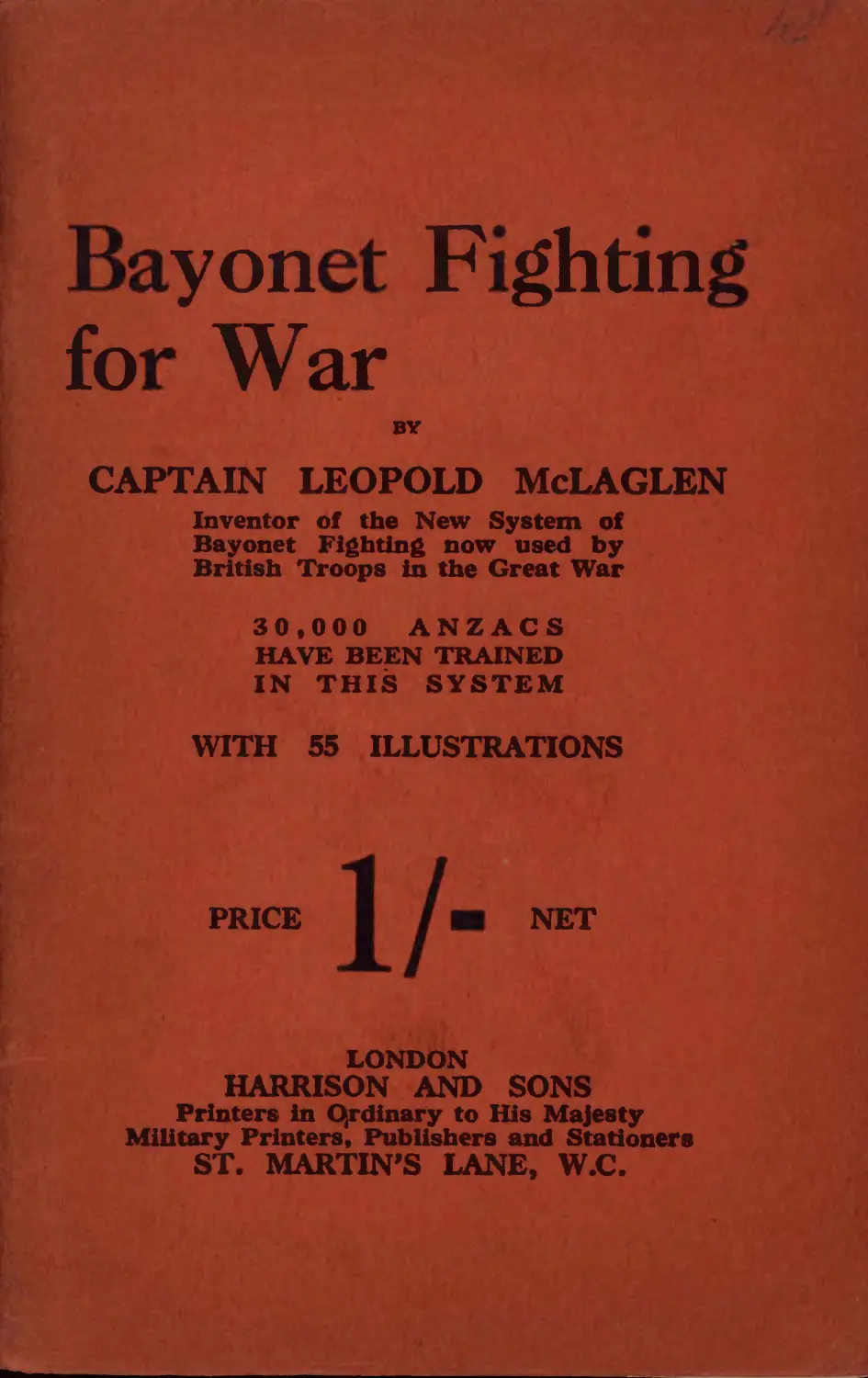
                    Bayonet Fighting
for War
BY
CAPTAIN LEOPOLD McLAGLEN
Inventor of the New System of
Bayonet Fighting now used by
British Troops in the Great War
30,000 ANZACS
HAVE BEEN TRAINED
IN THIS SYSTEM
WITH 55 ILLUSTRATIONS
PRICE
NEV
LONDON
HARRISON AND SONS
Printers in Qrdinary to His Majesty
Military Printers, Publishers and Stationers
ST. MARTIN’S LANE, W.C.
An О
Seaf
land
from
RARE BOOK COLLECTION
“Your
fashion
six moi
officers
Water]
hei
This voat is un
the lines of a
Smock. No open-
ing whatever ex-
cept at neck.
Orders by Post ex-
ecuted by return.
A Point to Remember.
Swan-stripe” Pyjamas
are worn throughout the
world. Obtainable only
from us—the Sole Makers
SwanxEd§ah<
The Leading West End Outfitters,
REGENT ST. & PICCADILLY, W.

A PRACTICAL SERIES
BY PRACTICAL MEN
COMPLETE
CATALOGUE
POST FREE
MILITARY DEPARTMENT
HARRISON & SONS
Printers ip Ordinary to Hie Majesty
ST. MARTIN’S LANE, LONDON, W.C.
4
WIDELY ADOPTED THROUGHOUT
THE NEW ARMIES &
VOLUNTEER TRAINING CORPS
MILITARY PUBLICATIONS
Swedish Drill
Illustrated
The Maxim cf
the Moment
GET FIT!
FOR
Recruit Squads, Volunteer Training Corps,
Lads’ Brigades, Scouts, Senior Boys* Classes,
and for Home Use
Written and illustrated by Experts. Plain, Simple and Concise
PRICE -/6 NET
Post Free Sevenpence
Recruit Training
(Infantry) 1914
NET -/6 NET
Post Free Sevenpence
WIDELY USED THROUGHOUT THE
An aid to all
Instructors
NEW ARMIES
“ A very useful little book : send me by return ioo copies.”
—Comm. Officer, —th Bn. ---------------- Regt.
“ Please forward at once 250 copies to O.C. —rd Bn.-Regt.”
—Capt. and Adjt.
FIRST EDITION SOLD OUT IN THREE WEEKS
ADOPTED BY COMMANDERS EVERYWHERE
Handbook for	A Valuable
Company Officers	Aid
HANDY SIZE 1/6 CLOTH BOUND
Post Free 1'9
180 Pages. 18 Whole Page Illustrations
“ This convenient and well-arranged handbook sets out in clear and
simple language an epitome of the duties which fall to a company
officer and a group leader.”
“ . . . The Handbook should certainly supply a want . . .
should prove useful to all ranks and to all arms."
SHOULD BE READ BY ALL OFFICERS & N.C.Os.
Physical Drill for
Home Defence Corps
WITH ILLUSTRATIONS
& SPECIMEN LESSONS
PRICE -/6 NET
Post Free Sevenpence
MILITARY PUBLICATIONS
Squad Drill	Practically Written
Illustrated	Graphically Depicted
Including
SECTION DRILL	RIFLE EXERCISES
PLATOON DRILL	EXTENDED ORDER
Can be understood by anybody
PRICE -/6 NET
Post Free Sevenpence
Company Drill	(in red
Illustrated	cover)
Illustrating clearly each movement as laid
down in “ Infantry Training, 1914,” and
showing the positions of platoon
and section commanders
THE NEXT BOOK TO “SQUAD DRILL”
PRICE -/6 NET
Post Free Seven pence
Battalion Drill	Indispensable
Illustrated.	to Officers and N.C.Os.
Full of Graphic Illustrations
Depicted with great clarity both in the
letterpress and accompanying sketches
A wealth of detail invaluable to all who are
in command of Units of any denomination
PRICE 1/- NET
Post i/i Free
> MILITARY PUBLICATIONS
Duties for all	A Compendium
Ranks	°* Information
From the C.O. to the Private
SPECIALLY COMPILED FOR THE
NEW ARMIES & VOLUNTEER TRAINING CORPS
Clear and concise, embracing
Adjutant’s Duties. Officers’ Messes
Every Officer, N.C.O. and Private
should have a copy of this Manual
A GUIDE FOR ALL
PRICE -/6 NET
Post Free Sevenpence
From the Front:
Notes for the New Armies
Written from Personal Experience
FULL OF VALUABLE HINTS
Much can be learnt from this book
which will prove extremely serviceable
PRICE -/6 NET
Tost Free Sevenpence
Guard Duty
Illustrated
DIRECT—SIMPLE—USEFUL
FULL OF INFORMATION
Invaluable alike to the Regulars
Territorials and the V.T.C.
All you want to know about Guard Duties
PRICE -/6 NET
Post Free Sevenpence
Bayonet Fighting
for War
BY
CAPTAIN LEOPOLD McLAGLEN
Inventor of the New System of
Bayonet Fighting now used by
British Troops in the Great War
30,000 ANZACS
HAVE BEEN TRAINED
IN THIS SYSTEM
WITH 55 ILLUSTRATIONS
LONDON
HARRISON AND SONS
Printers in Ordinary to His Majesty
Military Printers, Publishers and Stationers
ST. MARTIN’S LANE, W.C,
Captain Leopold McLaglen.
The McLaglen System of Bayonet
Fighting.
Death-dealing Science Imparted to our Soldiers.
From “ The Weekly Press," Christchurch, N.Z., June 30th, 1915.
CAPTAIN LEOPOLD McLAGLEN, the inventor of
the McLaglen System of Bayonet Fighting, which
has revolutionised the old-fashioned theory con-
cerning the use of this weapon, had a very interesting
chat with a representative of this journal last week.
“ Before and after the Boer War,” said Captain
McLaglen, “ many leading military experts declared that
the bayonet, as a weapon, had practically ceased to exist
or to fulfil any useful purpose. But this huge world’s
war has been responsible for the tearing down of many
old ideas and the raising up of new ones. Field-Marshal
Sir John French, the greatest cavalry leader of the British
Army, admits that infantry is undoubtedly the queen of
battle. Now the British infantryman has always proved
himself an adept with the bayonet at all times. This was
proved under Wellington in the Pyrenees, proved at
Waterloo, proved particularly at Inkerman, and proved
time and again in the Indian Mutiny, and in all the
different frontier and other campaigns Britain has had to
wage in the East.”
“ But,” asked the reporter, “ has not the invention of
modern guns and heavy field artillery made some difference
to this ? ”
“ In opinion, yes,” was the reply, “since the invention
of modern artillery it has been intimated on the highest
military authority that warfare would be conducted in
future at long range. This war proves the absolute
falsity of that as a complete statement of the case. Little
(167)	3	A 2
did military experts think that a great modern war would
turn into siege warfare where so many entrenchments are
absolutely essential for the protection of the fighting line.
The close proximity of these trenches gives the oppor-
tunities for the use of the bayonet that have been so
effectively described in recent letters from men at the
Front. After heavy artillery support, the infantrymen
spring from their trenches over a distance of between 200
to 500 yards, and charge the enemy with the bayonet.
Very often the enemy spring from their trenches to meet
the British infantrymen, but we have not yet received
information that any British regiment has ever lost out
in a bayonet combat with the enemy. Therefore it has
been proved to the instructional staffs that the knowledge
of the use of the bayonet is just as important as other
branches of military training, and it is absolutely essential
that all men going to this war should have a thorough
and complete knowledge of the use of this weapon.”
“ The usefulness was particularly proved, was it not,
at the Dardanelles with our own men ? ” queried the
reporter.
“ It was, indeed,” emphatically replied the Captain.
“ There is no doubt whatever that the success which the
British and Australasian troops attained was due in very
large measure to the instruction which they had received
in the McLaglen system of bayonet fighting. It is
impossible to deny the effectiveness of that method. It is
in use now with the Home armies, and I have trained more
than 30,000 Australasian troops. I trained the New
Zealand Expeditionary Forces at Trentham, and have
left behind me there competent instructors to carry on
the work. I have been attached to the Central Adminis-
tration of Australia, but am spending some little time in
New Zealand training as many men as I possibly can,”
explained Captain McLaglen.
“ Would you mind giving a general outline of your
system of bayonet fighting ? ”
“ I invented this some five years ago. After carefully
studying the system in vogue in the British Army, the
French Army, the Russian Army, and the Japanese Army,
I came to the conclusion that these systems did not get
the full effect that can be got out of the rifle and bayonet.
Each system was incomplete, and in consequence I set
4
to work to invent a complete system, and it has absolutely
revolutionised all the methods previously in vogue. It
teaches us that a comparatively small man with a know-
ledge of this new system is more than an equal match for
an opponent without it, though three or four times his
own weight and physical strength. Military authorities
who have seen the system have at once realised its
immense importance and value, and in every case after
demonstration it has been chosen to supersede the old
obsolete methods. It is a system which when once
demonstrated to any military officer proves its own value
immediately. It is absolutely thorough and absolutely
complete. It is impossible to get any more work out of
a rifle and bayonet than is got out of this new system.
At close-quarter bayonet fighting, when the different
points in this new system are delivered, it is impossible
to guard any one of the points ; at the same time the
defence is so thorough as to completely neutralise your
opponent’s efforts. Every contingency is provided for ;
every point of vantage on the enemy is taken. Should a
man ever fall and lose his rifle, or be partially disabled
and lose it, instead of being at his opponent’s mercy, he
is still as dangerous as ever, and the system provides a
means whereby in an incredibly short space of time the
positions are reversed by throwing your opponent and
taking his rifle and leaving him defenceless.”
“ In this new system of bayonet fighting there is a
certain amount of jiu-jitsu, and as the authorities are
now enlisting bantam battalions, these bantam battalions
are being trained in the rudiments of jiu-jitsu. This will
undoubtedly give these small men more confidence in
themselves to attack larger and more powerful men. We
ofttimes hear of the pen being mightier than the sword,
although it is a much smaller weapon. Jiu-jitsu teaches
us that the small and apparently weak man must not
always be despised. Jiu-jitsu undoubtedly overcomes
brute force and physical strength. Therefore the know-
ledge of jiu-jitsu introduced into the McLaglen System of
Bayonet Fighting adds greatly to the value of the system
as a whole. This is being realised more and more every
day by the military authorities, and a knowledge of jiu-
jitsu will soon become an integral part of the training we
give to our soldiers before they go to the Front.”
5
Testimonials.
Testimonials have been received from the following
Officers, which bear testimony to the effectiveness of the
new points added to the System of Bayonet Fighting used
in the British Army.
Captain L. McLaglen has instructed 20,000 men of the
1st and 2nd Expeditionary Force of Australia in this new
system of bayonet fighting, and testimonials have been
received, amongst others, from the following :—
General R. Legge, G.O.C. Australian Forces.
Major F. Darvall, Hd.-Qrs., Broadmeadows.
Lieut.-Col. A. J. V. White, O.C. 8th Light Horse
Regiment.
Col. J. M. Arnott, O.C. 7th Light Horse Regiment.
10,000 men have been instructed in New Zealand from
this new system :—
Brig.-General A. M., Robin, Commanding New Zealand
Military Force.
Sir Joseph G. Ward, N.Z.
Col. Gibbon, Chief of General Staff, N.Z.
Lieut.-Col. G. W. Macdonald.
“ I consider his system far superior to the ordinary
method of bayonet fighting, and can confidently recom-
mend it.”
Lieut.-Col. Hunter Macandrew, O.C, South Island
Battalion, N.Z.R.E.
“ Your system of bayonet fighting was a revelation to
me, and I was surprised at the efficiency of your class at
the termination of your training.”
6
Lieut.-Col. J. Murphy, O.C. ist Canterbury Regiment,
N.Z.
“ It was, to my mind, marvellous that at the end of
eight nights’ instruction the men were able to give such
a fine display at the assault-at-arms.”
Col. R. O. Chaffey, Comdg. Canterbury Military
District, N.Z.
“ I consider his style of teaching, and the results, most
satisfactory.”
Major L. Reynell, O.C. 9th Light Horse, A.I.F.
“ The men have learnt increased confidence in their
ability to use their weapons.”
Our practical teaching under Captain McLaglen’s system
(Captain McLaglen was our Staff Bayonet Instructor at
Broadmeadows, Victoria, Australia) stood us in good
stead at Gaba Tepe when the Turks charged our trenches
in June, 1915.
Our men, the 9th Light Horse, sprang from their
trenches and met the Turks on open ground, Every
man had by his previous training a thorough confidence
in his bayonet, and the lessons learned were put to good
use. The enemy were routed with tremendous loss to
them, our men mowing through them with the bayonet.
Our casualties only amounted to about half a dozen at
the outside.
(Signed) L. H. SWANN,
Late 9th Light Horse, A.I.F.,
Lieut. 2/1 st Suffolk Yeomanry.
The first Victoria Cross won by the Australian Forces
in the Dardanelles has brought with it a testimonial to
the system of bayonet fighting which was invented by
Captain McLaglen.
Lance-Corporal Albert Jacka, who has been awarded
the V.C., received the decoration as a result of his having
killed seven Turks single-handed, five with the rifle and
two with the bayonet. Lance-Corporal Jacka was one of
the original squad trained in the McLaglen system,
7
Method of Instruction.
The best results in training troops in the McLaglen
System of Bayonet Fighting can be gained by using the
following methods:—
By forming a company in two squares, one square
inside the other, as follows :—
The men forming the squares to be three paces distant
apart, the inner square to be termed the front rank, the
outer square the rear rank. The instructor stands in the
centre. Both ranks face inwards during the preliminary
instruction in parry and point.
After the men have become efficient in parry and point
the instructor will then commence teaching close quarter
fighting. The instructor must now have the assistance of
another to demonstrate. After demonstrating to all
sides of the square the movement to be performed, the
instructor will give the order for the inner rank to
“ About Turn.” which brings the front and rear ranks
covering and facing one another. The men will stand at
“ Attention.”
Orders will now be given by whistle blast.
On the first blast both front and rear ranks will spring
to the “On Guard” position, stepping forward
on the left foot.
Whistle: Both front and rear ranks will deliver the
“High Right Parry,” “Point,” “On Guard,” in
quick time.
Whistle: “ Low Right Parry,” “ Point,” “ On Guard.”
Whistle : “ High Left Parry,” “ Point,” “ On Guard.”
Whistle: “ Low Left Parry,” “ Point,” “ On Guard.”
Whistle: Both front and rear ranks will advance
towards one another and “ Cross Rifles.”
Whistle : Front rank will deliver “ Right Hook to Jaw,”
and recover.
8
Whistle : Rear rank will deliver “ Right Hook to Jaw,”
and recover.
Whistle: Both ranks recover original positions and
spring to “ Attention.”
Whistle : Both ranks come to “ On Guard.”
Before proceeding to close quarter fighting, in each
case, the instructor should put the men through the
parries and points as given above.
The succeeding positions are carried out in similar
fashion, as explained above.
	<	 Men: 3 paces apart	> □ □ □□□□□□□ Л 6 paces | apart V □ □□□□□□□□
□	□ □ □
□	□ □ □
□	□ □ □
□	□ □ □
□	□	□	□ a Instructor
□	□	DO
□	□ □ □
□	□ □ □
□	□ □ □ □ □□□□□□□a
□ □□□□□□□a
Men: Three paces apart. Ranks : Six paces apart.
9
Descriptive.
1.	Captain McLaglen on left, Major Finnis on right.
2.	On Guard.
3.	Same as 2, but different position, showing
detail.
Right elbow on butt, right hand on small, left hand
just below centre band, right and left knees bent.
4.	Right High Parry.
5.	Right Low Parry.
6.	Left High Parry.
7.	Left Low Parry. „
8.	Point to Opponent’s Breast.
9.	Right Hook to Jaw.
Failing to get your point in on opponent, and
your opponent closing in on you, rifles crossing at
close quarters, you immediately resort to right
hook blow to jaw. In this position the body is
protected from opponent’s rifle and bayonet by
keeping left hand grip on rifle slightly out from
left shoulder.
10.	Knuckle and Elbow Blow.
From close quarter position when rifles are crossed ;
by forcing opponent’s rifle with your rifle by a
quick movement to your opponent’s left, imme-
diately changing position, delivering blow to
opponent’s knuckle, so that the magazine strikes
his knuckles and the toe of the butt his elbow.
It is impossible for your opponent to escape from
this blow, which must incapacitate him.
11.	Same as 10, showing detail.
io
12.	Solar Plexus Blow.
When in close quarters with opponent, and it is
too dangerous to shorten arms to deliver a
“ point,” resort at once to a right hook blow on
solar plexus. It is important that the left hand
grip on rifle should be kept well in front of the
body, the head being immediately behind and thus
covered by rifle.
13.	Rio Blow.
An effective blow in close quarters. Stepping
smartly forward with left foot, left knee well bent,
deliver blow with butt of rifle to opponent’s lower
part.
14.	Rio Blow.
Same as Fig. 13, showing detail (figures reversed).
15.	Upper Cut to Jaw.
Your point being parried by opponent coming into
close quarters, step smartly forward on left foot,
swinging rifle in an upper cut blow to jaw, right
arm to full extent, left hand grip on rifle in line
with left ear.
16.	Recovering Failure in 15—Blow to Head.
Failing to deliver blow to opponent’s jaw (see Fig.
15) and your opponent pulling his rifle downwards
endeavouring to guard your blow, you immediately
resort to a quarter staff blow to head by reversing
your position and bringing the rifle forward with
left hand smartly. The fact of your opponent
guarding blow to jaw will materially increase the
speed of your movement.
17.	Upper Cut.
18.	Head.
19.	Neck and Trip.
When at close quarters with opponent his equilibrium
may be readily upset, thus placing you in position
to deliver ” Point.” From the cross rifle position
force opponent’s rifle to his left, dropping your
bayonet on side of opponent’s neck, your opponent
naturally flinches to the right, his rifle being locked
by your movement and your own body being
11
guarded. At this moment place your left foot at
the side of opponent’s left foot, trip his left foot
smartly to the left, at the same time forcing your
bayonet downwards on opponent’s neck. This will
result in a fall to your enemy, when immediately
shorten arms to put him out of action. It must be
thoroughly understood that it requires a certain
amount of force and power at the back of a
" point ” before it will put a man out of action.
It must be borne in mind that the bayonet has to
penetrate a thick tunic and possibly several layers
of under garments before injury can be done.
20.	Throw from Neck and Trip—Shorten Arms.
21.	Neck and Trip.
22.	Shorten Arms.
23.	Cross Buttock.
From close quarters when struggling for supremacy
and too dangerous to shorten arms, turn half-right
with your body and place your left leg at the back
of opponent’s left leg, simultaneously placing your
rifle across his chest and rifle, forcing same down-
wards with your left hand, and kicking your left
leg backwards. Follow up the resultant fall by
delivering “point.”
. Cross Buttock.
. Shorten Arms.
. Rifle Lost. Struggle ensues for Opponent’s Rifle.
It is possible that a man may drop his rifle or even
be in a better position by voluntarily relinquishing
it and grasping his opponent’s rifle, which should
be done in this way. Seize the rifle, left hand
knuckles upwards, right hand knuckles down-
wards. Immediately close your grip on opponent’s
left hand, your left hand encircling his knuckles,
thumb well at back of his hand, your right hand
fingers encircling opponent’s butt of thumb with
your thumb at back of his knuckle. Stepping
smartly back at the same moment bend your
opponent’s wrist towards himself in a sharp jerk
to his left, forcing downwards.
£ £ £
12
27. Position of Hands when taking Opponent’s Rifle.
28. Position of Hands when taking Opponent’s Rifle.
29.	Opponent thrown from Jiu-jitsu Grip.
Opponent is now thrown, but perhaps retains his
grip on rifle. Bring your left shin bone against his
left elbow, and continue the grip and twist as
before, forcing his elbow forward with your left
knee, your antagonist will release his grasp ;
recover rifle and deliver “ point.” From positions
as described in Figs. 26, 27 and 28, it is possible
to take a revolver, knife, or any other object, or,
in a hand to hand conflict without weapons, to
incapacitate an opponent.
30.	Intense Pain causes Opponent to Release Grasp
of Rifle.
31.	Opponent being put out of Action with his own
Weapon.
32.	Un-armed, but still Dangerous—The Leg-throw.
Should the positions be reversed and you have been
thrown, as in Fig. 32, with your opponent about to
despatch you, place your left foot at the back of
his left foot, and your right foot on opponent’s
knee ; kick or push smartly with right foot, at the
same time drawing left foot forward. This will
throw your opponent. Immediately grasp him by
his foot (Fig. 33), left hand encircling his instep,
right hand encircling his heel; twist opponent’s
foot sharply inwards, turning him on to his face
(Fig. 34)* Place your right foot into the bend of
his leg, still retaining the grip on his toes, and
force his foot downwards towards his body (Fig. 35).
33.	Thrown—Preparing for the Leg Lock.
34.	About to apply Leg Lock.
35.	The Lock applied—Taking Opponent’s Rifle.
36.	Rio Kick.
Should the position as just described be reversed
the rio kick as above can be used either as a
counter to your opponent’s movement or as a means
of attack. Bring the knees smartly up opponent’s
lower parts.
И
I.—-CAPT. MCLAGLEN A GAUCHE, MAJOR FINNIS A DROITE.
1.—Capt. McLaglen on left, Major Finnis
on right.
2.—EN GARDE.
2.—On Guard.
з-—LE МЁМЕ QUE 2, MAIS POSITION DIFFERENTE, MONTRANT LE DETAIL.
3.—Same as 2, but different position, showing detail.
4.—PARE DROIT HAUT.
4.—Right High Parry.
5.—PARE DROIT BAS.
5.—Right Low Parry.
' 6.—PARE GAUCHE HAUT.
(Z9I)
6.—Left High Parry.
7-—pare GAUCHE BAS.
7.—Left Low Parry.
8.—POINTE A LA POITRINE DE l’aDVERSALRE.
8.—Point to Opponent’s Breast.
9-—CROCHET DROIT A LA MACHOIRE.
9.—Right Hook to Jaw
IO.—COUP DE JOINTURE ET COUDE.
10,—Knuckle and Elbow Blow.
II.—LE МЙМЕ QUE IO, MONTRANT I.E DETAIL.
11.—Same as 10, showing detail.
12.—COUP SOLAR PLEXUS.
12.—Solar Plexus Blow
13.—COUP_RIO.
13.—Rio Blow.
14-—COUP RIO.
14.—Rio Blow.
I5-—COUP EN HAUT A LA MACHOIRE.
15.—Upper Cut to Jaw
l6. —REPRISE APRlsS l’ecHEC EN 15 : COUP А LA ТЕТЕ.
16.—Recovering Failure in 15; Blow to Head
17»—COUP EN HAUT.
17.—Upper Cut.
l8.—ТЁТЕ.
18.—Head.
19-—сои ЕТ CROC-EN-JAMBE.
20.—TERRASSE PAR COU|ET CROC-EN-JAMBE : ARMES RACCOURCIES.
19.—Neck and Trip.
20.—Throw from Neck and Trip: shorten arms.
2Т.—COU ЕТ CROC-EN-JAMBE.
21.—Neck and Trip.
22.—ARMES RACCOURCIES.
22.—Shorten Arms.
23.—CROC-EN-JAMBE.
23.—Cross Buttock.
24-—CROC-EN-JAMBE.
24.—Cross Buttock.
25.—ARMES RACCOURCIES
25.—Shorten Arms.
2б.—FUSIL PERDU: LUTTE POUR OBTENIR LE FUSIL!
DE L’ADVERSAIRE.
26.—Rifle Lost: struggle ensues
for opponent’s rifle.
2?.—POSITION DES MAINS EN s’EMPARANT DU FUSIL
DE L'ADVERSAIRE.
27.—Position of Hands when taking
Opponent’s Rifle.
23.—POSITION’DES MAINS EN s’EMPARANT DV FUSIL
DE L’ADVERSAIRE.
28.—Position of Hands when taking
Opponent’s Rifle.
2Q.—l’adversaire terrasse par une prise jiu jitsu.
29.—Opponent Thrown from
Jiu-Jitsu Grip.
3°«—douleur intense qui oblige l’adversaire A lAcher
SON FUSIL.
30. Intense Pain causes Opponent to
Release Grasp of Rifle.
31	.—l’adversaire en train d’etre mis hors
DE COMBAT PAR SA PROPRE ARME.
31	.—Opponent being put out of
Action with his own weapon.
З2-—DESARME, MAIS ENCORE DANGEKEUX. CHUTE CAUSEE
PAR LES JAMBES.
32	.—Unarmed, but still dangerous :
The Leg Throw.
33«—TERRASSE : PREPARATOIRE AVANT DE SERRER LA JAMBE.
33	.—Thrown: Preparing for the leg-lock.
34-—SUR LE POINT DE SERRER LA JAMBE.
34	.—About to Apply Leg-lock.
35-—LA PRISE TERMINKE : s’EMPARANT DU FUSIL DE l’aDVEKSAIRE.
35.—The Lock Applied: taking opponent's rifle.
зб.—COUP DE GENOU RIO.
Зб.-Rio Kick
MOUNTED BAYONET FIGHTING
Mounted Bayonet Fighting.
PRELIMINARY TRAINING.
The training a recruit must undergo to become efficient
in mounted bayonet fighting must first be started by
learning the various positions dismounted, with legs apart
as if astride a horse.
1.	From the Position “ Carry Arms.”
2.	“ Engage.”
Dropping butt of rifle smartly under right armpit,
bayonet point to the front in line with -the right
shoulder.
3.	To the Right “ Point ” at Infantry.
Turning body smartly to the half-right, legs in
same position as Fig. i, pointing bayonet forward
to the right-front at about the height of an infantry-
man’s chest, with the butt of the rifle resting under
the right fore-arm.
4.	To the Right “ Point ” at Infantry.
5.	To the Right “ Point ” at Cavalry.
Turning body smartly to the half-right, legs in
same position as Fig. i, pointing bayonet forward
to the right-front at about the height of a cavalry-
man’s chest, with the butt of the rifle resting under
the right fore-arm.
6.	To the Right “ Point ” at Cavalry.
7.	To the Left “ Point ” at Infantry.
From the “ Engage ” (Fig. 2) raise rifle in a circular
movement over horse’s head, pointing to the left
to Infantry. In all cases butt of rifle must rest
under right fore-arm. *
8.	To	the	Left	“ Point ”	at	Infantry.
9.	To	the	Left	“ Point ”	at	Cavalry.
10.	To	the	Left	“ Point ”	at	Cavalry.
From	the “ Engage ” (Fig. 2) raise rifle in a circular
movement over horse’s head, pointing to the left
to Cavalry. In all cases butt of rifle must rest
under right fore-arm.
36
I.—DE LA POSITION ’* PORTEZ ARMES.”
1.—From the Position “Carry Arms.”
2.—“ ENGAGE.'
2.—“Engage.”
3-—A LA DROITE “pointe” A L’iNFANTERIE.
4.—A LA DROITE “POINTE” A L’iNFANTERIE.
3.—To the right “Point” at Infantry.
4.—To the right “Point ” at Infantry.
5.—A LA DROSTE “POINTE” A LA CAVALERIE.
5.—To the right “ Point ” at Cavalry.
6.—A LA DROITE “POINTE*’ A LA CAVALERIE. •
6.—To the right “ Point ” at Cavalry.
7-—A. LA gauche “pointe" A l’infanterie.
7.—To the left “ Point ” at Infantry.
8.—A LA gauche “pointe” A l’infanterie.
8.—To the left “ Point ” at Infantry.
Q.—к LA GAUCHE “POINTE” A LA CAVALERIE.
9,—To the left “Point” at Cavalry.
IO.—A LA GAUCHE “pointe” A LA CAVALBRIE.
10.—To the left “Point” at Cavalry.
II.—DE LA POSITION “ PORTEZ ARMES.”
12.—“ ENGAGE.”
11,—From the Position “Carry Arms.”
12.—“ Engage.”
13.—A LA DRO1TE “POINTE*’ A L’iNFANTERlE.
13.—To the right “Point ” at Infantry.
14.—A LA DROITE “pointe” A LA CAVALERIE,
14.—To tjie right “Point ” at Cavalry,
15-—A LA gauche “pointe” A l’infanterib.
15.—To the left “Point ” at Infantry.
l6.—A LA GAUCHE “POINTE” A LA CAVALERIE.
16.—To the left “ Point ” at Cavalry.
Katsu Resuscitation.
Katsu/ the Japanese system of resuscitation, was
known, according to authentic records, 200 years b.c.
These records are in the possession of the Mikado of
Japan. Especially reticent are the Japanese regarding
a dozen or two death-producing grips and blows ; some
of these have been described in detail, others only hinted
at. The death blows are remarkable ; some are delivered
on the spine, others on the head (two on the face). When
the victim of one of these deadly touches does not regain
consciousness in a short time, and the heart’s action and
the breathing reach such a low point that death may
ensue, it is then time to resort to the secret science of
Katsu. This is applied on certain nerve centres, and by
pressure stimulates those nerves and causes a reaction of
the heart. The nerves affected are those of the pectoral
arch, where the thinness of the tissues and other matter
leaves the nerve most exposed. Two other centres that
are affected simultaneously are the pneumogastric centre
and the auditory nerves of the brain. It is possible to
restore a man to life who has fallen dead through dis-
ordered action of the heart, and in a fainting or epileptic
fit to restore the patient to his normal condition in a few
seconds. Many soldiers in warfare die through a bullet
entering their body. It is not necessary that the bullet
struck a vital part, but they die through shock. In such
cases it is possible to restore the dead by the science of
Katsu.
\
45
Iе POSITION.
Position I.
The restorer, supporting the patient with left knee, places his
thumbs in the hollows of the pectoral arch, and applies pressure
by the fingers, with upward and downward movement of the
whole hand.
46
2е POSITION.
Position II.
Left knee supporting patient, right knee retracted.
47
V5 POSITION.
Position III.
Right knee delivering a light blow upon or about the seventh
vertebra. The effect of this shock, which is transmitted to the
pneumogastric nerve, and is applied after the pressure of the
fingers upon the pectoral nerve centre, and with a simultaneous
shout into the patient’s ear (which stimulates the auditory
nerve), is to restore the apparently dead man to life. Katsu
will be of especial value to medical men, for it will avail
against the collapse of a patient after operation, or in syncope
after administration of an anaesthetic.
48
MILITARY PUBLICATIONS
Rifle Shooting	A Practical
for War	Illustrated Book
The outcome of the experience
of an International Rifleman
SIMPLE—USEFUL—PRACTICAL
For Teachers and Self-Instruction
PRICE -/6 NET
Post Free Sevenpence
INVALUABLE FOR MUSKETRY EVERYWHERE
Fire Orders Direction
& Control
A Supplement to “Rifle Shooting for War”
MUSKETRY IN ITS ADVANCED FORM
PRICE -/6 NET
Post Free Sevenpence
Aids to Musketry
A Valuable Manual on
an Important Subject
USEFUL ALIKE TO THE
NEW ARMIES & V.T.C.
PRICE -/6 NET
Post Free Sevenpence
Maze Drill Illustrated
A Valuable Adjunct for Training
Increasing Smartness and Stamina
PRICE 1/- NET
Post 1/2 Free
MILITARY PUBLICATIONS
Company &
Platoon Commands
PRICE 3d. NET
Post -/32 Free
SMALL—COMPACT—CONCISE
Automatic Pistols &
Revolvers
Every Officer should peruse this little
work before purchasing the weapon
upon which his life may depend
THE VARIOUS MODELS FULLY
ILLUSTRATED AND DESCRIBED
PRICE -/6 NET
Post Free Sevenpence
A Pocket
Aid to
Memory
Artillery
Field Formulae
For 18-pr. and 15-pr. B.L.C.
All the necessary Data at a Glance
COMPACT FOR THE POCKET
PRINTED ON LINEN
PRICE -/6 NET
Post Free Seven pence
Infantry	Compact
Range-Finder	and Useful
price 2d. PRICE
Post -/2J Free
MILITARY PUBLICATIONS
English—F lemish Wholly elaborated close to the line
it	• ч	°f battle, where the first editions
Military vjlllde	have also been printed and sold
PRICE 10d. net
Post i- Free
Invaluable to all Troops proceeding to Flanders
Military Guide to the
Dardanelles & Eastern Campaign
FIELD VOCABULARY
IN
English—French—Greek—Turkish
PRICE 2/6 NET
Post 2/9 Free
English—French Guides
& Vade-Mecums
Full List
Post Free
Canvas and
Camaraderie
FULLY ILLUSTRATED
A Charming
Souvenir for
your Friends
“The authors have contrived a delightfully written and often
amusing book.*’ “ Clearly shows the genuine comradeship of the life.”
‘‘ Should revive pleasant memories.” “ Its smartness is undeniable.’’
“ Should prove a blessing in every camp, the collection of songs
being most interesting.”	Vide Press.
PRICE -/6 NET
Post Free Sevenpence
Field States	other
British Expeditionary Force data
PRICE 1/- NET
Post 1/1 Free
" A mass of data; strength, road space,, animals, transport, tools,
medical services, bridging material, camp billets, etc.; of great value
for quick reference.”
-----------------1»
HARRISON & SONS
Regimental Journals, Magazines, Histories,
Standing Orders, Printed and Published
LETTERPRESS
LITHOGRAPHY
BOOKBINDING
STATIONERY
BLOCK - MAKING
DIE STAMPING
ENGRAVING
PUBLISHING
MUSIC PRINTING
&c. &c. &c.
MILITARY DEPARTMENT
Correspondence Invited
Recruiting Posters, Booklets, &c., Designed
and Executed
Printers in Ordinary to His Majesty and to
Queen Alexandra
Military Printers, Publishers and Stationers
ST. MARTIN'S LANE, LONDON, W.C.
(JL D
THREE NEW BOOKS
PLATOON AND
COMPANY DRILL
FULLY ILLUSTRATED
Compiled by the Commandant and
Officers on the Staff of the
London District School of Instruction
The Official Manual of the School
PRICE 1/-
Post i/i Free
THE LAST WORD IN DRILL BOOES
KNOWLEDGE FOR WAR
Every Officer’s Handbook for the Front
ILLUSTRATED. POCKET SIZE
Expert Information on every subject which
an Officer must know before being selected
FOR SERVICE IN THE FIELD
Discipline—Drill—Musketry—Tactics and Field Warfare—
Topography—Trench Warfare—Billeting—Machine Guns—
Interior Economy and Military Law—Physical Drill—Signalling
By CAPTAIN В. C. LAKE
King's Own Scottish Borderers
Supervising Officer of Officers’ Training Class, 7th (R) Brigade
PRICE 2/6
Post 2'9 Free
MACHINE GUN
MANUAL
By LIEUT. H. DOUGLAS
Sherwood Foresters
National Team (England >; Kolapore Team (Great Britain)
British Rifle Team (Australian Tour)
MAXIM—VICKERS—LEWIS AUTOMATIC—COLT
FULLY ILLUSTRATED
PRICE 1/-
Post 1/2 Free
WRIGHT’S
Coal Tar
SHAVING SOAP
the Ideal Shaving Soap for Soldiers.
It has all the hygienic properties of
WRIGHT’S Coal Tar Soap as
well as its dean, wholesome smell.
Protects the skin from every form
of “ rash ” and gives a persistent
creamy, but
not slimy lather.
Stick о**
Tablet,
9d.
In
Powder
form.
Tins II-
If any difficulty in obtaining,
write to—
WRIGHT, LAYMAN &
UMNEY, Ltd.,
SOUTHWARK,
LONDON, S.E.