/










Text
                    Nietzsche

Nietzsche
Naturalism and Interpretation

Christoph Cox

UNIVERSITY OF CALIFORNIA PRESS
Berkeley • Los Angeles • London

University of California Press
Berkeley and Los Angeles, California
University of California Press, Ltd.
London, England
© 1999 by the Regents of the University of California

Library of Congress Cataloging-in-Publication Data
C o x , Christoph, 1 9 6 5 Nietzsche : naturalism and interpretation / Christoph C o x .
p.
cm.
Includes bibliographical references and index.
ISBN 0 - 5 2 0 - 2 1 5 5 3 - 1 ( a l k . p a p e r ) .

1 . Nietzsche, Friedrich Wilhelm, 1 8 4 4 - 1 9 0 0 —
Contributions in theory of knowledge. 2. Knowledge,
Theory of. 3. Nietzsche, Friedrich Wilhelm, 1 8 4 4 1900—Contributions in ontology. 4. Ontology.
I. Title.
B33I8.K7CÉ8

1999

193—DC2I

99-30107
CIP

Manufactured in the United States of America
08
10

06

07
9

8

05
7

04
6

5

03
4

02
3

2

01

00

99

1

The paper used in this publication meets the minimum
r e q u i r e m e n t s o f A N S I / N I S O Z 3 9 . 4 8 - 1 9 9 2 (R 1 9 9 7 )

(Permanence

of Paper).

To
David Hoy
without whom not
For
Molly Whalen
without whom nought

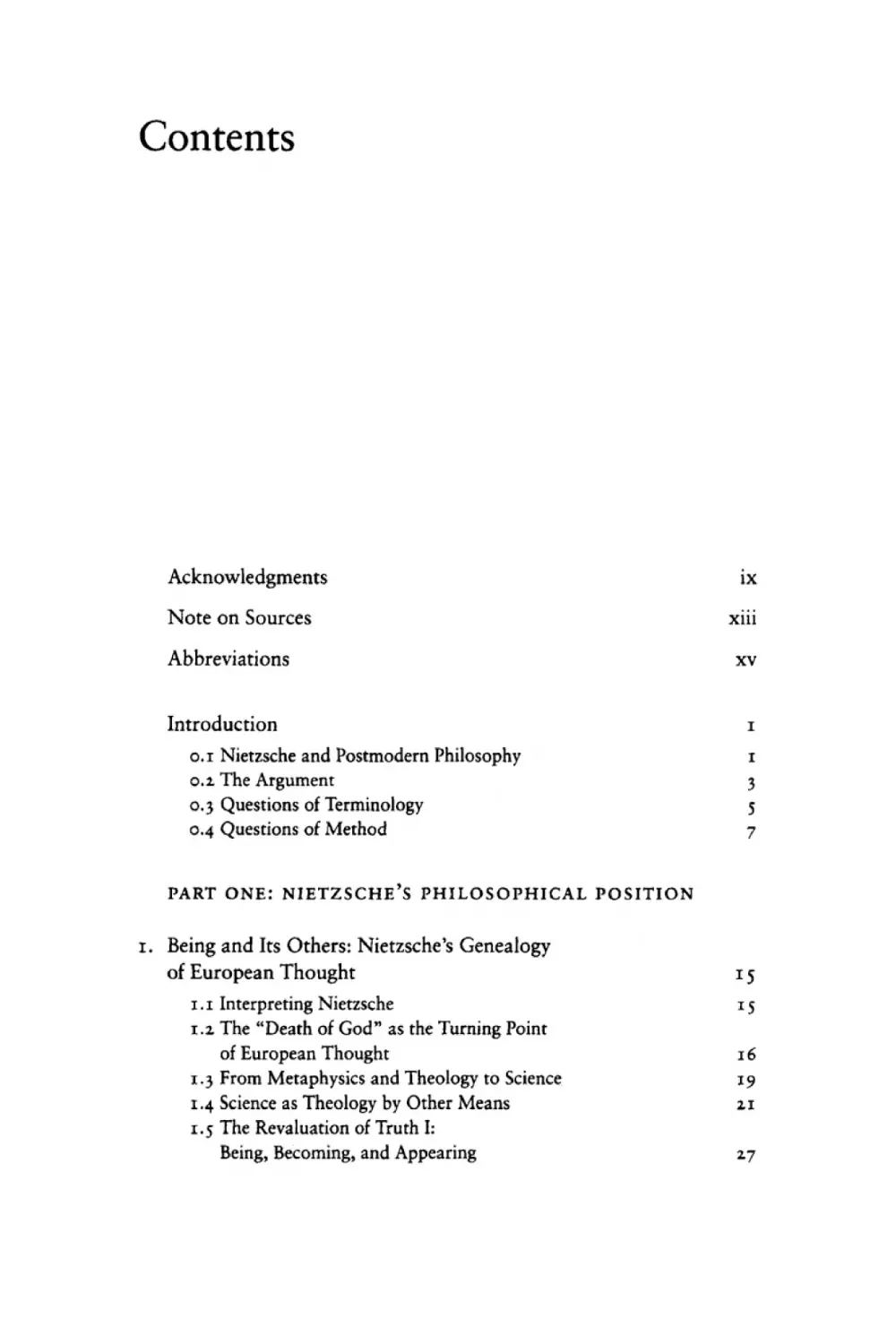
Contents

Acknowledgments
N o t e on Sources
Abbreviations

Introduction
o.i
0.2
0.3
0.4

Nietzsche and Postmodern Philosophy
The Argument
Questions of Terminology
Questions of Method

ix
xiii
xv

i
i
3
5
7

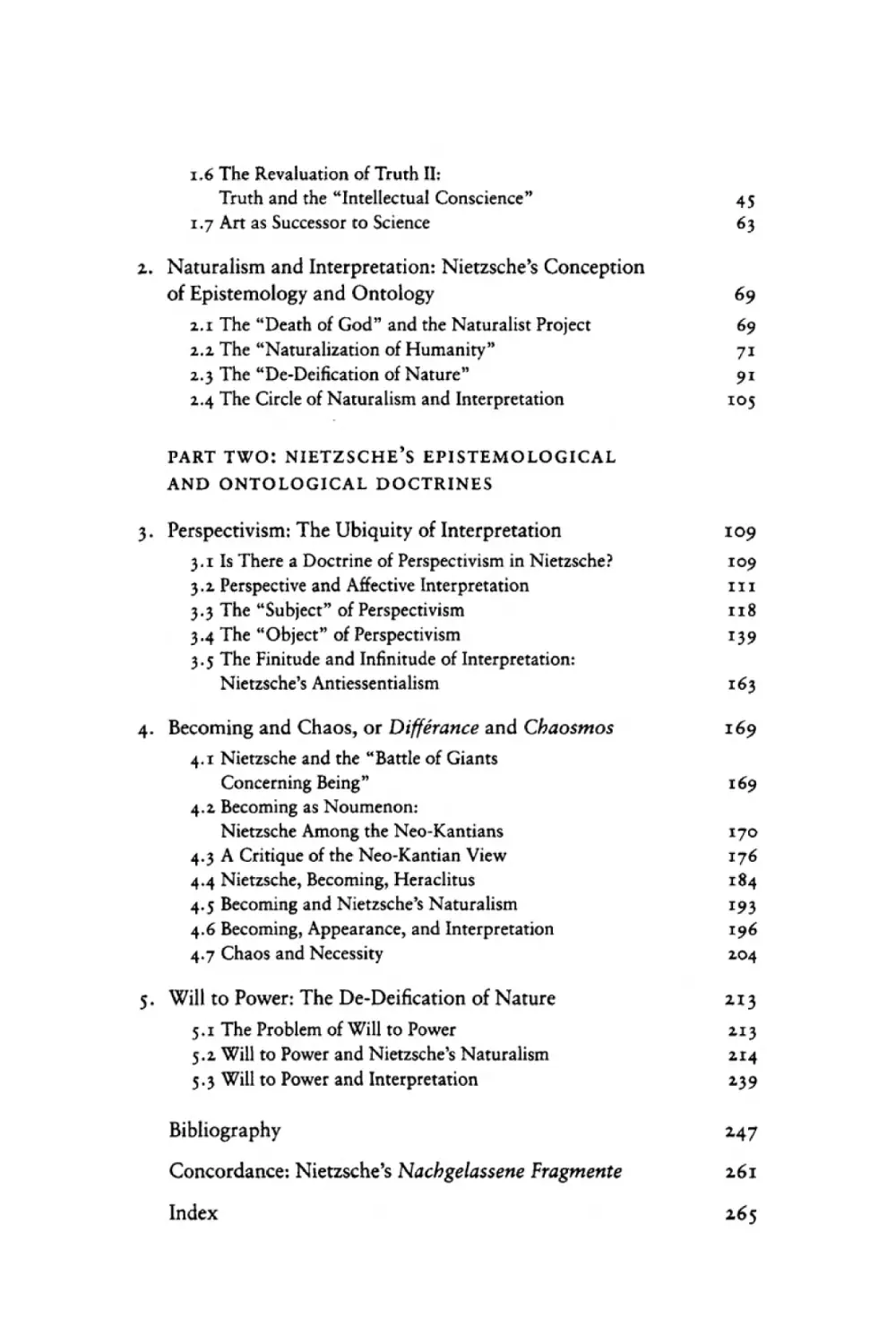
PART ONE: N I E T Z S C H E ' S P H I L O S O P H I C A L P O S I T I O N
1.

Being and Its Others: Nietzsche's G e n e a l o g y
of E u r o p e a n T h o u g h t

15

1 . 1 Interpreting Nietzsche
1 . 2 The "Death of God" as the Turning Point

15

of European Thought
1.3 From Metaphysics and Theology to Science
1.4 Science as Theology by Other Means
1 . 5 The Revaluation of Truth I:
Being, Becoming, and Appearing

16
19
21
27

1.6 The Revaluation of Truth II:
Truth and the "Intellectual Conscience"
1 . 7 Art as Successor to Science

45
63

2. Naturalism and Interpretation: Nietzsche's Conception
of Epistemology and Ontology

69

2.1 The "Death of G o d " and the Naturalist Project
2.2 The "Naturalization of Humanity"
2.3 The "De-Deification of Nature"
2.4 The Circle of Naturalism and Interpretation
PART TWO: N I E T Z S C H E ' S

69
71
91
105

EPISTEMOLOGICAL

A N D ONTO L O G I C A L D O C T R I N E S
3. Perspectivism: The Ubiquity of Interpretation
3.1
3.2
3.3
3.4
3.5

Is There a Doctrine of Perspectivism in Nietzsche?
Perspective and Affective Interpretation
The "Subject" of Perspectivism
The "Object" of Perspectivism
The Finitude and Infinitude of Interpretation:
Nietzsche's Antiessentialism

4. Becoming and Chaos, or Differance and Chaosmos

109
109
111
118
139
163
169

4.1 Nietzsche and the "Battle of Giants
Concerning Being"
4.2 Becoming as Noumenon:
Nietzsche Among the Neo-Kantians
4.3 A Critique of the Neo-Kantian View
4.4 Nietzsche, Becoming, Heraclitus
4.5 Becoming and Nietzsche's Naturalism
4.6 Becoming, Appearance, and Interpretation
4.7 Chaos and Necessity

170
176
184
193
196
204

5. Will to Power: The De-Deification of Nature

213

169

5.1 The Problem of Will to Power
5.2 Will to Power and Nietzsche's Naturalism

213
214

5.3 Will to Power and Interpretation

239

Bibliography
Concordance: Nietzsche's Nachgelassene
Index

247
Fragmertte

261
265

Acknowledgments

I have had the good fortune to work in a field well laid out by remarkable
predecessors. My original attraction to Nietzsche came through the
work of Michel Foucault, Jacques Derrida, and Gilles Deleuze, whose
writings constantly allude to, and are deeply informed by, an interpretation of Nietzsche that, in some sense, I have tried to reconstruct here.
In so doing, I have been greatly aided by the clarity and rigor of several
American interpretations of Nietzsche, particularly those of Richard
Schacht, Alexander Nehamas, David Hoy, and Alan Schrift. These interpreters demonstrated to me the value of presenting Nietzsche's radical
conceptual and stylistic refigurations in a sober philosophical language
and proved to me that this "bit of tyranny" (BGE 188) against Nietzsche and his poststructuralist heirs could have genuine heuristic value.
This book is the product of a long series of apprenticeships that began while I was an undergraduate. I thank my mentors at Brown University: Michael Silverman and Bennet Schaber for introducing me to
contemporary critical theory and Martha Nussbaum for introducing
me to Nietzsche. For supporting and guiding my project at the graduate level, I express my gratitude to a group of remarkable teachers and
scholars at the University of California, Santa Cruz: Donna Haraway,
Jocelyn Hoy, Marsh Leicester, Dick Terdiman, and Hay den White. For
providing me with ongoing opportunities to present my work to an expert audience, I thank my colleagues in the North American Nietzsche
Society, especially Daniel Conway, Kathleen Higgins, Kevin Hill, Bernd
ix

X

Acknowledgments

Magnus, Richard Schacht, and Alan Schrift. Friends and colleagues at
Hamilton College, especially Katheryn Doran, Steve Teles, and Rick
Werner, offered generous support and rigorous criticism and provided a
wonderful place to teach and work. Helpful comments and criticism in
the book's later stages were provided by the members of the Workshop
in Continental Philosophy at the University of Chicago, and particularly Dan Smith.
To my editor at the University of California Press, Ed Dimendberg, I
owe special thanks for his steadfast support of this project and for his
kind patience and encouragement as one deadline after another passed
without the book's completion. I am also extremely grateful to Alan
Schrift and Richard Schacht, who, as readers for the Press, gave not
only their support but also exceptionally detailed criticisms and suggestions that made this a better book. David Severton offered loads of wise
suggestions that made my prose more clear and readable.
Deepest thanks are due to my family as well, especially to my parents,
Christa Cox and Jim Cox, without whose encouragement and support
this book, and so much else, would not have been possible. Few academics are blessed with such a family, in which love and generosity are
matched by intellectual intensity and vitality. I owe a special debt to my
older sister Valerie, who, on the Christmas Eve before her death, gave
me my first introduction to Nietzsche by boldly presenting the family
with a reading from Thus Spoke Zarathustra.
Finally, my most substantial debts of gratitude are owed to two
people. I thank David Hoy for the extraordinary guidance he gave me
as my dissertation advisor and for so much more. He has not only provided me with the finest example of how to be a "Continental" philosopher but has also given me a host of opportunities that have allowed me
to go some way toward becoming such a philosopher myself. He has
unfailingly supported me and my work and has campaigned on my behalf well beyond the call of duty. I owe no less to Molly Whalen, whose
love, friendship, encouragement, and critical acumen have allowed me
to see this work through. Though our countless discussions and debates
go undocumented in what follows, they sound in the spaces between
every word.
Portions of this book previously have appeared in print. Parts of chapters i and z were published as "Being and Its Others: Nietzsche's Revaluation of Truth" in Man and World 29, no. 1 (1996): 4 3 - 6 1 . This
material is reprinted with kind permission from Kluwer Academic Pub-

Acknowledgments

xi

lishers. Earlier presentations of chapter 2 and chapter 4 were published,
respectively, as "Nietzsche, Naturalism, and Interpretation" in International Studies in Philosophy 27, no. 3 (1995): 3 - 1 8 , and "Nietzsche's
Heraclitus and the Doctrine of Becoming" in International Studies in
Philosophy 30, no. 3 (1998): 4 9 - 6 3 . 1 thank Leon Goldstein for allowing me to use this material in the book. A version of the first half of
chapter 3 appeared as "The 'Subject' of Nietzsche's Perspectivism" in
Journal of the History of Philosophy 35, no. 2 (April 1997): 269-91.
Rudolf A. Makkreel kindly granted permission to reprint portions of
this article.

Note on Sources

I have followed the North American Nietzsche Society's guidelines for
citing Nietzsche's works, which are designated by the standard acronyms
of their English translations followed by the appropriate section numbers), designated by Arabic numerals. Exceptions to this rule are listed
in the bibliography under Nietzsche's published works. Nietzsche's Prefaces are indicated with a "P" after the book's acronym, followed by a
colon and the section number from that preface.
Though I have largely relied on the English editions and translations
listed below, I have occasionally modified these translations and assume
final responsibility for the rendering into English of Nietzsche's German.
Given that since Nietzsche often uses ellipsis as a stylistic device, I have
indicated my ellipses by placing them in brackets; ellipses not bracketed
are Nietzsche's.

xiii

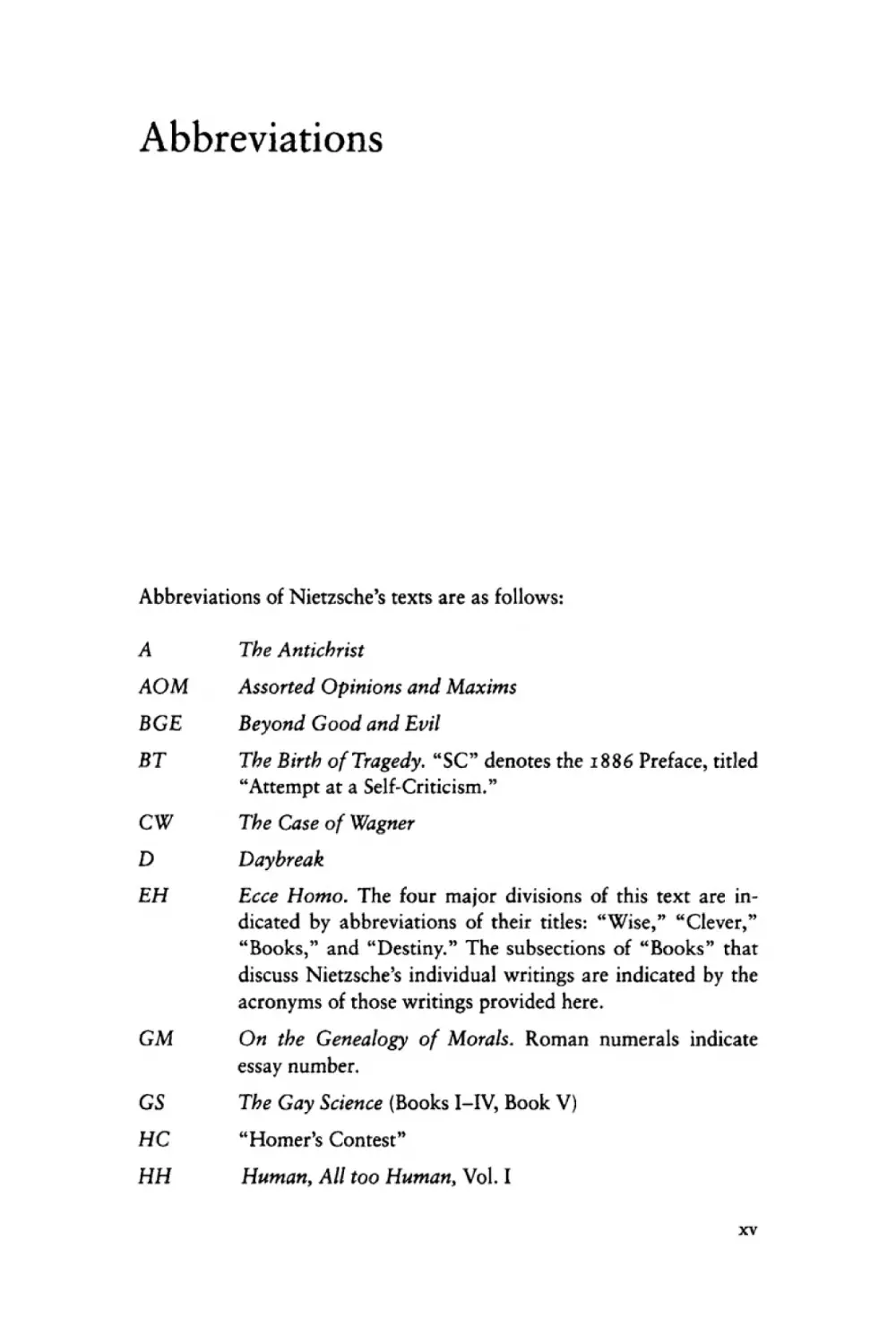
Abbreviations

Abbreviations of Nietzsche's texts are as follows:
A

The Antichrist

AOM

Assorted Opinions and Maxims

BGE

Beyond Good and Evil

BT

The Birth of Tragedy. " S C " denotes the 1886 Preface, titled
"Attempt at a Self-Criticism."

CW

The Case of Wagner

D

Daybreak

EH

Ecce Homo. The four major divisions of this text are indicated by abbreviations of their titles: "Wise," "Clever,"
"Books," and "Destiny." The subsections of "Books" that
discuss Nietzsche's individual writings are indicated by the
acronyms of those writings provided here.

GM

On the Genealogy of Morals. Roman numerals indicate
essay number.

GS

The Gay Science (Books I-IV, Book V)

HC

"Homer's Contest"

HH

Human, All too Human, Vol. I
XV

xvi

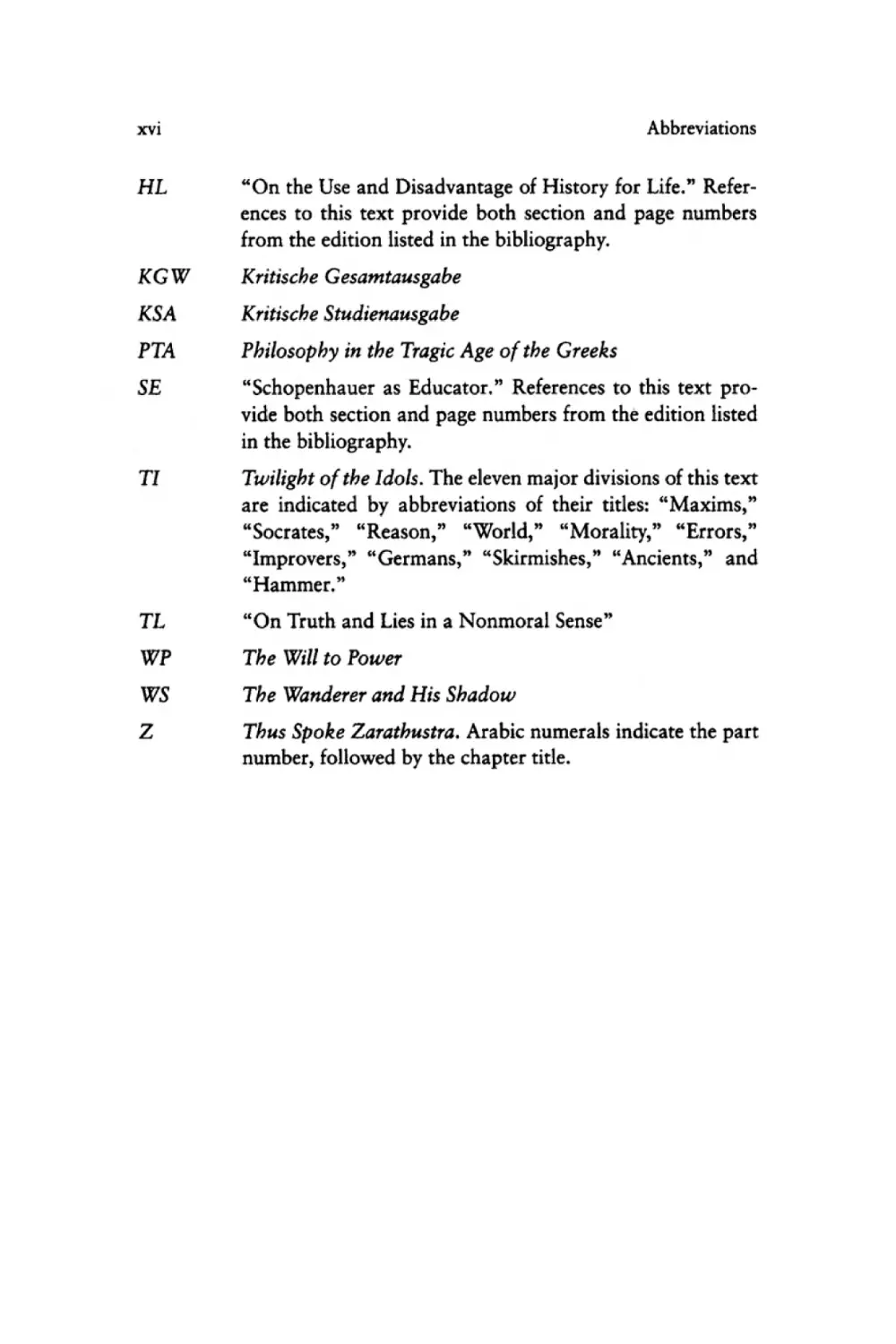
Abbreviations

HL

"On the Use and Disadvantage of History for Life." References to this text provide both section and page numbers
from the edition listed in the bibliography.

KGW

Kritische

Gesamtausgabe

KSA

Kritische

Studienausgabe

PTA

Philosophy in the Tragic Age of the Greeks

SE

"Schopenhauer as Educator." References to this text provide both section and page numbers from the edition listed
in the bibliography.

77

Twilight of the Idols. The eleven major divisions of this text
are indicated by abbreviations of their titles: "Maxims,"
"Socrates," "Reason," "World," "Morality," "Errors,"
"Improvers," "Germans," "Skirmishes," "Ancients," and
"Hammer."

TL

"On Truth and Lies in a Nonmoral Sense"

WP

The Will to Power

WS

The Wanderer and His Shadow

Z

Thus Spoke Zarathustra. Arabic numerals indicate the part
number, followed by the chapter title.

Introduction

0.1 NIETZSCHE AND P O S T M O D E R N PHILOSOPHY
Nietzsche is commonly regarded as the grandfather of philosophical
postmodernism. If, to cite its most prominent exponent, postmodernism is characterized by "incredulity toward metanarratives," a "delegitimation [of metanarratives] fueled by the demand for legitimation itself," Nietzsche's relevance is not difficult to see.1 Such incredulity and
delegitimation is precisely what Nietzsche reveals to be the defining feature of our intellectual-historical situation, one marked by what he calls
the "death of God" and "nihilism"—the self-overcoming of theological
and metaphysical world interpretations. 2
Nietzsche's analysis of this situation over a century ago was certainly
precocious (or, on his own account, "untimely"), given that only in the
postwar period have these issues of postmodernism come to prominence in European and Anglo-American thought. It is no coincidence,
then, that the past few decades have seen a remarkable "Nietzsche renaissance" throughout Europe, Great Britain, and the United States.

1 . Jean-François Lyotard, The Postmodern
Condition: A Report on
Knowledge,
trans. Geoff Bennington and Brian Massumi (Minneapolis: University of Minnesota
Press, 1984), xxiv, 39.
2. "[W]hat does nihilism mean?—that the highest values devaluate
themselves"
(WP 1). See the Nachlaß notes on "European Nihilism," collected in WP Book One, and
G M III: 1 7 . 1 discuss these ideas in chapter 1 .

2

Introduction

This renewed interest in Nietzsche has been most significant in France
and the United States. Nietzsche's tremendous influence on postmodern
French philosophy has been direct and well documented. 3 Beyond Hegel,
Husserl, and Heidegger, and beyond M a r x and Freud, it was Nietzsche
who provided the central figures in contemporary French philosophy
(Deleuze, Foucault, Derrida, Lyotard, and Irigaray) with their most basic problems and resources. 4 The Anglo-American Nietzsche renaissance
has had a less direct effect on mainstream contemporary philosophy in
the United States. Yet here, too, Nietzsche has arguably "prefigured"
the moves made by "postmodern American philosophers" (e.g., Quine,
Sellars, Goodman, Davidson, Rorty, and Kuhn) toward antirealism in
ontology, antifoundationalism in epistemology, and antidualism in the
philosophy of mind. 5 Nietzsche's philosophy, then, is not only of interest for the history of ideas but is of genuine relevance to contemporary
philosophy.
It is in this context that I have written the present book. Nietzsche
is taken here as an important antecedent for more recent attempts at
formulating a postmetaphysical epistemology and ontology, as traversing the same philosophical territory as the hermeneutics of Heidegger
and Gadamer, the poststructuralism of Foucault, Derrida, Deleuze, and
Lyotard, the neo-pragmatism of Quine, Goodman, and Rorty, and the
philosophy of science of Kuhn and Feyerabend. For the most part, these
more recent figures remain in the background and the focus is on Nietzsche. But, throughout, my aim remains twofold: to make a contribution
to Nietzsche studies by providing a systematic interpretation of his later
epistemology and ontology; and to uncover Nietzsche's solutions to
some current philosophical problems.

3. See, for example, Alan D. Schrift, Nietzsche and the Question of Interpretation: Between Hermeneutics and Deconstruction (New York: Routledge, 1990), and
Nietzsche's French Legacy: A Genealogy of Poststructuralism (New York: Routledge,
1995)4. Thus, for example, Michel Foucault captured the spirit of postwar French philosophy when, in 1966, he wrote, "Nietzsche, offering his future to us as both promise and
task, marks the threshold beyond which contemporary philosophy can begin to think
again; and he will no doubt continue for a long while to dominate its advance" (The Order of Things: An Archaeology of the Human Sciences, trans. Alan Sheridan [London:
Tavistock, 1970], 342.).
5. See Cornel West, "Nietzsche's Préfiguration of Postmodern American Philosophy,"
in Why Nietzsche Now? ed. Daniel O'Hara (Bloomington: Indiana University Press,
1985).

Introduction

3

0.2 THE ARGUMENT
A particularly important contemporary problem animates this project.
Critics have consistently identified in Nietzsche's work a difficulty that
has also been said to plague more recent postmodern positions: the
problem of how an antifoundationalist philosophy can avoid vicious
relativism and legitimate its claim to provide a platform for the critique
of arguments, practices, and institutions. In Nietzsche, the problem is
that of reconciling his genealogy and perspectivism (which seem to reject the notion that there is a uniquely correct conception of the world)
with his doctrines of becoming and will to power (which seem to present just such a normative—perhaps even metaphysical—conception).
I argue that Nietzsche successfully navigates between relativism and dogmatism and offers a viable, indeed exemplary, postmetaphysical epistemological and ontological position. I show that Nietzsche accepts the
scientific project's naturalistic critique of metaphysics and theology but
maintains that a thoroughgoing naturalism must move beyond scientific reductionism to accept a central feature of aesthetic understanding:
an acknowledgment of the primacy and irreducibility of interpretation.
I argue that the apparent relativism of perspectivism is held in check by
Nietzsche's naturalism (which offers the doctrines of becoming and will
to power in place of all theological interpretations) and that the apparent dogmatism of these doctrines is mitigated by his perspectivism
(which grants that these doctrines are themselves interpretations yet
ones that are better by naturalistic standards).
The first two chapters present an overview of Nietzsche's project.
Chapter i situates this project within a genealogy of European thought
that begins with Platonist metaphysics, passes through Christian theology to positivistic science, and culminates in "the death of God." It
shows that Nietzsche accepts this inheritance and takes upon himself the task of rigorously thinking through the consequences of the
"death of God." This "event," he believes, requires an elimination of
the theological posits that remain implicit in the scientific concern for
presuppositionless truth. Thus, Nietzsche sees "God's death" as forcing a reconciliation between truth and its traditional opponents, becoming and appearance, and a reconciliation between science and its
traditional adversary, art. Chapter z explores the consequences of the
death of God for epistemology and ontology and introduces the book's
guiding figures: naturalism and interpretation. It shows that Nietzsche's

4

Introduction

rejection of the traditional epistemological ideal of a "God's eye view"
leads him to a thoroughly naturalistic conception of knowing and being. Yet it maintains that Nietzsche also comes to reject the corollary to
the "God's eye view": the notion of an absolute ontology, the idea that
there must be some one, true way that the world really is. Instead,
Nietzsche comes to see ontologies as always relative to background interpretations and to claim that interpretations can be challenged only
by other interpretations, not by recourse to brute facts. Nonetheless,
Nietzsche's naturalism is seen as providing him with compelling, if not
final, reasons for the assertion that some interpretations are better than
others.
The remainder of the book calls on the twin notions of naturalism
and interpretation to make sense of Nietzsche's central epistemological
and ontological doctrines: perspectivism, becoming, and will to power.
These chapters argue against prominent readings that hold that perspectivism assumes the existence of a pre-given world upon which there are
perspectives, a world that becoming and will to power are taken to describe. Chapter 3 argues that Nietzsche's misleading language of "perspective" ought to be subsumed within his broader and richer language
of "interpretation" and that "interpretations," for Nietzsche, are not
construals of some primary ontological ground but rather reconstruals
of world conceptions already on hand. It argues that Nietzsche's naturalism leads him to dissolve the traditional epistemological dualism of
"subject" and "object" into a common field of "interpretation" in which
"subject" and "object" are of a piece and boundaries between them
are constantly shifting. Chapter 4 argues that, on the one hand, Nietzsche views "becoming" as a naturalistic doctrine that counters the metaphysical preoccupation with being, stasis, and eternity by foregrounding the empirically evident ubiquity of change in the natural world. On
the other hand, "becoming" is also seen as describing the incessant shift
of perspectives and interpretations necessitated by a world that lacks a
grounding essence. In the final chapter, I provide a similar reading for
the doctrine of will to power. On the one hand, I see will to power as
the empirical theory at which Nietzsche arrives after the elimination of
all theological posits from prevailing scientific accounts of the natural
world. On the other hand, I argue that natural change essentially involves "interpretation" in Nietzsche's vastly extended sense, that is, as
every entity's impulse to extend its domain and incorporate others in its
environment.

Introduction

5

0.3 QUESTIONS OF T E R M I N O L O G Y
My use of some contemporary philosophical terminology calls for comment. Throughout the book, I describe Nietzsche's position as a kind of
"naturalism," a term ubiquitous in recent Anglo-American discussions
of epistemology and metaphysics. As David Papineau has recently written, "nearly everybody nowadays wants to be a 'naturalist,' but the aspirants to the term nevertheless disagree widely on substantial questions
of philosophical doctrine." 6 Though the term has a long history, its current usage is associated with the work of W. V. Quine, for whom "naturalism" signifies the rejection of first philosophy, the priority of natural science, and the redescription of philosophy as continuous with
science.7 Though Nietzsche does not himself use the term, his consistent appeals to "nature" and "the natural" and his overall project of
"de-deifying nature" and "naturalizing humanity" (GS 109) ally him
with Quine and other recent proponents of philosophical naturalism.
Nietzsche's "naturalism," too, rejects first philosophy, whether conceived as metaphysics or epistemology. It denies the existence of supernatural entities and explanatory principles and endorses a broadly scientific conception of the world.
Yet Nietzsche insists that a thoroughgoing "naturalism" cannot be
a scientism; that is, it cannot accept the Quinean view that "[t]he
world is as natural science says it is" and "[n]aturalism looks only to
natural science [ . . . ] for an account of what there is and what what
there is does." 8 Nietzsche's genealogy of European thought (presented
6. David Papineau, Philosophical Naturalism (Oxford: Blackwell, 1993), 1. This sentiment was echoed even more recently by Barry Stroud in his Presidential Address to the
Pacific Division of the American Philosophical Association. "'Naturalism,'" Stroud remarked, "seems [. . . ] rather like 'World Peace.' Almost everyone swears allegiance to it,
and is willing to march under its banner. But disputes still can break out about what it is appropriate or acceptable to do under the name of that slogan" ("The Charm of Naturalism,"
Proceedings and Addresses of the American Philosophical Association 70 [1996]: 43).
7. See Roger F. Gibson, Enlightened Empiricism: An Examination of W. V. Quine's
Theory of Knowledge (Tampa: University of South Florida Press, 1988), 23!?., for a collection and analysis of Quine's statements of his naturalistic position.
8. W. V. Quine, "Structure and Nature," Journal of Philosophy 89 (1992): 9. For naturalist critiques of Quinean scientism see Richard Rorty, Philosophy and the Mirror of
Nature (Princeton: Princeton University Press, 1979), i 7 i f f . , 199®-, "Pragmatism without Method," in Objectivity, Relativism, and Truth: Philosophical Papers, vol. 1 (Cambridge: Cambridge University Press, 1991), 6$S., and "Is Natural Science a Natural
Kind?" in Objectivity, Relativism, and Truth; and Kai Nielsen, Naturalism without Foundations (Amherst, N.Y.: Prometheus Books, 1996), 2 5 - 5 5 , whose versions of naturalism
have much in common with that of Nietzsche.

6

Introduction

in chapter i) uncovers a residual theology in the modern scientific project's claim to describe the way the world really is. He argues that, if one
carries through the naturalistic program implicit in modern science,
one will discover that science overcomes itself, giving way to another discourse that can claim to be more rigorously naturalistic and that reveals the scientific to be but one among many true accounts of the world.
That discourse is the aesthetic, which affirms sensuousness, materiality,
multiplicity, becoming, historicity, creativity, and the irreducibility of interpretation. The aesthetic cannot and does not claim to take the place
of science as the one true theory. It justifies itself holistically, by reference to a genealogical story; and it challenges the very idea of a single,
final account.
I describe Nietzsche's naturalism as "antimetaphysical" or "postmetaphysical." This usage, too, must be qualified, since "metaphysics"
has a notoriously wide range of uses. I use the term in two related
senses. The first of them is quite literal. In this sense, metaphysics refers to discourses about what is beyond, above, or outside physis or
nature. "Naturalism," then, is antimetaphysical in an obvious sense:
it denies the existence of super-natural entities (souls, Forms, God,
etc.) and extranatural (disembodied, ahistorical, noncontextual, foundational, infallible) points of view. This does not rule out talk of theoretical entities or principles such as quarks, force-points, differance, or
will to power. Such entities and principles are perfectly admissible, provided that they are taken as revisable posits whose role is to explain (aspects of) experience and nature and are acknowledged to be the productions of a particular natural creature with its own peculiar purposes
and projects. I also occasionally use the term "metaphysics" in a more
specific sense drawn from Heidegger and Derrida. In this sense, "metaphysics" names "the determination of Being as presencethat
is, the
privilege of what is given, existing purely and simply—not contextually, holistically, or differentially. 9 In this sense, recourse to "the immediate facts of experience," to necessary and universal categories of the
mind, to mental meanings, or to underlying substances and subjects (to
name but a few examples) is "metaphysical." Indeed, Heidegger and
Derrida often call this metaphysics "ontotheology," since God is the
archetype of such entities: a being untouched by becoming, context, or

9. See Jacques Derrida, "Structure, Sign, and Play in the Discourse of the Human Sciences," in Writing and Difference, trans. Alan Bass (Chicago: University of Chicago Press,

1978), 179-

Introduction

7

difference. A "naturalism" that repudiates not only God but also his
"shadows" (GS x08) will have no place for such entities.
A final set of terms needs to be qualified. I often speak of Nietzsche's
"epistemology" and "ontology." Yet in contemporary philosophy it is
common to view "epistemology" as a transcendental, foundational discipline that assumes the preexistence of subjects and objects and attempts to explain how the former can adequately represent the latter.
As such, the discipline has been repudiated by those who, like Nietzsche, wish to move toward an antifoundationalist, holist conception of
knowledge.10 Nietzsche rarely uses the term (in German, Erkenntnistheorie]); and where he does, he, too, tends to treat with disdain the discipline it names (see GS 354; BGE 204; 77 "Reason" 3; WP 253, 4 1 0 ,
462, 591). Yet the term can also be taken in a more literal and innocuous sense to refer to a "theory of knowledge," that is, a theory about
what we know, what knowledge is, and how we arrive at this knowledge. In this sense, Nietzsche certainly has a "theory of knowledge,"
albeit a naturalistic, holistic, antifoundationalist one. Given the awkwardness of alternative terminology, I have opted to use the term "epistemology" in this latter sense. The same is true of "ontology," which can
be taken to describe a metaphysical discipline dealing with "what ultimately, truly, or really exists." But, here too, the term has a broader and
less metaphysical sense; in this sense, "ontology" describes "what there
is" qualified however one likes (e.g., "what there is relative to a theory
or interpretation"). Again, it is in this latter sense that I use the term.

0.4 Q U E S T I O N S OF M E T H O D
It has become obligatory, in works on Nietzsche, to make explicit and
to justify one's methodological decisions regarding which of his texts
one has chosen to take into account. There are two such decisions, one
concerning periodization (how one divides up Nietzsche's corpus and
which texts one takes to represent the "mature" Nietzsche), the other
concerning use of the Nachlaß (whether or not to make use of those
texts and notes that Nietzsche left unpublished). With regard to periodization, I generally restrict myself to the later texts, by which I mean
the texts from The Gay Science onward.11 I do so for several reasons,

10. Most influential has been Rorty, Philosophy and the Mirror of Nature.
11. The Gay Science is often considered a "middle period" work, though, for the reasons given below, I think it can be considered the entry way into the "later" Nietzsche, a

8

Introduction

most important of which is that in The Gay Science Nietzsche first proclaims the "death of God" and begins a concerted inquiry into issues of
truth, knowledge, and being that results in the doctrines of perspectivism, becoming, and will to power. This is not to say that Nietzsche is
unconcerned with these issues in earlier works, nor that his position on
these matters is markedly different in those earlier works. In the earlier
texts—particularly in "Homer's Contest," "On Truth and Lies in a
Nonmoral Sense," Philosophy in the Tragic Age of the Greeks, Human,
All Too Human, and Daybreak—one can find a host of claims, arguments, and analyses dealing with epistemological and ontological topics
that resonate richly with those found in the later texts. Because of this,
I occasionally quote or refer to these earlier texts in relation to issues
raised in the later texts. But there is also another reason I choose to concentrate on the later texts. While I think there are significant problems
with the standard tripartite periodization of Nietzsche's corpus—a
schema first proposed by Hans Vaihinger and prevalent ever since—
and with the more elaborate periodization of Nietzsche's epistemological and ontological writings more recently proposed by Maudemarie
Clark, my view on this issue is heterodox, and substantiation of it would
require a separate study.12 Therefore, I opt for a fairly uncontroversial
restriction to the texts beginning with The Gay Science, which provide
sufficient material for the development and elaboration of my reading.
Only in chapter 4 do I undertake an extended reading of an early text,
Philosophy in the Tragic Age of the Greeks. I think the reasons for this
are made clear and that I have given sufficient indication of how fully
this text accords with the view of Heraclitus, becoming, and metaphysics Nietzsche articulates in his later work.
Among these later works, I refer to, but rarely quote or discuss at
length, Nietzsche's long prose-poem, Thus Spoke Zarathustra. This text
has much to offer on the issues that concern me. Yet the profusion of
voices, styles, and narrative situations one finds in that text makes it
especially difficult to quote and explicate in the sort of expository essay
I offer here. I also believe that the philosophical themes explored in

strategy also taken by Richard Schacht, Nietzsche (London: Routledge and Kegan Paul,
1983), xiii. Moreover, I make greatest use of the material in Book V, added in 1887, just
after the publication of Beyond Good and Evil and shortly before the publication of On
the Genealogy of Morals, both of which are generally regarded as "later" works.
12. See Hans Vaihinger, Nietzsche als Philosoph (Berlin: Reuther und Reichard,
1902), 44ff., and Maudemarie Clark, Nietzsche on Truth and Philosophy (Cambridge:
Cambridge University Press, 1990), chap. 4.

Introduction

9

Zarathustra are presented elsewhere in a style more amenable to my expository aims.
An explanation is also in order concerning my use of the Nachlaß,
and especially The Will to Power. It can no longer be supposed that the
set of notes compiled by Nietzsche's sister, Elisabeth Förster-Nietzsche,
under the title The Will to Power represents what Heidegger called "the
preliminary drafts and fragmentary elaborations" of "Nietzsche's chief
philosophical work," "his planned magnum opus."13

This view has

been effectively discredited by the publication, under the editorship of
Giorgio Colli and Mazzino Montinari, of the new critical edition of
Nietzsche's works and correspondence. On the basis of this edition, several scholars have shown that neither the selection nor the arrangement
of notes that appear as The Will to Power is Nietzsche's own and that,
before composing his final books, Nietzsche had, in fact, abandoned
the project of writing a book to be called The Will to Power.14
For decades, Nietzsche scholarship has been divided over whether or
not the Nachlaß constitutes a legitimate source from which to draw in
developing an interpretation of Nietzsche's philosophy. 15 And the recent discoveries concerning the construction of The Will to Power have
sharpened the debate, leading some scholars to consider suspect any interpretation that makes substantial use of this collection. 16 Yet some of
1 3 . Martin Heidegger, Nietzsche, vol. 1 , The Will to Power as Art, trans. David F.
Krell (San Francisco: Harper, 1979), 3, 7. In all fairness, however, it should be recalled
that Heidegger himself expressed some reservations about the status of "Nietzsche's
so-called major work." See Martin Heidegger, Nietzsche, vol. 3, The Will to Power as
Knowledge and as Metaphysics, trans. Joan Stambaugh et al. (San Francisco: Harper,
1987), §2.
14. See Mazzino Montinari, "Nietzsche's Nachlaß 1 8 8 5 - 1 8 8 8 und der 'Wille zur
Macht,'" KSA 1 4 : 3 8 3 - 4 0 0 ; Bernd Magnus, "Nietzsche's Philosophy in 1888: The Will
to Power and the Übermensch," Journal of the History of Philosophy 24 (198 6): 8 5 - 9 3 ;
and Wayne Klein, Nietzsche and the Promise of philosophy (Albany: State University of
New York Press, 1997), 1 8 1 - 9 9 . Earlier worries about the status of The Will to Power
were expressed by Karl Schlechta, who, in his 1 9 5 4 - 5 6 edition of Nietzsche's works,
scrambled The Will to Power into a series of notes arranged neither thematically nor
chronologically. In his presentation of Nietzsche to an Anglophone audience, Walter
Kaufmann also issued warnings about the inauthenticity of The Will to Power. See his
Nietzsche: Philosopher, Psychologist, Anti-Christ, 4th ed. (Princeton: Princeton University Press, 1974), 6 - 9 , and "Editor's Introduction" to Friedrich Nietzsche, The Will to
Power, ed. Walter Kaufmann, trans. Walter Kaufmann and R. J. Hollingdale (New York:
Vintage Books, 1967).
15. On this issue, see Magnus, "Nietzsche's Philosophy in 1888," 8 2 - 8 3 , where
Magnus divides Nietzsche scholars into two groups, "lumpers," "who regard the use of
Nietzsche's Nachlaß as unproblematic," and "splitters," who "distinguish sharply between the published and unpublished writings."
16. See, e.g., Magnus, "Nietzsche's Philosophy in 1888," and Klein, Nietzsche and
the Promise of Philosophy, 1 8 1 - 9 9 .

IO

Introduction

the most influential and respected accounts of Nietzsche's philosophy
have been offered by those who draw freely from the Nachlaß and, especially, The Will to Power: for example, Jaspers, Heidegger, Kaufmann,
Deleuze, Danto, Müller-Lauter, Schacht, and Nehamas. These interpreters have provided a variety of justifications for continuing to make
use of this material. 17 On my view, the most persuasive of these was
offered recently by Richard Schacht, whose hermeneutical principles I
most fully share. 18 Schacht grants the general interpretive rule that priority should be given to what an author published or intended for publication. Yet, he argues, Nietzsche's case is unusual and presents special
considerations that warrant consultation of his unpublished material.
Nietzsche's collapse was abrupt and untimely, coming upon him at a
moment in his career when he had begun to publish with increasing
frequency. The notebooks were always the workshop for Nietzsche's
published writings; and the Nachlaß no doubt contains the seeds of
what would have been Nietzsche's future projects. Moreover, Nietzsche's published works do not differ significantly in form from the material left in the notebooks. Like the notebooks, the published works
contain relatively brief discussions and remarks that rarely, if ever, exhaust or provide Nietzsche's definitive view on any given issue. Instead,
as in his notebooks, Nietzsche's published work continually revisits earlier themes, issues, and problems, adding new insights and perspectives

1 7 . Despite his reservations, Walter Kaufmann decided to publish an English translation of The Will to Power, arguing that it allows us "to look, as it were, into the workshop of a great thinker" and that it presents some of Nietzsche's most sustained treatments of, among other things, epistemological issues ("Editor's Introduction" to The Will
to Power, xvi, xiv-xv, and Nietzsche, 204-5). Though generally a "splitter" (see n. 1 5 ,
above), R. J. Hollingdale, co-translator of The Will to Power, concurs with Kaufmann on
this point in his Nietzsche (London: Routledge and Kegan Paul, 1973), 1 3 1 . In similar
fashion, Richard Schacht (Nietzsche, xii) justifies his heavy reliance on The Will to Power
by stating that the "unpublished writings [ . . . ] contain much more of [Nietzsche's] expressed thinking on certain important matters than do his finished works" and that The
Will to Power is "sufficiently representative" of this unpublished material. Karl Jaspers
(Nietzsche: An Introduction to the Understanding of His Philosophical Activity, trans.
Charles F. Walraff and Frederick J. Schmitz [South Bend, Ind.: Regnery Gateway, 1979],
xii) contends that Nietzsche's posthumous notes are legitimate sources, because "none of
Nietzsche's forms of communication has a privileged character" and because "Nietzsche
himself is intelligible only when we gather everything together." According to Alexander
Nehamas (Nietzsche: Life as Literature [Cambridge: Harvard University Press, 1985], 9),
The Will to Power "has become, for better or worse, an integral part of Nietzsche's literary and philosophical work, and it has been instrumental in forming our reactions to him
over the past eighty years."
18. Richard Schacht, "Beyond Scholasticism: On Dealing with Nietzsche and His
Nachlaß," in Making Sense of Nietzsche (Urbana: University of Illinois Press, 1995),
117-25.

Introduction

il

in piecemeal fashion. The large mass of material left in the notebooks
provides a wealth of such insights and perspectives on which we can
draw in constructing our interpretations of Nietzsche. And, while we
can never be sure just how much or what parts of this material Nietzsche fully endorsed or intended for publication, responsible use of the
notebooks as a supplement to Nietzsche's published work gives us a
much broader and deeper view of his philosophical thinking than a
purist restriction to the published texts alone could provide.
The same considerations support use of the material in The Will to
Power. It is certainly true that, unlike The Gay Science or Beyond Good
and Evil, The Will to Power cannot be read as a book, let alone as
Nietzsche's Hauptwerk. But it is nevertheless a collection of notes that
Nietzsche himself wrote and, moreover, the only such collection available in English translation. It is true that the editors of The Will to Power
occasionally cut and splice Nietzsche's notes, instead of leaving them
whole. But this occurs less frequently or egregiously than is claimed by
critics of The Will to Power.19 It is true that The Will to Power severs
Nietzsche's notes from their original contexts and that a reconsideration of them in these contexts can be revealing. But we must remember
that Nietzsche's notebooks are just that, books of notes rather than continuous works; that is, they are fragmentary and, hence, their original
context is of somewhat less importance than it is in his fully composed
books. Furthermore, just as in the treatment of Nietzsche's published
works (which, after all, are composed of semiautonomous sections or
aphorisms), it is often equally or even more revealing to consider these
notes in other contexts, to consider them, for example, in relation to
other notes or published passages that take up similar themes and issues. Because I aim to construct a general interpretation of Nietzsche's
epistemological and ontological position rather than to present a reading of one or another of his books, this has been my interpretive practice: to read Nietzsche across his œuvre, "looking cautiously fore and
aft" (D P: 5 ).
For these reasons, I consider it not only legitimate but wise to draw
on the Nachlaß and The Will to Power as supplements to Nietzsche's
published work. Where I quote the published texts, I often refer the
reader to notes in The Will to Power or the Nachlaß that correspond
to or develop the issues under discussion in the quoted passage. And,

1 9 . See, e.g., Klein, Nietzsche and the Promise of Philosophy, 1 8 7 - 9 8 .

12

Introduction

where I quote The Will to Power or the Nachlaß, I try to note passages
in the published work that, I think, corroborate or significantly connect
with the views presented in the notebook entry. For readers who wish
to consult Nietzsche's original, or who want to consider the original
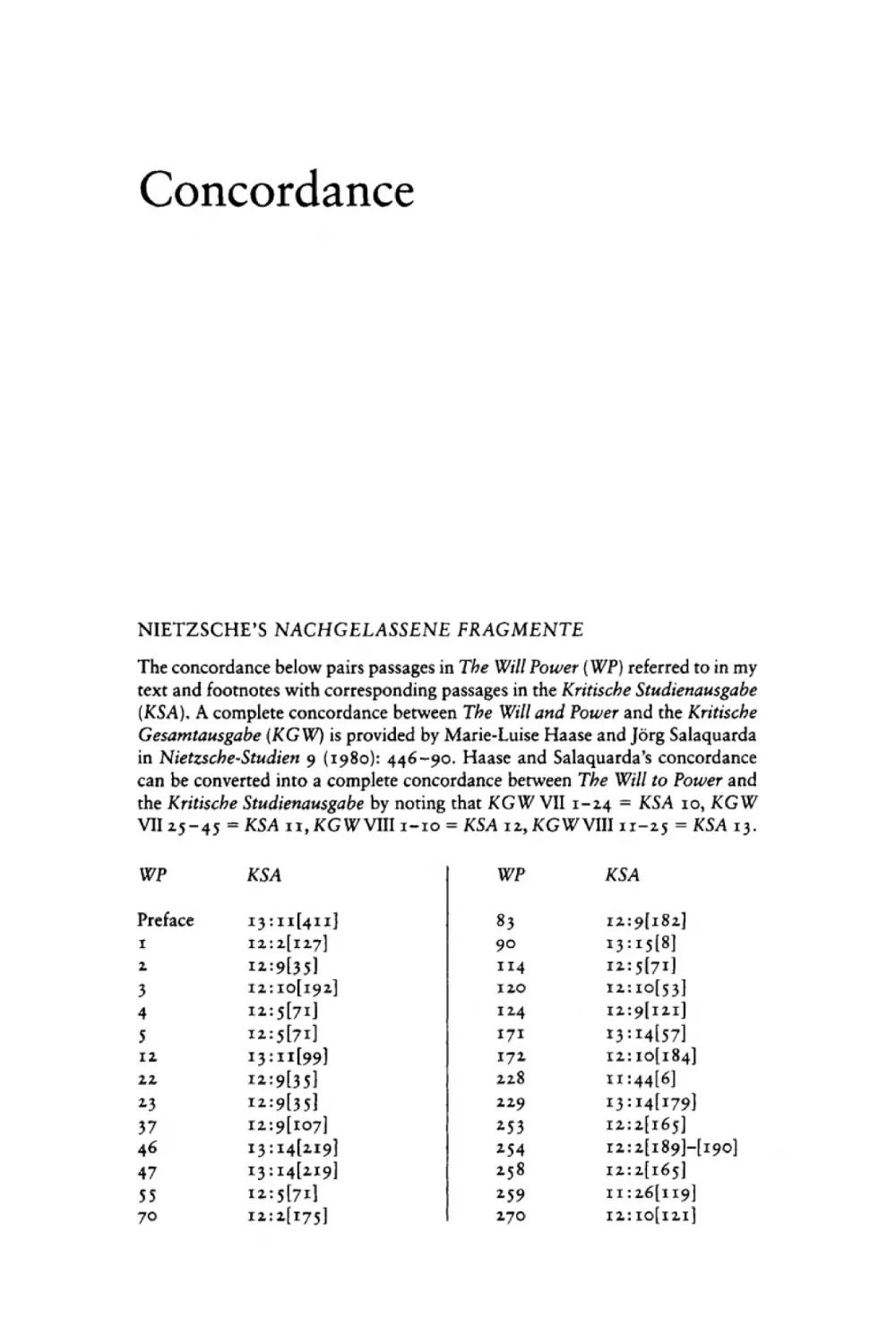
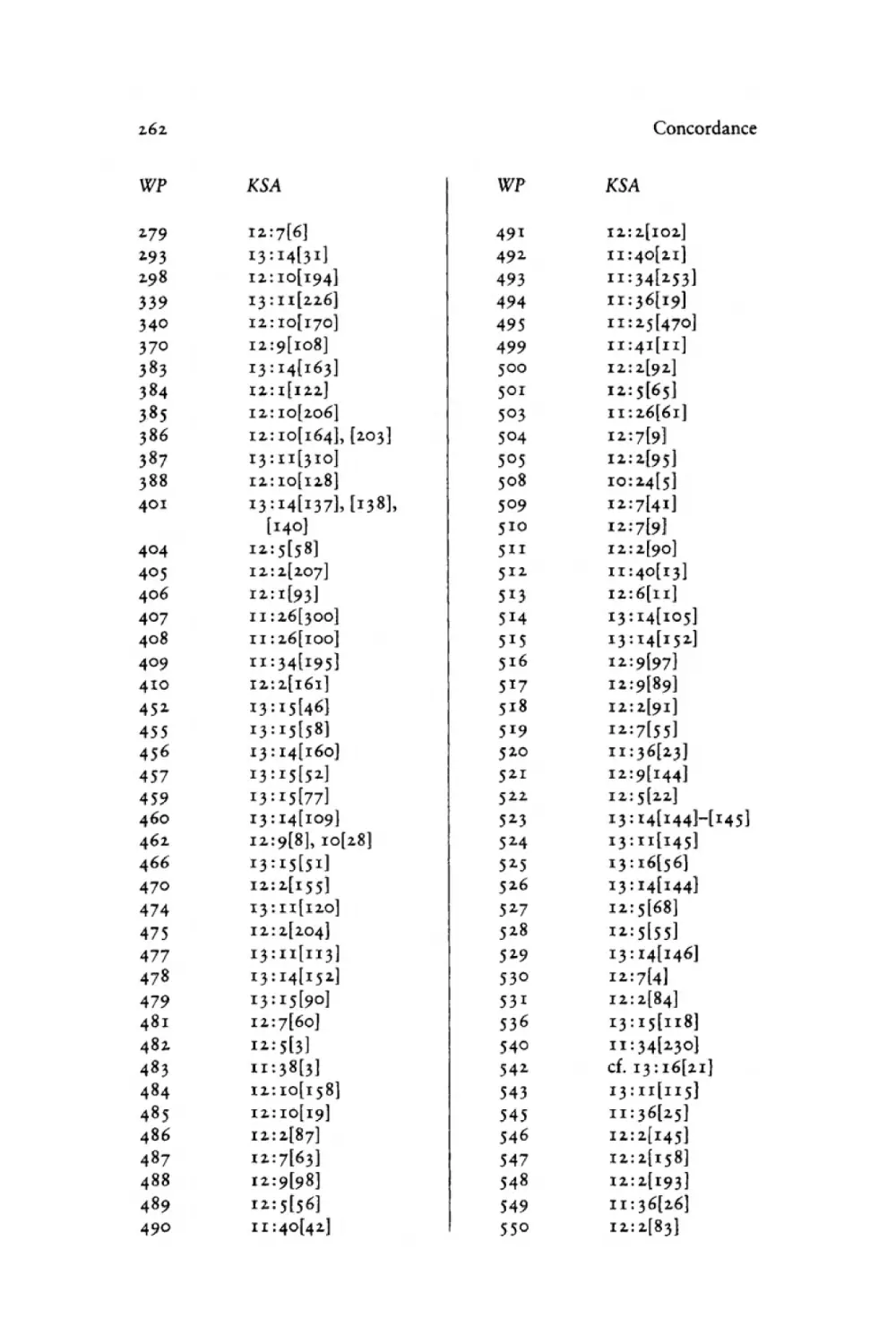
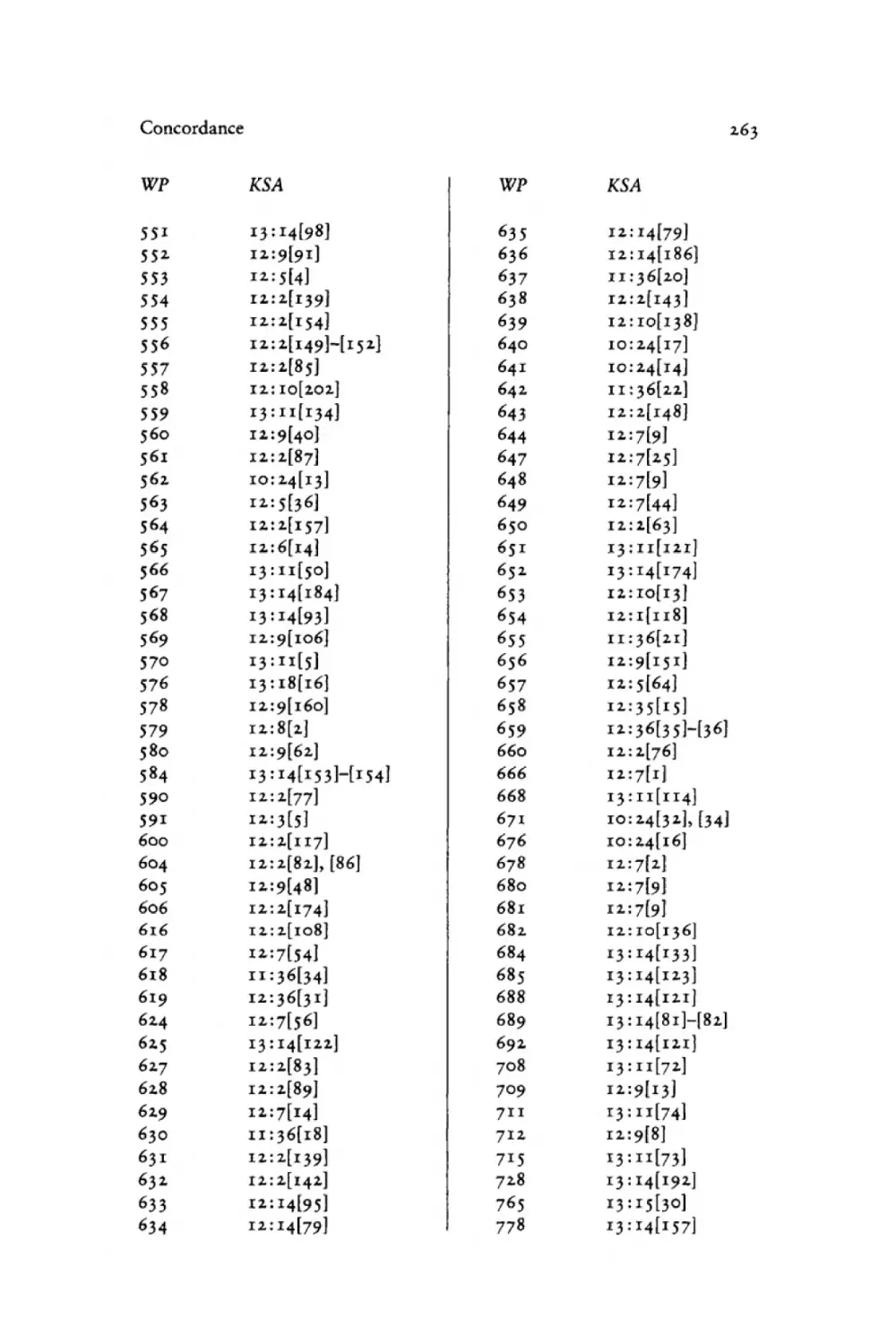
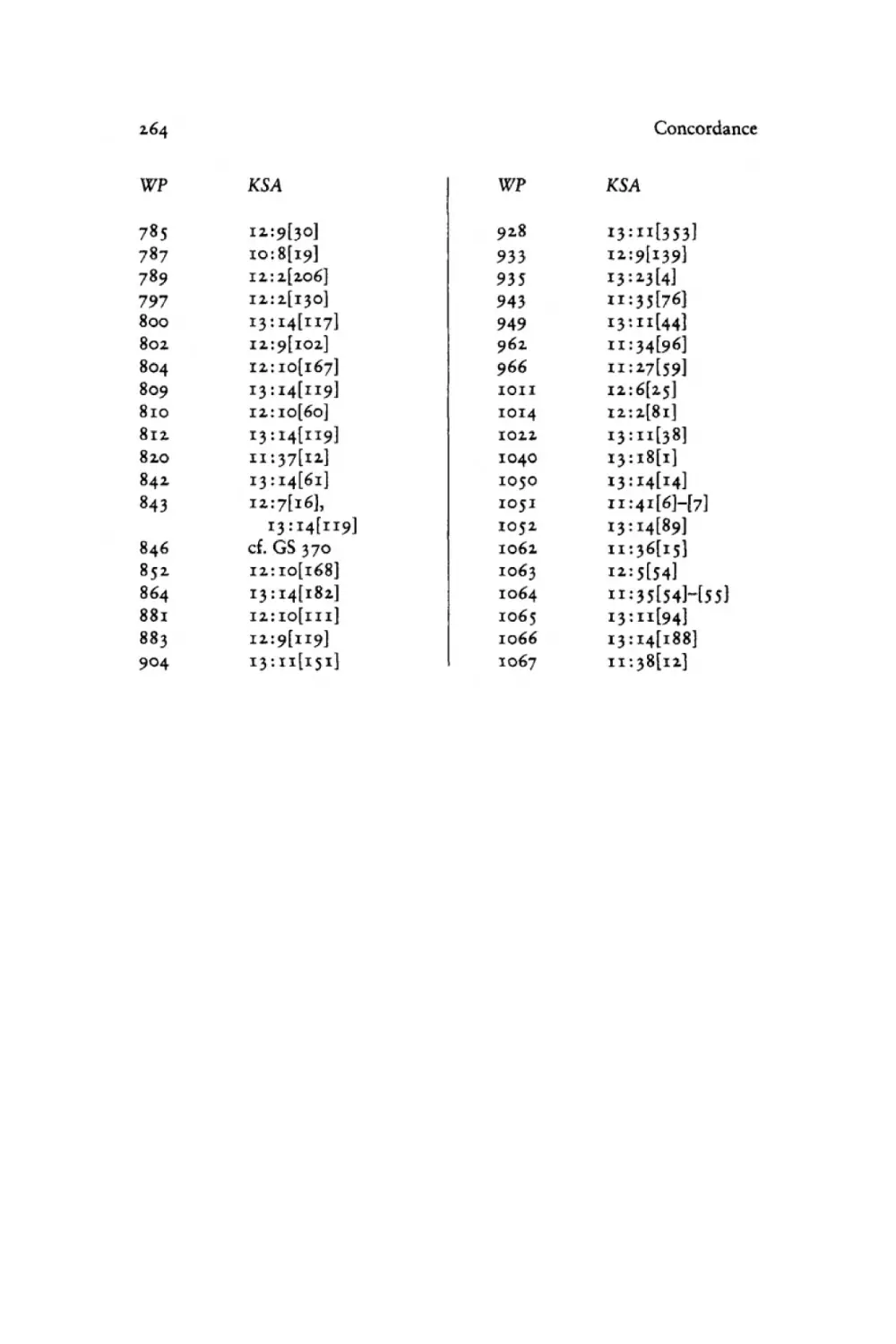
context for any of these notes, I have provided, as an appendix, a concordance between The Will to Power notes to which I refer and corresponding entries in Kritische Studienausgabe.

CHAPTER

ONE

Being and Its Others
Nietzsche's Genealogy of European Thought

We k n o w the way, we have found the exit
out of the labyrinth of thousands of years.
Nietzsche,

The Antichrist §i

i . I INTERPRETING NIETZSCHE
In a late text, having declared himself to be the first German master of
the aphorism, Nietzsche writes, "it is my ambition to say in ten sentences what everyone else says in a book—what everyone else does not
say in a book" (TI "Skirmishes" 51). A year earlier he remarked in the
preface to On the Genealogy of Morals that "an aphorism, properly
stamped and molded, has not been 'deciphered' when it has simply
been read; rather, one has then to begin its interpretation [Auslegung],
for which is required an art of interpretation" (GM P: 8). He goes on to
say that the third essay of the Genealogy—some seventy pages in the
standard German edition—is simply commentary upon an aphorism
drawn from his monumental prose-poem, Thus Spoke Zarathustra.
Nietzsche thus gives his interpreters an essential role: that of unpacking
his terse, fhetorically dense remarks and elaborating them into an explicit philosophical view.
This is certainly the case with Nietzsche's most famous aphorism:
"God is dead" (GS 12.5, 343). These words will be familiar to anyone
even casually acquainted with Nietzsche. Yet the meaning of this phrase
is by no means transparent. It can be, and has been, taken in any number of ways. On my reading, this audacious claim condenses an entire
genealogy of European thought that has profound consequences for
epistemology and ontology. To see this, however, we need to take Nietz-

i6

Nietzsche's Philosophical Position

sehe's a d v i c e a n d r e a d h i m " s l o w l y , deeply, l o o k i n g c a u t i o u s l y f o r e a n d
a f t " (D P : 5 ) . T h a t is, w e m u s t trace this n o t i o n t h r o u g h the h o s t of p a s sages in w h i c h it a p p e a r s , a l l o w i n g e a c h p a s s a g e t o elucidate the o t h e r s
and attempting to d r a w out w h a t they merely suggest.

1.2

THE "DEATH OF GOD"
POINT OF EUROPEAN

AS THE

TURNING

THOUGHT

T h e n o t i o n of " t h e death of G o d " first a p p e a r s in 1 8 8 2 , in B o o k T h r e e
of The Gay

Science.

eral p a s s a g e s of Thus

In the f o l l o w i n g f e w y e a r s , it finds its w a y i n t o s e v Spoke

Zarathustra.

the c o m p o s i t i o n of B o o k F i v e of The Gay
Morals,

a n d the Nachlaß1

B u t it is n o t until 1 8 8 7 , w i t h
Science,

On the Genealogy

of

f r o m this p e r i o d , that N i e t z s c h e m a k e s c l e a r

the full significance of the m a d m a n ' s c r y : " G o d is d e a d . G o d r e m a i n s
d e a d . A n d w e h a v e killed h i m " ( G S 1 2 5 ) .
In Gay Science

§ 3 4 3 , w h i c h o p e n s B o o k F i v e , w e d i s c o v e r that N i e t z -

sche's a n n o u n c e m e n t of the " d e a t h of G o d " is n o t at all a p e r s o n a l c o n fession of a t h e i s m or loss of f a i t h ; n o r is it so f o r the v a r i o u s c h a r a c t e r s
w h o m a k e this p r o c l a m a t i o n (the m a d m a n , Z a r a t h u s t r a , the last p o p e ,
the ugliest m a n , etc.). 2 R a t h e r , it b e c o m e s e v i d e n t t h a t , f o r N i e t z s c h e ,
the " d e a t h of G o d " is a cultural

and historical

event

( " a generally E u -

1 . See, for example, The Will to Power, Book I, titled "European Nihilism," which
collects a group of notes written primarily from late 1 8 8 6 - e a r l y 1 8 8 8 . Nietzsche refers to
this set of notes in G M III:27, where, discussing the "death of G o d " as "Europe's longest and bravest self-overcoming," he announces a future project that "shall probe these
things more thoroughly and severely [ . . . ] (under the title 'On the History of European
Nihilism' [ . . . ] contained in a work in progress: The Will To Power: Attempt at a Revaluation of All Values)." Though this project was later abandoned, it was still very much
alive as the Genealogy and Book Five of the Gay Science were being composed; and the
conception of "European nihilism" that Nietzsche presents in the notes from this period
clearly informs these published texts. On the history of Nietzsche's Will to Power project,
see Mazzino Montinari, "Nietzsche's Nachlaß 1 8 8 5 - 1 8 8 8 und der 'Wille zur Macht,'"
KSA 1 4 : 3 8 3 - 4 0 0 ; Bernd Magnus, "Nietzsche's Philosophy in 1888: The Will to Power
and the Übermensch," Journal of the History of Philosophy 24 (1986): 8 5 - 9 3 ; and
Wayne Klein, Nietzsche and the Promise of Philosophy (Albany: State University of New
York Press, 1997), 1 8 1 - 9 9 .
2. This has been stressed by a number of Nietzsche's commentators. See, e.g., Karl
Jaspers, Nietzsche: An Introduction
to the Understanding of His Philosophical
Activity,
trans. Charles F. Walraff and Frederick J. Schmitz (South Bend, Ind.: Regnery Gateway,
I
979)y 242; Martin Heidegger, "The Word of Nietzsche: 'God is Dead,'" in The Question Concerning Technology and Other Essays, trans. William Lovitt (New York: Harper
and Row, 1977), 5 7 ® . ; George A. Morgan, What Nietzsche Means (New York: Harper and
Row, 1 9 4 1 ) , 37ft.; Walter Kaufmann, Nietzsche: Philosopher, Psychologist,
Anti-Christ,
4th ed. (Princeton: Princeton University Press, 1974), 99ff.; and Maurice Blanchot, The
Infinite Conversation, trans. Susan Hanson (Minneapolis: University of Minnesota Press,
1993), 1 4 4 - 4 6 .

Being and Its O t h e r s

17

ropean event," he calls it in §357). Thus the passage begins, " T h e greatest recent event—that 'God is dead,' that the belief in the Christian god
has become unbelievable—is already beginning to cast its first shadows
over Europe."
Furthermore, it becomes clear that this event concerns far more than
theology and religion; that it is an intellectual event, a crucial moment
in the history of European thinking in general. Thus, reiterating the
madman's conclusion, Nietzsche goes on to write:
T h e event is far t o o great, t o o distant, t o o remote f r o m the multitude's capacity for comprehension even for the tidings of it to be t h o u g h t of as having
arrived as yet. M u c h less m a y o n e suppose that m a n y people k n o w as yet
what this event really m e a n s — a n d h o w m u c h must collapse n o w that this
faith has been undermined because it w a s built u p o n this faith, p r o p p e d up
by it, g r o w n into it; for e x a m p l e , the w h o l e of o u r European morality. T h i s
long plenitude a n d sequence of b r e a k d o w n , destruction, ruin, a n d cataclysm
that is n o w i m p e n d i n g — w h o c o u l d guess e n o u g h of it today to be compelled
to play the teacher and advance proclaimer of this monstrous logic of terror,
the prophet of a g l o o m and an eclipse of the sun w h o s e like has p r o b a b l y
never yet occurred on earth?

Here, we get an inkling of what Nietzsche will later make clear: that the
"death of G o d " involves nothing less than a dismantling of the basic
structures of belief and value upon which European thought has been
founded. Moreover, we soon learn that this event is not brought about
from the outside, by some external cataclysm; nor is it some chance occurrence. Rather, the "monstrous logic of terror" set in motion by the
"death of G o d " is brought about from the inside, through a critique necessitated by the very presuppositions of European thought. In short,
for Nietzsche, the "death of G o d " marks the beginning of a self-overcoming of the foundational structures of European thought. 3
These themes are more thoroughly elaborated in §357 of The

Gay

Science, where Nietzsche writes:
[T]he decline of the faith in the Christian g o d , the triumph of scientific atheism, is a generally E u r o p e a n event in w h i c h all races had their share and for
w h i c h all deserve credit and honor. [ . . . U n c o n d i t i o n a l and honest atheism
[...

is] a triumph achieved finally and w i t h great difficulty by the European

conscience, being the most fateful act of t w o thousand years of discipline

j . Recall Nietzsche's description of nihilism: "what does nihilism mean?—that the
highest values devaluate themselves" (WP 2). This notion of "self-overcoming" appears
frequently in the texts of 1887-88. See, e.g., GS 357; G M I I : 10, III:27; EH "Destiny" 3;
WPP, 3, 5, 404-5.

Nietzsche's Philosophical Position

i8

for truth that in the end forbids itself the lie in faith in G o d . . . . You see
what has really triumphed over the Christian god: Christian morality itself,
the concept of truthfulness that was understood ever more rigorously, the father confessor's refinement of the Christian conscience, translated and sublimated into a scientific conscience, into intellectual cleanliness at any price.
Looking at nature as if it were proof of the goodness and governance of a
god; interpreting history in honor of some divine reason, as a continual testimony of a moral world order and ultimate moral purposes; interpreting
one's o w n experiences as pious people have long enough interpreted theirs,
as if everything were providential, a hint, designed and ordained for the sake
of the salvation of the soul: that is all over now, that has man's conscience
against it, that is considered indecent and dishonest by every more refined
conscience—mendaciousness, feminism, weakness, and cowardice. In this
severity, if anywhere, w e are good Europeans and heirs of Europe's longest
and most courageous self-overcoming
[Selbstüberwindung],
A f t e r q u o t i n g this p a s s a g e in t h e p e n u l t i m a t e s e c t i o n of t h e
of Morals,

Genealogy

Nietzsche continues:

All great things bring about their o w n destruction through an act of selfovercoming [Selbstaufhebung]: thus the law of life will have it, the law of the
necessity of "self-overcoming" [Selbstüberwindung]
in the nature of l i f e —
the lawgiver himself eventually receives the call: "patere legem, quam ipse
tulisti" [submit to the law you yourself proposed]. In this way Christianity
as a dogma was destroyed by its o w n morality; in the same way Christianity
as morality must n o w perish too: we stand on the threshold of this event. A f ter Christian truthfulness has drawn one inference after another, it must end
by drawing its most striking inference, its inference against itself; this will
happen, however, when it poses the question, "what is the meaning of all
will to truth f" . . . A n d here I again touch on my problem, on our problem
[ . . . ] : w h a t meaning would our w h o l e being possess if it were not this, that
in us the will to truth becomes conscious of itself as a problem? . . . A s the
will to truth thus gains self-consciousness, from now o n — t h e r e is no doubt
about i t — m o r a l i t y will go to ruin [geht . . . zu Gründe]: this is the great
spectacle in a hundred acts reserved for the next two centuries in E u r o p e —
the most terrible, most questionable, and perhaps also the most hopeful of
s p e c t a c l e s . . . . ( G M 111:27)
T a k e n t o g e t h e r , t h e s e p a s s a g e s p r e s e n t a g e n e a l o g y t h a t is o f u t m o s t
i m p o r t a n c e f o r u n d e r s t a n d i n g N i e t z s c h e ' s later t h o u g h t . In t h e s e p a s sages, he attempts to e x p l a i n b o t h the sequence of events leading t o
t h e " d e a t h of G o d " a n d its i n e v i t a b l e c o n s e q u e n c e s . T h i s a c c o u n t is
h i g h l y c o n d e n s e d a n d e l u s i v e , t o be sure. B u t , f o r t u n a t e l y , t h e s e p a s s a g e s d o n o t s t a n d a l o n e . T h e y f o r m p a r t o f a n e t w o r k of t e x t s , w r i t t e n
in 1 8 8 7 a n d c o n s t a n t l y c r o s s - r e f e r e n c e d b y N i e t z s c h e . F o l l o w i n g t h e
v a r i o u s s t r a n d s of this n e t w o r k , w e c a n p i e c e t o g e t h e r a g e n e a l o g y t h a t

Being and Its Others

19

links " G o d " and "morality" with "truth" and shows that a "refinement" of the "European conscience" eventually leads to the "self-overcoming" of metaphysics, theology, morality, and science and to a "revaluation" of "truth."
1 . 3 F R O M M E T A P H Y S I C S A N D T H E O L O G Y TO S C I E N C E
Like Hegel's "phenomenology of spirit," but with a very different motivation and trajectory, Nietzsche's genealogy is concerned with the quasihistorical movement of European thought.4 Like his heirs, Heidegger
and Derrida, Nietzsche considers all of Western thought—from Plato
through positivism—as forming a single epoch, the closure of which is
at hand. This epoch is characterized by the accordance of an absolute
value to "truth" conceived as the determination of "being" apart from
all "becoming" and "appearing" (or "seeming") (see, e.g., BGE P, 2.,
34; G M 111:24; TI "Reason" and "World"). s Since the history of this
epoch is a history of self-overcoming, this self-overcoming will have
something to do with truth—more specifically, with a contradictory development of the concept of truth.
Since its inception, Nietzsche maintains, European thought has attempted rigorously to distinguish "what is" from "what merely seems
or appears to be," "what is not yet," and "what is no longer." 6 Yet the
earliest philosophers (e.g., the Eleatics) already noted that, within the
physical world in which we have bodily existence and sensuous experience, we nowhere encounter this "truth as being." On the contrary, as
physical, embodied creatures, we are continually confronted by a volatile
sensory experience in which things incessantly appear and disappear.
This experience repeatedly embroils us in deceptions, for what the eye
sees the hand may not feel, and what the eye sees from one point of view
it sees differently from another. Furthermore, every thing in this world,
including our own bodies, exists only for a relative duration, in which it

4. For further comparison of Hegel's "phenomenology" and Nietzsche's "genealogy,"
see §5.3.3, below.
5. Note that der Schein (semblance) and die Erscheinung (appearance) derive from a
common root and, while not identical, are often used interchangeably by Nietzsche in
contrast with "truth," "being," and "essence."
6. For a Nietzschean account of the traditional subordination of becoming and seeming to being, and the modern inversion of this hierarchy, see Gilles Deleuze, Difference
and Repetition, trans. Paul Patton (New York: Columbia University Press, 1994), 5 9 - 6 9 ,
and The Logic of Sense, ed. Constantin V. Boundas, trans. Mark Lester and Charles Stivale (New York: Columbia University Press, 1990), 1 5 3 - 6 6 .

2.0

Nietzsche's Philosophical Position

undergoes constant local movement and qualitative change. And within
this world, each thing owes its existence to other things and to a sequence of events that stretches into an infinite past. In short, the world
of which we are a part seems to be, in its entirety, a domain of temporal, spatial, contingent, and conditional particulars. If truth is being, it is
not to be found within this domain. Convinced of the existence of truth
and knowledge, the founders of the Western tradition thus resolved that
truth resides in another, metaphysical world, an eternal world of necessary, unconditioned, universal, and absolute being: for the Platonist, the
world of the Forms; for the Christian, the kingdom of God. 7
Yet Nietzsche remarks that the Platonic-Christian notion of truth
subtly changes with the institutionalization of religion. With "the father confessor's refinement of the Christian conscience" (GS 3 57), truth
comes to be formulated as the commandment not to lie, to tell the truth
no matter how terrible and regardless of consequence. As such, truth is
partially dislodged from its otherworldly residence. No longer strictly
defined by the belief in and search for a "true world of being," the will
to truth becomes the demand to tell the truth, to say, unconditionally,
what is the case and what has occurred. With this development is born
a key figure in Nietzsche's genealogy: what he variously calls "the European conscience," the "intellectual conscience" [Gewissen], "intellectual integrity" [Rechtschaffenheit], or "honesty" [Redlichkeit]. 8 For
Nietzsche, this "intellectual conscience" involves a "training in truthfulness" (GM 111:27), ^ "discipline for truth," "the concept of truthfulness [ . . . ] understood ever more rigorously" as the demand for "intellectual cleanliness at any price" (GS 357; cf. GM III:2.4ff.). Further
refined, the "father confessor's" demand for truth gives rise to a profound skepticism: the requirement that beliefs, convictions, and ideals
7. Note that Nietzsche considers Platonism and Christianity to be, in their basic orientation, the same, deeming Christianity "Platonism for 'the people'" (BGE P).
8. On "intellectual conscience," see AOM 26; GS 2, 99, 3 3 5 ; BGE 1 0 5 , 230; G M
1 1 1 : 2 4 ; TI "Skirmishes" 1 8 ; A P, 1 2 . On "intellectual integrity," see A 36, 50, 53, 59; WP
460. On "honesty," see D 84, i n , 370, 456, 482; GS 1 0 7 , n o , 1 1 4 , 3 1 9 , 3 3 5 ; BGE 5,
227; Z:4 "Retired"; GM 111:2.6; A P, 1 2 , 52; EH " B o o k s " C W : 3 . One might add to this
list Nietzsche's notion of "justice" [Gerechtigkeit], discussed more fully in chapter 3. The
importance for Nietzsche of these philological virtues has been discussed by Jaspers,
Nietzsche, 2 0 1 - 1 1 ; Kaufmann, Nietzsche, 3 5 4 - 6 1 and passim; Blanchot, Infinite Conversation, 1 3 8 , 1 4 5 ; Jean-Luc Nancy, " ' O u r Probity!' On Truth in the Moral Sense in
Nietzsche," in Looking after Nietzsche, ed. Laurence A. Rickels (Albany: State University
of New York Press, 1990); Richard Schacht, Nietzsche (London: Routledge and Kegan
Paul, 1983), 99ff.; and Alan D. Schrift, Nietzsche and the Question of Interpretation: Between Hermeneutics and Deconstruction (New York: Routledge, 1990), 1 6 5 - 6 7 , 1 8 8 90. In what follows, I treat these notions as more or less interchangeable.

Being and Its Others

21

be tested rigorously to determine whether or not they are justified and
certain. 9
In fact, this development of the "intellectual conscience" leads to a
questioning of the "true world" of Christianity and Platonism. It provokes the suspicion that the existence of God, of otherworldly being,
and of innate ideas cannot adequately be demonstrated. It points out, in
contrast, that so much else is perfectly clear and demonstrable, particularly the regularities of nature confirmed by repeated experimental observation. And with this, "the Christian conscience" is "translated and
sublimated into the scientific conscience" (GS 357). N o longer concerned with the unjustifiable claims of metaphysics and theology, science turns its attention to the natural world, which it aims to master
through scrupulous empirical inquiry.

1 . 4 S C I E N C E AS T H E O L O G Y BY O T H E R M E A N S
One might suppose that, with the triumph of science, Platonism and
Christianity are finally overcome, that, within the scientific worldview,
" G o d is dead" or at least forgotten. This certainly is what contemporary scientific culture believes, says Nietzsche. When the madman appears among the atheists in the marketplace crying " G o d is dead. [ . . . ]
And we have killed him," they ridicule and taunt him. He finally leaves,
muttering: " I have come too early [ . . . ] , my time is not yet. This
tremendous event is still on its way, still wandering: it has not yet
reached the ears of men. [ . . . ] This deed is still more distant from them
than the most distant stars—and yet they have done it themselves" (GS
1 2 5 ) . A similar description is found in the Genealogy of Morals. It is
said, Nietzsche writes, that modern culture has finally vanquished the
otherworldly, this-world-denying "ascetic ideal,"
that it has already conquered this ideal in all important respects: all of modern science

is supposed to bear witness to that—modern science which, as

a genuine philosophy of reality, [ . . . ] has up to now survived well enough
without G o d , the beyond, and the virtues of denial. [ . . . T]hese hard, severe, abstinent, heroic spirits w h o constitute the honor of our age; all these

9. Cf. WP 4 - 5 (KSA 1 2 : 5 [71]): "in sum: morality was the great antidote against
practical and theoretical nihilism. But among the forces cultivated by morality was truthfulness; this eventually turned against morality [ . . . ] and now the insight into this inveterate mendaciousness that one despairs of shedding becomes a stimulant. To nihilism";
also WP 3 ( K S A 1 2 : 1 0 [192]): "Radical nihilism [ . . . ] is a consequence of highly developed 'truthfulness': thus itself a consequence of the faith in morality."

Nietzsche's Philosophical Position
pale atheists, anti-Christians, immoralists, nihilists; these skeptics, ephectics
[ . . . ] ; these last idealists of knowledge in whom alone the intellectual conscience dwells and is incarnate today—they certainly believe they are as completely liberated from the ascetic ideal as possible [ . . . ] (GM
111:23-24)
Yet they are mistaken, argues Nietzsche. Science does not represent the
triumph over God, the otherworldly, and the ascetic ideal. Though it
potentially prepares the way for that triumph, science itself represents,
rather, the " k e r n e l " of the ascetic ideal, "this ideal itself in its strictest,
most spiritual formulation, esoteric through and through with all external additions abolished" ( G M 1 1 1 : 2 7 ) . Nietzsche elaborates:
No! this "modern science"—let us face this fact!—is the best ally the ascetic
ideal has at present, and precisely because it is the most unconscious, involuntary, hidden, and subterranean ally! [ . . . ] The ascetic ideal has decidedly
not been conquered: if anything, it became stronger, which is to say, more
elusive, more spiritual, more captious, as science remorselessly detached and
broke off wall upon wall, external additions that had coarsened its appearance. (GM 111:25)
This seems a rather odd claim. One might well ask how it is that modern science, which explicitly rejects metaphysics and theology, represents the inner essence of "the ascetic ideal." Nietzsche explains:
[T]o disclose to them what they themselves cannot see—for they are too
close to themselves: this ideal is precisely their ideal, too [ . . . ]—if I have
guessed any riddles, I wish that this proposition might show it—They are
far from being free spirits: for they still have faith in truth [ . . . ] ; it is precisely in their faith in truth that they are more rigid and unconditional than
anyone. [ . . . ] That which constrains these men, however, this unconditional will to truth, is faith in the ascetic ideal itself, even if as an unconscious imperative—don't be deceived about that—it is the faith in the metaphysical value, the value of truth in itself [einen Werth an sich der Wahrheit],
sanctioned and guaranteed by this ideal alone (it stands or falls with this
ideal). (GM 111:24)
Modern science, that is, represents both the essence and consummation
of the ascetic ideal insofar as it strips that ideal of all external coverings
and reveals what is essential to it and, indeed, to the entirety of Western
thought, which has been predicated upon this ideal. 10 Having rejected
the Platonic Forms, the Christian God, and other representatives, modern science retains the one conviction with which Western thought com-

10. See GM III: 24.

Being and Its Others

2-3

mences: faith in the absolute and unconditional value of truth. While it
may no longer believe that "God is the truth," science nonetheless still
believes that "truth is divine" (GS 344), that truth must govern every inquiry and serve as its incontestable goal. Nietzsche thus makes the striking assertion that the "death of God" has only derivatively to do with
theology and Christianity, that it primarily involves what Heidegger has
called a "fundamental structuring" of thought, based upon the accordance of an ultimate value to truth. 11 In this sense, according to Nietzsche, even the scientists and "godless anti-metaphysicians" (GS 344)
have yet fully to comprehend the meaning of the "death of God."
It might be objected that the "truth" sought after by science is quite
different from the "truth" desired by Platonism and Christianity. For
this latter pair, truth is something otherworldly, not to be found within
the natural world; while, for science, truth is entirely this-worldly, aiming simply at the discovery of demonstrable, empirical "facts" about
the natural world. Nietzsche acknowledges this difference and, indeed,
often praises science for its this-worldliness.12 Yet he points out that
science still retains the essence of the ascetic ideal insofar as it accords
truth an absolute, unconditional value. This conviction, Nietzsche insists, is nothing other than a "metaphysical" faith.
Again, one might ask how this is so. Science does indeed claim truth
as its ultimate goal. But the truth it demands is not metaphysical; it is,
rather, physical and empirical, available for all to see. To explain his
strange accusation, Nietzsche cites another passage from Book Five of
The Gay Science: §344, entitled "How We, Too, Are Still Pious." This
passage begins by praising science for its "intellectual conscience," for
its "mistrust" of "convictions" and its decision to demote them "to the
modesty of hypotheses, of a provisional experimental point of view, of a
regulative fiction." Yet he notes that, while the scientific method grants
admission only to such provisional, revisable hypotheses, the entire enterprise of science rests upon a prior conviction that it is unwilling to
relinquish:
We see that science also rests on a faith; there is simply no "presuppositionless" science. The question whether truth is needed must not only have been
affirmed in advance, but affirmed to such a degree that the principle, the

11. Heidegger, "Word of Nietzsche," 6 4 - 6 5 .
12. See, especially, A 4 7 - 4 9 , where, against the otherworldly "lies" of Christianity,
Nietzsche calls science "the 'wisdom of this world.'" See also GS 293, 3 5 5 , 357, and 77
"Reason" 3.

Nietzsche's Philosophical Position
faith, the conviction finds expression: "Nothing is needed more than truth,
and in relation to it everything else has only second-rate value." (GS 344)

Nietzsche does not object to this conviction on the grounds that it is a
"presupposition," because he denies the possibility of a "'presuppositionless' science." 13 What he does object to, however, is the dogmatic
nature of this conviction, a dogmatism that proves to be metaphysical.
This becomes apparent, Nietzsche argues, if we inquire into the motivations and reasons behind the conviction that truth is of ultimate value.
He asks what justifies this conviction and considers two possible answers. Perhaps the justification is pragmatic: "One does not want to allow oneself to be deceived because one assumes that it is harmful, dangerous, calamitous to be deceived. In this sense, science would be a
long-range prudence, a caution, a utility." Yet he argues that this explanation fails to justify the ultimacy of the will to truth, because, on pragmatic considerations, we can see that it is not unconditionally harmful
to allow oneself to be deceived. While the will to truth certainly does
serve the interests of life in important ways (e.g., by helping us to determine more or less accurately the conditions that obtain in the world so
that we can respond accordingly), it is one of Nietzsche's recurrent insights that the opposite will, the will to ignorance, is equally beneficial
for life. 14 He continually points out that human survival is predicated
upon conceptual and linguistic abstractions that allow us to reify the
ever-changing world and to simplify and select from our multifaceted
experience. In this way, he argues, we "lie" in "an extramoral sense";
that is, we strategically, and often unconsciously, overlook and forget
features of the world that are not relevant or crucial to our survival
or to our particular purposes, interests, values, and goals. Furthermore,
Nietzsche points out that, in art and dreams, we continually allow ourselves to be deceived and take pleasure in this deception. If not beneficial, such "lies" cannot be considered harmful, except to the most obstinate Platonist.15 Hence, the ultimacy of the will to truth is not to be
justified on pragmatic grounds.

13. See also GM 111:24 and II: 12. This notion is discussed more fully below.
14. For some instances of this line of thought, see TL; HL (on the "value for life" of
"forgetting" and "the unhistorical"); GS 1 1 0 - 1 2 , 354; BGE 1, 4, 9, 1 1 , 24; TI "Reason," "World," "Errors"; WP 466-617. See also Alexander Nehamas, Nietzsche: Life as
Literature (Cambridge: Harvard University Press, 1985), chap. 2. I discuss these issues
further below (§1.5.2).
15. On the "deception" of dreams, see TL, 80. On the "deception" of art, see BT
SC:s and GMIII:2 5 .

Being and Its Others
If this will does not receive a naturalistic, conditional, pragmatic
justification, from where does its justification come? If it is not justified
by the role it plays in the actual process of inquiry and the actual exigencies of life, what justifies it? Nietzsche argues that it must rest on the
moral prescription never to deceive, not even oneself. Science, then,
would represent simply a "translation and sublimation" of the Christian commandment: "thou shalt not lie" (see GS 3 5 7 ) . Were it to be
strictly enforced, however, this unconditional proscription would be
extremely harmful to natural life, which, in so many ways, requires the
"extramoral lie." Nietzsche thus concludes that the absolute and unconditional value accorded the will to truth by science is antinatural,
otherworldly, metaphysical:
For you only have to ask yourself carefully, "Why do you not want to deceive?" especially if it should seem—and it does seem!—as if life rested upon
semblance, I mean error, deception, simulation, delusion, self-delusion, and
when the great sweep of life has actually always shown itself to be on the side
of the most unscrupulous polytropoi. Charitably interpreted, such a resolve
might perhaps be a quixotism, a minor slightly mad enthusiasm; but it might
also be something more serious, namely a principle that is hostile to life and
destructive.... "Will to truth"—that might be a concealed will to death.—
Thus the question "Why science?" leads back to the moral problem: Why
have morality at all when life, nature, and history are "unmoral"? No
doubt, those who are truthful in that audacious and ultimate sense that is
presupposed by the faith in science thus affirm another world than the world
of life, nature, and history; and insofar as they affirm this "other world"—
look, must they not by the same token negate its counterpart, this world, our
world? . . . But you will have gathered what I am driving at, namely, that it
is still a metaphysical faith upon which our faith in science rests—that even
we seekers after knowledge today, we godless anti-metaphysicians still take
our fire, too, from the flame lit by a faith [Glaube] that is thousands of years
old, that Christian faith which was also the faith of Plato, that God is the
truth, that truth is divine.... But what if this should become more and more
incredible [unglaubwürdig], if nothing should prove to be divine any more
unless it were error, blindness, the lie—if God himself should prove to be
our most enduring lie?—(GS 344; cf. WP i o n )
Briefly put, Nietzsche argues that, while the "intellectual conscience"
that animates modern science demands a rejection of every unconditional faith, science itself is "still unconditional on one point," regarding
its belief in "the absolute value of truth" ( G M III:2.4). This unconditional belief is not only unconscionably dogmatic but also unconscionably metaphysical, insofar as—against the requirements of "this world,

Nietzsche's Philosophical Position
our world," "the world of life, nature, and history"—it receives its justification solely from the otherworldly domain of Christian morality.
The "intellectual conscience" thus demands that this final conviction be
put into question.
Yet this final conviction is not just one among many. Nietzsche takes
it to be the conviction upon which all of Western thought is based. A
questioning of this conviction, then, amounts to a questioning of Western thought itself. Nietzsche makes clear that this is just what the
"death of G o d " entails and just what the "intellectual conscience" requires. Impelled by the "intellectual conscience," science demands its
own self-overcoming. Insofar as science represents the kernel and esoteric form of the ascetic ideal, this self-overcoming of science is, at the
same time, a self-overcoming of the ascetic ideal:
This pair, science and the ascetic ideal, both rest on the same foundation—I
have already indicated it: on the same overestimation of truth (more exactly:
on the same belief that truth is ('«estimable and cannot be criticized). Therefore they are necessarily allies, so that if they are to be fought they can only
be fought and called in question together. A depreciation of the ascetic ideal
unavoidably involves a depreciation of science: one must keep one's eyes and
ears open to this fact! (GM III: 1 5 )
And this self-overcoming of the ascetic ideal points to the self-overcoming of the foundations of European thought:
Consider on this question both the earliest and most recent philosophers:
they are all oblivious of how much the will to truth itself first requires justification; here there is a lacuna in every philosophy—how did this come about?
Because the ascetic ideal has hitherto dominated all philosophy, because
truth was posited as being, as God, as the highest court of appeal—because
truth was not permitted to be a problem at all. [ . . . ]—From the moment
faith in the God of the ascetic ideal is denied, a new problem arises: that of
the value of truth. The will to truth requires a critique—let us thus define
our own task,—the value of truth must for once be experimentally called
into question. (GM III:2.4; cf. BGE 1 ; A 8)
[W]hat meaning would our whole being possess if it were not this, that in us
the will to truth becomes conscious of itself as a problem? . . . As the will to
truth thus gains self-consciousness, from now on—there can be no doubt
about it—morality [read: the ascetic ideal and the otherworldly, generally]
will go to ruin: this is the great spectacle in a hundred acts reserved for the
next two centuries in Europe—the most terrible, most questionable, and
perhaps the most hopeful of all spectacles.... (GM 111:27)

Being and Its Others
With this, the trajectory of Western thought nears its end; or rather,
it nears its midpoint, because, for Nietzsche, our modernity marks not
the end of history but the inauguration of a new history, "a higher history than all history hitherto" (GS 1x5), not the "dusk" of infinite
wisdom, but the innocence of "daybreak." Even so, that dawn is as
yet merely announced. At present, we remain at "midnight," between
the old day and the new. This dark night is characterized by "nihilism," the general malaise brought upon European culture by its recognition that "the highest values [i.e., truth, God, being] devaluate
themselves" (WP 2). This nihilism, Nietzsche argues, still essentially belongs to the old day; it remains a "shadow of God" (GS 108). For,
though the nihilist acknowledges that all absolute values have devaluated themselves, he or she still laments the loss, and what remains still
appears valueless. The nihilist does not yet affirm the "death of God"
and its consequences.
Nietzsche, however, urges us to push what is falling (see Z : 3 "On
Old and New Tablets"; A 2). Wishing to become "the first perfect
nihilist of Europe who, however, has [ . . . ] lived through the whole of
nihilism, to the end, leaving it behind, outside himself" (WP P: 3), Nietzsche encourages an "active nihilism" (WP 2 2 - 2 3 ) that will bring the
old epoch to a close. This is the momentous task toward which Nietzsche directs his energies; and the achievement of this task will bring us
to the final phase of his genealogy of Western thought.
Thus far, we have seen that metaphysics and theology overcome themselves through science, and that science, too, ends in a self-overcoming.
What follows this self-overcoming of science? To answer this question,
and to move from science to its successor, we must first take up the task
announced above, the initial phase of the revaluation of values: the revaluation of truth.
1 . 5 T H E R E V A L U A T I O N OF T R U T H I:
BEING, BECOMING, AND APPEARING
Nietzsche's genealogy of Western thought culminates in a "critique" of
the "will to truth," a demand that "the value of truth [ . . . ] for once be
experimentally called into question'" (GM 111:24). What does this critique entail? And what, for Nietzsche, remains of truth?
Nietzsche clearly considers the issue of truth to be of central philosophical and cultural importance. From the early essays through the final

Nietzsche's Philosophical Position

notes, he constantly returns to this topic, offering remarks that are as
bold as they are elusive. These texts have recently attracted much attention, and the quantity of commentary on Nietzsche's discussions of truth
has g r o w n rapidly over the past f e w decades. 1 6 For the most part, these
discussions have attempted to extract f r o m Nietzsche's elusive comments
a " t h e o r y of truth." Yet no consensus has been reached. Indeed, every
major theory of truth (correspondence, pragmatic, coherence, semantic) has been attributed to Nietzsche by one commentator or another, 1 7

16. See, e.g., Arthur Danto, Nietzsche as Philosopher (New York: Columbia University Press, 1965), passim; Jean Granier, "Perspectivism and Interpretation," in The
New Nietzsche: Contemporary Styles of Interpretation, ed. David B. Allison (Cambridge,
Mass.: MIT Press, 1977); Wolfgang Müller-Lauter, Nietzsche: Seine Philosophie der
Gegensätze und die Gegensätze seiner Philosophie (Berlin: Walter de Gruyter, 1971),
chap. 5; John T. Wilcox, Truth and Value in Nietzsche: A Study of His Metaethics and
Epistemology (Ann Arbor: University of Michigan Press, 1974), and "A Note on Correspondence and Pragmatism in Nietzsche," International Studies in Philosophy 1 2 (1980):
7 7 - 8 0 , and "Nietzsche's Epistemology: Recent American Discussions," International
Studies in Philosophy 15 (1983): 6 7 - 7 7 , and "Nietzsche Scholarship and 'the Correspondence Theory of Truth': The Danto Case," Nietzsche-Studien 15 (1986): 3 3 7 - 5 7 ;
Mary Warnock, "Nietzsche's Conception of Truth," in Nietzsche's Imagery and Thought:
A Collection of Essays, ed. Malcolm Pasley (Berkeley: University of California Press,
1978); Jacques Derrida, Spurs: Nietzsche's Styles, trans. Barbara Harlow (Chicago: University of Chicago Press, 1978); Daniel Breazeale, "Introduction," in Philosophy and
Truth: Selections from Nietzsche's Notebooks of the Early 1870's, ed. and trans. Daniel
Breazeale (Atlantic Highlands, N.J.: Humanities Press, 1979); Bernd Magnus, "Nietzsche's Mitigated Skepticism," Nietzsche-Studien 9 (1980): 260-67; Lawrence M. Hinman, "Nietzsche, Metaphor, and Truth," Philosophy and Phenomenological Research 43
(198z): 1 7 9 - 9 9 ; Schacht, Nietzsche, chap. 2: Nancy, "'Our Probity!'"; Willard Mittelman, "Perspectivism, Becoming, and Truth in Nietzsche," International Studies in Philosophy 16 (1984): 3 - 2 2 ; Kenneth R. Westphal, "Nietzsche's Sting and the Possibility of
Good Philology," International Studies in Philosophy 16 (1984): 7 1 - 8 9 ; Alexander Nehamas, "Immanent and Transcendent Perspectivism in Nietzsche," Nietzsche-Studien 12
(1983): 4 7 3 - 9 4 , and Nietzsche: Life as Literature, chap. 2, and "Will to Knowledge, Will
to Ignorance and Will to Power in Beyond Good and Evil," in Nietzsche as Affirmative
Thinker, ed. Yirmiyahu Yovel (Dordrecht: Martinus Nijhoff, 1986); Steven G. Crowell,
"Nietzsche's View of Truth," International Studies in Philosophy 19 (1987): 3 - 1 8 ;
Robert Nola, "Nietzsche's Theory of Truth and Belief," Philosophy and Phenomenological Research 47 (1987): 5 2 5 - 6 2 ; Rüdiger Bittner, "Nietzsche's Begriff der Wahrheit,"
Nietzsche-Studien 16 (1987): 70-90; Maudemarie Clark, Nietzsche on Truth and Philosophy (Cambridge: Cambridge University Press, 1990); Schrift, Nietzsche and the Question of Interpretation, chap. 6; Ken Gemes, "Nietzsche's Critique of Truth," Philosophy
and Phenomenological Research 52 (1992): 4 7 - 6 5 ; Steven D. Hales and Robert C.
Welshon, "Truth, Paradox, and Nietzschean Perspectivism," History of Philosophy Quarterly 1 1 (1994): 1 0 1 - 1 9 .
17. The correspondence theory of truth holds that a statement or belief is true if and
only if it accurately represents "reality," "the world," "states of affairs," or "the facts."
Versions of the correspondence theory of truth are explicitly attributed to Nietzsche by
Westphal, "Nietzsche's Sting"; Nola, "Nietzsche's Theory of Truth and Belief"; and Clark,
Nietzsche on Truth and Philosophy, chaps. 2, 4, and passim. A "metaphysical" version of
the correspondence theory of truth is implicitly attributed to Nietzsche by many writers

Being and Its Others

while still others have argued that Nietzsche does not provide a theory
of truth and is not interested in doing s o . 1 8
O d d l y enough, I think each of these v i e w s is, in some respect, right;
and later I will give some indication of w h y I think this is so (see
§ 1 . 6 . 3 ) . H o w e v e r , the debate over w h i c h theory of truth to attribute to
N i e t z s c h e seems to me improperly f r a m e d , so I will not enter into it directly here. Rather, I w a n t to suggest that w e arrive at a better sense of
Nietzsche's conception of truth by examining w h a t he himself takes to
be the crucial consideration: the question of " t h e value
rather, h o w truth is to be revalued

of t r u t h , " or

in light of his genealogy of E u r o p e a n

thought.

who argue that Nietzsche conceives of the ultimate nature of reality as "becoming,"
"chaos," or "will to power," whether or not we can adequately think or communicate the
character of the world as such. See, e.g., Danto, Nietzsche as Philosopher, 80, 9 6 - 9 7 ;
Granier, "Perspectivism and Interpretation"; Wilcox, Truth and Value in Nietzsche, 1 3 2 33; Riidiger Grimm, Nietzsche's Theory of Knowledge (Berlin: Walter de Gruyter, 1977),
30 and passim; and Mittelman, "Perspectivism, Becoming, and Truth." A version of the
correspondence theory also seems implicit in many writers' emphasis upon Nietzsche's
language of "honesty," "aptness," and "justice." See, e.g., Jaspers, Nietzsche, 2 0 1 - 1 1 ;
Kaufmann, Nietzsche, 3 5 4 - 6 1 ; Schacht, Nietzsche, 63, 66, 9 5 - 1 1 7 ; and Schrift, Nietzsche and the Question of Interpretation, 1 5 5 , i88ff. The pragmatic theory of truth holds
that a statement or belief is true if and only if it is, in some respect, useful. This theory is
attributed to Nietzsche by Danto, Nietzsche as Philosopher, chap. 3; Grimm, Nietzsche's Theory of Knowledge, chap, 2 and passim, and "Circularity and Self-Reference
in Nietzsche," Metaphilosophy 1 0 (1979): 2 8 9 - 3 0 5 ; and George Stack, "Kant, Lange,
and Nietzsche: Critique of Knowledge," in Nietzsche and Modern German Thought,
ed. Keith Ansell-Pearson (London: Routledge, 1991), 36, and "Nietzsche's Evolutionary Epistemology," Diálogos 59 (1992): 77. Other commentators argue that Nietzsche
affirms the pragmatic theory of truth on at least one level within a multileveled theory of
truth. See Granier, "Perspectivism and Interpretation," 1 9 8 - 9 9 ; Warnock, "Nietzsche's
Conception of Truth," 49, 5 iff.; Schacht, Nietzsche, 71 ff.; and Nola, "Nietzsche's Theory
of Truth and Belief." The coherence theory of truth holds that a statement or belief is true
if and only if it coheres or fits within the system of connected statements and beliefs that
constitutes our knowledge. Schacht (Nietzsche, 63, 66ff.) and Magnus (Nietzsche's Existential Imperative [Bloomington: Indiana University Press, 1978], 29, 2 0 1 , and "Nietzsche's Mitigated Skepticism," 265) argue that Nietzsche's theory of truth is, at least in
part, a coherence theory. The semantic theory of truth, formulated by Alfred Tarski
decades after Nietzsche's death, holds that a sentence is true, in a given language, if it
satisfies the rules by which sentences in the language and objects are picked out and correlated with one another. (It is of some debate, among Nietzsche scholars and philosophers generally, to what degree this theory is a correspondence theory). This conception
of truth is attributed to Nietzsche by Nola, "Nietzsche's Theory of Truth and Belief,"
538£f.; and Clark, Nietzsche on Truth and Philosophy, 32, 3 8 - 4 0 , 61, 1 3 5 . It should be
noted that many commentators attribute to Nietzsche a hybrid or multileveled theory of
truth that combines several of the theories described above.
18. See Nehamas, Nietzsche: Life as Literature, 5 4 - 5 5 ; and Gemes, "Nietzsche's Critique of Truth," 48.

Nietzsche's Philosophical Position

30

1.5.1

TRUTH, BEING, AND

BECOMING

This revaluation obviously presupposes some preliminary characterization of truth. For Nietzsche, such characterization is provided by the
history of metaphysics, which, he argues, retains essentially the same
conception of truth from Plato through positivism: truth considered as
the absolute priority of determining "what is" apart from "what becomes" and "what merely seems or appears to be."
With regard to this conception of truth, as we have seen, the advent
of modern experimental science represents, for Nietzsche, a decisive step
in the history of metaphysics. Science turns its attention away from the
Platonic-Christian "world of being" toward the "world of becoming"—
the spatiotemporal, physical, natural, and empirical world. Moreover,
as it develops, science casts off its residual ties with theology, gradually rejecting the deism to which it was initially wedded. 19 The scientific revolution, then, brings us closer to an affirmation of what Nietzsche calls "a pure, newly discovered, newly redeemed nature" (GS 109)
and a restoration of what he terms the "innocence of becoming" (TI
"Errors" 8).
Yet Nietzsche argues that the dominant scientific theories and methods of the nineteenth century—mechanism, evolutionism, and positivism—still harbor a residual theology that corrupts the "innocence
of becoming": they still attempt to discover a "world of being" as
the ground and essence of the "world of becoming." The "necessity,"
"law," "atomism," and "equilibrium" central to mechanistic physics,
the "struggle for preservation" and inherent teleology of evolutionary
theory, and the "facts" and "disinterested observation" desired by positivism—all of these, according to Nietzsche, are but further attempts
to place becoming in the service of being, to claim that becoming and
change are always governed by, tend toward, or are reducible to some
static, enduring, and isolable thing or state.
Nietzsche's arguments against these various scientific theories are
manifold and complex; and a discussion of his philosophy of science
and nature would take us too far afield.20 But his general point is fairly
simple. Nietzsche does not object to these or any other scientific theo19. See GS 3 5 7 , quoted above on pp. 1 7 - 1 8 . Cf. BGE 209: "science has most happily rid itself of theology, whose 'handmaid' it was too long."
20. I discuss these theories further below (§$1.5.2, 2.3.1, 5.2.1, and 5.2.3). On mechanism, see GS 109, 3 7 3 ; BGE 2 1 , 22, 36, 2 1 3 ; G M II: 1 1 ; WP 618-19,
6 3 4 - 3 5 , 689,
708, 7 1 2 , 1066. On evolutionary theory, see TL; HL; GS 349; G M 1 1 : 1 2 - 1 3 ; WP 647-

Being and Its Others

3i

ries on the basis of their pragmatic aims—their desire to select, simplify,
quantify, and map relative tendencies and to hierarchize appearances
for the purposes of increasing our ability to cope with our environment.
What he objects to is the scientific propensity to forget that these are indeed pragmatic constructions and the consequent claim simply to have
sketched from reality itself this picture of a simple and stable world.
Nietzsche writes:
One should not understand this compulsion to construct species, forms, purposes, laws—"a world of identical cases"—as if they enabled us to fix the
true world; but as a compulsion to arrange a world for ourselves in which
our existence is made possible—we thereby create a world which is calculable, simplified, comprehensible, etc., for us. (WP 521; cf. BGE 14)

What is objectionable and ultimately indemonstrable, for Nietzsche,
is the idea that the world follows some grand plan that involves a resolution of becoming into being, into some terminal state or thing. Once
we give up faith in the "true world" of the Platonists and Christians, we
should come to see our world in a new light: as a becoming without beginning, end, origin, purpose, goal, or privileged aspect (see GS 109;
BGE 11; TI "Errors" 8; WP 708, 7 1 1 , 1 0 6 2 - 6 7 ) . While, within this
becoming, we may be able to isolate some tendencies, regularities, and
solidities, we should remember that, in doing so, we are only marking
relative movements, regularities, durabilities, and phenomena that, considered within a different perspective or framework (e.g., from different
points in the universe, over much larger or smaller time spans, with
keener faculties of perception) would appear otherwise (i.e., as having
other modes of individuation, as ongoing processes rather than stable
states, as moving in contrary directions, etc.). 21 Nietzsche writes in a
note from 1887:
Duration, identity with itself, being are inherent neither in that which is
called subject nor in that which is called object; they are complexes of events
apparently durable in comparison with other complexes—e.g., through the
difference in tempo of the event (rest-movement, firm-loose: oppositions that

50, 684-85, 709, 881. On positivism, see GS 347, 373; BGE 10, 104, 210; GM 111:24;
WP i , 120, 481.
zi. See, e.g., D 1 1 7 : "If our eyes were a hundredfold sharper, man would appear to
us tremendously tall; it is possible, indeed, to imagine organs by virtue of which he would
be felt as immeasurable. On the other hand, organs could be so constituted that whole solar systems were viewed contracted and packed together like a single cell: and to beings of
an opposite constitution a cell of the human body could present itself, in motion, construction and harmony, as a solar system." See also GS 22.8, 301-2.

Nietzsche's Philosophical Position

3*

do not exist in themselves and that actually express only variations

in

degree

that from a certain perspective appear to be oppositions. There are no opposites: only from those of logic do w e derive the concept of opposites—and
falsely transfer it to things). ( W P 5 5 2 ; cf. GS 1 1 0 - 1 2 ; WP 5 2 1 , 52.3)

In short, Nietzsche maintains that, contrary to metaphysics, being and becoming are not opposed to one another. Rather, being is a
mode of becoming—becoming conceived under a particular description, which, however, will always conflict with others and can claim no
ultimate priority.
This re-orientation of the relationship between being and becoming also changes the character of truth. If, for metaphysics, truth consisted in the separation of being from all becoming, the result of Nietzsche's argument is that truth must now take its place within the world
of becoming—within a world that is in constant movement and alteration, and which appears differently from every point (see WP 568).
In this new guise, truth is concerned not with the determination of
absolute and ultimate being, but with a specification of the perspectives
and interpretations relative to which the world appears as being such
and such.

I.5.Z

TRUTH, BEING, AND

APPEARING

This reorientation of truth points toward what can be considered the
central concern in Nietzsche's discussions of truth and knowledge: the
attempt to reconcile truth with its traditional arch enemy—semblance
(1der Schein) or appearance (die Erscheinung). Indeed, for Nietzsche,
this reconciliation is already implied in the reconciliation of truth and
being with becoming. For, following Heraclitus, Nietzsche conceives of
the "world of becoming" not simply as a world of "constant change"
but also as a world of "changing aspects," a world that takes on different appearances when considered within different frameworks. 2 2 To
22. According to Terence Irwin ("Plato's Heracleiteanism," Philosophical
Quarterly
7 [1977]: 4 - 5 ) , the notion of "becoming" or "flux," for Heraclitus, Plato, and Aristotle,
involves not only "local movement" and "qualitative alteration"—what Irwin calls "selfchange"—but also "aspect change," "things with compresent opposite properties [ . . . ]
resulting from dependence on different situations." John Richardson has argued that "becoming" holds this sense for Nietzsche as well, helping to account for the doctrine of perspectivism. Thus, on Richardson's reading of Nietzsche, "to say that things become is to say
that they 'come to be' one way from one point of view, and another way from another,
and that some at least of these opposing perspectives are equally legitimate" ("Reply to
Professor Robin Small," International Studies in Philosophy 21 [1989]: 136). These two
conceptions of "becoming" are discussed more fully in chapter 4.
2

Being and Its Others

33

situate truth within the world of becoming, then, is also to situate it
within the world of seeming and appearance; it is to say that "the 'apparent' [»scheinbare«] world is the only one" (TI "Reason" 2; cf. BGE
34; TI "Reason" 6; WP 566-68) and that, if there is to be truth, it
must take its place within this "apparent" world.
Again, Nietzsche conceives of his task as a continuation and radicalization of the project of modern science, which turned the intellect's
attention away from the otherworldly claims of Platonism and Christianity toward the earthly domain of nature and becoming. Following
the lead of science, and having rejected the otherworldly conception of
truth and knowledge as the attempt to achieve absolute certainty and to
grasp unconditional, necessary, and eternal entities, Nietzsche attempts
to resituate truth and knowledge within what he calls "the world of life,
nature, and history" (GS 344). Yet in this same passage, he tells us that
"life aim[s] at semblance, meaning error, deception, simulation, delusion, self-delusion [Anschein, . . . Irrthum, Betrug, Verstellung, Blendung, Selbstverblendung]" (GS 344), or, as he puts it in the 1886 preface to The Birth of Tragedy, "all of life is based on semblance, art,
deception, points of view, and the necessity of perspectives and error
[Schein, Kunst, Täuschung, Optik, Nothwendigkeit des Perspektivischen und des Irrthums]" (BT SC:
If so, it seems unlikely that anything akin to truth will be discovered within the realm of "life."
This certainly was Plato's conclusion, and that of metaphysics ever
since. Yet Nietzsche thinks otherwise. It is his contention that, when we
investigate the actual conditions and processes of human knowledge
and inquiry, we find that, as with truth and becoming, truth and semblance (i.e., "art, deception, points of view, and the necessity of perspectives and error") are not at all opposed but rather are constantly
and necessarily intermingled with one another (see, e.g., BGE 2, 24,
34). The impulse to reject this supposition, he argues, merely betrays a
"hostility to life," a metaphysical desire to negate "the world of life, nature, and history" in favor of "another world," which, however, remains
"indemonstrable" (see B T S C : 5; GS 344; TI "Reason" 6; G M III: 28; EH
"Destiny" 8).
The scientific rejection of metaphysics, according to Nietzsche, allows
2,3. Compare the 1886 preface to Human, All Too Human (1): "Enough, I am still
living; and life is, after all, not a product of morality: it wants deception, it lives on deception . . . but there you are, I am already off again, am I not, and doing what I have
always done, old immoralist and bird-catcher that I am—speaking unmorally, extramorally, 'beyond good and evil'?"

34

Nietzsche's Philosophical Position

the emergence of a question that had thus far remained foreclosed: the
question concerning the value of both truth and deception. Having repudiated morality as the ultimate tribunal, Nietzsche asserts that truth
ought not to be determined in advance as unquestionably "good," nor
ought deception to be determined in advance as unquestionably "evil."
Rather, the respective values of truth and deception ought to be determined "experimentally" (see G M 111:24) through investigations carried
out "beyond good and evil" (BGE 4, z). The new tribunal, according
to Nietzsche, is that of "life," which concerns the actual conditions for
the existence, preservation, and flourishing of natural beings, human
beings included (see WP 495). This change of tribunal means that the
"will to truth" is no longer to be considered a divine gift or command,
and neither are the "will to semblance" or "will to deception" 24 to be
considered signs of immorality. Rather, both "wills" are to be viewed as
natural, physico-psychological impulses developed within a particular
species of life to help it to cope with its conditions of existence.
The results of Nietzsche's "experiments" concerning truth can be
summarized as follows: (1) to the degree that it is satisfiable, the "will
to truth"—the desire accurately to represent the world as it really is—
is not necessarily what is most useful, beneficial, or of highest value
for "life"; (2) the "will to deception"—the will consciously or unconsciously to select from, simplify, embellish, or ignore features of the
world— 2 5 is not necessarily pernicious but, indeed, can be of tremendous value; (3) the "will to truth" and the "will to deception" can both
be seen to affirm and to negate the interests of "life"; and (4) the "will
to truth" and the "will to deception" can be seen to require and to
supplement one another in even the most rigorous intellectual inquiry.
Nietzsche consistently makes the point that, in the actual practice of
our everyday and scientific inquiry, truth is not solely what we are after.
For instance, we are selective with regard to what concerns us. We do
not make it our task to provide an infinitely detailed description of the
state of everything in the universe at every given moment. Were it pos-

24. There is a close association between what Nietzsche calls "the will to semblance
[der Wille zum Schein]" (GS 107), "the will to deception [der Wille zur Täuschung]"
(BGE 2; GM 111:25), and "the will to ignorance [der Wille zum Nicht-wissen or Unwissen]" (BGE 24). Nehamas discusses "the will to ignorance" in relation to "the will to
knowledge [der Wille zum Wissen]" in Nietzsche: Life as Literature, chap. 2.
25. In the Genealogy (111:24), Nietzsche names this "will to deception" "interpretation" (Interpretation), which requires the "forcing, adjusting, abbreviating, omitting,
padding, inventing, [and] falsifying" of particular features of the world in the service of
"life."

Being and Its Others

35

sible, such a description would not only be too complex and full of
trivia but would also be too fleeting, requiring infinitely many such descriptions every second. Therefore, we make do with vastly simplified
representations of even the small portion of the universe with which we
are, for the most part, concerned (see BGE 230). We describe this limited domain using a host of generalizations that smooth over myriad
particularities, differences, irregularities, and anomalous cases to satisfy
cognitive interests other than that of precise description (see TL 83).
Weighing the demands of precision and scope against those of coherence, utility, clarity, and explanatory and predictive power, we try to
achieve a balance that describes as much as possible about the world
(or some part of it) with the greatest possible economy and systematicity.26 We see the world as composed of subsistent, self-identical "beings,"
even though, examined closely, the world is always in flux and beings
are constantly becoming-other, either through spatial, temporal, physical, chemical, and biological changes, or through reconsideration within
new perspectives, modes of inquiry, and linguistic and conceptual sortings (see GS 1 1 0 , 1 1 2 , 121). 2 7 We subsume temporally diverse sensory
experiences under a single name, identifying them as composing the
"same" object or person (see TL 83; GS 335; WP 5o8ff.); and we view
the world in terms of species and kinds that are sorted by classificatory schemes that determine features as "important" or "unimportant"
relative to our particular purposes (see TL 83, WP 521). 2 8 The more
successful these simplifications, selections, and classifications prove to
be for us, the more entrenched they become, and the more "real" and
"true" they are taken to be. In other words, rather than simply describí s . On economy of method, see BGE 1 3 , 36. This point has been repeatedly made,
within the context of contemporary Anglo-American philosophy of science, by Nelson
Goodman. See Goodman, Languages of Art, 2d ed. (Indianapolis: Hackett, 1976),
2 6 1 - 6 5 , and Ways of Worldmaking (Indianapolis: Hackett, 1978), 18, 1 2 0 - 1 1 . See also
Nancy Cartwright, How the Laws of Physics Lie (Oxford: Oxford University Press,
1983), chap. 2, for an argument that the great explanatory power of the fundamental
laws of physics is proportional to their falsehood.
27. Note that Nietzsche joins company with more recent philosophers such as W. V.
Quine, who maintains that such things as "physical objects," "forces," and "the abstract
entities which are the substance of mathematics" are simply "myths," "posits comparable, epistemologically, to the gods of Homer," "Two Dogmas of Empiricism," in From
a Logical Point of View (Cambridge: Harvard University Press, 1961), 4 4 - 4 5 .
28. For a similar point, see Catherine Z. Elgin, "The Relativity of Fact and the Objectivity of Value," in Relativism: Interpretation and Confrontation, ed. Michael Krausz
(Notre Dame: University of Notre Dame Press, 1989). Cf. Stephen Jay Gould's critique of
essentialist taxonomies in The Flamingo's Smile: Reflections in Natural History (New
York: W. W. Norton, 1985), i6off., and Full House: The Spread of Excellence from Plato
to Darwin (New York: Harmony, 1996), 3 8 - 4 2 .

Nietzsche's Philosophical Position

ing the world as we find it, we as much fabricate it to suit our needs: we
individuate, sort, select, classify, and weight features of the world so as
to make it more comprehensible, calculable, predictable—in a word,
more habitable for human beings (see BGE 14). "Science at its best,"
Nietzsche writes, "seeks most to keep us in this simplified, thoroughly
artificial, suitably constructed and suitably falsified world—[ . . . ] it
loves error, because, being alive, it loves life" (BGE 24).
Yet this is not to argue that truth is equivalent to utility or that Nietzsche supports a "pragmatist theory of truth." Nietzsche constantly
reminds us that the demands for utility and for truth are quite often
at odds with one another. He writes in The Gay Science: "We have
arranged for ourselves a world in which we can live—by positing bodies, lines, planes, causes and effects, motion and rest, form and content:
without these articles of faith nobody could now endure life. But that
does not prove them. Life is no argument; the conditions of life might
include error" (GS 1 2 1 ; cf. BGE 39; EHP:y, WP 493).
Even so, he is quick to add that this is no condemnation of the will to
error and deception:
The falseness of a judgment is not for us necessarily an objection to a judgment; in this respect our new language may sound strangest. T h e question is
to w h a t extent it is life-promoting, life-preserving, species-preserving, perhaps even species-cultivating. A n d w e are fundamentally inclined to claim
that the falsest judgments [ . . . ] are indispensable for us; [ . . . ] that renouncing the falsest judgments w o u l d mean renouncing life and a denial of life. To
recognize untruth as a condition of l i f e — t h a t certainly means resisting accustomed value feelings in a dangerous w a y ; and a philosophy that risks this
would by that token alone place itself beyond good and evil. ( B G E 4)

Each of these passages claims that, strictly speaking, the simplifications
and categorizations taken for granted by our science and common sense
are not "true," that, from some other perspective and by other criteria,
they could be seen as "erroneous" or "false"; and yet these passages
seem to point in opposite directions—one toward truth in spite of utility, the other toward utility in spite of truth. This is no inconsistency on
Nietzsche's part. When these passages are read together, it becomes
clear that Nietzsche does not want to condemn or celebrate either the
"will to deception" or the "will to truth." While he aims to reveal the
extent to which the "will to deception" is operative and highly useful in
our everyday and scientific formulations of the world, he is also concerned to remind us that these formulations are artificial and relative to
particular sets of interests and concerns.

Being and Its Others

37

We can see that, on both sides, Nietzsche's target is metaphysics and
its kin, theology and morality, which claim that truth is of absolute
value and that the will to truth leads to the disclosure of a "true world."
On the one hand, Nietzsche argues that, contrary to demands of metaphysics, theology, and morality, our inquiry does not unconditionally
strive for the truth—for the "plain facts"—but instead has constant
recourse to useful fictions and artificial constructions. On the other
hand—and this point is crucial—he argues that a recognition of this
artificiality should tempt us away from the essentialist view that science
(or any other discourse) discovers a "real" and "true" world. Indeed,
for Nietzsche, the conviction that there exists such a "true world" is
simply a metaphysical faith (see BGE z, 3, 34; 77 "Reason" 2, 6,
"World"; WP 566-67). Hence, a recognition of the artificiality and
contingency (what Nietzsche hyperbolically calls the "falsehood") of a
particular construction of the world is simply a recognition that it could
be constructed otherwise and that what resists such novel construction
is not "the way the world really is" but the inertia of established conceptions of the world. 29 Thus, in a telling passage, he writes:
[W]hat things are called is incomparably more important than what they
are. The reputation, name, and appearance [Anschein], the usual measure
and weight of a thing, what it counts for—originally almost always erroneous [ein Irrthum] and arbitrary, thrown over things like a dress and altogether foreign to their essence f Wesen] and even their skin—all this develops
from generation to generation, merely because people believe in it, until it
gradually grows onto and into the thing and becomes its very body. What at
first was semblance [Schein] becomes at last, almost invariably, the essence
[Wesett], and functions [wirkt] as essence. H o w foolish it would be to suppose that one only needs to point out this origin and misty shroud of delusion in order to destroy the world that counts for real, so-called "reality"
[» Wirklichkeit«].
We can destroy only as creators!—But let us not forget this
either: it is enough to create new names and estimations and probabilities in
order to create in the long run new "things." (GS 58)

Initially, this passage seems to maintain an opposition between essence
and appearance; yet as it proceeds, this distinction is undercut. Retrospectively, we come to see that even those "original essences" were
once constructions or "semblances" that gradually established themselves and came to "count for real." Thus, Nietzsche regards the dis1 9 . See GS 1 1 0 : "the strength of knowledge does not depend on its degree of truth,
but on its age, on the degree to which it has been incorporated, on its character as a condition of life."

Nietzsche's Philosophical Position

3«

tinction between "essence" and "appearance" as one of degree, not one
of kind. "What is" has become so through its articulation within an interpretation that has managed to secure itself (see G M II: 12). To see
things otherwise is to have created a new interpretation that individuates things differently and ascribes to them different origins, ends, and
purposes. And for this new, "wrong," interpretation to become "right,"
for this "semblance" to become "essence," one must campaign on its
behalf until it comes to be taken for granted. 30
I will return to these issues below. For the present discussion, the important point is that we are never concerned with a world of "truth"
and "being" (in the strict, metaphysical senses) but always with a world
of "seeming" and "appearance": a world that seems or appears to be
such and such for a particular perspective or interpretation.31 "Let at
least this much be admitted," writes Nietzsche, "there would be no life
at all if not on the basis of perspective estimates and appearances; and
if, with the virtuous enthusiasm and clumsiness of some philosophers,
one wanted to abolish the 'apparent world' altogether—well, supposing you could do that, at least nothing would be left of your 'truth'
either" (BGE 34; cf. WP 567).
Nietzsche recognizes and affirms that it is a constitutive feature of
natural creatures that they construe the world from a particular perspective and cannot avoid doing so. Such creatures are always situated

30. M y reading of this passage thus differs significantly from the skeptical reading
offered by Stephen Houlgate, who argues that the passage's apparent collapse of the
opposition between essence and appearance actually presupposes that very opposition.
Houlgate reads Nietzsche as beginning from the presupposition that there was once a legitimate distinction between essence and appearance but that this distinction is now impossible to discern, because alien appearances have veiled and, by now, fused with
essences to such a degree that the latter are no longer distinguishable or knowable ("Kant,
Nietzsche, and the 'Thing in itself,'" Nietzsche-Studien
22 [1993]: 1 1 8 , 1 4 1 - 4 2 , 1 4 5 46). I maintain, on the contrary, that Nietzsche rejects the very notion that the distinction
between essence and appearance is one of kind, arguing instead that it is simply one of degree—that essences are simply established appearances. Several other passages support
my antiskeptical reading, e.g., HL (3, p. 77), where Nietzsche notes that every "first nature was once a second nature and [ . . . ] every victorious second nature will become a
first," and GS 290, which offers a similar conception of the interpretive construction of
"first natures" out of "second natures." (See also the account of "things" and their role in
"interpretations" given in G M I I : i 2 , which is discussed at length in chapter 3.) Note that
the scenario in GS 58 also recalls the famous passage from " O n Truth and Lies," where
Nietzsche describes truth as an ever-shifting system in which the strange and new has become the familiar and taken for granted, and those passages in Nietzsche's later work
where he argues that "knowledge" consists simply in the reduction of the strange to the
familiar (see, e.g., GS 3 5 5 ; T1 " E r r o r s " 5; WP 499, 5 0 1 , 5 5 1 ) .
3 1 . Here, I treat these notions as more or less equivalent. The relation between these
two notions in Nietzsche's work is discussed more fully in chapter 3.

Being and Its Others

39

at a particular time and place and relate to their environment in ways
shaped by their prior development and their current capacities, habits,
and skills. This is no less the case for human beings. Each of us sees
from a particular point of view, defined as much by what it excludes as
by what it includes. Theorists of film and photography note that the
camera image is defined by a host of exclusions: by what lies outside the
four sides of the frame, beyond its depth of field, and behind the position of the camera; by what has gone into the composition of the image
before the shot was taken; and by one's previous training in the various
semiotic codes that allow one to see the image as representing such and
such. 32 The same is true of human vision itself, which not only has a
spatially limited purview but also functions as part of an organism with
a range of biological, cultural, and individual needs and desires that determine in advance horizons of significance. 33
This analysis can be further extended to "perspectives" in the broader
sense that Nietzsche has in mind: that is, to "disciplines," "methodologies," "styles," "worldviews," and "ideologies." Each such "perspective" marks out a field of concern on the basis of particular presuppositions, needs, desires, goals, aims, and objects of inquiry. And, while it
may be relatively easy to take up different visual perspectives, it is considerably more difficult to master different "disciplines," "methodologies," and "styles" and notoriously more difficult still to take up different
"worldviews" and "ideologies." Moreover, simply combining all these
different perspectives will not yield a total view, because each will be in
conflict with many others with regard to prominent presuppositions,
methods, aims, and conclusions. 34
"Truth" and "knowledge," then, always take their place within the
world of "perspective" and "interpretation"—that is, within the world
of "appearance" and "semblance." We should note that this is not a
mere reversal of the metaphysical view, according to which the "will to

32. See, e.g., Kaja Silverman, The Subject of Semiotics (New York: Oxford University
Press, 1983), 2 0 1 - 2 2 , and Stephen Heath, Questions of Cinema (Bloomington: Indiana
University Press, 1 9 8 1 ) , chap. 2 and passim.
33. Cf. Marx's poignant comment that "[t]he development of the five senses is a labor
of the whole previous history of the world" (Economic and Philosophical Manuscripts, in
Marx: Selections, ed. Allen W. Wood [New York: Macmillan, 1988], 59). Also cf. Goodman, Languages of Art, 3 - 1 9 .
34. Nehamas (Nietzsche: Life as Literature, 51) points out the impossibility of such
conjunction through a poignant aesthetic example: "the understanding of everything
would be like a painting that incorporates all styles or that is painted in no style at all—a
true chimera, both impossible and monstrous."

4°

Nietzsche's Philosophical Position

truth" and the "will to deception" are, respectively, good and evil. That
is, Nietzsche is not arguing for a rejection of every notion of truth in favor of semblance, error, and deception. Among other difficulties, such
a move would maintain the "faith in opposite values" that Nietzsche
deems "the fundamental faith of the metaphysicians" (BGE 2). On the
contrary, Nietzsche's "experimental" antimetaphysical investigation,
which situates itself "beyond good and evil," must renounce this faith
and instead recognize that nature, life, and history countenance no
"opposites" but "only degrees and many subtleties of gradation" (BGE
24; cf. HH 1; WS 67; GS 1, 375; BGE 2, 3; WP 37, 552). Thus, Nietzsche comes to reject the supposition "that there is an essential opposition of the 'true' and 'false'" and discovers instead that there are only
"degrees of apparentness [Scheinbarkeit] and, as it were, lighter and
darker shadows and shades of appearance—different valeurs [values],
to use the language of painters" (BGE 34). Rather than seeing them in
opposition, then, Nietzsche comes to see that, at their best, the "will to
truth" and the "will to deception" supplement one another, that they
are not opposites but " refinements]" of one another (BGE 34).
Accordingly, Nietzsche does not argue for an unqualified indulgence
in the "will to deception." Rather, he contends that, on the chromatic
spectrum of "truth" and "deception," both extremes are to be avoided.
Having noted the dangers of "the unconditional will to truth," and having reinstated "semblance," "appearance," "error," "deception," and
"perspective" to their rightful place within "the general economy of
life" (BGE 23), Nietzsche is also concerned to show that the "will to
deception" can be put to use against the interests of "life."
The most egregious case is that of the "believers," the metaphysicians
and theologians who "lie" in an objectionable, moral sense. According
to Nietzsche, these "believers" have not yet made the scientific turn and
are thus out of step with the "intellectual conscience" of the age. They
do not adequately scrutinize their convictions and beliefs but instead
claim them to be exempt from consideration by the mistrustful gaze of
science, which demands a restraint of the "will to deception" and an attention to both reason and sense-evidence.35 Thus, Nietzsche writes:

3 5. Note that, while Nietzsche often criticizes the ability of sense-evidence to deliver
unqualified " f a c t s " about the world (see, e.g., GS 1 1 4 ; BGE 1 4 ; WP 5 1 6 ) , he nonetheless
considers its testimony an important criterion (see, e.g., BGE 1 3 4 ; TI " R e a s o n " 3); and
while Nietzsche often criticizes reason for its opposition to the natural world of becoming
(see, e.g., TI "Reason"), he nonetheless often praises reason as that which demands "hon-

Being and Its Others

4i

One sort of honesty [Redlichkeit] has been alien to all founders of religions
and their kind:—they have never made their experiences a matter of conscience for knowledge. "What have I actually experienced? What happened
in me and around me at that time? Was my reason bright enough? Was my
will opposed to all deceits [Betrügereien] of the senses and bold in resisting
the fantastic?"—none of them has asked such questions, nor do any of our
dear religious people ask them even now: rather, they thirst after things that
are contrary to reason, and they do not wish to make it too hard for themselves to satisfy it,—so they experience "miracles" and "rebirths" and hear
the voices of little angels! But we, we others who thirst after reason, are determined to scrutinize our experiences as severely as a scientific experiment,
hour after hour, day after day. We ourselves wish to be our own experiments
and guinea pigs. (GS 319)
In a number of passages that resonate with this one, Nietzsche argues
against taking as the only criterion of truth what he calls "the proof of
strength": the notion that beliefs are to be held true solely on the basis
of the strength of our belief in them or the beneficial
lief (see HH 1 2 0 ; GS 3 4 7 ; BGE

effects of such be-

2 1 0 ; GM 111:24; TI "Errors" 5; A 1 2 ,

50; WP 1 7 1 - 7 2 , 452). Nietzsche suggests that this crude pragmatist
conception of truth has biblical origins 36 and easily accommodates the
otherworldly agendas of metaphysics and theology. He writes:
We "knowers" [Erkennenden] have gradually come to mistrust believers
[Gläubige] of all kinds; our mistrust has gradually brought us to make inferences the reverse of those of former days: wherever the strength of a faith
[Glaubens] is very prominently displayed, we infer a certain weakness of
demonstrability [Beweisbarkeit], even the improbability of what is believed
[Geglaubten]. We, too, do not deny that faith [Glaube] "makes blessed":
that is precisely why we deny that faith proves [beweist] anything,—a strong
faith that makes blessed raises suspicion against that which is believed; it
does not establish "truth," it establishes a certain probability—of deception. (GM 111:24; cf. HH 484; BGE 210; WP 456, 459)
In these and other passages, Nietzsche argues against the "deceptions"
of the "believers" in favor of the "honesty" of the "intellectual con-

esty" and "intellectual conscience" (see GS 3 1 9 , cited immediately below; A 12). The notions of "honesty" and "intellectual conscience" are discussed below.
36. In his note to GS 347, Walter Kaufmann writes: "the reference is to I Corinthians
2:4, where the King James Bible has 'in demonstration of the Spirit and of power' and
Luther 'in Beweisung des Geistes uttd der Kraft.' In theological and homiletical quotations the old-fashioned Beweisung gave way to Beweis (proof—the word Nietzsche uses)
during the nineteenth-century. Since Schleiermacher this passage became very popular,
and the parallelism of Geist and Kraft was replaced by either Geist or, as in Nietzsche's
case, Kraft."

41

Nietzsche's Philosophical Position

science." The latter refuses to accept the former, which seeks to exempt
itself from rigorous scrutiny and refuses to enter the space of questions
and reasons, demonstration and proofs. It is precisely this that Nietzsche finds "contemptible" and that leads him to reject all claims regarding transcendent entities.
Yet, having endorsed the "will to deception," how is Nietzsche to
challenge this ignoble form of it? What differentiates this " b a d " deception from the other " g o o d " deception? If Nietzsche wants to accept the
latter, must he not accept the former as well? Two related criteria distinguish these varieties of deception and justify Nietzsche's attitude toward them. Whereas moral-metaphysical deceptions are both unconditional and otherworldly, practical-vital deceptions are conditional and
this-worldly. The former claim for themselves an absolute and ultimate
status. As such, they plead exemption from scientific inquiry and affirm
the existence of a prior science (a meta-physics) and a super-natural
realm. Yet Nietzsche argues not only that the supposedly unconditional
and otherworldly posits of metaphysics and morality are explicable in
naturalistic terms but also that such explanation reveals these posits to
be pernicious and contemptible. He diagnoses these deceptions as products of an irrational self-hatred: a hatred of "the world of nature, life,
and history" (in all its sensuousness, physicality, conditionality, and
contingency) on the part of a natural, living being—"fundamentally,
life's nausea and disgust with life" (BT SC: 5). Posits such as " G o d , " the
"Forms," and the "thing in itself," he insists, are simply ideal projections that betray a human desire to be other-than-human, a desire for
self-negation or annihilation. 37 Seen in this light, moral-metaphysical
deceptions turn out to be not only superfluous, because they can be
given an "internal" account, but also deplorable, because they deny the
most palpable features of natural life in favor of indemonstrable claims
and because they rest upon psychological motives that are, by all accounts, odious.
Practical-vital deceptions, on the other hand, are both conditional
and worldly. Such deceptions always justify themselves with regard to
particular aims and goals that, in the final analysis, serve to increase the
ability of human beings to preserve or enhance themselves as individuals, as groups, or as a species. In relation to other ends, or for other
37. Such arguments were, of course, a central feature of nineteenth-century German
thought. Forms of this argument against religion had previously been asserted by Hegel
and the Young Hegelians, particularly Feuerbach, Bauer, and M a r x ; and such a theory of
projection was later elaborated by Freud and his followers.

Being and Its Others

43

individuals, groups, or species, such deceptions might certainly be inadequate or counterproductive. And while, in our hubris, we sometimes
forget the relative, conditional, and pragmatic origins and aims of these
useful fictions, recognition of their fictional status does nothing to destroy their value. This, then, is a primary difference between the two
sorts of deceptions: recognition of the fictional nature of metaphysicalmoral deceptions destroys them, since absolute being and unconditional
value is of their essence. The world in which we live, however, is contingent and conditional through and through. It countenances neither
absolute entities nor absolute values. On the contrary, every entity in
the natural world is enmeshed in a web of contingent relations and enjoys only a temporary existence. Such entities have limited, relative, and
conditional horizons and posit for themselves limited, relative, and conditional goals. Such is "life"; and only those interpretations that affirm
this conditionality, contingency, and relativity will affirm life. And it is
precisely on this account that metaphysical-moral deceptions are found
wanting, while practical-vital deceptions pass the test.
The "will to deception," then, is justified by Nietzsche only insofar
as it places itself in the service of "life." This is also the case with the
"will to truth." We have seen that Nietzsche rejects the "unconditional
will to truth," which desires the eradication of every form of semblance
and deception and thus ends up willing the eradication of "life"—because "life rest[s] upon semblance, [ . . . ] error, deception, simulation,"
etc. (GS 344). Any search for "the true world" betrays this otherworldly, antiworldly desire, for it is nothing other than a desire for the
absolute, the unconditional, and the genuinely certain, which are not to
be found within "the world of life, nature, and history" (see GS 344,
3 7 3 ; GM III: 2 3 - 2 8 ) .
It is precisely this "unconditional will to truth" that Nietzsche still
finds in science and that, despite his praise of scientific method, is the
crux of his frequent criticisms of science. He argues that science has
not yet broken from theology and metaphysics insofar as it retains "a
metaphysical faith" (GS 344), namely, faith in the unconditional value
of truth. Nietzsche's prime target here is positivism, the scientific and
philosophical project that aims to discover simple, presuppositionless
"facts" and to ground all knowledge on these primitives. 38 According
38. Though Nietzsche's target is positivism in its nineteenth-century incarnation—
the tradition of Comte, Mill, and Spencer—I think this critique applies equally well to its
major twentieth-century manifestation, logical positivism. Nietzsche's response to nineteenth-century positivism, i.e., his development of a holistic empiricism (see chap. 2), has

Nietzsche's Philosophical Position

44

to Nietzsche, this remains a metaphysical desire; for, no less than Platonism or Christianity, positivism is motivated by the demand for ultimate foundations and for a knowledge that excludes every form of semblance and deception. 39
This attempt to eliminate all perspective and interpretation in order
to get at "the facts" is, once again, not only impossible but deplorable;
for, in essence, it is nothing but a rejection of nature and life, for which
all knowledge is perspectival or interpretive and thus involves the
kinds of "extramoral" deceptions discussed above. In a passage from
the Genealogy

of Morals, Nietzsche makes just this point. With philo-

sophical and scientific positivism clearly in mind, he writes:
[T]hat desire to halt before the factual, the factum brutum, [ . . . ) through
which French scholarship [Wissenschaft] nowadays tries to establish a sort
of moral superiority over German scholarship; that general renunciation of
all interpretation (of forcing, adjusting, abbreviating, omitting, padding, inventing, falsifying, and whatever else is of the essence of interpreting)—all
this expresses, broadly speaking, as much ascetic virtue as any denial of
sensuality (it is at bottom only a particular mode of this denial). That which
constrains these men, however, this unconditional will to truth, is faith in
the ascetic ideal itself, even if as an unconscious imperative—don't be deceived about that—it is the faith in a metaphysical value, the value of truth
in itself, sanctioned and guaranteed by this ideal alone (it stands or falls
with this ideal). There is, strictly speaking, no such "presuppositionless" science, the thought of such a thing is unthinkable, paralogical: a philosophy,
a "faith," must always first be there to give science a direction, a meaning,
a limit, a method, a right to exist. (Whoever has the opposite notion, whoever tries, for example, to place philosophy "on a strictly scientific basis,"
first needs to stand not only philosophy but also truth on its head
[...]).
(GM III:2 4 )
In short, we must reject not only a priori but also empirical attempts to
provide perspectiveless, ultimate foundations for our knowledge. Science, facts, and truth are possible only within the framework of one or
another interpretation, each of which construes the world according to
a set of presuppositions that receive only relative, conditional justifica-

much in common with the responses to logical positivism offered by Heidegger and
Gadamer, Quine and Davidson.
39. On positivism as the demand for ultimate foundations, see GS 347; on positivism
as the demand for knowledge without distortion and deception, see G M 111:24, cited below. For other critiques of positivism, see BGE 1 0 4 , 2 1 0 ; WP 1 and 4 8 1 .

Being and Its Others

45

tion.40 There is no such thing as absolute or unconditional truth.41 Thus,
as with "the will to deception," Nietzsche sanctions "the will to truth"
only insofar as it acknowledges its conditionality and contingency—
only, that is, insofar as it takes its place within the actual conditions of
existence and inquiry of living beings.
1 . 6 T H E R E V A L U A T I O N OF T R U T H II: T R U T H
AND THE "INTELLECTUAL CONSCIENCE"
What, then, remains of "the will to truth," and what sort of "truth"
does it "will"? The answer lies in Nietzsche's conception of "honesty"
and "intellectual conscience." These terms, however, are easily misunderstood, and their Nietzschean significance eludes a casual reading.
Before offering an account of how these terms ought to be understood,
then, I first want to indicate how they ought not to be understood.
1.6.1

UTILITY, CORRESPONDENCE, AND
THE "INTELLECTUAL CONSCIENCE"

In several of the passages in which Nietzsche speaks of "intellectual conscience," "intellectual integrity," and "honesty," he tells us that these
philological virtues are characterized by "the demand for certainty"
(GS z) and the demand that everything be surrendered in the service of
truth (A 50). This has led prominent commentators such as Walter
Kaufmann to argue that Nietzsche's consistent calls for "intellectual integrity" and the like manifest his rejection of the notion of truth as utility and his unwillingness to give up reason's desire for truth as correspondence, despite the recognition that this desire is destructive of
life.42 On the other side, Arthur Danto has taken issue with Kaufmann's

40. See WP 4 8 1 : "Against positivism, which halts at phenomena—'There are only
facts'—I would say: No, facts is precisely what there is not, only interpretations."
4 1 . Through analyses of the "Preface" to Beyond Good and Evil, both Wolfgang
Miiller-Lauter, in "On Associating with Nietzsche," trans. R. J. Hollingdale, Journal of
Nietzsche Studies 4 - 5 ( 1 9 9 2 - 9 3 ) : 28ff., and Derrida, in Spurs, make this point. Derrida
more explicitly argues that truth, for Nietzsche, must take its place within the world of
semblance.
42. Kaufmann, Nietzsche, 3 5 9 - 6 1 . Admittedly, Kaufmann makes no explicit reference to "the correspondence theory of truth." Yet something like it is clearly what he has
in mind. For, according to Kaufmann, Nietzsche conceives of truth as a heroic resistance
to every illusion and all considerations of utility or pleasure so as to be able to state simply what is the case. This is corroborated by Mary Warnock ("Nietzsche's Conception of

46

Nietzsche's Philosophical Position

view. Without offering an alternative account of the notions of "honesty" and "intellectual conscience," Danto argues that Nietzsche's discussions of the life-negating results of "the will to truth" provide sufficient evidence that Nietzsche does indeed relinquish the desire for truth
as correspondence and instead sanctions useful fictions insofar as they
are life-promoting.43
This debate has become a centerpiece in the literature on Nietzsche,
and each side has attracted a number of advocates.44 Indeed, it has been
suggested that, with regard to Nietzsche, "the distinction between correspondence truth and pragmatic truth. [. . . ] deserves to be called The
Official Distinction." 45 Yet, again, I think the debate is improperly
framed and that, contrary to both sides, Nietzsche identifies truth neither with utility nor with correspondence. A reconsideration of the passages concerning "honesty" and "intellectual conscience" bears this out.
Kaufmann is certainly right to point out that, in these and other passages, Nietzsche argues against the notion that truth is equivalent to
utility of belief. Indeed, Nietzsche seems to argue that "intellectual integrity" consists precisely in a constant "doubt," "mistrust," and "skepticism" with regard to convictions, faiths, and beliefs, especially those
one holds dearest (see BGE 34, 39; G M I : i , III:2.4; A P, 1 2 . - 1 3 , 54).
Yet Nietzsche does not reject pragmatic criteria altogether. He simply
claims that utility of belief is insufficient for the determination of truth
and that, unchecked by other criteria, the pragmatic criterion of truth
quickly becomes dogmatic and deceptive (see GS 1 1 3 ; GM 111:24; A 50;
WP 456). We have seen that, taken as the sole criterion of truth, the
pragmatic conception can support even the wildest metaphysical beliefs.
By establishing a domain that in principle excludes every other criterion, metaphysics and morality come to sanction beliefs solely because
of the strength that accrues to them due to their benefit for the believer.

Truth," 5 7 - 5 8 and passim), who both expresses agreement with Kaufmann's interpretation of Nietzsche's view of truth and argues that the conception of truth ultimately presupposed by Nietzsche is a correspondence theory. Also see n. 47, below.
43. Danto, Nietzsche as Philosopher, 7 1 , 99, 1 9 1 f t .
44. See n. 1 6 above. An interesting variant of this debate can be seen in the exchange
between Jean Granier, Le problème de la vérité dans la philosophie de Nietzsche (Paris:
Éditions du Seuil, 1966), 3 0 3 - 3 6 , and Sarah Kofman, "Appendix: Genealogy, Interpretation, Text," in Nietzsche and Metaphor, trans. Duncan Large (Stanford: Stanford University Press, 1993), discussed by David C. Hoy in "Philosophy as Rigorous Philology?
Nietzsche and Poststructuralism," New York Literary Forum 8 - 9 ( 1 9 8 1 ) : 1 7 8 - 8 0 , and
Schrift in Nietzsche and the Question of Interpretation,
166-68.
45. John T. Wilcox, "Nietzsche's Epistemology: Recent American Discussions," International Studies in Philosophy 1 5 (1983): 6 7 - 7 7 , 71-

Being and Its Others

47

Thus, in several passages that take up this issue, Nietzsche inveighs
against Christianity and Kantianism, both of which maintain that, ultimately, reason must yield to faith (see D P : 3 ; GS 335; GM III: 1 2 ; TI
"World" 2 - 3 ; A 1 0 , 1 2 , 50, 54). It is this that the "intellectual conscience" finds contemptible:
All these great enthusiasts and prodigies behave like our little females: they
consider "beautiful sentiments" adequate arguments, regard a heaving bosom as the bellows of the deity, and conviction a criterion of truth. In the
end, Kant tried, with "German" innocence, to give this corruption, this lack
of any intellectual conscience, scientific status with his notion of "practical
reason": he invented a special kind of reason for cases in which one need not
bother with reason—that is, when morality, when the sublime command
"thou shalt," raises its voice. (A 12)
What does it mean, after all, to have integrity in matters of the spirit? That
one is severe against one's heart, that one despises "beautiful sentiments,"
that one makes of every Yes and No a matter of conscience. Faith makes
blessed: consequently it lies. (A 50)
The strength and utility of a belief, then, cannot be the only criterion of its truth. "Making unhappy and evil are no counterarguments,"
Nietzsche writes. "Something might be true, while being harmful and
dangerous in the highest degree" (BGE 39). Those who accept the
pragmatic criterion of truth, he concludes, show themselves to be "unaware of the most basic requirements of intellectual honesty" (A 12.).46
But this is not to argue for a notion of truth as "correspondence
with the way the world really is." In fact, Nietzsche argues that the
correspondence conception of truth bears a fundamental affinity with
the pragmatic conception—that, like the latter, the former achieves
its force by a "proof of strength." In §347 of The Gay Science, having ridiculed the pragmatic "proof of strength," Nietzsche goes on to
argue that—no less than pragmatist "believers," who deem their dearest beliefs "true"—the "scientific-positivistic" "demand for certainty"
is simply the strong belief "that something should be firm [ . . . ] the demand for a support, a prop [ . . . ] the need for a faith, a support, a
backbone, something to fall back on," which is then deemed "actual,"
"real," and "true." That is, for Nietzsche, the conviction that there
is some absolute foundation—that there are indisputable "facts," or

46. Cf. WP 172: "That it does not matter whether a thing is true, but only what effect
it produces—absolute lack of intellectual integrity. Everything is justified, lies, slander,
the most shameless forgery."

4

Nietzsche's Philosophical Position

8

some final "way that the world really is"—is nothing but a need that
has been transformed into a belief or faith, which, because of its necessity and strength, comes to be considered truth itself:
Here, the sudden feeling of power that an idea arouses in its originator is
everywhere counted proof of its value:—and

since one knows no w a y of

honoring an idea other than by calling it true, the first predicate with which
it is honored is the predicate true. . . . H o w otherwise could it be so effective?
[ . . . ] [I]f it were not real it could not be effective. [ . . . ] A n idea that such
a decadent is unable to resist, to which he completely succumbs, is thus
" p r o v e d " to be trueVA {WP

171)

Of course, nowhere in these or any other passages does Nietzsche directly mention the correspondence theory of truth. 47 Yet this realist con47. In a number of articles, John Wilcox ("Note on Correspondence and Pragmatism
in Nietzsche"; "Nietzsche's Epistemology," 7 2 - 7 4 ; "Nietzsche Scholarship and 'the Correspondence Theory of Truth'") takes issue with the notion of the "correspondence theory of truth" in general and in Nietzsche. Wilcox argues, first, that there does not seem to
be any such thing as "the correspondence theory of truth." "Too many philosophers have
used the word 'correspondence,'" he writes ("Nietzsche's Epistemology," 73), and each of
them has "construed that relation in different ways—indeed, to some extent they had to,
since the relata were so different" ("Nietzsche Scholarship and 'the Correspondence Theory of Truth,'" 340). Second, he argues that "there is not much in Nietzsche's writings
that might plausibly be translated as 'correspond' or 'correspondence'" ("Nietzsche
Scholarship and 'the Correspondence Theory of Truth,'" 339). With regard to the first issue, I grant that there is no single, canonical, and unequivocal formulation of "the correspondence theory of truth." Nevertheless, I think the phrase is still a useful label for realist theories that hold that a statement or belief is true if and only if it matches up with
some antecedent, extralinguistic, extraconceptual reality or a piece thereof. While I believe that such a view is incoherent, one can still find philosophers who hold it; and so the
phrase allows one to distinguish such philosophers from those who hold other theories of
truth, e.g., those according to which the criterion of truth lies in the consistency or coherence of beliefs or statements with one another or in the utility of beliefs. (Of course, such
theories can themselves be realist and thus, in the final analysis, "correspondence," theories if they argue that coherence or utility is ultimately only an index of a belief's correspondence with a pregiven world.) With regard to the second issue, 1 note that Nietzsche
does, at times, refer disparagingly to a canonical form of the "correspondence" theory of
truth, namely the Scholastic notion of truth as an "adequation" between things and
thought: Veritas est adaequatio rei et intellectus (see A. N . Prior, "Correspondence Theory
of Truth," in Encyclopedia
of Philosophy, vol. 2, ed. Paul Edwards [New York: Macmillan, 1 9 6 7 ] , 224). So, for instance, in " O n Truth and Lies," Nietzsche asks: "Are designations congruent with things? Is language the adequate expression of reality? [decken
sich die Bezeichnungen und die Dinge? Ist die Sprache der adäquate Ausdruck aller Realitäten?]" (p. 8 1 , cf. p. 82) and concludes that "what would be called the adequate expression of the object in the subject [ . . . ] is a contradictory absurdity [das würde heissen
der adäquate Ausdruck eines Objekts im Subjekt [ . . . ] ein widerspruchsvolles Unding]"
(p. 86). Similarly, in a note from 1 8 8 7 - 8 8 , he writes: "That a sort of adequate relationship subsists between subject and object [ . . . ] is a well-meant invention which, I think,
has had its day [Daß zwischen Subjekt und Objekt eine Art adäquater Relation stattfinde
[ . . . ] ist eine gutmüthige Erfindung, die, wie ich denke, ihre Zeit gehabt hat]" (WP 474).
This notion is somewhat more obliquely criticized in The Gay Science (373), where
Nietzsche ridicules the scientific realist's "faith in a world that is supposed to have its equiv-

Being and Its Others

49

ception of truth is clearly one of his targets. For he is arguing against the
very notion that truth could be found,

that the "true world" is there

somewhere awaiting adequate representation by thought or language.
It is this belief that motivates both the metaphysician and the positivistic scientist. But this belief betrays an "instinct of weakness,"
of the will"(GS

a "disease

347), because, for Nietzsche, truth is not something

given that might be found but something that must be perpetually constructed and

reconstructed.48

Will to truth is a making-firm, a making-true and -durable [ . . . ] . Truth is
therefore not something there, that might be found or discovered—but something that is to be created and that gives a name to a process, or rather to a
will to overcome that has no end—introducing truth, as a processus in infinitum, an active determining—not a becoming-conscious of something that
is "in itself" firm and determined. (WP 552)
Those who hold that truth is "already there" waiting to be discovered
simply prove to be not up for this creative task. Instead of undertaking
the difficult and endless job of constructing interpretations and campaigning for their truth, such realists put their faith in an established
construction, which they take to be given in the nature of things:
Faith is always coveted most and needed most urgently where will is lacking;
for will, as the affect of command, is the decisive sign of sovereignty and
strength. In other words, the less one knows how to command, the more urgently one covets someone who commands—a god, prince, class, physician,
father confessor, dogma, or party conscience. [ . . . ] Once a human being
reaches the fundamental conviction that he must be commanded, he becomes
"a believer." (GS 347)
The affect of laziness now takes the side of "truth" [ . . . ] it is more comfortable to obey than to examine . . . it is more flattering to think "I possess
the truth" than to see darkness all around one—above all: it is reassuring, it
- gives confidence, it alleviates life—it improves the character, to the extent
that it lessens mistrust. "Peace of soul," "a quiet conscience": all inventions
made possible by the presupposition that truth has been found [or: that

alent and measure [Äquivalent und Maass] in human thought and human valuations—a
'world of truth' that can be mastered completely and forever with the aid of our square
little reason." See also WP 4, 615. Of course, Nietzsche never explicitly speaks of "the
correspondence theory of truth" or, for that matter, of "the pragmatic theory," "the coherence theory," or any other theory of truth. But that does not mean that such theories
cannot be attributed to him. Nietzsche characterizes truth in many different ways and on
many different levels; and the attempt to sort out those ways and levels in terms of presentday terminology is, I think, of real value.
48. See GS j 8 and the discussion of it above. See also BGE zio. This notion is discussed further below.

Nietzsche's Philosophical Position

50

truth is there (daß die Wahrheit da ist)].—[... ] This is the proof of strength.
(WP 452; cf. WPz79)
The scientific realist, then, is just as much a "believer" as the pragmatist: both elevate their most strongly held beliefs and desires to the
status of "truth." Indeed, lacking the self-consciousness of a more enlightened pragmatism, scientific realism shows itself to be the mirror
image of metaphysics and theology. It, too, is inspired by a need for
foundations, for what is ultimately real; and it, too, claims to have
found this true world. In a section entitled "'Science' as Prejudice,"
Nietzsche writes:
It is no different with the faith with which so many materialistic investigators of nature rest content nowadays, the faith in a world that is supposed to
have its equivalent and its measure in human thought and human valuations—a "world of truth" that can be mastered completely and forever with
the aid of our square little reason. [ . . . ] That the only justifiable interpretation of the world should be one in which you are justified because one can
continue to work and do research scientifically in your sense [ . . . ]—an interpretation that permits counting, calculating, weighing, seeing, and touching, and nothing more—that is a crudity and a naivete, assuming that it is
not a mental illness, an idiocy. (GS 373)
Here, we see that what is objectionable about scientific realism, for
Nietzsche, is precisely what is objectionable about unchecked pragmatism, metaphysics, and theology: namely, its dogmatism,49 And what is
objectionable about dogmatism, Nietzsche argues, is that it "castrates
the intellect" ( G M I I I : i z ) .
The claim that truth is found [or: that truth is there (daß die Wahrheit da sei)]
and that ignorance and error are at an end is one of the most potent seductions there is. Supposing it is believed, then the will to examination, investigation, caution, experiment [der Wille zur Prüfung, Forschung, Vorsicht,
Versuchung] is paralyzed: it can even count as sinful, namely as doubt concerning truth. . . . "Truth" is therefore more fateful than error and ignorance, because it cuts off the forces that work toward enlightenment and
knowledge [Aufklärung und Erkenntnis], (WP 452) 50

49. On the dogmatism of metaphysics and morality, see, e.g., A 9, 54.
50. Cf. WP 457: "The w o r d s ' c o n v i c t i o n , ' ' f a i t h t h e pride of martyrdom—these are
the least favorable states for the advancement of knowledge." On the "sinfulness,"
"wickedness," and "evil" of doubt, see also GS 4; BGE 2 1 2 , 2 2 9 - 3 0 ; A 52; WP 459. Cf.
also HH 630: "Conviction is the belief that on some particular point of knowledge one is
in possession of the absolute [unbedingten] truth. This belief presupposes that absolute
truths exist; likewise that perfect methods of attaining to them have been discovered; finally, that everyone who possesses convictions avails himself of these perfect methods. All

Being and Its Others

51

D o g m a t i s m cuts off all further inquiry and q u e s t i o n i n g — a n d this the
"intellectual c o n s c i e n c e " cannot tolerate:
[T]o stand in the midst of this rerum concordia discors and of this whole
marvelous uncertainty and interpretive multiplicity of existence [der ganzen wundervollen Ungewissheit und Vieldeutigkeit des Daseins] 51 and not
question, not tremble with the craving and the rapture of such questioning
[ . . . ]—that is what I feel to be contemptible.
(GS z)
Here Nietzsche hints at the most important reason w h y

dogma-

tism is intolerable and w h y further inquiry must a l w a y s be promoted:
that " t h e interpretive multiplicity of existence" cannot be successfully
captured within a single interpretive f r a m e w o r k . D o g m a t i s m is reductionist; and this reductionism, according to Nietzsche, is ascetic and
antinatural, because it denies the multiplicity, struggle, and change that
are constantly manifested in the w o r l d of our experience (see WP
6 0 0 , 6 5 5 , 8 8 1 , 9 3 3 ) . ( " E v e r y t h i n g simple [einfach]

470,

is merely imaginary,

is not ' t r u e , ' " Nietzsche writes. " B u t whatever is real, whatever is true,
is neither one [ E i n s ] nor even reducible to one [ E m s ] " [ W P

536]).52

O n e ceases to be a genuine inquirer w h e n one becomes a " f a n a t i c , "
w h o s e inquiry is limited by " a sort of hypnotism of the w h o l e system of
the senses and the intellect for the benefit of an excessive nourishment
(hypertrophy) of a single point of v i e w " (GS

3 4 7 ) . 5 3 A g a i n referring to

the dogmatism of the natural scientists, Nietzsche writes:
What? Do we really want to permit existence to be degraded for us like
this—reduced to a mere exercise for a calculator and an indoor diversion
for mathematicians? Above all, one should not wish to divest existence of its

three assertions demonstrate at once that the man of convictions is not the man of scientific thought"; and HH 483: "Convictions are more dangerous enemies of truth than lies."
5 1 . Here Nietzsche uses the term Vieldeutigkeit and, in GS 373, the term vieldeutigen, both of which Kaufmann renders as "rich ambiguity" and which I render, respectively, as "interpretive multiplicity" and "multiply interpretable." Whereas, in both English and German, "ambiguity" often means "unclear" or "having a double meaning"
(zweideutig, doppeldeutig), my translations serve to emphasize that Nietzsche speaks not
of two {zwei-, doppel-) but of many (viel-), that, unlike "ambiguity," this sort of multiplicity does not seem to call for a resolution or clarification, and that this "multiplicity"
has to do with interpretation: deuten. The point, then, is that existence, for Nietzsche, is
not unclear or equivocal but rather capable of supporting many different interpretations.
52. This text appears in the Nachlaß within a series of aphorisms titled "Maxims of
a Hyperborean." It is immediately preceded by an aphorism that also appears in the
"Maxims and Arrows" section that begins Twilight of the Idols: " 'All truth is simple
[einfach].'—Is that not doubly [zwiefach] a lie?" (TI "Maxims" 4; cf. KSA 1 3 : 1 5 f n 8 ] ) .
53. For more on this dogmatic reduction to a single perspective, see BGE P; A 9, 54.
See also the discussion of "inverse cripples" in Z : i "On Redemption."

Nietzsche's Philosophical Position

multiply interpretable
character [seines vieldeutigen
Charakters]:
that is a
dictate of good taste, gentlemen, the taste of reverence for everything that
lies beyond your horizon. ( G S 3 7 3 )

He then continues, offering a simple case in point: "Assuming that one
estimated the value of a piece of music according to how much of it
could be counted, calculated, and expressed in formulas: how absurd
would such a 'scientific' estimation of music be! What would one have
comprehended, understood, grasped of it? Nothing, really nothing of
what is 'music' in it!" (GS 373).
That the "exact sciences" are plainly irrelevant for an understanding of the aesthetic, historical, cultural, and social aspects of music,
Nietzsche suggests, should make it clear that the world of our experience cannot be suitably explained through a single interpretive framework. Indeed, a consideration of such examples, Nietzsche feels, should
even tempt us in the opposite direction: toward a recognition of the
endless variety of interpretive possibilities: "I should think that today
we are at least far from the ridiculous immodesty that would be involved in decreeing from our corner that perspectives are permitted
only from this corner. Rather has the world become 'infinite' for us all
over again, inasmuch as we cannot reject the possibility that it may include infinite interpretations" (GS 374). 5 4
Nietzsche thus pledges "to take leave of all faith and every wish for
certainty" (GS 347), to have done with " a will to truth [ . . . ] that ultimately prefer[s] even a handful of 'certainty' to a whole carload of
beautiful possibilities" (BGE 10). Leaving the land behind, he sets out

54. Nehamas, "Immanent and Transcendent Perspectivism," 4 7 j f f . , and David Hoy,
"Nietzsche, Hume, and the Genealogical Method," in Nietzsche as Affirmative Thinker,
ed. Yirmiyahu Yovel (Dordrecht: Martinus Nijhoff, 1986), z^ti., have raised legitimate
concerns about the claims of this section of The Gay Science. Nehamas focuses on the
ways in which this section seems to sanction a sort of "species solipsism," insofar as "our
corner" is meant to refer to "the human intellect" and the possibility of "infinite interpretations" to the possibility of "other kinds of intellects and perspectives" to which "the
world" would appear fundamentally different. Hoy focuses on the ways in which this section seems to commit Nietzsche to a problematic metaphysical ontology about which
Nietzsche claims knowledge while at the same time arguing that it is unavailable to us.
These readings are persuasive and point to real problems in Nietzsche's language, if not
his conception. However, as both Nehamas and Hoy go on to argue, Nietzsche elsewhere
sanctions a different view of perspectivism, according to which there exist multiple,
equally legitimate interpretive frameworks, to each of which we have access in principle
and none of which is reducible to another. While acknowledging the aforementioned
problems with the language of this section, I cite a portion of it above in support of this
latter version of perspectivism.

Being and Its Others

53

onto the dangerous, open seas of interpretation in search of a new kind
of knowledge (see GS 12,4, 283, 289, 343; BGE 23).

1.6.2

D O G M A T I S M , PLURALISM, CERTAINTY,
AND " I N T E L L E C T U A L C O N S C I E N C E "

The "intellectual conscience" thus consists neither in the will to truth as
utility nor in the will to truth as correspondence. How, then, are we to
characterize this elusive kernel of Nietzschean inquiry? We have already
gone some way toward answering this question. We have discovered,
for instance, that the "intellectual conscience" is relentlessly antidogmatic, antireductionist, antifoundationalist, and ever in search of new
interpretations. Given such a characterization, however, the "intellectual conscience" appears to endorse a relativism that bears little resemblance to what we would usually consider "intellectual integrity" or
concern for "truth." Yet Nietzsche aims to show that the actual conditions of our existence and the actual process of our inquiry necessitate
such a view and that such inquiry results in "truths" that, though never
absolute or ultimate, deliver all that we actually need from truth and, in
any case, all we can ever have of it.
In the famous preface to Beyond Good and Evil, Nietzsche likens
truth to a woman who will not allow herself to be won by any dogmatic
suitor. This assessment of the dogmatist is reiterated in The Antichrist,
where Nietzsche writes: "Not to see many things, to be impartial at no
point, to be party through and through, to have a strict and necessary
perspective in all questions of value—this alone makes it possible for
this kind of being to exist at all. But with this they are the opposite, the
antagonists, of truthfulness—of truth" (A 54). 55
Thus, it is precisely a concern for "truth" that inspires the vigilant
antidogmatism and antireductionism of the "intellectual conscience."
An examination of these negative traits will perhaps give us a clearer
sense of both the "intellectual conscience" and its "truth."
Indeed, Nietzsche primarily characterizes the "intellectual conscience" in such oppositional terms. Wherever the notion appears, we

55. Cf. BGE 43: "Are these coming philosophers new friends of truth? That is probable enough, for all philosophers so far have loved their truths. But they will certainly not
be dogmatists." See also BT SC: 1 , SC: 5, for an argument to the effect that the dogmatism
of science and morality is contrary to "truth" and "life."

Nietzsche's Philosophical Position

54

are told that it involves "mistrust," "skepticism," "suspicion," "severity," "hardness," "evil," "scrutiny," "caution," and "questioning" with
regard to all "faiths," "convictions," and "presuppositions" (see HH
631» 6 3 3 , 6 3 5 ; GS 2, 4, 1 1 3 , 2 9 3 , 3 1 9 , 3 4 4 , 346, 3 5 7 ; Z.-3 " O n Old

and New Tablets"; BGE

2 5 , 34, 39, Z 0 9 - 1 0 , 2 1 2 , 230; GM 111:24; -A

1 2 - 1 3 , 47» 5°> 54! WP 452). Yet we should be clear that this is not a
call for "presuppositionless" inquiry; because, as we have seen, Nietzsche denies that any such thing is possible. "There is, strictly speaking,
no such thing as science 'without presuppositions,'" he writes; "the
thought of such a thing is unthinkable"; because " a philosophy, a 'faith,'
must always first be there to give science a direction, a meaning, a limit,
a method, a right to exist" ( G M III: 24; cf. GS 344). Elsewhere he writes
that "'contemplation without interest'" is " a nonsensical absurdity,"
because it demands "that we should think of an eye that is completely
unthinkable, an eye turned in no particular direction, in which the active and interpreting forces through which alone seeing becomes seeing
something,

are supposed to be lacking" ( G M III: 12). He then concludes,

"There is only a perspective seeing, only a perspective 'knowing'; and

the more affects we allow to speak about a thing [eine Sache], the more
eyes, different eyes we can use to observe a thing, the more complete
will our 'concept' of this thing, our 'objectivity,' b e " ( G M III: 12).
Here we witness an interesting transformation. Instead of the skeptical relativism that might seem to result from such a perspectival thesis,
Nietzsche tells us that "knowledge" and "objectivity" are still possible,
provided that we understand them differently. Rather than conceiving
of "knowledge" and "objectivity" as "contemplation without interest,"
Nietzsche proposes that we understand them as "the ability to have one's
For and Against under

control

and to engage and disengage them, so

that one knows how to employ a variety

of perspectives and affective

interpretations in the service of knowledge" ( G M III: 12).
With this, we begin to see the cognitive value of Nietzsche's interpretive pluralism. 5 6 It is the role of the "intellectual conscience" relentlessly
to question the "faiths," "convictions," and "presuppositions" of any
particular evaluative or interpretive framework. Such questioning of
presuppositions surely presupposes something against which to measure individual interpretations. Having rejected the notion of a presup-

56. See also Schrift, Nietzsche

and the Question

of Interpretation,

valuable discussion of Nietzsche's "interpretive pluralism."

181-94, f°r

a

Being and Its Others

55

positionless standpoint, Nietzsche maintains that interpretations can
only be measured against other interpretations and perspectives.57 A
proliferation of such interpretations, he suggests, will not only provide
us with many different ways to construe the world but will also give us
multiple criteria against which to measure any given interpretation. In
Nietzsche's usage, then, "honesty," "intellectual conscience," and "intellectual integrity" are not only compatible with the necessarily perspectival character of all knowledge; they even require such a condition.58 For they involve relationships among perspectives, namely the
constant weighing and measuring of interpretations against one another—of existing interpretations against other existing interpretations,
of new interpretations against old interpretations, and old interpretations against new interpretations. Refusing unquestioningly to endorse
the dominant interpretations, no matter how "useful" or "necessary"
they appear to be, the "intellectual conscience" constantly affirms the
"evil" instincts that question existing frameworks and experiment with
new or forgotten ones:
The strongest and most evil spirits have so far done the most to advance humanity: again and again they have rekindled the passions that were going to
sleep—all ordered society puts the passions to sleep—and they reawakened
again and again the sense of comparison, of contradiction, of the pleasure
in what is new, daring, untried; they compelled man to pit opinion against
opinion, model against model. (GS 4, my emphasis; cf. GS 34)

This weighing and measuring of interpretations against one another
serves a number of critical and heuristic purposes. First, it demonstrates
the partiality of any one interpretation or perspective. It thus prevents

57. A similar sort of epistemological relativism has more recently been articulated by
W. V. Quine ("Ontological Relativity," in Ontological Relativity and Other Essays [New
York: Columbia University Press, 1969], 50), who writes, "The relativistic thesis to which
we have come is this, to repeat: it makes no sense to say what the objects of a theory are,
beyond saying how to interpret or reinterpret that theory in another. "This position has
also been developed by Nelson Goodman, e.g., "The Way the World Is," in Realism with
a Human Face (Cambridge, Mass.: Harvard University Press, 1990), and Ways of Worldmaking; Hilary Putnam, e.g., "Realism and Reason," Proceedings and Addresses of the
American Philosophical Association 50 (1977): 4 8 3 - 9 8 , and Reason, Truth, and History
(London: Cambridge University Press, 1981), chap. 3; and Rorty, e.g., "Inquiry as Recontextualization: An Anti-Dualist Account of Interpretation," in Objectivity, Relativism,
and Truth: Philosophical Papers, vol. 1 (Cambridge: Cambridge University Press, 1991),
differences between these philosophers notwithstanding.
58. Thus, the "antinomy" Jean Granier sees in Nietzsche's commitment to both perspectivism and philological probity turns out to be no antinomy at all. See Granier, "Perspectivism and Interpretation," 1 9 7 - 9 9 .

56

Nietzsche's Philosophical Position

any interpretation from taking itself to be uniquely correct and opens it
up to critique and scrutiny from without. Second, this procedure calls
attention to the rules of formation of interpretations and the different
sets of these that govern different interpretations, thus highlighting the
decisions in favor of one or more of the many criteria that compete for
satisfaction in the composition of any interpretation. Thus, entrenchment is weighed against innovation; habit against novelty; simplicity,
coherence, utility, and explanatory power against comprehensiveness
and precise description, and so on. Third—and highly important for
Nietzsche—a consideration of the dominant interpretations of an individual or group produces a whole symptomatology and genealogy of
the dispositions and values that motivate these choices, revealing the
affirmative or negative, healthy or sickly, active or reactive, noble or
base states of being that underlie decisions in favor of a particular interpretation or set of interpretations.59 Last, such recognition of the
plurality of interpretations and their irreducibility to a single base reveals what Nietzsche calls "the whole marvelous uncertainty and interpretive multiplicity of existence" (GS z) and thus affirms the world of
becoming, change, and semblance (see GS 373; WP 600).
This construal of the "intellectual conscience" as a reciprocal calibration of interpretations also allows us to account for Nietzsche's apparently contradictory remarks concerning "the demand for certainty." In
Gay Science §2, Nietzsche writes that one who has intellectual integrity
will "account the desire for certainty [Verlangen nach Gewissheit] as
his inmost craving and deepest distress—as that which separates the
higher human beings from the lower." Yet in §347 of the same text,
he argues that "that impetuous desire for certainty [Verlangen nach
Gewissheit] that today discharges itself in scientific-positivistic form"
betrays an "instinct of weakness" and "disease of the will." There are
59. It should be noted that this procedure is not, for Nietzsche, a simple calculus but
a complex symptomatology. Thus, for instance, while Plato is criticized for his hatred of
becoming and semblance, he is praised for his "sharpened senses" and his "noble resistance to obvious sense evidence"; while Christianity is criticized for its repression of the
active impulses, it is praised for its development of subtlety, depth, and cunning; while science is criticized for its residual metaphysics, it is praised for its development of skepticism,
mistrust, and critical acumen; and while art and artists generally receive the highest praise
from Nietzsche, he also argues that—in the case of Wagner, for instance—the artistic enterprise can be motivated by and can harbor the most objectionable metaphysical-moral
dispositions and values. On this symptomatology, see Gilles Deleuze, Nietzsche and Philosophy, trans. Hugh Tomlinson (New York: Columbia University Press, 1983), chap. 2;
Nehamas, Nietzsche: Life as Literature, 117&.; and Schrift, Nietzsche and the Question
of Interpretation, 1 7 iff.

Being and Its Others

57

clearly two different conceptions of "certainty" at work here. The latter
type, as we have seen, consists in the desire for an indubitable ground,
for a final determination of "the way the world is." Such a desire is reprehensible to Nietzsche in that it wishes to deny the necessarily perspectival character of all knowledge and the "interpretive multiplicity of
existence" in favor of some otherworldly standpoint and some simple,
unchanging world. The "desire for certainty" affirmed in §2, however,
is something else entirely. There Nietzsche makes clear that he has in
mind simply the requirement that, in coming to rest on a particular interpretation, one has taken alternatives into account and has made explicit to oneself the reasons for, and the consequences of, one's decision.
In this sense, the will to "certainty" is directed against those who tolerate "slack feelings in [their] faith and judgments," those who do not
"consider it contemptible to believe this or that and to live accordingly,
without first having given themselves an account of the most certain
reasons for and against" (GS 2; cf. BGE 5). Against the blind acceptance of one's judgments and values, it asks that one scrutinize them to
determine precisely why one holds on to them (see GS 335; HH 630). 60
And such scrutiny, as we have seen, can only come from serious consideration of counterinterpretations. Rather than sanctioning the desire for
truth as correspondence, then, the "desire for certainty" that Nietzsche
considers so central to the "intellectual conscience" achieves its force
only within an interpretive pluralism that refuses to grant the ultimacy
of any particular world-picture. It is not a demand that the world be
rendered "the way it really is" but rather a demand for "honesty" regarding the presuppositions, inclusions, exclusions, aims, and goals that
motivate any given perspective. 61

60. In his note to GS 347, Walter Kaufmann makes a similar point.
61. Both Hoy, "Philosophy as Rigorous Philology?" 180, and Schrift, Nietzsche and
the Question of Interpretation, m , have rightly noted that Nietzsche's interpretive pluralism bears a certain resemblance to the "principle of proliferation" and "pluralistic
methodology" more recently advocated by Paul Feyerabend in Against Method (London:
Verso, 1978). Yet both Hoy and Schrift go on to criticize Feyerabend's slogan, "anything
goes," as endorsing a problematic relativism. But I think Feyerabend is close to Nietzsche
here, too. First, the relativism or pluralism advocated by both Nietzsche and Feyerabend
is primarily methodological rather than substantive. (Feyerabend explicitly advocates the
adoption of "a pluralistic methodology" [Against Method, 30].) That is, it does not claim
that every individual interpretation is as good as any other but rather that no interpretation is final and that every interpretation must be rigorously tested from the point of
view of other interpretations (p. 30). While both Nietzsche and Feyerabend grant that
there will always be more than one valid interpretation (i.e., in different domains, given
different interests and goals, etc.), neither argues that every interpretation is valid. (Both,
for instance, reject theological interpretations; and, while Feyerabend rejects antidemo-

Nietzsche's Philosophical Position

58

1.6.3

"INTELLECTUAL CONSCIENCE," TRUTH, AND

METHOD

We now have a better sense of what the "intellectual conscience" is, for
Nietzsche. One important issue, however, remains outstanding. We
know that the "intellectual conscience" is concerned with truth; but we
still do not know precisely what truth is, for Nietzsche. To answer this
question, I want to return to a remark made above. At the outset of this
discussion, I noted that every major theory of truth has been attributed
to Nietzsche by one commentator or another, while some commentators have argued that Nietzsche neither provides nor is interested in
providing any theory of truth at all. I went on to suggest that each of
these views is, in some respect, correct. We are now in a position to see
why this is so.
We have seen that Nietzsche rejects the notion that truth is simply
utility of belief. Yet, clearly, he does not reject pragmatic criteria entirely. There is no such thing as "contemplation without interest," he
claims; and "to eliminate the will altogether" would be "to castrate the
intellect" ( G M III: 12). That is to say, truth is relative to our interests
and goals—not, perhaps, to any particular interest, but certainly to the
interests of inquiry in general. Truth is the answer to our questions; it is
what fulfills our epistemological projects and satisfies our will to know.
The truth matters to us; it makes a difference. At least in part, it is what
allows us to predict or manage the world in which we find ourselves.
That said, it is still not the case that every expedient belief must be
counted as true. There remain truths that are useless, trivial, inexpedient, or even dangerous and beliefs that might be useful but are nevertheless false.
Nietzsche's attitude toward the criterion of coherence is similarly

cratic interpretations, Nietzsche rejects democratic ones). Second, neither Nietzsche nor
Feyerabend advocates relativism or antidogmatism for its own sake. Rather, for both,
relativism and pluralism is endorsed because of its heuristic and critical value. (Feyerabend, for instance, puts interpretive pluralism in the service of "progress" [z3 and passim] and "objective knowledge" [46]). I have argued above (and continue to argue below)
that Nietzsche advocates a perspectival pluralism "in the service of knowledge" and "objectivity"
(GM III: 1 1 , my emphasis). Such too is the aim of Feyerabend's pluralism.
"Knowledge so conceived," he writes, "is not a series of self-consistent theories that converges towards an ideal view; it is not a gradual approach to the truth. It is rather an ever
increasing ocean of mutually incompatible (and perhaps even incommensurable)
alternatives, each single theory, each fairy tale, each myth that is part of the collection forcing the
others into greater articulation [my emphasis] and all of them contributing via this
process of competition, to the development of our consciousness [my emphasis] [ . . . ] Variety of opinion is necessary for objective knowledge"
( Against Method, 30, 46).

Being and Its Others

59

equivocal. While the coherence theory of truth does not figure explicitly
in his texts, the criterion of coherence is nevertheless at work in Nietzsche's discussions of epistemological issues. He notoriously rejects the
notions of "facts in themselves" and "things in themselves," arguing
that there are "facts" and "things" only within the context of an interpretation or from the point of view of a particular perspective (see G M
II: 1 2 , III: 1 2 , 1 1 1 : 2 4 ; WP 481, 553-69). That is to say, what is known
is so only insofar as it is part of a system or epistemological framework;
and what is true is so only insofar as it "coheres" with the other terms of
that system or framework. Furthermore, Nietzsche often remarks that
new discoveries necessarily take place against the background of our previous knowledge and that they are accorded a place within our system
of beliefs only once they have accommodated themselves to that system
or once that system has modified itself to accommodate them (see GS
57, 1 1 4 , 355; BGE 230; TI "Errors" 5; WP 499-501). Nonetheless,
Nietzsche argues that some interpretations (e.g., moral and metaphysical
ones) are false regardless of their coherence or systematicity while other
highly systematic interpretations (e.g., those of logic and mathematics)
are too skeletal and abstract to be considered unequivocally true. Moreover, he argues that the previous knowledge that grounds our current
system of beliefs is no final guarantor of truth, because systems of belief
often include central tenets that are later shown to be false or founded
on narrow prejudice.
Even with regard to the correspondence theory of truth Nietzsche's
attitude is not unequivocal. He frequently rejects the notion that truth
consists in the correspondence between thought or language and a pregiven world. There are no "bare facts" or "pre-given things," he argues;
there are "facts" only within the context of some interpretation. Nevertheless, one might justly say that, within a given interpretation, or relative to a particular description, one speaks truly when one speaks of the
things and facts countenanced by that interpretation or description and
falsely when one speaks otherwise.62 Thus, from the viewpoint of everyday, practical discourse, we have no trouble judging the truth or falsity
of statements like "it is raining" by observing whether or not it is, "in

6z. Thus Nietzsche writes, in " O n Truth and Lies," (p. 8 1 ) that, within the context of
a system of valid designations, "the liar" is one " w h o misuses fixed conventions by means
of arbitrary substitutions or even reversals of names." Schacht, Nietzsche, 6 0 - 7 1 , discusses in further detail how Nietzsche seems to sanction this sort of internal, or "discourserelative," correspondence conception of truth.

6o

Nietzsche's Philosophical Position

fact," raining.63 Nevertheless, on a broader and more theoretical level,
Nietzsche follows many contemporary philosophers in rejecting the correspondence theory of truth.
Nietzsche's ambivalent relationship to each of these major theories of
truth is just the reason why I think some commentators have been right
to argue that "Nietzsche is not ultimately interested in (theories of)
truth." 64 In the end, neither utility, coherence, correspondence, nor any
other single criterion serves, for Nietzsche, as the determinant of truth.
Rather, the truth of a statement or belief is the more or less stable result
of its having been relativized to a particular theory or interpretation
that itself has been found viable according to at least some of the most
rigorous criteria of justification available. 65 There are many such criteria, and no interpretation will fulfill all of them. Different criteria will
be considered appropriate to different domains of knowledge and inquiry; and competing interpretations within a particular domain will
take different criteria as dominant. But neither these domains and interpretations nor these rules of inclusion and exclusion are fixed and final.
Like everything else, for Nietzsche, interpretations and their "truths"
become,66

and this becoming is a matter of struggle and power—not, as

some have argued, a matter of what the strongest decree, or of what
gives a particular individual the greatest feeling of power, 67 but of what

63. This conception of correspondence seems similar to that delineated within the semantic theory of truth and perhaps accounts for some commentators' attribution of that
theory to Nietzsche. See n. 1 7 , above.
64. Gemes, "Nietzsche's Critique of Truth," 48. Cf. Nehamas: "Nietzsche . . . is not
interested in providing a theory of truth" (Nietzsche: Life as Literature, 55).
65. Here, Nietzsche is in agreement with Richard Rorty ("Solidarity or Objectivity?"
in Objectivity, Relativism, and Truth: Philosophical Papers, vol. 1 [Cambridge: Cambridge University Press, 1 9 9 1 ] , 2.3), who writes that "there is nothing to be said about either truth or rationality apart from descriptions of the familiar procedures of justification
which a given society—ours—uses in one or another area of inquiry." Note that, while
Rorty is perhaps the most prominent heir to the pragmatist tradition, he does not accept
the pragmatic theory of truth. Rather, following Donald Davidson, he endorses a conception of truth that makes use of various aspects of the pragmatic, coherence, and correspondence theories, but that, ultimately, endorses none of these, preferring to consider
truth the result of successful inquiry and interpretation rather than something that might
be measured according to a single criterion. For a discussion of Rorty and Davidson on
truth, see Donald Davidson, "Afterthoughts, 1 9 8 7 , " in Reading Rorty, ed. Alan R. Malachowski (Oxford: Blackwell, 1990). Cf. also Samuel C. Wheeler, "True Figures: Metaphor, Social Relations, and the Sorites," in The Interpretive Turn: Philosophy,
Science,
Culture, ed. David R. Hiley et al. (Ithaca: Cornell University Press, 1 9 9 1 ) .
66. See HH 2: "But everything has become: there are no eternal facts, just as there are
no absolute truths. Consequently what is needed from now on is historical philosophizing, and with it the virtue of modesty."
67. See Grimm, Nietzsche's Theory of Knowledge,
iyS.

Being and Its Others

rules of formation and criteria of justification prevail

61

or hold sway in a

particular discourse at a specific cultural and historical moment. 6 8
Nietzsche is not interested in providing a theory of truth, then, because truth is not something that admits of final determination by a
fixed set of criteria. Truth is the fleeting calm between battles within a
w a r that has no preordained or final victor. W h a t does interest Nietzsche, however, is ensuring that the struggle continue and that inquiry
not come to an end with the enforced peace of dogmatism. T o w a r d that
end, he seeks to proliferate and sharpen the w e a p o n s to be used in this
battle. T h o s e weapons, Nietzsche tells us, are " m e t h o d s . " 6 9 H e writes:
Truth, that is to say, the scientific method, was grasped and promoted by
those w h o divined in it a weapon of w a r — a n instrument of
destruction.
(WP457)70
[W]e ourselves, we free spirits, are nothing less than a "revaluation of all
values," an incarnate declaration of war and triumph over all the old conceptions of " t r u e " and "untrue." The most valuable insights are developed
last; but the most valuable insights are the methods. All the methods, all the
presuppositions of our current scientificity, were opposed f o r thousands of
years with the most profound contempt. [ . . . ] We have had the whole
pathos of mankind against us—their conception of what truth ought to be,
of what the service of the truth ought to be: every "thou shalt" has hitherto
been aimed against us. Our objectives, our practice, our quiet, cautious,
mistrustful manner—all these were considered utterly unworthy and contemptible. (A 1 3 ; cf. WP 469)
All the presuppositions for a scholarly culture, all the scientific methods,
were already there [in the ancient world]; the great, the incomparable art of
reading well had already been established—that presupposition for the tradition of culture, f o r the unity of science. [ . . . ] Everything essential had been
found, so that the work could be begun: the methods, one must say it ten
times, are what is essential, also what is most difficult, also what is for the

68. In BGE 2 1 1 , Nietzsche speaks of "former positings of value, creations of value
which have become dominant and are for a time called 'truths'." See also WP 552, cited
above, and BGE 210.
69. For more on this, see Jaspers, Nietzsche, ljzfi.
70. Cf. WP 455: "The methods of truth were not invented from motives of truth, but
from motives of power, of wanting to be superior." It should be said that Nietzsche goes
on to say, "But that is a prejudice: a sign that truth is not involved at all." He thus seems
to endorse a pure will to truth against the notion of truth as motivated by considerations
of power. Yet this contradicts so many of his texts on truth (from TL to GS 344 and GM
111:23-28), which generally argue that the notion of "disinterested truth" is absurd and
impossible. I suggest that what Nietzsche condemns is not the notion that the will to truth
is a will to power but that the obsession with power can make one a "fanatic" and thus
can "prolong [ . . . ] the dominion of antiscientific methods." See HH 629-38 for Nietzsche's affirmation of the "struggle" and "conflict" that drive the will to truth.

6z

Nietzsche's Philosophical Position

longest time opposed by habits and laziness. What w e today have again conquered with immeasurable self-mastery [ . . . ] — t h e free eye before reality,
the cautious hand, patience and seriousness in the smallest matters, the w h o l e
integrity in k n o w l e d g e — t h a t had already been there once before! (A 59)

In these passages, Nietzsche lauds "scientific methods" and argues that
they constitute a "declaration of war and triumph" against the faiths
and convictions of metaphysics, theology, and morality (see also HH
629-38). This triumph, however, does not lie in securing some truth
that was covered over by the adversaries of scientific method; rather, it
lies in the latter's "integrity in knowledge," its attempt to satisfy all our
cognitive demands. What is "essential" is not the result of scientific inquiry but its methods, which are praised for their "quiet, cautious, mistrustful manner," for their scrutiny of faiths and convictions in the
service of knowledge. Indeed, in Human, All Too Human, Nietzsche
writes: "[T]he pathos that one has the truth now counts for very little in
comparison with that other, gentler and less noisy pathos of seeking
truth that never wearies of learning and examining anew . . . for the scientific spirit rests upon an insight into method, and if every method
were lost all the results of science together would not suffice to prevent
a restoration of superstition and nonsense" (633, 635, my emphasis).
But this praise of "method," then, is nothing but a reiteration of
Nietzsche's praise of the "intellectual conscience." Here as well as there,
Nietzsche advocates the creation of a multiplicity of tests to determine
the value of values and systems of belief.71 Against the "habits and laziness" manifested in the dogmatic notion that truth is simply to be found,
Nietzsche argues that "the spirit of all severe, of all profoundly inclined,
spirits teaches the reverse. At every step one has to wrestle for truth" (A
50, latter emphasis mine). Recalling his discussion of the Greek agon,
which never allows or admits a final victor (HC), Nietzsche encourages
a notion of inquiry as perpetual struggle, in which truth exists only while
the victor is uncontested.72 Thus, in a section from Daybreak entitled
7 1 . See HH 637: "Opinions grow out of passions; inertia of the spirit lets them stiffen
into convictions.—He, however, whose spirit is free and restlessly alive can prevent this
stiffening through continual change. [ . . . W]e advance from opinion to opinion, through
one party after another, as noble traitors to all things that can in any way be betrayed—
and yet we feel no sense of guilt." Cf. GS 295.
72. Or, as another writer has recently put it: "truth is the momentary balance of
power in a many-sided war among various guerrilla bands" (Wheeler, "True Figures,"
217). This Nietzschean conception of truth and inquiry as a perpetual "agonistics"
has been advocated by Michel Foucault, "Truth and Power," trans. Colin Gordon, in
Power/Knowledge: Selected Interviews and Other Writings, 1 9 7 2 - 1 9 7 7 , ed. by Colin
Gordon (New York: Pantheon, 1980), 144 and passim; and Jean-François Lyotard, The

Being and Its Others

63

"To What Extent the Thinker Loves His Enemy," Nietzsche writes:
"Never keep back or bury in silence that which can be thought against
your thoughts! Give it praise! It is among the foremost requirements of
honesty of thought. Every day you must conduct your campaign also
against yourself. A victory and a conquered fortress are no longer your
concern, your concern is truth—but your defeat is no longer your concern, either!" (370). 73
Finally, with this, we have perhaps also unraveled the aphorism that
heads Nietzsche's examination of truth and the ascetic ideal in the Genealogy of Morals: "Unconcerned, mocking, violent—thus wisdom wants
us: she is a woman and always loves only a warrior." Having spurned
the dogmatist, truth and wisdom find their proper suitors in the warrior, who despises peace and settles for no final victory (see also Z ; i
"On War and Warriors").
1 . 7 A R T AS SUCCESSOR TO S C I E N C E
We can now return to and complete Nietzsche's genealogy of European
thought. Where we left off, Nietzsche had described the self-overcoming
of metaphysics and theology in science and then the self-overcoming of
science itself. This last event finally accomplished "the death of God,"
for it signaled the end of the metaphysical-theological conception of
truth as an otherworldly ideal—as "divine"—and ushered in a "revaluation of truth." Yet, as I remarked above, if Nietzsche's genealogy is a
story of sunrise and sunset, it is one that covers more than a single day.
At the end of the metaphysical day, Nietzsche offers a forecast of the
day to come. Having outlined the rudiments of Nietzsche's "revaluation

Postmodern Condition: A Report on Knowledge, trans. Geoff Bennington and Brian
Massumi (Minneapolis: University of Minnesota Press, 1984), 1 0 and passim. Without
reference to martial metaphors, Jean-Luc Nancy offers another characterization of the
point I want to make here. He writes ("'Our Probity!'" 72) that Nietzsche "turns this
Redlichkeit into a strange probity that would in some way precede the truth of which it
ought to be the guarantor or the witness, and which would precede or defer indefinitely
the reference of its truthfulness."
73. Cf. GS 283, in which Nietzsche looks forward to an "age that will carry heroism
into the search for knowledge and that will wage wars for the sake of ideas and their consequences"; and GS 285, in which Nietzsche tells the postmetaphysical thinker: "You will
never pray again, never adore again, never again rest in endless trust; you do not permit
yourself to stop before any ultimate wisdom [ . . . ] ; no resting place is open any longer to
your heart, where it needs to find and no longer seek; you resist any ultimate peace; you
will the eternal recurrence of war and peace." Cf. also HH 638: "He who has attained
only some degree of freedom of mind cannot feel other than as a wanderer on the earth—
though not as a wanderer to a final destination: for this destination does not exist."

64

Nietzsche's Philosophical Position

of truth," we are now in a position to present that forecast, with which
his genealogy ends.
Again, this genealogy is impelled by a constant process of self-overcoming, the gradual accumulation and exacerbation of tensions that
eventually lead to a takeover by an element that had thus far been subordinate. The changes it describes are not radical breaks but significant
reconfigurations that nonetheless maintain much of the old order in the
new.74 Thus science comes into existence through a "translation and
sublimation" of the father confessor's demand for truth at any price (see
GS 357; GM III: 27); and thus, too, does science's successor retain something of science itself.
Metaphysics and theology are overcome through an internal tension
(the demand for faith vs. the requirement of truth-telling); and such,
too, is the fate of science. As we have seen, Nietzsche criticizes science
for its residual metaphysics—its refusal to question the absolute value
of truth and its attempt to discover a "true world" of "facts" that disregards all becoming, seeming, perspective, and interpretation. Yet he also
praises science for its development of a contrary drive that ultimately
clashes with and overwhelms the desire for unconditional truth. This
triumphant drive manifests itself in science's relentless "mistrust," "suspicion," "scrutiny," and "questioning" of all faiths, convictions, and
presuppositions—a tendency that leads not to the valorization of presuppositionless inquiry but to the proliferation of interpretations and
"methods" with which to test any given interpretation. This movement
is succinctly summarized in two texts from 1888. In an unpublished
note, Nietzsche writes, "It is not the victory of science that distinguishes
our nineteenth century, but the victory of scientific method over science"
(WP 466); and, in The Antichrist, "The most valuable insights are discovered last; but the most valuable insights are the methods" (13). That
is, the greatest legacy of science is not its ends or results, its discovery of
truths, but its means or methods, its questioning of all truths and its
construction of alternative frameworks within which the world can be
viewed differently.
Yet science is not ultimately the discourse that most fully affirms this
74. As Gilles Deleuze (Nietzsche and Philosophy, 5) puts it, "a new force can only
appear and appropriate an object by first of all putting on the mask of the forces which
are already in possession of the object." Deleuze refers to Nietzsche's discussion, in GM
III: 10, of the way in which philosophy established itself only by taking into itself central
features of religious asceticism.

Being and Its Others

65

project. Indeed, according to Nietzsche, a thoroughgoing movement in
this direction w o u l d lead to the self-overcoming of science and its passage into another discourse—that of art. Hence, in the Genealogy
Morals,

of

Nietzsche writes:

Art—to say it in advance, for I shall some day return to this subject at greater
length—art, in which precisely the lie is sanctified and the will to deception
has a good conscience, is much more fundamentally opposed to the ascetic
ideal than is science: this was instinctively sensed by Plato, the greatest enemy of art Europe has yet produced. Plato versus Homer: that is the complete,
the genuine antagonism—there the sincerest advocate of the "beyond," the
great slanderer of life; here the instinctive deifier, the golden nature. (111:25)
Taken in the broadest sense, art (or, the aesthetic) 7 5 affirms everything to which Nietzsche's genealogy has directed us. A g a i n s t the otherworldly claims of metaphysics and theology, art affirms this-worldly
sensuousness and materiality. It counteracts the ascetic demand for desensualization and extirpation of the passions by indulging the senses
and passions and encouraging their multiplication and cultivation. 7 6
Yet, contrary to the scientific hypertrophy of the receptive faculties, art
also affirms the active powers of creation and transformation. Within the
aesthetic, discovery and creation g o hand in hand: every act of sensation
is also a construction of the w o r l d according to a particular perspective
and interpretation (see GS 5 7 , 1 1 4 ; WP 5 0 0 , 5 0 5 , 5 2 0 ) . Indeed, Nietzsche maintains that a denial of perspective and interpretation w o u l d
mean the denial of sensuality itself and, by extension, an ascetic denial
of life (see G M 1 1 1 : 2 4 ) .

75. Mark Warren, Nietzsche and Political Thought (Cambridge, Mass.: MIT Press,
1988), 179, rightly states that "Nietzsche understands art not as a set of artifacts and
works, but rather as an archetype of practice; he is interested in the process more than the
products." To this one might add: more than the products and works of the artist, Nietzsche is interested in the artist's values and affirmations, specifically, the affirmation of appearance, perspective, and interpretation. This is what I focus on here.
76. Nietzsche's notion of the aesthetic no doubt draws upon the original Greek sense
of aisthesis (sense perception). See WP 820: "In the main, I agree more with the artists
than with any philosopher hitherto: they have not lost the scent of life, they have loved the
things of 'this world'—they have loved their senses. To strive for 'desensualization': that
seems to me a misunderstanding or an illness or a cure, where it is not merely a hypocrisy
or self-deception. I desire for myself and for all who live, may live, without being tormented by a puritanical conscience, an ever-greater spiritualization and multiplication of
the senses; indeed, we should be grateful to the senses for their subtlety, plenitude and
power and offer them in return the best we have in the way of spirit [ . . . j: it is a sign that
one has turned out well when, like Goethe, one clings with ever-greater pleasure and
warmth to the 'things of this world.'" See also WP 800, 8 0 9 - 1 0 .

66

Nietzsche's Philosophical Position

This brings us to what is perhaps most important about art for Nietzsche: its affirmation of appearance, semblance, perspective, and interpretation and, consequently, its affirmation of life—"for all of life rests
upon semblance, art, deception, points of view, and the necessity of perspectives and error" (BT SC: 5; cf. GS 54; BGE 2, 34). Once again, this
is not an unqualified rejection of truth and reality in favor of falsehood
and lies. Nietzsche's use of the terms "lie," "deception," and "error" is
clearly polemical, directed against Platonists and positivists who search
for absolute truth and for whom art is at best a diversion and at worst
a seduction to untruth. Against this view, Nietzsche asserts that
there would be no life at all if not on the basis of perspective estimates and
appearances; and if, with the virtuous enthusiasm and clumsiness of some
philosophers, one wanted to abolish the "apparent world" altogether—well,
supposing you could do that, at least nothing would be left of your "truth"
either. Indeed, what forces us at all to suppose that there is an essential opposition of "true" and "false"? Is it not sufficient to assume degrees of apparentness and, as it were, lighter and darker shadows and shades of appearance—different valeurs [values], to use the language of painters? (BGE 34)

The aesthetic analogy is important, here (as is the move from a moral to
an aesthetic conception of "value"). Nietzsche points out that we are
inextricably bound to perspective and interpretation and that the world
presents itself to us as a kaleidoscopic array of appearances. This is instinctively realized and affirmed by the artist, who acknowledges the
impossibility of capturing the "interpretive multiplicity of existence"
within a single work and is content to construct reality from within a
particular perspective and style, which inevitably requires a focus or
emphasis on certain aspects and a deemphasis or omission of others.77
Such limitation, Nietzsche remarks, is necessary for any sort of creative
activity (see BGE 188). Yet, while the artist acknowledges the necessity
of limitation, he or she also recognizes it as a limitation; and this recognition serves as a further impetus to activity, spurring the artist to further creation. Indeed, more so than any other discourse, the aesthetic
prizes experimentation and innovation and thus affirms change and becoming. In this way, too, art affirms life as an endless process of destruction and creation, becoming and overcoming. Moreover, though
it is in some sense cumulative, this becoming is not teleological. The

77. This and related aesthetic themes are nicely formulated by Nehamas, Nietzsche:
Life as Literature, chap. 2.

Being and Its Others

67

aesthetic shows little tolerance for absolute standards of style or interpretation and does not seem to sanction the notion of progress as convergence toward a final or totalizing viewpoint. 78 The history of art
countenances a multiplicity of different styles and interpretations, a few
of which may be dominant at a particular moment, but none of which
forever reigns supreme. It thus grants that there are "truths" but denies
that there is any "Truth": "There are many kinds of eyes [ . . . ] and
consequently there are many kinds of 'truths,' and consequently there is
no Truth" (WP 540).
But Nietzsche is not interested in art for art's sake (see WP 2.98). His
principle interest in art is philosophical. More specifically, he wants to
encourage the development of a new type of philosopher: the artistphilosopher, an "artistic Socrates" (BT14) who says "yes" to becoming,
semblance, perspective, and interpretation and sees these as an incitement, rather than an impediment, to inquiry. 79 Such a philosopher will
find in "art [ . . . ] a necessary correlative of, and supplement for science"
(BT 14) and will combine the scientist's relentless questioning and search
for knowledge with the artist's affirmation of appearance and search
for ever-new perspectives and interpretations. Of course, this requires a
new conception of truth and knowledge; and the philosopher-artist will
be able to appear only after the "revaluation of truth," which, we have
seen, results in a conception of truth as relative to particular interpretive frameworks and a conception of knowledge as the accumulation of
a plurality of such interpretations under the administration of a practical wisdom that dispenses them appropriately. 80
The new philosopher's goal, then, is not the discovery of absolute
truth but the cultivation of a broad-based and flexible understanding
through the incorporation and integration of a number of natural drives,
some of them "scientific," others "aesthetic." The development of this

78. Of course, Nietzsche himself does not hold back from asserting bold aesthetic
standards. His repeated criticisms of Romanticism are a case in point. Yet those judgments are based upon how fully an artist, artistic attitude, or work affirms its aesthetic nature, that is, affirms becoming, semblance, appearance, perspective, and interpretation.
Just as, for Nietzsche, the ascetic ideal constitutes a paradoxical "life against life itself,"
"nature against something that is also nature," "will against all willing," he sees Romantic art as a sort of "art against art." See GS 370 and GM 1 1 1 : 2 - 4 .
79. This point was tirelessly advocated by Walter Kaufmann. See, e.g., BT "Translator's Introduction," 3; Nietzsche, 395; and Kaufmann's comments in Paul de Man, "Nietzsche's Theory of Rhetoric," Symposium (Spring 1974): 48.
80. This seems to me to be the main point of the highly important passage G M III: 1 2,
discussed briefly above and more fully in chapter 3. Cf. BGE 2 1 2 ; WP 259 and 928.

Nietzsche's Philosophical Position

68

scientific-aesthetic synthesis is nicely summarized in a passage from The
Gay Science

entitled " O n the Doctrine of Poisons." Nietzsche writes:

So many things have to come together for scientific thinking to originate;
and all these necessary strengths had to be invented, practiced, and cultivated
separately. As long as they were still separate, however, they frequently had
an altogether different effect than they do now that they are integrated into
scientific thinking and hold each other in check. Their effect was that of poisons; for example, that of the impulse to doubt, to negate, to wait, to collect,
to dissolve. Many hecatombs of human beings were sacrificed before these
impulses learned to comprehend their coexistence and to feel that they were
all functions of one organizing force within one human being. And even now
the time seems remote when artistic energies and the practical wisdom of life
will join with scientific thinking to form a higher organic system in relation
to which scholars, physicians, artists, and legislators—as we know them at
present—would have to look like paltry relics of ancient times. ( 1 1 3 )
The development of this "synthetic human being" ( W P 8 8 1 ,

883),

Nietzsche suggests, is slow, and its realization still a long way off. Despite the fact that " G o d is dead," there remain many "shadows of G o d "
(GS 1 0 8 ) that must still be "vanquished" before such a being and such
a worldview can take root and flourish. This preparatory task Nietzsche makes his own; and it is to this that I turn in the following chapter.

CHAPTER

TWO

Naturalism and Interpretation
Nietzsche's Conception of Epistemology and

Ontology

We laugh as soon as we encounter the juxtaposition of
"man and world," separated by the sublime presumption
of the little word "and"!
Nietzsche, The Gay Science §346

z.i

THE "DEATH OF G O D " A N D
THE NATURALIST PROJECT

In the previous chapter, I argued that Nietzsche's notorious claim, " G o d
is d e a d , " condenses an elaborate genealogy of Western thought, a sequence of worldviews stretching from metaphysics and theology through
science and art. T h e "recent event" of " G o d ' s death," I maintained,
marks a turning point in that genealogy, ushering in a "revaluation" of
all the " v a l u e s " that have hitherto reigned supreme. Foremost a m o n g
those values is the value of truth; and, thus, w e saw that " G o d ' s death"
immediately calls for a revaluation of truth. In this chapter, I w a n t to
continue this exploration of Nietzsche's "revaluation of values" as it
concerns broader issues of epistemology and ontology.
We have seen that the "death of G o d " leads to a sort of

naturalism,

that is, to a rejection of all other- or unworldly frameworks and posits,
and to a resituation of knowing and being within "the w o r l d of life, nature, and history" (GS 344). 1 In w h a t follows, I elaborate on this idea,

1. A g a i n , "naturalism," in contemporary philosophy, is often associated with scientism; and w e have seen that Nietzsche is critical of science's ability to give a full account
of h u m a n experience. This seems to be the reason for Heidegger's suggestion that the term
"naturalism" poorly characterizes the project of Nietzsche's later philosophy (see Nietzsche, vol. 2, The Eternal Recurrence of the Same, trans. David F. Krell [San Francisco:
Harper, 1984], 9 3 - 9 4 ) . H o w e v e r , I argue that Nietzsche accepts a broadly scientific v i e w
of the w o r l d and only criticizes science for its residual theology, its claim to describe pure

70

Nietzsche's Philosophical Position

showing that Nietzsche's naturalism leads him to replace metaphysical
and transcendental explanatory principles and entities with a naturalized epistemology and ontology. 2 Yet we will see that, rigorously pursued, naturalism demands a rejection of both the epistemological ideal
of a "God's-eye view" and the ontological ideal of a "pre-given world,"
leading Nietzsche to a holistic or hermeneutic position that accepts the
primacy and irreducibility of interpretation.3 Nevertheless, I will argue
that Nietzsche's naturalism constrains the potential relativism of this
position, allowing him to claim that some interpretations (namely naturalistic ones) are better than others. Indeed I suggest that Nietzsche's
conception of the world as "will to power" or "innocent becoming" is
an example of such an interpretation—one that cannot and does not
claim to be uniquely correct but that still has reasonable grounds for
claiming to be better than rival interpretations.
I take my departure from §108 of The Gay Science, where Nietzsche

and unmediated " f a c t s " about the world. I aim to show that Nietzsche's "de-deification
of nature" leads to a rejection of this claim and instead forces upon science a feature commonly associated with the aesthetic: the irreducibility of interpretation. Thus, as I suggested at the end of chapter i , Nietzsche holds that the naturalistic discourse par excellence would be one in which science and art were inextricably intertwined. For this reason,
I support neither the aestheticist, antinaturalist reading of Nietzsche offered by Allan
Megill, Prophets of Extremity: Nietzsche, Heidegger, Foucault, Derrida (Berkeley: University of California Press, 1 9 8 5 ) , 2 9 - 3 5 , nor the naturalist, antiaestheticist reading offered by Brian Leiter, "Nietzsche and Aestheticism," Journal of the History of Philosophy
3 0 (1992.): 2 7 5 - 8 8 . For other discussions of Nietzsche's naturalism, see Walter Kaufmann,
Nietzsche: Philosopher, Psychologist, Anti-Christ, 4th ed. (Princeton: Princeton University Press, 1 9 7 4 ) , 1 0 2 ; Eugen Fink, "Nietzsche's N e w Experience of the World," trans.
Michael A. Gillespie, in Nietzsche's New Seas: Explorations in Philosophy,
Aesthetics,
and Politics, ed. Michael A. Gillespie and Tracy B. Strong (Chicago: University of Chicago
Press, 1988), z06; Richard Schacht, "Nietzsche's Gay Science, Or, H o w to Naturalize
Cheerfully," in Reading Nietzsche, ed. Robert Solomon and Kathleen Higgins (New York:
Oxford University Press, 1988), 6 8 - 8 6 ; and David C. Hoy, " T w o Conflicting Conceptions
of H o w to Naturalize Philosophy: Foucault versus Habermas," in Metaphysik nach Kant?
ed. Dieter Henrich and Rolf-Peter Horstmann (Stuttgart: Klett-Cotta, 1988), 7 4 3 - 6 6 .
1 . Following Kant's usage, I call "metaphysical" or "transcendent" those features that
are dogmatically claimed to exist, though their existence cannot be empirically demonstrated; and I call "transcendental" those nonempirical features the existence of which is
said to be established through a deduction that shows them to be the necessary conditions
for the empirical.
3. This distinguishes my construal of Nietzsche's naturalism from the more realist version offered by Brian Leiter in "Nietzsche and Aestheticism." Leiter argues that, for Nietzsche, the natural, organic world is a "fact of the matter," the ground and basis of all interpretation, and that the will to power is the most faithful, least distorting construal of
this world. Contrary to this view, I argue that Nietzsche's thoroughgoing naturalism leads
him to reject such primitive " f a c t s . " As I noted above, instead of rejecting aestheticism, as
Leiter would have it, Nietzsche's naturalism indeed demands a sort of aestheticism, though
not, perhaps, of the Nehamasian sort Leiter criticizes.

Naturalism and Interpretation

7i

first announces the "death of God" and the concomitant demand that
all the remaining "shadows" of God be "vanquished." He writes: " N e w
struggles.—After Buddha was dead, his shadow was still shown for
centuries in a cave—a tremendous, gruesome shadow. God is dead; but
given the way of humanity, there may still be caves for thousands of
years in which his shadow will still be shown.—And we—we still have
to vanquish his shadow, too!"
In §109, Nietzsche informs us that the struggle against these "shadows" must take place on two fronts, requiring both a "naturalization
of humanity" and a "de-deification of nature." Having rejected a host
of theological worldviews, Nietzsche asks rhetorically: "When will all
these shadows of God cease to darken us? When will we complete our
de-deification of nature? When may we begin to naturalize humanity in
terms of a pure, newly discovered, newly redeemed nature?" (GS 109).
I argue that the "naturalization of humanity" foregrounds Nietzsche's
commitment to a thoroughgoing naturalism in epistemology and ontology, while the "de-deification of nature" foregrounds his commitment
to the view that there is no "pre-given world" but only ever perspectives
(or interpretations) and the entities internal to them.

z.z T H E " N A T U R A L I Z A T I O N OF H U M A N I T Y "
2.2.1

NATURALISM VERSUS METAPHYSICS

The "death of God" leads to a devaluation of all super- or extra-natural
posits and explanatory principles. In the wake of this "death," Nietzsche calls for a revaluation of all those features of natural life previously
maligned by theology and metaphysics: sensation, instinct, and affect;
change, temporality, and history; contingency and conditionality; procreation, nutrition, growth, decay, and death; psychology, physiology,
biology, and sociology; and so forth. Nietzsche's attempt to "naturalize
humanity" is guided by the conviction that these characteristics of "the
world of life, nature, and history" can give us a full account of being,
knowing, and valuing that does without the superfluous and mendacious claims of the super-natural.
As a philosophical program, this naturalism is directed against metaphysics (or first philosophy, or transcendental philosophy), which Nietzsche suspects of doing theology even when it forgoes explicit talk of
God. A discourse is metaphysical, for Nietzsche, if it maintains a strict

Nietzsche's Philosophical Position
division between the natural (the empirical, affective, physical, apparent,
contingent, transitory, etc.) and the extra-natural (the rational, moral,
mental, essential, necessary, eternal, etc.) and grants to the latter an
ontological and epistemological superiority and priority. Metaphysics,
he argues, attempts to avoid any contamination of the extra-natural
by the natural and is thus led to the supposition that its two realms
have entirely separate origins. Hence, he writes in Human, All Too
Human:
Almost all the problems of philosophy once again pose the same form of
question as they did two thousand years ago: how can something originate
out of its opposite, for example rationality in irrationality, the sentient in the
dead, logic in unlogic, disinterested contemplation in covetous desire, living
for others in egoism, truth in error? Metaphysical philosophy has hitherto
surmounted this difficulty by denying that the one originates out of the other
and assuming for the more highly valued thing a miraculous source in the
very kernel and being of the "thing in itself." (i)
This line of thought is taken up again in the second section of

Beyond

Good and Evil, where Nietzsche parodies this dualism and its hierarchy, attacking that "fundamental faith of the metaphysicians [ . . . ] the
faith in opposite

values":

"How could anything originate out of its opposite? for example, truth out of
error? or the will to truth out of the will to deception? or selfless deeds out
of selfishness? or the pure and sunlike gaze of the sage out of lust? Such origins are impossible; whoever dreams of them is a fool, indeed worse; the
things of the highest value must have another, peculiar origin—they cannot
be derived from this transitory, seductive, deceptive, paltry world, from this
turmoil of delusion and lust. Rather from the lap of Being, the intransitory,
the hidden god, the 'thing in itself'—there must be their basis, and nowhere
else." This way of judging constitutes the typical prejudgment and prejudice
which give away the metaphysicians of all ages. (cf. TI "Reason" 4)
And in The Twilight

of the Idols, Nietzsche continues this parody of

metaphysical dualism, elaborating on its degradation of the "world of
life, nature and history":
You ask me which of the philosophers' traits are really idiosyncrasies? For
example, their lack of historical sense, their hatred of the very idea of becoming. They think that they show their respect for a subject when they
dehistoricize it, sub specie aeterni—when they turn it into a mummy. All
that philosophers have handled for thousands of years have been conceptmummies; nothing real escaped their grasp alive. [ . . . ] Death, change, old
age, as well as procreation and growth, are to their minds objections—even

Naturalism and Interpretation

73

refutations. Whatever is does not become; whatever becomes is not. . . .
Now they all believe, desperately even, in what has being. But since they
never grasp it, they search for reasons why it is kept from them. "There
must be mere appearance [Schein], there must be some deception which
prevents us from perceiving that which has being: where is the deceiver?—
We have found him," they cry ecstatically; "it is the senses! These senses,
which are so immoral in other ways too, deceive us concerning the true
world." Moral: let us free ourselves from the deception of the senses, from
becoming, from history, from lies;—history is nothing but faith in the senses,
faith in lies. Moral: let us say No to all who have faith in the senses, to all
the rest of humanity; they are all "plebs" [Volk], Let us be philosophers! Let
us be mummies! Let us represent monotono-theism by adopting the expression of a gravedigger! And above all, away with the body, this wretched idée
fixe of the senses, disfigured by all the fallacies of logic, refuted, even impossible, although it is impudent enough to behave as if it were real!" ("Reason" i ; cf. HH z)
Against the perverse and extravagant claims of metaphysics, which
embroils itself in this host of dualisms and degrades the very world with
which we are most intimately acquainted, Nietzsche argues that "conscience of method"

(BGE

36) and "economy of principles" ( B G E 1 3 ) 4

demand that we question these dualisms and attempt to provide an
account of all phenomena on the basis of "this world, our world," "the
world of life, nature, and history" (GS 344). That is, he seeks to explain the binary oppositions erected by metaphysics as responses to the
contingent needs and desires of natural beings. He comes to reject the
metaphysical notion that there exist essential differences in kind, revealing instead that these represent nothing more than differences of degree
within the natural. Thus, Human, All Too Human

§ 1 continues:

Historical philosophy [ . . . ] which can no longer be separated from natural
science, the youngest of all philosophical methods, has discovered in individual cases (and this will probably be the result in every case) that there are no
opposites, except in the customary exaggeration of popular or metaphysical
interpretations, and that a mistake in reasoning lies at the bottom of this antithesis: [ . . . opposites] are only sublimations, in which a basic element
seems almost to have dispersed and reveals itself only under the most pains-

4. This phrase appears within a discussion of the hypothesis of "will to power," but it
applies equally well to Nietzsche's broader naturalistic project; for, as we will see, the
notion of will to power is, for Nietzsche, the naturalistic interpretation par excellence,
one that envisions the natural domain as a continuum in which the inorganic, the organic,
the animal, and the human represent merely differences of degree but not of kind.

74

Nietzsche's Philosophical Position

taking observation. All we require, and what can be given us only now that
the individual sciences have attained their present level, is a chemistry of the
moral, religious and aesthetic conceptions and sensations, likewise of all the
agitations we experience within ourselves in cultural and social intercourse,
and indeed even when we are alone: what if chemistry would end up by revealing that in this domain too the most glorious colors are derived from
base, indeed from despised materials? 5

If the problem with metaphysics, then, is its otherworldly dualism, the
solution, Nietzsche proposes, is a this-worldly antidualism. The means
for realizing this solution lie in Nietzsche's "genealogical" method,
which plays a double role: on the one hand, it criticizes "the highest
concepts" (77 " R e a s o n " 4) by offering counterinterpretations that reveal their probable pudenda origo; on the other hand, it constructs new
interpretations that replace these metaphysical dualisms with a thoroughly naturalized ontology and epistemology. Rejecting the notion
that there exist fundamental divisions between the natural world and
humanity, or between humanity and God, Nietzsche argues that the
"death of G o d " serves to place human beings squarely within the natural world as creatures like any other and without special ontological
status. Rejecting the "peculiar" origins and functions of such features
as reason, morality, logic, and language, Nietzsche instead attempts

5. This critique of opposites and the dissolution of differences-in-kind into differencesof-degree is a central feature of Nietzsche's philosophy. He writes, e.g.: "between good
and evil actions there is no difference in kind, but at the most of degree" (HH 107); "The
general imprecise way of observing sees everywhere in nature opposites (as e.g., 'warm
and cold') where there are only differences of degree" (WS 67); "Let us beware of saying
that death is opposed to life. The living is merely a type of what is dead, and a very rare
type" (GS 109); "Cause and effect: such a duality probably never exists; in truth we are
confronted by a continuum out of which we isolate a couple of pieces" (GS 1 1 2 ) ; "It might
even be possible that what constitutes the value of these good and revered things is precisely that they are insidiously related, tied to, and involved with these wicked, seemingly
opposite things—maybe even one with them in essence" ( B G E 2); " 'being conscious' is
not in any decisive sense the opposite of what is instinctive" (BGE 3); "Even if language,
here as elsewhere will not get over its awkwardness, and will continue to talk of opposites
where there are only degrees and many subtleties of gradation" ( B G E 24); "what forces
us at all to suppose that there is an essential opposition of 'true' and 'false'? Is it not
sufficient to assume degrees of apparentness" (BGE 34); "Health and sickness are not
essentially different. [ . . . ] In fact, there are only differences in degree between these
two kinds of existence: the exaggeration, the disproportion, the nonharmony of the normal phenomena constitute the pathological state" (WP 47; cf. WP 812); "rest—motion,
firm—loose: opposites that do not exist in themselves and that actually express only variations in degree that from a certain perspective appear to be opposites. There are no opposites: only from those of logic do we derive the concept of opposites—and falsely transfer it to things" (WP 552).

Naturalism and Interpretation

75

to provide hypothetical, contingent, and pragmatic explanations of
their origins and functions that draw upon the resources of physiology,
psychology, history, sociology, philology, and evolutionary theory.

2 . 2 . 2 NIETZSCHE'S NATURALIZED ONTOLOGY
To translate man back into nature, to become master over the many vain and
overly enthusiastic interpretations and connotations that have so far been
scrawled and painted over that eternal basic text of homo natura; to see to it
that the human being henceforth stands before human beings as even today,
hardened in the discipline of science, he stands before the rest of nature, with
intrepid Oedipus eyes and sealed Odysseus ears, deaf to the siren songs of
old metaphysical bird catchers who have been piping at him all too long,
"you are more, you are higher, you are of a different origin"—that may be a
strange and insane task, but it is a task—who would deny that? (BGE 1 3 0 )

Nietzsche makes this task his own. He argues that with the repudiation of God (and the otherworldly in general) must come a repudiation of
the metaphysical and theological notion that human beings are "higher"
and "of a different origin" compared to the rest of the natural world.
For Nietzsche, the human being "has become an animal, literally and
without reservation and qualification, he who was according to his old
faith, almost God ('child of God,' 'God-man')" ( G M III:25). "We no
longer derive the human from 'the spirit' or 'the deity,'" he writes, " w e
have placed him back among the animals" (A 1 4 ; cf. HL 9 and D 49).
Such statements no doubt reveal the influence of Darwin (see
§ § 5 . 2 . 3 - 5 . 2 . 4 , below). With the broad acceptance of evolutionary theory in the twentieth century, they may seem uncontroversial and commonplace to us today. Yet Nietzsche goes further, attacking more persistent philosophical and scientific notions that, he feels, ought to go the
way of creationism. Prominent among these is the notion that human
beings possess something extra-natural (whether consciousness, mind,
spirit, rationality, language, or morality) that sets them apart from, and
places them above, other natural creatures. While granting that there
are certainly significant differences between human beings and insects,
for example, Nietzsche argues that this difference is not hierarchical.
On his view, the allegedly extra-natural features of human beings are
simply "the means by which weaker, less robust individuals preserve
themselves—since they have been denied the chance to wage the struggle
for existence with horns or the sharp teeth of beasts of prey" (TL p. 80).

76

Nietzsche's Philosophical Position

"Man is by no means the crown of creation," he writes; "every living
being stands beside him on the same level of perfection" (A 14). 6
Metaphysics has always conceived of human beings as divided creatures: half-beast and half-God, at once animal and rational, natural and
super-natural. As natural beings, humans are said to be endowed with
the animal capacities of sensation, perception, and desire; and it is by
virtue of these capacities that they are contingently bound up with the
rest of the natural world. Yet, as rational beings, humans are said to be
endowed with the capacities for logical thought, language, and morality; and it is by virtue of these capacities that they confer necessity upon
their actions and the world. Such capacities, it is said, allow human beings, at least partially, to extricate themselves from the contingencies of
nature and ascend to a rational world of freedom.7
Against this conception, Nietzsche submits all the putatively transcendent or transcendental faculties and capacities to a deflationary critique. Detailed discussion of these critiques would take us too far afield;
but a general characterization should suffice for the project at hand: to
reveal Nietzsche's commitment to a thoroughly naturalized ontology.
Against the description of human beings as divided between reason and
nature, mind and body, consciousness and instinct, Nietzsche argues that
the former terms are explicable on the basis of the latter. He writes that
" 'being conscious' is not in any decisive sense the opposite of what is
instinctive" (BGE 3), that it "is actually nothing but a certain behavior
of the instincts toward one another" (GS 333), that "thinking is merely
a relation of [ . . . ] drives to each other" (BGE 36), and that "reason"

6. Cf. GS 1 1 5 , where Nietzsche writes that one of the "four errors" of " m a n " is that
"he placed himself in a false order of rank in relation to animals and nature." Cf. also WP
684: "man as a species does not represent any progress compared with any other animal.
The whole animal and vegetable kingdom does not evolve from the lower to the higher—
but all at the same time, in utter disorder, over and against each other." Cf. Stephen Jay
Gould: "much as we may love ourselves, Homo sapiens is not representative, or symbolic,
of life as a whole. We are not surrogates for arthropods (more than 80 percent of animal
species), or exemplars of anything either particular or typical. We are the possessors of
one extraordinary evolutionary invention called consciousness—the factor that permits
us, rather than any other species, to ruminate about such matters (or, rather, cows ruminate and we cogitate). But how can this invention be viewed as the distillation of life's primary thrust or direction when 80 percent of multicellularity (the phylum Arthropoda) enjoys such evolutionary success and displays no trend toward neurological complexity
through time—and when our own neural elaboration may just as well end up destroying
us as sparking a move to any other state that we could designate as 'higher'?" (Full House:
The Spread of Excellence from Plato to Darwin [New York: Harmony, 1996], 15).
7. Aristotle's Nicomachean Ethics (books I, VI, and X ) offers an early version of this account, one that continues to inform the history of philosophy through Kant and beyond.

Naturalism and Interpretation

77

is "rather a system of relations between various passions and desires"
(WP 387). Elsewhere, he writes, "body am I entirely, and nothing else;
and soul is only a word for something about the body" ( Z : i "On the
Despisers of the Body"); 8 "the 'pure spirit' is a pure stupidity; if we subtract the nervous system and the senses—the 'mortal shroud'—then we
miscalculate—that is all!" (A 14). 9
These terse formulations condense a theory of consciousness as simply an extension of bodily instinct, impulse, passion, and desire.10 According to Nietzsche, consciousness is not what directs the body and its
instincts but is only a residuum of the body's instinctual processes. He
conceives of the body as a host of competing instincts, drives, desires,
and passions, some of which join together in an alliance so as to dominate, control, and subordinate the others. In "higher creatures," the
result of this struggle "enters consciousness," which provides a vastly
simplified picture of the myriad "unconscious" instinctual processes and
allows these creatures to perceive themselves as a unity. 11 This supplemental consciousness has a specific evolutionary function: "consciousness has developed only under the pressure of the need for communication'" (GS 354; cf. BGE z68). That is, the result of the struggle among
the instincts enters consciousness only insofar as human beings, "the
most endangered animal," need to be able to express their conditions to
others, to make their needs felt, so as to make others sympathize and
come to their aid. "The development of language and the development
of consciousness," then, "go hand and hand" (GS 354). In brief, for
Nietzsche, consciousness and language do not set human beings apart
from nature but have developed merely as tools aiding a particular natural creature that is otherwise poorly endowed.
Hence, "rational animals," on Nietzsche's view, turn out to be simply animals with particular capacities and not others. But Nietzsche
goes even further than this. His suspicion of metaphysical dualism leads
him to suspect that the same prejudice that separates the rational from
8. Cf. BGE 230: "actually 'the spirit' is relatively most similar to a stomach."
9. Cf. WP 526: "there is no ground whatsoever for ascribing to spirit the properties
of organization and systematization. The nervous system has a much more extensive domain; the world of consciousness is added to it. Consciousness plays no role in the total
process of adaptation and systematization."
10. This theory can be gleaned from such texts and passages as TL; GS P: 2, 1 1 1 ,
333, 354; BGE 19; Z : i "On the Despisers of the Body"; A 14; WP 5 0 4 - 5 , 5 2 3 - 3 0 . In
chapter 3 , 1 discuss in further detail Nietzsche's theory of affects and the body.
1 1 . See GS 333: "the greater part of our spirit's activity remains unconscious and
unfelt."

7«

Nietzsche's Philosophical Position

the nonrational also separates the organic from the inorganic; and so he
comes to wonder whether there is any essential difference between these
latter. Indeed, in the same passage in which he first calls for a naturalization of humanity, Nietzsche suggests that "the organic" is simply a
"derivative, late, rare, accidental" extension of the inorganic and concludes that we must "beware of saying that death is opposed to life. The
living is merely a type of what is dead, and a very rare type" (GS 109).
This view foreshadows Nietzsche's bold and often misunderstood
supposition that all natural entities, whether animal, vegetable, or mineral, are "'will to power' and nothing besides" (BGE 36; cf. WP 1067).
Generalizing from his theory of the body as a complex of drives and affects, each of which seeks to dominate and assimilate the others, Nietzsche decides "to make the experiment and to ask the question whether
[our world of desires and passions] would not be sufficient for also understanding on the basis of this kind of thing the so-called mechanistic
(or 'material') world." "In the end," he concludes, "not only is it permitted to make this experiment; the conscience of method demands"
that we "determine all efficient force univocally as—will to power."
In chapter 5 , 1 explore this difficult and enigmatic doctrine in greater
detail. For the present discussion, we need only see that this theory is
developed as an attempt to construct a naturalized ontology that accepts no essential differences of kind in the natural world. Seen in this
light, the doctrine of will to power is not an a priori account of the universe as a whole but rather an empirical hypothesis that pushes to its
limits Nietzsche's rejection of the metaphysician's "faith in opposite values." The doctrine becomes less mysterious once we consider it as incorporating and extending certain basic scientific insights. Chemistry,
for example, shows us that every known entity is simply a certain combination and arrangement of a limited number of materials and forces.
Organic chemistry teaches us that the organic differs from the inorganic
only by the structural incorporation of carbon compounds. Chemical
analysis of both inorganic and organic matter also reveals that some
compounds are more stable than others, that certain forces or the presence of particular materials can cause these compounds to break down
and form new compounds, and that, in the course of these reactions,
these elements and compounds are attracted to some elements or compounds and repelled by others. Nietzsche suggests that there is no fundamental difference between these sorts of chemical reactions and the
biological phenomena of procreation, growth, and extension of influence that we witness from the level of the protoplasm to that of the hu-

Naturalism and Interpretation

79

man being. Reversing the direction of this analysis, he suggests that the
human activity of "interpretation" (which, he argues, involves assimilating, adapting, taking over, transforming, subduing, forcing, adjusting, abbreviating, omitting, padding, inventing, and falsifying) 1 2 is discernible throughout the natural world, from the scholarly activities of
human beings to the nutritive and procreative activities of the amoeba
and the actions and reactions of inorganic chemical compounds.
Thus, despite significant differences between these various levels and
kinds of activities, Nietzsche comes to construe the natural world, via
the doctrine of will to power, as a continuum with many differentiations
but no radical breaks. Gone are the "God-like" capacities that served
to separate human beings from animals and the miraculous ptieuma
that brought dead matter to life. Instead, Nietzsche argues for a thoroughly naturalized ontology, one that explains all entities on a single
model, as assemblages of "dynamic quanta," the incessant change and
transformation of which is the result of successful and unsuccessful
attempts by each assemblage to extend its control over environing
assemblages.

z.z.3

NIETZSCHE'S NATURALIZED EPISTEMOLOGY

N o less does Nietzsche attempt to naturalize epistemology. 13 Against
metaphysical accounts that claim to reveal the indubitable, extranatural, and extra-empirical conceptual foundations for knowledge and
experience, Nietzsche offers an alternative account that explains from
within "the world of life, nature, and history" the origins and functions of these alleged transcendent or transcendental foundations. This
account turns out to be, broadly speaking, evolutionary—or, in more
Nietzschean terms, "genealogical."

12. This catalogue is culled from two important later texts on "interpretation," GM
II: 1 2 and III: 14. Cf. also BGE 230, which attributes these operations to "everything that
lives, grows, and multiplies." For more on this issue, see §5.3, below.
1 3 . Nietzsche's naturalized epistemology has also recently been discussed by George
Stack, "Kant, Lange, and Nietzsche: Critique of Knowledge," in Nietzsche and Modern
German Thought, ed. Keith Ansell-Pearson (London: Routledge, 1991), and "Nietzsche's
Evolutionary Epistemology," Dialogos 59 (1992): 7 5 - 1 0 1 . I disagree with Stack that
Nietzsche's evolutionary version of Kant's transcendental deduction commits Nietzsche to
a Kantian skepticism or agnosticism. Nietzsche makes clear that what such tools of knowledge as language, logic, and the categories "falsify" is not an unknowable world in itself
but rather a realm of experience that is available to us through science and ordinary perception (see, e.g., HH 16, 18, 19; GS n o , 1 1 2 ) and the senses (see, e.g., TI "Reason" 2).
I discuss this idea in §2.2.4 a n c ' ' n chapter 4.

8o

Nietzsche's Philosophical Position

As we have seen, Nietzsche accepts the basic tenets of evolutionary
theory, rejecting only the progressivist, teleological assumptions that
construe the course of evolution as a process of development resulting
in the survival of the most perfect individuals and species.14 Genealogy
dispenses with these assumptions and instead considers evolution to be
a continual struggle for power, the movement of which is not a steady
climb along an ascending line but a series of irregular displacements
within a field of forces:
[T]he entire history of a " t h i n g , " an o r g a n , a c u s t o m [ . . . is] a continual
sign-chain of ever n e w interpretations a n d adaptations w h o s e causes d o not
even h a v e to be related to o n e another but, on the c o n t r a r y , in s o m e cases
succeed a n d alternate w i t h o n e another in purely chance f a s h i o n . T h e " e v o l u t i o n " of a thing, a c u s t o m , an o r g a n , is by n o m e a n s its progressus
a g o a l , even less a logical progressus

toward

by the shortest route a n d w i t h the small-

est e x p e n d i t u r e of f o r c e — b u t a succession of more or less p r o f o u n d , m o r e o r
less m u t u a l l y independent processes of s u b d u i n g , plus the resistances they
encounter, the attempts at t r a n s f o r m a t i o n f o r the p u r p o s e of defense a n d rea c t i o n , a n d the results of successful counteractions. (GM

II: 1 2 )

The "evolution" of knowledge and its faculties, according to Nietzsche,
is no different. The framework of our knowledge has no extra-empirical
or extra-natural source; nor is the development of our cognitive faculties evidence of progress toward perfection. Rather, these faculties and
capacities are only chance endowments that have happened to aid human beings in their struggles with other natural creatures and forces.
Genealogical accounts of this sort can be found throughout the
Nietzschean corpus (e.g., TL; HH Part I; GS 1 1 0 - 1 2 , 344, 3 5 4 - 5 5 ;
BGE 268; TI "Reason" and "Errors"; WP 4 6 6 - 6 1 7 ) . The early essay
"On Truth and Lies in a Nonmoral Sense," for example, explains the
origin of the human conceptual and linguistic apparatus as the attempt
of physically ill-equipped creatures to secure survival by controlling
their environment through cunning and strategic alliance. Bombarded
by sensory stimuli, Nietzsche explains, the human intellect learns to se-

1 4 . Nietzsche's attitude toward evolutionary theory is explored more fully in chapter 5. Like his heirs, Deleuze and Guattari, Nietzsche criticizes the traditional notion of
"evolution" for its subordination of "becoming" to "being" and attempts to reconceive the
notion as a "becoming" without origin, destination, or purpose. See Gilles Deleuze and
Félix Guattari, A Thousand Plateaus, trans. Brian Massumi (Minneapolis: University
of Minnesota Press, 1987), 138ft. For more on Nietzsche's own evolutionary model, see
TL; HL 9 and passim; BGE 1 3 , 262; GM 1 : 1 - 4 , II: 1 2 - 1 3 ; A 4; WP 90, 6 4 7 - 5 0 , 6 8 4 85. Also, see Hoy, "Two Conflicting Conceptions," 7 4 5 - 5 1 , and Stack, "Kant, Lange,
and Nietzsche" and "Nietzsche's Evolutionary Epistemology."

Naturalism and Interpretation

81

lect a set of these salient to its survival and to encourage a forgetting
of the rest. Toward the same end, these feeble creatures form herds and
develop language as "a uniformly valid and binding designation [ . . . ]
for things" that serves "to banish from [their] world at least the most
flagrant bellum omni contra omnes" (TL p. 81; cf. GS 354).
This naturalistic story also accounts for the origin of metaphysics. It
explains the evolutionary benefit involved in the move from sensation
to concept and concept to word, showing that the conceptual and linguistic framework provides human beings with a theory of nature that
simplifies and codifies their sensuous experience so as to make it manageable, predictable, and communicable. Yet Nietzsche argues that the
evolutionary primacy of the repression or demotion of a whole range of
experiences, along with the promotion of a simplified and stable world,
comes to be transmuted into a metaphysical primacy, that the pragmatic "necessity" of this late-born conceptual and linguistic framework
gets taken for a stronger, metaphysical necessity given in the structure
of the world: "This awakens the [Platonic] idea that, in addition to
leaves, there exists in nature the 'leaf': the original model according to
which all the leaves were perhaps woven, sketched, colored, curled, and
painted—but by incompetent hands, so that no specimen has turned
out to be a correct, trustworthy, and faithful likeness of the original"
(p. 83). Or, in a more critical moment, this a posteriori "necessity"
awakens the (Kantian) idea that the conceptual and linguistic apparatus
must be more than merely contingent, that it must be a priori, given in
the structure of the human mind "—as though the world's axis turned
within it" (p. 79).
Against these "arrogant" and "mendacious" suppositions, Nietzsche
suggests that "the human intellect [ . . . ] has no additional mission
which would lead it beyond human life" (p. 79), that it is merely a device for securing human survival. Moreover, it is only a means for securing a particular sort of human life. Thus, alongside the "rational
man" Nietzsche imagines the "intuitive man" who (though he lives a
more precarious and uncertain existence) sees the world as "eternally
new" and constantly reveals the contingent, conditional, pragmatic,
and sensuous origins of the conceptual edifice reified and elevated by his
more conservative and secure opponent (TL pp. 8 9 - 9 1 ) . 1 5
1 5 . This praise of the fleeting exceptions appears throughout Nietzsche's work. A
characteristic passage from Beyond Good and Evil runs: "The human beings who are
more similar, more ordinary, have had, and always have, an advantage; those more select,

82

Nietzsche's Philosophical Position

This naturalistic account of the development of our cognitive faculties is expanded in part i of Human, All Too Human, the first section of
which, we have seen, urges the replacement of "metaphysical philosophy" with "historical philosophy." "Lack of historical sense," Nietzsche writes, "is the family failing of all philosophers" (2). With Kantian
transcendental philosophy clearly in mind, he explains that philosophers "take the most recent manifestation of man [ . . . ] as the fixed
form from which one has to start out. They will not learn that man has
become, that the faculty of cognition [das Erkenntnissvermogen] has
become; while some of them would have it that the whole world is spun
out of this faculty of cognition" (2).
Continuing this critique several sections later, Nietzsche writes:
Philosophers are accustomed to station themselves before life and experience—before that which they call the world of appearance—as before a
painting that has been unrolled once and for all and unchangeably depicts
the same scene: this scene, they believe, has to be correctly interpreted, so as
to draw a conclusion as to the nature of the being that produced the picture:
that is to say, as to the nature of the thing in itself.

Yet this is to "overlook the possibility that this painting—that which
we humans call life and experience—has gradually become, is indeed
still fully in course of becoming, and should thus not be regarded as a
fixed object on the basis of which a conclusion as to the nature of its
originator [ . . . ] may either be drawn or pronounced undrawable" (16).
Against this sort of transcendental account of human experience
and the cognitive faculties, Nietzsche advocates the development of "a
history of the genesis of thought" (16), which would replace "metaphysical explanations" with "physical and historical explanations" (17),
those having to do with "the physiology and history of the evolution of
organisms and concepts" (io). 16
Putting this methodological recommendation into practice, Nietz-

subtle, strange, and difficult to understand, easily remain alone, succumb to accidents, being isolated, and rarely propagate. One must invoke tremendous counter-forces in order
to cross this natural, all too natural progressus in simile, the continual development of
man toward the similar, ordinary, average, herdlike—common!" (168). Similarly, in a
note from 1 8 8 8 , Nietzsche laments "the elimination of the lucky strokes, the uselessness
of the more highly developed types, the inevitable dominion of the average" and remarks
that "strange though it may sound, one always has to defend the strong against the weak"
(WP 685). Cf. also HL % Z (on "the last men"); BGE 269; G M 1 : 8 - 9 ; WP 684.
1 6 . Cf. GS 354, where Nietzsche argues that "the problem of consciousness" is now
explicable via "physiology and the history of animals."

N a t u r a l i s m a n d Interpretation

83

sche proceeds to a task that would occupy him throughout his career:
that of providing naturalistic, evolutionary explanations for the existence and operation of all the so-called transcendental faculties of human knowledge: language, logic, mathematics, and the "categories of
reason." 1 7 Without engaging in an extensive examination of these critiques (which, though frequent, are often tersely formulated and thus
call for careful explication), we can provide an overview that should
suffice to give a sense of their role in Nietzsche's more general project of
developing a naturalized epistemology.
One notices at the outset that Nietzsche often blurs the lines of distinction between the operations of language, logic, mathematics, and
the categories. That is because he sees them as thoroughly bound up
with one another and serving, in slightly different ways, the same basic
evolutionary role. All four are functions of consciousness (which we
have seen to be a late-born and superficial extension of the sensuous, affective animal); and, as such, each of these forms serves to simplify and
schematize the sensuous manifold into a calculable and communicable
system. Logic and mathematics are said to have the basic role of equalization: the reduction of sensuous differences and similarities to cognitive identities (on logic, see HH 18; GS 1 1 1 ; TI "Reason" 3; WP 5 0 8 22, 554; on mathematics, see HH 1 1 , 19; GS 1 1 2 , 355; TI "Reason" 3;
WP 516, 530, 554). The categories are said to have the role of individuating the sensuous manifold and subsuming it under a small set of
cognitive forms (see TL p. 83; GS 1 1 0 , 1 1 2 ; TI "Reason," "Errors").
Finally, language is said to make manifest and communicable this simplified and schematized cognitive world (see GS 354; BGE 268). Words,
Nietzsche writes, unify groups of sensations and apply to these groups
general designations that allow quick and abbreviated reference (see TL
p. 83; BGE 268). Grammar serves the equalizing function through the
copula "is" and reverses the genetic sequence by placing the conceptual
and logical abstractions ("subjects," "substances," "causes") syntactically before the different manifestations ("actions," "accidents," "effects") from which they are, in actuality, derived (see BGE 1 7 ; G M
1 : 1 3 ; TI "Reason").

1 7 . Nietzsche's language here is imprecise. At times, he refers individually to the various categories (causality, substance, etc.), while at other times he simply uses the general
notion of the "concepts," "categories of reason," or "presuppositions of reason." In each
of these instances, however, Nietzsche seems to have in mind something like the Kantian
a priori concepts or categories of the understanding.

84

Nietzsche's Philosophical Position

F r o m his earliest to his last writings, Nietzsche is keen to point out
the specific role that these "transcendental" forms play within the overall conditions of human life. 1 8 A s with consciousness, of which they are
a function, he characterizes logic, language, and the categories of reason as simply products of natural selection that have aided human beings in the "struggle for existence" (see TL p. 80; cf. GS 3 5 4 ) . H e assures us that they are entirely contingent, stemming f r o m "the earthly
kingdom of desires" ( W P 5 0 9 ) rather than from some inherent and
necessary faculty or other nonempirical source. " A l l our

categories-of-

reasott are of sensual origin: derived from the empirical w o r l d "

(WP

4 8 8 ) , he writes. Elsewhere he argues that
The inventive force that invented categories labored in the service of our
needs, namely of our need for security, for quick understanding on the basis
of signs and sounds, for the means of abbreviation:—"substance," "subject," "object," "being," " b e c o m i n g " have nothing to do with metaphysical
truths. (WP s 13)
In the formation of reason, logic, the categories, it was need that was authoritative: the need, not to " k n o w , " but to subsume, to schematize for the purposes of calculation . . . the development of reason is adjustment, invention,
with the aim of making similar, equal—the same process that every sense
impression goes through! Here, there was no pre-existing " i d e a " at w o r k ,
but rather the utilitarian fact [die Nützlichkeit] that only when we see things
coarsely and made equal do they become calculable and usable to us [ . . . ]
life miscarries with any other kinds of reason, to which there is a continual
impulse—it becomes difficult to s u r v e y — t o o unequal—. (WP 5 1 5 )
A s w e have seen with regard to consciousness in general, logic and
language deal only in superficialities and superfluities and do not evidence any deep, rational core. O u r categories, logic, and language, and
eventually our senses, "merely glide over the surface of things and see
'forms.' [ . . . ] W e obtain the concept, as w e do the form, by overlooking w h a t is individual and actual; whereas nature is acquainted with no
forms and no concepts, and likewise with no species." ( T L pp. 8 2 , 8 3 )
Every word instantly becomes a concept precisely insofar as it is not supposed to serve as a reminder of the unique and entirely individual original
experience to which it owes its origin; but rather, a word becomes a concept
precisely insofar as it simultaneously has to fit countless more or less similar

18. We find such empirical deductions of logic and language throughout Nietzsche's
work, and with a remarkable consistency of argument. From "On Truth and Lies"
through Book Five of The Gay Science (e.g., 354) and the later Nachlaß (e.g., WP 5 0 8 2.2), Nietzsche's genealogies of logic and language are nearly identical.

Naturalism and Interpretation

85

cases—which means, purely and simply, cases which are never equal and
thus altogether unequal. Every concept arises from the equation of unequal
things. Just as it is certain that one leaf is never totally the same as another,
so it is certain that the concept of "leaf" is formed by arbitrarily discarding these individual differences and by forgetting the distinguishing aspects.
( T L p . 83)

Logic is said to arise due to the same practical necessity of overlooking
particulars or reducing them to generalities and identities:
Logic is bound to the condition: assume there are identical cases. In fact, to
make possible logical thinking and inferences, this condition must first be
treated fictitiously as fulfilled. ( W P 5 1 2 )

On the origin of logic. The fundamental inclination to posit as equal, to see
things as equal. [ . . . ] This whole process corresponds exactly to that external, mechanical process (which is its symbol) by which protoplasm makes
what it appropriates equal to itself and fits it into its own forms and files.
(WP 510; cf. WP 501)

This last analogy is important. Having externalized logic and language—revealing them as trading in superficialities rather than pointing toward some deep structure of thought—Nietzsche here makes the
further claim that the seemingly immaterial operations of logic are really no different in kind from such a basely physical and material process
as ingestion, the incorporation and conversion of matter into a form that
is usable for a particular body's nourishment and sustenance. Elaborating on this analogy in another note, Nietzsche claims that it is not some
special a priori determination that governs the categorization of our
sense impressions but rather simply the historical embeddedness of a
primeval physiological need: "The same equalizing and ordering force
that rules in the idioplasma, rules also in the incorporation of the outer
world: our sense perceptions are already the result of this assimilation
and equalization in regard to all the past in us; they do not follow directly upon the 'impression'" (WP 500).
For Nietzsche, then, logic, language, and the categories cannot be derived from anything but the contingent development of human beings
as natural creatures. Reasoning and speaking are perhaps peculiar to a
certain species of animal, but this "rational animal" is not different
from other animals by virtue of some extra-natural faculty. Rather, it is
different only due to the means it has developed to relate its peculiar
constitution to its particular environing conditions. In considering our
dealings with the environing world, Nietzsche argues, we should be

Nietzsche's Philosophical Position

86

careful not to posit, in the manner of Plato and Kant, two realms—a
realm of logic, language, and reason and a realm of the sensual or empirical—because, according to Nietzsche, language and logic are themselves thoroughly empirical in origin and function and are no less bound
up with our contingent existence than are such patently noncognitive
features of animal life as ingestion and growth.

2.2.4

NIETZSCHE'S EMPIRICISM AND NOMINALISM

While Nietzsche is concerned to show the evolutionary "necessity" of
the so-called transcendental forms of human cognition, he also notoriously refers to them as "the fundamental errors of mankind" (HH 18),
our "erroneous articles of faith" (GS n o ) , or the "lies" and "prejudices" of reason (77 "Reason" 2, 5). Such claims reveal the basic empiricism and nominalism that is at the root of Nietzsche's epistemology.
All of our knowledge, Nietzsche theorizes, originates in sense experience and ends in our various attempts to codify past and present experience so as to predict future experience. Such codification, as we have
seen, entails the grouping of items in terms of unity and identity. Yet
Nietzsche points out that something is lost or forgotten in this movement from sensation to concept. While sense evidence reveals to us a
multiplicity of individuals, conceptual knowledge delivers over a world
arranged according to a relatively small number of generalizations and
abstractions. Thus, we read in "On Truth and Lies" (p. 83) that words
and concepts derive from "unique and entirely individual experience[s],"
that they equalize "cases which are never equal and thus altogether unequal," and that they "overlook [ . . . ] what is individual and actual,"
since "nature is acquainted with no forms and no concepts and likewise with no species." A similar critique of the Platonizing tendency of
language and thought is presented in the first part of Human, All Too
Human, where Nietzsche writes:
The significance of language for the evolution of culture lies in this, that in
language mankind set up beside the world a separate world, a place it took
to be so firmly set that, standing upon it, it could lift the rest of the world off
its hinges and make itself master of it. To the extent that man has for long
ages believed in the concepts and names of things as in aeternae veritates he
has appropriated to himself that pride by which he raised himself above the
animal: he really thought that in language he possessed knowledge of the
world. The sculptor of language was not so modest as to believe that he was
only giving things designations, he conceived rather that with words he was
expressing supreme knowledge of things. [ . . . ] A great deal later—only

Naturalism and Interpretation

87

n o w — i t dawns on men that in their belief in language they have propagated
a tremendous error. ( 1 1 ) 1 9

And, in a note from fall 1 8 8 7 , Nietzsche reiterates this nominalist view:
T h e form

counts as something enduring and therefore more valuable; but

the form has merely been invented by us; and however often "the same form
is attained," it does not mean that it is the same f o r m — r a t h e r , what
is always

something

appears

new, and it is only we w h o are always comparing, w h o

include the new, to the extent that it is similar to the old, in the unity of the
" f o r m . " A s if a type should be attained and, as it were, was intended and in-

herent in the process of formation. Form, species, law, idea, purpose—in all
these cases the same error is made of giving a false reality to a fiction. [ . . . ]
One should not understand this compulsion
forms, purposes, l a w s — " a world
to fix the true world;

of identical

to construct concepts, species,
cases"—as

if they enabled us

but rather as a compulsion to arrange a world for our-

selves in which our existence

is made possible. ( W P 5 2 1 ) 2 0

In these and other passages, Nietzsche argues that words and concepts make unities and identities out of what are really multiplicities and
similarities. Since everything is similar to everything else in infinitely
many respects, 21 Nietzsche implicitly asks why some groups of things
are called "unities" and "identities" while others are not. Of course, he
himself provides the answer to this question: such presumed unities and
identities have aided human beings in their struggle for survival. 22 Yet,
for several reasons, Nietzsche is reluctant to rest with this answer.
First, as we have already seen, the evolutionary establishment of
these unities and identities has tended to lead to a Platonistic reification
of words and concepts such that they become not only independently
existing entities but even the ultimately real entities from which all
sensuous particulars are derived. In this way, a reversal occurs whereby
the "actual" world—the only world with which we are acquainted: the
sensuous world of particulars—gets taken as the "world of mere appearance," derived from the "true" world of forms, concepts, laws, and

1 9 . Cf. Tl "Reason" 5: "'Reason' in language—oh, what an old deceptive female she
is! I am afraid we are not rid of God because we still have faith in grammar."
20. See also HH 1 9 ("in fact nothing is identical to anything else") and GS 354 ("all
our actions are altogether incomparably personal, unique, and infinitely individual; there
is no doubt of that").
2 1 . A poignant remark made by Hilary Putnam, Reason, Truth, and History (London:
Cambridge University Press, 1 9 8 1 ) , 64.
22. See GS 1 1 0 - 1 1 . This evolutionary answer has been more recently proposed by
W. V. Quine, "Natural Kinds," in Ontological Relativity and Other Essays. (New York:
Columbia University Press, 1969), 126ft. Stack, "Nietzsche's Evolutionary Epistemology,"
88ff., discusses the similarities between Nietzsche's and Quine's views on this matter.

88

Nietzsche's Philosophical Position

so on: "the leaf" becomes "the cause of leaves" (TL p. 83). 23 Nietzsche's talk of the "errors" of reason and knowledge serves, then, to set
this reversal aright by reminding us of the actual derivation of the "true
world" from the "world of appearance": "The reasons for which 'this'
world has been characterized as 'apparent' are the very reasons which
indicate its reality; any other kind of reality is absolutely indemonstrable" (77 "Reason" 6). And again, "The 'apparent' world is the only
one: the 'true' world is merely added by a lie" (TI "Reason" 2). 24
The primacy of this "apparent world" of sensuous particulars, Nietzsche thinks, can be shown through "scientific" inquiry, by which he
seems to mean the macroscopic view afforded by historical, philological, and evolutionary research and the microscopic observation of biological, chemical, and physical phenomena. "Rigorous science," he contends, "can quite gradually and step by step, illuminate the history of
the genesis of this world as idea [itself 'the outcome of a host of errors
and fantasies'] and, for brief periods of time at any rate, lift us out of
the entire proceeding" (HH 16). "Knowledge educated in the highest
scientificality," he writes, "contradicts [ . . . ] the belief that there are
identical things" (HH 18). Scrupulous scientific observation, he says
elsewhere, uncovers "a manifold one-after-another [ein vielfaches Nacheinander] where the naive man and inquirer of older cultures saw
only two separate things" (GS 1x2). The passage continues:
Cause and effect: such a duality probably never exists—in truth we are confronted by a continuum [ein continuum] out of which we isolate a couple of
pieces. [ . . . ] An intellect that could see cause and effect as a continuum and
a flux of occurrences [Fluss des Geschehens] and not, as we do, in terms of
an arbitrary division and dismemberment, would repudiate the concept of
cause and effect.

Such conclusions, Nietzsche sometimes claims, are even available to attentive ordinary sense perception, which, he argues, is confronted by an
z}. Wittgenstein (The Blue and Brown Books [New York: Harper and Row, 1958],
1 7 - 1 8 ) uses the same example in a very similar analysis of the "metaphysics" and "philosophical confusion" caused by "our craving for generality." Wittgenstein's warnings about
"the bewitchment of our intelligence by means of language" (Philosophical Investigations, trans. G. E. M. Anscombe [Oxford: Basil Blackwell, 1953], §109) bear comparison
with Nietzsche's critique of "the basic presuppositions of the metaphysics of language"
(77 "Reason" 5). For some comparison between these two thinkers, see Erich Heller,
"Wittgenstein and Nietzsche," in The Importance of Nietzsche: Ten Essays (Chicago:
University of Chicago Press, 1988), and Tracy B. Strong, Friedrich Nietzsche and the Politics of Transfiguration, exp. ed. (Berkeley: University of California Press, 1988), 7 8 - 8 6 .
2.4. Cf. EH "Destiny" 8: "The concept of the 'beyond,' the 'true world' invented in
order to devaluate the only world there is [ . . . ] our earthly reality!"

Naturalism and Interpretation

89

ever-changing array of appearances. In praise of Heraclitus, Nietzsche
writes in Twilight of the Idols:
W h e n the rest of the philosophic folk rejected the testimony of the senses because they showed multiplicity and change, he rejected their testimony because they showed things as if they had permanence and unity. Heraclitus
too did the senses an injustice. They lie neither in the w a y the Eleatics believed, nor as he believed—they do not lie at all. What w e make

of their

testimony, that alone introduces lies; for example, the lie of unity, the lie of
thinghood, of substance, of permanence . . . " R e a s o n " is the cause of our
falsification of the testimony of the senses. Insofar as the senses show becoming, passing away, and change, they do not lie. ( " R e a s o n " i )

Besides reminding us of the sensuous basis of all our knowledge,
Nietzsche refers to the truths of logic, language, and the categories as
"errors" for another reason. The evolutionary scenario tends toward a
reification and ossification of words and concepts, Nietzsche thinks, because it is essentially conservative; its basic aim is the preservation of
the species. To this end, it forbids any tampering with the established
conceptual framework and discourages novel sortings of appearances.
The process of reification aids this prohibition by encouraging the view
that the established unities and identities not only are useful fictions but
indeed are given in the nature of things.
Nietzsche, however, continually argues that "the wish to preserve
oneself is a symptom of a condition of distress, of a limitation of the
really fundamental instinct of life, which aims at the expansion of
power and, wishing for that, frequently risks and even sacrifices selfpreservation" (GS 349). 25 In a note from the same period, he reiterates
this view:
" U s e f u l " in the sense of Darwinist biology means: proved advantageous in
the struggle with others. But it seems to me that the feeling of increase, the
feeling of becoming-stronger,
struggle, the real progress

is itself, quite apart from any usefulness in the
[Fortschritt]: only from this feeling does there

arise the will to struggle. ( W P 6 4 9 )

These claims have important consequences for a consideration of Nietzsche's epistemology; for, if self-preservation is not the sole or ultimate
goal of our cognitive processes, the way is opened for a consideration of

25. Cf. BGE 1 3 : "Physiologists should think before putting down the instinct of selfpreservation as the cardinal instinct of organic being. A living thing seeks above all to discharge its strength—life itself is will to power; self-preservation is only one of the indirect
and most frequent results." Cf. also WP 6 4 9 - 5 1 .

Nietzsche's Philosophical Position

9°

other possible sortings of appearances. These, in turn, provide us with
foils that help to expose the contingent nature of our established conceptual framework.
Hence, having reminded us of the sensuous origins of our ordinary
conceptual scheme, Nietzsche goes on to remind us of its artistic,
"metaphoric" origins, which have been lost or sublimated into the literal truths of scientific fact. This artistic drive, or "intellectual play impulse" (GS n o ) , according to Nietzsche, is not only the real origin but
also the real end of human activity. As with life in general, human beings ultimately seek not to preserve themselves but to become more,
better, different; and this requires constant innovation, novel sortings,
new interpretations. Intellectual endeavors begin in art and they end in
art—which is to say that they do not end at all, because art, for Nietzsche, consists in ceaseless transformation. He writes:
The drive toward the formation of metaphors is the fundamental human
drive, which one cannot for a single instant dispense with in thought, for
one would thereby dispense with man himself. This drive is not truly vanquished and scarcely subdued by the fact that a regular and rigid new
world is constructed as its prison from its own ephemeral products, the concepts. It seeks a new realm and another channel for its activity, and it finds
this in myth and in art generally. This drive continually confuses the conceptual categories and cells by bringing forward new transferences, metaphors, and metonymies. [ . . . ] That immense framework and planking of
concepts to which the needy man clings his whole life in order to preserve
himself is nothing but a scaffolding and toy for the audacious feats of the
most liberated intellect. And when it smashes this framework to pieces,
throws it into confusion, and puts it back together in an ironic fashion, pairing the most alien things and separating the closest, it is demonstrating that
it has no need of these makeshifts of indigence and that it will now be guided
by intuitions rather than concepts. There is no regular path which leads
from these intuitions into the ghostly land of schemata, the land of abstractions. (TL pp. 88-90)
Years later, Nietzsche again voices this view, arguing that
[w]here need and distress have forced men for a long time to communicate and understand each other quickly and subtly, the ultimate result is
an excess of this strength and art of communication—as it were, a capacity
that has gradually been accumulated and now waits for an heir who might
squander it. (Those who are called artists are these heirs [ . . . ]—all of them
people who come at the end of a long chain, "late born" every one of them
in the best sense of the word and, as I have said, by their nature squanderers.) (GS 354)

Naturalism and Interpretation

9i

Thus, as we saw in the previous chapter, Nietzsche ultimately sides
with the artistic or "intuitive man" rather than with the scientific or
"rational man." Unlike the latter, the former "do not lie at all" (in the
metaphysical sense). They do not try to pass off words and concepts as
entities or conditions for experience; rather, they affirm that all knowledge originates in the sense experience of particulars and that words
and concepts are simply groupings of these toward various ends, selfpreservation being neither the only nor the ultimate of those ends.
2.3 T H E DE-DEIFICATION OF N A T U R E
In his attempt to naturalize epistemology, then, Nietzsche endorses a
basic form of empiricism. Against the Platonic and Kantian priority
given to the conceptual, Nietzsche warns of "confusing the last with the
first" by placing "the most general, the emptiest concepts, the last
smoke of evaporating reality, in the beginning, as the beginning" (TI
"Reason" 4). Instead, he argues, "all credibility, all good conscience, all
evidence of truth come only from the senses" (BGE 134).
Yet Nietzsche is not uncritical of empiricism, traditionally conceived.
Anyone who would characterize him as a straightforward empiricist
must confront prominent passages in which he decries "the coarse
sensualistic prejudice that sensations teach us truths about things"
(WP 516) and scoffs at "the eternally popular sensualism" according to
which "what is clear, what is 'explained,'" is "only what can be seen
and felt" (BGE 14). These and neighboring passages affirm Copernicus's and Boscovich's "triumph over the senses" (BGE 12) and "the
Platonic way of thinking," which, contrary to the "fundamentally plebeian tastes" of the sensualists, he calls "a noble way of thinking [that]
consisted precisely in a resistance to obvious sense evidence" (BGE 14;
cf. GS 372). How are we to reconcile such claims with the positive
revaluation of the sensual called for by Nietzsche's naturalism? The answer, I think, can be found in the second part of the project to eliminate
the "shadows of God": namely, the "de-deification of nature."
We have seen that the "naturalization of humanity" (the first part of
the project to eliminate the "shadows of God") requires a rejection of
the notion that human beings possess some divine feature that separates
them from, and raises them above, the natural world. It thus rejects the
ideal of knowledge as providing a God's-eye view on the world that
could secure necessary, unconditional, and objective truths. We saw
Nietzsche oppose metaphysical epistemology and ontology with a natu-

Nietzsche's Philosophical Position

ralism that firmly resituates human beings within the contingent, sensuous world and refigures human reason as one more device aiding the
struggle for survival and flourishing. Thus, Nietzsche argues that knowledge is always contingent and conditional, relative to some interest,
purpose, or perspective.
The "de-deification of nature" (the second part of the project to
eliminate the "shadows of God") itself has two aspects. On the one
hand, it is a corollary of the first part of the project. It maintains that, if
we want to get rid of all the "shadows of God," we must reject the notion of a pre-given world—the world "as it really is," as it would be
given to a God's-eye view. The "death of God," Nietzsche argues, enjoins us to reject both the notion that there is an absolute perspective
from which the world could be viewed "as it really is" and the notion
that there is such an absolute world. Instead, it asks us to refigure knowing as relative to some perspective, theory, or interpretation26 and being
as relative to the ontological commitments of a particular perspective.27
On the other hand, the "de-deification of nature" also leads Nietzsche
to privilege a certain set of perspectives and interpretations: namely,
naturalistic ones that withdraw from our conception of nature all theological posits. Once we have done so, Nietzsche thinks we will come to
see the world as an "innocent becoming" or as "will to power."

2.3.I

NIETZSCHE'S HOLISM: THE PRIMACY AND
I R R E D U C I B I L I T Y OF INTERPRETATION

If Nietzsche's epistemology supports an empiricism, it is not what more
recently has been called a "reductionist" empiricism, which holds that
2.6. I make little differentiation, here, among the terms "perspective," "interpretation," and "theory." "Perspective" and "interpretation" are quite often found together in
Nietzsche's writing and are never sharply differentiated, a point I discuss at the beginning
of chapter 3 . 1 also see little difference between what Nietzsche calls "perspective" or "interpretation" and what contemporary philosophers call "theory"—namely, a more or less
systematic web of beliefs that arranges and makes sense of the world (or a portion of it)
according to a set of purposes and desires.
27. This view can be gleaned from Nietzsche's critique of positivism. He argues that
the positivist belief in pre-given facts about the world is an ascetic, ultimately theological
belief that attempts to get beyond the conditionally and contingency of interpretation
and perspective toward some "true world of being" ( G M III: 1 4 ) . Against this view, Nietzsche claims that there are no essences-, facts-, or meanings-in-themselves; that, on the
contrary, there are only "definitions," " f a c t s " and "meanings" within an interpretation,
which answers from a particular perspective the question "what is that?" (see WP 5 5 6 ,
4 8 1 ) . For a brief but poignant discussion of this antirealism in Nietzsche and Hegel, see
Robert C. Solomon, In the Spirit of Hegel (New York: Oxford University Press, 1 9 8 3 ) ,
318-29 n 15.

Naturalism and Interpretation

93

all knowledge and experience is reducible to immediate observations
that deliver a unique and full meaning. 28 In a passage partially cited
above, Nietzsche shows his contempt for this kind of empiricism:
It is perhaps dawning on five or six minds that physics, too, is only a worldinterpretation and -exegesis [eine Welt-Auslegung und -Zurechtlegung] (to
suit us, if I may say so!) and not a world-explanation [eine Welt-Erklärung];
but insofar as it is based on belief in the senses, it is regarded as more, and
for a long time to come must be regarded as more—namely, as an explanation. Eyes and fingers speak in its favor, visual evidence and palpableness do,
too; this strikes an age with fundamentally plebeian tastes as fascinating,
persuasive, convincing—after all, it follows instinctively the canon of truth
of eternally popular sensualism. What is clear, what is "explained"? [Was is
klar, was »erklärt«?] Only what can be seen and felt—every problem has to
be pursued to that point. ( B G E 14)
This passage appears in Beyond

Good

and Evil,

part 1 , entitled

" O n the Prejudices of the Philosophers." Neighboring passages make
clear that prominent among these "prejudices" is a "myth of the
given," what Nietzsche calls the belief in "immediate certainties"

(16,

1 7 , 34). This myth encompasses the beliefs of rationalists and empiricists alike: the Cartesian cogito ("as though knowledge here got hold
of its object purely and nakedly" [ 1 6 ] ) 2 9 as well as "Locke's superficiality regarding the origin of ideas" (20). In § 1 2 , Nietzsche presents a critique of materialistic atomism that celebrates Roger Boscovich's and
Copernicus's "triumph over the senses." Boscovich in particular is credited with having criticized Newton's and Leibniz's conception of the
atom as the ultimate unit of matter in favor of a relational notion of the
atom as a quasi-material nodal point within a network of force. 30 In

18. The term "reductionist empiricism" is taken from W. V. Quine, "Two Dogmas of
Empiricism," in From a Logical Point of View (Cambridge: Harvard University Press,
1961). One of the "two dogmas of empiricism," Quine writes, "radical reductionism"
is the doctrine that "every meaningful statement is [ . . . ] translatable into a statement
(true or false) about immediate experience" (p. 38). Though he is concerned to attack
the theory as it survives in contemporary analytic philosophy, Quine argues that the doctrine "well antedates" analytic philosophy and can be found, for instance, in Locke and
Hume (p. 38).
29. Nietzsche's critique of the Cartesian cogito continues in the following passage,
BGE 17.
30. For further discussion of Boscovich's conception of the atom and Nietzsche's fascination with it, see §5.2.1, below; George Stack, "Nietzsche and Boscovich's Natural
Philosophy," Pacific Philosophical Quarterly 62 (1981): 69-87, and Lange and Nietzsche (Berlin: Walter de Gruyter, 1983); Claudia Crawford, The Beginnings of Nietzsche's
Theory of Language (Berlin: Walter de Gruyter, 1988), 87-89, 298-99: and Alistair
Moles, Nietzsche's Philosophy of Nature and Cosmology (Berlin: Peter Lang, 1990),
chap. 5.

94

Nietzsche's Philosophical Position

each of these seemingly disparate cases, Nietzsche uncovers the myth of
"immediate certainty," a basic conviction that there exists some foundational, simple, present item (whether it be the " I " of consciousness,
immediate sense data, or the atom as the ultimate, indivisible unit of
matter) that provides the basis of all knowing and being and is the goal
of all inquiry.
Against these "immediate certainties," Nietzsche argues for a more
complex, relational, and holistic conception of knowledge and its objects. Rejecting the Cartesian notion that the " I " is an irreducible, intuitive given, Nietzsche conceives of it as "a social structure," a complex
of sensation, thought, and affect (BGE 19; see chapter 3, below). Contrary to the Schopenhauerian conception of "the will" as "something
simple, a brute datum, underivable, and intelligible by itself" (GS 1 1 7 ) ,
Nietzsche contends that "willing is above all something complicated,
something that is a unit [Einheit] only as a word" (BGE 19). And, "by
way of rejecting Locke's superficiality regarding the origin of ideas,"
Nietzsche explicitly puts forward the holistic view "[t]hat individual
philosophical concepts are not anything capricious or autonomously
evolving, but grow up in connection and relationship with each other;
that, however suddenly and arbitrarily they seem to appear in the history of thought, they nevertheless belong just as much to a system as all
the members of the fauna of a continent" (2.0).
Combining this conceptual holism, the evolutionary analogy that appears in this last phrase, and the claim that this section as a whole is
meant as a rejection of Locke's reductionist empiricism, the passage can
be read as arguing that perception is not pure and simple but rather is
overdetermined by the other physiological, psychological, and intellectual functions that coexist with it in a complex organism whose constitution and activity has been shaped by a long evolutionary history.
These theses are presented much more explicitly in a passage from
The Gay Science addressed "To the realists." Nietzsche writes:
You sober people who feel well armed against passion and fantasy and would
like to turn your emptiness into a matter of pride and an ornament: you call
yourselves realists and hint that the world really is the way it appears to you.
As if reality stood unveiled before you alone. [ . . . ] But in your unveiled
state are not even you still very passionate and dark creatures compared to
fish, and still far too similar to an artist in love? [ . . . ] You are still burdened
with those estimates of things that have their origin in the passions and
loves of former centuries. Your sobriety still contains a secret and inextinguishable drunkenness. Your love of "reality," for example—oh that is
a primeval "love"! In every sensation and every sense impression there is a

Naturalism and Interpretation

95

piece of this old love; and some fantasy, some prejudice, some unreason,
some ignorance, some fear, and ever so much else has woven it and worked
on it. That mountain there! That cloud there! What is "real" in that? Subtract the phantasm and every human ingredient from it, you sober ones! If
you can! If you can forget your descent, your past, your training—all of
your humanity and animality. There is no "reality" for us—not for you either, you sober ones. (GS 57)
Here, Nietzsche states outright the twin theses (1) that there is no such
thing as naked perception and (2) that w h a t perception perceives is not
a pre-given world. Rather, he argues, perception functions as part of
the total human organism, and w h a t it perceives is a w o r l d that is a
palimpsest of previous interpretative construals. Perception and interpretation are inextricably intertwined. 3 1
Nietzsche underscores these positions in his critique of a contemporary f o r m of reductionist empiricism: the positivism

that

flourished

in the latter half of the nineteenth century. A famous note from 1 8 8 6 87 runs:
Against positivism, which halts at phenomena—"there are only facts"—
I would say: no, facts is precisely what there are not, only interpretations
[Interpretationen], We cannot establish any fact "in itself": perhaps it is
nonsense [Unsinn] to even want to do such a thing. [ . . . ] In so far as the
word "knowledge" has any meaning [5/««], the world is knowable: but it is
interpretable [deutbar] otherwise, it has no meaning [Sinn] behind it, but
countless meanings [Sinne\—"Perspectivism." (WP 481) 3 2
This insight finds its w a y into the Genealogy,

written shortly thereafter.

Discussing the relationship of modern science to theology and metaphysics, Nietzsche asserts that the positivist's "renunciation of all interpretation" in the effort to discover unmediated "brute f a c t s " constitutes

3 1 . C f . N e l s o n G o o d m a n (Languages of Art, zd ed. [Indianapolis: H a c k e t t , 1 9 7 6 ] ,
7 - 8 ) : " T h e eye always comes ancient to its w o r k , obsessed by its o w n past and by old
and n e w insinuations of the ear, nose, tongue, fingers, heart, and brain. It functions not
as an instrument self-empowered and alone, but as a dutiful member of a c o m p l e x
and capricious organism. N o t only h o w but w h a t it sees is regulated by need and prejudice. It selects, rejects, organizes, discriminates, associates, classifies, analyzes, and constructs. It does not so m u c h mirror as take and make; and w h a t it takes and makes it does
not see bare, as items w i t h o u t attributes, but as things, as f o o d , as people, as enemies, as
stars, as w e a p o n s . N o t h i n g is seen nakedly or naked. T h e myths of the innocent eye and
of the absolute given are unholy accomplices. Both derive f r o m and foster the idea of
k n o w i n g as a processing of r a w material received f r o m the senses, and of this raw material as being discoverable either through purification rites or by methodical disinterpretation. But reception and interpretation are not separable operations; they are thoroughly
interdependent."
3Z. Dated late 1 8 8 6 - s p r i n g 1 8 8 7 (KSA i i : 7 [ 6 o ] ) .

96

Nietzsche's Philosophical Position

an "ascetic [ . . . ] denial of sensuality" (111:24, s e e §1.5.2., above). And,
during the same period, in Book Five of The Gay Science, Nietzsche
criticizes "that impetuous demand for certainty that today discharges
itself among large numbers of people in a scientific-positivistic form.
The demand that one wants by all means that something should be
firm." No less than Christianity and metaphysics, he continues, "this,
too, is still the demand for a support, a prop" (GS 347).
This group of passages makes clear what Nietzsche finds objectionable in the positivist project: its belief in the existence of, and its desire
to represent, some given and certain ontological foundation for our
knowledge—"the world as it really is." This belief and desire, Nietzsche contends, is simply "metaphysical" (GM 111:24), f° r > a s he argues
in the first passage, "we cannot establish any fact 'in itself,'" "the world
has no meaning behind it, but countless meanings." That is, the world
we know is the world as constructed by one or another interpretation
or perspective, of which there are many. The notion of the world "as it
really is" or "as it is in itself" is simply fabricated through a negation
of, a desire to transcend, the world we know (the world as it is constructed by the many interpretations/perspectives).33 It is this metaphysical belief and desire that allows Nietzsche to say that positivism,
which claims to be the most empirical doctrine, expresses an "ascetic"
"denial of sensuality": in its desire for some firm, solid, "real" or "true"
world, positivism disavows the actual conditions of our knowledge (the
necessity and irreducibility of interpretation) and the world that this
knowledge reveals (a world with "no meaning behind it, but countless
meanings"). This putative "true" world, Nietzsche argues, is simply the
world as it would be given to a God's-eye view. And having abandoned
the notion of a God's-eye view, Nietzsche also abandons its correlate:
the notion of a pre-given world.
Thus, Nietzsche criticizes every reductionist attempt to discover
something "in itself," which always involves such ascetic "renunciation
of interpretation."
"Things that have a constitution in themselves"—a dogmatic idea with which
one must break absolutely. (WP 559)
That things possess a constitution in themselves totally apart from interpretation and subjectivity is a totally futile hypothesis: it presupposes that inter-

33. See TI "Reason" 6 and 2, quoted in §2.2.4, above.

Naturalism and Interpretation

97

pretation and subjective-being
are not essential, that a thing freed from all
relationships [i.e., all perspectival construal] would still be a thing. (WP 560)
A "thing in itself" just as perverse as a "sense in itself," a "meaning in itself." There are no "facts in themselves," for a sense must always first be
projected into them before there can be facts. The "what is that?" is a determination of meaning [eine Sinn-Setzung] from some other viewpoint. "Essence" [Die »Essenz«], "being" [die »Wesenheit«] is something perspectival
and already presupposes a multiplicity. At bottom there always lies " w h a t is
that for me f (for us, for all that lives, etc.). A thing would be defined once
all beings [Wesen] had asked " w h a t is that?" and had answered their question. Supposing that one single being, with its own relationships and perspectives for all things, were missing, then the thing would not yet be "defined." In short, the being [Wesen] of a thing is always only an opinion
[Meinung] about the "thing." Or rather: "it is considered" is the actual "this
is," the only "this is." (WP 556)
Against the very notion of the " i n itself," Nietzsche advances a view
akin to w h a t more recent A n g l o - A m e r i c a n philosophers have called the
doctrine of "ontological relativity," according to which ( 1 ) questions
concerning " w h a t there is" can only be answered relative to (what Nietzsche calls) an "interpretation" or "perspective"; (2) the only alternative
to one "interpretation" is another; and (3) it is nonsense to ask (or answer) w h a t things are absolutely, or "in themselves." 3 4
Rejecting the notion of a pre-given w o r l d , then, Nietzsche's

"de-

deification of nature" requires that w e revise our conception of empirical knowledge. W e must give up the idea that sensation delivers some
pure, unmediated content, that it mirrors a w o r l d with pre-given partitions and essences. This is not, however, to assert the Kantian, transcendental view that sensuous intuition can only ever appear to us already

34. The phrase "ontological relativity" is Quine's; but similar theses (deemed "irrealism," "internal realism," "antirealism," etc.) are found in the work of Goodman, Putnam, and others. Cf. Goodman ("The Way the World Is," in Problems and Projects [Indianapolis: Bobbs-Merrill, 1972], 31): "For me, there is no way that is the way the world
is; and so of course no description can capture it. But there are many ways the world is,
and every true description captures one of them. The difference between [the realist]
and me is, in sum, the difference between absolutism and relativism"; Quine ("Ontological Relativity," in Ontological Relativity and Other Essays [New York: Columbia University Press, 1969], 50): "What makes sense is to say not what the objects of a theory
are, absolutely speaking, but how one theory of objects is interpretable or reinterpretable
in another"; and Putnam (Reason, Truth, and History, 49, 52): "what objects does the
world consist of? is a question that it only makes sense to ask within a theory or description. [ . . . ] 'Objects' do not exist independently of conceptual schemes. We cut up the
world into objects when we introduce one or another scheme of description." I discuss
this idea more fully in §3.4.3.

98

Nietzsche's Philosophical Position

shaped by the a priori forms of intuition and categories of the understanding.35 Unlike Kant, Nietzsche does not separate cognition into
passive and active faculties. Having dismissed the very idea of the "in
itself," Nietzsche rejects the notion that sensation receives from "the
world" a raw material that is then processed by our various interpretative schemes. Sensation and interpretation, for Nietzsche, are inseparable activities. "Our sense perceptions," he writes, "are already the
result of [ . . . ] assimilation and equalization with regard to all the past
in us; they do not follow directly upon the 'impression'" (WP 500).
That is, sense perception is not new and innocent every moment; rather,
what we experience each moment is the result of an entire evolutionary
history. Elsewhere, he argues that "all sense perceptions are permeated
with value judgments" (WP 505), 36 namely, interpretive decisions concerning what counts as "what there is." 3 7 Against both the reductionist
empiricist and the Kantian transcendentalist, then, Nietzsche advances
the naturalistic, evolutionary view that sense perception only functions
within an ongoing network of interpretations—within what he calls
an "already-created world, constructed out of nothing but appearances but become firm to the extent that this kind of appearance has
preserved life" (WP 520). 38
According to Nietzsche, then, impressions, sensations, and perceptions do not offer any pure, simple, or unmediated picture of the world.
Yet neither do judgments or statements of fact. "There are no isolated
judgments!" Nietzsche writes: "An isolated judgment is never 'true,'
3 5 . Babette Babich, Nietzsche's Philosophy of Science: Reflecting Science on the
Ground of Art and Life (Albany: State University of N e w York Press, 1 9 9 4 ) , 9 5 and
chap. 3 passim, attributes to Nietzsche this Kantian view.
36. Cf. GS 1 1 4 : "How far the moral sphere extends.—As soon as we see a new
image, we immediately construct it with the aid of all our previous experiences [ . . . ]
All our experiences are moral [i.e., evaluative] experiences, even in the realm of sense
perception."
3 7 . See W P 5 5 6 , cited above, on how ontological ascriptions are judgments made
according to one perspective or another.
3 8 . M y interpretation here relies fairly heavily on the Nachlaß, where Nietzsche discusses epistemological issues more directly and extensively than anywhere else. Nevertheless, I find this interpretation entirely consistent with (and, indeed, helpful in making sense
of) much of the published material on these matters. Nietzsche's rejection of the "thing in
itself" can be found throughout his published work (see, e.g., GS 3 3 5 , 3 5 4 ; D P:3; and
the other passages discussed in §4.3, below). Nietzsche's basic empiricism is stated fairly
plainly in BGE 1 3 4 ; 7 7 " R e a s o n " 1 - 3 ; and A 4 (and discussed in § 1 . 1 . 4 , above). His resistance to positivist or reductionist versions of empiricism is presented in such passages
as BGE 1 1 , 1 4 ; GS 3 4 7 ; and GM 111:24 (discussed in the present section). And his assertion of the primacy and irreducibility of interpretation can be found in such passages as
GS 5 7 and G M II: 12, III: 14 (also discussed in the present section).

Naturalism and Interpretation

99

never knowledge; only in the connection and relation of many judgments is there any surety" (WP 530). Thus, against a reductionist empiricism, Nietzsche espouses a holistic empiricism, which maintains that,
while all knowledge is generated out of sensuous affection, the unit of
empirical significance is neither the individual sensation nor the isolated
statement of fact but the theory or interpretation as a whole in which
sensations and statements are lodged.
This naturalistic, holistic view is not a skeptical view. It does not
claim that human interests, desires, perspectives, and interpretations get
in the way of some "true" knowledge that would reveal "the way the
world really is." Nietzsche altogether dismisses the notion of a God'seye view and, with it, the notion of a standard of truth transcending all
contingent perspectives (see GM III: 12). Yet this does not mean that
there is no common measure for interpretations or perspectives. After
all, Nietzsche holds that perspectives and interpretations are, in large
part, developed to help us cope with our sensuous imbrication in the
natural world. A basic standard for interpretations, then, is how well
they do this. Considerations of entrenchment, simplicity, scope, coherence, utility, and novelty, as well as political considerations of ideology
and power, will also figure significantly in the acceptance or rejection of
interpretations. 39
Despite these constraints, however, Nietzsche grants that the "dedeification of nature" permits a proliferation of interpretations. 40 There
will be different interpretations over time, because no interpretation is
immune from revision (see GS 58 and WP 616). And there will be different coexisting interpretations, because there are different purposes
and goals in different areas of life and areas of life where several interests, purposes, and goals compete. 41 Yet Nietzsche also maintains that

39. Nietzsche emphasizes entrenchment, e.g., in GS 5 7 - 5 8 , 1 1 0 , and BGE 188. He
emphasizes simplicity ("economy of principles" or "conscience of method") in BGE 13
and 36. Considerations of scope permeate his discussions of "will to power," which aim
at giving a comprehensive account of all natural knowing and being, from the human to
the inanimate (see, e.g., BGE 36). Coherence is stressed in such passages as GS 54; BGE
10; WP 530. Utility is stressed throughout Nietzsche's work (e.g., BGE 4; WP 493ff.).
Novelty is stressed, e.g., in TL pp. 8 8 - 9 1 and GS 1 1 0 . Finally, considerations of ideology
and power fill his writings, particularly his analyses and critiques of Christianity and
"slave morality."
40. The locus classicus for this view is GS 374 (partially quoted at the end of $ 1 . 6 . 1 ,
above, where some of the critical problems with the passage are noted). See also GS 2,
347, and 373 (also quoted and discussed in §1.6.1) and WP 410, 470, 4 8 1 , 600.
4 1 . In GS n o , for example, Nietzsche shows how, in the area of truth and knowledge, two impulses come to compete with one another: on the one hand, an impulse to-

IOO

Nietzsche's Philosophical Position

there will be different interpretations of "the same phenomena"; and
that, because there is no pre-given world and no God's-eye view, there is
no absolute fact of the matter as to which one is correct.42
In Beyond Good and Evil §22, Nietzsche provides a basic example.
He argues that "the physicists'" notion of "nature's conformity to law"
is a "bad mode of interpretation" motivated by the desire to show that
the physical world conforms to the democratic values of modern European politics. Deeply suspicious of such ascriptions, Nietzsche offers a
counterinterpretation. He claims that, "with opposite intentions and
modes of interpretation," one "could read out of the same nature, and
with regard to the same phenomena," a view of the world as "will to
power," as "the tyrannically inconsiderate and relentless enforcement
of claims of power"—an interpretation that, like the physicists' view,
would also see the course of the world as "necessary" and "calculable"
"not because laws obtain in it, but because they are absolutely lacking,
and every power draws its ultimate consequences at every moment."
Bracketing, for now, the substantive view proposed in this passage,
let us focus on its methodological point. Nietzsche prefaces and concludes his account of the "laws of nature" model with the claim that it
is "no matter of fact" but rather an "interpretation." Yet things are no
different, he grants, with his alternative model, following the proposal
of which he writes: "Supposing that this also is only interpretation—
and you will be eager enough to make this objection?—well, so much
the better." The point of this concluding remark seems to be that, without a God's-eye view on a pre-given world, there are only interpretations with no absolute fact of the matter as to which one is correct. To
challenge an existing view, one cannot simply present "the plain facts"
but can only offer a counterinterpretation.43 As Nietzsche puts it in The
ward self-preservation that strives to produce and maintain a simplified and selective version of the world and, on the other hand, an "intellectual play impulse" with a penchant
for honesty and skepticism that delights in showing the contingency of the preservative
"primeval errors."
41. Nietzsche's genealogies make clear his commitment to the notion that "the world
[ . . . ] has no meaning behind it, but countless meanings" (WP 481). In the Genealogy of
Morals and elsewhere, for example, Nietzsche maintains that, while both parties agree
that affective life involves change, suffering, passion, pain, and pleasure, the strong, active
person, who affirms affective life in its entirety, gives a wholly different interpretation to
this "fact" than does the sickly ascetic, who rejects the sensuous world precisely on account of its changeability, pain, and suffering. See also GM II: 12,-14, where Nietzsche
catalogs the multiple interpretations of punishment, revealing how "one and the same
procedure can be employed, interpreted, adapted to ends that differ fundamentally."
4 3. Contrary to the view of some Nietzsche scholars (e.g., Arthur Danto, Nietzsche as
Philosopher [New York: Columbia University Press, 1965], 8zff.), Nietzsche is not a veri-

Naturalism and Interpretation

IOI

Gay Science: "We can destroy only as creators!—But let us not forget
this either: it is enough to create new names and estimations and probabilities in order to create in the long run new 'things'" (GS 58).

2.3.2

W I L L T O P O W E R A N D T H E I N N O C E N C E OF B E C O M I N G

Yet this is not the end of the story. While Nietzsche's "de-deification of
nature" allows for a proliferation of interpretations and admits that no
interpretation could be uniquely correct, it does not concede that every
interpretation is as good as any other. We saw, in the passage from
Beyond Good and Evil quoted above, that Nietzsche deems the physicists' interpretation "bad 'philology,'" a "bad mode of interpretation."
Conversely, everywhere that Nietzsche presents his own picture of a
"de-deified world" (e.g., GS 109; BGE 1 3 , 36; and 77 "Errors" 8), he
seems to want to promote it as a better interpretation. One might reasonably ask what criteria Nietzsche has for such an evaluation.
The answer is that naturalism itself provides the criterion. While the
"death of God" leads to a rejection of all necessary, unconditional, or
absolute perspectives and facts, we have seen that it also leads to a rejection of theological interpretations of nature, those that posit supernatural entities and explanatory principles. This is made particularly
clear in the section of The Gay Science that immediately follows Nietzsche's first pronouncement of the "death of God"—a passage that bears
quoting in full:
Let us beware!—Let
us beware of thinking that the world is a living being.
Where should it expand? On what should it feed? How could it grow and
multiply? We have some notion of the nature of the organic; and we should
not reinterpret the exceedingly derivative, late, rare, accidental, that we
perceive only on the crust of the earth and make of it something essential,

ficationist who can do away with metaphysical and theological beliefs simply by pointing
to the lack of empirical evidence for them. On Nietzsche's view, as we have seen, interpretations can be criticized only on the basis of other interpretations, not by recourse to
some bare, uninterpreted fact. Nietzsche's critique of metaphysics and theology, then, will
have to be much more complex and hypothetical. Thus, it takes the form of genealogy, an
elaborate attempt to retell the story of theology and metaphysics in a way that reveals
them to be rooted in base and pathetic impulses. Nietzsche will argue not only that the
supposedly unconditional and otherworldly posits of metaphysics and morality are explicable in naturalistic terms but also that such explanation reveals them to be pernicious
and contemptible, generated through a psychological projection that sets up, as the antithesis of "the world of life, nature, and history," another world that allows us to escape
life's sufferings and deceptions. The desire for the otherworldly, Nietzsche concludes, is
nothing but "life's nausea and disgust with life" (BT SC:5; cf. WP 11).

Nietzsche's Philosophical Position

I02

universal, and eternal, which is what those people do who call the universe
an organism. This nauseates me. Let us even beware of believing that the
universe is a machine: it is certainly not constructed for one purpose, and
calling it a "machine" does it far too much honor. Let us beware of positing generally and everywhere anything as elegant as the cyclical movements
of our neighboring stars; even a glance into the Milky Way raises doubts
whether there are not far coarser and more contradictory movements there,
as well as stars with eternally linear paths, etc. The astral order in which we
live is an exception; this order and the relative duration that depends on it
have again made possible an exception of exceptions: the formation of the
organic. The total character of the world, however, is in all eternity chaos—
in the sense not of a lack of necessity but a lack of order, arrangement, form,
beauty, wisdom, and whatever other names there are for our aesthetic anthropomorphisms. Judged from the point of view of our reason, unsuccessful attempts are by all odds the rule, the exceptions are not the secret aim,
and the whole musical box repeats eternally its tune which may never be
called a melody—and ultimately even the phrase "unsuccessful attempt" is
too anthropomorphic and reproachful. But how could we reproach or praise
the universe? Let us beware of attributing to it heartlessness and unreason or
their opposites: it is neither perfect nor beautiful, nor noble, nor does it wish
to become any of these things; it does not by any means strive to imitate
man. None of our aesthetic and moral judgments apply to it. Nor does it
have any instinct for self-preservation or any other instinct; and it does not
observe any laws either. Let us beware of saying there are laws in nature.
There are only necessities: there is nobody who commands, nobody who
obeys, nobody who trespasses. Once you know that there are no purposes,
you also know that there is no accident; for it is only beside a world of purposes that the word "accident" has meaning. Let us beware of saying death
is opposed to life. The living is merely a type of what is dead, and a very rare
type.—Let us beware of thinking that the world eternally creates new things.
There are no eternally enduring substances: matter is as much of an error as
the God of the Eleatics. But when shall we ever be done with our caution
and care? When will all these shadows of God cease to darken our minds?
When will we complete our de-deification of nature? When may we begin to
naturalize humanity in terms of a pure, newly discovered, newly redeemed
nature? (GS 109; cf. WP iz)
This is a rich and difficult passage. For most of it, Nietzsche seems to be
arguing that none of our human, anthropomorphic

conceptions provide

sustainable interpretations of the world. Yet the coda suddenly speaks
of these as "shadows of God"
than a "de-humanization,"

and calls for a " d e - d e i f i c a t i o n , " rather

of nature. In retrospect, we can see that

what Nietzsche has been urging all along is that we withdraw from the
world all those things that we have imagined God to have put there and
orchestrated: purpose, order, aim, form, beauty, wisdom, eternal nov-

Naturalism and Interpretation

103

elty, law, hierarchy, and so forth. What we are left with, Nietzsche tells
us, is a world that is "in all eternity chaos."
This last remark has led some commentators to suppose that Nietzsche is committed to a form of metaphysical realism: to the view that
the world "in itself" is a "chaos" that only appears to us, filtered
through our "aesthetic anthropomorphisms," as ordered, arranged, or
formed.44 Yet we can and should read this passage otherwise (see also
§4.7.1, below). Recall that Beyond Good and Evil §22 argued against
the naive anthropomorphisms involved in the "physicists'" conception of "nature's conformity to law" and advocated instead a view of
the world as a "tyrannical" and "inconsiderate" "will to power" with
no laws or aims, expending itself fully at each moment. Such a world
might approximate the "chaos" of the Gay Science passage. Indeed,
having criticized a prevailing view, each passage advocates a view of
the world as "necessary" yet lacking order, law, purpose, et cetera, one
passage calling this "will to power," the other calling it "chaos." Recall, too, that Nietzsche conceded that his view of the world as "will to
power" was "only interpretation" and not text or fact. Reading these
passages together, then, we can see that the world as "chaos" is not offered as a fact—as what the world really is like before it is conceptualized by us—but as another, perhaps better (because atheological), interpretation. We can see that it is not a question of distinguishing the
real from the apparent world but of distinguishing different ways of
constructing apparent worlds. Seen in this light, Nietzsche is far from
advocating metaphysical realism. Rather, he is seen consistently to hold
the view that there is no fact of the matter that could be determined by
a correct apprehension of the world in itself but only a host of competing interpretations.
As with the passage from Beyond Good and Evil, then, the one from
Gay Science asserts Nietzsche's two-sided argument: on the one hand,
there are only interpretations with no fact of the matter as to which one
is absolutely correct; on the other hand, "better" interpretations are
44. Jean Granier, "Perspectivism and Interpretation" and "Nietzsche's Conception of
Chaos," both in The New Nietzsche: Contemporary Styles of Interpretation, ed. David B.
Allison (Cambridge, Mass.: M I T Press, 1 9 7 7 ) , and, at times, Martin Heidegger, Nietzsche, vol. 2, The Eternal Recurrence of the Same, trans. David F. Krell (San Francisco:
Harper, 1984), 9 4 - 9 5 , read Nietzsche this way. Despite her critique of Granier's reading,
Sarah Kofman, Nietzsche and Metaphor, trans. Duncan Large (Stanford: Stanford University Press, 1 9 9 3 ) , 1 3 8 - 3 9 , reads Nietzsche this way as well. I discuss Nietzsche's conception of " c h a o s " more fully below, in § § 3 . 4 . 1 and 4.7.

Nietzsche's Philosophical Position

those that attempt to eliminate all the "shadows of God." This elimination, Nietzsche contends, leaves a world without theological efficient
causes (God as causa prima), formal causes (the world-as-organism,
-cycle, -machine, -melody, -law abiding), final causes (equilibrium, progress, happiness), or material causes (materialistic atomism, pantheism).45 The effort to imbue the world with such causes was an attempt
to see the world from outside, to view its natural, internal features as
representations of, or as guided by, some grander plan.46 But this is just
what Nietzsche's naturalism cannot allow. There is no "judging, measuring, comparing, or sentencing the whole" of life and nature (TI "Errors" 8; see also TI "Morality" 5), for that would require a position
outside of life and nature, the possibility and intelligibility of which,
Nietzsche points out, is not afforded living, natural creatures such as ourselves (and, of course, there are no creatures other than natural ones).47
Nietzsche urges us to give up the desire for such impossible and superfluous perspectives and instead to try to see the world "from inside."
If we do so, he believes, we will come to see it as " 'will to power' and
nothing besides" (BGE 36): a world without beginning, end, aim, purpose, foundation, or privileged aspect (see GS 109; WP 55, 1 0 6 2 - 6 7 ) .
To see the world in this way is to restore "the innocence of becoming"
(TI "Errors" 7-8). It is to see that there is no unique way the world is,
that the world is capable of many formulations and transformations
precisely because it has no essential character.48 It is to see that there are
45. Against God as causa prima, see TI "Reason" 4 - 5 , "Errors" 7 - 8 ; and WP 1 0 6 6 67. Against the world as organism, etc., see GS 109, 357. Against the world as teleological, see TI "Errors" 8; Z Prologue and passim (on the last man); WP 55, 627, 708, 1062,
1066, 1067; and the discussion in §5.2.3, below. Against materialistic atomism, see BGE
1 2 , 1 7 ; WP 624; and the discussion in §5.2.1, below. And against pantheism, see GS P:4
(the view that "God is everywhere" is precisely what the "de-deification of nature" sets
out to reinterpret) and WP 55, 1062.
46. GS 357 makes this especially clear.
47. See TI "Socrates" 2: "Judgments, judgments of value, concerning life, for it or
against it, can, in the end, never be true: in themselves such judgments are stupidities.
One must by all means stretch out one's fingers and make the attempt to grasp this amazing finesse, that the value of life cannot be estimated. Not by the living, for they are an interested party, even a bone of contention, and not judges; not by the dead, for a different
reason."
48. Nietzsche's advocacy of an interpretation in which "laws [ . . . ] are completely
lacking" is, I think, nothing more than the advocacy of a thoroughly antiessentialist, antitheological view of the world and of ourselves. He asks only that we give up the strong,
ontological notion of necessary laws inherent in nature or in the human mind, not that we
give up the notion of "law" altogether. I do not see that he has trouble with the notion of
"law" understood in a weaker sense, as describing a regularity or priority internal to a
particular interpretation.

Naturalism and Interpretation

105

as many ways the world is as there are "perspectives and affective interpretations" ( G M III: 12). Even apparently antinaturalistic perspectives
and interpretations are admissible, provided that they are reinterpreted
as disguised naturalistic interpretations—as, for instance, expressions
of an ascetic desire for the otherworldly.

2.4 T H E C I R C L E OF N A T U R A L I S M
AND INTERPRETATION
Let me summarize what I have argued thus far. The "death of G o d " —
incredulity toward theological and metaphysical interpretations—enjoins us to give ourselves and our world a naturalistic reinterpretation.
It asks that we stop seeing human beings as demi-Gods or as the center
and goal of the universe and that we begin to see them as natural organisms who do not differ fundamentally from other natural organisms. It asks us to stop seeing human reason as a divine feature that provides access to the necessary, the universal, and the unconditional and
to start thinking of it as a complex device for managing past, present,
and future experience. The "death of G o d " also enjoins us to stop believing that there is some absolute point of view from which the world
could be seen "as it really is." Instead, it tells us that "the way the world
is" can only ever be determined by our various ongoing perspectives
and interpretations, none of which is inherently unchangeable, and not
all of which are of a piece or entirely consistent with one another. And
it tells us that we can hope for no convergence of these perspectives,
that no "absolute knowledge" is forthcoming. Finally, and coming full
circle, Nietzsche's affirmation of the "death of G o d " asks that our interpretations do without theological entities and explanatory principles. It
asks that we see ourselves as thoroughly enmeshed in a world that is
contingent, conditional, temporal, and affective through and through, a
world without absolute beginning, essence, purpose, or aim.
This naturalism yields Nietzsche's central epistemological and ontological doctrines: perspectivism, becoming, and will to power. With the
doctrine of perspectivism, Nietzsche rejects the theological ideals of a
God's-eye view and a pre-given world. He argues instead that there are
only ever contingent perspectives (or interpretations) and the entities internal to them and that there is no absolute fact of the matter about
which of these is uniquely correct. With the doctrines of becoming and
will to power, however, Nietzsche gives his own naturalistic rendering

io6

Nietzsche's Philosophical Position

of a world without the "shadows of God." Taken together, these doctrines tread between relativism and dogmatism without yielding to either extreme. The apparent relativism of perspectivism is held in check
by Nietzsche's naturalism, which offers the doctrines of will to power
and becoming in place of all theological interpretations; the apparent
dogmatism of will to power and becoming is mitigated by perspectivism, which grants that will to power and becoming are themselves interpretations, yet ones that are better by naturalistic standards.
Of course Nietzsche grants that even his naturalism is an interpretation and not a matter of fact. He acknowledges that "God's death" is
capable of being interpreted in a variety of ways (see GS 108, 1 x 5 , 343;
WP Book I).49 Yet he maintains that his own naturalistic interpretation has "honesty" and "intellectual conscience" on its side, insofar
as it takes up and pushes to the limit a centuries-old "will to truth" that
finally forbids itself the lie involved in absolutist interpretations (see
GS 344, 357; GM 1 1 1 : 2 3 - 2 8 ; WP Book I). In short, Nietzsche grants
that his view is itself an interpretation, which is all it could ever be;
but he challenges objectors to come up with a better one. He is indeed
committed to his naturalistic position yet well aware that it does not
settle matters once and for all but only ushers in "new struggles" (GS
108)—which, like all struggles and contests, Nietzsche encouraged and
relished.
Having presented this general picture of Nietzsche's epistemology and
ontology, I can now provide a more thorough explication of his epistemological and ontological doctrines: perspectivism, becoming, and will
to power.

49. For an elaboration of this point, see Gilles Deleuze, Nietzsche and
Philosophy,
trans. Hugh Tomlinson (New York: Columbia University Press, 1 9 8 3 ) , 1 5 2 - 5 9 .

CHAPTER

THREE

Perspectivism
The Ubiquity Of Interpretation

Oh, the false oppositions: war and "peace"! reason and
passion! subject object!
Nietzsche, note from spring-fall
1881,
KSA p : u [ i 4 o ]

3.1

IS T H E R E A D O C T R I N E O F
PERSPECTIVISM IN NIETZSCHE?

Any interpretation of Nietzsche's "perspectivism" confronts a peculiar
difficulty: the scarcity of explicit reference to the doctrine in Nietzsche's texts, published and unpublished. The term "perspectivism" appears in only a single passage in the published work: in The Gay Science
§ 3 5 4 , where it is associated with "phenomenalism" but receives little
explanation and is not offered as a unique contribution. Even in the
large body of epistemological notes collected in The Will to Power—
where the German editors saw fit to employ the term in a section heading (Third Book, I, d: "Biology of the Drive to Knowledge. Perspectivism")—"perspectivism" is mentioned only twice: in the oft-cited
§ 4 8 1 and in §636. Hence, one is led to wonder whether it is legitimate
to claim that perspectivism is a "doctrine" at all, let alone one central
to Nietzsche's work.
Despite this difficulty, I think there are good reasons for continuing to use the term "perspectivism" to describe a central feature of
Nietzsche's later work. There is, first of all, a strong critical precedent
for doing so: as already mentioned, the term was used as early as 1 9 0 6
by the editors of The Will to Power to describe the later Nietzsche's
theory of knowledge; subsequently, it was taken up by Vaihinger in
1 9 1 1 , by Heidegger in the 1 9 3 0 s , by Morgan in the 1 9 4 0 s , by Danto in

lio

Nietzsche's D o c t r i n e s

the 1960s, 1 and by nearly every European and Anglo-American commentator since. More important, while Nietzsche rarely refers to "perspectivism" as a doctrine, the terms "perspective," "perspectival," and
"perspectivity" do appear with considerable frequency in Nietzsche's
later texts. Finally, and most significant, these terms appear in contexts that articulate something central and unique in the later Nietzsche: namely, the notion that all natural beings are inextricably caught
up within a nexus of competing worldviews, each of which has its origin in particular physiological, psychological, historical, cultural, and
political needs, desires, beliefs, and values.
In what follows, I explore this idea in detail. But a further proviso
must still be added. While there are reasonable grounds for attributing
to Nietzsche a "doctrine of perspectivism," this doctrine will always
be a critical construct. That is, we must give up the desire, expressed by
Daniel Conway, to distinguish between "Nietzsche's perspectivism" (the
explication of "Nietzsche's position") and "Nietzschean perspectivism"
(the delineation of "a position that he could [or should] have held in
light of his other insights"). 2 However one characterizes "Nietzsche's
doctrine of perspectivism," that characterization will always be underdetermined by the textual evidence. All one can do is fill out the few
comments concerning "perspectivism," "perspective," and "perspectivity" in light of their contexts and of Nietzsche's other central positions.
Insofar as there are different conceptions of what those positions are
and different interpretations of those contexts, there will also be different accounts of perspectivism.
This is not to say that all accounts of perspectivism will be equally
valid or equally good. Indeed I will argue for an interpretation of perspectivism that I believe to be better than others. Nonetheless, it must
be recognized that, in this situation, there are no " f a c t s " — n o transparent, doctrinal statements against which to measure interpretations.
Interpretations of perspectivism can only be measured according to
how well they articulate Nietzsche's remarks on "perspective" within a

1. H a n s Vaihinger, "Nietzsche and H i s Doctrine of Conscious Illusion," in Nietzsche:
A Collection of Critical Essays, ed. Robert C. S o l o m o n (Notre D a m e : University of N o t r e
D a m e Press, 1 9 7 3 ) , 94• Martin Heidegger, Nietzsche, vol. 3, The Will to Power as Knowledge and as Metaphysics, trans. Joan Stambaugh et al. (San Francisco: Harper, 1 9 8 7 ) , 1 9 9
and passim. George A. M o r g a n , What Nietzsche Means ( N e w York: Harper and R o w ,
1 9 4 1 ) , 2 7 3 and passim. Arthur D a n t o , Nietzsche as Philosopher ( N e w York: C o l u m b i a
University Press, 1 9 6 5 ) , chap. 3.
2. Daniel W. Conway, "The Eyes Have It: Perspectives and Affective Investment,"
International Studies in Philosophy 23 ( 1 9 9 1 ) : 1 0 3 .

in

Perspectivism

whole that gives them a sense. As it turns out, this textual situation concerning perspectivism exemplifies what I take to be a central feature of
the doctrine itself: the proposition that this holistic relationship of facts
to interpretation, empirical evidence to system, part to whole obtains in
every sphere of human inquiry—and beyond.
3.2 PERSPECTIVE AND AFFECTIVE INTERPRETATION
We have seen that foremost among Nietzsche's concerns is a naturalism,
the epistemological and ontological consequences of which involve a
rejection of the ideals of a God's-eye view and a pre-given world and
a rejection of the distinction between appearance and the true world,
reality, or the thing in itself. We must now try to offer an account of perspectivism that is faithful both to Nietzsche's explicit texts on the matter and to this thoroughgoing naturalism.
To begin this task, we must find some clue that connects Nietzsche's
comments on "perspective" to this larger project. Such a clue appears, I
think, in a notion that Nietzsche closely associates with "perspectivity": the notion of interpretation.3 To indicate this connection, let us
return to the famous passage on perspectivity from the Genealogy of
Morals, paying close attention to the relationships between perspective
and interpretation. Nietzsche writes:
"[OJbjectivity" [ought to be] understood not as "contemplation without interest" (which is a nonsensical absurdity), but as the ability to have one's
For and Against under control and to engage and disengage them, so that
one knows how to employ a variety of perspectives and affective interpretations [Perspecttven und Affect-lnterpretationen]

in the service of knowledge.

Henceforth, my dear philosophers, let us be on guard against the dangerous old conceptual fiction that posited a "pure, will-less, painless, timeless
knowing subject"; let us guard against the snares of such contradictory concepts as "pure reason," "absolute spirit" [«absolute

Geistigkeit»],

"knowl-

edge in itself": these always demand that w e should think of an eye that is
completely unthinkable, an eye turned in no particular direction, in which
the active and interpreting forces [die aktiven und interpretirenden

Krafte],

through which alone seeing becomes a seeing-something, are supposed to be

3. Nietzsche employs a variety of terms for "interpretation'V'to interpret." The most
frequently used are Interpretation/interpretieren
and Auslegutiglauslegen,
though Ausdeutung/ausdeuten and Deutung/deuten are relatively common, and
Umdeutung/umdeuten ("reinterpretation'V'to reinterpret") is occasionally used as well. Yet Nietzsche
does not appear to draw any significant denotative or connotative distinctions among
these various terms. Different terms are used in strikingly similar contexts, often in the
same passage. The choice of terminology appears to be stylistic rather than semantic.

112

Nietzsche's Doctrines

lacking; these always demand of the eye an absurdity and a nonsense. There
is only a perspective seeing [ein perspektivisches
" k n o w i n g " [ein perspektivisches

«Erkennen»]-,

Sehen],

only a perspective

and the more affects w e al-

low to speak about a thing, the more eyes, different eyes, w e can lend to the
thing, the more complete will our " c o n c e p t " of this thing, our "objectivity,"
be. But to eliminate the will altogether, to suspend each and every affect,
supposing w e were capable of t h i s — w h a t would that mean but to castrate
the intellect? (Ill: 1 2 )

Here Nietzsche entwines the notion of "perspective" with the notion of
"affective interpretation." He claims that a perspective is constituted
and directed by a matrix of "active and interpreting forces" that allow
something to appear as a particular something. A "perspective," then,
would seem to be an ontological and evaluative horizon opened up by
the operation of a particular "affective interpretation."4
Sifting through the various texts on perspectivity, one finds a number of passages in which the language of perspective is closely associated with the language of interpretation (e.g., GS 357, 374; WP 5, 556,
565, 590, 616, 617, 678, 804). In §357 of The Gay Science, for instance, Nietzsche alternately speaks of "the Christian interpretation"
and "those Christian-ascetic moral perspectives." In §374 of the same
text, he alternates between "perspective" and "interpretation" without
differentiating between the two, at one point speaking of "the perspective character of existence," at another of "all existence" as "essentially
an interpreting existence"; here of the possibility of many different "perspectives," there of the possibility of "infinite interpretations." In a note
from 1 8 8 5 - 8 6 , Nietzsche writes that "previous interpretations have
been perspective evaluations by virtue of which we can survive in life"
(WP 616). In a note from 1 8 8 6 - 8 7 , he refers, at one point, to "our perspective 'truths' which belong to us alone" and, at another, to "our
human interpretations and values" (WP 565). Finally, in another note
from 1 8 8 6 - 8 7 , the terms are so imbricated as to become indissociable:
Whether the origin of our apparent " k n o w l e d g e " is not to be sought solely
in older evaluations

which have become so much a part of us that they be-

long to our basic constitution? So that w h a t really happens is only that
younger

needs grapple with the results of the oldest needs? The world seen,

felt, interpreted [ausgelegt] as thus and thus so that organic life may preserve

4. See WP 6 1 6 : "that every elevation of man brings with it the overcoming of narrower
interpretations; that every strengthening and increase of power opens up new perspectives
and means believing in new horizons—this idea permeates my writings." On the relation
between horizons and perspectives, see Heidegger, Nietzsche, vol. 3, § § 1 3 , 1 9 .

Perspectivism

113

itself in this perspective of interpretation [dieser Perspective von Auslegung].
Man is not only a single individual but one particular line of the total organic
world. That he endures proves that a species of interpretation [eine Gattung
von Interpretation] (even though accretions are still being added) has also
endured, that the system of interpretation [das System von Interpretation]
has not changed. "Adaptation." Our "dissatisfaction," our "ideal," etc., is
perhaps the consequence of this incorporated piece of interpretation, of our
perspective point of view [dieses einverleibten Stucks Interpretation, unseres
perspektivischen Gesichtspunkts]; perhaps organic life will in the end perish
through it. (WP 678)
The evolutionary hypothesis proposed in this passage notwithstanding, 5 the close connection it draws between perspective and interpretation is highly important. The basic "needs" and "evaluations" of an organism are said to form an "incorporated" "system of interpretation"
that gives the organism a particular "perspective point of view." "Perspectives," then, seem to be "outlooks" directed by "incorporated interpretations," which themselves are "systems of evaluation" made from
the standpoint of particular "needs."
Indeed, one finds that the language of "interpretation" is more common and more significant in Nietzsche than the language of "perspective." 6 Virtually every sphere of human activity—from "morality," to
"physics" and "natural science," to "rational thought" in general—is
called, in one passage or another, an "interpretation." 7 Indeed, for
Nietzsche, "interpretation" is present wherever there is "meaning" and
"value" at all (see GM II: 1 2 ; WP 590, 6 0 4 - 6 , 616).
Given this, I want to suggest that commentators have been wrong
to read Nietzsche's "perspective" language too rigidly (as describing
the fixed bounds of a species' knowledge) and too literally or narrowly
(as developing a simple analogy between seeing and knowing). 8 Instead,

5. Here, Nietzsche hypothesizes that the proper sphere of investigation concerning
perspectives and interpretations is organic life as a whole. Elsewhere, he suggests that the
proper sphere is that of the species (see GS 354, 374). Still elsewhere, he maintains that
perspectives and interpretations are proper to intrahuman groups such as master and
slave, Christian and Dionysian, etc. (see, e.g., GM). I will argue below that the best candidate is this third. For present purposes, suffice it to say that the passage under discussion
is a hypothesis rather than a conclusion.
6. A search through the KG W CD-ROM reveals that "interpretation" terms (see n. 7)
appear more than twice as often as "perspective" terms.
7. On morality as interpretation, see GS 357; T7 "Improvers" 1 ; WP 1 , 5, 1 1 4 , 228,
254, 258, 270. On physics and natural science as interpretation, see BGE 14, 22; WP
682, 689. On rational thought as interpretation, see WP 522.
8. Heidegger and Mark Fowler also argue against the over-narrow construal of perspectivism as developing an ocular metaphor. Heidegger (Nietzsche, 3 : 1 9 7 - 9 8 ) writes:

ii4

Nietzsche's Doctrines

I will argue that w e should read Nietzsche's "perspective" language
within the broader bounds of a general theory of interpretation. 9 Unlike
the notion of " p e r s p e c t i v e " — w h i c h , literally construed, generates serious epistemological d i f f i c u l t i e s — 1 0 t h e notion of "interpretation" operates within a rich and increasingly important literary and philosophical
tradition. Taking what has been called "the interpretive t u r n , " 1 1 philoso-

" T h e 'perspective' is never the mere angle of vision f r o m w h i c h something is seen; rather,
this perspectival vista looks toward 'conditions of preservation/enhancement.' A s conditions, the 'viewpoints' posited in such 'seeing' are of such kind that they must be reckoned
on and reckoned with. T h e y take the form of 'numbers' and 'measures,' that is, values."
Fowler ( " H a v i n g a Perspective as H a v i n g a 'Will': C o m m e n t on Professor C o n w a y ' s ' T h e
Eyes Have I t , ' " International Studies in Philosophy
2.3 [ 1 9 9 1 ] : 1 1 5 ) writes: " t o o often,
Nietzsche's ocular metaphors continue to deceive if only by obscuring the centrality that
affects have in his theory of perspectivism and, accordingly, w h a t w e need is a t h o r o u g h
reinvestigation of the question: W h a t , on Nietzsche's theory, is a perspective?" Fowler
goes on to suggest an account of "perspectivism" and " a f f e c t " that is very close to my
o w n . See also Fowler, "Nietzschean Perspectivism: ' H o w C o u l d Such a Philosophy D o m i n a t e ? ' " Social Theory and Practice 16 (1990): 1 1 9 - 6 1 .
9. A l a n D . Schrift, Nietzsche and the Question of Interpretation: Between
Hermeneutics and Deconstruction
( N e w York: Routledge, 1990), I 4 5 f f . , also relates the notion of
"perspective" to the notion of "interpretation" but draws a sharper distinction between
the t w o notions and assigns them more definite roles. O n Schrift's view, "perspectives"
are relatively fixed physiological, instinctual, and sociohistorical outlooks, while "interpretations" are the various w a y s in w h i c h these "perspectives" can be organized and hierarchized. Nonetheless, Schrift grants that, "[o]n some level, this distinction will reveal
itself to be merely heuristic" (p. 145).
10. David C . Hoy, "Philosophy as Rigorous Philology? Nietzsche and Poststructuralism," New York Literary Forum 8 - 9 ( 1 9 8 1 ) : 1 7 3 , and "Nietzsche, H u m e , and the Genealogical M e t h o d , " in Nietzsche as Affirmative Thinker, ed. Y i r m i y a h u Yovel (Dordrecht:
Martinus N i j h o f f , 1986), Z4ff., for instance, argues that Nietzsche's language of "perspective" runs into a host of problems and paradoxes and that it should be rejected in favor of
the language of "interpretation." N a r r o w l y and literally construed, the language of "perspective" is indeed problematic. H o w e v e r , I disagree with H o y that Nietzsche's notion of
"perspective" is to be taken in this literal sense and thus that the language of "perspective" is incompatible with the language of "interpretation." I am arguing here that Nietzsche construes the notion of "perspective" so broadly that it merges with the notion of
"interpretation." Elsewhere, in an explication of Gadamer's hermeneutics, H o y makes
a connection between perspective and interpretation that is quite similar to the one I
am urging with regard to Nietzsche. He writes (The Critical Circle: Literature,
History,
and Philosophical
Hermeneutics [Berkeley: University of California Press, 1 9 7 8 ] ,
$i-$z):
" ' A l i e s Verstehen ist Auslegung,' insists G a d a m e r repeatedly [ . . . ] ; all understanding
includes interpretation. This point f o l l o w s f r o m the necessary situatedness (Situationsgebundenheit)
of understanding. Because an understanding is rooted in a situation, it
represents a point of view, a perspective, on w h a t it represents. There is no absolute, aperspectival standpoint [ . . . ] f r o m w h i c h to see all possible perspectives."
1 1 . O n "the interpretive turn," see Paul R a b i n o w and W i l l i a m M . Sullivan, " T h e Interpretive Turn: Emergence of an A p p r o a c h , " in Interpretive Social Science, eds. R a b i n o w
and Sullivan (Berkeley: University of California Press, 1 9 7 9 ) ; David Hiley et al., eds., The
Interpretive Turn: philosophy,
Science, Culture (Ithaca: Cornell University Press, 1 9 9 1 ) ;
and David C . Hoy, "Heidegger and the Hermeneutic T u r n , " in The Cambridge
Companion to Heidegger, ed. Charles G u i g n o n (Cambridge: C a m b r i d g e University Press, 1 9 9 3 ) .
Prominent figures associated w i t h this " t u r n " include M a r t i n Heidegger, H a n s - G e o r g

Perspectivism

115

phers in both the "Continental" and "analytic" traditions have come to
argue that our knowledge is not an edifice built upon a foundation of
indubitable beliefs but rather an interpretive web of mutually supporting beliefs and desires that is constantly being rewoven.12 These philosophers maintain that we are always already immersed in a world full of
significances that we pre-theoretically understand and that the role of
epistemology is to discover how particular sensory experiences, beliefs,
and desires relate to our understanding as a whole, and vice versa.
I argued in the previous chapter that Nietzsche agrees with this turn
from foundationalism to holism and the concomitant turn from first
philosophy to naturalism. We have just seen that Nietzsche conceives of
the understanding as always directed by one or another "interpretation," each of which opens up a particular horizon of meaning and
value. He goes on to propose that the world in which we find ourselves
is a world of struggle and that this struggle is among interpretations,
each of which seeks to overwhelm [überwältigen, überwinden] others
by incorporating their terms into its own and articulating these terms
according to its own system. This is how "interpretation" is characterized in an important passage from the Genealogy of Morals. Discussing

Gadamer, Thomas Kuhn, W. V. Quine, Donald Davidson, Hilary Putnam, Richard Rorty,
Charles Taylor, Jacques Derrida, Michel Foucault, and Paul Ricouer.
12. The most succinct statement of this view, articulated from a standpoint between
hermeneutics and Quinean analytic philosophy, is Richard Rorty, "Inquiry as Recontextualization: An Anti-Dualist Account of Interpretation," in Objectivity, Relativism, and
Truth: Philosophical Papers, vol. 1 (Cambridge: Cambridge University Press, 1 9 9 1 ) . Also
see Heidegger, Being and Time, trans. John Macquarrie and Edward Robinson (New York:
Harper and Row, 1 9 6 1 ) , esp. § § 3 1 - 3 3 : Hans-Georg Gadamer, Truth and Method,
id
ed., trans. John Cumming and Garrett Barden (New York: Continuum, 1989), esp. 3 4 5 66: W. V. Quine, Word and Object (Cambridge, Mass.: M I T Press, i960), chap. 2,
and "Ontological Relativity," in Ontological Relativity and Other Essays (New York:
Columbia University Press, 1969); Donald Davidson, "Radical Interpretation," in Inquiries into Truth and Interpretation (Oxford: Clarendon Press, 1984); Nelson Goodman, Languages of Art, i d ed. (Indianapolis: Hackett, 1 9 7 6 ) and Ways of Worldmaking
(Indianapolis: Hackett, 1978); and Goodman and Catherine Z. Elgin, Reconceptions
in
Philosophy and Other Arts and Sciences (Indianapolis: Hackett, 1988). On the connection between hermeneutics and the Quinean strand of analytic philosophy, see Richard
Rorty, Philosophy and the Mirror of Nature (Princeton: Princeton University Press, 1 9 7 9 ) ,
chaps. 4 - 8 ; Richard J. Bernstein, Beyond Objectivism and Relativism: Science, Hermeneutics, and Praxis (Philadelphia: University of Pennsylvania Press, 1 9 8 3 ) ; Joseph Rouse,
Knowledge and Power: Toward a Political Philosophy of Science (Ithaca: Cornell University Press, 1 9 8 7 ) , chap. 3; Bjorn Ramberg, Donald Davidson's Philosophy of Language:
An Introduction
(Oxford: Basil Blackwell, 1989), chaps. 9 - 1 0 ; J. E. Malpas, Donald
Davidson and the Mirror of Meaning: Holism, Truth, Interpretation (Cambridge: Cambridge University Press, 1 9 9 2 ) ; and David C. Hoy, "Post-Cartesian Interpretation: HansGeorg Gadamer and Donald Davidson," in The philosophy of Hans-Georg Gadamer, ed.
Lewis Hahn (La Salle, 111.: Open Court, 1997).

II6

Nietzsche's Doctrines

the idea of punishment, Nietzsche pauses to "emphasize [a] major point
of historical method"—to distinguish the origin of something from its
current purpose. He writes:
[T]he cause of the origin of a thing and its eventual utility, its actual employment and place in a system of purposes, lie worlds apart; whatever exists,
having somehow come into being, is again and again reinterpreted to new
ends [auf neue Ansichten ausgelegt], taken over, transformed, and redirected
by some power superior to it; all events in the organic world are a subduing,
becoming master [ein Überwältigen, Herrwerden], and all subduing and becoming master involves a fresh interpretation [ein Neu-Interpretieren], an
adjustment through which any previous "meaning" and "purpose" are necessarily obscured or even obliterated. However well one has understood the
utility of a physiological organ (or of a legal institution, a social custom, a
political usage, a form in art or in a religious cult), this means nothing regarding its origin. [ . . . P]urposes and utilities are only signs that a will to
power has become master of something less powerful and imposed upon it
the character of a function; and the entire history of a "thing," an organ, a
custom can in this way be a continuous sign-chain of ever new interpretations [Interpretationen] and adaptations whose causes do not even have to
be related to one another but, on the contrary, in some cases succeed and alternate with one another in purely chance fashion. The "evolution" of a
thing, a custom, an organ is thus by no means its progressus toward a goal,
even less a logical progressus by the shortest route and with the smallest expenditure of force—but the succession of more or less profound, more or
less mutually independent processes of subduing [Überwältigungsprozessen],
plus the resistances they encounter, the attempts at transformation for the
purpose of defense and reaction, and the results of successful counteractions.
The form is fluid, but the "meaning" is even more so. (GM II: 1 2 ; cf. GS 58,
WP 556, 604, 643, 616)
What is particularly striking in this passage is that what Nietzsche calls
"interpretation" extends far beyond what the term ordinarily signifies.
He claims that "all events in the organic world" and, indeed, "whatever exists" essentially involves interpretation and that this involvement concerns not only their apprehension by subjects but their very
constitution as objects or events. At the end of the section from which
this passage is cited, Nietzsche goes so far as to identify "interpretation" with "the essence of life, its will to power, [ . . . ] the essential priority of the spontaneous, aggressive, expansive, form-giving forces that
give new interpretations and directions [die . . .

neu-ausgelegenden,

neu-richtenden und gestaltenden Kräfte]" (cf. BGE

2 5 9 and WP 643).

Nietzsche is arguing that "thinghood," "eventhood," "history," "development," and "evolution" are, at bottom, only manifestations of "will

Perspectivism

117

to power," the incessant drive for interpretation and reinterpretation,
forming and reforming; and that the very origin, history, and growth of
"a 'thing'" (whether it be an object, practice, or institution) should be
seen as the consequence of its role in a struggle among interpretations,
each of which is "aggressive" and "expansive," seeking to increase
power and control over its environment.
This same generalization and extension of meaning can also be found
in Nietzsche's language of "perspective." Rather than functioning simply as an optical analog, Nietzsche calls upon the term "perspective" to
characterize something about life in general—"the perspective optics of
life" he puts it in Beyond Good and Evil ( 1 1 , my emphasis). Elsewhere
in that text, he speaks of "perspective" as "the basic condition of all
life" (preface), claiming that "there would be no life at all if not on the
basis of perspective estimates and appearances" (34) and that "the narrowing of our perspective [ . . . is] a condition of life and growth" (188).
We see, then, that Nietzsche's "perspective" language is quite peculiar and ought not to be taken at face value. Not only is the language
of "perspective" subsumed under the broader language of "interpretation," but both "perspective" and "interpretation" are generalized far
beyond their ordinary senses. "Perspective," for Nietzsche, comes to
characterize a particular form of life's 13 directedness toward the conditions that preserve and enhance it, conditions that are codified in the
"interpretation" that directs the perspective.14
This can serve as a rough characterization of the notions of "perspective" and "interpretation" as Nietzsche uses them. Yet many questions still remain. Two sets of questions, in particular, present them-

1 3 . This Wittgensteinian phrase is felicitous precisely because of its flexibility. It is
loose enough to capture the entire range of systems of valuation that Nietzsche considers
important (e.g., active and reactive, ascending and descending, weakness and strength,
master and slave, Dionysian and Christian, etc.) while refusing to identify perspectives
with either the private points of view of individuals or the fixed physico-psychological
schemas of biological species. I note that this phrase has circulated in previous discussions of Nietzsche's epistemology. See Tracy B. Strong, Friedrich Nietzsche and the Politics of Transfiguration, exp. ed. (Berkeley: University of California Press, 1988), 45, 79ft.;
Richard Schacht, Nietzsche (London: Routledge and Kegan Paul, 1983), 63; and Alexander Nehamas, Nietzsche: Life as Literature (Cambridge, Mass.: Harvard University Press,
1985), 52. The term has also been employed by Bernd Magnus in a discussion of Nietzsche's Übermensch, "Nietzsche's Philosophy in 1888: The Will to Power and the Übermensch," Journal of the History of Philosophy 24 (1986): 95.
14. For a somewhat similar assessment, see Martin Heidegger, "The Word of Nietzsche: 'God is Dead,'" The Question Concerning Technology and Other Essays, trans.
William Lovitt (New York: Harper and Row, 1977), 7 1 .

Nietzsche's Doctrines

n8

selves and demand answers. O n the one hand, w e are led to ask about
the subject

of perspectives and interpretations: who

or what is it that

has perspectives and interpretations? O n the other hand, we are led to
ask about the object of perspectives and interpretations: w h a t are these
interpretations of or perspectives on? Answering these questions will
allow us to fill out the schematic characterization of perspectivism
presented above. Before turning to Nietzsche's texts, I w a n t first to
consider some previous and, I believe, inadequate answers to these
questions.

3.3

T H E " S U B J E C T " OF

3.3.1

PERSPECTIVISM

TWO RECENT ACCOUNTS

It has become c o m m o n , in Nietzsche scholarship, to view Nietzsche's
epistemological position as a modified version of K a n t ' s . 1 S According to
one such account (what, for reasons that will become clear, I call the
skeptical neo-Kantian account), Nietzsche accepts Kant's phenomenalism or idealism but gives it an evolutionary rather than a transcendental deduction. T h a t is, w h a t K a n t takes to be logically and conceptually
15. This view was proposed early on by Vaihinger, "Nietzsche and His Doctrine of
Conscious Illusion," 84, and has gained currency in recent years. It has been suggested,
asserted, or argued for by Walter Kaufmann, Nietzsche: Philosopher, Psychologist, AntiChrist, 4th ed. (Princeton: Princeton University Press, 1974), zosff.; Riidiger Grimm,
Nietzsche's Theory of Knowledge (Berlin: Walter de Gruyter, 1977), 53 and passim;
George J. Stack, "Nietzsche's Critique of Things-in-Themselves," Dialogos 36 (1980): 48,
"Nietzsche and the Correspondence Theory of Truth," Dialogos 38 (1981): 108, "Nietzsche's Evolutionary Epistemology," Dialogos 59 (1992): 7 5 - 1 0 1 ; Bernd Magnus, "Nietzsche and the Project of Bringing Philosophy to an End," in Nietzsche as Affirmative
Thinker, ed. Yovel, 5a; Schacht, Nietzsche, 61, 83, 139, "Nietzsche's Gay Science, Or,
How to Naturalize Cheerfully," in Reading Nietzsche, ed. Robert C. Solomon and Kathleen Higgins (New York: Oxford University Press, 1988), 79; Eric Blondel, Nietzsche:
The Body and Culture, trans. Sean Hand (Stanford: Stanford University Press, 1991),
98ff.; Steven G. Crowell, "Nietzsche's View of Truth." International Studies in Philosophy 19 (1987): 17 n. 2; Nicholas Davey, "Nietzsche and Hume on Self and Identity,"
journal of the British Society for Phenomenology 18 (1987): 2 0 - 2 1 ; Daniel W. Conway,
"Beyond Realism: Nietzsche's New Infinite." international Studies in Philosophy 22
(1990): 99ff.; Maudemarie Clark, Nietzsche on Truth and Philosophy (Cambridge: Cambridge University Press, 1990), 1 2 1 and passim; Brian Leiter, "Perspectivism in Nietzsche's Genealogy of Morals," in Nietzsche, Genealogy, Morality: Essays on Nietzsche's
Genealogy of Morals, ed. Richard Schacht (Berkeley: University of California Press, 1994),
3 5 1 ; Stephen Houlgate, "Kant, Nietzsche, and the 'Thing in itself,'" Nietzsche-Studien 22
(1993): 1 3 2 , 148, and passim; and Babette E. Babich, Nietzsche's Philosophy of Science:
Reflecting Science on the Ground of Art and Life (Albany: State University of New York
Press, 1994), 2 - 3 , 7 7 - 7 8 , 85, 90, 95. This view is also implicit, I think, in the distinction
between perspectival appearance and the unknowable world "in itself" assumed by Danto,
Nietzsche as Philosopher, 96, and Bernd Magnus, Nietzsche's Existential Imperative
(Bloomington: Indiana University Press, 1978), 26ff.

Perspectivism

119

a priori, Nietzsche, following the neo-Kantian F. A. Lange, sees as having
only an evolutionary priority. What Kant argues is necessary and universal for rational thought and experience, Nietzsche views as the contingent product of a particular "physico-psychological organization," itself
a result of the natural selection of traits that have proven their practical
value for the survival of the species. 16 Due to their different "physicopsychological" constitutions and organizations, different species can
be supposed to have different "perspectives." 1 7 On this view, then, the
proper subjects of perspectives are biological species.
It is certainly the case that Nietzsche's "perspective" language most
frequently appears in contexts that discuss the conditions necessary for
particular species (often, human beings) to preserve themselves and to
enhance their power (see, e.g., BGE P, 1 1 , 34, 188; WP 259, 293, 6 1 6 ,
678, 789, 904). Yet the interpretation of perspectivism generated by
this account commits Nietzsche to a position that, I believe, he does not
accept: the skeptical position that every species is in principle unable to
apprehend the world as it is in itself and the world as it is apprehended
by other species. 18 Nietzsche does not seem to believe, for example, that
there is anything like a specifically human perspective, a unified and
coherent totality rigorously differentiate from the "perspectives" of
other species. First of all, Nietzsche's naturalism commits him to regard
all living beings as, in fundamental respects, similar. He claims, for
instance, that the human process of cognition is only a more complex
and specialized form of the process of ingestion (or "incorporation" or
"assimilation") found in the protoplasm (see WP 500, 5 0 1 , 5 1 0 , 5 1 1 ,
654, 666; also see §5.3, below). Indeed, a central theme of Nietzsche's
later work is that knowledge is only a form of will to power, the drive to
incorporate and subdue found in all organisms and species (see BGE
1 3 , 36; GM II: 1 2 ; WP 4 6 6 - 6 1 7 ) . Second, Nietzsche argues that the
human species itself does not have a unified worldview but rather is

16. See Stack, "Nietzsche's Critique of Things-in-Themselves," 3 3 - 3 5 . This reading
draws on passages such as GS 1 1 0 , 354, and 374.
17. See Stack, "Kant, Lange, and Nietzsche: Critique of Knowledge," Nietzsche and
Modern German Thought, ed. Keith Ansell-Pearson (London: Routledge, 1991), 4 4 - 4 5 ,
and GS 374.
18. The more general Kantian metaphysical realism implicit in this account is rejected
by Nietzsche's harsh critique of dualism and the notion of the thing in itself. See, e.g.,
GS 54, 354; TI "Socrates" 2, "Reason" 6, "World" 6; WP 5 5 1 , 567. This argument
against metaphysical realism is presented more fully in chapter 4, below. For a powerful
argument against the species interpretation of perspectivism, see Alexander Nehamas,
"Immanent and Transcendent Perspectivism in Nietzsche," Nietzsche-Studien 1 2 (1983):
473-94-

12.0

Nietzsche's Doctrines

divided into a host of antagonistic "perspectives" or "interpretations":
e.g., master and slave, Dionysian and Christian, Homeric and Platonic,
Roman and Judaic, Goethean and Kantian, and various hybrids of
these. 19 Such differences of perspective, for Nietzsche, are not simply
minor differences of opinion; on the contrary, they designate significantly
different modes of perception, desire, cognition, evaluation, and action
that compose different forms of life.
Thus, rather than demarcating insurmountable divisions between
species, perspectives mark both extra- and intraspecies differences and
similarities. According to Nietzsche, the biological field is crossed by a
continuum of perspectives, none of which is in principle disjoint from
another but each of which can be shown to differ from others in important respects and to significant degrees. 20 The subject of perspectivism,
then, must be something other than biological species.
This conclusion is shared by another recent interpretation (what I
call the realist neo-Kantian account of perspectivism) that is explicitly
"neo-Kantian" while rejecting the skepticism inherent in the species
view. 21 Instead, it construes perspectivism as a doctrine limited to the
description of human knowledge. Claiming that the doctrine simply
draws an analogy between a commonsense conception of human vision
and a commonsense conception of human knowing, this account maintains that the subject of perspectivism is simply the ordinary, individual,
human viewer/ knower.
Brian Leiter, for example, begins from the obvious premises that
"necessarily, we see an object from a particular perspective: e.g., from
a certain angle, from a certain distance, under certain conditions," and
"the more perspectives we enjoy—the more angles we see the ob-

19. On master vs. slave, see BGE 2.60 and GM I. On Dionysian vs. Christian, see EH
"Destiny" 9 and WP 1 0 5 1 and 1 0 5 1 . On Homeric vs. Platonic, see GM III: 1 5 . On Roman vs. Judaic, see GM 1 : 1 6 . On Goethean and Kantian, see TI "Skirmishes" 49. On the
various hybrids of these, see GM 1 : 1 6 and BGE 260, and 200. In the oft-cited G M III: 12,
Nietzsche argues that we should learn to inhabit "a variety of perspectives and affective interpretations in the service of knowledge"—which certainly seems to argue against
the view that we inhabit only some unified "human" perspective. See WP 339: "This
mankind is not a whole: it is an inextricable multiplicity of ascending and descending lifeprocesses [ . . . ] the strata are twisted and entwined together." Cf. Morgan, What
Nietzsche Means, 261: "Nietzsche holds not only that there are countless varieties of perspectives for countless forms of living process, but also that we human beings inhabit, not
one, but a veritable nest of perspectives."
20. For a more detailed argument to this effect, see Nehamas, "Immanent and Transcendent Perspectivism in Nietzsche," 4 7 6 - 7 7 .
2 1 . Prominent proponents of this view are Clark, Nietzsche on Truth and Philosophy, and Leiter, "Perspectivism in Nietzsche's Genealogy of Morals."

Perspectivism

i n

ject from—the better our conception of what the object is actually like
will be." 2 2 He goes on to argue by analogy that "necessarily, we know
an object from a particular perspective: i.e. from the standpoint of particular interests and needs," and that "the more perspectives we enjoy—
the more interests we employ in knowing the object—the better our
conception of what the object is like will be." 2 3 His argument concludes that, contrary to an overzealous skepticism, "we do indeed have
knowledge of the world, though it is never disinterested, never complete, and can always benefit from additional non-distorting [cognitive]
perspectives." 24
According to this account, then, just as there is no visual perspective
that in principle is unavailable to us, so too is there no knowledge that
in principle escapes our grasp. Unlike the skeptical account, this realist
account has the merit of acknowledging Nietzsche's claim that we can
and do have access to other perspectives. It suggests that, just as we
can gain a new visual perspective on an object of vision by changing
our position relative to it, so too can we gain different cognitive perspectives on an object of knowledge by bringing different sets of cognitive interests to bear upon it. Moreover, insofar as it grants the interestladenness of all inquiry, it suggests that we might come to appreciate
and acknowledge the legitimacy of perspectival interests other than our
own, even if we ourselves do not share them. 25
Yet this construal of the subject of perspectivism also runs into difficulties. Foremost among these, I think, is its assumption of a pre-given
subject who has perspectives or interpretations. According to the commonsense account of vision called upon by this realist interpretation,
when I move around an object, there is a change of perspective but no
change of subject; it is the same I that takes up different
perspectives.
Perspectives are cumulative and thus, too, is knowledge. While I cannot
simultaneously inhabit different perspectives, I nonetheless can take up
22. Leiter, "Perspectivism in Nietzsche's Genealogy of Morals," 344. Leiter draws on
Clark, whose presentation of this view is more fully elaborated. I draw on Leiter's presentation, because it is more concise and schematic yet, in important respects, the same as
that of Clark.
23. Ibid., 345.
24. Ibid., 346. Cf. Clark, Nietzsche on Truth and Philosophy, 1 3 4 - 3 5 .
25. Leiter ("Perspectivism in Nietzsche's Genealogy of Morals," 3 4 5 - 4 6 ) says that
"there are an infinity of interpretive interests that could be brought to bear" on the object
of knowledge. Similarly, Clark (Nietzsche on Truth and Philosophy, 1 3 5 ) writes: "We are,
after all, finite creatures with a limited amount of time to discover truths, whereas there
are surely an infinite number of truths to discover. We should therefore expect people
with different interests to discover different truths."

Nietzsche's Doctrines

122

consecutively a number of different perspectives on the same object and
thus gain a richer visual sense of it. The situation is analogous in the
cognitive case, according to the realist account. It holds that, although
our knowledge is always "interested," we can bring a variety of "cognitive interests" to bear upon an object and thus come to know it better.
Once again, across these different sets of "cognitive interests," there is a
central, stable subject who consecutively occupies these different sets of
interests and thus accumulates a more complete knowledge of the object on which these interests are brought to bear.
This view does, of course, receive some support from the passage
privileged by its advocates. After all, in that passage, Nietzsche claims
that "There is only a perspective seeing, only a perspective 'knowing';
and the more affects we allow to speak about a thing, the more eyes,
different eyes, we can use to observe the thing, the more complete will
our 'concept' of this thing, our 'objectivity,' be" (GM III:iz). 2 6 This
certainly lends some credence to the notion of perspective accumulation
proposed by the realist account. Yet this account too narrowly focuses
on this passage and, more specifically, on the optical analogy presented
in it, to the neglect of more important features of the passage and Nietzsche's other central concerns. As I have indicated, it neglects to discuss
the explicit connection between perspective and interpretation developed in this passage, a connection that we have seen to be fundamental
to an understanding of perspectivism.27 Furthermore—and more important for the present discussion—it fails to account for another central feature of Nietzsche's later work: his critique of the notion of a pregiven subject—what he calls "ego-substance" (TI "Reason" 5).

3.3.2

N I E T Z S C H E ' S C R I T I Q U E OF

"EGO-SUBSTANCE"

A critique of the notion of mental- or subject-substance is found
throughout Nietzsche's later work. Though, like many of Nietzsche's
26. For Leiter ("Perspectivism in Nietzsche's Genealogy of Morals," 343), this is
"[t]he primary text in [Nietzsche's] mature work in which he does offer a sustained discussion of [perspectives and perspectivism] in an epistemological context," while, for
Clark (Nietzsche on Truth and Philosophy, 128), this passage is "the only statement of
Nietzsche's perspectivism in [the mature works]."
27. Leiter ("Perspectivism in Nietzsche's Genealogy of Morals," 343) notes that
"Nietzsche uses the language of 'interpretation' freely throughout the material published
during his lifetime [while] discussions of 'perspectivism' and 'perspectives' are far less
frequent." Yet Leiter proceeds to discuss perspectivism without reference to the notion of
interpretation.

Perspectivism

113

major ideas, it is never developed at length, this critique appears in
much the same form in Beyond Good and Evil, the Genealogy
of
Morals, Twilight of the Idols, and the later Nachlaß (see, e.g., BGE 12,
16, 17, 19, 34, 54; GM 1:13; TI "Reason" 5, "Errors" 3; WP 2.29,
370, 477, 4 8 1 - 9 2 , 5 3 5 4 5 - 5 3 , 6 3 1 - 3 2 ) . Not surprisingly, the critique of ego-substance is a result of Nietzsche naturalism, which is both
antimetaphysical (against the posit of any otherworldly entity or explanatory principle) and holistic (against every absolute foundation or
origin). Thus, Nietzsche considers theological the belief that there is
some "being" or subject-substratum "behind doing, effecting, becoming" (GM 1:13). To assume such a being is to posit an otherworldly
entity that initiates or produces the happenings, effects, and appearances that constitute the natural world while remaining outside that
world, unchanged by its contingencies and exigencies (see TI "Reason"
5, "Errors" 3; WP 487). The notion of ego-substance is also a form of
the "myth of the given," what Nietzsche calls the myth of "immediate
certainties," those simple, atomic unities that are supposed to serve as
the absolute foundation of all being and knowing. 28 Nietzsche's naturalism rejects the idea that there is any entity that is not essentially dependent upon other entities for its genesis and continued existence and
the idea that there is any fundamental, obvious "fact" that need not justify itself by relation to other "facts." For, according to Nietzsche, there
are "facts" only against the background of a particular interpretation,
and the only entities that exist are natural, that is, essentially relational
and contingent, entities (see WP 481; BGE 34; and GM 1:13). Thus, in
rejecting the foundational presuppositions of "materialistic atomism,"
Nietzsche also rejects what he calls "soul atomism [ . . . ] , the belief
which regards the soul as something indestructible, eternal, indivisible,
as a monad, as an atomon" (BGE 12). Such an idea, he claims, is not
only super-natural but also fails to account satisfactorily for important features of human psychology, which reveals the human subject to
be an amalgamation of competing impulses and drives rather than an
atomic unity.29
As Nietzsche himself acknowledges, this critique of mental substance

2.8. See BGE 16, 1 7 , 19, 34. Other "immediate certainties" repudiated by Nietzsche
are God, the thing in itself, substance, and cause.
29. True to his naturalism, Nietzsche regards psychology as "the queen of the sciences," "the path to the fundamental problems" (BGE 23), against the Kantian view that
claims this role for epistemology and metaphysics.

Nietzsche's Doctrines
stems from the critique of that notion by Hume and Kant. 30 Following
Hume, Kant argues that, because the subject or self is not discoverable
among the contents of experience, some other justification must be
sought for its postulation. Nietzsche takes up this line of thought in
Beyond Good and Evil §54. For Nietzsche, as for Hume and Kant,
we only ever experience discrete impressions, actions, and effects but
never the "subject" that is supposed to have those impressions or initiate those actions and effects. 31 Yet whereas Kant came to regard the notion of the self as a formal requirement of reason and to posit the antinaturalistic notions of noumenal self and noumenal causality, Nietzsche
comes to regard the self as merely a grammatical habit that supports a
moral fiction. For the radically empiricist Nietzsche—who maintains
neither Kant's distinctions between intuition, understanding, and reason nor Kant's conviction that practical reason must be taken for granted
and its postulates deduced—we have justification only for belief in actions, effects, doings, becomings, and appearances; and it is only a "seduction of language" that leads us to posit a "'being' behind doing,
effecting, becoming; 'the doer' is merely a fiction added to the deed—
the deed is everything" (GM I: X 3 ) . 3 2 Furthermore, this linguistic habit
serves the Christian, moral purpose of making some isolable thing (i.e.,
a specific subject) responsible and accountable for these actions and
deeds. The separation of doer from deed, the subsequent removal of this
doer from the conditioned and contingent world of effects and happenings, and, finally, the ascription of a "free will" to this subject serve to
isolate some being as responsible for every eventuality and to claim that
this being was free to do otherwise.33
Of course Nietzsche also criticizes determinism, the notion of an
"unfree will" (BGE 21). But this is not the place to delve into what
30. On Kant, see BGE 54. Hume is certainly the precursor to Nietzsche's critique of
metaphysical conceptions of causality and the self, a fact that Nietzsche seems briefly to
acknowledge in WP 550. For more comparison between Hume's and Nietzsche's critiques
of the self, see Davey, "Nietzsche and Hume on Self and Identity." For a comparison between Nietzsche's and Kant's critiques of the self, see Schacht, Nietzsche, 1 3 8 - 4 0 .
3 1 . For Kant on the phenomenality of "inner sense," see Critique of Pure Reason,
trans. Norman Kemp Smith (New York: St. Martin's Press, 1919), 8 7 - 8 8 , 1 6 5 - 69; for
Nietzsche on the "phenomenality of the inner world," see WP 477, 479.
32. For more on our metaphysical seduction by the subject-predicate form, see BGE
16, 1 7 , 19, 34, 54; TI "Reason" 5; WP 482, 484.
33. See BGE 2 1 , 219; GM I-.i}; TI "Reason" 5, "Morality" 6, "Errors" 3, 7 - 8 . According to Nietzsche, human decisions and actions should not be viewed as the result of a
detached "free will" possessed by every human being. Rather, they are to be seen as the
results of a struggle among competing instincts, drives and desires. On this, see A 14.

Perspectivism

w o u l d need to be a lengthy discussion of Nietzsche's philosophy of
mind a n d m o r a l theory. I simply w a n t to indicate that a critique of the
notion of a pre-given subject-substratum is basic to Nietzsche's naturalism. T h e point is that to assume the existence of a " f r e e w i l l " behind
every action is to assert that the source of the contingent a n d the c o n ditional is something given a n d unconditioned, in short, something unworldly. A c c o r d i n g to Nietzsche, this scenario " d e p r i v e s becoming of
its i n n o c e n c e " — a n d it is the p r i m a r y goal of Nietzsche's naturalism to
restore the " i n n o c e n c e of b e c o m i n g . " 3 4

3.3.3

N I E T Z S C H E ' S C O N C E P T I O N OF S U B J E C T I V I T Y :
" T H E S U B J E C T AS M U L T I P L I C I T Y "

T h i s does not m e a n , h o w e v e r , that w e should alter the subject-predicate
structure of o u r g r a m m a r or that w e should completely d o a w a y with
the notion of " s u b j e c t " (or " s o u l " or " e g o " or " w i l l " ) . 3 5 " B e t w e e n ourselves," Nietzsche writes:
it is not at all necessary to get rid of "the soul" [ . . . ] and thus to renounce
one of the most ancient and venerable hypotheses—as happens frequently to
many clumsy naturalists who can hardly touch on "the soul" without immediately losing it. But the way is open for new versions and refinements of the
soul-hypothesis; and such conceptions as "mortal soul," "soul as subjective
multiplicity," and "soul as social structure of the drives and affects," want
henceforth to have citizens' rights in science. ( B G E 1 2 ; cf. AOM 1 7 ; D 5 0 1 ;
WP 490)
T h u s , Nietzsche's rejection of the notion of subject as u n m o v e d mover,
causa sui, causa prima,

or soul atom leads him to construct an alterna-

34. See Z : 3 "Before Sunrise"; TI "Errors" 7 - 8 ; WP 552, 787. Nietzsche's relatively
few, and always enigmatic, comments concerning free will and determinism might be further elaborated by comparing them with Heidegger's much more substantial discussion of
being-in-the-world as a rejection of the Cartesian "worldless subject." See Heidegger's
Being and Time and the discussion of these issues by Charles Guignon, Heidegger and the
Problem of Knowledge (Indianapolis: Hackett, 1983), 85, and Hubert L. Dreyfus, Beingin-the-World: A Commentary on Being and Time, Division I (Cambridge, Mass.: MIT
Press, 1990).
35. The terms "subject," "soul," "ego," and "will" are used more or less interchangeably by Nietzsche. He alternately speaks of the soul-atom (BGE 11), the subjectatom (GM 1 : 1 3 ; WP 488, 636), and the ego-atom (BGE 17; WP 635), "the soul as subjective multiplicity" (BGE 12), and "the subject as multiplicity" (WP 490; cf. WP 492).
In various passages, he identifies "soul" and "subject" (WP 485), the " I " and "the will"
(BGE 19), "doer," "will," and "ego" (TI "Reason" 5), "subject," "ego," and "doer"
(WP 488). It should be noted that what is often translated as "the ego" is, in German,
simply das Ich, "the I."

Nietzsche's Doctrines
tive theory of subjectivity. Following a recurrent strategy, he begins by
reversing our common linguistic and philosophical habits, arguing that
what is primary are actions, deeds, accidents, and becomings rather than
subjects, doers, substances, or beings.36 A naturalistic theory, Nietzsche
contends, must start from these former and construct the latter out of
them rather than vice versa. Hence, just as Nietzsche comes to conceive
of "a thing" as "the sum of its effects" ( W P 551), so, too, does he come
to conceive of the subject as the sum of its actions and passions.
Nietzsche's initial premise is that the natural world in which we are
situated and that we observe is, first and foremost, a world of becoming, that is, a world of myriad actions, happenings, effects, and appearances. Yet we can and do individuate this becoming into particular
sets or assemblages. The subject, Nietzsche argues, is just such an assemblage. Subjectivity in general is characterized by a specific set of activities and appearances; and each particular subject is individuated by
a peculiar subset of those activities, by a disposition to act in a particular manner and direction: '"the subject'" he writes, "is [ . . . ] a created
entity [ . . . ] a capacity [ . . . ]—fundamentally, action collectively considered with respect to all anticipated actions (action and the probability of similar actions)" (WP 556; cf. WP 485).
Yet, for Nietzsche, the subject is only a relative unity. The unity of
the subject is that of a disposition, merely a probability that groups
together a range of more or less similar and more or less connected
activities for the purpose of simplification and calculation.37 Subjects,
Nietzsche tells us, are irreducible multiplicities.38 The disposition that
3 6. This conception is developed more fully by the twentieth-century French Nietzschean Gilles Deleuze, for whom the empirical individual is a "concentration, accumulation, coincidence of a certain number of converging preindividual singularities" (The
Fold: Leibniz and the Baroque, trans. Tom Conley [Minneapolis: University of Minnesota
Press, 1993], 63), also called "pure events" or "pure becomings" (The Logic of Sense, ed.
Constantin V. Boundas, trans. Mark Lester and Charles Stivale [New York: Columbia
University Press, 1990]).
37. See WP 561: "All unity is unity only as organization and co-operation: no differently than a human community is a unity—as opposed to an atomistic anarchy; it is a
pattern of domination that signifies a unity but is not a unity." Cf. WP 490.
38. See BGE 1 2 , 19; WP 4 8 8 - 9 2 , 636, 660. This Nietzschean conception of subjectivity has been advocated more recently by Gilles Deleuze and Michel Foucault. See
Foucault and Deleuze, "Intellectuals and Power," Language, Counter-Memory, Practice: Selected Essays and Interviews by Michel Foucault, ed. Donald F. Bouchard, trans.
Donald F. Bouchard and Sherry Simon (Ithaca: Cornell University Press, 1977), 206, and
Foucault, "The Confession of the Flesh," trans. Colin Gordon, in Power/Knowledge:
Selected Interviews and Other Writings, 1 9 7 2 - 1 9 7 7 , ed. Colin Gordon (New York: Pantheon, 1980), 208.

Perspectivism
composes them is itself made up of microdispositions—what Nietzsche variously calls "drives" (Triebe), "desires" (Begierden), "instincts"
(Instinkte), " p o w e r s " (Mächte), " f o r c e s " (Kräfte), "impulses" (Reize,
Impulse), "passions" (Leidenschaften),
"feelings" (Gefühlen), "affects"
(Affekte), pathos (Pathos), and so on. Starting from the premise that
there are, first and foremost, actions, becomings, and appearances, Nietzsche posits " a f f e c t s " 3 9 as the interior states that help to explain and predict these actions, becomings, and appearances. 40
These affects are as close as one comes to a "bottom f l o o r " in Nietzsche's multileveled theory of subjectivity. With this hypothesis, he would
seem to be arguing that the subject is not an atomic, pre-given unity
simply because it itself can be broken down further into component
parts. That is, he would seem to be replacing one sort of "subject atomism" with another, taking considerable force away from his critique of
"ego-substance." 4 1 Indeed, in the Nachlaß, Nietzsche seems to say that
the "subjects" of interpretations and perspectives are affects:
[M]oral evaluation is an interpretation, a way of interpreting. The interpretation itself is a symptom of certain physiological conditions, likewise of
a certain spiritual level of ruling judgments: Who interprets?—Our affects.
(WP 154; cf. D 1 1 9 ; BGE 187, 556)
It is our needs that interpret the world: our drives and their For and Against.
Every drive is a kind of lust to rule; each one has its perspective that it would
like to compel all the other drives to accept as a norm. (WP 481; cf. BGE 6;
GM III:8; Z : 1 "On Enjoying and Suffering the Passions"; WP 567)
Here, Nietzsche seems to argue that every affect is or has a particular
"For and Against" (cf. BGE 284) that makes it a kind of instinctive interpretation, a particular manner of construing and responding to its
39. I use " a f f e c t " as a general term to encompass the host of other associated terms,
because " a f f e c t " seems to combine the active senses of "drive" and "desire" with the
more passive senses of "passion" and "feeling." (Heidegger attempts to distinguish these
terms from one another, though he grants that Nietzsche himself often equates them and
gives no real clues to help us sort out their different senses. See his Nietzsche, vol. 1 , The
Will to Power as Art, trans. David F. Krell [San Francisco: Harper, 1 9 7 9 ] , 4 4 - 5 3 . ) Moreover, the term in its various forms (affectuslaffectio, der Affekt, I'affect 11'affection) has a
long and rich history in philosophy (from the Scholastics to Spinoza, Kant to Deleuze),
rhetoric, and the aesthetics of music.
40. See BGE 36; WP 6 1 9 , 635. Note that, in WP 6 1 9 , the translation should read
" a n inner world [not 'will'] must be ascribed to it."
4 1 . This charge is made by Davey, "Nietzsche and Hume on Self and Identity," 2 3 ,
1 6 . Deleuze (Nietzsche and Philosophy, trans. Hugh Tomlinson [New York: Columbia
University Press, 1 9 8 3 ] , chap. 2), too, seems to read Nietzsche this way, as positing two
basic and irreducible forces: active and reactive.

Nietzsche's D o c t r i n e s

environing conditions. On the basis of these texts, one could argue that
there is a simple answer to the question "who or what is the subject of
interpretations and perspectives?" and that this answer is simply: "our
affects." 42
Yet while affects are in some sense primitive, for Nietzsche, he refuses to conceive of them as entities, much less the atomic, singular, and
unified entities that could be the proper bearers of perspectives and interpretations. First of all, on a micro-level, Nietzsche thinks of affects
as an organic form of the basic "force-points" posited by Boscovich to
replace the materialist atom.43 Boscovich maintains that these basic
items are "not f . . . ] particles of matter in which powers somehow
inhere" 44 but dynamic, differential "centers" or nodes within a forcefield.45 They are, as it were, temporary dams or accumulations of force
rather than subsisting entities. Second, on a more macro-level, affects
are tendencies and processes ("becomings") rather than definite entities ("beings"). 46 "Fear," "love," "exuberance," "ressentiment," and
"envy," for example, are not adequately described as "things"; rather,
they are what Nietzsche calls "dynamic quanta of force or drive" that
have their specific expression and direction. Third, affects are, by definition, relational: they relate one state of affairs to another. As the terms
"drive" and "impulse" suggest, affects are a pulling or pushing of the
organism in one direction or another. They are, as it were, the state
between two states—what Nietzsche describes as "the state 'towards
which' [der Zustand, von dem weg]" or "the state 'away from which'
[der Zustand, zu dem hin]" (BGE 19). Finally, Nietzsche argues that it
makes no sense to speak of an affect in isolation from other affects. We

42. Sarah Kofman (Nietzsche and Metaphor, trans. Duncan Large [Stanford: Stanford University Press, 1993], 9 1 3 5 f t - ) takes this to be Nietzsche's position.
43. See BGE 1 2 , 36. On Boscovich and Nietzsche's relationship to Boscovich, see
chap. 2, n. 30.
44. Charles C. Gillispie, The Edge of Objectivity: An Essay in the History of Scientific Ideas (Princeton: Princeton University Press, i960), 455, quoted in Kaufmann's
note to BGE 1 2 . Gillispie paraphrases the account provided by Michael Faraday (Experimental Researches in Electricity, vol. 2 [New York: Dover, 1965], 290), who brought
Boscovich's notion into the mainstream of modern scientific theory.
45. Cf. Deleuze (Nietzsche and Philosophy, 6): "Every force is thus essentially related
to another force. The being of force is plural, it would be absolutely absurd to think of
force in the singular." This notion of being as an irreducible plurality is at the heart of
Deleuze's reading of Nietzsche.
46. See WP 556: "One may not ask: 'who then interprets?' for the interpretation itself, as a form of will to power, has existence (but not as a 'being,' but rather as a process,
a becoming) as an affect."

Perspectivism

129

have seen that he considers affects to be, in a rudimentary sense, interpretive. Like the interpretations described in G M III: 1 2 , each affect is
or has a "For and Against" [Für und Wider] "that it would like to compel all the other drives to accept as a norm" (WP 481). Yet just as interpretations are always essentially engaged in a struggle with other interpretations, just as each interpretation always begins from and tends
toward other interpretations that it reinterprets or by which it is reinterpreted, so, too, each affect is always engaged in a struggle with other
affects, each of which "would like to compel the other[s] to accept [it]
as a norm." Affects, Nietzsche tells us, are "dynamic quanta in a relation of tension to all other dynamic quanta: their essence lies in their relation to all other quanta, in their 'effect' upon the same" (WP 635, my
emphasis). 47 Indeed, the world is a "becoming," for Nietzsche, precisely
because it is composed entirely of these volatile relations. " M y idea,"
Nietzsche writes (speaking here of "bodies," though the same holds for
affects and interpretations),
is that every specific body strives to become master over all space and to extend its force (—its will to power:) and to thrust back all that resists its extension. But it continually encounters similar efforts on the part of other
bodies and ends by coming to an arrangement ("union") with those of them
that are sufficiently related to it:

thus they conspire together for power. And

the process goes o n — . (WP 6 3 6 ; see chapter 5, below) 4 8

Instead of individual affects, each with its own interpretation or perspective, then, what we encounter are always "unions" of affects. This
description comes closer to capturing Nietzsche's idea of "perspective"
or "interpretation." While each affect is or has an interpretation in a
rudimentary sense, Nietzsche tends to think of interpretations and perspectives as hierarchical aggregates of affects in which some dominate
and others are subordinate. 49 Instead of being the proper subjects of in-

47. Once again, the language of "dynamic quanta" is the language of "affect" extended to encompass "all efficient force" (BGE 36). What holds for the more general language of "dynamic quanta," therefore, also holds for the subcategory of "affect."
48. Cf. GS 3 3 3 , where Nietzsche describes knowledge and understanding as a contract that temporarily settles accounts between struggling drives and relates them to one
another in a nonantagonistic way. Cf. also WP 567.
49. This view of interpretation has recently been suggested by Schrift, Nietzsche and
the Question of Interpretation, chap. 6, and Fowler, "Nietzschean Perspectivism" and
"Having a Perspective as Having a 'Will.'" Fowler ("Having a Perspective as Having a
'Will,'" 1 1 5 - 1 6 ) writes: "As I see it, a Nietzschean perspective can be correctly characterized as being a certain configuration of affects—or perhaps better, a certain 'common-

130

Nietzsche's Doctrines

terpretations and perspectives, then, affects turn out to be "subjects"
only in a political sense: namely, members of the hierarchical structure
of an interpretation. 50
This description recalls our earlier characterization of interpretations
as systems of evaluation directed by particular needs. But what is it that
unifies a particular system and what makes a particular set of needs
dominant? Nietzsche tells us that every interpretation and perspective is
oriented toward the preservation and enhancement of a specific level of
organization in life, from the individual to the group, the species, and
life as a whole. 5 1 Are the "subjects" of perspectivism, then, perhaps just
these particular levels of life? In a sense, the answer is yes; for a particular perspective does represent the "point of view" of a particular type,
group, culture, people, and so forth. Yet, once again, these perspectives
are never encountered in isolation. That is, we never come across these
perspectives independent of the individual human beings to whom they
are attributed. And each individual cuts across all the various levels of
life: human beings are individuals as well as members of communities,
cultures, subcultures, races, classes, genders, nationalities, religions,
political parties, and other groups. Thus, on the one hand, we always
encounter perspectives within individual subjects, while, on the other
hand, individual subjects are aggregates of these perspectives and their
forms of life. 52
For Nietzsche, the individual subject is an aggregate on at least
two levels—what are usually called "the physical" and "the spiritual,"
" b o d y " and "soul." According to Nietzsche, however, these do not
form the two sides of an opposition between different kinds of entity
but only mark differences of degree along a continuum from the more

wealth of affects.' [ . . . ] which are related in such a way that some of these affects are
dominant and so responsible for imposing order on what would otherwise be a chaos
of motives and emotions. [ . . . ] A perspective is just a structure of affects governed by a
basic dominant affect (or small cluster of them)."
50. For a similar interpretation, in terms of the will to power, see Wolfgang MullerLauter, "Nietzsche's Teaching of Will to Power," trans. Drew Griffin, Journal of Nietzsche
Studies 4 - 5 ( 1 9 9 1 - 9 3 ) : §3.
5 1 . "Insight: all estimation of value involves a certain perspective: that of the maintenance of the individual, a community, a race, a state, a church, a faith, a culture" (WP
259). Elsewhere, Nietzsche puts the stress on "enhancement" and "flourishing" rather
than "maintenance" and "preservation." See the discussion in §§5.2.3-5.2.4, below.
52. "[T]he concept 'individual' is an error because every being constitutes the entire process in its entire course (not merely as 'inherited,' but the process itself . . . )"
(WP 785).

Perspectivism
or less immutable to the more or less mutable. 53 First, a subject has a
quantitative identity insofar as it is born with a basic physical unity: an
integral body. Yet even this basic unity and identity are only relative, because, according to Nietzsche, the body itself is "a political structure,"
"an aristocracy" (WP 660, 490; BGE Z59) or "oligarchy" (GM II:i):
that is, a hierarchy of organs, tissues, and cells, each of which has a particular role and function. In a healthy body, these various parts fulfill
their functions in service of the whole; while in a sick or dying body,
this relation of parts to whole (and thus the integrity of the body) is
threatened or dissolving. 54 Furthermore, the relatively pre-given unity
of the body is not an eternal verity but the product or result of "interpretation" (in Nietzsche's extended sense of the word), that is, of millennia of evolutionary struggle.
Second, and more important for the present discussion, a subject has
a qualitative identity insofar as it is or has a more or less stable "character" or "self." But this unity, too, is an aggregate, and, moreover, one
that is intimately related to the physical, bodily aggregate. 55 Indeed,
Nietzsche argues that the organizational unity of the body provides the
proper model for theorizing about the "soul," "self," or "subject":
The body and physiology as the starting point: why?—We gain the correct
idea of the nature of our subject-unity, namely as regents at the head of a
communality (not as "souls" or "life forces"), also of the dependence of
these regents upon the ruled and of an order of rank and division of labor as
the conditions that make possible the whole and its parts. In the same way,
how living unities continually arise and die and how the "subject" is not
eternal; in the same way, that the struggle expresses itself in obeying and
commanding, and that afluctuatingassessment of the limits of power is part
of life. The relative ignorance in which the regent is kept concerning individual activities and even disturbances within the communality is among the

53. I note that my discussion here owes much to Nehamas, Nietzsche: Life as Literature, chap. 6, to Davey, "Nietzsche and Hume on Self and Identity" and "Nietzsche,
the Self and Hermeneutic Theory," and to Deleuze's work in general. On the notion of
the body in Nietzsche and Deleuze, see Paul Patton, "Nietzsche and the Body of the Philosopher," in Cartographies: Poststructuralism and the Mapping of Bodies and Spaces,
ed. Rosalyn Diprose and Robyn Ferrell (Sydney: Allen and Unwin, 1991), 4 3 - 5 4 .
54. On this process of growth and decay, see WP 647, 678. Also see G M II: i z and
WP 643, on "physiological organs" as interpretive constructions.
55. See Z : i "On the Despisers of the Body": "'Body am I, and soul'—thus speaks
the child. [ . . . ] But the awakened and knowing say: body am I entirely, and nothing else;
and soul is only a word for something about the body"; and Z : z "On Poets": "Since I
have come to know the body better [ . . . ] the spirit is to me only quasi-spirit; and all that
is permanent is also a mere parable." See also GS P: z and WP 659.

132.

Nietzsche's Doctrines

conditions under which rule can be exercised. [ . . . ] The most important
thing, however, is: that we understand that the ruler and his subjects are of
the same kind, all feeling, willing, and thinking. (WP 492)
This last remark is important; for it suggests not only that the body presents the appropriate framework for a conception of the self but also
that the latter is actually rooted in the former—in the affects, which are
at once "physical" and "spiritual," that is, interpretive. 56 The affects,
then, are the point of contact between " b o d y " and "soul." In mirroring
formulas, Nietzsche tells us that "the soul" is a "social structure of the
drives and affects" (BGE

1 2 ) , while the "body is but a social structure

composed of many souls" ( B G E 19). We could summarize this by saying that the self (the physical-spiritual "subject-unity") is a composition
of many "souls," each of which has its own perspective, its own arrangement of drives and affects, Fors and Againsts. The self is thus an aggregate of many different perspectives and interpretations, each of which is
affective, rooted in the various drives, impulses, desires, capacities, and
passions of the body (see GS P:2.). The unity of the self is the result of
the ordering, organizing, and subordinating power of the dominant affective interpretation(s).
This idea runs throughout Nietzsche's discussions of subjectivity,
selfhood, and character. For example, in two related notes from 1 8 8 4 ,
he writes:
[A] 11 sorts of contradictory estimations and therefore contradictory drives
swarm within one man. This is the expression of the diseased condition in
mankind, in contrast to the animals, in which all existing instincts satisfy very
specific tasks—this contradictory creature has however in its nature a great
method of knowledge: he feels many Fors and Againsts—he raises himself to
justice—to a comprehension beyond the estimation of good and evil. The
wisest man would be the richest in contradictions, who has feelers for all
kinds of men: and, in the midst, his great moments of grandiose
harmony—
a rare occurrence even in us!—a sort of planetary movement—. (WP Z59) 57
In contrast to the animals, man has cultivated an abundance of contrary
drives and impulses within himself: thanks to this synthesis he is master of
the earth.—Moralities are the expression of locally limited orders of rank in
this multifarious world of drives: so that man should not perish through
their contradictions. Thus a drive as master, its opposite weakened, refined,

56. See BGE 19: "we are at the same time the commanding and the obeying parties."
57. Cf. GS 197 and KSA 11:26(149]: "Justice, as the function of a broad panoramic
power that looks beyond the narrow perspectives of good and evil and thus has a broader
horizon of advantage—the intention to preserve something that is more than this or that
person" (cited in Heidegger, Nietzsche, 3:147 [Krell's translation modified]).

Perspectivism

133

as the impulse that provides the stimulus for the activity of the chief drive.
The highest man would have the greatest multiplicity of drives, in the relatively greatest strength that can be endured. Indeed, where the plant " m a n "
shows itself strongest, one finds driving instincts that powerfully conflict with
one another [ . . . ] , but are controlled. ( W P 9 6 6 ; cf. Z : Prologue 3; BGE
2 8 4 ; Tl "Skirmishes" 4 9 ; WP 8 8 1 , 9 3 3 )

Here, as elsewhere, Nietzsche argues that the human subject is a multiplicity. In contrast with animals, who are composed of only a few,
very specific, instinctive "perspectives," human beings are far more
complex—collections of a vast array of competing instincts, desires,
drives, beliefs, and capacities and thus of a vast array of perspectives
and interpretations.58 Hence, human beings are at once the most "richly
endowed" and "the most imperiled" creatures (GM III: 13). 59
Nietzsche contends that, for the most part, human beings have
been unable to master or control the conflict of interpretations and perspectives that rages within them. Pushed and pulled in multiple directions, the majority of human beings have shown themselves to be incontinent, unable not to respond to the myriad stimuli to which they
are continually subjected (see BT SC: 1; BGE 2 1 2 , 258; Tl "Socrates"
4, "Morality" 2, "Germans" 5; A 30; WP 778). As a defense against
this wanton and painful condition, human beings have resorted to a
drastic means of achieving order, control, and power: they have declared the entire range of affects evil and resolved to extirpate them (see
G M 1 1 1 : 1 3 - 1 4 ; Tl "Morality"; WP 228, 383-88). Though it would
appear to be a rather rare and extreme manifestation, Nietzsche
argues that it is "one of the most widespread and enduring of all phenomena" (GM III: 1 1 ; cf. A 8-9). He discerns this kind of evaluation
not only in the practices of the religious ascetic but also in those of the
rationalist philosopher (who draws an opposition between mind and
body and subordinates the latter to the former) and the scholar-scientist

58. On the struggle for supremacy of the affects, see D 109, 1 1 9 ; Z: 1 " O n Enjoying
and Suffering the Passions."
59. Cf. A 1 4 and WP 684: "The richest and most complex forms—for the expression
'higher type' means no more than this—perish more easily: only the lowest preserve an
apparent indestructibility. [ . . . ] Among men, too, the higher types, the lucky strokes of
evolution, perish most easily as fortunes change. They are exposed to every kind of decadence: they are extreme, and that almost means decadents. [ . . . ] This is not due to any
special fatality or malevolence of nature, but simply to the concept 'higher type': the higher
type represents an incomparably greater complexity—a greater sum of co-ordinated elements: so its disintegration is also incomparably more likely. The 'genius' is the sublimest
machine there is—consequently the most fragile." Also see GS 3 0 1 - 2 ; Z : 1 " O n Enjoying
and Suffering the Passions"; G M 1 : 1 6 .

134

Nietzsche's Doctrines

(who strives for objectivity conceived as "contemplation without interest") (see G M III: 1 2 , 2 3 - 2 8 ) . Indeed, "[a]part from the ascetic ideal,"
Nietzsche maintains, "man, the human animal, had no meaning so f a r "
( G M III:28). 6 0
The ascetic solution is not only extreme but self-defeating. For, in the
guise of extirpating the affects and denying the multiplicity of perspectives, it simply endorses one affective perspective and sets it against all
the others. It, too, manifests a will to power and thus a privileged interpretation and dominant set of affects. Disgusted with sensuous existence, it plots revenge through the separation of mind and body and the
elevation of the "spiritual" and "antinatural" over the bodily and natural. This condition is certainly paradoxical—for it pits a particular
will of life against life itself (see G M III: 1 0 - 1 3 ; ^ "Morality"), an affect against all affects (see BGE 1 1 7 ) , "nature against something that is
also nature" (WP 228)—but it is nonetheless prevalent.
This strange phenomenon, Nietzsche argues, is "the expression of
the diseased condition in man," a sign of nihilism, decadence, and the
degeneration of life. 61 In this condition, human beings are primarily
reactive and negative. They declare their contradictory nature evil and
surmise that there must be a better condition—a good, noncontradictory, extranatural condition and world (see WP 579). Thus, they come
to exemplify that unnuanced, binary morality of ressentiment, which
declares an other (in this case, the natural and physical) "evil" and consequently infers that it (in this case the spiritual) must itself represent
"the good" (see BGE 260 and G M 1 : 1 0 ) .
However, the contradictory swarm of drives in human beings also
presents another possibility. Nietzsche contends that there are rare human beings in whom the many contrary drives, affects, perspectives,
and interpretations are managed and organized into a rich and powerful unity (see G M III: 14). In such beings, all the affective perspectives
and interpretations are allowed to express themselves, but in the service
of the whole (see BGE 200; TI "Skirmishes" 49). Such human beings
"give style" to their characters. Nietzsche explains:
To "give style" to one's character—a great and rare art! It is practiced by
those who survey all the strengths and weaknesses of their nature and then
60. Cf. Thus Spoke Zarathustra, where Nietzsche contends that this asceticism is
such a pervasive feature that it can be said to characterize humanity as a whole; hence,
Zarathustra's condemnation of " m a n " and call for the "overman."
6 1 . This theme runs throughout GM III, TI, and the notes on "nihilism" in the later
Nachlaß (see WP Book One)

Perspectivism

135

fit them into an artistic plan until every one of them appears as art and reason and even weaknesses delight the eye. Here a large part of second nature
has been added; there a piece of original nature has been removed—both
times through long practice and daily work at it. Here the ugly that could
not be removed is concealed; there it has been reinterpreted and made sublime [Erhabene umgedeutet]. M u c h that is vague and resisted shaping has
been saved and exploited for distant views; it is meant to beckon toward the
far and immeasurable. In the end, when the work is finished, it becomes evident how the constraint of a single taste governed and formed everything
large and small. [ . . . ] It will be the strong and domineering natures that enjoy their finest gaiety in such constraint and perfection under a law of their
own. [ . . . ] Conversely, it is the weak characters without power over themselves that hate the constraint of style. (GS 290) 6 2
Against the sensualist and relativist w h o submits indiscriminately to
all drives and perspectives, and against the ascetic w h o attempts to
annihilate the passions altogether, Nietzsche opposes the "highest hum a n , " w h o affirms that life is essentially affective and that it essentially
involves the will to power (the forming, shaping, organizing, expansive
drive of all life). This "highest h u m a n " is one capable of incorporating the multiplicity of affective perspectives and employing them in the
service of the whole. T h u s , Nietzsche says, such a person raises him or
herself to " k n o w l e d g e , " "justice," and " a n estimation beyond g o o d
and evil."
Yet this necessitates a redescription of " k n o w l e d g e " and "justice."
" K n o w l e d g e " can no longer mean "objectivity [ . . . ] understood as
'contemplation without interest,'" for this is " a nonsensical absurdity"
( G M III: 1 2 ) that denies the affective character of life and the affective
perspectives and interpretations that are the very conditions for any
knowledge whatsoever. Similarly, "justice" can no longer mean the
equalization of power, the prevention of struggle, and the insurance of

62. One finds this same idea throughout Nietzsche's notes of the late 1880s. See, e.g.,
WP 46, 384, 778, 881, 928, 933, 96zff., 1 0 1 4 . Yet this notion also appears in a much
earlier text, where Nietzsche writes: "since we are the outcome of earlier generations, we
are also the outcome of their aberrations, passions, and errors, and indeed of their crimes;
it is not possible wholly to free oneself from this chain. If we condemn these aberrations
and regard ourselves as free of them, this does not alter the fact that we originate in them.
The best we can do is confront our inherited and hereditary nature with our knowledge of
it, and through new, stern, discipline combat our inborn heritage and inplant in ourselves
a new habit, a new instinct, a second nature, so that our first nature withers away. It is an
attempt to give oneself, as it were a posteriori, a past in which one would like to originate
in opposition to that in which one did originate:—always a dangerous attempt. [ . . . ] But
here and there a victory is nonetheless achieved, and for the combatants [ . . . ] there is
even a noteworthy consolation: that of knowing that this first nature was once a second
nature and that every victorious second nature will become a first" (HL 3, pp. 76-77).

Nietzsche's Doctrines

I36

peace, for this represents " a principle hostile

to life"

( G M I I : n ) , be-

cause it denies "the relations of supremacy under which the phenomenon of 'life' comes to be" (BGE

19). 6 3 Rather, for these "higher types,"

"knowledge" and "justice" signify the affirmation of affective life and
of the organizing force that controls it in the service of the subject as
a whole.
There is no better formulation of these aims than the passage on perspectivity cited at the outset. For the "higher types," "knowledge" and
"justice" are precisely "the ability to have one's For and Against
control

under

and to engage and disengage them, so that one knows how to

employ a variety

of perspectives and affective interpretations in the ser-

vice of knowledge" (cf. BGE

ziz,

284). Such a nuanced, multifaceted

estimation is indeed something other than the binary, slavish morality
of "good and evil." It points toward a different ethics: a model of practice firmly rooted in the ethos,

which affirms difference and variety and

extols self-control and fine discrimination in the estimation of the particular passions and actions appropriate for any given situation. Indeed,
in this sense, perspectivism might be seen as encapsulating Nietzsche's
conception of practical wisdom: it advocates the cultivation of a variety
of affective centers within an overall organization (the subject) that is
finely attuned to its capacities and environment, aware of the affective
perspectives that are appropriate to a given circumstance, and able skillfully to deploy these perspectives as required. 64

63. Jean Granier ("Perspectivism and Interpretation," trans. David B. Allison, in The
New Nietzsche: Contemporary Styles of Interpretation, ed. David B. Allison [Cambridge,
Mass.: MIT Press, 1977], 199) construes "knowledge" and "justice" in just this way, that
is, as attempts to see things as they are, to "be true" to a putative ontological ground:
"the text of Being."
64. See T7 "Skirmishes" 49, where Nietzsche praises Goethe for conceiving "a human
being who would be strong, highly educated, skillful in all bodily matters, self-controlled,
reverent toward himself, and who might dare to afford the whole range and wealth of being natural, being strong enough for such freedom." This passage and the conception of
ethics presented above invite comparison with Aristotle's ethics of areté, phronesis, and
megalopsychia. Robert C. Solomon ("A More Severe Morality: Nietzsche's Affirmative
Ethics," in From Hegel to Existentialism [Oxford: Oxford University Press, 1987]) draws
just such a comparison, arguing that Nietzsche's "affirmative ethics" is much closer to Aristotle's than to any other ethicist in the Western philosophical tradition. A similar comparison is made, with reservations, by Nehamas, Nietzsche: Life as Literature, 193. Walter
Kaufmann discusses Nietzsche's debt to Aristotle's ethics in general and, particularly, to
his conception of megalopsychia (Nietzsche: Philosopher, Psychologist, Anti-Christ, 4th
ed. [Princeton: Princeton University Press, 1974], 3 8 2 - 8 4 and his note to BGE 212), while
Bernd Magnus finds little of Aristotle's notion in Nietzsche ("Aristotle and Nietzsche:
Megalopsychia and Übermensch," in The Greeks and the Good Life, ed. David J. Depew
[Indianapolis: Hackett, 1980]). Jean-François Lyotard draws on both Nietzsche's perspectivism and Aristotle's phronesis to develop more fully this "postmodern" conception of

Perspectivism

3.3.4

T H E S U B J E C T AS

137

INTERPRETATION

We can now make explicit the result of this discussion for the issue at
hand, the issue of the "subject" of perspectivism. We have seen that the
subjects of perspectivism are not simply biological species; for, according to Nietzsche, there is no such thing as, for example, "the human
perspective," because the human subject is itself composed of a multiplicity of perspectives formed at the micro-level of affects. We have also
seen that the subject of perspectivism cannot be the individual human
knower presupposed as atomic and given; for Nietzsche maintains that
the human subject is a multiplicity that is constantly being achieved,
accomplished, produced, constructed. Moreover, the subject does not
have these various perspectives and interpretations; rather, they are
what the subject is. According to Nietzsche, the subject is nothing over
and above the various physical/spiritual affective perspectives and interpretations—the complexes of belief, desire, action, perception, and
thought—that compose it and the relationships between these perspectives and interpretations.
This is not mysterious provided that we take seriously Nietzsche's
conception of the subject as a political organization. Every such organization is a more or less temporary union of various individuals and
groups that often have different experiences, views, and desires but
agree (or are made to agree) about some central ideas, practices, and
goals that supervene and serve to unify the membership. The force of
the organization resides in the collective power of its members, in their
ability to struggle in a particular direction and yet be flexible and responsive to changing circumstances by drawing upon the capacities of
individual members or subgroups. There is no organization without
these members and no membership without the existence of the organization as a whole.
Nietzsche argues that the subject is just like this.65 It is nothing over

ethics and justice. See Lyotard and Jean-Loup Thébaud,/i<sf Gaming, trans. Wlad Godzich
(Minneapolis: University of Minnesota Press, 1985), and Lyotard, The Differend: Phrases
in Dispute, trans. Georges Van Den Abbeele (Minneapolis: University of Minnesota Press,
1988).
65. Along the lines of Quine's "web of belief," Rorty ("Inquiry as Recontextualization," 93) has described the subject in a similar fashion: as a self-reweaving web of beliefs
and desires separate from which there is no subject or "self." Though a Nietzschean orientation is only implicit in their work, Ernesto Laclau and Chantai Mouffe have developed in detail this political model of subjectivity in Hegemony and Socialist Strategy:
Towards a Radical Democratic Politics (London: Verso, 1985).

I38

Nietzsche's Doctrines

and above the sum and arrangement of the affective perspectives and
interpretations that compose it. These are not, and need not be, homogeneous. Indeed, Nietzsche argues that the more heterogeneous they
are—provided that they maintain some coherence—the richer and more
flexible the whole will be. (This is a basic theme of Nietzsche's later work.
See GS 2 9 5 - 9 7 , 344, 3 7 3 , 3 7 5 ; BGE 2 1 2 ; G M III: 1 2 ; TI "Morality" 3,
6; WP 259, 4 1 0 , 600, 655, 8 8 1 , 9 3 3 , 1 0 5 1 . ) This union, however, is
"mortal"; it is a changeable entity. Different circumstances often force
the acquisition of new perspectives and/or the loss of old ones, thus altering the overall structure. And if these changes are significant enough,
or if particular factions cease to remain subordinate to the whole, that
whole is threatened or falls apart. Nietzsche writes:
N o subject "atoms." The sphere of the subject constantly growing or decreasing, the center of the system constantly shifting; in cases where it cannot organize the appropriate mass, it breaks into two parts. On the other
hand, it can transform a weaker subject into its functionary without destroying it, and to a certain degree form a new unity with it. N o "substance,"
rather something that in itself strives after greater strength, and that wants to
"preserve" itself only indirectly (it wants to surpass itself—). (WP 488; cf.
GS 290 and WP 7 1 5 )

We thus discover not only that the human subject is a fabricated entity but that its fabrication takes the same form as that of an interpretation. Recall that, in his highly generalized account of interpretation
( G M II: 1 1 ) , Nietzsche writes:
whatever exists, having somehow come into being, is again and again reinterpreted to new ends, taken over, transformed, and redirected by some power
superior to it; 66 all events in the organic world are a subduing, a becoming
master, and all subduing and becoming master involves a fresh interpretation, an adjustment through which any previous "meaning" and "purpose"
are necessarily obscured or obliterated.

If "all events in the organic world" are submitted to this process, it is
not surprising that this description also applies to the formation of subjectivity. Indeed, we find that Nietzsche not only views the subject as a

66. I take it that "some power superior to it" does not refer to a subject outside the
field of interpretation that controls that field from without. Rather, it refers to an affect,
perspective, or interpretation—within the general field of interpretative struggle—that is
able to dominate and subordinate the previous interpretation by assimilating the old
terms into its new system (see, e.g., WP 492). For more on this conception of interpretation, see §5.3.1, below.

Perspectivism

139

multiplicity of micro-interpretations and -perspectives; he also v i e w s
the subject itself as a macro-interpretation. T h e point is simply that, f o r
Nietzsche, interpretation goes all the w a y d o w n and all the w a y up.
R a t h e r than positing the subject as something outside the realm of interpretation, something that stands behind and fabricates interpretations, Nietzsche maintains that the subject itself is fabricated by and as
an interpretation. T h u s , the f a m o u s passage that claims that there are
no facts but only interpretations, concludes:
"Everything is subjective," you say; but even this is interpretation [Auslegutig]. The "subject" is nothing given [nichts Gegebenes], but something
added, fabricated, and stuck behind [etwas Hinzu-Erdichtetes,
DahinterGestecktes].—Finally, is it necessary to posit an interpreter [Interpreten] behind the interpretation [Interpretationen]? Even this is fiction, hypothesis.
(WT481)67

3.4 T H E " O B J E C T " OF

PERSPECTIVISM

Nietzsche thus reverses our grammatical and philosophical conceptions
of the p r i m a c y of the subject. At the beginning of our analysis, we saw
that, instead of first positing a given subject w h o then acts or is acted
u p o n , Nietzsche argues that w h a t is primary are those actions and passions and that the subject is constructed after the fact as a particular
configuration of these. At the end of our analysis, we s a w that this reversal extends to the notions of interpretation and perspective: instead
of first positing a given subject w h o then acquires various perspectives
and interpretations, Nietzsche maintains that interpretation is primary
and that the subject is itself an effect of interpretation.
This conception inveighs against the v i e w that the subjects of perspectivism are biological species that have, through evolution, acquired
a fixed interpretation o r perspective, because, f o r Nietzsche, the process
of interpretation resists this fixity and, instead, involves the constant
acquisition and/or forfeiture of perspectives and interpretations. It also
inveighs against the v i e w that the subjects of perspectivism are ordinary
h u m a n knowers conceived of as pre-given entities that then acquire perspectives and interpretations, because, f o r Nietzsche, "the subject is

67. Cf. BGE 34: "Why couldn't the world that concerns us—be afiction?And if somebody asked, 'but to a fiction there surely belongs an author?'—couldn't one answer simply: why? Doesn't this 'belongs' perhaps belong to the fiction, too? Is it not permitted to be
a bit ironical about the subject no less than the predicate and object?" Also cf. WP 556.

Nietzsche's Doctrines

140

nothing given, but something added, fabricated, and stuck behind"
(WP 481). In short, for Nietzsche, the subject is a piece of the incessantly transformative process of interpretation rather than something
other than, outside of, or prior to interpretation.
But Nietzsche's conception of interpretation no less alters our everyday and philosophical views about objecthood. On my reading, Nietzsche's theory of interpretation holds that objects are nothing given but
that they, too, are only ever constructions of one or another interpretation. While it is often granted that Nietzsche rejects some form of the
given, commentators have been reluctant to ascribe to Nietzsche the
radical and thoroughgoing holism that, I believe, is warranted. 68 Before
offering my own account of Nietzsche's perspectivist theory of objecthood, then, I want briefly to return to the accounts of perspectivism
considered above. Doing so will allow us to determine both where these
accounts are supported by Nietzsche's texts and where those texts render these readings problematic and call for an alternative view.

3.4.I

OBJECTHOOD, BECOMING,
A N D T H E " C H A O S OF S E N S A T I O N S "

In order for there to be perspectives or interpretations, there presumably must be some object upon which there are perspectives, or some
primary "text" that provides the impetus for the various interpretations. Prima facie, that is, the notions of perspective and interpretation
seem to rely upon some notion of "the given." Since Kant, philosophers
have come to identify two forms or levels of "the given": one can regard
"the given" ontologically as the objects or "world out there" that we
come to know (Kant's "thing in itself" or "noumenal world"); or one
can regard it epistemologically as the immediate contents of perceptual
awareness, the "sense data" that provide the raw material for conceptual understanding (Kant's "sensuous intuition"). While one may not
be able precisely to isolate these "given" elements in experience, it is
said that, nonetheless, they are necessary to avoid the untenable position Kant called "empirical idealism," according to which there exists

68. The exceptions, perhaps, are Schacht, Nietzsche, 1 4 0 - 5 6 , and Nehamas, "Immanent and Transcendent Perspectivism in Nietzsche" and Nietzsche: Life as Literature. See
also Robert C. Solomon, In the Spirit of Hegel (New York: Oxford University Press,
1983), 328 n.

Perspectivism

141

no ontologically distinct world to serve as the object, source, and goal
of our knowledge.
According to the skeptical account of perspectivism,

Nietzsche's

view also relies upon these " g i v e n " elements in experience. T h e skeptical reading acknowledges that Nietzsche rejects Kant's notion of the
thing in itself insofar as this notion falsely ascribes the intraphenomenal
predicates of unity and individuation to an extraphenomenal world. 6 9
Yet it maintains that Nietzsche nonetheless posits the existence of a
chaotic, undifferentiated " g i v e n " that provides the material for conceptual knowledge. This " g i v e n " is seen as taking one of the t w o forms
mentioned above: w h a t is " g i v e n " to knowledge is either the " w o r l d of
b e c o m i n g " or the " c h a o s of sense impressions." 7 0
There is, of course, some evidence for this view. Nietzsche's later
texts often claim that " l o g i c , " " g r a m m a r , " and "the categories of reas o n " " f a l s i f y " or " s i m p l i f y " something more basic, to which these
descriptions do not properly apply. 7 1 T h u s , he writes that " W e operate
only with things that do not exist: lines, planes, bodies, atoms, divis-

69. See, e.g., Danto, Nietzsche as Philosopher, 89, 9 6 - 9 7 , and Grimm, Nietzsche's
Theory of Knowledge, 2, 18, 30, 53, 67-68. For Nietzsche's rejection on these grounds of
Kant's thing in itself, see HH 16 and WP 553-54.
70. Thus, on the one hand, skeptical accounts construe this "given" ontologically
as: "the world of 'shifting,' 'evanescent' becoming" (Vaihinger, "Nietzsche and His Doctrine of Conscious Illusion," 84), "sheer, undifferentiated flux," "swirling complexity,"
"a blind, empty, structureless, thereness," "a primal undifferentiated Ur-Eine" (Danto,
Nietzsche as Philosopher, 89, 96, 97), "the chaotic being of a groundless depth" (Granier, "Nietzsche's Conception of Chaos," trans. David B. Allison, in The New Nietzsche,
ed. David B. Allison [Cambridge, Mass.: MIT Press, 1977], 139), "a chaotic becoming,"
"the everchanging stream of becoming which is the world" (Grimm, Nietzsche's Theory
of Knowledge, 30, 32), the "unintelligible flux of becoming," "the radical flux of becoming" (Magnus, Nietzsche's Existential Imperative, 25, 169), "becoming in itself," "an
evanescent stream of becoming" (Stack, "Nietzsche's Critique of Things-in-Themselves,"
54, "Nietzsche and Boscovich's Natural Philosophy," Pacific Philosophical Quarterly 62
[1981]: 80), "a self-contradictory world of becoming and change" (Willard Mittelman,
"Perspectivism, Becoming, and Truth in Nietzsche," International Studies in Philosophy 16 [1984]: 5), "an a-cosmic, unimaginable, unknowable chaos of power-centers"
(Babich, "Nietzsche and the Philosophy of Scientific Power: Will to Power as Constructive Interpretation," International Studies in Philosophy 22 [1990]: 83). Or, on the
other hand, these accounts construe this "given" epistemologically as "an archaic strata
of sense" (Granier, "Nietzsche's Conception of Chaos," 137), "the 'flux' or 'continuum'
of sensation," "the sensory manifold" (John T. Wilcox, Truth and Value in Nietzsche:
A Study of His Metaethics and Epistemology [Ann Arbor: University of Michigan Press,
1974], 1 3 3 , 149), "the formless, unformulable world of the chaos of sensations" (Babich,
"Nietzsche and the Philosophy of Scientific Power," 83, citing WP 569), "a presumed,
chaotic 'manifold' of sensory impressions" (Stack, "Kant, Lange, and Nietzsche: Critique
of Knowledge," 35).
7 1 . These themes can also be found in Nietzsche's early work, particularly in TL.

Nietzsche's Doctrines

ible time spans, divisible spaces" (GS 112), with "erroneous articles of
faith," which assert "that there are enduring things; that there are equal
things; that there are things, substances, bodies," and so on (GS n o ) .
Nietzsche also asserts that it is only "the prejudice of reason" that
"forces us to posit unity, identity, permanence, substance, thinghood,
being" (77 "Reason" 5) and thus "to impose upon becoming the character of being" (WP 617). "Being," however, "is an empty fiction" (T7
"Reason" 2), and the philosopher's "world of being" is simply an imaginary world (WP 570; cf. 77 "Reason" 6).
Such descriptions are "lies" (77 "Reason" 2), it seems, insofar as they
cover over the "manifold one-after-another [vielfaches
Nacheinander],"
the "continuum," and "flux" that "in truth we are confronted by"
(GS 112). "Continual transition forbids us to speak of 'individuals,'"
Nietzsche writes, "the 'number' of beings is itself in flux" (WP 520).
This "flux" is sometimes spoken of ontologically as "a world of becoming [eine werdende Welt]" (WP 5 1 7 , 520), "becoming [das Werden]"
(WP 617), or "chaos" (GS 109; WP 5 1 5 , 7 1 1 ) , while, at other times,
it is spoken of epistemologically as the "chaos of sense-impressions,"
"the chaos of sensations" (WP 569), "a chaos of ideas" (WP 508),
"the medley of sensations [der Sensationen-Wirrwarr]"
(WP 552), "the
multiplicity of sensations [das Vielerei der Sensationen]" (WP 517), or
"the motley whirl of the senses [der bunte Sinnen-Wirbel]" (BGE 14).
Moreover, in these passages, Nietzsche often makes use of the Kantian distinctions between the knowable and the unknowable, form and
matter, and the active and passive faculties. For Kant, knowledge is the
result of an active imposition of the forms of sensibility and categories
of the understanding upon the unknowable world in itself that is given
to our sense receptivity. Similarly, Nietzsche often seems to claim that
knowledge is the result of the active imposition of form upon the
"chaos of sensations" or an unknowable "world of becoming."
The material of the senses adapted by the understanding, reduced to rough
outlines, made similar, subsumed under related matters. Thus the fuzziness and chaos of sense-impressions are, as it were, logicized. (WP 569; cf.
GS354)
The character of the world of becoming as unformulable,
as "false," as "selfcontradictory." Knowledge
and becoming
exclude one another. (WP 5 1 7 )
A world of becoming could not, in the strict sense, be "comprehended" or
"known"; only to the extent that the "comprehending" and "knowing" intellect encounters a coarse, already-created world, built out of nothing but
appearances but become firm to the extent that this kind of appearance has

Perspectivism

143

preserved life—only to this extent is there anything like "knowledge," a
measuring of earlier and later errors by one another. ( WP 520)

It thus seems that to know, for Nietzsche, is "to impose upon chaos as
much regularity and form as our practical needs require" (WP 515),
"to impose upon becoming the character of being" (617). 72
These passages do lend credence to the view that Nietzsche conceives
of the structure of knowledge in Kantian terms. Such a reading would
certainly equivocate his own rejection of the appearance/reality distinction and put into doubt his expressed commitment to the primacy of
the this-worldly (see, e.g., GS 54; TI "Reason" 2, 6, "World" 6; WP
552, 567), for it would commit him to the view that the world we
know—the world of our experience—is built upon another, unknowable, primary, and pre-given world of becoming or chaos.
Yet there is another way to read these passages. This new reading
would show that the above-cited passages are not only consistent with
Nietzsche's naturalism but that they also repudiate the epistemologica! and metaphysical claims of Kantianism. On this reading, these passages simply continue the argument against the "prejudices" and "idiosyncrasies" of the metaphysicians, namely "their lack of historical sense;
their hatred of the very idea of becoming, their Egypticism" (TI "Reason" 1 - 3 ) ; their habit of "confusing the last and the first" (TI "Reason"
4 - 6 ) ; their "faith in opposite values" (BGE 2; cf. HH 1); their belief in
the "fictions" of "'pure reason,' 'absolute Geistigkeit,'73 'knowledge in
itself,'" and "a 'pure, will-less, painless, timeless, knowing subject'"
(GM III: 12); and their "faith in immediate certainties" (BGE 16, 34;
cf. WP 406-9).
One can read Nietzsche's comments concerning the primacy of becoming as empirical and phenomenological claims.74 As such, Nietzsche simply wants to direct our attention to the fact that the world in

72. It should be said that, in WP 5 1 5 , Nietzsche actually claims that such schematization and imposition of form is not "knowledge." The passage runs: "Not 'to know' but
to schematize—to impose upon chaos as much regularity and form as our practical needs
require . . . the need, not to 'know,' but to subsume, to schematize, for the purpose of intelligibility and calculation.—" Yet Nietzsche is not arguing that there is no such thing as
knowledge. He is only arguing that there is no such thing as knowledge "in the strict
sense" (WP 520), that is, knowledge conceived as a passive mirroring of the world.
Against such a view, this passage and those that surround it are concerned to argue that
there is knowledge only as the active imposition of form (see WP 5 1 7 , 520).
73. I take this to be a reference to Hegel's notions of "Absolute Spirit" and "Absolute
Knowing."
74. This idea is discussed further below, in §4.5.

144

Nietzsche's Doctrines

which we live—and of which we ourselves are inescapably a part—
is continually undergoing change and transformation. Physical objects
that the naked eye perceives to be stable and durable are, when viewed
microscopically, shown to be a swarm of molecules and, when viewed
over large time spans, are shown to be undergoing various processes
of expansion, contraction, reorganization, disintegration, decay, and so
forth. 75 Moreover, though we always retrospectively construct ourselves
as unified and self-same entities, we are, in fact, always enmeshed in
physical processes of growth, procreation, degeneration, and death and
find ourselves to be an intellectual, psychological, and spiritual battleground of competing beliefs, desires, impulses, and needs.
Our perception, thought, and memory are carried along in this stream
of lived experience. We have this perception or thought, then that. We
attempt to unify and systematize these perceptions, thoughts, and memories, yet some of them slip away, either through passive forgetting or
active repression. We constantly measure the new against the old, and
vice versa, each time coming to a temporary equilibrium before this stability is again disrupted by a new experience, a memory, or both. Never
do we achieve absolute knowing, the ideal point of totalization or stasis
when "all reports are in" and all of them are in perfect order. Nor does
the world ever stop its incessant movement and alteration to allow us to
summarize, calculate, and totalize it. Measured according to the ideal
of an absolute knowledge that comprehends a fixed and stable world of
being, our knowledge of the world and the world we know are "false."
Thus, Nietzsche writes: "The world that concerns us is false, i.e., is
no fact, but rather a fable and approximation on the basis of a meager sum of observations; it is 'in flux,' as something becoming [etwas
Werdendes], as an ever-shifting falsehood that never nears the truth:
for—there is no 'truth'" (WP 6i6; cf. WP 5 4 2 - 4 3 ) .
This is not a lament. It expresses neither the nostalgia for a lost truth
nor the hope for a truth to come. On the contrary, it is an affirmative
renunciation of "truth" conceived as the final comprehension of a
world of being. Along with this renunciation comes a revaluation of the
world we know and of our knowledge itself, an affirmation of the ever-

75. For an empirical construal of Nietzsche's language of "becoming," see Morgan,
What Nietzsche Means, 244, 268, 2 7 1 , 2 8 1 . In "Kant, Lange, and Nietzsche: Critique of
Knowledge," 4 2 and passim, and "Nietzsche's Evolutionary Epistemology," 94 and passim, Stack also makes this point but then goes on to draw the unwarranted conclusion
that this entails a sort of skepticism.

Perspectivism

145

changing and transforming world in which we exist as entities whose
knowledge, too, is always relative to particular horizons that are forever shifting.
Of course, Nietzsche realizes that we do not experience the world
as a radical flux. But he argues that this is because we have biologically and socially inherited and constructed elaborate conceptual and
linguistic edifices that serve, at least partially, to simplify and stabilize
("logicize," "falsify") the actual fluidity of our experience. Once again,
we should not read this as some nostalgia for a lost world of becoming.
On the contrary, Nietzsche greatly admires this tendency of humanity
and these edifices themselves, arguing that they represent the "genius
of the species" (GS 354) and show humanity to be "a mighty genius
of construction, [that] succeeds in piling up an infinitely complicated
dome of concepts upon an unstable foundation, and, as it were, on running water" (TL p. 85). "In this man is greatly to be admired," he
writes, "but not on account of his drive for truth or for pure knowledge
of things" (TL p. 85).
Nietzsche's contention that such structures are "false" is not a claim
that something else—for instance, the world of becoming—is true.
Here, as elsewhere, he makes polemical use of the terms "true" and
"false," reversing the assignments given to them within the old schema
that he is attempting to dismantle. Contrary to the metaphysicians, he
argues, such edifices do not grant us "the truth" conceived of as the total comprehension of a stable world of being. In this sense, then, they
are "false." But that is because such "truth" is not forthcoming, and
such "falsity"—such provisional and pragmatic horizons—is all we ever
have, "for—there is no 'truth.'" Nietzsche's aim here is to show that,
contrary to the metaphysical view, our conceptual and linguistic edifices
ought not to be set over and against becoming and do not provide us
with a glimpse of another "true world." Rather, they themselves are a
part of becoming: that is, they are themselves instances of the construction and inhabitation of provisional, conditional, and contingent horizons that satisfy important needs and desires.
With this in mind, we can provide alternative renderings of the passages that seemed to give credence to the skeptical view. Will to Power
§517, then, might be reread in the following manner:
The character of the world of becoming as unformulable, as "false," as
"self-contradictory." [We can never stabilize and totalize from without a
world that is in constant transition and of which we ourselves are a part.]

146

Nietzsche's Doctrines

Knowledge and becoming exclude one another. [Conceived as the totalizing
comprehension of a world of being, knowledge will be confounded by the
world of becoming in which we live.] Consequently, "knowledge" must be
something else: there must first of all be a will to make knowable, a kind of
becoming must itself create the deception of beings. [If we want to maintain
some notion of knowledge, we must conceive it differently. Instead of setting
it over and against "becoming," we should see it as itself "a kind of becoming," as a process within becoming—as an active interpretation rather than
a passive mirroring, as the will of living beings to select from, simplify, and
stabilize their world so as to insure their self-preservation and/or -enhancement. Such a simplification and stabilization constitutes a "deception" insofar as it is not uniquely correct, for there are other purposes toward the satisfaction of which one might construe the world differently; and there is no
construal that conjoins all possible purposes.]
Similarly, w e might translate Will to Power § 5 2 0 as follows:
A world of becoming could not, in the strict sense, be "comprehended" or
"known" [again, Nietzsche declares that knowledge, conceived as the full
comprehension of things-in-themselves, is a bankrupt ideal]; only to the extent that the "comprehending" and "knowing" intellect encounters a coarse,
already-created world, built out of nothing but appearances but become firm
to the extent that this kind of appearance has preserved life—only to this
extent is there anything like "knowledge"; a measuring of earlier and later
errors by one another. [What is given to knowledge is never "things as they
are in themselves" but only previous appearances, previous interpretations,
previous formulations of the world that are oriented toward some purpose
or another (cf. GS 57-58). Knowing, then, becomes the weighing against
one another of these interpretations, which, since they are not "truths," can
polemically be called "errors."]
Finally, we might reread Will to Power §569 as follows:
The antithesis of the phenomenal world is not "the true world," but the
formless unformulable world of the chaos of sensations—another kind of
phenomenal world, a kind "unknowable" for us. [ . . . ] The question is
whether there could not be many other ways of creating such an apparent
world. [What is excluded from the apparent world of our knowledge is not
some "real, true, world in itself," but simply another apparent world, another arrangement of appearances. As Nietzsche writes in a note from the
same period: "The 'real world,' however one has hitherto conceived it—it
has always been the apparent world once again"(WP 566; cf. TI "Reason"
6). To put this another way, we might say that the world outside of our
rational interpretation is not a fact or a given, but simply the world as fabricated by another interpretation. The latter might be "unknowable for us"
in the sense that it does not conform to the rational structure of our ordinary experience (e.g., the indeterminate world of quantum mechanics or the

Perspectivism

147

world of the artist's manipulation),76 but this does not rule out its actuality.
In fact, Nietzsche wants to encourage such alternative constructions, especially aesthetic ones, and to insist that the more perspectives and interpretations we can construct, the richer our knowledge will be.] 77
T h u s , Nietzsche's apparent oppositions between becoming and being, the world as it is k n o w n and the world as it is really is, turn out to
be no oppositions at all. T h e world of becoming is nothing other than
the world in which w e live and of which w e have experience; and being
and knowledge are not opposed to but are indeed modes of this becoming. If Nietzsche occasionally reverses the standard metaphysical oppositions, this is to be seen as a polemical strategy directed against metaphysicians w h o are quick to sever being from becoming, reality from
appearance, and to elevate the former to the status of Reality, Being,
and Truth. Nietzsche's polemics on the part of becoming, appearance,
and error, then, are to be seen not as skeptical hypotheses but as sobering reminders of our contingency and conditionality and affirmations of
our creative power.

3.4.2

ORDINARY OBJECTS AND HUMAN FINITUDE

T h e realist account of perspectivism also acknowledges that "perspectivism" seems to require that there be something given to our perspectives; yet it maintains that this relationship between subject and object
ought not to be construed skeptically. For this account holds that Nietz-

76. Think, for instance, of the way in which the dreamlike spatial and temporal manipulations made possible by cinema are "understandable," though such effects are "irrational" in comparison with our ordinary experience. This is precisely Nietzsche's point in
"On Truth and Lies," where, against "the rational man of science," he sets "the intuitive
man of art" for whom "anything is possible at each moment," "every tree can suddenly
speak as a nymph, [ . . . ] a god in the shape of a bull can drag away maidens," "and all
of nature swarms around man as if it were nothing but a masquerade of the gods," "as
colorful, irregular, lacking in results and coherence, charming, and eternally new as the
world of dreams" (p. 89).
77. See GM III: iz; GS 373; WP 2.59, 410, 600. More recently, in Ways of Worldmaking, Nelson Goodman has argued that the world is capable of an immense variety of
interpretations ("versions"); or rather, that there are as many "worlds" as there are "right
versions" ("Tightness," here, conceived as the result of a host of selective criteria: initial
credibility, entrenchment, coherence, usefulness, edification, novelty, etc.). Goodman argues that there is no uniquely correct world-version, that new versions proceed from and
reinterpret previous versions, that most versions are irreducible to, and not conjoinable
with, most others, and that the goal of "understanding" ought to be to generate and accumulate as many of these versions as possible.

148

Nietzsche's Doctrines

sche rejects skepticism with the same stroke as he rejects the thing in itself. The object of perspectivism, then, cannot be some unknowable
"becoming" or preconceptual "chaos of sensations" but must be something readily available to our knowledge.
However, according to the realist account, Nietzsche also rejects idealism. As such, the object of perspectivism cannot itself be a representation but must be something independent of our knowledge and its
representations. This account thus comes to hold that the objects of
perspectivism are simply the "ordinary," "commonsense" things of our
everyday experience. 7 8 And this makes perspectivism "an obvious and
nonproblematic doctrine." 7 9 Thus, Maudemarie Clark writes:
The perspectivist metaphor does invite us to think of a thing that is independent of the perspectives on it. If the same thing can be seen from different perspectives, its existence is not reducible to the existence of representations. It
must be an extramentally existing thing, a thing with its own foothold in reality. Such a thing has existence in itself, as opposed to having only the kind
of existence Berkeley or Schopenhauer would grant it: existence as a representation or appearance, existence in relation to a mind. However, this does
not make it a thing-in-itself. The possession of extramental existence (existence in itself) is neither necessary nor sufficient for being a thing-in-itself.
What is required is rather an essence in itself, an essence or nature that is independent of what it can appear to be. The affirmation of an independently
existing thing (common sense realism) will seem to affirm a thing-in-itself
(metaphysical realism) only if one conflates the thing/appearance and the
reality/appearance distinctions. Given that conflation, it follows that a thing
with extramental existence, that is, a thing that is independent of its appearances, must possess a reality that is independent of how it appears. [ . . . ]
Without this conflation, we have no basis for assuming that an extramentally
existing thing has a reality that is independent of how it can appear (i.e., that
it is a thing-in-itself). Nietzsche's use of the metaphor of perspective helps us
to see the conflation for what it is. It sets an independently existing thing
over against the perspectives on it, but it does not thereby commit him to the
existence of a thing-in-itself, for it equates the latter with something completely contradictory (what something looks like from nowhere). 80

78. See Clark, Nietzsche on Truth and Philosophy, 1 0 7 , 1 2 1 .
79. Ibid., 1 3 5 . Cf. Leiter ("Perspectivism in Nietzsche's Genealogy of Morals," 3 5 1 52): "perspectivism turns out to be much less radical than is usually supposed: we get, as
one writer recently put it, 'a Nietzsche who is merely rehashing familiar Kantian themes,
minus the rigor of Kant's exposition.' [ . . . ] Yet this is not a problem, particularly since
Nietzsche's primary concerns lie elsewhere," namely, "with philosophical theories of
agency and value." Leiter's reference is to Ken Gemes, "Nietzsche's Critique of Truth,"
Philosophy and Phenomenological
Research 52 (1992): 49.
80. Clark, Nietzsche on Truth and Philosophy,
136-37.

Perspectivism

149

In a similar vein, Brian Leiter writes that Nietzsche's perspectivism
urges us to
give up [ . . . ] the metaphysical construal of the epistemic notions in our
practice: e.g., the idea that truth might be glossed in a metaphysically realist
sense, as that which is available from no perspective at all (i.e., independent
of all human interests); or conversely, the vulgar idealist gloss that it is nothing other than what particular human interests take it to be. A metaphysical
realism of this sort is rendered unintelligible because human interests are
conditions of anything being true or knowable (whereas the metaphysical realist would have truth transcend all human interests). And a crude idealism
is avoided because: interests are only conditions of our knowledge of objects;
hence particular interests are not constitutive of objects. So just as it is a condition of seeing a thing that we see it from some perspective, so too it is a
condition of knowing that we do so from the perspective of some interest
(need, affect). Similarly, this epistemic interest—like the analogous visual
perspective—determines what piece of the object of knowledge we pick out.
But the object of knowledge is never constituted by that or any other particular interest. In that sense, it remains an independent object. Yet it is not—
and this is the key point—a transcendent object, i.e. a thing-in-itself. For the
thing-in-itself is the thing that would transcend all possible perspectives on
it; but the thing—the object of knowledge—as conceived by Nietzsche would
not be left over after all possible perspectives were taken. It would just be a
thing itself {not in-itself).81
In short, the objects of perspectivism, according to the realist account, are simply the ordinary things with which we are acquainted in
our everyday experience. Every such thing " i s independent of its appearances," since it is not constituted by our perspectives; though it has
no " e s s e n c e or nature

independent of what it can appear to be," since

essence or nature is, presumably, attributed to it by our perspectives and
interests. In other words, while it is a condition of our knowledge that
we know the thing "from somewhere," this knowledge is not constitutive of the object, which has an existence of its own.
If we always know the object "from somewhere," there are an infinite number of such "somewheres," an infinite number of perspectives
on the object. Hence, the force of the "metaphor of perspective," according to the realist account, is that human knowledge is necessarily
finite. Clark writes:
Our capacity for truth is limited [ . . . TJhere are always more truths than
any human being can know. We are, after all, finite creatures with a limited

81. Leiter, "Perspectivism in Nietzsche's Genealogy

of Morals," 350.

I

5°

Nietzsche's Doctrines

amount of time to discover truths, whereas there are surely an infinite number of truths to discover. We should therefore expect people with different
interests to discover different truths (as well as many common ones). Our interests will determine where w e look, and therefore what we see. 82

Similarly, Leiter argues that one of the central features of Nietzsche's
perspectivism is the "Infinity Claim," which stipulates that: "We will
never exhaust all possible perspectives on the object of knowledge (there
are an infinity of interpretive interests that can be brought to bear)." 8 3
He concludes that, for Nietzsche, "we do indeed have knowledge of the
world, though it is never disinterested, never complete, and can always
benefit from additional non-distorting perspectives." 84
We see that the realist account duly attempts to respect Nietzsche's
critique of ontological and epistemological dualism. Yet this account is
problematic for two reasons. First, it harbors a fatal contradiction.
Both Clark and Leiter argue that, while the object of perspectivism does
have its own independent existence, it does not have an "essence,"
"nature," or "reality" of its own. Yet both commentators are concerned
to counter the claim "that reality holds no epistemic constraint on our
interpretations of the world." 8 5 They maintain that the goal of knowledge is "to correspond to [the independently existing world], that is,
get it 'the way it is,'" or "know about its actual nature." 86 But one
cannot have it both ways. If the independently existing thing or world
has no "essence," "nature," or "reality" of its own, then it cannot constrain our various attributions to it of "essence" or "nature." If, however, it does so constrain our perspectival attributions, then it must
have some "essence" or "nature" of its own—that is, it must be, in
Clark's and Leiter's terms, a "thing-in-itself," making it objectionable
on all accounts.
Second, and more important for this discussion, the realist account
is not supported by Nietzsche's texts. Once again, this account assumes the ordinary distinctions between knower and known, subject and
object, perspective and thing—distinctions that Nietzsche relentlessly

8 1 . Clark, Nietzsche on Truth and Philosophy,
135.
83. Leiter, "Perspectivism in Nietzsche's Genealogy of Morals," 3 4 5 - 4 6 .
84. Ibid., 346, cf. pp. 3 5 0 - 5 1 .
85. Ibid., 347. Cf. Clark, Nietzsche on Truth and Philosophy, 39.
86. Clark, Nietzsche on Truth and Philosophy, 39; Leiter, "Perspectivism in Nietzsche's Genealogy of Morals," 345.

Perspectivism

challenges. The view that the objects of perspectivism are simply ordinary, independently existing things is nowhere found in Nietzsche.
On the contrary, he vigorously argues against this view. In The Gay
Science, we find that only "erroneous articles of faith" cause us to hold
"that there are enduring things; that there are identical things; that
there are things" ( n o ) . And in Twilight of the Idols, he exposes "the lie
of thinghood" ("Reason" 2), arguing that it is only "the metaphysics of
language" and "the prejudice of reason"—a projection of the "faith
in the ego-substance"—that "forces us to posit [ . . . ] thinghood"
("Reason" 5; cf. TI "Errors" 3). Moreover, he rejects the distinction between independent existence and attributed essence, maintaining that
"[i]f I remove all the relationships, all the 'properties,' all the 'activities'
of a thing, the thing does not remain over; because thingness has only
been fabricated by us [ . . . ] to bind together the multiplicity of relationships, properties, activities" (WP 558). 87
Clark acknowledges that such passages might seem to put the realist interpretation in question. Yet she contends that they reject only
"the metaphysical concept of a substance, the concept of an unchanging substrate that underlies all change" and not "the ordinary concept of a thing," "the common sense idea of an enduring thing or substance." 88 The above-cited passages from Nietzsche clearly do reject
the former, "metaphysical" conception of a thing. But Nietzsche does
not make Clark's distinction between this "metaphysical" conception
and an "ordinary" or "common sense" conception of thinghood. One
might see this lack of distinction as simply intellectual carelessness on
Nietzsche's part. Yet I think it is something else and that this points to a
deep difference between Nietzsche's ontology and the commonsense realist account of it.
This difference becomes apparent once we consider Nietzsche's comments on the "lie of thinghood" within the larger framework of his theory of "interpretation," which we have seen to be so central and pervasive in his later work. In this light, we see that Nietzsche's perspectivism
accepts neither the world of commonsense realism nor the thesis that
this world is infinite and our knowledge of it finite. On the contrary, we

87. Though both Clark and Leiter take only the published work as worthy of consideration, this passage from the Nachlaß seems to me simply an extension of the passages
from the published work quoted in conjunction with it.
88. Clark, Nietzsche on Truth and Philosophy, 1 0 7 , 1 2 1 .

Nietzsche's Doctrines

come to see that, for Nietzsche, there is no sense in speaking of "the
world" outside of every interpretation and that the plurality of such interpretations follows not from "the world" being too much but from it
being too little.

3.4.3

O B J E C T H O O D AS INTERPRETIVE CONSTRUCT:
NIETZSCHE VERSUS IDEALISM A N D REALISM

Nietzsche conceives of the thing in itself in a twofold sense, both of
which he rejects. On the one hand, he construes it in the Kantian
sense: as a general posit naming that which gives content to our knowledge but which exists outside the structure of this knowledge. In this
sense, the thing in itself is distinguished from the thing as it appears
to our knowledge (see, e.g., GS 54; WP 553-54). Yet Nietzsche also
thinks of the thing in itself more literally, as akin to the Cartesian
conception of substance, namely, the pre-individuated, self-identical,
unconditional, independently existing thing.89 In this sense, the thing in
itself is distinguished from the conditional or relational thing (see, e.g.,
WP 555-60).
This latter construal is not simply a misreading of Kant.90 Nietzsche
wants to extend his critique of the distinction between the thing in itself
and appearance to a critique of the distinctions between substance and
attribute, the absolute and the relational, the unconditional and the
conditional. All the former terms, he argues, name entities and notions
that are perniciously super-natural and metaphysical. Never in our experience of the natural world do we come across absolute and unconditional entities or things as they are in themselves. Everything we know
to exist owes its genesis and continued existence to its dependence
upon, and relations with, other things, forces, and events, past and present. Indeed, it is logically impossible for us to encounter such absolute

89. Thus, Descartes (Principles of Philosophy, in Descartes: Philosophical Writings,
ed. and trans. Elizabeth Anscombe and Peter Thomas Geach [Indianapolis: Bobbs-Merrill,
1 9 7 1 ] , 192), writes: "We can mean by substance nothing other than a thing existing in such
a manner that it has need of no other thing in order to exist." Cf. the reply to Arnauld
("Reply to the Fourth Set of Objections," in The Philosophical Works of Descartes, vol. 2,
ed. and trans. Elizabeth S. Haldane and G. R. T. Ross [Cambridge: Cambridge University
Press, 1967], 101): "Really the notion of substance is just this—that which can exist by
itself, without the aid of any other substance."
90. A charge leveled by Wilcox, Truth and Value in Nietzsche, 120, and Houlgate,
"Kant, Nietzsche, and the 'Thing in Itself,'" 128.

Perspectivism

153

and unconditional things, because such an encounter w o u l d place them
in a conditional relationship to us. 9 1 If things in themselves and absolute, unconditional things do not and cannot exist in our contingent,
conditional, and relational w o r l d , they must exist in another world. But
because this posit of the otherworldly arises within us, and because w e
are thoroughly contingent and conditional creatures with no extranatural source of knowledge or insight, Nietzsche concludes that this posit
expresses nothing but a perverse desire for self- and world-negation.
Nietzsche thus rejects these notions and attempts to formulate an ontological theory that does without them. Following his usual strategy,
he begins with the naturalistic premise that all the evidence w e have
for our ontology is sensory. But sensory evidence, Nietzsche acknowledges, reveals only so many appearances and effects, not the substantial
" t h i n g s " or " c a u s e s " that are said to underlie these appearances and effects. 9 2 H e thus proposes that " t h i n g s " and " c a u s e s " simply designate
particular assemblages of appearances, dispositions to particular manifestations. 9 3 It is this line of thought that leads Nietzsche to claim that
a " 'thing' is the sum of its effects, synthetically united by a concept, an

91. See WP 555: "One would like to know how things in themselves are obtained;
but behold, there are no things in themselves! But even supposing there were an in-itself,
an unconditioned thing, it would for that reason be unknowable! Something unconditioned cannot be known; otherwise it would not be unconditioned! Knowing is always
but 'placing-oneself-in-a-conditional-relation-to-something'—one who seeks to know
the unconditioned desires that it should not concern him. [ . . . ] This involves a contradiction. [ . . . ] "
92. See, e.g., WP 551: "We have absolutely no experience of a cause. [ . . . ] There is
no such thing as a cause. [ . . . ] In fact, we invent causes after the schema of the effect: the
latter is known to us." And see, e.g., GS 54: "What is 'appearance' for me now? Certainly
not the opposite of some essence: what could I say about any essence except to name the
attributes of its appearance! Certainly not a dead mask that one could place on an unknown x or remove from it!"
93. Nietzsche's view is, then, a particular kind of phenomenalism, as he himself grants
in GS 354 and WP 475, 477-79. Yet, unlike traditional phenomenalism, Nietzsche's
theory of knowledge does not rest upon the "givenness" of "sense data," nor does it take
the knowing subject as something "given" to which appearances appear. While he thus
grants that all we have are appearances, and that these appearances depend upon the
stimulation of our sense organs, Nietzsche also holds that appearances only ever present
themselves within the context of an interpretation. His position is thus closer to that of
W. V. Quine and Nelson Goodman, for whom physical objects are not "given" but are
simply the "posits" (or, as Quine occasionally calls them, "myths") of physicalistic systems, which are superior to other systems only in relation to a particular set of objectives.
See Quine, "On What There Is," in From a Logical Point of View (Cambridge: Harvard
University Press, 1961), 1 7 ® . , and "Two Dogmas of Empiricism," in From a Logical
Point of View, 4 4 - 4 6 , and Goodman, "The Way the World Is," in Problems and Projects (Indianapolis: Bobbs-Merrill, 1971), Languages of Art, 3 - 1 0 , and Ways of Worldmaking, 8 , 1 1 7 , and passim.

Nietzsche's Doctrines

154

i m a g e " (WP

5 5 1 ) , that " o b j e c t s " are o n l y " c o m p l e x e s of events a p p a r -

ently d u r a b l e in c o m p a r i s o n w i t h o t h e r c o m p l e x e s " (WP
" t h e ' t h i n g ' in w h i c h w e believe w a s o n l y invented
d a t i o n f o r the v a r i o u s a t t r i b u t e s " (WP

5 5 2 . ) , a n d that

and added

as a f o u n -

561).94

T h e n o t i o n that o b j e c t s are p a r t i c u l a r c o m p l e x e s of " a p p e a r a n c e s "
a n d " e f f e c t s " calls f o r a specification of that to which
t h a t which

they a p p e a r a n d

t h e y effect; f o r " a p p e a r a n c e s " a n d " e f f e c t s " d o n o t e x i s t " i n

t h e m s e l v e s " b u t o n l y relative t o a p a r t i c u l a r s t a n d p o i n t . N i e t z s c h e t h u s
c o m e s t o h o l d that o b j e c t s are w h a t t h e y are o n l y u n d e r a p a r t i c u l a r des c r i p t i o n , f o r a p a r t i c u l a r p e r s p e c t i v e o r interpretation. H e w r i t e s :
That things possess a constitution in themselves entirely apart from interpretation and subjectivity, is a totally idle hypothesis:
pretation and subjectivity

it presupposes that inter-

are not essential, that a thing freed from all rela-

tionships would still be a thing. (WP 560)
The " w h a t is that?" is an establishment
point. T h e "essence,"

the "being"

of meaning from some other view-

[«Wesenheit»] is something perspectival

that already presupposes a plurality [i.e., a relationship between the thing
and that for-which the thing is a thing]. At bottom, there always lies " w h a t
is that for me?"

(for us, for all that lives, etc.) [ . . . ] In short: the being

[Wesen] of a thing is only an opinion about the "thing." Or rather: "it is considered"

[es gilt] is the actual "it is," the only "this is." (WP 5 5 6 ) 9 5

W e s h o u l d be c a r e f u l t o distinguish this p o s i t i o n f r o m a n y s i m p l e m i n d e d relativism, s u b j e c t i v i s m , o r solipsism. N i e t z s c h e is n o t m a k i n g
94. Charles Guignon (Heidegger and the Problem of Knowledge, 4 7 - 4 8 ) notes that
"this holistic conception of substance has a long and dignified history" and that it "holds
a distinguished place in German philosophy, running through Spinoza, Hegel, Schopenhauer, and Schelling, to Dilthey, Heidegger, and more recently Gadamer." Guignon neglects to mention Nietzsche; yet his description of this holistic ontology nicely captures
Nietzsche's view. " O n the holistic view of substance," he writes, "the being of an entity is
determined by the totality of its relations to other entities within a whole field or system.
Hence, there is no way meaningfully to pick out or identify an entity without at least implicitly referring to the entire context in which it finds its place. [ . . . ] One consequence
of this emphasis on the context of the whole is that relations are raised to prominence
while the relata are dissolved into the network of relations in which they stand. The priority of relations over individuals leads to a 'philosophy of internal relations' in which
each concept serves to pick out a nexus in a field rather than an object. If all relations are
internal, then changes in any term in the network will have repercussions across the
whole. [ . . . I]t seems that claiming that a relation is internal to an entity is always relativized to a particular description of that entity. [ . . . ] If an entity's being is fully circumscribed by its place in a totality, then it is not clear that another entity could take its place
without changing the meaning of the whole. As a result, the essence of an entity is inextricably bound up with its actual locus in the totality. It cannot be picked out or identified
independently of its position in that context." Cf. WP 5 5 3 - 7 0 .
95. Cf. GS 58 and WP 6 1 5 . Note that, in all these passages, Nietzsche does not make
Clark's distinction between essence-in-itself and existence-in-itself. For Nietzsche, a thing
removed from its network of relationships has neither essence nor existence.

Perspectivism

155

the claim that everything is subjective such that no one person can ever
know how the world appears to another. We have seen that the term
"perspective," for Nietzsche, does not characterize the private point of
view of an individual but, instead, designates the particular interpretive
horizon of a form of life, defined as an evaluative center situated anywhere from the micro-level of affects to the macro-level of cultural, social, and political organizations. And we have seen that the individual is
a configuration of these micro- and macro-perspectives, not an atomic
entity with a unique perspective of its own.96 We have also seen that
Nietzsche conceives of these perspectives not as radically disjoint from
one another but as always engaged in a struggle that incessantly leads
to the blurring of old boundaries between interpretations and to the
construction of new hybrids. Finally, we have seen that, for Nietzsche,
the "active and interpreting forces" that constitute a particular perspective are that "through which alone seeing becomes a seeing-something"
(GM III: 1 2 , my emphasis)—that is, that interpretations determine what
is to count as an object or thing.
In Nietzsche's usage, then, a perspective is not a private point of view
but a public system of evaluation that assembles, selects, organizes, and
hierarchizes appearances deemed relevant to its particular purposes and
projects. In this light, we can see that Nietzsche's perspectival ontology
has little in common with facile subjective relativism. It does, however, have much in common with the systematic and public "ontological relativity" more recently defended by American philosophers such
as W. V. Quine, Nelson Goodman, Catherine Elgin, Hilary Putnam,
and Richard Rorty.97 In a general sense, this doctrine of "ontological
96. Recall WP 481: "'Everything is subjective,' you say; but even this is interpretation. The 'subject' is nothing given, but something added, fabricated, and stuck behind."
97. See Quine, "Ontological Relativity"; Goodman, "The Way the World Is" and
Ways of Worldmaking; Goodman and Elgin, Reconceptions in Philosophy; Elgin, "The
Relativity of Fact and the Objectivity of Value," in Relativism: Interpretation and Confrontation, ed. Michael Krausz (Notre Dame: University of Notre Dame Press, 1989); and
Putnam, "Reflections on Goodman's Ways of Worldmaking" and "Irrealism and Deconstruction," in Starmaking: Realism, Anti-Realism, and Irrealism, ed. Peter J. McCormick
(Cambridge, Mass.: MIT Press, 1996). Rorty sides with this view throughout his work.
Of course, there are significant differences among the various formulations of this theory.
Yet I am concerned only with general features shared by most of these formulations, e.g.,
the relativity of ontology to theory, the absence of a uniquely correct theory, and, thus,
the absence of a unique ontology. For discussion of the differences between various formulations of the theory, see Putnam, "The Way the World Is," in Realism with a Human
Face (Cambridge, Mass.: Harvard University Press, 1990), and "Irrealism and Deconstruction." While these philosophers are generally more concerned with differences between scientific systems (e.g., phenomenalistic vs. physicalistic systems, macro-physical
vs. micro-physical systems), Goodman and Elgin make it clear that the theory is also ap-

I56

Nietzsche's Doctrines

relativity" holds: (i) that it makes no sense to give an absolute description of "what there is"; (2) that it only makes sense to say " w h a t there
is" relative to a background theory, which will have its own purposes,
principles, and criteria of individuation; (3) that there exist a host of
such theories, many of which are equally warranted yet incompatible
with one another; and thus (4) that there is no uniquely correct " w a y
the world is" but rather as many "ways the world is" as there are warranted theories.
This view proceeds from the naturalistic premise that we never encounter "the world as it is in itself" but always "the world as it appears
under a particular description." Because there is no comparing a "description of the w o r l d " with "the world as it is under no description at
all," this latter notion turns out, at best, to be superfluous. All we ever
can do is compare descriptions with other descriptions. And because
there is no One True World, there is no description that could show itself to be the One True Description by "corresponding t o " that World.
Thus there will always be many descriptions and no single, independent world that they all describe. Each description,
prescription

then, is actually a

that constructs a world, leaving us with no World but

many worlds. 98
Moreover, this multiplicity is a permanent condition rather than the

plicable to those systems that are closest to Nietzsche's concerns, e.g., the evaluative systems of art and morality. See Goodman, Languages of Art, and Goodman and Elgin,
Reconceptions in Philosophy.
98. The notion that every valid description constructs a "world" or "world-version"
is proposed by Goodman in Ways of Worldmaking. It has generated considerable controversy, even among those w h o are otherwise sympathetic to Goodman's project. Critics
argue that the notion that we simultaneously inhabit many worlds is metaphysical at
worst and misleading at best. See, for example, Quine, "Goodman's Ways of Worldmaking," in Theories and Things (Cambridge, Mass.: Harvard University Press, 1981);
the articles by C. G. Hempel, Israel Scheffler, and Hilary Putnam in McCormick, ed.,
Starmaking; and Rorty, "Introduction: Pragmatism and Philosophy," in Consequences of
Pragmatism (Minneapolis: University of Minnesota Press, 1981), xlvii. Despite these criticisms, Goodman makes clear his reasons for the formulation: because there is no World
of which all descriptions are valid, and because descriptions delineate modes of composing, weighting, and ordering entities, qualities, and their relationships, we seem justified
in saying that there are many "worlds" or "world-versions" provided that we conceive
of these worlds as the specifiable, actual worlds of our practice and not the merely possible worlds of metaphysical speculation. In addition to Ways of Worldmaking, see Goodman, Of Mind and Other Matters (Cambridge, Mass.: Harvard University Press, 1984),
chap. z. I think that the term "world" has a distinct advantage over the term "perspective"
and even "interpretation" insofar as it does not as easily invite us to think of the points of
view of pre-given subjects on pre-given objects. O n Nietzsche, the death of God, and the
multiplicity of worlds, see also Gilles Deleuze, Difference and Repetition, trans. Paul Patton (New York: Columbia University Press, 1994), 5 5 - 5 6 , 6 8 - 6 9 , and The Logic of Sense,
1 7 1 - 7 4 , 2.59-65-

Perspectivism

157

temporary result of inadequate knowledge. The ontological relativist repudiates the idea that all these world-versions may eventually converge
to form a total picture of the World. If one follows such theorists as
Thomas Kuhn and Michel Foucault, such an ideal is not even to be
hoped for in the world of science, from whence it originates. The move
from one scientific paradigm to another is seen as not so much a progressive accumulation as a series of perceptual and conceptual gestalt shifts,
like those required when considering very different works of a r t . " Even
if the scientific world is conceived as progressive and cumulative, beside
it sits the many worlds of art, religion, politics, and so on, which do not
share these features and which can never be reduced to the scientific
without remainder. Thus, we inhabit many worlds at once, and "objectivity" comes to name a competence in the many ways of worldmaking
and the ability to shift skillfully and appropriately from one to another.
Nietzsche affirms each of these theses. For Nietzsche, there are only
descriptions, interpretations, or perspectives . . .
There is only a perspective seeing, only a perspective " knowing." ( G M III: 1 z)

. . . and no One True World of which they are all descriptions:
The "apparent" world is the only one: the "true" world is merely added
a lie. ( T I "Reason" i)

by

There is no "other," no "true," no essential being. [ . . . ] The antithesis of
the apparent world and the true world is reduced to the antithesis "world"
and "nothing." (WP 567)

Each perspective fabricates a world and its entities:
The question "what is that?" is an establishment of meaning from some other
viewpoint. The "essence," the "being" is something perspectival. (WP 556)
The perspective
(WP 567)

therefore determines the character of the "appearance."

There are many different, coexisting perspectives:
N o limit to the ways in which the world can be interpreted. (WP 600)
The world [ . . . ] has no meaning behind it, but countless meanings. ( W P
481)100

99. See Thomas Kuhn, The Structure of Scientific Revolutions, 2d ed. (Chicago: University of Chicago Press, 1970), and Michel Foucault, The Order of Things: An Archaeology of the Human Sciences, trans. Alan Sheridan (London: Tavistock, 1970).
100. Cf. KSA i 2 : i [ i z o ] : "The same text permits countless interpretations: there is
no 'correct' interpretation." Also see GS 374 and G M II: 1 2 - 1 3 .

I58

Nietzsche's Doctrines

Thus there are many different, coexisting worlds; and "the world" is
nothing other than the sum total of these "apparent" worlds:
Every center of force adopts a perspective toward the entire remainder, i.e.,
its own particular valuation, mode of action, and mode of resistance. The
"apparent world," therefore, is reduced to a specific mode of action on
the world, emanating from a center. N o w there is no other mode of action
whatever; and the "world" is only a word for the totality of these actions.
(WP 567)
This collection is not a congruent synthesis but an assemblage of
differences:
The world, apart from our condition of living in it, [ . . . ] does not exist as a
world "in-itself"; it is essentially a world of relations; it has [ . . . ] a differing
aspect from every point; its being is essentially different from every point; it
presses upon every point, every point resists it—and the sum of these is in
every case quite incongruent. (WP 568)
N o r is this assemblage cumulative, since each step of the way
involves a fresh interpretation, an adaptation through which any previous
"meaning" and "purpose" are necessarily obscured or even obliterated.
(GM II: 12)
Finally, for Nietzsche, "objectivity" no longer means the attempt to see
the world under no description at all, or the achievement of an absolute
knowing that could synthesize all these perspectives and aspects, but
rather the cultivation of a variety of perspectives and the ability skillfully to shift among them:
"Objectivity" [ought to be understood] as the ability to have one's For and
Against under control and to engage and disengage them, so that one knows
how to employ a variety of perspectives and affective interpretations in the
service of knowledge. (GM III: 12)
The wisest man would be the one richest in contradictions. (WP 2 5 9 ) 1 0 1

101. Cf. BGE 12.: "a philosopher—if today there could be philosophers—would be
compelled to find the greatness of man, the concept of 'greatness,' precisely in his range
and multiplicity, in his wholeness in manifoldness. He would even determine value and
rank in accordance with how much and how many things one could bear and take upon
himself, how far one could extend his responsibility."

Perspectivism

159

Not only does Nietzsche's perspectivism have nothing to do with
solipsism or subjectivist relativism, it also has nothing to do with idealism, contrary to the suggestions of some of his commentators.102 In the
first place, Nietzsche short-circuits idealism by rejecting the notion that
subjects or minds are primary or given (see WP 481). 1 0 3 As we have
seen, both "subjects" and "objects," for Nietzsche, are what they are
only by virtue of their relationships, that is, by virtue of their actions,
reactions, and the ways in which these relate to the actions and reactions of the entities with which they coexist. Rejecting the notions of
the noumenal self and the self-as-substance, Nietzsche argues that we
know ourselves only empirically 104 and that this self-apprehension and
self-knowledge is a complex and ongoing process of balancing the ways
in which we appear to ourselves and the ways in which we are described
and situated by others. 105 In short, then, for Nietzsche, "the subject,"
too, is a collection of appearances organized by an interpretation—the
latter encompassing, rather than proceeding from, a conscious subject
and extending far beyond the realm of consciousness and subjectivity to
include the instinctive and, perhaps, even the inorganic.
Nor does Nietzsche deny the reality of the external world or claim
that we can make interpretations, worlds, subjects, and objects any way
we please. He understands that there are always constraints upon our
worldmaking. He only refuses to grant that there is some pre-given
world that can or should ultimately serve as that constraint. Rather,

102. See Danto, Nietzsche as Philosopher, 2 3 1 - 3 2 ; Wilcox, Truth and Value in Nietzsche, i 2 i - 2 2 ; D a v e y , "Nietzsche and Hume on Self and Identity," 2 1 - 2 1 ; and Julian Young,
Nietzsche's Philosophy of Art (Cambridge: Cambridge University Press, 1992), 95. For
the suggestion that Goodman's view is an idealism, see Putnam, "Irrealism and Deconstruction," 180, 189. Against this view, see Goodman, "Comments," in McCormick, ed.,
Starmaking; and Rorty, "Introduction" to Consequences of Pragmatism, x x x i x - x l ; and
Goodman, Ways of Worldmaking, x, 1 1 9 .
103. See §3.3, above, and Strong, Friedrich Nietzsche and the Politics of Transfiguration, 298.
104. See GS 354: "It was only as a social animal that man acquired self-consciousness"; and cf. WP 524: "It is essential that one should not make a mistake over the role of
'consciousness': it is our relation with the 'outer world' that evolved it. [ . . . I]t is only a
means of communication: it evolved through social intercourse and with a view to the interests of social intercourse . . . '[¡Intercourse' here understood to include the influences of
the outer world and the reactions they compel on our side; also our effect upon the outer
world." For more on "the phenomenality of the inner world," see WP 475, 4 7 7 - 7 9 , 504.
105. For instance, Nietzsche's descriptions of both the man of ressentiment and the
man of nobility characterize self-consciousness as essentially bound up with social relations: in the former case, those between oneself and a foreign other, in the latter case,
those between oneself and one's peers.

Nietzsche's Doctrines

i6o

w h a t reality there is a n d w h a t constraints there are, Nietzsche argues,
are provided solely by the dominant,

existing

interpretations.106

W e are

born into a n d live a m o n g the w o r l d s that have been fabricated b y o u r
f o r e b e a r s . 1 0 7 T h e s e w o r l d s need not be accepted in full, but neither c a n
they be rejected altogether or even in large part. F o r , if w e have relinquished the notion that there exists a pre-given w o r l d , nothing c a n serve
as a foil f o r an interpretation except another

interpretation;

a n d , t o per-

f o r m a compelling transformation, w e must use old interpretations as a
lever. 1 0 8 T r a n s f o r m a t i o n is effected only b y s l o w a n d patient w o r k , w h i c h
proceeds b y appealing to at least some of the accepted criteria in the service of novel c o n s t r u c t i o n . 1 0 9 " W e c a n destroy only as c r e a t o r s ! " N i e t z -

106. See GS 58. Cf. Goodman (Ways ofWorldmaking, 6): "The many stuffs—matter,
energy, waves, phenomena—that worlds are made of are made along with the worlds.
But made from what? Not from nothing, after all, but from other worlds. Worldmaking
as we know it always starts from worlds already on hand; the making is a remaking."
107. That is, we cannot help but be "burdened with those estimates of things that
have their origin in the passions and loves of former centuries" (GS 57).
xo8. See G M III: 10. This is a theme common to many recent versions of antifoundationalism and holism. It is, for instance, a central feature of Donald Davidson's view in
"On the Very Idea of a Conceptual Scheme" and of much of the early work of Jacques
Derrida (Of Grammatology, trans. Gayatri C. Spivak [Baltimore: Johns Hopkins University Press, 1974], 1 3 8 - 3 9 ) , who writes: "The already-there-ness of instruments and concepts cannot be undone or reinvented. In that sense the passage from desire to discourse
loses itself in bricolage, it builds its castles with debris. [ . . . T]he most radical discourse,
the most inventive and systematic engineer are surprised and circumvented by a history, a
language, etc., a world (for 'world' means nothing else) from which they must borrow
their tools, if only to destroy the former machine. [ . . . ] The idea of the engineer breaking with all bricolage is dependent on a creationist theology." Cf. Derrida, "Structure,
Sign, and Play in the Discourse of the Human Sciences," in Writing and Difference, trans.
Alan Bass (Chicago: University of Chicago Press, 1978), 2 8 0 - 8 1 .
109. It is not surprising, then, that Nietzsche's preferred manner of critique and construction is genealogical. Contrary to "history," which, according to Nietzsche, is imbued
with the false notion that development or evolution is a continuous progress from origin
to goal, "genealogy" sees the past as "a continuous sign-chain of ever new interpretations
and adaptations whose causes do not even have to be related to one another but, on the
contrary, in some cases succeed and alternate with one another in a purely chance fashion," as "a succession of more or less profound, more or less mutually independent
processes of subduing, plus the resistances they encounter" (GM II: 1 1 ) . Genealogical inquiry, then, investigates the past to reveal the contingency of the dominant interpretations
and to discover resources with which to counter those interpretations. This methodology,
and the antifoundationalism and antiessentialism that necessitate it, has profoundly
influenced Nietzsche's heirs. It is evident in Heidegger's conception of the destruktion of
the history of ontology and Derrida's conception of the "deconstruction" of metaphysics,
both of which reject radical novelty and take their task to involve a de-construction and
re-construction, that is, a desedimentation of past interpretations so as to open up possibilities that had thus far been foreclosed by the interpretive tradition. See Heidegger,
Being and Time, §6, and Derrida, Of Grammatology, ioff. On the distinction between
"genealogy" and "history" in Nietzsche, see Foucault, "Nietzsche, Genealogy, History,"
in Language, Counter-Memory, Practice.

Perspectivism

161

sche writes. "But let us not forget this either: it is enough to create new
names and estimations and probabilities in order to create in the long
run new'things'" (GS 58). 110
If Nietzsche's ontological theory is, thus, not an idealism, neither is it
a realism, whether "metaphysical" or "common sense." For Nietzsche
holds: (1) that we never encounter a pre-given world (whether of "becoming" or of "ordinary objects"); (2) that the world we encounter is
the world as constructed by one or another interpretation; and (3) that
all interpretation is reinterpretation. In short, for Nietzsche, there is no
escaping the world of interpretation; and, indeed, without interpretation, there is no "world."
Several important passages underscore these points. Nietzsche begins Book Two of The Gay Science with a section that foregrounds this
"antirealism." Addressing his remarks to "the realists," he writes:
You sober people who feel well armed against passion and fantasy and would
like to turn your emptiness into a matter of pride and an ornament: you call
yourselves realists and hint that the world really is the way it appears to you.
As if reality stood unveiled before you alone. [ . . . ] But in your unveiled
state are not even you still very passionate and dark creatures [ . . . ] and still
far too similar to an artist in l o v e ? [ . . . ] You are still burdened with those estimates of things that have their origin in the passions and loves of former
centuries. Your sobriety still contains a secret and inextinguishable drunkenness. Your love of "reality," for example—oh that is a primeval "love." In
every sensation and every sense impression there is a piece of this old love;
and some fantasy, some prejudice, some unreason, some ignorance, some
fear, and ever so much else has woven it and worked on it. That mountain
there! That cloud there! What is "real" in that? Subtract the phantasm and
every human ingredient from it, you sober ones! If you can! If you can forget your descent, your past, your training—all of your humanity and animality. There is no "reality" for us—not for you either, you sober ones[.]
(GS 5 7 ; cf. GS 54)

Here we find a series of reversals: the "realist" is a kind of "artist," her
"reality" the product of a "fantasy," her "sobriety" a form of "drunkenness," her "objectivity," "reason," and "knowledge" forms of "passion," "prejudice," "unreason," and "ignorance." This is more than
simply a gratuitous attack on "realism," "science," and "objectivity."
As with so much in Nietzsche, the rhetoric of this passage is motivated
by an important insight that issues from his thoroughgoing naturalism.

n o . Cf. HL 3, quoted p. 13511. 62, above.

Nietzsche's Doctrines
"Realism" is attacked only for deluding itself with sham ideals and for
denying its actual cognitive and instinctual operations. It is attacked
only for wanting "to see the world as it really is," stripped of every interpretation (see G M 111:24) and the background of "descent," "past,"
and "training" that is the condition of seeing anything as anything at all
(see GM III: iz). Put in the affirmative, Nietzsche's point is simply that
all "finding" is "creating," that all "science" is "art," insofar as science,
too, necessarily involves "interpretation," a notion generally consigned
to the realm of the aesthetic (which itself has been traditionally subordinated to the scientific due to its preoccupation with "appearances"
and "styles," its conscious "fabrication," and its lack of concern with
"truth"). 1 1 1
Even the notion of "reality" and the desire to "lay it bare," Nietzsche argues, are the products of interpretation—of an antinaturalistic
interpretation based on the central belief that there must be another,
better, real, true world that contains indubitable facts, certainties, and
foundations. Thus, later in The Gay Science, Nietzsche writes: "The
truthful man, in the audacious and ultimate sense presupposed by faith
in science, thereby affirms another world than the world of life, nature,
and history; and insofar as he affirms this 'other world,' does this not
i n . It is this primacy of interpretation that leads Nietzsche to argue for the primacy
of art over science. This idea is found throughout Nietzsche's work, from The Birth of
Tragedy and "On Truth and Lies" (especially §2 of that essay) to the Genealogy of
Morals. In the Genealogy, Nietzsche writes: "Art—to say it in advance, for I shall one
day return to this subject at greater length—art, in which precisely the lie is sanctified and
the will to deception has a good conscience, is much more fundamentally opposed to the
ascetic ideal than is science: this was instinctively sensed by Plato, the greatest enemy of
art Europe has yet produced. Plato versus Homer: that is the complete, the genuine antagonism—there the sincerest advocate of the 'beyond,' the great slanderer of life; here
the instinctive deifier, the golden nature" (GM III: 25). In a passage that resonates in more
than a few ways with Nietzsche's point that, for the naturalist, science involves art and
artifice, Quine ("Two Dogmas of Empiricism," 44) writes: "Physical objects are conceptually imported into [the prediction of future experience] as convenient intermediaries—
not by definition in terms of experience, but simply as irreducible posits comparable, epistemologically, to the gods of Homer. For my part I do, qua lay physicist, believe in physical
objects and not in Homer's gods; and I consider it a scientific error to do otherwise. But
in point of epistemological footing the physical objects and the gods differ only in degree
and not in kind. Both sorts of entities enter our conception only as cultural posits. The
myth of physical objects is epistemologically superior to most in that it has proved more
efficacious than other myths as a device for working a manageable structure into the flux
of experience." This is precisely the way that, in "On Truth and Lies," Nietzsche describes the "man of science," who differs from "the man of art" only insofar as his worldinterpretation is primarily directed toward utility for survival. See TL pp. 8 8 - 9 1 . For a
more recent statement of the position that science is art by other means, see Goodman,
Languages of Art, 2 4 2 - 6 4 , and Ways of Worldmaking, IOZ, 1 0 6 - 7 , 1 3 9 - 4 0 . This idea
is more fully discussed above in §1.7, above.

Perspectivism

163

mean that he has to deny its antithesis, this world, our world?" (GS 344).
This view is restated in that important passage from the Genealogy
of Morals (111:24) i n which Nietzsche argues that modern science is
still ascetic and metaphysical insofar as it preserves an unconditional
faith in truth, wishing to uncover "the factum bruturn" and renounce
all interpretation.
The point of these passages, I take it, is that there are "things" and
"facts" only within the framework of an interpretation; and that, without interpretation—that is, without some system that makes ontological commitments and accords its entities meaning and value—there are
no "facts" or "things" at all. Paraphrasing Nietzsche, we might say that
the antithesis of the world of interpretation and world in itself is the antithesis "world" and "nothing" (see WP 567).

3.5 T H E FINITUDE A N D I N F I N I T U D E
OF I N T E R P R E T A T I O N : N I E T Z S C H E ' S
ANTIESSENTIALISM
Nietzsche's ontological theory, then, presumes neither a pre-given world
of unknowable becoming nor a pre-given world of ordinary objects.
Against all realisms, Nietzsche maintains that every ontology is the construction of an interpretation and that no world would remain over after the subtraction of every interpretation. Against idealism, he argues
that interpretations are not the productions of isolated subjects or
minds but complexes of evaluation and power that traverse the entire
spectrum of organic life and are discernible even in the inorganic world.
Indeed, Nietzsche short-circuits the distinction between idealism and
realism by dissolving the poles of subject and object into the unified
field of interpretation or will to power.
In the remaining chapters, I examine Nietzsche's ontological theory
in detail. Yet before turning to this, I want to draw attention to one final
consequence of the account of perspectivism presented above. I began
by arguing that the term "perspectivism" is misleading, because it suggests that a visual analogy provides the key to Nietzsche's theory of
knowledge. I argued that this is not the case and, instead, recommended
that we refigure Nietzsche's conception of knowledge within a general
theory of interpretation. We can now bring into relief an important contrast between the visual and interpretive conceptions of perspectivism.
The visual account maintains that the force of Nietzsche's doctrine
lies in its assertion of the finitude of human knowledge and the infini-

164

Nietzsche's Doctrines

tude of the world's being. Our field of vision is always only partial,
largely ignorant of features and occurrences outside of it. The visual account of perspectivism takes Nietzsche to be making a similar point
about human knowledge. Thus, for example, Jean Granier writes: " T h e
idea of the fundamental perspectivism of knowledge has as its precise
function the uprooting of the metaphysical conviction that subjectivity
is capable of dominating the totality of Being. [ . . . ] The epistemological subject is necessarily situated, his field of knowledge is finite; thus no
one perspective can exhaust the richness of r e a l i t y . " 1 1 2 Arguing that
truth is dependent upon our cognitive interests but independent of our
cognitive capacities, Clark writes: " T h e r e are always more truths than
any human being can know. We are, after all, finite creatures with a
limited amount of time to discover truths, whereas there are surely an
infinite number of truths to d i s c o v e r . " 1 1 3 Finally, Leiter writes that, according to Nietzsche's perspectival view of knowledge: "We will never
exhaust all possible perspectives on the object of knowledge. [ . . . W]e
do indeed have knowledge of the world, though it is never disinterested,
never complete, and can always benefit from additional non-distorting
perspectives." 1 1 4
Relying on the optical analogy, these accounts presume a passive conception of knowledge, an essentialist conception of ontology, and a correspondence theory of truth. That is, they conceive of knowledge as
prompted by, and directed toward, the accurate representation of the
richness of an antecedent reality. Knowing is modeled on the accumulation of successive visual representations of a static object. Though total
comprehension will always be impossible for finite creatures like ourselves, it nonetheless remains a cognitive ideal. Thus, conceiving the
world as a text, Granier writes:
The rules of philology require that we sacrifice interest and utility for the demands of a textual understanding, one that would restore, to the extent to
which it is possible, the original meaning of the text. The text is not a plaything of human subjectivity. [ . . . ] Here we must set out to discover this primordial ground, upon which every interpretation grows. For the noblest and
most courageous spirits, one voice speaks louder than that of their own vital
interests, commanding us to do justice to nature, to reveal things as they are
in their own being. 115
i n . Granier, "Perspectivism and Interpretation," 190.
1 1 3 . Clark, Nietzsche on Truth and Philosophy, 1 3 5 .
1 1 4 . Leiter, "Perspectivism in Nietzsche's Genealogy of Morals," 3 4 5 - 4 6.
1 1 5 . Granier, "Perspectivism and Interpretation," 199. Evidence for this view appears in A 52, where, against theological hermeneutics, Nietzsche celebrates the virtues of

Perspectivism

165

C l a r k , t o o , c o n c e i v e s of p e r s p e c t i v a l k n o w l e d g e in this m a n n e r .
her v i e w , p e r s p e c t i v i s m satisfies " t h e m i n i m a l c o r r e s p o n d e n c e

On

theory

of t r u t h , " a c c o r d i n g t o w h i c h " o u r beliefs a r e a b o u t a n i n d e p e n d e n t l y
e x i s t i n g w o r l d " a n d " t h e y c a n be t r u e o n l y if t h e y c o r r e s p o n d t o it, t h a t
is, get it ' t h e w a y it i s . ' " 1 1 6 F o l l o w i n g C l a r k ' s l e a d , L e i t e r h o l d s t h a t
p e r s p e c t i v a l k n o w l e d g e seeks c o r r e s p o n d e n c e w i t h the e x t e r n a l w o r l d .
O n his a c c o u n t , " t h e P e r s p e c t i v i s t T h e s i s ( P r o p e r ) " states t h a t :
Knowledge of objects in any particular case is always conditioned by particular interpretive interests that direct the knower to corresponding features of
the object of knowledge. [ . . . ] If they are not to distort the real (but nontranscendent) nature of objects, however, these particular interests must be
adequate to relevant respects of [ . . . ] reality. 1 1 7
T h i s v e r s i o n of N i e t z s c h e ' s p e r s p e c t i v i s m is r e n d e r e d p r o b l e m a t i c b y
the a c c o u n t of the d o c t r i n e I h a v e p r e s e n t e d a b o v e . I h a v e a r g u e d t h a t
p e r s p e c t i v i s m is p o o r l y c o n c e i v e d a s d e v e l o p i n g a n o p t i c a l a n a l o g y a n d
best r e a d a s f u n c t i o n i n g w i t h i n a g e n e r a l i z e d c o n c e p t i o n of i n t e r p r e t a t i o n . T h u s , N i e t z s c h e r e g a r d s all entities a s i n t e r p r e t i v e

complexes

s i t u a t e d w i t h i n a n e t w o r k of o t h e r s u c h c o m p l e x e s , e a c h of w h i c h c o n s t a n t l y a t t e m p t s t o e x t e n d its r a n g e a n d p o w e r b y i n t e r p o l a t i n g , a d j u s t i n g , a n d r e w o r k i n g the i n t e r p r e t a t i o n s (or p a r t s of i n t e r p r e t a t i o n s ) w i t h
w h i c h it is p r e s e n t e d . O n this m o d e l , t h e n , i n t e r p r e t a t i o n s strive n o t f o r
the a d e q u a t e r e p r e s e n t a t i o n of a n o n t o l o g i c a l l y d i s t i n c t w o r l d b u t f o r
p o w e r a n d i n f l u e n c e o v e r (via the i n c o r p o r a t i o n a n d a s s i m i l a t i o n
other interpretations.

118

of)

T h u s , it m a k e s n o sense t o s a y t h a t the w o r l d

"philology," construed as "the art of reading well—of reading facts without falsifying
them through interpretation" (cf. BGE 38 and WP 479). This passage does pose a problem for the interpretation I have proposed. Yet the view it presents is so unusual in Nietzsche's corpus, and is so greatly outweighed by passages that express the opposite view
(that there are no uninterpreted facts: G M III: 1 4 marks a particularly striking contrast),
that it is hard to take it at face value. I think we ought to read the passage as expressing
Nietzsche's outrage at the mendaciousness and intellectual laziness of Christian interpretations and his frustration at their persistence in everyday life, despite the event of "God's
death." For Nietzsche, such Christian interpretations must still submit to the challenge of
scientific reason; only then can they submit to his own post-positivistic discourse. In
short, I think this passage ought to be taken as part of Nietzsche's campaign for "intellectual conscience," which, as we saw in chapter 1 , ultimately supports, rather than denies,
the irreducibility of interpretation.
1 1 6 . Clark, Nietzsche on Truth and Philosophy, 39.
1 1 7 . Leiter, "Perspectivism in Nietzsche's Genealogy of Morals," 3 5 1 .
1 1 8 . See G M I I : n - i 2 and WP 6 3 6 - 4 4 . The drive for power will, no doubt, often
involve fidelity to existing standards of representation but only as a means toward greater
power. A similar point, I think, is made by Nelson Goodman (Ways of Worldmaking, 18):
"The scientist w h o supposes that he is single-mindedly dedicated to the search for truth
deceives himself. He is unconcerned with the trivial truths he could grind out endlessly;

Nietzsche's Doctrines

i66

o u t s i d e of p e r s p e c t i v e a n d interpretation is " i n f i n i t e l y r i c h , "

because,

f o r N i e t z s c h e , there is n o s u c h w o r l d . " I n i t s e l f " the w o r l d h a s neither
existence n o r essence: b o t h are interpretive c o n s t r u c t i o n s . 1 1 9
H o w e v e r , even o n this antidualist r e n d e r i n g of N i e t z s c h e ' s p e r s p e c t i v i s m , there is still s o m e sense in w h i c h interpretations are finite a n d
the w o r l d infinite. B u t the r e a s o n s f o r this are precisely the o p p o s i t e of
t h o s e a p p e a l e d t o by the v i s u a l c o n c e p t i o n of p e r s p e c t i v i s m . A l l u d i n g t o
N i e t z s c h e , J a c q u e s D e r r i d a p r o v i d e s a n a p p r o p r i a t e f o r m u l a t i o n of the
different c o n c e p t i o n s of

finitude

u n d e r c o n s i d e r a t i o n here. H e w r i t e s :

There are two ways of conceiving the limit of totalization. [ . . . ] Totalization
can be judged in the classical style: one then refers to the empirical endeavor
of either a subject or a finite discourse in a vain and breathless quest of an
infinite richness which it can never master. There is too much, more than
one can say. But nontotalization can also be determined in another way: no
longer from the standpoint of a concept of finitude as relegation to the empirical, but from the standpoint of the concept of play.

If totalization no

longer has any meaning, it is not because the infiniteness of the field cannot
be covered by a finite glance or a finite discourse, but because the nature of
the field [ . . . ] excludes totalization. This field is in effect that of play, that is
to say, a field of infinite substitutions only because it is finite, that is to say,
because instead of being an inexhaustible field, as in the classical hypothesis,
instead of being too large, there is something missing from it: a center which
arrests and grounds the play of substitutions. 120
T h e first of these " t w o w a y s of c o n c e i v i n g the limit of t o t a l i z a t i o n "
s u m m a r i z e s the n o t i o n of finitude a s s u m e d b y the v i s u a l a c c o u n t of per-

and he looks to the multifaceted and irregular results of observations for little more than
suggestions of overall structures and significant generalizations. He seeks system, simplicity, and scope; and when he is satisfied on these scores, he tailors truth to fit. He as much
decrees as discovers the laws he sets forth, as much designs as discerns the patterns he delineates." And, one might add, he decrees and designs in the interest of greater control
over the environing world.
1 1 9 . See, e.g., WP 556 ("'essence,' the 'essential nature' is something perspectival")
and G M I I : 1 2 , which argues that form, meaning, existence, and essence are the constructions of an interpretive will to power. Cf. also WP 643.
1 2 0 . Derrida, "Structure, Sign, and Play," 289. Note that the Bass translation inadvertently omits the words "discourse in a vain and breathless quest of an infinite."
The distinction between these two conceptions of "nontotalization" is also discussed by
Nelson Goodman, who attempts to sort out the difference between the claims of "the
mystic" and those of "the ontological relativist" or "pluralist." While both parties seem
to agree that no description can ever be faithful to the world as it is, the former maintains
that this is because the essence of the world is too great and ineffable for us to grasp,
while the latter maintains that this is because the world is nothing in itself, because the
world is something only insofar as it is construed by one of the many incompatible, true
descriptions of it. See Goodman, "The Way the World Is."

Perspectivism

167

spectivism. On this view, perspectivism describes "the empirical endeavor of either a subject or a finite discourse in a vain and breathless
quest of an infinite richness which it can never master." Such a view
presupposes the existence of a pre-given world that always remains outside of our perspectival grasp and dreams of an omniscient being who
could encompass this infinite richness. But this is not Nietzsche's view.
Nietzsche's perspectivism is captured in the second formulation, according to which the world is infinite and nontotalizable "not because
the richness of the field cannot be covered by a finite glance or a finite
discourse, but [ . . . ] because, instead of being too large, there is something missing from it: a center which arrests and grounds the play of
substitutions." Translating this into Nietzsche's idiom, "the world has
become 'infinite'" (GS 374) precisely insofar as it is seen as lacking an
essence, since essence is perspectival and perspectives are always contested, engaged in a perpetual struggle that forces the incessant substitution of one interpretation for another. For Nietzsche, there are
"infinite interpretations" (GS 374)—and therefore world-versions—
precisely because there is no World and no super-natural judge that
could settle the struggle once and for all.
Recalling Nietzsche's description of this struggle in the Genealogy of
Morals (II 12), Michel Foucault puts the point nicely:
If interpretation can never be brought to an end, it is simply because there is
nothing to interpret. There is nothing absolutely primary to interpret, because
at bottom everything is already interpretation. [ . . . ] There is never, if you
will, an interpretandum

which is not already an interpretans,

so that there is

established in interpretation a relation of violence as much as of elucidation.
In fact, interpretation does not illuminate an interpretive topic that would
offer itself passively to it; it can only violently seize an interpretation already
there, which it must reverse, return, shatter with blows of a hammer. 1 2 1

Along with Derrida's, this formulation allows us to see that the worjd of
ubiquitous interpretation is one of becoming and will to power and that
these doctrines do not name some primary essence or interpretandum
but are simply different ways of describing the struggle of interpretation
itself. Thus, the doctrine of "becoming" holds that there is being only
according to an interpretation and that one interpretation always passes

1 2 1 . Michel Foucault, "Nietzsche, Freud, M a r x , " trans. Alan D. Schrift, in Transforming the Hermeneutic Context: From Nietzsche to Nancy, ed. Gayle L. Ormiston and
Alan D. Schrift (Albany: State University of New York Press, 1990), 64.

i68

Nietzsche's Doctrines

over into another, forming a "continuous sign-chain of ever new interpretations and adaptations." Thus, "will to power," too, names this incessant process of substitution—victorious new interpretations "becoming master" over previous and existing interpretations (GM II: iz)
and maintaining their hegemony only by subduing rebellious forces from
within and encroachments from without. We must now turn to these
doctrines to fill out these suggestions and the antidualist reading of
Nietzsche's epistemology and ontology I have proposed.

CHAPTER

FOUR

Becoming and Chaos,
or Differance and Chaosmos
[Heraclitus] denied the duality of totally diverse worlds. [ . . .]
He no longer distinguished a physical world from a metaphysical one.[. . . ] And after this first step, nothing could
hold him back from a second, far bolder negation: he altogether denied being. [ . . . ] Heraclitus proclaimed:
"I see nothing other than becoming."
Nietzsche, Philosophy in the Tragic Age of the Greeks § ;
Heraclitus will remain eternally right with his assertion that
being is an empty fiction. The "apparent" world is the only
one: the "true" world is only added by a lie.
Nietzsche, Twilight of the Idols "Reason"

2

4 . 1 N I E T Z S C H E A N D T H E " B A T T L E OF
GIANTS C O N C E R N I N G BEING"
From his early study of the Presocratics through the writings of his last
productive year, Nietzsche relentlessly criticizes the philosophical obsession with being and asserts the priority of its conceptual opposite:
becoming. Viewing the history of philosophy as a protracted celebration
of Parmenides' victory over Heraclitus in what Plato called the "battle
of giants concerning being," Nietzsche aims to revive this ancient agon
and reverse its outcome.1
Nietzsche's ontological sympathies and fondness for Heraclitus are
well known. But this alone tells us little, for Nietzsche's great nineteenthcentury rival, Hegel, also fancied himself a disciple of Heraclitus.2 The

1.
2.
in my
trans.

"Gigantomachia
peri tes ousias" (Plato, Sophist, 246a).
Thus, Hegel writes, "there is no proposition of Heraclitus which I have not adopted
Logic" (Lectures on the History of Philosophy, vol. 1 , Greek Philosophy to Plato,
E. S. Haldane [Lincoln: University of Nebraska Press, 1 9 9 5 ] , 179l-

I

7°

Nietzsche's Doctrines

crucial questions remain: "What is Nietzsche's 'becoming'?" and "Who
is Nietzsche's Heraclitus?" These questions are commonly answered by
reading Nietzsche as a Kantian skeptic and metaphysician for whom
"becoming" names a sort of unknowable noumenon. After presenting
and criticizing this view, I suggest another. I maintain that, as with
Nietzsche's other doctrines, "becoming," too, must be seen through the
twin lenses of naturalism and interpretation: that is, on the one side,
Nietzsche's "becoming" is a naturalistic doctrine intended to counter
the metaphysical preoccupation with being, stasis, and eternity by foregrounding the empirically evident ubiquity of change in the natural
world; on the other, "becoming" describes the incessant shift of perspectives and interpretations in a world that lacks a grounding essence.

4.2 B E C O M I N G AS N O U M E N O N :
NIETZSCHE A M O N G THE NEO-KANTIANS
The story is often told: Nietzsche was drawn from philology to philosophy by his discovery of Schopenhauer in the mid-1860s. Attracted by
Schopenhauer's tragic pessimism—so much at odds with the optimism
of Hegel and the positivists—Nietzsche also absorbed Schopenhauer's
Kantian dualism, which distinguishes the phenomenal from the noumenal world, the realm of appearance from that of things in themselves.
Nietzsche's first published book, The Birth of Tragedy, explicitly pays
homage to Kant and Schopenhauer and centers on what appears to be
a dualistic schema: the Dionysian swarm of becoming, chaos, and indefiniteness that is represented by us as an Apollinian gallery of being, order, and definition. Yet whereas Schopenhauer was repulsed by the surging chaos he saw at the heart of things, Nietzsche and his tragedians
were allured by it. Increasingly struck by this difference in attitude,
Nietzsche became dismayed with Schopenhauer's crypto-Christian rejection of the physical world and retreat into the metaphysical solitude of
timeless forms. By the late 1870s, this dismay had developed into outright repudiation.
Here the story becomes more controversial. Nietzsche is often read as
implicitly maintaining a Kantian-Schopenhauerian framework even in
his later writings. He is said to have supplemented Kant and Schopenhauer with Heraclitus, Boscovich, Darwin, and Lange to arrive at a
conception of the world in itself as a "becoming," "chaos," or "will to
power"—a fluid, impermanent, and undifferentiated Urwelt to which

Becoming and Chaos

171

the categories of knowledge (identity, substance, causality, etc.) do not
apply. This reading of Nietzsche w a s advocated early in Nietzsche studies by the prominent neo-Kantian H a n s Vaihinger and has continued to
find supporters, a m o n g them Arthur Danto, and, more recently, Julian
Young and Stephen Houlgate. 3
T h i s interpretation of becoming proceeds f r o m a skeptical epistemology, which it traces throughout Nietzsche's corpus. 4 T h u s , from the

3. "Neo-Kantian" here refers to the skeptical version presented in the previous chapter, not to its realist variant, which has little to say about becoming. For versions of this
interpretation of Nietzsche's epistemology and ontology, see Hans Vaihinger, "Nietzsche
and His Doctrine of Conscious Illusion," in Nietzsche: A Collection of Critical Essays,
ed. Robert C. Solomon (Notre Dame: University of Notre Dame Press, 1973); Karl
Jaspers, Nietzsche: An Introduction to the Understanding of His Philosophical Activity, trans. Charles F. Walraff and Frederick J. Schmitz (South Bend, Ind.: Regnery Gateway, 1979); Martin Heidegger, Nietzsche, vol. 3, The Will to Power as Knowledge and as
Metaphysics, trans. Joan Stambaugh et al. (San Francisco: Harper, 1987); Arthur Danto,
Nietzsche as Philosopher (New York: Columbia University Press, 1965), 80, 95-97; Jean
Granier, "Perspectivism and Interpretation" and "Nietzsche's Conception of Chaos,"
trans. David B. Allison, in The New Nietzsche, ed. David B. Allison (Cambridge, Mass.:
MIT Press, 1977); John T. Wilcox, Truth and Value in Nietzsche: A Study of His Metaethics and Epistemology (Ann Arbor: University of Michigan Press, 1974), 1 3 2 - 3 4 ;
Rudiger Grimm, Nietzsche's Theory of Knowledge (Berlin: Walter de Gruyter, 1977),
30, 53, and passim; George J. Stack, "Nietzsche's Critique of Things-In-Themselves,"
Dialogos 36 (1980): soff., Lange and Nietzsche (Berlin: Walter de Gruyter, 1983), and
"Kant, Lange, and Nietzsche: Critique of Knowledge," in Nietzsche and Modern German Thought, ed. Keith Ansell-Pearson (London: Routledge, 1991); Willard Mittelman, "Perspectivism, Becoming, and Truth in Nietzsche," International Studies in Philosophy 16 (1984): 3-2.2; Eric Blondel, Nietzsche: The Body and Culture, trans. Sean
Hand (Stanford: Stanford University Press, 1991), 98; Julian Young, Nietzsche's Philosophy of Art (Cambridge: Cambridge University Press, 1992), 3, 4 1 , 9 6 - 9 7 , 1 6 0 - 6 1 ; and
Stephen Houlgate, "Kant, Nietzsche, and the 'Thing in Itself,'" Nietzsche-Studien 22
(1993): 1 3 3 , 135.
4. For instance, Arthur Danto (Nietzsche as Philosopher, 38) writes: "In a precocious
essay, written in 1873 [ • • • 1 Nietzsche asks the old, cynical question, What is truth? It
was to be a question that occupied him throughout his entire philosophical life, and the
answer he gave it here [ . . . ] was one he never saw fit to modify in any essential respect."
Daniel Breazeale concurs: "it is not only true that, as Arthur Danto has contended, Nietzsche never modified 'in any essential respect' the theory of truth which he advanced in his
unpublished writings of the early 1870's, but it is also true that these same writings contain by far his most explicit, detailed, and sustained treatments of basic epistemological
issues. Not only are most of his later published remarks on this subject compatible with
these early discussions, they actually seem in some cases to presuppose them" ("Introduction," Philosophy and Truth: Selections from Nietzsche's Notebooks of the Early 1870's,
ed. and trans. Daniel Breazeale [Atlantic Highlands, N.J.: Humanities Press, 1979], xlvi).
While disagreeing with Danto that Nietzsche's epistemological position remained unchanged over the course of his career, Wilcox (Truth and Value in Nietzsche, 127) writes:
"[Nietzsche] denies that anything is 'true' or that we 'know' anything in any sense which
presupposes insight into the thing in itself, the transcendental reality which Kant thought
had to be distinguished from appearance or phenomena. Doubt about that kind of truth
or knowledge was not uncommon in the nineteenth century, largely because of the efforts
of Kant. [ . . . ] That kind of intellectual pessimism, despair about that kind of truth, was

Nietzsche's Doctrines
early essay " O n Truth and Lies in a N o n m o r a l Sense" (which maintains
that "truths are illusions that we have forgotten are illusions" [p. 84])
through the notes on epistemology in the later Nachlaß

(one of which

claims that "truth is the kind of error without which a certain species of
life could not live" [WP 493]), Nietzsche is seen as consistently holding
the Kantian position that our knowledge is limited to the phenomenal
world of our own construction and can say little if anything about things
as they are in themselves. Thus, we can hope for no correspondence between our language or thought and the world as it really is. s
For Kant, this restriction of knowledge to phenomena is no cause for
despair. On the contrary, it serves two of his aims. Insofar as it rejects as
useless speculation any claim to knowledge concerning metaphysics
and morality, this limitation can be said to place philosophy on a more
firm, scientific foundation. Moreover, Kant's view can claim to " m a k e
w a y for f a i t h " concerning those metaphysical and moral concerns that
are now judged to lie beyond the scope of knowledge but within reach
of Reason. Yet, for Nietzsche, w h o held no such faith in G o d , reason, or
morality, this skeptical insight is said to have led to a more deeply felt
sense of our fundamental ignorance about the world. 6 Thus, in an early
text, he claims that
despair of truth [ . . . ] attends every thinker who sets out from the Kantian
philosophy, provided he is a vigorous and whole man in suffering and desire
and not a mere clattering thought- and calculating-machine. [ . . . ] If Kant
ever should begin to exercise any wide influence we shall be aware of it in the
form of a gnawing and disintegrating skepticism and relativism; and only in
the most active and noble spirits who have never been able to exist in a state
of doubt would there appear instead that undermining and despair of all
truth. [ . . . ] [SE 3, p. 140)

one of Nietzsche's concerns from early to late." In a similar vein, George Stack ("Nietzsche's Critique of Things-In-Themselves," 50) writes that Nietzsche "never really retreats
from [the] theme" that "knowledge, especially of the Kantian variety, entails 'falsification.'" Note that my presentation of this skeptical interpretation is a composite that
brings together the many different textual and historical strands of this interpretation as
it is found among a host of commentators on Nietzsche.
5. On this point, see Danto, Nietzsche as Philosopher, jiS.-, Grimm, Nietzsche's
Theory of Knowledge, 4 4 - 6 5 and passim; George Stack, "Nietzsche's Evolutionary Epistemology," Dialogos 59 (1992): 83; and Young, Nietzsche's Philosophy of Art, 4 1 .
6. See Wilcox, Truth and Value in Nietzsche, 1 2 5 - 2 7 ; Stack, "Nietzsche's Evolutionary Epistemology," 83. In Nietzsche as Philosopher, Danto deems Nietzsche's view an
epistemological and ontological "nihilism."

Becoming and Chaos

173

Similarly, toward the end of his career, Nietzsche describes the Copernican revolution in astronomy and epistemology 7 as "the self-belittlement
of m a n " :
Alas, the faith in the dignity and uniqueness of man, in his irreplaceability in
the great chain of being, is a thing of the past—he has become an animal,
literally and without reservation or qualification, he who was, according
to his old faith, almost God. [ . . . ] Since Copernicus, man seems to have got
himself on an inclined plane—now he is slipping faster and faster away
from the center into—what? into nothingness? into a "penetrating sense of
his nothingness"? (GM 111:25)
According to the neo-Kantian view, Nietzsche places himself among
those "most active and noble spirits" w h o are overcome by Kantian
"skepticism." Beyond the island of our knowledge, we see only " a blind,
empty, structureless thereness" "tossing blackly like the sea, chaotic
relative to our distinctions and perhaps to all distinctions, but there
nonetheless." 8
This reading is aided by historical investigations into the sources of
Nietzsche's putative skepticism. George Stack has done the most to promote the view that the later Nietzsche's perspectivist epistemology is
an outgrowth of his early acceptance of the skeptical position held by
many nineteenth-century neo-Kantian philosophers of science, particularly F. A . Lange. 9 According to Stack, Lange followed Kant in claiming
that we have only a mediated knowledge of the world and that what
performs this mediation is a conceptual apparatus that arranges the
world for us in terms of substance, cause and effect, unity, identity, continuous and irreversible time, and so forth. Kant took this intuitional
and categorial framework to be given in our cognitive constitution. His
transcendental arguments sought to show the necessary and universal

7. Nietzsche clearly intends his description of the Copernican revolution to cover not
only Copernicus's "defeat of theological astronomy" but also "Kant's victory over the
dogmatic concepts of theology." Indeed, his discussion of astronomy moves directly into
a discussion of Kant's critique.
8. Danto, Nietzsche as Philosopher, 96. This view has been endorsed more recently
by Young, Nietzsche's Philosophy of Art, 9 6 - 9 7 . The island analogy is presented by Kant
in the Critique of Pure Reason, trans. Norman Kemp Smith (New York: St. Martin's
Press, 1 9 2 9 ) , 257.
9. This argument is made in many of Stack's books and essays on Nietzsche. See, e.g.,
Stack, Lange and Nietzsche, and "Kant, Lange, and Nietzsche." For more on the importance of Lange to Nietzsche, see Vaihinger, "Nietzsche and His Doctrine of Conscious Illusion," 8 3 - 8 4 , 1 0 4 , and Robert Nola, "Nietzsche's Theory of Truth and Belief," Philosophy and Phenomenological
Research 47 (1987): 5 2 8 - 3 3 and passim.

174

Nietzsche's Doctrines

operation of the forms of sensuous intuition and categories of the understanding in human thought and experience. Lange, however, rejected
Kant's transcendental account in favor of an evolutionary account of
the existence and scope of the categorial system. What Kant took to be
logically and conceptually a priori Lange viewed as having only a temporal and evolutionary priority. That is, what Kant maintained to be
necessary and universal for rational thought and experience Lange saw
as only the contingent product of a particular "physico-psychological
organization," 10 itself a result of the natural selection of traits that have
proven their practical value for the survival of the species. 11
Lange's neo-Kantian evolutionism, the story continues, was taken up
by Nietzsche, who argued in similar fashion that "the world of which
we can become conscious is only a surface and sign-world" (GS 354), a
world determined by "those primeval basic errors" "which were continually inherited, until they became almost part of the basic endowment
of the species" (GS n o ) . 1 2 Such "errors," for both Lange and Nietzsche, define the parameters of our "perspective," construed as a speciesconcept and not as an individual point of view. 13 Due to their different
"physico-psychological" constitutions and organizations, different species are supposed to have different "perspectives." 14 According to the
skeptical interpretation, this is what leads Nietzsche to claim that
the human intellect cannot avoid seeing itself in its own perspectives, and only
in these. We cannot look around our o w n corner: it is hopeless curiosity that
wants to know what other kinds of intellects there might be. [ . . . ] But I
should think that today w e are at least far from the ridiculous immodesty that

1 0 . See Stack, "Nietzsche's Critique of Things-In-Themselves," 3 3 - 3 7 , and "Kant,
Lange, and Nietzsche," 39. Other commentators, such as Mary Warnock, "Nietzsche's
Conception of Truth," in Nietzsche's Imagery and Thought: A Collection of Essays, ed.
Malcolm Pasley (Berkeley: University of California Press, 1978), 4 i f f . , have argued that
what determines the parameters of our "perspective," for Nietzsche, is our language and
grammar.
n . Stack, "Nietzsche's Critique of Things-In-Themselves," 3 3 - 3 5 .
1 2 . Cf. HH 16: "That which we now call this world is the outcome of a host of errors
and fantasies that have gradually arisen and grown entwined with one another in the
course of the overall evolution of the organic being, and are now inherited by us as the accumulated treasure of the entire past—as treasure: for our humanity now depends upon
it." Cf. also GS 57. Houlgate, "Kant, Nietzsche, and the 'Thing in itself,'" 1 4 5 - 4 6 and
passim, offers an interpretation similar to Stack's, though on exclusively textual, rather
than historical, grounds.
1 3 . Stack, "Kant, Lange, and Nietzsche," 3 9 - 4 0 .
14. Ibid., 4 4 - 4 5 . Cf. Danto, Nietzsche as Philosopher, 4 0 - 4 1 . For a critique of this
conception of perspective, see § 3 . 3 . 1 , above.

Becoming and Chaos

175

would be involved in decreeing from our corner that perspectives are permitted only from this corner. ( G S 3 7 4 ) 1 5
T h i s skeptical account of Kant's, Lange's, and Nietzsche's epistemologies is also an account of their ontologies. If the phenomenal w o r l d —
the w o r l d as it exists for a particular perspective—is a " m e d i a t e d "
w o r l d , a w o r l d of "representations" or " a p p e a r a n c e s , " by inference
there must be some " r e a l , " " u n m e d i a t e d , " " o r i g i n a l " w o r l d that these
perspectives distort, filter, or represent. For Kant, this is the noumenal
w o r l d , the realm of things in themselves that is apprehended by the
sensuous intuition and w o r k e d up by the categories of the understanding before it can be considered knowable. For Lange, this " o r i g i n a l "
w o r l d is the "evanescent stream" of " ' u n k n o w a b l e ' b e c o m i n g , " a " p r e sumed chaotic 'manifold' of sensory i m p r e s s i o n s . " 1 6 Finally, according
to this view, Nietzsche is said to maintain that the w o r l d in itself is a
" b e c o m i n g , " " c h a o s , " or " w i l l to p o w e r , " a w o r l d devoid of definition
and organization. 1 7 T h e categories of knowledge, which define the pa-

15. An earlier statement of this view appears in "On Truth and Lies" (p. 79), where
Nietzsche writes: "how miserable, how shadowy and transient, how aimless and arbitrary
the human intellect looks within nature. [ . . . T]his intellect has no additional mission
which would lead it beyond human life. Rather, it is human, and only its possessor and
begetter takes it so solemnly—as though the world's axis turned within it. But if we could
communicate with the gnat, we would learn that he likewise flies through the air with the
same solemnity, that he feels the flying center of the universe within himself." Pages later
(p. 86), he continues: "If but for an instant [man] could escape from the prison walls of
this faith, his 'self-consciousness' would be immediately destroyed. It is even a difficult
thing for him to admit to himself that the insect or the bird perceives an entirely different
world from the one that man does, and that the question of which one of these perceptions of the world is the more correct one is quite meaningless, for this would have to
have been decided previously in accordance with the criterion of the correct perception,
which means, in accordance with a criterion which is not available." Cf. WP 616.
16. Stack, "Nietzsche and Boscovich's Natural Philosophy," Pacific Philosophical
Quarterly 62 (1981): 80. Stack, "Kant, Lange, and Nietzsche," 35.
17. This formulation appears explicitly or implicitly in: Vaihinger, "Nietzsche and
His Doctrine of Conscious Illusion," 84 and passim; Jaspers, Nietzsche, 1 1 1 - 1 3 , 3 Z I >
3 5 1 - 5 2 ; Heidegger, Nietzsche, vol. 1 , The Will to Power as Art, trans. David F. Krell
(San Francisco: Harper, 1979), 3 - 6 , and Nietzsche, 3 : 3 - 9 , <>4ff.; George A. Morgan,
What Nietzsche Means (New York: Harper and Row, 1941), i6jS.-, Danto, Nietzsche as
Philosopher, 80, 9 6 - 9 7 ; Granier, "Perspectivism and Interpretation" and "Nietzsche's
Conception of Chaos"; Sarah Kofman, "Appendix: Genealogy, Interpretation, Text," in
Nietzsche and Metaphor, trans. Duncan Large (Stanford: Stanford University Press, 1993),
1 3 8 - 3 9 ; Peter Heller in the "Discussion" following Paul De Man, "Nietzsche's Theory of
RJietoric," Symposium (Spring 1974): 46; Wilcox, Truth and Value in Nietzsche, 1 3 2 - 3 3 ;
Grimm, Nietzsche's Theory of Knowledge, 30 and passim; Bernd Magnus, Nietzsche's Existential Imperative (Bloomington: Indiana University Press, 1978), 2 5 - 3 2 ; Stack, "Nietzsche's Critique of Things-In-Themselves," 5off., and "Kant, Lange, and Nietzsche"; Mit-

I76

Nietzsche's Doctrines

rameters of our "perspective," impose order on this becoming and thus
help us to cope with it and increase our chances for survival. Yet, for
Nietzsche, "the categories are 'truths' only insofar as they are conditions of life for us" ( W P 515). And "[i]t is improbable that our 'knowledge' should extend further than is strictly necessary for the preservation of life" (WP 494). As Karl Jaspers succinctly puts it: "Life quite
properly believes in being, and were it to believe in becoming instead, it
would perish. . . . [B]ecoming [is] a doctrine that [Nietzsche] considers
'true, but deadly.'" 1 8
4.3 A C R I T I Q U E OF T H E N E O - K A N T I A N VIEW
Without a doubt, then, there exists some textual, historical, and critical
support for the neo-Kantian interpretation of Nietzsche's ontology. Yet
this interpretation is problematic, for it is deeply inconsistent with positions central to Nietzsche's work, particularly his resolute antidualism.
The claim that Nietzsche endorses a skeptical epistemology and a metaphysical ontology does not fit well with his explicit rejection of Kant's
notion of the "thing in itself" and the very distinction between a "real"
and an "apparent" world. This distinction is rejected in the very passage in which the notion of perspectivism is introduced. Having claimed
that "the world of which we become conscious is only a surface- and
sign-world," Nietzsche writes:
Y o u will guess that it is n o t the opposition of subject and o b j e c t that concerns me here: this distinction I leave t o the epistemologists
theoretikern]

[Erkenntttiss-

w h o have b e c o m e entangled in the snares of g r a m m a r (the

metaphysics of the people). It is even less the opposition of " t h i n g in its e l f " [»Ding an sich«] and appearance [Erschetnung];

for w e do n o t " k n o w "

telman, "Perspectivism, Becoming, and Truth in Nietzsche"; Charles Taylor, "Foucault
on Freedom and Truth," in Foucault: A Critical Reader, ed. David Couzens Hoy (Oxford:
Basil Blackwell, 1986), 93; Houlgate, Hegel, Nietzsche, and the Criticism of Metaphysics
(Cambridge: Cambridge University Press, 1986), 5 6 - 9 5 , and "Kant, Nietzsche, and the
'Thing in itself,'" 1 3 3 , 1 3 5 ; Nola, "Nietzsche's Theory of Truth and Belief"; Barry Allen,
"Government in Foucault," Canadian Journal of Philosophy 21 (1991): 423, and "Nietzsche's Question: 'What Good Is Truth?'" History of Philosophy Quarterly 9 (1992): 238;
and Babette E. Babich, Nietzsche's Philosophy of Science: Reflecting Science on the
Ground of Art and Life (Albany: State University of New York Press, 1994), 87 and passim. A more novel interpretation is presented by Blondel (Nietzsche: The Body and Culture, 98), who argues that "Nietzsche gives a reality, as a thing 'in itself,' to the body."
18. Jaspers, Nietzsche, 351.

Becoming and Chaos

[»erkennen«]
(G5 354)

nearly enough even to be allowed to distinguish

177
in this way.

This may sound like a skeptical argument. Yet it actually amounts to
a rejection of skepticism. Nietzsche's point is that, without access to a
God's-eye view capable of confirming the existence of a thing in itself
and distinguishing it from its appearances, we have no basis for making
such a distinction at all and thus no basis for skepticism. Earlier in The
Gay Science, Nietzsche makes a similar point: "What is 'appearance'
[»Schein«] for me now? Certainly not the opposite of some essence
[eines Wesens]: what could I say about any essence except to name the
attributes of its appearance! Certainly not a dead mask that one could
place over an unknown x or remove from it!" (GS 54).
This critique of the distinction between appearance and its putative
opposites (and of the subordination of the former to these latter) is
taken up again in later texts. For example, in Twilight of the Idols,
Nietzsche writes:
The reasons for which "this" world has been characterized as "apparent"
[scheinbar] are the very reasons which indicate its reality [Realität]; any
other kind of reality is absolutely indemonstrable. . . . The criteria which
have been bestowed o n the "true being" [»wahren Sein«] of things are the
criteria of not-being, of naught; the "true world" [»wahre Welt«] has been
constructed out of contradiction to the actual world [wirklichen
Welt]. (TI
"Reason" 6; cf. WP 584)
The true world [wahre Welt]—we have abolished. What world has remained?
The apparent [scheinbare] one perhaps? But no! With the true world we
have also abolished the apparent one. (TI "World" 6; cf. "Reason," 2 ) 1 9

These points are underscored in Nachlaß notes from the same period:
The antithesis of the apparent [scheinbaren] world and the true [wahren]
world is reduced to the antithesis "world" and "nothing." (WP 567)
The antithesis "thing in itself" [»Ding an sich«] and "appearance" [»Erscheinung«] is untenable; with that, however, the concept of
"appearance"
also disappears. (WP 552)

19. Reading this passage against the background of a dualistic, Kantian interpretation of Nietzsche's epistemology and ontology, Daniel W. Conway ("Beyond Realism:
Nietzsche's New Infinite," International Studies in Philosophy zz [1990]: 103) construes
it as a "warning" rather than a celebration. Yet Conway's reading is implausible, especially since the passage goes on to characterize this event of abolition in a highly affirmative tone: "Noon; moment of briefest shadow; end of the longest error; high point of humanity; INCIPIT ZARATHUSTRA" (77 "World" 6).

I78

Nietzsche's Doctrines

Of course, these passages do not employ a consistent terminology: at
times, Nietzsche explicitly refers to Kant's distinction between Ding an
sich and Erscheinung while, at others, he refers to the Platonic or Christian distinction between die wahre Welt and die scheinbare Welt. Yet
I think this vacillation is not mere terminological carelessness. Rather,
Nietzsche wishes to equate the Kantian distinction between the thing in
itself and appearance with the Platonic-Christian distinction between
the true world and the apparent world:
Any distinction between a "true" [»wahre«] and an "apparent" [»scheinbare«} world—whether in the Christian manner or in the manner of Kant
(in the end, an underhanded Christian)—is only a suggestion of decadence,
a symptom of the decline of life. (TI "Reason" 6)20
Taken together, these passages present the following naturalistic argument. Kant's distinction between the thing in itself and appearance is
merely a version of the Platonic-Christian distinction between the true
world and the apparent world (the un-earthly world of pure, unlimited
knowledge, goodness, beauty, and peace versus the earthly, sensual
world of ignorance and suffering). According to Nietzsche, this latter
distinction is unjustified, because the only world with which we are acquainted [erkennen] is the "apparent world." How, then, does the notion of "the true world" (and thus the "thing in itself") arise? Nietzsche
sees it as "constructed out of contradiction to the actual world," that is,
as originating out of a hatred of this world on the part of a this-worldly
creature, a hatred that has led to the fictitious fabrication and elevation
of "another world," which, as the antithesis to this "merely apparent"
world, is deemed a "true world," a world "in itself."
This argument is pervasive in Nietzsche's later writings. How, then,
can such passages and arguments be squared with the neo-Kantian interpretation according to which Nietzsche is a skeptic who maintains
that there is a world in itself of becoming? One might argue that Nietzsche does not object to Kant's notion of a noumenal world but only to
the characterization of that world as a world of "things in themselves"
or a "true world." Nietzsche might be said to parallel Kant in claiming
that the world of becoming, like the world of things in themselves, is
unknowable. Thus, following Kant's claim that "knowledge has to do

20. Recall that Nietzsche also calls Christianity "Platonism for 'the people'" (BGE P),
thus completing the equation between Platonism, Christianity, and Kantianism. On Kant's
"underhanded Christianity," see also GS 335 and GM III:2.5.

Becoming and Chaos

179

only with appearances and must leave the thing in itself as indeed real
per se, but as not known by u s , " 2 1 Nietzsche writes:
Knowledge

and becoming

exclude one another. ( W P 5 1 7 )

Knowledge in itself in a world of becoming is impossible. (WP

617)

A world of becoming could not, in the strict sense, be "comprehended" or
" k n o w n " ; only to the extent that the "comprehending" and " k n o w i n g " intellect encounters a coarse already-created world, built out of nothing but
appearances [ S c h e i n b a r k e i t e n ] but become firm to the extent that this kind
of appearance [Schein]

has preserved life—only to this extent is there any-

thing like "knowledge." (WP 5 2 0 ) 2 2

In these passages, it would seem that Nietzsche is making the Kantian argument that what is available to our knowledge is only a world
of appearance—the noumenal world filtered through the forms of intuition and categories of the understanding (Kant) or our "physicopsychological" apparatus (Lange). 23 Were this the case, Nietzsche's only
objection would be that Kant conceives of this noumenal world as a
world of "things" that exist "in themselves." Perhaps Nietzsche disapproves of this conception only insofar as it falsely attributes the intraphenomenal notions of unity, individuation, and duration to a world
that is really " a sheer, undifferentiated flux"24 or "an ever-flowing, everchanging, chaotic 'reality.'" 2 5 For the same reason, one might argue
that it is wrong to characterize the world of becoming as a " t r u e " world,
because truth and knowledge require states of affairs that remain distinct and durable over time. 26 Thus, Nietzsche might be said to argue
that there is an ultimate, noumenal reality (the world of becoming);
but, contrary to the Kantian and Platonic-Christian views, 2 7 it is not a

1 1 . Kant, Critique of Pure Reason, 24.
22. Mittelman, "Perspectivism, Becoming, and Truth in Nietzsche," 5, and Stack,
"Nietzsche's Critique of Things-In-Themselves," 5 2 - 5 3 , draw upon these passages in
support of their skeptical interpretation.
23. See §3.4.1, above, for a different reading of these passages.
24. Danto, Nietzsche as Philosopher, 89, see also 9 6 - 9 7 .
25. Grimm, Nietzsche's Theory of Knowledge, 1 8 , see also 2, 30, 53, 6 7 - 6 8 . Magnus
(Nietzsche's Existential Imperative, 25, 1 9 6 , xiv) writes of "the [ . . . ] unintelligible flux
of becoming," "the radical flux of becoming," "an [ . . . ] incoherent stratum" upon
which we "impose form."
26. See Danto, Nietzsche as Philosopher, 75; Grimm, Nietzsche's Theory of Knowledge, 4 6 - 4 7 and passim; Mittelman, "Perspectivism, Becoming, and Truth in Nietzsche,"
4~5'
27. Of course, Kant never calls the world of things in themselves (or of noumena) a
"true" world. Nevertheless, the noumenal world is, for Kant, the realm of those supreme
Ideas—God, freedom, and immortality—which it is the purpose of the first Critique to

i8o

Nietzsche's D o c t r i n e s

"true" but a "false" world, insofar as it is a "self-contradictory world
of becoming and change." 28
Yet this version of the skeptical interpretation no more adequately
solves the problem. Once again, it has Nietzsche both asserting the unknowability of becoming and positively characterizing it. But even if we
leave aside this difficulty, other problems remain. In the above-cited
passages from The Gay Science, Twilight, and the Nachlaß, it is clear
that Nietzsche is not merely opposed to characterizing the noumenal
world as a "true" world of "things"; rather, he is opposed to the very
notion of a noumenal world and to every dualistic view that contrasts
"appearance" with something other than "appearance." "The 'apparent' world," he maintains, "is the only world"; "any other kind of reality
is absolutely indemonstrable" (TI "Reason" z, 6). We must recall that,
with his rejection of Kantian, Platonic-Christian, and all other dualisms, Nietzsche proposes to abolish the very notion of "appearance" (TI
"Reason" 6, "World" 6; WP 567, 552), for this notion has only ever
functioned in opposition and subordination to "that which appears,"
namely, the world as it is in itself.29
Indeed, Kant had to posit the "thing in itself" for just this reason. In
the preface to the second edition of the first Critique, he writes:
[A]ll possible speculative k n o w l e d g e of reason is limited to mere objects of
experience.

B u t our further contention must also be duly borne in m i n d ,

namely that though w e c a n n o t know

these objects as things in themselves,

w e must yet be in position to at least think them as things in themselves; otherwise w e should be landed in the a b s u r d conclusion that there c a n be appearance w i t h o u t anything that a p p e a r s . 3 0

Thus is Kant led into the notorious "problem of affection." 31 He maintains that, for thought to have any content, our faculty of sensibility

"make way for" (Critique of Pure Reason, 29). In this sense, then, Nietzsche has some
justification for calling Kant an "underhanded Christian" (77 "Reason" 6) and for claiming that Kant's Copernican revolution is "the straightest route t o — t h e old ideal" ( G M
I I I : i 5 ; c f . G 5 335).
2.8. Mittelman, "Perspectivism, Becoming, and Truth in Nietzsche," 5.
29. This point is also made by Alan D. Schrift, Nietzsche and the Question of Interpretation: Between Hermeneutics and Deconstruction (New York: Routledge, 1990),
190-91.
3 0 . Kant, Critique of Pure Reason, 27. Other relevant passages are collected and discussed in Henry Allison, Kant's Transcendental Idealism: An Interpretation and Defense
(New Haven: Yale University Press, 1 9 8 3 ) , 2.38£f. and 3 6 3 n 1 5 .
31. See Allison, Kant's Transcendental Idealism, Z4jff., for a nice discussion of this
problem.

Becoming and Chaos

181

must be affected from without. That is, the world of phenomena or appearance, with which our knowledge is concerned, must have something outside it as its "cause" or "ground." 3 2 This "something" cannot
be an appearance, since Kant rejects the idealist thesis that a representation—that is, something in us—is the cause of our representations;
but neither can this "something" be a thing in itself, for that would
mean extending to things in themselves the category of causality, which,
Kant himself claims, has only intraphenomenal validity.
We need not discuss in detail either this problem as it arises in Kant
or the various solutions to it offered by Kant's commentators. I raise
the issue only because Nietzsche joins the host of Kant's critics on this
point, and because this criticism helps us to see that Nietzsche holds no
skeptical or dualist position with regard to epistemology and ontology.
In the Nachlaß Nietzsche criticizes Kant on precisely this issue:
The sore spot of Kant's critical philosophy has gradually become visible even
to dull eyes: Kant no longer has a right to his distinction "appearance" and
"thing in itself"—he had deprived himself of the right to go on distinguishing in this old familiar way, in so far as he rejected as impermissible making inferences from phenomena to the cause of phenomena—in accordance
with his conception of causality and its purely intra-phenomenal validity.
(WP 5 5 3 ) "
Nietzsche's point here is clearly that, if Kant's only justification for positing a thing in itself is that it is a necessary causal corollary to the notion
of appearance, then he is unjustified in making this posit according to
his own view that causality cannot apply to things in themselves.
Yet, as Nietzsche is well aware, Kant provides another justification

32. See Kant, Critique of Pure Reason, 44 iff.
33. Nietzsche mounts this critique of Kant even in Human, All Too Human. In a section entitled "Appearance and Thing in Itself [Erscheinung und Ding an sich]," he writes:
"Philosophers are accustomed to station themselves before life and experience—before
that which they call the world of appearance—as before a painting that has been unrolled
once and for all and unchangeably depicts the same scene: this scene, they believe, has to
be correctly interpreted, so as to draw a conclusion as to the nature of the being that produced the picture: that is to say, as to the nature of the thing in itself, which it is customary to regard as the sufficient reason [zureichende Grund] for the world of appearance.
Against this, more rigorous logicians, having clearly identified the concept of the metaphysical as that of the unconditioned, consequently also unconditioning, have disputed
any connection between the unconditioned (the metaphysical world) and the world we
know: so what appears in appearance is precisely not the thing in itself, and no conclusion can be drawn from the former as to the nature of the latter" (16). Nietzsche clearly
agrees with this logical critique of the thing in itself, though he goes on to mount another,
evolutionary, critique of the notion.

Nietzsche's Doctrines
for positing a realm of things in themselves or noumena. The passage
from the first Critique quoted above continues as follows:
Now let us suppose that the distinction, which our Critique has shown to be
necessary, between things as objects of experience and those same things as
they are in themselves, had not been made. In that case all things in general,
as far as they are efficient causes, would be determined by the principle of
causality, and consequently by the mechanism of nature. I could not, therefore, without palpable contradiction, say of one and the same being, for instance the human soul, that its will is free and yet is subject to natural necessity, that is, is not free. For I have taken the soul in both propositions in one
and the same sense, namely as a thing in general, that is, as a thing in itself
[Sache selbst]; and save by means of a preceding critique, could not have done
otherwise. But if our Critique is not in error in teaching that the object is
to be taken in a twofold sense, namely as appearance and as thing in itself
[ . . . ] then there is no contradiction in supposing that one and the same will
is, in the appearance, that is, in its visible acts, necessarily subject to the law
of nature, and so far not free, while yet, as belonging to a thing in itself, it is
not subject to that law, and is therefore free.34
We see here the more fundamental reason that Kant posits a world
of things in themselves or noumena: to save the metaphysical Ideas of
God, freedom, and the soul from their elimination by a thoroughgoing
empiricism and naturalism. 35 Nietzsche recognizes this and criticizes
Kant on this account as well. From early on (see BT 1 8 - 1 9 ) , he admires Kant for having dismissed metaphysical talk as unintelligible, for
having restricted knowledge to "appearance," and for having granted
that the objects of our knowledge are constructions. Yet, in his later
work, Nietzsche is more critical of what he takes to be the real motivation behind Kant's critique—the restoration of those metaphysical, antinatural specters: God, free will, and the soul. Nietzsche writes, in The
Gay Science:
And now don't cite the categorical imperative, my friend! This term tickles
my ear and makes me laugh despite your serious presence. It makes me think
of the old Kant who had obtained "the thing in itself"—another very ridiculous thing!—by stealth and was punished for this when the "categorical imperative" crept stealthily into his heart and led him astray—back to "God,"
"soul," "freedom," and "immortality," like a fox who loses his way and goes

34. Kant, Critique of Pure Reason, 1 7 - 2 8 .
3 5 . See Kant, Prolegomena to Any Future Metaphysics,
(Indianapolis: Hackett, 1 9 7 7 ) , 1 0 3 .

trans. James W. Ellington

183

Becoming and C h a o s

astray back into his cage. Yet it had been his strength and cleverness that had
broken

open

the cage! (33 5 ) 3 6

This critique is reiterated in the 1886 preface to Daybreak:
[ T ] o create room for his " m o r a l realm" [Kant] s a w himself obliged to posit
an indemonstrable world, a logical " B e y o n d " — i t w a s for precisely that that
he had need of his critique of pure reason! In other words: he would
had

need

not

have

of it if one thing had not been more vital to him than anything

else: to render the " m o r a l r e a l m " unassailable, even better incomprehensible
to reason. (3)

Thus, while Nietzsche praises Kant's critique of the possibility of metaphysical "knowledge," he criticizes the antinaturalistic motivation that
lurks behind this critique: Kant's attempt to reinvigorate "faith" and
metaphysics via the opposition between appearances and things in
themselves.
Nietzsche's criticism of Kant, then, is not merely a critique of the notion of "things in themselves." It is a criticism of the very dualism between appearance and something other than appearance. Neither in his
criticism of Kant's notion of "affection" nor in his criticism of Kant's
metaphysical designs does Nietzsche object to the characterization of
noumena as individual items: "things in themselves." Rather, he objects
to the very distinction between noumena and phenomena. Indeed, Nietzsche's objection to the notion that phenomena are "affected" by things
in themselves would apply equally well to the notion that "becoming"
is the ontological ground of perspectival knowledge. For, were Nietzsche
to claim that an unknowable becoming is the cause or ground of appearance, he would be subject to the same criticism he levels against Kant:
namely, that nothing in our experience of the world, not even the notion of causality, can lead us to an extra-phenomenal world. "For we do
not 'know' nearly enough even to be allowed to distinguish in this way"
(GS 354).
For Nietzsche, as for Kant, we are led to this distinction only through
the desire to justify such theological and metaphysical notions as God,

36. Cf. A 55. Also cf. GM 1 1 1 : 2 5 , where Nietzsche argues that the Copernican revolution, though superficially antitheological, is really theological and ascetic through and
through. Also cf. WP 578: "Moral values even in theory of knowledge: [ . . . ] the transcendent world invented, in order that a place remains for 'moral freedom' (in Kant)."

Nietzsche's Doctrines
free will, soul, and immortality. Yet, unlike Kant, Nietzsche has no faith
or belief in such ideas. Indeed, his naturalism aims to get rid of them altogether. He argues that, just as the notion of God is a manifestation of
certain human beings' desire to be other than they are, so "things in
themselves" and "essences" are manifestations of a desire that there be
a world beyond that of "mere appearance." Nietzsche staunchly maintains, however, that there is no such world. For Nietzsche, the origin of
the "true or real world" is not to be found outside appearance but
within it. In naturalistic fashion, he argues that the noumenal world has
only ever been a guise of the phenomenal world: the human fantasy that
there is "another, better world." This is the meaning of Nietzsche's
aphorism: "The 'real world,' however one has hitherto conceived it—it
has always been the apparent world once again " (WP 566). 37 For Nietzsche, the question is not "what 'things in themselves' may be like, apart
from our sense receptivity and the activity of our understanding. [ . . . ]
The question is whether there could not be many other ways of creating
such an apparent world" (WP 569, my emphasis). That is, the question
is not what "other world" is indicated by our metaphysical ideas but
rather what "i^/s-worldly" features could have given rise to such ideas.

4.4 N I E T Z S C H E , B E C O M I N G , H E R A C L I T U S
Whatever "becoming" is, for Nietzsche, it does not characterize some
ineffable noumenal realm. Rather, it must describe something about the
world we inhabit and know: the natural, physical world, the world of
"appearance" (if this term can still function free of its discredited conceptual opposite).
To begin to answer our question, "What is Nietzsche's 'becoming'?"
we must turn to our other question, "Who is Nietzsche's Heraclitus?";
for it is from Heraclitus that Nietzsche inherits the notion of becoming and to whom he often turns when discussing it. Moreover, while
Nietzsche's infatuation with Schopenhauer and Kant was brief, his allegiance to Heraclitus is as evident in his first writings as in his last. Thus,

37. Cf. TI "Reason" 6: "Any distinction between a 'true' and an 'apparent' world
[ . . . ] is only a suggestion of decadence, a sign of decline of life. That the artist esteems
appearance higher than reality is no objection to this proposition. For 'appearance' in this
case means reality once again, only by way of selection, reinforcement, and correction.
The tragic artist is no pessimist. [ . . . ] "

Becoming and Chaos

185

in one of his final statements—Ecce Homo's discussion of The Birth of
Tragedy—he writes:
I [ . . . ] understand myself as the first tragic philosopher, that is, the most extreme opposite and antipode of a pessimistic philosopher. Before me [ . . . ]
tragic wisdom was lacking; I have looked in vain for signs of it even among
the great Greeks in philosophy, those of the two centuries before Socrates. I
retained some doubt in the case of Heraclitus, in whose proximity I feel
warmer and better than anywhere else. The affirmation of passing away and
destroying, which is the decisive feature of a Dionysian philosophy; saying
yes to opposition and war; becoming, along with the repudiation of the very
concept of being—all this is clearly more closely related to me than anything
else thought to date. ("Books" BT:3)
And in another text from the same year, having criticized "the philosophers' [ . . . ] hatred of the very idea of becoming," "the senses," and "appearance" in favor of "being" and "what does not become," Nietzsche
writes:
With the highest respect, I except the name of Heraclitus. When the rest of
the philosophic folk rejected the testimony of the senses because they showed
multiplicity and change, he rejected their testimony because they showed
things as if they had permanence and unity. Heraclitus too did the senses an
injustic. [ . . . ] 3 8 But Heraclitus will remain eternally right with his assertion
that being is an empty fiction. (TI "Reason" 2)
These passages recapitulate the conclusions of Nietzsche's early work
on Greek philosophy, where the justification for them is presented in
much greater detail. For a characterization of Nietzsche's Heraclitus,
we must turn to Philosophy in the Tragic Age of the Greeks, a study of
the Presocratics Nietzsche left unpublished but to which he returned
throughout the 1 8 7 0 s . 3 9 This text is significant for a number of reasons.

38. On this passage, see p. 19411. 56 below.
39. The text seems to have been left unpublished primarily because it was to be included in the "historical" half of a larger "historical-theoretical" study, Das Philosophenbuch [The Philosopher's Book), the second half of which was never completed but which
was to include "On Truth and Lies in a Nonmoral Sense." (See Grossoktavausgabe, id ed.,
vol. 1 0 , Nachgelassene Werke [Leipzig: Naumann, 1903], which collects together all the
texts, fragments, and plans for the proposed Philosopher's Book.) Philosophy in the Tragic
Age of the Greeks was written in 1873 a n d based on a series of lectures first delivered in
1 8 7 2 and repeated, with revisions, in 1873 and 1876. A fair copy of the text was made
the next year, and minor corrections and additions were incorporated in 1879. For a discussion of this and related texts, see Breazeale's "Introduction" to Philosophy and Truth.
Breazeale writes that Nietzsche "devoted great care to the preparation of this course of
lectures" (liii), which were "clearly his personal favorite" (xviii). Breazeale goes on to de-

i86

Nietzsche's Doctrines

It provides Nietzsche's most sustained treatment of Heraclitus, clearly
the text's protagonist. Not surprisingly, then, it is also a text in which
the notion of becoming figures centrally.40 Moreover, far from displaying the reverence toward Schopenhauer and Kant one is supposed to
find in Nietzsche's early work, the text is highly critical of these philosophers, with Heraclitus playing Nietzsche against Anaximander and Parmenides, whose interpretations of becoming and being are glossed with
quotations from Schopenhauer and Kant. Indeed, instead of revealing a
juvenile Nietzsche, this text shows him advancing positions and views
that are central to his later work: naturalism and antidualism; a repudiation of "being" in favor of an "innocent becoming"; the characterization of becoming as a perpetual "artist's agon" or dice game; the promotion of an aesthetic versus a moral interpretation of the world; praise
of an aphoristic and esoteric philosophical style; an empiricist and nominalist critique of the notions of substance and essence, and so on.
The text begins with a discussion of Thales. But this is only a prologue to the main drama, which stages a contest among the interpretations of becoming and being proposed by Anaximander, Heraclitus,
and Parmenides. The problem of becoming first appears in the discussion of Anaximander, "the first philosophical author of the ancients"
(4, p. 45), for whom "all becoming [is] an illegitimate emancipation
from eternal being, a wrong for which destruction is the only penance"
(4, p. 46). 41 "Enigmatic proclamation of a true pessimist," Nietzsche
scribe Philosophy in the Tragic Age of the Greeks as a "polished text" (liii n 4), "a relatively finished historical survey of the development of ancient philosophy" (xxii). In his
"Nachwort" to the first volume of the Kritische Studienausgabe, Giorgio Colli calls the
text Nietzsche's "central work" of the period immediately following The Birth of Tragedy
(p. 9 1 6 ) .
40. In his introductory lecture for the course, Nietzsche claims: "This is the true
distinguishing mark of the philosophical drive: wonder concerning what is lying in front
of everyone's nose. The most ordinary phenomenon is becoming, and with it Ionian
philosophy begins. The problem reappears in an infinitely intensified form in the Eleatics.
[ . . . ] All subsequent philosophies struggle against Eleaticism" (cited in Breazeale's "Introduction" to Philosophy and Truth, xliii-xliv).
4 1 . Nietzsche's interpretation is based on the only extant fragment of Anaximander,
which Kirk and Raven translate into English as follows: "And the source of coming-to-be
for existing things is that into which destruction, too, happens, 'according to necessity;
for they pay penalty and retribution to each other for their injustice according to the assessment of Time'" (The Presocratic Philosophers: A Critical History with a Selection of
Texts, ed. G. S. Kirk and J. E. Raven [Cambridge: Cambridge University Press, 1957],
117). Though they tell us much about the interpreter himself, Nietzsche's interpretations
of the Presocratics are surely a matter for debate. Even so, his reading, particularly of Heraclitus, accords with such canonical accounts as that of W. K. C. Guthrie, A History of
Greek Philosophy, vol. 1 , The Earlier Presocratics and Pythagoreans (Cambridge: Cambridge University Press, 196Z). It bears mentioning that Nietzsche's heir, Heidegger, also

Becoming and Chaos

187

declares and immediately likens Anaximander's doctrine to that of "[t]he
only serious moralist of our century" (4, p. 46), Schopenhauer, whose
Parerga Nietzsche quotes in support. On the next page, Anaximander's
distinctions between being and becoming, the indefinite and the definite, are presented as parallels to Kant's distinction between the thing in
itself and appearance: "This ultimate unity of the 'indefinite,' the womb
of all things, can, it is true, be designated by human speech only as a
negative, as something to which the existent world of becoming can
give no predicate. We may look upon it as the equal of the Kantian Ding
an sich" (4, p. 47). 42
Those who view Kant as a sober epistemologist will have trouble
making sense of this strange affiliation of Kant with Anaximander. Yet
recall that Nietzsche does not read Kant this way. Rather—and not
implausibly—he sees Kant as one for whom epistemology and metaphysics are means to an end. Nietzsche perceives that, at bottom, what
motivates Kant, Schopenhauer, and Anaximander is a metaphysicalmoral interpretation of the world. Thus, with the names "Schopenhauer" and "Kant" still resonating, Nietzsche remarks that:
Anaximander was no longer dealing with the question of the origins of this
world in a purely physical way. Rather [ . . . ] he grasped with bold fingers
the tangle of the profoundest problem in ethics. [ . . . ] From this world of injustice [ . . . ] Anaximander flees into a metaphysical fortress from which he
leans out, letting his gaze sweep the horizon. (4, p. 48)

Thus far, one might still read this text in the way that The Birth of
Tragedy is often read: as supporting a Kantian dualism and a Schopenhauerian pessimism. Yet the entrance of Heraclitus quickly disconfirms
this reading. For Heraclitus appears bearing a new world-interpretation
with which Nietzsche is clearly in sympathy:
[Heraclitus] denied the duality of totally diverse w o r l d s — a position which
Anaximander had been compelled to assume. He no longer distinguished a
physical world from a metaphysical one, a realm of definite qualities from an
undefinable "indefinite." And after this first step, nothing could hold him
back from a second, far bolder negation: he altogether denied being. For this
one world which he retained [ . . . ] nowhere shows a tarrying, an indestruc-

revisits the Presocratics in an attempt to reassess the foundations of European philosophy.
Unlike Nietzsche's, however, Heidegger's analysis has less clearly defined protagonists
and antagonists. See Heidegger's collection, Early Greek Thinking, trans. David Farrell
Krell and Frank A. Capuzzi (San Francisco: Harper and Row, 1984).
42. Note that, in this passage, becoming is contrasted with, rather than assimilated
to, "the Kantian Ding an sich."

Nietzsche's Doctrines

i88

tibility, a bulwark in the stream. Louder than Anaximander, Heraclitus proclaimed: " I see nothing other than becoming. Be not deceived. It is the fault
of your short-sightedness, not of the essence of things, if you believe you see
land somewhere in the ocean of becoming and passing-away. You use names
for things as though they rigidly, persistently endured; yet even the stream
into which you step a second time is not the one you stepped into before."
(5, pp. 5 1 - 5 Z )

This passage tells us much about Nietzsche's Heraclitus and the view of
becoming these two philosophers share. Unlike Anaximander (and Kant
and Schopenhauer), Nietzsche's Heraclitus is an antidualist and antimetaphysician for whom there is only "one world," a world of "becoming" that is entirely physical and evident to those who are not swayed
by the conceptual and linguistic reifications that convince the "shortsighted" of being and persistence.
This antidualism and critique of the concept of being also leads
Heraclitus to deny the distinctions between substance and accident,
essence and appearance. Just as Nietzsche himself later proclaims that
"a 'thing' is the sum of its effects [Wirkungen]" (WP 551), Nietzsche's
Heraclitus declares that "the whole nature of reality [Wirklichkeit] lies
simply in its acts [Wirkett] and [ . . . ] for it there exists no other sort of
being" (5, p. 53); "[t]he many perceivable qualities are neither eternal
substances [ewige Wesenheiten] nor phantasms of our senses [ . . . ]
neither rigid autonomous being nor fleeting semblance flitting through
human minds" (6, p. 58). Rejecting these oppositions, Nietzsche asserts
that there is only the empirically evident world of becoming, a vast and
shifting assemblage of effects, forms, appearances, and perspectives.
Heraclitus' world of becoming and appearance is characterized by
Nietzsche in a network of images and figures that recur throughout the
Nietzschean corpus: the images of the agon and the game, the figures of
the artist and the child.43
Ordinary people think they see something rigid, complete and permanent; in
truth, however, light and dark, bitter and sweet are attached to each other
and interlocked at any given moment like wrestlers of w h o m sometimes one,
sometimes the other is on top. [ . . . ] T h e strife of opposites gives birth to all

43. Preference for these figures and images, and for figurative, imagistic, or "intuitive" language in general, is not the only stylistic trait Nietzsche inherits from Heraclitus.
He also shares a penchant for the terse, dense, and provocative aphorism that offends
common sense but strikes "those with ears to hear." For Nietzsche's own praise of Heraclitus's style, see PTA 7, pp. 6 4 - 6 5 . For an analysis of Heraclitus's style and mode of
thought that bears an uncanny resemblance to Nietzsche's discussion of these issues, see
Guthrie, History of Greek Philosophy, 1 : 4 3 7 - 3 9 . Cf. PTA 5, pp. 5 2 - 5 3 .

Becoming and C h a o s

189

that becomes; the definite qualities which look permanent to us express the
momentary ascendancy of one partner. But this by no means signifies the
end of the w a r ; the contest endures to all eternity. (5, pp. 5 4 - 5 5 )
In this world only the play of artists and children exhibits becoming and passing away, building and destroying, without any moral additive, in forever
equal innocence. A n d as artists and children play, so plays the ever-living
fire, building up and destroying, in innocence. Such is the game that the aeon
plays with itself. [ . . . I]t builds towers of sand like a child at the seashore,
piling them up and trampling them down. From time to time it starts the game
anew. A moment of satiety, and again it is seized by its need, as the artist is
seized by the need to create. N o t hybris but the ever-newly-awakened impulse
to play calls new worlds into being. (7, p. 62.) 44

Here, Nietzsche pauses to acknowledge that Schopenhauer, too, presents an image of becoming as an everlasting struggle. Yet, after quoting a representative passage from Die Welt als Wille und Vorstellung, he
notes that "the basic tone of [Schopenhauer's] description is quite different from that which Heraclitus offers," because, for Schopenhauer,
becoming is "a self-consuming, menacing and gloomy drive, a thoroughly frightful and by no means blessed phenomena" (5, p. 56). 45 Here
we find the crucial difference between the Anaximandrian-KantianSchopenhauerian and the Heraclitean-Nietzschean interpretations of
becoming: the former is a moral interpretation that paints a "thoroughly gloomy" picture of guilt and penance, while the latter is an aesthetic interpretation that sees becoming as "blessed" and "innocent." 46
44. This passage seems to allude to Heraclitus' fr. 52: "Time is a child playing a game
of draughts; the kingship is in the hands of a child" (Ancilla to the Pre-Socratic
Philosophers, trans. Kathleen Freeman [Cambridge, Mass.: Harvard University Press, 1948], 28).
Yet it more closely approximates an epic simile in Homer that unites the figures of agon
and game: "[The Trojans] streamed over / in massed formation, with Apollo in front of
them holding / the tremendous aegis, and wrecked the bastions of the Achaians / easily, as
when a little boy piles sand by the sea-shore / when in his innocent play he makes sand
towers to amuse him / and then, still playing, with hands and feet ruins them and wrecks
them" (The Iliad of Homer, trans. Richmond Lattimore [Chicago: University of Chicago
Press, 1 9 5 1 ] , 3 1 9 ) . In " O n the Pathos of Truth," an 1 8 7 2 "preface to an unwritten book,"
Nietzsche calls upon Diogenes Laertius's description of Heraclitus "watching the games
of noisy children [ . . . ] pondering something never before pondered by a mortal on such
an occasion, viz., the play of the great world-child, Zeus, and the eternal game of destruction and origination" (in Breazeale, ed. and trans., Philosophy and Truth, 64). Cf. BGE
94 and WP 797.
45. Recall the 1 8 8 6 preface to The Birth of Tragedy, in which Nietzsche maintains
that this book "tried laboriously to express by means of Schopenhauerian and Kantian formulas strange and new valuations which were basically at odds with Kant's and Schopenhauer's spirit and taste!" ( B T S C : 6 ) .
46. Cf. Tl "Errors" 7: "there is in our eyes no more radical opposition than that of
the theologians, w h o continue with the concept of a 'moral world-order' to infect the innocence of becoming by means of 'punishment' and 'guilt'."

190

Nietzsche's Doctrines

" 'It is a game,'" Nietzsche's Heraclitus says. " 'Don't take it so pathetically, and—above all—don't make morality of i t ! ' " (7, p. 64): "Becoming is not a moral but an aesthetic phenomenon" (19, p. 1 1 3 ) . 4 7
With the entrance of Parmenides, the Heraclitean interpretation of
becoming is provided an even starker contrast. In these sections, Nietzsche casts aside the mode of explication and adopts a stridently critical
tone. Moreover, the language and content of this critique are nearly
identical to those found in a text written fifteen years later—the section
of Twilight of the Idols entitled "'Reason' in Philosophy," in which
Nietzsche criticizes the basic traits that have hitherto dominated the
philosophical disposition. Indeed, in Nietzsche's Parmenides, we find the
archetype of the philosopher, a condensation of Plato, Descartes, and
Kant. Here we discover the true origin of that philosophical "hatred of
the very idea of becoming" (77 "Reason" 1); for Parmenides is the first
to proclaim "the doctrine of Being," a position that Nietzsche deems
"un-Greek as no other in the two centuries of the Tragic Age" (PTA 9,
p. 69). With "purest absolutely bloodless abstraction, unclouded by any
reality" (9, p. 69), Parmenides declares:
That which truly is must be eternally present; one cannot say of it that "it
was," or "it will be." W h a t has being cannot have become. [ . . . ] It is the
same with passing-away. Passing-away is just as impossible as becoming, as
is all change, all decrease, all increase. In fact the only valid proposition that
can be stated is "Everything of which you can say 'it has been' or 'it will be'
is not; of what has being you can never say 'it is n o t . ' " ( 1 0 , p. 7 8 ) 4 8

Along with this denial of becoming, Nietzsche's Parmenides rejects
the testimony of the senses—which deceive us into believing in becoming—and draws a fateful distinction between the mind and the body:
"Whatever you do, do not be guided by your dull eyes," is [Parmenides'] imperative, " n o r by your resounding ears, nor by your tongue, but test all things

47. Nietzsche attributes this view to Anaxagoras, who, however, is seen as following
Heraclitus. See PTA 1 9 , 1 1 2 - 1 3 .
48. Cf. 77 "Reason" 1: "You ask me which of the philosophers' traits are really idiosyncrasies? For example, their lack of historical sense, their hatred of the very idea of becoming, their Egypticism. They think that they show their respect for a subject when they
de-historicize it, sub specie aeterni—when they turn it into a mummy. All that philosophers have handled for thousands of years have been concept-mummies; nothing real escaped their grasp alive. When these honorable concept-idolators worship something, they
kill it and stuff it; they threaten the life of everything they worship. Death, change, old
age, as well as procreation and growth, are to their minds objections—even refutations.
Whatever is does not become; whatever becomes is not."

Becoming and Chaos

191

with the power of your thinking a l o n e . " 4 5 Thus he accomplished the immensely significant first critique of man's apparatus for knowledge, a critique
as yet inadequate but disastrous in its consequences. By wrenching apart the
senses and the capacity for abstraction, in other words by splitting up reason
as though it were composed of two quite separate capacities, he demolished
the intellect itself, encouraging that wholly erroneous distinction between
" m i n d " and " b o d y " which, especially since Plato, lies upon philosophy like
a curse. All sense perceptions, says Parmenides, yield but deceptions. [ . . . ]
All the multiplicity and colorfulness of the world known to experience, the
transformations of its qualities, the orderliness of its ups and downs, are
mercilessly cast aside as mere semblance and delusion. ( 1 0 , p. 7 9 ) 5 0
If A n a x i m a n d e r w a s criticized for "flee[ing] into a metaphysical fortress"
(4, p. 4 8 ) , Parmenides retreats even further and solicits from Nietzsche
an even stronger reproach:
When one makes as total a judgment as does Parmenides about the whole of
the world, one ceases to be a natural scientist [ein Naturforscher],
an investigator into any of the world's parts. One's sympathy toward phenomena
atrophies; one even develops a hatred for phenomena including oneself, a
hatred for being unable to get rid of the eternal deceitfulness of the senses.
Henceforth truth shall live only in the palest, most abstracted generalities, in
the empty husks of the most indefinite terms, as though in a house of cobwebs. And beside such "truth" now sits the philosopher, as bloodless as his
abstractions, in the spun-out fabric of his formulas. A spider at least wants
blood from his victims. The Parmenidean philosopher hates most of all the
blood of his victims, the blood of empirical reality which was sacrificed and
shed by him. ( 1 0 , pp. 7 9 - 8 0 ) 5 1
T h u s do w e also find in Parmenides the origin of "the other idiosyncrasy of the philosophers," which "consists in confusing the last and the
first":

" T h e y place that which comes at the end—unfortunately! for it

ought not to come at all!—namely, the 'highest concepts,' which means

49. See Parmenides, frr. 7 - 8 .
50. Cf. TI "Reason" 1: "Now [the philosophers] all believe, desperately even, in what
has being. But since they never grasp it, they seek for reasons why it is kept from them.
'There must be mere appearance, there must be some deception which prevents us from
perceiving what has being: where is the deceiver?'—'We have found him,' they cry ecstatically; 'it is the senses! [ . . . ] Moral: let us free ourselves from the deception of the senses,
from becoming, from history, from lies. [ . . . ] And above all, away with the body, this
wretched idée fixe of the senses, disfigured by all the fallacies of logic, refuted, even impossible, although it is impudent enough to behave as if it were real!'"
j 1. Cf. TI "Reason" 1: "Today we possess science precisely to the extent that we have
decided to accept the testimony of the senses [ . . . ] The rest is miscarriage and not-yetscience. [ . . . ] " ; also see n. 50, above.

Nietzsche's Doctrines

192.

the m o s t g e n e r a l , the emptiest c o n c e p t s , the last s m o k e of e v a p o r a t i n g
reality, in the b e g i n n i n g , as the b e g i n n i n g " (TI

" R e a s o n " 4). Nietzsche's

Parmenides
flee[s] from an over-abundant reality [ . . . ] into the rigor mortis of the
coldest, emptiest concept of all, the concept of being. [ . . . ] Instead of being
corrected and tested against reality (considering that they are in fact derived
from it) the concepts, on the contrary, are supposed to measure and direct
reality and, in case reality contradicts logic, to condemn the former.

(PTA

1 1 , pp. 8 0 - 8 1 ; iz, p. 8 7 ) "
T o the t w o presented in Twilight,

w e m i g h t a d d a third " i d i o s y n c r a s y "

that N i e t z s c h e e x p o s e s e l s e w h e r e : " t h e d e m a n d f o r c e r t a i n t y . " 5 3 A c c o r d ing t o N i e t z s c h e , it, t o o , h a s its s o u r c e in P a r m e n i d e s :
W h a t astonishes us is the degree of schematism and abstraction (in a Greek!),
above all, the terrible energetic striving for certainty

[Strebens

nach

Gewiß-

heit] in an epoch which otherwise thought mythically and whose imagination w a s highly mobile and fluid. " G r a n t me, you gods, but one certainty,"
runs Parmenides' prayer, "even if it be but a log's breadth on which to lie, on
which to ride upon the sea of uncertainty. Take away everything that becomes,
everything lush, colorful, blossoming, deceptive, everything that charms and
is alive. Take all these for yourselves and grant me but the one and only,
poor empty certainty." [ . . . ] Experience nowhere offered him being as he
imagined it, but he concluded its existence from the fact that he was able to
think it. ( 1 1 , pp. 8 1 - 8 2 )
It is D e s c a r t e s , n o t S c h o p e n h a u e r , w h o is the fruit of this P a r m e n i d e a n
s e e d . 5 4 A n d N i e t z s c h e t a k e s pains to distinguish this f o r m of ascetic
w o r l d - d e n i a l f r o m the m y s t i c a l , ecstatic f o r m f o u n d a m o n g " t h e H i n d u

52. Nietzsche's struggle against the philosophical tendency "to confuse the last and
the first" helps to explain some of the puzzling language of PTA 1 1 and TL, both written
in the same year. In these texts, Nietzsche appears to lapse into the skeptical, metaphysicalrealist view that words and concepts can never "touch upon absolute truth," "that knowing and being are the most opposite of all spheres" (PTA 1 1 , 83). This language is surely
misleading. Yet I think that what motivates these claims is simply the point that words
and concepts are only pragmatic simplifications and reifications of the rich, sensual,
world of becoming and that—contra the rationalist—the former are derived from the latter rather than the reverse. Thus, too, we find Nietzsche, both early and late, supporting
the claims of "intuition" over those of "reason," his somewhat idiosyncratic terms for
"sensuality" and "conceptually," respectively. Cf., e.g., WP 488: "All our categories of
reason are of sensual origin: derived from the empirical world"; and TI "Reason" z:
"[The senses] do not lie at all. What we make of their testimony, that alone introduces
lies. [ . . . ] 'Reason' is the cause of our falsification of the testimony of the senses."
53. See GS 2, 347; BGE 10; and the discussion of these passages above, in §1.6.2.
54. Cf. W. K. C. Guthrie, A History of Greek Philosophy, vol. z, The Presocratic Tradition from Parmenides to Democritus (Cambridge: Cambridge University Press, 1965),
zo.

Becoming and Chaos

193

philosophers" ( 1 1 , p . 8i)ofwhom Schopenhauer was a disciple. Yet, despite important differences among the Hindu, Buddhist, Platonic, Christian, Cartesian, Kantian, and Schopenhauerian world-interpretations,
Nietzsche sees in them a basic similarity: they are all forms of what he
would later call "the ascetic ideal," that "hatred of the human, and even
more of the animal, and more still of the material, this horror of the
senses, of reason itself, this fear of happiness and beauty, this longing to
get away from all appearance, change, becoming, death, wishing, from
longing itself" (GM III: 28). This "ascetic ideal," this "moral interpretation of the world" in its various guises, Nietzsche asserts, "has hitherto
dominated" not only "all philosophy" (111:24) but all of "[humanity's]
existence on earth" (111:28). "Apart from [it], man, the human animal,
had no meaning so far" (111:28). Consequently, "the death of God,"
which signals the eclipse of this world-interpretation, leads to the profound crisis of "nihilism." As diagnostician and physician of this condition, Nietzsche heralds a new interpretation. All but alone, he draws
strength and inspiration from that world-interpretation foreclosed by
the Parmenidean-ascetic: the Heraclitean view that "becoming is not a
moral but an aesthetic phenomenon" (PTA 19, p. 113).
4.5 BECOMING AND NIETZSCHE'S NATURALISM
We now have an answer to the question, "Who is Nietzsche's Heraclitus?" With this, we have also begun to answer the main question,
"What is Nietzsche's 'becoming'?" We can further pursue this question by focusing on the traits of becoming outlined above. It is evident
that neither Heraclitus nor Nietzsche takes the world of "becoming" to
be a metaphysical, noumenal world. On the contrary, their notions of
"becoming" are consistent with a thoroughgoing naturalism. Nietzsche's Heraclitus "denie[s] the duality of totally diverse worlds" and
"no longer distinguished] a physical world from a metaphysical one"
(PTA 5, p. 51). The world of becoming that both philosophers take to
be the only reality is simply the physical, natural world that we inhabit
and with which we are familiar. As Nietzsche remarks in his lecture
course on the Presocratics, "becoming" is "the most ordinary phenomenon"; it "[lies] in front of everyone's nose." 55 Rather than discovering

55. This passage is found in the introduction to Nietzsche's lectures on the Presocratics (KGW II/4, pp. 2 1 5 - 1 6 ) , quoted in Breazeale's "Introduction" to Philosophy and
Truth, xliv.

194

Nietzsche's Doctrines

reality in the abstract realm of concepts, names, and mathematical or
logical forms, Heraciitus and Nietzsche find it in "the present manycolored and changing world that presses upon us in all our experiences" (PTA 5, p. 51), in "[a]ll the multiplicity and colorfulness of
the world known to experience, [with] all the changes of its qualities"
(10, p. 79). That is, the world of becoming is the sensuous world,
the world available to the senses, a world of myriad and ever-changing
appearances.56 "Insofar as the senses show becoming, passing away,
and change," Nietzsche writes, "they do not lie at all" (TZ "Reason" 2).
Not the product of a speculative metaphysics, then, the notion of becoming is drawn from an empirical examination of the world around
us. It simply marks the fact that, within the physical world, nothing is
exempt from alteration; and those entities that appear stable differ only
in their slower tempo of change or the degree to which it is apparent to
the unaided senses (see WP 52.1, 552, 568, 580, and GS 1 1 2 ) . What
common sense takes to be a solid object, the physicist considers a more
or less stable swarm of molecules. And while common sense has a pragmatic justification for treating this swarm as a single enduring entity,
Nietzsche and Heraciitus remind us that this is a simplification. As an
illustration, Heraciitus offers the image of the bow or lyre,57 to which
W. K. C. Guthrie provides this helpful gloss:
Look at a
movement
But in fact
dent if the

strung bow lying on the ground or leaning against a wall. N o
is visible. To the eyes it appears a static object, completely at rest.
a continuous tug-of-war is going on within it, as will become evistring is not strong enough or is allowed to perish. T h e bow will

immediately take advantage, snap it and leap to straighten itself, thus showing that each had been putting forth effort all the time. 58

Such is the case with every natural entity—the only ones to which
Nietzsche and Heraciitus grant existence. Every "thing" is but a tension
of forces and materials that soon enough alter, becoming other. Tables,
56. If Nietzsche later chides Heraciitus for doing an "injustice" to the senses ("he rejected their testimony because they showed things as if they had permanence and unity,"
7 7 "Reason" 2), it is only to remind him, and us, that it is not the senses themselves that
are to blame but the falsification of their testimony by a reifying conceptual apparatus.
Nietzsche and Heraciitus are not far apart, here. See the discussion of Nietzsche's empiricism above, in § § 2 . 2 . 4 - 2 . 3 . 1 , and Heraclitus's empiricism below, in §4.5, and in Guthrie,
History of Greek Philosophy,
i-.^zytt.
57. See fr. 51: "They [ordinary people] do not grasp how by being at variance it [the
Logos, cosmos, or natural order] agrees with itself, a backward-turning adjustment like
that of the bow or lyre" (trans. Guthrie, A History of Greek Philosophy, 1:43 9).
58. Guthrie, History of Greek Philosophy, 1:440.

Becoming and Chaos

195

hands, cups, water, doorknobs, trees, stones, and all other natural things
expand, contract, grow, decay, fuse, divide, solidify, melt, evaporate,
and so on. 59 And none of this is mysteriously unavailable to the scrupulous and patient inquirer. 60
Indeed this notion of becoming is the conclusion of a thoroughgoing
empiricism that accepts the evident ubiquity of change in the universe
without viewing it as issuing from, or tending toward, some being. We
have already seen that both philosophers reject the notion that becoming's appearances and accidents are rooted in some underlying substratum. So, too, do they reject the supposition that being is the arche or
telos of the process of becoming. Against the Milesians, Heraclitus rejects cosmogony in favor of a perpetual becoming ("[t]his world-order
[ . . . ] none of the gods nor of men has made, but it was always and is
and shall be"); 6 1 while, against Hegel and Kelvin, Nietzsche maintains
that "[t]he world [ . . . ] becomes, it passes away, but it has never begun
to become and never ceased from passing a w a y " ( W P 1066). 6 2 For both
Heraclitus and Nietzsche, the world is a perpetual agon that witnesses
periodic victories but "endures in all eternity" ( P T A 5, pp. 5 4 - 5 5 ) .
This empiricism and naturalism of Nietzsche and his Heraclitus is directed against an idealist tradition that stretches from Parmenides and
Plato through Christianity to Kant and Schopenhauer. If the idealist
tradition travels Parmenides' " w a y of Truth," which leads it toward
spirit, mind, thought, and being, 63 Nietzsche and his Heraclitus tread

59. See Heraclitus, fr. iz6: " C o l d things grow hot, hot things cold, moist dry, dry
wet" (trans. Guthrie, History of Greek Philosophy, 1 : 4 4 5 ) .
60. See WP 688: "It is simply a matter of experience that change never ceases."
6 1 . Fr. 30, trans. Guthrie, History of Greek Philosophy, 1 : 4 5 4 . F ° r a discussion of
this rejection of cosmogony, see Guthrie, The Greek Philosophers: From Thales to Aristotle (New York: Harper and Row, 1 9 5 0 ) , 45, and History of Greek Philosophy,
1:441.
Like Nietzsche, Guthrie rejects interpretations that read Heraclitus as hypothesizing "alternate states of harmony and discord, unity and plurality," maintaining that, for Heraclitus, "tension is never resolved. Peace and war do not succeed each other in turn: always
in the world there is both peace and war. Cessation of struggle would mean the disintegration of the cosmos" (p. 437). See also Guthrie's rejection of the attribution to Heraclitus of a notion of ecpyrosis (the periodic destruction of the world by fire) in History of
Greek Philosophy,
1:454!^
6 1 . See the rest of this note, as well as WP 708, 1 0 6 2 , 1 0 6 4 , and 1 0 6 7 . That Nietzsche maintained this idea throughout his career can be seen by comparing these passages
to PTA 1 3 , written more than a decade earlier, and the notes from 1 8 7 3 presented by
Walter Kaufmann in The Portable Nietzsche (New York: Viking Press, 1968), 39ff.
63. See Parmenides, frr. 2.-8, and Presocratic Philosophers, ed. Kirk and Raven, 16978. Though Kant carves out a limited domain for experience and natural science, his real
concern, too, lies outside this domain: in the sphere of morality, the universal and necessary presuppositions of which are the products of pure reason "scrupulously cleansed of

196

Nietzsche's Doctrines

the opposite path, "the way of seeming," 64 which leads them back toward nature, body, sensation, and becoming. Contrary to Plato's claim
that "[t]hat which is conceived by opinion with the help of sensation
and without reason is always in the process of becoming and perishing and never really is," 6 5 Nietzsche and his Heraclitus maintain that
there is only the world of nature, life, history, becoming, and appearance and that "any other kind of reality is absolutely indemonstrable"
(77 "Reason" 6). If Parmenides and Plato discover "absolute reality" in
mental entities that "remain always constant and invariable never admitting any alteration in any respect or in any sense," 6 6 Nietzsche and
his Heraclitus, as we have seen, maintain that these mental entities are
secondary to—"are in fact derived from"—the world of nature, experience, and becoming (PTA n , p. 87).
4 . 6 B E C O M I N G , APPEARANCE, AND I N T E R P R E T A T I O N
4.6.I.

BEYOND GOD AND BEING: THE AFFILIATION
OF B E C O M I N G A N D A P P E A R A N C E

This conception of becoming as perpetual alteration and movement is
certainly the best-known and most obvious characterization of the notion as it appears in Heraclitus and Nietzsche. But there is also another
facet to their conception of becoming. If we examine this aspect, we
find that Nietzsche's becoming does not name the primal ontological
ground that no epistemological perspective can grasp but rather is a
feature of his "perspectivism" itself.
We have seen that the world according to Heraclitus and Nietzsche is
a "becoming" in the sense that no part of it is exempt from change. A
commitment to naturalism and empiricism leads both philosophers to
this view. Yet we have also seen that Nietzsche is no traditional empiricist. He rejects the positivistic notion that there are "brute facts" and

everything empirical" (Groundwork of the Metaphysic of Morals, trans. H. J. Paton
[New York: Harper and Row, 1948], 56).
64. See Parmenides, frr. 8 - 1 9 , and Presocratic Philosophers,
ed. Kirk and Raven,
1 7 8 - 8 3 . On "the way of seeming," see chapter 1, above.
65. Plato, Timaeus zjd-zSa,
in The Collected Dialogues of Plato, ed. Edith Hamilton
and Huntington Cairns (Princeton: Princeton University Press, 1961), 1 1 6 1 . Robert Bolton
("Plato's Distinction between Being and Becoming," Review of Metaphysics 29 [1975]:
67) writes that this passage is, "[b]y general agreement, the definitive statement of the distinction [between being and becoming in Plato's work]."
66. Plato, Phaedo 78c~78d, in Collected Dialogues of Plato, 61.

Becoming and Chaos

197

instead espouses a holistic or hermeneutic view, according to which
sense evidence is always relative to one or another background interpretation (see §2.3.1, above). Neither is Heraclitus a traditional empiricist. While acknowledging a preference for "[t]he things of which there
is seeing and hearing and perception," 67 Heraclitus also warns that
"eyes and ears" are "evil witnesses [ . . . ] for men if they have souls that
do not understand their language." 68 That is, for Heraclitus, as for
Nietzsche, there is no simple perception; perception is always already
interpretation.69
This insight is tremendously important to Heraclitus, for one who
neglects it might succumb to the illusion that simple sense perception
directly reveals the way the world really is. In a number of the fragments,
Heraclitus rejects this realist view: "The sea is the purest and most polluted water, drinkable and salutary for fishes, undrinkable and deadly
to men" (fr. 61); "Pigs like mud [but men do not]" (fr. 13); "Donkeys
prefer rubbish to gold, [men gold to rubbish]" (fr. 9); "cutting and
burning [which are normally bad] call for a fee when done by a surgeon" (fr. 58).70 These observations about ordinary life aim to remind
us that every description is relative to an interpretation and that every
interpretation is rooted in a set of interests, desires, needs, capacities,
and standpoints. Given the absurdity of declaring some one set of these
to be absolutely true and right, we are to conclude that there is not one
"true" description of the world but many.
67. Fr. $5, Presocratic Philosophers, ed. Kirk and Raven, 189. Cf. Sextus Empiricus's
presentation of Heraclitus's view: "in sleep, when the channels of perception are shut, our
mind is sundered from its kinship with the surrounding. [ . . . ] But in the waking state it
again peeps out through the channels of perception as through a kind of window, and
meeting with the surrounding it puts on its power of reason" (quoted and discussed in
Kirk and Raven, Presocratic Philosophers, 207-8). On this passage, also see Guthrie,
History of Greek Philosophy, 1 : 4 3 0 .
68. Fr. 107, trans. Kirk and Raven, Presocratic Philosophers, 189.
69. Cf. Heidegger: "What we 'first' hear is never noises or complexes of sounds, but
the creaking wagon, the motor-cycle. We hear the column on the march, the north wind,
the woodpecker tapping, the fire crackling" (Being and Time, trans. John Macquarrie and
Edward Robinson [New York: Harper and Row, 1962], 207).
70. Fr. 6 1 , trans. Guthrie, History of Greek Philosophy, 1 : 4 4 5 ; f r r - i3> 9> and 58,
trans. Kirk and Raven, Presocratic Philosophers, 190. Cf. Nelson Goodman's remark: "If
I were asked what is the food for men, I should have to answer 'none.' For there are many
foods. And if I am asked what is the way the world is, I must likewise answer, 'none,'"
("The Way the World Is," in Problems and Projects [Indianapolis: Bobbs-Merrill, 1972],
31). Indeed, Goodman writes: "The pre-Socratics, I have long felt, made almost all the
advances and mistakes in the history of philosophy" (Ways of Worldmaking [Indianapolis: Hackett, 1978], 97). Later in the same text, he refers to Heraclitus in support of the
notion that "worlds seem to depend on conflict for their existence"(ii9).

198

Nietzsche's Doctrines

We have already seen this to be the upshot of Nietzsche's perspectivism (see chapter 3). But the Heraclitean source is important for our
discussion of becoming. Terence Irwin has shown that, according to
both Plato and Aristotle, Heraclitean becoming must be seen as more
than simply the view that "everything undergoes constant local movement and qualitative alteration." 7 1 In addition to this notion of becoming, which Irwin calls "self-change," Heraclitean becoming must also
be taken to involve what Irwin calls "aspect-change," "things with
compresent opposite properties," "especially the compresence resulting from dependence on different situations," for example, "the road
up and down, the straight and crooked writing, the food which is good
(for some people) and bad (for others)." 7 2 Irwin's analysis follows that
of Guthrie, w h o remarks that the two central Heraclitean doctrines,
"everything is in continuous motion and change" and "harmony is of
opposites," 7 3 are "only different ways of explaining the same truth." 7 4
But how is this the case? H o w are these seemingly different notions
related? Self-change involves transformation over time, aspect-change
need not. The former seems to describe the alteration of a particular object, the latter a change in the viewpoint from which it is considered. 75
Despite these differences, what joins these two kinds of change is the rejection of being, in its many forms. 7 6
If self-change concerns "becoming" in the usual sense, aspect-change
concerns what is usually termed "appearance," variation in the w a y an

7 1 . Terence Irwin, "Plato's Heracleiteanism," Philosophical Quarterly 27 (1977): 4.
Like Irwin, Guthrie maintains that there is good reason to accept Plato's account of
Heraclitus. For Guthrie (History of Greek Philosophy, 1 : 4 3 6 - 3 7 ) , Plato was "perhaps
the first to appreciate the full boldness of [Heraclitus's] thought" and Plato "warrants
confidence in anything that he has to say about this difficult thinker." This confidence is
in part due to the fact that Plato and his contemporaries "possess[ed] either Heraclitus'
book or at least a much more comprehensive collection of his sayings than we have"
(p. 4 j z n ) . I thank John Richardson for pointing me toward Irwin's essay.
72. Irwin, "Plato's Heracleiteanism," 4, 5.
7 3 . Guthrie (History of Greek Philosophy, 1 : 4 3 5 f t . ) notes that the term " h a r m o n y "
is "misleading" "because it carries psychological overtones which are biased in a Pythagorean direction." That is, we tend to take the term as naming a calm resolution of tension
and struggle, which, for Heraclitus, is impossible. The Heraclitean doctrine is perhaps better described by Gilles Deleuze's phrase "the affirmation of difference." See, e.g., Deleuze,
The Logic of Sense, ed. Constantin V. Boundas, trans. Mark Lester and Charles Stivale
(New York: Columbia University Press, 1990), 1 7 2 - 7 3 .
74. Guthrie, History of Greek Philosophy,
1:435.
75. See Irwin, "Plato's Heracleiteanism," 4. We will quickly see that this opposition
of object and subject, known and knower is problematized by the conception of becoming under discussion here.
76. For Nietzsche's endorsement of Heraclitus' rejection of being, see PTA 5, 5 1 - 5 2 ,
Tl " R e a s o n " 2 and EH " B o o k s " B T : 3 , all three of which are quoted in §4.4, above.

Becoming and Chaos

199

object can seem or appear. But "becoming" and "appearance" are intimately related to one another. From its inception, the philosophical tradition has associated "becoming" and "appearance" as forms of alterity,
of that which does not remain the same but constantly becomes-other.
Thus, Parmenides arrived at his concept of Being through a rejection of
both becoming and appearing (or seeming). This association was later
taken up and canonized by Platonism and Christianity, which took the
natural, empirical world as a derivative realm of mere becoming and
mere appearance in relation to the meta-physical world of true being. 7 7
It is not surprising, then, that Nietzsche's naturalism—that is, his rejection of ontological dualism and his revaluation of the natural world—
comes to privilege becoming not only in the sense of self-change but
also in the sense of aspect-change (i.e., his perspectivism).
Yet Nietzsche's rejection of being connects "becoming" and "appearance" in a deeper sense as well. In the metaphysical tradition, true being
serves as origin, aim, essence, and substance for the rest of existence.
Thus, the Platonic Form is both a template for empirical entities and that
which renders intelligible these entities by distilling the essence from
their various guises. The Form also provides an absolute standard by
which to judge true and false claimants (who is the true statesman? the
true lover? the true philosopher?) and thus establishes a hierarchy of the
more or less real that measures each entity according to its distance
from true being. 78 So, too, for the Western tradition, has God been synonymous with Being itself: at once creator, providential director, essence, substance, and end of all existence. The Christian tradition, too,
produces a hierarchy of entities, at the top of which stands " m a n , " created "in the image of G o d , " and at the bottom of which stands inanimate nature. Moreover, for modern rationalism, God is that which
guarantees all knowledge (Descartes), sorts out better from worse and
actual from merely possible worlds (Leibniz), exists as the sole substance, of which all else is expression or attribute (Spinoza), 7 9 and serves
as the ultimate unity and ground of all possible experience (Kant). In

7 7 . For Nietzsche's critique of philosophy's obsession with true being and its rejection
of becoming, appearance, and the senses, see 77 " R e a s o n " 1. Note that Nietzsche's critique of the philosophical tradition excepts only Heraclitus (T7 " R e a s o n " 2).
78. For an analysis of Plato along these lines, see Deleuze, "Plato and the Simulacrum,"
in Logic of Sense, 2 5 3 - 6 6 , and Difference and Repetition, trans. Paul Patton (New York:
Columbia University Press, 1994), 5 9 - 6 9 .
79. Of course, Spinoza is a special case, since, for him, " G o d is N a t u r e " rather than
some meta-physical entity. Nietzsche praises Spinoza for this, as do Nietzscheans such as
Deleuze. Nonetheless, Spinoza still follows the metaphysical-theological tradition in us-

zoo

Nietzsche's Doctrines

short, true Being has always been that which guarantees the existence,
unity, necessity, completeness, continuity, and hierarchy of all knowing
and being.
Consequently, "the rejection of being" or "the death of God" (the two
phrases are nearly synonymous)80 means a fragmentation of this unity
and continuity, a withdrawal of this origin, a subversion of this hierarchy, a deviation of this teleology. Of the two tasks that are to follow
God's death (see GS 109 and chapter 2, above), "the naturalization of
humanity" means a rejection of the hierarchy that places human beings
closest to God and establishes "a false order of rank in relation to animals and nature" (GS 1 1 5 ) . 8 1 "The de-deification of nature" means the
rejection of any simple and absolute origin, the denial of providence
and teleology, and a repudiation of the model-copy relationship and
the associated distinctions between substance and accident, essence and
appearance, identity and difference. For Nietzsche, following Heraclitus,
"being is an empty fiction. The 'apparent' world is the only one" (cf. TI
"World" 6). If being finds its ideal and sanction in God, "the death of
God" inaugurates the reign of becoming and appearance. In place of
the opposition of being (or essence or substance) and appearance, there
remain only "degrees of apparentness and, as it were, lighter and darker
shadows and shades of appearance" (BGE 34). In short, the rejection
of being amounts to a rejection of every transcendent grounding principle, any form of—what, following Derrida, we could call—"beingpresence": origin, aim, unity, essence, substance, and so on.82 Cast adrift
from these anchors, the world becomes.
Thus, just as the two central Heraclitean doctrines—"everything is
in continuous motion and change" and "harmony is of opposites"—
are "only different ways of explaining the same truth," so, too, are the
two Nietzschean doctrines, "becoming" and "perspectivism." The terms

ing "God" to name this essence and source of all existence. This idea is discussed further
in §4.7.1, below.
80. Compare PTA 11 with TI "Reason" 4. See also 77 "Reason" 5, where Nietzsche
writes that "every word we say and every sentence speak in [ . . . ] favor" of "the error
concerning being" and concludes that "we are not rid of God because we still have faith
in grammar."
81. Cf. GM III:i5: "Alas, the faith in the dignity and uniqueness of man, in his irreplaceability in the great chain of being, is a thing of the past—he has become an animal,
literally and without reservation or qualification, he who was, according to his old faith,
almost God ('child of God,' 'God-man')."
82. For some representative passages, see GS 54, 109, 185, 357; TI "Errors" 7 - 8 ;
WP 552, 556, 561, 567, 1062-67.

Becoming and Chaos

20I

of this latter pair are not related to one another as object to subject,
known to knower. Rather, they describe different facets of a world beyond being. Such a world "becomes" not only in the sense that, natural
in its entirety, it is subject to incessant alteration over time. It "becomes" also insofar as "essence" has been dissolved into "appearance,"
the "world 'in itself'" into "a world of relations." "It has a differing aspect from every point," and thus "its being is essentially different from
every point." 8 3 Hence, any characterization of the world as a whole or
any entity within it will be perpetually displaced by another—"and the
sum of these is in every case quite incongruent" (WP 568).

4.6.2

BECOMING AND THE CONTEST

OF

INTERPRETATIONS

Let us pursue this further. To account for the ubiquity and perpetuity of
change in the world, both Heraclitus and Nietzsche call upon the metaphor of war and struggle: "war is the father of all" (fr. 53), 84 says the
former; "[t]he world [ . . . ] is 'will to power' and nothing besides"
(BGE 36), declares the latter, explaining that:
every specific body strives to become master over all space and to extend its
force (—its will to power:) and to thrust back all that resists its extension.
But it continually encounters similar efforts on the parts of other bodies and
ends by coming into an arrangement ("union") with those of them that are
sufficiently related to it: thus they conspire together for power. And the
process goes on. (WP 636)

"[T]he process goes on" because these unions are unstable, each part
bent on power; and so "the contest endures in all eternity" (PTA 5,
p. 55). This contest could not have had a simple beginning, because it
requires at least two contestants and the difference and tension between
them. And the projection of an end to this struggle Nietzsche views as
merely the dream of those for whom this world of becoming ought to
be other than it is (see WP 708).

8 3 . Cf. GS 54, 3 3 5 ; WP 556£f.; and WP 6 2 5 ("there is no 'essence-in-itself,' it is only
relations that constitute an essence").
84. Nietzsche quotes this fragment in GS 9 2 and celebrates war and warriors
throughout his writing: see, e.g., HC; GS 1 8 3 , 2 8 5 , 3 7 7 ; Z : i " O n Reading and Writing,"
Z : 3 " O n Old and N e w Tablets"; BGE 7 6 ; GM I: j , 1 : 7 , U-9, II:i4> III:epigram, III: 1 0 ,
1 1 1 : 2 5 ; TI " M o r a l i t y " 3, "Skirmishes" 24; EH " W i s e " 7 ; and WP 1 0 4 0 .

202

Nietzsche's Doctrines

Moreover, for Nietzsche and Heraclitus, there is no place outside this
struggle:
While Heraclitus' imagination saw this restless motion of the universe, this
"reality," with the eyes of a blissful spectator who is watching innumerable
pairs of contestants wrestling in joyous combat and refereed by stern judges,
he was overcome by an even greater idea: he could no longer see the contesting pairs and their referees as separate; the judges themselves seemed to be
striving in the contest and the contestants seemed to be judging them. (PTA 6,
P- 57)
That is, we w h o witness this becoming are ourselves a part of it; our interpretations are contestants in the game or agon. Rejecting the notion
that the world simply reveals itself as it is, Nietzsche and Heraclitus
maintain that the world always appears under the aegis of one or another interpretation. Yet, lacking both a fixed essence and a detached
judge who could determine it, no one of these interpretations can ever
be granted ultimate priority. While surely there are "momentary ascend a n c i e s ] " during which particular interpretations dominate, the contest continues without end. " A thing would be defined," Nietzsche
writes, "once all creatures had asked 'what is that?' and had answered
their question. Supposing one single creature, with its own relationships
and perspectives for all things were missing, then the thing would not
yet be 'defined'" (WP 556). Thus is any final characterization of a
" t h i n g " — a n d , indeed, of the world as a whole—forever contested and,
hence, deferred.

4.6.3

B E C O M I N G AS

DIFFÉRANCE

We can summarize the discussion thus far by calling upon a notion the
inspiration for which is both Heraclitean and Nietzschean: Jacques
Derrida's conception of différance.ss

Derrida provides this gloss:

The verb "to differ" [Fr. différer; L. differre] seems to differ from itself. On the
one hand, it indicates difference as distinction, inequality, or discernibility;
on the other, it expresses the interposition of delay, the interval of a spacing
and temporalizing that puts off until "later" what is presently denied, the pos-

85. See Jacques Derrida, "Différance," in Speech and Phenomena and Other Essays
on Husserl's Theory of Signs, trans. David B. Allison (Evanston: Northwestern University
Press, 1 9 7 3 ) , 148ÎÏ. and 1 5 4 , where Nietzsche and Heraclitus are cited as having foreshadowed the notion of différance. On the Nietzschean inspiration, see also Derrida, "Implications," in Positions, trans. Alan Bass (Chicago: University of Chicago Press, 1 9 8 1 ) ,
9-10.

B e c o m i n g and C h a o s

203

sible that is presently impossible. Sometimes the different and sometimes the
deferred correspond [in French] to the verb " t o differ." [ . . . ] In the one case
" t o d i f f e r " signifies nonidentity; in the other case it signifies the order of the
same. Yet there must be a c o m m o n , although entirely différant [ d i f f é r a n t e ] ,
r o o t within the sphere that relates the t w o movements of differing to one another. W e provisionally give the name différance
n o t identical:

to this sameness

w h i c h is

by the silent w r i t i n g of its a, it has the desired advantage of re-

ferring to differing, both as spacing/temporalizing and as the m o v e m e n t that
structures every dissociation. 8 6

Derrida's neologism (or neographism) is perhaps a better name for the
complex notion of "becoming" we have been discussing. It captures
both senses of "becoming" we have found at work in Heraclitus and
Nietzsche: becoming as "self-change" and as "aspect-change." As "selfchange," différance designates difference within "the order of the same":
the one that, in time, becomes-other, postponing any definitive characterization. As "aspect-change," différance

"signifies non-identity,"

"difference as distinction, inequality, or discernibility": the one that is
simultaneously o t h e r — " t h e road up," which both is and is not "the
road down." Furthermore, it serves to highlight several features not
immediately evident in Nietzsche's and Heraclitus's notion but that we
have seen are central to it. First, it discards the image of becoming as a
fluid, primary, pre-formed plenum and instead figures it as an assemblage of differences, of forces in struggle, as "a 'productive,' conflictual
movement which cannot be preceded by any identity, any unity, or any
original simplicity." 8 7 It thus serves to remind us that, if Nietzsche
and Heraclitus at times picture becoming as a "river," it is one in which
"different and different waters flow." 8 8 Second, différance

describes

"an allergic or polemical otherness," "the 'active,' moving discord of
different forces, and difference of forces," thus highlighting the agonistic quality we have seen to be so crucial in Heraclitus's and Nietzsche's notions of becoming. 89 Third, it emphasizes that becoming is not
something that happens to beings but rather constitutes the rejection of

86. Derrida, "Différance," 129-30. Note that David B. Allison's translation of
"Différance" includes a brief introduction (from which I quote above) that appeared in
the original version of the essay, published in Théorie d'ensemble (Paris: Editions Seuil,
1968), but was omitted in the version reprinted in Marges de la philosophie (Margins of
Philosophy).
87. Jacques Derrida, Dissemination, trans. Barbara Johnson (Chicago: University of
Chicago Press, 1981), 6.
88. Heraclitus, fr. 12, trans. Kirk and Raven, Presocratic Philosophers, 217.
89. Jacques Derrida, "Différance," in Margins of Philosophy, trans. Alan Bass (Chicago: University of Chicago Press, 1982), 8, 18.

Nietzsche's Doctrines

being, "the operation of differing which at one and the same time both
fissures and retards [being-] presence, submitting it simultaneously to
primordial division and delay." 9 0 Finally, if Heraclitus's "becoming"
has lost some of its force through its long service in the metaphysical
vocabulary, Derrida's neographism restores this force and draws attention to what both Nietzsche and Derrida see as the decisive feature of
our modernity (or postmodernity): the differing and deferring of being
and presence that follows the "death of G o d . " 9 1

4.7 CHAOS A N D N E C E S S I T Y
4.7.I

F R O M CHAOS TO

CHAOSMOS

Nietzsche alternately describes this world of becoming or differance as a
"chaos" [Cbaos]. N o less than "becoming," this notion has been subject to a misunderstanding of its ontological status. Like "becoming,"
Nietzschean "chaos" has been taken to name a primordial ground, a
world in itself that surges beneath the regular and ordered world of our
experience and knowledge. Nietzschean "chaos" is thus construed in
the traditional manner, as describing a lack of order, form, discernibility, stasis, intelligibility; and Nietzsche is read in the manner of Kant,
as maintaining that, though the world in itself comes to us as a chaos
(Kant speaks of a "manifold" or "mass" of sensations), we impose form
upon it and thus make it intelligible. 92 In our discussion of "becoming,"
we saw that Nietzsche severely criticizes this sort of Kantian dualism.
This gives us prima facie evidence against a Kantian reading of Nietz-

90. Derrida, Speech and Phenomena, 88.
9 1 . Derrida ("Differance," trans. Allison, 1 3 5 - 3 6 , 1 3 0 ) writes that differance is "the
theme most proper to think out [ . . . ] what is most characteristic about our 'epoch',"
that, in differance, we "see the juncture [ . . . ] of what has been most decisively inscribed
in the thought of what is conveniently called our 'epoch.'" Indeed, we can see this conception of differance at work in contemporary art and science as well. For suggestions
along these lines, see Umberto Eco, "The Poetics of the Open Work," in The Role of the
Reader: Explorations in the Semiotics of Texts (Bloomington: Indiana University Press,
I
979)» 57®-; Hya Prigogine and Isabelle Stengers, Order out of Chaos: Man's New Dialogue with Nature (New York: Bantam Books, 1984), 1 1 1 , 1 3 6 ; and Alistair Moles,
"Nietzsche's Eternal Recurrence as Riemannian Cosmology," International Studies in
Philosophy 2 1 (1989): 2 1 - 4 0 .
92. Heidegger reminds us of this in Nietzsche, 3 : 7 7 . For this reading of Nietzsche on
chaos, see Danto, Nietzsche as Philosopher, 9 6 - 9 8 ; Granier, "Perspectivism and Interpretation" and "Nietzsche's Conception of C h a o s " ; Taylor, "Foucault on Freedom and
Truth," 93; Young, Nietzsche's Philosophy of Art, 9 6 - 9 7 , 1 6 0 - 6 1 ; and Babich, Nietzsche's Philosophy of Science, 1 0 7 , 1 4 9 , 1 5 i f f .

Becoming and Chaos

Z05

sche's notion of "chaos." And, indeed, a close reading of the passages in
which this notion appears reveals that Nietzsche construes the notion
otherwise.
Nietzsche defines his terms in use, and so, to understand his conception of "chaos," we need to examine how the term functions within
the textual networks in which it, and associated terms, appear. In the
published work, Nietzsche speaks of "chaos" most frequently and poignantly in The Gay Science. The most famous passage is the by now
familiar one in which the project of "naturalizing humanity" and "dedeifying nature" is introduced. Having criticized a number of worldinterpretations, and before proceeding to criticize others, Nietzsche
writes, "[t]he total character of the world [ . . . ] is in all eternity chaos—
in the sense not of a lack of necessity but a lack of order, arrangement,
form, beauty, wisdom, and whatever other names there are for our aesthetic anthropomorphisms" (GS 109). 93 At first glance, one might well
take this passage as an assertion of the Kantian thesis that none of our
conceptions adequately comprehend the world as it really is, for this
world is an ungraspable "chaos." Yet the appearance of the term elsewhere shows that this sort of paradoxical noumenon is not at all what
Nietzsche has in mind.
Gay Science §277 asks that we "face [ . . . ] up to the beautiful chaos
of existence and den[y] it all providential reason and goodness." As in
§109, the notion of "chaos" is here contrasted with a conception of the
world as divinely created and unfolding according to a grand plan. Instead, Nietzsche contends that "becoming" is "innocent," that it is not
the product of divine intention and its movement does not have any
particular direction or destination.94 The term "chaos" also appears in
§322, where Nietzsche writes: "Those thinkers in whom all stars move
in cyclic orbits are not the most profound. Whoever looks at himself as
into vast space and carries galaxies within himself, also knows how irregular galaxies are; they lead into the chaos and labyrinth of existence." 95 Here, Nietzsche all but repeats a few lines from §109: "Let us
beware of positing generally and everywhere anything as elegant as the

93. The passage is quoted in full in section § 1 . 3 . 1 , above.
94. Cf. GS 357, quoted in §1.2. This passage is also quoted in GM III: 27. See also TI
"Errors" 8; WP 340 and 1062.
95. This notion of human beings as containing a "chaos" appears frequently in Nietzsche's writings of the 1880s. See, e.g., Z:Prologue 5; BGE 2 2 4 - 3 5 ; KSA 10:5[x]; WP 842
and, especially, WP 83: '"Without the Christian faith,' Pascal thought, 'y° u > n o ' e s s than
nature and history, will become for yourselves uti monstre et un chaos.' This prophecy we

2o6

Nietzsche's Doctrines

cyclical movements of our neighboring stars; even a glance into the
galaxy raises doubts whether there are not far coarser and more contradictory movements there, as well as stars with eternally linear paths,
etc." The later passage (§3x2.) describes human beings as microcosms
whose perspectival movements are analogous to the macrocosmic orbits of stars presented in the earlier passage (§109). The later passage
also sheds considerable light on the notion of "chaos" presented in the
earlier. Read together, these passages suggest that Nietzsche's "chaos"
is not characterized by an absolute lack of order but by a set of "irregular," "contradictory" movements. That is, the "chaotic" universe is one
that moves not teleologically but errantly; it follows no simple linear or
cyclical path but a "labyrinthine" one. So, too, is the "chaotic" person
a wanderer and experimenter. As Nietzsche puts it in the final section of
Human, All Too Human:
He who has attained to only some degree of freedom of mind cannot feel
other than a wanderer on the earth—though not as a traveler to a final destination: for this destination does not exist. But he will watch and observe and
keep his eyes open to see what is really going on in the world; for this reason
he may not let his heart adhere too firmly to any individual thing; within him
too there must be something wandering that takes pleasure in change and
transience. (638)
Here we begin to see that "chaos" involves not only an errant or
labyrinthine world-trajectory but also a perspectival or interpretive multiplicity. We find further evidence of this in another set of passages from
The Gay Science that clearly resonate with those that make more explicit mention of "chaos." In §2, Nietzsche celebrates what he calls
"this rerum concordia discors" (discordant concord of things),96 "this
whole marvelous uncertainty and interpretive multiplicity of existence
[Vieldeutigkeit der Daseins\" and reproaches those who do not, or cannot bear to, see it as such. This is echoed in §373, where Nietzsche
chides those who "wish to divest existence of its multiply interpretable
character [seines vieldeutigen Charakters]" in favor of a single mathe-

have fulfilled. [ . . . ] " On perspectivism and "the chaos we are," see §3.3.3, above. On the
human being as analogous to a solar system, see WP 676.
96. A particularly Heraclitean formulation. Derrida ("Differance," trans. Allison,
154) is more explicit, referring his notion of differance to "the Heraclitean play of the hen
diapheron heautoi, of the one differing from itself, of what is in difference with itself."
Derrida alludes to Heraclitus's fr. 51 (trans. Freeman, Ancilla to the Pre-Socratic Philosophers, 28): "They do not understand how that which differs with itself is in agreement:
harmony consists of opposing tension, like that of the bow and the lyre."

Becoming and Chaos

207

matical or mechanistic interpretation. The "chaos and labyrinth of existence" would thus seem to describe the errant and divergent movements
of both world and world-interpretation.
This becomes clearer once we see that, like "becoming," this conception of "chaos" follows from the "death of God." If God guaranteed a
single world-trajectory and world-interpretation, the "death of God"
unleashes a series of "irregular," "contradictory" movements and opens
the way for an "interpretive multiplicity." Gilles Deleuze summarizes
this situation well and offers perhaps the most Nietzschean characterization of this "chaos." For Deleuze, Nietzsche is a posttheological Leibniz.
If Leibniz's God creates an infinity of divergent, incompossible worlds
but chooses to actualize only one—"the best"—on which all monadic
perspectives converge,97 Nietzsche's atheological "perspectivism" and
"becoming" deny the existence of any privileged world and worldview
and instead affirm the coexistence of divergent, irreducible worlds and
worldviews. For Deleuze, Nietzsche's "chaos" describes the complication of these divergent worlds and worldviews, their coexistence within
"the same world." 98 It does not describe some pre-cosmic jumble but a
world of difference, the coexistence of irreducibly different and divergent
worlds and worldviews. And, because this "chaos" is no longer opposed
to a "cosmos" (to the cosmic ordering of the demiurge), because it simply describes the posttheological world, this "chaos," Deleuze suggests,
is better termed a chaosmos."
97. On God, the infinity of worlds, and the choice of the best, see Leibniz, The Monadology §53, and Theodicy §§225, 4 1 4 - 1 7 . On the multiple monadic perspectives on
the same world, see The Monadology §57; Discourse on Metaphysics §9; and Theodicy
§357-

98. In this setting, "the same world" is to be taken not as the point of convergence for
all worldviews (Leibniz) but rather as the incongruous assemblage of all world-interpretations and their worlds (Nietzsche). If, for Nietzsche, "a 'thing' is the sum of its effects,"
the "world" is the sum of its interpretations, and this sum is not convergent but divergent,
"incongruent" (WP 568). Cf. Goodman, Ways of Worldmaking and Of Mind and Other
Matters (Cambridge, Mass.: Harvard University Press, 1984), chap. 2; Richard Rorty,
"Introduction: Pragmatism and Philosophy," in Consequences of Pragmatism (Minneapolis: University of Minnesota Press, 1982), xlvii; and §3.4.3, above.
99. These suggestions are scattered throughout Deleuze's writings of the late 1960s.
See, e.g., Deleuze, Logic of Sense, 1 7 2 - 7 6 , 264, 2 6 0 - 6 6 and Difference and Repetition,
4 0 - 4 1 , 4 6 - 5 0 , 5 5 - 5 8 , 6 6 - 6 9 , 1 2 3 - 2 4 , 280, 299. They reappear in his book on Leibniz,
The Fold: Leibniz and the Baroque, trans. Tom Conley (Minneapolis: University of Minnesota Press, 1993), 5 9 - 8 2 . The term chaosmos is taken from James Joyce's Finnegans
Wake, which Deleuze sees as an artistic manifestation of our posttheological condition. A
similar assessment is offered by Eco ("Poetics of the Open Work," 54, 58), who writes
that Joyce "deliberately seeks to offer an image of the ontological and existential situation
of the contemporary world," with all its "openness," "multiplicity," "indeterminacy,"
and "discontinuity." I thank Daniel W. Smith for helpful discussion of these issues.

Nietzsche's Doctrines

io8

On Deleuze's view, Nietzsche is also a posttheological Spinoza. 100
For Spinoza, all entities originate, and converge, in a single substance:
God. All of nature expresses God's being; and, in turn, God's being contains all of nature. Thus, Spinoza can say: "Deus sive Natura [God or
Nature]." 1 0 1 Like Spinoza, Nietzsche is a naturalist and antidualist. He
grants that there is nothing other than nature and that all entities and
attributes are natural. Yet, for Nietzsche, nature can no longer be identified with God. After the "death of God," nature is no longer a point of
convergence but a zone of divergence, no longer one, but multiple. Thus,
Nietzsche reformulates Spinoza's equation: "Chaos sive Natura [Chaos
or Nature]" (KSA 9 : n [ i 9 7 ] ) . Nature de-deified is "chaos."
This passage returns us to the one with which we began, Gay Science
§109, which calls for a "de-deification of nature" and names this nature
"chaos." Contrary to the neo-Kantian reading, we have seen that this
notion of "chaos" does not describe an ungraspable metaphysical world.
Rather, it describes the natural, physical world, the world we know—
or rather, the world Nietzsche believes will be disclosed to us once we
discard our ontotheological 102 prejudices: a world of becoming or différance, a world without origin or end, the "true" character, essence, or
being of which is incessantly differed and perpetually deferred. 103
4.7.Z

NECESSITY AND

CHANCE

A THROW OF T H E DICE . . . WILL N E V E R
. . . ABOLISH . . . C H A N C E
Stéphane Mallarmé

(1897)

We can further clarify this conception of "chaos" by examining the notion of "necessity" [Nothwendigkeit] Nietzsche associates with it. The
100. See Deleuze, Difference and Repetition, 4off. Also see Richard Schacht, "The
Nietzsche-Spinoza Problem: Spinoza as Precursor?" in Making Sense of Nietzsche (Urbana: University of Illinois Press, 1995).
1 0 1 . Ethics, in Works of Spinoza, vol. 2, trans. R. H. M . Elwes (New York: Dover),
188; cf. WP 1062.
102.. The term is borrowed from Heidegger (Identity and Difference, trans. Joan
Stambaugh (New York: Harper and Row, 1969), 54: "Western metaphysics [ . . . ] has
eminently been both ontology and theology. [ . . . T]his means: metaphysics is ontotheology." On the identity of God and Being in Nietzsche, see §4.6.1, above. For more on
this Heideggerian term, see my introduction, §0.3.
1 0 3 . Cf. WP 584 on "the properties that constitute [the world's] reality: change, becoming, multiplicity, opposition, contradiction, war." Also see WP 616: "The world with
which we are concerned is false [ . . . ] it is 'in flux,' as something becoming, as a falsehood always changing but never getting near the truth: for—there is no 'truth.' "

Becoming and Chaos

2.09

latter term appears frequently in Nietzsche's presentations of his own
cosmological view. To quote it once again, Gay Science § 1 0 9 maintains
that: " T h e total character of the world [ . . . ] is in all eternity c h a o s —
in the sense not of a lack of necessity but of a lack of order, arrangement, [etc.] Let us beware of saying there are laws in nature. There are
only necessities: there is nobody who commands, nobody who obeys,
nobody who trespasses [my emphasis]." This language is echoed in
two later passages. In Beyond Good and Evil § 2 2 , Nietzsche rejects the
world-interpretation according to which "nature conforms to l a w "
and proceeds to sketch his own picture of the world as "will to power."
Such a world, he writes, "has a 'necessary' and 'calculable' course, not
because laws obtain in it, but because they are absolutely lacking, and
every power draws its ultimate consequences at every moment." Similarly, the section of Twilight of the Idols called " T h e Four Great Errors" culminates with this statement of Nietzsche's own worldview:
One is necessary, one is a piece of fatefulness, one belongs to the whole, one
is in the whole; there is nothing which could judge, measure, compare, or
sentence our being, for that would mean judging, comparing, or sentencing
the whole. But there is nothing besides the whole! That nobody is held responsible any longer, that the mode of being may not be traced back to a
causa prima, that the world does not form a unity either as a sensorium or as
"spirit"—that alone is the great liberation; with this alone is the innocence
of becoming restored. The concept of " G o d " was until now the greatest objection to existence. We deny God, we deny the responsibility in God: only
thereby do we redeem the world. ("Errors" 8; cf. WP 552.)
Finally, in two related notes from the Nachlaß, Nietzsche states:
[I]f becoming could resolve itself into being or nothingness [ . . . ] then [given
infinite time] this state must have been reached. But it has not been reached:
from which it follows [that it cannot and will not be reached]. (WP 1066)
I seek a conception of the world that takes this fact into account. Becoming
must be explained without recourse to final intentions; becoming must
appear justified at every moment (or incapable of being evaluated; which
amounts to the same thing). [ . . . ] "Necessity" not in the shape of an overreaching, dominating total force, or that of a prime mover; even less as a
necessary condition for something valuable. To this end, it is necessary to
deny a total consciousness of becoming, a "God."[ . . . ] Fortunately such
a summarizing power is missing (—a suffering and all-seeing God, a "total
sensorium" and "cosmic spirit" would be the greatest objection to being).
More strictly one must admit nothing that has being—because then becoming would lose its value and actually appear meaningless and superfluous. [ . . . ] Becoming is of equivalent value every moment; the sum of its val-

210

Nietzsche's Doctrines

ues a l w a y s r e m a i n s the s a m e ; in o t h e r w o r d s , it h a s n o v a l u e at all, f o r a n y thing a g a i n s t w h i c h t o m e a s u r e it a n d in r e l a t i o n t o w h i c h the w o r d " v a l u e "

could have any meaning, is lacking. The total value of the world cannot be

evaluated. (WP 708)
Taken together, these passages present a number of overlapping ideas:
becoming is innocent and without beginning, end, intention, or direction; it is lawless yet necessary and fateful; it is incapable of being
judged or measured as a whole but is of equal value at every moment.
What are we to make of this set of ideas and how do they cast light on
the notions of "chaos" and "necessity"?
As with "becoming" and "chaos," Nietzsche's affirmation of "necessity" proceeds from the rejection of God and being. "Necessity"
is set against divine "purpose" and human "free will," both of which
require the posit of an extra-natural world of uncaused causes (see
§3.3.2, above). For Nietzsche, becoming is "necessary" in the sense that
it neither originates from nor is directed by the "purposes" and "intentions" of any transcendent being. Rather, its errant movements are
solely the result of immanent conditions and forces. But this does not
mean that the "necessity" attributed to becoming and chaos sanctions
a determinism. Nietzsche sees the deterministic picture of the world as
itself theological: a closed system, timeless, static, in equilibrium, governed by universal laws—"the great captious web of causality" behind
which lies " G o d as some alleged spider of purpose" ( G M 111:9). 1 0 4
Indeed, the deterministic world subordinates becoming to being, time
to eternity: past and future are given in every moment, bound together
in an eternal Present. 105 Finally, behind determinism, there lurks that
"demand for certainty" condemned by Nietzsche for its willed ignorance of the "whole marvelous uncertainty and interpretive multiplicity
of existence" (GS 2). 106

1 0 4 . Cf. Z : 3 "Before Sunrise" on the "eternal spider" and "spider web of reason."
Cf. Gaston Bachelard (The New Scientific Spirit, trans. Patrick A. Heelan [Boston: Beacon Press, 1 9 8 4 ] , 100): "Terrestrial phenomena are too obviously fluid and diverse to permit, without prior psychological preparation, the elaboration of an objective, deterministic physics. Determinism descended from heaven to earth."
1 0 5 . See Prigogine and Stengers, Order out of Chaos, n , 60, and Stephen H . Kellert,
In the Wake of Chaos: Unpredictable Order in Dynamical Systems (Chicago: University
of Chicago Press, 1 9 9 3 ) , 53 - 5 4 . See also Deleuze, Logic of Sense, i 6 z - 6 8 . Ilya Prigogine
(From Being to Becoming: Time and Complexity in the Physical Sciences [New York:
W. H. Freeman and Co., 1980]) describes the deterministic world of classical dynamics
precisely as " a world of being," which, since the discovery of thermodynamics in the nineteenth century, has given way to a "world of becoming."
1 0 6 . See Kellert, In the Wake of Chaos, 5 1 - 5 5 .

Becoming and Chaos

211

In place of both the theological notion of becoming as divinely constructed and purposive and the scientific picture of it as thoroughly calculable and predictable, Nietzsche maintains that becoming is a dice
game. 107 In the language of Zarathustra, the gods are dice players and
the earth is their table. 108 The natural world and everything in it, ourselves included, are combinations that have turned up in this game of
chance. But this chance is not opposed to necessity. While the throw of
the dice is an act of freedom, it is powerless to determine the resulting combination. Once the dice leave the hand, the rest is left to necessity. And, while, one can retrospectively determine the conditions and
forces that led to a particular result, no prospective inference will enable one to determine the results of future throws, each of which will,
once again, affirm both chance and necessity.109 "Those iron hands of
necessity which shake the dice-box of chance play their game for an
infinite length of time," Nietzsche writes; and "we ourselves shake the
dice-box with iron hands, [ . . . ] we ourselves in our most intentional
actions do no more than play the game of necessity" (D 130). Such a
game denies transcendent purpose and control and instead affirms "divine accidents" (Z:3 "Before Sunrise").110 It is this sort of nonrational,
nonpurposive "necessity" that Nietzsche wants to ascribe to becom-

107. See PTA 14, 91; D 130; Z:3 "Before Sunrise," 16; WP 1066. See also Gilles
Deleuze, Nietzsche and Philosophy, trans. Hugh Tomlinson (New York: Columbia University Press, 1983), z j f f .
108. See 2 : 3 "Before Sunrise" and "The Seven Seals." Cf. D 130.
109. Chaos theory discovers a similar feature in physical systems. On the model
presented by Prigogine and Stengers (Order out of Chaos, 177), Nietzsche's "throw of
the dice" corresponds to a "bifurcation point," where "deterministic description breaks
down." At such points, "fluctuations or random elements would play an important role,
while between bifurcations the deterministic aspects would become dominant" (176; cf.
73 and Prigogine, From Being to Becoming, 106). "Both the deterministic character of
the kinetic equations whereby the set of possible states and their respective stability can
be calculated, and the random fluctuations 'choosing' between or among the states around
bifurcation points are inextricably connected. This mixture of necessity and chance constitutes the history of the system" (Prigogine and Stengers, Order out of Chaos, 170). On
dice throws and bifurcations, see Prigogine, From Being to Becoming, 103, and Prigogine
and Stengers, Order out of Chaos, 162. Prigogine and Stengers (Order Out of Chaos,
j 11, 136) cite Nietzsche as a philosophical precursor to the move in physics from being
to becoming, substance to relation, equivalence to difference, determinism to chance. Neither these authors nor I want to claim that Nietzsche is a chaos theorist avant la lettre.
Rather, Nietzsche's attempt to provide a rigorously atheological conception of nature leads
him to philosophically anticipate features of the world that resemble those later experimentally discovered by chaos physics.
110. Nietzsche shares with Hume the notion that the world (human beings included)
operates neither according to "chance" nor "necessity," in their strict senses. It does not
operate according to pure "chance," because there appears to be some order and regularity
in our experience; nor does it operate according to "necessity," whether transcendent or

ZI 2

Nietzsche's Doctrines

ing. 1 1 1 Becoming is seen as a series of dice throws, each of which is complete in itself ("justified at every moment") and has no further end beyond sparking an interest in new throws and different combinations.
This game of chance and necessity, this nonpurposive becoming, is
what Nietzsche elsewhere calls "chaos." Thus, at one point, Zarathustra speaks of "that heavenly need that constrains even accidents to star
dances" (Z:$ "The Seven Seals"); while, at another point, echoing Gay
Science §3x2, he says that "one must still have chaos in oneself to give
birth to a dancing star" (Z:Prologue 5). That is, Nietzschean "chaos"
is not some arbitrary jumble from which we, like the demiurge, create
order. Rather, it is a redescription of the world we know and in which
we exist, an image of what our world would look like were we to eliminate all the "shadows of God." Whether dubbed an "innocent becoming" or a "chaos," such a world is without origin, purpose, aim, unity,
or total character. And it is precisely this that makes it a world of play,
for there is nothing to halt this becoming and differing, no transcendent
principle to direct or constrain it, no calculation that could totalize it
once and for all. 1 1 2

immanent, because divine providence is indemonstrable or superfluous and induction can,
at best, provide only probabilities.
H I . See PTA 19, 1 1 6 : "But absolute free will can only be imagined as purposeless,
roughly like a child's game or an artist's creative play impulse." See also HH 107: "Everything is necessity—thus says the new knowledge; and this knowledge itself is necessity.
Everything is innocence: and knowledge is the path to insight into this innocence."
1 1 2 . Cf. Derrida ("Differance," trans. Allison, 135): "on the eve and aftermath of
philosophy, [the concept of play] designates the unity of chance and necessity in an endless calculus."

CHAPTER

FIVE

Will to Power
The De-Deification of Nature
The world viewed from inside, the world defined and determined according to its "intelligible character"—it would be
"will to power" and nothing besides.
Nietzsche, Beyond Good and Evil §3 6
Supposing that this also is only interpretation—and you will
be eager enough to make this objection?—well, so much the
better.
Nietzsche, Beyond Good and Evil §22

5.1 T H E P R O B L E M OF WILL TO POWER
The doctrine of "will to power" is surely the most controversial in Nietzsche's philosophy. While, for the most part, it has been rescued from its
association with unsavory political and ethical programs, the doctrine
still poses a host of philosophical problems. Its centrality to Nietzsche's
later thought is undeniable.1 But its import is far from clear. At times, it
appears to be an ontological view ("the world is will to power—and
nothing besides" [ WP 1067; cf. BGE 36]); while, at other times, it appears in a more epistemological guise ("[t]ruth [ . . . ] is a word for the
'will to power'" [WP 55Z; cf. BGE 2 1 1 ] ; "interpretation itself [ . . . is]
a form of the will to power" [WP 556; cf. GM II: 12]). The scope of the
doctrine is also indeterminate: is it meant to characterize human psychology? animal life? organic activity? or nature as a whole? This raises

1 . For example, among the many dozen appearances of the phrase in the published
work alone, one finds the following: "[w]here I found the living, there I found will to
power" (Z: 2 "On Self-Overcoming"); "life itself is will to power" (BGE 13); "[t]he world
viewed from inside [ . . . ] would be 'will to power' and nothing besides" ( B G E 3 6); "the will
to power [ . . . ] is the will of life" (GS 349); "in all events a will to power is operating"
(GM II: 12); "[l]ife itself is to my mind the instinct for growth, for durability, for an accumulation of forces, for power: where the will to power is lacking there is decline" (A 6).

2.14

Nietzsche's Doctrines

a final question: is will to power a metaphysical doctrine (an a priori
theory about ultimate reality) or an empirical one? If the former, it
would seem to violate Nietzsche's rejection of metaphysics. If the latter,
it would seem highly dubious and hence dispensable.2
These questions have been posed repeatedly in the literature on Nietzsche; and nearly every permutation of answers has been given. For my
part, I think that these questions are answered and these problems
solved once we see will to power as a product of Nietzsche's naturalism and interpretive holism. Viewed in this light, will to power is indeed an empirical theory that follows from Nietzsche's thesis that "God
is dead." On my account, will to power is Nietzsche's attempt to challenge the dominant scientific theories of the late nineteenth century (particularly mechanistic physics and evolutionary biology) and to formulate
a new conception of nature from which all theological posits have been
withdrawn. Among these residues of theology, Nietzsche maintains, are
the firm distinctions between "subject" and "object," "knower" and
"known," "epistemology" and "ontology." In place of these dualisms,
will to power conceives all of nature as engaged in an active "interpretation" (in Nietzsche's extended sense) that produces a becoming no
longer subordinate to God or being.
5.2 WILL TO POWER A N D N I E T Z S C H E ' S N A T U R A L I S M
Will to power is not a metaphysical theory, if by "metaphysics" is
meant some "transcendent" account of the world, a view "from outside." Nietzsche's criticism of such conceptions is most vehement in
exactly those texts in which will to power plays a central role. Indeed,
the doctrine is introduced precisely as an effort to view the world "from
inside" (BGE 36). It is intended as an "interpretation" (BGE 22) of nature that competes with other such interpretations. That is, it is an empirical theory—a broad, hypothetical attempt to provide a unifying
explanation for the observable features of the natural world. 3 In this

z. Maudemarie Clark (Nietzsche on Truth and Philosophy [Cambridge: Cambridge
University Press, 1990], chap. 7) poses this dilemma and reviews some of the critical literature on this issue. For an earlier analysis of various ways of interpreting will to power,
see Walter Kaufmann, Nietzsche: Philosopher, Psychologist, Anti-Christ, 4th ed. (Princeton: Princeton University Press, 1 9 7 4 ) , 2.04-7.
3. Scientific theories are general, systematic schemes that attempt to account for empirical observations but are not reducible to them. They regularly have recourse to unobservable explanatory posits (e.g., forces, classes, quarks). To call on W. V. Quine's famous
analogy, a theory is "like a field of force whose boundary conditions are experience. [ . . . ]

Will to Power

sense, it is akin to scientific theories such as mechanism, t h e r m o d y n a m ics, and evolutionary theory; a n d Nietzsche affirms it as such. Yet will
to p o w e r is meant to challenge just these theories, w h i c h , according to
N i e t z s c h e , still manifest w h a t he calls " s h a d o w s of G o d . " T h u s N i e t z sche proposes will to p o w e r as the naturalistic theory par excellence, a
rigorously antimetaphysical attempt to a c c o u n t f o r the multiplicity and
perpetual becoming of the natural w o r l d w i t h o u t recourse to ontotheological posits.
W e have seen that, for Nietzsche, nature encompasses all there is.
T h e spiritual, the mental, and the divine no longer o c c u p y a w o r l d apart
but are natural or explicable in naturalistic terms. M o r e o v e r , on Nietzsche's view, nature is univocal, w i t h o u t ontological hierarchy. 4 T h u s
he rejects any strict opposition between mind (or spirit) a n d body (see
PTA

1 0 , p. 7 9 ; Z ; i

" O n the Despisers of the B o d y " ; BGE

h u m a n and animal (see HC;
ter (see GS 1 0 9 ; BGE

36; A

14),

GS 1 1 5 ; A 1 4 ) , organic and inorganic mat-

3 6 ; WP 655,

6 7 6 ; KSA

9 : i i [ 7 o ] ) . T h e rejection

But the total field is [ . . . ] underdetermined by its boundary conditions. [ . . . ] No particular experiences are linked with any particular statements in the interior of the field, except
indirectly, through considerations of equilibrium affecting the field as a whole" ("Two
Dogmas of Empiricism," in From a Logical Point of View [Cambridge: Harvard University Press, 1961], 4 4 - 4 5 ) . Or see Norwood Russell Hanson (Patterns of Discovery: An
Inquiry into the Conceptual Foundations of Science [Cambridge: Cambridge University
Press, 1958], 109): "Philosophers sometimes regard physics as a kind of mathematical
photography and its laws as formal pictures of regularities. But the physicist often seeks not
a general description of what he observes, but a general pattern of phenomena within which
what he observes will appear intelligible. [ . . . ] The great unifications of Galileo, Kepler,
Newton, Maxwell, Einstein, Bohr, Schrodinger and Heisenberg were pre-eminently discoveries of terse formulae from which explanations of diverse phenomena could be generated
as a matter of course; they were not discoveries of undetected regularities."
4. In BGE 36, Nietzsche asserts "the right to determine all efficient force univocally
[eindeutig] as—will to power." (Cf. A 14: "every living being stands beside [man] on the
same level of perfection.") Gilles Deleuze (Difference and Repetition, trans. Paul Patton
[New York: Columbia University Press, 1994], 304) has more fully developed this conception of "univocity," the notion that "[being] is said in a single same sense throughout
all its forms" even if "[t]hat of which it is said [i.e., beings . . . ] differs." Deleuze sees
Nietzsche as the last of three great thinkers of the univocity of being. In medieval philosophy, Duns Scotus asserted the heretical view that the ontological relationship of God to
the rest of being is not analogical (Aquinas) or negative (Meister Eckhart) but univocal:
distributed equally and neutrally, without hierarchy. In modern philosophy, this thesis is
proclaimed by Spinoza, for whom God is immanent in all of nature, which, in turn, expresses or explicates God: "Deus sive Natura." Finally, Nietzsche accepts the univocal distribution of being asserted by Duns Scotus and Spinoza but eliminates God as the alleged
source and point of convergence. Thus Nietzsche reformulates Spinoza's dictum: "Chaos
sive Natura." See Deleuze, Difference and Repetition, 3 5 - 4 2 , and The Logic of Sense, ed.
Constantin V. Boundas, trans. Mark Lester and Charles Stivale (New York: Columbia
University Press, 1990), 1 7 7 - 8 0 , and §§4.6-4.7, above. Of course, this is not to say that,
for Nietzsche, there is no such thing as hierarchy. It is only to say that Nietzschean hierarchy is one of power and relative value, not one of reality or being.

zi 6

Nietzsche's Doctrines

of these oppositions opens the way for a unified account of all natural
phenomena. This is precisely the direction taken by modern science.
Hence, mechanistic physics sees all material entities, regardless of kind,
as governed by a limited number of forces and explains all physical
movements and processes in terms of these. Modern chemistry follows
suit. Rejecting vitalism, it maintains that all matter is explicable by the
same set of physical and chemical principles and that living organisms differ not by the incorporation of some extra-natural substance but
only by their different organization of natural material.5 Lastly, postDarwinian biology dismisses creationism and essentialism, maintaining
instead the continuity of "higher" with "lower" forms of life.6
These scientific revolutions constitute major victories for naturalism
in its struggle against metaphysics and theology; and Nietzsche allies
himself with them on this count.
W h e n I think of m y philosophical genealogy, I feel myself connected w i t h
[ . . . ] the mechanistic m o v e m e n t (reduction of all moral and aesthetic questions to physiological ones, of all physiological ones to chemical ones, of all
chemical ones to mechanical ones). (KSA

u

W e n o longer derive m a n f r o m " t h e spirit" or "the d e i t y " ; w e have placed
him back a m o n g the animals. [ . . . ] A s regards the animals, Descartes w a s
the first to have dared, w i t h admirable boldness, to understand the animal as
machine: the w h o l e of o u r p h y s i o l o g y endeavors to prove this claim. A n d w e
are consistent e n o u g h n o t to except m a n , as Descartes still did: o u r k n o w l edge of m a n today goes just as far as w e understand him mechanistically.
(A 1 4 ; cf. BGE

230)

Yet Nietzsche is also a sharp critic of both mechanistic physics and evolutionary biology (see GS 109, 373; BGE 22; G M 1:1, II: 12; WP 6 1 8 58). What explains this equivocal attitude? It is that, for Nietzsche,
these theories are preferable to metaphysical and theological positions,
but they are still not naturalistic enough. While they appear to advocate
a thoroughly materialist conception of the world and an immanent con-

5. See Ernst Mayr, Toward a New Philosophy of Biology: Observations of an Evolutionist (Cambridge, Mass.: Harvard University Press, 1988), 12.
6. In a margin note, Darwin admonishes a progressivist author: "Never say higher or
lower" (quoted in Ernst Mayr, One Long Argument: Charles Darwin and the Genesis of
Modern Evolutionary Thought [Cambridge, Mass.: Harvard University Press, 1991], 62,
and Stephen Jay Gould, Full House: The Spread of Excellence from Plato to Darwin
[New York: Harmony, 1996], 137). Taking his cue from the naturalist advances of modern science, Nietzsche extends this rejection of essential oppositions ("[t]he fundamental
faith of the metaphysicians" [BGE 22]) into the moral domain and attempts to construct
a moral theory that is "beyond good and evil." See, e.g., GS 1, 4; BGE 2, 24; WP 124.

Will to Power

217

ception of natural change, Nietzsche argues that they maintain a number of ontotheological posits that must be eliminated for nature to be
fully "de-deified" and for becoming to appear in all its "innocence."

5.Z.I

M E C H A N I S M A N D T H E " S H A D O W S OF G O D "

We can begin with mechanism. Nietzsche's objections to mechanistic
physics proceed from his "rejection of being" (see §4.6.1, above). If
mechanism sees the world as "matter in motion," Nietzsche argues that
it has a false conception of "matter" and an inadequate conception of
"motion." Mechanism views matter as composed of irreducible material atoms. Against this view, Nietzsche maintains that, like every atomism, "materialistic atomism" is the result of an ontological, psychological, and linguistic prejudice. It is founded on the privilege of being, the
insistence that, somewhere, the earth "stands fast," "the belief in 'substance,' in 'matter,' in the earth-residuum" (BGE 12); and this privilege
and insistence are inscribed in the very structure of our language:
Everywhere [language] sees a doer and a doing; it believes in will as the cause;
it believes in the "ego" [das »Ich«: the "I"], in the ego as being, in the ego as
substance, and it projects this faith in the ego-substance upon all things—
only thereby does it first create the concept of "thing." Everywhere "being"
is projected by thought, pushed underneath, as the cause; the concept of "being" follows, and is derivative of, the concept of "ego." In the beginning there
is that great calamity of error that the will is something which is effective,
that will is a capacity. Today we know that it is only a word. [ . . . ] I am afraid
we are not rid of God because we still have faith in grammar. (77 "Reason"
5; cf. Tl "Errors" 3; WP 488)

This dense passage—which moves swiftly from the grammatical " I " to
"substance," "thinghood," "being," "free will" and "God"—contains,
in aphoristic form, an argument widespread throughout Nietzsche's
later work (see WS 1 1 ; BGE 1 2 , 17; GM 1 : 1 3 ; TI "Reason" 5; WP 6 2 4 25, 634-35). Nietzsche's view is that the grammatical subject, the idea
of substance, and the posit of thinghood all rest on a conception of being as primary, prior to all becoming and activity. This conception is
concomitant with the idea of free will, the alleged capacity of the subject to initiate proximal becomings while remaining outside the chain of
becoming. And this idea of free will is but an incarnation of that ultimate, transcendent source of all becoming: God, Being itself.
Thus, the very posit of thinghood—and the separation of being from

2l8

Nietzsche's Doctrines

becoming, doer f r o m deed, entity from a c t i v i t y — i s , on Nietzsche's view,
the product of ontotheology. Insofar as its atomism is a form of thingontology, mechanism is darkened by a " s h a d o w of G o d . " Of course,
the mechanistic w o r l d v i e w explicitly claims to do without such notions
as "free w i l l , " advocating instead a purely deterministic system of cause
and effect, action and reaction. Yet for it to become as naturalistic as
it takes itself to be, Nietzsche believes that mechanism must f o r g o its
thing-ontology in favor of an event- or force-ontology. Hence, against
classical mechanics, he sides with Boscovich, w h o , rejecting the dualism
of matter and force, asserts that force is primary and that material entities are but nodes in a field of force. 7
[T]he older atomism sought, besides the operating " p o w e r , " that lump of
matter in which it resides and out of which it operates. M o r e rigorous minds
[e.g., Boscovich], 8 however, learned at last to get along without this "earth
residuum." (BGE 1 7 ) 9
[T]here is no such substratum: there is no " b e i n g " behind doing, effecting,
becoming; "the doer" is merely a fiction added to the deed—the deed is everything. ( G M I 1 3 )
If we eliminate these additions, no things remain over but only dynamic
quanta, in a relation of tension to all other dynamic quanta: their essence lies
in their relation to all other quanta, in their " e f f e c t " upon the same. ( W P 63 5)
But there are still other problems with the mechanistic worldview, as
Nietzsche sees it. While it rejects the motive force of " f r e e w i l l , " mech-

7. Boscovich's conception of matter and force, proposed in 1769 but neglected for
nearly a century, has become a central feature of contemporary physical theory (see Jonathan Powers, "Atomism," in The Concise Encyclopedia of Western Philosophy and Philosophers, ed. J. O. Urmson and Jonathan Ree [London: Unwin Hyman, 1989], 32, and
J. D. Bernal, Science in History, vol. 2, The Scientific and Industrial Revolutions [Cambridge, Mass.: MIT Press, 1954], 676). Boscovich was rescued from obscurity when, in
1844, his view was advocated by the great theorist of electromagnetism, Michael Faraday
(Experimental Researches in Electricity, vol. 2 [New York: Dover, 1965], 290): "[T]he
atoms of Boscovich appear to me to have a great advantage over the usual notion," Faraday wrote. "His atoms, if I understand him aright, are mere centres of forces or powers,
not particles of matter, in which the powers themselves reside. If, in the ordinary view of
atoms, we call the particle of matter away from the powers a, and the system of forces
in and around it m, then in Boscovich's theory a disappears, or is a mere mathematical
point, whilst in the usual notion it is a little unchangeable, impenetrable piece of matter,
and m is an atmosphere of force grouped around it." Cf. the passages from Nietzsche
cited in the text, below.
8. Cf. BGE 12: "Boscovich has taught us to abjure belief in the last part of the earth
that 'stood fast'—belief in 'substance,' in 'matter,' in the earth-residuum and particleatom."
9. Cf. BGE 36: "'Will,' of course, can affect only 'will'—and not 'matter'."

Will to Power
anism does not replace this with any more immanent or naturalistic
principle that would explain " m o t i o n " or "becoming." It does not tell
us what motivates one entity to affect another—except that this motion
is itself the effect of a prior " c a u s e " and so on, producing a regress that
terminates with the only genuinely active force: God the Watchmaker
w h o sets the world-mechanism in motion. 1 0 Thus, according to Nietzsche, mechanism is superficial, reactive, passive, and theological: "superficial" because it only "describes" immanent motions without " e x plaining" them, without getting inside them (see BGE

1 4 ; WP

618;

6 2 8 - 3 2 , 660, 688); "reactive" and "passive" because every immanent
" a c t i o n " is truly only a "reaction" (see GM 1 : 1 , II: 1 2 ) ; and "theologic a l " because the true principle of motion lies outside the system in a
transcendent cause (see WP 1 0 6 2 , 1 0 6 6 ) .
The mechanistic view is ontotheological in another sense as well. It
sees the world as essentially static—a system closed, reversible, and in
equilibrium. It posits a universe in which, from any given state, all other
states, past and future, could, theoretically, be calculated. For classical
dynamics, as one writer recently put it, "[a]ll is given in one m o m e n t —
the changing ' n o w ' is just our subjective window for experiencing the
eternally present one instant at a t i m e . " 1 1 It is this theoretical vantage
point, this God's-eye view of an eternal present, to which the mechanistic physicist aspires. 1 2 From this vantage-point, time, becoming, and

1 0 . Cf. Ilya Prigogine and Isabelle Stengers: "Why was natural motion conceived of in
the image of a rationalized machine? [ . . . ] Why did the clock almost immediately become the very symbol of world order? In this last question lies perhaps some elements of
an answer. A watch is a contrivance governed by a rationality that lies outside itself, by a
plan that is blindly executed by its inner workings. The clock world is a metaphor suggestive of God the Watchmaker, the rational master of a robotlike nature. At the origin of
modern science, a 'resonance' appears to have been set up between theological discourse
and theoretical and experimental activity" (Order out of Chaos: Man's New
Dialogue
with Nature [New York: Bantam Books, 1984], 46, see also 4 7 - 5 0 ) . Elsewhere (Order
out of Chaos, 6 - 7 ) , they write: "Western thought has always oscillated between the
world as an automaton and a theology in which God governs the universe. [ . . . ] In fact
these visions are connected. An automaton needs an external god."
1 1 . Stephen H. Kellert, In the Wake of Chaos: Unpredictable Order in Dynamical Systems (Chicago: University of Chicago Press, 1 9 9 3 ) , 54.
1 1 . This idea was made famous by Pierre Laplace, who hypothesized that a being like
us, but with far greater powers of calculation, could, beginning from any given state, determine any event in the universe, whether past and future. See Laplace, A
Philosophical
Essay on Probabilities, trans. F. W. Truscott and F.L. Emory (New York: John Wiley and
Sons, 1 9 1 7 ) , 4. Nietzsche remarks that this Laplacean aspiration and the mechanistic language of the " l a w s " of nature "savors of morality" (WP 6 30). They interpret the fact that
something "always act[s . . . ] thus and thus as a result of obedience to a law or lawgiver,
while it would be free to act otherwise were it not for the ' l a w ' " ( W P 632). That is, "laws

Nietzsche's Doctrines

22.0

difference are reduced to the eternal present, being, and the equivalent,
to " a sort of shifting and place-changing on the part of a 'being,' of
something constant" (WP 631). And even if the thermodynamic revolution of the nineteenth century alters this picture by introducing time, irreversibility, and openness, it does so only to reintroduce stasis, indifference, and being as the telos of the system: entropic equilibrium. 13

5.2.2

B E Y O N D M E C H A N I S M : WILL TO POWER

Nietzsche aims to correct these defects and eliminate these residues
of theology. Denying both free will and mechanistic determinism, he
attempts to formulate a theory of motion, change, and becoming the
principle of which is immanent, active, and explanatory. He begins, as
we have seen, by rejecting the dualisms of doer and deed, matter and
force, and proposes instead an ontology according to which "the deed
is everything" (GMI 1 3 ) and there exist "only dynamic quanta, in a relation of tension to all other dynamic quanta" (WP 635). In opposition to the passive and reactive character of mechanism, this ontology is
fundamentally active; and the principle of its activity, motion, and becoming is not transcendent (as with the divine watchmaker or free will)
but immanent:
In our science, where the concept of cause and effect is reduced to the relationship of equivalence, with the object of proving that the same quantum of
force is present on both sides, the driving force is lacking: we observe only
results, and we consider them equivalent in content and force. (WP 688)
The victorious concept of "force," by means of which our physicists have
created God and the world, still needs to be completed: an inner world must
be ascribed to it, which I designate as "will to power." (WP 619) 1 4

of nature" language explains the regularity of nature as the result of nature's submission to,
and governance by, an external authority, i.e., God—hence Newton's eighteenth-century
reputation as the "new Moses" (see Prigogine and Stengers, Order out of Chaos, i j f f . ) .
Ernst Mayr (Toward a New Philosophy of Biology, 1 8 - 2 1 ) remarks that the biological
revolution of the past two centuries has led to the need to replace the language of scientific "laws" with that of scientific "theories."
1 3 . It is for this reason that Nietzsche rejects the conclusions of thermodynamics:
"If, e.g., the mechanistic theory cannot avoid the consequence, drawn for it by William
Thompson, of leading to a final state, then the mechanistic theory stands refuted" (WP
1066; cf. WP 639).
14. Note that the Kaufmann/Hollingdale translation mistakenly renders Nietzsche's
"an inner world [eine innere Welt]" as "an inner will."

121

Will to Power

This "will to power" must not be thought of as a capacity that inheres
in individual entities. For Nietzsche repeatedly criticizes both this conception of "things" and this conception of "the will":
Is "will to power" a kind of " w i l l " or identical with the concept "will"? Is
it the same thing as desiring? or commanding? Is it that " w i l l " of which
Schopenhauer said it was the "in itself of things"? M y proposition is: that
the will of psychology hitherto is an unjustified generalization, that this will

does not exist at all [ . . .] one has eliminated the character of the will by
subtracting

from it its content, its "whither?" (WP 692)

There is no will: there are only treaty drafts of will
[Willens-Punktationen]
that are constantly increasing or losing their power. (WP 7 1 5 ; see also GS
1 2 7 ; BGE 1 6 , 1 9 ; TI "World" 5, "Errors" 3; A 1 4 ; WP 46, 4 8 8 , 668, 6 7 1 ,

765)
That is, in place of an ontology of atomic unities each of which contains
"will" as an effective capacity, Nietzsche substitutes a holistic ontology
of relatively stable power-complexes essentially bound to one another by
lines of force (resistance, domination, submission, alliance, etc.). Hence,
each of these complexes exists in an intricate web of tension with neighboring power-complexes; and "will"—"will to power"—is just a name
for this state of tension, this straining "towards which" and " a w a y
from which" (BGE 1 9 ; cf. WP 636). Moreover, this struggle is just as
much internal as external. Each power-complex strives to maintain its
integrity, its dominance or control over its component powers, which
constantly threaten to revolt or secede (see WP 492 and §3.3.3, above).
Change, then, is no longer a matter of "cause" and "effect," conceived on the classic billiard-ball model as a rigid, one-directional system of colliding atoms; rather, it is a matter of myriad macro- and microscopic struggles and the new configurations of power which result:
T w o successive states, the one "cause," the other "effect": this is false. [ . . . ]
It is a question of a struggle between two elements of unequal power: a new
arrangement of forces is achieved according to the measure of power of each
of them. The second condition is something fundamentally different from the
first (not its effect): the essential thing is that the factions in struggle emerge
with different quanta of power. (WP 633; cf. BGE 19; WP 6 3 1 , 6 8 8 - 8 9 )

Indeed, this change or becoming does not leave the original parties intact. Rejecting the conception of substance maintained by the mechanistic-atomistic worldview, Nietzsche asserts that change is not merely

2.Z2.

Nietzsche's Doctrines

the qualitative alteration of essentially enduring entities but the constant
production of new entities:
There are no durable ultimate units, no atoms, no monads: here, too,
"beings" are only introduced [hineingelegt] by us. [ . . . ] "Forms of domination"; the sphere of that which is dominated continually growing or periodically increasing and decreasing according to the favorability or unfavorability of circumstances. [ . . . ] "Value" is essentially the standpoint for the
increase or decrease of these dominating centers ("multiplicities" in any case;
but "units" are nowhere present in the nature of becoming)—a quantum of
power, a becoming, in so far as none of it has the character of "being." (WP
7 1 5 ; cf. WP488)
"Becoming," then, is the result of this pressure and tension of forces
and powers. Just as the work of a system is a function of the differences
in temperature, level, pressure, and potential of its component parts,
the dynamic force of will to power is a function of the difference of
powers and the tension between them. 1 5 A generalized equivalence or
equilibrium of forces, then, would signal an end to this power-struggle
and, hence, an end to becoming. But Nietzsche denies this possibility
("the adiaphoristic state is missing," he writes, "though it is thinkable"
[WP 634]) and views the very supposition as ontotheological, merely another attempt to subordinate becoming to being. 1 6 His rejection of G o d
and being requires the elimination of both an absolute origin and an
absolute end to becoming (see § 4 . 6 . 1 , above). Dismissing the hypothesis of " a creative G o d " (WP 1062.) and " a created w o r l d " (WP 1 0 6 6 ) ,
Nietzsche maintains "the temporal infinity of the world in the past."
Given this premise,
[i]f the world could in any way become rigid, dry, dead, nothing, or if it
could reach a state of equilibrium, or if it had any kind of goal that involved

15. Cf. Prigogine and Stengers (Orderout ofCbaos, 1 1 1 ) : "Nietzsche was one of those
who detected the echo of creations and destructions that go far beyond mere conservation or conversion. Indeed, only difference, such as difference of temperature or potential
energy, can produce results that are also differences. Energy conversion is merely the destruction of a difference, together with the creation of another difference. The power of nature is thus concealed by the use of equivalences."
16. For the same reason, he sees equalizing measures on the social level (socialism,
democracy, peace) to be disastrous and antinatural: "from the highest biological standpoint, legal conditions can never be other than exceptional conditions, since they constitute a partial restriction of the will of life, which is bent upon power, and are subordinate
to its total goal as a single means: namely, as a means of creating greater units of power.
A legal order thought of as sovereign and universal, not as a means in the struggle between
power-complexes but as a means of preventing all struggle in general [ . . . ] would be a principle hostile to life, an agent of the dissolution and destruction of man, an attempt to assassinate the future of man, a sign of weariness, a secret path to nothingness" ( G M I I : 1 1 ) .

Will to Power

113

duration, immutability, the once-and-for-all (in short, speaking metaphysically: if becoming could resolve itself into being or into nothingness), then
this state must have been reached. But it has not been reached: from which it
follows. (WP 1066; cf. HL 9; WP 639, 688, 1064)
With this, Nietzsche challenges both the mechanistic hypothesis of G o d
the watchmaker and the thermodynamic hypothesis of thermal equilibrium or "heat death." If the nineteenth century saw the introduction of
time, history, and becoming into a previously static scientific and philosophical worldview, Nietzsche, at the end of that century, seeks to eliminate teleology, the last bulwark of G o d , eternity, and being. 1 7

5.2.3

EVOLUTIONARY THEORY AND
T H E " S H A D O W S OF G O D "

N o modern scientific theory did more to challenge the static, closed, deterministic, deistic view of the world than Darwin's evolutionary biology. 1 8 The Darwinian revolution opposed the physical worldview of
Descartes and N e w t o n and biological worldview of Lyell and Agassiz.
Against these, it asserted the primacy of time, becoming, chance, and
struggle in nature and liberated this becoming from being, essence,
and God. Rejecting the belief in a constant world, Darwin revealed a
nature in incessant alteration and transformation. 1 9 In place of the doctrines of creation and design prevalent among natural theologians and
biologists alike, Darwin proposed the mechanisms of random variation
and natural selection and candidly described a nature that is, by moral
standards, "capricious, cruel, arbitrary, wasteful, [and] careless." 2 0 Op-

1 7 . In doing so, he philosophically anticipates the experimental discoveries of the
"Brussels School," which has reinterpreted the second law of thermodynamics to include
spontaneous transformations from disorder to order, from simplicity and equivalence to
complexity and difference. See, e.g., Prigogine and Stengers, Order out of Chaos, passim.
Also see p. 2 1 m . 109.
18. See Mayr, One Long Argument, 3 5 - 6 7 .
19. This summary presentation draws heavily on Stephen Jay Gould's and Ernst Mayr's
superb accounts of the essential features of Darwin's revolution. See Gould, "In Praise of
Charles Darwin," in Darwin's Legacy, ed. Charles L. Hamrum (San Francisco: Harper and
Row, 1983), and Mayr, One Long Argument, chaps. 4 - 5 . While I find them particularly
compelling, these reconstructions of Darwinism are not uncontroversial. For criticisms,
see, e.g., Robert J. Richards, The Meaning of Evolution: The Morphological Construction and Ideological Reconstruction of Darwin's Theory (Chicago: University of Chicago
Press, 1992), 1 6 9 - 7 9 , and Daniel Dennett, Darwin's Dangerous Idea: Evolution and the
Meanings of Life (New York: Simon and Schuster, 1995), 2 2 9 - 3 1 2 .
20. D. L. Hull, quoted in Mayr, One Long Argument, 14. Nietzsche uses remarkably
similar language in BCE 9 and 22 to combat the design theories of the Stoics and mechanists. On Darwin's arguments against creation and design, see Gould, "In Praise of Charles

Nietzsche's Doctrines

224

posing philosophical and biological essentialisms, D a r w i n discovered
that there are no essential disjunctions between species and s h o w e d
that every species is itself only a statistical abstraction over a p o p u l a tion of irreducibly unique individuals, a variation w i t h o u t w h i c h evolution w o u l d be impossible. 2 1 M o r e o v e r , D a r w i n refused to grant a n y divine exception to h u m a n beings, v i e w i n g them as material through a n d
through a n d continuous with the rest of nature. 2 2 Biological evolution
also seemed to contradict the trajectory of thermodynamics. If the latter
hypothesized a solar system becoming steadily more u n i f o r m and disordered, the former revealed a w o r l d in w h i c h difference and c o m p l e x i t y
increase, rather than decrease, over time. 2 3
T h e D a r w i n i a n revolution thus effected a p r o f o u n d de-deification of
nature and naturalization of h u m a n i t y — a f a c t occasionally a c k n o w l edged by Nietzsche (see HL

9; GS 3 5 7 ; GM

III:2.5; A 1 4 ) . Yet N i e t z -

sche seems to have k n o w n D a r w i n primarily through w h a t Stephen J a y
G o u l d has recently called " D a r w i n ' s spin d o c t o r s , " w h o , under the
guise of disseminating D a r w i n i s m , continued to insinuate ontotheological posits into the theory of natural selection. 2 4 In his quest to eliminate

Darwin," 5 - 6 , and Richard Dawkins, The Blind Watchmaker (New York: W. W. Norton,
1986).
2 1 . See Mayr, One Long Argument, 3 9 - 4 2 , and Stephen Jay Gould, The Flamingo's
Smile: Reflections in Natural History (New York: W. W. Norton, 1985), 1 6 0 - 6 6 . We
have seen, in §2.2.4, that Nietzsche, too, argues against essentialism along these nominalist lines. Indeed, Mayr (One Long Argument, 4 1 ) presents an argument concerning the
linguistic basis of essentialism that reads like a paraphrase of passages in TL and TI: "Essentialism's influence was great in part because its principle is anchored in our language,
in our use of a single noun in the singular to designate highly variable phenomena of our
environment, such as mountain, home, water, horse, or honesty. Even though there is a
great variety in kinds of mountain and kinds of home, and even though the kinds do not
stand in direct relation to one another (as do the members of a species), the simple noun
defines the class of objects."
22. See Stephen Jay Gould, Ever Since Darwin: Reflections in Natural History (New
York: W. W. Norton, 1977), 2 1 - 2 7 , and " 1 ° Praise of Charles Darwin," 6.
23. See Jacques Monod, Chance and Necessity: An Essay on the Natural Philosophy
of Modern Biology, trans. Austryn Wainhouse (New York: Vintage, 1972), 18, and Prigogine and Stengers, Order out of Chaos, 1 2 7 - 2 8 .
24. Gould, Full House, 19. Gould argues that, in both the popular and the scholarly
literature, the evolutionary story continues to be "spun" in this manner and that we still
need to "complete Darwin's revolution" (see Full House, chap. 2). Nietzsche's critique thus
remains as relevant today as it was more than a century ago. In his recent book on philosophy and evolutionary theory, Daniel Dennett (Darwin's Dangerous Idea, 1 8 1 - 8 3 , 4 6 1 67) explicitly acknowledges the significance of Nietzsche's Darwinian critique of "Darwinism." Yet his presentation of Nietzsche's position is both superficial and patronizing.
Moreover, Dennett dedicates a substantial portion of this book to a critique of Gould (Darwin's Dangerous Idea, 2 2 9 - 3 1 2 ) , who is seen as fortifying Darwin's theory with superfluous metaphysical posits. I do not find this in Gould. Indeed, I read Gould as sharing

Will to Power

" 5

the " s h a d o w s of G o d , " Nietzsche subjects such " D a r w i n i s m " t o a naturalizing c r i t i q u e . 2 5
T h i s critique a p p e a r s t h r o u g h o u t Nietzsche's c o r p u s — f r o m the 1 8 7 3
essay, " O n Truth a n d Lies," t o the sections a n d notes of 1 8 8 8 entitled
" A n t i - D a r w i n " ( 7 7 " S k i r m i s h e s " 1 4 ; WP 6 4 7 , 6 8 4 - 8 5 ) . R e c u r r e n t in
these t e x t s is a n a r g u m e n t against a n o t i o n of e v o l u t i o n a r y p r o g r e s s t h a t
t a k e s h u m a n beings t o be the goal a n d p i n n a c l e of n a t u r e . In " O n T r u t h
a n d Lies," Nietzsche r e m a r k s t h a t the p r i d e of h u m a n i t y — t h e h u m a n
i n t e l l e c t — i s a n e v o l u t i o n a r y v a r i a t i o n n o better, a n d in m a n y w a y s
w o r s e , t h a n t h e " s h a r p teeth of beasts of p r e y " a n d t h a t h u m a n existence w i l l surely t u r n o u t t o be b u t a " s h a d o w y a n d t r a n s i e n t , " "aimless
a n d a r b i t r a r y " m o m e n t in geological time (TL, p p . 7 9 - 8 0 ) . 2 6 E v o l u t i o n a r y p r o g r e s s i v i s m a n d a n t h r o p o c e n t r i s m , Nietzsche suggests e l s e w h e r e ,
a r e m e r e l y secular t r a n s l a t i o n s of biblical c r e a t i o n i s m — a t t e m p t s

to

shift the o n t o t h e o l o g i c a l w e i g h t f r o m the origin t o the end of h i s t o r y :
Formerly, one sought the feeling of the grandeur of man by pointing to his
divine origin: this has now become a forbidden way, for at its portal stands
the ape, together with other gruesome beasts, grinning knowingly as if to
say: no further in this direction! One therefore now tries the opposite direction: the way mankind is going shall serve as proof of his grandeur and kinship with God. Alas this, too, is in vain! [ . . . ] However high mankind may
have evolved—and perhaps at the end it will stand even lower than at the
beginning!—it cannot pass over into a higher order, as little as the ant and
the earwig can at the end of its "earthly course" rise up to kinship with God
and eternal life. (D 49)
We have become more modest in every way. We no longer derive man from
"the spirit" or "the deity"; we have placed him back among the animals. We
consider him the strongest animal because he is the most cunning: his intellectuality [Geistigkeit] is a consequence of this. On the other hand, we oppose the vanity that would raise its head again here too—as if man had been
the great hidden purpose of the evolution of the animals. Man is by no means

Nietzsche's commitment to the thorough elimination, from evolutionary theory, of all the
"shadows of God."
2.5. "Darwinism," here refers to the view of the "spin doctors," not to Darwin's view
itself, with which Nietzsche, albeit unbeknownst to Nietzsche himself, is in very substantial agreement.
26. Cf. Gould, Full House, 18: "If we are but a tiny twig on the floridly arborescent
bush of life, and if our twig branched off just a geological moment ago, then perhaps we
are not a predictable result of an inherently progressive process (the vaunted trend to progress in life's history); perhaps we are, whatever our glories or accomplishments, a momentary cosmic accident that would never rise again if the tree of life could be replanted from
seed and regrown under similar conditions."

Nietzsche's Doctrines
the crown of creation: every living being stands beside him on the same level
of perfection . . . And even this is saying too much: relatively speaking, man
is the most bungled of all the animals, the sickliest, the one w h o has strayed
the most dangerously from its instincts. (A 1 4 ) 2 7
Despite Darwin's antiprogressivism, evolutionary theorists continued to see the phenomenon of evolutionary " a d a p t a t i o n " as progressive.
According to a view promoted by Herbert Spencer, one of Nietzsche's
prime targets (see G M II: 1 2 ) , natural selection gradually promotes an
increasingly better fit between organisms and their environment. But
such " a d a p t a t i o n i s m " projects into the evolutionary process a false teleology, amounting to a revival of the " a r g u m e n t f r o m design" that D a r win's theory explicitly opposed. 2 8 T h u s , G o u l d writes:
Evolutionary biologists have too often slipped into a seductively appealing
mode of argument about the phenomenon of adaptation. We tend to view
every structure as designed for a definite purpose, thus building (in our imagination) a world of perfect design not much different from that concocted by
eighteenth-century natural theologians w h o " p r o v e d " God's existence by the
perfect architecture of organisms. [ . . . ] But [the] current utility [of traits]
does not imply that they were built directly by natural selection for the purpose they now serve. [ . . . ] We do not inhabit a perfected world where natural selection ruthlessly scrutinizes all organic structures and then molds
them for optimal utility. [ . . . ] The primary flexibility of evolution may arise
from nonadaptive by-products that occasionally permit organisms to strike
out in new and unpredictable directions. What " p l a y " would evolution have
if each structure were built for a restricted purpose and could be used f o r
nothing else? H o w could humans learn to write if our brain had evolved for
hunting, social cohesion, or whatever and could not transcend the adaptive
boundaries of its original purpose? [ . . . ] Selection works for the moment. It
cannot sense what may be of use ten million years hence in a distant descendant. [ . . . ] Future utility is an important consideration in evolution, but it
cannot be the explanation for current preservation. Future utilities can only
be the fortuitous effects of other direct reasons for immediate favor. (The
confusion of current utility with reasons for past historical origin is a logical
trap that has plagued evolutionary thinking from the start.) 2 9

27. Cf. HL 9; GM III: 25; WP 90,401, 684-85. Also see Gould, Full House, for an extended argument against the notion of evolutionary progressivism and anthropocentrism.
28. Thus Darwin wrote in his Autobiography: "The old argument from design in nature, as given by Paley . . . fails, now that the law of natural selection has been discovered.
We can no longer argue that, for instance, the beautiful hinge of the bivalve shell must have
been made by an intelligent being, like the hinge of a door by man. There seems to be no
more design in the variability of organic beings and in the action of natural selection, than
in the course which the wind blows" (quoted in Mayr, One Long Argument, 57).
19. Gould, Hen's Teeth and Horse's Toes (New York: W. W. Norton, 1983), 1 5 5 - 5 6 ,
170. This argument runs throughout Gould's work. The most sustained version is pre-

Will to Power

Nietzsche makes a strikingly similar point in § 1 2 of the

Genealogy's

second essay, which bears citing again in this context:
[T]he cause of the origin of a thing and its eventual utility, its actual employment and place in a system of purposes, lie worlds apart; whatever exists,
having somehow come into being, is again and again reinterpreted to new
ends, taken over, transformed, and redirected by some power superior to it;
all events in the organic world are a subduing, becoming master, and all subduing and becoming master involves a fresh interpretation, an adjustment
through which any previous " m e a n i n g " and " p u r p o s e " are necessarily obscured or even obliterated. However well one has understood the utility of
a physiological organ [ . . . ] , this means nothing regarding its origin: however uncomfortable and disagreeable this may sound to older e a r s — f o r
one had always believed that to understand the demonstrable purpose, the
utility of a thing, a form, or an institution, was also to understand the reason w h y it originated—the eye being made for seeing, the hand made for
grasping. [ . . . PJurposes and utilities are only signs that a will to power has
become master of something less powerful and imposed upon it the character of a function; and the entire history of a "thing," an organ, a custom can
in this way be a continuous sign-chain of ever new interpretations and adaptations whose causes do not even have to be related to one another but, on
the contrary, in some cases succeed and alternate with one another in purely
chance fashion. The "evolution" of a thing, a custom, an organ is thus by no
means its progressus toward a goal, even less a logical progressus by the
shortest route and with the smallest expenditure of f o r c e — b u t the succession of more or less profound, more or less mutually independent processes
of subduing, plus the resistances they encounter, the attempts at transformation for the purpose of defense and reaction, and the results of successful
counteractions. 3 0
In place of the steady u p w a r d climb imagined by the progressivists and
adaptationists, G o u l d and Nietzsche view the trajectory of evolution as
an unpredictable, ateleological movement. " A d a p t a t i o n " and " s u c c e s s "
are local and contingent; and subsequent forms can claim only temporary victory in a perpetual and shifting agon rather than global advance
on " t h e ladder of progress."
Neither the longevity of an organism nor its complexity or later appearance are any evidence of progress or superiority. G o u l d points out
that, however simple, "bacteria, by any reasonable criterion, were in

sented in Gould and Richard Lewontin, "The Spandrels of San Marco and the Panglossian Paradigm: A Critique of the Adaptationist Programme," Proceedings of the Royal
Society of London B205 (1979): 5 8 1 - 9 8 .
30. For an earlier critique of progressivism and adaptationism as manifested in the
Hegelian dialectic, see HL 8-9.

228

Nietzsche's Doctrines

the beginning, are now, and ever shall be the most successful organisms
on earth" 3 1 and that the relatively late and rare appearance of complex
organisms such as Homo sapiens is no sign of an inherent tendency to
complexity but only a consequence of life's diversification in the only direction available to it. 32 As Nietzsche puts it:
[M]an as a species does not represent any progress compared to any other
animal. The whole animal and vegetable kingdom does not evolve from the
lower to the higher—but all at the same time, in utter disorder, over and
against one another. The richest and most complex forms—for the expression "higher type" means no more than this—perish more easily: only the
lowest preserve an apparent indestructibility. The former are achieved fairly
rarely and maintain their superiority with difficulty. (WP 684)
In short, criteria of progress or excellence are criteria of value; and
such criteria are not found or given in the nature of things but must
be made and defended. Once we give up the notion that a teleology is
inherent in the evolutionary process, criteria other than preservation,
survival, and adaptation become available for assessing excellence.33
Thus Nietzsche remarks: "Greatness ought not to depend on success";
"the goal of humanity cannot lie in [ . . . the] end [of history], but only
in its highest exemplars" (HL 9, p. h i ) . 3 4 Given the central role Darwin's theory assigns to chance, 35 we can liken evolution to a dice game.
On this model, Nietzsche suggests, excellence need not be assigned to
statistical averages or probabilities but to those rare "lucky throws"
[Glückswiirfen].36 "The brief spell of beauty, of genius," he writes, "is
sui generis: such things are not inherited" (WP 684; cf. 685).
Mankind does not represent a development toward something better or
stronger or higher in the sense accepted today. "Progress" is merely a modern idea, that is, a false idea. The European of today is vastly inferior to the
European of the Renaissance: further development is altogether not accord3 1 . Gould, Full House, 38, see also 1 7 5 - 1 1 6 .
32. Ibid., 1 6 7 - 7 5 .
33. See Nietzsche's 1 8 7 3 notes on history (in The Portable Nietzsche, 39ft.), and HL 9;
D 106, 108; G M 1 : 1 7 , II: 12; TI "Skirmishes" 44; A 14; WP 6 4 7 - 4 8 , 6 8 4 - 8 5 .
34. See GM 1:9, where Nietzsche's irony hints that the "success" of "slave," "mob,"
"herd," or "democratic" ideals is no indication of their superiority. Also see Nietzsche's
various remarks to the effect that "one always has to defend the strong against the weak"
[WP 685; cf. WP 864, GM.-III: 14).
35. See Mayr, One Long Argument, 4 8 - 4 9 ; Gould, "In Praise of Charles Darwin,"
5; and Monod, Chance and Necessity.
36. See GM II: 16: "From now on, man is included among the most unexpected and
exciting lucky throws in the dice game of Heraclitus' 'great child,' be he called Zeus or'
chance." See also G M IB: 14; A 3 - 4 ; WP 6 8 4 - 8 5 , 864.

Will to Power
ing to any necessity in the direction of elevation, enhancement, or strength.
In another sense, success in individual cases is constantly encountered in the
most widely different places and cultures: here we really do find a higher type,
which is, in relation to mankind as a whole, a kind of overman. Such lucky
strokes [Glücksfälle] of great success have always been possible and will perhaps always be possible. (A 4; cf. WP 881)

5.2.4

BEYOND THE " S T R U G G L E FOR
E X I S T E N C E " : WILL TO POWER

This argument forms part of a wider polemic against views that assert the primacy of preservation and adaptation in the natural world.
Nietzsche contends that organisms do not, first and foremost, struggle to
live, to survive, to preserve themselves. Such a conception is both too
reactive and too teleological: it locates the impetus for natural becoming in a reactive attempt to adapt to environing conditions and takes
the aim of this adaptation to be the preservation of existence for as long
as possible (see BGE

1 3 ; GM II: i z ; WP 70, 6 4 7 , 6 8 1 , 684). Nietzsche

writes:
Physiologists should think before putting down the instinct of self-preservation as the cardinal instinct of an organic being. A living thing seeks above all
to discharge its strength—life itself is will to power; self-preservation is only
one of the indirect and most frequent results. In short, here as everywhere
else, let us beware of superfluous teleological principles!—one of which is
the instinct of self-preservation. (BGE 1 3 ; cf. 2 : 2 "On Self-Overcoming";
WP 650, 688)
This view is repeated and elaborated in the fifth book of the Gay Science:
The wish to preserve oneself is the symptom of a condition of distress, of a
limitation of the really fundamental instinct of life which aims at the expansion of power and, wishing for that, frequently risks and even sacrifices selfpreservation. [ . . . 0 ] u r modern natural sciences have become so thoroughly
entangled in this [ . . . ] dogma [concerning the instinct of self-preservation]
(most recently and worst of all Darwinism with its incomprehensibly onesided doctrine of the "struggle for existence"). 37 [ . . . But] in nature it is not
conditions of distress that are dominant but overflow and squandering, even
to the point of absurdity. The struggle for existence is only an exception, a
temporary restriction of the life-will. The great and small struggle always revolves around superiority, around growth and expansion, around power—in

37. The famous title and subject of On the Origin of Species, chap. 3.

230

Nietzsche's Doctrines

accordance with the will to power which is the will of life. ( G S 3 4 9 ; cf. T L §2;
Z : 2 " O n Self-Overcoming"; BGE 2 6 2 ; GM II: 1 1 ; TI "Skirmishes" 1 4 , 4 4 )

There is an apparent equivocation, in these passages, about the nature
of "will to power." On the face of it, will to power would seem to be the
drive to acquire power; yet both passages assert that it essentially concerns the expenditure ("discharge," "sacrifice," "overflow and squandering") of power, "even to the point of absurdity." Furthermore, having criticized one "superfluous teleological principle," the instinct of
self-preservation, Nietzsche seems to substitute another, the desire for
power. Lastly, this desire (for power) would seem to signify a fundamental lack (of power), that is, a fundamental indigence and distress,
which, however, here and elsewhere, Nietzsche repeatedly denies is the
basic condition of nature. 38
These difficulties rest on a teleological interpretation of will to power
and disappear as soon as we begin to understand Nietzsche's doctrine
otherwise. If the fundamental condition of life is one of superabundance
and exuberance rather than indigence and distress, power is not primarily something an organism wants or needs but something an organism is or has and must exercise. Will to power, then, is not a teleological principle but a dynamic force, like a stretched spring or a dammed
river. 39 The "willing" of will to power, Nietzsche writes, "is not 'desiring,' striving, demanding"; rather, it is "[t]hat state of tension by virtue
of which a force seeks to discharge itself" (WP 668). 40
If Nietzsche's language is puzzling, his basic hypothesis is fairly
straightforward. It is one later taken up and developed by the French

38. This rejection of indigence and utility, and the assertion of superabundance and
exuberance as the primum mobile of life, are basic themes in Nietzsche's work from beginning to end. See, e.g., BT passim and BT SC: 1 , SC: 4, SC: 5; TL, pp. 9 0 - 9 1 (on the indigent scientific vs. the free artistic intellect); Z:Prologue 1 , 4 , Z : i " O n Self-Overcoming";
GS 370; BGE 2 6 0 , 2 6 2 ; GM I (on master vs. slave morality); Tl "Skirmishes" 8 - 9 , "Ancients" 4 - 5 ; EH "Books" B T : 2 ; WP 797, 802, 843, 864, 1 0 5 0 .
39. For various metaphors of power as superabundance, see GS 285, 370; Z Prologue
i , Z : i " O n the Gift-Giving Virtue," Z.-2 "On Self-Overcoming"; BGE 260, 262; TI
"Skirmishes" 8 - 9 , 44, "Ancients" 3; A 1 ; EH "Books" B T : 2 ; WP 576, 802, 846, 852,
1022.
40. Thus, in G M 1 1 : 1 7 - 1 8 , Nietzsche calls will to power "the instinct for freedom"
that must "discharge and vent itself." TI "Ancients" 3 describes it as an "inner explosive
[ . . . ] , " a "tremendous inner tension." In Z: 2 "On Self-Overcoming," will to power is "the
unexhausted procreative will of life," and life is "that which must always overcome itself
Resonating with these passages is BT SC: 5, which glorifies the "amoral artist-god [ . . . ]
who, creating worlds, frees himself from the distress of fullness and over fullness."

Will to Power

N i e t z s c h e a n G e o r g e s B a t a i l l e : n a m e l y , t h a t t h e d y n a m i c f o r c e of n a t u r e
(that w h i c h p r o p e l s g r o w t h , s e x u a l i t y , p r o c r e a t i o n , s t r u g g l e , a n d d e a t h )
a n d of c u l t u r e 4 1 ( p r o d u c t i o n , f o r m - g i v i n g , c r e a t i v i t y , a n d p l a y ) is the
s u p e r a b u n d a n c e of e n e r g y in the b i o s p h e r e a n d the c o m p u l s i o n t o e x p e n d i t . 4 2 A s B a t a i l l e p u t s it, "it

is not

ury,'

and

that

problems."

presents
43

living

matter

necessity

mankind

but
with

its contrary,
their

'lux-

fundamental

F o r b o t h B a t a i l l e a n d N i e t z s c h e , the s o u r c e a n d a r c h e t y p e

of this e x p e n d i t u r e is the s u n a n d its p r o d i g a l i t y :
S o l a r e n e r g y is the s o u r c e of life's e x u b e r a n t d e v e l o p m e n t . T h e origin a n d
essence of o u r w e a l t h are g i v e n in the r a d i a t i o n of the s u n , w h i c h dispenses
e n e r g y — w e a l t h — w i t h o u t a n y return. T h e s u n gives w i t h o u t r e c e i v i n g . [ . . . ]
S o l a r r a d i a t i o n results in a s u p e r a b u n d a n c e of e n e r g y o n the s u r f a c e of the
g l o b e . B u t , first, living m a t t e r receives this e n e r g y a n d a c c u m u l a t e s it w i t h i n
the limits g i v e n b y the s p a c e that is a v a i l a b l e t o it. It then r a d i a t e s o r s q u a n ders it, b u t b e f o r e d e v o t i n g a n a p p r e c i a b l e s h a r e t o this r a d i a t i o n it m a k e s
m a x i m u m use of it f o r g r o w t h . O n l y the i m p o s s i b i l i t y of c o n t i n u i n g g r o w t h
makes w a y for squander.44
In the n a t u r a l w o r l d , g r o w t h c o n s t i t u t e s a t e m p o r a r y

accumulation

of e n e r g y ; b u t this a c c u m u l a t i o n e v e n t u a l l y c e a s e s , o f t e n g i v i n g w a y t o
p r o c r e a t i o n , a l u x u r i o u s e x p e n d i t u r e t h r o u g h w h i c h life is g i v e n t o a n -

4 1 . This distinction between "nature" and "culture" does not mark an opposition between two fundamentally different domains but only a conventional division of the same
domain: Nature writ large. Nietzsche's point is, precisely, that will to power operates
throughout both "nature" and "culture."
42. See Georges Bataille, "The Notion of Expenditure," in Visions of Excess: Selected
Writings, 1 9 2 7 - 1 9 3 9 , ed. Allan Stoekl (Minneapolis: University of Minnesota Press,
1 9 8 5 ) , and The Accursed Share: An Essay on General Economy, vol. i ,
Consumption,
trans. Robert Hurley (New York: Zone, 1988). Nietzsche, too, attempts to view "[t]he organic functions translated back to the basic will, the will to power" ( W P 658); cf. Z:2
" O n Self-Overcoming"; BGE 36; WP 6 5 1 - 5 7 , 680, 688.
43. Bataille, Accursed Share, 1 2 .
44. Ibid., 2 8 - 2 9 . Cf. Zarathustra, which opens with praise of the sun, that "overrich
star," that "cup that wants to overflow, that the water may flow from it golden and carry
everywhere the reflection of [its] delight" (Z:Prologue 1). Later in the Prologue, Zarathustra echoes this passage, proclaiming: " I love him whose soul squanders itself, w h o wants
no thanks and returns none: for he always gives away and does not want to preserve himself" (4). See also the section on "The Gift-Giving Virtue"—"the highest virtue," which,
like gold, "is uncommon and useless and gleaming and gentle in its splendor; it always
gives of itself" ( Z : 1 " O n the Gift-Giving Virtue"). For further discussion of the gift-giving
theme in Nietzsche's work and suggestions concerning its relationship to Bataille's conception of "general economy," see Gary Shapiro, Alcyone: Nietzsche on Gifts, Noise, and
Women (Albany: State University of N e w York Press, 1 9 9 1 ) , 1 3 - 5 1 , and Alan D. Schrift,
Nietzsche's French Legacy: A Genealogy of Poststructuralism (New York: Routledge,
1995), 8 2 - 1 0 1 .

Nietzsche's Doctrines
other. 4 5 So, too, is it within the domain of "culture." Nietzsche notes
that peoples are acquisitive and conservative until they reach such a
point of power and abundance that they burst the bounds of their
moralities and ranks, producing a flood of individualities and new systems of value ( B G E z6z).46 If law and justice temporarily stem this tide,
Nietzsche insists that,
from the highest biological standpoint, legal conditions can never be other
than exceptional conditions, since they constitute a partial restriction of the
will of life, which is bent upon power, and are subordinate to its total goal as
a single means: namely, as a means of creating greater units of power. A legal
order thought of as sovereign and universal, not as a means in the struggle
between power-complexes but as a means of preventing all struggle in general
[ . . . , ] would be a principle hostile to life, an agent of the dissolution and destruction of man, an attempt to assassinate the future of man, a sign of weariness, a secret path to nothingness. (GM II: n ; cf. BGE 259; GM II: 12; and
WP 728)
In short, while provisional limits and restrictions can be imposed upon
the impulse to expenditure, this accumulation can only ever be in the
service of a more magnificent squandering. Ultimately, the movement of
expenditure can only be channeled, not thwarted. 47 Denied outward
discharge, the will to power turns inward (GM II: 16). And even the ascetic who attempts to negate life and will to power implicitly affirms
them, for asceticism, Nietzsche famously argues, is merely a perverse will
of life against life itself, "a will to nothingness"
that, nevertheless, "remains a willr (GM 111:28; cf. GM III: 1 0 - 1 3 ; 77 "Morality").
The affirmation of life, then, requires an affirmation of will to power
as the will to expenditure, the drive to discharge strength and exude energy. According to both Nietzsche and Bataille, human history and anthropology reveal the extent and variety of forums developed for the
satisfaction of this drive. Festivals, spectacles, games, athletic and aesthetic contests, orgies, feasts, sacrifices, wars, monumental construction,
gambling, nonreproductive sex, and sumptuous gifts all attest to this
impulse to dissipate energy and discharge strength at the cost of preser-

4 5 . See Bataille, Accursed Share, 3 3 - 3 5 ; and Nietzsche, Z:i " O n Self-Overcoming";
7 7 "Ancients" 4 ; WP 6 5 5 - 5 8 , 6 8 0 .
4 6 . Cf. WP 9 3 3 : " A culture of the exception, the experiment, the danger, the nuance
as a consequence of a great abundance of powers: this is the tendency of every aristocratic
culture. Only when a culture has an excess of powers at its disposal can it also constitute
a hothouse of luxury cultivation" (modified on the basis of the original, KSA 1 1 : 9 ( 1 3 9 ] ) .
4 7 . See Bataille, Accursed Share, 2 1 , 15.

Will to Power

¿33

vation and the utility of resources.48 Yet, as we have seen, will to power
is not only concerned with the expenditure and dissipation of strength.
It is also taken up with "growth and expansion," the acquisition of
strength and power in the service of an even more grandiose expenditure. Hence, it favors neither total dissipation of power nor complete
destruction of the object on which power is exercised. Such results will
only negate, rather than affirm, the will of life. In contrast, Nietzsche
sees will to power as exemplified by the Greek agon. These contests are
not "fights of annihilation" (HC, p. 35), which manifest what, following Hesiod, Nietzsche calls "the evil Eris": struggles motivated only by
ressentiment and the desire to destroy.49 Rather, they affirm Hesiod's
"good Eris," fostering an ongoing forum for the release of strength, the
testing of claims to power, and the drive for competitive distinction.50
Because "will to power can manifest itself only against resistances,"
every contestant "seeks that which resists it" (WP 656). Competing
forces will be worthy opponents only if their respective strengths and
directions are more or less similar. The exemplary contestant derives no
satisfaction from competing against an inferior power, nor does he or
she wish to dominate the field absolutely. Such situations undermine the
contest; and the proper response to these situations, Nietzsche suggests,
is "ostracism," the banishment of these over-bearing contestants (see
HC, p. 36). For the good contestant "resist[s] any ultimate peace," and,
instead, "will[s] the eternal recurrence of war and peace" (GS 285).
The agon may well result in the acquisition of strength and the feeling of power that accompanies it. Yet, again, this condition is not its
aim: will to power is ateleological.51 It desires not a final state but the
perpetuation of the contest. Paradoxically, power can be acquired only
through expenditure (think, for instance, of athletic training); and its
acquisition leads once again to this desire to expend. Bataille illustrates
this well with his privileged manifestation of the will to expenditure, the
48. See Bataille, "Notion of Expenditure," 1 1 8 - 2 3 , Accursed Share, passim; and
Nietzsche, HC; HL 9; GM 1 1 : 6 - 7 ; TI "Ancients" 3 - 5 .
49. The notion of ressentiment appears nowhere in "Homer's Contest." But I think
Nietzsche's characterization of "the evil Eris" in this text has much in common with his
description of the ressentiment that characterizes the slave's will to power in the Genealogy of Morals, Essay I.
50. See HC, p. 35, and Hesiod, Works and Days, lines 1 - 5 0 .
5 1 . One is reminded of a claim repeated throughout Nietzsche's corpus: "every power
draws its ultimate consequences at every moment" (BGE zi). Cf. HL 1 , p. 66; BTSC: j;
WP 55, 634, 708. Also cf. Bataille ("Notion of Expenditure," 118): activities of expenditure "have no end beyond themselves."

234

Nietzsche's Doctrines

ritual of potlatch practiced by a number of Native American tribes of
the Northwest Coast. 5 2 "Potlatch," Bataille explains,
is, like commerce, a means of circulating wealth, but it excludes bargaining.
More often than not it is the solemn giving of considerable riches, offered by
a chief to his rival for the purpose of humiliating, challenging and obligating
him. The recipient has to erase the humiliation and take up the challenge; he
must satisfy the obligation that was contracted by accepting. He can only reply, a short time later, by means of a new potlatch, more generous than the
first: He must pay back with interest.53
Bataille remarks that "[t]here would be no potlatch if, in a general sense,
the ultimate problem concerned the acquisition and not the dissipation
of useful wealth." 5 4 Yet, it gives rise to a paradox:
We need to give away, lose or destroy. But the gift would be senseless (and so
we would never decide to give) if it did not take on the meaning of an acquisition. Hence giving must become acquiring a power. Gift-giving has the
virtue of a surpassing of the subject who gives, but in exchange for the object
given, the subject appropriates the surpassing: He regards his virtue, that
which he has had the capacity for, as an asset, as a power that he now possesses. He enriches himself with a contempt for riches, and what he proves
to be miserly of is in fact his generosity.55
[I]t turns out that the giver has only apparently lost. Not only does he have
the power over the recipient that the gift has bestowed on him, but the recipient is obligated to nullify that power by repaying the gift. The rivalry even entails the return of a greater gift: In order to get even the giver must not only
redeem himself, but he must also impose the "power of the gift" on his rival
in turn. In a sense the presents are repaid with interest. Thus the gift is the
opposite of what it seemed to be: To give is obviously to lose, but the loss apparently brings a profit to the one who sustains it.56
Bataille maintains, however, that this acquisitive interpretation of potlatch is misleading. Acquisition is only a moment in the endless cycle of
52. Though the term "potlatch" properly describes the practice of a particular group
of peoples, Bataille (Accursed Share, 67) notes that "[ethnographers now employ this
term to designate institutions functioning on a similar principle; they find traces of it in all
societies." Indeed, he writes, " a good many of our behaviors are reducible to the laws of
potlatch; they have the same significance as it does" (69). For his anthropological data,
Bataille draws heavily on Marcel Mauss's extremely influential "Essay on the G i f t " ( 1 9 2 . 3 2.4), itself based on the work of Davy, Boas, Swanton, and Malinowski. See Claude LéviStrauss, Introduction to the Work of Marcel Mauss, trans. Felicity Baker (London: Routledge and Kegan Paul, 1 9 8 7 ) , 37.
53. Bataille, Accursed Share, 6 7 - 6 8 ; cf. "Notion of Expenditure," 1 2 1 .
54. Bataille, Accursed Share, 68.
55. Ibid., 69.
56. Ibid., 70.

Will to Power

2-35

potlatch: every gift prompts, in response, an even greater gift, a more
glorious expenditure. One does not give in order to acquire; acquisition
is merely an effect of one's giving. 57 "[I]f it is ultimately a source of
profit," Bataille writes, "the principle of [potlatch] is nevertheless determined by a resolute squandering of resources that in theory could have
been acquired." 5 8 Moreover, in this endless cycle of gift-giving, what is
genuinely acquired is not things but rank, esteem, value, glory. And this
rank is determined, principally, not by what one has, but by what one is
able to risk, expend, put in play: "the players can never retire from the
game, their fortunes made; they remain at the mercy of provocation." 5 9
As soon as one retires from the game, one's prestige becomes a thing of
the past.
The example of "potlatch," of agonistic giving, may appear to be an
anthropological curiosity. Yet Bataille sees in it something characteristic
not only of human activity but of natural life as a whole: the burden of
excess energy and the need to expend it. So, too, does Nietzsche see in
his privileged metaphor of the agon not a rarefied cultural practice but
something characteristic of natural processes generally. Bataille's "potlatch" and Nietzsche's agon are exemplary instances of will to power,
intended to help us see that "power" is not primarily about acquisition,
not primarily something a being wants or can have for its own, but something that circulates through living beings and that propels the myriad
movements of organic life.

5.2.5

BEYOND MECHANISM AND VITALISM:
NIETZSCHE'S MATERIALISM

Recall, however, that Nietzsche rejects any fundamental distinction between organic and inorganic nature. As we have seen, he believes that the
hypothesis of will to power helps to explain even the most basic inorganic, physical processes. The solar power that animates the biosphere,

57. Cf. BGE 1 3 and GS 349, cited above. See WP 935: "True graciousness, nobility,
greatness of soul proceed from abundance; do not give in order to receive—do not try to
exalt themselves by being gracious;—prodigality as the type of true graciousness, abundance of personality as its presupposition." Cf. WP 943, 864.
58. Bataille, Accursed Share, 70.
59. Bataille, "Notion of Expenditure," 1 1 2 - 1 3 . Thus Bataille: "power is characterized
as power to lose" (izz; cf. Accursed Share, 7 1 ) , and Nietzsche: " h o w much injury [one]
can endure without suffering from it becomes the actual measure of [one's] wealth" ( G M
II: 10). Cf. also
WP949.

Nietzsche's Doctrines

then, must be only one of many forms of energy that drive natural becoming. Let me, then, conclude this discussion by working backward
from the domain of culture, life, and biology to the realm of the inorganic from which we began.
Darwin's revolution promoted the conception of a naturalized humanity thoroughly enmeshed in a de-deified nature. Rejecting creationism, essentialism, progressivism, adaptationism, and teleology, it saw
species as mere statistical generalizations, viewed all living beings as derived from a common ancestor, and refused to see human beings as
apart from, or as the pinnacle of, this natural distribution. Indeed, Darwin espoused a thoroughgoing materialism that denied the immateriality of the soul (or mind) and the existence of any extra-natural vital force
in the organic world. 60
Nonetheless, scientists and laypeople alike continued to view human
beings as fundamentally different in kind from animals and to make an
analogous separation between living and nonliving matter. 61 It is in this
context that Nietzsche intervenes to complete Darwin's revolution. 62
The rigorous naturalist cannot accept such essential divisions in nature.
If Nietzsche and Bataille often restrict their hypothesis of will to power
and expenditure to the realm of life, Nietzsche, at least, often realizes
the inadmissibility of this restriction and seeks to extend it to the whole
of nature. Thus, Nietzsche counts among "man's four errors" that "he
endowed himself with fictitious attributes [ . . . ] and placed himself in a
false order of rank in relation to animals and nature" (GS 1 1 5 ) . Against
vitalist evolutionary theorists, and despite his critique of mechanism,
Nietzsche retains the materialism promoted by classical physical theory,
which asserts the continuity of the organic with the inorganic world
(see KSA ii:z6[4^z]
and A 1 4 , quoted in §5.2., above). Organic matter
is the result of a set of peculiar chemical reactions that took place in
"the primeval soup" and set off the evolutionary chain. Hence, though

60. See Howard E. Gruber, Darwin on Man: A Psychological Study of Scientific Creativity, together with Darwin's Early and Unpublished Notebooks, ed. Paul H. Barrett
(New York: E. P. Dutton, 1974); Gould, Ever Since Darwin, 21-2.7, aid "In Praise of
Charles Darwin," 5 - 6 .
61. See Stephen Jay Gould, "Eternal Metaphors of Palaeontology," in Patterns of Evolution as Illustrated by the Fossil Record, ed. A. Hallam (Amsterdam: Elsevier, 1977), 14
and passim.
62. Again, like many nineteenth- and twentieth-century scientists and laypeople,
Nietzsche seems not to have fully appreciated the radical nature of Darwin's de-deification
and naturalization. Despite this ignorance, Nietzsche undertakes a philosophical campaign that, in many respects, continues and furthers Darwin's revolution.

Will to Power

237

remarkable in many ways, living beings are not so by virtue of any extranatural origin or endowment. "The entire distinction" between "the inorganic and the organic world," Nietzsche writes, "is a prejudice" (WP
655). "The living is merely a type of what is dead, and a very rare type"
(GS 109).
Recall that Nietzsche criticizes mechanism for promoting a passive,
reactive principle of natural movement that could only have been made
possible by an original divine push. Similarly, he criticizes biology for
taking a reactive principle, "adaptation," to be the driving force of
evolutionary change.63 In place of these, Nietzsche seeks an active principle that can explain natural movement and change without recourse
to ontotheological posits. Moreover, Nietzsche's naturalism requires
that this principle apply equally to mechanical, chemical, biological,
and cultural change. It is this that leads him to propose will to power
as a unifying theory. Thus, after noting that all human functions (including thought and reason) and, indeed, all organic functions (nutrition, excretion, procreation, etc.) can be explained in terms of the interrelation of "desires," "passions," and "drives," he suggests that this
might "be sufficient for also understanding [ . . . ] the so called mechanistic (or 'material') world" (BGE 36). "In short," Nietzsche continues,
"conscience of method demands" that we "risk the hypothesis whether
will does not affect will wherever 'effects' are recognized—and whether
all mechanical occurrences are not, insofar as force is active in them,
will-force, will-effects." If one grants this hypothesis, "one would have
gained the right to determine all efficient force univocally as—will to
power. The world viewed from inside, the world defined and determined
according to its 'intelligible character'—it would be 'will to power' and
nothing besides." 64

63. See GM I I : i z , and WP 70, 647, 681, 684. Cf. Gould ("Eternal Metaphors of
Palaeontology," 2.1-zz): "physical scientists are forever trying to extend their 'billiard
ball' models to major events in the history of life. (By 'billiard ball model,' I refer to a
habit of explanation that treats organisms as inert substances, buffeted by an external environment and reacting immediately to physical stress without any counteracting, intrinsic control or even temporary resistance.) [ . . . ] I have labeled as 'physicalist' these purely
environmental explanations, based upon billiard ball models: i.e., stimulus leads to immediate and passive response. [ . . . ] For all my general support of environmental control,
I applaud the attempt of several palaeontologists to counteract these physicalist explanations by asserting the independence and internal dynamic of biological processes in complex systems, particularly of ecological interaction and the genetic and morphological
prerequisites of complexity."
64. Cf. WP 619: "one is obliged to understand all motion, all 'appearances,' all
'laws,' only as symptoms of an inner event and to employ man as an analogy to this end.

238

Nietzsche's Doctrines

One could take this hypothesis as an attempt to resolve the quarrel
between mechanism and vitalism by asserting a sort of hypervitalism
that would extend the vital force over the entire domain of matter. But
this is not Nietzsche's move. Time and again he asserts that human beings and life itself must be "translated back into nature," not the reverse: "life is merely a special case of the will to power" (WP 692), he
writes. On the issue of mechanism and vitalism, Nietzsche advocates
the position held by most twentieth-century scientists: that the very distinction ought to be rejected. 65 For Nietzsche, the trouble is that both
positions retain theological posits: vitalism proceeds from the spiritual
conviction that life must be more than, higher than, different from the
rest of the material world; and mechanism maintains a passive and
deterministic conception of matter that is incapable of explaining becoming and the production of difference without recourse to an extranatural motive force. Instead, Nietzsche looks at matter and everywhere
sees motion and change, from the simplest chemical reactions and the
most basic material forces to the nutritive and reproductive activity of
animals and plants and the formative activity of artists and athletes.
Everywhere this motion and change is driven by struggle and pathos:
by attraction, repulsion, tension, resistance, integration, disintegration,
assimilation, incorporation, alliance, and so on. Having rejected any
transcendent source, Nietzsche comes to hold that the principle of this
becoming and struggle must lie in material things themselves, things
considered as "dynamic quanta, in a relation of tension to all other dynamic quanta" (WP 635). In the words of Nobel laureate Ilya Prigogine: "since there is no one to build nature, we must give to its very
'bricks'—that is, to its microscopic activity—a description that accounts for that building process. [ . . . M]atter is no longer the passive
substance described in the mechanistic world view but is associated
with spontaneous activity." 66

In the case of an animal, it is possible to trace all its drives to the will to power; likewise
all the functions of organic life to this one source."
65. See, e.g., Gould, Flamingo's Smile, 3 7 7 - 9 1 , and Mayr, Toward a New Philosophy of Biology, 8 - 2 1 .
66. Prigogine and Stengers, Order Out of Chaos, 7, 9. Nietzsche's view might also be
compared with that of another materialist, atheist, antidualist critic of mechanism, Denis
Diderot, who asserts "a simple hypothesis that explains everything—sensitivity as a property common to all matter or as a result of the organization of matter" (Rameau's Nephew
and D'Alembert's Dream, ed. and trans. Leonard Tancock [Harmondsworth: Penguin,
1966], 159).

Will to Power

2-39

5.3 WILL TO POWER A N D I N T E R P R E T A T I O N
5.3.I

W I L L TO POWER AS INTERPRETATION

Opposing Schopenhauer's "will to live" and Darwin's "struggle for
existence," Nietzsche calls this fundamental activity of things "will to
power." Yet it goes by another name, as well: "interpretation." Throughout his later work, Nietzsche closely links these two notions. "The will
to power interprets," he writes in a note from 1 8 8 5 - 8 6 , "interpretation is itself a means of becoming master of something" (WP 643). This
view is elaborated in the Genealogy of Morals, where Nietzsche remarks
that interpretation "essentially" involves "forcing, adjusting, abbreviating, omitting, padding, inventing, [and] falsifying" (III:Z4). 67 In the
Genealogy's "Second Essay," the connection between "interpretation"
and "will to power" is drawn more explicitly and the two terms become
nearly synonymous: "[W]hatever exists," he writes, is essentially involved in processes of "subduing, [. . . ] becoming master, and all subduing and becoming master involves a fresh interpretation." There is
"interpretation" whenever something is "taken over, transformed and
redirected by some power superior to it" and "will to power" whenever
something has "become master of something less powerful and imposed
on it the character of a function." The section concludes that "the
essence of life, will to power" is revealed in those "spontaneous, aggressive, expansive, form-giving forces that give new interpretations
and directions" (BGE 12).
Earlier, we saw that Nietzsche's notion of "interpretation" extends
well beyond its ordinary domain (see §3.2). Indeed, its scope is precisely as broad as that of will to power. Thus, just as "all organic functions could be traced back to this will to power and one could also
find in it the solution to the problem of procreation and nourishment"
(BGE 36), so, too, "all events in the organic world" are said to involve
"interpretation" (GM II: 12). "The organic process constantly presupposes interpreting," Nietzsche writes elsewhere; thus, for example, "it
is a question of interpretation when an organ is constructed" (WP 643;
67. This language resonates with that of another passage, which asserts that, as will
to power, "life operates essentially, that is in its basic functions, through injury, assault,
exploitation, destruction, and simply cannot be thought of at all without this character"
(GM II: 1 1 ) . See also BGE 259: "'Exploitation' does not belong to a corrupt or imperfect
and primitive society: it belongs to the essence of what lives, as a basic organic function;
it is a consequence of the will to power, which is after all the will of life." See also Z:z
"On Self-Overcoming."

2.40

Nietzsche's Doctrines

cf. GMII: 12). And because, consistent with his thoroughgoing naturalism, Nietzsche sees fit to extend will to power over inanimate nature, 68
we could view even inorganic events and entities (e.g., chemical reactions and bonds) as "interpretations" in Nietzsche's extended sense.
This will strike many as a bizarre and idiosyncratic move. Yet I take
it to be a polemical strategy intended to make a serious naturalistic
point. Just as Nietzsche asserts that the "soul is only a word for something about the body" ( Z : 1 " O n the Despisers of the Body") 6 9 and that
"thinking is merely a relation of [ . . . ] drives to each other" (BGE 36),
he asks us to see "interpretation"—one of the "highest" intellectual
operations—as simply one manifestation of a process found throughout the natural world. Thus, if the interpretation of texts involves the
selection, incorporation, assimilation, weighting, ordering, and elaboration (or, in Nietzsche's more polemical formulation: "forcing, adjusting, abbreviating, omitting, padding, inventing, [and] falsifying" [ G M
III: 24]) of textual material in the interest of intellectual mastery and the
production of meaning, so, too, do breathing and eating, for example,
consist in the exploitation, incorporation, and assimilation of a select
portion of the natural world in the service of preservation, growth, enhancement, and power. Indeed, Nietzsche suggests that " 'the spirit' is
relatively most similar to a stomach" ( B G E 230). 7 0 He elaborates:
That commanding something which the people call "spirit" wants to be
master in and around its own house and wants to feel that it is master; it has
the will from multiplicity to simplicity, a will that ties up, tames, and is domineering and truly masterful. Its needs and capacities are so far the same as
those which physiologists posit for everything that lives, grows, and multiplies. The spirit's power to appropriate the foreign stands revealed in its inclination to assimilate the new to the old, to simplify the manifold, and to
overlook or repulse whatever is totally contradictory—just as it involuntarily
emphasizes certain features and lines in what is foreign, in every piece of the
"external w o r l d , " retouching and falsifying the whole to suit itself. Its intent
in all this is to incorporate new "experiences," to file new things in old files—
growth, in a w o r d — o r , more precisely, the feeling

of growth, the feeling of

increased power.

68. Thus, to take the two passages cited above, BGE 36 concludes that "all efficient
force" ought to be determined as "will to power," and GM I I : i z concludes that "in all
events a will to power is operating."
69. In BGE i z , Nietzsche deems "the soul" a "social structure of the drives and affects." On this issue, see §3.3.3, above.
70. Cf. Z : 3 " O n Old and New Tablets" (§16): "For verily, my brothers, the spirit is
a stomach."

Will to Power

241

This will to "appropriate," "assimilate," "simplify," "overlook," "emphasize," "retouch," "falsify," and "incorporate" Nietzsche here calls
"will to power." 7 1 Elsewhere he calls it "interpretation." Indeed, this
allows us to make sense of the initially puzzling idea that "the general renunciation of all interpretation (of forcing, adjusting, abbreviating, omitting, padding, inventing, falsifying, and whatever else is of the
essence of interpreting) [ . . . ] expresses, broadly speaking, as much ascetic virtue as any denial of sensuality" (GM 111:24). M the essence of
life and nature is will to power, and if will to power essentially involves
interpretation (in the broad sense), then "the general renunciation of all
interpretation" would signify an ascetic rejection of life and nature.
Conversely, if will to power is the naturalistic theory par excellence, and
if will to power essentially involves interpretation, the naturalist is led
to assert the primacy and irreducibility of interpretation.
5.3.2

BEYOND EPISTEMOLOGY AND ONTOLOGY

This identification of will to power with interpretation and our exposition of Nietzsche's broad conception of interpretation allow us to answer the last of our initial questions: is will to power an epistemological
or an ontological doctrine? The answer is that it is both, or neither:
both, because it offers an account of knowing and being; neither, because it collapses the rigorous distinctions between subject and object,
knower and known, upon which epistemoiogy and ontology are traditionally founded.
To make sense of this we need to return to the gastronomic metaphor
presented above. For Nietzsche, "knowing" is "interpreting" (that is,
"taking possession of things," "equalization and ordering," "simplification," "adjustment," "schematizing," "forming, shaping, and reshaping" "for the purpose of intelligibility and calculation").72 And this cognitive apprehension or interpretation is simply a kind of in-gestion or
in-corporation, which forms "the basic will" not only of the body but
also of the "spirit"—for '"the spirit' is relatively most similar to a stomach" (BGE 229-30). 7 3 On this model, then, the "knowing subject" is

71. He does so even more explicitly in passages that employ nearly identical language,
e.g., BGE 259; GM II: 1 1 ; and WP 5 1 1 .
7 1 . A list of predicates for "knowledge" drawn from WP 503, 500, 515, and 656, the
earliest written in 1884, the latest in 1888.
73. Elsewhere, Nietzsche remarks that the cognitive process "is the same as the process
of incorporation of appropriated material in the amoeba" (WP 501), that "[t]his whole

Nietzsche's Doctrines

no more detached from the "objects" it apprehends than the body is detached from the solids, liquids, and gases it ingests. That which ingests
(the knower, the interpreter, the consumer) is not different in kind from
that which is ingested (other natural material), for the latter is also a
consumer and interpreter (in the extended sense) in its own right. Thus,
the designations subject and object, knower and known, interpreter
and interpreted, eater and eaten are relative and perspectival, since,
from one point of view all matter is the former, while from another it
is the latter. "[A]ll existence" is "essentially an interpreting existence"
(GS 374), Nietzsche writes; and all knowing is a form of "interpreting."
That is, what things are is determined by interpretation (both by cognitive and noncognitive forms of appropriation and assimilation); and
what things do is interpret (including that rarefied form we call "knowing" or "cognition").
In short, for Nietzsche, the natural world is fundamentally interpretive. There is no world other than the natural and nothing outside the
interpretive web that constitutes this natural world. If "epistemology"
names the attempt to conceive of the knowing subject as prior to interpretation, the attempt to found a prior science, to view the world
"from the outside," then will to power (which resolutely views the
world "from inside") is anti-epistemological. In Richard Rorty's formulation, it is "hermeneutical," because it substitutes for the epistemological dualism of subject and object the web of "interpretation," which encompasses and articulates both subjects and objects.74 There is only this
web of interpretation; which is to say, there is only will to power: "This
world is will to power—and nothing besides! And you yourselves are
also this will to power—and nothing besides!" (WP 1067).

5.3.3

W I L L T O POWER A S A N I N T E R P R E T A T I O N

This assertion of the primacy and irreducibility of interpretation can
only mean that "will to power" is itself an interpretation. And Nietzprocess corresponds exactly to that external, mechanical process (which is its symbol) by
which the protoplasm makes what it appropriates equal to itself and fits it into its own
forms and files" (WP 510).
74. See Richard Rorty, Philosophy and the Mirror of Nature (Princeton: Princeton
University Press, 1979), part 3, and "Inquiry as Recontextualization: An Anti-Dualist
Account of Interpretation," in Objectivity, Relativism, and Truth: Philosophical Papers,
vol. 1 (Cambridge: Cambridge University Press, 1991). On the notion of subject and object as interpretive constructs, see chapter 3 and WP 481; BGE 34; and WP 556, which
are quoted at the end of S3.3.4 above.

Will to Power

243

sche affirms it as such: "Supposing that this ['will to power'] also is only
interpretation—" he writes, "and you will be eager enough to make
this objection?—well, so much the better" (BGE 22). Nietzsche is not a
dogmatic metaphysician for whom will to power could be a transcendent
Truth; nor is he a positivist for whom will to power could be founded
on indubitable "facts." Indeed, in the closing sections of the Genealogy,
he argues that dogmatic metaphysics and positivism are secret allies, because both are motivated by the same "unconditional will to truth" that
demands "the renunciation of all interpretation" (GM III: 24). For Nietzsche, however, such renunciation is impossible and the very attempt at
it antinatural.
How, then, can Nietzsche avoid vicious circularity and legitimate his
claim that will to power is the best available world-interpretation? This
problem of circularity confronts every philosophy that abjures foundationalism.75 But the circle will appear vicious only to the foundationalist who assumes that there must be some way of exiting it. For the
holist, there is no such exit. But this does not mean that the holist lacks
a platform for critique, for the proposal of positive views, and for the
determination of value. What it does mean is that critique can only take
place from within, that it must draw its resources from that which it
criticizes.76 That is why Nietzsche's critique of metaphysics and theology takes the form not of a definitive refutation but of elaborate fallibilistic genealogies,77 which provide deflationary psychological, philological, and historical redescriptions that draw attention to the ascetic
ideal's pudenda origo (D 42; WP 254), its shameful origins and ends.
Nietzsche's positive conceptions are justified in the same manner: by ap-

75. See, e.g., the problem of the hermeneutic circle in Martin Heidegger, Being and
Time, trans. John Macquarrie and Edward Robinson (New York: Harper and Row, 1962),
§§2, 32, 63; in Jacques Derrida, "Structure, Sign, and Play in the Discourse of the Human
Sciences," in Writing and Difference, trans. Alan Bass (Chicago: University of Chicago
Press, 1978), 28off, and Of Grammatology, trans. Gayatri C. Spivak (Baltimore: Johns
Hopkins University Press, 1974), 162; in Nelson Goodman, Fact, Fiction, and Forecast
(Indianapolis: Bobbs-Merrill, 1965), 6 3 - 6 4 ; and in W. V. Quine, "Epistemology Naturalized," in Ontological Relativity and Other Essays (New York: Columbia University Press,
1969). 75-76.
76. To call on Quine's analogy ("Natural Kinds," in Ontological Relativity, 127),
drawn from Neurath, we are at sail in "a boat which [ . . . ] we can rebuild only at sea
while staying afloat in it" (cf. Word and Object [Cambridge, Mass.: MIT Press, i960], 3 ).
Or, to use Derrida's analogy (Of Grammatology, 139), drawn from Lévi-Strauss, we are
"bricoleurs" who can only "build [ . . . new] castles with debris."
77. Thus, in the preface to the Genealogy of Morals, Nietzsche writes, "[W]hat have
I to do with refutations!—but, as becomes a positive spirit, to replace the improbable
with the more probable, possibly one error with another" (4).

i 44

Nietzsche's Doctrines

peal to something within the tradition that allows it to be deconstructed
and then reconstructed otherwise. In chapter i , we saw that Nietzsche's
endorsement of art (or the aesthetic) as the naturalistic discourse par
excellence is premised upon a genealogy of European thought, specifically upon a radical extension of the naturalistic tendency implicit in its
latest, scientific, moment. And, in the present chapter, we have seen that
will to power is proposed as an effort finally to rid contemporary scientific accounts of "the shadows of God." Will to power, then, is justified not transcendently but immanently—by recourse to a tradition, an
interpretation, a story that it takes over and recasts.
As such, Nietzsche's project bears some resemblance to that of the
other great nineteenth-century German holist, Hegel. Both Nietzsche
and Hegel reject foundationalism and traditional epistemology in favor
of a holistic, historicist account of the succession of interpretations that
constitute the European intellectual tradition, a tradition which, for
both philosophers, can only be altered via an immanent critique.78 Yet,
for Nietzsche, the Hegelian project remains ontotheological in its teleological trajectory toward "absolute knowledge," the dream of an end to
becoming, multiplicity, struggle, and contingency, the desire for a final
interpretation. The "death of G o d " proclaimed in Hegel's Glauben und
Wissen is only a religious death, because it is followed by a philosophical resurrection.79 For Nietzsche, "the death of G o d " means a rejection

78. Hence, Jacques Derrida ("Positions," in Positions, trans. Alan Bass [Chicago:
University of Chicago Press, 1 9 8 1 ] , 44) writes that his Nietzschean conception of differance operates "at a point of almost absolute proximity to Hegel." See also "The Original Discussion of 'Differance,'" in Derrida and Differance, ed. David Wood and Robert
Bernasconi (Evanston: Northwestern University Press, 1982), 95. For Derrida, as for
Deleuze (Nietzsche and Philosophy, trans. Hugh Tomlinson [New York: Columbia University Press, 1983], 8ff., i47ff.), the contemporary debate is not between antifoundationalism and foundationalism but between the Hegelian and Nietzschean forms of
antifoundationalism.
79. See Hegel, Faith and Knowledge, trans. Walter Cerf and H. S. Harris (Albany:
State University of New York Press, 1977), 1 9 0 - 9 1 , and Phenomenology of Spirit, trans.
A. V. Miller (Oxford: Oxford University Press, 1977), §808. In this sense, even if, with
Robert C. Solomon ("The Secret of Hegel [Kierkegaard's Complaint]: A Study in Hegel's
Philosophy of Religion," in From Hegel to Existentialism [Oxford: Oxford University
Press, 1987]), we grant Hegel's "atheistic humanism," Hegel remains a closet theologian
insofar as his "humanism" maintains "the shadows of God." For Gilles Deleuze and
Michel Foucault, this is the significance of Nietzsche's doctrine of the Übermensch: that
humanism remains theological and that not only God, but man, too, must be overcome.
" N o we do not love humanity," Nietzsche writes (GS 377); "[m]an is something that shall
be overcome" (Z:Prologue 3). See Deleuze, Nietzsche and Philosophy, 1 4 7 - 9 4 , Foucault,
trans. Sean Hand (Minneapolis: University of Minnesota Press, 1988), 1 2 4 - 3 2 ; and
Michel Foucault, The Order of Things: An Archaeology of the Human Sciences, trans.
Alan Sheridan (London: Tavistock, 1970), 3 0 3 - 8 7 .

Will to Power
not only of God but also of his epistemological and ontological "shadows," that is, of all transcendent interpretations and posits. It means
not an elevation toward spirit but the reassertion of nature and embodiment, not "dusk" but "midnight," "daybreak," or "noon," not peace
and rest but struggle and becoming, not "the end of history" but "the
end of an error," not "experience" but a return to the "innocence" of
Heraclitus's child.
With the doctrine of "will to power," Nietzsche reasserts Heraclitus's
claim that "war is the father of all." He affirms the irreducible multiplicity and conflict of "interpretations" and thus the perpetual becoming (or différance) of the interpretive field. Before and after theology, will
to power places us in the space of "the pagan," to adopt Jean-François
Lyotard's term for our postmodern condition: a condition defined by the
perpetual agon of multiple and irreducible discourses in the absence of
a God or metadiscourse that could resolve disputes once and for all.80
And Nietzsche places the doctrine of will to power in this very space, a
space it does not govern but in which it, too, can only be a move in the
game. Will to power, too, "is no matter of fact, no 'text,' but [ . . . an]
interpretation [ . . . ] ; and somebody might come along who, with opposite intentions and modes of interpretation, could read out of the
same 'nature,' and with regard to the same phenomena," something altogether different (BGE zz). Nietzsche acknowledges this and responds
"so much the better," because this supposition ensures the continuation
of the agon. For the moment and in our current situation, Nietzsche is
satisfied that his interpretations are victorious. But this satisfaction is
that of victory, not of peace; and it is hoped that the peace be short rather
than long ( Z : i "On War and Warriors"; cf. HC, p. 38, and GS 2.85).
Since the agon that is nature, life, and history "abominates the rule of
one" (HC, p. 37), Nietzsche "looks for" (EH "Wise" 7), indeed "craves"
(BT SC: 1), new enemies, new struggles, and new contests.

80. See Jean-François Lyotard, "Lessons in Paganism," in The Lyotard Reader, ed.
Andrew Benjamin (Oxford: Blackwell, 1989), and Lyotard and Jean-Loup Thébaud, Just
Gaming, trans. Wiad Godzich (Minneapolis: University of Minnesota Press, 1985).

Bibliography

I.

N I E T Z S C H E ' S W O R K S IN E N G L I S H

PUBLISHED WORKS*

The Antichrist (written 1888). In The Portable Nietzsche, ed. and trans. Walter
Kaufmann. New York: Viking Press, 1968.
Assorted Opinions and Maxims (1879). Volume II, Part 1 of Human, All Too
Human. Trans. R. J. Hollingdale. Cambridge: Cambridge University Press,
1986.
Beyond Good and Evil (1886). In Basic Writings of Nietzsche, ed. and trans.
Walter Kaufmann. New York: Modern Library, 1966.
The Birth of Tragedy (1872). In Basic Writings of Nietzsche, ed. and trans.
Walter Kaufmann. New York: Modern Library, 1966.
The Case of Wagner (1888). In Basic Writings of Nietzsche, ed. and trans. Walter
Kaufmann. New York: Modern Library, 1966.
Daybreak (1881). Trans. R. J. Hollingdale. Cambridge: Cambridge University
Press, 1982.
Ecce Homo (written 1888). In Basic Writings of Nietzsche, ed. and trans. Walter
Kaufmann. New York: Modern Library, 1966.
The Gay Science (Books I-IV: 1882; Book V: 1887). Trans. Walter Kaufmann.
New York: Vintage Books, 1974.
Human, All Too Human, Vol. I (1878). Trans. R. J. Hollingdale. Cambridge:
Cambridge University Press, 1986.
*Note that, though completed and prepared for publication in 1888, Ecce Homo and
The Antichrist were not actually published until after Nietzsche's collapse, the former in
1895, the latter in 1908. Nevertheless, both texts are conventionally classed among the
"published works."

Bibliography

248

On the Genealogy of Morals (1887). In Basic Writings of Nietzsche, ed. and
trans. Walter Kaufmann. New York: Modern Library, 1966. Roman numerals indicate essay number.
"On the Use and Disadvantage of History for Life" (1874). In Untimely Meditations, trans. R. J. Hollingdale. Cambridge: Cambridge University Press,
1983. References to this text provide both section and page numbers from
this edition.
"Schopenhauer as Educator" (1874). In Untimely Meditations, trans. R. J. Hollingdale. Cambridge: Cambridge University Press, 1983. References to this
text provide both section and page numbers from this edition.
Thus Spoke Zarathustra (Parts I—II: 1883; Part III: 1884; Part IV: 1885). In The
Portable Nietzsche, ed. and trans. Walter Kaufmann. New York: The Viking
Press, 1968. Arabic numerals indicate the Part number, followed by the chapter title.
Twilight of the Idols (written 1888). In The Portable Nietzsche, ed. and trans.
Walter Kaufmann. New York: The Viking Press, 1968. The eleven major divisions of this text are indicated by abbreviations of their titles: "Maxims,"
"Socrates," "Reason," "World," "Morality," "Errors," "Improvers," "Germans," "Skirmishes," "Ancients," and "Hammer."
The Wanderer and His Shadow (1880). Vol. II, Part 2, of Human, All Too
Human. Trans. R. J. Hollingdale. Cambridge: Cambridge University Press,
1986.
U N P U B L I S H E D WORKS A N D NOTES

"Homer's Contest" (written 1872). In The Portable Nietzsche, ed. and trans.
Walter Kaufmann. New York: Viking Press, 1968. Page numbers refer to
this edition.
"On Truth and Lies in a Nonmoral Sense" (written 1873). In Philosophy and
Truth: Selections from Nietzsche's Notebooks of the Early 1870's, ed. and
trans. Daniel Breazeale. Atlantic Highlands: Humanities Press International,
1979. Page numbers refer to this edition.
Philosophy in the Tragic Age of the Greeks (written 1873), trans. Marianne
Cowan. Washington, DC: Regnery Gateway, 1962. References to this text
provide both section and page numbers from this edition.
The Will to Power (selected notes from 1 8 8 3 - 8 8 ) . Ed. Walter Kaufmann. Trans.
Walter Kaufmann and R. J. Hollingdale. New York: Vintage Books, 1967.
II.

N I E T Z S C H E ' S W O R K S IN G E R M A N

English translations have been checked against the now-standard Colli-Montinari edition of Nietzsche's Werke. Among other benefits, this edition finally
standardizes the emphases in the Nachlaß; and I have accordingly altered the
emphases in the English translations. References to the Colli-Montinari Studienausgabe are indicated by the acronym KSA followed by the volume number,
a colon, and the fragment number(s) (e.g., KSA 12:5(71]):

Bibliography

249

Friedrich Nietzsche, Kritische Studienausgabe. Ed. Giorgio Colli and Mazzino
Montinari. Berlin/New York, Walter de Gruyter, 1967-88.
For material not contained in the KSA, I refer to the more comprehensive
Kritische Gesamtausgabe, references to which are indicated by the acronym
KGW, followed by the volume numbers, a colon, and the fragment number(s)
(e.g., K G W I I / 4 : 4 [ 7 3 ] ) :
Friedrich Nietzsche, Kritische Gesamtausgabe. Ed. Giorgio Colli and Mazzino
Montinari. Berlin, Walter de Gruyter, 1967-.
III.

SECONDARY W O R K S

Allen, Barry. "Government in Foucault." Canadian Journal of Philosophy 21
(1991): 4 2 1 - 4 0 .
. "Nietzsche's Question: 'What Good Is Truth?'" History of Philosophy
Quarterly 9 (1992): 2 2 5 - 4 0 .
Allison, Henry E. Kant's Transcendental Idealism: An Interpretation and Defense. New Haven: Yale University Press, 1983.
Babich, Babette E. "Nietzsche and the Philosophy of Scientific Power: Will to
Power as Constructive Interpretation." International Studies in Philosophy
22 (1990): 7 9 - 9 * . Nietzsche's Philosophy of Science: Reflecting Science on the Ground of
Art and Life. Albany: State University of New York Press, 1994.
Bachelard, Gaston. The New Scientific Spirit. Trans. Patrick A. Heelan. Boston:
Beacon Press, 1984.
Bataille, Georges. The Accursed Share: An Essay on General Economy, vol. 1,
Consumption. Trans. Robert Hurley. New York: Zone, 1988.
. "The Notion of Expenditure." In Visions of Excess: Selected Writings,
19Z7-193!), ed. Allan Stoekl. Minneapolis: University of Minnesota Press,
1985.
Bernal, J. D. Science in History, vol. 2, The Scientific and Industrial Revolutions. Cambridge, Mass.: MIT Press, 1954.
Bernstein, Richard J. Beyond Objectivism and Relativism: Science, Hermeneutics, and Praxis. Philadelphia: University of Pennsylvania Press, 1983.
Bittner, Rüdiger. "Nietzsche's Begriff der Wahrheit." Nietzsche-Studien 16
(1987): 70-90.
Blanchot, Maurice. The Infinite Conversation. Trans. Susan Hanson. Minneapolis: University of Minnesota Press, 1993.
Blondel, Eric. Nietzsche: The Body and Culture. Trans. Sean Hand. Stanford:
Stanford University Press, 1991.
Bolton, Robert. "Plato's Distinction between Being and Becoming." Review of
Metaphysics 29 (1975): 66-96.
Breazeale, Daniel. 1 9 7 1 . "Introduction." Philosophy and Truth: Selections from
Nietzsche's Notebooks of the Early 1870's. Ed. and trans. Daniel Breazeale.
Atlantic Highlands, N.J.: Humanities Press, 1979.

250

Bibliography

Cartwright, Nancy. How the Laws of Physics Lie. Oxford: Oxford University
Press, 1983.
Clark, Maudemarie. Nietzsche on Truth and Philosophy. Cambridge: Cambridge University Press, 1990.
Conway, Daniel W. "Beyond Realism: Nietzsche's New Infinite." International
Studies in Philosophy 22 (1990): 9 3 - 1 0 9 .
. "The Eyes Have It: Perspectives and Affective Investment." International Studies in Philosophy 23 (1991): 1 0 3 - 1 3 .
Crawford, Claudia. The Beginnings of Nietzsche's Theory of Language. Berlin:
Walter de Gruyter, 1988.
Crowell, Steven G. "Nietzsche's View of Truth." International Studies in Philosophy 19 (1987): 3 - 1 8 .
Danto, Arthur. Nietzsche as Philosopher. New York: Columbia University Press,
1965.
Davey, Nicholas. "Nietzsche and Hume on Self and Identity." Journal of the
British Society for Phenomenology 18 (1987): 1 4 - 2 9 .
. "Nietzsche, the Self, and Hermeneutic Theory." Journal of the British
Society for Phenomenology 18 (1987): 2 7 2 - 8 4 .
Davidson, Donald. "Afterthoughts, 1987." In Reading Rorty, ed. Alan R. Malachowski. Oxford: Blackwell, 1990.
. "On the Very Idea of a Conceptual Scheme." In Inquiries into Truth
and Interpretation. Oxford: Clarendon Press, 1984.
. "Radical Interpretation." In Inquiries into Truth and Interpretation.
Oxford: Clarendon Press, 1984.
Dawkins, Richard. The Blind Watchmaker. New York: W. W. Norton, 1986.
Deleuze, Gilles. Difference and Repetition. Trans. Paul Patton. New York: Columbia University Press, 1994.
. The Fold: Leibniz and the Baroque. Trans. Tom Conley. Minneapolis:
University of Minnesota Press, 1993.
. Foucault. Trans. Sean Hand. Minneapolis: University of Minnesota
Press, 1988.
. The Logic of Sense. Ed. Constantin V. Boundas, trans. Mark Lester and
Charles Stivale. New York: Columbia University Press, 1990.
. Nietzsche and Philosophy. Trans. Hugh Tomlinson. New York: Columbia University Press, 1983.
Deleuze, Gilles, and Felix Guattari. A Thousand Plateaus: Capitalism and
Schizophrenia. Trans. Brian Massumi. Minneapolis: University of Minnesota
Press, 1987.
De Man, Paul. "Nietzsche's Theory of Rhetoric." Symposium (Spring 1974):
33-51Dennett, Daniel. Darwin's Dangerous Idea: Evolution and the Meanings of
Life. New York: Simon and Schuster, 1995.
Derrida, Jacques. "Differance." In Speech and Phenomena and Other Essays on
Husserl's Theory of Signs, trans. David B. Allison. Evanston: Northwestern
University Press, 1973.
. "Differance." In Margins of Philosophy, trans. Alan Bass. Chicago: University of Chicago Press, 1982.

Bibliography
. Dissemination. Trans. Barbara Johnson. Chicago: University of Chicago
Press, 1981.
. "Implications." In Positions, trans. Alan Bass. Chicago: University of
Chicago Press, 1981.
. Of Grammatology. Trans. Gayatri C. Spivak. Baltimore: Johns Hopkins
University Press, 1974.
. "The Original Discussion of 'Différance.' " In Derrida and Différance,
ed. David Wood and Robert Bernasconi. Evanston: Northwestern University
Press, 1982.
. "Positions." In Positions, trans. Alan Bass Chicago: University of Chicago Press, 1981.
. Speech and Phenomena and Other Essays on Husserl's Theory of Signs.
Trans. David B. Allison. Evanston: Northwestern University Press, 1973.
. Spurs: Nietzsche's Styles. Trans. Barbara Harlow. Chicago: University
of Chicago Press, 1978.
. "Structure, Sign, and Play in the Discourse of the Human Sciences." In
Writing and Difference, trans. Alan Bass. Chicago: University of Chicago
Press, 1978.
Descartes, René. Principles of Philosophy. In Descartes: Philosophical Writings,
ed. and trans. Elizabeth Anscombe and Peter Thomas Geach. Indianapolis:
Bobbs-Merrill, 1971.
. "Reply to the Fourth Set of Objections." In The Philosophical Works of
Descartes, vol. 2, ed. and trans. Elizabeth S. Haldane and G. R. T. Ross.
Cambridge: Cambridge University Press, 1967.
Diderot, Denis. Rameau's Nephew and D'Alembert's Dream. Ed. and trans.
Leonard Tancock. Harmondsworth: Penguin, 1966.
Dreyfus, Hubert L. Being-in-the-World: A Commentary on Being and Time,
Division I. Cambridge, Mass.: MIT Press, 1990.
Eco, Umberto. "The Poetics of the Open Work." In The Role of the Reader: Explorations in the Semiotics of Texts. Bloomington: Indiana University Press,
1979-

Elgin, Catherine Z. "The Relativity of Fact and the Objectivity of Value." In
Relativism: Interpretation and Confrontation, ed. Michael Krausz. Notre
Dame: University of Notre Dame Press, 1989.
Faraday, Michael. Experimental Researches in Electricity, vol. 2. New York:
Dover, 1965.
Feyerabend, Paul. Against Method. London: Verso, 1978.
Fink, Eugen. "Nietzsche's New Experience of the World," trans. Michael A.
Gillespie. In Nietzsche's New Seas: Explorations in Philosophy, Aesthetics,
and Politics, ed. Michael A. Gillespie and Tracy B. Strong. Chicago: University of Chicago Press, 1988.
Foucault, Michel. "The Confession of the Flesh," trans. Colin Gordon. In PowerI
Knowledge: Selected Interviews and Other Writings, 1 9 7 2 - 1 9 7 7 , ed. Colin
Gordon. New York: Pantheon, 1980.
. "Nietzsche, Freud, Marx," trans. Alan D. Schrift. In Transforming the
Hermeneutic Context: From Nietzsche to Nancy, ed. Gayle L. Ormiston
and Alan D. Schrift. Albany: State University of New York Press, 1990.

Bibliography
. "Nietzsche, Genealogy, History." In Language,
Counter-Memory,
Practice: Selected Essays and Interviews by Michel Foucault, ed. Donald F.
Bouchard, trans. Donald F. Bouchard and Sherry Simon. Ithaca: Cornell
University Press, 1977.
. The Order of Things: An Archaeology of the Human Sciences. Trans.
Alan Sheridan. London: Tavistock, 1970.
. "Truth and Power," trans. Colin Gordon. In Power/Knowledge: Selected Interviews and Other Writings, 1972-1977,
ed. Colin Gordon. New
York: Pantheon, 1980.
Foucault, Michel, and Gilles Deleuze. "Intellectuals and Power." In Language,
Counter-Memory, Practice: Selected Essays and Interviews by Michel Foucault, ed. Donald F. Bouchard, trans. Donald F. Bouchard and Sherry Simon.
Ithaca: Cornell University Press, 1977.
Fowler, Mark. "Having a Perspective as Having a 'Will': Comment on Professor Conway's 'The Eyes Have It.' " International Studies in Philosophy 23
(1991): 1 1 5 - 1 8 .
. "Nietzschean Perspectivism: 'How Could Such a Philosophy Dominate?'" Social Theory and Practice 1 6 (1990): 1 1 9 - 6 2 .
Freeman, Kathleen. Ancilla to the Pre-Socratic Philosophers. Cambridge, Mass.:
Harvard University Press, 1948.
Gadamer, Hans-Georg. Truth and Method, id ed. Trans. John Cumming and
Garrett Barden. New York: Continuum, 1989.
Gemes, Ken. "Nietzsche's Critique of Truth." Philosophy and Phenomenological Research 52 (1992): 4 7 - 6 5 .
Gibson, Roger F, Jr. Enlightened Empiricism: An Examination of W. V. Quine's
Theory of Knowledge. Tampa: University of South Florida Press, 1988.
Gillispie, Charles C. The Edge of Objectivity: An Essay in the History of Scientific Ideas. Princeton: Princeton University Press, i960.
Goodman, Nelson. "Comments." In Starmaking: Realism, Anti-Realism, and
Irrealism, ed. Peter J. McCormick. Cambridge, Mass.: MIT Press, 1996.
. Fact, Fiction, and Forecast. Indianapolis: Bobbs-Merrill, 1965.
. Languages of Art, 2d ed. Indianapolis: Hackett, 1976.
. Of Mind and Other Matters. Cambridge, Mass.: Harvard University
Press, 1984.
. "The Way the World Is." In Problems and Projects. Indianapolis: BobbsMerrill, 1972.
. Ways of Worldmaking. Indianapolis: Hackett, 1978.
Goodman, Nelson, and Catherine Z. Elgin. Reconceptions in Philosophy and
Other Arts and Sciences. Indianapolis: Hackett, 1988.
Gould, Stephen Jay. "Eternal Metaphors of Palaeontology." In Patterns of Evolution as Illustrated by the Fossil Record, ed. A. Hallam. Amsterdam: Elsevier, 1977.
. Ever Since Darwin: Reflections in Natural History. New York: W. W.
Norton, 1977.
. The Flamingo's Smile: Reflections in Natural History. New York:
W. W. Norton, 1985.

Bibliography

2-53

. Full House: The Spread of Excellence from Plato to Darwin. New
York: Harmony, 1996.
. Hen's Teeth and Horse's Toes. New York: W. W. Norton, 1983.
. "In Praise of Charles Darwin." In Darwin's Legacy, ed. Charles L.
Hamrum. San Francisco: Harper and Row, 1983.
Gould, Stephen J., and Richard Lewontin. "The Spandrels of San Marco and
the Panglossian Paradigm: A Critique of the Adaptationist Programme."
Proceedings of the Royal Society of London B205 (1979): 5 8 1 - 9 8 .
Granier, Jean. "Nietzsche's Conception of Chaos," trans. David B. Allison. In
The New Nietzsche: Contemporary Styles of Interpretation, ed. David B.
Allison. Cambridge, Mass.: MIT Press, 1977.
. "Perspectivism and Interpretation," trans. David B. Allison. In The
New Nietzsche: Contemporary Styles of Interpretation, ed. David B. Allison.
Cambridge, Mass.: MIT Press, 1977.
. Le problème de la vérité dans la philosophie de Nietzsche. Paris: Éditions du Seuil, 1966.
Grimm, Ruediger. "Circularity and Self-Reference in Nietzsche." Metaphilosophy 10 (1979): 2.89-305.
. Nietzsche's Theory of Knowledge. Berlin: Walter de Gruyter, 1977.
Gruber, Howard E. Darwin on Man: A Psychological Study of Scientific Creativity, together with Darwin's Early and Unpublished Notebooks, ed. Paul H.
Barrett. New York: E. P. Dutton, 1974.
Guignon, Charles B. Heidegger and the Problem of Knowledge. Indianapolis:
Hackett, 1983.
Guthrie, W. K. C. The Greek Philosophers: From Thaïes to Aristotle. New
York: Harper and Row, 1950
. A History of Greek Philosophy, vol. 1 , The Earlier Presocratics and
Pythagoreans. Cambridge: Cambridge University Press, 1 9 6 1 .
. A History of Greek Philosophy, vol. 2, The Presocratic Tradition
from Parmenides to Democritus. Cambridge: Cambridge University Press,
1965.
Haase, Marie-Louise, and Salaquarda, Jörg. "Konkordanz Der Wille Zur
Macht: Nachlass in chronologischer Ordnung der kritischen Gesamtausgabe." Nietzsche-Studien 9 (1980): 446-90.
Haies, Steven D., and Robert C. Welshon. "Truth, Paradox, and Nietzschean
Perspectivism." History of Philosophy Quarterly i r (1994): 1 0 1 - 1 9 .
Hanson, Norwood Russell. Patterns of Discovery: An Inquiry into the Conceptual Foundations of Science. Cambridge: Cambridge University Press, 1958.
Heath, Stephen. Questions of Cinema. Bloomington: Indiana University Press,
1981.
Hegel, G. W. F. Faith and Knowledge. Trans. Walter Cerf and H. S. Harris.
Albany: State University of New York Press, 1977.
. Lectures on the History of Philosophy, vol. 1 , Greek Philosophy to
Plato. Trans. E. S. Haldane. Lincoln: University of Nebraska Press, 1995.
. Phenomenology of Spirit. Trans. A. V. Miller. Oxford: Oxford University Press, 1977.

*54

Bibliography

Heidegger, Martin. Being and Time. Trans. John Macquarrie and Edward Robinson. New York: Harper and Row, 1962..
. Early Greek Thinking. Trans. David Farrell Krell and Frank A. Capuzzi.
San Francisco: Harper and Row, 1984.
. Identity and Difference. Trans. Joan Stambaugh. New York: Harper
and Row, 1969.
. Nietzsche, vol. 1, The Will to Power as Art. Trans. David F. Krell. San
Francisco: Harper, 1979.
. Nietzsche, vol. 2, The Eternal Recurrence of the Same. Trans. David F.
Krell. San Francisco: Harper, 1984.
. Nietzsche, vol. 3, The Will to Power as Knowledge and as Metaphysics.
Trans. Joan Stambaugh, David Farrell Krell, and Frank A. Capuzzi. San
Francisco: Harper, 1987.
. "The Word of Nietzsche: 'God Is Dead.'" In The Question Co teeming
Technology and Other Essays, trans. William Lovitt. New York: Harper
and Row, 1977.
Heller, Erich. "Wittgenstein and Nietzsche." In The Importance of Nietzsche:
Ten Essays. Chicago: University of Chicago Press, 1988.
Hiley, David R., James F. Bohman, and Richard M. Shusterman, eds. The
Interpretive Turn: Philosophy, Science, Culture. Ithaca: Cornell University
Press, 1991.
Hinman, Lawrence M. "Nietzsche, Metaphor, and Truth." Philosophy and
Phenomenological Research 43 (198z): 1 7 9 - 9 9 .
Hollingdale, R. J. Nietzsche. London: Routledge and Kegan Paul, 1973.
Homer. The Iliad of Homer. Trans. Richmond Lattimore. Chicago: University
of Chicago Press, 1951.
Houlgate, Stephen. Hegel, Nietzsche, and the Criticism of Metaphysics. Cambridge: Cambridge University Press, 1986.
. "Kant, Nietzsche, and the 'Thing in Itself.'" Nietzsche-Studien 2.2
(1993): 1 1 5 - 5 7 .
Hoy, David C. The Critical Circle: Literature, History, and Philosophical Hermeneutics. Berkeley: University of California Press, 1978.
. "Heidegger and the Hermeneutic Turn." In The Cambridge
Companion to Heidegger, ed. Charles Guignon. Cambridge: Cambridge University
Press, 1993.
. "Nietzsche, Hume, and the Genealogical Method." In Nietzsche as Affirmative Thinker, ed. Yirmiyahu Yovel. Dordrecht: Martinus Nijhoff, 1986.
. "Philosophy as Rigorous Philology? Nietzsche and Poststructuralism."
New York Literary Forum 8 - 9 (1981): 1 7 1 - 8 5 .
. "Post-Cartesian Interpretation: Hans-Georg Gadamer and Donald Davidson." In The Philosophy of Hans-Georg Gadamer, ed. Lewis E. Hahn. La
Salle, 111.: Open Court, 1997.
. "Two Conflicting Conceptions of How to Naturalize Philosophy: Foucault versus Habermas." In Metaphysik nach Kant? ed. Dieter Henrich and
Rolf-Peter Horstmann. Stuttgarg: Klett-Cotta, 1988.
Irwin, Terence. "Plato's Heracleiteanism." Philosophical Quarterly 27 (1977):
1-13.

Bibliography

*55

Jaspers, Karl. Nietzsche: An Introduction
to the Understanding of His Philosophical Activity. Trans. Charles F. Walraff and Frederick J. Schmitz. South
Bend, Ind.: Regnery Gateway, 1979.
Kant, Immanuel. Critique of Pure Reason. Trans. N o r m a n Kemp Smith. N e w
York: St. Martin's Press, 1929.
. Groundwork
of the Metaphysic of Morals. Trans. H . J. Paton. N e w
York: Harper and Row, 1948.
. Prolegomena to Any Future Metaphysics. Trans. James W. Ellington.
Indianapolis: Hackett, 1977.
K a u f m a n n , Walter. "Editor's Introduction." In Friedrich Nietzsche, The Will to
Power, ed. Walter Kaufmann, trans. Walter Kaufmann and R. J. Hollingdale. N e w York: Vintage Books, 1967.
. Nietzsche: Philosopher, Psychologist, Anti-Christ, 4th ed. Princeton:
Princeton University Press, 1974.
Kellert, Stephen H . In the Wake of Chaos: Unpredictable Order in Dynamical
Systems. Chicago: University of Chicago Press, 1993.
Kirk, G. S. and J. E. Raven. The Presocratic Philosophers: A Critical History
with a Selection of Texts. Cambridge: Cambridge University Press, 1957.
Klein, Wayne. Nietzsche and the Promise of Philosophy. Albany: State University of N e w York Press, 1997.
Kofman, Sarah. "Appendix: Genealogy, Interpretation, Text." In Nietzsche
and Metaphor, trans. Duncan Large. Stanford: Stanford University Press,
1993. Nietzsche and Metaphor, trans. Duncan Large. Stanford: Stanford University Press, 1 9 9 3 .
Kuhn, Thomas S., The Structure of Scientific Revolutions, zd ed. Chicago: University of Chicago Press, 1970.
Laclau, Ernesto, and Chantal Mouffe. Hegemony and Socialist Strategy: Towards a Radical Democratic Politics. London: Verso, 1985.
Laplace, Pierre Simon, Marquis de. A Philosophical Essay on
Probabilities,
trans. F. W. Truscott and F. L. Emory. N e w York: John Wiley and Sons,
1917.
Leibniz, Gottfried Wilhelm. Discourse on Metaphysics and The
Monadology.
Trans. George Montgomery with revisions by Albert R. Chandler. In The
Rationalists. Garden City, N.Y.: Doubleday.
. Theodicy: Essays on the Goodness of God, the Freedom of Man, and
the Origin of Evil. Ed. Austin Farrer. Trans. E. M . Huggard. La Salle, 111.:
Open Court, 1988.
Leiter, Brian. "Nietzsche and Aestheticism. " Journal of the History of Philosophy 30 (1992): 2 7 5 - 8 8 .
. "Perspectivism in Nietzsche's Genealogy of Morals." In Nietzsche, Genealogy, Morality: Essays on Nietzsche's Genealogy of Morals, ed. Richard
Schacht. Berkeley: University of California Press, 1994.
Lévi-Strauss, Claude. Introduction to the Work of Marcel Mauss. Trans. Felicity Baker. London: Routledge and Kegan Paul, 1 9 8 7 .
Lyotard, Jean-François. The Differend: Phrases in Dispute. Trans. Georges Van
Den Abbeele. Minneapolis: University of Minnesota Press, 1988.

256

Bibliography

. "Lessons in Paganism," trans. David Macey. In The Lyotard Reader,
ed. Andrew Benjamin. Oxford: Blackwell, 1989.
. The Postmodern Condition: A Report on Knowledge. Trans. Geoff Bennington and Brian Massumi. Minneapolis: University of Minnesota Press,
1984.
Lyotard, Jean François, and Jean-Loup Thébaud. Just Gaming. Trans. Wlad
Godzich. Minneapolis: University of Minnesota Press, 1985.
Magnus, Bernd. "Aristotle and Nietzsche: Megalopsychia and Übermensch." In
The Greeks and the Good Life, ed. David J. Depew. Indianapolis: Hackett,
1980.
. "Nietzsche and the Project of Bringing Philosophy to an End." In Nietzsche as Affirmative Thinker, ed. Yirmiyahu Yovel. Dordrecht: Martinus Nijhoff, 1983.
. Nietzsche's Existential Imperative. Bloomington: Indiana University
Press, 1978.
. "Nietzsche's Mitigated Skepticism." Nietzsche-Studien 9 (1980): 2 6 0 67.
. "Nietzsche's Philosophy in 1888: The Will to Power and the Übermensch." Journal of the History of Philosophy 24 (1986): 7 9 - 9 8 .
Mallarmé, Stéphane. "A Throw of the Dice/Un Coup de Dés." In Collected Poems, trans. Henry Weinfield. Berkeley: University of California Press, 1994.
Malpas, J. E. Donald Davidson and the Mirror of Meaning: Holism, Truth,
Interpretation. Cambridge: Cambridge University Press, 1992.
Marx, Karl. Economic and Philosophical Manuscripts. In Marx: Selections,
ed. Allen W. Wood. New York: Macmillan, 1988.
Mauss, Marcel. The Gift: Forms and Functions of Exchange in Archaic Societies. Trans. Ian Cunnison. New York: W. W. Norton, 1967.
Mayr, Ernst. One Long Argument: Charles Darwin and the Genesis of Modern
Evolutionary Thought. Cambridge, Mass.: Harvard University Press, 1 9 9 1 .
. Toward a New Philosophy of Biology: Observations of an Evolutionist. Cambridge, Mass.: Harvard University Press, 1988.
McCormick, Peter J., ed. Starmaking: Realism, Anti-Realism, and Irrealism.
Cambridge, Mass.: MIT Press, 1996.
Megill, Allan. Prophets of Extremity: Nietzsche, Heidegger, Foucault, Derrida.
Berkeley: University of California Press, 1985.
Mittelman, Willard. "Perspectivism, Becoming, and Truth in Nietzsche." International Studies in Philosophy 16 (1984): 3 - 2 2 .
Moles, Alistair. "Nietzsche's Eternal Recurrence as Riemannian Cosmology."
International Studies in Philosophy 21 (1989): 2 1 - 4 0 .
. Nietzsche's Philosophy of Nature and Cosmology. Berlin: Peter Lang,
1990.
Monod, Jacques. Chance and Necessity: An Essay on the Natural Philosophy of Modern Biology. Trans. Austryn Wainhouse. New York: Vintage,
1972.
Montinari, Mazzino. "Nietzsche's Nachlaß 1 8 8 5 - 1 8 8 8 und der 'Wille zur
Macht.'" In Friedrich Nietzsche, Kritische Studienausgabe, vol. 14. Ed.
Giorgio Colli and Mazzino Montinari. Berlin: Walter de Gruyter, 1988.

Bibliography

2-57

Morgan, George A. What Nietzsche Means. New York: Harper and Row, 1 9 4 1 .
Müller-Lauter, Wolfgang. Nietzsche: Seine Philosophie der Gegensätze und die
Gegensätze seiner Philosophie. Berlin: Walter de Gruyter, 1 9 7 1 .
. "Nietzsche's Teaching of Will to Power," trans. Drew Griffin. Journal
of Nietzsche Studies 4 - 5 (1992-93): 3 7 - 1 0 1 .
. "On Associating with Nietzsche," trans. R. J. Hollingdale. Journal of
Nietzsche Studies 4 - 5 (1992-93): 5 - 3 5 .
Nancy, Jean-Luc. '"Our Probity!' On Truth in the Moral Sense in Nietzsche."
In Looking After Nietzsche, ed. Laurence A. Rickels. Albany: State University of New York Press, 1990.
Nehamas, Alexander. "Immanent and Transcendent Perspectivism in Nietzsche." Nietzsche-Studien 1 2 (1983): 4 7 3 - 9 4 .
. Nietzsche: Life as Literature. Cambridge, Mass.: Harvard University
Press, 1985.
Nielsen, Kai. Naturalism without Foundations. Amherst, N.Y.: Prometheus
Books, 1996.
Nola, Robert. "Nietzsche's Theory of Truth and Belief." Philosophy and Phenomenological Research 47 (1987): 5 2 5 - 6 2 .
Papineau, David. Philosophical Naturalism. Oxford: Blackwell, 1993.
Patton, Paul. "Nietzsche and the Body of the Philosopher." In Cartographies:
Poststructuralism and the Mapping of Bodies and Spaces, ed. Rosalyn Diprose and Robyn Ferrell. Sydney: Allen and Unwin, 1 9 9 1 .
Plato. The Collected Dialogues of Plato. Ed. Edith Hamilton and Huntington
Cairns. Princeton: Princeton University Press, 1 9 6 1 .
Powers, Jonathan. "Atomism." In The Concise Encyclopedia of Western Philosophy and Philosophers, ed. J. O. Urmson and Jonathan Ree. London: Unwin Hyman, 1989.
Prigogine, Ilya. From Being to Becoming: Time and Complexity in the Physical
Sciences. New York: W. H. Freeman and Co., 1980.
Prigogine, Ilya, and Isabelle Stengers. Order out of Chaos: Man's New Dialogue
with Nature. New York: Bantam Books, 1984.
Prior, A. N. "Correspondence Theory of Truth." In Encyclopedia of Philosophy. Vol. 2, ed. Paul Edwards. New York: Macmillan, 1967.
Putnam, Hilary. "Irrealism and Deconstruction." In Starmaking: Realism, AntiRealism, and Irrealism, ed. Peter J. McCormick. Cambridge, Mass.: MIT
Press, 1996.
. "Realism and Reason." Proceedings and Addresses of the American
Philosophical Association 50 (1977): 4 8 3 - 9 8 .
. Reason, Truth, and History. London: Cambridge University Press,
1981.
. "Reflections on Goodman's Ways of Worldmaking." In Starmaking:
Realism, Anti- Realism, and Irrealism, ed. Peter J. McCormick. Cambridge,
Mass.: MIT Press, 1996.
. "The Way the World Is." In Realism with a Human Face. Cambridge,
Mass.: Harvard University Press, 1990.
Quine, W. V. "Epistemology Naturalized." In Ontological Relativity and Other
Essays. New York: Columbia University Press, 1969.

2S8

Bibliography

. "Goodman's Ways of Worldmaking." In Theories and Things. Cambridge, Mass.: Harvard University Press, 1 9 8 1 .
. "Natural Kinds." In Ontological Relativity and Other Essays. New
York: Columbia University Press, 1969.
. "Ontological Relativity." In Ontological Relativity and Other Essays.
New York: Columbia University Press, 1969.
. "On What There Is." In From a Logical Point of View. Cambridge,
Mass.: Harvard University Press, 1 9 6 1 .
. "Structure and Nature." Journal of Philosophy 89 (1992): 5 - 9 .
. "Two Dogmas of Empiricism." In From a Logical Point of View. Cambridge, Mass.: Harvard University Press, 1 9 6 1 .
. Word and Object. Cambridge, Mass.: MIT Press, i960.
Rabinow, Paul, and William M. Sullivan. "The Interpretive Turn: Emergence of
an Approach." In Interpretive Social Science, ed. Paul Rabinow and William
M. Sullivan. Berkeley: University of California Press, 1979.
Ramberg, Bjern. Donald Davidson's Philosophy of Language: An Introduction. Oxford: Basil Blackwell, 1989.
Richards, Robert J. The Meaning of Evolution: The Morphological Construction and Ideological Reconstruction of Darwin's Theory. Chicago: University
of Chicago Press, 1992.
Richardson, John. "Reply to Professor Robin Small." International Studies in
Philosophy 21 (1989): 1 3 5 - 3 7 .
Rorty, Richard. "Inquiry as Recontextualization: An Anti-Dualist Account of Interpretation." In Objectivity, Relativism, and Truth: Philosophical Papers,
vol. 1 . Cambridge: Cambridge University Press, 1 9 9 1 .
. "Introduction: Pragmatism and Philosophy." In Consequences of Pragmatism. Minneapolis: University of Minnesota Press, 1982.
. "Is Natural Science a Natural Kind?" In Objectivity, Relativism, and
Truth: Philosophical Papers, vol. 1 . Cambridge: Cambridge University Press,
1991.
. Philosophy and the Mirror of Nature. Princeton: Princeton University
Press, 1979.
. "Pragmatism without Method." In Objectivity, Relativism, and Truth:
Philosophical Papers, vol. x. Cambridge: Cambridge University Press, 1 9 9 1 .
. "Solidarity or Objectivity?" In Objectivity, Relativism, and Truth:
Philosophical Papers, vol. 1 . Cambridge: Cambridge University Press, 1 9 9 1 .
Rouse, Joseph. Knowledge and Power: Toward a Political Philosophy of Science. Ithaca: Cornell University Press, 1987.
Schacht, Richard. "Beyond Scholasticism: On Dealing with Nietzsche and His
Nachlaß." In Making Sense of Nietzsche. Urbana: University of Illinois Press,
1995. Nietzsche. London: Routledge and Kegan Paul, 1983.
. "Nietzsche's Gay Science, Or, How to Naturalize Cheerfully." In Reading Nietzsche, ed. Robert C. Solomon and Kathleen Higgins. New York:
Oxford University Press, 1988.
. "The Nietzsche-Spinoza Problem: Spinoza as Precursor?" In Making
Sense of Nietzsche. Urbana: University of Illinois Press, 1995.

Bibliography

159

Schrift, Alan D. Nietzsche and the Question of Interpretation: Between Hermeneutics and Deconstruction. New York: Routledge, 1990.
. Nietzsche's French Legacy: A Genealogy of Poststructuralism. New
York: Routledge, 1 9 9 5 .
Shapiro, Gary. Alcyone: Nietzsche on Gifts, Noise, and Women. Albany: State
University of New York Press, 1 9 9 1 .
Silverman, Kaja. The Subject of Semiotics. New York: Oxford University Press,
1983.
Solomon, Robert C. In the Spirit of Hegel. New York: Oxford University Press,
1983.
. "A More Severe Morality: Nietzsche's Affirmative Ethics." In From
Hegel to Existentialism. Oxford: Oxford University Press, 1 9 8 7 .
. "The Secret of Hegel (Kierkegaard's Complaint): A Study in Hegel's
Philosophy of Religion." In From Hegel to Existentialism. Oxford: Oxford
University Press, 1987.
Spinoza, Benedict de. The Ethics. In The Chief Works of Spinoza, vol. 2. Trans.
R. H. M . Elwes. New York: Dover Publications, 1 9 5 1 .
Stack, George J. "Kant, Lange, and Nietzsche: Critique of Knowledge." In Nietzsche and Modern German Thought, ed. Keith Ansell-Pearson. London:
Routledge, 1 9 9 1 .
. Lange and Nietzsche. Berlin: Walter de Gruyter, 1983.
. "Nietzsche and Boscovich's Natural Philosophy." Pacific Philosophical
Quarterly 62 (1981): 6 9 - 8 7 .
. "Nietzsche and the Correspondence Theory of Truth." Dialogos 38
(1981): 9 3 - 1 1 7 .
. "Nietzsche's Critique of Things-In-Themselves." Dialogos 36 (1980):
33-57. "Nietzsche's Evolutionary Epistemology." Dialogos 59 (1992): 7 5 101.
Strong, Tracy B. Friedrich Nietzsche and the Politics of Transfiguration. Exp.
ed. Berkeley: University of California Press, 1988.
Stroud, Barry. "The Charm of Naturalism." Proceedings and Addresses of the
American Philosophical Association 70 (1996): 43 —5 5.
Taylor, Charles. "Foucault on Freedom and Truth." In Foucault: A Critical
Reader, ed. David Couzens Hoy. Oxford: Basil Blackwell, 1986.
Vaihinger, Hans. Nietzsche als Philosoph. Berlin: Reuther und Reichard, 1902.
. "Nietzsche and His Doctrine of Conscious Illusion." In Nietzsche: A
Collection of Critical Essays, ed. Robert C. Solomon. Notre Dame: University of Notre Dame Press, 1 9 7 3 .
Warnock, Mary. "Nietzsche's Conception of Truth." In Nietzsche's Imagery
and Thought: A Collection of Essays, ed. Malcolm Pasley. Berkeley: University of California Press, 1978.
Warren, Mark. Nietzsche and Political Thought. Cambridge, Mass.: M I T Press,
1988.
West, Cornel. "Nietzsche's Préfiguration of Postmodern American Philosophy."
In Why Nietzsche Now? ed. Daniel O'Hara. Bloomington: Indiana University Press, 1985.

z6o

Bibliography

Westphal, Kenneth R. "Nietzsche's Sting and the Possibility of Good Philology."
International Studies in Philosophy 1 6 (1984): 7 1 - 8 9 .
Wheeler, Samuel C. "True Figures: Metaphor, Social Relations, and the Sorites."
In The Interpretive Turn: Philosophy, Science, Culture, ed. David R. Hiley,
James F. Bohman, and Richard M. Shusterman. Ithaca: Cornell University
Press, 1 9 9 1 .
Wilcox, John T. "Nietzsche Scholarship and 'the Correspondence Theory of
Truth': The Danto Case." Nietzsche-Studien 1 5 (1986): 3 3 7 - 5 7 .
. "Nietzsche's Epistemology: Recent American Discussions." International Studies in Philosophy 1 5 (1983): 6 7 - 7 7 .
. "A Note on Correspondence and Pragmatism in Nietzsche." International Studies in Philosophy 1 2 (1980): 7 7 - 8 0 .
. Truth and Value in Nietzsche: A Study of His Metaethics and Epistemology. Ann Arbor: University of Michigan Press, 1974.
Wittgenstein, Ludwig. The Blue and Brown Books. New York: Harper and
Row, 1958.
. Philosophical Investigations. Trans. G. E. M. Anscombe. Oxford: Basil
Blackwell, 1953.
Young, Julian. Nietzsche's Philosophy of Art. Cambridge: Cambridge University Press, 1992.

Concordance

N I E T Z S C H E ' S NACHGELASSENE

FRAGMENTE

The concordance below pairs passages in The Will Power (WP) referred to in my
text and footnotes with corresponding passages in the Kritische Studienausgabe
(KSA). A complete concordance between The Will and Power and the Kritische
Gesamtausgabe (KGW) is provided by Marie-Luise Haase and Jörg Salaquarda
in Nietzsche-Studien 9 (1980): 4 4 6 - 9 0 . Haase and Salaquarda's concordance
can be converted into a complete concordance between The Will to Power and
the Kritische Studienausgabe by noting that KGW VII 1 - 2 4 = KSA 1 0 , KGW
VII 2 5 - 4 5 =KSA 1 1 , KGW V I I I 1 - 1 0 = KSA 1 2 , K G W V I I I 1 1 - 2 5 = KSA 1 3 .
WP

KSA

Preface
i
2

13
12
12
12
12
12

3
4
5
12
22
2-3
37
46
47
55
70

13
12
12
12

n[4ii]
2[l27]
9(35]
io[i92]
5[7i]
5l7i]
"[99]
9[35l
9[3Sl
9(107]
14(219]
14(219]

13
r
3
1 2 5 [71]
12 i[i75]

WP

KSA

83
90
114
120
124

12:9(182]
13:15(8]
12:5(71]
12:10(53]
12:9(121]

171
172
228
229

13 :I4(57]
12:10(184]
11:44(6]
13:14(179]
12:2(165]
I2:2(i89]-[i90]
12:2(165]
11:26(119]
12: I0[l2l]

153
154
258
259
270

Concordance

262
WP

KSA

WP

KSA

279

1 2 :7[6]

193
198

I

491
492

12:2(102]
11:4o[2i]

493
494
495
499
500
501
503
504

":34[i53]
11:36(19]
11:25(470]
11:41(11]
12:2(92]
12:5(65]
11:26(61]
12:7(9]
12:2(95]
10:24(5]
12:7(41]
12:7(9]
12:2(90]
11:40(13]
12:6(11]
13:14(105]
13:14(152]
12:9(97]
12:9(89]
12:2(91]

339
340
370
383
384
385
38 6
387
388
401
404
405
406
407
408
409
410
45i
455
456
457
459
460
462
466
470
474
475
477
478
479
481
482
483
484
485
486
487
488
489
490

3:I4[3I1
12:10(194]
1 3 : 11(226]
12:10(170]
12:9(108]
13:14(163]
12: l[l2l]
1 2 : 10(206]
1 2 : 10(164], U03]
i3:n[3io]
12:10(128]
I 3 : i 4 [ i 3 7 ] , [138],
[140]
12:5(58]
12:2(207]
12:1(93]
1 1 ¡26(300]
11:26(100]
n:34[i95]
12:2(161]
I3:i5[46]
13:15(58]
13:14(160]
13:15(52]
13:15(77]
13:14(109]
1 2 : 9 ( 8 ] , 10(28]
13:15(51]
12:2(155]
13: n[i2o]
12:2(204]
13:11(113]
13:14(152]
13:15(90]
12:7(60]
12:5(3]
11:38(3]
12:10(158]
12:10(19]
12:2(87]
12:7(63]
12:9(98]
12:5(56]
11:40(42]

5°5
508
509
510
511
5 "
5i3
5i4
5i5
516
5i7
518
5*9
520
521
5 "
52-3
5M
5*5
516
52-7
528
5*9
53°
53i
536
540
54i
543
545
546
547
548
549
550

n:7[55]
11:36(23]
12:9(144]
1 2 : 5(22]
I

3:14(I44]-(I45]
13:11(145]
13:16(56]
13:14(144]
12:5(68]
n:5[55]
13:14(146]
11:7(4]
12:2(84]
13:15(118]
11:34(230]
cf. 1 3 : 1 6 ( 2 1 ]
13:11(115]
11:36(25]
12:2(145]
12:2(158]
12:2(193]
11:36(26]
12:2(83]

Concordance
WP

KSA

WP

KSA

551

13:14(98]

55i
553
554

n = 9[9i]
12:5(4]
12:2(13 9]

635
636

555
556
557
558
559
560
561
562
563
564
565
566
567
568
569
570
576
578
579
580
584
590

I^:I[I54]
ii:2ti49Hi5i]
11:1(85]
12:10(202]
I3:IItI34]
12:9(40]
12:2(87]
10:24(13]
11:5(36]
12:2(157]
12:6(14]
13:11(50]
13:14(184]
13 = 14(93]
12:9(106]
13:11(5]
13:18(16]
12:9(160]
12:8(2]
12:9(62]
I3:i4(i53]-[i54]
n:i[77]

12
12
11
12
12
10
10
11
12
12
12
12
12
12

591
600
604
605
606
616
6x7
618
619
624
625
627
628
629
630
631
632

11:3(5]
12:2(117]
12:2(82], [86]
11:9(48]
12:2(174]
12:2(108]
11:7(54]
11:36(34]
12:36(31]
12:7(56]
13:14(122]
12:2(83]
12:2(89]
11:7(14]
11:36(18]
12:2(139]
12:2(142]

711
7I5
728

633
634

N:I4[95]
12:14(79]

765
778

637
638
639
640
641
642
643
644
647
648
649
650
651
651
653
654
655
656
657
658
659
660
666
668
671
676
678
680
681
682
684
685
688
689
692
708
709
711

I4[79]
14(186]
36(20]
I[I43]
10(138]
14(17]
14(14]
36(22]
2(148]

7(9]
7(15]
7(9]
7[44]
1(63]
13 IL[L2L]
13 I 4 ( I 7 4 ]
12 10(13]
12 I [ I I 8 ]
11 36(21]
12 9(151]
12 5(64]
12 3 5 E15 ]
12 36(3 5 H 3 6 ]
12 1(76]
12 7 ( I ]
13 11(114]
10 14(31], [34]
10 24(16]
12 7 ( I ]
12 7(9]
12 7(9]
12 10(136]
13
13
13
13
13
13
12

14(133]
14(113]
14(121]
I 4 [8I]-[82]
14(121]
11(72]

13
13
13
13

N[73]
14(192]

9[I3]
13 N [ 7 4 ]
12 9(8]

I5l3°]
I4[i57]

264

Concordance

WP

KSA

785
787
789

12:9(30]
io:8[i9]
12:2(206]
12:2(130]
13:14(117]
12:9(102]
12:10(167]
13:14(119]
12: io[6o]
13:14(119]
11:37(12]
13:14(61]
12:7(16],
13:14(119]
cf. GS 370
12:10(168]
13:14(182]

797
800
802
804
809
810
812
820
842
843
846
852
864
881
883
904

1 2 : IO(III]

12:9(119]
13:11(151]

WP

KSA

928

13 n [ 3 5 3 ]
12 9[i39]
13 13(4]
11 35(76]
13 n [ 4 4 ]
11 34(96]
11 17(59]
12 6[* S ]
12 2.(81]
13 11(38]

933
935
943
949
962
966
IOII
1014
1022
1040
1050
1051
1052
1062
1063
1064
1065
10 66
1067

13 I8[I]
13 14U4]
11 4i(6]-[7]
13 14(89]
11 36(15]
12 5(54]
11 35(54W55]
13 n ( 9 4 ]
13 14(188]
1 1 38(11]

Index

adaptationism, 2 2 6 - 2 9 , 2 3 6
affects, 1 2 7 - 3 0 , 1 3 2 , 1 8 0 - 8 2 ; control
of, 1 3 4 - 3 6 ; subjectivity and, 1 2 7 - 3 0
Agassiz, Louis, 223
agon, 62, 1 8 8 - 8 9 , 1 9 5 , 202, 2 3 3 , 2 3 5 ,
MS
Anaxagoras, 1 9 0 ^ 7
Anaximander, 1 8 6 - 8 9 , 1 9 1
Anglo-American Nietzsche renaissance, 2
anthropomorphism, 1 0 1 - 3 , 205
antidualism, 7 2 - 7 6 , 1 7 6 , 1 8 0 - 8 4 ,
88, 1 9 9 . See also dualism
antiessentialism, 1 0 4 ^ 8 , 1 6 3 - 6 8 ,
2 2 4 n 2 i . See also essentialism
antifoundationalism, 3, 7, 243
antirealism. See realism, Nietzsche vs.
appearance, 3 2 , 8 7 - 8 8 , 1 7 6 - 8 4 ; art
and, 66, 67; becoming and, 1 9 6 - 2 0 1 ;
essence and, 3 7 - 3 8 ; metaphysics and,
3 2 - 3 4 , 3 7 , 40; perspectives and, 3 8 39, 1 5 4 , 1 5 6 ; reality and, 3 7 - 3 8 , 8 7 88, 9 4 - 9 5 , h i , 1 4 2 - 4 8 , 1 7 6 - 8 0 ,
1 9 6 . See also semblance
Aquinas, Thomas, 2 1 5 ^
Aristotle, 76n7,
198
art and the aesthetic, 6, 52, 6 5 - 6 7 , 9 0 9 1 , 1 6 2 , 1 8 9 - 9 0 ; aesthetic intrepretation, 6, 5 1 - 5 2 , 6 3 - 6 8 , 1 6 2 , 1 8 9 - 9 0 ;
appearance and, 66, 67; philosopherartist, 6 7 - 6 8 ; science and, 5 1 - 5 2 , 6 3 68, 1 6 2 ; subjectivity and, 1 3 4 - 3 5
ascetic ideal, 2 2 , 26, 44, 65, 1 3 4 , 1 9 2 93.1}*

atomism, 9 3 - 9 4 , 1 0 4 , 1 2 3 , 1 2 5 , 1 2 8 ,
138, 217, 2l8, 221
Bachelard, Gaston, 2 1 0 M 0 4
Bataille, Georges, 2 3 1 - 3 6
Bauer, Bruno, 4 2 ^ 7
becoming, 4, 8, 1 9 , 56, 7 3 , 82, 1 0 5 ,
1 6 7 - 6 8 , 1 6 9 - 2 1 2 , 200, 2 2 2 , 2 2 3 ; aesthetic interpretation, 1 8 9 - 9 0 ; appearance and, 1 9 6 - 2 0 1 ; aspect change
and, 3 2 , 3 2 n 2 z , 1 9 8 - 9 9 , 203; chance
and, 2 i o - t 2 ; différattce and, 2 0 2 - 4 ;
given elements and, 1 4 0 - 4 1 ; Heraclitus and, 1 8 8 - 8 9 ; innocence of, 30, 70,
1 0 1 - 5 , 1 2 5 , 1 8 9 , 2 0 5 , 2 4 5 ; interpretation and, 2 0 1 - 2 ; knowledge and, 1 4 5 4 7 , 1 7 8 - 7 9 ; naturalism and, 1 9 3 - 9 6 ;
noumenon and, 1 7 5 - 7 6 ; self-change,
3 z n 2 2 , 1 9 8 - 9 9 , 203; tension and,
1 9 4 - 9 5 , i 2 I > l z i > truth and, 3 0 - 3 2 ,
60,145
being, 1 9 - 2 0 , 7 3 , 1 4 2 , 1 9 0 - 9 3 ; appearance and, 3 2 - 4 5 ; essence, 3 7 - 3 8 ,
44. 1 4 8 - 5 0 , 1 5 4 . 1 5 7 . 1 6 7 , 1 7 7 ; as
presence, 6, 200, 204; rejection of,
1 9 9 - 2 0 0 , 2 0 3 - 4 , 2 1 7 ; truth and, 3 0 3 2 , 60. See also becoming; dualism;
ego-substance; ontology; thing in
itself
Berkeley, George, 1 4 8
body, 7 3 , 1 3 0 - 3 2 , 1 9 6 , 240; mind and,
7 6 - 7 8 , 1 3 3 , 1 9 0 - 9 1 , 2 1 5 . See also
mind; soul; spirit

266
Boscovich, Roger, 9 1 , 9 3 , 1 7 0 , z i 8
Breazeale, Daniel, 1 7 1 1 1 4 , 1 8 5 - 8 6 1 1 3 9
categories, 3 1 , 8 3 - 8 5 , 1 7 3 - 7 6
causality, 88, 1 5 3 , 1 8 1 - 8 2 , 2 1 0 ; mechanism and, 2 1 7 , 2 1 9 ; will to power and,
221
certainties, immediate, 9 3 - 9 4 , 1 2 3
certainty: desire for, demand for, striving
for, 4 5 , 5 6 - 5 7 , 96, 1 9 2 , 2 1 0
chance, 2 1 0 - 1 2 , 208, 2 2 3 , 228
change, 1 4 3 - 4 4 , 1 9 8 - 9 9 , 2 0 3 , 2 2 1 - 2 2
chaos, 1 0 3 , 1 4 1 - 4 3 , 1 4 6 , 1 7 5 , 2 0 4 12
chaosmos, 2 0 7 - 8
chaos theory, 2 1 M 1 0 9
chemistry, 7 8 - 7 9 , 2 1 6
Christianity, 1 7 - 1 8 , 20, 2 3 , 2 5 , 4 1 , 4 7 ,
1 1 2 , 1 7 8 , 1 9 5 , 1 9 9 . See also death of
God; God; theology
Clark, Maudemarie, 8, 1 4 8 - 5 1 , 1 6 4 65
Colli, Giorgio, 9, i 8 6 n 3 9
Comte, Auguste, 4 3 ^ 8
consciousness, 7 6 - 7 7 , 8 1 - 8 5 , TS9
Conway, Daniel, 1 1 0 , 1 7 7 M 9
Copernicus, 8 1 , 1 7 3 , 1 8 3 ^ 6
creationism, 2 1 6 , 2 2 3 , 2 2 5 , 2 3 6
Danto, Arthur, 1 0 , 4 5 - 4 6 , 1 0 9 , 1 7 1 ,
Darwin, Charles, 7 5 , 89, 1 7 0 , 2 1 6 , 2 2 3 26, 2 2 8 , 2 2 9 ^ 7 , 2 3 6 , 2 3 9 . See also
evolution and evolutionary theory
"Darwinism," 89, 2 2 4 - 9 , 2 2 5 n 2 5 , 236.
See also adaptationism; evolution and
evolutionary theory; Spencer, Herbert
Davidson, Donald, 2, 4 4 0 3 8 , 6on65,
1 1 5 m l , i6onio8
death of God, 1 , 3, 8, 1 5 , 1 0 5 - 6 , 200,
207; European thought and, 1 6 - 1 9 ,
2 6 - 2 7 , 63; as intellectual event, 1 6 1 7 ; naturalist project and, 6 9 - 7 1 , 74,
92, 1 0 1 ; will to power and, 2 1 4 . See
also Christianity; God; theology
deception, 34, 3 6 - 4 5 , 65
de-deification, 5, 7 0 m , 7 1 , 9 1 - 9 2 ,
97, 99, 101-3,
200, 208. See also
naturalism
Deleuze, Gilles, ix, 2, 1 0 , 8 0 M 4 ,
126036, 126038, n 8 n 4 5 , i98n73,
i 9 9 n 7 8 , 2 0 7 - 8 , 2 1 5 0 4 , 244078
Dennett, Daniel, 2 2 4 0 2 4
Derrida, Jacques, ix, 2, 6, 1 9 , 4 5 0 4 1 ,
1 1 5 m l , i6onio8, i6omo9, 1 6 6 67, 200, 2 0 2 - 4 , 244n78. See also
differance

Index

Descartes, René, 9 3 , 94, 1 2 5 0 3 4 , 1 5 2 ,
1 9 0 , 1 9 2 , 1 9 3 , 1 9 9 , 2 1 6 , 223
determinism, 1 2 4 - 2 5 , 2 1 0 , 2 i i m o 9 ,
2 1 6 , 2 1 7 - 2 0 . See also free will
Diderot, Denis, 2 3 8 0 6 6
différatice, 6, 2 0 2 - 4 , 208, 245
Dilthey, Wilhelm, 1 5 4 0 9 4
dogmatism, 3, 24, 46, 5 0 - 5 1 , 5 3 , 6 1 , 63,
1 0 6 , 243
dualism, 46, 53, 63, 7 2 - 7 4 , 7 7 - 7 8 ,
1 0 6 , 1 3 4 , 1 7 0 . See also antidualism;
object
Duns Scotus, 2 1 5 ^
Eco, Umberto, 2 0 4 0 9 1 , 207099
ego-substance, 1 2 2 - 2 5 , I 2 7 , 2 I 7
Eleatics, the, 1 9 , 89, 1 0 2 , 1 8 6 0 4 0
Elgio, Catherioe, 1 5 5
empiricism, 84, 8 6 - 9 1 , 9 4 - 9 5 , 1 9 4 - 9 6 ;
holistic, 70, 9 2 - 1 0 1 , i n , 1 2 3 , 1 4 0 ,
1 9 7 , 2 1 4 , 243, 244; reductionist, 5 1 ,
92-93,96, 98-99
epistemology, 7, 6 9 - 7 0 , 2 4 1 ; naturalized, 4, 5, 7, 6 9 - 7 1 , 7 9 - 8 6 , 1 0 5 .
See also empiricism; koowledge;
naturalism
errors of reason, 40, 66, 8 6 - 8 9 , 1 4 1 - 4 2 ,
174
essence, 3 7 - 3 8 , 44. 1 4 8 - 5 0 , 1 5 4 , 1 5 7 ,
167» 1 7 7
essentialism, 1 0 4 0 4 8 , 1 6 3 - 6 8 , 2 2 4 n 2 i .
See also antiessentialism
ethos, 136
European thought, 5 - 6 ; death of G o d
and, 1 6 - 1 9 , 2-6-27, 63; a s epoch, 1 9 ,
26-27
evolution aod evolutioo theory, 9 7 - 9 8 ,
1 1 3 , 2 1 6 , 236; of consciousness, 8 4 85; God and, 2 2 3 - 2 9 ; of knowledge,
8 0 - 8 3 ; natural selection, 2 1 6 ; success and, 2 2 7 - 2 9 . See also Darwin;
"Darwinism"
facts, 4 3 , 44, 4 7 - 4 8 , 59, 64, 7on3, 95,
97, I 2 3 , 1 6 3
faith, 2 2 - 2 4 , 4 3 - 4 4 , 4 8 - 5 0 , 72-, 7 3 ,
falsification, 7 9 M 3 , 1 4 1 , 1 4 5 - 4 6 . See
also lies
Faraday, Michael, i 2 8 n 4 4 , 2 1 8 0 7
Feuerbach, Ludwig, 4 2 ^ 7
Feyerabend, Paul, 2, 5 7 - 5 8 1 1 6 1 ,
finitude, 1 4 7 - 5 2 , 1 6 4 , 1 6 6 - 6 7 , 1 7 2
flux, 3 5 , 1 4 2 , 1 4 4 - 4 5 , 2 o 8 n i o 3
Förster-Nietzsche, Elizabeth, 9
Foucault, Michel, ix, 2, 1 1 5 m l , 1 2 6 0 3 8 ,
1471177, 157, 167

Index

Fowler, Mark, 1 1 3 - 1 4 1 1 8 , 1 1 9 - 3 0 1 1 4 9
free will, 1 1 4 - 2 5 , 1 8 2 , 2 1 7 - 1 8 . See also
determinism
French philosophy, 2
Freud, Sigmund, 2, 4 2 ^ 7
Gadamer, Hans-Georg, 2, 44n3 8,
115ml, 154^4
genealogy, 5 - 6 , 3 3 , 6 3 - 6 4 , 7 9 - 8 2 ,
i o i n 4 3 , i 6 o n i o 9 , 243. See also European thought
generalization, 85, 86, 1 1 7 , 2 2 1 ; science
and, 3 1 , 3 5 - 3 6 , 88
given, the; pre-given, the, 3, 49, 59, 70,
7 1 , 8 1 , 89, 92, 95, 96, 97, i o o , 1 0 5 ,
i n , 1 2 1 , 122, 125, 127, 1 3 1 , 137,
1 3 9 , 1 4 0 - 4 1 , 1 4 3 , 146, 1 4 7 , 1 5 9 - 6 1 ,
1 6 3 , 1 6 7 , 1 7 3 , 228; myth of the given,
9 3 - 9 4 , 1 2 3 . See also facts
God, 1 8 3 - 8 4 , 199; evolution and, 2 2 3 29; shadows of, 7 1 , 9 1 - 9 2 , 1 0 2 , 1 0 4 ,
2 1 7 ; as watchmaker, 2 i 9 n i o , 2 2 2 - 2 3 .
See also Christianity; death of God;
theology
God's eye view, 4, 70, 9 1 - 9 2 , 96, 9 9 100, 177, 219
Goethe, Johann Wolfgang von, 65n76,
1 2 0 , I36n64
Goodman, Nelson, 2, 35n26, 9 5 n 3 i ,
97134» 1 5 3 1 9 3 , 1 5 5 . 1561198,
i 6 o n i o 6 , i 6 5 - 6 6 n n 8 , i66ni20,
197170
Gould, Stephen Jay, 76n6, 2 2 ^ 1 9 , 2 1 4 29, 237063
grammar, 83, 1 2 4 , 1 2 5 , 1 4 1 , 2 1 7
Granier, Jean, 55058, I 3 6 n 6 3 , 164,
Guattari, Felix, 8oni4
Guignon, Charles, 1 5 4 ^ 4
Guthrie, W. K. C., i 8 6 n 4 i , i88n43, 194,
i 9 5 n 6 i , 198
Hanson, Norwood Russell, 2 1 5 ^
Hegel, G. W. F., 2, 1 9 , 4 2 ^ 7 , 1 4 3 ^ 3 ,
1 5 4 1 9 4 . 169, 1 7 0 , 1 9 5 , 2 2 7 ^ 0 , 244
Heidegger, Martin, 2, 6, 9 n i 3 , 1 0 , 1 9 ,
23, 44038, 6 9 - 7 0 m , 1 0 9 , i i 3 - i 4 n 8 ,
1 1 4 m l , 1 2 5 ^ 4 , I54n94, i 6 o n i o 9 ,
1 8 6 - 8 7 0 4 1 , I97n69, 2 o 8 n i o 2
Heraclitus, 8, 32, 89, 1 6 9 - 7 0 , 1 8 4 - 2 0 4 ,
228n36, 245; empiricism and, 1 9 7
Hesiod, 233
holism, epistemological, 7, 70, 9 2 - 1 0 1 ,
h i , 1 1 5 , 140, i 6 o m o 8 , 1 9 7 , 2 1 4 ,
2-43-44
holism, ontological, 1 2 3 , I54n94, 2 2 1 .
See also empiricism, holistic; perspec-

167

tivism; interpretation; relativism,
ontological
Homer, 65, 1 2 0 , i 6 2 n i n , i89n44,
2
33n49
honesty, 4 1 - 4 2 , 4 5 - 4 6 , 55, 57, 63, 106.
See also intellectual conscience; intellectual integrity
Houlgate, Stephen, 38030, 1 7 1
Hoy, David, ix, 52054, 5 7 n 6 i , 1 1 4 0 1 0
humanity: as animal, 7 5 - 7 9 , 8 5 - 8 6 ,
2 1 6 ; complexity of, 2 2 7 - 2 8 ; consciousness, 7 6 - 7 7 ; contradictory
drives, 1 3 2 - 3 4 , 1 4 4 ; finitude and,
1 4 7 - 5 2 ; highest human, 1 3 5 - 3 6 ,
229; survival of species, 8 1 , 84, 87,
8 9 - 9 0 , 1 1 2 , 1 1 9 , 1 3 0 . See also naturalization of humanity
Hume, David, 1 2 4 , 2 i i - i 2 n n o
Husserl, Edmund, 2
idealism, 148, 149, 1 5 9 - 6 2 ; empirical
idealism, 1 4 0 - 4 1
immanence, 2 1 6 - 1 7 , 2 2 0 - 2 1
inquiry, 5 3 - 5 7 , 64
intellectual conscience, 2 0 - 2 1 , 2 5 , 4 1 42, 106; as oppositional, 5 3 - 5 4 ; pluralism aod, 5 3 - 5 7 , 9 9 - 1 0 0 ; utility of
belief and, 46, 47. See also honesty;
intellectual integrity; truth
intellectual integrity, 45, 47, 53. See also
honesty; intellectual conscience
interests, 1 2 1 - 2 2 , 149
interpretation, 3, 4, 1 5 , 5 1 - 5 2 , 65, 97,
i o i n 4 3 ; as assimilation, 79, 1 6 5 , 240,
242; affective, 1 1 1 - 1 8 , 1 2 9 - 3 0 ; becoming and, 2 0 1 - 2 ; counterinterpretation, 9 9 - 1 0 0 ; evolutionary view, 9 7 98; interpretive multiplicity, interpretive pluralism, 5 1 , 5 3 - 5 7 , 6 6 - 6 7 ,
1 5 6 - 5 8 , 2 0 6 - 7 ; naturalism and, 1 0 5 6; object and, 1 1 6 - 1 7 , 1 5 2 - 6 3 ; and
perspectivism, 1 1 1 - 1 8 ; pluralism of,
5 3 - 5 7 , 9 9 - 1 0 0 ; standards for, 99;
subject as, 1 3 7 - 3 9 ; understanding
and, 1 1 5 - 1 6 ; will to power and, 1 6 5 68, 2 0 1 - 2 , 2 3 9 - 4 5 . See also perspectives; perspectivism
Irigaray, Luce, 2
Irwin, Terence, 32n22, 198
Jaspers, Karl, 1 0
judgments, 9 8 - 9 9 , 104
justice, 1 3 5 - 3 6
Kant, Immanuel, 47, 7002,7607, 8 1 , 82,
86, 9 1 , 98, 1 1 8 , 1 1 9 , 1 2 0 , 1 2 3 0 2 9 ,

Index

2.68
Kant, Immanuel (continued)
124, I 4 0 _ 4 3 >
170-84, 186-90,
192, 195, 199, 204, 205. See also neoKantianism
Kaufmann, Walter, 10, 4 5 - 4 6 , 136n64
Kellert, Stephen, 2 1 9 m l
Kelvin, Sir William Thomson, Lord, 195,
22oni3
knowledge, 7, 33, 54, 135; as assimilation, 85, 98, 1 1 9 , 2 3 9 - 4 2 ; becoming
and, 1 4 5 - 4 7 , 1 7 8 - 7 9 ; as equalization,
85, 98; evolution of, 80-83; finitude
and, 1 4 9 - 5 0 , 1 6 4 , 172; as interestladen, 1 2 1 - 2 2 , 149; judgment and,
98-99; and presuppositions, 2 3 - 2 4 ,
39, 4 3 - 4 4 , 57, 64; sense perception
and, 1 4 2 - 4 3 ; as will to power, 120,
2 4 1 - 4 2 . See also epistemology
Kuhn, Thomas, 2, i i s n i i , 157
Laclau, Ernesto, I37n65
Lange, F. A., 1 1 9 , 170, 1 7 3 - 7 5 , 179
language, 24, 77, 81, 83-84, 8 6 - 8 7 ,
I04n48, 2 1 7 , 224n2i; ego-substance
and, 124, 217. See also grammar
Laplace, Pierre, 2 i 9 n i 2
laws of nature, 100, 1 0 4 ^ 8 , 209, 2 1 9 20ni2
Leibniz, Gottfried, 93, 199, 207
Leiter, Brian, 7on3, 1 2 0 - 2 2 , 1 4 9 - 5 0 ,
164-65
lies, 2 4 - 2 5 , 4 0 - 4 1 , 65-66, 88, 142. See
also falsification
life, truth and, 33, 34, 36, 43, 46, 66
Locke, John, 93, 94
logic, 8 3 - 8 5
Lyell, Charles, 223
Lyotard, Jean-François, i n i , 2, 1 3 6 37n64, 245
Magnus, Bernd, 9 m 5 , i36n64
Mallarmé, Stéphane, 208
Marx, Karl, 2, 3 9 ^ 3 , 4 inj y
materialism, 2 3 5 - 3 8
mathematics, 83-84
matter, 217, 218, 238
Mayr, Ernst, 22oni2,1231119, 224n2i,
mechanism, 216, 2 1 7 - 2 0 , 237
Meister Eckhart, 2 1 5 ^
metaphysics, 6, 64, 96, 143, 187; appearance and, 3 2 - 3 4 , 37, 40; interpretation and, ioin43; naturalism vs., 6,
23, 4°J 71-75» 1 8 2 - 8 3 ,
will to
deception and, 4 0 - 4 4 . See also naturalism, extra-natural, super-natural
and; theology
method, 6 1 - 6 3 , 64, 73, 78

Mill, John Stuart, 4 3 ^ 8 ,
mind, 75, 7 6 , 1 3 3 , 134, 1 5 9 , 1 6 3 , 1 9 0 91, 195, 2x5, 236. See also body;
spirit; soul
Montinari, Mazzino, 9
morality, 17, 18, 24-26, 40, 44, 1 2 4 25, 187, 1 8 9 - 9 0 , 193
Morgan, George, 109
motion, 2 1 7 , 218
Mouffe, Chantal, i37n65
Müller-Lauter, Wolfgang, 10, 4 5 ^ 1
Nachlaß, problem of the, 1, 9 - 1 2
Nancy, Jean-Luc, 6 3 ^ 2 ,
naturalism, 4 - 7 , 69-70, 111; becoming
and, 1 9 3 - 9 6 ; death of God and, 6 9 7 1 , 74, 92, 1 0 1 ; ego-substance and,
123; epistemology and, 79-86; extranatural, super-natural and, 42, 7 1 , 72,
75> 76, 79-80, 85, 1 0 1 , 1 2 3 , 1 5 3 ,
167, 210, 216, 236, 238; interpretation and, 1 0 5 - 6 ; vs. metaphysics, 6,
23, 40, 7 1 - 7 5 , 1 8 2 - 8 3 , 2 I 5 ! ontology
and, 7 5 - 7 9 , 1 1 9 , 1 2 3 ; super-natural
and, 42, 7 1 , 76, 7 9 - 8 0 , 1 0 1 , 1 2 3 ,
134, 1 5 3 , 167, 2 1 0 , 216, 236, 238;
will to power and, 2 1 4 - 1 7 ; will
to truth and, 2 4 - 2 5 , 34. See also
de-deification; naturalization of
humanity
naturalization of humanity, 5, 7 1 , 9 1 - 9 2 ,
1 0 2 - 3 , I 0 5 ' 2 ° ° ) 224-26; de-deification and, 9 1 - 9 2 , 1 0 2 - 3 ; epistemology and, 85-86; ontology and, 7 5 - 7 9
natural law, 100, 209, 2 i 9 - 2 o n i 2
necessity, 2 0 8 - 1 2
Nehamas, Alexander, ix, 10, 3 9 ^ 4 ,
521154

neo-Kantianism, 1 1 8 - 2 1 , 1 7 0 - 7 6 ; critique of, 1 7 6 - 8 4 ; perspectivism and,
1 7 6 - 7 7 ; realist, 1 2 0 - 2 2 , 1 4 2 - 5 2 ;
skeptical, 1 1 8 - 2 0 , 1 4 0 - 4 7 , 1 7 0 - 7 6 .
See also Kantianism
Newton, Isaac, 93, 22oni2, 223
nihilism, 1, i6n2, i7n3, 2in9, 27, 134,
193, I72n6
nominalism, 8 6 - 9 1
noumenon, 124, 140, 159, 1 7 0 - 8 4 ,
1 7 5 - 7 6 , 1 7 9 - 8 0 , 182, 193, 205. See
also thing in itself
object, 4; change and, 1 4 3 - 4 4 ; common
sense conception of, 148, 1 5 1 , 1 6 1 ;
essence and, 1 4 8 - 5 0 ; human finitude
and, 1 4 7 - 5 2 ; interpretation and, 1 1 6 17, 1 5 2 - 6 3 ; of perspectivism, 1 3 9 63; substance and, 1 5 2 , 1 5 4 ^ 4

Index
objectivity, 5 4 , m - 1 2 , 1 3 4 , 1 3 5 , 1 5 5 59, 1 5 7 - 5 8 , 1 6 1
ontological relativity, 4, 551157, 6 0 , 9 2 ,
9 7 , 1 5 5 - 5 9 . See also empiricism,
holistic; holism
ontology, 4, 7 , 1 9 - 2 0 , 6 9 - 7 0 , 1 6 3 - 6 4 .
2 4 1 ; naturalized, 7 5 - 7 9 . See also being; interpretation; ontological relativity; perspectivism; thing in itself
ontotheology, 6 - 7 , 2 1 7 - 1 9 , 2 2 5 - 2 6 ,
244
Paley, William, 2 2 6 n 2 8
Papineau, David, 5
Parmenides, 1 6 9 , 1 8 6 , 1 9 0 - 9 3 , 1 9 5 - 9 6 ,
1 9 9 . See also Eleatics
perception. See sense perception
periodization of Nietzsche's corpus, 7 - 8
perspectives, 3 8 - 3 9 , 5 4 , 6 5 , 92.1126,
9 7 ; affective interpretation and, 1 1 1 18; appearance and, 3 8 - 3 9 , 1 5 4 ,
1 5 6 ; as cumulative, 1 2 1 - 2 2 ; and ordinary human vision, 1 2 0 - 2 1 , 1 4 9 - 5 0 ,
1 6 3 - 6 7 ; as public system of evaluation, 1 5 4 - 5 5 ; as species viewpoint,
119-10.
perspectivism, 3, 4 , 8, 1 0 5 , 1 0 9 - 1 6 8 ,
1 9 6 , 1 0 0 - 2 0 1 ; antiessentialism and,
1 6 3 - 6 8 ; chaos and, 2 0 6 - 7 ; a s doctrine, 1 0 9 - 1 1 ; ego-substance and,
1 2 1 - 2 5 ; neo-Kantianism and, 1 1 8 1 1 , 1 7 6 - 7 7 ; object of, 1 3 9 - 6 3 ; realism and, 1 2 0 - 2 1 , 1 4 8 - 5 2 , 1 6 1 - 6 3 ;
subject of, 1 1 8 - 3 9 ; visual account,
1 2 0 - 2 1 , 1 4 9 - 5 0 , 1 6 3 - 6 7 . See also
interpretation
pessimism, 1 7 0 , 1 8 6 - 8 7
phenomenalism, 1 0 9 , 1 1 8 , I 5 3 n 9 3
philosopher-artist, 6 7 - 6 8
Plato, 19, 2 5 , 3 0 , 3 3 , 5 6 n 5 9 , 65, 8 1 ,
8 3 n i 7 , 86, 87, 91, 120, i 6 2 n i n , 169,
178, 179, 180. 190, 193, 1 9 5 - 9 6 ,
198, 199
Platonic Form, 2 0 , 2 2 , 4 2 , 8 4 - 8 5 , 8 7 ,
199
Platonism, 2 0 - 1 4 , 3 3 , 4 4 , x 7 8 , 1 9 9
positivism, 1 9 , 3 0 , 4 3 - 4 4 , 47, 4 9 , 5 6 ,
66, 9 2 n 2 7 , 9 5 - 9 6 , 170, 243
postmetaphysical position, Nietzsche's, 2,
3, 6 - 7
postmodernism, Nietzsche and, 1 - 2
potlatch, Z 3 4 - 3 5
pragmatism, 14, 3 0 - 3 1 , 4 1 - 4 3 , 4<>4 8 , 8 1 . See also truth, pragmatist
theory of
Prigogine, Uya, n o n i o 5 , 2 i i n i o 9 ,
2 1 9 M 0 , 2 2 2 n i 5 , 2 2 3 M 7 , 238

progressivism, 1 1 6 - 1 9
Putnam, Hilary, 971154, 1 5 5 , 1 1 5 m l
Pythagoras, 1 9 8 ^ 3
Quine, W . V., 2, 5, 3 5 n 2 7 , 4 4 ^ 8 ,
55n57> 9 3 n i 8 > 9 7 " 3 4 , 155, 1 1 5 m 1 ,
i37n65, i53n93, i 6 2 n m , 2 1 4 i5n3,i43n76
realism, Nietzsche vs., 4 8 - 5 1 , 9 4 - 9 5 ,
1 6 1 - 6 3 , 1 9 7 ; commonsense, 1 4 8 , 1 6 1 ;
metaphysical, 1 0 3 , 1 4 8 - 4 9 , 1 6 1 . See
also neo-Kantianism, realist
relativism, 3, 5 3 - 5 4 , 6 0 - 6 1 , 7 0 , 106,
1 3 5 . 1 5 4 - 5 5 , ! 5 9 , 172-; ontological,
9 7 , 1 5 5 - 5 6 , 159. See also ontological
relativity
responsibility, 1 2 4 , 2 0 9
resserttiment,
1 2 8 , 1 3 4 , i 5 9 n i o 5 , 233
Richardson, John, 321122
Ricoeur, Paul, 1 1 5 m l
Rorty, Richard, 2, 6 o n 6 5 , 1 5 5 , 1 1 4 m l ,
1371165, 2 4 2
Schacht, Richard, ix, 1 0 , 591162
Schelling, Friedrich, 1 5 4 ^ 4
Schlechta, Karl, 9 n i 4
Schopenhauer, Arthur, 9 4 , 1 4 8 , I 5 4 n 9 4 ,
170, 184, 1 8 6 - 8 9 , 192, 193, 195,
211, 239
Schrift, Alan, ix, 5 7 n 6 i , H 4 n 9
science: art and, 6 3 - 6 8 , 1 6 2 ; becoming
and, 3 0 - 3 1 ; dogmatism and, 5 0 - 5 1 ;
generalization and, 3 1 , 3 5 - 3 6 , 88;
morality and, 2 4 - 2 6 ; naturalism and,
5 - 6 , 2 1 5 - 1 6 ; theology and, 5 - 6 ,
2 1 - 2 7 , 6 4 ; truth and, 2 3 - 2 4 . See also
evolution; mechanism; positivism;
thermodynamics
self-overcoming, 1, 6, 1 7 - 1 9 , 2 6 , 27,
63-65
self-preservation, 30, 8 9 , 1 0 2 , 1 3 8 , 2 2 8 35
Sellars, Wilfrid, 2
semblance, 3 2 - 3 4 , 3 7 - 3 9 , 6 6 . See also
appearance
sense perception, experience, 6, 1 9 - 2 0 ,
65, 8 8 - 9 1 , 9 3 - 9 5 , 98, 144, 180,
1 9 0 - 9 1 , 1 9 4 - 9 5 ; holistic view, 9 2 1 0 1 , 1 9 7 ; knowledge and, 1 4 2 - 4 3 .
See also empiricism
skepticism, 5 4 , 1 4 7 - 4 8 , 1 7 1 - 7 5 ; Nietzsche's rejection of, 9 9 , 1 7 6 - 7 7 . See
also neo-Kantianism, skeptical
Solomon, R o b e r t , i 3 6 n 6 4
soul, 7 7 , 1 2 3 , 1 2 5 , 1 3 0 - 3 2 , 1 3 2 , 1 8 2 ,
184, 236, 240

Index

Spencer, Herbert, 431138, 2.2.6
Spinoza, Benedict de, 1541194, 1 9 9 , 2.08,
"5*4
spirit, 7 5 , 7 7 , h i , 1 3 0 , 1 3 2 , 1 3 4 , 1 9 5 ,
209, 2 1 5 , 2 1 6 , 225, 238, 240, 2.41,
245. See also body; mind; soul
Stack, George, 7 9 n i 3 , 1 4 4 ^ 5 , 1 7 M 4 ,
173-74
Stengers, Isabelle, 2 i o n i o 5 , 2 1 1 1 1 1 0 9 ,
H9nxo, 222ni5, z z ^ m y
Stroud, Barry, 5n6,
subject, 4; ego-substance and, 1 2 2 - 2 5 ,
1 2 7 , 2 1 7 ; as interpretation, 1 3 7 - 3 9 ;
k n o w l e d g e and, 2 4 1 - 4 2 ; of perspectivism, 1 1 8 - 3 9 ; as political organization, 1 3 1 , 1 3 7 ; as pre-given, 1 2 1 - 2 2 ,
159-60
subjectivity: actions and, 1 2 6 - 2 7 , I 3 9 ,
affects and, 1 2 7 - 3 0 , 1 3 9 ; art and,
1 3 4 — 3 5 ; b o d y and, 1 3 0 - 3 2 ; as multiplicity, 1 2 5 - 3 6 , 1 5 6 - 5 8
substance, 1 5 2 , 1 5 4 ^ 4 , 2 1 7 . See also
ego-substance
Taylor, Charles, 1 1 5 m l
teleology, 30, 6 6 - 6 7 , 80, i 0 4 n 4 5 , 1 9 5 ,
200, 206, 220, 2 2 3 , 2 2 6 - 3 0 , 233,
236, 244
Thaïes, 1 8 6
theology, 3 0 - 3 1 , 2 1 4 ; ontotheology, 6 7 , 2 1 7 - 1 9 , 2 2 5 - 2 6 , 244; science and,
5 - 6 , 2 1 - 2 7 , 64. See also Christianity;
death of G o d ; G o d ; metaphysics
thermodynamics, 220, 223, 224
thing in itself, 3 7 , 9 7 - 9 8 , 1 4 0 - 4 1 , 1 4 9 52, 1 7 5 - 7 6 , 182, 1 8 7 . See also being;
noumenon; ontology
truth, 1 9 - 2 0 , 1 7 8 , 1 7 9 - 8 0 ; becoming
and, 3 0 - 3 2 , 60, 1 4 5 ; being and, 3 0 32, 60; coherence theory of, 28, 2 8 271117, 5 8 - 6 0 ; correspondence theory
of, 28, 2 8 - 2 9 n i 7 , 4 6 - 5 3 , 5 7 , 5 9 - 6 0 ,
150, 1 5 6 , 1 6 4 , 1 6 5 ; flux and, 35, 1 4 2 ,
1 4 4 - 4 5 , 2 0 8 n i 0 3 ; lies and, 2 4 - 2 5 ,
4 0 - 4 1 ; life and, 34, 36, 43, 46, 66;
oppositional stance and, 40, 5 3 - 5 4 ;
pragmatist theory of, 28, 36, 4 1 - 4 2 ,
4 5 - 4 8 , 58; as relative, 6 0 - 6 1 ; religion

and, 2 0 - 2 1 ; revaluation of, 49, 6 3 64, 67, 69; science and, 2 3 - 2 4 ; semantic theory of, 28, 2 8 - 2 9 n i 7 ; values
and, 22, 29, 4 3 - 4 4 , 48, 69; will to deception and, 34, 3 6 - 3 7 , 3 9 - 4 2 ; will
to truth, 2 4 - 2 5 , 34, 106. See also intellectual conscience
Vaihinger, H a n s , 8, 109, 1 7 1
vitalism, 2 1 6 , 236, 238
Wagner, Richard, 56ns 9
war, 6 1 - 6 3 , 6 2 - 6 3 n n 7 2 , 6 3 n 7 3 , 109,
185, 189, i 9 5 n 6 i , 2 0 1 - 2 , 2 o 8 n i o 3 ,
232, 233, 245. See also agon
Warren, M a r k , 6 5 ^ 5
Wheeler, Samuel, 6 2 n 7 i
W i l c o x , John, 4 8 n 4 7 , i 7 i - 7 2 n 4
will, 94, 2 2 1 ; free will, 1 2 4 - 2 5 , 1 8 2 ,
217-18
will to deception, 34, 3 6 - 4 5 , 6 5 - 6 6
will to power, 4, 8, 73n4, 78, 1 0 1 - 5 ,
2 1 3 - 1 4 , 2 1 3 - 2 4 6 ; acquisition of
power, 230, 2 3 4 - 3 5 ; a s assimilation,
2 3 8 - 4 2 ; as empirical theory, 7 8 , 2 1 4 15; expenditure of power, 2 2 9 - 3 4 ;
giving and, 2 3 3 - 3 5 ; g r o w t h and, 2 3 1 33; immanence and, 2 2 0 - 2 1 ; inorganic matter and, 7 8 - 7 9 , 2 3 6 - 3 7 ;
interpretation and, 1 6 5 - 6 8 , 2 0 1 - 2 ,
2 3 9 - 4 5 ; k n o w l e d g e as, 120, 2 4 1 - 4 2 ;
metaphysical doctrine, 7 8 , 2 1 4 , 243;
naturalism and, 2 1 4 - 1 7 ; self-preservation and, 89, 2 2 8 - 3 5 ; sense perception
and, 89, 90; teleology and, 2 2 9 - 3 0
will to truth, 2 4 - 2 5 , 34, 106. See also
truth; will to deception
Wittgenstein, L u d w i g , 88n23, i i 7 n i 3
world: perspectivist view, 1 5 6 - 6 3 ; as
pre-given, 3, 37, 44, 59, 70, 7 1 , 92,
9 5 _ 9 7 , IOO> IC,6, I J I > 1 2 1 - 2 2 , 143,
1 5 9 - 6 1 , 1 6 3 , 1 6 7 {see also given, the;
pre-given, the); true w o r l d , 2 1 , 3 1 , 3 7 ,
43, 49. 5 ° , 64. 7 3 , 8 7 - 8 8 , i n , 1 4 5 46, 1 5 6 - 5 7 , 1 6 2 , 1 7 7 - 8 0 ; w o r l d of
being, 20, 30, 1 4 2 , 1 4 4 - 4 5
Y o u n g , Julian, 1 7 1

Text:
Display:
Composition:
Printing and binding:

10/13 Sabon
Sa bon
G 8c S Typesetters, Inc.
Haddon Craftsmen