/



































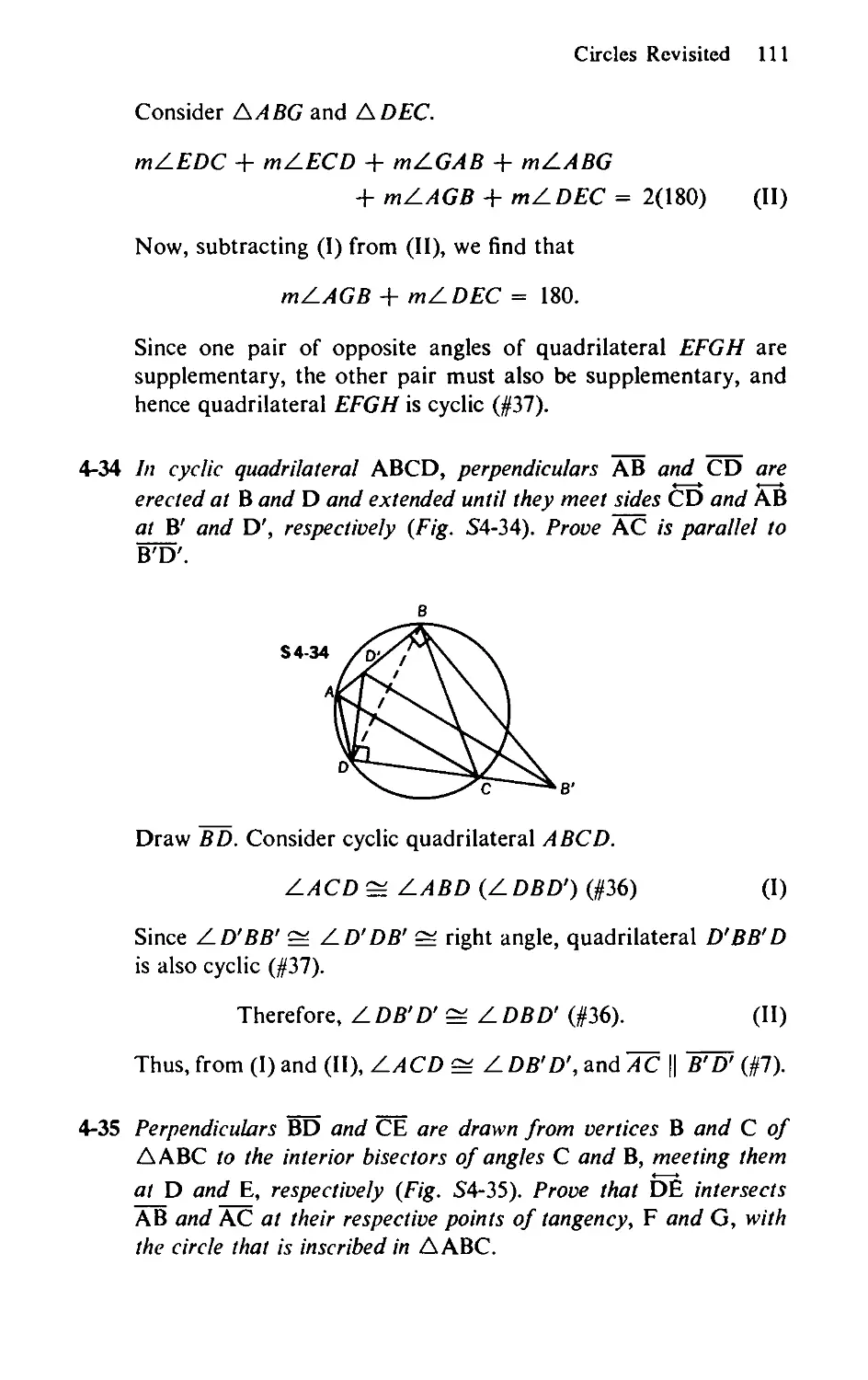


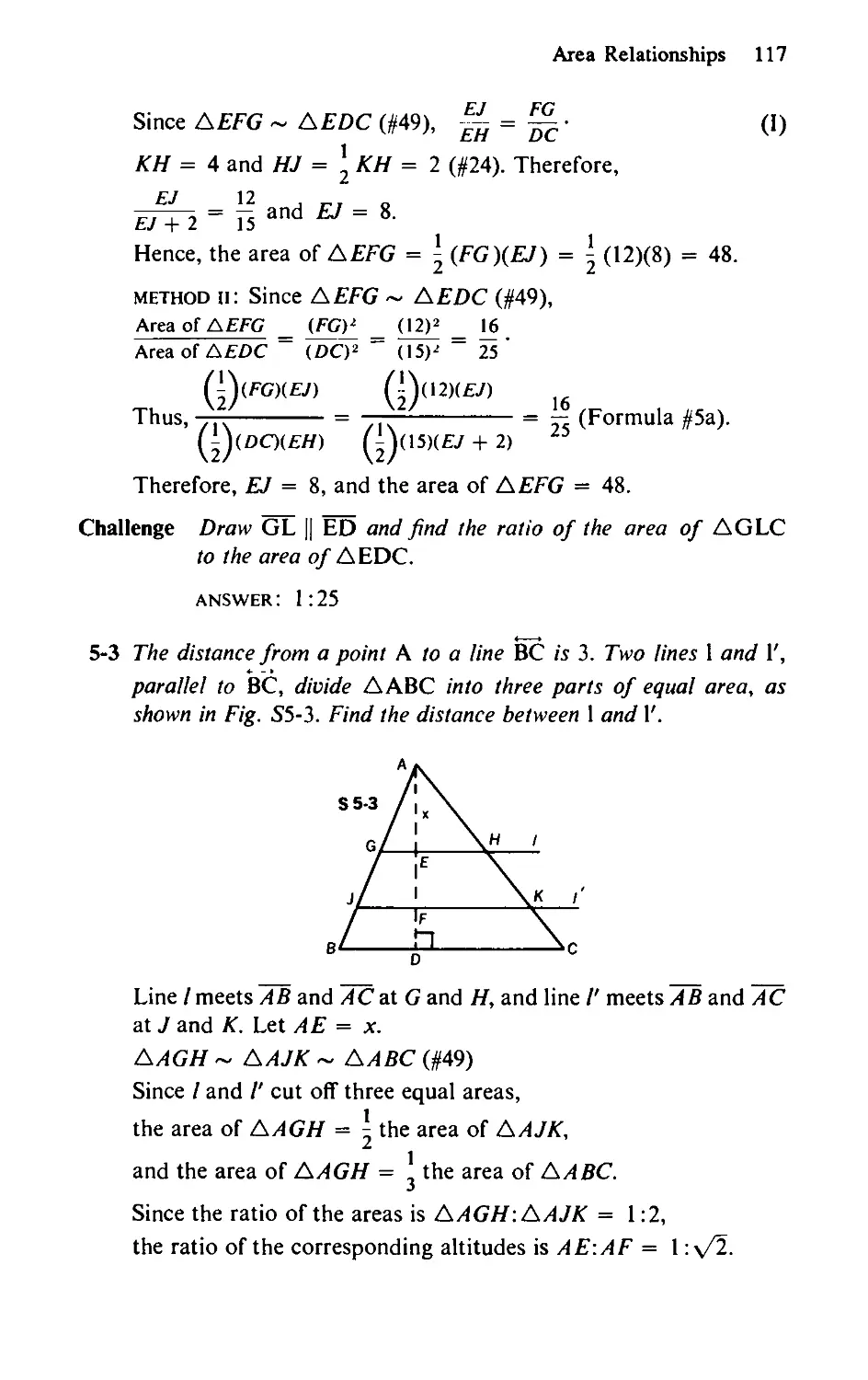
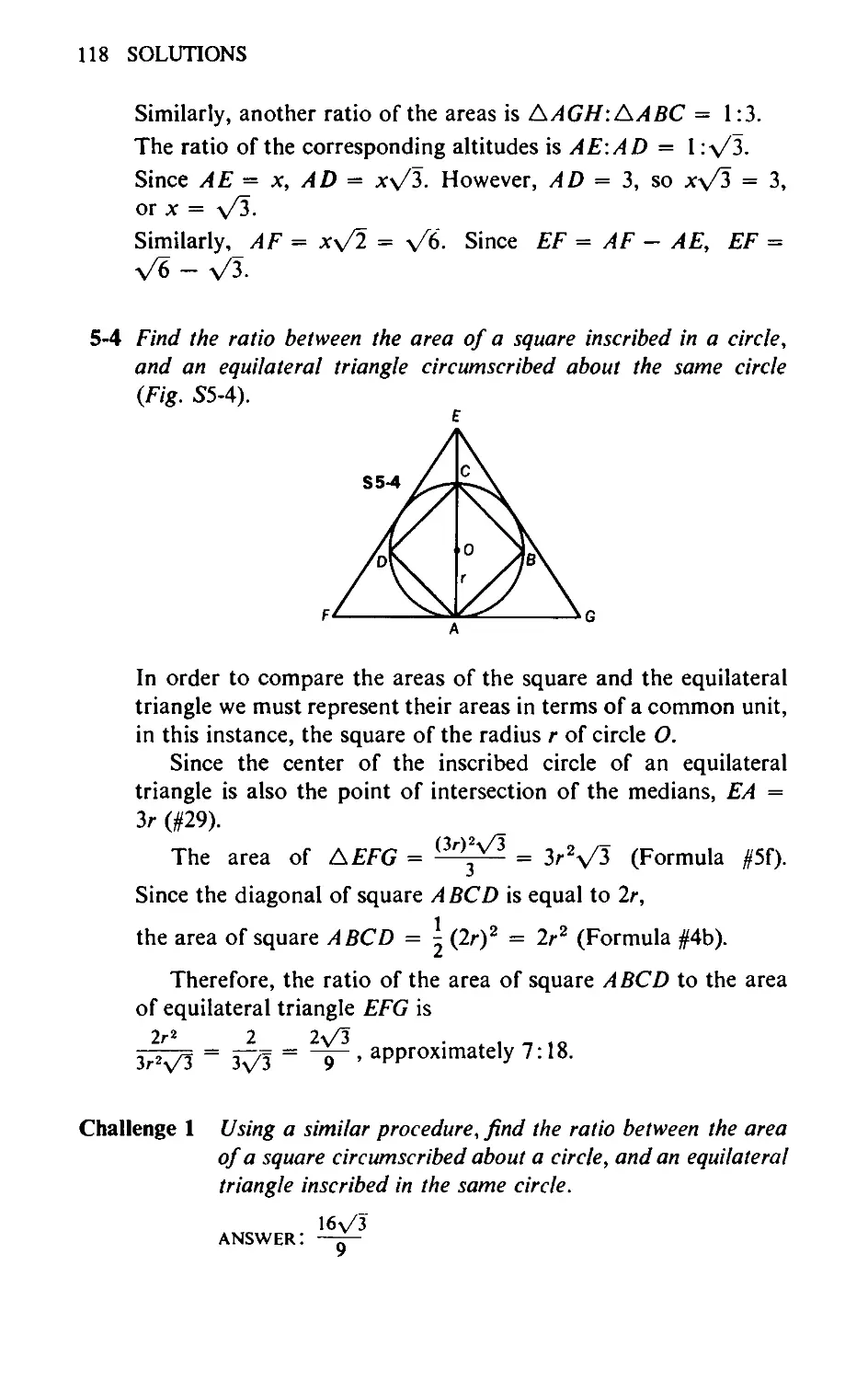
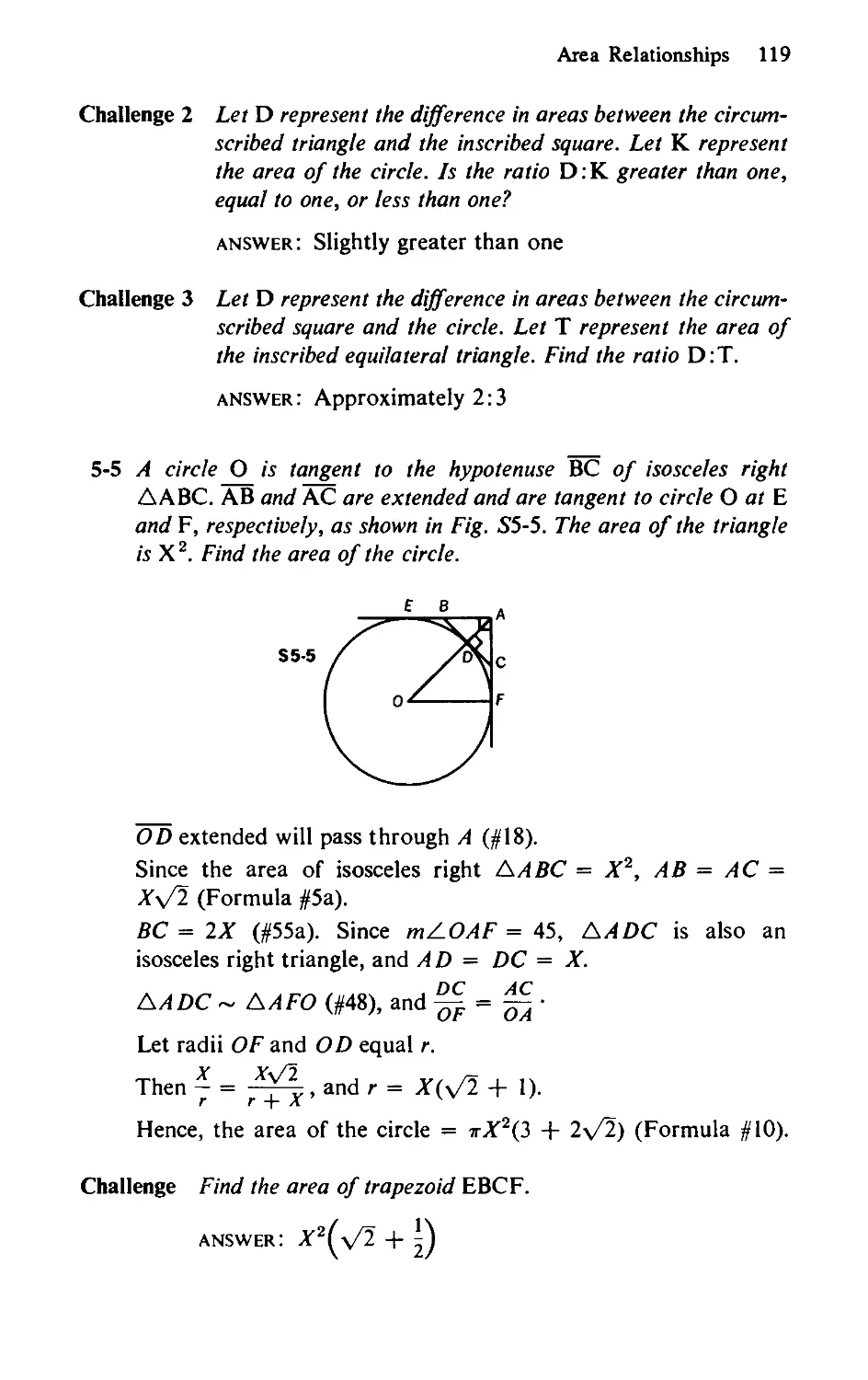

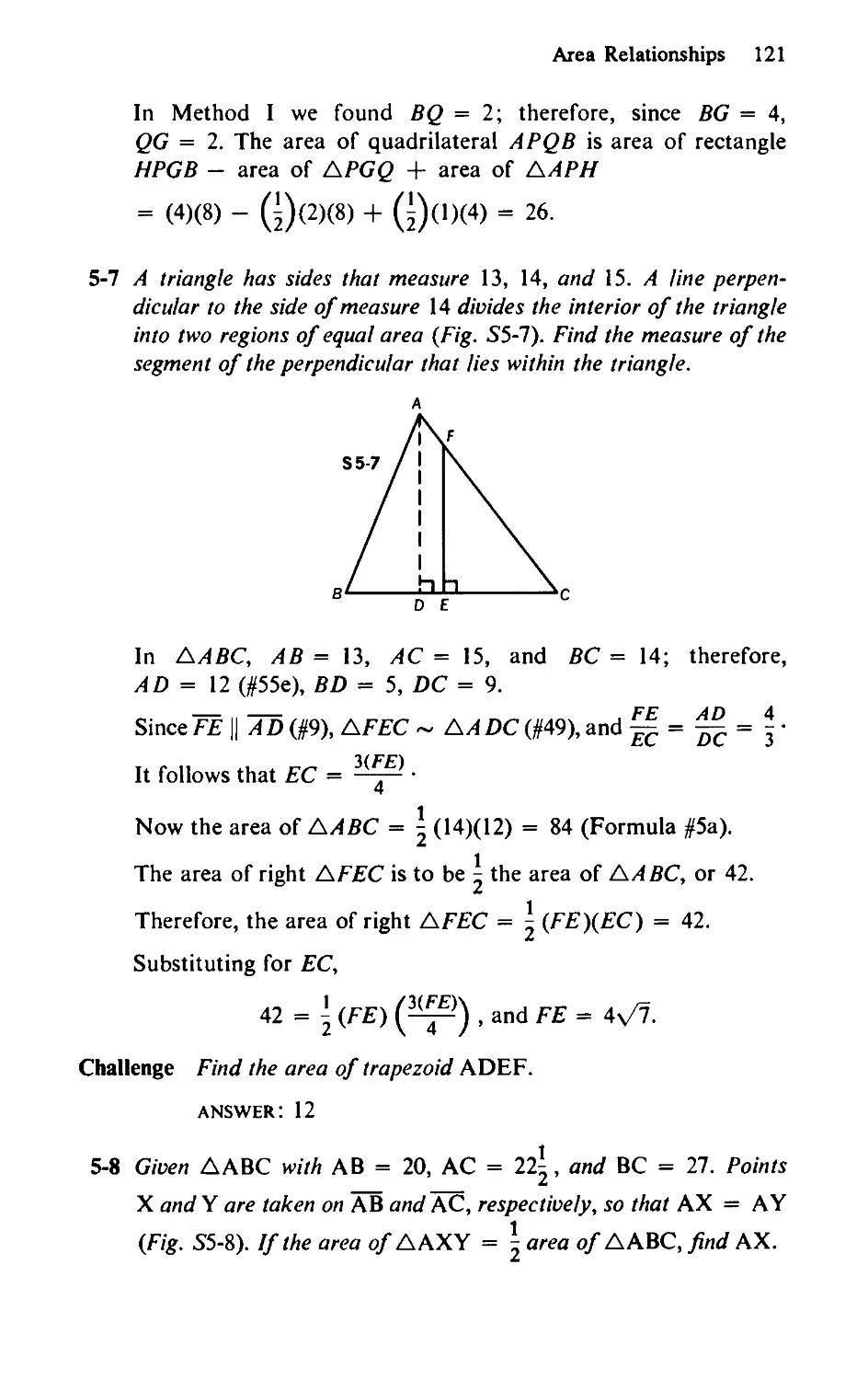































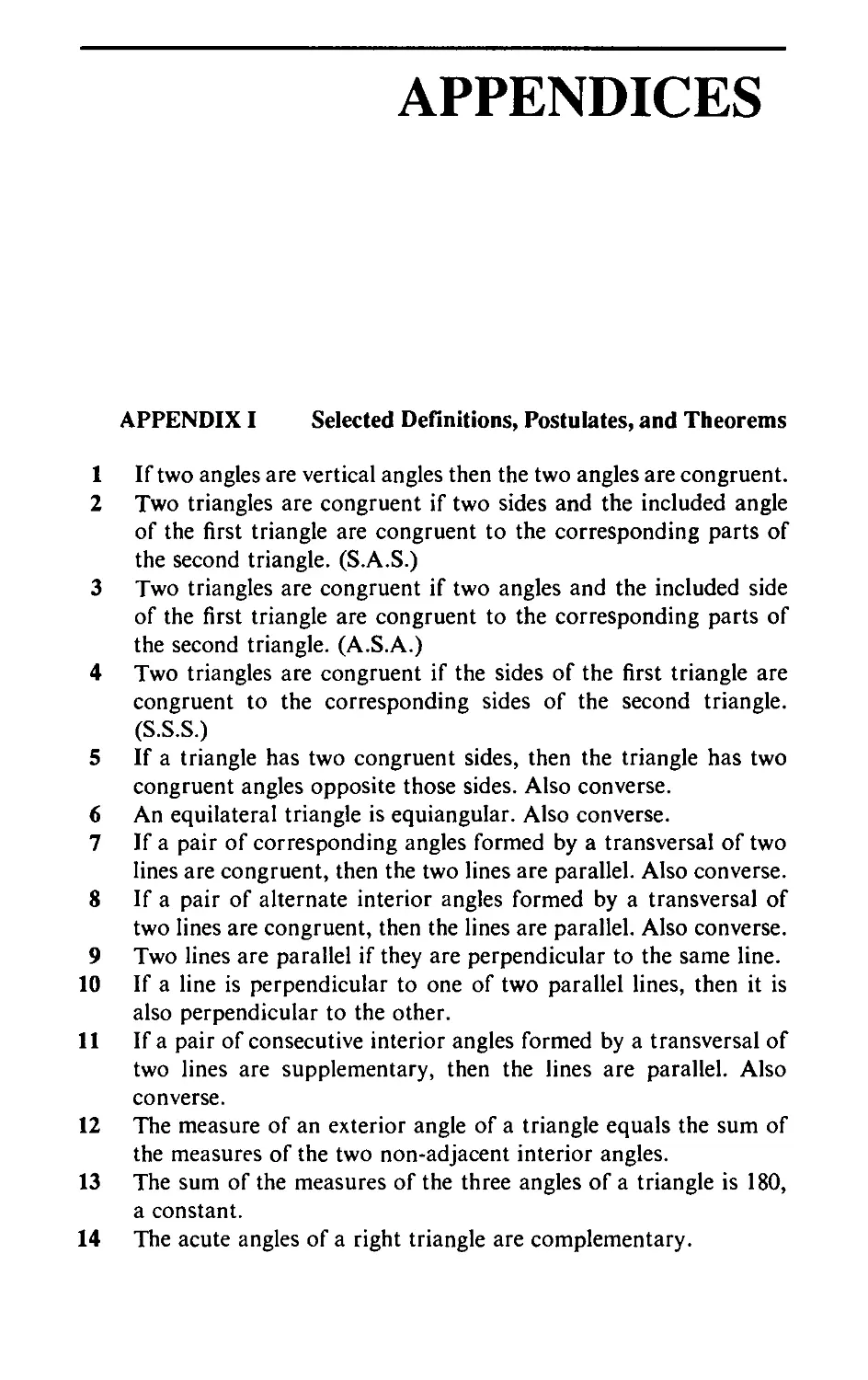
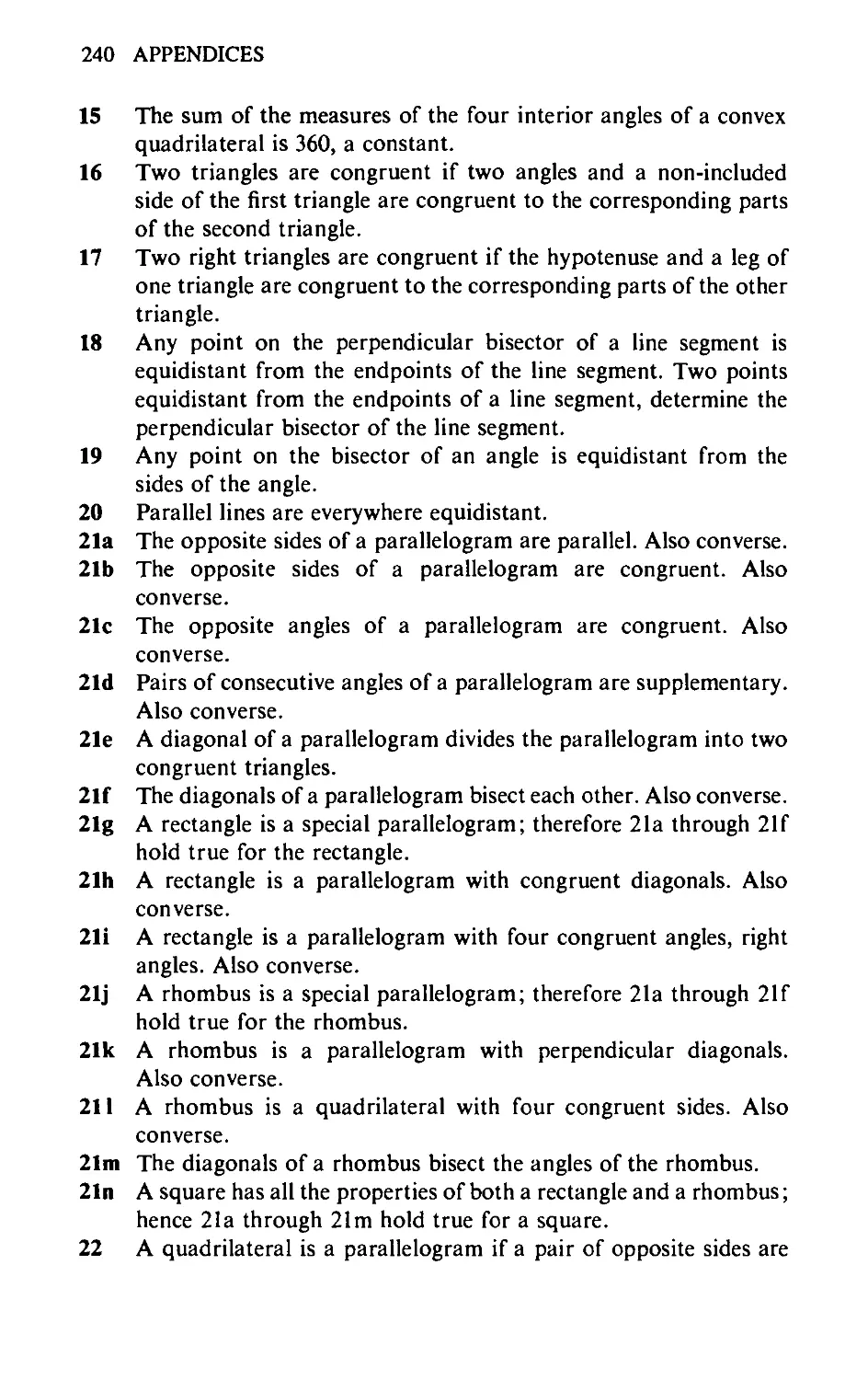
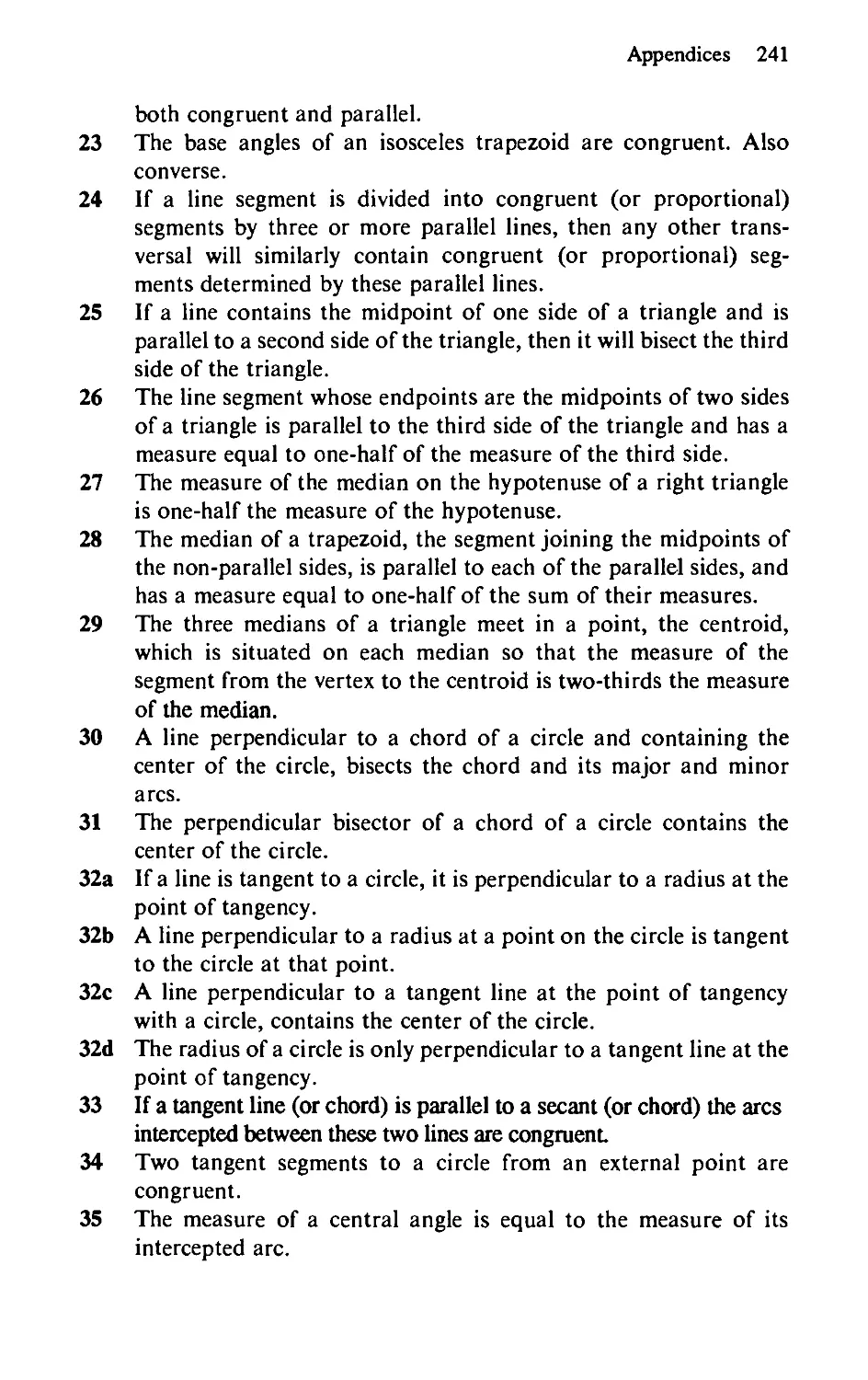
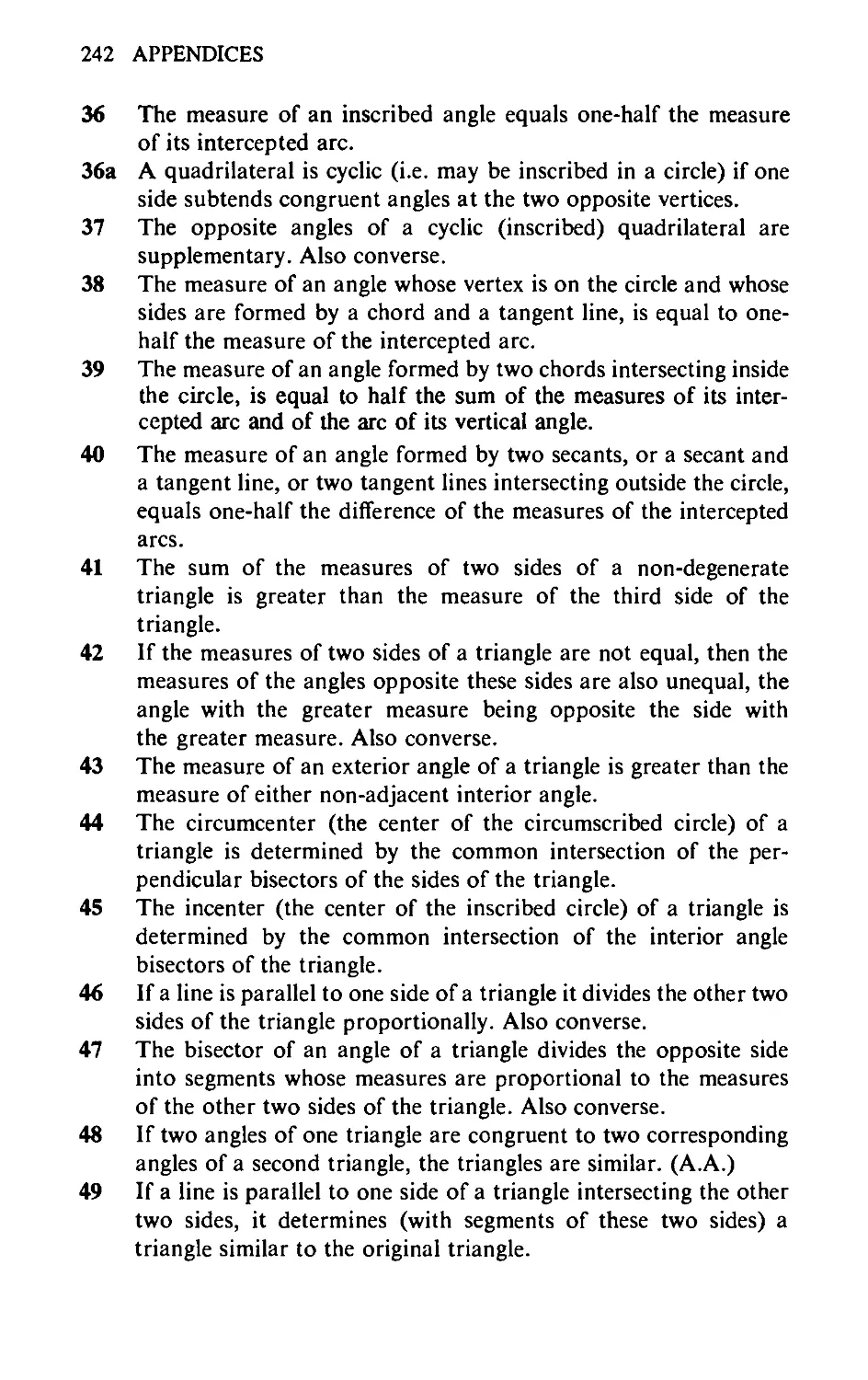
Author: Posamentier A.S. Salkind Ch.T.
Tags: mathematics geometry mathematical physics higher mathematics dover publications problems in geometry
ISBN: 0-486-69154-3
Year: 1998


Text
                    Challenging
Problems in
Geometry
Alfred S. Posamentier
Charles T. Salkind
Challenging Problems
in Geometry
ALFRED S. POSAMENTIER
Professor of Mathematics Education
The City College of the City University of New York
CHARLES T. SALKIND
Late Professor of Mathematics
Polytechnic University, New York
DOVER PUBLICATIONS, INC.
New York
Copyright
Copyright © 1970, 1988 by Alfred S. Posamentier.
All rights reserved under Pan American and International Copyright
Conventions.
Published in Canada by General Publishing Company, Ltd , 30 Lesmill Road,
Don Mills, Toronto, Ontario.
Published in the United Kingdom by Constable and Company, Ltd., 3 The
Lanchesters, 162-164 Fulham Palace Road, London W6 9ER.
Bibliographical Note
This Dover edition, first published in 1996, is an unabridged, very slightly
altered republication of the work first published in 1970 by the Macmillan Com-
pany, New York, and again in 1988 by Dale Seymour Publications, Palo Alto,
California. For the Dover edition, Professor Posamentier has made two slight
alterations in the introductory material
Library of Congress Cataloging-in-Publication Data
Posamentier, Alfred S.
Challenging problems in geometry I Alfred S Posamentier, Charles T.
Salkind
p. cm
Originally published: New York: The Macmillan Company, 1970.
ISBN 0-486-69154-3 (pbk.)
1. Geometry—Problems, exercises, etc. 1. Salkind, Charles T.,
1898- . II. Title.
QA459.P68 1996
516'.Q076—dc20	95-52535
CIP
Manufactured in the United States of America
Dover Publications, Inc , 31 East 2nd Street, Mineola, N.Y 11501
CONTENTS
Introduction iv
Preparing to Solve a Problem vii
SECTION I
A New Twist on Familiar Topics
	Problems	Solutions
1. Congruence and Parallelism	1	49
2. Triangles in Proportion	6	65
3. The Pythagorean Theorem	11	77
4. Circles Revisited	14	89
5. Area Relationships	23	116
SECTION II
Further Investigations
6. A Geometric Potpourri	29	135
7. Ptolemy and the Cyclic Quadrilateral	33	164
8. Menelaus and Ceva:
Collinearity and Concurrency	36	175
9. The Simson Line	43	202
10. The Theorem of Stewart	45	214
Hints 221
Appendix I:
Selected Definitions, Postulates, and Theorems 239
Appendix II:
Selected Formulas 244
INTRODUCTION
The challenge of well-posed problems transcends national boundaries,
ethnic origins, political systems, economic doctrines, and religious
beliefs; the appeal is almost universal. Why? You are invited to formulate
your own explanation. We simply accept the observation and exploit it
here for entertainment and enrichment.
This book is a new, combined edition of two volumes first published
in 1970. It contains nearly two hundred problems, many with extensions
or variations that we call challenges. Supplied with pencil and paper and
fortified with a diligent attitude, you can make this material the starting
point for exploring unfamiliar or little-known aspects of mathematics.
The challenges will spur you on; perhaps you can even supply your own
challenges in some cases. A study of these nonroutine problems can
provide valuable underpinnings for work in more advanced mathematics.
This book, with slight modifications made, is as appropriate now as it
was a quarter century ago when it was first published. The National Council
of Teachers of Mathematics (NCTM), in their Curriculum and Evaluation
Standards for High School Mathematics (1989), lists problem solving as its
first standard, stating that " mathematical problem solving in its broadest
sense is nearly synonymous with doing mathematics." They go on to say,
"(problem solving] is a process by which the fabric of mathematics is
identified in later standards as both constructive and reinforced."
This strong emphasis on mathematics is by no means a new agenda
item. In 1980, the NCTM published An Agenda for Action. There, the NCTM
also had problem solving as its first item, stating, "educators should give
priority to the identification and analysis of specific problem solving strate-
gies .... [and] should develop and disseminate examples of 'good problems'
and strategies." It is our intention to provide secondary mathematics
educators with materials to help them implement this very important
recommendation.
ABOUT THE BOOK
Challenging Problems in Geometry is organized into three main parts:
"Problems," "Solutions," and "Hints." Unlike many contemporary
problem-solving resources, this book is arranged not by problem-solving
technique, but by topic. We feel that announcing the technique to be used
stifles creativity and destroys a good part of the fun of problem solving.
The problems themselves are grouped into two sections. Section I,
"A New Twist on Familiar Topics," covers five topics that roughly
parallel the sequence of the high school geometry course. Section II,
"Further Investigations," presents topics not generally covered in the high
school geometry course, but certainly within the scope of that audience.
These topics lead to some very interesting extensions and enable the reader
to investigate numerous fascinating geometric relationships.
Within each topic, the problems are arranged in approximate order of
difficulty. For some problems, the basic difficulty may lie in making the
distinction between relevant and irrelevant data or between known and
unknown information. The sure ability to make these distinctions is part
of the process of problem solving, and each devotee must develop this
power by him- or herself. It will come with sustained effort.
In the "Solutions" part of the book, each problem is restated and then
its solution is given. Answers are also provided for many but not all of
the challenges. In the solutions (and later in the hints), you will notice
citations such as ”(#23)" and "(Formula #5b)." These refer to the
definitions, postulates, and theorems listed in Appendix I, and the
formulas given in Appendix II.
From time to time we give alternate methods of solution, for there is
rarely only one way to solve a problem. The solutions shown are far from
exhaustive, and intentionally so, allowing you to try a variety of different
approaches. Particularly enlightening is the strategy of using multiple
methods, integrating algebra, geometry, and trigonometry. Instances of
multiple methods or multiple interpretations appear in the solutions. Our
continuing challenge to you, the reader, is to find a different method of
solution for every problem.
The third part of the book, "Hints," offers suggestions for each
problem and for selected challenges. Without giving away the solution,
these hints can help you get back on the track if you run into difficulty.
USING THE BOOK
This book may be used in a variety of ways. It is a valuable supplement
to the basic geometry textbook, both for further explorations on specific
topics and for practice in developing problem-solving techniques. The
book also has a natural place in preparing individuals or student teams for
participation in mathematics contests. Mathematics clubs might use this
book as a source of independent projects or activities. Whatever the use,
experience has shown that these problems motivate people of all ages to
pursue more vigorously the study of mathematics.
Very near the completion of the first phase of this project, the
passing of Professor Charles T. Salkind grieved the many who knew and
respected him. He dedicated much of his life to the study of problem
posing and problem solving and to projects aimed at making problem
vi
solving meaningful, interesting, and instructive to mathematics students
at all levels. His efforts were praised by all. Working closely with this
truly great man was a fascinating and pleasurable experience.
Alfred S. Posamentier
1996
PREPARING TO
SOLVE A PROBLEM
A strategy for attacking a problem is frequently dictated by the use of
analogy. In fact, searching for an analogue appears to be a psychological
necessity. However, some analogues are more apparent than real, so
analogies should be scrutinized with care. Allied to analogy is structural
similarity or pattern. Identifying a pattern in apparently unrelated
problems is not a common achievement, but when done successfully it
brings immense satisfaction.
Failure to solve a problem is sometimes the result of fixed habits of
thought, that is, inflexible approaches. When familiar approaches prove
fruitless, be prepared to alter the line of attack. A flexible attitude may
help you to avoid needless frustration.
Here are three ways to make a problem yield dividends:
(1)	The result of formal manipulation, that is, "the answer," may or may
not be meaningful; find out! Investigate the possibility that the
answer is not unique. If more than one answer is obtained, decide on
the acceptability of each alternative. Where appropriate, estimate the
answer in advance of the solution. The habit of estimating in advance
should help to prevent crude errors in manipulation.
(2)	Check possible restrictions on the data and/or the results. Vary the
data in significant ways and study the effect of such variations on the
original result.
(3)	The insight needed to solve a generalized problem is sometimes
gained by first specializing it. Conversely, a specialized problem,
difficult when tackled directly, sometimes yields to an easy solution
by first generalizing it.
As is often true, there may be more than one way to solve a problem.
There is usually what we will refer to as the "peasant's way" in contrast to
the "poet's way"—the latter being the more elegant method.
To better understand this distinction, let us consider the following
problem:
If the sum of two numbers is 2, and the product of these
same two numbers is 3, find the sum of the reciprocals
of these two numbers.
viii
Those attempting to solve the following pair of equations simultane-
ously are embarking on the "peasant's way" to solve this problem.
x + у = 2
xy = 3
Substituting for у in the second equation yields the quadratic equation,
x2 - 2x +3 = 0. Using the quadratic formula we can find x = 1 ± i ^2.
2
By adding the reciprocals of these two values of x, the answer jappears.
This is clearly a rather laborious procedure, not particularly elegant.
The "poet's way" involves working backwards. By considering the
desired result
and seeking an expression from which this sum may be derived, one
should inspect the algebraic sum:
x + у
xy
The answer to the original problem is now obvious! That is, since
x + у 2
x + у = 2 and xy = 3,------------*-= j. This is clearly a more elegant
solution than the first one.
The "poet's way" solution to this problem points out a very useful
and all too often neglected method of solution. A reverse strategy is
certainly not new. It was considered by Pappus of Alexandria about 320
A.D. In Book VII of Pappus' Collection there is a rather complete
description of the methods of "analysis" and "synthesis." T. L. Heath, in
his book A Manual of Greek Mathematics (Oxford University Press,
1931, pp. 452-53), provides a translation of Pappus' definitions of these
terms:
Analysis takes that which is sought as if it were
admitted and passes from it through its successive
consequences to something which is admitted as the
result of synthesis: for in analysis we assume that
which is sought as if it were already done, and we
inquire what it is from which this results, and again
what is the antecedent cause of the latter, and so on,
until, by so retracing our steps, we come upon
something already known or belonging to the class of
first principles, and such a method we call analysis as
being solution backward.
ix
But in synthesis, reversing the progress, we take as
already done that which was last arrived at in the
analysis and, by arranging in their natural order as
consequences what before were antecedents, and
successively connecting them one with another, we
arrive finally at the construction of that which was
sought: and this we call synthesis.
Unfortunately, this method has not received its due emphasis in the
mathematics classroom. We hope that the strategy recalled here will serve
you well in solving some of the problems presented in this book.
Naturally, there are numerous other clever problem-solving strategies
to pick from. In recent years a plethora of books describing various
problem-solving methods have become available. A concise description of
these problem-solving strategies can be found in Teaching Secondary
School Mathematics: Techniques and Enrichment Units, by A. S.
Posamentier and J. Stepelman, 4th edition (Columbus, Ohio: Prentice
Hall/Merrill, 1995).
Our aim in this book is to strengthen the reader's problem-solving
skills through nonroutine motivational examples. We therefore allow the
reader the fun of finding the best path to a problem's solution, an
achievement generating the most pleasure in mathematics.

PROBLEMS
SECTION I
A New Twist on Familiar Topics
1. Congruence and Parallelism
The problems in this section present applications of several topics
that are encountered early in the formal development of plane Euclidean
geometry. The major topics are congruence of line segments, angles,
and triangles and parallelism in triangles and various types of quadri-
laterals.
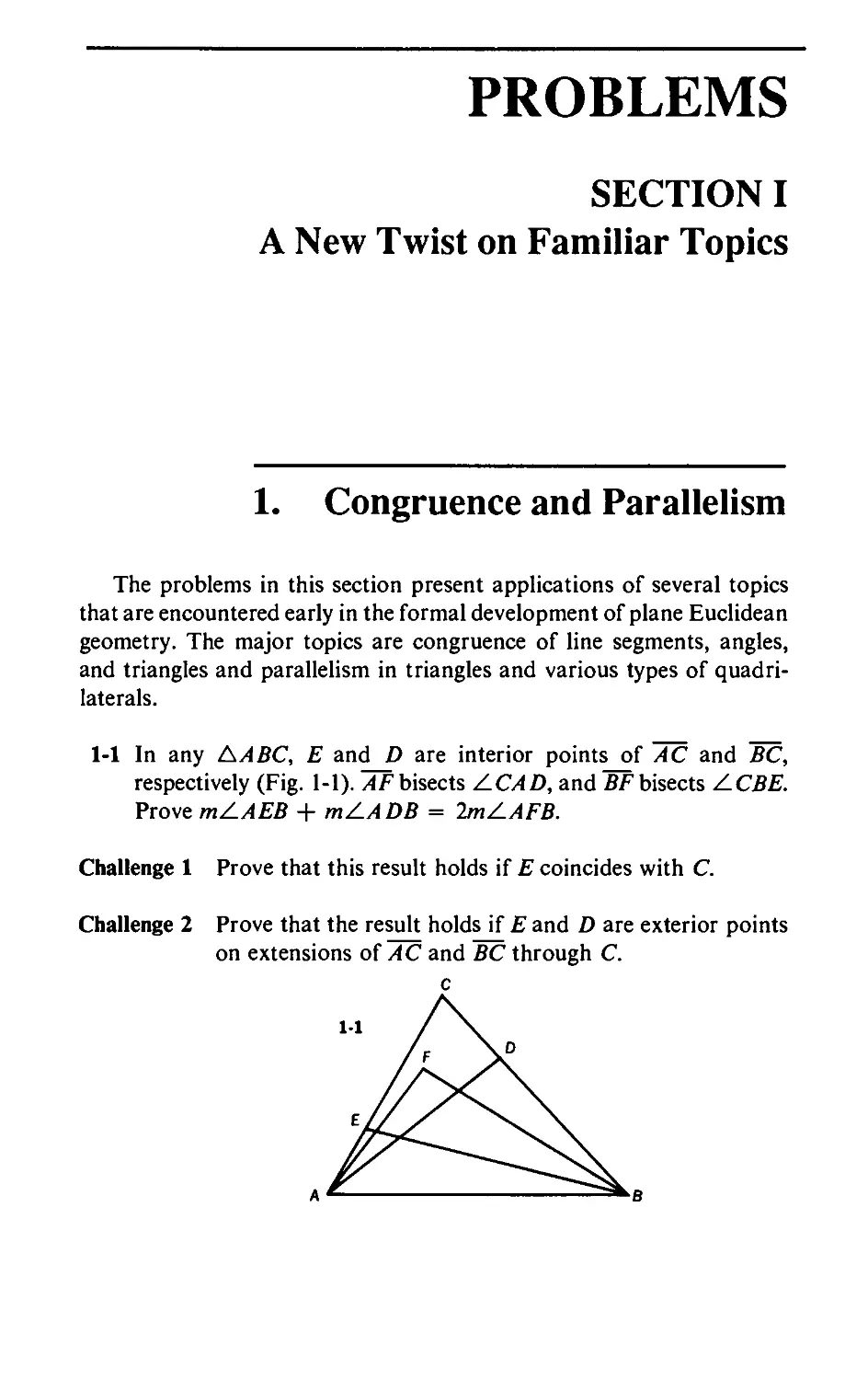
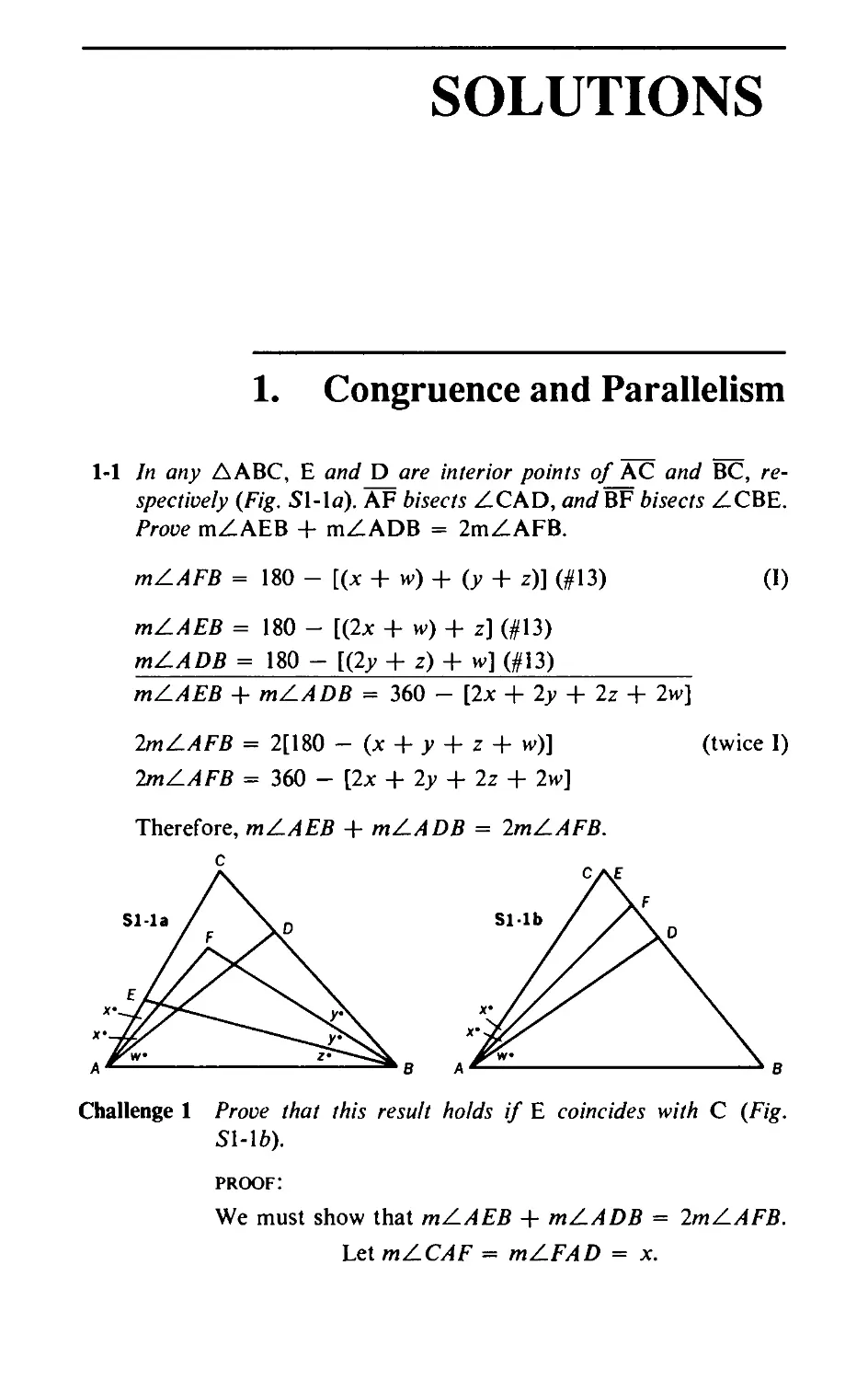
1-1 In any ЛАВС, E and D are interior points of AC and BC,
respectively (Fig. 1-1). AFbisects Z.CAD, and BFbisects Z-CBE.
Prove mZAEB + mZADB = 2mZAFB.
Challenge 1 Prove that this result holds if E coincides with C.
Challenge 2 Prove that the result holds if E and D are exterior points
on extensions of AC and BC through C.
c
2 PROBLEMS
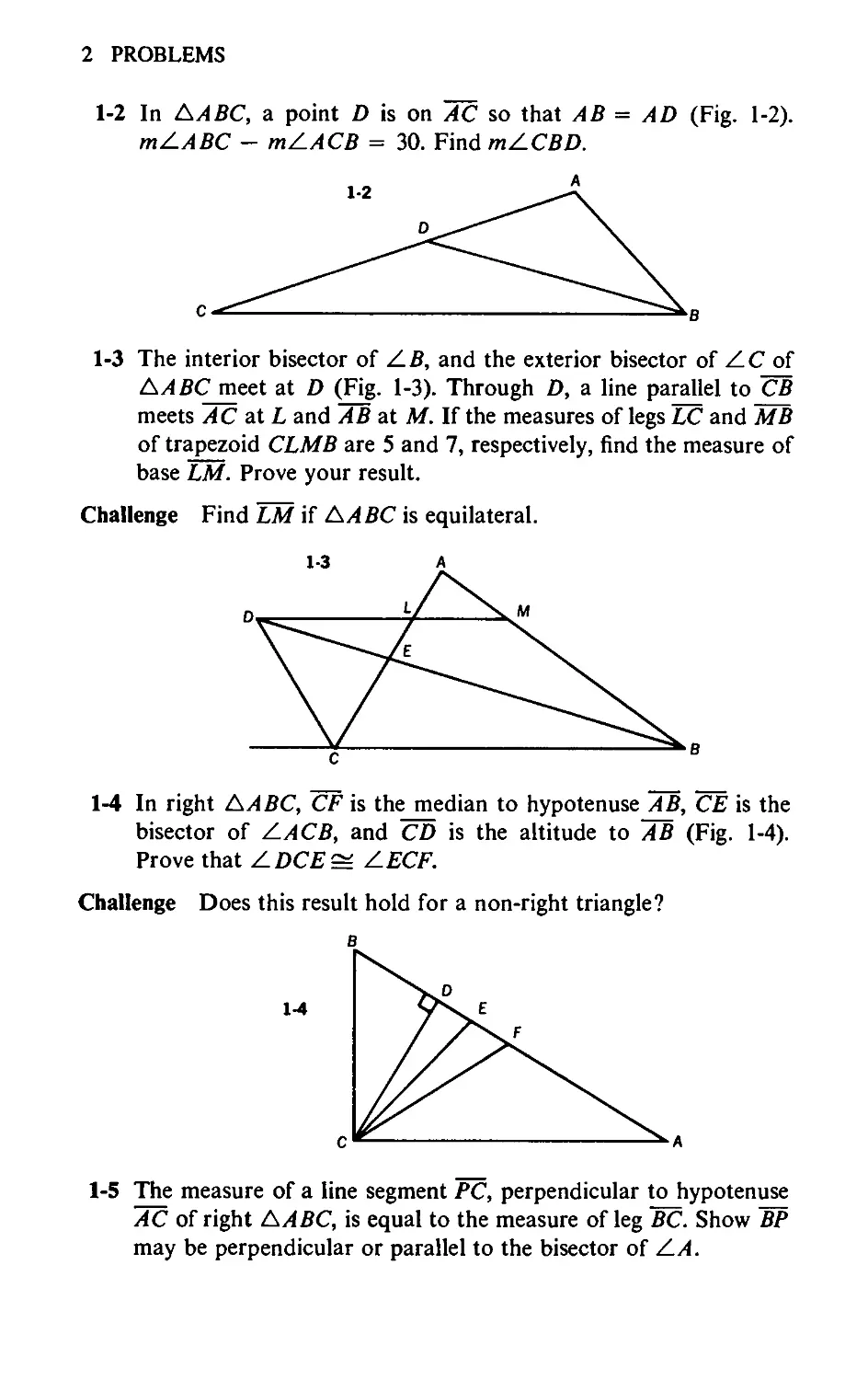
1-2 In ДЛВС, a point D is on AC so that AB = AD (Fig. 1-2).
mZ-ABC — mZ-ACB = 30. Find mZ_CBD.
1-3 The interior bisector of ZB, and the exterior bisector of ZC of
ДЛДС meet at D (Fig. 1-3). Through D, a line parallel to CB
meets AC at L and AB at M. If the measures of legs LC and MB
of trapezoid CLMB are 5 and 7, respectively, find the measure of
base LM. Prove your result.
Challenge Find LM if ДАВС is equilateral.
1-4 In right Li ABC, CF is the median to hypotenuse AB, CE is the
bisector of Z.ACB, and CD is the altitude to AB (Fig. 1-4).
Prove that L_DCE = Z-ECF.
Challenge Does this result hold for a non-right triangle?
1-5 The measure of a line segment PC, perpendicular to hypotenuse
AC of right LiABC, is equal to the measure of leg BC. Show BP
may be perpendicular or parallel to the bisector of Z.A.
Congruence and Parallelism 3
1-6 Prove the following: if, in ДЛВС, median AM is such that
mZBAC is divided in the ratio 1:2, and AM is extended through
M to D so that Z.DBA is a right angle, then AC = AD
(Fig. 1-6).
Challenge Find two ways of proving the theorem when mZA = 90.
1-7 In square ABCD, M is the midpoint of AB. A line perpendicular
to MC at M meets AD at K. Prove that Z_BCM = Z_KCM.
Challenge Prove that AKDC is a 3-4-5 right triangle.
1-8 Given any ДЛВС, AE bisects Z_BAC, BD bisects Z_ABC,
CP ± BD, and CQ ± ~АЁ (Fig. 1-8), prove that PQ is parallel to
AB.
Challenge Identify the points P and Q when ДЛВС is equilateral.
1-9 Given that ABCD is a square, CF bisects ZACD, and BPQ is
perpendicular to CF (Fig. 1-9), prove DQ = 2PE.
1-10 Given square ABCD with mZEDC = mZECD = 15, prove
&ABE is equilateral (Fig. 1-10).
4 PROBLEMS
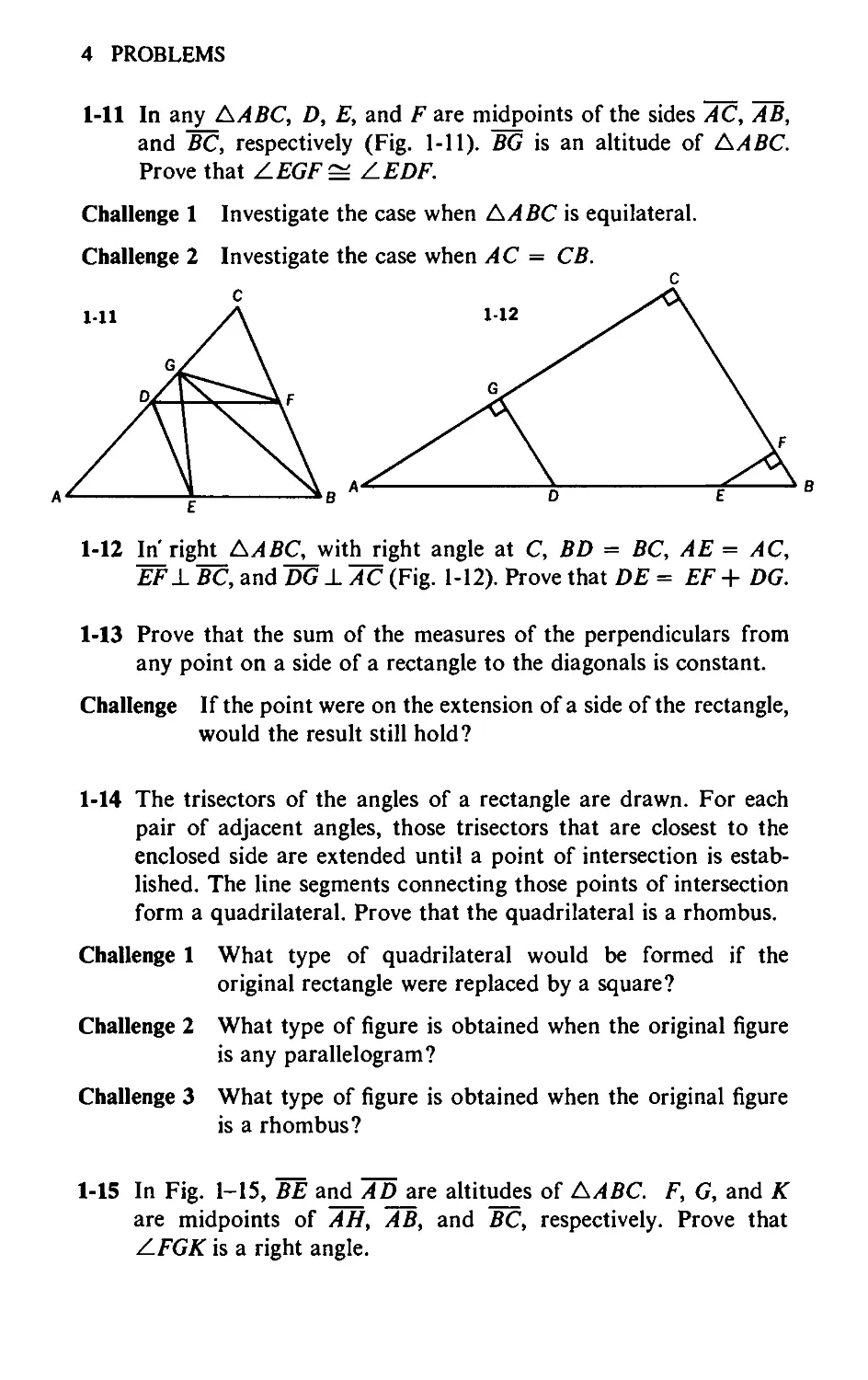
1-11 In any ЛАВС, D, E, and F are midpoints of the sides AC, AB,
and BC, respectively (Fig. 1-11). BG is an altitude of &ABC.
Prove that Z_EGF = /LEDF.
Challenge 1 Investigate the case when ДЛВС is equilateral.
Challenge 2 Investigate the case when AC = CB.
1-12 In'right ЛАВС, with right angle at C, BD = ВС, AE = AC,
EF± BC, and DG ±AC (Fig. 1-12). Prove that DE = EF + DG.
1-13 Prove that the sum of the measures of the perpendiculars from
any point on a side of a rectangle to the diagonals is constant.
Challenge If the point were on the extension of a side of the rectangle,
would the result still hold?
1-14 The trisectors of the angles of a rectangle are drawn. For each
pair of adjacent angles, those trisectors that are closest to the
enclosed side are extended until a point of intersection is estab-
lished. The line segments connecting those points of intersection
form a quadrilateral. Prove that the quadrilateral is a rhombus.
Challenge 1 What type of quadrilateral would be formed if the
original rectangle were replaced by a square?
Challenge 2 What type of figure is obtained when the original figure
is any parallelogram?
Challenge 3 What type of figure is obtained when the original figure
is a rhombus?
1-15 In Fig. 1-15, BE and AD are altitudes of ДЯВС. F, G, and К
are midpoints of AH, AB, and BC, respectively. Prove that
Z-FGK is a right angle.
Congruence and Parallelism 5
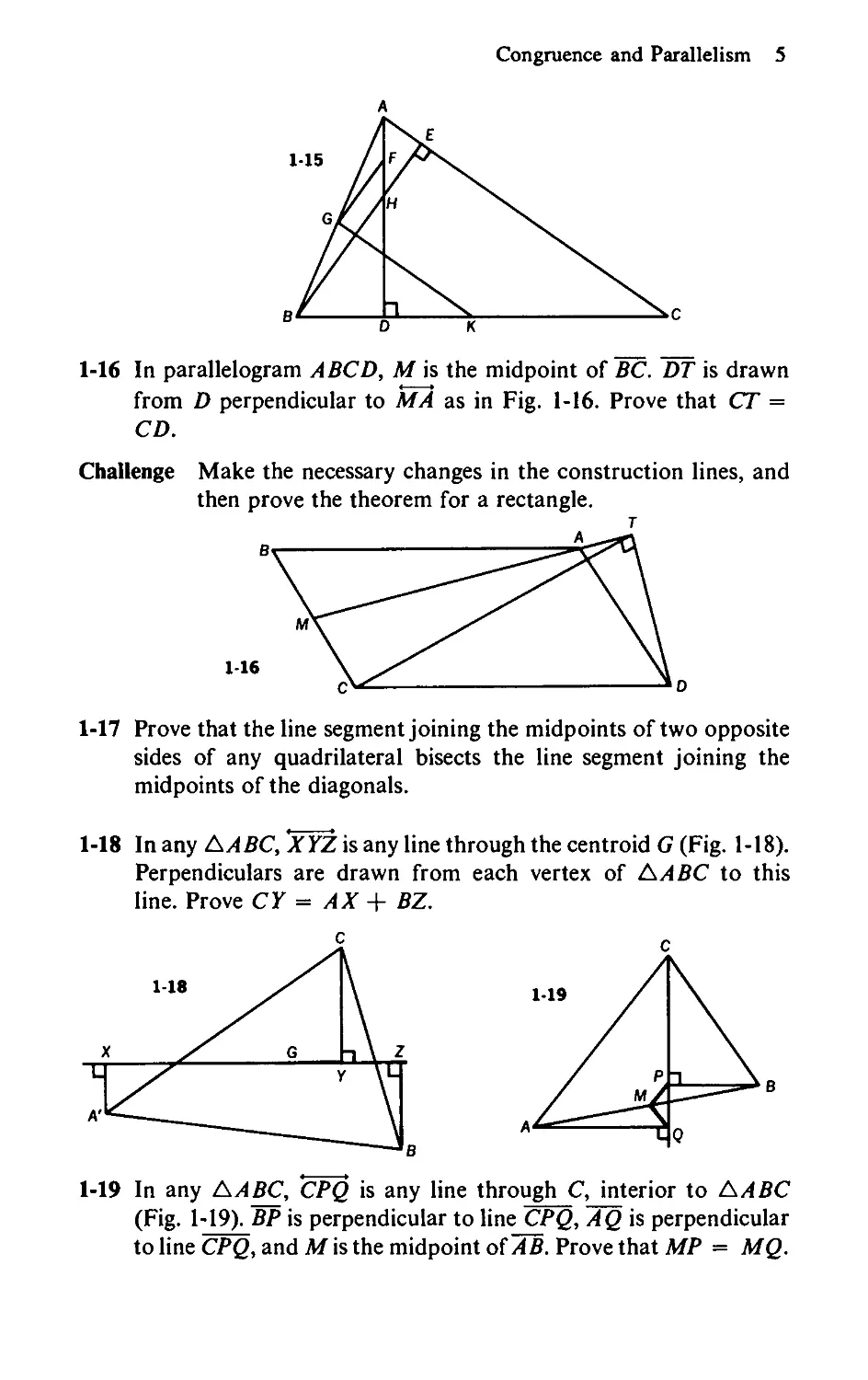
1-16 In parallelogram A BCD, M is the midpoint of BC. DT is drawn
from D perpendicular to MA as in Fig. 1-16. Prove that CT =
CD.
Challenge Make the necessary changes in the construction lines, and
then prove the theorem for a rectangle.
1-17 Prove that the line segment joining the midpoints of two opposite
sides of any quadrilateral bisects the line segment joining the
midpoints of the diagonals.
1-18 In any ДЛВС, XYZ is any line through the centroid G (Fig. 1-18).
Perpendiculars are drawn from each vertex of А ЛВС to this
line. Prove CY = AX + BZ.
1-19 In any ДАВС, CPQ is any line through C, interior to ДАВС
(Fig. 1-19). BP is perpendicular to line CPQ, AQ is perpendicular
to line CPQ, and M is the midpoint of AB. Prove that MP = MQ.
6 PROBLEMS
Challenge Show that the same result holds if the line through C is
exterior to A ABC.
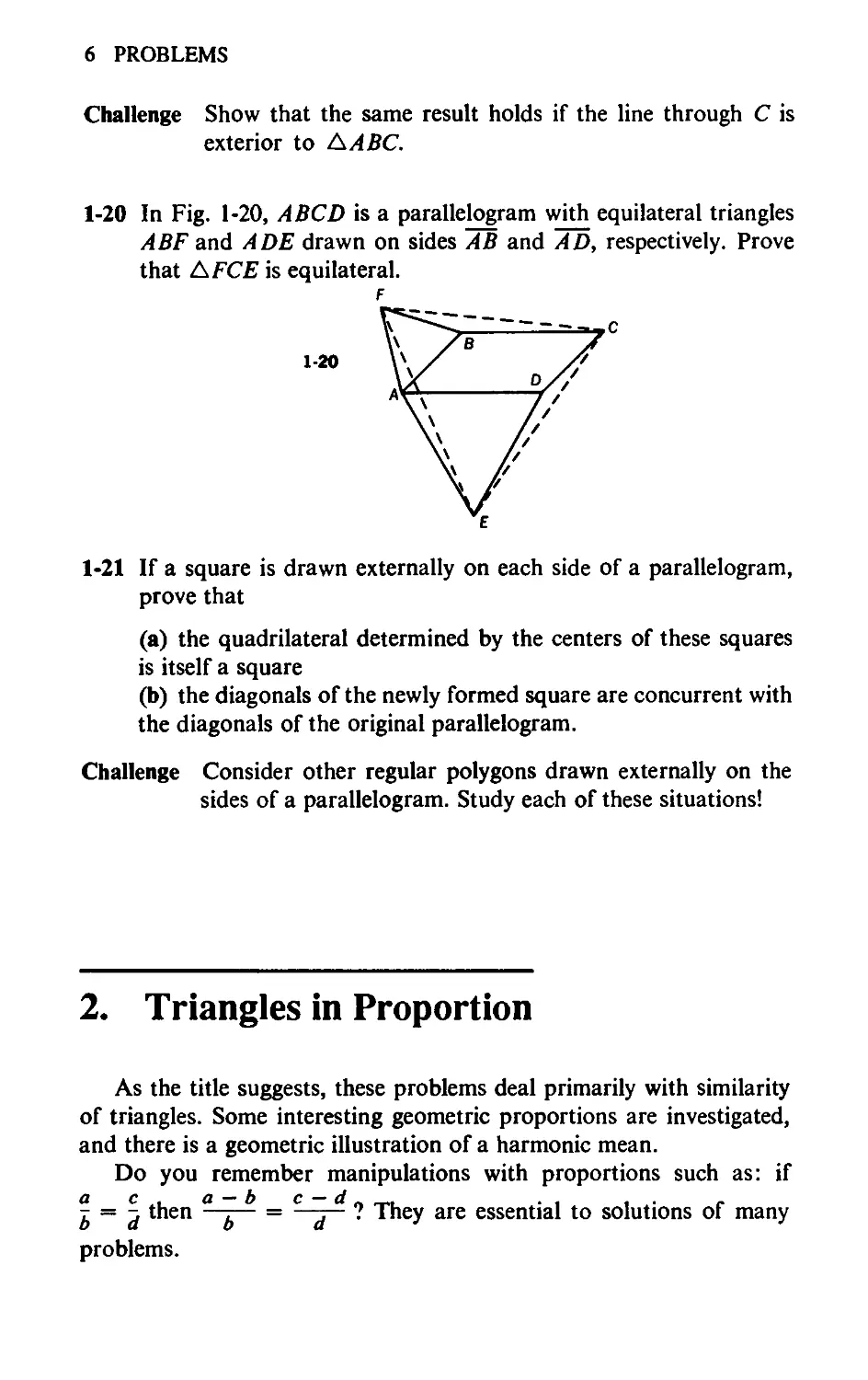
1-20 In Fig. 1-20, ABCD is a parallelogram with equilateral triangles
ABF and ADE drawn on sides AB and AD, respectively. Prove
that £\FCE is equilateral.
1-21 If a square is drawn externally on each side of a parallelogram,
prove that
(a)	the quadrilateral determined by the centers of these squares
is itself a square
(b)	the diagonals of the newly formed square are concurrent with
the diagonals of the original parallelogram.
Challenge Consider other regular polygons drawn externally on the
sides of a parallelogram. Study each of these situations!
2.	Triangles in Proportion
As the title suggests, these problems deal primarily with similarity
of triangles. Some interesting geometric proportions are investigated,
and there is a geometric illustration of a harmonic mean.
Do you remember manipulations with proportions such as: if
г = then t-~ = C j— 2 They are essential to solutions of many
b a	b	a	J	J
problems.
Triangles in Proportion 7
2-1 In ДЛВС, DE || BC, FE || DC, AF = 4, and FD = 6 (Fig. 2-1).
Find DB.
Challenge 1 Find DB if AF = and FD = m2.
Challenge 2 FG\\DE, and HG || FE. Find DB if AH = 2 and
HF = 4.
Challenge 3 Find DB if AH = mi and HF = m2.
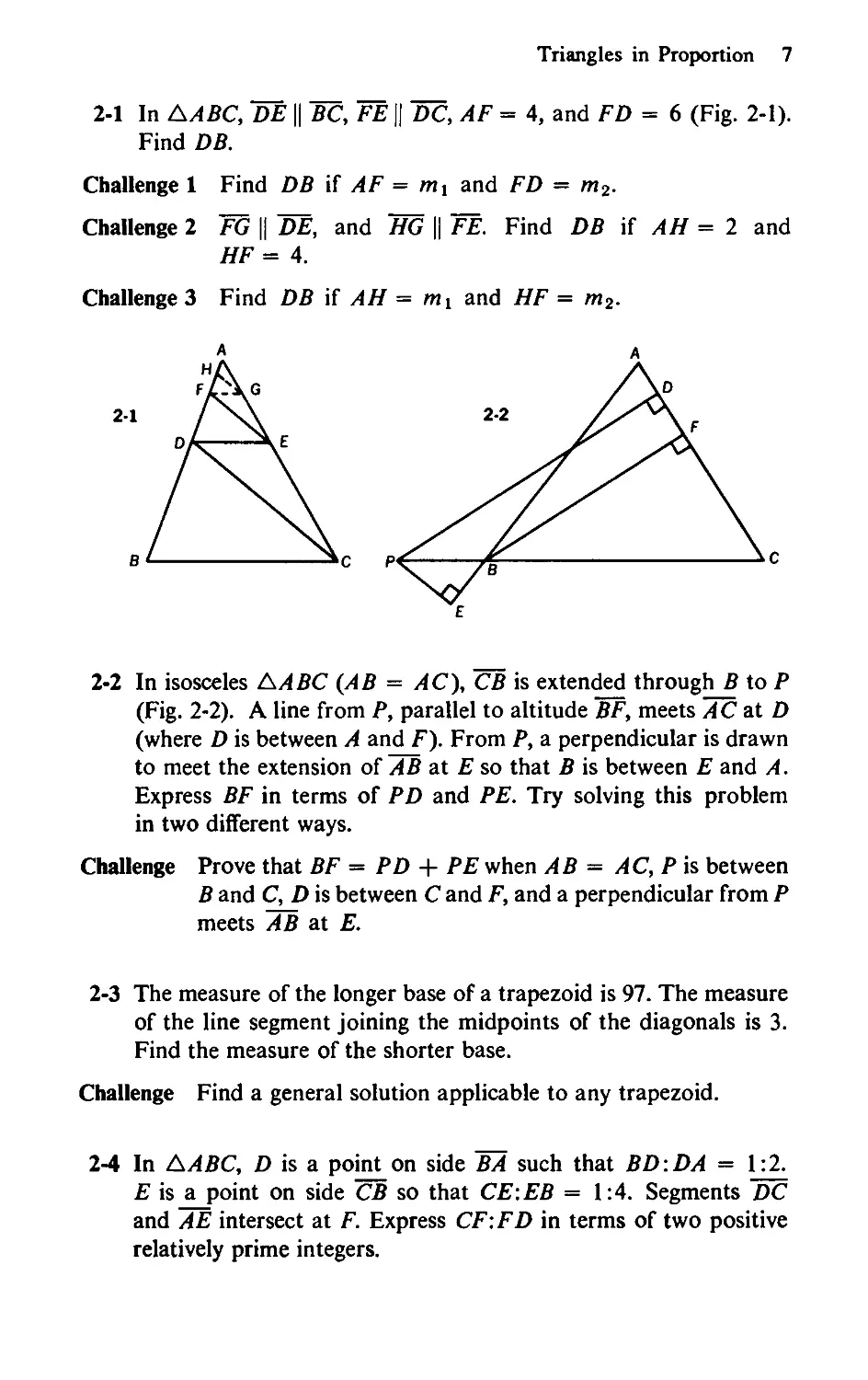
2-2 In isosceles ДЛВС (AB = AC), CB is extended through В to P
(Fig. 2-2). A line from P, parallel to altitude BF, meets AC at D
(where D is between A and F). From P, a perpendicular is drawn
to meet the extension of AB at E so that В is between E and A.
Express BF in terms of PD and PE. Try solving this problem
in two different ways.
Challenge Prove that BF = PD + PE when AB = AC, P is between
В and C, D is between C and F, and a perpendicular from P
meets AB at E.
2-3 The measure of the longer base of a trapezoid is 97. The measure
of the line segment joining the midpoints of the diagonals is 3.
Find the measure of the shorter base.
Challenge Find a general solution applicable to any trapezoid.
2-4 In ДЛВС, D is a point on side BA such that BD:DA = 1:2.
E is a point on side CB so that CE-.EB = 1:4. Segments DC
and AE intersect at F. Express CF:FD in terms of two positive
relatively prime integers.
8 PROBLEMS
Challenge Show that if BD.DA = mtn and CEtEB = rts, then
2-5 In ДЛВС, BE is a median and О is the midpoint of BE. Draw
AO and extend it to meet BC at D. Draw CO and extend it to
meet BA at F. If CO = 15, OF = 5, and AO = 12, find the
measure of OD.
Challenge Can you establish a relationship between OD and AO?
2-6 In parallelogram A BCD, points E and F are chosen on diagonal
AC so that AE = FC. If BE is extended to meet AD at H, and
BF is extended to meet DC at G, prove that HG is parallel to AC.
Challenge Prove the theorem if E and F are on A C, exterior to the
parallelogram.
2-7 AM is the median to side BC of ДЛВС, and P is any point on
AM. BP extended meets AC at E, and CP extended meets AB at
D. Prove that DE is parallel to BC.
Challenge Show that the result holds if P is on AM, exterior to
ЛАВС.
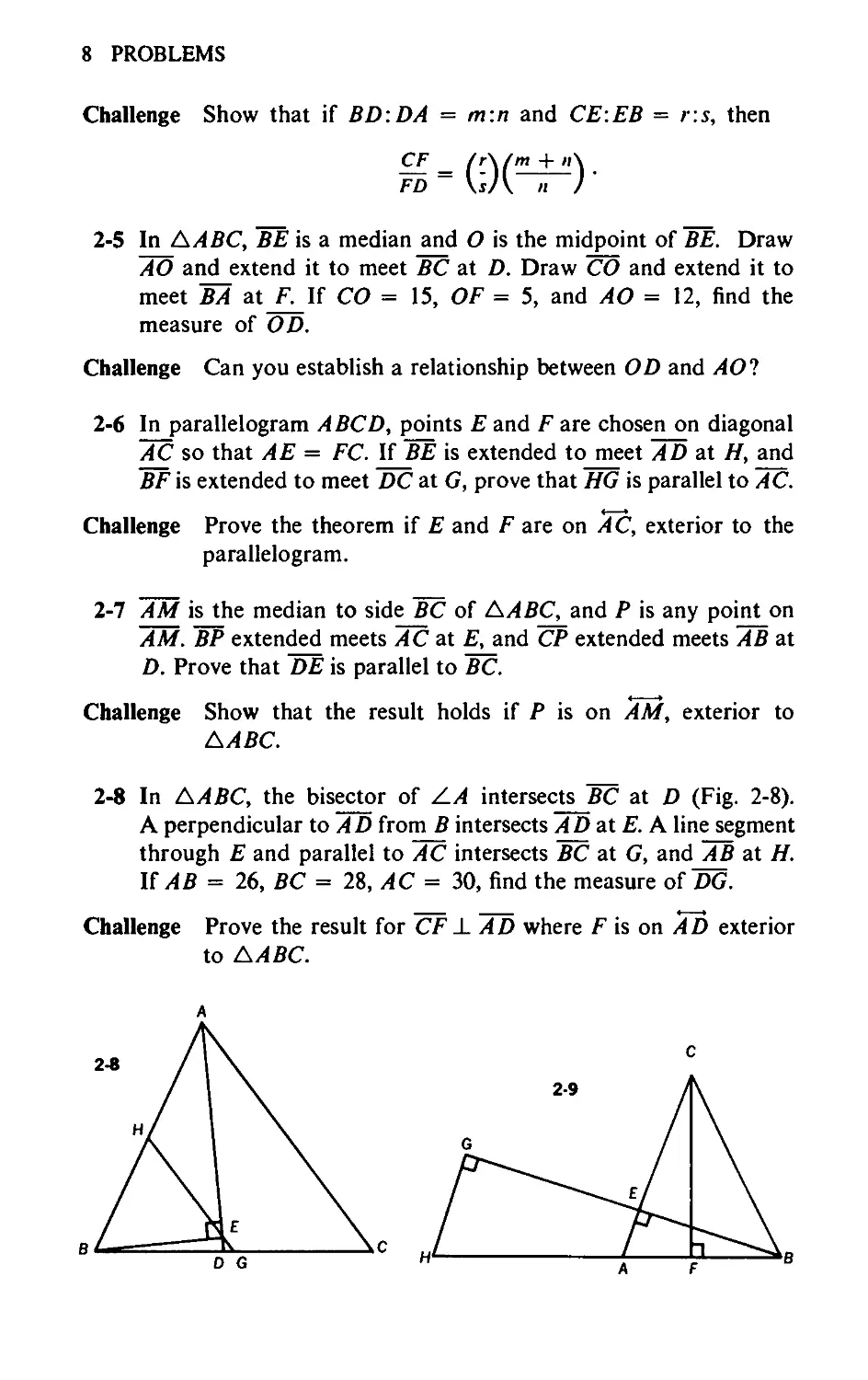
2-8 In ДЛВС, the bisector of Z.A intersects BC at D (Fig. 2-8).
A perpendicular to AD from В intersects AD at E. A line segment
through E and parallel to AC intersects BC at G, and AB at H.
If AB = 26, BC = 28, AC = 30, find the measure of DG.
Challenge Prove the result for CF± AD where F is on AD exterior
to ДЛВС.
Triangles in Proportion 9
2-9 In L\ABC, altitude BE is extended to G so that EG = the measure
of altitude CF. A line through G and parallel to AC meets BA
at H, as in Fig. 2-9. Prove that AH = AC.
Challenge 1 Show that the result holds when Z_A is a right angle.
Challenge 2 Prove the theorem for the case where the measure of
altitude BE is greater than the measure of altitude CF,
and G is on BE (between В and E) so that EG = CF.
2-10 In trapezoid ABCD (AB || DC), with diagonals AC and DB
intersecting at P, AM, a median of L\ADC, intersects BD at E
(Fig. 2-10). Through E, a line is drawn parallel to DC cutting AD,
AC, and BC at points H, F, and G, respectively. Prove that
HE = EF = FG.
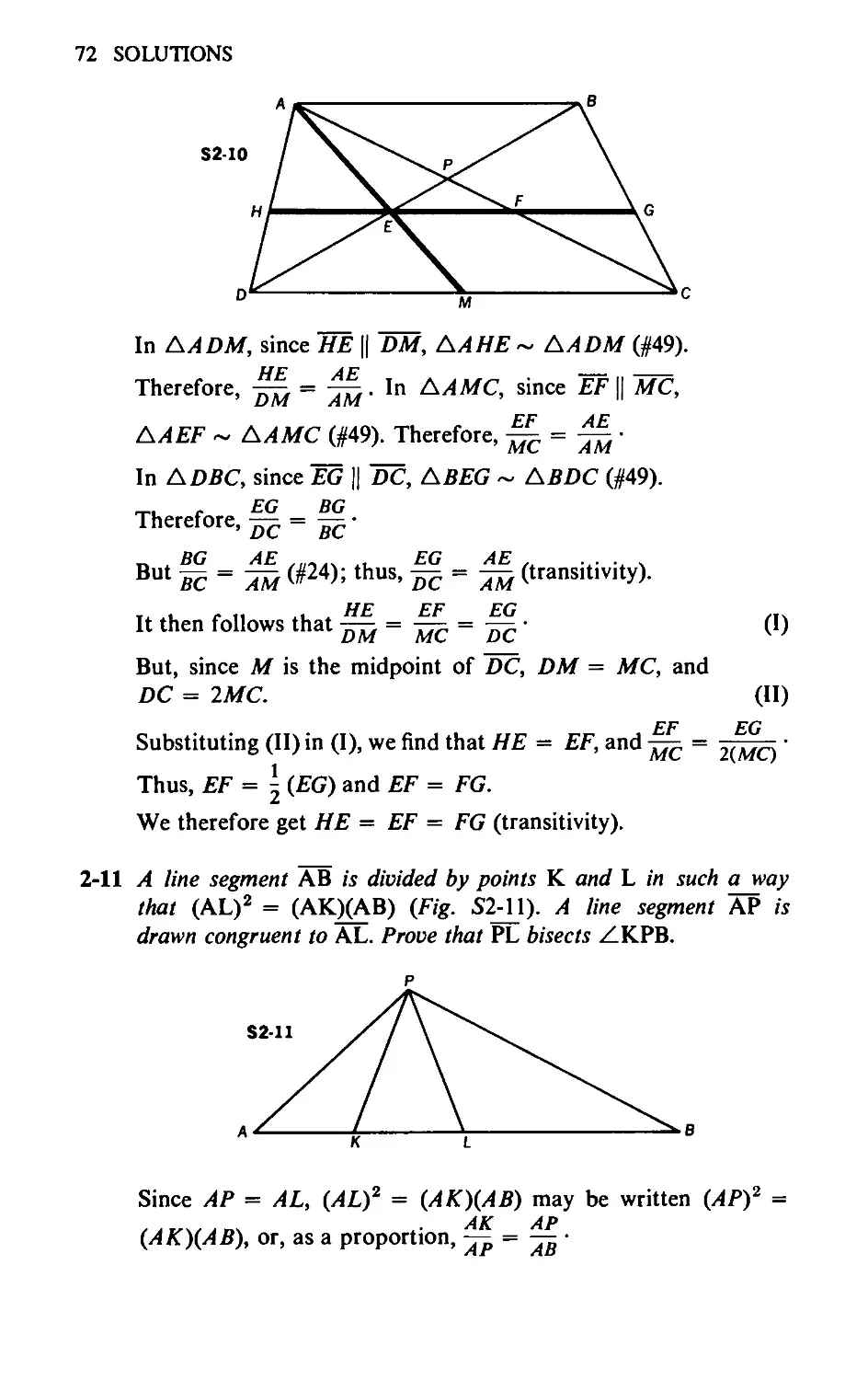
2-11 A line segment AB is divided by points К and L in such a way that
(AL)2 = (AK)(AB) (Fig. 2-11). A line segment AP is drawn
congruent to AL. Prove that PL bisects Z.K.PB.
Challenge Investigate the situation when Z.APB is a right angle.
2-12 P is any point on altitude CD of &ABC. AP and BP meet sides
CB and CA at points Q and R, respectively. Prove that zLQDC =
ARDC.
10 PROBLEMS
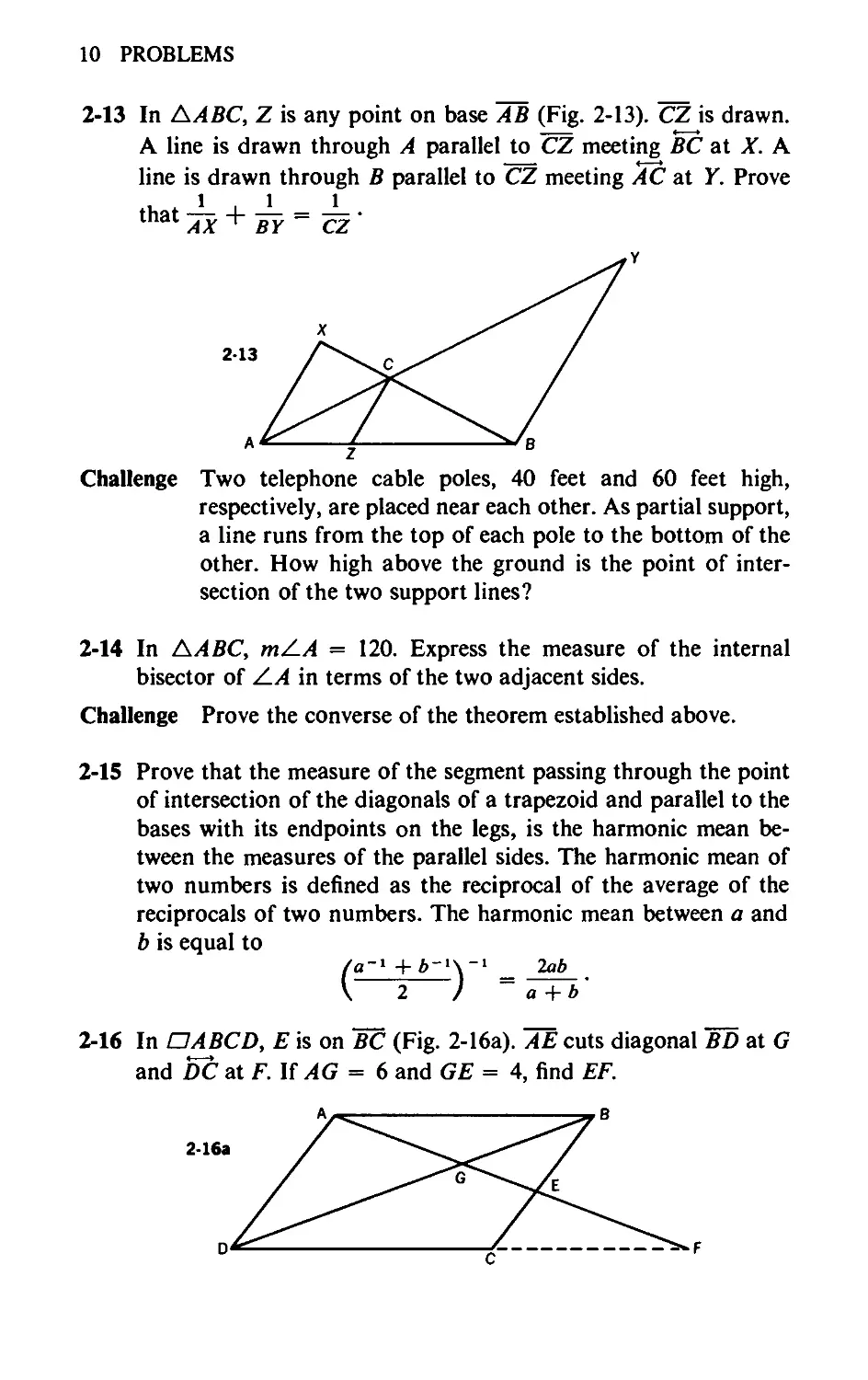
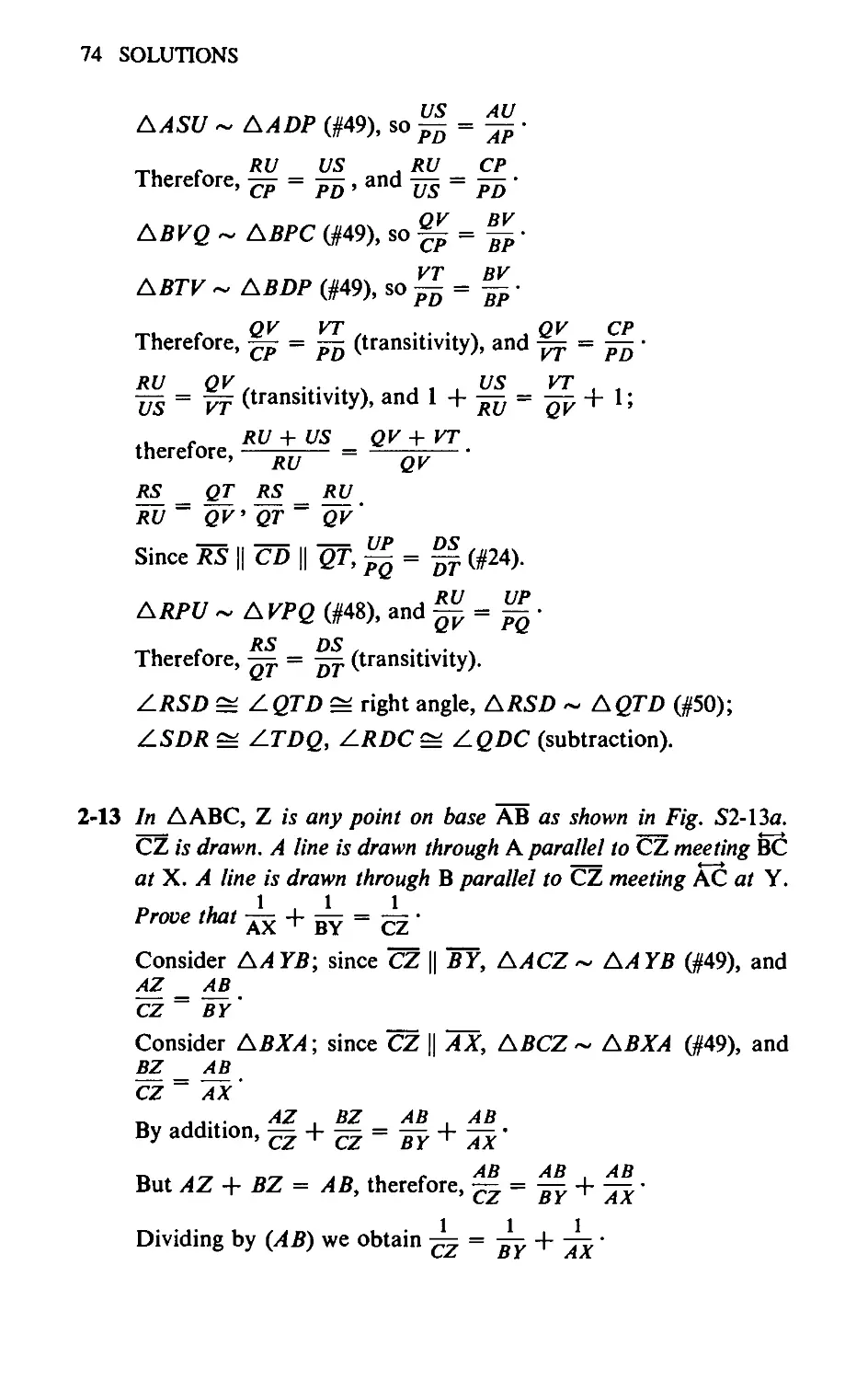
2-13 In ЛА ВС, Z is any point on base AB (Fig. 2-13). CZ is drawn.
A line is drawn through A parallel to CZ meeting BC at X. A
line is drawn through В parallel to CZ meeting AC at Y. Prove
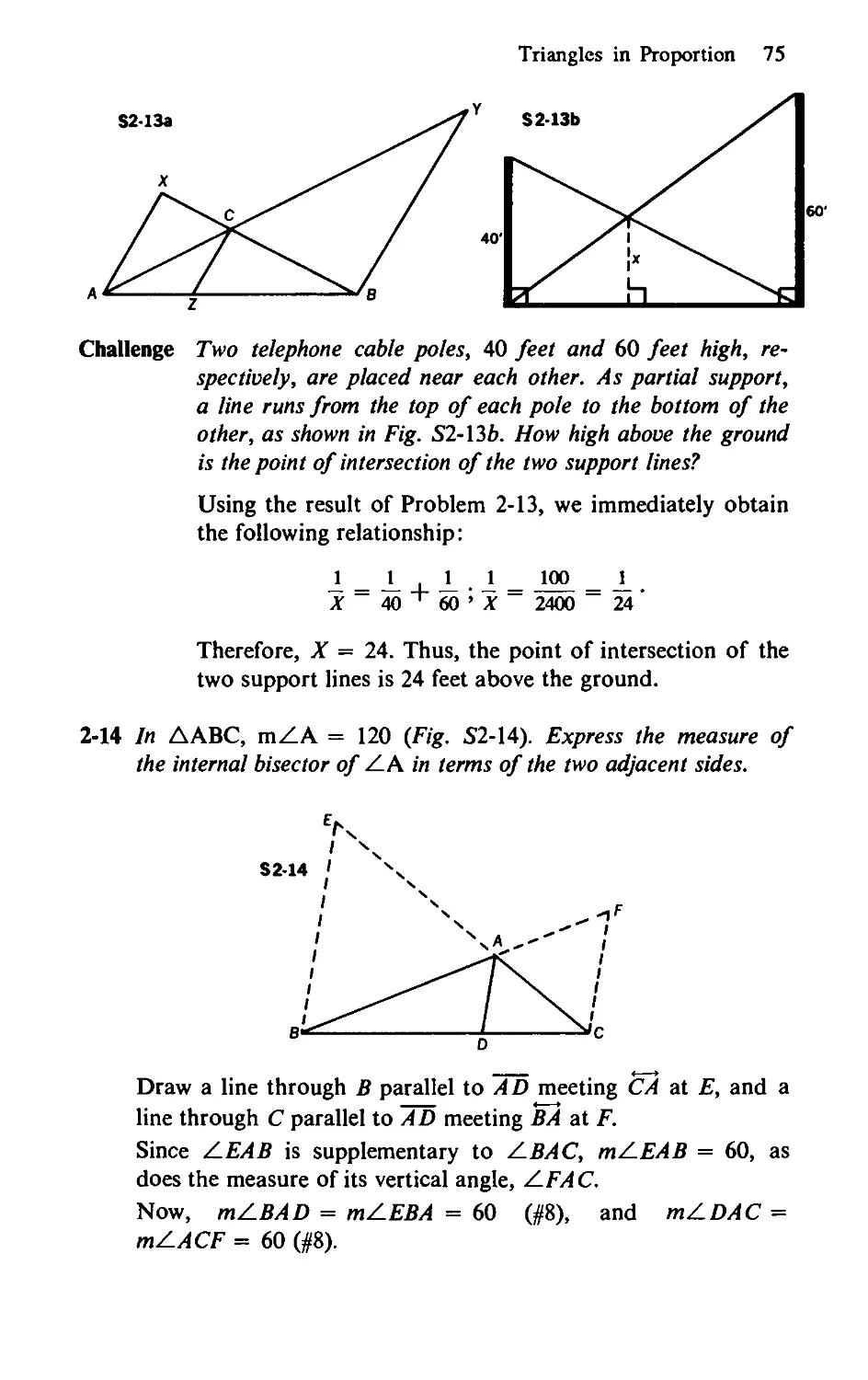
Challenge Two telephone cable poles, 40 feet and 60 feet high,
respectively, are placed near each other. As partial support,
a line runs from the top of each pole to the bottom of the
other. How high above the ground is the point of inter-
section of the two support lines?
2-14 In ЛАВС, mZ-A = 120. Express the measure of the internal
bisector of Z.A in terms of the two adjacent sides.
Challenge Prove the converse of the theorem established above.
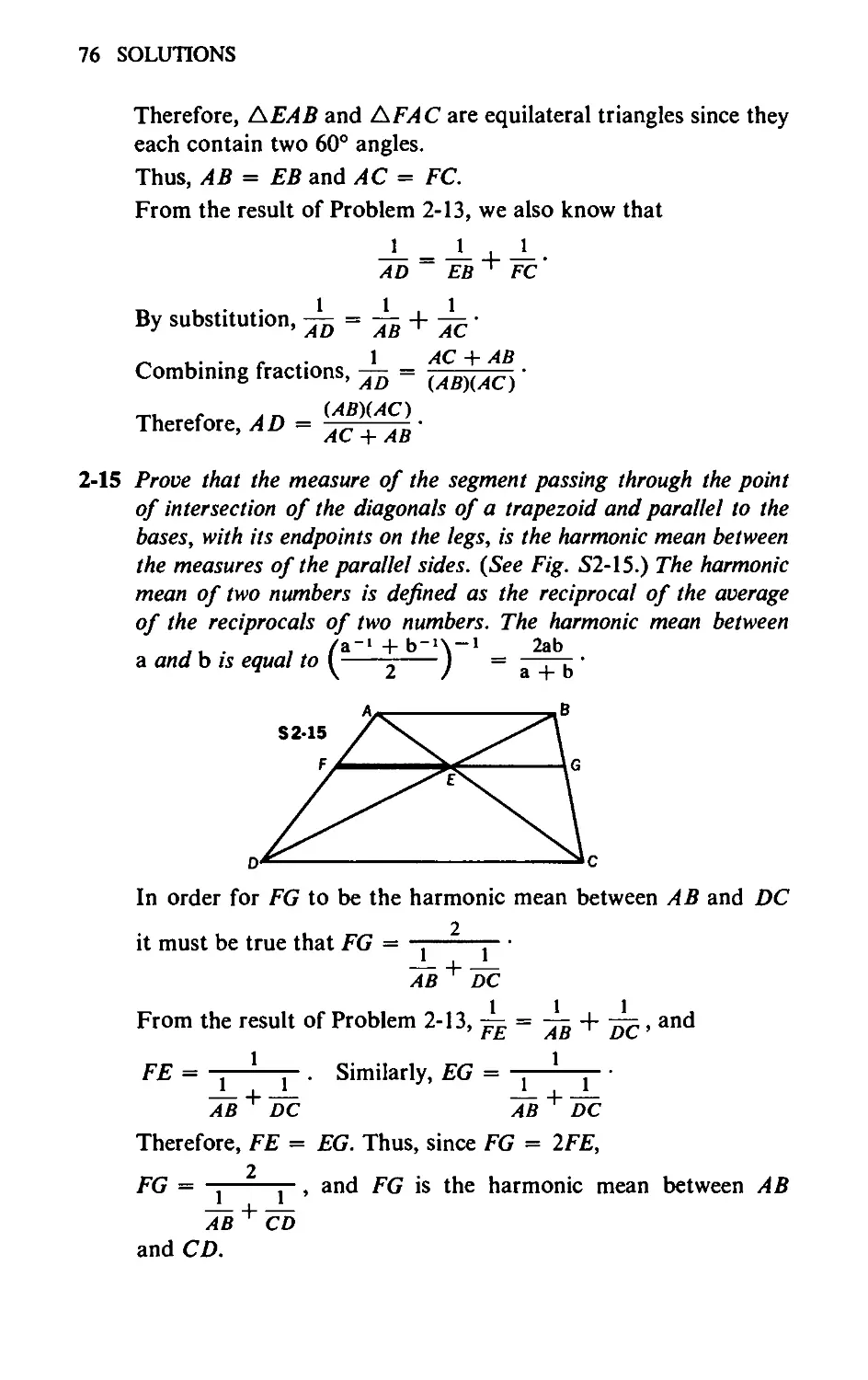
2-15 Prove that the measure of the segment passing through the point
of intersection of the diagonals of a trapezoid and parallel to the
bases with its endpoints on the legs, is the harmonic mean be-
tween the measures of the parallel sides. The harmonic mean of
two numbers is defined as the reciprocal of the average of the
reciprocals of two numbers. The harmonic mean between a and
b is equal to
/a-1 + Z>-1\ -1 2ab
\	2	)	~ a+b'
2-16 In EJABCD, E is on ДС (Fig. 2-16a). AE cuts diagonal BD at G
and DC at F. If AG = 6 and GE = 4, find EF.
D
C
The Pythagorean Theorem 11
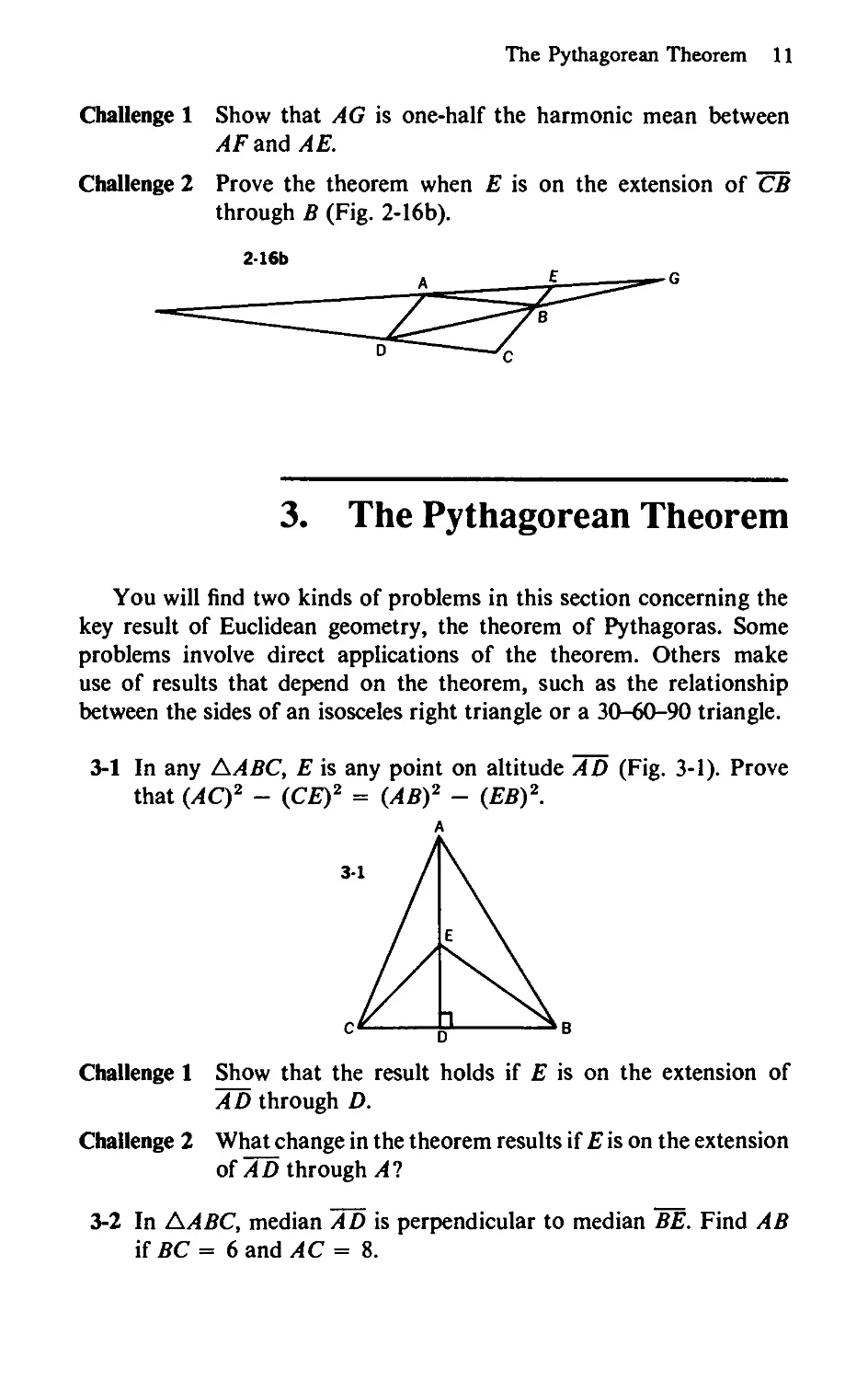
Challenge 1 Show that AG is one-half the harmonic mean between
AF and AE.
Challenge 2 Prove the theorem when E is on the extension of CT?
through В (Fig. 2-16b).
2-16b
3.	The Pythagorean Theorem
You will find two kinds of problems in this section concerning the
key result of Euclidean geometry, the theorem of Pythagoras. Some
problems involve direct applications of the theorem. Others make
use of results that depend on the theorem, such as the relationship
between the sides of an isosceles right triangle or a 30-60-90 triangle.
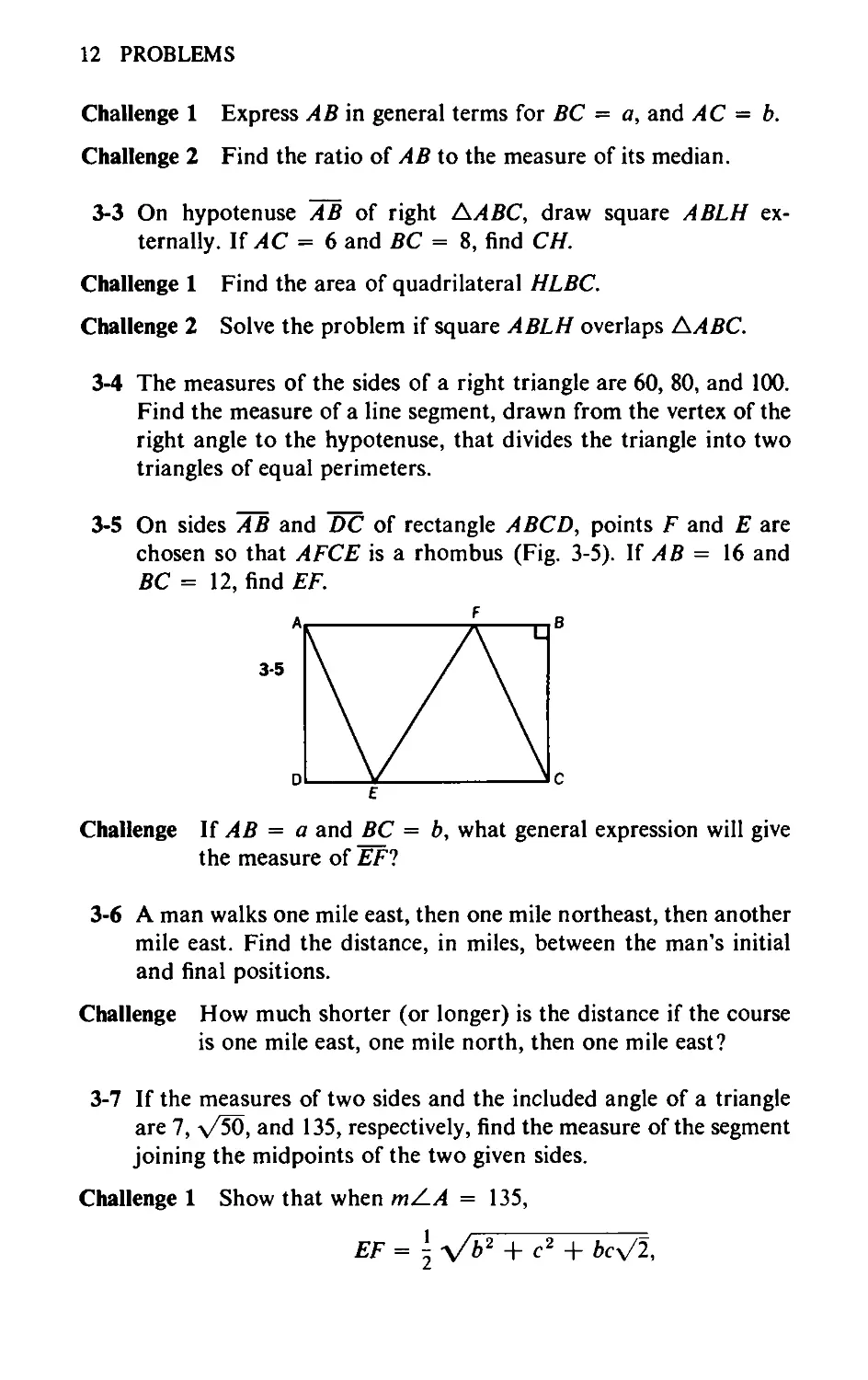
3-1 In any Z\ABC, E is any point on altitude AD (Fig. 3-1). Prove
that (AC)2 - (СЕ)2 = (AB)2 - (EB)2.
Challenge 1 Show that the result holds if E is on the extension of
AD through D.
Challenge 2 What change in the theorem results if E is on the extension
of AD through Al
3-2 In ЛАВС, median AD is perpendicular to median BE. Find AB
if BC = 6 and AC = 8.
12 PROBLEMS
Challenge 1 Express AB in general terms for BC = a, and AC = b.
Challenge 2 Find the ratio of AB to the measure of its median.
3-3 On hypotenuse AB of right AABC, draw square ABLH ex-
ternally. If AC = 6 and BC = 8, find CH.
Challenge 1 Find the area of quadrilateral HLBC.
Challenge 2 Solve the problem if square ABLH overlaps AABC.
3-4 The measures of the sides of a right triangle are 60, 80, and 100.
Find the measure of a line segment, drawn from the vertex of the
right angle to the hypotenuse, that divides the triangle into two
triangles of equal perimeters.
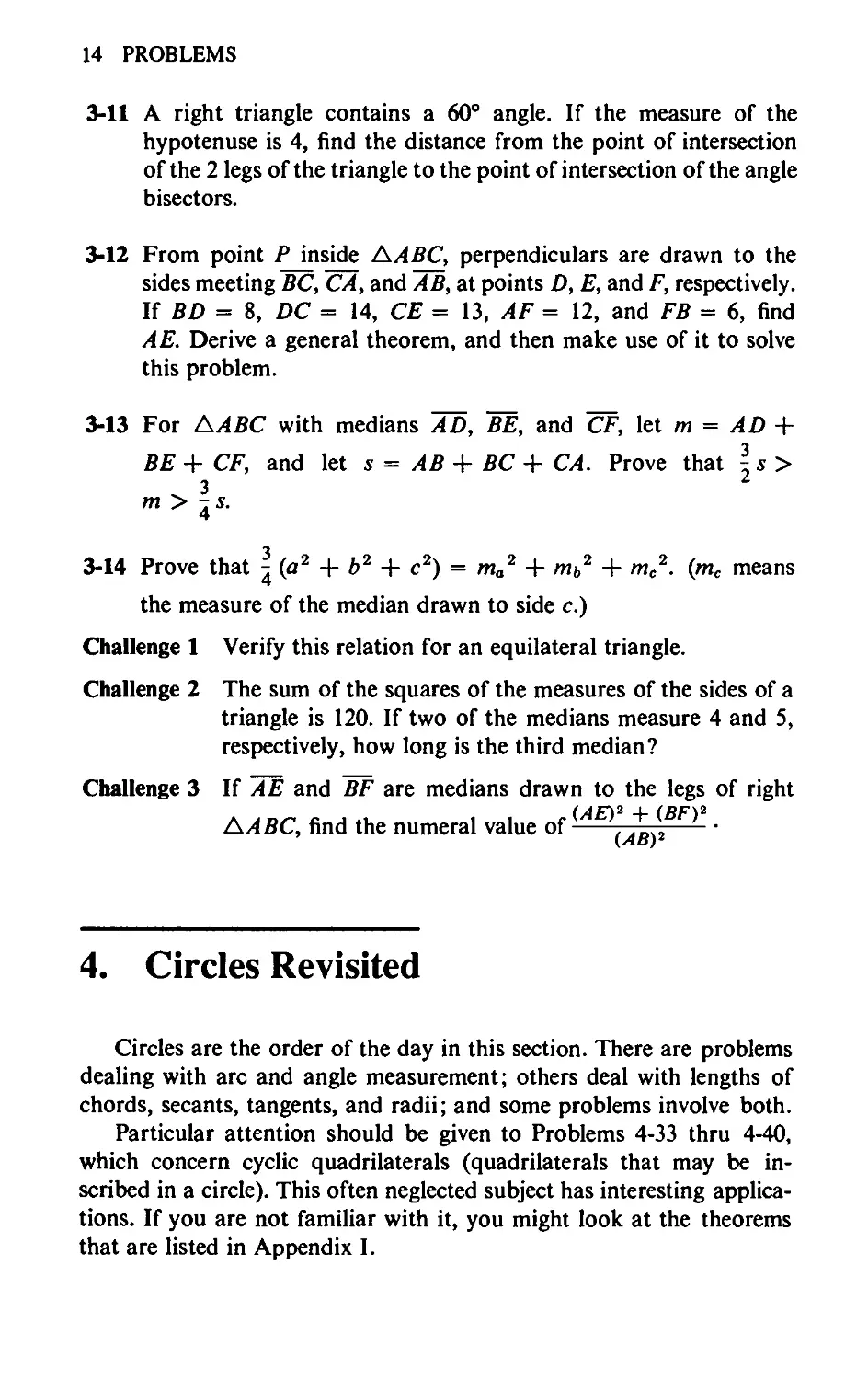
3-5 On sides AB and DC of rectangle A BCD, points F and E are
chosen so that AFCE is a rhombus (Fig. 3-5). If AB = 16 and
BC = 12, find EF.
Challenge If AB = a and BC = b, what general expression will give
the measure of EF?
3-6 A man walks one mile east, then one mile northeast, then another
mile east. Find the distance, in miles, between the man’s initial
and final positions.
Challenge How much shorter (or longer) is the distance if the course
is one mile east, one mile north, then one mile east?
3-7 If the measures of two sides and the included angle of a triangle
are 7, \/50, and 135, respectively, find the measure of the segment
joining the midpoints of the two given sides.
Challenge 1 Show that when mAA = 135,
EF = y/b2 + c2 + bcx/2,
The Pythagorean Theorem 13
where E and F are midpoints of sides AC and AB,
respectively, of ЛАВС.
note: a, b, and c are the lengths of the sides opposite
ZA, ZB, and ZC of ЛАВС.
Challenge 2 Show that when mZA = 120,
EF = | V*2 + c2 + bcy/\.
Challenge 3 Show that when mZA = 150,
EF y/b2 + c2 + bcy'l.
Challenge 4 On the basis of these results, predict the values of EF for
mZA = 30, 45, 60, and 90.
3-8 Hypotenuse AB of right ЛАВС is divided into four congruent
segments by points G, E, and H, in the order A, G, E, H, B. If
AB = 20, find the sum of the squares of the measures of the line
segments from C to G, E, and H.
Challenge Express the result in general terms when AB = c.
3-9 In quadrilateral ABCD,AB = 9, BC = 12, CD = 13, DA = 14,
and diagonal AC = 15 (Fig. 3-9). Perpendiculars are drawn from
В and D to ЛС, meeting ЛС at points P and Q, respectively. Find
PQ-
and D is the midpoint of A C. BD is drawn, and a line perpendicular
to BD at P is drawn from C. Find the distance from P to the inter-
section of the medians of ЛАВС.
Challenge Show that PG =	, when G is the centroid, and c is
the length of the hypotenuse.
14 PROBLEMS
3-11 A right triangle contains a 60° angle. If the measure of the
hypotenuse is 4, find the distance from the point of intersection
of the 2 legs of the triangle to the point of intersection of the angle
bisectors.
3-12 From point P inside ДАВС, perpendiculars are drawn to the
sides meeting ВС, CA, and AB, at points D, E, and F, respectively.
If BD = 8, DC = 14, CE = 13, AF = 12, and FB = 6, find
AE. Derive a general theorem, and then make use of it to solve
this problem.
3-13 For ДАВС with medians AD, BE, and CF, let m = AD +
з
BE + CF, and let s = AB + BC + CA. Prove that - s >
3	2
m > 4 s-
3-14 Prove that | (a2 + b2 + с2) = ma2 +	+ m2. (mc means
the measure of the median drawn to side c.)
Challenge 1 Verify this relation for an equilateral triangle.
Challenge 2 The sum of the squares of the measures of the sides of a
triangle is 120. If two of the medians measure 4 and 5,
respectively, how long is the third median?
Challenge 3 If AE and BF are medians drawn to the legs of right
ДАВС, find the numeral value of	•
4.	Circles Revisited
Circles are the order of the day in this section. There are problems
dealing with arc and angle measurement; others deal with lengths of
chords, secants, tangents, and radii; and some problems involve both.
Particular attention should be given to Problems 4-33 thru 4-40,
which concern cyclic quadrilaterals (quadrilaterals that may be in-
scribed in a circle). This often neglected subject has interesting applica-
tions. If you are not familiar with it, you might look at the theorems
that are listed in Appendix I.
Circles Revisited 15
4-1 Two tangents from an external point P are drawn to a circle,
meeting the circle at points A and B. A third tangent meets the
circle at T, and tangents PA and PB at points Q and R, respec-
tively. Find the perimeter p of /\PQR.
4-2 AB and AC are tangent to circle О at В and C, respectively, and
CE is perpendicular to diameter BD (Fig. 4-2). Prove (BE)(BO) =
(AB)(CE).
Challenge 1 Find the value of AB when E coincides with O.
Challenge 2 Show that the theorem is true when E is between В and O.
Challenge 3 Show that ^== =	•
4-3 From an external point P, tangents PA and PB are drawn to a
circle. From a point Q on the major (or minor) arc AB, per-
pendiculars are drawn to AB, PA, and PB. Prove that the per-
pendicular to AB is the mean proportional between the other
two perpendiculars.
Challenge Show that the theorem is true when the tangents are
parallel.
4-4 Chords AC and DB are perpendicular to each other and intersect
at point G (Fig. 4-4). In AAGD the altitude from G meets AD
at E, and when extended meets BC at P. Prove that BP = PC.
Challenge One converse of this theorem is as follows. Chords AC
and DB intersect at G. In /XAGD the altitude from G meets
AD at E, and when extended meets BC at P so that BP =
PC. Prove that AC ± BD.
16 PROBLEMS
4-5 Square ABCD is inscribed in a circle. Point E is on the circle.
If AB = 8. find the value of
(AE)2 + (BE)2 + (CE)2 + (DE)2.
Challenge Prove that for ABCD, a non-square rectangle, (AE)2 +
(BE)2 + (CE)2 + (DE)2 = 2d2, where d is the measure
of the length of a diagonal of the rectangle.
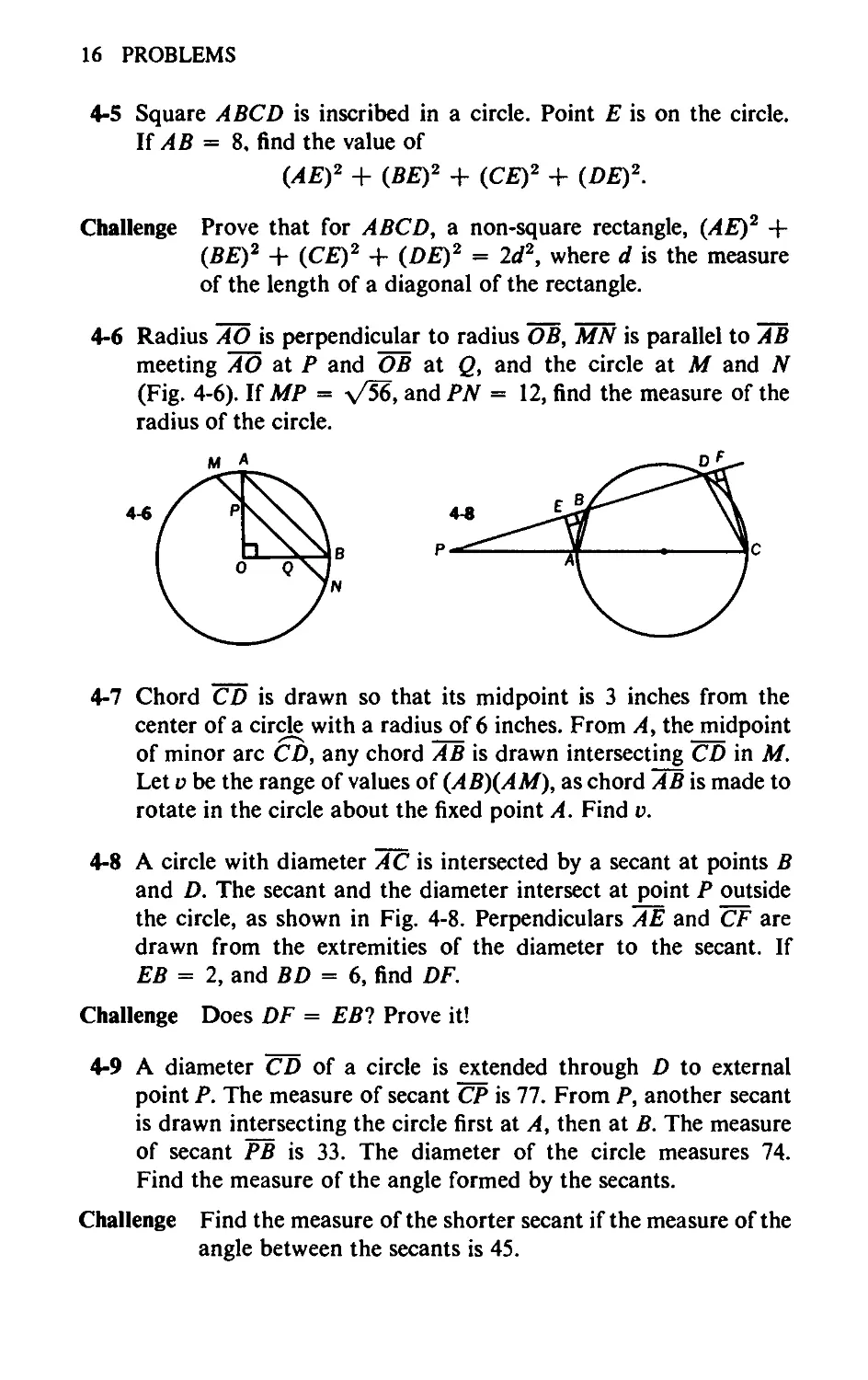
4-6 Radius ~AO is perpendicular to radius OB, MN is parallel to ~AB
meeting ~AO at P and OB at Q, and the circle at M and N
(Fig. 4-6). If MP = \/56> and PN = 12, find the measure of the
radius of the circle.
4-7 Chord CD is drawn so that its midpoint is 3 inches from the
center of a circle with a radius of 6 inches. From A, the midpoint
of minor arc CD, any chord AB is drawn intersecting CD in M.
Let v be the range of values of (AB)(AM), as chord AB is made to
rotate in the circle about the fixed point A. Find v.
4-8 A circle with diameter AC is intersected by a secant at points В
and D. The secant and the diameter intersect at point P outside
the circle, as shown in Fig. 4-8. Perpendiculars AE and CF are
drawn from the extremities of the diameter to the secant. If
EB = 2, and BD = 6, find DF.
Challenge Does DF = EB1 Prove it!
4-9 A diameter CD of a circle is extended through D to external
point P. The measure of secant CP is 77. From P, another secant
is drawn intersecting the circle first at A, then at B. The measure
of secant PB is 33. The diameter of the circle measures 74.
Find the measure of the angle formed by the secants.
Challenge Find the measure of the shorter secant if the measure of the
angle between the secants is 45.
Circles Revisited 17
4-10 In А ЛВС, in which AB = 12, BC = 18, and AC = 25, a
semicircle is drawn so that its diameter lies on AC, and so that it
is tangent to AB and BC. If О is the center of the circle, find the
measure of AO.
Challenge Find the diameter of the semicircle.
4-11 Two parallel tangents to circle О meet the circle at points M and
N. A third tangent to circle O, at point P, meets the other two
tangents at points К and L. Prove that a circle, whose diameter is
KL, passes through O, the center of the original circle.
Challenge Prove that for different positions of point P, on MN, a
family of circles is obtained tangent to each other at O.
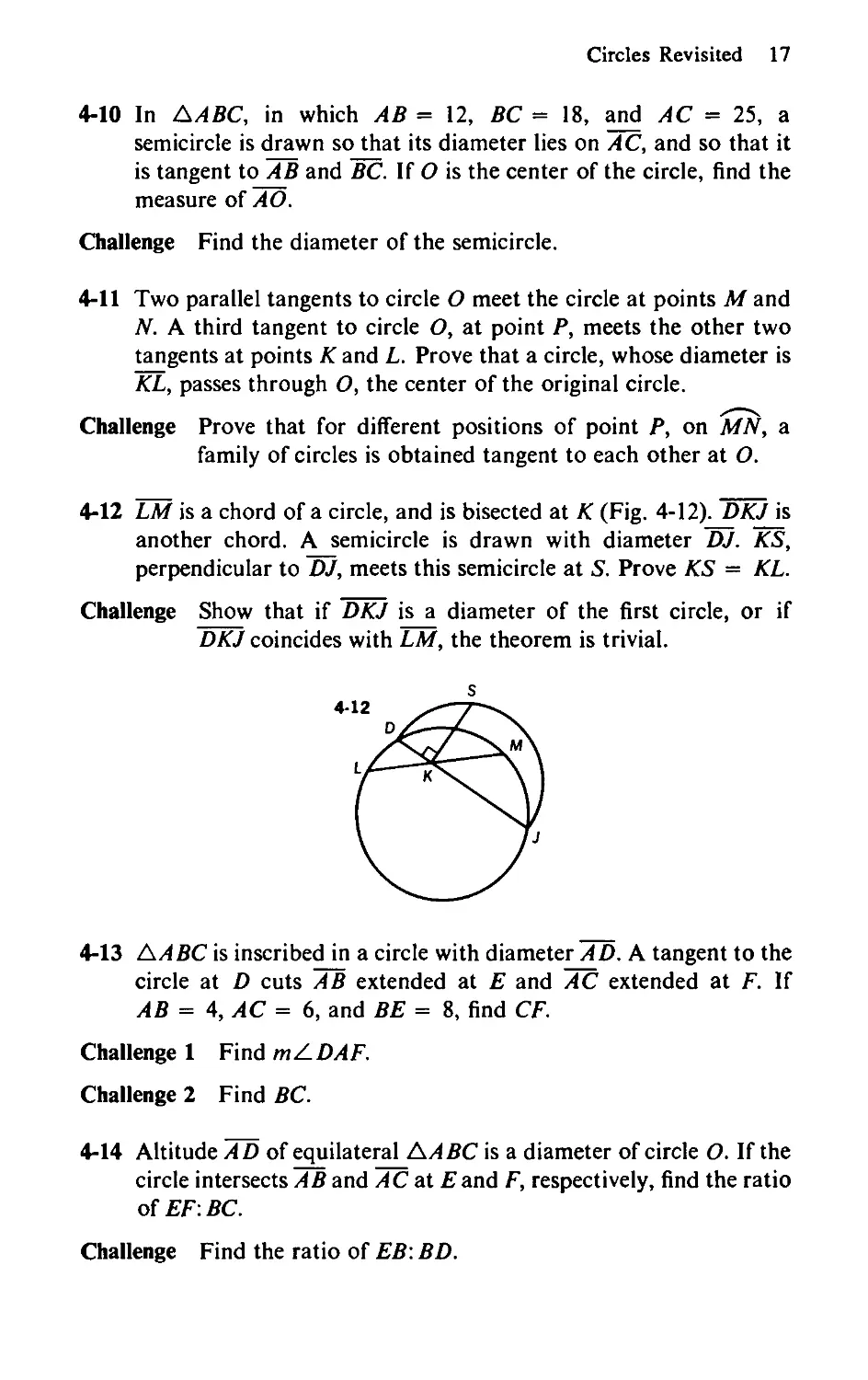
4-12 LM is a chord of a circle, and is bisected at К (Fig. 4-12). DKJ is
another chord. A semicircle is drawn with diameter DJ. KS,
perpendicular to DJ, meets this semicircle at S. Prove KS = KL.
Challenge Show that if DKJ is a diameter of the first circle, or if
DKJ coincides with LM, the theorem is trivial.
4-13 ДАВС is inscribed in a circle with diameter AD. A tangent to the
circle at D cuts AB extended at E and AC extended at F. If
AB = 4, AC = 6, and BE = 8, find CF.
Challenge 1 Find raZ£>/lF.
Challenge 2 Find BC.
4-14 Altitude AD of equilateral ДАВС is a diameter of circle O. If the
circle intersects AB and AC at E and F, respectively, find the ratio
otEF.BC.
Challenge Find the ratio of EB: BD.
18 PROBLEMS
4-15 Two circles intersect in A and B, and the measure of the common
chord AB is 10. The line joining the centers cuts the circles in P
and Q. If PQ = 3 and the measure of the radius of one circle is
13, find the radius of the other circle.
Challenge Find the second radius if PQ = 2.
4-16 ABCD is a quadrilateral inscribed in a circle. Diagonal BD
bisects ЛС. If AB = 10, AD = 12, and DC = 11, find BC.
Challenge Solve the problem when diagonal BD divides AC into two
segments, one of which is twice as long as the other.
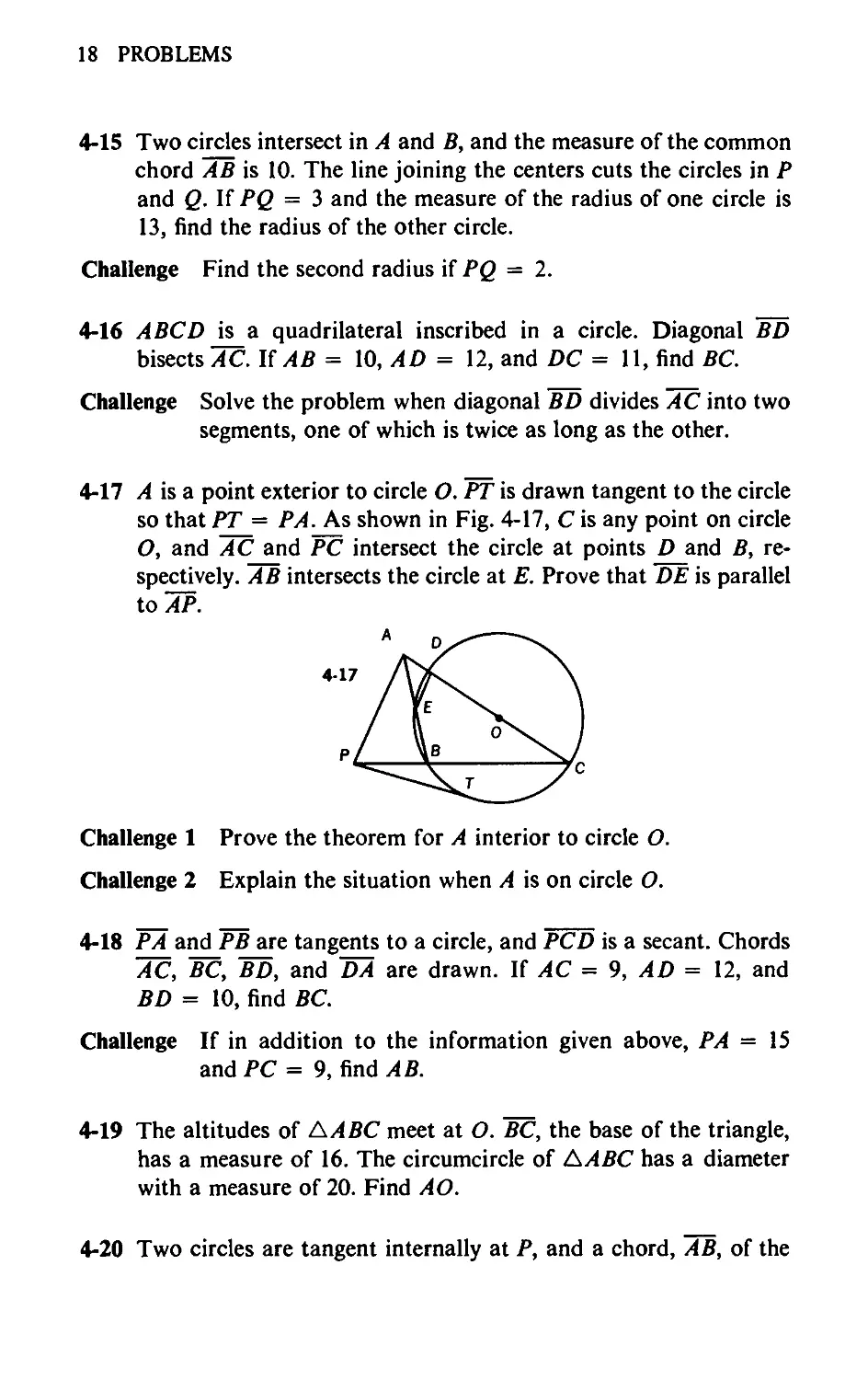
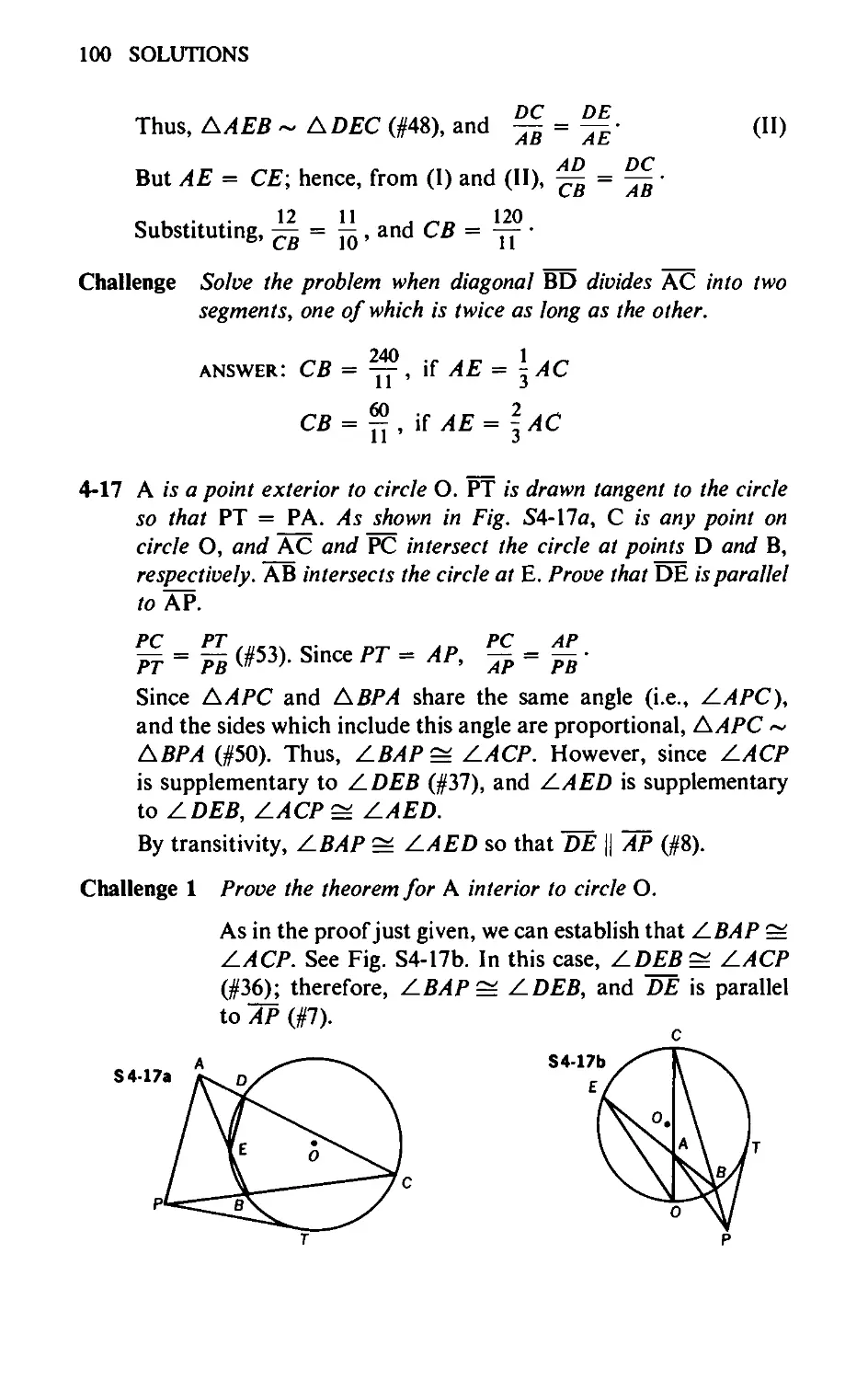
4-17 A is a point exterior to circle O. PT is drawn tangent to the circle
so that PT = PA. As shown in Fig. 4-17, C is any point on circle
O, and AC and PC intersect the circle at points D and B, re-
spectively. AB intersects the circle at E. Prove that DE is parallel
to AP.
Challenge 1 Prove the theorem for A interior to circle O.
Challenge 2 Explain the situation when A is on circle O.
4-18 PA and PB are tangents to a circle, and PCD is a secant. Chords
AC, BC, BD, and DA are drawn. If AC = 9, AD = 12, and
BD = 10, find BC.
Challenge If in addition to the information given above, PA = 15
and PC = 9, find AB.
4-19 The altitudes of ДЛВС meet at O. BC, the base of the triangle,
has a measure of 16. The circumcircle of ДЛДС has a diameter
with a measure of 20. Find AO.
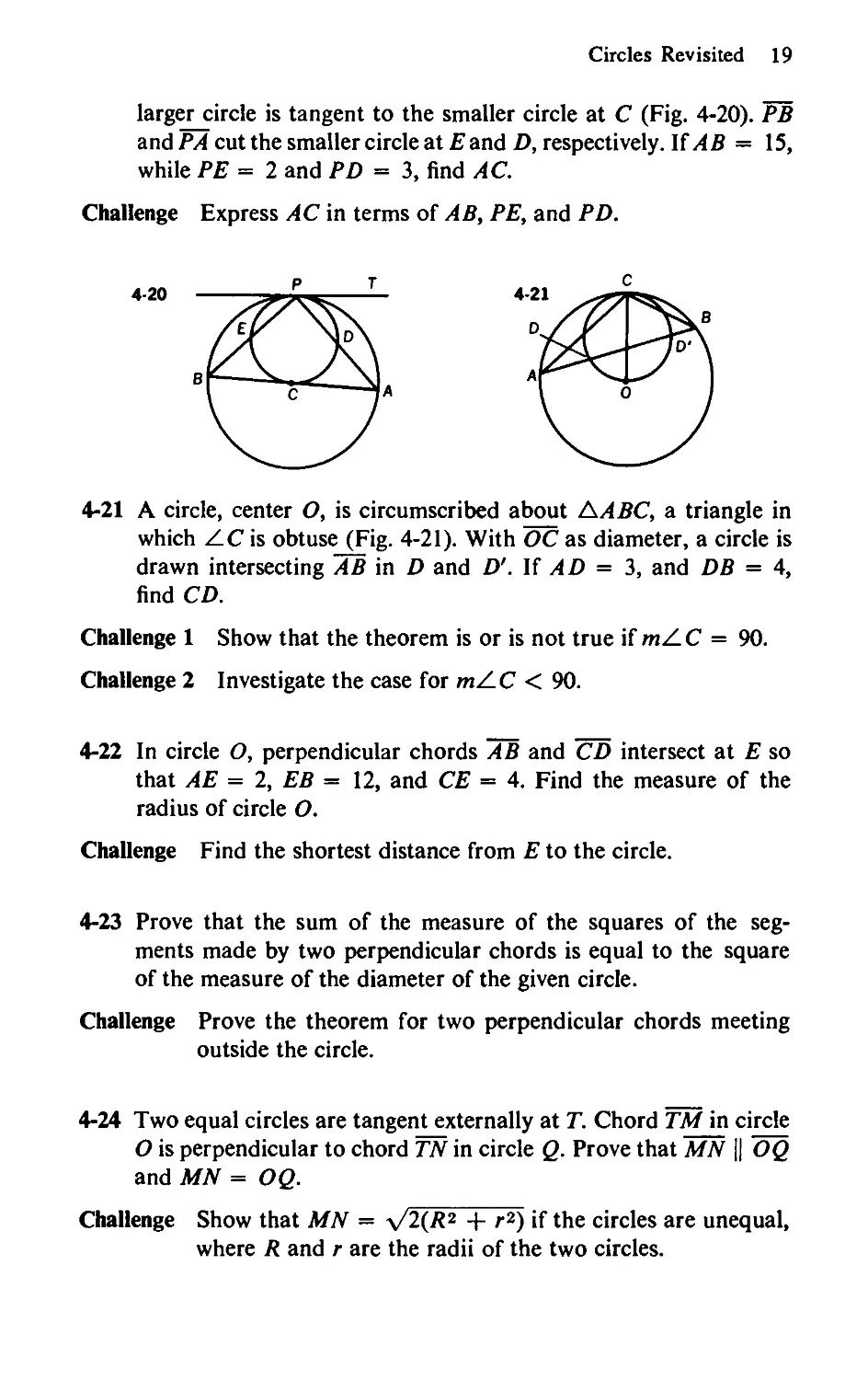
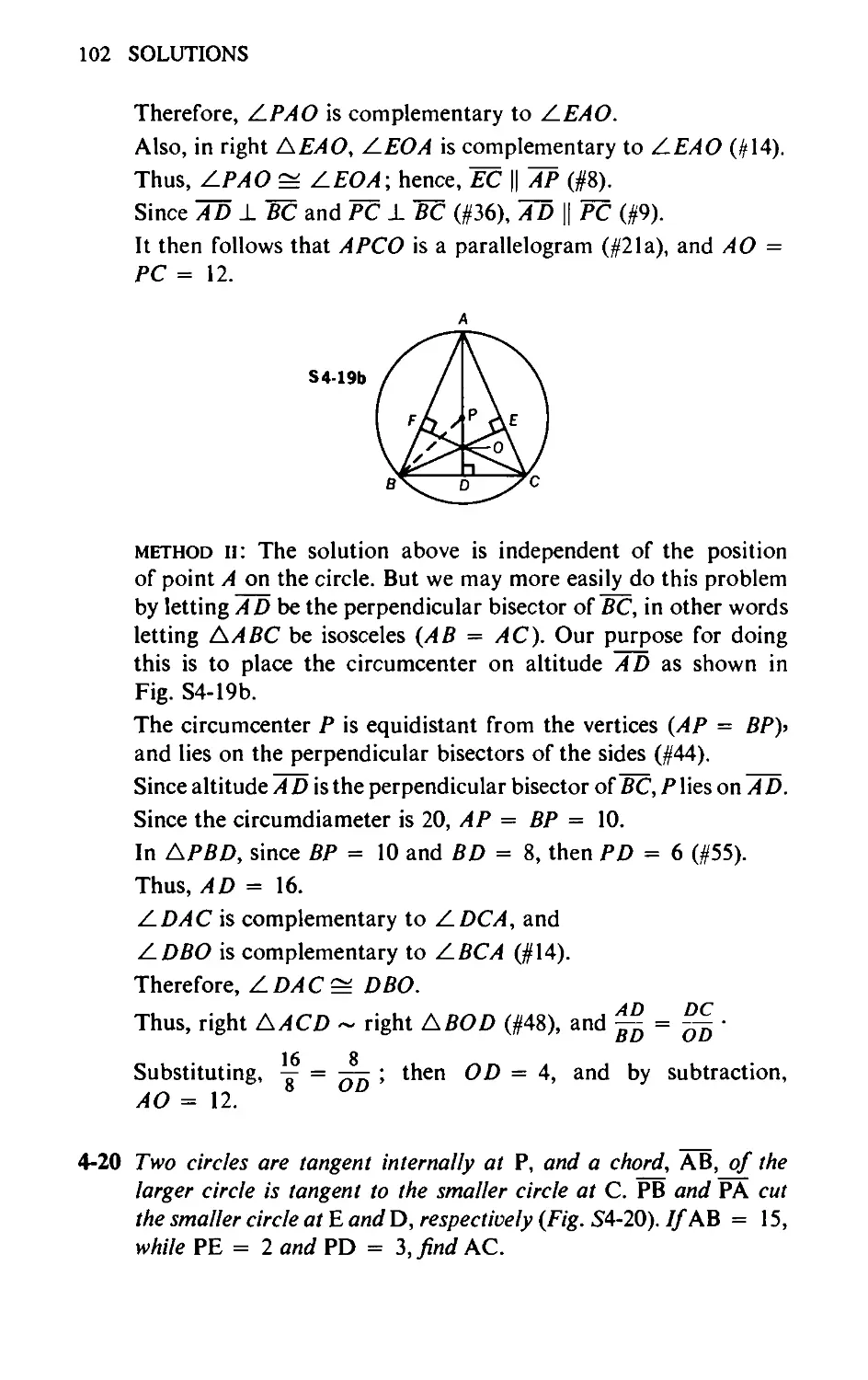
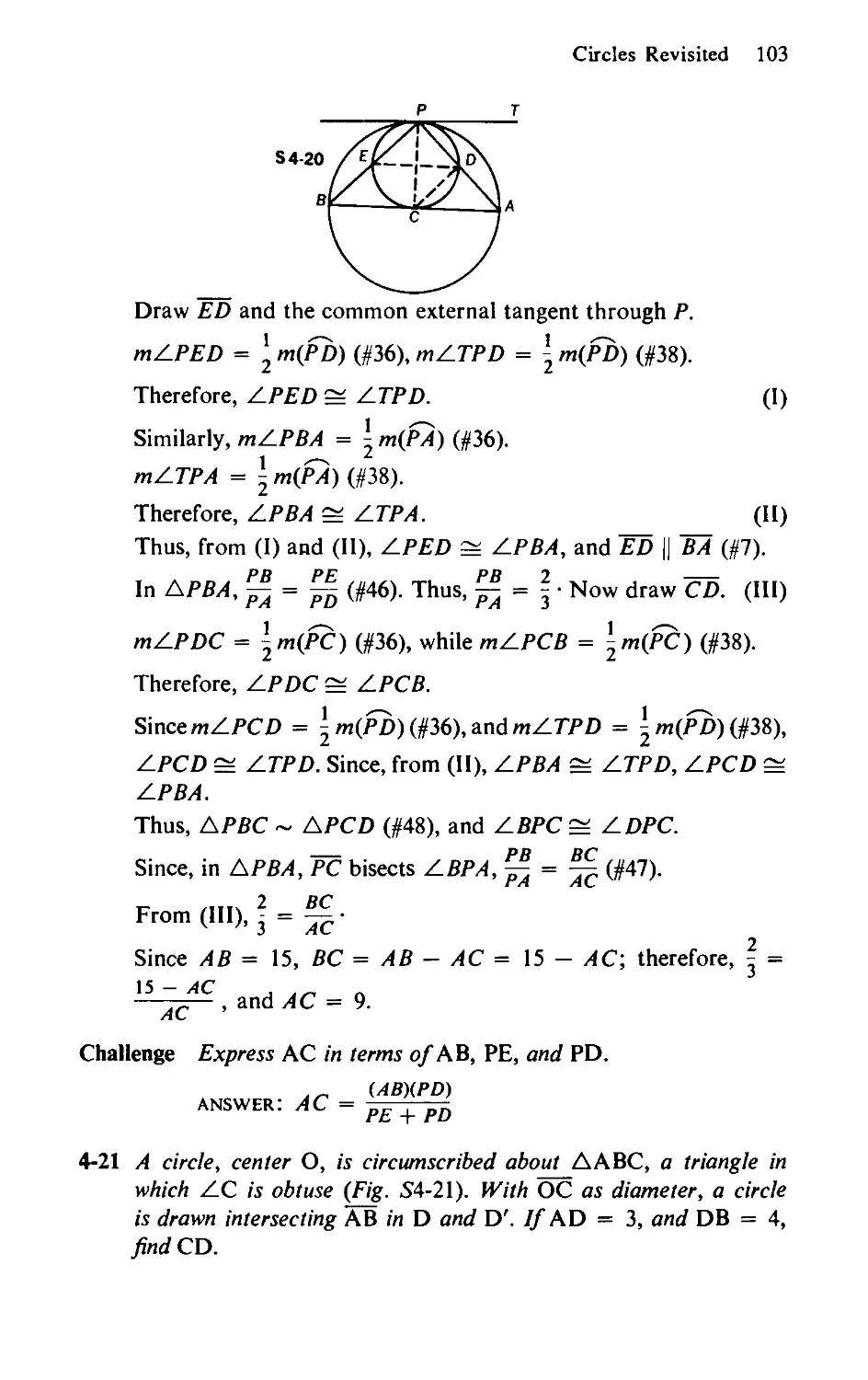
4-20 Two circles are tangent internally at P, and a chord, AB, of the
Circles Revisited 19
larger circle is tangent to the smaller circle at C (Fig. 4-20). PB
and PA cut the smaller circle at E and D, respectively. If A В = 15,
while PE = 2 and PD = 3, find AC.
Challenge Express AC in terms of AB, PE, and PD.
4-21 A circle, center O, is circumscribed about ЛАВС, a triangle in
which ZC is obtuse (Fig. 4-21). With ОС as diameter, a circle is
drawn intersecting AB in D and D'. If AD = 3, and DB = 4,
find CD.
Challenge 1 Show that the theorem is or is not true if mZ_ C = 90.
Challenge 2 Investigate the case for m/JC < 90.
4-22 In circle O, perpendicular chords AB and CD intersect at E so
that AE = 2, EB = 12, and CE = 4. Find the measure of the
radius of circle O.
Challenge Find the shortest distance from E to the circle.
4-23 Prove that the sum of the measure of the squares of the seg-
ments made by two perpendicular chords is equal to the square
of the measure of the diameter of the given circle.
Challenge Prove the theorem for two perpendicular chords meeting
outside the circle.
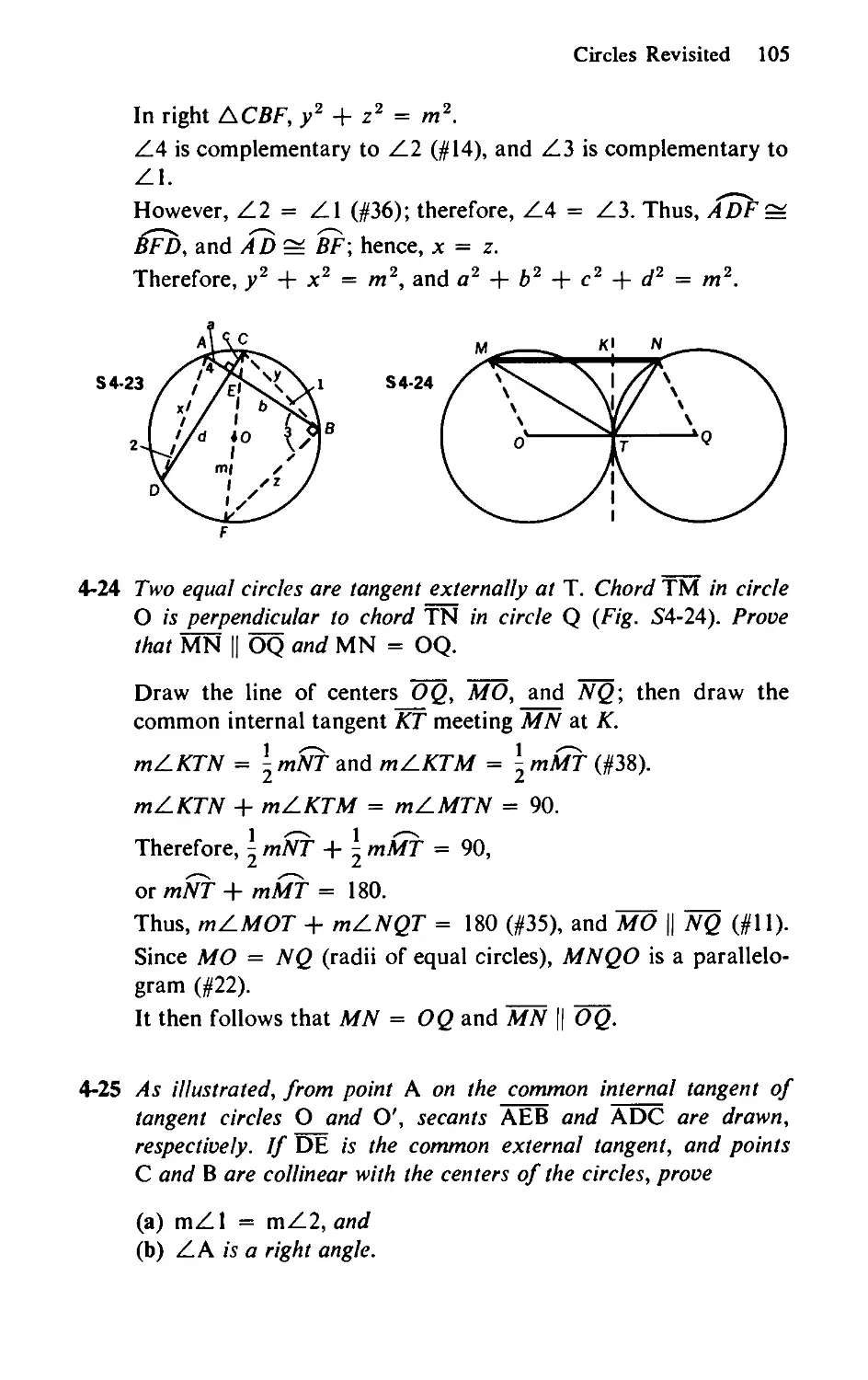
4-24 Two equal circles are tangent externally at T. Chord TM in circle
О is perpendicular to chord TN in circle Q. Prove that MN || OQ
and MN = OQ.
Challenge Show that MN — \/2(Л2 + r2) if the circles are unequal,
where R and r are the radii of the two circles.
20 PROBLEMS
4-25 From point A on the common internal tangent of tangent circles
О and O', secants ЛЕВ and ADC are drawn, respectively (Fig.
4-25). If is the common external tangent, and points C and В
are collinear with the centers of the circles, prove
(a)	mZA = mZ2, and
(b)	Z-A is a right angle.
Challenge 1 Prove or disprove that if BC does not pass through the
centers of the circles, the designated pairs of angles are
not equal and ZA is not a right angle.
Challenge 2 Prove that DE is the mean proportional between the
diameters of circles О and O'.
4-26 Two equal intersecting circles О and O' have a common chord
RS. From any point P on RS a ray is drawn perpendicular to RS
cutting circles О and O' at A and B, respectively. Prove that AB
is parallel to the line of centers, 00', and that AB = 00’.
4-27 A circle is inscribed in a triangle whose sides are 10, 10, and 12
units in measure (Fig. 4-27). A second, smaller circle is inscribed
tangent to the first circle and to the equal sides of the triangle.
Find the measure of the radius of the second circle.
Challenge 1 Solve the problem in general terms if AC = a, BC = 2b.
Challenge 2 Inscribe a third, smaller circle tangent to the second
circle and to the equal sides, and find its radius by
inspection.
Challenge 3 Extend the legs of the triangle through В and C, and
draw a circle tangent to the original circle and to the
extensions of the legs. What is its radius?
Circles Revisited 21
4-28 A circle with radius 3 is inscribed in a square. Find the radius of
the circle that is inscribed between two sides of the square and
the original circle.
Challenge Show that the area of the small circle is approximately 3%
of the area of the large circle.
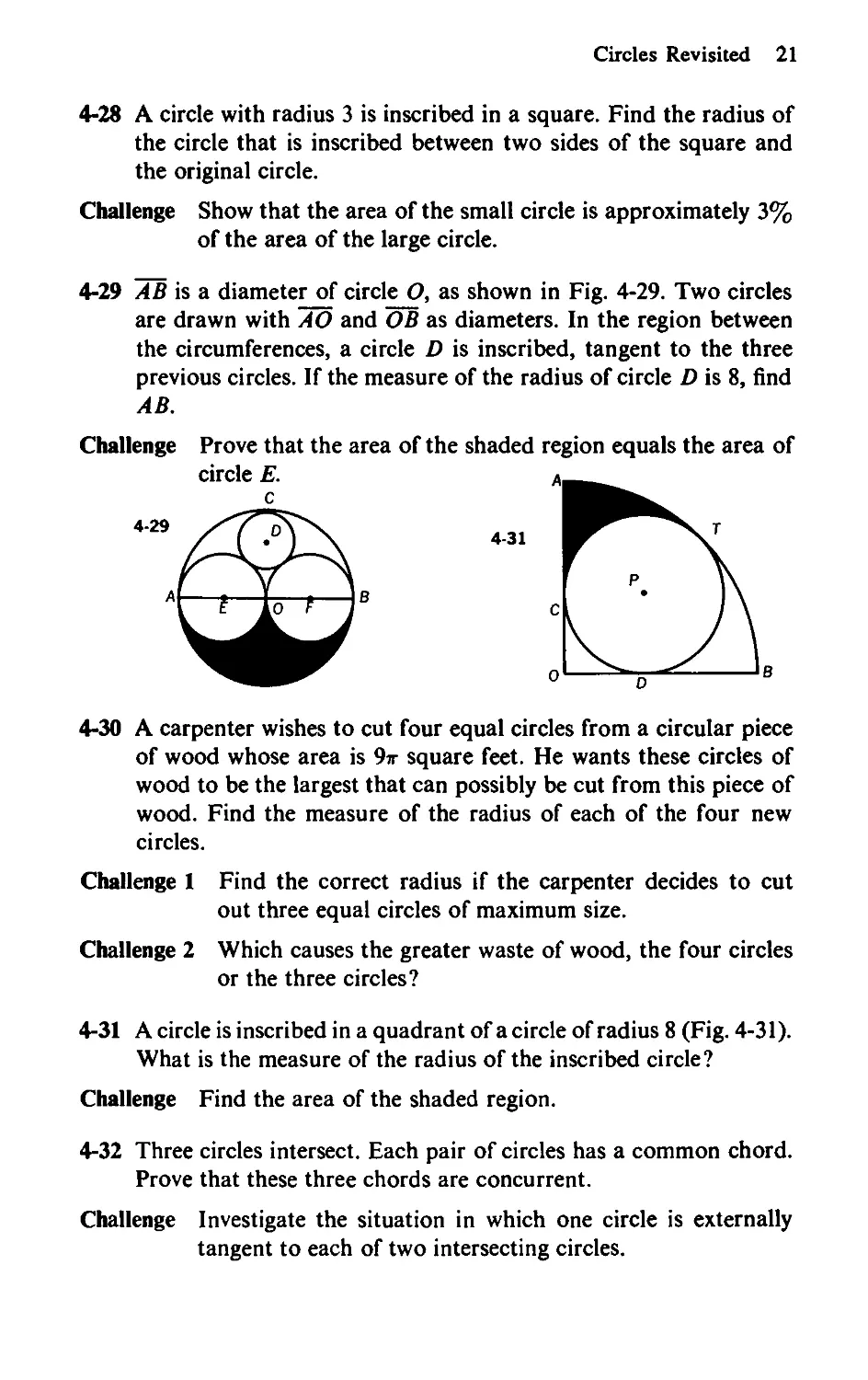
4-29 AB is a diameter of circle O, as shown in Fig. 4-29. Two circles
are drawn with ЛО and C)B as diameters. In the region between
the circumferences, a circle D is inscribed, tangent to the three
previous circles. If the measure of the radius of circle D is 8, find
AB.
Challenge Prove that the area of the shaded region equals the area of
4-30 A carpenter wishes to cut four equal circles from a circular piece
of wood whose area is 9тг square feet. He wants these circles of
wood to be the largest that can possibly be cut from this piece of
wood. Find the measure of the radius of each of the four new
circles.
Challenge 1 Find the correct radius if the carpenter decides to cut
out three equal circles of maximum size.
Challenge 2 Which causes the greater waste of wood, the four circles
or the three circles?
4-31 A circle is inscribed in a quadrant of a circle of radius 8 (Fig. 4-31).
What is the measure of the radius of the inscribed circle?
Challenge Find the area of the shaded region.
4-32 Three circles intersect. Each pair of circles has a common chord.
Prove that these three chords are concurrent.
Challenge Investigate the situation in which one circle is externally
tangent to each of two intersecting circles.
22 PROBLEMS
4-33 The bisectors of the angles of a quadrilateral are drawn. From
each pair of adjacent angles, the two bisectors are extended until
they intersect. The line segments connecting the points of inter-
section form a quadrilateral. Prove that this figure is cyclic (i.e.,
can be inscribed in a circle).
4-34 In cyclic quadrilateral A BCD, perpendiculars to AB and CD are
erected at В and D and extended until they meet sides CD and
AB at B' and D', respectively. Prove AC is parallel to B'D1.
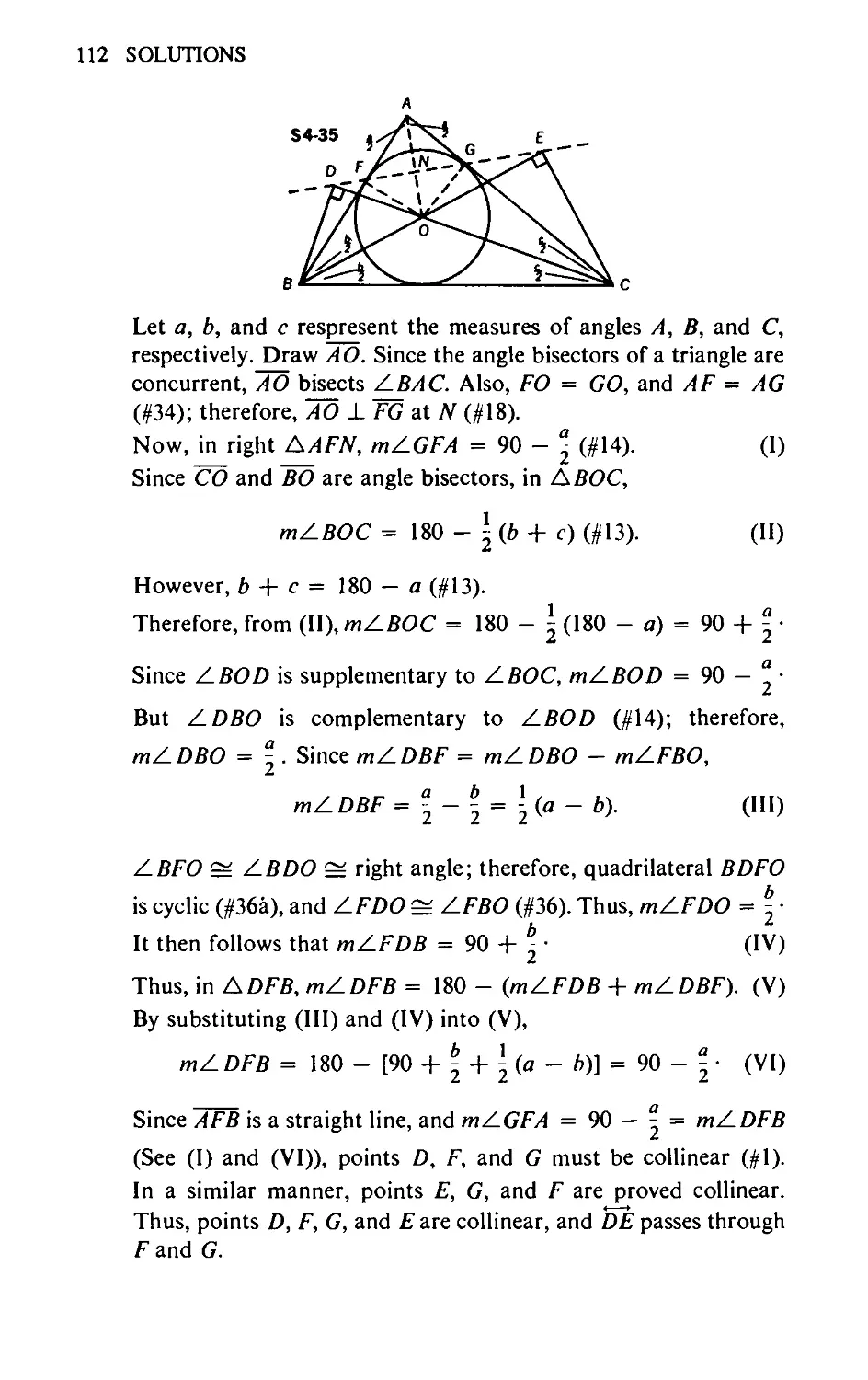
4-35 Perpendiculars BD and CE are drawn from vertices В and C of
ДАВС to the interior bisectors of angles C and B, meeting them
at D and E, respectively (Fig. 4-35). Prove that DE intersects AB
and AC at their respective points of tangency, F and G, with the
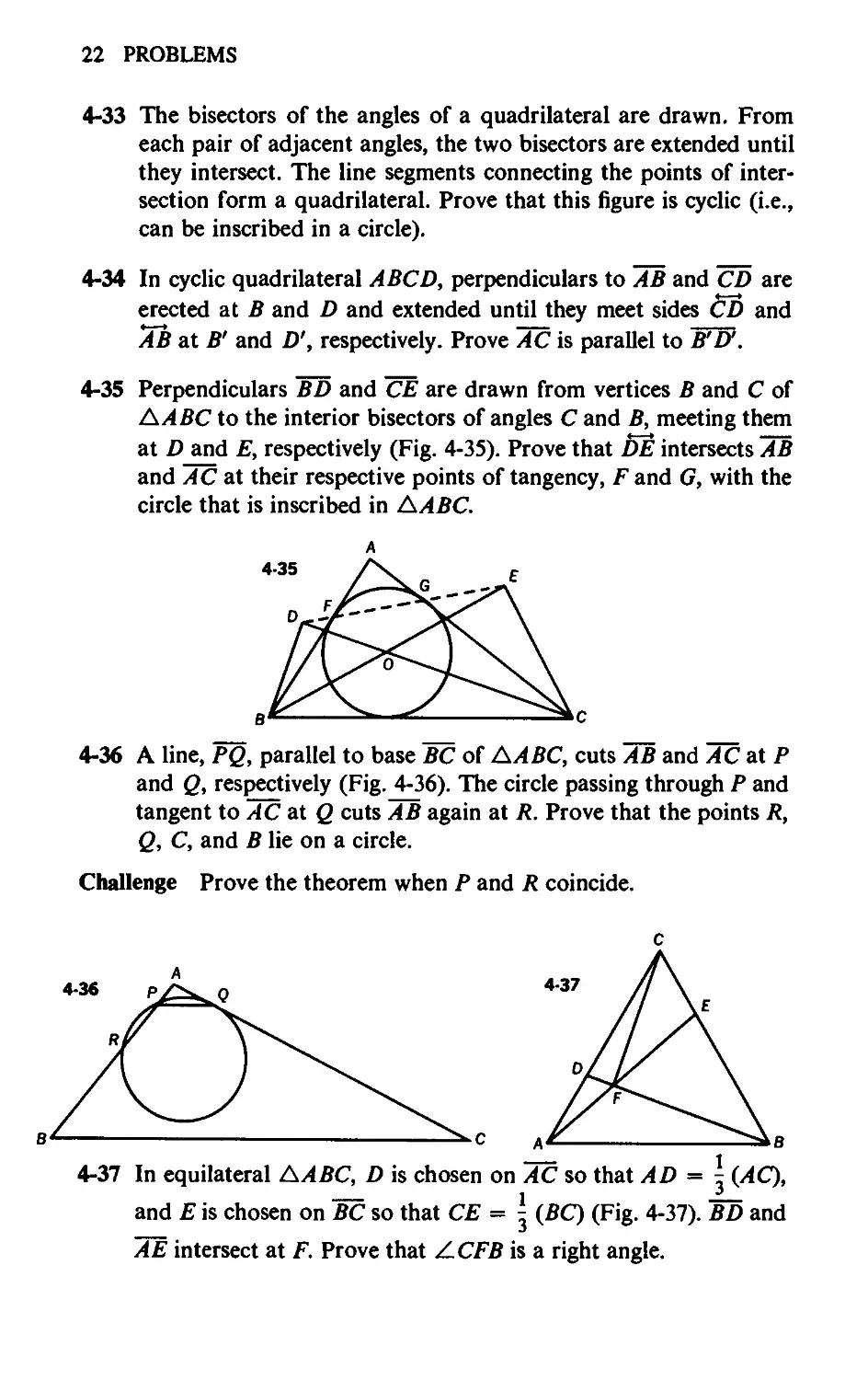
circle that is inscribed in ДАВС.
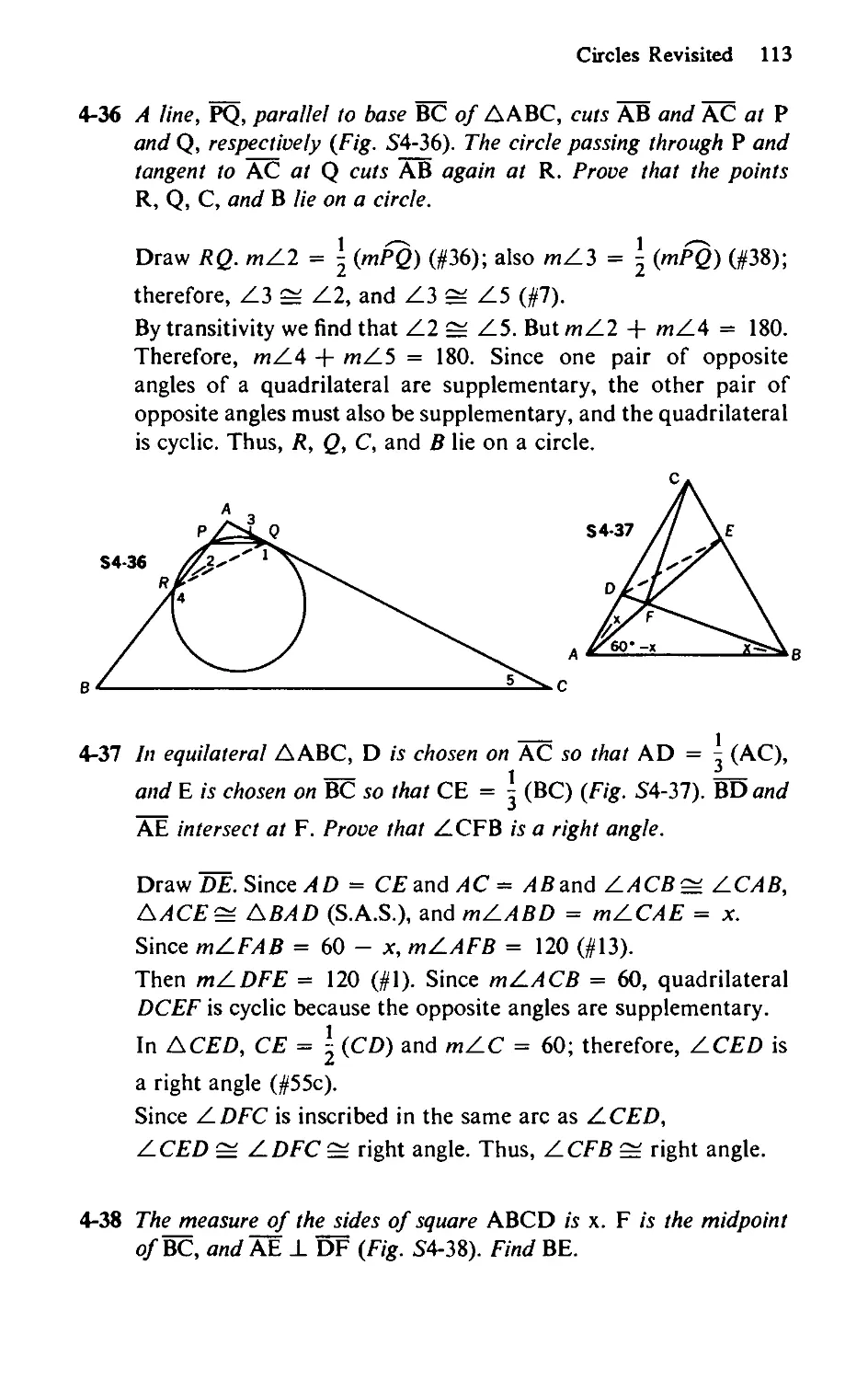
4-36 A line, PQ, parallel to base BC of ДАВС, cuts ~AB and ЛС at P
and Q, respectively (Fig. 4-36). The circle passing through P and
tangent to AC at Q cuts AB again at R. Prove that the points R,
Q, C, and В lie on a circle.
Challenge Prove the theorem when P and R coincide.
4-37 In equilateral ДАВС, D is chosen on AC so that AD = | (AC),
and E is chosen on BC so that CE = | (BC) (Fig. 4-37). BD and
AE intersect at F. Prove that A.CFB is a right angle.
Area Relationships 23
Challenge Prove or disprove the theorem when AD = |(ЛС) and
CE = | (BC).
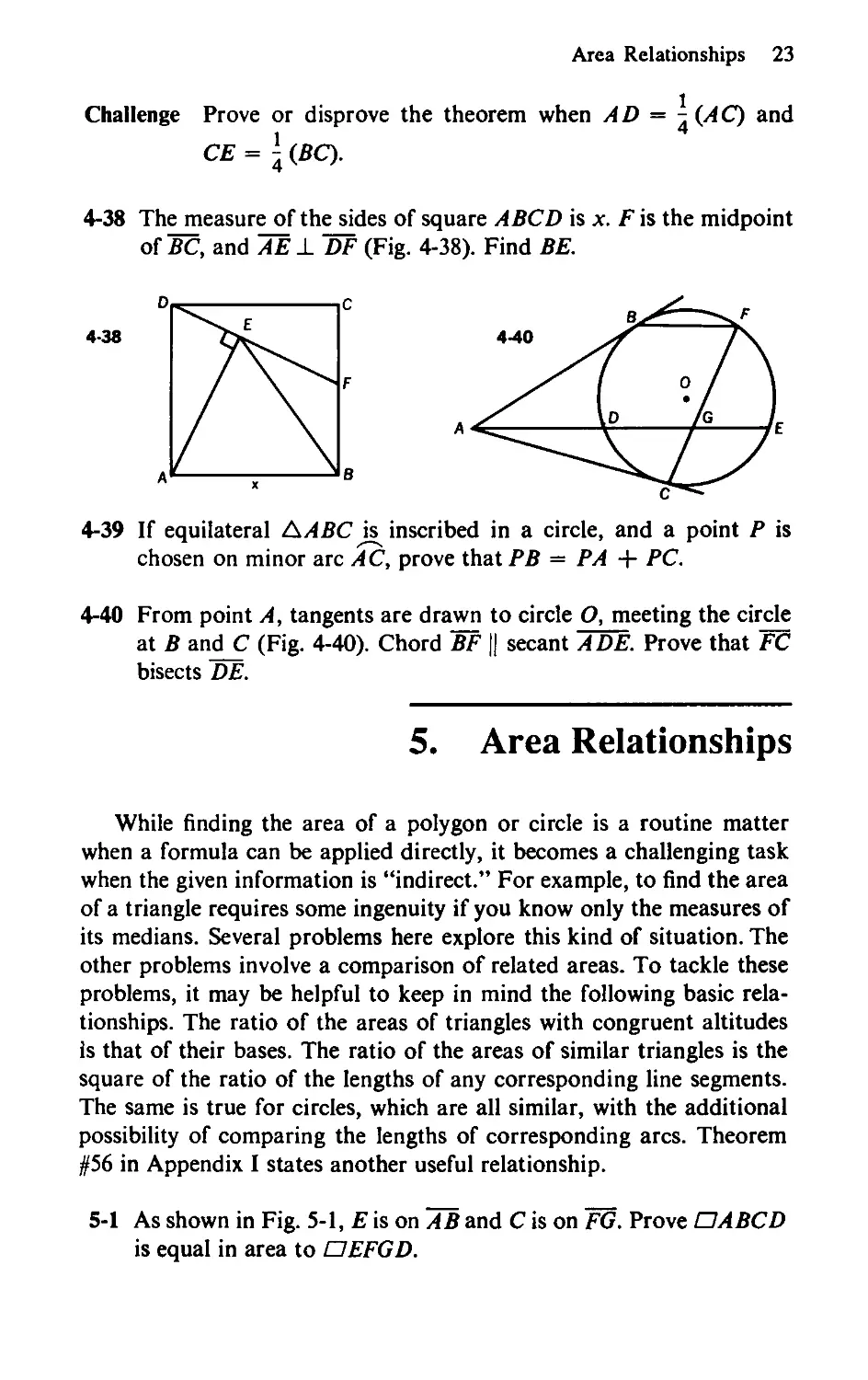
4-38 The measure of the sides of square A BCD is x. F is the midpoint
of BC, and AE±~DF (Fig. 4-38). Find BE.
4-39 If equilateral ДЛВС is inscribed in a circle, and a point P is
chosen on minor arc AC, prove that PB = PA + PC.
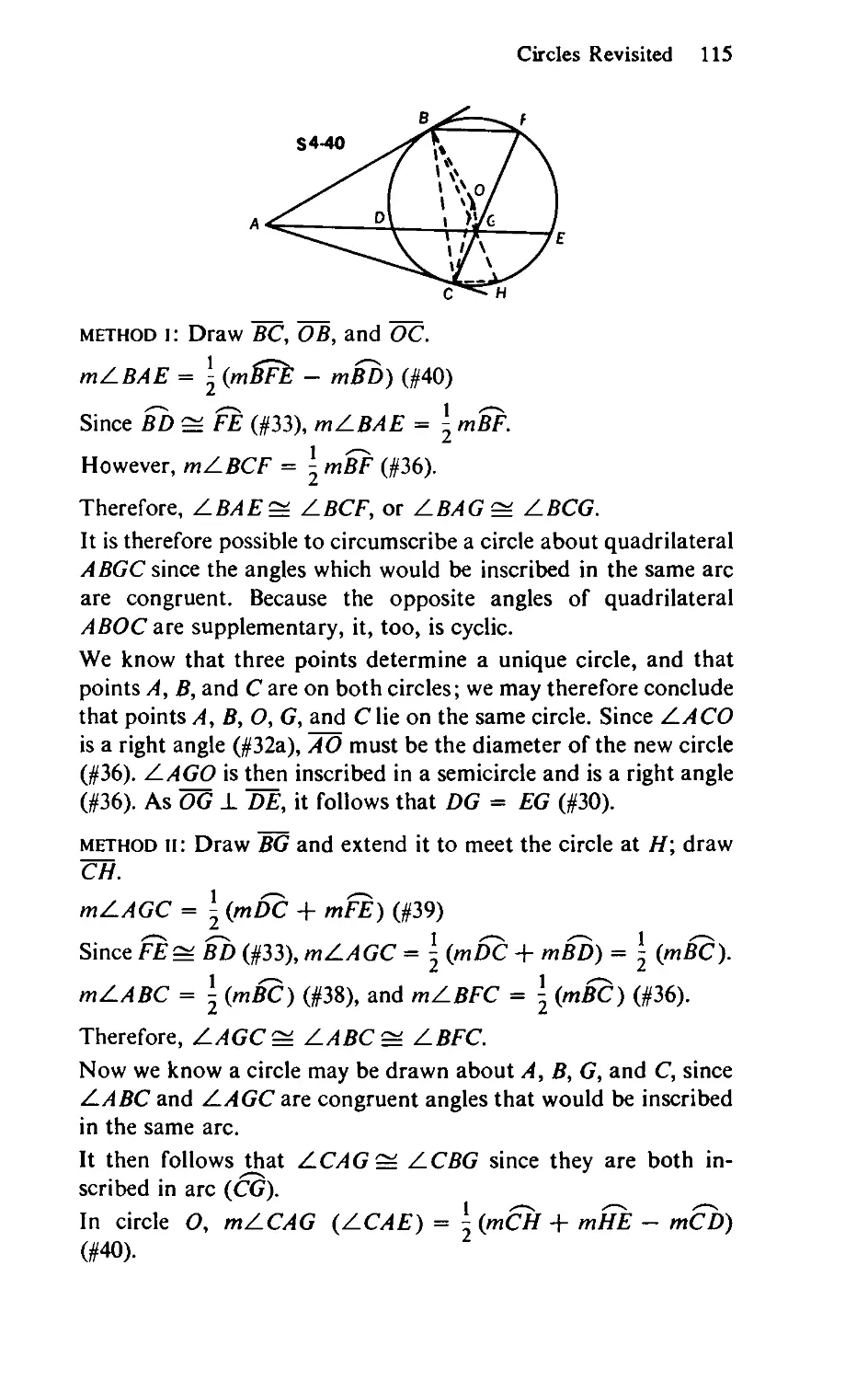
4-40 From point A, tangents are drawn to circle O, meeting the circle
at В and C (Fig. 4-40). Chord BF || secant A DE. Prove that FC
bisects ДЁ.
5. Area Relationships
While finding the area of a polygon or circle is a routine matter
when a formula can be applied directly, it becomes a challenging task
when the given information is “indirect.” For example, to find the area
of a triangle requires some ingenuity if you know only the measures of
its medians. Several problems here explore this kind of situation. The
other problems involve a comparison of related areas. To tackle these
problems, it may be helpful to keep in mind the following basic rela-
tionships. The ratio of the areas of triangles with congruent altitudes
is that of their bases. The ratio of the areas of similar triangles is the
square of the ratio of the lengths of any corresponding line segments.
The same is true for circles, which are all similar, with the additional
possibility of comparing the lengths of corresponding arcs. Theorem
#56 in Appendix I states another useful relationship.
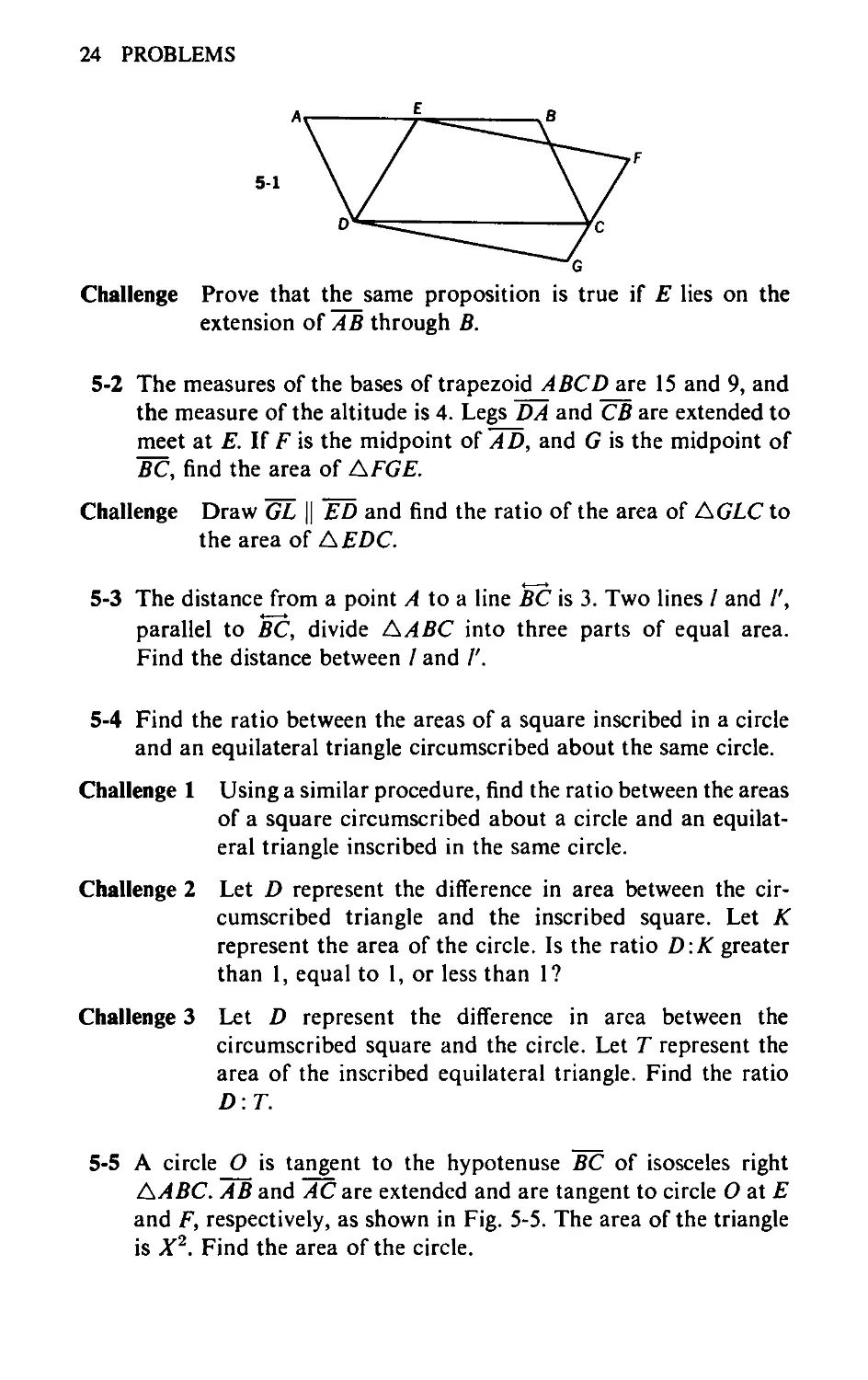
5-1 As shown in Fig. 5-1, E is on AB and C is on FG. Prove CJABCD
is equal in area to EJEFGD.
24 PROBLEMS
Challenge Prove that the same proposition is true if E lies on the
extension of AB through B.
5-2 The measures of the bases of trapezoid ABCD are 15 and 9, and
the measure of the altitude is 4. Legs DA and CB are extended to
meet at E. If F is the midpoint of AD, and G is the midpoint of
BC, find the area of AFGE.
Challenge Draw GL || ED and find the ratio of the area of AGLC to
the area of A EDC.
5-3 The distance from a point A to a line BC is 3. Two lines / and /',
parallel to BC, divide ЛАВС into three parts of equal area.
Find the distance between I and I'.
5-4 Find the ratio between the areas of a square inscribed in a circle
and an equilateral triangle circumscribed about the same circle.
Challenge 1 Using a similar procedure, find the ratio between the areas
of a square circumscribed about a circle and an equilat-
eral triangle inscribed in the same circle.
Challenge 2 Let D represent the difference in area between the cir-
cumscribed triangle and the inscribed square. Let К
represent the area of the circle. Is the ratio D.K greater
than 1, equal to 1, or less than 1?
Challenge 3 Let D represent the difference in area between the
circumscribed square and the circle. Let T represent the
area of the inscribed equilateral triangle. Find the ratio
D: T.
5-5 A circle О is tangent to the hypotenuse BC of isosceles right
ДЛВС. AB and AC are extended and are tangent to circle О at £
and F, respectively, as shown in Fig. 5-5. The area of the triangle
is X2. Find the area of the circle.
Area Relationships 25
Challenge Find the area of trapezoid EBCF.
5-6 PQ is the perpendicular bisector of AD, AB ± BC, and DC ± BC
(Fig. 5-6). If AB = 9, BC = 8, and DC = 7, find the area of
quadrilateral APQB.
5-7 A triangle has sides that measure 13, 14, and 15. A line per-
pendicular to the side of measure 14 divides the interior of the
triangle into two regions of equal area. Find the measure of the
segment of the perpendicular that lies within the triangle.
Challenge Find the area of the trapezoid determined by the per-
pendicular to the side whose measure is 14, the altitude to
that side, and sides of the given triangle.
5-8 In ДАВС, AB = 20, AC = 22’ , and BC = 27. Points Zand Y
are taken on ~AB and AC, respectively, so that AX = A Y. If the
area of &AXY = | area of ДАВС, find AX.
Challenge Find the ratio of the area of ДВХУ to that of ДСХУ.
5-9 In ДАВС, AB = 7, AC = 9. On AB, point D is taken so that
BD = 3. ~DE is drawn cutting AC in E so that quadrilateral
BCED has | the area of ДАВС. Find CE.
26 PROBLEMS
Challenge Show that if BD = ~c, and the area of quadrilateral
BCED = — K, where К is the area of ДЛВС, then
CE = b ( " ~	•
\m(n — 1)/
5-10 An isosceles triangle has a base of measure 4, and sides measuring
3. A line drawn through the base and one side (but not through
any vertex) divides both the perimeter and the area in half. Find
the measures of the segments of the base defined by this line.
Challenge Find the measure of the line segment cutting the two sides
of the triangle.
5-11 Through D, a point on base BC of А ЛВС, DE and DF are drawn
parallel to sides AB and AC, respectively, meeting AC at E and
AB at F. If the area of /\EDC is four times the area of £\BFD,
what is the ratio of the area of AAFE to the area of ЛАВС?
Challenge Show that if the area of fxEDC is k2 times the area of
ABFD, then the ratio of area of AAFE to the area of
ЛАВС is k:(l + k)2.
5-12 Two circles, each of which passes through the center of the other,
intersect at points M and N (Fig. 5-12). A line from M intersects
the circles at К and L. If KL = 6, compute the area of AKLN.
Challenge If r is the measure of the radius of each circle, find the least
value and the greatest value of the area of fxKLN.
5-13 Find the area of a triangle whose medians have measures 39, 42,
45.
5-14 The measures of the sides of a triangle are 13,14, and 15. A second
triangle is formed in which the measures of the three sides are the
Area Relationships 27
same as the measures of the medians of the first triangle. What is
the area of the second triangle?
Challenge 1 Show that K(m) = К where К represents the area of
ЛАВС, and K{m) the area of a triangle with sides ma,
гпъ, mc, the medians of ЛАВС.
Challenge 2 Solve Problem 5-13 using the results of Challenge 1.
5-15 Find the area of a triangle formed by joining the midpoints of
the sides of a triangle whose medians have measures 15,15, and 18.
Challenge Express the required area in terms of K(m), where K(rn) is
the area of the triangle formed from the medians.
5-16 In ЛАВС, E is the midpoint of BC, while F is the midpoint of
AE, and BF meets AC at D. If the area of ЛАВС = 48, find the
area of ЛАРО.
Challenge 1 Solve this problem in general terms.
Challenge 2 Change AF = ±AE to AF = j AE, and find a general
solution.
5-17 In ЛАВС, D is the midpoint of side ВС, E is the midpoint of
AD, F is the midpoint of BE, and G is the midpoint of FC (Fig.
5-17). What part of the area of ЛАВС is the area of ЛЕРС1
Challenge Solve the problem if BD = | ВС, AE = | AD, BF = BE,
and GC = | FC.
5-18 In trapezoid A BCD with upper base A D, lower base BC, and legs
A В and CD, E is the midpoint of CD (Fig. 5-18). A perpendicular,
EF, is drawn to BA (extended if necessary). If EF = 24 and
AB = 30, find the area of the trapezoid. (Note that the figure is
not drawn to scale.)
28 PROBLEMS
Challenge Establish a relationship between points F, A, and В such
that the area of the trapezoid A BCD is equal to the area of
ДРВН.
5-19 In CJABCD, a line from C cuts diagonal BD in E and AB in F.
If Fis the midpoint of AB, and the area of ДВЕС is 100, find the
area of quadrilateral AFED.
Challenge Find the area of Z\GEC where G is the midpoint of BD.
5-20 P is any point on side AB of EJABCD. CP is drawn through P
meeting DA extended at Q. Prove that the area of ДОРА is
equal to the area of A QPB.
Challenge Prove the theorem for point P on the endpoints of side BA.
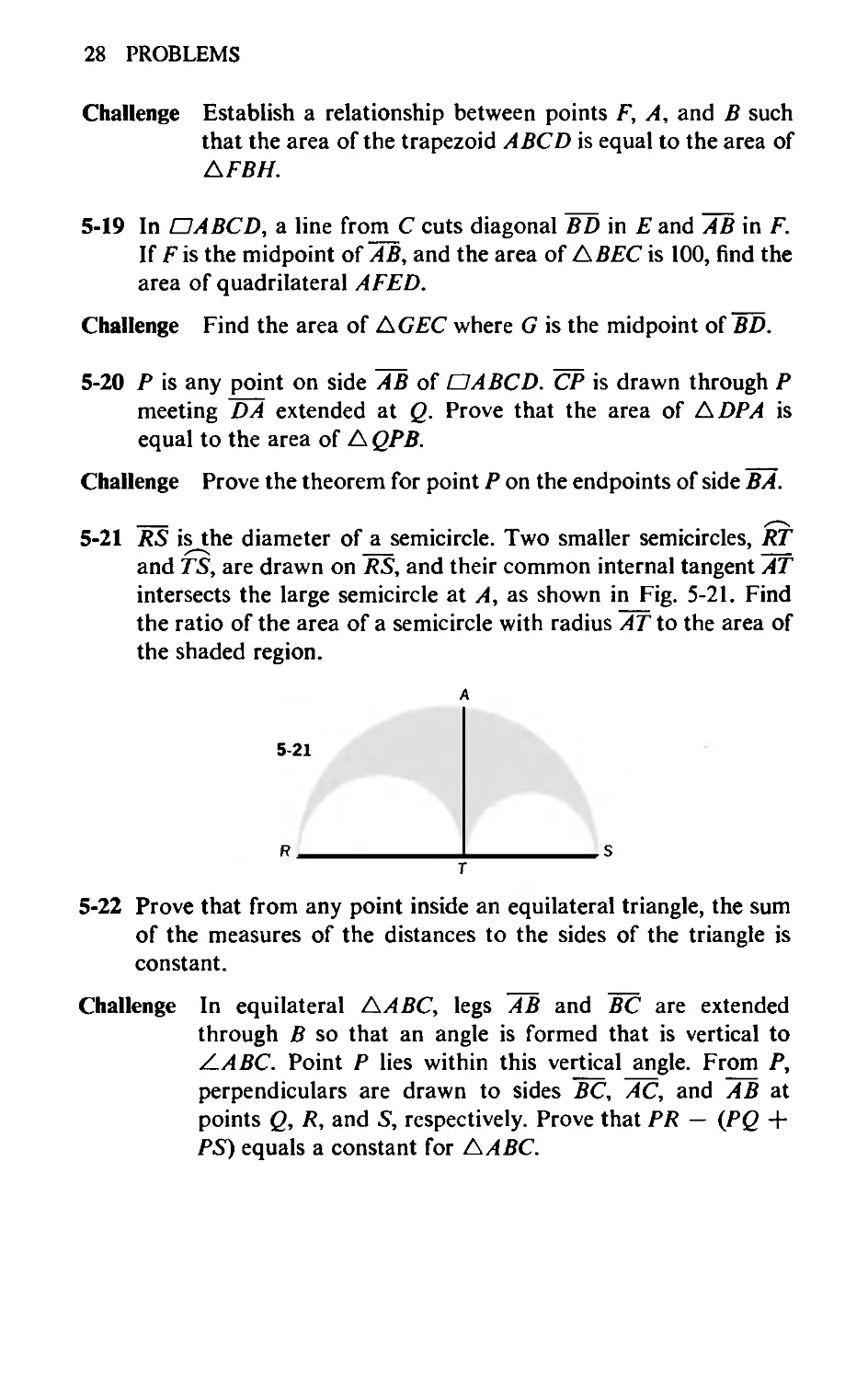
5-21 FS is the diameter of a semicircle. Two smaller semicircles, RT
and TS, are drawn on RS, and their common internal tangent AT
intersects the large semicircle at A, as shown in Fig. 5-21. Find
the ratio of the area of a semicircle with radius AT to the area of
the shaded region.
A
5-21
5-22 Prove that from any point inside an equilateral triangle, the sum
of the measures of the distances to the sides of the triangle is
constant.
Challenge In equilateral АЛВС, legs AB and BC are extended
through В so that an angle is formed that is vertical to
Z_ABC. Point P lies within this vertical angle. From P,
perpendiculars are drawn to sides BC, AC, and AB at
points Q, R, and S, respectively. Prove that PR — (PQ +
PS) equals a constant for ДАВС.
SECTION II
Further Investigations
6.	A Geometric Potpourri
A variety of somewhat difficult problems from elementary Euclidean
geometry will be found in this section. Included are Heron’s Theorem
and its extension to the cyclic quadrilateral, Brahmagupta’s Theorem.
There are problems often considered classics, such as the butterfly
problem and Morley’s Theorem. Other famous problems presented are
Euler’s Theorem and Miquel’s Theorem.
Several ways to solve a problem are frequently given in the Solution
Part of the book, as many as seven different methods in one case!
We urge you to experiment with different methods. After all, ‘the right
answer’ is not the name of the game in Geometry.
6-1 Heron’s Formula is used to find the area of any triangle, given
only the measures of the sides of the triangle. Derive this famous
formula. The area of any triangle = \/s(s — a)(s — b)(s — c),
where a, b, c are measures of the sides of the triangle and s is the
semiperimeter.
Challenge Find the area of a triangle whose sides measure 6, y/l, x/50.
6-2 An interesting extension of Heron’s Formula to the cyclic
quadrilateral is credited to Brahmagupta, an Indian mathematician
who lived in the early part of the seventh century. Although
Brahmagupta’s Formula was once thought to hold for all
quadrilaterals, it has been proved to be valid only for cyclic
quadrilaterals.
The formula for the area of a cyclic quadrilateral with side
measures a, b, c, and d is
К = y/(s — aj(s — b)(s — c)(s — d),
where s is the semiperimeter. Derive this formula.
30 PROBLEMS
Challenge 1 Find the area of a cyclic quadrilateral whose sides
measure 9, 10, 10, and 21.
Challenge 2 Find the area of a cyclic quadrilateral whose sides
measure 15, 24, 7, and 20.
6-3 Sides BA and CA of ДАВС are extended through A to form
rhombuses BATR and CAKN. (See Fig. 6-3.) BN and RC,
intersecting at P, meet AB at S and AC at M. Draw MQ parallel
to AB. (a) Prove AMQS is a rhombus and (b) prove that the area
of /\BPC is equal to the area of quadrilateral ASPM.
6-4 Two circles with centers A and В intersect at points M and N.
Radii AP and BQ are parallel (on opposite sides of AB). If the
common external tangents meet AB at D, and PQ meets AB at
C, prove that /LCND is a right angle.
6-5 In a triangle whose sides measure 5", 6", and 7", point P is 2"
from the 5" side and 3" from the 6" side. How far is P from the
7" side?
6-6 Prove that if the measures of the interior bisectors of two angles
of a triangle are equal, then the triangle is isosceles.
6-7 In circle O, draw any chord AB, with midpoint M. Through M
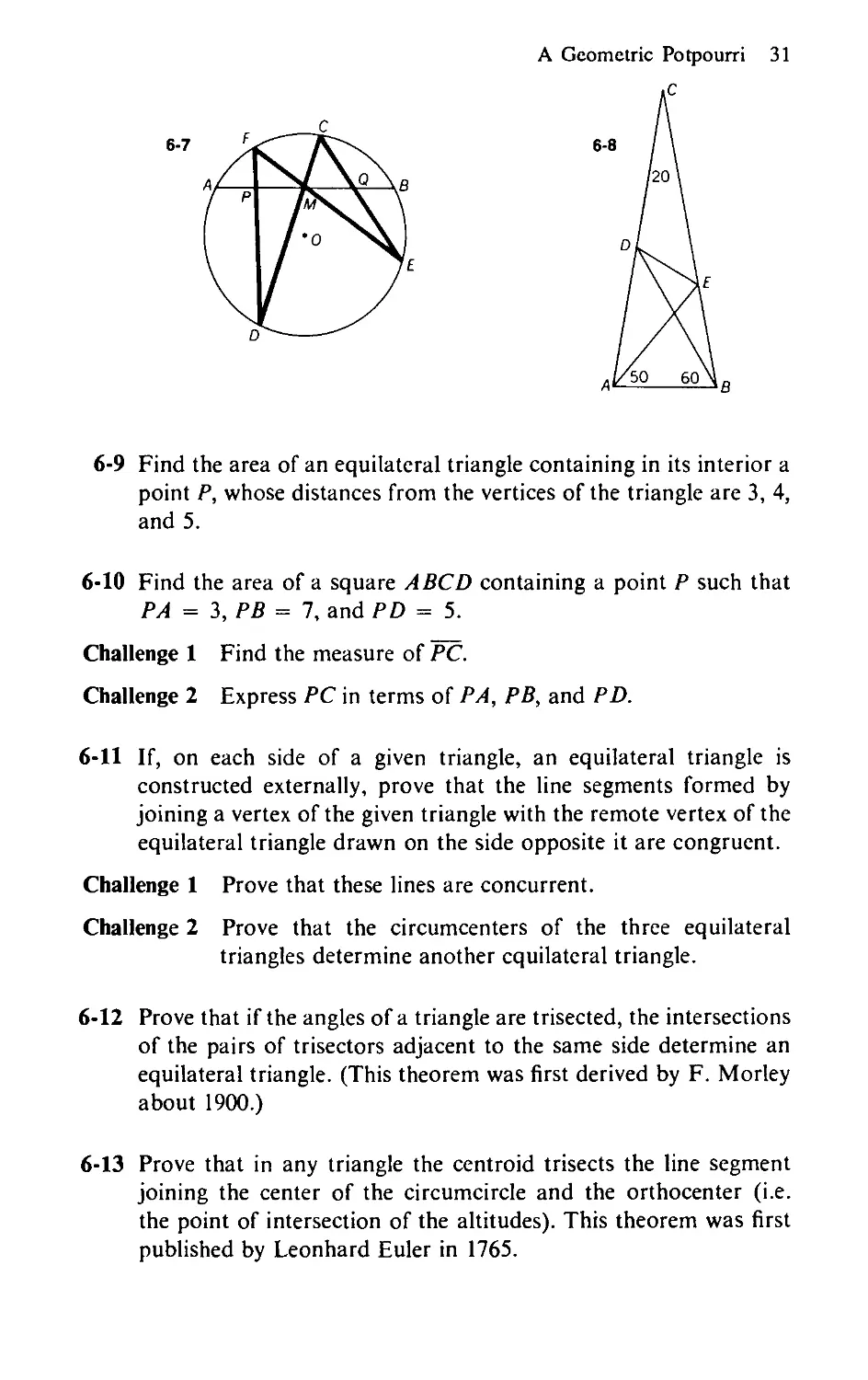
two other chords, FE and CD, are drawn. CE and FD intersect
AB at Q and P, respectively. Prove that MP = MQ. (See Fig.
6-7.) This problem is often referred to as the butterfly problem.
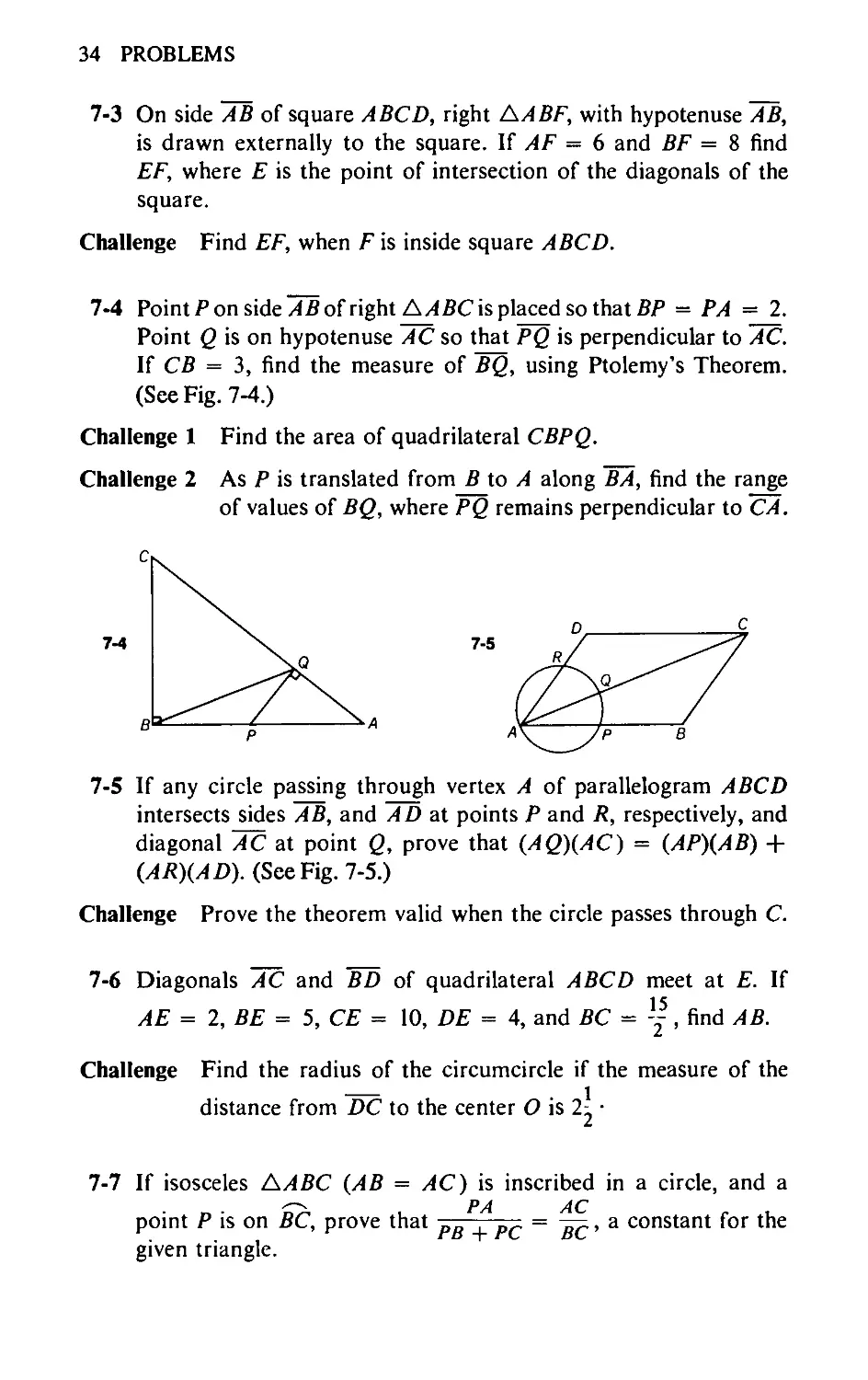
6-8 ЛАВС is isosceles with CA = CB. mZ_ABD = 60, m/LBAE =
50, and m/-C = 20. Find the measure of Z.EDB (Fig. 6-8).
A Geometric Potpourri 31
6-9 Find the area of an equilateral triangle containing in its interior a
point P, whose distances from the vertices of the triangle are 3, 4,
and 5.
6-10 Find the area of a square A BCD containing a point P such that
PA = 3,PB = 7, and PD = 5.
Challenge 1 Find the measure of PC.
Challenge 2 Express PC in terms of PA, PB, and PD.
6-11 If, on each side of a given triangle, an equilateral triangle is
constructed externally, prove that the line segments formed by
joining a vertex of the given triangle with the remote vertex of the
equilateral triangle drawn on the side opposite it are congruent.
Challenge 1 Prove that these lines are concurrent.
Challenge 2 Prove that the circumcenters of the three equilateral
triangles determine another equilateral triangle.
6-12 Prove that if the angles of a triangle are trisected, the intersections
of the pairs of trisectors adjacent to the same side determine an
equilateral triangle. (This theorem was first derived by F. Morley
about 1900.)
6-13 Prove that in any triangle the centroid trisects the line segment
joining the center of the circumcircle and the orthocenter (i.e.
the point of intersection of the altitudes). This theorem was first
published by Leonhard Euler in 1765.
32 PROBLEMS
Challenge 1 The result of this theorem leads to an interesting problem
first published by James Joseph Sylvester (1814-1897).
The problem is to find the resultant of the three vectors
OA, OB, and ОС acting on the center of the circumcircle
О of ЛАВС.
Challenge 2 Describe the situation when ЛАВС is equilateral.
Challenge 3 Prove that the midpoint of the line segment determined
by the circumcenter and the orthocenter is the center of
the nine-point circle. The nine-point circle of a triangle
is determined by the following nine points; the feet of the
altitudes, the midpoints of the sides of the triangle, and
the midpoints of the segments from the vertices to the
orthocenter.
6-14 Prove that if a point is chosen on each side of a triangle, then the
circles determined by each vertex and the points on the adjacent
sides pass through a common point (Figs. 6-14a and 6-14b). This
theorem was first published by A. Miquel in 1838.
Challenge 1 Prove in Fig. 6-14a,wZBFAf = тЛСЕМ — m/_ADM;
or in Fig. 6-14b, mZ-BFM = mZ_CDM = mZ_GEM.
Challenge 2 Give the location of M when AF = FB = BE = EC =
CD = DA.
6-15 Prove that the centers of the circles in Problem 6-14 determine a
triangle similar to the original triangle.
Challenge Prove that any other triangle whose sides pass through the
intersections of the above three circles, P, Q, and R (two
at a time), is similar to ЛАВС.
Ptolemy and the Cyclic Quadrilateral 33
7.	Ptolemy and the Cyclic Quadrilateral
One of the great works of the second Alexandrian period was a
collection of earlier studies, mainly in astronomy, by Claudius Ptole-
maeus (better known as Ptolemy). Included in this work, the Almagest,
is a theorem stating that in a cyclic (inscribed) quadrilateral the sum
of the products of the opposite sides equals the product of the diagonals.
This powerful theorem of Ptolemy enables us to solve problems which
would otherwise be difficult to handle. The theorem and some of its
consequences are explored here.
7-1 Prove that in a cyclic quadrilateral the product of the diagonals is
equal to the sum of the products of the pairs of opposite sides
(Ptolemy’s Theorem).
Challenge 1 Prove that if the product of the diagonals of a quadrilateral
equals the sum of the products of the pairs of opposite
sides, then the quadrilateral is cyclic. This is the converse
of Ptolemy’s Theorem.
Challenge 2 To what familiar result does Ptolemy's Theorem lead
when the cyclic quadrilateral is a rectangle?
Challenge 3 Find the diagonal, d, of the trapezoid with bases a and b,
and equal legs c.
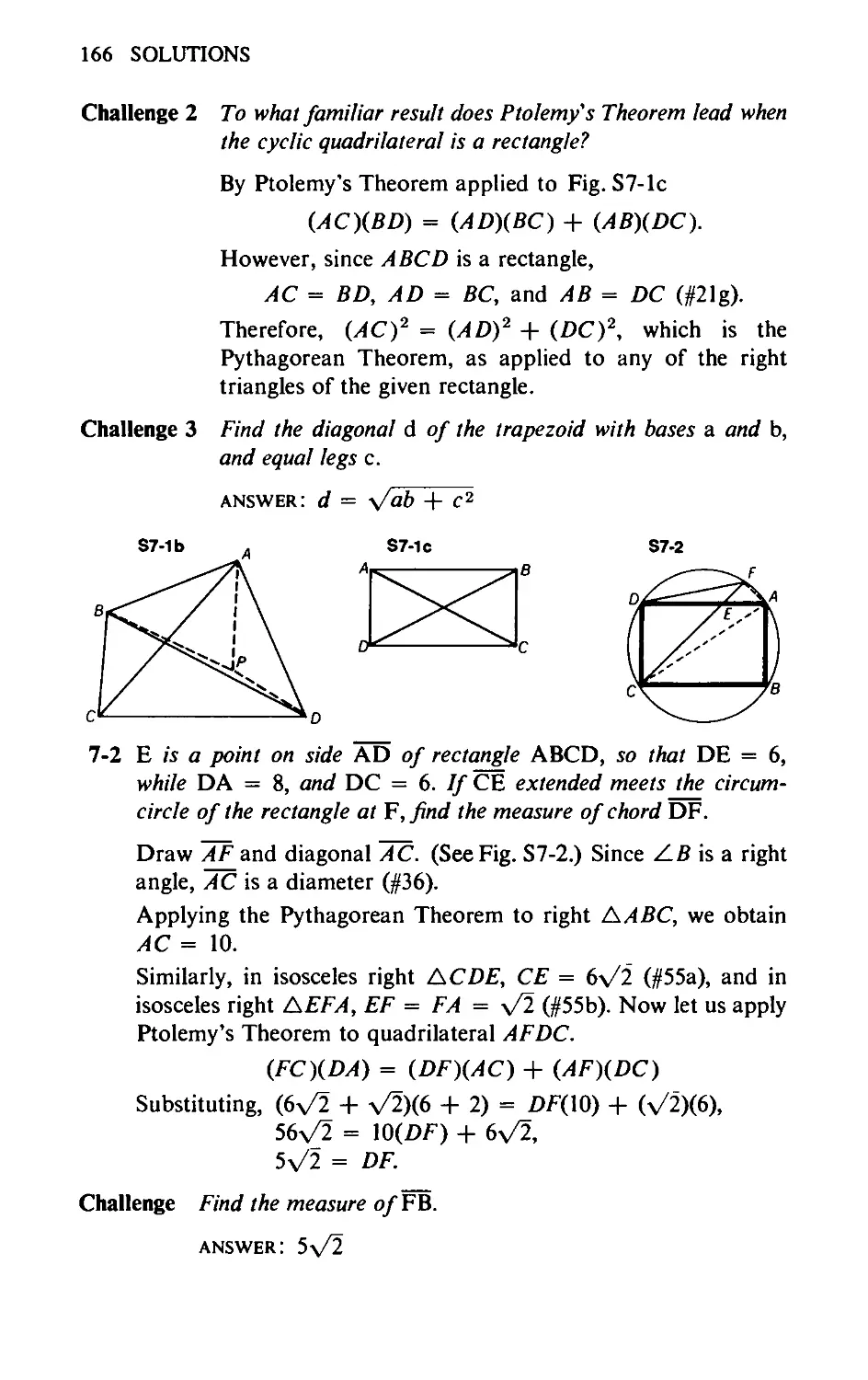
7-2 £ is a point on side AD of rectangle ABCD, so that DE = 6,
while DA = 8, and DC = 6. If CE extended meets the cir-
cumcircle of the rectangle at F, find the measure of chord DF.
(See Fig. 7-2.)
Challenge Find the measure of FB.
34 PROBLEMS
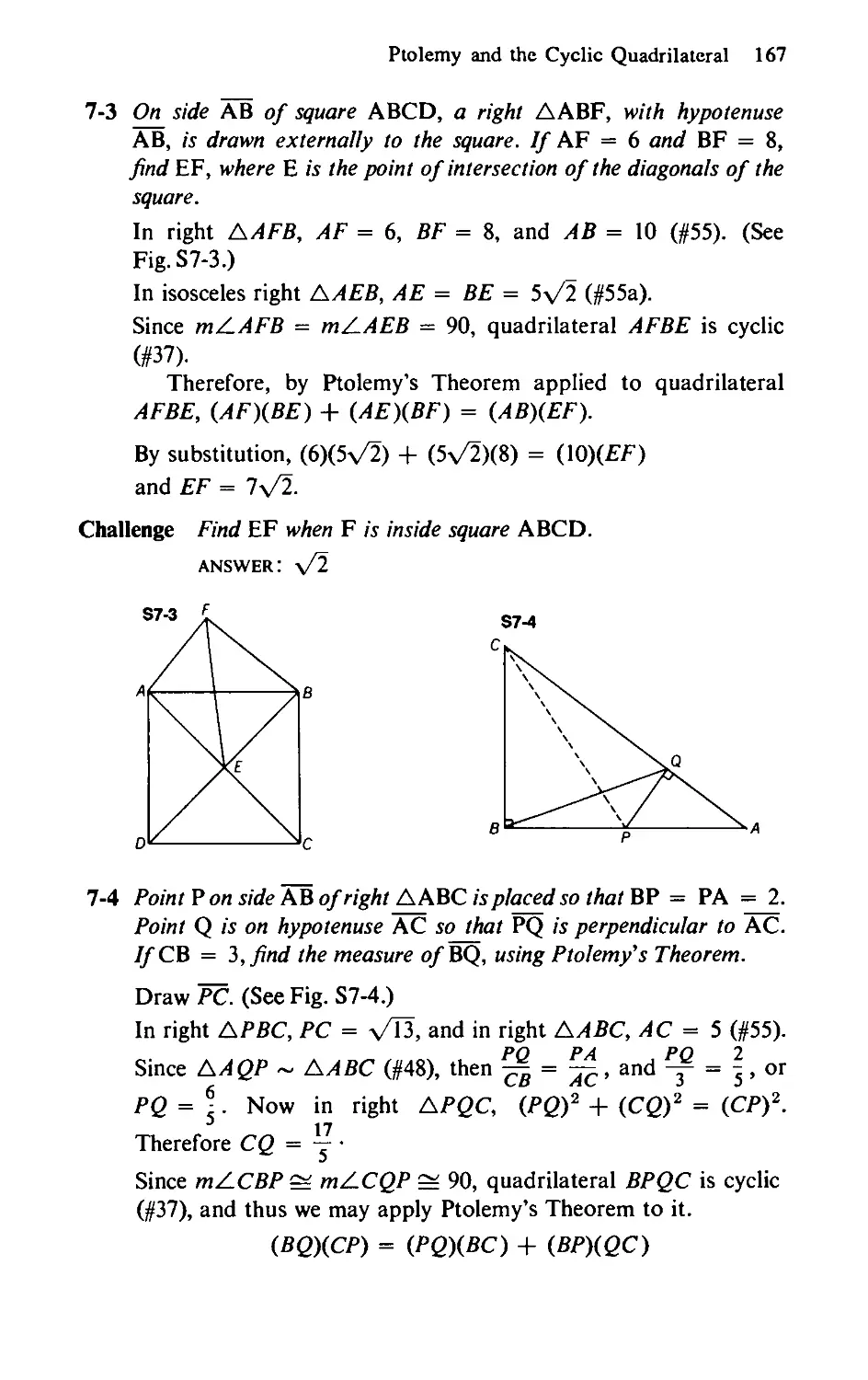
7-3 On side AB of square ABCD, right AABF, with hypotenuse AB,
is drawn externally to the square. If AF = 6 and BF = 8 find
EF, where E is the point of intersection of the diagonals of the
square.
Challenge Find EF, when F is inside square ABCD.
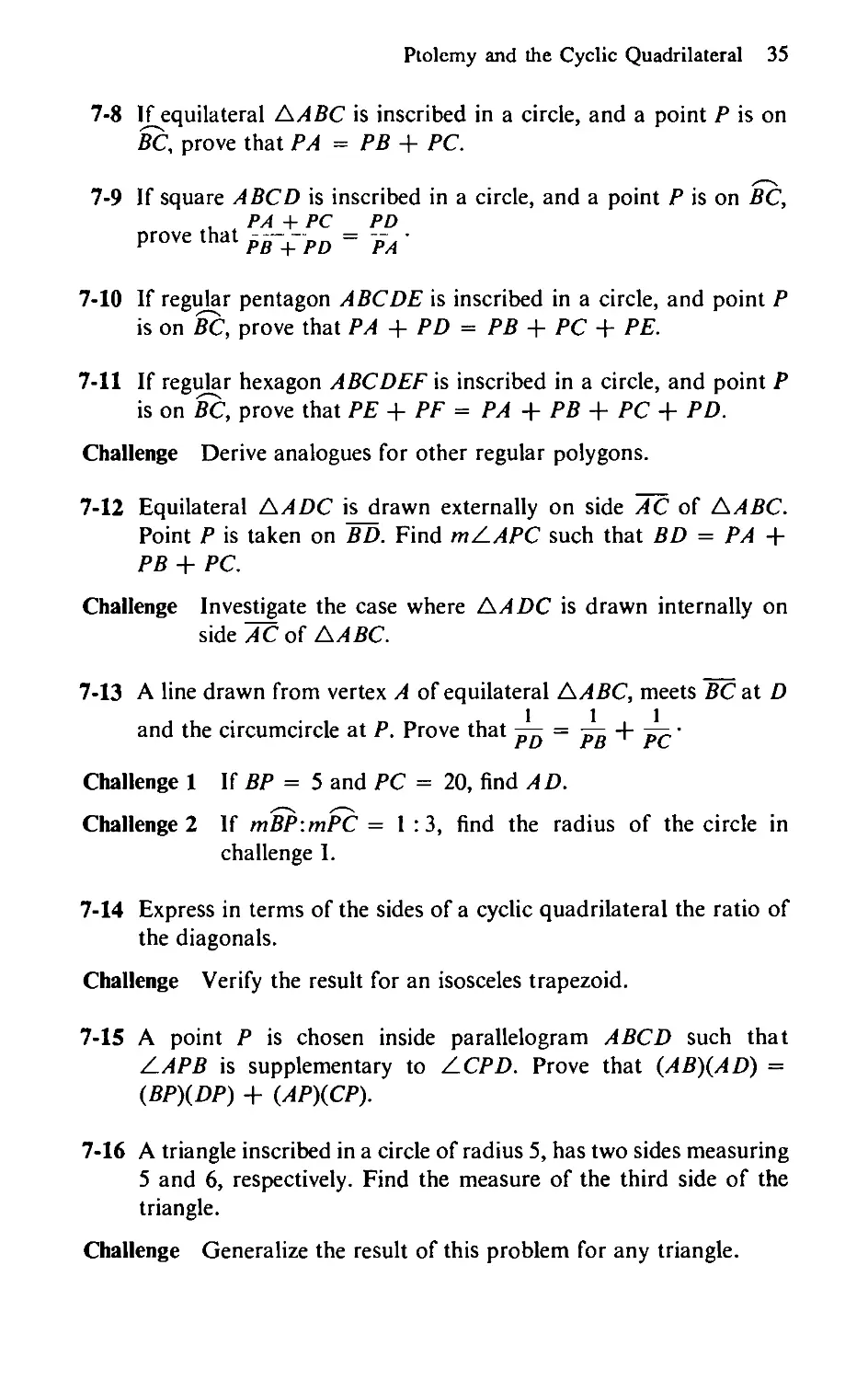
7-4 Point Pon side A В of right A ABC is placed so that BP — PA = 2.
Point Q is on hypotenuse AC so that PQ is perpendicular to AC.
If CB = 3, find the measure of BQ, using Ptolemy’s Theorem.
(See Fig. 7-4.)
Challenge 1 Find the area of quadrilateral CBPQ.
Challenge 2 As P is translated from В to A along BA, find the range
of values of BQ, where PQ remains perpendicular to CA.
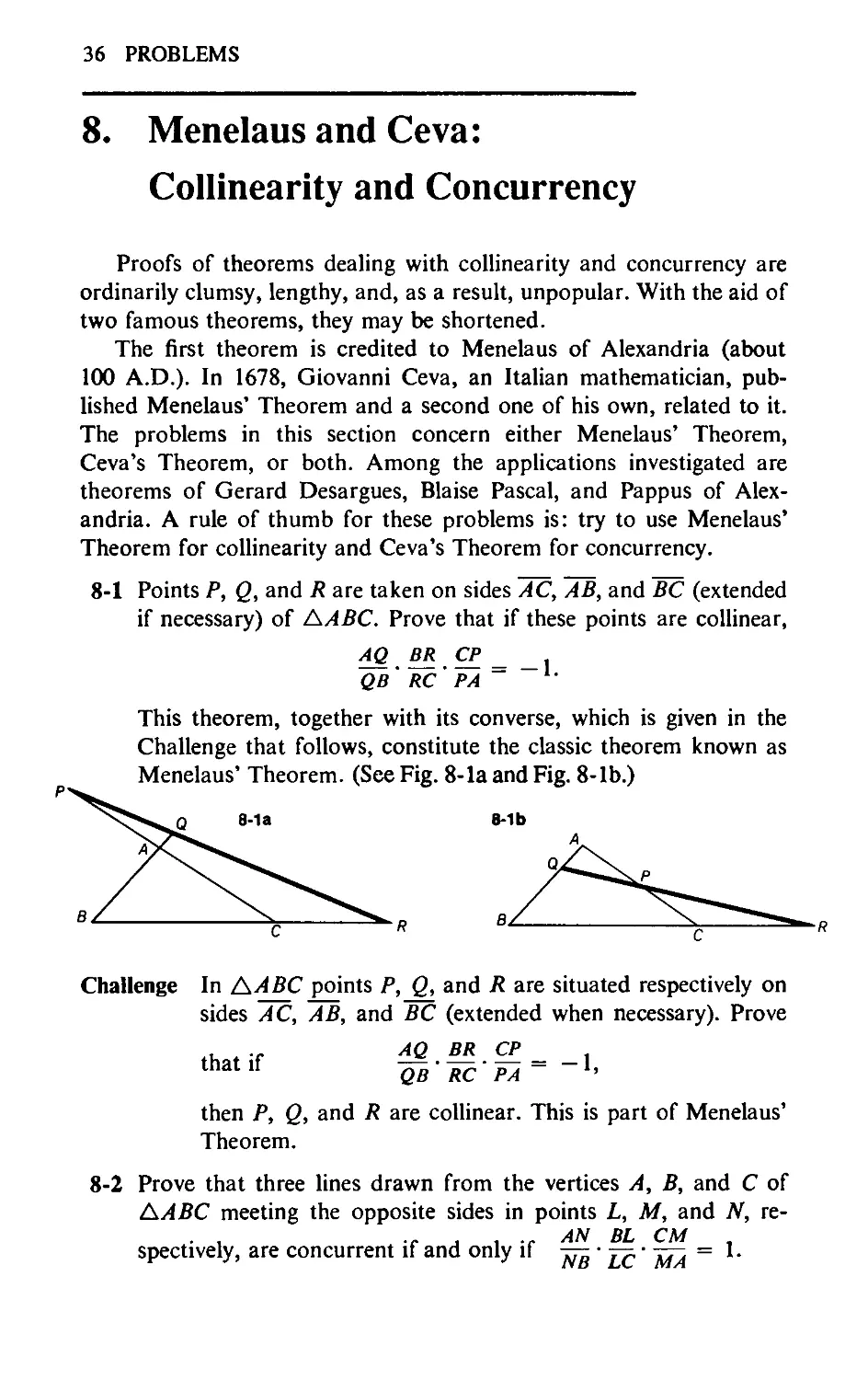
7-5 If any circle passing through vertex A of parallelogram ABCD
intersects sides AB, and AD at points P and R, respectively, and
diagonal AC at point Q, prove that (AQ)(AC) = (AP)(AB) +
(AR)(AD). (See Fig. 7-5.)
Challenge Prove the theorem valid when the circle passes through C.
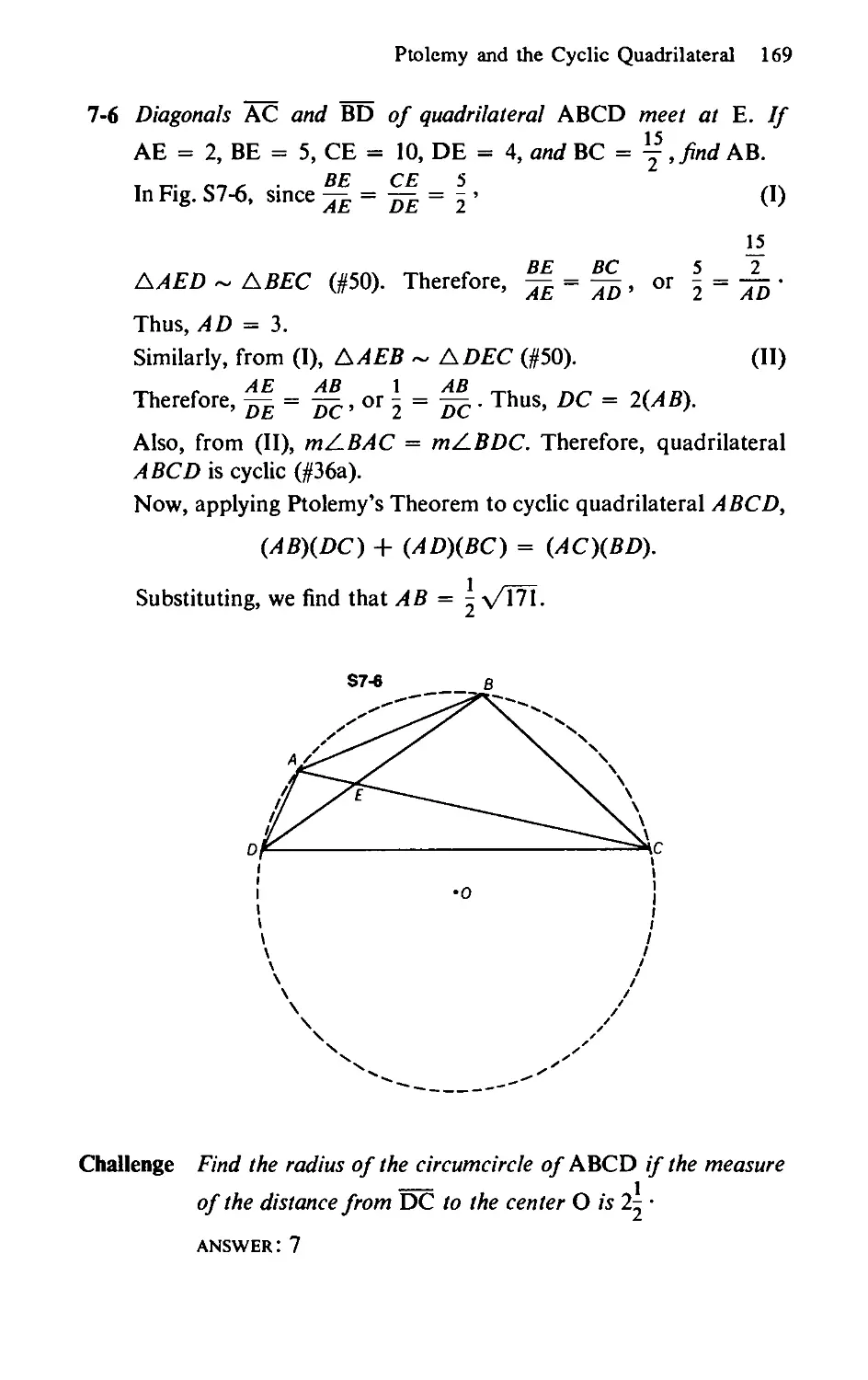
7-6 Diagonals AC and BD of quadrilateral ABCD meet at E. If
AE = 2, BE = 5, CE = 10, DE = 4, and ВС = у, find AB.
Challenge Find the radius of the circumcircle if the measure of the
distance from DC to the center О is 2^ •
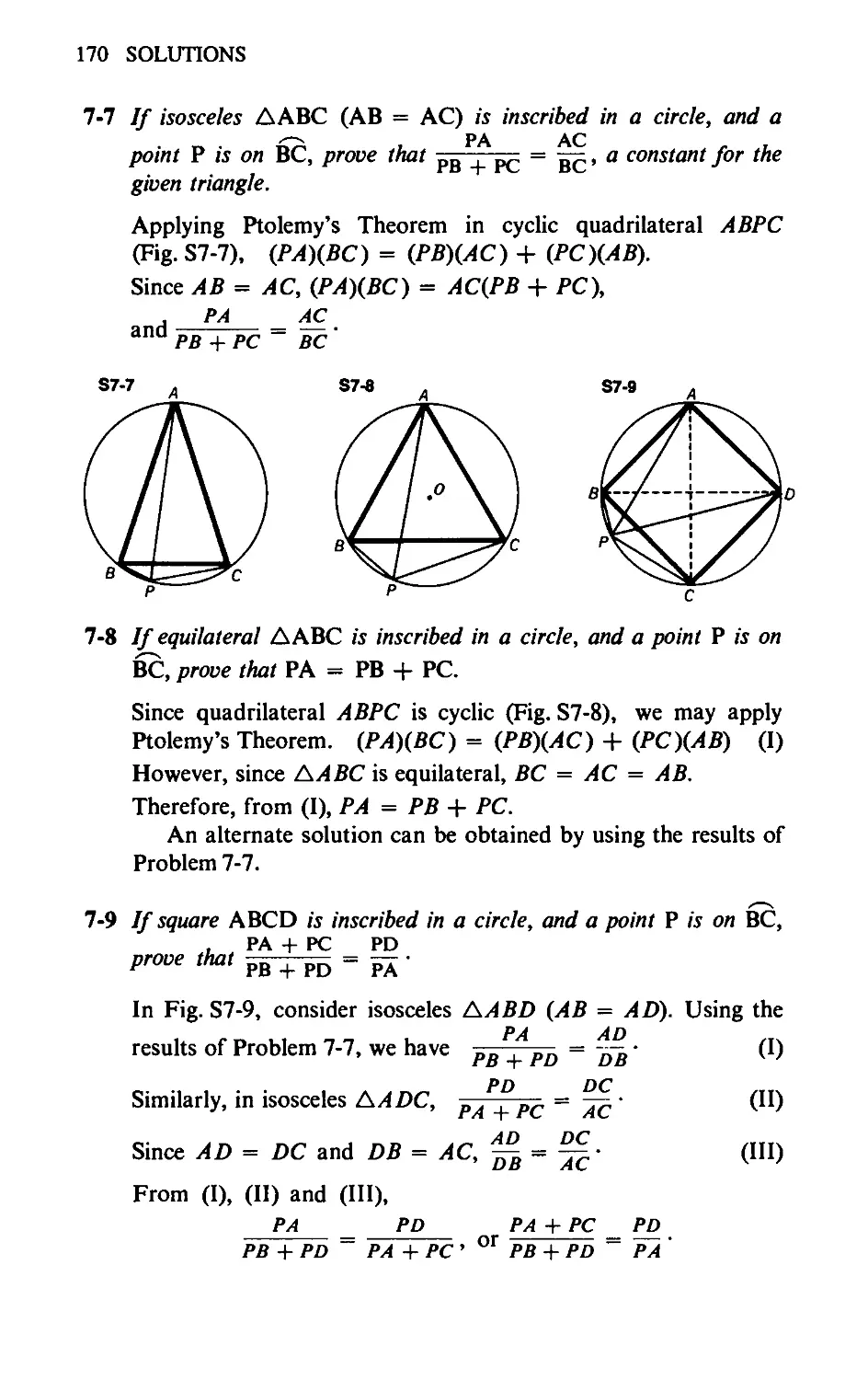
7-7 If isosceles ДАВС {AB = AC) is inscribed in a circle, and a
z—ч	рд	de
point P is on BC, prove that p—-	= -^, a constant for the
given triangle.
Ptolemy and the Cyclic Quadrilateral 35
7-8 If equilateral ЛАВС is inscribed in a circle, and a point P is on
BC, prove that PA = PB + PC.
7-9 If square ABCD is inscribed in a circle, and a point P is on BC,
, PA + PC PD
prove that /F+-pD = -A
7-10 If regular pentagon ABCDE is inscribed in a circle, and point P
is on BC, prove that PA + PD - PB + PC + PE.
7-11 If regular hexagon ABCDEF is inscribed in a circle, and point P
is on BC, prove that PE + PF = PA + PB + PC + PD.
Challenge Derive analogues for other regular polygons.
7-12 Equilateral ЛАОС is drawn externally on side AC of ЛАВС.
Point P is taken on BD. Find m/LAPC such that BD = PA +
PB + PC.
Challenge Investigate the case where ЛАОС is drawn internally on
side AC of ЛАВС.
7-13 A line drawn from vertex A of equilateral ЛАВС, meets BC at D
and the circumcircle at P. Prove that 4к = 4т, + 4т- ’
ru Jtd Jris
Challenge 1 If BP = 5 and PC = 20, find AD.
Challenge 2 If mBP.mPC =1:3, find the radius of the circle in
challenge I.
7-14 Express in terms of the sides of a cyclic quadrilateral the ratio of
the diagonals.
Challenge Verify the result for an isosceles trapezoid.
7-15 A point P is chosen inside parallelogram ABCD such that
Z_APB is supplementary to Z_CPD. Prove that (AB)(AD) =
(BP)(DP) + (AP)(CP).
7-16 A triangle inscribed in a circle of radius 5, has two sides measuring
5 and 6, respectively. Find the measure of the third side of the
triangle.
Challenge Generalize the result of this problem for any triangle.
36 PROBLEMS
8.	Menelaus and Ceva:
Collinearity and Concurrency
Proofs of theorems dealing with collinearity and concurrency are
ordinarily clumsy, lengthy, and, as a result, unpopular. With the aid of
two famous theorems, they may be shortened.
The first theorem is credited to Menelaus of Alexandria (about
100 A.D.). In 1678, Giovanni Ceva, an Italian mathematician, pub-
lished Menelaus’ Theorem and a second one of his own, related to it.
The problems in this section concern either Menelaus’ Theorem,
Ceva’s Theorem, or both. Among the applications investigated are
theorems of Gerard Desargues, Blaise Pascal, and Pappus of Alex-
andria. A rule of thumb for these problems is: try to use Menelaus’
Theorem for collinearity and Ceva’s Theorem for concurrency.
8-1 Points P, Q, and R are taken on sides AC, AB, and BC (extended
if necessary) of ДЛВС. Prove that if these points are collinear,
AQ BR CP_________
QB ~ RC ' PA ~ L
This theorem, together with its converse, which is given in the
Challenge that follows, constitute the classic theorem known as
Challenge In A ABC points P, Q, and R are situated respectively on
sides AC, AB, and BC (extended when necessary). Prove
AQ BR CP _
qb' rc' PA ~	*’
then P, Q, and R are collinear. This is part of Menelaus’
Theorem.
that if
8-2 Prove that three lines drawn from the vertices A, B, and C of
А ЛВС meeting the opposite sides in points L, M, and N, re-
...... AN BL CM
spectively, are concurrent if and only if '	= 1-
Menelaus and Ceva: Collinearity and Concurrency 37
This is known as Ceva’s Theorem.
(See Fig. 8-2a, and Fig. 8-2b.)
8-3 Prove that the medians of any triangle are concurrent.
8-4 Prove that the altitudes of any triangle are concurrent.
Challenge Investigate the difficulty in applying this proof to a right
triangle by Ceva’s Theorem.
8-5 Prove that the interior angle bisectors of a triangle are concurrent.
8-6 Prove that the interior angle bisectors of two angles of a non-
isosceles triangle and the exterior angle bisector of the third angle
meet the opposite sides in three collinear points.
8-7 Prove that the exterior angle bisectors of any non-isosceles triangle
meet the opposite sides in three collinear points.
8-8 In right ДАВС, P and Q are on BC and AC, respectively, such
that CP = CQ = 2. Through the point of intersection, R, of AP
and BQ, a line is drawn also passing through C and meeting AB
at S. PQ extended meets AB at T. If the hypotenuse AB = 10 and
AC = 8, find TS.
Challenge 1 By how much is TS decreased if P is taken at the midpoint
of BC?
Challenge 2 What is the minimum value of TS?
8-9 A circle through vertices В and C of ДАВС meets AB at P and
<—»	<—»	ОС
AC at R. If PR meets BC at Q, prove that =
(See Fig. 8-9.)
(RC)(AC)
(PB)(AB) '
Challenge Investigate the case where the points P and R are on the
extremities of BA and CA, respectively.
38 PROBLEMS
8-9 A
X Q
8-10 In quadrilateral ABCD, AB and CD meet at P, while AD and BC
meet at Q. Diagonals AC and BD meet PQ at X and Y, respec-
tively (Fig. 8-10). Prove that = —	’
л V	z V
8-11 Prove that a line drawn through the centroid, G, of ЛАВС, cuts
sides AB and AC at points M and N, respectively, so that
(AM)(NC) + (AN)(MB) = (AM)(AN). (See Fig. 8-11.)

8-12 In ЛАВС, points L, M, and N lie on BC, AC, and AB, respect-
ively, and AL, BM, and CN are concurrent.
(a)	Find the numerical value of -77 +	+ 777 •
4 '	AL BM CN
(b)	Find the numerical value of	+ 7?, ’
4 7	AL BM CN
8-13 Congruent line segments AE and AF are taken on sides AB and
AC, respectively, of ЛАВС. The median AM intersects EF at
QE AC
point Q. Prove that 777 — —
r	QF AB
8-14 In ЛАВС, AL, BM, and CN are concurrent at P. Express the ratio
AP
in terms of segments made by the concurrent lines on the sides
of ЛАВС. (See Fig. 8-2a, and Fig. 8-2b.)
Challenge Complete the expressions for and •
Menelaus and Ceva: Collinearity and Concurrency 39
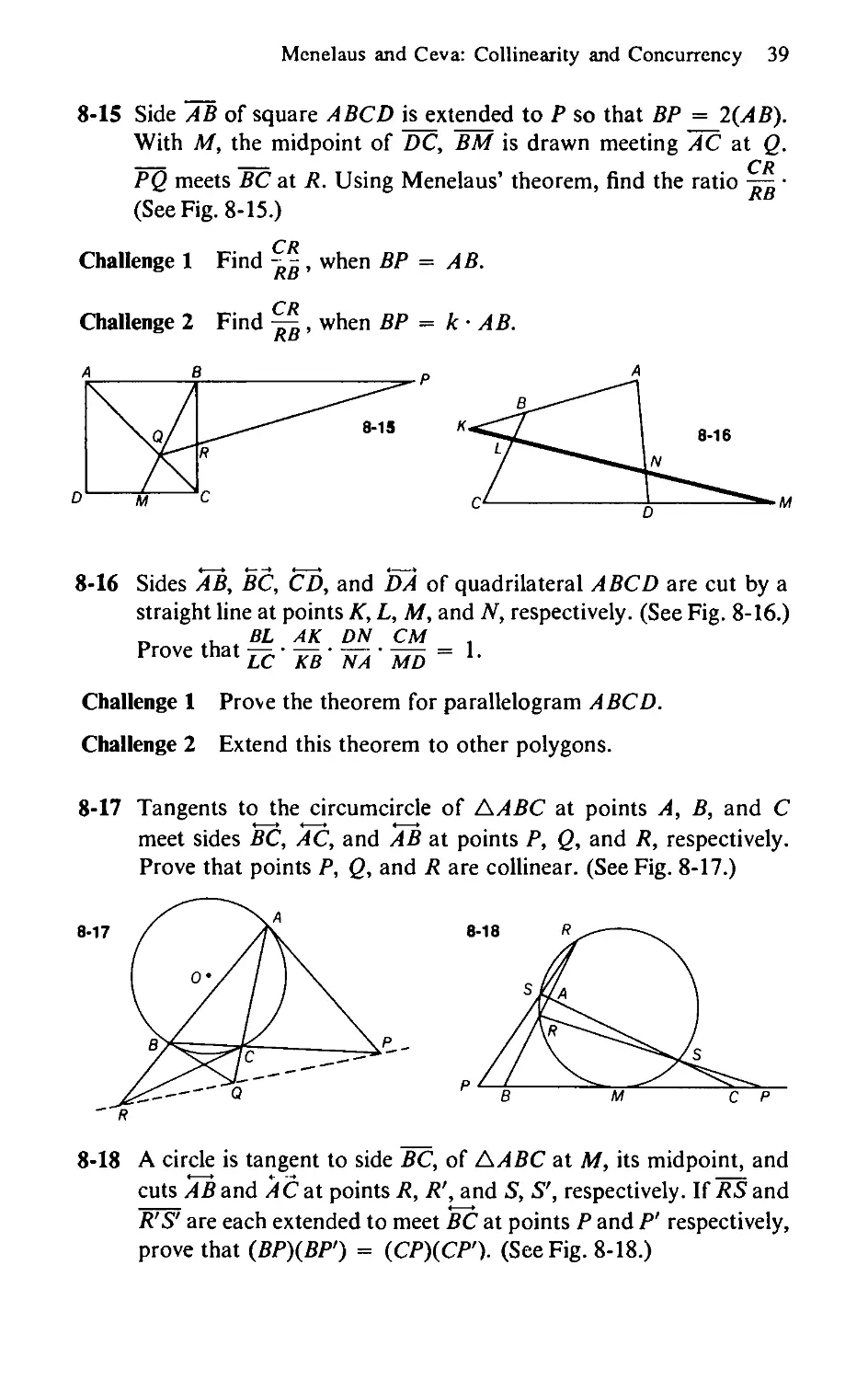
8-15 Side AB of square A BCD is extended to P so that BP = 2(A B).
With M, the midpoint of DC, BM is drawn meeting AC at Q.
_________ ________
PQ meets BC at R. Using Menelaus’ theorem, find the ratio — •
(See Fig. 8-15.)
Challenge 1 Find ~, when BP = AB.
Kb
Challenge 2 Find , when BP = к • AB.
KB
8-16 Sides AB, BC, CD, and DA of quadrilateral A BCD are cut by a
straight line at points K, L, M, and N, respectively. (See Fig. 8-16.)
„	, BL AK DN CM
Prove that 77. ’ тъ ’	= 1 •
LC KB NA MD
Challenge 1 Prove the theorem for parallelogram ABCD.
Challenge 2 Extend this theorem to other polygons.
8-17 Tangents to the circumcircle of ЛАВС at points A, B, and C
meet sides BC, AC, and AB at points P, Q, and R, respectively.
Prove that points P, Q, and R are collinear. (See Fig. 8-17.)
8-18 A circle is tangent to side BC, of ЛАВС at M, its midpoint, and
cuts AB and AC at points R, R', and S, S', respectively. If RS and
R’S' are each extended to meet BC at points P and P’ respectively,
prove that (BP)(BP') = (CP)(CP'). (See Fig. 8-18.)
40 PROBLEMS
Challenge 1 Show that the result implies that CP = BP'.
Challenge 2 Investigate the situation when ДАВС is equilateral.
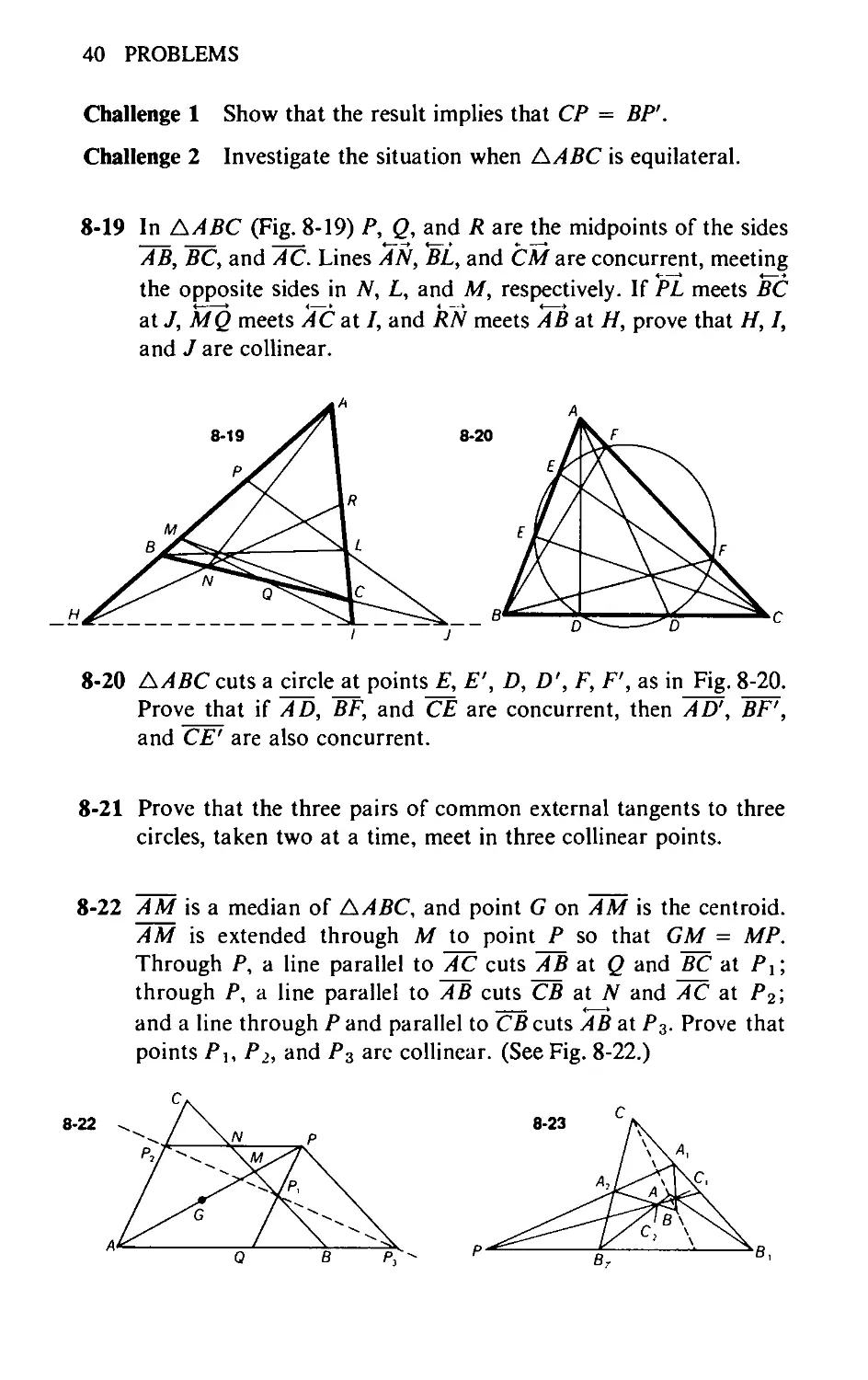
8-19 In ДАВС (Fig. 8-19) P, Q, and R are the midpoints of the sides
AB, BC, and AC. Lines AN, BL, and CM are concurrent, meeting
the opposite sides in N, L, and M, respectively. If PL meets BC
at J, MQ meets AC at I, and RN meets AB at H, prove that H, I,
and J are collinear.
8-20 ДАВС cuts a circle at points E, E', D, D’, F, F', as in Fig. 8-20.
Prove that if AD, BF, and CE are concurrent, then AD', BF',
and CE’ are also concurrent.
8-21 Prove that the three pairs of common external tangents to three
circles, taken two at a time, meet in three collinear points.
8-22 AM is a median of ДАВС, and point G on AM is the centroid.
AM is extended through M to point P so that GM = MP.
Through P, a line parallel to AC cuts AB at Q and BC at P} ;
through P, a line parallel to AB cuts CB at N and AC at P2\
and a line through P and parallel to CB cuts AB at P3. Prove that
points Pi, P2, and P3 arc collinear. (See Fig. 8-22.)
Menelaus and Ceva: Collinearity and Concurrency 41
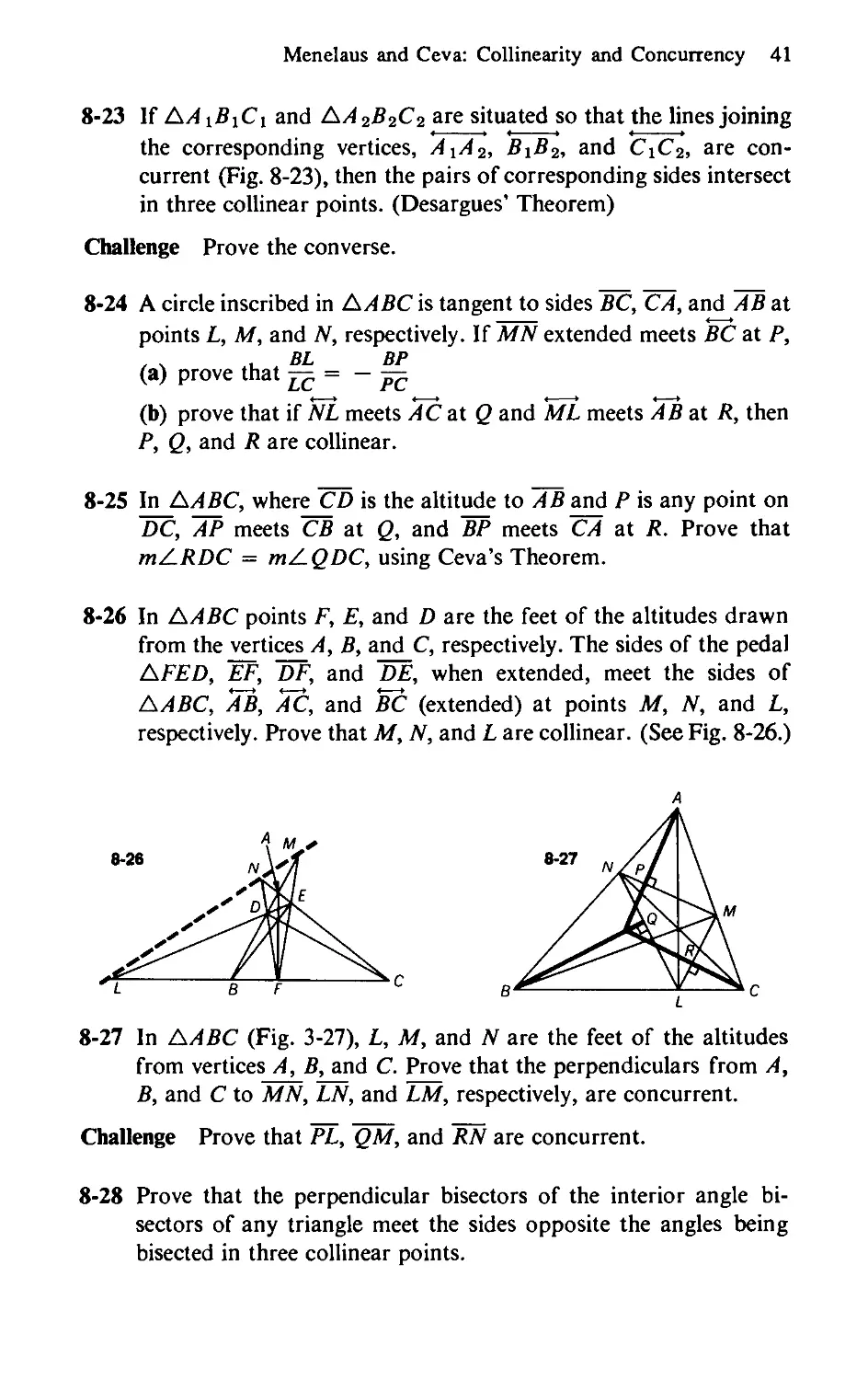
8-23 If ДЛ iBjCj and ДЛ 2B2C2 are situated so that the lines joining
the corresponding vertices, AXA2, B\B2, and CiC2, are con-
current (Fig. 8-23), then the pairs of corresponding sides intersect
in three collinear points. (Desargues’ Theorem)
Challenge Prove the converse.
8-24 A circle inscribed in ЛАВС is tangent to sides ВС, CA, and AB at
points L, M, and N, respectively. If MN extended meets BC at P,
(a) prove that fc = “ pc
(b) prove that if NL meets AC at Q and ML meets AB at R, then
P, Q, and R are collinear.
8-25 In ЛАВС, where CD is the altitude to AB and P is any point on
DC, AP meets CB at Q, and BP meets CA at R. Prove that
mZ.RDC = mZ.QDC, using Ceva’s Theorem.
8-26 In ЛАВС points F, E, and D are the feet of the altitudes drawn
from the vertices A, B, and C, respectively. The sides of the pedal
ЛРЕО, EF, DF, and DE, when extended, meet the sides of
ЛАВС, AB, AC, and BC (extended) at points M, N, and L,
respectively. Prove that M, N, and L are collinear. (See Fig. 8-26.)
8-27 In ЛАВС (Fig. 3-27), L, M, and N are the feet of the altitudes
from vertices A, B, and C. Prove that the perpendiculars from A,
B, and C to MN, LN, and LM, respectively, are concurrent.
Challenge Prove that PL, QM, and RN are concurrent.
8-28 Prove that the perpendicular bisectors of the interior angle bi-
sectors of any triangle meet the sides opposite the angles being
bisected in three collinear points.
42 PROBLEMS
8-29 Figure 8-29a shows a hexagon ABCDEF whose pairs of opposite
sides are: [AB, DE], [CB, EF], and [CD, AF], If we place points
А, В, C, D, E, and F in any order on a circle, the above pairs of
opposite sides intersect at points L, M, and N respectively. Prove
that L, M, and N are collinear. Fig. 8-29b shows one arrangement
of the six points, А, В, C, D, E, and F on a circle.
Challenge 1 Prove the theorem for another arrangement of the points
А, В, C, D, E, and F on a circle.
Challenge 2 Can you explain this theorem when one pair of opposite
sides are parallel?
8-30
8-30 Points A, B, and C are on one line and points A', B', and C are
on another line (in any order). (Fig. 8-30) If AB' and A'В meet
at C", while AC and A’C meet at B", and BC and B'C meet at
A", prove that points A", B", and C" are collinear.
(This theorem was first published by Pappus of Alexandria about
300 A.D.)
The Simson Line 43
9. The Simson Line
If perpendiculars are drawn from a point on the circumcircle of a
triangle to its sides, their feet lie on a line. Although this famous line
was discovered by William Wallace in 1797, careless misquotes have,
in time, attributed it to Robert Simson (1687-1768). The following
problems present several properties and applications of the Simson
Line.
9-1 Prove that the feet of the perpendiculars drawn from any point on
the circumcircle of a given triangle to the sides of the triangle are
collinear. (Simson’s Theorem)
Challenge 1 State and prove the converse of Simson’s Theorem.
Challenge 2 Which points on the circumcircle of a given triangle lie
on their own Simson Lines with respect to the given
triangle?
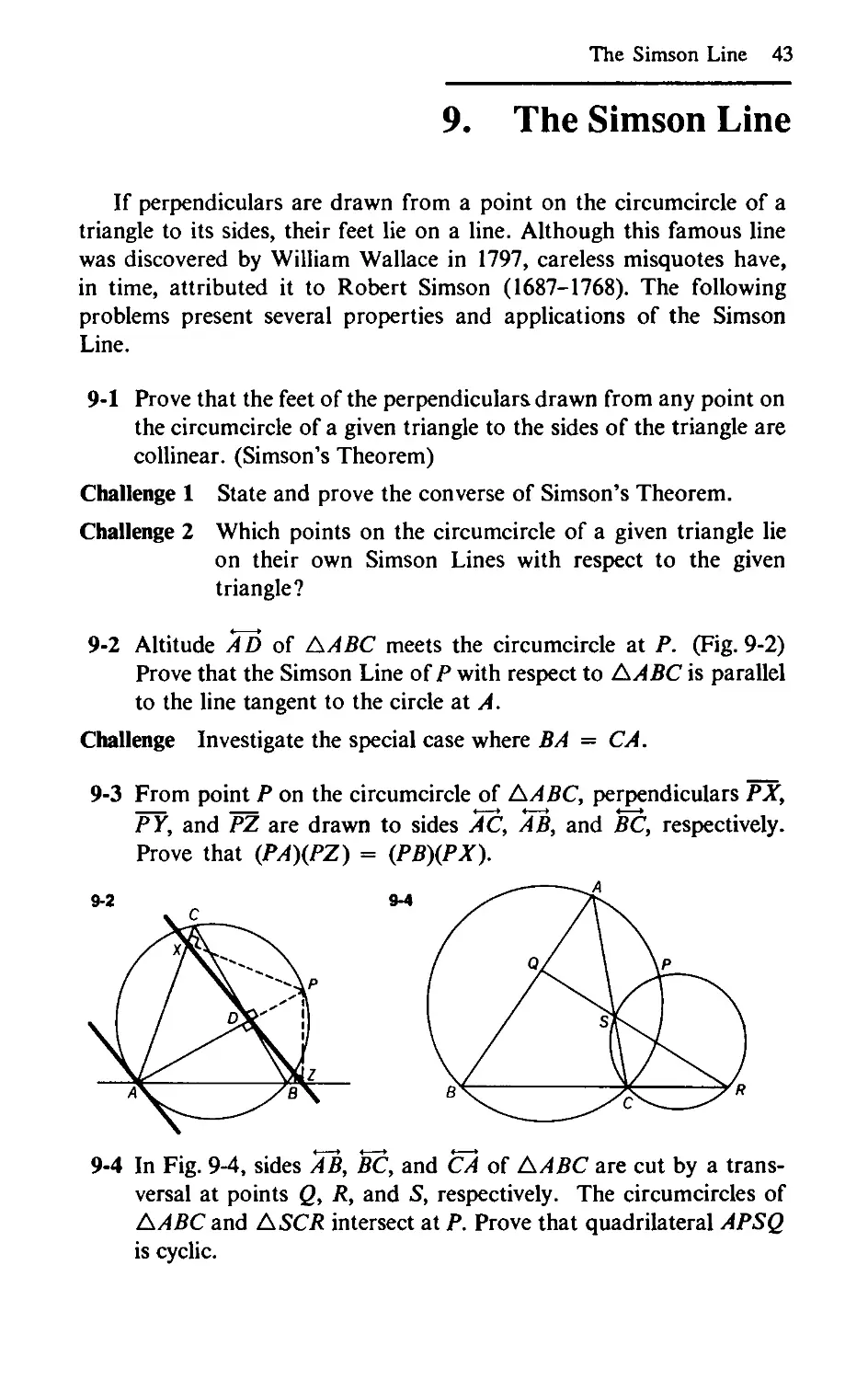
9-2 Altitude AD of ЛАВС meets the circumcircle at P. (Fig. 9-2)
Prove that the Simson Line of P with respect to ЛАВС is parallel
to the line tangent to the circle at A.
Challenge Investigate the special case where BA = CA.
9-3 From point P on the circumcircle of ЛАВС, perpendiculars PX,
PY, and PZ are drawn to sides AC, AB, and BC, respectively.
Prove that (PA)(PZ) = (PB)(PX).
9-4 In Fig. 9-4, sides AB, BC, and CA of ЛАВС are cut by a trans-
versal at points Q, R, and S, respectively. The circumcircles of
ЛАВС and ЛВСК intersect at P. Prove that quadrilateral APSQ
is cyclic.
44 PROBLEMS
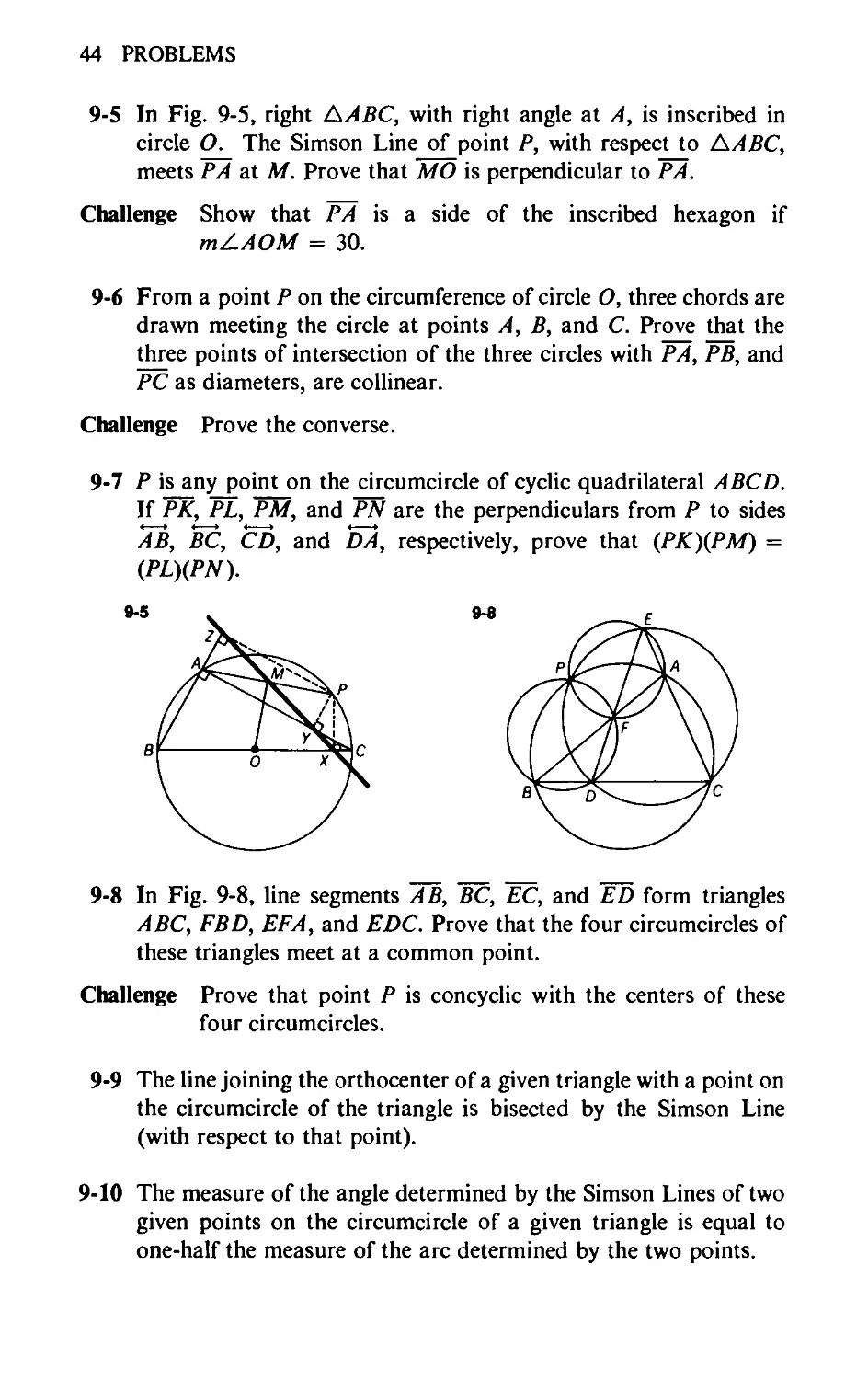
9-5 In Fig. 9-5, right ДАВС, with right angle at A, is inscribed in
circle O. The Simson Line of point P, with respect to ДЛВС,
meets PA at M. Prove that MO is perpendicular to PA.
Challenge Show that PA is a side of the inscribed hexagon if
mZ.AOM = 30.
9-6 From a point P on the circumference of circle O, three chords are
drawn meeting the circle at points A, B, and C. Prove that the
three points of intersection of the three circles with PA, PB, and
PC as diameters, are collinear.
Challenge Prove the converse.
9-7 P is any point on the circumcircle of cyclic quadrilateral ABCD.
If PK, PL, PM, and PN are the perpendiculars from P to sides
AB, BC, CD, and DA, respectively, prove that (PK)(JPM) =
(PL)(PN).
9-8 In Fig. 9-8, line segments AB, BC, EC, and ED form triangles
ABC, FBD, EFA, and EDC. Prove that the four circumcircles of
these triangles meet at a common point.
Challenge Prove that point P is concyclic with the centers of these
four circumcircles.
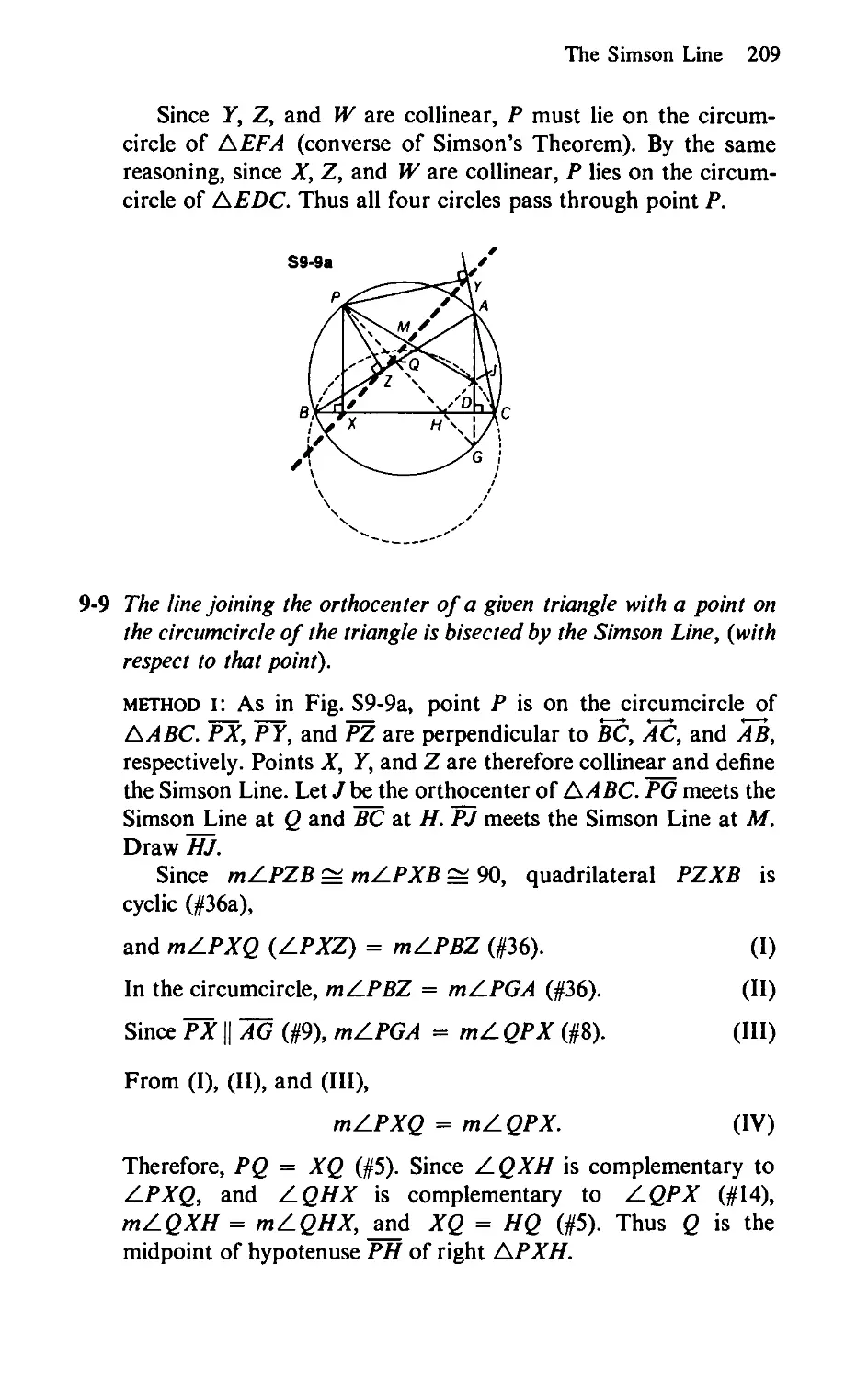
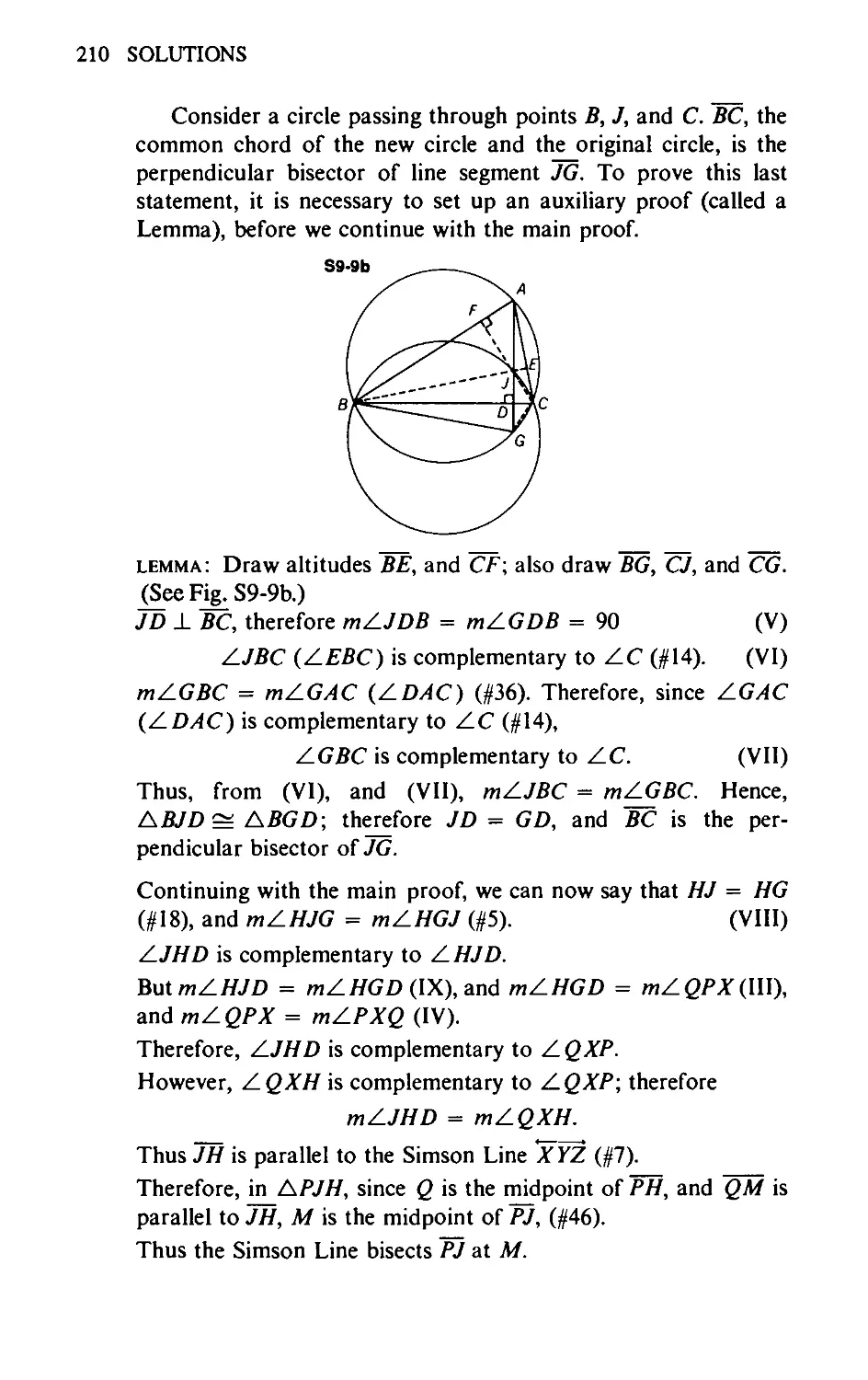
9-9 The line joining the orthocenter of a given triangle with a point on
the circumcircle of the triangle is bisected by the Simson Line
(with respect to that point).
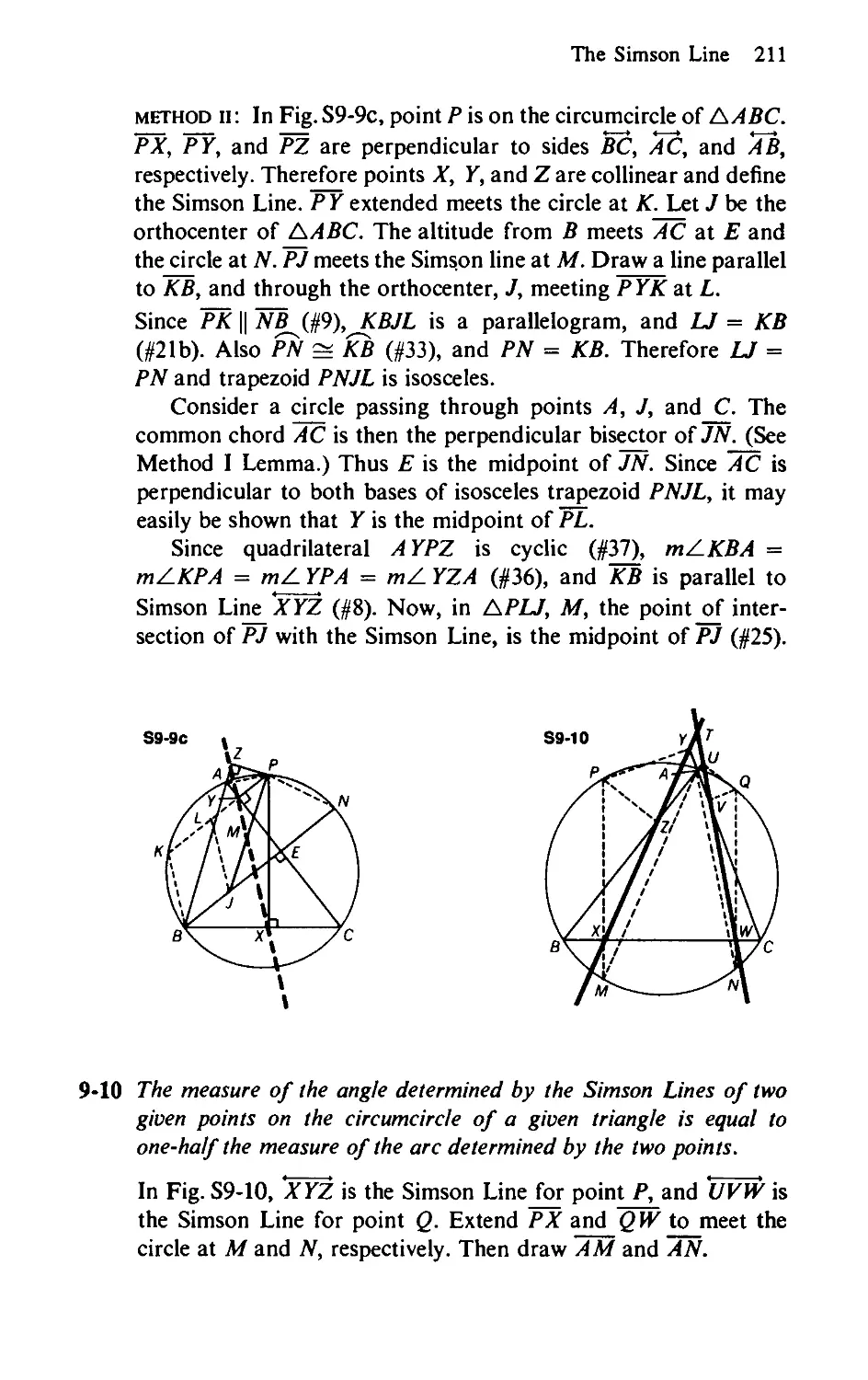
9-10 The measure of the angle determined by the Simson Lines of two
given points on the circumcircle of a given triangle is equal to
one-half the measure of the arc determined by the two points.
The Theorem of Stewart 45
Challenge Prove that if three points are chosen at random on a circle,
the triangle formed by these three points is similar to the
triangle formed by the Simson Lines of these points with
respect to any inscribed triangle.
9-11 If two triangles are inscribed in the same circle, a single point on
the circumcircle determines a Simson Line for each triangle.
Prove that the angle formed by these two Simson Lines is con-
stant, regardless of the position of the point.
9-12 In the circumcircle of ЛАВС, chord PQ is drawn parallel to
side BC. Prove that the Simson Lines of ЛАВС, with respect to
points P and Q, are concurrent with the altitude AD of ЛАВС.
10. The Theorem of Stewart
The geometry student usually feels at ease with medians, angle bi-
sectors, and altitudes of triangles. What about ‘internal line segments’
(segments with endpoints on a vertex and its opposite side) that are
neither medians, angle bisectors, nor altitudes? As the problems in this
section show, much can be learned about such segments thanks to
Stewart’s Theorem. Named after Matthew Stewart who published it in
1745, this theorem describes the relationship between an ‘internal line
segment’, the side to which it is drawn, the two parts of this side, and
the other sides of the triangle.
c
m D n
\------------y
c
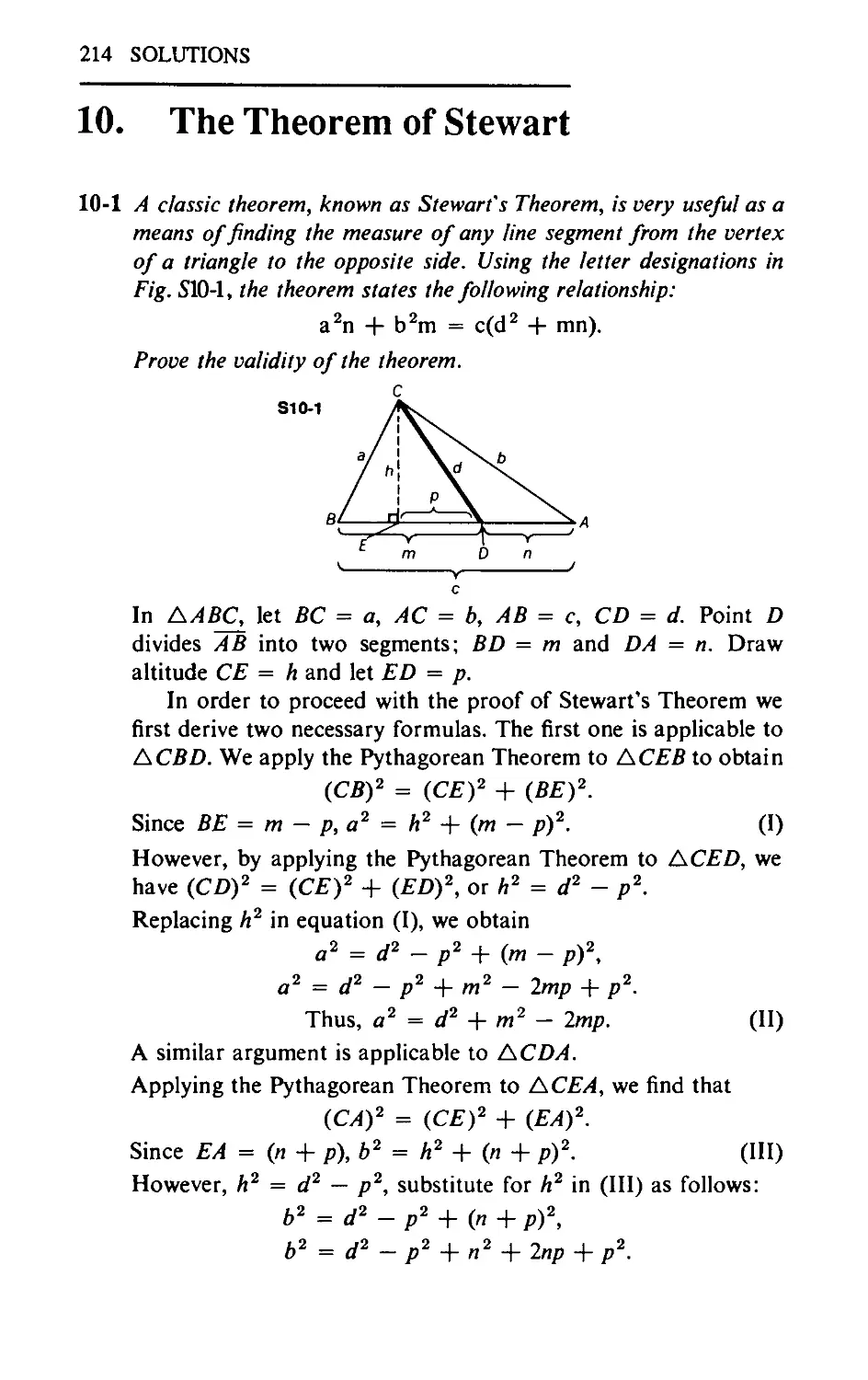
10-1 A classic theorem known as Stewart’s Theorem, is very useful as
a means of finding the measure of any line segment from the
vertex of a triangle to the opposite side. Using the letter designa-
tions in Fig. 10-1, the theorem states the following relationship:
a2n + b2m = c(d2 + mn). Prove the validity of the theorem.
46 PROBLEMS
Challenge If a line from C meets AB at F, where F is not between A
and B, prove that
(BC)2(AF) - (AC)2(BF) = AB[CF)2 - (AF)(BF)].
10-2 In an isosceles triangle with two sides of measure 17, a line
measuring 16 is drawn from the vertex to the base. If one segment
of the base, as cut by this line, exceeds the other by 8, find the
measures of the two segments.
10-3 In ЛАВС, point E is on AB, so that AE = EB. Find CE if
AC = 4, CB = 5, and AB = 6.
Challenge Find the measure of the segment from E to the midpoint
of CB.
10-4 Prove that the sum of the squares of the distances from the vertex
of the right angle, in a right triangle, to the trisection points along
the hypotenuse, is equal to the square of the measure of the
hypotenuse.
Challenge 1 Verify that the median to the hypotenuse of a right
triangle is equal in measure to one-half the hypotenuse.
Use Stewart’s Theorem.
Challenge 2 Try to predict, from the results of Problem 10-4 and
Challenge 1, the value of the sum of the squares for a
quadrisection of the hypotenuse.
10-5 Prove that the sum of the squares of the measures of the sides of
a parallelogram equals the sum of the squares of the measures of
the diagonals.
Challenge A given parallelogram has sides measuring 7 and 9, and a
shorter diagonal measuring 8. Find the measure of the
longer diagonal.
10-6 Using Stewart’s Theorem, prove that in any triangle the square of
the measure of the internal bisectors of any angle is equal to the
product of the measures of the sides forming the bisected angle
decreased by the product of the measures of the segments of the
side to which this bisector is drawn.
The Theorem of Stewart 47
Challenge 1 Can you also prove the theorem in Problem 10-6 without
using Stewart’s Theorem?
Challenge 2 Prove that in ЛАВС, ta = - _j_- \/2, when Z.BAC is a
right angle.
10-7 The two shorter sides of a triangle measure 9 and 18. If the internal
angle bisector drawn to the longest side measures 8, find the
measure of the longest side of the triangle.
Challenge Find the measure of a side of a triangle if the other two sides
and the bisector of the included angle have measures 12,
15, and 10, respectively.
10-8 In a right triangle, the bisector of the right angle divides the
hypotenuse into segments that measure 3 and 4. Find the measure
of the angle bisector of the larger acute angle of the right triangle.
10-9 In a 30-60-90 right triangle, if the measure of the hypotenuse
is 4, find the distance from the vertex of the right angle to the
point of intersection of the angle bisectors.

SOLUTIONS
1. Congruence and Parallelism
1-1 In any ДАВС, E and D are interior points of AC and BC, re-
spectively (Fig. SI-la)- AF bisects Z.CAD, and BF bisects Z.CBE.
Prove mZ.AEB + mZADB = 2mZ.AFB.
mZAFB = 180 - [(x + w) + (y + z)] (#13)
mZAEB = 180 - [(2x + w) + z] (#13)
mZADB = 180 - [(2y + z) + w] (#13)_
mZAEB + mZADB = 360 — [2x + 2y + 2z + 2w]
2mZAFB = 2[180 — (x + У + z + w)]
(twice I)
2mZAFB = 360 — [2x + 2y + 2z + 2w]
Therefore, mZAEB + mZADB = 2mZAFB.
Challenge 1 Prove that this result holds if E coincides with C (Fig.
Sl-lb).
proof:
We must show that mZAEB + mAADB = 2mZ_AFB.
Let mZ.CAF — mZFAD = x.
50 SOLUTIONS
Since ZADB is an exterior angle of A.AFD,
mZADB = mZAFD + x (#12).
Similarly, in A.AEF,
mZAFD = mZAEB + x (#12).
mZADB + mZAEB + x = 2mZAFD + x,
thus, mZAEB + mZADB = 2mZAFB.
1-2 In ДАВС, a point D is on AC so that AB = AD (Fig. Sl-2).
mZABC — mZACB = 30. Find mZCBD.
mZCBD - mZABC — mZABD
Since AB = AD, mZABD = mZADB (#5).
Therefore, by substitution,
mZCBD = mZABC — mZADB.	(I)
But mZADB = mZCBD + mZC (#12). (II)
Substituting (II) into (I), we have
mZCBD - mZABC - [mZCBD + mZC].
mZCBD = mZABC — mZCBD — mZC
Therefore, 2mZCBD = mZABC — mZACB = 30, and
mZCBD = 15.
comment: Note that mZACB is undetermined.
1-3 The interior bisector of ZB, and the exterior bisector of ZC of
ДАВС meet at D (Fig. Sl-3). Through D, a line parallel to CB
meets AC at L and AB at M. If the measures of legs LC and MB
of trapezoid CLMB are 5 and 7, respectively, find the measure of
base LM. Prove your result.
Congruence and Parallelism 51
mZl - mZ2 and mZ2 = mZ3 (#8).
Therefore, mZl = mZ3 (transitivity).
In isosceles ADMB, DM = MB (#5).
Similarly, mZ4 = mZ5 and mZ5 = mZLDC (#8).
Therefore, mZ4 = mZLDC (transitivity).
Thus, in isosceles A DLC, DL = CL (#5).
Since DM = DL + LM, by substitution,
MB = LC + LM, or LM = MB - LC.
Since LC = 5 and MB = 7, LM = 2.
Challenge Find LM if ДАВС is equilateral.
answer: Zero
1-4 In right ДАВС, CF is the median drawn to hypotenuse AB, CE
is the bisector of ZACB, and CD is the altitude to AB (Fig. SI-4a).
Prove that ZDCE ZECF.
Since ACFA is isosceles, ZFCA ZA (#5).	(I)
In right ABDC, ZB is complementary to ZBCD.
In right A ABC, ZB is complementary to ZA.
52 SOLUTIONS
Therefore, /LBCD /LA.	(II)
From (I) and (II), /LFCA = Z-BCD. (Ill)
Since CE is the bisector of /LACB, /LACE /LBCE. (IV)
In right ЛАВС, PC ± CA and PC = BC and AE bisects /LA.
By subtracting (III) from (IV), we have /LDCE^ /LECF.
method и: Let a circle be circumscribed about right ЛАВС.
Extend CE to meet the circle at G; then draw FG (Fig. Sl-4b).
Since CE bisects /LACB, it also bisects AGli. Thus, G is the
midpoint of AGB, and FG ± AB. Since both FG and CD are
perpendicular to AB,
FG || CD (#9), and /LDCE /LFGE (#8).	(I)
Since radius CF = radius FG, ЛСРС is isosceles and
/LECF /LFGE.	(II)
Thus, by transitivity, from (I) and (II), /LDCE /LECF.
Challenge Does this result hold for a поп-right triangle?
answer: No, since it is a necessary condition that BA pass
through the center of the circumcircle.
1-5 The measure of a line segment PC, perpendicular to hypotenuse AC
of right ДАВС, is equal to the measure of leg BC. Show BP may
be perpendicular or parallel to the bisector of /LK.
case i: We first prove the case for BP || AE (Fig. Sl-5a).
In right ЛАВС, PC ± AC, PC = BC, and AE bisects /LA.
/LCEA is complementary to /LCAE, while /LBDA is comple-
mentary to /LDAB (#14).
Since /LCAE /LDAB, /LBDA /LCEA. However, Z.BDA =
/LEDC (f\). Therefore, /LCED /LCDE, and ЛСЕО is
Congruence and Parallelism 53
isosceles (#5). Since isosceles triangles CED and СРВ share the
same vertex angle, they are mutually equiangular. Thus, since
ZCED ZCPB, ЁА || PB (#7).
case n: We now prove the case for AE Z BP (Fig. Sl-5b).
ZCPF is complementary to ZCFP (#14). Since ZCFP =
ZBFA (#1), ZCPF is complementary to ZBFA. However, in
ZCPB, CP^CB and ZCPB ZCBP (#5); hence, ZCBP is
complementary to ZBFA. But ZCBP is complementary to
ZPBA. Therefore, ZBFA = ZFBA (both are complementary
to ZCBP). Now we have ZFAB isosceles with AD an angle
bisector; thus, AD ± BFP since the bisector of the vertex angle
of an isosceles triangle is perpendicular to the base.
1-6 Prove the following: if in ДАВС, median AM is such that mZ ВАС
is divided in the ratio 1: 2, and AM is extended through M to D
so that ZDBA is a right angle, then AC = * AD (Fig. SI-6).
Let mZBAM = x; then mZMAC = 2x. Choose point P on
AD so that AM = MP.
Since BM = MC, ACPB is a parallelogram (#2 If). Thus,
BP = AC.
Let T be the midpoint of A D making ВТ the median of right
ZABD.
54 SOLUTIONS
It follows that ВТ = ±AD, от ВТ = AT (#27), and, conse-
quently, mZ_TBA = x. Z-BTP is an exterior angle of isosceles
LsBTA. Therefore, mZBTP = 2x (#12). However, since BP || AC
(#21a), mZ-CAP = mZBPA = 2x (#8). Thus, /ХТВР is isosceles
with ВТ = BP.
Since ВТ = ±AD and ВТ = BP = AC, AC = | AD.
question: What is the relation between points P and D when
mZ_A = 90?
1-7 In square ABCD, M is the midpoint of AB. A line perpendicular
to MC at M meets AD at K. Prove that ZBCM = ZKCM.
method i: Draw ML || AD (Fig. Sl-7a). Since AM = MB and
AD || ML || ВС, KP = PC (#24). Consider right ZsKMC', MP
is a median. Therefore, MP = PC (#27). Since AMPC is isosceles,
mZA = mZ2. However, since ML || BC, mZl = mZ3 (#8),
thus, mZ_2 = rnZ.3; that is, ZBCM = ZKCM.
method и: Extend KM to meet CB extended at G (Fig. SI-7b).
Since AM = MB and mZKAM — mZMBG (right angles) and
mZAMK = mZGMB, ZAMK^ ZsBMG (A.S.A.). Then,
KM = MG. Now, ЛКМС^ /XGMC (S.A.S.), and ZBCM^L
ZKCM.
method in: Other methods may easily be found. Here is one
without auxiliary constructions in which similarity is employed
(Fig. SI-7c).
A M = MВ = s, where BC = s.
ZAMK is complementary to ZBMC, and ZBCM is com-
plementary to ZBMC (#14).
Congruence and Parallelism 55
Therefore, right &.МАК ~ right /ХСВМ, and AK = д s.
In right Л.МАК, MK=S-^ (#55), while in right ЛСВМ,
S\/5
mc = s-Y (№)
y/5
Therefore, since	, right /ХМКС ~ right
ЛГС J 2 ДС
~T
A. BMC (#50), and Z_BCM Z.KCM.
1-8 Given any ДАВС, AE bisects Z.BAC, BD bisects ДАВС,
CP ± BD, and CQ ± AE, prove that PQ is parallel to AB.
Extend CP and CQ to meet AB at S and R, respectively (Fig.
Sl-8). It may be shown that £s.CPB= &.SPB, and tSCQA =
ДЛ0Л (A.S.A.).
It then follows that CP = SP and CQ = RQ or P and Q are
midpoints of CS and CR, respectively. Therefore, in A.CSR,
PQ || SR (#26). Thus, PQ || AB.
Challenge Identify the points P and Q when ДАВС is equilateral.
answer: P and Q are the midpoints of CA and CB,
respectively.
56 SOLUTIONS
1-9 Given that ABCD is a square, CF bisects ZACD, and BPQ ± CF
(Fig. SI-9), prove DQ = 2PE.
Draw RE || BPQ. Since E is the midpoint of DB (#21n) in
ADQB, DR = QR (#25). Since RE ± CF (#10), A/?GC^
A£GC, and /CRG = zLCEG.
Therefore, RQPE is an isosceles trapezoid (#23), and PE = QR.
2RQ — DQ and, therefore, DQ = 2PE.
1-10 Given square ABCD with mZEDC = mZECD = 15, prove
A ABE is equilateral.
method i: In square ABCD, draw AF perpendicular to DE
(Fig. Sl-lOa). Choose point G on AF so that m/FDG — 60.
Why does point G fall inside the square? m/AGD = 150 (#12).
Since m/EDC = m/ECD = 15, m/DEC = 150 (#13); thus,
Z/tGDGS /DEC.
Therefore, AAGD /DEC (S.A.A.), and DE = DG.
In right /DFG, DF = ± (DG) (#55c).
Therefore, DF = l- (DE), or DF = EF.
Since /4Fis the perpendicular bisector of DE, AD = AE (#18).
A similar argument shows BC = BE. Therefore, AE =
BE = AB (all are equal to the measure of a side of square ABCD).
Congruence and Parallelism 57
method »: In square ABCD, with m/EDC = m/ECD = 15,
draw /XAFD on AD such that m/FAD = m/FDA = 15.
Then draw FE (Fig. Sl-lOb).
/FAD /EDC (A.S.A.), and DE = DF.
Since /ADC is a right angle, m/FDE = 60 and /FDE is
equilateral so that DF = DE = FE. Since mZ-DFE = 60 and
m/AFD = 150 (#13), m/AFE = 150. Thus, m/FAE = 15
and m/DAE = 30.
Therefore, m/EAB = 60. In a similar fashion it may be proved
that m/ABE = 60; thus, /ABE is equilateral.
method in: In square ABCD, with m/EDC = m/_ECD = 15,
draw equilateral /DFC on DC externally; then draw EF (Fig.
Sl-lOc).
EF is the perpendicular bisector of DC (#18).
Since AD = FD, and m/ADE = m/FDE = 75, /ADE =
/FDE (S.A.S.).
Since m/DFE = 30, m/DAE = 30.
Therefore, m/BAE = 60.
In a similar fashion, it may be proved that m/ABE = 60; thus,
/ABE is equilateral.
method iv: Extend DE and CE to meet BC and AD at К and H,
respectively (Fig. Sl-lOd). In square ABCD, m/KDC =
m/HCD — 15, therefore, ED = EC (#5).
Draw AF and CG perpendicular to DK.
In right A DGC, m/GCD = 75 (#14), while wZ/lDF = 75also.
Thus, /ADF = /DCG, and DF = CG. m/GEC = 30 (#12).
In /GEC, CG = | (EC) (#55c). Therefore, CG = | (ED), or
DF = | (ED).
58 SOLUTIONS
Since AF is the perpendicular bisector of DE, AD = AE (#18).
In a similar fashion, it may be proved that BE = BC; therefore,
/ХАВЕ is equilateral.
1-11 In any ДАВС, D, E, and F are midpoints of the sides AC, AB,
and BC, respectively. BG is an altitude of ДАВС (Fig. Sl-11).
Prove that Z.EGF = Z.EDF.
GF is the median to hypotenuse CB of right /xCGB, therefore,
GF = \ (CB) (#27).
DE = | CB (#26), therefore, DE = GF.
Join midpoints E and F. Thus, EF || AC (#26).
Therefore, DGFE is an isosceles trapezoid (#23).
Then ZDEF^ ZGFE.
Thus, ZGFE = /XDEF (S.A.S.), and ZEGF ZEDF.
1-12 In right ДАВС, with right angle at C, BD = BC, AE = AC,
EF ± BC, and DG ± AC. Prove that DE = EF + DG.
Draw CP ± AB, also draw CE and CD (Fig. Sl-12).
mZ3 + mZl + mZ2 = 90
mZ3 + mZl = mZ4 (#5)
Congruence and Parallelism 59
By substitution, mZ4 + mZ2 = 90;
but in right /ХСРЕ,mH + mZl = 90 (#14).
Thus, Z1 Z2 (both are complementary to Z4), and right
ACB£^ right Z.CFE, and PE = EF.
Similarly, mZ9 + mZ7 + mZ6 = 90,
mZ9 + mZ7 = mZ5 (#5).
By substitution, mZ5 + mZ6 = 90.
However, in right Z.CPD,m/_5 + mZ7 = 90 (#14).
Thus, Z6 = Z7 (both are complementary to Z5), and right
ZsCPD right ACGD, and DP = DG.
Since DE = DP + PE, we get DE = DG + EF.
1-13 Prove that the sum of the measures of the perpendiculars from
any point on a side of a rectangle to the diagonals is constant.
Let P be any point on side J В of rectangle A BCD (Fig. Sl-13).
PG and PF are perpendiculars to the diagonals.
Draw AJ perpendicular to DB, and then PH perpendicular to ~AJ.
Since PHJF is a rectangle (a quadrilateral with three right angles),
we get PF = HJ.
Since PH and BD are both perpendicular to AJ, PH is parallel to
BD (#9).
Thus, ZAPH^ ZABD (fl).
Since AE = EB (#21f, 21h), ZCAB = ZABD (#5). Thus, by
transitivity, ZEAP^. ZAPH; also in ZsAPK, AK = PK (#5).
Since ZAKH^ZPKG (f), right A AHK bright Z.PGK
(S.A.A.). Hence, AH = PG and, by addition, PF + PG =
HJ + AH = A J, a constant.
1-14 The trisectors of the angles of a rectangle are drawn. For each
pair of adjacent angles, those trisectors that are closest to the
60 SOLUTIONS
enclosed side are extended until a point of intersection is established.
The line segments connecting those points of intersection form a
quadrilateral. Prove that the quadrilateral is a rhombus.
As a result of the trisections,
isosceles AAHD = isosceles ABFC, and
isosceles AAGB = isosceles A. DEC (Fig. Sl-14a).
Since AH = HD = FB = FC, and AG = GB = DE = CE,
and ZHAG = ZGBF= ZFCE= ZHDE=^ right angle,
АЯЛ6 = AFBG AFCE	AH DE (S.A.S.).
Therefore, HG = FG = FE = HE, and EFGH is a rhombus
(#21-1).
Challenge 1 What type of quadrilateral would be formed if the original
rectangle were replaced by a square?
Consider ABCD to be a square (Fig. Sl-14b). All of the
above still holds true; thus we still maintain a rhombus.
However, we now can easily show AAHG to be isosceles,
mZAGH = mZAHG = 75.
Similarly, mZBGF = 75. mZAGB = 120, since
mZGAB = mZGBA = 30.
Therefore, mZHGF = 90. We now have a rhombus
with one right angle; hence, a square.
1-15 In Fig. Sl-15, BE and AD are altitudes of AABC. F, G, and К
are midpoints of AH, AB, and BC, respectively. Prove that ZFGK
is a right angle.
In AAHB, GF || BH (#26).
And in AABC, GK || AC (#26).
Since BE ± AC, BE ± GK,
then GF ± GK (#10); that is, ZFGK is a right angle.
Congruence and Parallelism 61
1-16 In parallelogram ABCD, M is the midpoint of BC. DT is drawn
from D perpendicular to MA (Fig. SI-16). Prove CT = CD.
Let R be the midpoint of AD; draw CR and extend it to meet
TD at P. Since AR = | AD, and MC = ± BC, AR = MC. Since
AR || MC, ARCM is a parallelogram (#22). Thus, CP || MT.
In &.ATD, since RP || AT and passes through the midpoint of
AD, it must also pass through the midpoint oi TD (#25). Since
MT\\CP, and MT -LTD^CP L.TD (#10). Thus, CP is the
perpendicular bisector of TD, and CT = CD (#18).
1-17 Prove that the line segment joining the midpoints of two opposite
sides of any quadrilateral bisects the line segment joining the
midpoints of the diagonals.
ABCD is any quadrilateral. K, L, P, and Q are midpoints of AD,
BC, BD, and AC, respectively. We are to prove that KL bisects PQ.
Draw KP and QL (Fig. SI-17).
In AADB, KP = | AB, and KP || AB (#26).
Similarly, in &ACB, QL = ^AB, and QL || AB (#26).
By transitivity, KP = QL, and KP || QL. It then follows that
KPLQ is a parallelogram (#22), and so PM = QM (#21 f).
62 SOLUTIONS
1-18 In any AABC, XYZ is any line through the centroid G. Per-
pendiculars are drawn from each vertex of AABC to this line.
Prove CY = AX + BZ.
Draw medians CD, AF, and BH.
From E, the midpoint of CG, draw EP ± XZ.
Also draw ~DQ ± ~XZ (Fig. Sl-18).
Since ZCGF = ZQGD (#1), and EC = EG = DG (#29),
ZsQGD APGE, and QD = EP.
AX || BZ (#9), therefore, QD is the median of trapezoid AXZB,
and QD = 1 (AX + BZ) (#28).
EP = - CY (#25, #26), therefore, | CY = | (AX + BZ)
(transitivity), and CY = AX + BZ.
1-19 In any AABC, CPQ is any line through C interior to AABC.
BP is perpendicular to line CPQ, AQ is perpendicular to line CPQ,
and M is the midpoint of AB. Prove that MP = MQ.
Since BP 1. CG and AQ ± CG, BP || AQ, (#9).
Without loss of generality, let AQ > BP (Fig. Sl-19a).
Extend BP to E so that BE = AQ.
Therefore, AEBQ is a parallelogram (#22).
Draw diagonal EQ.
EQ must pass through M, the midpoint of AB, since the diagonals
of the parallelogram bisect each other. Consequently, M is also
the midpoint of EQ.
In right AEPQ, MP is the median to hypotenuse EQ.
Therefore, MP = ± EQ = MQ (#27).
Congruence and Parallelism 63
Challenge Show that the same result holds if the line through C is
exterior to AABC.
Extend PB through В to £ so that BE = AQ (Fig. Sl-19b).
Since AQ || PE (#9), quadrilateral AEBQ is a parallelo-
gram (#22).	___
Thus, if M is the midpoint of AB, it must also be the
midpoint of QE (#2If).
Therefore, in right AQPE, MP = jEQ = MQ (#27).
Sl-19b
1-20 In Fig. Sl-20, ABCD is a parallelogram with equilateral triangles
ABF and ADE drawn on sides AB and AD, respectively. Prove
that AFCE is equilateral.
In order to prove AFCE equilateral, we must show AAFE =
ABFC ADCE so that we may get FE = FC = CE.
Since AB = DC (#2lb), and AB = AF = BF (sides of an equi-
lateral triangle are equal), DC — AF = BF. Similarly, AE =
DE = BC.
We have AADC = AABC.
mAEDC = 360 - mAADE - mAADC = 360 - mAABF -
mAABC = mAFBC.
Now mABAD = 180 - mAADC (#21d),
and mAFAE = mAFAB + mABAD + mADAE — 120 +
mABAD = 120 + 180 - mAADC = 300 - mAADC =
mAEDC.
Thus, AAFE = ABFC ADCE (S.A.S.), and the conclusion
follows.
64 SOLUTIONS
1-21 If a square is drawn externally on each side of a parallelogram,
prove that
(a)	the quadrilateral, determined by the centers of these squares,
is itself a square
(b)	the diagonals of the newly formed square are concurrent with
the diagonals of the original parallelogram.
(a)	ABCD is a parallelogram.
Points P, Q, R, and S are the centers of the four squares ABGH,
DAU, DCLK, and CBFE, respectively (Fig. Sl-21).
PA = DR and AQ = QD (each is one-half a diagonal).
ZADC is supplementary to ZDAB (#2Id), and
ZIAH is supplementary to ZDAB (since ZIAD = ZHAB =
right angle). Therefore, ZADC = ZIAH.
Since mZRDC = mZQDA = mZHAP = mZQAI - 45,
ZRDQ^ZQAP. Thus, ZRDQ ZPAQ (S.A.S.), and
QR = QP.
In a similar fashion, it may be proved that QP = PS and PS =
RS.
Therefore, PQRS is a rhombus.
Since ZRDQ ZPAQ, ZDQR ZAQP-,
therefore, ZPQR ZDQA (by addition).
Since ZDQA = right angle, Z-PQR right angle, and PQRS
is a square.
Triangles in Proportion 65
(b)	To prove that the diagonals of square PQRS are concurrent
with the diagonals of parallelogram A BCD, we must prove that
a diagonal of the square and a diagonal of the parallelogram
bisect each other. In other words, we prove that the diagonals of
the square and the diagonals of the parallelogram all share the
same midpoint, (i.e., point O).
ABAC AACD (#8), and
mAPAB = rnZ-RCD - 45; therefore, APAC — ARCA.
Since AAOP ACOR (#1), and AP = CR, AAOP ACOR
(S.A.A.).
Thus, AO = CO, and PO = RO.
Since DB passes through the midpoint of AC (#21f), and,
similarly, QS passes through the midpoint of PR, and since AC
and PR share the same midpoint (i.e., O), we have shown that
AC, PR, DB, and QS are concurrent (i.e., all pass through
point O).
2. Triangles in Proportion
2-1 In AABC, DE || BC, FE || DC, AF = 4, and FD = 6 (Fig.
S2-1). Find DB.
However in AABC,	(.№>),
66 SOLUTIONS
, 10	AE	nn
and DB	EC
2	10
From (I) and (II), 5 =	‘ Thus, DB = 15.
Challenge 1 Find DB if AF = иц and FD = m2.
answer: DB = — (mi + m2)
mi'
Challenge 2 In Fig. S2-1, FG || DE, and HG || FE. Find DB if
AH = 2 and HF = 4.
answer: DB = 36
Challenge 3 Find DB if AH = mi and HF = m2.
answer: DB = —- (m, + m2r
mi2 v 1
2-2 In isosceles AABC (AB = AC), CB is extended through В to P
(Fig. S2-2). A line from P, parallel to altitude BF, meets AC at D
(where D is between A and F). From P, a perpendicular is drawn
to meet the extension of AB at E so that В is between E and A.
Express BF in terms of PD and PE. Try solving this problem in
two different ways.
method 1: Since ЛАВС is isosceles, ZC^ Z.ABC.
However, APBE = Z.ABC (#1).
Therefore, ZC'= Z.PBE.
Thus, right ABFC ~ right A FEB (#48), and	•
In &.PDC, since BF is parallel to PD,	(#49).
Using a theorem on proportions, we get
Triangles in Proportion 67
PD - BF PB + ВС — ВС PB
BF ~ BC ~ BC'
e PD - BF PE
Therefore, —= -•
Thus, PD - BF = PE, and BF = PD - PE.
method и: Since PD is parallel to BF, and BF is perpendicular to
AC, PD is perpendicular to AC (#10).
Draw a line from В perpendicular to PD at G.
Z-ABC zLACB (#5), and zLABC Z.PBE (#\)\
therefore, Z.ACB /LPBE (transitivity).
ZEand ZFare right angles; thus, APBEand ABCFare mutually
equiangular and, therefore, Z_EPB = Z_FBC.
Also, since BF || PD, AFBC zLDPC (#7).
By transitivity, Z_GPB(Z_DPC) = /LEPB.
Thus, &GPB AEPB (A.A.S.), and PG = PE.
Since quadrilateral GBFD is a rectangle (a quadrilateral with
three right angles is a rectangle), BF = GD.
However, since GD = PD — PG, by substitution we get,
BF = PD - PE.
2-3 The measure of the longer base of a trapezoid is 97. The measure
of the line segment Joining the midpoints of the diagonals is 3
(Fig. S2-3). Find the measure of the shorter base. (Note that the
figure is not drawn to scale.)
method r. Since E and F are the midpoints of DB and AC,
respectively, EF must be parallel to DC and AB (#24).
Since EF is parallel to DC, AEGF ~ ADGC (#49), and
GC DC
GF~ EF'
However, since DC = 97 and EF = 3,	’
GF 3
GC - GF 97-3 FC	94
Then, __	= —Z— , or ~	v •
68 SOLUTIONS
о-	FA W GA 91
Since FC = FA, — =  , or „ = —
(jr 3 ur 3
Since AAGB ~ AFGE (#48),	’
V" /’ QP EP
Thus, у = ^y, and AB = 91.
method n: Extend FE to meet A D at H. In АЛ DC, HF = (DC)
(#25, #26).
97
Since DC =91, HF = у •
91
Since EF = 3, HE = у •
In &ADB, HE =1 (AB) (#25, #26).
Hence, AB = 91.
Challenge Find a general solution applicable to any trapezoid.
answer: b — 2d, where b is the length of the longer base
and d is the length of the line joining the midpoints of the
diagonals.
2-4 In AABC, D is a point on side BA such that BD:DA = 1:2
(Fig. 52-4). E is a point on side CB so that CE:EB = 1:4. Seg-
ments DC and AE intersect at F. Express CF:FD in terms of
two positive relatively prime integers.
Draw DG || DC.
AT DG ~ ЛАВЕ (#49), and	? •
v" z AB BE 3
2
Then DG = -3 (BE).
But &DGF ~ ACEF (#48), and ~	•
1 CF b"£l 3
Smce EC - - (EE),
3
Triangles in Proportion 69
2-5 In AABC, BE is a median and О is the midpoint of BE (Fig.
S2-5). Draw AO and extend it to meet BC at D. Draw CO and
extend it to meet BA at F. If CO = 15, OF = 5, and AO = 12,
find the measure of OD.
Draw EH parallel to AD. Since E is the midpoint of AC, EG =
(AO) = 6 (#25, #26). Since H is the midpoint of CD, GH =
(OD) (#25, #26). In АВЕН, OD is parallel to EH and О is
the midpoint of BE\ therefore, OD = | EH (#25, #26).
Then OD = \ [EG + GH], so OD = | [6 + | OD] = 4.
Note that the measures of CO and OF were not necessary for the
solution of this problem.
Challenge Can you establish a relationship between OD and AO?
answer: OD = ±AO, regardless of the measures of CO,
OF, and AO.
2-6 In parallelogram ABCD, points E and F are chosen on diagonal
AC so that AE = FC (Fig. S2-6). If BE is extended to meet AD
at H, and BF is extended to meet DC at G, prove that HG is
parallel to AC.
In EJABCD, AE = FC.
Since Z-BEC = Z_HEA (#\), and Z_HAC^£ Z_ACB (#8),
AHEA ~ ABEC (#48), and	•
L^r i* Г V-	DE
Similarly, ABF A ~ AGFC (#48), and EF =
HE FG
However, since FC = AE, — = — (transitivity).
Therefore, in AHBG, UG || EF (#46), or ~HG || AC.
70 SOLUTIONS
2-7 AM is the median to side BC of ДАВС, and P is any point on AM
(Fig. S2-1). BP extended meets AC at E, and CP extended meets
AB at D. Prove that DE is parallel to BC.
Extend АРМ to G so that PM = MG. Then draw BG and CG.
Since BM = MC, PG and BC bisect each other, making BPCG
a parallelogram (#21f). Thus, PC || BG and BP || GC (#21a), or
BE || GC and DC || BG. It follows that DP || BG.
Therefore, in &ABG, =	(#46).	(I)
Similarly, in AAGC where РЁ || GC, ~	(#46). (II)
From (I) and (II),	.
Therefore, DE is parallel to BC, since in &ABC, DE cuts sides
A В and AC proportionally (#46).
2-8 In ДАВС, the bisector of ZA intersects BC at D (Fig. S2-8). A
perpendicular to AD from В intersects AD at E. A line segment
through E and parallel to AC intersects BC at G, and AB at H.
If AB = 26, BC = 28, AC = 2>G,find the measure of DG.
Z1 = Z2 (#8), Z1 = Z5 (angle bisector),
therefore, Z2 = Z5.
In PsAHE, AH = HE (#5).
In right &AEB, Z4 is complementary to Z5 (#14), and Z3 is
complementary to Z.2.
Since Z2 = Z5, Z3 is complementary to Z5.
Therefore, since both Z3 and Z4 are complementary to Z5,
they are congruent. Thus, in &.BHE, BH = HE (#5) and, there-
fore, BH = AH. In &.ABC, since HG || AC and His the midpoint
of AB, G is the midpoint of BC (#25), and BG = 14.
Triangles in Proportion 71
In AABC, AD is an angle bisector, therefore,
(Я7).
Let BD = x; then DC = 28 — x. By substituting,
26 x ,	,.	„ „
~	~-----, and x = 13 = BD.
30	28 — x ’
Since BG = 14, and BD = 13, then DG = 1.
2-9 In AABC, altitude BE is extended to G so that EG = the measure
of altitude CF. A line through G and parallel to AC meets BA
at H (Fig. S2-9). Prove that AH = AC.
Since BE ± AC and HG || AC, HG ± BG.
AH^ ABAC (#7)
Since AAFC is also a right angle, AAFC ~ AHGB (#48),
, AC	BH	...
and FC	GB	(1)
In ABHG, АЁ || HG-,
therefore,	(#46).	(II)
From (I) and (II),	= gf •
Since the hypothesis stated that GE = FC, it follows that
AC = AH.
2-10 In trapezoid ABCD (AB || DC), with diagonals AC and DB
intersecting at P, AM, a median of A ADC, intersects BD at E
(Fig. S2-10). Through E, a line is drawn parallel to DC cutting
AD, AC, and BC at points H, F, and G, respectively. Prove that
HE = EF = FG.
72 SOLUTIONS
In ЛА DM, since HE || DM, ЛАНЕ ~ ЛАОМ (#49).
Therefore, = 4г,- In ЛАМС, since EF II MC,
ЛАЕР ~ ЛАМС (#49). Therefore,	•
'	MC AM
In ЛОВС, since EG || DC, ЛВЕС ~ ЛВОС (#49).
e EG BG
Therefore, —= —
But = ^5 <#24>; thus> (transitivity).
It then follows that	’	(1)
But, since M is the midpoint of DC, DM = MC, and
DC = 2MC.	(II)
EF EG
Substituting (II) in (I), we find that HE — EF, and = т/,	•
Thus, EF = ’ (EG) and EF = FG.
We therefore get HE = EF = FG (transitivity).
2-11 A line segment AB is divided by points К and L in such a way
that (AL)2 = (AK)(AB) (Fig. S2-11). A line segment AP is
drawn congruent to AL. Prove that PL bisects ZKPB.
Since AP = AL, (AL)2 = (AK)(AB) may be written (AP)2 =
(AK)(AB), or, as a proportion, ~	•
Triangles in Proportion 73
/ХКАР ~ ЛРАВ (#50).
It then follows that ZPKA ZBPA, and Z.KPA ZPBA.
Since Z-PKA is an exterior angle of &.KPB,
mZ-PKA = mZ-KPB + mZ-PBK (#12).
Z-PKA = Z.BPA may be written as
mZ-PKA = mZ-BPL + mZ-KPL + mZ-APK. (I)
Since AP = AL, in LsAPL,
mZ-ALP = mZ-KPL + mZ-APK (#5). (II)
Considering Z-PKA as an exterior angle of &.KPL,
mZ-PKA = mZ-ALP + mZ-KPL (#12). (Ill)
Combine lines (I) and (III) to get
mZ-BPL + mZ-KPL + mZAPK = mZ.ALP + mZ_KPL.
Therefore, mZ-BPL + mZ.APK = mZ-ALP (by subtraction).
(IV)
Combine lines (II) and (IV) to get
mZ-KPL + mZ-APK = mZ-BPL + mZ-APK.
Therefore, mZ_KPL = mZ_BPL (by subtraction), and PL bisects
Z-KPB.
2-12 P is any point on altitude CD of ДАВС {Fig. S2-12). AP and
BP meet sides CB and CA at points Q and R, respectively. Prove
that Z.QDC ZRDC.
Draw RUS || CD, and QVT || CD.
LsAUR ~ ДАРС (#49), so
74 SOLUTIONS
^ASU ~ AADP (#49), so ^ = ^ •
- RU US RU CP
Therefore,	, and	•
ДВИ6 ~ ДВРС (#49), so g =	•
VT BV
/\BTV ~ ДВЛР (#49), so	•
QV VT	QV CP
Therefore, = pp (transitivity), and -pp = — ’
US = ЙГ (transitivity), and 1 + -^ =	+ 1;
. RU + US QV + VT
therefore, RU = ~v
RS _ QT RS RU
RU~ QV' QT~ Qv"
Since RS || CD || QT,	(#24).
ДЛРС/ ~ Д VPQ (#48), and	g •
Therefore,	(transitivity).
Z-RSD S* ZQTD right angle, PsRSD ~ &.QTD (#50);
ZSDR = Z.TDQ, /-RDC = ZQDC (subtraction).
2-13 In ДАВС, Z is any point on base AB as shown in Fig. S2-13a.
CZ is drawn. A line is drawn through A parallel to CZ meeting BC
at X. A line is drawn through В parallel to CZ meeting AC at Y.
„ ,1.1 1
Prove that AX + by ~ CZ ’
Consider ДЛ YB; since CZ || BY, &ACZ ~ AAYB (#49), and
AZ _ AB
CZ ~ by'
Consider ЛВХА ; since CZ || AX, ABCZ ~ ДВХА (#49), and
BZ AB
CZ~ ax’
_	.... AZ . BZ	AB , AB
By addition, cz + cz	By+ ax’
But AZ + BZ = AB, therefore, = ^ +	’
C'jC di Ал
Dividing by {AB) we obtain	'
DI ЛА
Triangles in Proportion 75
Challenge Two telephone cable poles, 40 feet and 60 feet high, re-
spectively, are placed near each other. As partial support,
a line runs from the top of each pole to the bottom of the
other, as shown in Fig. S2-13b. How high above the ground
is the point of intersection of the two support lines?
Using the result of Problem 2-13, we immediately obtain
the following relationship:
1 _ -L 4. J_ . 1 _ 100 _ _L
X ~ 40 + 60 ’ X ~ 2400 - 24 '
Therefore, X = 24. Thus, the point of intersection of the
two support lines is 24 feet above the ground.
2-14 In ДАВС, mZA = 120 (Fig. S2-14). Express the measure of
the internal bisector of ZA in terms of the two adjacent sides.
Draw a line through В parallel to AD meeting CA at E, and a
line through C parallel to A D meeting BA at F.
Since Z-EAB is supplementary to ZBAC, mZEAB = 60, as
does the measure of its vertical angle, Z.FAC.
Now, mZ-BAD — mZEBA = 60 (#8), and mZDAC =
mZACF = 60 (#8).
76 SOLUTIONS
Therefore, AEAB and AFAC are equilateral triangles since they
each contain two 60° angles.
Thus, AB = EB and AC = FC.
From the result of Problem 2-13, we also know that
-L = _L + _L.
AD EB FC
By substitution,^ = ^ + ^-
Combining fractions, — = (AB)(AC) ’
f . n (AB'f(AC)
Therefore, AD =	, ,D •
AC + AB
2-15 Prove that the measure of the segment passing through the point
of intersection of the diagonals of a trapezoid and parallel to the
bases, with its endpoints on the legs, is the harmonic mean between
the measures of the parallel sides. (See Fig. S2-15.) The harmonic
mean of two numbers is defined as the reciprocal of the average
of the reciprocals of two numbers. The harmonic mean between
.	, , /a-‘ + b->\-1	2ab
a and b is equal to (--z-----I =	. •
In order for FG to be the harmonic mean between AB and DC
2
it must be true that FG = —---j- •
AB + DC
From the result of Problem 2-13,	, and
’ FE AB DC ’
FE =	. Similarly, EG = ——-—— •
— + —	— + —
AB DC	AB DC
Therefore, FE = EG. Thus, since FG = 2FE,
2
FG = -j------j-, and FG is the harmonic mean between AB
AB + CD
and CD.
The Pythagorean Theorem 77
2-16 In parallelogram ABCD, E is on BC. AE cuts diagonal BD at G
and DC at F, as shown in Fig. S2-16. If KG = 6 and GE = 4,
find EF.
IXFDG ~ IXABG (#48), and =
л	a	j GD
GD
GB
AG
&BGE ~ A DGA (#48), and	•
•" GB GE
T. f	.. GF AG
Therefore, by transitivity, — = — •
4 + EF 6
By substitution, —z— = and EF = 5.
J	6	4
note: AG is the mean proportional between GF and GE.
3. The Pythagorean Theorem
3-1 In any ДАВС, E is any point on altitude AD (Fig. S3-1). Prove
that (AC)2 - (CE)2 = (AB)2 - (EB)2.
By the Pythagorean Theorem (#55),
for A/4DC, (CD)2 + (AD)2 = (AC)2;
for AFDC, (CD)2 + (ED)2 = (EC)2.
By subtraction, (AD)2 - (ED)2 = (AC)2 - (EC)2.
By the Pythagorean Theorem (#55),
(I)
78 SOLUTIONS
for f\ADB, {DB)2 + {AD)2 = {AB)2-,
for PsEDB, {DB)2 + {ED)2 = {EB)2.
By subtraction, {AD)2 - {ED)2 = {AB)2 - {ЕВ)2. (II)
Thus, from (I) and (II),
{AC)2 - {EC)2 = {AB)2 - {EB)2.
note: For E coincident with D or A, the theorem is trivial.
3-2 In AABC, median AD is perpendicular to median BE {Fig. S3-2).
Find AB if BC = 6 and AC = 8.
Let AD = 3x; then AG = 2x and DG = x (#29).
Let BE = 3y; then BG = 2y and GE — у (#29).
By the Pythagorean Theorem,
for ADGB, x2 + {2y)2 = 9 (#55);
for AEG/4, y2 + {2x)2 = 16 (#55).
By addition, 5x2 + 5y2 = 25;
therefore, x2 + y2 = 5.
However, in АВСЯ, (2y)2 + {2x)2 = {AB)2 (#55),
or 4y2 + 4x2 = {AB)2.
Since x2 + y2 = 5, 4x2 + 4/ = 20.
By transitivity, {AB)2 = 20, and AB = 2\/5.
Challenge 1 Express AB in general terms for BC = a, and AC = b.
answer: AB =	+ Ь*
Challenge 2 Find the ratio of AB to the measure of its median.
answer: 2:3
The Pythagorean Theorem 79
3-3 On hypotenuse AB of right ДАВС, draw square ABLH externally
(Fig. S3-3). //AC = 6 and BC = 8, find CH.
Draw CDG perpendicular to AB.
In right A ABC, AB = 10 (#55), and	(#5 lb).
Substituting in this ratio, we find AD = 3.6; therefore, DB = 6.4.
In right ^ABC,^ = §>(#51a);
therefore, CD = 4.8.
Since DG = 10, CG = 14.8. HG = AD = 3.6.
In right &HGC, (HG)2 + (CG)2 = (HC)2 (#55), and HC =
2\/58.
Challenge 1 Find the area of quadrilateral HLBC.
answer: 106
Challenge 2 Solve the problem if square ABLH overlaps ДАВС.
answer: 2И0
3-4 The measures of the sides of a right triangle are 60, 80, and 100
(Fig. S3-4). Find the measure of a line segment, drawn from the
vertex of the right angle to the hypotenuse, that divides the triangle
into two triangles of equal perimeters.
Let AB = 60, AC = 80, and BC = 100. If AABD is to have
the same perimeter as AACD, then AB + BD must equal
AC + DC, since both triangles share AD; that is, 60 + BD =
80 + 100 - BD. Therefore, BD = 60 and DC = 40.
Draw DE perpendicular to AC.
Right tSEDC ~ right ДАВС (#49); therefore,	•
Ad d\-
ED 40
By substituting the appropriate values, we have ™, and
Ou 1
80 SOLUTIONS
By the Pythagorean Theorem (#55), for AEDC, we find EC = 32;
then, by subtraction, AE = 48. Again using the Pythagorean
Theorem (#55), in A A ED, AD = 24\/5-
3-5 On sides AB and DC of rectangle ABCD, points F and E are
chosen so that AFCE is a rhombus, as in Fig. S3-5a. If AB = 16
and BC = 12, find EF.
method i: Let AF = FC = EC = AE = x (#21-1).
Since AF = x and AB = 16, BF = 16 — x.
Since BC = 12, in right AFBC, (FB)2 + (BC)2 = (FC)2 (#55),
or (16 — x)2 + (12)2 = x2, and x = у •
Again by applying the Pythagorean Theorem (#55) to AABC,
we get A C = 20.
Since the diagonals of a rhombus are perpendicular and bisect
each other, AEGC is a right triangle, and GC = 10.
Once more applying the Pythagorean Theorem (#55),
in AEGC, (EG)2 + (GC)2 = (EC)2.
(EG)2 + 100 = ™ , and EG = у •
Thus, FE = 2(EG) = 15.
25	25
method П: Since x = — (see Method I), EC = у •
Draw a line through В parallel to EF meeting DC at H (Fig.
The Pythagorean Theorem 81
Since quadrilateral BFEH is a parallelogram (#2 la), and FB =
7	7
AB - AF = £ , EH = • Therefore, HC = 9.
In right ЛВСН, (BH)2 = (BC)2 + (HC)2 (#55), so that
BH = 15.
Therefore, EF = BH = 15 (#2lb).
Challenge If AB = a and BC = b, what general expression will give
the measure of EF ?
answer: л/а2 + b2
3-6 A man walks one mile east, then one mile northeast, then another
mile east (Fig. 53-6). Find the distance, in miles, between the man’s
initial and final positions.
Let 5 and F be the starting and finishing positions, respectively.
Draw FD ± SA, then draw FC || AB.
In rhombus ABFC, CF = BF = AC = 1 (#21-1); also SA = 1.
л/2
In isosceles right AFDC, FD = CD = ^~ (#55b).
Applying the Pythagorean Theorem (#55) to right A DSF,
(FD)2 + (SD)2 = (SF)2
(т)’ + (2 + t)’ - <Sf)!
V5 + 2y/2 = SF.
Challenge How much shorter (or longer) is the distance if the course is
one mile east, one mile north, then one mile east?
answer: The new course is shorter by v5 +2y/2 — y/5.
3-7 If the measures of two sides and the included angle of a triangle are
7, х/Зб, and 135, respectively, find the measure of the segment
joining the midpoints of the two given sides (Fig. S3-T).
82 SOLUTIONS
Draw altitude CD. Since mZCAB = 135, mZDAC = 45,
therefore, /\ADC is an isosceles right triangle. If AC = y/50 =
5\/2, then DA = DC = 5 (#55b).
In ADBC, since DB = 12 and DC = 5, BC = 13 (#55).
Therefore, EF = (ВС) = у (#26).
Challenge 4 On the basis of these results, predict the values of EF when
mZA = 30, 45, 60, and 90.
When	mZA	=	30,	EF =	y/b2	+	c2	-	bcx/3;
when	mZA	=	45,	EF =	y/b2	+	c2	—	bc-y/2;
when	mZA	=	60,	EF =	y/b2	+	c2	—	bo/1;
when	mZA	=	90,	EF =	y/b2	+	c2	-	bcy/0.
3-8 Hypotenuse AB of right AABC is divided into four congruent
segments by points G, E, and H, in the order A, G, E, H, В (Fig.
S3-8a). If AB = 20, find the sum of the squares of the measures
of the line segments from C to G, E, and H.
method i: Since AB = 20, AG = GE = EH = HB = 5. Since
the measures of AC, CB, and CG are not given, Л.АВС may be
constructed so that CG is perpendicular to AB without affecting
the sum required.
Since CG is the altitude upon the hypotenuse of right ZsABC,
= ff (#51a), and (CG)2 = 75.
By applying the Pythagorean Theorem to right AHGC, we find
(CG)2 + (GH)2 = (HC)2 (#55),
or 75 + 100 = 175 = (HO2-
The Pythagorean Theorem 83
Since CE = GH (#27), (CE)2 = (GH)2 = 100. Therefore,
(CG)2 + (CE)2 + (ЯС)2 = 75 + 100 + 175 = 350.
method и: In Fig. S3-8b, CJ is drawn perpendicular to AB.
Since AB = 20, CE = 10 (#27). Let GJ = x, and JE = 5 — x.
In AC/G and ДС1Е, (CG)2 - x2 = 102 - (5 - x)2 (#55),
or (CG)2 = 75 + Юл.	(I)
Similarly, in ДС1Н and ДС1Е,
(CH)2 - (10 - x)2 = 102 - (5 - x)2,
or (CH)2 = 175 - 10%.	(II)
By addition of (I) and (II), (CG)2 + (CH)2 + (CE)2 =
75 + 10x + 175 - 10% + 100 = 350.
Notice that Method II gives a more general proof than Method I.
Challenge Express the result in general terms when AB = c.
7c2
answer:
О
C
3-9 In quadrilateral ABCD, AB = 9, BC = 12, CD = 13, DA = 14,
and diagonal AC =15. Perpendiculars are drawn from В and D
to AC, meeting AC at points P and Q, respectively (Fig. S3-9).
Find PQ.
Consider ДА CD. If we draw the altitude from C to AD we find
that CE = 12, AE = 9, and ED = 5 (#55e).
Therefore, ДАВС ДАЕС (S.S.S.).
Thus, altitude BP, when extended, passes through E. In ДАВС,
лв = лр and V = ЛР ’ therefore> AP = T ’
84 SOLUTIONS
Now consider /\AQD, where PE || QD (#9).
27
f <W. a"d ’ - 7q ; 'b®. re - 3.
3-10 In AABC, angle C is a right angle (Fig. 53-10). AC and BC are
each equal to 1. D is the midpoint of AC. BD is drawn, and a line
perpendicular to BD at P is drawn from C. Find the distance from
P to the intersection of the medians of AABC.
Applying the Pythagorean Theorem to A DCB,
(DC)2 + (CB)2 = (DB)2 (#55).
| + i = (DB)2, db = -2V$
Since the centroid of a triangle trisects each of the medians (#29),
Consider right A DCB where CP is the altitude drawn upon the
hypotenuse.
Therefore, §| = Ц (#5lb).
2
Thus, PG = DG — DP, and
3-11 A right triangle contains a 60° angle. If the measure of the hypotenuse
is 4, find the distance from the point of intersection of the 2 legs of
the triangle to the point of intersection of the angle bisectors.
The Pythagorean Theorem 85
In Fig. S3-11, AB = 4, mZCAB = 60; therefore mZB = 30
and AC = 2 (#55c). Since AE and CD are angle bisectors,
mZ-CAE = 30, and mZACD = 45. From the point of inter-
section, /, of the angle bisectors draw FI ± AC. Thus, the angles
of ZsAIF measure 30°, 60°, and 90°.
Let AF = y. Since у = - (Л/)\/3 (#55d), then Al = -7= , and
FI = ?5 =	<#55c)-
Since mZFCI = 45, FC = FI = (2 - y) (#5).
Therefore, (2 — y) =	, and у = (3 — \/3).
Hence, FC = (2 — y) = \/3 — 1.
Then CI = (FC)\/2 = \/2(\/3 - 1), and CI = y/6 - \/2 (#55a).
3-12 From point P inside AABC, perpendiculars are drawn to the sides
meeting BC, CA, and AB, at points D, E, and F, respectively
(Fig. 53-12). If BD = 8, DC = 14, CE = 13, AF = 12, and
FB = 6, find AE. Derive a genera! theorem, and then make use
of it to solve this problem.
The Pythagorean Theorem is applied to each of the six right
triangles shown in Fig. S3-12.
(BD)2 + (PD)2 = (PB)2, (FB)2 + (PF)2 = (PB)2;
therefore, (BD)2 + (PD)2 = (FB)2 + (PF)2.	(I)
(DC)2 + (PD)2 = (PC)2,	(CE)2 + (PE)2 = (PC)2;
therefore, (DC)2 + (PD)2 = (CE)2 + (PE)2.	(II)
(EA)2 + (PE)2 = (PA)2,	(AF)2 + (PF)2 = (PA)2;
therefore, (EA)2 + (PE)2 = (AF)2 + (PF)2.	(Ill)
Subtracting (II) from (I), we have
(BD)2 - (DC)2 = (FB)2 + (PF)2 - (CE)2 - (PE)2. (IV)
86 SOLUTIONS
Rewriting (III) in the form (EA)2 = (AF)2 + (PF)2 — (PE)2,
and subtracting it from (IV) we obtain
(BD)2 - (DC)2 - (EA)2 = (FB)2 - (CE)2 - (AF)2, or
(BD)2 + (CE)2 + (AF)2 = (DC)2 + (EA)2 + (FB)2.
Thus, if, from any point P inside a triangle, perpendiculars are
drawn to the sides, the sum of the squares of the measures of
every other segment of the sides so formed equals the sum of the
squares of the measures of the other three segments.
Applying the theorem to the given problem, we obtain
82 + 132 + 122 = 62 + 142 + X2, 145 = X2, л/145 = X.
3-13 For AABC with medians AD, BE, and CF, let m = AD +
BE + CF, and let s = AB + BC + CA (Fig. S3-13). Prove that
3	3
is>m>-s.
BG + GA > AB, CG + GA > AC, and BG + CG > BC(#41)-
By addition, 2(BG + GC + AG) > AB + AC + BC.
2
Since BG + GC + AG = - (BE + CF + AD) (#29),
by substitution, 2 m) > s, or ^m > s; therefore, m > s.
^AB + FG> BG, ±BC + GD> CG, ^AC + GE > AG (#41)
By addition, | (AB + BC + AC) + FG + GD + GE > BG +
CG + AG.
с к	1	,	1	2	11	3
Substituting, ~ s	-m	>	~m, ~ s > ~m, m	<	- s.
£	J	J&J	At
3	3
Thus, - s > m > - s.
2	4
3-14 Prove that | (a2 + b2 + c2) = ma2 + ть2 + mc2. (mc means
the measure of the median drawn to side c.)
The Pythagorean Theorem 87
In AABC, medians AE, BD, CF, and GP ± AB are drawn, as in
Fig. S3- 14a. Let GP = h, and PF = k.
Since AF = j, then AP = | — k.
Apply the Pythagorean Theorem (#55),
in AAGP, h2 + Q - k)2 = (|/na)2,
or h2 +	— ck + k2 = ^wa2.	(I)
In ABGP, h2 +	+ к)2 = (|гиь)2,
or h2 + J + ck + к2 = ^m2.	(II)
Adding (I) and (II), 2h2 + ^~ + 2k2 = £ma2 + £mb2,
or 2h2 + 2k2 = I ma2 + | mb2 - у • (III)
However, in AFGP, h2 + k2 =	•
Therefore, 2h2 + 2k2 = |mc2.	(IV)
By substitution of (IV) into (III),
| m2 = | ma2 + | mb2 — c—
Therefore, c2 = |ma2 + |mb2 — ^mc2.
Similarly, b2 = ^ma2 + |mc2 — £mb2,
19	8	9.8	9	4	9
and a = 9	+ 9	— 9	•
By addition, a2 + b2 + c2 = (ma2 + mb2 + m2),
or | (a2 + b2 + c2) = ma2 + m2 + m2.
88 SOLUTIONS
Challenge 2 The sum of the squares of the measures of the sides of a
triangle is 120. If two of the medians measure 4 and 5,
respectively, how long is the third median?
From the result of Problem 3-14, we know that
ma2 + mb2 + m2 = | (a2 + b2 + c2).
This gives us 52 + 42 + m2 = (120).
So m2 = 49, and m = 7.
Challenge 3 If AE and BF are medians drawn to the legs of right
AABC, find the numerical value of	(Big.
S3-I4b).
(П)
Use the previously proved theorem (Problem 3-14) that
the sum of the squares of the measures of the medians
3
equals - the sum of the squares of the measures of the
sides of the triangle.
(AE)2 + (BF)2 + (CD)2
= ~4[(AC)2 + (CB)2 + (AB)2]	(1)
By the Pythagorean Theorem (Ц55),
(AC)2 + (CB)2 = (AB)2.
Also, (CD) = ’ (AB) (#27).
By substituting (11) and (111) into (1),
(AE)2 + (BF)2 + (^АВ)2 = 34[(AB)2 + (ЛЯ)2],
or (AE)2 + (BF)2 = \ (AB)2 - ’ (AB)2.
(АЕУ + (BE)2	5
Then -----(АВУ— = 4
(HI)
Circles Revisited 89
4. Circles Revisited
4-1 Two tangents from an external point P are drawn to a circle,
meeting the circle at points A and B. A third tangent meets the
circle at T, and tangents PA and PB at points Q and R, respectively.
Find the perimeter p of APQR.
We first consider the case shown in Fig. S4-la where AQ = QT
and BR = RT (#34).
Therefore, p = PQ + QT + RT + PR = PQ + QA + BR +
PR = PA + PB.
We next consider the case shown in Fig. S4-lb where AQ = QT
and BR = RT (#34).
Therefore, p = PA + AQ + QT + RT + RB + PB
= PA + QR + QR + PB
= PA + PB + 2QR.
4-2 AB and AC are tangent to circle О at В and C, respectively, and
CE is perpendicular to diameter BD (Fig. 54-2). Prove (BE)(BO) =
(AB)(CE).
Draw AO, BC, and ОС, as in Fig. S4-2. We must first prove
~AO ± BC. Since AB = AC (#34), and BO = ОС (radii), AO is
the perpendicular bisector of BC (#18). Since Z.ABD is a right
angle (#32a), Z3 is complementary to Z2. In right£sAPB, Z1
is complementary to Z2. Therefore, Z1 = Z3.
Thus, right fxBEC ~ right ЛАВО, and
= g, or (BE)(BO) = (AB)(CE).
ос LtL
90 SOLUTIONS
,,	_	, AB BO
Challenge 3 Show that -7== = -7==
V Bt v tD
. ,, * AB BO
We have proved that — =
DC	C C.
(I)
Since ABCD is a right triangle (#36),
(CE)2 = (BE)(ED) (#51a). Then CE = у/ВЁ^ЕЛ. (II)
From (I) and (II) we get	• (HI)
By multiplying both sides of (III) by we get:
AB _ BO
у/ BE - y/ED '
4-3 From an external point P, tangents PA and PB are drawn to a
circle (Fig. S4-3a). From a point Q on the major (or minor) arc
AB, perpendiculars are drawn to AB, PA, and PB. Prove that
the perpendicular to AB is the mean proportional between the other
two perpendiculars.
PA and PB are tangents; QD ± PA, QE ± PB, and QC ± AB.
Draw QA and QB.
m/LDAQ = ±mAQ (#38); mAQBA = '-mAQ (#36)
Therefore, m/LDAQ = mZ_QBA (transitivity),
right ADAQ ~ right AC BQ (#48), and	•
Цо
mAQBE = ±mQB (#38); mZ-QAB = jmQB (#36)
Therefore, mZQBE = mZ_QAB (transitivity), and
right A QBE ~ right AQAC (#48) so that	= g •
We therefore obtain	(transitivity). In Fig. S4-3a, point
Circles Revisited 91
Q is on the major arc of circle O. Fig. S4-3b shows Q on the
minor arc. Note that the proof applies equally well in either case.
4-4 Chords AC and DB are perpendicular to each other and intersect
at point G (Fig. 54-4). In AAGD the altitude from G meets AD
at E, and when extended meets BC at P. Prove that BP = PC.
In right ZAEG ZA is complementary to Z.1 (#14), and Z.2 is
complementary to Z.1. Therefore, ZA Z.2.
However, Z.2	Z.4 (# 1). Thus, ZA Z.4.
Since ZA and ZB are equal in measure to | mDC (#36), they are
congruent. Therefore, Z.4 = ZB, and BP = GP (#5).
Similarly, ZD = Z.3 and ZD ZC so that GP - PC.
Thus, CP = PB.
4-5 Square ABCD is inscribed in a circle (Fig. 54-5). Point E is on
the circle. If AB = 8, find the value of (AE)2 + (BE)2 + (CE)2 +
(DE)2.
In this problem we apply the Pythagorean Theorem to various
right triangles. DB and AC are diameters; therefore, ZDEB,
ZDAB, ZAEC, and ZABC are right triangles (#36).
In ZDEB, (DE)2 + (BE)2 = (BD)2;
in ZDAB, (AD)2 + (AB)2 = (BD)2 (#55).
Therefore (DE)2 + (BE)2 = (AD)2 + (AB)2.
In ZAEC, (AE)2 + (CE)2 = (AC)2;
in ZABC (AB)2 + (BC)2 = (AC)2 (#55).
Therefore, (AE)2 + (CE)2 = (AB)2 + (BC)2.
By addition, (AE)2 + (CE)2 + (DE)2 + (BE)2 = (AB)2 +
(BC)2 + (AD)2 + (AB)2. Since the measures of all sides of
square ABCD equal 8,
(AE)2 + (CE)2 + (DE)2 + (BE)2 = 4(82) = 256.
92 SOLUTIONS
To generalize, (AE)2 + (CE)2 + (DE)2 + (BE)2 = 4s2 where
5 is the measure of the length of the side of the square. Interpret
this result geometrically!
4-6 In Fig. 54-6, radius AO is perpendicular to radius OB, MN is
parallel to AB meeting AO at P and OB ar Q, and the circle at
M and N. //MP = \/56, and PN = 12, find the measure of the
radius of the circle.
Extend radius AO to meet the circle at C. We first prove that
MP = NQ by proving t\AMP ABNQ.
Since /\AOB is isosceles, /LOAB = /LOBA (#5), and trapezoid
APQB is isosceles (#23); therefore, AP — QB. Since MN || AB,
/LMPA /LPAB (#8), and /LN QB /LQBA (#8). Thus, by
transitivity, /LMPA /LBQN. MA BN (#33). Therefore,
MAB=NBA and Z_AMN = /LBNM (#36). Therefore,
/LAMP &.BNQ (S.A.A.), and MP = QN.
Let PO = a, and radius OA = r. Thus, AP = r — a.
(AP)(PC) = (MP)(PN) (#52)
(r - a)(r + a) = (x/56)(12)
r2 - a2 = 12y/56
(I)
We now find a2 by applying the Pythagorean Theorem to isosceles
right ZsPOQ.
(PO)2 + (QO)2 = (PQ)2, so a2 + a2 = (12 - V56)2, and
a2 = 100 - 12\/56.
By substituting in equation (I),
r2 = 12x/56 + 100 - 12x/56, and r = 10.
Circles Revisited 93
4-7 Chord CD is drawn so that its midpoint is 3 inches from the center
of a circle with a radius of 6 inches (Fig. 54-7). From A, the mid-
point of minor arc CD, any chord AB is drawn intersecting CD in
M. Let v be the range of values of (AB)(AM), as chord AB is
made to rotate in the circle about the fixed point A. Find v.
(AB)(AM) = (AM + MB)(AM) = (AM)2 + (MB)(AM) =
(AM)2 + (CM)(MD) (#52)
E is the midpoint of CD, and we let EM = x. In A.OED, ED =
sfr! (#55). Therefore, CE = \/27.
(CM)(MD) = (y/27 + x)(\/27 - x), and in ЛАЕМ, (AM)2 =
9 + x2, (#55).
(AB)(AM) = 9 + x2 + (x/27 + x)(\/27 - x) = 36
Therefore, v has the constant value 36.
question: Is it permissible to reason to the conclusion that
v = 36 by considering the two extreme positions of point M,
one where M is the midpoint of CD, the other where M coincides
with C (or £>)?
4-8 A circle with diameter AC is intersected by a secant at points В
and D. The secant and the diameter intersect at point P outside the
circle, as shown in Fig. 54-8. Perpendiculars AE and CF are
drawn from the extremities of the diameter to the secant. If
EB = 2, and BD = 6, find DF.
method i: Draw BC and AD. AABC A A DC = right angle,
since they are inscribed in a semicircle. mAFDC + mAEDA =
90 and mAFCD + mAFDC = 90; therefore, AEDA AFCD,
since both are complementary to AFDC.
DF FC
Thus, right ACFD ~ right A DEA (#48), and — = — ’
or (EA)(FC) = (DF)(ED).
(I)
94 SOLUTIONS
Similarly, mAEAB + mAEBA = 90 and mAFBC +
mAEBA = 90;
therefore, AEAB = AFBC, since both are complementary to
AEBA. Thus, right ЛАЕВ ~ right ABFC, and	,
rt	Г D
or (EA)(FC) = (EB)(FB).	(Il)
From (I) and (II) we find (DF)(ED) = (EB)(FB).
Substituting we get (DD)(8) = (2)(DD + 6), and DF = 2.
mlthod ii: By applying the Pythagorean Theorem (#55),
in AAED, (ED)2 + (EA)2 = (/ID)2;
in ADDC, (DF)2 + (FC)2 = (DC)2.
(ED)2 + (DF)2 = (AD)2 + (DC)2 - ((D/1)2 + (FC)2)
In ЛАЕВ, (EB)2 + (D/1)2 = (/ID)2;
in ЛВРС, (BF)2 + (FC)2 = (BC)2.
(EB)2 + (BF)2 = (AB)2 + (BC)2 - ((EA)2 + (FC)2)
Since (AD)2 + (DC)2 = (AC)2 = (AB)2 + (BC)2,
we get (ED)2 + (DF)2 = (EB)2 + (BF)2.	(1)
Let DF = x. Substituting, (8)2 + x2 = (2)2 + (x + 6)2,
64 + x2 = 4 + x2 + 12x + 36, and x = 2.
Challenge Does DF = EB? Prove it!
From Method I, (I) and (II), (DF)(ED) = (EB)(FB).
Then, (DF)(EB + BD) = (EB)(BD + DF),
and (DF)(EB) + (DF)(BD) = (EB)(BD) + (EB)(DF).
Therefore, DF = EB.
From Method II, (1),
(ED)2 + (DF)2 = (EB)2 + (BF)2.
Then, (EB + BD)2 + (DF)2 = (EB)2 + (BD + DF)2,
and (EB)2 + 1(EB)(BD) + (BD)2 + (DF)2 = (EB)2 +
(BD)2 + 2(BD)(DF) + (DF)2.
Therefore, EB = DF.
Circles Revisited 95
4-9 A diameter CD of a circle is extended through D to external
point P. The measure of secant CP is 77. From P, another secant
is drawn intersecting the circle first at A, then at B. (See Fig.
S4-9a.) The measure of secant PB is 33. The diameter of the circle
measures 74. Find the measure of the angle formed by the secants.
(Note that the figure is not drawn to scale.)
Since CD = 74 and PC = 77, PD = 3. Since (PA)(PB) =
(PD)(PC) (#54), (PA)(33) = (3)(77), and PA = 7.
Therefore, BA = 26. Draw ОЁ A. AB. Then AE = BE = 13
(#30). Since OD = 37 and PD = 3, OP = 40.
In right APEO, PE = 20 and PO = 40.
Therefore, mAEOP = 30 andmZ.P = 60 (#55c).
Challenge Find the measure of secant PB when mZ.CPB = 45 (Fig.
S4-9b).
In right ЛРЕО, OE = 20y/2 (#55b).
Since OB = 37, in right ABEO, BE = >/569 (#55).
Therefore, PB = 20y/2 + >/56’9.
4-10 In AABC, in which AB = 12, BC = 18, and AC = 25, a
semicircle is drawn so that its diameter lies on AC, and so that it
is tangent to AB and BC (Fig. S4-10). If О is the center of the
circle, find the measure of AO.
Draw radii OD and OE to the points of contact of tangents AB
and BC, respectively. OD = OE (radii), and mABDO =
mABEO = 90 (#32a). Since DB = BE (#34), right TxBDO
right ABEO (#17), and AD BO	AEBO.
96 SOLUTIONS
In AABC, BO bisects AB so that = ££ (#47).
Let AO = x; then — =	, and x - 10 = AO.
x 25 — x
Challenge Find the diameter of the semicircle.
л/6479
answer: ——
О
13.4
4-11 Two parallel tangents to circle О meet the circle at points M and
N. A third tangent to circle O, at point P, meets the other two
tangents at points К and L (Fig. 54-11). Prove that a circle,
whose diameter is KL, passes through O, the center of the original
circle.
Draw KO and LO. If KL is to be a diameter of a circle passing
through O, then AKOL will be an angle inscribed in a semicircle,
or a right angle (#36).
Thus, we must prove that AKOL is a right angle. It may easily
be proved that OK bisects AMKP and OL bisects APLN
(Problem 4-10).
Since mAMKP + mANLP = 180 (#11), we determine that
mAOKL + mAOLK = 90 and mAKOL = 90 (#13).
It then follows that AKOL is an inscribed angle in a circle whose
diameter is KL', thus, О lies on the new circle.
4-12 LM is a chord of a circle, and is bisected at К (Fig. 54-12). DKJ
is another chord. A semicircle is drawn with diameter DJ. KS,
perpendicular to DJ, meets this semicircle at S. Prove KS = KL.
Draw DS and SJ.
ADSJ is a right angle since it is inscribed in a semicircle. Since
SK is an altitude drawn to the hypotenuse of a right triangle,
Circles Revisited 97
(SK)2 = (DK)(KJ).	(I)
However, in the circle containing chord LM, DJ is also a chord
and (DK)(KJ) = (LK)(KM) (#52).
Since LK = KM, (DK)(KJ) = (KL)2. (II)
From lines (I) and (II), (SK)2 = (KL)2, or SK = KL.
4-13 Triangle ABC is inscribed in a circle with diameter AD, as shown
in Fig. S4-13. A tangent to the circle at D cuts AB extended at E
and AC extended at F. If AB = 4, AC = 6, and BE = 8, find CF.
Draw DC and BD.
Z.ABD = ZAC D = right angle, since they are inscribed in
semicircles (#36).
In right &ADE,^ = % (#51b);
thus, (AD)2 = (AE)(AB).
In right /\ADF,^ = ^(#5lb);
thus, (AD)2 = (AF)(AC).
By transitivity, (AE)(AB) = (AF)(AC).
By substitution, (12)(4) = (6 + CF)(6), and CF = 2.
Challenge 1 Find mZ.DAF.
answer: 30
Challenge 2 Find BC.
answer: 2(\/6 + 1)
98 SOLUTIONS
4-14 Altitude AD of equilateral AABC is a diameter of circle O. If
the circle intersects AB and AC at E and F, respectively, as in
Fig. S4-I4,find the ratio o/EF:BC.
method i: Let GD = 1, and draw ED.
Z-AED is a right angle (#36). mZABD = 60 and AD ± BC;
therefore, mZBAD = 30, and mZADE = 60 (#14).
Because of symmetry, AD ± EF. Therefore, mZGED = 30.
In AGED, since GD = 1, we get ED = 2 (#55c), and EG =
V3 (#55d).
In AAEG (30-60-90 triangle), since EG = \/3, we get AG = 3.
AAEF ~ AABC (#49), and ~ •
Since AG:AD = 3:4, the ratio EF:BC = 3:4.
method n: AEOG is a 30-60-90 triangle. Therefore, OG =
\OE = \oD; thus, OG = GD, and AG = ^AD. However,
2	2	4
AAEF ~ AABC (#49). Therefore, EF = - BC, or EF:BC =
3:4.
Challenge Find the ratio of EB: BD.
answer: 1:2
A
4-15 Two circles intersect in A and B, and the measure of the common
chord AB = 10. The line Joining the centers cuts the circles in P
and Q (Fig. 54-15a). If PQ = 3 and the measure of the radius of
one circle is 13, find the radius of the other circle. (Note that the
illustration is not drawn to scale.)
Since O'A = O'В and OA = OB, OO' is the perpendicular bi-
sector of AB (#18).
Therefore, in right AATO, since AO = 13 and AT = 5, we find
ОТ = 12 (#55).
Circles Revisited 99
Since OQ = 13 (also a radius of circle O), and ОТ = 12, TQ — 1.
We know that PQ = 3.
In Fig. S4-15a, PT = PQ — TQ; therefore, PT = 2. Let O'A =
O'P = r, and PT = 2, TO' = r - 2.
Applying the Pythagorean Theorem in right ЛАТО',
(AT)2 + (TO')2 = (AO')2.
Substituting, 52 + (r — 2)2 = r2, and r = ~
In Fig. S4-15b, PT = PQ + TQ; therefore, PT = 4. Again, let
O'A - O'P = r; then TO' = r — 4.
Applying the Pythagorean Theorem in right AATO',
(AT)2 + (TO')2 = (AO')2.
Substituting, 52 + (r — 4)2 = r2, and r = v '
О
Challenge Find the second radius /PQ = 2.
answer: 13
4-16 ABCD is a quadrilateral inscribed in a circle. Diagonal BD bisects
AC, as in Fig. S4-16. //AB = 10, AD = 12, and DC = 11,
find BC.
mADBC = ^m(DC); mZ.DAC = \m(DC) (#36).
Therefore, Z-DBC = Z.DAC, and Z-CEB^ /LDEA (#\).
Thus, &BEC ~ Z\AED (#48), and
=	(I)
CB CE	V4
Similarly, m/LCAB = \m(CB), and mZ-CDB = ^m(CB) (#36).
Therefore, zLCAB Z.CDB, and Z_AEB ZDEC (#1).
100 SOLUTIONS
Thus, ЛАЕВ ~ ЛОЕС (#48), and = — •
AB AE
But AE = CE; hence, from (1) and (II),
12	11	120
Substituting, jf- =	, and CB =	•
Ld	1U	11
(II)
Challenge Solve the problem when diagonal BD divides AC into two
segments, one of which is twice as long as the other.
answer: CB = yp if AE = ±AC
fin	1
CB = YY , if AE = ^AC
4-17 A is a point exterior to circle O. PT is drawn tangent to the circle
so that PT = PA. As shown in Fig. S4-17a, C is any point on
circle O, and AC and PC intersect the circle at points D and B,
respectively. AB intersects the circle at E. Prove that DE is parallel
to AP.
pt = p-в sincePT - Ap’ Tp=pb-
Since ЛАРС and ЛВРА share the same angle (i.e., ЛАРС),
and the sides which include this angle are proportional, ЛАРС ~
ЛВРА (#50). Thus, ЛВАР= ЛАСР. However, since ЛАСР
is supplementary to ADEB (#37), and AAED is supplementary
to ADEB, ЛАСР AAED.
By transitivity, ЛВАР = Z.AED so that DE || AP (#8).
Challenge 1 Prove the theorem for A interior to circle O.
As in the proof just given, we can establish that ЛВАР
ЛАСР. See Fig. S4-17b. In this case, ADEB^L ЛАСР
(#36); therefore, Z_BAP= ADEB, and DE is parallel
to AP (#7).
Circles Revisited 101
Challenge 2 Explain the situation when A is on circle O.
answer: DE reduces to a point on PA-, thus we have a
limiting case of parallel lines.
4-18 PA and PB are tangents to a circle, and PCD is a secant. Chords
AC, BC, BD, and DA are drawn, as illustrated in Fig. 54-18. If
AC = 9, AD = 12, and BD = 10, find BC.
mZPBC = ^m(BC) (#38). mZPDB = \m(BC) (#36).
Therefore, Z_PBC Z_PDB.
Thus, ADPB ~ ABPC (#48), and ~ •	(I)
Since PA = PB (#34), by substituting in (1) we get ~	•
Similarly, A DAP ~ AACP (#48), and ~ •	(II)
From (I) and (II), ~A, and > or CB = 7- •
Challenge If in addition to the information given above, PA = 15 and
PC = 9,>JAB.
answer: AB = 1й
4
4-19 The altitudes of AABC meet at О (Fig. 54-19a). BC, the base
of the triangle, has a measure of 16. The circumcircle of AABC
has a diameter with a measure of 20. Find AO. (Figure not drawn
to scale.)
method i: Let BP be a diameter of the circle circumscribed about
AABC. Draw PC and PA. Draw PT perpendicular to AD.
Since Z-BCP is inscribed in a semicircle, it is a right angle (#36).
Therefore, since BP = 20 and BC = 16, we get, by the Pythag-
orean Theorem, PC = 12.
Z.BAP is a right angle (#36).
102 SOLUTIONS
Therefore, Z_PAO is complementary to Z.EAO.
Also, in right ДЕАО, Z.EOA is complementary to ДЕАО (#14).
Thus, Z.PAO Z.EOA; hence, EC || AP (#8).
Since AD ± BC and PC ± BC (#36), AD || PC (#9).
It then follows that APCO is a parallelogram (#21a), and AO =
PC = 12.
method и: The solution above is independent of the position
of point A on the circle. But we may more easily do this problem
by letting AD be the perpendicular bisector of BC, in other words
letting ДАВС be isosceles (AB = AC). Our purpose for doing
this is to place the circumcenter on altitude AD as shown in
Fig. S4-19b.
The circumcenter P is equidistant from the vertices (AP = BP)>
and lies on the perpendicular bisectors of the sides (#44).
Since altitude A D is the perpendicular bisector of ВС, P lies on A D.
Since the circumdiameter is 20, AP = BP = 10.
In &PBD, since BP = 10 and BD = 8, then PD = 6 (#55).
Thus, AD = 16.
Z.DAC is complementary to Z.DCA, and
Z_DBO is complementary to ABC A (#14).
Therefore, ADAC = DBO.
Thus, right AACD ~ right &BOD (#48), and = — •
dU UL)
Substituting,	; then OD = 4, and by subtraction,
О (z£z
AO = 12.
4-20 Two circles are tangent internally at P, and a chord, AB, of the
larger circle is tangent to the smaller circle at C. PB and PA cut
the smaller circle at E and D, respectively (Fig. 54-20). If AB = 15,
while PE = 2 and PD = 2>,find AC.
Circles Revisited 103
Draw ED and the common external tangent through P.
mAPED = ’ m(PD) (#36), mATPD = | m(PD) (#38).
Therefore, APED ATPD.	(I)
Similarly, mAPBA = }.m(PA) (#36).
mATPA = m(PA) (#38).
Therefore, APBA	ATP A.	(II)
Thus, from (I) and (II), APED = APBA, and ED || BA (#7).
In APBA, =	(#46). Thus, | • Now draw CD. (Ill)
i /п	Г U	i л j
mAPDC = \m(PC) (#36), while mAPCB = \m(PC) (#38).
Therefore, APDC APCB.
Since mA PCD = \m(PD) (#36), andmATPD = | m(PD) (#38),
APCD ATPD. Since, from (II), APBA ATPD, APCD
APBA.
Thus, APBC ~ APCD (#48), and ABPC ADPC.
Since, in APBA, PC bisects A BP A,	(#47).
rA AC
From (Hi), ? =
2
Since AB = 15, BC = AB - AC = 15 - AC; therefore, =
15 - AC ,
—— , and AC = 9.
AC
Challenge Express AC in terms of AB, PE, and PD.
(AB)(PD)
ANSWER. AC PE + PD
4-21 A circle, center O, is circumscribed about AABC, a triangle in
which AC is obtuse (Fig. 54-21). With ОС as diameter, a circle
is drawn intersecting AB in D and D'. If /CD = 3, and DB = 4,
find CD.
104 SOLUTIONS
Extend CD to meet circle О at E. In the circle with diameter ОС,
OD is perpendicular to CD (#36). In circle O, since OD is
perpendicular to CE, CD = DE (#30). Again in circle O,
(CD)(DE) = (AD)(DB) (#52).
Since CD = DE, (CD)2 = (3)(4), and CD = yT2 = 2>/3.
4-22 In circle O, perpendicular chords AB and CD intersect at E so
that AE = 2, EB = 12, and CE = 4 (Fig. 54-22). Find the
measure of the radius of circle O.
From the center O, drop perpendiculars to CD and AB, meeting
these chords at points F and G, respectively. Join О and D.
Since (AE)(EB) = (CE)(ED) (#52), ED = 6.
OF bisects CD (#30), and CD = 10; therefore, FD = 5.
Similarly, since AB = 14, then GB = 7 and GE = 5.
Quadrilateral EFOG is a rectangle (a quadrilateral with three
right angles is a rectangle). Therefore, GE = FO = 5.
Applying the Pythagorean Theorem to isosceles right £sFOD,
we find DO = 5\/2, the radius of circle O.
Challenge Find the shortest distance from E to the circle.
answer: 5\/2 — \/26
4-23 Prove that the sum of the squares of the measures of the segments
made by two perpendicular chords is equal to the square of the
measure of the diameter of the given circle.
Draw AD, CB, diameter COF, and BF as illustrated in Fig.
S4-23.
Since AB ± CD, ЛСЕВ is a right triangle, and c2 + b2 = y2
(#55). In right A.AED, a2 + d2 = x2. (#55)
By addition, a2 + b2 + c2 + d2 = x2 + y2.
Circles Revisited 105
In right ACBF, у2 + z2 = m2.
Z4 is complementary to Z2 (#14), and Z3 is complementary to
Zl.
However, Z2 = Zl (#36); therefore, Z4 = Z3. Thus, ADF =
6fD, and AD = BF', hence, x — z.
Therefore, y2 + x2 = m2, and a2 + b2 + c2 + d2 = m2.
4-24 Two equal circles are tangent externally at T. Chord TM in circle
О is perpendicular to chord TN in circle Q (Fig. 54-24). Prove
that MN || OQ and MN = OQ.
Draw the line of centers OQ, MO, and NQ; then draw the
common internal tangent KT meeting MN at K.
mAKTN = mNT and mAKTM = | mMT (#38).
mAKTN + mAKTM - mAMTN = 90.
Therefore, | mNT + mMT = 90,
or mNT + mMT = 180.
Thus, mAMOT + mANQT = 180 (#35), and Л/О || ~NQ (#11).
Since MO = NQ (radii of equal circles), MNQO is a parallelo-
gram (#22).	____ _____
It then follows that MN = OQ and MN || OQ.
4-25 As illustrated, from point A on the common internal tangent of
tangent circles О and O', secants AEB and ADC are drawn,
respectively. If DE is the common external tangent, and points
C and В are collinear with the centers of the circles, prove
(a)	mZl = mZ2, and
(b)	ZA is a right angle.
106 SOLUTIONS
(a)	Draw common internal tangent AP (Fig. S4-25).
For circle O', (AP)2 = (AC)(AD) (#53);
for circle O, (AP)2 = (AB)(AE) (#53).
Therefore, (AC)(AD) = (AB)(AE), or ~	•
Thus, A A DE ~ AABC (#50), and mZl = mZ2.
(b)	method i: Draw DP and PE. GE = GP and DG = GP (#34).
Therefore, in isosceles ADGP, Z3 = Z.4; and in isosceles
AEGP, Z.5 = Z.6. Since mZ3 + mZ_A + mZ.5 + mZ6 =
180, mZ4 + mZ5 = 90 = mZDPE.
Since mZCDP = 90 and mZPEB = 90 (#36), in quadrilateral
ADPE Z-A must also be a right angle (#15).
method и: Draw DO' and OE. DO'A. DE and EO ± DE
(#32a). Therefore, DO' || OE, and mZ.DO'В + mZEOC = 180.
Thus, mDP + mEP = 180 (#35).
However, mZDCP = | mDP, and mZEBP = mEP (#36).
By addition, mZDCP + mZEBP = (mDP + mEP) =
| (180) = 90. Therefore, mA ВАС = 90 (#13).
4-26 Two equal intersecting circles О and O' have a common chord
RS (Fig. S4-26). From any point P on RS a ray is drawn per-
pendicular to RS cutting circles О and O' at A and B, respectively.
Prove that AB parallel to the line of centers OO', and that AB =
OO'.
Draw OA and O'B; then draw AE ± OO' and BD ± OO'.
Since PA В ± RS and the line of centers OO' ± RS, AB || OO'
(#9).
Circles Revisited 107
Consider AAOE and ABO'D. Since AB || 00'D, AE = BD
(#20), and AO = О'В since they are radii of equal circles.
Thus, right АЛОЕ = right ABO'D (#17).
Therefore, Z_AOE = ABO’D, and АО || O'В (#7).
It follows that А ВО'О is a parallelogram (#22).
Thus, AB = 00' (#21b).
4-27 A circle is inscribed in a triangle whose sides are 10, 10, and 12 units
in measure (Fig. 54-27). A second, smaller circle is inscribed
tangent to the first circle and to the equal sides of the triangle. Find
the measure of the radius of the second circle.
Draw AO'OF, OE, and O'D. OE ± AC and O'D ± AC (#32a).
CF = CE = 6 (#34)
Since AC = 10, AE = 4. In right AAFC, AF = 8 (#55).
Right AAEO ~ right AAFC (#48), and	•
Substituting, = |» and OE = 3.
Therefore, GF = 6, and AG = 2.
Let O'D = O’G = r. Then O'A = 2 — r
Since O’D\\OE (#9), right AADO' ~ right AAEO, and
O'D _ OE
O'A ~ OA '
Since in right AAEO, AE = 4 and OE = 3, AO = 5 (#55).
_ r 3,3
Thus, z---= - , and r = - •
2 — r 5	4
Challenge 1 Solve the problem in general terms if AC = a, BC = 2b.
answer:
b(a - b)3'2
Г ~ (a + b)312
108 SOLUTIONS
Challenge 2 Inscribe still another, smaller circle, tangent to the second
circle and to the equal sides. Find its radius by inspection.
1 3	3
answer: 7 • t = —
4 4	16
Challenge 3 Extend the legs of the triangles through В and C, and draw
a circle tangent to the original circle and to the extensions
of the legs. What is its radius?
answer: 12
4-28 A circle with radius 3 is inscribed in a square, as illustrated in
Fig. S4-28. Find the radius of the circle that is inscribed between
two sides of the square and the original circle.
Since О A bisects right angle A, A DAO and Л.ЕАО' are isosceles
right triangles. Let EO’ = x; then AO' = xx/2 (#55a).
Since O'F = x and OF = 3, OA = 3 + x + x\/2.
But in A A DO, AO = 3\/2 (#55a). It then follows that 3\/2 =
3 + x + x\/2, and x =	= 3(3 — 2\/2).
4-29 AB is a diameter of circle О (Fig. S4-29). Two circles are drawn
with AO and OB as diameters. In the region between the circum-
ferences, a circle D is inscribed tangent to the three precious
circles. If the measure of the radius of circle D is ?>,find AB.
Let radius AE = x. Since CD = 8, DE = AE + CD = x + 8.
Thus, by applying the Pythagorean Theorem in ADEO,
(EO)2 + (DO)2 = (DE)2, x2 + (DO)2 = (x + 8)2, and
DO = 4\/x + 4.
However, DO + CD = CO = О A = AE + EO.
Substituting, 4у/л + 4 + 8 = 2x, and x = 12.
Therefore, AB = 4x = 48.
Circles Revisited 109
4-30 A carpenter wishes to cut four equal circles from a circular piece
of wood whose area is equal to 9тг square feet. He wants these
circles of wood to be the largest that can possibly be cut from this
piece of wood. Find the measure of the radius of each of the four
new circles (Fig. 54-30).
Let the length of the radius of the four small circles be x. By
joining the centers of the four small circles, we get a square whose
side equals 2x and whose diagonal equals 2x\f2 (#55a). There-
fore, the diameter of circle О equals 2x + 2x\/2, and its radius
equals x(l + \/2). Since the area of circle О is 9тг, the radius is 3.
Therefore, x(l + \/2) = 3, and x = t = 3(y/2 — 1) feet.
Challenge 1 Find the correct radius if the carpenter decides to cut out
three equal circles of maximum size.
answer: 3(2y/3 — 3)
Challenge 2 Which causes the greater waste of wood, the four circles
or the three circles?
answer: Three circles
4-31 A circle is inscribed in a quadrant of a circle of radius 8, as shown
in Fig. 54-31. What is the measure of the radius of the inscribed
circle?
Draw radii PC and PD to points of tangency with AO and BO.
Then PC ± AO, PD ± OB (#32a).
Since А АО В is a right angle, PCOD is a rectangle (a quadrilateral
with three right angles is a rectangle). Moreover, since radius
PC = radius PD, PCOD is a square.
Let PC = PD = r ; then CO = OD = r, and OP = r\/2 (#55a),
while PT = r. Therefore, ОТ = r + r\f2, but ОТ = 8 also;
thus, r + rs/2 = 8, and r = 8(\/2 — 1), (approximately 3^ •
question: Explain why ОТ goes through P.
110 SOLUTIONS
Challenge Find the area of the shaded region.
answer: 16[4(\'2 — tt) + З^гх7! — 2)]
4-32 Three circles intersect. Each pair of circles has a common chord
(Fig S4-32). Prove that these three chords are concurrent.
Let chords AB and CD intersect at P. These are the common
chords for circles О and Q, and circles О and R, respectively.
Circles R and Q intersect at points E and F. Draw EP and
extend it.
Assume that ЁР does not pass through F. It therefore meets
circles Q and R at points X and Y, respectively.
In circle O, (AP)(PB) = (CP)(PD) (#52).
Similarly, in circle Q, (AP)(PB) = (EP)(PX) (#52).
By transitivity, (CP)(PD) = (EP)(PX).
However, in circle R, (CP)(PD) — (EP)(PY) (#52).
It then follows that X and Y must be the same point and must lie
both on circle Q and circle R.
Thus, EP will meet the intersection of circles Q and R at F.
4-33 The bisectors of the angles of a quadrilateral are drawn. From each
pair of adjacent angles, the two bisectors are extended until they
intersect, as shown in Fig. S4-33. The line segments connecting the
points of intersection form a quadrilateral. Prove that this figure
is cyclic (i.e., can be inscribed in a circle).
mZBAD + mZADC + mZDCB + mZCBA = 360 (#15);
therefore,^mZBAD + * mZADC + ^mZDCB +
^mZ-CBA = * (360) = 180. Substituting,
mZEDC + mZECD + mZGAB + mZABG = 180.	(I)
Circles Revisited 111
Consider Z.ABG and Z.DEC.
mZEDC + mZECD + mZGAB + mZABG
+ mZAGB + mZDEC = 2(180) (II)
Now, subtracting (I) from (II), we find that
mZAGB + mZDEC = 180.
Since one pair of opposite angles of quadrilateral EFGH are
supplementary, the other pair must also be supplementary, and
hence quadrilateral EFGH is cyclic (#37).
4-34 In cyclic quadrilateral ABCD, perpendiculars AB and CD are
erected at В and D and extended until they meet sides CD and AB
at B' and D', respectively (Fig. S4-34). Prove AC is parallel to
ВТ)'.
в
Draw BD. Consider cyclic quadrilateral ABCD.
ZACD ZABD (ZDBD') (#36)	(I)
Since ZD'BB' = ZD'DB' = right angle, quadrilateral D'BB'D
is also cyclic (#37).
Therefore, ZDB'D' ZDBD' (#36).	(II)
Thus, from (I) and (II), ZACD^ ZDB'D', andJC || ИЛ)' (#7).
4-35 Perpendiculars BD and CE are drawn from vertices В and C of
AABC to the interior bisectors of angles C and B, meeting them
at D and E, respectively (Fig. S4-35). Prove that DE intersects
AB and AC at their respective points of tangency, F and G, with
the circle that is inscribed in AABC.
112 SOLUTIONS
Let a, b, and c respresent the measures of angles A, B, and C,
respectively. Draw AO. Since the angle bisectors of a triangle are
concurrent, AO bisects ZBAC. Also, FO = GO, and AF = AG
(#34); therefore, AO ± FG at N (#18).
Now, in right AAFN, mZGFA = 90 — (#14).	(1)
Since CO and BO are angle bisectors, in ЛВ0С,
mZBOC = 180 - | (b + c) (#13).	(II)
However, b + c = 180 — a (#13).
Therefore, from (II), mZBOC = 180 - | (180 - a) = 90 + ~2 •
Since ZBOD is supplementary to ZBOC, mZBOD = 90 — “'
But ZDBO is complementary to ZBOD (#14); therefore,
mZDBO - | . Since mZDBF - mZDBO — mZFBO,
mZDBF = -2 - -2 = (a - b).	(Ill)
ZBFO = ZBDO = right angle; therefore, quadrilateral BDFO
is cyclic (#36a), and ZFDO = ZFBO (#36). Thus, mZFDO = | •
It then follows that mZFDB = 90 + * '	(IV)
Thus, in A.DFB, mZDFB = 180 — (mZFDB + mZDBF). (N)
By substituting (III) and (IV) into (V),
mZDFB = 180 - [90 + ~2 + ~2 (a - A)] = 90 - ~2  (VI)
Since AFB is a straight line, and mZGFA = 90 — = mZDFB
(See (I) and (VI)), points D, F, and G must be collinear (#1).
In a similar manner, points E, G, and F are proved collinear.
Thus, points D, F, G, and E are collinear, and DE passes through
F and G.
Circles Revisited 113
4-36 A line, PQ, parallel to base BC of ДАВС, cuts AB and AC at P
and Q, respectively (Fig. S4-36). The circle passing through P and
tangent to AC at Q cuts AB again at R. Prove that the points
R, Q, C, and В lie on a circle.
Draw RQ.m/-2 = | (mPQ) (#36); also mZ3 = ± (mPQ) (#38);
therefore, Z3 = Z2, and Z3 = Z5 (#7).
By transitivity we find that Z2 = Z5. But mZ2 + mZ4 = 180.
Therefore, mZ4 + mZ5 = 180. Since one pair of opposite
angles of a quadrilateral are supplementary, the other pair of
opposite angles must also be supplementary, and the quadrilateral
is cyclic. Thus, R, Q, C, and В lie on a circle.
4-37 In equilateral ДАВС, D is chosen on AC so that AD = (AC),
and E is chosen on BC so that CE = j (BC) (Fig. S4-37). BD and
AE intersect at F. Prove that ZCFB is a right angle.
Draw DE. Since AD = CE and AC = JBand ZACB^ ZCAB,
ZACE = Z.BAD (S.A.S.), and mZABD = mZCAE = x.
Since mZFAB = 60 — x, mZAFB = 120 (#13).
Then mZDFE = 120 (#1). Since mZACB = 60, quadrilateral
DCEF is cyclic because the opposite angles are supplementary.
In Z.CED, CE = | (CD) and mZC = 60; therefore, ZCED is
a right angle (#55c).
Since ZDFC is inscribed in the same arc as ZCED,
ZCED = ZD FC = right angle. Thus, ZCFB = right angle.
4-38 The measure of the sides of square ABCD is x. F is the midpoint
ofBC, andT&ZVF (Fig. S4-38). Find BE.
114 SOLUTIONS
Draw AF. Since CF = FB, and DC = AB, right ADCF = right
AABF (S.A.S.). Then mZCDF = mZBAF = a.
ZAEF = ABF = right angle; therefore, quadrilateral AEFB is
cyclic (#37).
It follows that mZBAF = mZBEF = a since both are angles
inscribed in the same arc.
Since ZDAE and ZCDF are both complementary to ZADE,
mZDAE = mZCDF = a.
Both ZBEA and ZBAE are complementary to an angle of
measure a; therefore, they are congruent. Thus, ЛАВЕ is
isosceles, and AB = BE = x (#5).
4-39 If equilateral AABC is inscribed in a circle, and a point P is chosen
on minor arc AC, prove that PB = PA 4- PC (Fig. S4-39).
Choose a point Q on BP such that PQ = QC.
Since ЛАВС is equilateral, mA В = mBC = тСА = 120.
Therefore, mZBPC = mBC = 60 (#36).
Since in APQC, PQ = QC, and mZBPC = 60, AQPC is
equilateral.
mZPQC = 60, mZBQC = 120, and mZAPC = mABb =
120. Therefore, ZAPC^ ZBQC.
PC = QC and ZCAP = ZCBP as both are equal in measure to
| mPC (#36).
Thus, ABQC^ ЛАРС (S.A.A.), and BQ = AP. Since BQ +
QP = BP, by substitution, AP + PC = PB.
4-40 From point A, tangents are drawn to circle O, meeting the circle
at В and C. Chord BF || secant ADE, as in Fig. S4-40. Prove that
FC bisects DE.
Circles Revisited 115
method i: Draw BC, OB, and ОС.
mZBAE = | (mliFE — mBD) (#40)
Since BD 9Ё FE (#33), mZBAE = | mBF.
However, mZ_BCF = mBF (#36).
Therefore, ZBAE^ ZBCF, or Z BAG	A BCG.
It is therefore possible to circumscribe a circle about quadrilateral
ABGC since the angles which would be inscribed in the same arc
are congruent. Because the opposite angles of quadrilateral
ABOC are supplementary, it, too, is cyclic.
We know that three points determine a unique circle, and that
points A, B, and C are on both circles; we may therefore conclude
that points А, В, O, G, and Clie on the same circle. Since Z.ACO
is a right angle (#32a), AO must be the diameter of the new circle
(#36). ZAGO is then inscribed in a semicircle and is a right angle
(#36). As OG ± ~DE, it follows that DG = EG (#30).
method n: Draw BG and extend it to meet the circle at Я; draw
C/7.
mZAGC = | (mDC + mFE) (#39)
Since FE^ BD (#33), mZAGC = | (mDC + mBD) = (mBC).
mZ.ABC = ± (mBC) (#38), and mZBFC = | (mBC) (#36).
Therefore, Z-AGC^ ZABC^ ZBFC.
Now we know a circle may be drawn about A, B, G, and C, since
Z.ABC and Z.AGC are congruent angles that would be inscribed
in the same arc.
It then follows that Z.CAG = ZCBG since they are both in-
scribed in arc (CG).
In circle O, mZCAG (ZCAE) = (mCH + mHE - mCD)
(#40).
116 SOLUTIONS
However, mZ-CBG = jmCH (#36); therefore, HE CD.
Thus, CH || АЁ || BF (#33).
Since FEH S* Z.HBF^ Z_CFB (#36).
Thus, BG = GF {#5), and BO = FO.
Therefore, OG is the perpendicular bisector of BF (#18).
Then OG ± DE (#10), and OG must bisect DE (#30).
5. Area Relationships
5-1 As shown in Fig. S5-1, E is on AB and C is on FG. Prove that
parallelogram ABCD is equal in area to parallelogram EFGD.
Draw EC. Since £\EDC and OABCD share the same base (DC)
and a common altitude (from E to DC), the area of &EDC is
equal to one-half the area of UABCD.
Similarly, LsEDC and ОEFGD share the same base (ED), and
the same altitude to that base; thus, the area of £s.EDC is equal
to one-half the area of OEFDG.
Since the area of &.EDC is equal to one-half the area of each
parallelogram, the parallelograms are equal in area.
5-2 The measures of the bases of trapezoid ABCD are 15 and 9, and
the measure of the altitude is 4. Legs DA and CB are extended to
meet at E, as in Fig. S5-2. If F is the midpoint of AD, and G is
the midpoint of BC, find the area of AFGE. (The figure is not
drawn to scale.)
method i: FG is the median of trapezoid ABCD, and
15 + 9
FG =	= 12 (#28).
Area Relationships 117
Since &EFG ~ &EDC (#49),	•	(I)
KH = 4 and HJ = ’ KH = 1 (#24). Therefore,
EJ	12 J г, о
EJ + 2	15 and 8’
Hence, the area of &.EFG = (FG)(EJ) = ~2 (12)(8) = 48.
method и: Since AEFG ~ /\EDC (#49),
Area of CsEFG _ (FG)* _ (12)2 _ 16
Area of ACDC “ (DC)2 ~ (15)2 - 25’
(|)(FG)(EJ)	Q)(12)(£7)
Thus,	g (Formula #5a).
^(DO(EH) ( )(15)(E7 + 2)
Therefore, EJ = 8, and the area of £s.EFG = 48.
Challenge Draw GL || ED and find the ratio of the area of AGLC
to the area of A EDC.
answer: 1:25
5-3 The distance from a point A to a line BC is 3. Two lines 1 and 1',
parallel to BC, divide AABC into three parts of equal area, as
shown in Fig. 55-3. Find the distance between 1 and 1'.
Line / meets AB and A Cat G and H, and line Г meets A В and AC
at J and K. Let AE = x.
&AGH ~ A AJK ~ A ABC (#49)
Since / and /' cut off three equal areas,
the area of A.AGH = | the area of &.AJK,
and the area of t\AGH = ' the area of Д.АВС.
Since the ratio of the areas is £xAGH:£xAJK = 1:2,
the ratio of the corresponding altitudes is AE: AF = 1 :y/2.
118 SOLUTIONS
Similarly, another ratio of the areas is AAGHtAABC = 1:3.
The ratio of the corresponding altitudes is AE:AD = 1: \/3.
Since AE = x, AD = x\/3. However, AD = 3, so xs/l = 3,
or x = \/3-
Similarly, AF - x\/2 - \/б- Since EF = AF — AE, EF =
ч/б - V3.
5-4 Find the ratio between the area of a square inscribed in a circle,
and an equilateral triangle circumscribed about the same circle
(Fig. S5-4).
In order to compare the areas of the square and the equilateral
triangle we must represent their areas in terms of a common unit,
in this instance, the square of the radius r of circle O.
Since the center of the inscribed circle of an equilateral
triangle is also the point of intersection of the medians, EA =
3r (#29).
The area of &.EFG =	= 3r2x/3 (Formula #5f).
Since the diagonal of square ABCD is equal to 2r,
the area of square ABCD = (2r)2 = 2r2 (Formula #4b).
Therefore, the ratio of the area of square ABCD to the area
of equilateral triangle EFG is
W5 = 3?3 = ¥’ ^Proximately 7:18.
Challenge 1 Using a similar procedure, find the ratio between the area
of a square circumscribed about a circle, and an equilateral
triangle inscribed in the same circle.
16-/3
answer: —
Area Relationships 119
Challenge 2 Let D represent the difference in areas between the circum-
scribed triangle and the inscribed square. Let К represent
the area of the circle. Is the ratio D: К greater than one,
equal to one, or less than one?
answer: Slightly greater than one
Challenge 3 Let D represent the difference in areas between the circum-
scribed square and the circle. Let T represent the area of
the inscribed equilateral triangle. Find the ratio D:T.
answer: Approximately 2:3
5-5 A circle О is tangent to the hypotenuse BC of isosceles right
AABC. AB and AC are extended and are tangent to circle О at E
and F, respectively, as shown in Fig. S5-5. The area of the triangle
is X 2. Find the area of the circle.
OD extended will pass through A (#18).
Since the area of isosceles right ДЛВС = X2, AB = AC =
X\/2 (Formula #5a).
ВС = 2X (#55a). Since m/LOAF = 45, ДЛОС is also an
isosceles right triangle, and AD = DC = X.
ДА DC ~ ДАРО (#48), and ^ = ^
Let radii OF and OD equal r.
Then ~	, and r = X(\/2 + 1).
Hence, the area of the circle = irX2(3 + 2\/2) (Formula #10).
Challenge Find the area of trapezoid EBCF.
answer: X2(s/2 4-
120 SOLUTIONS
5-6 In Fig. S5-6a, PQ is the perpendicular bisector of AD, AB ± BC,
and DC ± BC. If AB = 9, BC = 8, and DC = 7, find the area
of quadrilateral APQB.
method i: To find the area of APQB we must find the sum of
the areas of /AABQ and £sPAQ. Let BQ = x.
By the Pythagorean Theorem
92 + x2 = AQ2, and 72 + (8 - x)2 = QD2.
But AQ = QD (#18);
therefore, 81 + x2 = 49 + 64 — 16x + x2, and x = 2.
Thus, AQ = \/85.
Draw ED A. AB. Since EDBC is a rectangle, DC = EB = 7,
and AE = 2.
In AAED, (AE)2 + (ED)2 = (AD)2, and AD = 2\'l7.
Since AP = y/V7 and AQ = x/85, we can now find PQ by
applying the Pythagorean Theorem to /AAPQ.
(\/85)2 - (\/17)2 = PQ2, and PQ = 2y/l7.
We may now find the area of quadrilateral APQB by adding.
The area of A.ABQ = ’ (9)(2) = 9. (Formula #5a)
The area of AAPQ = ' (\/17)(2y/'17) = 17.
Therefore, the area of quadrilateral APQB = 26.
method и: Draw HPF\\ BC (Fig. S5-6b). Then AAPH =
ADPF. Since HF = 8, HP = PF = 4.
Draw PG ± BC. Since PG is the median of trapezoid ADCB,
PG =\ (AB + DC) = 8. Thus, AH = FD = 1.
Area Relationships 121
In Method I we found BQ = 2; therefore, since BG = 4,
QG = 2. The area of quadrilateral APQB is area of rectangle
HPGB - area of APGQ + area of AAPH
= (4)(8) - (|)(2)(8) + (0(1)(4) = 26.
5-7 A triangle has sides that measure 13, 14, and 15. A line perpen-
dicular to the side of measure 14 divides the interior of the triangle
into two regions of equal area (Fig. S5-T). Find the measure of the
segment of the perpendicular that lies within the triangle.
In AABC, AB = 13, AC = 15, and BC = 14; therefore,
AD = 12 (#55e), BD = 5, DC = 9.
Since FE || ZZ) (#9), AFEC ~ AA DC (#49), and
It follows that EC =	•
4
Now the area of AABC = | (14)(12) = 84 (Formula #5a).
The area of right AFEC is to be the area of AABC, or 42.
Therefore, the area of right AFEC = (FE)(EC) = 42.
Substituting for EC,
42 = -2 (FE) , and FE = 4\/7.
Challenge Find the area of trapezoid ADEF.
answer: 12
5-8 Given ДАВС with AB = 20, AC = 22^, and BC = 27. Points
X and Y are taken on AB and AC, respectively, so that AX = AY
(Fig. $5-8). If the area of AWN = area о/ДАВС, find AX.
122 SOLUTIONS
The area of AABC = | (AB)(AC) sin A (Formula #5b)
= ~2 (20) (22|) sin A
= (225) sin A.
However, the area of A/IXY = (AX)(A Y) sin A.
Since AX = AY, the area of AA XY = (ЛА-)2 sin A.
Since the area of AAXY = the area of AABC,
1 (AX)2 sin A = | [(225) sin A], and AX = 15.
Challenge
that of ACXY.
5	1.	,
— = -, since they
Find the ratio of the area of А BX Y to
гл	nv a r-v Area of tsBXY
Draw BY and CX.  --------.vv =
Area of tsAXY
share the same altitude (i.e., from Y to AB).
7-
.. . area of &CXY	2	1
Similarly,-----f A ,vv	=	—	=	- •
area of £\AXY	15	2
c .,	. area of t\BXY
Therefore, the ratio----.	=
area of £\CXY
2
3
5-9 /n AABC, AB = 7, AC = 9. On AB, point D is taken so that
BD = 3. DE is drawn cutting AC in E so that quadrilateral BCED
has the area of AABC. Find CE.
In Fig. S5-9, /10 = 4 while AB = 7.
If two triangles share the same altitude, then the ratio of their
areas equals the ratio of their bases.
Since AA DC and AABC share the same altitude (from C to AB),
4
the area of AADC = ? area of AABC.
Since the area of quadrilateral DEC В = - area of AABC, the
2	'
area of A DAE = - area of AABC.
Area Relationships 123
Thus, the ratio of the areas of A D A E and A A DC equals 1:2.
Both triangles DAE and ADC share the same altitude (from D to
AC); therefore, their bases are also in the ratio 1:2.
AE 1
Thus> AC = 2'	.
Since AC = 9, AE = 4- , as does CE.
5-10 An isosceles triangle has a base of measure 4, and sides measuring
3. A line drawn through the base and one side (but not through any
vertex) divides both the perimeter and the area in half, as shown in
Fig. S5-10. Find the measures of the segments of the base defined
by this line.
AB = AC = 3, and BC = 4. If DC = x, then BD = 4 — x.
Since the perimeter of ABC = 10, EC + DC must be one-half
the perimeter, or 5. Thus, EC = 5 — x.
Now the area of AEDC = ± (x)(5 — x) sin C (Formula #5b),
and the area of AABC = | (4)(3) sin C.
Since the area of AEDC is one-half the area of AABC,
1 (x)(5 — x) sin C =	(4)(3) sin cj , and
5x — x2 = 6.
Solving the quadratic equation x2 — 5x + 6 = 0, we find its
roots to be x = 2 and x = 3.
If x = 2, then EC = 3 = AC, but this cannot be since DE may
not pass through a vertex.
Therefore, x = 3. Thus, BC is divided so that BD = 1, and
DC = 3.
Challenge Find the measure of DE.
answer: x/5
124 SOLUTIONS
5-11 Through D, a point on base BC of AABC, DE and DF are drawn
parallel to sides AB and AC, respectively, meeting AC at E and
AB at F (Fig. S5-11). If the area of AEDC is four times the area
of ABFD, what is the ratio of the area of AAFE to the area of
AABC?
method i:	• AFDB ~ AECD (#48), and the
Area of к ECD	4	JD \
ratio of the corresponding altitudes is = - • (The ratio of the
corresponding linear parts of two similar polygons equals the
square root of the ratio of their areas.)
JD = HG (#20); therefore,
, HG + GC 1+2 HC 3
and GC = -Г ’ °Г GC = 2 ’
.l *• c area of AABC 9	. e
Thus, the ratio of--f = -  (The square of the ratio of
’	area of AEDC 4 v
corresponding linear parts of two similar polygons equals the
ratio of the areas.)
The ratio of area of AABC to area of AEDC to area of AFBD =
9:4:1.
Area of DAEDF = area of AEDC, and the ratio of area of
DA EDF to area of АЛ BC = 4:9.
But since area of AAFE = ~ area of DAEDF, area of AAFE:
area of AABC =2:9.
method n: Since FD || AC, ABFD ~ ABAC (#49), and
since ED || ~AB, A DEC — ABAC (#49).
Therefore, ABFD - A DEC.
Since the ratio of the areas of ABFD to A DEC is 1:4, the ratio
of the corresponding sides is 1:2.
Let BF = x, and FD = y, then ED = 2x and EC = 2y.
Area Relationships 125
Since AEDF is a parallelogram (#21a),
FD = AE = y, and ED = AF = 2x.
Now, area of AAFE = ± (2x)(y) sin A,	(I)
and area of AABC = | (3x)(3y) sin A (Formula #5b). (II)
Thus, the ratio of the area of AAFE to the area of AABC = -
(from (I) and (II)).
The problem may easily be solved by designating triangle A BC
as an equilateral triangle. This approach is left to the student.
5-12 Two circles, each of which passes through the center of the other,
intersect at points M and N. A line from M intersects the circles at
К and L, as illustrated in Fig. 55-12. 7/"KL = 6 compute the area
о/AKLN.
Draw the line of centers О Q. Then draw ON, OM, QN, and QM.
Since ON = OQ = QN = OM = QM, ANOQ and AMOQ
are each equilateral.
mANQO = mAMQO = 60, so mANQM = 120.
Therefore, we know that in circle O, mANLM = 60 (#36).
Since mNCM = 240, in circle Q, mANKM - 120 (#36).
Since Z_NKL is supplementary to Z-NKM, mZ-NKL = 60.
Thus, ALKN is equilateral (#6).
The area of AKLN =	= 9\/3 (Formula #5e).
Challenge If r is the measure of the radius of each circle, find the least
value and the greatest value of the area of AKLN.
answer: The least value is zero, and the greatest value is
з^х/з _
4
5-13 Find the area of a triangle whose medians have measures 39, 42,
45 (Fig. 55-13).
126 SOLUTIONS
Let AD = 39, CE = 42, BF = 45; then CG = 28, GE = 14,
AG = 26, GD = 13, BG = 30, and GF = 15 (#29). Now extend
AD to К so that GD = DK. Quadrilateral CGBK is a paral-
lelogram (#2 If).
CK = BG = 30 (#2 lb). GD = DK = 13; therefore, GK = 26.
We may now find the area of AGCK by applying Hero’s formula
(Formula #5c), or by noting that the altitude to side GC must
equal 24 (#55e).
In either case, the area of AGCK = 336.	1
Consider the area of AGCD which equals the area of
AACD (#29). However, the area of AACD = the area of
AABC. Therefore, the area of AGCD equals | the area of
AABC. But the area of AGCK is twice the area of AGCD, and
thus the area of AGCK = | the area of AABC. Then, since the
area of ACGK = 336, the area of AABC = 3(336) = 1008.
5-14 The measures of the sides of a triangle are 13, 14, and 15. A second
triangle is formed in which the measures of the three sides are the
same as the measures of the medians of the first triangle (Fig.
S5-14a). What is the area of the second triangle?
Let AB = 13, AC = 15, and BC = 14.
In AABC, the altitude to side BC equals 12 (#55e).
Therefore, the area of AABC = (BC)(AD)
= | (14)(12) = 84.
Another possible method to find the area of AABC would be to
apply Hero’s formula (Formula #5c) to obtain vz(21)(6)(7)(8).
Breaking the expression down into prime factors we have
\/7 • 3 • 3 • 2 • 7 • 2 • 2 • 2 = 7 • 3 • 2 • 2 = 84.
Area Relationships 127
Let us now consider AABC and its medians, AF, BJ, and CK.
Extend GF its own length to H.
GCHB is a parallelogram (#2 If).
2
Now consider AGHC. HC = BG = - (BJ) (#2 lb, #29).
2	1	J	2
GC = j CK, and GF = - AF (^29); but GH = 3 AF.
Since the measure of each side of AGHC = times the measure
of each side of the triangle formed by the lengths of the medians,
AGHC ~ A of medians. The ratio of their areas is the square
4
of their ratio of similitude, or •
We must now find the area of AGHC.
Since AF is a median, area of AAFC = area of AABC = 42.
The area of AGCF = area of AAFC = 14.
However, the area of AGHC = twice the area of AGCF = 28.
„.	,	.	- area of &GHC	4
Since the ratio of--;—:—;;—у— = z ,
area of triangle of medians 9
________________28____________4
area of triangle of medians 9 ’
and the area of triangle of medians = 63.
Challenge 1 Show that K(m) = | К where К represents the area of
ДАВС, and K(m) represents the area of a triangle with
sides ma, mb, mc, the medians of ДАВС. (See Fig. 55-146.)
Let k(^3 rn) represent the area of ABGH.
We have already shown that к(^ rn) = K.
Kim)_______ma2 _ 9
4r) = (H2 = i
Therefore, K(m) =	= Q)(J к) = |K.
128 SOLUTIONS
5-15 Find the area of a triangle formed by joining the midpoints of the
sides of a triangle whose medians have measures 15, 15, and 18
(Fig. $5-15).
method i: AE = 18, BD = CF = 15
In AABC, FD || BC (#26), and in AAEC, AH = HE (#25).
Since AE = 18, HE = 9. Since GE = 6 (#29), GH = 3. GD =
5 (#29). Since BD = CF, AABC is isosceles, and median
7Ё ± BC, so АЁ ± FD (#10).
Thus, in right AHGD, HD = 4 (#55).
Since FH = HD = 4, FD = 8.
Hence, the area of AFDE = ’ (FD)(HE)
= I (8)(9) = 36.
method П: Since the area of the triangle formed by the three
3
medians is - the area of AABC (see Problem 5-14), and the area
of the triangle formed by the three medians is equal to 108, the
4
area of AABC is - (108) = 144.
Since the area of AAFD = area of ABFE = area of ACDE =
area of AFDE, area of AFDE = | (144) = 36.
Challenge Express the required area in terms of K(m), where K(m)
is the area of the triangle formed from the medians.
answer : K(m)
5-16 In AABC, E is the midpoint of BC, while F is the midpoint of
AE, and BF meets AC at D, as shown in Fig. $5-16. If the area
of AABC = №,find the area of AAFD.
Area Relationships 129
The area of A A BE = the area of AABC (#56).
Similarly, the area of A ABF = the area of A A BE (#56).
Therefore, since the area of AABC = 48,
the area of AABF = 12.
Draw EG || BD. In AEAG, AD = DG (#25).
Similarly, in ABCD, DG = GC (#25).
Therefore, AD = DG = GC, or AD = (AC).
Since A ABD and AABC share the same altitude (from В to AC)
and their bases are in the ratio 1:3,
the area of AABD = area of AABC = 16.
Thus, the area of AAFD = area of AABD — area of AABF = 4.
Challenge 2 Change AF = AE to AF = AE, and find a general
solution.
answer: The area of AAFD = the area of AABC.
5-17 In AABC, D is the midpoint of side ВС, E is the midpoint of AD,
F is the midpoint of BE, and G is the midpoint of FC. (See Fig.
S5-17.) What part of the area of AABC is the area of AEFG?
Draw EC.
Since the altitude of ABEC is the altitude of ABAC, and both
2 1
triangles share the same base, the area of ABEC = - area of
ABAC.
Now, area of AEFC = ± area of ABEC,
and area of AEGF = ± area of AEFC (#56);
therefore area of AEGF = J area of ABEC.
130 SOLUTIONS
Thus, since area of ЛВЕС = area of ЛАВС,
we find that area of AEGF = | area of Д ЛВС.
О
Challenge Solve the problem if BE) = | BC, AE = | AD, BF = | BE,
and GC = | FC.
answer: The area of £\EGF = the area of ЛВАС.
5-18 In trapezoid ABCD with upper base AD, lower base BC, and
legs AB and CD, E is the midpoint of CD (Fig. 55-18). A per-
pendicular, EF, is drawn to BA (extend BA if necessary). If
EF = 24 and AB = 30, find the area of the trapezoid. (Note that
the diagram is not drawn to scale.)
Draw AE and BE. Through E, draw a line parallel to AB meeting
BC at H and A D, extended at G.
Since DE = EC and zLDEG= ЛНЕС (#1) and zLDGE =
ACHE (#8), IS DEG	ЛСЕН (A.S.A.).
Since congruent triangles are equal in area, the area of parallelo-
gram AGHB = the area of trapezoid ABCD. The area of ЛАЕВ
is one-half the area of parallelogram AGHB, since they share the
same altitude (£F) and base (AB). Thus, the area of ЛАЕВ = |
area of trapezoid Я BCD. The area of ЛАЕВ = (30)(24) = 360.
Therefore, the area of trapezoid ABCD = 720.
Challenge Establish a relationship between points F, A, and В such
that the area of trapezoid ABCD is equal to the area of
AFBH.
answer: A is the midpoint of BF.
Area Relationships 131
5-19 In OABCD, a line from C cuts diagonal BD in E and AB in F,
as shown in Fig. 55-19. If F is the midpoint of AB, and the area
of ABEC is 100, find the area of quadrilateral AFED.
Draw AC meeting DB at G. In AABC, BG and CF are medians;
therefore, FE = | (EC) (#29).
If the area of ABEC = 100, then the area of AEFB = 50, since
they share the same altitude.
ЛАВИ and AFBC have equal altitudes (#20), but AB = 2(FB)
Therefore, the area of ЛАВИ is twice the area of AFBC. Since
the area of AFBC = 150, the area of AABD = 300. But the
area of quadrilateral AFED = the area of AABD — the area of
AFBE; therefore, the area of quadrilateral AFED = 300 —
50 = 250.
Challenge Find the area of AGEC.
answer: 50
5-20 P is any point on side AB of OABCD. CP is drawn through P
meeting DA extended at Q, as illustrated in Fig. 55-20. Prove
that the area of A DPA is equal to the area of AQPB.
в
Since ADPC and dABCD have the same altitude and share
the same base, DC, the area of A DPC = ± area of parallelogram
ABCD.
The remaining half of the area of the parallelogram is equal to
the sum of the areas of A DAP and APBC.
However, the area of ADBC is also one-half of the area of the
parallelogram.
The area of A CQB = the area of A CDB. (They share the same
base, CB, and have equal altitudes since DQ || CB.)
Thus, the area of A CQB equals one-half the area of the parallelo-
gram.
132 SOLUTIONS
Therefore, the area of /\DAP + the area of /\PBC = the area
of ACQB.
Subtracting the area of £\PBC from both sides, we find the area
of ADAP = the area of £xPQB.
5-21 RS is the diameter of a semicircle. Two smaller semicircles, RT
and TS, are drawn on RS, and their common internal tangent AT
intersects the large semicircle at A, as shown in Fig. 55-21. Find
the ratio of the area of a semicircle with radius AT to the area of
the shaded region.
Draw RA and SA. In right ДЛЯ5 (#36), ATI. RS (#32a).
Therefore,	or (AT)2 = (RT)(ST) (#51a).
The area of the semicircle, radius
AT = \ (AT)2 = -2 (RT)(ST).
The area of the shaded region
-ItG^-G^-G^)’]
= £ [(R5)2 - (RT)2 - (ST)2]
<5
= I [(RT + ST)2 - (RT)2 - (5T)2]
О
= ^[(RT)(5T)].
Therefore, the ratio of the area of the semicircle of radius AT to
the area of the shaded region is
-2 (RT)(ST)
-й (RT)(ST)
4
Area Relationships 133
5-22 Prove that from any point inside an equilateral triangle, the sum of
the measures of the distances to the sides of the triangle is constant.
(See Fig. S5-22a.)
method i: In equilateral AABC, PR ± AC, PQ ± BC, PS ± AB,
and AD _L BC.
Draw a line through P parallel to BC meeting AD, AB, and AC
at G, E, and F, respectively.
PQ = GD(f2&)
Draw ET -L AC. Since AAEF is equilateral, AG = ET (all the
altitudes of an equilateral triangle are congruent).
Draw PH || AC meeting ЁТ at N. NT = PR (#20)
Since AEHP is equilateral, altitudes PS and EN are congruent.
Therefore, we have shown that PS + PR = ET = AG.
Since PQ = GD, PS + PR + PQ = AG + GD = AD,
a constant for the given triangle.
method it: In equilateral AABC, PR ± AC, PQ ± BC, PSI.
~AB, and ~AD ± ~BC.
Draw PA, PB, and PC (Fig. S5-22b).
The area of AABC
= area of A APB + area of ABPC + area of A CPA
= -2 (AB)(PS) + (BC)(PQ) + [ (AC)(PR). (Formula #5a)
Since AB = BC = AC,
the area of AABC = ± (BC)[PS + PQ.+ PR].
However, the area of AABC = (BC)(AD);
therefore, PS + PQ + PR = AD,
a constant for the given triangle.
134 SOLUTIONS
Challenge In equilateral AABC, legs AB and BC are extended through
В so that an angle is formed that is vertical to Z.ABC.
Point P lies within this vertical angle. From P, perpendiculars
are drawn to sides BC, AC, and AB at points Q, R, and S,
respectively. See Fig. S5-22c. Prove that PR — (PQ + PS)
equals a constant for AABC.
Draw EPF || AC thereby making ДЕВР equilateral. Then
draw GBH || PR. Since PGHR is a rectangle, GH = PR.
A special case of the previous problem shows that in
ДЕВР, PQ + PS = GB. Since GH - GB = BH, then
PR — (PQ + PS) = BH, a constant for ДАВС.
A Geometric Potpourri 135
6. A Geometric Potpourri
6-1 Heron’s Formula is used to find the area of any triangle, given
only the measures of the sides of the triangle. Derive this famous
formula. The area of any triangle = \/s(s — a)(s — b)(s — c),
where a, b, c are measures of the sides of the triangle and s is the
semiperimeter.
First inscribe a circle in ДАВС and draw the radii OZ>, OE, and
OF to the points of contact. Then draw OB, ОС, and OA. Let a
line perpendicular to BO at О meet, at point P, the perpendicular
to BC at C. Extend BC to К so that CK = AD (Fig. S6-1).
Since ДВОР and ДВСР are right triangles with BP as
hypotenuse, it may be said that ДВОР and ДВСР are inscribed
angles in a circle whose diameter is BP. Thus, quadrilateral BOCP
is cyclic (i.e., may be inscribed in a circle). It follows that ДВРС
is supplementary to ДВОС (#37).
If we now consider the angles with О as vertex, we note that
A.DOA ДАОЕ, ДСОЕ^ ДРОС, and Z.BOD ДВОР.
(This may be proved using congruent triangles.) Therefore,
тДВОР + тДРОС + тДООА = (360), or ДООА is
136 SOLUTIONS
supplementary to ABOC. Thus, A DO A = ABPC because both
are supplementary to the same angle. It then follows that right
A DO A ~ right ACPB (#48) and that
Since AOGF^ APGC, right AOGF ~ right APGC (#48) and
(Ill)
(IV)
(V)
However OF = DO. Therefore, from (I) and (II) it follows that
BC _ GC
AD ~ FG'
Since AD = CK, it follows from (III) that ~	•
Using a theorem on proportions we get
BC + CK _ GC + FG BK _ FC
CK ~ FG ’ ОГ CK ~ FG '
Thus,	(BK)(FG) = (CK)(FC).
By multiplying both sides of (IV) by BK, we get
(BK)2(FG) = (BK)(CK)(FC).
In right A BOG, OF is the altitude drawn to the hypotenuse.
Thus by (#51a), (OF)2 = (FG)(BF).	(VI)
We are now ready to consider the area of AABC. We may
think of the area of AABC as the sum of the areas of AAOB,
ABOC, and AAOC. Thus, the area of AABC = ± (OD)(AB) +
\ (OE)(AC) + | (OF)(BC). Since OD = OE = OF (the radii
of circle O),
(OF)(AB + AC + BC) = (OF)  (semiperimeter of AABC).
Since BF = BD, FC = EC, and AD = AE, BF + FC + AD =
half the perimeter of AABC. Since AD = CK, BF + FC +
CK = BK which equals the semiperimeter of AABC. Hence, the
area of AABC = (BK)(OF).
(Area of AABC)2 = (BK)2(OF)2.
(Area of AABC)2 = (BK)2(FG)(BF). From (VI)
(Area of AABC)2 = (BK)(CK)(FC)(BF). From (V)
Area of A ABC = \/(BK )(CK )(BF)(FC).
A Geometric Potpourri 137
Let s = semiperimeter = BK, a — BC, b = AC, and c = AB.
Then s — a = CK, s — b = BF, and s — c = FC. We can now
express Heron’s Formula for the area of AABC, as it is usually
given.
Area AABC = \/s(s — a)(s — b)(s — c)
Challenge Find the area of a triangle whose sides measure 6, \/2, x/50.
s = 6-±V22+5V2 = 3 + 3x/2
К = V(3 + 3x/2)(3x72~3X3 + 2s/2)(3 - 2\/2)
К = x/[9(2) - 9][9 - 4(2)]
К = y/9 = 3
6-2 An interesting extension of Heron s Formula to the cyclic quadri-
lateral is credited to Brahmagupta, an Indian mathematician who
lived in the early part of the seventh century. Although Brah-
magupta's Formula was once thought to hold for all quadrilaterals,
it has been proved to be valid only for cyclic quadrilaterals.
The formula for the area of a cyclic quadrilateral with side
measures a, b, c, and d is
К = \/(s — a)(s — b)(s — c)(s — d),
where s is the semiperimeter. Derive this formula. (Fig. 56-2.)
First consider the case where quadrilateral ABCD is a rect-
angle with a — c and b = d. Assuming Brahmagupta's Formula,
we have
area of rectangle ABCD
= \/(s — a)(s — b)(s — c)(s — d)
= \/(a + b — a)(a + b — b)(a + b — a)(a + b — b)
= \/a^b2
= ab, which is the area of the rectangle as found by the
usual methods.
138 SOLUTIONS
Now consider any non-rectangular cyclic quadrilateral ABCD.
Extend DA and CB to meet at P, forming A DCP. Let PC = x
and PD = y. By Heron’s Formula, area of A DCP
= V(x + З' + c)(y - x + c)(x + у - c)(x - у + c) (I)
Since AC DA is supplementary to ACBA (#37), and AABP is
also supplementary to ACBA, AC DA = AABP. Then by #48,
Afi/4P~ADCP.	(II)
....	area ABAP a2
From (II) wegetareaApc/, =
area ADCP	area ABAP _ c2	a2
area A DCP	area A DCP c2	c2 ’
area ADCP — area ABAP _ area ABCD _ c2 — a2
area ADCP	~ area A DCP ~ c2	' '
From (II) we also get
- = y—and = —- 	(IV) (V)
с a	c a	x / x ,
By adding (IV) and (V),
x + у x + у - b - d
	 — 	 ,
c-----------a
x + y = -^~a (b + d),
X + у + C = (b + c + d — a). (VI)
The following relationships are found by using similar methods.
у - x +	с	= (a	+	c	+	d -	b)	(VII)
x + у —	c	=	-^~a (a	+	b	+	d -	с)	(VIII)
x-y +	c	=	^(fl	+	fe	+	c-	d)	(IX)
Substitute (VI), (VII),	(VIII), and (IX)	into	(I). Then
the area of ADCP =
V(b + c + d - a)(a + c + d - b) X
\/(a b + d — c)(a + b + c — d).
A Geometric Potpourri 139
Since (III) may be read
area of £sDCP = c2 c_ a2 (area ABCD),
the area of cyclic quadrilateral ABCD =
\/(s — a)(s — b)(s — c)(s — d)
Challenge 1 Find the area of a cyclic quadrilateral whose sides measure
9, 10, 10, anrf21.
answer: 120
Challenge 2 Find the area of a cyclic quadrilateral whose sides measure
15, 24, 7, and 20.
answer: 234
6-3 Sides BA and CA of AABC are extended through A to form
rhombuses BATR and CAKN. (See Fig. S6-3.) BN and RC,
intersecting at P, meet AB at S and AC at M. Draw MQ parallel
to AB. (a) Prove AMQS is a rhombus and (b) prove that the area
of ДВРС is equal to the area of quadrilateral ASPM.
method i: (a) Let a side of rhombus ATRB = a and let a side of
rhombus AKNC = b. Since AS || RT, £sCAS ~ £sCTR (#49) and
. Since ТС = TA + AC, we get
AS b	a + b	v '
Similarly, since ~AM || KN, txBAM ~ &BKN (#49) and =
. Since KB = KA + AB, we get
Ad
’ AM =	•	(П)
AM a ’	a + b	'
From (I) and (II) it follows that AS = AM.
140 SOLUTIONS
(III)
(IV)
Since QM || CN, &BMQ ~ &BNC (#49) and
CN _ BN
QM ~ ВМ‘
Since ABAM ~ ABKN (see above),
KN BN
AM ~ BM '
Then by transitivity from (III) and (IV),
CN _ KN
QM~ AM '
However, since CN = KN, it follows that QM = AM. Now
since AS = AM = QM and AS || QM, ASQM is a parallelo-
gram with adjacent sides AS and AM congruent. It is, therefore, a
rhombus.
method n: Draw AQ. Since MQ || AB || NC, tSMBQ ~ tSNBC
(#49) and NC NB •
Since AM || KN, ЛАВМ ~ &KBN (#49) and	•
Therefore by transitivity, = ~~ . But KN NC (#21-1), and
therefore KN = NC. Thus, AM = MQ and Z1 = Z.2 (#5).
However, since MQ || AS, Z1 = Z3 (#8). Thus, Z2 = Z3 and
AQ is a bisector of 2.BAC. Hence, by #47,
ab _ BQ
AC QC	W
Since &RSB ~ &CSA (#48),	. But RB =* AB (#21-1)
and therefore RB = AB. By substitution,
From (I) and (II),	• It follows that SQ || AC. Thus,
SQM A is a parallelogram (#2 la). However, since AM = MQ
(previously proved), SQMA is a rhombus.
(b) The area of &.BMQ equals the area of &AMQ since they
both share the same base MQ, and their vertices lie on a line
A Geometric Potpourri 141
parallel to base MQ. Similarly, the area of ДС50 equals the
area of AASQ, since both triangles share base SQ, and A and C
lie on AC which is parallel to SQ. Therefore, by addition,
area of ABMQ + area of A.CSQ = area of AMQS.
By subtracting the area of SPMQ (ASPQ + AMPQ) from both
of the above, we get,
area of ABPC = area of ASPM.
6-4 Two circles with centers A and В intersect at points M and N.
Radii AP and BQ are parallel {on opposide sides of AB). If the
common external tangents meet AB at D, and PQ meets AB at
C, prove that ZCND is a right angle.
Draw AE and BF, where E and F are the points of tangency of the
common external tangent of circles A and B, respectively. Then
draw BN and extend AN through N to K. (See Fig. S6-4.)
ДЛРС ~ ДВ0С (#48) and	. However, AP = AN and
BQ = BN.	U
Therefore,	and, in AANB, NC bisects /LAN В (#47).
In AADE, BF\\AE (#9). Therefore, ADAE ~ ADBF (#49)
and ~ = “f. However AE = AN and BF = BN. Therefore
UD Dr
DA AN , .	.
~DB ~ ~BN and’ ,П ДЛАВ,
ND bisects the exterior angle at N (ABNK) (#47).
Since NC and ND are the bisectors of a pair of supplementary
adjacent angles, they are perpendicular, and thus ACND is a
right angle.
6-5 In a triangle whose sides measure 5", 6", and 1", point P is 2" from
the 5" side and У from the 6" side. How far is P from the 7" side?
142 SOLUTIONS
There are four cases to be considered here, depending upon the
position of Point P which can be within any of the four angles
formed at Vertex A. (See Figs. S6-5, а-d.) In each case the area
of А ЛВС = 6\/6 (by Heron’s Formula), and,
AB = 5
BC = 7
PD = 3
AC = 6	PF = 2	PE = x.
case i: In Fig. S6-5a,
area А ЛВС = area AAPC + area A. APB + area ABPC.
(6x/6) = | (3)(6) + ’ (2)(5) + (7)(л)
2(6\/6) = 18 + 10 + 7л
12+6 - 28
x - 7- -
case n: In Fig. S6-5b,
area AABC = area AAPB + area ABPC — area АЛРС.
6^6 = ’ (2)(5) + ~2 (л)(7) - \ (3)(6)
12\/6 = 10 + 7л - 18
12+6 + 8
Л -	7’ - -
case in: In Fig. S6-5c,
area AABC = area ABPC + area AAPC — area AAPB.
6x/6 = ’ (л)(7) + ’ (3)(6) - \ (2)(5)
12\/6 = 7л + 18 - 10
A Geometric Potpourri 143
case iv: In Fig. S6-5d,
area ЛАВС = area ЛВРС — area ЛАРС — area ЛАРВ.
6V6 = | (x)(7) - -2 (3)(6) - | (2)(5)
12\/6 = 7x - 18 - 10
12V6 + 28
X ~	7
6-6 Prove that if the measures of the interior bisectors of two angles
of a triangle are equal, then the triangle is isosceles.
method i (direct): AE and BD are angle bisectors, and AE =
BD. Draw Z-DBF =. ZAEB so that BF = BE; draw DF. Also
draw FG ± AC, and AHL FH. (SeeFig. S6-6a.) By hypothesis,
AE^~DB, FB^EB, and Z8 Z7. Therefore ЛАЕВ
ЛОВЕ (#2), DF = AB, and mZl = mZ4.
mZ_x = тЛ + mZ3 (#12)
mZ_x = mZ 1 + mZ3 (substitution)
mZx = mZ4 + mZ3 (substitution)
mZx = mLl + mZ6 (#12)
mZx = mZl + mZ5 (substitution)
mZx = mZ8 + mZ5 (substitution)
Therefore, mZ4 + mZ3 = mZ8 + mZ5 (transitivity).
Thus mZz = mZy.
Right AEDG S right ЛАВН (#16), DG = BH, and FG = AH.
Right ЛАРС right ЛРАН (#17), and AG = FH.
Therefore, GFHA is a parallelogram (#2lb).
mZ9 = mZIO (from ЛАВН and AFDG)
144 SOLUTIONS
mZDAB = mZDFB (subtraction)
mZDFB = mZEBA (from A DBF and ЛАЕВ)
Therefore, mZDAB = mZEBA (transitivity), and ДАВС is
isosceles.
method и (indirect): Assume ДАВС is not isosceles. Let
mZABC > mZACB. (SeeFig. S6-6b.)
BF = CE (hypothesis) BC = BC
mZABC > mZACB (assumption) CF > BE
Through F, construct GF parallel to EB.
Through E, construct GE parallel to BF.
BFGE is a parallelogram.
BF = EG, EG = CE, ДСЕС is isosceles.
mZ(g + gf) — mZ(c + c') but mZg = mZb
mZ(b + g1) = mZ(c + c') Therefore, mZg' < mZc', since
mZb > mZc.
In AGFC, we have CF < GF. But GF = BE. Thus CF < BE.
The assumption of the inequality of mZABC and mZACB
leads to two contradictory results, CF > BE and CF < BE.
Therefore ДАВС is isosceles.
method in (indirect): In AABC, assume mZB > mZC.
BE and DC are the bisectors of ZB and ZC respectively, and
BE = DC. Draw BH || DC and CH || DB; then draw EH, as in
Fig. S6-6c. DCHB is a parallelogram (#21 a).
Therefore, BH = DC = BE, making ДВНЕ isosceles so that,
by #5,	mZBEH = mZBHE.	(I)
From our assumption that mZB > mZC,
mZCBE > mZBCD and CE > DB. Since CH = DB,
CE > CH which, by #42, leads to mZCHE > mZCEH. (11)
A Geometric Potpourri 145
In ЛСЕН, by adding (I) and (II), mZBHC > mZBEC.
Since DCHB is a parallelogram, mZBHC = mZBDC.
Thus, by substitution, mZBDC > mZBEC.
In ADB/and ABC/, mZDIB = mZEIC.
Since mZBDC > mZBEC, mZDBI < mZECI.
By doubling this inequality we get mZB < mZC, thereby
contradicting the assumption that mZB > mZC.
Since a similar argument, starting with the assumption that
mZB < mZC, will also lead to a contradiction, we must con-
clude that mZB = mZC and that АЛВС is isosceles.
method iv (indirect): In ЛАВС, the bisectors of angles ABC and
ACB have equal measures (i.e. BE = DC). Assume that
mZABC < mZACB', then mZABE < mZACD.
We then draw ZFCD congruent to ZABE. (See Fig. S6-6d.)
Note that we may take F between В and A without loss of
generality.
In ЛРВС, FB > FC (#42). Choose a point G so that BG
FC. Then draw GH || FC. Therefore, ZBGH ZBFC (#7) and
ЛВСН &CFD (#3). It then follows that BH = DC.
Since BH < BE, this contradicts the hypothesis that the angle
bisectors are equal. A similar argument will show that it is im-
possible to have mZACB < mZABC. It then follows that
mZACB = mZABC and that ЛАВС is isosceles.
6-7 In circle O, draw any chord AB, with midpoint M. Through M two
other chords, FE and CD, are drawn. CE and FD intersect AB at
Q and P, respectively. Prove that MP = MQ. This problem is
often referred to as the butterfly problem.
146 SOLUTIONS
method i: With M the midpoint of A В and chords FME and
CMD drawn, we now draw DH || AB, MN ± DH, and lines MH,
QH, and EH. (See Fig. S6-7a.) Since MN 1 DH and DH || AB,
MN ±AB (#10).
MN, the perpendicular bisector of AB, must pass through the
center of the circle. Therefore MN is the perpendicular bisector
of DH, since a line through the center of the circle and per-
pendicular to a chord, bisects it.
Thus MD = MH (#18), and ZMND ZMNH (#17).
mZDMN - mZHMN, so mZx = mZy (they are the com-
plements of equal angles). Since AB || DH, mAD — mBH.
mZx = ± (mAD + mCB) (#39)
mZx = ± (mBH + mCB) (substitution)
Therefore, mZy = ± (mBH + mCB).
But mZCEH = (mdAH) (#36). Thus, by addition,
mZy + mZCEH = (mBH + mCB + mCAH).
Since mBH + mCB + mdAH = 360, mZy + mZCEH = 180.
It then follows that quadrilateral MQEH is inscriptible, that is,
a circle may be circumscribed about it.
Imagine this circle drawn. Zw and Zz are measured by the same
arc, MQ (#36), and thus mZw = mZz.
Now consider our original circle mZv — mZz, since they are
measured by the same arc, FC (#36).
Therefore, by transitivity, mZv = mZw, and ZMPD =
Z.MQH (A.S.A.). Thus, MP = MQ.
method и: Extend EF through F.
Draw KPL JI CE, as in Fig. S6-7b.
mZPLC = mZECL (#8),
therefore ZPML ~ ZQMC (#48), and ~	•
mAK = mZ_E (#8),
therefore ZKMP ~ ZEMQ (#48), and	•
By multiplicatmn,	= ~{MQy'	(D
A Geometric Potpourri 147
Since mZD = mZE (#36), and mZK = mZE (#8), mZD =
mZK.
Also mZKPF = mZ_DPL (#1). Therefore, &KFP ~ &DLP
(#48), and ~	~ ; and so
иг лг
(PL)(KP) = {DP){FP).	(II)
,	ZI. (MP)2 (PL)(KP) , .
In equation (I), —= (CQ^QEy J we substitute from equation
mi t„ „»t (MP)2 - <DP*Fir>
(II) to get (MQy (CQ)(QE)
Since {DP){FP) = {AP){PB) and {CQ){QE) = {BQ){QA) (#52),
(MP)2 _ (AP)(PB) _ (MA - MP)(MA + MP) _ (MA)2 - (MP)2
(MQ)2 ~ (BQ)(QA) ~ (MB - MQ)(MB + MQ) ~ (MB)2 - (MQ)2'
Then {MP)2{MB)2 = {MQ)2{MA)2.
But MB = MA. Therefore {MP)2 = {MQ)2, or MP = MQ.
method hi: Draw a line through E parallel to AB meeting the
circle at G, and draw MN ± GE. Then draw PG, MG, and DG,
as in Fig. S6-7c.
mZGDP{ZGDF) = mZ_GEF (#36).	(I)
mZPMG - mZMGE (#8).	(II)
Since the perpendicular bisector of AB is also the perpendicular
bisector of GE (#10, #30),
then GM = ME (#18), and mZGEF = mZMGE (#5). (Ill)
From (1), (II), and (III), mZGDP = mZPMG.	(IV)
Therefore, points P, M, D, and G are concyclic (#36a).
Hence, mZPGM = mZPDM (#36 in the new circle). (V)
However, mZCEF = mZPDM {ZFDM) (#36).	(VI)
From (V) and (VI), mZPGM = mZQEM {ZCEF).
From (II), we know that mZPMG = mZMGE.
148 SOLUTIONS
Thus, mZQME = mZMEG (#8), and mZMGE = mZMEG
(#5).
Therefore, mZPMG = mZQME and &PMG = AQME
(A.S.A.). It follows that PM = QM.
method iv: A reflection in a line is defined as the replacement of
each point by another point (its image), symmetric to the first
point with respect to the line of reflection.
Let D'F' be the image of DF by reflection in the diameter
through M. D'F' meets A В at P'. (See Fig. S6-7d.)
mZFMA = (mFA + mBE) (#39)	(I)
mZFMA = mZF'MB (reflection and AB ± MO)
mF'В = mZFA (reflection)
Therefore, by substitution in (I),
mZF'MB - | {mF'В + mBE) = | mF'E. (II)
However, mZF'CE = тГЕ (#36).	(Ill)
Therefore, from (II) and (III), mZF'MB = mZF'CE.
Thus quadrilateral F'CMQ is cyclic (i.e. may be inscribed in a
circle), since if one of two equal angles intercepting the same arc
is inscribed in the circle, the other is also inscribed in the circle.
mZMF'Q(mZMF'D') = mZMCQ (ZMCE) (#36) (IV)
mZMCE = mZDFE (#36)	(V)
mZDFE = mZD'F'M (reflection)	(VI)
mZD'F'M = mZP'F'M	(VII)
By transitivity from (IV) through (VII), mZMF'Q =
mZMF'P'. Therefore P', the image of P, coincides with Q; and
MP = MQ, since MO must be the perpendicular bisector of PQ,
as dictated by a reflection.
A Geometric Potpourri 149
method v (projective geometry): In Fig. S6-7e, let К be the
intersection of DF and EC.
Let / be the intersection of FC and DE.
Let N be the intersection of AB and KI (not shown).
KI is the polar of M with respect to the conic (circle, in this
case). Therefore, M, A, B, N form a harmonic range.
Thus,	; and since MB — MA, N is at infinity.
Hence AB || KI. Now, KE, KM, KD, KI is a harmonic pencil.
Therefore Q, M, P, N is a harmonic range, and	•
Since N is at infinity, MQ = MP.
Note that this method proves that the theorem is true for any
conic.
6-8 AABC is isosceles, with CA = CB. mZABD = 60, mZBAE =
50, and mZC = 20. Find the measure of ZEDB.
method i: In isosceles АЛВС, draw DG || AB, and AG meeting
DB at F. Then draw EF. (See Fig. S6-8a.)
By hypothesis, mZABD — 60, and by theorem #8, rnZAGD =
mZ-BAG = 60. Thus mZAFB is also 60, and &AFB is equi-
lateral. AB = FB (equilateral triangle), AB = EB, and EB = FB
(#5). £sEFB is therefore isosceles.
150 SOLUTIONS
Since mZ-EBF = 20, mZ-BEF = тЛВРЕ = 80. As
mZ-DFG = 60, mZ-GFE = 40. GE = EF (equal sides of isos-
celes triangle), and DF = DG (sides of an equilateral triangle).
Thus DGEFisa kite, i.e., two isosceles triangles externally sharing
a common base. DE bisects Z.GDF (property of a kite), therefore
mZ-EDB = 30.
method ii: In isosceles ДЛВС, тЛАСВ = 20, тЛСАВ = 80,
mAABD = 60, and тЛЕАВ = 50.
Draw BF so that mAABF = 20; then draw FE, Fig. S6-8b.
In ЛАВЕ, тЛАЕВ = 50 (#13);
therefore, ЛАВЕ is isosceles and AB = EB (#5).	(I)
Similarly, ЛРАВ is isosceles, since mAAFB = mAFAB = 80.
Thus, AB = FB.	(II)
From (I) and (11), EB = FB. Since mZ_FBE = 60, ЛРВЕ is
equilateral and EB = FB = FE.	(Ill)
Now, in ЛОРВ, m/LFDB = 40 (#13), and m/LFBD =
mAABD — тЛАВР = 60 — 20 = 40.
Thus, ЛОРВ is isosceles, and FD = FB.	(IV)
It then follows from (III) and (IV) that FE = FD,
making ЛРОЕ isosceles, and mZ_FDE = mZ_FED (#5).
Since mZ.AFB — 80 and m/LEFB = 60, then mZ_AFE, the
exterior angle of isosceles ЛРОЕ, equals 140, by addition.
It follows that m/LADE = 70. Therefore, mZ_EDB -
mZ.ADE - mZ-FDB = 70 - 40 = 30.
method in: In isosceles ЛАВС, тЛСАВ = 80, mZ-DBA = 60,
тЛАСВ = 20, and тЛЕАВ = 50.
Extend BA to G so that AG = AC.
A
A Geometric Potpourri 151
In AEAB, mAAEB = 50; therefore AB = EB (#5).
Since mACAB, the exterior angle of AAGC, is 80, mACGA =
mAGCA = 40 (#5). The angles of ABCG and AABD measure
80, 60, and 40 respectively; therefore they are similar, and
AD _ BG
AB ~ Be'
However, AD = FB, AB — EB, and BC — AC = AG.
n	. FB BG .	, .
By substitution, ™	' Applying a theorem on proportions,
ILD A(j
FB - EB _ BG - AG FE AB
EB ~ AG ’ 0Г EB ~ AG'
Since DF\\ AB, in AABC,
"	DC AC
_ FE DF
Since AG = AC,
ad U'-'
In ACDB, mADCB = mADBC = 20. Therefore DC = DB.
FE DF
It follows that — = — •
EB DB
Consider AFDB. It can now be established, as a result of the
above proportion, that DE bisects AFDB.
Yet mAFDB = mAABD = 60 (#8).
Therefore, mAEDB = 30.
method iv: With В as center, and BD as radius, draw a circle
meeting BA at F and BC at G, as in Fig. S6-8d.
mAFAD = 100, mAADB = 40, and mAAEB = 50 (#13).
Thus, AFBD is equilateral, since it is an isosceles triangle with a
60° angle.
152 SOLUTIONS
mZ.F = 60, and mZ-FDA = 20. BD = CD (isosceles triangle),
BD = DF (equilateral triangle), and so CD = DF. BA — BE
(isosceles triangle), BF — BG (radii), and so FA = GE (sub-
traction). ADBG is isosceles and mZ_DGB = mZ_BDG = 80.
mZDGC = 100. Thus we have ADCG = AFDA (S.A.A.), and
FA = DG, since they are corresponding sides. Therefore
DG = GE, and mZ-GDE = mZ_GED = 50.
But we have ascertained earlier that mZ_BDG = 80.
Therefore, by subtraction, mZEDB = 30.
method v: Let ABA8A4 . . . A18 be a regular 18-gon with center
C. (SeeFig. S6-8e.) Draw /t3/Ii5. By symmetry and AA7
intersect on CB at E. mZEAB = 50 = ^mA7B. Consider the
circumcircle about the 18-gon.
mZA3Al5A6 = ^(mA^Ae) = 30 (#36),
and mZA18CAl8 = «-Wis = 60 (#35).
Therefore mZA18FC = 90 (#13).
However CA I5 = CAi8; therefore ДА15СА18 is equilateral and
CF = FA 18. Thus ^4is is the perpendicular bisector of CAI8.
A Geometric Potpourri 153
Since CA18 = CB, and А18Л — AB, CA is the perpendicular
bisector of AiSB (#18), and DAX3 = DB (#18). As mZC =
mZDBC = 20, CD = DB.
It then follows that DA j 8 = CD, and thus D must lie on the
perpendicular bisector of CA 18. In other words, Л3Л15 passes
through D; and A15, D, E, A 3, are collinear.
Once more, consider the circumcircle of the 18-gon.
mZAl5A3B = ±(mA^B) = 50 (#36), while
mZCBA3 = 80, and mZDBC = 20.
Thus in Д£ВЛ3, mZEDB = 30 (#13).
method vi (trigonometric solution i): In isosceles AABC,
mZCAB — 80, mZDBA = 60, mZACB = 20 and mZEAB =
50. Let AC = a, EB = b, BD = c. (See Fig. S6-8f.)
In AAEC the law of sines yields	or ° =
J CE sin Z.CAE a — b
sin 130 sin (180 - 130)	« .	_	«	/T
—35- = ------j------ = 2 sin 50 = 2 cos 40.	(I)
2
Since mZAEB = 50 (#13), A A BE is isosceles and AB = AE.
т л mn.L 1 г •	• и DB sin A DAB c sin 80
In AABD the law of sines yields -77 = -—.	or 7 = . ._ =
J AB sin Z.ADB b sin 40
sin 2(40)	2 sin 40 cos 40	.
.	’ = ----r-TT— = 2 COS 40.	(II)
sin 40 sin 40	v ’
Therefore, from (I) and (II), д —.	(transitivity).
mZDBE = mZC = 20. Thus, AAEC ~ A DEB, (#50) and
mZBDE - mZEAC = 30.
154 SOLUTIONS
method vii (trigonometric solution ii): In isosceles AABC,
mZABD = 60, mZBAE = 50, and mZC — 20.
Draw AF || BC, take AG = BE, and extend BG to intersect AF
at H. (See Fig. S6-8g.)
Since mZBAE = 50, it follows that mZABG = 50.
Since AF || BC, mZCAF - mZC = 20; thus mZBAF = 100
and mZAHB - 30.
We know also that mZADB = 40. Since mZABD = 60, and
mZABC = 80, mZDBC = 20. Therefore ZGAH ~ ZDBC.
_	..	,	, p .	- J ГЧ Г> BD 5*П	Г>
By applying the law of sines in AADB, — =	, or BD =
1 J °	’AB sin Z.ADB'
. /sin80\ (AB) sin 2(40)	(AB)(2) sin 40 cos 40
AB \sin40/ = sin 40	= -------sin40---- = 2G<B)cos40
(I)
-T	. , A jnrr A • L Xi 1 C • AH sin Z ABH
Now consider AABH. Again, by the law of sines — = -—.	>
°	’ J	AB sin /.АНВ
(sin 50\	x4Bcos40	_ „ „	z„4
. I =----------:-—	2/lBcos40.	(II)
sm 30/	1	v 7
2
From (I) and (II), BD = AH and ABDE^ AAHG (S.A.S)
It thus follows that mZBDE = mZGHA = 30.
6-9 Find the area of an equilateral triangle containing in its interior a
point P, whose distances from the vertices of the triangle are 3, 4,
and 5.
method i: Let BP = 3, CP = 4, and AP = 5. Rotate AABC in
its plane about point A through a counterclockwise angle of 60°.
Thus, since the triangle is equilateral and mZBAC = 60 (#6),
AB falls on AC, AP' = 5, CP' = 4, and CP’ = 3 (Fig. S6-9a).
Since AAPB = AAP'C and mZa = mZb, mZPAP' = 60.
Draw PP', forming isosceles APAP'. Since mZPAP' = 60,
APAP' is equilateral and PP' = 5. Since PB = P'C = 3, and
PC = 4, APCP' is a right triangle (#55).
The area of AAPB + AAPC equals the area of AAP'C +
AAPC, or quadrilateral APCP'.
A Geometric Potpourri 155
The area of quadrilateral APCP' = the area of equilateral
ДАРР' + the area of right ДРСР'.
The area of equilateral &APP' = —(Formula #5e),
and the area of right ДРСР' = ± (3)(4) = 6 (Formula #5d).
Thus the area of quadrilateral APCP' = —y— + 6.
We now find the area of ДВРС. Since тДВСС = 2(60) =
120 and тДРСР' = 90, тДРСВ + тДР'СС = 30.
Since mZ-P'CC — mZ_PBC, then m/LPBC + mZ-PCB = 30
(by substitution), and mZ_BPC = 150.
The proof may be completed in two ways. In the first one, we
find that the area of ДВРС = ~ (3)(4) sin 150° = 3 (Formula
#5b), and the area of ДАВС = area of (quadrilateral APCP' +
ДВРС) =
^y2 + 6 + 3 = ?^ + 9.
4	4
Alternatively, we may apply the law of cosines to ДВРС. There-
fore, (ВС)2 = 32 + 42 - 2-3-4cosl50° = 25 + 12л/3.
Thus, the area of ДАВС = | (ВС)2л/3 = J • 25x/3 + 9.
method n: Rotate AP through 60° to position AP'; then draw
CP'. This is equivalent to rotating ДАВР into position ДАСР'.
In a similar manner, rotate ДВСР into position ДВАР'", and
rotate ДСАР into position ДСВР". (See Fig. S6-9b.)
Consider hexagon AP'CP"BP'" as consisting of ДАВС, ДАР'С,
ДВР"С, and ДАР'"В. From the congruence relations,
area ДАВС = area ДАР'С + area ДВР"С + area ДАР'"В.
Therefore area ДАВС = | area of hexagon AP'CP"BP'".
Now consider the hexagon as consisting of three quadrilaterals,
PAP'C, PCP"B, and PBP'"A, each of which consists of a 3-4-5
right triangle and an equilateral triangle.
Therefore, using formula #5d and #5e, the area of the hexagon =
3 G • 3 ’ 4) + | • 52\/3 + J • 42V3 + J • 32V3
= 18 + |-25^3.
Therefore, the area of ДАВС = 9 + | • 25\/3.
156 SOLUTIONS
p-
6-10 Find the area of a square ABCD containing a point P such that
PA = 3, PB = 7, and PD = 5.
Rotate /лDAP in its plane 90° about A, so that AD falls on AB
(Fig. S6-10).
AAPD AAP'B and AP' = 3 and BP' = 5. mZPAP' = 90.
Thus, fxPAP' is an isosceles right triangle, and PP' = 3\/2.
The area of APP'B by Heron’s Formula (Formula #5c) is
^(Зч/2 + 12)(Зч/2 - 2)(Зч/2 + 2)(12 - 3V2j _ 21
Also, the area of /XPP'B = (PB)(PP') sin Z_BPP' (Formula
#5b).
Therefore, у = (3x/2)(7) sin Z.BPP', = sin Z.BPP', and
mZ-BPP' = 45.
In isosceles right ZAPP', mZAPP' = 45,
therefore mZAPB = 90. By applying the Pythagorean Theorem
to right ЛАРВ we get (AB)2 = 58.
Thus the area of square ABCD is 58 (Formula #4a).
Challenge 1 Find the measure of PC.
answer; \/65
Challenge 2 Express PC in terms of PA, PB, and PD.
answer: (PC)2 = (PD)2 + (PB)2 - (PA)2.
6-11 If, on each side of a given triangle, an equilateral triangle is con-
structed externally, prove that the line segments formed by joining
a vertex of the given triangle with the remote vertex of the equi-
lateral triangle drawn on the side opposite it are congruent.
A Geometric Potpourri 157
In ДА DC, AD — AC, and in AAFB, AB = AF (equilateral
triangles). Also, mZDAC = mZFAB (Fig. Sl-11). mZCAB =
mZCAB, and therefore, mZ_CAF = mZDAB (addition). By
S.A.S., then, ACAF = ADAB, and thus, DB = CF.
Similarly, it can be proved that ACAE = ACDB, thus yielding
AE = DB.
Therefore AE = DB = CF.
Challenge 1 Prove that these lines are concurrent.
Circles К and L meet at point О and A. (Fig. S6-11).
Since mA DC = 240, and we know that mZAOC =
^(mA DC) (#36), mZAOC = 120.Similarly, mZAOB =
^(mAFB) = 120.
Therefore mZCOB = 120, since a complete revolu-
tion = 360°.
Since mCEB = 240, Z_COB is an inscribed angle and
point О must lie on circle M. Therefore, we can see that
the three circles are concurrent, intersecting at point O.
Now join point О with points А, В, C, D, E, and F.
mZDOA = mZAOF = mZFOB = 60, and therefore
DOB. Similarly, COFand AOE.
Thus it has been proved that AE, CF, and DB are
concurrent, intersecting at point О (which is also the point
of intersection of circles K, L, and M).
Challenge 2 Prove that the circumcenters of the three equilateral
triangles determine another equilateral triangle.
Consider equilateral ADAC.
2
Since A К is of the altitude (or median) (#29), we obtain
the proportion AC.AK = >/3:1.
Similarly, in equilateral AAFB, AF.AL = >/3:1.
Therefore, AC:AK = AF.AL.
mZKAC = mZLAF = 30, mZCAL = mZCAL
(reflexivity), and mZKAL = mZCAF (addition).
Therefore, AKAL ~ ACAF (#50).
Thus, CF.KL = CA.AK = >/3:1.
Similarly, we may prove DB.KM = \/3:l, and
AE.ML = >/3:1.
158 SOLUTIONS
Therefore, DB:KM = AE:ML = CF:KL. But since
DB = AE = CF, as proved in the solution of Problem
6-11, we obtain KM = ML - KL. Therefore, AKML is
equilateral.
S6-11	S6-12a
6-12 Prove that if the angles of a triangle are trisected, the intersections
of the pairs of trisectors adjacent to the same side determine an
equilateral triangle. (This theorem was first derived by F. Morley
about 1900.)
method i: We begin with the lower part of AABC, with base
ЛВ and angles 3a, 3b, and 3c, as shown. Let AP, ART, BQ,
and BRS be angle-trisectors. Point P is determined by making
mZ-ARP =60 + 6 and point Q is determined by making
mZBRQ = 60 + a. (See Fig. S6-12a.) mZARB = 180 —
b -a (#13)
Therefore mZPRQ = 360 — (180 — b — a) — (60 + b) —
(60 + a) = 60.
mZ_APR = 180 - a - (60 + 6) (#13)
mZAPR = 180 - 60 - a - 6 = 120 - (a + b)
However, since 3a + 36 + 3c = 180, then a + 6 + c = 60,
and a + 6 = 60 — c.
Thus mA APR = 120 - (60 - c) = 60 + c.
Similarly, it can be shown that mZBQR = 60 + c.
Now, drop perpendiculars from R to AP, BQ, and AB,
meeting these sides at points G, H, and J, respectively.
RG = RJ, since any point on the bisector of an angle is equi-
distant from the rays of the angle.
Similarly, RH = RJ. Therefore, RG = RH (transitivity).
A Geometric Potpourri 159
ZRGP and ZRHQ are right angles and are congruent.
From the previous discussion mZAPR — mZRQB, since they
are both equal to 60 + c.
Thus AGPR AHQR (S.A.A.), and RP = RQ.
This makes APRQ an equilateral triangle, since it is an isosceles
triangle with a 60° vertex angle.
mZARP =60 + 6 (it was so drawn at the start). ZSRA is an
exterior angle of AARB and its measure is equal to a + b.
Therefore, by subtraction, wc obtain mZ3 = 60 + 6 —
(a + 6) = 60 — a. Similarly, mZl =60—6.
Through point P, draw line /, making mZ4 = mZ3, and
through point Q, draw line m making mZ2 = mZl. Since
mZAPR = 60 + c; and mZ4 = 60 — a, we now obtain,
by subtraction, mZ5 = 60 + c — (60 — a) = a + c.
By subtracting the measure of one remote interior angle of a
triangle from the measure of the exterior angle of the triangle, we
obtain the measure of the other remote interior angle. Thus, the
measure of the angle formed by lines к and / = (a + c) — a = c.
Similarly, the measure of the angle formed by lines m and
n = (6 + c) — 6 = c, while the angle formed by the lines к and
n = 180 - 3a - 36 = 3c.
If we can now show that lines к, I, m, and n are concurrent,
then we have been working properly with AABC. (See Fig.
S6-12b.) Since AQTR and ARPQ are each isosceles, it can easily
be proved that PT bisects ZQTR. Since P is the point of inter-
section of two of the angle bisectors of AkATm, we know that
the bisector of Акт (the angle formed by lines к and m) must
travel through P, since the interior angle bisectors of a triangle
are concurrent. Consider Fig. S6-12b. Since g is one of the tri-
sectors of ZC, mZkg = c. g must also pass through P, since all
the bisectors of AkATm must pass through P.
It was previously shown that Zkl = c. Therefore, / is parallel
to g, and both pass through point P. Thus, / and g are actually the
same line. This proves lines к, I, and m to be concurrent.
Similarly, in AnBSI, the bisector of Zin and m arc parallel and
pass through point Q.
Thus, n is concurrent with / and m. Since we have proved that
lines к, I, m, and n concurrent, it follows that we have properly
worked with AABC.
This proof is based upon that given in an article by H. D.
Grossman, American Mathematical Monthly, 1943, p. 552.
160 SOLUTIONS
sectors of ZA and ZB of AABC meet at R and F.
Construct mZARP = 60 + 6,	(I)
and mZBRQ = 60 + a,	(II)
where P and Q lie on /IF and BF, respectively.
mZAPR = 180 - (60 + b) - a = 60 + c (#13)	(Ш)
Similarly, mZBQR = 180 — (60 + a)— b = 60 + c (#13).
_ _ _ _ (IV)
Draw HR ± AF at H, and JR ± BF at J. Since R is the point of
intersection of the interior angle bisectors of Z.AFB, R is the
center of the inscribed circle, and HR = JR. From (III) and (IV),
mZAPR = mZBQR. Therefore, ZPHR ZQJR (SAA.),
and	PR = QR.	(V)
mZARB = 180 - (a + 6) (#13)	(VI)
From (I), (II), and (VI), mZPRQ = 360 - mZARP -
mZBRQ — mZARB,
or mZPRQ = 360 - (60 + 6) - (60 + a) - [180 - (a + 6)] =
60. Therefore, ZJPQR is equilateral.	(VII)
We must now show that PC and QC are the trisectors of ZC.
Choose points D and E of sides AC and BC respectively, so that
AD = AR and BE = BR. It then follows that ZDAP = Z.RAP
and ZEBQ Z.RBQ (S.A.S.).
A Geometric Potpourri 161
Thus, DP = PR = PQ = RQ = QE, (VIII)
and mADPQ = 360 — mA DP A — mA APR — mARPQ,
or mADPQ = 360 — (60 + c) — (60 + c) — 60 [from (III)
and (VII)]. Therefore mADPQ = 180 - 2c.	(IX)
In a like fashion, we may find mAEQP = 180 — 2c.	(X)
Thus, mADPQ = mAEQP. It is easily proved that quadrilateral
DPQE is an isosceles trapezoid and is thus inscriptible.
In the circle passing through D, P, Q, and E, from (VIII) we
know that mDP = mPQ = mQE. So from any point N on the
circle, mAPNQ — mA QNE (#36).
Since from (IX), mADPQ = 180 — 2c, mADNQ = 2c
(#37). Also, since, from (X), mAEQP = 180 — 2c, mAENP =
2c (#37). Therefore, mAPNQ = c, as does mADNP and
mAENQ. Thus, from any point on the circle, line segments issued
to points D and E form an angle with measure equal to 3c.
C lies on the circle, and PC and QC are the trisectors of AC.
We have thus proven that the intersections of angle trisectors
adjacent to the same side of a triangle determine an equilateral
triangle.
6-13 Prove that, in any triangle, the centroid trisects the line segment
joining the center of the circumcircle and the orthocenter (i.e. the
point of intersection of the altitudes). This theorem was first
published by Leonhard Euler in 1765.
Let M be the midpoint of BC. (See Fig. S6-13.) G, the centroid,
lies on AM so that	j (#29).	(I)
The center of the circumcircle,
point O, lies on the perpendicular bisector of BC (#44). (II)
Extend OG to point H so that ~ •	(III)
From (I) and (Ш),^=
Therefore, AAHG ~ AMOG (#50), and mAHAG = mAOMG.
Thus, AH\\ AfO, and since MO ± ~BC and AH1BC, AH
extended to BC is an altitude.
The same argument will hold if we use a side other than BC.
Each time the point H obtained will lie on an altitude, thus
making it the orthocenter of AABC, because, by definition, the
point of concurrence of the three altitudes of a triangle is the
orthocenter.
162 SOLUTIONS
Challenge 1 (Vector Geometry)
The result of this theorem leads to an interesting problem
first published by James Joseph Sylvester {1814-1897).
The problem is to find the resultant of the three vectors OA,
OB, and ОС, acting on the center of the circumcircle О of
AABC.
OM is one-half the resultant of vectors OB and ОС.
Since AAHG ~ AMOG, then = — = ?, or
OM OM 1
AH = 2(0 M). Thus AH represents the whole resultant of
vectors OB and ОС.
Since OH is the resultant of vectors О A and AH, OH is the
resultant of vectors OA, OB, and ОС.
6-14 Prove that if a point is chosen on each side of a triangle, then the
circles determined by each vertex and the points on the adjacent
sides, pass through a common point (Pigs. 6-14aand 6-146). This
theorem was first published by A. Miquel in 1838.
case i: Consider the problem when M is inside AABC, as shown
in Fig. S6-14a. Points D, E, and F are any points on sides AC,
BC, and AB, respectively, of AABC. Let circles Q and R, de-
termined by points F, В, E and D, С, E, respectively, meet at M.
Draw FM, ME, and MD. In cyclic quadrilateral BFME,
mZ.FME — 180 — m/B (#37). Similarly, in cyclic quadrilateral
CDME, m/DME = 180 - m/C.
By addition, m/FME + m/DME = 360 — (m/B -|- m/C).
Therefore, m/FMD - m/B -|- m/C.
However, in AABC,m/B + m/C = 180 — m/A.
Therefore, m/FMD = 180 — m/A and quadrilateral AFMD
is cyclic. Thus, point M lies on all three circles.
A Geometric Potpourri 163
case и: Fig. S6-14b illustrates the problem when M is outside
А ЛВС.
Again let circles Q and R meet at M. Since quadrilateral BFME
is cyclic, mZFME =180 — mZ В (#37).
Similarly, since quadrilateral CDME is cyclic, mZDME =
180 - mZDCE (#37).
By subtraction,
mZFMD = mZ-FME — mZDME = mZDCE — mZB. (I)
However, mZDCE = mZBAC + mZB (#12). (II)
By substituting (II) into (1),
mZFMD — mZBAC = 180 — mZFAD.
Therefore, quadrilateral ADMF is also cyclic and point M lies
on all three circles.
6-15 Prove that the centers of the circles in Problem 6-14 determine a
triangle similar to the original triangle.
Draw common chords FM, EM, and DM. PQ meets circle Q at
N and RQ meets circle Q at L. (See Fig. S6-15.) Since the line of
centers of two circles is the perpendicular bisector of their
common chord, PQ is the perpendicular bisector of FM, and
therefore PQ also bisects FM (#30), so that mFN = mNM.
Similarly, QR bisects EM so that mML = mLE.
Now mZNQL = {mNM + mML) = | {mFE) (#35), and
mZFBE = | {mFE) (#36).
Therefore, mZNQL = mZFBE.
In a similar fashion it may be proved that mZQPR = mZBAC.
Thus, APQR ~ AABC (#48).
164 SOLUTIONS
7. Ptolemy and the Cyclic Quadrilateral
7-1 Prove that in a cylic quadrilateral the product of the diagonals is
equal to the sum of the products of the pairs of opposite sides
{Ptolemy's Theorem).
method i: In Fig. S7-la, quadrilateral ABCD is inscribed in
circle O. A line is drawn through A to meet CD at P, so that
mABAC = mA DAP.
(I)
Since quadrilateral A BCD is cyclic, Z. A BC is supplementary
to A A DC (#37). However, A A DP is also supplementary to
A A DC.
Therefore, mAABC = mAADP.
Thus, ABAC ~ ADAP (#48),
, AB BC __ (ЛО)(ВС)
and AD = DP' or DP = —4B~
(П)
(III)
(IV)
From (I), mABAD - mACAP, and from (III), — = -^7-
Therefore, AABD ~ AACP (#50), and 7^ = 77 ’
or CP =
(AC)(BD)
AB
CP = CD + DP.
(V)
(VI)
Substituting (IV) and (V) into (VI),
(AC)(BD) _ (AD)(BC)
AB CD -y- AB
Thus, {AC){BD) = {AB){CD) + {AD){BC).
Ptolemy and the Cyclic Quadrilateral 165
method и: In quadrilateral ABCD (Fig. S7-lb), draw ADAP
on side AD similar to ACAB.
and (AC)(PD) = (AD)(BC).	(II)
Since mZBAC = mZPAD, then mZBAP = mZCAD. There-
fore, from (I), ABAP ~ ACAD (#50), and	’
or (AC)(BP) = (AB)(CD).	(Ill)
Adding (II) and (III), we have
(AC)(BP + PD) = (AD)(BC) + (AB)(CD). (IV)
Now BP + PD > BD (#41), unless P is on BD.
However, P will be on BD if and only if mZADP = mZADB-
But we already know that mZADP = mZACB (similar tri-
angles). And if ABCD were cyclic, then mZADB would equal
mZACB (#36a), and mZADB would equal mZADP. Therefore,
we can state that if and only if ABCD is cyclic, P lies on BD.
This tells us that BP + PD = BD.	(V)
Substituting (V) into (IV), (AC)(BD) = (AD)(BC) + (AB)(CD).
Notice we have proved both Ptolemy’s Theorem and its converse.
For a statement of the converse alone and its proof, see Challenge 1.
Challenge 1 Prove that if the product of the diagonals of a quadrilateral
equals the sum of the products of the pairs of opposite sides,
then the quadrilateral is cyclic. This is the converse of
Ptolemy's Theorem.
Assume quadrilateral ABCD is not cyclic.
If CDP, then mZADP Z mZABC.
If C, D, and P are not collinear then it is possible to have
mZADP = mZABC. However, then CP < CD + DP
(#41) and from steps (IV) and (V), Method I, above.
(AC)(BD) < (AB)(CD) + (AD)(BC).
But this contradicts the given information that
(AC)(BD) = (AB)(CD) + (AD)(BC). Therefore, quad-
rilateral ABCD is cyclic.
166 SOLUTIONS
Challenge 2 To what familiar result does Ptolemy's Theorem lead when
the cyclic quadrilateral is a rectangle?
By Ptolemy’s Theorem applied to Fig. S7-lc
(AC)(BD) = (AD)(BC) + (AB)(DC).
However, since ABCD is a rectangle,
AC = BD, AD = BC, and AB = DC (#21g).
Therefore, (AC)2 = (AD)2 + (DC)2, which is the
Pythagorean Theorem, as applied to any of the right
triangles of the given rectangle.
Challenge 3 Find the diagonal d of the trapezoid with bases a and b,
and equal legs c.
answer: d = \/ab + c2
7-2 E is a point on side AD of rectangle ABCD, so that DE = 6,
while DA = 8, and DC = 6. If CE extended meets the circum-
circle of the rectangle at F,find the measure of chord DF.
Draw ЯГ and diagonal AC. (See Fig. S7-2.) Since Z.B is a right
angle, AC is a diameter (#36).
Applying the Pythagorean Theorem to right AABC, we obtain
AC = 10.
Similarly, in isosceles right AC DE, CE = 6\/2 (#55a), and in
isosceles right AEFA, EF = FA = v/2 (#55b). Now let us apply
Ptolemy’s Theorem to quadrilateral AFDC.
(FC)(DA) = (DF)(AC) + (AF)(DC)
Substituting, (6y/2 + V2)(6 + 2) = Z>F(10) + (у/2)(6),
56ч/2 = 10(Z>F) + 6\/2,
5у/2 = DF.
Challenge Find the measure of FB.
answer: 5\/2
Ptolemy and the Cyclic Quadrilateral 167
7-3 On side AB of square ABCD, a right AABF, with hypotenuse
AB, is drawn externally to the square. If AF = 6 and BF = 8,
find EF, where E is the point of intersection of the diagonals of the
square.
In right ЛАЕВ, AF = 6, BF = 8, and AB = 10 (#55). (See
Fig. S7-3.)
In isosceles right ЛАЕВ, AE = BE = 5s/2 (#55a).
Since mZ-AFB — mZ_AEB — 90, quadrilateral AFBE is cyclic
(#37).
Therefore, by Ptolemy’s Theorem applied to quadrilateral
AFBE, (AF)(BE) + (AE)(BF) = (AB)(EF).
By substitution, (6)(5\/2) + (5>/2)(8) = (10)(EF)
and EF = 7ч/2-
Challenge Find EF when F is inside square ABCD.
7-4 Point P on side AB of right AABC is placed so that BP = PA = 2.
Point Q is on hypotenuse AC so that PQ is perpendicular to AC.
If CB = 2>,find the measure of BQ, using Ptolemy's Theorem.
Draw PC. (See Fig. S7-4.)
In right ЛРВС, PC = л/ТЗ, and in right ЛАВС, AC = 5 (#55).
Since ЛА@Р ~ ЛАВС (#48), then	, and ф = |, or
PQ = t Now in right ЛPQC, (PQ)2 + (CQ)2 = (CP)2.
3	17
Therefore CQ — — •
Since mZ-CBP тЛ-CQP 90, quadrilateral BPQC is cyclic
(#37), and thus we may apply Ptolemy’s Theorem to it.
(BQ)(CP) = (PQ)(BC) + (BP)(QC)
168 SOLUTIONS
Substituting,
(В0(У13) = (|)(3) + (2)(y) •
Thus, BQ =
Challenge 1 Find the area of quadrilateral CBPQ.
answer: 5.04
Challenge 2 As P is translated from В to A along B\,find the range of
values of BQ where PQ remains perpendicular to CA.
answer: minimum value, 2.4; maximum value, 4
7-5 If any circle passing through vertex A of parallelogram ABCD
intersects sides AB and AD at points P and R, respectively, and
diagonal AC at point Q, prove that (AQ)(AC) = (AP)(AB) +
(AR)(AD).
Draw RQ, QP, and RP, as in Fig. S7-5.
znZ.4 = mA (#36).
Similarly, mZA = mA (#36).
Since mA - mA (#8), mZA = mA.
Therefore, ARQP ~ AABC (#48), and since AABC = ACDA,
ARQP ~ AABC ~ ACDA.
AC	AB	AD
Then RP	RQ	PQ '
Now by Ptolemy’s Theorem, in quadrilateral RQPA
(AQ)(RP) = (RQ)(AP) + (PQ)(AR). (Il)
By multiplying each of the three equal ratios in (I) by each
member of (II),
(AQ)(RP)(j£) = (RQ)(AP)(^) + (PQ)(AR)(^)
Thus, (AQ)(AC) = (AP)(AB) + (AR)(AD).
Ptolemy and the Cyclic Quadrilateral 169
7-6 Diagonals AC and BD of quadrilateral ABCD meet at E. If
AE = 2, BE = 5, CE = 10, DE = 4, and BC = ^,find AB.
I с- с-7 <	• BE CE 5
In Fig. S7-6, since	= 2 ’	0)
15
AAED ~ А ВЕС (#50). Therefore,	, or ~
x" '	AE AD 2 AD
Thus, AD = 3.
Similarly, from (I), AAEB ~ A DEC (#50).	(II)
Therefore, 4? =	, or . Thus, DC = 2(AB).
Also, from (II), m/-BAC = mABDC. Therefore, quadrilateral
A BCD is cyclic (#36a).
Now, applying Ptolemy’s Theorem to cyclic quadrilateral ABCD,
(AB)(DC) + (AD)(BC) = (AC)(BD).
Substituting, we find that AB = у/Г71.
Challenge Find the radius of the circumcircle of ABCD if the measure
__________________________________ 1
of the distance from DC to the center О is 2- •
answer: 7
170 SOLUTIONS
7-7 If isosceles AABC (AB = AC) is inscribed in a circle, and a
PA де
point P is on BC, prove that	= n? > a constant for the
Г О	i\^ Jo
given triangle.
Applying Ptolemy’s Theorem in cyclic quadrilateral ABPC
(Fig. S7-7), (PA)(BC) = (РВ)(ЛС) + (PC)(AB).
Since AB = AC, (PA)(BC) = AC(PB + PC),
, PA AC
andPB + PC ~ вс'
1-8 If equilateral AABC is inscribed in a circle, and a point P is on
BC, prove that PA = PB + PC.
Since quadrilateral ABPC is cyclic (Fig. S7-8), we may apply
Ptolemy’s Theorem. (PA)(BC) = (PB)(AC) + (PC)(AB) (I)
However, since АЛВС is equilateral, BC = AC = AB.
Therefore, from (I), PA = PB + PC.
An alternate solution can be obtained by using the results of
Problem 7-7.
7-9 If square ABCD is inscribed in a circle, and a point P is on BC,
, PA + PC PD
proue /АаГ pB + pD =	•
In Fig. S7-9, consider isosceles &ABD (AB = AD). Using the
PA AD
results of Problem 7-7, we have , Drt =	•	(I)
ГВ *7“ rU L) D
PD DC
Similarly, in isosceles A A DC, „	•	(II)
г /1 т rC ЛС
Since AD = DC and = ЛС, —	(III)
From (I), (II) and (III),
PA	PD PA + PC PD
PB + PD ~ PA + PC ’ ОГ PB + PD ~ PA
Ptolemy and the Cyclic Quadrilateral 171
7-10 If regular pentagon ABCDE is inscribed in a circle, and point P
is on BC, prove that PA + PD = PB + PC + PE.
In quadrilateral ABPC, (PA)(BC) = (ВЛ)(РС) + (PB)(AC), (I)
by Ptolemy’s Theorem. (See Fig. S7-10.)
In quadrilateral BPCD, (PD)(BC) = (CD)(PB) + (PC)(BZ>). (II)
Since BA = CD and AC = BD, by adding (I) and (II) we obtain
BC(PA + PD) = BA(PB + PC) + AC(PB + PC). (Ill)
However, since PsBEC is isosceles, based upon Problem 7-7,
— - PE	(PE)(BC) _	_
BC PB + PC’ °T (PB + PC)
Substituting (IV) into (III),
BC(PA + PD) = BA(PB + PC) + (p^+pc)	+ pc)-
But BC = BA. Therefore PA + PD = PB + PC + PE.
7-11 If regular hexagon ABCDEF is inscribed in a circle, and point P
is on BC, prove that PE + PF = PA + PB + PC + PD.
Lines are drawn between points A, E, and C to make equilateral
&AEC (Fig. S7-11). Using the results of Problem 7-8, we have
PE = PA + PC.	(I)
In the same way, in equilateral PsBFD, PF = PB + PD. (II)
Adding (I) and (II), PE + PF = PA + PB + PC + PD.
7-12 Equilateral AADC is drawn externally on side AC of AABC.
Point P is taken on BD. Find mZAPC such that BD = PA +
PB + PC.
172 SOLUTIONS
Point P must be the intersection of BD with the circumcircle of
ДЛЛС. Then mAAPC = 120 (#36). (See Fig. S7-12.)
Since APCD is a cyclic quadrilateral, then by Ptolemy’s Theorem,
(РЛ)(ЛС) = (РЛ)(С7>) + (РС)(ЛЛ).	(I)
Since ДЛЛС is equilateral, from (I), PD = PA + PC. (II)
However, BD = PB + PD.	(Ill)
Therefore by substituting (II) into (III), BD = PA + PB + PC.
7-13 A line drawn from vertex A of equilateral ДАВС, meets BC at D
and the circumcircle at P. Prove that ” = ~ + nF '
rD r Jo rC
As shown in Fig. S7-13, mZJPAC = mAPBC (#36). Since
ДЛ5С is equilateral, mABPA = | (mAB) = 60, and mACPA =
(mAC) = 60 (#36). Therefore, mA BP A = mACPA.
Thus, ДЛРС ~ ABPD, and
or (PA)(PD) = (PB)(PC).	(I)
Now, PA = PB + PC (see Solution 7-8).	(II)
Substituting (II) into (I),
(PB)(PC) = PD(PB + PC) = (PZ>)(P5) + (PZ>)(PC). (Ill)
Now, dividing each term of (III) by (PB)(PD)(PC), we obtain
-L = J_ + _L.
PD PC T PB
Challenge 1 If BP = 5 and PC = 20, find AD.
answer: 21
Challenge 2 If mBP-.mPC = 1:3, find the radius of the circle in
challenge I.
answer: 10\/2
Ptolemy and the Cyclic Quadrilateral 173
7-14 Express in terms of the sides of a cylic quadrilateral the ratio of
the diagonals.
On the circumcircle of quadrilateral ABCD, choose points P and
Q so that PA = DC, and QD = AB, as in Fig. S7-14.
Applying Ptolemy’s Theorem to quadrilateral ABCP,
(AC)(PB) = (AB)(PC) + (BC)(PA).	(I)
Similarly, by applying Ptolemy’s Theorem to quadrilateral
BCDQ, (BD)(QC) = (DC)(QB) + (BC^QD). (II)
Since PA -|- AB = DC + QD, mPAB - mQDC, and PB =
QC.
Similarly, since mPBC = mDB^,PC = AD, and since mQCIl =
mACD, QB = AD.
Finally, dividing (I) by (II), and substituting for all terms con-
taming Q and P, BD (DC)(AD) + (BC)(AB)'
7-15 A point P is chosen inside parallelogram ABCD such that ZAPB
is supplementary to ZCPD.
Prove that (AB)(AD) = (BP)(DP) + (AP)(CP). (Fig. S7-15)
On side AB of parallelogram ABCD, draw &AP'B = ADPC,
so that DP = AP', CP = BP'.	(I)
Since AAPB is supplementary to ACPD, and mA BP'A =
mACPD, AAPB is supplementary to A BP'A. Therefore, quadri-
lateral BP'AP is cyclic. (#37).
Now, applying Ptolemy’s Theorem to cyclic quadrilateral
BP’AP, (AB)(P'P) = (BP)(AP') + (ЛР)(ВР').
From (I), (AB)(P'P) = (BP)(Z>P) + (AP)(CP).	___ (II)
Since mABAP' = mACDP, and CD || AB, (#21a), PD || P'A.
Therefore PDAP' is a parallelogram (#22), and P'P = AD (#2lb).
Thus, from (II), (ЯВ)(ЛГ>) = (BP)(Z>P) + (ЛР)(СР).
174 SOLUTIONS
D
7-16 A triangle inscribed in a circle of radius 5, has two sides measuring
5 and 6. Find the measure of the third side of the triangle.
method i: In Fig.S7-16a, we notice that there are two possibilities
to consider in this problem. Both AABC, and AABC' are in-
scribed in circle O, with AB = 5, and AC — AC’ — 6. We are
to find BC and BC'.
Draw diameter AOD, which measures 10, and draw DC, DB,
and DC7. mAAC'D = mAACD = mAABD = 90 (#36).
Consider the case where A A in AABC is acute.
In right AACD, DC = 8, and in right AABD, BD = 5\/3 (#55).
By Ptolemy’s Theorem applied to quadrilateral ABCD,
(AC)(BD) = (AB)(DC) + (AD)(BC),
or (6)(5y/3) = (5)(8) + (10)(BC), and BC = 3\/3 - 4.
Now consider the case where A A is obtuse, as in AABC'.
In right AACD, DC = 8 (#55).
By Ptolemy’s Theorem applied to quadrilateral ABDC,
(AC)(BD) + (AB)(DC) = (AD)(BC),
(6)(5ч/3) + (5)(8) = (10)(BC'), and BC = 3y/3 + 4.
method it: In Figs. S7-16b and S7-16c, draw radii OA and OB.
Also, draw a line from A perpendicular to CB(C'B) at D.
Since AB = AO = BO = 5, mAAOB = 60 (#6), so mAB = 60
(#35). Therefore, mAACB (AAC'B) = 30 (#36).
In right AADC, (right AADC), since AC(AC') = 6,
CD(C’D) = 3\/3, and AD = 3 (#55c).
In right AADB, BD = 4 (#55).
Since BC = CD - BD, then BC = 3\/3 - 4 (in Fig. S7-16b).
In Fig. S7-16c, since BC = CD + BD, then ВС = 3\ЛЗ + 4.
Menelaus and Ceva: Collinearity and Concurrency 175
Challenge Generalize the result of this problem for any triangle.
/>ч/4Л2 -T2 ± cV47?2-^P	,	_ . ,
answer: a = --------------==-----------, where R is the
ZK
radius of the circumcircle, and the sides b and c are known.
8. Menelaus and Ceva:
Collinearity and Concurrency
8-1 Points P, Q, and R are taken on sides AC, AB, and BC (extended
if necessary) of AABC. Prove that if these points are collinear,
,	AQ BR CP
then	QB RC PA ~	'
This theorem, together with its converse, which is given in the
Challenge that follows, constitutes the classic theorem known as
Menelaus' Theorem.
method i: In Fig. S8-laandFig. S8-lb, points P, Q, and R are
collinear. Draw a line through C, parallel to AB, meeting line
segment PQR at D.
PsDCR ~ PsQBR (#49), therefore	, or
_ (QB)(RC)	QB BR
~ BR
PsPDC ~ &PQA (#49 or #48), therefore -rx =	, or
nr -	G
- PA
r-	3	(QB)(RC) (AQ)(CP)
From (I) and (11), ——— = —— >
and (QB)(RC)(PA) = (AQ)(CP)(BR), or — • g|
(I)
(П)
= 1.
176 SOLUTIONS
Taking direction into account in Fig. S8-la, 7Д, 77;, and
V" Ж*
CP	BR
— are each negative ratios, and in Fig. S8-lb is a negative
... AQ , CP
ratio, while and are positive ratios.
Therefore, tt; ' 77; ’ тг; = — 1, since in each case there is an odd
\^d КС KA
number of negative ratios.
method 11: In Fig. S8-lc and Fig. S8-ld, PQR is a straight line.
Draw BM ± PR, AN ± PR, and CL ± PR.
Since	AANQ (#4S),	(I)
Also ALCP ~ ANAP (#48), and	•	(II)
AMRB ~ ALRC (#49), and = 7^ •	(HI)
By multiplying (I), (II), and (III), we get, numerically,
AQ CP BR _ /W LC BM
QB' PA ' RC~ BM' AN' LC
ж „	.	CP.	. BR.
In Fig. S8-lc, 77= is negative, -=^ is negative, and 77; is negative.
_.	_ AQ CP BR .
Therefore, QBPARC
. _ „„ . , AQ .	CP .	, BR .
In Fig. S8-ld, 777 is positive, 77 is positive, and is negative.
_ AQ CP BR	,
Therefore, qB ‘PA ‘ RC	1-
TRIGONOMETRIC FORM OF menelaus’ theorem: In Figs. S8-la
and S8-lb, AABC is cut by a transversal at points Q, P, and R.
AQ area &QCA	,	,
77.	= ----a , since they share the same altitude.
BQ area A QCB ’	3
By Formula #5b,
area AQC^ _ (QC)G4C)sin LQCA
area AQCB ~ (QC)(BC) sin Z.QCB~
Menelaus and Ceva: Collinearity and Concurrency 177
Therefore, 3“ =	v4Csin Z QCA BC sin Z QCB	(I)
.. , BR	AB sin Z BAR
Similarly, — = V l\	v4Csin Z.CAR ’	(П)
, PC	BC sin Z.PBC
and PA =	/IB sin Z.PBA	(III)
Multiplying (I), (II), and (III),
AQ BR PC (AC)(AB)(BC)(sin ZQCA)(sin ZBAR)(sin ZPBC)
BQ~ CR ' PA ~ (BC)(AC)(AB)(sin ZQCB)(sin ZC4B)(sin Z.PBA) ‘
„	AQ BR PC < nr i «ть \
However, — • — •	= — 1 (Menelaus Theorem).
(sin Z.QCA)(sin ZBAR)(sin Z.PBC) _
ltlUS’ (sin ZQCB)(sin Z.CAR)(s\n Z.PBA) ~ ~ L
Challenge In AABC points P, Q, and R are situated respectively on
sides AC, AB, and BC (extended when necessary). Prove
that if
AQ BR CP _
QB ' RC ' PA “ ~ *»
then P, Q, and R are collinear. This is part of Menelaus'
Theorem.
In Fig. S8-la and Fig. S8-lb, let the line through R and Q
meet AC at P'.
Then, by the theorem just proved in Problem 8-1,
ЛС BR CP' _ _
qb' rc' P' a ~ L
However, from our hypothesis,
лр BR CP _
qb' rc'pa ~ L
CP' CP
Therefore,	, and P and P’ must coincide.
г А	г A
8-2 Prove that three lines drawn from the vertices A, B, and C of
AABC meeting the opposite sides in points L, M, and N, respec-
tively, are concurrent if and only if
AN BL CM
NB ' LC ' MA “ L
This is known as Ceva's Theorem.
178 SOLUTIONS
method г. In Fig. S8-2aandFig. S8-2b, AL, BM, and CN meet
in point P.
BL area ЛАВС , ,	. .	, .
LC = area ДЛС£ ’ <share Satne altltude>
, BL area ЛРВЬ
Similarly, 77, = -------. D„.
J ’ LC area ЛРСЬ
™ r e	area ЛАВЬ area ЛРВЬ
Therefore from (I) and (11),--------.
' ' v ’ area ЛАСк area ЛРСк
(I)
(П)
, BL area ЛАВк — area ЛРВк area ЛАВР
US’ LC ~ area ЛАСк — area ЛРСк ~ area ЛАСР
<-.•	CM area ЛВМС area ЛРМС
Similaily, MA - area ЛВМА - area j\pma rr-i. _r_	CM area ЛВМС — area ЛРМС	area ЛВСР	(IV)
Theieiote, MA - area ^BMA _ area &PMA - k , _ AN	area ЛACN	area ^APN	area ЛАВР

A S0’ NB ~ area &BCN ~ area &BPN c __ AN area AACN — area &APN	area ЛАСР	(V)
Tlietelote, NB - area ^BCN _ area ^BPN -	area ЛВСР
By multiplying (III), (IV), and (V) we get
zvn
LC MA NB ’
Since in Fig. S8-2a, all the ratios are positive, (VI) is positive.
In Fig. S8-2b, 77, and are negative, while 777 is positive.
Therefore, again, (VI) is positive.
Since Ceva’s Theorem is an equivalence, it is necessary to
prove the converse of the implication we have just proved. Let
BM and AL meet at P. Join PC and extend it to meet AB at N'.
Since AL, BM, and CN' are concurrent by the part of Ceva’s
Theorem we have already proved,
BL CM ATT
LC MA ' N4}
,	. . BL CM AN
However, our hypothesis is — • —  777 = 1.
’ J r	LC MA NB
AN' AN
Therefore,	, so that N and N' must coincide.
Menelaus and Ceva: Collinearity and Concurrency 179
method и: In Fig. S8-2c and Fig. S8-2d, draw a line through A,
parallel to BC meeting CP at 5 and BP at R.
AM AAMR ~ ACMB (#48), therefore =		AR cb'	(I)
ABNC ~ AANS (#48),	♦к г	BN therefore	=	CB SA '	(П)
A CLP ~ ASAP (#48),	, r CL therefore 7-7 = SA	LP AP'	(III)
ABLP ~ ARAP (#48),	,	. BL therefore	=	LP AP '	(IV)
„	....	CL BL	CL SA
From (III) and (IV),	= -R- , By multiplying (1), (II), and (V),	ОГ BL= RA'		(V)
сд	л/у bl CM _
MC ' NA ' BL ~ CB ' SA ' RA ~ *’ ОГ NB ' LC ’ MA ~ *’
For a discussion about the sign of the resulting product, see
Method I. The converse is proved as in Method I.
method in: In Fig. S8-2eandFig. S8-2f, draw a line through A
and a line through C parallel to BP meeting CP and AP at S' and
R, respectively.
A/4SW ~ ABPN (#48 or #49), and =
ABPL ~ ACRL (#48 or 49), and ;
AS
BP ‘
BP
CR '
(RC)(MA)
PM ' I111'
(AS)(CM)
PM '
(AS)(CM) CM RC
(PM) ’ ОГ MA ~ AS'
(I)
(П)
АРАМ ~ ARAC, ~ (#49), and CA =
MA	PM '
CM PM
APCM ~ ASCA, ~	(#49), and CA =
г' ли, j /чп (RC)(MA)
From (III) and (IV), —— =
By multiplying (1), (II), and (V),
AN BL CM _ AS BP RC
NB ' LC ' MA ~ BP CR ~ AS ~ L
180 SOLUTIONS
This proves that if the lines are concurrent, the ratio holds.
The converse is proved as in Method I.
/V
method iv: In Figs. S8-2a and S8-2b, BPM is a transversal of
ДЯС£.
.	. .	, ,	,	,	AP LB CM
Applying Menelaus Theorem,	• 777 = — 1.
rrJ °	PL BC MA
Similarly in A.ALB, CPN may be considered a transversal.
o AN BC LP ,
ThuS’ NB ' CL ' PA
By multiplication, • 77 • 777 = 1-
J r ’ NB CL MA
The converse is proved as in Method I.
trigonometric form of ceva’s theorem : As shown in Fig. S8-2a
and Fig. S8-2b, AABC has concurrent lines AL, BM, and CN.
BL area /xBAL „ , ,	_ - , , ,
LC = area alac (Problem 8-2, Method I)
7 (AL)(AB) sin Z. BAL An . , ° AT
2	AB sin Z.BAL	.
7—7— = HCsin Z.LAC (Formula #5b)
- (AL)(AC) sin Z.LAC
AN _
NB ~ *’
CM
MA
_.	, CM	CB sin Z CBM	.AN	AC sin Z. ACN
Similarly, 777 = -7——77777 and 777 =	, „7.; •
} MA	Л/Isin Z.ABM NB	BCsin Z.BCN
D .... BL CM AN
By multiplying,^- —-^ =
(AB)(BC)(AC)(sin Z.BAL)(sin ZCBM)(sin Z.ACN)
(AC)(AB)(BC)(sin Z.LAC)(sin Z.ABM)(sin Z.BCN)
However, since by Ceva’s Theorem
(sin Z.BAL)(sin ZCBA/)(sin Z.ACN) _
(sin ZL/4C)(sin ZABM)(sin Z.BCN) ~ L
The converse is also true, that if
(sin Z5?4L)(sin ZCSA/)(sin Z.ACN) .
(sin Z.LAC)(s\n Z.ABM)(sin Z.BCN) ~ ’
CN are concurrent.
lines AL, BM, and
then
Menelaus and Ceva: Collinearity and Concurrency 181
8-3 Prove that the medians of any triangle are concurrent.
In AABC, AL, BM, and CN are medians, as in Fig. S8-3.
Therefore, AN = NB, BL - LC, and CM = MA.
So (AN)(BL)(MC) = (NB)(LC)(MA),
(AN)(BL)(CM) _
0Г (NB)(LC)(MA) k
Thus, by Ceva’s Theorem, AL, BM, and CN are concurrent.
8-4 Prove that the altitudes of any triangle are concurrent.
In AABC, AL, BM, and CN are altitudes. (See Fig. S8-4a and
Fig. S8-4b.)
AANC -	 LAMB (#48), and	=	ЛС AB '	(I)
ABLA -	- ABNC (#48), and =	AB вс'	(П)
ACMB ,	- ACLA (#48), and =	BC AC'	(III)
By multiplying (I), (II), and (III),
AN BL CM _ AC AB BC _
MA NB' LC ~ AB' BC' AC ~ L
Thus, by Ceva’s Theorem, altitudes AL, BM, and CN are con-
current.
8-5 Prove that the interior angle bisectors of a triangle are concurrent.
182 SOLUTIONS
In AABC, AL, BM, and CN are interior angle bisectors, as in
Fig. S8-5.
Therefore, NB — BC (#47), LC - AC (#47), and MA - AB (#47).
Thus, by multiplying,
AN BL CM	AC AB BC _ .
NB LC MA ~ BC AC AB ~ 1 ’
Then, by Ceva’s Theorem, AL, BM, and CN are concurrent.
8-6 Prove that the interior angle bisectors of two angles of a non-
isosceles triangle and the exterior angle bisector of the third angle
meet the opposite sides in three collinear points.
In AABC, BM and CN are the interior angle bisectors, while
AL bisects the exterior angle at A. (seeFig. S8-6.)
AM AB	BN	BC	j CL AC ,
MC = BC	NA = AC	and ~bL = AB (#47)'
Therefore, by multiplication,
AM BN	CL	_	AB	BC	AC	_
MC NA	BL	~	BC	AC	AB	~ ’
TT CL	-CL .	_	AM	BN	CL
However,	therefore  тг , - тъ = —
’ BL	LB	MC	NA	LB
Thus, by Menelaus’ Theorem, N, M, and L must be collinear.
S8-6
8-7 Prove that the exterior angle bisectors of any non-isosceles triangle
meet the opposite sides in three collinear points.
Menelaus and Ceva: Collinearity and Concurrency 183
In AABC, the bisectors of the exterior angles at A, B, and C meet
the opposite sides (extended) at points N, L, and M respectively
(Fig. S8-7).
AM
BM
AM
BM
— = — (?<47)
AL AB™
r CL
Therefore, ~rr
AL
ratios are negative.
AC	i BN AB
= BC (#47>’ and CN = AC (#47>-
BN BC AC AB ,	„ ,
’ CN ~ AB ‘ BC' AC ~ ~ ’ SlnCe a11 three
Thus, by Menelaus’ Theorem, L, M, and N are collinear.
8-8 In right ДАВС, P and Q are on BC and AC, respectively, such
that CP = CQ = 2. Through the point of intersection, R, of AP
and BQ, a line is drawn also passing through C and meeting AB
at S. PQ extended meets AB at T. If hypotenuse AB = 10 and
AC = 8, find TS. (See Fig. SS-S.)
In right AABC, hypotenuse AB = 10, and AC = 8, so BC = 6
(#55).	________________
In AABC, since AP, BQ, and CS are concurrent,
QC PB SA = ’> by Ceva s Theorem.
Substituting, 2 ' j ' io B- BS = 1’ and = 4‘
Now consider AABC with transversal QPT.
AQ СР ВТ	.
' па'т1= ~ * (Menelaus Theorem).
v- i D i A
Since we are not dealing with directed line segments, this may be
restated as (AQ)(CP)(BT) = (QC)(PB)(AT).
Substituting, (6)(2)(BT) = (2)(4)(BT + 10).
Then ВТ = 20, and TS = 24.
Challenge 1 By how much is TS decreased if P is taken at the midpoint
ofKCI
1 i
answer: 24 — 7- = 162
184 SOLUTIONS
Challenge 2 What is the minimum value of TS ?
answer: TS - 0
8-9 A circle through vertices В and C of ДАВС meets AB at P and
AC at R. If PR meets BC at Q, prove that	•
(ГОДАВ/
Consider AABC with transversal QPR. (See Fig. S8-9.)
RC AP QB ....	.	,	.
' ББ ' 7^7, = — 1 (Menelaus Theorem)
A К rD
гтм	-i	ll	. QC RC AP
Then, considering absolute values, -z— =	•	(I)
D	A lx iD
AP AC
However, (ЯР)(ЛВ) = (ЯЛ)(ЛС) (#54), or — = ~ • (II)
By substituting (II) in (1), we get	’
8-10 In quadrilateral ABCD, AB and CD meet at P; while AD and BC
meet at Q. Diagonals AC and BD meet PQ at X and Y, respectively.
Prove that	• (See Fig. S8-10.)
ЛЦ	IЦ
Consider APQC with PB, QD, and CX concurrent. By Ceva’s
_	PX QB CD
Theorem,	’ вс dp -
Now consider APQC with DBY as a transversal. By Menelaus’
Tk „	PT QB CD _
Theorem,	YQ BC DP '
Therefore, from (I) and (II), ~
Menelaus and Ceva: Collinearity and Concurrency 185
8-11 Prove that a line drawn through the centroid, G, of ДАВС, cuts
sides AB and AC at points M and N, respectively, so that
(AM)(NC) + (AN)(MB) = (AM)(AN).
In Fig. S8-11, line MGN cuts BC at P. G is the centroid of ДАВС.
Consider NGP as a transversal of ДАКС.
NC AG PK , , . .	,	,
-тг,-зт^ -™ = —1> by Menelaus Theorem.
AN GK CP
_. AG 2 ,„„n. NC 2PK	. NC	PC
Stnce GK - j (#29), AN' cp	1> or AN	2PK '	®
Now taking GMP as a transversal of ДАКВ,
MB AG PK ....	.	,	.
• fp •	~1 (Menelaus Theorem).
Alvl (ja tsr
_. AG	2 MB 2PK	. MB	PB
Stnce GK -	(#29), AM' PB	1	or AM	2PK	(
„	, z.x , NC .MB PC + PB
By adding (I) and (II),	’
Since PC = PB + 2BK, then PC + PB = 2(PB + BK) = 2PK.
_.	(AM)(.NC) + (AN)(MB) .
ThuS>	(AM)CAN)	= *’
and (AM)(NC) + (AN)(MB) = (AM)(AN).
8-12 In ДАВС, points L, M, and N lie on BC, AC, and AB, respectively,
and AL, BM, and CN are concurrent. (See Fig. S8-12.)
PL PM PN
(a)	Find the numerical value of	•
z, 4	, ,	.	,	,	„ AP , BP , CP
(b)	Find the numerical value of тг + ^тт + зуг: •
z\l_>	DIV1	kz 1’I
(a) Consider ДРВС and ДАВС. Draw altitudes PB and AD
of ДРВС and ДАВС, respectively. Since PE || AD (#9),
ДРЕЬ ~ ДАОЬ (#49), and	•
186 SOLUTIONS
Therefore the ratio of the altitudes of A.PBC and AABC is -ту •
AL
The ratio of the areas of two triangles which share the same
base is equal to the ratio of their altitudes.
PL area APBC		(I)
	AL area AABC
Similarly,	PM area ACPA	(П)
	BM area AABC
	PN area AAPB	(III)
	and CN ~ area AABC
PI	PM PN By adding (I), (II), and (III),
=	area APBC	area ACPA	area AAPB	. area AABC	area AABC	area AABC ~	(IV)
(b)	AP AL - PL	PL	(V)
	AL~ AL -	AL BP BM - BP	BP
		(VI)
	BM - BM ~ 1 BM CP CN - PN	PN
		(VII)
	CN ~ CN ~ 1 CN
By adding (V), (VI), and (VII),
al + bm + cn 3 Lal + bm + cnJ (VIH)
However, from (IV),	= 1.
Substituting into (VIII), T7 + ^77 +	= 2.
Z1X_,	DIV!	Lit
S8-12
8-13 Congruent line segments AE and AF are taken on sides AB and AC,
respectively, of ДАВС. The median AM intersects EF at point Q.
r, , QE AC
Prove that Sy = 7-7 •
Menelaus and Ceva: Collinearity and Concurrency 187
For AB = AC, the proof is trivial. Consider AB # AC.
Extend FE to meet BC (extended) at P. FE meets median AM
at Q, as in Fig. S8-13.
Consider A M as a transversal of fxPFC.
0f'Tc'a7p= — ’ by Menelaus Theorem. (I)
Taking AM as a transversal of ЛРЕВ, we have
PQ EA В M	1 '
i • i	j .их I.  QE FA AB CM ,
By multiplying (I) and (II), we obtain — • — • — • — = 1.
However, since FA = EA and BM = CM, ~ •
’ QF AB
8-14 In AABC, AL, BM, and CN are concurrent at P. Express the
AP
ratio in terms of segments made by the concurrent lines on the
sides of ЛАВС.
In the proof of Ceva’s Theorem (Problem 8-2, Method I), it was
established that
BL	area LsABP
LC ~	area LsACP	(HI)
CM	area LsBCP
MA ”	area A A BP	(IV)
, AN	area ДЛСР
and 2V5 =	area txBCP	(V)
AP	area LsABP
PL ~	area ALBP	(VI)
, AP	area Д.АСР
and =	area ALCP	(VII)
Therefore from (VI) and (VII),
AP area /ХАВР _ area CsACP
PL — area txLBP area txLCP
area CsACP
area CsBCP
_ area LsABP + area CsACP _ area LsABP
area £sBCP	area LsBCP
AP	MA	AN
From (IV) and (V),	, for Fig. S8-14a;
Г Lj	V'/ri	IS U
, AP MA AN r _o
and pl = CM - 1Tb > for F,g- S8-14b-
188 SOLUTIONS
Thus, we have established the ratio into which the point of con-
currency divides any cevian (i.e. the line segment from any vertex
to the opposite side).
8-15 Side AB of square ABCD is extended to P so that BP = 2(AB).
With M the midpoint of DC, BM is drawn meeting AC at Q. PQ
______________	CR
meets BC at R. Using Menelaus' Theorem, find the ratio — •
Applying Menelaus’ Theorem to AABC (Fig. S8-15) with
i	CR AQ BP ,
transversal PRQ, ’ qc ’ Л4 = “1 •	(D
Since mZ-BAC = mZ-MCA (#8), and mZ_MQC = mZ_AQB
(#1), AMQC ~ ABQA (#48), and	•	(II)
But 2(MC) = DC = AB, or • (III)
From (II) and (III), = 7 •	(IV)
1
Since BP = 2(AB),	= - or g =	•	(V)
Substituting (IV) and (V) into (I),	= -1>or^ = l'
Challenge 1 Find when BP = AB.
Ko
answer: 1
Challenge 2 Find ££ when BP = k(AB).
Ko
к + 1
answer: 2k
Menelaus and Ceva: Collinearity and Concurrency 189
8-16 Sides AB, BC, CD, and DA of quadrilateral ABCD are cut by a
straight line at points K, L, M, and N respectively. Prove that
BL AK DN CM _
LC ' KB ' NA ' MD - L
Draw diagonal AC meeting KLNM at P. (See Fig. S8-16.)
Consider KLP as a transversal of ЛАВС.
BL AK CP . ...	.	,	.	...
LC ’ ~KB' pa = — (Menelaus Theorem) (I)
Now consider MNP as a transversal of ЛАОС.
DN CM PA___________	DN CM	_ CP
na' md‘ cp _	11 hen> na' md~ pa'	(n'
_ ,	...4 .	,,4	BL AK DN CM
Substituting (II) into (I), we get	= I.
8-17 Tangents to the circumcircle of AABC, at points A, B, and C,
meet sides BC, AC, and AB at points P, Q, and R respectively.
Prove that points P, Q, and R are collinear.
In Fig. S8-17, since both ABAC and A QBC are equal in measure
to one-half mBC (#36, #38), mABAC = mAQBC. Therefore,
ДЯДб~ДВСб(#48),апй^ = ^.ог^ = ^- (I)
However, (BQ)2 = (AQ)(CQ) (#53).	(II)
By substituting (II) into (I), we get	•	(III)
Similarly, since ABCR and ABAC are equal in measure to
one-half mBC (#36, #38), mABCR = mABAC. Therefore,
ЛСРВ ~ ЛАРС (#48), and ~ = g > or gg = gg • (IV)
However, (СЛ)2 = (AR)(RB) (#53).	(V)
By substituting (V) into (IV),	•	(VI)
Also, since ACAP and AABCare equal in measure to one-half
mAC (#36, #38), mACAP = mA ABC. Therefore,
190 SOLUTIONS
(VII)
(IX)
A^D A^DD AAP AC (AP^ <AC>2
ДСЛР ~ ЛАВР and Bp BA , or (BP)2 (ВЯ)2
However, (AP)2 = (BP)(PC) (#53).
By substituting (VIII) into (VII),
Now multiplying (III), (VI), and (IX),
\AQ\ |ЯВ| |PC| (BA)2 (BC)2 (AC)2
ICQ\ ' |ля| ' |BP| ~ (BC)2 ' (AC)2 ' (BA)2 ~
Therefore, 4^ •	' ББ = — 1 > since all the ratios on the left side
Су Лл Dr
are negative. Thus, by Menelaus’ Theorem, P, Q, and R are
collinear.
(VIII)
8-18
A circle is tangent to side BC of AABC at M, its midpoint, and
cuts AB and AC at points R, R', and S, S', respectively. If RS and
R'S' are each extended to meet BC at points P and Pz respectively,
prove that (BP)(BPZ) = (CP)(CPZ).
Consider RSP as a transversal of ЛАВС (Fig. S8-18).
BP AR CS	...	.	,
ТБоп /с = — 1» (Menelaus Theorem)
dK ло
BP _ _ BR AS
or CP ~ ar' cs'	W
Now consider R'S'P' as a transversal of ЛАВС.
CP' Bff Л5' _ _ CP' _ -AR1 CS’
BP’ ’ AR' CS' ~	’ ОГ BP' ~ BR’ ’ AS' '
However, (AS')(AS) = (AR')(AR) (#52), or	• (III)
Also, (BM)2 = (BR)(BR') and (MC)2 = (CS)(CS') (#53).
But BM = MC; therefore (BR)(BR') = (CS)(CS')
CS’ BR
or BR' CS '	( V)
By substituting (III) and (IV) into (II), we get from (1),
CP' _ _ BR AS _ BP
BP' ~ ~ CS ' AR ~ CP'
Therefore, (BP)(BP') = (CP)(CP').
Menelaus and Ceva: Collinearity and Concurrency 191
8-19 In AABC, P, Q, and R are the midpoints of the sides AB, BC, and
AC. Lines AN, BL, and CM are concurrent, meeting the opposite
sides in N, L, and M, respectively. If PL meets BC at J, MQ meets
AC at I, and RN meets AB at H, prove that H, I, and J are
collinear.
I	j
(I)
(II)
Since RNH is a transversal of A ABC, as shown in Fig. S8-19,
AH CR BN , , ..	.
ЯВ ' RA ’ NC = ~ 1’ ЬУ Menelaus Theorem.
However, RA = CR.
_.	. AH NC
Therefore^ =
Consider PLJ as a transversal of ДЛВС.
FT ’ КБ ‘	— 1 (Menelaus Theorem)
LA id JL
However AP = PB, therefore	•
Now consider MQI as a transversal of AABC
7У0С1йй= ~1 <by Menelaus’ Theorem)
Since BQ = QC, ~	•
IA AM
By multiplying (I), (II), and (HI), we get
ля ДУ с/	—
нв' jc' ia~ ~ bn' cl' am'
However, since A N, BL, and CM are concurrent,
~bn'cl'am= 1 (Ceva s Theorem).
Therefore,	= —1, and by Menelaus’ Theorem, H,
tlD	IA
I, and J are collinear.
(III)
192 SOLUTIONS
8-20 ДАВС cuts a circle at points E, E', D, D', F, F', as in Fig. 58-20.
Prove that if AD, BF, and CE are concurrent, then AD', BF',
and CE' are also concurrent.
Since AD, BF, and CE are concurrent, then
AE BD CF ,	. EB DC FA= 1 (Ceva s Theorem).			AF'	(I)
		AE
(AE)(AE') = (AF)(AF') (#54),	or	~AF =	AE' '	(II)
(BE')(BE) = (BDKBD') (#54),	or	BD _ BE ~	BE' BD' '	(HI)
(CD')(CD) = (CF')(CF) (#54),	or	CF _ CD ~	CD' CF' '	(IV)
By multiplying (II), ^III), and (IV), we get
BD CF _ ЛГ' BE' С1У
AFBECD ~ AE' ' BD’ ' CF' '
D e zl. .	t AE BD CF
But from (I) we know that -7=. • — • — = 1.
ЛГ dD CU
—>	r AF' BE' CD'	,	,	“7777
Therefore, -777 • 77777 • 7777 = 1, and by Ceva s Theorem, AD’,
’ AE BD’ CF	J
BF', and CE' are concurrent.
8-21 Prove that the three pairs of common external tangents to three
circles, taken two at a time, meet in three collinear points.
Menelaus and Ceva: Collinearity and Concurrency 193
S8-21
In Fig. S8-21, common external tangents to circles A and В meet
at R, and intersect the circles at points D, E, F, and G.
Common external tangents to circles A and C meet at Q, and
intersect the circles at points H, I, J, and K.
Common external tangents to circles В and C meet at P, and
intersect the circles at points L, M, N, and S.
Draw AD, AH, ~BE, BL, CK, and CM. AD ± DR, BE_L~DR
(#32a), so AD || BE (#9), ARAD ~ ARBE (#49),
, AR AD
and RB~ be'
Similarly, BL ± PL, CM ± PL and BL || CM, so that
APBL ~ APCM (#49), and	•
Also AH ± ~QH, and CK ± QH, and AH || CK, so that
А2ЛЯ ~ AQCK, (#49), and = —
By multiplying (I), (II), and (III), we get
AR BP QC AD
RB' '	“
(I)
(П)
(HI)
______________BL CK
PC AQ ~ BE CM AH	'
Since AH = AD, CK = CM, and BL = BE,
AR BP QC , ...	,	,	,,	. .
— •	• -77; = — 1. (Note that they are all negative ratios.)
K.D 1 C
Thus, by Menelaus’ Theorem, P, Q, and R are collinear.
(IV)
194 SOLUTIONS
8-22 AM is a median of ДАВС, and point G on AM is the centroid.
AM is extended through M to point P so that GM = MP.
Through P, a line parallel to AC cuts AB at Q, and BC at Pi;
through P, a line parallel to AB cuts CB at N and AC at P2;
and a line through P and parallel to CB cuts AB at P3. Prove that
points Pi, P2, and P3 are collinear.
In Fig. S8-22, since PPVQ || AC, ЛСМА ~ ЛР^МР (#48), and
. dA? = 2 /Л29)	(I)
MPi MP 1	'•
Similarly, ЛАМ В ~ APMN, and
MB AM 3
MN ~ MP ~ 1 '	)
From(I)and(II),^ = ^-	(III)
However, since CM = MB, from (III), MPt = MN,
and CN = P]B.	(IV)
Thus, PNGPi is a parallelogram (#2If).
Since NG || AC, in ЛСМА,	= \ (#46).
CN 2
Therefore, ттт = - •
nb 1
In ЛАВС, where f\N || AB, = ~ = \ (#46).	(V)
o. .. . BP1 CN 1
Similarly,	= j •	(VI)
Also in ЛАРР3, since MB || PP3,	= 4 (#46). (VII)
Multiplying (V), (VI), and (VII), we get
СРг BPi AP3 /1\/Цлп	1
рГа'-^с p7b= UU(4)= -1’
taking direction into account. Thus, by Menelaus’ Theorem,
points Pi, P2, and P3 are collinear.
Menelaus and Ceva: Collinearity and Concurrency 195
8-23 If AAiBjCi and AA2B2C2 are situated so that the lines joining
the corresponding vertices, AjA2, BjB^ and CiC2> are concurrent,
then the pairs of corresponding sides intersect in three collinear
points. (Desargues' Theorem)
In Fig. S8-23, lines Л1Л2, BXB2, С^С2 all meet at P, by the
hypothesis.
Lines B2C2 and BiCi meet at A'; lines A2C2 and AtCi meet
at B'; and lines B2A2 and ВгА j meet at C.
Consider A’C\B\ to be a transversal of APB2C2. Therefore,
—7^ = — 1 (Menelaus Theorem). (I)
D\D2 A C2 С]Г
Similarly, considering C'Bj/i as a transversal of APB2A2,
PAt А2С BiB\ 1 Ai 1	, -t-u \	zu\
-r-т • 7^	= — 1- (Menelaus Theorem) (II)
/11/12 C 02 Dir
And taking B'AiCi as a transversal of APA2C2,
PC, C2B' A2A i . ... . ,	.	ziu\
7^- 7777 7~n = — 1- (Menelaus Theorem)	(III)
C1C2 о A2
By multiplying (I), (II), and (III), we get
/?2/C A2C СъВ? 1
А’С2 ’ С'Я2 ’ B'A2 =	’
Thus, by Menelaus’ Theorem, applied to AA2B2C2, we have
noints A' R' and C' collinear
8-24 A circle inscribed in AABC is tangent to sides BC, CA, and AB at
points L, M, and N, respectively. If MN extended meets BC at P,
, .	, BL BP
(a)	prove that = - pc >
(b)	prove that if NL meets AC at Q and ML meets AB at R, then
P, Q, and R are collinear.
(a)	By Menelaus’ Theorem applied to AABC with transversal
PNM’ nb'pc’ am = ~ 1 ^,g- s8’24)-
196 SOLUTIONS
-BP -AR -QC
PC ' RB AQ
However from (I),	~= 1.
However, AN = AM, NB = BL, and MC = LC (#34). (I)
_	, t. AN BP LC , BL BP
By substitution, —= -l,so — = -- • (II)
(b)	Similarly, NB - RB’ and AM - Aq • (III), (IV)
By multiplication of (II), (III) and (IV), we get
BL AN MC
LC'NB~AM
tt	.	... BL AN
I.uvrv.v. ..V.» vy, LC NB
Therefore, 77-= — 1» and points P, Q, and R are
Ft I\D
collinear, by Menelaus’ Theorem.
Another method of proof following equation (II) reasons in
this fashion. From (I), — • 77; • -777 = 1. Therefore, by Ceva s
Theorem, AL, BM, and CN are concurrent. Since these are the
lines joining the corresponding vertices of AABC and ALMN,
by Desargues’ Theorem (Problem 8-23), the intersections of the
corresponding sides are collinear; therefore P, Q, and R are
collinear.
8-25 In AABC, where CD is the altitude to AB and P is any point on
DC, AP meets CB at Q, and BP meets CA at R. Prove that
mZRDC = mZQDC, using Ceva's Theorem.
Extend DR and DQ through R and Q, respectively, to meet a
line through C, parallel to AB, at points G and H, respectively
Similarly, ABDQ ~ ACHQ, and	•	(II)
However, in AABC	= 1 (Ceva’s Theorem). (Ill)
Menelaus and Ceva: Collinearity and Concurrency 197
By substituting (I) and (II) into (III), we get
GC AD DB	, GC	,	„„	„„
AD DB CH	’ or CH • Thus, GC	CH.
Since CD is the perpendicular bisector of GH (#10),
AGCD AHCD, and mZ.GDC = mZ-HDC,
or mZ-RDC = mZ-QDC.
8-26 In AABC, points F, E, and D are the feet of the altitudes drawn
from the vertices A, B, and C, respectively. The sides of the pedal
AFED, EF, DF, and DE, when extended, meet the sides of
AABC, AB, AC, and BC at points M, N, and L, respectively.
Prove that M, N, and L are collinear. (See Fig. S8-26.)
method i: In Problem 8-25, it was proved that the altitude of a
triangle bisects the corresponding angle of the pedal triangle.
Therefore, BE bisects Z-DEF, and mZ-DEB = mZ-BEF. (I)
Z-DEB is complementary to Z-NED.	(II)
Therefore since MEF is a straight line,
ZNEM is complementary to Z-BEF. (Ill)
Therefore from (I), (II), and (III), mZNED = mZ-NEM, or
NE is an exterior angle bisector of A FED. It then follows that
NF FF
_ Wd-Ъе (#47)-	<IV>
Similarly, FL is an exterior angle bisector of AFED and
=	(V)
____	LE EF	v ’
Also, DM is an exterior angle bisector of AFED and so
Sf=^47)’ <VI>
By multiplying (IV), (V), and (VI), we get
NF LD ME _ Ef DF DE
ND' LE' MF ~ DE' EF' DF ~	*’
taking direction into account.
Thus, by Menelaus’ Theorem, M, N, and L are collinear.
198 SOLUTIONS
method и: Let D, E, F and С, B, A be corresponding vertices of
A DEF and ACBA, respectively. Since AF, CD, and BE are
concurrent (Problem 8-4), the intersections of the corresponding
sides DE and BC, FE and BA, and FD and CA, are collinear by
Desargues’ Theorem (Problem 8-23).
8-27 In AABC, L, M, and N are the feet of the altitudes from vertices
A, B, and C. Prove that the perpendiculars from A, B, and C to
MN, LN, and LM, respectively, are concurrent.
As shown in Fig. S8-27, AL, BM, and CN are altitudes of AABC.
AP ± NM, BQ ± NL, and CR ± ~Ml.
NP
In right ANAP, sin ANAP = ^ = cos AANP.	(I)
Since mABNC — mABMC — 90, quadrilateral BNMC is
cyclic (#36a).
Therefore, AMCB is supplementary to ABNM.
But AANP is also supplementary to ABNM. Thus, mAMCB —
mAANP, and cos AMCB = cos AANP.	(II)
From (I) and (II), by transitivity,
sin ANAP = cos AMCB.	(Ill)
MP
Now, in right A A MP, sin A MAP =	= cos A AMP. (IV)
Since quadrilateral BNMC is cyclic, ANBC is supplementary to
ANMC, while AAMP is supplementary to ANMC. Therefore,
mANBC = mAAMP and cos ANBC - cos AAMP. (V)
From (IV) and (V), it follows that sin A MAP = cos ANBC. (VI)
— /nix j лпч sin ^-NAP cos CMCB	n
From (III) and (VI), -—. ...o = -------.K.^ •	(VII)
In a similar fashion we are able to get the following proportions:
sin /CBQ _ cos /ВАС	/'VIIT'l
sin /ABQ cos /АСВ	'	'
, sin /ACR	cos	/ABC	/TV.
ano ~	. nz->D —	~	т'п'аг' "	(Д-^/
sin Z.BCR	cos	Z.BAC	x
By multiplying (VII), (VIII), and (IX), we get
sin /NAP sin /CBQ sin /ACR _
sin ZMAP sin /ABQ sin /BCR
cos /АСВ cos /.ВАС cos /ABC _ .
cos / ABC cos /АСВ cos / ВАС
Thus, by Ceva’s Theorem (trigonometric form) AP, BQ, and CR
are concurrent.
Menelaus and Ceva: Collinearity and Concurrency 199
8-28 Prove that the perpendicular bisectors of the interior angle bisectors
of any triangle meet the sides opposite the angles being bisected
in three collinear points.
Let AA', BB', and CC be the bisectors of angles A, B, and C,
respectively, terminating at the opposite side. The perpendicular
bisector of AA' meets AC, AB, and CB at points M, M', and Pb
respectively; the perpendicular bisector of BB' meets CB, AB,
and AC at points L, L', and P2, respectively; and the perpendic-
ular bisector of CC meets AC, CB, and AB at points N, N’,
and P3, respectively. (See Fig. S8-28.)
Draw B'L. Since B'L = LB (#18), m/LLB'B = mZ-LBB' (#5).
However, mzLABB' = m/LLBB’; therefore m/LLB'B =
mZ-ABB', and B'L || AB (#%).
Then AB' = e = LB (#46>-	W
However, mZ_B'P2L' = mZBP2L', and = 77 (#47). (II)
DI 2 L/D
F CB' a	СР г
Therefore, = - = — •	(III)
Similarly, since B'L' || CB,	=	L'B BPz AL' ~ APz '	(IV)
Thus, multiplying (III) and (IV), we get		(V)
CPz a2
AP2 ~ c2
Since A'M' MC,	=	AP\ BPi '	(VI)
А Д •	AZ 1A II Tn СЛ'	b	CM And since AM AB, = - = 777 = 11	BA c MA	CPi APi ‘	(VII)
Now, multiplying (VI) and (VII), we get
CPi c2 BPi ~ b2 '		(VIII)
In a similar fashion we obtain 77- = — BP3 a2		(IX)
By multiplying (V), (VIII), and (IX), we get
CP2 ДР1 ЛР3 a2 c2	_
AP2 ' CPi ' BP3 ~ c2' b2' a2 ~
taking direction into account. Therefore, by Menelaus’ Theorem,
Рг, P2, and P3 are concurrent.
200 SOLUTIONS
8-29 Figure 8-29a shows a hexagon ABCDEF whose pairs of opposite
sides are: [AB, DE], [CB, EF], and [CD, AF]. If we place points
А., В, C, D, E, and F in any order on a circle, the above pairs of
opposite sides intersect at points L, M, and N. Prove that L, M,
and N are collinear.
Pairs of opposite sides (sec Fig. S8-29a) AB and DE meet at L,
CB and EF meet at M, and CD and AF meet at N. (See Fig.
S8-29b.) Also AB meets CN at X, EF meets CN at Y, and EF
meets AB at Z. Consider BC to be a transversal of AATZ. Then
= — 1, by Menelaus Theorem. (I)
Вл C Y MZ	J
Now taking AF to be a transversal of AATZ,
AX FZ NY	' ’
Also since DE is a transversal of AATZ,
(III)
DY EZ LX *•	v ’
By multiplying (I), (II), and (III), we get
YM XN ZL (ZB)(ZA) (ХР)(ХС) (YE)(YF) = _
MZ' NY' lx' (EZ)(FZ) ’ (AX)(BX) ’ (DY)(CY) k
Menelaus and Ceva: Collinearity and Concurrency 201
However,	(ZB)(ZA) _ (EZ)(FZ) *’	(V)
	(XD)(XC) _ (AX)(BX)	(VI)
and	(YE)(YF) _ (ДУ)(СУ)	>'	(VII)
By substituting (V), (VI), and (VII) into (IV), we get
YM XN ZL _
MZ' NY~ LX~ L
Thus, by Menelaus’ Theorem, points M, N, and L must be
collinear.
8-30 Points A, B, and C are on one line and points A', B', and C are
on another line (in any order). If AB' and A'B meet at C", while
AC' and A'C meet at B", and BC' and B'C meet at A", prove
that points A", B", and C" are collinear.
(This theorem was first published by Pappus of Alexandria about
300 A.D.)
In Fig. S8-30, B'C meets A’B at Y, AC' meets A’B at X, and B'C
meets AC' at Z.
Consider C"AB' as a transversal of AXYZ.
ZB' XA YC" I /М i ,-n,	\	/14
~vn>'	= — * (Menelaus Theorem) (I)
I D zi A
Now taking A'B"C as a transversal of AATZ,
2^.^.^=-!	(n)
XA' ZB" YC	K 4
BA"C' is also a transversal of AXYZ, so that
XB YA" ZC'	v 7
202 SOLUTIONS
Multiplying (I), (11), and (III) gives us equation (IV),
YC" XB" ZA" ZB' YA' XC XA ZC YB_
XC" ' ZB" ' YA" ‘ YB' ' XA' ‘ ZC' ‘ ZA ' YC ' XB ~
Since points А, В, C and А', В', C are collinear, we obtain the
following two relationships by Menelaus’ Theorem when we con-
sider each line a transversal of AATZ.
ZB’ YB' '	YA’ XA' '	^'= -1 ZC	(V)
XA	ZC	YB
ZA	' YC		= — 1 XB	(VI)
Substituting (V) and (VI) into (IV), we get
ус" хв" гл" _
XC" ' ZB" ' YA" ~ ~
Thus, points A", B", and C" are collinear, by Menelaus’ Theorem.
9. The Simson Line
9-1 Prove that the feet of the perpendiculars drawn from any point on
the circumcircle of a given triangle to the sides of the triangle are
collinear (Simson's Theorem).
method i: From any point P, on the circumcircle of &.ABC
perpendiculars PX, PY, and PZ are drawn to sides BC, AC, and
AB, respectively (Fig. S9-la). Since ZPYA is supplementary to
ZPZA, quadrilateral PZA Y is cyclic (#37). Draw PA, PB, and PC.
Therefore, mZPYZ = mZPAZ (#36).	(I)
Similarly, since ZP YC is supplementary to ZPXC, quadrilateral
PXCY is cyclic, and mZPYX = mZPCB.	(II)
However, quadrilateral РАС В is also cyclic, since it is inscribed
in the given circumcircle, and therefore
mZPAZ(mZPAB) = mZPCB (#36). (Ill)
From (I), (II), and (III), mZPYZ = mZPYX, and thus points
X, Y, and Z are collinear. The line through X, Y, and Z is called
the Simson Line of /\ABC with respect to point P.
The Simson Line 203
method ii: From any point P on the circumcircle of AABC
(inside Z.ACB), perpendiculars PX, PY, and PZ are drawn to
sides BC, AC, and AB, respectively. (See Fig. S9-lb.) Draw
circles with PA and PB as diameters. Since mZ_PYA =
mZ-PXB = mZ-PZA = 90, points Y and Z lie on the circle with
PA as diameter (#37). Also points X and Z lie on the circle with
PB as diameter (#36a).
Since mZJPXC = mZ-PYC = 90, in quadrilateral XPYC, Z_C
is supplementary to Z_XPY (#15).
However ZC is also supplementary to AAPB (#37).
Therefore, mZ_XPY = mZAPB.	(I)
By subtracting each member of (I) from mZBPY,
we get mZ-BPX = mZAPY.	(II)
Now mZBPX = mZBZX (#36),
and mZAPY = mZAZY (#36).	(Ill)
Substituting (III) into (II), mZBZX = mZAZY.
Since AZB is a straight line, points X, Y, and Z must be collinear,
making ZBZX and Z_AZY vertical angles.
method in: From any point, P, on the circumcircle of AABC,
PX, PY, and PZ are drawn to the sides BC, AC, and AB, re-
spectively. PZ extended meets the circle at K. Draw CK, as shown
in Fig. S9-lc.
Since mZJPZB = mZPXB 90, quadrilateral PZXB is cyclic
(#36a), and so ZPBC is supplementary to Z_PZX (#37).
However ZKZX is supplementary to Z.PZX;
therefore, mZ-PBC = mZKZX.	(I)
But mZPBC = mZPKC (#36).	(II)
204 SOLUTIONS
Thus from (I) and (II) mZKZX = mZPKC, and XZ || КС (#%).
Since quadrilateral PACK is cyclic, Z.PKC is supplementary
to ZPAC (#37). However, ZPAY is also supplementary to
APAC. Therefore, mAPKC = mAPA Y.	(Ill)
Since mAPYA = mAPZA = 90, quadrilateral PYAZ is cyclic
(#37), and mAPZY = mAPAY.	(IV)
From (III) and (IV), mAPKC = mAPZY and ZY || КС (#7).
Since both XZ and Z Y are parallel to КС, X, Y, and Z must be
collinear, by Euclid’s parallel postulate.
Challenge 1 State and prove the converse of Simson s Theorem.
If the feet of the perpendiculars from a point to the sides
of a given triangle are collinear, then the point must lie
on the circumcircle of the triangle.
Collinear points X, Y, and Z, are the feet of perpen-
diculars PX, PY, and PZ to sides BC, AC, and AB,
respectively, of AABC (Fig. S9-ld). Draw PA, PB, and
PC.
Since mAPZB = mAPXB 90, quadrilateral
PZXB is cyclic (#36a), and APBX is supplementary to
APZX (#37). However, APZX is supplementary to
APZ Y, since X, Z, and Y are collinear.
Therefore, mAPBX = mAPZY.	(I)
Since APZA is supplementary to APYA, quadri-
lateral PZA Y is also cyclic (#37), and
mAPA Y = mAPZY (#36).	(II)
From (I) and (II), mAPBX = mAPA Y or mAPBC=
mAPA Y.
Therefore APBC is supplementary to APAC and
quadrilateral PACB is cyclic (#37); in other words point
P lies on the circumcircle of AABC.
The Simson Line 205
Another proof of the converse of Simson’s Theorem
can be obtained by simply reversing the steps shown in
the proof of the theorem itself, Method II.
Challenge 2 Which points on the circumcircle of a given triangle lie
on their own Simson Lines with respect to the given
triangle?
answer: The three vertices of the triangle are the only
points which lie on their own Simson Lines.
9-2 Altitude AD of AABC meets the circumcircle at P. Prove that the
Simson Line of P with respect to AABC is parallel to the line
tangent to the circle at A.
Since PX, and PZ are perpendicular respectively to sides AC, and
AB of ЛАВС, points X, D, and Z determine the Simson Line of
P with respect to ЛАВС.
Draw PB (Fig. S9-2).
Consider quadrilateral PDBZ, where mZPDB = mZPZB =
90, thus making PDBZ a cyclic quadrilateral (#37).
In PDBZ, mZDZB = mZDPB (#36).	(I)
However, in the circumcircle of ЛАВС, mZ-GAB = (mAB)
(#38), and mZDPB (ZAPB) = | (mAS)(#36).
Therefore, mZGAB = mZDPB.	(II)
From (I) and (II), by transitivity, mZ-DZB = mZGAB, and
thus Simson Line XDZ || tangent GA (#8).
206 SOLUTIONS
9-3 From point P on the circumcircle of AABC, perpendiculars PX,
PY, and PZ are drawn to sides AC, AB, and BC, respectively.
Prove that (PA)(PZ) = (PB)(PX). (See Fig. 59-3.)
Since mZPYB ~ mZPZB^, 90, quadrilateral PYZB is cyclic
(#36a), and mZPBY = mZPZY (#36).	(I)
Since mZPXA mZPYA 90, quadrilateral PXAY is cyclic
(#37), and mZPXY = mZPA Y.	(II)
Since X, Y, and Z are collinear (the Simson Line),
ZsPAB ~ APXZ (#48), and , or (PA)(PZ) = (PB)(PX).
9-4 Sides AB, BC, and CA of AABC are cut by a transversal at points
Q, R, and S, respectively. The circumcircles of AABC and ASCR
intersect at P. Prove that quadrilateral APSQ is cyclic.
Draw perpendiculars PX, PY, PZ, and PW to AB, AC, QR, and
BC, respectively, as in Fig. S9-4.
Since point P is on the circumcircle of PsABC, points X, Y,
and W are collinear (Simson’s Theorem).
Similarly, since point P is on the circumcircle of /\SCR, points Y,
Z, and W are collinear.
It then follows that points X, Y, and Z are collinear.
Thus, P must lie on the circumcircle of ZsAQS (converse of
Simson’s Theorem), or quadrilateral APSQ is cyclic.
9-5 In Fig. 59-5, AABC, with right angle at A, is inscribed in circle O.
The Simson Line of point P, with respect to AABC meets PA at M.
Prove that MO is perpendicular to PA.
The Simson Line 207
In Fig. S9-5, PZ, PY, and PX are perpendicular to lines AB, AC,
and BC, respectively. XYZ is the Simson Line of ЛАВС and
point P, and meets PA at M. Since Z.BAC is a right angle,
AZPY is a rectangle (it has three right angles). Therefore, M is
the midpoint of PA (#2If). It then follows that MO is perpendic-
ular to PA (#31).
9-6 From a point P on the circumference of circle O, three chords are
drawn meeting the circle in points A, B, and C. Prove that the three
points of intersection of the three circles with PA, PB, and PC
as diameters, are collinear.
In Fig. S9-6, the circle on PA meets the circle on PB at X, and the
circle on PC at Y, while the circle on PB meets the circle on PC
at Z.
Draw AB, BC, and AC, also PX, PY, and PZ. In the circle on
PA, Z.PXA is a right angle (#36). Similarly, Z.PYC and Z-PZC
are right angles. Since PX, PY, and PZ are drawn from a point
on the circumcircle of ЛАВС perpendicular to the sides of
ЛАВС, X, Y, and Z determine a Simson Line and are therefore
collinear.
9-7 P is any point on the circumcircle of cyclic quadrilateral ABCD.
If PK, PL, PM, and PN are the perpendiculars from P to sides
AB, BC, CD, and DA, respectively, prove that (PK)(PM) =
(PL)(PN). _	_	_ _
Draw DB, AP, and CP, as shown in Fig. S9-7. Draw PS ± BD.
Since mZ-ANP = mZ_AKP 90, quadrilateral AKPN is cyclic
(#37), and mZNAP = mZNKP (#36).	(I)
208 SOLUTIONS
NSK is the Simson Line of Z.ABD with respect to point P.
Also mZNAP (ZDAP) = mZPCM (ZPCD) (#36). (II)
Since mZPLC == mZ.PMC = 90, quadrilateral PLCM is cyclic
(#37), mZPCM = mZPLM (#36),	(III)
and LMS is the Simson Line of ZDBC with respect to point P.
From (I), (II), and (III), mZPLM = mZNKP.	(IV)
Since ZLCM is supplementary to ZBCD, and ZBAD is sup-
plementary to ZBCD (#37), mZLCM — mZBAD. (V)
However, ZLPM is supplementary to ZLCM, therefore, from
(V), ZLPM is supplementary to ZBAD.	(VI)
Since quadrilateral AKPN is cyclic,
ZNPK is supplementary to ZBAD.
(VII)
From (VI) and (VII), mZLPM = mZNPK.
Thus, ZLPM
(PL)(PN).
ZKPN (#48), and g or (PK)(PM) =
Г1\ Jrl'i
9-8 Line segments AB, BC, EC, and ED form triangles ABC, FBD,
EFA, and EDC. Prove that the four circumcircles of these triangles
meet at a common point.
Consider the circumcircles of ZABC and ZFBD, which meet at
В and P.
From point P draw perpendiculars PX, PY, PZ, and PW to
BC, AB, ED, and EC, respectively (Fig. S9-8). Since P is on the
circumcircle of ZFBD, X, Y, and Z are collinear (Simson Line).
Similarly, since P is on the circumcircle of ZABC, X, Y, and IF
are collinear. Therefore X, Y, Z, and IF are collinear.
The Simson Line 209
Since Y, Z, and W are collinear, P must lie on the circum-
circle of PsEFA (converse of Simson’s Theorem). By the same
reasoning, since X, Z, and W are collinear, P lies on the circum-
circle of £\EDC. Thus all four circles pass through point P.
9-9 The line joining the orthocenter of a given triangle with a point on
the circumcircle of the triangle is bisected by the Simson Line, (with
respect to that point).
method i: As in Fig. S9-9a, point P is on the circumcircle of
/SABC. PX, PY, and PZ are perpendicular to BC, AC, and AB,
respectively. Points X, Y, and Z are therefore collinear and define
the Simson Line. Let J be the orthocenter of L\ABC. PG meets the
Simson Line at Q and BC at H. PJ meets the Simson Line at M.
Draw HJ.
Since mZPZB mZPXB 90, quadrilateral PZXB is
cyclic (#36a),
and mZPXQ (Z.PXZ) = mZPBZ (#36).	(I)
In the circumcircle, mZPBZ = mZPGA (#36).	(II)
Since PX || AG (#9), mZPGA = mZ QPX (#8).	(Ill)
From (I), (II), and (III),
mZPXQ = mZQPX.	(IV)
Therefore, PQ = XQ (#5). Since ZQXH is complementary to
ZPXQ, and Z.QHX is complementary to ZQPX (#14),
mZQXH = mZQHX, and XQ = HQ (#5). Thus Q is the
midpoint of hypotenuse PH of right ZPXH.
210 SOLUTIONS
Consider a circle passing through points B, J, and C. BC, the
common chord of the new circle and the original circle, is the
perpendicular bisector of line segment JG. To prove this last
statement, it is necessary to set up an auxiliary proof (called a
Lemma), before we continue with the main proof.
lemma: Draw altitudes BE, and CF; also draw BG, CJ, and CG.
^See Fig. S9-9b.)
JD ± BC, therefore mZJDB = mZGDB = 90	(V)
ZJBC (ZEBC) is complementary to ZC (#14). (VI)
mZGBC = mZGAC (ZDAC) (#36). Therefore, since ZGAC
{ZDAC) is complementary to ZC (#14),
ZGBC is complementary to ZC.	(VII)
Thus, from (VI), and (VII), mZJBC — mZGBC. Hence,
ZBJD = ZBGD; therefore JD = GD, and BC is the per-
pendicular bisector of JG.
Continuing with the main proof, we can now say that HJ = HG
(#18), and mZHJG = mZHGJ (#5).	(VIII)
ZJHD is complementary to ZHJD.
ButmZHJD = mZHGD (IX), and mZHGD = mZQPX{lU),
and mZQPX = mZPXQ (IV).
Therefore, ZJHD is complementary to ZQXP.
However, ZQXH is complementary to ZQXP; therefore
mZJHD = mZQXH.
Thus JH is parallel to the Simson Line XYZ (#7).
Therefore, in ZPJH, since Q is the midpoint of PH, and QM is
parallel to JH, M is the midpoint of PJ, (#46).
Thus the Simson Line bisects PJ at M.
The Simson Line 211
method и: In Fig.S9-9c, point P is on the circumcircle of AABC.
PX, PY, and PZ are perpendicular to sides BC, AC, and AB,
respectively. Therefore points X, Y, and Z are collinear and define
the Simson Line. P Y extended meets the circle at K. Let J be the
orthocenter of AABC. The altitude from В meets AC at E and
the circle at N. PJ meets the Simson line at M. Draw a line parallel
to KB, and through the orthocenter, J, meeting PYK at L.
Since PK || NB_^(#9), KBJL is a parallelogram, and LJ = KB
(#21b). Also PN KB (#33), and PN = KB. Therefore U =
PN and trapezoid PNJL is isosceles.
Consider a circle passing through points A, J, and C. The
common chord AC is then the perpendicular bisector of JN. (See
Method I Lemma.) Thus E is the midpoint of JN. Since AC is
perpendicular to both bases of isosceles trapezoid PNJL, it may
easily be shown that Y is the midpoint of PL.
Since quadrilateral A YPZ is cyclic (#37), mAKBA =
mAKPA = mA YPA = mA YZA (#36), and ~KB is parallel to
Simson Line XYZ (#8). Now, in APLJ, M, the point of inter-
section of PJ with the Simson Line, is the midpoint of PJ (#25).
9-10 The measure of the angle determined by the Simson Lines of two
given points on the circumcircle of a given triangle is equal to
one-half the measure of the arc determined by the two points.
In Fig. S9-10, XYZ is the Simson Line for point P, and UVW is
the Simson Line for point Q. Extend PX and QW to meet the
circle at M and N, respectively. Then draw AM and AN.
212 SOLUTIONS
Since mZPZB = mZPXB = 90, quadrilateral PZXB is cyclic
(#36a), and mZZXP = mZZBP (#36).	(I)
Also mZABP = mZAMP (#36), or mZZBP = mZAMP. (II)
From (I) and (II), mZZXP = mZAMP, and XYZ || ~AM. (Ill)
In a similar fashion it may be shown that UVW || AN.
Hence, if T is the point of intersection of the two Simson Lines,
then mZXTW = mZMAN, since their corresponding sides are
parallel. Now, mZMAN = |(mMN), but since PM || QN (#9),
mMN = mPQ (#33), and therefore mZMAN = | (mPQ). Thus,
mZXTW = ± (mPQ).
9-11 If two triangles are inscribed in the same circle, a single point on
the circumcircle determines a Simson Line for each triangle. Prove
that the angle formed by these two Simson Lines is constant, regard-
less of the position of the point.
Triangles ABC and A'B'C' are inscribed in the same circle. (See
Fig. S9-11.) From point P, perpendiculars are drawn to AB and
A'B', meeting the circle at M and M', respectively. From Solu-
tion 9-10 (III), we know that the Simson Lines of point P with
respect to ЛАВС and ЛА'В'С are parallel to MC and M'C',
respectively. We may now consider the angle formed by MC
and M'C, since it is congruent to the angle formed by the two
Simson Lines. The angle a formed by MC and M’C =
| (mMM' - mCC) (#40). In Fig. S9-11, ЛРЕО ~ ЛЕЮ (#48),
and mZ-M'PM = mZB'EB. Now, mZM'PM = (mMM')
(#36), while mZB'EB = -(mBB' + mAA') (#39). Therefore,
mMM' = mBB' + mAA'. Thus, mZa = (mBB' -|- mAA’ —
mCC). Since CC, BB', and AA' are independent of the position
of point P, the theorem is proved.
The Simson Line 213
9-12 In the circumcircle of AABC, chord PQ is drawn parallel to side
BC. Prove that the Simson Lines of AABC, with respect to points
P and Q, are concurrent with the altitude AD of AABC.
As illustrated in Fig. S9-12, MiM2M3 is the Simson Line of
point P, and NiN2N3 is the Simson Line of point Q.
Extend PM2 and QN2 to meet the circle at points M and N,
respectively. In Solution 9-10 (III), it was proved that AM || Sim-
son Line Л/1Л/2Л/3 and AN || Simson Line NiN2N3.
Draw altitude AD, cutting MiM3M3 and NiN2N3, at points
T and S.
Since MM2 II AD II NN2 (#9), quadrilaterals ATM2M, and
ASN2N are parallelograms, (#21a). Therefore, ММ2 = AT
and NN2 = AS (#2lb).
(I)
However, since PM || QN, mMN = mPQ, and MN = PQ. As
MPA. PQ (#10), then quadrilaterals MNQP and M2N2QP are
rectangles,
and MM2 = NN2.	(П)
From (I) and (II), AT = AS.
Therefore, altitude AD crosses Simson Lines МГМ2М3 and
NiN2N3 at the same point. Thus, the Simson Lines are concurrent
with the altitude AD.
214 SOLUTIONS
10. The Theorem of Stewart
10-1 A classic theorem, known as Stewart's Theorem, is very useful as a
means of finding the measure of any line segment from the vertex
of a triangle to the opposite side. Using the letter designations in
Fig. S10-1, the theorem states the following relationship:
a2n + b2m = c(d2 + mn).
Prove the validity of the theorem.
In Л.АВС, let BC = a, AC = b, AB = c, CD = d. Point D
divides AB into two segments; BD = m and DA = n. Draw
altitude CE = h and let ED = p.
In order to proceed with the proof of Stewart’s Theorem we
first derive two necessary formulas. The first one is applicable to
TxCBD. We apply the Pythagorean Theorem to TxCEB to obtain
(CB)2 = (CE)2 + (BE)2.
Since BE = m — p, a2 = h2 + (m — p)2.	(I)
However, by applying the Pythagorean Theorem to £sCED, we
have (CD)2 = (CE)2 + (ED)2, or h2 = d2 - p2.
Replacing h2 in equation (I), we obtain
a2 = d2 - p2 + (m - p)2,
a2 = d2 — p2 + m2 — 2mp + p2.
Thus, a2 = d2 + m2 — Imp.	(II)
A similar argument is applicable to &CDA.
Applying the Pythagorean Theorem to ДСЕА, we find that
(CA)2 = (CE)2 + (EA)2.
Since EA = (n + p), b2 = h2 + (n + p)2.	(Ill)
However, h2 = d2 — p2, substitute for h2 in (III) as follows:
b2 = d2 - p2 + (n + p)2,
b2 = d2 — p2 + n2 + 2np + p2.
The Theorem of Stewart 215
Thus, b2 = d2 + n2 + 2np.	(IV)
Equations (II) and (IV) give us the formulas we need.
Now multiply equation (II) by n to get
a2n — d2n + m2n — 2mnp,	(V)
and multiply equation (IV) by m to get
b2m = d2m + n2m + 2mnp.	(VI)
Adding (V) and (VI), we have
a2n + b2m = d2n + d2m + m2n + n2m + 2mnp — 2mnp.
Therefore, a2n + b2m = d2(n + m) + mn(m + ri).
Since m + n = c, we have a2n + b2m = d2c + mnc, or
a2n + b2m = c(d2 + mri).
10-2 In an isosceles triangle with two sides of measure 17, a line measur-
ing 16 is drawn from the vertex to the base. If one segment of the
base, as cut by this line, exceeds the other by 8, find the measures
of the two segments.
In Fig. S10-2, AB = AC = 17, and AD = 16. Let BD = x so
that DC — x + 8.
By Stewart’s Theorem,
(AB)2(DC) + (AC)2(BD) = BC[(AD)2 + (BD)(DC)].
Therefore,
(17)2(x + 8) + (17)2(x) = (2x + 8)[(16)2 + x(x + 8)],
and x = 3. Therefore, BD = 3 and DC = 11.
216 SOLUTIONS
S10-3 с
10-3 In ДАВС, point E is on AB, so that AE = EB. Find CE if
AC = 4, CB = 5, and AB = 6.
method i: By applying Stewart’s Theorem to ЛАВС (Fig. S10-3),
we get
(AC)2(EB) + (CB)2(AE) = AB[(CE)2 + (AE)(EB)].
Therefore, (4)2(4) + (5)2(2) = 6[(CE)2 + (2)(4)],
114 = 6(CE)2 + 48, and CE = vTl.
method n: Since ДACE and ЛАСВ share the same altitude, and
AE = AB, the area of ЛАСЕ = * the area of ЛАСВ.
By Heron’s Formula,
;theare=^ = ^?G)(I)© = 5V7.	(I)
Let CE = x. Then the area of ЛАСЕ
= л/(ФХ‘ ЖФХФ)
=	- 36)(x2 - 4).	(II)
Let у = x2. From (I) and (II),
4 V7 = ’ y/-(F2 - 40y + 144).
Therefore, y2 — 40y + 319 = 0, and у = 11 or, у = 29
(reject). Therefore, CE = \/11.
comment: Compare the efficiency of Method II with that of
Method I.
Challenge Find the measure of the segment from E to the midpoint of
CB.
answer: - y/29
10-4 Prove that the sum of the squares of the distances from the vertex
of the right angle, in a right triangle, to the trisection points along
the hypotenuse is equal to the square of the measure of the
hypotenuse.
The Theorem of Stewart 217
Applying Stewart’s Theorem to Fig. S10-4,
using p as the internal line segment,
2a2n + b2n = c(p2 + 2л2);	(I)
using q as the internal line segment,
a2n + 2b2 n = c(q2 + 2л2).	(II)
By adding (I) and (II), we get
3a2n + 3b2n = с(4л2 + p2 + q2).
Since a2 + b2 = с2, Зл(с2) = с(4л2 + p2 + q2).
Since Зл = с, с2 = (2л)2 + p2 + q2.
But 2л = j c; therefore, p2 + q2 = c2 — Q c) = | c2.
10-5 Prove that the sum of the squares of the measures of the sides of a
parallelogram equals the sum of the squares of the measures of the
diagonals.
In Fig.S10-5, consider ЛАВЕ.
Draw altitude BF.
(AB)2 = (BE)2 + (AE)2 - 2(AE)(FE),	(I)
and (BC)2 = (BE)2 + (EC)2 + 2(EC)(FE). (II)
[See the proof of Stewart’s Theorem, Solution 10-1, equations (II)
and (IV).]
Since the diagonals of ABCD bisect each other, AE = EC.
Therefore, by adding equations (I) and (II), we get
(AB)2 + (BC)2 = 2(BE)2 + 2(AE)2. (Ill)
Similarly, in ACAD,
(CD)2 + (DA)2 = 2(DE)2 + 2(CE)2. (IV)
By adding lines (III) and (IV), we get
(AB)2 + (BC)2 + (CD)2 + (DA)2
= 2(BE)2 + 2(AE)2 + 2(DE)2 + 2(CE)2.
Since AE = EC and BE = ED,
(AB)2 + (BC)2 + (CD)2 + (DA)2 = 4(BE)2 + 4(Л£)2,
(AB)2 + (BC)2 + (CD)2 + (DA)2 = (2BE)2 + (2AE)2,
(AB)2 + (BC)2 + (CD)2 + (DA)2 = (BD)2 + (AC)2.
218 SOLUTIONS
Challenge A given parallelogram has sides measuring 7 and 9, and a
shorter diagonal measuring 8. Find the measure of the
longer diagonal.
answer: 14
10-6 Using Stewart's Theorem, prove that in any triangle the square of
the measure of the internal bisector of any angle is equal to the
product of the measures of the sides forming the bisected angle
decreased by the product of the measures of the segments of the
side to which this bisector is drawn.
By Stewart’s Theorem we obtain the following relationship:
cn + bm = a(ta + mri), or ta + mn = -----------------»
as illustrated by Fig. S10-6.
But, %	~ (#47), therefore cn = bm.
Substituting in the above equation,
о ,	cbm + cbn cb(m + n) ,
ta + mn = ------------ = ----:---- = Cb.
m + n m 4- n
Hence, ta2 = cb — mn.
Challenge 1 Can you also prove the theorem in Problem 10-6 without
using Stewart's Theorem?
As in Fig.S10-6,extend AD, the bisector of ABAC, to
meet the circumcircle of AABC at E. Then draw BE.
Since mZ-BAD = mACAD, and mAE = mAC (#36),
A ABE ~ AADC, and	, or
AD AB
(AC)(AB) = (AD)(AE) = (AD)(AD + DE)
= {AD)2 + {AD){DE).	(I)
However, {AD){DE) = (BD){DC) (#52).	(II)
The Theorem of Stewart 219
Substituting (II) into (I), we obtain
(AD)2 = (AC)(AB) - (BD)(DC),
or, using the letter designations in Fig. S10-6,
ta2 = cb — mn.
10-7 The two shorter sides of a triangle measure 9 and 18. If the internal
angle bisector drawn to the longest side measures 8, find the measure
of the longest side of the triangle.
Let AB = 9, AC = 18, and angle bisector AD = 8. (See Fig.
S10-7.) Since	(#47), we can let BD = m = x, so
U\. лС 2
that DC = n = 2x. From the solution to Problem 10-6, we know
that ta2 = be - mn, or (AD)2 = (AC)(AB) - (BD)(DC).
Therefore, (8)2 = (18)(9) - lx2, and x = 7.
Thus, BC = 3x = 21.
Challenge Find the measure of a side of a triangle if the other two sides
and the bisector of the included angle have measures 12, 15,
and 10, respectively.
10-8 In a right triangle, the bisector of the right angle divides the hypote-
nuse into segments that measure 3 and 4. Find the measure of the
angle bisector of the larger acute angle of the right triangle.
In right AABC, with right angle at C, and angle bisector CD,
AD = 3 while DB — 4. (See Fig. S10-8.)
Since	(#47), AC = 3x, and CB = 4x.
Gif Do 4
By the Pythagorean Theorem, applied to AABC,
(3x)2 + (4x)2 = 72, and x = •
Thus, AC = and CB = -*  Also,	(#47).
J	J	SID Lu
220 SOLUTIONS
21
Substituting, we get у = CE-------Thus CE = and EB = •
у - CE	1
The proof may be concluded using either one of the following
methods.
method i: From Solution 10-6,(AE)2 = (AC)(AB) — (CE)(EB).
Substituting, we have (AE)2 = (y)(7) — (f5)Q) >
.	21V5
and AE =	•
method n: By the Pythagorean Theorem, applied to ЛАСЕ,
(AE)2 = (AC)2 + (CE)2; therefore, AE =
10-9 In a 30-60-90 right triangle, if the measure of the hypotenuse is 4,
find the distance from the vertex of the right angle to the point of
intersection of the angle bisectors.
In ЛАВС (Rg.S10-9), if AB = 4, then AC = 2 (#55c).
In ЛАСЕ, since тЛСАЕ = 30, CE =	>	(1)
and AE = -д • In ЛАСЕ, £ =	(#47).	(II)
If we let AG = y, then from equation (11), we find GE =	•
Since AG + GE = AE, у +	= -77, and у = . 4 /5 =
2V3 - 2. Thus, AG = 2y/3 - 2,	(111)
and GE = 2 - yy •	(IV)
From Solution 10-6 we know that
(CG)2 = (AC)(CE) - (AG)(GE).	(V)
Substituting (I), (III), and (IV) into (V), we get
(CG)2 = 8 - 4v/3.
Therefore, CG = лД - 4y/3 = y/b - y/2.
HINTS
1-1 Express angles AFB, AEB, and ADB in terms of Z.CAF, Z.CBF,
Z.ABE, and Z.BAD. Then apply Theorem #13.
1-2 Consider A ADB as an exterior angle of £\CDB.
1-3 Examine the isosceles triangles.
1-4 method r. Use Theorem #27 to show AFC4 is isosceles.
method n: Circumscribe a circle about АЛДС, extend CE to
meet the circle at G. Then draw GF.
1-5 To show BP is parallel AE, use Theorem #7, after using Theorems
#14 and #5. To show BP is perpendicular AE, use Theorems #14
and #5 to prove that the bisector of Z_A is also the bisector of the
vertex angle of an isosceles triangle.
1-6 Extend AM through M to P so that AM = MP. Draw ВТ; T is
the midpoint of AD. Then show that £\TBP is isosceles. Use
Theorems #21, #27, #12, and #8.
1-7 method i: Draw a line through M parallel to BC. Then use
Theorems #27 and #8.
method и: Extend KM to meet CB extended at G; then prove
£\KMC AGMC.
1-8 Extend CP and CQ to meet AB at S and R, respectively. Prove
that P and Q are the midpoints of CS and CR, respectively; then
use Theorem #26.
1-9 From E, the point of intersection of the diagonals of square
ABCD, draw a line parallel to BPQ. Use Theorems #25, #10, and
#23.
222 HINTS
1-10 method i: Draw AF ± DE, and draw DG, where G is on AF and
mZ-FDG = 60. Then show that AF is the perpendicular bisector
of DE. Apply Theorem #18.
method n: Draw AAFD on side AD so that mZ_FAD =
mAFDA = 15; then draw FE. Now prove mAEAB = 60.
method ш: Draw equilateral ADFC externally on side DC;
then draw EF. Show that mZBAE = 60.
method iv: Extend DE and CE to meet BC and AD at К and H,
respectively. Draw AF and CG perpendicular to DK. Now prove
AF is the perpendicular bisector of DE.
1-11 Join E and F, and prove that DGFE is an isosceles trapezoid.
1-12 Draw CD, CE, and the altitude from C to AB; then prove tri-
angles congruent.
1-13 Draw a line from one vertex (the side containing the given point)
perpendicular to a diagonal of the rectangle; then draw a line
from the given point perpendicular to the first line.
1-14 Prove various pairs of triangles congruent.
1-15 Use Theorems #26 and #10.
1-16 Draw a line through C and the midpoint of AD; then prove that
it is the perpendicular bisector of TD.
1-17 Prove that the four given midpoints determine a parallelogram.
Use Theorem #26.
1-18 Draw median CGD. From D and E (the midpoint of CG) draw
perpendiculars to XYZ. Show QD is the median of trapezoid
AXZB. Then prove QD = EP = \cY.
1-19 Extend BP through P to E so that BE = AQ. Then draw AE and
BQ. Prove that EMQ is a diagonal of parallelogram AEBQ.
Use Theorem #27.
1-20 Prove AAFE ABFC ADCE.
Hints 223
1-21 (a) Prove four triangles congruent, thereby obtaining four equal
sides; then prove one right angle.
(b) Prove that one diagonal of the square and one diagonal of
the parallelogram share the same midpoint.
2-1 Consider A A DC, then AABC. Apply Theorem #46.
2-2 method i: Prove ABFC ~ APEB; then manipulate the resulting
proportions.
method it: Draw a line from В perpendicular to PD at G. Then
prove AGPB = AEPB.
2-3 Prove two pairs of triangles similar and equate ratios. Alterna-
tively, extend the line joining the midpoints of the diagonals to
meet one of the legs; then use Theorems #25 and #26.
2-4 Draw a line through D parallel to BC meeting AE at G. Obtain
proportions from AADG ~ AABE and ADGF ~ ACEF.
2-5 Draw a line through E parallel to A D. Use this line with Theorems
#25 and #26.
2-6 Prove AHEA ~ ABEC, and ABFA ~ AGFC; then equate
ratios.
2-7 Extend АРМ to G so that PM = MG; also draw BG and GC.
Then use Theorem #46.
2-8 Show H is the midpoint of AB. Then use Theorem #47 in AABC.
2-9 Prove AAFC ~ AHGB. Use proportions from these triangles,
and also from AABE ~ ABHG; apply Theorem #46.
2-10 Use proportions resulting from the following pairs of similar
triangles:
AAHE ~ AADM, AAEF ~ AAMC, and ABEG ~ ABDC.
224 HINTS
2-11 Prove АКАР ~ АРАБ. Also consider АРКА as an exterior
angle of AKPB and AKPL.
2-12 From points R and Q, draw perpendiculars to AB. Prove various
pairs of triangles similar.
2-13 Prove AACZ ~ A A YB, and ABCZ ~ ABXA; then add the
resulting proportions.
2-14 Draw lines through В and C, parallel to AD, the angle bisector.
Then apply the result of Problem 2-13.
2-15 Use the result of Problem 2-13.
2-16 Prove AFDG ~ AABG, and ABGE ~ ADGA.
3-1 Apply the Pythagorean Theorem #55 in the following triangles:
AADC, AEDC, AADB, and AEDB.
3-2 Use Theorem #29; then apply the Pythagorean Theorem to
ADGB, AEGA, and ABGA. (G is the centroid.)
3-3 Draw a line from C perpendicular to HL. Then apply the Py-
thagorean Theorem to AABC and AHGC. Use Theorem #51.
3-4 Through the point in which the given line segment intersects the
hypotenuse, draw a line parallel to either of the legs of the right
triangle. Then apply Theorem #55.
3-5 method i: Draw AC meeting EFat G; then apply the Pythagorean
Theorem to AFBC, AABC, and AEGC.
method ii: Choose H on EC so that EH = FB; then draw BH.
Find BH.
3-6 Use the last two vectors (directed lines) and form a parallelogram
with the extension of the first vector. Also drop a perpendicular
to the extension of the first vector. Then use the Pythagorean
Theorem. The Law of Cosines may also be used.
Hints 225
3-7 Draw the altitude to the side that measures 7. Then apply the
Pythagorean Theorem to the two right triangles.
3-8 method i: Construct AABC so that CG ± AB. (Why can this
be done?) Then use Theorem #55.
method ii: Draw altitude CJ. Apply the Pythagorean Theorem
to AGJC, AJEC, and AJHC.
3-9 Extend BP to meet AD at E; also draw a perpendicular from C
to AD. Use Theorems #5lb and #46.
3-10 Use Theorems #55, #29, and #5lb.
3-11 From the point of intersection of the angle bisectors, draw a line
perpendicular to one of the legs of the right triangle. Then use
Theorem #55.
3-12 Apply the Pythagorean Theorem to each of the six right triangles.
3-13 Use Theorems #41, and #29.
3-14 Draw a perpendicular from the centroid to one of the sides;
then apply Theorem #55.
4-1 Use Theorem #34.
4-2 Draw AO, BC, and ОС. Prove ABEC ~ AABO.
4-3 Draw QA and QB-, then prove ADAQ ~ ACBQ, and A QBE ~
AQAC. (D, C, and E are the feet of the perpendiculars on PA,
AB, and PB, respectively.)
4-4 Show that AGP В is isosceles.
4-5 Apply the Pythagorean Theorem to ADEB, A DAB, AAEC, and
AABC.
4-6 Extend AO to meet circle О at C; then draw MA. Use Theorem
#52 with chords AOC and MPN.
226 HINTS
4-7 Use Theorem #52 with chords AB and CD.
4-8 Draw BC and AD.
method i: Show ACFD ~ ЛОЕА, and ЛАЕВ ~ ЛВРС.
method ii: Use the Pythagorean Theorem in ЛАЕО, ЛОРС,
ЛАЕВ, and ЛВРС.
4-9 From the center of the circle draw a perpendicular to the secant
of measure 33. Then use Theorem #54.
4-10 Draw radii to points of contact; then draw OB. Consider OB as
an angle bisector in ЛАВС. Use Theorem #47.
4-11 Draw KO and LO. Show that Z_KOL is a right angle.
4-12 Draw DS and SJ. Use Theorems #5la and #52.
4-13 Draw BD and CD. Apply Theorem #5lb.
4-14 method i: Draw ED. Use Theorems #55c and 55d. Then prove
ЛАЕР ~ ЛАВС.
method и: Use only similar triangles.
4-15 Use Theorems #18 and #55.
4-16 Prove ЛВЕС ~ ЛАЕО, and ЛАЕВ ~ ЛОЕС. E is the inter-
section of the diagonals.
4-17 Use Theorems #53, #50, #37, and #8.
4-18 Prove ЛОР В ~ ЛВРС, and ЛОАР ~ ЛАСР.
4-19 method i: Draw diameter BP of the circumcircle. Draw PT ±
altitude AD; draw PA and CP. Prove APCO is a parallelogram.
method ii: Let AB = AC. (Why is this permissible?) Then
choose a point P so that AP = BP. Prove ЛАСО ~ ЛВОО.
4-20 Draw PC, ED, and DC. Show that PC bisects ЛВРА.
4-21 Draw DO and CDE where E is on circle O. Use Theorems #30
and #52.
Hints 227
4-22 From О draw perpendiculars to AB and CD; also draw OD. Use
Theorems #52 and #55.
4-23 For chords AB and CD, draw AD and CB. Also draw diameter
CFand chord BF. Use Theorem #55; also show that AD = FB.
4-24 Draw MO, NQ, and the common internal tangent. Show MNQO
is a parallelogram.
4-25 (a) Draw common internal tangent AP. Use Theorem #53. Also
prove ДА DE ~ ДАВС.
(b) method i: Apply Theorem #15 in quadrilateral ADPE.
method и: Show ДАВС is a right triangle.
4-26 Draw О A and O'B; then draw AE ± 00' and BD ± 00'. Prove
А ВО'О is a parallelogram.
4-27 Prove ДАЕО ~ ДАРС ~ ДА DO'.
4-28 Extend the line of centers to the vertex of the square. Also draw
a perpendicular from the center of each circle to a side of the
square. Use Theorem #55a.
4-29 Apply the Pythagorean Theorem to ДОЕО. E is the midpoint
of AO.
4-30 Find one-half the side of the square formed by joining the centers
of the four smaller circles.
4-31 Draw radii to the points of contact. Use Theorem #55.
4-32 Use an indirect method. That is, assume the third common chord
is not concurrent with the other two.
4-33 Show that the opposite angles are supplementary.
4-34 Show that quadrilateral D'BB'D is cyclic.
4-35 Show that Z_GFA Z.DFB after proving BDFO cyclic.
4-36 Show Z.BRQ is supplementary to Z_BCQ.
228 HINTS
4-37	Draw DE. Show quadrilateral DCEF is measure of Z_CED.	cyclic. Then find the
4-38	Draw AF. Show quadrilateral AEFB is triangle is ЛАВЕ?	cyclic. What type of
4-39	Choose a point Q on BP such that PQ = ЛАРС.	QC. Prove ЛBQC =
4-40 method i: Draw BC, OB, and ОС. Show quadrilateral ABGC
is cyclic, as is quadrilateral ABOC.
method и: Draw BG and extend it to meet the circle at H.
Draw CH. Use Theorems #38, #18, and #30.
5-1 Draw EC and show that the area of ЛОЕС is one-half the area
of each of the parallelograms.
5-2 method i: In ЛЕОС draw altitude EH. Use Theorems #28, #49,
and #24.
method ii: Use the ratio between the areas of £\EFG and
ЛЕОС.
5-3 Compare the areas of the similar triangles.
5-4 Represent the area of each in terms of the radius of the circle.
5-5 Prove ДЛПС ~ ДЛГО.
5-6 method i: Draw a line through D and perpendicular to AB.
Then draw AQ and DQ. Use the Pythagorean Theorem in various
right triangles.
method и: Draw a line through P parallel to BC and meeting
AB and DC (extended) at points H and F, respectively. Then
draw a line from P perpendicular to BC. Find the desired result
by adding and subtracting areas.
5-7 Draw the altitude to the line which measures 14. Use similarity
to obtain the desired result.
Hints 229
5-8 Use Formula #5b with each triangle containing Z_A.
5-9 Draw DC. Find the ratio of the area of A DAE to the area of
AADC.
5-10 Use Formula #5b with each triangle containing the angle be-
tween the specified sides.
5-11 method i: From points C and D draw perpendiculars to AB.
Find the ratio between the areas of CJAEDF and AABC.
method n: Use similarity and Formula #5b for triangles con-
taining AA.
5-12 Draw the line of centers О and Q. Then draw NO, NQ, MO, and
MQ. Determine the type of triangle AKLN is.
5-13 Extend one of the medians one-third its length, through the side
to which it is drawn; then join this external point with the two
nearest vertices. Find the area of one-half the parallelogram.
5-14 Use Theorem #55e or Formula #5c to find the area of AABC.
Thereafter, apply #29.
5-15 method i: Draw the medians of the triangle. Use Theorems #26,
#25, #29, and #55.
method и: Use the result of Problem 5-14.
5-16 Draw a line through E parallel to BD meeting AC at G. Use
Theorems #56 and #25.
5-17 Draw EC. Compare the areas of triangles ВЕС and ВАС. Then
use Theorem #56 and its extension.
5-18 Through E, draw a line parallel to AB meeting BC and AD
(extended) at points H and G, respectively. Then draw AE and
BE. Find the area of AAEB.
5-19 Draw diagonal AC. Use Theorem #29 in AABC. To obtain the
desired result, subtract areas.
5-20 Draw QB and diagonal BD. Consider each figure whose area
equals one-half the area of parallelogram ABCD.
230 HINTS
5-21 Draw AR and AS. Express both areas in terms of RS, RT, and
TS. Also use Theorems #32a, and #5la.
5-22 method i: In equilateral Д.АВС, draw a line through point P,
the internal point, parallel to BC meeting AB and AC at E and F,
respectively. From E draw ET ± AC. Also draw PH || AC where
H is on AB. Show that the sum of the perpendiculars equals the
altitude of the equilateral /SABC, a constant for the triangle.
method n: Draw PA, PB, and PC; then add the areas of the three
triangles APB, APC, and BPC. Show that the sum of the per-
pendiculars equals the altitude of equilateral /SABC, a constant
for the triangle.
6-1 Draw the radii of the inscribed circle to the points of tangency of
the sides of the triangle. Also join the vertices to the center of the
inscribed circle. Draw a line perpendicular at the incenter, to
one of the lines drawn from the incenter to a vertex. Draw a line
perpendicular to one of the sides at another vertex. Let the two
perpendiculars meet. Extend the side to which the perpendicular
was drawn through the point of intersection with the perpendicular
so that the measure of the new line segment equals the semi-
perimeter of the triangle.
6-2 Extend a pair of non-parallel opposite sides to form triangles with
the other two sides. Apply Heron’s Formula to the larger triangle.
Then compare the latter area with the area of the quadrilateral.
CN KN
6-3 (a) method i: Use similar triangles to get 7.— = —- . Also
C>	G> QM AM
prove AS = AM. Use Theorem #21-1 to prove rhombus.
method 11: Use similar triangles to show AQ is an angle bisector.
Use #47 to show SQ || AC, also show AM = MQ.
(b) Compare the areas of ABMQ and tSAMQ, also of ACSQ
and &ASQ.
6-4 Draw AE and BF, where E and F are the points of tangency of
the common external tangent with the two circles. Then draw AN
(extended) and BN. Use #47 twice to show that CN and DN
bisect a pair of supplementary adjacent angles.
6-5 First find the area of the triangle by Heron’s Formula (Formula
#5c). Then consider the area of the triangle in terms of the tri-
Hints 231
angles formed by joining P with the vertices. (Use Formula #5a).
Do this for each of the four cases which must be considered.
6-6 method i: In AABC, with angle bisectors AE = BD, draw
ZDBF^ ZAEB^ BF^JE, FGA.AC, AHLFH, where G
and H lie on AC and BF, respectively. Also draw DF. Use
congruent triangles to prove the base angles equal.
method it: (indirect) In AABC, with angle bisectors CE = BF,
draw GF || EB externally, and through E draw GE || BF. Then
draw CG. Assume the base angles are not congruent.
method nt: (indirect) In AABC, with angle bisectors BE = DC,
draw parallelogram BDCH; then draw EH. Assume the base
angles are not congruent. Use Theorem #42.
method iv: (indirect) In AABC, with angle bisectors BEand DC
of equal measure, draw Z_FCD= Z.ABE where F is on AB.
Then choose a point G so that BG = FC. Draw GH || FC, where
H is on BE. Prove ABGH = ACFD and search for a con-
tradiction. Assume mZC > mZ_B.
6-7 method i: Draw DH || AB and MN ± DH, where H is on the
circle; also draw MH, QH, and EH. Prove AMPD AMQH.
method и: Through P draw a line parallel to CE, meeting EF,
----	(MP)2
extended through F, at K, and CD at L. Find the ratio 7777,— •
°	{MQ)
method in: Draw a line through E parallel to AB, meeting the
circle at G. Then draw GP, GM, and GD. Prove APMG =
AQME.
method iv: Draw the diameter through M and O. Reflect DF
through this diameter; let D'F' be the image of DF. Draw CF',
MF', and MD'. Also, let P' be the image of P. Prove that P'
coincides with Q.
method v: (Projective Geometry) Use harmonic pencil and
range concepts.
6-8 method 1: Draw DG || AB, where G is on CB. Also draw AG,
meeting DB at F, and draw FE. Prove that quadrilateral DGEF
is a kite (i.e. GE — FE and DG = DF).
method 11: Draw BF so that mZABF = 20 and F is on AC.
Then draw FE. Prove AFEB equilateral, and AFDE isosceles.
232 HINTS
method in: Draw DF\\ AB, where F is on BC. Extend ВЛ
through A to G so that AG = AC. Then draw CG. Use similarity
and theorem #47 to prove that DE bisects Z-FDB.
method iv: With В as center and BD as radius, draw a circle
meeting BA, extended, at F and BC at G. Then draw FD and
DG. Prove &FBD equilateral, and ЛВВС isosceles. Also prove
A£)CG = &FDA.
method v: Using C as center, AC and BC as radii, and AB as a
side, construct an 18-sided regular polygon.
method vi: (Trigonometric Solution I) Use the law of sines in
ЛАЕС and ЛАВО. Then prove ЛАЕС ~ ЛЕЕВ.
method vn: (Trigonometric Solution II) Draw AF|| BC. Choose
a point G on AC so that AG = BE. Extend BG to meet /4Fat H.
Apply the law of sines to ЛАОВ and ЛАВН. Then prove
ЛВИЕ ЛАНС.
6-9 method i: Rotate the given equilateral ЛАВС in its plane about
point A through a counterclockwise angle of 60°. Let P' be the
image of P. Find the area of quadrilateral APCP' (when В is to
the left of C), and the area of ЛВРС.
method ii: Rotate each of the three triangles in the given equi-
lateral triangle about a different vertex, so that there is now one
new triangle on each side of the given equilateral triangle, thus
forming a hexagon. Consider the area of the hexagon in parts,
two different ways.
6-10 Rotate ЛИАР in its plane about point A through a counter-
clockwise angle of 90°. Express the area of ЛРР'В (P' is the
image of P), in two different ways using Formula #5c, and Formula
#5b. Investigate ЛРАР' and ЛАРВ.
6-11 Prove a pair of overlapping triangles congruent.
Challenge 1 Draw two of the required lines. Draw the third line as
two separate lines drawn from the point of intersection
of the latter two lines, and going in opposite directions.
Prove that these two smaller lines, in essence, combine to
form the required third line.
Hints 233
Challenge 2 Use similarity to obtain three equal ratios. Each ratio
is to contain one of the line segments proved congruent
in Solution 6-11, while the measure of the other line
segment in each ratio is a side of &KML where К, M,
and L are the circumcenters.
6-12 method i: Begin by fixing two angles of the given triangle to yield
the desired equilateral triangle. Then prove a concurrency of the
four lines at the vertex of the third angle of the given triangle.
method n: This method begins like Method I. However, here we
must prove that the lines formed by joining the third vertex of the
given triangle to two of the closer vertices of the equilateral
triangle are trisectors of the third angle (of the original triangle).
In this proof an auxiliary circle is used.
6-13 Use similarity to prove that the orthocenter must lie on the line
determined by the centroid and the circumcenter. The necessary
constructions are a median, altitude, and perpendicular bisector
of one side.
6-14 Draw the three common chords of pairs of circles. Show that the
three quadrilaterals (in the given triangle) thus formed are each
cyclic. (Note that there are two cases to be considered here.)
6-15 Draw the three common chords of pairs of circles. Use Theorems
#30, #35, #36, and #48.
7-1 methodi: A line is drawn through A of cyclic quadrilateral
ABCD, to meet CD, extended, at P, so that mZBAC =
mZ-DAP. Prove ДВЛС ~ A DAP, and AABD ~ ЛАСР.
method ii: In quadrilateral ABCD, draw ADAP (internally)
similar to Л.САВ. Prove Л.ВАР ~ ACAD. (The converse may
be proved simultaneously.)
7-2 Draw /IFand diagonal AC. Use the Pythagorean Theorem; then
apply Ptolemy’s Theorem to quadrilateral AFDC.
7-3 Use the Pythagorean Theorem; then apply Ptolemy’s Theorem to
quadrilateral AFBE.
7-4 Draw CP. Use the Pythagorean Theorem; then apply Ptolemy’s
Theorem to quadrilateral BPQC.
234 HINTS
7-5 Draw RQ, QP, and RP. Use similarity and Ptolemy’s Theorem.
7-6 Prove that ABCD is cyclic; then apply Ptolemy’s Theorem.
7-7 Apply Ptolemy’s Theorem to quadrilateral ABPC.
7-8 Apply Ptolemy’s Theorem to quadrilateral A BPC.
7-9 Apply the result obtained in Problem 7-7 to A.ABD and A.ADC.
7-10 Apply Ptolemy’s Theorem to quadrilateral ABPC, and quadri-
lateral BPCD. Then apply the result obtained in Problem 7-7 to
к ВЕС.
7-11 Apply the result of Problem 7-8 to equilateral triangles AEC and
BFD.
7-12 Consider BD in parts. Verify result with Ptolemy’s Theorem.
7-13 Use the result of Problem 7-8.
7-14 Choose points P and Q on the circumcircle of quadrilateral
ABCD (on arc AD) so that PA = DC and QD = AB. Apply
Ptolemy’s Theorem to quadrilaterals ABCP and BCDQ.
7-15 On side AB of parallelogram ABCD draw ЛАР'В= &.DPC,
externally. Also use Ptolemy’s Theorem.
7-16 method i: Draw the diameter from the vertex of the two given
sides. Join the other extremity of the diameter with the remaining
two vertices of the given triangle. Use Ptolemy’s Theorem.
(Note: There are two cases to be considered.)
method и: Draw radii to the endpoints of the chord measuring
5. Then draw a line from the vertex of the two given sides per-
pendicular to the third side. Use Theorem #55c. Ptolemy’s
Theorem is not used in this method. (Note: There are two
cases to be considered.)
8-1 method i: Draw a line through C, parallel to AB, meeting PQR
at D. Prove that &DCR ~ &QBR, and &PDC ~ APQA.
Hints 235
method и: Draw BM A. PR, AN A. PR, and CZ X PR, where
M, N, and L are on PQR. Prove that ABMQ ~ AANQ,
ALCP ~ ANAP, and AMRB ~ AABC.
8-2 method i: Compare the areas of the various triangles formed,
which share the same altitude. (Note: There are two cases to be
considered.)
method H: Draw a line through A, parallel to BC, meeting CP
at S, and BP at R. Prove that &AMR ~ ACMB, ABNC ~
AANS, ACLP ~ ASAP, and ABLP ~ ARAP. (Note: There
are two cases to be considered.)
method in: Draw a line through A and a line through C parallel
to BP, meeting CP and AP at S and R, respectively. Prove that
AASN ~ ABPN, and ABPL ~ ACRL', also use Theorem #49.
(Note: There are two cases to be considered.)
method iv : Consider BPM a transversal of A ACL and CPN a
transversal of AALB. Then apply Menelaus’ Theorem.
8-3 Apply Ceva’s Theorem.
8-4 Use similarity, then Ceva’s Theorem.
8-5 Use Theorem #47; then use Ceva’s Theorem.
8-6 Use Theorem #47; then use Menelaus’ Theorem.
8-7 Use Theorem #47; then use Menelaus’ Theorem.
8-8 First use Ceva’s Theorem to find BS; then use Menelaus’ Theorem
to find ТВ.
8-9 Use Menelaus’ Theorem; then use Theorem #54.
8-10 Use both Ceva’s and Menelaus’ Theorems.
8-11 Consider NGP a transversal of AAKC, and GMP a transversal of
AAKB. Then use Menelaus’ Theorem.
8-12 Draw ADA. BC, and PE ± BC, where D and E lie on BC. For
both parts (a) and (b), neither Ceva’s Theorem nor Menelaus’
Theorem is used. Set up proportions involving line segments and
areas of triangles.
236 HINTS
8-13 Extend FE to meet CB at P. Consider AM as a transversal of
ЛРРС and ЛРЕВ', then use Menelaus’ Theorem.
8-14 Use one of the secondary results established in the solution of
Problem 8-2, Method I. (See III, IV, and V.) Neither Ceva’s
Theorem nor Menelaus’ Theorem is used.
8-15 Use Menelaus’ Theorem and similarity.
8-16 Use Menelaus’ Theorem, taking KLP and MNP as transversals
of ЛАВС and A A DC, respectively where P is the intersection of
AC and LN.
8-17 Use Theorems #36, #38, #48, and #53, followed by Menelaus’
Theorem.
8-18 Taking RSP and R'S'P' as transversals of ЛАВС, use Menelaus’
Theorem. Also use Theorems #52 and #53.
8-19 Consider RNH, PLJ, and MQI transversals of ЛАВС', use
Menelaus’ Theorem. Then use Ceva’s Theorem.
8-20 Use Ceva’s Theorem and Theorem #54.
8-21 Draw lines of centers and radii. Use Theorem #49 and Menelaus’
Theorem.
8-22 Use Theorems #48, #46, and Menelaus’ Theorem.
8-23 Use Menelaus’ Theorem exclusively.
8-24 (a) Use Menelaus’ Theorem and Theorem #34.
(b) Use Menelaus’ Theorem, or use Desargues’ Theorem
(Problem 8-23).
8-25 Extend DR and DQ through R and Q to meet a line through C
parallel to A B, at points G and H, respectively. Use Theorem #48,
Ceva’s Theorem and Theorem #10. Also prove AGCD =
ЛНСО.
8-26 method i: Use the result of Problem 8-25, Theorem #47, and
Menelaus’ Theorem.
Hints 237
method ii: Use Desargues’ Theorem (Problem 8-23).
8-27 Use Theorem #36a and the trigonometric form of Ceva’s Theorem.
8-28 Use Theorems # 18, #5, #46, and #47. Then use Menelaus’ Theorem.
8-29 Consider transversals BC, AN, and DE of AATZ. Use Menelaus’
Theorem.
8-30 Consider transversals CAB', A'B"C, BA"C of AZTZ. Use
Menelaus’ Theorem.
9-1 METHOD!: Prove quadrilaterals cyclic; then show that two angles
are congruent, both sharing as a side the required line.
method ii: Prove quadrilaterals cyclic to show that two congruent
angles are vertical angles (one of the lines forming these vertical
angles is the required line).
method in: Draw a line passing through a vertex of the triangle
and parallel to a segment of the required line. Prove that the
other segment of the required line is also parallel to the new line.
Use Euclid’s parallel postulate to obtain the desired conclusion.
9-2 Discover cyclic quadrilaterals to find congruent angles. Use
Theorems #37, #36, and #8.
9-3 Prove X, Y, and Z collinear (the Simson Line); then prove
ЛРАВ ~ APZZ.
9-4 Draw the Simson Lines of Л.АВС and ASCR; then use the
converse of Simson’s Theorem.
9-5 Show that M is the point of intersection of the diagonals of a
rectangle, hence the midpoint of AP. Then use Theorem #31.
9-6 Draw various auxiliary lines, and use Simson’s Theorem.
9-7 Use Simson’s Theorem, and others to prove t\LPM ~ £xKPN.
9-8 Use the converse of Simson’s Theorem, after showing that various
Simson Lines coincide and share the same Simson point.
238 HINTS
9-9 method i: Extend an altitude to the circumcircle of the triangle.
Join that point with the Simson point. Use Theorems #36, #8, #14,
#5, #36a, #37, #7, and #18. Also use Simson’s Theorem.
method и: An isosceles (inscribed) trapezoid is drawn using one
of the altitudes as part of one base. Other auxiliary lines are
drawn. Use Theorems #9, #33, #21, #25, and Simson’s Theorem.
9-10 Prove that each of the Simson Lines is parallel to a side of an
inscribed angle. Various auxiliary lines are needed.
9-11 Use a secondary result obtained in the proof for Problem 9-10,
line (III). Then show that the new angle is measured by arcs
independent of point P.
9-12 Use the result of Solution 9-10, line (III).
10-1 Draw altitude CE; then use the Pythagorean Theorem in various
right triangles.
10-2 Apply Stewart’s Theorem.
10-3 method i: Use Stewart’s Theorem.
method n: Use Heron’s Formula (Problem 6-1).
10-4 Apply Stewart’s Theorem, using each of the interior lines separate-
ly. Also use the Pythagorean Theorem.
10-5 Use a secondary result obtained in the proof of Stewart’s Theorem
[See the solution to Problem 10-1, equations (II) and (IV).]
10-6 Apply Stewart’s Theorem and Theorem #47.
10-7 Use the result obtained from Problem 10-6.
10-8 method i: Use Theorems #47, and #55, and the result obtained
from Problem 10-6.
method и: Use Theorems #47 and #55.
10-9 Use Theorems #47 and #55, and the result obtained from Problem
10-6.
APPENDICES
1
2
3
4
5
6
7
8
9
10
11
12
13
14
APPENDIX I Selected Definitions, Postulates, and Theorems
If two angles are vertical angles then the two angles are congruent.
Two triangles are congruent if two sides and the included angle
of the first triangle are congruent to the corresponding parts of
the second triangle. (S.A.S.)
Two triangles are congruent if two angles and the included side
of the first triangle are congruent to the corresponding parts of
the second triangle. (A.S.A.)
Two triangles are congruent if the sides of the first triangle are
congruent to the corresponding sides of the second triangle.
(S.S.S.)
If a triangle has two congruent sides, then the triangle has two
congruent angles opposite those sides. Also converse.
An equilateral triangle is equiangular. Also converse.
If a pair of corresponding angles formed by a transversal of two
lines are congruent, then the two lines are parallel. Also converse.
If a pair of alternate interior angles formed by a transversal of
two lines are congruent, then the lines are parallel. Also converse.
Two lines are parallel if they are perpendicular to the same line.
If a line is perpendicular to one of two parallel lines, then it is
also perpendicular to the other.
If a pair of consecutive interior angles formed by a transversal of
two lines are supplementary, then the lines are parallel. Also
converse.
The measure of an exterior angle of a triangle equals the sum of
the measures of the two non-adjacent interior angles.
The sum of the measures of the three angles of a triangle is 180,
a constant.
The acute angles of a right triangle are complementary.
240 APPENDICES
15	The sum of the measures of the four interior angles of a convex
quadrilateral is 360, a constant.
16	Two triangles are congruent if two angles and a non-included
side of the first triangle are congruent to the corresponding parts
of the second triangle.
17	Two right triangles are congruent if the hypotenuse and a leg of
one triangle are congruent to the corresponding parts of the other
triangle.
18	Any point on the perpendicular bisector of a line segment is
equidistant from the endpoints of the line segment. Two points
equidistant from the endpoints of a line segment, determine the
perpendicular bisector of the line segment.
19	Any point on the bisector of an angle is equidistant from the
sides of the angle.
20 Parallel lines are everywhere equidistant.
21a The opposite sides of a parallelogram are parallel. Also converse.
21b The opposite sides of a parallelogram are congruent. Also
converse.
21c The opposite angles of a parallelogram are congruent. Also
converse.
21d Pairs of consecutive angles of a parallelogram are supplementary.
Also converse.
21e A diagonal of a parallelogram divides the parallelogram into two
congruent triangles.
21f The diagonals of a parallelogram bisect each other. Also converse.
21g A rectangle is a special parallelogram; therefore 21a through 21f
hold true for the rectangle.
21h A rectangle is a parallelogram with congruent diagonals. Also
converse.
21i A rectangle is a parallelogram with four congruent angles, right
angles. Also converse.
21j A rhombus is a special parallelogram; therefore 21a through 21f
hold true for the rhombus.
21k A rhombus is a parallelogram with perpendicular diagonals.
Also converse.
211 A rhombus is a quadrilateral with four congruent sides. Also
converse.
21m The diagonals of a rhombus bisect the angles of the rhombus.
21n A square has all the properties of both a rectangle and a rhombus;
hence 21a through 21m hold true for a square.
22 A quadrilateral is a parallelogram if a pair of opposite sides are
Appendices 241
23
24
25
26
27
28
29
30
31
32а
32b
32с
32d
33
34
35
both congruent and parallel.
The base angles of an isosceles trapezoid are congruent. Also
converse.
If a line segment is divided into congruent (or proportional)
segments by three or more parallel lines, then any other trans-
versal will similarly contain congruent (or proportional) seg-
ments determined by these parallel lines.
If a line contains the midpoint of one side of a triangle and is
parallel to a second side of the triangle, then it will bisect the third
side of the triangle.
The line segment whose endpoints are the midpoints of two sides
of a triangle is parallel to the third side of the triangle and has a
measure equal to one-half of the measure of the third side.
The measure of the median on the hypotenuse of a right triangle
is one-half the measure of the hypotenuse.
The median of a trapezoid, the segment joining the midpoints of
the non-parallel sides, is parallel to each of the parallel sides, and
has a measure equal to one-half of the sum of their measures.
The three medians of a triangle meet in a point, the centroid,
which is situated on each median so that the measure of the
segment from the vertex to the centroid is two-thirds the measure
of the median.
A line perpendicular to a chord of a circle and containing the
center of the circle, bisects the chord and its major and minor
arcs.
The perpendicular bisector of a chord of a circle contains the
center of the circle.
If a line is tangent to a circle, it is perpendicular to a radius at the
point of tangency.
A line perpendicular to a radius at a point on the circle is tangent
to the circle at that point.
A line perpendicular to a tangent line at the point of tangency
with a circle, contains the center of the circle.
The radius of a circle is only perpendicular to a tangent line at the
point of tangency.
If a tangent line (or chord) is parallel to a secant (or chord) the arcs
intercepted between these two lines are congruent
Two tangent segments to a circle from an external point are
congruent.
The measure of a central angle is equal to the measure of its
intercepted arc.
242
36
36а
37
38
39
40
41
42
43
44
45
46
47
48
49
APPENDICES
The measure of an inscribed angle equals one-half the measure
of its intercepted arc.
A quadrilateral is cyclic (i.e. may be inscribed in a circle) if one
side subtends congruent angles at the two opposite vertices.
The opposite angles of a cyclic (inscribed) quadrilateral are
supplementary. Also converse.
The measure of an angle whose vertex is on the circle and whose
sides are formed by a chord and a tangent line, is equal to one-
half the measure of the intercepted arc.
The measure of an angle formed by two chords intersecting inside
the circle, is equal to half the sum of the measures of its inter-
cepted arc and of the arc of its vertical angle.
The measure of an angle formed by two secants, or a secant and
a tangent line, or two tangent lines intersecting outside the circle,
equals one-half the difference of the measures of the intercepted
arcs.
The sum of the measures of two sides of a non-degenerate
triangle is greater than the measure of the third side of the
triangle.
If the measures of two sides of a triangle are not equal, then the
measures of the angles opposite these sides are also unequal, the
angle with the greater measure being opposite the side with
the greater measure. Also converse.
The measure of an exterior angle of a triangle is greater than the
measure of either non-adjacent interior angle.
The circumcenter (the center of the circumscribed circle) of a
triangle is determined by the common intersection of the per-
pendicular bisectors of the sides of the triangle.
The incenter (the center of the inscribed circle) of a triangle is
determined by the common intersection of the interior angle
bisectors of the triangle.
If a line is parallel to one side of a triangle it divides the other two
sides of the triangle proportionally. Also converse.
The bisector of an angle of a triangle divides the opposite side
into segments whose measures are proportional to the measures
of the other two sides of the triangle. Also converse.
If two angles of one triangle are congruent to two corresponding
angles of a second triangle, the triangles are similar. (A.A.)
If a line is parallel to one side of a triangle intersecting the other
two sides, it determines (with segments of these two sides) a
triangle similar to the original triangle.
Appendices 243
50	Two triangles are similar if an angle of one triangle is congruent
to an angle of the other triangle, and if the measures of the sides
that include the angle are proportional.
51a The measure of the altitude on the hypotenuse of a right triangle
is the mean proportional between the measures of the segments
of the hypotenuse.
51b The measure of either leg of a right triangle is the mean propor-
tional between the measure of the hypotenuse and the segment,
of the hypotenuse, which shares one endpoint with the leg con-
sidered, and whose other endpoint is the foot of the altitude on the
hypotenuse.
52	If two chords of a circle intersect, the product of the measures of
the segments of one chord equals the product of the segments of
the other chord.
53	If a tangent segment and a secant intersect outside the circle, the
measure of the tangent segment is the mean proportional between
the measure of the secant and the measure of its external segment.
54	If two secants intersect outside the circle, the product of the
measures of one secant and its external segment equals the product
of the measures of the other secant and its external segment.
55	(The Pythagorean Theorem) In a right triangle the sum of the
squares of the measures of the legs equals the square of the
measure of the hypotenuse. Also converse.
55a In an isosceles right triangle (45-45-90 triangle), the measure of
the hypotenuse is equal to y/2 times the measure of either leg.
55b In an isosceles right triangle (45-45-90 triangle), the measure of
either leg equals one-half the measure of the hypotenuse times -\/2.
55c In a 30-60-90 triangle the measure of the side opposite the 30
angle is one-half the measure of the hypotenuse.
55d In a 30-60-90 triangle, the measure of the side opposite the 60
angle equals one-half the measure of the hypotenuse times л/З-
55e In a triangle with sides of measures 13, 14, and 15, the altitude to
the side of measure 14 has measure 12.
56	The median of a triangle divides the triangle into two triangles of
equal area. An extension of this theorem follows. A line segment
joining a vertex of a triangle with a point on the opposite side,
divides the triangle into two triangles, the ratio of whose areas
equals the ratio of the measures of the segments of this “opposite”
side.
244 APPENDICES
APPENDIX II Selected Formulas
1	The sum of the measures of the interior angles of an «-sided
convex polygon = (л — 2)180.
2	The sum of the measures of the exterior angles of any convex
polygon is constant, 360.
3	The area of a rectangle:
К = bh.
4a The area of a square:
К = s2.
4b The area of a square:
К = \d2.
5a The area of any triangle:
К = £ bh, where b is the base and h is the altitude.
5b The area of any triangle:
К = ab sin C.
5c The area of any triangle:
К = \/s(s — a)(s — b)(s — c), where s = (a + b + c).
5d The area of a right triangle:
К = /i/2, where / is a leg.
5e The area of an equilateral triangle:
К = —д— , where s is any side.
5f The area of an equilateral triangle:
К = h , where h is the altitude.
6a The area of a parallelogram:
К = bh.
Appendices 245
6b The area of a parallelogram:
К = ab sin C.
7 The area of a rhombus:
К = \d.d2.
8 The area of a trapezoid:
К = [hibr + b2).
9 The area of a regular polygon:
К = £ ap, where a is the apothem and p is the perimeter.
10 The area of a circle:
К = тг2 -	, where d is the diameter.
11 The area of a sector of a circle:
К = trr2, where n is the measure of the central angle.
12 The circumference of a circle:
С = 2rr.
13 The length of an arc of a circle:
L = 2ят, where n is the measure of the central angle of the arc.