/


Author: Leuchter F.A. Faurisson R. Rudolf G.
Tags: politics usa konzentrationslager ingenieurwesen
ISBN: 978-1-59148-182-9
Year: 2017




Text
TH E LEU CHTER REPO RT S
For Ernst
The
Leuchter
Reports
Critical Edition
Fred A. Leuchter, Jr.
Robert Faurisson
Germar Rudolf
Castle Hill Publishers
P.O. Box 243, Uckfield, TN22 9AW, UK
5th edition, March 2017
HOLOCAUST HANDBOOKS, Volume 16:
Fred A. Leuchter, Jr., Robert Faurisson, Germar Rudolf
The Leuchter Reports. Critical Edition
5th, corrected and enhanced edition
Uckfield, East Sussex: CASTLE HILL PUBLISHERS
PO Box 243, Uckfield, TN22 9AW, UK
ISBN10: 1-59148-182-1 (print edition)
ISBN13: 978-1-59148-182-9 (print edition)
ISSN: 1529-7748
Published by CASTLE HILL PUBLISHERS
Manufactured worldwide
© 2005, 2015, 2017 by Castle Hill Publishers
Distribution: Castle Hill Publishers, PO Box 243
Uckfield, TN22 9AW, UK
shop.codoh.com
Set in Times New Roman
www.HolocaustHandbooks.com
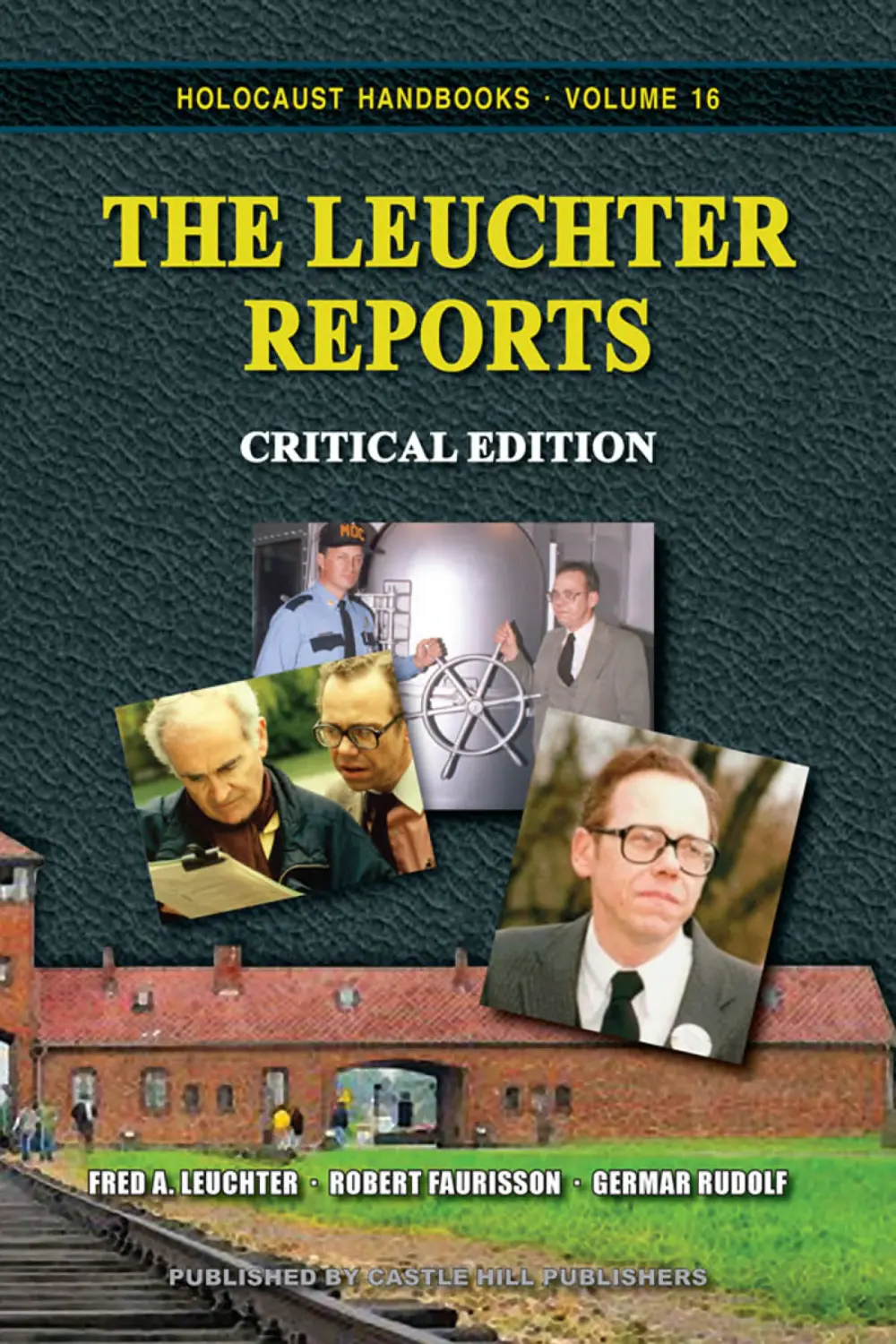
Cover Illustrations: clockwise from upper left: Dr. Robert Faurisson
and Fred A. Leuchter study paper work while doing research at the
Dachau camp for the “Second Leuchter Report”; Fred A. Leuchter and
a prison guard at the entry door to the execution gas chamber of the
prison at Parchman, Mississippi, while doing research for the “Third
Leuchter Report”; a snapshot of Leuchter. Background below: The
Auschwitz-Birkenau labor camp, where it was alleged until the late
1980s that as many as 4 million Jews were gassed to death (today
some 1 million are still claimed).
FRED. A. LEUCHTER, ROBERT FAURISSON, GERMAR RUDOLF, THE LEUCHTER REPORTS
5
Table of Contents
Page
Introduction ..................................................................................................... 9
The First Leuchter Report ............................................................................ 13
1. Preface by Prof. Dr. Robert Faurisson .................................................. 13
2. A Brief History of Critiques of the Leuchter Report ............................. 20
3. An Engineering Report on the Alleged Execution Gas Chambers
at Auschwitz, Birkenau, and Majdanek, Poland.................................... 24
3.0. Introduction .................................................................................. 24
3.1. Purpose ......................................................................................... 24
3.2. Background .................................................................................. 25
3.3. Scope ............................................................................................ 25
3.4. Synopsis and Findings ................................................................. 26
3.5. Method ......................................................................................... 27
3.6. Use of HCN and Zyklon B as a Fumigant ................................... 27
3.7. Design Criteria for a Fumigation Facility .................................... 29
3.8. Design Criteria for an Execution Gas Chamber ........................... 31
3.9. United States Execution Gas Chambers Since 1920 .................... 32
3.10. Toxic Effects of HCN Gas ........................................................... 34
3.11. A Brief History of the Alleged German Execution Gas
Chambers ..................................................................................... 35
3.12. Design and Procedures at the Alleged Execution Gas Chambers ...... 37
3.13. Crematories .................................................................................. 41
3.14. Forensic Considerations of HCN, Cyano-Compounds and
Crematories .................................................................................. 44
3.15. Auschwitz, Krema I ..................................................................... 47
3.16. Birkenau – Kremas II, III, IV and V ............................................ 50
3.17. Majdanek ...................................................................................... 53
3.18. Statistics ....................................................................................... 56
3.19. Conclusion ................................................................................... 56
3.20. Bibliography................................................................................. 58
3.21. Documents ................................................................................... 59
4. Critical Remarks ...................................................................................... 90
4.1. Physical, Chemical, and Toxicological Features of HCN
and Zyklon B ................................................................................ 90
4.2. Disinfestation Chambers .............................................................. 98
4.3. Homicidal Gassings ..................................................................... 99
4.4. Cremations ................................................................................. 107
4.5. Chemical Analysis ..................................................................... 111
6
FRED A. LEUCHTER, ROBERT FAURISSON, GERMAR RUDOLF, THE LEUCHTER REPORTS
The Second Leuchter Report ...................................................................... 121
1. Foreword ............................................................................................. 121
1.1. Before Ernst Zündel ................................................................... 122
1.2. After Ernst Zündel ..................................................................... 126
1.3. The Second Leuchter Report ...................................................... 128
1.4. The Revisionist Intifada ............................................................. 135
2. Introduction ......................................................................................... 136
3. Purpose ................................................................................................ 137
4. Background ......................................................................................... 138
5. Scope ................................................................................................... 138
6. Synopsis and Findings ......................................................................... 138
7. Method ................................................................................................ 139
8. The Leuchter Report ............................................................................ 139
8.1. Dachau ....................................................................................... 140
8.2. Mauthausen ................................................................................ 142
8.3. Hartheim Castle.......................................................................... 144
8.4. Specialized Hardware: Non-Existence ....................................... 145
8.5. Conclusion ................................................................................. 145
8.6. Documents ................................................................................. 146
9. Annotated Bibliography ...................................................................... 149
9.1. The First Leuchter Report .......................................................... 149
9.2. Dachau ....................................................................................... 149
9.3. Mauthausen ................................................................................ 160
9.4. Hartheim Castle.......................................................................... 168
9.5. 1988: Jewish Historians Face the Problem of the Gas Chambers .... 171
10. Appendix ............................................................................................. 173
10.1. The Gas Chamber at Dachau: Now You See It, Now You Don’t .... 173
10.2. The Gas Chamber at Dachau Revisited ..................................... 178
10.3. Documents and Photographs ...................................................... 187
The Third Leuchter Report A Technical Report on the Execution
Gas Chamber ............................................................................................... 195
0. Introduction ......................................................................................... 195
1. Purpose ................................................................................................ 195
2. Background ......................................................................................... 196
3. Scope ................................................................................................... 196
4. History ................................................................................................. 197
5. Mississippi Death House ..................................................................... 198
6. The Lethal Gas Chamber ..................................................................... 199
7. Lethal Gas Chamber Function ............................................................. 202
FRED. A. LEUCHTER, ROBERT FAURISSON, GERMAR RUDOLF, THE LEUCHTER REPORTS
7
8. Design Criteria for a Lethal Gas Chamber .......................................... 206
9. Conclusion ........................................................................................... 207
10. Documents ........................................................................................... 209
11. Photographs ......................................................................................... 219
The Fourth Leuchter Report A Technical Evaluation of JeanClaude Pressac’s Book Auschwitz: Technique and Operation of the
Gas Chambers ............................................................................................... 227
0.
Introduction ................................................................................ 227
1.
Purpose ....................................................................................... 227
2.
Background ................................................................................ 228
3.
Scope .......................................................................................... 228
4.
Synopsis and Findings ............................................................... 228
5.
Methodology .............................................................................. 229
6.
Construction of the Document ................................................... 229
7.
Proofs ......................................................................................... 230
8.
Categories................................................................................... 231
9.
Review ....................................................................................... 237
Part One: Delousing Gas Chamber and Other Disinfestation
Installations ......................................................................................... 237
10. Chapter 1: Foreword on Zyklon B ............................................. 237
11. Chapter 2: The Stammlager Delousing Installations.................. 238
12. Chapter 3: The Prussic Acid Delousing Installation in the
Reception Building .................................................................... 238
13. Chapter 4: Kanada and Its Clothing Delousing Installation ....... 238
14. Chapter 5: The Delousing and Disinfestation Installations
of BW 5a and 5b in KGL Birkenau ............................................ 239
15. Chapter 6: The Disinfestation Installation of the Gypsy
Camp in Sector BIIe of Birkenau. .............................................. 239
16. Chapter 7: The Birkenau “Zentral Sauna” with its
Disinfection Autoclaves and Topf Disinfestation Ovens ........... 239
Part Two: The Extermination Instruments ................................................ 240
17. Chapter 1: History of Topf ......................................................... 240
18. Chapter 2: Krematorium 1 or the “Old Crematorium” of the
Main Camp (Auschwitz Stammlager). ....................................... 240
19. Chapters 3 and 4: Bunker 1 or the “Red House” Bunker 2
(V) or the “White House” .......................................................... 241
20. Chapters 5 and 6: Krematorien II and III; The Ventilation
Systems of Krematorien II and III ............................................. 241
21. Chapter 7: Krematorien IV and V. Plans, Construction and
General Study ............................................................................. 242
8
FRED A. LEUCHTER, ROBERT FAURISSON, GERMAR RUDOLF, THE LEUCHTER REPORTS
Chapter 8: “One Proof...One Single Proof”: Thirty-Nine
Criminal Traces. ......................................................................... 243
Part Three: Testimonies ............................................................................. 243
23. Chapters 1, 2, and 3: Critical Examination of the “War
Refugee Board”; Critical Examination of the Testimonies
of Doctors Bendel and Nyiszli; the Deposition of Henryk
Tauber ........................................................................................ 243
Part Four: Auschwitz and the Revisionists ................................................ 244
24. Chapter 1: Auschwitz Explained by the Revisionists ................ 244
25. Chapter 2: Auschwitz According to the Revisionists................. 244
Part Five: The Unrealized Future of K.L. Auschwitz-Birkenau ................ 244
26. Chapter 1: The Aborted Future of the Stammlager without
Extermination ............................................................................. 244
27. Chapter 2: Birkenau 1945: the Extermination Station ............... 244
28. Postface ...................................................................................... 244
29. Conclusion ................................................................................. 245
22.
FRED. A. LEUCHTER, ROBERT FAURISSON, GERMAR RUDOLF, THE LEUCHTER REPORTS
9
Introduction
By Germar Rudolf
The Leuchter Report,1 first published in 1988, is the work of a pioneer. It was
the first study that subjected the claim that human beings were killed in masses in homicidal gas chambers during the Third Reich to a forensic investigation. Because Fred Leuchter had only two weeks to prepare his expert report
focusing on the Auschwitz and Majdanek camps and because he lacked indepth knowledge of the historical background, his report could not possibly
have the scientific depth the topic deserves. It was therefore to be expected
that it would be subject to detailed criticism.
Instead of criticizing the Leuchter Report, the author of these lines decided
in 1989 to do a better job with the original task. After all, it is always easy to
complain, but it is quite difficult to do a better job on a topic so complex and
imbued with prejudices and emotions. This improved “Leuchter Report,” my
own expert report called The Rudolf Report, was first published in German in
19932 and in English ten years later.3 In contrast to the success of the Leuchter
Report, my own expert report remained something of an insider’s secret resource, probably because it is only second in line and also because dense, indepth scientific studies covering physical, chemical, toxicological, and engineering questions, as well as detailed historical documentations, are not the
kind of publications that attract the masses. They are simply not easy to digest.
Considering the fact that the Leuchter Report remains popular, I decided to
put it back in print. But since historical research on Auschwitz and Majdanek
has made huge progress since 1988 – not least because many archives in eastern Europe became accessible after the collapse of the Soviet Union – it would
be irresponsible to simply reprint it. It was therefore decided to publish a
commented version of it. The text of the original Leuchter Report was left
intact, since it also has become a historical document. The reader will find
many footnotes throughout the report, however, which were all added by me.
They either give references to sources and further explanations that back up
Leuchter’s claims, or they correct or comment on Leuchter’s statements where
1
2
3
Fred A. Leuchter, An Engineering Report on the alleged Execution Gas Chambers at Auschwitz, Birkenau and Majdanek, Poland, Samisdat Publishers Ltd., Toronto 1988, 195 pp.
Rüdiger Kammerer, Armin Solms (eds.), Das Rudolf-Gutachten, Cromwell, London 1993
(www.vho.org/D/rga).
G. Rudolf, The Rudolf Report, Theses & Dissertations Press, Chicago 2003; 2nd ed. The Barnes Review, Washington, DC, 2011 (www.holocausthandbooks.com/dl/02-trr.pdf).
10
FRED A. LEUCHTER, ROBERT FAURISSON, GERMAR RUDOLF, THE LEUCHTER REPORTS
necessary. All illustrations embedded in the text section of the report were
also added for this edition, so that the reader can visualize the locations, devices and items Leuchter is writing about. At the end of this first Leuchter
Report, the reader will find several additional chapters, which explain in more
detail the issues involved.
What is unknown to many is the fact that Fred A. Leuchter not only authored the famous first Leuchter Report, but that he also compiled three more
studies on related issues in the years that followed. They were called The Second, Third, and Fourth Leuchter Report.4 Since they all belong together, it
was decided to include them in this book as well. These later three reports
were not given comment in this edition, because most comments that would
seem appropriate are already included in the First Leuchter Report. As to
Leuchter’s critique of Jean-Claude Pressac’s work on Auschwitz – The Fourth
Leuchter Report – I direct the reader’s attention to more thorough critiques by
other revisionists of Pressac’s work.5
The idea to publish this critical edition of the Leuchter Reports was triggered by the fate of the person on whose behalf they had been compiled: Ernst
Zündel. The reader will be introduced to Ernst Zündel’s trials and tribulations
in the introduction by Robert Faurisson, so I will restrict myself to saying that
these four Leuchter Reports are the core of Zündel’s legacy, for which he is
sitting in a German jail as I write these lines, because in Germany doubting
the veracity of the official version of the Holocaust is a thought crime punishable with up to five years in prison.
This critical edition is not only dedicated to Ernst Zündel, but also, of
course, to the author of the reports whose name they bear, who suffered like
no other American because of his historical dissent. After Ernst Zündel had
published Leuchter’s first report, Jewish organizations launched a vicious
smear campaign, which eventually destroyed not only Leuchter’s reputation
but also his ability to make a living. Leuchter’s contracts with state authorities
for the manufacture, installation and servicing of execution hardware were
cancelled. He was financially forced out of his home in Massachusetts and had
to find private work elsewhere.6
4
5
6
Fred Leuchter, Robert Faurisson, The Second Leuchter Report, Samisdat Publishers, Toronto 1990; Fred
A. Leuchter, The Third Leuchter Report, Samisdat Publishers Ltd., Toronto 1990; Fred A. Leuchter, The
Fourth Leuchter Report, Samisdat Publishers Ltd., Toronto 1991.
C. Mattogno, Journal of Historical Review, 10(4) (1990), pp. 461-485; R. Faurisson, ibid., 11(1) (1991),
pp. 25-66; ibid., 11(2) (1991), pp. 133-175; A. Butz, ibid., 13(3) (1993), pp. 23-37; Germar Rudolf (ed.),
Auschwitz: Plain Facts, Theses & Dissertations Press, Chicago, IL, 2005; C. Mattogno, The Real Case
for Auschwitz, Castle Hill Publishers, Uckfield 2015.
See the special issue on Leuchter and the Leuchter Report in The Journal of Historical Review, 12(4)
(1992), pp. 421-492 (www.codoh.com/media/files/jhr/v12n4.pdf), esp.: Fred Leuchter, “Is there life after persecution?,” pp. 429-444.
FRED. A. LEUCHTER, ROBERT FAURISSON, GERMAR RUDOLF, THE LEUCHTER REPORTS
11
Fig. 1: Letter of recommendation by the warden of the Missouri State
Peni-tentiary, Bill Armontrout.
But who is Fred A. Leuchter anyway? A number of mainstream media reported on Fred Leuchter. Some of their statements were:7
A feature article in The Atlantic Monthly (Feb. 1990) described Leuchter as
“the nation’s only commercial supplier of execution equipment. […] A
trained and accomplished engineer, he is versed in all types of execution
equipment. He makes lethal-injection machines, gas chambers, and gallows,
as well as electrocution systems […]”
Similarly, a lengthy New York Times article (October 13, 1990), complete
with a front-page photo of Leuchter, called him
7
Taken from the paper “Probing Look at ‘Capital Punishment Industry’ Affirms Expertise of Auschwitz
Investigator Leuchter,” The Journal of Historical Review 17(2) (1998), pp. 34ff.
12
FRED A. LEUCHTER, ROBERT FAURISSON, GERMAR RUDOLF, THE LEUCHTER REPORTS
“The nation’s leading adviser on capital punishment.”
In his book about America’s capital punishment industry, Stephen Trombley
confirms that Leuchter is:8
“America’s first and foremost supplier of execution hardware. His products include electric chairs, gas chambers, gallows, and lethal injection machines. He offers design, construction, installation, staff training and
maintenance.”
Thus, with Fred A. Leuchter we have the foremost, if not the only expert on
execution technology in the U.S. at that time. Should such a person not be
competent to judge the technical feasibility of the alleged execution technology applied by the Third Reich? Well, at least he should have the right to voice
his opinion, should he not?
According to Fred Leuchter, killing someone in a gas chamber is very dangerous for those who carry out the execution, above all because the body of
the dead prisoner is saturated with lethal gas. After the execution, explains
Leuchter:9
“You go in. The inmate has to be completely washed down with chlorine
bleach or with ammonia. The poison exudes right out through his skin. And
if you gave the body to an undertaker, you’d kill the undertaker. You’ve got
to go in; you’ve got to completely wash the body.”
Bill Armontrout, warden of the Missouri State Penitentiary in Jefferson City,
which contains an execution gas chamber, confirms the danger:10
“One of the things that cyanide gas does, it goes in the pores of your skin.
You hose the body down, see. You have to use rubber gloves, and you hose
the body down to decontaminate it before you do anything [else].”
In Leuchter’s opinion, gas-chamber use should be discontinued, not just because of the cruelty of this method of execution, but because of his beliefs
relating to gas chambers as such:11
“They’re dangerous. They’re dangerous to the people who have to use
them, and they’re dangerous for the witnesses. They ought to take all of
them and cut them in half with a chain saw and get rid of them.”
With a career built on the motto “Capital punishment, not capital torture,”
Leuchter took pride in his work – until the Holocaust lobby saw to it that he
lost his calling.
This book is an intellectual memorial to both Ernst Zündel and Fred Leuchter.
Germar Rudolf, Chicago, April 1, 2005
8
9
10
11
Stephen Trombley, The Execution Protocol, Crown Publishers, New York 1992, p. 8.
Ibid., p. 98.
Ibid., p. 102
Ibid., p. 13.
FRED. A. LEUCHTER, ROBERT FAURISSON, GERMAR RUDOLF, THE LEUCHTER REPORTS
13
The First Leuchter Report
1.
Preface by Prof. Dr. Robert Faurisson
Fred A. Leuchter, born in 1942, is an engineer living in Boston, Massachusetts, who specialized in the design of execution hardware used in prisons
throughout the United States. One of his major projects was the design of a
new gas chamber at the Missouri State Penitentiary at Jefferson City.
In January of 1988 I was in Toronto, Canada, assisting in the defense of Mr.
Ernst Zündel, a German-Canadian who was on trial for spreading false news
by publishing Did Six Million Really Die?,12 a booklet which challenged the
prevailing view that six million Jews were killed by the Nazis during World
War II, primarily through the use of gas chambers using hydrocyanic gas
(Zyklon B gas).
Ernst Zündel had been previously tried on the same charge in 1985. The trial
lasted seven weeks and ended with a conviction and a sentence of fifteen
months’ imprisonment.13 In January 1987, the Ontario Court of Appeal overturned the judgment because of grave errors in law and ordered that a new
trial be held. The retrial began on January 18, 1988, and at the time of this
writing is still proceeding.
My initial conversations with Fred Leuchter took place in Boston on the 3rd
and 4th of February, 1988. I was impressed with the conciseness of his answers to my questions and by his ability to explain every detail of gassing
procedures. He confirmed to me the particularly dangerous nature of an execution by hydrocyanic gas.
Executions using this gas were carried out for the first time in the United
States in 1924, but as late as 1988 major difficulties still existed in the construction of execution gas chambers, including the problem of leakage. I noticed that Fred Leuchter did not question the standard notion of the Holocaust.
After my return from Boston to Toronto and after I had reported to Ernst
Zündel on my discussions with Fred Leuchter, Mr. Zündel decided to ask the
latter to prepare an expert opinion on the alleged gas chambers at Auschwitz,
Birkenau and Majdanek.
12
13
R. E. Harwood, Did Six Million Really Die?, 26 pp., undated
(www.ihr.org/books/harwood/dsmrd01.html).
Cf. Michael A. Hoffmann II, The Great Holocaust Trial, 3rd ed., Wiswell Ruffin House, Dresden, NY,
1995.
14
FRED A. LEUCHTER, ROBERT FAURISSON, GERMAR RUDOLF, THE LEUCHTER REPORTS
Mr. Leuchter accepted the assignment after a weekend in Toronto reviewing
wartime aerial photographs of the camps, plans of the crematoriums and alleged gas chambers, documents on Zyklon B and slides taken of the sites in
the 1970’s by the Swedish researcher Ditlieb Felderer.
On February 25, 1988, Mr. Leuchter left for Poland together with his wife
Carolyn, his draftsman Howard Miller, cinematographer Jürgen Neumann,
and Polish-language interpreter Tijudar Rudolph. They returned eight days
later on March 3rd.
Upon return, Fred Leuchter wrote his report of 192 pages including appendices. His conclusions were clear: the evidence was overwhelming that there
were no execution gas chambers at Auschwitz, Birkenau and Majdanek and
that the alleged gas chambers at these sites could not have been, then or now,
utilized or seriously considered to function as execution gas chambers.
On the 20th and 21st of April, 1988, he stood in the witness stand in Toronto. At first, he replied to the questions put to him by Mr. Zündel’s defense
lawyer, 14 Douglas H. Christie, assisted by Keltie Zubko and Barbara Kulaszka. Mr. Leuchter then faced cross-examination by the crown prosecutor,
John Pearson, an official who had been assisted throughout the trial by another
crown attorney, a law clerk, and frequent consultations with Jewish advisors
sitting immediately behind him in the courtroom.
The examination and cross-examination took place in the presence of a
judge and an eleven-member jury. In the courtroom, the atmosphere was one
of extreme tension. I was sitting beside a number of revisionist experts, including Dr. William Lindsey, chief research chemist for Dupont Corporation
before his retirement in 1985. Everyone in the courtroom, regardless of his or
her own personal viewpoint on the topic under examination, was acutely
aware, I think, of participating in a historical event. The myth of the gas
chambers was ending.
The previous day, the director of the Missouri State Penitentiary, Bill Armontrout, had given testimony15 explaining the procedures and practical operation of a cyanide gas chamber. For every attentive listener it was revealed
that if it was so difficult to execute a single person in this manner, then the
alleged execution of hundreds of thousands of persons by the Germans using
Zyklon B would equal the problem of trying to square the circle.
Following Fred Leuchter on the witness stand was Dr. James Roth, Ph.D.
(Cornell Univ.), Manager of Alpha Analytical Laboratories in Ashland, Massachusetts. 16 Dr. Roth reported on the analysis of samples taken from the
walls, floors, ceilings and other structures inside the alleged gas chambers of
14
15
16
www.zundelsite.org/archive/english/dsmrd/dsmrd33leuchter.html
www.zundelsite.org/archive/english/dsmrd/dsmrd31armontrout.html
www.zundelsite.org/archive/english/dsmrd/dsmrd34roth.html
FRED. A. LEUCHTER, ROBERT FAURISSON, GERMAR RUDOLF, THE LEUCHTER REPORTS
15
Auschwitz I and Birkenau. These tests revealed either no detection of traces of
cyanide or extremely low levels. The only exception was the control sample
number 32 taken from Delousing Facility Number 1 at Birkenau. These results
were graphically produced in Appendix I of the Report and displayed to the
jury on an overhead projector. The difference in detected cyanide between the
delousing facility on one hand and the alleged gas chambers on the other was
spectacular. The extremely low level of cyanide found in some crematoria was
likely, in my opinion, to have resulted from disinfection of the premises during the war.
I think I was the first to point out that all studies of the alleged German execution gas chambers using Zyklon B should commence with a study of the
American execution gas chambers. As early as 1977, with the help of an
American friend, Eugene C. Brugger, a lawyer in New York City, I began an
inquiry into this area. During this research, I obtained information from six
American penitentiaries: San Quentin, California; Jefferson City, Missouri;
Santa Fe, New Mexico; Raleigh, North Carolina; Baltimore, Maryland; and
Florence, Arizona. I was forced to conclude at that time that only an expert in
American gas-chamber technology could finally determine whether the alleged German execution gas chambers were capable of having been used as
described in Holocaust literature.
During the next several years, my articles on German gas chambers always
referred to the American gas chambers. These articles included “The Rumor
of Auschwitz or the Gas Chamber Problem,” published on December 29,
1978, in a French daily newspaper, Le Monde,17 and a long interview published in August 1979 in the Italian periodical Storia Illustrata.18 I visited the
gas chamber in Baltimore, Maryland, in September 1979 and obtained eight
photographs of the chamber and additional documentation. Then, during a
meeting held in New York City under the chairmanship of Fritz Berg, I
showed the Gas Chamber Procedure Check Sheet of the Baltimore penitentiary and discussed its implications. In 1980, in the first issue of the newly
created Journal of Historical Review, I published an article entitled “The Mechanics of Gassing,”19 in which I described in some detail the gas-chamber
procedures used in the United States. In the same year, I published in Vérité
Historique ou Vérité Politique? the eight photographs of the Baltimore gas
17
18
19
“‘Le problème des chambres à gaz’ ou ‘la rumeur d’Auschwitz’,” Le Monde, 29.12.1978, p. 8; see also
“The ‘problem of the gas chambers’,” Journal of Historical Review, 1(2) (1980), pp. 103-114
(www.ihr.org/jhr/v01/v01p103_Faurisson.html)
R. Faurisson, “Le camere a gas non sono mai esistite,” Storia illustrata, 261 (1979), pp. 15-35
(www.vho.org/aaargh/fran/archFaur/1974-1979/RF7908xx2.html); Engl.: “The Gas Chambers: Truth or
Lie?” Journal of Historical Review, 2(4) (1981), pp. 319-373.
R. Faurisson, “The Mechanics of Gassing,” Journal of Historical Review, 1(1) (1980) pp. 23-30
(www.ihr.org/jhr/v01/v01p-23_Faurisson.html)
16
FRED A. LEUCHTER, ROBERT FAURISSON, GERMAR RUDOLF, THE LEUCHTER REPORTS
chamber. 20 My video entitled “The Gas Chamber Problem,” made in 1982,
began with an analysis of the American gas chambers.
In 1983, I prepared for the Institute for Historical Review, Los Angeles, a
book written in English on the Holocaust controversy which was to include,
for the first time, a list of the questions put to the penitentiary wardens and
their answers. The book, however, was never published: on July 4, 1984,
American Independence Day, the archives of the Institute were destroyed by
arson. This fire, for all intents and purposes, destroyed the financial viability
of the Institute, and a number of projects, including that of my book, were
abandoned.21
The Holocaust has appeared to be a subject of enormous proportions. But
this “giant,” as Dr. Arthur Butz pointed out in The Hoax of the Twentieth Century,22 is a giant with feet of clay. To see the feet of clay, one need only go to
Auschwitz Concentration Camp in Poland. In the words of Dr. Wilhelm
Stäglich, “the extermination thesis stands or falls with the allegation that
Auschwitz was a ‘death factory’.” 23 And for me, the whole mystery of
Auschwitz is, in turn, concentrated on the 65 square meters of the alleged gas
chamber of Auschwitz I and on the 210 square meters of the alleged gas
chamber of Birkenau. These 275 square meters should have been forensically
examined immediately after the war by the Allies, but no such examination
was ever carried out then or since. The Polish examining magistrate, Jan Sehn,
ordered some forensic examinations at Auschwitz but not of the alleged execution gas chambers themselves.
Research by revisionists has shown that the places alleged to have been execution gas chambers could not have been used for such a purpose. Ditlieb
Felderer published photographs indicating the flimsy construction of vents and
doors to the gas chambers and the lack of Prussian-blue stains on the walls.24 I
myself had discovered in 1975 in the archives of the Auschwitz State Museum
(archives which are well-guarded by Communist officials) the plans of these
alleged gas chambers and was the first to publish them in various books and
articles. These plans were also shown at the first convention of the Institute
for Historical Review in Los Angeles in 1979, when Mr. Zündel was present.
In reality, these alleged gas chambers had been mortuaries or, as indicated on
20
21
22
23
24
Serge Thion (Hg.), Vérité historique ou vérité politique?, La Vielle Taupe, Paris 1980
(www.vho.org/aaargh/fran/histo/SF/SF1.html).
See Journal of Historical Review, 5(2-4) (1984), outer back cover.
Arthur R. Butz, The Hoax of the Twentieth Century, 4th ed., Castle Hill Publishers, Uckfield 2015
(www.holocausthandbooks.com/dl/07-thottc.pdf).
W. Stäglich, The Auschwitz Myth, Institute for Historical Review, Torrance, CA, 1986; 3rd ed. Castle
Hill Publishers, Uckfield 2015, p. 15.
Cf. Ditlieb Felderer, “Auschwitz Notebook Part 2: Lids and openings,” Journal of Historical Review
1(3) (1980), pp. 255-266 (www.ihr.org/jhr/v01/v01p255_Felderer.html).
FRED. A. LEUCHTER, ROBERT FAURISSON, GERMAR RUDOLF, THE LEUCHTER REPORTS
17
the plans, “Leichenhalle” for Krema I (later transformed into an air-raid shelter) and “Leichenkeller” for Krema II.
Nevertheless, in order to obtain an entirely scientific confirmation of what
simple common sense compelled us to see and what revisionist research work
and documents had revealed, it was necessary to look for an American gaschamber specialist. I desperately tried to find such a specialist, but, frankly, I
had little hope of finding a man who was not only an expert in gas-chamber
technology, but also courageous enough to carry out such an investigation in a
Communist country and to publish the results if ever they confirmed revisionist conclusions. Fortunately, I was wrong.
Fred Leuchter was this specialist. He went to Poland, conducted the forensic
examination, wrote his report and testified in a Canadian court on behalf of
Mr. Zündel. In so doing, he has quietly entered history.
Fred Leuchter is a modest but quietly determined man who speaks precisely.
He would be an excellent professor and has the gift of making people understand the intricacies of any difficult problem. When I asked him whether or
not he was afraid of any dangerous consequences, he replied, “A fact is a
fact.” Upon reading the Leuchter Report, David Irving, the famous British
historian, said on April 22, 1988, during his testimony in Toronto that it was a
“shattering” document which would become essential for any future historian
writing on the Second World War.
Without Ernst Zündel, almost nothing of what has now transpired would
have been conceivable. He sacrifices everything in his search for historical
accuracy and lives under difficult conditions, facing influential and powerful
enemies. The pressure on him is permanent and takes the most unexpected and
sometimes the most vicious forms. But he has a strong personality and charisma. He knows how to analyze any given situation, to evaluate the ratio of
forces, to turn adversity into advantage. From all parts of the world he attracts
and mobilizes competent people. He is a profound man, a genius who combines common sense with a keen understanding of people and situations.
He may once again go to prison for his research and beliefs or be threatened
with deportation. All this is possible. Anything may happen when there is an
intellectual crisis and a realignment of historical concepts of such dimension.
Revisionism is the great intellectual adventure at the end of this century.
Whatever happens, Ernst Zündel is already the victor. He is the pacifistactivist who has achieved this victory through the powers of reason and persuasion.
On May 11, 1988, the jury found Ernst Zündel guilty of knowingly spreading false news about the Holocaust. He was sentenced to nine months’ imprisonment and was granted bail after signing a gag order, promising not to write
18
FRED A. LEUCHTER, ROBERT FAURISSON, GERMAR RUDOLF, THE LEUCHTER REPORTS
or speak about the “Holocaust” until
the end of his appeal proceedings. He
thus joined Galileo.
On August 27, 1992, the Canadian
Supreme Court overturned Ernst Zündel’s conviction and declared the law
unconstitutional under which he was
dragged through the courts of Canada
for nine years. Canada has refused to
apologize to Ernst Zündel for his ordeal, and has turned down his request
for compensation for his legal costs etc.
In spring of 1995, Zündel’s home in
Toronto was the target of violent
demonstrations.
Posters
spread
throughout Toronto urged violence
against him. On April 4, 1995, an
anonymous bomb threat with a razor Fig. 2: The Zündel residence in Toronblade and a mousetrap was sent to
to after the arson attack on May 7,
1995.
Zündel. On May 7, 1995, Zündel’s
house was the victim of arson, suffering some $400,000 of damage. During
the week of May 20, 1995, Zündel received a “book parcel” containing a
bomb. The police bomb squad detonated the bomb safely by remote control in
a quarry near Toronto.
On August 5, 1995, the Canadian Minister of Citizenship and Immigration
informed Zündel that he had been classified a “security risk” to Canada, a
decision upheld by the Canadian Supreme Court on April 30, 1998.
In 1996 Zündel was dragged in front of the recently established Canadian
Human Rights Commission for allegedly inciting hatred. Any evidence introduced for his defense was declared to be irrelevant by the Commission, because when it comes to incitement to hatred, “truth is not a defense,” so the
decision of the Human Rights Commission. On May 25, 1998, this Commission issued a ruling finding him guilty of inciting hatred with the website dedicated to him called www.zundelsite.com. Zündel was ordered to shut down
his website and cease and desist from all public statements on the Holocaust.
All subsequent attempts to challenge the legality of the proceedings of the
Human Rights Commission failed, despite harsh criticism even from the mass
media.
In early 2000, Ernst Zündel married the U.S. citizen Ingrid Rimland and
immigrated to the United States. Due to his marriage to a U.S. citizen, he applied for permanent legal residence. The proceedings for legal residence were
FRED. A. LEUCHTER, ROBERT FAURISSON, GERMAR RUDOLF, THE LEUCHTER REPORTS
19
started properly, but some communication problems apparently evolved
between Zündel and his immigration
lawyer. As a result of this, Ernst Zündel missed a scheduled hearing at the
U.S. Immigration and Naturalization
Service in spring 2001. Hence, on
February 5, 2003, Ernst Zündel was
arrested, and on February 17, the U.S.
authorities deported him back to Canada, where he was held in solitary Fig. 3: The arrested Ernst Zündel at his
confinement in a high-security prison.
arrival in Toronto, Feb. 19, 2003.
With the help of the new anti-terror
legislation enacted after 9/11, the Canadian authorities claimed that Zündel
was a security risk to Canada and that the evidence proving this was a matter
of national security and could therefore not be disclosed. All attempts to challenge this secret evidence and to challenge these kangaroo-style proceedings
failed. On March 1, 2005, Zündel was deported to Germany. The Canadian
authorities gave as reasons that Zündel was a security risk because he had
associated with individuals and groups that were allegedly inclined to endorse
or engage in violence and because his views destabilize the government of
Germany.
As these lines are being written, Ernst Zündel is sitting in a German jail in
Mannheim awaiting his trial for “Holocaust denial,” an offense which is punished with up to five years imprisonment. In Germany, no exonerating evidence may be introduced in such trials, since that same evidence would constitute “denial” as well and would merely lead to another criminal indictment of
the defendant and his lawyer.
Robert Faurisson, Toronto, April 23, 1988
Updated on May 3, 2005
P.S.: On February 15, 2007, Ernst Zündel was sentenced to five years’ imprisonment by judge Meinerzhagen of the Mannheim District Court. The two
years he had spent in Canada in solitary confinement were not recognized by
the German court, claiming that this confinement had been unrelated.
On March 1, 2010, Ernst Zündel was finally released from prison. When he
was deported from the U.S. in 2005, he was barred from returning to the U.S.
for 20 years. Since the German government has issued a European arrest warrant for his wife Ingrid for her revisionist activities, she cannot come to Europe either, hence for this couple a married life together takes place only during brief vacation time spent in third countries outside of Europe.
20
FRED A. LEUCHTER, ROBERT FAURISSON, GERMAR RUDOLF, THE LEUCHTER REPORTS
2.
A Brief History of Critiques of the Leuchter
Report
A fact-oriented discussion of the technical arguments brought to the public by
the Leuchter Report was started in France by an attempt at refutation by the
French pharmacist Jean-Claude Pressac in the periodical Jour Juif.25 However,
Pressac’s article could hardly qualify as an expert discussion, because he did
not back up any of his technical or scientific claims with evidence or exact
scientific argumentation. Though he did point out several deficiencies in the
Leuchter Report, he made several errors himself in chemical and engineering
questions due to his lack of expertise.26
Next came the late Dr. Georges Wellers, who has been both Professor for
Physiology and Biochemistry at France’s National Center for Scientific Research (Centre National de la Recherche Scientifique, CNRS) and president of
the historical commission of the Center for Contemporary Jewish Documentation (Centre de Documentation Juive Contemporaine, CDJC) in Paris. He
wrote an article narrowly focusing on only a few aspects of the Leuchter Report: 27 His paper is characterized by wishful thinking running contrary to
physical reality and ignoring what witnesses claimed about the alleged homicidal gassings.28
The first response from Germany came from Germany’s official Institute for
Contemporary History (Institut für Zeitgeschichte).29 It was based on Pressac’s
work, did not bother to back up any of its claims with evidence, and was
therefore hardly useful, also due to the all-too-apparent lack of technical expertise of its author, historian Hellmuth Auerbach.30
25
26
27
28
29
30
J.-C. Pressac, Jour J, December 12, 1988, pp. I-X; see also Pressac in: S. Shapiro (ed.), Truth Prevails:
Demolishing Holocaust Denial: The End of the Leuchter Report, Beate Klarsfeld Foundation, New York
1990.
On this cf. Paul Grubach, “The Leuchter Report Vindicated: A Response to Jean-Claude Pressac’s
Critique,” Journal of Historical Review, 12(4) (1992), pp. 445-473; see also in German: W. Schuster,
“Technische Unmöglichkeiten bei Pressac,” Deutschland in Geschichte und Gegenwart, 39(2) (1991),
pp. 9-13 (vho.org/D/DGG/Schuster39_2.html).
G. Wellers, “A propos du ‘rapport Leuchter’ les chambres à gaz d’Auschwitz,” Le Monde Juif, No. 134,
April-June 1989, pp. 45-53.
Cf. G. Rudolf, “Fantasies of a Biochemist, ” G. Rudolf, Carlo Mattogno, Auschwitz Lies, 2nd ed., The
Barnes Review, Washington, DC, 2011, pp. 35-43 (www.holocausthandbooks.com/dl/18-al.pdf).
H. Auerbach, Institut für Zeitgeschichte, letter to Bundesprüfstelle, Munich, Oct. 10, 1989; Auerbach,
November 1989 (no day given), both published in U. Walendy, Historische Tatsache no. 42, Verlag für
Volkstum und Zeitgeschichtsforschung, Vlotho 1990, pp. 32 and 34; somewhat shortened in: Wolfgang
Benz (ed.), Legenden, Lügen, Vorurteile, 7th ed., dtv, Munich 1995, pp. 147-149.
In this regard, see my technical appraisal, first reprinted in Henri Roques, Günter Annthon, Der Fall
Günter Deckert, DAGD/Germania Verlag, Weinheim 1995, pp. 431-435
(www.vho.org/D/Deckert/C2.html); updated as “Institut für Zeitlegenden” in G. Rudolf, AuschwitzLügen, 2nd ed., Castle Hill Publishers, Uckfield 2012, pp. 15-28
(www.holocausthandbuecher.com/dl/18d-al.pdf).
FRED. A. LEUCHTER, ROBERT FAURISSON, GERMAR RUDOLF, THE LEUCHTER REPORTS
21
In 1991, a contribution on the Leuchter Report appeared in an anthology on
the Third Reich, authored by a 90-year-old German geriatric, retired social
worker Werner Wegner, who had neither qualifications in chemistry nor civil
engineering nor did he back up his technical claims.31 Instead of seeking the
advice of qualified people on these matters, he drew his own conclusions – to
his own massive embarrassment.32 On my question why German historian Dr.
Rainer Zitelmann, the responsible editor of this anthology, included this ridiculous piece in his otherwise well-researched compilation, he indicated that he
had to include the paper to avoid opposition to his book due to the fact that the
other papers were ‘revisionist’ in tone.33
At the end of 1991, Austrian chemist Dr. Josef Bailer critiqued the Leuchter
Report in a little booklet published in Austria.34 This work is notable for largely ignoring the witness testimony on the procedures supposedly used during
the gassings at Auschwitz and for the author’s lack of understanding of the
chemical process involved. Despite criticism directed at his study, 35 Bailer
repeated his unsustainable objections in a later publication,36 without responding to his critics.37
Finally, the Auschwitz State Museum itself ordered an expert report to be
compiled. The Institute for Forensic Research, Toxicology Division, of Krakow, Poland, named after Prof. Dr. Jan Sehn, prepared this report, which was
confined to the analysis of masonry samples, on September 24, 1990, under
the late Dr. Jan Markiewicz, professor for technical testing.38 The report concluded that the reason why Leuchter’s samples from the homicidal gas chambers were mostly negative with respect to traces of cyanide was because the
31
32
33
34
35
36
37
38
W. Wegner, “Keine Massenvergasungen in Auschwitz? Zur Kritik des Leuchter-Gutachtens,” in U.
Backes, E. Jesse, R. Zitelmann (eds.), Die Schatten der Vergangenheit, Propyläen, Frankfurt 1990, pp.
450-476 (www.vho.org/D/dsdv/Wegner.html, with inserted critique by the present writer).
On this cf. W. Häberle, “Zu Wegners Kritik am Leuchter-Gutachten,” Deutschland in Geschichte und
Gegenwart, 39(2) (1991), pp. 13-17 (www.vho.org/D/DGG/Haeberle39_2.html); G. Rudolf, “Ein Sozialoberrat schreibt Geschichte,” in Rudolf, op. cit., (note 30), pp. 55-74.
In a personal communication to me.
J. Bailer, “Der Leuchter-Bericht aus der Sicht eines Chemikers,” in: Amoklauf gegen die Wirklichkeit,
Dokumentationszentrum des österreichischen Widerstandes, Bundesministerium für Unterricht und Kultur (eds.), Vienna 1991, pp. 47-52.
Cf. Ernst Gauss (alias Germar Rudolf), Vorlesungen zur Zeitgeschichte, Grabert, Tübingen 1993, pp.
290-293 (www.vho.org/D/vuez); E. Gauss, “Chemische Wissenschaft zur Gaskammerfrage,” Deutschland in Geschichte und Gegenwart, 41(2) (1993), pp. 16-24 (www.vho.org/D/DGG/Gauss41_2).
Josef Bailer, in B. Bailer-Galanda, W. Benz, W. Neugebauer (ed.), Wahrheit und Auschwitzlüge, Deuticke, Vienna 1995, pp. 112-118.
Cf. my renewed critique: Germar Rudolf, “Zur Kritik an ‘Wahrheit und Auschwitzlüge’” in: Herbert
Verbeke (ed.), Kardinalfragen zur Zeitgeschichte, Vrij Historisch Onderzoek, Berchem, 1996, pp. 91108 (www.vho.org/D/Kardinal/Wahrheit.html); reprinted in G. Rudolf, “Lüge und AuschwitzWahrheit,” in Rudolf, op. cit., (note 30), pp. 193-236; Engl.: “Critique of Truth and the Auschwitz-Lie”
(www.vho.org/GB/Books/cq/critique.html).
J. Markiewicz, W. Gubala, J. Labedz, B. Trzcinska, Expert Opinion, Prof. Dr. Jan Sehn Institute for
Forensic Research, department for toxicology, Krakow, Sept. 24, 1990; partially published, e.g. in: “An
official Polish report on the Auschwitz ‘gas chambers’,” Journal of Historical Review, 11(2) (1991), pp.
207-216.
22
FRED A. LEUCHTER, ROBERT FAURISSON, GERMAR RUDOLF, THE LEUCHTER REPORTS
cyanide compounds had been exposed for more than 40 years to weathering,
which these compounds allegedly could not have withstood. Three of these
authors from the Jan Sehn Institute later published additional findings.39 Both
studies, however, were based on a verifiably incorrect analytical method, so
that their results were flawed. 40 Correspondence with the authors failed to
elucidate the reasons for the deliberate use of an incorrect method.41
The first critique of the Leuchter Report that deserved at least partially to be
called scientific was published on the Internet in 1998 by an American Ph.D.
chemist, Dr. Richard J. Green. Green also criticized the Rudolf Report, unfortunately engaging in massive political name-calling as well.42 In related correspondence43 the author of the paper avoided any discussion of the central issues.44
In 1999, the Dutch cultural historian Dr. Robert Jan van Pelt, professor of
the history of architecture in Canada, produced an expert report on Auschwitz
for the defense in the libel case of British Historian David Irving against U.S.
author Deborah Lipstadt.45 This report represents a retreat from the argumentative situation before Jean-Claude Pressac’s first book, published in 1989,46
39
40
41
42
43
44
45
46
J. Markiewicz, W. Gubala, J. Labedz, Z Zagadnien Nauk Sadowych, Z XXX (1994) pp. 17-27
(www.nizkor.org/hweb/orgs/polish/institute-for-forensic-research).
G. Rudolf, “Leuchter-Gegengutachten: Ein Wissenschaftlicher Betrug?,” in Deutschland in Geschichte
und Gegenwart 43(1) (1995) pp. 22-26 (www.vho.org/D/Kardinal/Leuchter.html); Engl.: “CounterLeuchter Expert Report: Scientific Trickery?” (www.vho.org/GB/Books/cq/leuchter.html); summarized
in Rudolf, “A Fraudulent Attempt to Refute Mr. Death,” www.vho.org/GB/c/GR/Fraudulent.html; updated in G. Rudolf, “Polish Pseudo-Scientists,” in: G. Rudolf, Carlo Mattogno, op. cit. (note 28), pp. 4567.
G. Rudolf and J. Markiewicz, W. Gubala, J. Labedz, “Briefwechsel,” in: Sleipnir, 1(3) (1995) pp. 29-33;
reprinted in Herbert Verbeke (ed.), op. cit. (note 37), pp. 86-90 (online English: as note 40) and G. Rudolf, “Polish Pseudo-Scientists,” op. cit. (note 40), pp. 57-67.
Richard J. Green, “The Chemistry of Auschwitz,” May 10, 1998, holocausthistory.org/auschwitz/chemistry/, and “Leuchter, Rudolf and the Iron Blues,” March 25, 1998, holocaust-history.org/auschwitz/chemistry/blue/, with considerable proselytizing ‘anti-fascist’ bias.
A detailed description of the deficiencies of the paper appeared in “Das Rudolf Gutachten in der Kritik,
Teil 2,” Vierteljahreshefte für freie Geschichtsforschung 3(1) (1999), pp. 77-82
(www.vho.org/VffG/1999/1/RudDas3.html); Engl.: “Some considerations about the ‘Gas Chambers’ of
Auschwitz and Birkenau,” www.vho.org/GB/c/GR/Green.html.
Richard J. Green, Jamie McCarthy, “Chemistry is Not the Science,” May 2, 1999, holocausthistory.org/auschwitz/chemistry/not-the-science/. About 50% of the article consists of political accusations and vilification. For a response, see G. Rudolf, “Character Assassins,”
www.vho.org/GB/c/GR/CharacterAssassins.html: R. Green’s response to this, “Postscript to Chemistry
Is Not the Science: Rudolf’s Character Suicide” (www.holocaust-history.org/auschwitz/chemistry/notthe-science/postscript.shtml), was again filled with political polemics and evasions of the core issues;
see G. Rudolf, “Dr. Richard Green’s Evasions,” www.vho.org/GB/c/GR/Evasions.html. See also G. Rudolf, “Green sees Red,” in: G. Rudolf, Carlo Mattogno, op. cit. (note 28), pp. 69-85.
Pelt Report, introduced in evidence during the libel case before the Queen’s Bench Division, Royal
Courts of Justice, Strand, London, David John Cawdell Irving vs. (1) Penguin Books Limited, (2) Deborah E. Lipstadt, ref. 1996 I. No. 113 (www.hdot.org/en/trial/defense/van.html).
Jean-Claude Pressac, Auschwitz: Technique and operation of the gas chambers, Beate-KlarsfeldFoundation, New York 1989 (www.holocaust-history.org/auschwitz/pressac/technique-andoperation/pressac0011.shtml).
FRED. A. LEUCHTER, ROBERT FAURISSON, GERMAR RUDOLF, THE LEUCHTER REPORTS
23
ignoring almost all arguments brought forth by revisionists since that year.47
In 2002, Prof. van Pelt published a summary of the evidence presented at said
trial and his interpretation of it.48 This book is the first in English to intensively discuss various revisionist arguments, for which van Pelt mainly relies on
the works of J.-C. Pressac.49 It is a pity, though, that the cultural historian van
Pelt tries to address many chemical, toxicological, engineering, and architectural questions for which he simply lacks both expertise and experience.50
Considering all the deficiencies of the critiques of the (first) Leuchter Report, the present edition may be the first thorough criticism of the Leuchter
Report. At the same time, it tries to be fair. When reading my critical remarks
in the footnotes as well as in the explanatory chapters added after Leuchter’s
report, the reader should keep in mind that Leuchter had only two weeks to
compile his work, based on the limited knowledge of 1988, whereas the current author has had more than a decade of time to investigate the issues involved, and he also had the help of many other scholars working in this field
for years or even decades.
Germar Rudolf, Chicago, April 1, 2005
47
48
49
50
Cf. G. Rudolf, “Gutachter und Urteilsschelte,” Vierteljahreshefte für freie Geschichtsforschung 4(1)
(2000), pp. 33-50 (www.vho.org/VffG/2000/1/Rudolf33-50.html); more exhaustively, in English,
www.vho.org/GB/c/GR/RudolfOnVanPelt.html and …/CritiqueGray.html. See also G. Rudolf, “Der
Pseudo-Architekt,” in: G. Rudolf, op. cit. (note 30), pp. 301-346.
Robert J. van Pelt, The Case for Auschwitz. Evidence from the Irving Trial, Indiana University Press,
Bloomington/Indianapolis 2002.
When he addresses chemical questions, he also refers to some degree to the work of R. Green (ibid., p.
365, 499).
For a detailed critique of van Pelt’s flawed arguments in his 2002 book, see C. Mattogno, The Real Case
for Auschwitz, Castle Hill Publishers, Uckfield 2015 (www.holocausthandbooks.com/dl/22-atcfs.pdf).
24
3.
FRED A. LEUCHTER, ROBERT FAURISSON, GERMAR RUDOLF, THE LEUCHTER REPORTS
An Engineering Report on the Alleged Execution
Gas Chambers at Auschwitz, Birkenau, and
Majdanek, Poland
3.0. Introduction
In February of this year (1988), I was contacted by Dr. Robert Faurisson for
Mr. Ernst Zündel and asked to consider an assignment to investigate and forensically evaluate the extant crematoria and alleged execution gas chambers
operated by the Nazis in Poland and to render an engineering opinion as to
their feasibility and efficacy.
After a meeting with Mr. Zündel, defense lawyer Douglas H. Christie and
staff members, in which the project was discussed, I was told that my findings
were to be used in conjunction with the case of the Queen v Zündel, then before the District Court in Toronto.
Understanding this, it was determined that the investigation would include
Auschwitz, Birkenau and Majdanek (Lublin), and all associated crematoria
and alleged execution gas chambers. I accepted the assignment and on February 25, 1988, I led a party of investigators to Poland. This party consisted of
myself; my wife Carolyn Leuchter; Mr. Howard Miller, draftsman; Mr. Jurgen
Neumann, cinematographer; and Mr. Tijadar Rudolph, Polish language interpreter. We returned on March 3, 1988 after inspecting all the required facilities at Auschwitz, Birkenau and Majdanek. This report and my findings are
resultant to those investigations conducted in Poland.
3.1. Purpose
The purpose of this report and the investigation upon which it is based is to
determine whether the alleged execution gas chambers and crematory facilities at three (3) sites in Poland, namely Auschwitz, Birkenau and Majdanek,
could have operated in the manner ascribed to them in Holocaust literature.
This purpose includes the investigation and inspection of the physical facilities, design of these facilities, and a description of procedures utilized at these
facilities with an eye to determining the quantities of gas utilized, the times
involved in these usages (i.e. execution and ventilation times), the physical
sizes of chambers relative to the inclusion of occupants and the procedures
and times involved in handling and cremating corpses with the intent of determining the veracity and credibility of unsupported operational reports.
FRED. A. LEUCHTER, ROBERT FAURISSON, GERMAR RUDOLF, THE LEUCHTER REPORTS
25
This purpose does not include a determination of any numbers of persons
who died or were killed by means other than gassing or as to whether an actual Holocaust occurred. It, further, is not the intent of this author to redefine the
Holocaust in historical terms, but simply to supply scientific evidence and
information obtained at the actual sites and to render an opinion based on all
available scientific, engineering and quantitative data as to the purpose and
usages of the alleged execution gas chambers and crematory facilities at the
investigated locations.
3.2. Background
The principal investigator and author of this report on design and fabrication
of execution hardware has specifically worked on and designed hardware in
the United States used in the execution of condemned persons by means of
hydrogen cyanide gas.51
The investigator has inspected the facilities at Auschwitz, Birkenau and
Majdanek, made measurements, taken forensic samples, reviewed design and
procedural literature on DEGESCH delousing chambers and procedures,
Zyklon B gas, and materials on execution procedures. Much of the reviewed
material was literature purchased and viewed at the sites in Poland, including
copies of original drawings of Kremas I, II, III, IV and V.
3.3. Scope
The scope of this report includes a physical inspection and quantitative data
obtained at Auschwitz, Birkenau and Majdanek, literature supplied by the
officials at the three (3) museum sites, blueprint copies of Kremas I, II, III, IV
and V obtained at the museums, material relative to DEGESCH delousing
chambers and facilities (including equipment and procedures utilized with
Zyklon B gas), a description of operational procedures at the facilities in question, and forensic samples taken at the Kremas investigated.
Additionally, data on the design of U.S. gas chambers and operational procedures coming from the investigator’s own personal knowledge and work in
the field, as well as an investigation of U.S. crematories and procedures, were
utilized in the production of this report. Utilizing all of the above data, the
investigator has limited the focus of this study to a determination of:
(a) the capability of the alleged execution gas chambers to have accomplished the mass murder of human beings by the use of Zyklon B gas in
Auschwitz I and Birkenau and carbon monoxide and/or Zyklon B gas in Majdanek;
51
See the “Third Leuchter Report” in this volume.
26
FRED A. LEUCHTER, ROBERT FAURISSON, GERMAR RUDOLF, THE LEUCHTER REPORTS
Fig. 4: DEGESCH delousing chamber with circulation feature.52 This design
was developed in the late 1930s / early 1940s and became a standard in
Germany during the war. It was, however, not installed in all concentration
camps, which were frequently equipped with makeshift delousing chambers.
Editor’s note.
(b) the capability of the investigated kremas to have accomplished the alleged number of human cremations in the alleged period of time.
3.4. Synopsis and Findings
After a study of the available literature, examination and evaluation of the
existing facilities at Auschwitz, Birkenau and Majdanek, with expert
knowledge of the design criteria for gas chamber operation, an investigation
of crematory technology and an inspection of modern crematories, the author
finds no evidence that any of the facilities normally alleged to be execution
gas chambers were ever used as such, and finds, further, that because of the
design and fabrication of these facilities, they could not have been utilized for
execution gas chambers.
Additionally, an evaluation of the crematory facilities produces conclusive
evidence that contradicts the alleged volume of corpses cremated in the generally alleged time frame. It is, therefore, the best engineering opinion of the
author that none of the facilities examined were ever utilized for the execution
of human beings and that the crematories could never have supported the alleged work load attributed to them.
52
Ludwig Gaßner, “Verkehrshygiene und Schädlingsbekämpfung,” Gesundheits-Ingenieur, 66(15) (1943),
pp. 174ff.; cf. F.P. Berg, “Typhus and the Jews,” Journal of Historical Review, 8(4) (1988), pp. 433481.
FRED. A. LEUCHTER, ROBERT FAURISSON, GERMAR RUDOLF, THE LEUCHTER REPORTS
27
3.5. Method
The procedures involved in the study and forensic analysis which resulted in
the report were as follows:
1. A general background study of the available material.
2. An on-site inspection and forensic examination of the facilities in question which included the taking of physical data (measurements and construction information) and a considered removal of physical sample material (brick and mortar) which was returned to the United States for
chemical analysis.
3. A consideration of recorded and visual (on-site) logistic data.
4. A compilation of the acquired data.
5. An analysis of the acquired information and comparison of this information with known and proven design, procedural and logistic information and requirements for the design, fabrication and operation of actual gas chambers and crematories.
6. A consideration of the chemical analysis of the materials acquired on
site.
7. Conclusions based on the acquired evidence.
3.6. Use of HCN and Zyklon B as a Fumigant
Hydrogen cyanide gas (HCN or hydrocyanic acid) has been utilized as a fumigant since before WWI. It has been used side by side with steam and hot air
and during WWII with D.D.T. by the United States and its Allies.
HCN is generally manufactured by a chemical reaction of sodium cyanide
with dilute sulfuric acid. The chemical reaction results in HCN being given off
into the air with a remainder of prussic acid (hydrocyanic acid). This reaction
is normally contained in a ceramic crock pot.
This procedure has been utilized for pest and vermin control on ships, in
buildings and in specially designed chambers and structures. Special design
and handling considerations must be followed to ensure the safety of the users
(technicians). Hydrogen cyanide is one of the most powerful and dangerous of
all fumigation chemicals. Buildings especially constructed or modified for this
purpose were used by all militaries and health organizations throughout the
world. HCN has been used everywhere for disease control; specifically for
plague and typhus i.e. rat, flea and lice control.
Special chambers were used since WWI in Europe and the United States.
Some of these chambers were used by the German Army in Europe before and
during WWII and much earlier by the United States Immigration Service at
Ellis Island, New York Harbor. Many of these fumigation chambers were
made by DEGESCH, a German firm located in Frankfurt am Main, Germany.
28
FRED A. LEUCHTER, ROBERT FAURISSON, GERMAR RUDOLF, THE LEUCHTER REPORTS
Table 1: Specification of HCN54
Name:
Boiling point:
Specific gravity:
Vapor density:
Melting point:
Vapor pressure:
Solubility in water:
Appearance:
Color:
Odor:
HCN, hydrocyanic acid, prussic acid
25.7°C/78.3°F at 760 mm Hg
0.69 at 18°C/64°F
0.947 (air=1)
-31.2°C/8.2°F
750 mm Hg at 25°C/77°F 1200 mm Hg at 38°C/100°F
100%
clear
slightly bluish
bitter almond, very mild, non-irritating (odor is not considered a
safe method of determining presence of the poison)
Hazards:
1. Unstable with heat, alkaline materials and water
2. Will explode if mixed with 20% sulfuric acid
3. Polymerization (decomposition) will occur violently with heat, alkaline material or water. Once
started, reaction is autocatalytic and uncontrollable. Will explode.
4. Flash point: -18°C/0°F
5. Autoignition temperature: 538°C/1000°F
6. Flammable limits in air: lower 6 vol.-%, upper 41 vol.-%
During the war, DEGESCH supervised the distribution of Zyklon B. DEGESCH presently manufactures HCN.53
Zyklon B was a special commercial preparation containing hydrocyanic acid. The name “Zyklon B” was itself a trade name. HCN was prepared at the
factory and delivered in a form where the HCN was absorbed in a porous carrier, either wood pulp or diatomaceous earth (chalk).55 It was supplied either
in discoids or snippets or pellets. This preparation was sealed in an airtight can
which required a special can opener. In this form the HCN – Zyklon B was
much safer and easier to handle. The resultant Zyklon B gas was HCN.
The discoids, snippets or pellets had to be spread on the floor of the area to
be fumigated or utilized in a chamber which circulated and heated the air
within the chamber in excess of 78.3 degrees Fahrenheit (25.7 degrees Centigrade).56 If used in buildings, ships, or tents to fumigate trees and produce, the
53
54
55
56
DEGESCH is no longer in business. Its operations were taken over by Detia Freyberg, Ltd., Germany.
Zyklon B® was renamed to Cyanosil® after the TV series “Holocaust” in 1978/79.
See W. Braker, A.L. Mossman, Matheson Gas Data Book, Matheson Gas Products, East Rutherford
1971, p. 301; R.C. Weast (ed.), Handbook of Chemistry and Physics, 66th Ed., CRC Press, Boca Raton,
Florida 1986, E 40.
A third type of porous carrier material introduced in the late 1930s, gypsum mixed with small amounts
of starch (called “Erco”), more and more replaced the type using diatomaceous earth. See R. Irmscher,
“Nochmals: ‘Die Einsatzfähigkeit der Blausäure bei tiefen Temperaturen’,” Zeitschrift für hygienische
Zoologie und Schädlingsbekämpfung, 34 (1942), pp. 35f.; Wolfgang Lambrecht, “Zyklon B – eine Ergänzung,” Vierteljahreshefte für freie Geschichtsforschung 1(1) (1997), pp. 2-5; see also Jürgen Kalthoff, Martin Werber, Die Händler des Zyklon B, VSA-Verlag, Hamburg 1998; Horst Leipprand, Das
Handelsprodukt Zyklon B: Eigenschaften, Produktion, Verkauf, Handhabung, publ. by author, Mannheim 2008; www.grin.com/de/e-book/150878/dashandelsprodukt-zyklon-b. It was also the type used at
Auschwitz, see Harry W. Mazal, “Zyklon-B: A Brief Report on the Physical Structure and Composition,” www.holocausthistory.org/auschwitz/zyklonb/
Zyklon B can also be applied at lower temperatures, because HCN evaporates steadily even at temperatures as low as -5°C/20°F; see R. Irmscher, ibid.
FRED. A. LEUCHTER, ROBERT FAURISSON, GERMAR RUDOLF, THE LEUCHTER REPORTS
29
area must be heated to an excess of 78.3 degrees Fahrenheit temperature, the
boiling point of HCN. Failure to do this will result in a much longer time to
complete the fumigation. Fumigation takes a minimum of 24 to 48 hours.57
After the fumigation, the ventilation of the area must take a minimum of ten
hours, depending on the location (and volume), and longer if the building has
no windows or exhaust fans.58 The fumigated area must then be chemically
tested for the presence of gas before entering. 59 Gas masks are sometimes
used, but are not safe and should not be used for more than ten (10) minutes. 60
A complete chemical suit must be worn to prevent skin poisoning. 61 The
warmer the temperature and the drier the location, the faster and safer the
handling will be.
The specifications for the gas are found in Table 1.
3.7. Design Criteria for a Fumigation Facility
A fumigation facility, whether a building or a chamber, must adhere to the
same basic requirements. It must be sealable, heatable, have both circulation
and exhaust capability for the air, must have a sufficiently high stack for the
exhaust and a means for distribution of the gas evenly (likewise the Zyklon B
material).62
First, if a chamber is used today, it must be a welded and pressure tested
vessel coated with an inert (epoxy) paint or stainless steel or plastic (PVC).
The doors must be gasketed with an HCN resistant material (pickled asbestos,
57
58
59
60
61
62
This value is recommended by DEGESCH for fumigations in rooms without special heating and ventilation devices. Minimum ventilation time is set to be 10 hrs. or even 20 hrs., see DEGESCH, Zyklon for
Pest Control, undated, 28pp, see appendix to this report (starting at p. 76); see also the information sheet
issued by the Public Health Agency of Bohemia-Moravia during the war (Gesundheitsanstalt des
Protektorats Böhmen und Mähren), “Richtlinien für die Anwendung von Blausäure (Zyklon) zur Ungeziefervertilgung (Entwesung),” as presented during the International Military Tribunal in Nuremberg,
document NI-9912 (see R. Faurisson, in G. Rudolf (ed.), Auschwitz: Plain Facts, Theses & Dissertations
Press, Chicago, IL 2005, pp. 103-111).
The procedure can be vastly accelerated when using special fumigation chambers designed like the
DEGESCH “Kreislaufanlage” (circulation facility), see Gerhard Peters, E. Wüstinger, “Entlausung mit
Zyklon-Blausäure in Kreislauf-Begasungskammern. Sach-Entlausung in Blausäure-Kammern,” Zeitschrift für hygienische Zoologie und Schädlingsbekämpfung, 32 (10/11) (1940), pp. 191-196; cf. also
F.P. Berg,”The German Delousing Chambers,” Journal of Historical Review, 7(1) (1986), pp. 73-94.
See Carlo Mattogno, “The ‘Gas Testers’ of Auschwitz,” The Revisionist, 2(2) (2004), pp. 140-154
(www.vho.org/tr/2004/2/Mattogno140-154.html).
This value depends on various factors, like: type of filter used, concentration of HCN in air, breathing
volume. There were special HCN filters available which last as long as 30 min at 1Vol.-% HCN in air.
Cf. R. Queisner, “Erfahrungen mit Filtereinsätzen und Gasmasken für hochgiftige Gase zur Schädlingsbekämpfung,” Zeitschrift für hygienische Zoologie und Schädlingsbekämpfung, 1943, pp. 190-194.
Poisoning through the skin occurs at concentrations of 0.6 Vol.-% and beyond. A concentration of 1
Vol.-% can be fatal within a few minutes. Heavy physical activity, resulting in wet skin (sweat), is considered highly dangerous, see F. Flury, F. Zernik, Schädliche Gase, Dämpfe, Nebel, Rauch- und Staubarten, Berlin 1931, p. 405; see also M. Daunderer, Klinische Toxikologie, 30th suppl. delivery 10/87,
ecomed, Landsberg 1987, pp. 4ff.
Although this is intelligent design and required by law today, this and the following requirements were
not always met by fumigation facilities built by the Germans during the war; see my comments in Chapter 4.2.
30
FRED A. LEUCHTER, ROBERT FAURISSON, GERMAR RUDOLF, THE LEUCHTER REPORTS
neoprene or Teflon®). If a building, it must be made of brick or stone and
coated both inside and out with an inert (epoxy) paint or pitch, tar or asphalt.
The doors and windows must be gasketed or sealed with a rubberized or
pitched canvas and sealed with neoprene sealant or tar. In either case, the area
must be extremely dry. The term ‘sealing’ has two meanings: first, to mechanically prevent leakage from the facility; and second, to render the exposed,
porous surfaces of the facility impervious to impregnation by Zyklon B gas.
Second, the chamber or structure must have a gas generator or distribution
system for Zyklon B which would force hot air over the Zyklon B or the generator (generator may be heated with water if sealed) and circulate the warm
air and gas. The mixture required for fumigation is 3200 parts per million
(ppm) or 0.32% total volume HCN. The chamber must be free of obstructions
and have a capability for a strong, constant and copious air flow.
Third, the chamber or structure must have a means for evacuating the poisonous air/gas mixture and replacing it with fresh air. Generally, this is done
with an exhaust or intake fan with either exhaust or intake valves or louvered
ports of sufficient size to allow reasonable air change per hour. Usually, a
sufficient cubic feet per minute (cfm) fan and intake and exhaust aperture
should permit a complete air change in ½ hour and should be run for at least
twice the required time of one hour, or two hours. The larger the facility, the
less practical this becomes (due to the size of available fans) and exhaust
times may take several hours or longer.
The exhaust must be vented at a safe distance above the facility where the
air currents can disperse the gas. This is normally 40 feet above the structure,
but it should be more if the structure is sheltered from the wind. If an incinerator is used, the stack may be only several feet in height. It is generally too
costly to incinerate the HCN because of the air volume it must handle in a
short time period.
The temperature of the walls and the air within the facility, and the intake
air, must be kept at least 10 degrees above the boiling point of the hydrocyanic
acid (78.3 degrees F) to prevent condensation of HCN on the walls, floor and
ceiling of the facility, as well as in the exhaust system. If the temperature is
below 79 degrees F and condensation occurs,63 the facility must be decontaminated with chlorine bleach or ammonia, the former being the more effective.
This is accomplished by spraying the walls either automatically or manually.
If done manually, protective suits (generally neoprene) must be worn and the
63
Condensation of a gas occurs if the temperature drops below its dew point. At 1 Vol.-%, the dew point
of HCN is at -93°C (-135°F)! Even at 10 Vol.% it is still as low as -33°C (-27.4°F). An exception would
be capillary condensation in highly porous material like cement mortar, but even this is negligible in the
absence of capillary water. The proper term to use here is: adsorption of HCN at the wall or absorption
(dissolution) in moisture (capillary water). Since the moisture content of walls rises sharply at lower
temperatures, the danger arises from HCN absorbed in moisture. See K. Wesche, Baustoffe für tragende
Bauteile, volume 1, Bauverlag, Wiesbaden 1977, p. 37.
FRED. A. LEUCHTER, ROBERT FAURISSON, GERMAR RUDOLF, THE LEUCHTER REPORTS
31
technicians must utilize air breathing cylinders, as gas masks are unsafe and
dangerous.64 The interior of the building must be evacuated longer to allow
the chlorine bleach vapors to neutralize the liquid HCN in the exhaust system.
The interior of the building must be washed with water and thoroughly
mopped and dried before the next use.65
Additionally, a check of the air inside the building must be done to determine whether all of the HCN has been removed. The test may be either by gas
detector or by the copper acetate/benzidene test. In the former, an electronic
readout is provided with detection to 10 ppm. In the other, a benzidene solution is mixed with a copper acetate solution and is used to moisten a piece of
test paper which turns blue in varying degrees if HCN is present.66
3.8. Design Criteria for an Execution Gas Chamber
Many of the same requirements for the fumigation facility apply to an execution facility. Generally, however, the execution facility will be smaller and
more efficient. Zyklon B is not recommended for use in an execution gas
chamber generally because of the time it takes to drive the gas from the inert
carrier.67 Up until now, the only efficient method has been to generate the gas
on-site by chemical reaction of sodium cyanide and 18% sulfuric acid. Recently, a design for a gas generator has been completed which will be utilized
in the two (2) man gas chamber at the Missouri State Penitentiary, Jefferson
City, Missouri. The author is the design consultant for this execution gas
chamber.
This generator employs an electrically heated water jacket to pre-boil HCN
in a cylindrical vessel. At the time of use, the HCN is already vaporized and is
released through valves into the chamber. A nitrogen burst system clears the
plumbing after use. The total time of the execution is less than four minutes.
The chamber is evacuated at a rate of once every two minutes for a 15 minute
time period, providing some seven (7) complete air changes.
The chamber may be of welded steel construction or of plastic PVC. The
doors and windows should be of standard marine watertight construction. The
door is gasketed with a single handle pressure seal. All lighting and electrical
hardware is explosion-proof. The chamber contains the gas distribution
plumbing, the gas generator with the bottle of liquid HCN, electronic heart
monitoring equipment, two (2) seats for the condemned and a gas detector
reading externally, electronically to 10 ppm.
64
65
66
67
More so because of the chemicals used to clean the wall (chlorine, ammonia), which are highly irritating
and corrosive gases, than because of the residual HCN.
Since water absorbs (dissolves) HCN readily and eagerly, it is indeed highly advisable to keep locations
exposed to gaseous HCN as dry as possible.
During the war only the latter chemical type was available; see note 59.
For the time required see R. Irmscher, op. cit. (note 55), as well as my remarks in Chapter 4.1.
32
FRED A. LEUCHTER, ROBERT FAURISSON, GERMAR RUDOLF, THE LEUCHTER REPORTS
Because the chamber contains so lethal a gas, it is operated at a negative
pressure to guarantee that any leak would be inward. The chamber pressure is
controlled by a vacurizer system, which should hold the chamber at a partial
vacuum of 10 pounds per square inch (psi)68 (operational: 8 psi plus 2 psi of
HCN69). The negative pressure is maintained utilizing the outward ambient as
a standard. This system is controlled electrically and supported by a 17.7 cfm
displacement vacuum pump. Additionally, a pressure switch is set to trigger
emergency systems if the chamber pressure reaches 12 psi, 3 psi above the
operational limit.
The inlet and exhaust system is designed for an air change every two (2)
minutes. The air is supplied by a 2000+ cfm fan on the inlet side of the chamber and exhausted through the top of the chamber. The inlet and exhaust
valves are both of the inwardly closing type to prevent vacuum loss and are
timed to electrically open in sequence, the exhaust valve first. This is evacuated through a 40-foot high 13-inch diameter PVC pipe where the wind disperses the gas harmlessly. The intake air should have preheating capability to
guarantee that no HCN will condense and thereby escape evacuation.
Gas detectors are utilized for safety. First, in the chamber where it will electrically prohibit the door from opening until the chamber is safe, second, outside the chamber in the witness and personnel areas where they sound alarms
and initiate an air exhaust and intake system to protect the witnesses as well as
abort the execution and evacuate the chamber. The safety systems contain
warning bells, horns, and lights as well.
Further, emergency breathing apparatus (air tanks) is available in the chamber area, as well as special HCN first aid kits, emergency medical equipment
for HCN and a resuscitator in an adjacent area for medical personnel.
Execution gas chamber design requires the consideration of many complicated problems. A mistake in any area may, and probably will, cause death or
injury to witnesses or technicians.
3.9. United States Execution Gas Chambers Since 1920
The first gas chamber for execution purposes was built in Arizona in 1920. It
consisted of an airtight chamber with gasketed doors and windows, a gas generator, an explosion proof electrical system, an air intake and exhaust system,
provision for adding ammonia to the intake air and mechanical means for activating the gas generator and air exhaust. The air intake consisted of several
mechanically operated valves. Only the hardware has changed to the present.
The gas generator consisted of a crockery pot filled with a dilute solution
(18%) of sulfuric acid with a mechanical release lever. The chamber had to be
68
69
Roughly 70% of the average atmospheric pressure at sea level.
This is 20 Vol.-% of HCN (138 mbar).
FRED. A. LEUCHTER, ROBERT FAURISSON, GERMAR RUDOLF, THE LEUCHTER REPORTS
33
scrubbed with ammonia after the execution, as did the executee. Some 25 13gram sodium cyanide 70 pellets were used and generated a concentration of
3200 ppm in a 600 cubic foot chamber.71
In the years that followed, other states adopted the HCN gas chamber as a
mode of execution and design techniques changed. Eaton Metal Products designed, built and improved most of the chambers. Most had two chairs and
were fitted with a vacuum system to guarantee a negative pressure and only
inward leakage. All systems employed the gas generator technique because it
was the most effective and simplest procedure available up until the late
1960s. No system ever was designed to use, or ever used, Zyklon B.
The reason for this is quite simple. Zyklon B takes too long to evaporate (or
boil off) the HCN from the inert carrier and requires heated air and a temperature controlled system. Not only is the gas not instant, but a danger of explosion always exists.
The overall gas mixture is generally below the lower explosion limit (LEL)
of the gas air mixture of 0.32%72 (since the mixture should not normally exceed 3200 ppm), but the concentration of the gas at the generator (or as in the
case of Zyklon B, at the inert carrier) is much greater and may well be 90% to
99% by volume. This is almost pure HCN, and this condition may exist at
points of time in pockets in the chamber.73 The ambient air temperature or the
heated air temperature must be considerably higher and artificially controlled
for Zyklon B (since evaporation is strictly a physical process), where, with the
gas generator, the temperature can be lower and uncontrolled since the chemical reaction in the generator is self-catalytic after starting. Electrical contacts
and switches must be kept at a minimum, explosion-proof and outside the
chamber. Technology available only since the late 1960s has enabled the Missouri system, which will be the most advanced system ever built, to utilize a
gas vaporizer and delivery system for liquid HCN, eliminating the dangers of
handling and disposal of the prussic acid residual after the execution.
Zyklon B, which would seem on the surface to have been a more efficient
means of supplying gas and eliminating the prussic acid residue problem, was
not the solution to the problem. In fact, the use of Zyklon B would have increased the execution time and therefore lengthened the time for handling the
dangerous gas and, also, because of the heater requirements, caused a risk of
70
71
72
73
Equivalent to 179 g HCN (6.6 mol).
Equivalent to 17 m³, resulting in 10.5 g HCN/m³ = 0.87 Vol.-% = 8,700 ppm. Experiments show that
almost 50% of the HCN developed stays dissolved in the aqueous sulfuric acid (see Chapter 8.3.3.4. of
my expert report, G. Rudolf, The Rudolf Report, Theses & Dissertations Press, Chicago 2003, p. 265).
Hence Leuchter’s assumed concentration of 3,200 ppm is reasonable, although perhaps a little on the
low side (depending on the volume of sulfuric acid used).
Transcription error, as this should read: 6 Vol.-%. See Table 1.
Because Zyklon B releases its gas over at least one hour at temperatures of 20°C/70°F, and even more
slowly at lower temperatures, concentrations around the carrier material will be within the explosion
limits for most of that time, if no strong air circulation is applied to dissipate the gas.
34
FRED A. LEUCHTER, ROBERT FAURISSON, GERMAR RUDOLF, THE LEUCHTER REPORTS
explosion. An alternate solution would have been to heat the gas externally
and circulate the gas/air mixture through plumbing outside the chamber and
back into the chamber as the DEGESCH delousing equipment did,58 but this
would only have caused a greater risk of leakage and hazard to the users. It is
poor design and extremely dangerous to allow the gas outside the pressurized
chamber. The DEGESCH equipment was intended to be utilized in the open,
or in a well-ventilated area, and only in the presence of trained personnel and
not with untrained people present.
In the United States, Arizona, California, Colorado, Maryland, Mississippi,
Missouri, Nevada, New Mexico, and North Carolina have utilized gas as a
mode of execution. But because of the inherent dangers in handling the gas
and the expensive maintenance costs for the equipment used, some states (Nevada, North Carolina and New Mexico) have legislated for lethal injection,
either as the only procedure, or as the procedure of choice. Other states will
probably follow. The author has been a consultant to the states of Missouri,
California and North Carolina.
In any event, because of the cost of manufacture of HCN gas, and because
of the excessive hardware and maintenance costs of the equipment, gas has
been in the past, and still is, the most expensive mode of execution.
3.10. Toxic Effects of HCN Gas
Medical tests show that a concentration of hydrogen cyanide gas in an amount
of 300 ppm in air is rapidly fatal. Generally, for execution purposes a concentration of 3200 ppm is used to ensure rapid death. This is a weight / volume of
some 120 to 150 grams / 2 cubic feet of gas,74 depending on temperature and
pressure. Some 100 ppm of HCN is fatal within half an hour.75 Toxic effects
are skin irritation and rashes, eye irritation, blurring of vision and permanent
eye damage; non-specific nausea; headache; dizziness; vomiting and weakness; rapid respiration, lowered blood pressure, unconsciousness, convulsions
and death; symptoms of asphyxia, dyspnea, ataxia, tremors, coma and death
through a disruption of the oxidative metabolism.76
Hydrocyanic acid does not have to be breathed to be fatal. In concentrations
of over 50 ppm, the user must wear a chemical suit to completely protect his
74
75
76
Calculation error: 1,000 ppm HCN is equivalent to 1.205 mg HCN per liter of air under normal conditions. Hence 3,200 ppm equate to about. 3.86 mg per liter, or with 28.37 liter per cft, some 219 mg of
HCN.
DuPont, Hydrogen Cyanide, Wilmington, Delaware 7/83, pp. 5f.; see also note 61.
Any decent book of toxicology will contain detailed information about this. As the commenting author
is German, the literature consulted by him is German, too: W. Wirth, C. Gloxhuber, Toxikologie, Georg
Thieme Verlag, Stuttgart 1985, pp. 159f.; W. Forth, D. Henschler, W. Rummel, Allgemeine und spezielle Pharmakologie und Toxikologie, Wissenschaftsverlag, Mannheim 1987, pp. 751f.; H.-H. Wellhöner,
Allgemeine und systematische Pharmakologie und Toxikologie, Springer Verlag, Berlin 1988, pp. 445f.
FRED. A. LEUCHTER, ROBERT FAURISSON, GERMAR RUDOLF, THE LEUCHTER REPORTS
35
body and breathe bottled air.77 Gas masks are generally ineffective and should
never be utilized. Specialized first aid kits and medical supplies are available
and should be present in all areas where a person may contact the gas.
3.11. A Brief History of the Alleged German Execution Gas
Chambers
Based on material available to the author, it has been determined that the
Germans allegedly constructed a series of large (three or more executees) 78
gas chambers for execution purposes beginning sometime in late 1941 and
utilized them until late 1944.
Beginning with the first alleged gassing in a basement at Auschwitz I, two
converted farmhouses at Birkenau (Auschwitz II) known as the Red and
White houses or Bunkers 1 and 2, Krema I at Auschwitz, Kremas II, III, IV
and V at Birkenau and an experimental facility at Majdanek, these facilities
allegedly utilized hydrocyanic acid in the form of Zyklon B as the gas. Majdanek allegedly also used carbon monoxide (CO).
According to official literature obtained at the Auschwitz and Majdanek
State Museums, these execution facilities were located in concentration camps
constructed in highly industrial areas, and their inmates supplied forced labor
to the factories producing materials for the war effort. These facilities also
included crematories for the disposal of the remains of those allegedly executed.
Additionally, other alleged facilities, which only utilized CO as the execution gas, were located at Belzec, Sobibor, Treblinka and Chelmno (gas vans).
These additional facilities were allegedly destroyed either during or after
WWII, have not been inspected and are not directly the subject of this report.
Carbon monoxide (CO) gas, however, will be considered briefly at this
point. CO gas is a relatively poor execution gas in that it takes much too long
to effect death, perhaps as long as 30 minutes, and if poorly circulated, longer.
In order to utilize CO, a quantity of 4,000 ppm would be required, making it
necessary to pressurize the chamber at approximately 2.5 atmospheres with
CO. 79 Additionally, CO2 (carbon dioxide) has also been suggested. CO2 is
77
78
79
If not sweating, skin absoption of HCN with concentrations below 0.6 Vol.-% are not necessarily fatal
(see note 61). However, any hard labor lowers that level drastically.
Actually, several hundred to several thousand executees per chamber are claimed by witnesses. For
instance for the Auschwitz crematoria II & III: 2,000 according to Rudolf Höß (Henry Friedländer, The
Holocaust, Vol. 12, p. 112), as well as Charles Sigismund Bendel; 3,000 according to Miklos Niyszli
(see Jean-Claude Pressac, op. cit. (note 46), pp. 125, 253, 469ff); 4,000 according to Pery Broad, “Erinnerungen,” in Jadwiga Bezwinska, KL Auschwitz in den Augen der SS, Krajowa Agencja Wydawniczna,
Katowice 1981, p. 180; see also: Josef Buszko (ed.), Auschwitz, Nazi Extermination Camp, 2nd ed., Interpress Publishers, Warsaw 1985; Carlo Mattogno, The Bunkers of Auschwitz, Theses & Dissertations
Press, Chicago 2004.
This is incomprehensible. 4,000 ppm would increase the pressure only by 0.4%.
36
FRED A. LEUCHTER, ROBERT FAURISSON, GERMAR RUDOLF, THE LEUCHTER REPORTS
even less effective than CO. These gasses, it has been alleged, were produced
by diesel engines. Diesel engines produce exhausts which contain very little
carbon monoxide80 and would require that the execution chamber be pressurized with the air/gas mixture in order to have sufficient gas to cause death.81
Carbon monoxide in quantities of 3000 ppm or 0.30% will cause nausea and
headache after exposure for one hour and perhaps some long-term damage.
Concentrations of some 4000 ppm and above will prove fatal for exposure
times of over 1 hour. The author would submit that the occupants in a chamber filled to capacity with persons occupying approximately 9 square feet or
less (the minimum area required to ensure gas circulation around the occupants), would die of suffocation due to their own exhaustion of the available
air, well before the additional gas would take effect. Thus, simply closing the
executees in this confined space would obviate the need for either CO or CO2
from an external source.82
The alleged execution facilities in Auschwitz I (Krema I) and Majdanek still
exist allegedly in original form. In Birkenau, Kremas II, III, IV and V are collapsed or razed to the foundations; Bunker I (the Red House) is gone and
Bunker II (the White House) is now restored and utilized as a private residence.83 At Majdanek, the first oil-fired crematory has been removed and the
crematory with the alleged gas chamber has been rebuilt with only the ovens
being original.84
Krema I at Auschwitz, Kremas II, III, IV and V at Birkenau, and the existing crematory at Majdanek were allegedly crematories and gas chambers
combined. The Red and White houses at Birkenau were allegedly only gas
80
81
82
83
84
Diesel exhaust gas is indeed unsuited for mass murder: Since the invention of Diesel engines, there has
only been one (1) reported fatality due to Diesel exhaust gas: A 83-year-old victim with heart disease
had cardiac arrest due to suffocation by Diesel smoke, see S. Sivaloganathan, “Death from diesel
fumes,” Journal of Clinical Forensic Medicine, 1998, 5, pp. 138f.
(www.vho.org/GB/c/FPB/DieselDeath.html); for a general overview of arguments against Diesel engines for mass murder see F.P. Berg, “The Diesel Gas Chambers: Ideal for Torture – Absurd for Murder,” in: G. Rudolf (ed.), Dissecting the Holocaust, 2nd ed., Theses & Dissertations Press, Chicago 2003,
pp. 435-469 (www.vho.org/GB/Books/dth/fndieselgc.html).
Pressurizing the gas does not increase its percentage. It is the percentage in air that makes poison gases
lethal, not their absolute amount per volume.
These considerations about the suffocation of victims even without poison gas are correct and have been
verified with detailed calculations by me (G. Rudolf, op. cit. (note 71), pp. 211-216), and by Carlo Mattogno (C. Mattogno, Jürgen Graf, Treblinka, Theses & Dissertations Press, Chicago 2003, pp. 133f.)
This claim is false, see Carlo Mattogno, “The ‘Discovery’ of ’Bunker 1’ at Birkenau: Swindles, Old and
New,” The Revisionist 1(2) (2003), pp. 176-183. Foundations of a building do still exist in the area
claimed to have been the location of Bunker II, but there is no documentary evidence about what purpose this building served; see C. Mattogno, op. cit. (note 78).
Although the old crematory was indeed removed during the war, the new crematory, allegedly equipped
with one gas chamber, is basically unchanged to this day. The “bath and disinfection,” allegedly housing
four gas chambers, was an entirely different building, which has been structurally changed after the war,
but basically only externally. See J. Graf, C. Mattogno, Concentration Camp Majdanek, 3rd ed., The
Barnes Review, Washington, DC, 2012 (www.holocausthandbooks.com/dl/05-ccm.pdf).
FRED. A. LEUCHTER, ROBERT FAURISSON, GERMAR RUDOLF, THE LEUCHTER REPORTS
37
chambers. At Majdanek, the experimental gas chambers were not adjacent to a
crematory, and there was a separate crematory which is not now extant.
3.12. Design and Procedures at the Alleged Execution Gas
Chambers
It appears, through investigation of the available historical documents and the
facilities themselves, that most of the alleged execution gas chambers were
converted from an earlier design, purpose and structure.85 This is true except
for the so-called experimental chambers at Majdanek, which were allegedly
specifically built as gassing facilities.86
Bunkers I and II are described in Auschwitz State Museum literature as
converted farm houses with several chambers and windows sealed. These do
not exist in their original condition and were not inspected. Kremas I, II, III,
IV and V are described historically and on inspection were verified to have
been converted mortuaries or morgues connected and housed in the same facility as crematories. 87 The on-site inspection of these structures 88 indicated
extremely poor and dangerous design for these facilities if they were to have
85
86
87
88
Even mainstream historians admit that the morgues of the crematories I in Auschwitz and II and III in
Birkenau, allegedly used as homicidal gas chambers, were designed (and in case of crematory I initially
even used) as normal morgues, e.g., Robert van Pelt, The Case for Auschwitz, Indiana Univ. Press,
Bloomington/Indianapolis, IN, 2002 pp. 72, 80. Opinions are less unanimous for crematories IV and V.
J.-C. Pressac has changed his mind about this (no initial criminal planning: J.-C. Pressac, Le Monde Juif,
no. 107, July-September 1982, pp. 91-131; initial criminal planning: Pressac, op. cit. (note 46), p. 447;
Pressac, Les crématoires d’Auschwitz, SNRS, Paris 1993, p. 52), whereas van Pelt insist in a criminal
planning right from the start (ibid., p. 80). There are, however, no historical documents – other than witness statements – or physical traces in the facilities themselves – or their ruins – supporting the claim of
such a conversion. For details see further below.
There are no historical documents proving that the “experimental gas chamber(s)” at Majdanek – those
in the “Bath and Disinfection” building – had been designed for homicidal use.
The crematories were crematories, not morgues. They most certainly must have had mortuaries, yet not
all rooms in a crematory were mortuaries, and not all rooms claimed to have been execution gas chambers can be identified as mortuaries, in particular not for Crematory IV and V, whose mortuaries were
located right next to the furnace room in the east of the building, whereas the alleged gas chambers are
supposed to have been at the other, western end of the buildings.
Except for the concrete foundation, no original traces have remained of the Crematories IV and V. The
walls to be found there today were erected after the war by the Auschwitz Museum using material of
unknown origin (Pressac, op. cit. (note 46), p. 390; J. Markiewicz et al., op. cit. (note 38), and not in
consistence with the original layout (see Fig. 8). Hence, no such conclusions can be drawn from the
structures as they exist today. The alleged gas chamber of Crematory III has been obliterated, with only
the bare brick walls remaining. The same room of Crematory II is in better shape, but the roof has collapsed into it. There is only very limited indication in those ruins about the original equipment of these
rooms. Finally, the area of the former morgue of Crematory I, allegedly used as an execution gas chamber, underwent massive structural changes after an attempt at “reconstruction” by the AuschwitzMuseum after the war, leading to extensive misrepresentations (see Pressac, op. cit. (note 46), p. 158;
Eric Conan, “Auschwitz: la mémoire du mal,” L’Express, January 19-25, 1995; Robert van Pelt, Deborah Dwork, Auschwitz: 1270 to the Present, Yale University Press, New Haven and London 1996, pp.
363f.). Hence: none of the five crematories or their remainders allows a comprehensive conclusion as to
their original equipment and design. Only some features can be determined. For a proper assessment of
the situation during the war, historical documents need to be consulted. I will return to this in Chapter
4.3. “Homicidal Gassings.”
38
FRED A. LEUCHTER, ROBERT FAURISSON, GERMAR RUDOLF, THE LEUCHTER REPORTS
served as execution gas chambers. There is no provision for gasketed doors,
windows or vents; the structures are not coated with tar or other sealant to
prevent leakage or absorption of the gas. The adjacent crematories are a potential danger of explosion.89
The exposed porous brick and mortar would accumulate the HCN and make
these facilities dangerous to humans for several years.90 Krema I is adjacent to
the hospital91 at Auschwitz and has floor drains connected to the main sewer
of the camp – which would allow gas into every building at the facility. 92
There were no exhaust systems to vent the gas after usage93 and no heaters or
dispersal mechanisms for the Zyklon B to be introduced or evaporated. 94 The
Zyklon B was supposedly dropped through roof vents 95 and put in through
windows96 – not allowing for even distribution of gas or pellets. The facilities
are always damp and not heated.97 As stated earlier, dampness and Zyklon B
are not compatible.
89
90
91
92
93
94
95
96
97
Since a minimum of 60,000 ppm (6%) of HCN in air is required to form an explosive mixture, but the
applied concentration could in average hardly reach such values, and also because the furnaces were at a
considerable distance from the gas chambers (which is true in particular for Crematories II-V), there was
no real danger of explosion. Such a danger would have existed only in proximity to the Zyklon B carriers, requiring an ignition spark from within the chamber, for example from a finger ring of a falling victims scratching along a wall or from an electric switch or light not secured against arcing.
Though porous building material does indeed accumulate HCN, once the use of HCN has ceased, it does
not remain as such in the walls for very long. After several weeks most of it would either have evaporated or chemically transformed into more-stable compounds which are no longer dangerous (iron cyanides). For experimental data see L. Schwarz, W. Deckert, Zeitschrift für Hygiene und Infektionskrankheiten, 107 (1927), pp. 798-813; ibid., 109 (1929), pp. 201-212.
Close to it were also located the headquarters of the Auschwitz Political Department, i.e., the camp
Gestapo, and the headquarters of the Auschwitz garrison motor park (Fahrbereitschaft). Personnel
working there would have been similarly endangered.
Since all common sanitary installations have U-shaped siphon traps to seal them against smelling gasses, and because HCN gets readily absorbed by water, it is not very likely that HCN gas could have penetrated through the sewer system into other buildings. But the wastewater would certainly have been
poisoned, which could have led to dying fish in creeks and rivers downstream.
The morgues of Crematories I through III, falsely portrayed as gas chambers, did have ventilation
systems designed for morgues. Crematory I only had a poorly functioning makeshift ventilation, whereas in the case of the Crematories II & III they had a capacity which was standard for morgues. Oddly
enough, though, their capacity was lower than those installed for other rooms in the crematories, clearly
indicating that their intended purpose was indeed merely the ventilation of a normal morgue. For
Crematory I see C. Mattogno, Auschwitz: Crematory I, Theses & Dissertations Press, Chicago, IL, 2005,
pp. 17-22; for Crematories II and III cf. C. Mattogno, “Auschwitz: The End of a Legend,” in G. Rudolf
(ed.), op. cit. (note 57), pp. 153-155. There is no evidence that any ventilation systems were ever installed in the relevant rooms of Crematories IV & V and the so-called Bunkers; for Crematoria IV & V
see C. Mattogno, “Auschwitz: The End of a Legend,” ibid., pp. 161-164; for the Bunkers see C. Mattogno, The Bunkers of Auschwitz, op. cit. (note 78).
Considering that such systems were available, it is incomprehensible indeed that they were not used, as
they would have been a necessary prerequisite for effective conveyor-belt-style mass murder.
Kremas I through III.
Kremas IV & V and the Bunkers.
This is true only for the rooms under consideration in Kremas II & III as well as in the Bunkers. The
morgue of Krema I was adjacent to the furnace room, which, if in operation, would have heated the entire building. The relevant rooms of Krema IV & V had coke-fired furnaces.
FRED. A. LEUCHTER, ROBERT FAURISSON, GERMAR RUDOLF, THE LEUCHTER REPORTS
39
The chambers are too small to physically contain the occupants claimed98
and the doors all open inward,99 a situation which would inhibit removal of the
bodies. With the chambers fully packed with occupants, there would be no
circulation of the HCN within the room. Additionally, if the gas eventually did
fill the chamber over a lengthy time period, those throwing Zyklon B in the
roof vents and verifying the death of the occupants would die themselves from
exposure to HCN. 100 None of the alleged gas chambers was constructed in
accordance with the design for delousing chambers which were effectively
operating for years in a safe manner. 101 None of these chambers was constructed in accordance with the known and proven designs of facilities operational in the United States at that time. It seems unusual that the presumed
designers of these alleged gas chambers never consulted or considered the
United States technology; the only country then executing prisoners with
gas.102
The facilities at Majdanek are likewise incapable of fulfilling the alleged
purpose. First, there is a rebuilt crematory with an alleged gas chamber. The
only portions of the building which existed prior to the rebuilding were the
cremation ovens. 103 Allegedly, the building was reconstructed from plans
98
99
100
101
102
103
Purely physically seen, this is true only for some claims, for instance those claiming about 2000 or more
victims in the morgues of Kremas II & III (see note 78). Because military discipline and cooperation of
the victims could not be expected, though, it is unrealistic to assume a higher density than five persons
per square meter (10 sq. ft). With a floor area of 210 square meters of the relevant morgues of Kremas II
& III, the physical limit would therefore have been some 1,000 people. Whether or not such a tightly
packed room could have been continuously operated as claimed – as badly equipped as it was – is of
course an entirely different question.
This is not correct. Krema I: The door to the washing room opened outward. The door to the furnace
room was a swinging door, which could neither have been made air-tight nor secured against a panicking crowd. (see “SS-Neubauleitung, K.L. Auschwitz – Krematorium,” Nov. 30, 1940; RGVA, 502-1312, p. 135; “Bestandsplan des Gebäudes Nr. 47a B.W. 11, Krematorium,” April 10, 1942; RGVA, 5022-146, p. 21; taken from C. Mattogno, Auschwitz: Crematory I, op. cit. (note 93), docs. 1, 4; cf. C. Mattogno, “The Openings for the Introduction of Zyklon B – Part 1: The Roof of the Morgue of Crematorium I at Auschwitz,” The Revisionist 2(4) (2004) p. 52). The doors of Kremas II & III were double doors
opening outward (see J.-C. Pressac, op. cit. (note 46), plans on p. 322 (Sept. 21, 1942; Pressac erroneously gives 1943 as the year) pp. 285, 302 (Dec. 19, 1942), p. 308 (March 19, 1943), p. 311 (March 20,
1943)). Double doors could not been sealed air-tight nor made panic-proof either. Kremas IV & V: All
doors of the two main rooms under consideration opened outward; two of these doors opened into a
hallway, which sometimes is claimed to have been used as a gas chamber as well. It had a third door
opening outward into another hallway (see J.-C. Pressac, op. cit. (note 46), plan on p. 401; see Fig. 8, on
p. 52 of the present book).
HCN does not kill that swiftly. Peeking into a chamber filled with HCN would hardly suffice anyway.
This is particularly true if considering the high standard of the DEGESCH circulation delousing chambers. For well-planned, industrialized conveyor-belt-style mass murder one must expect such standards,
indeed.
Even though German technicians could hardly get access to U.S. hardware after war broke out between
Germany and the U.S. in late 1941, major German libraries always had a huge selection of Englishlanguage technical literature. To my knowledge, none of it contains data about U.S. execution technology, which, after all, is not a major sector of U.S. engineering. Leuchter’s statement is therefore a little
far-fetched.
This building was not reconstructed; see note 84. However, Leuchter’s assessment of the technical
deficiencies of the room in this building allegedly used as a gas chamber is correct, as that room could
and can be accessed only from other rooms, has openings in the wall which could not be closed, and it
40
FRED A. LEUCHTER, ROBERT FAURISSON, GERMAR RUDOLF, THE LEUCHTER REPORTS
which do not exist. The facility is built in such a manner that gas could not
have been contained within the alleged chamber; the chamber itself is too
small to have accommodated the volume of victims attributed to it. The building is too damp and cold to utilize Zyklon B gas effectively. The gas would
have reached the ovens, and after killing all the technicians, 104 would have
caused an explosion and destroyed the building.105 Further, the construction,
poured concrete, is radically different from the other buildings at the facility.
In short, the building could not be used for its alleged purpose and fails to
follow even minimal gas chamber design.
The second facility at Majdanek is shown on maps to be a U-shaped building and is now, in reality, two separate buildings. This complex is designated
Bath and Disinfection Building 1 and 2. One of the buildings is strictly a delousing facility and is designed as were the other accepted delousing facilities
at Birkenau. The second building of the complex is somewhat different. The
front portion of the building contains a shower room and an alleged gas chamber. The existence of blue stains in this room is consistent with the blue stains
found in the Birkenau delousing facility. This room has two roof vents which
were for venting the room after a delousing procedure.106 The Zyklon B would
have been placed by hand on the floor. This chamber is clearly not an execution chamber. It has provision for air circulation but no stack for venting.107 It,
like the other facilities, is not designed as, or capable of being used as, an execution gas chamber.
In the back of this building are the experimental gas chambers. This area includes a breezeway, control booth and two chambers allegedly used as gas
chambers. A third room was sealed and not available for inspection. These
chambers are unique in that both have piping for allegedly using carbon monoxide gas controlled from the booth. One of the chambers has a potential vent
in the ceiling that was apparently never cut through the roof.107 The other
chamber has a heating circulatory system for moving heated air into the
chamber. This circulatory system is ineffectively designed and constructed
with the intake and outlet too close together to function properly and has no
104
105
106
107
had no means to ventilate it. For these and the following details about the alleged Majdanek gas chambers see J. Graf, C. Mattogno, op. cit. (note 84), pp. 119-159.
Since this room could not be closed, everyone present in this building would have been killed.
This is not likely; see note 89.
There is documentary evidence to support this claim; see J. Graf, C. Mattogno, op. cit. (note 84), pp.
150f. If, as sometimes claimed, these openings were used to pour in Zyklon B, they could not have been
used for ventilation, because they would have had to be disconnected from the ventilation duct when introducing the posion. Ventilation using the doors was impossible, because one of them opened into the
shower room, the other opened inward – and besides: it could even be opened from the inside, allowing
inmates to escape at any time. Also, this room has a normal glass window, which would have been broken by trapped inmates.
The duct connecting the openings in the ceiling to the chimney was removed after the war, as the roof
design was changed.
FRED. A. LEUCHTER, ROBERT FAURISSON, GERMAR RUDOLF, THE LEUCHTER REPORTS
41
provision for a vent.108 Remarkable about both chambers is what appears to be
a rabbet or groove cut into the four (4) steel doors, which is consistent with
the placement of a gasket. Purportedly, both chambers were used for Zyklon B
or carbon monoxide. This cannot be true.
Of the two chambers, one was not completed and never could have been
used for carbon monoxide. It is also not designed for HCN, even though it
allegedly was utilized for this purpose. 109 The larger chamber was not designed for HCN. 110 Notwithstanding the sign at the door saying “experimental,” this chamber would have been incapable of providing execution by
CO because of the need to produce 4,000 ppm (the lethal concentration) at the
required 2.5 atmospheres of pressure. 111 Both chambers failed to meet the
design requirements for venting, heating and circulating, and leakage. Nowhere were the bricks, stucco and mortar ever coated with a sealant, inside or
out.
A most remarkable characteristic of this complex is that these chambers
were surrounded on three sides by a depressed concrete walkway. This is totally inconsistent with intelligent gas handling design in that gas seepage
would accumulate in this trench and,112 being sheltered from the wind, would
not dissipate. This would make the entire area a death trap, especially with
HCN.
The author must therefore conclude that this facility was never intended for
even the limited use of HCN gas.
3.13. Crematories
A consideration of crematories, both old and new, must be made to determine
the functionality of the German Kremas at accomplishing their attributed
tasks.113
108
109
110
111
112
113
The chamber was initially designed and used as a hot-air disinfestation chamber, and as such it did not
need a ventilation system. See J. Graf, C. Mattogno, ibid., pp. 145, 147.
This chamber had an opening in the wall and could therefore not be used for any process during which
poisonous gas is released, ibid., pp. 147f., 308.
Since its walls have blue staining from Iron Blue, this proves the use of HCN in this room at some point,
although only for the purpose of killing lice, because this room had no opening to insert Zyklon B from
the outside; ibid., pp. 144, 313.
There is no need to put rooms under pressure in order to reach a certain percentage of CO. It is claimed
that the rooms were filled with CO from steel bottles via steel pipes. The latter are still visible in these
two rooms (ibid., pp. 293, 307). However, the fact that one of these rooms had an opening in the wall
that could not be closed proves that the steel pipes did not serve to fill the room with anything poisonous. Also, the steel bottle presented today in this location, which the Majdanek Museum claims to be an
original bottle, clearly states “CO2” as its original content. CO2 is not poisonous! Ibid., p. 145.
It is not certain whether this depressed walkway is an original feature or if it was added after the war.
However, because HCN – in contrast to most other poisonous gases – is slightly lighter than air, it is not
likely that it would accumulate in such a place.
For a historical overview of the development of cremation in Germany see C. Mattogno, “The Crematoria Ovens of Auschwitz and Birkenau,” in: Germar Rudolf, op. cit. (note 80), pp. 373-412, here pp. 375-
42
FRED A. LEUCHTER, ROBERT FAURISSON, GERMAR RUDOLF, THE LEUCHTER REPORTS
Cremation of the dead is not a new concept. It has been practiced by many
cultures for many centuries. Although practiced several thousand years ago, it
was frowned upon by the Catholic Church and not practiced recently until the
Church relaxed its opposition in the latter part of the 18th century.
Cremation was forbidden by Orthodox Judaism. By the early 1800s Europe
was again practicing cremation on a limited basis. It becomes advantageous to
control disease, free up much needed land in crowded areas and eliminate the
need for storing corpses in winter when the ground is frozen. Europe’s early
crematories were coal or coke fired furnaces.
The oven or furnace which is used to cremate corpses is properly termed a
retort. Early retorts were merely ovens which cooked all the moisture out of
the corpse and reduced it to ash. Bones cannot be burned and must be pulverized, even today. The early mortar and pestle has been replaced by a crushing
machine, however.114 Modern retorts are mostly gas fired, although some are
still supplied for oil. None are still fired by coke or coal in the United States or
Canada.
Earlier retorts were simply a drying or baking kiln and simply dried the human remains. Modern retorts of brick-lined steel actually blow fire from a
nozzle onto the remains setting them afire, causing combustion and rapid
burning. Modern retorts also have a second or afterburner for reburning all the
pollutants in the combusted gaseous material. This second burner is a requirement set by the various state agencies responsible for air pollution. It
should be noted that the human remains are not responsible for the pollution.
It is caused entirely by the fossil fuels used. An electric retort, although cost
prohibitive to run, would have no pollutants.
These modern retorts or crematories burn at a temperature of 2000+ degrees
Fahrenheit, with an afterburner temperature of 1600 degrees Fahrenheit. This
high temperature causes the body to combust and consume itself, allowing for
the burner to be shut down. Wooden caskets and paper boxes are burned with
the body today, although not in the past, with no added time of burning due to
the high temperature. Some European units are operated at a traditional lower
temperature of 800 degrees Centigrade (1472 degrees Fahrenheit) and for a
longer time period.
114
378; in more detail: Carlo Mattogno and Franco Deana, The Cremation Furnaces of Auschwitz. A Historical and Technical Study, Castle Hill Publishers, Uckfield, UK, 2015.
The organic parts of bones do burn, if the oven temperature is sufficiently high, leaving a very brittle
inorganic skeleton behind which crumbles to mere ashes at the slightest touch, often spontaneously.
FRED. A. LEUCHTER, ROBERT FAURISSON, GERMAR RUDOLF, THE LEUCHTER REPORTS
43
At 2000 degrees Fahr- Table 2: Theoretical and Real-time Estimated
enheit or more with a Maximum 24 Hour Crematory Outputs
3 furnaces, 2 retorts each
2500 cfm blowered air Krema I:
6 retorts × 6.8 corpses .......... 40.8
supply from the out6 retorts × 3 corpses ...........................18
side, 116 modern retorts Krema II:
5 furnaces, 3 retorts each
15 retorts × 6.8 corpses ...... 102.0
will cremate one corpse
15 retorts × 3 corpses .........................45
in 1.25 hours. TheoretiKrema III:
5 furnaces, 3 retorts each
cally, this is 19.2 in a 24
15 retorts × 6.8 corpses ...... 102.0
hour time period. Facto15 retorts × 3 corpses .........................45
2 furnaces, 4 retorts each
ry recommendation for Krema IV:
8 retorts × 6.8 corpses .......... 54.4
normal operation and
8 retorts × 3 corpses ...........................24
sustained use allows for Krema V:
2 furnaces, 4 retorts each
three (3) or less crema8 retorts × 6.8 corpses .......... 54.4
8 retorts × 3 corpses ...........................24
tions per day. Older, oil,
Majdanek
I:
2 furnaces, 1 retorts each
coal and coke furnaces
2 retorts × 6.8 corpses .......... 13.6
with forced air (but no
2 retorts × 3 corpses .............................6
direct flame application) Majdanek I:115 5 furnaces, 3 retorts each
15 retorts × 6.8 corpses ...... 102.0
normally took 3.5 to 4
6 retorts × 3 corpses ...........................45
117
hours for each corpse.
Total Bodies Cremated in 24 hours
Theoretically,
this (theoretical) ................................................. 469
could allow for 6.8 Total Bodies Cremated in 24 hours
corpses in a 24 hour (real-time) ................................................................. 207
period at a maximum. Normal operation permits a maximum of three (3) cremations in a 24 hour time period. These computations are based on 1 corpse
per retort per cremation. These modern retorts are of all steel construction and
lined with high quality refractory brick. The fuel is pumped directly to the
retort and all controls are electric and automatic. The coal and coke fired furnaces did not burn at an even temperature (approximately 1600 degrees Fahrenheit max.) and had to be constantly fed fuel by hand and dampered up and
down. Since there was no direct application of flame to the corpse, the blower
115
116
117
Leuchter’s figures are wrong here: the new Majdanek crematory had only 5 muffles (=retorts) in total;
cf. J. Graf, C. Mattogno, op. cit. (note 84), pp. 274ff.
Such a large amount of fresh air would swiftly cool down a single cremation muffle. That value seems
excessive and may be valid for several cremation ovens or muffles.
This is not correct. In civilian crematories the next corpse – usually placed in a coffin, which initially
slows down the cremation by shielding the corpse from the heat but later accelerates it due to the added
heat – is inserted into a muffle only after the previous one has been incinerated completely and its ashes
removed. That procedure was most certainly not followed in Auschwitz during times of emergency
caused by raging typhus epidemics. First, the Auschwitz muffles were too small to allow the insertion
of coffins. Furthermore, the next corpse could be inserted after most body parts of the previous corpse
had fallen through the grill into the post-combustion chamber (ash chamber) underneath the muffle. This
process could take considerably less than one hour, depending on the furnace design. The facilities in
Auschwitz could not quite reach such short cremation times, but with roughly one hour they were still
much faster than what Leuchter estimates. For details see the study by C. Mattogno, op. cit. (note 113).
This renders all of Fred Leuchter’s following calculations inapplicable to Auschwitz and Majdanek.
44
FRED A. LEUCHTER, ROBERT FAURISSON, GERMAR RUDOLF, THE LEUCHTER REPORTS
only fanned the flames and increased the temperature of the kiln. This crude
mode of operation probably produced an average temperature of about 1400
degrees Fahrenheit.118
The crematories utilized at the inspected German facilities were of the older
type. They were constructed of red brick and mortar and lined with a refractory brick. All of the ovens had multiple retorts, some were blowered (although
none had direct combustion), none had afterburners and all were coke fired
except one facility no longer in existence at Majdanek. None of the retorts
inspected and examined at all of the locations was designed for multiple
corpse incineration.119 It should be noted that unless specifically designed for
a greater bone to flesh to heat ratio, the retort will not consume the materials
placed within it.120 Theoretical and real-time121 estimated maximum 24 hour
outputs, based on one (1) corpse per retort per cremation are found in Table 2.
3.14. Forensic Considerations of HCN, Cyano-Compounds and
Crematories
As stated earlier, forensic samples of brick, mortar, concrete and sediment
were selectively taken from sites in Poland. 122 Cyanide and cyanide compounds may remain in a given location for long periods of time 123 and, if they
118
119
120
121
122
123
Temperatures could actually reach 1600°F (870°C)
This is true, as the muffle doors were too small to introduce multiple corpses (60 cm × 60 cm, with a
circular arch at the top and rollers for the corpse stretcher at the bottom, reducing the usable height even
further). Not even an average coffin would have fitted through these doors.
The burners of the Auschwitz furnaces were designed to produce only the heat required to incinerate one
corpse per muffle. That would still allow placing more than one corpse into each muffle (although more
than two wouldn’t fit through the door), but the initial heat required to evaporate the body water could
not be delivered by these generators, hence the muffles would cool down, which in turn slows down the
cremation process. Also, once the body water has evaporated, the excess heat created by several corpses
burning in one muffle would superheat those muffles and subsequently the flues and chimneys, potentially damaging them.
Based on the assumption that coke furnaces not only have to be shut down, cleaned, and refired every
day, but also that maintenance and repairs reduce the real operation time further. Leuchter’s assumption
of only 44% operation time is somewhat theoretical, but as shown by Mattogno’s study (note 113), it is
not unreasonable.
Leuchter’s sampling procedure has been criticized. For some details of his methods see Errol Morris’s
documentary Mr. Death: The Rise and Fall of Fred A. Leuchter, Jr., Fourth Floor Productions, May 12,
1999; premiered January 1, 1999 during the Sundance Film Festival in Park City (Utah); vgl. William
Halvorsen, “Morris Shines a Light on Fred Leuchter,” The Revisionist, Nr. 3, 2000
(www.codoh.com/library/document/411). For example, in one case Leuchter picked up a brick fragment
out of a water puddle in the collapsed Morgue 1 of Krema II. Such bricks are neither likely to form
long-term stable iron cyanide compounds, nor can anyone safely determine the exact origin and history
of the brick fragments that Leuchter fished out of the puddle.
This is particularly true for iron-cyanide compounds of the type called Iron Blue, also often referred to
as Prussian Blue, Berlin Blue, Turnbull’s Blue, among others. They are basically indestructible. See the
long-term-stability test conducted by J.M. Kape, E.C. Mills, Transactions of the Institute for Metal Finishings, 35 (1958), pp. 353-384; ibid., 59 (1981), pp. 35-39; for more details on the stability of these
compounds see my expert report, op. cit. (note 71), pp. 170-180.
FRED. A. LEUCHTER, ROBERT FAURISSON, GERMAR RUDOLF, THE LEUCHTER REPORTS
45
do not react with other chemicals, Table 3: Locations of Analyzed Samples
may migrate around in brick and Auschwitz I:
Krema I:
samples #25 through #31
mortar.124
Thirty-one samples were selec- Birkenau (Auschwitz II):
Krema II:
samples #1 through #7
tively removed from the alleged Krema III:
samples #8 through #11
gas chambers at Kremas I, II, III, Krema IV:
samples #13 through #20
samples #21 through #24
IV and V. A control sample was Krema V:
Sample #12 is a gasket sample from the Sauna at Birkenau
taken from delousing facility #1 Sample #32 is the Control Sample obtained from Delousing
at Birkenau. 125 The control sam- Facility #1, Birkenau
ple was removed from a delousing chamber in a location where cyanide was
known to have been used and was apparently present as blue staining. Chemical testing of the control sample #32 showed a cyanide content of 1050 mg/kg,
a very heavy concentration. The conditions at areas from which these samples
were taken are identical with those of the control sample, cold, dark and wet.
Only Kremas IV and V differed,126 in that these locations had sunlight (the
buildings have been torn down) and sunlight may hasten the destruction of
uncomplexed cyanide.127 The cyanide combines with the iron in the mortar
and brick and becomes ferric-ferro-cyanide or Prussian blue pigment,128 a very
stable iron-cyanide complex.123
The locations from which the analyzed samples were removed are set out in
Table 3.
It is notable that almost all the samples were negative and that the few that
were positive were very close to the detection level (1 mg/kg);129 6.7 mg/kg at
Krema III; 7.9 mg/kg at Krema I.130 The absence of any consequential read124
125
126
127
128
129
130
It is true for the precursors of Iron Blue: alkaline and alkaline earth-metal salts of ferro- and ferricyanides. The effects of this migration can be seen in Zyklon B delousing chambers, where these compounds accumulated at certain spots of the wall’s surface due to migrating wall moisture and eventually
turned into the blue Iron Blue; see the illustrations in my expert report, ibid., color inserts, as well as the
discussion on pp. 258-268.
Leuchter means the Zyklon B delousing wing of Building BW5a in Construction Sector BAIa of Birkenau. There is another similar building BW5b in Construction Sector BAIb.
Since the origin of the building material of the re-erected wall fragments of Kremas IV and V is unknown, these samples cannot be interpreted (see note 88).
Sunlight has only a very marginal effect on the destruction of Iron Blue, but environmental influence
does hasten the reaction from precursor compounds to the extremely stable Iron Blue; see my expert report, op. cit. (note 71), pp. 176f., 258-265.
On the exact mechanism for this, including excess cyanide as a necessary agent to reduce FeIII-cyanide
(ferrocyanide) to FeII-cyanide (ferricyanide), see my expert report, ibid., pp. 159-170, 180-189.
The detection level of 1 mg/kg for this method was determined for liquid samples. Because buildingmaterial samples are solid and usually contain large amounts of carbonates (mortar, cement, concrete),
which can disturb the method, the detection level is probably considerably higher than 1 mg/kg. Repeated analyses of mortar and concrete samples showing results of lower than 10 mg/kg have shown this to
be true, since the results could not be reproduced reliably. It is therefore most appropriate to state that
test results below 10 mg/kg of solid samples rich in carbonates cannot be interpreted properly and ought
to be considered zero. See my expert report, ibid., pp. 253, 258.
It should be noted that Leuchter’s sample No. 28 (1.3 mg cyanide per kg) was accidentally taken at a
location that was not part of the morgue during the war, which is claimed to have been a homicidal gas
46
FRED A. LEUCHTER, ROBERT FAURISSON, GERMAR RUDOLF, THE LEUCHTER REPORTS
ings at any of the tested locations, as compared with the control sample reading 1050 mg/kg, supports the evidence that these facilities were not execution
gas chambers. The small quantities detected would indicate that at some point
these buildings were deloused with Zyklon B – as were all the buildings at all
these facilities.131
Additionally, the areas of blue staining show a high iron content,132 indicating ferric-ferro-cyanide, no longer hydrogen cyanide.133
One would have expected higher cyanide detection in the samples taken
from the alleged gas chambers (because of the greater amount of gas allegedly
utilized there134) than that found in the control sample.135 Since the contrary is
true, one must conclude that these facilities were not execution gas chambers,
when coupled with all the other evidence gained on inspection.
Evidence as to Krema function is non-existent since Krema I’s oven has
been completely rebuilt, Kremas II and III are partially destroyed, with components missing and Kremas IV and V are gone.136 At Majdanek, one Krema
is completely gone and the second Krema has been rebuilt, except for the ovens. Visual inspection of the memorial ash heap at Majdanek shows ash of a
strange beige color. Actual human-remains ash (as per the author’s own investigations) is oyster gray. There may be some sand in the mixture at the memorial at Majdanek.
Additionally, the author will discuss the alleged burning (cremation) pits in
this section.
131
132
133
134
135
136
chamber. Rather, this wall was part of the washing room, where no application of Zyklon B is claimed
to have occurred. This emphasizes the importance and correctness of my previous note.
Considering the impossibility of interpreting these small values, the proper evaluation would be that
they do not conclusively prove the use of Zyklon B in these rooms at all.
The iron content analyzed in this sample is not noticeably higher than in other samples with lacking blue
staining (see my expert report, op. cit. (note 71), pp. 254f.). Building materials like bricks, concrete and
mortar have a natural iron content of this order of magnitude (1 to 3 percent). It stems from the ingredients clay (for brick), cement and sand (for concrete and mortar), which have an iron-oxide content of up
to 5%. See my expert report, op. cit. (note 71), pp. 180f., 183, 185.
Hydrogen cyanide, being a highly volatile and chemically rather unstable liquid, could not be expected
to be found some 50 years after its application. It should read: “no longer less-stable cyanide salts.”
The few witnesses who made statements about the amount of Zyklon B used claimed similar amounts as
used during disinfestations; see my expert report, op. cit. (note 71), p. 211. However, the rapid execution
times claimed by many more witnesses, in connection with the technical features of the alleged gas
chambers, suggest that the applied poison gas concentration would have to have been considerably
higher than what was used during disinfestations; see my expert report, op. cit. (note 71), p. 208-216;
see also Chapter 4.3. of this section.
Leuchter jumps to conclusions here. In order to expect higher concentration in homicidal gas chambers
than in disinfestations, not only the applied amount of poison gas must be considered, but also the time
during which the walls were exposed to the gas as well as the particular physical and chemical conditions of the wall material, which can have drastic effects on the amount of long-term-stable cyanide residues formed. See Chapter 4.3. for more details.
With the help of the detailed documentation available about the Auschwitz cremation facilities and other
similar facilities of Third Reich Germany, the function of the Auschwitz crematoria can very well be established, see chapter 4.4. for more details.
FRED. A. LEUCHTER, ROBERT FAURISSON, GERMAR RUDOLF, THE LEUCHTER REPORTS
47
The author personally inspected and photographed the burning pits at Birkenau. Most remarkable about those pits is a high water table – perhaps as high
as 1.5 feet from the surface. The historical description of these pits is that they
were 6 meters (19.55 feet) deep.137 It is not possible to burn corpses under
water, even with the use of an artificial accelerant (gasoline). All pit locations
officially designated on museum maps were inspected and as anticipated,
since Birkenau was constructed on a swamp, all locations had water within 2
feet of the surface. It is the opinion of this author that no burning pits existed
at Birkenau.138
3.15. Auschwitz, Krema I
A detailed study of the officially alleged execution gas chamber at Krema I and
a detailed analysis of the existing blueprints acquired from the museum officials
indicate that the alleged gas chamber was, at the time of the alleged gassings, a
morgue and later an air raid shelter. The drawing supplied by the author of this
report of Krema I has been reconstructed for the time period from September
25, 1941 through September 21, 1944. It shows a morgue of some 7680 cu. ft.
with two doorways, neither door opening externally. One doorway opened into
the crematory and the other into the washroom. Apparently neither opening had
a door, but this was not verifiable since one wall had been removed and one
opening had been moved.139 It should be noted that the official Auschwitz State
Museum guidebook says that the building physically remains in the same condition as it was on liberation day on January 27, 1945.140
There are 4 roof vents and 1 heater flue141 in the morgue area. The flue is
open, showing no evidence of ever having been closed. The roof vents were
not gasketed and new wood indicated they had recently been rebuilt.142 The
walls and ceiling are stucco and the floor is poured concrete. The floor area is
844 sq. ft. The ceiling is beamed, and on the floor one can see where the air
137
138
139
140
141
142
Witness statements for Auschwitz vary between 1.50 m and 3 m. S. Dragon: 3 m (J.-C. Pressac, op. cit.
(note 46), p. 171.); M. Nyiszli: 3 yards (ibid., p. 177.); M. Benroubi: 2.50 m (ibid., p. 162); F. Müller: 2
m (Filip Müller, Sonderbehandlung, Steinhausen, Munich 1979, p. 207.); M. Garbarz: 1.50 m (J.-C.
Pressac, ibid., p. 164).
This was confirmed by two scientific studies on the question of whether or not the groundwater table
was that high during the war as well; see Michael Gärtner, Werner Rademacher, “Ground Water in the
Area of the POW Camp Birkenau,” The Revisionist, 1(1) (2003), pp. 3-12
(www.vho.org/tr/2003/1/GaertnerRademacher3-12.html); Carlo Mattogno, “‘Incineration Pits’ and
Ground Water Level in Birkenau,” ibid., pp. 13-16 (www.vho.org/tr/2003/1/Mattogno13-16.html).
Original plans of that location show doors, see note 99.
This obvious lie, now abandoned, was confirmed during a taped interview by the museum’s director
Franciszek Piper, see David Cole, “David Cole in Auschwitz,” 1993;
www.youtube.com/watch?v=iXKHw0EZrqM; partially printed as “David Cole Interviews Dr. Franciszek Piper, Director, Auschwitz State Museum,” Journal of Historical Review, 13(2) (1993), pp. 11-13.
This is actually a ventilation stack of the air-raid shelter of late 1944.
A detailed study of these openings and the documentary material of this room shows that these four
vents were inserted into the roof only after war’s end; see C. Mattogno, “The Openings for the Introduction of Zyklon B – Part 1,” op. cit. (note 99).
48
FRED A. LEUCHTER, ROBERT FAURISSON, GERMAR RUDOLF, THE LEUCHTER REPORTS
Fig. 5: Ground plan of Crematorium I in Auschwitz I/Main Camp in its original
condition. The morgue was later allegedly used as a homicidal gas chamber.144
1: vestibule; 2: laying-out room; 3: wash room; 4: morgue;
5: furnace room; 6: coke; 7: urns
raid shelter walls were removed.143 The lighting was not, and is not now, explosion-proof. There are floor drains in the floor of the chamber which connect into the main camp drain and sewer system. Assuming a 9 sq. ft. area per
person to allow for gas circulation, which is nevertheless very tight, a maximum of 94 people could fit into this room at one time. It has been reported
that this room could hold up to 600 persons.
The alleged execution gas chamber is, as stated earlier, not designed to be
used in such a manner. There is no evidence of an exhaust system or fan of
any type in this structure.145 The venting system for the alleged gas chamber
143
144
145
While doing this, the Auschwitz museum removed one wall too many, including the former washing
room into the “gas chamber” exhibit, although it never was a part of the original morgue. The original
morgue was therefore some 20% smaller than what is shown to tourists today.
J.-C. Pressac, op. cit. (note 46), pp. 151, 153.
The original morgue had a ventilation system, which according to the documentation served to ventilate
a morgue, not a homicidal gas chamber. Its exhaust duct led into the crematory flue, which fed both the
exhaust gases of the ovens and the stale air of the morgue into the chimney; see note 93. If large
amounts of Zyklon B would have been used in the morgue, the ventilation system would have pushed
those out together with the hot oven gases – provided the ovens were operating. Since hot gases rise
quickly, this exhaust gas mixed with HCN would not have posed a serious threat to the immediate environment of this crematorium. However, some wind gusts or not-operating or improperly operating ovens
could have turned this design into a disaster for the environs of this crematory. Also, should there ever
have been a concentration of HCN in the exhaust gas at or above the explosion limit – for instance be-
FRED. A. LEUCHTER, ROBERT FAURISSON, GERMAR RUDOLF, THE LEUCHTER REPORTS
49
consisted simply of four (4) Table 4: Hypothetical Execution and
square roof vents exhausting Crematory Usage Rates of Krema I
less than two (2) feet from the Execution rate 94 people/week (hypothetical)
Cremation rate 286 people/week (theoretical)
surface of the roof.142
126 people/week (real time)
Ventilating HCN gas in this
manner would undoubtedly result in the poison gas reaching the confines of
the SS hospital a short distance across the road, with patients and support personnel being killed. Because of the fact that the building has no sealant to
prevent leakage, no gasketed doors to prevent gas reaching the crematory,146
drains that would permit gas to reach every building in the camp, no heating
system, no circulatory system, no exhaust system or venting stack,145 no gas
distribution system, constant dampness, no circulation due to the number of
people in the chamber, and no way of satisfactorily introducing the Zyklon B
material, it would be sheer suicide to attempt to utilize this morgue as an execution gas chamber. The results would be an explosion89 or leaks gassing the
entire camp.
Further, if the chamber were used thus (based on DEGESCH figures of 4 oz.
or 0.25 lbs. per 100 cu. ft.), 30.4 oz. or 1.9 lbs. of Zyklon B gas (gross weight
of Zyklon B is three times that of Zyklon B gas; all figures are for Zyklon b
gas only)147 would be used each time for 16 hours at 41 degrees Fahrenheit
(based on German government fumigation figures). Ventilation must take at
least 20 hours and tests must be made to determine if the chamber is safe. It is
doubtful whether the gas would clear in a week without an exhaust system.148
This clearly is contradictory of the chamber’s alleged usage of several gassings per day.
Computed theoretical and real-time usage rates of Krema I and alleged execution gas chamber at maximum capacity are set out in Table 4.
146
147
148
cause some Zyklon B granules fell close to the exhaust pipe – this could have caused an explosion upon
entering the furnace flue. As unlikely as it is, it is not impossible. Hence, such a design would have been
very poor, indeed.
Documentation shows that gas-tight doors were installed in this building only upon conversion into an
air-raid shelter in late 1944; “Herstellung der für die Beheizungsöfen, sowie für die Ent- und Belüftung
erforderlichen Mauerdurchbrüche und Schläuche,” letter from the Auschwitz Air Raid Warden, Aug. 26,
1944, RGVA 502-1-401, p. 37; see C. Mattogno, “No Holes, No Gas Chamber(s),” The Revisionist 2(4)
(2004), pp. 387-410, here p. 407. The original doors of the morgue were neither gastight nor panic-proof
(see note 99).
In order to achieve the rapid execution times claimed by witnesses, much more Zyklon B than what
Leuchter suggests here would have to have been used; see note 134.
Because the room did have a ventilation system (see note 145), Leuchter’s calculation are not applicable
here. Although the exact capacity of this ventilation system is not known, it can be assumed to have
been no better than those installed in Crematoria II & III, as the one in Crematorium I was a makeshift
solution only. The capacity of the ventilation systems of Crematoria II & III is known, so that calculations of hypothetical ventilation times can be made. According to this, it would have taken at least 3 to 4
hours before the alleged gas chamber could have been entered without gas masks (and at least 1½ to 2
hours before it could have been entered with gas masks, but without protective suites). See my expert
report, op. cit. (note 71), pp. 220-227.
50
FRED A. LEUCHTER, ROBERT FAURISSON, GERMAR RUDOLF, THE LEUCHTER REPORTS
Fig. 6: Ground plan of Morgue 1 (alleged ‘gas
chamber’) of Crematoria II and III (mirror symmetrical) in Auschwitz II/ Birkenau camp.149
a: Morgue 1/ ‘gas chamber’, 30×7×2.41 m
b: Morgue II/undressing room, 49.5×7.9×2.3 m
c: rooms resulting from partition of of former morgue 3
d: Corpse lift to the oven room on ground floor
e: Ventilation outlet channel
f: Concrete pillars
g: Concrete beam
h: Cellar entrace built later
1-3: Sample taking locations of Samples 1-3 for Rudolf Report
Fig. 7: Cross-section of Morgue 1 (alleged ‘gas
chamber’) of Crematoria II and III (mirror image)
in Auschwitz II/Birkenau camp.149
1: Ventilation outlet; 2: Ventilation inlet; 3: soil
3.16. Birkenau – Kremas II, III, IV and V
A detailed study of these Kremas resulted in the following information.
Kremas II and III were mirror image installations consisting of several
morgues and a crematory of 15 retorts each. The morgues were in the basement and the crematories on the ground floor. An elevator was utilized for
corpse transport from the morgues to the crematory. The included drawings
149
J.-C. Pressac, op. cit. (note 46), pp. 319-329.
FRED. A. LEUCHTER, ROBERT FAURISSON, GERMAR RUDOLF, THE LEUCHTER REPORTS
51
were generated from original Table 5: Hypothetical Execution and
blueprints obtained at the Crematory Usage Rates of Kremas II and III
Auschwitz State Museum and Krema II
observations made and meas- Execution rate 278 people/week (hypothetical)
Cremation rate 714 people/week (theoretical)
urements taken on location.
315 people/week (real time)
Construction was of brick, Krema III
Execution rate 278 people/week (hypothetical)
mortar and concrete.
The investigated areas were Cremation rate 714 people/week (theoretical)
315 people/week (real time)
the alleged gas chambers
designated as morgue #1 on both drawings. As noted for Krema I, there was
no ventilation,150 no heating system, no circulation system, no sealant inside or
out and further, no doors on the morgues in Krema II.151 The area has been
examined by the author and no evidence of doors or door frames has been
found. This investigator could not make this determination for Krema III since
portions of the structure are missing. Both structures had roofs of reinforced
concrete without any apparent openings. Further, reports of hollow gascarrying columns are not true. All the columns are solid, reinforced concrete
exactly as indicated in the captured German plans.152 The roof vents are not
gasketed.153 These facilities would be very dangerous if used as gas chambers
and this use would probably result in the death of the users and an explosion
when the gas reached the crematory.154 Each facility had a corpse elevator of
2.1 meters x 1.35 meters. Clearly, this elevator was large enough for only one
(1) body and an attendant.155
The alleged gas chamber in each of Kremas II and III had an area of 2500
sq. ft.156 This would accommodate 278 people based on the 9 square foot theory. If the chamber were filled with the required HCN gas (0.25 lbs./1000 cu.
ft.), and assuming a ceiling height of 8 feet and 20,000 cubic feet of space,
then 5 lbs. of Zyklon B gas would be required.157 Again, assume at least one
150
151
152
153
154
155
156
157
This is incorrect, see note 93.
This is incorrect, see note 99.
This finding was confirmed by two thorough scientific and forensic studies, see C. Mattogn, op. cit.
(note 146), and M. Mattogno, “The Openings for the Introduction of Zyklon B – Part 2: The Roof of
Morgue 1 of Crematorium II at Birkenau,” The Revisionist 2(4) (2004), pp. 420-436.
Three sentences earlier, Leuchter wrote: “Both structures had roofs of reinforced concrete without any
apparent openings.” If so, how can a roof without openings have roof vents? Leuchter explained this
contradiction in a letter where he emphasized that there are no such vents in the roof; see Fig. 16 in the
appendix, p. 63, as well as the papers quoted in the previous note.
Extremely unlikely; see note 89.
That is all but clear. No attendant would be necessary, and the amount of corpses that can be piled on a
board 1.35 m wide certainly exceeds one. The limit would more likely be defined by the weight capacity
of the elevator. For Krema II this was 300 kg, or some four to five corpses; cf. C. Mattogno, The Real
Case…, op. cit. (note 5), Chapter 1.9., pp. 49-54.
Correct: 210 sqm = some 2257 sq.ft.
To accomplish the murder as swiftly as claimed, at least 15 to 20 kg (33 to 44 lbs) of HCN in the form
of Zyklon B would have been necessary, because only some 10% evaporates from the carrier during the
52
FRED A. LEUCHTER, ROBERT FAURISSON, GERMAR RUDOLF, THE LEUCHTER REPORTS
Fig. 8: North elevation (above) and ground plan (below) of crematorium IV and/or V
(mirror image) in Auschwitz II/Birkenau camp.159
1: Alleged ‘gas chambers’; 2: Alleged Zyklon B introduction hatches; 3: Heating
furnaces; 4: Coke room; 5: Doctor’s office; 6: Morgue; 7: Ventilation chimneys; 8:
Gutters; 9: Furnace room; 10: Crematorium furnaces
week to vent (as at Krema I). This ventilation time is again doubtful, but will
serve to compute our numbers.158
Computed usage rates for Kremas II and III (theoretical and real-time) and
alleged execution gas chamber at maximum capacity are set out in Table 5.
Kremas IV and V were mirror image installations consisting of crematories
of two furnaces with 4 retorts each and numerous rooms utilized as mortuaries, offices and storage. The interior rooms did not conform to the mirror image.160 Some of these rooms were allegedly used as gas chambers. It is impossible to ascertain much from the physical sites since the buildings were razed
long ago. No sealant was found anywhere on the foundation or floor. According to reports, Zyklon B gas pellets were allegedly thrown through wall ports
which are now non-existent. If the plans of the building are correct, these facilities likewise were not gas chambers,161 for the same reasons iterated earlier
158
159
160
161
first five to ten minutes; see note 134. Five lbs of gas released during this time would equal 50 lbs of
Zyklon B applied.
Because these morgues did have ventilation systems (see note 93), Leuchter’s calculations are wrong.
See note 148 for calculations based on documented ventilation capacities.
J.-C. Pressac, op. cit. (note 46), p. 401.
Leuchter based this assessment on the situation as it is today. However, since the brick structure visible
today was erected after the war with no relation to the original situation (see note 88), this statement is
not correct.
The plans discovered so far do not indicate the use or purpose of the rooms claimed to have been homicidal gas chambers, although some documents indicate that at least one of them had been equipped to
serve as a shower room for inmates, whereas the other might have served (or had been planned to serve)
for disinfestations; cf. C. Mattogno, The Real Case…, op. cit. (note 5), Chapter 5.11., pp. 177-180.
FRED. A. LEUCHTER, ROBERT FAURISSON, GERMAR RUDOLF, THE LEUCHTER REPORTS
53
for Kremas I, II, and III. 162 Table 6: Hypothetical Execution and
Construction was apparently Crematory Usage Rates of Kremas VI and V
red brick and mortar with a Krema VI
concrete floor and no base- Execution rate 209 people/week (hypothetical)
Cremation rate 385 people/week (theoretical)
ment. It should be noted that
168 people/week (real time)
the existence of cremation Krema V
and execution facilities at Execution rate 570 people/week (hypothetical)
Kremas IV and V is unsub- Cremation rate 385 people/week (theoretical)
168 people/week (real time)
stantiated.163
Based upon statistics obtained from the Auschwitz State Museum and measurements made at the site
for Kremas IV and V relative to the alleged gas areas, and assuming a ceiling
height of 8 feet, the computed statistics are as follows:
Krema IV
1875 sq. ft.; will hold 209 people. 15,000 cu. ft. will use 3.75 lbs. of Zyklon
B gas at 0.25 lbs./1000 cu. ft.
Krema V
5125 sq. ft.; will hold 570 people. 41,000 cu. ft. will use 10.25 lbs. of
Zyklon B gas at 0.25 lbs./1000 cu. ft.
Computed alleged usage rates for Kremas IV and V (theoretical and realtime) and gas chamber at maximum capacity and 1 week ventilation time are
set out in Table 6
The Red and White houses, otherwise designated as Bunker I and II, were
alleged to be gas chambers only, and there are no estimates available or statistics on the buildings.
3.17. Majdanek
At Majdanek, there are several facilities of interest: the original [old] crematory, now removed; the [new] crematory with the alleged execution gas chamber, now rebuilt; the Bath and Disinfection Building #2, which was apparently
a delousing facility; and Bath and Disinfection Building #1, which contained a
shower, delousing and storage room and the alleged experimental CO and
HCN gas chambers.
The first freestanding crematory, which has been removed, has been discussed earlier. For Bath and Disinfection #2, although closed, an inspection
through the windows confirms its function was only a delousing facility, simi162
163
It should be noted that two of these rooms discussed here did have a heating stove. A ventilation system
initially planned was apparently never installed. See my expert report, op. cit. (note 71), pp. 135-139.
There is ample documentation regarding the cremation furnaces erected in these buildings; in addition,
there are documents about gas-tight windows and a gas chamber in connection with these buildings, but
this may simply refer to delousing gas chambers. See my expert report, ibid.
54
FRED A. LEUCHTER, ROBERT FAURISSON, GERMAR RUDOLF, THE LEUCHTER REPORTS
lar to those at Birkenau. The rebuilt crematory and alleged gas chamber, although discussed earlier, will be considered briefly again. The furnaces are the
only portion of the original facility which has not been rebuilt. The basic
structure appears to be of wood, as are the other facilities at Majdanek (except
for the experimental chambers). However, closer inspection reveals that much
of the building is of reinforced concrete, totally inconsistent with the remaining portions of the camp. The alleged execution gas chamber is adjacent to the
crematory with apparently no means of containing the HCN gas.
The building is not sealed and would be inoperable for its alleged purpose.
Allegedly rebuilt from an original plan, which does not exist, it physically
appears to be nothing more than a crematory with several morgues. It is by far
the smallest and most insignificant alleged gas chamber of all.
The delousing/storage area at Bath and Disinfection #1 is an L-shaped room
with an internal wooden partition and door. It comprises some 7657 cu. ft. of
volume and has an area of 806 sq. ft. It has stuccoed walls, beam construction
and two ungasketed roof vents. It contains an air circulatory system which is
improperly designed, whereby the inlet and outlet are in close proximity to
each other. Blue staining, apparently caused by ferric-ferro-cyanide pigment,
visibly coats the surface of the walls. It would appear from its design that this
was a delousing room or storage room for deloused materials. The roof vents
are only capable of providing long-term airing of stored materials. The doors
are not gasketed and are not designed to be tight. The room is not sealed inside or out with sealant. There were several areas in this building that were
permanently sealed and not available for the author’s inspection. This room
clearly was not an execution chamber and meets none of the described criteria.
See drawing.
If this were utilized as a presumed execution chamber, it would hold 90
people, at most, and require 2.0 lbs. of Zyklon B gas. Venting time should be
at least one week. Maximum usage execution rate – 90 people/week.
The alleged experimental gas chambers, located at Bath and Disinfection
Building #1, are a brick building connected to the main facility by a loose
wood structure. This building is surrounded on three sides by a depressed
concrete walkway.112 There are two chambers, an unknown area and a control
booth, which has two steel cylinders, allegedly having contained carbon monoxide,164 which was piped into the two chambers. There are four steel doors
with a rabbet, presumably for a gasket. The doors open out and are fastened
shut with two mechanical latches and a locking bar (hasp).
164
The two allegedly original gas cylinders in that room actually contained the non-toxic gas carbon dioxide; cf. J. Graf, C. Mattogno, op. cit. (note 84), pp. 143f.
FRED. A. LEUCHTER, ROBERT FAURISSON, GERMAR RUDOLF, THE LEUCHTER REPORTS
55
All four doors have glass peepholes and the two inner doors have chemical
test cylinders to test the air in the chamber.165 The control booth has an open
window of some 6 inches by 10 inches, never having provision for glass or
gasketing, barred horizontally and vertically with reinforcing rods and opening into chamber #2. See drawing. Two of the doors open into chamber #1,
one front and one rear, to the outside. One door opens into chamber #2 in the
front. The remaining door opens into an unknown area behind chamber #2. 166
Both chambers have piping, allegedly for carbon monoxide gas, but in chamber #2 it is incomplete, having apparently never been completed. Chamber #1
has finished piping, terminated in gas ports at two corners of the room. Chamber #2 has provision for a roof vent, but it appears never to have been cut
through the roof.167 Chamber #1 has a heater/circulatory system for the air,
which is not properly designed (the inlet and outlet are too close) and has no
provision for venting.
The walls are of stucco, the roof and floor are of poured concrete, none of
which has been sealed, inside or out. There are two heater circulators built as
sheds on the side of the building, one for chamber #1 and the other for something in the Bath and Disinfection facility, forward, (see drawing) neither of
which are properly designed and have no provision for vent/exhaust. The
walls in chamber #1 have the characteristic blue ferric-ferro-cyanide staining.
The building is unheated and damp.168
Although at first glance these facilities appear properly designed, they fail to
meet all the required criteria for an execution gas chamber or a delousing facility. First, there is no sealant on any of the inside or outside surfaces. Second, the depressed walkway is a potential gas trap for HCN, making the building extremely dangerous.112 Chamber #2 is incomplete and probably was never used. The piping is incomplete and the vent has never been opened in the
roof. Although chamber #1 is operational for carbon monoxide, it is poorly
vented and not operational for HCN. 169 The heater/circulator is improperly
installed. There is no vent or stack.
Therefore, it is the author’s best engineering opinion that chambers #1 and
#2 were never used, and could not ever be used, as execution gas chambers.
None of the facilities at Majdanek is suitable, or was used, for execution purposes.
165
166
167
168
169
Probably for a thermometer, since at least one of the rooms had been equipped with a heater for hot-air
disinfestations, see below.
This room has no means to introduce Zyklon B from the outside or to ventilate it, therefore cannot be
seriously considered for executions.
It is claimed to have been a hole through which Zyklon B was thrown. There is no provision to close
this hole. The roof of this building is not original.
Except for the room with heater/circulator.
Although the blue staining proves that it was used for HCN delousing purposes at least, as this facility
was just that: a delousing facility. For more about this see chapter 4.3.
56
FRED A. LEUCHTER, ROBERT FAURISSON, GERMAR RUDOLF, THE LEUCHTER REPORTS
Chamber #1 has an area of Table 7: Hypothetical Execution Rates for
480 sq. ft., a volume of 4240 Majdanek
54 people/week
cubic feet, will hold 54 persons, Chamber #1
Chamber #2
24 people/week
and use one pound of Zyklon B
gas. Chamber #2 has an area of 209 sq. ft., a volume of 1850 cubic feet, will
hold 24 persons, and use 0.5 pounds of Zyklon B gas. Assuming gas chamber
usage, the maximum weekly execution rate would have been the figures set
out in Table 7.
3.18. Statistics
The statistics set out in Table 8 (next page) were generated for this report.
Assuming the gas chambers existed (and they did not), these figures represent
the maximum 24-hour, 7-day a week outputs of each facility and the amount
of Zyklon B gas required.
Relative to the additional alleged execution facilities of Chelmno (gas
vans),170 Belzec,171 Sobibor,172 Treblinka173 and any others, it should be noted
that carbon monoxide gas was allegedly used.
As discussed above, carbon monoxide gas is not an execution gas,174 and the
author believes that before the gas could take effect, all would have suffocated. Therefore, it is the author’s best engineering opinion that no one died of
CO execution.
3.19. Conclusion
After reviewing all of the material and inspecting all of the sites at Auschwitz,
Birkenau and Majdanek, your author finds the evidence to be overwhelming.
There were no execution gas chambers at any of these locations. It is the best
engineering opinion of this author that the alleged gas chambers at the inspected sites could not have then been, or now be, utilized or seriously considered to function as execution gas chambers.
Prepared this 5th day of April, 1988 at Malden, Massachusetts.
Fred Leuchter Associates
Fred A. Leuchter, Jr.
Chief Engineer
170
171
172
173
174
See I. Weckert, “What Was Kulmhof/Chelmno?,” The Revisionist 1(4) (2003), pp. 400-412; C. Mattogno, Chelmno: A German Camp in History and Propaganda, The Barnes Review, Washington, D.C.,
2011.
See C. Mattogno, Belzec, Theses & Dissertations Press, Chicago, IL, 2004.
J. Graf, T. Kues, C. Mattogno, Sobibór: Holocaust Propaganda and Reality, The Barnes Review, Washington, DC, 2010
See C. Mattogno, Jürgen Graf, Treblinka, op. cit. (note 82).
At least not if – as claimed – derived from Diesel engines, see note 80. CO was used as an execution gas
during the infamous euthanasia program of the Third Reich.
FRED. A. LEUCHTER, ROBERT FAURISSON, GERMAR RUDOLF, THE LEUCHTER REPORTS
57
Table 8: Compiled Hypothetical Maximum Execution and Crematory Usage Rates
Gassed
Cremated
(Hypothetical)
(Theoretical)
Krema I – 11/41 – 5/43 Inclusive
72 wks. @ 94/wk
6,768
72 wks. @ 286/wk
20,592
72 wks. @ 126/wk
Total Zyklon B gas
Krema II – 3/43 – 11/44 Inclusive
84 wks. @ 278/wk
23,352
84 wks. @ 714/wk
59,976
84 wks. @ 315/wk
Total Zyklon B gas
Krema III – 6/43 – 11/44 Inclusive
72 wks. @ 278/wk
20,016
72 wks. @ 714/wk
51,408
72 wks. @ 315/wk
Total Zyklon B gas
Krema VI – 3/43 – 10/44 Inclusive
80 wks. @ 209/wk
16,720
80 wks. @ 385/wk
30,800
80 wks. @ 168/wk
Total Zyklon B gas
Krema V – 4/43 – 11/44 Inclusive
80 wks. @ 570/wk
45,600
80 wks. @ 385/wk
30,800
80 wks. @ 168/wk
Total Zyklon B gas
Majdanek – 9/42 – 11/43 Delousing Facility at Bath #1
60 wks. @ 90/wk
5,400
Total Zyklon B gas
Experimental Chambers
#1 60 wks. @ 54/wk
3,240
Total Zyklon B gas
#2 60 wks. @ 24/wk
1,440
Total Zyklon B gas
Krema and Chamber
60 wks. @ 24/wk
1,440
60 wks. @ 714/wk
42,840
60 wks. @ 315/wk
Total Zyklon B gas
Krema Old
60 wks. @ 94/wk
5,760
60 wks. @ 286/wk
Totals
Gassed
Cremated
(Hypothetical)
(Theoretical)
123,976
242,176
Cremated
(Real-time)
lbs./kg.
9,072
136/61.2
26,460
420/189
22,680
360/162
13,440
300/135
13,440
820/369
120/54
60/27
30/13.5
18,900
30/13.5
2,520
Cremated
(Real-time)
106,512
lbs./kg.
2276/1024.2
Source re. operational periods of crematorium: Hilberg, Destruction of the European Jews, 2nd ed. 1985
58
FRED A. LEUCHTER, ROBERT FAURISSON, GERMAR RUDOLF, THE LEUCHTER REPORTS
3.20. Bibliography
– CHEMICAL ANALYSIS – 32 SAMPLES Prepared by Alpha Analytical Labs for Fred A.
Leuchter Associates
– AUSCHWITZ, CRIME AGAINST MANKIND Auschwitz State Museum, 1988
– AUSCHWITZ, 1940-1945 Museum Guide Book Auschwitz State Museum
– MAJDANEK, Duszak Auschwitz State Museum, 1985
– MAJDANEK, Marszalek State Museum, Auschwitz, 1983
– MAPS AND MATERIAL Auschwitz and Majdanek State Museums
– DIESEL GAS CHAMBERS, MYTH WITHIN A MYTH, Berg Spring 1984, Journal of
Historical Review
– GERMAN DELOUSING CHAMBERS, Berg Spring 1986, Journal of Historical Review
– THE HOAX OF THE TWENTIETH CENTURY, Butz, Historical Review Press
– ZYKLON B FOR PEST CONTROL DEGESCH Publication
– HYDROGEN CYANIDE Dupont Publication, 7-83
– MATERIAL SAFETY DATA SHEET Dupont Publication, 8-85
– SODIUM CYANIDE Dupont Publication, 7-85
– THE MECHANICS OF GASSING, Faurisson Spring 1980, Journal of Historical Review
– FLOOR PLANS Krema II, III, IV and V
– GERMAN BLUEPRINTS 9-25-41 10-16-44
– THE DESTRUCTION OF THE EUROPEAN JEWS, Hilberg Holmes and Meier, New York,
1985
– MAJDANEK, Marszalek Interpress, 1986
– JOURNAL 2-25-88 through 3-3-88
– ASSORTED PHOTOS by Fred A. Leuchter Associates
– EIGHT (8) DRAWINGS Krema I, II, III, IV, V Delousing Chamber, Building #1 Experimental Gas Chambers Unknown Heater Circulator All prepared for this report by H. Miller,
Fred A. Leuchter Associates
– PROPOSAL, MISSOURI STATE PENITENTIARY GAS CHAMBER Leuchter, Leuchter
Associates, 1987
– ZYKLON B, TRIAL OF BRUNO TESCH, Lindsey Fall 1983, Journal of Historical Review
– MAJDANEK CONCENTRATION CAMP, Rajca, Lublin 1983, State Museum
– DOCUMENT NI 9912 Office of Chief War Counsel for War Crimes, Zyklon B
– SAMPLE LOG 2-5-88 through 3-2-88
– Auschwitz State Museum Auschwitz, Poland
– DuPont Head Office USA E.I. du Pont de Nemours & Co. (Inc.)
FRED. A. LEUCHTER, ROBERT FAURISSON, GERMAR RUDOLF, THE LEUCHTER REPORTS
3.21. Documents
Fig. 9: Data taken from documents starting on p. 69.
59
60
FRED A. LEUCHTER, ROBERT FAURISSON, GERMAR RUDOLF, THE LEUCHTER REPORTS
Fig. 10: Plan of the Auschwitz main camp (Auschwitz I or Stammlager) according
to information brochure of the Auschwitz State Museum.
Fig. 11: Plan of the Birkenau camp (Auschwitz II) according to information brochure
of the Auschwitz State Museum.
FRED. A. LEUCHTER, ROBERT FAURISSON, GERMAR RUDOLF, THE LEUCHTER REPORTS
61
Fig. 12: Plan of the Majdanek concentration according to information brochure of the
Majdanek State Museum.
Fig. 13: Floor plan of Krematorium I in Auschwitz main camp, drawn by H. Miller, Fred
A. Leuchter Associates. Numbers in circles denote locations where wall sample were
taken.
62
FRED A. LEUCHTER, ROBERT FAURISSON, GERMAR RUDOLF, THE LEUCHTER REPORTS
Fig. 14: Floor plan of Krematorium II in Auschwitz Birkenau, drawn by H. Miller, Fred A.
Leuchter Associates. Numbers in circles denote locations where wall sample were
taken. Note: The “Roof Vent (4)” do not exist; see document on next page.
Fig. 15: Floor plan of Krematorium III in Auschwitz Birkenau, drawn by H. Miller, Fred A.
Leuchter Associates. Numbers in circles denote locations where wall sample were
taken. Note: The “Roof Vent (4)” do not exist; see document on next page.
FRED. A. LEUCHTER, ROBERT FAURISSON, GERMAR RUDOLF, THE LEUCHTER REPORTS
63
Fig. 16: Clarification by F.A. Leuchter about the “Roof Vent (4)” in H. Miller’s
drawings of Krema II & III, previous page.
Fig. 17: Floor plan of Krematorium IV in Auschwitz Birkenau, drawn by H. Miller,
Fred A. Leuchter Associates. Numbers in circles denote locations where wall sample
were taken.
64
FRED A. LEUCHTER, ROBERT FAURISSON, GERMAR RUDOLF, THE LEUCHTER REPORTS
Fig. 18: Floor plan of Krematorium V in Auschwitz Birkenau, drawn by H. Miller, Fred A.
Leuchter Associates. Numbers in circles denote locations where wall sample were
taken.
Fig. 19: Floor plan of Bath & Disinfection Building #1 at the Majdanek camp, drawn by
H. Miller, Fred A. Leuchter Associates.
FRED. A. LEUCHTER, ROBERT FAURISSON, GERMAR RUDOLF, THE LEUCHTER REPORTS
65
Fig. 20: Floor plan of the delousing wing of Bath & Disinfection Building #1 at the
Majdanek camp, drawn by H. Miller, Fred A. Leuchter Associates.
Fig. 21: Sketch of Heater Circulator of delousing chamber in previous document, drawn
by H. Miller, Fred A. Leuchter Associates.
Fig. 22: Document series on analysis of wall samples taken from locations in Auschwitz claimed to have been homicidal gas
chambers, plus one control sample from a delousing chamber (#32).
66
FRED A. LEUCHTER, ROBERT FAURISSON, GERMAR RUDOLF, THE LEUCHTER REPORTS
FRED. A. LEUCHTER, ROBERT FAURISSON, GERMAR RUDOLF, THE LEUCHTER REPORTS
67
68
FRED A. LEUCHTER, ROBERT FAURISSON, GERMAR RUDOLF, THE LEUCHTER REPORTS
FRED. A. LEUCHTER, ROBERT FAURISSON, GERMAR RUDOLF, THE LEUCHTER REPORTS
69
70
FRED A. LEUCHTER, ROBERT FAURISSON, GERMAR RUDOLF, THE LEUCHTER REPORTS
FRED. A. LEUCHTER, ROBERT FAURISSON, GERMAR RUDOLF, THE LEUCHTER REPORTS
71
72
FRED A. LEUCHTER, ROBERT FAURISSON, GERMAR RUDOLF, THE LEUCHTER REPORTS
FRED. A. LEUCHTER, ROBERT FAURISSON, GERMAR RUDOLF, THE LEUCHTER REPORTS
73
74
FRED A. LEUCHTER, ROBERT FAURISSON, GERMAR RUDOLF, THE LEUCHTER REPORTS
FRED. A. LEUCHTER, ROBERT FAURISSON, GERMAR RUDOLF, THE LEUCHTER REPORTS
75
Fig. 23: Information brochure of the German Society for Pest Control (Deutsche Gesellschaft für Schädlingsbekämpfung,
DEGESCH) on the use of its insecticide Zyklon B.
76
FRED A. LEUCHTER, ROBERT FAURISSON, GERMAR RUDOLF, THE LEUCHTER REPORTS
FRED. A. LEUCHTER, ROBERT FAURISSON, GERMAR RUDOLF, THE LEUCHTER REPORTS
77
78
FRED A. LEUCHTER, ROBERT FAURISSON, GERMAR RUDOLF, THE LEUCHTER REPORTS
FRED. A. LEUCHTER, ROBERT FAURISSON, GERMAR RUDOLF, THE LEUCHTER REPORTS
79
80
FRED A. LEUCHTER, ROBERT FAURISSON, GERMAR RUDOLF, THE LEUCHTER REPORTS
FRED. A. LEUCHTER, ROBERT FAURISSON, GERMAR RUDOLF, THE LEUCHTER REPORTS
81
82
FRED A. LEUCHTER, ROBERT FAURISSON, GERMAR RUDOLF, THE LEUCHTER REPORTS
FRED. A. LEUCHTER, ROBERT FAURISSON, GERMAR RUDOLF, THE LEUCHTER REPORTS
83
84
FRED A. LEUCHTER, ROBERT FAURISSON, GERMAR RUDOLF, THE LEUCHTER REPORTS
FRED. A. LEUCHTER, ROBERT FAURISSON, GERMAR RUDOLF, THE LEUCHTER REPORTS
85
86
FRED A. LEUCHTER, ROBERT FAURISSON, GERMAR RUDOLF, THE LEUCHTER REPORTS
FRED. A. LEUCHTER, ROBERT FAURISSON, GERMAR RUDOLF, THE LEUCHTER REPORTS
87
88
FRED A. LEUCHTER, ROBERT FAURISSON, GERMAR RUDOLF, THE LEUCHTER REPORTS
FRED. A. LEUCHTER, ROBERT FAURISSON, GERMAR RUDOLF, THE LEUCHTER REPORTS
89
90
FRED A. LEUCHTER, ROBERT FAURISSON, GERMAR RUDOLF, THE LEUCHTER REPORTS
4. Critical Remarks
By Germar Rudolf
4.1. Physical, Chemical, and Toxicological Features of HCN and
Zyklon B
4.1.1. Physical Features
Hydrogen cyanide, HCN, a colorless liquid at room temperature, is similar to
water in many of its physical properties. This results in HCN being readily
dissolved in water and adsorbed on wet surfaces. Accordingly, much more
HCN is accumulated in moist walls than in dry walls. The water content of
concrete, cement, and lime mortars as well as other porous building materials
depends on the temperature and relative humidity of the air and fluctuates
between 1% and less (at 20°C (69°F) and 60% relative humidity) and up to
10% in air saturated with humidity.175 Tests have shown that the amount of
HCN absorbed in such materials is proportional to that:176
mg HCN absorbed per exposed m2
Lime sandstone, naturally humid ........................... 22,740.0
Lime sandstone, dry, at 20°C ................................... 2,941.0
This is important for our considerations, because the alleged gas chambers in
the basement of crematoria II and III in Birkenau had no heating systems and
were thus cool and humid. In contrast to that, the delousing rooms of the hygienic Buildings BW 5a and 5b in Birkenau were above ground and well heated, so that their walls were both warm and dry. We would therefore expect the
adsorption of HCN to be roughly ten times higher in the alleged homicidal gas
chambers of Crematoria II and III than it was in the delousing gas chambers of
the hygienic Building BW 5a and 5b, if judged only by the water content of
the walls.
Although HCN is approximately 5% lighter than air, it does not separate
from air and rise, mainly because of the thermal movement of every gas particle. To clarify this, reference must be made to the principal components of air.
The main component of air, nitrogen (78% by volume), is 8% heavier than
hydrogen cyanide gas. If a separation took place between hydrogen cyanide
gas and nitrogen, it would occur all the more between the two main components of air, since oxygen (21% by volume) is 15% heavier than nitrogen. This
does, of course, not happen. Thus, a spontaneous separation of hydrogen cya175
176
K. Wesche, op. cit. (note 63).
Samples exposed on one surface to 2% HCN by volume over 24 hours; L. Schwarz, W. Deckert, op. cit.
(note 90).
FRED. A. LEUCHTER, ROBERT FAURISSON, GERMAR RUDOLF, THE LEUCHTER REPORTS
91
177
vapor pressure HCN [%]
vapor pressure HCN [atm]
nide gas would never
1.4
140
take place in air. How1.2
120
ever, the 5% lower den1
100
sity of pure hydrogen
0.8
80
cyanide gas compared to
0.6
60
air – this corresponds to
0.4
40
the density difference of
0.2
20
air with a temperature
boiling temperature
0
0
difference of 15°C or 27
-10 -5
0
5
10 15 20 25 30 35
°F – can very well lead
Temperature [°C]
to a density convection,
when pure gaseous hyGraph 1: Vapor pressure of hydrogen cyanide in
percentage of air pressure as a function of
drogen cyanide is retemperature.
leased in a location with
the same temperature as the ambient air. The gas would then rise slowly, but
gradually mix with the ambient air. But to conclude from this that hydrogen
cyanide vapors always rise would be an incorrect conclusion. At 15°C, for
example, on physicochemical grounds, no concentrations higher than 65% of
hydrogen cyanide can occur in air (see Graph 1); the density of such a mixture
lies only approximately 3% below that of air. Furthermore, a great deal of
energy is withdrawn from the ambient air by the evaporating hydrogen cyanide. Consequently, the ambient temperature sinks until exactly as much energy is transported to the liquid HCN as needed for the decelerated evaporation
at the corresponding lower temperature. It is therefore theoretically possible
that hydrogen cyanide vapors containing little HCN, which are cold, are denser and thus heavier than the surrounding air.
Graph 1 shows the equilibrium percentage of hydrogen cyanide in air as a
function of air temperature. Even at 0°C (32°F), the percentage still lies at
approximately 36% by volume. Condensation of HCN on surrounding objects
would occur only if the percentage rose over the equilibrium percentage (the
so-called dew point). Since in all cases here under consideration, a maximum
concentration of 10% HCN in air would only be reached for a short period of
time close to the source of HCN (the Zyklon B carrier), no condensation of
HCN on walls can be expected. An exception is, however, the so-called capillary condensation, which can occur in finely porous materials such as cement
mortar.177 But compared to the absorption of HCN in capillary water of building materials, which occurs on a much larger scale, capillary condensation can
be neglected.
The lowered vapor pressure caused by adsorption effects in a narrow hollow space leads to early condensation.
92
FRED A. LEUCHTER, ROBERT FAURISSON, GERMAR RUDOLF, THE LEUCHTER REPORTS
Hydrogen cyanide forms
explosive mixtures with air
in the range of 6 to 41% by
volume. With strong initial
ignition, its explosive effects can be compared with
nitro-glycerin, the usual
explosive in dynamite. 178
In the applications under
discussion here, a proportion of 6% by volume and
more can only be reached
in the immediate vicinity
of the source, which merely suffices for local lowspeed detonations at worst.
Graph 2: Evaporation rate of hydrogen cyanide
from the Erco carrier material (gypsum with some
Hence, only inappropriatestarch) at various temperatures and fine
ly high concentrations can
distribution, according to R. Irmscher/DEGESCH
lead to explosive mixtures,
1942.182
as shown by a corresponding accident in 1947.179 With correct application quantities and concentrations,
the technical literature indicates that there is practically no danger of explosion.180
Zyklon B was HCN adsorbed on porous carrier material. The product used
in German concentration camps during World War II consisted of gypsum
granules with a certain amount of starch added (product name “Erco”).181 If a
certain mass of Zyklon B is given in the literature or in documents, this always
referred to the net HCN content. The carrier itself added approximately twice
the mass of the HCN to the entire product. So a can of 1 kg Zyklon B consisted of 1 kg HCN plus ca. 2 kg of carrier material.
By intentional design, Zyklon B does not release its poison gas instantaneously, but rather over an extended period of time. The evaporation characteristics of this product at various temperatures are reproduced in Graph 2
as given by R. Irmscher of the DEGESCH Company in a paper published in
1942.182 The evaporation is “seriously delayed” at high atmospheric humidity,
178
179
180
181
182
Cf. Wilhelm Foerst (ed.), Ullmanns Encyklopädie der technischen Chemie, vol. 5, Urban und Schwarzenberg, 3rd ed., Munich 1954, p. 629.
“How to get rid of termites,” Life, Dec. 22, 1947, p. 31; see also Liberty Bell, 12/1994, pp. 36f.
Willibald Schütz, “Explosionsgefährlichkeit gasförmiger Entwesungsmittel,” Reichsarbeitsblatt, Teil III
(Arbeitsschutz no. 6), no. 17/18 (1943), pp. 198-207, here p. 201.
H.W. Mazal, op. cit. (note 55).
R. Irmscher, op. cit. (note 55); on the history and development of Zyklon B see H. Leipprand, op. cit.
(note 55).
FRED. A. LEUCHTER, ROBERT FAURISSON, GERMAR RUDOLF, THE LEUCHTER REPORTS
93
because the evaporating hydrogen cyanide withdraws considerable quantities
of energy from the liquid HCN, the carrier material, and the ambient air. As a
consequence, the temperature of the product and the ambient air drops. If the
temperature of the air reaches the dew point, atmospheric humidity condenses
out of the air onto the carrier material, which binds the hydrogen cyanide and
drastically slows down the evaporation process.
For later references, we want to keep in mind that at 15°C and in the presence of low atmospheric humidity, approximately 10% of the hydrogen cyanide used at Auschwitz has left the carrier material during the first five
minutes, and approximately 50% after half an hour. In cool cellar areas with a
relative humidity of approximately 100%, the evaporation times would have
been “seriously delayed.”
Hence, the relative atmospheric humidity in the cellars of Crematoria II and
III, which must certainly have approached 100%, would have “seriously delayed” evaporation.183
4.1.2. Chemical Features
HCN is a weak acid that forms unstable salts (cyanides) with alkali metal ions
like sodium and potassium in alkaline environment. If the environment is not
at least slightly alkaline, these salts decompose under the influence of water
and slowly release HCN. If iron ions are present, for example in the form of
rust (a component of basically all cements and sands used for construction), 132
HCN forms iron-cyanide compounds, which are much more stable and can
resist even slightly acidic environments. In the presence of sufficient amounts
of HCN and a slightly alkaline environment, as can be found in fresh lime
mortars for several days or weeks and in cement mortars and concretes for
months or years, these iron cyanides slowly convert into complex iron cyanides of mixed iron valences, so-called Prussian Blue or Iron Blue. This blue
compound is one of the most resistant inorganic pigments known. 123 Once
formed as an integral part of a wall in the chemical process outlined above, it
remains in the wall as long as the wall itself exists.
The hygienic Buildings BW 5a and 5b in Birkenau were built using cheap
materials. The plaster of the walls of their delousing gas chambers consists of
lime mortar. In contrast to that stand the basements of the Crematoria II and
III, which extended below the level of the groundwater and had therefore to be
built using concrete and cement mortar. Since concrete and cement mortar
stay alkaline for months and years, but lime mortar only for days and weeks,
183
Unheated basement rooms by their very nature have very high relative atmospheric humidity. As a result
of the large numbers of human beings crammed into the basements, the atmospheric humidity would
certainly have approached 100%, resulting in the condensation of water on cold objects.
94
FRED A. LEUCHTER, ROBERT FAURISSON, GERMAR RUDOLF, THE LEUCHTER REPORTS
the walls of the crematoria could absorb and permanently bind HCN for a
much longer period of time than the walls of the delousing chambers.184
A potentially detrimental factor to the absorption of HCN in the walls and
the subsequent formation of Iron Blue is the carbon dioxide (CO2) exhaled by
the victims crammed into the chambers. If the chambers under discussion
were sealed off and if the victims remained alive in that room for an extended
period of time, the CO2 content could have reached several percent at the end
of this process. Just like HCN, CO2 also dissolves in the capillary water of the
walls, although at only 0.4% of the rate of HCN. On the other hand, CO2
forms carbonic acid in water (H2CO3), which is roughly 870 times stronger
than HCN. Both factors result in CO2 being effectively (870 ∙ 0.004 =) 3.5
times “stronger” than HCN, hence any reaction of HCN will be slowed down
accordingly in the presence of CO2, provided no other factors are involved.
However, since the capillary water of walls made of plaster, mortar and
concrete is saturated with carbonates (the salts of carbonic acid), the dissolution and diffusion of CO2 into the capillary system is greatly hampered right at
the gas/water interface, where a layer of solid calcium carbonate precipitates,
slowing down any further diffusion and accumulation of CO2.185 This is particularly true for cement mortars and concrete, whose capillary water is alkaline and stays so over long periods of time even in the presence of larger
amounts of CO2. This is the basis for the durability of reinforced concrete, as
the alkaline concrete protects the iron bars from rusting. Since HCN is not
affected by this directly, it can penetrate deeply into the capillary system, once
it has overcome the diffusion barrier built up by CO2 at the gas/water interface. Hence, although CO2 does reduce the speed with which HCN can fill the
capillary system of a moist wall, once the HCN has entered it, it will be
trapped there by the pore-closing effect of CO2. Which factor prevails at the
end is unclear and would require extended experiments.186
4.1.3. Toxicological Features
Before the invention of nerve gases, HCN was considered one of the most
poisonous materials known. Although it is a dangerous substance, it does not
come anywhere close to the instant deadliness of nerve gases. Executions in
the U.S. using HCN have shown that, even if the executee is immediately
184
185
186
For a more detailed discussion of the chemical features of HCN, the reactions leading to Iron Blue, the
factors involved, and the stability of this compound, see my expert report, op. cit. (note 30), pp. 151189.
Cf. N.V. Waubke, Transportphänomene in Betonporen, Dissertation, Brunswick 1966.
Although Markiewicz et al., op. cit. (note 39), have tested the influence of CO2, their results are contradictory and hard to interpret due to an invalid analytical method; cf. G. Rudolf, op. cit. (note 40).
FRED. A. LEUCHTER, ROBERT FAURISSON, GERMAR RUDOLF, THE LEUCHTER REPORTS
95
exposed to high overdoses of gaseous HCN, it still takes between ten and fifteen minutes before death can be confirmed.187
The poisonous effect of HCN is based on the fact that it defeats the respiration of every individual cell in the body. Oxygen can no longer be transported
from the blood through the cell walls into the cells. As the vital cell functions
are thereby starved of oxygen, the animal or human being suffocates on a cellular level.
Insects and in particular insect eggs are considerably less sensitive to HCN
than warm-blooded animals. On the one hand, this is due to their greater resistance, as insects have a slower metabolism, in particular the nits (louse larvae) and above all the eggs, which must also be killed. Furthermore, lethal
concentrations of the gas must penetrate every crack and fissure, hem and
seam of all the garments in the material to be fumigated no matter how tiny, in
order to reach even the last hidden nit and egg. Warm-blooded animals, by
contrast, are rapidly exposed to high concentrations of the gas, not only because of their size, but above all due to their breathing through lungs which
readily absorb all the HCN in the inhaled air.
Lethal doses of cyanide can be ingested orally, inhaled, or absorbed through
the skin. Oral poisoning (for example with potassium cyanide, KCN) is very
painful due to muscular convulsions of the stomach caused by cell suffocation. Even though victims of poisoning by inhalation of high concentrations of
hydrogen cyanide become more rapidly unconscious than with oral ingestion,
painful convulsions caused by muscular suffocation appear in these cases as
well. A dose of 1 mg cyanide per kg body weight is generally considered lethal for humans. Non-lethal doses of cyanide are quickly decomposed and
excreted by the body.
Absorption through the skin is especially likely when the skin has become
moist, for example as a result of sweating at work. It is generally advised to
avoid sweating during the handling of hydrogen cyanide. In this regard, concentrations from 6,000 ppm188 (0.6 % by volume) constitute a health hazard,
while 10,000 ppm (1% by volume) can be lethal in just a few minutes.189
Table 9 shows the effects of various concentrations of hydrogen cyanide,
found in the literature.190
F. Flury and F. Zernik indicate that 200 ppm can be fatal within five to ten
minutes, while 270 ppm are immediately fatal.189 These are not, of course, the
results of experiments on human beings, but rather extrapolations, in which
187
188
189
190
Cf. Scott Christianson, The Last Gasp: The Rise and Fall of the American Gas Chamber, Univ. of
California Press, Berkeley 2011, esp. pp. 209, 220.
ppm stands for ‘parts per million’; here, 1 ppm HCN corresponds to 1 ml HCN per m3 (1,000,000 ml) of
air.
F. Flury, F. Zernik, Schädliche Gase, Dämpfe, Nebel, Rauch- und Staubarten, Berlin 1931, p. 405; see
also M. Daunderer, Klinische Toxikologie, 30th suppl. delivery 10/87, ecomed, Landsberg 1987, pp. 4ff.
DuPont, Hydrogen Cyanide, Wilmington, Delaware 7/83, pp. 5f.
96
FRED A. LEUCHTER, ROBERT FAURISSON, GERMAR RUDOLF, THE LEUCHTER REPORTS
Table 9: Effect of various concentrations of hydrogen cyanide
in air upon human beings
2 to 5 ppm:
20 to 40 ppm:
45 to 54 ppm:
100 to 200 ppm:
300 ppm:
Perceptible odor
Slight symptoms after a few hours
Tolerable for ½ to 1 hour without significant or delayed effect
Lethal within ½ to 1 hour
Rapidly fatal
lower risk thresholds have been determined on the grounds of safety. This will
be demonstrated in the following. To kill an average person with a body
weight of 100 kg, the victim must ingest or inhale approximately 100 mg
HCN (1 mg per kilo body weight). The respiration of a human being at rest
amounts to approximately 15 liters of air per minute.191 With an HCN content
of 0.02% (approximately 0.24 mg per liter), the victim must inhale approximately 416 liters of air before having ingested the fatal quantity of hydrogen
cyanide. At 15 liters per minute, this will take about half an hour. A very
strong person can survive even this period of time. By contrast, a sensitive
person weighing 50 kg breathing at an accelerated rate as a result of physical
effort or excitement will inhale 40 liters per minute, ingesting a fatal amount
of 208 liters of air in five minutes. It is obvious from these calculations that
the data in safety instructions are always intended to protect smaller, weaker
people from accidents under the most unfavorable circumstances. The data
given in the literature as “immediately” or “rapidly fatal” doses are furthermore so indefinite as to be unable to serve our purposes. In addition, they only
refer to the time when a victim has ingested a fatal dose, but not when death
occurs, which can sometimes take much longer.192
The threshold values will be different if we require even the strongest individual, out of all conceivable individual victims, to die in just a few minutes.193 The concentrations necessary for this purpose will be several times
higher than the values indicated above. They could only be determined with
certainty by a series of experiments, which is naturally impossible with human
beings. The only data available to us are those gathered during executions
with HCN carried out in the United States as indicated above. Leuchter speaks
of concentrations of hydrogen cyanide used in executions in the USA in the
order of magnitude of 3,200 ppm.71 As mentioned before, these concentrations
result in executions lasting from 10 to 15 minutes. Since the gas is developed
beneath the execution chair, it rises from immediately beneath the victim.
Hence, immediately after the beginning of the execution process the victim is
exposed to a concentration which probably exceeds 10% by volume for a
191
192
193
Robert F. Schmidt, Biomaschine Mensch, Piper, Munich 1979, p. 124.
M. Daunderer, op. cit. (note 189), p. 15.
Among toxicologists known as the lethal dose for 100% of all victims, LD100.
FRED. A. LEUCHTER, ROBERT FAURISSON, GERMAR RUDOLF, THE LEUCHTER REPORTS
97
Fig. 24: Ground plan of the HCN disinfestation wing of Building 5a before
building alterations (mirror image) and BW 5b today. BW 5b sample-taking
locations for the Rudolf Report drawn in.194
short period, but then falls steadily as a result of diffusion of the hydrogen
cyanide throughout the chamber.
At a normal respiration volume of approximately 15 to 20 liters per minute
and assuming an average concentration during the execution of 0.75% by
volume, approximately 1.35 to 1.8 grams of HCN will be ingested in 10
minutes (150-200 liters of inhaled air), which corresponds to ten to twenty
times the fatal dose. It is therefore not unreasonable to assume that a ten-fold
overdose is required in order to kill all the people in a gas chamber with certainty within ten minutes.
Insects and their nits and eggs, however, are dead with certainty only after
having been exposed to such concentrations for at least an hour or two. Since
the delousing chambers of the hygienic Buildings BW5a and 5b in Birkenau
were designed in a rather poor way, only a much-longer gassing time would
have ensured that all lice, nits and eggs would indeed be dead. Hence, gassing
times of half a day or even an entire day may have occurred.
194
J.-C. Pressac, op. cit. (note 46), pp. 55-58, Plans of Buildings 5a/b, pp. 59f. exterior photos.
98
FRED A. LEUCHTER, ROBERT FAURISSON, GERMAR RUDOLF, THE LEUCHTER REPORTS
Fig. 25: One of the two ventilation outlets from the disinfestation wing of
Building BW 5b, without equipment today. The other is located on the same
wall slightly to the left. The end of a water pipe installed after the war is
protruding out of the hole.
4.2. Disinfestation Chambers
Disinfestation procedures using HCN, including the appropriate techniques as
well as safety instructions and regulations, were in the process of being developed in Germany of the 1930s and 1940s.195 It is therefore not appropriate to
apply the technical and safety standards of today to those years, in particular
when dealing with events taking place during a war, when frequent emergency
situations and material shortages required makeshift solutions.
The two hygienic Buildings BW5a and BW5b in Birkenau prove my point;
see Figures 24 and 25. The area used for Zyklon B disinfestations was a huge
room called “gas chamber” (Gaskammer) in the plans. This was the usual term
for delousing chambers in Germany during the war. This chamber had only a
flimsy, leaking roof, two small ventilation fans in one of the walls, and a heating stove at the opposite wall. The walls had a simple whitewashed plaster
with no sealing coating. There was no provision for evaporating and distributing the gas. The losses of HCN due to the unusable space up to the roof,
absorption in the wall, draft of the stove, and the leaks in the roof must have
been tremendous, not to mention the danger for the immediate environment
around this building when switching on the fans. (It is not known if the stove
was operating while the room was filled with HCN, which would have caused
195
Gerhard Peters published his revolutionary new circulation system only in 1940, see note 58.
FRED. A. LEUCHTER, ROBERT FAURISSON, GERMAR RUDOLF, THE LEUCHTER REPORTS
99
additional loss of HCN and could
have caused a danger of explosion if
Zyklon B granules were placed too
close to the fire.)
The doors used in Auschwitz for
delousing chambers were of an equally makeshift nature, as Figure 26
shows. Such wooden doors, “sealed”
with felt strips, were anything but
gastight and safe, but in the face of
severe material shortages during the
war, these solutions had to do.
4.3. Homicidal Gassings
If large-scale delousing operations
with makeshift delousing chambers
were possible, could similar makeshift solutions also have been used
for homicidal mass gassings?
The answer to this is both yes and
no. Although safety equipment as it is
used in U.S. execution gas chambers
was not an absolute requirement,
there are several factors which make
the alleged homicidal gassings drastically different from delousing operations:
Fig. 26: Wooden disinfestation
chamber door at Auschwitz rendered
provisionally gas-tight with peephole
and metal protection grid. This is what
the gas-tight doors for the homicidal
‘gas chambers’ are supposed to have
looked like. Note the extremely flimsy
latch to lock the door.196
4.3.1. Locking in the Victims
Whereas lice and other vermin do not need to be confined in the gas chamber
by force, humans do. Even though the dramatic-looking gas-chamber doors of
U.S. gas chambers (Figure 28) would not be absolutely necessary to keep the
gas in, similarly sturdy doors would have been necessary to keep the panicking victims inside. However, all that was ever installed, and later found, in
Auschwitz were doors such as shown in Figure 26. The simple latch to close
this door and the two simple hinges which held it in place would have had no
chance to withstand the pressure of a crowd of hundreds of panicking people.197 Not even sturdy delousing-chamber doors such as those installed in the
196
197
J.-C. Pressac, op. cit. (note 46), p. 49.
Compare in this regard Hans Jürgen Nowak, Werner Rademacher, “Some Details of the Central Construction Office of Auschwitz,” in: G. Rudolf (ed.), op. cit. (note 80), pp. 311-372.
100
FRED A. LEUCHTER, ROBERT FAURISSON, GERMAR RUDOLF, THE LEUCHTER REPORTS
Fig. 27: Doors of professional delousing chambers (DEGESCH circulation chamber) at the Dachau camp.
Fig. 28: Door of the execution gas
chamber for a single person in
Baltimore, USA, 1954, Technology
from the 1930s.
Dachau camp (Figure 27) were used
for the rooms that allegedly served as
homicidal gas chambers in Auschwitz.
When studying the original blueprints of the alleged homicidal gas
chambers in Auschwitz, one is surprised to find that those doors in
Crematoria I-III actually consisted of
double doors, and in the case of
Crematorium I a door that swung
through (see Fig. 29 and 30). This is
a proper design for morgues, since
wide double doors and those that
swing through are preferred when
transporting corpses in and out, but
double doors, and particularly swinging doors, are almost impossible to
make sturdy enough to withstand
panicking crowds, in particular since
they have to open outward.
198
Fig. 29: Swinging door between the
morgue (below) and the furnace room
(above) in Crematorium I in Auschwitz,
section of as-built plan of April 10, 1942,
that is, at a time when the morgue was
allegedly used as a homicidal gas chamber.99
Fig. 30: Double access door to Morgue
#1 of Crematoria II and III, the alleged
homicidal gas chamber.198
J.-C. Pressac, op. cit. (note 46), pp. 285, 302 (Dec. 19, 1942).
FRED. A. LEUCHTER, ROBERT FAURISSON, GERMAR RUDOLF, THE LEUCHTER REPORTS
101
No room containing windows with
normal glass, as is the case for one of
the rooms in the Majdanek camp
claimed for decades to have served as
a homicidal gas chamber (see Fig.
31), could have served such a purpose.199 The victims would have shattered this window in seconds. Similarly ridiculous is the fact that one of
the two doors of this same room
opens to the inside (which would Fig. 31: Window in Chamber IV of Building no. 41, Majdanek camp; until 2005
have been blocked by the dying vicclaimed to have been a homicidal gas
tims), whereas the other one, altchamber, but now admitted to have been
hough opening to the outside, can be a mere delousing chamber. © C. Mattogno
opened from the inside to this day.
How could the victims be persuaded not to open this door and get the hell out
of there?
4.3.2. Getting and Keeping the Poison in
It is easy to get the poison into even the most primitive makeshift delousing
chamber. A person equipped with a gas mask simply enters the room and
spreads out the granules.
Sophisticated devices for semi-automatically releasing the Zyklon B inside a
delousing chamber were available since 1940: the DEGESCH circulation gas
chambers. By turning a wheel on the outside of the chamber, an operator
drove a mechanism which opened a can of Zyklon B at the inside, dropped the
contents into a basket and blew warm air into it so the HCN would quickly
evaporate and dissipate throughout the chamber. Although such a device was
certainly extremely helpful, as it accelerated the procedure considerably and
used HCN more efficiently, it was not indispensable. After all, the poison is
supposed to stay in a delousing chamber for at least two hours, so the fact that
Zyklon B releases its gas only reluctantly could be a useful feature.
The situation is entirely different with the claimed homicidal gassings. Following the witness statements, these killings are supposed to have taken only
seconds, moments, or up to 10 minutes at most.200 According to the same wit199
200
All following references to Majdanek are based on the research results of J. Graf, C. Mattogno, op. cit.
(note 84).
With relation to the killing times, see in, for example: Jury Court Hagen, verdict from July 24, 1970, ref.
11 Ks 1/70, p. 97 (5 min.); Final Trial Brief of the Prosecution, quoted acc. to U. Walendy, Auschwitz im
IG-Farben-Prozeß, Verlag für Volkstum und Zeitgeschichtsforschung, Vlotho 1981, pp. 47-50 (3 to 15
minutes in extreme cases); E. Kogon, H. Langbein, A. Rückerl et al. (eds.), Nationalsozialistische Massentötungen durch Giftgas, S. Fischer Verlag, Frankfurt 1983, ubiquitous (immediately up to 10 min.,
more rarely, up to 20 min.); J. Buszko (ed.), Auschwitz, Nazi Extermination Camp, 2nd ed., Interpress
102
FRED A. LEUCHTER, ROBERT FAURISSON, GERMAR RUDOLF, THE LEUCHTER REPORTS
nesses, the Zyklon B was simply dumped into the homicidal gas chambers
through openings in the roof (Crematoria I-III in Auschwitz and Birkenau, the
various claimed chambers in Majdanek) or in the wall (Crematoria IV and V
and the Bunkers in Birkenau). Hence there was no mechanism to spread the
Zyklon B and to accelerate the evaporation and dissipation of HCN.201
Experience in U.S. gas chambers shows that not even the immediate release
of high overdoses of HCN close to the victim would successfully and reliably
kill in less than ten minutes. How, then, could this be achieved with Zyklon B
simply dumped into the chambers?
201
Publishers, Warsaw 1985, pp. 114 + 118 (a few minutes); H.G. Adler, H. Langbein, E. Lingens-Reiner
(eds.), Auschwitz, 3rd ed., Europäische Verlagsanstalt, Cologne 1984, pp. 66, 80 + 200 (a few minutes,
up to 10 minutes); Hamburger Institut für Sozialforschung (ed.), Die Auschwitz-Hefte, vol. 1, Beltz Verlag, Weinheim 1987, pp. 261ff. +294 (instantly, up to 10 min.); C. Vaillant-Couturier, in: IMT, vol. VI,
p. 216 (5 to 7 min.); M. Nyiszli in: G. Schoenberner (ed.), Wir haben es gesehen, Fourier, Wiesbaden
1981, p. 250 (5 min.); C.P. Bendel in: H. Langbein, Menschen in Auschwitz, Europaverlag, Vienna
1987, p. 221 (end of screaming of victims after 2 min.); P. Broad in: B. Naumann, Auschwitz,
Athenäum, Frankfurt/Main 1968, p. 217 (4 min.), opening of doors after 10-15 minutes: A. Rückerl, NSVerbrechen vor Gericht, 2nd ed., C.F. Müller, Heidelberg, 1984, pp. 58f.; K. Hölbinger in: H. Langbein,
Der Auschwitz-Prozeß, Europäische Verlagsanstalt, Frankfurt/Main 1965, p. 73 (1 min.): R. Böck, ibid.,
p. 74 (screaming victims for 10 minutes following closure of doors, followed by opening of doors); K.
Höblinger, ibid., p. 73 (1 min.); H. Stark, ibid., p. 439 (screaming victims for 10-15 minutes); F. Müller,
ibid., p. 463 (8-10 min.); E. Pyš, ibid., p. 748 (ventilators switched on after only a few minutes); K. Lill,
ibid., p. 750 (a scream a few seconds after the introduction of Zyklon B, pall of thick smoke exiting the
chimney a few minutes later); transcript of the expert opinion of Prof. Dr. G. Jagschitz, 3 rd-5th hearing
days of criminal proceedings against Gerd Honsik, April 4, April 30, May 4, 1992, ref. 20e Vr 14184
and Hv 5720/90, District Court Vienna, p. 443 (2-3 min); Dokument 3868-PS, IMT volume 33, pp.
275ff., quoted according to L. Rosenthal, “Endlösung der Judenfrage,” Massenmord oder “Gaskammerlüge”?, Verlag Darmstädter Blätter, Darmstadt 1979 (2 to 15 minutes in exceptional cases); R. Höß,
in: M. Broszat (ed.), Kommandant in Auschwitz, Deutsche Verlags-Anstalt, Stuttgart 1958 (30 minutes
for the entire procedure, including ventilation); Hans Münch, in G. Rudolf, “Auschwitz-Kronzeuge Dr.
Hans Münch im Gespräch,” Vierteljahreshefte für freie Geschichtsforschung, 1(3) (1997), pp. 139-190
(2 to 5 min. in winter; www.vho.org/VffG/1997/3/RudMue3.html); Salmen Lewenthal, Hefte von
Auschwitz, Sonderheft 1, Handschriften von Mitgliedern des Sonderkommandos, Verlag Staatliches Museum Auschwitz, 1972, p. 155 (sudden silence); Dov Paisikovic, in: Léon Poliakov, Auschwitz, René
Julliard, 1964, pp. 159ff. (3-4 minute), Franke-Gricksch Report, in: J.-C. Pressac, op. cit. (note 46), p.
238 (one minute to kill the victims, another until the doors were opened); Rudolf Vrba alias Walter Rosenberg, Alfred Wetzler, ref. M 20/153, Yad Vashem (acc. to War Refugee Board, “German Extermination Camps – Auschwitz and Birkenau,” in David S. Wyman (ed.), America and the Holocaust, volume
12, Garland, New York/London 1990, p. 20 (everyone in the room was dead after three minutes); Jerzy
Tabeau, in: The Extermination Camps of Auschwitz (Oswiecim) and Birkenau in Upper Silesia (10
minutes, quoted according to Enrique Aynat, Los protocolos de Auschwitz. i Una fuente historica? Verlag Garcia Hispan, Alicante 1990); André Lettich, Trente-quatre mois dans les Camps de Concentration, Imprimerie Union Coopérative, Tours, 1946 (a few moments). Janda Weiss, in David E. Hackett,
(ed.), The Buchenwald Report, Beck, Munich 1997, p. 394 (3 min.). If longer killing times appear in the
eyewitness testimonies, they refer, not to Crematoria II and III, but, rather, to Crematoria IV/V, Bunkers
1-2, or Crematorium I in the Main Camp. The killings in Crematoria II and III are therefore alleged to
have been committed very quickly.
There are claims of some kind of hollow pillars in the morgues of Crematoria II and III, into which the
Zyklon B was allegedly poured. Although there is no documentary or physical evidence for this claim
(see C. Mattogno, op. cit, note 146; idem, The Real Case…, op. cit. (note 5), Chapter 2.5, pp. 83-93),
such a device would have slowed down the evaporation and dissipation of HCN even more, because it
would have kept the Zyklon B granules closely together, out of reach of the victims’ movements, and it
would have reduced the air circulation around the granules.
FRED. A. LEUCHTER, ROBERT FAURISSON, GERMAR RUDOLF, THE LEUCHTER REPORTS
103
The answer is that execution times of only a few minutes would simply have
been impossible with the claimed equipment and procedure. Execution times
of around ten minutes would have required enormous overdoses of Zyklon B.
Looking more closely into the claims and comparing them with the actual
physical details of the rooms claimed to have served as homicidal gas chambers, the following discrepancies are noted:
1. The openings in the roof of Crematoria I (Auschwitz) and II (Birkenau),
through which Zyklon B is claimed to have been dumped, did not exist.
Nor did any introduction devices exist as claimed for Crematoria II and III
(Birkenau).142,146,152
2. In the cases of Crematoria II and III in Birkenau, it is claimed that the SS
chiseled in the introduction holes through the roofs of Morgues #1 – the alleged gas chamber – after these roofs had been completed. Considering
that the mass murder of the Jews is claimed to have been in full swing at
the time these roofs were made (late 1942 and early 1943), this claim is
fantastically nonsensical. It is furthermore absolutely inconceivable, why
the SS should have destroyed the structural integrity of the roof of these
rooms, just in order to get mere crude openings, if they could have channeled the poison gas into the chamber by using the air intake ducts of the
ventilation system of these morgues. Just placing a basket in these ducts
and channeling air (possibly even warm air from the cremation furnaces’
exhaust gasses) through this basket filled with Zyklon B into the homicidal
gas chamber would have provided an easy and effective way to quickly
evaporate and dissipate the gas.202 But no, the SS presumably had no brains
at all. Conclusion: these openings do not and never did exist.
3. The openings in the walls of Crematoria IV and V (Birkenau), through
which Zyklon B is supposed to have been dumped, could be reached by the
victims. It is documented that these openings, which were barely big
enough to stick a Zyklon B can into them, had iron bars set into their
frames, which would actually have prevented anyone from passing any can
through those openings. Hence it was physically impossible to empty
Zyklon B cans through these openings.203
Moreover, in order to prevent the victims from attacking the SS man trying
to pour in Zyklon B or from throwing the Zyklon B pellets back out, these
openings had to be shielded by a steel grate keeping the inmates at arm’s
length from the openings. Such grates would have to have been securely
anchored in the concrete floor. Since the concrete floors of these building
are still intact today, but no such anchor points can be seen, it can be safely
202
203
This would, of course, have released some gas into the immediate environment of the crematorium via
the air outlet, but that was to happen anyway briefly thereafter when ventilating the chamber.
C. Mattogno, The Real Case…, op. cit. (note 5), chapter 5.7., pp. 168-170.
104
FRED A. LEUCHTER, ROBERT FAURISSON, GERMAR RUDOLF, THE LEUCHTER REPORTS
concluded that no such grate
was ever installed. The same
reasoning applies to the Bunkers of Birkenau.
4. The openings in the ceiling of
Chamber IV of Building No. 41
in the Majdanek camp (a hygienic building “Bath and Disinfection #1,” see Fig. 32), a delousing room which until 2005
has been claimed to have served
as a homicidal gas chamber instead, were used as ventilation
ducts according to documents.
But until 2005, after the ventilation ducts were removed during
restructuring of the roof shortly
after the war, it was claimed
that they were used to dump in
Zyklon B. However, if these
openings did not serve as ventilation, then how was this room
ventilated? One door opens to
the inside of the room, which
means that it would have been Fig. 32: Section of a plan of the “Bath and
blocked by dead victims lying
Disinfection Building #1,” at Majdanek
in front of it, so not even an in- camp, drawn by a Polish-Soviet investigation commission. I-VI: alleged gas chameffective airing by “natural
bers.204
draft” was possible. The other
door, well, it could be opened from the inside, so perhaps the last victim to
die initiated the ventilation process by opening the door prior to passing
away…
Due to all these absurdities, Tomasz Kranz, head of the research department at the Majdanek Memorial, admitted in a 2005 paper that this room
was never used for homicidal purposes but was merely a delousing chamber.205
5. Other rooms at Majdanek had crudely chiseled-in holes in the ceiling –
with the reinforcement iron bars not removed. They are claimed to have
204
205
GARF, 7021-107-9, p. 251.
Tomasz Kranz, “Ewidencja zgonów i smiertelnosc wiezniów KL Lublin,” Zeszyty Majdanka, No. XXIII
(2005), pp. 7-53.
FRED. A. LEUCHTER, ROBERT FAURISSON, GERMAR RUDOLF, THE LEUCHTER REPORTS
105
been used for pouring in Zyklon
B (see Fig 33, similar in Rooms I
and II of Fig. 32). There was,
however, no provision for closing
these openings. They were obviously chiseled in after the war for
“museum” purposes.
6. The only room in Majdanek that
has forensic evidence of the use
of Zyklon B and which has a hotFig. 33: New crematorium of the Majair-circulation device that could danek camp, morgue room, opening in the
also be used for evaporating HCN ceiling. Until 2005 this room was claimed
and ventilating the room, and to have been a homicidal gas chamber,
which also had sturdy steel doors but then the Majdanek Museum admitted
defeat to revisionist reasoning.205
that could lock in victims (Room
© C. Mattogno
III in Fig. 32), has no provision to
dump in Zyklon B! In other
words, it would have had to be
spread out manually by an SS
man entering the chamber together with the victims. Such a scene
is quite comical. But it proves
that this room could merely be
used – and was exclusively utilized – as a delousing chamber.
Today the Majdanek Museum no Fig. 34: Opening with grate in the wall of
longer claims that anyone was Room I in the disinfestation wing of Building 41, Majdanek (see Fig. 32)
murdered there using Zyklon
© C. Mattogno
205
B.
7. Other rooms at Majdanek claimed to have been homicidal gas chambers
have openings in their walls which could not and cannot be closed (see Fig.
34, similar, but larger and without any grate, in the alleged gas chamber of
the new crematorium of Majdanek). So Zyklon B thrown into these rooms
would have been thrown out by the victims through that hole, and this or
any other gas released inside the room would have freely spread throughout the entire building. Anyone taking such claims seriously must be out of
their mind.
4.3.3. Removing the Victims
To achieve the short execution times claimed by witnesses (ten minutes and
less), enormous amounts of Zyklon B would have had to be used,134 since only
106
FRED A. LEUCHTER, ROBERT FAURISSON, GERMAR RUDOLF, THE LEUCHTER REPORTS
10% of the HCN absorbed in Zyklon B would have been released in that time
(see Subsection 4.1.1.). The remaining 90% of the HCN in Zyklon B would
keep evaporating after the execution was over. Whereas it is possible to remove the Zyklon B laid out in a delousing chamber after a gassing is completed, this would have been impossible in a homicidal gas chamber, the Zyklon B
would be buried beneath the bodies of the victims. And since Zyklon B releases HCN for at least an hour more, any attempt to ventilate such a location
before at least an hour had passed would have been futile.
Whereas clothes and other utensils gassed in heated delousing chambers
have only a limited tendency to absorb HCN, wet human bodies accumulate
quite a large amount of HCN, so that handling them is more dangerous than
handling gassed clothes. It is also much easier to drag clothes hanging on
racks out of a delousing chamber than to drag hundreds of dead corpses out of
a homicidal gas chamber, which is hard labor.
The Sonderkommandos (special teams) are claimed to have carried away the
corpses out of the gas chambers immediately or shortly after the execution
was completed. Considering that some of the alleged homicidal gas chambers
had no ventilation systems at all206 or only systems with low capacities designed for morgues (Crematoria I-III at Auschwitz and Birkenau), a successful
ventilation of these rooms within a few minutes or half an hour at most, as
claimed by witnesses, is impossible.93
If a concentration of 1 vol.% was used during the alleged homicidal gassings, which is a minimum when considering the execution times claimed, the
inmates of the Sonderkommando had to wear gas masks. Since carrying
corpses is a heavy physical activity, poisoning through the sweat-wet skin
would have been avoidable under these circumstances only if the workers
wore protective garments in the gas chamber, which was not reported by any
witness, nor is there any document showing that such items were ever ordered,
delivered, or present at Auschwitz. The ventilation systems in the morgues
(alleged gas chambers) of Crematoria I-III at Auschwitz and Birkenau would
not have helped much in this regard, since the clearing of the chambers is
supposed to have started almost instantly after the gassing was over, so there
would not have been enough time to rid the chamber of the poison to the degree necessary to make it a safe place for hard labor.
It can, of course, be argued that the SS did not care if any of the members of
the Sonderkommando collapsed or even dropped dead now and then as a result
of HCN poisoning. But considering that the swift work of these men was
needed to keep the claimed machinery of death running smoothly, and also
206
Crematoria IV and V and the so-called Bunkers in Birkenau, as well as Rooms I, II, and the alleged
homicidal gas chamber in the new crematorium in Majdanek (see Fig. 32). Rooms I and II had only one
door each, and the room in the new crematorium had no opening to the outside at all, which means that
it could be ventilated only be gassing the rest of the building!
FRED. A. LEUCHTER, ROBERT FAURISSON, GERMAR RUDOLF, THE LEUCHTER REPORTS
107
considering that no witness ever mentioned any symptoms of HCN poisoning
in Sonderkommando members, such an explanation would be futile. It must
also be considered that there had to be several SS men supervising the work of
the Sonderkommando. Considering the applied concentrations attested to, their
lives would have been in jeopardy as well, which is an utterly inconceivable
scenario.
It should also be kept in mind that hydrogen cyanide is a contact poison.
Transporting corpses for hours on end, on whose skin huge, possible lethal
amounts of hydrogen cyanide are absorbed, would also have required that the
members of the Sonderkommando wore protective clothes.
The accounts of some witnesses regarding the applied concentrations and
the quick clearing of the chamber immediately or shortly after the execution
always without protective garments and in many cases even without masks
can therefore certainly not be true.
4.4. Cremations
4.4.1. Crematoria
When discussing the capacity of the Auschwitz crematoria, I will not re-invent
the wheel. Since the beginning of the 1990s, Italian engineer Franco Deana
and Italian historian Carlo Mattogno have analyzed thousands of SS documents seized at Auschwitz. These are documents produced by the firm which
built the crematory furnaces. Mattogno and Deana also analyzed all kinds of
professional literature and trade publications of that time which pertain to the
technology and performance of crematory furnaces in general. Based on these
documents, Deana and Mattogno carried out some very detailed calculations.113
Let me summarize the results of their extensive research in table form:
Table 10: Some characteristics of the crematories at Auschwitz-Birkenau
Crematoria II & III Crematoria IV & V
Ideal coke consumption per muffle:
Actual coke consumption per muffle:
Time required per corpse
No. of muffles
Maximum hours of operation per day
Maximum no. of corpses per day
Total no. days in operation
Total maximum throughput
15.5 kg/hr.
22 kg/hr.
1h
30
20
600
888
532,800
11.7 kg/hr.
16 kg/hr.
1h
16
20
320
276
88,320
This total maximum throughput of 600,000 corpses still looks huge. But these
numbers are misleading because they are theoretical maximum numbers.
108
FRED A. LEUCHTER, ROBERT FAURISSON, GERMAR RUDOLF, THE LEUCHTER REPORTS
There are two parameters that Table 11: Monthly coke deliveries to the
allow us to estimate the numbers Auschwitz Crematories
of bodies that were actually cre- Month in ‘42 Tons Month in ‘43 Tons
February
22 January
23
mated.
March
39
February
40
One of these is the amount of
April
39 March
144
coke delivered to the crematoria,
May
32 April
60
which is completely documented June
25 May
95
for the period of February 1942 to July
16.5 June
61
October 1943 (see Table 11.) 207 August
31.5 July
67
52 August
71
First I would like to direct your September
15 September
61
attention to some truly amazing October
November
17
October
82
facts. During the operating period
December
39 Total
1032.5
of the six-muffle crematory in the
main camp from February 1942 until 2/1942: 30 3/43-10/43: 80
until February 1943 (the only
operating crematory at Auschwitz during that time), the average monthly consumption of coke came to around 30 tons, or 5 tons per muffle.
The extremely large coke delivery made in March 1943 served for drying
and preheating Crematories II and IV, which went into operation at that time.
In addition to this, there was probably a backlog of corpses on account of the
typhus epidemic raging in Birkenau at that time, so the crematories were
probably operating with unusual intensity at the early part of this period.
It is therefore amazing that coke consumption rose only by a factor of 2.5
when the new crematories came into operation, since they contained almost
eight times as many muffles as the old crematory.
Even if we consider that the new furnaces were somewhat more efficient
than the old ones had been, it is still clear that the new crematories were not
nearly as intensively operated as the old ones had been when it had to carry
the entire workload alone.
In other words, the SS created a huge overcapacity which they never used.
At an average coke consumption of 20 kilos per corpse,208 we see that a total
of 51,625 corpses could have been cremated with 1,032.5 tons of coke over a
period of 21 months. This order of magnitude corresponds to the number of
victims registered in the Auschwitz death books, which do not indicate any
gassing victims.209
Another parameter for determining utilization of the new crematories in
Birkenau is the durability of the fireproof brickwork in the ovens. The Topf
firm, which constructed the ovens at Birkenau, listed the life expectancy of
207
208
209
APMO, D-AuI-4, segregator 22, 22a; cf. J.-C. Pressac, op. cit. (note 46), p. 224.
As a matter of fact, the coke consumption of the old double-muffle ovens in the main camp was somewhat higher than that of the new ovens in Birkenau.
Staatliches Museum Auschwitz-Birkenau (ed.), Die Sterbebücher von Auschwitz, Saur, Munich 1995.
FRED. A. LEUCHTER, ROBERT FAURISSON, GERMAR RUDOLF, THE LEUCHTER REPORTS
109
this brickwork as 3,000 cremations, which at that time was 50% above the
norm.210
When we consider that the Birkenau crematories were operated and maintained by unskilled and hostile personnel, namely prisoners, we can see that
the Topf estimate was a very optimistic maximum. After 3,000 cremations,
the brickwork had to be replaced, which would have necessitated an expensive
and time consuming overhaul of the entire crematory.
It is a fact that in the extremely detailed documentation of the Auschwitz
Central Construction Office, in which practically every single nail or screw is
itemized, there is nothing to suggest that the fireproof brickwork of even a
single oven in the crematories at Birkenau was ever replaced!
From this we can conclude that the maximum number of cremations (46
muffles × 3,000 = 138,000) was not exceeded.
Again, this is very nearly the number given as “natural” deaths by the authorities: the total excluding deaths by gassings or other acts of mass murder.211
C. Mattogno has also assessed the maximum capacity of the new crematorium of Majdanek: roughly 100 corpses per day.212 This is only accidentally in
agreement with Leuchter’s figures for this crematorium, as he erroneously
assigned fifteen muffles to this crematorium instead of five. This crematorium
was in operation for merely one year between summer 1943 and summer
1944, which matches Leuchter’s data.
4.4.2. Incinerations in Open Trenches
Considering what we concluded in the above chapter, the question arises as to
why the SS did not use the idle capacity of the crematories before resorting to
the alternative method of open-air incinerations. After all, open-air incineration is much less effective than oven incineration for the simple reason that
huge amounts of energy are lost through radiation and convection.213 Air photos taken by Allied reconnaissance planes in spring and summer 1944 prove,
in fact, that the claimed open-air incineration did not occur during that period
of time.214 However, there are no photos for the preceding years. Even though
the air photos do not show large areas scarred by older incineration trenches,
210
211
212
213
214
R. Jakobskötter, “Die Entwicklung der elektrischen Einäscherung bis zu dem neuen elektrisch beheizten
Heißlufteinäscherungsofen in Erfurt,” Gesundheits-Ingenieur, 64(43) (1941), pp. 579-587, here p. 583.
Add to this the six muffles of the old crematorium in the main camp = max. 24,000 corpses.
See J. Graf, C. Mattogno, op. cit. (note 84), pp. 95-117, esp. pp. 100-104, 110-115.
Cf. Carlo Mattogno, Auschwitz: Open Air Incinerations, Theses & Dissertations Press, Chicago, 2005;
idem., “Combustion Experiments with Flesh and Animal Fat,” The Revisionist 2(1) (2004), pp. 64-72;
see also Heinrich Köchel, “Outdoor Incineration of Livestock Carcasses,” Inconvenient History, 7(1)
(2015); www.inconvenienthistory.com/archive/2015/volume_7/number_1/index.php.
See John C. Ball, Air Photo Evidence, 3rd ed. Castle Hill Publishers, Uckfield 2015, pp. 97-105; G.
Rudolf, Lectures on the Holocaust, Theses & Dissertations Press, Chicago, IL, 2005, Chapter 3.4.3. “Air
Photo Evidence,” pp. 210-219.
110
FRED A. LEUCHTER, ROBERT FAURISSON, GERMAR RUDOLF, THE LEUCHTER REPORTS
Fig. 35: Possible sites of old mass graves of typhus victims close to the Auschwitz-Birkenau camp, as visible on allied air photos.
there is one area visible which could have been either mass graves or older,
inactive incineration pits (see Fig 35.).
However, as Leuchter correctly states, the area in which the Birkenau camp
was built was a swamp, where it would not have been possible to dig trenches
several meters deep without hitting groundwater. Two expert studies made
independently of each other did demonstrate that the groundwater level in and
around Birkenau was just a few decimeters below ground level between 1941
and 1944. Any deep trenches would have quickly filled with water.138 Even
though the SS did lower the water level in the camp by means of a drainage
system, this system was not completed in the area of the alleged incineration
trenches of 1942/43. Both above-mentioned expert studies showed that even
the drainage system which existed in 1944 was unable to lower the groundwater level in camp more than one meter below ground level.
Realistically speaking, it is quite possible that there were open-air incinerations in Birkenau in the fall of 1942. In the summer of that year, when the
terrible typhus epidemic was raging, the old crematory was out of commission
for several months because of massive damage to its chimney. Tens of thousands of typhus victims were probably buried in graves, which were very shallow because of the high groundwater level. The rectangular shapes on the air
photos mentioned above might have been such graves. It is plausible that
those typhus victims were exhumed after several weeks or months in order to
avoid polluting the groundwater. Since there was no crematory in Birkenau
yet and because the old crematory in the main camp was still out of commission, the authorities might have been obliged to burn them in the open.
There is a document in which the architect Walter Dejaco, who was involved in drawing up plans for the new crematories in Birkenau in 1942,215
mentions a “visit to a special facility and discussion with SS Standartenführer
215
Cf. Michael Gärtner, “Vor 25 Jahren: Ein anderer Auschwitzprozeß,“ Vierteljahreshefte für freie Geschichtsforschung 1(1)(1997), pp. 24f.
FRED. A. LEUCHTER, ROBERT FAURISSON, GERMAR RUDOLF, THE LEUCHTER REPORTS
111
Blobel on the design of such a facility.” This “special facility” probably concerned burning corpses in the open air. Dejaco also mentions a “ball mill for
substances,” which might well have referred to a device for pulverizing incompletely incinerated remains.216
According to the Kalendarium, the standard chronology of Auschwitz
events, which relies on eyewitness accounts, these incinerations occurred between September 21 and the end of November 1942.217 Paul Blobel is repeatedly mentioned as the expert on open-air incinerations in the established Holocaust literature.218 It is therefore very likely that such eyewitness descriptions
have a kernel of truth to them, although these testimonies relate mostly to the
burning of gas-chamber victims, which is of course a different matter. It is
alleged that the gas chambers and incineration pits at the so-called Bunkers of
Birkenau had already been in operation since the spring of 1942. If so, then a
trip by Dejaco to inspect such “special facilities” in mid-September 1942
would have been too late. Dejaco’s visit had therefore nothing to do with alleged gassings; rather, it was triggered by the typhus epidemic.
4.5. Chemical Analysis
4.5.1. What to Expect
Great excitement was caused by a strange occurrence in a Protestant church at
Wiesenfeld, Lower Bavaria, Germany, in the spring and summer of 1977. The
congregation had renovated the deteriorating church at great expense during
the previous year, but now they faced a disaster. Huge blue stains were found
to have formed in all parts of the plastered interior of the church. The experts
who had renovated the church were now called in for consultation and found
themselves confronted by a riddle, which was only solved by a chemical analysis of the stained portions of the walls. The entire interior surface of the
church was impregnated by Iron Blue. No explanation could be found for this
in the literature. It nevertheless was possible to reconstruct the sequence of
events.
A few weeks after the re-plastering of the church with a water-resistant cement mortar, the entire church had been fumigated with Zyklon B (hydrogen
cyanide) to exterminate woodworms in the choir stalls. The hydrogen cyanide
216
217
218
NO-4467; RGVA, 502-1-336, p. 69.
Danuta Czech, Kalendarium der Ereignisse des Konzentrationslagers Auschwitz-Birkenau 1939 - 1945,
Rowohlt, Reinbek 1989, p. 305.
Gerald Reitlinger, Die Endlösung. Hitlers Versuch der Ausrottung der Juden Europas 1939-1945,
Colloquium, Berlin 1961, p. 153; Ernst Klee, “Euthanasie” im NS-Staat. Die “Vernichtung lebensunwerten Lebens,” S. Fischer, Frankfurt/Main 1983, p. 372; Raul Hilberg, Die Vernichtung der europäischen Juden. Die Gesamtgeschichte des Holocaust, Olle & Wolter, Berlin 1982, p. 661; E. Kogon, H.
Langbein, A. Rückerl et al. (eds.), op. cit. (note 200), p. 187; Eberhard Jäckel, Peter Longerich, Julius
H. Schoeps (ed.), Enzyklopädie des Holocaust. Die Verfolgung und Ermordung der europäischen Juden,
Argon Verlag, Berlin 1993, vol. 1, p. 10; Martin Broszat (ed.), Kommandant in Auschwitz. Autobiographische Aufzeichnungen des Rudolf Höß, DTV, Munich 1981, p. 162; cf. Document NO-4498b.
112
FRED A. LEUCHTER, ROBERT FAURISSON, GERMAR RUDOLF, THE LEUCHTER REPORTS
released by the Zyklon B did not just
kill woodworm. It also reacted chemically with the plaster. The hydrogen
cyanide reacted with the iron oxides
contained in quantities of 1-2% in all
plasters, thus forming Iron Blue, a
highly stable compound well-known
for centuries.219
An almost identical case had occurred four years earlier in 1972 in
the Catholic church of St. Michael in
Untergriesbach, also in Bavaria,
where fresh plaster also turned blue
after the church had been gassed with
Zyklon B to combat woodworms.220
Reports of blue pigmentation of
walls resulting from fumigation with
hydrogen cyanide for the destruction
of vermin in areas with moist, ferrous
Fig. 36: In August 1976, the Protestant
plaster are known in technical literachurch at D-96484 Meeder-Wiesenfeld
ture, as shown by a survey published
was fumigated with Zyklon B.
in 1995 in Germany.221 The necessary
Subsequently, blue-colored stains
appeared all over the plaster (see Fig.
prerequisite for this reaction appears
37).
to be that the fumigated plaster must
be new and must exhibit high humidity. In other cases there was also damage
to the structure and interior installations, but no blue stains,222 perhaps because
the plaster was old and had already set.223
219
220
221
222
223
G. Zimmermann (ed.), Bauschäden Sammlung, volume 4, Forum-Verlag, Stuttgart 1981, pp. 120f.,
relating to the case of building damage occurring in August 1976 in the Protestant church at D-96484
Meeder-Wiesenfeld. We wish to thank Mr. W. Lüftl, Vienna, for discovering this information, as well as
Mr. K. Fischer, Hochstadt am Main, who was held liable for damages as responsible architect, and who
supplied me with further details. Reproduced in: Germar Rudolf, “Wood Preservation through Fumigation with Hydrogen Cyanide: Blue Discoloration of Lime- and Cement-Based Interior Plaster,” in: G.
Rudolf (ed.), op. cit. (note 80), pp. 557-561 (www.vho.org/GB/Books/dth/fndwood.html).
See www.pfarrei-untergriesbach.de/pfarrbrief11.htm.
E. Emmerling, in: M. Petzet (ed.), Holzschädlingsbekämpfung durch Begasung, Arbeitshefte des Bayerischen Landesamtes für Denkmalpflege (Work Records of the Bavarian State Office for Monument
Maintenance), vol. 75, Lipp-Verlag, Munich 1995, pp. 43-56.
In one case, the fumigation of a church freshly painted with iron-free lime paint led to dark stains caused
by the polymerization of hydrogen cyanide: D. Grosser, E. Roßmann, “Blausäuregas als bekämpfendes
Holzschutzmittel für Kunstobjekte,” Holz als Roh- und Werkstoff, 32 (1974), pp. 108-114.
Although even old plaster might turn blue on occasion: Carl Hermann Christmann, has reported the case
of a farm building belonging to an 18th-century monastery; the farm building was sold to a farmer following deconsecration, and the farmer then used it as a barn. Around 1980 an investor converted the
beautiful Baroque building into a luxury holiday restaurant. The existing interior plaster was repaired
and painted white. After some time blue stains appeared in the white paint; the stains were identified by
a consulting expert as Iron Blue. The expert assumed that the former owner must have fumigated the
FRED. A. LEUCHTER, ROBERT FAURISSON, GERMAR RUDOLF, THE LEUCHTER REPORTS
113
However, in the many hundreds of
thousands of fumigations carried out
since 1920 there cannot, as a rule,
have been many complications. Otherwise the procedure would have
been abandoned very rapidly. The
above described cases therefore were
exceptions. But what exactly was it
that made these cases exceptions?
During the years 1939-1945, in the Fig. 37: Inky blue stains on the plaster of
a church fumigated with hydrogen
camps of the Third Reich, hundreds
cyanide.
of thousands of people – Jews, political prisoners, criminals, ‘anti-socials,’ and prisoners of war – were crammed
together. To stem the raging epidemics, attempts were made, not always with
great success, to kill the carriers of disease, particularly body lice. This was
done in particular with hydrogen cyanide, Zyklon B, sometimes in chambers
professionally designed for such purposes. Sometimes ordinary rooms were
equipped for such purposes in an auxiliary manner and provisionally used for
disinfestation. Many of the camps in the Third Reich were leveled at the end
of the war or afterwards. In other camps the existing buildings were torn down
and the building materials used for the reconstruction of the ruined cities. A
few buildings, however, remain intact today. The interiors of these buildings
look as in Fig. 38-45 (see also the original color pictures in the literature mentioned in the respective footnotes).
From the remarks of a Polish research team, which conducted investigations
on behalf of the Auschwitz Museum, we also know that the disinfestation
chamber in the Auschwitz main camp is colored a spotty blue.38,39 To my
knowledge, only the Zyklon B disinfestation chambers of Dachau camp (DEGESCH circulation chambers) exhibit no blue pigmentation, because their
walls were professionally coated with a paint impermeable to gas and water.224
It seems therefore that a blue pigmentation of masonry is not exceptional,
but rather the rule, where unprotected masonry is repeatedly exposed to hydrogen cyanide over long periods. The large-scale, long-term use of hydrogen
cyanide for vermin control in disinfestation chambers only began with the
onset of the Second World War. And with the dissolution of the National Socialist prisoner camps, the confiscation of the corporation having manufactured and marketed Zyklon B (the DEGESCH was a subdivision of the I.G.
Farbenindustrie AG), and the invention of DDT and other pesticides at the
224
building with hydrogen cyanide between 1920 and 1940, which then caused the stains 40-50 years later.
Personal communication from C.H. Christmann according to his recollection on July 13, 1999.
Since Dachau’s new hygiene building was finished shortly before war’s end, it is unknown whether and
to what degree these devices have been used in the first place.
114
FRED A. LEUCHTER, ROBERT FAURISSON, GERMAR RUDOLF, THE LEUCHTER REPORTS
Fig. 38: Blue staining of the interior
northwest room in the Zyklon B
disinfestation wing of BW 5a in the
Birkenau camp. (© Karl Philipp225)
Fig. 39: Blue staining of the exterior
southwest wall of the Zyklon B
disinfestation wing of BW 5b in the
Birkenau camp. (© Karl Philipp225)
Fig. 40: Blue staining of the Zyklon B Fig. 41: Blue staining of the Zyklon B
disinfestation installation, Chamber III disinfestation installation, east wall of
of Barrack 41 in Majdanek Camp.
Chamber III of Barrack 41 in
(© C. Mattogno226)
Majdanek Camp. (© C. Mattogno226)
end of World War II, this large-scale use of hydrogen cyanide ended just as
abruptly. No one cared about any ‘instances of building damage’ having occurred in the former National Socialist disinfestation chambers in this period.
The question never arose in the literature… until Fred Leuchter came along.
Relying on the results of my expert report, I will briefly summarize what the
conditions are that support the formation of long-term-stable iron cyanides of
the Iron Blue type:
– fresh mortar or concrete
– high humidity
– low temperature (above freezing point)
– high amount of cement rather than lime in plaster
– high concentration of HCN used
– long and repeated exposure of the walls to HCN
Let us now compare the conditions that (allegedly) prevailed during the
claimed homicidal gassings in the buildings at Auschwitz and Birkenau.
Crematories IV and V as well as the so-called Bunkers in Birkenau had neither heating facilities nor a ventilation system. Their walls were made of
225
226
G. Rudolf, The Rudolf Report, op. cit. (note 71), color section.
Taken from the book by Jürgen Graf, Carlo Mattogno, op. cit. (note 84), photos XIII, XIV, XIX; see
also the photo in Michael Berenbaum, The World Must Know, Little, Brown & Co., Boston 1993, p.
138.
FRED. A. LEUCHTER, ROBERT FAURISSON, GERMAR RUDOLF, THE LEUCHTER REPORTS
Fig. 42: Blue staining of the large
Zyklon B disinfestation chamber,
ceiling, Barrack 41 in Majdanek
Camp. (© C. Mattogno226)
Fig. 43: Blue staining of the Zyklon B
disinfestation installation, Chambers II
and III (exterior wall), of Barrack 41 in
Majdanek Camp. (© Carlo Mattogno227)
Fig. 44: Blue staining of the Zyklon B
disinfestation chamber in Stutthof
Camp, interior view taken from the
south door. (© Carlo Mattogno228)
Fig. 45: Blue staining of the Zyklon B
disinfestation chamber in Stutthof
Camp, east side, exterior. (© Carlo
115
Mattogno228)
bricks and mortar, their floors of concrete or cement. Whereas the crematories
were newly erected, the Bunkers were old farm houses. To achieve the
claimed rapid executions, large amounts of Zyklon B had to be applied similar
to disinfestation gassings. Since the Zyklon B could not be removed after the
gassing, it would have kept releasing the gas for at least an hour. Ventilation
through the doors would have taken many hours, if not days, depending on
wind and ambient temperature. Hence, these conditions resemble those of
makeshift delousing chambers with poor ventilation systems, which all developed intense blue staining. We therefore would expect similar staining in the
newly built crematories, but much less, if any, in the old farm houses.
Crematory I in Auschwitz was an old building. Its walls were made of
bricks and mortar, floor and ceiling of concrete. The ventilation system was a
makeshift solution designed for a morgue. Here, too, the Zyklon B once applied could not be removed. Successful ventilation would have taken several
227
228
Taken from G. Rudolf, Dissecting the Holocaust, op. cit. (note 80), color page, with kind permission of
Carlo Mattogno.
Taken from the book by Carlo Mattogno, Jürgen Graf, Concentration Camp Stutthof, Theses & Dissertations Press, Chicago, IL, 2003, photos 13 & 14 (www.vho.org/GB/Books/ccs).
116
FRED A. LEUCHTER, ROBERT FAURISSON, GERMAR RUDOLF, THE LEUCHTER REPORTS
Table 12: Comparison between Bavarian church,219 crematory morgues and
disinfestation chambers
LOCATION
PROPERTY
Iron Content
Type of plaster
Alkalinity
Moisture
Time elapsed
between plastering
and fumigation
Number of fumigations
Proof of cyanide
PLASTERING OF
CHURCH
CREMATORIUM II/III
MORGUE 1
> 1 Weight-%
1-2 Weight -%
Lime + Cement
Cement (+lime?)
Medium-term high
Medium-to-long-term high
Moderately high (hyHigh (unheated cellar
drophobic plaster, cool, below groundwater table,
moist church)
condensing sweat*)
DISINFESTATION
BW 5A/B
0.5-5 Weight-%
Lime
Short-term high
Moderate (exterior wall) to
low (interior room) (heated
room)
A few weeks
Between a few weeks and
three months*
(a few weeks?)
1, lasting for more than
a day
Positive
Allegedly 400*, each
time at least one hour
Negative
Probably < 400, in each case
many hours
Positive (0.1-1 weight-%)
* = assuming the correctness of the alleged mass gassing scenarios
hours. Due to the closeness of the morgue to the furnace room, it must be assumed that its air temperature was rather high. Since the exterior walls were
covered with soil from the outside, the temperature of the walls would have
been considerably lower than the temperature of the room’s air, resulting in
condensation of water on that wall. It therefore was probably quite moist and
liable to accumulate HCN. Since the plaster was old, though, it was probably
not prone to develop large amounts of iron cyanides, if any.
The rooms in question within Crematories II and III in Birkenau were unheated underground morgues, freshly erected with walls made of brick and
cement mortar, and the floor, pillars, and ceiling made of concrete. The chemical and physical conditions here were almost perfect for the accumulation of
HCN and its conversion to long-term-stable iron cyanides: freshly made, cool,
moist, long-term-alkaline material. The tendency to accumulate and convert
HCN was actually many times higher here than in the disinfestation buildings
depicted above, where such chemical reactions did take place. The only factor
that counteracted this higher tendency was the ventilation system, which reduced the amount of time the walls were exposed to HCN considerably. Yet it
would have at best been able to balance the higher chemical and physical
probability of forming Iron Blue, so that we would have to expect similar residues in the alleged homicidal gas chambers of Crematoria II and III as we
find in delousing chambers; see Table 12.
4.5.2. Results of Analyses
Let us now have a second look at the results of various chemical analyses. The
first, white block in Table 14 (p. 119) reports samples from buildings, or ruins
of buildings, where it is claimed that homicidal gassings took place.
FRED. A. LEUCHTER, ROBERT FAURISSON, GERMAR RUDOLF, THE LEUCHTER REPORTS
117
Table 13: Orders of magnitude of analytical results
of various samples, in mg CN–/kg
Author: Markiewicz et al. Leuchter
Rudolf
Ball
Cyanide without
———— Total cyanide ————
Results from:
iron cyanide
delousing chambers
0-0.8
1,025 1,000-13,000 2,780-3,170
‘gas chambers’
0-0.6
0-8
0-7
0-1.2
The second block, which is beneath it and shaded in gray, reports samples
from walls of Zyklon B delousing chambers. The third block, which is white,
reports samples from other walls or buildings, which had nothing to do with
either homicidal chambers or delousing chambers.
As we can see, the concentrations in the delousing chambers are a thousand
times those in the alleged homicidal gas chambers.
A series of analyses was also conducted by a Polish research team of the Jan
Sehn Institute for Forensic Research in Krakow in the early 1990s.229 Many
people, both experts and laymen, rely upon their findings. These scientists,
however, intentionally tested their samples with analytical methods that were
unable to detect stable iron cyanide compounds, that is, the only compounds
that can be expected to be found after 50 years. It can therefore be no surprise
that the Jan Sehn team did not detect any significant cyanide residues in any
of their samples (see Table 13).
In a separate study I have shown in detail that these results are worthless because of this, and I also demonstrated that the Jan Sehn team committed this
fraud for political purposes.230 They were appointed for the purpose of establishing that similar amounts of cyanide compounds are to be found in both
delousing chambers and gas chambers. Since the proper analytical method
does not yield such a result, they simply chose a method that would detect
next to nothing in any sample. Having doctored their method to obtain equal
results for all their samples, the Poles happily announced that similar results
prove similar history: if both homicidal gas chambers and delousing chambers
showed extremely low levels of unstable cyanides, this proves that they both
were exposed to the poison Zyklon B in a similar manner. This conclusion is
itself logically unsupported.
4.5.3. Interpretation of Analytical Results
The fact is that the results of samples taken from alleged homicidal chambers
are not zero. However, the traces of cyanide found there can also be found in
samples taken from locations that were either only occasionally exposed to
Zyklon B, such as prisoner barracks, or never at all, such as the Bavarian
farmhouse or the washroom in Crematory I.
229
230
J. Markiewicz et al., op. cit. (note 38, 39).
Cf. works cited in note 40.
118
FRED A. LEUCHTER, ROBERT FAURISSON, GERMAR RUDOLF, THE LEUCHTER REPORTS
If such minute traces are proof of homicidal gassing, does that mean there
were other “Auschwitzes” we don’t know about, like in a collapsed Bavarian
farmhouse, from which I took a sample just to have a comparison? This is of
course not likely.
Also, my attempts to reproduce some of these low test results did not succeed (see Rudolf Samples 3 and 8).
The background of this uncertainty is that we are dealing with solid samples.
The analytical method used to test the samples had been developed for liquid
samples like those taken from industrial waste waters. Solid samples behave
differently, in that they bring in many insoluble compounds, which can disturb
the analysis. Also, high amounts of carbonates – a major ingredient of all mortar, cement, and concrete – disturb the analysis as well, because the analytical
method chosen converts carbonates into carbon dioxide and transports it along
with HCN into the test tube, where it changes the optical characteristics of the
liquid then tested for cyanide with an optical method.
In other words: test results of solid samples – in particular wall samples –
are much less precise than those of liquid samples. For this reason, detection
levels for solid samples are usually set much higher than for liquid samples.
This in turn means that results under 10 mg of cyanide in 1 kg of sample
material are considered unreliable in these cases. Test results under 10 mg/kg
should therefore be considered “insignificant,” if not “zero.”
To make a long story short: Chemical tests show that there are no significant
cyanide residues in the alleged homicidal gas chambers, although we would
have to expect huge amounts if the eyewitness claims were true.
And that is the end of the line.
FRED. A. LEUCHTER, ROBERT FAURISSON, GERMAR RUDOLF, THE LEUCHTER REPORTS
119
Table 14: Cyanide concentrations in the walls of alleged homicidal gas chambers and
delousing chambers at Auschwitz/Birkenau
No.
1-7
8
9
10,11
13,14
15
16
17-19
20
21
22
23,24
25
26
27
29
30
31
1
2
3
3
4
5
6
32
9
11
12
13
14
15a
15c
16
17
18
19a
19b
20
22
1
2
28
5
6
7
8
23
24
25
Location
Crematory II, Mortuary 1 (‘gas chamber’)
Crematory III, Mortuary 1 (‘gas chamber’)
Crematory III, Mortuary 1 (‘gas chamber’)
Crematory III, mortuary 1 (‘gas chamber’)
Crematory IV, remnants of foundation wall
Crematory IV, remnants of foundation wall
Crematory IV, remnants of foundation wall
Crematory IV, remnants of foundation wall
Crematory IV, remnants of foundation wall
Crematory V, remnants of foundation wall
Crematory V, remnants of foundation wall
Crematory V, remnants of foundation wall
Crematory I, mortuary (‘gas chamber’)
Crematory I, mortuary (‘gas chamber’)
Crematory I, mortuary (‘gas chamber’)
Crematory I, mortuary (‘gas chamber’)
Crematory I, mortuary (‘gas chamber’)
Crematory I, mortuary (‘gas chamber’)
Crematory II, Mortuary 1 (‘gas chamber’)
Crematory II, Mortuary 1 (‘gas chamber’)
Crematory II, Mortuary 1 (‘gas chamber’)
Crematory II, Mortuary 1 (‘gas chamber’)
Crematory III, Mortuary 1 (‘gas chamber’)
White Farm House, remnants of foundation
Crematory V, remnants of foundation wall
Delousing Room B1a BW 5a, inside
Delousing Room B1a BW 5a, inside
Delousing Room B1a BW 5a, inside
Delousing Room B1a BW 5a, inside
Delousing Room B1a BW 5a, inside
Delousing Room B1a BW 5a, outside
Delousing Room B1a BW 5a, outside
Delousing Room B1a BW 5a, outside
Delousing Room B1b BW 5b, outside
Delousing Room B1b BW 5b, inside
Delousing Room B1b BW 5a, wood from door jamb
Delousing Room B1b BW 5b, inside
Delousing Room B1b BW 5b, inside
Delousing Room B1b BW 5a, inside
Delousing Room B1b BW 5a, inside
Delousing Room B1b BW 5b, inside and outside
Delousing Room B1b BW 5a, inside and outside
Crematory I, Washroom
Inmate barracks
Inmate barracks
Inmate barracks
Inmate barracks
Inmate barracks
Inmate barracks
Untreated brick from collapsed Bavarian Farmhouse
Sampler
Leuchter
Leuchter
Leuchter
Leuchter
Leuchter
Leuchter
Leuchter
Leuchter
Leuchter
Leuchter
Leuchter
Leuchter
Leuchter
Leuchter
Leuchter
Leuchter
Leuchter
Leuchter
Rudolf
Rudolf
Rudolf
Ball
Ball
Ball
Ball
Leuchter
Rudolf
Rudolf
Rudolf
Rudolf
Rudolf
Rudolf
Rudolf
Rudolf
Rudolf
Rudolf
Rudolf
Rudolf
Rudolf
Rudolf
Ball
Ball
Leuchter
Rudolf
Rudolf
Rudolf
Rudolf
Rudolf
Rudolf
Rudolf
c[CN-] mg/kg
0.0
1.9
6.7
0.0
0.0
2.3
1.4
0.0
1.4
4.4
1.7
0.0
3.8
1.3
1.4
7.9
1.1
0.0
7.2
0.6
6.7/0.0
0.4
1.2
0.07
0.1
1,050.0
11,000.0
2,640.0/1,430.0
2,900.0
3,000.0
1,035.0
1,560.0
2,400.0
10,000.0
13,500.0
7,150.0
1,860.0
3,880.0
7,850.0
4,530.0
3,170.0
2,780.0
1.3
0.6
<0.1
0.3
2.7/0.0
0.3
0.1
9.6/9.6
Concentrations are in mg of cyanide (CN–) per kg of building material (brick, mortar, concrete, plaster). Cyanide
values of less than 10 mg/kg are uncertain, samples returning values of less than 1-2 mg are considered
cyanide-free. If two values are given, the second value gives the result of a control analysis performed by a
different company and a slightly different method.
120
FRED A. LEUCHTER, ROBERT FAURISSON, GERMAR RUDOLF, THE LEUCHTER REPORTS
FRED. A. LEUCHTER, ROBERT FAURISSON, GERMAR RUDOLF, THE LEUCHTER REPORTS
121
The Second Leuchter Report
FRED LEUCHTER & ROBERT FAURISSON
1.
Foreword
Fred A. Leuchter is a 46-year-old engineer who lives in Boston. He is a specialist in planning and building execution facilities for American penitentiaries. One of his achievements was the modernization of the execution gas
chamber in the penitentiary at Jefferson City, Missouri.
Ernst Zündel is a 50-year-old German who lives in Toronto, where he had a
brilliant career as a graphic artist and advertising man, until he was boycotted
because of his Revisionist opinions. Since then, he has spent almost all his
time struggling against lies about the “Holocaust.” I have helped him in this
struggle, especially during the two trials which a Canadian Jewish organization initiated against him in 1985 and 1988.
Zündel’s first trial lasted seven weeks and ended with his being sentenced to
15 months in prison for “publication of false news.”231 The verdict was thrown
out on appeal because of serious errors made by District Court Judge Hugh
Locke.
The second trial lasted four months. This time Ernst Zündel was sentenced
to nine months in prison by District Court Judge Ron Thomas. 232 This second
verdict, too, may eventually be successfully appealed on the same grounds.
In 1988, Ernst Zündel asked Fred Leuchter to visit Poland to examine “the
alleged execution gas chambers” in the three concentration camps at Auschwitz, Birkenau and Majdanek. The conclusion of the first Leuchter Report was
quite clear: no such gas chambers ever existed in those three places.
In 1989, he asked Leuchter to visit West Germany and Austria to examine
“the alleged execution gas chambers” at Dachau, Mauthausen and Hartheim
Castle. The conclusion of the second report, as you will read below, is just as
clear: no such gas chambers ever existed in those three places.
231
232
Editor’s remark: cf. Michael Hoffmann II., The Great Holocaust Trial, 3rd ed., Wiswell Ruffin House,
Dresden, NY, 1995.
Editor’s remark: cf. Barbara Kulaszka, Did Six Million Really Die? Report of the Evidence in the Canadian ‘False News’ Trial of Ernst Zündel – 1988, Samisdat Publishers, Toronto 1992
(www.zundelsite.org/archive/english/dsmrd/dsmrdtoc.html;
www.vho.org/aaargh/fran/livres3/KULA.pdf); Robert Lenski, The Holocaust on Trial: The Case of
Ernst Zündel, Reporter Press, Decatur 1990.
122
FRED A. LEUCHTER, ROBERT FAURISSON, GERMAR RUDOLF, THE LEUCHTER REPORTS
People have called revisionism “the great intellectual adventure of the late
twentieth century.” That adventure really began shortly after the Second
World War with the publication of the works of Maurice Bardéche233 and Paul
Rassinier. 234 It continued in 1976 with a masterful work The Hoax of the
Twentieth Century, by Dr. Arthur Butz of the United States,235 and in 1979
with the publication in Germany of Dr. Wilhelm Stäglich’s book, Der Auschwitz Mythos,236 and the creation of the Institute for Historical Review in Los
Angeles.237
During the 1980s, thanks in particular to the activities of Ernst Zündel, revisionism worldwide has developed to such an extent that future historians will
probably speak of revisionism before and after Zündel. In a way, these politically motivated trials – which are a disgrace to Canada – will change everything. Zündel promised in 1985 that his trial, even if he were to lose, would
put the Nuremberg Trial on trial, and that the slanderers of Germany would
meet their “Stalingrad” there. He was right.
1.1. Before Ernst Zündel
Before Ernst Zündel, Germany’s accusers never gave a thought to proving the
existence of the “gas chambers.” They treated their existence as “proven.”
According to Exterminationist Serge Klarsfeld:
“It is clear that during the years after 1945 the technical aspects of the
gas chambers were a subject that was neglected since no one imagined that
someday we would have to prove their existence.” (Le Monde Juif, JanuaryMarch, 1987, p. 1)
At the Nuremberg trials, the Eichmann trial in Jerusalem, and the Frankfurt
trial as well as at many other famous trials, including the Klaus Barbie trial in
1987, there was no attempt to prove this horrible accusation, which has so
long weighed on the vanquished German nation. These judicial travesties were
similar to the witchcraft trials, in which the accused and their defense lawyers
did not question the existence of the Devil and his supernatural doings. In
these modern witchcraft trials, it has been taboo to question the existence of
“the gas chambers” and their supernatural accomplishments, which defy all
laws of physics and chemistry.
233
234
235
236
237
Editor’s remark: Nuremberg ou la Terre Promise, Les Sept Couleurs, Paris, 1948
(www.vho.org/dl/FRA/ntp.pdf); Nuremberg II ou les Faux-Monnayeurs, ibid. 1950
(www.vho.org/dl/FRA/nfm.pdf).
Editor’s remark: Paul Rassinier, Debunking the Genocide Myth, The Noontide Press, Torrance, CA,
1978; Paul Rassinier, The Holocaust Story and the Lies of Ulysses, 2nd ed., Institute for Historical Review, New Port Beach 1990; The Real Eichman Trial, Institute for Historical Review, Torrance, 1976.
Editor’s remark: Fourth edition: Castle Hill Publishers, Uckfield 2015.
Editor’s remark: Engl. edition: The Auschwitz Myth: A Judge Looks at the Evidence, Institute for Historical Review, Newport Beach, CA 1986; 3rd ed: Castle Hill Publishers, Uckfield 2015..
Editor’s remark: see www.ihr.org.
FRED. A. LEUCHTER, ROBERT FAURISSON, GERMAR RUDOLF, THE LEUCHTER REPORTS
123
Even Klaus Barbie’s French defense attorney, Jacques Vergés, in spite of his
courage, refrained from asking for even the slightest proof of the existence of
the “gas chambers,” to which Klaus Barbie allegedly sent the Jewish children
from their refuge in the town of Izieu, near Lyons.
In all these trials of so-called “war crimes” or “crimes against humanity,”
the supposedly civilized nations have ignored the elementary rules of criminal
law for nearly a half century.
To understand what I mean, let us take, for example, a crime committed in
France. Let’s suppose that in this case there is a weapon, a body, and a killer
(or presumed killer). Normally the French court would demand four routine
reports:
1. A report of on-site forensic examination of the body and any suspect
item;
2. A technical study of the weapon used to commit the crime;
3. An autopsy report on the victim, showing how and by what means its
death occurred;
4. A report on the reenactment or simulation of the crime, in the presence
of the accused, at the scene of the crime.
Even if the defendant has confessed, the judges never decide that further investigations need not be carried out; a confession, to have much judicial value,
must be verified and confirmed.
In nearly half a century, however, no one has ever met these elementary
standards, in a case which involves not just an ordinary crime perpetrated by a
single person with an ordinary weapon (whether blade or bullet), but a supposedly unprecedented crime committed against millions of people with an
extraordinary weapon that no judge had ever seen before: a “super gas chamber” for thousands of victims, a virtual mass-production chemical slaughterhouse!
The first trials of Germans accused of having used “gas chambers” or “gas
vans” to kill people began in 1943 in the Soviet Union (trials of Kharkov and
Krasnodar). They continue to this day, especially in Israel with the Demjanjuk
trial.238 Today, after 47 years of such trials we still do not have:
1. A single on-site forensic examination of “gassed” bodies or “gas chambers” or “gas vans”;
2. A single expert report concluding that a given room or a given van was
used for homicidal gassing;
3. A single autopsy report concluding that the victim had been killed by
any type of poison gas;
238
Editor’s remark: cf. Yoram Sheftel, The Demjanjuk Affair. The Rise and Fall of the Show Trial, Victor
Gollancz, London 1994.
124
FRED A. LEUCHTER, ROBERT FAURISSON, GERMAR RUDOLF, THE LEUCHTER REPORTS
4. A single report on the re-enactment or simulation of a gassing operation, using the thousands of victims claimed and the steps taken, and
taking into account the dangerous chemicals involved.
In the course of the trial concerning the Struthof-Natzweiler camp, in Alsace,
an expert study was in fact made of the “gas chamber” and of the “gassed”
bodies (kept at the civilian hospital in Strasbourg), but in each case, Professor
René Fabre, a toxicologist, found no traces of gas. As regards Dachau, there
was in fact a kind of expert report carried out by Captain Fribourg, of the
French army, but although the report concluded that it would be necessary to
examine the room provisionally called the “gas chamber,” no such examination was carried out.
During his preliminary investigation in the trial of Rudolf Höss and other
Auschwitz officials, examining magistrate Jan Sehn ordered the Institute for
Forensic Examination, Copernic Street, Krakow, to test six zinc closures allegedly obtained from ventilation openings said to have been part of the “gas
chamber” of Krematorium II in Birkenau, and also 25.5 Kilos of hair with
metallic items in them. Traces of hydrocyanic acid and its compounds were
found (expert reports by Dr. Jan Z. Robel, dated December 15, 1945).
There is nothing out of the ordinary in this. The Germans made frequent use
of hydrocyanic acid, in the form of Zyklon B for the disinfection of premises,
clothing, and personal effects. In Poland, as well as throughout wartime Europe, hair was collected, even in commercial barber shops, for use in clothing
(after it was disinfected). What is paradoxical is that, despite having a forensic
institute at its disposal, it appears that the Polish justice system never undertook basic, thorough research into the rooms alleged to be “execution gas
chambers.” (See R. Faurisson, “Response to a Paper Historian,” The Journal
of Historical Review, Spring 1986, p. 37)239
On-site visits by the courts took place during certain trials, notably the
Frankfurt trial (1963-65). The scandal is that parts of the Auschwitz camp
were viewed by the visiting official party, but not the supposed “gas chambers,” in spite of the fact that they were there, either in their original condition
(as claimed to this day by Polish Communist officials and publications) or in
ruins, from which much could be determined (see Dr. Wilhelm Stäglich, The
Auschwitz Myth, Institute for Historical Review, 1986).
A reenactment, which is by definition a simulation, would have been easy to
carry out at Birkenau. It would have immediately shown the foolishness of the
gassing accusations. Filmmakers sometimes shoot Hollywood-style “docudramas” at Birkenau, claiming to re-create the arrival of the Jewish convoys
on the ramp at Birkenau, near the two crematory buildings that were each
239
Editor’s remark: see www.ihr.org/jhr/volumeindex or www.codoh.com/library/categories/1206 for a
collection of papers published in the Journal of Historical Review.
FRED. A. LEUCHTER, ROBERT FAURISSON, GERMAR RUDOLF, THE LEUCHTER REPORTS
125
supposed to contain (1) a changing room where the victims would take off
their clothes; (2) a homicidal gas chamber; (3) a room containing five crematory ovens with three retorts each. We are told that each group of victims
numbered some 2,000 people and there were several such groups burned each
day in each crematory. We can see from the size of the buildings and the arrangement of the surrounding areas that any re-enactment would immediately
result in fantastic bottlenecks. The overcrowding at the crematories would be
spectacular. Decomposing, rotting bodies would pile up all over the areas.
Assuming that it took one and a half hours (the average funeral-industry time)
to incinerate one body, it follows that after one and a half hours had passed we
would find ourselves with the original 2,000 bodies minus the 15 that had
been burned, still leaving 1,985 bodies with no place for storage before burning! The “machinery of death” would break down with the first gassing. It
would take eight days and eight nights to incinerate 2,000 bodies, assuming
continuous operation of the crematoriums. According to cremation experts
and crematory operating manuals, however, no crematory can operate continuously, day and night.
Let’s talk about the witnesses who testified at these trials. In all of them,
persons have come forward to offer themselves as living witnesses to the
“Holocaust” and to the “gas chambers.” How did they, according to their own
stories, escape the gas chambers? The answer was very simple: every one of
them had benefited from a miracle. As each survivor passed through one socalled “death camp” after another, he considered his life a sum of miracles.
The members of the “Sonderkommandos” broke all records. According to
their stories, the Germans usually gassed the personnel of these units every
three months, which means that two years spent at Auschwitz and Birkenau
would mean a total of seven or eight consecutive miracles for those champions at surviving. Only rarely have the lawyers or judges at such trials dared to
betray their surprise at so many miracles.
The Olympic champion of gas-chamber survivors, Filip Müller, the immortal author of Eyewitness Auschwitz: Three Years in the Gas Chambers, had
some problems with this question at the Frankfurt trial, but he found the perfect answer: he disdainfully explained that the story about the regular liquidation of the “Sonderkommando” was merely a legend. The extent to which the
general public, historians, and judges let themselves be bamboozled by these
supposed witnesses to the “Holocaust” is disturbing.
Simone Veil, former French Minister and head of the European Parliament,
often offers herself as a living witness to, and as living proof of, the extermination of the Jews at Auschwitz. If she is living proof of anything, it is that the
Germans did not exterminate the Jews at Auschwitz. Simone Veil, her mother
and one of her sisters were always together: at Drancy (a French transit camp),
126
FRED A. LEUCHTER, ROBERT FAURISSON, GERMAR RUDOLF, THE LEUCHTER REPORTS
at Auschwitz, at Bobrek (a sub-camp of Auschwitz), and at Bergen-Belsen. In
the last camp they contracted typhus, usually considered a deadly disease at
that time. Veil’s mother died there. Like her two daughters, she too had survived Auschwitz. Another daughter survived Ravensbrück.
Personally, I do not consider anyone an “eyewitness” unless he or she successfully passes the test of being cross-examined about the physical aspects of
the facts which he or she reports.
Please read what I say here carefully: in no trial has a supposed witness to
the “gassings” been cross-examined about the physical aspects of the gassing
he said he had seen or participated in. Even in the trial of Tesch and Weinbacher, sentenced to death and executed for having made or sold Zyklon B,
prosecution witness Charles Sigismund Bendel, on whose testimony the two
were largely condemned, did not undergo such a cross-examination (see William Lindsey, “Zyklon B. Auschwitz and the Trial of Dr. Bruno Tesch,” The
Journal of Historical Review, Fall 1983, pp. 10-23). As a matter of principle
and as a defense tactic, lawyers for the accused have avoided the taboo of the
“gas chambers” by limiting themselves to saying that, while gas chambers
existed, their clients did not gas anyone.
1.2. After Ernst Zündel
With the arrival of Ernst Zündel the veil of trickery was torn asunder. Zündel
had the daring not to let himself be intimidated. He showed that indeed, the
emperor had no clothes. He confounded the rascals with his direct, nononsense approach. Consequently, the prosecution’s experts and witnesses
suffered a severe defeat at his trial. And Ernst Zündel, moving to the counteroffensive, taught historians and judges a superb lesson. He showed them what
they ought to have done all along. They should have, in a sense, begun with
the beginning, which, as we all know, is sometimes very difficult to do. Trying first and foremost to establish what had taken place physically, Ernst Zündel, at his own expense, sent a U.S. expert on execution gas chambers, along
with his team, to Poland. This expert, Fred Leuchter, took samples from the
ground, the walls, and the floors of the alleged gas chambers and then had
them analyzed by an American laboratory.
I have described elsewhere how the experts and witnesses for the prosecution were routed during the 1985 and 1988 Toronto trials (see Robert Faurisson, “The Zündel Trials (1985 and 1988),” The Journal of Historical Review,
Winter 1988-89, pp. 417-431). I am not going to return to that subject. I would
only like to make it clear that this is not simply my subjective judgment. The
proof that I am telling the truth is that, at the 1988 trial, Exterminationism’s
number one expert, Raul Hilberg, the “pope” of the Holocaust Legend, re-
FRED. A. LEUCHTER, ROBERT FAURISSON, GERMAR RUDOLF, THE LEUCHTER REPORTS
127
fused to testify again, since he still had painful memories of his defeat in 1985
at the hands of Zündel’s defense attorney, Douglas Christie. He said as much
in a letter to Prosecutor John Pearson, a letter which was supposed to have
remained confidential but which the defense learned of and caused to be made
public. Nor did Dr. Rudolf Vrba, and other star witnesses of the 1985 trial
return for the 1988 trial either. Prosecutor Pearson, asked by Judge Ron
Thomas whether any “survivors” would testify, had to respond pitifully (I was
present) that at this time they would not.
Out of my pity for them, I will not refer here (as I have already done in the
above-mentioned article) to the statements made in 1988 by Red Cross representative Charles Biedermann, an apparently honest and intelligent man who
nevertheless frequently gave evasive and misleading answers, and by Professor Christopher Browning, who gave a distressing display of what an American university professor can be like: an ignoramus of boundless naiveté, a
lover of money and a man without scruples. In him, we had a university professor who accepted $150 an hour from the Canadian taxpayer to come to
Toronto to crush a man – Ernst Zündel – because of an opinion and to help
throw him in prison: the crime of this man was that he had published in Canada a 14-year-old essay which had been freely distributed in Great Britain and
in Browning’s own country.
To me, one of the principal results of the first Leuchter Report was just that
it made one simple fact strikingly clear: that no forensic expert study of the
“weapon” used to carry out the “Holocaust” crime had previously been done.
Since his report was made public, in April of 1988, Leuchter has not found a
single person, including those who have shown their anger about his findings,
who could refute his report with any other report that had previously been
drawn up. As regards those who would criticize some parts of the Leuchter
Report, I invite them to make their own investigation and get their own laboratory reports.
There still remains one solution outlined by Fred Leuchter himself in his paper given in Los Angeles in February 1989 during the Ninth International
Conference of the Institute for Historical Review: the establishment of an
international committee of experts on the problem of the gas chambers. As
early as 1982, French historian Henri Amouroux, with whom I had discussed
my research, confided to me that he hoped for such a solution. He told me in
so many words that what he wanted was an “international” commission, “definitely not a national” commission, since the French seem incapable of any
open-mindedness on the question of the gas chambers.
The Polish authorities, unless they develop a sudden appetite for glasnost,
will oppose with all their strength any inquiry of that kind, just as they oppose
all normal access to the archives of the State Museum of Auschwitz, especial-
128
FRED A. LEUCHTER, ROBERT FAURISSON, GERMAR RUDOLF, THE LEUCHTER REPORTS
ly to the death registers (Sterbebücher), left behind by the Germans, which
would give us an idea of the real number of those who died at Auschwitz and
the cause of their deaths. In 1987, Tadeusz Iwaszko, the director of the Archives in the Auschwitz Museum, told French journalist Michel Folco (in the
presence of pharmacist Jean-Claude Pressac, one of Serge Klarsfeld’s friends)
that, “If we were to carry out excavations that did not uncover any proof of the
existence of the gas chambers, the Jews would accuse us other Poles of having
suppressed the evidence.” (Note: On August 8, 1989, Ernst Zündel wrote to
Soviet leader Mikhail Gorbachev, informing him that he had received confirmation of the capture of the Auschwitz death registers by the Soviet Union
from the cross-examination of Red Cross delegate Charles Biedermann. He
requested access to the registers and suggested that it would be a gesture of
good will if the registers were released. In what was perhaps a happy coincidence, the Soviet Union released the register one and a half months later.)
1.3. The Second Leuchter Report
It is likely that the first Leuchter Report will for a long time remain the last
word about the gas chambers at Auschwitz, Birkenau and Majdanek. As a
pioneering effort, it opened a particularly fertile field of research for others to
follow and expand upon.
The second Leuchter Report, 1989, is also a pioneering work, this time on
the question of the alleged gas chambers at Dachau, Mauthausen and Hartheim.
I did not accompany Leuchter and his team to Auschwitz, Birkenau, and
Majdanek, but I had thought since 1977 that the American gas chambers
which use cyanide gas had to be studied to know the absurdity of the alleged
German gas chambers which allegedly used Zyklon B, an insecticide whose
base is hydrocyanic acid. I hoped, without really believing it, that some day an
expert on the American gas chambers would visit Auschwitz and carry out the
kind of physical and chemical study that ought to have been carried out by any
honest judicial or historical inquiry.
In 1979, at the time of the first international conference of the Institute for
Historical Review, I myself mentioned that idea to several people, especially
to Ernst Zündel. In the years that followed, I abandoned all hope. I must say
that even among some revisionists I did not find very much interest in my
idea. Perhaps it appeared too bold or too unrealistic. But Ernst Zündel abandoned neither the idea, nor the hope of succeeding. In the preface to the first
Leuchter Report, I told how, thanks to Ernst Zündel and to Canadian attorney
Barbara Kulaszka, I was able to meet Fred Leuchter in Boston, and how the
expedition to Poland was organized.
FRED. A. LEUCHTER, ROBERT FAURISSON, GERMAR RUDOLF, THE LEUCHTER REPORTS
129
For the expedition into West Germany and Austria, I was part of the Leuchter team. In the report that you are about to read, Fred Leuchter gives us all the
important information about the members of that team and about the nature
and result of his mission.
1.3.1. Dachau
From 1945 to 1960, Allied propaganda and the Allied courts told us that homicidal gas chambers had been used at Dachau, Mauthausen and Hartheim.
Apparently, there was no lack of evidence, of witnesses and of confessions to
that fact.
They especially emphasized the Dachau “gas chamber” and its victims.
American propaganda was so fulminant that, if there is any country in the
world today where the “gassings” at Dachau are considered to be as well
proven as the existence of the pyramids in Egypt, it is the U.S.A.
One of the decisive days at the Nuremberg show trial was that on which the
prosecution exhibited a film about the German concentration camps. The ultimate horror came with a view of the “gas chamber” at Dachau. The narrator
explained the functioning of the machinery which supposedly gassed “probably a hundred men at one time.” We cannot overemphasize how much that
film on “Nazi Concentration Camps” – 6,000 feet selected from the 80,000
feet that had been shot – captured and influenced the popular imagination,
including most of the German defendants.
It is likely that the two events which most helped to stir up public opinion
against the vanquished Germans were first the showing of that film and second the sort of public confession of Rudolf Höss, “the Commandant of
Auschwitz,” made before the tribunal. Today we know that his confession was
“dictated.” The substance of it flowed from the sick imagination of a British
Jew who was one of the men who tortured Höss after his capture (see R.
Faurisson, “How the British Obtained the Confessions of Rudolf Höss,” The
Journal of Historical Review, Winter, 1986-1987, pp. 389-403).
But the story of the Dachau “gassings” was also made up out of thin air. We
had to wait until 1960 for the liars to admit it.
On August 19, 1960, in Die Zeit, the notorious Martin Broszat admitted that
there had never been any homicidal gassings at Dachau. Two years earlier this
same historian, to his everlasting shame, had published the “confession” of
Rudolf Höss, supposedly written in prison after Höss was turned over to the
Polish Communists by the British. In so doing, he had presented it as genuine
and trustworthy, yet these “confessions” were essentially the same confessions
obtained by the British, and were nothing more than a re-organized and expanded version of the British inventions, with a bit of a Polish flavor added!
130
FRED A. LEUCHTER, ROBERT FAURISSON, GERMAR RUDOLF, THE LEUCHTER REPORTS
(In 1972, Martin Broszat became the director of the Institute for Contemporary History in Munich.)
Today, every visitor to the “gas chamber” at Dachau can read on a mobile
panel the following statement in five languages:240
“GAS CHAMBER – disguised as a ‘shower room’ – never used as a gas
chamber.”
Since the panel is mobile, the film makers who sensationalize evil, as well as
other professional liars, can roll it out of view and film or photograph the
room from all angles while persisting in saying that it was a gas chamber that
was actually used to gas prisoners.
I am amazed at the cynicism of the officials of the Dachau Museum and the
naiveté of the museum’s visitors. The words on the panel are not based on
reality. In 1980, in my Mémoire en défense contre ceux qui m’accusent de
falsifier l’histoire (1980, pp. 197-222), I think I illustrated this point. I recounted how I completely embarrassed Barbara Distel, the director of the Museum, and the late Dr. Guerisse, then president of the International Dachau
Committee, headquartered in Brussels, by asking them why they called this
room a “gas chamber.” When people asked these two how it came to pass that
the Germans did not find the time to finish this little “gas chamber” that they
began in 1942, they said that the prisoners employed to construct it either sabotaged it or refused to work on it.
But how could the prisoners, unable to have seen something that had never
existed anywhere in the world (a gas chamber for 100 people at a time), know
from the outset of their work that once the work was completed, they would
have constructed a homicidal gas chamber? Do we have here yet another miracle, one of divination and mental telepathy? Did successive prisoner work
details pass on the word about this for three years? Would the Germans have
given the prisoners an ultra-secret mission, to construct a lethal gas chamber
for Dachau inmates, without being concerned about their carrying it out?
Furthermore, how did Barbara Distel and Dr. Guerisse know that the room
was an uncompleted gas chamber? Can they explain to us what needs to be
added to the “uncompleted” little gas chamber in order to complete it? Where
did they get their technical information? Do they have building plans for “gas
chambers” in their archives? Have they already seen some “completed” gas
chambers? Where and when?
At the time of our visit to Dachau on April 9, 1989, Fred Leuchter, a staff
member of the Institute for Historical Review and I were videotaped by cameraman Eugen Ernst, first in the “gas chamber,” and then, after leaving it, on a
sort of parade ground outside. It was on this parade ground that we decided to
record our comments about the visit. The tourists who had just visited the
240
Editor’s remark: This panel was removed in the early 2000s.
FRED. A. LEUCHTER, ROBERT FAURISSON, GERMAR RUDOLF, THE LEUCHTER REPORTS
131
room saw us and some stopped and listened. Fred Leuchter was able to make
his report in peace, except for one not-too-serious incident provoked by one
tourist who aggressively asked me if we doubted the reality of the “gas chamber.”
When it was time for us to comment on camera about our visit and observations, the tourists began to gather. Some of them betrayed a little nervousness.
We could have interrupted our report and continued it somewhere else in the
camp, but I decided to remain where we were and try to exploit the situation.
After all, we had there in front of us the best possible audience: all of them
had just “seen a gas chamber” and they later would probably tell their friends:
“No one can deny the existence of the gas chambers; I saw one myself at Dachau.” I therefore engaged in an improvised debate with the visitors. I made it
a point to say that they had not visited a gas chamber at all but merely a room
to which Mrs. Distel, director of the Museum, had given that designation. In
so doing, she had made a serious allegation for which she offered no proof
(the few photos and documents hung in a room next to the alleged gas chamber proved nothing at all). But who dared to ask her for any proofs? Apparently nobody. I warned the tourists not to be tempted to go and tell their family
circle that they had seen a gas chamber at Dachau. In reality, they had seen
nothing of the kind. In the midst of my presentation I let them know that, as
far as we revisionists are concerned, there had been no homicidal gas chambers anywhere, including Auschwitz, nor had there been any German policy to
exterminate the Jews.
The whole thing began to look like a sort of 1960’s-style “happening.”
Some visitors reacted angrily, others agreed with us. All of them appeared
either indignant or interested. One young German thought that I deserved to
be thrown into prison for such statements. The most hostile ones resorted to
the usual evasion: “Gas chambers or not, it doesn’t make any difference.” This
is an argument which I, as a Frenchman, particularly enjoyed, since in France,
in response to complaints by Jewish groups, Jean-Marie Le Pen had been severely condemned by the courts for having said exactly the same thing.
The magical “gas chamber” is the central pillar of the new Holocaust religion. It is not the revisionists, but rather the adherents of the new religion who
make such a fuss about the “gas chambers.” Consequently, we must ask them
for some explanation of their attachment to these myths. Of course, they must
cling to the gas chamber, for without a specific and systematic means of destruction, it becomes impossible to prove the existence of a specific and systematic program for the destruction of the Jews. Without the “gas chamber,”
there is no “genocide.”
Cameraman Eugen Ernst was able to tape a good part of this “happening,”
which allowed me to give my first public presentation in Germany about the
132
FRED A. LEUCHTER, ROBERT FAURISSON, GERMAR RUDOLF, THE LEUCHTER REPORTS
taboo of the “gas chambers” and the “genocide” claim, right across from the
fake gas chamber of Dachau, one of the most important shrines of the Holocaust cult.
1.3.2. Mauthausen
The minuscule gas chamber at Mauthausen has never been defended by very
many of the Holocaust faithful. It is indefensible. In nearly a half century,
only two people have really tried to make us believe in it: Hans Marsalek of
Austria and Pierre-Serge Choumoff of France. In their various publications
they wisely refrain from showing a real photo of the interior of the room. The
reason is simple: the room looks like nothing more than a simple shower
room, and one can see nothing that would lead one to think that it was a homicidal gas chamber with all the equipment, which would have been indispensable in such a case. Marsalek and Choumoff usually don’t show any photo;
very rarely they will show an exterior photo of one of its two doors (two doors
to a gas chamber, a fact that would definitely double the problems of keeping
the chamber air-tight); or, sometimes, they allow the reader to vaguely see a
small part of the interior.
At the time of my first visit to Mauthausen in 1978, I asked two officials of
the museum, particularly the director, a former Spanish inmate, why, amongst
all the postcards of the camp that were on sale to tourists, there was not a single one showing the so-called gas chamber. The answer was: “That would be
too cruel.” That is a rather surprising answer when you remember that all the
concentration camp museums, including the one at Mauthausen, are reminiscent of the “chambers of horrors” that can be seen at country fairs and exhibitions, and when you realize that a sort of “sex-shop anti-Nazism” is one of the
most flourishing commodities in “Shoah Business.”
During that same visit, I also wanted to know why they did not display, either in the “gas chamber” itself or in the museum, any document or any expert
report proving that what looked like a shower room was actually a homicidal
gas chamber. The camp’s director dared to reply that the text of such an expert
report was in fact on display in the “gas chamber” itself. That was not true.
Forced to acknowledge that, he then told me about an expert report that could
be found in Linz, but he gave no further details about it. It is clear that, if there
were any such expert report, it would be reprinted in all the works devoted to
Mauthausen and mentioned in all the “Holocaust” bibliographies.
During our inspection of Mauthausen on April 10, 1989, an incident took
place involving the camp authorities. We visited the place at an early hour in
the morning to allow Fred Leuchter to take his samples without too much risk.
No sooner had he finished his task (which caused a great deal of noise) than
some groups of visitors began to go through the “gas chamber.” They were
FRED. A. LEUCHTER, ROBERT FAURISSON, GERMAR RUDOLF, THE LEUCHTER REPORTS
133
mostly children from schools, which indoctrinate them systematically to feel
shame and hatred for what previous generations of Germans and Austrians
supposedly did during the war (Austria is the chosen home of the malevolent
Simon Wiesenthal). The guides, either museum officials or teachers, talked at
length about the “gas chamber” and how it worked, giving the usual, typical
explanations found in popular “Holocaust literature” that contradict each other
on many points.
Without any previous agreement between us, we, under the watchful eye of
Eugen Ernst’s rolling camera, began to ask questions of the museum tour
guide, who seemed to be the highest-ranking on the scene. After being at first
very sure of himself, the poor man, bombarded with questions, finally had to
admit that no one knew very much about how that “gas chamber” had worked.
It appeared that over the years the story had taken extremely varied forms.
They had given visitors three successive contradictory versions of the gassing
procedure:
Version No. 1: The gas came from the ceiling through shower heads (still in
existence): that version, the official told us, was abandoned when people noticed that, considering the low ceiling, the victims could have simply put their
hands over the shower heads to block them up and prevent the spread of the
gas;
Version No. 2: The gas came in from the ceiling and was vented at the time
of the airing-out process through a sort of chimney opening, still in existence,
located on the west side: the official was not able to tell us why that version of
the story also had to be abandoned;
Version No. 3: The gas came through a thin, perforated pipe located on the
east wall, about 80 centimeters above the ground. That is, it came from the
part of the room diametrically opposite to where it had been in Version No. 2.
There is no longer any trace of that pipe or even of the opening, through
which it supposedly came from the adjacent room where the gas was generated. The adjacent room is completely empty and contains nothing that gives
any hint of what it had been used for.
All of that was already troubling, but perhaps the most troubling thing was
that the whole explanation given on a metal plaque inside the gas chamber
was that of Version No. 2. I mentioned that to the official, who explained that
the text of the plaque was a mistake and that the procedure described there
was no longer the right one.
I observed that Version No. 3, the one currently considered to be authentic,
had the problem of being, physically, extremely unlikely. Since it was located
80 centimeters above the ground, the perforated pipe, even if it had been partially embedded in the wall to resist the pressure of the bodies inside, would
have been blocked up by the bodies of the victims jammed into the “gas
134
FRED A. LEUCHTER, ROBERT FAURISSON, GERMAR RUDOLF, THE LEUCHTER REPORTS
chamber.” How would the gas have spread itself normally in the “gas chamber” so as to kill all the victims throughout the room’s entirety? The official
finally said that he was not a scientist and that his explanation was that given
in the book written by … Hans Marsalek.
A few minutes after the museum tour guide left, two police officers appeared and ordered us to stop all filming. They informed us that we could
photograph all of Mauthausen except … the “gas chamber” and the crematory
oven! However, there was no announcement advising tourists of that. In any
event, thousands of visitors have photographed the two places without any
warnings from the camp authorities.
At Mauthausen, I had the feeling that the camp authorities lived in something of a siege mentality. They appeared to be haunted by the progress of
revisionism in Austria and by the revisionist work of people like Emil
Lachout, Gerd Honsik and Walter Ochensberger. (In passing, I would like to
pay homage to the memory of another Austrian, Franz Scheidl. In the 1960s,
at his own expense, he published a whole series of studies bearing the general
title Geschichte der Verfemung Deutschlands (History of the Defaming of
Germany).241 It has remained largely unknown, even to many revisionists).
1.3.3. Hartheim Castle
Hartheim Castle can be seen from a great distance, sitting as it does in the
middle of a plain. For an area that allegedly served as a place to carry out the
most secret of crimes, it is quite impossible to hide. The castle was, before and
after the war, a sort of asylum. It still is today. Hartheim Castle contains a
small, inoffensive-looking room that makes one wonder why the practitioners
of the Big Lie decided to call it a homicidal “gas chamber.” It is one of the
most insulting and most baffling inventions of the “Holocaust” religion. Today I can see only one use for it: to those who mock the religious superstitions
of the past as if our era were more enlightened and more intelligent than in
past centuries, I would gladly say:
Go visit the “gas chamber” at Hartheim Castle and then come tell me
whether you feel humiliated to be treated like imbeciles by people who dare to
say that it was once a gas chamber.
I do not know of any publication that reproduces a photo of this minuscule
“gas chamber.” It was identified as such by Hans Marsalek, in the English
version of the confession that he supposedly took from Franz Ziereis, Commandant at Mauthausen, regarding the
“large gassing establishment where, in Ziereis’s estimate, between 1 and
1.5 million people were killed.”
241
Editor’s remark: www.vho.org/D/gdvd; 2nd ed.: Castle Hill Publishers, Uckfield 2014.
FRED. A. LEUCHTER, ROBERT FAURISSON, GERMAR RUDOLF, THE LEUCHTER REPORTS
135
1.4. The Revisionist Intifada
The current disarray of the defenders of the “Holocaust” has its curious effects. Up to the end of the 1970s, they believed that in Auschwitz, Birkenau
and other camps located in Poland they had “solid proof” of the existence of
the “gas chambers” and therefore of the “genocide” of the Jews. Up until that
time they went so far as to say that there were some exaggerations and that the
camps located outside present-day Poland probably or certainly did not have
any gas chambers. Beginning with the start of the 1980s, under the pressure of
revisionist writings, the “gas chambers” in Poland and in particular those at
Auschwitz and Birkenau seemed more and more doubtful. This then produced
a reaction motivated by fear. In a movement comparable to that of religious or
political fundamentalism, the exterminationists called for a return to the original faith and doctrine. They “re-established” the gas chambers that had been
abandoned. They set out to reaffirm that there had indeed been “gas chambers” at Mauthausen, Sachsenhausen, Ravensbrück, Neuengamme, StruthofNatzweiler, and perhaps even at Dachau. I refer here to the book by Adalbert
Rückerl, Hermann Langbein, Eugen Kogon and 21 other writers: NSMassentötungen durch Giftgas (Fischer Verlag, 1983).
As regards Mauthausen, some people, including Claude Lanzmann and Yehuda Bauer, went so far as to retract the story. In 1982, Bauer clearly wrote
that “no gassings took place at Mauthausen.” Lanzmann was just as clear. In
1986, during a bitter debate about the Roques affair on Europe 1 (French radio
network), he corrected cabinet member Michel Noir, who had mentioned the
Mauthausen “gas chamber.” Lanzmann firmly contradicted the Minister on
this score: never had there been a gas chamber in that camp. But all of that did
not prevent our two fellows from stating later on that there had indeed been a
“gas chamber” at Mauthausen! (For Bauer’s retraction, see pages 33-34 of the
absurd book published in Vienna in 1989, by the Dokumentations-Archiv des
österreichischen Widerstandes under the title Das Lachout-”Dokument,”
Anatomie einer Fälschung. As regards Lanzmann’s retraction, read his letter
published in Le Monde Juif, July-September 1986, p. 97). All those retractions, sudden changes of direction and constantly shifting explanations add up
to one further proof that the “gas chamber” and the “genocide” are nothing
more than a myth. A myth constantly mutates under the influence of the dominant opinions and necessities of the moment.
The exterminationists of today have only two refuges left them – two points
where they hope to be able to anchor their faith: the “gas van” and “Treblinka.”
As regards the first point, I can tell them that the Frenchman Pierre Marais
will soon publish a book entitled Le problème des camions à gaz (The Prob-
136
FRED A. LEUCHTER, ROBERT FAURISSON, GERMAR RUDOLF, THE LEUCHTER REPORTS
lem of the Gas Vans).242 On the second point, I can tell them that they are
going to lose “Treblinka” as they have already lost “Auschwitz.”
The promoters of the Holocaust, for the foreseeable future, will keep their
money, their power, their capacity to produce films, to stage ceremonies, and
to build museums, but those films and ceremonies and museums will be more
and more devoid of meaning. They will still be able to find more and more
ways of repressing the revisionists through physical attacks, press campaigns,
the passing of special laws and even murder. Fifty years after the war they will
continue to prosecute all those they call “war criminals” in show trials. The
revisionists will reply to them with historical and forensic studies, scholarly
and technical books. Those books and those studies will be our stones, in this,
our intellectual Intifada.
The Jews will have a choice: they can either follow the example of the rare
few among them who have been courageous and honorable enough to denounce the Big Lie, or they can support the melodramatic activities of people
like Elie Wiesel and Samuel Pisar and the shameful witch hunts carried out by
people like Simon Wiesenthal, Serge and Beate Klarsfeld and the O.S.I. in the
United States.
David Irving, who rallied to the support of the revisionist position in 1988,
recently said:
“The Jewish community have to examine their consciences. They have
been propagating something that isn’t true.” (The Jewish Chronicle, London, June 23, 1989).
I couldn’t have said it better.
Dr. Robert Faurisson
July 1990
2.
Introduction
In March of this year (1989), I was asked by Mr. Ernst Zündel of Toronto,
Canada, to investigate three (3) alleged execution gas chambers and crematoria in Germany and Austria. These locations, allegedly operated by the Germans in World War II, were Dachau, in Germany, and Mauthausen and Hartheim Castle, both near Linz, Austria.
The findings of these investigations and forensic analyses at Dachau, Mauthausen and Hartheim were to result in an engineering report and forensic
study on the efficacy of these aforementioned facilities to function as execution gas chambers. Although many established historians seem now to accept
that these facilities never functioned as execution gas chambers, Mr. Zündel
242
Editor’s remark: P. Marais, Les camions à gaz en question, Polemiques, Paris 1994 ; cf. S. Alvarez, P.
Marais, The Gas Vans, The Barnes Review, Washington, DC, 2011.
FRED. A. LEUCHTER, ROBERT FAURISSON, GERMAR RUDOLF, THE LEUCHTER REPORTS
137
wanted to dispel any future doubts and scientifically prove beyond any question whether these facilities were or were not used, and if they could ever have
been utilized, as gas execution facilities. Resultant to Mr. Zündel’s direction, I
undertook this scientific investigation and evaluation. On Sunday, April 9th of
this year, I arrived at Dachau with the following team: Carolyn Leuchter as
secretary/technician; Dr. Robert Faurisson, advisor and consultant; Mark Weber, historian and author of contemporary European history; Tijuda Rudolf,
interpreter; Steven Devine, technician; Eugen Ernst, cinematographer, and
Kenneth Ernst, assistant cinematographer. The following day, Monday, April
10th, we inspected Mauthausen and Hartheim Castle, near Linz, Austria. This
report and my findings are resultant to these investigations conducted at Dachau, Mauthausen and Hartheim.
3.
Purpose
The purpose of this report and the investigations antecedent to it is to determine whether the alleged gas chambers at three (3) specific locations, one (1)
in Germany and two (2) in Austria, specifically, Dachau, Mauthausen and
Hartheim Castle, respectively, could have operated in any manner resulting in
single or multiple gas executions. Although cognizant of the fact that many
established historians presently seem to concur that none of these installations
ever functioned as a gas execution facility, the author is also aware that immediately after American capture of these locations during World War II a
mass gas execution function was ascribed to these facilities, an assertion
which was widely published in the international mass media at the time. It is
to eliminate any further doubt or question that this investigation was undertaken and this report written.
The purpose includes the investigation and on-site inspection of physical facilities, design of these facilities and a description of the alleged gassing procedures utilized at the alleged executions. The purpose also includes estimates
of the maximum number of inclusions (persons) who could possibly have fit
into these alleged gas chambers and estimated venting times. This purpose
does not include a determination of any numbers of persons who died or were
killed by means other than gassing, or whether an actual “Holocaust” occurred. It, further, is not the intent of this author to redefine “Holocaust” in
historical terms, but simply to supply scientific evidence and information obtained at the actual sites and to render an opinion based on all available scientific, engineering, and quantitative data as to the purpose and usages of the
alleged execution gas chambers and crematory facilities at the investigated
locations.
138
4.
FRED A. LEUCHTER, ROBERT FAURISSON, GERMAR RUDOLF, THE LEUCHTER REPORTS
Background
The principal investigator and author of this report is an engineer and a specialist in design and fabrication of execution hardware and specifically has
worked on and designed hardware in the United States used in the execution
of condemned persons by means of hydrogen cyanide gas (“Zyklon B” gas).
The investigator has inspected the alleged execution gas chambers in Poland
and is the author of the report on these facilities: An Engineering Report on
the Alleged Execution Gas Chambers at Auschwitz, Birkenau and Majdanek,
Poland (1988), Samisdat Publishers Ltd. The author has been recognized by a
Canadian court as an expert on gas chamber technology and has testified as to
the non-existence of execution gas chamber facilities at these sites.
The investigator has inspected the facilities at Dachau, in Germany, and
Mauthausen and Hartheim Castle, in Austria, made measurements and taken
forensic samples. Further, he purchased official printed brochures published
and offered publicly for sale at the three (3) museum sites and reviewed this
literature. He also reviewed the procedural literature on delousing with hydrogen cyanide (“Zyklon B”) gas.
5.
Scope
The scope of this report includes a physical inspection and quantitative data
obtained at Dachau, Mauthausen and Hartheim, literature obtained at the three
(3) museum sites, and a consideration of forensic samples taken at Mauthausen. For reasons explained below, no samples were removed from Dachau or
Hartheim. Further, data on the design of U.S. gas chambers and the operational protocol utilized in gas executions in the United States coming from the
investigator’s own personal knowledge and experience in the field, as well as
knowledge gained in the investigation of the alleged Polish gas chambers,
were utilized in the production of this report. Additionally, operational procedure and equipment utilized at delousing facilities were considered. Utilizing
all of the above data, the investigator has limited the focus of this study to a
determination of the capability of the alleged gas chambers in question at Dachau, Mauthausen and Hartheim Castle to accomplish the mass murder (extermination) of human beings by the use of “Zyklon B” (hydrogen cyanide)
gas.
6.
Synopsis and Findings
After a study of available literature, examination and evaluation of the existing facilities at Dachau, Mauthausen and Hartheim Castle, with expert
FRED. A. LEUCHTER, ROBERT FAURISSON, GERMAR RUDOLF, THE LEUCHTER REPORTS
139
knowledge of the essential design criteria for gas chamber operation and the
expert knowledge gained in the production of the previous study on the alleged gas chambers in Poland, the author finds no evidence that any of these
installations, i.e., Dachau, Mauthausen or Hartheim Castle, frequently alleged
to have been gas execution facilities, was ever utilized as such, and further
finds that, because of the design and fabrication of these installations, they
could not ever have been utilized as execution gas chambers.
7.
Method
The procedures involved in the study and forensic analysis which resulted in
this report were as follows:
1. A general background study of available material.
2. An on-site inspection and forensic examination of the facilities in question, which included the taking of physical data (measurements and construction information), and a considered removal of physical samples
(tile and mortar) which were returned to the United States for chemical
analysis.
3. A consideration of recorded and visual (on-site) logistic data.
4. Data acquired on the previous study of the alleged gas chambers in
Auschwitz I, Birkenau and Majdanek, Poland.
5. A compilation of the acquired data.
6. An analysis of the acquired information and comparison of this information with recognized and proven design, procedural, and logistic information and the requirements for the design, fabrication, and operation
of actual gas chambers currently in use in the United States.
7. A consideration of the chemical analysis of the materials acquired onsite.
8. Conclusions based on the acquired evidence.
8.
The Leuchter Report
The Leuchter Report, which formed the basis of the author’s expert testimony
at the trial of Ernst Zündel, Toronto, Ontario, given on April 20, 1988, is a
study of the existing alleged gassing facilities in Auschwitz, Birkenau and
Majdanek, Poland. This report contains the definitive data for gas chamber
application purposes for hydrogen cyanide, “Zyklon B.” fumigation design
and procedures, execution gas chamber design and protocol, U.S. gas chambers, medical and toxic effects of hydrogen cyanide, a brief history of the alleged German gas chambers with an emphasis on design characteristics, and a
140
FRED A. LEUCHTER, ROBERT FAURISSON, GERMAR RUDOLF, THE LEUCHTER REPORTS
consideration of crematory technology, including a discussion of maximum
cremation rates. Additionally, there is a discussion of forensic considerations
of cyano-compounds and crematories.
The materials contained in the above paragraphs of the Leuchter Report
(1988) are a necessary complement to this report.
The Sites: Dachau, Mauthausen and Hartheim Castle
These sites are considered separately and together, in that Dachau and Mauthausen have been at times described as camps which supplied prisoners to the
Hartheim Castle site where they were allegedly executed.
8.1. Dachau
The alleged execution facility at Dachau is located in a building called
“Baracke X.” This installation was erected in 1942 and contained a crematory
consisting of four (4) retorts. It was constructed primarily as a replacement for
the older and smaller two (2) retort crematory located nearby. The facility also
housed a morgue, fumigation cubicles (delousing chambers), related work
areas and a room identified by a sign over the door as a “Brausebad” (shower
room). It is this shower room which has been alleged to be the gas chamber
and which tourists today are informed was the “gas chamber.”
The alleged gas chamber has an area of some 427 square feet and a volume
of some 3,246.7 cubic feet. It was originally a shower room but appears to
have been modified sometime after Dachau’s capture by the Americans. The
present ceiling is some 7.6 feet in height and contains some seventeen (17)
pseudo-shower heads, fabricated out of what appears to be soldered sheet zinc.
Additionally, it contains some eight (8) recessed lighting fixtures which
were/are not explosion proof. It also contains two (2) alleged gas inlet ports
(dumps) with internal grates measuring 15.75 inches x 27.25 inches which are
welded open to the outside. This alleged gas chamber also contains a ventilation port clearly added after construction. The walls are of tile and the ceiling
of concrete painted white. There are two (2) 20.5 inch x 26 inch floor drains
connected to the other floor drains throughout the building and the camp. It
has two (2) doors with provision for gasketing, as do many European doors.
It appears from construction that the alleged gas chamber was originally a
shower room, as found in all the other investigated camps. The pseudo-shower
heads are fabricated from sheet metal of a cylinder and a cone with a sprinkler
type head as found on a garden-type watering can. The end is sealed and not
threaded. They are not connected, nor are they capable of being connected to
any piping system. They are designed to appear as functional shower heads
when observed from below. The ceiling with the phony shower heads seems
to have been added at a time later than original construction. The ceiling is
FRED. A. LEUCHTER, ROBERT FAURISSON, GERMAR RUDOLF, THE LEUCHTER REPORTS
141
fabricated of poured concrete, cast around the pseudo shower heads. It is typical suspended-slab concrete construction. Document No. 47 of the 79th Congress, 1st Session, of the United States, includes an investigation of Dachau.
In this document, the gas chamber is described as having a 10-foot ceiling
containing brass fixtures for introducing gas into the chamber. The present
ceiling, as noted, is only 7.6 feet high and has none of the gas inlet fixtures
described in Document No. 47.
Directly over the shower room are the steam and heating pipes, which is
consistent with good and standard design for supplying hot water to the shower area. These pipes cannot be seen in the shower room today. Their existence,
however, can be confirmed by observing the pipes entering into the shower
room area from an off-limits corridor behind the shower room and visible only
from a rear window of the building. It is an inept and extremely dangerous
design to put hot, high pressure steam pipes over a chamber containing potentially explosive gas. At one end of the chamber the ventilation port was clearly
added. The ports alleged to have been “Zyklon B” introduction ports, no different from apartment incinerator garbage chutes, were obviously added after
the original tiling. Both these modifications are clearly discernable from the
uneven replacement of the interior tiles and the exterior brick. At one end of
the room there are two (2) recessed electrical boxes with grates, something
which should not be in a room containing potentially explosive gas. There is
no means for sealing the room to prevent gas leakage, and there is no system
for exhausting the gas after use or any suitable (40-foot minimum is standard)
vent stack. The doors are not gas-proof or even water-proof. They are only
water resistant. There is no system for evaporating (heating) or distributing a
gas into or within the chamber. The use of the improperly designed ‘“Zyklon
B” introduction port would prevent proper evaporation of the gas from the
“Zyklon B” pellets because of insufficient surface area exposure. Most, if not
all, of the “Zyklon B” pellets would remain in the dumping mechanism due to
insufficient angular motion of the gas pellet dump.
On a sign posted within the alleged gas chamber, Dachau Museum officials
state:
“GAS CHAMBER – disguised as a ‘shower room’ – never used as a gas
chamber.”
An examination of the alleged gas chamber clearly shows, however, that this
facility was constructed as a shower room, used only for this purpose. The
modifications to the room, which include the addition of the ceiling, pseudoshower heads, air intake and gas inlet ports, were made at a time much later
than the original construction of “Baracke X” and the shower room, and for
reasons and by persons unknown to this author. No samples were taken at this
142
FRED A. LEUCHTER, ROBERT FAURISSON, GERMAR RUDOLF, THE LEUCHTER REPORTS
location due to excessively heavy tourist traffic inside the alleged gas chamber.
For the record, this alleged gas chamber would have held only forty-seven
(47) persons utilizing the nine (9) square foot inclusion rule as accepted by
standard engineering practice for air-handling systems. Without an exhaust
system or windows, it would require at least one week venting by convection.
This estimate is based on American gas chambers requiring twenty (20)
minutes to vent with two complete air changes per minute, and a minimum of
forty-eight (48) hours to vent a fumigated building with an abundance of windows.
An inspection of the four (4) new crematory retorts at “Baracke X” revealed
that, although fired, none of these ever experienced much use, if any. These
retorts were coal-fired.
After an in-depth investigation of the alleged gas chamber at “Baracke X,”
Dachau, this investigator, in his best engineering opinion, categorically states
that this installation could not have ever been utilized as an execution gas
chamber. It was in fact a shower room (Brausebad) as originally labeled by
the Germans.
8.2. Mauthausen
The alleged gas chamber at Mauthausen Concentration Camp was located
between the hospital, the crematory and the jail. Like Dachau, it is generally
considered by some established historians and the revisionists to have never
been utilized for executions.
The alleged gas chamber has an area of some 150 square feet and a volume
of 1,164 cubic feet. It has a ceiling height of some 7.8 feet containing piping
and working shower heads. It has a floor drain of some eight (8) inches by
eight (8) inches and steam pipes on the north-west wall for heating. The walls
are finished in ceramic tile. It has two doors and provision for gasketing, as do
many European doors. It has an alleged gas vent in the ceiling of the west end
of the northwest wall but the purpose of this alleged gas vent cannot be verified since the ground above has been repaved. Additionally, an adjacent room
is alleged to have been a control room for inletting gas (apparently not solid
“Zyklon B” but actual hydrogen cyanide gas). There is no hardware in place
for this function nor is there any evidence of its removal. The museum officials are very confused and incoherent about the operating function, and offered a succession of varying explanations on how the gas was introduced into
the chamber. It has been successively stated by museum officials that the gas
was introduced: (1) through overhead shower heads; (2) through a shaft in a
remote corner of the room; and (3) through a perforated pipe, which does not
FRED. A. LEUCHTER, ROBERT FAURISSON, GERMAR RUDOLF, THE LEUCHTER REPORTS
143
exist today. The lighting is not Table 15: Results of analyses of samples
explosion proof but merely water
taken from the alleged Mauthausen gas
resistant. There is nothing to
chamber (all data in mg/kg)
By Alpha Analytical Laboratories, Westborough,
indicate the alleged control room
MA., May 2 and 4, 1989
ever existed. The facility is en# DESCRIPTION
CYANIDE
IRON
tirely underground, as is the
1 Mortar
27.0
4,580
morgue, the hospital and the jail.
2 Tile
1.7
500
The facility also housed the area
2 Mortar
3.2
1,830
for the condemned prisoners
3 Mortar
19.0
11,300
where they were executed by 4 Mortar
32.0
8,490
shooting.
Method
Spectrometric243 ICP244
It appears from the construcDetection Limit
0.5
1.0
For sample location see Document 49 on page 148
tion that this facility was constructed as, and further was utilized only as, a shower room. The installation
has no provision to prevent gas leakage, the lighting is not explosion proof,
the floor drain would allow leakage into the sewer system, and there is no
provision for inletting gas or for exhausting the air-gas mixture after an execution. Further, there are steam heating pipes (radiator) on the northwest wall of
the chamber, which would most likely result in an explosion if hydrogen cyanide gas were deposited in the room. Additionally, all shower heads are working and the overall design is unquestionably that of a shower room.
Forensic Considerations at Mauthausen
Four (4) forensic samples were selectively removed from the alleged gas
chamber at Mauthausen and returned to the United States for chemical testing.
Detailed analysis was completed on each sample for both iron and cyanide in
accordance with the standard procedures utilized in the prior testing of samples from Auschwitz I and Birkenau. Resultant to this testing and comparison
with known test results for insoluble iron cyanide compounds, it is demonstrated that this alleged gas chamber facility has never been exposed to repetitive concentrations of cyanide necessary for execution: referencing the delousing chamber control sample No. 32 (from Birkenau) as having 1050 mg/kg,
the greatest concentration found at Mauthausen was 32 mg/kg, indicating fumigation of the building at some point in its history. This clearly indicates that
this facility was not a gas chamber.
Resultant to an in-depth investigation of this installation, this investigator
has determined that this facility was not capable of conducting executions by
gas. In the best engineering opinion of this investigator, this facility could
243
244
412B/D; Standard Methods for Examination of Water and Waste Water; APHA-AWWA-WPCF, 16th
ed., 1985.
6010; Test Methods for Evaluating Solid Waste. Physical/Chemical Methods. EPA SW-846, 1986.
144
FRED A. LEUCHTER, ROBERT FAURISSON, GERMAR RUDOLF, THE LEUCHTER REPORTS
never have supported gas executions and was never utilized as a gas execution
chamber.
Adjacent to this facility is the morgue area, which contains a refrigeration
unit for cooling the cadavers. This morgue also contains a dissection room and
a crematory, all adjacent and connected to the hospital. The existing crematory
contains a furnace with one (1) retort. In an adjacent room, there are indications of another crematory furnace of one (1) retort which has been removed.
This existing retort shows signs of considerable use, which is expected in a
camp of this size with only two (2) retorts. Both units were coal-fired.
For the record, the alleged gas chamber would have held only seventeen
(17) persons, utilizing the nine (9) square foot rule. Without an exhaust system, this investigator estimated that it would require at least a week to vent for
the same reasons as explained for Dachau.
8.3. Hartheim Castle
This facility consists of a masonry room adjacent to a tower of a centuries old
castle. This castle was donated by the monarchy to the mental health service
of Austria and was also placed under the control of the German Government
when it acquired control of the Austrian Government and the mental health
service. The facility had been utilized as a mental hospital and under German
control it continued as such. Allegedly, mass gas executions were conducted
at this location on prisoners transferred from Dachau and Mauthausen for this
purpose.
The alleged gas chamber was a lower level room adjacent to one of the castle towers. This room has an area of 192 square feet and a volume of 1,728
cubic feet. It has a vaulted ceiling of some 8.9 feet at the highest point. The
installation had one (1) door and one (1) window, although a rectangular aperture has now been made into an adjacent room. There are no facilities to inlet
“Zyklon B” or evacuate the gas after use. The room now has been completely
remodeled. It has recently plastered walls and ceiling. There are three (3) new
floor surfaces, one on top of the other. Even the door has been changed to a
modern conventional mental institution cell door with a shuttered view port.
The window is alleged to have been original, but would leak gas if used for
this purpose. Neither the door nor the window has any provision for gasketing.
Allegedly, all gassing apparatus was removed by January 1945. In truth, there
was no gassing equipment in that the walls are very thick, as is characteristic
of castle architecture and construction, and not easily cut to accommodate the
installation of gas vents or gas inlet ports. It and the adjacent room contain
memorial plaques to those who allegedly died in gassings here. The castle is
presently used as an apartment building.
FRED. A. LEUCHTER, ROBERT FAURISSON, GERMAR RUDOLF, THE LEUCHTER REPORTS
145
It appears by construction that this facility would not lend itself for use as a
gas execution installation, the walls being too thick for the installation of gassing equipment. Certainly, because of the construction, any changes would be
visible, and not easy to conceal. There is no provision for a gas stack for evacuation of the gas-air mixture and no way to install one. The window would
certainly leak, allowing large volumes of deadly gas to escape. No samples
were taken at this location because of the extensive remodeling to the facility
which decidedly would obscure any test results.
For the record, the alleged gas chamber would have held only some 24 persons, utilizing the nine (9) square foot rule. Without an exhaust system this
room would require at least one week to vent (refer to Dachau).
Resultant to an in-depth investigation of this installation, this investigator
categorically states that, in his best engineering opinion, this facility was not
ever utilized for, and could never have supported, gas executions. The actual
use of this room is unknown to the investigator. Based on a comparison with
its mirror image on the other side of the facility, it could have been a store
room.
There are no crematoria extant at this location.
It is perplexing to note that the official museum literature states that Dachau
and Mauthausen, both having facilities equal to or better than those at Hartheim Castle, sent inmates to Hartheim for gassing. It is unclear why this
should occur, since Hartheim’s alleged facility would have been so difficult to
construct and was so small and so distant from Dachau (200 km). Based on all
the available evidence it becomes abundantly clear that no gassing facilities
ever existed at any of these locations.
8.4. Specialized Hardware: Non-Existence
In all the author’s investigations in Poland, Germany and Austria, hardware or
construction specific to gas chambers has never been found. There are no
stacks of the necessary height, no ventilators, no gas generators, no intake air
preheaters, no special paint or sealants on walls, floors or ceilings, no safety
devices for the operators, and no coherent design consistently utilized
throughout the alleged gas chambers. It is inconceivable that the Germans,
having the highly developed technology utilized on the delousing chambers,
would never have applied this technology to the alleged execution gas chambers.
8.5. Conclusion
After reviewing all the material and inspecting all of the sites at Dachau, Mauthausen and Hartheim Castle, this investigator has determined that there were
146
FRED A. LEUCHTER, ROBERT FAURISSON, GERMAR RUDOLF, THE LEUCHTER REPORTS
no gas execution chambers at any of these locations. It is the best engineering
opinion of this investigator that the alleged gas chambers at the above inspected sites could not have then been, or now be, utilized or seriously considered
to function as execution gas chambers.
Prepared this 15th day of June, 1989, at Malden, Massachusetts.
– Fred A. Leuchter Associates, Inc.
Fred A. Leuchter, Jr.
Chief Engineer
8.6. Documents
Fig. 46: “Barracks X” of the Dachau camp, containing four Degesch Zyklon B delousing
chambers (left), a shower room, and crematory ovens.
FRED. A. LEUCHTER, ROBERT FAURISSON, GERMAR RUDOLF, THE LEUCHTER REPORTS
Fig. 47: Floor plan of the shower room in “Barracks X” at the Dachau camp.
Fig. 48: Floor Plan of the alleged gas chamber at Hartheim Castle, Austria.
147
148
FRED A. LEUCHTER, ROBERT FAURISSON, GERMAR RUDOLF, THE LEUCHTER REPORTS
Fig. 49: Floor Plan of the shower (alleged gas chamber) at Mauthausen camp, Austria.
Encircled X denote locations of wall samples taken.
FRED. A. LEUCHTER, ROBERT FAURISSON, GERMAR RUDOLF, THE LEUCHTER REPORTS
9.
149
Annotated Bibliography
Compiled by Robert Faurisson
9.1. The First Leuchter Report
– Fred A. Leuchter, An Engineering Report on the Alleged Execution Gas
Chambers at Auschwitz, Birkenau and Majdanek, Poland, 1988, 193 pages.
This report was prepared for Ernst Zündel; it was entered as a lettered exhibit at the “false news” trial of Ernst Zündel in Toronto, Canada, in 1988; it
contains copies of the original Certificates of Analysis of fragments of brick
and mortar samples gathered at Auschwitz and Birkenau.
– Fred A. Leuchter, The Leuchter Report: The End of a Myth, Foreword by
Robert Faurisson, Samisdat Publishers Ltd., 1988, 132 pages, printed under
license in the United States, P.O. Box 726, Decatur, Alabama 35602, U.S.A.
Illustrated edition of the original report; the results of the analysis of the
bricks and mortar are presented with charts in condensed format.
– Fred A. Leuchter, “Rapport technique sur les présumés chambres à gaz
d’homicides d’Auschwitz, de Birkenau et de Majdanek,” Foreword by Robert Faurisson, Annales d’histoire révisionniste, no. 5, Summer/Fall 1988,
pp. 51-102. This article reproduces only the essential part of the report as
well as one chart and eight tables.
9.2. Dachau
– Document L-159: Document No. 47 of the 79th Congress, 1st Session, Senate: Report (15 May 1945) of the Committee Requested by Gen. Dwight D.
Eisenhower […] to the Congress of the United States Relative to Atrocities
and Other Conditions in Concentration Camps in Germany, carried out by a
Special Committee of Congress after visiting the Concentration Camps at
Buchenwald, Nordhausen, and Dachau (Exhibit No. USA-222), IMT, 245
XXXVII, p. 621:
“A distinguishing feature of the Dachau Camp was the gas chamber for
the execution of prisoners and the somewhat elaborate facilities for execution by shooting. The gas chamber was located in the center of a large
room in the crematory building. It was built of concrete. Its dimensions
were about 20 by 20 feet, and the ceiling was some 10 feet in height! In
two opposite walls of the chamber were airtight doors through which condemned prisoners could be taken into the chamber for the execution and
245
The term IMT (International Military Tribunal) refers to the American edition of the transcripts and
documents of the Trial of Major War Criminals before the International Military Tribunal (Nuremberg,
1945-1946; published 1947-1949), which is not to be confused with the British edition.
150
FRED A. LEUCHTER, ROBERT FAURISSON, GERMAR RUDOLF, THE LEUCHTER REPORTS
removed after execution. The supply of gas into the chamber was controlled by means of two valves on one of the outer walls, and beneath the
valves was a small glass-covered peephole through which the operator
could watch the victims die. The gas was let into the chamber through
pipes terminating in perforated brass fixtures set into the ceiling. The
chamber was of size sufficient to execute probably a hundred men at one
time.”
– OSS Section, United States 7th Army, Dachau Concentration Camp, Foreword by Col. William W. Quinn, 1945, p. 33:
“GAS CHAMBERS [plural]: the internees who were brought to Camp
Dachau for the sole purpose of being executed were in most cases Jews
and Russians. They were brought into the compound, lined up near the
gas chambers, and were screened in a similar manner as internees who
came to Dachau for imprisonment. Then they were marched to a room and
told to undress. Everyone was given a towel and a piece of soap, as
though they were about to take a shower. During this whole screening
process, no hint was ever given that they were to be executed, for the routine was similar upon the arrival of all internees at the camp. Then they
entered the gas chamber. Over the entrance, in large black letters, was
written ‘Brause Bad’ (showers). There were about 15 shower faucets suspended from the ceiling from which gas was then released. There was one
large chamber, capacity of which was 200, and five smaller gas chambers,
capacity of each being 50. It took approximately 10 minutes for the execution. From the gas chamber, the door led to the Krematory to which the
bodies were removed by internees who were selected for the job. The dead
bodies were then placed in 5 furnaces, two or three bodies at a time.”
– French Military Mission with the Sixth Army Group, Chemical Warfare, nr.
23/Z, Chambre à gaz de Dachau, Rapports du capitaine Fribourg, 5 and 17
May 1945, five pages, 6 plates, one photo (25 May 1945) (original language: French). Captain Fribourg, after a one-day examination of Dachau,
did not reach any definitive conclusion in his report. He felt that a second
visit would be necessary to discover the system for circulation of the poison
gas and the possible connections with the disinfection gas chambers located
nearby. He also recommended an investigation of all the walls.
– Captain P.M. Martinot, 23 May 1945. Report on the Conditions in the Prison Camps, dictated by Capt. P.M. Martinot on 23 May 1945, p. 226. U.S.
National Archives at Suitland, Maryland, Record Group (RG) 153, 19-22
BK37, U.S. War Department, War Crimes Office, Judge Advocate General’s Office (original text English):
“I was told by an eye-witness of the mass extermination of Jews who
were sent in a gas chamber 500 at a time and from there into the cremato-
FRED. A. LEUCHTER, ROBERT FAURISSON, GERMAR RUDOLF, THE LEUCHTER REPORTS
151
rium and the operation repeated until the whole convoy of several thousand people was disposed of. In the camp of Auschwitz the same thing
took place but on a much larger scale with six crematories working night
and day for several days. Witness: Wladislaus Malyszko.”
– Headquarters Third United States Army, Enemy Equipment Intelligence
Service Team Number 1, Chemical Warfare Service, 22 August 1945, Report by Sgt. Joseph H. Gilbert to Major James F. Munn: Subject. Dachau
Gas Chamber (3 pages; enclosures), page 3:
“Based on the interviews noted above, and further, based on actual inspection of the Dachau gas chamber (it has apparently been unused), it is
the opinion of the undersigned that the gas chamber was a failure for execution purposes and that no experimental work ever took place in it. In
view of the fact that much reliable information has been furnished the Allies by former inmates regarding the malaria, air pressure and cold water
experiments, it is reasonable to assume that if such gas experiments took
place, similar information would be available.”
– Document PS-2430: Nazi Concentration and Prisoner-of-War Camps: A
Documentary Motion Picture, film shown at the Nuremberg Trial, 29 November 1945, IMT, XXX, p. 470:
“Dachau – factory of horrors. […] Hanging in orderly rows were the
clothes of prisoners who had been suffocated in the lethal gas chamber.
They had been persuaded to remove their clothing under the pretext of
taking a shower for which towels and soap were provided. This is the
Brausebad – the showerbath. Inside the showerbath – the gas vents. On
the ceiling – the dummy shower heads. In the engineer’s room – the intake
and outlet pipes. Push buttons to control inflow and outtake of gas. A
hand-valve to regulate pressure. Cyanide powder was used to generate the
lethal smoke. From the gas chamber, the bodies were removed to the
crematory.”
– Philipp Rauscher, Never Again/Jamais Plus, Munich, 1945 (?) (original
languages: English and French); contains a plan of the crematory area; p. 24:
“The gas chamber was built for mass executions. There they used the
asphyxiating gas Zyklon B.”
– Document NO3859/64 and 3884/89 (original language: German): 28 pages
of documents and plans (1942) for “Baracke X” (Staatsarchiv Nurnberg).
None of those documents leads one to believe there was a gas chamber
there.
– Document PS-3249 (original language: German): testimony under oath of
the Czech prisoner, Dr. Franz Blaha, MD, 9 January 1946, IMT, XXXII, p.
62, also quoted in IMT, V, pp. 172f.:
152
FRED A. LEUCHTER, ROBERT FAURISSON, GERMAR RUDOLF, THE LEUCHTER REPORTS
“Many executions by gas or shooting or injections took place right in
the camp. The gas chamber was completed in 1944, and I was called by
Dr. Rascher to examine the first victims. Of the eight or nine persons in
the chamber there were three still alive, and the remainder appeared to be
dead. Their eyes were red, and their faces were swollen. Many prisoners
were later killed in this way. Afterwards they were removed to the crematorium where I had to examine their teeth for gold.”
Two days later, on 11 January 1946, Dr. Blaha testified at the Nuremberg
Tribunal. The American Executive Trial Counsel, Thomas J. Dodd, read his
testimony. Neither the prosecution nor the defense asked the witness for
clarifications on the subject of the gas chamber. Very likely the Presiding
Judge of the Tribunal, the British Lord Justice Lawrence, would not have allowed any such request for clarification, since, implicitly, “judicial notice”
had been taken of the existence of the gas chambers as is indicated by the
official reports of the various Allied commissions of inquiry on “war
crimes” (Article 21 of the IMT Charter) and since questions thought to be
too indiscreet were not really allowed. For example, when Dr. Blaha was
asked a difficult question by Dr. Alfred Thomas, Alfred Rosenberg’s defense lawyer, Lord Justice Lawrence interrupted him to say: “[…] this is intended to be an expeditious trial […]” (IMT, V, S. 194). Article 19 of the
IMT Charter said: “The Tribunal shall not be bound by technical rules of evidence. It shall adopt and apply to the greatest possible extent expeditious
and non-technical procedure, and shall admit any evidence which it deems
to have probative value.”
– On 26 July 1946, Sir Hartley Shawcross, the British Chief Prosecutor at the
Nuremberg Tribunal, mentioned “the gas chambers and the crematories” not
only at Auschwitz and Treblinka but also at Dachau, Buchenwald, Mauthausen, Majdanek, and Oranienburg (IMT, XIX, p. 434). Shawcross is still alive
in 1990, living in London and serving in the British House of Lords.
– Lieutenant Hugh C. Daly, 42nd “Rainbow” Infantry Division/A Combat
History of World War II, Army and Navy Publishing Company, Baton
Rouge, Louisiana, 1946:
“Prisoners [were] herded into the gas chambers to die […]. Thousands
of men, women and children died this way in Dachau […]; the business of
murder by gas continued.” (p. 99)
On page 105, a photo caption says:
“Killed by gas, these bodies are piled in a ‘storage room’ awaiting cremation, but furnaces were shut down for lack of coal.”
– M.G. Morelli (Dominican priest), Terre de détresse, Bloud et Gay, 1947, p.
15 (original language: French):
FRED. A. LEUCHTER, ROBERT FAURISSON, GERMAR RUDOLF, THE LEUCHTER REPORTS
153
“I look fearfully at that sinister porthole through which the Nazi executioners could peacefully watch the miserable people suffer after they were
gassed.”
On page 73:
“From time to time, they would pick out, from that crowd of unfortunates [in the sick block], the elements of a convoy which were sent to some
gas chamber.”
– Msgr. Gabriel Piguet (Bishop of Clermont-Ferrand), Prison et déportation,
editions Spes, p. 77 (original language: French):
“I made a short stay in Block Z8, occupied by 800 Polish priests […].
Several of the old priests, judged to be useless, were sent to the gas chamber.”
– “The Müller Document.” 1 October 1948 (original language: German). See
R. Faurisson, “The Müller Document,” The Journal of Historical Review,
Spring 1988, pp. 117-126. According to the Austrian Emil Lachout, the Allied military police and its Austrian auxiliaries regularly received copies of
reports drawn up by the commissions of inquiry on the concentration camps.
Those reports were used for research on “war crimes.” On 1 October 1948,
Commander Anton Müller and his second-in-command, Emil Lachout, sent
the following memo from Vienna to all interested parties:246
“Military Police Service
Circular Letter No. 31/48.
Vienna, 1 Oct. 1948.
10th dispatch.
1. The Allied Commissions of Inquiry have so far established that no
people were killed by poison gas in the following concentration camps:
Bergen-Belsen, Buchenwald, Dachau, Flossenburg, Gross-Rosen, Mauthausen and its satellite camps, Natzweiler, Neuengamme, Niederhagen
(Wewelsburg), Ravensbrück, Sachsenhausen, Stutthof, Theresienstadt.
In those cases, it has been possible to prove that confessions had been
extracted by torture, and that testimonies were false. This must be taken
into account when conducting investigations and interrogations with respect to war crimes. The result of this investigation should be brought to
the cognizance of former concentration camp inmates who at the time of
the hearings testified about the murder of people, especially Jews, with
poison gas in those concentration camps. Should they insist on their
statements, charges are to be brought against them for making false
statements.”
246
Nowadays (2005), Dr. Robert Faurisson considers that document as highly dubious. Cf. Klaus Schwensen, “Zur Echtheit des Lachout-Dokuments,” Vierteljahreshefte für freie Geschichtsforschung 8(2)
(2004), pp. 166-178.
154
FRED A. LEUCHTER, ROBERT FAURISSON, GERMAR RUDOLF, THE LEUCHTER REPORTS
– Ludwig Paulin, “Die Lüge von den 238 000/Was geschah im Lager Dachau?,” Der Weg für Freiheit und Ordnung, monthly journal, Dürer-Verlag,
Buenos Aires, May/June 1954, pp. 352f. (sketch, p. 351; original language:
German):
“A gassing chamber is being reported about in which the ‘Jews’ – one
basically talks only about ‘Jews’ – are said to have been gased. The truth
is, however, that there never was a gassing chamber at Dachau. The only
thing that existed was a delousing chamber, which had to be built during
the war, because arriving inmates were frequently lice-infested to such a
degree that they posed a danger to the entire camp. The location and type
of this delousing chamber can be gleaned from the sketch on page 351.
The inmates to be deloused removed their clothes in rooms no. 9 and 10
and were examined by a physician, in order to subsequently take a shower
in the shower room (no. 11). Then they receive fresh underwear and
clothes from the camp’s stock in the dressing room (no. 12), after which
they left the delousing facility. Meanwhile their old clothes and underwear
were deloused and disinfected in the cells of the delousing chamber (no.
8). Just like all military delousing facilities, which used this procedure instead of hot steam or dry heat because it was gentler to the fabric, these
cells contained rails in the ceiling onto which iron coat hangers with the
clothes could be hung. The last of these hangers were still inside the delousing chamber as late as fall 1946. In accordance with the purpose of
this room, there is still today a boiler in the basement meant to provide hot
water for the showers.
After the war and on American orders, the tiles in the dressing room
were removed and added on top of the tiles already in place in the shower
room. Then the ceiling of the shower room was lowered, and conical
shower heads made of sheet metal were added, although they are not connected to anything. It was then claimed that with these shower heads the
Germans wanted to merely give the impression that this was a shower
room, while in reality gas streamed in through lateral openings. However,
to this day there are six floor drains in this room, plus the room can be
heated! In addition, the concrete of the newly lowered ceiling, the concrete used to replace the tiles in the dressing room, and the concrete used
for the ‘galllows platform’ (see below) have the same structure. It turned
out that all this was built during May/June 1945.”
– Gerald Reitlinger, The Final Solution: The Attempt to Exterminate the Jews
of Europe, 1939-1945. London, Jason Aronson, Inc., 1987 (the first edition
appeared in 1953), p. 134:
“Thus, eventually every German concentration camp acquired a gas
chamber of sorts, though their use proved difficult. The Dachau gas cham-
FRED. A. LEUCHTER, ROBERT FAURISSON, GERMAR RUDOLF, THE LEUCHTER REPORTS
155
ber, for instance, has been preserved by the American occupation authorities as an object lesson, but its construction was hampered and its use restricted to a few experimental victims, Jews or Russian prisoners of war,
who had been committed by the Munich Gestapo.”
– Stephen F. Pinter, Letter on “German Atrocities” in Our Sunday Visitor, 14
June 1959, p. 15:
“I was in Dachau for 17 months after the war, as a U.S. War Department Attorney, and can state that there was no gas chamber at Dachau.”
– Martin Broszat, Institute for Contemporary History in Munich, letter to Die
Zeit, 19 August 1960, p. 16 (original language: German):
“Neither in Dachau, nor in Bergen-Belsen, nor in Buchenwald, were
Jews or other inmates gassed. The gas chamber in Dachau was never
completed and put ‘into operation.’”
– Common Sense (New Jersey, USA), 1 June 1962, p. 2, republished from
Combat, London, England, “The False Gas Chamber”:
“The camp had to have a gas chamber, so, since one did not exist, it was
decided to pretend that the shower bath had been one. Capt. Strauss (U.S.
Army) and his prisoners got to work on it. Previously it had flag-stones to
the height of about four feet. Similar flag-stones in the drying room next
door were taken out and put above those in the shower bath, and a new
lower ceiling was created at the top of this second row of flag-stones with
iron funnels in it (the inlets for the gas).”
– Nerin E. Gun, The Day of the Americans, New York, Fleet, 1966, between
p. 64 and p. 65, three photo captions read:
“1. The ‘shower.’ Photographed by Gun [a former inmate] with stolen
camera. This was, of course, the gas chamber;
2. Inside the gas chamber. The Zyklon B bomb [sic] made by the German industrial giant, I.G. Farben, was dropped on the floor. Prisoners
were told they were going to take a shower;
3. The gas chamber. At the moment of the liberation, the hour of the last
operation was still written on the door. Since then, Germans have tried to
deny that there was a gas chamber in the camp. This photograph is proof:
it was taken the day of the liberation.”
On p. 129, the author indicates that in Dachau “3,166 were gassed.”
– Paul Berben, Dachau 1933-1945, The Official History, London, The Norfolk Press, 1975 (original language: French; first published 1968). As the
book jacket indicates, this is the “Official History” of the camp. This 329page work contains only a few, very confused paragraphs about the gas
chamber, on pages 13 and 201-202. The gas chamber had allegedly been designed, for homicidal purposes (?), at the beginning of 1942, but in April
1945, at the time the camp was liberated, it had not yet functioned as such
156
FRED A. LEUCHTER, ROBERT FAURISSON, GERMAR RUDOLF, THE LEUCHTER REPORTS
“because, to a certain extent, it seems [emphasis added], of sabotage carried
out by the team of prisoners given the job of building it.” (p. 13 of the
French edition; this does not appear in the English edition of the book: London, The Norfolk Press, 1975, p. 8)!
What is confusing is that this team of prisoners seems to have been given
the job of building, in that location, a disinfection gas chamber in October
1944: “In October 1944, the ‘Construction and Repair Commando’ chosen
from that of the heating plant (Kesselhaus) was given the job of installing
the pipes in the gas chamber” (p. 202 in the French edition, but left out of
the English edition, p. 176). “During the winter of 1944-45, the disinfection
squad, under the authority of the chief doctor, started disinfecting [in that
location], by gas, the piles of vermin-ridden clothes” (English translation,
pp. 8-91).
Please allow me one hypothesis and a few questions:
– HYPOTHESIS: That mysterious room at Dachau which, for the obvious
reasons given by Fred Leuchter, could not have been used to gas humans,
could it not have been, in the first place, a shower (thus explaining the inscription “Brausebad” on the outside), and, later, starting at the end of 1944,
a disinfection chamber? Couldn’t the heating team have changed a shower
into a disinfection gas chamber (and the inscription “Brausebad” been left
on the outside)? Couldn’t that disinfection have been done with steam? At
Auschwitz, the disinfections were carried out either in gas chambers (using,
for example, Zyklon B) or in steam chambers; all for the disinfection of
clothes.
– QUESTIONS:
1. A panel located on the door to the room, for the benefit of visitors, bears
an inscription. Until the beginning of the 1980s the English text was:
“GAS CHAMBER disguised as a ‘shower room’ – never used.” Then,
probably about 1985, it was changed to: “GAS CHAMBER disguised as a
‘shower room’ – never used as a gas chamber.” Why are visitors not told
straightforwardly that the room has been used, but … for the disinfection
of clothes?
2. Behind that chamber, they have shielded from the curiosity of visitors the
entire part of the building where there is an enormous insulated pipe, a
hand-wheel like that of a boiler, and other heating elements; there is a
vague glimpse of it in the Nuremberg film (see above, PS-2430) and today one can see that part of the building through the windows of the rear
part of the building. Why do they deny visitors normal access to that part
of the building? Is it because it would be too obvious to specialists in insulation and heating that the whole installation is relatively common-
FRED. A. LEUCHTER, ROBERT FAURISSON, GERMAR RUDOLF, THE LEUCHTER REPORTS
157
place? Why is it not possible to visit the room from which the enormous
insulated pipe apparently originates?
3. Paul Berben obviously does not mention all the sources that he has used
to sketch, in his fashion, the story of that mysterious room. He is satisfied
to refer people to the testimony of Karl Nonnengesser. Why?
– Encyclopedia Judaica, Jerusalem, 1971, article on “Dachau”:
“Gas chambers [plural] were built in Dachau but never used.”
– Earl F. Ziemke (professor of history at the University of Georgia), The U.S.
Army in the Occupation of Germany, 1944-1946, Washington, D.C., Center
of Military History, U.S. Army, 1975, p. 252, mentions “the gas chamber”
as if it had functioned.
– Germaine Tillion, Ravensbrück, New York, Doubleday, pp. 221-222 (original language: French). G. Tillion firmly maintains that there was a gas
chamber at Dachau and that it was used. She criticizes Martin Broszat for
having written in Die Zeit that there was no “Brausebad” inscription, but
Broszat wrote nothing of the kind (see above). She presents the report of
Capt. Fribourg as if it established without any doubt the existence and operation of that gas chamber, but Capt Fribourg also wrote nothing of the
kind (see above).
– Paul W. Valentine, “WWII Veteran Recalls His Sad Duty at Dachau,”
Washington Post, 21 April 1978, p. B3: an interview with “George R. Rodericks, a young U.S. Army captain in May 1945 when his unit was assigned to count the bodies at Dachau […], an assistant adjutant general for
the 7th Army in Germany […] commanded the 52nd Statistical Unit responsible for maintaining U.S. personnel inventories.” This G.R. Rodericks, supposedly a statistician, gives incredible numbers of bodies (20,000 piled in a
warehouse) and of gas ovens (50 to 60) and talks about “‘shower’ facilities
where prisoners were gassed to death.”
– Arthur Suzman and Denis Diamond, Six Million Did Die/The Truth Shall
Prevail, Johannesburg, publication of the Committee of Jewish Representatives of South Africa, 1978, 2nd edition. On page 117 there is a quotation
taken from a “Report on Dachau concentration camp […] signed by C.S.
Coetzee and R.J. Montgomery, who visited the camp on or about 7th May,
1945”:
“The gas chamber, about 20 feet by 20 feet, bears all the characteristics
of an ordinary communal shower room with about fifty shower sprays in
the roof, cement ceiling and cement floor. But there is not the usual ventilation, and the sprays squirted poison gas. One noticed that the doors, as
well as the small window, were rubber-lined and that there was a conveniently situated glass-covered peephole to enable the controller to see when
the gas could be turned off. From the lethal chamber a door leads to the
158
FRED A. LEUCHTER, ROBERT FAURISSON, GERMAR RUDOLF, THE LEUCHTER REPORTS
crematorium. We inspected the elaborate controls and gas pipes leading
into the chamber. Behind the crematorium there was an execution place
for those who had to die by rifle fire; and there were ample signs that this
place had been in frequent use.”
On page 122, the caption reads:
“Victims of the Dachau gas chamber lie piled to the ceiling in the crematorium.”
Document L-159 is quoted on pages 127 and 129.
– International Dachau Committee, Konzentrationslager Dachau, 1933-1945,
1978, 5th edition (original language: German); p. 165:
“The gas chamber, disguised as a shower room, was never put into operation. Thousands of inmates destined for annihilation were sent to other
camps or to Hartheim Castle near Linz for gassing.”
– Robert Faurisson, Mémoire en defensé contre ceux qui m’accusent de falsifier l’Histoire, La Vieille Taupe, 1980 (original language: French). The author discusses, on pages 204-209, the correspondence that he exchanged in
1977 and 1978 with Barbara Distel, director of the Dachau Museum, and
with Dr. A. Guerisse, president of the International Dachau Committee in
Brussels, and deals with the impasse in which those people found themselves when asked to provide the slightest proof of the existence of a Dachau gas chamber used for executions.
– Robert Faurisson, Réponse à Pierre Vidal-Naquet, 2nd edition, Paris, La
Vieille Taupe, 1980. On page 62, the author analyzes the testimony of Fernand Grenier, contained in his book, C’était ainsi (1940-1945), published by
Editions Sociales, 7th edition, 1970, and reported in these terms (p. 267):
“To the side of the four crematory ovens, which never stopped working,
there was a room. Some showers with sprinkler heads in the ceiling. In the
preceding year [1944] they had given a towel and a piece of soap to 120
children, from 8 to 14 years of age. They were quite happy when they went
inside. The doors were closed. Asphyxiating gas came out of the showers.
Ten minutes later, death had killed these innocents whom the crematory
ovens reduced to ashes an hour later.”
– Réné Levesque, Memoirs, Toronto, McClelland & Stewart Limited, 1986,
pp. 192-193:
“Before putting their prisoners to work [at Dachau], the Germans always stripped them of all their possessions, including their gold teeth.
Then they worked them to death, especially the last year when rations
were becoming scarce. At the end of the road they were sent to the ‘baths’
(Baden), shabby-looking sheds linked to a reservoir by a couple of pipes.
When the baths were full to the seams they opened the gas, and then, when
the last groans had ceased, the bodies were taken to the ovens next door.
FRED. A. LEUCHTER, ROBERT FAURISSON, GERMAR RUDOLF, THE LEUCHTER REPORTS
159
When news of this reached Quebec, and for some time after, people refused to believe. Heavy scepticism greeted such stories, which surpassed
understanding … I can assure you that it was real, all right, that the gas
chamber was real in its nightmarish unreality. The loaders had gone, trying to save their skins, leaving behind their last load of corpses, naked as
worms in their muddy pallor.”
These 29 references amount to only a sketch of a bibliography of the supposed
“gas chamber” at Dachau. A researcher would have to do research in the Dachau Museum and in various research centers in the United States or Germany
to study the transcripts there of the pre-trial investigation and the trials of such
people as Martin Gottfried Weiss or Oswald Pohl. One could likewise compare photographs thought to represent the gas chamber or gas chambers of
Dachau: three of those photographs are well known:
1. That of a G.I. wearing a helmet and looking at the disinfection gas chambers, thought at the time of the photograph to be homicidal gas chambers at
Dachau;
2. Two G.I.s wearing police headgear and looking at the “shower” (Brausebad), then thought to have been the “gas chamber;”
3. G.I.s along with several American senators or congressmen visiting the
interior of the so-called “gas chamber.”
ADDITION (1990):
– Yad Vashem, Encyclopedia of the Holocaust, New York, MacMillan, 1990,
article on “Dachau,” written by Barbara Distel, Director of the Dachau Museum:
“In Dachau there was no mass extermination program with poison gas
[…]. In 1942 a gas chamber was built in Dachau, but it was not put into
use.”
– Gloria Goldreich, “Knowledge without Understanding”, Hadassah Magazine (USA), April 1990, p. 40:
“The article on Dachau [in Encyclopedia of the Holocaust], curator of
the Dachau Museum in Germany, repeats the view that there was only one
gas chamber at Dachau and it was not used for gassing people. Oral testimony, photographs and other American documentary evidence contradicts this view. Photographs clearly show a row of five gas chambers with
the victims’ clothing hung just outside on hooks. Testimonies of survivors,
American liberators and the report of the Office of Strategic Services offer
further corroboration.”
160
FRED A. LEUCHTER, ROBERT FAURISSON, GERMAR RUDOLF, THE LEUCHTER REPORTS
9.3. Mauthausen
– Document PS499, 8 May 1945. A part of this document consists of a “List
of the Different Methods of Killing Inmates in Concentration Camp Mauthausen” (original language: German), p. 2:
“Gas chamber.
The sick, the weak and those inmates unfit for work were from time to
time gassed in the gas chamber, in addition to political prisoners who
were to be eliminated. Up to 120 inmates, naked, could be fit into the gas
chamber and then ‘Cyklon B’ was introduced. It often took hours for death
to occur. The SS murderers watched the proceedings through a glass window in the door.”
– Document PS-2285, 13 May 1945. Deposition under oath by LieutenantGeneral Guivante de Saint-Gaste and by Lieut. Jean Veith, both members of
the French army (IMT, XXX, p. 142):
“The K prisoners were taken directly to the prison where they were unclothed and taken to the ‘bathrooms.’ This bathroom in the cellars of the
prison building near the crematory was specially designed for executions
(shooting and gassing).
The shooting took place by means of a measuring apparatus. The prisoner being backed towards a metrical measure with an automatic contraption releasing a bullet in his neck as soon as the moving plank determining his height touched the top of his head.
If a transport consisted of too many ‘K’ prisoners, instead of losing time
for the ‘measuration’ they were exterminated by gas sent into the bathroom instead of water.”
It is odd that two French officers would have given a deposition under oath
in English. The authors were neither questioned nor cross-examined about
it. The American Executive Trial Counsel, Col. Robert G. Storey, read it into the record on 2 January 1946. The official French translation is faulty
(TMI, IV, p. 270).
– Document PS-1515, 24 May 1945 (original language: German). The socalled “Deposition of the Camp Commander of Mauthausen Concentration
Camp, SS Colonel (Standartenführer) Franz Ziereis.” In its original form,
this ten-page document, typewritten in German, does not bear any signature.
It says: “Franz Ziereis, lying on a straw pallet, wounded in the stomach and
the left arm by two shots, made the following declaration to questions put to
him by two persons of Intelligence.” Franz Ziereis was interrogated for six
to eight hours, and then he died. That torture session took place in the presence of the American General Seibel, Commandant of the 11th Armored
Division (still living in 1989, in Defiance, Ohio). One of the two interroga-
FRED. A. LEUCHTER, ROBERT FAURISSON, GERMAR RUDOLF, THE LEUCHTER REPORTS
161
tors was Hans Marsalek, a former prisoner, who now lives in Vienna, Austria, a high official of the police and the author of numerous works on Mauthausen:
“By order of the SS-Haupsturmführer Dr. Krebsbach, a gassing facility
camouflaged as a bathroom was built in Mauthausen Concentration
Camp. The prisoners were gassed in that camouflaged bath-room […].
Actually the gas chamber was constructed in Mauthausen by order of SSObergruppenführer Glücks, who advocated the viewpoint that it was more
humane to gas prisoners than to shoot them.”
This “deposition” is sometimes interrupted by remarks on the part of the interrogators, e.g., about the “insolent arrogance” of Ziereis. It ends with the
following words: “Furthermore, Ziereis declares that, according to his estimation some 16,000,000 (?) people have been murdered in the entire territory of Warsaw, Kowno, Riga and Libau.”
For the comments that Ziereis supposedly had on Hartheim Castle, see below, “Hartheim Castle.”
An extra page says:
“Do not use 1515-PS – This statement has been corrected and superseded. – See: 3870-PS. – [Signed:] D. Spencer.”
– Document PS-2176, 17 June 1945. “Report of Investigation of Alleged War
Crimes” by Major Eugene S. Cohen, Investigating Officer, Office of the
Judge Advocate General (American Third Army). One finds some extracts
from this in IMT, XXIX, pp. 308-314. This report seems to be the principal
document concerning Mauthausen and Hartheim Castle. One can find it in
the National Archives in Washington, Record Group 238, “U.S. Counsel for
the Prosecution of Axis Criminality Nuremberg Papers,” Box 26, but a large
number of the documents or exhibits were not available at the time of our
research. Exhibits 75 and 77 are supposed to be declarations made by
Ziereis. Exhibit 216 is a “Specimen of poison gas used in the gas chamber at
Mauthausen and Gusen No. 1 and No. 2” (actually, a can of Zyklon B disinfectant).
– Document F-274, before October 1945 (original language: French). Official
report of the French government, IMT, XXXVII, p. 118:
“[…] political prisoners [killed] in the gas chambers [plural] at MAUTHAUSEN, […]”
– Document PS-2223, 3 August 1945 (?). “Report of Investigation of Alleged
War Crimes.” Among twenty reports or depositions under oath, a report dated 13/14 February 1945 on the interrogation of two Polish deserters, both
former members of the Polish Army, who relate their experiences at Mauthausen and Gusen:
162
FRED A. LEUCHTER, ROBERT FAURISSON, GERMAR RUDOLF, THE LEUCHTER REPORTS
“A gas chamber with a capacity of 200 took care of many other victims;
many women, among the Czech patriots, suspected of sabotage and refusing to give information, were gassed there.”
– Document PS-2753, 7 November 1945 (original language: German). Testimony of an SS-man Aloïs Höllriegl, IMT, XXXI, p. 93:
“The noise that accompanied the gassing process was familiar to me.”
On 4 January 1946, at the trial, the American Associate Trial Counsel, Col.
John Harlan Amen, questioned Alois Höllriegl. Amen did not ask him any
questions about the gassing mechanism. The “confession” by Höllriegl
about the Mauthausen gassings played the same role as the “confessions” of
Rudolf Höss on the gassings at Auschwitz. In both cases, the interrogation
was conducted by Amen for the purpose of incriminating Ernst Kaltenbrunner.
– Summary of instruction, IMT, 20 November 1945. Some French officers,
after their attempt to escape the prisoner-of-war camps, were transferred to
Mauthausen, IMT, II, p. 51:
“When they arrived in the camp, they were either shot or sent to the gas
chambers.”
– Document PS-2430: Nazi Concentration and Prisoner-of-War Camps: A
Documentary Motion Picture, a film shown on November 29, 1945, IMT,
XXX, p. 468. In contrast to the excerpt from the film that deals with Dachau, the excerpt dealing with Mauthausen does not contain any view of a
“gas chamber.” The film limits itself to showing a naval lieutenant from
Hollywood, California, who states that people had been executed by gas in
the camp: among those was an American Army officer taken prisoner by the
Germans.
– Document PS-3846, November 30 and December 3, 1945. Interrogation of
Johann Kanduth, former prisoner, IMT, XXXIII, pp. 230-243:
“They were shot in the back of the neck. There were also women. Some
were killed in the gas chamber […]. Gissriegel/ he had led the sick to the
gas chamber […]. Altfudish […] led the women to the room where they
undressed, afterwards he brought the next 30. They had to go to the gas
chamber […]. A record [was] made of the prisoners of CC Mauthausen
who were killed by shooting, gassing, cremating or by injections […].
[These notes] are true, that 2-3,000 were killed in the gas chambers or on
transports, we don’t know the exact number […]. Kaltenbrunner [on a visit] went laughing in the gas chamber. Then the people were brought from
the bunker to be executed and then all the three kinds of executions: hanging, shooting in the back of the neck and gassing were demonstrated. After
the dust had disappeared, we had to take away the bodies.”
FRED. A. LEUCHTER, ROBERT FAURISSON, GERMAR RUDOLF, THE LEUCHTER REPORTS
163
This testimony was read by U.S. Associate Trial Counsel Col. John Harlan
Amen on 12 April 1946 in order to incriminate Kaltenbrunner (IMT, XI, p.
324).
– Document PS-3845, 7 December 1945 (original language: English). A deposition under oath by Albert Tiefenbacher, former prisoner, IMT, XXXIII, pp.
226, 227, 229:
“Answer: There were Czech women gassed but we did not get the list of
their names. I did not have anything to do with the books […].
Question: Do you remember the gas chamber camouflaged as a bath
house?
A. Yes, we always helped to carry the dead from the gas chamber.
Q. There were no shower baths in the chamber?
A. Yes. Cold and warm water was supposed to come out of them, but the
flow of the water could be regulated from the outside of the room and
mostly the water was turned off. On the outside of the room was the gas
reservoir and two gas pipes led from the outside into the room. There was
a slot at the back and the gas emanated from this slot.
Q. Gas never came from the showers?
A. All the showers were plugged. It was just to make the effect that the
prisoners were entering a bathroom.
Q. […]. Do you remember the last 800 people who were killed by a club
or through drowning?
A. Yes, I know how people were led into the gas chamber and hot and
cold water applied to them, and then they had to line up and were beaten
until they died […].
Q. Was Kaltenbrunner with [Himmler visiting Mauthausen]?
A. Kaltenbrunner is a dark fellow, I know him from the crematorium, but
I cannot say whether he was with Himmler. I remember Himmler by his
monocle.” (NB: Himmler wore glasses.)
On April 12, 1946, Col. Amen read to Kaltenbrunner, in court, a very short
statement of A. Tiefenbacher’s sworn statement. In it Tiefenbacher claimed
that he had seen Kaltenbrunner three or four times in Mauthausen. Kaltenbrunner replied that it was “absolutely false” (IMT, XI, p. 325). Tiefenbacher was not summoned to testify in court.
– IMT, VI, pp. 270, 276, 29 January 1946 (original language: French). Testimony of F. Boix, a Spanish refugee in France deported to Mauthausen.
Mentions “the gas chamber” at Mauthausen.
– Document PS-3870, 8 April 1946 (original language: German). A statement
by Hans Marsalek made more than ten months after the death of Ziereis,
May 23, 1945. See above, PS-1515. IMT, XXXIII, pp. 279-286. Hans Marsalek swore that:
164
FRED A. LEUCHTER, ROBERT FAURISSON, GERMAR RUDOLF, THE LEUCHTER REPORTS
“Franz Ziereis was interrogated by me in the presence of the Commander of the 11th [U.S.] Armored Division Seibel; the former prisoner
and physician Dr. Kopszeinski; and in the presence of another Polish citizen, name unknown, for a period of six to eight hours. The interrogation
was effected in the night from 22 May to 23 May 1945. Franz Ziereis was
seriously wounded – his body had been penetrated by three bullets – and
knew that he would die shortly and told me the following. […] A gassing
plant was built in Concentration Camp Mauthausen by order of the former
garrison doctor, Dr. Krebsbach, camouflaged as a bathroom […]. The
gassing of the prisoners was done on the urging of SS Hauptsturmführer
Dr. Krebsbach […]. The gassing plant in Mauthausen was really built by
order of SS Obergruppenführer Glücks, since he was of the opinion that it
was more humane to gas the prisoners than to shoot them.”
Parts of this affidavit were read by U.S. Associate Trial Counsel Col. Amen
on 12 April 1946 (IMT, XI, p. 330-332). Kaltenbrunner protested and insisted on having Hans Marsalek on the witness stand for a confrontation, but
the latter never came. This is especially odd since in 1945-46 Marsalek was
the number one witness and the number one expert on Mauthausen. Today
he is the official historian of the camp. He was never examined and crossexamined in court about the mechanics of gassing in Mauthausen.
As for what Ziereis, according to Hans Marsalek, is supposed to have said
about Hartheim Castle, see below, “Hartheim Castle.”
– Sir Hartley Shawcross, British Chief Prosecutor at the IMT 26 July 1946,
mentions “the gas chambers and the ovens” not only at Auschwitz and Treblinka but also at Dachau, Buchenwald, Mauthausen, Majdanek, and Oranienburg (IMT, XIX, p. 434). Shawcross is still alive in 1990, living in London and serving in the British House of Lords.
– Simon Wiesenthal, KZ-Mauthausen, Linz & Vienna, Ibis Verlag, 1946 (original language: German). The author reproduces what he calls the “confession” of the commandant of Mauthausen, pp. 7-13. In reality, he reproduces
Document PS-1515, but only in part and with strange changes; for example,
the number of 16,000,000 persons put to death in the whole of the territory
of Warsaw, Kowno, Riga, and Libau is reduced by Wiesenthal to
“10,000,000” (p. 13).247 Likewise, see below, “Hartheim Castle.”
– Gerald Reitlinger, The Final Solution, op. cit., p. 474:
“On May 8th, when Patton’s troops entered the camp, Ziereis was identified in the camp precincts and shot in the stomach. His dying confession,
247
On page 53 of that same book, the author reproduced a drawing that he himself had done and that supposedly showed three prisoners executed by the Germans at Mauthausen. It is a fabrication. The drawing was made from a photo of three German soldiers shot as “spies” by an American firing squad and
published in Life magazine, 11 June 1945, p. 50.
FRED. A. LEUCHTER, ROBERT FAURISSON, GERMAR RUDOLF, THE LEUCHTER REPORTS
165
having been taken down by an inmate in the presence of American officers
who could not understand German, is not very reliable.”
– Olga Wormser-Migot, Le Système concentrationnaire nazi, 1933-1945,
Presses Universitaires de France, 1968 (original language: French). On page
541, the author of that doctoral dissertation, who is Jewish, wrote that, in
spite of the confessions of the SS after the war and some “testimonies”
claiming there was a gas chamber in the camp at Mauthausen, she does not
believe it and thinks that such allegations “seem to be nothing more than
myths.” She says also that a large number of prisoners denied the existence
of such a gas chamber, but unfortunately she does not give the names of
those prisoners. As a result of her skepticism, Olga Wormser-Migot was severely persecuted; she was especially denounced by Pierre-Serge Choumoff.
– Vincente and Luigi Pappaleterra, November 1979, Storia Illustrata (an Italian monthly magazine), p. 78 (original language: Italian). They claim that in
the showers the prisoners were drenched not by water but by a deadly gas
which squirted from small holes. The nature of the gas is not specified.
– Encyclopedia Judaica, Jersusalem, 1971, article on “Mauthausen”:
“Prisoners were also killed by phenol injection at the euthanasia installation at Hartheim until a gas chamber was constructed at Mauthausen.”
– Evelyn Le Chene, Mauthausen, Pierre Belfond, 1974 (original language:
English), p. 74:
“The gas chamber at Mauthausen was filled with carbon monoxide,
which was pumped down from the gas van when required.”
– Edith Herman, “Thirty Years Later ‘Death Camp’ Horror an Indelible
Memory,” Chicago Tribune, 4 May 1975, Section 1:
“[Mayer] Markowitz was 26 years old on May 4, 1945, three years after
he had arrived at Mauthausen, a death camp in Austria. There was no gas
chamber there, and perhaps in a way that made it worse.”
– Dr. Charles E. Goshen, M.D. (Professor of Engineering Management at the
Vanderbilt University School of Engineering, “was a captain in the U.S.
Army Medical Corps when the events he relates occurred”) The Tennessean,
23 April 1978:
“The deaths of the Jews led to examining the gas chambers. We found in
the basement of the main prison building a small air-tight chamber and
within it several empty and full tanks of HCN, a very lethal gas.
Our prisoner-friends told us that the chamber had been used for two different purposes. Mondays, Wednesdays, and Fridays to de-louse bedding
and clothing; Tuesdays, Thursdays, and Saturdays to execute prisoners.
The three gas-chamber victims [whom] we found there obviously had been
killed just before the SS troops fled.”
166
FRED A. LEUCHTER, ROBERT FAURISSON, GERMAR RUDOLF, THE LEUCHTER REPORTS
– Pierre-Serge Choumoff, Les Chambres à gaz de Mauthausen: La vérité historique, rétablie par P.S. Choumoff, à la demande de l’Amicale de Mauthausen, Paris, Amicale, 1972. On pages 17-28, the author deals with the gas
chamber. The adjacent room had been a control room for allowing gas into
the chamber. The nature of the gas is not specified. A warm brick was
brought into the gas cell. The gas was introduced into the gas chamber
through a white-lacquered perforated pipe (p. 19). It is significant that the
author, like all those who deal with this subject, avoids furnishing photos of
the so-called gas chamber, with two exceptions: one shows the exterior of
one of the two doors and the other, blown up to make it more dramatic,
shows a very small part of the inside of the gas chamber. There is also a
photo of a can of Zyklon B. On pages 83-87, the author strongly attacks Olga Wormser-Migot.
– Hans Marsalek, Die Geschichte des Konzentrationslagers Mauthausen: Dokumentation, Österreichische Lagergemeinschaft Mauthausen, Vienna,
1980, republished, first edition in 1974 (original language: German); p. 211:
“Before the gassings, an SS N.C.O. heated a brick in one of the Krema
ovens and brought it into a small, divided room, located next to the gas
chamber. This gas chamber contained a table, gas masks and the gas introduction unit connected with the gas chamber by means of a pipe. The
hot brick was then laid on the bottom of the gas-introduction unit this
served to accelerate the process of ‘Zyklon B’ crystals changing into liquid gas. With sufficient gas in the chamber, death by suffocation occurred
in about 10-20 minutes.
When an SS doctor, watching through an observation ‘peephole’ in one
of the two doors of the gas chamber, ascertained the onset of death, the
gas chamber was cleared of gas by ventilators sucking it out into the open
air.
The whole gassing process for one group, consisting of approximately
30 persons, beginning with undressing, the so-called medical examinations, murder, clearing the gas chamber of gas, and removal of cadavers
took about one and half to two and a half hours.”
Hans Marsalek is considered the “official” historian of Mauthausen. See
above, PS-1515 and PS-3970.
– Yehuda Bauer, A History of the Holocaust, Institute of Contemporary Jewry,
Hebrew University of Jerusalem, assisted by Nili Keren, Toronto, Franklin
Watts Publisher, 1982, p. 209:
“Although no gassings took place at Mauthausen, many Jews, as well as
non-Jews, died there in a process the Nazis called ‘extermination through
labor.’”
FRED. A. LEUCHTER, ROBERT FAURISSON, GERMAR RUDOLF, THE LEUCHTER REPORTS
167
In 1988 Yehuda Bauer stated that he had made an “error” which would be
corrected in the future editions of his book (Dokumentationsarchiv des
österreichischen Widerstandes, Das Lachout “Dokument,” Anatomie einer
Fälschung, Vienna 1989, pp. 33-34, which quotes a letter from Yehuda
Bauer dated 2 September 1988).
– Eugen Kogon, Hermann Langbein, Adalbert Rückerl, Nationalsozialistische
Massentötungen durch Giftgas, Frankfurt, S. Fischer Verlag, 1983 (original
language: German):
“At the main camp, which had been established east of Linz in August
1938, the construction of a gas chamber began in the fall of 1941. The gas
chamber was located in the basement of the hospital building, with the
crematoria close by. It was a windowless room, camouflaged as a shower
room, 3.8 meters in length and 3.5 meters wide. A ventilation unit was installed; the side walls consisted partly of tiles. There were two doors
which could be closed airtight. All switches for electrical lighting, ventilation, water supply and the heating unit were located on the outside of this
room. From an adjacent room, called the “gas cell,” gas entered through
an enameled pipe that had a slot approximately 1 meter long cut into it on
the side facing the wall, which was therefore invisible to the occupant of
this room.
Remnants of this gassing unit are still discernable today.”
It is not true that “Remnants of this gassing unit are still discernable today.”
– Pierre-Serge Choumoff, Les Assassinats par à gaz Mauthausen et Gusen,
camps de concentration nazis en territoire autrichien, Amicale des deportés
de Mauthausen, 1987 (original language: French). Essentially this is the
same study as the one published in 1972, but its confusion is greater. P.S.
Choumoff, engineer by trade, shows great confusion regarding the gas
chambers. He furnish neither proof nor technical details of the kind one
could rightly expect from an engineer, but he is satisfied to call on the usual
stories by “witnesses” (Kanduth, Ornstein, Roth, Reinsdorf…). He seems to
consider the simple presence of the insecticide “Zyklon B” in the camp to be
a proof of the existence of homicidal gassings. Choumoff estimates that at
least 3,455 persons were gassed in the alleged gas chambers at Mauthausen.
– Michel de Boüard (former prisoner at Mauthausen), honorary dean of the
faculty of letters at the University of Caen, member of the French Committee for the History of World War II, member of the Institut de France:
statement made in an interview granted to Ouest-France, 2-3 August 1986,
p. 6 (original language: French):
“In the monograph on Mauthausen that I presented in La Revue
d’histoire de la Seconde Guerre mondiale in 1954, I spoke twice about a
gas chamber. Having had time to think about that, I have said to myself:
168
FRED A. LEUCHTER, ROBERT FAURISSON, GERMAR RUDOLF, THE LEUCHTER REPORTS
where did I get the idea that there was a gas chamber at Mauthausen? It
was not during my time in the camp because neither I nor anyone else
suspected that there could have been one there, so it is therefore a bit of
‘baggage’ that I received after the war; it was generally admitted. Then I
noticed that in my text, although I supported most of my statements with
footnotes, there were none regarding the gas chamber […].”
– The plaque displayed in the Mauthausen gas chamber (in April 1989) says
the following (English version):
“The gas chamber was camouflaged as a bathroom by sham showers
and waterpipes. Cyclone [sic] B gas was sucked in and exchanged through
a shaft (situated in the corner on the right) from the operating room into
the gas chamber. The gas-conduit was removed shortly before liberation
on April 4th, 1945.”
When the Fred Leuchter team inquired about the Mauthausen gas chamber
on April 10, 1989, a staff member of the museum stated that the explanation
given on the plaque regarding the shaft was not accurate. He explained that
the gas had actually been introduced through a perforated pipe coming from
a neighboring room. The pipe was no longer there and one could no longer
find traces of its existence. The staff member said that the first explanation
furnished about the functioning of the chamber came from the prisoners,
who had said that the gas entered the chamber through shower heads; that
explanation, he said, had long since been abandoned.
These 29 references amount to only a sketch of a bibliography of the supposed Mauthausen “gas chamber.” A researcher would have to work in the
archives of the Mauthausen Museum and in various archival sources in the
United States and Germany.
ADDITION (1990):
– Yad Vashem, Encyclopedia of the Holocaust, op. cit., article on “Mauthausen.” This recent encyclopedia is extremely vague on the subject of the
Mauthausen gas chamber; pp. 948, 950:
“[…] the gas chamber […] was disguised as a shower room […].
[Some Czech women] were taken in groups to the gas chamber.”
9.4. Hartheim Castle
– Document PS-1515,24 May 1945, op. cit., according to which Franz Ziereis
is alleged to have stated:
“By order of Dr. Lohnauer and of Dr. Re[na]ult, professional criminals,
non-reformable, were classed as mentally ill and sent to Hartheim near
Linz, where they were exterminated by means of a special system by
FRED. A. LEUCHTER, ROBERT FAURISSON, GERMAR RUDOLF, THE LEUCHTER REPORTS
169
Hauptsturmführer Krebsbach […]. SS Gruppenführer Glücks gave the order to designate the weak prisoners as sick and to kill them by gas in a
large installation. There, around 1-1-1/2 million persons were killed. The
area in question is named Hartheim and is located 10 kilometers in the direction of Passau […]. The [insane] were taken to the provincial institution [Landesanstalt] of Hartheim near Linz. I [Franz Ziereis] found that
with at least 20,000 prisoners, at the same time as the real mentally ill, it
was necessary to have in the course of the year, according to my estimate
(for I have seen the piles of files in the cellar) around 4 million persons
gassed. The establishment in question at Hartheim used carbon monoxide.
The room in question was laid out with tiles and camouflaged as a bathroom The execution of this work was not entrusted to the SS, with the exception of Dr. L[ohnauer] and Dr. Rena[u]d, but to police officers.”
– Document PS-2176, 17 June 1945, op. cit., Exhibit 213. This document can
no longer be found at the National Archives in Washington. It came from a
prisoner named Adam-Golebsk or Adam Golebski. Evelyn Le Chene mentions it (Mauthausen, 1971, op. cit., pp. 104-107) and Pierre-Serge
Choumoff is supposed to have reproduced it in a French translation (Les
Chambres à gaz de Mauthausen, 1972, op. cit., pp. 40-42). According to
what Evelyn Le Chene and Pierre-Serge Choumoff say, the author of that
document claims that on 13 December 1944 he came, along with 20 prisoners from Mauthausen, to Castle Hartheim to transform the entire place into a
children’s home. Their work lasted 18 days. He saw a room which looked
like a small bathroom; the iron door was isolated with rubber; its locks were
massive with a sliding bolt, and there was a small round slot. The lower
halves of the walls were covered with tiles and there were six showers.
From that room a similar door led to another small chamber where there was
a gas apparatus, gas bottles and several meters.
– Document F-274, prior to October 1945, op. cit., p. 176:
“Some prisoners were taken from Mauthausen to Castle Hartheim to be
gassed there.”
– Document PS-3870, 8 April 1946, op. cit.: [Franz Ziereis is supposed to
have stated:]
“On the order of Dr. Lohnauer, professional criminals, non-reformable,
were sent as mentally ill to Hartheim near Linz where they were exterminated by means of a special system of SS-Hauptsturmführer Krebsbach
[…]. SS-Gruppenführer Glücks gave the order to classify the weak prisoners as mentally ill and to kill them in a gassing installation that existed at
Castle Hartheim near Linz. There, about 1-1½ million human beings were
killed […]. The number of prisoners who were put to death at Hartheim is
170
FRED A. LEUCHTER, ROBERT FAURISSON, GERMAR RUDOLF, THE LEUCHTER REPORTS
not known but the number of victims of Hartheim is around 1-1½ million
when you consider the civilians who were sent to Hartheim.”
– Simon Wiesenthal KZ Mauthausen, 1946, op. cit. Just as for Mauthausen,
the author reproduced PS-1515 but with some strange differences, similar to
his views of the same document in regard to Mauthausen (see listing under
“III. Mauthausen” above).
– Gerald Reitlinger, The Final Solution, 1971 (originally published in 1953),
op. cit., p. 141:
“Hundreds of prisoners at Dachau, Aryan or Jewish, were gassed at
Schloss Hartheim at the beginning of 1942, after having been judged only
on their political past.”
– Olga Wormser-Migot, Le Système concentrationnaire nazi 1933-1945,
1968, op. cit. The author mentions Hartheim in an extremely vague manner
as a place of “extermination” (pp. 154, 538, 540).
– Encyclopedia Judaica, 1971, op. cit., article on “Mauthausen.” See the citation above, p. 312.
– Evelyn Le Chene, Mauthausen, 1971, op. cit. See above document PS-2176,
Exhibit 213. A floor plan of Hartheim, done by the author, is located on
page 105.
– Pierre-Serge Choumoff, Les Chambres à gaz de Mauthausen, 1972, op. cit.
See above document PS-2176, Exhibit 213. A floor plan for Hartheim is on
page 38. It is supposed to come from a Mauthausen prisoner named Bahier.
It is dated “Linz, 6 September 1945” and is located in the files of the Criminal Police in Linz (reference number T.G.B. N.R.K. 2081/85).
– Lucy S. Dawidowicz, The War against the Jews, 1933-1945, New York,
Bantam Books, 1975, pp. 178-179:
“Patients slated for killing […] were then transferred to one of six ‘euthanasia’ installations (at Bernburg, Brandenburg, Grafeneck, Hadamar,
Hartheim, and Sonnenstein) […] The procedure was pragmatically simple
and convincingly deceptive. In groups of twenty or thirty, the patients
were ushered into a chamber camouflaged as a shower room. It was an
ordinary room, fitted with sealproof doors and windows, into which gas
piping had been laid. The compressed gas container and the regulating
equipment were located outside. Led into the chamber on the pretext that
they were to take showers, the patients were gassed by the doctor on duty.”
The author gives no source for the description of that procedure.
– Hans Marsalek, Die Geschichte… 1980, op. cit., p. 213:
“As soon as a group was in the gas chamber, the steel doors were
closed, the gas allowed in, and the victims killed. Then the room was ventilated with the help of ventilators.”
FRED. A. LEUCHTER, ROBERT FAURISSON, GERMAR RUDOLF, THE LEUCHTER REPORTS
171
The author does not specify the nature of the gas used. He adds that a German named Vincenz Nohel had sworn, before being hanged by the Americans, that 30,000 persons had been killed at Castle Hartheim in the course of
the “Euthanasia Action.”
– Eugen Kogon, Hermann Langbein, Adalbert Rückerl NS Massentötungen…
1983, op. cit. In this book, which is supposed to have reviewed all of the
mass gassings, Hartheim is mentioned only in the chapter about “euthanasia” (pp. 62, 76-79); neither the type of gas supposedly used (CO?), nor the
total amount of victims is clearly indicated.
– Raul Hilberg, The Destruction of the European Jews, 1985, op. cit., pp. 872873. The author, who does not mention any gas chamber at Mauthausen,
states that Hartheim was one of the several “euthanasia stations equipped
with gas chambers and bottled, chemically pure carbon monoxide gas.”
– Pierre-Serge Choumoff, Les assassinats par gaz […], 1987, op. cit., gives
no data about the gas chamber at Hartheim. He says that, according to the
confessions of the German Vincenz Nohel, 8,000 inmates from Mauthausen
and Gusen were gassed in Hartheim Castle.
– Hans Marsalek, Hartheim, Establishment for Euthanasia and Gassing: Accessory Camp to the KZ (Concentration Camp) of Mauthausen (abridged
version for the Austrian Mauthausen Camp Community, translated by Peter
Reinberg), 4 pages. Available at Hartheim Castle (1989). This pamphlet
states that approximately 30,000 people were gassed at Hartheim by
“Zyklon B” gas.
ADDITION (1990):
– Yad Vashem, Encyclopedia of the Holocaust, op. cit. This four-volume encyclopedia does not contain any entry for “Hartheim,” but only mentions it
on pages 342, 452, 632, 952, 968, 1129, and 1408. The type of gas used at
Hartheim supposedly was not Zyklon but carbon monoxide (p. 1129). The
victims, especially the mentally ill, supposedly were prisoners transferred
from Dachau (p. 342) and from satellite camps of Mauthausen like Gusen
(p. 632) or Melk (p. 968).
9.5. 1988: Jewish Historians Face the Problem of the Gas Chambers
– Olga Wormser-Migot, Le Système concentrationnaire nazi (1933-1945),
Paris, 1968 (original language: French). A section of that thesis is entitled
“The Problem of the Gas Chambers”; it is equivalent to three pages long
(between p. 541 and p. 545). The author does not believe in the existence of
gas chambers at either Dachau or Mauthausen.
172
FRED A. LEUCHTER, ROBERT FAURISSON, GERMAR RUDOLF, THE LEUCHTER REPORTS
– Lucy Dawidowicz, The War against the Jews 1933-1945, New York, Bantam Books, 1975. The author does not mention gas chambers or gassings at
either Dachau or Mauthausen.
– Raul Hilberg, The Destruction of the European Jews, revised and definitive
edition, New York, Holmes & Meier, 1985. In that “definitive” work of
three volumes and 1,274 pages, Hilberg makes no mention of gas chambers
or gassings at either Dachau or Mauthausen.
– Arno J. Mayer, Why Did the Heavens Not Darken? – The “Final Solution”
in History, New York, Pantheon Books. 1988, pp. 362-363:
“Sources for the study of the gas chambers are at once rare and unreliable […]. Most of what is known is based on the depositions of Nazi officials and executioners at postwar trials and on the memory of survivors
and bystanders. This testimony must be screened carefully, since it can be
influenced by subjective factors of great complexity. Diaries are rare, and
so are authentic documents about the making, transmission, and implementation of the extermination policy. But additional evidence may still
come to light. Private journals and official papers are likely to surface.
Since Auschwitz and Majdanek, as well as the four out-and-out killing
centers, were liberated by the Red Army, the Soviet archives may well
yield significant clues and evidence when they are opened. In addition, excavations at the killing sites and in their immediate environs may also
bring forth new information.”
FRED. A. LEUCHTER, ROBERT FAURISSON, GERMAR RUDOLF, THE LEUCHTER REPORTS
173
10. Appendix
10.1. The Gas Chamber at Dachau: Now You See It, Now You Don’t
By Carlos W. Porter
We are all familiar with an instrument called the kaleidoscope, in which loose
bits of glass are reflected by plane mirrors showing each bit of glass in 6 places at once, creating the illusion of a symmetrical design.
A similar phenomenon occurs in “War Crimes Trials,” in which gas chambers are shown in 3 different places at once, and anywhere from 1 to 6 in
number, creating the illusion of a Common Design (sometimes referred to as a
Common Plan) for the extermination of human beings.
An example of this illusion is the gas chamber at Dachau, which appeared in
April of 1945, disappeared from Dachau by November of that year, only to
reappear at Nuremberg in December, after which it disappeared from Nuremberg and only entered the scene again as “proven fact” in the trial of Oswald
Pohl in 1947 (along with the steam chambers of Treblinka).
The following is, I believe, a complete list of pretrial exhibits mentioning
this “gas chamber,” which was to be “proven” in the First Dachau Trial (trial
of Martin Gottfried Weiss, U.S. National Archives, M1174, 6 reels). The pretrial gas-chamber exhibits (report, diagrams, shower nozzle) are on Reel 1, but
they were never introduced into evidence and are missing from the trial exhibits (Reel 4). The trial transcripts (Reels 2 & 3) contain no mention of any gas
chamber at Dachau except for a few sentences in the testimony of Dr. Blaha
(Volume 1, pp. 166-169). Hence, the gas-chamber accusation had been
dropped before trial.
It is apparent that the U.S. Army Corps of Engineers knew before November
15, 1945, that no gas chamber could function in the manner described and that
other stories of gas chambers functioning in a similar manner were not true.
Yet a decision was made to continue this accusation in other trials for political
reasons.
Microfilm pages 000050ff.: “Report of the Atrocities Committed at Dachau
Concentration Camp. Vol. 1. War Crimes Investigation Team No. 6823.
Signed by David Chavez Jr. Colonel, JAGD, 7 May 1945.”
Microfilm pages 000071-000075: “Exhibit F photograph of gas panel / S3
photograph of gas chamber / V2 plan of water and gas installations / V10
shower nozzle removed from gas chamber / V11 label removed from cans
(Zyklon) found in or near gas chamber”
174
FRED A. LEUCHTER, ROBERT FAURISSON, GERMAR RUDOLF, THE LEUCHTER REPORTS
Page 25 of “Chavez Report,” 00089 of microfilm pages: “The new building
had a gas chamber for executions. […] the gas chamber was labelled
‘shower room’ over the entrance and was a large room with airtight doors
and double glassed lights, sealed and gas proof. The ceiling was studded
with dummy shower heads. A small observation peephole, double glassed
and hermetically sealed was used to observe the conditions of the victims.
There were grates in the floor. Hydrogen cyanide was mixed in the room below, and rose into the gas chamber and out the top vents. (Exhibit 34)
Dr. Blaha witnessed the first test of the gas chamber in the new crematorium in early 1944, and examined the 7 victims used. Two were killed in the
first test, an experiment to determine the amount of gas needed to kill a person (Exhibit 5).
Weight of general testimony shows that the gas chamber was developed
successfully to get the desired results. Witness after witness mentions seeing
living persons herded into the crematorium and never being seen again.
When the chamber was not used it was because of the shortage of the materials to make the gas, the same reason for not using the crematorium continually, and certainly no change of heart on the part of the SS in charge. No
witness can testify as an eye witness to an execution by gas except Dr.
Blaha, because the crematorium and gas chamber [staff] was made up of
condemned prisoners who lived in the crematorium yard and once in there,
never left the area alive. Men picked for such duty knew that they were to be
killed as persons too dangerous to the SS as possible future witnesses.”
Col. Chavez testified at trial on November 15, 1945, and made no mention of
any gas chamber. There is no mention of any gas chamber in the testimony of
Col. Lawrence Ball, another government expert witness. There is no mention
of any gas chamber in the prosecution opening statement, summation, or
judgement. No mention in the defense summations. No mention in the testimony, except for a few sentences in the testimony of Dr. Blaha. Not one of the
forty defendants was asked a single question concerning any gas chamber. Dr.
Blaha testified twice. In his second appearance as witness during prosecution
“rebuttal,” he also makes no mention of any gas chamber. The Chavez report
was rewritten and introduced into evidence at Nuremberg as “proven fact,”
even though it was known to be untrue. (Documents L-159L, PS-2430).
The existence of a gas chamber at Dachau was not upheld in the judgement
at Nuremberg.
Page 56 of this same report, the “Chavez Report” (000120 of the microfilm
pages, Reel 1, M1174, National Archives): “This new building also contained a gas chamber for execution. […] the gas chamber was labelled
‘shower room.’ The first test of a gas chamber was in 1944, when prisoners were used to determine the amount of gas required to kill a person.”
FRED. A. LEUCHTER, ROBERT FAURISSON, GERMAR RUDOLF, THE LEUCHTER REPORTS
175
000132: “[Diagrams] drawing of piping section above chamber, ventilator,
galvanized piping, open into gas chamber. Insulated piping. Gas chamber
[…] gas chamber. Dachau prison camp.’”
000133: “Grill covered inlets. Hinged door. Water[?] drains. Gas chamber.
Dachau prison camp.”
000134: “Vents. Ceiling. Gas Chamber. Dachau prison camp. Shower heads
flush with ceiling.”
000135: “[Diagram] Gas Chamber. Gas tight doors. Wooden shed believed to
contain pump or compressor[?]. Piping system above chamber ceiling, dimensions of chamber 24’ x 18’ x 6’. Chamber constructed of smooth, paleyellow brick like refractory brick, with small cement joints. Elevation. Gas
chamber. Dachau prison camp.”
PRE-TRIAL WITNESS INTERROGATIONS AND OTHER EXHIBITS:
000199: “In February 1945, 65 Jewish children […] arrived in the camp.
[…]; the children started crying and said: Please don’t put us into the gas
chamber. When we replied there was no such thing as a gas chamber, they
said: oh yes, our parents told us that we were going into another camp and
that we would be put into a gas chamber. We repeated there was no such
thing, but they answered: oh yes, oh yes, our father or mother, or uncle or
cousin, […] were put into the gas chamber because they were Jews. The
children were kept in the camp for 2 or 3 weeks and were sent to the extermination camp in Auschwitz. Even old and hardened prisoners who had
witnessed great inhuman treatment were deeply moved by the sight of the
children.”
000204: “There was no gas chamber in the camp in working order[!]. A gas
chamber was being built in the crematorium and in January 1945, work
was going on at a high speed. The chamber was soon completed except for
the gas boiler[?]. A railway worker who had to go in and out of the camp
told me that a boiler had arrived at the Ostbahnhof, Munich, from Auschwitz. But this boiler, together with many gas cylinders had been destroyed
in an air raid.”
000212: “The years 1940/43 seem to have been the worst period in Dachau
and other similar camps. I was told by eyewitnesses of the mass extermination of Jews who were sent in a gas chamber 500 at a time […].” Report
on Prison Camp conditions dictated by Captain P.M. Martinot, 23 May,
1945.
000248: “Another specific provision was for a crematorium of four ovens and
one[!] gas chamber (called ‘disinfection chamber’)[!]. I do not know
whether this camp was ever built.”
176
FRED A. LEUCHTER, ROBERT FAURISSON, GERMAR RUDOLF, THE LEUCHTER REPORTS
000250: “The most important building projects which were planned and executed during my presence were as follows: […] one crematorium called
‘Barracke X’ in the concentration camp at Dachau, containing six[!] individual gas chambers[!] and 2 combustion ovens.”
000277: “The Polish priests were compelled to build the well-known crematory and gas chambers [plural…] they were dragged by their legs to the
chambers[!] of death […]”
000379: “Source said he visited a building that was designated as a shower
room, but which in reality was a gas chamber.”
000417: “The following Signal Corps photos are contained in 1222614 and
have been retained in the War Crimes Office in Washington D.C. Gas
Chambers.” (plural)
000420: Photo of soldier in front of door reading “Gaszeit: (illegible) Vorsicht! Gas! Lebensgefahr! Nicht Öffnen!” (gassing time… Attention! Gas!
Danger to Life! Do not Open!) with the caption: “Dachau Atrocity Camp:
Gas Chambers [plural], conveniently located to the crematory, are examined
by a 7th Army soldier. These are part of the horror chambers used by the
Nazis before the 7th Army liberated the camp.”
The door shown actually belongs to one of the four Dachau delousing
chambers, see Fig. 66, p. 189.
000445: “The following Signal Corps photos are contained in 12226 and have
been retained in the War Crimes Office in Washington D.C. […] (Gas
Chamber).” (singular)
000455: “Photo […] Yank examines fake shower head in the gas chamber
[singular] at the Dachau Concentration Camp. Located in the crematory,
unknowing prisoners were brought into the shower room marked ‘showers.’
Here they were stripped and after the door was closed, they were gassed.”
000485: “Here also, there were gas chambers [plural] camouflaged as ‘showers,’ into which prisoners were herded under the pretext of bathing, and the
huge crematory ovens.”
000486: “Inside as well as outside[?] were gas chambers [plural] with adjacent crematory ovens […] almost 100 naked bodies were stacked neatly in
the barren room with cement floors. They had come from a room on the left
marked ‘Brausebad’ for ‘shower bath.’ It really was a gas chamber [singular] a low-ceilinged room about 30 feet square. After 15 or 20 were inside,
the doors were firmly sealed and the faucets turned on[!] and poison gas issued[!]. Then the bodies were hauled into a room separating the gas chamber from the crematorium. There were four huge ovens with a huge flue
leading to a smoke-blackened stack.”
000489: “The troops also discovered gas chambers[!], torture chambers and
ovens.”
FRED. A. LEUCHTER, ROBERT FAURISSON, GERMAR RUDOLF, THE LEUCHTER REPORTS
177
000496: “We saw the original gas chambers, four huge cells [!] into which
victims apparently were crowded and put to death. Later on this method was
improved by construction of a large chamber with a jet in the ceiling, similar to showerbath sprinklers. The prisoners undressed in a room, where a
man sat, with flowers on his desk, who gave them soap and a towel. Herded
into the shower room, the gas was turned on while the operator watched its
effect through a telescopic peephole.”
000497: “Gas chamber executions.”
000506: “Here one can see for oneself the lethal chamber where the people
the Nazis doomed were gassed. It has imitation shower baths, installations
with dummy sprinklers set in a pipeless ceiling [!], and gratings looking like
water drains in the floor through which gas was sent.”
So did it come through the floor or through the ceiling?
000508: “‘Shower rooms’ [plural again] where gas was poured [!] into chambers.”
000509: “Jarolin [deputy camp commander at Dachau, defendant in Trial of
Martin Gottfried Weiss…] said he thought they had gone to the gas chamber.” (singular)
000513: “Gas chamber deaths at Belsen.”
It was admitted by the prosecution that many inmates were mentally ill, had
lost their minds, or were wandering around in a mental daze, yet their statements were accepted as “fact,” no matter how contradictory. It was also admitted that Dachau had 6 hospitals and that 15,000 people died of disease in
the last few months, and that emaciation is a symptom of dysentery. Defendants were convicted of “aiding and abetting in a common design,” even if no
accusations were made against them by inmates (case of Gretsch and
Schoepp).
178
FRED A. LEUCHTER, ROBERT FAURISSON, GERMAR RUDOLF, THE LEUCHTER REPORTS
10.2. The Gas Chamber at Dachau Revisited
By Germar Rudolf
In July 2011 I visited the Dachau concentration camp twice within a short
period of time – the first time with Prof. Dr. Thomas Dalton (author of Debating the Holocaust), and the second time with a good acquaintance of mine. On
that occasion we took many photographs and made several observations, some
of which I want to report here.248
As mentioned by Leuchter, there used to be a sign in the alleged gas chamber making visitors aware of the fact that this room has never been used as a
gas chamber. That changed a short while later, though. In the summer of 2011.
The museum authorities presented this room as follows to the many thousands
of tourists visiting it each year:
“Gas chamber – Here was located the center of the possible [sic!] mass
murder. The room was labeled with ‘Shower Room’ for camouflage purposes, and equipped with shower heads which were fake. This was meant to
mislead the victims, and prevent that they refused to enter into this room. Up
to 150 persons could be suffocated in one batch within 15 to 20 minutes using poisonous hydrogen cyanide gas (Zyklon ‘B’).”
Hence they intentionally leave it open whether or not a mass murder was
committed here.
10.2.1. Introduction Chutes
The introduction chutes described by Leuchter – which originally were probably trash chutes – deserve closer attention.
The lids of these chutes could once be moved, but the museum authorities
had them welded tightly to the frame to prevent tourists from playing with
them. Grooves for a gasket can be seen, but there aren’t any gaskets (anymore).
Leuchter mentions that the brickwork around those two chutes visible on the
outside as well as the structure of the tiles around the chutes inside the building indicate that the original brickwork was broken to accommodate the
chutes, and later walled back up again. This would be tangible physical evidence for subsequent manipulations, and thus deserves a closer look.
Careful observation of the mortar used for the bricks right around the chutes
reveals the following (cf. Fig. 50a-c):
248
See his article “Reexamining the ‘Gas Chamber’ of Dachau,” in: Inconvenient History, 3(4) (2011);
www.inconvenienthistory.com/archive/2011/volume_3/number_4/
FRED. A. LEUCHTER, ROBERT FAURISSON, GERMAR RUDOLF, THE LEUCHTER REPORTS
179
Fig. 50a (left), b, c (right): external view of the alleged “Zyklon B introduction
chutes” of the alleged gas chamber at Dachau. The different mortar used for the
surrounding bricks proves that these holes were opened only after the wall had
already been erected.
a) The smooth mortar made with sand
differs noticeably from the coarse
mortar made with aggregate
(crushed gavel) used for the rest of
the building (see Fig. 50a-c).
b) The mortar was obviously added
later on, as results from the fact
that in places it flowed over the old
mortar (see Fig. 50c).
c) The new mortar around the chutes
has an irregular pattern, which
clearly shows that these holes used
to install the chutes were broken
through a finished, closed wall not
having any holes in those locations.
d) The titles around the chutes on the
interior of the wall were partially
added later on or were replaced by
other kinds of tiles looking distinct-
Fig. 51: Newly added tiles, or rather,
fake tiles, around the introduction
chutes.
180
FRED A. LEUCHTER, ROBERT FAURISSON, GERMAR RUDOLF, THE LEUCHTER REPORTS
ly different from the rest of
the tiles in that room. In
some cases these may actually be mere fake tiles made
of plaster, which only look
like titles (see Fig. 51).
We may therefore conclude
that these chutes were not part
of the original wall. Although
it is possible that the builders
simply forgot them when
erecting the brick wall and
added them only afterwards, it
is more likely that this is a
post-war
alteration.
This
emerges logically as well,
since the alleged use of such
primitive chutes to introduce
Zyklon B is at least surprising,
if considering that the camp
authorities installed advanced
Zyklon B gassing facilities in
the same building – for
clothes. Had they really
planned to mass murder people
with poison gas, it has to be
expected that, for the release
and dissipation of the deadly
gas, technical design standards
at least similar to the neighboring delousing chambers would
have been applied to the homicidal gas chamber.
Fig. 52: Missing shower head in the ceiling of
the alleged gas chamber at Dachau, revealing
concrete with brick fragments.
10.2.2. Ceiling
In his second expert report,
Leuchter writes that the ceiling
in the room labeled as “shower
room” in the building named
“Baracke X” at Dachau, that is
to say: the alleged former
Fig. 53a&b: Fake shower head set in the ceiling
of the alleged gas chamber at Dachau with traces of reworked concrete around it.
FRED. A. LEUCHTER, ROBERT FAURISSON, GERMAR RUDOLF, THE LEUCHTER REPORTS
181
homicidal gas chamber, is some 7.6 feet high (2.30 m). That is incorrect. The
room’s floor slopes slightly toward the six floor drains, hence is not level. The
distance between floor and ceiling is some 2.10 m close to the wall and some
2.15 m close to the drains.
A hole in the ceiling of this room where one of the false shower heads mentioned by Leuchter is missing (Fig. 52), as well as a photo taken in 1995 in the
attic above this room (shown in the undressing room, archival no. 3408) indicate that this is a very primitive concrete made with brick fragments, rocks
and all kinds of rubble. From beneath, a metal detector finds a great many iron
objects scattered throughout the ceiling with no defined pattern. That ceiling is
of very low quality, pointing to its having been made hastily and with severe
shortage of building material. This is in stark contrast to the rest of the building.
On the other hand, most of the 15 locations originally sporting false shower
heads show signs of reworked concrete/mortar, see for instance Fig. 53b. That
may be a sign of repairs of the low-quality ceiling, or else it could mean that
those shower heads were not part of the original ceiling and were mounted
only later by chiseling out a conical hole and filling up the gaps with mortar
afterwards.
10.2.3. Ventilation System
A look through the window on the building’s rear side reveals on the viewer’s
right-hand side a pair of heavily insulated thick pipes close to the room’s ceiling, hence a little above the gas-chamber ceiling. They apparently come out of
the room above the gas chambers and go back into it. Directly next to it on the
left-hand side runs a similar pair of pipes, yet uninsulated (see Fig. 54f.). Both
pairs have a heavy valve operated by massive handwheels.
On May 25, 1945, hence shortly after the camp’s occupation by the U.S.
Army, a certain Captain Fribourg, member of the French military mission in
Dachau, prepared a description as well as a number of drawings of this strange
installation. A copy of it is exhibited in the undressing room (archival no.
3407). If these drawings are correct, the insulated pipe goes in a loop, which
makes no sense at all (cf. Fig. 56).
An engineer’s report requested by the Dachau museum and prepared by a
certain architect Axel Will, however, describes the design of the pipes differently:249
249
The report comes from the Dachau archive, but was made available to Dr. Dalton only in fragments,
from which it was possible to discover neither a date nor an archive number. However, a footnote refers
to a document from 2001, so this report must be younger than this.
182
FRED A. LEUCHTER, ROBERT FAURISSON, GERMAR RUDOLF, THE LEUCHTER REPORTS
Fig. 54f.: Thick pipes in the room behind and in the area above the
Dachau “gas chamber.”
“Air is drawn in via a pipeline of 400mm diameter extending over the
roof, and is then led through a steam-operated heat exchanger. The pipeline
is insulated behind the heat exchanger. It is split into two lines by means of
a y-branch pipe, and leads with two pipes of 200mm diameter into the room
adjoining the gas chamber. There the airflow can be adjusted with a valve
each. Both these and the other two valves of the ventilation system are made
FRED. A. LEUCHTER, ROBERT FAURISSON, GERMAR RUDOLF, THE LEUCHTER REPORTS
183
Fig. 56: Alleged design of the pipe in the attic area above the gas chamber. Air
enters through a chimney extending over the roof on the right, then runs through a
heat exchanger connected to the building’s steam central heating. Shortly before
the wall the pipe splits into two, then into four pipelines, only to merge with itself on
the other side of the wall. (Part of a sketch by Captain Fribourg, Dachau archival
no. 3407)
of massive cast iron and carry a $ sign
in a circle. Such valves are common in
gas pipelines but not in ventilation systems.
Behind the valves both pipelines are
again led back into the attic area above
the gas chamber and merged back together into one pipe. This pipe enters into a sheet-metal shaft [Fig. 57], which
again goes through the adjoining room
and leads the heated air to the air intake
at the floor of the gas chamber.
This sheet-metal shaft is not insulated.
This raises questions. Design logic suggests that this shaft would be the suitable location to add substances to the
heated air prior to entering the gas
chamber. The examination of the sheetmetal shaft has so far not revealed any
opening for such a manipulation. Yet the
missing insulation points to such a possibility.
The air left the gas chamber through
two grilled openings in the ceiling, entering into two pipes of 200mm diameter
each. These two pipes were led into the
adjoining room as well and could there
Fig. 57: Warm-air-supply shaft
behind the Dachau gas chamber.
184
FRED A. LEUCHTER, ROBERT FAURISSON, GERMAR RUDOLF, THE LEUCHTER REPORTS
be closed with valves. The pipes are
led back into the attic area and
merged together to a single pipe of
400mm diameter. This pipe leads to
the fan housing. The air coming out of
the fan is pushed through pipes of
300mm diameter into the open. The
reduced pipe diameter behind the fan
results in a higher air speed und thus
to stronger turbulences on exiting the
pipe.”
Imagine this: in order to simply get
Fig. 58: Alleged peephole in the back
warm air into the room, a pipeline is a)
wall of the gas chamber, here in a
split into two, b) led outside the attic
photo taken right after the war.
area, c) controlled via a cast-iron valve,
d) led back into the attic area, e) merged
back together into one pipe, f) led back
out of the attic area and, g) fed into a
shaft h) leading to the floor of the gas
chamber, where i) it finally enters the
chamber. Could it be any more complicated? A simple pipe with a simple valve
would have been more than sufficient.
Fig. 59: Peephole viewed from within
None of this makes any sense at all.
the chamber.
Unwittingly Architect Will mocks the
Zyklon B-introduction chutes as harebrained nonsense by pointing out that any sane person wanting to kill people
with Zyklon B in that chamber would have inserted the poisonous pellets in a
basket inside the sheet-metal shaft, so that the heated air evaporates the poison
steadily and distributes it quickly and evenly throughout the chamber.
Throwing pellets down a chute, however, raises endless problems, starting
with the slow release of the poison and ending with the impossibility to get the
pellets out of the chamber once all the victims were dead.
10.2.4. Peephole
The rear wall of the gas chamber is said to have sported a peephole, through
which the executioners could observe what unfolds inside the chamber. A
photo taken by the Americans shortly after the camp’s occupation (archival
no. 3410, also exhibited in the undressing room; see section enlargement Fig.
58) shows this hole beneath an electrical switch. This is evidently a hole
crudely smashed through a closed wall, hence a hole that was broken through
FRED. A. LEUCHTER, ROBERT FAURISSON, GERMAR RUDOLF, THE LEUCHTER REPORTS
185
only after construction. Since the room would have been inoperable for any
claimed sinister purpose in such a state, it may safely be assumed that this
shows the Americans at work rather than what they have found.
Today this hole is closed on the outside, but can still be seen from inside the
gas chamber.
10.2.5. Steel Doors
The heavy steel doors leading into the chambers cannot be closed today. The
door’s latches do not have anything in the frame to catch, and steel pins welded to the doorframe actually prevent them from closing (Fig. 60a&b). These
pins were welded in place probably on orders of the Museum authorities in
order to prevent that this room’s being closed by some prankster while tourists
are inside. That assumption is supported by the fact that the doors of the delousing chambers in the same building have been completely decommissioned
by welding them together, similar to the alleged Zyklon chutes.
Fig. 60a & b: The doors to the alleged gas chamber at Dachau cannot be closed
nowadays: a missing closing mechanisms and blocking steel pins welded to the
frame prevent this.
10.2.6. Floor Drains
The gas chamber has six large floor drains with cast-iron grates. Beneath each
grate is located a large manhole with large sieves inserted to catch larger objects. At the bottom of the manhole is a drain pipe presumably leading into the
sewage system. It is therefore evident that this room was designed for the use
of lots of water, not gas (see Fig. 61 a&b).
The drains’ heavy, cast-iron frames and grates are typical for street drains.
They seem to have a year cast ([19]62), which would indicate that they were
put in place by the museum authorities during the site’s preparations to serve
as a museum (the museum opened in 1965). The original shower drains would
probably have been destroyed by the massive expected visitor traffic.
186
FRED A. LEUCHTER, ROBERT FAURISSON, GERMAR RUDOLF, THE LEUCHTER REPORTS
10.2.7 Summary
It is almost certain that the introduction chutes were added after the war and
are therefore forgeries, because the mortar and tiling traces are unequivocal,
and these devices don’t make any sense considering the availability of a complex ventilation system which could have been used to administer poison gas.
It is questionable whether the lowered ceiling with the fake shower heads
and the complicated but senseless
ventilation system could have been
installed by the Americans within a
few days before they were ogled by
visitors (among them several U.S.
politicians). Maybe this room had
been planned by the camp authorities
for something completely different.
Further research is required in order
to come to definite conclusions in
this regard. In spite of all the time
which has passed since the war’s
end, this topic has not been seriously
researched to this very day. At least
no such research has been published.
Fig. 61a & b: One of the six floor drains
inside the alleged gas chamber at Dachau. Left: grate removed, sieve in place;
right: sieve removed; the exit drain pipe
can be seen at the drain’s bottom (topmost spot of the bottom).
FRED. A. LEUCHTER, ROBERT FAURISSON, GERMAR RUDOLF, THE LEUCHTER REPORTS
187
10.3. Documents and Photographs
Fig. 62: Room in the Dachau Museum, allegedly a gas chamber, which was never
in operation – so the Dachau museum claimed until the late 1990s on a sign in the
middle of the gas chamber. Then they removed this sign and replaced it with a new
one, claiming that some gassings occurred here after all.
Fig. 63: Air intake opening inside the
alleged gas chamber of the Dachau Camp.
188
FRED A. LEUCHTER, ROBERT FAURISSON, GERMAR RUDOLF, THE LEUCHTER REPORTS
Fig. 64a&b: Alleged Zyklon-B-introduction shaft in the south wall of “Baracke X”
at the Dachau Camp.
Fig. 65: Ceiling of the alleged gas chamber at the Dachau Camp;
circular: four false shower heads; square-shaped with grates: the two air
extraction holes. At the wall: three lamp recesses with grates.
FRED. A. LEUCHTER, ROBERT FAURISSON, GERMAR RUDOLF, THE LEUCHTER REPORTS
Fig. 66: Door of disinfestation chamber at Dachau. The inscriptions on the
door specify that the chamber was last used from 7:30 to 10 in the morning.
The warning reads “Caution! Gas! Life danger! Do not open!” The U.S. Army
caption for this photograph declares deceptively: “Gas chambers,
conveniently located to the crematory, are examined by a soldier of the U.S.
Seventh Army. These chambers were used by Nazi guards for killing
prisoners of the infamous Dachau concentration camp.”1
189
190
FRED A. LEUCHTER, ROBERT FAURISSON, GERMAR RUDOLF, THE LEUCHTER REPORTS
Fig. 67-69: Crematorium building at Dachau; top two pictures: after the liberation;
bottom picture: in 1998. Note the differences between those pictures:
a) today, a ramp allows access for persons in wheelchairs;
b) a shed (circle top two pictures) was removed; two openings (arrows lower picture)
are now visible at this spot, allegedly used to insert Zyklon B into the shower room –
the claimed gas chamber.2
Fig. 70: Entrance to Dachau shower bath which was baptized “gas chamber “ after the war.3
FRED. A. LEUCHTER, ROBERT FAURISSON, GERMAR RUDOLF, THE LEUCHTER REPORTS
191
FRED A. LEUCHTER, ROBERT FAURISSON, GERMAR RUDOLF, THE LEUCHTER REPORTS
192
Fig. 71 & 72: Interior of disinfestation chamber at Dachau; left: DEGESCH Kreislaufanlage (circulation device); right:
view through the chamber.4
FRED. A. LEUCHTER, ROBERT FAURISSON, GERMAR RUDOLF, THE LEUCHTER REPORTS
193
Fig. 73: Letter by the mayor of the city of Dachau, Bavaria, stating “that no gassings
of inmates occurred in the former concentration camp Dachau.”
194
FRED A. LEUCHTER, ROBERT FAURISSON, GERMAR RUDOLF, THE LEUCHTER REPORTS
Fig. 74-79: Photographs of the shower room in the former concentration camp Mauthausen, falsely labeled as homicidal gas chamber. From left to right, top to bottom:
entrance; shower heads and water pipes; waste water gutter; radiator; ventilation
opening and radiator; ventilation chimney.5
Sources of Photos
1
2
3
4
5
US Army Audio-Visual Agency, SC 206194.
Top: National Archives, 208-AA-129J-30; middle and bottom: “The Concentration Camps,” picture
collection on CD, taken in situ by various individuals in 1998.
“The Concentration Camps” CD.
By courtesy of Arthur R. Butz, taken from A.R. Butz, The Hoax of the Twentieth Century, 3rd ed. Theses
& Dissertations Press, Chicago, IL, 2003, p. 454.
Last four pictures by courtesy of Carlo Mattogno, taken from C. Mattogno, “KL Sachsenhausen,”
Vierteljahreshefte für freie Geschichtsforschung, 7(2) (2003), pp. 173-185, here p. 183.
FRED. A. LEUCHTER, ROBERT FAURISSON, GERMAR RUDOLF, THE LEUCHTER REPORTS
195
The Third Leuchter Report
A Technical Report on the Execution Gas Chamber
0.
Introduction
In October of this year (1989), I was asked by Mr. Ernst Zündel of Toronto
Canada to inspect and document, in text, still photography, and video tape, an
existing execution gas chamber in the United States.
This gas chamber was designed and constructed solely for the purpose of the
execution of convicted criminals under United States law by means of hydrogen cyanide gas (Zyklon B). On November 15, 1988, I inspected the Execution Gas Chamber at the Mississippi State Penitentiary and documented said
inspection with both still photography and video tape.
My international party consisted of Mr. Eugene Ernst, an experienced still
and motion picture photographer, from Canada, who accompanied me to
Germany and Austria earlier this year; and Mr. Karlheinz Geiger, from West
Germany, a well-known documentary film producer. This report and subsequent on-site documentation are a result of that inspection.
1.
Purpose
The purpose of this report and the inspection upon which it is based is to verbally and graphically demonstrate the design and construction requirements,
operational protocol, and the personnel safety requirements of an execution
gas chamber, which utilizes hydrogen cyanide (Zyklon B) gas for the execution of one or more condemned prisoners.
This report is intended to, and in fact does, support and corroborate the design and construction criteria defined in The First Leuchter Report of April 5,
1988. Because of the broad acceptance and use of this Leuchter Report in
Europe and throughout the world, and a widespread demand for information
and documentation on the only existing gas execution facilities, found only in
the United States, Ernst Zündel commissioned this report. The information
concerning the design and construction criteria for gas chambers and their
operational protocol contained in this report is intended for use by all scholars,
so that they may determine for themselves the impossibility of the existence of
the alleged German (Nazi) Gas Chambers which are purported to be, or pur-
196
FRED A. LEUCHTER, ROBERT FAURISSON, GERMAR RUDOLF, THE LEUCHTER REPORTS
ported to have been, in various locations throughout German occupied Europe.
2.
Background
The principal investigator and author of this report is a specialist in the design
and fabrication of execution hardware in the United States utilized for the
execution of condemned persons by means of hydrogen cyanide (Zyklon B)
gas. Additionally, the investigator has constructed hardware for electrocution,
lethal injection and hanging.
The investigator has inspected the alleged gas execution facilities at the
German Concentration Camps in Poland and previously authored A Technical
Report on the Alleged Execution Gas Chambers at Auschwitz, Birkenau and
Majdanek, Poland.250 The investigator has likewise inspected the alleged gas
chambers at Mauthausen Concentration Camp and Hartheim Castle in Austria;
and Dachau Concentration Camp in Germany. He also has authored A Technical Report on the Alleged Execution Gas Chambers at Dachau, Germany,
Mauthausen and Hartheim Castle, Austria.251
The investigator has inspected the Gas Execution Chamber at the Mississippi State Penitentiary, has considered drawings of the chamber, consulted with
the skilled operators of the chamber, studied the execution protocol utilized
with the chamber and made drawings, photographs and video tapes of the
chamber.
The investigator did not construct the Gas Execution Chamber at the Mississippi State Penitentiary, nor is he responsible for the protocol utilized there.
This chamber was built in the early 1950s by the Eaton Metal Products Company of Denver, Colorado, who constructed this chamber, as they did most of
the other chambers in the United States. In the construction of this chamber
they utilized design criteria first developed and used in the early 1920s for the
Arizona Gas Chamber. The protocol is wholly Eaton’s, with the exception of
special tailoring by the states.
3.
Scope
The scope of this report includes a physical inspection and quantitative data
obtained at the Death House (Parchman, Mississippi) at the Mississippi Department of Corrections, first-hand operational information supplied by oper250
251
See Section 1 of this book.
See Section 2 of this book.
FRED. A. LEUCHTER, ROBERT FAURISSON, GERMAR RUDOLF, THE LEUCHTER REPORTS
197
ating personnel and the investigator’s own personal knowledge and work in
the field.
Utilizing all of the above data, the investigator has limited the focus of this
study to the development of a criteria package for the understanding, design,
fabrication and use of execution gas chambers. This package is intended for
use by those persons and scholars who would study the history and use of
execution gas chambers and will enable the user to apply the aforementioned
criteria to alleged existing gas execution facilities throughout the world and to
make a scientific determination if any facility was ever used for, or could ever
have supported the function of a homicidal execution gas chamber.
4.
History
The history of the use of hydrogen cyanide gas for execution purposes and the
development of the gas chamber is strictly a United States phenomenon. Prior
to 1890, hanging was the legally utilized procedure for execution in the United
States. In an attempt to find a more humane procedure, the New York State
Assembly adopted electrocution. Many other states followed by accepting
electrocution. Others were not satisfied, for one reason or another, and sought
a more humane procedure. Because hydrogen cyanide gas was being utilized
for fumigation purposes, some states began to look at the possibility of gassing.
In the early 1920s, Arizona passed enabling legislation and contracted with
Eaton Metal Products of Denver, Colorado; Casper, Wyoming; and Salt Lake
City, Utah to construct their new execution system utilizing hydrogen cyanide
gas. Eaton developed a gas chamber to contain the gas, a generator to manufacture the gas, and a protocol to safely utilize the new equipment. Eaton subsequently installed chambers in Arizona, California, Colorado, Maryland,
Mississippi, Nevada, North Carolina, Rhode Island and Wyoming. Missouri
also utilized gas after the 1930s but their gas chamber, although as complex as
the others, was constructed by a different company. Records at Missouri do
not indicate who the builder was. The only major difference in all these chambers was whether they were for one or two executees.
In the years that have passed, most states have changed from gas to safer
procedures. The only remaining states still utilizing gas are Arizona, California, Maryland, and Mississippi, and some of these states are considering
changing to the safer procedure of lethal injection.252
252
As of now there are no longer any States within the U.S. which use gas chambers for executions; editor’s remark.
198
FRED A. LEUCHTER, ROBERT FAURISSON, GERMAR RUDOLF, THE LEUCHTER REPORTS
It is extremely fortunate that although gas-handling accidents have occurred,
none has resulted in injury or death to gas chamber personnel as have accidents involving the use of hydrogen cyanide gas in other industries.
5.
Mississippi Death House
The Death House at the Mississippi State Penitentiary is a one and a half story
facility measuring some seventeen (17) by twenty (20) feet containing some
three hundred forty (340) square feet and some two thousand, nine hundred
ninety-two (2,992) cubic feet, owing to a ceiling height of some eight feet ten
inches (8’ 10”). It occupies part of, but is isolated from, the L-shaped Maximum Security Facility containing the maximum-security cells for the prison
and Death Row. The entire facility is constructed of red brick. It has three
steel doors, one from the Death Row area of the Maximum Security Facility
opening into the Control Room (used to bring the executee into the Death
House), a second in the rear of the building for official witnesses, which opens
into the Witness Room, and the third or main door, which opens from the
main yard into the Control Room.
The Lethal Gas Chamber, which occupies the proximate center of the Death
Chamber, and the associated plumbing and hardware comprising the gas execution system, was installed by the Eaton Metal Products Company in October
of 1954.253 It was reconditioned by Eaton in 1982. This system is a typical
Eaton Lethal Gas Chamber and differs from other Eaton installations only by
virtue of the fact that this has a single seat, where some of the others have two.
The design and construction of the Eaton Lethal Gas Chamber has not
changed since the original installation in Arizona in the early 1920s.
The Execution Chamber, 17 feet by 20 feet, is separated into three rooms by
two partitions. The first partition divides the longer dimension of the chamber.
From its anchor on a long wall, the partition extends slightly less than halfway towards its opposite anchor before encountering the mid-perimeter point
of the hexagonal Gas Chamber, which has an interior diameter of 6’ 2”. Thus
half of the Gas Chamber is in each room.
The partition is, in reality, a riveted steel bulkhead. It runs vertically from
floor to ceiling. This divider separates the work area from the witness room,
which is the largest of the three rooms. A second wall is fabricated of mortar,
brick and plaster and runs perpendicularly from the steel bulkhead to the
shorter, outside wall in the work area. It has a door and window, and separates
the Chemical Room from the Control Room. The Chemical Room, which is
the smallest of the rooms, has a trap door in the floor at the far end, which
253
See Figure 80 on p. 209.
FRED. A. LEUCHTER, ROBERT FAURISSON, GERMAR RUDOLF, THE LEUCHTER REPORTS
199
accesses, via a ladder, a pit beneath the lethal gas chamber. In this pit is located the necessary plumbing for the lethal gas chamber and the gas generator.
The Chemical Room contains a sink, counter, the acid mixing pot, the inlet
valve and the necessary plumbing for the introduction of the acid/water and
ammonia into the gas generator of the lethal gas chamber. The floor of the
entire area is painted concrete.
6.
The Lethal Gas Chamber
The lethal gas chamber is of welded and riveted steel construction. 254 It is
hexagonal in shape, but with the corners replaced with the base of an equilateral triangle whose theoretical third angle would have been the original corners of the hexagon. The base of this triangle measures some 7”. Thus, each
corner is actually two seams instead of one, each seam being one of the base
angles of the equilateral triangle. The roof of the chamber is fabricated by a
continuation of the side segments at a pitch of some 31 degrees from the horizontal. The height of the roof is some 23” above the top of the chamber. The
chamber measures some 6’ 2” in diameter from corner to corner and some 8’
10” high in the center. The floor area of the chamber is about 29.7 square feet
and the volume of the chamber is some 263 cubic feet.
The lethal chamber has five gasketed windows of bulletproof glass set in
riveted steel frames measuring 36” high by 25” wide. The tightness of the
window gaskets is controlled by a series of nuts around the window frame
which are loosened when the chamber is not being used, to extend the life of
the gaskets. Three windows open into the Witness Room and two into the
Control Room. The door aperture is 77” high by 34” wide and is oval in
shape. A shaped neoprene gasket surrounds the opening which seals against a
ribbed clamshell-like door.
Closure of the door and sealing is effected by means of a wormscrew assembly which is turned by a nautical-type wheel. The wormscrew is threaded
through a curved bar which is fastened on one side to the hinge assembly and
the other to a latching frame (dog). As the worm is turned, it bears against the
curved bar which in turn pulls against the latching dog and the hinge, thus
forcing the door against the gasket and sealing the aperture. The door is
hinged in two places on the left side outside the chamber. The intake air valve
is mounted at the base of the chamber to the left of the door on the outside. It
is piped clockwise around the chamber to air intake grilles in the facets of the
hexagon sides.
254
See Figures 83-85 on pp. 212f.
200
FRED A. LEUCHTER, ROBERT FAURISSON, GERMAR RUDOLF, THE LEUCHTER REPORTS
This comprises the air intake manifold system. There is one grille for each
side (hexagon facet), except at the location of the door. An ammonia injection
system is connected to the air intake manifold to neutralize any gas residue in
the chamber and prevent any un-neutralized air-gas mixture from leaking back
into the air intake manifold. A shroud completely covers the manifold piping
for the intake air.
At the exact center of the top of the lethal gas chamber the exhaust valve
and the 7”-diameter exhaust piping exit the chamber and continue on through
the exhaust fan and the roof to the exhaust stack. The exhaust stack is some
13.5’ above the roof. The Air Exhaust Valve is controlled by a lever and a
mechanical connection external to the chamber and to the left of the door. The
exhaust fan is coaxial to the exhaust piping above the chamber and is mounted
on a frame on the roof of the chamber. The exhaust flue turns 90 degrees at
the top of the chamber and enters the exhaust fan where it again turns 90 degrees to exit the building.
There is a mechanical plumbing vent from the gas generator under the
chamber which connects to the exhaust system just prior to the exhaust fan.
This vent passes through the floor of the gas chamber and the roof of the gas
chamber before it inter-connects with the exhaust above the lethal chamber.
The exhaust fan has a back-up motor in the event that the primary motor fails.
There are three explosion-proof lighting fixtures mounted in the ceiling of
the chamber spaced at 120 degrees, the first being centered directly in line
with the door. These fixtures are mounted at 90 degrees to the surface of the
ceiling with the inlet being nearest the center of the chamber. Mounting these
at 90 degrees to the surface allows for more head clearance when standing in
the chamber. Additionally, there is an inlet and an outlet for both a mechanical
stethoscope and an electronic heart monitor. These are to the right of the door
as viewed from the outside.
There is also mechanical linkage for controlling the sodium cyanide pellet
drop into the gas generator and opening the vent valve, which enters the right
side of the chamber and traverses the floor to center of the chamber. A single
chair occupies the center of the chamber directly over the gas generator. This
chair is fabricated of steel and has head, arm and leg restraints. The chair is
painted with black acid-resistant paint. The chamber interior and exterior has
been painted with aluminum acid-resistant paint.
The lethal gas chamber is also equipped with a manometer, which reads the
pressure in the chamber in inches of mercury. This enables the operators to
determine if there is a pressure leak in the chamber at any time. There is also a
shelf within the chamber upon which is placed a watch glass of phenolphthalein solution which is used as an indicator as to the presence of gas in the
FRED. A. LEUCHTER, ROBERT FAURISSON, GERMAR RUDOLF, THE LEUCHTER REPORTS
201
chamber. When the chamber is clear of gas, the color of the phenolphthalein
turns bright red.
The Gas Generator and plumbing system occupy the Lethal Gas Chamber,
the Control Room, the Chemical Room, and the pit beneath the gas chamber.
The Chemical Room contains the start of the system, and the gas generator
in/under the lethal gas chamber is the termination of the system which dumps
into a special sewer line.
The Chemical Room contains Acid Mixing Pot (9),255 trap #1, Ammonia Injector and Injector Valve (8), Inlet Valve (3), two water spigots at the Mixing
Pot location, and a sink with running water elsewhere in the room.
The Control Room contains the Outlet Valve (4), being the only item not affixed to the lethal chamber. Affixed to the chamber are a Fan Damper Lever
for Air Exhaust Valve (5), Ammonia Injector and Manifold Injector Valve (7),
Air Valve Lever and Air Intake Valve (2), Gas Valve Lever (1), which controls Gas Generator Valve (10), Gas Generator Vent Stack Valve (A) and Cyanide Briquet Container (B), Packing Gland (11), Manometer (6), Vent Stack
(C), and the Exhaust Fan which has a second back-up motor in event that the
primary motor fails. Additionally, the switches for the emergency exhaust fans
for all three rooms (Control, Witness, and Chemical) are located here.
The Pit beneath the Lethal Chamber contains trap #2, Gas Generator (D),
two drain systems and one water supply system. All piping for the acid and
gas drain and vent system is stainless steel. All piping for the sink drain and
vent system is galvanized. The main drain is 4” black iron. This drain is not
part of the prison’s normal sewer system, which allows the hydrocyanic acid
to biodegrade harmlessly into the environment.
There is an emergency exhaust-fan system to clear all three rooms in the
event of a gas leak and emergency lighting in all three rooms as well. Further,
in the event of a power failure, there is a back-up generating system which
will supply electricity to ensure that the exhaust fan does not stop and the vacuum drop in the chamber, causing a leak of lethal gas.
Note: Numbers in parentheses are Eaton’s numbers. Letters in parentheses
are the investigator’s. Number designations for Valves (numbers 3 and 4) are
transposed in Eaton’s text but not in the Eaton drawing. They are correct in all
other locations.
The Gas Generator is comprised of the Gas Generator (D), Gas Valve Lever
(1), the associated actuation linkage and Packing Gland (11), Gas Valve (10),
Gas Generator Vent Stack Valve (A), and Cyanide Briquet Container (B). Gas
Valve (10) is utilized as a seal for testing the integrity (pressure test) of the
chamber as well as the mechanism for controlling the Cyanide Briquet (pellet)
drop, while the actuator additionally controls the opening of the Gas Genera255
The numbers and letters in parentheses refer to the numbering in Figures 83-85 on pp. 212f.
202
FRED A. LEUCHTER, ROBERT FAURISSON, GERMAR RUDOLF, THE LEUCHTER REPORTS
tor Vent Stack Valve (A). When Gas Valve (10) is closed, the Gas Generator
Vent Stack Valve (A) is open, and conversely.
The two Ammonia Injectors and their associated Injector Valves (7) and (8)
are operated in the following manner: they consist of a glass bottle filled with
ammonia with a rubber stopper. Through two holes in the rubber stopper, two
tubes are inserted. The outlet tube is immersed in the ammonia (goes deep into
the bottle) and is connected to the Injector Valve, which is in turn connected
to the lethal chamber air-intake manifold or the piping directly beneath the
Acid Mixing Pot (9), before Inlet Valve (3). The pressurizing tube barely enters the bottle and has a rubber pump ball on the other end. Air is pumped into
the bottle utilizing the rubber pump ball, which creates pressure on the surface
of the ammonia, forcing it out of the outlet tube into the system, when the
respective Injector Valve (7) or (8) is open.
7.
Lethal Gas Chamber Function
The function of a Lethal Gas Chamber is simple in theory, but complex in
actual usage. Essentially, the executee is sealed into a chamber which is inwardly pressurized (evacuated) causing any leak of dangerous hydrogen cyanide gas to be inward. By means of an external actuator, sodium cyanide pellets (briquets) are dropped into warm, dilute sulfuric acid within the chamber.
Hydrogen Cyanide (Zyklon B) gas is generated within the chamber due to the
chemical reaction of the sodium cyanide and the sulfuric acid. The released
gas surrounds the executee and terminates his life.
After a sufficient time has elapsed, the chamber is ventilated completely, with
air in excess of 80 degrees Fahrenheit, many times over, and the subject is removed after proper neutralization with ammonia. The prussic acid, residual to
the chemical reaction, must be disposed of. The Chamber must be neutralized
by washing with ammonia and caustic soda or chlorine bleach. Care must be
taken in handling the corpse, cleaning the chamber and gas generator, and evacuating the gas to see that no one other than the executee is killed.
The Mississippi Lethal Gas Chamber is operated in the following manner.
First, it is tested to determine if all of the plumbing is clear and tight. This is
done by opening Inlet Valve (3) and Outlet Valve (4) and running tap water
into the Acid Mixing Pot (9) for five minutes. This determines that there are
no blockages in the plumbing. Then Valve (4) is closed and tap water is run
into the Acid Mixing Pot filling the Gas Generator (D) to the floor level of the
lethal chamber. The piping in the pit is then inspected to determine that there
are no leaks. The Gas Generator Valve (1) is then closed by utilizing Gas
Valve Lever (1), trapping the water above the valve at floor level. Then, Out-
FRED. A. LEUCHTER, ROBERT FAURISSON, GERMAR RUDOLF, THE LEUCHTER REPORTS
203
let Valve (4) is opened, allowing the water to drain into the sewer, since Gas
Valve Lever (1) has opened the Gas Generator Vent Stack Valve (A).
Next is the vacuum test. First, check the Packing Gland and tighten the window frames onto the gaskets. Close and seal the door. Then place some water
around Air Intake Valve (2) (to ensure a tight seal) and close Valve (2) by
actuating Lever (2). Open Air Exhaust Valve (5) by means of Fan Damper
Lever (5) and start exhaust fan. This will pull a vacuum on the chamber. We
must now monitor the Manometer (6) to determine if it remains constant or
indicates there is a leak. If there is no leak, the following is done to effect an
execution: turn off fan and open the Air Intake Valve (2). This relieves the
vacuum. Open the door. The heat must be turned on and the Death House
brought to and maintained at a temperature of over 80 degrees Fahrenheit to
prevent condensation of the hydrocyanic acid on the interior of the gas chamber, which would make cleanup extremely dangerous. Hydrogen cyanide gas
condenses at 78.3 degrees Fahrenheit (25.7 degrees Celsius), and the intake air
in the control room must be kept above this temperature.256
Utilizing the Gas Valve Lever (1), the Gas Generator Valve (10) should be
opened and closed to eliminate any water trapped above the floor in the last
test. The Sodium Cyanide briquet container above the valve should be thoroughly dried so that no moisture will reach the cyanide briquets until the execution begins. The door gasket, the window frames, the Packing Gland, the
Manometer inlet, and the two heart monitor connections are coated with petroleum jelly as a guard against leakage. Two or more gallons of distilled water
are poured into the system to insure that Traps #1 and #2 are full. All chemicals (acid and water as well as caustic soda) are mixed and readied.
Outlet Valve (4) should be closed to seal the system from the drain, and Intake Valve (3) should be closed to contain the acid/water mixture until ready.
The Gas Generator Valve (10) should be verified as closed and the locking pin
installed through the hole in the Gas Valve Lever. The sodium cyanide briquets should now be placed in the briquet container above the valve. The Acid
should be mixed with warm distilled water and placed in Acid Mixing Pot (9).
Air Intake Valve (2) should be closed. The Ammonia Injectors should be
made ready by closing the Injector Valves and by pumping up the pressure.
The watch-glass of Phenolphthalein solution is placed on the shelf within the
chamber. The doctor tapes the mechanical stethoscope and the electronic heart
monitor to the executee’s chest. The door is closed and sealed.
256
HCN condenses on smooth surfaces only, if its vapor pressure reaches or exceeds 100% (dew point), i.e.
if the air is saturated with HCN gas. At 25.7°C and normal pressure, all gas has to consist of HCN. The
dew point of HCN for the concentration range of concern here (at maximum a few percent in air) lies
way below the freezing point (0°C), so that basically no condensation of HCN can ever occur. Things
are different in case of rough or moist surfaces, though, where absorption and capillary effects can occur, which can become quite dangerous.
204
FRED A. LEUCHTER, ROBERT FAURISSON, GERMAR RUDOLF, THE LEUCHTER REPORTS
The doctor verifies that the two heart monitors are working. The Air Exhaust Valve (5) should be closed and the exhaust fan should be started. The
vacuum should be monitored on the Manometer (6). Inlet Valve (3) should be
opened allowing the acid/water mixture into the gas generator, and then
closed. The Acid Mixing Pot (9) should be completely filled with tap water to
prevent backflow of gas. The Lethal Chamber is now ready for the execution.
The Emergency exhaust fans are now verified as operational. A monitor is
stationed at the Manometer. A monitor is at each chamber window, Air Intake
Valve (2), and the chamber door with a hand-held gas detector which senses
Hydrogen Cyanide Gas to 10 ppm (parts per million). The emergency breathing apparatus (air packs) are verified as being immediately available to those
present in the Death House. The execution can now proceed. The manometer
(vacuum) is verbally verified and Air Intake Valve (2) is visually verified as
closed. Additionally, special hydrogen cyanide first-aid kits are on hand in the
Death House, special emergency physician’s medical kits and two resuscitators are on hand at the infirmary, and two emergency ambulances are on
standby inside the prison. The guard tower at the entrance sally port of the
Maximum Security Facility is evacuated as a precaution against wind carrying
the expelled air-gas mixture to the tower and killing the guard stationed there.
This is the only time that this most-important security post is abandoned.
On command from the Warden, the execution is begun and the witness curtains opened. The locking pin is now removed from the Gas Valve Lever and
the Gas Valve Lever (1) is thrown, opening the Gas Generator Valve (10)
which drops the cyanide pellets into the acid solution beginning the generation
of the gas. The monitors verify that the vacuum is holding and that there are
no leaks detected. After several minutes, the executee will be dead and the
doctor will verify this fact. The doctor will wait several more minutes and
inform the Warden that the subject is dead. (Total time normally ten [10]
minutes.) The Warden will then order the chamber to be cleared of gas and the
witness curtains closed.
The Gas Valve Lever (1) will be returned to closed position which will close
the Gas Generator Valve (10) (which will prevent any further gas from entering the chamber) and open the Gas Generator Vent Stack Valve (A) preparing
the Gas Generator for draining. The Fan Damper Lever will be thrown, opening the Air Exhaust Valve (5). The Air Intake Valve (2) will be opened and
the Manifold Ammonia Valve (7) opened. The Chamber will begin exhausting
the air/gas mixture and the ammonia will begin to neutralize the hydrogen
cyanide and protect against any leakage back through the Air Intake Valve (2).
The Chamber will be cleared (according to tests) in one minute (Eaton says
three). This exhaust procedure will continue for fifteen (15) minutes (at
Eaton’s instruction) to guarantee at least five full air changes.
FRED. A. LEUCHTER, ROBERT FAURISSON, GERMAR RUDOLF, THE LEUCHTER REPORTS
205
Open Outlet Valve (4) allowing the prussic acid residue to pass into the
sewer. Open Inlet Valve (3) allowing water in Acid Mixing Pot (9) to pass
into the plumbing and flush the system while opening Ammonia Injector
Valve (8) to insure no back-flow of poison gas. Pour Caustic Soda solution
into Acid Mixing Pot (9) and flush continuously with tap water for fifteen
minutes or more. Both Ammonia Injectors (Valves 7 and 8) should be turned
off in ten (10) minutes.
After at least fifteen minutes of venting the chamber, the phenolphthalein
solution should be checked for its characteristic red color, indicating that the
chamber is clear. When the chamber is clear, two operators, wearing full
chemical suits with air-packs and rubber gloves, will open the chamber and
verify with gas detectors. (Previously, gas masks with hydrocyanic acid and
ammonia were utilized.) The operators in the chemical suits ruffle the executee’s hair to eliminate any trapped gas and then spray the executee and the
chamber with ammonia. The doctor, now wearing a chemical suit with an airpack, makes the final pronouncement of death.
The executee is now undressed and washed with a caustic soda or ammonia
solution and is removed from the chamber and redressed in different clothing.
His body is then ready for removal by the undertaker, who works on the body
thereafter, with rubber gloves. The clothing worn by the executee at the time
of execution is placed in a plastic bag and sealed, after which it is disposed of,
generally by incineration.
The Gas Generator Valve (10) is now opened by throwing Gas Valve Lever
(1). The Lethal Chamber and all its contents are washed with caustic soda
(walls, floor and ceiling) and the residue flushed into the Gas Generator at the
base of the chamber and thence down the drain. Gas Generator Valve (10) is
then closed by throwing Gas Valve Lever (1) and the plumbing continuously
flushed for another ten (10) minutes. Upon completion of the cleanup, approximately an hour after the execution ended, the Death House is secured with the
exhaust fan left running.
The following day, the step-down maintenance is performed. An inspection
is made to determine if everything is dry. The fan is then turned off. The
equipment is then stored in its proper place. All valves are closed and then
opened to half position to eliminate pressure on the packing. The nuts on the
window frames are loosened to eliminate pressure on the gaskets. The door to
the chamber is left open so there is no pressure on the gasket. The Air Exhaust
Valve will not be closed, to eliminate pressure on the gasket. The Death
House is now made permanently secure.
Prior to the next usage, all valves will be checked, the window gaskets will
be tightened and the Packing Gland will be re-packed. The Chamber will be
again tested to the procedure outlined above.
206
FRED A. LEUCHTER, ROBERT FAURISSON, GERMAR RUDOLF, THE LEUCHTER REPORTS
The two-man Lethal Gas Chambers built by Eaton were identical in design
and construction to the one-man chamber at Mississippi, except that they had
two seats and duplicate plumbing systems requiring that all chemical procedures had to be completed twice. Some of these chambers required that the
cyanide pellets (often called “eggs”) be placed in a gauze sack and dipped into
the acid solution in the generator below the chamber by a trip mechanism
similar to the one in Mississippi, except that it was suspended from the chain
instead of being fastened to the floor. This was changed because it was safer,
in that no one had to handle the gauze sack after the execution.
The chemicals used by Mississippi are an approximate 37% Sulfuric Acid
Solution (acid and distilled water) and an approximate 16 ounces of sodium
cyanide. This requires twelve (12) pints of distilled water and six (6) pints of
acid (98%), resulting in 18 pints of dilute sulfuric acid reacting with 24 briquets of sodium cyanide. This results in two (2) cubic feet of Hydrogen Cyanide gas at the 10-psi (approximate) operational pressure or an amount of approximately 7500 ppm.
8.
Design Criteria for a Lethal Gas Chamber
This basic design was developed almost seventy years ago by those tasked
with designing a device for the execution of condemned criminals. With very
few exceptions, it is still state of the art. It is basic, effective and reasonably
safe. Failure to follow these criteria in the design of a gas chamber would
result in death to the operators and others not concerned with the execution
process. These criteria were developed in the United States, where the only
execution gas chambers were ever built, or used. These basic design principles
have proven themselves for almost three-quarters of a century. They were
even utilized by the Germans in the construction of their delousing chambers
to fight vermin infestation and typhus in central Europe in the 1930s and
1940s.
Required: Design a Lethal Gas Chamber to utilize hydrogen cyanide gas for
the execution of convicted criminals, knowing the gas is extremely deadly,
explosive, and condenses at 78.3 degrees Fahrenheit.
The chamber and all inlets, whether electrical or mechanical, must be sealed
to prevent leakage. The door must be gasketed with some type of pressure seal
as used on water-tight doors at sea. The windows, if any, must be gasketed
and sealed. Further, the chamber must be operated at a pressure less than the
outside ambient pressure (vacuum) to insure that any leak would be inward.
Because the gas is explosive, all lighting and electrical hardware in the
chamber must be explosion-proof. Any mechanical hardware must be pre-
FRED. A. LEUCHTER, ROBERT FAURISSON, GERMAR RUDOLF, THE LEUCHTER REPORTS
207
vented from causing a spark, as well as the occupant who must be restrained
from causing an explosion. The concentration of the gas at the generator or at
its source (the inert carrier in the case of Zyklon B) is almost 100%, much
greater than its 6% lower explosion level (lel).
Either the gas is to be generated, supplied from tanks or supplied from an
inert carrier such as Zyklon B. If it is to be generated, mechanical means must
be supplied to drop sodium cyanide into an acid solution. If it is to be supplied
from tanks, a heated water jacket must be used to vaporize it from a liquid (its
form in the tank). If Zyklon B is to be used, a hot air circulator must be employed to evaporate the gas (boil it off) from the inert carrier. The simplest
means is to generate the gas in the chamber. If tanks are used, the heater and
the valves must all be explosion proof. If Zyklon B is utilized, we need an
expensive circulator, piping system, additional seals on the chamber and the
pump and, further, must be concerned with possible gas leaks outside the
chamber proper. Further, we must see that the heater never causes an electrical
spark.
We must have a system for exhausting the air-gas mixture from the chamber
and a stack above the tallest object to dissipate the gas before it can harm anyone. This requires an inlet valve and an exhaust valve, both gasketed, and an
exhaust fan capable of sufficient flow to clear the chamber a number of times
in a short span of time. The intake air must be heated to a temperature of
greater than 78.3 degrees Fahrenheit (25.7 Celsius) to prevent condensation of
the hydrocyanic acid in the chamber. We must add a strong base to the intake
air to neutralize any leakage backwards to the operators.
After the usage, we must have a system or procedure to neutralize the executee’s body of hydrocyanic acid and to purge the chamber of the same. This
requires the washing of the subject, as well as the chamber, with a strong base
while wearing protective suits and gas masks or air supplies. Further, we must
have some type of indicator for gas leakage, as well as an air exhaust system
to protect the operators. We require special hydrogen cyanide medical kits,
resuscitators and doctors trained to handle an emergency. We must restrict the
hydrogen cyanide gas and the residual prussic acid or Zyklon B carrier from
unsuspectingly coming into contact with the operations.
9.
Conclusion
The reader of this report should be able to immediately grasp the necessity for
the utilization of these tried-and-tested principles for a lethal gas chamber design. Most of them are common sense. Even though the execution requirements
only existed in the United States, we can immediately see that the Germans
208
FRED A. LEUCHTER, ROBERT FAURISSON, GERMAR RUDOLF, THE LEUCHTER REPORTS
utilized these criteria in the design and construction of the DEGESCH Delousing Chambers for Zyklon B. These were used only for pest and disease control.
If the readers of this report simply apply these basic common-sense design
requirements to the alleged German Homicidal Gas Chambers in Poland, or
elsewhere, they can immediately see the absurdity of considering these facilities as being gas chambers. It has been said that the United States chambers
cannot be compared with the alleged German chambers because the problems
encountered in executing two people are different from those encountered in
executing hundreds. Not so. The problems are essentially the same, only
greater and more dangerous. The larger the chamber and the greater the number of executees, the greater is the need to apply the basic design principles.
Only a fool would attempt to execute one or more persons in a cold damp
morgue such as the alleged Gas Chamber at Auschwitz I. Perhaps a dead fool.
Prepared this 6th day of December, 1989
at Malden, Massachusetts.
Fred A Leuchter Associates, Inc.
[Signed] Fred A. Leuchter, Jr.
Expert in Execution Technology
FAL/cal
FRED. A. LEUCHTER, ROBERT FAURISSON, GERMAR RUDOLF, THE LEUCHTER REPORTS
209
10. Documents
Fig. 80: Eaton Proposal for the lethal gas chamber at the Mississippi State Penitentiary at Parchman, Miss., of 1954. Courtesy of the Mississippi Department of Corrections.
210
FRED A. LEUCHTER, ROBERT FAURISSON, GERMAR RUDOLF, THE LEUCHTER REPORTS
Fig. 81: Operation instructions for the execution gas chamber of the San Quentin
Penitentiary, Cal. (retyped).
FRED. A. LEUCHTER, ROBERT FAURISSON, GERMAR RUDOLF, THE LEUCHTER REPORTS
211
Fig. 82: Chronological record of execution in the Parchman gas chamber, Mississippi.
212
FRED A. LEUCHTER, ROBERT FAURISSON, GERMAR RUDOLF, THE LEUCHTER REPORTS
Fig 83 & 84: Technical drawings of the Parchman (Miss.) execution gas chamber.
FRED. A. LEUCHTER, ROBERT FAURISSON, GERMAR RUDOLF, THE LEUCHTER REPORTS
213
Fig 85: Technical drawing of gas generator of the Parchman (Miss.) execution gas
chamber.
Fig. 86: Document series of a proposal for the construction of an execution gas
chamber by Fred A. Leuchter Associates for the State of Missouri, dated December
31, 1987.
214
FRED A. LEUCHTER, ROBERT FAURISSON, GERMAR RUDOLF, THE LEUCHTER REPORTS
FRED. A. LEUCHTER, ROBERT FAURISSON, GERMAR RUDOLF, THE LEUCHTER REPORTS
215
216
FRED A. LEUCHTER, ROBERT FAURISSON, GERMAR RUDOLF, THE LEUCHTER REPORTS
FRED. A. LEUCHTER, ROBERT FAURISSON, GERMAR RUDOLF, THE LEUCHTER REPORTS
217
218
FRED A. LEUCHTER, ROBERT FAURISSON, GERMAR RUDOLF, THE LEUCHTER REPORTS
FRED. A. LEUCHTER, ROBERT FAURISSON, GERMAR RUDOLF, THE LEUCHTER REPORTS
219
11. Photographs
All photos taken by Eugene A. Ernst on Nov. 15, 1989, depicting the “death
house” = homicidal execution gas chamber of the Mississippi State Penitetiary
at Parchman, Miss., USA. This facility was built in the 1950s from an Eaton
design made in the 1930s.
Fig. 87: The “death house” from outside.
Fig. 88: Telephone inside death house; one regular phone, one
direct line to governor’s office.
FRED A. LEUCHTER, ROBERT FAURISSON, GERMAR RUDOLF, THE LEUCHTER REPORTS
220
Fig. 89-91: The gas chamber door, inside view (left) and outside (middle with F.A. Leuchter and a prison guard, and right).
FRED. A. LEUCHTER, ROBERT FAURISSON, GERMAR RUDOLF, THE LEUCHTER REPORTS
Fig. 92: Hot-air-disinfestation autoclave in the so-called “Zentralsauna” in
Auschwitz-Birkenau with similar doors as used for the U.S. execution gas
chambers. Although the German camp authorities had the technology required for
constructing execution gas chambers, they did not use it. They used this
technology to save the lives of their prisoners instead.
Fig. 93: Hot-air-disinfestation autoclave in
Mauthausen camp, similar to that in
Birkenau (see previous Fig.).
Fig. 94: Inside of the hot-air-disinfestation
autoclave in Mauthausen with rusting
clothing racks.
221
FRED A. LEUCHTER, ROBERT FAURISSON, GERMAR RUDOLF, THE LEUCHTER REPORTS
222
Fig. 95-97: Inside the gas chamber with the seat for the convict. Left: seen through one of the observation windows.Middle: F.A.
Leuchter testing the chair. Right: Fred A. Leuchter in the background.
FRED. A. LEUCHTER, ROBERT FAURISSON, GERMAR RUDOLF, THE LEUCHTER REPORTS
223
Fig. 98: Closeup of fresh-air intake of gas Fig. 99: Closeup of lever used to open and
chamber.
close exhaust stack.
Fig. 100 (top): Lever used to release gas pellets
into chemical solution.
Fig. 101 (right): Explosion-proof light mounted on
ceiling of gas chamber. There are 3 of these lights
in the facility.
224
FRED A. LEUCHTER, ROBERT FAURISSON, GERMAR RUDOLF, THE LEUCHTER REPORTS
Fig. 102: Exhaust fan and stack on top of gas chamber.
Fig. 104: Closeup of rubber seal around
gas chamber door, also covered in
Vaseline when in use.
Fig. 103: Exhaust stack.
Fig. 105: Closeup of gas chamber door
hinge.
FRED. A. LEUCHTER, ROBERT FAURISSON, GERMAR RUDOLF, THE LEUCHTER REPORTS
Fig. 106: Closeup of plumbing
underneath the gas chamber covered
in Vaseline to indicate leaks.
Fig. 107: View of stainless-steel
plumbing and chemical container
directly under seat in gas chamber.
Fig. 108: Portion of plumbing and
sewage system connecting chemical
room to gas chamber.
Fig. 109: Closeup of bolts on door
hinges.
225
226
FRED A. LEUCHTER, ROBERT FAURISSON, GERMAR RUDOLF, THE LEUCHTER REPORTS
Fig. 110: Manometer to monitor relative Fig. 111: Inside gas chamber where
gas chamber pressure.
stethoscope and other body monitoring
line enter. They are covered in Vaseline
to indicate leaks. Fresh air vents on the
walls close to the floor.
Fig. 112: Closeup of where monitoring
line enters chamber also coated in
Vaseline.
Fig. 113: Fred Leuchter and Major Bill
Hoskins outside of penitentiary gate.
FRED. A. LEUCHTER, ROBERT FAURISSON, GERMAR RUDOLF, THE LEUCHTER REPORTS
227
The Fourth Leuchter Report
A Technical Evaluation of Jean-Claude Pressac’s Book
Auschwitz: Technique and Operation of the Gas Chambers
0.
Introduction
Auschwitz: Technique and Operation of the Gas Chambers was written by
Jean-Claude Pressac in 1989 and was subsequently published by and distributed through the Beate Klarsfeld Foundation of Paris and New York. This
document, in the opinion of this author, is a blatant attempt at furthering exterminationist propaganda by a well-meaning, but incompetent author, who,
although a first-rate researcher, is blinded by a belief so strong that he sets
aside the fundamental laws of physics in which he, as a technician (pharmacist), definitely has been trained, and draws conclusions which certainly cannot logically result from the data he has amassed.
Subsequent to the publication and distribution of Auschwitz: Technique and
Operation of the Gas Chambers, I was asked by Mr. Ernst Zündel to evaluate
the content of the document from a scientific and engineering standpoint and
render an opinion as to the value and efficacy of this presumed scholarly
work. This document has been highly touted by Exterminationists and proponents of the Holocaust Gas Chamber Myth. It deals with and purportedly
proves beyond any shadow of a doubt the existence of alleged Nazi Gas Execution (extermination) facilities at Auschwitz and Birkenau Concentration
Camps in Poland. It does not. It in fact proves the contrary: There were no gas
execution chambers at Auschwitz and Birkenau.
Ernst Zündel contacted me because of my background in the design and fabrication of execution equipment and my extensive prior experience and background with the facilities at Auschwitz and Birkenau.
The document in question was extremely difficult to obtain. Shelley
Shapiro, who represents the Klarsfeld Foundation in the United States, refused
to sell me a copy, even though it purportedly told the truth. After a long period, the document was obtained by another and sent to me.
1.
Purpose
The purpose of this evaluation is to determine the veracity of the alleged new
evidence brought forth by Mr. Pressac and the validity of his arguments and
final conclusions. In order to accomplish this, the document was read, analyzed and evaluated in the light of other historical and scientific data. This
228
FRED A. LEUCHTER, ROBERT FAURISSON, GERMAR RUDOLF, THE LEUCHTER REPORTS
purpose does not include a determination of any numbers of persons who died
or were killed by means other than gassing or as to whether an actual Holocaust occurred. It, further, is not the intent of this author to re-define the Holocaust in historical terms, but simply to scientifically review Mr. Pressac’s
work and eliminate any misconceptions caused by his ineptness in evaluating
the evidence and prove, without question, that there were no gas execution
facilities at the investigated and studied concentration camps.
The following evaluation is a result of these efforts.
2.
Background
The principal investigator and author of this report is an expert in execution
technology and a specialist in the design and fabrication of execution hardware of all types. He has worked on and designed hardware in the United
States used in the execution of condemned persons by means of hydrogen
cyanide gas. He has written an execution protocol which has been approved
by the U.S. courts for execution purposes. He is an approved expert in execution technology for the federal court system of the United States and has also
testified as an expert on gas execution technology and the facilities at Auschwitz and Birkenau, the very same facilities discussed in this evaluation.
This investigator has personally inspected the facilities at Auschwitz and
Birkenau and is a specialist on the facilities there. Furthermore, this investigator conducted the only scientific study of these facilities and authored the only
scientific report ever produced on these installations.
3.
Scope
The scope of this scientific review includes a detailed study of Auschwitz:
Technique and Operation of the Gas Chambers, a review of the historical and
pseudo-technical data, as well as the application of the only scientific and
technical analysis available to date: An Engineering Report on the Alleged
Execution Gas Chambers at Auschwitz, Birkenau and Majdanek, written several years ago by this author. This review will deal with the technical and feasibility areas of the reviewed document and facilities discussed in said document. It is not intended to address historical or ethical questions, except where
necessary in dealing with technical considerations.
4.
Synopsis and Findings
After a detailed study of the document in question, a review of the historical
and pseudo-technical documentation, the engineering report on the facilities in
question and the application of the principles of execution technology, this
author finds that the reviewed document has veracity only in the capacity of a
FRED. A. LEUCHTER, ROBERT FAURISSON, GERMAR RUDOLF, THE LEUCHTER REPORTS
229
compendium of documents and blueprints, which are apparently real and authenticated. This is the only redeeming value contained within the document.
The conclusions reached are fallacious, the translations are at times questionable and often taken out of context, and the opinions stated are clearly erroneous. Mr. Pressac shows at times that he is capable of clear, logical thought but,
with a true “doublethink” mentality, manages to destroy all his fine work
while he “undistributes his middle.” 257 Clearly, the documents contained
therein in no way suggest of, or even hint at, the possibility of the existence of
a gas chamber anywhere.
5.
Methodology
The procedures utilized in this evaluation and analysis were as follows:
1. A general background study of available materials.
2. Data obtained in previous on-site inspections by this investigator, which
included physical data (measurements, photos and construction information) and chemical sample analysis as contained in the author’s earlier
report.
3. A consideration of recorded and visual (on-site) logistic data.
4. A comparison of the acquired data with the document under evaluation.
5. An analysis of acquired information and a comparison of this information
with known and proven design, procedural and logistic information and
requirements for the design, fabrication and operation of actual gas
chambers and crematories.
6. Conclusions based upon the application of all of the above to the document under review.
6.
Construction of the Document
Auschwitz: Technique and Operation of the Gas Chambers is organized into
five parts with a Preface and a Postface written by Serge Klarsfeld and JeanClaude Pressac, respectively. The parts will be discussed, as necessary,
throughout this review. The parts are defined as follows:
1. Part One: Delousing gas chambers and other disinfestation installations.
Seven Chapters
2. Part Two: The extermination instruments. Eight Chapters
3. Part Three: Testimonies. Three Chapters
4. Part Four: Auschwitz and the revisionists. Two Chapters
5. Part Five: The unrealized future of K.L. Auschwitz-Birkenau. Two Chapters
257
Reference to the “fallacy of the undistributed middle” in logic, see
https://en.wikipedia.org/wiki/Fallacy_of_the_undistributed_middle
230
FRED A. LEUCHTER, ROBERT FAURISSON, GERMAR RUDOLF, THE LEUCHTER REPORTS
The document itself is a wealth of historical facts, some technical facts, photos, blueprints and drawings, and propaganda. Except for the clearly erroneous
final conclusions and propaganda, the book is an excellent piece of work.
Jean-Claude Pressac demonstrates himself as a fine researcher and archivist.
Unfortunately, he fails in the technical department. I would have expected his
background and training as a pharmacist to have acquitted him well in this
area but, unfortunately, it does not. He demonstrates a complete lack of competence as a technician. His logic tends to be good until he reaches his final
conclusion. His greatest error, where he lacks the technical competence, is his
failure to consult with someone more competent than himself. Although this
might be a problem in the area of execution technology, it certainly is not in
the areas of heating, air handling, plumbing, and construction. His failure to
get help in these areas is inexcusable.
Mr. Pressac has chosen an approach which introduces the data and documents
first, mixed with comments on his conclusions before he presents them, generating a history for the reader which ostensibly is unbiased, but grounding everything in exterminationist terms. He will say “they didn’t intend to, but they really did.” “They didn’t start out to, but they did later.” The reader is repeatedly
told that the original intent was not for gas chambers, but that it developed later.
Mr. Pressac’s THESIS: In the beginning the construction office at Auschwitz (the Bauleitung) began their work with good or neutral motives, but in
the process of their work their motives became sinister. They decided to turn
the facilities that they were designing and building into execution instruments.
Thus Kremas I, II, and III were converted to gas chambers during construction, but Kremas IV and V were designed from the outset as gas chambers.
The problem is that no evidence is available to support this. Further, Mr. Pressac even tells us what these construction engineers were thinking during the
construction of these facilities. The problem still remains that none of these
facilities had hardware which could support gas executions.
This review will begin with the specific items which Mr. Pressac puts forth
to support his thesis and the reasons why they do not stand the test of logic. A
subsequent consideration will be made of each chapter, in turn, discussing the
documentation, its import and meaning.
7.
Proofs
Part Two, Chapter 8 “‘One proof...one single proof’: Thirty-nine criminal
traces.” Part of this title is a quotation from Dr. Robert Faurisson, of whom he
is unduly critical. After some unsupported statements, Mr. Pressac proceeds to
the evidence (?).
FRED. A. LEUCHTER, ROBERT FAURISSON, GERMAR RUDOLF, THE LEUCHTER REPORTS
231
Mr. Pressac lists the “criminal traces,” and since #17 has three parts, I make
the count 36. He has apparently lost three “criminal traces” or simply cannot
count, since no more are listed.
Krema II is credited with Traces #1 through #9, and #30 through #34 (in
common with Krema III). Krema III is credited with #10 through #16, and #30
through #34 (in common with Krema I). Kremas IV and V are credited with
#17 through #29, #17 having three parts.
8.
Categories
There are three different categories of “criminal traces.” They are essentially
all slips of the tongue or slips of the pen.
Category 1. Proofs dealing with documents concerning gas-tight doors, gastight windows (little doors), and hardware for these doors and windows, such
as closures and anchors. Various hardware was ordered for the Kremas from
DAW (the inmate metal and fabrication shop). On twenty-two different occasions hardware was ordered for doors with a distinction of being gas-tight
(gasdichte Türen, Gastüren, and luftdicht). Also, on occasion, doors with
peepholes were ordered, but not found installed, in photos.
First, it must be remembered that the doors in question were to be utilized in
morgues (Leichenkeller), and as one might expect, the morgues are wont for
some type of minimal seal on the openings. Second, Leichenkeller #1 was to
contain the decomposing older bodies, which might be even more of a problem.
There is a distinct translation problem relative to gas-tight or air-tight for
gasdicht or luftdicht. It must be remembered that non-technical persons make
no distinction between gas-tight and gas-proof (gassicher), which is what the
architects of the Bauleitung would have ordered. They did not, however, order
gas-proof doors and windows. This is obvious when we consider that these
doors were “sealed” with weather-stripping of felt. If, in fact, these doors were
gas-proof, then everyone of us lives in a gas chamber, since our storm doors
are sealed with rubber, the modern replacement for felt in construction.
The distinction is more than subtle, but few non-technical people ever take
the time to consider it. Consider this: We all speak of our waterproof watches,
but we really mean water-tight or water-resistant, since only a diver’s watch is
really waterproof (wassersicher). It was standard construction to weather-strip
all doors in Germany with felt (now rubber). Mr. Pressac should be more careful with his translation. Technical terms are technical terms in English,
French, or German.
Proofs #3, 6, 7, 11, 13, 14, 15, 17, 17a, 17b, 18, 20, 22, 23, 24, 25, 26, 27, 28,
29, 32 and 34 fall into this category. Rooms with closures designated as such
(gas-tight) were not gas-proof, and therefore unsafe and unusable for gas execu-
232
FRED A. LEUCHTER, ROBERT FAURISSON, GERMAR RUDOLF, THE LEUCHTER REPORTS
tions. It should be noted that gas-tight and weather-tight are being utilized synonymously, and do not indicate “hermetic” as Mr. Pressac says at one point.
Category 2. Proofs dealing with Auskleideraum, Auskleidekeller meaning
undressing room and undressing cellar, respectively. These facilities were not
for people about to be gassed to undress in, but rather for bodies of people
who had died of natural causes to be undressed in before cremation. Most, if
not all, mortuaries or crematories have such a room; why should we believe
these are any different?
Proofs #4, 5, 10, 12 and 32 fall into this category. Undressing rooms for
those already dead by natural causes, not execution.
Category 3. Other proofs. Most of these are individual cases and will be addressed as such.
“Vergassungskeller” slip by SS Captain Bischoff. In a letter to headquarters
dated 29 January 1943, SS Captain Bischoff, then head of the Auschwitz Central Construction Office, discusses the construction progress of Krema II. It
being winter, the cement work was delayed because of the cold and the concrete forms could not be removed from one of the Leichenkeller ceilings on
schedule. He does not identify the Leichenkeller, but because of an additional
construction report (29 January 1943) written by Kurt Prüfer, engineer for
Topf and Sons, it is most likely that he (Bischoff) was talking about Leichenkeller 2. Bischoff says:
“Because of the frost, it has not yet been possible to remove the formwork
from the ceiling of the corpse cellar. This is of no consequence, however, as
the carburetion cellar [Vergassungskeller] can be used to this end.” (as a
morgue)
Mr. Pressac, again incorrectly translates the word “Vergassungskeller” (carburetion cellar) as gassing cellar, which Pressac assumes to be Leichenkeller
1, the alleged gas chamber. It is unclear from the text exactly what Bischoff is
saying, but he most likely means the furnace room. In the furnace room are
the five secondary blowers (pulsed air), which mix air with the combusted
gasses in the furnace. This carburetion process controls the air/gas mix in the
crematory furnaces. Since it is winter, Bischoff does not want the corpses to
freeze, and temporary placement in the furnace room, which is heating only to
dry the brick and mortar, and not cremating corpses, will obviously prevent
this.
Proof #1. Again, a little thought in a technical translation will prevent major
misconceptions.
10 Gasprüfer. On 26 February 1943 Lieutenant Pollok sent an urgent telegram to Topf and Sons reading as follows: “Please send 10 gas testers
[Gasprüfer] that we spoke about before. Quote price later.” Mr. Pressac translates “Gasprüfer” (again, a technical term) incorrectly as gas detectors. There
FRED. A. LEUCHTER, ROBERT FAURISSON, GERMAR RUDOLF, THE LEUCHTER REPORTS
233
is a major distinction. Gas detectors are utilized for testing gas (leakage etc.).
Gas testers are used to determine the amount (quantity) of gas present. The
telegram would have read “Gasentdecker” if detectors were wanted.
Gas testers are utilized by every furnace installer and repairman for testing the
proper carbon monoxide/air mixture to determine if the furnace is burning correctly. This MUST be done, particularly when using pulsed air installations.
This is something Mr. Pressac should have known, or should have found out.
Proof #2. These gas testers have nothing to do with testing for hydrogen cyanide gas and do not imply the existence of gas chambers.
4 “Drahtnetzeinschubvorrichtungen” and 4 “Holzblenden.” These items
were found on an inventory list for Leichenkeller 2, Krema II, dated 24 June,
1943, supplied with the construction deed for the structure. Again, Mr. Pressac
translates two technical terms incorrectly. 4 Wire net insertion contrivances
and 4 wooden architectural facade dressings are the correct translations. Mr.
Pressac translates as 4 wire mesh introduction devices and 4 wooden covers.
Again, these are technical items and should be translated very precisely. In
order to agree with the Pressac translation, it would have had to have said 4
“Drahtsiebeinführvorrichtungen” and 4 “Holzdeckel.”
Mr. Pressac also claims, for no apparent reason, that the inventory was listed
incorrectly for Leichenkeller 2 and should have been Leichenkeller 1. The
only apparent reason for this is to support the use of Leichenkeller 1 as a gas
chamber, which it could not have been.
The use of architectural dressings to cover something on a building is very
common. The wire net insertion contrivances may have been for handling and
inserting an autopsied body (in parts) into the retort. Neither of these devices
has anything to do with equipment for gas executions.
Proofs #8 and #9 fall into this category, again showing no connection with
execution gas chambers.
14 “Brausen” (shower heads). These appear on another inventory document
for Krema II, Leichenkeller 1, dated 24 June 1943, supplied with the construction deed for the structure. Mr. Pressac incorrectly translates “Brausen” as
dummy (phony) showers. He takes exceptional license with this translation,
since “Scheinbrausen” is not the term used. The blueprints for Leichenkeller 1
show the water pipes coming into the room (and there were faucets there) but
do not show the showers. Thus, they had to be dummies.
Mr. Pressac, however, forgets the urgent telegram of 15 May 1943 from
Bischoff to Topf requesting plans for a hot water heater, which would be attached to the incinerator of Krema III, with a capacity of about 100 showers. It
should be obvious, even to Mr. Pressac, that the lack of a complete document
file does not give him license to make foolish assumptions. It simply means
234
FRED A. LEUCHTER, ROBERT FAURISSON, GERMAR RUDOLF, THE LEUCHTER REPORTS
that documentation showing the installation of the showers and the water
heater in Krema II has been lost or is not available to us at the present time.
Proof #16 falls into this category, clearly showing no connection with execution gas chambers.
Heat in Leichenkeller 1. Proofs #30 and 31 concern heat to be supplied in
the basement of Krema II utilizing the excess heat from the motor rooms
where the forced-draft blower system was installed. There are two documents
that relate to this.
First, a letter from the Bauleitung (Bischoff) to Topf, dated 6 March 1943,
discussing a prior letter (from Topf) in which a suggestion is made to PREHEAT Cellar 1 with the exhaust air from the three forced draft installations on
the main furnace. Second, an inspection record written by Prüfer concerning a
Topf inspection of Kremas II and III dated 25 March 1943. In this document he
says that, since the forced-draft blower system on the cremation furnaces had
failed and was discontinued, the HOT AIR SUPPLY for Leichenkeller 1 must
be discontinued as well. This is because the hot air was from the forced-draft
blower system. It should be noted that the terminology is different. Bischoff
talks of PREHEAT and Prüfer (the designer) talks of hot air supply.
One must realize that a major mistake was made on the design of both Kremas II and III. Neither building had heat. The heat from the furnace would not
be sufficient (if not ducted) to heat the rest of the building, especially the cellars, by convection. Some heat is necessary (even in the morgues) to prevent
the pipes from freezing. Prüfer came up with an excellent plan to take the chill
out of the cellar areas. But, he talks of hot air supply (heating system) not
preheat for Cellar 1. There appears to be some confusion of terminology but it
is most likely that the heat was for all cellar areas. It should be noted that with
the distances that the air had to travel it would have been barely warm upon
reaching the defined locations, supporting the fact that it was only to prevent
the pipes from freezing.
Further, although Pressac misses it, on 3 February 1943, Messing, the Topf
fitter, requested parts for a heating and air handling system from Kirschneck
of the Bauleitung. This is Document B.W.30 page 97 of the P.M.O. (Pg.
#359). These are warm air heating system parts to be used (as per the document) for Leichenkeller 1 and 2, the Autopsy and Washroom areas and the
furnace room. Kirschneck orders (Document P.M.O. 030/27 page 55 dated 3
February 1943) (Pg. #375) some (not all) of the parts (apparently because the
heating decision is not yet finalized), eliminating the metal dampers but including a wooden blower (cannot be used for gas). We must note that all of
the basement areas have common air handling (and perhaps heating) components. This is impossible if the intention is to use hydrogen cyanide gas.
FRED. A. LEUCHTER, ROBERT FAURISSON, GERMAR RUDOLF, THE LEUCHTER REPORTS
235
At this point we must look at the overall ventilation plan, for which there is
no existing documentation. On page 369 of the reviewed document, Pressac
defines the ventilation system of Krema II with text and a chimney drawing.
This is his second attempt, the first being for Album d’Auschwitz, published by
Editions du Seuil in November 1983. This new definition reverses one outlet,
as can be seen on the same page. Again, Mr. Pressac is wrong. The approach
he uses is contrary to all known laws of physics. Leichenkeller 2 and the other
cellar rooms, exclusive of Leichenkeller 1, have no air intake. It is categorically impossible to extract air from an underground room (or any room for that
matter) without an air intake. If the fans were heavy enough and could continue to draw without stalling, the unvented Leichenkeller 2 and the other rooms
would implode and collapse under the suction. It is more likely that the fans
could not sustain the load and would first stall and then overload and burn out.
This apparently never happened. The German Engineers of the Bauleitung
were not that stupid, nor was Prüfer. In truth, Mr. Pressac totally fails to understand the physics of the heating and air handling involved.
In reality, the system contained a common air intake for all underground areas and a common exhaust for the same. This means Leichenkellers 1 and 2,
the autopsy and all other underground rooms shared common air, thus demonstrating that Leichenkeller 1 could not have been used as a gas chamber. If one
follows the chain of events, one can easily determine the evolution of the air
system.
First, I will number the chimneys utilized for the air system. As per Pressac’s drawing on page 369, we will assign numbers first to the large chimney
with four flues. To the left of that is the single chimney of the air system and
to the right (as per the photo) the main chimney for the furnaces. The four
common flues will be #’s 1 through 4 from left to right (front of the Krema).
The lone chimney to the extreme left will be #5. This definition is based upon
the size of the flues and the air requirements of the system and is supported by
historical events in construction. Originally, when the facility still had the
forced-draft blower system, there were the four common chimneys. Chimney
2 was the original furnace [room] intake. Chimney 3 was the underground
(cellar) intake. Chimney 1 was the underground exhaust. Chimney 4 was the
furnace room exhaust. There was no Chimney 5. These assignments are based
on a comparison of proportioned volumes. The furnace room received additional air through the open windows. This was necessary because of the pulsed
air blowers on the furnace units.
With the elimination of the forced-draft blowers, the main furnace flue
needed help. Chimney 4 was added to compensate for the elimination of the
forced-draft system and used in conjunction with Chimney 2. If we add the
sizes of Chimney 2 and Chimney 4, then we get 5000 square centimeters
236
FRED A. LEUCHTER, ROBERT FAURISSON, GERMAR RUDOLF, THE LEUCHTER REPORTS
(1500 plus 3500). Chimney 1 was taken for the exhaust. The exhaust Chimney
1 is only 4000 square centimeters, giving us a difference of 1000 square centimeters. This means that the volume of air entering the furnace room is now
greater than that removed, the difference being utilized by the pulsed air
blowers. The windows now would have to remain closed in order not to disturb the gravity-flow air chimney draft on the main furnaces. This required
closure of the windows would have suffocated the furnaces without the increased air intake. Since the four-unit chimney had already been built, a new
chimney (#5) had to be added to replace Chimney 1 taken for the Furnace
Room exhaust. You will notice that intakes are always greater than exhausts to
accommodate static pressure within the system (losses).
Thus we can readily see that the mechanics and engineering for the above
configuration required a common ventilating system for all cellar areas. This
is borne out by the testimony of Henryk Tauber before Judge Sehn of the Hitlerite Crimes Investigation, as shown on page 484 of the reviewed document.
This is apparently the only part of Tauber’s testimony that Pressac rejects.
Proofs #30 and #31 fall into this category and clearly demonstrate the impossibility of a gas chamber in Leichenkeller 1.
1 “Schlüssel, für Gaskammer” (Gas Chamber Key). Why is this included,
since Mr. Pressac eliminates it himself, unless he just wants to have the reader
exposed to the word GAS CHAMBER? It is most likely for the storage room
for Zyklon B in Block 14. None of the alleged gas chambers in the Kremas
had locks or required keys.
Proof #33 falls into this category. It clearly does not show the existence of
any alleged gas chamber.
Proof #19 is a bit strange. It is an entry taken from a daily work report at a
Krema. It is allegedly (by no means clearly) for work in a room in Krema IV
and made by a foreman for the Riedel Company, a contractor. He says he
tamped the ground and concreted the floor in the “gas chamber”: “betonieren
in der Gaskammer.” This Entry #5 on said work report is from File BW 30/28,
page 28 (p. 446) in the Auschwitz archives.
In the absence of other documentation, it means nothing and will remain an
enigma. It, however, may be a joke. This foreman and his crew had been
working here for a number of days and perhaps he or someone in his crew was
flatulent during that period. I’m sure these people were no different than most
construction workers, and he may have put this in the daily report as a joke. If
he only knew that Pressac, some fifty years later, would try to hang his execution gas chamber theories on his words.
This is Proof #19 and falls into this category. I do not believe it merits any
further comment.
FRED. A. LEUCHTER, ROBERT FAURISSON, GERMAR RUDOLF, THE LEUCHTER REPORTS
237
All of these alleged “Criminal Traces” are either not properly translated or
not properly interpreted. Not one of these alleged “Criminal Traces” is capable of supporting any gas-chamber theory. In short, these are not proof of anything.
9.
Review
The following is a review of the sections and chapters. The purpose of addressing the chapters individually is to ensure that the document was completely reviewed. Most issues were covered in the proofs, but there are some
items of note in the chapters themselves.
Preface by Serge Klarsfeld. This author has no comment beyond stating that
this is propaganda.
Declaration by the Auschwitz Museum. This documents the fact that Mr.
Pressac researched the document at the museum, and when.
Part One: Delousing Gas Chamber
and Other Disinfestation Installations
10. Chapter 1: Foreword on Zyklon B
This chapter is straightforward and informative, except for Pressac injecting
his erroneous opinions. He says that concentrations of gas in the alleged gas
chambers were insufficient to cause an explosion. He is wrong. Although an
air/gas mixture of 6% is needed to cause an explosion, it should be remembered that the concentration at the source is almost 100%. This concentration
is highly explosive and, because of this, explosion-proof equipment is used
and the executee is restrained in the United States.
Carbon monoxide was not utilized at Treblinka (or anywhere else) as an execution gas. It will not work unless introduced into a pressurized vessel at
approximately 2.5 atmospheres (40 psi) or better.258
The facilities at Kremas II and III could not have operated with hydrogen
cyanide gas, since they were not heated, were not gas-proof, had common
ventilation and sewers, and had no means for introduction of the gas.
Pressac further says that in a room heated only by body heat, it took only
five to ten minutes for the Zyklon B pellets, contained in a column of mesh
(with a minimal surface area exposure), to sublimate259 their gas and complete
the execution. A further twenty-minute wait occurred, to ensure all were dead,
258
259
This error is addressed in the First Leuchter Report, Chapter 3.11., footnotes 79 and 81, p. 36.
Wrong term: sublimation is the direct transition of a solid to the gaseous state without melting/becoming
liquid. Here HCN is a liquid, hence it evaporates; editor’s remark.
238
FRED A. LEUCHTER, ROBERT FAURISSON, GERMAR RUDOLF, THE LEUCHTER REPORTS
and the fans were turned on and the bodies removed, immediately. This is
stated by alleged witnesses (who saw nothing), unsupported by fact, and contrary to the physics that govern the operation of gas execution chambers. This
would have killed the operators, as well. It clearly never happened.
A photo of a funnel and a valve appears on page 115. It was allegedly used for
the introduction of water to gas crystals in an alleged gas chamber at Struthof.
Please note the direction of flow on the gate valve as designated by the arrow.
The flow is backwards; the valve would leak and the operator would die.
11. Chapter 2: The Stammlager Delousing Installations
This chapter deals with the delousing facilities at Auschwitz. It appears factual
except for the following:
1. The door on the delousing facility in Block 26 was sealed with paper.
This is insanity.
2. The account by Andreje Rablin is the ravings of a senile old man. He says
he worked with Zyklon B naked and handled the pellets in his bare hands.
HCN is absorbed through the skin. He must protect his body and wear
rubber gloves.
12. Chapter 3: The Prussic Acid Delousing Installation in the
Reception Building
This chapter is probably factual, but it contains many of Pressac’s own conclusions, which may or may not be correct.
13. Chapter 4: Kanada and Its Clothing Delousing Installation
This chapter on the whole seems factual. The following points are in question:
1. Homicidal gas chamber doors had a protection grid over the peephole,
where delousing chamber doors did not. No doors with the grid were ever
found installed, only in stock. Since there were no homicidal gas chambers, the protection grid was used on delousing chambers only.
2. Pressac speculates that the gas for the alleged homicidal chambers was
stored in Kanada. There were no homicidal gas chambers.
3. Delousing chamber doors were made of wood and generally used outdoors or in protected areas. They would not use them in an underground
Leichenkeller. They would use steel. Wooden doors leak.
FRED. A. LEUCHTER, ROBERT FAURISSON, GERMAR RUDOLF, THE LEUCHTER REPORTS
239
14. Chapter 5: The Delousing and Disinfestation Installations of
BW 5a and 5b in KGL Birkenau
This chapter needs some clarification.
1. Hydrogen Cyanide will always leave blue stains if it is effectively used,
unless the walls are painted steel or of some other inert, non-porous material and washed down with ammonia or bleach after every usage. The execution time may be only five minutes, but this is after the gas has sublimated, which requires heat, and the additional time of several hours for
venting. In the United States it takes at least twenty minutes to ventilate a
much smaller chamber (600 cf), and a much smaller dosage is used. The
walls are then washed. As usual, Mr. Pressac is in error. His description is
both impractical and impossible.
2. It should be noted that Pressac claims that an alleged gassing utilized 1% or
10,000 ppm of HCN in air, which is some forty times the lethal dosage. In
U.S. gas chambers, 0.320% or 3200 ppm of HCN in air is used as the dosage. This means that the Germans allegedly utilized some 3.125 times the
overkill dosage used in the U.S. U.S. gas chambers contain all-non-porous
surfaces (painted steel) and must be washed with bleach after each execution. The normal exposure time is fifteen minutes to the HCN and all surfaces must be washed with bleach to prevent staining and corrosion. This is
even with a preheated air intake to prevent condensation. It seems that the
NAZIS were able to suspend the laws of nature to prevent staining.
3. A Photo #6 (page 59) has an erroneous explanation. Pressac claims that
because of the short exposure time and low temperature, the HCN would
only have had time to leave traces on metal hardware and not the brick
and mortar. This is incorrect. We know from experience that brick and
mortar will pick up cyanide quicker than metal. Mr. Pressac seems to
have his facts backward, again. I would suggest that he study the American execution system to see what really occurs. The concept that delousing gassings leave blue stains and people gassings do not, is ludicrous.
15. Chapter 6: The Disinfestation Installation of the Gypsy
Camp in Sector BIIe of Birkenau.
This is a very brief chapter and adds nothing.
16. Chapter 7: The Birkenau “Zentral Sauna” with its
Disinfection Autoclaves and Topf Disinfestation Ovens
This chapter lends nothing except to define and describe the Central Sauna
Building and the various procedures for delousing and disinfestation. Pressac
240
FRED A. LEUCHTER, ROBERT FAURISSON, GERMAR RUDOLF, THE LEUCHTER REPORTS
seems to contradict himself, however, when he says an autoclave (a vessel for
sterilizing by steam) is, and is not, a gas chamber. Photo #36 (p. 83) shows
bricked-up windows, which contained exhaust fans at some point. Pressac
erroneously describes the fans as ventilator fans.
Part Two: The Extermination Instruments
Foreword on the sources: Contains a listing of source documents.
17. Chapter 1: History of Topf
Chapter 1 is a history of Topf and Son, the crematory retort manufacturers. It
is interesting primarily for the historical background. The following items are
questionable:
1. On page 105 Pressac discusses a patent for a retort furnace that he thinks
burns bones. This is impossible.
2. According to Pressac the crematory at Mauthausen had retorts which
could burn two bodies per hour. He should know better, since the best retorts today (some fifty years later) can only handle one body per retort per
1.25 hours and cannot burn continuously or the furnace will burn out.
3. He also says that Messing of Topf tested the alleged gas chamber at Krema II with hydrogen cyanide to see if the ventilation system worked.
There is no evidence at all to support this.
18. Chapter 2: Krematorium 1 or the “Old Crematorium” of the
Main Camp (Auschwitz Stammlager).
This is a history of Krema I at Auschwitz proper. It is interesting but of little
value. Pressac feels that the alleged gas chamber was utilized only briefly as a
learning instrument, the first alleged gassing occurring on 3 September 1941
in the basement of Block 11. Krema I was used as a crematory from November 1940 until July 1943 and allegedly used as a gas chamber, sporadically,
from the end of 1941 to 1942. In 1943 it was completely abandoned and [the
furnaces] dismantled.
Krema I could never have been utilized as a gas chamber because it was too
cold, contained the crematory, was never gas-proof, and had no means for
introducing or utilizing the gas. (See An Engineering Report on the Alleged
Gas Chambers at Auschwitz, Birkenau and Majdanek, Poland by this author,
1988 – Part One of the present study.)
Pressac improperly claims that my report (above) proves that this facility
was used for gassings. Mr. Pressac knows better.
FRED. A. LEUCHTER, ROBERT FAURISSON, GERMAR RUDOLF, THE LEUCHTER REPORTS
241
It should be noted that a recent study by the Polish Forensics Institute has confirmed my findings of no gas residue at the alleged Auschwitz gas chamber.260
It appears that a new crematory was planned for Auschwitz but was finally
built at Birkenau as Kremas II and III. Krema I was subsequently used as a
bomb shelter.
There is a wealth of documents and blueprints here, and one in particular
(Bauleitung Drawing #4287b, p. 157) confirms the drains are commoned with
those of the main camp sewer system.
19. Chapters 3 and 4: Bunker 1 or the “Red House” Bunker 2
(V) or the “White House”
These chapters deal with the “Red House, Bunker 1 and the “White House,”
Bunker 2 (aka Bunker V).
Bunker 1 is allegedly the location of the first experimental gassings at
Birkenau and Bunker 2, aka V, allegedly took the execution overflow from
Kremas II, III, IV and V. Everything here is hearsay (except a drawing of the
sewage plant) and has no intrinsic value at all.
20. Chapters 5 and 6: Krematorien II and III; The Ventilation
Systems of Krematorien II and III
Chapters 5 and 6 are essentially a history of the design and construction of
Kremas II and III. It is a treasure trove of documents and blueprints which can
provide insight into the facilities themselves. There is no proof contained
therein as to the existence of any gas chambers or occurrences of any gassings
and, in fact, proves the contrary.
There are many misconceptions, errors and unsupported theories on the part
of Mr. Pressac. All of these have been addressed in the discussion of the
proofs. Anything not covered or of special interest, I will comment upon here.
1. Wooden ducts, blowers and valves are mentioned numerous times in reference to the ventilation of Leichenkeller 1. It is inconsistent to mix wood
and hydrogen cyanide. Despite the shortage of materials, the Bauleitung
would have used metal.
2. The fans of the forced-draft system probably failed ONLY because of the
poor quality materials caused by the war effort and not because of the
heat or Prüfer’s error. The chimneys and flue linings failed likewise because of poor quality materials and not because of over-use.
3. The use of the heat from the forced-draft system would have, at best, only
served to “take the chill off” the basement area and prevent the water
260
See Footnotes 38-41 in the present book; editor’s note.
242
FRED A. LEUCHTER, ROBERT FAURISSON, GERMAR RUDOLF, THE LEUCHTER REPORTS
pipes from freezing. It was insufficient to raise the temperature to a level
sufficient to sublimate HCN.
4. Despite what Pressac says, there are no aerial or ground photos shown (or
in existence) showing gas introduction ports or vents on the roof of
Leichenkeller 1.
5. Drawing #1300 (page 297) clearly shows that the drains of Leichenkeller
1 are common with the other drains of Krema II and connected to the
main drains of the camp. Pressac either cannot read blueprints or is misinterpreting them.
6. A wooden screen (called a wall) was built in front of the corpse chute in
Krema II. Pressac claims that this was done because they no longer needed the chute because the people were walking in alive. It makes more
sense to assume that it was built as a cosmetic screen so inmates and others could not see the bodies come down the chute. Why, ALWAYS, an
ulterior motive?
7. Much is made of Dejaco’s Drawing #933 (page 303). Pressac says he
eliminated the corpse chute, added cellar stairs to bring in executees and
replaced the double door with a single one that could have been sealed.
Perhaps the door replacement was to keep the stench of rotting cadavers
in the decaying body morgue, and the stairs were needed to get in. The
drawing was never used. Why make so much out of a simple architectural
exercise?261
8. Photos of the Leichenkeller 1 ceiling (page 353) show no phony (dummy)
wooden shower heads or holes for their mounting.
9. Kremas II and III were not built as, converted to, or utilized as gas execution facilities.
21. Chapter 7: Krematorien IV and V. Plans, Construction and
General Study
This chapter deals with the construction of Kremas IV and V. Until 1980, little
was known about these facilities. This is a history of the construction of these
buildings. The following points are of interest.
1. These facilities were not built as execution facilities, but as cheap crematories, the cost of Kremas II and III proving too high for a war-poor Germany.
2. Stoves were not to sublimate gas but to heat the building.
3. The drains were connected into the main sewers.
261
The drawing itself states the reason why new basement stairs were added: in order to move the access
stairs to the roadside. The original plans had been drawn for the Auschwitz main camp, but the crematoria’s relocation to Birkenau required a number of architectural changes with no sinister background; editor’s remark.
FRED. A. LEUCHTER, ROBERT FAURISSON, GERMAR RUDOLF, THE LEUCHTER REPORTS
243
4. Room layout prohibits use as gas execution facility. Since ventilation was
by natural convection and outside air, any shift in wind direction could
contaminate the staff areas. Only a fool would design or use this facility
for HCN.
5. Alleged gas-port windows were for morgue ventilation.
6. Polish resistance photos show only cremations, no gassings.
7. In Photo #33 (page 427) Pressac talks of special SMOOTH HEAD bolts
used on window shutters. These are carriage bolts, designed to be used on
wood and utilized everywhere. Mr. Pressac is unfamiliar with simple
woodworking hardware.
Kremas IV and V were not built for, nor were they used as, gas execution
facilities.
22. Chapter 8: “One Proof...One Single Proof”: Thirty-Nine
Criminal Traces.
This was dealt with in the section under proofs. Suffice it to say that this chapter contains a listing of the alleged proofs and a rehash of the illogical reasoning that spawned them.
Part Three: Testimonies
23. Chapters 1, 2, and 3: Critical Examination of the “War
Refugee Board”; Critical Examination of the Testimonies of
Doctors Bendel and Nyiszli; the Deposition of Henryk
Tauber
These three chapters, 1, 2, and 3, are a presentation of selected testimony from
alleged survivors. The testimony is generally vague, sometimes incoherent,
and for the most part valueless. Pressac selectively believes and disbelieves
those portions that will help his case.
Pressac disbelieves Sonderkommando Henryk Tauber when he states that
the ventilation systems of both Leichenkellers 1 and 2 were common. Tauber
was correct. They were the same system.
Document #14 appears on page 487 and shows a drawing of the alleged wire
mesh introduction device for Zyklon B based on a deposition of Michal Kula.
As shown, this device will not fit together, and assuming it did, the Zyklon B
would have been outside the chamber. Obviously it is something conjured up
during those long, cold prison nights.
Page 487 shows photos (Documents #15, 16 and 17) of alleged air inlet
grills for Leichenkeller 1. Fabrication indicates that they would be very ineffi-
244
FRED A. LEUCHTER, ROBERT FAURISSON, GERMAR RUDOLF, THE LEUCHTER REPORTS
cient because of the small aperture area. Further, the boot in the rear would
interfere with airflow in the duct.
It is also stated that the furnaces operated at a temperature of 1200 degrees
Celsius (2217.6 degrees Fahrenheit), when in reality, the normal operating
temperature of a coke crematory is 795.5 degrees Celsius (1400 degrees Fahrenheit). These temperatures are ridiculous, considering that furnaces today
operate at 2000 degrees Fahrenheit (1093.3 degrees Celsius) with an afterburner temperature of 1600 degrees Fahrenheit (815.50 degrees Celsius).
These furnaces were in no way comparable to our modern retorts.
Additionally, there are a number of propaganda drawings by former inmates.
Part Four: Auschwitz and the Revisionists
24. Chapter 1: Auschwitz Explained by the Revisionists
This chapter is an attack upon Dr. Robert Faurisson and A. R. Butz. I think it
speaks for itself.
25. Chapter 2: Auschwitz According to the Revisionists
This chapter deals with the revisionist position and why it is incorrect. Except
for some interesting photos, it has little to say.
Part Five: The Unrealized Future
of K.L. Auschwitz-Birkenau
26. Chapter 1: The Aborted Future of the Stammlager without
Extermination
This is an interesting, but tedious description of Germany’s plans for the
Auschwitz area. It has interesting maps, blueprints and architectural renderings, all of which are meaningless today.
27. Chapter 2: Birkenau 1945: the Extermination Station
This is a hallucinated description of the future for Auschwitz. Completely
useless.
28. Postface
This, again, is interesting, but useless.
FRED. A. LEUCHTER, ROBERT FAURISSON, GERMAR RUDOLF, THE LEUCHTER REPORTS
245
29. Conclusion
After reviewing this document, Auschwitz: Technique and Operation of the
Gas Chambers by Jean-Claude Pressac, I have some observations to make in
summary.
Mr. Pressac is, presumably, a man of science, but fails to show it. At times he
reasons clearly, but in the final analysis, he tries to make the facts conform to
his preconceived notion of the existence of the gas chambers. He fails.
Jean-Claude Pressac has given the world a great deal of evidence, all of which
fails to prove the existence of the gas chambers. Perhaps this will be enough.
After seeing his technical documentation, it is my best engineering opinion
that nothing in this documentation supports the existence of gas execution
chambers at Auschwitz-Birkenau. Further, based upon the detail design of the
Kremas, so well documented here, I can unequivocally state that the gas chambers did not exist: Kremas I, II, III, IV and V could NOT EVER have supported
a gas execution function and did not.
Kremas I, II, III, IV, and V were not, and did not contain, gas execution facilities.
Prepared this 17th day of October 1991.
Fred A. Leuchter Jr.
Execution Technology Expert
Fred A. Leuchter Associates, Inc.
Free Samples at www.HolocaustHandbooks.com
HOLOCAUST HANDBOOKS
T
his ambitious, growing series addresses various aspects of the “Holocaust” of the
WWII era. Most of them are based on decades of research from archives all over the
world. They are heavily referenced. In contrast to most other works on this issue,
the tomes of this series approach its topic with profound academic scrutiny and a critical
attitude. Any Holocaust researcher ignoring this series will remain oblivious to some of
the most important research in the field. These books are designed to both convince the
common reader as well as academics. The following books have appeared so far, or are
about to be released. Compare hardcopy and eBook prices at www.findbookprices.com.
SECTION ONE:
General Overviews of the Holocaust
The First Holocaust. The Surprising Origin of
the Six-Million Figure. By Don Heddesheimer.
This compact but substantive study documents
propaganda spread prior to,
during and after the FIRST
World War that claimed East
European Jewry was on the
brink of annihilation. The
magic number of suffering
and dying Jews was 6 million
back then as well. The book
details how these Jewish fundraising operations in America
raised vast sums in the name
of feeding suffering Polish and
Russian Jews but actually funneled much of the money to Zionist and Communist groups. 5th ed., 200 pages, b&w illustrations, bibliography, index. (#6)
Lectures on the Holocaust. Controversial Issues
Cross Examined. By Germar Rudolf. This book
first explains why “the Holocaust” is an important topic, and that it is well to keep an open
mind about it. It then tells how many mainstream scholars expressed
doubts and subsequently fell
from grace. Next, the physical traces and documents
about the various claimed
crime scenes and murder
weapons are discussed. After that, the reliability of
witness testimony is examined. Finally, the author
lobbies for a free exchange
of ideas about this topic. This book gives the
most-comprehensive and up-to-date overview
of the critical research into the Holocaust. With
its dialog style, it is pleasant to read, and it can
even be used as an encyclopedic compendium.
3rd ed., 596 pages, b&w illustrations, bibliography, index.(#15)
Breaking the Spell. The Holocaust, Myth &
Reality. By Nicholas Kollerstrom. In 1941,
British Intelligence analysts cracked the German “Enigma” code. Hence, in 1942 and 1943,
encrypted radio communications between German concentration camps and the Berlin headquarters were decrypted. The intercepted data
Pictured above are all of the scientific studies that comprise the
series Holocaust Handbooks published thus far or are about to
be released. More volumes and new editions are constantly in
the works. Check www.HolocaustHandbooks.com for updates.
refutes the orthodox “Holocaust” narrative. It
reveals that the Germans were desperate to reduce the death rate in their labor camps, which
was caused by catastrophic
typhus epidemics. Dr. Kollerstrom, a science historian,
has taken these intercepts
and a wide array of mostly
unchallenged corroborating
evidence to show that “witness statements” supporting the human gas chamber
narrative clearly clash with
the available scientific data.
Kollerstrom concludes that
the history of the Nazi “Holocaust” has been
written by the victors with ulterior motives. It is
distorted, exaggerated and largely wrong. With
a foreword by Prof. Dr. James Fetzer. 5th ed.,
282 pages, b&w ill., bibl., index. (#31)
Debating the Holocaust. A New Look at Both
Sides. By Thomas Dalton. Mainstream historians insist that there cannot be, may not be
a debate about the Holocaust. But ignoring it
does not make this controversy go away. Traditional scholars admit that there was neither a
budget, a plan, nor an order for the Holocaust;
that the key camps have all but vanished, and
so have any human remains; that material and
unequivocal documentary evidence is absent; and that there
are serious problems with
survivor testimonies. Dalton
juxtaposes the traditional
Holocaust narrative with revisionist challenges and then
analyzes the mainstream’s
responses to them. He reveals
the weaknesses of both sides,
while declaring revisionism
ISSN 1529-7748 ∙ All books are 6”×9” paperbacks unless otherwise stated. Discounts are available for the whole set.
Holocaust HandbookS
•
Free Samples at www.HolocaustHandbooks.com
the winner of the current state of the
debate. 2nd ed., 332 pages, b&w illustrations, bibliography, index. (#32)
The Hoax of the Twentieth Century.
The Case against the Presumed Extermination of European Jewry. By
Arthur R. Butz. The first writer to
analyze the entire Holocaust complex
in a precise scientific manner. This
book exhibits the overwhelming force
of arguments accumulated by the mid1970s. Butz’s two main arguments
are: 1. All major entities hostile to
Germany must have known what was
happening to the Jews under German
authority. They acted during the war
as if no mass slaughter was occurring.
2. All the evidence adduced to proof
any mass slaughter has a dual interpretation, while only the innocuous
one can be proven to be correct. This
book continues to be a major historical reference work, frequently cited by
prominent personalities. This edition
has numerous supplements with new
information gathered over the last 35
years. 4th ed., 524 pages, b&w illustrations, bibliography, index. (#7)
Dissecting the Holocaust. The Growing Critique of ‘Truth’ and ‘Memory.’
Edited by Germar Rudolf. Dissecting
the Holocaust applies state-of-the-art
scientific technique and classic methods of detection to investigate the alleged murder of millions of Jews by
Germans during World War II. In 22
contributions—each of some 30 pages—the 17 authors dissect generally
accepted paradigms of the “Holocaust.”
It reads as exciting as a crime novel: so
many lies, forgeries and deceptions by
politicians, historians and scientists
are proven. This is the intellectual adventure of the 21st century. Be part of
it! 3rd ed., ca. 630 pages, b&w illustrations, bibliography, index. (#1)
The Dissolution of Eastern European
Jewry. By Walter N. Sanning. Six Million Jews died in the Holocaust. Sanning did not take that number at face
value, but thoroughly explored European population developments and
shifts mainly caused by emigration as
well as deportations and evacuations
conducted by both Nazis and the Soviets, among other things. The book
is based mainly on Jewish, Zionist
and mainstream sources. It concludes
that a sizeable share of the Jews found
missing during local censuses after
the Second World War, which were
so far counted as “Holocaust victims,”
had either emigrated (mainly to Israel
or the U.S.) or had been deported by
Stalin to Siberian labor camps. 2nd
ed., foreword by A.R. Butz, epilogue by
Germar Rudolf containing important
updates; 224 pages, b&w illustrations,
bibliography (#29).
Air Photo Evidence: World War Two
Photos of Alleged Mass Murder Sites
Analyzed. By Germar Rudolf (editor).
During World War Two both German
and Allied reconnaissance aircraft
took countless air photos of places of
tactical and strategic interest in Europe. These photos are prime evidence
for the investigation of the Holocaust.
Air photos of locations like Auschwitz,
Maj
danek, Treblinka, Babi Yar etc.
permit an insight into what did or did
not happen there. The author has unearthed many pertinent photos and
has thoroughly analyzed them. This
book is full of air photo reproductions
and schematic drawings explaining
them. According to the author, these
images refute many of the atrocity
claims made by witnesses in connection with events in the German sphere
of influence. 5th edition; with a contribution by Carlo Mattogno. 168 pages,
8.5”×11”, b&w illustrations, biblio
graphy, index (#27).
The Leuchter Reports: Critical Edition. By Fred Leuchter, Robert Faurisson and Germar Rudolf. Between 1988
and 1991, U.S. expert on execution
technologies Fred Leuchter wrote four
detailed reports addressing whether
the Third Reich operated homicidal
gas chambers. The first report on
Ausch
witz and Majdanek became
world famous. Based on chemical
analyses and various technical arguments, Leuchter concluded that the
locations investigated “could not have
then been, or now be, utilized or seriously considered to function as execution gas chambers.” The second report
deals with gas-chamber claims for
the camps Dachau, Mauthausen and
Hartheim, while the third reviews design criteria and operation procedures
of execution gas chambers in the U.S.
The fourth report reviews Pressac’s
1989 tome Auschwitz. 4th ed., 252
pages, b&w illustrations. (#16)
The Giant with Feet of Clay: Raul Hilberg and His Standard Work on the
“Holocaust.” By Jürgen Graf. Raul Hilberg’s major work The Destruction of
European Jewry is an orthodox standard work on the Holocaust. But what
evidence does Hilberg provide to back
his thesis that there was a German
plan to exterminate Jews, carried out
mainly in gas chambers? Jürgen Graf
applies the methods of critical analysis to Hilberg’s evidence and examines
the results in light of modern historiography. The results of Graf’s critical
analysis are devastating for Hilberg.
Holocaust HandbookS
2nd, corrected edition, 139 pages, b&w
illustrations, bibliography, index. (#3)
Jewish Emigration from the Third
Reich. By Ingrid Weckert. Current
historical writings about the Third
Reich claim state it was difficult for
Jews to flee from Nazi persecution.
The truth is that Jewish emigration
was welcomed by the German authorities. Emigration was not some kind of
wild flight, but rather a lawfully determined and regulated matter. Weckert’s booklet elucidates the emigration
process in law and policy. She shows
that German and Jewish authorities
worked closely together. Jews interested in emigrating received detailed
advice and offers of help from both
sides. 2nd ed., 130 pages, index. (#12)
Inside the Gas Chambers: The Extermination of Mainstream Holocaust
Historiography. By Carlo Mattogno.
Neither increased media propaganda
or political pressure nor judicial persecution can stifle revisionism. Hence, in
early 2011, the Holocaust Orthodoxy
published a 400 pp. book (in German)
claiming to refute “revisionist propaganda,” trying again to prove “once
and for all” that there were homicidal
gas chambers at the camps of Dachau,
Natzweiler, Sachsenhausen, Mauthausen, Ravensbrück, Neuengamme,
Stutthof… you name them. Mattogno
shows with his detailed analysis of
this work of propaganda that mainstream Holocaust hagiography is beating around the bush rather than addressing revisionist research results.
He exposes their myths, distortions
and lies. 2nd ed., 280 pages, b&w illustrations, bibliography, index. (#25)
SECTION TWO:
Specific non-Auschwitz Studies
Treblinka: Extermination Camp or
Transit Camp? By Carlo Mattogno and
Jürgen Graf. It is alleged that at Treblinka in East Poland between 700,000
and 3,000,000 persons were murdered
in 1942 and 1943. The weapons used
were said to have been stationary and/
or mobile gas chambers, fast-acting or
slow-acting poison gas, unslaked lime,
superheated steam, electricity, diesel
exhaust fumes etc. Holocaust historians alleged that bodies were piled as
high as multi-storied buildings and
burned without a trace, using little
or no fuel at all. Graf and Mattogno
have now analyzed the origins, logic
and technical feasibility of the official
version of Treblinka. On the basis of
numerous documents they reveal Treblinka’s true identity as a mere transit
•
Free Samples at www.HolocaustHandbooks.com
camp. 2nd ed., 372 pages, b&w illustrations, bibliography, index. (#8)
Belzec in Propaganda, Testimonies,
Archeological Research and History.
By Carlo Mattogno. Witnesses report that between 600,000 and 3 million Jews were murdered in the Belzec camp, located in Poland. Various
murder weapons are claimed to have
been used: diesel gas; unslaked lime
in trains; high voltage; vacuum chambers; etc. The corpses were incinerated
on huge pyres without leaving a trace.
For those who know the stories about
Treblinka this sounds familiar. Thus
the author has restricted this study to
the aspects which are new compared
to Treblinka. In contrast to Treblinka, forensic drillings and excavations
were performed at Belzec, the results
of which are critically reviewed. 142
pages, b&w illustrations, bibliography,
index. (#9)
Sobibor: Holocaust Propaganda and
Reality. By Jürgen Graf, Thomas Kues
and Carlo Mattogno. Between 25,000
and 2 million Jews are said to have
been killed in gas chambers in the
Sobibór camp in Poland. The corpses
were allegedly buried in mass graves
and later incinerated on pyres. This
book investigates these claims and
shows that they are based on the selective use of contradictory eyewitness
testimony. Archeological surveys of
the camp in 2000-2001 are analyzed,
with fatal results for the extermination camp hypothesis. The book also
documents the general National Socialist policy toward Jews, which
never included a genocidal “final solution.” 442 pages, b&w illustrations,
bibliography, index. (#19)
The “Extermination Camps” of “Aktion Reinhardt”. By Jürgen Graf,
Thomas Kues and Carlo Mattogno. In
late 2011, several members of the exterminationist Holocaust Controversies blog posted a study online which
claims to refute three of our authors’
monographs on the camps Belzec,
Sobibor and Treblinka (see previous three entries). This tome is their
point-by-point response, which makes
“mincemeat” out of the bloggers’ attempt at refutation. Caution:
The two volumes of this work are
an intellectual overkill for most
people. They are recommended
only for collectors, connoisseurs
and professionals. These two
books require familiarity with
the above-mentioned books, of
which they are a comprehensive
update and expansion. 2nd ed.,
two volumes, total of 1396 pages,
illustrations, bibliography. (#28)
Holocaust HandbookS
Chelmno: A Camp in History & Propaganda. By Carlo Mattogno. At Chelmno, huge masses of Jewish prisoners
are said to have been gassed in “gas
vans” or shot (claims vary from 10,000
to 1.3 million victims). This study covers the subject from every angle, undermining the orthodox claims about
the camp with an overwhelmingly effective body of evidence. Eyewitness
statements, gas wagons as extermination weapons, forensics reports and
excavations, German documents—all
come under Mattogno’s scrutiny. Here
are the uncensored facts about Chelmno, not the propaganda. 2nd ed., 188
pages, indexed, illustrated, bibliography. (#23)
The Gas Vans: A Critical Investigation. By Santiago Alvarez and Pierre
Marais. It is alleged that the Nazis
used mobile gas chambers to exterminate 700,000 people. Up until 2011, no
thorough monograph had appeared on
the topic. Santiago Alvarez has remedied the situation. Are witness statements reliable? Are documents genuine? Where are the murder weapons?
Could they have operated as claimed?
Where are the corpses? In order to get
to the truth of the matter, Alvarez has
scrutinized all known wartime documents and photos about this topic; he
has analyzed a huge amount of witness statements as published in the
literature and as presented in more
than 30 trials held over the decades
in Germany, Poland and Israel; and
he has examined the claims made in
the pertinent mainstream literature.
The result of his research is mind-boggling. Note: This book and Mattogno’s
book on Chelmno were edited in parallel to make sure they are consistent
and not repetitive. 398 pages, b&w illustrations, bibliography, index. (#26)
The Einsatzgruppen in the Occupied
Eastern Territories: Genesis, Missions and Actions. By C. Mattogno.
Before invading the Soviet Union,
the German authorities set up special
units meant to secure the area behind
the German front. Orthodox historians claim that these unites called
Einsatzgruppen primarily engaged
in rounding up and mass-murdering
Jews. This study sheds a critical light
into this topic by reviewing all the
pertinent sources as well as material traces. It reveals on the one hand
that original war-time documents do
not fully support the orthodox genocidal narrative, and on the other that
most post-“liberation” sources such as
testimonies and forensic reports are
steeped in Soviet atrocity propaganda
and are thus utterly unreliable. In ad-
•
Free Samples at www.HolocaustHandbooks.com
dition, material traces of the claimed
massacres are rare due to an attitude
of collusion by governments and Jewish lobby groups. 830 pp., b&w illu
strations, bibliography, index. (#39)
Concentration Camp Majdanek. A
Historical and Technical Study. By
Carlo Mattogno and Jürgen Graf. At
war’s end, the Soviets claimed that up
to two million Jews were murdered
at the Majdanek Camp in seven gas
chambers. Over the decades, however, the Majdanek Museum reduced
the death toll three times to currently
78,000, and admitted that there were
“only” two gas chambers. By exhaustively researching primary sources,
the authors expertly dissect and repudiate the myth of homicidal gas chambers at that camp. They also critically investigated the legend of mass
executions of Jews in tank trenches
and prove them groundless. Again
they have produced a standard work
of methodical investigation which authentic historiography cannot ignore.
3rd ed., 358 pages, b&w illustrations,
bibliography, index. (#5)
Concentration Camp Stutthof and Its
Function in National Socialist Jewish
Policy. By Carlo Mattogno and Jürgen
Graf. Orthodox historians claim that
the Stutthof Camp served as a “makeshift” extermination camp in 1944.
Based mainly on archival resources,
this study thoroughly debunks this
view and shows that Stutthof was in
fact a center for the organization of
German forced labor toward the end of
World War II. 4th ed., 170 pages, b&w
illustrations, bibliography, index. (#4)
SECTION THREE:
Auschwitz Studies
The Making of the Auschwitz Myth:
Auschwitz in British Intercepts, Polish Underground Reports and Postwar Testimonies (1941-1947). By
Carlo Mattogno. Using messages sent
by the Polish underground to London, SS radio messages send to and
from Auschwitz that were intercepted
and decrypted by the British, and a
plethora of witness statements made
during the war and in the immediate
postwar period, the author shows how
exactly the myth of mass murder in
Auschwitz gas chambers was created,
and how it was turned subsequently
into “history” by intellectually corrupt
scholars who cherry-picked claims
that fit into their agenda and ignored
or actively covered up literally thousands of lies of “witnesses” to make
their narrative look credible. Ca. 300
Holocaust HandbookS
•
Free Samples at www.HolocaustHandbooks.com
pp., b&w illustrations, bibliography,
index. (Scheduled for mid-2020; #41)
The Real Case of Auschwitz: Robert
van Pelt’s Evidence from the Irving
Trial Critically Reviewed. By Carlo
Mattogno. Prof. Robert van Pelt is
considered one of the best mainstream
experts on Auschwitz. He became famous when appearing as an expert
during the London libel trial of David Irving against Deborah Lipstadt.
From it resulted a book titled The
Case for Auschwitz, in which van Pelt
laid out his case for the existence of
homicidal gas chambers at that camp.
This book is a scholarly response to
Prof. van Pelt—and Jean-Claude
Pressac, upon whose books van Pelt’s
study is largely based. Mattogno lists
all the evidence van Pelt adduces, and
shows one by one that van Pelt misrepresented and misinterpreted each
single one of them. This is a book of
prime political and scholarly importance to those looking for the truth
about Auschwitz. 3rd ed., 692 pages,
b&w illustrations, glossary, bibliography, index. (#22)
Auschwitz: Plain Facts: A Response
to Jean-Claude Pressac. Edited by
Germar Rudolf, with contributions
by Serge Thion, Robert Faurisson
and Carlo Mattogno. French pharmacist Jean-Claude Pressac tried to
refute revisionist findings with the
“technical” method. For this he was
praised by the mainstream, and they
proclaimed victory over the “revisionists.” In his book, Pressac’s works and
claims are shown to be unscientific
in nature, as he never substantiate
what he claims, and historically false,
because he systematically misrepresents, misinterprets and misunderstands German wartime documents.
2nd ed., 226 pages, b&w illustrations,
glossary bibliography, index. (#14)
Auschwitz: Technique and Operation
of the Gas Chambers: An Introduction and Update. By Germar Rudolf.
Pressac’s 1989 oversize book of the
same title was a trail blazer. Its many
document reproductions are still valuable, but after decades of additional
research, Pressac’s annotations are
outdated. This book summarizes the
most pertinent research results on
Auschwitz gained during the past 30
years. With many references to Pressac’s epic tome, it serves as an update
and correction to it, whether you own
an original hard copy of it, read it
online, borrow it from a library, purchase a reprint, or are just interested
in such a summary in general. 144
pages, b&w illustrations, bibliography. (#42)
The Chemistry of Auschwitz: The
Technology and Toxicology of Zyklon
B and the Gas Chambers – A Crime
Scene Investigation. By Germar Rudolf. This study documents forensic
research on Auschwitz, where material traces and their interpretation
reign supreme. Most of the claimed
crime scenes – the claimed homicidal
gas chambers – are still accessible to
forensic examination to some degree.
This book addresses questions such
as: What did these gas chambers look
like? How did they operate? In addition, the infamous Zyklon B can also
be examined. What exactly was it?
How does it kill? Does it leave traces
in masonry that can be found still
today? The author also discusses in
depth similar forensic research concuted by other authors. 3rd ed., 442
pages, more than 120 color and almost
100 b&w illustrations, biblio
graphy,
index. (#2)
Auschwitz Lies: Legends, Lies and
Prejudices on the Holocaust. By C.
Mattogno and G. Rudolf. The fallacious research and alleged “refuta
tion” of Revisionist scholars by French
biochemist G. Wellers (attacking
Leuchter’s famous report), Polish
chemist Dr. J. Markiewicz and U.S.
chemist Dr. Richard Green (taking on
Rudolf’s chemical research), Dr. John
Zimmerman (tackling Mattogno on
cremation issues), Michael Shermer
and Alex Grobman (trying to prove it
all), as well as researchers Keren, McCarthy and Mazal (how turned cracks
into architectural features), are exposed for what they are: blatant and
easily exposed political lies created to
ostracize dissident historians. 3rd ed.,
398 pages, b&w illustrations, index.
(#18)
Auschwitz: The Central Construction
Office. By C. Mattogno. Based upon
mostly unpublished German wartime
documents, this study describes the
history, organization, tasks and procedures of the one office which was
responsible for the planning and construction of the Auschwitz camp complex, including the crematories which
are said to have contained the “gas
chambers.” 2nd ed., 188 pages, b&w
illustrations, glossary, index. (#13)
Garrison and Headquarters Orders of
the Auschwitz Camp. By C. Mattogno.
A large number of all the orders ever
issued by the various commanders of
the infamous Auschwitz camp have
been preserved. They reveal the true
nature of the camp with all its daily
events. There is not a trace in these
orders pointing at anything sinister
going on in this camp. Quite to the
Holocaust HandbookS
contrary, many orders are in clear
and insurmountable contradiction
to claims that prisoners were mass
murdered. This is a selection of the
most pertinent of these orders together with comments putting them
into their proper historical context.
(Scheduled for late 2020; #34)
Special Treatment in Auschwitz:
Origin and Meaning of a Term. By C.
Mattogno. When appearing in German wartime documents, terms like
“special treatment,” “special action,”
and others have been interpreted as
code words for mass murder. But that
is not always true. This study focuses
on documents about Auschwitz, showing that, while “special” had many
different meanings, not a single one
meant “execution.” Hence the practice of deciphering an alleged “code
language” by assigning homicidal
meaning to harmless documents – a
key component of mainstream historiography – is untenable. 2nd ed., 166
pages, b&w illustrations, bibliography, index. (#10)
Healthcare at Auschwitz. By C. Mattogno. In extension of the above study
witz,
on Special Treatment in Ausch
this study proves the extent to which
the German authorities at Auschwitz
tried to provide health care for the
inmates. Part 1 of this book analyzes
the inmates’ living conditions and the
various sanitary and medical measures implemented. Part 2 explores
what happened to registered inmates
who were “selected” or subject to “special treatment” while disabled or sick.
This study shows that a lot was tried
to cure these inmates, especially under the aegis of Garrison Physician
Dr. Wirths. Part 3 is dedicated to Dr.
this very Wirths. His reality refutes
the current stereotype of SS officers.
398 pages, b&w illustrations, biblio
graphy, index. (#33)
Debunking the Bunkers of Auschwitz:
Black Propaganda vs. History. By
Carlo Mattogno. The bunkers at Auschwitz, two former farmhouses just
outside the camp’s perimeter, are
claimed to have been the first homicidal gas chambers at Auschwitz specifically equipped for this purpose.
With the help of original German
wartime files as well as revealing air
photos taken by Allied reconnaissance
aircraft in 1944, this study shows
that these homicidal “bunkers” never
existed, how the rumors about them
evolved as black propaganda created
by resistance groups in the camp, and
how this propaganda was transformed
into a false reality. 2nd ed., 292 pages,
b&w ill., bibliography, index. (#11)
•
Free Samples at www.HolocaustHandbooks.com
Auschwitz: The First Gassing. Rumor and Reality. By C. Mattogno. The
first gassing in Auschwitz is claimed
to have occurred on Sept. 3, 1941, in
a basement room. The accounts reporting it are the archetypes for all
later gassing accounts. This study
analyzes all available sources about
this alleged event. It shows that these
sources contradict each other in location, date, victims etc, rendering it impossible to extract a consistent story.
Original wartime documents inflict
a final blow to this legend and prove
without a shadow of a doubt that this
legendary event never happened. 3rd
ed., 190 pages, b&w illustrations, bibliography, index. (#20)
Auschwitz: Crematorium I and the
Alleged Homicidal Gassings. By C.
Mattogno. The morgue of Crematorium I in Auschwitz is said to be the
first homicidal gas chamber there.
This study investigates all statements
by witnesses and analyzes hundreds
of wartime documents to accurately
write a history of that building. Where
witnesses speak of gassings, they are
either very vague or, if specific, contradict one another and are refuted
by documented and material facts.
The author also exposes the fraudulent attempts of mainstream historians to convert the witnesses’ black
propaganda into “truth” by means of
selective quotes, omissions, and distortions. Mattogno proves that this
building’s morgue was never a homicidal gas chamber, nor could it have
worked as such. 2nd ed., 152 pages,
b&w illustrations, bibliography, index. (#21)
Auschwitz: Open Air Incinerations.
By C. Mattogno. In spring and summer of 1944, 400,000 Hungarian Jews
were deported to Auschwitz and allegedly murdered there in gas chambers.
The Auschwitz crematoria are said
to have been unable to cope with so
many corpses. Therefore, every single
day thousands of corpses are claimed
to have been incinerated on huge
pyres lit in deep trenches. The sky
over Ausch
witz was covered in thick
smoke. This is what some witnesses
want us to believe. This book examines
the many testimonies regarding these
incinerations and establishes whether
these claims were even possible. Using
air photos, physical evidence and wartime documents, the author shows that
these claims are fiction. A new Appendix contains 3 papers on groundwater
levels and cattle mass burnings. 2nd
ed., 202 pages, b&w illustrations, bibliography, index. (#17)
Holocaust HandbookS
The Cremation Furnaces of Ausch
witz. By Carlo Mattogno & Franco
Deana. An exhaustive study of the
history and technology of cremation
in general and of the cremation furnaces of Auschwitz in particular. On
a vast base of technical literature,
extant wartime documents and material traces, the authors can establish
the true nature and capacity of the
Ausch
witz cremation furnaces. They
show that these devices were inferior
make-shift versions of what was usually produced, and that their capacity
to cremate corpses was lower than
normal, too. 3 vols., 1198 pages, b&w
and color illustrations (vols 2 & 3),
bibliography, index, glossary. (#24)
Curated Lies: The Auschwitz Museum’s Misrepresentations, Distortions
and Deceptions. By Carlo Mattogno.
Revisionist research results have put
the Polish Auschwitz Museum under
pressure to answer this challenge.
They’ve answered. This book analyzes their answer and reveals the appallingly mendacious attitude of the
Auschwitz Museum authorities when
presenting documents from their archives. 248 pages, b&w illustrations,
bibliography, index. (#38)
Deliveries of Coke, Wood and Zyklon
B to Auschwitz: Neither Proof Nor
Trace for the Holocaust. By Carlo
Mattogno. Researchers from the Auschwitz Museum tried to prove the reality of mass extermination by pointing to documents about deliveries of
wood and coke as well as Zyklon B to
the Auschwitz Camp.
If put into the actual
historical and technical context, however,
these
documents
prove the exact opposite of what these
orthodox researchers
claim. Ca. 250 pages,
b&w illust., bibl., index. (Scheduled for
2021; #40)
SECTION FOUR:
Witness Critique
Holocaust High Priest: Elie Wiesel,
Night, the Memory Cult, and the
Rise of Revisionism. By Warren B.
Routledge. The first unauthorized
biography of Wiesel exposes both his
personal deceits and the whole myth
of “the six million.” It shows how Zi-
•
Free Samples at www.HolocaustHandbooks.com
onist control has allowed Wiesel and
his fellow extremists to force leaders
of many nations, the U.N. and even
popes to genuflect before Wiesel as
symbolic acts of subordination to
World Jewry, while at the same time
forcing school children to submit to
Holocaust brainwashing. 468 pages,
b&w illust., bibliography, index. (#30)
Auschwitz: Eyewitness Reports and
Perpetrator Confessions. By Jürgen Graf. The traditional narrative
of what transpired at the infamous
Auschwitz Camp during WWII rests
almost exclusively on witness testimony. This study critically scrutinizes
the 30 most important of them by
checking them for internal coherence,
and by comparing them with one another as well as with other evidence
such as wartime documents, air photos, forensic research results, and material traces. The result is devastating for the traditional narrative. 372
pages, b&w illust., bibl., index. (#36)
Commandant of Auschwitz: Rudolf
Höss, His Torture and His Forced
Confessions. By Carlo Mattogno &
Rudolf Höss. From 1940 to 1943, Rudolf Höss was the commandant of the
infamous Auschwitz Camp. After the
war, he was captured by the British.
In the following 13 months until his
execution, he made 85 depositions of
various kinds in which he confessed
his involvement in the “Holocaust.”
This study first reveals how the British tortured him to extract various
“confessions.” Next, all of Höss’s depositions are analyzed by checking his
claims for internal consistency and
comparing them with established historical facts. The results are eye-opening… 402 pages, b&w illustrations,
bibliography, index. (#35)
An Auschwitz Doctor’s Eyewitness Account: The Tall Tales of Dr. Mengele’s
Assistant Analyzed. By Miklos Nyiszli
& Carlo Mattogno. Nyiszli, a Hungarian physician, ended up at Auschwitz
in 1944 as Dr. Mengele’s assistant. After the war he wrote a book and several other writings describing what he
claimed to have experienced. To this
day some traditional historians take
his accounts seriously, while others
reject them as grotesque lies and exaggerations. This study presents and
analyzes Nyiszli’s writings and skillfully separates truth from fabulous
fabrication. 484 pages, b&w illustrations, bibliography, index. (#37)
For current prices and availability see book finder sites such as
bookfinder.com, addall.com, bookfinder4u.com or findbookprices.com;
learn more at www.HolocaustHandbooks.com
Published by Castle Hill Publishers, PO Box 243, Uckfield, TN22 9AW, UK
Books by and from Castle Hill Publishers
Below please find some of the books published or distributed by Castle Hill Publishers in the United
Kingdom. For our current and complete range of products visit our web store at shop.codoh.com.
Thomas Dalton, The Holocaust: An Introduction
The Holocaust was perhaps the greatest crime of the 20th century. Six million Jews,
we are told, died by gassing, shooting, and deprivation. But: Where did the six million
figure come from? How, exactly, did the gas chambers work? Why do we have so little
physical evidence from major death camps? Why haven’t we found even a fraction of the
six million bodies, or their ashes? Why has there been so much media suppression and
governmental censorship on this topic? In a sense, the Holocaust is the greatest murder
mystery in history. It is a topic of greatest importance for the present day. Let’s explore
the evidence, and see where it leads.
128 pp. pb, 5”×8”, ill., bibl., index
Carlo Mattogno, Auschwitz: A Three-Quarter Century of
Propaganda: Origins, Development and Decline of the “Gas Chamber” Propaganda Lie
During the war, wild rumors were circulating about Auschwitz: that the Germans were
testing new war gases; that inmates were murdered in electrocution chambers, with
gas showers or pneumatic hammer systems; that living people were sent on conveyor
belts directly into cremation furnaces; that oils, grease and soap were made of the massmurder victims. Nothing of it was true. When the Soviets captured Auschwitz in early
1945, they reported that 4 million inmates were killed on electrocution conveyor belts
discharging their load directly into furnaces. That wasn’t true either. After the war, “witnesses” and “experts” repeated these things and added more fantasies: mass murder with
gas bombs, gas chambers made of canvas; carts driving living people into furnaces; that
the crematoria of Auschwitz could have cremated 400 million victims… Again, none of
it was true. This book gives an overview of the many rumors, myths and lies about Auschwitz which mainstream historians today reject as untrue. It then explains by which
ridiculous methods some claims about Auschwitz were accepted as true and turned into “history,” although
they are just as untrue.
125 pp. pb, 5”×8”, ill., bibl., index, b&w ill.
Wilhelm Stäglich, Auschwitz: A Judge Looks at the Evidence
Auschwitz is the epicenter of the Holocaust, where more people are said to have been
murdered than anywhere else. At this detention camp the industrialized Nazi mass
murder is said to have reached its demonic pinnacle. This narrative is based on a wide
range of evidence, the most important of which was presented during two trials: the
International Military Tribunal of 1945/46, and the German Auschwitz Trial of 19631965 in Frankfurt.
The late Wilhelm Stäglich, until the mid-1970s a German judge, has so far been the only
legal expert to critically analyze this evidence. His research reveals the incredibly scandalous way in which the Allied victors and later the German judicial authorities bent
and broke the law in order to come to politically foregone conclusions. Stäglich also
exposes the shockingly superficial way in which historians are dealing with the many
incongruities and discrepancies of the historical record.
3rd edition 2015, 422 pp. pb, 6“×9“, b&w ill.
Gerard Menuhin: Tell the Truth & Shame the Devil
A prominent Jew from a famous family says the “Holocaust” is a wartime propaganda
myth which has turned into an extortion racket. Far from bearing the sole guilt for starting WWII as alleged at Nuremberg (for which many of the surviving German leaders
were hanged) Germany is mostly innocent in this respect and made numerous attempts
to avoid and later to end the confrontation. During the 1930s Germany was confronted
by a powerful Jewish-dominated world plutocracy out to destroy it… Yes, a prominent
Jew says all this. Accept it or reject it, but be sure to read it and judge for yourself!
The author is the son of the great American-born violinist Yehudi Menuhin, who,
though from a long line of rabbinical ancestors, fiercely criticized the foreign policy of
the state of Israel and its repression of the Palestinians in the Holy Land.
4th edition 2017, 432 pp. pb, 6”×9”, b&w ill.
For prices and availability see www.shop.codoh.com or write to: CHP, PO Box 243, Uckfield, TN22 9AW, UK
Robert H. Countess, Christian Lindtner, Germar Rudolf (eds.),
Exactitude: Festschrift for Prof. Dr. Robert Faurisson
On January 25, 1929, a man was born who probably deserves the title of the most courageous intellectual of the 20th century and the beginning of the 21st century: Robert
Faurisson. With bravery and steadfastness, he challenged the dark forces of historical
and political fraud with his unrelenting exposure of their lies and hoaxes surrounding
the orthodox Holocaust narrative. This book describes and celebrates the man, who
passed away on October 21, 2018, and his work dedicated to accuracy and marked by
insubmission.
146 pp. pb, 6”×9”, b&w ill.
Cyrus Cox, Auschwitz – Forensically Examined
It is amazing what modern forensic crime-scene investigations can find out. This is also
true for the Holocaust. There are many big tomes about this, such as Rudolf ’s 400+ page
book on the Chemistry of Auschwitz, or Mattogno’s 1200-page work on the crematoria of
Auschwitz. But who reads those doorstops? Here is a booklet that condenses the mostimportant findings of Auschwitz forensics into a nutshell, quick and easy to read. In the
first section, the forensic investigations conducted so far are reviewed. In the second
section, the most-important results of these studies are summarized, making them accessible to everyone. The main arguments focus on two topics. The first centers around
the poison allegedly used at Auschwitz for mass murder: Zyklon B. Did it leave any
traces in masonry where it was used? Can it be detected to this day? The second topic
deals with mass cremations. Did the crematoria of Auschwitz have the claimed huge
capacity claimed for them? Do air photos taken during the war confirm witness statements on huge smoking
pyres? Find the answers to these questions in this booklet, together with many references to source material
and further reading. The third section reports on how the establishment has reacted to these research results.
124 pp. pb., 5“×8“, b&w ill., bibl., index
Steffen Werner, The Second Babylonian Captivity: The Fate of the Jews in Eastern
Europe since 1941
“But if they were not murdered, where did the six million deported Jews end up?” This is
a standard objection to the revisionist thesis that the Jews were not killed in extermination camps. It demands a well-founded response. While researching an entirely different
topic, Steffen Werner accidentally stumbled upon the most-peculiar demographic data
of Byelorussia. Years of research subsequently revealed more and more evidence which
eventually allowed him to substantiate a breathtaking and sensational proposition: The
Third Reich did indeed deport many of the Jews of Europe to Eastern Europe in order
to settle them there “in the swamp.” This book, first published in German in 1990, was
the first well-founded work showing what really happened to the Jews deported to the
East by the National Socialists, how they have fared since, and who, what and where they
are “now” (1990). It provides context and purpose for hitherto-obscure and seemingly
arbitrary historical events and quite obviates all need for paranormal events such as genocide, gas chambers,
and all their attendant horrifics. With a preface by Germar Rudolf with references to more-recent research
results in this field of study confirming Werner’s thesis.
190 pp. pb, 6”×9”, b&w ill., bibl., index
Germar Rudolf, Holocaust Skepticism: 20 Questions and Answers about Holocaust
Revisionism
This 15-page brochure introduces the novice to the concept of Holocaust revisionism,
and answers 20 tough questions, among them: What does Holocaust revisionism claim?
Why should I take Holocaust revisionism more seriously than the claim that the earth
is flat? How about the testimonies by survivors and confessions by perpetrators? What
about the pictures of corpse piles in the camps? Why does it matter how many Jews were
killed by the Nazis, since even 1,000 would have been too many? … Glossy full-color
brochure. PDF file free of charge available at www.HolocaustHandbooks.com, Option
“Promotion”. This item is not copyright-protected. Hence, you can do with it whatever
you want: download, post, email, print, multiply, hand out, sell…
15 pp., stapled, 8.5“×11“, full-color throughout
For prices and availability see www.shop.codoh.com or write to: CHP, PO Box 243, Uckfield, TN22 9AW, UK
Germar Rudolf, Bungled: “Denying the Holocaust” How Deborah Lipstadt Botched
Her Attempt to Demonstrate the Growing Assault on Truth and Memory
With her book Denying the Holocaust, Deborah Lipstadt tried to show the flawed
methods and extremist motives of “Holocaust deniers.” This book demonstrates that
Dr. Lipstadt clearly has neither understood the principles of science and scholarship,
nor has she any clue about the historical topics she is writing about. She misquotes,
mistranslates, misrepresents, misinterprets, and makes a plethora of wild claims without backing them up with anything. Rather than dealing thoroughly with factual arguments, Lipstadt’s book is full of ad hominem attacks on her opponents. It is an exercise
in anti-intellectual pseudo-scientific arguments, an exhibition of ideological radicalism
that rejects anything which contradicts its preset conclusions. F for FAIL
2nd ed., 224 pp. pb, 5“×8“, bibl., index, b&w ill.
Carolus Magnus, Bungled: “Denying History”. How Michael Shermer and Alex
Grobman Botched Their Attempt to Refute Those Who Say the Holocaust Never Happened
Skeptic Magazine editor Michael Shermer and Alex Grobman from the Simon Wiesenthal Center wrote a book in 2000 which they claim is “a thorough and thoughtful answer
to all the claims of the Holocaust deniers.” In 2009, a new “updated” edition appeared
with the same ambitious goal. In the meantime, revisionists had published some 10,000
pages of archival and forensic research results. Would their updated edition indeed answer all the revisionist claims? In fact, Shermer and Grobman completely ignored the
vast amount of recent scholarly studies and piled up a heap of falsifications, contortions,
omissions, and fallacious interpretations of the evidence. Finally, what the authors claim
to have demolished is not revisionism but a ridiculous parody of it. They ignored the
known unreliability of their cherry-picked selection of evidence, utilizing unverified
and incestuous sources, and obscuring the massive body of research and all the evidence
that dooms their project to failure. F for FAIL
162 pp. pb, 5“×8“, bibl., index, b&w ill.
Carolus Magnus, Bungled: “Debunking Holocaust Denial Theories”. How James
and Lance Morcan Botched Their Attempt to Affirm the Historicity of the Nazi Genocide
The novelists and movie-makers James and Lance Morcan have produced a book “to
end [Holocaust] denial once and for all.” To do this, “no stone was left unturned” to
verify historical assertions by presenting “a wide array of sources” meant “to shut down
the debate deniers wish to create. One by one, the various arguments Holocaust deniers
use to try to discredit wartime records are carefully scrutinized and then systematically disproven.” It’s a lie. First, the Morcans completely ignored the vast amount of recent scholarly studies published by revisionists; they didn’t even identify them. Instead,
they engaged in shadowboxing, creating some imaginary, bogus “revisionist” scarecrow
which they then tore to pieces. In addition, their knowledge even of their own side’s
source material was dismal, and the way they backed up their misleading or false claims
was pitifully inadequate. F for FAIL.
144 pp. pb, 5“×8“, bibl., index, b&w ill.
Joachim Hoffmann, Stalin’s War of Extermination 1941-1945
A German government historian documents Stalin’s murderous war against the German army and the German people. Based on the author’s lifelong study of German and
Russian military records, this book reveals the Red Army’s grisly record of atrocities
against soldiers and civilians, as ordered by Stalin. Since the 1920s, Stalin planned to
invade Western Europe to initiate the “World Revolution.” He prepared an attack which
was unparalleled in history. The Germans noticed Stalin’s aggressive intentions, but they
underestimated the strength of the Red Army. What unfolded was the most-cruel war
in history. This book shows how Stalin and his Bolshevik henchman used unimaginable
violence and atrocities to break any resistance in the Red Army and to force their unwilling soldiers to fight against the Germans. The book explains how Soviet propagandists incited their soldiers to unlimited hatred against everything German, and he gives
the reader a short but extremely unpleasant glimpse into what happened when these Soviet soldiers finally
reached German soil in 1945: A gigantic wave of looting, arson, rape, torture, and mass murder…
428 pp. pb, 6“×9“, bibl., index, b&w ill.
For prices and availability see www.shop.codoh.com or write to: CHP, PO Box 243, Uckfield, TN22 9AW, UK
Udo Walendy, Who Started World War II: Truth for a War-Torn World
For seven decades, mainstream historians have insisted that Germany was the main,
if not the sole culprit for unleashing World War II in Europe. In the present book this
myth is refuted. There is available to the public today a great number of documents on
the foreign policies of the Great Powers before September 1939 as well as a wealth of
literature in the form of memoirs of the persons directly involved in the decisions that
led to the outbreak of World War II. Together, they made possible Walendy’s present
mosaic-like reconstruction of the events before the outbreak of the war in 1939. This
book has been published only after an intensive study of sources, taking the greatest
care to minimize speculation and inference. The present edition has been translated
completely anew from the German original and has been slightly revised.
500 pp. pb, 6”×9”, index, bibl., b&w ill.
Germar Rudolf: Resistance is Obligatory!
In 2005 Rudolf, a peaceful dissident and publisher of revisionist literature, was kidnapped by the U.S. government and deported to Germany. There the local lackey regime
staged a show trial against him for his historical writings. Rudolf was not permitted to
defend his historical opinions, as the German penal law prohibits this. Yet he defended
himself anyway: 7 days long Rudolf held a speech in the court room, during which he
proved systematically that only the revisionists are scholarly in their attitude, whereas
the Holocaust orthodoxy is merely pseudo-scientific. He then explained in detail why it
is everyone’s obligation to resist, without violence, a government which throws peaceful
dissident into dungeons. When Rudolf tried to publish his public defence speech as a
book from his prison cell, the public prosecutor initiated a new criminal investigation
against him. After his probation time ended in 2011, he dared publish this speech anyway…
2nd ed. 2016, 378 pp. pb, 6“×9“, b&w ill.
Germar Rudolf, Hunting Germar Rudolf: Essays on a Modern-Day Witch Hunt
German-born revisionist activist, author and publisher Germar Rudolf describes which events made him convert from a Holocaust believer to a Holocaust skeptic, quickly rising to a leading personality within the revisionist movement. This in turn unleashed a tsunami of persecution
against him: loss of his job, denied PhD exam, destruction of his family, driven into
exile, slandered by the mass media, literally hunted, caught, put on a show trial where
filing motions to introduce evidence is illegal under the threat of further proseuction,
and finally locked up in prison for years for nothing else than his peaceful yet controversial scholarly writings. In several essays, Rudolf takes the reader on a journey through
an absurd world of government and societal persecution which most of us could never
even fathom actually exists.…
304 pp. pb, 6“×9“, bibl., index, b&w ill.
Germar Rudolf, The Day Amazon Murdered History
Amazon is the world’s biggest book retailer. They dominate the U.S. and several foreign
markets. Pursuant to the 1998 declaration of Amazon’s founder Jeff Bezos to offer “the
good, the bad and the ugly,” customers once could buy every book that was in print and
was legal to sell. However, in early 2017, a series of anonymous bomb threats against
Jewish community centers occurred in the U.S., fueling a campaign by Jewish groups
to coax Amazon into banning revisionist writings, false portraing them as anti-Semitic.
On March 6, 2017, Amazon caved in and banned more than 100 books with dissenting
viewpoints on the Holocaust. In April 2017, an Israeli Jew was arrested for having placed
the fake bomb threats, a paid “service” he had offered for years. But that did not change
Amazon’s mind. Its stores remain closed for history books Jewish lobby groups disapprove of. This book accompanies the documentary of the same title. Both reveal how revisionist publications
had become so powerfully convincing that the powers that be resorted to what looks like a dirty false-flag
operation in order to get these books banned from Amazon…
128 pp. pb, 5”×8”, bibl., b&w ill.
For current prices and availability see book finder sites such as www.bookfinder.com,
www.addall.com, www.bookfinder4u.com or www.findbookprices.com; learn more at
shop.codoh.com. published by Castle Hill Publishers, PO Box 243, Uckfield, TN22 9AW, UK
Thomas Dalton, Hitler on the Jews
That Adolf Hitler spoke out against the Jews is beyond obvious. But of the thousands of
books and articles written on Hitler, virtually none quotes Hitler’s exact words on the
Jews. The reason for this is clear: Those in positions of influence have incentives to present a simplistic picture of Hitler as a blood-thirsty tyrant. However, Hitler’s take on the
Jews is far more complex and sophisticated. In this book, for the first time, you can make
up your own mind by reading nearly every idea that Hitler put forth about the Jews, in
considerable detail and in full context. This is the first book ever to compile his remarks
on the Jews. As you will discover, Hitler’s analysis of the Jews, though hostile, is erudite,
detailed, and – surprise, surprise – largely aligns with events of recent decades. There are
many lessons here for the modern-day world to learn.
200 pp. pb, 6”×9”, index, bibl.
Thomas Dalton, Goebbels on the Jews
From the age of 26 until his death in 1945, Joseph Goebbels kept a near-daily diary.
From it, we get a detailed look at the attitudes of one of the highest-ranking men in Nazi
Germany. Goebbels shared Hitler’s dislike of the Jews, and likewise wanted them totally
removed from the Reich territory. Ultimately, Goebbels and others sought to remove
the Jews completely from the Eurasian land mass—perhaps to the island of Madagascar.
This would be the “final solution” to the Jewish Question. Nowhere in the diary does
Goebbels discuss any Hitler order to kill the Jews, nor is there any reference to extermination camps, gas chambers, or any methods of systematic mass-murder. Goebbels
acknowledges that Jews did indeed die by the thousands; but the range and scope of
killings evidently fall far short of the claimed figure of 6 million. This book contains,
for the first time, every significant diary entry relating to the Jews or Jewish policy. Also
included are partial or full citations of 10 major essays by Goebbels on the Jews.
274 pp. pb, 6”×9”, index, bibl.
Thomas Dalton, The Jewish Hand in the World Wars
For many centuries, Jews have had a negative reputation in many countries. The reasons
given are plentiful, but less well known is their involvement in war. When we examine
the causal factors for war, and look at its primary beneficiaries, we repeatedly find a
Jewish presence. Throughout history, Jews have played an exceptionally active role in
promoting and inciting war. With their long-notorious influence in government, we
find recurrent instances of Jews promoting hardline stances, being uncompromising,
and actively inciting people to hatred. Jewish misanthropy, rooted in Old Testament
mandates, and combined with a ruthless materialism, has led them, time and again,
to instigate warfare if it served their larger interests. This fact explains much about the
present-day world. In this book, Thomas Dalton examines in detail the Jewish hand in
the two world wars. Along the way, he dissects Jewish motives and Jewish strategies for
maximizing gain amidst warfare, reaching back centuries.
197 pp. pb, 6”×9”, index, bibl.
Barbara Kulaszka (ed.), The Second Zündel Trial: Excerpts from the Transcript
In 1988. German-Canadian Ernst Zündel was for on trial a second time for allegedly spreading “false news” about the Holocaust. Zündel staged a magnificent
defense in an attempt to prove that revisionist concepts of “the Holocaust” are
essentially correct. Although many of the key players have since passed away,
including Zündel, this historic trial keeps having an impact. It inspired major
research efforts as expounded in the series Holocaust Handbooks. In contrast to
the First Zündel Trial of 1985, the second trial had a much greater impact internationally, mainly due to the Leuchter Report, the first independent forensic
research performed on Auschwitz, which was endorsed on the witness stand by
British bestselling historian David Irving. The present book features the essential
contents of this landmark trial with all the gripping, at-times-dramatic details.
When Amazon.com decided to ban this 1992 book on a landmark trial about the
“Holocaust”, we decided to put it back in print, lest censorship prevail…
498 pp. pb, 8.5“×11“, bibl., index, b&w ill.
For prices and availability see www.shop.codoh.com or write to: CHP, PO Box 243, Uckfield, TN22 9AW, UK