/


Author: Kostova E.
Tags: byzantine history medieval history balkan history medieval culture
ISBN: 978-954-92571-3-7
Year: 2013
Similar

Text
Elena Kostova
medieval
melnik
from the end of the 12th
to the end of the 14th century
the historical vicissitudes of a small balkan town
AMERICAN RESEARCH CENTER IN SOFIA
MONOGRAPH SERIES I
Sofia 2013
Library of Congress Cataloguing-in-Publication Data
Kostova, Elena M., 1975Medieval Melnik From the End of the 12th
to the End of the 14th Century
The Historical Vicissitudes of a Small Balkan Town
by Elena Kostova
ISBN 978-954-92571-3-7
Editorial Readers: Kiril Petkov, Angela Rodel and Ivanka Tomova
Translated into English by Kiril Petkov
Sponsored through a generous grant
by the Tianaderrah Foundation
© 2013 The American Research Center in Sofia. All rights reserved.
This book, or parts thereof, may not be reproduced in any form without
permission from the publisher. Exceptions are made for brief excerpts used
in published reviews. For information, contact American Research Center
in Sofia – United States Office, The Field Museum; 1400 S. Lake Shore Dr.;
Chicago, IL 6065–2496; or American Research Center in Sofia, 57 Vasil
Petleshkov St., 1510 Sofia, Bulgaria
www.arcsofia.org
Preprint by Vagabond Media Ltd
Printed in Sofia, Bulgaria, by Janet 45 Printing House
Cover illustration: Double-headed eagle, the escutcheon of Despot Alexios
Slavos. Marble, 83x 34.5x 23–30cm. (Sofia, The National Institute of
Archaeology With Museum, Bulgarian Academy of Sciences, inv. no. 1722)
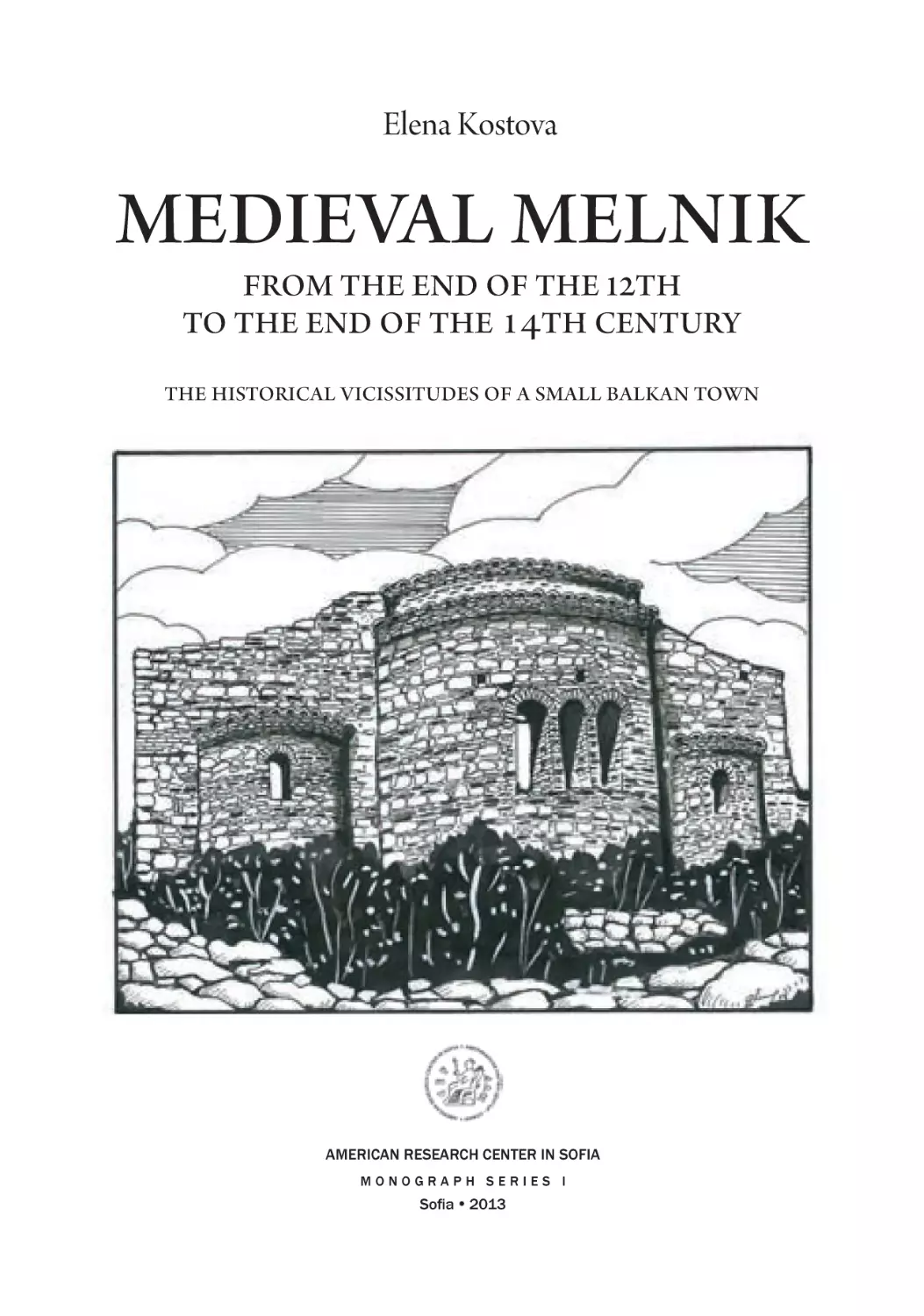
Title page illustration: The Apse of the Metropolitan Church of St. Nicholas
Drawing: Angel Davidov
Maps: Angel Davidov
for my family
CONTENTS
acknowledgements
abbreviations
introduction
7
8
10
pa rt i
melnik and the balkans from the end of the 12th
to the end of the 14th century
chapter one: melnik in the middle ages –
geography, demography, and social composition
geography and topography
demography and social structure
arts, crafts, and industries
20
24
28
chapter two: melnik in the context of bulgarian history
melnik under the second bulgarian tsardom
melnik’s zenith: capital of the principality of despot alexios slavos
back under the bulgarian crown
33
37
52
chapter three: melnik in the byzantine political tradition
melnik within the balkan policies of john iii ducas vatatzes
63
dragota’s revolt: an attempt to break free from the byzantine
political model
70
between Andronikos ii and Andronikos iii: melnik and the byzantine
civil war of 1321–1328
76
chapter four: melnik under the serbian nemanja dynasty
between byzantium and serbia: melnik and chrelijo
serbian dependency: melnik under stephan dušan (1331–1355)
89
93
chapter five: melnik and balkan political separatism
in the second half of the 14th century
melnik and the principality of serres
melnik and the principality of the dragaši
105
106
113
pa rt i i
melnik and mount athos
during the 13th and 14th century
chapter six: the monastery of saint george
as a subsidiary/metochion of iviron
134
chapter seven: the monastery of spelaiotissa
as a subsidiary/metochion of vatopedi
142
chapter eight: the monastery of pantanassa
as a subsidiary/metochion of vatopedi
161
conclusion
168
appendices
bibliography
index
maps
illustrations
chronology
173
176
202
210
217
acknowledgements
I would like to express my gratitude to the director and staff of
the American Research Center in Sofia for developing the dissertation
publication program through which my study on medieval Melnik is being
published, and to the international scholarly committee that selected my
work from among many worthy studies. Special thanks are due to Christo
Matanov, my mentor and dissertation advisor, for recommending my
work for publication. I am most thankful to my colleagues in the Center
for Slavo-Byzantine Studies “Prof. Ivan Dujcev” at the University of Sofia
“St. Clement of Ochrid” where I completed my PhD dissertation. This
book benefited much from their support. I appreciate the support of my
colleagues in the Institute for Historical Studies at the Bulgarian Academy
of Sciences who nominated my study for the book publishing competition
organized by the ARCS.
I am also grateful to Kiril Petkov for his advice on how to improve the
study while transforming it into a book and for translating it into English.
Kiril Pavlikjanov was extremely helpful when it came to translating and
consulting primary sources in Byzantine Greek. Violeta Nesheva and
Ivan Vanev assisted me with selecting illustrations, while Angel Davidov
prepared the maps. Angela Rodel edited the text thoroughly. Todor Petev,
director of the US Office of the ARCS, was extremely engaged with this
project and helped prepare the book for print at every step of the way.
My most sincere thanks go to Nellie and Robert L. Gipson, whose
Tianaderrah Foundation provided the generous financial support that made
this entire project possible. I do hope that Mrs. and Mr. Gipson will continue
their support for the publication of young Bulgarian scholars’ work, thus
enabling the international academic community to better acquaint itself
with Bulgaria’s rich and diverse historical and cultural heritage.
The Author
abbreviations
Българско
Средновековие
Българско Средновековие, проучвания върху политическата
и културната история на Средновековна България, автoр Иван Дуйчев
ВВр.
Византийский временик
ВИС
Военноисторически сборник
ГИБИ
Гръцки извори за българската история
Глас СКА
Глас Српске краљевске академије
Глас САН
Глас Српске академиjе наука
Гласник СНД
Гласник Скопског научног друштва
ГНМ
Годишникъ на Народния музей, София
ГСУ – БФ
Годишник на Софийския университет – Богословски факултет
ГСУ – ИФ
Годишник на Софийския университет – Исторически факултет
ГСУ – ИФФ
Годишник на Софийския университет – Историко-филологически
факултет
ГСУ – ФИФ
Годишник на Софийския университет – Философско-исторически
факултет
ГСУ – ЦСВП
Годишник на Софийския университет – Център за славяно-византийски
проучвания „Проф. Иван Дуйчев"
ЗРВИ
Зборник радова Византолошког института
ЗбФФ у Београд
Зборник Филозофског факултета у Београду
ЗбФФУ у Београд
Зборник Филозофског факултета и Универзитета у Београду
ИАИ
Известия на Археологическия институт
ИБАД
Известия на Българското археологическо дружество
ИБАИ
Известия на Българския археологически институт
ИБИД
Известия на Българското историческо дружество
ИИБИ
Известия на Института за българска история
ИИД
Известия на Историческото дружество
ИИИ
Известия на Института за история
Известия на НИМ Известия на Националния исторически музей
ИПр.
Исторически преглед
ИРАИК Известия Русского археологического института в Константинополе
ИГ Историјски гласник
ИЧ Историјски часопис
ЛИБИ
Латински извори за българската история
МПр. Македонски преглед
МПК Музеи и паметници на културата
ПКЈИФ Прилози за књижевност, jезик, историjу и фолклор. Филолошки факултет.
Београд
СбБАН Сборник на Българската академия на науките
СбНУНК
Сборник за народни умотворения наука и книжнина
Сборник в чест
Общото и специфичното в балканските култури до края на ХІХв.,
на проф. Тъпкова
Сборник в чест на 70-годишнината на проф. Василка Тъпкова-Заимова
СпБАН Списание на Българската академия на науките
BHR Bulgarian Historical Review
BS Byzantine Studies
BSl
Byzantinoslavica
BZ
Byzantinische Zeitschrift
Byz. Byzantion
Byzbg Byzantinobulgarica
DOP Dumbarton Oaks Papers
EB Études Balkaniques
EH Études Historiques
JÖB Jahrbuch der Österreichischen Byzantinistik
OchP Orientalia Christiana Periodica
ODB Oxford Dictionary of Byzantium
PLP Prosopographisches Lexikon der Palaiologenzeit
REB
Revue des Études Byzantines
TM
Travaux et Mémoires
VR
Variorum Reprints
medieval melnik
introduction
The medieval past of Melnik, a fortified town in a key geographical
location in the southwestern Balkans, has recently attracted a substantial
amount of attention among scholars of the region. Now on Bulgarian
territory and a functioning town, Melnik is a settlement with a centurieslong history and has been deservedly designated as an official archeological
and historical heritage site. Given such an illustrious tradition, no single
study can be expected to adequately cover the entirety of Melnik’s rich
historical and cultural heritage. The current study will focus only on the
town during its late medieval period, from the end of 12th to the end of 14th
century.
The history of the Balkans during these two centuries is quite dynamic
and filled with dramatic and often tragic events. Most – and often all – of the
Balkan states and principalities were involved in and considerably affected by
many of these developments. The period covered in this study is bookended
by two cataclysmic events which had a profound impact on the evolution
of the region. It began with one of the most serious shake-ups in the later
medieval Balkans: the Fourth Crusade and the fall of Constantinople to the
Venetians and assorted Western crusaders. The fall of the City in 1204 and
the temporary disappearance of Byzantium was a pivotal point in the history
of southeastern Europe. The other end of the period examined in this study,
the late 14th century, was an even more crucial watershed moment for
the region. A new and formidable danger, this time not from the Latin
West but from Anatolia, appeared on the Balkan horizon: the Ottoman
Turks. The new conquerors carried the banner of Islam and by the end of
the 14th century had brought most Balkan territories and polities under its
shadow. These two political developments, which both originated outside
of the region and were not confined to it, forcefully changed the destiny of
the entire European Southeast and bookend the best-documented centuries
of Melnik’s history.
Against the backdrop of such tremendous political upheavals, Melnik
gradually acquired prominence as a strategically important settlement.
Located near the geographical center of the Struma (the ancient Strimon)
10
introduction
Valley, the town emerged as a critical stronghold coveted by competing
Balkan powers and thus frequently changed hands. This constant rotation of
overlords left its imprint on Melnik’s social, ethnic, political, and economic
configurations. Yet, even in the midst of such dynamic and turbulent politics,
the town witnessed the peak of its political, ecclesiastical, economic, and
urban evolution.
The present study is an attempt to reconstruct that evolution primarily
through reliance on written evidence. Although archeologists have re
covered a substantial amount of material vestiges from the settlement’s
past, the quality and density of its historical and documentary traditions
are overwhelmingly important. Written evidence of Melnik’s history
prior to the late 12th century is very limited and sporadic. For most of the
preceding periods, only anecdotal fragments are extant. By contrast, the last
decades of the 1200s are well documented by a rich and diverse body of
written sources. That is why the end of the 12th century was selected as the
starting point of the investigation. The availability of the written evidence
also determined the study’s end point. Recent research in the archives of
the Vatopedi Monastery at Mount Athos has turned up documents, as
yet unpublished, which are expected to shed substantial light on the years
around the end of the 14th century and the beginning of the 15th century.
But the period immediately following that, and indeed most of the time
after approximately 1400 is a documentary hiatus. Published sources
surface again in the later part of the 15th century, covering the 1480s and
1490s in a fragmentary manner. Few sources are currently available for
the intervening decades, and there is little hope that a more substantial
cache of evidence will ever appear. For that reason, this study stops at the
end of the 14th century, more specifically at the politically key date of the
Battle of Rovine in 1395. On a different note, in addition to defining the
chronological boundaries of the study, the availability of written evidence
also determines its contents. The historical and documentary evidence
suggests that beginning in the late 12th century, the town went through a
period of remarkable and sustained development.
Material evidence recovered by the archaeologist’s spade, although
relatively abundant, is of secondary importance for both the chronology
and the contents of this study. Archaeological excavations have revealed
several layers of the settlement’s early history, but very little of what has
11
medieval melnik
come to light has heuristic value. This investigation incorporates most of
the archaeological findings that can be credibly linked to reliable written
evidence. In general, the material evidence supports the conclusions drawn
from written sources. The availability of the latter, for example, determines
the study’s upper chronological boundary. Archaeological artifacts concur:
the 15th century was an overall period of stagnation and decline in terms
of standards of living and urban development. Only in the 16th century
did the material conditions of life improve, and a trend towards betterment
becomes visible. In sum, both the material and the written evidence agree
that Melnik’s most spectacular period as a flourishing Balkan economic
and urban center and a political stronghold were the 13th and the 14th
centuries.
The earliest evidence at the site of the settlement that was to become
Melnik consists of archaeological findings dated back to the Hellenistic Era
(323–30 BC). The site may have been chosen for its strategic location in
the center of the Struma Valley, occupying an important regional crossroads.
Some scholars contend that these findings indicate urbanized life as early as
the time of Philip II of Macedon (382–336 BC) and Alexander the Great
(336–323 BC), but the dating is uncertain. Another hypothesis dates the
emergence of an urban settlement around the fortified stronghold – which
was clearly older and possibly of Thracian origin – during the Roman centu
ries. This claim is supported by extant carved stone slabs dated as far back
as the first century AD and by the vestiges of a Thracian sacred site under
the foundations of the Church of Saint Nicholas, which also contains
material dated from the first to the fourth centuries AD. A fourth hypothesis,
founded on archeological assemblages excavated on the territory of the
modern town, dates the emergence of the settlement to the early Byzantine
epoch. These vastly different dates, ranging from the fourth century BC
to the sixth century AD, are the result of continuous urban life on the site
and its topography. The fact that inhabitants built on a relatively restricted
space for centuries and reused materials has disturbed earlier settlement
layers, making a neat chronology and the synchronization of archaeological
findings quite impossible.
Archaeological data suggests a rather early date for an urban settlement
on the site of present-day Melnik, but the oldest written references come
from the high medieval centuries. We first hear about Melnik in the 11th
12
introduction
century, during Emperor Basil II’s (976–1025) campaigns against the
Bulgarians. According to John Skilitzes, the main authority of the period,
after the Battle of Klyuch on July 29, 1014, Emperor Basil II moved against
Melnik and put it under siege. At the sight of the massive Byzantine army,
the citizens surrendered and opened the gates to the emperor. Skilitzes’
reference, unfortunately, is the sole bit of information about Melnik for
a long time to come. 11th- and 12th-century sources scarcely mention the
town. Only at the very end of the 12th century does Melnik appear once
again in Byzantine sources, this time within a rich and revealing context. The
town seems to have risen in prominence – and the Byzantines took note.
This sudden change in Melnik’s fortunes was due to the rise of a prominent
Bulgarian nobleman, Despot Alexios Slavos, who was crucial in shaping the
destiny of medieval Melnik.
***
As briefly discussed above, the primary sources documenting Melnik’s
history during the period from the end of the 12th to the end of the
14th centuries can be grouped into two categories: written and material evi
dence. First, there is the written evidence. Works by Byzantine, Latin, and
Ottoman chroniclers, archival references from the monasteries on Mount
Athos, royal charters, and assorted administrative records outline the general
trajectory and provide many details about the town’s history during the late
medieval centuries. Most of this material is available in modern editions. In
addition, a trove of still-unpublished documents from the archives on Mount
Athos, which this study has drawn on, sheds additional light on and offers
correctives to facts and developments that the historical tradition has glossed
over or bypassed. Second, there is the material evidence for everyday life in
medieval Melnik, unearthed in archaeological excavations and scrutinized by
archaeologists, architects, urban development experts, and art historians.
Perhaps the most important source group for this study is the output
from the Byzantine historical tradition, which describes the history of
Melnik against the backdrop of southeastern European developments.
Most of the Byzantine chroniclers were contemporaries and occasionally
first-hand observers of the events they reported. The History of Nicetas
Choniates, an extensive narrative of Byzantine history during the last
13
medieval melnik
decades of the 12th and the beginning of the 13th centuries, holds pride
of place among them.1 No less important for the history of Melnik is
the work of Georgios Akropolites. Although focused on the Byzantine
successor state of Nicaea in the period between 1204 and 1261, Akropolites
is well-informed about the Empire’s Balkan neighbors, and his information
is usually quite precise.2 The extension and continuation of his chronicle was
composed by a less scrupulous writer, Theodore Scutariotes, who borrows
freely from Choniates and also adds a few more details and interpretations
to Akropolites’ rich narrative.3 The well-known hiatus in Byzantine his
toriography following Akropolites’ history affects evidence about Melnik as
well: the town appears next in the History of Nicephoros Gregoras, which
is concerned with the period 1204–1359, but is most reliable for 14thcentury developments.4 Later Byzantine authors, such as John Cantacuzenus
(Kantakouzenos) and the late Byzantine apologist for the Ottomans,
Laonikus Chalcocondyles, have also left anecdotal bits of information
on Melnik.5 Apart from historical works in the strict sense of the word,
the town is also mentioned in the 14th-century rhymed chronicle by
the Monk Ephremius, who compiled a vast and not particularly elegant
poetic narrative which borrows heavily from the world chronicle of the
12th-century authority, John Zonaras, in combination with a digest culled
from the works of Choniates and Akropolites.6 The post-medieval work of
the 16th-century scholar from Dubrovnik, Mauro Orbini, also follows in
the vein of historical compilation, drawing mostly on Serbian sources –
and thus introducing a Serbian point of view on Melnik – while using the
Byzantine tradition as well.7
The chroniclers of the Fourth Crusade, the Old French works of
Geoffrey de Villehardouin, Robert de Clary, and especially that of Henri de
Valenciennes, offer occasional references to Melnik from the point of view
of the Latin Empire of Constantinople under Emperors Baldwin and Henry
of Flanders in the period 1204–1216. Albeit episodic and rather laconic in
principle, their information is nonetheless precious, since all of them were
direct observers and often participants in the events they were reporting.8
The Balkan historical tradition, with its core of Byzantine works, forms
the backbone for the reconstruction of the history of medieval Melnik;
however, the latter has been substantially enriched by documentary
evidence stemming from the Athonite archives. The modern collection
14
introduction
of published sources, the Archives de L’Athos, contains a series of rich and
diverse references to the town in the late medieval period. The publication
of the documents in this greatly anticipated collection is still ongoing, but
the available volumes contain three types of evidence that complement
the chronicles in a number of important ways: royal charters issued by
the Byzantine, Serbian, and Bulgarian chanceries; Byzantine patriarchal
edicts; and local metropolitan archbishops’ chancery acts. All of these
touch on issues of a political, economic, ecclesiastical, and administrative
nature, which are completely neglected by the leading chroniclers of the
time. Especially useful are the administrative documents produced by the
chanceries of the monasteries on Mount Athos, for they are essentially the
only sources about the local and regional economy and the role of Melnik and
its district in the economic life of the region.9 This study uses unpublished
documents from the chancery of the Monastery of Vatopedi to shed light
on the social and economic conditions in Melnik in the 1370s and 1380s.
The corpus of administrative and technical records with information about
Melnik is enriched by documents of Serbian provenance as well, many of
them published by Novakovich in the beginning of the 20th century.10
Modern scholarship has scrutinized the primary material summarized
above in two kinds of studies. First, there are inquiries that examine both
written sources and material culture, which focus specifically on different
aspects of the history of Melnik and its district during the period covered
in this study. Such pioneering works are the product of the wide-ranging
scholarly interests of the Bulgarian medievalist Ivan Dujcev, perhaps the first
scholar to discuss Melnik’s political history in a more systematic and detailed
manner. Between the late 1940s and the 1980s, Dujcev dedicated several of
his studies to the town’s history.11 Political history dominated this period in
Bulgarian scholarship; Ivan Bozilov and Ivan Jordanov also made notable
contributions to such research.12 Greek historiography was no less active,
with two scholars, Petros Spandonidis and Theodoros Vlachos, attempting
to produce monographic syntheses of the town’s medieval history.13 The
intensification of archaeological excavations on the territory of the modern
town resulted in an impressive array of studies of its material culture over
the centuries, with a heavy emphasis on the better-preserved later medieval
period. The works of Violeta Nesheva, Boris Tsvetkov, Vasilka GerasimovaTomova, Sonja Georgieva, and Tsvetana Dremsizova-Nelchinova, among
15
medieval melnik
others, have offered an array of new information and insights into the
reconstruction of Melnik’s medieval material culture.14 To this, we should add
the insights of art historians, such as Nikola Mavrodinov, Vera Mavrodinova,
Liliana Mavrodinova, Ljuben Prashkov, Lozinka Kojnova, Georgi Gerov,
and Ivan Vanev.15
The second category of scholarly studies consists of works only tan
gentially related to the history of Melnik but which provide a range of
general background information for its reconstruction. Studies of the
regional geography, topography, prosopography, and political history of
the region including Melnik are indispensable for understanding the town’s
destiny and evolution throughout the centuries.16
None of the studies in these two areas, however, presents a compre
hensive, focused, and systematic investigation of the medieval town and
its district based on the entire range of written evidence and supported by
recent findings concerning its material culture. Moreover, even the more
exhaustive studies largely overlook the rich archival evidence from Mount
Athos, some of which has been known for quite some time, while other
sources have only recently been brought to light. The goal of what follows is
to fill this gap in modern historiography and to offer the first thorough study
of medieval Melnik, drawing on all kinds of extant and available information,
and to sketch out the evolution of a small- to mid-sized Balkan urban enclave
in the turbulent and dramatic late medieval centuries.
notes
1 Nicitae Choniatae, Historia, In: Corpus Fontium Historiae Byzantinae, (rec. J. A.
van Dieten), (Berolini et Novi Eboraci, 1975).
2 Georgios Acropolitae, Opera, еd. Heisenberg, vol. I (Lipsiae, 1903).
3 Theodori Scutariotae, Ἀνωνύμου Σύνοψις Χρονκή. Bibliotheca Graeca medii aevi,
vol. VII (ed. Constantinos Sathas), (Paris, 1894).
4 Nicephori Gregorae, Byzantina historia greace et latine, (cura L. Schopeni), vol. I
(Bonnae, 1829), vol. ІІ (Bonnae, 1830), vol. ІІІ (Bonnae, 1855).
5 Ioannis Cantacuzeni, Eximperatoris Historiarum, (cura L. Schopeni), vol. I, (Bonnae,
1828); vol. II, (Bonnae, 1831); vol. ІIІ, (Bonnae, 1832), In: Corpus Scriptorum Historiae
Byzantinae; Laonici Chalcocondylae, Atheniensis Historiarum libri decem, (editio,
I. Bekkeri), (Bonnae, 1843).
16
introduction
6 Ephraemius, Ephraemii monachi, Imperatorum et patriarcharum, In: Corpus Scrip
torum Historiae Byzantinae (Bonnae, 1840). Bulgarian translations of parts of the chronicle
are offered by В. Гюзелев, Самият Търновград ще разтръби победите, Средновековни
поети за България (София, 1981).
7 М. Орбин, Краљевство словена (Београд, 1968).
8 Geoffroy de Villehardouin, Chronique de la prise de Constantinople par les Francs
(ecl. J.-A. Buchon), (Paris, 1828); Ж. дьо Вилардуен, Завладяването на Константи
нопол (превод, предговор и бележки Ив. Божилов), (София, 1985, 2000); Henri de
Valenciennes, Histoire de l’empereur Henri de Constantinople (publ. par J. Longnon), (Paris,
1948); Robert de Clari, La conquête de Constantinople (ed. Ph. Lauer), (Paris, 1924).
9 P. R. Petit, B. Korablev, Actes De Chilandar, ВВр., Приложение к ХІX тому, № 1,
(Actes de l’Athos, vol. V), (Петроградъ, 1915); M. Živojinović, et al., Actes De Chilandar,
I, In: Archives de L’Athos, XX, (Paris 1998); J. Lefort, et al., Actes D’Ivirov, III, Archives
de L’Athos, XVIII, (Paris, 1994); J. Lefort, et al., Actes D’Ivirov, IV, Archives de L’Athos,
XIX, (Paris, 1995); J. Bompaire, et al., Actes de Vatopédi, I, Archives de L’Athos, XXI,
(Paris, 2001); J. Lefort, et al., Аctes de Vatopédi, ІI, Archives de L’Athos, XXІI, (Paris,
2006); N. Oikonomidès, Actes de Docheiariou, In: Archives de L’Athos, XIII, (Paris, 1984);
P. Lemerle, Actes de Lavra, IV, Archives de L’Athos, XI, (Paris, 1982); W. Regel, et al., Actes
de Zographou, ВВр., Приложение к ХІІІ тому, № 1, (Actes de l’Athos, IV), (Amsterdam,
1969); V. Laurent, “Un acte grec inédit du Despote Serbe Constantin Dragas,” RЕB V
(1947): 171–184, and others.
10 Ст. Новаковић, Законски споменици српских држава средњега века, V (Београд,
1912).
11 Ив. Дуйчев, „Походът на Теодор ІІ Ласкарис против Мелник в 1255 г.,” Сборник
на БАН, (1945), т. XLI/1, 111–114 (Ив. Дуйчев, Проучвания върху Българското Средно
вековие); Ив. Дуйчев, „Мелник през Средновековието,” Българско Средновековие, (София 1972), 374–413; Ив. Дуйчев, „Очерк върху средновековната историята на Мелник,”
Мелник: Градът в подножието на Славовата крепост (съст. В. Нешева), (София,
1989), т. І, 18–33; I. Dujcev, “Melnik au Moyen Âge,” Byzantion, XXXVIII, (1968): 28–41.
12 Ив. Божилов, „Деспот Алексий Слав и Мелник,” Acta musei Varnaensis, Българските земи през Средновековието, Международна конференция в чест на 70-годишнината на проф. Александър Кузев, (Варна, 12–14 септември, 2002), т. ІІІ–1, 79–86; Ив. Божилов, „Нови данни за манастира ‚Света Богородица’ в Мелник,” Историческо бъдеще,
1–2, (2007): 138–147; Ив. Йорданов, „Моливдовул на константинополския патриарх Макарий, намерен в Мелник,” Векове 1 (1990): 16–19.
13 Π. Σ. Σπανδονιδης, Μελένικος ὁ νεκρός μακεδονικός ακρίτης (Θεσσαλονίκη, 1930);
T. Vlachos, Die Geschichte der Byzantinischen Stadt Melenikon (Thessaloniki, 1969).
14 В. Нешева, Мелник. Богозиданият град (София, 2008); this author, a long-time
leader of the principal archaeological excavations in Melnik, has penned numerous studies
of the material culture of medieval Melnik; see also Б. Цветков, Селищната мрежа в
долината на Средна Струма през Средновековието ІХ–ХVІІ век (София, 2002); В. Герасимова-Томова, „Две камбани от Мелник с надписи от ХІІІ в.,” Археология 3 (2003):
42–49; В. Герасимова-Томова, „Каменна пластика,” Мелник: Градът в подножието на
17
medieval melnik
Славовата крепост (съст. В. Нешева), (София, 1989), т. І, 160–184; С. Георгиева, „Средновековният Мелник,” Музеи и паметници на културата ХІХ (1979): 5–9; С. Георгиева, „Средновековна керамика от Мелнишката крепост,” Археология ХХ/2 (1980): 47–54; Цв. Дремсизова-Нелчинова, Археологически паметници в Благоевградски окръг (София, 1987).
15 Н. Мавродинов, „Църкви и монастири въ Мелникъ и Роженъ,” In: Годишникъ на
Народния музей, V (1933), 285–306; В. Мавродинова-Иванова, „Градъ Мелникъ, Славовата столнина,” Родина ІV (1939): 110–112; Л. Мавродинова, Църквата „Свети Нико
ла” в Мелник (София, 1975); Л. Прашков, “Стенописи от манастирската църква ‚Света
Богородица,’” Мелник, Манастирът „Света Богородица Спилеотиса”(Съст. В. Нешева), (София, 1994), 87–91. обр. І–VІ; Л. Койнова-Арнаудова, Икони от Мелнишкия
край (София, 1980); Г. Геров, „Новооткрити стенописи в манастира ‚Св. Харалампий
(Св. Архангели)’ в Мелник. Предварителни наблюдения,” Древнерусское искусство.
Русь. Византия. Балканы. ХІІІ век (Санкт Петербурт, 1997), 34–42; Ив. Ванев, „Реставрационни намеси, приложени върху стенописите на църквата ‚Св. Никола’ при
град Мелник,” Проблеми на изкуството 3 (2004): 22–27.
16 Йор. Иванов, Северна Македония. Исторически издирвания (София, 1906);
А. Иширков, „Македония име и граници,” МПр. ІІІ/1 (1927): 6–12; А. Иширков, „Областното име Загорье или Загора в миналото и днес,” Изв. на народния музей в София, 1–4
(1925), 85–86; Ив. Сакъзов, „Областното име Загора по нови извори,” ИБГД 1 (1933), 353–
358; Д. Ангелов, „По въпроса за населението в Македония през средновековната епоха
(7–14 век),” Изкуство ІV–V (1962): 35–38; Д. Ангелов, „Средновековният Велбъжд (VІІ–
ХІV в.),” Кюстендил и Кюстендилско, сборник статии (София, 1973), 62–84; П. Коледаров, „Към въпроса за развитието на селищната мрежа и нейните елементи в средищната
и източната част на Балканите от VІІ до ХVІІІ век,” ИАИ, ХVІІІ (1967), 89–147; П. Коледаров, Името Македония в историческата география (София, 1985); П. Коледаров,
Политическа география на средновековната българска държава (София І, 1979; София
ІІ, 1989); P. Koledarov, “More about the Name ‘Zagore,’” BHR 4 (1973): 92–107; П. Ангелов, „Югозападните български земи в политиката на Иван Александър,” Векове 4 (1983):
32–42; Хр. Матанов, Югозападните български земи през ХІV век (София, 1986); З. Пляков, „Областта на Средна Струма през ХІІІ–ХІV в. (поселищен живот),” Доклади на Вто
рия международен конгрес по българистика, т. VІ, (1987), 332–355; Z. Pljakov, “The City
of Melnik,” BHR 4 (1995): 74–90; Г. Острогорски, Серска област после Душанове смрти
(Београд, 1965), (= Г. Острогорски, Сабрана дела, Београд, ІV (1970), 423–631); Ст. Новаковић, „Струмска област у ХІV в. и цар Ст. Душан,” Глас САН 36 (1893); Б. Ферjанчић, Ви
зантијски и српски Сер у ХІV столеђу (Београд, 1994); Хр. Матанов, Възникване и облик
на Кюстендилски санджак през ХV – ХVІ в. (София 2000); М. Динић, „Реља Охмућевић,”
ЗРВИ ІХ (1966): 95–118; С. Ћирковић, „Хрељин поклон Хиландару,” ЗРВИ ХХІ (1982):
103–117; M. C. Bartusis, “Chrelja and Momčilo: Occasional Servants of Byzantium in 14th
Century Macedonia,” BSl XLI (1980): 201–221; G. Ostrogorski, Geschichte des byzantinischen
Staates, (München, 1963); Г. Острогорски, История на Византийската империя (София,
без година на издаване); Ив. Божилов, В. Гюзелев, История на България в три тома.
История на Средновековна България VІІ – ХІV в. (София, 1994); Хр. Матанов, Среднове
ковните Балкани. Исторически очерци (София, 2002).
18
p a r t i
melnik and the balkans
from the end of the 12th to
the end of the 14th century
medieval melnik
chapter one
melnik in the middle ages –
geography, demography,
and social composition
geography and topography
The geographical name of the region including Melnik has changed
over the centuries. In Antiquity, many classical authors knew the central
Struma Valley (the area between the Rupel Pass and the Kresna Gorge) as
Parorbelia.1 Modern authors often eschew these specifics and place Melnik
within the broad geographical designation of “Macedonia,” although the
latter, too, is normally subdivided into distinct regions.2 From a historical
point of view, however, especially within the nomenclature of the Byzantine
Empire, the topos of “Macedonia” shifted both its contents and location. In
the ninth century, for example, “Macedonia” was a military and administrative
province in eastern Thrace and the Rhodope Mountains. Its capital city
was Adrianopolis.3 The area including Melnik is also mentioned as Zagora
(Zagoria).4 This designation is first employed in a gold-sealed charter of
Emperor Alexios III Angelos (1195–1203), dated from November 1198.5
The maps of the Arab geographer Al-Idrisi, compiled some time around
the middle of the 12th century, use the same name, “Zaguria.”6 However,
during the period under investigation, the designation “Macedonia” had
migrated back to its ancient location and contents; consequently, this is how
the region will be referred to in the narrative that follows.7 Recent Bulgarian
historiography, which takes into consideration the geography, ethnic com
position, and historical evolution of the region, also tends to designate it as
“southwestern Bulgarian territories.”8
The origins of the name “Melnik” are uncertain. It is not clear whether
it is of Greek or Slavic provenance. An extensive study by the Greek scholar
Theodoros Vlachos maintains that the name is Greek.9 Conversely, the
20
chapter one: melnik in the middle ages – geography, demography, and social composition
Bulgarian medievalist Ivan Dujcev argues for Slavic origins.10 Scholars
are thus divided into two camps, largely governed by modern national
belonging and sympathies. The Slavic hypothesis asserts that the name is
proto-Slavic and evolved phonetically over several centuries, arriving at the
form known today in the central Middle Ages. Its etymology is derived from
the name of the Slavic Melingi tribe, which inhabited the central Struma
Valley.11 Dujcev himself thought that the Slavic mel (“white clay, chalk”)
was the root of the town’s name and was given to the settlement because it
is surrounded by white rock formations (Fig. 1, p. 218).12 Another theory
connects the name to the settlement’s founder.13 Yet another opinion
argues that the name is Greek, meaning “black house,” and emerged in the
early Byzantine period to designate the settlement as the home of exiled
Byzantine court officials, hence the sinister connotation “black.” Although
current in some quarters, the argument has no factual foundations.
A good deal of the controversy – and the semantically oppositional
theories it has produced – results from fact that the name “Melnik” has no
established orthography in the extant sources. The variations allow links to
both Greek and Slavic stem-words, with the relevant interpretations. That
said, on the basis of the geography and topography of the region, the Slavic
theory appears to carry more weight. Most of the primary sources refer
to the area in purely geographical terms, and thus suggest the most likely
context in which the name “Melnik” could have emerged as well.14 The
toponymy is mostly Slavic, hence it is logical that the name of the principal
settlement is Slavic as well. Connections between geography, topography,
and settlement nomenclature are common.
Regardless of the origins of the name “Melnik,” references from the
most important group of sources, the Byzantine authors, make it clear that
it was a substantial community, although they are less certain on what type
of settlement it was. Several designations are employed. Most chroniclers
simply refer to it by name, eschewing any indication as to how exactly we are
to understand its character.15 No less common is the designation “Melnik’s
territory,” which is similarly difficult to interpret – does it refer to the town’s
lordship over the neighboring territories or does it just situate them vis-à-vis
a better-known geographical marker? This, for example, is how Theodore
Scutariotes writes about the territory around Melnik in reference to
the campaigns of the Nicaean Emperor John III Ducas Vatatzes around
21
medieval melnik
Thessaloniki in the 1240s, and later in his description of the Melnik revolt led
by the magnate Dragota in 1255.16 The administrative records of the Athonite
monasteries use the same designation, χώρα.17 However, both Scutariotes
and his main source, Georgios Akropolites, often mention Melnik as ἄστυ as
well, a term usually employed to designate more substantial settlements with
a markedly urban profile.18 Another term, widely used by 13th- and 14thcentury Byzantine authors and occasionally employed to refer to Melnik
as well is φρούριον. Judging from this, Melnik would have been more of a
fortified stronghold rather than a typical urban settlement.19 This is how
both Akropolites and Scutariotes designate Melnik in their accounts of the
rise and fall of Despot Alexios Slavos, having otherwise referred to the locale
as φρούριον.20 Among the 14th-century authors, Nicephoros Gregoras also
uses the term with the connotation of “stronghold” (φρούριον), when
referring to Melnik in the context of the Byzantine civil wars of the 1320s.21
Gregoras’ contemporary Cantacuzenus, however, twice mentions Melnik
as a πόλις, a term that perhaps hints at the settlement’s higher status within
Byzantine urban typology.22 Cantacuzenus first uses the designation during
the separatist revolt of the panipersevast and governor of Thessaloniki John
Paleologos, and then at the swearing of the oaths ratifying the treaty between
Cantacuzenus and the Serbian ruler Stephan Dušan, through which Melnik
was excluded from the domain of Chrelijo and became part of the Serbian
state.23 Overall, variations in nomenclature notwithstanding, the terminology
used by the Byzantine authors indicates that Melnik was a well-developed
and versatile medieval settlement in the region. The military and defensive
connotations inherent in some of the designations imply that the Byzantines
acknowledged the strategic importance of the town for their own presence
and position in the region, as well as for the other Balkan states and later
principalities who gained control of Melnik over the centuries.
The second major group of written evidence stems from the archives
of the Athonite monasteries. There, Melnik is most consistently referred
to as κάστρον, or “fortified town,” a designation related to πόλις, but with a
stronger emphasis on the defensive function of the settlement.24 A smaller
body of Athonite administrative acts mention Melnik as πόλις. This is how
the town is designated in a sales act of the Monastery of the Holy Mother of
God Pantanassa, dated from 1344.25 It is difficult to disentangle the shades
of meaning inherent in the two terms, κάστρον and πόλις. It is very likely that
22
chapter one: melnik in the middle ages – geography, demography, and social composition
they were used to designate different functional aspects of a given urban
center, rather than referring to different types of settlements altogether. It
is also likely that the difference is due to the sources’ stylistic conventions.
Polished history writers favored πόλις; pragmatic administrative clerks
preferred κάστρον.26 The Athonite archival sources also occasionally use a
third term, θέμα, when referring to Melnik, predominantly when discussing
the town in the context of the Byzantine territorial-administrative structure.27
Finally, apart from direct designations, the town is often described as
“godly,” “God-built” and “protected by God.”28 This tradition of referring to
Melnik may have resulted from the town’s strategic location and the unique
topography of the region, whose central place it occupied.
Medieval Melnik was built of two parts. The first segment was laid out on
the high plateau called Saint Nicolas, which sits atop a mountainous slope,
and is known as the “Inner” or “Upper” Town (Fig. 2, p. 220). The “Outer”
or “Lower” Town stretches out on the foothills below. The Upper Town was
strongly fortified and housed the headquarters of the lay and ecclesiastical
leadership.29 Well-defended by natural and man-made fortifications, the
fortress on the plateau was a true stronghold. Ordinary citizens lived in
the Lower Town, although many administrative and church personnel
maintained residences there as well.30
The geography and topography of the Melnik region did not just affect
the layout and the strategic position of the settlement. The area is also prone
to earthquakes, and these natural calamities must have afflicted the medieval
town more than once during the high and late Middle Ages. Written sources
are silent on the impact of the quakes; however, archaeological excavations
confirm the destruction unleashed on the town by such tremors throughout
the centuries.31 Seismological studies concur: the earthquakes in the region
tend to be on a massive scale. No less unsettling for Melnik’s residents must
have been the floods caused in the rainy seasons by the overflowing of the
two small rivers that run through the town. The administrative archives of
the Athonite monasteries frequently mention the devastation left in their
wake. Swollen with spring or autumn rains, the normally calm brooks of
Rozhen and Sushitsa were capable of carrying away houses and watermills,
thus affecting the economy of the entire town.32
These local topographical hazards notwithstanding, Melnik’s geo
graphical position made it a key strategic fortress in the central Struma
23
medieval melnik
Valley, controlling the security of the region and its principal roadways.
Rulers of the Balkan states with claims on the area coveted the town.33 Apart
from its strategic location, the town sat astride the main north-south road
connecting the thriving Aegean port of Thessaloniki with the interior, and
was close to the junction of several east-west highways linking the Adriatic
with the Aegean Sea and their north-bound trunk roads heading toward
another major waterway, the Danube. Since classical Antiquity, two major
Roman roads had intersected in the area: Via Egnatia and Via Militaris.
Finally, in terms of intra-regional communications, Melnik was a main stop
on the network of inland roads and byways that connected the valleys of the
two major local rivers, the Struma and the Mesta, whose courses themselves
connected present-day Thrace and Macedonia.34
As a result, late medieval Melnik became a political magnet for neigh
boring Balkan rulers and frequently changed hands. The political power
that controlled the town gained strategic advantage against other polities
both because of Melnik’s importance as a well-defended and urbanized
stronghold, and also because of its position as an important logistical hub
of communication and transportation across the Balkans and Southeastern
Europe.35
demography and social structure
The written sources concerning medieval Melnik’s ethnic and demo
graphic composition are extremely limited and do not allow for anything
but a tentative and often conjectural outline of the issue. The earliest
evidence dates from the time of the Bulgarian Tsar Kaloyan (1197–1207)
and the events after the Battle of Adrianople in the spring of 1205, at which
the combined Bulgarian and Comanian forces crushed the knights of the
Fourth Crusade and took the Latin Emperor Baldwin prisoner. Enraged by
the betrayal of the Byzantine Greek magnates of Philippopolis, with whom
he had had an alliance before his encounter with the Latin host, Kaloyan
exiled their leading families to Melnik as punishment.36 The forcibly re
settled Byzantine Greeks must have changed the ethnic composition of
the town. It must have previously been overwhelmingly Bulgarian, jud
ging from the abundant local place names of Slavic origin designating
24
chapter one: melnik in the middle ages – geography, demography, and social composition
the farming settlements in Melnik’s vicinity, such as Katunitsa, Zagoria,
Dragnista, Stob, Zlataritsa, Virovishte, Debrene, etc.37 While Slavic names
prevail in the countryside around the town, the ethnic picture within
Melnik even before the arrival of the Philippopolian Byzantine exiles must
have been somewhat different. Magnates and ecclesiastical administrators
with Byzantine Greek names appear frequently in the sources, alongside
a substantial number of persons with Slavic-Bulgarian names. A few
decades later, other indirect references to the ethic balance in the town
appear. In the middle of the century, the Nicaean Emperor John III
Ducas Vatatzes (1222–1254) began a planned expansion in Macedonia,
and Melnik came into view again in the course of his Reconquista of
former Byzantine lands. Our sources report that a delegation of five hundred
prominent men from Melnik appeared before the emperor as his troops
traversed the Struma Valley.38 This information demands further scrutiny.
A group of five hundred magnates would be an impressive number for any
medieval town of middling stature, such as Melnik. If we take that number
of upperclassmen as a demographic benchmark, Melnik’s total population
would have numbered several thousand, if not upwards of ten thousand.39
In light of the fact that during the intervening decades Melnik had been
the capital of Despot Alexios Slavos’ large independent principality,
which certainly must have encouraged internal migration, the estimate
may not seem so improbable. Nonetheless, the number is simply too high
given what we know for certain about Melnik’s later demography. It is too
high even for the period after the Ottoman conquest, during the 15th
and 16th centuries, when the town’s population most certainly rose.40 If
the reference to the five hundred magnates is correct, Melnik would have
reached the peak of its urban density in the middle of the 13th century,
which is highly unlikely. It is more probable that the Byzantine source who
mentioned the episode augmented the number of Melnik’s prominent
citizenry to add weight and importance to Emperor Vatatzes’ acquisition
of the town. The third general reference to the town’s ethnic composition
is provided in sources detailing the unsuccessful revolt led by Dragota, a
local magnate of Bulgarian extraction, in 1255. The next Nicaean Emperor
Theodore II Lascaris (1254–1258) quickly put down Dragota’s rebellious
Bulgarians and dealt severely with the ringleaders’ families. The women and
children were exiled and their property was confiscated.41 It appears that
25
medieval melnik
this measure was largely responsible for a long-lasting shift in the town’s
ethnic makeup, once again strengthening the Byzantine Greek element at
the expense of the Bulgarians.
Apart from Bulgarians and Byzantine Greeks, at various times Melnik
was also home to individuals and families with Western European roots.
The first independent ruler of Melnik, Despot Alexios Slavos, brought his
Latin bride, the daughter of the second Latin emperor of Constantinople,
Henry of Flanders, to the town after he married her in Constantinople
in November 1208.42 Despot Slavos’ second spouse was the daughter of
another magnate with Latin ties, Theodore Petralipha, father-in-law of the
Epirote Emperor Theodore Ducas Komnenos.43 The marriage propped up
a triangular alliance between Slavos, the Epirote polity, and the Norman
knights in northern Greece with whom Petralipha was collaterally related.
The Latin ladies certainly must have brought their entourages with them.
The acts of the Vatopedi Monastery record land ownership by families
with Western names in the vicinity of Melnik; the owners were most likely
members of the princesses’ retinues or other estate-seeking Latin knights
who flocked to the capital of their new ally.44 However, the noblemen
who moved to the town with the Latin princesses in the aftermath of the
Fourth Crusade were not the only Westerners in Melnik. Due to its strategic
location on important Balkan crossroads, we can assume that the town was
frequented by Western merchants. Already in 1198 Emperor Alexios III
Angelos issued a gold-sealed charter to Venetian merchants who would be
trading in Melnik, among other places.45 It is not unlikely that some of them,
or their agents, made the town their residence for shorter or longer spans of
time. In the 15th century, after the Ottoman conquest, documents testify to
the presence of not just Italians, but men from Dubrovnik, Armenians, and
Jews as well, adding to Melnik’s ethnic mix.
Our sources are just as laconic about Melnik’s social composition as
they are about the town’s ethnic and demographic outlook. Most of the
information is indirect, sporadic, and rather anecdotal. There is no sys
tematic data on the social structures and changes during the town’s me
dieval period. Occasional references are all we have to work with, and
they are few and far between. Under such circumstances, only general
conclusions can be formulated. First, the frequent change of political
leadership, lordship, and state belonging must have been an unsettling
26
chapter one: melnik in the middle ages – geography, demography, and social composition
feature of Melnik’s social arrangements. During the two centuries under
consideration, the town transitioned from Bulgarian to Byzantine to Serbian
rule. Moreover, for a few decades in the beginning of the period, Melnik
was the capital of an independent principality in its own right, that of
Despot Alexios Slavos. Toward the end of its medieval era, it came under
the rule of two other autonomous principalities: first the Principality of
Serres and then that of Constantine Dragaš. This rather dynamic political
situation no doubt left its imprint on the composition of the uppermost
social classes, which consisted of the town’s political leadership, the local
aristocracy and members of the ruling families residing or stationed
in Melnik. Second, political changes aside, the town was the seat of an
indispensable local administration.46 Its ethnic makeup and political
affiliation may have changed with the shifts in the town’s suzerains, but the
practical exercise of political power depended on the permanent presence
of a local administrative apparatus that must have maintained at least partial
continuity in order to function and fulfill the political leaders’ designs on
the town and its territory. Since two direct references to the existence of a
ruler’s chancery, under Alexios Slavos and Constantine Dragaš, bookend
the period, it is fair to conjecture that skilled administrative personnel
must have been present throughout the medieval centuries, even though
the role of such administrators surely varied depending on the position of
Melnik in the administrative structures of the polities which absorbed the
town as time wore on. Third, an even more permanent segment of Melnik’s
social structure was the ecclesiastical personnel. Melnik had been the seat
of a metropolitan bishopric since the 13th century and although sources
are cryptic about its emergence, the name of the first incumbent, under
the rule of Alexios Slavos, was Paul Klaudiopolites. No less important was
the presence of regular clergy. The abbots and monks of the Monastery of
the Holy Mother of God Spelaiotissa must have been just as permanent a
fixture in the town’s daily life as the members of the metropolitan’s entourage
and the ubiquitous priests and deacons of the parish churches. Fourth, as
in almost all other settlements and urban centers in the southern Balkans,
the information we possess predominantly concerns the town’s leader
ship, the members of the upper classes, and the clergy. The vast majority of
inhabitants of Melnik and its territory – the middle and lower urban and
rural classes – are all but invisible. The acts of the Athonite Vatopedi
27
medieval melnik
Monastery, which owned land in the Melnik district, list free farmers and
a few categories of dependent people, such as pariks and otroks, but their
precise status and how they compare to late medieval Western serfs, for
example, is a matter of conjecture.47 From the little information we have
available, there is no reason to assume that Melnik’s social structure was
different from that of any other middling Balkan town or urbanized center
from the period. The situation regarding land ownership and management
must have been similar as well.48
arts, crafts, and industries
The geographical and topographical conditions in Melnik’s immediate
vicinity do not favor farming and agricultural development in general.
Most of the arable land is clustered farther away from the town, around
the present-day villages of Vinogradi, Dzevgeli, Lozenitsa, and Hotovo,
and in the Melnik River Valley.49 There, the soil is rich and well-suited for
grain. The region is also conducive for orchards and especially for wine
production. To this day, the town is rightly praised for its heavy red wines,
with extant references to them dating back to the Roman period, as a stone
relief of Dionisius Asdula from 215 testifies.50 The preserved vestiges of
medieval structures in modern Melnik, with numerous, large wine cellars
prominent among them, bear witness to flourishing wine production in
the later periods of the town’s life.51 However, the topography and the soil
quality close to and within Melnik’s urban confines were instrumental
to the development of a solid artisanal tradition. Archaeological finds
point to iron mining and working as one of the town’s principal crafts. The
tradition goes back to the pre-Roman history of the region.52 Ironmongers
worked in the town itself, alongside other heavy industries, such as copper
smelting and glass production.53 Remnants of their operations have been
discovered both on the higher plateau of Saint Nicolas and in the Lower
Town.54 It is possible that precisely this industry allowed Melnik to emerge
as a stronghold guarding the ironworks dotting the southern foothills of
the Pirin Mountains. Ironsmiths and coppersmiths complemented the
mining and production of those metals. Goldsmiths and glassmakers also
lined the streets of Melnik’s industrial districts.55 And while the natural
28
chapter one: melnik in the middle ages – geography, demography, and social composition
features of the land around the town were not conducive to food production,
it nevertheless offered more than heavy and semi-precious metals for extrac
tion and finishing. The Melnik region abounds in clays suitable for pottery;
the later medieval centuries saw a flourishing production of pottery, especial
ly the high-end, decorated variety.56 Judging from the quality and quantity of
the pottery produced in the town and discovered alongside the trade routes
crossing the settlement, Melnik must have occupied a commanding position
in decorated pottery production in the central Struma Valley. Overall, the
town’s urban industries, arts, and crafts suggest a leading role for Melnik
in the economic life of the entire region. The tradition in most of these
industries survived the Ottoman conquest and continued largely unbroken
in the post-medieval centuries.
notes
1 This is how the region is designated by Herodotus, Diodorus of Sicily, Strabo,
Pliny the Elder, Arian, and others. The ancient authorities do not agree on the borders of
Parorbelia. Some use it to refer to the Belasitsa mountain range, others for Belasitsa and
Pirin, still others for Pirin only.
2 А. Иширков, „Македония име и граници,” МПр. ІІІ/1 (1927): 6–12; П. Коледаров,
Името Македония в историческата география (София, 1985).
3 On the theme organization in Byzantium, see H. Gelzer, Die Genesis der byzantinischen
Themenverfassung (Leipzig, 1899); J. Karayannopulos, Die Entstehung der Byzantinischen
Themenordnung (München, 1959).
4 А. Иширков, „Областното име Загорье или Загора в миналото и днес,” Изв. на
народния музей в София, 1–4 (1925), 85–86; Ив. Сакъзов, „Областното име Загора по
нови извори,” In: ИБГД, 1 (1933), 353–358; P. Koledarov, “More about the Name Zagore,”
BHR 4 (1973): 92–107; П. Коледаров, Политическа география на средновековната бъл
гарска държава (София І, 1979), 30.
5 Ив. Божилов et al., Византийските василевси (София, 1997), 342–345; for the
charter see Fr. Dölger, Regesten der Kaizerurkunden des Oströmischen Reiche von 565–1453,
II (München – Berlin, 1925), 104–105, № 1647.
6 Б. Недков, България и съседните ù страни през ХІІ в. според „Географията” на АлИдриси, (София, 1960), 113, note 48; Ст. Кендерова, Б. Бешевлиев, Балканският полуост
ров, изобразен в картите на Ал-Идриси, Палеографско и историко-географско изследване
(София І, 1990), 44, 62.
29
medieval melnik
7 Коледаров, Името Македония, passim.
8 Хр. Матанов, Югозападните български земи през ХІV век (София 1986).
9 T. Vlachos, Die Geschichte der Byzantinischen Stadt Melenikon (Thessaloniki, 1969),
1–8. The argument is based on the assumption that the name derives from the founder of
the stronghold and is supported by linguistic inferences rather than references to direct
sources.
10 Ив. Дуйчев, „Мелник през Средновековието,” Българско Средновековие, (София
1972), 374–413; also I. Dujcev, “Melnik au Moyen Âge,” Byz. XXXVIII, (1968): 28–41, and
Ив. Дуйчев, „Очерк върху средновековната историята на Мелник,” Мелник: Градът
в подножието на Славовата крепост (съст. В. Нешева), (София, 1989), vol. І, 18–33.
Several other scholars insist on the Slavic provenance of the name, deriving its etymology
from the geology and landscape of the region.
11 D. J. Georgakas, “The Medieval Name ‘Melingi’ and ‘Ezeritae’ of Slavic Groups in
the Peloponnesus,” BZ 44 (1951): 301–333. The argument is supported by the findings of
M. Vasmer, Die Slaven in Griechenland (Berlin, 1941), 94, 207, who identifies such Slavic
tribal groups in the Struma Valley.
12 Dujcev proposed and defended this argument in many of his studies, see note 10
above. H. Grégoire agrees ; see his “La nouvelle serie de la ‘Byzantinische Zeitschrift,’”
Byz. 21 (1951): 247–250, 280.
13 T. Vlachos, Die Geschichte, 4, accepts that the stronghold may have been built by
Slavs, but does not think it likely that its founder or first governor was a Slav himself. To him,
it is impossible that he would have been anything but a Byzantine Greek; consequently,
the name of the fortress must be Greek.
14 Ioannis Scylitzаe, Synopsis historiarum, Corpus Fontium Historiae Byzantinae, vol. V.
rec. I. Thurn, (Berolini et Novi Eboraci, 1973), 351, (ГИБИ, 6, 1965, 285).
15 This is how the town is referred to by Georgios Akropolites, Theodore Scutariotes,
and John Cantacuzenus, for example.
16 Theodoros Scutariotae, Ἀνωνύμου Σύνοψις Χρονκή. Bibliotheca Graeca medii aevi,
vol. VII (ed. Constantinos Sathas), (Paris, 1894), here quoted after the edition in ГИБИ,
8, 1972, 281 “… ὁ βασιλεὺς τῶν τοῦ Μελενίκον χωρίων ἀπάρας…,” and idem, 290: “…τῶν τοῦ
Μελενίκον χώρων … .”
17 J. Bompaire, et al., Actes de Vatopédi, I, In: Archives de L’Athos, XXI, (Paris 2001),
298–303, № 52.
18 Ал. Миланова, „Типология на укрепените селища в България под византийска власт (Според лексиката на византийските автори),” Civitas Divino-humana, In
Honorem Annorum LX Georgii Bakalov (София, 2004), 245–246.
19 Миланова, „Типология на укрепените селища,” 247–248.
20 Georgios Acropolitae, Opera, еd. Heisenberg, vol. I (Lipsiae, 1903), 39. (ГИБИ,
8, 1972, 160); Theod. Scutariotae, Ἀνωνύμου Σύνοψις Χρονκή. vol. VII, (ГИБИ, 8, 1972,
268) “φρούριον τὸν Μελενίκον.” The verse chronicle of the Monk Ephremius also uses
φρούριον.
21 Nicephori Gregorae, Byzantina historia greace et latine, (cura L. Schopeni), vol. I
(Bonnae, 1829), 414; here quoted after ГИБИ, 11, 1983, 155 “… τὸ τοῦ Μελενίκου φρούριον… .”
30
chapter one: melnik in the middle ages – geography, demography, and social composition
22 See Миланова, „Типология на укрепените селища,” 243.
23 Ioannis Cantacuzeni, Eximperatoris Historiarum, (cura L. Schopeni), Corpus
Scriptorum Historiae Byzantinae, vol. I, (Bonnae, 1828), 210, here quoted after ГИБИ,
10, 1980, 238, “... Μιχαὴλ δὲ ὁ Λὰσκαρις, Μελενίκον, πόλεων Μακεδονικῶν;” and ibid., 326:
“... παρέδοσαν τὴν πόλιν Χρέλῃ…”
24 See, for example, Bompaire, et al., Actes de Vatopédi, I, 212–213, № 33; 298–303, № 52;
322–326, № 60; J. Lefort, et al., Аctes de Vatopédi, ІI, In: Archives de L’Athos, XXІI, (Paris
2006), 299–304, № 120; J. Lefort, et al., Actes D’Iviron, III, In: Archives de L’Athos, XVIII,
(Paris 1994), 176–179, № 71; J. Lefort, et al., Actes D’Iviron, IV, In: Archives de L’Athos, XIX,
(Paris 1995), 141–146; № 94.
25 Lefort, et al., Аctes de Vatopédi, ІI, 184–188, № 88.
26 Миланова, „Типология на укрепените селища,” 244.
27 Bompaire, et al., Actes de Vatopédi, I, 218–222, № 36; 298–303, № 52.
28 See Bompaire, et al., Actes de Vatopédi, I, 212–213, № 33; and Ст. Новаковић, Закон
ски споменици српских држава средњега века, V (Београд, 1912), 308–310.
29 On Melnik’s topography, see M. Popović “Zur Topographie des spätbyzantinischen
Melnik,” JÖB 58 (2008): 107–119, and Стр. Лишев, Българският средновековен град (София, 1970), 15–22.
30 В. Нешева, Мелник. Богозиданият град (София, 2008), 67–68.
31 Idem, passim.
32 See the discussion of the Athonite acts in the last part of this study.
33 Д. Ангелов, „Съобщително-оперативни линии и осведомителни служби във
войните и външнополитическите отношения между България и Византия през ХІІ–
ХІV в.,” ИБИД, ХХІІ–ХХІV (1948), 214–248.
34 Б. Геров, „Проучвания върху западнотракийските земи през римско време,”
ГСУ – ФКНФ, 72/2 (1977), 208–209, and В. Тъпкова-Заимова, „По въпроса за военните
пътища през Първото българско царство,” ИПр. 1 (1958): 68–70.
35 Ангелов, „Съобщително-оперативни линии,” 214–248.
36 On Kaloyan, see Ив. Божилов, Фамилията на Асеневци (1186 – 1460). Генеало
гия и просопография (София, 1985), (2nd ed., 1994), 43–68; on the Battle of Adrianople
and its aftermath and Kaloyan’s treatment of the population in the annexed territories,
see also Nicitae Choniatae, Historia, Corpus Fontium Historiae Byzantinae, (rec. J. A. van
Dieten), (Berolini et Novi Eboraci, 1975), 627, (here quoted after ГИБИ, 11, 1983, 84–85);
Acropolites, Opera, I, 22–23; (ГИБИ, 8, 1972, 156); А. Данчева-Василева, Пловдив през
Средновековието ІV–ХІV в. (София, 2009), 168, 279, 298.
37 Дуйчев, „Очерк върху средновековната историята на Мелник,” 22 and M. Popović
“Die Siedlungsstruktur der Region Melnik in Spätbyzantinischer und Osmanischer Zeit,”
ЗРВИ LXVІІ (2010): 264–265.
38 Божилов et al., Византийските василевси, 356–360; A. Heisenberg, “Kaiser
Johannes Batatzes der Bermherzige,” BZ 1 (1905): 179–183; on the delegation, see
Acropolites, Opera, vol. I, 77; (ГИБИ, 8, 1972, 176); Theod. Scutariotae, Ἀνωνύμου Σύνοψις
Χρονκή. vol. VII; (ГИБИ, 8, 1972, 280); Ephraemius, Ephraemii monachi Imperatorum
et patriarcharum, Corpus Scriptorum Historiae Byzantinae (Bonnae, 1840), v. 8503, 341;
31
medieval melnik
В. Гюзелев, Самият Търновград ще разтръби победите, Средновековни поети за Бъл
гария (София, 1981), 89.
39 Дуйчев, „Мелник през Средновековието,” 403.
40 Хр. Матанов, Възникване и облик на Кюстендилски санджак през ХV – ХVІ в.
(София 2000), table № 1, 2.
41 On Theodore II Lascaris see Божилов, et al., Византийските василевси, 361–363;
J. B. Papadopoulos, Theodore II Lascaris empereur de Nicée (Paris, 1908); see Acropolites,
Opera, I, 117; (here quoted after ГИБИ, 8, 1972, 189); Theod. Scutariotae, Ἀνωνύμου Σύνοψις
Χρονκή. vol. VII; (here quoted after ГИБИ, 8, 1972, 290); Ephraemius, Imperatorum et
patriarcharum, v. 9017–9019, 361; Гюзелев, Самият Търновград ще разтръби победите, 92.
42 Henri de Valenciennes, Histoire de l’empereur Henri de Constantinople (publ. par
J. Longnon), (Paris, 1948), 555, 52–53, and note 1 at 53.
43 On Theodore Petralipha and his life, see Prosopogrphisches Lexikon der Palaiologenzeit
(PLP), 10 (1990), 1, №23007; Ив. Дуйчев, „Мелник през Средновековието,” 390–391;
Ив. Дуйчев, „Очерк върху средновековната историята на Мелник,” 23; Ф. И. Успенс
кий, История византийской империи (Москва, 1997), 419.
44 Bompaire, et al., Actes de Vatopédi, I, 298–303, № 52.
45 Dölger, Regesten der Kaizerurkunden, ІІ, 104–105.
46 Д. И. Поливянни, Средновековният български град ХІІІ–ХІV в. Очерци. (София,
1989), 120.
47 See Bompaire, et al., Actes de Vatopédi, I, 298 – 303, № 52; Bompaire, et al., Actes de
Vatopédi, I, 322–326, № 60; Lefort, et al., Аctes de Vatopédi, ІI, 184–188, № 88; Lefort, et al.,
Аctes de Vatopédi, ІI, 299–304, № 120.
48 Лишев, Българският средновековен град, passim, както и Поливянни, Средно
вековният български град, passim. There were some exceptions to the common practice,
especially in dealing with estates of the pronia type; this will be discussed in greater detail
below.
49 Б. Цветков, Селищната мрежа в долината на Средна Струма през Средновеко
вието ІХ – ХVІІ век (София, 2002), 46.
50 Нешева, Мелник. Богозиданият град, 19.
51 Ibid., 284.
52 Г. Георгиев, Старата железодобивна индустрия в България (София, 1978), 131–133.
53 Цветков, Селищната мрежа в долината на Средна Струма, 48–50.
54 Нешева, Мелник. Богозиданият град, 19.
55 Цветков, Селищната мрежа в долината на Средна Струма, 50 – 51.
56 Б. Цветков, Художествената керамика от Мелник. Албум (София, 1979); Цвет
ков, Селищната мрежа в долината на Средна Струма, 49.
32
chapter two: melnik in the context of bulgarian history
chapter two
melnik in the context
of bulgarian history
From the end of the 12th century, Melnik’s destiny unfolded within the
context of Bulgarian presence in the region. For decades, the town was
within the confines and under the direct rule of the restored Bulgarian
tsardom; in the first quarter of the 13th century, it became the capital of
the independent principality of the ambitious Bulgarian magnate, Despot
Alexios Slavos, who was related to the ruling dynasty. Under Slavos, Melnik
reached its zenith as an urban center during the medieval centuries. This
period of growth and urban development was brought to a halt in 1230,
when John Asen II (1218–1241), the Bulgarian ruler who crushed the
upstart proto-empire of the Epirote ruler Theodore Ducas Komnenos at
the Battle of Klokotnitsa, put an end to Slavos’ independence, and brought
Melnik back under the direct rule of the Bulgarian crown.
melnik under the second
bulgarian tsardom
In the autumn of 1186, the brothers John I Asen (1186–1196) and Peter
(1186–1197) restored the Bulgarian tsardom, which had been suppressed
and annexed in the first quarter of the 11th century by the Byzantines.1 For
the next ten years, the brothers engaged in a series of military campaigns
against the weakened empire, during which they succeeded in recovering
most of the territories formerly part of the First Bulgarian Tsardom. Due
to internal instability and a variety of external political circumstances, the
Byzantine response was inadequate. In 1195, the new Byzantine Emperor,
Alexios III Angelos (1195–1203) opened peace negotiations, aiming to
cut his losses and stabilize the empire’s northern frontiers.2 Sensing the
weakness of the Byzantine position, the brothers, then joint rulers of the
Bulgarian state, turned down the offer. Leading a strong Bulgarian force,
33
medieval melnik
Asen launched an expedition into the Struma Valley. The Bulgarian
offensive was successful. The Byzantine troops sent to the area to stop
Asen were routed in several encounters. The Bulgarians penetrated the
Serres Region, which had formerly lain within the boundaries of the First
Tsardom and which in the late 12th century was still solidly Bulgarian in
its ethnic makeup.3 The conquests were then sealed with the restoration of
Bulgarian administration and the establishment of garrisons. The Second
Tsardom expanded southwest; the town of Melnik and the surrounding
region were included in the territories recovered during the successful
campaign of 1195–1196.4
Such expansion into the former Bulgarian southwest and the region of
Melnik was not accidental. Since 1186 the restored state tradition had called
for the recovery of all territories once held by the Bulgarian tsars of the First
Tsardom and populated by ethnic Bulgarians.5 Bulgarian ambitions were
aided by the armies of the Third Crusade traversing the region, which brought
additional pressure on an already internally shaky Byzantine government
and diverted the latter’s attention from the aggressive leadership of newly
restored Bulgaria.6 In 1189, a detachment of crusaders, on their way to join
the main army led by Frederick I Barbarossa (1152–1190), passed through
the Melnik district.7 An interim reinforcement group made its way through
the region in 1197 as well; at that later date, Melnik was bordering on the
domain of an autonomous Bulgarian magnate, Dobromir Chriz.8 We have
no information about the crusaders’ interaction with the local population,
but the Byzantine presence in the region must have been affected, with the
natives’ allegiances being influenced by the Byzantines’ inability to control
the passage of foreign troops through their northwestern territories. The
central government in Constantinople’s hold on that area, which was shaken
by the challenge of dealing with the crusaders, must have further undermined
its ability to respond to Bulgarian advances, given that internal problems had
already sapped its ability to focus on the region’s defense in the first place.9
The conquest of Constantinople by the Fourth Crusade on April 13,
1204, was a pivotal point that had profound and long-lasting effects on
the balance of power in the European southwest and Melnik’s position
as a sought-after and strategically located urbanized stronghold.10 Even if
the impact of the fall of the City was not felt in the region immediately
after 1204, related developments after April 1205 had direct consequences
34
chapter two: melnik in the context of bulgarian history
both for the town and its district. On April 14, 1205, the flower of Latin
knighthood from the Fourth Crusade perished at the Battle of Adrianople,
while the victorious Bulgarian Tsar Kaloyan emerged as the paramount
political leader of the European southeast. Emperor Baldwin of Flanders
fell into the Bulgarians’ hands and was carried away to the capital, Tarnov,
never to be heard of again. The Latin Empire of Constantinople fell into
temporary disarray.11 This decisive confrontation was to a great extent
brought about by the Byzantine Greek elites from the Thracian cities, who
rallied to oppose the Western crusaders.12 Aware of their own military
inadequacy, the Greeks invited the Bulgarians to join them in an effort to
limit the Latin advance northwards and eventually to dislodge the knights
from Constantinople.13 Soon however, the Byzantines realized that they
had exchanged one foreign overlord for another, and the change was not
for the better. The leaders of the main urban centers in Thrace switched
sides. They offered their allegiance to the Latin Empire and rose up in revolt
against their new ally, Kaloyan. The revolt was centered in Philippopolis,
Thrace’s most populous city. It is worth noting that at least one group of
citizens, which our sources refer to as popelicans or Paulicians, adherents
of a dualist heresy, preferred Bulgarian rule and suggested opening the
gates of the city to the advancing Bulgarians. However, the leadership
held firm until Kaloyan took the city by force in late 1205.14 This episode
is worth remembering, since, as already mentioned above, it has direct
bearing on Melnik, a town far away from Philippopolis yet at the time
also in Bulgarian hands. After Philippopolis’ fall, Kaloyan eliminated the
ringleaders of the revolt on the spot and transplanted the bulk of the upperclass Byzantine Greek citizens to Melnik.15 What prompted the decision
to move that compact Byzantine Greek population precisely to Melnik is
unclear. However, it is logical to assume that their new home must have
represented a solid Bulgarian ethnic milieu in order for Kaloyan to feel
secure that he had eliminated the possibility of a new betrayal by placing
the Byzantine Greeks in a region where they could do no harm. Indeed,
a series of sources from the period, predominantly based on local place
names, indicate the overwhelming presence of the Bulgarian element in
the town and its district.16 Against that background, the newly arrived
Byzantine Greeks must have been a small, easily monitored foreign enclave
in a vast, relatively homogenous Slavic-speaking Bulgarian population.
35
medieval melnik
Since neither the numbers nor the material circumstances nor the
status of the Byzantine Greek families who arrived in Melnik is clear, their
impact on the life of the town is uncertain. It is not even known if they and
their descendants resettled in Melnik for good. Attempting to shed light
on this issue, a number of scholars have pointed out the existence of a later
marginal note in the so-called Melnik Gospels, a manuscript completed in
the second half of 11th century (Figs. 3–4, p. 222–223). The note refers to
a donation related to the local monastery of St. Haralampius (also known
as SS. Archangels), perhaps the first coenobitic community of regular
clergy in the town built in the last years of 12th or the very beginning of
13th century (Fig. 5, p. 224).17 The note is dated to 1206, and reads as
follows:
“Τὸ παρὼν Εὐαγγέλιον προσηνέχϑη εἰς τὴν σεβασμίαν μονὴν τοῦ Χάμπαρ,
τῶν Ἀρχιστρατήγων διὰ Βασιλείου σεβαστοῦ τοῦ Βαμπουληνοῦ κατὰ μῆνα
Νοέμβριον ἰνδικτιῶνος ιαʹ, ἔτους ,ςψιε’” [These Gospels are a gift of
Sevast Basil Bamboulinos to the Monastery of Hambar dedicated to the
Archangels, made in the month of November, 12 indict, in the year 6715
{=1206}] (Fig. 6, p. 225).18
It has been suggested that Sevast Basil was the leader of the Byzantine
Greek families that were relocated to Melnik by Kaloyan a year earlier.
The argument has no factual grounds, but has in turn given rise to the
speculation that the Byzantine transplants, led by Bamboulinos, built
the monastery with their own means to signal attachment to their new
home.19 A fragment of a donor’s fresco from the monastery recorded in
the 19th century and now lost, mentioning a certain sevast’s spouse, has
been used to support the argument.20 However, it is more likely that in
order to receive a gift such as a copy of the Gospels, the monastery must
have already been in existence by 1206. Furthermore, there is absolutely
no other evidence supporting the argument that the Byzantine Greeks
from Philippopolis played a role in founding the monastery. The most
reliable benchmark for the date of the monastery is provided by its frescos,
and that kind of evidence is notoriously slippery when it comes to hard
and fast timelines. Art historians differ in assigning them a chronology.
There is general agreement that the earliest layer dates back to the early
or mid-13th century, while the next decorative campaign was carried
out sometime in the late 16th or the beginning of the 17th century.21
36
chapter two: melnik in the context of bulgarian history
The earliest medieval artifact unearthed on the foundation’s premises is
quite remarkable: a bell with a Greek inscription. However, it is dated to
1270, considerably later than the alleged construction of the monastery
(the bell will be discussed in greater detail below).22 Thus, as far as the
Byzantine Greek exiles’ impact on Melnik’s religious life is concerned,
the jury is still out. What is clear is that they added to the numbers of
well-to-do citizenry, and that must have reinforced the town’s position as
a substantial urban center in the southwestern confines of the Bulgarian
tsardom.
melnik’s zenith: capital of the principality
of despot alexios slavos
The first decade of the 13th century witnessed another develop
ment with momentous significance and lasting impact on the evolution
of medieval Melnik. A new, powerful personage emerged as the town’s
overlord, the magnate Despot Alexios Slavos, a nephew of the brothers who
restored the Bulgarian tsardom and founded the dynasty of the Asenids.23
Under Slavos, Melnik reached the peak of its political, administrative,
ecclesiastical, and architectural sophistication.24
Scholars disagree on the extent of Slavos’ initial domain and the precise
date he moved from his early stronghold of Tsepina to Melnik and made
the town the capital of his independent principality.25 The chronology of
events is further muddled by the fact that Slavos may have included Melnik
in his domain some time before he relocated his chief residence to the town.
Some authors think that Slavos rose to political prominence during the last
two years of Kaloyan’s rule, from the Battle of Adrianople in the spring of
1205 to 1207. This period saw Kaloyan’s aggressive moves in Thrace, toward
Dimotiki and Adrianople, and later in the direction of Thessaloniki, where
he was assassinated during a siege in 1207. The tsar may have wanted to seal
his hold on the newly acquired territories and safeguard their possession by
placing trusted men in charge of strategic centers, serving as bridgeheads
for pacification and further advances. Located as it was in the strategically
important Central Struma Valley, Melnik was just such a crucial urbanized
settlement. Moreover, control of Melnik guaranteed free movement along
37
medieval melnik
the north-south highway connecting Sofia to Serres and from there to
Thessaloniki, a thriving city and wealthy port on the upper Aegean Sea.26
That may have been the reason Kaloyan relocated his nephew Despot Alexios
Slavos from his Rhodope Mountain fortress of Tsepina to Melnik. If so, then
Slavos became governor of Melnik and its district on behalf of the Bulgarian
tsar sometime in 1206–1207. This hypothetical reconstruction of events
appears logical, but it does not indicate when the despot moved to Melnik.
Some authors assume that happened in the autumn of 1207, immediately
after Kaloyan’s death.27 Others think that the more likely date is 1208, after
Despot Slavos made an alliance with the Latin knights of Constantinople and
married the daughter of the new Emperor Henry of Flanders.28 Whatever the
precise date, the move was made in the context of a sharp falling-out between
Alexios Slavos and his cousin Strez, on the one hand, and the new ruler in
Tarnov, yet another nephew of the first Asenids, Tsar Boril (1207–1218),
on the other.29 Informed of the conflict, and sensing an opportunity, in the
summer of 1208 Henry of Flanders invaded Thrace, recently annexed by the
Bulgarians. Boril was forced to engage the Latins, and seeing that his hands
were tied, the cousins Strez and Slavos parceled out amongst themselves
the southwestern Bulgarian territories acquired by Kaloyan, drawing the
boundary along the Central Struma Valley. It was at that time that Melnik
became the property of Alexios Slavos, although he may have delayed
his move to the town and made it a capital until 1215–1218, when his new
alliance and dynastic marriage with the ruler of the Epirote state may have
induced him to relocate closer to the domain of his new political partners.30
Several other dates have been proposed on the basis of assumptions rather
than references or hints in the available sources. Some authors propose that
in the summer of 1209, after Slavos’ marriage to the Latin princess, Melnik
became the capital of his principality.31 Others suggest 1211, after the Battle
of Pelagonia.32 Others point to the fall of Slavos’ cousin, Strez, in 1214, and
think that Strez’s assassination at the instigation of the Serbian king prompted
Slavos’ move to Melnik.33 Still other, purely hypothetical arguments insist
on 1215–1218, or “soon after the beginning of 1220,” the latter suggestion
taking a hint from the date of the despot’s silver-sealed charter to the
Monastery of the Holy Mother of God Spelaiotissa.34 Finally, to round
off the array of unsupported conjectures, it has been proposed that Slavos
never actually acquired Melnik, which remained within his cousin Strez’s
38
chapter two: melnik in the context of bulgarian history
domain until the end of Bulgarian domination over the town’s district and
the entire central Struma region. This latter suggestion is unsupportable
either logically or in the light of the extant sources.35
The controversy surrounding Slavos’ possession of and/or relocation
to Melnik is due to the vagueness of our written sources. A crucial piece of
evidence is provided in the chronicle of Henry de Valenciennes. Reporting
on the Latin campaign against Thessaloniki in the winter of 1208–1209,
Valenciennes mentions that Emperor Henry’s invasion went as far as the
Serres region. The locals decided the resist the crusading host and sent an
envoy to Melnik to seek help from a personage Valenciennes dubs “bailliu
Burille,” or Tsar Boril’s man in charge of the town.36 This short reference
gives rise to many questions. If Despot Slavos was already in possession of
Melnik at the time of these events, seeking his help would be meaningless
in the light of his political alliance with Emperor Henry. It is, therefore,
highly unlikely that he was already established there and controlled the
region. Also, referring to Slavos as Boril’s man” or “Boril’s governor” who
defended the interests of the Bulgarian tsar in the area is even less likely.
Given the break-down in the relations between Slavos and Boril, about
which our sources are explicit, it is not possible that such a designation
would be applied to him, yet we know that Valenciennes was well informed.
Therefore, in light of the chronicler’s note and these considerations, Slavos’
move to Melnik could not have occurred before the spring of 1209. On
the other hand, archaeological finds point out that precisely in that short
time window, the spring of 1209, the foundations of the Monastery of the
Holy Mother of God Spelaiotissa were laid. Combined with information
about other building activity that is less time-specific but can be dated
roughly to the same period, and the fact that the Spelaiotissa was a major
beneficiary of Despot Slavos’ largesse some time later on, the findings
lead to the conclusion that the spring of 1209 was indeed a propitious time
for undertaking a new building program because it marked the arrival of
the new lord of the town. Having broken ties with the Bulgarian tsar in
Tarnov and emerging as an independent ruler, Despot Slavos considered
his initial residence in Tsepina unsuitable.37 He relocated farther away
from the sphere of Bulgarian direct authority, from what was little more
than a mountain fortress in the Rhodopes to Melnik, also a well-fortified
but much more substantial urban center and key communication hub with
39
medieval melnik
a rich farming district, and made the town his capital. From that point on,
and for a long time to come, the destiny of Melnik was inextricably linked
to the policies of its Bulgarian overlord.
Scholars have used various designations for the status of Despot Slavos,
Melnik, and the despot’s domain in general. The most common references
are “Slavos’ residence,” “the ruler of Achridos” (after a note by Georgios
Akropolites on the location of Slavos’ domain in the Rhodope Mountains38),
“the despotate of Alexios Slavos,” and “Slavos’ Rhodope and Melnik-based
principality.” It has been suggested that Slavos’ estate was an appanage,
although this mode of territorial organization and administration did not
appear in the Balkans before the middle of the 14th century.39 The status of
the despot’s domain was clearly a derivate of his title, and reflected the status
of Melnik as well, as the town was his principal residence.40 Here too, there
is no agreement in the historiography of the period. Several independent
sources report Slavos’ title as despot: Georgios Akropolites; the last will of
Paul Klaudiopolites, metropolitan bishop of Melnik and Serres; Slavos’
own silver-sealed charter for the Monastery of the Holy Mother of God
Spelaiotissa dated in 1220; the Synodicon of Tsar Boril, composed in 1211
with later additions; and an administrative act by Constantine Dragaš, dated
in 1393.41 There is also material evidence hinting at Slavos’ status: a marble
slab found in Melnik features a carving of a two-headed eagle, a heraldic
symbol linked to the title of despot (Fig. 7, p. 226). If so, Slavos evidently
advertised his status through all means available, especially considering that
the marble slab was found on the premises of the bell-tower of the Church
of St. Nicholas, which was built by Slavos and to whose walls the slab may
have been affixed to commemorate his generosity as a benefactor of the
ecclesiastical estate.42
The title of despot could be conferred only by a ruler of the highest rank.
In the early 13th century, that meant a ruler with imperial dignity. Three
options have been proposed to explain when and how Slavos came to be
honored with this distinction. The first is that he received the title in his
capacity as nephew and loyal subject of the Bulgarian Tsar Kaloyan.43 There
are no source references supporting that possibility. A second conjecture,
also lacking support in the sources, is that Slavos became a despot under the
Bulgarian Tsar John II Asen.44 The third, and most likely possibility, is that the
title was granted to him in 1208 by the Latin Emperor of Constantinople
40
chapter two: melnik in the context of bulgarian history
Henry of Flanders as a favor at the conclusion of their political alliance and the
dynastic marriage that sealed it. This argument is the only one directly sup
ported in the sources and makes good sense. Georgios Akropolites reports that
Henry gave the title to Slavos, and even though he does not hint at the reason,
as a court official and historian Akropolites was well-informed, his information
is usually reliable, and the conferral by Henry appears quite logical.45
Despot Slavos’ domain, his title, and the time of his relocation to
Melnik are not the only controversial issues about the new ruler of the town
and its region. The despot’s political involvement in the major events in the
southwestern Balkans, which affected the economic life of his new capital
and its social and demographic composition, are also in need of scrutiny.
The defining event is the conflict between Bulgaria and the knights of the
Latin Empire of Constantinople in 1208. Opening the war with a campaign
that brought his forces to Adrianople, Emperor Henry cast about for allies.
Evidently aware of the tense relations between Slavos and the Bulgarian tsar,
the emperor made an overture to the estranged magnate. The offer was not
accepted. A short time afterwards, however, the crusading host met up with
Boril’s troops close to Philippopolis and routed them. Alexios Slavos must
have taken note of the changed situation. Valenciennes reports that this
time, it was the Bulgarian nobleman who offered a peace treaty and sought
Henry’s friendship.46 Clearly, Slavos anticipated that the Latin army would
move against him next and acted to stave off the potential conflict. The offer
must have been welcomed by Henry, who was now in a better position
but had won only a single battle in what might turn out to be a protracted
war. The alliance was concluded in the Latin fashion. In the summer of 1208
Henry accepted Slavos’ fealty, with which the Bulgarian became his vassal
and his domain nominally became part of the Latin Empire.47 It was an official
denial of the sovereignty of the Bulgarian crown over Slavos’ large estate. As
noted above, most scholars date Slavos’ relocation to Melnik to this time.
Henry and Slavos must have concluded the alliance in Stanimaka (modern
Asenovgrad, close to Plovdiv) soon after the Latin victory over the Bulgarian
ruler Boril in the vicinity of Philippopolis. The treaty was sealed with the
marriage of Slavos to the daughter of the Latin emperor. The wedding itself
took place in Constantinople in November 1208. As dowry, Henry promised
Slavos a range of territories including a certain “Great Wallachia,” whose
location has been a hotly disputed topic in modern scholarship.48
41
medieval melnik
The next year, 1209, saw the major Balkan political players becoming
entangled in a new conflict, which may have affected Melnik as well. The
Latin Empire in Constantinople became embroiled in a military confron
tation with another Western outcrop of the Fourth Crusade, the Latin
Kingdom of Thessaloniki. Sensing an opportunity, the Bulgarian tsar
launched an expedition in the Balkan southwest. His target may have been
not so much the territories under the crusaders’ rule, but the domains of
his cousins and now-independent magnates, Slavos and Strez. It has been
suggested that in the course of that campaign, Melnik and its district were
brought back under the Bulgarian crown. If that was indeed the case, the
town’s annexation must have been short-lived.49 Not long after that, there
are good reasons to believe that Melnik was securely in the hands of Alexios
Slavos. In October of 1211, the Bulgarian tsar launched a new expedition
against the Kingdom of Thessaloniki. The Bulgarian drive to conquer the
city was long-standing and apparently part of a consistent policy to secure
the recovered southwestern Bulgarian lands. Once again, Boril’s offensive
failed. Henry anticipated the move and dispatched a group of loyal men
to strengthen the kingdom’s defenses. Among them, we are told, was his
vassal Alexios Slavos.50 In this clash with the allied forces of Latins and
assorted local vassals, Boril’s troops were defeated and the tsar himself
barely escaped with his life. Boril’s defeat is taken by some scholars as the
moment that determined Slavos’ relocation to Melnik.51 Furthermore,
Bulgarian presence in the region had already been undermined by another
defeat in the spring of the same 1211, at the Battle of Pelagonia, which
must have forced Slavos’ cousin Sevastokrator Strez, who was the other
local potentate and ruler of Prosek, to give up his designs on Macedonia.52
In the light of all this, Despot Slavos’ permanent relocation to Melnik in
the period 1209–1211 appears feasible.
By 1216, however, events took a different turn. Henry of Flanders, the
capable and energetic emperor, passed away. His death signaled to the
Bulgarian magnate that it was time to rethink his foreign policy priorities.
His dynastic marriage presented no obstacle either, since Slavos’ spouse,
whose name we may never know, had passed away some time before her
father. Considering the political circumstances of the time, Despot Slavos
decided it was best to cast his lot with the rising Epirote state. Its ambitious
ruler, Theodore Ducas Angelos Komnenos, had already begun an aggressive
42
chapter two: melnik in the context of bulgarian history
expansion in the Balkan southwest that threatened the despot’s lands and
the region to the south and west of his capital Melnik. An alliance between
the despot and the Epirote ruler was arranged and sealed with a new mar
riage, this time between Slavos and Theodore’s sister-in-law, a daughter of
his father-in-law Theodore Petralipha. Petralipha was also related to the
Norman knights of northern Greece and Epirus, which immersed Despot
Slavos in a larger network of alliances in the southwestern Balkans.53 The
date of the wedding with the Norman princess is unclear. Most likely, the
dynastic union was concluded between June 11, 1216, the death of Henry
of Flanders, on the one hand, and 1218, the end of Theodore Komnenos’
first expansionist campaign, on the other.54 Events within this period must
have demonstrated to Despot Slavos the utility of an alliance with the
Epirotes. The union allowed him to continue to reign as an independent
ruler while safeguarding him against the political enlargement of the
Epirote polity. For example, when describing Theodore’s expansion and
his accumulation of territories formerly under Byzantine rule, the main
authority for the period, Georgios Akropolites, explicitly emphasizes that
Despot Slavos’ domain remained outside the borders of the Epirote state.55
Akropolites describes Slavos’ territories as including parts of the Rhodope
Mountains, which the author calls “Achrida,” and the fortresses there, as
well as Slavos’ capital, Melnik. Theodore Komnenos must have considered
the alliance useful as well, since it allowed him to proceed unimpeded
with his attack on and subsequent takeover of the Kingdom of Thessaloniki.
The city fell into his hands in 1224.56 Three years later, in 1227, the arch
bishop of Ohrid, Demetrios Chomatianes, placed the imperial crown on
Theodore’s head.57
Balkan politics are never stable, however, and the political status quo
was endangered again in 1228. The newly enthroned Latin emperor of
Constantinople, Baldwin II (1228–1261), was underage and the empire
needed a seasoned ruler. After a brief period of intense diplomacy, the
imperial council enlisted the veteran knight and crusader Jean de Brienne
(1231–1237) as regent and tutor of the emperor and entrusted him with
plenipotentiary powers in the empire. The agreement between the Latin
barons and the regent specifies the territories over which he was to exercise
his sovereignty. The list includes the domain of Despot Slavos.58 The barons
clearly counted the despotate of Melnik as an integral part of the empire,
43
medieval melnik
based on the vassal contract which Slavos had entered into during the time
of Emperor Henry more than two decades earlier.
The Latin Empire of Constantinople was too feeble to enforce the fealty
that Slavos had offered and to coerce him into submission, but elsewhere
on the peninsula trouble was brewing that would affect the ruler of Melnik
in a profound and decisive manner. Tensions between Slavos’ ally and
nominal overlord, Theodore Komnenos, and the new Bulgarian Tsar
John II Asen (1218–1241) were mounting. Having concluded a peace
treaty with the Epirotes, the Bulgarians became active in Latin Thrace and
captured Philippopolis.59 Aware that the Epirote emperor was preparing a
military response, in the early spring of 1230 the Bulgarian ruler launched a
preventive campaign. Things came to a head on March 9, 1230, at Klokotnitsa
in eastern Thrace. The Bulgarians won the day, routed the Epirote army, and
captured Theodore.60 John II Asen then embarked on a largely unopposed
expansion across the peninsula, accepting the allegiance and submission of
local administration and magnates as he proceeded to expand the frontiers
of the Bulgarian state to their largest extent under the Second Tsardom.61
In the course of these events, Despot Slavos’ principality in the Rhodope
Mountains and the region around Melnik including the town itself were
brought back under the Bulgarian crown. Slavos’ rule in Melnik came to an
end. His principality was suppressed and the town and district came under
the direct rule of the Bulgarian tsar.62 Melnik was too important strategically,
especially since it controlled traffic on the major highways now connecting
John II Asen’s far-flung territories, to be left in the hands of a magnate who
had ruled it independently for at least two decades.63 What became of the
despot is unknown; it has been conjectured that he ended his days in an
honorable rank at the court of Tarnov.64
The period of Despot Alexios Slavos’ residence in Melnik as the capital
of his principality was marked by a variety of undertakings designed to raise
the rank and profile of the town. Not least among these was the promotion
of Melnik’s chief ecclesiastical incumbent to the status of metropolitan
bishop. Two recently published documents from the archive of the Athonite
Vatopedi Monastery shed new light on the issue. In one of them, Paul
Klaudiopolites, the ranking cleric in town, bears the title of metropolitan of
Melnik and Serres in his will, dated from 1216, which means that he headed
both dioceses.65 Slavos’ silver-sealed charter for the Monastery of the Holy
44
chapter two: melnik in the context of bulgarian history
Mother of God Spelaiotissa, issued in 1220, informs us that before his
elevation to the rank of metropolitan, Paul had been abbot of that monastery
and was subsequently replaced by the monk Pachomios Kokiaris. It is very
likely that Paul was the first abbot at the monastery’s foundation and Slavos’
confidante. The information about Paul Klaudiopolites’ promotion allows
for a correction in the chronology of Melnik’s history as a high-ranking
ecclesiastical center. Until recently, scholars accepted that during Slavos’
rule, Melnik’s diocese was governed by the metropolitan bishop of Serres.
The known bishops’ lists report the town’s rank as archbishopric only in
1274, and its metropolitan status in 1285, when its diocese was under the
patriarchy of Constantinople.66 The Vatopedi documents indicate that the
elevation of Melnik’s eparchy to metropolitan status occurred during Despot
Slavos’ reign and was evidently the result of his intervention.
Despot Slavos was responsible for another major development in
Melnik’s history, the extensive building campaign in the town. The extant
material evidence testifies that Melnik, which by then had become a political,
administrative, and ecclesiastical center, underwent a visible upgrade
in the level of its urbanization. The earliest building period on the town’s
fortified premises can be dated to the 11th century. Up to the beginning of
the 13th century, there are no signs of substantial alterations or expansions of
the existing grid. From the time of Slavos, however, the picture changes
considerably. The transformation doubtlessly resulted from Melnik’s new
status as Slavos’ capital.67 Secondly, in 1211, the region was affected by a
devastating earthquake, which must have prompted an extensive rebuilding
campaign.68 Finally, in the decades before Slavos’ arrival, Melnik was the focal
point of constant troop movements, frequent military clashes, and changes of
overlordship, which must have been accompanied by at least some destruction
within the town itself. It has been argued that the wars during this period
caused more devastation in the town than the earthquake of 1211. No
matter the principal cause, archeological findings are unequivocal: under
Slavos, Melnik underwent a massive rebuilding campaign. The urban
reconstruction and expansion were well-planned. The specifics of local
geography and the steep topography were taken into careful consideration.
Fortifying the town and its transformation into an impregnable fortress was
clearly one of the town planners’ main goals. Despot Slavos was upgrading
his capital for the long haul.
45
medieval melnik
Military concerns were not the only consideration during the re
building program, however. One of the most important edifices erected
in the period is the Monastery of the Holy Mother of God Spelaiotissa
(in the 14th century, it became an estate of the Athonite Vatopedi Monas
tery), (Fig. 8, p. 227).69 The Spelaiotissa has the distinction of being
perhaps the first lay proprietary imperial foundation on the territory
of the restored Bulgarian tsardom in the 13th century.70 The history
of the Spelaiotissa during the 13th and 14th century and as a Vatopedi
dependency will be discussed in more detail later; here it is worth mentioning
its founding as direct testimony to Slavos’ building activity in Melnik.
Slavos’ generosity as a donor to the ecclesiastical establishment was not
limited to the Spelaiotissa. The Monastery of the Holy Mother of God
Pantanassa is most likely also the result of his pious commitment to
provide for the wellbeing and prosperity of the regular clergy in town
(Figs. 9–10, p. 228).71 And that was not all; the secular clergy received their
fair share of the despot’s largesse as well. At least one direct reference to the
fact and several indirect clues suggest that the restoration of the principal
ecclesiastical building in Melnik, the Metropolitan Church of St. Nicholas, as
undertaken with Slavos’ sponsorship (Figs. 11–12, p. 229–230). No less than
six building periods can be discerned in the cathedral’s architectural history,
and the most conspicuous of these is linked to the time of Slavos’ rule.72 It
is likely that the despot undertook the renovation in connection with the
elevation of Melnik to the rank of metropolitan see. It has been argued that
one of the tombs on the church’s premises contains the remains of Melnik’s
first metropolitan bishop, the abovementioned Paul Klaudiopolites.73 The
metropolitan explicitly states in his will that St. Nicholas was “built up”
with funding and donations from Despot Alexios Slavos.74 It was normal
practice in the period to exaggerate the involvement of the benefactor,
since the church in question had existed centuries before the time of Slavos
and Klaudiopolites; however, architectural studies leave no doubt that it
had been severely damaged by the earthquake of 1211 and was extensively
renovated during Slavos’ residence in Melnik. The despot also sponsored
new pictorial decoration in the church’s interior to repair the wall paintings
damaged by the earthquake or affected by the passage of time. Metropolitan
Paul’s last testament provides a cache of information on another issue as
well, the extent of the properties that the Church of St. Nicholas controlled
46
chapter two: melnik in the context of bulgarian history
in Melnik and its district. The church owned at least one village in full, and
although the document transferring ownership is not extant, it is very likely
that it was a donation from Despot Alexios Slavos.75 The will also generally
mentions the church’s movable property, as well as possessions and chattels
of the Monastery of the Holy Mother of God Spelaiotissa.
Architecturally, the church's plan is that of a basilica with a cinthrone to
which, at the time of the renovation sponsored by Despot Slavos, a bell tower
was added.76 The construction should be dated to 1211–1216: the earlier date
is the time of the earthquake that damaged the church and prompted the
restoration, while the latter date comes from Metropolitan Paul’s testament,
which notes that the bell tower was already completed. The erection of a
bell tower is an intriguing characteristic of Melnik’s cathedral church and
has been taken as an indication of Western architectural influence in Despot
Slavos’ capital.77 The assumption appears apposite, since such structures
are not indigenous to Eastern Orthodoxy. As already discussed, Alexios
Slavos twice married Latin or Latin-related princesses and maintained close
contacts with his Western relations. On the other hand, by the late 12th
and early 13th centuries, the bell tower began entering the Byzantine and
Bulgarian building traditions as an architectural component of ecclesias
tical compounds; thus, Despot Slavos’ tower for St. Nicholas was not an
exception.78 A belfry always comes with a bell; luckily, time has preserved
a bell that may have been precisely the one that tolled from the tower of
St. Nicholas (Fig. 15, p. 233). The bell has a two-line inscription, each line
beginning with a cross, and the text identifies it as a donation from Despot
Slavos to the church of St. Nicholas:
+Κόδων χαλκήλατον δῶρον δεσπότου: Ἀλέξιου δὲ τ+οῦ εὐσεβοῦς Σθλάβου πρός τὸν ὅστιον Νικόλαον τὸν τῶν Μύρων
[This bell forged of copper was donated by Despot Alexios the pious Slavos
to St. Nicholas of Mira.]79
The bell was discovered on the premises of the church and is dated to
1211–1216. The inscription mentions copper, but, in fact, the bell is made of
high-quality bronze and must have produced a very fine sound. So far, this is
the earliest church bell found on the entire Balkan Peninsula, and one of the
earliest preserved in Europe as a whole.80
Another important matter linked to the restoration of Melnik’s metro
politan church is its wall decoration program (Fig. 13, p. 231).81 Of interest
47
medieval melnik
here are the scenes with symbolic reference to Melnik’s history.82 The first
layer of interior wall paintings in St. Nicholas is dated to 1208–1209. The
second layer was made just a few years later and is clearly the result of
the renovation undertaken after the earthquake of 1211. The third layer
cannot be dated with any degree of precision and is generally considered
to be a mid-17th-century work.83 Especially important are some of the
scenes in the apse (Fig. 14, p. 232). Art historians initially thought that the
personage depicted there was the basilica’s patron saint, St. Nicholas.84
Recently, however, the scene has been re-attributed. The prevailing position is
that it portrays James the apostle and the brother of Jesus, at the moment
of his installation as the first bishop of Jerusalem. If this new interpretation
is correct, it is directly related to the history of Melnik. Traditionally, the
scene of James’ anointing is considered to bear anti-heretical meaning.85
In the second half of the 12th century, Melnik was the seat of one of the
largest communities of Bogomil heretics in the Byzantine province of
Macedonia, known as the church of the Melingi (ecclesia Melinguae).86
Unfortunately, there is no further evidence of the spread of Bogomilism
in the town and its district. The lack of information has led another group
of art historians to offer a third interpretation of the scene in the apse.
They hypothesize that the painting commemorates the promotion of the
top-ranking clergyman in the Bulgarian state, Archbishop Basil, who was
anointed by the papal legate Leo and granted the title of primas in the
capital Tarnov on November 7, 1204, on the occasion of the conclusion
of ecclesiastical union between the Bulgarian tsardom and papal Rome.87
The interpretation considers the painting an expression of Melnik’s solid
link to the Bulgarian state.
The attribution of the wall paintings in the apse is thus a controversial
matter among art historians, while the identification of the decoration
program’s benefactor is an even murkier issue. The inscription left in his honor
gives his name, rank, and relation to a similarly-ranking figure whose name,
unfortunately, has not been recorded:
+Δέησ(ις) τοῦ δού(λου) τοῦ ϑ(εο)ῦ σεβαστοῦ τοῦ Βλαδιμήρου αὐταδέλφου
σεβαστοῦ τοῦ Φράγγου [Prayer of the servant of God Sevast Vladimir, brother
of the sevast of the Franks].88
Who were Sevast Vladimir and his brother? It is not easy to answer this
question because there is no other information about these two indi
48
chapter two: melnik in the context of bulgarian history
viduals and because the Greek construction in the inscription allows for
different interpretations. Consequently, conjectures abound; none of them
has independent support in contemporary sources. Some scholars think that
the “sevast of the Franks” was Alexios Slavos,89 while others disagree.90 It has
been suggested that the benefactor Sevast Vladimir was a Latin nobleman
who arrived in Melnik in the entourage of Despot Slavos’ first spouse, the
daughter of Emperor Henry.91 No such individual has been identified in the
Latin Empire. Yet another group of scholars argue that Vladimir was Slavos’
brother and hence another cousin of the Bulgarian Tsar Boril.92 Finally, there
is the hypothesis that Sevast Vladimir was a Bulgarian nobleman who was
appointed governor of Melnik before Despot Slavos’ arrival.93 According to
this argument, he must have been Boril’s man (“bailliu Burille”) mentioned
in the chronicle of Valenciennes as the Bulgarian in charge of the town
to whom the embassy of Serres was sent in the winter of 1208–1209.94
This theory is contradicted by the marginal note in the Gospels of Melnik
discussed above, which mentions a certain Sevast Basil Bamboulinos, another
personage who has been identified with Valenciennes’ “bailliu Burille”95 It
must be recalled that some scholars think that Bamboulinos was the leader
of the Byzantine Greeks sent to Melnik by Tsar Kaloyan in 1205.96 Given
the conditions of the sources, a firm identification is impossible. Still, it
appears plausible that Sevast Vladimir was Melnik’s governor in the period
before Despot Slavos moved his residence to the town and established
himself there. Thus, he could have been “Boril’s man.” The name of the sevast
is Slavic, which all but rules out the possibility of connecting him to the
Byzantine Greeks from Philippopolis or to the Byzantine administration
and Greek magnates in Melnik. A man with a Slavic name is more likely to
be a Bulgarian appointee, sent to secure the strategic urban center in the
Bulgarian southwest. It is difficult, however, to maintain that Vladimir and
Slavos were brothers. As for Sevast Bamboulinos, his name and title suggest
a strong connection to the Byzantine Greek population of Melnik, either
the indigenous community or the newly arrived exiles from Philippopolis.
As such, he can hardly be “Boril’s man;” it would make little sense for the
Bulgarian tsar to put a member of the Byzantine Greek families in the town
in such a consequential post as the governorship of Melnik.97
As difficult and uncertain as it is to interpret the architectural, artistic,
and written evidence found on the premises of the Metropolitan Church
49
medieval melnik
of St. Nicholas, one thing is clear: the cathedral basilica was an important
symbol of Despot Alexios Slavos’ presence in Melnik and a visible em
bodiment of the status of the town’s ecclesiastical establishment, which
marked it as the capital of an independent principality.98 Together with the
Monastery of the Holy Mother of God Spelaiotissa, St. Nicholas became
the capital’s spiritual center. Besides this key compound, the dating of a few
other churches in Melnik suggests that the despot spent freely in support
of the regular and secular clergy across town.
Despot Slavos’ construction activity was not limited to providing
for the ecclesiastical order. He undertook massive reconstruction of the
complex on the plateau of St. Nicholas (Fig. 2, p. 220) that was to become
his living quarters. It was enlarged and rebuilt to include two components,
a residential area and farm buildings. The residence was located in the socalled “Small Fortress,” where there was a donjon tower inhabited by the
ruler. The tower was well appointed and provided with running water and
may have hosted Slavos’ chancery as well.99 Judging from the documents
it produced, the chancery was organized on the Byzantine model and left
a lasting tradition, continued by the magnates who ruled Melnik during
the following century. Archaeological findings have suggested that Slavos
had another residence in Melnik, an architectural complex in the suburbs
known as the “Magnate’s House” (Fig. 16, p. 234). It is a large residence
organized around a donjon of its own, which scholars date to the early
13th century. The housing compound around the tower is dated to the
14th century.100 Given the defensive character of the earlier edifice, the
donjon, it is possible that it belonged to Despot Slavos and was inhabited
by his family, a custom Slavos had already adopted during his time in his
first capital, Tsepina.101
Apart from housing for himself and his household and retinue, Despot
Slavos appears to have built or substantially renovated the towers over the
two main town gates, as well as three other sets of towers in the passes
leading to the town.102 Evidently, he was quite concerned with strengthening
Melnik’s fortifications and defenses. His legacy lasted until the late 14th
century and the establishment of Ottoman rule over the town and region.
In sum, Despot Slavos’ activities mark him as a powerful and independent
ruler. Technically, his status was that of a vassal of the Bulgarian crown,
but the two decades of his rule in Melnik do not offer any hint that Slavos
50
chapter two: melnik in the context of bulgarian history
considered himself anyone’s subject. It is fully possible that the practice of
vassalage has not yet become a reality in the Bulgarian political tradition.
Moreover, when Slavos took steps to become a formal vassal or ally of other
Balkan powers, first of the Latin Empire of Constantinople and then of the
Epirote state under Theodore Ducas Angelos Komnenos, he continued to
behave as an independent potentate. Contemporary sources had no doubt
of that, if we take our hints from the best-informed and most astute observer
of the Balkan political situation at the time, Georgios Akropolites.103 Both
Akropolites and the acts of the Athonite monasteries use the title autokrator
for Slavos, a designation usually reserved for the imperial rank, and in any case
implying full political independence, and they call his domain a “tsardom.”
The Athonite acts refer to Slavos’ main foundation, the Holy Mother of
God Spelaiotissa, with the same designations normally used for imperial
foundations.104 Overall, Despot Alexios Slavos was no mere magnate who
controlled a large estate, but a full-fledged territorial ruler who enjoyed
political sovereignty, his vassal status vis-à-vis the more powerful states
around him notwithstanding. Switching political allegiances, forging
alliances as he saw fit, and taking on the obligation of nominal vassalage only
strengthened his essentially sovereign position. These political maneuvers
did not detract from his status; they allowed him to assert the legitimacy
of his position and his political identity within the colorful mosaic of the
Balkan states during that period. Following such policies, he managed
to maintain his position during the very dynamic reconfiguration of the
political realities in the region for over two decades, and to assemble the
largest independent territorial domain on Bulgarian territory during that
unstable era of constant change.105
One can safely assume that his capital Melnik only benefited from the
despot’s political astuteness. The vestiges of his building activity and his
sponsorship of religious institutions which have survived the vicissitudes
of time suggest that his rule was propitious for the town’s development.
Under Alexios Slavos, Melnik experienced a golden age. It became one of
the high-ranking political centers in the Balkans and a key regional defensive
and communication hub. Its architecture and layout improved, as its
urban planners drew on models from both the Byzantine and Western
European traditions. It was the time when Melnik truly became an urban
center of regional importance. Ironically, the town’s rising profile worked
51
medieval melnik
to undermine Slavos’ hard-won political independence. His capital, a
politically and strategically important stronghold, increasingly drew the
attention of the neighboring Balkan rulers. Every one of them who managed
to gain the upper hand in the southwestern Balkans temporarily or for any
longer stretch of time inevitably strove to become the lord of Melnik.
back under
the bulgarian crown
Of the rising powers in the European southeast, it was the Bulgarian Tsar
John II Asen (1218–1241) who put an end to Slavos’ rule and brought Melnik
back under the Bulgarian crown. This happened during the tsar’s triumphal
journey across the southern Balkans after his victory over the Epirote ruler
Theodore Komnenos at the Battle of Klokotnitsa in the spring of 1230.
But Bulgarian supremacy waned soon thereafter, and Melnik remained
within the boundaries of the Bulgarian state for a mere 15 years. What
happened with and in the town and its district in that relatively short time
is unclear. During the remaining years of the rule of John II Asen, Melnik
was no longer the capital of an independent principality, and as the focus
of political activity shifted, the town and its district disappeared from our
sources’ horizons.
The political situation changed with John II Asen’s death in June 1241.
The Bulgarian state fell into the hands of a succession of minors and became
a playground for ambitions magnates. Its hold over many of the territories
incorporated into the tsardom by John II Asen weakened. John II Asen’s
heir, Kaliman (1241–1246), was a seven-year-old boy when he ascended to
the throne. His regents did not undertake any domestic or foreign policy
changes for the tsardom. Upon Kaliman’s death in 1246, the crown went to
his brother, the eight-year-old Michael II Asen (1246–1256). Actual power
was again exercised by regents, including the prominent Queen-dowager
Irene Komnena, the daughter of the defeated and deposed Epirote ruler
Theodore. Internal squabbles consumed the regents’ energies.106
The rising Nicaean state, the strongest contender for reviving the defunct
Byzantine Empire, took advantage of the waning Bulgarian presence. In
1246, just as political turmoil gripped the Bulgarian capital of Tarnov after
52
chapter two: melnik in the context of bulgarian history
the death of Kaliman, the Nicaean Emperor John III Ducas Vatatzes (1222–
1254) launched a military expedition in the Bulgarian southwest and sent his
troops to attack the city of Serres. After a brief siege, Serres capitulated, not
without the intervention of a local Bulgarian magnate, Dragota. The capture
of Serres afforded the Nicaean ruler a strong foothold in the geographical
area of Macedonia. Not long after the siege of Serres, Melnik, too, became a
Nicaean possession, surrendering without resistance to John’s troops.107 The
Nicaean acquisition put an end to the half-century of Bulgarian rule over
the town and its district. The region became a Nicaean possession; a few
decades thereafter, the town and its countryside were incorporated into the
European domain of the restored Byzantine Empire. A new period began in
the history of Melnik.
notes
1 Ив. Божилов, Фамилията на Асеневци (1186–1460). Генеалогия и просопография
(София, 1985), (2nd ed., 1994), 27–42.
2 Ив. Божилов, et al., Византийските василевси (София, 1997), 342–345.
3 Nicitae Choniatae, Historia, Corpus Fontium Historiae Byzantinae, (rec. J. A. van
Dieten), (Berolini et Novi Eboraci, 1975), 465, (ГИБИ, 11, 1983, 47). Choniates does not give
details on which Bulgarian territories and settlements were affected by the invasion.
4 In the opinion of the Greek scholar Theodoros Vlachos, Melnik only came under
Bulgarian rule after Kaloyan took the throne in 1197, see T. Vlachos, Die Geschichte der
Byzantinischen Stadt Melenikon (Thessaloniki, 1969), 35. Vlachos offers neither arguments
nor source support for his assertion and in the absence of independent evidence, his thesis
is unacceptable.
5 П. Ников, Второ българско царство 1186–1936 (София, 1937), 5–47; Ив. Дуйчев,
„Въстанието от 1185 г. и неговата хронология,” ИИБИ, т. VІ (1956), 327–357.
6 A History of the Crusades, ed. K. M. Setton, vol. IІ, (University of Wisconsin Press,
Madison-Milwaukee and London, 1969), 45–86; Ф. И. Успенский, Исторiа крестовыхъ
походовъ (С. Петербургъ, 1901), 69–97; Е. Койчева, Първите кръстоносни походи на
Балканите (София, 2004), 124–186.
7 В. Златарски, История на Българската държава през средните векове. ІІІ, (София,
1940), (2nd ed. 1994), 20.
8 On Dobromir Chriz and his principality, see П. Мутафчиев, „Владетелите на Просек. Страници из историята на българите в края на ХІІ и началото на ХІІІ в.,” СпБАН, 1
(1913), 1–85 or П. Мутафчиев, Избрани произведения. [Mutafchiev, Selected Writings], І
53
medieval melnik
(София, 1973), 172–285; or П. Мутафчиев, „Владетелите на Просек,” Изток и Запад в
европейското Средновековие, ed. В. Мутафчиева, (София, 1993), 32, note № 29.
9 On the internal political conditions in Byzantium, see Г. Острогорски, История на Ви
зантийската държава (София, no year), 513–533; Ф. И. Успенский, Образование второго
болгаркого царствa (Одеса, 1879), 74 sq.; Ф. И. Успенский, История византийской импе
рии (Москва, 1997), 239 sq.; Ф. И. Успенский, “Последние Комнины,” ВВр. ХХV (1927):
1–23; A. Vasiliev, History of the Byzantine Empire 324–1453. II (University of Wisconsin Press,
Madison, Milwaukee, 1964), 375–505; N. Radojčić, Dva posljednja Komnena na carigradskom
prijestolju (Zagreb, 1907); Златарски, История на Българската държава, III, 410 sq.
10 The body of historiographical work about the Fourth Crusade is extremely large,
see surveys in H. E. Meyer, Bibliographie zur Geschichte der Kreuzzüge (Hannover, 1960);
H. E. Meyer, “Literaturbericht über die Geschichte der Kreuzzüge, Veröffentlichungen,
1958–1967,” Historische Zeitschrift 3 (1969): 641–731; A. S. Atiya, The Crusade. Historiography
and Bibliography (London, 1962); A History of the Crusades, Ed. Setton. IІ, 153–186; С. Ракова, Четвъртият кръстоносен поход в историческата памет на православните славяни
(София, 2007).
11 On the Battle of Adrianople, see Geoffroy de Villehardouin, Chronique de la prise de
Constantinople par les Francs, ed. J.-A. Buchon, (Paris, 1828), 156–157; Ж. дьо Вилардуен, За
владяването на Константинопол (превод, предговор и бележки Ив. Божилов), (София,
1985), 105–107; Robert de Clari, La conquête de Constantinople (ed. Ph. Lauer), (Paris, 1924),
105–106; Nicitae Choniatae, Historia, 615–617, (ГИБИ, 11, 1983, 75–76); Georgios Acropolitae,
Opera, еd. Heisenberg, vol. I (Lipsiae, 1903), 21–22, (ГИБИ, 8, 1972, 155); Theodori, Scutariotae,
Ἀνωνύμου Σύνοψις Χρονκή. Bibliotheca Graeca medii aevi, vol. VII (ed. Constantinos Sathas),
(Paris, 1894), 458–460, (ГИБИ, 8, 1972, 265); Nicephori Gregorae, Byzantina historia greace et
latine, (cura L. Schopeni), vol. I (Bonnae, 1829), 15–16 (ГИБИ, 11, 1983, 124); Ephraemius,
Ephraemii monachi Imperatorum et patriarcharum, Corpus Scriptorum Historiae Byzantinae
(Bonnae, 1840), v. 7387–7407, 299–300; В. Гюзелев, Самият Търновград ще разтръби
победите, Средновековни поети за България (София, 1981), 75–76; Ив. Дуйчев, „Препис
ката на папа Инокентий ІІІ с българите. Увод, текст и бележки Ив. Дуйчев,” ГСУ-ИФФ, 38
(1942), 70–73; (ЛИБИ, 3, 365–368); Златарски, История на Българската държава, 224–229;
J. Longnon, L’Empire latin de Constantinople et la prinсipauté de Morée (Paris, 1949), 77–79;
A History of the Crusades, ed. Setton, ІІ, 202–203; Б. Примов, „Гръцко-български съюз в началото на ХІІІ в.,” ИПр. 4 (1947): 22–29; Г. Цанкова-Петкова, България при Асеневци (София,
1978), 60–65; Ив. Дуйчев, „Цар Калоян, битката при Одрин през април 1205 г. и нейните сетнини,” ВИС № 4, (1979), 117–118); Ив. Божилов, „Цар Калоян (1197–1207),” In: ВИС
№ 5, (1982), 140–141; А. Данчева-Василева, България и Латинската империя (1204–1261)
(София, 1985), 65–66; А. Данчева-Василева, Пловдив през Средновековието ІV–ХІV в. (София, 2009), 117. For Tsar Kaloyan, see Божилов, Фамилията на Асеневци (1186–1460), 43–68.
For Kaloyan’s allies, the Comanians, see Данчева-Василева, България и Латинската импе
рия, 66–67, note № 111, and Божилов, „Цар Калоян”, 139. On the impact of the battle on the
Empire of Nicaea, which received breathing room after Kaloyan’s victory, see D. M. Nicol, The
Despotate of Epiros, I (Oxford, 1957), 20–21 and B. Primov, “La Bulgarie et l’Europe Occidentale
au début du XIII siècle,” EН 2 (1965), 109.
54
chapter two: melnik in the context of bulgarian history
12 According to Choniates, the Byzantine nobles in Thrace offered their allegiance
to Boniface of Montferrat and Baldwin of Flanders, but neither of the crusading leaders
heeded their advances. Their knights needed fiefs. See Nicitae Choniatae, Historia, 612
(ГИБИ, 11, 1983, 73).
13 See Примов, „Гръцко-български съюз,” 22; Г. Цанкова-Петкова, „Българо-гръцки и
българо-латински отношения при Калоян и Борил,” ИИИ, т. 21 (1970), 149–172.
14 Longnon, L’Empire latin de Constantinople, 89 sq.; for the fall-out between the
Byzantine leaders and Kaloyan after the Battle of Adrianople, see Acropolites, Opera, I, 21,
(ГИБИ, 8, 1972, 156) and Цанкова-Петкова, „Българо-гръцки и българо-латински отношения,” 158; Данчева-Василева, Пловдив през Средновековието, [Dancheva-Vasileva,
Plovdiv in the Middle Ages], 116–118. On the Paulicians in Philippopolis see Б. Примов,
„За името ‚попеликани’ на еретиците в Западна Европа,” Известия в чест на академик
Д. Дечев по случай 80-годишнината му (София, 1958), 763–776; Б. Примов, „Българи,
гърци и латинци в Пловдив през 1204–1205,” ИБИД, ХХІІ–ХХІV (1948), 145–156; Данчева-Василева, България и Латинската империя, 69–70. On the fall of Philippopolis,
see Villehardouin, Chronique de la prise de Constantinople, 156–157, who only mentions
that the city surrendered, and skips the detail that Kaloyan put it under siege and took it
by force.
15 On the manner in which Tsar Kaloyan treated the populations of the urban centers
he took over, see Nicitae Choniatae, Historia, 627, (ГИБИ, 11, 1983, 84–85); Acropolites,
Opera, I, 22–23, (ГИБИ, 8, 1972, 156); Данчева-Василева, Пловдив през Средновековието,
168, 279, and 298.
16 See Ив. Дуйчев, „Очерк върху средновековната историята на Мелник,” Мелник:
Градът в подножието на Славовата крепост (ed. В. Нешева), (София, 1989), 22.
Several sources from the period confirm the Slavic-Bulgarian makeup of the town and its
district, see M. Popović “Die Siedlungsstruktur der Region Melnik in Spätbyzantinischer
und Osmanischer Zeit,” ЗРВИ LXVІІ (2010): 264–265.
17 On the monastery see Г. Геров, „Новооткрити стенописи в манастира
‚Св. Харалампий (Св. Архангели)’ в Мелник. Предварителни наблюдения,” Древне
русское искусство. Русь. Византия. Балканы. ХІІІ век (Санкт Петербурт, 1997), 34–
42; V. Nechéva, L. Mavrodinova, “Eglises et peinture réligieuse de Melnik. Nouvelles
recherches,” Οἵ Σέρρρες καὶ ἡ Περιοχή τοῦς από τὴν αρρχαία στη μεταβυζαντινή κοινωνία,
Θεσσαλονίκη, Β τόμος (1999), 439–460; В. Нешева, „Принос към проучването на Мелнишкия манастир ‚Св. Харалампий’ – ‚Св. Архангели,’” Нумизматика и сфрагисти
ка 2 (2000): 78–90; Б. Николова, Монашество, манастири и манастирски живот в
Средновековна България. І. Манастирите, (София, 2010), 506–509. Scholars disagree on
the name of the foundation. Some think it carried the double name of St. Haralampius –
SS. Archangels, see В. Нешева, Мелник. Богозиданият град (София, 2008), 225. Others
argue it was only called SS. Archangels, see Б. Николова, „Седем Мелнишки манастира
в светлината на писмените и веществените източници (В динамиката на византийския север и българския юг),” Културното наследство в съвременния град, Юбилеен
сборник, посветен на 85-годишнината на ст.н.с. Магдалина Станчева, (НБУ, 2009),
310 and Николова, Монашество, манастири и манастирски живот, І, 506–507. The
55
medieval melnik
monastery was built in a strategic location within the town’s fortress. Archaeological
excavations suggest it was divided in two parts, an entry area and main edifice. In the entry
area was the church of St. John the Baptist, while the main area hosted two more churches,
St. Archangel Michael, (or SS. Archangels), and St. Haralampius, which itself was a
complex of two churches. For the latter type of ecclesiastical building, see G. Babić, Les
chapelles annexes des églises byzantines (Paris, 1969), 47–59. The origins of the monastery
are dated on the basis of archaeological excavations, wall paintings, and the marginal note
in the Melnik Gospels. Vestiges of everyday life in the precinct and numismatic evidence
concur with the date.
18 The Gospels are currently in the Greek National Library, Athens, Codex 2645,
Number 34 in the Catalogue of Illuminated Byzantine Manuscripts, see Α. Ξιγγοπούλου,
“Το Ευαγγέλιον του Μελενίκου εις την Εθνικήν Βιβλιοθήκην Αθηνών,” Publications of the
Institute for Macedonian Studies, 47 (Salonika, 1975), 14–15; A. Marava-Chatzinicolaou,
Ch. Toufexi-Paschou, Catalogue of the Illuminated Byzantine Manuscripts of the National
Library of Greece (Academy of Athens, 1978), 139–149. For a Bulgarian translation of the
note, see П. Петров, В. Гюзелев, Христоматия по история на България, Същинско
Средновековие (края на ХІІ–ХІV в.), vol. ІІ (София, 1978), 410; Нешева, Мелник. Бо
гозиданият град, 225; I quote after Ив. Божилов, „България при Асеневци,” ИПр. 2
(1980): 85.
19 Нешева, Мелник. Богозиданият град, 225–226.
20 See В. Герасимова-Томова, „Коментар към надписите в статията на Ж. Въжарова
‚Мелник в изследванията на руските археолози през ХІХ в,’” in Мелник, Манастирът
„Света Богородица Спилеотиса” (съст. В. Нешева), (София, 1994), 125. The inscription
was taken down by the 19th-century Russian scholar Milujkov, but even during his time
the name of the sevast’s spouse, allegedly the wife of Bamboulinos, was already lost.
21 See Геров, „Новооткрити стенописи,” 35–42; L. Mavrodinova dates the earliest
wall paintings in the main precinct to the beginning of the 13th century, see Л. Мавродинова, Стенната живопис в България до края на ХІV в. (София, 1995), 43. Georgi Gerov is
inclined to date it to the 1240s–1260s, see Геров, „Новооткрити стенописи,” 40 and Г. Геров et al., Стенописите на Роженския манастир (София, 1993).
22 See В. Герасимова-Томова, „Две камбани от Мелник с надписи от ХІІІ в.,”
Археология, 3 (2003): 42–49.
23 On Alexios Slavos, see Божилов, Фамилията на Асеневци (1186–1460), 95–98.
24 The quantity and quality of the coins found in Melnik during Slavos’ reign are clear
proof of the economic development of the town, see Вл. Пенчев, „Монети,” In: Мелник:
Градът в подножието на Славовата крепост, ed. В. Нешева, (София, 1989), 210.
25 Scholars disagree on the precise extent of Slavos’ territorial domain, but agree that
its boundaries fluctuated, including various towns and fortresses at various times. See
P. Soustal. Tabula Imperii Byzantini, Thrakien (Thrakē, Rodopē und Haimimontos), Bd. 6
(Wien, 1999), passim; М. Каймакамова, „Владетелите на Родопската област (Към въпроса за сепаратизма на Балканите през Средновековието),” Rhodopica 1–2 (2002): 320; and
Г. Николов, Самостоятелни и полусамостоятелни владения във възобновеното Българ
ско царство. (края на ХІІІ–средата на ХІV в.), (София, 2011), 166–168.
56
chapter two: melnik in the context of bulgarian history
26 See Д. Ангелов, „Съобщително-оперативни линии и осведомителни служби във
войните и външнополитическите отношения между България и Византия през ХІІ–
ХІV в.” ИБИД, т. ХХІІ–ХХІV (1948), 235.
27 В. Нешева, „Средновековният Мелник,” Векове, 4 (1981): 39–40; the author later
changed her position. See also Николов, Самостоятелни и полусамостоятелни владения,
147–148.
28 Дуйчев, „Очерк върху средновековната историята на Мелник,” 22; I. Dujcev,
“Melnik au Moyen Âge,” Byz. XXXVIII, (1968): 28–41; Ив. Дуйчев, „Мелник през Средновековието,” Българско Средновековие, (София 1972), 374–413. Dujcev does not pinpoint
the date at which Melnik become the capital of Slavos’ principality.
29 On Boril see Божилов, Фамилията на Асеневци (1186–1460), 69–76; Ив. Божилов,
В. Гюзелев, История на България в три тома. История на Средновековна България VІІ–
ХІV в. Vol. І, (София, 1994), 467, where the authors think the conflict was a civil war.
30 Златарски, История на Българската държава, 282, 321.
31 В. Нешева, „Извори и проучвания,” Мелник, Манастирът „Света Богородица
Спилеотиса,” (София, 1994), 25–26.
32 C. Asdracha, La region des Rhodopes aux XIIIe et XIV siècles. Études de géographie
historique (Athens, 1976), 241; Цанкова-Петкова, България при Асеневци, 91–92.
33 Данчева-Василева, България и Латинската империя, 95.
34 Vlachos, Die Geschichte, 39. Vlachos appears to be following Zlatarski’s logic here, but
does not distinguish between Slavos’ acquisition of Melnik and his moving there, nor does he
determine a date for the town’s passing under Slavos’ rule or the year Slavos made it his capital.
For “soon after 1220,” see В. Мавродинова-Иванова, „Градъ Мелникъ, Славовата столнина,”
Родина, ІV (1939): 110. The charter of 1220 has been published and translated several times, see
J. Papadopoulos, A. Vatopédinos “Un acte officiel du Despote Alexis Sthlavos au sujet du couvent
de Spéléotissa près de Mélénicon,” Списание на БАН, 22/XLV (1933), 1–6; Ив. Дуйчев, Из
старата българска книжнина, vol. ІІ, Книжовни и исторически паметници от Второто
Българско царство (София 1944), 30–35; Vlachos, Die Geschichte, 69–72; J. Bompaire, et al.,
Actes de Vatopédi, I, In: Archives de L’Athos, XXI, (Paris 2001), 124–128, № 13; K. Petkov, The
Voices of Medieval Bulgaria, Seventh-Fifteenth Century (Leiden – Boston, 2008), 478–81.
35 Хр. Димитров, История на Македония през Средновековието (София, 2001).
36 Henri de Valenciennes, Histoire de l’empereur Henri de Constantinople (publ. par
J. Longnon), (Paris, 1948), 619, 84–85. It should be noted that Longnon thought that
according to the text, the town was not yet in Slavos’ domain, see note 1 on the same page.
37 Some scholars have argued that Melnik may have been in and out Despot Slavos’
domain for some time before he solidified his hold on the town and moved there.
38 See Georgios Acropolitae, Opera, I, 38, quoted after ГИБИ, 8, 1972, 159.
39 Божилов, „България при Асеневци,” 91; Николов, Самостоятелни и полусамос
тоятелни владения, 148. On “appanage” see J. W. Barker, “The problem of appanages in
Byzantium during the Palaiologan period,” Byzantina ІІІ (1971): 103–122; Љ. Максимовић,
“Генеза и карактер апанажа у Византији,” ЗРВИ ХІV–ХV (1973): 104.
40 On the title despot in Byzantium, see R. Guilland, “Recherches sur l’ histoire
administrative de l’Empire byzantin: Le despot,” RЕВ 17 (1959): 90–113; L. Stiernon, “Les
57
medieval melnik
origins du Despotat d’ Epire,” Actes du XIIe Congrès international d’ Études Byzantines 2
(Ochride, 1961), 198–202; Б. Ферjанчић, Деспоти у Византји и јужнословенским зем
лјама (Београд, 1960), 33; 141–142; Б. Ферjанчић, “Још једном о почецима титуле деспота,” ЗРВИ ХІV–ХV (1973): 45–53; G. Bakalov, “Quelques particularités de la titulature
des souverains balkaniques du Moyen Âge,” EB 2 (1977): 67–86, with a large and detailed
bibliography; Хр. Коларов, „Титулатура и полномочия владетельской власти в средневековой Болгарии,” EB 3 (1978): 89–101; М. Христодулова, “Титул и регалии болгарской
владетельницы в эпоху средневековья (VІІ–ХІV в.),” EB 3 (1978): 141–148; E. Savčeva,
“The Office and the Title of the Sevastokrator in Bulgaria,” EB 4 (1978): 70–74; Iv. Biliarsky,
“The Despots in Mediaeval Bulgaria,” Byzbg. IX (1995): 121–162.
41 Georgios Acropolitae, Opera, I, 39, (ГИБИ, 8, 1972, 159–160); Ephraemius,
Imperatorum et patriarcharum, v. 8123–8135, 327; Гюзелев, Самият Търновград ще разтръ
би победите, 82; Bompaire, et al., Actes de Vatopédi, I, 119–123, № 12; ibid., 124–128, № 13;
М. Г. Попруженко, Синодикъ царя Борила (Одеса, 1899), 68; Ив. Божилов, et al., Борилов
синодик. Издание и превод (София 2010), 314; 333 note № 159; and V. Laurent, “Un acte grec
inédit du Despote Serbe Constantin Dragas,” RЕB, V (1947): 171–184.
42 В. Нешева, „Мраморен релеф на двуглав орел от Мелник,” Археология 26/2–3
(1984): 109–119; A. V. Solovjev, “Les emblèmes héraldiques de Byzance et les Slaves,”
Seminarium Kondakovianum, 7 (1935), 119–164 and Нешева, Мелник. Богозиданият град,
197, обр. 113.
43 See Мутафчиев, „Владетелите на Просек,” 11–125; Ферjанчић, Деспоти у Ви
зантји, 34, 141; Данчева-Василева, България и Латинската империя, 92; Данчева-Василева, Пловдив през Средновековието, 131; M. Kaimakamova, “Territorial Fortunes of
the Rhodopes Region in the Period of Second Bulgarian Kingdom (End of 12th – end of
14th c.),” Rhodopica 2/1 (1999): 122; Каймакамова, „Владетелите на Родопската област,”
314, and Николов, Самостоятелни и полусамостоятелни владения, 148 sq.
44 Йор. Иванов, „Старобългарски и византийски пръстени,” ИБАД, 2 (1911), 6.
45 Dujcev, “Melnik au Moyen Âge,” 33; Дуйчев, „Мелник през Средновековието,”
386–387; Дуйчев, „Очерк върху средновековната историята на Мелник,” 22; Златарски, История на Българската държава, 280, note 1; К. Иречек, История на българи
те с поправки и добавки от самия автор (София, 1978), 285; Biliarsky, “The Despots
in Medieval Bulgaria,” 121–162. For the Byzantine source, see Acropolites, Opera, I, 39,
(ГИБИ, 8, 1972, 159–160); Ephraemius, Imperatorum et patriarcharum, v. 8123–8135, 327;
Гюзелев, Самият Търновград ще разтръби победите, 82.
46 Valenciennes, Histoire de l’empereur Henri, 545–546, 47–48 for Henry’s offer and
ibid., for Slavos’ reaction after the Latins crushed Boril in 1208.
47 Valenciennes, ibid., on Slavos’ domain as an integral part of the Latin Empire,
see Данчева-Василева, Пловдив през Средновековието, 131–132. The agreement
was considered valid by the rulers in Constantinople even 20 years later, see
G. L. Fr. Tafel, G. M. Thomas, Urkunden zur älteren Handels und Staatsgeschichte der
Republik Venedig ІІ, (Wien, 1856–1857), 262, № 3; (here quoted after ЛИБИ, 4, 1981, 35–37).
48 Valenciennes, Histoire de l’empereur Henri, 549, 49–50; ibid., 555, 52–53, and note 1, at
53; and ibid., 547–548, 48–49. What “Great Wallachia” meant and where it was located is a
58
chapter two: melnik in the context of bulgarian history
hotly debated issue. See Мутафчиев, „Владетелите на Просек,” 46; Златарски, История на
Българската държава, 278–279; К. Жуглев, „Принос към историята на Средновековна
България въз основа на хрониката на Хенрих Валансиен,” ГСУ – ИФФ, 46/2 (1949–1950),
24–26; Р. Радић, “Обласни господари у Византију крајем ХІІ и у први децинијама ХІІІ
века,” ЗРВИ 24–25 (1986): 238; and Данчева-Василева, България и Латинската империя,
90. The latter author makes the fullest review of the use of the term in contemporary sources
and argues that it meant Bulgaria.
49 Златарски, История на Българската държава, 284.
50 G. Prinzing, “Der Brief Kaiser Heinrichs von Konstantinopel von 13 Januar 1212,”
Byz. 43 (1973): 417–418.
51 G. Prinzing, “Die Bedeutung Bulgariens und Serbiens in den Jahren 1204–1219 im
Zusammenhang mit der Entstehung und Entwicklung der Bwzantinischen Teilstaaten nach der
Einnahme Konstantinoples infolge der 4/Kreuzuges,” In: Miscellanea Byzantina et Monacensia,
12 (Munchen, 1972), 107; Asdracha, La region des Rhodopes, 241; Цанкова-Петкова, България
при Асеневци, 91–92; Данчева-Василева, България и Латинската империя, 104.
52 Prinzing, “Der Brief Kaiser Heinrichs von Konstantinopel,”414, (see also ЛИБИ, 4,
1981, 20).
53 There is another theory about Slavos’ second spouse, arguing that she was, in fact, the
daughter of Theodore Komnenos. This theory is incorrect and likely results from confusing
the information in the sources, see Цанкова-Петкова, България при Асеневци, 97. On the
marriage see Acropolites, Opera, I, 39, (here quoted after ГИБИ, 8, 1972, 160); and on Petralipha
himself, PLP (=Prosopogrphisches Lexikon der Palaiologenzeit), 1990, vol. 10, 1, № 23007; Дуйчев, „Мелник през Средновековието,” 390–391; Дуйчев, „Очерк върху средновековната историята на Мелник,” 23; Успенский, История византийской империи, 419.
54 Дуйчев, „Мелник през Средновековието,” 390.
55 Acropolites, Opera, I, 38–39, (ГИБИ, 8, 1972, 159–160).
56 Златарски, История на Българската държава, 351.
57 G. Prinzing, “Das Kaisertum im Staat von Epeiros: Propagierung, Stabilisierung und
Verfall,” Πρακτικά Διεϑνοῠς Σιμποσίου γιὰ το Δεσποτάτο τῆς Ἠπείρου (Ἄρτα, 27–31, Μαΐου
1990), (Ἀϑήνα – Ἄρτα, 1992), 28; И. Илиев, Охридският архиепископ Димитър Хомати
ан и българите (София, 2010), 103. For a discussion of the date of Theodore’s coronation,
see Данчева-Василева, България и Латинската империя, 120, note № 26.
58 Tafel and Thomas, Urkunden zur älteren Handels, ІІ, 265–270; (ЛИБИ, 4, 1981, 35–37).
59 These events took place in 1224–1229, and Цанкова-Петкова, България при Асенев
ци, 112, made the conjecture that Despot Slavos’ principality was suppressed at that time.
No source supports this theory.
60 On John II Asen see Божилов, Фамилията на Асеневци (1186–1460), 77–92, № 7, and
for the battle, Acropolites, Opera, I, 42–43, (ГИБИ, 8, 1972, 161–162); Theod. Scutariotae,
Ἀνωνύμου Σύνοψις Χρονκή. vol. VII, (ГИБИ, 8, 1972, 269–270).
61 Златарски, История на Българската държава, 340; Острогорски, История на
Византийската държава, 556; Данчева-Василева, България и Латинската империя,
128–138; Божилов, Гюзелев, История на България в три тома, т. І, 484–493; Nicol, The
Despotate of Epiros, 109–111.
59
medieval melnik
62 Дуйчев, „Мелник през Средновековието,” 398; Божилов, Фамилията на Асеневци
(1186–1460), 97, and Данчева-Василева, България и Латинската империя, 132.
63 Ангелов, „Съобщително-оперативни линии”, 214–248.
64 The theory is based on an inscribed ring, found on the premises of the capital, Tarnov,
which belonged to a certain “Slavos, stolnik of the Tsar,” see Иванов, „Старобългарски и
византийски пръстени,” 6. The theory does not appear plausible. It has also been suggested
that the ring, which cannot be dated precisely, belonged to Slavos’ father or another of his
relatives, see Николов, Самостоятелни и полусамостоятелни владения, 145–147.
65 Bompaire, et al., Actes de Vatopédi, I, 119–123, № 12; and ibid., 120, № 12. Bompaire notes
that at the time, the see of Serres was vacant, since in 1212 the Latins of Constantinople had
elected the bishop of the Termopilae to it, but Slavos did not recognize him and appointed
Klaudiopolites as head of both dioceses.
66 Based on J. Darrouzès, Notitiae episcopatuum ecclesiae Constantinopolitanae (Paris,
1891), 397, № 17/56. See Б. Николова, Устройство и управление на Българската право
славна църква (ІХ–ХІV в.) (София, 1997), 224. In her later work, the author changed her
position, taking into account the discovery of new source material, see Николова, Мона
шество, манастири и манастирски живот І, 493.
67 Д. Серафимова, „Археологически разкопки и проучвания в Славовата крепост
в град Мелник,” Българската държава през вековете. Доклади от първи международен
конгрес по българистика, vol. І (София, 1982), 101–109.
68 В. Нешева, „Деспот-Славовата кула-камбанария на църквата ‚Св. Никола’ в Мелник,” Археология 3 (2003): 35, note № 5.
69 J. Lefort, et al., Аctes de Vatopédi, vol. II, Archives de L’Athos, XXІI, (Paris, 2006),
299–304, № 120.
70 Нешева, Мелник. Богозиданият град, 266.
71 Г. Острогорски, Серска област после Душанове смрти (Београд, 1965), 24
(=Г. Острогорски, Сабрана дела ІV, (Београд, 1970), 423–631); see also Нешева, „Средновековният Мелник,” 46, and Нешева, Мелник. Богозиданият град, 80.
72 The early history of the church has been reconstructed by Violeta Nesheva.
According to her, the early Byzantine church, which was built in the later part of the sixth
century, was erected on the site of an antique temple dedicated to Artemida. By the end of
the ninth and the beginning of the 10th century, St. Nicholas had become one of the main
religious centers not just in Melnik, but in the entire central Struma Valley. It has been
argued that St. Nicholas may have been one of the basilicas built under Knyaz Boris in the
ninth century, see Нешева, Мелник. Богозиданият град, 188.
73 О. Миланова, „Погребение в църквата ‚Св. Никола’ в Мелник,” Археология, 1–2
(1998): 65–67.
74 Bompaire, et al., Actes de Vatopédi, I, 123, № 12.
75 Bompaire, et al., Actes de Vatopédi, I, 122, № 12.
76 Нешева, „Деспот-Славовата кула-камбанария,” 33–41; Нешева, Мелник. Богози
даният град, 189–197.
77 И. Янкулов, „За камбаните през Средновековието,” ГСУ–ЦСВП „Проф. Ив.
Дуйчев”, 84–85 (4), (1990–1991), 113–124.
60
chapter two: melnik in the context of bulgarian history
78 В. Дончева-Тодорова, “Феодальное укреплëнное жилище в болгарском городе
ХІІ–ХІV вв.,” In: Труды пятого международного конгресса славянской археологии, 3 (Москва, 1987), 107; И. Янкулов, „По проблема за църковните звънарници в българската средновековна архитектура,” Приноси към българската археология, ІІ (София, 1993), 74–80.
79 Герасимова-Томова, „Две камбани от Мелник,” 42–49.
80 Ibid., 44.
81 Segments of the wall paintings from St. Nicholas have been removed from the site
and are currently part of the permanent exhibition at the museum at the National Archaeo
logical Institute, in the National Gallery of Fine Arts, and at the Historical Museum in
Blagoevgrad.
82 Л. Мавродинова, Църквата „Свети Никола” при Мелник (София, 1975); Л. Прашков, „Новооткрити стенописи от църквата ‚Свети Никола’ в Мелник (Предварително
съобщение),” Търновска книжовна школа 6 (1999), 681–693; Ив. Ванев „Реставрационни
намеси, приложени върху стенописите на църквата ‚Свети Никола’ при град Мелник,”
Проблеми на изкуството 3 (2004): 22–27.
83 See Нешева, Мелник. Богозиданият град, 212.
84 Н. Мавродинов, „Църкви и монастири въ Мелникъ и Роженъ,” In: Годишникъ на
Народния музей V (1926–1931), 285–306.
85 See Мавродинова, Църквата „Свети Никола”, 14–20 and idem, Стенната живо
пис, 42 sq.
86 Д. Ангелов, Богомилството в България (София, 1993), 338.
87 See B. Todić, “The Symbolical Investiture of the Archbishop Basil of Bulgaria at
Melnik,” Зограф 32 (2008): 59–68.
88 The text follows V. Beševliev, Spätgriechische und spätlateinische Inschriften, 170, № 238;
translation in Bulgarian by Ivan Dujcev, see his „Мелник през Средновековието,” 384.
89 Й. Иванов, Български старини из Македония (София, 1908), 212; Хр. Андреев,
„Към въпроса за датирането на ктиторския надпис от епископската базилика ‚Св. Никола’ в цитаделата на средновековния Мелник,” Археология 39/1–2 (1999): 101–109; Нешева, Мелник. Богозиданият град, 123.
90 Божилов, Фамилията на Асеневци (1186–1460), 75, note 21; Николов, Самосто
ятелни и полусамостоятелни владения, 179, note 176.
91 See Дуйчев, „Мелник през Средновековието,” 387. Dujcev thought that a Western
knight with the Slavic name Vladimir built the church of St. Nicholas, but at his time the church
was not yet excavated and the information about its stratigraphy was not available to him.
92 Андреев, „Към въпроса за датирането на ктиторския надпис,” 101–109.
93 П. Коледаров, Политическа география на средновековната българска държава
(София, ІІ 1989), 52, and B. Цветков, Селищната мрежа в долината на Средна Стру
ма през Средновековието ІХ–ХVІІ век (София, 2002), 42. According to these scholars,
Vladimir was appointed by Kaloyan and then reappointed by Slavos.
94 Valenciennes, Histoire de l’empereur Henri, 619, 84–85. In note 1 at 84, Longnon
notes that the town was not yet in Slavos’ domain.
95 Божилов, Фамилията на Асеневци (1186–1460), 75, бел. 21; Данчева-Василева,
България и Латинската империя, 95.
61
medieval melnik
96 Нешева, Мелник. Богозиданият град, 52–53.
97 It has been suggested that the title sevast means the leader of a foreign ethnic
enclave, see H. Ahrweiler, “Le sébaste, chef des groupes ethniques,” Études sur les structures
administratives et sociales de Byzance, № ХІV (London, 1971), 33–36.
98 The Church of St. Nicholas was a metropolitan until the middle of the 18th century.
For its history during the Ottoman period, see К. Минчева, Манастири и манастирска
мрежа в Кюстендилски санджак през ХV–ХVІІ в. (София, 2010), 115–117.
99 Нешева, Мелник. Богозиданият град, 105–111.
100 See В. Нешева, „Деспот-Славовите резиденции в Цепена и Мелник,” Тангра.
Сборник в чест на 70-годишнината на акад. В. Гюзелев (София, 2006), 409–430, and
Нешева, Мелник. Богозиданият град, 106. Other scholars date the housing complex to
the 17th century, but Nesheva is convinced that it was built in Despot Slavos’ time. The
complex, known as “Bolyarska Kashta” has also been called “The Byzantine House,” “The
House of the Lord,” “Black House,” and “Bambur’s House,” see Д. Серафимова, „Болярска къща, основен корпус,” Мелник: Градът в подножието на Славовата крепост, ed.
В. Нешева, (София, 1989), 41–54; Нешева, Мелник. Богозиданият град, 297–312.
101 Нешева, Мелник. Богозиданият град, 306.
102 Ibid., 111.
103 “Slavos, once he acquired the strong and almost impregnable fortress of Melnik, was
an independent lord and did not submit to any one of the neighboring rulers. Sometimes he
aided the Latins, being their relative, on occasion the Bulgarians, because he was one of their
kin, and in other cases Theodore Comnenos. But he never accepted anyone as his lord and
no one could count on his loyalty and allegiance as something permanent,” see Acropolites,
Opera, I, 39, (here quoted after ГИБИ, 8, 1972, 160); Bulgarian translation in Дуйчев,
„Очерк върху средновековната историята на Мелник,” 26.
104 Acropolites, Opera, I, 39, (ГИБИ, 8, 1972, 160); and Bompaire, et al., Actes de
Vatopédi, I, 122, № 12; ibid., 127, № 13.
105 Николов, Самостоятелни и полусамостоятелни владения, 169.
106 For these developments, see Acropolites, Opera, I, 72–73, who mentions that
Kaliman was poisoned; On Kaliman and Michael II Asen see Божилов, Фамилията
на Асеневци (1186–1460), 104–105, № 18; ibid., 106–110, № 19; see also the discussions in
Ив. Лазаров, „Управлението на Михаил ІІ Асен и Ирина Комнина (1246–1256),” Веко
ве, 2 (1984): 12–19; and С. Георгиева, Жената в българското Средновековие (Пловдив,
2011), 322–331.
107 Acropolites, Opera, I, 73–74, (ГИБИ, 8, 1972, 172–174); Theod. Scutariotae,
Ἀνωνύμου Σύνοψις Χρονκή. vol. VII, (ГИБИ, 8, 1972, 278–279); On John III Ducas Vatatzes
see Божилов, et al., Византийските василевси, 356–360 and A. Heisenberg, “Kaiser
Johannes Batatzes der Bermherzige,” BZ, 1 (1905): 179–83.
62
chapter three: melnik in the byzantine political tradition
chapter three
melnik in the byzantine
political tradition
The period of Byzantine rule over medieval Melnik is much better
documented than the short stretches of Bulgarian control and Despot
Slavos’ decades. Our sources are numerous, contain more data, vary in
content, and are generally better informed. There are fewer gaps inviting
unsupported assumptions and conjectures. As a result, the Byzantine era
in the history of the town can be reconstructed much more thoroughly on
the basis of both written and material evidence.
melnik within the balkan policies
of john iii ducas vatatzes
As already discussed, the death of the powerful John II Asen in 1241
opened a tumultuous period for the Bulgarian state, which until that
moment had been the political hegemon in the southern Balkans. The lack
of stability in Tarnov and the frequent changes of rulers led to territorial
losses. After the assassination of Kaliman in 1246, power was nominally
vested in the hands of his half-brother, Michael II Asen (1246–1256),
John II Asen’s son from his second marriage to the Epirote princess
Irene Komnena. Like Kaliman, Michael Asen was a minor and was not
in a position to carry out his father’s plans. Decisions were made by his
factious regents and above all by his mother, the ambitious Irene, daughter
of Theodore Angelos Komnenos.1 The instability of the Bulgarian throne
was exploited by Bulgaria’s neighbors, who quickly staked territorial claims
at the expense of the once-extensive but now faltering tsardom.
The Nicaean Emperor John III Ducas Vatatzes (1222–1254) was
the quickest to benefit from the new political situation.2 In 1246, while
Kaliman may still have been alive, he mobilized his troops for a campaign
targeting Bulgarian territories in the geographical region of Macedonia.
63
medieval melnik
Their first objective was the city of Serres, which the Nicaean forces reached
without impediment, promptly placing it under siege. As our sources inform
us, Serres had once been a large city with an impregnable fortress, but
following John II Asen’s Balkan campaign in the area in 1230, it was more
of a “small town, like a village.”3 Serres’ garrison was lodged in its stronghold
or acropolis and was commanded by Dragota, a Bulgarian notable originally
from Melnik.4 Taking advantage of its dilapidated defenses, the Nicaean
troops soon overran the unfortified town quarters; the citizens who did
not manage to escape into the stronghold surrendered to John Vatatzes.
At that moment, the defenders got word from Tarnov that Tsar Kaliman
(1241–1246) had died.5 Faced with such news, Dragota decided to capitulate
and relinquish the town to the Nicaean emperor. Serres became a Nicaean
possession and John Vatatzes won the first sizable prize in his campaign to
recover Macedonia for the Byzantine state. Serres was an excellent stepping
stone for further expansion in the area, and Vatatzes was not slow to follow
up on his early and practically effortless success.
With such designs in mind, the Nicaean emperor was astute enough
to advertise what potential collaborators could expect for switching sides.
Dragota, the Bulgarian commander who submitted to the emperor and
surrendered the town, was richly rewarded. Our sources speak of a goldwoven purple mantle and many gold coins (καὶ στατήρων πλῆϑος χρυσῶν),
which John III Vatatzes personally presented to Dragota. The Nicaean ruler
had good reason to be so generous. After handing over Serres, Dragota had
promised to deliver an even richer prize: the town of Melnik.6 Our sources
do not indicate the precise nature of Dragota’s connection to Melnik. He
may have been the town’s first governor, installed there after John II Asen’s
annexation of the area after the Battle of Klokotnitsa in 1230.7 Placing
a Bulgarian official in charge of the district would have been part of the
tsar’s policy for securing the newly acquired territories. The assumption
is logical, even though there are no direct source references. However it
may have been, Dragota evidently was prominent enough in Melnik to feel
confident of being able to turn the town over to the Nicaeans, or else he
must have been a local magnate with enough influence to accomplish such
a task. Acquiring Melnik was an appealing perspective for John Vatatzes. It
was close to Serres and it was the natural next step in Nicaean expansion.
Control of Melnik, given its strategic location, guaranteed Vatatzes easy
64
chapter three: melnik in the byzantine political tradition
access to the Central Struma Valley.8 It comes as no surprise, therefore,
that once Dragota offered his services, the Nicaean ruler pounced on the
opportunity, thus bringing Melnik once again into the focus of Byzantine
historians who were following Vatatzes’ reconquista.9 Prominent among
them is the work of the eyewitness and diligent writer Georgios Akropolites,
but as the historian was also an official at Vatatzes’ court and tends to offer
an apologia for his sovereign, his rich and detailed account needs to be
carefully scrutinized for its inherent biases.
Having delivered Serres into the hands of the Nicaeans and collected
his rewards, Dragota headed to Melnik to fulfill his promise of persuading
the local notables to deliver that town to the emperor as well. He slipped
into town in secret and was able to quickly accomplish his plan, since
Melnik’s governor, Nicholas Litovoj, was suffering from gout and was in no
position to take action.10 At this juncture, yet another prominent citizen of
Melnik, the Byzantine Greek magnate Nicholas Manglavites, appeared on
the scene.11 Manglavites, likely a leading member of the Byzantine Greek
population in town, learned of Dragota’s schemes and decided to take the
initiative himself. It is possible that he came from the ranks of the Greeks
who had been resettled in Melnik on the orders of Tsar Kaloyan back in
1205. As Georgios Akropolites has it, Manglavites gathered some of his
fellow-citizens and addressed them with a speech in which he boasted of
his pure Byzantine Greek origins and defended Vatatzes’ right to take over
Melnik and its district. Furthermore, he put forward a strong argument in
favor of the Nicaean emperor’s legitimate possession of Macedonia and
its towns and cities. Vatatzes’ son, Theodore II Lascaris, a minor at the
time, was a son-in-law of the late Bulgarian Tsar John II Asen, for he had
married the latter’s daughter Helena. Manglavites recalled the union and
argued that the marriage gave the Nicaean ruler the right to lord it over
the Byzantine Greek population who until then had resided within the
confines of the Bulgarian tsardom. His eloquent defense of the Byzantine
rights carried the day. After some deliberation, the secret assembly decided
to send envoys to meet with Vatatzes and offer him the town.12 Two points
are worth noting in Manglavites’ action on behalf of the Nicaeans. First, he
acted single-handedly and did not coordinate his initiative with Dragota,
who was working to the same end – that was the reason the Byzantine
Greeks who accepted his argument acted in secret. Second, it is clear from
65
medieval melnik
the sources that Manglavites and his co-conspirers were all Byzantine
Greeks, while Dragota was a Bulgarian. The fact that the Byzantine Greeks
in town were so careful in their undertaking and did not publicize it
suggests that they did not feel certain that they would have been able to
pull it off so easily had they made their designs known publicly.
The meeting between John Vatatzes and the notables from Melnik is
described in some detail by our principal source, Georgios Akropolites. The
first overture was apparently an exploratory affair conducted by a few men.
The envoys found the emperor at his camp in a place called Valovishta.13
A more substantial delegation subsequently arrived. They were received
in state by Vatatzes. The emperor followed the usual practice of Byzantine
rulers and granted the town a gold-sealed privilege in his name in return
for receiving their submission.14 Akropolites reports that the second group
numbered over five hundred men, all “well dressed and noble men, and
even a glance at them showed they were worthy of dignity and respect.”
According to the historian, Vatatzes himself was impressed and stated:
“the good easily takes the upper hand over the seemingly impregnable.”15
Akropolites’ account of the encounter between the Nicaean emperor and
the magnates from Melnik has been a subject of debate. Five hundred male
upperclassmen is a formidable number for any medieval town. On the basis
of commonly accepted demographic formulas, if the number were correct
Melnik’s, total population at the time must have been several thousand
strong.16 As noted earlier, the town did not reach such demographics even
in the Ottoman centuries, when its population certainly rose significantly.17
Most likely, this impressive number of magnates and consequently of
Melnik’s total population was embellished by Akropolites to add weight to
John Vatatzes’ success in including the town in the Nicaean Empire. In fact,
Vatatzes managed to make extensive territorial acquisitions without entering
into direct confrontation with Bulgarian troops. An astute politician, he
relied on diplomacy to gain several significant and strategically important
areas and settlements at the expense of the Bulgarian state. Once he attained
that goal, he scaled back his operations and entered peace negotiations with
the Bulgarians, aiming to confirm his achievements and secure his new
territories.18
Melnik’s transition to Byzantine rule was thus preconditioned by three
major political factors. First, there was the volatile political situation in
66
chapter three: melnik in the byzantine political tradition
the Bulgarian capital. The decade and a half of rule by John II Asen’s two
underage sons destabilized the central government. In the absence of a
strong ruler, noble factions strove to promote their political interests at
one another’s expense. Magnates in the outlying regions followed suit and
sought opportunities for personal gain by betraying the interests of the
Bulgarian state. The actions of Dragota, who surrendered Serres to the
Nicaeans at the news of Kaliman’s death and offered to do the same with
Melnik, are a perfect illustration of how unstable politics in the capital
led to political disintegration on the frontiers. Second, as far as Melnik
is concerned, the ethnic composition of the town, especially after the
strengthening of its Byzantine Greek population in 1205, was a major
factor. The Byzantine notables in town felt no loyalty to the Bulgarian
government in Tarnov and naturally sought to join the emerging leader
in the restoration of the Byzantine political tradition, the Nicaean Empire.
Nicholas Manglavites’ initiative is an excellent expression of that tendency.
Thirdly, the decline of Bulgarian power coincided with the conspicuous
rise of Nicaea. Under John Vatatzes, the Nicaean Empire was at its zenith. A
capable military commander and skillful politician, Vatatzes was the Greek
leader who laid the solid foundations for the restoration of the Byzantine
Empire. The combination of these three factors made the transition of
Melnik to Nicaean and then Byzantine rule quite inevitable.
Having completed his territorial acquisitions in the southern Balkans
with the major trophies of Serres and Melnik and after concluding a
peace with the weak government in Tarnov that appeared to stave off
Bulgarian retaliation in the fall of 1246, Vatatzes intended to return to
Nicaea. However, new developments forced him to change his plans.
Sometime in the end of October or the beginning of November 1246,
a conspiracy formed in Thessaloniki against the titular but inept ruler,
Demetrios Komnenos. Vatatzes received this news while still in Melnik
and decided to bide his time and use the opportunity to seize that even
bigger prize. His patience paid off. In the last weeks of 1246, he marched
on Thessaloniki. In December, the city fell into his hands.19 Acting now as
the legitimate authority in the land, Vatatzes appointed new administrators
in the annexed territories. The Grand Domestic Andronikos Palaiologos,
a seasoned military man, became the governor of Thessaloniki.20 Michael
Palaiologos, the son of the Domestic, and later Emperor Michael VIII
67
medieval melnik
Palaiologos (1259–1282), took over as governor of Serres and Melnik. This
is how Michael, who would later restore the Byzantine Empire in its capital
of Constantinople, began his career.21 In his later years, he would frequently
reminisce about his beginnings in Melnik. At the time, the appointments
of Andronikos and Michael clearly demonstrated both the importance
of the newly acquired territories and Vatatzes’ determination to make their
inclusion in his state a fait accompli.22
The transition to the new government, however, did not go as smoothly
as expected in Melnik. Michael’s relations with the local magnates quickly
soured. It was clear from the start that the new governor was an ambitious
man. The Byzantine Greeks in the town must have felt that something in
his political conduct was not in order. Nicholas Manglavites, the magnate
who orchestrated Melnik’s takeover by the Nicaean ruler, went so far as to
approach the emperor with charges that Michael was harboring aspirations
towards the imperial throne himself. In hindsight, he was not far off the
mark, but the details of Michael’s plan as he presented them are telling.
According to the accusation, Michael intended to wed Tamar, the sister of
the late Bulgarian Tsar Kaliman, and through this union to claim sovereignty
over one or another territory. The charges were serious and Manglavites was
a man to be trusted. Michael was called before the imperial court and tried;
Akropolites, our chief informer, attended the court proceedings in person.
There it came out that the information about Michael had been relayed to
Manglavites by another man from Melnik, who learned about the affair
in a conversation with one of his fellow citizens. Manglavites immediately
grasped the importance of the conversation and its potential consequences
for John Vatatzes and the Nicaean state, and approached the emperor. The
two men in question must have been Byzantine Greek denizens of the
town. With the precision of a court clerk, Akropolites recorded their exact
words. They said: “Tamar will marry Michael Komnenos (Palaiologos) and
there will be an alliance between us and the Bulgarians.”23 In an apologue of
Michael’s, Akropolites has him deny all guilt and complicity and attribute
everything to the two men’s empty talk. Vatatzes trusted him and the matter
was dismissed.
Setting aside the problem of what exactly was on Michael’s mind at the
time, it is still intriguing to ask what had prompted Nicholas Manglavites to
bring up this issue of high treason and report his suspicions to the Nicaean
68
chapter three: melnik in the byzantine political tradition
emperor. It is possible that he was led by unfulfilled personal ambitions;
Manglavites clearly aimed to undermine Michael’s position in Melnik as
a governor of the region, if Vatatzes believed the gossip. Manglavites was
instrumental in bringing Melnik and its district into the emperor’s hands,
but we have no information about him being rewarded with a high position
by John Vatatzes. Manglavites may have thought that the potential removal
of Michael would give him a chance at attaining the governorship; if the
Byzantine high nobles had been disgraced, a deserving local might finally
get his true reward. If this was the case, his efforts were in vain. Michael
succeeded in acquitting himself of the charges before the emperor and
kept his position as governor of Serres and Melnik, with his prospects
undiminished.
The exact nature of Michael’s administrative authority in the region of
Eastern Macedonia, as well as the place of Melnik and Serres in it, is
unclear. It has been suggested that the two towns belonged to the same
administrative province.24 The assumption is supported by the fact that
a man from Melnik, the magnate Dragota, had been a governor of Serres
under Bulgarian rule. With the coming of the Nicaeans, the two towns
were again placed under the same governor, this time Michael Palaiologos.
Which of them had a leading administrative position? The towns were
close to one another, but often within the boundaries of different polities.
After 1230, they were both within Bulgarian-controlled territories.25 Serres,
however, was heavily damaged at the time it was acquired by John II Asen;
as Georgios Akropolites put it, it was a small town with the appearance
of a village.26 The fact that its governor in 1246 was a man from Melnik
indicates the relative importance of the two urban centers in the 1240s.
It appears that administratively, Melnik was the leading settlement. After
all, a few decades earlier Melnik had been the capital of Despot Slavos’
extensive domain and had benefited handsomely both from the despot’s
largesse and all the economic, social, and cultural advantages that such a
position created.
In sum, in the 1240s John III Ducas Vatatzes managed to subject a
substantial amount of territories in Thrace, Macedonia, and the Rhodope
Mountains to Nicaean rule.27 His acquisitions were mostly peaceful, the
result of skillful diplomacy rather than military confrontations, as he
exploited the weaknesses of the empire’s Balkan neighbors in the middle
69
medieval melnik
of the 13th century. His accomplishments earned him fame as a shrewd
politician and capable leader, and laid the foundations for the integration
of formerly Byzantine territories under Nicaean leadership. It was through
Vatatzes’ exploits that Melnik came to be ruled by Michael Palaiologos,
the man who succeeded in winning back Constantinople in 1261 and re
storing the Byzantine Empire in its former capital, as well as recapturing
many of its Balkan possessions.
dragota’s revolt: an attempt to break free
from the byzantine political model
In the fall of 1254, John III Ducas Vatatzes passed away.28 Just as the
deaths of the Bulgarian Tsar John II Asen in 1241 and his son Kaliman
in 1246 had opened windows of opportunity for the Nicaean ruler, the
latter’s death presented his Balkan rivals with a chance to turn the tables on
Nicaea and attempt to recover the territories lost to Vatatzes in the 1240s.
It was well known in Tarnov that Vatatzes had taken the bulk of his troops
back to Anatolia and left behind only token garrisons to mark Nicaean
presence in the re-acquired urban centers. Moreover, the emperor’s
death caused short-lived political turmoil in Nicaea, which temporarily
paralyzed the new government’s ability to react swiftly to challenges to its
territorial domain. The government of the Bulgarian Tsar Michael II Asen
decided to exploit this breakdown and launched an offensive with the aim
of recovering Bulgarian territories lost to Vatatzes in 1246.
The Bulgarian move proved opportune, at least in the beginning. In a
very short time, the Bulgarian army had swept through the southwestern
provinces and restored Bulgarian rule over a series of towns and strongholds.29
Two factors facilitated the Bulgarians’ advance. First, the fortifications of
several of these urban centers were in a decrepit state. The frequent military
confrontations during the 1230s and 1240s had left town walls and fortresses
destroyed or significantly damaged. They were still in that condition in the
1250s. Second, as the sources report, the Nicaean-controlled settlements
were not properly supplied with armaments. Apparently, lulled into a false
sense of security by the easy acquisition of the formerly Byzantine Balkan
provinces, the Nicaean authorities did not invest in their defense and did not
70
chapter three: melnik in the byzantine political tradition
take the necessary measures to further their proper integration in the state’s
military-administrative system. The Nicaean focus lay elsewhere.
Nonetheless, informed of the Bulgarian advance, the new Nicaean Emperor
Theodore II Lascaris (1254–1258), the son of John Vatatzes and son-in-law
of John II Asen, mobilized his troops for a counteroffensive. His advisors
counseled restraint, urging him to wait out the impending winter season
before launching the expedition. Theodore refused to back down.30 In the late
fall/early winter of 1254, he crossed over to the empire’s European provinces
and marched to Adrianople where he quartered his troops in a winter camp.
According to Akropolites’ report, the young emperor was reluctant even to do
that, but severe winter weather conditions forced him to postpone any further
offensive. The expedition ground to a temporary halt.31
Theodore’s delayed response raised the spirits of the Bulgarian popu
lation in the urban centers annexed by John Vatatzes a decade earlier and
still under Nicaean rule in 1254. In the early months of 1255, the Bulgarians
in Melnik rose up in revolt, setting a precedent that posed a grave danger
to the provincial administration. They feared Melnik’s example would
prove contagious and prompt a mass transference of local allegiances to
the Bulgarian state. Moreover, the revolt was led by an experienced figure,
the abovementioned Dragota, formerly governor of Serres’ stronghold for
the Bulgarians, and currently commander of the local troops stationed
in Melnik.32 This remarkable change of heart demands an explanation.
Why did Dragota, who just a decade earlier had deserted his Bulgarian
compatriots and thrown his political lot in with the Nicaeans, now turn
back to the Bulgarians? In the first case, he was rewarded with wealth, status,
and a position of authority in Melnik. Georgios Akropolites reports that
the emperor had been exceedingly generous with Dragota.33 Apparently,
however, the gifts and privileges the turncoat received were not enough to
guarantee his loyalty; a decade later, without any qualms, Dragota rose up
in arms against his former benefactors.
The course of events is relatively well documented. As a commander of
Melnik’s local troops, Dragota had at his disposal a force of trained soldiers;
he sought to augment it by calling on the villagers in the Melnik district.34
Thus strengthened, the Bulgarians next turned on the Nicaean contingent
left in Melnik to guarantee the locals’ loyalty. The latter held firm and were
apparently in possession of the town’s stronghold, for Dragota was not able
71
medieval melnik
to seize Melnik and his forces had to put the town under siege. The Nicaean
commanders, Theodore Nestong and John Angelos, were determined to
resist.35 The stronghold was well-provided with food and armaments. The
water supply was their only concern, but the commanders estimated they
would be able to hold out until the arrival of the reinforcements they had
requested from Theodore Lascaris. Once he learned of the situation in
Melnik, Lascaris himself marched on the town. Reaching Serres, he sent
forth his infantry and bowmen, having learned that the insurgents had
blocked the Rupel Pass, thus making it impossible for his heavy cavalry
to cross. The foot soldiers were supposed to climb roundabout mountain
trails and roads and to outflank the locals, who were still besieging Melnik,
while the cavalry was to engage and distract Dragota’s troops that had been
left to defend the pass on the main road to the town and into the Struma
Valley. The Nicaean forces successfully accomplished the maneuver. They
broke through the Bulgarian defenses and attacked the citizens of Melnik
from two sides. The insurgents panicked and broke ranks. A slaughter
ensued. Many Bulgarians fell to the sword, while others were overrun by
the cavalry. Dragota himself was trampled by Nicaean horses and died
three days later from his injuries. Only a small contingent managed to get
away and brought news of the disaster to the Bulgarian Tsar Michael II
Asen’s camp. Asen did not move.36 Lascaris entered Melnik in triumph,
received with joy by the town’s defenders. His first step was to mete out
punishment to the insurgent’s families. The Bulgarians’ possessions were
confiscated and their women and children were exiled.37 Having pacified
the town, Lascaris left for Thessaloniki. After a short sojourn, he then took
his troops north again into Macedonia to reassert the Nicaean presence.
Having completed that task as well, on his way back from Strumitsa the
emperor passed through Melnik one more time before leaving the area
for good to return to his Anatolian capital.
Some conclusions can be drawn from the events around the Melnik
upr ising of 1255 and its suppression. First, the Nicaean government
apparently took the revolt in Melnik quite seriously. The combined effort of
the insurgents and the Bulgarian government to recover their territories in
the country’s southwest were a threat to Nicaean positions in the Balkans and
alarmed the emperor and his advisors. This is why Lascaris changed his plans
to confront the forces of Michael II Asen and instead marched in person
72
chapter three: melnik in the byzantine political tradition
from Thrace to Serres and from there to Melnik to quash the rebellious local
Bulgarians. His retaliation was not extraordinarily brutal by the standards
of the time, but it had the effect of substantially diminishing the Bulgarian
ethnic element in the town. For a long time after 1255, the majority of
Melnik’s citizens must have been of Byzantine Greek extraction. Second, the
Nicaean government clearly considered Melnik an urban center of strategic
importance, not least due to its impregnable location. It is no coincidence
that Byzantine authors attribute the Nicaean success in crushing the re
volt to supernatural intervention rather than military prowess. Giving
thanks to saintly intercession for military victories is a standard practice.
The two most popular patrons, St. Theodore Stratilate and St. Theodore
Tyron were frequently invoked on such occasions. In a legend recorded
some time after the event but apparently capturing the spirit of the time,
both saints twice appeared to Theodore Lascaris as he arrived in Melnik to
reassure him of the success of his military stratagems. The emperor took
this as a sure sign of divine benevolence and proceeded with the plan to
recapture the town.38 Third, the events in Melnik appear to have been more
of a revolt by a disgruntled local magnate who attempted to capitalize on
the sentiments of the Bulgarians in the town and its district rather than a
full-fledged insurrection on the part of the local population of Bulgarian
extraction, as some modern authors have argued.39 There is no evidence
that Melnik, despite being an important urban center and stronghold of
the Bulgarian population in the geographic province of Macedonia, was
also the focal point of a large and well-planned general uprising of the
Bulgarians in the area.40
In any case, the suppression of the revolt in Melnik was a strong sig
nal to the ruling faction in Tarnov that the Nicaeans would not easily
relinquish their positions in the region. Shortly after the revolt, a Bulgar
ian envoy visited the imperial camp at the Regina River and began peace
negotiations.41 Theodore Lascaris was inclined to accept the Bulgarian of
fer, but offered no concessions to the dispirited Bulgarians. He demanded
that Michael II Asen’s troops withdraw from the territories seized in the
successful campaign of 1254–1255 and that Nicaean-Bulgarian borders
be restored to the line mapped out by the treaty concluded at the end of
John Vatatzes’ conquests. His intransigent stance paid off. The Bulgarians
agreed; the new peace between the two major Balkan players reestablished
73
medieval melnik
the status quo of 1246. The peace was signed in the summer of 1256 and
provoked an immediate reaction from the oppositional political faction in
the Bulgarian capital.42 On a hunting trip shortly thereafter, Michael II was
assassinated by one of his cousins, who assumed the throne under the name
of Kaliman II (1256–1257). His accession unleashed a new power struggle
in the capital. Torn by internal problems, the weakened Bulgarians left the
Nicaeans to solidify their hold on Macedonia in general and the Melnik
district in particular. For the next several decades, the area remained firmly
in the hands of the restored Byzantine Empire, until the rise of the Serbian
kingdom changed the balance of power in the region once again.43
In the meantime, the Byzantine authorities in town demonstrated that
they had learned their lesson from the easy advance of Bulgarian troops
into their territory during the fall of 1254 and began restoring Melnik’s
defense system and fortifications. The main ramparts on the plateau of
St. Nicholas were considerably strengthened. The experiences of the
Nicaean troops briefly besieged in the stronghold by Dragota’s rebellious
followers were not forgotten either. A new cistern was built in the fortified
precinct to guarantee a water supply for the garrison and the Byzantine
representative’s residence. For a variety of reasons, some of the prominent
edifices in town were also reconstructed in the second half of the 13th century. The buildings and precincts of the Monastery of the Holy Mother
of God Spelaiotissa and the Church of St. Nicholas were damaged by fire
during this period and were rebuilt toward the end of the century. The basilica was enlarged, side galleries were added to the nave, and a residential
building was attached to its side.44 The building expansion was most likely
undertaken with the sponsorship of the Byzantine emperor Andronikos
II Palaiologos (1282–1328). The emperor evidently lavished significant
funds on Melnik’s ecclesiastical establishment, since he is mentioned in
inscriptions from two other local churches as well, Holy Trinity and the
Holy Mother of God Pantanassa.45 The first inscription, from Holy Trinity,
is dated to 1287 and reads as follows:
+Ἀνηγέρϑη ἐκ βάϑρ(ου) κ(αὶ) ἀνιστορίϑη ὁ ϑεῖ(ο)ς κ(αὶ) πάνσεπτος ναὸς
οὗτος τῆς ὁμ(ο)ουσίου κ(αὶ) ζωοποιοῦ Τριάδος διὰ συνδρομῆς κ(αὶ) ἐξόδου
Ἰωαννικίου ἱερομονάχου ἐπὶ τῆ ποληχρονίω χαρᾶ τοῦ κραταιοῦ κ(αὶ) ἁγίου
ἡμῶν αὐϑέντου με(γάλου) βασιλέως Ἀνδρονίκου τοῦ Παλεολόγου κ(αὶ)
Εἰρήνης τῆς εὐσεβεστάτης Αὐγούστης τοῦ ἔτους‚ ,ϛψϞε’46 [This godly and
74
chapter three: melnik in the byzantine political tradition
honored temple of the life-giving and co-substantial Trinity was built and
erected from the foundations up with the effort and means of hieromonk
Joanicius during the long-lasting and powerful dominion of our holy and
great autocrat, Emperor Andronikos Palaiologos and his most pious spouse
Irene, in the year 6795 {=1287}].
The second inscription dates from 1289; it will be discussed later in the
context of the controversy over the founding of the Pantanassa Monastery
which, as noted earlier, on the basis of archaeological data has been dated
to the time of Despot Slavos’ rule in Melnik.47
The century of Byzantine rule over Melnik also resulted in a closer con
nection between the administration of its ecclesiastical province and the
patriarchy in Constantinople. Two of the metropolitans of Melnik, Maxim
and John, are mentioned in the acts of the patriarchy, in 1294 and 1315, respectively. The latter, John, took part in a synod that convened in December
1315 in Constantinople.48 A bell found during archaeological excavations
on the premises of the Monastery of St. Haralampius – SS. Archangels
provides additional information about religious life in Melnik during the
period (Fig. 17, p. 235). On the lower part of the bell, there is a two line
inscription in Greek, which reads as follows:
1. Κ(ύρι)ε βοήθει τόν δούλον σοῦ Θεοδ(ό)σ(ιον) ἱ[ε]ρομ(ό)ν(αχον) Τ[...]
Α κενίσαντα τ(αύ)τ(η)ν ἐπὶ βασι(λείας) Μηχ(α)ὴλ τοῦ Παλαιολόγ(ου) καὶ
νεοῦ Κονσταντ(ίνου)
2. κωδον τοῦ ἀρχιστρατηγοῦ Μηχ(αὴλ) τοῦ ἐν τῶ Με(λε)νίκω∙ μην(ὶ)
μαρτίο ἐνδικτίονος ιγ ἔτους ,ϛψοη’.49 [Lord help your servant hieromonk
Theodosios who created this bell dedicated to the Archangel Michael, the
one who is in Melnik, and had it hung in the reign of Michael Palaiologos,
the new Constantine, in the month of March, twelfth indiction, in the year
6778 {=1270}].
Earlier, we discussed the bell that Despot Slavos donated to the Met
ropolitan Basilica of St. Nicholas. That bell had been cast of very highquality bronze and was the product of exquisite craftsmanship. In terms of
technological, artistic and literary skill, the bell of 1270 is of significantly
lower quality. The inscription is crudely set, the letters are of different
size and depth, and there is no invocation of the cross as was usual in
the beginning of sentences and lines during the period. The identity of
the donor is unknown. It has been suggested that he was the abbot of the
75
medieval melnik
Monastery of St. Haralampius – SS. Archangels, who commissioned the
bell on behalf of his community and dedicated it specifically to Archangel
Michael, patron saint of Emperor Michael Palaiologos, to gain the good
graces of both the supernatural warrior and the earthly ruler.50 The fact
that the emperor began his military and administrative career in Melnik
surely must have influenced the choice of patrons and the wording of the
dedication.
between Andronikos ii and Andronikos iii:
melnik and the byzantine civil war of 1321–1328
Michael VIII’s restoration of the Byzantine Empire in 1261 resulted
in a series of socio-political transformations. After the half-century of
Nicaean ascendance under the Lascarids, a new dynasty came to power,
which endured until the final days of the empire. Michael VIII took con
trol over and moved to the old capital, which had been seized almost ca
sually by one of his naval commanders at a time when his state was being
pummeled by the triple peril of financial destabilization, far-reaching so
cial restructuring, and mounting Western pressure to revive the defunct
Latin Empire of Constantinople. His heirs and successors were unable to
resolve these problems. A slow but irreversible decline set in by the end of
the 13th century, which continued in the 14th. Byzantium lost its position
as the primary political player in the region; more and more, it had to defer
to the rising Balkan, Mediterranean, and Anatolian powers, which grew
at its expense.51 Political decline exacerbated internal strife. In the early
1320s, factionalism progressed to open armed combat. The Byzantine
Empire succumbed to a civil war between Michael VIII’s son, Andronikos
II Palaiologos (1282–1328), and the latter’s grandson, Andronikos III
Palaiologos (1325–1341).52 In the course of the war, Melnik appears again
in our sources.
Like most if not all of the urban centers in the geographic province
of Macedonia, Melnik’s administration initially sided with Andronikos II,
but their loyalty was short-lived.53 Steadily, Andronikos III gained ground
against his timid and faltering grandfather. In 1325, Andronikos II con
ceded the title of emperor to the ambitious youngster and made him a
76
chapter three: melnik in the byzantine political tradition
co-ruler. The compromise did not improve their relationship, nor did it
stabilize the state. Taking advantage of the murky political situation, the
Panipersevast John Palaiologos, another member of the clan, decided it
was time to strike out on his own and carve out an independent territorial principality in Macedonia. John Palaiologos was imperial governor
of Thessaloniki and son-in-law of the empire’s top functionary, the Great
Logothete Theodore Metochites. Aware that his military strength was inadequate to his designs, he sought the assistance of the rising local power,
Serbia. John’s daughter Maria was betrothed to the Serbian ruler, King
Stephan Dečanski (1321–1331), in the hope that Serbian troops would
help John throw off his dependence on Constantinople and establish
himself as an independent ruler in the region.54 John may have counted
on support from elsewhere as well. His brothers-in-law, the sons of the
Logothete Metochites, Demetrios Angel and Michael Lascaris, were governors of Strumitsa and Melnik, respectively. Married to their sister Irene,
John thus had strong family connections in the area.55 The news of John
Palaiologos’ moves alarmed the old emperor. An embassy was dispatched
to negotiate his return to imperial submission. The envoys found the recalcitrant magnate in Skopie and began to parley; fortunately for Andronikos
II, at that moment John fell ill and passed away.56 His untimely death erased
the prospect of the rise of a sovereign principality in Thessaloniki and its
provinces in the vein of those of Chriz and Despot Slavos a century earlier. Even so, it is unclear whether John’s plans could have been carried out
to a successful end had he lived. The imperial author John Cantacuzenus,
who participated in the conflict on the side of the young Andronikos, intimates in his discussion of the event that the cities and towns subject to
Panipersevast John’s authority regarded him as their enemy.57 His plans for
political independence caused significant consternation in many a town.
In addition, given that each of the two Andronici commanded considerably larger support and resources, it is doubtful that John would have succeeded so easily in establishing himself in what was the empire’s second
city and one of its most stable provinces, despite the potential help from
the Serbians. Had he succeeded against the odds, however, it is very likely
that Melnik and its district would have been an integral part of his domain,
in light of the abovementioned family connections that linked John to the
local Byzantine administrators.
77
medieval melnik
The region including Melnik continued to figure prominently on the
agenda of the warring Palaiologoi, and again came to the fore in 1327–1328,
the final years of their next conflict in the civil war. Until the last months,
it appeared that the old emperor would hold his ground in Macedonia.
He enjoyed the unwavering support of the local magnates on the one
hand, and, after the death of John Palaiologos, the favorable disposition
of Stephan Dečanski, on the other.58 The major semi-independent figure
in the region, the Serbian potentate Chrelijo, was also on his side.59
However, the young emperor was not wasting his time, either. In January
1328, Andronikos and his commander John Cantacuzenus entered Thes
saloniki, dealing a decisive blow to the old emperor’s prospects for ending
the conflict in his favor.60 Having captured the empire’s second major
European powerbase after Constantinople, Andronikos exploited his
momentum to the full. He made overtures to and managed to win over
to his side the towns of Serres, Edessa (Voden), Castoria (Kostur), and
Ochrid.61 Still, a number of smaller settlements remained staunchly loyal
to Andronikos II. Undaunted, the young emperor tried his luck with
Strumitsa. The most he was able to extract from the local governor was
his declaration to remain neutral until the conflict ended.62 The governor
of Melnik, Nicephoros Basilicos, gave a similar response. He, too, refused
to take sides and join either of the emperors while the conflict was raging
on. According to Cantacuzenus, Basilicos stated that he would make up
his mind once they sorted out their differences.63 Left high and dry and
in no position to take on the heavily fortified and excellently supplied
town, Andronikos retreated to Thessaloniki. Our second and less partisan
source for the event, the history of Nicephoros Gregoras, adds a nuance
to Cantacuzenus’ account of the encounter between Andronikos III and
the commander of Melnik. In Gregoras, Basilicos actually stood by the old
emperor and ignored Andronikos III’s promises. His loyalty to Andronikos
II outlasted the civil war; Basilicos maintained his allegiance to the old
emperor until his death in 1332.64 On those grounds, it has been argued
that Melnik became part of Andronikos III’s domain only after that date
and the death of his grandfather.65 At that point, continues Gregoras, the
young Andronikos heaped presents on Basilicos and reconfirmed him in
his position in Melnik, as a reward for his steadfastness during the war.66
Personal preferences aside, it must be noted that Basilicos acted as a true
78
chapter three: melnik in the byzantine political tradition
protector of the population of the town and district under his authority.
Taking the wrong side in a protracted and fluctuating conflict may have
exposed his charges to the vagaries of war and destruction. Judging from
Gregoras, his was a far-sighted choice. Basilicos may have remained in power
in Melnik until 1341, when John Cantacuzenus replaced Andronikos III
on the imperial throne.67 Given that Melnik is absent in sources reporting
on the period, this may well have been the case. If so, Basilicos may also
have been responsible for the further strengthening of the town’s defenses
and stronghold. Archaeological data attributes the renovation of the gov
ernor’s residence on the plateau of St. Nicholas to the decades of his
rule, the 1320s and 1330s. The construction works were not extensive: the
walls were stabilized, one of the towers was repaired, and the gate in the
supporting part of the residence leading to the living quarters was walled
up.68 The goal was to strengthen the building structurally in its existing
form while avoiding costly reconstruction.
The period of Byzantine domination affords us our first glimpse at land
relationships in medieval Melnik as well. In 1319–1320, third indiction
according to the Byzantine dating system, Manuel Manglavites, governor
of Melnik’s thema (administrative district), ordered the preparation of a
document containing the petition of John Orestes, “nobleman from the
West,” along with his three brothers, to Emperor Andronikos II Palaiolo
gos.69 The four noblemen, members of the clan of the Sguri-Oresti and
each mentioned by name, humbly asked the emperor to issue a goldsealed charter on their behalf that would allow them to withdraw from
the landed estates (οικονομία) they were holding the sum of six perperi
(gold coins) annually, which were to become their private, hereditary,
and freely alienable possession of an allodial type (γονική).70 The landed
estate whose revenues the brothers had previously been using must have
been of the pronia or fief-like type: it was conditionally given, carried cer
tain obligations, and could be taken back by the emperor at any time.71
The brothers made the first step towards transforming it into private, un
conditional property, beginning with revenue equivalent to six perperi
per annum. The document lists the properties from which the above sum
was to be derived. Among them are houses, other buildings, arable fields,
vineyards, meadows, and other real estate. Furthermore, it explains how
each of these properties had been obtained. Some were bought, others
79
medieval melnik
were obtained through exchange. John Orestes had the right to name his
heir and transfer the estates to him, provided that the latter took on the
obligations that went with them, including dues to the state treasury and
services to the emperor. In case he passed away without heirs, his estates
devolved to the state treasury and the emperor had the right to bestow
them on whomever he saw fit. Such was the standard practice in Byzantium
insofar as estates of the pronia type were concerned.72 Also according to
the normative practice, if John Orestes happened to be outlived by his
spouse, her maintenance and support for as long as she lived became the
obligation of the new estate holder.
The document testifies that with the establishment of Byzantine rule in
the region, the pronia practice, which had become the norm in the district
of medieval Melnik, gradually began to evolve into a type of hereditary
private estate, as had been happening elsewhere in the empire.73 Still, the
ruler’s consent was a requirement, since this meant alienation of state
land, and it was traditionally given with a gold-sealed charter. The record
mentions that the properties held by the Oresti were sanctioned with such
a gold-sealed charter, issued in the name of Andronikos II. Administrative
practice required that the charter be accompanied by a prostagma, or ad
ministrative order to the local authorities to make the respective changes
in the land cadaster. The gold-sealed charter and the prostagma are not
extant, but the third step in the procedure was the issuing of a document
recording the entire process and its contents by the local administrator –
in this case Manuel Manglavites – and that is the document which we have
now. Its fortunate preservation in the archives of the Athonite Monastery
of Vatopedi provides us with proof that the Byzantine practice of handling
landed estates had been fully implemented in Melnik and its district in
the first decades of the 14th century and likely much earlier. A few years
later, John Orestes, now mentioned with the high-ranking title of pansevast
sevast received another gold-sealed charter for his estates. The document
was issued in August 1323, sixth indiction, and guaranteed Orestes’ rights
over his landed property.74 Again, the nobleman’s real estate is carefully
listed and the manner of acquisition recorded, since the owner-holder’s
rights partially depended on that as well. It is important to note that
Orestes’ estate, which was quite large, was not a compact conglomerate but
consisted of properties spread all over the Melnik district. The comparison
80
chapter three: melnik in the byzantine political tradition
between the two documents, that of 1319 and that of 1323 also indicates
that in the intervening three years, Orestes had considerably increased
the size of his estate.75 Now he had properties obtained as dowry as well,
an acquisition he lacked in 1319. Having thus augmented his impressive
possessions, Orestes requested a new gold-sealed charter to confirm his
rights. The emperor graciously agreed. In the charter, he calls Orestes’ pro
perties “unalienable, indivisible, and untouchable.”76 Andronikos II freed
Orestes from any fiscal obligation to the state treasury and allowed him
to transfer these rights to his heirs. And with that, Orestes’ estate became
hereditary property. While the earlier document had maintained the dis
tinction between conditionally given property on the one hand, and here
ditary, alienable properties, on the other, the charter of 1323 erased the
difference. The process of transforming the pronia estates into more-orless full-fledged private property had been concluded.77
This discussion of the available information about Melnik during the
Byzantine era, scant as it is, confirms expectations that the town continued
to be an important urban center in the latter part of the 13th and the first half
of the 14th century. Although a relatively small and peripheral settlement
in restored Byzantium, Melnik figured prominently in the power struggle
within the Palaiologoi dynasty that engulfed the Empire in the 1320s. In the
next few decades, the Empire would become involved in a series of new
political confrontations with its Balkan neighbors, which would embroil
Melnik and its district as well.
notes
1 On Michael II Asen see Ив. Божилов, Фамилията на Асеневци (1186–1460). Генеалогия и просопография (София, 1985), (2nd ed., 1994), 106–110; № 19; About the
political situation in Bulgaria see Georgios Acropolitae, Opera, еd. Heisenberg, vol. I
(Lipsiae, 1903), 72–73, (ГИБИ, 8, 1972, 172–173); В. Златарски, История на Българската
държава през средните векове, ІІІ (София, 1940), (2nd ed., 1994), 428–429; Н. Мушмов,
„Една нова сребърна монета от царица Ирина със сина ù Михаил,” Сборник в чест на
В. Н. Златарски (София, 1925), 185–186; С. Георгиева, Жената в българското Средно
вековие (Пловдив, 2011), 322–331.
2 Ив. Божилов, et al., Византийските василевси (София, 1997), 356–360;
A. Heisenberg, “Kaiser Johannes Batatzes der Bermherzige,” BZ 1 (1905): 179–183.
81
medieval melnik
3 Acropolites, Opera, I, 74, (ГИБИ, 8, 1972, 174); Theodori, Scutariotae, Ἀνωνύμου
Σύνοψις Χρονκή. Bibliotheca Graeca medii aevi, vol. VII (ed. Constantinos Sathas), (Paris,
1894), (ГИБИ, 8, 1972, 279).
4 For Dragota’s ethnic background and provenance, see Ив. Билярски, „Към въпроса
за административното устройство в Източна Македония около средата на ХІІІ в.,”
ИПр 1 (1993): 88–95; see also Acropolites, Opera, I, 74, (ГИБИ, 8, 1972, 174); Theod.
Scutariotae, Ἀνωνύμου Σύνοψις Χρονκή. vol. VII, (ГИБИ, 8, 1972, 279).
5 On Kaliman see Божилов, Фамилията на Асеневци (1186–1460), 104–105; № 18.
6 Acropolites, Opera, I, 75 (ГИБИ, 8, 1972, 174); Theod. Scutariotae, Ἀνωνύμου Σύνοψις
Χρονκή. vol. VII (ГИБИ, 8, 1972, 279).
7 T. Vlachos, Die Geschichte der Byzantinischen Stadt Melenikon (Thessaloniki, 1969), 40.
8 See Д. Ангелов, „Съобщително-оперативни линии и осведомителни служби във
войните и външнополитическите отношения между България и Византия през ХІІ–
ХІV в.,” ИБИД, ХХІІ–ХХІV (1948), 214–248.
9 Ephraemius, Ephraemii monachi Imperatorum et patriarcharum, In: Corpus Script
orum Historiae Byzantinae (Bonnae, 1840), v. 8494, 341; В. Гюзелев, Самият Търновград
ще разтръби победите, Средновековни поети за България (София, 1981), 89.
10 For Litovoj, see the discussion of Ив. Дуйчев, „Няколко бележки към Кекавмен,”
ЗРВИ V (1958): 65; and Acropolites, Opera, I, 76, (ГИБИ, 8, 1972, 174); Theod. Scutariotae,
Ἀνωνύμου Σύνοψις Χρονκή. vol. VII, (ГИБИ, 8, 1972, 280).
11 On the family name Manglavites (also recorded as Manklavites), see Prosopogrphisches
Lexikon der Palaiologenzeit (PLP), 1985, vol. VII, 2, № 16020; Acropolites, Opera, I, 76,
(ГИБИ, 8, 1972, 175); Theod. Scutariotae, Ἀνωνύμου Σύνοψις Χρονκή. vol. VII, (ГИБИ, 8,
1972, 280).
12 Acropolites, Opera, I, 76, (ГИБИ, 8, 1972, 175); Theod. Scutariotae, Ἀνωνύμου
Σύνοψις Χρονκή. vol. VII, (ГИБИ, 8, 1972, 280); for the dynastic marriage between the
Bulgarian and Nicaean ruling families, and on John II Asen's daughter Helena see Божилов, Фамилията на Асеневци (1186–1460), 102–103; № 15.
13 For the identification of the locale, see Златарски, История на Българската дър
жава, 434, and note 1.
14 Fr. Dölger, Regesten der Kaizerurkunden des Oströmischen Reiche von 565–1453, ІІІ
(München – Berlin, 1932), 21, № 1789, and Ephraemius, Imperatorum et patriarcharum,
v. 8499, 341; Гюзелев, Самият Търновград ще разтръби победите, 89.
15 Acropolites, Opera, I, 77, (ГИБИ, 8, 1972, 176); Theod. Scutariotae, Ἀνωνύμου Σύνοψις
Χρονκή. vol. VII, (ГИБИ, 8, 1972, 280); Ephraemius, Imperatorum et patriarcharum, v.
8503, 341; Гюзелев, Самият Търновград ще разтръби победите, 89.
16 As Dujčev alleged, see Ив. Дуйчев, „Мелник през Средновековието,” Българско
Средновековие, (София 1972), 403.
17 Хр. Матанов, Възникване и облик на Кюстендилски санджак през ХV–ХVІ в. (София 2000), table № 1, 2.
18 Acropolites, Opera, I, 78, (ГИБИ, 8, 1972, 176); Theod. Scutariotae, Ἀνωνύμου
Σύνοψις Χρονκή. vol. VII, (ГИБИ, 8, 1972, 281); Златарски, История на Българската
държава, 431–435; Дуйчев, „Мелник през Средновековието,” 374–413; В. Гюзелев, „Бъл-
82
chapter three: melnik in the byzantine political tradition
гарската държава и Никея в борбата срещу Латинската Цариградска империя,” Известия на НИМ, 2 (1978), 21; M. Angold, Government in Exile. Government and Society under
the Laskarids of Nicea 1204 – 1261 (Oxford, Univ. Press., 1975), 180, 183, 287; H. Heisenberg,
„Kaiser Johannes Batatzes der Barmherzige eine mittelgriechischen Legende,” BZ, 14 (1915):
208–209, 224; Vlachos, Die Geschichte, 42.
19 Acropolites, Opera, I, 79, 83 (ГИБИ, 8, 1972, 177); Theod. Scutariotae, Ἀνωνύμου
Σύνοψις Χρονκή. vol. VII, (ГИБИ, 8, 1972, 281–282); and the discussions in Златарски,
История на Българската държава, 424; Г. Острогорски, История на Византийската
държава (София, no year), 560; А. Данчева-Василева, България и Латинската импе
рия (1204–1261) (София, 1985), 154–155; Хр. Матанов, Средновековните Балкани. Ис
торически очерци (София, 2002), 253.
20 On the title of Grand Domestic, see Oxford Dictionary of Byzantium, ed. A. Kazhdan,
vol. ІІ: 1329; on Andronikos, PLP, 1989, vol. 9, 80, № 21428; and on his appointment
Acropolites, Opera, I, 83, (ГИБИ, 8, 1972, 178); Дуйчев, „Мелник през Средновековието,” 374 – 413, and Vlachos, Die Geschichte, 42.
21 Acropolites, Opera, I, 83, (ГИБИ, 8, 1972, 178); Данчева-Василева, България и Ла
тинската империя, 158. On Michael’s later career, the taking of Constantinople, and the
restoration of the Byzantine Empire, see Острогорски, История на Византийската дър
жава, 568–569, note № 2; Божилов, et al., Византийските василевси, 370–376; V. Laurent,
“La généalogie des premiers Paléologues,” Byz. 8 (1933): 130 sq.; A. Th. Papadopulos,
Versuch einer Genealogie der Palaiologen 1259 – 1453 (Amsterdam, 1962), 3–34; PLP, 1989,
vol. 9, 104–105, № 21528; C. Chapman, Michel Paléologue Restaurateur de l’Empire byzantin
(Paris, 1936); D. J. Geanakoplos, Emperor Michael Palaiologus (1258–1282) and the aest.
A Study in Byzantine – Latin Relations (Cambridge, 1959).
22 Љ. Максимовић, Византијиска провинцијиска управа у доба Палеолога (Београд, 1972).
23 For Tamar, daughter of John Asen II, see Божилов, Фамилията на Асеневци
(1186–1460), 104, № 16.
24 Максимовић, Византијиска провинцијиска управа, passim; Билярски, „Към въпроса за административното устройство в Източна Македония,” 88–95.
25 Златарски, История на Българската държава, 340; Острогорски, История на
Византийската държава, 556; Данчева-Василева, България и Латинската империя,
128–138; Ив. Божилов, В. Гюзелев, История на България в три тома. История на Сред
новековна България VІІ – ХІV в, т. І, (София, 1994), 484–493; D. M. Nicol, The Despotate
of Epiros, I (Oxford, 1957), 109–111.
26 Acropolites, Opera, I, 74, (ГИБИ, 8, 1972, 174); Theod. Scutariotae, Ἀνωνύμου
Σύνοψις Χρονκή. vol. VII, (ГИБИ, 8, 1972, 279).
27 On John Vatatzes’ achievements in general, see Острогорски, История на
Византийската държава, 554–565; Матанов, Средновековните Балкани, 252–253;
Angold, Government in Exile; D. M. Nicol, The Last Centuries of Byzantium 1261–1453,
Second edition (Cambridge, 1993), (reprint: 1994); as well as Божилов et al., Византий
ските василевси, 356–360 and Heisenberg, “Kaiser Johannes Batatzes der Bermherzige,”
179–183.
83
medieval melnik
28 Acropolites, Opera, I, 103; Острогорски, История на Византийската държава,
567; Ф. И. Успенский, История византийской империи (Москва, 1997), 459 sq.; Данчева-Василева, България и Латинската империя, 161; Божилов, Гюзелев, История на
България в три тома, vol. І, 505.
29 See Acropolites, Opera, I, 108, (ГИБИ, 8, 1972, 183); Theod. Scutariotae, Ἀνωνύμου
Σύνοψις Χρονκή. vol. VII, (ГИБИ, 8, 1972, 286–288). Discussion in Божилов, Гюзелев,
История на България в три тома, vol. І, 505–507; Vlachos, Die Geschichte, 46.
30 Acropolites, Opera, I, 111, (ГИБИ, 8, 1972, 184); Theod. Scutariotae, Ἀνωνύμου
Σύνοψις Χρονκή. vol. VII, (ГИБИ, 8, 1972, 287); on Theodore II Lascaris see Божилов, et
al., Византийските василевси, 361–363; J. B. Papadopoulos, Theodore II Lascaris empereur
de Nicée (Paris, 1908).
31 Acropolites, Opera, I, 113, (ГИБИ, 8, 1972, 186); Theod. Scutariotae, Ἀνωνύμου
Σύνοψις Χρονκή. vol. VII, (ГИБИ, 8, 1972, 288); Ephraemius, Imperatorum et patriarcharum,
v. 8963, 359; Гюзелев, Самият Търновград ще разтръби победите, 90.
32 Acropolites, Opera, I, 114, (ГИБИ, 8, 1972, 187); discussion in Ив. Дуйчев, „Походът на Теодор ІІ Ласкарис против Мелник в 1255 г.,” In: СбБАН, XLI–1 (1945), 111–
114 (Ив. Дуйчев, Проучвания върху Българското Средновековие); Данчева-Василева,
България и Латинската империя, 162; Успенский, История византийской империи,
464–465.
33 Acropolites, Opera, I, 114, (ГИБИ, 8, 1972, 187); Theod. Scutariotae, Ἀνωνύμου
Σύνοψις Χρονκή. vol. VII, (ГИБИ, 8, 1972, 288).
34 Acropolites, Opera, I, 115, (ГИБИ, 8, 1972, 187); Theod. Scutariotae, Ἀνωνύμου
Σύνοψις Χρονκή. vol. VII, (ГИБИ, 8, 1972, 288).
35 There is no prosopography note on Nestong; for John Angel see PLP, 1976, vol. 1,
17, № 203.
36 Acropolites, Opera, I, 116, (ГИБИ, 8, 1972, 188); Theod. Scutariotae, Ἀνωνύμου
Σύνοψις Χρονκή. vol. VII, (ГИБИ, 8, 1972, 288–9); Ephraemius, Imperatorum et patriarch
arum, v. 9000–9009, 360; 9011, 361; 9016, 361; Гюзелев, Самият Търновград ще разтръби
победите, 91–2.
37 Acropolites, Opera, I, 117, (ГИБИ, 8, 1972, 189); Theod. Scutariotae, Ἀνωνύμου
Σύνοψις Χρονκή. vol. VII, (ГИБИ, 8, 1972, 290); Ephraemius, Imperatorum et patriarcharum,
v. 9017–9019, 361; Гюзелев, Самият Търновград ще разтръби победите, 92.
38 See about that episode Дуйчев, „Походът на Теодор ІІ Ласкарис,” 111–114;
(=Дуйчев, Проучвания върху Българското Средновековие, стр. 112–113). Dujčev sums
up the findings of modern studies about the 14th-century Byzantine author Theodore
Pediasimos, who recorded the legend. The account informs us that after subduing Melnik,
the emperor went back to Serres to thank the saints for their intercession and donated
much gold and silver to the church there of which the two saints were titular patrons. He
also commissioned praise for the saints.
39 Дуйчев, „Походът на Теодор ІІ Ласкарис,” 111–114; (Дуйчев, Проучвания върху
Българското Средновековие); Дуйчев, „Мелник през Средновековието,” 405–408.
40 Хр. Димитров, История на Македония през Средновековието (София, 2001),
108–109. See also Божилов, Гюзелев, История на България в три тома, т. І, 506, and
84
chapter three: melnik in the byzantine political tradition
Данчева-Василева, България и Латинската империя, 161–162, who argue that the events
can be characterized as a partial uprising of the local population.
41 Acropolites, Opera, I, 125, (ГИБИ, 8, 1972, 193), also see note № 4; Theod. Scutariotae,
Ἀνωνύμου Σύνοψις Χρονκή. vol. VII, (ГИБИ, 8, 1972, 294); Ephraemius, Imperatorum et
patriarcharum, v. 9093, р. 364; Гюзелев, Самият Търновград ще разтръби победите, 94.
42 Божилов, Гюзелев, История на България в три тома, т. І, 507, 522, note № 62.
See also И. Илиев, „Регинският мирен договор и средновековният град Цепена. (С притурка – нов превод на Посланието на император Теодор Ласкарис до източните провинции),” ИПр. 3–4 (2000), 205–214.
43 Златарски, История на Българската държава, 456; Гюзелев, „Българската държава
и Никея,” 23; Ив. Божилов, „България при Асеневци,” ИПр., 2 (1980): 86; Данчева-Василева, България и Латинската империя, 163 note № 41; Острогорски, История на Визан
тийската държава, 567; С. Палаузов, „Ростислав Михайлович, руски самостоятелен княз
на Дунава през ХІІІ в. (Ростислав Михайлович княз на Мачва),” Избрани трудове по ред.
на В. Гюзелев и Хр. Коларов (София, 1974), 216–260; И. Петкова, „Византийският историк
Георги Акрополит и проблемите на българската история около средата на ХІІІ в.,” Трудове
на ВУ „Св. Св. Кирил и Методий”, 18 (1980), 146–154; Angold, Government in Exile, 155–156;
C. Asdracha, La region des Rhodopes aux XIIIe et XIV siècles. Études de géographie historique
(Athen, 1976), 243–244; Nicol, The Despotate of Epiros, 158; K. M. Setton, The Papacy and
the Levant (1204–1571), I: The 13th and 14th Centuries (Philadelphia, 1976), 72; Dölger,
Regesten der Kaizerurkunden, ІІІ (München – Berlin, 1925), № 1883.
44 В. Нешева, Мелник. Богозиданият град (София, 2008), 111, 197–8, 272.
45 Published in P. Perdrizet, “Melnic et Rossno,” Bulletin de Correspondance Hellénique,
31 (1907), 20–37, and V. Beševliev, Spätgriechische und spätlateinische Inschriften aus Bulgarien
(Berlin, 1964), 168–170, № 236 и № 237.
46 See Beševliev, Spätgriechische und spätlateinische Inschriften, 169, № 236. The Church
of the Holy Trinity has not been excavated completely. Archaeological work on the site
began in the summer of 2012 and the material found at the digs is still unpublished.
47 Perdrizet, “Melnic et Rossno,” 32; Beševliev, Spätgriechische und spätlateinische
Inschriften, 169, № 237.
48 V. Laurent, Les regestes des actes du patriarcat de Constantinopole, I Les actes des
patriarches, Fas. IV. Les regestes de 1208 à 1309, (Paris, 1971), № 1565; В. Гюзелев, Изво
ри за средновековната история на България (VІІ – ХV в.) в австрийските ръкописни
сбирки и архиви, (София, 1994), № 25–27.
49 See Герасимова-Томова, „Две камбани от Мелник,” 45.
50 Нешева, Мелник. Богозиданият град, 261, thinks that Theodosios may have been
a relative of Emperor Michael VIII.
51 For the restoration of the Byzantine Empire in Constantinople, the rule of the
early Palaiologoi, and the crisis that followed, see Острогорски, История на Византий
ската държава, 573–590, 607–609; Chapman, Michel Paléologue, passim; Geanakoplos,
Emperor Michael Palaiologus, passim; Nicol, The Last Centuries of Byzantium, 45–96,
114–130; Успенский, История византийской империи, 484–524; Laurent, “La généalogie
des premiers Paléologues,” 130; Успенский, История византийской империи, 484–642;
85
medieval melnik
Papadopulos, Versuch einer Genealogie der Palaiologen, passim; D. Zakythinos, Crise
monétaire et crise économique à Byzance de XIII au XV siècle (Athen, 1948); A. E. LaiouThomadakis, Gender, Society and Economic Life in Byzantium (London, 1992); Хр. Матанов, Балкански хоризонти. История, общества, личности (София, 2004), 143 sq.
52 For the crisis and the Civil War of the 1320s, see Острогорски, История на Визан
тийската държава, 631–670; Nicol, The Last Centuries of Byzantium, 159–216; Zakythinos,
Crise monétaire et crise économique, passim. On Andronikos II, see PLP, vol. 9, 1989, 81–83,
Nr. 21436; Божилов, et al., Византийските василевси, 377–382; Papadopulos, Versuch einer
Genealogie der Palaiologen, 35–42; A. E. Laiou-Thomadakis, Constantinople and the Latins.
The Foreign Policy of Andronikos II 1282 – 1328, Harvard Historical Studies, 88 (Cambridge,
Mass. 1972); Успенский, История византийской империи, 525–553; on Andronikos III,
PLP, vol. 9, 1989, 83–84, Nr. 21437; Божилов, et al., Византийските василевси, 384–386.
53 Vlachos, Die Geschichte, 52.
54 For the title panipersevast see L. Bréhier, Les institutions de l’ Empire byzantin (Paris,
1948), 139 sq.; Oxford Dictionary of Byzantium, ІІІ: 1570; on John himself, PLP, 1989, vol. 9,
92, № 21479. His designs are discussed in Ioannis Cantacuzeni, Eximperatoris Historiarum,
(cura L. Schopeni), Corpus Scriptorum Historiae Byzantinae, vol. I (Bonnae, 1828), 209,
(ГИБИ, 10, 1980, 238); Papadopulos, Versuch einer Genealogie der Palaiologen, 22–24.
On Metochites and his office see Bréhier, Les institutions de l’ Empire, 127, 141, 254–255,
257–258; Острогорски, История на Византийската държава, 634; Oxford Dictionary of
Byzantium, ІІ: 1247 and PLP, 1985, vol. 7, 215, № 17982. There is no additional information
about John's daughter Maria; on Stephan Dečanski see PLP, 1989, vol. 9, 37–39, № 21181.
55 For Panipersevast John’s relatives and their positions see PLP, 1976, vol. 1, 15, №
190, ibid., vol. 7, 215, № 17985; ibid., 1978, vol. 3, 93, № 5972 and Максимовић, Визан
тијиска провинцијиска управа, 12–13. The main source for the events is Cantacuzeni,
Eximperatoris Historiarum, vol. I, 210, (ГИБИ, 10, 1980, 238); see also the discussion in
Vlachos, Die Geschichte, 52.
56 Nicephori Gregorae, Byzantina historia greace et latine, (cura L. Schopeni), vol. I
(Bonnae, 1829), 374; (ГИБИ, 11, 1983, 146).
57 Cantacuzeni Eximperatoris Historiarum, vol. I, 210, (ГИБИ, 10, 1980, 238).
58 К. Jиречек, Историја срба (Београд, 1922), vol. І. Од најстаријих времена до
Маричке битке (1371), 265; Острогорски, История на Византийската държава, 634;
Хр. Матанов, Югозападните български земи през ХІV век (София, 1986), 13; Матанов,
Средновековните Балкани, 304–305; Димитров, История на Македония, 129–130
59 On Chrelijo see PLP, 1994, vol. 12, 235, Nr. 30989; М. Динић, “Реља Охмућевић,”
ЗРВИ ІХ (1966): 95–118; С. Ћирковић, “Хрељин поклон Хиландару,” ЗРВИ ХХІ (1982):
103–117; M. C. Bartusis, “Chrelja and Momčilo: Occasional Servants of Byzantium in 14th
Century Macedonia,” BSl XLI (1980): 201–221; Е. Наумов, “Феудалниот сепаратизам и
политиката на Душан во 1342 – 1355 година,” Историjа 2 (1968): 63–75; Матанов, Юго
западните български земи, 32–34.
60 Cantacuzeni Eximperatoris Historiarum, vol. I, 267 (ГИБИ, 10, 1980, 242–245), and
Nic. Greg. Historia, vol. I, 410; (ГИБИ, 11, 1983, 153), who offers a slightly different version
of Andronikos III’s capture of Thessaloniki.
86
chapter three: melnik in the byzantine political tradition
61 Nic. Greg. Historia, vol. I, 411; (ГИБИ, 11, 1983, 154); Cantacuzeni Eximperatoris
Historiarum, vol. I, 273–4, 277–8 (ГИБИ, 10, 1980, 247–9).
62 Cantacuzeni Eximperatoris Historiarum, vol. I, 285 (ГИБИ, 10, 1980, 253).
63 For Basilicos see PLP, 1977, vol. 2, 44, № 2470; on the events see Cantacuzeni
Eximperatoris Historiarum, vol. I, 284–285, (ГИБИ, 10, 1980, 253); and the discussion in
Vlachos, Die Geschichte, 52.
64 Nic. Greg. Historia, vol. I, 413–414, (ГИБИ, 11, 1983, 155–6).
65 Vlachos, Die Geschichte, 52.
66 Nic. Greg. Historia, vol. I, 414, (ГИБИ, 11, 1983, 156).
67 Vlachos, Die Geschichte, 52.
68 Нешева, Мелник. Богозиданият град, 111.
69 On Manglavites, see PLР, 1985, vol. VІІ, 2, № 16020. The document is published by
J. Bompaire, et al., Actes de Vatopédi, I, In: Archives de L’Athos, XXI, (Paris 2001), 298–303,
№ 52. On Orestes, see PLP, 1989, vol. IX, 17, № 21100. On the designation “from the West”
for Orestes’ family, see Bompaire, et al., Actes de Vatopédi, I, 302, № 52 “+ Ἐπειδὴ οἱ ἀπὸ
τῶν δυσικῶν ἀρχοντοπούλ(ων) τέσσαρ(ες) … .” On the Sguri-Oresti clan, see PLP, 1989,
vol. IX, 16–17, № 21094–21102.
70 Such requests were standard practice for high-ranking functionaries and aristocrats,
see Г. Острогорски, Пронија-прилог историји феудализма у Византији и у јужнословен
ским земљама (Београд), (= Г. Острогорски, Сабрана дела І (Београд, 1970), 235–237).
71 Е. Костова, „Към въпроса за поземлените отношения в Мелник през ХІV в. ‚Мелнишкият модел’ в уреждането на поземлената собственост през ХІV в.,” ГСУ–ЦCВП
„Проф. Иван Дуйчев”, 95/14 ( 2010), 313–22.
72 For the Byzantine pronia, see Острогорски, Пронија-прилог историји феудализма,
(= Острогорски, Сабрана дела І, 119–342), with bibliography; К. В. Хвостова, Особен
ности аграрно-правовых отношений в поздней Византии ХІV–ХV вв. (Москва, 1968),
205–224; Л. Йончев, „За характера на манастирското земевладение в Македония през
ХІІІ–ХІV в.,” ИИИ, 22 (София 1972), 145–149.
73 See Острогорски, Пронија-прилог историји феудализма, passim.
74 Bompaire, et al., Actes de Vatopédi, I, 322–326, № 60; on the title see Oxford Dictio
nary of Byzantium, ІІІ: 1862–1863.
75 Bompaire, et al., Actes de Vatopédi, I, 324, № 60.
76 Bompaire, et al., Actes de Vatopédi, I, 326, № 60. “... ἀναϕαιρέτως, ἀναποσπάστως
(καὶ) ἀνενοχλήτως ὡς γονικά … .”
77 Острогорски, Пронија-прилог историји феудализма, passim.
87
medieval melnik
chapter four
melnik under the serbian
nemanja dynasty
The political processes that began affecting the Balkan Peninsula in
the latter half of the 13th century reached full maturity in the early 14th
century. The recently restored Byzantine Empire experienced their impact
most acutely. Under the descendants of Michael VIII Palaiologos (1259–
1282), the Empire slid into political, military, social, and economic decline.1
Internal decay was exacerbated by external pressures, which transformed
once-mighty Byzantium into a minor player on the Balkan political stage.2
Similar deterioration was visible in the fortunes of the Bulgarian state. Large
swaths of territories were lost. The political hegemony over the European
southeast enjoyed under John II Asen was but a distant memory.3 Internal
squabbles and the formidable political pressure exerted on the Bulgarian
state by the Tatars weakened the country considerably.4 Since the late
13th century and throughout the 14th century, Bulgaria also sank into
political insignificance. Against that backdrop and in stark contrast to the
crisis that had engulfed the two former regional powers, the Serbian state
began its rise to prominence. Under the Nemanja dynasty, Serbia expanded
its borders at the expense of its neighbors and became the leading political
and military player in the region.5
The tipping point in the balance of power in the southern Balkans came
in 1330, at the Battle of Velbuzhd (modern-day Kyustendil in Bulgaria).
There, on July 28, 1330, the Serbian forces of Stephan Dečanski met and
defeated a combined Bulgarian-Byzantine expedition. The allies were
routed, the Bulgarian Tsar Michail III Shishman Asen lost his life in the
encounter, and large swaths of territory quickly changed hands.6 Serbia of
the Nemanja had come of age and flexed its military muscles, indicating a
desire for further expansion. The first step in the southeastern enlargement
of the Serbian state was marked by its entry into the geographical province
of Macedonia, which until then had been contested between Byzantium
and Bulgaria. Under Dečanski’s heir, Stephan Dušan (1331–1355), most
88
chapter four: melnik under the serbian nemanja dynasty
of Macedonia fell under Serbian rule.7 Dušan did not stop there and con
tinued his push to the south and southeast, encroaching on Epirus and
Thessaly.8 By the middle of the 14th century, as a result of its relentless,
systematic, and successful expansion, Serbia of the Nemanja became a
true empire. It held sway over large Balkan territories populated by several
ethnic and national groups and ruled a series of smaller polities. Politically
stable, militarily aggressive, and economically flourishing, Serbia was now
the ranking political entity in the European southeast. For most of the 14th
century, it determined practically all the major political developments in
the region.
between byzantium and serbia:
melnik and chrelijo
The political changes in the area left their imprint on the history of
Melnik. By the 1340s, Serbian power had already been established in the
region of Macedonia. In 1342 Melnik and its district came under Serbian
control. The figure that came to dominate the destiny of the town, formerly
a Byzantine and Bulgarian outpost, was the Serbian magnate Chrelijo
Ohmuchevic.9 He was among the first of the astute local potentates to
take advantage of the opportunities created by the rise of Serbia and the
new political situation this development brought about.10 With his original
powerbase in the town and district of Shtip, Chrelijo included Strumitsa
in his domain as well in the wake of the rapid Serbian expansion in the
1330s, as witnessed by a charter of King Stephan Dušan to the Monastery
of Chilandar dated from 1336.11 Some years later, Chrelijo himself do
nated landed estates located in the Strumitsa district to Chilandar.12 In the
same decade, Chrelijo sponsored a renovation of the church at the Rila
Monastery and added its distinctive feature, the donjon, which bears his
name and is still standing today.13 In the late 1330s, however, Chrelijo
broke with his suzerain lord, the Serbian king, and asserted himself as a
truly independent ruler.14 By the end of the period, he had already moved
his capital from Shtip to Strumitsa and controlled a large part of the lower
reaches of the Rila Mountains.15 His principality was wedged between
territories controlled by Byzantium and Serbia.16
89
medieval melnik
At this juncture, a new civil war broke out in the much-weakened
Byzantine Empire. After the death of Andronikos III Palaiologos in 1341, two
political factions openly clashed for control over the regency of Andronikos’
underage son, John V Palaiologos (1341–1391). The first was led by the
Grand Domestic John Cantacuzenus. His opponents rallied around the
empress-dowager, Anna of Savoy, and the patriarch of Constantinople,
John Kalekas.17 Neither of the factions was willing to back down, nor
was either of the two strong enough to prevail on its own. Under such
conditions, Chrelijo appeared as a desirable ally who could tip the balance
in favor of those who managed to enlist him on their side.18 Cantacuzenus
(who proclaimed himself co-emperor in 1346) made the first attempt to
recruit Chrelijo to his cause.19 Late in 1341, his trusted men approached
the magnate in the latter’s capital, Strumitsa. If Cantacuzenus hoped for a
quick and positive answer, he must have been sorely disappointed. Chrelijo
expressed his support for Cantacuzenus’ cause and his personal good will,
but added that before he could get involved, Melnik had to become part of
his domain. Allegedly, he feared that becoming embroiled in Byzantine
armed strife would result in substantial damage to his properties, all of which
were located in the Melnik district. Control of the stronghold would allow
him to secure his domain from enemy depredations and join Cantacuzenus,
knowing that his possessions, family, and interests were protected.20 What
ever Chrelijo’s arguments, his position was clear. He was proposing to throw
his support behind Cantacuzenus, provided that he was guaranteed a new
territorial acquisition, namely Melnik and its district. At least this is how
the events are described in the history penned by Cantacuzenus in his later
years. Nicephoros Gregoras, who dedicates a few lines to this episode, skips
Chrelijo’s request for Melnik. Biased as Cantacuzenus might have been, he
had little incentive to make up the story. Chrelijo’s position is quite logical,
too. Given the extent of his territorial domain in the region around Melnik,
it was entirely possible that he owned land and revenues in the area and, of
course, coveted the town itself.
As it turned out, however, Chrelijo’s bid for Melnik may have alerted the
emperor to the town’s strategic location and importance. Cantacuzenus
decided to take over Melnik himself.21 He was aware that the town was very
strongly fortified and well-provided for, and there was little hope that he
would be able to seize it by force. The solution was to persuade the denizens
90
chapter four: melnik under the serbian nemanja dynasty
of Melnik to let him take over peacefully. The emperor had friends inside
the town walls, and he hoped they would be able to convince their fellow
citizens to allow him to enter. In fact, if his recollections are to be trusted,
it was precisely these friends who invited him to come and take control of
the town. The plan succeeded. A military detachment was sent to Melnik
and the town threw open its gates. To secure the city, the emperor put it
in the hands of one of his close relatives, his wife’s brother, John Asen.22
Gregoras concurs with the story. Cantacuzenus had Thessaloniki under
siege, he reports, and while this was going on, he departed for Melnik. The
town surrendered, and he installed John Asen, his brother-in-law, as its
governor.23 It must be noted that despite our sources’ agreement, it has
been argued that Melnik opposed Cantacuzenus’ advances, which was why
John Asen had to be dispatched there with a task force.24 This conjecture
is not plausible, since the sources are silent on the issue, and in any case,
without a military contingent to garrison the town, Asen would not have
been able to fully secure Melnik for Cantacuzenus.
Melnik’s takeover by Cantacuzenus’ forces yet again turned the town into
a playground for the competing sides in Byzantine political and military
conflicts. This time, however, the field was not limited to Byzantium. There
were other players as well, and Cantacuzenus was aware of their potential to
influence the outcome of the civil war. For him, Melnik was a pawn in a larg
er game. He was after a bigger prize – the sole emperorship of Byzantium.
Which is why, after seizing the town, Cantacuzenus sent for Chrelijo to
inform him of what had happened. Chrelijo again declined to actively join
Cantacuzenus’ side, preferring to bide his time a bit longer. His neutrality may
have cost the contender quite dearly, since in the subsequent confrontation
with supporters of the Empress-mother Cantacuzenus suffered defeats.
Melnik was a decent gain, but its citizens were not in a position to turn the
tables in his favor.25
Given Chrelijo’s lack of commitment, the only viable power able to come
to Cantacuzenus’ aid at this juncture was the Serbian kingdom. Consequently,
the emperor made his way to Skopie, and from there to Pristina where, in July
1342, he met with Stephan Dušan. The two rulers reached an agreement for
joint action and sealed it with solemn oaths on both sides.26 Among other
matters, the agreement determined the fate of Melnik, which up to this point
had belonged to the part of the empire controlled by John Cantacuzenus.
91
medieval melnik
Again, as had happened a few months earlier, the town became entangled
with Chrelijo’s political destiny. A cordial alliance between the Serbian
crown and the potential sole ruler of the Byzantine Empire, which left
Chrelijo isolated, was not in the best interest of the Serbian magnateturned-independent potentate. To stave off the potential disaster resulting
from the agreement between Dušan and Cantacuzenus, Chrelijo decided
to forsake independence and submit to Dušan. To mollify his former lord,
who clearly harbored ill-will towards his recalcitrant vassal, Chrelijo offered
the following compensation to the king: he would bring Melnik under
Serbian rule. And he delivered on his promise. Being acquainted with Melnik’s
defense capabilities, he took advantage of Cantacuzenus’ preoccupation
elsewhere, cut off Melnik’s food supply, and put it under siege. Before long,
the town surrendered. This is the version that Cantacuzenus offers us.27
Here, however, his fellow historian Gregoras disagrees. According to him,
Melnik was handed over to the Serbian magnate by its governor, John Asen,
on Cantacuzenus’ orders. Chrelijo then quickly delivered it to his overlord,
Stephan Dušan.28 Whichever of the two versions is correct – and both have
their merits – Melnik’s fate was sealed. After a short period under Chrelijo’s
lordship, Melnik became a possession of the Serbian crown. Chrelijo’s po
litical gamble worked; he was forgiven and taken back by Dušan, while the
domain he had carved out for himself reverted to being a formal part of
the Serbian state.29 Such an outcome was not after Cantacuzenus’ taste.
He claimed that Chrelijo’s action violated the treaty that he and Dušan
had just concluded and that Melnik was to remain his. In response, the
Serbian ruler pointed out that Melnik had changed hands and that Chrelijo
had returned to Serbia with all of his lands before he and the emperor had
ratified the treaty with their oaths, and therefore Melnik was included in
the territorial clauses of the agreement. In Dušan’s eyes, the treaty still
held. Cantacuzenus disputed the explanation, but being the weaker party,
he eventually swallowed the bitter pill and let the matter rest.30 Melnik was
torn from the Byzantine political domain and passed legitimately under the
rule of the Nemanja dynasty. As for Chrelijo, soon after reaccepting Dušan’s
suzerainty, he gave up power and became a monk under the name Hariton.31
Whatever the reasons for his sudden change of heart, he did not last long in
the ranks of the regular clergy, either. He passed away shortly thereafter,
on December 27, 1342.32 Cantacuzenus informs us that Dušan’s men
92
chapter four: melnik under the serbian nemanja dynasty
immediately stepped in and took over Chrelijo’s large possessions.33 By the
early months of 1343, Chrelijo’s principality was no longer in existence;
Gregoras reports that in the spring of 1343, Stephan Dušan quartered in
Strumitsa, Chrelijo’s former capital city.
Before Chrelijo weighed his chances and took the critical step of returning
to Dušan’s suzerainty (which may have sped up his political and physical
demise), Melnik’s history and his destiny crossed paths one more time.
Reporting on his first overture to the Serbian potentate, Cantacuzenus
mentions that Chrelijo had been contacted by his opponents. Their leader,
the Grand Duke Alexios Apokauk, sought the alliance of the Serbian king,
and Chrelijo acted as intermediary.34 At the time, it appears that Chrelijo
resided in Melnik. The negotiations came to naught since the death of the
magnate cut off communication between the parties. This short note of
Cantacuzenus’ has been used to argue that Chrelijo survived 1343 and
died in 1350.35 The sources discussed above and the unequivocal reference
to the death of Chrelijo in 1342 render this conjecture unacceptable.
Chrelijo’s principality did not last, but the phenomenon he represented
gained strength. The Serbian magnate’s separatist policy and drive to build
an independent principality were symptomatic of the time. Less than two
decades later, large independent territorial entities would begin to splinter
off from the Serbian state. Up until the 1350s, however, the Nemanja dyn
asty had in the figure of Stephan Dušan a capable and astute ruler who
served as a strong centralizing factor and who would not tolerate separatism
of any kind. A clear sign of Dušan’s supremacy was his assumption of the
imperial title in 1346. For as long as he lived, any attempt to tear apart the
fabric of the state was doomed. For Melnik, that meant that for the fore
seeable future, it would be not a capital or stronghold of a local territorial
prince, but an integral part of the Nemanja Empire.
serbian dependency: melnik
under stephan dušan (1331–1355)
Melnik’s transition to Serbian rule appears to have brought about a
period of calm for the town and its district. Absorbed into the Serbian
administrative system, Melnik was at a distance from the military con
93
medieval melnik
frontations that accompanied Stephan Dušan’s aggressive expansion in
the region. A solid territorial buffer separated its district from Byzantinecontrolled lands. The area’s political and economic life returned to normal.
As in integral part of Serbia, the citizens of Melnik were now subjects of a
new empire, had an Orthodox patriarch of their own, and lived under a
new legal order defined in Dušan’s recently promulgated Legal Code.36 The
neighboring states, Byzantium and Bulgaria, were preoccupied with internal
problems and did not have the resources to contest Dušan’s acquisitions in
the Central Struma Valley.
In the middle of the century, the situation began to change. In 1350,
the Byzantine Emperor John VI Cantacuzenus organized an expedition in
Macedonia, seeking to push the Byzantine-Serbian borders back to where
they had been before Dušan’s expansion in the province.37 The moment
was well-chosen, since at that time Dušan was engaged on his northwestern
frontiers, where a conflict with Bosnia kept him busy.38 The Byzantine
emperor had also made overtures to territorial lords in the province,
attempting to entice them to desert the Serbian crown and acknowledge
the sovereignty of Byzantium. Supported by Anatolian troops sent by his
Ottoman allies from across the Hellespont and counting on the neutrality
of the local magnates, Cantacuzenus swept through the area controlled by
Dušan. In the autumn of 1350, he took Veroia (Ber) and Edessa (Voden)
by force. Several smaller settlements surrendered without resistance.39 The
rapid Byzantine advance alarmed the Serbian ruler, who wrapped up the
conflict in Bosnia and marched his troops southeast to meet the challenge.
After a brief confrontation, the two opponents reached an agreement to
halt military clashes and began haggling over the contested towns and
territories. Dušan made some concessions. A new political boundary was
drawn between Byzantium and Serbia. In his description of the events,
Cantacuzenus meticulously noted its course and the towns and lands that
were returned to Byzantine control. As a result, several settlements which
had previously been deep within the Serbian hinterland now appeared
as frontier strongholds of the Serbian state. They included Zihna, Serres,
Strumitsa, Kostur, and Melnik.40 But the new arrangement did not last.
Cantacuzenus did not have the time or resources to secure and defend his
acquisitions on a permanent basis. A new, urgent threat called him back
to Constantinople, where representatives of the Italian maritime republics
94
chapter four: melnik under the serbian nemanja dynasty
of Genoa and Venice had become embroiled in clashes that destabilized
the capital.41 A few months later, in the spring of 1351, Dušan managed to
bring the contested territories back under his control. That was the end of
Cantacuzenus’ ambitions to recover Byzantium’s positions in Macedonia.42
There had been no time to even implement the peace of the previous year
before Dušan’s move returned the province to the territorial status quo of
the early 1340s. The town of Melnik, together with the other urban centers
which were briefly to form the Serbian frontier defense line, reverted to
inland, firmly controlled Serbian possessions.43
The relatively calm period the region enjoyed did not last, however.
In 1352, tensions between the Byzantine co-emperors, the young John
V Palaiologos and John VI Cantacuzenus, steadily mounted. John V, who
had been left in Thessaloniki by Cantacuzenus in 1351, sounded out
Stephan Dušan for a possible alliance and made moves in Thrace.44 He
stopped short of approaching the capital directly and settled at Dimotika,
whose governor was John VI’s son Matthew Cantacuzenus. Before long,
troops under his command clashed with Matthew’s soldiers in the city.45
Trying to avoid a new open confrontation, in March-April of 1352,
Cantacuzenus sent emissaries to John V with the task of defusing the
tension between Matthew and the young Palaiologos.46 The mission was
led by Cantacuzenus’ spouse and John V’s mother-in-law, Empress Irene,
two high-ranking churchmen, Metropolitan Philotheos of Herakleia and
Metropolitan Mitrophan of Melnik, and included two prominent lay nobles
as well, John Philos and Manuel Angelos.47 The parleys did not change
John V’s intentions. He disregarded Cantacuzenus’ offers and turned to
the Serbian ruler and the Bulgarian Tsar John Alexander (1331–1371),
planning an all-Balkan coalition against Cantacuzenus.48 At the news of
John V’s designs, Cantacuzenus fell back on his tried and true allies, the
Ottoman Turks, who were at the time under the command of their emir,
Suleiman. With their help, his loyal troops confronted the ByzantineBalkan coalition at Dimotika and routed them. Cantacuzenus emerged
the victor in this new episode of now-chronic Byzantine civil strife, but
the price he paid was steep. The Ottomans gained control of Tzimpe, a key
coastal fortress on the European shores of the Hellespont, which gave them
a bridgehead and all but guaranteed them undisturbed access to Europe.49
To what extent Cantacuzenus realized the danger is unclear, but once in a
95
medieval melnik
position of power, he again proposed reconciliation to John V. He was aided
by an appeal of Patriarch Kallistos, who was deeply disturbed by the conflict
and called for its end.50 A new embassy was sent to John V Palaiologos, led
by the metropolitan of Melnik, the abovementioned Mitrophan, and the
emperor’s nephew, Manuel Cantacuzenus. The embassy met with no
success. To press his point, Cantacuzenus took up arms again and devastated
the Thracian towns that had sided with his son-in-law John V, sparing only
Dimotika.51 This ill-considered move, however, as well as developments
in the capital, helped John V’s cause. Under pressure, Cantacuzenus lost
support, and a year later, on December 3, 1354, he abdicated. After a decade
of debilitating internal strife, John V Palaiologos finally emerged as the sole
legitimate ruler of Byzantium.52
This brief review of the Byzantine internal political conflict of the 1350s
is of interest for our subject matter. On the two occasions when attempts
were made to bring about reconciliation between the warring parties, one
of Emperor Cantacuzenus’ most trusted envoys had been Mitrophan, the
metropolitan bishop of Melnik. A series of questions suggest themselves.
What was the reason for appointing Mitrophan as Cantacuzenus’ leading
emissary? Why was the chief cleric of Melnik on the side of the old
emperor? What was his role in the negotiations, given that at the time,
Melnik was under Nemanja rule, and the Serbian king was John V’s ally?
By extension, whose ecclesiastical province did Melnik fall under during
this period – the diocese of Constantinople, since its metropolitan served
the Byzantine emperor, or the Serbian patriarchy of Pech, since the see
was politically subject to Serbian rule? The answers to these questions
will shed light on Melnik as a case study of the status of a smaller urban
center during an unsettled and murky political situation and within the
context of overlapping jurisdictions and tangled political realities in the mid14th-century southern Balkans. The answer to the last of these questions
is the key to explaining the appearance of Metropolitan Mitrophan as John
Cantacuzenus’ confidante in the 1350s. If, as has been suggested, Melnik
was in the Constantinopolitan diocese, Mitrophan’s involvement in Byzan
tine civil strife is quite logical.53 It would be an expression of the same
sentiment that inspired Patriarch Kallistos to call for reconciliation and an
end to the internecine wars. The participation of leading churchmen gave a
sense of holiness to the peace offers proffered by Cantacuzenus, suggesting
96
chapter four: melnik under the serbian nemanja dynasty
that right was on his side. On the other hand, it is possible that during
the period 1345–1371, Melnik was subject to the Serbian patriarchy in
Pech.54 This argument has documentary support: in 1371, the patriarch
of Constantinople, Philotheos Kokinos, issued a decree which sanctioned
the return of the metropolitan see of Melnik to the patriarchy.55 Clearly, in
the preceding years, the town’s ecclesiastical district had been outside the
latter’s jurisdiction. The only superior ecclesiastical power Melnik could
have been subjected to was the Serbian patriarchy. In such a case, the
involvement of its metropolitan in Byzantine political conflicts would be
difficult to explain. In any case, Metropolitan Mitrophan’s participation in
missions with political objectives is on par with the involvement of other
leading churchmen, and indicates that political relations in the period had
strong spiritual and religious dimensions.
Among the written sources of the period, there is an act from the
Vatopedi Monastery on Mount Athos issued in April of 1344, twelth
indiction, or during the Serbian rule over Melnik.56 The document lists
the properties of the Melnik foundation of the Holy Mother of God
Pantanassa and sheds light on the institution of pronia, which was briefly
touched upon in the previous chapter. Most importantly, it is one of the
earliest documents to record habitual sales of estates of the pronia type,
a practice that had not yet become common at the time.57 Moreover,
the source intimates that sales of separate components of pronia estates
was something explicitly forbidden in other jurisdictions, but in Melnik
it had been permitted since “time immemorial.”58 The “imperial power”
itself had granted permission for such sales. The power in question must
have been the Byzantine government, but in the absence of documentary
evidence anything else pertaining to the permission to alienate pronias
and their components would be pure speculation. The only indication
that the document refers to Byzantine practice is that at its date, 1344,
Melnik was under the Serbian crown, but Stephan Dušan had not yet
assumed the imperial title of “tsar.”59 The emperor who had allowed the
sale of pronias therefore must have been one of the Byzantine emperors
who had ruled Melnik just two years earlier. The transition to Serbian rule
had not affected the arrangements governing the economic relations in the
town and its district.60 Finally, the document indicates yet another practice
for handling pronia estates under the town’s jurisdiction. The citizens of
97
medieval melnik
Melnik, we are informed, were in the habit of purchasing the components
of such estates – landed properties and revenues – and adding them to
their existing hereditary, fully alienable possessions. Such was the case that
prompted the issuing of the document; it recorded the transactions of a
certain Demetrios Sulubertis, who had bought parts of a pronia and added
it to his hereditary property.
Not much can be inferred about Melnik’s material culture during the
Serbian period. Archaeological excavations suggest that the standard of
living in the Inner Town and the stronghold was generally lower during
the Serbian decades.61 Only a few coins of lesser value and unsophisticated
pottery shards have been unearthed on the premises. The frequent change
of political powers in Melnik during this period must have impacted the
economy of the town and its district. In conclusion, even though it changed
its overlord several times in the beginning of the period discussed in this
chapter, with the establishment of Serbian rule Melnik found itself far
from the sites of active conflict which had become chronic in the southern
Balkans and enjoyed a few decades of relatively peaceful existence. The
death of Stephan Dušan in 1355 would put an end to that period of
normalcy. The southern Balkans entered a period of rampant separatism
and rapid political disintegration. Along with all the other urban centers in
the region, Melnik would suffer the consequences of this new stage in the
political transformation of the medieval Balkans.
notes
1 For Michael VIII, see Prosopogrphisches Lexikon der Palaiologenzeit, 1989, vol. 9,
104–105, № 21528; Ив. Божилов et al., Византийските василевси (София, 1997),
370–376; V. Laurent, “La généalogie des premiers Paléologues,” Byz. 8 (1933): 130 sq.;
A. Th. Papadopulos, Versuch einer Genealogie der Palaiologen 1259–1453 (Amsterdam, 1962),
3–34; C. Chapman, Michel Paléologue Restaurateur de l’Empire byzantin (Paris, 1936); D. J.
Geanakoplos, Emperor Michael Palaiologus (1258–1282) and the aest. A Study in Byzantine–
Latin Relations (Cambridge, 1959); D. M. Nicol, The Last Centuries of Byzantium 1261–1453,
Second edition (Cambridge, 1993), (reprint: 1994), 45–96.
98
chapter four: melnik under the serbian nemanja dynasty
2 Острогорски, История на Византийската държава, 437 sq.; Nicol, The Last
Centuries of Byzantium, 99–156 sq.
3 For the Bulgarian decline, see Ив. Божилов, В. Гюзелев, История на България в
три тома. История на Средновековна България VІІ–ХІV в., т. І, (София, 1994), 529–
582; Кр. Кръстев, Българското царство при династията на Тертеревци (София, 2011);
Л. Йончев, „Българо-византийски отношения около средата на ХІV в. (1331–1344 г.),”
ИПр. 3 (1956): 63–74; Д. Ангелов, „Българо-византийските отношения през периода
1331–1341 г. от царуването на Иван Александър,” ВИСб, 1 (1973), 34–53; Л. Йончев,
“Некоторые вопросы политической истории Болгарии и еë отношений с Сербией и
Византией в ХІV веке (1330–1332),” EН ІХ (1979): 23–38; П. Ангелов, “Болгаро-сербские политические отношения в годы правления царя Феодора Святослава и короля
Стефана Милутина (1300–1321 годы),” EB 15/4 (1979): 108–117; П. Ангелов, „Българосръбските политически отношения при царуването на Иван Александър (1331–1371) и
Стефан Душан (1331–1355),” ГСУ – ИФ, 72 (София, 1982), 93–118.
4 For the Tatar involvement in Bulgaria, see П. Ников, „Татаро-българските отношения през средните векове с оглед към царуването на Смилеца,” ГСУ – ИФФ, 15–16
(1919–1920), 1–95; Б. Д. Греков, А. Ю. Якубовский, Золотая орда и еë падение (МоскваЛенинград, 1950), 90 и сл.; Божилов, Гюзелев, История на България в три тома, т. І,
531 и сл.; Кръстев, Българското царство, 93–132.
5 М. Динић, “Однос измећу краља Милутина и Драгутина,” ЗРВИ ІІІ (1955): 77;
К. Jиречек, Историја срба (Београд, 1922), vol. І. Од најстаријих времена до Маричке
битке (1371), 240 sq.; Хр. Матанов, Балкански хоризонти История, общества, лично
сти (София, 2004), 145–149 sq.
6 For the impact of the Battle of Velbuzhd, see Ioannis Cantacuzeni Eximperatoris
Historiarum, (cura L. Schopeni), Corpus Scriptorum Historiae Byzantinae, vol. ІІ (Bonnae,
1831), 323–329, 340–341, (ГИБИ, 10, 1980, 259–265); Ю. Трифоновъ, „Деспотъ ИванъАлександъръ и положението на България следъ Велбуждската битка,” СпБАН, 21/
XLIII (1930), 61–92; Ал. Бурмов, „История на България през времето на Шишмановци (1323–1396). І. Михаил ІІІ Шишман (1323–1330); ІІ. Иван Стефан (1330–1331),” in:
Ал. Бурмов, Избрани произведения, І ( 1968), 222–278 (with a full bibliography for the
time); Д. Ангелов, „Средновековният Велбъжд (VІІ–ХІV в.),” Кюстендил и Кюстендил
ско, сборник статии, (София, 1973), 62–84; George Ch. Soulis, The Serbs and Byzantium
During the Reign of Tsar Stephan Dušan (1331 – 1355) and His Successors, Dumbarton Oaks
Library and Collection (Washington, D. C., 1984), 2–3. For the exact date of the battle, see
also Божилов, Гюзелев, История на България в три тома, т. І, 580, note № 54.
7 For Dušan, see PLP, 1989, vol. 9, 39–41, Nr. 21182.
8 Jиречек, Историја срба, т. І, 271–305; Острогорски, История на Византийската
държава, 638–640; Хр. Матанов, Югозападните български земи през ХІV век (София,
1986), 11–21; Хр. Матанов, Средновековните Балкани. Исторически очерци (София,
2002), 293–306, and 354–69; М. Динић, “За хронологију душанових освајања византиских градова,” ЗРВИ ІV (1956): 1–12 sq.
9 For Chrelijo, see PLP, 1994, vol. 12, 235, Nr. 30989. It is not clear if he was indeed
of the Ochmuchevic clan, see Л. Прашков, Хрельовата кула. История, архитекту
99
medieval melnik
ра, живопис (София, 1973), 105–106. In the inscription on his tomb, he is mentioned as
“Stephan,” but the inscription is fragmentary and the reference may be about the feast day
on which Chrelijo passed away (St. Stephan’s day). See Й. Иванов, Св. Иван Рилски и
неговия манастир (София, 1917), 35, note № 2.
10 See М. Динић, “Реља Охмућевић,” ЗРВИ ІХ (1966): 95. The article contains a full
bibliography of Chreijo's life and deeds.
11 P. R. Petit, B. Korablev, Actes De Chilandar, in: ВВр, Приложение к ХІX тому, № 1,
(Actes de l’Athos, vol. V), (Петроградъ, 1915), Actes Slaves, 459, № 27.
12 С. Ћирковић, “Хрељин поклон Хиландару,” ЗРВИ ХХІ (1982): 103–117.
13 Иванов, Св. Иван Рилски; Прашков, Хрельовата кула, passim.
14 When exactly Chrelijo broke with Dušan is uncertain. It has been suggested that
he did it in the last two or three years of the 1330s, or in 1340, after Andronikos III’s
military expedition in Thessaly, and around the time when Stephan Dušan suffered from
a prolonged illness.
15 Our principal sources disagree on Chrelijo’s designs at the time of his falling out
with the Serbian state. Cantacuzenus states that Chrelijo acknowledged Andronikos III
as his overlord. Gregoras sees him as an independent ruler from the moment he threw off
Dušan’s overlordship. In hindsight, we can conclude that both historians are right: they
just report on different moments of Chrelijo’s formation as an independent potentate.
16 Динић, “Реља Охмућевић,” 97–99. Dinich discusses in detail the territories and
towns in Chrelijo’s domain. See also M. C. Bartusis, “Chrelja and Momčilo: Occasional
Servants of Byzantium in 14th Century Macedonia,” BSl XLI (1980): 213–214; and А. Атанасовски, Македониjа во ХІV век (Тетово, 2009), 104–105.
17 Острогорски, История на Византийската държава, 644 sq.; Д. Ангелов, „Българо-византийските отношения при царуването на Иван Александър. Втори период
(1341–1347),” ВИСб, 1 (1974), 22–50; Nicol, The Last Centuries of Byzantium, 191–216;
Soulis, The Serbs and Byzantium, 10–12. For the title Grand Domestic, see Oxford Dictionary
of Byzantium, ed. A. Kazhdan, ІІ: 1329. For Cantacuzenus, see D. M. Nicol, The Byzantine
Family of Kantakouzenos (Cantacuzenus) 1100 – 1460. A Genealogical and Prosopographical
Study, Dumbarton Oaks Studies (Washington D.C. 1968), 35–40, № 22; PLP, 1981, vol. V,
94–96, № 10973, and Божилов, et al., Византийските василевси, 393–398. For John V
Palaiologos see Papadopulos, Versuch einer Genealogie der Palaiologen, 46–47; PLP, 1989,
vol. ІХ, 95–96, № 21485; Божилов et al., Византийските василевси, 387–392; and for
Kalekas, PLP, 1981, vol. 5, 26–27, № 10288.
18 Soulis, The Serbs and Byzantium, 13; Е. Костова, „Хрельо Охмучевич – между Византия и Сърбия. В търсене на политическа самостоятелност,” ИПр 1–2 (2010): 23–33.
19 Upon the death of Andronikos III, his long-time friend Cantacuzenus became the
primary figure in the Byzantine government and ruled in the name of the imperial heir,
John V Palaiologos. He assumed the imperial title on May 21, 1346. See Острогорски,
История на Византийската държава, 644, 656; Ангелов, „Българо-византийските отношения. Втори период,” 22–50; Nicol, The Last Centuries of Byzantium, 217.
20 Cantacuzeni Eximperatoris Historiarum, vol. IІ, 228, (ГИБИ, 10, 1980, 300); and
Динић, “Реља Охмућевић,” 102.
100
chapter four: melnik under the serbian nemanja dynasty
21 Bartusis, “Chrelja and Momčilo,” 204.
22 Cantacuzeni Eximperatoris Historiarum, vol. IІ, 228, 232 (ГИБИ, 10, 1980, 300–
301); and Динић, “Реља Охмућевић,” 102. For John Asen, Cantacuzenus’ brotherin-law, see Ив. Божилов, Фамилията на Асеневци (1186–1460). Генеалогия и просопография (София, 1985), (2nd ed., 1994), 295–301, № 14; PLP, 1976, vol. 1, 140,
№ 1499; Љ. Максимовић, Византијиска провинцијиска управа у доба Палеолога
(Београд, 1972), 13; Ф. И. Успенски, “Болгарские Асеневичи на византийской службе
в ХІІІ–ХІV вв.,” Извест. Русск. Арх. Инст. в К/поле, 13 (1908), 1–16; Nicol, The Byzantine
Family of Kantakouzenos, 50.
23 Nicephori Gregorae, Byzantina historia greace et latine, (cura L. Schopeni), vol. ІI
(Bonnae, 1830), 633 (ГИБИ, 11, 1983, 171).
24 T. Vlachos, Die Geschichte der Byzantinischen Stadt Melenikon (Thessaloniki, 1969),
52–53.
25 Cantacuzeni Eximperatoris Historiarum, vol. IІ, 252–3, (ГИБИ, 10, 1980, 313).
26 Cantacuzeni Eximperatoris Historiarum, vol. IІ, 261, (ГИБИ, 10, 1980, 318); for
discussions of this important meeting, see Т. Флоринский, Южные славяне Византия во
второй четерти ХІV века (Санкт-Петербург, 1882), (VR, London, 1973), 66; Jиречек,
Историја срба, т. І, 282; Динић, “Реља Охмућевић,” 103; Ангелов, „Българо-византийските отношения. Втори период,” 22–50; Матанов, Югозападните български земи, 32–
33; Ангелов, „Българо-сръбските политически отношения,” 100; Божилов, Гюзелев,
История на България в три тома, vol. І, 593; Soulis, The Serbs and Byzantium, 15–16.
27 Cantacuzeni Eximperatoris Historiarum, vol. IІ, 274, (ГИБИ, 10, 1980, 326).
28 Nic. Greg. Historia, vol. ІI, 654; (ГИБИ, 11, 1983, 174).
29 Cantacuzeni Eximperatoris Historiarum, vol. IІ, 275, (ГИБИ, 10, 1980, 326).
30 Cantacuzeni Eximperatoris Historiarum, vol. IІ, 276, (ГИБИ, 10, 1980, 326–327);
Jиречек, Историја срба, vol. І, 283; Soulis, The Serbs and Byzantium, 17; Bartusis, “Chrelja
and Momčilo,” 205; Историја српског народа, vol. І. (Београд, 1981), 517–519; Атанасовски, Македониjа во ХІV век, 110; Костова, “Хрельо Охмучевич – между Византия и
Сърбия,” 23–33.
31 One of the most disputed aspects of Chreljio’s career is that of his titles. Over the
course of time, he became Protosevast, Grand Domestic, and Caesar, respectively. He
held the first title in the period 1321–1342, see Bartusis, “Chrelja and Momčilo,” 215. He
may have become Grand Domestic at the end of the 1330s, at the time when he broke
with Dušan and allied himself with Andronikos III, see Хр. Димитров, История на
Македония през Средновековието (София, 2001), 142. According to Bartusis, “Chrelja
and Momčilo,” 215–216, he received the title of Caesar from Stephan Dušan after he went
back to the Serbian kingdom. The Byzantine authors continued to refer to him with the
title Grand Domestic; P. Schreiner, “La chronique brève de 1352 Texte, traduction et
commentaire Troisième partie: de 1342 à 1348,” OChP XXXI (1965): 344, agrees with
that argument. According to Иванов, Св. Иван Рилски, 145; Б. Ферjанчић, “Севастократори и кесари у Српском царству,” ЗбФФу ХІ–1 (Београд, 1970), 263; Матанов, Югозападните български земи, 33, Chrelijo was granted the title of Caesar by John
Cantacuzenus. Finally, Димитров, История на Македония, 142 thinks that Chrelijo got
101
medieval melnik
the last title from Cantacuzenus’ opponents, the regents in Constantinople, who wanted
to win him over to their side.
32 Some scholars think that Chrelijo was assassinated on the orders of Stephan Dušan,
who never forgave his recalcitrant magnate. Others believe that he lived to a ripe old age
and died in the Rila Monastery. A third opinion dates his death to 1350, see Vlachos, Die
Geschichte, 53. For the other positions, see Динић, “Реља Охмућевић,” 106, note 42; Иванов, Св. Иван Рилски, 34; Матанов, Югозападните български земи, 33; Soulis, The Serbs
and Byzantium, 21, and 173–174, note 116. Chrelijo’s tomb inscription has been published
by Ив. Дуйчев, Из старата българска книжнина. Книжовни и исторически паметници
от Второто Българско царство, ІІ (София 1944), 283–284.
33 Cantacuzeni Eximperatoris Historiarum, vol. IІ, 328, (ГИБИ, 10, 1980, 339); Ст. Новаковић, Законски споменици српских држава средњега века, V (Београд, 1912), 410–411;
Jиречек, Историја срба, vol. І, 283; Динић, “За хронологију душанових освајања,” 9.
34 For Apokauk, see PLP, 1976, vol. 1, 109–110, № 1180; on the events Cantacuzeni
Eximperatoris Historiarum, vol. IІ, 324, (ГИБИ, 10, 1980, 336–337); Jиречек, Историја
срба, vol. І, 283; Soulis, The Serbs and Byzantium, 21; Костова, “Хрельо Охмучевич –
между Византия и Сърбия,” 23 – 33.
35 Vlachos, Die Geschichte, 53.
36 See, respectively, Jиречек, Историја срба, т. І, 271–305; Љ. Максимовић, “Грци
и Романија у српској владарској титули,” ЗРВИ ХІІ (1970): 61–78; Љ. Максимовић,
“Порески систем у грчким областима српског царства,” ЗРВИ ХVІІ (1976): 104; Soulis,
The Serbs and Byzantium, 29–32; Матанов, Средновековните Балкани, 359; and Jиречек,
Историја срба, т. І, 286 sq.; Ив. Снегаров, История на Охридската архиепископия,
І (София 1924), 320–322; Soulis, The Serbs and Byzantium, 31–32; Матанов, Среднове
ковните Балкани, 359–360; as well as М. Живојиновић, “Судство у Грчким областима
Српског царства,” ЗРВИ Х (1967): 197–249; Максимовић, “Порески систем у грчким
областима,” 101 – 125; Soulis, The Serbs and Byzantium, 72–77.
37 For the Byzantine-Serbian border at the time, see Г. Шкриванић, “О јужним
и југоисточним границама српске државе за време цара Душана и после његове
смрти,” ИЧ, ХІ (1961): 1–16, with discussion of the literature in the field; Е. Наумов,
“К истории сербо-византийской границы во второй половине ХІV в.,” ВВр ХХV
(1964): 231–234; Е. Наумов, “Феудалниот сепаратизам и политиката на Душан во
1342 – 1355 година,” Историjа 2 (1968): 63–75; Е. Наумов, „Петте последни години на Стефан Душан. (Централната власт и феудалните групации во 1351–1555г.),”
Историjа 2 (1970): 90–103; Д. Ангелов, „Българо-византийските отношения при
царуването на Иван Александър. Трети период (1347–1352),” ВИСб, 4 (1976), 19–32;
Историја српског народа, І, 551; Ангелов, „Българо-сръбските политически отношения,” 93–118.
38 Матанов, Югозападните български земи, 42; С. Ћирковић, Историjа средњеве
ковне Босанске државе (Београд, 1964), 120 sq.; N. Klaić, Srednjovekovna Bosna, Politički
prilozi bosanskih vladara do Tvrdkove krunidbe 1377g. (Zagreb, 1989) According to Nicol,
The Byzantine Family of Kantakouzenos, 74, at the time Dušan was at war with Hungary
and attending to his northern frontiers.
102
chapter four: melnik under the serbian nemanja dynasty
39 Cantacuzeni Eximperatoris Historiarum, vol. ІІІ (Bonnae, 1832), 155–156, (ГИБИ,
10, 1980, 389), and Матанов, Югозападните български земи, 54, note № 150, for tracing
the Byzantine expansion and discussing the literature on the subject matter.
40 Cantacuzeni Eximperatoris Historiarum, vol. ІIІ, 151–156, (ГИБИ, 10, 1980, 390, note
337) and Jиречек, Историја срба, т. І, 297; Б. Ферjанчић, Византијски и српски Сер у
ХІV столеђу (Београд, 1994), 65; Ф. И. Успенский, История византийской империи
(Москва, 1997), 578; Димитров, История на Македония, 147–148 и пр.
41 For the Venetian-Genoese conflict, see Острогорски, История на Византийска
та държава, 664–665; Успенский, История византийской империи, 576 sq.; Nicol, The
Last Centuries of Byzantium, 228–233; Soulis, The Serbs and Byzantium, 40–42; Е. Ч. Скрижинская, “Генуезцы в Константинополе в ХІV в.,” ВВр, 26 (1947): 215–234.
42 Nicol, The Byzantine Family of Kantakouzenos, 74; Матанов, Югозападните бъл
гарски земи, 43; Наумов, “Феудалниот сепаратизам,” 63–75; H. Matanov, “Radoslav
Hlapen – Souverain Feodal en Macédoine Méridionale Durant le Troisieme Quart du
XIVe Siècle,” EB 4 (1983): 68–87.
43 Шкриванић, “О јужним и југоисточним границама српске државе,” 1–16, with
discussion of bibliography; Наумов, “К истории сербо-византийской границы,” 231–
234; Наумов, “Феудалниот сепаратизам,” 63–75; Наумов, „Петте последни години на
Стефан Душан,” 90–103; Ангелов, „Българо-византийските отношения. Трети период,” 19–32; Ангелов, „Българо-сръбските политически отношения,” 93–118.
44 Nicol, The Last Centuries of Byzantium, 217; Nicol, The Byzantine Family of
Kantakouzenos, 73–74; O. Tafrali, Thessalonique au XIVe siècle (Paris, 1913), 255–272; Острогорски, История на Византийската държава, 659.
45 For Matthew, see PLP, 1981, vol. 5, 97–98, № 10983; for his clash with John V, see
Cantacuzeni Eximperatoris Historiarum, vol. ІIІ, 238, 264–265.
46 Cantacuzeni Eximperatoris Historiarum, vol. ІIІ, 239; Nicephori Gregorae, Byzantina
historia greace et latine, (cura L. Schopeni), vol. ІІІ (Bonnae, 1855), 152; A. Failler, La
déposition du patriarche Calliste 1er (1353) (Paris, 1973), 24 № 9, 82; Nicol, The Byzantine
Family of Kantakouzenos, 79 sqq; М. Живојиновић, “Јован V Палеолог и Јован VІ Кантакузин од 1351 до 1354 године,” ЗРВИ ХХІ (1982): 121–47, at 134–135.
47 See, respectively, on Irene PLP, 1978, vol. 3, 93, № 5973; on Mitrophan, PLР, 1985,
vol. 7, 224, № 18061; on John Philos, PLР, 1994, vol. 12, 105, № 29815; on Manuel Angelos
PLР, 1976, vol. 1, 19, № 214.
48 For John Alexander, see Божилов, Фамилията на Асеневци (1186–1460), 149–178,
№ 33 and PLP, 1976, vol. 1, 140, № 1500. For the planned campaign, Fr. Dölger, Regesten
der Kaizerurkunden des Oströmischen Reiche von 565 – 1453, V (München – Berlin, 1925),
32, № 2997; Острогорски, История на Византийската държава, 664–666; Матанов,
Средновековните Балкани, 354; Божилов, Гюзелев, История на България в три тома,
І, 602; Димитров, История на Македония, 148–9.
49 See Cantacuzeni Eximperatoris Historiarum, vol. ІIІ, 243, 247, 266, (ГИБИ, 10, 1980,
395–396); Nic. Greg. Historia, vol. ІІІ, 178–179; Dölger, Regesten der Kaizerurkunden, V,
32–33, № 2998; Nicol, The Byzantine Family of Kantakouzenos, 80; Флоринский, Южные
славяны, 195–199; C. Asdracha, La region des Rhodopes aux XIIIe et XIV siècles. Études de
103
medieval melnik
géographie historique (Athen, 1976), 256; Живојиновић, “Јован V Палеолог и Јован VІ
Кантакузин,” 127–41, at 134; Nicol, The Last Centuries of Byzantium, 249; Острогорски,
История на Византийската държава, 667; Димитров, История на Македония, 148.
50 Cantacuzeni Eximperatoris Historiarum, vol. ІIІ, 247, 248, (ГИБИ, 10, 1980, 394);
Dölger, Regesten der Kaizerurkunden, V, 33, № 3001; Nicol, The Byzantine Family of
Kantakouzenos, 81. On Kallistos see PLР, 1981, vol. 5, 44 – 46, № 10478.
51 Cantacuzeni Eximperatoris Historiarum, vol. ІIІ, 251; Dölger, Regesten der
Kaizerurkunden, V, 33, № 3003; Failler, La déposition du patriarche Calliste, 24 № 9, 85–6;
Nicol, The Byzantine Family of Kantakouzenos, 80. On Manuel Cantacuzenus see PLР,
1981, vol. 5, 97, № 10982.
52 Cantacuzeni Eximperatoris Historiarum, vol. ІIІ, 291–92; 307–8; Nic. Greg. Historia,
vol. ІІІ, 243–244; and Љ. Максимовић, “Политичка улога Јована Кантакузина после
абдикације (1354–1383),” ЗРВИ ІХ (1966): 119–93; Острогорски, История на Визан
тийската държава, 668; Nicol, The Byzantine Family of Kantakouzenos, 84–86; Живојиновић, “Јован V Палеолог и Јован VІ Кантакузин,”127–41.
53 Снегаров, История на Охридската архиепископия І, 101, 188.
54 Хр. Матанов, Княжеството на Драгаши (София, 1997), 191.
55 J. Darrouzès, Les regestes des actes du Patriarcat de Constantinople, Fasc. V. Les
regestes de 1310 à 1376, (Paris 1977), № 2612.
56 J. Lefort, et al., Аctes de Vatopédi, ІI, Archives de L’Athos, XXІI, (Paris, 2006), 184–8,
№ 88.
57 Е. Костова, „Към въпроса за поземлените отношения в Мелник през ХІV в.
‚Мелнишкият модел’ в уреждането на поземлената собственост през ХІV в.,” ГСУ–
ЦСВП „Проф. Иван Дуйчев”, 95/14 ( 2010), 313–322.
58 Lefort, et al., Аctes de Vatopédi, ІI, 184–188, № 88. “ + Ἐν ἄλλοις μὲν τόποις καὶ πόλεσι
τὸ ἐξ οἰκονομιῶν τινῶν ὑποστασεις πιπράσκεσθαι πάντη κατο εἰκὸς ἀπηγόρευται·.” For the
sale of pronias see Г. Острогорски, Пронија-прилог историји феудализма у Византији
и у јужнословенским земљама (Београд, 1968) (= Г. Острогорски, Сабрана дела І. Бео
град, 1970, 254). Lefort thinks the emperor in question could have been either John III
Ducas Vatatzes or Andronikos III Palaiologоs.
59 Костова, „Към въпроса за поземлените отношения в Мелник през ХІV в.,” 313–22.
60 Острогорски, Пронија-прилог историји феудализма, (= Острогорски, Сабрана
дела І, 119–342); with a vast bibliography; К. В. Хвостова, Особенности аграрно-право
вых отношений в поздней Византии ХІV–ХV вв. (Москва, 1968), 205–224; Л. Йончев,
„За характера на манастирското земевладение в Македония през ХІІІ–ХІV в.,” ИИИ,
22 (София 1972), 145–9; Костова, „Към въпроса за поземлените отношения в Мелник
през ХІV в.,” 313–22.
61 В. Нешева, Мелник. Богозиданият град (София, 2008), 111.
104
chapter five: melnik and balkan political separatism in the second half of the 14th century
chapter five
melnik and balkan political
separatism in the second half of the
14th century
Stephan Dušan died in December 1355 and his death marked
a turn in the fortunes of the Serbian state and the Nemanja dynasty. A
rapid process of disintegration and political separatism engulfed Dušan’s
formidable empire.1 There are many reasons for the swift descent into
political chaos. A major factor was the political impotence of Dušan’s heir,
Stephan Uroš (1355–1371), who was not able to stem the rising tide of
separatism and localism.2 But this was not the only cause. Another reason
was the resentment and growing appetite for independence forming
amongst the landed upper classes and the top-ranked royal officials. Two
members of the highest nobility, the brothers Vukašin and John Uglješa,
are perhaps the best representatives of this trend, but other powerful
magnates were close behind.3 External political pressures contributed as
well, since they demonstrated the crown’s shaky hold on the land and its
wealthy and influential local leadership. Byzantium continued to harbor
claims on territories under Nemanja authority, while the Ottomans
had already cast their long shadow on the southern Balkans and were
operating not far from Serbian frontiers. All of this gradually led to the
disintegration of the once integrated Serbian Empire and to the rise of a
welter of independent and semi-independent territorial rulers not only in
Serbia, but in the domains of her faltering neighbors as well. Soon after
Dušan’s death, Epirus and Thessaly seceded, followed by southern Albania
and the district of Kastoria.4 These, and the territorial entities that formed
after them, different as they were in status and mode of organization, share
one basic characteristic. Most of them emerged in the southern confines
of the Serbian Empire, in the areas where Dušan’s control had been of the
shortest duration and where local traditions of governance had not been
supplanted by Serbian rule.5 The disintegration of the Serbian state was not
a one-off event, but a prolonged, decades-long process. Dušan’s death was
105
medieval melnik
only the beginning of a trend that became the political norm in the later
14th century. It resulted in the erasure of the boundaries of the unified
Nemanja state and the formation of a variety of mini-states, principalities,
dependencies, and other political entities ruled by territorial lords. By the
end of the rule of Dušan’s heir, Tsar Stephan Uroš, only the core Serbian
territories remained effectively under the Serbian crown.
melnik and the principality of serres
Dušan’s death changed Melnik’s political status as well. In the wake of
the new power configuration in the state, the late tsar’s widow, the Queenmother Helena, retired to the southeastern parts of Serbian-controlled
areas, in a territorial domain of her own.6 This was the beginning of the
Principality of Serres, which formed around the city’s district that was
granted to Helena by her son, Tsar Stephan Uroš. The principality did not
last long as an independent political entity, but its short history abounds
in developments of consequence for the history of the southern Balkans. It
was a large territorial unit, which included the monastic republic of Mount
Athos within its confines. Its northern frontier followed a line stretching
from Melnik to Strumitsa.7 For that reason, a discussion of Queen Helena’s
domain appears apposite to the history of Melnik as well. Melnik’s destiny in
the fifteen-year-long existence of the Principality of Serres is closely tied to
the managerial and political initiatives of the Queen-mother and her heir in
the territory, Despot John Uglješa. It must be noted here that the argument
has been made that Melnik remained outside the principality’s borders
and was in fact part of another territorial domain, that ruled by the Despot
Deyan Dragaš. The argument is based on a tenuous piece of evidence, the
donors’ portraits in the church of Belovo, where the names of two men from
Melnik, Vitomir and Stanisha, are mentioned as well.8 Belovo was within
the Dragaši’s territory, and the presence of names from Melnik is taken
to suggest that the town was under their rule. However, the list of church
donors is uncertain. The majority of the donors’ portraits have not been
linked to known personages connected to Deyan’s family or, alternatively,
to the circle around Queen Helena or Despot Uglješa. This single case
contradicts a wealth of evidence pointing to close connections between
106
chapter five: melnik and balkan political separatism in the second half of the 14th century
Serres and Melnik. The boundary line between the two principalities
may have been close to Melnik, which would explain the presence of the
town’s citizens on the donors’ list in Belovo, but Melnik remained within
Queen Helena’s domain. In the absence of conclusive information about
the political affiliation of the entire group of donors depicted at Belovo
and until there is independent evidence supporting the suggestion, the
argument that Melnik belonged to Despot Deyan immediately after the
death of Tsar Stephan Dušan remains pure conjecture.
The first stage in the formation of the Principality of Serres, which
Melnik most likely formed an integral part of since its inception, covered the
years 1355–1360.9 During that period, Queen Helena governed it jointly
with her son, Stephan Uroš.10 After 1360 and until about 1365, Helena
was the sole ruler.11 In the second half of that decade, documents testify to
the presence of John Uglješa, the younger brother in the Mrnjavčević clan,
in the principality. In 1367, when Helena was mentioned for the last time in
her official capacity, Mrnjavčević must have been in charge.12 He held sway
until 1371, when both with his brother lost their lives at the hands of the
Ottomans in the Battle of Chernomen. The political, economic, and social
changes during each of these periods affected the condition and status of
Melnik within the principality.
The earliest piece of evidence from the Principality of Serres concerning
Melnik is dated to the month of May, 1356. In a gold-sealed charter issued
in Serres on behalf of the metropolitan of Melnik, Cyril, the young Tsar
Stephan Uroš first reflected on the nature of his joint rule with Queen Helena
and the political developments in the Serbian tsardom just months after the
death of Stephan Dušan. Shifting to the subject matter of the charter, Uroš
confirmed the metropolitan’s rights over several properties and dependent
men who until this point had belonged to the Church of St. Nicholas of
Stog. Archaeological data identifies this church with a single-nave basilica
located at the foot of the St. Nicholas Plateau. It is no longer extant, but it
appears that the later Church of St. Nicholas Thaumaturge was built upon
its foundations. The later church became the see of the metropolitan of
Melnik in 1756 and is still a functional church at present.13 According to
Uroš’s charter, the earlier church, dedicated to St. Nicholas of Stog, had
been in a state of decay. With the sponsorship of Metropolitan Cyril and
through the generous donation of his own funds, it was renovated and a
107
medieval melnik
tower was added. Taking into consideration the metropolitan’s expenses,
the joint rulers Uroš and his mother, who had apparently taken the veil,
since she was then called “Elizabeth,” donated the church to Cyril, along
with its newly built tower, the village that the church owned, and the nearby
mountain with all the rights of property and exploitation of its resources.14
The charter lists the servile households, the vineyards, and the arable lands
in Melnik and its district that belonged to the Church of St. Nicholas of Stog
and now became Cyril’s possessions. The ruler granted one more village to
the metropolitan, Smilevo, with the rights over it, its appurtenances, and
its new settlers [всýми правинами и мег˙ми и сь засел±ци], as well as
more vineyards. Finally, the vineyards of the local magnates Vitomir and
Stanisha were also granted to the Church of St. Nicholas of Stog, which
would mean they were also given to the metropolitan. Cyril received the
rights to administer the church’s possessions, real estate and chattels, as he
saw fit for life, and also had the right to decide who would inherit these
rights and possessions after his death. He was also granted free choice in
the selection of the clergy serving St. Nicholas of Stog.15 The metropolitan
was thus appointed sole proprietor with exclusive rights and immunities
over a large swath of territory. Serbian administrators and secular governing
entities in Melnik, as well as the local clergy, had no authority over his
rights and properties. Even though the metropolitan’s real estate was
spread all over the town and district, in terms of ownership it constituted
an indelible entity, including the church, its tower, the vineyards, and
the villages. The properties and the men that were granted to the church
were freed from obligations to the secular authorities and received tax
benefits listed in detail in the charter. The serfs’ only obligations were to
Metropolitan Cyril. The charter concluded with the typical invocation of
St. Nicholas’ intervention in case anyone contemplated not honoring the
ruler’s donation. Uroš’s official signature with the title of “Tsar of Serbians
and Greeks” ends the document. Although issued for a specific case, the
charter is a fairly typical example of the normative arrangements governing
land relations in the town and its district during that early period of the
principality’s development.
Just a few years later, in the beginning of the 1360s, the Principality
of Serres ceased to be an integral part of the Serbian state. We have no
direct evidence concerning the situation in Melnik during that second
108
chapter five: melnik and balkan political separatism in the second half of the 14th century
stage in the evolution of Queen Helena’s policy, and there are no reasons
to expect radical changes. Nonetheless, the transformation of Serres into
an independent political entity must have affected the functioning of its
urban centers and their interactions with the neighboring territories. It is
not clear what precipitated the transformation. It could have been because
Queen Helena was considered a member of the Bulgarian Asen dynasty,
rather than a part of the Nemanja family.16 The more likely reason is that
the territories of the principality had only recently been incorporated into
the Serbian tsardom and had a long political tradition of their own, while
Tsar Uroš’s authority did not really extend to the newly acquired lands.17
Indeed, Uroš’s attention seems to have been focused on the core Serbian
territories, an area he had been put in charge of as co-ruler even before
Dušan’s death in 1355.18 The weak presence of Uroš’s government in the
southeast of the state facilitated the consolidation of the territories around
Serres into a separate political entity. As of the 1360s, therefore, Melnik’s
overlord was not the Serbian tsar, but the territorial ruler of a new, sovereign
state on the political map of the Balkans, the Principality of Serres.
The first indication that Queen Helena was an independent ruler in her
own right stems from 1360. In an administrative act of the principal Serbian
foundation on Mount Athos, the Chilandar Monastery, which records the
proceedings of the ecclesiastical court of Serres, the local magnates are
referred to as “potentates/archons of Queen Helena” rather than officials
or subjects of Tsar Uroš, as they would have been by default had Uroš
exercised sovereignty over Helena’s domain.19 In the same document the
principality is designated with the Greek term πολιτεία. Other official
documents spanning the first half of the 1360s confirm that since 1360
and until 1365, Queen Helena was considered the sole ruler of Serres.20 As
sovereign, Helena streamlined the principality’s administrative apparatus
and practices to gear them exclusively towards local rule. She was also
actively involved in the political and ecclesiastical governance of the polity.
Unlike most of the Serbian tsardom, her territories were governed on the
Byzantine model.21 Consequently, perhaps, her relations with the muchcurtailed Byzantine state with its capital in Constantinople were cordial
and extensive. The Byzantine emperors saw the Principality of Serres as
a reliable ally against the growing Ottoman menace in the region and as a
useful intermediary in their relations with the still-powerful Serbian state.
109
medieval melnik
Such an attitude on the part of Byzantium indicates that the established
powers in the southern Balkans accepted Helena’s territory as a sovereign
political entity and a political player on a par with their own states. The
establishment of diplomatic relations between Byzantium and Serres
meant that the latter polity had legitimacy in the eyes of the most enduring
and trend-setting political authority in the region.
The few extant acts of the abovementioned ecclesiastical court of
Serres produced during Queen Helena’s sole reign include two precious
documents concerning our subject matter. Both bear the signature of the
abbot of the Monastery of the Holy Mother of God Spelaiotissa in Melnik
and offer proof that the town was incorporated into the political and
judicial structures of the principality.22 Our knowledge of these structures
is fragmentary. Currently, for the period of 1348–1388, there are only eight
documents extant from the proceedings of the ecclesiastical court.23 What
can be gathered from them confirms that the institution was modeled on
Byzantine practice and had a wide range of jurisdiction, a relative novelty
introduced only with the imposition of Serbian rule over the city and its
province.24
The first document is dated to August 1365 and is currently in the
archives of the Athonite Monastery of Esphigmenou. It is the last decision
issued while Helena was still in power and deals with property disputes.
The document ends with the signatures of the city officials involved in the
proceedings. The order of the signatures indicates their relative standing
in the principality’s administrative hierarchy. The first to sign was Sava,
metropolitan of Serres, since by virtue of his office he presided over the
court inquiry. Next is the signature of the chief lay officer in the city, Serres’
governor (kephalia) Radoslav. Third in sequence and second in the list of
the ecclesiastical notables stands the name of the abbot of the Monastery
of the Holy Mother of God Spelaiotissa in Melnik, the archimandrite and
protosyngel Gregory. Such high placement indicates that the Spelaiotissa
held a very high rank in the principality’s ecclesiastical establishment.25 The
second document is preserved in the archives of Chilandar and is dated to
October 1366, fifth indiction.26 It reflects the new political reality in Serres,
the period when political power was transitioning to Despot John Uglješa,
and indicates the socio-political shifts that the change of rulers brought
to the principality. It appears that the person who dominated the court
110
chapter five: melnik and balkan political separatism in the second half of the 14th century
proceedings was not the chief ecclesiastical notable, the metropolitan of
Serres, but the lay ruler, Despot Uglješa himself. The metropolitan was
there, and he signed at the top of the court sentence as was the practice,
but there is no doubt that the presence of the lay ruler was decisive.
Furthermore, participating in the work of the court was a monk from
Mount Athos, the Vatopedi resident Theodosios. Mount Athos was within
the principality’s territorial boundaries and that most likely necessitated
or allowed the inclusion of a representative from the monastic republic in
Serres’ judicial system.27 Finally, just as in the case of the document from
1365, Gregory, abbot of the Holy Mother of God Spelaiotissa in Melnik,
signed third on the list of court officials. At that time, the Spelaiotissa had
already become a dependency of the Athonite foundation of Vatopedi, but
the presence of its abbot indicates that it continued to be a highly regarded
ecclesiastical entity on the territory of the principality.
The precise date when the Mrnjavčević family came to power in Serres
in the person of the younger brother, Despot Uglješa, is a subject to
dispute. In the early 1360s, the brothers had already turned Macedonia
into their territorial domain, but their expansion to the east-southeast is a
contested point.28 Since that issue bears on the gist and contents of another
document related to the history of the Holy Mother of God Spelaiotissa
in Melnik, it deserves brief discussion. Three dates for the Mrnjavčević
expansion supported by serious evidence have been suggested: 1357,
1358–1359, and September 1365.29 The last date is based on a charter of
the Chilandar Monastery, which mentions John Uglješa as a nephew of the
Queen mother.30 There is, however, another piece of evidence that sheds
light on the issue: an inventory of the Monastery of the Holy Mother of
God Spelaiotissa in Melnik. It was prepared shortly after January 1365,
third indiction, the date of the transferal of the foundation to the Athonite
motherhouse of Vatopedi.31 The document indicates that John Uglješa
was entrusted with the arrangements of the transferal.32 Uglješa must
have been in the principality some months earlier, that is, in late 1364
or the very beginning of 1365 at the latest. Queen Helena remained in
some position of authority until the summer of 1367.33 Unfortunately,
the document has not reached us in its entirety, and it is impossible to
establish where it was composed, in Serres or in Melnik. Supervising a full
inventory of a large landlord such as the Spelaiotissa with all of its real
111
medieval melnik
estate, chattels, and dependent men is a serious and time-consuming task
and suggest the continuous presence and high-level involvement of John
Uglješa in the affairs of the principality and at least a temporary sojourn in
Melnik.34 The document also suggests that at that time, January 1365, the
younger Mrnjavčević had not yet acquired the title of despot – otherwise
he would have been so designated in the text.35 The inventory only refers
to him as “most glorious,” an epithet that is not equal in rank to the usual
accompaniments of the title despot.36 If this conclusion is correct, it does
not allow us to accept that Uglješa had already acquired the title in the autumn
of 1364, as some scholars have suggested.37 Most likely, John Uglješa was
granted that high honor between January and September 1365, although this
question cannot be settled before all documents from the period preserved
in the Athonite foundations connected with the Principality of Serres become
available.38 One thing appears more or less certain, however. Uglješa had
not begun using the title despot before he established himself in Serres, as
some scholars claim.39 The inventory contradicts such an assumption and
suggests the opposite sequence of events. 40
While John Uglješa’s takeover of the principality led to changes in its
territorial boundaries, the town of Melnik remained an integral part of
the polity.41 The change of rulers appears not to have led to substantial
transformations in the socio-economic conditions of Melnik. Archeological
data from the period indicates that the trend towards falling living standards
and economic decline, which had set in since the end of the Byzantine era,
continued unabated.42 To a significant extent, this observation concurs
with the general economic situation in the southern Balkans, which was
suffering from constant and systematic Ottoman depredations.
It does seem that John Uglješa’s coming to power affected Melnik’s
ecclesiastical status. Attempting to stem the tide of the Ottoman advance,
John Uglješa sought to forge an all-Christian coalition that involved the
Byzantine government in Constantinople. This logical choice meant,
among other things, that the two states’ ecclesiastical establishments, led
by the patriarchies of Constantinople and Pech, which had long been at
loggerheads, would need to reconcile their differences.43 Given the political
urgency of the planned alliance, John Uglješa made the first steps to put an
end to the schism. Informed of Uglješa’s advances, the Constantinopolitan
Patriarch Philotheos Kokinos expected that the healing of the schism
112
chapter five: melnik and balkan political separatism in the second half of the 14th century
with the Serbian church would result in his reacquisition of its entire
Serbian diocese.44 The Serbians demurred, and Uglješa stopped short of
broaching the issue of the status of any ecclesiastical province outside the
borders of his own territorial domain of Serres. The patriarchal council in
Constantinople then stalled the negotiations until the spring of 1371.45
Having reached a partial agreement at that time, the Byzantine patriarchy
rewarded the despot by elevating the ranks of some of the metropolitan sees
in his domain; as a result, Melnik rose from 56th to 45th place in the ranking
of the dioceses subject to the ecumenical patriarchy of Constantinople.46
The few remaining years of Despot Uglješa’s reign in Serres were dedi
cated to the effort of building a broad anti-Ottoman Christian coalition.47
He was not successful, and this failure sealed his fate and that of the house
of the Mrnjavčevići. Supported only by his brother King Vukašin, in the
early autumn of 1371, Serbian forces marched toward Adrianople.48 In
September they met up with a numerically inferior Ottoman army at
Chernomen in Thrace. On September 26, 1371, the Ottomans surprised
the overconfident Christian leaders and routed their troops.49 The brothers
lost their lives on the battlefield. Their fall was a clear indication that the
Ottoman military machine was at the peak of its logistical power and was
bent on further conquest and expansion. An immediate consequence
of the Christian defeat was that most of the Balkan states, among them
Bulgaria, Byzantium, and the heirs to the Mrnjavčevići’s territorial polities,
became Ottoman vassals.50 The rearrangement of the political map of the
southern Balkans affected Melnik as well. For a short spell, the town once
again became a Byzantine possession.
melnik and the principality
of the dragaši
The political transformations of the 1370s affected all principal Balkan
polities, including sovereign states, principalities, territorial lordships, and
dependencies. The driving factor behind this major political change was
the relentless pressure from the Ottomans. The menace of the Anatolian
conquerors forced radical modifications in the standing of the Christian
states on the peninsula. The battle of Chernomen was a watershed in that
113
medieval melnik
respect. In its wake the political map of the Balkans was redrawn one more
time and the local political entities reconfigured their boundaries once
again in an opportunistic free-for-all.51
The still-confident Byzantine state was the first to move. Following the
death of King Vukašin and Despot Uglješa at Chernomen in September
1371, the future Byzantine Emperor Manuel II Palaiologos (1391–1425),
at the time a local ruler and in the absence of his father, the senior Emperor
John V Palaiologos (1341–1391), expanded the territory of his domain
at the expense of the leaderless Principality of Serres.52 On November 8,
1371, he seized Serres by force and soon thereafter acquired several of the
principality’s towns, including Melnik.53 His father, who had in the mean
time completed his tour of Western Europe where he had gone to ask
for assistance against the Ottomans and had returned to his capital from
Venice, immediately issued a charter ratifying Manuel’s acquisition of
Thessaloniki and the formerly Serbian territories.54 Manuel thus became
the ruler of a vast appanage, which encompassed a substantial part of the
geographical province of Macedonia, truly a “new empire,” with its capital
in Thessaloniki.55
Manuel’s territorial lordship did not last long. Two developments of an
external and internal nature undermined its foundation. Internally, per
haps the most consequential factor for the demise of the appanage was the
instability of its umbrella polity, the much-truncated and shaky Byzantine
Empire.56 Externally, the downfall of Manuel’s polity was the inevitable
outcome of the territorial expansion of the brothers John and Constantine
Dragaši (Dejanovići) into the geographical province of eastern Macedonia.
Thus, only two years after it was incorporated into Manuel’s appanage, by
the end of 1373 at the latest, Melnik, along with a score of other urban
centers in the area, became part of the territorial principality of the Dragaši.
The political, social, and economic arrangements in the principality now
determined the evolution of Melnik as well; for that reason, it is worth
discussing them in some detail.57
The polity ruled by the Dragaši brothers rose within the boundaries of
the Serbian Empire. It foundations were laid in Stephan Dušan’s time. The
founder of the domain, Sevastokrator and later Despot Deyan Dragaš served
as Dušan’s governor of the northeastern parts of the geographical province of
Macedonia.58 His ancestral region was located between the upper courses
114
chapter five: melnik and balkan political separatism in the second half of the 14th century
of the Vardar and Struma Rivers, in the district of Zheligovo.59 Upon
Deyan’s death, his elder son and heir John solidified the Dragaši’s hold on
the province.60 Until the early 1370s, the Dragaši ruled in the shadow of the
more powerful Mrnjavčevići brothers, King Vukašin and Despot Uglješa.
After the Battle of Chernomen and the disappearance of the Mrnjavčevići,
the ensuing political vacuum favored the rise of the Dragaši. It may have
taken them some time to assert themselves, but in the summer of 1373 two
documents from Dubrovnik testify to the fact that John Dragaš was already
an established independent ruler in the domain inherited from his father.61
At the same time, his younger brother Constantine began carving out a
lordship of his own. It transcended the legacy of his father and expanded to
the south and southeast of the lands that had been under Deyan’s control.62
In the summer of 1374, for example, Constantine already exercised power
in that region, in the Strumitsa district.63 The territorial expansion of
the Dragaši was timed to coincide with the reorganization of the power
hierarchy in Byzantium.64 In the autumn of 1373, Manuel Palaiologos was
recalled to Constantinople and proclaimed co-emperor alongside his father
John.65 Manuel’s elevation shifted his focus to imperial politics; governance
of his appanage in southern Macedonia was no longer his primary concern.
Seizing the moment, the Dragaši invaded his territories and annexed the
provinces of Strumitsa, Melnik, and Petrich. Shortly thereafter, to advertise
their presence in the region, the brothers issued a charter to the Athonite
Monastery of St. Panteleimon.66 Another charter for the same foundation,
unfortunately undated, documents their penetration even farther south
from Strumitsa.67 When that was accomplished is uncertain, but the charter
indicates that Constantine’s domain was considered part of the territorial
principality ruled by his brother John.
The expansion of 1373 undoubtedly brought Melnik under the Dragaši’s
control. A still unpublished document from the Athonite Monastery of
Vatopedi provides us with an explicit reference in that respect. It is an
administrative act of Melnik’s Metropolitan Spiridon, issued in October
1377, first indiction, and it states that the town was not only under the
Dragaši’s control but also part of Constantine personal domain.68 A year
later, the charter of the Bulgarian Tsar John Shishman (1371–1393) for
the Rila Monastery confirms that the Dragaši controlled the city and its
district. The charter establishes that the boundary between Shishman’s
115
medieval melnik
realm and the Dragaši’s principality passed between Melnik and the village
of Dolyani; the village was on Bulgarian territory, while the town and the
better part of its district belonged to the Dragaši.69
It is not clear when sovereign power in the principality, and thus full
control over Melnik, passed into the hands of Despot Constantine.70 The
last official document bearing the name of Despot John as the senior
ruler was issued in the summer of 1377.71 The first charter issued solely
by Constantine is dated two years later, on June 20, 1379.72 Since the
abovementioned administrative act of Metropolitan Spiridon was issued
in the autumn of 1377 and it only mentions “Lord Constantine,” the most
likely date for the transition of power into Constantine’s hands is late
summer or early autumn of 1377.73 The act supplies yet another piece of
evidence about the principality under Constantine. It suggests that besides
having residences in Strumitsa, Velbuzhd, and Osogovo, Constantine also
resided in Melnik, for he was staying in the town’s fortress at the time the
act was issued.74
Other than dating the emergence of Constantine as sole ruler, the
act deserves brief mention because it records a dispute over estates
between two of Melnik’s ecclesiastical foundations, the Holy Mother
of God Spelaiotissa and the Holy Mother of God Katafigion, and thus
sheds further light on the land relations in the town’s district.75 As we had
occasion to note, the latter were governed by “Melnik’s custom,” or specific
customary provisions not employed elsewhere in the region. The act will
be the subject of detailed discussion in another chapter of this study; here
only its general ramifications will be examined. The act was issued at the
request of the manager/cellarer (oeconomos) of the Holy Mother of God
Spelaiotissa, the Vatopedi monk Arsenius, who asked the metropolitan and
the lord of the town, Constantine, to adjudicate his foundation’s dispute
with the Monastery of the Holy Mother of God Katafigion.76 Constantine
took it upon himself to resolve the conflict and sided with the Spelaiotissa.
The document describes the judicial proceedings in interesting detail.
Constantine, who was in Melnik at the time, went out of the stronghold
(τοῦ κάστρου Μελενίκου), stopped at an unspecified location, and held
an open-air council to hear the witnesses for the litigating parties. The
witnesses, listed by name, arrived and testified on behalf of the Spelaiotissa
in front of the lord, the metropolitan, and the council. The court accepted
116
chapter five: melnik and balkan political separatism in the second half of the 14th century
their testimonies and ruled that with the lord’s and the metropolitan’s
pronouncement, Spelaiotissa, then a Vatopedi dependency, had the
rights to the contested real estate.77 It is perhaps indicative of the position
of Constantine’s principality within the political map of the Balkans
that the lay and ecclesiastical powers worked in complete synchronicity
on that occasion. Furthermore, Spiridon, the metropolitan of Melnik
who sat together with Constantine at the court, would later become the
supreme head of the Serbian church, the patriarch of Pech.78 At the time,
as we noted earlier, ecclesiastically Melnik was under the ecumenical
patriarchy of Constantinople. The close co-operation between Spiridon
and Constantine, the fact that the latter was one of the leading Serbian
potentates in the southern Balkans, and the fact that one of the chief
churchmen from Melnik, officially linked to Constantinople, became the
head of the Serbian church suggest that Constantine played a role in the
ecclesiastical affairs of the entire region, which, as we know, were intimately
related to the existing political power arrangements and hierarchies.79
The document is of interest for our subject matter on a few more counts.
First, the text states that the court proceedings on the land dispute were
carefully translated into the Greek language and verified. The note indicates,
on the one hand, that the court administrators were able to handle such
tasks (something confirmed by other documentation from Constantine’s
chancery) and, on the other, that the translation was undertaken most
likely to comply with the existing Byzantine practice in such matters.80
Second, the verification indicated in the act must have been based on a
comparison with other documents concerning the properties in question.
At the proceedings, the cellarer of the Spelaiotissa alleged that the monks
of the Katafigion had submitted improper (if not forged) documents
(γράμματα οὐκ ἀληθῆ) to shore up their claim. Unfortunately, the only
extant piece of the dossier of the dispute is the act itself; the documents
mentioned, which would have substantially enriched the paper trail we
have, have not been preserved. Evidently, the metropolitan’s chancery was
aware of the existence of forgeries. Ironically, a document issued in 1386
by the chancery, then under Metropolitan Mitrophan II, indicates that
Spiridon himself had signed forged acts to ratify properties as belonging to
the Monastery of Katafigion, although from the text it is not clear whether
Spiridon had been aware of that.
117
medieval melnik
The conflict between the monasteries of Spelaiotissa and Katafigion
was apparently a major source of contention, since it was the subject of
two more ecclesiastical documents. The first is an act by Spiridon’s heir
to the metropolitan see of Melnik, the abovementioned Mitrophan II.81
The act was issued in July 1379, second indiction, and is still unpublished.
The document is known in Bulgarian, and there are some discrepancies
between the Bulgarian and the Greek versions; in the discussion below I
am following the Greek text.82 Both versions feature laymen who were
engaged in the inquiry about the calumny and who signed their names
as state officers and servants of Constantine. The designation “state” is
indicative. Clearly, the status of the younger Dragaš’s territorial lordship
was already that of a legitimate and sovereign principality.83 The act also
testifies to the Melnik ecclesiastical district’s inclusion in the diocese of
the patriarchy of Constantinople. The ecumenical patriarch had entrusted
an unnamed metropolitan of Serres to investigate and resolve the conflict.
The third document was issued several years later, in August 1386, ninth
indiction, at which time the calumny case had been dragging on for
nearly a decade.84 Once again, the ruling is in favor of the foundation of
Spelaiotissa. A side note of interest to the demographic history of Melnik
mentions that the truth of the matter was well known not only to “ten
or 20 men” but to all of Melnik’s notables, which would imply a larger
number of magnates in the town.85 The document traces the entire history
of the controversy since its inception. As already noted, the investigation
discovered that forged papers had been consistently submitted during the
preceding hearings; in fact, the forged document had been submitted and
signed by three consecutive metropolitans of Melnik. The author of the
forgery was finally caught, however, and identified as a certain Makarios,
monk of Katafigion, who had prepared the fake papers during the time
of the Metropolitan Cyril of Melnik. Makarios forged the metropolitan’s
signature and later submitted the forgery to the next metropolitan, Spiridon,
who at the time was busy preparing to take over the patriarchal see of Pech,
and unknowingly and without inquiry ratified it. For his part Mitrophan II,
who at the time was still a bishop, having seen the signatures of two of his
superiors and Metropolitans, Cyril and Spiridon, added his name as well.
It comes as no surprise, therefore, that given the failure of the ecclesiastical
administration, the author of the document recalled that a solution had
118
chapter five: melnik and balkan political separatism in the second half of the 14th century
already been reached at an earlier hearing, which, as we know was presided
over in person by Constantine, the lord of the town. Most likely, it had been
at that earlier court, in 1377, that Makarios had been tried as a forger.86 Finally,
summarizing earlier proceedings, the act of 1386 does not fail to mention
that the ecumenical patriarchy in Constantinople had been involved in the
calumny as well and its resolution had been mediated by a special emissary
of the Byzantine patriarch.87
The conflict between Spelaiotissa and Katafigion was long and bitter, and
may account for a material artifact that has been found during archaeological
excavations in Melnik, a lead seal of the ecumenical Patriarch Makarios (June
1377–July 1379, and then again in July–September 1390 or January 1391).88
The seal in question, judging from its legend and images, should be dated
to the patriarch’s first tenure.89 The letter that the seal authenticated had
therefore been sent between June 1377 and July 1379. Given the status of
the sender, the missive must have been addressed either to the metropolitan
of Melnik, whether it be Spiridon, recorded in the act of 1377, or Mitrophan II,
recorded in the act of 1379, who took over during the second half of that
period, or to the lord of the town, Constantine. It is also possible, but less
likely, that the letter had been directed to the monasteries engaged in the
dispute.90 Direct communication with the contesting parties would mean
that the patriarchy had taken sides, and the expectation would be that his
authority would have quashed the calumny; yet as we have seen, this was
not the case. Finally, it is possible that the missive was the patriarchal
directive to the metropolitan of Serres, ordering him to go to Melnik and
attend the resolution of the conflict in person. Metropolitan Mitrophan’s act
of 1379 explicitly mentions such a letter, since the metropolitan of Serres
was not able to fulfill the mission and charged the bishop of Cassandropolis
and the protonotary of the bishopric of Serres to act as his proxies. The two
churchmen duly appeared in Melnik, bearing the letter of authorization
from the metropolitan of Serres. It is possible that they brought along the
letter from Patriarch Makarios as well, since the mission was undertaken on
the latter’s authority. As noted, Makarios headed the patriarchy until July
1379; the act of Metropolitan Mitrophan II dates from the same time.91 It is
a fair assumption, therefore, that the letter authenticated with the lead seal of
the patriarch was composed and sent in July 1379. Mitrophan’s second act on
the dispute, that of 1386, notes that even the patriarch of Constantinople
119
medieval melnik
had sent a missive addressing the conflict; it is fully possible that precisely
that missive carried the lead seal of Macarius.
The last piece of documentary evidence about Melnik under Constantine
Dragaš is a charter issued by the despot on behalf of the Athonite Vatopedi
Monastery, dated from October 1393, second indiction.92 With it, Constantine
granted Melnik’s Monastery of the Holy Mother of God Pantanassa to
Vatopedi as a subsidiary/metochion. The charter indicates that there had
been independent lords of Melnik before Constantine, but only mentions
Despot Alexios Slavos by name.93 Moreover, the preamble to the document
closely follows the silver-sealed charter of Despot Slavos for the Holy Mother
of God Spelaiotissa from 1220, which suggests that a copy of the former
document must have been available to Constantine’s chancery a hundred
and seventy years later.94 But the political position of Melnik’s ruler was quite
different from that of the earlier potentates who ruled over the town. In the
end of the charter, there is a note that Constantine had informed “the lord
of all and my own lord” that is, the Ottoman Sultan Bayazid I (1389–1402),
about his donation.95 He may have done this in person, for we know that in
October 1393, when the charter was issued, Despot Constantine met with the
sultan, who had just captured the Bulgarian capital of Tarnov after a short
siege.96 Apparently, Constantine’s vassal status severely limited his ability to
administer his own principality; his overlord, the sultan, had the ultimate
say even in the matter of arranging transfers of ecclesiastical property within
the principality.97 The Ottomans supervised their vassals quite closely and
kept them on a short leash. Most likely, the despot not only “informed” but
requested the assent of the Ottoman sultan. Constantine also informed the
Synod of the ecumenical patriarchy in Constantinople, another indication of
the intimate link between the patriarchy and the despot’s principality, which
confirmed the authority of the Byzantine church over the metropolitan see
of Melnik.98
Constantine’s vassal status, as revealed in passing in the charter, brings us
to the final subject of this chapter: the despot’s relationship with his suzerain,
the Ottoman state. According to the Ottoman chronicler Mehmed Neshri, the
despot acknowledged the Ottomans as his lords and agreed to pay the haraj
in the middle of the 1380s, that is, during the rule of Sultan Murad I (1362–
1389). In addition to paying the customary tax imposed on non-Muslims –
which, among other things, sapped the resources of the Balkan potentates
120
chapter five: melnik and balkan political separatism in the second half of the 14th century
and made it difficult for them to throw off Ottoman overlordship, while the
latter used such proceeds to fund their further expansion – Constantine took
on the obligation to supply troops for the Ottoman campaigns.99 He duly
fulfilled his vassal duties, and in 1395 perished in the Battle of Rovine, where
the army of his suzerain Bayazid was routed by the Wallachian Voevoda
Mircho. That date is also the most likely time of Melnik’s takeover by the
Ottomans. Earlier dates have been suggested, for example the aftermath of
Chernomen in 1371, or the reconfiguration of Balkan political boundaries
after the massive Ottoman expansion of 1387.100 The fact that as late as 1395
Constantine was considered a loyal vassal of the Ottomans indicates that
there is no reason to believe that parts of his principality were taken over
by the Ottomans before the despot’s death in 1395. The political history of
Melnik was thus inextricably linked to the destiny of its territorial lord.101
Only Constantine’s demise at Rovine prompted the Ottomans to annex
the territories he administered on their behalf and to impose their direct
rule over Melnik and its district.102 From that point on, and for the next
five centuries, the town remained an integral part of the Ottoman Empire,
located deep in its hinterland. An entirely new chapter in the history of the
town opened.
Before closing our survey of the meager information about the town
under the last of its local lords, a note on its urban development in that
later period is in order. The trend that we already noted in the earlier
decades of the 14th century, the gradual but irreversible decline of living
conditions in the fortress of Melnik, appears to have continued unabated
under Despot Constantine. By the final years of the 1300s the stronghold
was all but abandoned.103 The only artifact that can be securely dated
to the period of the Dragaši rule is the lead seal of Patriarch Makarios;
nothing else of value has been recovered from that chronological period.
Archaeologists suppose that the residential complex on the St. Nicholas
Plateau had been deliberately abandoned, and the fulcrum of political and
ecclesiastical power had been moved to the Lower Town or into the suburbs.
The reasons must have been political. The plateau and the stronghold were
the defensive heart of Melnik, the place from whence resistance to outside
invasion could be organized. Once Constantine acknowledged Ottoman
sovereignty, he must have been forced to evacuate the stronghold under
pressure from his overlords as part of his vassal status. The analysis of the
121
medieval melnik
archaeological material from the stronghold indicats that the abandonment
occurred in 1383, the date after which there are no signs of life on the
plateau. As a result, “the Magnate’s House” (Bolyarska Kashta) (Fig. 16,
p. 234) located in the largely defenseless Lower Town became the center
of political life in Melnik.104 As mentioned earlier, the complex consists
of large residential quarters with an adjoining donjon built most likely in
the time of Despot Slavos. Architectural and archaeological studies concur
that the tower was an earlier, stand-alone structure; only in the later 14th
century was a residential section added to it.105
The newly built housing complex did not host local rulers for long.
After 1395, Melnik’s history was subject to instructions from the camps
and capitals of the Ottoman sultans, who in short order became one of
the leading factors in the evolution of Balkan and European politics
during the next few centuries. The town was included in the Ottoman
sanjak (administrative district) of nearby Kyustendil, and was governed
from there until the early years of the 20th century, when it was ultimately
reincorporated into the territory of the modern Bulgarian state.106
notes
1 It is not clear when exactly Dušan passed away. The commonly accepted date
is December 1355, but the later chronicler Mauro Orbini, who is on the whole well
informed, offers 1354, see М. Орбин, Краљевство словена, (Београд, 1968), 42. For
the events following Dušan’s death, see Ioannis Cantacuzeni, Eximperatoris Historiarum,
(cura L. Schopeni), Corpus Scriptorum Historiae Byzantinae, vol. ІІІ (Bonnae, 1832),
314; Nicephori Gregorae, Byzantina historia greace et latine, (cura L. Schopeni), vol. ІІI
(Bonnae, 1855), 556–7; Laonici Chalcocondylae, Atheniensis Historiarum libri decem,
(editio, I. Bekkeri), (Bonnae, 1843), Corpus Scriptorum Historiae Byzantinae, 26–29.
2 For Uroš, see Prosopogrphisches Lexikon der Palaiologenzeit, 1898, vol. 9, 41–42,
№ 21183. For Serbia’s history under Uroš, see К. Jиречек, Историја срба (Београд, 1922),
122
chapter five: melnik and balkan political separatism in the second half of the 14th century
т. І Од најстаријих времена до Маричке битке (1371), 307–308; P. Lemerle, Philippes
et Macédoine Orientale à l’époque chrétienne et Byzantine (Paris, 1945), 203; Г. Острогорски, История на Византийската държава, 671; G. Ch. Soulis, The Serbs and Byzantium
During the Reign of Tsar Stephan Dušan (1331 – 1355) and His Successors, Dumbarton Oaks
Library and Collection (Washington, D. C., 1984), 86 sq.; D. M. Nicol, The Last Centuries
of Byzantium 1261–1453, Second edition (Cambridge, 1993), (reprint: 1994), 266; Р. Михаљчић, Крај Српског царства (Београд, 1989), 11.
3 For Vukašin, see PLP, 1977, vol. 2, 88–89, № 2901, and for Uglješa, ibid., 1989,
vol. 9, 26–28, № 21150. On their political role, see Chalcocondylae, Atheniensis Historiarum,
vol. I, 28–29; Л. Мирковић, “Мрњявчевићи,” Старинар ІІІ (1924–1925); Soulis, The
Serbs and Byzantium, 92–93; Хр. Матанов, Югозападните български земи през ХІV век
(София, 1986), 98, note № 95–97, with a discussion of the brothers’ provenance. On their
activity in the geographical area of Macedonia, see Г. Острогорски, Серска област после
Душанове смрти (Београд, 1965), (= Г. Острогорски, Сабрана дела, Београд, ІV (1970),
448–450). Short notes on other Serbian potentates of the period are offered by Острогорски, Серска област, (= Г. Острогорски, Сабрана дела ІV, 454); Острогорски, История
на Византийската държава, 671; H. Matanov, “Radoslav Hlapen – Souverain Feodal en
Macédoine Méridionale Durant le Troisieme Quart du XIVe Siècle,” EB 4 (1983): 68–87;
Михаљчић, Крај Српског царства, 11.
4 Soulis, The Serbs and Byzantium, 87, 108–133; D. M. Nicol, The Despotate of Epiros, I
(Oxford, 1957), 123–38; Хр. Матанов, Средновековните Балкани. Исторически очерци
(София, 2002), 404, 406–8; Б. Ферjанчић, Тесалија у 13 и 14 веку (Београд, 1974), 227–
65; Михаљчић, Крај Српског царства, 13 sq.; Ст. Новаковић, Срби и турци. Историjске
студиjе о првим борбама с наjездом турском пре и после боjа на Косову (Београд, 1960,
3rd ed.), 156.
5 A. V. Solovev, “Греческiе архонты в сербском царствe ХІV вeка,” BSl ІІ (1930):
275–287; Острогорски, Серска област, (= Г. Острогорски, Сабрана дела ІV, 531–532);
Матанов, Средновековните Балкани, 406–16 sq.
6 For Helena, see PLP, 1978, vol. 3, 97, № 6006, and Ив. Божилов, Фамилията на Асе
невци (1186–1460). Генеалогия и просопография (София, 1985), (2nd ed., 1994), 186–91;
Cantacuzeni Eximperatoris Historiarum, vol. ІIІ, 314; Ст. Новаковић, “Струмска област
у ХІV в. и цар Ст. Душан,” Глас САН 36 (1893): 1–49; Б. Ферjанчић, Византијски и
српски Сер у ХІV столеђу (Београд, 1994), 6–112; Острогорски, Серска област, (= Г.
Острогорски, Сабрана дела ІV, 423–631); Новаковић, Срби и турци, 164–173; Матанов,
Средновековните Балкани, 409–10.
7 Острогорски, Серска област, (= Г. Острогорски, Сабрана дела ІV, 461, 483); Михаљчић, Крај Српског царства, 126–127; Историја српског народа, І. (Београд, 1981),
590; Матанов, Средновековните Балкани, 414.
8 For discussions of the political role of the Dragaši, see Хр. Матанов, Княжеството
на Драгаши (София, 1997); М. Рајичић, “Основно јездро државе Дејановића,” ИЧ ІV
(1952–1953): 227–43; Г. Острогорски, “Господин Константин Драгаш,” ЗФФУ у Београду VІІ/1 (1963): 287–94, (= Г. Острогорски, Сабрана дела, Београд, ІV (1970), 271–80);
Хр. Матанов, „Произходът на рода Драгаши (Деяновичи),” Векове 6 (1984): 34–38;
123
medieval melnik
Михаљчић, Крај Српског царства, 69, 82–86, 202; Историја српског народа, І, 584;
Л. Мавродинова, Земенската църква. История, архитектура, живопис (София 1980),
138 sq.
9 It is not clear why Helena settled in Serres, see Ст. Новаковић, Законски спомени
ци српских држава средњега века, V (Београд, 1912), 308–310; М. Пурвовић, “Када се
покалуŋерила царица Јелена,” ПКЈИФ ХІІ/2–3 (1932); Острогорски, Серска област,
(= Г. Острогорски, Сабрана дела ІV, 437); Матанов, Югозападните български земи, 63;
Ферjанчић, Византијски и српски Сер, 63.
10 Uroš demonstrated their joint rule in the Nemanja family tree in the Church of the
Holy Mother of God in Matejche, where he is depicted with his mother, see Л. Окуњев,
“Граћа за историjу српске уметности. 2. црквата Св. Богородица, Матеич,” ГСНД, 7–8
(1930), 89–119; V. R. Petković, La peinture serbe du Moyen Âge, І (Beograd, 1930), 133–42;
С. Радоjчић, Портрети српски владара у Средњем веку (Скопие, 1934), 59; В. Ђурић,
Византиjске фреске у Југославиjи (Београд, 1974), 70–71; 214–15, № 83; on several of
his coins where again he is portrayed with his mother, see С. Димитријевић, “Нова
серија нових врста српског средњевековног новца,” Старинар ХV–ХVІ (1964): 135.
For the presence of Helena at the council of Skopie in 1357, see Ст. Стојановић, Стари
српски записи и натписи, І (Београд, 1982), 42, № 116; Острогорски, Серска област,
(= Г. Острогорски, Сабрана дела ІV, 423–31); L. Politis, “Griechischen Handschriften
der Serbischen Kaiserin Elisabeth,” BSl, 2 (1930): 288–305.
11 For the beginning of this period, see P. R. Petit, B. Korablev Actes De Chilandar,
ВВр., Приложение к ХІX тому, № 1, (Петроградъ, 1915), (Actes de l’Athos, vol. V), 307–
310, № 146.
12 For the last mention of Helena in her official capacity, see Острогорски, Серска
област, (= Г. Острогорски, Сабрана дела ІV, 440, note № 23) and Soulis, The Serbs and
Byzantium, 91, notes № 52, № 53.
13 See Новаковић, Законски споменици српских држава, 308–310; on Cyril see Pro
sopogrаphisches Lexikon der Palaiologenzeit), № 14039; for the localization of the church, see
В. Нешева, Мелник. Богозиданият град (София, 2008), 120, 214.
14 Новаковић, Законски споменици српских држава, 308: “... и сь селомь што си есть
дрьжала тази црькви и сь планиномь... .”
15 Ibid., 309 “...да си има онузи црьквь сь всэмь што му p¬сть записало царство ми
подь онузи црьквь... постави калуг¬pра у оноизи црькви... .”
16 See the Nemanja family tree in Matejche in Окуњев, “Граћа за историjу српске
уметности – 2 црквата Св. Богородица – Матеич,” 89–119; Ив. Божилов, „Родословието на цар Иван-Алескандър,” ИПр. 3–4 (1981): 153–177.
17 Острогорски, Серска област, (= Г. Острогорски, Сабрана дела ІV, 438 sq.)
18 See Nicephori Gregorae, Byzantina historia greace et latine, (cura L. Schopeni), vol. ІІ
(Bonnae, 1830), 747 about the territories ruled jointly by Dušan and Uroš. Cantacuzenus
uses the title “Emperor” for Dušan and “king” for Uroš, thus signaling the division of
power between them, see Cantacuzeni Eximperatoris Historiarum, vol. ІІ, 552; vol. ІIІ, 89,
and Т. Флоринский, Южные славяне Византия во второй четверти ХІV века (СанктПетербург, 1882), (VR, London, 1973), 107.
124
chapter five: melnik and balkan political separatism in the second half of the 14th century
19 Petit and Korablev, Actes De Chilandar, 307–310, № 146. “... ἀρχόντων τῶν τε τῆς
βασιλείας ... .”
20 Petit and Korablev, Actes De Chilandar, 307–310, № 146; J. Lefort, Actes D’ Esphigménou,
In: Archives de L’Athos, vol. VI, (Paris 1973), 157–164; № 27 Острогорски, Серска област,
(= Г. Острогорски, Сабрана дела ІV, 437); Ферjанчић, Византијски и српски Сер, 86.
21 Острогорски, Серска област, (= Г. Острогорски, Сабрана дела ІV, 484–485, 531–
560); Soulis, The Serbs and Byzantium, 91; Матанов, Средновековните Балкани, 410.
22 On the issue of judicial authority in Dušan’s Serbia and the functioning of state
courts, see Ал. Соловjев, “Судиjе и суд по градовима Душанове државе,” Гласник СНД,
7–8 (1930), 147–62; Острогорски, Серска област, (= Г. Острогорски, Сабрана дела ІV,
534–545); М. Живојиновић, “Судство у Грчким областима Српског царства,” ЗРВИ Х
(1967): 197–249; P. Lemerl, Le Juge général des Grecs et la réforme judiciaire d’Andronic III
(Bucarest, 1948), 292–316; G. Ostrogorski, “Les juges généraux de Serrès,” Mélanges offerts
à René Crozet, Poitiers, 1966, 1317–1325 (= Г. Острогорски, “Васељенске судије у Серу”, Са
брана дела, ІV (Београд, 1970), 257–70). For the document in question, see Lefort, Actes
D’ Esphigménou, 157–64; № 27, and Petit and Korablev, Actes De Chilandar, 316–21, № 151.
23 Живојиновић, Судство у Грчким областима, 198.
24 Острогорски, Серска област, (= Г. Острогорски, Сабрана дела ІV, 540); Ферjанчић, Византијски и српски Сер, 74–79.
25 Lefort, Actes D’ Esphigménou, 157–64; № 27, and Острогорски, Серска област,
(= Г. Острогорски, Сабрана дела ІV, 439, 540). For the office of kephalia, see Љ. Максимовић, Византијиска провинцијиска управа у доба Палеолога (Београд, 1972), 71–100;
Острогорски, Серска област (= Г. Острогорски, Сабрана дела ІV, 547–48); Ферjанчић, Византијски и српски Сер, 73–74; on Gregory see PLP, 1977, vol. 2, 238, № 4464.
26 Petit and Korablev, Actes De Chilandar, 316–321, № 151.
27 Petit and Korablev, Actes De Chilandar, 316–321, № 151; and Острогорски, Серска
област, (= Г. Острогорски, Сабрана дела ІV, 433, 478, 536); for Theodosios, see PLP,
1980, vol. 4, 18, № 7178.
28 See Орбин, Краљевство словена, 44, 49–54; Vukašin acquired the title of king and
became a co-ruler with Uroš; for Uglješa, later a despot, see Острогорски, Серска област,
(= Г. Острогорски, Сабрана дела ІV, 446–448); and Матанов, Югозападните български
земи, 79–83, for the brothers’ rise and titles.
29 See, respectively, Новаковић, Срби и турци, 170 for 1357; Острогорски, Серска
област, (= Г. Острогорски, Сабрана дела ІV, 453–54), for 1358–59, basing his argument
on a marginal note in the Chilandar charter of 1365, published in Petit and Korablev Actes
De Chilandar, 315–316, № 150. Fr. Dölger, Regesten der Kaizerurkunden des Oströmischen
Reiche von 565–1453, V (München – Berlin, 1925), 54–55, № 3103; Матанов, Югозападните
български земи, 76–77, offer objections. Matanov and Атанасовски, Македониjа во ХІV
век, 162, propose 1365.
30 Petit and Korablev, Actes De Chilandar, 313–314, № 149.
31 For the date of the transferal, see J. Lefort, et al., Аctes de Vatopédi, ІI, In: Archives de
L’Athos, XXІI, (Paris, 2006), 299–304.
32 Lefort, et al., Аctes de Vatopédi, ІI, 299–304, № 120.
125
medieval melnik
33 G. Mercati, “Notizie di Procoro e Demetrie Cydone, Manuele Caleca e Teodoro
Meliteniota,” Studi e Testi, 56 (Rome, 1931), 320; J. Darrouzès, Les regestes des actes du
Patriarcat de Constantinople, vol. I, Les actes des Patriarches, Fasc. V, Les regestes de 1310 à
1376 (Paris 1977), 433, № 2518; Острогорски, Серска област, (= Г. Острогорски, Сабра
на дела ІV, 440, note № 23).
34 E. Kostova, “La principauté de Serrès et le Despote Jean Ugleša (des sources inédites
des archives du monastère de Vatopédi),” EB 3 (2007): 133–143; Е. Костова, “Един инвентарен опис като извор за историята на Сярското княжество,” Доклади от ІІІ-та наци
онална конференция „България в световното културно наследство”, Шумен, 17–19 май
2012 г. (forthcoming).
35 For Uglješa’s title, see Б. Ферjанчић, Деспоти у Византји и јужнословенским зем
лјама (Београд, 1960), 172–173. Ferijanchic postulates as terminus ante quem 1358, and as
terminus post quem, 1365, but is uncertain about whether Uglješa was granted the title by
John V Palaiologos or just began styling himself a despot. See also Атанасовски, Македо
ниjа во ХІV век, 166–170.
36 Lefort, et al., Аctes de Vatopédi, ІI, 299–304, № 120. "… ὁ ἐνδοξώτατος Οὔγγλεσης … .”
37 Г. Суботић, С. Кисас, “Надгробни натписи сестре деспота Јована Углеше на Маникеjскоj гори,” ЗРВИ 16 (1975): 170 sq. Uglješa is called despot in another charter issued
to the monastery of Simonopetra and dated to 1363–1364.
38 Костова, „Един инвентарен опис като извор” (forthcoming).
39 Матанов, Югозападните български земи, 84, and Атанасовски, Македониjа во
ХІV век, 174.
40 Lefort, et al., Аctes de Vatopédi, ІI, 299–304, № 120.
41 For the boundaries of the principality and its territorial expansion, see Орбин,
Краљевство словена, 44; Матанов, Югозападните български земи, 85–89; Острогорски, Серска област, (= Г. Острогорски, Сабрана дела ІV, 457–484); Михаљчић, Крај
Српског царства, 122–128. On Melnik remaining under Uglješa’s rule, see documents in
Petit and Korablev, Actes De Chilandar, 316–321, № 151; Lefort, Actes D’ Esphigménou, 157–
164; № 27; Lefort, et al., Аctes de Vatopédi, ІI, 299–304, № 120.
42 Нешева, Мелник. Богозиданият град, 112, 310.
43 In reference to the relations between Constantinople and Pech, see Jиречек, Исто
рија срба, т. І, 286 sq.; Ив. Снегаров, История на Охридската архиепископия, І (София 1924), 320–322; Soulis, The Serbs and Byzantium, 31–32; Матанов, Средновековните
Балкани, 359–360; Атанасовски, Македониjа во ХІV век, 180–181.
44 On Philotheos, see PLP, 1981, vol. 5, 204–206, № 11917.
45 Darrouzès, Les regestes … Les regestes de 1310 à 1376, 448–449, № 2535; М. Петровић, “Повеља–писмо деспота Јоване Углеша од 1368 г. о измирењу српске и византиjске
цркве у светлости номоканонских прописа,” ИЧ, 25–26 (1978–1979): 29–51. For the final
agreement, see Darrouzès, Les regestes; Les regestes de 1310 à 1376, 514–515, № 2611; 515–518,
№ 2612–2614.
46 Darrouzès, Les regestes; Les regestes de 1310 à 1376, 516–517, № 2613; J. Darrouzès,
“Ekthésis néa,” RЕB XXVII (1969): 48, № 23; М. Jанковић, Епископиjе и митрополиjе
Српске цркве у Средњем веку (Београд, 1985), 81–82.
126
chapter five: melnik and balkan political separatism in the second half of the 14th century
47 Новаковић, Срби и турци, 184 sq.; Ив. Дуйчев, „От Черномен до Косово
поле. Към историята на турското завоевание в Тракия през последните десетилетия на ХІV в.,” Българско Средновековие (София 1972), 546–587; Soulis, The Serbs and
Byzantium, 93, note № 95; Ив. Божилов, В. Гюзелев, История на България в три тома.
История на Средновековна България VІІ – ХІV в., І (София, 1994), 654.
48 The city was already in the hands of the Ottomans, see Острогорски, История
на Византийската държава, 674, note № 2, as well as Божилов and Гюзелев, Исто
рия на България в три тома, І, 653; A. Vacalopoulos, History of Macedonia (1354–1833)
(Thessaloniki, 1973), 27.
49 For the date of the battle, see Орбин, Краљевство словена, 53. For discussions
of the battle and its aftermath, see Chalcocondylae, Atheniensis Historiarum, vol. I, 30–
31; Дуйчев, „От Черномен до Косово поле,” 546–587; Острогорски, Серска област,
(= Г. Острогорски, Сабрана дела ІV, 606–610); Михаљчић, Крај Српског царства, 183–
4; Новаковић, Срби и турци, 187–90; Острогорски, История на Византийската дър
жава, 679–80; Р. Радић, Време Јоваnа V Палеолога (1332–1391) (Београд, 1993), 355–57;
Историја српског народа, І, 593–602; Матанов, Югозападните български земи, 93–4;
Божилов, Гюзелев, История на България в три тома, т. І, 652–3.
50 The vassal status of the Balkan states after Chernomen is discussed in Острогорски, Серска област (= Г. Острогорски, Сабрана дела ІV, 613); Ферjанчић, Деспоти у
Византји, 133; Историја српског народа, vol. І, 601; Божилов, Гюзелев, История на
България в три тома, vol. І, 656; H. Matanov, “Contribution to the Political History of
South–Eastern Macedonia after the Battle of Černomen,” EB, 2 (1986): 31–43.
51 Хр. Матанов, Югозападните български земи през ХІV век (София, 1986), 102–105;
Хр. Матанов, Средновековните Балкани. Исторически очерци (София, 2002), 416;
H. Matanov, “Contribution to the Political History of South-Eastern Macedonia after the
Battle of Černomen,” EB, 2 (1986): 31–43.
52 A. Th. Papadopulos, Versuch einer Genealogie der Palaiologen 1259 – 1453 (Amsterdam,
1962), 55–58; PLP (= Prosopogrаphisches Lexikon der Palaiologenzeit), 1985, vol. VІІ, 76,
№ 16687; Fr. Dölger, Regesten der Kaizerurkunden Oströmischen Reiche von 565–1453, V
(München – Berlin, 1925), 60, № 3130; G. Dennis, The Reign of Manuel II Palaiologus in
Thessalonica 1382–1387, Orientalia Christiana Analecta, 159 (Rome, 1960); J. Barker, Manuel
II Palaiologus. A Study in Late Byzantine Statesmanship (New Brunswick – New Jersey,
1969); P. Schreiner, “Hochzeit und Krönung Kaiser Manuels II im Jahre 1392,” BZ, 60
(1967): 70–85.
53 Π. Παπαγεωργίου, “Αἱ Σέρραι καὶ τὰ προάστεια τὰ περὶ τὰσ Σέρρας καὶ ἡ μονὴ
Ἰωάννου τοῦ Προδρόμου, (Συμβολὴ ἱστορικὴ καὶ ἀρχαιολογική),” BZ 3 (1894): 316, № 2,
and Г. Острогорски, История на Византийската държава (София, no year), 680,
note № 1; G. Ostrogorski, “La prise de Serrès par les Turcs,” Byzantion 35 (1965): 302–
319, (= Г. Острогорски, Турско освајање Сера, Сабрана дела ІV (Београд, 1970), 244);
G. Ch. Soulis, The Serbs and Byzantium During the Reign of Tsar Stephan Dušan (1331–
1355) and His Successors, Dumbarton Oaks Library and Collection (Washington, D. C.,
1984), 93, note № 100; P. Lemerle, Philippes et Macédoine Orientale à l’époque chrétienne et
Byzantine (Paris, 1945), 213–214.
127
medieval melnik
54 On John V Palaiologos see Ив. Божилов, et al., Византийските василевси (София,
1997), 387–392; Papadopulos, Versuch einer Genealogie der Palaiologen, 46–47; PLP, 1989,
vol. 9, 95–96, № 21485; also see Zachariae von Lingenthal, Prooemion von Chrysobullen von
Demetrios Cydones, Sitzungsberichte der Preussischen Akademie der aissenschaften zu Berlin,
V/2, (1888), 1409–1422; F. Tinnefeld, “Vier Prooimien zu Kaiserurkunden, verfasst von
Kydones, Edition, Textparaphrase und Kommentar,” BSl, XLIX/2 (1983): 178–188; Dölger,
Regesten der Kaizerurkunden, V, 60, № 3130; Г. Острогорски, “Света Гора после Маричке
битке,” ЗбФФ у Београду, ХІ–1 (1970): 277–282; Matanov, “Contribution to the Political
History of South–Eastern Macedonia,” 33; Матанов, Средновековните Балкани, 416–417.
55 Dennis, The Reign of Manuel II Palaiologus, 52–76. For the nature of Manuel’s
appanage, see J. W. Barker, “The problem of appanages in Byzantium during the Palaiologan
period,” Byzantina ІІІ (1971): 103–122; Љ. Максимовић, “Генеза и карактер апанажа у Византији,” ЗРВИ ХІV–ХV (1973): 103–54.
56 Острогорски, История на Византийската държава, 677–680; Dennis, The Reign
of Manuel II Palaiologs, 26–51; Barker, Manuel II Palaiologus, 14–23; Хр. Матанов, Княже
ството на Драгаши (София, 1997), 110 sq.
57 For John and Constantine, see PLP, 1978, vol. 3, 72, № 5745 and PLP, 1978, vol. 3, 72,
№ 5746. For their rule of the southeastern Bulgarian territories, see М. Рајичић, “Основно
јездро државе Дејановића,” ИЧ ІV (1952–1953): 227–243; Г. Острогорски, “Господин
Константин Драгаш,” ЗФФУ у Београду VІІ/1 (1963): 287–294, (= Г. Острогорски, Са
брана дела, Београд, ІV (1970), 271–280); Хр. Матанов, „Произходът на рода Драгаши
(Деяновичи),” Векове 6 (1984): 34–38; Матанов, Княжеството на Драгаши, 87–116;
and А. Атанасовски, Македониjа во ХІV век (Тетово, 2009), 214.
58 М. Орбин, Краљевство словена (Београд, 1968), 54; Матанов, Княжеството на
Драгаши, 10–14. Deyan’s titles are discussed in detail by Б. Ферjанчић, Деспоти у Ви
зантји и јужнословенским землјама (Београд, 1960), 168–169, and Б. Ферjанчић, “Севастократори и кесари у Српском царству,” ЗбФФ у Београду, ХІ–1 (1970), 259–260;
Д. Ангелов, „Средновековният Велбъжд (VІІ–ХІV в.),” Кюстендил и Кюстендилско,
сборник статии (София, 1973), 62–84; Л. Мавродинова, Земенската църква. История,
архитектура, живопис (София 1980), 132 sq; Soulis, The Serbs and Byzantium, 101. For
Deyan’s ancestral domain, see Рајичић, “Основно јездро државе Дејановића,” ИЧ ІV
(1952–1953): 227–243; Матанов, Княжеството на Драгаши, 10.
59 Laonici Chalcocondylae, Atheniensis Historiarum libri decem, (editio, I. Bekkeri),
(Bonnae, 1843), In: Corpus Scriptorum Historiae Byzantinae, 38.
60 The extent of Deyan’s ancestral domain is outlined in Dušan’s so-called “First
Archilevitz Charter,” issued in 1354–1355, see Ст. Новаковић, Законски споменици срп
ских држава средњега века, V (Београд, 1912), 738–740. Й. Иванов, Северна Македония.
Исторически издирвания (София, 1906), 110–117, thought that Deyan rose to prominence
about 20 years later.
61 B. Krekic, Dubrovnik “Raguse” et le Levant au Moyen Âge (Paris, 1961), 213, № 306
and 213–214, № 307.
62 Новаковић, Законски споменици српских држава, 512–515; Матанов, Княжест
вото на Драгаши, 101 sq.; Хр. Матанов, „Феодални княжества в югозападните
128
chapter five: melnik and balkan political separatism in the second half of the 14th century
български земи, отразени в османската административно-териториална система,”
ИПр. 5 (1984): 79.
63 Новаковић, Законски споменици српских држава, 512–515, and P. Lemerle, Actes de
Saint Panthéléèmôn, vol. І, Archives de L’Athos, vol. ХІІ, (Paris 1982), 169–172, № 6.
64 Острогорски, История на Византийската държава, 680–681; Dennis, The Reign
of Manuel II Palaiologus, 65 sq.; Barker, Manuel II Palaiologus, 18 sq.; Матанов, Княже
ството на Драгаши, 110 sq.; Атанасовски, Македониjа во ХІV век, 207.
65 Dennis, The Reign of Manuel II Palaiologus, 34; Barker, Manuel II Palaiologus, 23.
66 Lemerle, Actes de Saint Panthéléèmôn, І, 169–172, № 6.
67 The charter is variously dated in 1372, 1375, or between June 12, 1374, and the end
of August 1375, see Е. П. Наумов, “К вопросу о датировке некоторых сербских грамот
второй половине ХІV века,” Славянский архив, (Москва, 1962), 16–20, and Матанов,
Княжеството на Драгаши, 106.
68 Metropolitan Spiridon was installed by the Patriarch of Constantinople Philotheos
Kokinos and was the heir to Metropolitan Cyril, see J. Darrouzès, Les regestes des actes du
Patriarcat de Constantinople, vol. I Les actes des Patriarches, Fasc. V, Les regestes de 1310
à 1376 (Paris 1977), 514–515, № 2611. For Spiridon see PLP, 1991, vol. 11, 70, № 26573. On
the document, see E. Kostova, “Constantine Dragaš and his Principality (According to
unpublished source material from the archives of the Vatopedi Monastery on Mount Athos),”
Bulgaria Mediaevalis 2 (Sofia, 2011): 700–709. The act is unpublished; Professor Lefort
graciously shared a copy with me and I would like to use the opportunity to thank him.
69 For Shishman, see Ив. Божилов, Фамилията на Асеневци (1186–1460). Генеало
гия и просопография (София, 1985), (2nd ed., 1994), 224–234, № 44; PLP, 1990, vol. 10,
245–246, № 25402. The charter is published with a facsimile by Ив. Дуйчев, Рилската
грамота на цар Иван Шишман от 1378 г., (София 1986); the text is also available in
Ив. Дуйчев, Из старата българска книжнина, т. ІІ Книжовни и исторически паметни
ци от Второто Българско царство, (София 1944), 177–182; Христоматия по история
на България, Същинско Средновековие (края на ХІІ–ХІV в.) ІІ, eds. Петър Петров and
Васил Гюзелев (София, 1978), 274–277.
70 It is clear how John received his title; as for Constantine, some scholars argue that he
never actually held the title of despot, see Матанов, Княжеството на Драгаши, 92–93.
71 It is not clear how long John Dragaš held power in the region, see Матанов, Кня
жеството на Драгаши, 112, nor what the nature of the “joint power” arrangements in
Serbia was after the death of Stephan Uroš, see М. Благојевић, “Савладарство у српским
земљама после смрти цара Уроша,” ЗРВИ ХХІ (1982): 183–212. For John Dragaš’s last
charters, see Новаковић, Законски споменици српских држава, 452–453; P. R. Petit, B.
Korablev, Actes De Chilandar, ВВр., Приложение к ХІX тому, № 1, (Петроградъ, 1915),
(Actes de l’Athos, vol. V), 533–534, № 60.
72 Новаковић, Законски споменици српских држава, 456–457; Petit and Korablev,
Actes De Chilandar, 538, № 63.
73 There is no information about John Dragaš after the summer of 1377. He may have
passed away by that time. Another possibility is that he joined the regular clergy and handed
over the rule of his domain to Constantine, see Kostova, “Constantine Dragaš and his
129
medieval melnik
Principality,” 700–709. The unpublished act reads “... τοῦ ‖17 Κωνσταντίνου, συγκαθημένου
καὶ τοῦ πανιερωτάτου καὶ ἁγίου δεσπότου ἡμῶν τοῦ Μελενίκου … .”
74 For Constantine’s residences (besides Melnik), see Хр. Матанов, Княжеството
на Драгаши, 126–129. A. Атанасовски, Македониjа во ХІV век, 225–226, argues that
Constantine’s capital was Strumitsa.
75 In 1365 Spelaiotissa became a subsidiary/metochion, of the Athonite Vatopedi
Monastery, see J. Lefort, et al., Аctes de Vatopédi, ІI, Archives de L’Athos, vol. XXІI, (Paris,
2006), 299–304, № 120. The Church of Katafigion was studied by the Greek scholar Prepis,
see A. Препис, Изследвания върху някои средновековни паметници в Мелник (PhD
dissertation, University of Sofia “St. Clement of Ochrid,” Sofia, 1988). He assumed that
Katafigion was actually the Monastery of Rozhen. The dissertation is unpublished; I am
quoting it after В. Нешева, Мелник. Богозиданият град (София, 2008), 216.
76 Unpublished act of 1377 “‖16 κῦρ Ἀρςένιος ὑποϕέρειν τὸ πρᾶγμα ὡς πάντη ἄδικον ὄν, ἐπὶ
τῆ δημοσιακῆ κρίσει ἐνώπ(ιον) τοῦ αὐθ(έν)του ἡμ(ῶν) τοῦ ‖17 Κωνσταντίνου, συγκαθημ(έν)ου
κ(αὶ) τοῦ πανιερωτάτου κ(αὶ) ἁγίου [δ]εσπότου ἡμ(ῶν) τοῦ Μελενίκου μ(ητ)ροπολίτου … .”
77 Unpublished act of 1377 “‖38 τοῦ παρόντος αὐθεντ(ικ)οῦ ‖39 κ(αὶ) ἐκκλησιαστικοῦ ...”
78 For Spiridon, patriarch of Pech, see V. Laurent, “L’Archvêque de Peć et le titre
de patriarche après l’union de 1375,” Balcania VII–2 (1944): 303–310; Д. Богдановић,
“Песничка творенjа монаха Jефрема,” Хиландарски зборник, 4 (1978), 125–126.
79 М. Jанковић, Епископиjе и митрополиjе Српске цркве у Средњем веку (Београд,
1985), 81–82.
80 V. Laurent, “Un acte grec inédit du Despote Serbe Constantin Dragas,” RЕB V
(1947): 171–184.
81 Е. Костова, “Мелнишката митрополия в княжеството на Драгашите (Нови изворови сведения из архива на манастира Ватопед),” Българско Средновековие: обще
ство, власт, история. Сборник в чест на проф. Каймакамова, (София, 2012), 98–112;
On Mitrophan II see PLP, 1985, vol. 7, 224, № 18062.
82 The Bulgarian text notes that Gregory, the metropolitan of Plovdiv (Philippopolis)
was entrusted by the Constantinopolitan patriarch to investigate the conflict, while the
Greek text states that the task was given to the metropolitan of Serres; the Bulgarian
text includes the names of two laymen who participated in the inquiry, while the Greek
text features one more layman who signed as a servant of Constantine; the Bulgarian
text lists seven officials, while the Greek text has a total of twelve. Most likely the
discrepancies stem from scribal error. I was given a copy of the still unpublished Greek
text by J. Lefort, it will be published in the forthcoming third volume of the acts of
Vatopedi. I use the occasion to express my gratitude to Professor Lefort. The Bulgarian
text has been published by Christo Matanov, see Матанов, Княжеството на Драгаши,
292–296, Хр. Матанов, „Един неизвестен документ за Мелник от архива на Светогорския манастир Ватопед,” Светогорска обител Зограф, ІІ (София, 1996), 103–108.
See also a digest in J. Darrouzès, Les regestes des actes du Patriarcat de Constantinople,
vol. I, Les actes des Patriarches, Fasc. VI; Les regestes de 1377 à 1410 (Paris 1979), V,
10–11, № 2692.
83 Unpublished act of 1379 “‖38 … πολιτεί(ας) κοσμικ(ῶν) ... .”
130
chapter five: melnik and balkan political separatism in the second half of the 14th century
84 The act is unpublished; Professor Lefort graciously shared a copy with me and I
would like to use the opportunity to thank him. The content of the act is summarized by
Darrouzès, Les regestes … Les regestes de 1377 à 1410, V, 102–103, № 2802.
85 Unpublished act of 1386 “‖36 … ἐτύγχανον παρέστησαν δὲ τὰ περὶ τούτου οὐ μόνον
δέκα τ(ὸν) ἀριθμ(ὸν) ἢ καὶ εἴκοσιν, ἀλλ᾿ ὅσοι τοῦ κάστρου ἀξιολόγοι ἄνδρες ἐτύγχανον… .”
86 Костова, „Мелнишката митрополия в княжеството на Драгашите,” 98–112.
87 It must be noted that in an instructional manual for writing letters to metropolitans
subject to the authority of the ecumenical patriarchy in Constantinople dated to 1385–
1388, there is no mention of the metropolitan of Melnik. The manual indicates that the
metropolitan of Melnik was under the authority of the metropolitan of Serres. See В. Гюзелев, Извори за средновековната история на България (VІІ–ХV в.) в австрийските
ръкописни сбирки и архиви (София, 1994), 214–216, № 65: “Περὶ τοῦ Μελενίκου. Τὸν δὲ
Μελενίκον οὐκ εὑρίσκοεν οὐδαμοῦ γεγραμμένον. λέγεται δὲ ἀγράφως καὶ αὐτὴ τοῦ Σερρῶι΄
εἶναι ἐπισκοπή.”
88 Ив. Йорданов, „Моливдовул на Константинополския патриарх Макарий, намерен в Мелник,” Векове 1 (1990): 16–18; Е. Костова, „Нови изворови сведения, отнасящи се до моливдовула на Константинополския патриарх Макарий,” ГСУ–ЦСВП
„Проф. Иван Дуйчев,” Международна научна конференция 100 години от рождението на проф. Иван Дуйчев, 5–7 октомври, 2007 г., Варна, 96/16 (2011), 79–84. See also
Darrouzès, Les regestes … Les regestes de 1377 à 1410, V, 3, for the beginning of Makarios’
first incumbency and H.G. Beck, Kirche und theologische Literatur in byzantinischen Reich
(München, 1959), 775–6.
89 N. Oikonomidès, A Collection of Dated Byzantine Seals (Washington, D.C., 1986),
143 № 153.
90 Йорданов, „Моливдовул на Константинополския патриарх Макарий,” 18.
91 Костова, „Нови изворови сведения, отнасящи се до моливдовула на Константинополския патриарх Макарий,” 79–84.
92 Е. Костова, „Мелнишките манастири ‚Света Богородица Спилеотиса’ и ‚Света Богородица Пантанаса’ в светлината на две средновековни грамоти,” ГСУ–ЦСВП
„Проф. Ив. Дуйчев,” 93 (2003/2005), 193–203. The document is published by Laurent,
“Un acte grec inédit du Despote Serbe Constantin Dragas,” 171–184. I would like to thank
Professor Matanov for the translation.
93 Laurent, “Un acte grec inédit du Despote Serbe Constantin Dragas,” 171–184.
94 Костова, „Мелнишките манастири ‚Света Богородица Спилеотиса’ и ‚Света Богородица Пантанаса,’” 193–203.
95 Laurent, “Un acte grec inédit du Despote Serbe Constantin Dragas,” 184.
96 Ив. Божилов, В. Гюзелев, История на България в три тома. История на Сред
новековна България VІІ – ХІV в., т. І, (София, 1994), 665; Хр. Димитров, История на
Македония през Средновековието (София, 2001), 163; Матанов, Средновековните Бал
кани, 449–450.
97 Constantine Dragaš must have become an Ottoman vassal sometime in the 1370s,
see Матанов, Княжеството на Драгаши, 135.
98 Костова, „Мелнишката митрополия в княжеството на Драгашите,” 98–112.
131
medieval melnik
99 Мехмед Нешри Огледало на света. История на османския двор, М. Калицин, ed.
and trans. (София, 1984), 86, 92.
100 Π. Σ. Σπανδωνιδης, Μελένικος ὁ νεκρός μακεδονικός ακρίτης (Θεσσαλονίκη, 1930),
23–24, 50–60, suggests a date immediately after 1371; the second date was proposed by
Ив. Дуйчев, „Мелник през Средновековието,” Българско Средновековие, (София 1972),
410–411.
101 Хр. Матанов, Княжеството на Драгаши, 142, 152.
102 On the aftermath of Rovine, see Божилов, Гюзелев, История на България в три
тома, т. І, 675, note № 25; Хр. Матанов, Княжеството на Драгаши, 142, and 160, note
104; Хр. Матанов, Средновековните Балкани, 451–53.
103 Нешева, Мелник. Богозиданият град, 112.
104 Ibid.
105 Ibid., 310.
106 Хр. Матанов, Възникване и облик на Кюстендилски санджак през ХV–ХVІ в.
(София, 2000).
132
Part II
melnik and mount athos
during the 13th
and 14th century
medieval melnik
chapter six
the monastery of saint george
as a subsidiary/metochion of iviron
This chapter deals with the history of Melnik’s 14th-century Monastery
of St. George, a subsidiary/metochion of the Athonite foundation of
Iviron. It is based on the few documents concerning St. George
preserved in Iviron’s archives and reconstructs St. George’s relations with
representatives of the lay and ecclesiastical leadership of the southern
Balkans over a period of more than fifty years. St. George became a sub
sidiary/metochion of Iviron in 1309 and its endowment and bequest to the
Athonite community showcases the intimate connections between the
ecclesiastical foundations in town and the monastic republic of Mount
Athos.1 Iviron was the first of the great Athonite monasteries to register a
presence in Melnik through the acquisition of a local establishment.2 From
the middle of the 14th century on, Mount Athos increased its profile in
Melnik as Iviron’s example was followed by other Athonite commu
nities. The published series of their archival documents sheds some light
on the relations between the Athonite motherhouses and their subsidiaries
in Melnik. Much additional information is still lying dormant in the old
foundations’ libraries and archival strongboxes; it is to be expected that
further publications will enrich the reconstruction offered in a preliminary
manner in this study. In the case of St. George, the information derived
from the written sources cannot be verified through juxtaposition with
material evidence. St. George is no longer extant, and the archaeological
investigation of the vestiges of the ecclesiastical establishment in Melnik
does not allow for a positive identification of the monastery with one of
the two churches with that name currently under excavation.3 Written
evidence is thus our only means to access the history of St. George as a
subsidiary/metochion of Iviron.
The body of documents related to the history of St. George preserved in
the archives of Iviron is relatively small. Of special interest for this study is
the act of donation of the establishment, dated in December 1309, eighth
134
chapter six: the monastery of saint george as a subsidiary/metochion of iviron
indiction. Through it, the citizens of Melnik George Kondostephanos
Kalameas and his spouse Irene Kondostephanina Kapandritisa bequeathed
their family foundation, the Monastery of St. George in Melnik, located in
the vicinity of Melnik’s fortress, in the area of Malesta, to the community
of Iviron.4 Given that St. George is referred to as a functioning church,
it is likely that it had been built sometime in the last decade of the 13th
century or in the beginning of the 14th century at the latest. Some scholars
have argued that the original sponsor was not George Kalameas but a
man named Karvunaris, since the document mentions that Kalameas
only “improved” the state of the foundation before donating it to Iviron.5
Karvunaris, however, must have been the owner of the plot of land which
Kalameas purchased to build the monastery on that site. The act of the
donation explicitly states that the establishment, dedicated to the St. George
the Great Martyr, had been erected from the foundations up through the
means and effort of Kalameas.6 It is most likely not a coincidence that
Kalameas dedicated his foundation to St. George, since the latter was his
namesake saint. The donor mentions that he had erected the monastery
for “the praise of the divinely protected emperors and for the benefit of the
Orthodox people.”7 Since the document is dated in 1309, a period during
which Melnik was within the boundaries of Byzantium, the emperors in
question are Andronikos II Palaiologos (1282–1328) and his son and coruler, Michael IX Palaiologos (1295–1320).8 The document concludes
with the standard invocation of supernatural protection, threatening any
one contemplating infringing on the donors’ will with the wrath of the
Virgin and St. George.
The bequest specifies the exact location of the monastery: a place called
Malesta, close to Melnik’s stronghold. It makes a point of emphasizing that
the couple had made the donation of their own free will and that their
bequest of the property and its real estate possessions, chattels, and
rights was final and irreversible. The recipients, on behalf of Iviron, were
the abbot, Hieromonk Anthony, the cellarer Hilarion and all the current
monks of the Iviron community. The donors signed the document at
the beginning; legal witnesses affixed their signatures to the end. All of
the witnesses were churchmen, most of them belonging to the staff of
the Metropolitan Church of Melnik. A general inventory of the donated
properties makes up most of the document. Besides the plot of land
135
medieval melnik
on which the Monastery of St. George was built and other real estate,
Iviron received chattels, most likely liturgical vessels and books as well
as icons, and another church, dedicated to St. Panteleimon and built by
Kalameas within Melnik’s fortress.9 In addition, Kalameas transferred to
the Athonite monastery an unspecified number of houses, which had been
his property and which he had subsequently donated either to St. George
or to St. Panteleimon; all that now became the property of the community
of Iviron.10 A more detailed inventory of the abovementioned chattels
and real estate must have accompanied the act of donation. Athonite
monasteries routinely prepared such inventories, but unfortunately the
one that must have been compiled on the occasion of Kalameas’ donation
has not been preserved.11 The document asserts that Iviron’s rights over
the properties thus acquired were comprehensive and exclusive of outside
intervention, but it does not specify if Kalameas and his spouse had
any heirs who could have contested the bequest. It is likely they had no
direct descendants, since the act mentions more than once their parents
and relatives but not children. An indirect indication that the couple was
childless is the inclusion of houses in the donation. They were to go to
St. George after Kalameas’ death, and with that they would become the
property of Iviron. The Athonite community’s expansion into Melnik’s
ecclesiastical establishment thus came in two steps: first, the outright
donation of St. George with its real estate, chattels, and appurtenances
in 1309, and then, after the Kalameases’ deaths, the rest of the couple’s
properties earmarked as additional bequests to St. George, which at that
time was already Iviron’s subsidiary/metochion.12 The latter part of the
transfer of the properties was either not documented or the act is not extant.
Unfortunately, the act offers us only a rough inventory of the properties
Kalameas owned in Melnik. For example, from the abovementioned
Karvunaris, besides Malesta he had also purchased a vineyard, arable lands,
a town plot, a meadow, and a mill which the seller had built himself.13 The
acreage and revenues accruing from these properties are not specified; the
only additional bit of information is that Karvunaris owned all that he sold
as hereditary property.
A year later, in August 1310, Michael IX Palaiologos issued a gold-sealed
charter to Iviron, with which he confirmed the foundation’s properties and
rights as they had been specified in similar charters issued by his grandfather
136
chapter six: the monastery of saint george as a subsidiary/metochion of iviron
Michael VIII Palaiologos (1259–1282) in January 1259, and by his father,
Andronikos II Palaiologos, in June 1283.14 The first part of the charter ratified
possessions for which Iviron had already acquired confirmation from his
progenitors. The second part deals with properties which the foundation
had acquired relatively recently and which it had not yet managed to secure
through a gold-sealed imperial charter.15 Many of those were subsidiaries
granted to Iviron by private persons, imperial donations, or patriarchal writs.
It is here that Kalameas’ donation, the subsidiary/metochion of St. George
in Melnik, is listed as lawfully owned by Iviron.16 Michael’s charter is not
as exhaustive as Kalameas’ act of donation. It only mentions the Church
of St. George, located in the area of Malesta. Unlike the act of donation,
however, the charter specifies Kalameas’ social and economic status. It
appears that he had been the beneficiary of a pronia, although it is uncertain
whether and how that had affected the status of the donation he made or
whether the properties he had acquired by purchase from Karvunaris had
been considered part of the pronia mentioned in the charter.
The Monastery of St. George is mentioned in five other documents from
Iviron’s archive of landed estates. Among them are imperial gold-sealed
charters, acts of the patriarchy in Constantinople, and other administrative
documents concerning Iviron’s property rights in Melnik over a period
of 13 years. In chronological order, the first one was made in April 1344
for the purpose of tax reassessment. It is an inventory of Iviron’s landed
estates in the district of Thessaloniki, compiled by the Orphanotrophe
Edesinos, most likely on the orders of Emperor John V Palaiologos (1341–
1391).17 The inventory mentions Melnik alongside towns where Iviron
owned properties, such as Voleron, Populia, Serres, and Struma, as well as
Thessaloniki’s administrative district (thema).18 The document does not
specify the properties owned in Melnik, but it is intriguing to note that
some of the territories subject to the reassessment were already included
in the boundaries of another state, Dušan’s Serbia. In other words, even
though he was working two years after Melnik had already been taken over
by Dušan, the official who made the tax assessment still counted territories
which Byzantium had lost. The reasons for this disregard for the change in
the political status quo and the expansion of Dušan’s state at the expense of
the Byzantine Empire are unclear, but it is unlikely that they are simply the
result of ignorance and sloppy work on the part of the orphanotrophe.
137
medieval melnik
Next, there is a gold-sealed charter produced in Dušan’s chancery that
confirmed Iviron’s property rights in general, including the monastery’s
possessions in Melnik. It was issued in April 1346.19 There are a few more
details about properties owned in Melnik: listed are the subsidiary/
metochion’s church complex, as well as vineyards, fields, mills upstream on
the river that ran through Melnik, and an unspecified number of houses in the
area of the fortress.20 Neither the extent of the properties nor their revenues
are noted, however. The charter appears to confirm the donation Iviron
received from Kalameas in 1309, with one important difference. While the
act of donation used the singular when referring to each property the donors
bequeathed to the Athonite community, i.e., one mill, one vineyard, etc.,
Dušan’s charter employed the plural, listing several mills, vineyards, arable
lands, and houses. It would seem that in the intervening decades Iviron had
augmented its possessions in Melnik and its district.21 Unfortunately, since
no concrete numbers are recorded with respect to revenues and acreage,
it is impossible to verify that assumption and determine the extent of the
new acquisitions, if any. Information about further donations to Iviron of
landed estates in the town and its district is lacking. Still, the charter offers
an interesting detail that is missing from previous records. It concerns a
property categorized as a zevgelion, located in the area called Korenishte.22 It
may have been a new acquisition, but we have no information about how the
monastery came to own the property.
The next imperial charter granted to Iviron which includes Melnik was
issued by the chancery of Emperor John VI Cantacuzenus (1347–1354) on
July 14, 1351, fourth indiction, to confirm the foundation’s property rights
already guaranteed by earlier rulers.23 The only new piece of information is
the indication that Iviron’s landed estates in Melnik were worked mostly by
free peasants; only one person with the status of dependent man (parik)
is mentioned. His name, Kalkos, is recorded, and the charter adds that he
had been granted to the Monastery of St. George by the original donor,
Kalameas, who by the time of the charter had already passed away.24 These
details suggest that the imperial chancery must have been acquainted with
Kalameas’ act of donation and had a relatively good knowledge of the extent
of Iviron’s possessions in Melnik.25
Cantacuzenus’ gold-sealed privilege was followed by a patriarchal
writ dating shortly after the former’s issuance, probably later in the same
138
chapter six: the monastery of saint george as a subsidiary/metochion of iviron
month. Issued in the name of Patriarch Kalistos, the writ is the ecclesiastical
establishment’s ratification of the imperial charter.26 It follows the narrative
composed by the secular chancery almost literally. 27
The last imperial document preserved in Iviron’s archives that offers a
glimpse of the foundation’s presence in Melnik was issued on August 25,
1357. It is another gold-sealed charter in the name of John V Palaiologos,
and it was prepared while Melnik was already within the domain of the
Principality of Serres, then ruled jointly by Queen Helena and Tsar Uroš.28
Much like the privileges of earlier rulers, the charter lists the vineyard, mills,
fields, and houses around the upper course of the river in Melnik and in the
fortress.29 There are no further details.
In conclusion, we must note that the remarkable stability and continuity
in the history of ecclesiastical property owned by the Athonite foundations
in the southern Balkans applies to the case of Iviron’s possessions in Melnik
as well. Over the span of half a century, Melnik and its district changed
hands two times, and were absorbed into the domains of three sovereign
states. Regardless of these political fluctuations, the Monastery of St. George
remained invariably the property of Iviron, confirmed, ratified, and guar
anteed by Byzantine, Serbian, and local rulers.
notes
1 Е. Костова, „Манастирът ‚Свети Георги’ в Мелник и Светогорският Ивирон през
първата половина на ХІV в. (Преглед на изворов материал от архива на Светогорския
манастир Ивирон),” Минало (2006): 8–22; Б. Николова, „Седем Мелнишки манастира
в светлината на писмените и веществените източници (В динамиката на византийския
север и българския юг),” Културното наследство в съвременния град, Юбилеен сборник
с материали от научна конференция, посветена на 85-годишнината на ст.н.с. Магда
лина Станчева, (НБУ, 2009), 315–316; Б. Николова, Монашество, манастири и мана
стирски живот в Средновековна България. І Манастирите, (София, 2010), 512–513.
2 Костова, „Манастирът ‚Свети Георги’ в Мелник,” 8–22.
3 The first church named after St. George is located behind the Bolyarska Kashta
complex; the second is located across the street from the house of Kordopoulos, see
Г. Стоянов, „Църквата ‚Св. Георги,’” Мелник: Градът в подножието на Славовата кре
пост, ed. В. Нешева, (София, 1989), 75–79.
4 J. Lefort, et al., Actes D’Iviron, III, Archives de L’Athos, XVIII, (Paris 1994), 176–179, №
71; For George Kalameas, see Prosopogrphisches Lexikon der Palaiologenzeit (PLP), 1981, vol.
139
medieval melnik
V, 23, № 10242; for the family of his spouse, see PLP, 1981, vol. V, 100–101, № 1005–1010. The
monastery was close to the fortress, see Lefort, et al., Actes D’Iviron, III, 178, № 71 “‖17… καὶ
γ(ὰρ) τὸ σύ‖18 νεγγυς τοῦ κάστρου Μελεν(ίκ)ου, τὸ ἐν τῆ τοποθεσία τῆς Μάλεστ(ας)… .”
5 Николова, „Седем Мелнишки манастира в светлината на писмените и веществените източници,” 315–316; Николова, Монашество, манастири и манастирски живот
І, 512–513; Lefort, et al., Actes D’Iviron, III, 179, № 71.
6 Lefort, et al., Actes D’Iviron, III, 178, № 71.
7 Lefort, et al., Actes D’Iviron, III, 179, № 71: “‖23 ... τῶν θεοϕυ-‖24 λάκτων ἡμῶν βασιλέων
(καὶ) ὑπὲρ τοῦ ὀρθοδώξου λαοῦ.”
8 For the extent of Byzantine territory at the time, see Lefort et al., Actes D’Iviron, III,
177, № 71; Николова, „Седем Мелнишки манастира в светлината на писмените и веществените източници,” 315–316; Николова, Монашество, манастири и манастирски
живот І, 512–513. For Andronikos II, see PLP, vol. 9, 1989, 81–83, Nr. 21436; Ив. Божилов,
et al., Византийските василевси (София, 1997), 377–382; A. Th. Papadopulos, Versuch
einer Genealogie der Palaiologen 1259 – 1453 (Amsterdam, 1962), 35–42; A. E. LaiouThomadakis, Constantinople and the Latins. The Foreign Policy of Andronikos II 1282 – 1328,
Harvard Historical Studies, 88 (Cambridge, Mass. 1972); Ф. И. Успенский, История
византийской империи (Москва, 1997), 525–553. For Michael IX, see PLP, 1989, vol. 9,
105–106, № 21529; Божилов, et al., Византийските василевси, 383–384; V. Laurent, “La
généalogie des premiers Paléologues,” Byz. 8 (1933): 130 sq.; Papadopulos, Versuch einer
Genealogie der Palaiologen, 36–37.
9 Lefort, et al., Actes D’Iviron, III, 179, № 71. “‖30… Ἐπεὶ δὲ εὑρίσκετ(αι) καὶ ἐντὸ(ς) τοῦ
κάστρ(ου) Μελεν(ίκ)ου ὁ Ἅγιος Παντελεήμ(ων)... .”
10 Lefort, et al., Actes D’Iviron, III, 179, № 71. “‖25.... δέδωκα ταῦτ(α) τοῦ εἶναι εἰς μετόχην
τής ‖26 ἄνωθ(εν) εἰρημένης μονῆς τοῦ Ἁγ(ίου) Ὄρους… .”
11 In 1365, such an inventory was prepared on the occasion of the transfer of the
Spelaiotissa to the Athonite foundation of Vatopedi, see J. Lefort, et al., Аctes de Vatopédi,
ІI, In: Archives de L’Athos, XXІI, (Paris, 2006), 299–304, № 120.
12 Костова, „Манастирът ‚Свети Георги’ в Мелник,” 8–22.
13 Lefort, et al., Actes D’Iviron, III, 178, № 71 “‖19… σὺν τοῦ ἀμπελῶνος ‖20 καὶ τῶν
χωραϕίων, τῆς αὐλῆς, τοῦ ληβαδίου καὶ τοῦ μύλωνος, ὄπερ αὐτὸς ἀνήγειρα˙ ‖21 … .”
14 For these documents, see Lefort et al., Actes D’Iviron, III, 180–187, № 72; ibid., 87–92,
№ 58; ibid., 113–115, № 62; Fr. Dölger, Aus den Schatzkammern des Heiligen Berges, (Münchner
Verlag, 1948), 105–110; № 37; Fr. Dölger, Regesten der Kaizerurkunden Oströmischen Reiche
von 565–1453, ІV (München – Berlin, 1960), 119–120, № 2626; J. Darrouzès, Les regestes des
actes du Patriarcat de Constantinople, vol. І, Les actes des Patriarches, Fasc. V, Les regestes
de 1310 à 1376, (Paris 1977), 11–12, № 2012. For the emperors who issued them, see Божилов et al., Византийските василевси, 370–376; Laurent, “La généalogie des premiers
Paléologues,” 130 sq.; Papadopulos, Versuch einer Genealogie der Palaiologen, 3–4; PLP,
1989, vol. ІХ, 104–105, № 21528; Г. Острогорски, История на Византийската държава
(София, no year), 568–569, note № 2; C. Chapman, Michel Paléologue Restaurateur de
l’Empire byzantin (Paris, 1936); D. J. Geanakoplos, Emperor Michael Palaiologus (1258–
1282) and the aest. A Study in Byzantine – Latin Relations (Cambridge, 1959).
140
chapter six: the monastery of saint george as a subsidiary/metochion of iviron
15 Lefort, et al., Actes D’Iviron, III, 185, № 72.
16 Lefort, et al., Actes D’Iviron, III, 186, № 72: “...‖132 τὸ περὶ τὸν Μελενίκον εἰς τὴν τοποθεσίαν
τῆς Μαλέστης ἐπ᾽ ὀνό-‖133 ματιτιμώμενον τοῦ Ἁγίου καὶ ἐνδόξου μεγαλομάρτυρος ‖134 καὶ
τροπαιοϕόρου Γεωργίου, ὅπερ προσετέθη παρά τινος ‖135 στρατιώτου τοῦ Καλαμέα· ... .”
17 Lefort, et al., Actes D’Iviron, IV, 109–112, № 88. For the office of orphanotrophe see
R. Guilland, “Études sur l’histoire administrative de l’ empire Byzantin. L’orphanotrophe,”
REB, 23 (1965): 205–221. For Edesinos see PLP, 1978, vol. III, 91, № 5960 and for John V,
Papadopulos, Versuch einer Genealogie der Palaiologen, 46–47; PLP, 1989, vol. ІХ, 95–96,
№ 21485; Божилов, et al., Византийските василевси, 387–392.
18 Lefort, et al., Actes D’Iviron, IV, 111, № 88. “...‖2 κάστρων Βολεροῦ, Πωπολί(ας), Σερρῶν,
Μελενίκου, Στρυμμόνος, ἔτι τὲ τοῦ θέματος τῆς θεοσώστου πόλεως Θεσσαλονίκης‖3... .”
19 Lefort, et al., Actes D’Iviron, IV, 116–123, № 90; Ст. Новаковић, Законски споменици
српских држава средњега века, V (Београд, 1912), 556–558.
20 Lefort, et al., Actes D’Iviron, IV, 121, № 90 “‖22.... Εἰς τ(òν) Μελέ-‖23 νίκον μετόχιον
τ(ὸν) Ἅγ(ι)ον Γε(ώ)ργιον τοῦ Καλαμέα μεθ᾿ ὧν κέκτηται ἀμπελίων, χωραϕίων, μυλώνων
εἰς τὸ ἀναπόταμον Μελε-‖24 νίκου… .” For the houses, see Г. Острогорски, “Две белешке
о Душановим хрисовуљама Светогорском манастиру Ивирону,” In: Зборник Мати
це српске 13/14 (1956), 75–84 (= Г. Острогорски, Сабрана дела ІV (Београд, 1970),
223).
21 Костова, „Манастирът ‚Свети Георги’ в Мелник,” 8 – 22.
22 Lefort, et al., Actes D’Iviron, IV, 121, № 90 “‖24… καὶ τοῦ εἰς τὴν Κορεμίσταν
ζευγηλατείου... .” For zevgelion, see Oxford Dictionary of Byzantium, Ed. A. Kazhdan, ІІІ:
2225.
23 Lefort, et al., Actes D’Iviron, IV, 123–130, № 91 and a summary in Dölger, Regesten
der Kaizerurkunden, V, 28–29, № 2980. On Cantacuzenus, see D. M. Nicol, The Byzantine
Family of Kantakouzenos (Cantacuzenus) 1100–1460. A Genealogical and Prosopographical
Study, Dumbarton Oaks Studies (Washington D.C. 1968), 35–40, № 22; PLP, 1981, vol. V,
94–96, № 10973; and Божилов, et al., Византийските василевси, 393–398.
24 Lefort, et al., Actes D’Iviron, IV, 128, № 91. “‖41 ... ἐλευθέρ(ων) καὶ παροίκου τινὸς τοῦ
λεγομένου Κάλκου, ἐκ προσενέξεως τοῦ Καλαμέα ἐκείνου … .”
25 Костова, „Манастирът ‚Свети Георги’ в Мелник,” 8–22.
26 Lefort, et al., Actes D’Iviron, IV, 130–135, № 92 and Darrouzès, Les regestes... Les regestes
de 1310 à 1376, 268–269, № 2325. For Kalistos see PLP, 1981, vol. V, 44–46, № 10478.
27 Lefort, et al., Actes D’Iviron, IV, 134, № 92. “‖26 ... Κ(α)τ(ὰ) τὸν Μελεν(ίκον) μονύδρι(ον)
εἰς ὄν(ο)μ(α) τιμώμ(εν)ον τοῦ Ἁγ(ί)ου ἐνδόξ(ου) μεγαλομ(άρ)τ(υ)ρο(ς) (καὶ) τροπαιοϕόρου
Γεωργ(ίου) μετὰ τ(ῆς) νομ(ῆς) αὐτοῦ (καὶ) τοῦ περὶ τ(ὴν) [Γορε]μίσταν προσόντ(ος) αὐτ(ῶ)
‖27 ζευγηλατείου (καὶ) τῶν ἐν αὐτῷ προσκαθημέν(ων) ἐλευθ(έ)ρ(ων) (καὶ) παροίκου τινὸς
τοῦ λεγομένου Κάλκου, ἐκ προσενέξε(ως) τοῦ Καλαμέα ἐκείνου... .”
28 Lefort, et al., Actes D’Iviron, IV, 141–146; № 94; Dölger, Aus den Schatzkammern,
43–47; № 9, and Dölger, Regesten der Kaizerurkunden, V, 47, № 3068.
29 Lefort, et al., Actes D’Iviron, IV, 144, № 94 “‖26 ... Εἰς τὸν Μελενίκον ‖27 μετόχιον τοῦ
Ἁγ(ίου) Γεωργ(ίου) τοῦ Καλαμέα μεθ’ ὧν κέκτηται ἀμπελίων, χωραϕίων, μυλών(ων) περὶ τὸ
ἀναπόταμον ‖28 Μελενίκ(ου) καὶ τῶν ἐντὸς τοῦ κάστρου Μελενίκου οἰκημάτων˙ ... .”
141
medieval melnik
chapter seven
the monastery of spelaiotissa as a
subsidiary/metochion of vatopedi
The Monastery of the Holy Mother of God Spelaiotissa was the most
important ecclesiastical foundation in medieval Melnik and one of the
principal links between the town and the monastic community of the
Athonite Vatopedi Monastery.1 The Spelaiotissa was founded and endowed
by Despot Alexios Slavos, although the precise date of its construction
has eluded scholars. The most recent studies argue that it must have
come into being between 1209 and 1211.2 Archaeological data concurs
with this estimate, as does the extant evidence from written sources. For
example, the date 1209–1211 is supported by the last will and testament
of the Metropolitan of Melnik Paul Klaudiopolitеs, composed in May
1216.3 The document leaves no doubt that at that time, construction
on the monastery had been completed and the Spelaiotissa was already
functioning. The beginning of the second decade of the 13th century was a
period of intensive building activity in Melnik, thus, it is logical to suppose
that the Spelaiotissa was constructed at that time.4
The Holy Mother of God Spelaiotissa was built on a small terrace at
the eastern end of the St. Nicholas Plateau, within the town’s fortress. The
entire compound was walled off and a defensive tower was erected on its
southern side.5 Functionally, the monastic complex around the Spelaiotissa
was a fortress in its own right, an integral part of Melnik’s defense system
as it took shape in the 13th and 14th centuries. The foundation underwent
three building periods. The first was the time of its construction, the period
of Despot Slavos’ rule in Melnik. The second dates to the end of the 16th
century and the third most likely to the 18th century. Apart from these
three major construction periods, the Spelaiotissa was frequently subject
to renovation and partial rebuilding to rectify damage caused by fire, earth
quakes, or other destructive forces.
The principal edifice of the complex, the monks’ residential quarters,
was a large building that incorporated a dining room with a kitchen, a
142
chapter seven: the monastery of spelaiotissa as a subsidiary/metochion of vatopedi
cistern, the abbot’s quarters, a room for guests of the foundation, a library,
and the monks’ cells.6 All of these lined the enclosure wall and faced
the inner courtyard of the walled compound. Apart from the residential
quarters, the complex included stables and buildings for farm animals. The
church dedicated to the Spelaiotissa was located in the middle of the inner
courtyard. It was a small, one-nave basilica with one apse, richly decorated
with colorful frescoes, fragments of which have been found during the
excavation of the church.7 Art historians assert that the frescoes were of
a very high quality and date to the early 13th century. Regrettably, the
wall paintings have been completely destroyed and its decorative program
can be reconstructed only tentatively. Architecturally, the basilica was
connected to an annex with a commemorative function.8 The plan of
the building has been sketched out through an archaeological survey of
the premises and its function has been confirmed in the inventory of the
foundation composed at the time of its transfer as a subsidiary/metochion
to the Athonite Monastery of Vatopedi in 1365.
While archaeological, artistic, and architectural surveys have contrib
uted significantly to our knowledge of the Spelaiotissa during the medieval
period, written sources provide the primary trove of information about
the foundation’s history. The earliest document, the last testament of
Metropolitan Klaudiopolitеs, has already been noted. It has reached
us in a copy made at the end of the 14th century or in the early 15th
century, now preserved in Vatopedi’s archive.9 It is a key document that
sheds abundant light on the Spelaiotissa’s early years. First, as already
mentioned, it is the only terminus ante quem that we have for the con
struction of the monastic compound; if it was a functioning monastery
in 1216, it must have opened at least a few years earlier, thus confirming
the construction date suggested by the archaeologists, 1209–1211. Se
cond, the testament is unequivocal about the identity of the monastery’s
founder. Despot Slavos himself is credited for sponsoring the building of
the foundation and settling monks in it. Only the selection of the abbot
was entrusted to Metropolitan Klaudiopolitеs. The metropolitan selected
a certain Pachomios Kokiaris and installed him as soon as he became metro
politan of Melnik and Serres.10 Kokiaris was still the incumbent abbot
in 1220, when another document records him in that capacity. Third,
Metropolitan Klaudiopolitеs’ will indicates the extent of the real estate
143
medieval melnik
and other property with which the Spelaiotissa had been endowed since
its founding by its two principal donors, Despot Slavos and Metropolitan
Klaudiopolitеs himself. At the time the will was composed, Despot Slavos
had already granted the village of Katounitsa (modern Katountsi) to the
monastery; the act of donation is not extant, but the will testifies that the
grant had been made before 1216.11 In the same vein, the will indicates
that the foundation’s benefactors had contributed a considerable amount
of chattels, such as liturgical vessels, books, icons, as well as farm animals,
although it does not include a detailed inventory of these possessions.
Fourth, the document indicates that Klaudiopolitеs had been a generous
donor to the Spelaiotissa in his own right. The metropolitan donated a
mill, constructed with his own means; a smaller monastery by the name of
Asomati, also built by him and granted to the Spelaiotissa as a subsidiary/
metochion, and two vineyards in the area of Klyuch.12 Apart from real
estate, Klaudiopolitеs bequeathed to the foundation some of his personal
belongings, mostly liturgical objects and vestments. Like Despot Slavos,
he also donated farm animals. A small number of the objects thus donated
were earmarked for sale; the metropolitan wanted the proceeds of this sale
to be used to cover the expenses for his funeral and as bequests to his two
nephews, Constantine and George. Finally, the metropolitan appointed
Despot Slavos as executor of his will and had a clean copy of the document
drawn up by the chartophylax and primicur of the tabulary, Deacon John
Kamitsis, and duly authenticated with witnesses’ signatures.13
The next document reflecting on the Spelaiotissa, the silver-sealed
charter of Despot Slavos, is our principal source on the foundation. The
charter, written in Greek and now preserved in three copies in the archives
of Vatopedi, was issued in January 1220. It has been extensively studied and
is a good example of the fusion of the Byzantine and Bulgarian chancery
traditions.14 The narrative begins by indicating the founding role of Despot
Slavos, who built and dedicated the monastery to the Holy Mother of God
Spelaiotissa for his and his parents’ spiritual benefit. Next, the despot
confirmed the properties and rights the monastery already owned and
added new bequests of his own. First, he acknowledged the monastery’s
rights over the village of Katunitsa, its landed estates, its denizens, and its
district, and turned over to the foundation any and all revenues generated
by the village. It appears that this was a confirmation of already existing
144
chapter seven: the monastery of spelaiotissa as a subsidiary/metochion of vatopedi
rights since, as we saw in the discussion of Metropolitan Klaudiopolitеs’
will, the monastery already owned the village four years earlier, in May
1216. Despot Slavos must have granted it to the Spelaiotissa at the time of
the foundation’s establishment. Next, the community received a dona
tion of a garden in Zagoria, which until then had belonged to the metro
politan. The location, extent, and revenues generated by the garden are not
specified. It has been suggested that the garden was located in the Stru
ma River Valley, in the vicinity of Kresna.15 The charter mentions several
pieces of movable property owned by the Spelaiotissa, including icons,
books, as well as liturgical vessels and objects, but does not list them in
detail. A separate inventory was supposed to keep track of that part of
the monastic endowment. The despot only specified that these objects
had been donated so that he and his parents would be commemorated in
the liturgical services. Judging from Slavos’ brief note and Metropolitan
Klaudipolitеs’ will, the foundation must have been richly endowed with
liturgical objects since its inception.16 Many of these objects may have re
mained in the Spelaiotissa’s possession centuries later and thus may be
some of the possessions listed in the inventory of 1365, compiled at the
time of its transferal to Vatopedi.17 Further, the charter sheds light on the
relations between secular power and ecclesiastical governance. As we have
seen, the founder of the monastery, Despot Slavos, considered it proper to
respect church freedoms to the point of allowing the monks to select their
own head, the abbot. Whether the despot had any direct say in this, besides
exercising the influence naturally stemming from his position as lay lord
and benefactor, is unclear. The installation of the abbot was then left to
the highest-ranking local churchman, the Metropolitan Klaudiopolitеs.18
The metropolitan, in fact, had been the first abbot of the monastery and
there is no evidence that a different procedure had been followed with that
initial appointment. That, however, was where the metropolitan’s authority
ended. The abbot was the master of the foundation. Its governance, in
ternal affairs, and management were in the hands of the abbot and the
community, and outside of the metropolitan’s jurisdiction. The abbot at
the time of the charter was still the above-mentioned Pachomios Kokiaris;
when exactly he took over from Klaudiopolitеs is unclear.
The manner of his election and installation and the definition of the
powers of the abbot bear on another issue of great interest, the status of the
145
medieval melnik
foundation vis-à-vis the secular lord(s) of the town and its district on the
one hand, and the local, regional, and ecumenical ecclesiastical authorities,
on the other. It appears that Despot Slavos postulated the foundation’s full
independence from lay and ecclesiastical authorities. As the charter has it,
the monastery enjoyed full fiscal immunity and was not subject to “either
bishop or taxman.” There is a detailed list of customary taxes, exactions,
and obligations from which the Spelaiotissa and the village of Katunitsa,
which it owned, were exempted. The donation of significant real estate
and chattels, and the conferral of immunity made the Spelaiotissa a large
landed estate owner with all that this implied for the economic and social
conditions in Melnik and its district. Moreover, after the death of Despot
Slavos, the monastery was supposed to enjoy the status of “imperial”
foundation (βασιλικῄν μονῄν) – that is, an establishment freed from out
side intervention in its affairs – and that status had to be guaranteed by
the imperial authority itself, or by “the imperial hand” as the scribe put
it in the charter (τῇς ἀνακτορικῇς χειρὸς). This last statement has given
rise to the question of which “imperial hand” Despot Slavos envisaged in
the document. In 1220, there was a series of options: the Bulgarian Tsar
John II Asen, the Despot of Epirus Theodore Komnenos, the Emperor of
Nicaea Theodore Lascaris, and the imperial council of the Latin barons
in Constantinople.19 It is not impossible that Slavos considered his own
authority great enough to convey sovereign status to the foundation (μονὴ
… δεσποτικὴ καὶ ἀνακτορική).20 His political conduct and ambitions
certainly dovetail with such an assumption. Sources stemming from within
his territorial principality, such as the testament of Klaudiopolitеs, had no
qualms about considering his polity a sovereign state (αὐτοῦ βασιλείας).21
After the charter of 1220, there is a documentary hiatus in the history
of the Spelaiotissa, which stretches all the way to the end of the 13th
century. The silence of the written sources is partially compensated by
material data. Archaeological evidence suggests that in the middle of the
century, the monastic compound had been partially destroyed. The most
likely cause was a fire. The church was damaged, as were the residential
and utility buildings lining the inner walls of the complex around the
courtyard. The stone masonry held up, but the wooden support beams
and likely the second story-structures, which were normally constructed
of wood during this period, were demolished.22 It is possible that the blaze
146
chapter seven: the monastery of spelaiotissa as a subsidiary/metochion of vatopedi
was related to the crushing of Dragota’s revolt in 1255. The chronology
concurs; however, accidental fires were not uncommon in the period and
had devastating effects, especially in close-knit compounds such as the
Spelaiotissa. Indeed, it is fortunate that the fire did not completely destroy
the monastic complex. As it was, the damage was partial, the burned
segments were speedily repaired, and the community returned to normal
life, which continued uninterrupted throughout the rest of the century.
It is only in the very end of the 1200s or the beginning of the 1300s
that a new piece of written evidence concerning the Spelaiotissa surfaces.
It is another act of donation, preserved in the archive of the future
motherhouse of the foundation, the Athonite Vatopedi Monastery.
The document is not fully preserved and only the month and indiction
are indicated, September, fifteenth indiction, while the year is missing.
Judging from internal evidence, the date must be around the end of the
13th century. The donation consists of real estate and was made in the
name of the late Great Drungarios Theodore Comninos Cantacuzenus,
who had adopted the monastic name Theodosios before his death.23 The
drungarios was laid to rest on the premises of the Spelaiotissa, and two of
his hereditary properties were transferred to the foundation by his wife,
who had taken the veil under the name Anisia.24 The first was a hereditary
plot of land suitable for the building of a mill, located on the premises of
Melnik’s emporium or central market (ἐν τῶ ἐμπορίω); the second was a
vineyard located in the village of Dragnitsa. The donor had taken care to
persuade his relatives to give up any claims on the properties granted to the
Spelaiotissa and the act duly noted their consent to the donation. His only
direct descendants, a daughter named Vraneni and his wife Anisia, signed
the act. Since the plot of land was the drungarios’ hereditary property, no
other authorization was necessary. The vineyard, however, had passed into
his hands through donation, and for that Cantacuzenus had requested and
received a gold-sealed writ, that is, the status of the vineyard as hereditary
and thus freely alienable property was ratified by imperial authorization.
Most likely the “imperial writ” was issued by the Byzantine chancery in
the name of one of the Palaiologoi. It should also be noted that the act of
donation reconfirmed that the Spelaiotissa was considered an “imperial
monastery” (βασιλικῆ μονῆ).
The act of donation by Cantacuzenus’ wife is one of two such
147
medieval melnik
documents now extant. The second document also lacks an exact date.
The combination of month and indiction of its issue, September, twelfth
indiction, suggests that the donation had been made at least twelve years
later than that of Cantacuzenus’ wife.25 Like the earlier act, it entails a
donation of real estate and confirms the status of the Spelaiotissa. The
donor was Cantauzenus’ father Michael Spanopoulos, who seems to
have outlived his son, and who now stepped in with a grant of his own.
Spanopoulos was aware that his son’s spouse had granted the plot for the
mill at the market to the Spelaiotissa.26 He decided to follow his daughter-inlaw’s example and donate another plot for the same purpose in the vicinity
of the first piece of real estate that the foundation had received from the
family. The monks received the plot with the specification that their rights
to it were claim-proof and irreversible (ἀναϕερέτως καὶ ἀναποσπάστος).
To dissuade possible claimants, Michael stressed that the property was
his inheritance and was bequeathed to him in his father’s will. He further
specified that he had had a pronia estate, which was not hereditary and
he could not bequeath it to the Spelaiotissa, but the plot he granted was
hereditary and therefore his to dispose of as he saw fit.27 The document
indicates that Michael’s family had been donating to the Spelaiotissa for
generations, since it notes that the monastery had also received some
unidentified possessions (πράγμ[α]τα τινά) from Michael’s own father and
brothers after they had passed away.28 Michael’s father had been buried on
the foundation’s grounds. Finally, this act also qualifies the Spelaiotissa as
an “imperial monastery” (βασιλικῆ μονῆ). Evidently, Despot Slavos’ grant
of exclusive status to his foundation had been respected by later rulers.
This conclusion is confirmed by another document issued around the
decades in which the two bequests were made, an administrative act for
the transfer of property (παραδοτικὸν γράμμα) dated in May 1304, which
also refers to the Spelaiotissa as an imperial foundation.29 The act describes
the following situation. The monastery of the Spelaiotissa had come into
possession of a smaller establishment, the Church of St. George. The church
owed a property in the area known as Ostrovo, which had been donated by
pious benefactors for the salvation of their souls.30 Once St. George became
a subsidiary of the Spelaiotissa, the estate also became the property of the
latter. However, in the most recent tax cadaster of Melnik and its district, the
fiscal officials did not acknowledge the rights of St. George and, respectively,
148
chapter seven: the monastery of spelaiotissa as a subsidiary/metochion of vatopedi
the tax immunity of Spelaiotissa, as pertaining to the property in question.
The estate, which measured two zevgilion, was subjected to taxation and
the treasury demanded its due, in the amount of four gold coins.31 The
tax was duly exacted, and that portion of the revenues, instead of accruing
to the Spelaiotissa, went to the state treasury. Upset by the disrespect for
their immunity and the financial damage they had suffered as a result,
the monks of the Spelaiotissa requested the intervention of the emperor
himself. The sovereign graciously acquiesced.32 His chancery checked their
records and acknowledged that the Spelaiotissa had been the recipient of
imperial gold-seal charters that confirmed its immunity and the tax-exempt
status of its properties. The charters in question are not extant, but were
evidently known to the chancery.33 The local tax officials must have been
informed, and the conflict was resolved at a formal meeting. In attendance
were the abbot of the Spelaiotissa, Hieromonk Gerasimos, representatives
of the church of St. George, and witnesses.34 The witnesses testified as to
the extent of the estate and the neighboring properties and a “verbal map”
of the area was composed. After all of this was carried out according to
procedure, the property in question was recognized as a possession of the
Spelaiotissa and therefore tax-exempt. The act was signed by the imperial
official charged with the resolution of the case and the priest-scribe who
compiled the document, John Spanopoulos.35 One must assume that the
four gold coins were paid back to the monks.
Chronologically, the next document in the Vatopedi archive pertaining to
the Spelaiotissa is a patriarchal writ, without a year, but bearing the month,
December, and the indiction, fifteenth.36 The writ appointed a new abbot of
the foundation, a certain Hieromonk Meletios. Scholars have dated the letter
variously, in the span between 1316 and 1361.37 For this period, there were
three patriarchs of Constantinople whose tenure included at least one year
falling on the fifteenth indiction: John XII, John XIII, John XIV Kalekas, and
Patriarch Kallistos during his second incumbency; any one of them could
have been the patriarch in whose name the writ was issued. The letter notes
that the new abbot had already performed some services for the monastery,
so it is likely Meletios had been a monk there before his promotion.38 The
patriarch also noted that the community had neglected or mismanaged its
extensive properties and charged Meletios with addressing and solving that
problem. He listed in brief the abbot’s duties and stressed that managing
149
medieval melnik
the community’s landed estates was paramount among them. Apart from
the note on the community’s lack of management skills, the patriarchal
letter raises another issue. Since the days of Despot Slavos, the monastery
had been considered an imperial foundation. All documents referring to
the Spelaiotissa invariably mentioned that. The patriarchal writ eschewed
that designation. Apart from berating the community for neglecting
their estates, the patriarch exercised powers that are not compatible with
the status of the monastery as an imperial foundation. For example, the
patriarch appears to have appointed the abbot. The practice recorded in
previous documents was for the community to select its head and for
the metropolitan of Melnik to install him in office. The patriarch’s direct
appointment of the monastic head suggests that the foundation’s status
had changed. In the time since the last donation, which had occurred
sometime in the second quarter of the 14th century, and before 1361, the
last date that concurs with the fragmentary chronological indication in the
writ, the Spelaiotissa had most likely lost its exclusive status as an imperial
monastery and had become subject to the patriarchy in Constantinople.
The patriarchal letter might have been issued some time around a major
reconstruction of the Spelaiotissa monastic compound. The works may
have been undertaken to counter the damage caused by a natural disaster,
namely a massive earthquake that hit the region in 1354. Archaeological
data suggests that the Spelaiotissa was almost razed to the ground, and then
restored following the already existing plan.39 Who paid for these large-scale
restoration works is unclear, but the abbot installed by the patriarchal letter
must have taken his job in managing the community’s estates seriously, since
funds for such a grand reconstruction were not lacking.
That the monastery was well endowed and relatively wealthy even after
such a major expenditure is confirmed by one of the principal sources for
the Spelaiotissa, the inventory of its landed estates, chattels, rights, and
diverse other possessions compiled shortly after January 15, 1365, when
the monastery became a subsidiary/metochion of the Athonite community
of Vatopedi.40 The document is extant in two copies, both lacking the end
of the inventory. Copy A is the old or original copy of the inventory, while
copy B is a later, partial version of the original. The act of transfer with
which Despot John Uglješa donated the Spelaiotissa to Vatopedi is not
extant.
150
chapter seven: the monastery of spelaiotissa as a subsidiary/metochion of vatopedi
The inventory begins by listing the monastery’s most precious sacred
possessions, six icons. Four of these had metal (likely silver or gilded silver)
casing – two larger (Εἰκόναι δύο μεγάλαι κεκοσμημέναι ...) and two smaller
icons. All four were richly decorated and represented the Holy Mother of
God in various guises; it is noted that one depicted the Assumption of
the Virgin. The remaining two icons were for the chapel adjacent to the
church, one icon dedicated to the Virgin and the other one to St. John the
Baptist. Given that the Spelaiotissa was a well-to-do imperial foundation
with more than a hundred and fifty years of history, such a small number
of icons is puzzling.41 Icons had featured in the earliest endowments of
the monastery and had been donated by its founder Despot Slavos and
Metropolitan Klaudiopolitеs. There is little doubt that their example had
been followed by other pious benefactors and that the monastery was
wealthy enough to acquire more sacred images. One way to account for
the small number of these key objects of Orthodox worship is the two
major disasters suffered by the Spelaiotissa, one in the mid–1200s and the
other a century later, in the mid–1300s. As noted, in the 13th century it
was heavily damaged by a fire most likely connected to Dragota’s revolt in
1255, and a hundred years later it was thoroughly destroyed by the quake
of 1354. It is fully possible that the monastery had a much more impressive
collection of icons befitting its status and distinguished history, but they
had been destroyed on these occasions.
The list continues with assorted liturgical objects, such as candlesticks,
bellows, oil lamps, discs, liturgical vestments, curtains for the altar, altar
cloths, table cloths, etc. Next in the list are a total of thirty-six liturgical
books for use by the foundation’s priests and monks during services. Among
them are separate Gospels, Epistles of the Apostles, all four Gospels bound
together, a Prayer Book, Prophecies, Sinaxar, a Psalter, Triod, Nomocanon,
etc.42 As already noted, the founder, Despot Slavos, was the first to donate
liturgical books to the community; evidently the monastery’s liturgical
library was extended and preserved over time. The inventory mentions
two bells as well, without details about their make and appearance. Two
other bells found in Melnik were already discussed earlier in this study,
but neither of them can be connected to the Spelaiotissa.43 We can only
hazard a guess about the bells’ donors. Since Despot Slavos donated a
bell to his other foundation, the Metropolitan Church of St. Nicholas, it
151
medieval melnik
is not unlikely that he donated a bell or bells to his principal foundation,
the Spelaiotissa, as well.44 The fact that the inventory lists bells helps re
construct the establishment’s architectural setting. The presence of bells
suggests that the monastery must have had a bell tower, even though such
a structure had not yet been identified on its premises.
Of central importance for the economic history of the ecclesiastical
establishment in Melnik and of the town as a whole is the inventory’s infor
mation about the steady growth of the monastery’s landed estates over the
century and a half since its founding until 1365. The description begins
with the compound around the church, with eleven cells for the monks
and the dining room.45 Immediately outside the walled premises there was
a vineyard and a garden for the monk’s daily supply of vegetables. At least
twelve men (most likely dependent men, serfs or pariks) were employed
in maintaining the compound.46 In the fortress there were four mills be
longing to the foundation, yielding three gold coins in yearly revenues.
Within the town, the Spelaiotissa possessed terrain donated by Chrelijo,
extending from the market’s gate to the area called Tripiti.47 Chrelijo’s land
grant must have been made around 1342, but the inventory is our only
source about the donation.48 Outside of Melnik, the foundation owned
an unspecified number of dependent men in the village of Tzukarades
(Τζουκαράδες).49 In the village of Katunitsa, donated to the Spelaiotissa by
Despot Slavos, the monastery was the lord of five serfs and eighteen free
men.50 In the village of St. Nedelya, there were two more freemen attached
to the Spelaiotissa, and two widows (ορϕανάς δύο).51 The monastery must
have employed more working hands, however, since it possessed extensive
lands in the village, not yet precisely measured, plus a meadow and a mill.52
The foundation owned one serf in the village of Debren, and was the master
of several houses and 16 free men in the village of Buzhdovo, it also owned
lands donated by Joachim Arestes (ὀ κῦρ Ιωακειμ ὁ Αρέστης).53 The latter
was most likely identical with the abovementioned John Orestes, here
mentioned under his monastic name Joachim, which he must have adopted
before passing away, as was the custom in the period.54 Another landed
estate of fifty modia without the services of serfs or free men attached to the
monastery was located in the area called Virovitsa (Βιρωβήτζαν), as well
as a total of more than three thousand and seven hundred modia arable land
in three other areas, Slatina (Σλάτινα), Smileu (Σμηλαίον), and Klisuritsa
152
chapter seven: the monastery of spelaiotissa as a subsidiary/metochion of vatopedi
(Κλησουρίτζα), forty modia in the area of Psesta (Ψέστα), and an unspecified
plot of land in Pesosnitsa (Πεσώσνητζα), donated by a certain Larukis. In
addition to these properties, the Spelaiotissa owned a chapel on the market
place, dedicated to St. John the Baptist, and a small monastery dedicated to
St. George, which has not been located. A man named Asen, who had passed
away before 1365, had granted land in the area called Rosinon, or present-day
Rozhen (῾Ρωζεινόν).55 In addition to these located and utilized properties,
the monastery owned more terrain in the villages listed, but they were not
properly measured (τὰ ἀναγεγραμμένα χωρία); there was also the old or de
serted village of Maximou (Μαξιμοῦ) with its district. As it is, even though
it does not provide detailed information about the locales where its real
estate lay, its full extent, and the revenues it generated or the names of the
donors and the conditions of their grants, the inventory indicates that the
Spelaiotissa was a large landowner and commanded a sizable workforce of
serfs and free men. Its absorption by Vatopedi gave the Athonite community
a substantial foothold in the economy of the town and its district.
The last part of the inventory deals with the chattels, animals, and other
movable property that the Spelaiotissa kept within the walled compound’s
premises and whose ownership was transferred to the motherhouse of
Vatopedi. Among them were casks, axes, hoes, lamps, a rake, a copper ham
mer, a grate, as well as horses, goats, beasts of burden, bees, etc. At this point,
the inventory breaks off abruptly. The remainder had been lost. It is to be
hoped that the forthcoming publication of a second inventory, dated to the
end of the 14th century (1395), whose appearance has been announced will
make up for the information lost in the act of 1365.
So far, this study has been using published material from Vatopedi’s
archive. The monastery’s collection contains a large amount of as-of-yet
unpublished material, which sheds additional light on the condition of
the Spelaiotissa in the last quarter of the 14th century.56 More specifically,
some of these documents offer us a glimpse into the landed relations in
the monastery’s domain during the time when the Dragaši brothers ruled
Melnik.57 The abovementioned act of Metropolitan Spiridon of Melnik,
issued in October 1377, on the dispute between the Spelaiotissa and the
Katafigion, for example, is a case in point.58 As already noted, it was a drawnout conflict that spanned several decades and involved Melnik’s secular
lord, three metropolitans, members of the Spelaiotissa’s motherhouse
153
medieval melnik
of Vatopedi who had ultimately owned the disputed property since
1365, as well as other high-ranking representatives of the lay and spiritual
authorities. The bone of contention was the landed estate of a certain miller
John, a hereditary serf (parik) attached to the Spelaiotissa and through it to
Vatopedi.59 The act does not specify either the exact location of the terrain
or the number of mills that John operated on behalf of the monastery, but
mentions that they had been Spelaiotissa’s property for at least sixty years.
The 1379 act of Metropolitan Mitrophan II, which sought to resolve the
conflict for good, sheds light on an additional issue, the relations between
the Spelaiotissa (and, respectively, Vatopedi) and their dependent men.60
John, a parik, who as a miller was evidently a skilled worker, had his obli
gations carefully specified.61 For the right to build and operate a mill on
property owned by the Spelaiotissa, John agreed to operate and manage the
other monastic mills as well and to pay the monastery three gold coins
per year, i.e., his obligations were in cash and skilled labor. Furthermore,
the mill he built must have had the status of a hereditary possession, since
after his death it fell in the hands of his daughter, who took over her father’s
obligation to the monastery. Whether because of specific legal provisions
or because of gender status and capacity, John’s daughter was in a position
to inherit the right to the property, but the actual task of operating the
mills and fulfilling the obligations to the monastery was carried out by
her two husbands (she remarried a certain Gavala after her first spouse,
Ksilopatis, passed away). Her second husband, Gavala, even rebuilt the
mill on higher ground after a disastrous flood carried away the original
structure. The monks footed the bill, while Gavala provided the labor
and continued to pay the customary rent.62 The third document bearing
on the conflict, Mitrophan’s act of August 1386, dwells on John’s family
background.63 It appears that John had also inherited his position with the
monks. His father had been taken as a dependent servant (πρὸς δουλείαν)
in the monastery, but as he was skilled in building watermills, the monks
had charged him with the maintenance of the community’s mills. This
charge came with a fee, however, which he duly paid to the monastery’s
treasury. The act also explains that just like his son-in-law decades later,
John, who took over after his father, had to move the foundations’ mills to
different terrain to prevent losing them to another flood. At that point he
must have received permission to build a mill of his own as well. The monks
154
chapter seven: the monastery of spelaiotissa as a subsidiary/metochion of vatopedi
granted the request, in exchange for the payment of the above-mentioned
fee of three gold coins plus three “presents” (κανίσκιον or “baskets,” a term
traditionally used for customary dues in kind to ecclesiastical landlords)
annually, and with the provision that it was to be a structure with a single
grinding stone.64 In addition, John agreed to provide labor services to the
monastery. In exchange, apart from permitting John to have hereditary
possession of the mill, the monastery accepted his younger child, most
likely a young and motherless boy, into the ranks of the community after
the miller’s death.65 The enfolding of the dispute over John’s mill is thus the
story of three generations of serfs spending their lives in the monastery’s
shadow. As late as 1395, the conflict over John’s mill was remembered and
the property was still technically administered by his daughter, as testified
by a still-unpublished letter from the manager of Vatopedi, Theodoret,
dated in April of that year.66
This short and fragmentary survey of the Monastery of the Holy Mother
of God Spelaiotissa is heavily dependent on the nature of our sources and
leaves much to be desired.67 Nonetheless, sporadic and incomplete as it
is, the evidence is unequivocal. The Spelaiotissa was a large ecclesiastical
landlord with diversified holdings and a lauded subsidiary/metochion of
the Athonite community of Vatopedi in Melnik and its district. In this
respect, it conforms to the general trend in monastic landownership in the
late medieval Balkans. On the one hand, local foundations consistently ex
panded their rights and properties throughout the period. On the other,
toward the end of the 1300s many of them became subsidiaries of the great
Athonite communities, who thus acquired a massive amount of property,
spread all over the Balkan Peninsula.
notes
1 The Monastery of the Holy Mother of God Spelaiotissa appears under different
names. Besides Spelaiotissa, it is also called St. Spil. During the period of the Bulgarian
national revival it was known as The Holy Mother of God of the Holy Girdle; later, a
chapel was built on its site under the name of The Holy Zone. For simplicity’s sake,
here I use only the name Spelaiotissa. The history of the monastery has been studied
155
medieval melnik
by P. Perdrizet, “Melnic et Rossno,” Bulletin de Correspondance Hellénique, 31 (1907),
20–37; Н. Мавродинов, „Църкви и монастири въ Мелникъ и Роженъ,” Годиш
никъ на Народния музей V (1926–1931), 285–306; I. Dujčev, “Melnik au Moyen Âge,”
Byz. XXXVIII, (1968): 28–41; T. Vlachos, Die Geschichte der Byzantinischen Stadt
Melenikon (Thessaloniki, 1969); Ив. Дуйчев, „Мелник през Средновековието,” Българ
ско Средновековие, (София 1972), 374–413; Мелник: Манастирът „Света Богородица
Спилеотиса,” ed. Нешева, (София, 1994); Ив. Божилов, „Нови данни за манастира
‚Света Богородица’ в Мелник,” Историческо бъдеще, 1–2, (2007): 138–147; Б. Николова, „Седем Мелнишки манастира в светлината на писмените и веществените източници (В динамиката на византийския север и българския юг),” Културното на
следство в съвременния град, Юбилеен сборник с материали от научна конференция,
посветена на 85-годишнината на ст.н.с. Магдалина Станчева (НБУ, 2009), 297–316;
Б. Николова, Монашество, манастири и манастирски живот в Средновековна Бъл
гария. І Манастирите, (София, 2010), 497–506.
2 Мелник: Манастирът „Света Богородица Спилеотиса,” ed. Нешева, (София,
1994), 26.
3 J. Bompaire, et al., Actes de Vatopédi, I, Archives de L’Athos, XXI, (Paris 2001), 119–123,
№ 12. Klaudiopolitеs was likely already a metropolitan in 1212; consequently, the monastery
must have already been in existence by that time, see Божилов, „Нови данни за манастира ‚Света Богородица,’” 139.
4 В. Нешева, „Деспот-Славовата кула-камбанария на църквата ‚Свети Никола’ в
Мелник,” Археология 3 (2003): 33–41.
5 Мелник: Манастирът „Света Богородица Спилеотиса,” 33 and В. Нешева, Мел
ник. Богозиданият град (София, 2008), 271.
6 Нешева, Мелник. Богозиданият град, 271.
7 Л. Прашков, „Стенописи от манастирската църква ‚Света Богородица,’” Мелник,
Манастирът „Света Богородица Спилеотиса,” ed. В. Нешева (София, 1994), 87–91,
ill. І–VІ.
8 Нешева, Мелник. Богозиданият град, 274.
9 Bompaire, et al., Actes de Vatopédi, I, 119, № 12.
10 Klaudiopolitеs states in his will: “with the votes of many high-ranking churchmen I
mounted the metropolitan see and with the will of my bright-shining lord, the happily living
despot, Lord Alexios Slavos …” See Bompaire, et al., Actes de Vatopédi, I, 120, № 12.
11 Bompaire, et al., Actes de Vatopédi, I, 121, № 12. The village was located 8.5 km south
of Melnik.
12 There is no other evidence about Asomati and it has not been located. For the other
donations, see Bompaire et al., Actes de Vatopédi, I, 122, № 12 “... (καὶ) ἡ μονὴ τοῦ Ἀσωμάτου,
ἥνπερ ἐθέμην εἰς μετόχιν ... ;” and “‖9 … (καὶ) ἕτερον ἀμπέλι(ον) εἰς τὸν Κλειούτζιτον.”
13 For the office of chartophylax, see Oxford Dictionary of Byzantium, Ed. A. Kazhdan,
vol. ІІІ: 1719–1720. For the family name Kamitsis, see PLP, 1981, vol. V, 76, № 10817.
14 The charter has been published many times, see J. Papadopoulos, A. Vatopédinos,
“Un acte officiel du Despote Alexis Sthlavos au sujet du couvent de Spéléotissa près de
Mélénicon,” СпБАН, 22/XLV (1933), 1–6; Ив. Дуйчев, Из старата българска книжни
156
chapter seven: the monastery of spelaiotissa as a subsidiary/metochion of vatopedi
на, vol. ІІ. Книжовни и исторически паметници от Второто Българско царство, (София 1944), 30–35; Vlachos, Die Geschichte, 69–72; Bompaire, et al., Actes de Vatopédi,
I, 124–128, № 13; K. Petkov, The Voices of Medieval Bulgaria, Seventh-Fifteenth Century
(Leiden – Boston, 2008), 478–481. It has been argued that the charter is actually earlier
than Metropolitan Klaudiopolitеs’ will, see Николова, Монашество, манастири и ма
настирски живот І, 503, and Николова, „Седем Мелнишки манастира в светлината на
писмените и веществените източници,” 307. For copies of the charter see Bompaire, et
al., Actes de Vatopédi, I, 124, № 13. See also Е. Костова, „Мелнишките манастири ‚Света
Богородица Спилеотиса’ и ‚Света Богородица Пантанаса’ в светлината на две средновековни грамоти,” ГСУ–ЦСВП „Проф. Ив. Дуйчев,” 93 (2003/2005), 193–203.
15 Ив. Дуйчев, „Очерк върху средновековната историята на Мелник,” Мелник: Гра
дът в подножието на Славовата крепост, ed. В. Нешева, (София, 1989), 18–33.
16 Костова, „Мелнишките манастири ‚Света Богородица Спилеотиса’ и ‚Света Богородица Пантанаса,’” 193–203.
17 J. Lefort, et al., Аctes de Vatopédi, vol. ІI, Archives de L’Athos, XXІI, (Paris, 2006),
299–304, № 120.
18 Божилов, „Нови данни за манастира ‚Света Богородица,’” 140, suggests that the
reason for issuing the silver-sealed charter was the death of Klaudiopolitеs in 1220 and the
limitations that were imposed on the new metropolitan.
19 Божилов, „Нови данни за манастира ‚Света Богородица,’” 140.
20 Ibid.
21 See also Bompaire, et al., Actes de Vatopédi, I, 119, № 12.
22 Мелник: Манастирът „Света Богородица Спилеотиса,” 50, 76.
23 Bompaire et al., Actes de Vatopédi, I, 172–174, № 20. For the office of drungarios,
see Oxford Dictionary of Byzantium, І: 663. For the family see PLP, 1991, vol. XI, 52–53,
№ 26454–26463.
24 Bompaire, et al., Actes de Vatopédi, I, 174, № 20.
25 Bompaire et al., Actes de Vatopédi, I, 175–177, № 21.
26 Bompaire et al., Actes de Vatopédi, I, 176, № 21: “‖3 … ἐν τῶ ἐμπορίω Μελενίκου
μυλωνοτ(ό)π(ιον) αὐτῶν ... .”
27 Bompaire et al., Actes de Vatopédi, I, 176, № 21: “‖5 … ἐκτὸς τοῦ ποσοῦ τῆς οἱκονομίας
μου ... .” On the nature of estates of pronia type, see Г. Острогорски, Пронија-прилог
историји феудализма у Византији и у јужнословенским земљама (Београд), (= Г. Острогорски, Сабрана дела І. Београд, 1970, 138).
28 Bompaire et al., Actes de Vatopédi, I, 176, № 21.
29 Bompaire et al., Actes de Vatopédi, I, 218–222, № 36: “+ Ἐπεὶ οἱ ἐν μοναχ(οῖς) τιμιώτ(α)τ(οι)
τῆς βα[σι]λικῆς μονῆς ... .”
30 Bompaire et al., Actes de Vatopédi, I, 220, № 36, locates Ostrovo west of Melnik.
31 For zevgelion, see Oxford Dictionary of Byzantium, ІІІ: 2225.
32 Bompaire et al., Actes de Vatopédi, I, 221, № 36.
33 Bompaire et al., Actes de Vatopédi, I, 221, № 36. “‖18 … τὰ θεία προστά[γ]ματα τῶν
ἀοἰδήμ(ων) βασιλέ[ων] ....... (καὶ) χρυσοβοῦλλ(α) τῶν δικαί(ων) πάντων τῆς εἰρημ(ένης)
μον(ῆς) τῆς Σπηλι- ‖19 ωτίσης ....”
157
medieval melnik
34 Gerasimos is mentioned in the act of donation to Iviron, with which the Monastery
of St. George became Iviron’s subsidiary/metochion in 1309, see J. Lefort et al., Actes
D’Iviron, ІII, Archives de L’Athos, XXIII, (Paris 1994), 179, № 71.
35 For the family name Spanopoulos, see PLP, 1991, vol. XI, 52–53, № 26454 –
26463; other members of the family were Melnik’s citizens and made donations to the
Spelaiotissa.
36 Bompaire et al., Actes de Vatopédi, I, 212–213, № 33.
37 The year 1301 has been suggested as well, but as we have seen, in 1304 the monastery
was considered an imperial foundation and the patriarchal letter indicates it was under
patriarchal authority; the letter, therefore, cannot have been issued before 1304.
38 Bompaire et al., Actes de Vatopédi, I, 213, № 33: “‖4 .... Ὃς δὴ (καὶ) ὀϕείλει προηγουμένως
μὲν ϕροντίδα ποιεῖσθαι (καὶ) ‖5 ἐπιμέλειαν τὴν προσήκουσαν ὅπ(ως) ... .”
39 Нешева, Мелник. Богозиданият град, 272.
40 Lefort et al., Аctes de Vatopédi, ІI, 299–304, № 120. Of the older literature, Г. Острогорски, Серска област после Душанове смрти (Београд, 1965), (= Г. Острогорски,
Сабрана дела, Београд, ІV (1970), 461, note 21), thought that the transferal occurred after
August 1365.
41 Compare, for example, the case of the monastery of Bachkovo, P. Gautier, “Le
typikon du sébaste Grégoire Pakourianos,” REB 42 (1984): 119–121.
42 Lefort et al., Аctes de Vatopédi, ІI, 299–304, № 120: “‖13 ... Βιβλία· ευαγγέλι(ον) ...
Ἀπόστολος· τετραευαγγελον· ‖14 εὐχολόγαιον· προϕητεία· τυπικ(όν)· ψαλτήρι(ον) …. ‖16
τριώδ(ιον) συν πρόϕητόν βέβρανον ἔχων κ(αὶ) ψαλτήριον· … . .
43 В. Герасимова-Томова, „Две камбани от Мелник с надписи от ХІІІ в.,” Археоло
гия, 3 (2003): 42–49
44 Ivan Bozhilov also thinks that was the case, and that Slavos donated the bells after
1220, which is why they were not listed in the silver-sealed charter of 1220, see Божилов,
„Нови данни за манастира ‚Света Богородица,’” 143.
45 Lefort et al., Аctes de Vatopédi, ІI, 299–304, № 120: “‖20 …. [Εὑρ]είσκονται [ἔξωθεν ‖21
τοῦ] ναού κελία ἔνδεκα [κ(αὶ)] τράπεζα· ... .”
46 Lefort et al., Аctes de Vatopédi, ІI, 299–304, № 120: “‖22 ... ἐντὸς τοῦ καστροῦ ἄν(θρωπ)
οι ιβ·”
47 Lefort et al., Аctes de Vatopédi, ІI, 299–304, № 120: “‖22 … τὴν γὴν ὴν ἔδωκεν ὀ
Χράλεισ ἐκείνος πρὸς τ(ὴν) θεί(αν) μονὴν τοῦ Σπηλαίου, ἀπὸ τ(ὴν) πόρταν τοῦ ἐμπορίου ἔως
τ(ὴν) Τριπητήν·… .” Tripiti has not been located.
48 For Chrelijo, see PLP, 1994, vol. 12, 235, Nr. 30989; М. Динић, “Реља Охмућевић,”
ЗРВИ ІХ (1966): 95–118; С. Ћирковић, “Хрељин поклон Хиландару,” ЗРВИ ХХІ (1982):
103–117; M. C. Bartusis, “Chrelja and Momčilo: Occasional Servants of Byzantium in 14th
Century Macedonia,” BSl XLI (1980): 201–221; Е. Наумов, “Феудалниот сепаратизам и
политиката на Душан во 1342–1355 година,” Историjа 2 (1968): 63–75; Хр. Матанов,
Югозападните български земи през ХІV век (София, 1986), 32–34.
49 Lefort et al., Аctes de Vatopédi, ІI, 36, № 313. The village was most likely located about
ten kilometers northwest of Melnik, on the site of the modern-day village of Dzhigurovo.
50 For Katunitsa, see П. Петров, „Село Катунци – владение на манастира ‚Света
158
chapter seven: the monastery of spelaiotissa as a subsidiary/metochion of vatopedi
Богородица Спилеотиса,’” Мелник, Манастирът „Света Богородица Спилеотиса” ed.
В. Нешева, (София, 1994), 110–113.
51 The site of the village has not been located.
52 Lefort et al., Аctes de Vatopédi, ІI, 299–304, № 120: “‖24 ... ἔχωμ(εν) (καὶ) γὴν ἐκείσαι
πολλὴν μὴ γαιωμετρουμένην, μετὰ τοῦ ἐκείσαι λυβαδιου (καὶ) μύλονος· … .”
53 Lefort et al., Аctes de Vatopédi, ІI, 36, № 317; Debren is about ten kilometers north
west of Melnik. For Buzhdovo, see Lefort, et al., Аctes de Vatopédi, ІI, 36, № 318.
54 Bompaire et al., Actes de Vatopédi, I, 300, № 52.
55 Lefort et al., Аctes de Vatopédi, ІI, 299–304, № 120: “‖29 … καὶ γὴν ἢν ἔδωκ(εν) ὀ
Αςάνης ἐκείνος εἰς τ(ὸν)῾Ρωζεινόν …. ”
56 I would like to express my gratitude to Professor Lefort and other colleagues on
the editing team of the Vatopedi archive who were so kind as to provide me with copies
of the material discussed below prior to its publication in the forthcoming volumes of the
Vatopedi collection.
57 For the Dragaši, see Хр. Матанов, Княжеството на Драгаши (София, 1997);
М. Рајичић, “Основно јездро државе Дејановића,” ИЧ ІV (1952–1953): 227–243; Г. Острогорски, “Господин Константин Драгаш,” ЗФФУ у Београду VІІ/1 (1963): 287–294,
(= Г. Острогорски, Сабрана дела, Београд, ІV (1970), 271–280); Хр. Матанов, „Произходът на рода Драгаши (Деяновичи),” Векове 6 (1984): 34–38.
58 For Spiridon, the future patriarch of Pech, see PLP, 1991, vol. 11, 70, № 26573;
V. Laurent, “L’Archvêque de Peć et le titre de patriarche après l’union de 1375,” Balcania
VII–2 (1944): 303–310; Д. Богдановић, “Песничка творенjа монаха Jефрема,” Хилан
дарски зборник, 4 (1978), 125–126. The Katafigion has been studied by А. Препис, Изслед
вания върху някои средновековни паметници в Мелник (София, 1988). Prepis thinks the
Katafigion is actually the modern monastery of Rozhen. His dissertation is unpublished, I
am quoting Нешева, Мелник. Богозиданият град, 216.
59 Unpublished act of 1377: “‖3 ..... οἱ τούτου γεννήτορες πρὸ αὐτοῦ, ἔτι δὲ καὶ ἐκείνος
πᾶλιν ὁ Ἰωάννης δ[ι]έμειν(εν) ἔως εὐϕόρω ‖4 τῆς ζωῆς αὐτοῦ εἰς ὑποταγῆν τῆς τοιαύτ(ης)
θεί(ας) καὶ σε(βασμ)ί(ας) μο[ν]ῆς, ... .” For the status of such dependent persons, see
Д. Ангелов, Аграрните отношения в Северна и Средна Македония през ХІV в. (София,
1958), 79–90; Л. Йончев, „За характера на манастирското земевладение в Македония
през ХІІІ–ХІV в.,”ИИИ, 22 (София 1972), 150–166.
60 For Mitrophan II see PLP, 1985, vol. 7, 224, № 18062.
61 Unpublished act of 1379: “‖2 …. Ἰωάννης ἐκείνος ὁ μυλο-‖3 τέκτων εἰς τὸν τόπον τῆς
θεί(ας) τοῦ Σπηλαίου μονῆς ὡς οἰκεῖος ὢν ….”.
62 The Act will be published in the third volume of the Vatopedi collection; I use the
occasion to thank Professor Lefort for providing me with a copy. A Bulgarian translation
is available in Матанов, Княжеството на Драгаши, 292–296, and Хр. Матанов, „Един
неизвестен документ за Мелник от архива на Светогорския манастир Ватопед,” Све
тогорска обител Зограф, ІІ, (София, 1996), 103–108. There is a summary of the act in
J. Darrouzès, Les regestes des actes du Patriarcat de Constantinople, vol. I Les actes des
Patriarches, Fasc. VI, Les regestes de 1377 à 1410 (Paris 1979), V, 10–11, № 2692.
63 This document, too, will appear in the third volume of the Vatopedi collection; I
159
medieval melnik
owe an advance copy to Professor Lefort’s kind assistance. For a summary, see Darrouzès,
Les regestes; Les regestes de 1377 à 1410, V, 102–103, № 2802.
64 Unpublished act of 1386: “‖15 ... τοῦ μονομυλίου ... .” For the “present,” see Oxford
Dictionary of Byzantium, vol. ІІ: 1101.
65 Ibid., “...ἐπεὶ δὲ κ(αὶ) τὸ ἄρρεν παρ᾿ ἡλικίαν ἦν, παρέλαβον τοῦτο οἱ τοῦ Σπηλαίου
καλόγηροι κ(αὶ) σὺνἦν ‖19 μετ᾿ αὐτῶν… .”
66 There is additional information in Darrouzès, Les regestes … Les regestes de 1377
à 1410, 252, № 2984, 264–266, № 2998, 266, № 2999. For the letter of Theodoret, see
Darrouzès, Les regestes … Les regestes de 1377 à 1410, 252, № 2984.
67 For the later history of the Spelaiotissa, see K. Минчева, Манастири и манастир
ска мрежа в Кюстендилски санджак през ХV – ХVІІ в. (София, 2010), 118–120 and
K. Pavlikianov, The Athonite Monastery of Vatopedi from 1480 to 1600 (Sofia, 2006).
160
chapter eight: the monastery of pantanassa as a subsidiary /metochion of vatopedi
chapter eight
the monastery of pantanassa
as a subsidiary /metochion of
vatopedi
The Holy Mother of God Spelaiotissa was not Vatopedi’s only posses
sion in Melnik and its district. The Athonite community held the rights over
another well-endowed ecclesiastical establishment, the Monastery of the
Holy Mother of God Pantanassa. Unlike the Spelaiotissa, so far very little
material evidence has been available about the Pantanassa. The monastery’s
site has only recently been located, and archaeological excavations have
just begun.1 The foundation’s history therefore has to be reconstructed al
most entirely on the basis of the written evidence that has reached us. The
Pantanassa was located in the southeastern quarter of Melnik, right by the
town’s central market place. The preliminary excavations on the site indicate
that architecturally, the Pantanassa is similar to another better-known ec
clesiastical structure, the church of St. Haralampius – SS. Archangels in
Melnik.2
The foundational history of the Pantanassa is subject to dispute. On the
one hand, there is an inscription, found on the monastery’s premises, which
attributes the Pantanassa to the pious sponsorship of the Byzantine Emperor
Andronikos II Palaiologos (1282–1328).3 The inscription states:
+Ἀνιγέρϑη ἐκ βάϑρου καὶ ἀνιστορίϑη ὁ ϑεῖος καὶ πάνσεπτος ναὸς τῆς
Πανάγνου Θεομήτορος τῆς Παντ(α)νάσης διὰ συνδρομῆς καὶ ἐξόδου κηροῦ
(μον)αχ(οῦ) Μακαρίου τοῦ Πο[…] ἐπὶ τῆ ποληχρονοίο χαρᾶ τοῦ κρατεοῦ
καὶ ἁγίου ἡμῶν αὐϑέντου μεγά(λου) βασιλέος Ἀνδρονίκου καὶ αὐτοκράτορος
Κομνηνοῦ τοῦ Παλεολόγου καὶ Ἠρ(ή)νης τῆς εὐσεβεστάτης Αὐγούστης·
ἔτους‚ ,ϛψϞϛ´ ἐντικτίονος β′4 [“This godly and honest temple of the most Holy
Mother of God Pantanassa was built and erected from the foundations
up with the effort and means of the monk lord Makarios in the long-lasting
and blessed time of our great and holy autocrat Andronikos Komnenos
Palaiologos and Irene, the most pious Augusta, in the year 6796 (=1289),
second indiction.”]
161
medieval melnik
On the other hand, the first pieces of material evidence dug out at the
monastery’s site already suggest that its beginnings have to be pushed back
to the early 13th century; that is, to the period of intensive building activity
during Despot Slavos’ rule in Melnik.5 As for the inscription, it is likely that
Andronikos II had sponsored a renovation of the foundation, and the monk
Makarios praised the imperial couple for their pious donation.6
Unfortunately, this early phase of the foundation’s history – in fact, the
entire period up until the middle of the 14th century – is not covered by
written evidence either. The earliest document concerning the Pantanassa,
a sales act, dates from April 1344, twelfth indiction.7 The act was issued in
the names of Demetrios Ducas Sulubertis and his wife Theodora. Citing
Melnik’s established and “ancient” legal custom of selling estates of the
pronia category, the spouses sold a portion of their pronia, located in the
area called Zlataritsa, to the Pantanassa Monastery.8 The act states that
the pronia had been granted to them by the emperor.9 At the time of the
sale, Melnik was within the boundaries of the Serbian state, and the ruler
was Stephan Dušan. Since the latter had not yet, however, adopted the
imperial title, and since the pronia must have been acquired some time
earlier than the sale, the estate had most likely been granted by one of the
Byzantine emperors who ruled the region before 1342, when Melnik and
its district became Serbian possessions. The property that changed hands
was an arable field and the price was 20 gold coins (perperi)10; the spouses
emphasize that they sold it of their own free will and without being forced.
The sale was final and Demetrios and Theodora gave up all future claims
to the property. In case they changed their minds and decided to reclaim
the property, they were to pay a fine. The transaction was witnessed by
reputable men, some called in specifically for the occasion, and some
who just happened to be available. The act lists the prior of the church of
the Pantanassa, John Perdikis, and six other locals.11 Among them were
two military officials from Melnik’s garrison, John Tetragonit and John
Philagrios.12 This is the first mention of military men as witnesses to a
sales transaction. Their presence may have been due to possible military
obligations linked to the use of the property that was being transferred to
the Pantanassa; alternatively, they may have been Demetrios’ friends or
colleagues. The act was written down and deposited for safe keeping by
Manuel Levunis, reader and domestic of the metropolitan see in Melnik and
162
chapter eight: the monastery of pantanassa as a subsidiary /metochion of vatopedi
the person in charge of legally binding transactions in the town, including
sales records.13 The documentary arrangements of the transaction testify
to the fact that even though the town had already been part of Stephan
Dušan’s state for two years, real estate transactions still followed the Byzan
tine tradition.14
The next piece of evidence about the Pantanassa dates from nearly fifty
years later. It is a charter of Constantine Dragaš, then lord of Melnik, issued
in October 1393, through which the Pantanassa became a subsidiary/me
tochion of the Athonite community of Vatopedi.15 The charter raises two
important questions about the history of the Pantanassa on the one hand,
and about the history of the town of Melnik and the geographical region
of northeastern Macedonia, on the other. The contents of the charter sug
gest that Constantine’s scribes were very familiar with and perhaps had
access to Despot Slavos’ silver-sealed charter for the Holy Mother of God
Spelaiotissa. The introductions to the two documents are identical. Also,
Dragaš’s charter explicitly mentions acts of donation to Pantanassa made
by Despot Slavos among other rulers who had granted landed estates to
the foundation, but only Despot Slavos is mentioned by name.
The charter incorporates in its narrative the proper act of transferring
the Pantanassa to the community of Vatopedi.16 The act specifies that
through Constantine’s donation, the Athonite community became lord
of all the landed estates and properties owned by the Pantanassa since its
foundation by Despot Slavos. 17 This line is likely a summary of another
silver-sealed charter of Despot Slavos’, similar to the one he issued when
making his donations to the Spelaiotissa in 1220, since the act directly
reports that the properties that the Pantanassa received from the despot
were granted through such a charter and other documents, which are not
extant.18 Despite these formulas, Constantine’s charter does not specify
any particular landed property that had accrued to the Pantanassa in the
time after Slavos’ donation. The exposition is quite laconic in that respect.
It only states that all previous rulers had confirmed Slavos’ grant. Given
these limitations on the part of the source, it is impossible at this time to
determine whether the Pantanassa had received other landed estates during
the 13th and the 14th centuries or had subsisted exclusively on the real
estate and other incomes bequeathed by Despot Slavos. The act of transferal
does not list any chattels, animals, or other movable property. It is logical
163
medieval melnik
to assume that the monastery possessed at least the requisite amount of
liturgical vessels and books to be able to operate, as well as a minimum
of animals and farming tools. In the case of Melnik’s other two monastic
communities, the Spelaiotissa and St. George, the charters of transferal
were accompanied by inventories; no such document has been located
for the Pantanassa, while the charter and the act of transferal are silent
on that point.19 The only concrete information that the charter and the
act it incorporated offer about the Pantanassa concerns the community’s
revenues. The charter indicates that the subsidiary/metochion generated
enough revenues so that a portion of them could be diverted to support
the hospice operated by Vatopedi.20 More specifically, the charter lists
revenues derived from mills, fruit trees, other trees, and arable fields tilled
by serfs with the status of parik, although neither the location and extent
of these properties nor the amount they generated are recorded. At the
end of the charter, Constantine stated that he had informed the Ottoman
ruler about his action concerning the Pantanassa. This is a clear indication
of his vassal status vis-à-vis Sultan Bayazid, whom, as was already noted,
Constantine had met in person in October 1393, perhaps just a few days
earlier.21 The dating of the charter suggests that Constantine most likely
did not even dare to enact the transferal without the prior consent of his
Ottoman overlord. He not only “informed” Sultan Bayazid, but he must
have actually sought his approval, which is a strong reminder of the limited
scope of action that the Ottomans imposed on even their most loyal vassals,
which included Constantine. The charter further notes that the ecumenical
patriarchy in Constantinople had been informed as well, confirming once
again the authority of the Byzantine church over Constantine’s domain.
Constantine’s charter and the documents discussed in the previous two
chapters of this study illustrate an increasingly common trend in the late
14th-century Balkans. The ecclesiastical establishment in Melnik joined the
process of transforming local foundations, which until that point had been
independent entities, into subsidiaries of the great Athonite monastic houses.
In the course of a century, the three largest ecclesiastical foundations in the
town became the property of the Athonite Iviron and Vatopedi Monasteries.
Apart from the direct incorporation of discrete entities with all that belonged
to them, the Athonite communities gained footholds in Melnik in other
ways as well. A record from 1319, for example, demonstrates that the house
164
chapter eight: the monastery of pantanassa as a subsidiary /metochion of vatopedi
of Chilandar, traditionally a Serbian-dominated community, owned the
rights to the revenues of two properties in the Melnik district. They were
mountain grazing grounds, the first called Machishte, the second Winged
St. Demetrios. Both are listed as Chilandar’s in a gold-sealed charter issued by
Emperor Andronikos II Palaiologos in March 1319.22 Two other gold-sealed
charters and an imperial edict confirm the Athonite house’s rights over
these grazing grounds. The first two were issued by Michael IX Palaiologos
and Andronikos III Palaiologos, respectively, in the same month in their
capacity as co-emperors and repeat verbatim the statements in the charter of
the senior emperor.23 The imperial edict was also issued by Andronikos II and
is dated from February 1321.24 The community of Zographou also possessed
landed estates in the Melnik district. Three imperial gold-sealed charters,
one of them with an original copy as well, shed light on Zographou’s
presence in Melnik’s economy. The first charter was issued in September
1327 in the name of Andronikos II Palaiologos. The emperor responded
to the Bulgarian Tsar Michael III Shishman Asen’s request and confirmed
Zographou’s properties along the Struma Valley. Among other properties,
there is a mention of the common mountain grazing ground called Lakteva,
located in the area called Lestia, in the district of Melnik.25 Seven months
later, in March 1328, Emperor Andronikos III Palaiologos also issued
a charter for Zographou, and noted that the monastery owned a grazing
ground in the area of Tsarkvishte.26 It is not clear whether the Athonite
monks had exchanged Lakteva for Tsarkvishte or whether the document
envisages another property. The third charter was issued in the name of
John V Palaiologos. It was issued in January 1342 and, like the previous
two, confirmed Zographou’s properties in the Struma Valley, including the
grazing ground of Tsarkvishte in the Melnik district.27
notes
1 The site of the monastery was located following leads from recently published
documents about the Pantanassa in the archives of the Athonite community of Vatopedi.
2 В. Нешева, Мелник. Богозиданият град (София, 2008), 237.
165
medieval melnik
3 For Andronikos II, see Ив. Божилов et al., Византийските василевси (София, 1997),
377–382; A. Th. Papadopulos, Versuch einer Genealogie der Palaiologen 1259–1453 (Amsterdam,
1962), 35–42; PLP, 1989, v. IX, 81–83, № 21436; A. E. Laiou-Thomadakis, Constantinople and
the Latins. The Foreign Policy of Andronikos II 1282 – 1328, Harvard Historical Studies, 88
(Cambridge, Mass., 1972).
4 Beševliev, Spätgriechische und spätlateinische Inschriften,” 169, № 237. See also
P. Perdrizet, “Melnic et Rossno,” Bulletin de Correspondance Hellénique, 31 (1907), 32.
5 В. Нешева, „Средновековният Мелник,” Векове 4 (1981): 46; Нешева, Мелник. Бо
гозиданият град, 80.
6 Toward the end of the 13th and the beginning of the 14th century, Andronikos II
restored the Metropolitan Church of St. Nicholas, which had been destroyed by a blaze
that damaged a considerable part of Melnik, see archaeological data in Нешева, Мелник.
Богозиданият град, 197–198, and Б. Николова, „Седем Мелнишки манастира в светлината на писмените и веществените източници (В динамиката на византийския север
и българския юг),” Културното наследство в съвременния град. Юбилеен сборник с
материали от научна конференция, посветена на 85-годишнината на ст.н.с. Магдали
на Станчева (НБУ 2009), 297–316; as well as Б. Николова, Монашество, манастири и
манастирски живот в Средновековна България. Vol. І. Манастирите, (София, 2010),
512. Two years earlier, in 1287, Andronikos II had an inscribed stone slab installed in the
Church of the Holy Trinity, which is very similar in content to that in the Pantanassa, see
Perdrizet, “Melnic et Rossno,” 31, Beševliev, Spätgriechische und spätlateinische Inschriften,”
168–169, № 236.
7 J. Lefort et al., Аctes de Vatopédi, ІI, Archives de L’Athos, XXІI (Paris, 2006), 184–188,
№ 88.
8 Ibid., 184–188.
9 Lefort et al., Аctes de Vatopédi, ІI, 184–188, № 88 “…‖6 Ὡς ἄρα καὶ ἡμεῖς το ἐκ βασιλικῆς
ἐνδόσεως … .”
10 Lefort et al., Аctes de Vatopédi, ІI, 184–188, № 88 “… τὴν δηλωθεῖσαν ἡμῶν γῆν εἰς
ὑπέρπυρα εἴκοσιν· … .”
11 For Perdikis, see PLP, 1989, vol. IX, 204, № 22427.
12 For the Tetragonit family, see PLP, 1991, vol ХІ, 191, № 27594–27600. There is no
other information about the rest of the witnesses.
13 For the office of domestic, see Oxford Dictionary of Byzantium, ed. A. Kazhdan,
vol. І: 646.
14 See К. Jиречек, Историја срба (Београд, 1922), т. І Од најстаријих времена до
Маричке битке (1371), 271–305; Г. Острогорски, История на Византийската държава
(София, no date), 638–640; Хр. Матанов, Югозападните български земи през ХІV век
(София, 1986), 11–21; Хр. Матанов, Средновековните Балкани. Исторически очерци
(София, 2002), 293–306, and 354–69; М. Динић, “За хронологију душанових освајања
византиских градова,” ЗРВИ, ІV (1956): 1–12.
15 For Constantine Dragaš, see PLP, 1978, vol. 3, 72, № 5746; for the charter, V. Laurent,
“Un acte grec inédit du despote serbe Constantin Dragaş,” RЕB V (1947): 171–84.
16 Е. Костова, „Мелнишките манастири ‚Света Богородица Спилеотиса’ и ‚Све-
166
chapter eight: the monastery of pantanassa as a subsidiary /metochion of vatopedi
та Богородица Пантанаса’ в светлината на две средновековни грамоти,” ГСУ–
ЦСВП “Проф. Ив. Дуйчев,” 93 (2003/2005), 193–203. For the practice to transform local
foundations into Athonite subsidiaries, see К. В. Хвостова, Особенности аграрно-право
вых отношений в поздней Византии ХІV–ХV вв. (Москва, 1968), 183–204.
17 Laurent, “Un acte grec inédit du despote serbe Constantin Dragaş,” 183–184 “... μετὰ
πάντων τῶν προαστείων καὶ κτισμάτων ὧν ἔχει καὶ κέκτηται ἀπὸ τὰς τοῦ δεσπότου τοῦ
Σθλάβου ἐκείνου ... .”
18 Ibid., 184 “... τοῦ προκτήτορος παραδόσεων, δι᾿ ὁρισμοῦ ἐγγράϕου καὶ σιγιλλιωδῶν ... ”
and Костова, „Мелнишките манастири ‚Света Богородица Спилеотиса’ и ‚Света Богородица Пантанаса,’” 193–203.
19 According to a document issued in 1480–1495, the Holy Mother of God Pantanassa
was made a subsidiary/metochion of another one of Melnik’s foundations, the Spelaiotissa.
For Pantanassa’s history during the 15th to the 17th century, see К. Минчева, Манастири
и манастирска мрежа в Кюстендилски санджак през ХV–ХVІІ в. (София, 2010), 119, and
K. Pavlikianov, The Athonite Monastery of Vatopedi from 1480 to 1600 (Sofia, 2006).
20 Laurent, “Un acte grec inédit du despote serbe Constantin Dragaş,” 184.
21 For Constantine’s status, see Хр. Матанов, Княжеството на Драгаши (София,
1997), 130–52. For Bayazid’s whereabouts in 1393, see Ив. Божилов, В. Гюзелев, История
на България в три тома. История на Средновековна България VІІ–ХІV в., т. І, (София,
1994), 661–668.
22 M. Živojinović et al., Actes De Chilandar, vol. I, Archives de L’Athos, XX (Paris 1998),
№ 42. The properties have not been located.
23 Ibid., vol. I, 270–73, № 43 and 274–76, № 44.
24 P. R. Petit, B. Korablev, Actes De Chilandar, ВВр., Приложение к ХІX тому, № 1
(Петроградъ, 1915), (Actes de l’Athos, V), 135, № 56.
25 W. Regel et al., Actes de Zographou, ВВр., ХІІІ, Прил. 1 (Actes de l’Athos, IV),
(Санкт-Петербург, 1907), 58–61, № 26.
26 Regel et al., Actes de Zographou, 61–64, № 27.
27 Regel et al., Actes de Zographou, 76–79, № 33. There is a copy of that document,
published ibid., 79–83, № 34.
167
medieval melnik
conclusion
This study has attempted to trace the history of medieval Melnik during
the period from the end of the 12th to the end of the 14th century. The
nature of the available evidence determined the spheres of life we were able
to cover: above all, the major political and ecclesiastical developments in
the region where the town and its district lay, with glimpses into Melnik’s
economic arrangements and the landed relations between its denizens.
The analysis of 13th- and 14th-century political developments in the
southeastern Balkans highlights an important characteristic in Melnik’s
evolution as an urban center in the region: the town experienced dyn
amic, often disruptive political vicissitudes. Despite its relatively small
size, the town was a coveted prize for neighboring sovereign rulers and
territorial lords. One after another, the heads of local and regional political
entities sought control over Melnik. For the entire period discussed here,
the town was a contested territory and an important foothold in the
region. Control over Melnik gave local and regional potentates a strategic
advantage over the competition. It allowed them to project their political
and military power into the Struma Valley, with its vital communication
and transportation hubs. Little wonder, then, that Melnik changed hands
every few decades, and that Byzantine emperors, Bulgarian tsars, Serbian
kings and tsars, and an assorted variety of local territorial lords sought to
rule over it.
Chronologically, since the earliest appearance of Melnik in medieval
sources, the incorporation of the town in the restored Bulgarian state in
1195–1196 marks the first period of its local ascendance as an urban
center of importance in regional affairs. The building of Despot Alexios
Slavos’ principality, of which Melnik was the capital, was the peak of this
stage in the town’s evolution. For more than two decades, Melnik flourished. In terms of its political significance, administrative structure, ecclesiastical arrangements, architecture and urbanization, Melnik reached a
level of development and living standards that would scarcely be matched
in subsequent ages. The era that most likely began in 1209, with Despot
Slavos’ moving his principal residence in the town, witnessed the elevation of Melnik’s ecclesiastical standing to the rank of metropolitan see and
168
conclusion
the launch of a massive building campaign. The imprint of Despot Slavos’
contribution must have determined Melnik’s urban outlook for centuries
to come. That era was brought to an abrupt end in 1230, when John II
Asen’s territorial expansion of the Bulgarian tsardom suppressed Slavos’
principality. However, to this day the archaeologist’s spade and the skillful
eye of the architectural historian continue to find and expose proof of the
two most prosperous decades in the town’s medieval history. As Slavos’
capital during the first quarter of the 13th century, Melnik was connected
(through embassies, dynastic marriages, trade, immigration, and state
visits by local and regional magnates) to the major political players in the
post-Byzantine world created in the aftermath of the Fourth Crusade. The
Latin Empire of Constantinople and the Principality of Epirus, which vied
for the honor of restoring fallen Byzantium, became the ruler of Melnik’s
primary political partners. Steering clear of definitive alignments despite
his vassal status and limited resources, Despot Slavos kept his principality
out of the major military conflicts of the time and brought his capital a
long stretch of peace, security, and prosperous development.
After a short period of Bulgarian rule over Melnik, in the middle of the
13th century the city was reincorporated into the territories of the regional rising star, the Empire of Nicaea, and then into the Byzantine Empire, which the Nicaean rulers managed to restore in 1261. Ten years after
John Ducas Vatatzes took Melnik, a revolt broke out in the town led by
Dragota, a local magnate and a former Bulgarian official. This uprising is
perhaps the best illustration of Melnik’s unstable political fortunes, since a
decade earlier, none other than Dragota himself had persuaded his fellow
citizens to surrender the town to the Nicaeans. Dragota’s revolt failed, and
that was the last time until the advent of the modern era that Melnik would
be within the boundaries of the Bulgarian state. Byzantium, Serbia, and independent territorial lords would rule it until the arrival of the Ottomans.
Byzantine rule lasted the longest, almost a century, but toward the end,
political instability reasserted itself, and again Melnik became a bone of
contention between rival political factions and powers. A new wave of political
upheaval began in the 1320s, as the first outbreak of civil war in Byzantium
pitted the two Palaiologoi, Andronikos II and Andronikos III, against each
other. Only political astuteness and, it can be surmised, the common interests
of the citizenry, prevented involvement in the bitter struggles between the
169
medieval melnik
imperial factions and hence avoided a potential disaster for the town and
its district. The town’s governor, Nicephoros Basilicos, refused to take sides
until the contestants sorted out their differences, and kept the town out of
harm’s way for the next two decades, until the early 1340s.
A new era then began, the time of Serbian supremacy over Melnik and
the region as a whole. The imposition of the rule of Chrelijo, the Serbian
potentate and briefly sovereign lord, marked its beginning. Chrelijo was a
minor figure whose fortunes depended on the larger players in the area,
namely the ambitious Serbian king and later tsar, Stephan Dušan, and the
indomitable Byzantine ruler John VI Cantacuzenus who opened a new phase
of Byzantine civil strife by opposing the legitimate Palaiologian heir, John
V Palaiologos. Exploiting Byzantine weakness and the fact that the warring
parties turned to his overlord Dušan for assistance, Chrelijo seceded from
the Serbian state. He then incorporated Melnik into his domain. Melnik was
a strategic fortress and its district was well-endowed, as were other urban
centers under Chrelijo, but all that was no match for the incomparably larger
resources commanded by the Serbian ruler and even the much weakened
Byzantine factions. As soon as Dušan and Cantacuzenus concluded an un
easy alliance, Chrelijo’s fate, and with it Melnik’s political fortunes, was
sealed. Seeing no chance for survival but total surrender, Chrelijo handed
the town over to the Serbian ruler and soon thereafter exited the political
stage, likely as a result of Dušan’s intervention. Melnik thus became a Serbian
possession at the time when the Serbian state was at its peak, and must
have shared in the prosperity and political stability enjoyed under Stephan
Dušan.
But Serbia’s ascendance was short-lived, thus the next two decades
proved the most politically turbulent in the history of Melnik. Just a few
years after Dušan’s death in 1355, his large imperial domain began to
splinter. Dušan’s successor, Stephan Uroš, was incapable of halting the
process of rapid disintegration that engulfed his father’s realm. One after
another, powerful magnates and former imperial officials began carving
out domains for themselves. Located in the southeastern portion of
the Serbian state, Melnik shared the destiny of the urban centers in the
region and became part of the newly formed Principality of Serres. In a
brief span of 15 years, the town was ruled by officials appointed by Serres’
lords, Queen Helena until about 1365, and then Despot John Uglješa, the
170
conclusion
younger of the Mrnjavčevići brothers. The brothers’ demise at the Battle
of Chernomen in 1371, which opened the central Balkans to the Ottoman
advance, marks yet another brief period of return to Byzantine rule. For a few
years in the early 1370s, the Byzantine co-emperor Manuel II Palaiologos
exploited the political vacuum after Chernomen and included Melnik with
in the boundaries of his appanage centered in Thessaloniki. Then, in 1373,
he lost the area to a new pair of siblings, the Dragaši.
The first half of the 1370s were the Dragaši’s time in the geographical
region of Macedonia to which the district of Melnik belonged. We have
evidence of the political, social, and administrative arrangements in Mel
nik under John and then Constantine Dragaš. The archive of the Athonite
community of Vatopedi contains information about landed relations in the
town and a few disputes over rights and properties. These, together with
the practice of turning the principal ecclesiastical entities in Melnik into
subsidiaries of the Athonite communities indicate, perhaps, yet another
layer of instability in the town and its district, which dovetails well with
the increasing pressure from the advancing Ottomans and the attempts
of the territorial lords to protect local churches by tying their fortunes to
that of the Athonite houses, which were more respected for their aura of
holiness.
Conflicts over landed estates were not the only problem plaguing Melnik
and its lord, Constantine Dragaš, during the last quarter of the 14th century.
An Ottoman vassal, Constantine was obligated to provide military assistance
to the new regional superpower. The expenses incurred in the course of
fulfilling these obligations must have weighed heavily on the economy of
his principality; the declining living standards in Melnik fortress were yet
further proof of this. It was during one of these expeditions, the disastrous
war against the Wallachian Voevoda Mircho, that Melnik’s last lord lost his
life at the Battle of Rovine in 1395. The town became a direct possession of
the Ottoman sultans and remained as such until the early 20th century,
when it was included within the boundaries of modern Bulgaria.
Other aspects of urban life do not seem to have moved in lockstep
with the rapid shifts that characterize Melnik’s political vicissitudes du
ring the two centuries traced above. Landed relations in the town and its
district in general, and the introduction and evolution of estates of the
pronia type, or conditional tenure that went together with obligations to
171
medieval melnik
the conferring authority, appear to have been particularly resilient in
the face of political changes. The common Balkan model, patterned on
the late medieval Byzantine tradition of handling real estate arrangements,
applied in Melnik as well. The town had a few particularities of its own –
witness the “customs of Melnik” pertaining to the alienation of parts of
pronia estates discussed above – but they do not detract from its general
conformity to the standards that prevailed in the entire region. In the
sphere of ecclesiastical life, the trend to maintain close relations between
the urban religious establishments and the great Athonite monastic houses
intensified with time. Iviron and Vatopedi were the chief beneficiaries of
the 14th-century policy of turning local foundations into Athonite sub
sidiaries/metochions. Other Athonite communities had smaller but im
pactful footholds in the economy of the town and its district. Clearly, by
the turn of the century, the Athonites had become large landowners in
Melnik, owning significant and diverse estates and controlling a number
of dependent peasants and free farmers. Even though the overall 14thcentury decline in living conditions in the fortress that archeological data
registers was steady and irreversible, Melnik transitioned into the centuries
of Ottoman rule smoothly and without economic cataclysms, a testimony
to the resilience of its citizens and proof that political vicissitudes did not
negate the basic continuity of life in the late medieval Balkans.
172
chronology
1014, July 29
Melnik appears in the sources for the first time;
Battle of Klyuch
1152–1190
1186–1196
1186–1197
1186
Reign of Emperor Frederick I Barbarossa
The brothers John Asen and Peter restore
the Bulgarian state
1189
A detachment of knights of the Third Crusade
passes through Melnik
1195–1203
1195
1195–1196
1197
1197–1207
1204, April 13
Reign of Emperor Alexios III Angelos
Reign of Tsar John I Asen
Reign of Tsar Peter
John I Asen routs the Byzantines at Serres
Melnik becomes part of Bulgaria
Crusaders pass through Melnik
Reign of Tsar Kaloyan
Constantinople falls to the knights
of the Fourth Crusade
1204, November 7
Basil, the archbishop of Tarnov, becomes
a primas. Union between the Bulgarian Church
of Tarnov and the Papacy
1204–1205
1205, April 14
1206–1216
1206
Reign of Latin Emperor Baldwin of Flanders
Kaloyan routs the Latin knights at Adrianople
Latin Emperor Henry of Flanders
Marginal note in the Gospels of Melnik concerning
the monastery St. Haralampius – SS. Archangels
1207–1218
1208, July 31
1208, summer
1208, November
Reign of Tsar Boril
Despot Slavos marries a daughter of Henry of Flanders
in Constantinople
1209, spring
The earliest time Melnik could have become the capital
of Slavos’ principality
1211
1211
Battle of Pelagonia
Boril is defeated by Henry of Flanders at Philippopolis
Despot Alexios Slavos becomes a vassal of Henry of Flanders
Earthquake devastates Melnik
173
Medieval Melnik
1216, June 11
Death of Henry of Flanders. Slavos detaches himself from
the Latin Empire of Constantinople
1216, June 11–1218
Despot Slavos marries the daughter of Theodore Petralipha,
father in-law of the ruler of Epiros, Theodore Komnenos
1218–1241
1222–1254
1224
1227
Reign of Tsar John II Asen
1228–1261
1230, March 9
1231–1237
1241, June
1241–1246
1246–1256
1246
1254, autumn
1254–1256
1254–1258
1255
1256, summer
1259–1282
1261
1282–1328
129–1320
1309, December
1321–1331
1325
1325–1341
1331–1355
1331–1371
1332, February 13
174
Reign of Emperor John III Ducas Vatatzes
Theodore Komnenos takes over the Kingdom of Thessaloniki
Theodore Komnenos crowned emperor by Demetrios
Chomatian
Reign of Latin Emperor Baldwin II of Flanders
John II Asen defeats Theodore Komnenos at Klokotnitsa.
Despot Slavos’ principality, including Melnik, become a
Bulgarian possession
Regency of Jean de Brienne in the Latin Empire
Death of John II Asen
Reign of Tsar Kaliman I
Reign of Tsar Michael II Asen
Emperor John III Ducas Vatatzes takes over Bulgarian
territories in Thrace and Macedonia, including Melnik
Death of John III Ducas Vatatzes
Lascaris defeats Michael II Asen in a short war
Reign of Emperor Theodore II Lascaris
Dragota revolts in Melnik
Peace of Regino. Melnik becomes a Byzantine possession
Reign of Michael VIII Palaiologos
Restoration of the Byzantine Empire
Reign of Emperor Andronikos II Palaiologos
Reign of Co-emperor Michael IX Palaiologos
The monastery of St. George in Melnik becomes a subsidiary/
metochion of Iviron
Reign of King Stephan Dečanski
Andronikos III crowned co-emperor
Reign of Emperor Andronikos III Palaiologos
Reign of Tsar Stephan Dušan
Reign of Tsar John Alexander
Death of Andronikos II Palaiologos
Chronology
1341–1347
1341–1391
1342, June
Civil war in Byzantium
1342, December 27
1347–1354
1350
1352, March early April
Death of Chrelijo
Envoys of John VI Cantacuzenus attempt to reconcile John V
Palaiologos and Matthew Cantacuzenus
1354, December 3
1355, December
1355–1371
1355–1360
John VI Cantacuzenus abdicates the throne
1360–1365
1365–1371
1365, January
Reign of Emperor John V Palaiologos
John VI Cantacuzenus and Tsar Stephan Dušan meet
in Pristina
Reign of Emperor John VI Cantacuzenus
Temporary readjustment of the Serbian-Byzantine frontiers
Death of Tsar Stephan Dušan
Reign of Tsar Stephan Uroš
Joint rule of Queen Helena and Tsar Uroš over the
Principality of Serres
Sole rule of Queen Helena over the Principality of Serres
Despot John Uglješa appears in the Principality of Serres
The Monastery of the Holy Mother of God Spelaiotissa in
Melnik becomes a subsidiary/metochion of Vatopedi
1371, September 26
1371, November 8
Battle of Chernomen
1371–1393
1373, autumn
1373, end
Reign of Tsar John Shishman
1377, autumn
1389–1402
1391–1425
1393, July 17
1393
Constantine Dragaš sole territorial ruler
1395
1395
Manuel II Palaiologos takes over Serres and several other
towns; Melnik included in his appanage of Thessaloniki
Manuel II Palaiologos becomes a co-emperor
Melnik becomes part of the principality of John and
Constantine Dragaši
Reign of Sultan Bayazid I Ildirym
Reign of Emperor Manuel II Palaiologos
Bulgarian capital Tarnov falls to the Ottoman Turks
The Monastery of the Holy Mother of God Pantanassa
becomes a subsidiary/metochion of the Athonite house
of Vatopedi
Battle of Rovine
Melnik included in the Ottoman state
175
medieval melnik
bibliography
i. sources
unpublished sources
Act of Metropolitan of Melnik, 1377, archive of the monastery of Vatopedi, Mount
Athos
Act of Metropolitan of Melnik, 1379, archive of the monastery of Vatopedi, Mount
Athos
Act of Metropolitan of Melnik, 1386, archive of the monastery of Vatopedi, Mount
Athos
published sources
Богдановић, Д. “Песничка творенjа монаха Jефрема.” In: Хиландарски збор
ник 4. Стр. 125–126. 1978.
Божилов, Ив., А-М. Тотоманова, Ив. Билярски Борилов синодик. Издание и
превод. София 2010.
Вилардуен, Ж. Завладяването на Константинопол. Превод, предговор и бе
лежки Ив. Божилов. София, 1985, (2000).
Герасимова-Томова, В. “Две камбани от Мелник с надписи от ХІІІ в.” Архео
логия 3 (2003): 42–49.
Гръцки извори за българската история. София VІ, 1965; София VІІІ, 1972;
София Х, 1980; София ХІ, 1983.
Гюзелев, В. Самият Търновград ще разтръби победите, Средновековни поети
за България. София, 1981.
Гюзелев, В. Извори за средновековната история на България (VІІ–ХV в.)
в австрийските ръкописни сбирки и архиви, том І Български, други славянски и
византийски извори. София, 1994.
Дуйчев, Ив. „Преписката на папа Инокентий ІІІ с българите. Увод, текст и
бележки Ив. Дуйчев.” Годишник на Софийския университет – Историко-Фило
логически факултет, 38. Стр. 70–73. 1942.
Дуйчев, Ив. Из старата българска книжнина, т. ІІ Книжовни и исторически
паметници от Второто Българско царство. София 1944.
Дуйчев, Ив. „Няколко бележки към Кекавмен.” Зборник радова Византолошког
института V (1958): 59–70.
Дуйчев Ив. Рилската грамота на цар Иван Шишман от 1378 г. София 1986.
Живот Св. Саве, написа Дометијан, Ћ. Даничиђ. Београд, 1860.
176
bibliography
Иванов, Й. Български старини из Македония. София, 1908.
Иванов, Й. Българите в Македония. Издирвания и документи за тяхното по
текло, език и народност. София, 1917.
Латински извори за българската история. IV. София, 1981.
Матанов, Хр. „Един неизвестен документ за Мелник от архива на Свето
горския манастир Ватопед.” В: Светогорска обител Зограф, ІІ. Стр. 103–108.
София, 1996.
Мехмед, Нешри Огледало на света. История на османския двор. Съст. и пре
вод М. Калицин. София, 1984.
Мошин, В. “Византиски утицаj у Србиjи у ХІV в.” Јгославски исторически часо
пис ІІІ (1937).
Новаковић, Ст. Законски споменици српских држава средњега века, V.
Београд, 1912.
Орбин, М. Краљевство словена. Београд, 1968.
Петков, К. „Господстващата класа в средновековна България ХІІІ–ХІV в.
по терминологията на среднобългарските паметници.” Исторически преглед 9
(1991): 3–16.
Петров, П., В. Гюзелев, съст. Христоматия по история на България, Същинско
Средновековие (края на ХІІ–ХІVв.) ІІ. София, 1978.
Попруженко, М. Синодикъ царя Борила. Одесса, 1899.
Стојановић, Ст. Стари српски записи и натписи, І. Београд, 1982.
Тъпкова–Заимова, В., Р. Пенджекова Византия през погледа на съвремен
ниците ù. Пловдив, 2002.
Acropolitae, Georgios Opera, еd. Heisenberg, vol. I. Lipsiae, 1903.
Acta Innocentii, P.P., III, (1198–1216). E registi Vaticanis aliisque eruit, introduc
tione auxit, notisque illustravit Th. Haluscynski. Vaticanis, 1944.
Beševliev, V. Spätgriechische und spätlateinische Inschriften aus Bulgarien.
Berlin, 1964.
Bompaire, J., J. Lefort, V. Kravari, Ch. Giros Actes de Vatopédi, I, In: Archives de
L’Athos, XXI. Paris, 2001.
Cantacuzeni, Ioannis Eximperatoris Historiarum. Cura Ludovici Schopeni. vol. I,
Bonnae, 1828; vol. II, Bonnae, 1831; vol. ІIІ, Bonnae, 1832. In: Corpus Scriptorum
Historiae Byzantinae.
Chalcocondilae, Laonici Atheniensis Historium libri decem. Editio, B. G. Niebuhrii.
vol. I, Bonnae, 1843. In: Corpus Scriptorum Historiae Byzantinae,
Choniatae, Nicetae Historia. In: Corpus Fontium Historiae Byzantinae, vol. XI/1,
Х/2, rec. J. A. van Dieten. Berolini et Novi Eboraci, 1975.
Clari, Robert de La conquête de Constantinople. ed. Ph. Lauer. Paris, 1924.
Darrouzès, J. “Ekthésis néa.” Revue des Études Byzantines XXVII (1969): 5–127.
Darrouzès, J. Les regestes des actes du Patriarcat de Constantinople. Vol. I, Les actes
des Patriarches; Fasc. V, Les regestes de 1310 à 1376. Paris 1977.
Darrouzès, J. Les regestes des actes du Patriarcat de Constantinople. Vol. I, Les actes
des Patriarches; Fasc. VI, Les regestes de 1377 à 1410. Paris 1979.
177
medieval melnik
Darrouzès, J. Notitiae episcopatuum ecclesiae Constantinopolitanae. Paris, 1981.
Dölger, Fr. Regesten der Kaizerurkunden des Oströmischen Reiche von 565–1453.
Vols. I–V. München – Berlin, 1925.
Dölger, Fr. Aus den Schatzkammern des Heiligen Berges. Aus den Schatzkammern des
Heiligen Berges: 115 Urkunden und 50 Urkundensiegel aus 10 Jahrhunderten. München,
1948.
Ephraemius Monachus. Ephraemii monachi imperatorum et patriarcharum, In: CorpusScriptorum Historiae Byzantinae. Bonnae, 1840.
Gautier, P. “Le typikon du sébaste Grégoire Pakourianos.” Revue des Études Byzan
tines 42 (1984): 5–145.
Gregorae, Nicephori Byzantina historia greace et latine. Cura Ludovici Schopeni.
Vol. I, Bonnae, 1829; Vol. ІІ Bonnae, 1830; Vol. ІІІ Bonnae, 1855.
Korać, D. “The newly discovered charters of Stephan Dušan for the monastery of
Philotheou.” Зборник радова Византолошког института ХХVІІ–ХХVІІІ (1989):
185–216.
Krekic, B. Dubrovnik “Raguse” et le Levant an Moyen Âge. Paris, 1961.
Laurent, V. “Un acte grec inédit du Despote Serbe Constantin Dragas.” Revue des
Études Byzantines 5 (1947): 171–184.
Laurent, V. Les regestes des actes du patriarcat de Constantinopole. Vol. I. Les actes des
patriarches, Fas. IV. Les regestes de 1208 à 1309. Paris, 1971.
Lascaris, M. “Deux “Chrysobulles” serbes pour Lavra.” In: Хиландарски зборник, І.
Стр. 9–19. Београд, 1966.
Lefort, J. Actes D’ Esphigménou, In: Archives de L’Athos, VI. Paris, 1973.
Lefort, J. N. Oikonomidès, D. Papachryssanthou, V. Kravari avec la collaboration
d’H. Métrévéli Actes D’Ivirov, III, In: Аrchives de L’Athos, XVIII. Paris, 1994.
Lefort, J. N. Oikonomidès, D. Papachryssanthou, V. Kravari avec la collaboration
d’H. Métrévéli Actes D’Ivirov, IV. In: Archives de L’Athos, XIX. Paris, 1995.
Lefort, J. V. Kravari, Gh. Giros, K. Smyrlis Аctes de Vatopédi, ІI. In: Archives de
L’Athos, XXІI. Paris, 2006.
Lemerle, P. Actes de Lavra, IV. In: Archives de L’Athos, XI. Paris, 1982.
Lemerle, P. Actes de Saint Panthéléèmôn, І. In: Archives de L’Athos, ХІІ. Paris, 1982.
Von Lingenthal, K. E. Zachariae Prooemien zu Chrysobullen von Demetrios Cydones.
In: Sitzungsberichte der Preussischen Akademie der Wissenschaften zu Berlin, V/2. Pages
1409–1422. Berlin, 1888.
Matanov, H., R. Zaimova “West and Post-Byzantine Source Evidence About Krali
Marko (King Marko).” Études Balkaniques 2 (1985): 45–61.
Mercati, G. “Notizie di Procoro e Demetrie Cydone, Manuele Caleca e Teodoro
Meliteniota.” In: Studi e Testi 56, page 320. Rome, 1931.
Oikonomidès, N. Actes de Docheiariou, In: Archives de l’Athos, XIII. Paris, 1984.
Oikonomidès, N. A Collection of Dated Byzantine Seals. Washington, D.C., 1986.
Papadopoulos, J., A. Vatopédinos “Un acte officiel du Despote Alexis Sthlavos
au sujet du couvent de Spéléotissa près de Mélénicon.” Списание на Българската
академия на науките 22/XLV (1933): 1–6.
178
bibliography
Petit, P. R., B. Korablev Actes De Chilandar, In: ВВр., Приложение к ХІX тому,
№1. (Actes de l’Athos, V). Петроградъ, 1915.
Petkov, K. The Voices of Medieval Bulgaria, Seventh–Fifteenth Century. LeidenBoston, 2008.
Prinzing, G. “Der Brief Kaiser Heinrichs von Konstantinopel vom 13. Januar
1212.” Byzantion 43 (1973): 395–431.
Regel, W., E. Kurtz, B. Korablev Actes de Zographou. In: Византійскій вре
менникъ, ХІІІ, Прил. 1. (Actes de l’Athos, IV). Санкт-Петербург, 1907. (Reprint:
Amsterdam, 1969).
Schreiner, P. Die byzantinischen Kleinchroniken, In: Corpus Fontium historiae byzan
tinae. Edit. H. Hunger, XII/1 – 3. Wien, 1975, 1977, 1979.
Schreiner, P. “La chronique brève de 1352 Texte, traduction et commentaire
Troisième partie: de 1342 à 1348.” Orientalia Christiana Periodica XXXI (1965): 336 –
372.
Scutariotae, Theodori Ἀνωνύμου Σύνοψις Χρονκή. Bibliotheca Graeca medii aevi.
Vol. VII. Ed. Constantinos Sathas. Paris, 1894.
Scylitzаe, Ioannis Synopsis historiarum. In: Corpus Fontium Historiae Byzantinae–
Series Berolinensis V. Ed. I. Thurn. Berlin, 1973.
Soustal, P. Tabula Imperii Byzantini. Bd. 6: Thrakien (Thrakē, Rodopē und
Haimimontos), (Denkschr. d. Österr. Akad. d. Wiss., phil.-hist. Kl. 221). Wien, 1991.
Tafel, G. L. Fr., G. M. Thomas Urkunden zur älteren Handels- und Staatsgeschichte
der Republik Venedig. Bd. 1–3. Wien, 1856–1857.
Tinnefeld, F. “Vier Prooimien zu Kaiserurkunden, verfasst von Kydones, Edition,
Textparaphrase und Kommentar.” Byzantinoslavica XLIX/2 (1983): 178–188.
Valenciennes, Henri de Histoire de l’empereur Henri de Constantinople. Ed.
J. Longnon. Paris, 1948.
Villehardouin, Geoffroy de Chronique de la prise de Constantinople par les Francs.
ecl. J.-A. Buchon. Paris, 1828.
Živojinović, M., V. Kravari, Ch. Giros Actes De Chilandar, I, In: Archives de
L’Athos, XX. Paris, 1998.
Ξιγγοπούλου, Α. “Το Ευαγγέλιον του Μελενίκου εις την Εθνικήν Βιβλιοθήκην
Αθηνών.” In: Publications of the Institute for Macedonian Studies, 47. Pages 14–15.
Salonika, 1975.
ii. literature
Ангелов, Д. „Съобщително-оперативни линии и осведомителни служби във
войните и външнополитическите отношения между България и Византия през
ХІІ–ХІVв.” В: Известия на Българското историческо дружество, т. ХХІІ–ХХІV.
Стр. 214–248. 1948.
179
medieval melnik
Ангелов, Д. „Византийски влияния върху средновековна България.” Истори
чески преглед 4–5 (1948): 401–416.
Ангелов, Д. Аграрните отношения в Северна и Средна Македония през ХІV в.
София, 1958.
Ангелов, Д. „Към въпроса за средновековния български град.” Археология ІІ/3
(1960): 9–22 .
Ангелов, Д. „По въпроса за населението в Македония през средновековната
епоха (7–14 век).” Изкуство ІV–V (1962): 35–38.
Ангелов, Д. Образуване на българската народност. София, 1971.
Ангелов, Д. „Средновековният Велбъжд (VІІ–ХІV в.)." В: Кюстендил и Кюс
тендилско, сборник статии. Стр. 62–84. София, 1973.
Ангелов, Д. „Българо-византийските отношения през периода 1331–1341г. от
царуването на Иван Александър.” В: Военноисторически сборник, 1. Стр. 34–53. 1973.
Ангелов, Д. „Българо-византийските отношения при царуването на Иван
Александър. Втори период (1341–1347), В: Военноисторически сборник, 1. Стр. 22–
50. 1974.
Ангелов, Д. „Българо-византийските отношения при царуването на Иван
Александър. Трети период (1347–1352).” В: Военноисторически сборник, 4. Стр. 19–
32. 1976.
Ангелов, Д. „Българо-византийските отношения при царуването на Иван
Александър. Четвърти период (1352–1355).” В: Военноисторически сборник, 1.
Стр. 142–149. 1980.
Ангелов, Д. „Българо-византийските отношения при царуването на Иван
Александър. Пети период (1355–1371).” В: Военноисторически сборник, 3. Стр. 96–
113. 1982.
Ангелов, Д. „Средновековният български град като църковен център.” В: Бъл
гарският средновековен град. Стр. 67–81. 1980.
Ангелов, Д., Б. Чолпанов Българска военна история през Средновековието
(Х–ХV в.). София 1989. (преизд.: 1994).
Ангелов, Д. Богомилството. София, 1993.
Ангелов, Д. Византия политическа история. София, 1994.
Ангелов, П. „Названията ‚България’ и ‚българи’ в титулатурата на сръбските
крале от ХІV в.” Векове 2 (1979): 48–55.
Ангелов, П. “Болгаро-сербские политические отношения в годы правления
царя Феодора Святослава и короля Стефана Милутина (1300–1321 годы).” Études
Balkaniques 15/4 (1979): 108–117.
Ангелов, П. „Българо-сръбските политически отношения при царуването на
Иван Александър (1331–1371) и Стефан Душан (1331–1355).” В: Годишник на
Софийския университет – Исторически факултет, 72. Стр. 93–118. София, 1982.
Ангелов, П. „България и балканските военни съюзи срещу турския нашест
веник.” В: Военноисторически сборник, 15/3. Стр. 126–139. 1982.
Ангелов, П. „Югозападните български земи в политиката на Иван Александър.”
Векове 4 (1983): 32–42.
180
bibliography
Андреев, Й. България през втората четвърт на ХІV в. (Цар Иван Асен ІV –
синът на Иван Александър). В. Търново, 1993.
Андреев, Хр. „Към въпроса за датирането на ктиторския надпис от епископ
ската базилика „Св. Никола” в цитаделата на средновековния Мелник.” Археология
39/1–2 (1999): 101–109.
Атанасовски, А. Македониjа во ХІV век. Тетово, 2009.
Бакалов, Г. „Междуцърковни отношения на Балканите през първата поло
вина на ХІІІ в.” В: Българската църква през вековете, Научна сесия по случай 1130
години от учредяването на Българската църква и 130 години от създаването на
Българската Екзархия. Стр. 89–100. София, 2003.
Баришић, Ф. “О измирењу српске и византијске цркве 1375.” Зборник радова
Византолошког института ХХІ (1982): 159–182.
Билярски, Ив. „Към въпроса за административното устройство в Източна
Македония около средата на ХІІІ в.” Исторически преглед 1 (1993): 88–95.
Благојевић, М. “Савладарство у српским земљама после смрти цара Уроша.”
Зборник радова Византолошког института ХХІ (1982): 183–212.
Божилов, Ив. „България при Асеневци.” Исторически преглед, 2 (1980): 80–
95.
Божилов, Ив. „Родословието на цар Иван–Алескандър.” Исторически преглед
3–4 (1981): 153–177.
Божилов, Ив. „Цар Калоян (1197–1207).” В: Военноисторически сборник, 5.
Стр. 131–147. 1982.
Божилов, Ив. Фамилията на Асеневци (1186–1460). Генеалогия и просопо
графия. София, 1985, (преизд.: 1994).
Божилов, Ив., В. Гюзелев История на България в три тома. История на
Средновековна България VІІ–ХІV в., І. София, 1994.
Божилов, Ив. Българите във Византийската империя. София, 1995.
Божилов, Ив., Ив. Билярски, Хр. Димитров, Ил. Илиев Византийските
василевси. София, 1997.
Божилов, Ив. „Деспот Алексий Слав и Мелник.” В: Acta musei Varnaensis,
Българските земи през Средновековието, Международна конференция в чест
на 70-годишнината на проф. Александър Кузев, ІІІ-1. Стр. 79–86. Варна, 12–
14 септ., 2002.
Божилов, Ив. „Нови данни за манастира ‚Света Богородица’ в Мелник.”
Историческо бъдеще, 1–2 (2007): 138–147.
Бошковски, М. “Македонија во праисторискиот, античкиот и средновеков
ниот (до крайот на ХІV век) период.” В: Историографија на Македонија, ІІІ. Стр.
15–61. Скопије, 1981–1985.
Бурмов, Ал. „История на България през времето на Шишмановци (1323–
1396). І. Михаил ІІІ Шишман (1323–1330); ІІ. Иван Стефан (1330–1331).” В: Бур
мов, Ал. Избрани произведения, І. Стр. 222–278. София, 1968.
България и Сърбия в контекста на византийската цивилизация. Сборник ста
тии от българо-сръбски симпозиум, 14–16 септември 2003. София, 2005.
181
medieval melnik
Ванев, Ив. „Реставрационни намеси, приложени върху стенописите на църквата
‚Св. Никола’ при град Мелник.” Проблеми на изкуството 3 (2004): 22–27.
Василевски, Т. България и Византия ІХ–ХV в. Съст. и ред. Ив. Божилов.
София, 1997.
Венедикова, Ек. „Епиграфски паметници на арабско писмо.” В: Мелник: Градът
в подножието на Славовата крепост. Съст. В. Нешева. Стр. 184–208. София, 1989.
Въжарова, Ж. „Мелник в изследванията на руските археолози през ХІХ в.”
В: Мелник, Манастирът „Света Богородица Спилеотиса.” Съст. В. Нешева. Стр. 119–
122. София, 1994.
Вълев, П. „Геолого-географски обзор на района на Мелник.” В: Мелник: Градът
в подножието на Славовата крепост. Съст. В. Нешева. Стр. 8–14. София, 1989.
Вълчинова, Г., Р. Ганева „Мелник между ‚българина-орач’ и ‚средиземномо
реца-лозар’ (За трайността на една етнокултурна характеристика).” Исторически
преглед 2 (1997): 142–159.
Георгиев, Г. Рударството в Югозападна България и Югоизточна Македония.
София, 1953.
Георгиев, Г. Старата железодобивна индустрия в България. София, 1978.
Георгиева, С. „Археологически проучвания на късно-средновековната църква
‚Св. Никола’.” Археология ХV/2 (1974): 28–37.
Георгиева, С. „Средновековният Мелник.” Музеи и паметници на културата
ХІХ (1979): 5–9.
Георгиева, С. „Средновековна керамика от Мелнишката крепост.” Археология
ХХ/2 (1980): 47–54.
Георгиева, Сашка Жената в българското Средновековие. Пловдив, 2011.
Герасимова-Томова, В. „Каменна пластика.” В: Мелник: Градът в подножието
на Славовата крепост. Съст. В. Нешева. Стр. 160–184. София, 1989.
Герасимова-Томова, В. „Коментар към надписите в статията на Ж. Въжарова
„Мелник в изследванията на руските археолози през ХІХ в.” В: Мелник, Манастирът
„Света Богородица Спилеотиса”. Съст. В. Нешева. Стр. 125–126. София, 1994.
Геров, Б. „Проучвания върху западнотракийските земи през римско време.”
В: Годишник на Софийския университет – Факултет Класически и Нови Фило
логии, 72/2. Стр. 208–209, 1977.
Геров, Г., Б. Пенкова, Р. Божинов Стенописите на Роженския манастир.
София, 1993.
Геров, Г. „Новооткрити стенописи в манастира ‚Св. Харалампий (Св. Архан
гели)’ в Мелник. Предварителни наблюдения.” В: Древнерусское искусство. Русь.
Византия. Балканы. ХІІІ век. Стр. 34–42. Санкт Петербурт, 1997.
Греков, Б. Д., А. Ю. Якубовский Золотая орда и еë падение. Москва–Ленин
град, 1950.
Груjић, Р. “Лична властелинства српских црквених претставника у ХІV веку.”
В: Гласник Скопског научног друштва, ХІІІ. Стр. 47–56. 1934.
Гюзелев, В. „Българската държава и Никея в борбата срещу Латинската Цари
градска империя.” В: Известия на Националния исторически музей, 2. Стр. 7–35. 1978.
182
bibliography
Гюзелев, В. „Българската средновековна държава (VІІ–ХІV в.).” Исторически
преглед 3–4 (1981): 178–202.
Гюзелев, В. „Българските земи в чуждестранните географски представи през
ХІІІ–началото на ХV в.” В: Военноисторически сборник, 2. Стр. 17–26. 1984.
Гюзелев, В. „България в средно- и западноевропейската космографска и пъте
писна книжнина от ХІІІ–ХІV в.” В: Общото и специфичното в балканските култу
ри до края на ХІХ в. Сборник в чест на 70-годишнината на проф. Василка ТъпковаЗаимова. Стр. 212–220. София, 1999.
Данчева-Василева, А. „България и Латинската империя (1207–1218).” Исто
рически преглед 33/1 (1977): 35–51.
Данчева-Василева, А. „Договорът между България и Латинската империя от
1228 г.” Векове 6 (1977): 52–56.
Данчева-Василева, А. България и Латинската империя (1204–1261) София, 1985.
Данчева-Василева, А. Пловдив през Средновековието ІV–ХІV в. София, 2009.
Димитријевић, С. “Нова серија нових врста српског средњевековног новца.”
Старинар ХV–ХVІ (1964): 135.
Димитров, Хр. „Проблеми от политическата история на България през вто
рата половина на ХІV в.” Исторически преглед 4 (1992): 3–17.
Димитров, Хр. История на Македония през Средновековието. София, 2001.
Димитрова, Д. „Квартал ‚Св. Николай Чудотворец’.” В: Мелник. Градът в под
ножието на Славовата крепост. Съст. В. Нешева. Стр. 89–105. София, 1989.
Динић, М. “Однос измећу краља Милутина и Драгутина.” Зборник радова Ви
зантолошког института ІІІ (1955): 49 – 82.
Динић, М. “За хронологију душанових освајања византиских градова.” В: Збор
ник радова Византолошког института ІV (1956): 1–12.
Динић, М. “Српска владарска титула за време Царства.” Зборник радова Визан
толошког института V (1958): 9–19.
Динић, М. “Реља Охмућевић.” Зборник радова Византолошког института ІХ
(1966): 95–118.
Динић, М. Српске земље у средњем веку, Историко-географске студије. Београд, 1978.
Дончева-Тодорова, В. “Феодальное укреплëнное жилище в болгарском городе
ХІІ–ХІV вв.” В: Труды пятого международного конгресса славянской археологии, 3.
Стр. 99–108. Москва, 1987.
Дремсизова-Нелчинова, Цв. Археологически паметници в Благоевградски ок
ръг. София, 1987.
Дуйчев, Ив. „Походът на Теодор ІІ Ласкарис против Мелник в 1255 г.” В: Сбор
ник на Българската академия на науките и изкуствата, т. XLI–1. Стр. 111–114.
1945; (Дуйчев, Ив. Проучвания върху Българското Средновековие).
Дуйчев, Ив. „Въстанието от 1185 г. и неговата хронология” В: Известия на
Института за Българска История, т. VІ. Стр. 327–357. 1956.
Дуйчев, Ив. „Мелник през Средновековието.” В: Българско Средновековие, про
учвания върху политическата и културната история на Средновековна България,
Стр. 374–413, София, 1972.
183
medieval melnik
Дуйчев, Ив. „От Черномен до Косово поле. Към историята на турското за
воевание в Тракия през последните десетилетия на ХІV в.” В: Българско Средно
вековие, проучвания върху политическата и културната история на Средновековна
България. Стр. 546–587. София, 1972.
Дуйчев, Ив. „Цар Калоян, битката при Одрин през април 1205 г. и нейните
сетнини.” В: Военноисторически сборник, № 4. Стр. 108–123. 1979.
Дуйчев, Ив. „Очерк върху средновековната историята на Мелник.” В: Мел
ник: Градът в подножието на Славовата крепост. Съст. В. Нешева. Стр. 18–33.
София, 1989.
Ћирковић, С. Историjа средњевековне Босанске државе. Београд, 1964.
Ћирковић, С. “Хрељин поклон Хиландару.” Зборник радова Византолошког
института ХХІ (1982): 103–117.
Ђурић, В. Византиjске фреске у Југославиjи. Београд, 1974.
Ђурић, Ив. “Евдокиjа Комнина и њен муж Константин Драгаш.” Зборник радова
Византолошког института ХХІІ (1983): 259–272.
Ђурић, Ив. Сумрак Византије (Време Јована VІІІ Палеолога) 1392–1448.
Београд, 1984.
Жаворонков, П. И. “Никейско-болгарские отношения при Иване ІІ Асене.”
В: Византийские очерки. Стр. 195–215. Москва, 1977.
Желязкова, Ан. „Етнорелигиозни промени в Македония и османската дър
жавна традиция.” В: България 1300. Институции и държавна традиция, 2. Стр. 435–
443. София, 1982.
Живојиновић, М. “Судство у Грчким областима Српског царства.” Зборник
радова Византолошког института Х (1967): 197–249.
Живојиновић, М. “Јован V Палеолог и Јован VІ Кантакузин од 1351 до 1354
године.” Зборник радова Византолошког института ХХІ (1982): 127–141.
Живојиновић, М. “Даровања Краља Уроша І манастиру Хиландару.” Зборник
радова Византолошког института ХХХV (1996): 213–219.
Живојиновић, М. “Солунски метох манастира Хиландара.” Зборник радова
Византолошког института ХХХVІІ (1998): 111–118.
Жуглев, К. “Принос към историята на Средновековна България въз основа на
хрониката на Хенрих Валансиен.” В: Годишник на Софийския университет – Исто
рико-Филологически факултет, 46/2. Стр. 1–118. 1949–1950.
Заимов, Йор. Заселване на българските славяни на Балканския полуостров.
София, 1967.
Златарски, В. „Българо-сръбските политически отношения в миналото.” В: Бъл
гарска историческа библиотека, 3/2. Стр. 61–102. 1930.
Златарски, В. История на Българската държава през средните векове. София,
І/1, 1918; София, І/2, 1927; София, ІІ, 1934; София, ІІІ, 1940, (преизд.: 1994).
Иванов, Йор. Северна Македония. Исторически издирвания. София, 1906.
Иванов, Йор. „Старобългарски и византийски пръстени.” В: Известия на бъл
гарското Археологическо дружество, 2. Стр. 1–14. 1911.
Иванов, Йор. Св. Иван Рилски и неговия манастир. София, 1917.
184
bibliography
Иванов, Йор. „Аксиосъ–Велика–Вардавъ.” Македонски преглед 3 (1925): 17–28.
Иванов, Йор. Местни имена между Долна Струма и Долна Места. София, 1982.
Иванова, В. „Град Мелник. Славовата столнина.” Родина ІІ/4 (1940): 112–114.
Илиев, И. „Регинският мирен договор и средновековният град Цепена. (С
прит урка – нов превод на Посланието на император Теодор Ласкарис до източ
ните провинции).” Исторически преглед 3–4 (2000): 205–214.
Илиев, И. Охридският архиепископ Димитър Хоматиан и българите.
София, 2010.
Илиев, Йор. Мелник. Пътеводител. Благоевград, 1965.
Илиев, Йор. „Антични паметници от Мелник.” В: Музеи и паметници на кул
турата, VІІ/1. Стр. 4–6. 1967.
Илиев, Йор. „Археологически разкопки в Мелник.” В: Музеи и паметници на
културата, VІІ/1. Стр. 57. 1967.
Иречек, К. История на българите с поправки и добавки от самия автор.
София, 1978.
История на Османската империя. Ред. Р. Мантран, превод от френски Г. Ме
ламед. София, 1999.
Историја српског народа, т. І. Београд, 1981; т. ІІ. Београд, 1982.
Иширков, А. „Областното име Загорье или Загора в миналото и днес.” В: Из
вестие на народния музей в София, 1–4. Стр. 85–86. 1925.
Иширков, А. „Македония име и граници.” Македонски Преглед ІІІ/1 (1927): 6–12.
Йончев, Л. „Българо-византийски отношения около средата на ХІV в. (1331–
1344 г.).” Исторически преглед 3 (1956): 63–74.
Йончев, Л. „За характера на манастирското земевладение в Македония през
ХІІІ–ХІV в.” В: Известия на Института за история 22. Стр. 121–182. София, 1972.
Йончев, Л. “Некоторые вопросы политической истории Болгарии и еë отно
шений с Сербией и Византией в ХІV веке (1330–1332).” Études historiques ІХ
(1979): 23–38.
Йончев, Л. “О некоторых вопросах болгаро-византийских отношений в пе
риод с 1322 до 1324 г.” Études historiques 10 (1980): 127–140.
Йончев, Л. „Политически взаимоотношения между България, Сърбия и
Византия през ХІV в. (1341–1364).” В: Известия на Института за история, 28.
Стр. 149–185. 1985.
Йорданов, Ив. „Моливдовул на Константинополския патриарх Макарий,
намерен в Мелник.” Векове 1 (1990): 16–19.
Jанковић, М. Епископиjе и митрополиjе Српске цркве у Средњем веку.
Београд, 1985.
Jиречек, К. Историја срба, І–ІІ. Београд, 1978. (т. І Од најстаријих времена до
Маричке битке (1371).
Каймакамова, М. „Българската хронография от края на ІХ–ХІV в. (Възник
ване, развитие и значение).” В: Общото и специфичното в балканските култури
до края на ХІХ в., Сборник в чест на 70-годишнината на проф. Василка ТъпковаЗаимова. Стр. 196–211. София, 1999.
185
medieval melnik
Каймакамова, М. „Владетелите на Родопската област (Към въпроса за сепара
тизма на Балканите през Средновековието).” Rhodopica, 1–2 (2002): 303–333.
Кендерова, Ст., Б. Бешевлиев Балканският полуостров, изобразен в картите
на Ал-Идриси. Палеографско и историко-географско изследване. София, 1990.
Климент Рилец Архимандрит „Рилският манастир, Мелник и Мелнишкият
край.” Духовна култура 3/І (1964): 2–8.
Климент Рилец Архимандрит „Рилският манастир, Мелник и Мелнишкият
край.” Духовна култура 4/ІІ (1964): 7–11.
Койнова-Арнаудова, Л. Икони от Мелнишкия край. София, 1980.
Койчева, Е. Първите кръстоносни походи на Балканите. София, 2004.
Коларов, Хр. “Титулатура и полномочия владетельской власти в средневеко
вой Болгарии.” Études Balkaniques 3 (1978): 89–101.
Коларов, Хр. „Българо-сръбски отношения при Тертеровци (по сведения от
“Животи кралева и архиепископа српских”).” В: България в света от древността
до наши дни, І. Стр. 213–221. София, 1979.
Коледаров, П. „Някои въпроси на историческата география и картография в
България.” Исторически преглед ХХІ/2 (1965): 92–103.
Коледаров, П. „Към въпроса за развитието на селищната мрежа и нейните еле
менти в средищната и източната част на Балканите от VІІ до ХVІІІ век.” В: Извес
тия на Археологическия институт, ХVІІІ. Стр. 89–147. 1967.
Коледаров, П. „Втората българска държава в старинните карти от ХІІІ–ХІV в.”
Векове 4 (1973): 15–27.
Коледаров, П. Името Македония в историческата география. София, 1985.
Коледаров, П. Политическа география на средновековната българска държава, І.
София, 1979; ІІ. София, 1989.
Комитова, Цв. „Двустранен медальон от Мелник.” В: Известия на националния
археологически институт, In Honorem professoris Димитър Овчаров, XL. Стр. 339–344.
София, 2012.
Костова, Е. „Мелнишките манастири ‚Света Богородица Спилеотиса’ и ,Света
Богородица Пантанаса’ в светлината на две средновековни грамоти.” В: Годишник
на Софийския университет – Център за славяно–византийски проучвания „Проф.
Ив. Дуйчев” 93. Стр. 193–203. 2003/2005.
Костова, Е. „Манастирът ‚Свети Георги’ в Мелник и Светогорският Ивирон
през първата половина на ХІV в. (Преглед на изворов материал от архива на
Светогорския манастир Ивирон).” Минало (2006): 8–22.
Костова, Е. Мелник в периода ХІІІ–ХІV в. Проблеми на политическата и
социално-икономическата история. София, 2006. PhD thesis.
Костова, Е. „Хрельо Охмучевич – между Византия и Сърбия. В търсене на
политическа самостоятелност.” Исторически преглед 1–2 (2010): 23–33.
Костова, Е. „Към въпроса за поземлените отношения в Мелник през ХІV в.
„Мелнишкият модел” в уреждането на поземлената собственост през ХІV в.”
В: Годишник на Софийския университет – Център за славяно-византийски проуч
вания „Проф. Иван Дуйчев”, 95/14. Стр. 313–322. 2010.
186
bibliography
Костова, Е. „Нови изворови сведения, отнасящи се до моливдовула на Констан
тинополския патриарх Макарий.” В: Годишник на Софийския университет –
Център за славяно-византийски проучвания „Проф. Иван Дуйчев”, Международна
научна конференция 100 години от рождението на проф. Иван Дуйчев, 5–7
октомври, 2007 г., Варна. 96/16. Стр. 79–84. 2011.
Костова, Е. „Мелнишката митрополия в княжеството на Драгашите (Нови
изворови сведения из архива на манастира Ватопед).” В: Българско Средновеко
вие: общество, власт, история, Сборник в чест на проф. Каймакамова. Стр. 98–112.
София, 2012.
Костова, Е. „Един инвентарен опис като извор за историята на Сярското кня
жество.” В: Доклади от ІІІ-та национална конференция „България в световното
културно наследство”, Шумен, 17–19 май 2012. (forthcoming).
Кръстев, Кр. Българското царство при династията на Тертеревци. София, 2011.
Кънчов, В. Избрани произведения, І–ІІ. София, 1970.
Лазаров, Ив. „Междуособиците в България 1256–1257 г.” В: Военноистори
чески сборник, 1. Стр. 145–155. 1984.
Лазаров, Ив. „Управлението на Михаил ІІ Асен и Ирина Комнина (1246–
1256).” Векове 2 (1984): 12–19.
Лишев, Стр. Българският средновековен град. София, 1970.
Мавродинов, Н. Еднокорабната и кръстовидната църква по българските земи
от края на ХІV в. София, 1931.
Мавродинов, Н. „Църкви и монастири въ Мелникъ и Роженъ.” В: Годишникъ
на Народния музей V. Стр. 285–306. 1933.
Мавродинова-Иванова, В. „Градъ Мелникъ, Славовата столнина.” Родина ІV
(1939): 110–112.
Мавродинова, Л. Църквата „Свети Никола” при Мелник. София, 1975.
Мавродинова, Л. Земенската църква. История, архитектура, живопис. Со
фия, 1980.
Мавродинова, Л. Стенната живопис в България до края на ХІV в. София, 1995.
Максимовић, Љ. “Политичка улога Јована Кантакузина после абдикације
(1354–1383).” Зборник радова Византолошког института ІХ (1966): 119–193.
Максимовић, Љ. “Грци и Романија у српској владарској титули.” Зборник радова
Византолошког института ХІІ (1970): 61–78.
Максимовић, Љ. Византијиска провинцијиска управа у доба Палеолога. Бео
град, 1972.
Максимовић, Љ. “Генеза и карактер апанажа у Византији.” Зборник радова
Византолошког института ХІV–ХV (1973): 103–154.
Максимовић, Љ. “Порески систем у грчким областима српског царства.”
Зборник радова Византолошког института ХVІІ (1976): 101–125.
Матанов, Хр. „Произходът на рода Драгаши (Деяновичи).” Векове 6 (1984): 34–38.
Матанов, Хр. „Феодални княжества в югозападните български земи, отразени
в османската административно-териториална система.” Исторически преглед 5
(1984): 78–86.
187
medieval melnik
Матанов, Хр. Югозападните български земи през ХІV век. София, 1986.
Матанов, Хр. „Кръстоносната идея в първия етап на османското нашествие
(1332–1402).” Балканистика 3 (1989): 5–32.
Матанов, Хр. „Регионални особености на християнско-османския двубой във
времето на Косовската битка.” В: Годишник на Софийския университет – Център
за славяно-византийски проучвания „Проф. Ив. Дуйчев”, (Материали от българоюгославски симпозиум „600 години от битката на Косово поле”, София, 1989).
86/5. Стр. 59–70. София, 1992–1993
Матанов, Хр. Княжеството на Драгаши. София, 1997.
Матанов, Хр. Възникване и облик на Кюстендилски санджак през ХV–ХVІ в.
София, 2000.
Матанов, Хр. Средновековните Балкани. Исторически очерци. София, 2002.
Матанов, Хр. Балкански хоризонти. История, общества, личности. София, 2004.
Матанов, Хр., Р. Михнева От Галиполи до Лепанто. Балканите, Европа и
османското нашествие 1354–1571. София, 1988.
Мелник: Градът в подножието на Славовата крепост. Съст. В. Нешева.
София, 1989.
Мелник: Манастирът „Света Богородица Спилеотиса”. Съст. В. Нешева.
София, 1994.
Миланова, Ал. „Типология на укрепените селища в България под византийска
власт (Според лексиката на византийските автори).” В: Civitas Divino-humana, In
Honorem Annorum LX Georgii Bakalov. Стр. 239–252. София, 2004.
Миланова, О. „Погребение в църквата ‚Свети Никола’ в Мелник.” Археология
1–2 (1998): 65–67.
Милетич, Л. „В полуразрушения Мелник. Пътни бележки от 1914 г.” Маке
донски преглед І/2 (1924).
Милчев, Ат. „Археологически разкопки и проучвания в долината на Средна
Струма.” В: Годишник на Софийския университет – Философско-Исторически факул
тет, 1. Стр. 364–443. 1959.
Минчева, К. Манастири и манастирска мрежа в Кюстендилски санджак през
ХV–ХVІІ в. София, 2010.
Мирковић, Л. “Мрњявчевићи.” Старинар ІІІ (1924–1925).
Михаљчић, Р. Крај Српског царства. Београд, 1989.
Мичев, М. „За произхода и значението на някои наши селищни имена.”В: Из
вестия на Българското историческо дружество, ХХХ. Стр. 23–37. 1977.
Мичев, М., Ив. Билярски „Някои отъждествявания на местността и селищни
имена в Рилската грамота на Иван Шишман.” В: Известия на Българското исто
рическо дружество, ХХVІІІ. Стр. 24–45. 1972.
Миятев, Кр. „Старинни църкви в Западна България.” В: Известия на Българския
археологически институт, ХІІІ. Стр. 228–245. 1939.
Мутафчиев, П. „Владетелите на Просек. Страници из историята на българи
те в края на ХІІ и началото на ХІІІ в.” В: Списание на Българската академия на
науките, 1. Стр. 1–85, 1913.
188
bibliography
Мутафчиев, П. „Сръбското разширение в Македония през Средните векове.”
Македонски преглед І/2 (1925).
Мутафчиев, П. История на българския народ (681–1323). Ред. В. Гюзелев.
София, 1973. (преизд.: 1986, 1992).
Мутафчиев, П. Избрани произведения. София, 1973.
Мутафчиев, П. „Владетелите на Просек.” В: Изток и Запад в европейското
Средновековие. Избрано, съст. В. Мутафчиева. София, 1993.
Мутафчиев, П. Лекции по история на Византия, ІІ. София, 1995.
Мушмов, Н. „Една нова сребърна монета от царица Ирина със сина ù Михаил.”
В: Сборник в чест на В. Н. Златарски. Стр. 185–186. София, 1925.
Наумов, Е. П. “К вопросу о датировке некоторых сербских грамот второй
половины ХІV века.” В: Славянский архив. Стр. 16–20. Москва, 1962.
Наумов, Е. “К истории сербо-византийской границы во второй половине ХІV в.”
Византийский временик ХХV (1964): 231–234.
Наумов, Е. “Феудалниот сепаратизам и политиката на Душан во 1342–1355 го
дина.” Историjа 2 (1968): 63–75.
Наумов, Е. „Петте последни години на Стефан Душан. (Централната власт и
феудалните групации во 1351–1555).” Историjа 2 (1970): 90–103.
Наумов, Е. „Трагите и остатоците от родословот на Деjановики.” Историjа 1
(1974).
Наумов, Е. Господствующий класс и государственная власть в Сербии ХІІІ–ХV в.
Москва, 1975.
Наумов, Е. “Сербия и Болгария в середине ХІV вв. К истории балканских
государств в эпоху османского нашествия.” В: Сборник Социально-экономическая и
политическая история юго-восточной Европы до середине ХІХ вв. Кишинев, 1980.
Недков, Б. България и съседните ù страни през ХІІ в. според „Географията” на
Ал-Идриси. София, 1960.
Несторова Евг., Г. Калайджиев Мелник. София, 1965.
Нешева, В. „Средновековният Мелник.” Векове 4 (1981): 36–50.
Нешева, В. „Роженският манастир (Принос към проучването му).” Векове
ХІІ/3 (1983): 5–14.
Нешева, В. „Археологически данни за металодобива и металообработката в
Мелник.” Българска етнография ІХ/2 (1984): 33–40.
Нешева, В. „Мраморен релеф на двуглав орел от Мелник.” Археология 26/2–3
(1984): 109–119.
Нешева, В. „Феодалният замък и отбранителната система на Мелник.” В: Сред
новековният замък в българските земи ХІІ–ХІV в. Стр. 41–47. Сопот, 1985.
Нешева, В. „Славовото деспотство и Търново.” В: Културата на средновеков
ния Търнов. Стр. 175–183. София, 1985.
Нешева, В. „Градоустройството на Мелник през Късното Средновековие
(ХV–ХVІІ в.).” Техническа мисъл ХХІV/3 (1987): 83–88.
Нешева, В. “Мелник – столица деспотства Алексия Слава.” В: Труды пятого
международного конгресса славянской археологии, ІІІ. Стр. 34–44. Москва, 1987.
189
medieval melnik
Нешева, В. „Духовен живот в Мелник през ХІІІ–ХІV в.” В: Доклади на втория
международен конгрес по българистика, VІ. Стр. 501–513. София, 1987.
Нешева, В. „Принос към проучването на Мелнишкия манастир „Св. Харалам
пий” – „Св. Архангели”.” Нумизматика и сфрагистика 2 (2000): 78–90.
Нешева, В. „Етапи в историческото развитие на Мелник до края на ХІV в. (по
археологически данни).” В: Acta musei Varnaensis, Българските земи през Средно
вековието, ІІІ/1. Стр. 307–322. Международна конференция в чест на 70-годиш
нината на проф. Александър Кузев, Варна, 12–14 септември, 2002. Стр. 307–322.
Варна, 2005.
Нешева, В. „Деспот-Славовата кула-камбанария на църквата ‚Св. Никола’ в
Мелник.” Археология 3 (2003): 33–41.
Нешева, В. „Деспот-Славовите резиденции в Цепена и Мелник.” В:
Тангра. Сборник в чест на 70-годишнината на акад. В. Гюзелев. Стр. 409–430.
София, 2006.
Нешева, В. Мелник. Богозиданият град. София, 2008.
Нешева, В. „За култа към Свети Димитър в Мелник.” В: Известия на национал
ния археологически институт, In Honorem Professoris Димитър Овчаров, XL. Стр. 345–
356. София, 2012.
Ников, П. „Цар Борил в светлината на един нов паметник.” В: Списание на Бъл
гарската академия на науките, 3. Стр. 121–134. 1912.
Ников, П. „Татаро-българските отношения през средните векове с оглед към
царуването на Смилеца,” В: Годишник на Софийския университет – Историко-Фило
логически факултет, 15–16. Стр. 1–95 1919–1920.
Ников, П. „Турското завладяване на България и съдбата на последните Шиш
мановци.” В: Известия на Историческото дружество, 7–8. Стр. 41–112. 1928.
Ников, П. „Българската дипломация от началото на ХІІІ в.” В: Българска исто
рическа библиотека, 3. Стр. 76–108. 1928.
Ников, П. Второ Българско царство 1186–1936. София, 1937.
Николов, Г. Самостоятелни и полусамостоятелни владения във възобновеното
Българско царство. (края на ХІІІ–средата на ХІV в.). София, 2011.
Николова, Б. Устройство и управление на Българската православна църква
(ІХ–ХІV в.). София, 1997.
Николова, Б. „Седем Мелнишки манастира в светлината на писмените и ве
ществените източници (В динамиката на византийския север и българския юг).”
В: Културното наследство в съвременния град, Юбилеен сборник с материали от
научна конференция, посветена на 85-годишнината на ст.н.с. Магдалина Станчева,
Нов български университет. Стр. 297–319. София, 2009.
Николова, Б. Монашество, манастири и манастирски живот в Средновековна
България Т. І Манастирите, Т. ІІ. Монаси. София, 2010.
Новаковић, Ст. „Струмска област у ХІV в. и цар Ст. Душан.” Глас Српске
академиjе наука 36 (1893): 1–49.
Новаковић, Ст. Срби и турци. Историjске студиjе о првим борбама с наjездом
турском пре и после боjа на Косову. Београд, 1960 (трето издание).
190
bibliography
Новаковић, Р. “Стримон, Струмон, Заструма.” Историјски часопис ХХV–ХХVІ
(1978–1979): 239–248.
Окуњев, Л. “Граћа за историjу српске уметности – црквата Св. Богородица –
Матеиче.” В: Гласник Скопског научног друштва, 7–8. Стр. 89–119. 1930.
Острогорски, Г. Пронија-прилог историји феудализма у Византији и у јужно
словенским земљама, Београд. (= Г. Острогорски, Сабрана дела І. Стр. 119–342.
Београд, 1970).
Острогорски, Г. “Автократор и самодржац.” В: Глас Српске краљевске академије,
84. Стр. 95–187. 1935. (= Г. Острогорски, Сабрана дела, ІV.
Стр. 281–364. Београд, 1970).
Острогорски, Г. “Душан и његова властела у борби са Византијом.” В: Зборник
у част шесте стогодишњица Законика цара Душана. Стр. 79–86. Београд, 1951.
(= Г. Острогорски, Сабрана дела, ІV. Стр. 190–196. Београд, 1970).
Острогорски, Г. “Две белешке о Душановим хрисовуљама Светогорском манас
тиру Ивирону.” В: Зборник Матице српске 13/14 (1956), 75–84
(= Г. Острогорски, Сабрана дела ІV. Стр. 216–227. Београд, 1970).
Острогорски, Г. “Господин Константин Драгаш.” Зборник Филозофског факул
тета Универзитета у Београду VІІ/1 (1963): 287–294 (= Г. Острогорски, Сабрана
дела ІV. Стр. 271–280. Београд, 1970).
Острогорски, Г. Серска област после Душанове смрти. Београд, 1965.
(= Г. Острогорски, Сабрана дела ІV. Стр. 423–631. Београд, 1970).
Острогорски, Г. “Света Гора после Маричке битке.” Зборник Филозофског факул
тета у Београду ХІ–1 (1970): 277–282.
Острогорски, Г. История на Византийската държава. София, 1996.
Палаузов, С. „Ростислав Михайлович, руски самостоятелен княз на Дунава
през ХІІІ в. (Ростислав Михайлович княз на Мачва).” В: Избрани трудове по ред.
на В. Гюзелев и Хр. Коларов. Стр. 216–260. София, 1974.
Пандурски, В. Ив. „Църковни старини в Мелник, Роженския манастир и
Сандански, По случай седмицата на музеите и културата 13–19 април 1964 г.”
Духовна култура 4/ІІ (1964): 11–21.
Пенева-Винце, Л. „Средноевропейски влияния за възникването на винарските
изби в Мелник.” Българска етнография ІХ (1984): 21–28.
Пенчев, Вл. „Монети.” В: Мелник: Градът в подножието на Славовата крепост.
Съст. В. Нешева. Стр. 208–241. София 1989.
Петкова, Ил. „Византийският историк Георги Акрополит и проблемите на
българската история около средата на ХІІІ в.” В: Трудове на Великотърновския
университет „Св. Св. Кирил и Методий”, 18/3. Стр. 141–171. 1980–1981.
Петров, П. Някои проблеми на средновековния български град. София, 1980.
Петров, П. „Пътуванията на проф. В. Н. Златарски в Македония.” В: Военно
исторически сборник 60/1. Стр. 71–77. 1991.
Петров, П. „Село Катунци – владение на манастира ‚Света Богородица Спи
леотиса’.” В: Мелник, Манастирът „Света Богородица Спилеотиса”. Съст. В. Не
шева. Стр. 110 – 113. София, 1994.
191
medieval melnik
Петровић, М. “Повеља–писмо деспота Јована Угљеше из 1368 године о изми
рењу Српске и Цариградске цркве.” Историјски часопис ХХV–ХХVІ (1978–1979):
29–51.
Пляков, З. „За демографския облик на българския град през ХV–средата на
ХVІІ в.” Исторически преглед ХХІV/5 (1968): 27–47.
Пляков, З. „Областта на Средна Струма през ХІІІ–ХІV в. (поселищен живот).”
В: Доклади на Втория международен конгрес по българистика, VІ. Стр. 332–355.
София, 1987.
Поливянни, Д. И. Средновековният български град ХІІІ–ХІV в. Очерци. Со
фия, 1989.
Поповић, Ал. “Титулатура Охридског архиепископа у писмима Димитрија
Хоматијана.” Зборник радова Византолошког института ХХХVІІІ (1999–2000):
279–285.
Прашков, Л. Хрельовата кула. История, архитектура, живопис. София, 1973.
Прашков, Л. „Стенописи от манастирската църква „Света Богородица”.” В: Мел
ник, Манастирът „Света Богородица Спилеотиса”. Съст. В. Нешева. Стр. 87–91.
София, 1994.
Прашков, Л. „Новооткрити стенописи от църквата „Свети Никола” в Мелник
(Предварително съобщение).” В: Търновска книжовна школа 6. Стр. 681–693. 1999.
Препис, А. Изследвания върху някои средновековни паметници в Мелник.
София, 1988.
Примов, Б. „Гръцко-български съюз в началото на ХІІІ в.” Исторически преглед 4
(1947): 22–29.
Примов, Б. „Българи, гърци и латинци в Пловдив през 1204–1205.” В: Известия
на българското историческо дружество, т. ХХІІ–ХХІV. Стр. 145–156. 1948.
Примов, Б. „За името ‚попеликани’ на еретиците в Западна Европа.” В: Из
вестия в чест на академик Д. Дечев по случай 80-годишнината му. Стр. 763–776.
София, 1958.
Пурковић, М. “Када се покалуŋерила царица Јелена.” В: Прилози за књижев
ност, jезик, историjу и фолклор, Филолошки факултет ХІІ/2–3. Београд 1932.
Пурковић, М. Кнез и деспот Стефан Лазар. Београд, 1978.
Радић, Р. “Обласни господари у Византију крајем ХІІ и у први децинијама
ХІІІ века.” Зборник радова Византолошког института 24–25 (1986): 235–245.
Радић, Р. Време Јована V Палеолога (1332–1391). Београд, 1993.
Радоjчић, С. Портрети српски владара у Средњем веку. Скопие, 1934.
Ракова, С. Четвъртият кръстоносен поход в историческата памет на право
славните славяни. София, 2007.
Рајичић, М. “Основно јездро државе Дејановића.” Историски часопис ІV
(1952–1953): 227–243.
Раjичић, М. “Севастократор Деjан.” Историски гласник ІІІ–ІV (1953).
Рънсиман, Ст. Падането на Константинопол. София, 1971.
Сакъзов, Ив. „Областното име Загора по нови извори.” В: Известие на Бъл
гарското географско дружество, 1. Стр. 353–358. 1933.
192
bibliography
Серафимова, Д. „Археологически разкопки и проучвания на Славовата кре
пост в гр. Мелник.” В: Българската държава през вековете. Доклади от Първия меж
дународен конгрес по българистика І. Стр. 101–108. София, 1982.
Серафимова, Д. „Болярска къща, основен корпус.” В: Мелник: Градът в под
ножието на Славовата крепост. Съст. В. Нешева. Стр. 41–54.
София, 1989.
Скрижинская, Е. Ч. “Генуезцы в Константинополе в ХІV в.” Византийский вре
меник 26 (1947): 215–234.
Снегаров, Ив. История на Охридската архиепископия. От основаването ù до
завладяването на Балканския полуостров от турците, І. София 1924.
Соколов, Н. П. “Венеция и Византия при первых Палеологах (1263–1328).”
Византийский временик 12 (1957): 75–96.
Соловjев, Ал. “Судиjе и суд по градовима Душанове државе.” В: Гласник
Скопског научног друштва, 7–8. Стр. 147–162. 1930.
Соловjев, Ал. “Греческие архонты в сербском царстве.” Byzantinoslavica 2
(1930): 275–287.
Соловjев, Ал. “Фессалийские архонты в ХІV в. Черты феодализма в визан
тийско-сербском строе.” Byzantinoslavica 4 (1932): 159–171.
Споменици за средновековната и поновата историја на Македонија.
ур. Вл. Мошин. Скопје І, 1975; Скопје ІІ, 1977.
Станојевић, Ст. Битката код Велбужда. Београд, 1930.
Станчев, Ст. Б. Мелник: Исторически очерк. София 1965.
Стоянов, Г. “Средновековные церкви и монастыри поречья Струмы и Стру
мешницы.” В: Труды пятого международного конгресса славянской археологии, ІІІ.
Стр. 125–130. Москва, 1987.
Стоянов, Г. „Църквата ‚Св. Георги’.” В: Мелник: Градът в подножието на Сла
вовата крепост. Съст. В. Нешева. Стр. 75–79. София, 1989.
Суботић, Г., С. Кисас, “Надгробни натписи сестре деспота Јована Углеше на
Маникеjскоj гори.” Зборник радова Византолошког института 16 (1975): 170–185.
Тодорова, О. „Православната църква в българското социално пространство
през ранните столетия на османското владичество.” В: Българската църква през
вековете, Научна сесия по случай 1130 години от учредяването на Българската
църква и 130 години от създаването на Българската Екзархия. Стр. 114–136.
София, 2003.
Томов, Т. Регионът на Струма ХІІІ–ХV в. Историко-географски проучвания.
Дисертация (автореферат). София, 2003.
Трифоновъ, Ю. „Деспотъ Иванъ-Александъръ и положението на България
следъ Велбуждската битка.” В: Списание на Българската академия на науките 21/
XLIII. Стр. 61–92. 1930.
Тъпкова-Заимова, В. „Крепости и укрепени градове през Първото българско
царство.” В: Военноисторически сборник, 25/3. Стр. 51–52. 1956.
Тъпкова-Заимова, В. „Към въпроса за военните пътища през Първото бъл
гарско царство.” Исторически преглед 1 (1958): 80–111.
193
medieval melnik
Тютюнджиев, Ив., Пл. Павлов „Падането на България под османска власт (Про
блеми на периодизацията).” В: Военноисторически сборник, 57/4. Стр. 3–15. 1988.
Тютюнджиев, Ив., Пл. Павлов Българската държава и османската експанзия
(1369–1422). Велико Търново, 1992.
Успенский, Ф. И. Образование второго болгаркого царство. Одеса, 1879.
Успенский, Ф. И. Исторiа крестовыхъ походовъ. С. Петербургъ, 1901.
Успенский, Ф. И. “Болгарские Асеневичи на византийской службе в ХІІІ–ХІV
вв.” В: Извест. Русск. Арх. Инст. в К/поле. 13. Стр. 1–16. 1908.
Успенский, Ф. И. “Последние Комнины.” Византийский временик ХХV (1927):
1–23.
Успенский, Ф. И. История византийской империи. Москва, 1997.
Ферjанчић, Б. “О деспотским повељама.” Зборник радова Византолошког
института ХLІХ (1956): 89–114.
Ферjанчић, Б. Деспоти у Византји и јужнословенским землјама. Београд, 1960.
Ферjанчић, Б. “О повеља краљ Стефана Душана манастиру Трескавцу код
Прилепа.” Зборник радова Византолошког института VІІ (1961): 161–168.
Ферjанчић, Б. “Севастократори и кесари у Српском царству.” В: Зборник
Филозофског факултета Универзитета у Београду, ХІ–1. Стр. 263. Београд, 1970.
Ферjанчић, Б. “Још једном о почецима титуле деспота.” Зборник радова
Византолошког института ХІV–ХV (1973): 45–53.
Ферjанчић, Б. Тесалија у 13 и 14 веку, Београд. 1974.
Ферjанчић, Б. “Србија и Византијски свет у првој половини ХІІІ века (1204–
1261).” Зборник радова Византолошког института ХХVІІ–ХХVІІІ (1989): 103–148.
Ферjанчић, Б. Византијски и српски Сер у ХІV столеђу. Београд, 1994.
Флоринский, Т. Южные славяны и Византия во второй четверти ХІV века.
Санкт-Петербург, 1882. (VR, London, 1973).
Фотић, Ал. “Светогорски метоси у доба прве турске власти 1383–1402
(Питање опште конфискације).” Зборник радова Византолошког института
ХХХVІІ (1998): 213–219.
Харбова, М. Укрепеният български средновековен град ХІІІ–ХІV в. София, 1979.
Харбова, М. Отбранителни съоръжения в българското Средновековие. София, 1981.
Хвостова, К. В. Особенности аграрно-правовых отношений в поздней Византии
ХІV–ХV вв. Москва, 1968.
Христодулова, М. “Титул и регалии болгарской владетельницы в эпоху
Средневековья (VІІ–ХІV в.).” Études Balkaniques 3 (1978): 141–148.
Цанкова-Петкова, Г. „Българо-гръцки и българо-латински отношения при
Калоян и Борил.” В: Известия на Института за история, 21. Стр. 149–172. 1970.
Цанкова-Петкова, Г. България при Асеневци. София, 1978.
Цветков, Б. Художествената керамика от Мелник, Албум. София, 1979.
Цветков, Б. „Водоснабдяването на Мелнишката крепост.” Археология ХХІІ/2
(1980): 39–47.
Цветков, Б. Средновековни български крепости по долините на Средна Струма
и Места. Албум. София, 1981.
194
bibliography
Цветков, Б. „Археологически разкопки в Мелник и въстанието на Драгота в
1255 г.” Исторически преглед ХХХІ/11 (1985): 47–53.
Цветков, Б. „Квартал ‚Св. Марина’.” В: Мелник: Градът в подножието на Сла
вовата крепост. Съст. В. Нешева. Стр. 81–89. София, 1989.
Цветков, Б. Селищната мрежа в долината на Средна Струма през Средно
вековието ІХ – ХVІІ век. София, 2002.
Цветков, Б., Ц. Комитова „Отчетен доклад за резултатите от археологи
ческите разкопки и проучвания на обект ‚Болярска къща’ в гр. Мелник.” В: Научен
архив на РИМ – Благоевград, 1/1990; 2/1992.
Цветкова, Б. Паметна битка на народите. София, 1979.
Шкриванић, Г. “О јужним и југоисточним границама српске државе за време
цара Душана и после његове смрти.” Историјски часопис ХІ (1961): 1–16.
Янкулов, И. „За камбаните през Средновековието.” В: Годишник на Софийския
университет – Център за славяно–византийски проучвания „Проф. Ив. Дуйчев”
84–85(4). Стр. 113–124. 1990–1991.
Янкулов, И. „По проблема за църковните звънарници в българската средновековна
архитектура.” В: Приноси към българската археология І. Стр. 74–80.София, 1993.
Ahrweiler, H. Études sur les structures administratives et sociales de Byzance.
London, 1971.
Angelov, D. “Byzance et l’Europe occidentale.” Études historiques 2 (1965): 47–61.
Angelov, D. “The Bulgarian State and the European Middle Ages.” Études historiques
10 (1980): 11–33.
Angold, M. Government in Exile. Government and Society under the Laskarids of
Nicea 1204–1261. Oxford, Univ. Press. 1975.
Asdracha, C. La region des Rhodopes aux XIIIe et XIVе siècles. Études de géographie
historique. Athen, 1976.
Asdracha, C. “Les Rhodopes au XIVe siècle histoire administrative et prosopo
graphie.” Revue des Études Byzantines 34 (1976): 175–209.
Atiya, A. S. The Crusade. Historiography and Bibliography. London, 1962.
Babić, G. Les chapelles annexes des églises byzantines. Paris, 1969.
Bakalov, G. “Quelques particularites de la titulature des souverains balkaniques du
Moyen Âge.” Études Balkaniques 2 (1977): 67–86.
Barker, J. W. Manuel II Palaelogus (1391–1425). A Study in Late Byzantine States
manship. New Brunswick – New Jersey, 1969.
Barker, J. W. “The problem of appanages in Byzantium during the Palaiologan
period.” Byzantina ІІІ (1971): 103–122.
Bartusis, M. C. “Chrelja and Momčilo: Occasional Servants of Byzantium in 14th
Century Macedonia.” Byzantinoslavica XLI (1980): 201–221.
Beck, H.G. Kirche und theologische Literatur in byzantinischen Reich. München, 1959.
Bernicolas-Hatzopoulos, D. “Saura – Sarra – Serres.” Byzantinoslavica XLI (1980):
222–223.
Biliarsky, Iv. “The Despots in Medieval Bulgaria.” Byzantinobulgarica 9 (1995):
121–162.
195
medieval melnik
Bratianu, G. I. Études byzantines d’histoire économique et sociale. Paris, 1938.
Bréhier, L. Les institutions de l’Empire byzantin. Paris, 1948.
The Cambridge Medieval History, vol. IV, ed. by J. M. Hussey with ed. ass. of D. M. Ni
col, and G. Gowman. Cambridge, UK, 1966.
Cankova-Petkova, G. “Griechisch-bulgarische Bündnisse in der Jahren 1235 und
1246.” Byzantinobulgarica 13 (1969): 49–67.
Chapman, C. Michel Paléologue Restaurateur de l’Empire byzantin. Paris, 1936.
Cheynet, J-Cl. Pouvoir et contestation à Byzance (963–1210). Paris, 1990.
Dennis, G. The Reign of Manuel II Palaiologus in Thessalonica 1382–1387. Orientalia
Christiana Analecta 159. Romae, 1960.
Dujčev, I. “Melnik au Moyen Âge.” Byzantion XXXVIII, (1968): 28–41.
Failler, A. La déposition du patriarche Calliste 1er (1353). Paris, 1973.
Ferjančić, B. “Notes de diplomatique Byzantine.” Зборник радова Византолошког
института Х (1967): 251–296.
Ferluga, J. Untersuchungen zur byzantinischen Provinzverwaltung VI.–XIII. Jahr
hundert Gesammelte Aufsätze. Amsterdam, 1992.
Fine, J. V. A. The Late Medieval Balkans. A Critical Survey from the Late 12th Century
to the Ottoman Conquest. Ann Arbor, MI, 1987.
Gagova, Kr. “The Third Crusade in Thrace. Toponyms.” Études historiques 13
(1985): 98–112.
Geanokoplos, D. J. Emperor Michael Palaiologus and the West. A Study on Byzantine –
Latin Relations. Cambridge, MA, 1959.
Gelzer, H. Die Genesis der byzantinischen Themenverfassung. Leipzig, 1899.
Georgakas, D. J. “The Medieval Name ‘Melingi’ and ‘Ezeritae’ of Slavic Groups in
the Peloponnesus.” Byzantinische Zeitschrift 44 (1951): 301–333.
Georgieva, S. “The Byzantine Princesses in Bulgaria.” Byzantinobulgarica 9 (1995):
163–201.
Gibbons, H. The Foundation of the Ottoman Empire. Oxford, 1916.
Guilland, R. “Recherches sur l’histoire administrative de l’Empire byzantin: Le
Despot.” Revue des Études Byzantines 17 (1959): 90–113.
Guilland, R. “Études sur l’histoire administrative de l’empire Byzantin. L’orphano
trophe.” Revue des Études Byzantines 23 (1965): 205–221.
Gjuzelev, V. “La Bulgarie, Venice et l’Empire Latin de Constantinople au milieu du
XIIIe siècle.” Bulgarian Historical Review 4 (1975): 38–49.
Gjuzelev, V. “Bulgarien und das Keiserreich von Nikaia (1204–1261).” Jahrbuch
der Österreichischen Byzantinistik 26 (1977): 143–154.
Grégoire, H. “La nouvelle serie de la “Byzantinische Zeitschrift”.” Byzantion 21
(1951): 247–250, 280.
Heisenberg, A. “Kaiser Johannes Batatzes der Bermherzige.” Byzantinische Zeit
schrift 1 (1905): 179–183.
Heisenberg, H. “Kaiser Johannes Batatzes der Barmherzige eine mittelgriechischen
Legende.” Byzantinische Zeitschrift, 14 (1915): 208–224.
Jireček, K. Geschichte der Serben. Gotha, 1918.
196
bibliography
Kaimakamova, M. “Territorial Fortunes of the Rhodopes Region in the Period
of Second Bulgarian Kingdom (End of 12th–End of 14th c.).” Rhodopica 2/1 (1999):
111–127.
Karayannopulos, J. Die Entstehung der Byzantinischen Themenordnung.
München, 1959.
Klaić, N. Srednjovekovna Bosna, Politički prilozi bosanskih vladara do Tvrdkove
krunidbe 1377g. Zagreb, 1989.
Kočev, N. “Zur Frage der Bischofsinstitution in der Bulgarischen und in der
Serbischen Kirche während des IX. bis zum XIV. Jh.” Études Balkaniques 4 (1978):
62–69.
Koledarov, P. “More about the Name ‘Zagore.’” Bulgarian Historical Review 4 (1973):
92–107.
Kostova, E. “La principauté de Serrès et le Despote Jean Ugleša (des sources inédites
des archives du monastère de Vatopédi).” Études Balkaniques 3 (2007): 133–143.
Kostova, E. “Constantine Dragaš and his Principality (According to unpublished
source material from the archives of the Vatopedi Monastery on Mount Athos).”
Bulgaria Mediaevalis 2 (Sofia, 2011): 700–709.
Kravari, M. Villes et villages en Macédoine occidentale. Paris, 1989.
Laiou-Thomadakis, A. E. Constantinople and the Latins. The Foreign Policy of
Andronikos II 1282–1328. Harvard Historical Studies, 88. Cambridge, Mass. 1972.
Laiou-Thomadakis, A. E. Gender, Society and Economic Life in Byzantium.
London, 1992.
Langdon, J. S. “The Forgotten Byzantine–Bulgarian Assault and Siege of Con
stantinople 1235–1236, and the Breakup of “entent cordiale” between John III Ducas
Vatatzes and John Asen II as Background to the Genesis of Hohenstaufen–Vatatzes
Alliance of 1242.” In: Byzantina kai Metabyzantina 4, 1985, 105–135.
Laurent, V. “La généalogie des premiers Paléologues.” Byzantion 8 (1933): 130.
Laurent, V. “L’Archvêque de Peć et le titre de patriarche après l’union de 1375.”
Balcania VІІ–2 (1944): 303–310.
Lemerle, P. Philippes et Macédoine Orientale à l’époque chrétienne et Byzantin.
Paris, 1945.
Lemerle, P. Le Juge général des Grecs et la réforme judiciaire d’Andronic III.
Bucarest, 1948.
Loenertz, O. P. “Jean V Paléologue à Venise (1370–1371).” Revue des Études
Byzantines XV (1957): 217–232.
Longnon, J. L’Empire latin de Constantinople et la prinсipauté de Morée. Paris, 1949.
Matanov, H. “Parents serbes et byzantins du tsar Ivan Alexandre. (Quelques
questions non élucidées des liens dynastiques dans les Balkans au XIVe siècle).” Études
Balkaniques 1 (1980): 104–117.
Matanov, H. “Le Mont Athos et les Rapports Politiques dans les Balkan Durant la
Deuxième Moitié du XIVe Siècle.” Études Balkaniques 2 (1981): 69–100.
Matanov, H. “Radoslav Hlapen – Souverain Feodal en Macédoine Méridionale
Durant le Troisieme Quart du XIVe Siècle.” Études Balkaniques 4 (1983): 68–87.
197
medieval melnik
Matanov, H. “Problems of the State Structures in the South-West Balkan Lands
During the Second Half of the 14th Century.” Études Balkaniques 1 (1984): 116–125.
Matanov, H. “Contribution to the Political History of South-Eastern Macedonia
after the Battle of Černomen.” Études Balkaniques 2 (1986): 31–43.
Marava-Chatzinicolaou, A., Ch. Toufexi-Paschou Catalogue of the Illuminated
Byzantine Manuscripts of the National Library of Greece. Athens, 1978.
Mavrommatis, L. La foundation de l’Empire serbe. Le kralj Milutin. Thessaloniki, 1978.
Mavrommatis, L. “Le service militaire en Macédoine au XIVe siecle.” In: Общото и
специфичното в балканските култури до края на ХІХ в., Сборник в чест на 70-годиш
нината на проф. Василка Тъпкова-Заимова. Стр. 193–195. София, 1999.
Meyer, H. E. Bibliographie zur Geschichte der Kreuzzüge. Hannover, 1960.
Meyer, H. E. “Literaturbericht über die Geschichte der Kreuzzüge, Veröffent
lichungen, 1958 – 1967.” Historische Zeitschrift 3 (1969): 641–731.
Miller, W. The Latins in the Levant. A History of the Frankish Greece (1204–1566).
London, 1908. (reprint: Cambridge-New York, 1964).
Moravcsik, Gy. Byzantinoturcica, I–II. Berlin, 1958.
Nechéva, V., L. Mavrodinova “Eglises et peinture réligieuse de Melnik. Nouvelles
recherches.” In: Οἵ Σέρρρες καὶ ἡ Περιοχή τοῦς από τὴν αρρχαία στη μεταβυζαντινή
κοινωνία, Θεσσαλονίκη, Β τόμος, 439–460. 1999.
Nicol, D. M. The Despotate of Epiros, I. Oxford, 1957.
Nicol, D. M. The Byzantine Family of Kantakouzenos (Cantacuzenus) 1100–1460.
A Genealogical and Prosopographical Study. Dumbarton Oaks Studies. Washington
D.C., 1968.
Nicol, D. M. “The Fourth Crusade and the Greek and the Latin Empire (1204–
1261).” In: The Cambridge Medieval History, IV/1. Pages 275–330. Cambridge, UK, 1972.
Nicol, D. M. The Despotate of Epiros (1267–1479), (II). A contribution to the his
tory of Greece in the middle ages. Cambridge–London–New York–New Rochelle– Mel
bourne–Sidney, 1984.
Nicol, D. M. Byzantium and Venice. A Study in Diplomatic and Cultural Relations.
Cambridge, UK, 1988.
Nicol, D. M. The Last Centuries of Byzantium 1261–1453. 2nd ed. Cambridge, UK,
1993, (reprint: 1994).
Obolensky, D. The Byzantine Commonwealth. East Europe 500–1453. London, 1971.
Ostrogorski, G. Pour l’Histoire de la féodalité byzantine. Brussels, 1954.
Ostrogorski, G. “Byzance, êtat tributaire de l’Empire turc.” Зборник радова Визан
толошког института 5 (1958): 49–58. (= Г. Острогорски, “Византиjа вазална
држава Турског царства.” Сабрана дела, ІІІ. Стр. 376–389. Београд, 1970).
Ostrogorski, G. Geschichte des byzantinischen Staates. München, 1963.
Ostrogorski, G. “La prise de Serrès par les Turcs.” Byzantion 35 (1965): 302–319, (=
Г. Острогорски, Турско освајање Сера, Сабрана дела ІV. Стр. 243–256. Београд, 1970).
Ostrogorski, G. “Les juges généraux de Serrès.” In: Mélanges offerts à René Grozert
1317–1325. Poitiers, 1966. (Г. Острогорски, Васељенске судије у Серу, Сабрана
дела ІV. Стр. 257–270. Београд, 1970).
198
bibliography
Oxford Dictionary of Byzantium. І – ІII. Ed. А. Kazhdan. New York, Oxford, 1991.
Παπαγεωργίου, Π. “Αἱ Σέρραι καὶ τὰ προάστεια τὰ περὶ τὰσ Σέρρας καὶ ἡ μονὴ
Ἰωάννου τοῦ Προδρόμου, (Συμβολὴ ἱστορικὴ καὶ ἀρχαιολογική).” Byzantinische
Zeitschrift 3 (1894): 225–329.
Papadopulos, A. Th. Versuch einer Genealogie der Palaiologen 1259–1453.
Amsterdam, 1962.
Papadopoulos, J. B. Theodore II Lascaris empereur de Nicée. Paris, 1908.
Pavlikianov, K. “Byzantine and Early Post-Byzantine Documentary Evidence
for the City of Melenikon in the Archive of the Athonite Monastery of Vatopedi”
Старобългарска литература/Medieval Bulgarian Literature 33–34 (2005):
494–505.
Pavlikianov, K. The Athonite Monastery of Vatopedi from 1480 to 1600. Sofia. 2006.
Perdrizet, P. “Melnic et Rossno.” Bulletin de Correspondance Hellénique 31 (1907):
20–37.
Petkov, K. “From Rebels against the Crown to Fideli Nostri Bulgari: Тhe Political
Image of the Orthodox Balkans in East Central Europe (1354–1572).” Études Bal
kaniques 31/1 (1995): 107–125.
Petković, V. R. La peinture serbe du Moyen Âge, І. Beograd, 1930.
Petrov, P. “Le role de la Bulgarie dans la vie politique de l’Europe au Moyen Âge.”
Études historiques 2 (1965): 117–130.
Pljakov, Zdr. “Die Aussenpolitik des Bulgerischen Staates um das Ende des 13
Jahrhundert (1292–1300).” Études historiques 12 (1984): 21–36.
Pljakov, Zdr. “Les relations bulgaro-byzantines à la fin du XIIIe siècle (1277–
1292).” Byzantinobulgarica 8 (1986): 267–286.
Pljakov, Zdr. “La production artisanale dans les villes byzantino-balkaniques aux
XIII et XIV siècles.” Études Balkaniques 2 (1986): 44–60.
Pljakov, Zdr. “Die bulgarisch-byzantinische Beziehungen Anfang des 14 Jahrhunderts
(1300 bis mitte 1305).” Bulgarian Historical Review 18/3 (1990): 33–45.
Pljakov, Zdr. “The City of Melnik.” Bulgarian Historical Review 4 (1995): 74–90.
Politis, L. “Grichischen Handschriften der Serbischen Kaiserin Elisabeth.” Byzan
tinoslavica 2 (1930): 288–305.
Popović M. “Zur Topographie des spätbyzantinischen Melnik.” Jahrbuch der Öster
reichischen Byzantinistik 58 (2008): 107–119.
Popović M. “Die Siedlungsstruktur der Region Melnik in Spätbyzantinischer und
Osmanischer Zeit.” Зборник радова Византолошког института LXVІІ (2010):
247–276.
Primov, B. “La Bulgarie et l’Europe Occidentale au début du XIII siècles.” Études
historiques 2 (1965): 101–116.
Prinzing, G. “Die Bedeutung Bulgariens und Serbiens in den Jahren 1204–1219 im
Zusammenhang mit der Entstehung und Entwicklung der Byzantinischen Teilstaaten
nach der Einnahme Konstantinoples infolge der 4/Kreuzuges.” In: Miscellanea Byzan
tina et Monacensia, Heft 12. Munchen, 1972.
Prinzing, G. “Das Kaisertum im Staat von Epeiros: Propagierung, Stabilisierung
199
medieval melnik
und Verfall.” In: Πρακτικά Διεϑνοῠς Σιμποσίου γιὰ το Δεσποτάτο τῆς Ἠπείρου (Ἄρτα,
27–31, Μαΐου 1990), Ἀϑήνα – Ἄρτα, 1992.
Prosopogrаphisches Lexikon der Palaiologenzeit, І–ІХ. Wien, 1976–1996.
Purković, M. A. “Byzantinoserbica.” Byzantinische Zeitschrift 45 (1952): 43–49.
Radojčić, N. Dva posljednja Komnena na carigradskom prijestolju. Zagreb, 1907.
Riley-Smith, J. Les Croisades. Paris, 1990.
Runciman, St. A History of the Crusades. Vol. I: The First Crusade and the Foundation
of the Kingdom of Jerusalem; Vol. II: The Kingdom of Jerusalem and the Frankish East
(1100–1187). Cambridge, UK, 1954.
Savčeva, E. “The Office and the Title of the Sevastokrator in Bulgaria.” Études Bal
kaniques 4 (1978): 70–74.
Schreiner, P. “Hochzeit und Krönung Kaiser Manuels II im Jahre 1392.” Byzanti
nische zeitschrift 60 (1967): 70–85.
Schreiner, P. “Probleme der gräzisierung des bulgarischen reiches im 13. und 14.
Jahrhundert.” Études Balkaniques 4 (1978): 104–114.
Setton, K. M. The Papacy and the Levant (1204–1571). Vol. I: The 13th and 14th
Centuries. Philadelphia, 1976.
Setton, K. M., ed. in chief. A History of the Crusades. Vols. I–V. Madison,
Milwaukee/London, 1969–1975.
Solovev, A. V. “Греческiе архонты в сербском царствђ ХІV вђка.” Byzantino
slavica ІІ (1930): 275–287.
Solovjev, A. V. “Les emblèmes héraldiques de Byzance et les Slaves,” In: Seminarium
Kondakovianum, 7. Pages 119–164. 1935.
Soulis, G. Ch. The Serbs and Byzantium During the Reign of Tsar Stephan Dušan
(1331–1355) and His Successors, Dumbarton Oaks Library and Collection. Washington,
D. C., 1984.
Soustal, P. Tabula Imperii Byzantini. Bd. 6: Thrakien (Thrakē, Rodopē und
Haimimontos), (Denkschr. d. Österr. Akad. d. Wiss., phil.-hist. Kl. 221). Wien, 1991.
Soustal, P. “Melenikitsion, das kleine Melnik bei Serres.” Bulgaria Mediaevalis 2
(2011): 209–214.
Σπανδονιδης, Π. Σ. Μελένικος ὁ νεκρός Μακεδονικός ακρίτης. Θεσσαλονίκη, 1930.
Stiernon, L. “Les origins du Despotat d’Epire.” In: Actes du XIIe Congrès inter
national d’Études Byzantines, 2. Pages 198–202. Ochride, 1961.
Stransky, A. “Remarques sur la Peinture du Moyen Age en Bulgarie, en Grèce et
en Albanie.” In: Actes du IVe Congrès International des Études Byzantines. Pages 37–47.
Sofia, 1934.
Sugar, P. F. Southeastern Europe under Ottoman Rule 1354–1804. Seattle, 1977.
Tafrali, O. Thessalonique au XIVe siècle. Paris, 1913.
Todić, B. “The Symbolical Investiture of the Archbishop Basil of Bulgaria at Melnik.”
Зограф 32 (2008): 59–68.
Vacalopoulos, A. History of Macedonia (1354–1833). Thessaliniki, 1973.
Vasiliev, A. History of the Byzantine Empire 324–1453. Vol. II, University of Wisconsin
Press, Madison, Milwaukee, 1964.
200
bibliography
Vasmer, M. Die Slaven in Griechenland. Berlin, 1941.
Vlachos, T. Die Geschichte der Byzantinischen Stadt Melenikon. Thessaloniki, 1969.
Wittek, P. The Rise of the Ottoman Empire. London, 1938.
Wolf, R. L. “The ‘Second Bulgarian Empire.’ Its Origin and History to 1204.” Speculum
24/2 (1949): 167–206.
Wolf, R. L. “The Latin Empire of Constantinople.” In: A History of Crusades, Madi
son, 1969.
Zakythinos, D. Crise monétaire et crise économique à Byzance de XIII au XV siècle.
Athen, 1948.
201
medieval melnik
index
А
Achrida (Ochrid) 43, 210–213, 215
Adrianople 24, 31, 35, 37, 40, 54, 55, 71, 112, 173, 210–212
Adriatic Sea 24, 210–215
Aegean Sea 24, 38, 210–213, 215
Agatopol 210-212
Albania 105
Alexander the Great 12
Alexios Apokauk, Grand Duke 93, 102
Alexios Slavos, Despot 13, 22, 25–27, 33, 37–53, 56–57, 59–63, 69, 75, 77, 120, 122, 142–146, 148,
150–152, 156, 158, 162–163, 168–169, 172–174, 217, 226, 233
Alexios III Angelos 20, 26, 33, 173
Al–Idrisi 20
Anchialo 210
Andronikos Palaiologos, Great Domestic 67, 68
Andronikos II Palaiologos 74, 76–81, 135, 137, 140, 161–162, 165–166, 169, 174
Andronikos III Palaiologos 76–81, 86, 90, 100–101, 104, 165, 168, 174
Anna of Savoy, Empress 90
Anthony, hieromonk, abbot of Iviron 135
appanage 40, 57, 114–115, 128, 171, 175
Archangel Michael 75–76
Arsenius, monk of Vatopedi, cellarer of the Holy Mother of God Spelaiotissa 116
Archbishop Basil 48
Athens 56, 217, 222–223, 225
B
bailliu Burille 39, 49
Baldwin of Flanders, Latin emperor 14, 24, 35, 54, 173
Baldwin II, Latin emperor 43, 174
Balkans 10, 19, 24, 27, 40–42, 50, 52, 63, 67, 72, 88, 96, 98, 105–106, 108, 110, 112–114, 117, 134, 139, 155,
164, 168, 171–172
Basil Bamboulinos, Sevast 36, 49, 56
Basil II the Bulgar–slayer 13
Bayazid I, Ottoman sultan 120–121, 164, 175
Belasitsa 29
Belovo 106–107
Beograd 210–213
Bogomilism 48
Bolyarska Kashta (Magnate's House) 50, 62, 122, 139, 234
Boril, tsar of Bulgaria 38–42, 49, 57–58, 173
Bosnia 94, 210–211, 213
Branichevo 210–213
Braşov 210–212
Buzhdovo, village 152, 159
Byzantium 10, 76, 80–81, 87–89, 91, 94–96, 105, 110, 113, 115, 135, 137, 169, 175, 210
202
index
C
Chernomen, battle of 107, 113–115, 121, 127, 171, 175
Chrelijo 22, 78, 86, 89–93, 99–102, 152, 158, 170, 175
Chilandar, monastery on Mount Athos 89, 109–111, 125, 165
Chriz, lord of Prosek 34, 53, 77
Constantine, nephew of Paul Klaudiopolites 144
Constantine Dragaš 27, 40, 113–123, 131, 153, 159, 163, 166, 171, 175, 210, 216
Constantinople 10, 26, 34–35, 38, 40, 41, 43–45, 51, 58, 60 68, 70, 75, 77–78, 83, 85, 90, 94, 96–97, 102,
109, 112–113, 115, 117–120, 126, 129, 131, 137, 146, 149–150, 164, 169, 173, 210–212
Comanians 24, 54
Cypsella 211
Cyril, Metropolitan of Melnik 107–108, 118, 124, 129
D
Danube 24, 210–212
Debar 210, 215
Debelt 210–212
Debren, village 152, 159
Debrene 25
Deyan Dragaš, Despot 106–107, 114–115, 128
Demetrios Angel, son of Theodore Metochites 77
Demetrios Komnenos, Despot 67
Demetrios Chomatianes 43, 174
Demetrios Ducas Sulubertis, citizen of Melnik 98, 162
Dimotika 95–96, 210
Diodorus of Sicily 29
Dionisius Asdula 28
Dolyani, village 116
Dragnista, area 25
Dragnitsa, village 147
Dragota 22, 25, 53, 64–67, 69–76, 82, 147, 151, 169, 174
Drama 213–214
Drustar 210–212
Dubrovnik 14, 26, 114, 210–213
Dyrrachium 210–213, 215
Dzevgeli, village 28
Е
Edesinos, orphanotrophe 137, 141
Edessa 78, 94, 213
Ephremius, monk 14, 30
Epirus 43, 89, 105, 146, 169, 211, 213
Esphigmenou, Athonite monastery 110
F
Frederick I Barbarossa 34, 173
G
Galatz 210–212
Gavala, citizen of Melnik 154
Geoffrey de Villehardouin, marshal of the Latin Empire 14
203
medieval melnik
George, nephew of Paul Klaudiopolites 144
Georgios Akropolites 14, 22, 30, 40–41, 43, 51, 65–66, 68–69, 71
Georgios Kondostephanos Kalameas, citizen of Melnik 135–139
Gerasimos, archimandrite and hieromonk, abbot of the Spelaiotissa 149, 158
Great Wallachia 41, 58
Gregory, archimandrite and protosingel, abbot of the Spelaiotissa 110, 111, 125
Gregory, Metropolitan of Philippopolis 130
H
Hariton 92
Helena, daughter of John II Asen 65, 82
Helena/Elizabeth, Queen, spouse of Stephan Dušan 106–113, 124, 139, 171, 174
Hellespont 94–95
Henry of Flanders, Emperor 14, 26, 38–44, 48, 58, 173–174
Henry de Valenciennes 14, 39, 41, 49
Herodotus 29
Hilarion, cellarer of Iviron 135
Holy Mother of God Katafigion, monastery 116–119, 130, 154, 159
Holy Mother of God Spelaiotissa, monastery 27, 38–40, 45–48, 50, 110–111, 116–120, 130, 141, 142–160,
161, 163–164, 167, 175, 217, 227
Holy Mother of God Pantanassa, monastery 22, 46, 74–75, 97, 120, 161–167, 175, 217, 228
Holy Trinity, church 74, 85, 166
Hotovo, village 28
Hungary 102, 210–211
Hursovo 210–212
I
Irene, daughter of Theodore Metochites 77
Irene, empress, spouse of Andronikos II Palaiologos 75, 161
Irene, empress, spouse of John VI Cantacuzenus 95, 103
Irene Komnena 52, 63
Irene Kondostephanina Kapandritissa 135
Iviron, Athonite monastery 134–139, 158, 164, 172, 174
J
James, brother of Jesus 48, 217, 232
Jean de Brienne, Latin Emperor 43, 174
Joachim Arestes 152
John, Metropolitan of Melnik 75
John Alexander, tsar of Bulgaria 95, 174
John Angel, commander of the fortress of Melnik 72, 84
John Asen, governor of Melnik 91–92, 101
John Dragaš, Despot 114–116, 128–129, 171, 175
John Kamitzis, deacon 144
John Orestes 79–80, 152
John Palaiologos, Panipersevast 22, 77–78, 86
John Perdikis, prior of the Holy Mother of God Pantanassa 162
John Philagrius, military official of Melnik 162
John Phil0s 95
John Shishman tsar of Bulgaria 115, 175
John Skilitzes 13
204
index
John Spanopoulos, priest 149
John Tetragonit, military official of Melnik 162
John the Miller, parik of Melnik 154–155
John Uglješa, Despot 105–107, 110–112, 151, 171, 175
John Zonaras 14
John I Asen tsar of Bulgaria 32, 173, 210
John II Asen tsar of Bulgaria 32, 40, 44, 52, 59, 63–65, 67, 69–71, 82–83, 88, 146, 169, 174, 210, 212
John III Ducas Vatatzes 21, 25, 53, 62, 63–70, 71, 73, 83, 169, 174
John V Palaiologos 90, 95–96, 100, 114–115, 126, 128, 137, 139, 141, 165, 170, 175
John VI Cantacuzenus 14, 30, 77–79, 90–91, 94–96, 138, 170, 175
John XII, patriarch 149
John XIII, patriarch 149
John XIV Kalekas, patriarch 90, 149
K
Kaliman I, tsar of Bulgaria 52–53, 62–64, 67–68, 70, 82
Kaliman II, tsar of Bulgaria 74
Kallistos, patriarch 96, 104, 149
Kaliakra 210
Kaloyan, tsar of Bulgaria 24, 31, 35–38, 40, 49, 53–55, 61, 65, 173, 210, 211
Kanina 210, 215
Karvunaris, citizen of Melnik 135–137
Katunitsa, village 25, 144, 146, 152, 159
Klisuritsa, area 153
Klokotnitsa, battle of 33, 44, 52, 64, 174, 210, 212
Klyuch, battle of 13, 144, 173
Kočani 216
Korenishte (Gorenishte), area 138
Kostur (Kastoria) 78, 94, 105, 211–213, 215
Kresna 20, 145
Kumanovo 216
Kyustendil (Velbuzhd) 88, 122
Kyustendil, sanjak of 122
L
Lakteva, grazing ground 165
Laonikus Chalcocondyles 14
Latin Empire of Constantinople 14, 35, 41–42, 44, 49, 51, 58, 76, 169, 174
Lestia, area 165
Lozenitsa, village 28
М
Macedonia, geographical region 20, 24–25, 43, 48, 53, 63–65, 69, 72–74, 76–78, 88–89, 94–95, 111,
114–115, 163, 171
Machishte, grazing grounds 165
Makarios, monk of the Katafigion 118–119, 161–162
Makarios, patriarch of Constantinople 119, 121, 131
Malesta, area 135–137
Manuel Angelos 95, 103
Manuel Cantacuzenus, nephew of John VI Cantacuzenus 96, 104
Manuel Levunis, domestic of the metropolitan 162
205
medieval melnik
Manuel Manglavites, governor of the theme of Melnik 79–80
Manuel II Palaiologos 114–115, 128, 171, 175
Maria, daughter of Panipersevast John Palaiologos 77, 86
Maritsa, river 211–212, 215
Matthew, son of John VI Cantacuzenus 95, 103, 175
Mauro Orbini 14, 122
Maxim, metropolitan of Melnik 75
Maximou, village 153
Mehmed Neshri, Ottoman chronicler 120
Meletios, hieromonk, abbot of the Spelaiotissa 149
Melnik, Gospels of 36, 49, 56, 173, 217, 222–223, 225
Mesembria 210–212
Mesta, river 24, 210, 213–216
Midia 210–212
Mitrophan, Metropolitan of Melnik 95–97, 103
Mitrophan II, Metropolitan of Melnik 117–119, 130, 154, 159
Michael Lascaris, son of Theodore Metochites 77
Michael Spanopoulos 148
Michael II Asen, tsar of Bulgaria 52, 62–63, 70, 72–74, 81, 174
Michael III Shishman Asen, tsar of Bulgaria 165
Michael VIII Palaiologos 67–70, 75–76, 83, 85, 88, 98, 137, 174
Michael IX Palaiologos 135–137, 140, 165, 174
Mount Athos 11, 13, 15–16, 97, 106, 109, 111, 129, 132, 134
N
Nemanja, dynasty 88–89, 92–93, 96, 105–106, 109, 124
Nicaea 14, 52–54, 64–74, 76, 82, 146, 169, 212
Nicetas Choniates 13–14, 53–54
Nicephoros Basilicos, governor of Melnik 78, 170
Nicephoros Gregoras 14, 22, 78, 90
Nicholas Litovoj 65
Nicholas Manglavites 65, 67–68
Nicopol 210–212
Nish (Niš) 210–212, 215
O
Ochrid (see Achrida) 43, 78, 210–212, 215
Odrin (Adrianople) 24, 31, 35, 37, 40, 54, 55, 71, 112, 173, 210–212
Osogovo 116
Ostrovo, area 148, 158
Ottomans 14, 95, 105, 107, 113–114, 120–121, 127, 164, 169, 171
P
Pachomios Kokiaris, abbot of the Spelaiotissa 45, 143, 145
Parik (serf) 28, 108, 138, 152–155, 164
Parorbelia, region 20, 29
Paul Klaudiopolites, metropolitan of Melnik 27, 40, 44–46, 60, 142–146, 151, 156–157
Paulicians (popelicans), heresy 35, 55
Pech (Peć), patriarchy of 96–97, 112, 117–118, 126, 130, 159
Pelagonia, battle of 38, 42, 173
Peter, tsar of Bulgaria 33. 173, 210–211
206
index
Pesosnitsa, area 153
Petrich 115
Philip II 12
Philippi 214, 216
Philippopolis (Plovdiv) 24–25, 35–36, 41, 44, 49, 55, 130, 173, 210–212, 215
Philotheos, Metropolitan of Heracleia 95
Philotheos Kokinos, patriarch 112, 126, 129
Pirin, mountain 28–29
Pliny the Elder 29
Plovdiv (Philippopolis) 24–25, 35–36, 41, 44, 49, 55, 130, 173, 210–212, 215
Populia, area 137
Preševo 217
Preslav 210–212
Pristina (Priština) 91, 175, 213
Prizren 210, 212, 215
Pronia, landed estate 32, 79, 80–81, 87, 97–98, 104, 137, 148, 157, 162, 172
Prosek 42, 210–211, 215
Psesta, area 153
R
Radoslav, governor of Serres 110
Radomir 217
Radoviš 217
Ravan 211–213
Regina, river 73
Rhodope, administrative district 40
Rhodope, mountain 20, 38–40, 43–44, 69
Rila, monastery of 89, 102, 115
Rila, mountain 89
Rila charter of John Shishman 115
Robert de Clary 14
Rosinon 153
Rovine, battle of 11, 121, 132, 171, 175, 210, 216
Rozhen 23, 130, 153, 159
Rupel Pass 20, 72
S
Sava, Metropolitan of Serres 110
Serres 27, 34, 38–40, 44–45, 49, 53, 60, 64–69, 71–73, 78, 84, 94, 104, 106–114, 118–119, 124, 130–131,
137, 139, 143, 170, 173, 175, 210–216
Servia 211, 213, 215
Severin 210–212
Shtip (Štip) 89, 212–213, 216
Shumen 212
Skadar 211–213, 215
Skopie 77, 91, 124, 210–213, 216
Slatina, area 153
Smilevo, area 108
Spiridon, Metropolitan of Melnik, patriarch of Pech 115–119, 129–130, 153–159
Sredec 210–211, 213, 215–216
Srem 210–212
207
medieval melnik
St. John the Baptist 151
St. John the Baptist, church 56
St. Nedelya, village 152
St. Archangel Michael, church 56
St. George, monastery 134–141
St. Nicholas, Melnik’s Metropolitan church 12, 40, 46–48, 50, 60–62, 74–75, 107, 153, 166, 217, 229–232
St. Nicholas, plateau 50, 74, 79, 107, 121, 142, 217, 220
St. Nicholas of Stog, church 107–108
St. Nicholas Thaumaturge, Melnik’s Metropolitan church (since 1756) 107
St. Panteleimon, church 136
St. Panteleimon, monastery 115
St. Theodore Stratilate 73
St. Theodore Tyron 73
St. Haralampius –SS. Archangels, monastery 36, 55, 75–76, 161, 173, 210, 224
Stanimaka (modern Asenovgrad) 41, 210–211, 215
Stanisha, citizen of Melnik 106, 108
Stephan Dečanski 77–78, 86, 88, 174
Stephan Dušan 22, 88–89, 91–92, 93–98, 100–102, 105, 107, 114, 123, 162–163, 170, 174–175, 210, 213
Stephan Uroš 105–107, 129, 170, 175
Stob 25, 210, 213
Strabo 29
Strez, Sevastokrator 38, 42
Struma, river 10, 12, 20–21, 23–25, 29–30, 34, 37–39, 60, 65, 72, 94, 115, 137, 145, 165, 168, 210–216
Strumitsa 72, 77–78, 89–90, 93–94, 106, 115–116, 130, 210, 213–216
Suceava 211–212
Suleiman, Ottoman emir 95
Sushitsa, brook 23
Synodicon of Tsar Boril 40
T
Tamar, sister of the Bulgarian tsar Kaliman 68, 83
Tarnov, capital of Bulgaria 35, 38–39, 44, 48, 52, 60, 63–64, 67, 70, 73, 120, 173, 175, 210, 211 212, 215
Tcherven 210–212
Theodore Komnenos 26, 33, 42–44, 51–52, 59, 62–63, 146–147, 174
Theodore Komnenos Cantacuzenus, Great Drungarios 147
Theodore Metochites, Great Logothete 77
Theodore Nestong, commander of Melnik’s fortress 72
Theodore Petralipha 26, 32, 43, 174
Theodore Scutariotes 14, 21, 30
Theodore II Lascaris 25, 32, 65, 71–73, 84, 146, 174
Theodora, spouse of Demetrios Ducas Sulubertis 162
Theodosios, hieromonk 75, 85, 217, 235
Theodosios, monk of Vatopedi 111, 125
Thessaloniki 22, 24, 37–39, 42–43, 67, 72, 77–78, 86, 91, 95, 114, 137, 171, 174–175, 210–216
Thessaly 89, 100, 105, 211, 213
Third Crusade 34, 173
Thrace 20, 24, 35, 37–38, 44, 54, 69, 73, 95, 113, 174
Tsarkvishte, grazing ground 165
Tsepina 37–39, 50
Tzimpe 95
Tzukarades, village 152
208
index
V
Valona 213, 215
Valovishta, area 66
Vardar, river 115, 210–216
Varna 210–212
Vatopedi, monastery on Mount Athos 11, 15, 26–27, 44–46, 80, 97, 111, 115–117, 120, 129–130, 140,
142–146, 149–151, 153–155, 159–161, 163–165, 171–172, 175
Velbuzhd, battle of 88, 99, 116, 213
Veles 213, 215–216
Venice 95, 114
Veroia (Ber, Veria) 94, 210, 213, 214–215
Via Egnatia 24
Via Militaris 24
Vidin 210–211
Vinogradi, village 28
Virovishte 25
Vitomir, citizen of Melnik 106, 108
Vladimir, Sevast 48–49, 61
Voden 78, 94, 210–211, 214–216
Voleron 137
Vrania (Vranja) 210–211 213, 215–216
Vukašin, Serbian king 105, 113–115, 123, 125
W
Winged St. Demetrios, grazing ground 165
Y
Yash 211–212
Z
Zagora (Zagoria) 20, 25, 145
Zemen 213
Zheligovo, area 115
Zihna, fortress 94
Zlataritsa 25, 162
Zographou, Athonite monastery 165
209
medieval melnik
maps
1.
2.
3.
4.
5.
6.
7.
Bulgaria under John I Asen (1186–1196) and Peter (1186–1197).
Territories recovered from Byzantium during 1186–1197.
Bulgaria under Kaloyan (1197–1207) with vassal territories.
Bulgaria under John II Asen (1218–1241).
Serbia under Stephan Dušan (1331–1355).
Principality of Serres, 1356–to the mid–1360s.
Principality of Serres, 1365–1371 (after Ostrogorski;
the western boundaries of the principality are uncertain).
Principality of Constantine Dragaš, mid–1370s to 1395,
the Battle of Rovine.
1. Bulgaria under John I Asen (1186–1196) and Peter (1186–1197).
Territories recovered from Byzantium during 1186–1197.
210
maps
2. Bulgaria under Kaloyan (1197–1207) with vassal territories.
211
medieval melnik
3. Bulgaria under John II Asen (1218–1241).
212
maps
4. Serbia under Stephan Dušan (1331–1355).
213
medieval melnik
5. Principality of Serres, 1356–to the mid–1360s.
214
maps
6. Principality of Serres, 1365–1371 (after Ostrogorski; the western boundaries
of the principality are uncertain).
215
medieval melnik
7. Principality of Constantine Dragaš, mid–1370s to 1395, the Battle of Rovine.
216
illustrations
illustrations
Fig. 1.
Melnik, a panoramic view with the so-called mel formations or the Melnik
“pyramids” (courtesy Ivan Vanev).
Fig. 2. The plateau St. Nicholas, the “Upper” Town (courtesy Ivan Vanev).
Fig. 3. Headpiece, initial letter, Melnik Gospels (Athens, National Library of Greece,
cod. 2645, № 34, fol. 1).
Fig. 4. Miniature, St. Mark, Melnik Gospels (Athens, National Library of Greece,
cod. 2645, № 34, fol. 93v).
Fig. 5. Remnants of the Monastery St. Haralampius – SS. Archangels (courtesy
Violeta Nesheva).
Fig. 6. Marginal note of 1206, Melnik Gospels (Athens, National Library of Greece,
cod. 2645, № 34, fols. 218–218v).
Fig. 7. Double-headed eagle, the escutcheon of Despot Alexios Slavos.
Marble, 83x 34.5x 23–30cm. (Sofia, The National Institute of Archaeology
with Museum, Bulgarian Academy of Sciences, inv. no. 1722)
Fig. 8. Remnants of the Monastery of the Holy Mother of God Spelaiotissa
(courtesy Violeta Nesheva).
Figs. 9–10. Remnants of the Monastery of the Holy Mother of God Pantanassa
(courtesy Violeta Nesheva).
Fig. 11. The Apse of the Metropolitan church of St. Nicholas (courtesy Ivan Vanev).
Fig. 12. Remnants of the Metropolitan church of St. Nicholas (courtesy Petar
Ovcharov)
Fig. 13. Church bell, donation of Despot Alexios Slavos (Melnik, Historical Museum,
inv. no. 55091, h. 56cm, d. 43.2cm. Courtesy Violeta Nesheva).
Fig. 14. Wall paintings in the apse of the Metropolitan church of St. Nicholas,
reconstruction Ivan Vanev (courtesy Ivan Vanev).
Fig. 15. The anointing of James the apostle and brother of the Lord, wall painting in
the central apse of the Metropolitan church of St. Nicholas, (archival photo,
1930s, courtesy Georgi Traychev).
Fig. 16. Remnants of the Bolyarska Kastha [Magnate’ House] (courtesy Svetozar
Angelov and Kalina Mincheva).
Fig. 17. Church bell, donation of hieromonk Theodosios (Melnik, Historical
Museum, inv. no. 55092, h. 57cm, d. 42cm. Courtesy Violeta Nesheva).
217
medieval melnik
Figure 1. Melnik, a panoramic view with the so-called mel formations or the Melnik “pyramids”
(courtesy Ivan Vanev).
218
illustrations
219
medieval melnik
Figure 2. The plateau St. Nicholas, the “Upper” Town (courtesy Ivan Vanev).
220
illustrations
221
medieval melnik
Figure 3. Headpiece, initial letter, Melnik Gospels (Athens, National Library
of Greece, cod. 2645, № 34, fol. 1).
222
illustrations
Figure 4. Miniature, St. Mark, Melnik Gospels (Athens, National Library of Greece,
cod. 2645, № 34, fol. 93v).
223
medieval melnik
Figure 5. Remnants of the Monastery St. Haralampius (SS. Archangels)
(courtesy Violeta Nesheva).
224
illustrations
Figure 6. Marginal note of 1206, Melnik Gospels (Athens, National Library
of Greece, cod. 2645, № 34, fols. 218–218v).
225
medieval melnik
Figure 7. Double-headed eagle, the escutcheon of Despot Alexios Slavos. Marble, 83x 34.5x
23–30cm. (Sofia, The National Institute of Archaeology with Museum, Bulgarian Academy
of Sciences, inv. no. 1722)
226
illustrations
Figure 8. Remnants of the Monastery of the Holy Mother of God Spelaiotissa
(courtesy Violeta Nesheva).
227
medieval melnik
Figures 9–10. Remnants of the Monastery of the Holy Mother of God Pantanassa
(courtesy Violeta Nesheva).
228
illustrations
Figure 11. The Apse of the Metropolitan church of St. Nicholas
(courtesy Ivan Vanev).
229
medieval melnik
Figure 12. Remnants of the Metropolitan church of St. Nicholas
(courtesy Petar Ovcharov)
230
illustrations
Figure 13. Wall paintings in the apse of the Metropolitan church of St. Nicholas,
reconstruction Ivan Vanev.
231
medieval melnik
Figure 14. The anointing of James the apostle and brother of the Lord, wall painting
the central apse of the Metropolitan church of St. Nicholas (archival photo, 1930s,
courtesy Georgi Traychev).
232
illustrations
Figure 15. Church bell, donation of Despot Alexios Slavos (Melnik, Historical Museum,
inv. no. 55091, h. 56cm, d. 43.2cm. Courtesy Violeta Nesheva).
233
medieval melnik
Figure 16. Remnants of the Bolyarska Kastha [Magnate’s House]
(courtesy Svetozar Angelov and Kalina Mincheva).
234
illustrations
Figure 17. Church bell, donation of hieromonk Theodosios (Melnik, Historical
Museum, inv. no. 55092, h. 57cm, d. 42cm. Courtesy Violeta Nesheva).
235
Elena Kostova
medieval
melnik
from the end of the 12th
to the end of the 14th century
the historical vicissitudes of a small balkan town
AMERICAN RESEARCH CENTER IN SOFIA
MONOGRAPH SERIES I
Sofia 2013