/


Author: Hida H.
Tags: mathematics geometry exact sciences descriptive geometry
ISBN: 978-981-4368-64-3
Year: 2012

Text
                    Geometric Modular Forms
and Elliptic Curves
Second Edition
World Scientific
Geometric Modular Forms
and Elliptic Curves
Second Edition

Geometric Modular Forms
and Elliptic Curves
Second Edition
Haruzo Hida
University of California, Los Angeles, USA
\\b World Scientific
NEW JERSEY • LONDON • SINGAPORE • BEIJING • SHANGHAI • HONG KONG • TAIPEI • CHENNAI
Published by
World Scientific Publishing Co. Pte. Ltd.
5 Toh Tuck Link, Singapore 596224
USA office: 27 Warren Street, Suite 401-402, Hackensack, NJ 07601
UK office: 57 Shelton Street, Covent Garden, London WC2H 9HE
Library of Congress Cataloging-in-Publication Data
Hida, Haruzo.
Geometric modular forms and elliptic curves / by Haruzo Hida. - 2nd ed.
p. cm.
Includes bibliographical references and index.
ISBN-13 978-981-4368-64-3 (hardcover : alk. paper)
ISBN-10 981-4368-64-4 (hardcover : alk. paper)
1. Curves, Elliptic. 2. Forms, Modular. I. Title.
QA567.2.E44H53 2012
516.3'52—dc23
2011040200
British Library Cataloguing-in-Publication Data
A catalogue record for this book is available from the British Library.
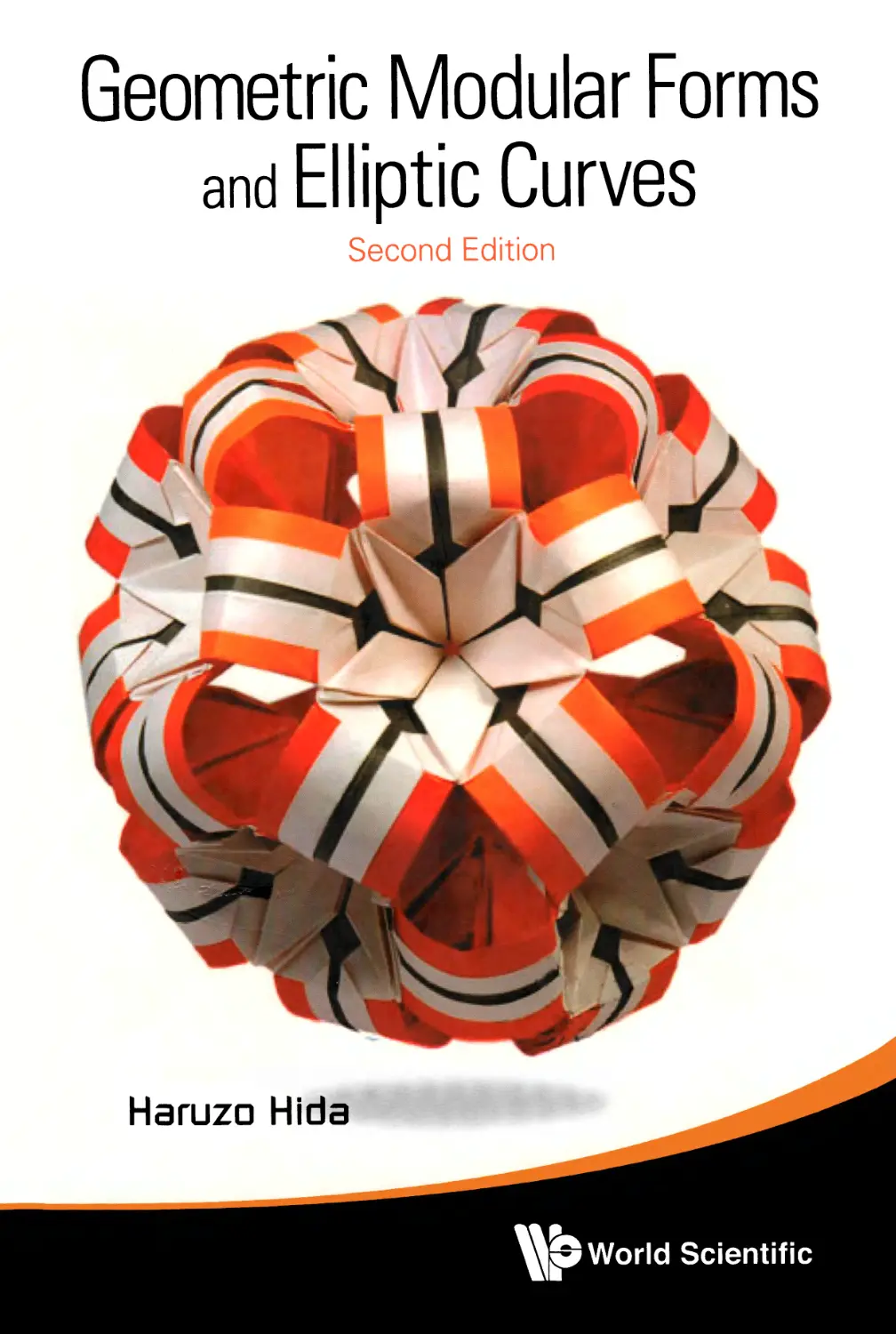
Image credit on the cover: Grafique kusudama by Ekaterina Lukasheva
http://kusudama.me/#/Rafaelita_long/Grafique/grafl
Copyright © 2012 by World Scientific Publishing Co. Pte. Ltd.
All rights reserved. This book, or parts thereof, may not be reproduced in any form or by any means,
electronic or mechanical, including photocopying, recording or any information storage and retrieval
system now known or to be invented, without written permission from the Publisher.
For photocopying of material in this volume, please pay a copying fee through the Copyright
Clearance Center, Inc., 222 Rosewood Drive, Danvers, MA 01923, USA. In this case permission to
photocopy is not required from the publisher.
Printed in Singapore by World Scientific Printers.
Preface to the second edition
The study of classical and p-adic automorphic forms has seen explosive de-
velopment since the 1995 proof by Wiles and Taylor of cases of the Shimura-
Taniyama Conjecture, and hence, by a celebrated 1986 work of Ribet, Fer-
mat’s Last Theorem. Consequent developments include the complete proof
of the above conjecture in 1998 by Taylor, Breuil, Conrad and Diamond,
the proof of the Local Langlands Conjecture for GL(n) in 1999 by Taylor
and Harris, the proof of most instances of the icosahedral case of the Artin
Conjecture by Taylor and Buzzard, and the extension in numerous works of
the p-adic theory from GL(2) to other reductive groups by Taylor, Urban-
Tilouine, Breuil, Harris and myself. Relentless battle forward did not end by
this. Several key results seemed out of reach just in the early 2000s, notably
Serre’s mod p Modularity Conjecture (1986), the Fontaine-Mazur Conjec-
ture (1990), the Sato-Tate Conjecture (1965) and cases of the p-adic version
of the Birch-Swinnerton Dyer conjecture (1960s) were proven in 2006-2011,
after the publication of the first edition. Serre’s Modularity Conjecture has
been proven by Khare and Wintenberger, the Fontaine-Mazur Conjecture
was reduced to Serre’s Modularity Conjecture by Kisin and another proof is
given by Emerton via the framework of p-adic Langlands program (which
Breuil and Emerton initiated), the Sato-Tate Conjecture was proven by
Taylor following Taylor’s joint work with Clozel and Harris on potential
modularity of n-dimensional Galois representations, and the cases of the
p-adic version of Birch-Swinnerton Dyer conjecture is reduced in an auto-
morphic way by C. Skinner and E. Urban to a one-side divisibility of the
algebraic/analytic p-adic L-function studied (via Euler system argument)
by K. Kato. Skinner and Urban have generalized the congruence argument
invented by Greenberg and Ribet to the setting of p-adic analytic families
of automorphic forms on “unitary groups” and their ‘big’ Galois representa-
vi
Geometric Modular Forms and Elliptic Curves
tions (note that we study such families and Galois representations of elliptic
modular forms in this book). We should also note that automorphic Galois
representations for unitary groups have been constructed by the effort of
many outstanding mathematicians in the Langlands program; in particular,
a key step forward was the proof of the fundamental lemma (conjectured by
Robert Langlands) by G. Laumon and B.-C. Ngo in 2004. The full Artin
conjecture for two-dimensional odd Artin representation follows from the
Mod p Modularity Conjecture (as was shown by Khare before the solution
of the conjecture). Since this book was originally written to describe some
of the ideas of Wiles/Taylor, we added some more basic theory of elliptic
curves to the first edition, hoping to provide systematic (and introductory)
access for newcomers to this fascinating research field.
In this second edition, a detailed description of Barsotti-Tate groups
(including formal Lie groups) is added to Chapter 1. As an application,
a down-to-earth description of formal deformation theory of elliptic curves
is incorporated at the end of Chapter 2 (in order to make our proof of
regularity of the moduli of elliptic curve more conceptual), and in Chapter
4, though limited to ordinary cases, newly incorporated are Ribet’s theorem
of full image of modular p-adic Galois representation and its generalization
to ‘big’ A-adic Galois representations under mild assumptions (a new result
of the author). Though most of the striking developments we described
above is out of the scope of this introductory book, the author tried, to
some extent, to give some flavor of present day research in this area of
Number Theory at the very end of the book (giving a good account of
modularity theory of abelian Q-varieties and elliptic Q-curves).
The author acknowledges a partial support from the National Science
foundation under the grant DMS 0753991 and DMS 0854949 and from
Clay Mathematics Institute as a senior scholar in 2010-11, while he was
preparing this second edition.
Haruzo Hida
September 2011 at Los Angeles
Preface
In summer 1992, I gave a series of eighteen lectures at a CIMPA confer-
ence held in Nice (France). What I tried to present in the series of the
lectures was a comprehensive account of the theory of moduli spaces of el-
liptic curves (over integer rings) and its application to modular forms. The
first three chapters of this book faithfully follow the notes written at the
time, although only a part of them was presented in the lecture series. A
few years later, I learned the proof by A. Wiles of the Shimura-Taniyama
conjecture (for semi-stable elliptic curves) and Fermat’s last theorem. In
his proof, the existence of two-dimensional Galois representations associ-
ated to modular forms (and analysis of ramification of the representations)
plays a fundamental role; so, I started writing Chapter 4 on construction
of such Galois representations, following the classical treatment of Shimura
(but incorporating some facts on ramification proven after his book [IAT]
was written). At the end (in Chapter 5), I added a brief outline of the proof
of diverse modularity results of two-dimensional Galois representations (in-
cluding that of Wiles) as well as some new results of mine in that direction.
Together with my book [MFG] from Cambridge University Press, this book
covers basically everything used in the proof of Wiles; so, it is my hope that
these two books would supply graduate students (having basic knowledge of
algebraic number theory including class field theory) with adequate math-
ematical background in order to read Wiles’ original paper [Wi2], although
I have concentrated on describing proofs of mathematical facts and have
not touched historical matters. There is no introduction given to this book,
since this is a direct sequel of [MFG], and I would like to refer the reader
to Chapter 1 of [MFG] for introductory discussions.
Some of the material of the book was also presented in graduate courses
at UCLA and Hokkaido University (Japan). I would like to express my
vii
viii
Geometric Modular Forms and Elliptic Curves
thanks to the audience at the CIMPA conference and to the students in my
graduate courses. I thank many people who corrected Mathematics and
English errors in the manuscript. I also thank the organizers of the CIMPA
conference for their invitation (which gave me an opportunity of writing
the material treated in this book). I acknowledge a partial support from
the National Science foundation while I was preparing the book.
Haruzo Hida
March 2000 at Los Angeles
Contents
Preface to the second edition	v
Preface	vii
1.	An Algebro-Geometric Tool Box	1
1.1	Sheaves................................................... 1
1.1.1	Sheaves and Presheaves............................. 1
1.1.2	Sheafication....................................... 3
1.1.3	Sheaf Kernel and Cokernel.......................... 4
1.2	Schemes................................................... 5
1.2.1	Local Ringed Spaces................................ 5
1.2.2	Schemes as Local Ringed	Spaces................... 8
1.2.3	Sheaves over Schemes............................... 9
1.2.4	Topological Properties of	Schemes................. 11
1.3	Projective	Schemes...................................... 13
1.3.1	Graded Rings...................................... 13
1.3.2	Functor Proj...................................... 13
1.3.3	Sheaves on Projective Schemes..................... 16
1.4	Categories	and Functors................................. 20
1.4.1	Categories........................................ 20
1.4.2	Functors.......................................... 22
1.4.3	Schemes as Functors............................... 23
1.4.4	Abelian Categories ............................... 26
1.5	Applications of the	Key-Lemma............................ 28
1.5.1	Sheaf of Differential Forms on	Schemes...........	29
1.5.2	Fiber Products.................................... 32
1.5.3	Inverse Image of Sheaves.......................... 33
ix
X
Geometric Modular Forms and Elliptic Curves
1.5.4	Affine Schemes................................. 35
1.5.5	Morphisms into a Projective Space ............. 37
1.6	Group Schemes.......................................... 38
1.6.1	Group Schemes as Functors ..................... 38
1.6.2	Kernel and Cokernel............................ 39
1.6.3	Bialgebras..................................... 40
1.6.4	Locally Free Groups............................ 42
1.6.5	Schematic Representations...................... 44
1.7	Cartier	Duality........................................ 45
1.7.1	Duality of Bialgebras.......................... 45
1.7.2	Duality of Locally Free Groups................. 47
1.8	Quotients by a Group Scheme............................ 50
1.8.1	Naive Quotients................................ 50
1.8.2	Categorical Quotients.......................... 52
1.8.3	Geometric Quotients ........................... 54
1.9	Morphisms ............................................. 62
1.9.1	Topological Definitions........................ 62
1.9.2	Diffeo-Geometric Definitions................... 67
1.9.3	Applications................................... 69
1.10	Cohomology of Coherent	Sheaves......................... 73
1.10.1	Coherent Cohomology............................ 73
1.10.2	Summary of Known Facts ........................ 77
1.10.3	Cohomological Dimension........................ 78
1.11	Descent................................................ 82
1.11.1	Covering Data.................................. 82
1.11.2	Descent Data................................... 83
1.11.3	Descent of Schemes............................. 85
1.12	Barsotti-Tate Groups................................... 88
1.12.1	p-Divisible Abelian Sheaf...................... 88
1.12.2	Connected-Etale Exact Sequence................. 92
1.12.3	Ordinary Barsotti-Tate Group................... 93
1.13	Formal	Scheme......................................... 95
1.13.1	Open Subschemes as Functors.................... 96
1.13.2	Examples of Formal Schemes..................... 97
1.13.3	Deformation Functors.......................... 101
1.13.4	Connected Formal Groups....................... 102
2.	Elliptic Curves	105
2.1	Curves and Divisors................................... 105
Contents
xi
2.1.1	Cartier Divisors................................. 105
2.1.2	Serre-Grothendieck Duality ...................... 108
2.1.3	Riemann-Roch Theorem............................. 114
2.1.4	Relative Riemann-Roch Theorem.................... 119
2.2	Elliptic Curves......................................... 122
2.2.1	Definition....................................... 122
2.2.2	Abel’s Theorem................................... 123
2.2.3	Holomorphic Differentials........................ 125
2.2.4	Taylor Expansion of Differentials................ 126
2.2.5	Weierstrass Equations of Elliptic Curves........ 127
2.2.6	Moduli of Weierstrass Type ...................... 130
2.3	Geometric Modular Forms of Level 1...................... 134
2.3.1	Functorial Definition............................ 134
2.3.2	Coarse Moduli Scheme............................. 136
2.3.3	Fields of Moduli................................. 138
2.4	Elliptic Curves over C.................................. 139
2.4.1	Topological Fundamental Groups .................. 140
2.4.2	Classical Weierstrass Theory..................... 142
2.4.3	Complex Modular Forms............................ 143
2.5	Elliptic Curves over p-Adie Fields ..................... 145
2.5.1	Power Series Identities ......................... 145
2.5.2	Universal Tate Curves............................ 148
2.5.3	Etale Covering of Tate Curves.................... 153
2.6	Level Structures ....................................... 155
2.6.1	Isogenies........................................ 155
2.6.2	Level N Moduli Problems ......................... 157
2.6.3	Generality of Elliptic Curves.................... 163
2.6.4	Proof of Theorem 2.6.8........................... 165
2.6.5	Geometric Modular Forms of Level N............... 168
2.7	L-Functions of Elliptic Curves ......................... 173
2.7.1	L-Functions over Finite Fields................... 173
2.7.2	Hasse-Weil L-Function............................ 176
2.8	Regularity.............................................. 180
2.8.1	Regular Rings.................................... 180
2.8.2	Regular Moduli Varieties......................... 183
2.9	p-Ordinary Moduli Problems.............................. 189
2.9.1	The Hasse Invariant.............................. 189
2.9.2	Ordinary Moduli of p-Power Level................. 193
2.9.3	Irreducibility of p-Ordinary Moduli.............. 195
xii
Geometric Modular Forms and Elliptic Curves
2.9.4	Moduli Problem of Го and Г1	Type.............. 196
2.9.5	Moduli Problem of Го(р) and	ГЦр)	Type. 198
2.10	Deformation of Elliptic Curves......................... 209
2.10.1	A Theorem of Drinfeld.......................... 209
2.10.2	A Theorem of Serre-Tate........................ 211
2.10.3	Deformation of an Ordinary Elliptic	Curve .... 214
3.	Geometric Modular Forms	223
3.1	Integrality............................................ 223
3.1.1	Spaces of Modular Forms......................... 223
3.1.2	Horizontal Control Theorem...................... 236
3.2	Vertical Control Theorem............................... 238
3.2.1	False Modular Forms............................. 240
3.2.2	p-Adic Modular Forms............................ 252
3.2.3	Hecke Operators................................. 257
3.2.4	Families of p-Adic Modular Forms................ 266
3.2.5	Horizontal Control of p-Power Level............. 271
3.2.6	Control of Hecke algebra........................ 273
3.2.7	Irreducible Components and Analytic Families . . 275
3.3	Action of GL(2) on Modular Forms....................... 276
3.3.1	Action of GL2(%/N%)............................. 276
3.3.2	Action of GL2(Z)................................ 280
4.	Jacobians and Galois Representations	287
4.1	Jacobians of Stable Curves ............................ 287
4.1.1	Non-Singular Curves ............................ 287
4.1.2	Union of Two Curves............................. 295
4.1.3	Functorial Properties of Jacobians.............. 298
4.1.4	Self-Duality of Jacobian Schemes ............... 302
4.1.5	Generality on Abelian Schemes................... 304
4.1.6	Endomorphism of Abelian Schemes................. 313
4.1.7 Adie Galois Representations...................... 318
4.2	Modular Galois Representations ........................ 322
4.2.1	Hecke Correspondences........................... 323
4.2.2	Galois Representations on Modular Jacobians . .	326
4.2.3	Ramification at the Level....................... 330
4.2.4	Ramification of p-Adic Representations at p ...	335
4.2.5	Modular Galois Representations of Higher Weight	337
Contents	xiii
4.3	Fullness of Big Galois Representations.................. 342
4.3.1	Big H-adic Galois Representations............. 344
4.3.2	Ramification of K-adic Galois Representations .	.	.	345
4.3.3	Lie Algebras over p-Adic Ring................. 346
4.3.4	Lie Algebras of p-Profinite Subgroups of SL(2)	.	.	348
4.3.5	Lie Algebra and Lie Group over Zp............. 355
4.3.6	Arithmetic Galois Characters.................. 359
4.3.7	Fullness of Modular Galois Representation	....	361
4.3.8	Fullness of Elliptic Curves ....................... 365
4.3.9	Fullness of Lie Algebra over A................ 368
4.3.10	Fullness of I-Adie Galois Representation ......... 371
4.3.11	Basic Subgroups............................... 373
4.3.12	Proof of Theorem 4.3.4........................ 380
5.	Modularity Problems	383
5.1	Induced and Extended Galois Representations............. 384
5.1.1	Induction and Extension....................... 385
5.1.2	Automorphic Induction......................... 392
5.1.3	Artin Representations......................... 395
5.2	Some Other Solutions.................................... 402
5.2.1	A Theorem of Wiles............................ 402
5.2.2	Modularity of Extended Galois Representations	.	404
5.2.3	Elliptic Q-Curves............................. 406
5.2.4	Shimura-Taniyama Conjecture................... 413
5.3	Modularity of Abelian Q-Varieties....................... 416
5.3.1	Abelian F-varieties of GL(2)-type............. 417
5.3.2	Endomorphism Algebras of Abelian F-varieties	.	424
5.3.3	Application to Abelian Q-Varieties............ 425
5.3.4	Abelian Varieties with Real Multiplication	....	432
Bibliography	437
List of Symbols	447
Statement Index	449
Index
451

Chapter 1
An Algebro-Geometric Tool Box
We recall some of the algebro-geometric methods (emphasizing their func-
torial nature), which will be useful in studying classification problems of
elliptic curves. Some sections on Barsotti-Tate groups and formal groups
are added to this chapter in this second edition, since these tools are used
now often in the fore front of arithmetic geometry (cf. [EAI]). As a fur-
ther reference of the material treated here, I would suggest the book by
Hartshorne [ALG]. If the reader has basic knowledge of functorial alge-
braic geometry, it might be better to start with Chapter 2, and if necessity
arises, the reader can come back from time to time to this chapter.
1.1 Sheaves
In this section, we recall the theory of sheaves on a topological space.
1.1.1 Sheaves and Presheaves
Let X be a topological space and O(X) be the set of all open subsets in X.
A presheaf P on X is made of the following data:
(PO) an abelian group P(U) for every open set U with P(fb) = {0};
(Pl) for each inclusion V <-+ U of open sets, a homomorphism of abelian
groups ruv : F(U)	which is called the restriction map;
(P2)	W °—► V U => ryw ° t'uv — t'uw]
(P3)	ruu — id.
Example 1.1.1. Let X be a complex manifold and Ox be the sheaf
of holomorphic functions. Here the presheaf Ox is defined as follows:
C?x(0) = {0} and OxfU) = {f  U —* C\f: holomorphic}. Then Ox is
1
2
Geometric Modular Forms and Elliptic Curves
a presheaf whose restriction map is given by the usual restriction of func-
tions to subsets.
Example 1.1.2. Let X be a topological space and A be a ring. We may
regard A as a presheaf such that A(t7) = A and A(0) = {0}, where the
restriction map is the identity for non-empty open sets. This presheaf is
called the constant presheaf with coefficients in A.
Each element of F(U) is called a section over U of T7, and sometimes,
the module F(U) of sections over U is written as Г(С7, T7). A presheaf T7 is
called a sheaf if T7 satisfies the following two conditions:
(SI) For every open set U and its open covering U = Uiez	eac/i
section s over U of T7 is determined by -Si = s\ui = ruufs). That
is, if Si = 0 for all i e I, then s = 0;
(S2) For every open set U and its open covering U = |J-e/ Ui, a sec^on
Si over Ui of F is given for each i e I and satisfies Si\uiauj —
Sj\uznUj for each pair (i,j) e I2, then there exists a section s over
U such that Si — s|t/. for all i.
Thus a sheaf is a presheaf whose section is determined by local data. By the
phrase: “sheaf is local”, we will mean this fact. A property P of functions
f : U —► T is local if P is defined by the behavior of the function f restricted
to any open (small) neighborhood of every P e U. If F(U) for a presheaf T7
is the totality of all functions f : U —> T (for an abelian group T) satisfying
a local property, then T7 is automatically a sheaf.
Example 1.1.3. The presheaf Ox in Example 1.1.1 is a sheaf, because
/ : X —> C being holomorphic is a local property.
Example 1.1.4. The constant presheaf A may not be a sheaf. Let U and
V be non-empty open sets with U A V = 0. Then for any su,sv € A
regarded as sections over U and V, respectively,	= sc/lo = 0 =
sy|0 = svlc/nv- Thus if A were a sheaf, there would have to be a section s
over U U V whose restriction to U and V are distinct. That is impossible
because A(U U V) = A.
An Algebro-Geometric Tool Box
3
1.1.2 Sheafication
Let 7 be a presheaf. For each point P G X, we define an abelian group
Fp, called the stalk of F at F, by
FP = lim F(F) = {fu G F(F, F)\U Э P} / «,
pgu
where fu « gy if there exists an open neighborhood W С V A U of P such
that ruw(fu) — TywkgvY By definition, there is a natural homomorphism
rP : F(U) FP for all U 9 P. We write sP for rP(s) (s G T(F,F)). A
morphism of presheaves j : F G is a system of homomorphisms
W) : r(U) - g(U)\U e O(X)}
making the following diagram commutative for each inclusion V U:
F(U)	g(u)
n/vj lr,; v'
^(v)-------* G(V).
j(v)
Then U Н-» Im(j(t7)), U Ker(j(F)) and U i—> Coker(j(F)) are again
presheaves, which are called the presheaf image (denoted by preim(j)), the
presheaf kernel and the presheaf cokernel (denoted by precoker(j)) of j. If
F and G are sheaves, the presheaf kernel Ker(j) is a sheaf, but the presheaf
image and cokernel may not be sheaves. Since sheaf is local and all the local
data are contained in stalks, if j : F G is a morphism of sheaves inducing
isomorphism fp : Fp = Gp for all P G X, j itself is an isomorphism, i.e.
j(U) : F(U) = G(U) for all U G O(X). In other words, a map of sheaves
j : F G is determined by the maps of stalks {jp : Fp Gp}pex-
Proposition 1.1.1. Given a presheaf F, there are a sheaf F# and a mor-
phism q : F F# such that for any sheaf G and a morphism j : F G,
there exists a unique morphism j# : F# G making the following diagram
commutative:
r —g-^>
4	4*
g —g
Id
The pair (F#,q) is unique up to canonical isomorphisms, and Fp = Fp
for all P.
4
Geometric Modular Forms and Elliptic Curves
Proof. Uniqueness: If there is another pair (T7', q'} satisfying the prop-
erty of the proposition, then we have two commutative diagrams:
q' : Г ----> Г q : T ----------> F*
h d b' d
q'# : jr# —> T7'	q* . P' —> F#,
where (#')# °Q# = Id and Q# ° (q')# — Id because of the uniqueness of q#.
Existence: Define P#(U) to be the abelian group of functions s : U
Llpet/ satisfyiHg the following two conditions:
(i) s(P) e PP for all P e U\
(ii) for each P e U, there is an open neighborhood V of P in U such that
s(Q) = tQ for t e F(V) for all Q e V.
The properties (i) and (ii) above are local, and hence P# is a sheaf. The
map q : P P# is given by q(s) : P i—> sp. By definition, the morphism q
induces Pp = Pp for all P. Suppose that we have a morphism of presheaves
j : P Q into a sheaf Q. For each open set U in X and t e 77^([/),
we can find an open covering U = IJi so that q(ti) = t\ui € F(Ui).
Then	for all (i, because at each P e Uif}Uj,
j(ti)p = j(tj)p by the definition of P#. Since Q is local (i.e. is a sheaf),
we have a unique section over U which induces j(^) on Ui for all i.
This shows the universal property of q.	□
Exercise
(1) Give an example of a morphism j : P Q of sheaves for which the
presheaf cokernel and the presheaf image are not sheaves.
1.1.3 Sheaf Kernel and Cokernel
For a morphism j : P Q of sheaves, we define the sheaf kernel, the sheaf
image and the sheaf cokernel by
Ker(j)(t7) = Ker(j(U)), Coker(j) = precoker (j)#, Im(j) = preim(j)#.
We have natural morphisms: Q pr°J > precoker(j) Л- Coker(j) and a com-
mutative diagram:
preim(j)	Q
q^	J inc#
Im(j) = Im(j).
An Algebro-Geometric Tool Box
5
j к
A sequence of sheaves: T7 —> G —> 7Y is called exact if Ker (A;) = A
morphism of sheaves T7 G is injective if Ker(j) = 0 and is surjective if
Coker(j) = 0. Even if T7 G is surjective, j(U) : P(U) G(U) for a
particular U may not be surjective. We know
Coker(j) = 0 <=> Coker(j)p = 0 for all P
and
P Q is surjective <=> Pp Gp is surjective for all P.
Similarly P	G H is exact if and only if Pp Gp is exact for
all P.
1.2 Schemes
We shall give a definition of schemes as a local ringed space. We will later
give another (equivalent but more useful) definition of schemes as functors
(associating the set of А-rational points of the schemes to each ring A; see
§1.4.3).
1.2.1 Local Ringed Spaces
A sheaf of rings A on a topological space X is a sheaf A of abelian groups
satisfying the following conditions:
(Rgl)	A([/) ls a (commutative) ring with the identity 1^;
(Rg2) The restriction map rpy : A(U) A(V) is a ring homomorphism
taking lp- to ly ifV 0 and the zero map when V = 0.
If / : X —> У is a continuous map, then f~1(U) is open if U is open. Thus
for each sheaf P on X, f*P(U) = P(f~1(U)) is automatically a sheaf on
У, because each neighborhood of P is sent to a neighborhood of /-1(F)
under the inverse image. A pair (X, Ox) of a topological space X and a
sheaf of rings Ox is called a ringed space. If further its stalk Op is a local
ring (i.e. having only one maximal ideal), (X, Ox) is called a local ringed
space. A morphism f : (X, Ox) —► (У, Oy) of two ringed spaces is defined
to be a pair of a continuous map / : X —> У and a morphism of sheaves of
rings f# : Oy —► f*Ox satisfying the following condition:
(LR) For every P e X, the map fp : Oyj(p) —> Ox,p induced by f#
is local (<=> the inverse image of the maximal ideal under fp is the
maximal ideal of Oyj(p))>
6
Geometric Modular Forms and Elliptic Curves
where Oyj(p) (resp. Ox,p) is the stalk of Oy (resp. Ox) at f(P) (resp.
P). A morphism f : (X, Ox) —> (Y,Oy) of local ringed spaces is an
isomorphism if f : X = Y and f# : Oy = f*Ox-
Example 1.2.1. A complex manifold X with its sheaf of holomorphic func-
tions Ox is a ringed space.
Example 1.2.2. Let k be an algebraically closed field, A71 = kn and A
be the ring A;[Xi,..., Xn] of polynomials of n variables. We may consider
each polynomial F(Xi,..., Xn) as a polynomial function on An by An Э
(xi,..., xn) п-4 P(xi,..., xn) e к. We now define a topology on An. A
subset V C A71 is declared to be closed if there are polynomials	in
A such that V — V({Fj}iez) — {x E An\Fi(x) = 0 for all i}. Let a be the
ideal generated by {Fjiez- Then
V = V(a) = {x e An\F(x) = 0 for all F € a}.
Since A is noetherian, a has finitely many generators Fi,..., Fm, and V =
V(Fi,...,Fm). We see easily that 0 = V(l), Q-e/ У(сц) = V(^ieIcii) and
V(a)UV(b) = V(ab). The family of subsets {V(a)|a C A} satisfies the
axiom of closed sets, giving a topology on An. This topology on An is
called the Zariski topology on An. For each open set U in An, we define
| j\g,f e A and f(x) ± 0 for all x e .
Then (An, Оап ) is a local ringed space, which is called the affine space over
к of dimension n. When к = C and n = 1, a non-empty closed set in A*c
is a set of finitely many points. Thus the Zariski topology is not Hausdorff
and is weaker than the usual complex topology.
Example 1.2.3. Let A be a commutative noetherian ring with identity.
Then we put
X = {P : prime ideal of A}.
We define a topology on X by calling a subset V closed if
V = V(a) = {PeX\PDa}
for an ideal a of A. Then 0 = V(A), f\e/V(ai) = V(^ie/Cii) and
V(a)|JV(b) = V(ab). This topology is well defined. It is again called
the Zariski topology on X. If P e X and x, у G A — F, then xy G A — P.
Thus S = A — P is multiplicatively closed. We then put
Ар = {-\g e A and s G S}/ «,
An Algebra-Geometric Tool Box
7
where the relation { ~ is given by s"(fs' — f's) = 0 for some s" G S.
Then Ap is a local ring and PAp is the unique maximal ideal mp of Ap.
Define a sheaf of rings Ox on X by
Ox (Ц) — < s'. U —> I___I Ap|s satisfies the following (1) and (2)
I Peu
where
(1) sp G Ap;
(2) For all P G U, there exist an open V Э P in U and f,g€A such that
9Q & and f°r ad Q E V.
Then Spec(A) = (X, Ox) is a local ringed space satisfying the following
two conditions:
(Afl)	T(X, Ox) = A and Ox,p = AP;
(Af2) Let D(f) = X - V(/) for 0 f G A such that fn 0 for all n > 0.
Then r(D(f),Ox) = Al/"1] = {^|S€AandO<nez}/ «
and D(f) = Spec(A[/-1]),
where p? ~	<==> (gfm — д' fn)fr — 0 for some 0 < r	G Z. We	now
prove (Afl).	By definition, we have a natural map: £ : A	—> Г(Х,	Ox)
sending a G	A	to a global section P aP = E AP.	Suppose	that
b(a) = 0. Then	for any maximal ideal m C A, we find fm	m such	that
fma = 0. The ideal a generated by /m, m running over all maximal ideals of
A, is therefore equal to A. In particular, 1 G a is a finite linear combination
of fm: 1 = bmfm. Thus a = al = bmfma = 0. This shows that l is
injective. To prove converse, take a G Г(Х, Ox)- Then for each maximal
ideal m C A, we can find fm,gm G A such that om = with gm £ m.
Thus the ideal generated by gm coincides with A, and 1 = bmgm for
a finite set of maximal ideals Q and 6m G A. Since X = IJmeQ -^(^m), we
know that oiq = for all Q G D(pm). We put a = JSmeQ ^m/m- Then we
see
^(^) — bmfvn) —	^(^m^m)	—	— ^(^ ^m^m)^ —
a.
Thus l is surjective. We leave the proof of (Af2) to the reader (Exercise 1).
The local ringed space Spec(A) is called an affine scheme associated
with A. We can slightly generalize the above argument. Let S be any
multiplicatively closed subset in A with 0	S', that is, xy G S for whatever
x,y G S. Then we define the localization S-1 A of A by
S^A= 6 A and s e Sp
8
Geometric Modular Forms and Elliptic Curves
where ~ ^7 <=> s"(sg' — s'g) = 0 for some s" G S. Then S'-1 A
is naturally an algebra over A. In particular, S'-1 A = A[/-1] for S =
{/n|0 < n G Z}. By definition, (D(f), Ox |d(/)) — Spec(A[/-1]). Note
that адпад = D(fg) - Spec(AK^)-1]) and D(f) U ЭД = X -
V((/, #)). This shows that any open subset U of Spec(A) is a union of
finite many sets of type D(f). That is, {D(f)}f is a base of open sets of
X.
Exercise
(1) Prove (Af2) from the definition of Spec (A).
1.2.2 Schemes as Local Ringed Spaces
A scheme (X, Ox) is a local ringed space with an open covering X =
Uiez such that (Ui,Ox\ui) is isomorphic to an affine scheme Spec(A^)
for each i. In other words, if (X, Ox) is a scheme, for each point P G X,
we can find an open neighborhood U of P such that (17, Ou) = Spec(Atr)
for a commutative ring A^r, where Ou = Ox\u- When we assume that
the above Au is a noetherian ring, the scheme is called locally noetherian.
When X is further quasi-compact (that is, any open covering of X has finite
sub-covering), X is called noetherian.
Lemma 1.2.1. Let S = Spec(A). If S = Uiei zs an °Pen covering,
then there exists a finite set J in I such that S = UjeJ an(^ $ ™ Iuas^~
compact.
Proof, Since {D(f)} f^A forms a basis of open sets, we may assume that
Si = D(fi). Since D(fi) = S- V(fi),
s = \Jst V(£(O = Q Ш) = 0.
iei	iei	iei
Thus 1 = j fj for a finite subset J in I. This implies
Пш) = 0 s= u^,
jeJ	jeJ
which shows the assertion.	□
An open subset U with the sheaf of rings Ou = Ox\u is called an
open subscheme of X. The inclusion map: U X is called an open
immersion. For each ideal a C A, the closed set V(a) has a structure of
scheme: Spec(A/a). The subscheme V(a) = Spec(A/a) is called a closed
An Algebro-Geometric Tool Box
9
subscheme of X. Note that if y/a = \/b, the topological spaces V(a) and
V(b) are the same, but the scheme structure may not be equal.
1.2.3 Sheaves over Schemes
We now make clear the relation between А-modules and sheaves on
Spec(A). Let X — Spec(A). Then for each А-module M, we can define a
sheaf M on Spec (A) as follows:
M(U) = <| s : U U Mp
I Peu
s satisfies the following (i) and (ii) >	(1.1)
where
(i) Sp G Mp for Mp = M Ap;
(ii) For all P G U, there exist an open neighborhood V Э P in U, f G M
and g G A such that gQ rriQ and sq = & for all Q eV.
In other words, M(U) = Ох(Ц) M for an affine open set U С X. Any
exact sequence of А-modules: M —> N —> L yields the sheaf exact sequence:
M —> N —> L, because the localization process keeps the exactness [BCM],
II.2.4. We can prove similarly to (Afl) the following fact:
(Mfl)	Г(Х,М) = М.
Let (X, O%) be a general scheme. A sheaf P on X is called quasi-
coherent if for each point P G X, there are an affine neighborhood U =
Spec(A) of P and an А-module M such that P\u — M. Since we always
have an exact sequence AJ —> A1 —> M 0 of А-modules for two index
sets I and J, locally quasi-coherent sheaf has a presentation (Ox\u)J —>
(Ох\иУ ~> ?\u —* 0. Here AJ denotes the direct sum of copies of A
indexed by j G J. This property in fact characterizes quasi-coherency.
When the index sets I and J can be taken to be finite sets, P is called
coherent. A sheaf P on X is called locally free of rank r if for each point
P G X, there is an open neighborhood U of P such that P\p = (C’x|cz)r-
In particular, a locally free sheaf of rank 1 is called an invertible sheaf.
For our later use, we shall prove the following fact:
Lemma 1.2.2. Let X — Spec (A) be a scheme and P be a quasi-coherent
sheaf on X.
(1) Let s G Г(Х, P) be a global section of P whose restriction to D(a)
vanishes for a non-zero divisor a G A. Then for some n > 0, ans = 0;
10
Geometric Modular Forms and Elliptic Curves
(2) Given a section t G P(D(a)) of P over the open set D(a), then for
some n> 0, ant extends to a global section of J~ on X.
Proof, Since P is quasi coherent, we may assume that P = M for an
А-module M. Then s G M and | = 0 in M[a-1]. This is equivalent to
saying that ans = 0 for some n > 0 by the definition of	(see [CRT]
Section 4). This proves (1). Thus we may assume that a is a non-unit.
Since t G P(D(a)) = M[a-1], we may write t for m e M. Then
ant = m extends to a global section m G M = Г(Х, T7).	□
Example 1.2.4. Let Q be the field of all algebraic numbers in C. Take an
irreducible polynomial f(X) G Z[Xj,..., Xn], which remains irreducible in
C[Xi,..., Xn]. We consider
V = V(Q) = {z e Q" = An(Q)|/(z) = o} •
From the view point of number theory, not just V(Q) but the set of R-
integral solutions of f:
V(R) = {x e Rn\f(x) = 0}
for more general rings R is important in view of Diophantine problems.
From the geometric point of view, the complex analytic space
V^ = {xeCn\f(x) = Q}
is important. Thus it is crucial to think of R as a “variable”. Let us simply
put A =	..., Xn]/(/) and Aq = A Q. Then
V (Q) = {(&i, • • •, Un) | (Xi - ai,..., Xn — an) : a maximal ideal of Aq}
С 8рес(А^).
Take P G Spec (A), which is not necessarily maximal. Since P is a prime
ideal, А/P is an integral domain generated by Xj mod P (j = 1, 2,..., n).
Then if P П Z = {0}, we can embed А/P into C. Write this embedding i
and put Xj — i(Xj). Then we have /(jq,..., xn) — 0 and g(x\,..., xn) = 0
for all g G P. Moreover g G P <=> g(x) = 0 (by the Nullstellensatz; cf.,
[CRT] Theorem 5.4). This shows P = A A (Xi — aq,..., Xn — xn), and
the non-maximal prime ideal P appears as an element in V(C). Therefore
points x G V(C) correspond closed and non-closed points of Spec(A). They
give rise to algebra homomorphisms of А/P into C; i.e.,
v((/) + P) = {x e Cn|/(z) = g(x) = 0 Vp e P} Homz_Qi9(A/F, C),
An Algebra-Geometric Tool Box
11
which is a subvariety of V(C) defined by f and generators of P. This shows,
from our view point of regarding R as “variable”, non-maximal ideals P
has concrete meaning. This is the reason why we included non-maximal
ideals as elements of Spec (A).
Exercise
(1) Prove (Mfl) from the definition of M.
1.2.4 Topological Properties of Schemes
Let 99 : A —> В be an algebra homomorphism of two commutative rings with
identity. We always assume that ip takes the identity of A to the identity of
B. Then we define 99* : Spec(B) Spec(A) as follows: 99* (P) = <у9-1(Р) for
P € Spec(B), and as ip# ' ^Spec(A) ~> (<^*)*Ospec(B), we take the morphism
induced by 99. Thus 99* = (99*, 99#). Since 99*(P) Э a <=> </?-1(P) D a <=>
F D we see (<^*)-1(V(a)) = V(</?(a)), and hence 99* is continuous. The
morphism ip# induces : A^*^ —> Bp, which is local by definition.
Thus </?* is a well defined morphism of local ringed spaces. Conversely, if
(/, /#) : Spec(B) —> Spec(A) is a morphism of local ringed spaces, we have
= f# : A = T(Spec(A), C>spec(^)) -> T(Spec(A), /‘OSp«(B))
= r(Spec(B), C’spec(B)) = B,
which is an algebra homomorphism. For each affine open set U in Spec(A),
each element in Г (17, Ospec(A)) is a fraction for g € A and s € A non-
vanishing on U. From this we see /#(^) = and f# is determined
by ip. We leave to the reader to show f(P) = 99-1(P) (see [ALG], II.2.3).
Thus we have an important identification
Homa^(A, B) = Homsc/i(Spec(B), Spec(A)) via 99 1—> 99* = (99*, 99#).
For a scheme X, any open subset of X has a unique structure of an open
subscheme induced by the scheme structure of X. A closed subscheme Y
of X is a scheme and a morphism i : Y <-+ X such that i is a closed
embedding of topological spaces and the associated morphism of sheaves of
rings i# : Ox —► i*Oy is surjective. The kernel J = Ker (г#) is a sheaf of
ideals, and locally on an affine open U = Spec (A), it gives rise to an ideal
a of Ap so that Jp = a. Thus J determines Y. We call such a morphism i
a closed immersion.
12
Geometric Modular Forms and Elliptic Curves
It is easy to see that Spec(A ф A') = Spec(A) LJ Spec(A'). If Spec(A)
for noetherian A is not connected, then
Spec(A) = V(a) U V(b) = V(an) U V(bn) = V(an A bn)
O a A b = ab = \/0 O an П bn = anbn = 0 for n » 0,
and
V(a) П V(b) = V(a + b) = 0 о a + b = A & 1 e an + bn for all n > 0.
Thus A = А/ап ф A/bn for a sufficiently large n by the Chinese Remainder
Theorem. More generally, if X = Spec (A) = U U V for two open subsets
U and V, then U = Spec (A') and V = Spec (A"). The identity element
€ A' = Ox(U) (resp. ly e A" = Ox(V)) can be extended by 0 on V
(resp. U), and we thus have 1 = 1^ + ly. This shows A = А' ф A", and
Spec (A) is connected if and only if A is indecomposable.
A scheme X is irreducible (resp. reduced) if for any open affine sub-
scheme Spec(A) of X, A modulo its nilradical is an integral domain (resp.
has no non-trivial nilpotent elements). Let X be a reduced connected
noetherian scheme. Let U = Spec (A) be a dense open affine subscheme
of X. Then the set S of all non-zero divisors of A is multiplicatively closed.
The localization К = S-1A = {^|s € S, a € A} is called the ring of
meromorphic functions on X. Then К is a sum of finitely many fields Кг.
If V = Spec(B) is another dense affine open subscheme of X, since X is
connected, V A U is non-empty and contains Spec (A') = Spec(B'), where
A' (resp. B') is a localization of A (resp. B). Since К is the total quotient
ring of A' and also of В', К is determined independently of the choice of
U = Spec (A). Then X is called normal if for any open affine subscheme
Spec (A) in X, A is integrally closed in its total quotient ring.
Take a semi-simple algebra L = ф^ such that Lj is a TQ algebra
of finite dimension. Take an open affine covering X = Spec(AJ with
reduced algebras Aj. Then Spec(AJ A Spec(Aj) = |Jfc Spec(A'A}), and A'k
is a localization Skr Аг of Aj for a multiplicatively closed set Sk and also
TkrAj of Aj. Let Aj be the integral closure of A^ in L. As is known by the
theory of commutative algebra [BCM] V.1.5, the process of taking integral
closure commutes with localization. Therefore the integral closure of A'k in
L is the localization SkrAj and also TkAj. Thus we can glue Spec(AJ
and Spec(Aj) canonically so that
Spec(AJ A Spec(Aj) = Spec(5~1 Аг) =	Spec (T^AJ,
к	к
An Alg ebro-Geometric Tool Box
13
getting a normal scheme X = Spec (АД The natural inclusion Ai Ai
induces a projection pr of Spec (Ai) onto Spec (Ai) which extends to a unique
projection pr : X -» X. The scheme X is called the normalization of X in
L.
1.3 Projective Schemes
We shall introduce a class of non-affine schemes, i.e. projective schemes.
1.3.1 Graded Rings
As we started from commutative rings in the theory of affine schemes, we
here start with graded commutative rings: Let A = ф/сА/с be a ring such
that A^Ai С A/c+/ and 1 € Aq. Such a ring is called a graded ring. In
particular, Aq is a subring of A sharing the common identity, and Ak is
an Ag-module. An element x is called homogeneous of degree k if x € A/c,
and we write deg(z) = к in this case. An ideal a is called homogeneous if
a = Ф/cQ/c for a/c = a П A/c. We put A+ = Фк>оАь We always assume that
the ring A is noetherian. If a homogeneous ideal a contains A+ and A+
has a unit in A, then a = A. We put
X = Ха = {P- homogeneous prime ideal of A|P 7$ A+} •	(1-2)
This is the underlying point set of the projective scheme associated to the
graded ring A. We now introduce a topology on Xa- We define for each
subset E of A+
V+(E) = {P e X\P D E] and D+(E) = X - V+(E).
Then we see ПгЕ/ V+(Et) = ЫЕге/ M V+(E)UV+(E') = V+(PP') and
V+(A+) = 0. Thus we can give a topology on X by declaring subsets of the
form V+(E) closed sets. Note that {Z?+(u)|u € A+} is a base of open sets
(i.e. any open set can be written as a union of finite intersections of sets of
the form Z?+(u)).
1.3.2 Functor Proj
The following lemma is a key to cover the topological space by open subsets
with a canonical structure of affine scheme.
Lemma 1.3.1. Suppose that A has a unit of positive degree. Then the map
ip : Xa	Spec(Aq) given by P 1—> Pq = P A Aq is a homeomorphism.
14
Geometric Modular Forms and Elliptic Curves
Proof, Surjectivity: Let a be a unit of positive degree. First suppose
deg(u), the degree of a, is equal to 1. We then define P = ^2ke%akPo for
a given prime Pq of Aq. If x is homogeneous of degree /с, then xa~k G Aq
and hence A = ®fcezafcAo. Thus
A/P = а^Аь/Рд = (Ао/Ро)[а,а-1]
for a = a mod P, which is an integral domain. Thus <^(P) = Pq and p is
surjective.
Now we treat the general case: Let d = deg (a), and suppose that d > 1.
We define P = ®kPk for
f	,bd	1
Pi = <b € Ai — € Po к
I	a	J
Then Pq = P П Aq, because y/Pfr = Pq. We now show that P is an ideal.
Suppose b e Ai and c e Pj. Then e Po. Thus = ^-4 gP0)
which shows that be G Pi+j. This shows that АР С P.
We now suppose b G A* and с E Pi. Then for 0 < j < d, bJcd~J E Р<ц
and thus (^bJcai J) € Po, which implies G Pq, because y/Pb = Pq.
Then for	6, c G Pi
(b + c)d	(d\ Wcd-i	„
аг	\ 7) аг
j	4 7
This shows	that	b + c G P,	and	P is a homogeneous ideal.
We now show that P is a prime ideal. Suppose that x G А*, у E Aj
and xy E P. Then E Pq, and thus either E Pq or ^y E Pq, which
shows that x E P or у E P. Hence P is a prime ideal, and therefore p is
surjective.
Injectivity: If P / Q for two prime ideals P, Q in Xa, by exchanging P
and Q if necessary, we can find b E Pi with b Qi. Then E p(P) but
<£(<?)• Thus p(P) Ф <^(Q), and p is injective. Moreover, from this
argument, we see ^(P+(6)) = P(|r) = Spec(A0) - V(^-). This shows p is
a homeomorphism.	□
We would like to show that D+(a) is canonically isomorphic to the
affine scheme Spec(A[^-]o) and that {D+(a)} covers Xa for homogeneous
elements a. We start with a slightly more general setting. Let p : A В
be a morphism of graded rings, that is, p is a ring homomorphism with
p(Ak) C Bk for all k. Then for each homogeneous ideal q, ^-1(q) is
homogeneous, and
<^-1(q) D A+ <=> qD<^(A+).
An Algebro-Geometric Tool Box
15
Thus p induces a continuous map p* : D+(p(A+f) —> Хл. If a/99(A+)B D
B+, B((^(A+)) = Xb and thus 99* : Xb —► Хл. In particular, for d > 0,
— ®kAkd is a graded ring, and the inclusion i : A^ A induces
г* : Хл —> XA{d) because yjA^ A — у/ A+. For a non-zero divisor a E
we regard A[u-1] as a graded ring by putting deg(^) = deg(6) — md
for each homogeneous element b € A. Then we get from the lemma that
X^[a-i] — Spec(A[u-1]o). By a similar argument as above, we know that
the natural map: A —> A[u-1] for 0 / a € Ad induces
Spec(A[a-1]0) = Хл[а-1] = B+(u) C XA.
We need to check that the scheme structures on B+(a) and B+(6) co-
incide on the intersection B+(a) A B+(6). This follows from:
Lemma 1.3.2. Let a € Ad and b 6 Ae be non-zero-divisors. Then we have
canonical isomorphisms:
ne	hd
where equality holds inside A[(u6)-1]o.
Proof. The inclusion A[(u6)-1]o A[a~ 1]o[fa-]• Take an arbitrary frac-
tion € A[(u6)-1]o with x e Adi+ei- We choose integers j and к so that
i — dk — j. Then
x xb3	aek xb3	/ ae\k	_x	ae,
(aby ~ cjaek	bi+i ~ ai+ek	\	/	6
The inclusion Л[а-1]о[р-]	> А[(а6)~1]о:	Take	€	^[a-1]o[fr]	with
у e Adk. Then
(.У/ак) _ yaej _ yaej+djbk .
(M/aep akb<i> (ab)k+‘b	} Jo’	□
By the lemma, we have a unique structure of scheme on XA so that
Spec(A[a-1]0) =	= D+(a) C XA.
Since
£>+(a) П D+(b) = D+(ab) Spec(^[(a6)~1]0)
= Spec(A[a-1]o[pj-]) (scheme structure induced from D+(a))
bd
= Spec(A[6-1]o[—]) (scheme structure induced from B+(6)),
16
Geometric Modular Forms and Elliptic Curves
the scheme structures on D+(a), D+(b) and Z?+(ad) are glued well on
Z?_|_(u) A £>+(&), giving rise to a unique scheme structure on We write
this scheme as Proj(A).
Example 1.3.1. Let Aq be a commutative algebra, and consider the poly-
nomial ring A = Ao[Xo, • •., Xn]. Then A = ф/сА/с is a graded ring, where
A/c is the module of homogeneous polynomials of degree k. Note that
A[V]o = Ao[^, • •	D+(Xt) - Spec(A0[^,..^]) = A^.
.Aj	-A-i ^i
Since A+ = (Xo,...,Xn), we see P|-V+(Xj) = V(A+) = 0, and thus
Proj(A) = и^£)+(Хг). The affine spaces D+(Xi) and £>+(Xj) are glued
together on
О+(ХгХ,) = Spec(A0[^,..= Spec(A0[^,
-Л. 2	2 -Л. j	-Л. j	-Л. j i
This space is called the projective space over the ring Aq and is written as
pn
Г/Ао-
For our later use, we would like to show that
Proj(A^) = Proj(A) canonically, for all d > 0.	(1.3)
Proof. There is a natural map l : Хд XA(d) associated with the
inclusion: A^ A. By definition, А^^[а-</]0 C A[u-1]o. Conversely, for
each e A[u-1]o (x G Aei for e — deg(u)),
x	ха^~^г	.(d}. _dl
~г = ndr ^(d)[a
аг ааг
We have А^[а-</]0 = A[a-1]0. Since l induces
XAW D D+(ad) = Spec(A(d)[cTd]o) ~ Spec^a^o) = D+(a) c XA,
the morphism l is an isomorphism from Proj(A) onto Proj(A^^). □
1.3.3 Sheaves on Projective Schemes
We relate quasi-coherent sheaves on Proj(A) with a certain class of A-
modules, i.e. graded А-modules. Let M = Ф/cAf^ be a graded A-module,
i.e. Af is an А-module and A^Mj = Mk+j- Let M[a-1] = M &A A[a-1]
for a homogeneous non-zero-divisor a. Then Af[n-1] is a graded A[u-1]-
module whose graded piece of degree к is given by
V A[a-1]sMj о deg( —) = deg(m) - jdeg(a) (— = m ® —)
a3	a3
i-\-j—k
An Algebro-Geometric Tool Box
17
for homogeneous m G M. Then by Lemma 1.3.2, we see that for non-zero-
divisors a 6 Ad and b 6 Ae
ae	bd
M[(ab)~	= M[a~ x]o [77] = M[6-1]o[—], canonically.
Ьа	CLe
Thus the quasi-coherent sheaf M[a-1]o on Z?+(a) = Spec(A[a-1]o) and
M[6-1]o on B_|_(6) coincide on D+(ab) = D+(a) A D+(b) giving rise to a
quasi coherent sheaf M on Proj(A). For 0 < j 6 Z, we define a graded
А-module A(j) = ®kA(j)k by A(j)k = Ak+j, and put	®A A(j)
as a graded A(j)-module. We will write O(J) for the sheaf A(j).
We study functoriality of the correspondence: M 1—> M relative to tensor
products of modules. Let M and N be two graded А-modules of finite
type. We consider M ®A N. We define deg(m ® n) = deg(m) + deg(n) for
homogeneous elements m G M and n G N. Then for each homogeneous
element a G A, deg (am 0 n) = deg (a) + deg(m) + deg(n) = deg(m 0 an).
Therefore M ®A N becomes a graded module, and its /с-th graded piece is
^2z+j=k Мг 0a Nj. We want to compare the sheaf tensor product M 0^ N
and (M®aN), where (M ®A N) is the sheaf on Proj(A) associated to
M 0д N. For each homogeneous element a G A+, we define an A-linear
map Xa : M[a-1]0 ®x[o-i]0 Ma-1]o (M TV) [a-1 ]o by
\(x	У\_Х®У
Aq (	0)	) -	.
am	an am+n
This gives a system of morphisms defined on Z?+(a), and Xa and A& coincide
on Z?_|_(ad) = Z?+(a) A£>+(6). Thus we have a natural morphism of sheaves
A : M 0Я N (M0^V).	(1.4)
To give a sufficient condition for A to be an isomorphism, we now assume
the following condition assuring that we can find a non-vanishing section
of 0(1) at every point P G Proj(A):
(Amp) There is a finite set E consisting of elements in Ai such that
Proj(A) = (J D+(/).
fEE
Under this assumption, we claim that A is an isomorphism. Since Proj(A)
is covered by D+(a) with a G E, we only need to show that Xa is an
isomorphism for a e E. If Aa(7j ^7 ® $7) = 0, then Si = 0 in
18
Geometric Modular Forms and Elliptic Curves
(M AT)[a 1]o- This implies, in (Af ®^ ЛГ)[а :], for sufficiently large m,
'^iam-{-mi+ni\xi®yi') = 0. Since, by [BCM] II.2.7.
M[а-1]	7V[a-x] = M[a-1] ®д[а-1]
= (M ®A Ata”1]) ®л(о-1] (N ®A Ala”1])
= (M ®л N) ®a A[a-1] = (M ®a N)[a-x], canonically,
we now know am ®	= 0, which implies ®	= 0. Thus
Xa is injective for all a € E. Since deg (a) = 1, for any given
> / x	у	x®y
Ла ( j ( \	j ( \ ) —
uvadeg(x)	am-deg(x) 7	am
Thus Xa is surjective for all a G E, and we have
If (Amp) holds, M 0^ N = (M 0д N) canonically. (1.5)
Since A(j) 0^4 A(k) = A(j ik), we know O(j) ®ox £?(&) — O(j + k) if
(Amp) holds for X = Proj(A).
Now suppose that A^ — 0 if к < 0. For each quasi coherent sheaf
IF on X = Proj(A), we define F(n) = F 0ox C?(n) and Г*(Е*) =
ф/с>оГ(Х, F(n)). Then by (1.5), we see that
M(n) = M(n) if (Amp) hold for Proj(A).	(1.6)
We have a natural map ta : Mq M[a~г]0 = Г(Е>+(а), M). These mor-
phisms glue together well to give rise to a morphism lq : Mq Г(Х, M).
Applying this to Af(n), we get tn : Mn Г(Х,	Thus we have
a homomorphism of graded modules l : M Г*(М). In particular, we
—-—---------------------------------------"
have a morphism of sheaves Г: M Г*(М). Since Г*(М) is naturally a
graded module over Г*(С?х), by composing z, : A —> Г*(С?х), we know that
Г*(М) is a graded А-module. When a is a homogeneous element in A+, we
consider e ГДТ7)^-^ and define /?а(^г) = 77^7^7- € Г(Р+(а),T7).
This gives rise to a morphism /3 : Г* (F)	F.
Proposition 1.3.3. Suppose the condition (Amp) and that A is noethe-
rian. Let F be a coherent sheaf on Proj(A) and M be an А-module of
finite type. Then the morphisms
М ГДМ) A м and ГД77) ГДГДЯ) А ГД77)
are all isomorphisms whose composites are the identity map.
An Algebro-Geometric Tool Box
19
Proof, ([EGA] II.2.6.5, 2.7.5, 2.7.11). Basically by definition, the com-
positions To (3 and /3 о l are the identities. Thus we only need to prove that
(3 : Г*(77) —> P is an isomorphism. On £>+(a) for a e E, the injectivity
of (3 is plain because /3(f) = 0 implies for sufficiently large m, a™/ = 0
in F(m). On the other hand, by (Amp), the scheme X = Proj(A) is cov-
ered by finitely many noetherian affine open subsets {Z?+(a)}ae£? and hence
quasi-compact. By Lemma 1.2.2, for any section f e Г(Л+(а), T7), there
exists a large integer m such that am/ extends to a global section of F(n).
Then f = (3(^}~), which shows the surjectivity of (3. Thus we see that
(3 : Г*(77)[^(а)-1]о = Г(£>+(а),F). Since {D+(a)}aeE covers X, we have
ГД?) = JF	□
Lemma 1.3.4. Suppose that A is noetherian. If у/Aj A = A+ (for exam-
ple, if A^ is generated by Aj), O(j) is an invertible sheaf on Proj(A).
Moreover if A^ is integrally closed in its total quotient ring, then we have
r(Proj(A),C?(j))-AJ.
Proof, The assumption: y/AjA = A+ implies
p| V+(a) = V+(A,A) = У+(Л+) = 0
aEAj
and D±(a) = X = Proj(A). We only need to show O(j)\D+(a) =
^x|d+(q) f°r all a E Aj. This is easy:
^O’)|D+(a) = ^O’)[a-1]o = A[a-1]0 = OX\D+(a)
via ax x. Since A is noetherian, A^ is noetherian [BCM] III. 1.2.
Replacing A by A^\ we may assume that j — 1. By our assumption:
y/AjA = A+, the condition (Amp) holds (see (1.3)). Then for sufficiently
large d, A^ is generated by Ad and hence, we have a surjective homo-
morphism of graded algebras: Ao[Xo,..., Xn] -» A^. Thus Proj(A) is
projective, and hence Г(Х, O(j)) is an Ag-module of finite type [ALG]
III.5.2. We have Г*(<9%) = ф^“дГ(Х, <9(j))A^, which is noetherian, and
the n th graded piece of Г*(<9%) coincides with An for all n sufficiently
large (see [ALG] Exercise II.5.9). For any x e Г*(С?%) of degree j, we
have xn 6 A for a sufficiently large n. Thus Г*(<9%) is integral over A
having (obviously) the same quotient field. Since A is integrally closed,
r*(<2%) = A. In particular, we have Г(Х,C?(l)) = Ai.	□
The proof of Lemma 1.3.4 shows
20
Geometric Modular Forms and Elliptic Curves
Corollary 1.3.5. For any homogeneous non-zero divisor a G A of degree
j, ^0)|г>+(а) is an invertible sheaf
Let A be a reduced graded ring and В be a graded A-algebra, which is an
А-module of finite type. We suppose that В is reduced. Let S be the set
of all homogeneous non-zero divisors in B. We consider S~1B, which is a
graded ring naturally.
Lemma 1.3.6. Let the notation be as above. Let A be the integral closure
of A in S~1B. Then A = ®kAk is a graded A-algebra. Moreover Aq is the
integral closure of Aq in the total quotient ring of Bq .
Proof. Suppose that xn + a\xn~l + • • • + an = 0 for ai G A and x G A.
Let x G S~rB be the non-trivial homogeneous component of x of highest
degree. We put d = deg(x). Then xn + diT71-1 + • • • + an =0 and hence
x G A. By induction on d, we know that the projected image A^ of A
in (S'-1B)fc is contained in A, and thus A = ©fcA^. The last assertion is
obvious from the proof of the first.	□
By the lemma, Proj(A) is the normalization of Proj(A) in (S'-1B)o which
is the meromorphic function ring of Proj(B).
1.4 Categories and Functors
In this section, we redefine a scheme as a functor from algebras into sets.
Thus we truly regard the scheme as a function of algebras assigning each
algebra its points with coordinates in the algebra. Although this is a matter
of formulation and is not something deep, somehow it eases technicality of
geometric definitions (since, in geometry, dealing with functions is easier
than dealing with the geometric object on which the function is defined,
not just in algebraic geometry).
1.4.1 Categories
A category C consists of two data: objects of C and morphisms of C. For
any two objects X and Y of C, we have a set Homc(X, У) of morphisms
satisfying the following three rules:
(Ctl) For three objects X, Y, Z, there is a composition map:
Homc(y, Z) x Homc(X, У) Homc(X, Z) : (g, /) g о /;
An Alg ebro-Geometric Tool Box
21
(Ct2) (Associativity). For three morphisms: X Y Z	W, we
have h о (g о /) = (Л о g) о /;
(Ct3) For each object X, there is a specific element 1% e Home (A", X)
such that lx ° f = f and g о lx = g for all f : Y X and
g.X^Z.
For two objects X and Y in C, we write X = Y if there exist morphisms
f : X Y and g : Y X such that f о g = ly and g о f = lx.
Example 1.4.1. A list of examples of categories:
Category	Objects	Morphisms
SETS	sets	maps between sets
GP	Groups	group homomorphisms
AB	Abelian groups	group homomorphisms
ALG	Algebras	Algebra homomorphisms
ALG/a	Л-algebras	Л-algebra homomorphisms
O(X)	open subsets in X	inclusions
PS(X)	presheaves on X	morphisms of presheaves
S(X)	sheaves on X	morphisms of presheaves
QS(X)	quasi coherent sheaves	morphisms of presheaves
SCH	Schemes	morphisms of local ringed spaces
GSCH	Group schemes	morphisms of group functors
AFF	Affine schemes	morphisms of local ringed spaces
A-MOD	Л-modules	Л-linear maps
In category theory, an epimorphism is a morphism f : X Y such that
for all morphisms pi, g2 ’ Y Z, g± о f = g2o f =>	= g2. Epimorphisms
are analogues of surjective maps, but they are not exactly the same notion.
In the category of sets, plainly a morphism is an epimorphism if and only
if it is a surjection, however, in the category of algebraic variety, dominant
morphism is an epimorphism but may not be surjective. We should have
said a morphism of sheaves F Q is an epimorphism (instead of a surjec-
tion, but we had to wait until the introduction of the theory of categories).
The dual notion of an epimorphism is a monomorphism. In other words,
a monomorphism is a morphism f : X Y such that, for all morphisms
6/1, g2 : Z Y, f O gi = f о g2 => gi = g2. In the category of sets, a
morphism is a monomorphism if and only if it is an injection.
A category C is a subcategory of C if the following two conditions are
satisfied:
22
Geometric Modular Forms and Elliptic Curves
(i) Each object of C' is an object of C and Home' (X, У) C Honic(X, У);
(ii) The composition of morphisms is the same in C and C'.
A subcategory C' is called a full subcategory of C if the sets of homomor-
phisms are equal: Нотс/(X, У) = Homc(X, У) for any two objects X and
У in C'.
1.4.2 Functors
A covariant (resp. contravariant) functor F : С C is a rule associating
an object F(X) of C' and a morphism F(J) E Home/ (F(X), F(Y)) (resp.
F(f) E Homf/(F(y), F(X))) to each object X of C and each morphism
f e Homc(X, У) satisfying F(l%) = 1f(x) and
F(f о h) = F(/) о F(h) (resp. F(/ о h) = F(h) о F(/)).	(1.7)
Example 1.4.2. Let X be a topological space. Then the category O(X)
of open sets consists of open subsets and inclusions:
и	flnc-.U^V if L/C V
Hom0(x)(F, V) = L
I 0	otherwise.
Then a presheaf F is a functor from O(X) into AB.
A morphism f between two contravariant functors F, G : C —> C' is
a system of morphisms {ф(Х) E Home' (F(X), G(X))}xec making the
following diagram commutative for all и E Homc(X, У):
F(Y) F(M) > F(X)
Ж)|	pm	(1.8)
G(u)
Thus we can define the category of contravariant functors GTF(C,C') us-
ing the above definition of morphisms between functors. Strictly speaking,
CTF itself may not be a category (so, we are abusing the language), as
the set of morphisms between functors may not be a set. To amend this,
we consider only subcategories of CTF (and if we say a functor from a
category C to CTF, we assume that it has values in a subcategory of
CTF}. Similarly, we can define the category GGF(C,C') of covariant
functors by reversing the direction of morphisms F(u) and G(u). Again
a remark similar to the one given for CTF applies. By Example 1.4.2,
An Algebro-Geometric Tool Box
23
we have PS(X) = CTF(O(X\ AB), and S(X) and QS(X) are full sub-
categories of PS(X). The sheafication У н-> F# is a covariant functor
from PS{X) into S(X), which is the identity on S(X). The association
Spec : A h-> Spec (A) for each algebra A is a contravariant functor from
ALG into AFF. For each А-module M, the association: M M is a func-
tor from A-MOD into QS(Spec(A)). The functors Spec : ALG AFF
and the above functor: A-MOD QS'(Spec(A)) have inverses given by
AFF 3X^ T(X,Ox) E ALG and QS(Spec(A)) м T(Spec(A), F).
We see Spec(T(X, (9%)) = X and T(Spec(A), OsPec(A)) = A, canonically.
When we have two functors F : C —> C and G : C' —> C such that
F(G(X)) X and G(F(K)) Y for each object X E C' and Y E C,
we say that C is equivalent to C' and write С ~ C. Thus AFF ~ ALG and
QS'(Spec(A)) « A-MOD. When a functor F : С C gives an equivalence
of C with a full subcategory of C', we call F fully faithful.
1.4.3 Schemes as Functors
For each scheme X, we associate a contravariant functor X : SCH
SETS by
X(S) =HomscH(S,X).
The set XfS) is called the set of S-valued points of X. For each morphism
of schemes ф : T S, Х.{Ф) • 2С(£) ~► X.(T) is given by
Х(ф) : (S Х)^офе HomSCtf(T, X) = X(T).
We may restrict the functor X to affine schemes. Sometimes we write
simply X(Spec(F)) = XfR). If X = Spec(A), then
X(R) = HomScH(Spec(F), Spec(A)) = Hom4LG(A, R).
Thus we may regard ф E XfR) as an algebra homomorphism of A having
values in R. Therefore, X(7?) is called the F-valued points of X. When
we regard Spec (A) as a functor from ALG into sets, from time to time, we
write Sa(R) = Spec(A)(7?).
Example 1.4.3. Let /(X) E Z[Xi,..., Xn] be a polynomial which remains
irreducible in C[Xi,..., Xn]« Let X = Spec (Z[Xi,..., Xn] /(/)). Then for
each algebraically closed field k,
X(k) = HonwfZpG,..., Xn]/(/), к) Э ф (0^),..., ф(Хп))
induces an isomorphism of X(fc) with the zero set
{(z1,...,zn)efc” = A;fc|/(3;)=0}.
24
Geometric Modular Forms and Elliptic Curves
If к = C, then X(C) is the set of complex points of X which is an al-
gebraic variety in Cn in the classical sense. If к is an algebraic closure
of the prime field Fp = TLjpL with p-elements, then X(fc) is an alge-
braic variety in the affine space Ад of characteristic p. More gener-
ally, for each algebra Л, XfR} is isomorphic to the set of zeros of the
polynomial f(X) in the affine space Rn = AyR- Thus regarding the
scheme X as a functor X e CTF(SCH, SETS) is nothing but viewing
X as a function of the variable “R”. Anyway we now have a functor
l : SCH CTF = CTFfjSCH, SETS) sending X X. If f : X Y
is a morphism of schemes, then we have l(J) e Нотстг(2С XX and
l(J)(s) : X.(S) Y(S) is given by b(f)($ : S X) = f о ф. It is
obvious that c(f о g) = t(/) о с(д).
Lemma 1.4.1 (Key-lemma). The above covariant functor: SCH —>
CTF given by X X. is fully faithful.
By this lemma, we may identify SCH with a full subcategory of CTF even
if CTF may not be a category (and hereafter, we do not worry if CTF is
a category or not). This lemma is often called Yoneda’s lemma.
Proof. It will be obvious from the proof we shall give that the functor:
C CTF(C,SETS) given by X X (X(S) = Homc(S,X)) is always
fully faithful. We only need to prove Homsc//(X, Y) = Нотстг(2С X)
functorially. Here the word “functorial” means that the isomorphism com-
mutes with composition of the morphisms. If this is true, X = Y im-
plies X = Y, and thus the functor l gives rise to an equivalence of SCH
with a full subcategory of CTF. The morphism l : Homsc//(X, Y)
Нотсгг(Х, Y) is given by f l(J). We define the inverse 7Г of l by
HomCTF(X, Y) F(X)(1x) G YfX) = Нот5СЯ(Х, Y),
where F(X) : X(X) —> Y(X) by definition. We compute
7T(i(/)) = i(/)(X)(lx) = /olx = f-
Thus 7Г о i is the identity map.
We shall show i(tt(F)) = F. We put f = F(X)(lx) = tt(F). If
S X 6 X_(S) is a morphism, then the following diagram is commutative:
lx ~ F(X)(lx)= f
£ € X(X)	Y(X) Э 7)
I |x(0)	X(0)| J	(L9)
£ о ф e X(S)	Y(S) Э t] ° ф.
An Algebra-Geometric Tool Box
25
Then we have
= F(X)(lx) о ф = F(S)(1X о 0) = F(S)(</>).
This shows that l о tt is the identity map. Since l is compatible with com-
position, 7Г has to be compatible with composition.	□
Let C be a category. We consider the functors z, : C —> CTF(C, SETS)
and c' : C COF(C,SETS) given by c(X)(S) = X(S) = Homc(S,X)
and l'(X)(S) — X(jS) — Home(X, S'), which can be checked to be fully
faithful by the same argument as above. If F e COF(C, SETS) (resp.
F e CTF(C, SETS)) and we find X e C such that I : X = F (resp.
I : X. — E), F is called representable by X, and X is called the fine moduli
of F. Then for S Л X e X(S) (resp. X Л S e X(S)), the following
diagrams are commutative:
и - /(x)(ix)= e
lx G X(X) F(X) Э e
I ]*(Ф) ЛФ)|	I	(1.10)
Ф e X(5) — F(S) Э F(<^)(£)
Ф - F(^)(C),
ix ~ W(ix)= e
1_X G X(X) F(X) э e
I |xw	I	(1.11)
Ф e X(S) —r	F(S) Э F(0)(£)
/ (o)
ф - жа
Start from an element p e F(jS). Then the above diagram tells us that
there exists a unique ф such that g is given by F (</>)(£) for £ — I(X)(1%).
Therefore each g is a specialization under a unique ф of the universal object
%. If there is another £ which is universal in the above sense, then there
exists ф ; X X such that F (</>)(£) = % and ф' : X X such that
F(^>,)(^/) = Both ф and ф' are unique under the above requirement.
By the uniqueness, ф о ф' = ф' о ф = because, for example, а = 1%
and а = ф о ф' both satisfies F(a)(^') = Thus is determined up to
automorphisms of X. If X = У in CTF(C, SETS), then we have
f e Нотстг(ХГ) = Homc(X, У), g e НотСтг(Г,^) = Нотс(У,Х)
such that f о g = ly and g о f = 1^. This implies X = Y. That is,
X	X and X ^Y <=} X ^Y.
26
Geometric Modular Forms and Elliptic Curves
1.4.4 Abelian Categories
If one can equip Homc(X, У) with a functorial addition making it into an
abelian group, C is called an additive category. Here the word “functorial”
means that the morphism (that is “addition”) commutes with composition
of the morphisms (that is, satisfying distributive law).
An abelian category C is an additive category which has a (functorial)
notion of cokernel, kernel and image. For example, A-MOD, AB, S(X),
etc. are abelian categories.
Let us recall the formal definition of additive and abelian categories in
the following paragraphs. Let {0} be a set made of a single element “0”. We
consider the covariant functor Fq : C —> SETS given by Fq(Y) = {0} for
all У G C and Fo(</>) = 1 {o} for any morphism ф in C. If Fq is representable
by an object Xq G C, Xq is called an initial object. Thus, for each X G C,
Fo(X) = {0} = Homc(Ao,X) is made of a unique element i. In other
words, for each X G C, there is a unique morphism i : Xq X such that
Fo(0 = l{0} •
We can also consider the contravariant functor F° : C —> SETS given
by F°(y) = {0} for all У € C and F°(</>) = l{o} f°r any morphism ф
in C. If F° is representable by X° G C, X° is called a final object of C.
Thus, for each X G C, there is a unique morphism p : X X° such that
F°(p) = l{o}« By definition, we have a unique morphism e : Xq X° such
that e = p о i.
We consider the following condition:
(АО) C has an initial and a final object which are isomorphic under e.
If C satisfies (A0), we identify the initial and the final object by e and call
it the zero-object 0 = Oc. We write %0 (resp. Ox) for the unique element
in Homc(0,X) (resp. Homc(X, 0)). We assume the condition (A0). Then
we have a unique Ox,у € Homc(X, У) given by Ox,у = Oy ox0, which is
called the zero-map.
For two objects X,Y G C, we consider the covariant functor X ф У :
C SETS defined by Z Homc(X, Z) x Нотс(У, Z). If this functor is
represent able by an object, we call the object the direct sum of X and У,
and write it as X ф У. In other words, there exist lx • A —> X ф У and
ly • У —► АфУ such that the map: Нотс(ХфУ, Z) Э f i—> (/обХ, foLy) €
Homc(X, Z) x Нотс(У, Z) is bijective for all Z, that is, (бх5^у) is the
universal object. The morphism ex • X X ф У is called the inclusion of
X into X ф У.
An Algebro-Geometric Tool Box
27
Similarly we consider the contravariant functor X x Y : C SETS
defined by Z Homc(Z, X) x Homc(Z, Y). If this functor is represent able
by an object, we call the object the direct product of X and У, and write it
as X x Y. In other words, there exist 7Гх : X x Y X and 7Гу : X x Y Y
such that the map: Homc(Z, X x Y) Э f (тгх°/, тгу о/) e Homc(Z, X) x
Homc(Z, У) is bijective for all Z, that is, (тгх,тгу) is the universal object.
The morphism 7Г% : X x У —-> X is called the projection of X x У onto X.
We have a unique morphism 0 \ X ^Y X x Y such that
7T% О 0 О Lx — lx, 7Гх О 0 О Ly = Oyx, 7Гу О О О Lx — Ох, У, 7Гу О 0 О Ly — ly.
We consider the following condition:
(Al) For any two objects X,Y e C, there exist X ф У and X xY in C,
and 0 \ X ®Y = X xY.
Suppose (Al). Let
&x- X X x X = X ® X (resp. 4x:XxX = X®X^X)
be the morphism corresponding to (lx, lx). For f,g E Homc(X, У), let
(/, g) : X x X Y x У be the corresponding morphism. Then we define
(/ + g : X У) 6 Homc(X, У) by Vy о (/, g)o дх. We then have
(/ + 9) + h = f + (g + h) and 0x,y + f = f + 0x,y = f-
We consider the following condition:
(A2) Homc(X, У) is an abelian group under “+” with identity 0X)y.
A category satisfying (AO, 1,2) is called an additive category.
Suppose that C is an additive category. To get an abelian category, we
require C to have “kernel”, “cokernel” and “image” of morphisms. Here an
object К € C with i : К X is called a kernel of / : X —> У if
0 -------> Homc(Z, K) —> Homc(Z,X) —> Нотс(2,У)
is an exact sequence in AB for all Z, where /(</>) = / оф. Similarly p : У —>
C is called a cokernel of f if
0 -------> Homc(C,Z) —► Homc(y,Z) 7 > Homc(X,Z)
is exact for all Z € C, where /(</>) = ф о f. If У Д C is a cokernel
of X Y, I = Im(/) is defined to be the kernel of p. Thus we have
j : I Y. Similarly, the cokernel of X —> X is defined to be the coimage
28
Geometric Modular Forms and Elliptic Curves
L of /, and we write q : X L for the canonical map. Looking into the
following two exact sequences:
0 — Homc(L, Y) Homc(X, Y) Л Homc(7<, Y) (1.12)
0 Homc(L, I) Homc(L, Y) Homc(L, C),	(1.13)
we claim to have a unique morphism r : L I such that f — j о т о q. In
fact, foi = 0 implies f oi = 0 <=> f € Ker (г) by the key-lemma. This shows
that f = g о q e Im(q) for g € Homc(L, Y) by the exactness of (1.12). By
f о p = 0, we similarly have p о f = 0 and hence, q(p о g) = pogoq = Q.
By the injectivity of g, we have p(g) =pog = 0^gE Ker(p) = Im(J),
and hence g = j о r for r € Homc(L, 1). This shows the claim.
An additive category C is called abelian if the following two conditions
are satisfied:
(A3) For every morphism X Y in C, its kernel and cokernel exist in
C;
(A4) The morphism r : L I as above is an isomorphism.
Suppose now that C is an abelian category. Then X(Y) = Homc(X, У) is
an abelian group. That is, X € COF(C, AB). A sequence F G H
of functors in COF(C, AB) is called exact if F(X) G(X) —> H(X) is
exact. If X Y is a morphism in C, then X У —> Coker (a) —> 0 is
exact. Then by definition and the key-lemma, we see
0
Coker (a) ----> У ——> X
is exact in COF(C, AB). That is Coker(a) = Ker (a). We see
0—>y-^->Zis exact <=> Coker (/3) = Ker(/3) = X via a
<=> Coker(/3) = X via a by the key-lemma
<=> Z Д Y^X-Ois exact. (1.14)
A similar assertion also holds for X.
1.5 Applications of the Key-Lemma
In this section, we use the key-lemma to construct various objects (in a
given category) characterized by universal properties.
An Algebro-Geometric Tool Box
29
1.5.1 Sheaf of Differential Forms on Schemes
Let S = Spec (A) and R be an A-algebra. We have a natural morphism
X = 8рес(Я) —> S. For each Я-module Л/, an A-derivation fi : R —-> M
is an А-linear map satisfying S(fg) = fS(g) + gS(f) for all f,g G R. We
write DerA^R) M) for the Я-module of А-derivations. Note that 5(1) =
5(1 x 1) = 5(1) + 5(1), and 5(1) = 0. For a € A, 5(a) = 5(al) = a5(l) = 0
by the A-linearity of 5. Thus each А-derivation kills A. Conversely, if a
derivation 5 kills A, we see 5(ar) = a5(r)+r5(a) = a5(r), and 5 is A-linear.
Example 1.5.1. Let X be an open set in an n-dimensional Euclidean
space Rn and P € X. Let О be the sheaf of C°°-functions on X. We
consider R-derivations Der^iOp, R). By translation, we may assume that
P = О = (0,..., 0) is the origin. Take a coordinate a?i,..., xn around P.
We have ягДР) = 0 for all i. By Taylor’s theorem, any ф € Op can be
expanded as
Едф V"4 j.
+ / ^i,jxixj
i 1 i,j
for C°°-functions defined on a small open neighborhood of P. For
5 € Der^Op, R),
6(ф) = £хДР)<5(^) + £ ^(Р)<5(^) +
г	г	г j
because R is an Op-module via ф • r = ф(Р)г. It is obvious that
+ 'Y^xj(P)S(<t>i,jxi) = 0.
г, J	г,J	г, j
Thus 5(/) =	and 5 is a unique linear combination of
^x~ : Ф l—> J^^)- This shows that Der^(Op.W) = ФД^т is just the
tangent space of X at P. Therefore, differential 1-forms have values in the
dual Qp = Регк((9р, R)* = Нотж(1?ег]к(Ор, R), R), which is called the
cotangent space at P. In other words, Der^(Op,W) = HomR(Qp,R).
We can restart with a C°°-manifold M. For each P € M, we have a
coordinate neighborhood U = X as above. Then we can define the cotan-
gent space of M at P by Qp = Der^Op, R)* = Нотк(Регж((9р, R), R)
and the tangent space of M at P by its dual.
In algebraic geometry, there is no naive definition of differentiation.
However we can think of derivations of the structure sheaf Ox = R
for each affine scheme X = 8рес(Я). Thus if the covariant functor:
30
Geometric Modular Forms and Elliptic Curves
M i—> DerA^R, M) from R-MOD to AB is representable by an Я-module
DX/s — ^R/Ai i-e- DerA (R, M) = Ношд(^дд4, M), we may think Dr/a
as an analog of the cotangent bundle in Differential geometry. Indeed, we
have
Proposition 1.5.1. Let R be an A-algebra. The functor R-MOD Э M
DerA^R, M) G AB is representable by an R-module Dr/a with a universal
derivation d : R	Dr/a, which is unique up to automorphisms of Dr/a
over A. In other words, if 6 : R M is an А-derivation, then there is a
unique R-linear map ф : Dr/a —> M such that 6 = фо d.
Proof. Take the free Я-module F generated by symbols {dr\r C R}, and
make a quotient by the Я-submodule generated by d(ar + a'r') — adr — a'dr'
and drr' — rdr' — r'dr for all r, r' G Я and a, a' G A. Then the resulted
Я-module Dr/a represents the functor.
There is another construction of Dr/а- The multiplication a 0 b ab
induces an A-algebra homomorphism m : Я 0д Я —> Я taking а 0 b to
ab. We put I = Ker(m), which is an ideal of Я 0д Я. Then we define
Dr/a = I/I2. It is easy to check that the map d : Я —> DR/A given by
d(a) = a0 1 — 10a mod I2 is a continuous А-derivation. Thus we have a
morphism of functors: Нотд(^д/д, ?) —> £>егд(Я, ?) given by ф ф о d.
Since Dr/a is generated by d(A) as А-modules, the above map is injective.
To show that Dr/a represents the functor, we need to show the surjec-
tivity. Define ф : Я x Я —> M by (a, 6) i—> a6(b) for 6 G /?егд(Я, M). Then
ф(аЬ, c) = ab6(c) = аф(Ь, c) and ф(а, be) = a6(bc) = ab6(c) = Ьф(а, c) for
a,c G Я and b G A, and ф gives a continuous A-bilinear map. By the uni-
versality of the tensor product, ф : Я x Я —> M extends to an А-linear map
ф : Я0д Я M. Now we see that ф(а 01 — 1 0 a) = ad(l) — 6(a) = — 6(a)
and
ф((а 0 1 — 10 a)(b 0 1 — 10 6)) = ф(аЬ 01— a$b- 60a + 1 0 ab)
— -a6(b) - b6(a) + 6(ab) = 0.
This shows that ^/-factors through I/I2 = Dr/д, and we have 6 = ф о d,
as desired.	□
By the above proof of the proposition, any element of Dr/a can be
written as fidri for some гг and ft in Я. For any multiplicative subset
S in A, since Я-1£)егд(Я, M) = Ders-i Л(Я-1Я, S~rM), it is clear by the
above proof that
s ^R/A =	(1-15)
An Algebro-Geometric Tool Box
31
Let S' be a general scheme and f : X S be a morphism of schemes.
Let S = Uz (Si = Spec (A*)) be an open affine covering and X = [JQ Xa
(Xa = Spec(BQ)) be an open affine covering of X so that f induces fa :
Sj(Q). Let be the sheaf on Xa associated with the Я-module
^нл/дг(а). Then by (1.15) and the universality, we have
Ta/3  ^а\хаПХ0 = ^р\х0ПХа and ^p1^^a/3=Tay ОП ХаГ\ХрС\Ху.
The sheaves Qq’s glue together into a quasi-coherent sheaf Qx/s- It is
coherent if X is noetherian. This sheaf is called the sheaf of differential
1 -forms on X over S.
Remark 1.5.1. Let F : S(X) SETS or SCH/X SETS be a repre-
sentable functor whenever X is affine. Here SCH/X is the category whose
object is a pair (У, /) made of a scheme Y and a morphism f : Y X and
whose morphisms are given by
HomSCH/x((r,/), (Z,g)) = {h € Нот5Сн(У, Z)\g о h = f} .
The functor F is called local if F is determined by local data depending only
on a (whatever) small neighborhood of each point of X. In other words, if F
is contravariant from SCH/X into SETS, for an open subscheme О С X,
we have the fiber product Uo '= U xx О e SCH/q with the projection
Uo U to U inducing F(U) F(Uo) written as f f\u (see the
following subsection for the fiber product). Then F is local if the following
set theoretic sequence
F(X)^]jF(Xo)r$[jF(XQnX/3)	(SE)
a	&,/3
is exact for any open covering X — |J Xa. Here this exactness means that
if the restriction of фа € F(Xa) to XQ П Xp match with the restriction of
фр € F(Xp) to XQ П Xp for all ot,/3, фа is given by ф\Ха for all a for a
unique ф € F(X). If F is covariant from S(X) into SETS, for an open
subscheme О С X, we have the restriction F\q E S(O) with the restriction
F F\o inducing F(F) F(F\o) again written as f f\u- Then F
is local if the set theoretic sequence (SE) is exact. See Section 1.11 for a
more in-depth description of being local.
If F is local and is representable locally over XQ for an open covering
X = |JQ Xa, then F is representable over SCH/X for a scheme X. Indeed,
taking an affine open covering X = [JQ Xa, if Wa represents F restricted
over Xa, we have a canonical isomorphism (pap : Wa|xQnx^ = H^lx^nx^
with tppy о (pap = on Xa П Xp П Xy by the universality. Thus Wa glues
together well into an object W which represents F over X.
32
Geometric Modular Forms and Elliptic Curves
In view of the above remark, the sheaf Clx/s represents a covariant functor:
QS(X) Э У i—> Deros ((9%, T7), where Deros(Ox, F) is a sheaf generated
by the presheaf assigning the module Deros^f^u^(Ox(U), .F([/)) to an
open set U. Here OS(/(J7)) =	OS(V).
1.5.2 Fiber Products
Let X, У E SCH/s- We consider the following contravariant functor
F : SCH/s SETS given by T м Homs(T, X) x Homs(T, У),
where we have written Homs for Hom^^H/s- The following proposition
may be considered to be a definition of the fiber product X x$ Y as the
unique object representing the above functor:
Proposition 1.5.2. The above functor F is representable by X X s Y e
SCH/s with universal pair of maps px - X x$Y X and py : X x$Y
Y. In other words, we have
Homs(T, X xs У) Homs(T, X) x Homs(T, У)
via :T X xsY) (px о (р,ру о ф).
Proof. Since F is local, we may assume that X = Spec(Az), Y =
Spec(Azz) and S — Spec(A). Since we have an anti-equivalence Spec :
ALG/д « AFF/s, if X x§Y exists, the corresponding object in ALG/д
represents the covariant functor F' : ALG/д SETS given by
R i-> Homx_a^(Az, R) x Нотл_a^(Azz, R),
which is isomorphic to Нотд_aig(A' ®д A", R) via (ф, ф') ф 0 ф'. Thus
X xs Y = Spec(Az ®д A") exists.	□
An element x of Sfk), i.e. a morphism x : Spec(/c) —> S' is called a
geometric point (resp. a closed point) if k is an algebraically closed field
(resp. x is a closed immersion and k is a field). We often write k(x) for
k to indicate its dependence on x. If x : Spec (k) —> S is a geometric
point (or a closed point) and if f : X S is an S-scheme, we define
f~\x] = Xxs Spec(/c(rr)) which is called the fiber of X at x if x is closed
and the geometric fiber of X at x if x is a geometric point. More generally,
for any T-valued point x € S(T), the scheme /-1(^) = /-1(T) is defined
by XT = X xs T, which is called the base-change of X over T.
An Algebro-Geometric Tool Box
33
1.5.3 Inverse Image of Sheaves
Let f : X S be a morphism of schemes. For each quasi coherent sheaf T
on X, we can define a quasi coherent sheaf f*T by f*F(U) = F(/-1(B)).
The sheaf /*7 is called the direct image of F. If X = Spec(B) and
S = Spec (A) and F = M for a В-module M, then f*M is associated
to the А-module M. The association f* : QS(X) QS(S) is a covari-
ant functor, because any morphism ф of sheaves ф(У) : F(V) —> G(V)
induces Л(0)((7) =	: /*F(B) f*G(U). Since sheaf kernel
is the same as presheaf kernel, if 0 —> F —> Q H is exact in QS(X),
0 —> /+F —>	f*H is exact in QS(S). Thus /* transforms the full
exactness to the exactness of the left half of the sequence. Any functor F
(covariant or contravariant) from an abelian category to an abelian cate-
gory transforming each short exact sequence into a three-term left (or right)
exact sequence is called a left (resp. right) exact functor (see §1.4.4). A
functor is exact if it is left and right exact.
We look into the following functor G : QS(X) SETS given by
G(F) = HomQS(S)(£, /*F) for a given Q e QS'(S').
Lemma 1.5.3. The functor G is representable by a quasi coherent sheaf
f*G € QS(X), which is called the inverse image of the sheaf Q.
Proof. The problem is constructing a quasi coherent sheaf f*G on the
scheme X. A sheaf is by definition given by local data. Thus by Re-
mark 1.5.1, we may assume that X — Spec(B) and S — Spec (A) and
that В is an A-algebra. Thus we have an А-module N so that G — N and
a В-module M so that F — M. Then
HomQS(S)(£, /*F) = HomA(7V, M)
= Нотд(7У, Нотв(В, M)) = Нотв(Аг ®A В, M),
where the last isomorphism:
Нот д (АГ, Нотв(В, M))	Нотв(Аг В, M)
is given by (p[n 0 b) = ф(п)(Ь). Thus f*Q = f* N = N* for N* = N 0A B.
We can make the value f*G(U) explicit as follows:
f*G(U) = lim Q(V)0Os{v}Ox(V),
VDf(U)
where V runs over all open sets containing f(U).	□
34
Geometric Modular Forms and Elliptic Curves
The functor /* : QS(S) QS(X) is the left adjoint functor of /* :
QS(S) QS(X) by construction. If£—>£—*0is exact in QS(S),
we have a commutative diagram with exact rows:
HomQS(S)(£,	HomQS(s)(n,	HomQS(S)(^, ДТ7)
HI	HI	HI
HomQs(x) (f*£, F) c-> HomQS(x)(/*W, T7) —» Hohiqs(x)(/*Q,F).
Since P is arbitrary, the last sequence gives rise to an exact sequence: 0 —>
/*£ —> /*W —> /*5 in COF(QS(X), AB). Therefore, by the key-lemma
and (1.14), the following sequence in QS(X) is exact: f*Q f*H
f* £ —> 0. That is, the functor /* is right exact. We call f flat if /* is an
exact functor. If X = Spec(B) and S = Spec(A), В is flat over A (or A-flat
in short) if and only if M h-> M 0 a В is an exact functor from A-MOD
to B-MOD- in particular, В is А-flat if, for example, В is a localization
of A, В is А-free or A-projective, or В is free over a localization of A. If
further, the exactness of 0 —>/*£—> /*£ —> /*W —> 0 implies the exactness
ofO—>£—>£7—>7Y—>0, / is called faithfully flat. When X = Spec(B)
and S = Spec(A), if В is А-free, В is faithfully А-flat; in particular, if A
and В are fields, В is faithfully А-flat. If S =	an °Pen covering,
then for X = Lliei the natural map f : X S is faithfully flat.
Proposition 1.5.4.
(i) Let f : X —> Y be a morphism of S-schemes (that is, a morphism in
SCH/s)- Then the sequence: f*Qy/s —> ^x/s —> ^x/y —► 0 zs
exact.
(ii) Let i : X Y be a closed immersion over S and J = Ker(i#) fori# :
Oy	Then the sequence: JI J2 —> FOy/s —> ^x/s —> 0 is
exact.
The above two exact sequences are called the fundamental exact sequence
of differentials.
Proof. Since everything is local, we may assume that S = Spec(C), X =
Spec(A) and Y = Spec(B). Thus we have algebra morphisms C —> В —> A
in Case (i) and С В -» A = В/J (J = J) in Case (ii). By Key lemma,
we only need to prove, for all А-modules M, that
0^ DerB(A,M) —£>erc(A,M) —Derc(B,M)
is exact in Case (i) and that
Derc(A,M) —> Derc(B.M) 0 > HomA(J/J2, M)
An Algebro-Geometric Tool Box
35
is exact in Case (ii). The first a is just the inclusion and the second a is
the pull back map. The injectivity of a is obvious in two cases.
Let us prove the exactness at the mid-term of the first sequence. The
map (3 is the restriction of derivation D on A to B. If (3(D) = D\b = 0,
then D kills B, and D is actually a В-derivation, i.e. in the image of a.
The map (3 in the second sequence is defined as follows: For a given
C-derivation В : В —> M, we regard D as a C-linear map of J into M.
Since J kills M, D(jj') = jD(j') + j'D(j) = 0 for j, j' G J. Thus D
induces C-linear map: J/J2 M. For b e В and x e J, D(bx) =
bD(x) + xD(b) — bD(x). Thus D is А-linear, and (3(D) = D\j. Now we
prove the exactness at the mid-term of the second exact sequence. The fact
(3 о a — 0 is obvious. If (3(D) = 0, then D kills J and hence the derivation
is well defined on A = В/ J. This shows that D is in the image of a. □
Corollary 1.5.5. Let X/ь be a scheme over a field k. Let к be an algebraic
closure of к and x : Spec (A:) —> X be a geometric point. Then we have
x*DX/k — ^x/k ® k(x) = w/m^, where mx is the maximal ideal of the
stalk Ox,x x and k(x) is the sheaf defined by k(x)(U) = к or 0 according
as x E U or not.
Proof. Since к is faithfully flat over /с, we may assume that к = к by
replacing X by X xSpec(A.) Spec(/c). By Proposition 1.5.4 (ii), we have a
surjection
p : mx/m2 -* x*tlX/k = ^A/k к
for A = Ox.x- Since A is a /с-algebra, for each a G there is a unique
7r(a) G к in A such that a = тг(а) mod mx. We define <5 : A —> m^/m^ by
6(a) = a — 7r(a) mod m^. Then ir(ab) = тг(а)тг(Ь) and
a6(b) + b6(a) - 6(ab) = a(b - тг(Ь)) 4- b(a - тг(а)) - ab - тг(аЬ)
— (a — тг(а))(Ь - тг(6)) = 0 mod m2.
This implies that 6 is a derivation over k. By the universality of fix/к, we
have a natural morphism l : x*DX/k rrix/m^ which is surjective because
<5(A) generates mx. Since p о l is the identity, the surjectivity of p and l
tells us x*DX/k — mx/m2.	□
1.5.4 Affine Schemes
Any affine scheme is quasi compact (see Lemma 1.2.1). A morphism of
schemes f : X S is called affine if there is an affine open covering
36
Geometric Modular Forms and Elliptic Curves
S = иг6/ Si such that f 1(Si) is affine for all i. If S is noetherian, we
can find finite affine covering as above. Let AFF/$ be the full subcategory
of SCH/s consisting of affine schemes over S. We now show that /-1(/7)
is affine for any affine open subscheme U in S if f is affine. Let F be
a quasi coherent sheaf of (9s-algebras. Then the contravariant functor
F : AFF/s SETS given by
(/ : X S) UomOs-aig{F, f*Ox)
is represent able by Spec s (F)	S which is affine over S. Namely
Romc>s_aig(F) f*Ox) = Homs(X, Specs(7£)).
To show this, we may assume that S = Spec (A), because F is local. Then
F = R for an A-algebra R. Then for X = Spec(B),
Homos-aig(F, f*Ox) = HomA-aig(R, B) = Homs(X, Spec(R)).
Thus the functor F is representable (see Remark 1.5.1).
Let f : X S be an affine morphism. We want to show that X =
Specs(J*Ox)- Let ф : T —> S' be an S-scheme. For each S-morphism
h : T —> X, we write 0 for h# : Ox —> Ь*От- Note here that ф*От =
f*h*Or- Then we claim that h	gives an isomorphism:
Homs(T,X) ^Homos_aZ5(A(9x,0+(9T).	(1.16)
For a morphism : Spec(B) —> Spec(A), we have </?_1(B(a)) = D(<^#(a)).
Thus the inverse image of an affine open subset of an affine scheme in an
affine scheme is again affine. When ф : T S is affine, then for each P e S,
we can therefore choose an affine subscheme U Э P such that ф~1(и) and
are both affine. Then writing U = Spec(A), ф~1(Ц) = Spec(C)
and /-1(B) = Spec(B), we have
Home/(Spec(C), Spec(B)) Нотл_а^(В, C).	(1.17)
Thus (1.16) holds over U in place of S. The construction of the two sides
of (1.16) is local, and this shows (1.16) when T —> S is affine. Even if
T S is not affine, first cover S by affine open subsets Si so that f~1(Si)
is affine, and again cover </>—1 (S'*) by affine opens 7^. Then we reduce the
proof to the case of affine schemes (7^-,(S'*), S'*) in place of (T, X, S).
Then (1.17) shows (1.16) in this case. Since the two sides of (1.16) is
determined by local data, (1.16) holds as long as X —> S is affine. By
taking T = Specs(/*(9x), we know in particular that
X = Specs(/*(9x) if X is affine over S.	(1.18)
Thus for any affine open U in S,	is affine if f is affine. If J is a
quasi coherent sheaf of ideals in Ox, J determines a closed subscheme V
of X which is in fact affine over X, and V = Specx((9x/J7).
An Algebra-Geometric Tool Box
37
1.5.5 Morphisms into a Projective Space
We now explain when we have a morphism of a scheme X over S into a
projective space over S. Recall that a sheaf С/х on a scheme is invertible
if it is locally isomorphic to (9%; so, the n-iterated tensor product C®n
over Ox is also invertible. We consider the following contravariant functor:
SCH/s SETS for 0 < n € Z given by
z? Lr	\l invertible sheaf on X “I
Fn(X)= (£,т0,...,тп)	, .	(1.19)
I generated by the Xi s in Г(Л, C)
where “[ ]” indicates the set of isomorphism classes and the phrase: “£
generated by xq, ..., xn e Г(Х, £)” means that Cp is generated over Ox,p
by то,...,тп for all P G X\ in other words, writing mp for the maxi-
mal ideal of <9x,p, there is some i such that Xi £ mp for all P. Also
(£, To,..., xn} = (С', x'o,..., х'п) if there is an isomorphism cp : C = Cf
such that <£(f*-) = fr for all i / j.
Proposition 1.5.6. The functor Fn is representable by the projective space
P/5 — P/2 XSpec(Z) S.
Proof. Since the functor Fn is local, we may assume that S — Spec (A) for
a noetherian ring A. For any morphism f : X Y of schemes, f*Oy = Ox
by definition, and thus f*C is invertible if C is invertible. In particular, for
any morphism <p : X P/^, £ — <£*(9(1) is an invertible sheaf generated
by Xi = <£*Xi where P™z = Proj(Z[X0,..., Xn]). For each (£, To,..., тп) e
Fn(X), we put Di = {P e Х\хг^р mp£p}, which is an open set. Since
To,..., тп generate £, X = is an open covering. We consider the
morphism of sheaves l : Opi C\dz given by h hxi. Since Xi is non-
vanishing modulo mp on lp : Op/xx\p Cp/xx\p is surjective for all
P G Di. Then by Nakayama’s lemma, Lp : Op Cp is surjective. Since
Cp is a free (9p-module of rank 1, Lp has to be an isomorphism. Thus
l : Орг = C\dz. This shows that Xj = XjXi for Xi G Г(DiOx) (that is,
X} = ^). Let D^(Xi) = Pn - V+(Xi). Then
С+(Хг) = 8рес(лф,..., ф]) = Specs(0D+(Xi)).
A3 Аг
We define a surjective algebra homomorphism: (9р+(хг) Opz by	i—>
A = This induces
J Xi
^i-Dr = SpecD.((9Di) -» Specs(/* (ODi)) -> Specs(OD+(Xi)) = D+(Xi).
It is obvious that Pi\Dzr}D3 = T>j\DznD3 for all i and j. The <£/s glue
together to give rise to a morphism </? : X —> P”s with <£*^- =	□
38
Geometric Modular Forms and Elliptic Curves
If C is associated to a projective embedding of X, C is called very ample,
and if is very ample for some n > 0, we call C ample.
1.6 Group Schemes
We here present a brief description of the theory of group schemes.
1.6.1 Group Schemes as Functors
Let F : SCH/s —> GP (resp. F : SCH/s —► AB) be a contravariant
functor. Such a functor F is called a group functor (resp. commutative
group functor). If F is representable by a scheme G/s, G is called a group
scheme. Since the group multiplication: F(T) x F(T) F(T), the inverse:
F(T) —> F(T) and the existence of the identity: S_(T) —> F(T) are all mor-
phisms of functors, by the key-lemma, we have the following morphisms of
S-schemes: the multiplication m : G Xs G G, the inverse i : G G and
the identity e : S —> G, which make the following diagrams commutative
(removing (Gp4) if G is not commutative):
(Gpl) (Associative law)
GxsGxsG TOXslG> G xs G
1gXs»i|
GxsG -----------> G,
m
(Gp2) (Existence of inverse)
G GxsG
S -----> G,
e
(Gp3) (Existence of identity)
G = GxsS laXse> GxsG
An Algebra-Geometric Tool Box
39
(Gp4) (Commutativity)
GxsG GxsG
4 lm
G -------= G,
where sw(x x у) = у x x is the map switching the two coordinates.
Example 1.6.1. Let Ga/s : SCH/s AB be the contravariant functor
given by X T(X, Ox). If S = Spec(Z) (so SCH/s = SCH), then Ga is
represented by the affine space Spec(Z[t]) = A1, which we also denote by
the same symbol Ga. Indeed, we have
Homs(Spec(#), Spec(Z[t])) = Homz-azp(Z[t], Л) = R.
The isomorphism is induced by ф </>(£), and Ga/s is represented by
Ga/s Ga/% Xgpec(27) S Spec(Z[£]) Xgpec^) S.
Example 1.6.2. Let Gm/s : SCH/s —» AB be the contravariant func-
tor given by X м Г(Х, O£). If S = Spec(Z), Gm/z is represented by
Spec(Z[i, i-1]) = A1 — {0} (the affine space 0 removed), which we also
denote by the same symbol Gm. In fact, we have
Homs(Spec(#), Spec(Z[£, £-1])) =	J-1], R) — Rx
by ф i—> ф(ф). In general, Gm/s is represented by
Gm/s ~ Gm Xgpec(;2) S = Spec(Z[£, t ]) xgpec^) S.
Exercise
(1) Write down explicitly as algebra homomorphisms the multiplication,
the inverse, and the identity for Ga = Spec(Z[t]) and Gm =
Spec(Z[£, £-1]).
1.6.2 Kernel and Cokernel
A morphism (/? : F F' of group functors is a morphism of functors
which gives rise to a group homomorphism <p(U) : F(U) —> F'(U) for
all U. By the key-lemma, if both F and F' are representable by group
schemes G and G', we have a morphism of group schemes <£> : G G'.
Let 99 : G G' be a morphism of group schemes. Then the functor
40
Geometric Modular Forms and Elliptic Curves
X i—> Ker(y?(X) : G(X) —> G'(X)) is again a group functor. This functor
is represented by G х& S given by the following Cartesian diagram:
G xG> S -------> S
i Iе'
G ---------> G’.
In fact, if ф 6 Ker((/?(%)), then the commutativity of the following diagram:
X	G
4	I-
S -------> G'
e'
is equivalent to the existence of a morphism ф x f : X G xG> S, which
implies that Ker(c^(X)) = Homs(X, G xG> S'). For a positive integer N,
the multiplication [TV] : G(X) Э x Nx e G(X} is an endomorphism of
group functors. Then we put G[7V] = Ker ([TV]).
Example 1.6.3. We write = Gm[7V]. Then, for any algebra R, we
have ^(1?) = {£ e R* = 1}. Since we have seen Gm = Spec(Z[t, f-1])
and Gm(R) = Homz_a^(Z[f, t-1], Я), we conclude
M#) = Homz_a/5(Z[f, Г1]/^ - 1), R)
= Homsc^(Spec(JR),Spec(Z[f,f-1]/(f7V — 1)).
Note that Z[t,	— 1) =	— 1). Thus is represented by
Spec(Z[7]/(7N — 1)).
1.6.3 Bialgebras
We begin with the following example:
Example 1.6.4. We consider a group functor F : SCH AB given by
S i—* (Z/TVZ)7’’0^, where 7To(S) is the set of connected components of S.
We regard (Z/TVZ)770^ as a set of functions on tvq(S) with values in Z.
Each morphism S T induces a map 7To(S) —> тго(Т), which then induces
via pull-back a group homomorphism (Z/TVZ)770^ —> (Z/./VZ)7ro(T) just
permuting coordinates. In this way, F gives rise to a contravariant functor.
For any algebra A, we consider the ring	of functions on Z/7VZ
with values in A. Since R = &neZ/NZ% is the direct sum of copies of Z
An Algebra-Geometric Tool Box
41
indexed by Z/7VZ, we have
Spec(fi)(B) = Homalg(R,B) = |J Spec(Z)(B) = (Z/ArZ)7ro(Spec(B)).
Z/NZ
Thus F is represented by = Spec(R). We write simply Spec(R)(B)
for Spec(R)(B) (thus, X(B) implies the value of the functor X(Spec(B))
for a scheme X).
The multiplication m, the inverse i and the identity e of Z/7VZ are
induced by the following algebra homomorphisms:
m* : R	R = ®(m,n)e(Z/NZ)2^ given by m#(/)(m,n) = f(m + n),
i* : R —► R given by f(x) >-»• /(-a:),
e# : R -> Z given by f >-> /(0).
Since AFF is equivalent to the dual of ALG, these morphisms m#,
i# and e# satisfy the conditions dual to the four axioms defining group
schemes, which requires the commutativity of the following four diagrams:
Rl. (Associative law)
R	R®aR
m#	rn# ® 1 д
R®aR -----------> RШ RШ R;
lR®m#
R2. (Existence of inverse)
m*l	ll
R ®A R	R,
where l : A R is the structure homomorphism giving R the A-
algebra structure;
R3. (Existence of identity)
R	= R
m*l I11
R ®A R A ®A R = R,
42
Geometric Modular Forms and Elliptic Curves
R4. (Commutativity)
R = R
R®aR	R® а Й,
where sw(x 0 у) = у 0 x is the map switching the two coordinates.
An Л-algebra R with m# : R —> R 0л R, i# : R —> R and e# :
R A satisfying the above four conditions is called an A-bialgebra. A
homomorphism ф : R Rf of Л-algebras is called a homomorphism of Л-
bialgebras if it commutes with comultiplication and coinverse and preserve
coidentity; that is, = i'# о ф e'# оф = е# and the following diagram
is commutative:
R	R®aR
(1-20)
R' ------> R'®aR',
m'&
where m!# is the co-multiplication of Rf, i!# is the со-inverse of R! and e'#
is the со-inverse of R!.
The algebras R —	and %[t]/(tN — 1) are examples
of bialgebras. We can extend the construction in Example 1.6.4 to any
finite abstract group Go in place of Z/AZ. Then we consider the functor
S i—> Gq°(S\ By the same argument as in Example 1.6.4, this functor is
represented by Spec(®9EG0^), which is called the constant group scheme
with fiber Gq.
Writing Bialg (resp. AFF-Gp) for the category of bialgebras (resp.
affine group schemes), we have an equivalence of categories Spec : Bialg «
AFF-Gp. We also write GSCH/s for the category of group schemes over
S. Morphisms in GSCH^s is induced by S-morphisms of functors G —> Gz
commuting with group structure. The functor associating to a group Go
the constant group scheme with fiber Go makes the category of groups Gp
into a full subcategory of GSCH/%.
1.6.4 Locally Free Groups
An S-scheme f : X —> S is called locally free of rank n if f is affine and
for every x E S, there exists a sufficiently small open affine neighborhood
U — Spec(A) of x such that /-1(t7) = Spec(B) and В is an Л-free module
An Algebra-Geometric Tool Box
43
of rank n. By Example 1.6.3, /iyv is locally free (in fact, free) of rank N
over S = Spec(Z).
Lemma 1.6.1. Suppose that f : X —> S is locally free of finite rank n.
Then we have
(i) The inverse-image functor f* : QS(S) —> QS(X) is exact (i.e. right
and left exact);
(ii) I/O —> /*J7 —> /*£ —> /*7Y —> 0 is exact for a sequence P Q H
in QS(S), then	is exact (that is, X is faithfully
flat over S).
Proof. Exactness for sequence of sheaves is a local property (that is,
exactness of the sequence is determined by their stalk). We may assume
that X = Spec(B), S = Spec(A) and В = An as Л-modules. Then the
functor /* is just tensoring by В (see Section 1.5.3). Since M В = Mn,
we see	exact if and only if 0 —> Л/ 0^ В —>
N 0a В —> L 0л В —> 0 is exact.	□
Example 1.6.5. ([AME] 8.7). We have a morphism of functors: 'L/N'L x
yt]y(R) pln(R) given by (n, £)	£n. Thus by the key-lemma, we have a
morphism of schemes ( , ) : Z/7VZ x
Let Z[<?, q-1] be the polynomial ring q inverted. Then for any Z[g,
algebra R, we have q 6 Rx = Gm(H). We look into the subgroup qz C
Gm(H) generated by q and into the quotient Gm(jR)/^z. We consider a
functor Tyv : ALG/z[qtq-i] —> AB given by
TN(R) = Кег([ДГ] : Gm(R)/qz Gm(7?)/gz)
= |(t, ^)|tN = q\ teRx, 0 < i < N - 1J
N-l
= Homz[9П	(1-21)
г=0
This shows that Tn is represented by Spec^^1 Z[<?,	— qzf),
which is locally free of rank TV2. The group structure is given by the
multiplication:
(t ±ws 1] = fts'^ ifi + j<N-l,
^N^’N1	ifz + 7>A\
This gives us an exact sequence:
1 —>	TN	> 0,	(1.22)
44
Geometric Modular Forms and Elliptic Curves
where a is given by the projection:
V-l
П	- ^<c\\t\KtN -1)
i=0
and /3 is given by the inclusion:
(Z[g,	П Ж Г1] [*]/(*" -
i=Q
When ql/N 6 R and £ E R for a primitive 7V-th root £ of unity, the exact
sequence (1.22) is split by the section ql/N i. We have a pairing
ev : Tv	Tv —> /iv
which induces on Tv(R)
1.6.5 Schematic Representations
Now we assume S = Spec(A). We have a notion of a module over a given
group. We generalize this to a notion of an action of a group scheme on a
functor having values in A-MOD. We only give a brief outline of the theory
(see [RAG] for general theory). For any Л-module M, we define a covari-
ant group functor M from ALG/a into A-MOD by Af(B) = M В and
HomALG/A(B, Bf) Э ф 1йм®Ф E B.omA-MOD(M(B),M(B')), where
id/и denotes the identity map 1м • Af -+ M. Let G/a be a group
scheme. An Л-module M is called a G-module if we have a functo-
rial action G(B) x M_(B)	M_(B) which is В-linear. This means that
we have a morphism of covariant-functors G x M_ M_ such that for
each В E ALG/a, the induced map G(B) x M_(B)	M_(B) is an ac-
tion of the group G(B) on the В-module M_(B). We call such an M a
schematic G-module. In particular, if G = Spec(R) for an Л-bialgebra R,
G(R) = Homs(G, G) acts on M_(R) = M 0a R- Thus id^ E G(R) acts on
A£(R) (here id^ := is not the identity e of the group G(R) but the iden-
tity map in Horns (G, G) = G(R)). We write Д : M —-> M[R) M(R)
for the map Д(м) = idc(p> ® 1д) (m £ Af). I*1 this subsection and the fol-
lowing subsection, we write 1# for the identity element in R and we write
id/? (resp. id/vr) for the identity map of R (resp. M) into itself to avoid
confusion. Then we claim that Д determines the G-module structure on
An Algebra-Geometric Tool Box
45
M. Indeed, for g e G(B) = Нотд_а1д(R, B), we have G(^)(idc) = 9 and
a commutative diagram:
(idG,/i® 1Л) e
I
(5,/i01b) e
G(B) x M(R)	—>	M(R)
lG(tf) x (idw 0g) J,idw 09
G(B) x M(B)	—> M(B).
Then ^(//01) = (idM 0 g) oidc(/z01#) = (idyn 0 g) ° A(/z), and A actually
determines the destination of /i 0 1 under g. By the associativity of the
action, for the multiplication m : G x^ G G,
(A 0 1д) о Д = (idM 0m) о Д and (idw 0e) ° A = id^ .
Example 1.6.6. Suppose G = Gm = Spec(B). Then we have R =
Aft, f1], and thus A(/z) =	where pn E End^(7W). Then
we see from e# (t) — 1 and m# (t) = t 0t that
idM = (idw ®e#) о Д = and
n
У7 Pk °Pjtk ® tj — (Д ® 1/?) ° A = (idjw 0m#) о Д = '^/pntn ® tn.
k,j£%	n
This implies pk Qp3 — $kjPj for the Kronecker’s 5. Writing Mn = pn(M),
we have M — 0ke^^k- It is easy to see that
Mfc(B) = {x e M(B)\g(x) = gkx for all g e Gm(B)} ,
and we have
If G = Gm and M is a schematic G-module, then M — Mk- (1-23)
fcez
1.7 Cartier Duality
There is a natural duality (contravariant) functor from the category of
locally free commutative group schemes of finite rank into itself. We are
going to describe this duality in this section.
1.7.1 Duality of Bialgebras
Let A be a ring with S = Spec(A), and let G/spec(A) be a free commutative
group scheme of rank N. By definition, G = Spec(B) for an A-bialgebra
R. We have the following correspondence of morphisms:
46
Geometric Modular Forms and Elliptic Curves
morphisms of S-schemes	homomorphisms of A-algebras
m : G х$ G G (multiplication)	T7i# : R R 0Д R
i : G —* G (inverse)	i* :	R
e : S G (identity)	e* :R^ A
Let R* = НошДЯ, A) be the А-linear dual of R. Then R* is a free A-
module of rank N. Using the morphisms of A-algebras in the left column
of the above table, we define the product
m* : R* 0 л R* —> R* by (ф, ту) н-> ф • т] — (ф 0л ту) о т#.
The commutative diagrams Gpl-4 in Section 1.6, which are equivalent to
Rl-4 in Example 1.6.4, imply the following facts:
(1)	The commutativity of the diagram Rl:
R	R®aR
R R--------------> R R R
idr ®m#
implies the associativity:
(ф ‘ Л) • С = (Ф О Л 0 £) о (m# 0 id#) о
= (ф 0 ту 0 о (id/? 0m#) о = ф • (ту • £)
for ф, ту, £ e R*;
(2)	The commutativity of the diagram R2:
R R®aR
|| |	^e#®id/i
R =	R
implies the existence of the identity:
e • ф = (e 0 ф) о m# = фо (e# 0 id#) о m# — фо id# = ф-,
(3)	The commutativity of the diagram R4:
R	R®aR
m#	^sw
R 0a R = R®aR
implies the commutativity:
ф • ту = (ф 0 ту) о m# — (т) 0 ф) о m# — ту • ф,
An Algebro-Geometric Tool Box
47
where id# : R R is the identity map of the set R. We can check the
distributive law for R* as follows:
(Ф + t?) * C = ((Ф + t?) ® 0 °	= (Ф ® C + Л ® 0 °	= Ф * C + Л • C-
Therefore, R* becomes a commutative A-algebra. We now see what kind
of morphism the multiplication /z : R 0a R R induces on B*. The
commutativity of the left diagram in the following diagrams implies the
commutativity of the right:
R®R®R M®idn> R0R R*	R*®R*
[ц =>	ц*[
R®R ------> R R*®R*----------->R*®R*®R*.
The right-hand side of the above diagram is the diagram R1 for B* in place
of R. Writing G* = Spec(B*), the above commutative diagram therefore
implies the associativity of the multiplication on G* induced by //*.
Write l : A R for the inclusion map. We claim that ь induces the
identity e* G G*. In other words, the conditions Gp2 and Gp3 for this
multiplication on G* follows from the commutativity of the diagrams dual
to the following two:
R®a R		R	m* ——► R®A R
A	|| and		|id# 0z#
R	= R	A	R R0AR- L	M
The last diagram is nothing but R3 in Example 1.6.4. Thus z* = (z#)*
gives the inverse of G*, and G* is a free commutative group scheme of rank
N. By definition, (G*)* = G canonically. The group scheme G* is called
the Cartier dual of G. The association R R* is a contravariant functor
from A-Bialg into itself. In fact, if ф : R R' is a homomorphism
of A-bialgebras (which by definition commutes with (co)multiplication,
(co)inverse and preserves the (co)identity), then one can check, by diagram-
chasing similar to the one we have already done, that the pull-back map
ф* : (/?')* R* taking (/ : /?' —> A) e (/?')* to (/ о ф) e R* is again a
homomorphism of A-bialgebras. Thus the functors R R* and G G*
reverse the direction of morphisms, which is why we call this “duality”.
1.7.2 Duality of Locally Free Groups
For two contravariant (group) functors G, F : SCH/s AB, we are going
to write HomGP-/unc(G, F) for the set of morphisms of two contravariant
48
Geometric Modular Forms and Elliptic Curves
functors (preserving the group structure). We now extend the definition of
the duality to locally free group schemes:
Theorem 1.7.1. IfG/s is a locally free commutative group scheme of rank
N, the functor: G* : SCH/s AB given by
X I—> Нотс5СЯ/х(С *s X, Gm X X) = BomGp-func(G\sCH/X^ &m/x)
is representable by a locally free group scheme G*s of rank N. The corre-
spondence G G* is anti-equivalence of the category of locally-free groups
schemes over S.
Here “anti-equivalence” means that it gives the equivalence of the source
category to the opposite category of the target category. The opposite
category C° of C is obtained by reversing the direction of arrows, that is,
we define Нотр(Х Y) := Нотс(У, X) without changing objects. We call
G* the Cartier dual group of G.
As is clear from the proof, this Cartier duality is induced locally by the
duality of bialgebras discussed in the previous subsection.
Proof, We follow Mumford’s proof in [ABV] III. 14. Since G* is local, we
may assume that S = Spec(A), G = Spec(B) for an Л-bialgebra B, where
R is Л-free of rank N. We show that G* is represented by G* = Spec(B*).
We have for any Л-algebra B:	В) = Нотв - aig(R* ®AB, B)
via ф ф ® 1b for the identity map : В —> B. Then we see
Spec(B*)(B) = HomA-aig(R\ B)	Ш В, B)
= Нот в - alg (Нот в (R	В, В), В) (B* 0 В = (В 0 В)* <= В is Л-free)
= HomB-alg((R В)*, В)
= {/ е Нотв((Я®А В)*,В)\/(ф  77) = Л0)/(77), /(e) = 1}
= {£ е R®a В\(Ф ® Г])(т# (£)) = 0(С)т/(С) = (<^>®	С), е#(С) = 1}
= {с е R&A В|е#(О = 1 and т*(£) =	£} = S,
where ф and г) run over all elements in (В ®A В)*. We write E for the last
set of £ in the above formula. Here the second identity from the last follows
from the fact:
(В ®A B)* ®B (В ®A В)* = (В В ®A B)*.
If £ e E, then
m#(£) =
= m#((idB ®i#)(m#(£))) = e#(£) = 1 о £ € (R ®A B)x.
An Algebro-Geometric Tool Box
49
This shows
Spec(fi*)(B) = {£ e (R®a B)x |e#(0 = 1 and m*(£) = £ ® £} .
We now compute Нотс5ся/В (G/b, Gm/в) and show that this is isomor-
phic to the above set: Note that the co multiplication mg, the coinverse zg
and the coidentity eg of Gm/B = Spec(B[£, Г1]) are given by mg(£) = t®t,
eg(£) = 1 and zg(£) = t~r. Then we see
HomGscH/B (G/в, Gm/B) = Нот в-biaig(B[t, t~1], R$a В) c (R^a B)x
by A h-> X(t). Computing the image of A e HomB-biaig(B[t, £-1], R 0л В)
in (R 0 л and writing £ = A(£), we get
e#(e)=e*(A(t)) = A(e0(Z)) = l,
£ ® £ = A(t) ® A(£) = A 0 A(mo(£)) = m*(A(£)) = m#(£),
which shows the assertion.	□
Corollary 1.7.2. Let the notation and the assumption be as in the theorem.
Then we have (G*)* = G,	= p^, p*N = Z/2VZ and = Tn via
ex, where Tn is as in Example 1.6.5, pn is as in Example 1.6.3 and Tj/NTj
is as in Example 1.6.4.
Proof. Since (G*)* = G locally by definition, (G*)* = G globally. This
shows the first assertion.
Since
(Z/7VZ)* = pN p*N = %/NZ
by the first assertion, we shall prove (Z/7VZ)* = pn- As seen in Exam-
ple 1.6.4, the comultiplication m#, the coinverse z# and the coidentity e#
of (Z/7VZ)/л = Spec(B) for R = A^lm are given by
m# : //o, az/nz az/nz =	:	n} = /(m + n)
Z# : AZ/NZ az/nz . /(t)
e# :	A:	/(0).
Let A[Z/7VZ] be the group algebra of Z/7VZ. Then we have a duality pairing
( , ) : A[Z/7VZ] x A^lm given by
(^bk[k],f) = ^bkf(k),
к	к
where we have written [k] for the group element [k] G Z/A7Z C A[Z/7VZ].
Thus we can identify R* with A[Z/7VZ]. Then R* 0л R* — A[(Z/?/Z)2],
50
Geometric Modular Forms and Elliptic Curves
and the tensor product ( , ) 0 ( , ) of the two pairings gives the natural
duality between A[(Z/7VZ)2] and AZINZ 0 Al/Nl = A^IN1^, By this
identification, we have
(£М*]®£Ш™#(/)) = (£м'[М,™#(/))
fc	j	kJ
= £bkbjffk + j) = (£bkbjlk + and
kJ	kJ
(£bfe[fc],/p) = £ bkf(k)g(k) = (^bk[k,k],f®g).
к	к	к
Thus the multiplication (resp. comultiplication) of R* is in fact the multi-
plication of the group algebra A[Z/7VZ] = A[t]/(tN — 1) (resp. is given by
t i—> t 0 t). Similarly, we have
([0],/) =/(0), (£bfc[A:],l) = £6fc, (£bfc[fc],i#(/)) = (£bfc[-fc],/),
к	к	к	к
where 1 is the function with constant value 1 on Tj/NTj. Thus R* is iso-
morphic to the group algebra A[Z/7VZ] as A-bialgebras. Therefore
(Z/TVZ)^ S 8рес(ЛИ/(^ - 1)) = gN/A.
The identification = HomQscH/A	Gm) is given by Hn(R) Э
C <-► </>(1) for ф : Tj/NTj —> Gm. Thus the isomorphism = (l/Nl)* is
induced by the pairing (m, £) = on Z/7VZ x fiN. This shows that the
pairing eyv in Example 1.6.5 induces the following commutative diagram:
1	—>	—> Tjv —> Tj/NTj —> 0
II	II
1 (I/NIY —> T*N g*N 0,
which shows	via ец.	□
1.8 Quotients by a Group Scheme
In this section, we present existence and uniqueness of a quotient of a
scheme by a group scheme action following Mumford.
1.8.1 Naive Quotients
Let S' be a base scheme, which is noetherian. Let G/s be a group scheme
which is of finite type over S and is faithfully flat over S. We suppose the
An Algebro- Geometric Tool Box
51
group functor G acts on the functor X associated with an S-scheme X. In
other words, we have the morphism of functors: G x X_ -+ X. such that for
each S-scheme T, this induces a set theoretic action: G(T) xX(T) —> X(T)
of the group G(T). By the key-lemma, we have a morphism a : G x $X —> X
giving rise to the action (g, t) •—> gx. We have a contravariant functor
X/G : SCH/s SETS given by X/G(T) = X(T)/G(T) and the quotient
map 7г : X —> X/G. If the contravariant functor X/G is representable in
SCH/s by an S-scheme Y, we call (Y, % : X -+ Y) the naive quotient of
X. Here are some examples.
Example 1.8.1. Let A be an integral domain and В be an A-algebra which
is an integral domain. Let G be a finite constant group scheme over S =
Spec(A) with values in Gq. We assume G acts on X/s = Spec(B) freely,
that is, for any S-scheme T, G(T) acts on X/T) without fixed points. Since
G(X) acts on X/X) = Нотд_а/р(В, В), we can define an A-subalgebra
A' = BG = {b e B\g(b) = b for all g e Go = G(X)} .
We write S' = Spec (A'). We would like to study when X/G is representable
by S'
We quote the following facts from commutative algebra:
(i) If there are two prime ideals ф and Q in В such that p = ф Pl A' =
Q A A', then there exists g e Gq = G(X) such that д(ф) = Q ([BCM]
V.2.2);
(ii) For any prime ideal p D q of A', there are prime ideals ф D Q in В
such that p = У П A' and q = £} A A' ([BCM] V.2.1).
By this Gq acts on X/s'(A'/p) = Homs/(Spec(A'/p), X) transitively for
each prime p in A'. Since G acts on X freely over S, it acts on X freely
over S'. Thus X/s'(A'/p) = Gq. In particular, for any maximal ideal m of
A', B/xnB is a semi-simple extension with automorphism group Gq. Then
the morphism of B-algebras
M : В В -+ ф В
gtGo
given by M(a 0 b) = фр(^(а)6) induces an isomorphism
ь :B/mB B/mB = ®gEaQB/mB.
Then Nakayama’s lemma (see for example [CRT] Section 2) shows that
Mm : Bm Bm —> фреСоДп is surjective for the localization Bm of В
at m. This morphism is injective, because the right-hand side of Mm is
52
Geometric Modular Forms and Elliptic Curves
Bm-free and the left-hand side has the same number of generators over Bm
by Nakayama’s lemma. Thus M induces
(В ® B) ® (®ro4'm) = ф Bm ® Bm ®seGoBm (®seGoB) ®
m
where m runs over all maximal ideals of A' and all tensor products are
taken over A'. Since is faithfully A'-flat ([BCM] IL3.10), we may
conclude that
В В = B.
g^Go
Note that 8рес(фре<з0В) = Spec(B) x Gq. Write Y/X — X Xs> X. Then
we have Y = X x Gq, and hence Y/G = X- If we have (0 : S' —> X) 6
Hom,$(S",X) = X(S"), taking the fiber product of Y/G = X with S'
over X, we get X/G = S', which is induced by the natural morphism of
functors X/G S/_ given by the restriction: X(T) —> S/_(T). Therefore,
if X(S") ^0? X/G : SCH/s SETS is represented by S' = Spec(BG).
That is, the quotient of an integral noetherian domain by a free action of
finite constant group is representable as long as X has a section over S'.
Example 1.8.2. Let A = ®jAj be a graded algebra, which is noetherian.
Suppose that Aq is an Я-algebra. For each Я-algebra B, we let g G Gm(B)
act on А В so that g(x) = g~^x if x is homogeneous of degree j. This
action induces a Gm-action on Spec (A) over Spec(B). Suppose that A has
a unit a of degree 1. Then A = ®fcAoufc = Ao [a, a-1]. Thus Spec(A) =
Gm/# xSpec(H) Spec(Ao). In other words, writing X for Spec(A) and Y for
Proj(A) = Spec(Aq), X(B) = Gm(B) хУ(В). Therefore, the contravariant
functor X/Gm is represented by У = Proj(A) (see Theorem 1.8.2 below
for a generalization).
1.8.2 Categorical Quotients
Since it is rare to have the naive quotient (as a scheme) over S representing
the functor X/G (for example, we need to assume that X(S')	0 in Ex-
ample 1.8.1), we are going to weaken slightly the definition of the quotient.
An S-morphism 7Г : X —> Y is called a categorical quotient (of X by G over
S [GIT] Definition 0.6) if
An Alg ebro-Geometric Tool Box
53
(CQ1) The following diagram is commutative, i.e. 7Г factors X/G
P2
(CQ2) The scheme Y/$ represents the covariant functor from SCH/s
into SETS: T 1—> Нот<з(Х, T), where Нот<з(Х, T) consists of S-
homomorphisms ф making the following diagram commutative:
G xsX —X
4 p
X ---------> T.
Ф
Here we recall that Y/s represents the covariant functor: T 1—> Homc(X, T)
if HomG(X, T) Homs(Y, T) = Y(T) for all T/s.
Suppose that X and Y are also T-schemes for an S-scheme T, that
7г : X Y is also a T-morphism and that (Y/s, 7г) is a categorical quotient
of X/s in SCH/s. Then by definition, (Y/y, 7r) is also a categorical quotient
of X/j' by G pp in SCH/T.
If Y is a categorical quotient of X by G, then Y represents the functor
in (CQ2) and hence is unique up to S-isomorphism. Even if 7Г : X —> Y
is a categorical quotient of X, for an S-scheme I/, the base change tv и :
Xu Yu for Xu = X XgU and Yu = Y x$U may not be a categorical
quotient, because there might be a commutative diagram:
Gu *SXu Xu
4 p
Xu ----------> T,
Ф
which is not a base change of a similar diagram over S. In short, an object
which represents a covariant functor is not necessarily compatible with base
change.
Suppose that there exists a naive quotient (Y, 7г). Let (T, ф) be any S-
scheme making the diagram in (CQ2) commutative. By the commutativity
of the diagram, we have a natural morphism p(Z) : Y(Z) = X.(Z)/G(Z) —>
T(Z) for all S-schemes Z. The morphism p is a morphism of functors and
hence, by the key-lemma, induces a morphism of scheme p : Y —> T. Thus
the naive quotient is the categorical quotient.
54
Geometric Modular Forms and Elliptic Curves
1.8.3 Geometric Quotients
To get a geometric condition sufficient for a morphism 7Г : X —> Y to be
a categorical quotient, we make the following definition. An S-morphism
7г : X Y is called a geometric quotient if in addition to (CQ1), the
following four conditions are satisfied ([GIT] Definition 0.6):
(GQ1) 7Г is surjective;
(GQ2) The image of the morphism: Gx^X—>XxsX given by (g, x) i—>
(gx, x) is X Ху X;
(GQ3) For each S-morphism ф : Y' —> Y, 7г' = 7г x ф : X' = X x у Y' —> Y'
is a surjective open map;
(GQ4) Oy is the subsheaf (tv*Ox)G of G-invariants in that is,
(J : 7r-1(l/) —> A1) e T(J7,7T*Ox) factors through an open set
U C Y if and only if the following diagram is commutative:
G xstt-^I/) —tv~\U)
₽2l p
-----> A1.
Suppose that X and Y are also T-schemes for an S-scheme T, that
7г : X —> Y is also a T-morphism and that (У/s, 7r) is a geometric quotient
of X/s in SCH/$. Then by definition, (Y/T, tv) is also a geometric quotient
of X/у by G/т1 in SCH/T.
For each geometric point x e У, (GQ2) implies that 7r-1(x) is exactly
an orbit under G, where the orbit of a T-valued point ф : T —> X is the
image of a о (1G x ф) for 1G x ф : G T G х$ X. We can also think
of the stabilizer St = St$ e SCH/T of a T-valued point ф : T X. The
stabilizer is defined by the following group functor
St(T') = {g& G(T')| <?(</. о/) = 0O/} C Gt(T') = G(T')
for a T-scheme f : T' T. We write l : St Gt for the map. Similarly to
the construction of the kernel of a homomorphism just after Example 1.6.6,
one can check that this functor is represent able in G SCH/т by the following
fiber product St — (G x$ T) XxxstT‘
An Algebro-Geometric Tool Box
55
where the lower horizontal arrow h is given by (ст о (1G x 0)) x p2- If
7г : X Y is faithfully flat, tv' in (GQ3) is always a surjective open
map by Lemma 4.1.3 (see also [ALG] III. Exercise 9.1), and then (GQ3) is
automatic.
We study the relation between geometric and categorical quotient. Sup-
pose that (У, 7г) is a categorical quotient of X by G such that Oy is a
subsheaf of 7r*Ox- Then f e Г(У, (tt*(9x)g) implies f : X —>	is an
G-equi variant S-morphism. It induces f : У —> A1 by the universality:
Г(У, Oy) = Г(У, (tv*Ox)G) if (T, 7r) is a categorical quotient of X by G.
(1-24)
This in particular implies, if X is affine, say X = Spec (A) and if (У, 7r) is
the categorical quotient with dominant affine 7Г, then У = Spec(AG).
Suppose that tv : X —> У is a geometric quotient of X by G. We want
to show that У is the categorical quotient of X. Let ф : X T be an S-
morphism making the diagram in (CQ2) commutative. Let T = (Ji be
an open affine covering of T. Then ф~х (Ui) is a G-stable open subset of X.
Since tv is a surjective open map, {K}i = {тг(0—1 (£Л)) }г is an open covering
of У. If ip : У —> T with 9207г = ф exists, it is obvious that <^(Ц) C U{. Since
92 will be induced by 92# : O^ —> <р*Оуг and tv# is injective, 92 is unique if
it exists. Thus what we need to show is the existence of 99. Since Oy is the
subsheaf of G-invariants in 7r*Ox, the morphism ф# : От Ф*Ох factors
(rv*Ox)G = Oy, which gives ip#. This shows the existence. Thus we have
Proposition 1.8.1. (Mumford [GIT] Proposition 0.1) Each geometric quo-
tient is the categorical quotient and is unique.
Let A = ®jAj be a graded algebra, which is noetherian. Assume Aq to
be an Л-algebra. For each Л-algebra B, we let g e Gm(B) act on A В
so that g(x) = g~Jx if x is homogeneous of degree j. This action induces
a Gm-action on Spec(A) over 8рес(Л). We consider the open subscheme
X = Spec (A) — V(A+). Then we have a natural map tv : X —> У = Proj(A).
This morphism satisfies (CQ1) and is surjective and dominant.
Theorem 1.8.2. Let S = 8рес(Л) for an algebra R and A = QjAj be a
graded noetherian R-algebra. Suppose that A is an integral domain. Then
for X = Spec (A) — V(A+), (Proj(A),7r) as above is a geometric quotient
(and hence a categorical quotient) of X by Gm/s in SCH/s •
Proof. First suppose that A = ©jAj is a graded integral domain with
positive degree unit u. Let Sq = Spec(Z) and S = Spec (Ao). The group
56
Geometric Modular Forms and Elliptic Curves
Gm/s0 naturally acts on X = Spec(A) - V(A+) = Spec(A) so that t(a) =
t~ia for a e Aj and t e Gm(Ao). Let Y/s0 = Proj(A). As already
seen in Remark 1.3.1, Proj(A) = Spec (Ao). We have a natural map 7Г :
X —> У induced by the inclusion: Aq A. Since Proj(A) C Spec (A) as
topological spaces, 7Г is universally surjective, that is, for any S'-scheme T,
7гт = 7Г x 1T : Хт = X xs0 T Y x$0 T is surjective. Let d = deg(u).
If d = 1, then A = Aq[u,u-1] and hence A = Aq Z[£,£-1]. Thus
Spec (A) = Gm x Spec (Aq), and hence тг : X —> У is a naive quotient of
X by Gm. From Spec (A) = Gm x Spec (Ao), it is also easy to check that
(У, 7г) is a geometric quotient of X by Gm in SCH. We now suppose that
d > 1 and consider the extension A' = A[^u] in an algebraic closure of
the field of fractions of A. If A = A', we just replace и by y/й and apply
the above argument. Thus we may assume that y/й A. We may further
assume that ux!d £ A for all i = 1, 2,..., d — 1. Then A' = A[T]/(Td — u)
is А-free of finite rank; so, A' 0c В D В for all C-algebras B, where
C = Z and Aq. In any case, A' = ®jA' and Aq = Aq. Thus Proj(A) =
Proj(A') = Spec(Aq) = Y. From the inclusion i : A A', we get a finite
morphism f : X' = Spec (A') —> X. In particular, f is surjective, because
of the going-up theorem in commutative algebra [CRT] Theorem 9.3. Since
/(V(a)) = V(z-1(a)), f is a closed map. As already seen, У is a geometric
quotient of X' by Gm. We would like to check (GQ2) for X and У. We
have the following commutative diagram of morphisms of (GQ2):
Gm xs X'	X' xY Xf	Xf	xSo Xf
-L	-L
/3
Gm xSo X	XxYX	X	xSo X.
Since (Х',У) satisfies (GQ2), a is surjective. The vertical arrows are all
surjective, because X( —> X is integral. Therefore (3 has to be surjective.
Thus (X, У) satisfies (GQ2). To see (GQ3), we look at the following com-
mutative diagram for each morphism У' Л У:
X' Ху У'	У'
4 I1
X XyY' ---------> У'.
Since 7r' x ф : X' Y' is a surjective open map, (тг x ф)(1Г) = (тг' x
0)(7-1(l/)) for each open subset U С X Xy Y', because 7 is surjective
(X'/X is finite). Thus тг x ф is a surjective open map. This shows that
(У, тг) is a geometric quotient of X.
An Algebro-Geometric Tool Box
57
In general, for A = QjAj without positive degree unit, we can cover
Proj(A) by Dy (a) for a homogeneous element a G A+. We apply the above
argument which proves (a) is a geometric quotient of Spec(A[a-1]) =
D(a) by Gm in SCH, we in particular know that (a) is a geometric
quotient of D(a) by Ст/$. One can check that the quotient structures
glue well by the uniqueness of the geometric quotient, since (GQ1-4) are
local properties. Thus Proj(A) is a geometric quotient of X — Spec(A) —
V(A+) = Ua D(a) by Gm in SCH/s.	□
The scheme X with G/^-action is called a torsor over S or more pre-
cisely a G-torsor over S (with respect to the /pp/-topology) if the following
conditions are satisfied (if X and S are noetherian which we usually assume,
we may replace the word “finite presentation” by “finite type” below):
(Tl) The structural morphism X S is faithfully flat and of finite pre-
sentation over S (see §1.12.1 for the meaning of finite presentation);
(T2) G x s X = X x s X via (g, x) (gx, x).
If G/s is flat and if the morphism in T2 is a closed immersion, then X is
a G-torsor over Y for the geometric quotient (Y, 7r) of X by G (see [GIT]
Proposition 0.9 for a proof of this fact).
Conversely, if f : X Y is a G-torsor over Y, then (Y, f) is a geo-
metric quotient of X by G. In particular, if X is affine faithfully flat etale
covering of Y with Galois group G, X is a G-torsor over Y, and hence Y
is isomorphic to the geometric quotient X/G (see §1.9.2 for etaleness).
Let X/у = Spec(B) be a У-scheme for Y = Spec(A). Suppose that a
finite constant group G/y acts on X. Thus G = Spec(^crGG A). Write the
action as m : G Ху X —> X. Since a G G corresponds to the projection of
A onto A at the cr-component, by the action, we have an A-algebra
homomorphism:
m# : В	A j В = B,
\<tGG /	<tEG
and m#(b) = ф(тессг(6), because the projection to the cr-component in-
duces cr on B. We consider the map 6y : G Ху X —> X Ху X given by
(g, x) (x,gx\ We can describe this map at the level of rings as
В	В —>	В
<tEG
taking b' 0 b to ®(тесУсг(6). Let C = BG and write Z = Spec(C). By
the same argument replacing A by C, we have the following commutative
58
Geometric Modular Forms and Elliptic Curves
diagram:
В ®aB ---------> (®<zgG A) ®aB = ф(т6(3 В
1	-I
В ®c В ——►	c) 0c В = фсгес В
sz
Thus the image of 6y is canonically isomorphic to the image of and
(GQ2) for Z is equivalent to the injectivity of 6#.
If В/A is etale (see §1.9.2 for the definition of etaleness), we have
FLb/a = 0 and by Proposition 1.5.4, Qb/c = 0- Take a maximal ideal
m of В and put me = m A C, which is a maximal ideal of C. Suppose that
B/m = C/mc- Let 6 : В —* m/(m2 + me) be given by 6(b) = b - c(b) for
c(b) G C with c(b) = b mod m. It is easy to check that the map is well
defined (independently of the choice of c(6)). Then
a6(b) + b6(a) = ab — c(a)c(b) + (c — c(a))(b — c(b)) mod (m2 +me) = 6(ab).
Since Qb/c = 0, the C-derivation 6 has to be 0. This shows that m2 +
me = m. Then the m-adic completions Bm and Cm coincide. If C is
a field, we have Qmm = 0, and hence by Chinese remainder theorem,
В = O^g Thus in general, applying the case of fields to В/т D
C/me, В/vac = Ф^ес ^7mc- This tells us that the cr(m)’s are all distinct,
m^B = П(тессг(пг)’ and again by Chinese remainder theorem, B/va/j —
®(7€G B/cr(m)n for all n. This in particular shows that
Bmc = CO
(tEG
Making the base change from C to B, we get Qb®cb/b = ^b/c 0c В = 0,
and В 0e В and В has the same residue fields. By the above argument,
for any maximal ideal m of B,
Bm 0C Bm = CO Вт-
ctEG
Since ®mBm is faithfully flat over В (see [BCM] II.3.3 and III.3.5), this
shows that 6# is also a surjective isomorphism. Thus when В/A is etale,
Spec(BG) is always a geometric quotient of Spec(B) by G.
Lemma 1.8.3. Suppose that G is finite.
(1)	For a multiplicative subset S С В stable under G, (SG)~1BG injects
into (S~1B)G;
An Alg ebro-Geometric Tool Box
59
(2)	Suppose one of the following three conditions:
(a)	S does not have zero-divisors;
(b)	|G| is invertible in B;
(c)	Spec(B)/Spec(A) is etale.
Then we have (SG)~1BG = (S~1B)G.
Proof. Obviously, we have a natural map i : (SG)~1BG —> (S'-1 B)G
taking | to Write N(s) = ELec6^5)- This maP takes S into SG.
Suppose that | G Ker (г). Then we find t G S such that tb = 0, and hence,
N(t)b = 0. This shows that i is injective.
Conversely, if | 6 S~ YB is invariant under all a G G, replacing |
by , we may assume that s E SG. Then we find ta G S such that
ta(bs-sa(b)) = 0. Then putting T = HcreG N(tr), we have T(bs-scr(b)) =
0. Thus Ts(b — сг(ЪУ) = 0, which implies b = cr(6) if S' does not have zero-
divisors. This shows the surjectivity of i when S does not have zero-divisors.
If |G| is invertible in B, we have = |G|_1^^^^, and hence again
i is surjective.
When В/A is etale, B/C for C = BG is etale as seen above. Replace
B/C by В' = В 0c B/C' for G' = B®cC = B. By <5*, В'	G',
and G acts on B' by permuting components. If S' is a multiplicative set
in B' stable under G, S' = ©<TeGs/. The assertion obviously holds for
the extension В'/С. Let S' — ®aeGS. Note that {SG')~1C 0c В =
{S~lB)G 0c В inside (S')~1B'. Since B/C is faithfully flat, we recover
from this the desired identity: {SG')~1C = (S~1B)G.	□
Suppose that В is locally free of rank |G| over C = BG. This condition
is satisfied if B/C is locally free and Spec(Bp)/ Spec(Cp) is etale for all
minimal ideals p in C (that is, B/C is generically etale). To study the
injectivity of 6#, after localization, we may assume that C is a local ring.
Then В is free of finite rank over C. Choosing a base {6i,.. . ,6n} of В
over C for n = |G|, the injectivity of is equivalent to the fact that the
discriminant d&ic — det(cq(6j))2 is not a zero-divisor. Thus in particular,
if В is an integral domain, then the quotient field К of В is a Galois
extension of the quotient field к of C with Galois group G. Then by a
theorem of Dedekind, d^c is non-zero (and hence a non-zero-divisor), and
Z = Spec(BG) is a geometric quotient of X. If d#/c is a unit, B/C is an
etale extension of C. In this case, G acts freely on X because d^/c & m
for all maximal ideals m of B, and 8^ is an isomorphism.
For a general locally-free finite morphism тг : X —* Z, by the finiteness,
60
Geometric Modular Forms and Elliptic Curves
the morphism is affine. Taking an affine cover Z = [J • Spec(Ci) so that Bi
is C^-free, we can define the discriminant ideal Ъвг/сг of Ci by d^cXf.
The sheaves of ideals 0в*/сг °n Spec(Ci) obviously glue into a sheaf of
ideals on Z, which we call the discriminant ideal 0%/z- The discriminants
are non-zero divisors if and only if 0%/z is an invertible sheaf.
Proposition 1.8.4. Suppose that a finite constant group scheme G over
a scheme Y acts on a Y-scheme X faithfully and that X is covered by
affine open sets each stable under G. Suppose one of the following three
conditions:
(a)	|G| is invertible in Y;
(b)	X/Y is etale;
(с)	X is irreducible and reduced.
Then we have
(1) A categorical quotient тг : X Z exists, Oz — (tf*(9x)G , 7Г is an affine
morphism. Moreover under (a), Zs — Z Xy S for any Y-scheme S is
the categorical quotient of Xs = X Xy S;
(2) When (a) or (c) is satisfied, suppose that X/z for the categorical quo-
tient Z is locally free of rank |G|. When (a) is satisfied, assume further
that discriminant ideal Ъх/z of О z is invertible. Then the categorical
quotient Z/y of X by G is a geometric quotient. Under (b), X is a G-
torsor over Z, and for any Y-scheme S, Zs = Z Xy S is the geometric
quotient of Xs — X Xy S.
Proof. We begin a proof of (1) with a remark: Let G be a finite group
acting on a ring B. Writing | Spec(B)| for the topological space underlying
Spec(B), we have
| Spec(B)|/G = | Spec(BG)| as topological spaces (1.25)
by going-down and up theorems ([BCM] V.2.1 Theorem 1 and V.2.2 The-
orem 2). The going-up and down theorems only tells us the set theoretic
identity; however, the natural map: Spec(B) —> Spec(BG) is by definition
continuous and is closed since В is integral over BG.
Write f : X Y for the structure morphism. We first assume that f is
affine. We cover Y by affine open sets Spec (A;) and write /-1(Spec(Ai)) =
Spec(Bi). We consider Z = SpecyThe inclusion (/*Ox)G
f*Ox induces a У-morphism 7Г : X = Specy (f*Ox) Z. This morphism
is affine and is G-invariant.
An Algebra-Geometric Tool Box
61
By (1.25),
\X\/G = \Z\ as topological spaces,	(1.26)
where |X| is the underlying topological space of X. This shows that, for
a given open neighborhood U of 7r-1(z) in X for z € Z, we can find a
small open neighborhood V of x G Z such that тг-1(У) C U. Since 7Г
is affine, we may assume that V is affine, and hence for a given U as
above, we can always find an open affine neighborhood of 7r-1(z) = Gx (for
x € 7r-1(z)) stable under G. Take a G-invariant У-morphism g : X -+ T.
Choosing an affine open Spec(C) С T, we consider the pullback open set
U — #-1(Spec(C)) С X. Since U is stable under G, for each x G 17, we
can choose an affine open neighborhood Spec(B) of Gx inside U. Then g
induces дв '• Spec (В) —> Spec(C). Since g is G-invariant, g# : С В
has values in BG. By Lemma 1.8.3, the morphisms дв glue to a unique
morphism h : Z T such that h о тг = g. since Y is covered by Spec(BG).
This shows (1) when X is affine over У.
When X is not affine over Y, we cover X by affine opens Spec(A*) stable
under G (by the assumption). Then the schemes Spec(A^) glue each other
canonically by Lemma 1.8.3. We then define Z = Spec(A^). The same
argument as above then yields a unique h : Z T.
When |G| is invertible in У, we see for any affine open subset Spec(C) in
Z that C — BG and В — BG ©Ker(Tr) for Tr : В BG given by Tr(b) =
cr(6). This decomposition is unaffected under base extension; so, we get
the commutativity of the categorical quotient with base-extension.
Now we prove (2). By the argument in the proof of (1), we may assume
that f : X -+ Y is affine. Since the construction of a geometric quotient is
local, we may assume that X — Spec(B), Z = Spec(BG) and Y = Spec (A).
Then by the argument preceding the proposition, the map 6# for C — BG
is injective when (a) or (b) is satisfied, under the assumptions we made.
This shows (GQ2) in these two cases.
When (c) is satisfied, to prove (GQ2), we may replace Y by the closure
of the image of X, which is irreducible and we write it again as У. Since
X is reduced, the morphism f : X Y factors through the reduced part
Yred. Here Yred = Specy(Oy/n) for the nilradical n of Oy. We may
assume that Y is reduced and irreducible, and that В and A are integral
domains. Let К be the field of fraction of A. By Lemma 1.8.3, the action
of G extends to К and K/KG is a Galois extension with Galois group G.
By a theorem of Dedekind, the discriminant dB/BG О in &G -> and hence
is not a zero-divisor in BG. Thus <5# is injective, showing (GQ2).
62
Geometric Modular Forms and Elliptic Curves
As easily verified, all other conditions (GQ1,3,4) are automatic from
our assumption. When X/У is ёtale, X/Z is also etale, and hence S# is an
isomorphism. Therefore X is a G-torsor over Z. This point is unaffected
by base-extension; so, the geometric quotient in this case commutes with
base-change.	□
Exercise
(1) Prove that a G-torsor: X —> S over S with Нотзсн/5 (£, X) ± 0 is
isomorphic to G/s as S-schemes.
1.9 Morphisms
In this section, we would like to describe several useful properties of scheme
morphisms, which we shall use later, from an intuitive viewpoint, explaining
them from more naive Geometry. So for some of them, we shall give a proof,
and some others not, for which we shall give a reference where the reader
can find a proof.
A morphism of schemes f : X —> S is of finite type if there are an
open affine covering S = |Ji Spec(Ai) and a finite open affine covering
/-1(Spec(Ai)) = IJj Spec(Bij) such that the algebra is an Ai-algebra
of finite type. We always assume hereafter that any morphism of schemes
is of finite type. We now list definitions of properties of morphisms whose
origin is found either in topology or differential geometry.
1.9.1 Topological Definitions
We start with a table of properties coming from Topology:
Topology	Algebraic geometry
X is a Hausdorff space	f : X —> S is separated
X is a compact space	f : X —> S is proper
f is an open map	f : X —> S is flat
In Topology, we can give a definition of a Hausdorff space X requiring
the diagonal map A: X -> X x X to be a closed immersion (cf. [BTP]).
We just imitate it and define a morphism f : X —> S to be separated if
the diagonal map A%: X X х$ X is a closed immersion. The Zariski
topology of X x$ X is finer than the product of Zariski topologies (of X)
An Alg ebro-Geometric Tool Box
63
on X x X even if S is one point. Thus there are more closed sets in X х$ X
than in X x X. Even if f : X S is separated, X may not be actually
Hausdorff. The topological space of a scheme is usually not a Hausdorff
space.
To give an example of a non-separated scheme, we pick a valuation
ring A with prime element w and its copy A' with prime element w'. We
glue V = Spec (A) and V1 = Spec (A') identifying the “identical” open sets
U = D(w) с V and U' = D(w') C У', getting a scheme X = V U V'. The
topological space V is made of two points rj = (0) and s which is a unique
closed point. Similarly V' =	Note that U = {77} and U' = {ту'};
so, a one point set is actually open. The closure of U is equal to V. Then
X x^X — X x X, and it is easy to see that the closure of A % (X) is the
total space X x X. Thus A % is not a closed immersion. In other words, in
X, the closure of one point p contains three points 77, s, s'. If this type of
things never happens (i.e. one point specializes (or converges) to at most
one point), the scheme is separated:
Theorem 1.9.1. ([ALG], Theorem II.4.3) Assume X is noetherian. Then
f : X —> S is separated if and only if the following assertion holds: For
any field К and for any valuation ring A with quotient field K, let V =
Spec(A) = {77, s}, U = Spec(X) = {77} and let i : U V be the morphism
induced by the inclusion: A К (taking 77 to rf). Given a morphism ofV
to S, and given a morphism ofU to X which makes the following diagram
commutative:
U —> X
у —> s,
there is at most one morphism from V to X making the entire diagram
(inserted the morphism V X) commutative.
The image of the point s under the unique morphism: У —> X is the unique
specialization of rj over У. By the definition and the above theorem, one
can easily verify the following properties (cf. [ALG] II.4.6): For noetherian
schemes,
(Spl) Open and closed immersions are separated;
(Sp2) A composition of separated morphisms is separated;
(Sp3) For any S-scheme T, fr = f x 1т : Хт = X xs T S xsT = T
is separated if f : X —> S is separated;
(Sp4) Let g : Y —> X and f : X —> S be two morphisms. If f о g is
separated, then g is separated.
64
Geometric Modular Forms and Elliptic Curves
A morphism of schemes f : S' S is called quasi-compact if /-1(£7) =
S' Xs U for any open affine quasi compact subscheme U C S is quasi
compact. This notion of quasi-compactness is a sort of finiteness condition
not much topological though it is stated in a topological way. For example,
a quasi-compact morphism may not be a closed map.
In algebraic geometry, to introduce a notion similar to compactness in
topology, we go slightly different way. In Topology, a compact space can
be defined to be a Hausdorff space X such that for any other topological
spaces T, the projection X x T —> T is a closed map (cf. [BTP]). We
imitate this definition and define a morphism of schemes f : X S to be
proper if the following two conditions are satisfied by f:
(1) f is separated and of finite type;
(2) For any S-scheme T, the projection fa : X? = X x§T -+ T is a closed
map.
If the morphism satisfies the condition (2), it is called universally closed.
We quote
Theorem 1.9.2. ([ALG], Theorem II.4.7) Assume that X is noetherian
and that f is of finite type. Then f : X -+ S is proper if and only if the
following assertion holds: For any field К and for any valuation ring A
with quotient field K, let V = Spec(A) = {77, $}, U = Spec(JC) = {p} and
let i : U V be the morphism induced by the inclusion: A К (taking
rj to 7]). Given a morphism of V to S, and given a morphism of U to X
which makes the following diagram commutative:
U —> X
4 3! / 1/
V s,
there exists a unique morphism from V to X making the entire diagram
(inserted the morphism V -+ X) commutative.
Thus properness asserts the existence of the morphism V -+ X in addition
to separatedness. There is an interesting generalization of the criterion to
an arbitrary S (not necessarily noetherian) in [Mu] (3.4). By the definition
and the above theorem, one can easily verify the following properties (cf.
[ALG] II.4.8): For noetherian schemes,
(Prl) A closed immersion is proper;
(Pr2) A composition of proper morphisms is proper;
An Algebro-Geometric Tool Box
65
(Pr3) For any S-scheme T, fr = f x 1т - Хт = XxsT^SxsT = T
is proper if f : X -+ S is proper;
(Pr4) Let g : Y -+ X and f : X S be two morphisms. If f о g is proper
and f is separated, then g is proper.
A morphism f : X -+ S is called projective if we can find some positive
integer n and a closed immersion i : X P™s for the projective space Pn
over S such that the following diagram is commutative:
d	1
S ....... s.
Theorem 1.9.3. A projective morphism of noetherian schemes is proper.
Note here that Pn(C) and Pn(IR) are compact topological spaces under
the Euclidean topology, which shows the properness in algebraic geometry
corresponds well to the compactness in Topology. From the proof of this
theorem below, it is clear that for a discrete valuation ring (or a principal
ideal domain) A and its quotient field Q(A), as point sets, we have Pn(A) =
P"(Q(A)).
Proof. Here we repeat the proof given in [ALG] II.4.9. If P/Z is proper,
then by base-change (Pr3), P/S is proper over S', and therefore f is proper,
because of (Prl) and (Pr4). We need only prove the properness of P™z. We
look at the diagram as in Theorem 1.9.2:
U = Spec(X) --------> P- = Proj(Z[X0,..., Xn])
d	к
V — Spec (A) ------->	Spec(Z),
for a valuation ring A and its quotient field K. Let x be the image of
Spec(K), which is a point. If x e Pn — D+(Xi) (that is isomorphic to
Proj(Z[X0,..., Xi,..., Xn]) = P”"1), we may assume by induction on n
that we are done. Here Xi indicates that the variable Xi is removed. Thus
we may assume that x e p|- D+(Xi). That is, every coordinate Xi of
x does not vanish. In other words, e Op* x for all i and j. Let
k(x) =	be the residue field. Then k(x) K. Let fij ± 0 be
the image of	in K. Then fik = fij • fjk- Let v : К -+ Z U {oo} be the
valuation associated to the valuation ring A. Choose к so that v(fko) is
minimal. Then
v(fik) = v(fio) - v(fkQ) > 0,
66
Geometric Modular Forms and Elliptic Curves
and hence fck G A for all i. We then define an algebra homomorphism
g# : Z[y£,..., ^] —> A by sending to fak, which is well defined. This
induces a morphism g : V D+(Xk) C Pn with the desired commutativ-
ity. Since the projective space is separated, such a g is unique. Then by
Theorem 1.9.2, Pn is proper over Spec(Z).	□
We have already given an algebraic definition of flatness of a morphism
f : X S. However flat morphisms have a topological property of being
open. We quote the following two propositions:
Proposition 1.9.4. A flat morphism of finite type of noetherian schemes
is open.
The proof of this can be found in [CRT] page 48 or [EGA] IV.2.4.6. It is
also stated as an exercise in [ALG] III.9.1.
Proposition 1.9.5. Let L be a coherent sheaf on X and f
X —> S be a morphism of noetherian schemes. Then the set:
{rr 6 X|7*x is Os,f(x)~flat} is an open subset of X.
We may assume that X = Spec(R) and S = Spec (A). Then the assertion
follows either from [CRT] Theorem 4.10 or from [CRT] Theorem 24.3.
Let f : X S be a morphism. We define dimx X G Z for each point
x 6 X by the Krull dimension of the local ring Ox,x at x. The property of
flat morphisms which gives a reason of its naming is:
Theorem 1.9.6. Let f : X S be a flat morphism of finite type of
noetherian schemes. Then we have
dimx(X/(x)) = dimx X - dim№) S',
where Xs = f~r(s) = X Xs Spec(/c(s)) S is the fiber of f at s 6 S.
Therefore the dimension of the fibers over s G S is (locally) constant if f is
flat. A proof of this can be found in [ALG] Theorem IIL9.5. We define the
relative dimension dims X to be the maximum of dimxXy(x) (x running
over geometric points of X).
We quote a criterion to detect global flatness fiber by fiber:
Theorem 1.9.7. Let f : X Y be an S-morphism. Suppose that X and
Y are both flat over S. If the morphism of fibers Xs —> Ys is flat for every
stS, then f itself is flat.
A proof of this can be found in [EGA], IV.11.3.10.
An Algebra-Geometric Tool Box
67
1.9.2 Diffeo-Geometric Definitions
Now we give a small table of diffeo-geometric definitions:
Differential Geometry	Algebraic Geometry
f : X —> Y is a local isomorphism.	f : X —> Y is etale.
X is smooth.	X/s is smooth at x € X.
We call a differentiable manifold X smooth of dimension n if X is locally
isomorphic to Rn = A^R. In algebraic geometry, a morphism f : X S is
smooth at x 6 X of relative dimension n if there exist an open neighborhood
U of x and an S-immersion j : U c—>	= AN Xspec(z) S such that the
following conditions are satisfied:
(a)	locally at у := j(x) the sheaf of ideals defining j(U) as a subscheme of
A^s is generated by N — n sections pn+i, • • • ,Pn\
(b)	the differentials dpn+i,..., dpx are linearly independent in the cotan-
gent space Qan/S 0 k(y).
A morphism f : X S is called smooth if it is smooth at all points.
Furthermore, a morphism is said to be etale if it is smooth of relative
dimension 0. This implies by Proposition 1.5.4 (i) that = 0 if f :
X —> S is etale. By the above definition, composite of smooth morphisms
is again smooth.
Suppose that f : X Y is smooth of relative dimension n. Note
that Qan/y — Oy • Therefore ^x/y is locally free of rank n, by Proposi-
tion 1.5.4 (ii). Further suppose that and Y/s are smooth S-schemes
and f is an S-morphism. By Proposition 1.5.4 (i), we have an exact se-
quence:
f*^Y/S -------> ^X/S ----► ^X/Y ---► 0-
All sheaves are locally (9%-free of finite rank. Comparing their rank, we
conclude that a is injective. This shows
Proposition 1.9.8. Let f : X Y be a smooth morphism of schemes.
Then
(i) The sheaf ^x/y ™ a locally free Ox-'module. Its rank at x € X is equal
to the relative dimension of f at x;
68
Geometric Modular Forms and Elliptic Curves
(ii) Suppose that X/s and Y/s are both smooth. Then the canonical se-
quence:
0 —> P^y/s —~> ^x/s —> ^x/y —> 0
is exact.
Actually the smoothness of X/s and У/s is not necessary for the assertion
(ii). See [EGA] IV.17.2.3.
To show our definition of smoothness is equivalent to what is written in
the above table, we quote the following fact from [NMD] Proposition 2.2.8:
Proposition 1.9.9. Let f : X Y be an S-morphism. Let x E X be a
point, and put у = f(x). Assume that X is smooth at x over S and that Y
is smooth over S at у. Then the following conditions are equivalent:
(i)	f is smooth at x;
(ii)	The canonical homomorphism (J*£Iy/s)x (flx/s)x is an isomor-
phism onto a direct factor of the right-hand side;
(iii)	The canonical homomorphism (J*Qy/s) ®ox	—> ^x/s ®ox k(x)
is injective.
By this proposition, for a separable field extension К /к, Spec(7<)
Spec(fc) is smooth; so, in characteristic 0, any morphism f : X -+ Y of
reduced schemes is generically smooth.
Suppose that f : X S is smooth at x G X. We take an S-immersion
j : U AN for an open neighborhood U of x as in the definition of the
smoothness. Then shrinking U a little more if necessary, we can choose
global sections pi,... ,pn of Ou so that dp\,..., dpn generate £lu/s- Define
g : U -+ A/S by g(u) =	. ,pn(u)) E A™s (see Example 1.6.1).
Then by Proposition 1.9.9, g is an etale map, and our definition of smooth-
ness of f at x is equivalent to the following statement: There exist an open
neighborhood U of x such that the following diagram:
U A;s
/1(7^	^projection
s . s
is commutative and g is etale.
We call a morphism f : X Y of differentiable manifolds a local
isomorphism if f is open and /* : Qy -+ is surjective. We can mimic
this definition in algebraic geometry and define a morphism f : X Y of
S-schemes etale if f is flat and Qx/y — 0- This definition is equivalent to
the one given already by Propositions 1.9.8 and 1.9.9.
An Alg ebro-Geometric Tool Box
69
1.9.3 Applications
We here gather several applications of the above definitions. We first show
Proposition 1.9.10. If ф : X Spec(fc) is proper, connected and reduced
over an algebraically closed field k, then Г(Х, Ox) — k.
Proof. Let us write Рд = Proj(fc[X, У]). Then V+(V) is one point set,
which we write oo. Thus P1 = В+(У) U {oo} = A1 U {oo}. We know from
Example 1.6.1 that
f e Г(Х, Ox) о f : X = P)fc - {oo}.
Since f(X) is closed (/ is proper), f(X) is either a finite set of points or
f(X) = Ад. If f(X) = A/fc, the following diagram is commutative
X —P1
4 b
Spec(fc)	Spec(fc).
Thus f : X -» P1 is proper because тг and ф = тг о f are proper (Pr4).
Therefore f(X) has to be closed, but f(X) = A1 is open in P1, a contra-
diction. Thus f(X) is a finite point set. Since X is connected, f(X) has
to be one point. In other words, f is constant because X is reduced, and
therefore Г(Х, Ox) — k.	□
If f : X -+ S is proper, applying the above result to the fiber fs : Xs =
f~r(s) —> Spec(fc(s)) for each geometric point s e S (cf. [ALG], III.9.4),
we conclude that f*Ox is a coherent sheaf on S', and for any coherent
Ox -module F/x-> f*F is a coherent C^-module as long as f : X -+ S is
proper.
A morphism f : X S is called quasi-finite if the topological space of
/-1(s) = X Xs s is a finite set for all closed point s G S. If f is proper
quasi finite, f is called finite.
Remark 1.9.1. By the above fact, if f : X S is finite, f*Ox is coherent;
so, we have a natural factorization X —> Spec5(/*(Ox)) —> S'. Obviously,
fiber by fiber, X and Specs(f*(Ox)) are equal; so, X = Spec(/*(Ox)).
Thus we can redefine a finite morphism as an affine morphism f : X S
such that for any affine open subset Spec(A) C S', writing /~1(Spec(A)) =
Spec (A'), A' is an А-module of finite type.
70
Geometric Modular Forms and Elliptic Curves
More generally the following fact is known [EGA] III.3.2.1:
Proposition 1.9.11. Suppose that X and Spec(A) are reduced, irreducible
and noetherian. If f : X —> Spec (A) is proper and topologically surjective,
then Г(Х, Ox) is isomorphic to the integral closure of A in the meromorphic
function field of X.
Corollary 1.9.12. If f : X —> S is faithfully flat and proper and if all the
geometric fibers of f are reduced and connected, then we have f*Ox = Os-
Proof. We have a natural morphism f# : Os —> f*Ox (see (1.16)). Since
f is flat, f# is injective. Since f is faithfully flat, for every geometric point
s of S, Xs = f~1(s) is non-empty. For every geometric point s of S,
ff : Os ® k(s) = k(s) ft(Ox ® fc(s)) = Г(Х5, OxJ
is an isomorphism by Proposition 1.9.10. On the other hand, we have an
exact sequence:
0 —> msOx —> Ox —> Ox 0 k(s) —> 0.
Note that f*(msOx) = ^sf*Ox- By the exactness of
0	fl^sOx)	flOx	Ж 0 k(s)),
the map (f*Ox) 0 k(s) = Coker(z,) —► f*(Ox 0 k(s)) = k(s) is injective.
Since (f*Ox) 0 k(s) 0, we have (f*Ox) 0 k(s) — k(s) = f*(Ox 0 k(s)).
This implies
f# : Os 0 k(s) = k(s) (f*Ox) 0 k(s).
Since f*Ox is an Os~module of finite type, by Nakayama’s lemma, ff :
Os,s —► (f*Ox)s is surjective for any geometric point s. Thus f# is surjec-
tive and hence is an isomorphism.	□
Recall that a morphism f : X —> S is called projective if X can be
embedded by a closed immersion into the projective space P/5. Any pro-
jective morphism is proper (Theorem 1.9.3). We now give a criterion when
a proper morphism f : X —► S is projective. We recall the contravariant
functor Fn : SCH/s —► SETS in §1.5.5 given by
Fn(X) =
[(Д^о, -  • , xn)|£: invertible sheaf generated by the x/s in Г(Х, £)] .
As we have already seen, Fn is represented by the projective space P/5-
Let (£, tq, .. •, xn) be an element of Fn(X) and 99 : X —► P/S be the
An Algebro-Geometric Tool Box
71
corresponding morphism. Here is an easy criterion telling us when </? is a
closed immersion.
Proposition 1.9.13. Suppose that S — Spec(/c) for an algebraically closed
field k and X/s is a proper S-scheme. LetV = kx$-{-----\-kxn inT(£,X).
Then p as above is a closed immersion if and only if the following two
conditions are satisfied:
(a)	For any two distinct closed points P,Q € X, there is a global section
s eV of £ such that sp 0 mp£p and sq e xkq£q;
(b)	The set {s €	€ xnp£p} spans xnp£p/xn2p£p for all closed points
P.
Note that тр/т2Р is isomorphic to the cotangent space at P (Corol-
lary 1.5.5). Thus the condition (a) implies that the global sections of £
in V separate points, and (b) implies that they separate tangent vectors.
Proof. (=>) By changing the coordinate by a suitable linear transforma-
tion in Рд, we may assume that </>(P) = (1, 0,..., 0) under the homoge-
neous coordinate. Locally 0(1) is isomorphic to Opn. Therefore we may
identify QPn/fc 0 k(p(P)) with m<p(p)O(l)/m^p^O(l). Then by definition,
m9p(P)O(l)/m^p^O(l) is generated by Xi,..., Xn. By Proposition 1.5.4
(ii), the natural map </>*Qpn/fc —► Fix/к is surjective. Thus Flx/k 0 k(P) is
generated by Xi — p*Xi for i = 1,..., n. This shows (b). The assertion (a)
is obvious by the definition of p.
(<=) By (a), for any two closed points P,Q e X, p(P) ± p(QY We
write P for the closure of a point P (not necessarily closed). Since p is
continuous, p(P) = p(Q) implies that the values of p coincide on P and on
Q, which contradicts to (a), because both P and Q contain closed points
by the Nullstellensatz ([CRT] Theorem 5.4), which asserts any non-empty
closed subscheme T in An has a geometric point. This implies that p is
a homeomorphism on the underlying topological spaces. We need to show
that p# : Opn —► p*Ox is surjective. Since f is the composite of p and the
proper morphism: Pn —> Spec(/c), p is proper. Thus p*Ox is coherent (see
a remark after Proposition 1.9.10). Since p is a homeomorphism, we know
that (/?-1((/?(P)) = {P}. Writing A = Opnand В = Ox,p> we know
that В is an А-module of finite type, because p*Ox is coherent. Let m
(resp. n) be the maximal ideal of A (resp. B). By (b) p# : m/m2 —► n/n2
is surjective. Let a = mB. Then a C n and a/an = n/n2. By Nakayama’s
lemma for B, a = n. Then B/mB = B/n = A/m = /с, this time by
72
Geometric Modular Forms and Elliptic Curves
Nakayama’s lemma for A, p# : A —> В is surjective. It is known that for any
ring homomorphism ф : R —► B', if it is surjective after localizing at every
maximal ideal, ф itself is surjective (see [BCM], IL3.3, Proposition 10).
This shows that the homomorphism of sheaves of rings p# : Op* —► p*Ox
is surjective; hence p is a closed immersion.	□
Corollary 1.9.14. Suppose S = Spec(A) and that f : X —> S is proper and
smooth of relative dimension m. If the conditions (a) and (b) in Propo-
sition 1.9.13 are satisfied by all geometric fibers of f, then p is a closed
immersion into P”A, where a geometric fiber over a geometric point s € S
means X s = f~1(s).
Proof. Since Р/Л = P/Z XspeC(z) Spec (A), the assumption implies that
p is a homeomorphism. Thus we need to show p# : Opn —> p*Ox is
surjective. Let P be a geometric point of X. Then p~\p(P}) = {P}.
Writing C = Opn and В — Ox,p, we know that В is a C-module of
finite type, because p*Ox is coherent. Let s be the geometric point of S
under P. By the smoothness of /, we have an affine open neighborhood U
of P and an etale morphism g : U —> A/S such that the following diagram
commutes:
U	A;s
M 1’
s = s.
This implies m^p/m^ p+ms = пгАп,з(Р)/тдп 5(p)+nxs. The ideal defining
7г~ 1(s) is given by ms, and we know that
O»-i(s)/s ®	= mAn,g(P)/ml„>s(P) + ms.
This shows that Qy-i(s)/s 0 k(P) = mp/rrip + ms. Since P™A is locally
an affine space, we have QpnXsS/s 0 k(P) = пг^(р)/пг^р^ + ms. Thus
the condition (b) for each fiber tells us that p# :	(p) + ms —>
mp/rrip + ms is surjective. Since p# is an A-algebra homomorphism, p#
takes ms onto itself. Thus p# : пг^(р)/пг^р^ —► mp/rrip is surjective.
Then the same argument as in the proof of the proposition shows that
p# : Opn —► p*Ox is surjective.	□
An Algebro-Geometric Tool Box
73
1.10 Cohomology of Coherent Sheaves
In this section, we describe the theory of cohomology groups of coherent
sheaves. We prove basic properties of such cohomology groups and quote
more sophisticated results from various sources for our later use.
1.10.1 Coherent Cohomology
We start with the definition of the cohomology groups. Let Z € S(X). We
consider the functor Z : S(X) —► AB given by Z(Z') = Homs(x) (Z\ Z). A
sheaf Z is called injective if Z is an exact functor. This means that whenever
we have a commutative diagram with an exact row as follows:
0 — Z' —> Q,
За J
Z
there exists a morphism a : Q —► Z making the above diagram commuta-
tive. Thus our definition of injectivity is just the S(X)-injectivity in the
categorical sense (see [MFG] 4.2.2). We recall briefly, for the sake of com-
pleteness, the construction of derived functors in the context of the abelian
category S(X) (see [MFG] Chapter 4 for a more comprehensive account).
For any sheaf T7, a long exact sequence: 0 —> J —> Zq	Zi • • • is
called a resolution. When Zj (j > 0) are all injective, it is called an injective
resolution. We write simply Z* to indicate the sequence Zq Zi • • •.
Let p : Q —► T7 be a morphism of sheaves, and take an injective reso-
lution 0 —> T7 —> Z* and an arbitrary resolution: 0 —> Q —> J9. Write di
(resp. di) for the morphism of Zz (resp. Ji) into Z^+i (resp. J7i+i)- We
want to find po : Jo —> Zq making the following diagram commutative:
0 ------> Q Jo J1^- -
1	4	4
0 ------> F -----> To -------> Zi —> • • • .
d-1	do
We have d-у о p : Q —► Zq. Since Zq is exact (injectivity of Z*), we have
Zo(Jo) = HomS(x)(Jo,Zo) Л Homsw(0,Zo) = Z0(G)	0
ipo	I--► p0 о 5-1 = </-1 о p
is exact. In other words, тг = is surjective; so, we may choose po so
that
7г(<^о) = <9*(<^o) = d-1 O p.
74
Geometric Modular Forms and Elliptic Curves
Now we have the following commutative diagram with exact rows:
0 ------> Coker(d_i) -------> Ji	J2^---
1	4
0 ------> Coker(d-i) -------> Zi -------> Z2 —> • • • .
di
By the same argument as above, we find pi as above making the first square
commutative. Continuing this process, we have the following commutative
diagram:
0 ------> Q Jo Ji ——i—♦ • • •
0 ------> T	Io ------> Zi	   .
do
Suppose we have another extension of p : 0o, 0i, 02, • • • • Then po — фо
vanishes on Im(d-i), and we have the following commutative diagram with
an exact row:
0—> Coker(cLi) = Im(d0) —> Ji-
po — Фо j, /
To
Thus by the injectivity of Zq, we have fci : Л —► Zq such that po — Фо =
ki ° do + d_i о ко with ко = 0. Now look at
Pi — Ф1 ~ do о ki : J7i —> Zp
Note that
(<£1 - Ф1 - do о ki) о do = do о (<po ~ Фо) - do о (po ~ Фо) = 0.
Thus we have another commutative diagram with an exact row:
0 —> Coker (do) = Im(di) —> J2.
pi - Ф1 - do о ki	к? У
h
By the injectivity of Zi, we have &2 : J2 —► li such that
Pi - 01 = o di + do о ki.
Continuing this process, we find ki : Ji —> Z^-i for all i so that
pi фi — ki-\-l О di + di-i О ki.
The two extensions of p are mutually homotopy equivalent.
An Algebro-Geometric Tool Box
75
Let F : S(X) —> C for an abelian category C be a left exact (covariant)
functor. Then for an injective resolution 0 —> F —> Ze,
F(F): 0 —4 F(Z0) ^^4 F(Zi) 444 F(Z2) 444 • • •
is a complex. We define the г-th cohomology groups of F and F by
W(F) = Ker(F(di))/Im(F№-1)).
Since {F(ipi)}i>o and {F((f)i)}i>o are homotopy equivalent, the morphism
</? : Q —> F induces a unique morphism
WF^} : Ker(F(az))/Im(F(^_1)) - 7TF(F)
for each i > 0. Especially if 99 : Q = F and 0 —> (y —>	is an injective
resolution of Q, induces
R'F&) : Ker(F(ai))/Im(F(ai_1)) 7TF(F),
since RlF((p) о RLF((p~1) = RlF(tp о <^-1) is the identity map, because of
the uniqueness of RLF((p) for a fixed injective resolution Ze of F. This
shows that if we fix an injective resolution for each sheaf F, we have a
covariant functor RIF : S(X) C. This functor is called the г-th (right)
derived functor of F. It is well known that for each F we can always find an
injective resolution of F (cf. [HAL], 1.8.3), and hence F2F is well defined.
Proposition 1.10.1. If о -> f л. g	о is exact in S(X), there
exist a connecting morphism 6i : RzF(7i) —> Fz+1F(F) for each i > 0 and
a long exact sequence:
0 —+ F(F) 4H F(£) 44. F(H) R'FgF) Д1Д(а)> • • • —
F'F(F) fi‘F(°4 F’F(£) Д,Г(/3)> F*F(ft) 4 7?’+1F(F) R'+1F(-a\ ....
Proof, We take injective resolutions: F —> Z* and H J* and write
d and d for their differentials. Since Zq is injective, we have e_i : Q —> Zq
making the following diagram commutative:
0 F Q,
d-ij, 3e-i /
Io
Then we put
Д-i — £-i Ф д-i о (3 : Q Zq Ф Fo-
76
Geometric Modular Forms and Elliptic Curves
If = 0, then д-i о (3(g) = 0, and hence g = a(f) e Im(a). Then
о = £-1(д) = £-1(а(Л) = d-i(f) => f = 0=> g = 0.
Thus Д—i is injective. Then we have the following commutative diagram:
0 — F	—• У —> H —• 0
ld-1 |Л-1 I9"1
0 —► Tq —> Tq Ф J7o —► Л —► 0.
From this, we get another commutative diagram:
0 —> Coker(d-i)	—> Coker(A-i) —>	Coker(cLi) —> 0
0 —>	T1 ------------------> Ti ф J7i ------------> <Ti	—> 0.
ct (3
Then replacing the exact sequence: 0—>.T—>7Y—>0by
0 —> Coker(d_i) —> Coker(A-i) —> Coker(cLi) —> 0
in the above argument, we find Aq making the following diagram commu-
tative:
0—> F ------------->g--------> H —>0
{d-i	|Д-1	|<Э-1
0 —> Tq -------> Tq Ф J7o -------> <7o —> 0
j^o
0 —> Ti -------> Ti ф	> <Ti —> 0
Note that Tj ф Jj is an injective sheaf. Repeating this process, we finally
have an injective resolution: 0 —> Q —> Te ф J* such that
o—----------------->g--------> H —>0
J/-1	h"1	I9-1
0 I* ----------> I* ф J* —-------> J* —> 0
is commutative. Applying the snake lemma to the following diagram:
д,Г(а)>	^F(^)
1	I
F(ZQ ____________ _________________
Im(di-i)	>	Im(Ai-i)	>
|F(Ai)
0 —» Ker(di+1) ---------> Ker(Ai+1) ------>
I	1
Ri+^F^) fi'+1F(a)> 7?i+1F(£) fi,+1F(9)>
1
Im (9,-1)	U
lF(9i)
Ker(di+i)
I
Ri+1F(H),
we get the result.
An Alg ebro-Geometric Tool Box
77
1.10.2 Summary of Known Facts
Let f : X —> S be a separated morphism of noetherian schemes. We know
that /* : S(X) —> S(S) is left exact, and hence we can think of Rzf*.
When S is one point, f*F = Г(Х, F) has values in AB. In this case,
Rzf*F is written as Нг(Х, F). When S = Spec(A) is affine and F is quasi
coherent, /*(Z’) is the sheaf associated with the А-module Г(Х, F). Thus
/* factors through A-MOD « QS(S). In this case, Rzf*F is associated
to the А-module Нг(Х, F). Therefore Rzf*F is the sheaf associated to
the presheaf: O(S) Э U Hz(f~1 (U), ^r|/-i(ty)) if is quasi coherent
(see [ALG], IIL8.1). Let us list some known properties of Rzf*, some are
obvious and some others are deep. We begin with basic facts:
(1)	R°F F, Rzf*(F®G) - ВДЖШ, К/ЛФ + Ф) - Rzf*W +
Rzf*№ f°r morphisms ф and ф and ЯгД (lim^Fn) = lim (ff/»7n);
in particular, for fs : X xs Spec((9s>s) —> Spec((9s>s) (s e S'),
{Rzf*(F)}s = Rz(fs)*Ff-i^ and for the inclusion i : /-1(s) —> X,
Rtf^F ®	= WAF ® Ks))}s
=	= Н*(Г1(з),т
For this, see [ALG], III.9.4;
(2)	If ь : Y —> X is a closed immersion, then for F € S(T), Rzf*b*F =
Rz(f ° l)*F. This follows from the fact that b* is exact and sends
injective sheaves to flabby sheaves (cf. [ALG] III.2.6);
(3)	If we have a commutative diagram with exact rows as follows:
0^ F S —> К ^0
о f’ —> g' —> h' o,
then the diagram of the corresponding long exact sequence is commu-
tative;
(4)	If Z G S(X) is injective, then RZF(T) = 0 for all i > 0.
The following fact is non-trivial but is well known:
(5)	(Serre) f : X —> S is affine <=> Rzf*F = 0 for all i > 0 and for all
quasi coherent sheaves F (see [ALG], III.3.7);
(6)	Яг(Х, F) can be computed by the Cech cohomology group for an affine
open covering of X if either F is quasi coherent (see [ALG], III.4.5) or
г = 0,1 (see [ECH] III.2.10);
78
Geometric Modular Forms and Elliptic Curves
(7)	(Grothendieck) Define the dimension of X by the maximal length n of
sequences of irreducible closed subschemes Xn D Xn_\ D • • • D Xq. If
dim(X) = n, Нг(Х, T7) = 0 for i > n and a quasi-coherent sheaf T7 (see
[ALG], III.2.7);
(8)	(Grothendieck) Suppose that f : X —> S is a proper morphism of
noetherian schemes. Then Rzf*X is coherent if T7 is coherent (see
[EGA], III. 3.2.1);
(9)	(Grothendieck) If f : X —> S is proper and T7 is a coherent sheaf on X,
then
lim((7?V^)s ®os,sOs,s/^) = 1ппНг(Х,^0Ох /*(^5/<))
n	n
for s G S (see [EGA], III.4.1.5; a proof can be found in [ALG], III. 11.1
when f is projective).
We now state a consequence of the above facts:
Lemma 1.10.2. Let f : X Y be a separated morphism of finite type of
noetherian schemes, and let a : Yf —> Y be a flat morphism of noetherian
schemes. Then for T7 G QS(X), and for the base-changes /3 = a x id% :
X' = Y' xY X X and g = f x idy : X' Y', we have
canonically.
Proof, We follow [ALG] III.9.3. The question is local on Y and Y'; so,
we may assume that Y' = Spec(A') and Y — Spec(A). Since Rzf*(fiF) =
Н*(Х, P) by (6), we only need to prove
Н\Х,Р) Ш A' Нг(Х',^Р).
Tensoring: M i—> M A' brings the Cech complex of M into that of
M 0a A!, and the functor is exact, since A! is flat over A. Computing the
cohomology groups by Cech complex, we get the desired assertion. □
1.10.3 Cohomological Dimension
We prove the following bound for having non-trivial coherent cohomology
groups.
Theorem 1.10.3. Suppose f : X —> S is a proper flat morphism of noethe-
rian schemes such that each geometric fiber of f is of dimension n. Then
An Alg ebro-Geometric Tool Box
79
for every coherent sheaf £ on X, Rzf*£ = 0 if i > n. In particular, ifY
is a closed subscheme of X of relative dimension m over S and if Y is flat
over S, Rzf*£ = 0 ifi > m for all coherent sheaves £ supported on Y.
Suppose that £ is a locally free sheaf on X. To prove the theorem, we
consider the following functor Ti : QS(S) —> QS(S) given by
By (8), if T/s is coherent, ТЦТ7) is coherent. If S = Spec (A), then T = M
for an А-module M and TflM) = Rzfl(£ 0л M). We have a functorial
morphism:
M = НошДА, M) —> HomQ5(5)(Ti(C?s),Ti(M)) given by m •-> Tflm).
Thus we have a natural morphism l : TflOs) ®os M > TflM) given by
a 0 m i—> ТЦт)(а). This of course extends to
for general S. We will prove the theorem after proving the following pre-
liminary fact:
Lemma 1.10.4. ([ALG], IIL12.10) Let the assumption be as in the theo-
rem. Let i >0 be an integer. Suppose that £ is locally free. Let s be a
geometric point of S. Then the following two conditions are equivalent:
(i) Ti over Spec(C\sjS) is right exact;
(ii) l is an isomorphism for all quasi-coherent T on Spec(C\s>s).
If either i > dim(X Spec(C\s>s)) or l : TflOs) k(s) —> Ti(k(s)) is
surjective for a given i, then (i) and (ii) hold.
Proof. We first show that (i)<=>(ii). Write A = O$,s. Since any A-module
is an injective limit of А-modules of finite type, and since the functors 0
and Ti commute with injective limits, we may assume that the A-module
M with У = M is an А-module of finite type. Since A is noetherian, we
have an exact sequence Ar —> A1 —> M —> 0 of А-modules for finite r and
t. Since, by (1), TflAr) = TflAy = TflA) 0л Ar if r is finite, we have a
commutative diagram:
Ti(A) 0 Ar —> TflA) 0 A1 —> Ti(A) 0 M —> 0 (exact)
IR	IR	4
Т,(АГ)	TitA*)	ЩМ)	—> 0.
This shows the equivalence.
80
Geometric Modular Forms and Elliptic Curves
Now assume i > dim(JV x$ Spec(A)) and try to show that (i) and (ii)
hold. We may again assume that M is an А-module of finite type. Since
f is flat, /* is exact, that is, if 0 —> J7 —> <7 —> H —> 0 is exact in QS(S),
0	£ 0Ox f*T —+ £ 0Ox fg £ 0Ox ГН 0
is exact, because £ is locally free. Then applying the long exact sequence,
by (7), Ti is right exact if i > dim(JV X5 Spec(A)).
Now assume that l : Ti(Os) 0os k(s) —> Ti(k(s)) is surjective. We
want to prove the morphism of Ti(A) 0 M into Ti(M) is surjective. First
we assume that M is of finite length n, that is, we have a filtration of
submodules Mi such that M = Mn D Mn-i D • • • D Afi D ТИд = 0 with
= A/m^ (residue field) for all j. Then we have an exact sequence
0 —> M' M M" —> 0 of А-modules with M' and M" having length
less than n. Then by induction on n, we have a commutative diagram:
Тг(А) ®Mf —> T-(A) 0 M —> Тг(А) ®M"	0
Тг(М')	Ti(M)	ЦМ") -+0
with two exact rows. Since a and 7 are surjective by induction assumption,
/3 has to be surjective. Now for general M of finite type, <pn : Ti (A) 0
—> Ti(Mis surjective, because M/m^M is of finite length.
Since f is proper, Ti(A) is of finite type. Thus Т(А) 0 M/rn^M is of finite
length, and hence Ker(<pn) is of finite length. Fix n. Then the image of
Ker(^) under the natural projection in Ker(<pn) is stationary as TV —> 00,
that is, the Mittag-Leffler condition [ALG], II.9. Thus the projective limit
of (р^ is surjective. That is, by (9)
(p : Ti(A) 0a M 0a A = Ti(A) ®AM-^ \ппТг(М/т^М)
n
= limTi(M) ®A A/mnA = Ti(M) ®A A,
n
where A (resp. M) is the m^-adic completion of A (resp. M). Since A is
faithfully flat over A (see [CRT] Theorem 8.14), we know that the morphism
Ti(A) 0л M —> Ti(M) is surjective. Thus for any surjection ТИ —> TV —> 0
(exact), we have a commutative diagram:
7} (А) 0л M —> Ti(A) 0л N —> 0 (exact)
I I
W)	Ti(N).
Since two vertical arrows are surjective, we know that the map: Ti(M) —>
Ti(N) is surjective. Thus Ti is right exact, and by the first part, l is an
isomorphism for all M.	□
An Alg ebro-Geometric Tool Box
81
Proof. [Theorem 1.10.3]. We first show the vanishing for a locally free
sheaf £, on X. We only need to show: (Rzf*£,) 0k(s) = 0 for all geometric
points s of S since Rzf*C is coherent. If i > dim(JV x$ Spec(A)) > n (A =
Os,s) and i > n, the assertion follows form Lemma 1.10.4 and the vanishing
theorem of Grothendieck (7), because by (1), 7}(fc(s)) is the cohomology
of the fiber. Now suppose dim(JV X5 Spec(A)) > i > n and Ti+\ is right
exact. Then (Л?+1/*£) = 0 for all C by (7). Then by the lemma and the
long exact sequence, Т\ is right exact. By the lemma, (1) and (7), we have
0 = Я7ДГ 0 k(s)) = (R'frC) 0 k(s).
Then by induction on i, we know the result. Now we consider the general
case. We have an exact sequence 0 —> /Ci —> O™ —> £ —> 0 for a suitable
integer m > 0. Then when г > n, we have by the long exact sequence
7?i+1A/Ci.
Since X is noetherian, /Q is again coherent, and we have an exact sequence:
0 —> /С2 —► Ox —> /Ci —> 0. Applying the above identity, replacing £ by /Ci,
we have Rz+1 = Rz+2fr)C2- Continuing this process, we find coherent
sheaves JCj on X so that Rl+jfJCj = Rz+i+1 f*K,j+\. If i + j > dim(JV),
Rz+i f*K,j = 0 by (7), because Rz+j fJC3 is the sheaf associated to the
presheaf: U 1—> 7/г+^(/-1 (L7),= 0. This shows the vanishing. □
Since f is flat, 0 —> f*F f*G f*H —> 0 is exact if 0 —> J7 —>
<7 —> H —> 0 is exact. Since — Rzf*(£, f*Pfi Tn is right exact
(for n as in the theorem) if £ is locally free. If £ = Ox, then 7q(Os) =
/*(Ox)- If further each geometric fiber of f is connected and reduced, then
/*(Ox) = Os (Corollary 1.9.12), and we know that, for a geometric point
s of S',
l : k(s) = fr(Ox)®k(s) = T0(Os)®k(s) - Т0(Ф)) = A(O/-1(s)) = k(s)
is surjective. If n — 1, ^(J7) = 7i(Os) 0qs J7, and hence T\ is an exact
functor if R1f*C — Ti(Os) is locally-free. In this case, Tq is also exact.
By the same argument, if Rrf*C is C?s-locally free for a locally free
(9x~niodule £, /*£ is also locally free.
Corollary 1.10.5. Let the notation and the assumption be as in the theo-
rem. Assume that n = 1, and let £ be an Ox-module locally free of finite
rank. If Rrf*C is locally Os-free, then fr£, is also locally Os-free. If every
geometric fiber of f is connected and reduced, then RxfrOx is locally free.
82
Geometric Modular Forms and Elliptic Curves
1.11	Descent
Let f : T S be a morphism of schemes. We consider projections pi,P2 '
T' — T х$Т T and pij :T" = T *sT —> T xsT, where pij is the
projection onto the i-thxj-th factor T x$T. If J7 is a quasi-coherent sheaf
on S', plf*F = Pzf*F canonically, and p*jPkf*F is independent of (z,j, k).
When we are given J7' € QS(T) with p\У = what kind of condition
is sufficient to assure the existence of J7/s such that f*F = Fl This is
called a descent problem for a pair (J7', f : T —> S) and is a fiber product
version of gluing with respect to Zariski topology as in Remark 1.5.1. We
can also think of this type of questions for schemes X' on T to find X over
S such that T х$ X = X'.
1.11.1 Covering Data
A T'-isomorphism p : pJJ7' = p^F for a quasi-coherent sheaf T7^ on T
is called a covering datum of J7'. The following proposition gives fully-
faithfulness of the functor associating to each quasi-coherent sheaf over S
a covering datum over T:
Proposition 1.11.1. Suppose f is faithfully flat andT and S are noethe-
rian. Let J7 and Q be quasi-coherent sheaves on S. Then the following
sequence is exact:
0 Homs(5-, G) Homif/VJ*?) HomT'(/'V, /'*£),
where f'F = p\fF = p^FF and f'*Q = p*f*Q = p^FQ.
Proof. Since the question is local, we may assume that T = Spec(7?),
S = Spec(A) and J7 = 7И, Q = N for А-modules M and N. We consider
the sequence
О —> Нотд(М, TV) —> Hom#(M 0a R, X 0a R)
Нотдод(7И 0a R0a R,N 0A R 0A R).
The last morphism a is given by a(p) = Pi — P2 where pi(m 0 r 0 s) =
p(m0r)0s and r ®s) = p(m0s')0r. Since R is faithfully A-flat,
locally it is isomorphic to an А-free module. Then
Нот#(М 0A R, N 0A R) = HomA(M, TV) 0A R,
Нотд®я(ТИ 0A R 0A R, N 0A R 0A R) = Hom А(М, N) 0A R 0A R.
An Alg ebro-Geometric Tool Box
83
Thus we need to show the exactness of the following sequence:
0 -> M M 0A R -------► M 0A R 0a R,
where the last map is given bym®ri——	Since R
is faithfully flat over A, we may tensor R over A to check the exactness of
the above sequence. In other words, writing Mr for M 0a R and Rf for
R 0 a R, we need to show the exactness of the following sequence obtained
from the above by tensoring R over A:
0 —> Mr —> Mr 0r R' ----> Mr 0r Rf 0r Rf.
Here we have used the fact:
MR0RRf = (M0aR)0r(R0aR) = (M0aR®rR)®aR = (M0aR)®aR
and a similar computation for the last term: Mr 0r Rf 0r Rf showing
Mr 0r Rf 0r Rf = (M 0 a R 0a R) 0 a R-
We have a multiplication map // : R' = R 0a R R, which is a section of
R —> R0aR = Rf sending r to	Rewriting (R, A, M) for (Rf, R, Mr),
we may assume that we have a section // : R —> A such that до/# =
for Z# : A —> R induced by f : X —> S. Then R = А ф Ker(/z), and the
sequence becomes
О —> M	М®(Кет(р,)0АМ) Мф(Кег(/1)®лА/)ф(Кег(/1)®дТИ®дЛ).
We can easily check that (3(m) = m ф 0 and a(m, x) = 0 ф x ф (x 0 1),
which shows the desired exactness.	□
1.11.2 Descent Data
Each quasi coherent sheaf 7 on S gives rise to a pair /*(1^)) of a
quasi coherent sheaf and a covering datum, where I5- : У F denotes
the identity map. The above proposition tells us that the functor: F i—>
(Z*^, Z*(1t7)) from QS(S) to the category of covering data is fully faithful.
A covering datum <p : p*У = p^F' is called a descent datum if the following
diagram is commutative:
P12P1R ~~ * Р*2Р2^~' = P23P1R
Р*зР1^?/	* P13P2R — P23P2R?
84
Geometric Modular Forms and Elliptic Curves
where the identification: р*2Р2^' — P23P1F' is given by r$s$t i—►
(then under this identification, P2 op12(r 0 s 0 t) = s = p\ op23(t 0 s 0r)).
This condition can be rewritten as
P23^ ° £12^ =
which is a cocycle condition (of Cech cohomology).
We consider the two morphisms of S-schemes t, s : X —> T. We have a
morphism a = tx$s:X-+Tf = Tx$T and
ipt,s = ^*(^) :	= &*P*F' = a*p2^?/ = 5*J7'.
The cocycle condition then means <^51Г о <pt s = <pt,r. If t = s = r e
Homg(X,T), we have pt2 — <p for <p — <pt,t. This implies that <p is the
identity map. In particular, if t = 1т : T T is the identity, we see that
<p is the identity on the diagonal Ат: T Tf.
We now suppose that f : T —> S admits a section i : S T. We have
two T-valued points of T:
t = 1т : T —> T and s — i о f : T —> T.
We put J7 = г* J7'. Then
=	= (iofyr = s^'.
We have f = ipt,s ' F = Z*^ which is an isomorphism because <pt^Q(Ps,t =
(^s,s = 1т7' and p)s,t о (pt,s = <ptt = 1/*^. To show that J7 fits into the
sequence:
о ГТ = rP^T ptf?
we need to check that the following diagram commutes:
pJT	р*2Г
РГ/1 [p*f
Pif*F —
We consider the following T'-valued points of T: p,, p2 and g — io f op2 =
io f oPi. By definition, we have <p = <pPl,P2 and p*f = PiP>t,s = Трг.д- Then
the cocycle condition tells us
Pif = (fiphg = Фр2,д ° ^pi,P2 = Рч^ °
Theorem 1.11.2 (Grothendieck). Let f : T —> S be faithfully flat and
quasi-compact (for example, f is quasi-compact ifT is noetherian). Then
the functor: J7 (Z*^,/*(1^)) is an equivalence of categories from quasi-
coherent S-modules to quasi-coherent T-modules with descent data.
An Alg ebro-Geometric Tool Box
85
Quasi coherent sheaves over S are often called S-modules, although it is
more precise to call them (9#-modules. In the theorem, we have followed
this convention.
Proof, Let <^) be a quasi-coherent T-module with a descent datum
ip. We would like to show that J7' = Since sheaves are local, we may
assume that S = Spec (A), T = Spec(l?) and У = M'. Then by the descent
datum, we have a natural morphism:
a : M' = Нот#(Я, Mf) —> Нош#®#(1? 0л Я, Mr 0 л Я) — Mf 0л R
given by а(ф) = id# 0</> — /0id#, where we identify 7И'0л Я with R®a Mf
by <p and id# : R —> R is the identity map. Let M — Ker (a). To show that
the А-module M fits into the set theoretic exact sequence:
t Pl ,P2
0 -> M -> M 0Л R = M =4 M' 0Л R,
we may assume that f admits a section. In fact, we can make base change
by any faithful flat extension X of A. We take R to be X. Then /# : А 0л
R —>R$aR admits the section p : R$aR —> R given by multiplication.
Then by the argument already given, we confirm the theorem.	□
1.11.3 Descent of Schemes
Let f : T —> S be a faithfully flat and quasi-compact morphism. Let
g : X' —> T be a T-scheme. We assume to have a covering datum h :
X' *t,pi T' — X' *T,p2 T' of X'. The isomorphism h is called a descent
datum of X' if the following diagram is commutative:
(X' xT,Pl Г) xT>12 T" = (Xf xT,P1 Г) xT>13 T"
(Xf XT,P2 Г) xT,,P12 T”	(X1 XT,P2 Г) xT,,P13 T"
ii	ii
(Xr хт,Р1 Г) xT>23 Г'	(X' xTyP2 T) xT,,P23 T".
Corollary 1.11.3. Suppose that f : T —> S is affine and faithfully flat. For
a given descent datum (X'ffi) of a scheme X' over T, if X' is covered by
affine open subschemes which are stable under the descent datum, we can
find X/s such that X x$ T = Xf with h =	= p^lx)-
Proof, By the assumption, we are reduced to the case X' is affine over T.
Then apply the above theorem to Ox' in place of T7'. The descent datum
86
Geometric Modular Forms and Elliptic Curves
h then gives rise to a descent datum — h# of the quasi-coherent sheaf
Ox'- Then (Ox')h#) descends to a sheaf of O^-algebras О x/s, and the
desired scheme X is given by SpecOs(C?x) studied in §1.5.4.	□
Remark 1.11.1. If a contravariant functor F : SCH/s —> SETS is repre-
sentable and f : T —> S is faithfully flat, then it is easy to check by using
a usual property of Homs that the following sequence is exact:
F(S) —> F(T) P^2 F(T') P12’^3,P13 F(Ty
That is, if an element in F(T) gives rise to a descent datum, it is in the
image of F(f). In this sense, a representable functor is local, that is, one can
check whether an element of F(T) comes from an element in F(S) or not by
local data. In other words, if a contravariant functor F : SCH/s —► SETS
is local in the above sense and it is represented over SCH/т after restricting
to schemes over T for a faithfully flat morphism T —> S', F is representable
over SCH/s-
Example 1.11.1. We explain here Galois descent. Let p : T —> S be a
finite and faithfully flat morphism. We assume T is a G-torsor over S
for a finite constant group G. Thus T has an action of G over S, and
(cr, t) i—> (crt, t) induces an isomorphism СхТ = Тх$Т = Т'. When T/S
is an etale Galois covering with Galois group G, then T is a G-torsor over
S. In particular, if T = Spec(JC) and S = Spec(/c) for a Galois extension
К/к, T is a Gal(F//c)-torsor over S.
Consider a T-scheme X' with an action of G with the following com-
mutative diagram:
X' X'
Since a is an automorphism of T and X1, the above diagram is Cartesian.
We now have the following Cartesian diagram:
G x X' = T xs T xT X' ---> X'
T' = GxT -----------> T
T	-----> s.
An Alg ebro-Geometric Tool Box
87
From this commutative diagram, we get canonical isomorphisms:
G x X' xs X' and G x G x X' = T x s T x s X'.
Then we can create a descent datum for the scheme X' in the following way:
By GxT = T\ we get another isomorphism: GxGxT = TxsTx$T = T"
induced by (ст, r, t) i—> (crri,ri,i). Identifying T" with G x G x T by this
isomorphism, we get the following description of : T" —> Tf :
Л 0 = rtf Р1з(^, Л 0 = (^т, t) and р2з(^, т, t) = (t, t).
We define X" = G x X' = TxsX' and X'" = GxGxX' =T xsT xsX',
and define projections P^ : X'" —> X” and Pi : X" —> X' by the same way:
Pi 2 (ст, t, x) = (ст, тт), Р1з(ст, t, x) = (ат, x) Р2з(<т, т, x) = (r, x) and
Pl ((7, x) = (JX, Pz(cr,x) = X.
Then the following commutative diagram:
Xf/f Xй X1
!
T" T =4 T
induces a descent datum <p : T x s X1 = G x X' = X' x G = X' x $T. Thus
we have
(DS1) For a G-torsor T/S, a descent datum on X'^T over S is equivalent
to having an action of G on X^s compatible with the action of G on
T/s-
We can interpret the above construction in a slightly different way. Let
us define	= X' xT,aT. We can factor ст : X' X' as (idx' xctt)°
a 'fa for an isomorphism fa : ct(JV')/t — X'/T °	— 67-1 PO)>
where (Jt is the action of ст on T. By definition, writing
= X1 xT,„ T т-\Х') xT,a T = a-^r-^X'))
for T fT x?,a idz, we have
[(idX/ xrT)oT 7r]°[(idx' хстт)оа 'fa] = (idX/ х(тст)г)о(<7 'T 'fToa 'fa\
Since this has to give an action of G on X', the associativity tells us that
(idX/х(тст)т) о (a lr 7to- 7a) = (id%'х(тст)г) о (a 4 1 fTa).
We conclude a cocycle relation: fT о Tfa = fTa (in terms of group cohomol-
ogy). Thus we have
(DS2) For a G-torsor T/S, a descent datum on X'^ over S is equivalent
to having an isomorphism fa  cr(Xf) = X' over T for each (j E G
satisfying a cocycle relation: fT о Tf(T = fT(T.
This formulation in terms of group cocycle is classically often used to de-
scribe the descent data (cf. [Wei]).
88
Geometric Modular Forms and Elliptic Curves
1.12	Barsotti-Tate Groups
Barsotti-Tate groups were introduced in [B] under the name of “hyperdo-
main” (a projective limit of bialgebras giving rise to the group) and in [T]
under the name of p-divisible groups. The notion is useful in reducing the
study of abelian schemes to the study of a certain class of bialgebras, in
particular, in the deformation theory of abelian variety. We give here a
summary of the theory of Barsotti-Tate Groups to the extent necessary to
describe later in Section 2.10 deformation theory of elliptic curves.
1.12.1 p-Divisible Abelian Sheaf
For a prime p, the notion of Barsotti-Tate group is important in many
aspects of arithmetic algebraic geometry, in particular, in the classification
problem of abelian schemes, as we can often reduce study of abelian schemes
to that of affine finite flat group schemes via the Barsotti-Tate groups.
Let G : ALG/д AB be a covariant functor into the category AB of
abelian groups. If we identify ALG/д with the category of affine schemes
AFF/s over S = Spec(A), G : AFF/s —► AB is a contravariant group
functor; so, slightly abusing the language regarding the category AFF/$ as
an analogue of topological space under Grothendieck’s principle, we call G
an abelian presheaf. For any morphism ф : T S in AFF/s, for the map
G(</>) : G(5) —> G(T), G(</>)(t) is written as x\t if confusion is not likely.
An A-algebra R has finite presentation if R = A[Xi,..., Xm]/a for
finitely many variables Xi with a finitely generated ideal a. A quasi-compact
separated morphism f : X Y is an fppf morphism (i.e., faithfully flat of
finite presentation) if f is faithfully flat and for each x G X with /(t) = p,
we find an affine open neighborhood U = Spec(7?) of x and V = Spec(A) C
Y of у such that f(U) С V with R/д is of finite presentation. Suppose
that, for any faithfully flat extension of finite presentation ь : R R± of
A-algebras (such an extension is called an fppf extension),
(pl) The homomorphism G(b) : G(R) G(Ri) is injective;
(p2) Let R2 = Ri Ri and R3 = Ri ®R Ri ®R Rr. Write ц : Ri
R2 (г = 1,2) for the two natural inclusions (with 61 (r) = r 0 1 and
b2(r) = 1 0r) and Lij : R2 R3 for the three natural inclusions (i.e.
^12(^ 0 s) = r 0 s 0 1 and so on). If x e G(Z?i) satisfies у = G(bi)(x) =
G(l2)(x) and G(ti2)(y) = G(b2z)(y) = С(б1з)(?/), then x is in the image
of G(R) under G(b).
An Algebro- Geometric Tool Box
89
Sometime, we call an fppf morphism |_Ji —> a fPPf covering. Then, the
above two conditions are equivalent to requiring that for any fppf covering
of U in SCH/s, the following sequence is exact:
0 - G([7)	П
where £i(:r) has г-component x\ui and L^Xi^i) has (j, k) component given
hy Xj\ujxuuk ~xk\u]xuuk- It one uses (more topological) Grothendieck’s
language, this condition could be stated as that G is a sheaf on ALG/л
under the fppf-topology (so we call it an abelian fppf-sheaf ; compare
with Remark 1.5.1 and Remark 1.11.1 in the text and see [ECH] Chapter
II). We denote by S(Sfppf) (or S(Afppf)) the category of abelian fppf
sheaves over S = Spec(A).
The theory is similar to topological sheaf theory: We have sheafication
functor P и-> P# from the category of abelian fppf presheaves into S(Sfppf)
which is universal with respect to morphisms of presheaves P into abelian
fppf sheaves F; more precisely, we have a canonical morphism l : P —> P#
and if we have a morphism a : P —> F for a sheaf F, there is a unique
morphism a# : P# F such that a# о l = a (see [ECH] Theorem 2.11).
Hence the category of abelian fppf sheaves is an abelian category. Indeed,
the cokernel of 7r : G —> G' is the fppf sheafication of the presheaf cokernel:
U > G'(U)/ 1ш(7г)({7), and kernel is just equal to the presheaf kernel. See
[ECH] Theorem 2.15 for more details of a proof, and see §1.4.4 in the text
for abelian categories.
Recall that any finite morphism f : X —+ S is affine (see Remark 1.9.1).
Thus a finite flat group scheme G over A is affine, represented by an A-
bialgebra R finite flat over A. Then R is finitely presented faithfully flat;
so, G gives rise to an object in S(Sfppf). Thus the category FFG/s of
finite flat group schemes is a full subcategory of S(Sfppf).
Lemma 1.12.1. Let 7r : G/s —> H/s be an epimorphism (in S(Sfppf)) of
finite flat group schemes over a scheme S. Then Кег(тг) is a finite flat
group scheme.
Proof, Since К := Кег(тг) = Specs(G/<) with Ok = Og
К — Кег(тг) is an affine group scheme finite over S. Thus we have an
exact sequence of fppf abelian sheaves: 0 —> Кег(тг) —> G H —* 0. First
suppose that S = Spec (A;) for an algebraically closed field k. Since each
fiber of 7Г at a closed point t G H(k) (above a closed point s G S(kf) of
H is given by a coset of К and hence is isomorphic to К as schemes by
90
Geometric Modular Forms and Elliptic Curves
multiplication by an element of G(fc), we have
dim^(OG k) = dim^(OK)-
Now assume that S' is a general scheme. Pick a geometric point t G H
whose image in S is s. By the above argument applied to the morphism
of the fibers: G(s) —> H(s) over s, the function t dim^Oc ®oH,t k)
is locally constant. In particular, writing OH~t for the stalk of Он at a
closed point t of H, by Nakayama’s lemma applied to the OH ^-module
(tt+Og)? — Og $oh Ont, we conclude from the constancy of the function
t i—> dim^(OG k) that (7г*Ос)г is free °f finite rank over Он/, i.e.,
% : G —> H is finite flat. Since % : G —> H is flat, by flat base-change,
K = GxHS^S is finite flat.
There is another proof. For each geometric point s G S, we have the
exact sequence of fibers over s:
0 K(s) G(s) H(s) 0.
Since G(s) = \_\gH(s)g for a coset representative set {g} modulo К with
Hg = H through multiplication by g, we have
dimfc(s)(C>J< ®Os fc(s)) = dimfc(s)(C>G ®Os k(s')')/dimfc(s)(C>H ®Os k(s)).
The right-hand side is constant locally independent of s as G and H
are locally free over S. Then by the same argument as above, we con-
clude flatness of К directly from local constancy of the function s
dimfe(s)(OK k(s)).	□
If H is a finite flat subgroup scheme of a flat group scheme G (giving
rise to an fppf abelian sheaf), the quotient G/H originally in S(Sfppf) is
actually represented by a flat group scheme (Section 1.8 and see also [ABV]
Section 12).
Proposition 1.12.2. If G/s is a finite flat group scheme and H/$ is a
finite flat subgroup of G, the quotient G/H exists as a finite flat group
scheme over S.
Proof. The construction of the quotient goes as follows. The multiplica-
tion of H induces a schematic representation of H on Og and therefore, we
have a sheaf of rings Oq made up of H-invariant sections. For any finite
group scheme Q over S, we define Q* = Home sc h/s(G, Gm) (Cartier dual).
If G is also finite flat, by Cartier duality, G* and H* are finite flat over S,
and by divisibility of Gm, we have the dual epimorphism %* : G* —> H*.
By Lemma 1.12.1, Кег(тг*) is finite flat (i.e., locally free), and Кег(тг*)*
An Algebra-Geometric Tool Box
91
gives rise to the quotient G/H finite flat over S. Then we indeed have
Spec5(C^) = G/H, since the projection G	is dominant and
hence is an epimorphism in S(Sfppf) with kernel H. In particular, G/H is
the categorical and geometric quotient of G by H (see (1.24)).	□
Though some morphism f : G G' in FFG/s may not have cokernel
in FFG/s, if / is a closed immersion, we have quotient G/H. In short,
FFG/s is an exact category (but actually is not an abelian category).
The following definition of p-divisibility is in a naive sense and is weaker
than Tate’s notion of p-divisible groups. We call an abelian fppf sheaf G a
p-divisible fppf sheaf if for any x € G(R), there exists an fppf extension
of R and a point у e G(Ri) such that x = py.
A fiber by fiber geometrically connected group scheme A/s proper
smooth over S is called an abelian scheme. As we will see after Corol-
lary 4.1.18, if A/s is an abelian scheme, A is isomorphic to Pic^y5 for the
dual abelian scheme A/s, and in particular, A(T) for any S-scheme T is a
commutative group. An elliptic curve is one-dimensional case of an abelian
scheme. If G is an abelian scheme (including non-p-torsion points), it is a p-
divisible fppf sheaf. We will see this fact for elliptic curves in Theorem 2.6.2
and for abelian schemes in Corollary 4.1.18 in some cases.
We call a p-divisible fppf sheaf G/s a p-divisible group or a Barsotti-
Tate group if the following three conditions are met:
(i)	G = lhnn G{pn] for G\pn] = Ker(pn : G G),
(ii)	G\pn]/s is finite flat group schemes over В with closed immersions
G[pn] G[pm] for m > n,
(iii)	the multiplication [pm~n] : G[pm] G[pn] by pm-n (i.e., x i—> pm~nx)
is an epimorphism in the category of finite flat group schemes.
As we will see in Corollary 4.1.18, for an abelian scheme A/s, A[p°°] =
lim^ A[pn] is a Barsotti-Tate group. We write BT/s for full subcategory of
S(Sfppf) made up of Barsotti-Tate groups over S.
Exercise
(1) Using the explicit form ppn = Spec(Z[t]/(tpn — 1)), prove that ppoo =
lim ppn sending a ring R to |Jn P-p71 (#) is a Barsotti-Tate group over
Z (and hence over any base).
92
Geometric Modular Forms and Elliptic Curves
1.12.2	Connected-Etale Exact Sequence
Let G/s be a finite flat group scheme over a connected scheme S = Spec (A)
for a henselian local ring A. Since G —> S is finite, it is affine; so, G —
Spec5 (A) for a coherent sheaf A of bialgebras finite flat over Spec (A). For
any two etale A-subalgebras А', А" C A, the composite A' • A" remains
etale over A by the definition of etale morphism at the end of §1.9.2, since
^A®aA'/a = 0 implies fl a-A'/A = 0 by Proposition 1.5.4 (as the natural
morphism A 0a A' A' • A" with a 0 b i-* ab is surjective). Thus there
exists a unique maximal etale O-subalgebra Aet C A. Consider the co-
multiplication m* : A —> A 0a A. If 8 C A 0 a A is etale over A, then 8 •
(1® Aef) C A® a A is etale over Aet. Thus replacing 8 by 8 • (Aef 0a Aet) C
A 0a A, we may assume that 8 D Aet 0a Aef. Writing (A 0a A)et for the
maximal etale extension of A inside A ® a A, we thus have
Aet 0A Aet c8 с (A 0A A)et.
For the moment, assume that S — Spec(/c) for a field k. Then AetIk is
the maximal separable extension of к inside A (see [CRT] Theorem 25.3).
Thus Aet 0k Aet and (A 0k A)et are the maximal separable extension of к
inside A 0k A (cf. [TCF] II.2.5.3). Therefore we have
Aet 0k Aet = 8 = (A 0k A)et.
Looking into stalks at the unique closed point x E S, the above identity
extends over S (by henselian property of A; see [ECH] Proposition 1.4.4):
(A0a A)et =8 = Aet 0a Aet.
Since an injective A-algebra homomorphism from an etale extension of A
into an A-algebra brings it into an etale extension of A, we find that the
co-multiplication m* sends Aet into Aet 0a Aet. Similarly the co-inverse
sends Aet into Aet. In short, Aet is an A-bialgebra. Let Get = Spec(Aef);
so, we have an epimorphism of finite flat group schemes 7Г : G —> Get. We
define Кег(тг) = G° and call it the connected component of G. Since A
is local ring, over the separable closure k(x) of the residue field k(x), G°
has only one physical point; so, G°(fc(x)) = {0#}. Therefore G° is indeed
geometrically connected, and G° = Spec(A°) for the maximal local residue
ring A° «- A of A through which the identity section S —> G factors. By
Lemma 1.12.1, A° is finite flat over O5. Thus we get
Proposition 1.12.3. For a locally free group scheme G/s of finite rank
over S = Spec (A) with a henselian local ring A, we have a canonical exact
sequence of locally free group schemes: 0 —> G° —> G —> Get 0, where G°
is connected and Get is etale.
An Algebra-Geometric Tool Box
93
We call the above sequence the connected-etale sequence of G. If G is a
Barsotti-Tate group over A, GQ := lim^ G[pn]° and Get := lim^ G\pn]et are
Barsotti-Tate groups, as connectedness and etaleness are kept under the
inclusion maps and also multiplication by p.
Corollary 1.12.4. For a Barsotti-Tate group G/s over S — Spec(A) for a
henselian local ring A, we have a canonical exact sequence of Barsotti-Tate
groups: 0 —> G° G Get 0, where G° is connected and Get is etale.
1.12.3 Ordinary Barsotti-Tate Group
Let S' be a scheme over which the prime p is p-adically nilpotent.
Lemma 1.12.5. A p-power torsion locally free group scheme G/s of a finite
rank is etale if and only if after base-change to an etale finite extension,
it is a direct sum of the finitely many constant group schemes of p-power
order.
We shall give a proof assuming that the residue field к of R is perfect.
Proof. The “if” part follows from the definition of etaleness; so, we prove
the “only if” part; so, we assume that G is an etale group over S. We may
assume that S = Spec(jR) for a local ring R with characteristic p residue
field k. Then G — Spec(T^) for an Я-free bialgebra R of finite rank over R.
Since R is locally free over a local ring Я, it is free of finite rank over R.
Thus R is a semi-local ring. First assume that Я is a field k. Then R is
a separable /с-algebra, and hence R = Yl{ki for a separable extension field
ki/k of finite degree. Taking the composite К of all Galois closure of ki/k
in an algebraic closure of k, we find R0k R is a direct product of the simple
factors Я; so, G over S' — Spec(K) is constant. Then by the fundamental
theorem of abelian groups, it is isomorphic to ф- Ъ/р^Ъ as desired.
Now we assume that Я is local. Then R 0r A; is a finite separable
extension of k, and R0Rk = f°r finite separable field extensions ki of
k. We make К as above. First assume that Я is a A> algebra (so, Я -» к has
a section к t—> Я). Then R0k R is an etale finite extension of К, which is a
semi-local ring. The ring Я 0k К is etale finite over Я. Therefore, replacing
Я by Я 0k R, we may therefore assume that Go := G Xspec(fl) Spec(/c) is
already constant. Then, by Hensel’s lemma (see [CRT] Theorem 8.3 or
[BCM] III.4.6), the гпд-adic completion R of R is a product of copies of
Я = lim^ Я/гПд indexed by points of Go (A;). Thus G is constant over R. In
94
Geometric Modular Forms and Elliptic Curves
other words, R — Пхес0(й) Then the subalgebra R generated over R by
all orthogonal idempotents of R is an etale finite extension of R isomorphic
to ELeGo(fc) ^ог a l°cal ring & hence GxrR is constant. The ring R is an
etale finite extension of R because R has only finitely many idempotents.
By construction, S' = Spec(7?) does the job.
Suppose now that R -» k does not have a section. For simplicity,
we assume that К is a perfect field (so к is also perfect). We only use
this special case later, and see [ECH] Chapter 1 for a treatment of the
general case. Taking the ring of Witt vectors W(K) with coefficients in
К which contains the ring W(k) of Witt vectors with coefficients in к
([BCM] Chapter IX). By the universality of the Witt ring, R has a unique
W(k)-algebra structure. Then we may replace R by R ®w(k) W(K} (and
R by R ®w(k) W'(K)), and then, for the special fiber Go of G we have
n/mRn = IIxeGotfc) K- Thus = ILeGoW and we may define as
above, by the smallest extension of R in R such that R®rR = IIxGGo(fc)
Then S' = Spec(jR) does the job.	□
A Barsotti-Tate group G over a scheme S (with p-adically nilpotent p)
is called ordinary if there exists a faithfully flat quasi-compact covering
S' —> S such that G/s< — G xr S' fits into the exact sequence of Barsotti-
Tate group of the following type:
0 —> Mp°°/s' —> G/sf (Qp/^p)I0,
where (Qp/Zp)/^/ = Unp-nZ/Z for the etale group scheme p-nZ/Z over
S'. The integer r is called the p-rank of G and written as r(G) := r.
For simplicity, we assume that S' is connected faithfully flat quasi com-
pact scheme over S over which a given ordinary Barsotti-Tate group G has
constant etale quotient and connected component isomorphic to a product
of copies of //poo. Since S'/S is faithfully flat, S' S is a surjection of the
topological space (the going up/down theorem of ring theory; see [CRT]
§9); so, S is connected. The topological space of ytpn is connected (as S is
connected, and p is not invertible on S). If we write G™$,lt for the image of
//poo in G, G™<!f,lt is the maximal connected subgroup over each connected
component of S' of G/s'- Thus defining G™glt by the maximal connected
subgroup over S, we have G™glt *sS' = G/^zt, canonically. In other words,
we get a canonical extension
0 _ Gmult ^G^Get
such that Get is the maximal etale quotient and GmuZt is the maximal
multiplicative subgroup.
An Algebro-Geometric Tool Box
95
1.13 Formal Scheme
Let C be a category. We consider the category of covariant functors
COF(C, SETS); so, objects of COF(C, SETS) are covariant functors from
C to SETS and morphisms are morphism of functors defined in §1.4.2. A
key idea in §1.4.3 is to regard schemes over a base ring В as functors in
CB := COF(ALG/B,SETS) CTF(AFF/B, SETS), which made life
easier in constructing fiber products, relative affine schemes, and so on
in Section 1.5. Since AFF/B is anti-equivalent to ALG/B, for whatever
canonical operation working well with F-algebras, we have a corresponding
operation on affine schemes. For example, for any F-algebra A and an ideal
I C A, we can complete A I-adically getting the completion A = lim^ AIT.
What is the meaning of making the completion A on the scheme side?
We now try to answer this question and bring adic completion process to
schemes. Again we use the functorial viewpoint of schemes, as it is at least
superficially easier. In other words, the idea is to restrict the functor associ-
ated to a F-scheme to the category of F-algebras complete under a specific
adic topology.
We now assume that the base ring В is a local noetherian ring complete
under the adic topology of the maximal ideal m = mB. Put Bn = В/vT and
define ALG^ as a full subcategory of ALG/B whose object are noetherian
rings killed by a power of i.e., it is an object of ALG/Bn for sufficiently
large n; so, heuristically, ALG^ = |Jn>0 ALG/Bn. Then we consider the
category ALG/B of B-algebras complete under the m^-adic topology. Thus
ALG/B is made of projective limits A = lim^ An for An e ALG/Bri with
projection making the following diagram commutative for all m > n > 0:
Ащ > An
Вт	> Fn.
mod mn
The morphism set Hom^fl(A,A') is made up of F-algebra homomor-
phisms continuous with respect to the m-adic topology. Since any Bn-
algebra is m-adically complete and any Fn-algebra homomorphism is m-
adically continuous, ALG^ is a full subcategory of ALG/B. Then we put
CB = COF(ALG/B, SETS') = COF(ALG^\ SETS).
96
Geometric Modular Forms and Elliptic Curves
(1-27)
1.13.1 Open Subschemes as Functors
We write simply Sa = Spec(A) regarded as a covariant functor: ALG/в
SETS; so, Sa(R) = Нотльс/В(А,R). A subfunctor U C Sa is called an
open subfunctor if U is a subfunctor and there exists a subset I C A such
that
U(R) = Ui(R) := {PeSA(R)\£f(P)R = R}
fei
= {P e Homs.alg(AR)\^P(f)R = R}.
fei
Obviously, for the ideal (I) generated by I, we have — Uj, and hence
we may assume that I is an ideal. For I = (Од), U^(R) = 0 for any
LLalgebra R; so, 0 is an open subfunctor. Similarly, Ua(R) = Sa(R) for
all R; so, Sa itself is an open subfunctor. If {Ii}iei is a family of ideals,
we have ц D |J^ eIUi and U-£ ц(к) =U Ufik) if k is a field.
Lemma 1.13.1. Let U,Uf be open-subfunctors of Sa- IfU(k) — U(kf) for
any field к over B, we have U = Uf.
Proof. Let U = Uj and U' = Uj for ideals I and J. If U ф U', we
can find a LL algebra R such that P e U(R) but P Uf(R). Regarding
P e Sa(R) = HomB_aig(A, R), we find that P(J)R — R and P(J)R C R.
Since P(J)R is a proper ideal of R, we can find a maximal ideal m of R
such that m D P(J)R (cf. [CRT] Theorem 1.1). Let к — R/m and define
P e Нотв_а1ё(А, k) by composing P with the projection R k. Then
P e U(k) ф U'(k) = 0.	□
We generalize the definition of open/closed subschemes/functors of general
X e Св in the following way. A subfunctor U С X (X e Св) is called
an open (resp. a closed) sub functor if for any affine LLscheme Sr and any
morphism f : Sr X, the pullback f~x(U) is an open (resp. closed)
subscheme. Since HomcB (Sr, Sa) = Sa(R), this definition generalizes the
above definition of open subfunctors given for X — Sa- By an exercise
given below, if X = Sa is affine, the definition of closedness of U is the
same as that of closed affine subscheme. An open subscheme of an affine
scheme is determined by its value over fields (Lemma 1.13.1), and the value
of an open subscheme at a field is the complement of a closed subscheme.
This shows that if X = Sa is affine, the definition of being open for U in
X is the same as that of open affine subscheme.
An Alg ebro-Geometric Tool Box
97
Lemma 1.13.2. If U,U' С X G Св are open subfunctors, U = Uf if
U(k) = U'(k) for all fields к over B.
Proof, Suppose that U / Uf. Then we find a LL algebra A such
that U(A) ф U'(A). Thus we find P G /7(4) but P £ Uf(A). By
Lemma 1.4.1, we may regard P G Нотв(5'д,/7) С Нотв(5'д,X). Then
PA : Sa(A) Х(Л), and idA & P?(U(A)) but idA £ PT(U'(A)y
so,	/ F-1(17'). Then by Lemma 1.13.1, we find a field к with
p-!(17)(fc) / P~\U')(ky so, U(k) ф U'(k).	□
Exercises
(1)	If a nonempty open subscheme U C Sa is isomorphic to an affine
scheme 5д/, prove that there exists a multiplicative set S C A such
that A1 is isomorphic as LLalgebras to the ring of fractions S~rA.
(2)	Let В = C and A = C[X, У] (the polynomial ring of the indeterminates
X and У). Define a closed subscheme Sc of Sa for С = 4/(X, У).
Prove that there exists an open subscheme U of Sa such that U(k) =
5д(/с) — Sc(k) for any field extension k/C but U is not isomorphic to
any affine C-scheme.
(3)	Prove that if X = Sa is affine, the definition of closedness of U is the
same as that of closed affine subscheme.
1.13.2 Examples of Formal Schemes
For A G ALG/в, we define Sa = SpfB(4) as a functor in Св given by
Sa(R) = Hom^£ (ДЯ)« We call Sa an affine formal scheme over B.
Since Нот^2^!/В (A 4') — |imn Нотдвс/Втг (4/т^4, 4'/т^А'), any func-
tor F G COF(ALG^\ SETS) extends uniquely to F G Св; so, from time
to time, we may identify Св with COF(ALG^\ SETS). If a is a closed
ideal of 4, we define 4 = 4/a. The projection 4 -» 4 induces an inclusion
of functors Зд Sa- Such a formal subscheme is called a closed sub-
scheme and the morphism S~a Sa is called a closed immersion. For a
subset {fi}iei °f A, define a subfunctor
U^R) = {P € sa(R)\ P(fi)R = R}
iei
98
Geometric Modular Forms and Elliptic Curves
of Sa. Then by Nakayama’s lemma ([CRT] Theorem 2.2 and Theorem 8.4
or [BCM] II.3.2),
52 PUi)R = R 52 РШР/^bR = R/mBR.
iei	iei
Thus Ui only depends on {fi mod	and for this reason, we define
the topological space associated to SpfB (A) to be given by the underlying
topological space of SpecBi (А/гп^А).
Example 1.13.1. Let A = B[X] = B[Xi,..., Xn] (the n variable polyno-
mial ring) for X = (Xi,..., Xn), and put A = lim (B/mB)[X]. Each ele-
ment Ф(Х) € A is a power series Ф(Х) = aaXa (with coefficients in B)
for a = (ai,..., an) with Xa =	such that Ф mod mB € L?/mB[X]
for all n > 0; so, as |a| = JX &j oo,
ords(aa) = min{n|mB Э aQ} oo.	(*)
Then we write € Св as G£/B. Note that G^B(7?) = Rn. Indeed a
continuous LLalgebra homomorphism ф : A R is determined by the value
at X, and for any x € Rn, Ф(я) = lining J2|a|<n aaxa converges in гпв-
adically complete R giving rise to a continuous LLalgebra homomorphism
with 0(Ф(Х)) = Ф(я) (so, </>(Xj = x3 for all j). Thus S^R) Rn by
sending ф to (</>(Xi),..., </>(Xn)) € Rn. Since Ga/B has values actually in
the category of commutative algebras, Ga/B is a ring scheme and called
formal additive group over B.
Example 1.13.2. Let A = B[[X]] = B[[Xi,..., Xn]] (n variable formal
power series ring) for X = (Xi,..., Xn). Then B[[X]] is гпв-adically com-
plete. Then we write Sb[[x]] € Св as G™. Note that G™(.R) = J(R)n
for the Jacobson radical J(R) of R (here the Jacobson radical of R is
the intersection of all maximal ideals of R). By definition, J(R) D WbR
and hence rnsJ^R) C WbR- Thus R is not only гпв-adically complete
but also J(#)-adically complete. A continuous LLalgebra homomorphism
ф : A R is determined by the value at X, and for any x € J(7?)n,
Ф(я) = linin-^oc J2|a|<n aaxa converges in J(#)-adically complete R giv-
ing rise to a continuous LLalgebra homomorphism with </>(Ф(Х)) = Ф(я)
(so, 0(Xj) = Xj for all j). Thus Sfi(R) = J(R)n by sending ф to
(0(Xi),...,ф(ХпУ) e J(R)n. The formal scheme Ga is a group functor;
so, it is a formal group, which is also called a formal additive group.
An Algebro-Geometric Tool Box
99
Almost all definitions of formal schemes are word by word translation of
the corresponding ones for schemes, replacing Св by C#. An open formal
subfunctor (resp. closed formal subfunctor) U С X for X G Св is defined to
be a functor such that f~\U) is open (resp. closed) affine formal scheme
for any morphism f : Sa X in Св- Since morphisms of ALG^ are just
5-algebra homomorphisms (i.e., ALG^ is a full subcategory of ALG/в),
we can still apply Lemma 1.13.2 to functor X G Св and obtain
Lemma 1.13.3. If If IP С X are open subfunctors of X G Св, then U =
U' if and only ifU(k) = U'(k) for all fields к in ALGb/^b •
Note here any field in ALG^ actually is an object of А£бв/тв; so, in
the above statement, we could have replaced АЬСв/тв by the (possibly)
bigger category	This also supports the idea of associating Sa
with the topological space Spec(A/msA).
An open (formal) covering {Ui}iei of a functor X in Св is made of
open subfunctors If in Св such that X(k) = \JieIUi(k) for all fields к
in ALGb/хпв- A (formal) functor X G Св is called local if it satisfies the
following set theoretic exact sequence for any open covering {Yjie/ °f апУ
object Y in С в -
Нот?в(У, X)	Ц Hom^B (Yt, X) =i П HomcB n Kfc’X)-
iei
Here this exactness means that if the restriction of фj G Hom^ (Yj, X) to
Yj П Yk match with the restriction of фь G Hom^ (Yk, X) to Yj A Yk for all
j,k, фг is given by ф\уг for all i for a unique ф G Hom^(Y, X). Thus the
exactness means that (фг) is a descent datum. A formal 5-scheme is a local
formal functor in C# which has an open covering made up of affine formal
schemes. The structure sheaf Ox is sending each open formal H-subscheme
U С X to Нот^в (C7, Са/в)- For each maximal point, we have completed
stalk Ox,x £ ALG/в given by lim^ Ox,x/^i f°r ®x,x — Ox(U) for
U running over open neighborhood under the inclusion order.
Example 1.13.3. Formal completion along the special fiber. Let X in Св
be a 5-scheme with structure morphism bx • X Sb- Take an integer
n > 0, and consider Xn G Св/т™ given by Xn(R) — X(R) for any H/m#-
algebra R (i.e., Xn is the restriction of X to the full subcategory Св/т™ of
Св)- Note that, for L?/m-^-algebra R,
(X xSb 5B/mn)(J?) = {(z,y) e X(R) X SB/m’<(R)\bx(x) = iB/mn(y)}
= Xn(R/mnR) = Xn(R).
100
Geometric Modular Forms and Elliptic Curves
In particular, we have Sa,u — За/ш^а- Since X is local, its restric-
tion Xn is local. Since X = Uiei for a^ne °Pen subscheme Sa; ,
Xn = Uiei $Ai,n = Uiei SAjmnAi- Thus the topological local ringed space
associated to Xn is the one associated to the special fiber X xsB ^в/тп-
We now restrict X to ALG^ getting X e Св- Plainly, X(R) =
lim^ Xn(R/mnR) — lim^ X(R/mnR). The topological space of X is just
the one associated to Xi, however, the local ring at the point P e X is the
m-adic completion of the local ring of X at P (so, ringed space structure
is different). The formal scheme X is called the formal completion of X
along the special fiber the maximal point of Sb- Note that Ga is a formal
completion of Ga/в along its special fiber.
Example 1.13.4. Formal completion along a maximal point. Take a max-
imal point x e X(k) for a В-scheme X. Then the stalk Ox.x is a local
B-algebra with maximal ideal mx. We can think of the completed stalk
Ox,x = lim	and its formal affine scheme Xx := SpfB(Ox5X)
whose topological space is Spec(/c). Since we can find an affine open neigh-
borhood U = Sa of x, x gives rise to a B-algebra homomorphism A —> Ox,x
coming from the definition of stalks. Thus this map gives rise to a maximal
ideal mx C A with Ama. = Ox,x- Then Spec(Ox)X) is a subscheme of X,
and its formal completion along x is the formal scheme Xx = Spf(Ox,x).
The formal group Ga is a formal completion along the identity element 0
of Ga. Since Ox,x is a complete local ring with residue field k, without
losing generality, we can restrict the functor Xx to the category CL /в of lo-
cal B-algebras with residue field k complete under the adic topology of the
maximal ideal. The morphism in CL/в is B-algebra homomorphism whose
pull back of maximal ideal is maximal in the source (i.e., local B-algebra
homomorphisms).
Example 1.13.5. Formal multiplicative group. We have already defined
additive formal group Ga]B and Ga If we start with the multiplicative
group Gm — Spec(B[f, f-1]) for a variable f, we can make a formal comple-
tion along the identity element 1 6 Gm(B/тв) = (В/тв)х. We write Gm
the resulting formal scheme. For the point 6 Gm(A) = Ax, its kernel
as a B-algebra homomorphism contains T := t — 1. Thus the kernel of 1 is
mi = (T, ms), and Ogtoj = B[L^-1]mi (localization at 1). This shows
<5Gm,T =	= limB[T]/(T") - B[[T]].
An Algebro-Geometric Tool Box
101
Thus as a scheme Gm is isomorphic to Ga, and Gm(7?) = J(R) as sets
by sending ф e Hom^-aig, cont(^[^ £-1], R) to ф(Т) о ф(^) — 1д. Since t is
the variable compatible with group structure of Gm (the multiplication of
the group scheme Gm is induced by the B-algebra homomorphism sending
t e B[t, t~1] to t 0 t € B[f,f-1]	B[M-1]; see Example 1.6.6), we have
Gm(R) = 1 + J(R). Since the multiplicative group 1 4- J(R) is not always
isomorphic to the additive group J(R), Gm Ga as formal groups over B.
Similarly, we can take Gm/в which is a formal completion of Gm/в along its
special fiber. Then we get Gm(R) = {x e R\x mod wbR € (В/твВ)х}.
1.13.3 Deformation Functors
Assume that В is a local ring with residue field k. Recall the category CL/в
of local complete B-algebras with residue field k. A covariant functor D e
COF(CL/B, SETS) is called a deformation functor if D(k) is a singleton
(i.e., |B(fc)| = 1). A deformation functor is representable if D = Sa over
CL/b for an object A in CL/в- If В is represented by A, by an obvious
version of Lemma 1.4.1, A is unique up to isomorphism. Let CL^ be
the full subcategory of CL/b whose object is killed by a power of ms- As
before, we do not lose generality by restricting a deformation functor to
CL^, though the ring A representing D may not be in CL^ (in such
a case, we say that the functor is prorepresentable\ i.e., represented by a
projective limit of objects).
For any R-scheme X/r (R e CL/b), we write X xRk for the restriction
of X to ALG/к (the special fiber of X over к). Give ourselves a property
P of schemes relative to the base compatible to base-change (i.e., if T/s
satisfies P relative to S, then T xs S' satisfies P relative to S' for all S-
schemes S'). The property P can be flatness, smoothness, finiteness or
etaleness. Pick a group scheme G/к with property P over к. Consider a
functor Dq : CL/b —* SETS given by
B^(R) = {(G/r, l)\G e GSCH/r satisfies P over R, x^k^G} / = .
Here two pairs (<y, ь) and {Q\ ь') are isomorphic if we have an isomorphism
J : Q —> Q’ making the following diagram commutative
QxBk	G
1' . 1’
Q' xBk	G.
102
Geometric Modular Forms and Elliptic Curves
Obviously Dq is a deformation functor.
Lemma 1.13.4. Take P = ffl to be the property ofQ/R being finite flat
over R, and take G = TL/NIL^ or Then D-^1 is represented by B.
Proof. We need to prove that \d£/1(R)\ = 1 for all R in CL/b- Since
Tj/NTj/b gives a deformation (i.e., an element of Dq1 (Rffi we need to prove
that any deformation Q /R is isomorphic to Z/NZ/д. Since Q/R is finite, it is
affine by Remark 1.9.1. Thus Q = Sa for a B-algebra A finite flat over R; so,
A = Rn as R-modules, because R is a local ring (cf. [CRT] Theorem 7.10).
Since A/m#A =	by Hensel’s lemma (cf. [CRT] Theorem 8.3),
completeness of R tells us that each idempotent e* corresponding to the г-th
factor of А/гавA can be uniquely lifted to an idempotent e* of A ([BCM]
III.4.6); so, A —	as R-algebras. Thus for any R-algebra R'
in CL/fa Sa(jt) • Sa(R') — За(Ь) as groups by the unique projection
тг : Rf -» k. Thus Sa is a constant functor having value Tj/NTj all over
CL/R\ so, Q —	If G = /iv, pick Q/R e D^Nl(R). Then the Cartier
dual Q*r as in §1.7.2 is a deformation in B0^z(R); so, Q* = Z/NZ/R.
Taking dual back, we find Q = Pn/r as desired.	□
1.13.4 Connected Formal Groups
Consider the kernel Gm[7V] of the multiplication [TV] : Gm(R) 9 q qN G
Gm(R) by an integer N > 1. Since Gm = Spec(B[f, f-1]), we have for the
group identity e G Gm (with e(t) = 1)
Gm[Ar] = Gm xGm,[v] e = Spec(B[f, f-1]	R)
= Spec(B[T]/((l + T)N -l)=Mv,
where T = t — 1. Suppose that В is p-profinite noetherian local ring with
characteristic p residue field. Then B/va1^ is a finite ring with p-power order,
so, for any n > 1, Gm(B/mJ?) = 1 + J(B/mR) = 1 4- тв/т^ is made of p-
power root of unity. Thus Gm(B/m^) = ppN (B/m^) for sufficiently large
N. For any artinian local ring A over B, by the same token, Gm(A) =
Ppn(A) for sufficiently large N. Writing ART/в for the full subcategory of
CL/в made up of artinian local B-algebras with residue field к = В/тв,
we see easily that COF(CL/B, SETS) F~F'ALT, COF(ART/B, SETS)
is an equivalence of category, as F(lim^ R/m%) = lim^ F(R/m^). This
shows Gm and lim^ ppn induces the same functor on ALT/B. Since Gm =
An Alg ebro-Geometric Tool Box
103
Spf(B[[T]]) and = Spf(B[T]/((l 4- Т)рП — 1), we can also check this
fact from the identity B[[T]] = lim^ B[T]/((1 4- Т)рП — 1). In other words,
lim^ ixpn over ALT/в is prorepresented by Gm in Св-
A group functor G in COF(CL/b, AB) is called a connected smooth
formal group if it is a connected smooth formal scheme with multiplication
by p inducing a finite flat morphism G —> G; so, in particular, G is an
fppf p-divisible abelian sheaf over B. Let LIE /B (resp. СВТ/в) be the
subcategory of connected smooth formal groups over В in COF(CL/AB)
(resp. of connected Barsotti-Tate groups over B). The multiplicative group
Gm is an example of objects in LIE/в- Multiplication by a prime p of Ga
over a characteristic p ring is not finite; so, Ga/в is not an object in LIE/b-
A morphism: f : G —> G' in СВТ/в is a compatible collection of group
morphisms fn : G[pn] —> G'[pn] of finite flat group schemes; so, the following
diagram is commutative
G\pn] G[pn+1]
/n! !/n+i
G[pn] " > G[pn+1].
Since G in LIE/B is smooth, we have G = SpfB(B[[Xi,..., Xr]]) as
formal schemes, where the identity element 0 is given by Xi 0 for all
i. The multiplication G x G —> G induces the co-multiplication B[[X]] —>
В[[Х]]0вВ[[Х]] = B[[X, У]], where Xi 01 is Xi in B[[X, У]] and 1®Хг =
Yi in B[[X, У]]. This comultiplication is determined by the image of X;,
which we write ФДХ, У). We simply write Ф(Х, У) = (ФДХ, Y))i. Then
group law requires the following relation (studied in §1.6.3):
(1)	X = Ф(Х, 0) = Ф(0,Х) (0 gives the identity);
(2)	Ф(Х, Ф(У, Z)) = Ф(Ф(Х, У), Z) (associativity);
(3)	Ф(Х, У) = Ф(У, X) (commutativity).
Since G = G™ as formal schemes, we have a set theoretic identity G(R) =
Шд. Thus G(R) is a commutative group of order |тд|п = pN for some pos-
itive integer N if R e ALT/в- In other words, we have G(R) = G[pN](7?).
Thus G(R) = G[p°°] := Un G[pn](R) for R e ALT/B- Since p : G G is
finite flat, G[pn] is a finite flat group scheme; so, G[p°°] is a Barsotti-Tate
group over B. Thus we get
Lemma 1.13.5. Let В be a p-profinite local ring. Then the functor G
G[p°°] gives an equivalence of category between LIE/в and CBT/B.
104
Geometric Modular Forms and Elliptic Curves
For a given connected formal group Go/fc (к = ^/тпв), we may consider
the deformation functor
DgoE(R) = {(G/л, б)|б/д e LIE/R, L-.GxRk^ G0/k}/ ~ .
Then the rigidity of /ipoo (Lemma 1.13.4) tells us
Corollary 1.13.6. The deformation functor DLIE is represented by B.
Lemma 1.13.7. Let G be a commutative formal Lie group over a complete
local ring В with residue field inside F = Fp. Write the group operation
additively as (x, y) x 4- y. Then NG : G G given by x Nx induces
multiplication by N on the tangent space TG/b °f the identity 0.
Proof. Assume first that S = Spec(fc) for a field k- so, G =
SpfB(7£) for 7£ := B[[X]] with X = (Xi,...,Xr). Let T = TG/k :=
Hom((X)/(X)2, к) = Нотт^Ос/ЦО), к) (the tangent space at the identity
0; so, Qc/fc(0) = ^G/k T^/(X)). Then the addition G x G —> G
induces a /с-linear binary operation T ® T T, which we write for the
moment as a “+”6. This operation is associative, commutative (by the as-
sociativity/commutativity of the group structure on G) and /с-linear. We
claim that on T, “+” and the natural addition on T coincides up to /c-linear
automorphism of T. Since G[p] = Кег(рс) and G share the same tangent
space with G\p\ (as G[p] is a closed connected subgroup of G finite flat over
kfi we may replace G by G[p]. If r = 1, then T = k, and there is a unique
A:-vector space structure on к up to isomorphism; so, the claim holds. If
r > 1, by extending scalar to к = F, we may assume to have an exact
sequence 0—>Gi—>G—>G2—>0 with 0 < dim Gi < r as the category of
height 1 commutative group schemes over an algebraically closed field к of
characteristic p is equivalent to the category of abelian Lie algebras over к
(cf. [ABV] Section 14). Here the word “height 1” means that the group is
connected and killed by p. Then by induction on dim G, we get the desired
result. In particular, NG acts on T by multiplication by N. In general,
this is true by fiber by fiber (or just by the same argument in the case of
S = Spec(fc)), it is true over general base S.	□
Chapter 2
Elliptic Curves
We describe basic theory of elliptic curves, including the construction of
the fine moduli scheme of elliptic curves with a certain additional struc-
ture. We proceed at the beginning following the book of Katz and Mazur
[AME]; however, in many places, our treatment is different, rather empha-
sizing the moduli problem classifying elliptic curves with nowhere vanishing
differentials. In this second edition, a section on deformation theory of el-
liptic curves is added at the end of this chapter, since it is used in the first
edition without formulating rigorously (and also some new results on non-
triviality of arithmetic invariant of elliptic curves rely on it; see [EAI]). The
reader who would like to learn more on the subject is suggested to consult
their book [AME] and Katz’s treatment [K] and [К1].
2.1 Curves and Divisors
We describe the theory of divisors on curves, which will be used to give an
additional structure (level structure) on elliptic curves.
2.1.1 Cartier Divisors
Let S' be a locally noetherian scheme, that is, S has open affine covering
made of noetherian schemes. We mean by a proper flat reduced curve of
genus g over S a morphism of schemes f : C S satisfying the following
conditions:
(CO) f is proper of relative dimension 1 and is fiber by fiber reduced and
connected;
(Cl) On an open dense subset of S, f is smooth;
(C2) f is flat over S;
105
106
Geometric Modular Forms and Elliptic Curves
(C3) The sheaf Rrf*Oc is a locally free C\$-module of rank g.
This means that for each geometric point s € S, its fiber Cs = f~\s) is
reduced, connected, of dimension 1 and dimfc(s) H1(CS, C?cOA;(s)) = 9- The
number g in (C3) is called the genus of C/s- When C/s is smooth, by the
Serre-Grothendieck duality theorem (see Theorem 2.1.1 below), R°f*Qc/s
is locally free and is the dual sheaf of R1f*Oc- Thus this definition of genus
coincides with the classical one. When C/s is not smooth, the differential
sheaf Qc/s is often not locally free; so, in this case, we need to use dualizing
sheaf to have the duality. This is the reason why we adopted this
definition using RYf*Oc-
Hereafter we always assume that C/s is a proper flat curve of genus g.
We recall the definition of invertible sheaves. A sheaf £ is called invertible,
if it is locally free of rank 1 over Oc- We define a sheaf Homoc (£, Oc)
by Homoc(£, Oc)(U) = Horney (£|jy, Ou) for each open set U. It is easy
to see that Homoc(£,Oc) is a sheaf. In particular, Homoc (£, Oc) is
invertible if £ is invertible. Now we see that
Homoc (£, Oc) 0 £ — Oc
via ф01	ф(1). Thus the set Pic(C) of isomorphism classes of all invertible
sheaves is a group under the tensor product, whose identity is given by the
class of Oc- In particular, we write £-1 = Homoc (£, Oc)-
An effective relative Cartier divisor D in C/s ([AME], Chapter 1 and
[EGA], IV.21.15) is a closed subscheme D С C such that
(DI) D/s is flat (=> f*(Op) is a locally free sheaf over Os)\
(D2) The sheaf of ideals 1(D) defining D in О is invertible.
Then we have an exact sequence
0 —+ 1(D) —+OC—+OD—^.	(2.1)
By definition, 1(D) is an invertible sheaf. For each open U С C, we may
regard I(D)(U) as an ideal of Oc(U); so, we may take its inverse: 1(D)-1
(which is a fractional (9c(C/)-ideal in the function field of C). The sheaf
1(D)-1 is invertible. We have a natural morphism: 1(D)-1 0 1(D) —>
Oc and I(D)~r 0 I(D)X = I(D)X 0 Hom0c(I(D)x,Oc,x) = Oc^- Thus
1(D)-1 0 1(D) = Oc- Tensoring 1(D)-1 with the sequence (2.1), we have
another exact sequence:
0 —+ Oc	1(D)-1 OD ®Oc 1(D)-1 —+ 0.
Elliptic Curves
107
Since Od is flat over S', the sheaf Ojj 0oc ЦВ) 1 is again flat over S
supported on D. If we are given an exact sequence of the above type:
0 Oc > £jOc 0 with invertible £ and £[Oc flat over S,
(2.2)
we have a global section I e £ as above; in other words multiplication:
x i—> lx by I gives the inclusion Oc £•
Let Supp(£/Oc) = {x e C\(£/Oc)x	0}, which is a closed subset
of C. We now try to recover the data of D out of (2.2). We put \D\ =
Supp(£/Oc), where \D\ indicates the underlying topological space. We
have a local commutative diagram with exact rows:
0 —> Oc,x £x —> ^x/Oc,x —> 0
II II; II;
0  > Oc,x	®C,x  > Ос,х1Юс,х  > 0.
Tensoring by k(x) — Oc,x/mx for the maximal ideal mx, we get
\ 1 \ 1° if *£lpl 1 n
klx) klx) —> <	> —> 0.
\k(x)	if x£ \D\ J
This shows \D\ = {z 6 C\l(x) = 0}. We know
1(D) = £~r and OD = (£/Oc) ®oc
We can recover all the data defining the divisor D out of the pair (£,£).
Therefore we have
{Effective Cartier divisors on C/5}
[(Г,г)|Г: invertible, I e T(C,£), fl(£/£Oc) is locally C>s-free] ,
(2.3)
where [ ] = { }/ =: the set of isomorphism classes of pairs (£,€). Here-
after we identify the two sides of (2.3).
If U = Spec (A) is affine open in C, and if £\u = Ou, we have the
following commutative diagram with exact rows:
0 - Oy	£\u	(£/Oc)lu	0
1	111 JL
0^ A A —>	A/M -»0.
Thus D DU = Spec(A/C4), and A/£A is flat over B, where Spec(B) is
affine open in S such that /-1(Spec(B)) D U.
If D and D' are effective Cartier divisors, we define D + D' by one of
the following equivalent conditions:
108
Geometric Modular Forms and Elliptic Curves
(a)	D ~ (£,£) and D' ~ (£',£') => D + D' ~
(b)	D 1(D) and D' ~ I(D') => D + D' 1(D) 0 I(D') = I(D)I(D')-
(c) D (Ui = Spec(A),£|t/J and D' ~ (Ui = Spec(At),t'\Ur) =>
П + П'~ (СЛ = Spec(A),££'k),
where C — |J  Ui is an affine open covering. For each effective divisor
D = (£,£), we write £(D) for C. Then £(D)	1(D)-1.
We now claim that for three effective divisors Z), D' and Z)",
ifD + D' = D + D", then D' = D".	(2.4)
Proof. Since the assertion is local, we may assume that D, D' and
D" are on Spec(A) defined by non-zero-divisors f,g,h G A. Thus D =
Spec(A//A), D' — Spec(A/#A) and D" — Spec(A/hA). The assumption:
D + Df = D + D" implies fg = fh mod Ax. By the flatness of А/fA, f
is not a zero divisor. Dividing the above equation by f. we get the identity
of principal ideals: (g) = (h), which implies Df = D".	□
By (2.4), we can think of the group Div(C/s) formally generated by
effective Cartier divisors relative to S. In other words, Div(C/s) is the
quotient module of ®d>oZZ) by the submodule generated by
{D - Df - D"\D = Df + D" as effective divisors}.
Each D G Div(C/s) can be written as D' — D" for two effective divi-
sors D' and D". Then we can define £(D) to be £(D') ®oc £(D")~1.
As easily seen, this is well defined independent of the choice of D' and
D”. Then the map: D i—> £(D) gives rise to a group homomorphism:
Div(C/s) —> Pic(C), where Pic(C) is the group of isomorphism classes of
invertible sheaves of C.
Example 2.1.1. A subscheme = Spec(Z/7VZ) of Spec(Z) for an inte-
ger N > 1 is an effective divisor of Spec(Z). Thus Div(Spec(Z)) = ®pZp
via Рдг i—> ^2pe(p)p if TV =	where p runs over all primes. More
generally, for the integer ring Of of a number field F, Div(Spec(Op)) is
isomorphic to the group of fractional ideals of the number field F.
2.1.2 Serre-Grothendieck Duality
In order to introduce the Serre-Grothendieck duality of coherent cohomol-
ogy groups, we recall some definitions in Commutative Algebra. A sequence
(/i,..., fr) in a ring A is called regular if the multiplication by f+i is in-
jective on A/(fi,..., fi) for i = 0,..., r — 1. Let A be a local ring with
Elliptic Curves
109
maximal ideal пц. The dimension dim(A) of A is the maximal length of
sequences of prime ideals: pn D Pn-i 2 '' * 2 Po in A. This in turn means
that dim(A) is the maximal length of sequences of the closed irreducible
subspaces: V(pn) C V(pn_x) C • • • C V(p0) in Spec(A). Thus we get by
Section 1.10 (7), the identity between the scheme theoretic definition of
dim(Spec(A)) and the Krull dimension of the ring dim(A). The depth of
A (written as depth (A)) is the maximal length of regular sequences in тд.
The local ring A is called Cohen-Macauley (resp. regular) of dimension r
if depth(A) = dim(A) = r (resp. тд is generated by a regular sequence
of r-elements for r = dim(A)). The local ring A is called a local complete
intersection if there exist a regular local ring R and an ideal a of R such
that (i) A = R/a and (ii) a is generated by a regular sequence for R. We
consider the following conditions
(CM) Every local ring of each fiber of C over S is a Cohen-Macauley ring;
(Reg) All local rings of C and S are regular;
(LCI) Oc.x is a local complete intersection for all x 6 C.
(Gor) Oc,x is a Gorenstein ring for all x e C.
The curve C satisfies (LCI) if C is locally (at the level of stalks) isomorphic
as an S-scheme to
V(/i,...,/n-i)c A"xS
for a regular sequence (/i,..., /n-i) in T(An x S,Оапк8). A local ring A
finite flat over a regular domain R is a Gorenstein ring if Hom#(A, R) = A
as А-modules (cf. [Ba] or [MFG] §5.3.4). If the curve C is a finite flat
covering of the projective line P/S by / : C —> P1, it satisfies (Gor) if
HoniOpi j/(x) (^c,x, Op1,j^) Oc,x as Oc,x-modules. We have an impli-
cation: (Reg) => (LCI)(Gor) => (CM) (see [CRT] Chapter 7).
We now recall the Serre-Grothendieck duality theorem. Let X/s be a
proper scheme of relative dimension n. Under the properness of X/5, a
coherent sheaf on X is called a dualizing sheaf on X/s if it satisfies
the following two conditions:
(Dul) For all morphisms ф : T —> S, ^xxst/t ~
(Du2) If S = Spec(fc) for an algebraically closed field k,
Нотк{Нп{Х, F), k) Hom0x (T7, u°X/s)
canonically (that is, functorially) for all coherent Ox-modules F/x-
по
Geometric Modular Forms and Elliptic Curves
It is known that
(Du3) If X/s is smooth, then oo°X/S = f\n (lX/s-
Since <^x(x)/fc(x) represents the contravariant functor:
F Homfc(Hn(X(z), J7), k(x))
from (Jx'MOD to the category of /c(j;)-vector spaces (for the fiber X(x)
at every geometric point x e X), fiber by fiber, the dualizing sheaf is
uniquely determined. Here “Ox~MOD” denotes the category of coherent
Ox -modules. This is enough to determine the sheaf in general (as long as
S is reduced), although we could have formulated the dualizing sheaf by a
sheaf representing the above functor for more general base S not just the
spectrum of a field (this more general definition by the representability of
a contravariant functor implies (Dul) automatically).
Example 2.1.2. Let F be a number field with integer ring Of- Put S —
Spec(Z) and X = 8рес(0/?) (so, n — dims X = 0), and write f : X S for
the morphism induced by the inclusion Z Of- Each invertible sheaf F
on X is associated to a fractional ideal a of F via a = /f°(X, F) (o F — a).
We have Homz(a, Z) = a-1 0 (by the trace pairing: (x,y} i—> Tr(au/))
for the absolute different 0 of F/Q. This tells us that
Hom0s(ROs) = HoiMa,Z) ~ а-чТо'1 = Hom0x CF,P*),
and we conclude oo°X/S = O-1.
Example 2.1.3. By an easy computation of Cech cohomology, we can
show that the dualizing sheaf for the projective space is given by
(9pn(—n — 1) (see [ALG] III.5). For a general smooth curve Cover an
algebraically closed field к, we can use the theory of residues to define the
duality pairing. Each cox e &с/к,х can be expanded into a power series:
uox = (22n»-oo antn)dt for a local parameter t at x. Then Res(cjx) = is
seen to be independent of the choice of t (easy in the characteristic 0 case).
Write k(C) for the constant sheaf of the field of meromorphic functions on
C. We have a well defined finite sum: Res(cj) = Res(cjx) over all closed
points x e C(k) for co e Г(С, k(C) 0k ^c/k) — Г(С\ ^fc(C)/fc)- Serre proved
that Res(cj) = 0 for co e Г(С, ftc/k)-
We have an exact sequence:
0 Ос k(C) k(C)/Oc 0.
Elliptic Curves
111
Since k{C)/Oc —	x^(k(C) / Oc.x), tensoring QC/fc, we get another exact
sequence
0 ~> ^C/k ~* ^fc(C)/fc ~► ®x^*(^fc(C)/fc/^C/fc,x) —> 0.
Since the restriction maps for the sheaf Qfc(c)/fc are always surjective, Cech
cohomology of Qfc(c)/fc vanishes in degree 1 (see (6) in §1.10.2). Looking
into the long exact sequence of cohomology groups attached to the above
exact sequence, we have another exact sequence (see (3) in §1.10.2):
Яо((7, Qfc(c)/fc) —> 0^fc(c)/fc/^c/fc,i —> H^C^c/k)	0.
Thus Res induces Res : Hr(C, &c/k) — because Res kills Qfc(c)/fc)-
For ф e r(C,Hom0c(£,QC/fc)) = Я°(С, £-1 0 QC/fc) and £ e Я1^,/}),
we can define explicitly the value of the pairing (ф,£) by Res(H1 (</>)(£)),
because Я1(0) : HX(C,£)	This is a brief account of the
proof of (Du3) for smooth curves. See [ALG] IIL7.14.1-2 and [GCC] II for
more details.
This argument using residues remains effective even if C has singular-
ity at some close points x fE C(k) such that Oc,x = ^[[^5]]/(^5) f°r two
parameters t and s at x. This type of singularity is called an ordinary
double point, because locally at x two components corresponding to the
parameters s and t meet transversally. At the singular point x, we define
Res(cjx) by the sum of the residues of cux with respect to the parameter
t and s. In other words, Res(cjx) = Res*(ux mod 5) + Ress(ux mod t).
Since dt/t = —ds/s, defining
о j ^с/к,х	if я; is a smooth point,
^CIk x ~ ]
7 ’ I Oc,xdt/t = Oc,xdsls	if x has singularity as above,
we can still prove the duality in the same way. The dualizing sheaf is plainly
invertible, while Qc/fc is not. (See also [ALG] III.7.11.)
We suppose
(Lf)	^c/s is l°C(dly free °f finite rank.
Remark 2.1.1. It is known ([ALG] III.7.11 and [RSD]) that (LCI) implies
(Lf). If S — Spec(A) for a Dedekind domain A and if local rings at all closed
points of C are regular of dimension 2, C is a locally complete intersection
(see [BCM] VIII.5.5). By regularity, for each geometric point x € C, mx
is generated by a regular sequence (X, Y). If x is a smooth point, we
may take X e A, and therefore, the locus of X — 0 is a vertical fiber of
112
Geometric Modular Forms and Elliptic Curves
C. Obviously C is a local complete intersection at я. If x is not smooth,
then Oc,x = lim Oc.x/^. is isomorphic to A[[X, У]]/(Р) for a monic
Eisenstein polynomial P G A[[X]][У] in Y (see [CRT] Theorem 29.8), where
A is the completion under mx-adic topology of A. This shows locally, C
is isomorphic to an etale covering of a local complete intersection. Then
is locally free of rank 1 by (Dul) and hence invertible.
Example 2.1.4. Consider a curve
C = Proj(fc[T, S, 17]/(F(S, T, I/)))
over к for a field /с, where
F(S, T, U) - S2U + TSU - T3.
The curve C has a singularity at (S, T, U) = (0,0,1). Its affine curve
С П P2[l/U] is defined by s2 + ts = t3 (t — T/U, s = S/U), Then it is
plain that this affine curve is smooth outside P = (s, t) = (0, 0) and the
completed local ring at P is given by k[[t, s]]/(s2 + ts — F) = k[[t, s]]/(Zs).
Thus C has an ordinary double point at P and the normalization of C is
isomorphic to P1. In particular, the smooth locus C — {P} is isomorphic to
P1 removed two points, that is, Gm/k — Spec(/c[s, s-1]). The sheaf w°C/k
is generated by y- (see Example 2.1.3 and [ALG] III.7.11). Thus C/k is a
proper flat curve of genus 1.
Under (Lf), the condition (Du2) implies
Tr: R^f^c/s Os-	(2.5)
Proof. In fact, the assertion (2.5) is shown in [ALG] III.7 if S — Spec(/c)
for an algebraically closed field к. Here Tr corresponds to the identity under
Homfc(H1 (C1,^^), к) = Homoc(<^c/S’^c/s)-
By Theorem 1.10.3, R2f*P — 0 for any quasi-coherent sheaf P/c- The
long exact sequence tells us that the functor : QS(S) QS(S) given
by Ti(F) =	0 is right exact, because u°C/S is an invertible
sheaf over C. By Lemma 1.10.4,
R'fA^C/S ®Oc = R'f.^c/s) ®Os
R'f.^c/s) ад = R4Cs,uj°Cs) k(s)
for all geometric points s of S, where Cx is the fiber /-1(s). In the same
manner as in [ALG] Proposition III.7.5 (although there it is assumed that
Elliptic Curves
113
S = Spec(fc)), we have a natural morphism Tr : jR1/*^^ —> Os- This
morphism induces
RlWc/s ®os k(s) = Н\С3,Ш°Сз) k(s) = Os 0Os k(s).
Since 7?1	is coherent ((8) §1.10.2), at each point s of S, the sheaf
(7?1 /*^/S)s = R1 f*(^c/s is an C\s,s-module of finite type. Then by
Nakayama’s lemma, Tr :	—> Os,s is surjective. Since both
sides are generated by one element over <9s,s, Tr is in fact an isomorphism.
This implies Tr :	= Os globally.	□
Let C be an invertible sheaf on C/s- From this, we have a natural
pairing
A(£-1 ® u£/s) x = f*Hcnnoc(£,Uc/s) x
^R'f^s^Os (2.6)
given by (</>,£) = jR1 /*(</>)(£)• This induces a morphism:
R0/^-1	— Homo.^f^Os).	(2.7)
Replacing C by £-1 0^/S in (2.6), we have a natural morphism
® w^/s) —+HomOs(R0ffC,Os).	(2.8)
Theorem 2.1.1 (Duality of Serre—Grothendieck). We suppose that
the sheaf R1 f*C is locally free over S. Then the morphisms (2.7) and
(2.8) are isomorphisms.
Proof. By Theorem 1.10.3 and Lemma 1.10.4, for a locally free sheaf
У on C, (R1/*-^7) ® &(s) — H^Cs'F 0 fc(s)) for each geometric point
s e S. Then again by Lemma 1.10.4, for the functor Ti : QS(S) QS(S)
given by Тг(Т) = Л7ДГ 0 /*7), Ti is exact. By the long exact sequence
(Proposition 1.10.1), this also implies that Tq is exact. By Lemma 1.10.4, we
have (R°/*£)0/v(s) = H°(CS, £,®k(s)). Since To is exact, by Lemma 1.10.4,
/*£ is locally free of finite rank over Os- By the duality theorem over an
algebraically closed field [ALG] III.7.7, (2.8) induces an isomorphism:
0 co°c/s) 0 k(s) H\CS, ZT1 0 u°c/s 0 fc(s))
Homfc(s)(H0(Cs, £ 0 /c(s)), fc(s)) Hom0s (R°f*C, Os) 0 k(s). (2.9)
By Nakayama’s lemma, we have a surjection of stalks:
(Я1/./:-1 ®<SC/S)s - Hom0s(R°ffC,Os)s.
114
Geometric Modular Forms and Elliptic Curves
Since the right-hand side is free and both sides have the same number of
generators, the above surjection has to be an isomorphism. Therefore we
know that (2.8) is an isomorphism and 7?1 /*(£-1 0 ^c/s^ 1°саИу free.
We consider the functor T- : QS'(S') —> QS(S) given by
Since 7?1/*(£-1 0^/S) is locally free and
(R1	0 c^c/s) ®	= H\Cs,C-r 0 u°c/s 0 fc(s)),
T[ is exact by Lemma 1.10.4. Then the long exact sequence (Proposi-
tion 1.10.1) shows that Tq is also exact. In particular,
/*£-1 0 ^c/s 0 ^(5) —	® ^c/s ® k(s))’
Since Rrf*C is locally free, the same argument above shows that (2.7) is
an isomorphism.	□
2.1.3 Riemann-Roch Theorem
We now introduce the notion of degree of effective divisors relative to S.
Let (£, £) = D be an effective Cartier divisor relative to S. Since
is locally free over C\$, its local rank rankos x(/*(£/(9c))s is constant on
each connected component of S. We write 7Tq(S) for the set of connected
components of S. We define deg(D) = degs(D) = deg(£,€) € Z^0^ by
rankos s(/*(/2/(9c))s for each connected component. The integer deg(D)
for connected S is well defined and is called the degree of I?. In fact, since
D C is a closed immersion and (7 —> S is proper, f\p '• D S is proper.
In particular	is coherent and hence is of finite rank. Then we
can easily check the following properties of deg ([AME] Section 1.2):
(Degl) deg(D + D'} = deg(D) + deg(D');
(Deg2) If g : С C is an S-morphism which is locally free of rank d,
deg(g*D) = deg(#*£,#7) = d x deg(D);
(Deg3) If g : T —> S is a morphism, then D x s T is an effective Cartier
divisor relative to T, and deg5(B) = degT(D xsT).
By (Degl), we can extend linearly the map “deg” to the entire group
Div(C/s) of relative Cartier divisors.
Example 2.1.5. Let S = Spec(Z) and C = P/S = Proj(Z[X,T])/s- For
each primitive homogeneous polynomial p(X, У) 0 of degree m, D =
Elliptic Curves
115
(O(m),p) is a relative Cartier divisor. Here the word “primitive” means
that the coefficients of p(X,Y) has greatest common divisor 1. Then by
definition, we get D = Proj(Z[X, Y]/(p(X, У))) and deg(D) = m. On the
other hand, starting with an effective divisor D С P1, by Proposition 1.5.6,
we find a homogeneous polynomial p(X, У) of degree equal to deg(D) so
that D = Dp = Proj(Z[X, У]/(р(Х, У))). If U is an open set of P1 and
A1 6 <9(?7), then by definition, we can find a homogeneous
polynomials p(X, У) and g(X, У) of the same degree m so that f = %.
Define (/) = div(/) = Dp — Dq. Then, deg(/) = deg(div(/)) = m - m = 0.
Let к be an algebraically closed field and suppose that S = Spec(/c). By
(Cl), C/k is smooth and hence is irreducible by (CO). Let /С be the sheaf on
C of meromorphic functions [EGA] IV.20.1. Namely for each (non-empty)
open set U of С, /С(17) = 5-1Г((/, Oc) for the set S of all non-zero divisors
of Г(17, Oc)- Since C is irreducible, any two non-empty open sets U and V
has dense intersection U П V. This implies 1C(U) = K,(U П V) = JC(V) via
restriction maps. Therefore /С is a constant sheaf. Pick f € /С. Let U =
Spec (А) С C be an affine open set. Then f = 2 on U for p, q e Г (17, Oc)-
We define the divisor div(/)t/ = (Оц,р) — (Ou,q), which is well defined
independent of the choice of p and q. In particular, div(/)t/ and div(/)y
coincides on U Г1 V, and hence, D = IJ^ div(/)t/ gives rise to a unique
divisor (/) = div(/) on C.
For a given f e Г(17, Oc), f extends uniquely to / : C —> P1. This
can be proven as follows. By Example 1.6.1, f gives rise to a morphism
f : U A1 cP1. Pick any closed point x E C — U. Then we have the
following commutative diagram:
Spec(/C) —P1
Spec(C?c,x) -------> Spec(fc),
where a is induced by £7 A1 cP1. Then by Theorem 1.9.2 (the
valuative criterion of properness), f extends uniquely to Spec(C?c,x) and
hence to an open neighborhood of x. Since U is dense in (7, we have a
unique extension f : С P1. Then we have f — f*(y), writing P1 =
Proj(fc[X, У]), and in particular, by (Deg2), degc(div(/)) = degc(/) x
degPi(X/y) = 0. In other words,
deg(div(/)) = 0 for all f € /С.
(2.10)
116
Geometric Modular Forms and Elliptic Curves
We now show that the map D £(D) from the set Div(C/sPec(fc)) to
the group Pic(C/spec(k)) is surjective. Since £ ®oc /С = /С for any given
invertible sheaf £, we may regard £ as a subsheaf in /С. Let C = Ui for
Ui = Spec(Ai) be a finite open affine covering. We may assume that the
covering is sufficiently fine so that for a given invertible sheaf £, we have
ipi £i = £\Uz = Ai. Thus Ci = f~rAi in /С. Since £i\ulnuj - ^j\uinUj
for each pair (г, j), this isomorphism is given by the multiplication by G
Thus the divisor (/J in Ui is well defined and coincides with (fj)
on Ui A Uj. That is, we have a divisor D on C whose restriction to Ui is
given by (/J. Then it is easy to see that £ = £{D). By (2.10), deg(/) = 0
if f G /С (see [ALG] II.6.10). If we change the identification: £®oc /С = /С,
then fi will be changed by ffi for some f e /С. Thus if £ = £(£>), deg(B)
is independent of the choice of D. We then define deg(£) by deg(Z?).
Even if Cjis not smooth, if C is projective, i.e. C can be embedded into
Рд for a sufficiently large integer A, then £®oc /С = /С and the above proof
works well. Therefore the natural map Div(C/sPec(fc)) Pic(C,/Spec(fc)) is
surjective [EGA] IV 4.21.3.5.
Here is a general fact.
Lemma 2.1.2. Let C be a smooth proper curve over an algebraically closed
field k. For a coherent sheaf J-, define an integer x(^) by dim^ J~) —
dimfc F), which is called the “Euler characteristic” of E. IfO Q
7Y —> E	0 is an exact sequence of coherent sheaves on C, then we have
xtHwmxtn
Proof. We have the long exact sequence (see Proposition 1.10.1):
0	H0(C,£)	Н°(С,Я) H\C,F) H\C,G)
This shows the desired result.	□
We recall a classical Euler characteristic formula.
Theorem 2.1.3 (Riemann-Roch). Let C be a smooth proper curve over
an algebraically closed field k. Let D G Div(C/sPec(/c)) be a divisor on C.
Then we have
dimfc H°(C, £(£>)) - dimfc H°(C, Г(Г)-1 ® QC/s) = deg(JD) + 1 - g,
where g = dim* H1(C, Oc) is the genus of C.
Elliptic Curves
117
Proof. We repeat the proof given in [ALG] IV. 1.3. By the Serre duality,
H°(C, r(Z))-1 (ii) ® QC/s) = Нот^ЯЧС, £(£>)), k).
Thus we need to show the Euler characteristic formula:
dimfc H°(C, £(P)) - dimfc H\C, C(D)) = x(C(D)) = deg(B) + 1 - g.
When D = 0, £(P) = OC- Then H0(C,C>c) = к (Proposition 1.9.10).
Therefore by definition, dim^ H°(C, Oc) — dim^ H1(Cr, Oc) = 1 — g. Thus
the theorem holds for В = 0. We now show for any closed point P :
Spec(/c) C,
X(£(D))=deg(D) + l-g X(£(Z> + P)) = deg(B + P) + 1 -g. (2.11)
This is sufficient to prove the theorem. Let k(P) be the sheaf given by
k(P)(U) — 0 or к according as P £ U or not. Such a sheaf is called a
skyscraper sheaf. Then
0	Г(Р)-1 = Z(P) —+ Oc —+ /c(P)	0
is exact. Tensoring by £(D + P), we have another exact sequence:
0	£(D) —> £(D + P) —> fc(P)	0.	(2.12)
By Lemma 2.1.2, we have + P)) = x(^(^)) + x(^(T>)). Note that
H°(C,k(JP)) = к and Я1(С, fc(P)) = 0, since k(P) is supported only by
one point P (Theorem 1.10.3). Thus x(^(T*)) = 1 and x(£(D + P)) =
x(£(D)) + 1, which was to be shown.	□
Remark 2.1.2. If we replace Qc/s by the dualizing sheaf u>c/S in the above
theorem, the above proof of the Riemann-Roch theorem works well if C/s
is a proper flat reduced curve of genus g with locally free which plays
the role of Qc/s in the smooth case, since the Serre-Grothendieck theorem
is valid in this case.
Proposition 2.1.4. Let the notation be as in the theorem. Suppose that C
is a proper smooth curve of genus g.
(i) If deg(B) > 2g, then £{D) is generated by global sections;
(ii) If deg(B) > 2g, writing xq, ..., xn for a base of (C, £(D)), the
morphism p : С Рд associated to (£(D),xq, ... ,xn) € Fn(C) in
Proposition 1.5.6 is a closed immersion (so, £(D) is very ample). In
particular, any proper smooth curve over an algebraically closed field is
projective.
118
Geometric Modular Forms and Elliptic Curves
Proof. By Proposition 1.9.13, for (i), we need to prove for each geometric
point P €. C, we have x G Г(С, £{D)) such that xp mp£p. We look at
the exact sequence as in the proof of the Riemann-Roch theorem:
0	£(D - P) —> £(D) —+ fc(P)	0.
Taking global sections, we know that the sequence:
0	Я°(С, £(D - P)) —> Я°(С, £(£>)) —> к
is exact. Then dimfc H°(C, £(D — P)) is equal to either dimfc £(Я))
or dimfc £(D)) — 1. If the latter happens, then we have x with the
desired property. Thus we need to prove
dimfc Я°(С, £(D -P))= dimfc H°(C, £(£>)) - 1.
By the Riemann-Roch theorem and the Serre-Grothendieck duality, we have
dim* H°(C, Пс/s) ~ dimfc H°(C, Oc) = deg(QC/s) + 1 - g.
Thus deg(Qc/s) = 2g — 2. This shows, if deg(B') > 2g — 1, then
degCC^')-1®^) < -1.
Write £ for	® ^c/s- If dimfc Яо((7,£) > 0, then there exists
£ € H°(C,£) and an exact sequence 0 —> Oc -^ £ ^ £jOc —> 0. Thus
deg(£) = dimfc > 0, a contradiction. We have dimfc Я°(С, £) = 0.
By the Riemann-Roch theorem, we have dimfc H°(C, £(D')) = deg(B') +
1 — g. Taking D' to be D — P and B, we get dimfc £(D — P)) =
dimfc H°(C, £(D)) - 1 as desired.
To show (ii), again by Proposition 1.9.13, we need to show that for any
closed point P,Qe C,
(a)	there exists s €	£(D)) such that sp € mp£p and sq
and
(b)	{5 e kxo + • • • + kxn\sp G mp£p} span mp£p/m2p£p (<=> tq, ..., xn
span £р/Шр£р).
Since deg(B) > 2g + 1, we have
dimfc Я°(С, £(D -P-Q)) = dimfc Я°(С, £(D - P)) - 1 and
dimfc Я°(С, £(D - P)) = dimfc Я°(С, £(D)) - 1.
Thus if we take s G Я°(С, £(D - P)) - Я°(С, £(D - P -(?)), we have
sp e mp£p and sq xuq£q. Since £p/m2p£p is two-dimensional over k,
what we need to show is
dimfc Я°(С, Г(В))/Я°(С, Z2(P - 2P)) = 2 and
dimfc Я°(С,Г(В-Р))/Я°(С,Г(В-2Р)) = 1,
which follows from deg(Z?) > 2g + 1.	□
Elliptic Curves
119
We record the following fact we have proven in the above proof:
Corollary 2.1.5. Let C be a proper flat reduced curve with invertible du-
alizing sheaf. Z/deg(£) > 2g - 1, then lV\C,£) = 0.
2.1.4 Relative Riemann-Roch Theorem
We study Riemann-Roch style result for more general base S than Spec (A;).
Let D = be an effective Cartier divisor on C/s for general S. Then
from the exact sequence 0 —> Ос -^ £ ^ (L/Oc) —> 0, we have a long
exact sequence
0 f,Oc - /*£ - MC/Oc) - R1f»Oc - R'f.tC/Oc) 0.
(2-13)
Since £[Oc is supported by a closed subscheme in C with relative dimen-
sion 0 over S', we know from Theorem 1.10.3 the vanishing: R1 f*(£/Oc) =
0. If C/s is a proper flat curve of genus g, then R1 f*(Oc) is locally C\$-free
of rank g, and hence, the above sequence implies
rankos(/*£) - ranked#1/*£) = deg(£) + 1 - g
as long as /*£ and R1 f*£ are locally O^-free. We have seen in Corollary
1.10.5 that the local freeness of R1 f*£ actually implies the local freeness
of /*£. In any case, this is a generalization of the Riemann-Roch theorem
to a general base. In other words, when S is Spec (A;) for a field A;, this
combined with Serre-Grothendieck duality theorem gives another proof of
the Riemann-Roch theorem.
Let s : Spec(A:(s)) —> S be a geometric point. Since the above short
exact sequence is made of flat O^-modules, we have another short exact
sequence:
0 —> Oc	A;(s) —> £ ®Os k(s) (C/Oc) ®os ^(s) —> 0,
which is equivalent to
Q OCs £\c._	(£/Oc)\c. ^ Q.
From this we have the associated long exact sequence:
0 H°(OCs) - H°(£|Cs) -+ (£/Oc)\cs - H\Ocs) - Нг(£\са) - 0,
where we have written H9(^7) for Hq(Cs, F). This follows from the van-
ishing: R1 f*(L/Oc) = Н\Сз, (£/O)\cs) = 0 due to the fact that D/s is
of relative dimension 0 (see Theorem 1.10.3).
120
Geometric Modular Forms and Elliptic Curves
By Corollary 1.10.5, we see that R^-flOc is locally free. By the Serre-
Grothendieck duality, R1flOc is dual to f*^c/s^ which is locally free of
rank g. Write F(s) for T 0 k(s) to simplify the notation. Considering
the functor Ti : QS(S) —> AB given by ТДТ7) = Rzf*(jC, 0oc /*^), the
vanishing of T% shows
T?7.(Oc)(s)) (T?7.^c)(s) = H'tCs'Oc,) and
7?7.(£)(s)) =	- H\Cs,£\cJ-
Since the sheaf CIOc has non-trivial cohomology only for degree 0, we have
by Lemma 1.10.4
Л(Г/С>с)(а) A(£/Oc(s)) = Я°(С„£/С7с)-
We already know f*Oc = Os and f*(Ocf) = Os ®os and hence
(AOc)(s) = AM) H°(Cs,Ocs).
Thus we have the following commutative diagram with exact rows:
(ЛМ) ^/.(£(s))^ (/4)(S)	(Я7.О)(5) - (7?1АГ)(а)
II? 1 II?	II? II? (2.14)
H°{Os) н\£\с^ H\%\Cs) H\OS) -^(£|c,),
where О — Oc and Os = Ocs. This diagram describes the relation of the
Riemann-Roch theorem at each fiber and that of global base S. By the
isomorphism at the center,
degs(£|cs7|cs) = degs(£,£).
In particular, we know that degs(£,^) is independent of £ and s.
If further, R1flC is locally free, then /*£ is locally free (Corollary
1.10.5). This point is independent of whether C is effective or not. In
other words, if R1f*C is locally free for a general invertible sheaf C on C,
then f*C is locally free, and for any geometric point s 6 S,
rankOs RV*(£) - dim^RCs,£(S))).
Since the Serre-Grothendieck duality theorem holds under the local freeness
of R1f*C and w>°c/s, we still get
ranker (/*£) - ranker (£'-1 ® w°c/s) = deg(£) + 1 - g.
We record what we have proven:
Corollary 2.1.6. Let C/s be a proper flat reduced curve over a connected
affine scheme S with locally free dualizing sheaf ^c/S’	an ^nver^ble
Elliptic Curves
121
sheaf on C/s with locally free Rrf*£. Then the integer deg5(£) depends
only on the isomorphism class of C. The sheaf Rz f*C is locally free over S
for all i > 0 with Rzf*C = Q for i>2, and we have
Rif.lC-1 ® o£/s)	Os) for i = 0,1, and
T&nkos{f*Q - ranker(Л(£-1 ®o£/s)) = 1 -<z + deg(£).
If deg(£, t) > 2g - 1, then (Я1/./:) ®os k(s) Rlft(£®Os k(s)) = 0 (by
Theorem 1.10.3 and Lemma 1.10.4). Note that
Ryf.{£)s = \m(RYf,£){U} = \\xnH\U,C\u),
U3s	U3s
where U runs over open neighborhoods of s. Taking an affine open neighbor-
hood U = Spec(X), we see (R'f'Cffij = M for M = Hx(Spec(A), f*C\u\
and hence, for an affine open subset V = Spec(T-1X) Э s inside U (for a
multiplicative set T G A), we have
(R'f'^v = (Я1/*^ Ov,
because H\V, /.(£|y)) = T^H^U, f.(M) = H\U, f.(jH\u))®AT-xA.
This shows that Я1/»(£)5 = Rlf*(C) ®os Os,s- Therefore
R'fAQs ®os k(s) (R'f.C) ®Os k(s) = 0,
and we have the vanishing of the stalk (R1 ft£.)s by Nakayama’s lemma
(here we have used properness of C/S to assure finite generatedness of
R1f*C). This shows that R1f*C = 0. Then from Corollary 1.9.14, we have
Corollary 2.1.7. Let S be an affine scheme. Suppose that C/s is a smooth
and proper curve of genus g. If D/s is an effective relative Cartier divisor
with deg(Z)) > 2^ + 1, then the morphism ip : C —> P/S associated to £(D)
and a base of H°(C,C(D)) is a closed immersion.
Let C/s be a proper flat reduced curve. We would like to associate an
effective Cartier divisor [P] to each section P : S —> C of the structure
morphism f : C —> S. We suppose that there is a smooth open subscheme
О G C containing the image of P. Suppose first S = Spec (A;) for an
algebraically closed field k. Since f is smooth in this case, we have an open
affine subscheme U Э P in C such that there is an ё!а1е map g : U —> A1 =
Spec(fc[T]) taking P to the origin. Writing U — Spec(A). Then A is a &[T]-
algebra flat over fc[T]. Since Q^/a1 — 0, the tangent space mp/rrip at P is
generated by T. By Nakayama’s lemma, mp/rrip = (T)/(T)n for all n > 0.
Thus Ap and the localization A;[T](p) at (T) has the same completion /c[[T]],
122
Geometric Modular Forms and Elliptic Curves
which is a formal power series ring. Namely, Ap is a valuation ring with
prime element T, and I(P)p = (T) in Ap, which is a free Ap-module.
For all other points Q, I(P)q = Oc,q> and I(P) is an invertible sheaf of
ideals. Thus the point P gives rise to an effective divisor [Р]. For general
5, taking each geometric point s of 5, P(s) — s x s P is an effective divisor,
and Z(P) 0 k(s) = I(P(s)). From the exact sequence
0 Z(P) Oc Os 0,
we have another exact sequence:
0 —> I(P) 0os k(s) —> Oc ®os	~>	0os &(s) —> 0.
We have a commutative diagram:
0 —► Z(P) 0os k(s) —► Oc k(s) —► Os ®os	~► 0
IR	IR	IR
0	J(P(s))	Oc,	fc(s) 0.
Since C D O/s is smooth, we still find an open affine neighborhood V =
Spec(B) of s in 5, an open affine neighborhood U = Spec(A) of P with
/-1(V) D U and an ёtale map g : U —>	= Spec(B[T]) so that g(P) =
(T) in Spec(B[T]). The above commutative diagram tells us that on U,
I(P) is generated by T and therefore is free. Namely Z(P) is invertible,
and P gives rise to a relative effective Cartier divisor which we write as [P].
2.2 Elliptic Curves
In this section, we describe geometric theory of elliptic curves.
2.2.1 Definition
A proper smooth curve f : E —> S is called an elliptic curve if the following
three conditions are satisfied:
(El) The morphism f has a section 0 : S —> E;
(E2) The curve E is fiber by fiber connected;
(E3) We have f*Clps/s = k(s) for all geometric points s e S and the fiber
Es of E at x (o the genus g of E is equal to 1).
We would like to show
Рг/*Ое = Os for an elliptic curve E/s-	(2.15)
Elliptic Curves
123
Proof. By (El), we have an invertible sheaf I х([0]) = £. From the
exact sequence 0 —> Oe —► £ —► Os —> 0, we have another exact sequence:
o f.OE /*£ UOs) — Os-^ R'f+OE o.
Let £($) = £ k(s) for each geometric point s 6 S. Since £ is fiber
by fiber of degree 1, H1(ES, £($)) is dual to H°(ES, £(s)-1 0 Q^s/S) by
the Serre duality. Since g = 1, we have deg(Q^s/s) = 2g — 2 = 0. Thus
deg(£(z)-1 0 Qf/s) < 0 and hence
0Qf/s) = H\ES,£W = 0.
Since (R1 f*£) 0k(s) = H1(ES, £(<§)) = 0 for all geometric points s € 5, we
know that Rrf*£ = 0. Consider the functor IF н-> ТД77) = Rzf*(£0 f*F).
We see that 7\ is exact (i.e. just the 0-functor) by Lemma 1.10.4. Thus
To is exact. Again by Lemma 1.10.4, we know f*£ is locally free and
(/*£) 0 k(s) = f*(£(sf). Now applying the Riemann-Roch in the relative
situation (Corollary 2.1.6), we see
rankos(/,£)-rankos(/.(£-1®QF/S)) = l-p+deg(£) => rankOs(/*£) = 1
Since 0 -> /*(OB ® k(s))	/*(£(#)) -> k(s) -> R'/HOe ® k(s))	0 is
exact and 0fc(s) comes out of the functor /*, we see the exactness of
0 (AC’s) ® fe(s) (/,£) ® k(s) k(s) (R^fM) 8 fc(s) 0
whose terms are all isomorphic to k(s). By Nakayama’s lemma, (/*Oe) —>
(/*£) is surjective. Thus f*£ = f*C>E — Os, and we have (2.15).	□
The above argument can be applied to any invertible sheaf £ which is fiber
by fiber of degree 1 and show that f*£ = Os locally and Rrf*£ = 0.
2.2.2 Abel’s Theorem
The first fundamental result on elliptic curves goes back to Abel:
Theorem 2.2.1 (Abel). An elliptic curve E/s has a unique structure of
commutative group scheme having 0 : S —> E as the identity. If P,Q, R G
E(T) = (E Xs T)(T) for an S-scheme T and we write fa = f x I?1 :
E x s T —> T x s S = T, then
P + Q = R <=> /(P)-1 ® HQ)-1 ® /(0) S I(R)-1 ® (Co)
for an invertible sheaf £$ on T.
124
Geometric Modular Forms and Elliptic Curves
Proof. We give a proof similar to the one in [АМЕ] 2.1. We write E?
for E T and Pic(Er) for the group of isomorphism classes of all invert-
ible sheaves on E?  Then we consider the following contravariant functors
Pic^/s, Pic17 : SCH/s —> SETS for integers z/:
PicF/s(T) = Pic(ExsT)/^Pic(T) for fT:ExsT^T,
Pic£/S(T) = [£ e PicE/s(ET)I deg(£(0) = p for t e T] ,
where [ ] = { }/ ~, £ ~ £' <=> £ = £' 0 /^(£o) for an invertible sheaf
£o on S, t runs over all geometric points of T, and £(t) = £\Et for the fiber
Et over t. The functor Pic17 is a subfunctor of Pic^/5. This functor Pic^/s
is called the Picard functor. Let us first show that Pic17 is a contravariant
functor. If g : T' —> T is an S-morphism, we have gE = If • Е'т ~> ^t-
This induces Pic" (<?)(£) = ##(£). Note that Pic1 = Pic0 via £ 1—► £0/(0).
We want to show
E = Pic1 = Pic0 via Рм /(Г)-1 Н-» Z(P)-1 0/(0).	(2.16)
Since Pic0 is a group functor with the identity Oe under the multiplication:
£•£' = £ 0 £', if (2.16) is true, the theorem is proven except for the
uniqueness of the group structure. Here we shall only prove (2.16) and take
care of the uniqueness later (see Corollary 2.2.5). Replacing S by T, we
only need to prove E(S) = Pic2(S). Since E is local, if we can show that
Pic1 is local, we may assume that S is affine. We now show
Pic1 is local on S.	(2.17)
The formation of an invertible sheaf is local; thus, the obstruction, if any,
comes from the equivalence relation Since we have the 0-section
0 : S E, we have a group homomorphism 0* : Pic(E) —> Pic(S) for
which f* is a section. Thus Pic(E) = Ker(0*) Ф Im(/*) and therefore
PfoF/s is actually a subfunctor of Pic/#. Since the formation of invertible
sheaf is local, Pic^/s is local and hence Pic17 is local.
We may assume that S — Spec(A). Since £ € Pic1 (5) is fiber by fiber
of degree 1, as already seen (at the end of §2.2.1), /*£ is locally free and
ranker (/*£) = 1. Thus /*£ has a section t because S is affine. By further
shrinking 5, we may assume that /*£ = Os and that / is the generator
of the sheaf /*£. Then we have an exact sequence: 0 —> Oe —► £ —►
(£/Oe) ~► 0, which yields another exact sequence:
0 -	R^.Oe = Os 0.
Since fiber by fiber, this sequence is reduced to 0 —> k(s) = k(s) —> k(s) =
fc(s) —> 0, we conclude that /*(£/Ое) = R^Oe = Os- This shows
Elliptic Curves
125
that (£,^) is an effective Cartier divisor relative to 5, and we know that
£,jOE = Os, because Supp(£/ОE) is finite over S and f*(C/OE) = Os-
Hence, there is a section P : S > E such that £ = /(P)-1, and the natural
map t : EfS) —> Pic1(S) given by t(P) = /(P)-1 is surjective.
We now show that l is injective. When S = Spec(Aj) for an algebraically
closed field /с, if I(P) = then ф1(Р) = I(Q) in the sheaf of mero-
morphic functions /С on E for a meromorphic function ф. Then ф has to
have a pole of order 1 at P and a zero of order 1 at Q and is regular non-
vanishing outside P. Namely ф : E is an isomorphism, which is a
contradiction. Thus t is fiber by fiber injective and hence is injective. □
Corollary 2.2.2. Let g : E —> E be an endomorphism of S-schemes with
<?(0) = 0. If g is locally-free of finite rank, then g is a group endomorphism.
Proof. Since g is locally free of rank, say r, ^*(/(P)) is a locally free
sheaf of rank r, and g*([(?]) (Q e P(S)) is an effective relative Cartier
divisor of degree r. Then the sheaf J(P) = Дг (g* I(P)) is isomorphic
to ®[Q]<9*([$(P)]) wbere Q is a degree 1 divisors in #-1(P) counted
with multiplicity. Here to split <7*([<j(P)]), we may need to extend scalar
to a faithfully flat extension of S. This shows the following commutative
diagram for #*(Z(P)-1 0 /(0)) = J(P)-1 0 <7(0):
Q h—>/(Q)"1 0/(0)
E(S)	Pic°(S)
g[	[g*
E(S)	Pic°(S).
Obviously, g* is a group homomorphism.
□
We will see later (in (LF) of §2.6.1 and Lemma 4.1.8) that g is locally free
if g is non-constant. There is another (more general) proof of this fact (see
Corollary 4.1.15).
2.2.3 Holomorphic Differentials
We would like to show that any global section и of ^lE/s is translation
invariant under the multiplication by P G E(T). By (2.15) and Theo-
rem 2.2.1, oj_E/s — f*^E/s is invertible. Then locally, we can find a gener-
ator и of ^_E/s', namely, ш = Os via и i—> 1. Then (Qp/s,u) is a relative
effective divisor of degree 0. That is, up mpQp/s for all geometric points
P on E. Thus Qp/s = OE via и i—> 1 locally on S. We now study the
126
Geometric Modular Forms and Elliptic Curves
pair (E, u) closely following the argument given in [AME] Chapter 2. For
P € F(T), let Tp : Ep —> Ep be the translation 7p(Q) = P + Q:
.	17	j-i	j-i m у-,
1 p . П/р -----> П/р X p П/р -> П/р,
/т Р
where Р is actually the composite P о fT : Ep —> T —> Ep. Then
ТрШ = Хрш for Xp € Op = Gm(T). Thus we have a morphism of functors:
E(T) —> Grn(T) given by P м Xp, which induces by the key-lemma an
S-morphism A : E —> Gm/s C P/S. Since E is proper over S, A is a
closed map (Section 1.9.1). Since A has values in the open set Gm x S in
P/S, A(E) is a proper closed subset of Gm/s. Over each geometric point
s € S, X(ES) is therefore a finite subgroup. Since Es is connected, the
image X(ES) is one point, that is, X(ES) = ls e Gm. On the other hand,
regarding A : E —> Gm/s О A/s as a global section of Oe (Example 1.6.1),
by T(E,OF) = T(S, f*OE) =	(Corollary 1.9.12), A is a constant
relative to the base S. Thus A has to be constant, and hence A(E) = 1 €
Gm(S). Therefore ТрШ = и, i.e., и is translation invariant.
2.2.4 Taylor Expansion of Differentials
We now compute the power series expansion of u G T(E,wE/S), which
is useful in computing the equation of E. Since E/s is smooth, we have
an affine open neighborhood U of 0 and g : U —> A/S such that <?(0)
is the origin of A1 and g is etale. If S = Spec(A), — Spec (A [T]),
and from the isomorphism	— ^e/s (see Proposition 1.9.8)1 and
/([0])/Z([0])2 WE/S 2, we conclude Z([0])/Z([0])2 (T)/(T2). This
by Nakayama’s lemma induces an isomorphism: /([0])//([0])n = (T)/(Tn)
for all n > 0. Writing the /([0])-adic completion of Of,о as O, we see
О = A[[T]]. The addition a : E E —> E sends (0,0) to 0 and hence
induces
a* : A[[T]] = O-+ O®AO A[[Tx,T2]],
where O§>AO is the completion of О ®A О = A[[Ti]] ®A A[p2]] under the
adic topology of its maximal ideal. Similarly, the inverse i : E —> E induces
i* : A[[T]] = 6-^0 = A[[T]]. We therefore have a*(T) = Ф(71,Т2) e
(71, Т2)А[[71, T2]] and z*(T) = T(T) € 7\4[[T]]. The associativity of a is
xBy Proposition 1.5.4, /*Qai/s —► ^e/s is surjective, but it is also injective because
the two sides are locally free of rank 1 over S.
2Again by Proposition 1.5.4, Z([0])/Z([0])2 —► 0*Q£/5 is surjective, but it is also injec-
tive because the two sides are locally free of rank 1 over S.
Elliptic Curves
127
interpreted into the identity:
Ф(71,Ф(Т2,7з)) = Ф(Ф(Т1,Т2),Т3)
in Л[[71,T2,Тз]]. Since ^л[[т]]/а = ЛЦТ]]^, we have = F(T)dT in
^a[[t]]/a- Therefore, the inclusion: Ou О = A[[T]] induces an iso-
morphism l : Spf(A[[T]]) Е/д for the formal group E of E. In other
words, the formal group Spf(A[[T]]) with formal co-multiplication given by
T i—> Ф(71,Т2) is isomorphic to E as formal groups. Then = F(T)dT
(cf. [ALG], II.9). Since и is nowhere vanishing, F(T) € A[[T]]X. Thus for
a unit и € Ax, we have
=	+ higher terms in T)dT.
Replacing T by и~гТ for the unit и € Ax, we may assume
= (1 + higher terms in T)dT.
The parameter T with the above property is unique modulo T2 in A[[T]].
Conversely, once we have chosen a formal parameter T modulo T2, there is
a unique и of the above form. Such a T is called “T (mod T2) adapted to
oj” .
2.2.5 Weierstrass Equations of Elliptic Curves
We now embed E/s into P2S using the invertible sheaf Z([0])~3 = £([0])3
and determine the equation of the image in P2S. We first consider Z([0])~n
which is of degree n > g = 1. Since [0] is a relative Cartier divisor,
Z([0])~n = £(n[0]) is a relative Cartier divisor. We have an exact sequence:
0 OE /([О])"71	1№\)-п/Ое	0,
which yields a long exact sequence:
0 - f.oE лJ([0])-" A(/([0])-"/c>F) rU.Oe /?7Д([0])-п.
Since deg(/([O])-n) = n > 2g — 1 = 1, fiber by fiber, _R1/*(/([0])— n) ®
fc(s) = 0 (s € S') because deg(/([0])n 0 CIe/s) < 0- This shows that
= 0 and
0 - f.oE - /*/([0])-" л(Л[0])-"/ад
-> Rif^E^ HomOs(uE/s,Os)) o
is exact. Therefore, /*/([0])~n is locally free of rank n if n > 1 over Os-
Further shrinking S = Spec (A) if necessary to make /*Z([0])~n free (for
128
Geometric Modular Forms and Elliptic Curves
n = 2 and 3), we have Г(Е, /([О])-1) = Al and Г(Е, Z( [0]) ~2) = Al + Ax.
Since x has to have a pole of order 2 at 0, we may normalize x so that
x — T~2(l + higher terms) in A[[T]]. Here x is unique up to translation:
x i—> x + a with a € A. Then Г(Е, Z([0])~3) = Al + Ax + Ay. We may then
normalize у so that у = — T-3(l + higher terms) (we will later rewrite у for
2y; so, the normalization will be у = — 2T~3(1 + higher terms) at the end).
Then у is unique up to affine transformation: у н-> у + ax + b (a,b € A).
We have
Г(Е, /([0])"4) = A + Ax + Ay + Ax2,
T(E, /([0])”5) = A + Ax + Ay + Ax2 + Axy and
Г(Е, /([О])"6) = A + Ax + Ay + Ax2 + Axy + Ax3
= A + Ax + Ay + Ax2 + Axy + Ay2,
from which the following relation results:
y2 + a^xy + a^y = x3 + a^x2 + a^x + a§ with aj € A, (2.18)
because the poles of order 6 of y2 and x3 have to be canceled. Since the
degree of Z([0])~3 is fiber by fiber 3, E/S can be embedded into P2S =
Proj(Z[X, Y, Z]) xSpec(Z) S via t (□?(£), y(t), 1). The image is defined by
the equation (2.18) in Z?+(Z) writing the homogeneous coordinate of P2 as
(X,y,Z).
Now we make a variable change у i—> у + ax + b in order to remove the
terms of xy and у (that is, we are going to make ai = a% = 0):
(y + ax + b)2 + a±x(y + ax + b) + аз(у + ax + b)
— y2 + (2a + a\)xy + (2b + a^)y + polynomial in x.
Assuming that 2 is invertible in A, we take a = — and b — — The
resulting equation is of the following form: y2 = x3 + b^x2 + b^x + b§. We
now make the following change of variable: x x + a1 to make b^ — 0:
y2 — (x + a7)3 + bz(x -j- a7)2 + b^(x + a7) + b§ = x3 + (3a7 + bz)x2 + • • • .
Assuming that 3 is invertible in A, we take a = — Thus we can rewrite
the equation as follows (making a variable change 2y y):
y2 = 4x3 - g2x - g3 with р2,Рз€А.	(2-19)
By the variable change as above, we have у = —2T“3(1 + higher terms). An
equation of an elliptic curve E of this type is called Weierstrass equation of
E, which is determined actually by the curve E and a nowhere vanishing
differential u.
Elliptic Curves
129
For the moment, we assume that all schemes are defined over Spec(Z[|]);
so, 6 is invertible in A. The numbers and are determined by T adapted
to a given nowhere vanishing differential form u. By the uniqueness of g<2
and #3, these functions extend to the entire S without assuming that S is
affine. Up to this point, we have not used the smoothness of the curve E.
What we need to have a unique Weierstrass equation is:
(1)	E/s is a proper flat reduced curve of genus 1 fiber by fiber irreducible
and reduced over a base on which 6 is invertible;
(2)	The dualizing sheaf u°E/S is free of rank 1;
(3)	The origin 0 of E/s is a smooth point.
Here “irreducibility”, fiber by fiber, is necessary to determine a global sec-
tion of an invertible sheaf by the Taylor expansion at 0.
Conversely, we start with a curve in А2Л defined by the equation:
У2 = F(X) with F(X) — 4X3 - g^X — g% for a given pair (#2, <7з) C A.
To check the smoothness of Spec(P) over Spec (A) for the affine ring
В — A[X, У]/(У2 - F(X)), we compute ClB/A. By applying the universal
derivation d to the equation У2 = F(X), we get 2Y dY = ^dX and that
flB/A is given by (BdX + BdY)/B(2YdY — ^dX). For each geometric
point P, the cotangent space Qb/a(P) — ^b/a ® is generated by dX
if Y(P) ф 0 (because dY is expressed as a multiple of dX with coefficients
in P), and if У(Р) = 0 and ^y(P) ф 0, Qb/a(F) is generated by dY (be-
cause dX — 0 in Qb/a(F)). Thus we obtain the following eight equivalent
conditions:
(1)	Spec(P) for В = A[X, У]/(У2 — F(X)) is smooth over A;
(2)	Either Y : Spec(B) Spec(A[y]) or X : Spec(B) Spec(A[X]) is
etale at each point of Spec(B);
(3)	Mb/a[X],p = 0 or £1B/a[y],p = 0 for P e Spec(B);
(4)	Either У*^а[у]/а,р &в/а,р or X*CIA[X]/a,p ~► ^b/a,p is surjective;
(5)	Either У(Р) 0 or Y(P) = 0 and ^y(P) ф 0 for all geometric point
P € Spec(B) (If Y(P) = 0, У* is surjective at P dY generates
^b/a(P));
(6)	In А/p for each prime p C A, ^y(a)	0 for all roots a e А/p of
F(X) = 0;
(7)	The polynomial F(X) has fiber by fiber distinct 3 roots;
(8)	A = (<?2)3 — 27(<?з)2 = (a — /3)2(/3 — y)2(y — a)2 is a unit in A for three
roots a, /3, у of F(X).
130
Geometric Modular Forms and Elliptic Curves
We assume one of the above equivalent conditions. For a given equation,
У 2 = F(X), the closed subscheme E defined by the homogeneous equation
Y2Z = 4X3 — g2XZ2 — g%Z^ in Р2Л has a rational point 0 = (0,1,0). The
equation of the affine curve ЕП£>+(У) is given by U = 453 -g2SU2 —g^U3
(U = у and S = у )• The origin 0 of E corresponds to (0,0) in FnZ)+(y).
We see easily that dU = 0 at 0 and dS span Qc/a(0) for
C = A[S, U]/(U - 4S3 + g2SU2 + g^).
Thus E is smooth over A if and only if the above equivalent conditions
hold.
We are going to show that there is a canonical nowhere vanishing dif-
ferential cj e Г(Е, ^e/a) if E is defined by (2.19). If such an oj exists, then
the morphism of sheaves: (De —► ^e/a given by 1 h-> cj becomes surjective
stalk by stalk and hence is globally surjective. Since the two sheaves are
locally free, the above morphism must be an isomorphism. We have g = 1,
and Е/д is an elliptic curve. By the above equivalent conditions, Y-1dX
does not vanish on E — {0}. On £>+(У), the point (X, У, Z) = (0,1,0)
gives 0 e E, and hence dS = Y~ldX at 0, since dS = d^ which is equal
to Y~rdX - Y~2XdY. Thus S plays the role of Г, and Y~rdX is non-zero
everywhere. We define cu = dX/Y.
We summarize what we have seen. Returning to the starting elliptic
curve E/s, for the parameter T of the formal group F, we see by definition
x = T-2(H-higher degree terms) and у = — 2T-3(1-Fhigher degree terms).
This shows
dx — 2T-3(1 -F higher degree terms)
у — 2T-3(1 -F higher degree terms)
= (1 -F higher degree terms)dT = cj.
Thus the nowhere vanishing differential form w adapted to T is given by
Conversely, if A e Xх, the curve
E = Proj(A[X, У, Z]/(Y2Z - 4X3 + g2XZ2 + g3Z3))
is an elliptic curve over A with origin 0 = (0,1,0) and a standard nowhere
vanishing differential form cj =	.
2.2.6 Moduli of Weierstrass Type
Suppose that we are given two elliptic curves (Е,ш)/д and (E,,,cj,)m
nowhere vanishing differential forms cj and сУ. Let T' be the formal pa-
rameter at the origin 0 of E' adapted to сУ. The parameter T = ip*T' mod
Elliptic Curves
131
T2 is adapted to co if : (E,cu) =	(because <p*o/ = cj). We choose
coordinates (x,y) for E and (x',yf) for Ef relative to T and T' as above.
By the uniqueness of the choice of (x,y) and (x',y'\ we know <p*x' = x
and <p*y' = y. Thus the Weierstrass equations of (E,w) and (Е',аУ) coin-
cide. We write g2(E,cu) and дз(Е,ш) for the g2 and дз of the coefficients of
the Weierstrass equation of (E, cj). Considering a polynomial ring A[g2, дз]
with variables g2 and <73, we have
[(•E,w)/a] s 8рес(Л[52,5з][4])(>1) = Spec(Z[I д2,3з, 4-])(^),
A	о A
where [ ] indicates the set of isomorphism classes of the objects inside the
bracket.
Theorem 2.2.3. The contravariant functor Pi : SCH —> SETS send-
ing S to	is representable over Spec(Z[|]) by the affine scheme
•Mi/zfA] = Spec(Z[l,02,03, £])•
We have the universal elliptic curve (E,o?)jvt1 corresponding to Ijvu £
Л11(Л41) by the key-lemma. The curve E over Spec(Z[|, <72, £3, ^]) is de-
fined by the equation
2 A 3
у =^x — g2x — дз
for two variable elements g2 and дз in Z[|, <72, £3, and	For
any given (E,cj)/s, we have a unique morphism ф : S Adi such that
(E, cj) = </>*(E, co) = (E S, ф*ш) in a unique way.
Corollary 2.2.4. For each elliptic curve	with nowhere vanishing
differential co, if S is a scheme overZ[£], then we have Auts(Е,ш) = {If}-
Proof. If there were a non-trivial automorphism in Auts(E, cj), we would
have two distinct identifications </>*(E, a?) = (E,co).	□
If Auts(E,cj) Ф {If}, then morphisms </>: S' —> Adi such that (E,cj) =
</>*(E, u>) are not unique. The functor Pi is not representable over Z because
over F2, Autp2(E,cj) D {±1}- Similarly, there is an elliptic curve with
automorphism of order 3; so, Pi cannot be represented by a scheme over
Z[|]. We need to add another property to classify elliptic curves over Z[|]
or Z[|]. By our argument bringing (2.18) to a canonical form, we have
proven the following fact:
(EQI) When 2 is invertible in A, there is a unique choice of у adapted to
co such that ai = 03 = 0. Under this choice of y, we have a freedom
of replacing x by x + a for a e A;
132
Geometric Modular Forms and Elliptic Curves
(EQ2) When 3 is invertible, there is a unique choice of x adapted to w
such that a2 = 0. Under this choice of x, we are free to change у
by у + ax + b for a, b E A.
Here are two examples from [I] Section 2 and [AME] (2.2.8) and (2.2.10) of
extra properties to make the functor representable.
Example 2.2.1. (Legendre) We assume that 2 is invertible in A. We take
a couple (Е/д, cj) E Pi (A). By (EQI) above, we can normalize the equation
(2.18) into the following form:
2	3	2	• i	dj?
у = x + a?x + a±x + with w =—.
У
Thus we have an automorphism i of E given by (x,y)	(x, —y). Since
this automorphism does not move the origin 0 = (0,1,0) = (0, —1,0), it
preserves the group structure. Since = —cj, we see that г(Р) = — P,
and the kernel E[2] of multiplication by 2 is the set of points fixed by i.
Thus we see
E[2] - {0} = {(x, у) e E - {0} I у = 0} - Spec(A[X]/(F(X)))
for F(X) = x3 + azx2 + a±x + a$. Therefore E[2] is free of rank 4 over S.
The smoothness of E over S', by the above eight equivalent conditions, tells
us that ^-coordinates of 3 points in E[2] — {0} are all distinct. This shows
that E[2] is etale over S (cf. Section 2.6). We now consider the follow-
ing structure (P,cj,P, Q)/5 with P,Q E E[2](S). The two such structures
(E, cj, P, Q) and (E', о/, P', Q') are isomorphic by : E = E' if the isomor-
phism <p induces <p(P) — P', <p(Q) = Qf and = co. We consider the
following functor
P'(S) = [(E,w,P,Q)/s\P,Q e E[2](S) - {0}, z(F) = 0, x(Q) = 1].
Here T is adapted to cj and hence the coordinates x and у are determined
by cj. This is Legendre’s moduli problem. For each (E, cj, P, Q)/s, by
translation x x + a, we may always bring the equation so that x(P) = 0.
Then the smoothness of E implies 0 = x(P) x(Q) modulo every maximal
ideal of A, and hence x(Q) E Ax. Replacing ш by uoj for a unit и E Ax,
we can normalize x so that x(Q) = 1. Then cj = — is determined up to
sign. This shows that P2 is represented by = Spec(Z[|, А, д^Дх)]) and
the universal object over is given by
. /	Z[|][X,y,Z]	\
E = Proi I --------------------------- I
J V (Y2Z - X(X - Z)(X - AZ)) J ’
and P = (0,0,1), Q = (1, 0,1) with cj =
Elliptic Curves
133
Example 2.2.2. We follow the treatment in [I] Section 2 and [AME]
(2.2.10) for the (naive) level 3 moduli problem. As we will see later, E[TV]
is a locally free of rank N2 over S and is etale if N is invertible on S (see
Section 2.6). We can show this easily when N = 3. Let A be an algebra
over Z[|], and put S = Spec(A). By (EQ2), the equation of (Е,и)/д is
given by
y2 + ai xy + азу = x3 + a±x + a6
with ai e A. By Abel’s theorem (Theorem 2.2.1), if P e E[3], then we have
£(3[P] — 3[0]) = Oe, and E[3] is made of 9 flex points of the above cubic
equation. Write [TV] : E E for the multiplication by TV. Then we have
[TV]*lj = Acj for a constant A e Г(Е, Oe) — A. By the above description,
A = 3 at any flex point, and hence A = 3. This shows that [3] is surjective
on VLe/s because 3 is invertible on S. In particular, [3] is etale because of
the exactness of [3]*Q£?/s —►	—► Щз\-.е^>е/е	0- That is, the group
scheme E[3\ is etale over S' if 3 is invertible on S. We now consider the
following functor
= [(E,P,Q)/S\P,Q e E[3](S) generate £7[3]] .
Let (E, P, Q) e S3 (A). By shrinking A if necessary, we can always choose
cj so that (E, cj) € Pi (A). Therefore, we may classify (E, cj, P, Q) adding as
to the original triple. Since 3P = 0 but P 7^ 0, we may assume that у has
a zero of order 3 at P. Such a у is unique if it is adapted to w by (2). As
seen in [AME] (2.2.10), the equation can be transformed into the following
form:
у2 +ахху + азу = x3,
which is smooth if and only if (a3 — 27аз)аз is invertible in A. Since
Q £ %P = {P = (0, 0), —P = (0, —аз), 0}, we may assume that у — ax — (3
has a triple zero at Q for o, (3 e A. Put x(Q) = 7 e A. Then by a lengthy
computation in [AME] (2.2.10), we can normalize the equation uniquely as
follows:
a = 1, ai = З7 — 1 and аз = —З72 — (3 — 3(3y
with P = (0, 0), Q = (7, (3+y) and f33 — (/З+7)3. Under this circumstance,
T adapted to oj is uniquely determined modulo T2. Thus 83 is represented
over Z[|] by the spectrum of
Я„з L w - (/?+ 7)3)-
3	(af - 27аз)аз
134
Geometric Modular Forms and Elliptic Curves
Corollary 2.2.5. (Uniqueness of group structure) If a : E x$ E E
defines a group structure on E with identity 0, then ct(P, Q) = P 4- Q.
Proof. For each S-scheme T and T-point P e E(T), we consider fp :
E E given by fp(Q) = a(P, Q) - P- Then fp is an automorphism of Et
with /p(0) = 0. Thus by Corollary 2.2.2, fp is a group homomorphism.
Take a nowhere vanishing differential form w on E. Then fpW is again
E-invariant and hence fpw = X(P)cu for A(P) e Gm/s(T). This defines
a morphism of functors A : E —> Gm over S. By the key-lemma, we have
associated scheme morphism A : E —> Gm. Then by the same argument in
the proof of the translation invariance of u;, A is a constant. Since A(0) = 1
(because fa = 1#), A(P) = 1. Thus fp is an automorphism of (E,u;), which
has to be the identity. This shows a(P, Q) — P = fp(Q) = Q, which was to
be shown.	□
Remark 2.2.1. Let R be a local Z[|]-algebra and I be an ideal of R. If
(Eo,a/o)/(H/z) is a pair in Profit/Г), then there exists a pair (Е,о?)/Д €
Pi(R) such that zq : Eq = E xspec(H) Spec(R/7) and cjq = Indeed, by
the above theorem,
Eo = Proj((R/I)[X,Y,Z]/(Y2Z - 4X3 + g2(E0,u0)XZ2 + g3(E0,u0)Z3))
with A(Eo,cjo) E (R/I)x. Pick ^(E,u;) e R so that ^(E,u;) = ^(Eo,u;o)
mod I. Define E by
E = Proj(7?[X, Y, Z]/(Y2Z - 4X3 + g2(E, w)XZ2 + g3{E, w)Z3))
and put w — Since Х(Е. ш') = A(£?o,^o) mod I, we have &(E, w) €
Rx, and (Е» e Pi(/?).
2.3 Geometric Modular Forms of Level 1
We would like to introduce algebraic (and geometric) notion of (elliptic)
modular forms of level 1.
2.3.1 Functorial Definition
To define geometric modular forms, we look at the following functorial
action: Gm x Eh —> Eh given by
Gm(S) x Л(5) Э (A, (E,u;)/S)	(E, Au;) e Л(5).
This induces, by the key-lemma, a scheme theoretic action: Gm x A4i —>
Л41. We now make this action explicit. We compute gj(E, Au;) (j = 2,3)
Elliptic Curves
135
for an elliptic curve (E,w)/a e Pi(Spec(A)) with nowhere vanishing differ-
ential form oj. Let T be the formal parameter to which oj is adapted. Then
Acj is adapted to XT. We see
x (1 + Тф(Т)) z_ . .	(1 + higher terms) . 2	\
х(Е,Ш) =	^x(E, Aw) = -------A__------->- = A-2x(E,W),
z__ .	(-2 + 7W)) zrn x .	(-2 + higher terms) . о Z1_ x
ИВД = ---------тз^ ” =$-y(E,Xw) =	= Х~3у(Е,ш).
Since у2 = 4x3 — g2(E, сФ)х — дз(Е, o>), we have
(A-3?/)2 = 4A-6z3 - g2(E, w)A“6x - А~6д3(Е,ш)
= 4(X~2x)3 - Х~4д2(Е,ш)(Х~2х) - А~6д3(Е».
This shows
^2(E, Au;) = A-4#2(£, u) and g3(E, Xoj) = X~Qg3(E, ai) (2.20)
for (E,cj)/s e Pi (S') and A e Gm(S).
Let A be a Z[|]-algebra. Suppose we have a morphism ф : Л41/д
Ga/A = А/Л. Then ф defines a morphism of functors ф : Pi = M1 —> GQ.
Thus ф is a rule assigning to each Л-algebra R and (E, cj)/я e Pi (R) an
element ф(Е,си) in R = GQ(P) satisfying the following two conditions:
(Gl) If (E, u;)/R (£', a/)/R, then ф(Е, = ф(Е', и/) е Я;
(G2) If р : R R' is a homomorphism of Л-algebras, then
0((-^•> ^)/R X Spec(H),p Р ) —	).
Conversely, if ф : Pi Ga satisfying (Gl-2) is given, it is a morphism
of functors. Thus by the key-lemma, we have a morphism of schemes
Ф : Mi/a G afa = А/д = Spec(A[X]). Any morphism of affine
schemes comes from a unique Л-algebra homomorphism ф# : Л[Х]
Л[^2,^з, A-1]. Thus we see
{ф : P1/A GoM} Л[д2,д3, A-1] =
by ф i—> ф#(Х). We identify the above two rings. An algebraic function
ф G Г(Л41,0Мг) is called a modular form of level 1 and of weight к e Z if
ф satisfies the following two conditions in addition to (Gl-2):
(GO) ф((Е,А^)/л) = Х-кф((Е,и)/н) for all A € Gm(R), (E,a>)/R e
Pi(R) and all Л-algebras R;
(G3)	ф£А[д2,д3\.
The last condition is the finiteness condition at the cusp oo.
136
Geometric Modular Forms and Elliptic Curves
2.3.2 Coarse Moduli Scheme
We write Gfc(l; A) for the space of modular forms of weight к defined over
A as above. Then we see for any Z[|]-algebra A,
Gk = Gk(\-, A) =	^2 ca,b^ffb3\ca,b 6 Л .	(2.21)
^4a+66=/c, a>0, 6>0	,
Thus Gk = 0 if either к is odd or к = 2 or к < 0. We also see
Ст 12 — A A + Л^2-
We put J — (12#2)3/A- Since Gm acts on each piece Gk by the character:
x x~k, the algebra G =	<7з] = ®k>nGk is a graded algebra. We
put Mi = Proj(Z[l/6][^2,^3])- Then
Ml/A S Proj(G<12’)M = Proj(X[A, (1252)3]) РЧ^/д. (2.22)
Note that PX(A) = Proj(A[X, У])(А) is the set of lines passing through
the origin О in А2Л. Thus Р*л is a geometric quotient of Gm\(A2 — {O})
(see Theorem 1.8.2). Since PX(J) - {00} = Z?+(A) = Spec(G[A-1]o) is the
quotient Gm\A4i, we consider the functor
Gm\?1(S) = {(E,W)/s}/
where (E,w) « (E',a/) <=> ip : E = E' and cj = A^*cj/ for A e Gm(S).
The functor £1 : SCH SETS given by
£i(S) = {isomorphism classes of elliptic curves over S}
is not represent able because Auts(E) D {±1}.
We can however approximate uniquely a non-representable functor by
a scheme when the circumstance is favorable: For a contravariant functor
F : Sch/s SETS, we call a scheme T/s a coarse moduli scheme if the
following conditions are satisfied:
(cml) We have a morphism of functors l : У T;
(cm2) For any S-scheme T', if we have a morphism of functors ф : F
Tf, we have a unique morphism of S-schemes t : T T' such that
ф = to l;
(cm3) For all geometric points x e S, F(k(xf) = T(k(xf) by t.
Since the coarse moduli scheme is defined by the universal property, if it
exists, it is unique.
Lemma 2.3.1. Let the notation be as above. Suppose the following three
conditions:
Elliptic Curves
137
(1)	For any faithfully flat morphism: T' T in SCH/s, F(T) injects into
F(T');
(2)	There exist an S-scheme Y and an algebraic group G acting on Y/$
such that we have a morphism i : У /G	T7 of functors with the
identity Y_(k(xf) / G(k(xf) = F(k(xf) for all geometric points x G S.
(3)	For each x G F(T), there exists a faithfully flat extension T' ofT such
that x is in the image of
If a categorical quotient X — Y/G exists and we have a morphism of func-
tors l : IF X_ as in (cml), then X is a coarse moduli scheme of F.
Proof. For a morphism of functors j : F T, we have a morphism
j о i : Y_/G T. Since X is the categorical quotient of Y by G, we have
a unique map t : X —> T such that t о l о i = j о i. By (1) and (3), we can
remove the morphism i from the identity: tvLvi = joi, getting t о l = j.
This proves the result.	□
This lemma gives a way to construct a coarse moduli scheme. However, the
coarse moduli scheme is often constructed by making geometric quotient
and is possibly non-compatible with base-change.
For each E/к G £i(k) with an algebraically closed field k, we find a
generator w e r(E,QE/k) by (E3), which gives rise to a point (E, lj) G
Gm\Pi(k) = P1(J)(/c)-{oo}. Starting from a closed point P of P\ J)(k) —
{oo}, we find a closed point (E,cj) G Pi(k) projecting down to P because
P4j)(fc) — {oo} is the geometric quotient of Mi by Gm (Theorem 1.8.2).
More generally, for each E G £i(S), we can find a faithfully flat affine
extension тг : S' S such that E acquires a nowhere vanishing differential
(E’,cj)/5/, giving an S'-valued point x of the geometric quotient Mi =
Mi/Gm- Since (E,oj)/s' carries a descent datum modulo Gm(S"), the
point is actually an S'-valued point.
Let us explain this descent process in more details: The existence
(E’,cj)/5/ gives rise to a section Л : S' —> Mi/s', which is a closed im-
mersion. We write X — Mi/s' and Y = Mi/s for simplicity. Then X —> У
is affine faithfully flat. Let X' — X xY X and X" — X xY X xY X.
The closed immersion h is defined by a sheaf of ideals J' G Ox with
h*Os' = Oxi F1- Note that p\J' = p^F' and p^p °Pi2T = because
(pi opi2yE = (p2 opi^flE = (p2 0Р12УЕ over X". By Theorem 1.11.2,
F' descends to a sheaf of ideals F G OY giving rise to a unique S-valued
point x of У = Mi/S’ Thus we have a morphism of functors z, : £1 —> Mr
sending E to x. Obviously this morphism satisfies the conditions of the
138
Geometric Modular Forms and Elliptic Curves
above lemma. Thus Mi/z[i] is a coarse moduli scheme of Ei. As we will
see later in Theorem 2.6.8 that Mi = P1 — {00} (modifying J) is actually
the coarse moduli scheme over Z.
Ei(k) = P1^) — {00} for any algebraically closed field k. (2.23)
This in particular implies J(E’,cj) = J(E',cu') <==> E = E' over an
algebraically closed field where 6 is invertible. We can modify the definition
of J in fields with characteristic 2 or 3 (cf. Examples 2.2.1 and 2.2.2), and
the assertion (2.23) remains true with this modified version of J (see [T3]).
We would like to give a sheaf theoretic interpretation of our definition
of modular forms. We have a sheaf G(k) defined by the /с-shifted graded
G-module G(fc) on Mi = Proj(G) (see Section 1.3), for which we write
wk. Then by Lemma 1.3.4, wk is an invertible sheaf with non-zero global
section if к = 0 mod 12 and к > 12, and we have
Я°(М1/А,^)=Ск(1М)-	(2.24)
2.3.3 Fields of Moduli
Let T/k be the coarse moduli scheme of a contravariant functor F : k-
SCH SETS for a field к of characteristic 0. Fix an algebraic closure
к/к. Suppose the following two conditions:
(1) The scheme Тд is quasi-projective (that is, T has an open immersion
into a projective scheme Тд);
(2) For each x e F(k), there exists a finite extension L/k inside к such
that x = F{i)(y) for у G F(L), where i : L к is the inclusion map.
Pick an element x e F(k), and consider
H = {<t e Gal(fc/fc)| JX<7)(z) = x} .
Then H is an open subgroup of Gal(/b//c) by (2). The field kx = kH is
called the field of moduli oi x E F(k).
Theorem 2.3.2. Let the notation and the assumptions be as above. In
particular, к has characteristic 0. Then the field kx of moduli of x G F(k) is
the smallest field of rationality over к of the corresponding point t(x) G T(k)
(for the morphism l in (cml)).
Proof. Let L be the smallest field of rationality of t(x) G T(k). Then
o(t(x)) = t(x) for all a G Gal(fc/L) because T(k) = F(k). This shows
L Z) kx.
Elliptic Curves
139
Conversely, if a e Я, then F(a)(x) = x and hence,	= l(x) in
T(fc) D T(L) (the inclusion T(L) C T(&) follows from quasi-projectivity
of T). Thus H fixes L, and L C kx. Since k is of characteristic 0, Galois
theory tells us that L — kx.	□
When T7 is a functor associating to a /с-scheme S', the set of isomorphism
classes of abelian schemes over S with some extra structure (like, polar-
ization, specific endomorphism algebra and points of finite order: a PEL
structure), the field of moduli of a given x e F(k) has been studied in
depth by Shimura and Taniyama (cf. [Sh2] and [ACM] Sections 4.2 and
17). Through the study of the fields of moduli, they exhibited an explicit
way of constructing abelian extensions over a given CM field (that is, an
imaginary quadratic extension of a totally real field) by means of torsion
points of abelian variety of CM type. For this and other related topics, we
refer to [ACM]. See Chapter 3.3.2 (in particular, §4.1.1 and §4.1.5) for the
definition and basics of abelian schemes.
Actually in their definition, H for x € ^(/C) is defined as a subgroup
of Aut(AT/fc) made up of elements preserving x for an algebraically closed
extension K/k (often К = C), and kx is defined to satisfy: (i) L D kx if
x =	for у e (i : L K) and (ii) cr(x) — x <==> <r fixes
kx. Thus, in general, the field of moduli can be non-algebraic. In any case,
for a functor T classifying abelian varieties with a given PEL structure,
the existence (and uniqueness) of a quasi-projective algebraic variety T
defined over a canonical field of definition к С C such that T(C) = ^*(C),
T(k) — F(k) and k(x) = kx for all x € T(C) = ^*(C) was first (explicitly)
proven in [Sh2].
2.4	Elliptic Curves over C
Here we would like to give a sketch of Weierstrass’ theory of elliptic curves
defined over the complex field C. By means of Weierstrass p-functions,
we can identify E(C) (for each elliptic curve E’/c) with a quotient of C by
a lattice L. In this way, we can identify Pi(Spec(C)) with the space of
lattices in C. This method is analytic.
We can deduce from the analytic parametrization (combining with ge-
ometric technique of Weil-Shimura) many results on the moduli space of
elliptic curves, like, the exact field of definition of the moduli, determination
of the field of moduli (of each member), and so on (see [Sh2] 5.12, [IAT]
Chapter 6 and [ACM] VI). We have come here in a reverse way: starting
140
Geometric Modular Forms and Elliptic Curves
algebraically, mainly by the Riemann-Roch theorem, we have determined a
unique Weierstrass equation over A for a given pair (E, о;)/Л, and therefore,
we know the exact shape of the moduli space before setting out in studying
analytic method. After studying analytic theory over C here and over
in the next section, combining these techniques, we start studying more
subtle moduli problems of elliptic curves with non-trivial PEL (or level)
structure in Section 2.6.
2.4.1 Topological Fundamental Groups
Let (E, со)/с be an elliptic curve over C. Then
E = E(g2, g3) = Proj(C[X, Y, Z]/(Y2Z - 4X3 + g2ZX + g3Z3)),
and E(C) is a compact Riemann surface of genus 1. A path 7 : у x on
E(C) is a continuous map 7 from the interval [0,1] into E(C) (under the
Euclidean topology on E(C)) such that 7(0) = у and 7(1) = x. Two paths
7,7' : x —> x are homotopy equivalent (for which we write 7 « 7') if there
is a bi-continuous map 99 : [0,1] x [0,1] E(C) such that 99(0, t) = 7(f)
and 99(1, t) = 7'(t). Let Z be the set of all equivalence classes of paths
emanating from 0.
More generally, for each complex manifold M, we can think of the space
Z = Z(M) of homotopy classes of paths emanating from a fixed point x €
M. An open neighborhood U of x is called simply connected if Z(U) = U
by projecting (7 : x y) down to y. For example, if U is homeomorphic
to an open disk with center x, it is simply connected (that is, every loop is
equivalent to x). If 7 : x у and 7' : у z are two paths, we define their
product path 77' : x z by
bm ifo<t<i/2
77 (t) = <
[7'(2t-l) if 1/2 < t < 1.
By this multiplication, тгм — tti(M,x) = {76 Z(M)|7 : x x} becomes
a group called the fundamental group of M. Taking a fundamental system
of neighborhoods Uy of у e M made of simply connected open neighbor-
hoods of y, we define a topology on Z(M) so that a fundamental system
of neighborhoods of 7 : x у is given by {7?7|i7 € 1AX}. Then тгм acts
on Z(M} freely without fixed points. By definition, we have a continuous
map 7Г : 7TM\^(Af) —> M given by 7r(7 : x y) = y, which is a local
isomorphism. Since (7г)-1 (x) = {z}, 7г : тгм\2(М) = M is a homeomor-
phism. Since 7Г : Z(M) M is local isomorphism, we can regard Z(M) as
Elliptic Curves
141
a complex manifold. This space Z(M) is called a universal covering space
of M.
We now return to the original setting: Z = Z(E(C)), and write
П = 7Ti(E, 0). Since E(C) is a commutative group, writing its group mul-
tiplication additively, we define the sum 7 + 7' on Z by, noting that 7 and
7' originate at the origin 0,
+ y)(t) =
(7(1) +Y(2t-1) if 1/2 < t < 1.
Then (7+7')(1) = 7(1) +7' (1), and we claim that 7+7' ~ 7' +7. In fact, on
the square [0,1] x [0,1], we consider the path a on the boundary connecting
the origin (0,0) and (1,1) passing (0,1), and write /3 the opposite path
from (0,0) to (1,1) passing (1,0). They are visibly homotopy equivalent.
Thus we have a continuous map ф : [0,1] x [0,1] —> [0,1] x [0,1] such that
0(0, t) = a(t) and 0(1, t) = /3(t). Define
f : [0,1] x [0,1] - E(C) by /(t, t') = 7(t) +
Then it is easy to see f о 0(0, t) = (7' + 7)(t) and f о 0(1, t) = (7 + 7z)(t).
By the above addition, Z is an additive complex Lie group. Since
7 + 7' = 77' if 7 e П and 7' e Z by definition, П is an additive subgroup of
Z and II\Z = E(C), where the quotient is made through the group action.
Now we define, choosing a C°°-path [7] in each class of 7 e Z modulo
П and a nowhere vanishing differential form cu on E, a map I : Z C by
7 ш e C. Since cu is holomorphic on Z, the value of I is independent
of the choice of the representative [7] by Cauchy’s integration theorem.
Since uj is translation invariant on E(C), it is translation invariant on Z
and /(7 + 7') = /(7) + /(7'). Ih particular, I is a local homeomorphism
because E(C) is one-dimensional and for simply connected U, Z(U) = I(U).
The pair (E(C),o>) is isomorphic locally to the pair of the additive group
C and du for the coordinate и on C, because du is the unique translation
invariant differential (up to constant multiple). Since /-1([0]) = {0}, I is
an isomorphism. Writing L = Le for /(П), we can find a base wi, of L
over Z. Thus we have a map
Pi(C) Э (E, си) i—> Le £ {L\L : lattice in C} = Lat.
In particular, we have (E(C),o>) = (C/E^d-u), and therefore the map is
injective. We shall show its surjectivity in the next subsection.
142
Geometric Modular Forms and Elliptic Curves
2.4.2 Classical Weierstrass Theory
Conversely, for a given L e Lat, we define the Weierstrass p-functions by
XL(U) = p(u) =	+	52	{ (u _ ^)2 “ ^2 } = ^2 +	+ • • •
£EL-{0} v v 7	'
__	1
Уь(и) = p'(u) = — - 2 52 7-----------77з = “2и“3 + • • • >
£eL-{0} v 7
where
92 = 92{L) = 60 52 and 53 = 5з(Ь) = 140 52
ееь-{о} £	eeL-{o}1
Then p = y2L — 4x^ + д<2%ь + 9з is holomorphic everywhere. Since these
functions factor through the compact space C/L, p has to be constant, be-
cause any non-constant holomorphic function is an open map (the existence
of power series expansion and the implicit function theorem). Since xl and
Уь do not have constant terms, p = 0. We have obtained a holomorphic
map (хь,Уь) : C/L — {0} A2C. Looking at the order of poles at 0, we
know the above map is of degree 1, that is, an isomorphism onto its image
and extends to
Ф = (XL, yL, 1) = (u3xL,u3yL,u3) : C/L -» P/C.
Thus we have an elliptic curve EL = Ф(С/Т) = jE7(<?2 (-£),дз(ЬУ). We then
have
(jJL ~	~ du.
Уь
This shows
Theorem 2.4.1 (Weierstrass). We have Pi(Spec(C)) = Lat.
We would like to make the space Lat a little more explicit. We see
easily that wi,W2 € (Cx)2 span a lattice if and only if Im(wi/w2) ф 0.
Let f) = {z e C| Im(z) >0}. By changing the order of wi and without
affecting their lattice, we may assume that Im(wi/w2) > 0. Thus we have
a natural isomorphism of complex manifolds:
B = {v= (^) e (Cx)2| Im(wi/w2) >o} =CX x
via (“’)>-» (w2,wi/w2).
Elliptic Curves
143
Since v and v' span the same lattice L if and only if v' = av for a e SL2(%),
Lat = SL2(Z)\B.
This action of q =	€ SL2(Z) on В can be interpreted on Cx xf) as
follows:
/	\	/	7/\\Г	/ \	+ Ъ
a\u,z) — (cu + d,a(z)) tor a(z) = -------
cz + a
There is a generalization of this type of construction to higher dimen-
sional abelian varieties with PEL structure, relating lattices in an algebra to
a family of abelian varieties with multiplication by the algebra (see [ACM]
VI).
2.4.3 Complex Modular Forms
We want to write down definitions of modular forms over C. We consider
f e Gfc(l;C). Writing L(v) = L(wi,w2) for the lattice spanned by v e B,
we can regard f as a holomorphic function on В by f(y) = /(Явд,озд).
Then the conditions (GO-3) can be interpreted as
(GO)	f(Xv) = X~kf(v) (AeCx);
(Gl)	f(av) = f(v) for all a € SL2(Z\,
(G2)	/ёСШйНЛ-1];
(G3)	f e C[p2(v),<z3(v)].
We may also regard f e Gfc(l; C) as a function on £j by f(z) = f(v(z))
for v(z) — 2тп (J) (z e Й). Then we have the following interpretation:
(GO, 1)	/(a(z)) - f(z)(cz + d)k for all a = (“‘) € SL2(Z);
(G2)
(G3)	/€СЬ2(г),Рз(г)].
Since (J В (г) = z + 1, any / e £[<72(2), 9з(г), A-1(z)] is translation
invariant. Defining e(z) = ехр(2ттгг) for i =	1, the function e : C —> Cx
induces an analytic isomorphism: C/27riZ = Cx. Let q — e(z) be the
variable on Cx. Since f is translation invariant, f can be considered as a
function of q. Then f has a Laurent expansion in q (i.e., a g-expansion)
/(^) = zLn»-oo a(n, /)#n- We have the following examples of explicit q-
144
Geometric Modular Forms and Elliptic Curves
expansion (see the following section and [LFE] Section 5.2):
12<72 = 1 +240 52 52 d3 P e Z(W]X’
n=l 0<d|n	>
-63<73 = 1 - 504^2 < 52 6/5 p € X ’
n=l ^o<d|n
(2.25)
oo
A = q Па - <zn)24 e g(Z[[<).
71 = 1
This shows that
J= (l^ = g-i + ...eg_1(1 + z[[g]])
In particular, we may regard and as elements of Z[|][[q]].
We consider an elliptic curve called the Tate curve:
Ex = Proj(Z[l][[g]][X, Y, Z]/(Y2Z - 4X3 + g2(q)XZ2 + g3(q)Z3))
О
and define oJqq = (see the following section for the p-adic theory of Tate
curves). Since A 0 on Spec(Z[[g]]) - V(q) (V(q) = Spec(Z[|][[q]]/(q))),
we see that (E^Uoo) gives an elliptic curve over Spec(Z[l/6][[q]][q-1])
with nowhere vanishing differential For any f e Gfc(l,A), f(q) =
/(ЕъоШъо) e A[[q]] is called the q-expansion of f. In particular, if
f € Gfc(l;C), the g-expansion f(q) coincides with the analytic Fourier
expansion via q = e(z), because f is an isobaric polynomial in g2 and дз
and by definition p2((?) and <73(9) are their analytic expansions. Here the
word “isobaric” means that it is a homogeneous element in the graded al-
gebra А[д2,дз\- Since the coordinate at 00 of P1(J) can be given by J-1
(J-1 € g(l + gZ[[g]])), we know that Z[[q]] = Z[[J-1]] and
Gpi(j),oo = Z[1/6][[q]] via (/-expansion,	(2.26)
where <9pi(j)iOo is the m^-adic completion of the local ring Opi(j)500 at
00.
Since we have
Mi(C) = Lat/C* = Й x CX/(SL2(Z) x Cx) SL2(Z)V5,
which is isomorphic to PX(J) — {00} by J. Thus we see that (G3) over C
is equivalent to
(G3') f is a holomorphic function on £j satisfying the automorphic prop-
erty (G0,l), and its analytic (/-expansion f(q) is contained in C[[(?]].
Elliptic Curves
145
2.5	Elliptic Curves over p—Adie Fields
In this section, we recall the theory of Tate curves, following Tate’s orig-
inal paper [T5] (dating back to 1959, although it was published in 1995).
This fact has been generalized to higher dimensional abelian varieties by
Mumford [Mu] and Faltings-Chai [DAV] II, III.
2.5.1 Power Series Identities
By Weierstrass theory, every elliptic curve over C is isomorphic to E with
E(C) = C/L for L = Z(2ttt) + Zlogg for an element q e Cx = Grn(C) with
|q| < 1. The covering map: C —> E(C) factors through exp : C —> Cx given
by ехр(т) = ex — Tr Thus E(C) — Cx /qz, where = {gm|m e
Z}, which is a discrete subgroup of Cx. We see from the definition of
Weierstrass functions in §2.4.2 that
i	oo I	ос з n
n=l ^0<d|n	n=l
r	>
,	„ oo	-j	— oc 5 n
53(L) = _J_ + Iy	у A 9n = _J_ + Iy (2.27)
y v 7	216	3^	216	3^1 — qn V 7
n=l ^0<d|n	n=l
oo
A(L) = g JJ(1. — gn)24.
71 = 1
The first two formulas follow from the following partial fraction expansion
of the cotangent function for z —
1	00	( i	i )	(	00	1
- + 5^ 7-----------7 + 7---7 ? = 7TC0t(7rz) = 7vi < -1 - 2 V qn > , (2.28)
г Цг + тг (г + тг) J	I “ I
71=1 4 V 7 V 7 '	к	71 = 1	)
. \
and its derivatives by ((2ттг)^1^) = I q^j :
O°	1	-\k	00
£ = <2'29)
7l = —OC V	7	V	7 71 = 1
To obtain the product expansion of A, one needs to work a little more (see
[EEK], IV, (36)).
Write w = ехр(гг) = eu (и = logw). We now compute the q-
expansion of the Weierstrass function Pl(tz): By (2.29), we get for w with
146
Geometric Modular Forms and Elliptic Curves
kl < H < M 1
u2	1 (и + 2тггт)2 (2тггт)2
m=—oc, m/0 4	/	\	/
____________1_____________ __________1________
(—n + 2тггт 4- n log q)2	(27vim + n log q)2
1
(ti 4- 2тггт 4- n log q)2
1
(2тггт 4- nlogg)2
Differentiating = ^2^Lowm, we have
Then from the fact: £(2) = we see
xl(u) = <pL(u) = fL(w) 4-	(2.30)
where
00	nmin	00 nm
t(q, w) = tL(w) = ^2 Й--------^2 ~ 2 12 71---------•	(2-31)
z—'	(1 — QmUT	(1 — Qm)2
m= — oo v	7 m=l v	/
We can rewrite
This shows that t(q, w) 6 Z[w,w-1, (1 — w)-1] [[#]]. Regarding w as an
indeterminate, we write Aw for Z[w,w-1,(l — w)-1], which is a finitely
generated Z-algebra. We have seen that t(q, w) G Aw[[g]].
Differentiating with	we get
уь(и) = p'(n) = tL(w) 4- 2sl(w),	(2.32)
where
.(,,»)	£	(_ Jw + £	(2.33)
m= — oo v	7 m=l v	/
From the identity: y2 = 4x^ — g2(L)xL — 9з(Ь), we get
s2(q, w) + t(q, w)s(q, w) = t(q, w)3 - b2(q)t(q, w) - b3(q),	(2.34)
Elliptic Curves
147
where
i / i \	00 з
b2(q) = b2(L) = - L2 - - = 5 £ JLL- e qZ[[q]]
4 \	12 J	L—' L — qn
X	7	71 = 1
>/\ i/r\ 1 /	92	1 \	/7n5 + 5n3\ qn
b3(q) = b3(L) = - (дз +	= 52 ( й )	€
Although we computed the above identity using function theory, we note
that all the functions in (2.34) have power series expansion in Aw[[<?]] and
the identity is the algebraic identity in the power series ring, because the
identity is valid over the open set |q| < |w| < |g|-1 in C2. We note one
more identity in Aw [[#]]:
/	i \ 3	/	i	-1	\ 2
A = P23 - 27p32= 4b2 + -	-27 463-^- —
\	12/	\	3	21b /
= b3 + bl + 72b2b3 - 43262 + 6462 = q fj t1 ~ 9n)24- (2-35)
n = l
Since w и-> (t(g, w),s(q, w)) factors through Cx/gz, we have
t(q, qw) = t(q, w) and s(q, qw) = s(q, w) in Aw[[#]].	(2.36)
Of course, this can be verified by computation using only power series
expansions of the functions involved. We can easily check by power series
computation the following identity:
s(g, w-1) + s(q, w) = -t(q, w) in Aw[[q]].	(2.37)
The canonical differential on is given by
dw 1 dx dx
— = du — -г- — —.
w	V
du u
Exercises
(1) Show that the curve C = Proj(Z[X, У, Z]/(X3 - XYZ - Y2Z)) is
singular at (X. У, Z) = (0,0,1) which is an ordinary double point;
(2) Show the function field of the curve C x^Fp as above is isomorphic to
Fp(w) by x = f	and у =
148
Geometric Modular Forms and Elliptic Curves
2.5.2 Universal Tate Curves
By the computation above, we get the following projective curve
£oo/z[W] = Proj(Z[[g]][S,T, U]/(S2U + TSU - T3 + b2(q)TU2 + 63(?)t/3))
in P2(Z[[g]]). It has an integral point 0 given by (S, T, U) = (1, 0, 0). More
generally we can think of a surjective homomorphism:
Z[[<S, T, U]/(S2U + TSU -T3 + b2(q)TU2 + b3(q)U3)	Z[[q]] [S]
taking (S, T, U) to (S, 0,0). To compute the tangent space at 0, we use the
affine equation of и = U/S and t = T/S. Then the equation becomes
и + tu = t3 - bzu2t — 63U3,
and we have
^oEoo,o/z[[q]] ~ %[[q,t]]dt.
This shows that ОеЖ1о = Z[[q, ^]] and 0 is a smooth point of
Since A is a product of q and a unit in Z[[q]], the curve defines an
elliptic curve over ^[[q]][q-1]] =• Z((q)) with an invariant differential
<^00 = y ~	=: ТГ* We would like to show that Eoc/Zp [[<?]] is universal
among the elliptic curves whose reduction modulo q is isomorphic to Gm
(split multiplicative reduction) after removing one singular point, that is,
E'oo mod q is singular at (s, f) = (0, 0) = P (which is not the origin of
E'oo = E'oq mod g), and the (completed) stalk	p is isomorphic to
Z[[t, s]]/(fs). Thus the local ring at every geometric point of E^/z is regular
of dimension two (we call such a curve a regular curve), and hence is a
local complete intersection, having a locally free dualizing sheaf a£=
& 00 /
(see Remark 2.1.1 and Examples 2.1.3 and 2.1.4). The smooth locus of
Eoo is isomorphic to P1 removed 2 points, that is, Gm. The fact that Eqq
mod q is as above is obvious from the equation of E^: s2 4- st — f3, because
b^q) = 63(g) = 0 mod q (Example 2.1.4). Thus E^/'i is a projective flat
(regular) curve of genus 1, and it has a global section of ^°Eoc /z[[q]] • The
argument computing the Weierstrass equation of elliptic curve does not
require smoothness over the base, and only requirement is that the curve is
proper flat reduced, fiber by fiber irreducible and the dualizing sheaf is free
of rank one (see §2.2.5). Thus E'oo/Z[i] [[q]] with the above is determined
by a unique Weierstrass equation y2 = 4x3 — gz(q)x — g^{q) in Z[|][[#]] [т, ?/].
By the computation as above, the equation in s, t is well defined over Z[[g]].
Let К be a complete field with discrete valuation | | = | |#. Write
A for the valuation ring of K. We pick qE E Kx with \qs\ < 1. The
Elliptic Curves
149
specialization of Ex under the algebra homomorphism q*-+ qE gives rise to
an elliptic curve Ед — Ex x^[[^]] defined over K. Let P,Q,Re Ед(К).
By Abel’s theorem (Theorem 2.2.1),
P + Q + R = Q <=> [P] + [Q] + [R] ~ 3[0],
where indicates linear equivalence, that is, D ~ D' о £(D) = £(D')-
We are going to express explicitly the coordinates of the sum P 4- Q in
terms of the coordinates of each P and Q. By the equation defining Ед,
3[0] = Ед П Loq, where Lx = {U = 0} С P2 is the line at infinity. Since
any two lines in P2 are linearly equivalent (that is, — L is the divisor
of the function U/фь for the linear form 0^ defining L),
P + Q + R = 0	[P] + [Q] + [R] = L П Ед
for the line L С P2 passing through two of the three points P,Q,R, because
if P and Q are on L (this condition of course determines L), we find the
third point R € L П Ед by the Riemann-Roch theorem (Theorem 2.1.3).
Here the line L is the tangent line at P if P = Q.
Write P = (s,t), Q = (s',tf) and R = (s",t"). We suppose that P
and Q are different from 0; so their coordinates are finite. Suppose that
the line L (having P and Q on it) passes through 0 (thus R = 0). If a
line passes through 0 = (0,1,0), its equation: 0(s, t, u) = at + bs + cu — 0
satisfies 0(0,1,0) = b = 0; so, L is parallel to s-axis, we have t = t'. Thus
by equation (2.34),
s2 st — s s' t \ > s 4~ sr — —t.
The line L is parallel to s-axis in the (s, f)-plane, then
t = t' and s + s' = -t -<=> P + Q = -R = 0.	(2.38)
If P 4- Q / 0, then the equation of L can be written as s = /if 4- гл Again
by equation (2.34), we have
v = s — fit = s' — ^t'.
Now we solve, using the above equations, the third solution of LOEX. We
get
t" = /i2 + /1 — t — t' and s" = — t" — lit" — v. (2.40)
Theorem 2.5.1. Let A = lim^ A/q^A be a q-adically complete Z[[g]]-
algebra. Then
150
Geometric Modular Forms and Elliptic Curves
(1) The map w i—> (s(q, w), t(g, w), 1) E P2(A) induces an injective homo-
morphism of Ax into Ед(А) for Ea = Ex хад] A.
(2) If A is the integer ring of a local field К (that is, a finite extension ofQp
or№p(fqf)), then 7Г extends to a Gal(K/K)-equivariant isomorphisms:
Kx /qz = Ea(K) and K^/q1 = Ea(K) for the separable algebraic
closure К of К.
2
Proof. By definition, we see t(q, w) — and s(q,w) — are
contained in Z[w, w-1][[q]]. Thus under the Q-adic topology, if w E Ax,
the series ((1 — w)3Z(q, w), (1 — w)3s(q, w)) converges in A2. In particular,
it gives a point
7r(w) = ((1 — w)3£(q, w), (1 — w)3s(q, w), (1 — w)3) E Ea{A)
as long as one of the coordinates is non-zero. Since (1 — w)3s(q,w) = w2
mod qA, (1 — w)3s(q,w) E Ax for all w E Ax. Thus the map 7Г : Ax
Ea(A) is well defined, and 7r-1(0) = {1}.
The addition a : E^ x E^	and the inverse i : E^ E^ is
defined over Z((q)). As we have already checked, 0 : Spec(Z[[g]]) Ex
is smooth, that is, E^ is smooth on an open neighborhood of 0. Since
smoothness is an open property, the set of all smooth points E^ of Ex
is an open subscheme of E^. We have checked that E^ is a proper flat
reduced curve of genus 1 over S = Spec(Z[[<?]]). For each smooth point
P : S —> Poq, we have a map P	0 ^(0) E Pic°(E'oo/s). In
the same manner as in the proof of Abel’s theorem (Theorem 2.2.1), this
functorial map is injective, and commutes with addition. Thus the addition
and the inverse extends to and a and i induce ring homomorphisms
a* : 0^00,0	and г# : OEoC)0 C’e^.q.
The map 7Г induces 7r# :	► Оеж,о- If тг is a homomorphi-sm for
densely populated specialization of Ex at Spec(Z((g))), 7r is a homomor-
phism globally; so, the first assertion follows from the second for local field
К of characteristic 0.
We now prove (2). We first assume that К is of characteristic 0. We
can easily check the convergence of
7r(w) = (s(q, w), t(q, w), 1) E P2(K) if \q\ < w < |q|-1
for q E Kx with \q\ < 1. We simply put 7r(w) = 0 E Ea(K) if w E
Thus 7Г : Kx /q^ Ea(K) is well defined, and
7Г-1(0) = /.	(2.41)
Elliptic Curves
151
We take u,v,w e Kx with w = uv. Since 7Г depends only on the class
modulo (2.36), we may assume \q\ < |u| < 1 and 1 < |v| < \q\~1.
Thus \q\ < \w\ < and 7r(u),7r(v) and 7r(w) are well defined (that
is, the power series $(<?,?) and t(q, ?) converge at these points). Since
7г(1) = 7t(q°) = 0 by definition, (2.37) and (2.38) shows the desired result
when uv = 1. Thus we may assume that 7r(u) = P, 7r(v) = Q and 7r(w) = R
are all different from 0 and that P Q. Write P = (s, t) Q = (s', t') and
R = ($", t"). By (2.39) and (2.40), 7r(u) + ir(v) = 7r(w) is equivalent to the
following simultaneous identities:
(t - t'ft" = (s - s')2 + (s - s')(t - t') - (t - t')2(t + t')	(2.42)
(t - t')s" = -(f - t')(s + t") + (s - s')(t - t").
Since w = uv, (2.42) is the identity in
Z[u, u-1, v, v~\ (1 - u)-1, (1 — v)-1, (1 — w)~4 [[<?]]•
Since Z[u, u~\v, v~\ (1 — u)~\ (1 — v)-1, (1 — iw)-1] is finitely generated
over Z, we can embed this ring into C. Then the identity holds, by extending
this embedding to К C and extend scalar of the elliptic curve Ea/k to C,
since the identities (2.42) hold for elliptic curves defined over C. This shows
that 7Г : Kx /q^ Ea{K) is a homomorphism; so, as remarked already,
the assertion (1) also holds for any Q-adically complete A. In particular,
7Г is also a homomorphism for local fields of characteristic p. Then the
injectivity follows from (2.41).
Since we do not use the surjectivity of 7Г later, we only give a sketch of
a proof of the surjectivity when A is the integer ring of a finite extension
K/Q_p. Since a convergent power series gives an open map on a convergent
open disk into an open disk under the p-adic topology (cf. [T5] Corollary 1),
7г(Кх) is a p-adic open subgroup of Ea(K\ Since P2(K) is a compact p-
adic set, Ea(K) is a compact p-adically closed subset of P2(K). Since
Ea(K) = Uxge.4(K)(t + 7г(Кх)),	is covered by finitely many open
set of the form x + 7г(Кх). Thus 7r(Kx) is a subgroup of Ea(K) of finite
index. Thus Ea(K)/tt{Kx ) is finite group. In other words, for any x e
Ea(K), Nx € 7t(Kx). Write Qp for an algebraic closure of Qp containing
K. Since Q.p/qz is divisible and all torsion points of Ea is contained in
7r(Qp), we find that Nx € 7г(Кх) implies x € 7r(Qp). Thus Qp/qz =
Ea(Q>p)- By definition ^(w67) = ^(w)67 for a e Gal(Qp/K). If ^(w)67 =
7r(w), we have wa = qmw. Since \q\ < 1 and \w\ — Iw^l, we find wa = w.
Thus taking Gal(Qp/K) invariant of Qp/qz = Ea(Qp), we get Kx /q^ =
Ea(K) as desired.	□
152
Geometric Modular Forms and Elliptic Curves
Let E be a proper flat reduced curve of genus 1 over an artinian local
algebra A with maximal ideal тд in which 6 is invertible. Write F for the
residue field А/шд. Such a curve is always projective. The curve (Е,со)/д
is said to have a split multiplicative irreducible reduction (abbreviated as
11 SMI reduction”) if the following three conditions are satisfied:
(1)	There exists a differential co with H°(E, ^e/a) = f°r the dualizing
sheaf u)°E^A.
(2)	E has a smooth section 0 : Spec (A)	E such that the smooth locus
E° is a group scheme with the identity 0.
(3)	E = E mod тд has a unique point P 0 such that ®e:p —
F[[s, t]\ I (st) and le • Gm = E — {P} over F.
Then the argument in §2.2.5 is still valid, because the Riemann-Ro ch the-
orem holds for w°E/A in place of Qe/a in this setting. Thus we have the
unique Weierstrass equation
y2 = 4x3 - g2(E, co)x - g3(E, a))
of this curve with co =	= le^, writing Gm = Spec(Z[w, w-1]).
From this, we create the discriminant A(F) = g2 — 21 g3- Note that the
J-invariant has Q-expansion of the form q~rj(q) for a unit power series
j e Z[[q]] (see [IAT] Theorem 2.9). By (3), E is not smooth modulo Шд,
and hence we see that A(P) € тд. If g2 = g3 = 0 mod тд, then E
has equation y2z — 4a;3 in P/F; so, E = P1 — {P} = Ga for the unique
singular point P = (0,0,1). This is impossible by our assumption that
E = Gm for the smooth locus E . Thus one of gj is a unit; so, the two g2
and g3 have to be units. Thus J(E)-1 — E тд is well defined, and
we can find qE С тд such that J(E)~r is given by the value of the power
series: qEj(qE)~r = J~r(qE) in A under the тд-adic topology. Note that
J(E)~r is well determined independently of the choice of co (because J is
of weight 0). This defines an algebra homomorphism 7Г : Z[[q]] A such
that 7t(q) = qE- Then we define A = X(E) e Ax by tt*^ = X(E)co. In this
way, we have a unique morphism тгд : Еж —> E such that тг*^^ = co and
X~2jgj(qE) = gj(E,co). Fixing a e (9х, we can impose one more condition
on (Е,со)/д with SMI reduction: X(E) = a mod тд.
Corollary 2.5.2. Let О be a complete discrete valuation ring with finite
residue field F of characteristic p, and fix a 6 (9 х. Recall the category
CL/q of profinite artinian local О-algebras with residue field F, and let
: CLiq	SETS be the functor defined by
P^(A) = [(E, le,co)/a\E/a has SMI reduction with X(E) = a mod тд] ,
Elliptic Curves
153
where [• • • ] indicates the set of isomorphism classes. Then the universal
couple (<9[[A, <?]], -Eoo/Oltq]]) represents the functor P^. In other words, for
each (E,le •	Е)/д e P^fA), there exists a unique morphism тг :
(9[[A,q]] suc^ that a(e) — а(1 + 7Г(/М) an(t — J-^qeY
Although we have assumed in the proof of the above corollary that p > 3,
a similar assertion actually holds for p — 2,3, using the Legendre moduli
for p = 3 and M3 for P = 2. See [AME] 8.11, [Mu], [DAV] II, III and
[Т5].
2.5.3 Etale Covering of Tate Curves
Let N > 1 be an integer. Applying Theorem 2.5.1 (1) to A = Z[/xjy][[<?]],
we see p,N C Еж. Fix an АГ-th root Qn =	We now define
(Eoo,	= (Eqq) CJqo) Xz((q)) Z((Q/v))
over the base Sn = Spec(Z((g/y))). Then the subgroup Cn =	C
Егх/Sn is rational over the base Sn- Thus over Si,
E2O[N]/Z((q)) = TN/Z^q}),
where Е°ж [TV] = Ker (TV : Е°ж —> E^f) and Tn is the group scheme defined
in Example 1.6.5. This shows that E^/(Tn) = E°x over Z((q)). Thus we
can think of the maximal etale covering over Sn in N : Е°ж -» E^, which
we write Eq N. By definition, we have
e°^n/cn * e^
over Sn and
-^оо/EN — E^n
over Sn-
We now look at E^/z, which we identify with P1 intersecting transver-
sally at 0 and oo. Then take N copies of P1: {Pj}jez/Nz> and make a
regular 7V-gon Eq,n by intersecting Pj and Pj+i at 0 e Pj and oo € Pj+i-
Then the natural map ttn - Eq,n Еж is an etale Galois covering with
Galois group Z/7VZ, taking 1 e Po to be the base point. Since any etale
covering of the special fiber can be lifted to the henselization of Z [[<?]] (see
[ECH] Chapter 1), we find that Eq N extends to a projective flat reduced
curve -E,o,2V/Z[[q7V]] whose reduction Eq,n modulo N is the regular JV-gon
constructed above. In particular, its smooth locus -E^w/z isomorphic to
Gm x (Z/7VZ).
154
Geometric Modular Forms and Elliptic Curves
Theorem 2.5.3. Let N > 1 be a positive integer. Then there exists a
unique Tate curve of level N (Eo^/z[[qN]], ^o,n) such that, canonically,
Eq^/Cn = Eoo/^qn]] and EO ri = Gm x (Z/7VZ),
where Cn is the maximal etale subgroup of Eq N[N]/x[[qN]] and <A),n is the
pullback to Eq^n of сож.
Let О be a discrete valuation ring finite and flat over Zp containing a
primitive 7V-th root of unity Cn- We fix such a Cn- We now specify the
universal property of (Fo,n, Let E be a projective flat reduced curve
of genus 1 over an object A in CL^. The curve (В,и)/д is said to have
a split multiplicative reduction with JV-components (abbreviated as “SMN
reduction") if the following four conditions are satisfied:
(1)	There exists a differential co with H°(E,coE/A) = Aco for the dualizing
sheaf co°E/A.
(2)	E has a smooth section 0 : Spec (A) E such that the smooth locus
E° is a group scheme with the identity 0.
(3)	E = E mod тд is isomorphic to a regular JV-gon.
(4)	We have an isomorphism of group schemes le • Gm x (Z/7VZ) = E
over F with (ce(Cn)> — Cn for Cn € Mn and 1 C where
E is the smooth locus of E.
Suppose such a curve (E, co) is given. We have a canonical etale subgroup
Cn = ^(Z/NZ). This subgroup can be uniquely lifted to an etale sub-
group Cn in E°, which is the smooth locus of E. We make a quotient
E' = Е/Cn, and take the differential cof on Ef induced by co. Then by
Corollary 2.5.2, we have a unique homomorphism 7Г : ZP[[A, q]\ —> A such
that
7T*(E'OO,CJOO) = (E', a(l + тг(Х))со')
for a suitable a € (9 х. Then E'/pn — E and hence, we have an exact
sequence for the locally free group Tn as in Example 1.6.5:
0 pN - E'[N] Tn(A) CN 0-
There exists a unique t e E'[N]/ pn such that (£, m,t)N = Cm for all m € Z
and C e Pn- By the isomorphism Zp((q/v))/qz jE’oo(Zp((q//))), we have
a morphism 7Г : (9[[q/v]] —► A extending тг : Zp[(jy] [[<?]] —> A such that tt^n)
corresponds to t e E'(A). This тг : Z[Cn] [[qn]] —> A is uniquely determined
by (E,co), and hence we have:
Elliptic Curves
155
Corollary 2.5.4. Let О be a complete discrete valuation ring finite flat
over Zp[(n] with residue field, and fix a E (9х . Let P$ : CL/q —> SETS
be the functor defined by
=
[(E,le>u)/a\E/a has SMN reduction with \{E/C^) = a mod тд] .
Then (<9[[A, qN]\, £o,N/<9[[<nv]]) represents the functor Pfi,
2.6 Level Structures
In this section, we study elliptic curves (E, o>) with level /V structure which
describes the group scheme B[V] for an integer N > 0.
2.6.1 Isogenies
Let к be an algebraically closed field. Let ф : C C be a non-constant
morphism of smooth proper irreducible curves over k. The morphism ф
induces an inclusion of function fields a : k(C')	k(C). Since C is smooth,
each closed point x E C gives rise to a valuation ring Ox of k(C) (see [ALG]
1.6.9), which induces a bijection:
C(k) ~ {A| A is a DVR in k(C) with kx C Ax } ,
where “DVR” means discrete valuation ring. Since C and C' are proper
over Spec (А;), ф : C —-> Cf is proper (see (Pr4) in Section 1.9.1). Then by
the valuative criterion of properness (Theorem 1.9.2), a determines ф. For
each closed point x € C", Оф-цх) is the integral closure of cr((9x) in fc(C7),
which is flat and finite over x. Thus ф is a flat, proper and finite morphism.
Here a morphism of schemes f : X Y is finite if it is affine and for every
affine open set Spec(A) C Y, the ring В with /-1(Spec(A)) = Spec(B) is
an А-module of finite type (equivalently, (J*Ox)y is an (9y?]/-module of
finite type for all у E V).
Lemma 2.6.1. Let к be an algebraically closed field. Let ф : С C' be a
non-constant morphism of smooth proper irreducible curves over k. Then
ф is proper, flat and finite.
From the lemma (and see also Lemma 4.1.8), the following fact is clear:
(LF) Each non-constant endomorphism of an elliptic curve over a field
is locally free of finite rank.
156
Geometric Modular Forms and Elliptic Curves
Let S be a general scheme and E/s be an elliptic curve. For each
integer N > 0, [TV] : E(T) —> £(T) taking x to Nx is a morphism of
group functors. Then by the key-lemma, we have a morphism [TV] : E —+ E
of group schemes over S. Let (E,u>) be the universal elliptic curve over
Л41. Then [TV]*u> is again translation invariant. Thus [TV]*и = A(#)u for
A(TV) e Z[|,#2, <7з, x]- Take a C-point x E A4i. We can write (Ex.iv(x)) =
(z*E, x*cv) = (C/L,du), We thus have [TV]*du = A(/V)du. Then it is
obvious that A(TV) = TV, because C-points of A4i is Zariski-dense. For each
geometric point x e S, the fiber Ex acquires a nowhere vanishing differential
ал Then (Ex, o>) can be regarded as one of fibers of E by universality. Thus
we have
[TV]*o> = Nev for all ev e evE/S'	(2.43)
If N is invertible on S, [TV]* is an automorphism on (lE/S. Therefore
[TV] : E —-> E is etale by (LF) and the exactness of
[N]*ftE/S —> QE/s —► ^[n]-.e-+e/e —► 0
(see Proposition 1.5.4). Thus the kernel 7? [TV] is an etale group scheme.
Again reducing the problem to the universal curve (E, u>) and then the case
over the field C, we see that deg ([TV]) = N2 and E[TV] = (Z/TVZ)2 over C.
Since E[TV] over A = Z[1/6TV, #2, <7з, A-1] is etale, taking a faithfully flat
A-algebra В so that E[TV] В = LLg(z//vz)2 Spec(B), we can define an
isomorphism: E[TV] (&(#)) = E[TV](fc(?/)) for any two geometric points x and
у of All over Z[1/6TV]. In particular
7? [TV] = (Z/TVZ)2 as groups for an elliptic curve E/k (2.44)
if к is an algebraically closed field in which N is invertible.
Although we assumed that 6 is invertible in к in the above proof of
(2.44), we can use М3 or and universal elliptic curves over them in
place of Е/йм1 if к is either characteristic 2 or 3, and the assertion (2.44)
is valid without the restriction on the characteristic of the field.
For any integer M prime to A, the endomorphism [M] induces an au-
tomorphism of 7?[TV]. For each geometric fiber Es of E over s G S, taking
a suitable prime q invertible in k(s) and prime to A, [A] is a non-trivial
automorphism of E[q] = (Z/qZ)2. This shows
[A] is non-constant on every fiber of E over S. (2.45)
Since [A] is proper, [A]*OE is an (9^-module of finite type. By (LF),
the morphism [A] is fiber by fiber flat. Then, since A4i is noetherian, by
Proposition 1.9.7, [A] : E —> E is locally free of rank N2 on E. In general,
Elliptic Curves
157
we know that (E/s,w) = 0*(E, u>) for a morphism ф : S —-> АЛ, and the
same assertion holds for [TV] : E E = 0*([7V] : E —> E). Again using М3
or M2 in place of Л41, our assertion holds without assuming that S is over
Theorem 2.6.2. Let E/s be an elliptic curve. Then the multiplication
[TV] : E E by an integer N / 0 is locally free of rank N2. If N is
invertible on S, [A] is etale.
By this theorem, T 1—> E(T) for S-schemes T is a p-divisible fppf abelian
sheaf.
Corollary 2.6.3. Let the notation be as in the theorem. The kernel
E'fTVj/s = Ker ([A]) is a locally free group scheme of rank N2 over S. If N
is invertible on S, then 7? [TV] is etale over S.
Proof. By definition, we have the following commutative diagram:
E[N] = ExeS —> S
I 1°
E --------> E.
[TV]
Since [A] is locally free of rank A2, its kernel 7? [TV] = E xe,[n] S S is
locally free of rank N2.	□
2.6.2 Level N Moduli Problems
Since 7? [TV] С E is locally free of rank N2 over S, it can be viewed as
a relative effective Cartier divisor of E/s- A group homomorphism ф :
(Z/AZ)25 —> 7?[TV]/s is called a level А-structure if we have the following
identity of relative effective Cartier divisors:
[0] = У2 [0(х)] = ад.	(2.46)
ie(Z/NZ)2
We then consider the following functors Vn,£n • SCH —> SETS given by
PN(S) = [(E,^w)/S	(E, w)/SP1(S)’ ] ,	(2.47)
7 ф : a level A-structure
г w	E/s : elliptic curve
ф : a level A-structure ’
where “[• • •]” indicates the set of isomorphism classes of the objects in the
bracket.
158
Geometric Modular Forms and Elliptic Curves
Theorem 2.6.4. The functor Pn is representable over Z[|] by an affine
scheme finite over Mi. Moreover the projection: MN/ spec^f^]) ~*
•Mi/spec^t^]) etale finite as schemes overZ[-^].
We will see later that Mn/Mi is locally free of finite rank. To prove the
theorem, we need to prepare some facts. For a given elliptic curve E/$, we
consider the following functor Se/s  SCH/s —> SETS given by
Se/s(T/s) = HomT((Z/NZ)^T,Er[?/]) = HomT((Z/7VZ)^T,F;T),
where Ет = E x$ T. We claim
Se/s is representable by an affine scheme over S. (2.48)
Proof. The following diagram:
-Ey- [ N ] -> Ее
l
T ----------> ET
о
is Cartesian, that is, we have
ET[N] = ET x{Et,[n]) T = E[N] xsSxsT = E[N] xs T.
Writing ei = (1,0) and 62 = (0,1-) e (Z//VZ)2, we have
HomT((Z/7VZ)2T, ET[N]) ET[N](T) x ET[N](T) E[N](T) x E[N](T)
via ф i—> (0(ei), </>(62)). This shows Se/s — E’fN] xs E’fN]. particular,
Se/s is etale over Z[1/7V].	□
Now we consider a subfunctor Ve/s C Se/s given by
'Pe/s(T/S) = {level N-structures e 5£/s(T/s)} .
We claim
Lemma 2.6.5 (N. Katz and B. Mazur). The functor Ve/s is repre-
sentable by an affine scheme finite over S. Moreover if N is invertible
on S, Ve/s is etale finite over S.
Proof. We consider Es = Ex$SE/s which is an elliptic curve over Se/s-
Since, by the key-lemma, Es —> Se/s has the universal homomorphism
Ф : (Z/#Z)2 —> Es such that if we have a homomorphism ф : (X/Nft)2 —->
Elliptic Curves
159
Er [TV], then there is a unique morphism tp'. T^S = Se/s such that
ф = р*Ф, i.e., the following diagram is commutative:
(Z/jVZ)2 EsxsT
Ф\ j.pr
Ep.
Then Pe/s is the locus in 5 = Se/s such that [Ф] = Es[TV]. The lemma
follows from the following fact ([AME] 1.3.4):
Lemma 2.6.6. Let D and D' be two relative effective Cartier divisors on
an elliptic curve E/s- Then there exists a unique closed subscheme Z G S
such that ф has values in Z for any morphism ф : T —> S if and only if
Dt > D'T, where D? = D x$ T > D'T means that D? = D'T + Df for a
relative effective Cartier divisor Df.
Proof. Write D = and Df = Then DT > D'T <==> ф*£ =
0 in ф*(£ 0 OdiY and the condition is local. We may therefore assume
that S = Spec(A). Then D' = Spec(B) for В free of finite rank over A,
and Ojy — В and С ®oE В is C\d'- Therefore C\d' is invertible sheaf on
Df. Since Df is finite (=> proper) and is locally free over S, f*(C\o') is a
locally free sheaf on S of finite rank d' = deg(Z)/). Thus locally we can find
a base ei,..., of /*(£|d'). We then have £01 = nei +-----------h in
£\d' = T ®oE В for n e A. We see that De > Df <=> п о ф = 0 for all
i. Namely locally, Z is defined by the equation n = Г2 = • • • =	= 0. □
We apply this lemma to D = [Ф], D' = Es[TV] and S = 5. Since
deg(D) = deg(Z)'), Dt > Df <=> D — D'. This shows the representabil-
ity of Pe/s- Since Pe/s is a closed subscheme of E[TV] В [TV] which is
locally free over S, Ve/s is finite over S. If TV is invertible on S,
Pe/s(T/s) = IsomT((Z/7VZ)2T,ET[7V]),
which is also open in Se/s- This shows that Ve/s is etale finite over S if
TV is invertible on S.	□
Proof of the theorem: Let (E, u>) be the universal curve over A4i. If
(E,td, 0)/s e Pn(S), we have a unique u : S —► A4i such that (E, cj) =
u*(E, u>). Then ф corresponds to a unique point of Pe/m^S). Thus Pn is
represented by Adjy = Ре/лй- By the lemma, Adjy is finite over A4i and
A4n is etale over Adi[^].
Since the finite group GL2(^/TVZ) acts on Pn by
(E, 0, cj) н-> (E, ф O g, u)
160
Geometric Modular Forms and Elliptic Curves
for g e GL2(Z/NZ), we can think of the quotient functor GL2(Z/NZ)\Pn
which covers Pi. By the key-lemma, GL2(^/AfZ) acts on the Afi-scheme
Л4 n • It is obvious that they are isomorphic over all geometric points x e
Spec(Z[g^]). Write Л4дг = Зрес(Едг) for a Z [1/6]-algebra Rn- Then Rn
is an algebra over Ri — Z[j, p2,9з, A-1]- Since is finite over Afi,
Rn is an Ri-module of finite type. In the following section, we will see
that Rn is finite and flat over Ri. Then is reduced, because it is
reduced over Z[A^]. It is actually irreducible over Z[|] (not necessarily
geometrically) as we will see in §2.9.3. Then R& D Ri (G — GL2(Z/ATZ))
implies = Ri because Ri is integrally closed in its total quotient ring.
We see from Proposition 1.8.4 the following fact:
(Q)	GL2(%/NZ')\A4n/z[±] =	as a geometric quotient.
As we will see in the following section, Mjv —> Adi is locally free and
normal. Thus Л4дг = Зрес(Едг) is the integral closure of the ring Ri =
9з, A-1] in the quotient field of Rn- Naturally Gm acts on A4n
via (E, ф,сФ) (E, ф, Au) for A e Gm(S). Therefore, by (1.23)
Rn is a graded ring RN = ®/cez^fc(A'),	(2.49)
where the graded piece Rk(N) is characterized by the fact that Gm acts
on Rk(N) via the character A 1—► A-fc.
We recall the functor Sn : SCH SETS given by
г _ Г/zp E/s •* elliptic curve
N	’ 7/5 ф : a level A-structure
Remark 2.6.1. We consider the geometric quotient as in Theorem 1.8.2:
Proj(Ejv) = Gm\ Spec(Ejv). Let g : T —» S be an affine and faithfully flat
morphism. Forgetting the nowhere vanishing differential и from (E, 0, u) 6
T?7v(S), we get (E, ф) e Sn(S). This shows the existence of the natural map
l ‘ Grn\PN Sn- Conversely, for a given pair (E, ф^/s, taking a faithfully
flat (affine) extension T/s such that E admits nowhere vanishing differential
u. Define ui = p^u and U2 = pfa for two projections pj : T' = Tx$T —> T.
We have a descent datum: : (Ei,0i) = pJ(E, 0) = р^Е.ф) — (Ег,0г)
and (pi op12)*(E,0) = (p2 op13)*(E,0) = (p2 op12)*(E, 0) over T" =
TxsTxsT for projections pij : T" —> T', because (E, 0) is defined over S.
Then, we get automatically a descent datum : (Ei, 0i,ui) = (E2, 02, ^2)
in Gm\7?Tv(T') if Autr(E, 0) = {1#} (as explained after the proof of 2.3.1).
This shows
(LC) If AutT(E, 0) = {I/?} for SN(T) for all T e SCH/s, then
Sn : SCH/s ~* SETS is local in the sense of Remark 1.11.1.
Elliptic Curves
161
Applying the natural map: Gm\7?;v(T) —> Proj(R;v)(T) to this descent
datum, we get a descent datum of points of Proj(R/y)(T), which gives rise
to a unique point t'((E, 0)/s) 6 Proj(R;v)(S). This shows the existence of
a natural map l' : 8n —* Proj(Rjv). Fix a base scheme S0/z[i]. Recall that
Proj(/?;v)xZ[i]So is the geometric quotient of Spec(Rjv) xZ[ ijSq by Gm and
hence is the categorical quotient (see Theorem 1.8.2 and Proposition 1.8.1).
Thus, by Lemma 2.3.1, Proj(Rjy)/s0 is a coarse moduli scheme for 8^ over
Sq. Then if 8n on SCH/sQ is representable by Proj(R;v)/s0 is the
fine moduli scheme; so, we know that
Mn/sq - Proj(Rjv) xz[ij Sq.
Remark 2.6.2. Let (Е,ф)/Т e 8mn(T). Note that E[TV] c E[AfTV]. Since
(Z/TVZ)2 c (Z/MTVZ)2, ф induces : (Z/TVZ)2 -> E[N]. Then
[0дг(х)] < E[TV] (as Cartier divisors),
because 52xg(z/mvz)2 [0(^)] = £[AfTV]. On the other hand, we know that
deg( ^2	|^(z)]) = #((Z/WZ)2) = № _ deg(E[AT]).
This shows that (E, фм)/? 6 Sjv(T). By associating (E, 0дг)/Т to (E, 0)/T,
we have a morphism of functors тг : 8м n —* 8^.
Now G = {g e GL2(Z/MNZ)\g = 1 mod N} acts on 8м n via
(E, ф) i—> (Е,ф og). We fix a base scheme Sq and regard 8^ and 8mn
as functors from SCH/sQ into SETS. Let X Sq be an So-scheme. We
suppose to have a morphism of functors f : 8мn —* 2L such that f о g = f
for all g e G. We now start with (E, ф') e 8n(S). Take a faithfully flat
covering p : T —> S of So-schemes so that we find (E, ф)/Т E 8mn(T)
such that 7г(Е, ф) = p*(E, ф'). Then we consider pJ(E, ф) and p2(E, ф) for
two projections рг : T' = T XsT —> T. Since pJp*(E, </>') = РгР*(Е, ф')
canonically, as long as M is invertible in So, we find g e G such that
Р1Р*Ф = (P2P*</>) ° 9- Thus
P1/(T)(E, ф) = f(T')(Er,pM = f(T')(ETf, (p2*0) о g) = p*2f(T)(E, ф)
in X(T'). Therefore we have a descent datum
^:p*/(T)(E,0)-p*/(T)(E,0).
By descent, we find x e X(S) such that /(T)(E, ф) = p*x. We then define
a morphism f_ : 8n(S) —> X(S) by /_(Е,фх) = x. This is well-defined.
In this way, we get a morphism of functors: f : 8^ —> X.- If ^mn/sq
162
Geometric Modular Forms and Elliptic Curves
is representable by Mmn/sq and £n/sq is representable by MN/s^ then
Mn/So gives the categorical quotient G\Mmn/s0 33 long as Af is invertible
in SQ.
Lemma 2.6.7. We fix an affine scheme So on which M is invertible.
We suppose that £mn on SCH/s0 is representable by an affine scheme
Mmn/s0- Suppose that AutE/S(E, ф^ = {1#} for all (Е,фх) € £n(S)
and for all So~scheme S. Then £n is representable by an affine scheme
Mn/So •
Proof. Let G be as in Remark 2.6.2. Write T = Mmn = Spec(A)
and S — Spec(AG). Let (E, </>) e £mn(Mmn) be the universal ellip-
tic curve with the level AfTV-structure ф. For each g 6 G, we have
an automorphism g : Mmn — Mmn> which induces an isomorphism
6(g) : </*(E, </>) = (Е,фод). Since AutE/5(E,</>N) = {1E}, we have
6(g) : p*(E, </>N) = (E, </>N) and 6(g) о g*6(h) = 6(hg) for h,g € G. Since
M is invertible on So, the action of G on E[AfAT] is free for any elliptic
curve E/у over an Sg-scheme V with level M7V-structure, because E[M]
is etale over V. Thus T/s is a G-torsor; that is, G Xs T = T Xs T = Tf by
(g,x) и-> (gx,x). We have a Cartesian diagram:
E e(g) > E
T ------> T.
9
Thus, by Example 1.11.1, this gives rise to a descent datum ip : p^ (E, </>N) =
P2(Ei^n). Then by descent, we get an element (E^,</>N) e <fjv(S), and
we have a morphism t' : S(X) £n(X) such that a : X —> S is sent to
а*(Едг, </>N) 6 £n(X). By Remark 2.6.2, we have a canonical morphism of
functors l : £n —> S. The two morphisms are induced by the identification
£mn — MMn — ^mn- Let a : X S be a morphism of So-scheme.
After extending scalars to T, we have ат : Хт = X x§ T T, which
induces (E, ф)/Т = o^(E, </>)• Since the scheme (E, ф)/Т descends uniquely
to (E, ф^/з, which is sent to itself by t'ot. Hence, t'ot is the identity, since
T is faithfully flat over S. Similarly, lol' is the identity. Thus — S
represents £^ over SCH/So.	□
Theorem 2.6.8. We have
Elliptic Curves
163
(1) If N is divisible by two relatively prime integers both > 3, then the
functor Sn is representable over Z by an affine scheme Mn finite over
= P1(J)-{oo};
(2) Ifp\N for an integer p > 3. the functor Sn is representable over Z[±]
by an affine scheme Mn finite over Mi.
Moreover, in the above two cases, writing A = Z[|] in the case (1) and
A = Z[^] in the case (2), the moduli scheme Mn is isomorphic to the
geometric quotient Gm\A4дг over A, and Mn/a is a Gm-torsor over Mn/a
ifN>3.
When N = 2,1, each element Sn(A) has a non-trivial automorphism —1,
and hence Mn is not a Gm-torsor over Mn, even if Mn is a geometric
quotient by Gm of Mn- We will prove this theorem in §2.6.4, after giving
some general results on elliptic curves.
By the above theorem, Proposition 1.8.1 and Lemma 2.3.1, the geo-
metric quotient Mi = Mrnn/GL2(Z/mnZ) for positive mutually prime
integers m > 3 and n > 3 is a coarse moduli scheme for Si over
Moving around m and n, we glue these schemes and get the
coarse moduli scheme Mi over Z. By the same argument, for any
given integer N, the geometric quotient MN/z = MrnnN/%/G for G =
{x E G/mnN%)\x = 1 mod N} is a coarse moduli scheme for Sn over
Z[^], and hence M^/z is uniquely determined by moving around m and
n and is independent of the choice of m and n over Z[^]. By Proposi-
tion 1.8.4, the geometric quotient MmnN/G over Z exists and is given by
Spec(A^nAr) if MmnN/i = Spec(AmnN). Note that A^inN is independent
of the choice of m and n inside its quotient field (by the normality: The-
orem 2.8.2); so, it coincides with the scheme constructed above by gluing
the quotients over for different m and n.
2.6.3 Generality of Elliptic Curves
Before proving the theorem, we recall some general facts: Let f : E E'
be an S-morphism of two elliptic curves over S. Suppose f 0. Then
f is locally free of finite rank (by (LF) and Theorem 1.9.7), and on each
connected component of S, the degree of f is constant. We have a morphism
of functors /* : Pic^z/s PicQE/S by the pull back under f. This induces,
by Abel’s theorem (Theorem 2.2.1) and the key-lemma, a homomorphism
of S'—elliptic curves : Ef —> E. Obviously, we see (/ о g^ = gl о fl and
(/ + dY — ff + i-e- f P is an involution (see (2.50)).
164
Geometric Modular Forms and Elliptic Curves
Theorem 2.6.9. Suppose that deg(/) = N e Z. Then Pof = fof = [TV],
(ГГ = f, [< = [TV] and deg(D = N.
Proof. We only need to prove the result locally for E/ivt1, E/M/ or Е/Мз •
Since these base schemes are reduced, it is enough to prove the result for
each geometric fiber of E. Thus we may assume that S = Spec (A;) for an
algebraically closed field k. We have E_(T) = Pic°(P/T) by the correspon-
dence: P <-> /(P)-1 0 /(0). Thus, to show о f = [TV], it is enough to
prove
(/(F)-1 ® Z(0))®w - Г(/(/(Р))-1 ® /(0)),
where “®TV” indicates TV-fold tensor product. Since D = Ker(/) is a
relative effective Cartier divisor of degree TV, D = [Qi] + • • • + [Qn] for
TV-points Qi (Qi may not be distinct), because k is an algebraically closed
field. We have the exact sequence defining /(/(P)):
0	/(/(F)) OE. - fc(/(F)) - 0.
Since f is flat,
0 - r/(/(F)) - (9£(= ГОЕ') - Of-4f(P}}(= f*k(f(P))) o
is exact. Thus we have	= /(/-1 (/(P))), and x x + P induces
an isomorphism TP : Ker(/) = /-1(/(P)). Therefore
i(f-\f(P^ = TiPi^(f^
and in particular, /*/(0) = /(Ker(/)). We need to show:
N
I(P)-N®I(0)N = /(F+r^O))-1®/^-1^)) = 0(Z(P+QJ-10Z(QJ).
2 = 1
By Abel’s theorem, we have
Z(P + Qi)-1 ® Z(0) ~ Z(F)-1 ® Z(Qi)"1 ® Z(0)2
Z(F + Q^1 ® I(Qi) * I(P)-1 ® 1(0),
which shows the claim. Now we have fl о f = [TV]. Thus 0 and hence
fl is locally free (LF). In particular deg(/t) is well-defined. Then
N2 = degfAT] = deg(/‘ о f) = deg(ft) deg(f) = WdegCf*) =J> deg(/‘) = N.
Since S = Spec(fc) with k algebraically closed, f is surjective (because f(E)
is closed and of dimension 1). Thus /о/*(/(Р)) = f(NP) = N f(P) implies
f о = TV by the surjectivity. Since deg(/t) = N, we have (/*)* ° P —
[TV] = f о Thus ((/*/ — /)/* — 0- Since is surjective, (/*/ = f.
Finally
[TV] о [TV]f = [deg[TV]] = [TV]2 = [TV] о [V] => ([TV]f - [TV]) о [TV] = 0,
which shows the last assertion: [TV]* = [TV],	□
Elliptic Curves
165
We now prove the following theorem of Hasse:
Theorem 2.6.10 (Hasse). Let f : E E be an S-endomorphism of an
elliptic curve. Then we have
(i)	Tr(/) =	+ f is an integer in Ends(P);
(ii)	f2 - TY(/)/ + deg(/) = 0 in Ends(E);
(iii)	The discriminant of the quadratic polynomial X2 — Tr(/)X + deg(/) is
negative if f is not in Zl#.
Proof. Since Ends(P) is a ring under composition product (/, g) f оgy
we hereafter write simply fg for fog. Then
(i)	Z Э deg(lE + f) = (1E + /)(1Е + Г) = 1E + (/ + Г) + deg(/) =>
Tr(/) e z.
(ii)	f2 - Tr(/)/ + deg(/) - f2 - (/ + /‘)/ + /7 = 0.
(iii)	Put Р(Х,У) = X2 - Тг(/)ХУ + deg(/)y2. We need to prove the
quadratic form P(X, Y) is positive definite over Q. Since P(^, ^) =
m-2P(n, nz), we only need to show P(m, n) > 0 for every pair of inte-
gers (m, ri) / 0. Since f £ Zl#, nf + m 0 for all pairs (m, n) 0
by (ii). Thus P(m, n) = (nf + m)(nf + m/ = deg(n/ + m) > 0 for all
(m,n) 7^ (0,0).
2.6.4 Proof of Theorem 2.6.8
We first show: Auts(P, ф) = {1#} for all S and all (P, ф) e £jv(S), under
the hypothesis of the theorem. We start with a general argument. Suppose
n > 3 and n is invertible on S. Let (P, 0)/$ e 8п(8). Since n is invertible
on S, ф : (Z/nZ)2 E[n] is an isomorphism. Therefore, if e G Auts(P, 0),
e — 1 kills P[n]. Namely e = 1 + gn for an endomorphism g G Ends(P)
(g : P = E/E[n] —> P given by e — 1). By Theorem 2.6.10,
deg(e) = (1 +pn)(l + gn)1 = 1 + nTr(^) + n2deg7) = 1
=> Tr(g) = — ndeg(g) and Tr(s) = 2 + nTr(g) = 2 mod n.
By Theorem 2.6.10, X2 — Tr(s)XY + Y2 is positive definite. Therefore
Tr(s)2 < 4. Since Tr(<?) = — ndeg(g), if n > 3, this shows deg(<?) = 0
and hence g = 0. Thus we have Auts(P, ф) = {I#}. If either 3|7V or
4\N, then Auts(P, ф) — {1#} for all Z[|]-scheme S. When N is divis-
ible by two relatively prime integers m and n with m > 3 and n > 3,
166
Geometric Modular Forms and Elliptic Curves
Auts[1/n](Е,ф) = Auts[i/m] (Е,ф) = {1£?} and hence Auts(E, ф) = {1^}
because S = S[l/m] U S[l/n].
We now define a pairing ( , ) : Кег(тг) x Кег(тг*) —> //yv for an isogeny
тг : E E' of degree N over S. Since we have the О-Section, we have a
morphism 0^, : Pic(P') —> Pic(S). Since 0^,/* = (/ о 0^')* = id, we can
split
Pic(E') = Pic(E'/S) © Pic(S).
Thus we can choose £ in each class of invertible sheaves in
PicEr/s(E') = Pic(E')/f* Pic(S)
such that 0*E,£ = Os-
We take an affine covering E' — |J^ Ui (Ui = Spec(Ai)) so that £\Ei =
f~TAi in the total quotient field К of Ai. Since 0^,£ = Os, we may assume
that (fi/fj) о 0#/ = 1 on 0E}(Ui A Uj). Now we suppose £ e Кег(тг*)(=
Кег(тг*)). Then тг*£ is represented by (тг-1(Сгг), fi ° тг), which is trivial.
Namely (fi о тг)/(/7- о tf) = hi/hj on тг-1(С7г A Uj) for hi e Г(тг-1(Рг), OE).
Now let P e Кег(тг), and regard it as a section: S E. Then тг о P = 0#'
and
(hi о P)/(hj о P) = (^ о тг о P)/(fj о тг о Р) = (fi о OE')/(fj ° 0Е') = 1.
This implies that the functions {hi о P}{ glue together to give rise to a
function h e T(S, Og) = Gm(S). We write this function h as h(P). It is
obvious that (P, £) = h(P) is a bilinear pairing having values in Gm. Since
this gives a functorial map ( , ) : Кег(тг) x Кег(тгг) Gm, by the Key
lemma, we have a morphism ( , ) : Кег(тг) x Кег(тгг)
Now suppose that S = Spec (A;) for an algebraically closed field k and
give another construction of (P, Q) for P e Кег(тг) and Q E Кег(тгг). Take
P' 6 E'(k) such that 7гг(Р') = P. By the above formula, there exist
functions f and g in the function field k(E) and k(E') of E and E' such
that
div(/) = ЛГ([О] - [F]) and div(<?) = £([Qt] - [P' + Q,]).
i
In fact, by Abel’s theorem, JT([QJ — [Pf + Qd) is linearly equivalent to 0
if and only if - (Pf + Qi)) = 0 in Ef. Since ^(^P') = NP = 0,
NP' e Кег(тгг). This shows
^Qi - (P’ + <20) = ^Qi- 'ZjNP' + Qt) = 0.
Elliptic Curves
167
Then div(/ о тгг) = div(gN). Thus we may assume that f о = gN. Then
g(x + Q) = (P, Q)g(x) for (P, Q) e
This shows that if (P, Q) = 1 for all Q, then g is a function on E. Namely
NP' = 0 by Abel’s theorem. Therefore P = 0#. Namely the pairing is
non-degenerate. We list several properties of the pairing:
(PRl)	(F,Q) = (Q,F)-1,
(PR2)	( , ) identifies Кег(тг*) with the Cartier dual of Кег(тг).
Writing ( , )yv for the pairing on В [TV], we have
(PR3)	(x, f(y))N = y) N for f e Ends(F).
Now take a prime p invertible on S. Then the pairing ( , )a = ( , )pa
induces a self duality:
( ,	: TpE x TPE —> TpGm = Zp(l) = lim ppa,
a
where TpE indicates the p-adic Tate module of E: TpE = lim^ B[pn]. In
particular, and / are adjoint under the above pairing. This shows
(/ + <?)* = Г+ <Л	(2.50)
Thus the transpose operation induces a positive involution on Ends(B).
We now construct Мц over Z[|] under the assumptions of (1): mn\N
and that m > 3 and n > 3 are mutually prime. By this assumption, a
characteristic p elliptic curve with level TV structure has an induced etale
level N' structure for an N' > 3 for any prime p. Since В [TV'] is etale over
Z[-^r], the identity over Z[^-]:
[<ы = E M*)! =
holds if and only if ф : (Z/TV'Z)2 = B[7V'] over Z[^]. Thus Aut(B, фы) =
{1#} for any (B, 0tv) e £n(S) for any scheme S.
By Example 2.2.2, we already know that £3 is representable by the
moduli space М3 over Z[|]. By Lemma 2.6.5 applied to В = Е/м3 and S =
М3 shows the existence of M3N = Ve/s over as long as Auts(B, ф) =
{1e} (independently of B/5). This proves (2) for p = 3.
Since M3N is affine, we may write M3N = Spec (A). Let
G = {g e GL2(^/3BZ)|p = 1 mod B}
act on £зм by p(B, ф) — (E, фод). Then G acts freely (that is, without fixed
points) over Z[|] because ф : (Z/3N3Z)2 = В[ЗВз] for the 3-primary part
168
Geometric Modular Forms and Elliptic Curves
N3 of N. Here “3-primary part” means that N = N'N^ and 3 { N'. Then,
it is easy to see that the geometric quotient Mn — Spec(AG) = G\M^n
exists over Z[|] under the condition of the theorem (Proposition 1.8.4).
To apply Lemma 2.6.7, we need to check that Aut(E, 0) = {1#} for level
TV-structure ф on every elliptic curve E over Z[|]. Since this is true over
Z[^] for level n-structure if n > 3, this holds when N is divisible by two
mutually prime integers both >3. By Lemma 2.6.7, Mn represents £n
over Z[|]. This proves (1) over Z[|].
We can use E/м' in place of E/m3 at the start of the above argument
showing the existence of M$n- In this case, the argument works over Z[|],
and yields Mn over Z[|]. Thus (2) for p = 4 and (1) over Z[|] is proven.
Since the definition of elliptic curves is local, MN/z[±] and MN/%[±] are
canonically isomorphic over Z[|] to MN/z[i]- Thus they glue together to
yield Mn/z. By definition, Mn is affine over Z and hence itself is affine
(see Section 1.2.3). This finishes the proof of (1).
We now suppose p\N and p > 5; so, over Z[j], Aut(E', </>jv) = {If}- We
choose an integer q > 3 prime to p. By (1), MNq represents £n4 over Z and
Hq — {x G GL2(l/Nql)\x = 1 mod TV} acts freely on MNq/z[^]- Thus we
can make the geometric quotient	= MNq/Hq, which represents £n
over Z[^]. Now we choose another qf > 3 prime to p. Then we construct
the geometric quotient MN/z[-^] — Mn^/H^ which represents £n over
The two schemes glue well over and yields Mn over Z[j],
which represents £n over Z[-]. This finishes the proof of (2).
The last assertion then follows from Remark 2.6.1.
Exercise
(1) Prove (PR1,2,3).
2.6.5 Geometric Modular Forms of Level N
For N as in Theorem 2.6.8, we write Mn = Spec(Ayv). Thus A^n is a
well-defined noetherian algebra, which has a canonical action of
G={ge GL2(Z/3NZ)\g = 1 mod TV}
as in the above proof of Theorem 2.6.8. For general N which does not
satisfy the condition of the theorem, we just define
MN/z = Spec(?lfN) and AN = A^N.	(2.51)
Elliptic Curves
169
We know from Theorem 2.6.8 that
Ayv[^] =	(canonically).	(2.52)
6
For any geometric point x of Spec(Z), MN(k(x)) = £ы(к(хУ) (that is, Mn
is at least the coarse moduli space for £jy).
As described just after Theorem 2.6.8, we can give an alternative defi-
nition of Mn/z as the unique coarse moduli scheme of £n (for N which is
not covered by Theorem 2.6.8). Since Л4дг/Ст is again a coarse moduli
scheme over Z[|], we can verify
M-n/^тп — Spec(7?o(-^)) — ^v/z[|]-
The action of the group Gjv = GZ/2(^/AfZ) on £n is given by
(Е,ф) i—> (Е,ф о g) by the uniqueness of the coarse moduli scheme. Here
— 1 acts trivially, because —1# : (Е,ф) = (E, ф о (—1)). Thus writ-
ing Qn = GL2(Z/ATZ)/{±1}, Qn acts on Mn- More generally, putting
Qnti(N) = {a € QNn\a = 1 mod TV}, it acts on М^п. We now prove the
following fact:
Proposition 2.6.11.
(1)	We have
QNn(^)\MNn/A — Mn/A	(QI)
as a categorical quotient for A — Z and as a geometric quotient for
>! = <]•
(2)	If both £ып and £n are representable by MNn/A[±] and MN/a[±] over
an algebra A, the above identity as a geometric quotient holds over
<1-
(3)	Ifn is prime to 3, the above identity (QI) as a geometric quotient holds
for any Z[^]-algebra A.
Proof. The assertion (1) for the categorical quotient follows directly from
Proposition 1.8.4 because M^n is irreducible (see §2.9.3). Thus we study
geometricity of the quotient. We see easily <?vn(TV)\£Nn = £n over every
geometric point of Z as functors. Suppose £ып/а and £n/a are repre-
sentable by
Мып/А = MNn Xz Spec(A) and MN/a = Mn xz Spec(A)
for an algebra A. Then by Lemma 2.6.7, £n is representable by the geomet-
ric quotient MNn/QNn{^) over A[^], since Aut(E, фы) = {Is} because £n
is represent able over A[^]. This proves (2).
170
Geometric Modular Forms and Elliptic Curves
Over Z, and Mn are coarse moduli schemes for £^п and £n. Then
by Lemma 2.3.1, the geometric quotient M^n/QNn(N) is the coarse moduli
scheme over Z[^]. The uniqueness of the coarse moduli shows the identity
over Z[^]. This proves (1).
We now prove (3): Suppose n is prime to 3. Since M$n and M^Nn
represent £%n and £%Nn over Z[|], we see
03Vn(3A^)\M3Nn/Z[_L_] —
Note that the order of the group G — 6sn(N) is a divisor of 2434 and
the action of G is free over Z[j]. Thus the assertion follows from Proposi-
tion 1.8.4 (1): In fact, we have
An ®z[i/6] A = AGN 0z[i/6] A = (A3tv 0z[i/6] A)G
and
hn 0z[i/6] A = AGNn 0z[i/6] A = (A3Nn 0z[i/6] A)G
because A3n = AGN ф Ker(T) = An Ф Ker(T) for the trace map T(x) =
H9eg9x' fact’ R ~ (#G)-1T *s a projector (i.e. P2 = P), and being
a projector is kept under tensor product. Thus, taking the quotient by
G of GsNn(JVy\MsNn/A = M$n/a, we have, the desired assertion for any
Z[1 /6n]-algebra A.	□
There is an alternative argument showing (QI) for A = Z[|]: Write
MN = Spec(AN). Then writing G = Gnti(N), G\MNn = Spec(A^n).
Since the algebra AGn over An is integral and they share the common
quotient field, the normality of An shows AGn = An- Let Gyv(Z[|]) be the
integral closure of G = Z[|, p2?9s\ in Rn and hence in the total quotient
ring of Rn (because Rn is normal). Then Gn = Gjy(Z[|]) is a graded
algebra without negative degree components. Put Mn = Proj(Gyv). By
the same argument, we have the following assertion for a Z[|]-algebra A
unramified at primes dividing n:
(Q2)	GNn(N)\MNn/A = Mn/a (geometric quotient).
The above assertion for a general Z[|]-algebra A follows from Theo-
rem 2.8.2, which shows that Mn is a regular scheme over Z. Since a regular
ring is normal, we get AGn^^ = AN^^iy Regularity is not affected by
unramified base-extension, and the assertion holds for any Z[|]-algebra
unramified at primes dividing n. See Section 3.3.
As seen in (PR1-3), we have a non-degenerate alternating pairing
(, ):E[N]xE[N]-^N-
Elliptic Curves
171
Thus any level 7V-structure ф defined over R determines a unique primitive
root of unity
Gv = Ф) = <<£>(1,0), </>(0, 1)) G R.
Therefore we have a morphism of functors
Cn • £n —> Мдг and Cn : Pn —>
where = {( 6 /j,n(S)\£ : primitive} is the closed subscheme corre-
sponding to Z[Gv] =	for the cyclotomic polynomial 4>n(Q =
П^х (t — ВУ Key lemma, we have a morphism of schemes:
A4n —> Spec(Z[Gv]), Mn —> Spec(Z[Gv]) and Spec(Z[Gv])«
If we regard the schemes Mn and as schemes over Z[/zjy] in this way,
we write them as Mp(N), -Mr(N) and ^r(N), respectively. We should
emphasize that Mr(N) is not equal to the base extension Mn Z[/zjy].
Assume that £n is represent able over A. For example, A = Z or Z[^]
according as N is divisible by two relatively prime integers both > 3 or an
integer p > 3 divides N (see Theorem 2.6.8). We may have the universal
elliptic curve (E, ф^/А over degenerate towards each cusp corre-
sponding to a G SL2(%) to a Tate curve (E^n^n ° a) (for the canonical
identification iN : (Z/7VZ)2 = Tn sending (m,n) to (C™, Qn//7V); see Corol-
lary 2.5.4). In other words, (E, 0N) extends to (E, 0N) over Mp^N) so that
the local ring at the cusp is given by A[Gv][[q1//7V]] and
(E,0W) XMr(N) ЛМ[[?1/ЛГП - (E0,N,iN oa).
This shows that Mr^N)/A[^N] is normal locally free over Мщ. In Sec-
tion 2.5, we have given an exposition of the Tate curve, assuming that
6 is invertible in the base ring. However, as explained briefly there, the
construction can be done without assuming that 6 is invertible.
Even if £n is not represent able over Z, its coarse moduli scheme is
defined by the geometric quotient:
MmnN IGmnN (AQ,
choosing two relatively prime integers m, n > 3. We can extend this defi-
nition to the compactified moduli space:
MN/Z = M^n/GmnN(N).
The monodromy group В (that is, the stabilizer) of the cusp oo of Mr(N) is
given by the matrices in GmnN(N) of the form (J ^); so, we have an exact
sequence:
1 _> и _> в -> Gal(Q[Gnn7v]/Q[Gv]) -> 1,
172
Geometric Modular Forms and Elliptic Curves
where U is made of unipotent matrices. Analyzing the level mnTV-structure
of the Tate curve Eo,mn?v in §2.5.3, we conclude that the generator и =
(о 7 ) °f acts on the Q-expansion by g1/7™177 i—> £mn g7™77. From this, we
conclude that the local ring at the cusp of the (completed) coarse moduli
scheme Mr(N)/z[cN] is given by
Summing up these argument, we state the result in the general case.
Proposition 2.6.12. The modular curve Mr^N)/z[cN] is smooth at the
cusp, and the evaluation at the Tate curve (Eojvdw ° a) induces an iso-
morphism of the local ring at the cusp with ^[Gv][[q1//7V]]- The parameter
Qn = nt the cusp is a local parameter defined over Z[£jy].
Let (E0?n,cj00)/Z((qi/.v)) be the Tate curve. We have seen in §2.5.3
that Eo,n[7V] = canonically over Z[[q]] [q~1] (cf. Example 1.6.5, §2.5.3
and [AME] 8.8). Thus (Eq,tv, ^o,tv) acquires a level N-structure ф^ over
Z((q1/7V))[Cn] for a primitive Af-th root Cv of unity. We define Gk(N, A)
by the A:—th graded piece of Gn = Gn(A) for Z[|]-algebra A. We can
interpret f G Gk(N;A) as a rule assigning an element in R to each triple
(E, ф, consisting of an elliptic curve, a nowhere vanishing differen-
tial form cj and a level 7V-structure ф all defined over an A-algebra R,
respecting the following axioms:
(GO) f(E^auf) = a~k f(E, ф,ш) for a e Gm(A);
(GI) (E, ф, u)/R - (£', ф', J)/R f(E, ф, u>) = /(£',<£', a/);
(G2) If p : R —> Rf is an A-algebra homomorphism, then
/((E,^,W)x^I?')=p(/(E^,w));
(G3) /(E0)Tv, </>,cjo,7v)	A[[q1/7V]][^tv]] for all possible level 7V-structures
Ф of EqiN.
We can replace the finiteness condition at the cusp (G3) by the following
cuspidal condition:
(S3) /(EO)n,</>,cuo,n) 6 q1/7V(A[[q1/7V]][Cv]]) for all possible level N-
structures ф of Eq, tv-
We write Sk(N, A) c Gk(N; A) made of rules f satisfying (GO-2) and (S3).
The direct sum Sn = Sn(A') = ф^ Sk(N; A) is a homogeneous ideal of
the graded algebra G^. We call an element of Sk(N; A) an А-integral cusp
form of level N and weight k.
Elliptic Curves
173
Since Gn is the integral closure of Gi in Луу, if A is an integral domain,
putting Gi(A) = Gi A, we can rewrite (G3) as
(G3')	Ф(/;Х) = na6GL2(Z/NZ)/{±1}(^ - /l«) e Gi(A)[A7],
where (/|q)(E, </>,o>) = f(E,(t>оси, cu). The above equation Ф(/; X) is called
the transformation equation for /, and it was studied by elementary meth-
ods in depth (when A = Q) by Fricke and Klein in the later half of the 19-th
century ([VEM] and [VTA]). We make Gi(A)[X] into a graded algebra so
that the graded piece of degree n is given by ®-+j=n GiXT Then we con-
sider the homogeneous ideal ciyv generated by Ф(/;Х) for f € Gfc(7V;A),
moving around all integers k. Then Gyy(A) = Gi(A)[X]/a, that is, the
transformation equation gives all the relation of Gyy(A) as a graded alge-
bra over Gi(A).
Writing for the coherent sheaf on = Proj(Gyy) associated to
Gyy(fc) (see Section 1.3), we have the following interpretation of Gfc(7V; A)
(Lemma 1.3.4):
Gk(N-, A) = H°(MN/A,^k).	(2.53)
We recall that Gk is naturally a module over Z[£yy] for the primitive
7V-th root of unity: Qn = (</>(1,0), </>(0,1)). Then it is easy to see
Proposition 2.6.13. The complex vector space Gfc(7V;Z[|]) C is
isomorphic to the space GkiT{Nf) of holomorphic modular forms on ft of
weight к for T(7V) = {cn e SL2(Z)^a = 1 mod N}.
This implies if f e Gfc(F(7V)) and if
П (X-/|a)eZ[i CN][52)53][X],
aeSL2(Z/NZ)/{±l}
(o ar(f) £ Gfc(l;C) with g-expansion coefficients in Z[|,/zyy]), we have
/ e Gfe(7V;Z[j]).
2.7 L-Functions of Elliptic Curves
In this section, we shall give a definition of the Hasse-Weil L-function of
elliptic curves.
2.7.1 L-Functions over Finite Fields
Let T be a scheme over Fp. Then Ф : x 1-4 xp induces an endomorphism of
the sheaf of rings От, inducing a morphism Fabs = F?bs : T T. Let S be
174
Geometric Modular Forms and Elliptic Curves
an Fp-scheme and f : T —> S be a scheme over S. We have a commutative
diagram
T
T
4 P
s-------> s.
Fab,
Defining = Tx q; j^abs S, we get, by the universality of the fiber product,
a morphism F = FT/s 'T given by F^bs xs f. The morphism Fabs
(resp. Ft/s) is called the absolute (resp. relative) Frobenius map.
If T = 8рес(А[Х,У]/(Р(Х,У))) for an Fp-algebra A, T&> over S =
Spec(A) is given by applying Ф to the coefficients of P(X, У); thus,
T(p) = 8рес(А[Х,У]/(Р(р)(Х,У))),
where P^X, У) = apzjXzY^ if P(X, У) =	Therefore F
is induced by
r*  rP'<rt-oT,„)-	_r(r(t>,f.Ot)
sending X and У to Xp and Ур; so, the image is then
F#(4[X, Y]/(P^\X, Y))) = Ф(Л[Х, Y]/(P(X, Y))).
This is legitimate since	Y₽) = Ф(Р(Х, Y)) = 0 implies P(X, Y) =
0. In other words, for the coordinate (x,y) = (</>(X), </>(У)) of ф G T(B),
F(x,y) = (Ф(ХР),Ф(УР)) = (xP.y?) e	Thus if T/Vq (q = pm) is a
smooth curve, for an Fg-rational point P 6 T<p> and a local parameter t at
F(F) e T(p), we have F*(OT)P F^t1/”]] and deg(F) = p.
Let be an elliptic curve over an algebraic closure к = Fp of Fp.
Since the origin 0 is /с-rational, we conclude F(0e) = 0E(P). Thus F
is a homomorphism of degree p (Corollary 2.2.2). We denote V = Ff :
E^ -> E. Then FV = VF = [p]. Suppose that E&> = E, that is,
P(X, У, Z) has coefficients in Fp, and E is defined over Fp. Then F satisfies
X2 - (F + V)X + p = 0. If £ p is a prime, E[£°°]	(Q/>/Z^)2 and
TpE = Homz/QWZ^, E[£°°]) = Z2. The Galois group Gal(Fp/Fp) acts on
T^E naturally, and F represents the action of the Frobenius element in
Gal(Fp/Fp). Since F satisfies X2 — (F 4- V)X 4- p = 0 in End(E), this
quadratic polynomial gives the characteristic polynomial of the action of
the Frobenius element of Gal(Fp/Fp) on TgE. Indeed, if a is an eigenvalue
of F on T^E	by the duality under ( , ) in (PR1-3), the complex
Elliptic Curves
175
conjugate a is also the eigenvalue of E acting on T^E. By a theorem of
Hasse (Theorem 2.6.10 (iii)), the characteristic root of the action of the
Frobenius element is an imaginary quadratic number whose absolute value
is у/p because F [p] (by deg(F) = p p2 = deg[p]).
Consider 1 — Fn. Since Fn induces the zero map on the cotangent space
(d,Tp = 0), 1e — Fn is etale. Since deg(l — Fn) is the number of points
fixed by Fn, it is equal to the number of points of E rational over Fpn:
Nn = #F(Fpn) = deg(lE - Fn) = 1 - Tr(Fn) + pn. (2.54)
Let G = Gal(Fp/Fp) and md = |F(Fpd)/G| - |F(Fpd-i )/G|. Thus Nn =
|E(Fpn)| = ^20<d|n dmd- The zeta function of F/Fp is defined by
lp(s,e)= n (i-вд’т^ na-wrT1, (zP)
x€E(Fp)/G
where у runs over all closed points of F, N(y) = #(к(уУ) and N(x) =
#Fp(z) = p[Fp(x);Fp]. Writing a and (3 for two roots of X2 — Tr(F)X + p,
we consider
Z(t)=exp[^^M =fj(l-id) md.
\n = l	/ d=l
By computation, we have
00	00	00 tdn	00	tn
log Z(t) = - log(l - td) = md У" — = У2 У? dmd —
d=l	d=l	n = l	n=l 0<d|n
(2.55)
because — log(l —x) =	This shows that
(l-at)(l-/3t)
ZM=	-PH ’ L^E^ = ZI-P ’
and Z(p-1i-1) = Z(t) because aj3 — p. Thus we have the analytic con-
tinuation of Lp(s,E) (actually it is a rational function of p~s) and the
functional equation ([ECH] VI. 12):
Lp(s, F) = Lp(l — s, F).
This L-function has simple poles at s = 0,1 and simple zeros only on the
reflex line: Fe(s) =
176
Geometric Modular Forms and Elliptic Curves
2.7.2 Hasse-Weil L-Function
Let E be an elliptic curve over Z[^]. We can think of the natural action
of 0 = Gal(Q/Q) on T^E for a prime ( which is isomorphic to Z2. Let Z
be the integer ring of Q. Since E[£a] is etale over Z[^],	= (Q^/Z^)2
over Z[-^]. Thus we can identify Т?Е = Z2 over Z. Since 0 = Aut(Z[-^]),
we can think of the action of 0 on T^E, which yields a continuous Galois
representation
Pe,£ = pe GL^^e).
We pick a prime p over p in Z. Let Dp = {a E ^Ip^ = p} and Ip =
{s E Dp\x = xa mod p}. It is well known that Dp/Ip = Gal(Fp/Fp) which
is compatible with x i-> x mod p E Z/p = Fp. Since = (Q^/Z^)2
over Z[-^], the action of Dp factors through E[£°°](Z/p) on which Ip act
trivially. Namely p? is unramified outside Ni. Then the Frobenius element
Frobp of Dp/Ip acts on E[£°°](Z/p) via the Frobenius map Fp. Thus the
characteristic polynomial of Frobp is given by
LP(X) = det(l - pe(Frobp)X)
= 1 -Tr(F)X+pX2 = (1 -apX)(l -0pX) € Z[X],
where Q{ap) is an imaginary quadratic field, ap(3p = p and |ap| = \(3P\ =
y/P-
Since the choice of i is independent of p, LP(X) does not depend on
t. The system of ^-adic representations {peje has the same characteristic
polynomial for Frobp independent of i. The (imprimitive) Hasse-Weil L-
function of E is defined by
Ln(s, E) = П Lp(p~S^ =	- 1) П t1 - N(xrsl
p	xeE/z[&
where x runs over all (Galois conjugacy classes of) geometric points with
values in Fp for p { N of	and Ov(s) = Прру(1 ~ p-s)-1. The L-
function Ln(s.E) is absolutely convergent if Re(s) > | because of |ap| =
\0p\ = Vp-
We can complete the L-function L^(s, E) in the following way: By the
criterion of Neron-Ogg-Shafarevich (cf. [SeT]), we know that
E extends to an elliptic curve over Z[-^r]
<;=> pe(Ip) = {1} for primes p f Ж. (NOS)
Elliptic Curves
177
Since LP(X) is well-defined if pe (£ p) is unramified at £ (that is, pe(Lp) =
{1}), we may assume that p? is ramified at p. For each p\N, we pick t Ф p.
We consider Op//p-module V = HQ(Ip,TeE), which is a free Z^-module
of rank < 2. We then define, if V ± 0, LP(X) = det(l - pe(Frobp)\vX),
which is a polynomial of degree 1. We just put LP(X) = 1 if V = 0. We
need to show that LP(X) e %[X] and LP(X) is independent of £.
Lemma 2.7.1. Let £ be a prime and О be a Z^-algebra free of finite rank
over Let p : Dp = Gal(Qp/Qp) GLz(CL) be a continuous represen-
tation for a prime p ф t. Then there exists an open subgroup I of Ip such
that the image p(T) is either a finite group or in the unipotent radical.
Proof. Note that GLn(CX) has an open normal ^-profinite subgroup Г.
Thus we can find a finite Galois extension K/typ with D = Gal(Qp/AT) C
Dp such that p\d has image in the ^-profinite subgroup of GLn(O). The
maximal /’-profinite quotient of the inertia group I of D is known to be
isomorphic to Z^ (see [MFG] 3.2.5 for example). Let a be the generator
of Im(p : I —> GLn(O)). We know that for a Frobenius element ф e D,
фаф-1 = aq for a power q of the prime p. Let R be the set of characteristic
roots of p(cr). Then фсгф-1 — aq implies Rq = {£ e Я|С9} = R> which shows
that R is made of roots of unity. By replacing К by its finite extension,
we may assume that р(ст) is an unipotent matrix. Thus we may assume
р(ст) — (о T) and p(0) = (°o a) for a = ap. If и = 0, p(Ip) is finite,
otherwise, p(T) is in the unipotent radical.	□
We now apply the above lemma to p?. Since det pe(Frobp) = p, we see that
a2q = q under the notation in the lemma. Thus a = ±1. As we will see later,
a = 1 and и Ф 0 if and only if E has split multiplicative reduction over Ok,
where Ok is the p-adic integer ring of K. When ре(Г) = {1} (unramified),
we call that E has a good reduction over Ok- An elliptic curve is semi-
stable over Ok if it has either good reduction or multiplicative reduction
over Ok- By the semi-stable reduction theorem of Grothendieck (see [SeT])
and also alternatively by the proof of the above lemma, we can always find
a finite extension K/typ over which E has a semi-stable reduction.
Theorem 2.7.2. Let Ebe a regular curve fiber by fiber connected and
reduced with smooth section 0 E E(ZP). Suppose that Ex%pQp is an elliptic
curve and that Н°(Е,ше^ ) = Zpu for the dualizing sheaf cu°E/Zp. Then
the following three conditions are equivalent:
(1)	E has split multiplicative reduction at p (that is, the connected compo-
178
Geometric Modular Forms and Elliptic Curves
nent of the smooth locus of E Fp is isomorphic to Gm);
(2)	The image of the inertia group Ip under is infinite, and a = 1 under
the notation of the proof of the above lemma;
(3)	E x%p Qp is isomorphic over Qp to a specialization of the Tate curve
^oo/zp[[g]] under the evaluation map:	p7jp — {0}.
We only prove the theorem when p > 5; however, using the theory of Neron
models, we can extend the result to general p (see [SeT] and [NMD] 1.5).
Proof. Let E° be a smooth locus of Е^р. Then ~E° = E° Fp is a one-
dimensional algebraic group defined over Fp. If E° is proper, E — E°; so, E
has good reduction. If E° is not proper, we get E from E removing finitely
many points. Since p > 5, the pair (Е,ш) gives rise to the Weierstrass
equation: y2 = 4a;3 — g^x — рз, which defines a curve £/% isomorphic to
E over Qp. The discriminant A(£) = g% - 27^ is in pZp since E = E
mod p is singular. As seen in the proof of Corollary 2.5.2, there are only
two possibilities: the smooth locus of £ mod p is isomorphic to either Gm
or Ga. Since Ga does not have ^-torsion points, Ho(Ip,TeE) — 0 in this
case, which is in contradiction to (1); so, £ is a specialization of the Tate
curve by Corollary 2.5.2. This shows (1)<=>(2) and (1)=>(3).
Suppose that E is a specialization of the Tate curve and has the
Tate period x = qe E pZp. Thus Qp(£?(^°°)) contains x1!^ for all n (see
Theorem 2.5.1), and hence the image of the inertia is infinite (actually
^-adically open in the group of upper unipotent matrices). This shows
(3) => (2).	□
In any case, LP(X) = (1 =pX) or 1 according as E has multiplicative or
additive reduction at p, and LP(X) is independent of the choice of i. We can
give another proof of this fact by using the criterion (NOS): Suppose that
E has neither multiplicative nor good reduction at p. If V = H°(IP, T^E) =
Z^, then Dp acts on T^E by a reducible representation. Since pe(Ip) is finite,
the /р-module W = T^E is semi-simple, isomorphic to ®Qf(£)
for a character £ : —> Z^. Since det pe is the ^-adic cyclotomic character,
£ has to be unramified at p, which contradicts to the criterion (NOS). Thus
as expected, we see V — 0 and LP(X) = 1.
We define the primitive L-function of E by:
L(S,E) = nLp(P’S)_1-	(Z)
p
We now define the level N(E) of the elliptic curve E. For simplicity, we
Elliptic Curves
179
assume that E has semi-stable reduction at p = 2 and 3. Then
nie) = IP4	(LV)
p
where e(p) = 0 if E has a good reduction at p, e(p) = 1 if E has mul-
tiplicative reduction at p, and e(p) = 2 if E has additive reduction at p.
Without assuming the semi-stability of E at p = 2,3, we can define N(E)
to be the conductor of the compatible system of /’-adic representations of
E (see Theorem 5.1.9).
We now state the Hasse-Weil conjecture for rational elliptic curves:
Conjecture 2.7.3 (Hasse-Weil). Put A(s,E) — (27r)-sr(s)L(s,E).
Then the L-function L(s, E) can be continued to an entire function on
the whole s-plane and satisfies the following functional equation:
A(s, E) = wN(E)1~sA(2 - s, E),
where the sign w = ±1 is determined by E. For example, if N(E) is square
free, then w = Пр|лг(Е) ap for ap as Lemma 2.7.1.
The following Shimura-Taniyama conjecture (which is now a theorem of
Wiles et al.; see [BrCDT]) implies the above conjecture of Hasse-Weil:
Conjecture 2.7.4 (Shimura-Taniyama). For each rational elliptic
curve E, there exists a cusp form f = fE = unQn of weight 2 on
ro(N(Ef) such that
oo
L(s,E) — ann~s.
n=l
In fact, by Mellin transform, we have
00	roc
(27r)_<T(s)L(s,/) = (2тг)-*Г(з) V ann~s = / f^y^dy.
n=l	J0
Since f is a cusp form, it decreases exponentially towards the cusp 0 and
00, and therefore the above integral is absolutely convergent for all s € C.
We can also prove that
/ (= wNf(z)z2
for w as above and N = N(E) once the conjectured fE is found. Thus the
Shimura-Taniyama conjecture implies the Hasse-Weil conjecture for elliptic
curves. For the history of the conjecture, see [La] and [Sh7].
180
Geometric Modular Forms and Elliptic Curves
We could have stated the Hasse-Weil conjecture for the twisted L-
functions L(s, E, y) =	£p(x(p)p-5)-1 f°r an arbitrary Dirichlet charac-
ter y. Weil showed that this stronger version of the conjecture is equivalent
to the Shimura-Taniyama conjecture ([We2]). When E is semi-stable (that
is, when N(E) is square-free), the Shimura-Taniyama conjecture has been
proven by Wiles (see [Wi2]). The conjecture was fully proven in [BrCDT]
in 2001 after the first edition of this book was published. Recent solution of
Serre’s mod p modularity conjecture implies more general fact (see [KhW]
and [Khl] Theorem 7.1). We will come back later to Wiles’ proof in the
semi-stable case (see §5.2.4).
2.8 Regularity
We sketch here the proof by Katz-Mazur (based on an idea of Drinfeld) of
regularity of the moduli schemes M. n and Mn • This fact is used to show
(Q) and (Ql-2) in the previous subsections.
2.8.1 Regular Rings
Let (A, m) be a noetherian local ring with maximal ideal m. Then n —
dim(A) is the maximal length of sequences made of prime ideals in A: po £
pi £ • • ’ £ Pn = пг. Then basically by definition, dim(A) = dim(Spec(A)).
The local ring (A, m) is called regular if the following equivalent conditions
are satisfied:
(Regl) For k — A/va, dim/^m/m2) = dim(A);
(Reg2) There are generators a?i,..., xn of m such that
xi+\ : А/(j?iA + • • • + XiA) A/xiA + • • • + XiA
given by хг+^а is injective for all i = 0,..., n — 1.
Example 2.8.1.
(a)	If (A, m) is regular of dimension r, then
(A[[T1,...,Tn]],m+(T1,...,Tn))
is regular of dimension n + r.
(b)	A is regular of dimension 1 <==> A is a valuation ring.
(c)	A = ZP[[X, Y]]/(XeY — p) for a positive integer e is regular of dimen-
sion 2. In fact, the maximal ideal is generated by (X, Y, p), but p is
Elliptic Curves
181
unnecessary because Xе Y = p. Namely m = (X, Y). Then
A/XA = ZP[[X, Y]]/(X, XeY -p) = ZP[[X, Y]]/(X,p)	Fp[[У]].
Thus the multiplication by Y on A/XA is injective. Obviously the
multiplication by X on A is injective since X is not a zero divisor.
Note that FP[[X, Y]]/(XeY) is obviously not regular.
(d)	Let A/m = k. Suppose that (A, m = (a?i,..., a?n)) is regular and that
A is a /с-algebra. If A is m-adically complete, then A = fc[[7i,..., Tn]\
vizxi^Ti ([BCM] VIII.5.5).
We prove the following ring theoretic lemma:
Lemma 2.8.1. Let ip : (A, m) —> (B, n) be a morphism of local rings (i.e.
= m/ Suppose the following two conditions: (i) В is an A-module
of finite type, and (ii) A and В are both regular of dimension n. Then В
is A-free.
To prove the lemma, we recall some ring theoretic definition. For each A-
module M, a sequence (a?i,..., xr) of elements in m is called M-regular, if
Xi+\ : M/x\M + - • - + X}M M/xiM + • • AXiM given by multiplication:
m i—> Xi+im is injective for all г = 0,..., r. The maximal length of such
sequences is called the depth of M which is written as depths M. If there
exists an exact sequence of finite length n:
0 Pn Pn—i --------------> Fo м 0
made of projective А-modules Pj, we define by the minimal length of such
exact sequences the homological dimension hdim^M) of M. When there
are no such exact sequences, we simply put hdim^M) = сю. Thus by
definition,
hdim^(Af) = 0 => M is A-projective => M is A-flat.
Since (A, m) is local, if M is of finite type, A-flatness of M is equivalent
to the A-freeness of M ([BCM] II.3.2). If (A, m) is regular noetherian, it is
known (see [CRT] Theorem 19.1):
depthA(M) + hdimyi(M) = dim(A).
Finally for each A-algebra B, we define дп(В) = тгВ/тг+1В (^r0(B) =
B/mB). Then the ring structure of В naturally induces a structure of
the graded algebra on gr(B) = Фк#г>(В); namely, if x E grn(B) and
У C #rm(B) are represented by x e mnB and у € mmB, then xy — xy
182
Geometric Modular Forms and Elliptic Curves
modmm+n+1B in grm+n(B). If <p : (A,m) —> (B,n) is a local ring ho-
momorphism, then we have a natural homomorphism of graded algebras
gr(A) gr(B) by
gri(A) = тг/тг+1 Э x — x mod тг+1 > ip(x) mod тг+1В € gri(B).
If (A,m) is regular of dimension n with generators a?i,.. .,xn of m, it is
easy to see gr(A) = fcpi,..., Tn] via Xi — Xi mod m2 i—> T*.
Proof. First suppose that ip is surjective. Let xly..., xn be a sequence
of elements in m and put Xi = Xi mod m2. Then (a?i,..., xn) is a minimal
set of generators of m <=> (Ti,..., Tn) is a base of gri(A) by Nakayama’s
lemma. Since ip is surjective, and since A and В are both regular, ip in-
duces an isomorphism ip : gri(A) —> gr^(B) because gr^(B) projects down
onto n/n2 which is of dimension n. Since gr(A) = &pi,..., Tn\ = gr(B),
we know that gr(ip) is a surjective isomorphism. Thus (a?i,..., xn) is a
regular n-sequence of B. This implies depths (B) = n. Then the formula:
depthA(B) + hdimA(B) = n implies that hdim^B) = 0 and hence В is
Л-free. This implies В = A via <p.
Now we treat the general case. Applying the above argument to ip :
A —> Im(<^), we know that <p is injective. Thus identifying A with the
Im(<^), we assume that ip is an inclusion. It is enough to show that дг(ф) is
injective. In fact, if this is the case, (a?i,..., xn) gives an А-regular sequence
of В and hence depthA(B) > n. Since we have dim(B) = dim(A) = n by
our assumption, the formula depthA(B) + hdiniA(B) = n tells us that
hdim^(B) = 0 and hence В is А-free. To show the injectivity of gr(<p),
let us assume the contrary and try to get a contradiction. Take 0 / r = r
mod тг+1 in дт\(А) which is in the kernel of gr(ip). Since gr((p)(x) = 0,
x e тг+1В. Thus we have two homogeneous polynomials: F(Ti,..., Tn) 6
A[Ti,..., Tn\ of degree i and G(T\,..., Tn) € B[7i,..., Tn\ of degree i + 1
such that G(zi,...,zn) = x = F(xi,..., xn) and F mod m / o. By
making a variable change by linear transformation and reordering xi,..., xn
if necessary, we may assume that F(l, 0,..., 0) = 1. For this we need to
assume that k has infinitely many elements, but this can be achieved by
etale faithfully flat extension of A. Since (A, m) is regular, A is reduced
because any nilpotent element of A gives rise to a nilpotent in gr(A). Thus
we can take its total quotient ring S, and A is a subring of S. Then A is
integrally closed in S. In fact, if A' is the integral closure of A in S, then
6 A' satisfies a relation fm +	+ - • Aamgm = 0 for ai e A. Thus
in ^r(A'), the images of f and g in gr(A) satisfy a relation of the same type.
Thus the image of £ e gr(A') is in gr(A), because gr(A) = fc[Ti,..., Tn\ is
Elliptic Curves
183
integrally closed. Namely the inclusion: A —+ Af induces gr(A) = gr(A').
This implies A = A'.
Since S = И; Ki f°r finitely many fields Ki, В0д S is S-projective and
В®д S — fit L>i for K;-algebras Li of finite dimension. We define the norm
N : Д[Т1,...,ТП] Kt[Tb...,Tn] by N(P) = det(p(P)) where p(P) is
the matrix with coefficients in Ki [Ti,..., Tn\ expressing the multiplication
by P 6 Li[Ti,, Tn\. Thus we have the norm map N : В S' —> S'.
Since A[Ti,..., Tn] is integrally closed, Ф = N(G — F) 6 A[Ti,..., Tn\.
Since F(T) = Tj-hterms involving Tj with j > 1, each projection Ф* of Ф
to Ki[Ti,... ,Tn] is of the form Ф< =	+ Ф'(Т1,...,Tn) (d< = [Lt : fQ]),
where each term of Ф' either involves Tj (J z) or is of degree > di. We
have Ф mod m 0. Then <р(Ф(ж)) = 0 but Ф(ж) / 0. This contradicts the
injectivity of cp. Thus pr(cp) is injective, and the lemma is proven. □
2.8.2 Regular Moduli Varieties
It is known ([AME] 5.1-3) that the universal formal deformation ring for
an elliptic curve over a field with level TVstructure is regular of dimension
2. Here we call a scheme X regular if its local rings are all regular. This
shows the local ring of MN/% for N > 3 are all regular of dimension 2.
Since	is a Gm-torsor over if N > 3, all local rings of А4дг
are regular of dimension 3. When N = 1, we know explicitly that all the
local rings of Ad^qi] and Mi/% = PX(J) — {oo} are regular (even Adi and
Mi are smooth over Z[|]). Here to get the result valid over Z (not over
Z[|]), we need to modify slightly the definition of the J-invariant (see [I]
Section 2 and [D3]). As for Ad2 = Spec(P2) and М2 = Proj(P2), using
the Legendre model (see Example 2.2.1 and [AME] 2.2, Case II), we have
explicitly computed Ad 2 and М2 and have shown they are smooth over
An elliptic curve E, over a ring A in which p is (topologically) nilpotent,
is called p-ordinary if E[p] has a quotient group scheme Ъ/рЪ after finite
faithfully flat etale extension of A. If some algebro-geometric property P for
a scheme over Spec(A) is achieved after base-change to an etale (resp. fppf)
faithfully flat extension В/A, we say that the scheme has the property P
locally under the etale topology (resp. locally under the fppf topology). Since
E[p] is isomorphic to its Cartier dual ((PR2) in §2.6.4), E is p-ordinary if
E[p] = /ip x T^lpT, locally under the fppf topology. An elliptic curve over a
field of characteristic p is called super-singular if it is not p-ordinary. By
self-duality of F[p], E[p] is connected if E is super-singular.
184
Geometric Modular Forms and Elliptic Curves
We now state
Theorem 2.8.2 (Katz-Mazur). Let N > 1 be an arbitrary positive inte-
ger.
(1) The scheme Л4дг over Z[|] is a regular ^-dimensional scheme;
(2) the scheme is a regular two-dimensional scheme over Z except
possibly when N — 2. When N = 2, М2 is regular over Z[|].
We shall prove this theorem after stating two corollaries and a lemma:
Corollary 2.8.3. The natural projection: Mnti Mn overZ[±] is locally
free of finite rank for all positive integers n.
This follows from the theorem by Lemma 2.8.1. As shown in the proof of
Lemma 2.8.1, any regular local ring is normal. Thus MN and Mn are all
normal schemes.
The existence of the Tate curve (Eq,n, ф) over Z[[q]] [(дг, q~r^N] induces
a morphism : Spec(Z[[g]][^yv, g-1//yv]) —► Мцщ. This map Ьф extends to
Сф : Spec(Z[[g]][Cyv, q1^]) —► Mn = Proj(Gyv) naturally because of proper-
ness of Mn. Let Зф : Spec(Z[^yv]) —► Mn be the map induced by Ьф putting
q = 0. Since the Tate curve is universal among elliptic curves with multi-
plicative reduction over pro-artinian local rings with residual characteristic
p (see Section 2.5), this map induces an identification of ^[[q]][Cv, Q1//yv]
with the local ring of the cusp Зф.
Since Tn = Eo,n[N] = /j,n x Z/NZ, we have a canonical level N-
structure фо : (%/NZ)2 —► Eq,n[N], sending (1,0) (resp. (0,1)) to (n
(resp. g1//yv) defined over Z[£n]- Since ЕЬ,дг[7У] is locally free of rank TV2,
we see
[£?o,jv[W]] = У2 ФоО)]
x€(Z/NZ)2
as divisors.
If two level TV-structures ф, ф' : (Z/7VZ)2 —> Eq,n [TV] are identical over
Spec(Z[-h, £дг] [[g1//N]]), they have to coincide over Spec(Z[^yv][[g1//yv]]) by
the valuative criterion of properness (Theorem 1.9.2). Thus any other level
structure ф of Eq,n is of the form фо о g for g G SL2(fL/NTj). Writing
тг : Tn -» Tj/NTj for the projection, we have тг о ф0 о д = тг о фо if and only if
фо°д — Фо on the special fiber at (g1//yv); therefore, the cusps of M^n^/z^n]
are indexed by {±1}\S L2^/NZ) / U for the unipotent subgroup
u={(lV\uez/NZ}.
Elliptic Curves
185
Writing f = /wj_Afr(W)/z[cK] -» Mi/z[CN] = pl(A we know f ^oo) =
8ф and that МГ(м) is smooth at all its cusps (see [AME] Chapter 10).
Corollary 2.8.4. The projection: M мп -» M is locally free of finite rank
over Z[|]. The scheme	is smooth at all cusps.
Here is a lemma useful in studying the local rings of at super-singular
points:
Lemma 2.8.5. Let R be a local ring and E/r be an elliptic curve. Suppose
that C is a locally-free connected subgroup scheme of E over R. Writing T
for a local parameter of E at the origin 0, we find an ideal а С P[[T]] such
that C = Spec(P[[T]]/a). If a = (ТрП) forn > 0, then R is of characteristic
p (that is, pR = 0/ and С — Кет(Еп) for the Frobenius map F : E —>	.
Proof, (cf. [AME] 5.3.4). Since C is locally free, we have C = Spec (A)
for an Я-bialgebra A. Since C is connected, it is a closed subscheme of
Эрес(С?£;?о/п1о) f°r sufficiently large n, and hence we have a surjective R-
bialgebra homomorphism P[[T]] = Oe,o —► A, whose kernel is a. We write
the co-multiplication of Oe,о = P[[T]] (induced by the addition of E) as
m : R[[T]]R[[T]]§>rR[[T]].
This algebra homomorphism m is determined by the image of m(T) =
G(T, S), writing S for the parameter of the second factor P[[T]]. Since the
multiplication has to coincide with the addition on the tangent space at the
origin, G(T,S) = T + S mod (T,S')2.
We now assume that a = (ТрП). Let В be an Д-algebra. If x € В
satisfies хрП = 0, then Я[[Т]] —> В given by T x induces a point Px E
C(B). If we have two x,y € В with хрП = урП = 0, we see that Px - Py —
PG(x^ and hence G(x,y)pn = 0. We take В to be R\[X, У]]/(ХрП, Ypn).
Then this shows that G(X,Y)pn € (ХрП ,Ypn). Since G(T, S) = T + S
mod (T, S)2, writing G(X, Y)pn = ХрПР(Х, Y) + YpnQ(X, У), we see
(Х + У)рП =XpnF(0,0) + ypnQ(0,0).
Thus (F ) = 0 if 0 < j < pn, which implies pR = 0.
We now conclude Ker(Fn) = Spec(P[[T]]/(TpTl)) = C.	□
Proof of Theorem 2.8.2. We shall prove the result only when MN (resp.
Мдг) represents Рдг (resp. £дг), referring the general case to [АМЕ]. A
key point in reducing the argument to the case of fine moduli schemes is
as follows: Take a prime p { N so that Epn is representable by Mpn over
186
Geometric Modular Forms and Elliptic Curves
Z[^]. Suppose TV > 3 (to avoid ramification of TVfp^(C)/TVf^(C)). Then the
fine moduli scheme MpN^^ is etale finite over MN^^iy, so, the regularity
of each point of MN^i] is equivalent to that of the fine moduli MpN/^iy
Moving around p, the problem is reduced to fine moduli schemes.
Since Adi is an open affine subscheme of the two-dimensional affine
space Spec(Z[|,p2,Рз]) over Z[|], it is regular over Z[|]. As already re-
marked, = P1(J) — {00} for the (modified) J-invariant (see [I] Sec-
tion 2 and [D3]), which is regular. The scheme TVf2/Z[i] can be written as an
etale quotient of a fine moduli M2P outside (finite) ramified points (coming
from the fact: Aut(E*, (/>2) 7^ {±1} for some E). The ramified points on M2P
are smooth (outside characteristic 2 and p); so, we use [AME] Proposition
on page 509 to conclude regularity of М2 at such points. The scheme Ad 2
is an etale finite covering of Mi over Z[|], it is again regular, because an
etale finite morphism does not affect completed local rings at geometric
points. Since Mn for N > 3 is a Gm-torsor over MN/%[iy the assertion
(1) for Mn follows from (2).
We now assume that Mn is a fine moduli scheme (over an appropriate
non-empty open subset of Spec(Z) containing a given prime p). We need
to prove that the local ring Omn,x is regular for each geometric point
x G TVf/y(Fp). Let	= x*(Ey<l>N) be the elliptic curve at x. We
choose an invariant differential wx/k(x) on Ex. First suppose that p > 3.
Then (Ех,шх) gives rise to a geometric point у e Mn. Since Mn is a
Gm-torsor over Mn , we note that the regularity for M n at у is equivalent
to the regularity of Mn at x. When p \ N (and p > 3), MN/z^ is etale
over Adi, which is smooth over Z[|]; so, the scheme MN/%{'\ is smooth at
p, and Omn,v is isomorphic to a power series ring W[[t, s]] for the ring of
Witt vectors W = W(k(x)).
When p = 3, we may assume that N is divisible by an integer m > 3
prime to 3. Since M^n/z3 is an etale covering of Mn/z3 and M^n/z3 is
an etale covering of M. Thus the problem is reduced to the regularity
of M2 at a geometric point x of characteristic 3. By the construction of
Legendre curve M2, the local ring at x is a power series ring over W. The
case where p = 2 can be treated similarly, replacing M^ by M%.
We now assume that pr (r > 0) divides exactly N: N = qpr. By our
assumption, we may assume that q > 3. If Ex is p-ordinary, then Omn,x
is a power series ring W[[s]] over the Witt vectors W = W(k(x)); thus,
regular. This is a consequence of the Serre-Tate theory (see §2.10.3) of
deformation of an ordinary elliptic curve. In particular, Spec(C?MN,x) is
Elliptic Curves
187
isomorphic to the universal deformation space of Ex, and by a theorem of
Serre-Tate (see Theorem 2.10.5), Omn,x is isomorphic to C^g^i/w, which
is a one variable power series ring over W.
We shall show the above fact directly here, when p > 3, without
referring to the Serre-Tate theory. Let Rr be the universal deforma-
tion ring of	Thus Spec(/?') represents the following functor
V : CL/w SETS given by
P(A) = {(E,u) e Pi(A)\(E,w) xR> k(x) (Ex^x)} ,
where W is the ring of Witt vectors with coefficients in k(x) and CL/w is
the category of pro-artinian local W-algebras sharing the same residue field
with W. Then by the same argument which proves the representability of
Pi by Ati, we see that P is represented by which is isomorphic to
a two-variable power series ring over W.
For the geometric point у = (К^оЛе) £ Ati, we have found that @мъу
is isomorphic to a two-variable power series ring. Since At 9 is a Gm-torsor
over Mq, we find Ом^у' — fL[[s]]. Let £/w[[s]] be the universal deformation
of Ex over W[[«]]. Since At9 (g > 3), it is etale over Ati at x. Thus
OMq,y' — &A/(i,y for yf — (Ex, фя,шх) € Atq(Fp); so, the level g-structure
фд lifts uniquely to a level g-structure фд of 8. Since Мщ is finite over Mq,
the level p-structure фр lifts to a level p-structure фр of 8.
We now show that фр is uniquely determined by фр. Let C be the con-
nected component of £[pr]. We know that C = Spec (A) for a local ring A
free of rank pr over W[[s]]. Then we find a subgroup C of (Z/prZ)2 such
that фр induces an isomorphism of (Z/prZ)2/C = 2£ж[р] (&(□?)). Since Ex
is ordinary, Ex\p](k(x)) = Ъ1ргТл. Thus C is a cyclic subgroup of order
pr. The special fiber C* ><vv[[s]] &(#) of the Cartier dual C* = Spec(A*)
is isomorphic to the constant group 7Llpr7L. Thus A* ®w[[s]] k(x) —
k(x), and hence by Hensel’s lemma ([CRT] Theorem 8.3),
A* =	^L[[s]]- Thus фр\с is uniquely determined by фр\с, since
Cartier duality is perfect. The level structure фр is determined by фр\с
and the isomorphism фр* : (Z/prZ)2/C = (Z/prZ) induced by фр. Since
8 [pr] = ppr x (Z/prZ), the information of фр uniquely determines its ex-
tension to £/w[[s]]« Thus the level А-structure фм = фР x фя does not
contribute to the deformation problem. Therefore, writing О for the uni-
versal deformation ring for (Ех,фк), we have О = W[[s]] and the universal
curve is given by (£, 0at)/w[[s]]- By the universality of Мдг, we have a sur-
jective W algebra homomorphism: Omn,x O, By the universality of O,
188
Geometric Modular Forms and Elliptic Curves
we have a surjective algebra homomorphism: О -» Omn,x- Since the two
rings are noetherian, we have W[[s]] = Omn,x-
Since the Tate curve (Eo,w, 0o,n)/z[[qVN]] is universal among the elliptic
curves over A e CL/w with split multiplicative reduction modulo гпа (see
Section 2.5), we see that s = W[[q1//7V]] for a cusp s similarly to the
above proof of R = 6-^.
We may assume that Ex is super singular. Write simply M = Mqpr and
ф = фр (we forget about фя since it does not contribute to the deformation
problem). Let О = Ом,х and (£, Ф) = (E, фрГ) x M Spec((9). Write =
(9[[T]], choosing a parameter T. Since 52ve(z/prz)2 = £[pr], we con"
sider the function X : Spec((9) 9 P Т(Фр(1,0)) and Y : Spec((9) Э P
Т(Фр(0,1)). Then X,Y € O. Since p2qo] = Eve(z/prZ)2[0(v)] = E[pr],
X(x) = Y(x) = 0. We now show that mT = (X, Y). Let a = (X, Y) and
Ea = 8 О/a over R = (9/a. Write for the level structure of Ел
induced by Ф. Since E^z/p-z)2 [фМ] = £[pr], we have
р2г[о]= E ж=ж
vECZ/p^Z)2
Choose a parameter t at the origin of Ea so that Opa,o — #[[£]] (thus
we may assume that t = T mod a). Then p2r[0] = Ea\pr] implies that
p2r[0] = Spec(/?[[t]]/(tp )) is a subgroup. By the above lemma applied to
R, we find that pR = 0 and Ea\pr] — Ker(F2r). This implies that
4р2Г) = £0/Ker(F2r) S Ea/Ea\pr\ = Ea,
and hence
Since M is finite over My, О is a two-dimensional local W-algebra of finite
type and hence is pro-artinian. Thus R = lim. Rj for artinian Fp-algebras
2nr _
Rj. Then for sufficiently large n, Rp = Fp = k(x) = 7?/mp, because
is nilpotent. This shows that Ea Xr Rj is constant: Ea Xr Rj =
Ex ХдресСЦх)) Spec(Fj) for all j, yielding:
Ea — Ex xSpec(fc(x)) Spec(7?).
Since Spec((9) is a subscheme of M, there is no identical fiber in 8 over (9,
and hence R = k(x). This shows that a = (X, У) = mo. Since О is a local
W-algebra of dimension 2, it is regular.
Elliptic Curves
189
2.9 p-Ordinary Moduli Problems
In this section, we first study a moduli problem corresponding to IT (pa) A
T(7V), that is, the p-ordinary moduli problem, over a Zp-algebra A of finite
type for a prime p > 3 prime to N. We shall show that the p-ordinary
moduli scheme M^d of level N is an open irreducible subscheme in
and classifies p-ordinary elliptic curves. The argument can be generalized
to p = 2,3, using the representability of £дг (and hence of Рдг) over Z[-^]
(for N > 3 prime to p) in an obvious manner. In any case, we assume in this
section p > 3, and we leave a detailed treatment for p = 2, 3 to the reader.
After studying p-ordinary moduli problems over p-adic rings, we describe
the Drinfeld style moduli problems of Ti(€) and Го(^) type, dividing our
argument in two cases where the moduli problem is over rings in which
the integer £ is invertible and not invertible. When £ is not invertible in
the base ring, the problem of F?(€)-type is different from the ^-ordinary
deformation problem, because we consider a Drinfeld style level structure
at £. However two moduli spaces: one for p-ordinary level structure and
the other with Drinfeld style level p-structure will be shown to be closely
related by the congruence relation of Eichler-Shimura.
2.9.1 The Hasse Invariant
Let	be an element in Pi (A). We then pick the dual base
p = р(ш) 6 H^E'Oe) of under the Serre-Grothendieck duality (The-
orem 2.1.1). Suppose that A is an Fp-algebra. Then x i—> xp in-
duces a ring endomorphism Fab)S of Oe and a Fro6p-linear endomorphism
F*bs = Hl(Fabs) : H\E,Oe) -> H\E,Oe). We define the Hasse invari-
ant H(E, ш) 6 A by F*bsr] = Н(Е,ш)гр We now show
Proposition 2.9.1. The Hasse invariant is a modular form of weight p — 1
over Fp: H e Gp_i(l, Fp). We have	= 1 e Fp[[q]], and for an
elliptic curve (E, ш) over a field of characteristic p, H(E, cj) = 0 E
is not p-ordinary.
Proof. Since p(Acj) = A-1p(cj) for A G Ax, we see
H(E, Aw)7j(Aa>) = F^Aw) =
= *~PF*absn(u) = Х-рН(Е,и>Ыи>) =
Thus we have
H(F,Aw) = A(1~p)H(F,w).
190
Geometric Modular Forms and Elliptic Curves
We now compute Н(ЕЖ, ^oo)/Fp[[g]][g-1] • Since Я1(Е, Oe) is the dual
space of H°(E, &e/a) (the space of invariant 1-forms), it is the tangent
space of E at the origin and is the space of invariant differential operators.
Since ejoe = ^, we can identify	Оеж) = A • D for D = w-£^. In
particular, D(w) = w. Thus Dp = D (because Dp is invariant) and hence,
= T, namely,	= 1 € Fp[[g]].
Suppose that (E,cE)/k is an ordinary elliptic curve over a field к of
characteristic p. Replacing к by its finite extension, we have E[p] = ytp x
TtlpTt. The differential cv induces a differential (A e kx) on
= Spec(A;[w]/(wp - 1)).
Since /ip C Gm, and they share the tangent space at 1, we see from the
above argument H(E,w) = A1-p 0.
Suppose that (E, o>)д is super-singular. Let C be the connected com-
ponent of Е[р]. If C / £?[р], then we have locally under the etale topology
a constant group scheme (Z/pZ)r as a quotient of the locally-free group
scheme E[p] for 0 < r < 2. Since E\p] is isomorphic to its Cartier dual (see
(PR2) in §2.6.4) and the dual of Tj/paTj is the connected group scheme
(see Corollary 1.7.2), r has to be 1 and E has to be ordinary, which is in con-
tradiction to the assumption. Thus C = Е[р] and therefore, E[p] = Spec(R)
for a local ring R of characteristic p. Since E is one-dimensional, the local
ring Oe,o at the origin 0 of E is a valuation ring with residue field k. If
C' = Spec(jR') С E is a connected (locally free) subgroup scheme of E of
rank m, R' = Oe.g/^E1 for the maximal ideal m of Oe,q because C is
connected. Thus there is at most one connected subgroup of E for a given
rank. This shows that Ker(F2) = C for the Frobenius map F : E —» E^p\
because deg(F2) = p2 = rank(C). Thus F2 = p up to an automorphism of
£?, and hence F*bsp = 0. That is, H(E,w) = 0, as desired.	□
Corollary 2.9.2. Let (E,cF) be an elliptic curve and an invariant differ-
ential defined over a finite field Fp™ of characteristic p. Let F : E E
be the Frobenius endomorphism associated to x н-> хрП and V = F*, where
a* : E = Pic^/F N —> Pic^/F N = E is the pull back by a of line bundles
over E. We put a(p) = F + V e Z. Then
H(E,cF)=0 <=> a(p) = 0 mod p.
Proof. If a(p) = 0 mod p. then Ker(F)[p] = Ker(V)[p] and hence,
Ker(pn) = Ker(FP) = Ker(F2). Thus Ker(p) is connected; hence, E is
super singular. If a(p) 0 mod p, then Ker(F)[p] Кег(У)[р], and thus
Elliptic Curves
191
E has two subgroup schemes of rank p. Since E can have only one con-
nected subgroup of rank p (dim# = 1), E has to be p-ordinary. In this
case, Кег(У) is etale.	□
Let N be an integer prime to p. We define the category p-ALG of
p-adic algebras as follows: The objects are p-adic algebras A such that
A = lim^ A/pnA, and morphisms are p-adically continuous algebra homo-
morphisms taking the identity to the identity. For a given object A of
p-ALG, we write p-ALG/д for the category of all p-adic A-algebras.
Now we recall the standard generator = (0jv(1, 0), 0v(O,1)) € Mn-
We define two subfunctors
Pr(N),£r(N) • Z[ptv]-ALG —> SETS
o£Pn and by imposing the Z^^y]-algebra structure on A deduced from
Cv |-> (0n(1, 0), 0^(0,1)) € A for a couple (E, фм)/д to coincide with the
original Z[p;v]-algebra structure on A. For example, we can write
Pr(N)(>0 = {(^,0N,^)/a|(0n(1,O),0tv(O, 1)) = ^a(Ov)} ,
where ьд : Z[pyv] —* A is the Z[pyv]-algebra structure on A. Clearly Pr(jv)
(resp. £r(N)) is represented by A4r(N) (resp. Mr(N)) whenever Рдг (resp.
£jv) is representable.
We consider the following functors: ^r(N),a’^r(N),a : P~ALGWpN]
SETS given by
^г(лг),оИ) = [(£’ Фк) € £r(N)(A)\E xA A/pA is p-ordinary] (2.56)
£r(N),a (Л) = [(E, фр : p,po Е[ра],фх)\(Е,Фы) e £r(W)(^4)] (« > 0)
^(N).a(^) = [(Е,фр,ф„,Ш)\(Е,и) € Л(Л), (Е,фРМ e ^),q(A)] ,
where “[ ] = { }/ —” indicates the set of isomorphism classes of the
objects inside the brackets. Here фр :	£?[ра] identifies the locally-
free group scheme with a subgroup scheme of £?[ра] over Spec (A),
and (Е,фр,фх)1д = (Ef, ф'р, ф'^/д <=> we have an isomorphism f :
E = E' over A such that f о фр = фр and f о 0N = 0^. Similarly,
(E, фр, фм, и))/д = (E',ф' ,ф^,и)гу/д <=> we have an isomorphism f :
(E, фр, фм)/д = (£/, ф'р, фм) over A such that f*u)f =
As already remarked in §2.5.3, (jFq^,0o,n) defines a closed immersion
Soo : Spec(Z[^,/jN][[<71/N]]) Mrm,
and for the stalk Од7г(у7) oo around 5oo of ^Mr(N)/A’ completed, stalk
^Mr(N)/A,<x is isomorphic to Л[[ддг]] for Qn = q1/N Thus qN gives the
192
Geometric Modular Forms and Elliptic Curves
local parameter around the infinity cusp sx. By this fact, f E Gk(l,A) is
determined by its g-expansion for any Z[|, pyy]-algebra A. In particular,
we have the Eisenstein series E : = Ep~i — 2£(2 — p')~1Gk E Gfc(l;Z) given
by the following g-expansion (see [LFE] chapter 5):
n=l 0<d|n
By the von Staut theorem, E = 1 mod pZp, and therefore,
(E mod pZp) E Gp-i(l;Fp)
has the same g-expansion as the Hasse invariant H. By the irreducibility
of Mi = PT(J), we know that (E mod p) = H.
Let me add one remark for p = 2,3, although we assumed in this section
that p > 3. When p = 2, 3, we may not be able to lift H E Gp-i(7V, Fp)
to an element in Gp_i(7V; Zp), even if we have chosen N > 3 prime to p.
However, p2 € G^l; Zp) regarded as an element of G^N^Zp) lifts Ha for
a = 4 or 2 according as p = 2 or 3 by the same argument as above.
Let p be a prime outside N. We put for any p-adic -algebra A
(in which p is nilpotent)
•'Мп1')/А =	= SPec(-Rw	and
Wrw/A = Mr(N)M[|] = (Л4гум[^]) = РгоК(Я„	A)[1]).
jC/	Vet	°	-С/
(2-57)
We write p-NIL/A for the category of A-algebras in which p is nilpotent;
so, p-NIL/д is a full subcategory of p-ALG/д.
Corollary 2.9.3. Let p be a prime > 3 and N be a positive integer prime
to p. Let A E p-NIL be a Zp[pyy] -algebra. The functor Ppr^0/A on
p-NIL/д is represented by M^dN^A. If N > 3, the functor 0/A is
represented by M°r^/A- Even if N = 1 or 2,	gives a coarse
moduli scheme of 0^A.
Here we are abusing slightly the language; actually, the affine algebra of
•^r(N)/A represents the covariant functor P^r^ Q/A defined over p-NIL.
Proof. We only prove the assertion for P^fy) 0/A, since the other cases
can be dealt with similarly. Write S = Spec(A). If (£, 0tv,cj) E Pr(N) o(^)
for a p-adic A-algebra B, we have a unique S-morphism cp : Spec(B) —>
Elliptic Curves
193
A4r(N)/A such that </7*(E, </>N,o>) = (f,0;v,cj) for the universal triple
(E, </>N,u>)/jvtr(N)M- Since E is ordinary, (//(E) mod p G (B/m)x for all
maximal ideals m of В by Proposition 2.9.1. Thus <//(E) G Bx, and ip
factors through Л4 г(ДГ) [Т]. This finishes the proof.	□
2.9.2 Ordinary Moduli of p-Power Level
We now construct the moduli space for Pyr^ a and Eyr^ a for general a.
We always suppose that p > 3.
Write simply Л4 for A4p^ 0. Let (E, </>#, o>)/jvt be the universal triple
over M^dN) 0/Z [MN]. We consider the connected component Ca of E[pa].
Then locally under the etale topology over Л4, C* = TLIp^TL for the Cartier
dual C* of Ca (see Section 1.7). Taking the dual again, Ca = pp<* locally
under the etale topology over AL We then consider the functor Isoma :
SCH/M -> SETS given by
Isoma(5) = {(/?: pp<*/s — ХД4 S as S-group schemes} .
Let (E, 0P, 07v,lj) G ^r(N)	P-NIL/^. Then we have a
unique morphism ip : Spec(B) —> Л4 with (E,0yy,cj) = <//(E, </>N,u>). The
morphism фр : рр<* E[pa] is automatically a morphism of Л4/д-schemes
and induces a unique morphism pp<* = Ca, because pp<* is connected.
Thus if Isoma is representable by an M.-scheme A4pr^^ Q, automatically
A4pr^) q/A represents P^jj^ ajA over A. We now show that Isoma is rep-
resentable by a scheme a^A finite and etale over M/A\
Theorem 2.9.4. Let A G p-NIL/^pyPNy Suppose that p > 3 and p \ N.
There exists an А-scheme a which represents the functor P^r^ a/A-
The scheme M°rr^ a/A is finite etale over $/A- If either N >3 or
pa > 4, there exists an А-scheme a/A which represents the functor
^r(N).a/A- The scheme M°r^a/A is finite etale over
Proof. We prove the result, assuming that p > 3. We first prove the
assertion for the functor Ppr^ Q. We consider the Cartier dual C*, which
is a group scheme etale finite over S —	0- We can rewrite
Isoma(T) = {(/?: pp<*/т — Ca T as T-group schemes}
= {(/?*: С* Хд4 T = (fL/parL)/T as T-group schemes}
by taking the Cartier dual 99* of <p. Let T = C* — C* _P Then by definition,
C* Xs T has a section over T (out of the identity map id : С* = C*)
194
Geometric Modular Forms and Elliptic Curves
generating C*, and hence C* = (Z/paZ) over T. Thus
HomG5CH/T(C*,Z/paZ) ^Z/paZ/T
and Isoma is represented over T by (Z/paZ)x C HomG£GH/T(C*, Z/paZ).
We know that the constant group scheme G = (Ъ/раЪУ* acts on T and
on Isoma/T naturally. Then by Example 1.11.1, IsomQ/T descends to
Isoma/5, which can be regarded as a quotient (IsomQ/T)/G. Then the
represent ability is clear, because any isomorphism of etale finite group
scheme over T invariant under G descends to an element in Isoma/s(5).
By construction, Isoma/5 =	Q is finite etale over Л4 of degree
#(Z/p“Z)x = pa-1(p — 1).
The same proof applies to Q, replacing S by о above
argument, as long as £r(N) is representable by Mr(yv). This takes care of
the case where N > 3. When N = 1 or 2, anyway, the above construction
gives a coarse moduli space Q. If pa > 4, there is no non-trivial
automorphism of the triple (E, фр,фм) e Srfy) a(B) (B £ p-NIL/д; see
Lemma 2.9.11), and hence the coarse moduli space is actually the mod-
uli space we wanted. Or alternatively, we can just construct a as
□
Corollary 2.9.5. Let тг : M^Nya —> M^Ny0 be the projection map for
N > 3. Then
7r-1($0) =	| | Spec(Zp[/Z7v])
a€(Z/pQZ)x
canonically, for each level Г(AT) -structure ф of the Tate curve and
for each connected component s of тг-1 (s^) and a p-adic Zp[/ztv] -algebra
A, we have
®Mord s ~
where CL^ord is the stalk of O^ord at s, and O^ord is its
Mr(N),a/A'S	J Mr(N),a/A	MV(N),a/A'S
completion by the adic topology of the maximal ideal.
Proof. We shall give a proof when p > 3, since our treatment of the Tate
curve is done assuming this condition (Section 2.5), although we can treat
the case where p < 3 as remarked in Section 2.5. By the construction of
the Tate curve, we have a canonical level p-structure ф^р :	E^.
The triple (Eo,n, а</>оо,р, Ф) for a e (Z/paZ)x induces sa,$ : Spec(A[[g]])
Mr(N),a- The assertion for the cusp follows from the argument of the proof
Elliptic Curves
195
of the theorem applied to (£?o,n, 0oc,p, Ф) in place of the universal elliptic
curve (E, ф). In particular, we have
= I | За,ф.
a€(%/paZ)x	□
2.9.3 Irreducibility of p-Ordinary Moduli
Since the open Riemann surface associated to Mr(yv) xz[^.mn] C is isomor-
phic to Г(Л9\У), the generic fiber of Мцщ is irreducible. Since Мг(уу) is
smooth over Z[|,/ztv], Mt(v)/fp[a4N] for p prime to N is irreducible. Since
H 0 in Gp-i(l;Fp) (for example, by g-expansion), the ordinary locus
^r(N) o/л ^r(A')M is Zariski-dense for any p-adic Zp[//7v]-algebra, and
hence A^.0;Fp(w| is irreducible.
We write simply T for the curve M^r^	U {oo} completed at oo
and S — Myr^ о/Гр^дг] U {oo}. Towards the infinity, the universal elliptic
curve over T degenerates to the Tate curve (E^v, фа •	0n)«
Proposition 2.9.6. Suppose that p and N is prime to p. Then the scheme
М£г^ a/Fp[pN] ™ 9еоте^ггса^У irreducible over the finite field Fp[/ztv] and
is smooth if N > 3 or pa > 4.
Here the word “geometrically irreducible" means it remains irreducible af-
ter making base-extension to an algebraically closed field over the field of
definition.
Proof. We shall give a sketch of a proof when N > 3. As we will see in
§2.9.4 (Theorem 2.9.9 and Remark 2.9.1), the normalization of M°"L .=
v	7	r(N),a/Fp
in its function field gives rise to a proper smooth curve X over	.
The curve X fully ramify at each super singular point of	so,
X is geometrically connected and smooth and hence is irreducible. Since
^r(N) a/F *s e(lual t° X removed (finitely many) super-singular points, it
is irreducible (see [AME] Corollaries 12.6.2-3 for more details). This is the
argument given in [II] Section 3.
There is another argument for the irreducibility. Write A/tr(<Npa)/z[pNpa]
as Spec(Ra), and fix a valuation v : Q(//Npa) —»	We extend v to
Ra by v(/) = infn(v(a(n, /))) (/(q) = a(n, f)<ln/Np“ € Ra)- Then
the decomposition group of v in Са1(Л4Г(,ура)/Л4Г(дг)) = SL^t^/p0^ is
given by the group U of upper triangular matrices. The ring R& mod p for
p = {f e Ra\v(f) > 0} has the quotient field /С equal to the function field
196
Geometric Modular Forms and Elliptic Curves
of	q/fp[mn] (that is, p is the generic point of the ordinary moduli
space). By Hilbert’s theory of extending valuations, it is easy to see that /С
is an extension of degree pa-1(p — 1) of the function field of Л4г(дг)/рр[млг];
so, the irreducibility follows (see the proof of Theorem 2.9.13). Details of
this argument can be found in [EAI] Section 6.2 and [Hi 11b].
We have already shown the irreducibility. The curve S — q/fp[mn]
is smooth if N > 3. Then the curve T =	r,( , is smooth, because
the covering T/S is etale. If N = 1,2, then Mr(N),a/¥p[pN] is an etale
quotient of the smooth curve Afr(N9),Q/Fp[MNq] f°r a suitable prime q \ pN,
because of the triviality of Aut(£?, фр) if pa > 4 (see Lemma 2.9.11). This
shows the smoothness of Mr^!a^N] when pa > 4.	□
By the above proposition, we conclude that
C = G»KMr’ J,J s (Z/p“Z) * it N > 3.
2.9.4 Moduli Problem of Го and Гг Type
We fix a positive integer £ prime to N > 0. We consider the following new
functors for ? = Г (TV) or TV:
£?ToW>^?ToW>£?,riW>^?,riW :	SETS
given by
^.ГоМИ) =	e 5?(Л) and С С E]
£?.Г1(г)(Л) = [(Е,фе :	ЕЩМ\(Е,<М e 5?(A)]	(2.58)
P?,roW(A) - [(E,C,^,W)|(E,w) G Л(А), (Е,С,ф„) G 5?,roW(A)]
’P?,ri(f)(j4) = [(S',фе,ф1ч,ш)\(Е,a>) G Pi(A), (Е,фе,фк) G 5?ir1(f)(A)] ,
where C denotes a locally free cyclic subgroup of order Д and the word
“cyclic'1 means that the group scheme C is cyclic locally under the etale
topology.
Theorem 2.9.7. We have
(1)	The functor T?r(N),r0(€) and	™ rePresentable by moduli
schemes M.г(N),r0(£) and A4r(N),ri(£) over Fn], respectively. The
two schemes are smooth irreducible over
(2)	Suppose that TV > 3. Then the functors £r(N),r0(£) and 5r(N),ri(£)
are representable by moduli schemes	and	over
Z[-^,//7v], respectively. The two schemes are smooth irreducible over
Z'If&Fn]-
Elliptic Curves
197
(3)	Suppose the condition of (2) for 8. Then the natural projections:
А/г(Ж) —* W(N),r0(€) —* W(N) and A4r(N£) ~> A4r(N),r0(£)
-/Mr(w) are finite and etale (over Z[-^,Pn])-
(4)	As long as £ is invertible on the base scheme and the functors as above
are representable, we have the following identity of geometric quotients
over the ring specified in (1) and (2):
А4г(ЛГ),Г1(£) — A4r(N)//t/l(^), A4r(N),r0(£) — A4r(N£)/t/o(^)
W(N),r!(£) = W(N),£/^1 W, Afr(N),r0(£) — W(N),£/^o(^),
where Uo(f) is the subgroup of GL^^I made of upper triangular
matrices and
£Ш = {(^)|а=1}-
In the theorem, the subscript “(Г(Л^)/)” indicates that we consider moduli
problem of the combination of a level /’-structure фе and the level Г(ЛГ)-
structure with (фк(1, 0), 0w(O, 1)) = for a given N-th root of unity.
Proof. We first prove (1), (2) and (4). Similarly to (LC) in Remark 2.6.1,
we see that the functors are local under the condition of (1) and (2). Since
'Pr(N),£ and £r(N)/ are representable, the right-hand side of the identities
of (4) gives the desired moduli schemes.
Since the morphisms
Me,r(N)/Z[$^N]	MV(.N)/Z[^hn] and •Adf,r(w)/z[f,MN] -*• •Mrw/ZII.MN]
are both etale finite, the morphisms
•Mf.rW/zibwv] -^n.FoW/ziI.mn] and Me,r(N) -> ^r(w),roW/z[},Mjv]
are etale finite. The finiteness over Z[|] follows from the definition. □
We now define, by geometric quotients over Z[|],
^r(N),Fi(£)/Z[j] — ^r(N),£/^l(^), ^r(N),r0(€)/Z[|] — ^r(N),^/^o(^)-
(2.59)
The geometric quotients exist because A^r(N)/z[j] is irreducible and the
projection: Mr(N),£	^r(N) is locally free of finite rank and hence
affine (see Proposition 1.8.4). For general ring A, we put Mr(N),r?(£)/A —
^r(N),r?(£)/z[j] xz[f] Since the canonical embedding ф^г : pt£ Ex
gives the Ti(^)-structure, we have the infinity cusps: Зф1ОО 6 МцщрМ)
associated to (E$,n, фоо^ч Ф) for апУ level F(7V)-structure ф on Eq^. Since
the monodromy group around S0jOO is contained in Ui(T), the covering
Mr(N),ri(£) —» Mr(jv) is etale around Зф1ОО. This shows
198
Geometric Modular Forms and Elliptic Curves
Proposition 2.9.8. Suppose that I is prime to N. Then the Tate curve
with Ti(£)-level structure фо^е and T(N)-level structure ф
induces an isomorphism:
^r(N),r1W,4<»/457.wl -
for qn = q^N. A similar assertion also holds for Mr(N),r0(^)-
Exercise
(1) For a prime £ f TVp, show that Мг^)}п(£)/2[|] = E[^] — {0} over Mr(7v)
if N > 3, where E is the universal elliptic curve over
2.9.5 Moduli Problem of Го(p) and Ti(p) Type
We have studied functors (in (2.58)) classifying elliptic curves with Г?(^)-
type level structure defined over schemes on which t is invertible. Here
we consider similar functors over schemes over Zp-algebras (so the prime
giving level structure and the residual characteristic of algebras match).
However our moduli problem is different from the p-ordinary problem we
have already studied, because we need to include super-singular elliptic
curves. Here we write the moduli problems as type Г?(р) (over the category
of ALG/zp) to emphasize the fact that the prime p is topologically nilpotent.
We shall do this in order to write down later the congruence relation of the
Hecke operator T(p).
Let N be a positive integer prime to p, and we define two functors
Р?,го(р),£?,Го(р) : ^LG/W —> SETS
for ? = N or r(AQ (with W = Zp or Zp[ptv] accordingly) in the following
way:
f?,r0(p)(^) =
(E,C,0tv)
(E,0n) g£?(A)
С С E is a locally free
subgroup scheme of rank
Pl
(2.60)
(E, C, cj)
^?,Го(р)(^) =
(E, o>) € Pi (A) and
(E, C, 07V) G f?,r0(p)(^).
Let (Е,С,фк) € f?.r0(p)(^)- Since C is locally free of rank p, it gives rise
to an effective relative Cartier divisor of degree p. Since after a locally free
base-change over T —> S = Spec (A), for example, to C itself, С/т will admit
a non-trivial section P : T —> C different from the identity. Thus C(T) is a
cyclic group of order p, because |C(T)|| rankC = p. Then we can think of
Elliptic Curves
199
the relative Cartier divisor	and a morphism 7Г : Т^рЪ/т —» С/т
sending 1 to P. Thus over T, the Cartier divisor C and [aP] coincide.
On the other hand, if there exists a locally free scheme T —* S such that
= С/т ^ог a section P e C(T) as relative Cartier divisors, C is
a locally free subgroup of rank p. Such a section P is called a generator of
C. We then define

^?,Г1(р)(у1) =
(Е,фы)е£?(А)
P C P(A) generates a locally free
subgroup scheme of rank p
(2-61)
/л\_ Lf p ж \ (E,w) e Pi(A) and
Л,г1(Р)(Л)	(f;)P)0Jv) e 5?1Г1(р)(А)_ •
We now prove
Theorem 2.9.9. Suppose that p is prime to N, and write 2 (resp. *)
for r(AQ and N (resp. 0 and 1/ If £n/zp (resp. Pn/zp) ls represented
by MN/Zp (resp. MN/zp), then £?,Г1(Р) and £?,r0(p) (resp. P?,n(P) and
P?,r0(p)J are represented by regular schemes over W, where W = Zp or
Zp[/zjv] according as ? = N orT(N). If	(resp.
represents £?y^p}/w (resp. P?j\(p)/w)> the natural projections:
M?iP/w —* ^f?,Fi(p)/W —» ^?,Fo(p)/W —» M?/w
and M?iP/w -^?,ri(P)/w —» •^?,Го(р)/ил —► M?/w
are all locally free of finite rank, and any morphism X/w —► Y/w appearing
in the above diagram induces an isomorphism X/ Gal(X/K) = Y of geo-
metric quotient (as long as it is a Galois covering over the quotient field of
W).
Proof. We first prove the representability of £jv,ri(P)/zp- This auto-
matically gives the representability of £r(^,Fi(p)/zp[pN]- this part, we
follow the argument given in [АМЕ]. Write M = My and (E, ф^/м
for the universal elliptic curve. Then we consider the following functor
— Hom^((Z/pZ)/^, E x^ P[p]) tor M-schemes T. The functor 5
is representable by Е[р]/м by the same argument proving (2.48). We define
£(Т/м) = {ф G 5(T)|0 is a Ti(p)-level structure} .
Then £ is a subfunctor of 5. We need to find a closed subscheme in 5
representing £. We see that for ф G 5(T), Ф € £(T) if and only if the
effective Cartier divisor [ф] is a subgroup of E/y = Ex^T, where [ф] —
52д=1[0(а)] C E/y. Thus ф G £(T) if and only if
[o] <[</>], (—!)*[</>] = [0], and [ф(а)+ф(Ь)] < [ф].
200
Geometric Modular Forms and Elliptic Curves
Let Ф :	E/s be the universal homomorphism in 5(5). Then
the closed subscheme	C 5 defined by the following equa-
tions of Cartier divisors is the desired scheme (see Lemma 2.6.6):
[0] < [Ф], (-1)*[Ф] = [Ф], and [Ф(а) + Ф(6)] < [Ф].
By construction, the projection: М^п(р)/йр	is a finite mor-
phism. Therefore M/v?n(p)/zp is an affine scheme Spec(P). Since the
constant group G = (Z/pZ)x acts on 5(T) by аф(х) = ф(ах\ the con-
stant group scheme acts on 5 and hence on М^п(р)/2Р- Then we consider
the categorical quotient X = MN^p1^/G = Spec(PG). It exists since
|G| = p — 1 is invertible in Zp (Proposition 1.8.4 (1)).
Pick (Е,фм,С) E 5т75г0(р)(^)- Over a faithfully flat finite extension
В E p-ALG of A, C is generated by a point P E E(B). Thus we get a
point у = (Е,Р,фк) E М^г^В). Let T = Spec(B) and S = Spec(A).
Then for two projections pj :T x$T -^T, p : рЦЕ, С,фм) = ръ{Е, С, фм)
canonically, because (P, С, фм) is defined over 5. The morphism p takes P
to another generator p(P) of C. Since C is cyclic, we see that p(P) = aP
for a E G, and p gives a descent datum of the point x E X(B) corresponding
to the orbit Gy.
Since the order of G is prime to p, (R ®zp A)G = RG A for any
Zp-algebra A, because R = RG ф Ker(Tr) for Tr(z) =	g(E). Thus
the base-change X A is the categorical quotient of М^г^/д, and
in this special case, categorical quotient commutes with base change. We
find that x E X(A), getting an isomorphism £^^0^(А) = X(A), because
(E, G, <MM = С. ф'^/А if and only if (E, P, ф^/в * (E', aP', ф'^/в
with a E G after a finite faithfully flat base extension from A to B. Thus
the categorical quotient G\Mnxi(p)/zp = Spec(PG) represents the functor
^v,r0(P)5 as long as 5^ is represent able.
Since the representability of Рту,г0(р) and Р^Г1(р) can be proven simi-
larly as above, we leave the work to the attentive reader.
We now prove the regularity of 5 = М^п(р)/йр> which is equivalent to
the regularity of Mr(N),ri(p)/zp[pN] by definition. By the same argument as
in the proof of Theorem 2.8.2, we need to prove that R = Os,x is a regular
local ring for super-singular (geometric) points x E 5(FP). Let
(Ex, фх,р • T^lpTh > EXy фх,^/k(x)
be the triple sitting over x. Let (5,ФР, Фуу) = (E, <j>p,(j>N) xs Spec(P)
for the universal triple (E, <j>p,<j>N) over 5. Choose a parameter T at 0 E
5(5) so that we have = P[[T]]- Let X be a parameter given by
Elliptic Curves
201
Т(ФР(1)) E R. Note that we have Omn,v — И^[[У]] for the ring of Witt
vectors W = W(k(x)\ where у is the geometric point of Mn/zp associated
to (Ех,фх,1ч)- Thus naturally R is an W[[K]]-algebra.
Let a = (X, У) C R. We shall show that a = тд by Lemma 2.8.5. Since
Y is the deformation variable and X determines level p-structure, we only
need to prove p E (X, У). Set
(-^a, 0a,p, 0a,Tv) £ ^Spec(j?) R/&-
By definition, we have
[0e?p] = p[0] = Spec((/?/a)[[T]]/(7lp)),
which is a subgroup of Ea. Thus by Lemma 2.8.5, we have
p(R/a) = 0 and Ker(F) = [фа,Р]
for the Frobenius map F : E —>	. Since the variable Y is the deforma-
tion variable of the elliptic curve Ex, we conclude from pR = 0 and Y = 0
in R/a that
Ea Ex xgpeC(fc(x)) Spec(F/a).
Therefore a = Шд. This shows that R is a regular local ring of dimension
2.
Now we prove the regularity of So = Mv,r0(p)/zp • Let , Co, фХо^) £
^N,r0(p)(^p) be a super-singular geometric point xq E So(Fp) under x E
S(FP). We write 6s,x = Я- Then OSq,x = RG for G = (%/p%)x. We put
Xo = Tr(X) = 52 e rG-
ctGG
Since m# = (X, У) and X and Y are parameters of R with Y E
VF[[y]] C Rg, R = Fg[X]. Define a polynomial in t by P(t) =
— cr(^))	FG[^]. Then we have a surjective algebra homomor-
phism: A = RG[t]/(P(t)) -» Rg taking t to X, which induces a G-
equivariant surjection p :	-» m#. By taking G-invariants, we have
the following exact sequence:
0 Yqt{p)g	Шд H\G, Ker(p)).
Since p — 1 = |G| is a unit in Zp, H1(G,Ker(p)) = 0, which shows that
P : mA тя is surjective. It is easy to show that is generated over
Rg by Xq and Y (see Exercise 2). Thus тлс = is generated by two
elements Xq and Y, which shows that So is regular.
202
Geometric Modular Forms and Elliptic Curves
By the regularity,	originally constructed as a categorical
quotient of Mr(7v),ri(p) by G, is actually a geometric quotient (by Proposi-
tion 1.8.4 (2) and Lemma 2.8.1).
The regularity of A4??r0(p) and Л^г^р) follows from the corresponding
assertion for £?,r*(p)-
Then the other assertions of the theorem follows from Lemma 2.8.1. □
From the above proof, we can conclude that Л4? гДр)/? ramifies over
Л4? Го(р)/рр at each super-singular point, as claimed in the proof of Propo-
sition 2.9.6.
Remark 2.9.1. We can generalize the functors in the theorem defined on
ALG/w to level pr as follows:
£?,Го(рг) И) = (-E'> <M
(E, <M G 5?(A)
С С E is a locally free
cyclic subgroup scheme of rank pr


(E,<£N)&£7(A)
PeE(A) generates a locally free
subgroup scheme of rank pr
7??,Го(рг)(^) =
(P, G, 07V, cj)
(E,P,<j>N,u)
(E,cj) e Pi (A) and
(£?, G, 07v) e Sr0(pr)(A)
ТЧгцр’эИ) =
(E,w) E Pi (A) and
(£?, P, 0tv) € £?>Г1(рг)(А)
(2.62)
Here the word “cyclic” of rank pr means that after base-change to an fppf
extension Т/д, G x дТ has a section P over T with the identity 1D'P] =
СхдТ as relative Cartier divisors (see [AME] §6.1). The above P is called
a generator of the cyclic group G of rank pr.
All the assertions of the theorem generalize to this case. We refer to
the book of Katz-Mazur [AME] Chapters 5 and 6 for the proof, which is
similar to the above proof (but of course, a little more technical, because
the “cyclic” subscheme G may be neither etale nor connected and hence the
scheme representing the functor could have many irreducible components
at the characteristic p-fiber).
Remark 2.9.2. To prove the representability of £r7(N) = £i,r\W> under
represent ability of £N>, we only need to check that automorphisms of the
element in £r?(7v)(A) are only the identity map for all A e ALG. If this
holds, then £r?(N) is represented by the geometric quotient /U?(N) by
Elliptic Curves
203
the descent argument, where
W = O €GL2(Z/NZ)},
Ui(N) = {(“>) € I/oW|a = l}.
As for T?r?(N) — ^?i,r?(N), the automorphism is always the identity map.
Thus if p > 3, T?r?(N)/Zp is represented by A4yv/[/?(7V).
Theorem 2.9.10. Suppose that N is prime to p. Then if N > 4, the
functor Pr1(N)/zp (resp. £Г1т/гр) is represented by Mri(N)/zp (resp.
Afri(N)/zpZ and we have
Mri(N)/zp = Mn/Ui(N) (resp. Mr^N)/zp = Mn/Ui(N))
as long as Pn (resp. Sn) is representable by A4n (resp. Mn) over'Lp.
Here the quotients are the geometric quotients. These schemes Adr^N) and
Mr^N) are regular Zp-schemes.
Proof. We only prove the assertion for S and leave the treatment
for P to the reader. Since Mn represents Sn over Z[-^] (see Theo-
rem 2.6.8), if acts on Snizp without fixed point, the geometric
quotient Mn/Ui(N) represents £ri(N)- Thus we need to prove G =
Aut(E, (fa : Mv E) = {If}- By the proof of Theorem 2.6.8 (in §2.6.4),
we have
(1) G is a finite group,
(2) Tr(s)2 < 4 and Tr(s) = 2 mod N for the characteristic polynomial
X2 - Tr(s)X + 1 of £ e G.
Pick Is / £ G G. Since N > 4, £ = — 1 is impossible. Thus if £	— 1, Z[s]
is isomorphic to for a primitive cubic root Q of unity. Then Tr(s) = — 1,
and hence it is impossible to have Tr(s) = 2 mod N if N > 4. This shows
the desired result.	□
As for the triviality of the automorphisms of (E, 0w), we can prove a
slightly more general result (than what has been proven in the above proof
of the theorem) in the following lemma (see [AME] 2.7.3):
Lemma 2.9.11. Suppose that N is prime to p. If N > 4, then we have
Aut(E,0yv) = {1} for all (Е,ф^ E fri(N)(^) and all A e ALG/zp. If
pr > 4, then А.и1(Е,фр) = {1} for all (Е,фр) e fp^pr)(A) and all A e p-
ALG.
204
Geometric Modular Forms and Elliptic Curves
We leave the proof of the lemma to the reader (Exercise 4).
Theorem 2.9.12. Let 0 < N e Z be prime to p. If £r?(N)/zp (resp.
Pr?(N)/z ) is represented by the 'Lp-scheme	(resp. Л4г?(лг)Л
then £г?(ТУ),Г1(р) and fr?(7V),r0(p) (resp. Pr?(N),ri(p) and Pr?(N),r0(p)?
are represented by regular schemes over Zp. If Mr?(7V),r?(p)/zp (resp.
•Mr?(N),r?(P)/zp) represents £r?(N)}r?(p)/zp (resp. Pr?(N),r?(p)/zP) over'Lp,
the natural projections:
MNp/Zp Мг?(ЛГ),Г1(р)/£Р	А^Г?(7У),Го(р)/£Р Mr?m/Zp
and MNp/zp A4r?(N),r!(p)/zp	A4r?(N),r0(p)/zp —► A4r?(Tv)/zp
are all locally free of finite rank.
Since the proof is essentially the same as the proof of Theorem 2.9.9, we
leave it to the reader.
We introduce some geometric quotients of X =	for our later
study of ramification of modular Galois representations in Section 4.2. Here
we write W for a discrete valuation ring unramified over Zp. One can take
W to be the ring of Witt vectors W(F) for an algebraic extension F of
Fp (see [BCM] IX.1 for Witt vectors). The Galois group 0 = Gal(X/K)
for Y = Mr?(?v) is canonically isomorphic to CLzi^/p^) or its quotient by
{±1}. Let Ъ be the subgroup of 0 made of upper triangular matrices. Then
Х/Ъ = Afro(p),ri(N)/w as a geometric quotient. Let £1 be the subgroup
of 0 fixing	Since (p = (0P(1, 0), 0P(0,1)) e (9%, we can
think of the action of elements in 0 on £p. By the definition of the pairing
(see (PR1-3) in §1.6.4), (<r(P), <r(Q)) = <r((P,Q)) for a e Gal(Q/Q) and
(g(P), g(QY) = (Д Q)det^ for g € 0. Therefore, the map det : 0
(jL/p'ffj)x = Gal(Q(pp)/Q) induces the action of 0 on the scalars. The upper
unipotent element (J J) acts on g-expansion by g1//p CPg1//p. Thus det
induces a surjection from Я to Gal(Q(pp)/Q). For each Dirichlet character
X modulo p, we define
^x= {(8 5) e®|aeKer(x)}.	(2.63)
Then we consider the categorical quotient MXir?(N)/w = X/llx, which
exists (because the order of x is prime to p; Proposition 1.8.4). If x is of
order p — 1,	is equal to МГ1^руГ?^у\у
For a scheme X defined over a field F C Fp, we write for
X Spec(F), where ф is the Frobenius automorphism of F/pp (see
§2.7.1). Then the relative Frobenius map F : X X^ is just raising
coordinates to their p-th power. We now prove the following congruence
relation of Eichler-Shimura:
Elliptic Curves
205
Theorem 2.9.13 (Congruence Relation). Suppose that the prime p is
prime to N. Then we have
(1)	М^г0(р)/Рр — MN/^p U , where the two schemes intersect at
super-singular points.
(2)	For ? = 0 and 1, we have
Wr?(N),ro(p)/Fp = W,(N)/Fp UM^(N)/Fp,
where the two components intersect at super-singular points and give
irreducible components of Mr?^Nyr0(p)/^p.
(3)	The two irreducible components Мр?^)/¥Р and	cross each
other in A/r?(N),r0(p)/Fp transversally. That is, the completed local ring
at geometric super-singular points o/Mro(p),r?(N)/w are isomorphic to
?П[х, У]]/(ХУ - p) for W = W(fp).
(4)	The scheme Mp1^p^p?^y^p has two geometrically irreducible compo-
nents, the one containing the cusp oo is reduced, and the other con-
taining the cusp 0 has multiplicity p — 1. The completed local ring of
А^Г1(Р),г? W/w	each super-singular point is isomorphic to the regular
ring
W[[X,Y]]/(XP~1Y — p)
forW = W (Fp).
(5)	Let W' be a discrete valuation ring over VF(FP) of ramification index
e and x be a Dirichlet character modulo p of order e. The scheme
^x,r?(7V)/FP has two geometrically irreducible components one with
multiplicity 1 and the other with multiplicity e. The normalization
of the scheme Mx,r?(N)/W' is regular, and the completed local ring of
at each super-singular point is isomorphic to the local ring
VK'[[X, У]]/(ХУ — w) for a prime element w of W1.
The fact that the moduli scheme of Fo(p)-level structure splits into two
copies (each other conjugate by Frobenius) of the moduli scheme without
the Fo(p)-structure was first shown by Eichler and Shimura (see [IAT] 7.4)
in the 1950s. The regularity of the moduli scheme and the analysis of the
singularity were first given in the 1970s by Deligne and Rapoport ([DeR] V).
Here we prove the corollary when the functor classifying elliptic curves cor-
responding to the schemes involved are representable (that is, they are fine
moduli schemes over Fp). For Fi(7V), the representability holds if N > 4,
because the triviality of Aut(E\ ф, С)/д for all A/^p if N > 4. However,
the assertion actually holds for AFr?(TV),r0(p) = ^r?(N),r0(p)/z xzFp for
206
Geometric Modular Forms and Elliptic Curves
the coarse moduli scheme Mr?(7V),r0(p)/z, since the scheme Mr?(N),r0(p) is
covered by a finite flat morphism by a fine moduli ^Vn,r0(p)/Fp[Cvn] f°r a
suitable positive integer n prime to p.
Proof. We only prove the assertion (2), (3), (4) and (5) (when the func-
tors are representable), since the proof of (1) is similar to that of (2). We
consider the open set	c ^r?(N)/Fp super-singular points re-
moved (inverting the Hasse invariant). Then for each point	(T)
associated to (E, ф^/т, we have a canonical subgroup С = Кет(Е : E
Ety for the Frobenius map F. The association: E (£*, C) induces an
open immersion:
« : MVT,(N)/VP -MT?(W),ro(p)/Fp-
We can flip the image of i by
(E, Ker(F)) (£<”), Ker(V)).
Thus we have another open immersion:
ip : (A/r^)/Fp)(p)	JWr?(N),r0(p)/FP-
The image of i and ip are disjoint outside super-singular points, because
Ker(F) = ptp and Ker(V) = Z/pZ locally under etale topology for p-
ordinary elliptic curves. Generically, the degree of the projection:
Mr:(N)/FpU(Mr:(N)/Fp)(P) - (Mr?(N)/Fp)
is p + 1. Since the degree of the projection: Mr?(N),r0(p)	is
equal to p + 1 (see Exercise 1), the Zariski closure of the images of i and ip
gives the two irreducible components. These two components intersect at
super-singular points because of the explicit description of the coordinates
at such points given in the proof of Theorem 2.9.9. In particular, in the
notation of the proof of the theorem, Y represents a variable of Im(z) and
Xq represents Im(zp).
We use the same notation as in the proof of Theorem 2.9.9. Thus R is the
completed local ring at a super-singular point of Mi = Mri(p),r?(N)/w, and
Rg (G = Gal(Mi/M0)) is the completed local ring of Mo = Mr0(p),r?(N)
at the super-singular point. We see that (p) = P1P2 in RG for two mutu-
ally prime height one primes corresponding to each irreducible component.
Here a height one prime P of a ring A means that dim A/P = dimA — 1
(a prime divisor). Let (Xq, Y) be the regular sequence generating the max-
imal ideal of RG defined in the proof of Theorem 2.9.9. Since Xq and
Y generate the maximal ideal, we have p = Ф(Ло,У) for a power series
Elliptic Curves
207
Ф G кИ[[Хо,У]]. Consider the universal elliptic curve Ey restricted to
Rg /(Y). Since Y is the deformation variable of the super-singular curve,
the curve Ey is super-singular; so, for the uniformizing parameter T at the
origin, Spec(C?£;y ,o[[T]]/(T2p)) is a subgroup. Thus by Lemma 2.8.5, p = 0
in Rg/(Y). This shows that У|Ф(Х0, У). Similarly, we find Х0|Ф(Х0,У).
Since (Ф(Хо, Y)) = P1P2 for two height one prime ideals, we conclude that
Ф(Хо, У) is a unit times XqY in W[[Xo, У]]- This shows (3).
We now prove (4). We consider the Galois group C5 = GqI^Mnp/Mn) =
GL2^/p^)- Let A be the local ring below R at the super-singular point
of Mn and В be the local ring at the super-singular point of Myp above
R. Thus В jRj Rg D A are integral extensions. Let ® be the subgroup
of C5 made of upper triangular matrices (which corresponds to RG) and U
be the subgroup corresponding to R. Thus RG = B*. We consider the
valuation v corresponding to the prime p on A. We can first take an affine
open set U = Spec(C) of Mr(p),r?(N) containing the super-singular point
and the cusp 00. Using g-expansion at the infinity, the valuation v on C
is given by r(/) = infn ordp(a(n\ f)) for f = a(n, f)qn, where ordp is
the normalized valuation on W with ordp(p) = 1. After localization, this
induces the valuation v on B. Since the action of upper triangular matrices
does not change v on C (cf. [Hillb] §1.3 or [EAI] §6.2.3), the decomposition
group of v is given by The inertia group of v is given by 11. Then it is an
easy exercise (Exercise 6) to compute the prime decomposition of the prime
(p) in R and RG by Hilbert’s theory (see [BCM] VI.8): We get (p) = P1P2
in Rg for Pi = (У) and P2 = (Xq) as already seen, Pi = ф1 remains prime
in P, and P2 =	1 f°r a prime V2 generated by the variable X as in the
proof of Theorem 2.9.9. This shows that R = W[[X, У]]/(Хр-1У — p) in
the same manner as the proof of (3).
We now prove (5). Let x : Q = Gal(Q[pp]/Q) —> Cx be a character.
Since В contains £p, C5 has a natural projection to Q by restriction. Thus
we can regard x 35 a character of C5. This character induces a character of
11. We define
U'x = {(gb)e®|a,deKer(x)}.
Then	= Im(x). We consider the geometric quotient MXir?(N) °f
Afp,r?(N)/w by Ux, which becomes isomorphic to the geometric quotient of
Afp,r?(N)/vr by 11* over /С[рр]Кег(*) for the quotient field К of W. By the
same computation as above, we find Pi = pi and P2 = P2 in Rx = B^x for
two height one primes pj, where e = | Im(y)|, that is, the order of X- Since
Rx is regular local and hence a unique factorization domain (see [CRT]
208
Geometric Modular Forms and Elliptic Curves
Theorem 20.3), pi = (У7) and p2 = (Xx). Since W = W(Fp), there is a
unique valuation ring W' /W of ramification index e.
We claim that the normalization of the local ring
Rx - W[[Xx, У']]/(Х*У' -p)
is isomorphic to W'[[XX)Yx]]/(XxYx — ш) for a prime element tjj of W'
with we = p. First we can find Yx = y/Y' in the normalization of Rx.
Since (ХУ)е - we =	we find	П (ХУ “	=
((AT)e — p). This shows that we have an injective homomorphism:
w[[X, У]]/((ХУ)е - p) - W'[[x, У]]/(ХУ - 07).
This map is surjective, since XY is sent to w. Since W'[[X, У]]/(ХУ — w)
is regular (and hence normal), the normalization of W[[X, У']]/(XeYr — p)
is isomorphic to W'[[X, У]]/(ХУ — ш) for У with Ye — Y'.
Thus the normalization of MXjr?(N)/wz is regular over W' whose com-
pleted local ring at each point over a super-singular point is isomorphic to
ТУ'[[Х,У]]/(ХУ-ш).	□
Remark 2.9.3 (Kronecker’s congruence relation). Write J for the
J-invariant as a modular function on the upper half complex plane f).
The minimal polynomial Ф(7, Jp) of Jp(z) = J(pz) over Q(J) is of degree
p +1 because the function field of Mro(p)/Q is Q(J, Jp). The polynomial Ф
is actually sitting in Z[J, Jp\. The following congruence relation of Ф goes
back to the days of Kronecker (cf. [Deu] Section 6 and [II] Section 3):
Ф(Х, У) = (Xp - У)(Х - yp) mod p,
which is implied by the above corollary. The result was generalized to the
form of Theorem 2.9.13 (and Theorem 4.2.1) in the 1950s by Eichler and
Shimura to general modular curves (for almost all primes p outside N).
The exact result covering all p f TV was given later by Igusa ([II] Section 4).
See Shimura’s book [IAT] Chapter 7 for his proof. Our proof is a modified
version of his.
Remark 2.9.4. The reduction of Мг?(рп)?г?(^/ил modulo p is scrutinized
in great details in [AME] Chapter 13, and they explicitly determined the
completed local rings at each super-singular point. Since the description is
rather involved, we do not touch this topic further in this book. Just for
multiplicity of irreducible components of the fiber at p, we can compute
group theoretically using Hilbert’s theory as in Exercise 6 below.
Elliptic Curves
209
Exercises
(1)	Show that Mri(N),r0(p) is locally free of rank p+1 over Mn(N) if AT > 4;
(2)	Show that is generated over RG by Xq and Y. Here we used the
notation introduced in the proof of Theorem 2.9.9;
(3)	Give a detailed proof of the assertion (3) of Theorem 2.9.13;
(4)	Prove Lemma 2.9.11;
(5)	Prove Kronecker’s congruence relation;
(6)	Let K/L be a Galois extension with Galois group 0 isomorphic to the
general linear group GL^^/p^) for a prime p. Let v be a discrete
valuation on L unramified over Zp whose decomposition group is given
by the subgroup ® of upper triangular matrices and whose inertia group
is given by 11 = Ui(p). Compute the number of extensions of v\k to
any intermediate field between L® and Lu for the subgroup U С 0 of
upper unipotent matrices. Further compute the ramification index of
each extension of v\k to L® in Lu. Note here that : U) is prime to
p; so, for the residue field of v, inseparable extension does not occur in
Lu/L*.
2.10 Deformation of Elliptic Curves
Fix an algebraic closure F = Fp of the finite field Fp. Let IT be a complete
discrete valuation ring with residue field F. In this section, we relate de-
formation theory of elliptic curves (and more generally of abelian schemes)
over local lVm-algebras for Wm = W/prnW to that of Barsotti-Tate groups.
Here W — IVoq = lim^ . We describe deformation theory of a given
Barsotti-Tate group and a given elliptic curve, following principally Katz’s
exposition [К2]. There is a more global version of the theory one due to
Chai [Ch] and another to Moonen [Mo]. Some application of the theory to
non-triviality problems of arithmetic invariant (related to elliptic curves)
can be found in [ЕА1].
2.10.1 A Theorem of Drinfeld
Let В be a local Wm-algebra (m = 1, 2,..., oo), and recall the category
CL/B of complete local £?-algebras. Let G : CL/B —> AB be an abelian
fppf-sheaf. Recall the category S(Bfppf) of abelian fppf sheaves over
Spec(£?) introduced in §1.12.1.
210
Geometric Modular Forms and Elliptic Curves
Let В be a local W-algebra and I be an ideal of В such that +1 = 0
and NI = 0 for an integer N equal to a power of p. Define two functors
GhG:CL/B-^ AB by
GZ(B) = Ker(G(B)G(B/ZB)) and G(B) = Ker(G(B)G(B/mK)),
where тд is the maximal ideal of R. When G(R) = Нотсь/в(В, B) (=
G(B)) for R = B[[Ti,..., Tn]\ (that is G/в = Spf(B)/B) and the iden-
tity element 0 corresponding to the ideal (Ti,..., Tn), we call G a for-
mal (Lie) group. If G is formal, then the map Нотсл/в(В, R) Э Ф
(0(71),..., ф(ТпУ) identifies G/(B) with the set IR x IR x • • • x IR (n
times) endowed with a formal group law (see §1.13.4 about formal group
law).
Suppose that G/в is formal. Then for any integer m, the endomor-
phism ma sending x to m • x on G induces a continuous algebra endo-
morphism m*G : R —► R. It induces multiplication by m on the tangent
space Tq/b at 0 of G by Lemma 1.13.7 and hence on the cotangent space
(Ti,..., Tn)/(TX,..., Tn)2 at 0 also. Thus
NG(Ti) = NTi mod (Tx,..., Tn)2,
and Ng(Gj(R)) = Gj2(R) because NI = 0. Then inductively, we have
NG(GIa(R)) = G/a+i(B), and hence
= {0}.
We get
Lemma 2.10.1. We have Gj C G[7VP] if G is a formal Lie group, where
G[m] = Ker(mG : G —> G) is the kernel ofmQ.
Here is a theorem of Drinfeld:
Theorem 2.10.2. Let G and H be abelian fppf-sheaves over B-ALG and
I be as above. Let Go and Hq be the restriction of G and H to CL/^b/i)-
Suppose the following three conditions:
(i)	G is a p-divisible fppf sheaf;
(ii)	H is formally smooth (so, H(R) —► H(R/ J) is surjective for any nilpo-
tent ideal J);
(iii)	H is a formal Lie group.
Then we have
Elliptic Curves
211
(1)	The modules Hom5(B/pp/)(G, H) and Hom5((B/z)/pp/)(Go, Ho) are p-
torsion-free, where the symbol “H.om$(x fppf) ” stands for the homomor-
phisms of abelian fppf-sheaves over CL/x;
(2)	The natural map
“reduction mod I” : Hom5(B/pp/)(G, H) Hom5((B//)/pp/)(G0, Ho)
is injective;
(3)	For any fo € Honi5((B/f)/pp/)(Go, Hq), there exists a unique homomor-
phism Ф e Homs(B/pp/)(G, H) such that Ф mod I = N" fa;
(4)	In order that f e Homs(B/pp/)(G, H), it is necessary and sufficient that
“N"f” kills G[N"].
In the assertion (3), we have written “TV17/” for Ф even if f exists only in
Hom5(B/pp/ )(G, H) Q.
Proof. The first assertion follows from p- di visibility, because if pf(x) = 0
for all x, taking у with py = x, we find f(x) = pf(y) = 0 and hence f = 0.
We have an exact sequence: 0 —► Hj —► H —► HG —► 0; so, we have
another exact sequence:
0 -> Hom(G, Hj) -> Hom(G, H) mod Z> Hom(G, Ho) = Hom(G0, Яо),
which tells us the injectivity since Hi is killed by N" and Hom(G, H) is
p-torsion-free.
To show (3), take fo e Hom(Go,Ho). By surjectivity of H(R)
we can lift fo(x mod I) to у e H(R). The class of у mod-
ulo Ker(H —> Hq) is uniquely determined. Since Ker(H —> Ho) is killed by
TV17, for any x e G(H), Nyy is uniquely determined; so, x «-► Nuy induces
a morphism of functors:
“TV"/”: G(H) -> H(H).
Then (3) follows from Lemma 1.4.1.
The assertion (4) is then obvious from p-di visibility of G. The unique-
ness of f follows from the p-torsion-freeness of Hom(G, H).	□
2.10.2 A Theorem of Serre-Tate
Recall that an abelian scheme A/s over a scheme S is a proper smooth
fiber by fiber geometrically connected group scheme over S (see §4.1.5 for
generality and basics of abelian schemes). An elliptic curve over S is an
abelian scheme of relative dimension one over S by Abel’s theorem (see
212
Geometric Modular Forms and Elliptic Curves
§2.2.2). Conversely, any abelian scheme of relative dimension 1 over S
is an elliptic curve over S. As mentioned in §1.12.1 and will be seen in
Corollary 4.1.18 (at least for Dedekind base scheme 5), an abelian scheme
A/s gives rise to a p-divisible abelian fppf sheaf over S, and A[p°°] =
lim^ A[pn] for A[pn] = Ker (A X^P x> A) is a Barsotti-Tate group over S.
Taking S = Spec(B) for the Wm-algebra В as in the previous sec-
tion, let A/в be the category of abelian schemes defined over B. Thus
an object of Ab is an abelian scheme over Spec(B) and morphism is S-
morphism of group schemes. We consider a category DEF(B, B/Г) made
up of triples (Ao,D,c), where Ao is an abelian scheme over B/I, D is
p-divisible Barsotti-Tate group over B, and e : Do = Ao[p°°], where
Do = D ®spec(B) Spec(B/I). A morphism
^:(Ao,D,€)^(A',D,,€')
of DEF(B, B/I) is a pair of morphisms фвт • D Dr in Ношвт/В (D, D')
and Фа : Aq —> Aq in Нот^всН/н/ДАо, Aq) making the following diagram
commutative:
Ло[р°°]	4>[p°°]
T F
Po --------> D'o.
Фвт
We have a natural functor A/в —> DEF(B, B/I) given by
A i—> (Aq = (A mod I), A[p°°], id).
Theorem 2.10.3 (Serre-Tate). Let the notation be as in Theo-
rem 2.10.2 and as above. The above functor: A/в DEF(B.B/I) is
a canonical equivalence of categories.
Our proof is self-complete without quoting any outside reference if A is an
elliptic curve (and 6 is invertible in B). In general, we assume the existence
of a lift of Aq to an abelian scheme over B. This often follows from the
theory of complex multiplication combined with a result of Honda-Tate if
B/I is a finite field, and in general, it is a result of Grothendieck.
Proof. We use the notation introduced in Theorem 2.10.2; so, N is a
p-power such that NI = 0, and у > 0 is an integer such that II/+1 = 0.
As A, A', A[p°°], A'tp00], D, D' are p-divisible objects in S(Bfppf \ we can
apply Theorem 2.10.2 taking G, H to be any of two groups as above.
Elliptic Curves
213
We first show that the functor is fully faithful. We have a natural map
of sets:
Ношл(А, A') -> HomDFF((A0, A[p°°], idAo), (A', А'П i<U'))
sending a morphism ф : A —> A' of group schemes to (</>|д0,	), where
Aq and Aq are the fibers of A and A' over Spec(B/I), respectively. Applying
Theorem 2.10.2 (2) to G = A and H = A', this map is injective, as an
abelian variety is a p-divisible abelian fppf sheaf. This proof of injectivity
only uses fo : Aq —> Aq induced by f.
We now show surjectivity using /|д[роо]. Applying Theorem 2.10.2 (3)
again to G = A and H = A', for any given fo € Нотд/В/ / (Aq, Aq), we have
a lift g:=^Ny fv in Нотд(А, A') of N"fo- By Theorem 2.10.2 (4), we need
to show that g kills AfTV^]. By uniqueness of the lift, we have N" f = g
over A[p°°]. Since N is a p-power, А[Л^] c A[p°°] is killed by N" f\ so,
AfTV^] c Ker(g), as desired. Thus f = g/Nu, and the map is surjective.
We now show (Aq, P, e) e DEF(B, B/I) comes from an abelian scheme
over B. When Eo is an elliptic curve, we recall Remark 2.2.1 in §2.2.6. Writ-
ing the Weierstrass equation Aq as y2 — 4a;3 — ~g2x — 9s and taking an elliptic
curve E/в by y2 = &x3 —д2х—дз for gj e В with gj = 7jj mod I, we showed
in Remark 2.2.1, there exists an elliptic curve E/B such that E Xs So = Eq
for S = Spec(B) and So = Spec(B/I). In general, it is known that we can
lift Aq to an abelian scheme over B. This follows from the deformation
theory of Grothendieck ([GIT] Section 6.3 and [CBT] 2.8.1). This lifting is
particularly easier if Aq is ordinary and B/I is F. Indeed, by a theorem of
Tate (see [ABV] at the end of §22), Aq has complex multiplication. By the
theory of abelian varieties with complex multiplication, if Aq is ordinary,
Aq can be lifted to a unique abelian scheme over В with (the same) com-
plex multiplication (the canonical lift), because isomorphism classes of such
abelian varieties of CM type corresponds bijectively to lattices (up to scalar
multiplication) in a CM field. Even if Aq is not ordinary, up to isogeny, it
can be lifted to a CM abelian variety (cf. [Ho]) as long as B/I — F. In any
case, we do not need to specifically lift Aq to a CM abelian variety (just
the existence of a lift is sufficient).
Write X/в for a lift of Aq; so, X x$ So — Aq. Then we have an
isomorphism a0 - Ao[p°°] —> Ao[p°°]. Then we have a unique lifting
g : X[p°°] -> D of N"ao (by Theorem 2.10.2 (4) applied to G = Xotp00]
and H = D). Clearly, g is an isogeny, whose (quasi) inverse is the lift of
VI/(ao)~1- Thus Ker(g) is a finite flat group subscheme of X. As we re-
marked in §1.12.1, the category of fppf abelian sheaves over В is an abelian
214
Geometric Modular Forms and Elliptic Curves
category; so, a quotient of X by a finite flat group subscheme exists as an
fppf abelian sheaf. Since Ker(g) acts on Ox(U) for any Ker(g) invariant
open subscheme U С X as a schematic representation, the fixed subsheaf
фКег($) quotient of topological space | A| of the underlying topological
space |X| of X gives a local ringed space (|A|, O^er^ =: OA) which gives
rise to a group scheme A with тг : X —> A so that тг* (O%)Ker^ = OA. Then
the quotient abelian fppf sheaf is represented by the geometric quotient A
(constructed as above) of X by the finite flat group subscheme as explained
in Section 1.8 (see also [ABV] Section 12). The quotient has to be a proper
geometrically connected group scheme, hence, is an abelian scheme over B.
Thus, dividing X by the finite flat group scheme Ker(g), we get the desired
A/B e A/в-	□
2.10.3 Deformation of an Ordinary Elliptic Curve
Recall that F is the fixed algebraic closure of Fp. Pick a complete local
ring В with residue field F. Recall the category CL/B of complete local
B-algebras with residue field F. Then ART/в is the full subcategory of
CL/b made up of artinian local B-algebras with residue field F.
Let (£?o,u>o)/f be a pair of an elliptic curve E over F and a generator
cjq of Lf°(Eo, ^e0/if) over F. Write ttq : Eq F for the structure morphism
with the zero section 0. Let Eq be the formal completion of Eq along the
origin 0.
Suppose that (£?o, cjq)/f is an ordinary elliptic curve. Since Eq is defined
over a finite field Fg for q = pf, it has relative Frobenius endomorphism F
of degree q (see §2.7.1). Since FV = q for its dual and F + V € Z satisfies
F + V 0 mod p (see Corollary 2.9.2), E[p] = E[F]®E[V] and E[F] pq
over F by ordinarity. By Cartier duality, we have E[V] = Z/qZ over F.
Applying this argument to Fn, we have	= Ppf^ x (Z/p^nZ). This
shows Eq = Ppoo as group functors from ART/^ into AB; so, fj: Eq = Gm
if we fix an isomorphism 77° : ppoo = £?[р°°]° (see §1.13.4).
Write Т£?[р°°]е< = lim^ £?[pn](F) for the Tate module of the maximal
etale quotient of _£7[р°°], which is a free Zp-module of rank 1 (if we ignore the
Galois action). We consider the following deformation functor £ : CL/в —>
SETS:
£e0(R) — [(£?/r5 le)\ E/r is an elliptic curve and ce - E XsR = Eq] .
(2-64)
Here “[ ]” indicates the set “{ }/ =” of isomorphism classes of the objects
Elliptic Curves
215
inside the straight brackets, and f : (E, le}/s — (E', bE')/s if f • E —> E' is
an isomorphism of elliptic curves with the following commutative diagram:
> E'0BF
Eq .	Eq.
Lemma 2.10.4. Assume that Eq is ordinary. Take (E,le)/r in £eq(R]
for an artinian local В-algebra R with residue field F. Let E be the formal
completion of E along the origin of E. Then there exists a canonical %p-
linear homomorphism ips/R'- ^р^[р°°](Ю —> E(R).
The construction of <Pe/r is given in the following proof.
Proof. Since R is an artinian local ring with maximal ideal I, we find a
positive integer v so that = 0, and hence = 0. Since G = E is
a formal Lie group over R, by Lemma 2.10.1, p" kills Gi = E. Since E is
ordinary, the connected component £?[p°°]° is a deformation of Eo[p°°]° =
Ppoo over F, and by Corollary 1.13.6, £?[p°°]° = ppoo over R. Thus the
Barsotti-Tate group £?[p°°] is ordinary, and we have the multiplicative/etale
extension of Barsotti-Tate groups over ART/R
0	E\p°°] E[p°°]et 0.
Since	over ART/R is prorepresented by E in CLjR (by
Lemma 1.13.5), we may rewrite the above exact sequence as an extension
of fppf abelian sheaves:
0 Ё E\p°°] E[p°°]et 0.	(2.65)
Taking the prime-to-p part into our account, we have the following exact
sequence of abelian groups:
0 E(R) E(R) E(F) 0.
Pick x € E(F), and lift it to x € E(R}. If x' is another lift, we have
x — x' e E{R)\ so, p"(x — xf) = 0. In other words, p"x € E(R) is uniquely
determined by x, getting a homomorphism
V” :	= EIp^) = E\pu]et(^) Ё.
The above argument only uses the fact that m^+1 = 0; so, it works for any
integer n > и in place of и, getting a commutative diagram for any n>v\
£[pn+1]et(F) ирП+--”-> Ё(К)
PEI 1"
£[pn]ef(F) “рП” > E(R).
216
Geometric Modular Forms and Elliptic Curves
Taking the limit, we get ^e/r ' TpE[pn]et(F) —> E(R) sending x —
lim^ xn e TpE[p°°]et(F) to lim^^ “pn”(zn). Here xn € E[pn](F) with
pE(xn+x) = xn.	□
Here is another theorem of Serre-Tate.
Theorem 2.10.5. Let TpEq = lim^ Eq[pn] (F) for a given ordinary elliptic
curve Eo/f, and regard it as a constant group scheme over R (for any
given artinian local B-algebra R with residue field F). The functor £e0 is
represented by the formal torus
R i—> Нот^р(Тр£?о 0zp TpE$/r, GmfJR,)) = Gm(R),
and each deformation (E/r, is) € £e0(R) gives rise to the Serre-Tate co-
ordinate tE/R • TpEq x TpEq GmfJR,). The last isomorphism is induced
by rf : /ipoo = Eo[p°°]mnZ< and its dual inverse pet = (770)* : Qp/Zp =
E[p°°](F).
Here we simply wrote Hom^ for the abelian group of Zp-linear maps; so,
strictly speaking, it is Hohimod/Zp-
Proof, This follows from Theorem 2.10.3 and the above lemma. An
elliptic curve E/r G £e0(R) deforming Eq/f is determined by the Serre-
Tate theorem by the extension (2.65), which gives rise to an extension class
in Ех15(Л/рр/)(£?[р°°]е\ E). By self Cartier duality of E[A] (see (PR1-3)
in §2.6.4), PP
= E[pn]mult = НотС5Сн/я(£[рпП/М
= Ногп03сН/МТрЕ\Р°Т)
— HomGSCH/R(TpE0 p~n%/^ Fpn)i
where we regard ТрЕ^^р~пг^/^ as a constant group scheme over R whose
fiber is given by TpEq ^р~пг^/^. Passing to the limit, we get
E(R) = BomGScH/R(TpEe/R, ёт/н) = HomZp(TpEo, Gm(R)). (2.66)
The right-hand side is independent of the choice of E/r G £eq(R}- Thus,
the extension group ExtBT(E[pao]et,E[pao]Tnult') is isomorphic to
Ext5(H/pp/) (tpEq 0 Qp/Zp, Нот^р(ТрЕо, Gm)) .
By Lemma 2.10.4, we can associate to (E E[p°°] TpEq 0>Р/%Р) in
Ext5(H/pp/)(TpE0 0 Qp/Zp, HomZp(TpE0, Gm)) a homomorphism <pE/R ’
Elliptic Curves
217
TpEq E = Homzp(Tp£?o, Gm). In this way, we get a homomorphism
sending E/r to <pE/R\
т : Exts(fl/pp/) (tpEq 0 Qp/^p, Homzp(Tp#o, Gm))
—> Hom^p (ТрЕо, Hom^p (TpEo, Gm)) . (2.67)
Starting from 99 € Hom^ (tpEq, Hom%p(TpEo, Gm)), we can push out the
module extension
0 —> TpEo	(TpEo) ®%p Qp —> (TpEo)	Qp/%p 0
to the following extension in S(Rfppf):
0 —> HomZp(Tp£?o, Gm) —> E^[p°°] —> (TpEo) ®%p Qp/Zp 0.
Here Hom^p (TpEo, Gm) as an abelian fppf sheaf sends an object S/R in
CLfR to the module homomorphism group Нот^ДТрЕо, Gm(S)), and
^[P°°] = Coker (i - 99 : TPEO ((TPEO) ®zp Qp) x HomZp(TpE0, Gm)) ,
(2.68)
as the cokernel exists in the abelian category S(Rfppf) and by the exact
sequence, it is a Barsotti-Tate group. By construction, r(E<p[p00]) = 99,
and we recover the original extension of Barsotti-Tate groups. Thus т is
bijective. Thus by Theorem 2.10.3,
£e0(R) — Hom^p (tpEo, Hom^p(TpEq, Gm)) .
On the other hand, we have
HomZp (tpEo, HomZp(TpE0, Gm)) = HomZp (tpE0 ®%p TPEO, Gm) ,
sending ipE/R : TPEO HomZp(TpE0, Gm) to tE/R : TpEo®zpTpEo Gm
given by tE/R(a 0 b) =	(a)(6)- The identification TpEq = Zp comes
from (770)* : Eo[p°°](F) = Eo[p°°]ef(F) = Qp/Zp. Then this isomorphism
induces
Hom^p (tpEq TpEo, Gm) = Homzp(Zp, Gm) = Gm
as desired.	□
We give an explicit description of tE/R. We recall some facts from
self Cartier duality of E[pn]/R (see (PR1-3) in §2.6.4). Let ф : E S and
ф' : Ef S be the structure morphisms for S = Spec(E) for an artinian B-
algebra R. Let f : E Ef/R be an isogeny over R; so, Ker(/) is a finite flat
218
Geometric Modular Forms and Elliptic Curves
group scheme over R. Pick x e Ker(/), and let £ € Ker(/f) C Pic(E/H)
be the line bundle on E' with 0^,£ = Os. Thus /*£ = Os because
£ € Ker(/f). Cover E' by open affine subschemes Ui so that £\ui =
ф'^Ощ. Since = Os, we may assume that (</>•/</>') о O^/ = 1. Since
/ : E —> E' is finite, it is affine. Write Vi =	= Зрес(О^)- Then
f*C\vi = ф~1Оу1 with фг = ф• о /, and we have, regarding т : S —> Ker(/),
Ф^х _ ф[о/ох = ф1 о 0e' = 1
фj о x ф1- о f о x фj о 0Е'
Thus {фг о glues into a morphism [х,£] : S —> Gm, and we get the
perfect pairing in (PR1-3)
ef : Ker(/) x Кег(/‘) Gm
inducing Ker(/)* = Ker(/f).
We apply the above argument to f =	: E —> E, write the pairing as
en and record the following points already shown from the construction in
the above proof:
Lemma 2.10.6. We have
(1)	en(a(aj),j/) = en(x, а*(у)) fora e End(E//?).
(2)	Fix the identification E0[pn]mu(t = црп C Eo[pn]- Then en induces an
isomorphism of group schemes:
E\pn]^lt - HomGSCH/R(EoHeW/fi),
where we regard Eo[pn] as a constant group scheme over R with fiber
Ev[pn].
(3)	Taking limit of the above isomorphisms with respect to n, we find
E HomZp (TpE[p°°]et, Gm) ~ HomZp(TpE0, Gm)
as formal groups, where we again regard TpE0 as a constant group
scheme over R with fiber TpE0 = lim^ Eo [pn] (F). In particular, we
have E = Gm.
We are now ready to describe the Serre-Tate coordinate tE/R- This is
to good extent a summary of the proof of Theorem 2.10.5. Since R 6 CL/в
is a projective limit of local B-algebras Rn with nilpotent maximal ideal,
we have Gm(R) = limGm(Rn); so,
^e/r =
n
Elliptic Curves
219
for En = E Xspec(H) Spec(Rn). Therefore, we may assume that R is
a local artinian B-algebra with nilpotent maximal ideal m/?. Then by
Lemma 2.10.1, E(R) is killed by py for sufficiently large v. Taking a lift
x € E(R) of x e F(F) = Fo(F) (such that x mod тд = x), x is deter-
mined modulo Ker(E'(JR) —> F(F)) = E(R) which is a subgroup of ^[p71] if
n > i/. By the smoothness of E/r, a lift x € E(R) of x G F(F) = Fo(F)
always exists. Thus pnx G E(R) is uniquely determined by x G Fo(F).
If x G E'[pn](F) = B0[pn](F), pnx = “pn”x G E(R) by definition, getting a
homomorphism “pn” :E'o[pn](F) —> E(R). We have an obvious commutative
diagram (if n > i/)
£o[pn+1](F) —£o[pn+1](F)	E(R)
pe°1 pe°1 1"
Eo[pn](F) —E0[pn](F)	E(R),
which gives rise to a morphism TpE0 —> E(R). Thus the structure of the
Barsotti-Tate group ^[p00]//? is uniquely determined by the extension class
of the exact sequence of fppf sheaves:
0	£[р°°]/д - Я[р°°]/я	F[p°% - 0.	(2.69)
Take x = lim^ xn G TpEq = TpE[p°°]ei with xn G E'o[pn](F). Lift xn to
vn G E(R) so that 7r(vn) = xn. Then, for “pn”: E'0[pn](F) —> E(R),
tn(x) = TvneE(R).
The value tn(xn) becomes stationary if n > no, and taking limit of tn(xn)
as n —> oo, we get t(x) G E(R} = Homzp(TpF0, Gm(/?)). Then we define
tE/R^,y) = *(z)(p)- Taking the dual (pg)* : £0[p°°](F) = Qp/%p of the
level structure pg : ppoo = Ehlp00]77™^, we identify TpEq with Zp. Then we
redefine tE/R e Gm(#) by iE/jR(l)(l) for 1 e Zp.
Theorem 2.10.7. Fix a level structure rfi : ppoo = £?o[p°°]muZf • Then we
have
(1)	The functor Seq is represented by the formal scheme
Нот^р(ТрЕ'о 0zp TpEq, Gm) = Gm
by tE/R(x, y) H-> tE/R = tE/R(l, 1).
(2)	tE/R(x,y) = tE/R^x) under AbeTs identification: E = PicPE^R.
220
Geometric Modular Forms and Elliptic Curves
(3)	Let fa : Eq/f —> ^o/if a morphism of two ordinary elliptic curves with
the dual map: fa : Ef0 —* Eq. Then fa is induced by a homomorphism
f : E/r —> E'/R for E G £e0(R) and E' e £e'0(R) if and only if
*Е/я(х,/о(УУ) =tE/R(fo(x),y).
(4)	E e £e0(1¥(F)) has complex multiplication by an order О of an imag-
inary quadratic field with Op :=	isomorphic to Zp ©Zp (as
Tjp-algebras) if and only iftE/w(F) = 1? where W(F) is the ring Witt
vectors with coefficients in F {i.e., the p-adic completion of the integer
ring of the maximal unramified extension ofQ)p).
Proof. The first assertion is an explicit version of Theorem 2.10.5 as
described before the statement of the theorem.
We now prove (3). By Theorem 2.10.3, we have a lift f : E —* Ef of fa
if and only if we have a lift /IeIp00] : E[p°°] —* Ef [p°°]. By our push-out
construction (2.68), to have a Barsotti-Tate lift /|e[p°°] is equivalent to the
existence of a morphism ? of Barsotti-Tate groups making the following
diagram commutative:
HomZp(TpEo, GTO) > Е[р°°] —TPEO ®Zp (Qp/Zp)
o/‘l 1?	l/o01
HomZp(TpEo,Gm) " > E'[p°°] —TpE0 ®Zp (Qp/Zp).
There are two ways of constructing ?: We may take the vertical arrow
?L : E[p°°] —* Ef [p°°] made by the push-out of the left square, and we
may take ?# : jE7[p°°] —> Ef[p°°] made by the pull-back (a fiber product)
of the right square. The morphism /|e[poo] (making the above diagram
commutative) exists if and only if ?£ = ?r{= f\E[p°°])- By construction of
the Serre-Tate coordinate, the push-out ?l is determined by an element
tE/R(; /‘(О) of
Exts(flfppf) {TPEO 0	Hom(TpE0, Gm)) = Иот^р{ТрЕо 0 TpEq, Gm).
In the same way, the pull-back ?r is determined by an element	’)
of the same extension group. Thus having fE\p°°] is equivalent to
/*()) = •)•
The assertion (2) follows from the self duality: E = E* := Picg/5
(Albanese covariant functoriality) and the canonical identity E = (E*)*.
We prove (4). By (3), if tE/w — 1 for W = W(F), every endomorphism
of Eq lifts to an endomorphism of E/^; so, E has complex multiplication by
Elliptic Curves
221
the order О — End(E,0/F)- Since Op = End(jE,[poo]/W/) — End(jE'o|jp00]/F),
we conclude Op = Zp ф Zp as Zp-algebras. Conversely, if E has complex
multiplication by О with Op = Zp ®ZP, the connected-etale exact sequence
of E'ljp00] has to be split over W, and this splitting implies Ie/w = 1-	□
Pick E/r e 8eq(R)- Since E/r is smooth, we have the fundamental
exact sequence from Proposition 1.9.8:
0 ~> Oe	Qr/W * ^e/w * ^E/R * 0-
The connection map we/r := H°(E, ^E/r)	^r/w) °f the
long exact sequence associated to this short exact sequence gives rise to
Kod : &e/r —> H^E, Oe ®r ^д/jv)
— H (E, Oe) ®r ^r/w = ^e/r ®r ^r/w (2-70)
Here Ee/r is the tangent space at the origin of E/r given by Ee/r —
I(0)/I(0)2 which is isomorphic to the Я-dual of we/r by Serre-
Grothendieck duality. Thus tensoring we/r over 7?, we get the Kodaira-
Spencer morphism:
^E/R ~* ^R/W-	(2-71)
If E is the universal elliptic curve over the deformation space Gm, this
canonical morphism is known to be an isomorphism (see [K2] Theorem
4.4.1).

Chapter 3
Geometric Modular Forms
We study the module structure of the space of geometric modular forms over
a variety of groups and rings in this chapter. We first prove the horizontal
control theorem, which is stated in [MFG] 3.1.8 without a detailed proof
and has been used in [MFG] 3.2.6-8 to prove a result of Wiles: identification
of a (minimal) universal Galois deformation ring with an appropriate Hecke
algebra (see Theorem 5.2.1). After that, we shall prove the vertical control
theorem in [Hi86a] and [Hi02], which is a base of the theory of p-ordinary
Hecke algebras and Л-adic modular forms. At the end, we study control
theorems under the action of GL2(^) on geometric modular forms. In this
second edition, two subsections §3.2.6 and §3.2.7 are added to facilitate
good transition from horizontal/vertical control results in the earlier part
of Section 3.2 for modular forms to ring/scheme theoretic control results on
the side of Hecke algebra, which are often used in different contexts (e.g.,
[EAI] and [Hilla]).
3.1 Integrality
We describe some results on rationality and control (under the action of
modular groups) of the space of modular forms. Some of them is deep, and
some others are elementary.
3.1.1 Spaces of Modular Forms
For simplicity, we assume that N is square-free. For each divisor d of
N, we consider the Tate curve	/z[[q1/d]] in §2.5.3. We write
(Еод,a?o,i) for (Eoo,(Joo). Then (Eq^,(Jo,d) has two embeddings of locally-
223
224
Geometric Modular Forms and Elliptic Curves
free group schemes:
<t>d : Z/dZ E^d and VN/d : fiN/d E^d.
The embedding <j)N/d is canonical, but фа depends on the choice of q1^.
We write this structure as
(Eo^^d x 0N/d^o,d).
Over Sdlj^d] (Sd = Spec(Z((Q1/d)))), we have Z/dZ = p,d by choosing
a generator Q of АЧ, and hence the above structure gives a Fi(7V)-level
structure on the Tate curve Ео,</.
Let A be a Z[ Ay]-algebra. We can define a modular form f in the
space Gfc(ro(7V), x; A) on To(7V) with a character x : (Z/7VZ)X —> Ax as
a rule assigning an element in each A-algebra R to each triple (E, </>,си)/д,
consisting of an elliptic curve, a nowhere vanishing differential form w and
a level Ti(7V)-structure ф all defined over the A-algebra R, respecting the
following axioms (here N is assumed to be square-free):
(Gx0) /(Е,Ьф,аш) — х(Ь)аГк f(E, ф,ш) for a e Gm(A) and b e
(Z/NZ)X;
(Gxl) (Е,ф,а>)/Я - (Е',ф'^)/Я	№,ф,ш) = f(Ef^f^
(Gx2) If p : R —> R' is an A-algebra homomorphism, then
(Gx3) For all 0 < d\N and all <f>d, f(E0,d,<f>d x <t>N/d,uOtd) e A[[g1^]][&].
We can replace the finiteness condition at the cusp (Gx3) by the following
cuspidal condition:
(Sx3) For all positive divisors d of N for all </></, we have
f(E0,d,fa x <t>N'd,u>0,d) e
In other words, the modular form f vanishes at every cusp. We write
Sfc(To(A^), x; A) C Gfc(ro(7V), x; ^4) for the subspace made of rules f satis-
fying (Gx0-2) and (Sx3).
When x is trivial, we can define Gfc(To(A^); A) = Gfc(To(7V), id; A) a bit
differently: Replacing фа x ф1^^ by its image G/y, we get а Го(N)-structure
Cn on (Eo,d, ct?o,d). Then we require for f to satisfy
(Go0) f(E,C,aw) = a~kf(E,C,w) for a € Gm(A) and To(7V)-structure
Gon E;
(Gol) (E,C^)/r (E^C'^/r	= f(E\Cf^y,
Geometric Modular Forms
225
(Gq2) If p : R R' is an A-algebra homomorphism, then
f^E,C,w)xRRf) = p{f{E.C,w))-
(Go3) For all positive divisors d of N, f(Eo,d,	£ ^[[q1^]] f°r the
level Fo(7V)-structures Cn of Eq^-
We can also formulate the cusp condition (Sq3) in this context, which is
left to the reader. We now define f e Gfc(Ti(N); A) as a rule satisfying the
following conditions in addition to the three conditions (Gxl-3):
(GiO) f(E, ф, aw) = a~kf(E, </>, w) for a G Gm( A) and Гi (TV)-level struc-
ture ф on E;
Imposing (Sx3), we define the space Sk(E\(N); A) C Gfc(Ti(TV); A) of cusp
forms. We then put, for ? = 0,1,
oo
Gr?(N) = Gr?(yv)(A) = 0Gt(r?W;4)
k=0
oo
and Sr?W = Sr?W(A) =^Sfc(T?(TV);A). (3.1)
k=l
The subspace Sr?(N) is a homogeneous ideal of the graded algebra Gr?(N).
We call an element of Gk(T?(TV); A) (resp. Sfc(r?(7V); A)) an A-integral
modular (resp. cusp) form of weight к on T?(TV).
As we have already seen, the universal elliptic curve E/Mn (N > 3)
extends naturally to so that its fiber at each cusp is a Tate curve.
By construction, E is a proper flat curve of genus 1 over Mn and is locally
a complete intersection fiber by fiber. The dualizing sheaf	is an
invertible sheaf over E. We then have the sheaves w^^^ D ^e/Mjv and
w =	for the projection тг : E —> Myy. The sheaf w is an invertible
Е/TV/ лг
sheaf on Mn-
For each modular curve X/pi(j) with morphism p : THyy/pqj) —>
V/pi(j), we define w/x/z by w/x/z(/7) = H°(G,where G =
Gal(Aftv/X). We have w_/X =	, and we define by the tensor
product of к copies of o>/x/z and put
^/x/a — ^/x/z ®z A.
These are invertible sheaves (at least over Z[|]), because X is actually
regular (see Theorem 2.8.2 and [AME] Proposition on page 509) and is the
geometric quotient of Mn by G.
226
Geometric Modular Forms and Elliptic Curves
Let A be an algebra over which £n is represent able. For each (E, </>, cu)/s
(S = Spec(R) for an A-algebra R) with level N structure </>, we have a
unique morphism l : S —> M^/a such that /Л(E, и) = (E, </>,cu). Then
for each global section s e Н°(Мдуд, a/), we have t*s = fs(E, ф, афа;®к.
This rule fs of assigning the value fs(E, ф,ш) € R clearly satisfies (GO-3).
Conversely if we have f € Gk(N\ A), we can define s 6 Ef°(M N/A,wk)
by
s =	G H°(MN/A,cvk).
Therefore we have a canonical isomorphism:
Gk(N;R) H°(MN/R,uk) for all Л-algebras Я (3.2)
as long as £n is representable by Mn/a- By Theorem 2.6.8, the isomor-
phism is valid for Z[-L]-algebras A. For general Z-algebras R, we just
define the left-hand side by the right-hand side of (3.2), because the sheaf
cu = 7г*ссЛ,— is well defined over Z.
E / M n
Decompose N into a product of primes	• Let Ybe a coarse
moduli scheme under Mn and over Mi for a moduli problem:	with
e {^e, Г(£е), Го(£е), Ti(£e)} for 0 < e < e(£). Then by the construction of
the coarse moduli schemes (see Remarks 2.6.1 and 2.6.2, Proposition 2.6.11,
Theorem 2.9.7 and the discussion after Theorem 2.6.8), Y is the geometric
quotient Mn/G for G = Gq1(Mn/Y). When Y is the fine moduli scheme,
Mn/Y is etale (see Proposition 1.8.4 (2)). Though Mn may no longer be
etale over the normalization X = Y U {cusps} of Y in Mn, this description
extends to cusps: X = Mn/G, since we can check for the monodromy
group Bs C G (that is, the stabilizer) of each cusp s,
^x‘s A = (<5x,s ®Z[£] ^)
by analyzing g-expansion. We obtain
H°(Gal(MN/X),GA;(A'';.R))	H°(X/R,a$x) for all Z[-l]-algebras R.
(3.3)
Taking the effective Cartier divisor D on X, which is the sum of cusps (with
multiplicity one), we define w^usp = wk( —D) = wk ® C(—D) = wk 0 1(D).
This sheaf is the invertible subsheaf of wkx made of sections vanishing at
cusps. We get the version of the above assertion (3.3) for cusp forms:
H°(Gal(MN/X),Sk(N-,R)) * H°(X/R,^usp/x) (3.4)
Geometric Modular Forms
227
for all Z[-^]-algebras R. In particular, we have
SJt(Г?(^);Я)^Яo(X?(^)/fiI^usp) and
Gk(T?(N);R) = H°(X?(N)/R,wk) (3.5)
for all Z[-^]-algebras R and ? = 0,1. Here we have written X^N^/r for
Мщщ/я following the tradition.
We define three subgroups of SL^fZ) which correspond to the r?(N)~
level structure:
W) = {(c^5) eSL2(Z)|a,5,C,dGZ},	(3.6)
W) = {Ud) € W)|a=l mod^,	(3.7)
W = {U bd) e W)^ = 0 mod TV}.	(3.8)
We relate the first two subgroups to the T?(7V)-type moduli problems. As
seen in Section 2.4.3, we can identify Gfc(l; C) with the space of holomorphic
functions / : —> C such that
f(a(z)) = j(a,z)kf(z) for a = (*5) G SL2(Z) and j(a, z) = cz + d.
f(z) = 5? a(n< for 9 = ехр(2тг\/^1г).
n=0
This is based on the fact that each elliptic curve E/c with a differential w
can be given by С/£ for a lattice £ = Zwi + Zw2 (г = W1/W2 e fj) as
a complex manifold (see Theorem 2.4.1). The lattice £ is determined by
w = ( ^2) modulo SL2 (Z). To such a choice of the base w, we may associate
a Ti(7V)-level structure ф :	E(C) by = ^W2 mod £. Note
that
4™i mod£,<M)> = $.
If a E SL2(Z) fixes ф, then a fixes, modulo the image of ф, ф' : Z/7VZ E
given by z НЧ ArWi mod £. The stabilizer of ф in SL2(Z) is therefore
exactly Ti(7V). We may interpret a modular form f e Gfc(Ti(A');C) (resp.
f e Gfc(ro(7V), x;C)) as a holomorphic function / : —> C satisfying the
following conditions:
/(а(г)) = x(d)(cz + d)kf(z) for all a = (* *d) G rx(7V) (resp. a G r0(7V)).
(3-9)
f\a(z) = f(a(z))(cz + d)~k =	a(n/N-, f\a)qn/N for all a G SL2(Z).
n>0
(3.10)
228
Geometric Modular Forms and Elliptic Curves
We define, for r e Q,
fa(n/N\ f\a) if r = n/N for an integer n > 0,
0	otherwise.
Replacing the condition (3.10) by
a(r; f\a) = 0 for all a e SL2^) and 0 > r e Q, (3.11)
we define the subspace of cusp forms. Since q is the parameter at the cusp
oo, this new definition of cusp forms is consistent with the earlier definition.
For a subring R of C, let R[x] be the subring of C generated over R by
the values of the Dirichlet character x-
Proposition 3.1.1. Write Fk for Sk and Gk- Let x be a Dirichlet char-
acter modulo a square-free factor N' of N. For aZ[^, x] -subalgebra A of
C, we have
Wfc A) = {f G J-fe(r0(^,x;C)|a(n;/) G A for aline N} .
Moreover, we have
ЛМ x; A) - Л (W),x; Z[1 x]) A.
Here we agree to have 0 in the set of natural numbers N.
More generally, for a subgroup Г with Fi(7V) С Г С Го (TV), we put
Л(Г; A) = {f G Zfc(r)|a(n; /) G A for all n G N} (3.12)
Л(Г, x; A) = {f G Л(Г,x)|a(n; f) G A for all n G N} .	(3.13)
Here 7т;(Г,х) is a subspace of ^(Г^Л^)) on which Г/Г1(Л9 C (Z/WZ)X
acts by the character x- We have a natural А-linear map:
^(F;Z) Л(Г;А)
given by f 0 a h-> af.
Proof. By the g-expansion principle, inside GkfLo(N), x\ C), the left-
hand side is contained in the right-hand side. Since A is Z[-^]-flat and q is
the local parameter at oo € Xq(N) =	we have
Gk(To(N); A) = Н°(Х0^)/А,шк).
By the flat-base change theorem (Lemma 1.10.2), we have
(?к(Го(ЛГ), Z) A = Gk(T0(N), A).
Geometric Modular Forms
229
From this the assertion for x — id follows. Writing D for the Z[-^]-integral
cuspidal divisor, which is the sum of cusps of Xo(7V), the above argument
works well again for Sk replacing аЛ by the subsheaf <±£usp vanishing at
cusps.
Now we suppose that x is non-trivial. Let p > 5 be a prime out-
side N. The curve У' = AfrjpAr/)z/Z^ ij is an etale Galois covering of
X' =	with the Galois group isomorphic to (Z/7V'Z)X.
Unramifiedness (of У'/Х') at cusps follows from square-freeness of the mod-
ulus N', since q1^ gives the parameter at the cusp corresponding to the
Tate curve (Ео,ы'р,фра x (f>N We can twist the invertible sheaf wk
by the character x '• G = Са1(У'/Х') —> Ax. This means that, writing
тг : У' —+ X' for the projection, we define
H°(U, £M) = H°(G,
where g e G acts on £ e Н0(тг-1([7), тг*(£)) by £ i—> X-1(g)g*A Then
£(x) Is a well-defined invertible sheaf on X' as long as У'/Х' is etale and
£ is invertible (because there is no effect of twisting on geometric stalks).
We write the resulting sheaf as wk(x)/z[^]> and we have used the square-
freeness of N' to define оЛ(х). Again, we have, for all Z[^,/ip]-algebra
A, Gfc(r1(p)nr0(^,x;>i) =	for X = Mrpp).roW/z(_^p
where шк(х)/х is the pull back of wk(x)/xf to X. For Г = Гх(р) А Г0(Х),
the argument given for x = id still works, and we get
Gk(r,x;A) = {/eGfc(r,X;C)|a(n; /) e A for all n e N} .
We take GZ/2(^/pZ)-invariant on both sides of the equation, and we get
the result, as long as X is the geometric quotient of	by
GL/2(Z/pZ), which is true if pN is invertible in A. Now we move around p,
getting the result over Z[-^].
Similar argument gives the result for Sk-	□
Now we would like to extend the above result to an arbitrary
algebra Л, which may not be in C. We first try 'L/M'L for M prime to N.
Let £ — шк and (±£usp = wk(-D). If H1(X?(X), £) = 0 for a line bundle
£ over X?(7V), out of the short exact sequence in QS(X?(N)/z[-^]):
0 ------> £	£ ------> £<0zZ/A-fZ -------• 0,
we get the following exact sequence (see Proposition 1.10.1):
0 —> H°(X?(X),£)<8>zZ/MZ —> Н°(Х?(Х),Г/М£) —> H\X?(N),£).
230
Geometric Modular Forms and Elliptic Curves
Thus we need to know when /^(Af^TV), £) vanishes. We shall use the
Riemann-Roch theorem (Corollary 2.1.5), and H1 (X?(7V), £) = 0 if deg C >
2g —1. Although Corollary 2.1.5 is stated for a smooth curve over a field, it
is valid (obviously from its proof) over any flat proper reduced curve which
is a local complete intersection fiber by fiber. Since X?(7V) satisfies the
condition over Z[-^] (see [AME] Proposition on page 509), we can apply
the corollary.
We need to compute the degree of £ and the genus of the curve. The
genus can be computed using the generic fiber of X = X?(7V) because the
dualizing sheaf is locally free (as long as X is regular). We quote the
following formula from [MFM] Sections 2.5 and 4.2 and [IAT] Sections 1.6
and 2.5:
Theorem 3.1.2. Let Г be a congruence subgroup containing T(7V) and
Г = Г/ГП{±1}. We write £ for the set of Г-conjugacy classes of non-
trivial finite subgroups ofT, which is a finite set. For each e e £, we write
|e| for the order of a representative of the class e. Then |e| is either 2 or 3.
We write £2 = {e||e| = 2} and £3 — £ — £2- Let s be the number of cusps
of X = Г\й and g be the genus of X. Then we have
(1)	ff = l + ^[SL2(Z):r]-l|£2|-l|f3|-|s.
(2)	deg(w2) = (2g - 2) + s > 2g - 1
deg(w^usp) — 2g 2 and	~ gx/z[-^)
deg(wfc) > deg(wfc-1) and deg(w^usp) > deg^"^).
(3) //r = r0(7V),
(a)	[SL (b)	|f2| = * (c)	|f3| = < (d) for the Euler function	2(Zj:rj=;Vn^ (1+^), 0	if 4\N, IIp|N (1 + (v)) otherwise, 0	if 9\N, JIp|N (1 + (v)) otherwise, J = 12d\N,d>0	N/d\) i p and the GCD (m, n) of two integers m and
n.
(4) If Г = Г1(ЛГ) with N > 4 (Г0(7У) = Г0(7У) for N = 2,3),
(a)	[SL2(Z) : Г] = Щлг (1 “ ^)>
Geometric Modular Forms
231
|£| = 0,
s _ f 5 52d|yV,d>0 <?(d)^(TV/d)
I3
(5) //r = T(TV) with N > 2,
(b)
(c)
if N = 4.
(b)
(c)
[SL2(Z) : Г] = <
4) if N > 2,
p J J	1
ifN = 2,
6
1*1 = 0,
3	ifN = 2.
s =
1 -
We here give a brief sketch of a proof of the above result. If a e Г fixes
a point in f), it has to be in a maximal compact subgroup C of S'Z/2 (K),
because of = SL2^) / SO2^) (see [MFG] 3.1.3). Since C is a conjugate
of	C is an abelian group isomorphic to the unit circle S'1. Since
Г is discrete in SL2W, С П Г is a finite abelian group; so, the eigenvalues
of a are roots of unity. This shows that Q[a] C ^(Q) is a quadratic
extension spanned by a root of unity, and the order |e| is either 2 or 3.
The computation of |5г| and |5з| can be done analyzing the embeddings
of Q(^n) for n = 3,4 into M2(Q)- The computation of s is standard and
is done by computing the order of the double coset space Г\51/2(^)/Гоо,
where Too is the stabilizer of the cusp oo in SL/2(Z). Since we know that
the genus of P1^) is 0, using the Hurwitz formula (see [ALG] IV.2.4) of
genus relation of the finite covering X of P1^), we get the formula of the
genus.
We can prove i j —	i ] as follows. Over C, any section of
the left-hand side, after pull-back to Jq, satisfies f (a(z))d(a(z)) = f(z)dz
for a e Г. This implies /(а(г)) = /(z)j(q, z)2, and hence
qj2 lp At the cusp, using Q-expansion, we conclude that the image is
given by	i p because = ^dz for qx =	. Note that the two
invertible sheaves are well defined over Z[^]. Since PicX/z[is represented
by a projective scheme over Z[T] (see Section 4.1), the isomorphism class
of the two sides is equal over Z[-~], We can also construct more intrinsi-
cally the isomorphism using the deformation theory (the Kodaira-Spencer
morphism: see [K] and [HiT] 1.2).
Remark 3.1.1. Let p > 5 be a prime outside N > 3, and put
xmfiNpa ,£] = ^r(wP»)/z[MNpQ,^]-
232
Geometric Modular Forms and Elliptic Curves
The curve X is regular over Spec(Z[/Z7vp«, ^]), and we can think of the
dualizing sheaf	n- By the above theorem, the invertible sheaf
u2 vr77, i, is isomorphic to	i, over Z[uyvp«, -T-], remov-
—CUSp,X/Z[pNpc^]	X/%[pNpct	, Npl>
ing the fiber at p.
We show that they coincide over the entire Spec(Z[/zyvp<>, -^]). Let
^r(N) a be the ordinary moduli over Z[/ztvp«,-L] with universal elliptic
curve (E, (f>N, фр :	E). By the self Cartier duality of E[pQ], we have
the exact sequence: 0 —»	» E[pQ] —* Т^р^ТЪ —* 0. Applying the Frobe-
nius map ol times, E^*) acquires a subgroup isomorphic to ТЬ^р^ТЬ. This
induces Е^рО(^[ра] = x Т^р0^, which gives rise to a level p-structure.
We thus have an open embedding of	a _lj into X. For ev-
ery geometric point x in the image of	<* 1 ] ’ ^rom deformation
theory (of ordinary elliptic curves: see (2.71) in the text and [K2]), we con-
clude that the stalks at x of	a — ] anc^ — x/z[/xN a are isomorphic
canonically. Since the two invertible sheaves are stable under the action of
SL2(Z/pQZ), the identity extends to U = UsesL2(z/P°z) 5(Mr(W),J- The
points outside U are super-singular points of characteristic p and cusps of
characteristic p. They form a closed subset of codimension 2 in X. Two
invertible sheaves over X isomorphic to each other outside a closed sub-
scheme of codimension 2 are globally isomorphic, because codimension two
subschemes cannot be a zero-set of an element of the structure sheaf of a
regular scheme.
By the assertion (2) of the above theorem, we see easily from s > 1 that
deg(o/) > 2g- 1 if k > 2 and deg(cp^nsp) > 2g— 1 if k > 2. Since X = Mn
(N > 3) is smooth over Z[—],	gives rise to the (invertible) dualizing
sheaf. Even if k = 2, we have
by the very definition of dualizing sheaves (2.5). Thus by the long exact
sequence, the cokernel of the natural map:
H°(X, Qx/Z^j) Z/MZ H°(X, QX/ZU) ®zZ/MZ)
is equal to the kernel of the multiplication by M on H1 (X, О%/^[^]) —
Z[-^]. We get the commutativity of the cohomology group with base-
extension to Т^МЪ, and we obtain
Corollary 3.1.3. Suppose that к >2, and write Fk forGk and Sk- ЛИ al-
gebras A below are assumed to be noetherian. Let x be a Dirichlet character
modulo a square-free factor of N. Then we have
Geometric Modular Forms
233
(1)	Suppose that A is a %[^]-algebra. Let Г be a congruence subgroup with
Ti(TV) С Г С Го (TV) for N >1. If 8 = 0 for Г, then we have
A.
(2)	Let N > 4 and q be a factor of N with q > 4. Suppose that A is
a Z[^N]-algebra for the Euler function cp. Let Г be a congruence
subgroup with Ti(TV) С Г С Го (TV). Then we have
^(Г;Л)^^(Г;2[^])®2[^ A.
(3)	Suppose that A is a	, x]“algebra. If k = 2 and J~k = Sk, we
suppose that A is a valuation ring finite flat over %p and x 'modulo the
maximal ideal nu of A is non-trivial. Then we have
WJV),x; A)	л(го(Л0,x, z[T x]) ®z[^,x] A.
(4)	Let A be a Z[^, x]-a/ge6ra. If к = 2 and J~k = S>k, we suppose that
A is a valuation ring finite flat over Zp and that (y mod тд) is non-
trivial. If either (p(N) is invertible in A with N > 4 or 8 for Го (TV) is
empty, then
WoW, x; A) * rk(r0(N), x; Z[^, x]) ®z[jU) A.
Proof. We first prove (1). If A = Ъ/МЪ, the assertion follows from the
computation of degree and Corollary 2.1.5 as long as X = Г\У) is smooth
(=> X/z[^] smooth). This is the case where one of the following conditions
is satisfied:
(i)	Г C Ti(TV) with N > 4 (Theorem 3.1.2 (4b));
(ii)	Г c T0(TV) with 36|TV (Theorem 3.1.2 (3b,c));
(iii)	Г С Го (TV) and N has a prime factor p and q such that	— 1
and = ~ 1 (Theorem 3.1.2 (3b,c)).
For general A, we can decompose A = Ax ф (фм Am) as a module such
that Am is a flat Z/MZ module and Aqq is Z[^]-flat. Since N is invertible
in A, non-trivial Am shows up only for M prime to N. For an invertible
sheaf £ on X, £,	decomposes
L = (T3 ^oc) ® I ф &M j ,
\ м	/
234
Geometric Modular Forms and Elliptic Curves
accordingly. Since £	H°(X, £) commutes with direct sum, we may
assume that A is flat over Z/MZ or Z[^]. The assertion for A flat over
Z[^] follows directly from the flat-base-change theorem (Lemma 1.10.2).
Assume that A is flat over Z/MZ. Again by the flat-base-change theorem,
we see
H°(X, £ A) H°(X, £ Z/MZ) A.
Thus the assertion for A follows from that for Z/MZ, which is already
verified.
Now we prove (2). Suppose that X has a singularity and therefore £	0
for Г. Let Г' = Г П Ti(q). Then [Г : rZ]|(^g). Since the assertion holds for
Г' for Z[-^]-algebras by (1), by taking Г/Г -invariant, we still get the result
for Г as long as is invertible in A. This is because H°(X' rJ^.,£)
/*4 2N J
is the direct sum of eigenspaces under the action of Г/Г .
We now prove (4). When <p(N} is invertible in A and N > 4, we can
argue as above restricting the sheaf £ to Xi(7V). When £ for To (TV) is
empty, then X\(N)/Xq(TV) is etale outside cusps; so, twisting by x is well
defined outside cusps. Since x is defined modulo square-free factor of N,
twisting is well defined also at cusps; so, we have well defined o/(x). Since
X is of finite order, £(х)о/г for the order h of x is isomorphic to so,
deg(£) = deg(£(x)). Applying this to £ = o>fc(x) and o£usp(x) for k > 2,
we see that deg £ > 2g — 1 (except for the case where £ = o^usp(x)), which
shows the result. Suppose now that £ = <^usp(x), that A is a valuation
ring finite flat over Zp and that x mod nu is non-trivial. Write F = А/тд.
Since dimXo(TV) = 1, we have H\X0(N), £ ®A F) Н1(Х0(^),£) ®A F.
By Serre-Grothendieck duality, H1(X0(TV), £0^F) is (A/m^)-dual to the
space H°(X0(Ar), £-1 0Qxo(tv)/f0a F). Since ^-10Qxo(n)/f is(9x0(N)/F
twisted by y-1, the non-triviality of x mod тд implies the vanishing of
Я1(Хо(тУ), £) 0дF. By Nakayama’s lemma, H1(Xq(TV), £/д) vanishes; so,
we get H°(Xq(TV), £ 0 A) = Я°(Х0(Х), £) 0 A.
As for (3), we take Г' = Г(2) П Г. We have [Г : Г^б and £ = 0 for
Г' (Theorem 3.1.2 (5b)), and an argument similar to the above proves the
assertion.	□
Let W be a discrete valuation ring finite flat over Zp with fraction field
K. Let x • (Z/TVZ)X —> Wx be a character. We define, writing 7^. for Sk
or G/c,
^(T, x; K/W) = limber, x;p~rW/W)
(ЗА4)
Geometric Modular Forms
235
for a congruence subgroup Г with Fi(TV) С Г С Го (TV).
Corollary 3.1.4. Let N be a positive integer and p be a prime outside N.
Let x be a Dirichlet character modulo a square-free factor of N. When
k = 2 and J~k — Sky suppose either the triviality of x or non-triviality of (x
mod p). We suppose one of the following conditions:
(1)	P > 3;
(2)	£ = 0 for Го(ЛО;
(3)	p is prime to (p(N) and N > 4.
Then Tk(J\ x') K/W) for k > 2 is p-divisible of finite corank, where
“corank” means the %p-rank of the Pontryagin dual module.
Proof. By Corollary 3.1.3,
^(Г, x; K/W) = Л(Г, x; w) K/w,
and the divisibility follows. Since X = G\Xi(N) (over IT) as a geometric
quotient for G = F/Fi(7V), X is projective over W. Since
Gk^,x\W) = H°(X,wk(x)) and Sk{V,X\W) = H\X,wkusp(x)Y
coherency of the sheaves o>fc(x) and ^usp(x) tells us that the two W-
modules are of finite type (§1.10.2 (8)), and therefore the modules have
finite corank.	□
Remark 3.1.2. Let h be the subalgebra of Endw(G2(F, x; AT)) generated
by Hecke operators T(n). On the quotient G2/S2, T(^) acts by ^(^) + 77^)^
for Dirichlet characters £ and 77 with = x- Let m be a maximal ideal of h
such that the localization of G2/S2 at m vanishes (i.e., G2/S2 hm =0);
so, T(^) ^ £(/?) + ^(^) mod m (for any characters £ and 77 as above) for
at least one prime £ \ N. We call such a maximal ideal a non-Eisenstein
ideal. As we will see later, the space over W is stable under the action of
h. After localizing at non-Eisenstein m, we see that
s2(r, x; K/W)m = G2(r, x; K/W)m
= G2(r, x; W)m K/W = S2(r, x; W)m ®w K/W.
Thus for non-Eisenstein localization, the result of Corollary 3.1.4 is always
valid if к > 2.
236
Geometric Modular Forms and Elliptic Curves
3.1.2 Horizontal Control Theorem
In this subsection, we are going to prove the horizontal control theorem,
which is used as a key to the construction of the Taylor-Wiles system of
Hecke algebras in [MFG] Chapter 3.
Let p be a prime outside N and W be a valuation ring finite flat over Zp.
For the moment, we suppose 6 is invertible in W. Let A be a W-algebra.
In this subsection, we always assume that each scheme is defined over the
W-algebra A. Then Fi = Xtri(N) = Spec(/?i) is an ё!а!е finite covering
of Yq = jMr0(7V) = Spec(l?o) with Galois group G = (Z/7VZ)X. For any
subgroup H C G, the geometric quotient H\Yi exists, and morphisms:
Fi H\Yi —» Yo are etale finite coverings.
Choose a congruence subgroup Г between Го(Х) and Fi(7V), and put
H = Г/Г^Я) and Gr(A) = Gk(T; A). Since Gr(4) = Gr1(JV)(Л)Пй",
we have
Gr(>l) = Gri(Tv)(A)H,
and the projection Spec(Gr(A)) —» Spec(Gr1(N)(A)) satisfies (GQ1,2,4) in
§1.8.3. The condition (GQ3) follows from the locally-freeness of Xi(7V)
over X, which in turn follows from the regularity of the schemes (cf.
Section 2.8). Then X^ — Proj(Gr(A)) is the geometric quotient of
Mn(N)/A — Pr°j(Gr1(7v)(^4)) by H (see Theorem 1.8.2). In the same
way, Xq(7V)/a is isomorphic to the geometric quotient of X by G/H.
Now we remove the assumption that p > 3. By the construction of
Mq or the Legendre model M2, we can write again X-^(N) as a geometric
quotient of either Mqn or M%n- Instead of studying Atri(N), we look at
the curve Mqn or M%n in the above argument, and we conclude that)
(GQ) For any algebra A in which N is invertible, X^ is isomorphic to a
geometric quotient of Х1(ЛГ)/д by H, and Xq(X)/a is isomorphic
to a geometric quotient of X by G/H, where H = Г/Г1(Х) C G =
(Z/7VZ)X/{±1).
Theorem 3.1.5 (Horizontal control). Let the notation be as above (in
particular p\ N) and x • (Z/XZ)X —> Wx be a character modulo a square-
free factor of N. Write G for Gal(Xi(7V)/Xq(N)) (which is isomorphic to
(Z/7VZ)X/{±1}) and take subgroups H CH' of G. Then we have, for each
W-algebra A,
Н0(Н'/Н.Н°(Х/А,шк(Х)/АУ) - я0(х;л,^(х)/а)
я0(я7я,я°(хм,сис\5р(х)м)) = я°(х;А,^р(х)м),
Geometric Modular Forms
237
where X and X' are the intermediate coverings of Xq(N) under Xi(7V)
corresponding to H and Hr.
Proof. Since X/X' is finite flat covering, it is affine. We cover the curve
X' by affine open subsets: X' = U- with U- = Spec(A')- Then the
pullback Ui С X of U- is affine and Ui = Spec(A^). Since X' is the
geometric quotient of X by G = H'/Н, U- is the geometric quotient of
Ui by G. Thus A' = Af as remarked in (1.24). For a given invertible sheaf
CJ over X', by choosing sufficiently fine open affine covering X' = (J. U[, we
may assume that £\u> = Oy as sheaves of G-modules. Then £’) =
H°(G,	£)), where C is the pullback of £! to X. This shows that
Uf H°(G, H°(U, £)) for an open set Uf С X' (and its pullback U in X)
gives a sheaf on X', which coincides with £!. We get the assertion, taking
r to be </(x) and a£usp(x)-	□
Corollary 3.1.6. Let the notation and the assumption be as in Theo-
rem 3.1.5. Write J~k = Sk and Gk- Let Г' D Г be the congruence sub-
groups between To(7V) and Ti(7V). Let d E (Z/7VZ)X = Го(Л0/Г1(ЛГ) act
on 7-/с(Г; K/W) by f >—> y(d)-1 f\d, where f i—> f\d is the original action of
d. Then we have
Н°(Г', jrfc(r, x; к/w)) Л(Г', x; K/W).
Proof. Let X/X' be modular curves between Xi(7V)/X0(7V) correspond-
ing to Г and Г'. Let G = Gal(X/X'). For C = a>fc(x), we have
H°(G, Gk(T, x; W/prW)) = C) = Gk(T', x; W/prW)
by Theorem 3.1.5. Then taking the injective limit with respect to r, we get
the result for Pk — Gk- The case of Sk can be dealt with similarly. □
Corollary 3.1.7. Let the notation and the assumption be as in Theo-
rem 3.1.5 and Corollary 3.1.6. When к = 2 and Pk — Sk, suppose non-
triviality ofx\r mod p. We suppose that Г'/Г is of p-power order and one
of the following three conditions:
(1)	P > 3;
(2)	£ = 0 for Г0(ЛГ);
(3)	p is prime to ip(N) and N > 4.
Then Pk(T, у; К/W) for к > 2 is cofree of finite corank over the group
algebra W[T /Г], that is, the Pontryagin dual of Pk(J\x; K/W) is free of
finite rank over the group algebra.
238
Geometric Modular Forms and Elliptic Curves
Proof. Let G = Г'/Г. Since G is a p-group, W[G] is a local ring. Let
M be the Pontryagin dual of .^(Г, у; K/W). We first assume that W con-
tains /Z|G|. Then by Corollary 3.1.6, for each character : G —> Wx and
for the ^-augmentation ideal (ty = (a — '0(cr))creG in ^[G], the module
M/a^M is isomorphic to the Pontryagin dual module of ^(Г', хФ'К/W),
which is W-free of finite rank by Corollary 3.1.4. Its rank s is the min-
imal number of generators of M over W[G] by Nakayama’s lemma, and
hence is independent of Choosing a set of minimal generators ..., xs
of M over W[G], we find a surjective morphism 7Г : W[G]S M given
by (ai,...,as) i—> Y^taixi' Since 7Г is an isomorphism after tensoring
W[G]/a^ = W for every we conclude Кег(тг) С П^(а^)5 = 0; thus
7Г is an isomorphism.
When W does not contain p^(Qp) for g = |G|, we consider a valuation
ring R finite flat over W containing [ig. By the above argument, 7Г extended
scalar to R is an isomorphism. Since R is faithfully flat over W, this is
enough to conclude the desired freeness.	□
3.2 Vertical Control Theorem
Vertical control theorems give a precise description of specializations of p-
adic interpolation (or deformation) of classical modular forms. For a torus
T/^ , we define the completed group algebra by
Zp[[T(Zp)]] = limZp[T(Z/pnZ)].
n
For any continuous character к : T(ZP) —> IVх into a valuation ring W fi-
nite flat over Zp, we have a Zp-algebra homomorphism к : Zp[[T(Zp)]] W
extending the character (by the universality of the group algebra). If
T = Gm, we have algebraic characters k : T(/Lp) Zp given by z zk
for integers k. A formal g-expansion Ф(д) — a(n)gn 6 Zp[[T(Zp)]][[g]]
is called a p-adic interpolation of a p-adic (infinite) family {фк}ке1 (/ C Z
with \I\ = oo) of classical modular forms (of weight k) if фк (for every к € I)
is the specialization of Ф at the algebraic character к : ZP[[T(ZP)]] Zp
induced by г м zk, that is, фк =	k((a(n))qn. Vertical control theo-
rems tell us (under some mild assumptions) when the totality of the formal
g-expansions (as a Zp[[T(Zp)]]-module) specializes under the algebra ho-
momorphism A; to a well described subspace of classical modular forms of
weight к on a given Г. We describe in this section, a vertical control theo-
rem for p-ordinary modular forms (Theorems 3.2.13 and 3.2.15).
Geometric Modular Forms
239
Vertical control theorems are useful in arithmetic applications. For ex-
ample, the theorem allows us
(1)	identifying the p-ordinary Galois deformation ring and a big p-adic
Hecke algebra over ZP[[T(ZP)]] (e.g. [Wi2], [HiM], [HMI] Chapter 3);
(2)	describing the ZP[[T(ZP)]]-module structure of Hecke algebras precisely
(see Theorem 3.2.15 in the text and [HMI] Chapter 4);
(3)	constructing many modular p-adic L-functions in which modular forms
vary as variable in a p-adic family {ф^} (e.g. [MFG] 5.3.6, [SGL], [LFE]
VII and IX, [Hi90] and [Hi91]);
(4)	constructing examples of non-abelian base-change for GL(2) over to-
tally real fields ([HiM] and [Hi09]).
The application (1) is given by combining Wiles’ theorem ([Wi2] Theorems
3.1 and 3.3) with the vertical control theorem (there is another way of prov-
ing the vertical control theorem described in [MFG] 5.3.5). A proof of Wiles’
theorem in the minimal (p-power level) case is given in [MFG] 3.2.4-8 by the
method of Taylor-Wiles systems, which are in turn based on the horizon-
tal control theorems. We have proven horizontal control (Theorem 3.1.5)
in the previous section when the level is not divisible by p, and we shall
give a proof in the general case of horizontal control (Theorem 3.2.17 and
Corollary 3.2.18) combining the vertical control theorem (Theorem 3.2.15)
and the earlier horizontal control theorem (Theorem 3.1.5). In short, this
section also supplies us the tools used in [MFG] to show the identity of the
Hecke algebra and the Galois deformation ring.
We note here that vertical control theorems are now generalized to mod-
ular/automorphic forms on general reductive groups (see [Hi98b], [Hi02],
[HMI], [PAF] Section 8.3 and [TiU]).
We start with a description of the theory of “false” modular forms (in
contrast with ‘true’ modular forms coming from classical global modular
forms), following the treatment of Deligne-Katz (see [KI] Appendix III).
The theory of false modular forms is an abstract version of the construction
of the p-ordinary moduli space in §2.9.2. We shall give a slightly
more general treatment than in Katz’s paper (in order to include T =
Res/7/Qp Gm for a finite extension F/Qp). Such a generalization would be
useful in dealing with Hilbert modular forms (see [PAF] Chapter 4 and
[HMI] Chapter 4). After giving an exposition on false modular forms, we
expand the theory to p-adic modular forms, and we shall prove the vertical
control theorem. A more general treatment of such theory is given in [Hi02],
[HMI] and [PAF] (as indicated above).
240
Geometric Modular Forms and Elliptic Curves
3.2.1 False Modular Forms
The theory of “false” modular forms is formal and might be difficult at
the beginning to digest. To make his/her understanding more concrete,
the reader is suggested to first read the construction of the p-ordinary
moduli of elliptic curves in §2.9.2 for a prototype of the theory. The
sextuple (F, W, T, S, M, Pn) we are going to describe here corresponds to
-------------------------ord --
the sextuple (Qp, Zp, Gm, MN 0, C*) studied in §2.9.2, where C* is
the Cartier dual of the connected component of E[pn] of the universal curve
E over M°N Q =	Under this correspondence Tm,n below coincides
with M^/Z/p”*Z in §2.9.2.
Let F be an unramified finite extension of with degree [F : Qp] = g
and Op be the p-adic integer ring of F. Let IV be a mixed characteris-
tic complete discrete valuation ring with residue characteristic p and with
maximal ideal mvr- We assume that the residue field W/v^w — F is an
algebraic extension of the finite field Fp. We write Ox to denote the struc-
ture sheaf of a scheme X defined over W. Let Wm = W/pmW and S be
a flat ТУ-scheme. Let Sm be a sequence of flat VKm-schemes, given by
Sm ~ S 0VV Wmj SO,
^m+1	Um — $771 •
Let us briefly describe etale sheaves (see [ECH] II. 1 for details). For
U G SCH/sm, an etale covering {Ui —> U}i of U is a collection of etale
Sm-morphisms Ui U such that the image of Ui in aggregate covers
Sm (<=> Ыг^г is faithfully flat over Sm). An ёtale sheaf F over Sm is a
contravariant functor: SCH/$m AB satisfying the sheaf condition, that
fi
is, if {Ui U} is an etale covering, then the sequence
Р(и)^Р(и^Р(игх3ти})
is exact. Here the first arrow is F(fi) and the second two arrows indicate
F(Ui) F(UiXUj) and F(Uj) F(UiXUj). The sequence is called exact
(as before, but the point here is to limit ourselves to ёtale coverings not to
more general fppf or fpqc coverings as in Remark 1.11.1), if the following
two conditions are satisfied:
(1) F(/i)(</>) = 0 for all г, then ф = 0;
(2) For each г, фi € F(Ui) is given. If the image of фi and фj in F(Ui x Uj)
coincides for all z,j, there exists ф G F(U) such that the image of ф in
F(Ui) is фi for all i.
Geometric Modular Forms
241
Obviously, for a finite ё!а1е group scheme G/sm,
PG(U) = HomscH^G/u) = RornSCH/Sm (U, G)
for G/и = G Xsm U is an ё!а1е sheaf. When G is a constant group scheme,
the corresponding ёtale sheaf is called constant.
Let P be a Op-rank 1 p-adic ёtale sheaf on the Sm’s. This means that
P is the projective limit of ёtale sheaves Pn/sm associated to a projective
system of finite ёtale group schemes Gn/Sm suc^ that
Gn/sm+1 X5m+i Sm — Gn/sm and Gn STn = OPlp Op/sfm
over a finite faithfully flat ёtale extension S'm of Sm, where OPlpnOPis,rn
is the constant group scheme OPlpnOPis>ra = UweOp/PnOp $тп- Thus for
an ёtale map U Sm, the value of the sheaf Pn is given by Pn(U) =
H.omscH/s(U, Gn); so, Pn/sm+i induces Pn/$m, and P is isomorphic to the
constant sheaf Op over a possibly infinite ёtale extension of Sm.
We define
• Tm,n ~ Isomsm(Pn, (Op/p Op)) > Sm
to be a finite ёtale Sm-scheme which represents the following functor on
SCH/Sm.
(тг : X —> Sm) {(?p-linear isomorphisms -фп : Pn/X = (PP/pnOp)/x}
Let us prove the existence of Tm,n- We may assume that Sm is con-
nected because restricting Pn to each connected component does not cause
any harm. When Pn is a constant sheaf, ТШ)П = LLeGm(OP/p-OP) reP"
resents the functor, because, identifying Pn with Op/pnOp once and for all,
the value of the functor on a connected scheme is canonically isomorphic
Gm(Op/pnOp) = Autop (Op/pnOp).
When Pn is not constant, we take an ёtale Galois covering Sfm/Sm with
Galois group G such that Pn becomes constant over S'm. For example, we
could take as S^ a connected component of Pn containing the generator
over Op at one fiber (see Example 1.8.1). In particular, Sfm is a G-torsor
over Sm, and the functor is represented by over S'm. Since Pn is
defined over Sm, a G G induces an automorphism a of Pn/S'm — Pn xSm S'm-
Since a € G induces an automorphism of the functor (by composing the
automorphism a of Pn/s^), by Key-lemma, Tmn/S' bas an acti°n °f О
and therefore has an effective descent datum (by Example 1.11.1). We can
descend T^n to an ё!а!е finite scheme ТШ)П over Sm, which represents the
functor.
242
Geometric Modular Forms and Elliptic Curves
By construction,	is ёtale. Since each geometric fiber of Tmin over
Sm is isomorphic to (Op/pnOp)x everywhere, it is faithfully flat and finite.
Therefore Tm,n is affine over Sm. We define Vm,n = Н°(ТШ1П, OTm,n)-
The finite group (Op/pnOp)x acts on Tm,n freely by ip i-> gip for g e
(Op/pnOp)x, and we have Tm>n/rn?n/ = Tm,n/ for all n' < n, where
Гп,п' = e {Op/pnOp)x\x = 1 mod pn'}.
Then we have a tower: Vm,o C Vm,i C • • • C Vm,n with Vm,o =
We put Ут?оо = Un^n.n and Tm^ = lim^ Tm,n. We
define
V = Voo,oo = lirnVm5OO.	(3.15)
m
We call V the space of p-adic modular forms.
Let T = ResQp/xp Gm/Qp. The torus T is a commutative group scheme
defined over Zp such that T(A) = (A 0zp Op)x for Zp-algebras A (see
Exercise 1). Suppose that the field К of fractions of W is a Galois extension
of Qp containing F, and write X(T) for the group of homomorphisms:
T Gm of algebraic groups defined over W. When F = Qp, then T =
Gm = Spec(Zp[f, f-1]), and therefore к e X(Gm) is determined by the
image of t under к#. Since к is a homomorphism, = tn for an integer
n, and X(Gm) = Z. If к corresponds to an integer к, then k(x) — xK for
x e Gm(A). Thus T = Spec(Zp[fz]) = Spec(Zp[X(T)]) for T = Gm and
F = Qp. This fact holds in general: if W contains all conjugates of Op over
Qp and Op is unramified over Zp, we have, for X = X(T) as an additive
group,
T = Spec(W[X]) for the group algebra W[X].	(3.16)
Since W contains all conjugates of Op over Qp, T = G^f = П^е/к
over К = Frac(W) (see Exercise 2), and this isomorphism extends to an
isomorphism of group schemes over W by the unramifiedness of Op over
Zp. Here If is the set of all field-embeddings of F into Qp. Following
the tradition, we call each element к € X(T) a weight of T. Hereafter we
assume that
F is unramified overQp;	(3-17)
so, W contains all conjugates of Op over Qp. We have the weight decom-
position (given for T = Gm in Example 1.6.6):
Ra = H°(T/a,OT/a) = ф Ял[к]
Geometric Modular Forms
243
for the space Яд [к] of weight к. Therefore
Яд[к] = {f : T - A1 e r(T,OT)\f(ht) = K(t)f(h)} = Ak
for t,h €T. Here T acts on Яд [к] by the character к.
Under (3.17), we may identify X(T) = Z[Iy] for the set If of embed-
dings of 0р/^р into W. For к = кстсг with e Z,
k(x) = JJ(^CT)KtT =
Evaluation of ф e Яд [к] at the origin 1 e T gives rise to a canonical
isomorphism £can : Яд [к] = A sending к to 1. We have a tautological
embedding Яд [к] Г(Т, От) given by
ф {h	4an(«(/l-1)0)}-
By definition, ф induces a function on T(ZP) = O*. In other words,
(c)	Ra[k]	C(T(KP), A)[k] = Ak.
Here C(T(ZP),A) is the space of (p-adic) continuous functions on T(ZP)
with values in a p-profinite ring A, and “[к]” indicates the к-eigenspace
under the right action of T(ZP). A function ф : T(ZP) —> A for a topological
ring A is called “locally constant” if we have an open neighborhood U of
each point x € T(ZP) such that ф\ц is a constant. By total disconnectedness
of A, a locally constant function is continuous. When A is a finite ring (with
discrete topology), the space of continuous functions C(T(ZP), A) is equal
to the space of locally constant functions £C(T(ZP), A).
Let be the locally free sheaf P®zp Osm = Pm ®sm- We use
the symbol co to denote this locally free sheaf, because in the case of modular
curves, it coincides with the invertible sheaf we have defined already (as we
will see later in Corollary 3.2.9). We also write
Ут,п = P OTm,n = Pm ®Tm,n-
Over Tm,n, we have the universal isomorphism
lean : 7Vm,n^n = ^Op/P Op)"*
so we have an action of Gal(TmiOO/Sm) = Op on 7r^nPm, and
^can = lean О id : О^т,п = ®Tm,n
is an isomorphism. We can identify T/rmn with the (trivial) T-torsor
РУ ’	~ ^m,n — Aut(9p (штп п) > Tm,n
244
Geometric Modular Forms and Elliptic Curves
on Vm,n (n>m). Thus bjcan induces an isomorphism:
^can '• Py,*(OyM) -
We write a^m,n for the sheaf Oy [«] on Tm,n- By definition, (Op/pnOp)x
acts on Y on the left. The Galois group Gal(Tm,n/Sm) — {Op/pnOp)x acts
on шф n via the rational structure given from a>m, and we then descend
the sheaf to on Sm. In other words, for an Отп1,п-algebra A, f E
H°(SpecTm n(A),a^ n) is a functorial rule assigning /(Х.'ф) E Яд [к] to
X/A and : Pn/X (Op/pTlOp)/x •
We let h E {Op/pnOp)x = Gal(Tm,n/Sm) act on f in the following
way: f •—> {(X,	► ft(h)f(X, h/ф)}. Since the scheme Srn is the geometric
quotient of Tm,n by (Op/pnOp)x, for any Os7rl-algebra A,
A ~ H°(Gal(Tm,„/Sm),H0(Spec(A) xSm Tm.n,^n))
defines a coherent sheaf on Sm (as in the proof of the horizontal control
theorem: Theorem 3.1.5), for which we write In other words, w“n is
the coherent sheaf associated to the following Osm -module:
= {f € H°(Tm,m,RVr....H)|f(X,M
for all h E (Op/prnOp)x. This implies, for V — lim^ lini^ its k-1-
eigenspace V[—к] under T(ZP) is given by
V[-«] =	(3.18)
rn
Also in this construction, we have for g = [F : Qp]
9
^ = detk&m) = (/\u)k,
where t = a and 0 < к E Z.
There is another description of	Since Pm — (Op/pmOp) on
Tm,m, the action of Gal(Tm n/Sm) on Pm extends to an action of the Galois
group on	which determines an etale torsion sheaf P*t over Sm-
Then = OSrn Pm-
For each f E H0(Sm,^.m)^ we write </>(/) for the restricted image of f
in	Ятт)ТП[«])- The section cp(J) can be regarded as a functorial
rule assigning to each test object
{X/Sm^ : Pm/X (Op/pmOp)/x)
a value cp(J)(X, ф) E H°(X, Rqx [k]) such that
Geometric Modular Forms
245
for all h e (Op/p^Op)* and <р(/)(У,	= </>*(</?(/) (X, ^)) for any mor-
phism ф : Y —> X of Sm-schemes. Similarly, p e Vm^n is a rule assign-
ing (X, ф) a value р(Х,фп : Pn = (РР/рпОр)) € H°(X, Ox) such that
p(Y, ф*фп) — </>*(<p(X, Фп)) for any morphism 0 : У —> X of Sm-schemes.
We let h e T(%p) act on test objects by (X, ф) i—> (X, Нф). In this
way, we identify T(ZP) with Gal(TmjOO/Sm). We can think of the image of
Rymm H inside к], which is the homomorphic image of H°(Sm,
under f i—> £can ° <£(/)• Thus we have a natural map
i:H0(Sm,<^n)^VmtOO[-K],	(3.19)
where Vm,oe[~^] is the л;-1-eigenspace of the right action of T. The above
map is injective if m — oo. We define
R'= ф H°(S,wK), R'm= ф	(3.20)
кЕХ(Т)+л»0	kEX(T)+,k»0
Here implies “sufficiently positive" meaning that 0 for all a. We
call an element of	a “false” modular form modulopm. In this
context, a “true” modular form is a global section in H°(Mm,oj^) with
MTn = M Wm for a smooth compactification M of S. This terminology
“true” is due to Katz. In the case of modular open curves, if weight к
is > 2, the section extending to its compactification lifts to characteristic
0 (ampleness of tvk), giving a classical “true” modular form (so we call it
“classical” later instead of “true”).
We suppose now that for all к > 0, the short exact sequence:
0 ------> pm > шК ----------->	> 0
gives rise to an exact sequence:
(Hl) 0	H°(S, wK) H°(S, wK)	0;
(H2)	Vm>oo = V/p’"V.
This condition is satisfied when S is affine (see §1.10.2 (5)). We have
R!00/PmR!QO * R'm and H°(5,^)/pmH0(S,^)^H°(Sra,^). (3.21)
We now define a homomorphism
(3(m) : R!m Vm,m
in the following way. We have the universal isomorphism Ican : Pn =
(Op/p^Op) over Tm,m. This gives rise to
wcon = Ran ® id € Isomr7n 7n(wm m,
246
Geometric Modular Forms and Elliptic Curves
Then
/?М(Е A) =	- Е4а„Кап(А(х,^))}
к^>0	к
for fK e	By construction, /3(n) mod pm = /3(m) for all
n > m. Taking the projective limit, we have
£(oo) :	V = firn Vm^.
m
By definition, /3 = /?(oo) induces
/3 = (3K : HO(SX,^) = limV[4
m
Proposition 3.2.1. Under (Hl,2) for S, the map /3K is an injection.
Proof. Since n is faithfully flat and etale over Sm, we may make a
base-change: TTn^/Sm to TTn^/Sm xSm Tm^m, and hence we may suppose
that P is constant. Then Vm?oo is made of locally constant function on
T(ZP) with values in Vm,o (by (H2)). Passing to the limit, V is the space
C(T(ZP), VoO’O) of continuous functions on T(ZP) with values in V^o =
lim^ Vmj0 (again by (Hl-2)). Then H°(Soc, ^5o) is inside the limit of global
sections of lim^ #vm)0[—«], which injects into C(T(jLp), Voe,o)[—к]. This
shows the assertion.	□
We now put
Theorem 3.2.2 (Density theorem). Suppose (Hl-2) for S. The inclu-
sion /3 — /?(oo) : D' —* V induces an isomorphism
D'/pmD' V/pmV for all m.
In other words, Dr is p-adically dense in V.
Proof. The injectivity of Df/pmD'	V/pinV follows from the definition,
as easily seen after faithfully flat extension to Tm,m.
We thus need to prove that D'/pD' V/pV = Vi)OO is surjective,
which implies the surjectivity of Dr/pmD' V/pmV for all m (Nakayama’s
lemma: [MFG] Corollary 2.4). Since T^^/Sm is etale finite, replacing Sm
by Tm?oo, we may assume that P is constant, because we can recover the
global sections of oZ over Sm as Galois invariants of that over Tm n. Then
Ot,.„ = OS1 ®w W[(Op/pnOPY\ = ОГ1,0[(Ор/р”Ор)х].
Geometric Modular Forms
247
This shows У1,оо = £C(T(ZP), Vi,o), where £C(T(ZP), Vi5o) is the space of
locally constant functions on T(ZP) with values in H°(Si, OsJ = V^o. We
may regard /3(Rf) as the space of V^o-valued polynomial functions on T
inside the space of continuous functions on T(ZP). Writing У^о as a union
of TV-free submodules X of finite rank, the space £C(T(ZP), Voo,o) is the
union: |JX £C(T(ZP), X). Thus we need to prove that
rC(T(Zp),X/pX)=l?x/pPx,
where T>x is the space of polynomial functions of homogeneous degree 0
(with coefficients in К = W Щ on the torus T) which has values in X
over T(ZP). This last fact follows from Mahler’s theorem of the density
of binomial polynomials in the space of continuous functions on Zp with
values in Zp (see below: Lemma 3.2.3).	□
We now prove a theorem of Mahler quoted above:
Lemma 3.2.3. In the space C(T(%P), W) of continuous functions on T(bp)
with values in W, the polynomial functions (фк>>0Ак) H C(T(ZP), TV) on
T{Lp) with coefficients mK= Frac(W) are dense.
Proof. When T = Gm, by a theorem of Mahler, the binomial functions
for n = X, X +1,... for a positive integer N spans over W a dense sub-
space Pn in C(ZP, W) and hence, they span a dense subspace of C(Z*, TV)
(see [LFE] 3.1-2 for details). Since T(ZP) = O*, we choose a base over Zp
of Op, and we identify Op with Z^ for d = rankzp Op. Then for sufficiently
large TV, the subspace of the polynomial functions in the lemma contains
d
Pn 0 • • • 0 Pn, which is dense in C(OP, TV), because the multiple tensor
d
product C(ZP, TV) 0w • • • 0iv C(ZP, TV) is dense in C(OP, TV) (Exercise 4).
Here for functions : Zp —> TV, we have regarded the tensor product
Ф1 0 • • • 0 фа as a function on Z^ = Op by (xi,..., xd)	€ W.
Since T(Zp) is an open subset of Op, we get the desired density of the space
of polynomial functions.	□
We now assume that there exists a proper flat scheme Af/w such that
S С M, and M — S is a proper closed subscheme of codimension > 1. We
assume that extends to a locally free sheaf on Mrn — M 0w TVm. Then
automatically extends to Mm. By the properness of M,	is
a TV-module of finite type (see (8) in §1.10.2). Thus taking the projective
limit with respect to m of the exact sequences:
0 H°(AW) ®w wm Н0(Мт.^п) —-» H\Mm,uK)\pm] 0,
248
Geometric Modular Forms and Elliptic Curves
we get Imi^	= H°(M, u>K). The last equality
follows from finiteness of H°(7Vf, oZ) as a Hz-module. which in turn follows
from properness of M/W. Let Rm = H°(Mm, Then we know
R =	is p-adically dense in lim^ Rni\ so, R C Rf.
Note that det(a>)p-1 is trivial on Si, because the action of T(ZP) on the
Z/pZ-etale sheaf det (Pi), factoring through det = 52^ 67 : T —> Gm(Fp) =
(Z/pZ)x, gets trivialized after raising power to p — 1. Let a be the section
of H°(Si, det(a>)p-1) corresponding to 1 E Osx = det(cJ1)p“1. We assume
that a extends to so that it vanishes outside Si. Suppose that we have
a section E E det(oj)^p-1^) such that E mod p = a1. Then by
definition,
Я°(5т,о’«) = Ит
71

En
We would like to show that /3(P[^])nV is dense in V. Pick fK E pmV
for fK E H°(S, oZ). We need to approximate f = fK modulo pm+1V by
an element in Н°(М,шк 0 det(cj)fc). This section f E H°(S, oZ) can be
written as f = ge/E^ mod pm+1 for де E	0 det£^p-1^(aj)). For
k > £, we have f = д^Ек~е/Ек mod pm. We may assume that к — prn.
Then the action of T(ZP) on det(Pm+i)fc^-1^ is trivial; so, Ek mod pm+1
behaves like the constant 1 (that is, det(oj)fc^p-1^ = @sm+1 via >—> 1,
and these two sheaves are identified by the multiplication by Ek on Sm+i).
Thus f = geEk~£ mod pm+1P. This shows the density of (3(R	) П in
V.
Corollary 3.2.4. Suppose the following conditions in addition to (Hl-2)
for S:
(1)	S С M for a proper flat scheme M/w such that Sm C Mm =
is Zariski dense for all m;
(2)	a; extends to a locally free sheaf on M of rank g;
(3)	there exist an integer t > 0 and a section E E H°(M, det(oj)^p-1^)
such that E mod p is the constant section 1 generating the invertible
sheaf det	= Osx;
(4)	M — S is the zero locus of the section E.
Put
Г11
k»0
Lpj
Then D is p-adically dense in V.
Geometric Modular Forms
249
In the archimedean spectral decomposition, holomorphic modular forms
have lowest eigenvalue of Casimir operator (i.e., killed by weight к Lapla-
cian). Therefore, we would expect that the subspace killed by the ordinary
projector e should have finite bounded ТУ-rank over weights k. So, we sup-
pose to have an idempotent e acting on V, which commutes with the action
of T(Zp) and
(F) The rank of eV[—x\ over W is finite for к 0.
We put V = lim V/pnV = lirn Vn>oo. Since V is W-flat, V is p-divisible.
We have, by (3.18),
V[-k] = lirnVm,m[-K] = H°(S,uK ® (Qp/Zp)).
m
In practice, the condition (F) is often deduced from
ey[-K] =eH°(M/vv,^0ZpQp/Zp) if к » 0.	(3.22)
By (Hl), H°(S/WQp/Zp) is p-divisible, and eP[—к] is p-divisible.
Since	is a W-module of finite type by properness of M/w,
eP[—k\ is a p-divisible module of finite corank.
For a profinite group G = lim GQ, we define the completed group al-
gebra W[[G]] by W[[G]] = limJT[GQ]. See (UG1-2) in §3.2.3 and [MFG]
2.1.2 for more details of profinite groups and modules with continuous ac-
tion by such groups. For a given continuous homomorphism ф : G —> Ax,
there is a unique IV-algebra homomorphism ф' : W[[G]] —> A such that
ф' = ф on G.
Let P* be the Pontryagin dual module of V. Since V is a discrete T(ZP)-
module, P* is a compact W[[T(Zp)]]-module. Let Г7- be the p-profinite
part of T(ZP); so, T(ZP) = Гт x Д for a finite group A of order prime to
p. We fix a character x : A ~for the residue field F = W/vaw- We
write x : A IVх for the Teichmuller lift of x- We define X* C X+(T)
by the set of algebraic characters к : T —> Gm such that к = x mod ти-
and к is sufficiently positive so that the finiteness (F) holds. The set X* is
Zariski-dense in Spec(TV[[rr]])(IT). We write P*rd for eV*.
Let us decompose
Krd = ®Krd[x]	(3.23)
xeA
into the direct sum of x-eigenspaces under the action of A. Then P*rd[x]
is a compact module over W[[Tr]]- By (F), P*rd[x] ®wq[rT]],« W is the
Pontryagin dual of eP[—k] and hence is W-free of finite rank s(x) for к G
250
Geometric Modular Forms and Elliptic Curves
X*. By topological Nakayama’s lemma (see below), V*rd[y] is a ^[[Гт]]_
module of finite type with minimum number s(y) of generators. Since
is Zariski-dense in Spec(1Т[[Гт]]), V*rd[y] is W[[Fcr]]—free of rank s(y). To
see this claim, write s = s(y), V = V*rd[y] and A = 1Т[[Гт]], and identify
X* with the set of the corresponding prime ideals in Spec (A). Then we
have a surjective Л-linear map тг : As -» V by Nakayama’s lemma, and
Ker(тг) с p|PeX_ ~ {0}’ so’ 71 is an isomorphism.
Thus we have, assuming (3.22) for the middle equality,
гапк^цг-г]] V*rd[x] = rankw V*rd[x] ®w[[rT]],K W
= гапкил(еН°(Л/, wK) ®Zp Qp/Zp)* = rankw eH°(M, (3.24)
for all к 6 X*, and we get
Theorem 3.2.5. Suppose (Hl-2), the assumptions о/Corollary 3.2.4 and
the existence of the idempotent e : V —> V satisfying (F). Then V*rd is a
well controlled W[[T(%P)]\-projective module of finite type. If further (3.22)
is satisfied, this means that
Krd ®IV[[T(ZP)]],K W	Нот^(еЯ°(М,(/), W)
canonically if к is sufficiently positive. Each x~component V*rd[y] is free of
finite rank over 1Т[[Гт]] for the maximal p-profinite subgroup Гт o/T(Zp).
Here is the topological Nakayama’s lemma we have used in the above proof.
Lemma 3.2.6. Let A be a profinite local ring with maximal ideal m and
M be a profinite А-module. If M/aM is finitely generated over A/а as an
A/a-module for a closed ideal a in A, the А-module M is finitely generated,
whose minimal number of generators is equal to the minimal number of
generators of M/aM. In particular, if M/aM = 0, then M = 0.
Proof. Finiteness of M/aM over A/а implies finiteness of M/mM over
A/m; so, we may assume that a = m. Let mi,..., md be a set of generators
of M/mM over к = A/m for d = dimK M/mM. Choose elements mi e M
so that (mi mod mM) = mz, and consider the map тг : Ad M given by
71"(^11	, ad) OiTTli.
First suppose that annihilates M for a positive integer N. If
M/mM = 0, we have M = mM = m2M = • • • = mN M = 0. Since
the image of тг generates M modulo mM, Coker (7r)/m Coker (тг) = 0 and
hence Coker(тг) = 0. Thus M is generated by mi,..., md.
Now we assume that M is profinite and hence is a compact module. In
particular, M is m-adically complete. As we have seen, M/mNM is the
Geometric Modular Forms
251
surjective image of тг. Therefore, 1т(тг) is dense in M. Since Ad is compact
and % is continuous, 1т(тг) is compact. This shows 1т(тг) = M, and M is
finitely generated.	□
Since in our general setting, Sm is not supposed to classify anything; so,
we cannot construct explicitly the projector e acting on H0(Sm,LjK) in this
generality. We can often construct the projectors as e = limn^oo U(p)n- out
of an operator, often written as U(p), acting on Н°(5т,сД). The following
lemma shows us the convergence of the above limit:
Lemma 3.2.7. Let T be a linear operator acting on V. If we can write
V = liim Vi so that the Vi’s are of finite type as W-modules for all i and
T preserves Ker(V -» Vi) for all i, then Пт^оД^ exists and gives an
idempotent acting on V.
Proof. We need to show the existence of the limit for each Ц. Take a
surjective homomorphism tv : Wr —> Vi of W-modules. Since Wr is W-
projective, we can lift T to a W-linear map t e Endw(Wr) so that To tv =
tv о t. Thus we need to show the existence of the limit in Endw(Wr) =
Mr(W). We consider the algebra W[t] C Mr(W). We then decompose
W[t] into the product of local rings. We only need to show the existence
in each local ring; so, we may assume that R = W[t\ is local with maximal
ideal m. If t e m, t is nilpotent, and hence lim^oo tn' =0. If t £ m, t is
invertible. Then in the finite ring R/m™ (n > 0), trrn for rm = |(Л7тт)х |
is equal to the identity 1. Since rm|n! for sufficiently large n for each m, we
know that limn^oc tn‘ = 1. This finishes the proof. In particular, if W[t\ is
local, the limit is either 0 or 1.	□
We now show that the required property (F) of the projector e follows
from the following two conditions:
(Cm) We have e(Ef) = E(ef) for all f € HQ(Si,w*Wi) for all к;
(F') dim/c еН°(М/^. of 0 detfc(cj)/;<) is bounded independent of k,
where К is the field of fractions of W. Let	• • be a sequence of
linearly independent sections in the Wi-module	). Since
HQ(S, 0w Wl = HQ(Si,w*Wi) (Hl), we can lift fi to a section
fi e H°(5, ljk) so that (fi mod p) = f{. Since E is nowhere vanishing on
51, we have an injection: HQ(Si,	0 det(cj)fct(p-i))
through the multiplication by Ek. This fact combined with the assump-
tion (Cm) implies {eEkfi}i=it2,... are linearly independent over W in the
252
Geometric Modular Forms and Elliptic Curves
И7 module H°(S,	0det(w)*:t(p 1^). Since Ekfi is eventually absorbed in
H°(M,uJK ® det(w)fct(P“1)) for к 0 (depending on each г), we conclude
from the boundedness of the dimension (F') that rank^ eH°(Si,	)
is finite. Since Vord[—к][р] = eH°(5i, ^W1) (3.18), we conclude that
yord[_K] |s ^-divisible of finite corank, that is, (F). So the H^-rank of
the module eH°(Si, ) depends only on к|д. Also for sufficiently large
к (depending on k), we get the following fact slightly weaker than (3.22):
for к 0
eH°(S/w, ® det(w)fct(p-n ®w K/W)
= eH°(M/w,uK ® det(w)fct^p-1^ K/W).
This implies, again for к 0
eH°(S/w,wK ® det(w)fet(p-1)) = eH°(M/w, шК ® detfe)*^”-1)).
If the condition (F') is replaced by much stronger
(E) dim/<	depends only on к|д if к > kq,
then we can prove the assertion of Theorem 3.2.5 for all к > kq in the
following way: We know that Vord[—к] is W-cofree, and its rank is given
by the above constant value d, since it is the Pontryagin dual of the divisible
module V*rd	-к W- Comparing corank, we conclude that if к > k0,
the cohomology group (eHQ(M/W, ® K/W coincides with Vord[—к].
Exercises
(1)	Show that the covariant functor T : ALG/%p AB defined by Г(А) =
(A Op)x is represented by a scheme.
(2)	Show that T/к = Spec(K[X]) over К = Frac(W) if W contains сг(<Эр)
for all cr e If- Here K[X] is the group algebra of the additive group
X = Z[IF].
(3)	Prove that the above isomorphism in (2) is valid replacing К by W if
Op is unramified over Zp.
(4)	Show that C(ZP, W) 0wC(Zp, И7) is p-adically dense in C(ZP x Zp, W).
3.2.2 p-Adic Modular Forms
The theory of p-adic modular forms was initiated by Serre in the early
70’s ([Se2]), and Deligne and Katz later gave a geometric interpretation (in
Geometric Modular Forms
253
terms of moduli of elliptic curves), which we adopt to prove the vertical
control theorem.
We fix a prime p and a positive integer N prime to p. Let us consider
the functor £r,oo • p~ALG —* SETS given by
^(A) = [(Я, Фр  VP°° E, <M/A] ,	(3.25)
where фк is a level ^structure of type Г, and Г = T(7V), F0(7V), T^TV).
Here 0p|MpQ :	E is an embedding of group schemes defined over
A. In (2.56), we defined the functors £p^ a ^or the F(7V)-level structure.
We can define £p£ in the same manner replacing F(7V)-level structure by
another level N structure, like Fi(7V) or r0(7V). Then for (3 > a, we can
define a projection morphism of functors: 7Гда : Spr^ Spr^ by
(E, фр : pps <-> E, Фы)/а (E, фр\Рра , Фи)/а-
By Corollary 2.9.3, these functors are ‘representable’ (if pa > 3) by the
scheme Afpr^z = Mr,a[^]/zp (for the lift of Hasse invariant E as in
§2.9.1) in the following sense: If (E, фр, Ф1Ф)/А is a triple as above defined
over a Zp-algebra A in which p is nilpotent, then we have a unique Zp-
morphism of Spec (A) into ALpr^/Z (which induces the triple). Let Mr a —
Proj(Gr(VK)[^]), which is the union of Mp£ and the cusps. Since
is affine, we have	~ Spec(Vr,m,a) for the affine ring Vr,m,a
of A4r\l/(z/p™Z). By the Key lemma, we have the morphism of schemes
and the inclusion maps: 7r#a : Vr,m,a Vr,m,/3,
because л# a preserves E. Define
Fr.m.oc — lirn Vr,m,a and Vr — lim Vr,m,oo •
a	m
Then Spr^ is pro-represent able by lim^ ALpr^/Zp (Corollary 2.9.3 and Theo-
rem 2.9.4). Or it is representable by Spf(Vr [^]) in the category p-FSCH
of formal completions of Spec(A) (A G ALGalong the fiber of charac-
teristic p. In other words, we have
£
Д
^(Л) Horn^.4LG(V'r
,A),
(3.26)
where Нотр_д£с(Х, У) is the set of p-adically continuous algebra homo-
morphisms of X into У.
Let W = Zp if Г = r0(7V) or Ti(7V) and W = Zp[pN] if Г = T(7V).
Let S/w = А/рГд and M/w — Mr. Then S is an affine curve over W,
254
Geometric Modular Forms and Elliptic Curves
because S is obtained by inverting the global section E of	cpp-1)
and is ample on the projective scheme My = Proj(G(T; И7)). This
fact is verified when p > 3 in §2.9.2. When p = 2, 3, we can still find a lift
of Hasse invariant E = 12p2 in G4(1;Z) (see §2.5.1), although the weight
of E is not p — 1. Since S is the geometric quotient of	when p = 2
and of A/4w[^] when p = 3, the scheme S is affine.
Theorem 3.2.8. Let Pn/w be the Cartier dual of the connected component
of the pn-torsion points E° [pn] of the (smooth locus of the) universal elliptic
curve (completed at cusps by Tate curves) over MV/w• Then Spec(Vr,m,a)
represents the functor Isomsm (PQ, Z/pQZ) over Sm- Tn particular, we have
~ Spec(Vr,m,ct) •
Proof. Since the argument is the same for all types of level structure
outside p, we prove the theorem only for the level TV-structure. We pick
a homomorphism f € Нотд£с/ил^(V/v,m,a,A) for a Wm-algebra A. We
have a morphism: Spec(A) M°^da^WrTl, for which we use the same sym-
bol f. The morphism f : Spec(A)	induces a unique triple
(E, ф? : //pa E, фм)/А- Since E = E Xsmj7ro<^ Spec(A) for the projection
7Г : k!°^a Sm, the level pa-structure ф£ induces a unique isomorphism
ф? : yipa = CQ X5mi7rO(^ Spec (A), where CQ C E°[pQ] is the connected
component of the identity, and E is the completed universal elliptic curve
over Sm- We take the Cartier dual ф^ : Pa *sm Spec(A) = TLp/p^TLp of
ф^р (see Theorem 1.7.1), since PQ is by definition the Cartier dual of CQ.
Thus we get a morphism of functors 1 : VN,m,a ~* Isomsm (PQ, Zp/pQZp)
by the correspondence f ф£. Since Cartier duality is perfect (Theo-
rem 1.7.1), this morphism is an injection for each A 6 ALG/wrn. Therefore
by the Key lemma, we have a morphism 7Г : Tm,a	xw Wm for
the scheme Tm,a/sm representing Isomsm (PQ, Z/pQZ), which is universally
surjective. Let S°t = Mff^ and Tr°n a = Tm,a xsin S^, which represents
Isomso(PQ, Z/pQZ).
We now pick фр € Isom^^ (Ра/д, (Zp/paZp)/x). Taking the Cartier
dual of фр, we have a p-ordinary level pQ-structure
Фр • Fpa IA — Ca C E[p ]
for the connected component Ca of E = E Xs?n Spec(A). We get an element
(E, Фр,Фм) €	(A). Since is represented by we have a
unique f € М^^(А), which gives rise to the inverse of I. Thus I is an
isomorphism of functors over S^.
Geometric Modular Forms
255
At each cusp s e Sm — S^, by the existence of the associated Tate
curve (Eo,yv, 0/v), M N a is etale finite of degree equal to the degree of
Тт,а/Sm. Then the surjectivity of 7Г tells us that 7Г is an isomorphism over
the entire Sm.	□
Corollary 3.2.9. Let the notation and the assumption be as in Theo-
rem 3.2.8. Let f : E —> Sm be the completed universal elliptic curve (which
is proper flat curve of genus 1 locally of complete intersection). Then we
have the following canonical isomorphism of invertible sheaves:
— Pm ®ZP C>sm,
where /e is the dualizing sheaf relative to E/Sm.
EI Sm
Proof. Note that is an invertible sheaf on E. Since E is locally
of complete intersection and is of genus 1, R1 f*O^ is invertible. Thus by
the duality theorem (Theorem 2.1.1) the sheaf f*a>E/Srn is dual to R1 f*O^
and therefore is an invertible sheaf over Sm. By restricting the section
s € f*w°(U) to 0 for each open set U C Sm, we have a canonical map of
Оsm-modules:	O*cj°, which is surjective. Since the stalks of the
two sides are free of rank one over О$т<х for every x e Sm, the morphism
is an isomorphism. The first equality follows from the following two facts:
(1) In an open neighborhood (under the Zariski topology) of the identity
0, ^e/s = ^E/sm (because E is smooth around 0 by the construction
of the Tate curve; see §2.5.3);
(2) 0 is the section of /, that is, f о 0 = idsm.
Now we shall prove the last equality. Let Cm C E°[pm] be the iden-
tity connected component. Over a finite faithfully flat etale extension
(for example, Мг,т/8т)) Ст is isomorphic to	The tangent
space of ptprrv at the origin can be computed easily by using the expres-
sion ptp™ = Spec(Z[T]/((l + T)P™ — 1)), and the tangent sheaf at the origin
of ism is free of rank 1 over Osm - This shows that
HoniOsm (0*QE/sm,	= Horney (0*QCm/sm,
since the tangent space at the origin of E is locally free of rank 1
over Osm- Thus we get 0*QE/Sm = 0*QCm/sm, because Os™ duality
is perfect for locally free (9 -modules. By definition, we have Pm =
HomGscH(Cm, Gm). Writing Gm = Spec(Z[t, t-1]), we associate to each
ф € Pm a section	of	which induces a surjective sheaf mor-
phism: Pm ®zp @Sm 0*Qcm/sm- This map is an isomorphism, since the
two sides are locally free of rank 1.	□
256
Geometric Modular Forms and Elliptic Curves
We call each element in Vr/w a p-adic modular form on Г. For each
p-adic IV-algebra A, we put Vr/A — Umn Vy/w A/pnA. By The-
orem 3.2.8, the formal spectrum Spf(Vr/w) removed cusps classifies the
triples (Е,фр : pp^ Е,фм) made of an elliptic curve Е/д, an embed-
ding of (indo-)group schemes фр and a level 7V-structure 0yv of type Г
over p-adic W -algebra A. The Tate curve Eo,w has a canonical ф™71 (see
§2.5.3).
By the above interpretation, we can regard an element f e V^/a as a
rule assigning, to a triple (E, фр : ppoo Е,фм) defined over a p-adic A-
algebra R (for a level Г-structure 0yv), a value /(Е,фр : ppoo E, фх) C R
such that
(Gpl) (E, фр, ф^/и = (E', ф'р, фи)/ц => ДЕ, фр, фщ) = f(E', ф'р, фр);
(Gp2) If p : R —> Rf is a continuous A-algebra homomorphism, then
/((E, фр, 0yv) *R,P Rf) = p(f(E, фр, 0yv));
(Gp3) For all level /^ structures й of type Г on the Tate curve Eo,w,
1(Е0,ы,гфс™,фы) e ^[[q1^]] for ац 2 e z£.
Replacing (Gp3) by the following condition:
(Sp3) For all level jV structures ф^ of type Г on the Tate curve Eo,yv,
/(Еол, гфсрап, ф„) G	for ац 2 e Zx,
we define the subspace of the p-adic cusp forms on Г.
We apply the theory of false modular forms to the present situation. As
a consequence of Corollary 3.2.4, we have
Theorem 3.2.10. Let W be a discrete valuation ring finite flat over
Zp and Г = Го(Лг)'Г1(Л9 and Г (TV) for a positive integer N prime
to p. If Г = T(N), we assume that W contains Let Gr(A) =
G/ДГ; A) for W-algebras A. Then Gy{K) A V is dense in Vr/w
under the p-adic topology. The p-adic topology is induced by the p-adic
norm: \f\ = Supr |a(r; f)\p, where | |p is the p-adic absolute value of W,
and a(r; f)qr is the q-expansion of f at the Tate curve (Eo,n, ФсрапМ
for any fixed level N structure of type Г on the Tate curve Eq^.
Proof. We only need to prove that the p-adic topology of Vr coincides
with the norm topology induced by the Q-expansion. Write /(q) for the
Q-expansion at the Tate curve (Eo,n, фраП) Since is irreducible
over the residue field F =	of W (see §2.9.3), for p-adic algebras
Geometric Modular Forms
257
A C B, if f G Vy/в and f(q) G A^g1/77]], then f G Vr/A- This implies
that if f G pnW[[g1/7V]], then f mod pn vanishes in Vr/wm, and therefore,
f G pnVy/w- This shows that the norm induces the p-adic topology on
Ут/w-	□
By the above proof of the theorem, we have verified the following q-
expansion principle:
Corollary 3.2.11. Let f be a p-adic modular form in Vy/д for a p-adic
algebra A. If the value f(Eo,n. фрат\ (/>n) vanishes for one level Г-structure
фм on the Tate curve Eq,n, the modular form f vanishes identically.
For a given фр : pp^ E, the invariant differential шсап = у on
Gm = Spec(Z[£, £-1]) induces an invariant differential cjcan on /ip^. Since
the tangent space at 0 of the connected component Cm of Е[рш] coincides
with that of E if prn = 0 in A, ucaTi on Cx = UQ Ca is induced by a
unique global section фр,*шсап of (Ie/a- Then by tracking down the proof
of the isomorphism: f*^^s — Pm ®zp we see that the inclusion
/3 : Gr(A) Vv/A is given by
/3(/)(E,0p,^) = /(E,0p,^
can •)
This shows that
If f is of weight к, then/3(f) G Vt/a[—k],	(3.27)
where we regard к G Z as a character of Gm sending a to ak. An element
in Gr(A) or Gfc(T; A) will be called (hereafter) a classical modular form
integral over A, if we would like to distinguish them from p-adic ones.
The value f(E, фы,со) of a classical modular form is defined for any triple
(В, фм^со) defined over any A-algebra R, but for p-adic modular forms, it
is restricted to p-ordinary triples (E, фм, фр,*исап) defined over a p-adic
W-algebra R. We often regard classical modular forms as p-adic modular
forms by /3, without attaching /3 in front.
3.2.3 Hecke Operators
To apply the theory of p-ordinary false modular forms to our setting, we
need to construct the operator U(p) mentioned before stating Lemma 3.2.7.
The operator is supplied by Hecke operators acting on classical modular
forms and p-adic modular forms.
We would like to define Hecke operators T(n) indexed by positive inte-
gers n. The operator T(l) is the identity operator. Let E/д be an elliptic
258
Geometric Modular Forms and Elliptic Curves
curve and С/д be a locally free subgroup in E of rank n. We suppose
that C is etale over A. The group C acts on E by translation. Since
E — {0} is affine, E — C is affine, and therefore E — C + t = E — C is
affine for any section t e E(A). To construct the quotient EjC, we may
assume that C = Z/nZ over A by extending scalar to an algebra finite etale
faithfully flat over 4, since in general C is a product of cyclic subgroups
(etale locally). Thus choosing t £ C in E(A) (after extending A by a faith-
fully flat extension if necessary), we have an affine covering E — Ui U U2
(l/i = E — C — Spec(Ai) and U2 — E — (C + t) = Spec(A2)) stable under
the action of C. Then by Proposition 1.8.4 (2), we make the geometric
quotients Ui/C — Spec(Af), which glue each other naturally into the ge-
ometric quotient E/C. Although the quotient EjC may be defined over
a faithfully flat extension of the original ring A, it plainly has a canonical
descent datum (by the uniqueness of the geometric quotient), it descends
to the starting ring A, as long as C is defined over A. Since C is etale,
Ai is etale over Af, and therefore EfC is a smooth curve over A. Since
E is proper, EjC is proper (by the valuative criterion of properness, see
Theorem 1.9.2). Therefore EjC is projective smooth over A.
Writing тг : E EjC for the projection, the map 7г о Tx for the trans-
lation Tx : у i—> у + x (for a given x e E) is again a geometric quotient.
By the uniqueness of the geometric quotient, Tx induces an automorphism
of EIC, and hence EjC is a proper flat group scheme. We have thus an
exact sequence:
() > Г > E > E/C 0
in the category of proper flat group schemes over A (and also in 5(A/PP/)).
We now define the Hecke operator T(n) on Gjt(F, y; A). Let (E, фм,ш)
be a test object with a level N structure фм of Г-type. Take a faithfully
flat finite extension В/A such that all etale locally free subgroups of E[n]
of rank n is rational over B. Here В may not be etale over A (see [EAI]
Proposition 5.51). Supposing that n is prime to N, let Sn be the set of
all locally free potentially etale subgroups of rank n in E. We have said
“potentially” etale for C e Sn because С C E[n] can only be defined over
an extension В over A as above. Since C is a subgroup killed by n, the set
S7l is made of subgroups of E[n]. Since E[n] is locally free of finite rank, Sn
is a finite set. If n is invertible in A, the number of elements in Sn is equal
to the number of subgroups in (Z/nZ)2 of order n. We define the quotient
EjC/B. If n is prime to N, we have E[7V] = E/C[N] canonically over B,
and hence фм induces a unique level 7V-structure on EjC, which we again
Geometric Modular Forms
259
write as 07v. Since E is etale over EjC, Qe/a — л*(£\е/с)/а) canonically
(see Proposition 1.9.8). This shows w induces a unique nowhere vanishing
differential on EjC. Thus we can think of the value /(Е/С,фм,шс)-
We then make an average
= - У /(E/C,<An,wc).	(3-28)
n
CESn
We need to show that the value of the right-hand side of the above formula
actually falls in A and is independent of the choice of B. To see this, we
note that the Weierstrass moduli At г of level Г is finite over Mi. Since
Mi is affine, Mr is also affine. Indeed, Air — Spec(jRr) for the graded
algebra Rr — Я/с(Г) as in (2.49). If n is a prime t, at the level of the
Weierstrass moduli, we have two morphisms:
к • -^r0(€)nr —► Mr and - -Adr0(€)nr —► Mr,
which are defined by тг(Е,С,ф,ш) = (E, 0,oj) and тг^Е, С, ф, a;) =
(E/C, ф, tt^cj) for the projection map тгс ’ E -» EjC. Here C is a locally
free subgroup of E of rank L These maps induce two Ег-algebra struc-
tures on ЯгпГо(€) given by тг* : Rv #rnr0(*) and 7r£ : Rv #rnr0(£)-
Then the linear map T(€) \ Rr Rr is given by f |Тг(тг*(/)),
where Tr : Ягпг0(£) ~> Rr is the trace map with respect to defined
as follows. If R' is a free R-algebra of finite rank r, then taking a basis
(xi,.. . ,xr), we have a regular representation p : R' Mr(R) given by
(axi,..., axr) = (xi,..., xr)p(a) for a € Rf. Then Tr(a) = Tr(p(a)). If
R1 is locally free over R of finite rank r, we can define locally the trace
map Tr : E'm —> Лт for all maximal ideals m of R. Then we see Tr sends
Rf = Пт E'm into R = Пт Rm. Since Ernr0(€) is locally free of finite
rank over Rr, we get a well-defined Tr : ЛгпГо(£) —> Rr. General T(n)
is an integral polynomial of T(€) and (£) = £k~l{£) for £\n (by (3.31); see
also [IAT] §3.3 for the explicit polynomial expression of T(^n) in T(€) and
{£} = £Т(£,£У), the operator T(n) in (3.28) is well defined as long as n is
inverted.
By the above indirect argument, we check that f\T(n) satisfies the ax-
ioms of geometric modular forms (G?0-3) over A[^], and we get a linear
map for n prime to N:
T(n) :Ск(Г;А)^С4Г;Л[1]).
n
We will show later using Q-expansion principle that the operator is actually
an endomorphism of Gfc(T; A) (see (3.30)). When none of the prime factors
260
Geometric Modular Forms and Elliptic Curves
of n is invertible in A, the set Sn can be empty, and T(n) appears to be not
well defined. However, by inverting n, we can define T(n), and we will later
show that T(n) preserves Gfc(T, x; A) if A[-^] is flat over ^4- If A is a p-adic
algebra, for (В, фр, w)/r with p-ordinary level structure фр defined over a
local p-adic 4-algebra, we have non-empty Sp made of rank p subgroups
over a finite faithfully flat local TZ-algebra R' which are etale over R'. We
can make such subgroups and R' explicit (see [EAI] Proposition 5.51), and
obviously, those subgroups С C E[p] splitting the exact sequence
0 -	— F[p] - E[p]et - 0
over R' give elements of Sp. Then using this Sp, we define the operator
T(p) as in (3.28). Since we already have level T^pj-structure induced from
фр, this operator is well defined only when the level N is divisible by p.
We now suppose that n has a non-trivial common divisor with N. We
restrict ourselves to Г between r0(7V) and T^TV). We write Co for the level
Fo(7V)-structure on E (that is, a cyclic subgroup of order N) naturally
associated to the level TV-structure of type Г. The group Co is given by
Im((/>7v) when Г = Fi(TV). We consider etale subgroups C of order n outside
Co (that is, we assume that Co A C = {0}). Write Sn for the set of such
subgroups. Then we again define T(n) by (3.28). In the two cases where
either (\N or £ is not invertible in A, we actually use Tr : Rp> Rp for
Г' = Г А *Г0(£) to justify well-definedness of T(£), where
= Ы? € r0(€)}.
For example, if Г = Го(£), Mp classifies triples (E, С, C', cu) with an
ordered pair of disjoint locally free subgroups C and C' of E of rank £
with C potentially etale. We have Rp Rp< given by (E, С, C, ы)
(E/C, (Cf -I- С)IC, a?) . Then T(£) = | Tr for the trace map with respect to
Rp>/Rp.
Since the set for a prime £ either dividing N or non-invertible in the
base ring A is defined in a slightly different fashion from the case where
£ f TV, we often write J7(£) for this operator T(£) if £\N.
We can extend the definition of Hecke operators to p-adic modular
forms. Since the connected component of B[pa] is not affected by the
process of making quotient by an etale subgroup, p-adic level structure
фр : Ppoo E induces a unique p-adic level structure фр : ppoo E/C.
The operator T(p) can be defined for f G Уг/д, as long as n is non-zero-
divisor in the p-adic algebra A, by
f\T(n)(E, фр, ф„) = - £ /(E/С, фр, ф„).	(3.29)
п cesn
Geometric Modular Forms
261
When p is not invertible in A or p|7V, we again write U(pa) for T(pa). In
this case, we have \SP<* | = pa. By inverting p, if p { N, we have another
operator T(pa) defined for the full set of subgroups of rank pa.
Proposition 3.2.12. Let the notation be as above, and let A be a Z[x]-
algebra of characteristic 0. Here x is a Dirichlet character modulo N. When
Г = we assume that A contains . Write Ek for Gk and Sk-
(1)	The operators T(n) andU(n) give endomorphisms of , X5 ^)
is between Ti(iV) and Vo(N). Moreover for any A-algebra B, if n is
invertible in В or ^(Г, x; В) — ^(T, x; %[x]) B, T(n) andU(n)
induce operators on ^(Г, x; B);
(2)	When Г D T(7V), in the same manner as in (1), T(n) for n prime to
N gives an endomorphism of .^(T, x;B) as long as n is invertible in
в or JFfc(r, x; в) = Л (Г, x; Z[x]) ®z[x] B;
(3)	Suppose that A is a p-adic algebra of characteristic 0. Then U(£r) for
a prime £\Np and T(n) for n prime to p give uniformly continuous
endomorphisms ofV?/A and Vr,m,a/Am for Am = A/pmA.
For sufficient conditions to have ^(Г, x; В) = ^(T, x; ^[x]) В in (2),
recall Corollary 3.1.3. In particular, for Г = ГО(ЛГ) and x = 1, if either
p > 3 or 361TV, this equality holds for k > 2.
Proof. We prove (1). Since the definition of the Hecke operators T(n)
and U(pr) is functorial, they commute with base-extension, as long as they
are well defined. If the operator is well defined over Z[x], it is well defined
over any algebra of characteristic 0 (by flat base-change: Lemma 1.10.2).
When A = C, we may identify E = C/L for L = Ъг 4- Z with z E fj. We
identify L with row vectors in Z2 by (m, ri) i—> (m, nffz, 1) for z e iT The
matrix ring acts on the lattices Lat from the right in the following
way: La = Z2cd(z, 1). Then EfC can be identified with C/Lc for a lattice
Lc D L with [Lc : L] = n. Then nLc = %(az 4- b) 4- %(cz 4- d) = Lac
for an integral matrix a = ac = (cd) with det(a) = n. Any a in the left
coset Tqc has the same effect.
For the moment, we assume that Г = ГО(ЛГ). The level structure Co
on E = C/(Zz 4- Z) is given by the subgroup {-^ mod L\i E Z} C £[7V].
Since the quotient process making E/C is supposed not to affect Co and
naff = (Д ~6), ac has to satisfy N\c and a is prime to N. Let A(n)
is the set made up of matrices in M2(Z) with detac = n satisfying this
condition. Therefore Sn = T\A(n). Regarding f as a function on io, we
262
Geometric Modular Forms and Elliptic Curves
get
f\T(n) (z) = nk~x ^2 /(a(2)V(a’ z)~k.
аеГ\Д(п)
This operator coincides with the Hecke operator defined by Hecke (see [IAT]
Chapter 3 or [MFG] 3.1). As seen in [IAT] Chapter 3 or [MFG] 3.1.6, a
complete representative set for Г\Д(п) is given by
Bn = {( q ) \ad = n, a\d, и — 0, a, 2a,..., d — a} .
Using this representative set and computing its effect on the g-expansion,
we get
a(m;/|T(n))=	£ x(d)dk-la^ f),	(3.30)
0<d|m,d|n
where d runs over all positive common divisors of m and n prime to
N. This shows that the operator T(n) (resp. U(pr) if p|A) preserves
the space 7-/с(Го(Лг), y; Z[y]), and induces a unique operator on the space
Bfc(F0(A), у; Z[x]) 0z[x] B for апУ Л-algebra В.
The result for general Г D Г/(A) follows from that for ГХ(А). We
define the diamond operator (a)^ : ^(Ti(A); В) —> ^(Ti(A);B) by
/|(a)fc(E, 07v, cu) = f(E, афк,ш). Then over C, we have
a(m;/|T(n))=	£ dk~la^-f\(d)k),	(3.31)
0<d|m,d|n
where d runs over all positive common divisors of m and n prime to A. This
formula can also be computed using the Tate curve. For example if n is a
prime	Bqo/Me is induced by x xe on Gm so the Tate period of
is g^, and Bqq/ f°r an ^~th ro°t °f URity £ has the Tate period ^gj.
We note that E^/pe has the differential ^-1u>oo, because u>oo =
Thus writing /(g) = /(Boo, 0oo,v,^oo), wc have
f\T^E00^N,^=(k-1f(qe) + - \2	(3-32)
/\и(1)(Ех,фц,шх) = -	Ж<Г)	(3-33)
which gives rise to (3.31). This shows (1).
The proof of assertion (2) is left to the reader, since it is close to the
above argument.
Geometric Modular Forms
263
We now show (3). We can let a = (ар,а^) € Z* x (Z/NZ)X act on
Vv/A and Vv^m^a/Am by
1\{а}{Е,фр,ф^ = ф(Е,архфр,<щфц).
Then, noting that for фр : Gm = E, we have архфр,^ = ар1фр^^-,
/|(а) = apf for f e Gfc(r; B), we get
a(m-f\T(n))= £ d~'a^f\(d)),	(3.34)
d|m,d|n
where d runs over all positive common divisors of n and m prime to Np.
By our definition, the embedding of Gr(A) into Vr/A Is equivariant un-
der the Hecke operators. Writing G'r(A) for the sum of Gk for к > 2.
Then Gr(A[^])nVr/A is dense in Vr/A under the g-expansion norm (Theo-
rem 3.2.10). Thus the assertions (1) and (2) imply (3). It also follows from
the Q-expansion principle (Corollary 3.2.11 for p-adic modular forms). □
It is easy to see, either from their definition or from (3.30), (3.31) and (3.34),
that the operators U(pr) and T(ji) commute with each other. Similarly we
can verify
U(pr) = U(p)r and T(m)T(n) = T(mn) if m and n are mutually prime.
(3.35)
Here we insert some generality on group rings. Let G be a finite group.
For a given ring A, the group algebra A[G] made of formal linear combina-
tions	aa(j of group elements a with coefficients in A has an associative
multiplication induced by the group multiplication:
^2 x	ааЬт(Ут.
The identity of the group gives rise to the identity of A[G]. This group
algebra is characterized by the following universal property: Writing l :
G A[G] for the obvious inclusion, any group homomorphism x : G —> Bx
into an A-algebra В (possibly non-commutative) extends uniquely to an
A-algebra homomorphism again written x : A[G] —* В (this means that
X ° ь coincides with the original group homomorphism). The construction
of the morphism is easy:
у(^2аст<т) = ^a^yfcr),
and the uniqueness follows, because A[G] is generated by G as an A-algebra.
In other words, if M is an А-module with an action of G (compatible with
264
Geometric Modular Forms and Elliptic Curves
А-module structure, that is, cr(am) = acr(m) for m G Л/, a G A and
(j G G), then M becomes an A [G]-module uniquely by
aaa) • m = ^(g^crm).
A group (resp. a ring) is called profinite if it is a projective limit of fi-
nite groups (resp. finite rings). It has a natural compact topology, making
it a topological group or ring. Namely if a ring or a group is written as
A = lim^ ATl with projections 7rn : A —> An, {Кег(тгп)|п} gives a system
of neighborhood of the identity element. Thus this topology is the weakest
topology such that all projections are continuous with respect to the dis-
crete topology on their target. See [MFG] Chapter 2 for a more detailed
explanation of profinite groups and rings.
Let A = lim^ An (resp. G = lim^ Gn) be a commutative profinite ring
(resp. a profinite group). Then we can make another profinite ring
A[[G]] = lim AmlGn] = limAn[Gn].	(3.36)
т.п	n
Here for m > m' and n > nf, the projections are given by
ст(п)	сЛ71)
where (resp. cr^) projects down to cS™ (resp. )) in the original
projective system.
The inclusion map Ln : Gn —* An[Gn] after taking the limit induces an
inclusion l : G —* A[[G]], which is a group homomorphism into A[[G]]X.
The pair (A[[G]], l) satisfies the following universal property:
(UG1) For any given continuous group homomorphism x : G —» Bx into a
profinite A-algebra B, there exists a unique continuous A-algebra
homomorphism x : A[[G]] —* В extending x, that is, x composed
with l is the original group homomorphism;
(UG2) For any given continuous action of G on a profinite А-module M,
M becomes an A [[G]]-module in a unique way so that the original
action of g 6 G coincides with the action of
For example, if X = lim^ Xn for An-module Xn with Gn-action, then by
the universality of An[Gn], Xn becomes naturally an An[Gn]-module. The
module structure is compatible with the projective limit and gives rise to
a module structure of X over A[[G]]. The uniqueness of the action follows
from the fact that A[[G]] is generated by t(G) topologically (that is, the
Geometric Modular Forms
265
algebra generated by l(G) is dense in A[[G]]). By this verification, the
universality holds if X = lim^ Xn for a discrete (An, Gn)-modules Xn. We
equip X with the weakest topology so that the projection X —> Xn are all
continuous.
Note that, by (3.32) and (3.33), if к > 2, f\T(p) = f\U(p) mod p on
G/c(F; A) if the level N of Г is prime to p. The assumptions (Hl-2) in §3.2.1
are satisfied since = Mr/W Wm is affine. Since Gr(K) А Уу/w
is dense (Theorem 3.2.10), the projector e = limn^oo U(p)n' converges
to a projector acting on Vf/w (see Lemma 3.2.7). We define Vord,r by
lim lim eVr,m.a as in Theorem 3.2.5. We put X£rd for eJTT taken inside
lTfor~^ = Sk and Gk. We write A =	Let Gj\A - be the
Pontryagin dual module of Vord,r- We also define	be the subspace
of Ford,г made of elements whose (/-expansion vanishes at the cusp of the
Tate curve (Eq,tv, Фм^Фрап) for all level JV-structures of type Г and all
a e Z* . We define A by the Pontyagin dual module of V™dr- Thus
Gp л and Sp л are Л-modules via the action by the diamond operators (г)
of z € Gm(Zp) = Zp on p-adic modular forms. We claim
Theorem 3.2.13. Let W be a discrete valuation ring finite flat over Zp
for a prime p { N. Suppose that W contains ifT = L(N). Let P — G
and S. Then л is a well controlled A-projective module of finite type.
This means that we have the following canonical isomorphisms:
®A,k w Homiv^r^r, M VF) if к > 3;
^г.л ®л,2 W HomivGTV А Г0(р), W), W),
where p = p or 4 according as p > 2 or p = 2, and the algebra homomor-
phism к : A —* W is induced by %* Э z i—> zk G Wx.
The assertion of the theorem for к = 1 is very rarely true (see [MzW] and
[Hi 12b] for an analysis). The space л has actually level Г' = Г А Го(р),
because U (p) send the space of level prime to p to a subspace of modular
forms with level p added. Therefore, even for к > 3, the level of the
specialized space л к W is Г'. The point here is that the operator e
induces an isomorphism of Нотц-(^^(Г, W), W) to JEp л®л,/с W if к > 3
(which is a canonical isomorphism not an equality).
Proof. As remarked at the end of §3.2.1, the assertion for к > 2 follows
from the argument proving Theorem 3.2.5 in §3.2.1 and the following two
266
Geometric Modular Forms and Elliptic Curves
facts:
e(Ef) = E(ef) for all f e ^(Г, Wj),	(3.37)
rankw Хш~к; W) = гапкж ^(Г', X^~2; W) (fc > 2), (3.38)
where Г' = Г П Г0(р) for the conductor p of cup, x : (Z/7VZ)X —> Wx is
a fixed character, and шр is the p-adic Teichmiiller character (cu2 = (—)).
The assertion (3.38) follows from a group cohomology argument in [LFE]
page 217. If к > 3 and -0 = хш~к is trivial on Zx, we can replace Г П Го(р)
by Г, because e is known to kill the quotient 7^(Г',^; HQ/T^T, W) in
this case (see [MFM] Theorem 4.6.17 (2)). The claim (3.37) is clear from
the fact that E = 1 mod p in W[[g]] and (3.31).	□
3.2.4 Families of p-Adic Modular Forms
Let IT be a valuation ring finite flat over Zp. Write p = 4 or p according
as p = 2 or not as in Theorem 3.2.13. Then 1 + pZp is the maximal torsion
free subgroup of Zx = Gm(Zp). We fix a generator и = 1 + p of this group.
Let A = W[[l + pZp]]. Write the group element z G 1 + pZp in A as [г].
The profinite ring A is isomorphic to the formal power series ring W[[T]]
via [u] i—> 1 + T.
Let Г be a congruence subgroup between Го (AT) and Fi(7V). We have
Hecke operators of level Np acting on Vr/w- In this section, we write T(n)
for U(n) even if n is not prime to Np. Let X be the W-submodule of Vp/w
stable under Hecke operators T(n) for all n. We define W(X; W) = H(X)
to be the W-subalgebra of Endw(X) generated by T(n) for all n.
A p-adic modular form f E Vp/w is called of weight s G Zp on Г if
f\(z) — zsf for all z G 1 + pZp, where zs G 1 + pZp is the p-adic power
given by the p-adically convergent series:
We consider formal g-expansions
Ф(Т;9) = ^а(п;Ф)(Т)9"еЛ[И]
n>0
such that $(us — 1; q) is a p-adic modular form on Г of weight s.
The formal expansion Ф is called a A-adic modular form and the set of
p-adic forms Ф = {Ф(гл5 — 1; q)}s is called a family of p-adic modular forms.
A family of p-adic modular forms (or a Л-adic form) is called arithmetic if
for all sufficiently large positive integers к, Ф(ик — l;g) is a classical (that
Geometric Modular Forms
267
is, true) modular form. We call Ф a family of cusp forms if Ф(и5 — 1; g) is a
p-adic cusp form for infinitely many s (which is equivalent to saying that
Ф(и5 — 1) is a p-adic cusp form for all s). Obviously the totality of A-adic
forms makes up a A-module.
Since each element ф(Т) in A can be considered as a p-adic bounded
measure on 1 + pZp (see [LFE] Chapter 3) in the following way: First the
measure space over Zp with values in W is identified with W[[T]] by a
formal integration
[ (1 + T)xd<p(x) = f; [ (X}drtx)Tn =: ф(Т).
J'Lp	n —Q Лр \ /
Writing t = 1 + T, this is identical to
ф(1 — 1) = f txd$(x).
J Zp
Then we identify 1 + pZp with Zp by t = ux x.
(и3)х(1ф(х) = ф(и3 - 1)
for all p-adic integer s. Here “boundedness” implies
/ /(zW(z) < \f\p = Supz\f(z)\p.
J	p
Since and W[[g]] have well defined norm: \f\p = Supr |a(r; f)\p, we
can think of bounded measures on 1 + pZp with values in Vr/w- For a
given Л-adic form Ф, we can define a p-adic bounded measure with values
in Vv/W by
zsd$ = ^2a(n;$)(us-l)Qn.
n>0
A priori, this is just a formal power series in g, but this value actually falls
in V^/w by Theorem 3.2.10. For any bounded Л-linear operator T acting
on Vy/w, T о d$ is another bounded measure; so, it corresponds to another
Л-adic form Ф|Т. In this way, z G Gm(Zp) acts on the space of A-adic
forms by the diamond operators (г), and this action coincides with that
of A on the subgroup 1 + pZp. Similarly the Hecke operators T(n) act
on the space of Л-adic forms as Л-linear operators. For a given A-adic
modular from Ф, the effect of the Hecke operator T(n) on the g-expansion
coefficients is given again by the following now familiar formula:
а(т;Ф|Т(п)) =	£	Ф|(</)),	(3.39)
0<d|m,d|n
268
Geometric Modular Forms and Elliptic Curves
where d runs over all common divisors of m and n prime to Np.
Let X be a A-submodule in the space of A-adic forms stable under
Hecke operators. Similarly to the case for W, we define ?t(X) = 7Y(X; A)
by the Л-subalgebra of EndA(X) generated by all Hecke operators ТфТ).
Lemma 3.2.14. Suppose that the modules X below are stable under T(n)
for all n. We have the following assertions:
(1) Let X be a W submodule of finite rank in Vr/w- Suppose that V? / X is
W-torsion-free and that the constant term of the q -expansion at oo of
every element of X vanishes. Then we have canonical isomorphisms:
Hoiw(W; W), W) = X and Ноши(Х, W) H(X^ W).
(2) Let X be a A-submodule of finite type in the space of A-adic forms.
Suppose that the space of A-adic forms modulo X is A-torsion-free
and that the constant term of the q-expansion of every element of X
vanishes. Then Ношд(?/(Х; Л), Л) = X, canonically.
A slightly stronger result than (2) will be given in Proposition 3.2.21.
Proof. Let К be the field of fractions of W. Since IP is a discrete valu-
ation ring, we only need to prove one isomorphism, say, Hom(7Y(X), VP) =
X. We consider the following pairing: (•, •) : H(X} x X —> W given by
(/z,/) = a(l,f\h). By (3.34), we have (T(n),/) = a(n;/). By the q-
expansion principle, if (/z, /) = 0 for all h 6 W(X), f = 0. This implies that
X Homw(7Y(X), IP) by this pairing. Since 7d(X;K) = Tl(X) К
and Хк = X К are finite dimensional, this argument tells us that
XK Homw(K(X-,K),K). Suppose that (Л, f) = 0 for all f e XK.
Then we see
a(n, » = a( 1, f\hT(n)) = (/z, /|7») = 0,
showing that h = 0. Thus XK = Homw(7Y(X; K),K). From this, for each
VP-linear map ф : W(X; W) W, f = £n>0 ф(Т(п))дп e XK CV = X
is the p-adic modular form inducing ф under the pairing. This shows the
desired surjectivity of the isomorphism.
The same argument works well for the Л-module X, replacing (/<. VP)
by (Q, A) for the field of fractions Q of A. This finishes the proof. □
A p-adic modular form f is called p-ordinary if f e eVy/д for a p-adic
ring A. A family of p-adic modular forms is called p-ordinary if every
member of the family is p-ordinary. Let Gr,A and Sr.A be the space of
all p-ordinary Л-adic forms and all p-ordinary Л-adic cusp forms on Г,
respectively.
Geometric Modular Forms
269
Theorem 3.2.15 (Vertical Control Theorem). Let Г be a congruence
subgroup of level N for N prime to p. Let У = G and S. Let h = h(T, A) =
and h°krd(T П Г1(р); W) = ft(S£rd(F П Ti(p); W)). Then we have
(1)	h = Sp A and h W = h£rd(F AF^p); VF) for integers к > 2;
(2)	We have 7т,л — Нотл(^г,Л’
(3)	7т,л is free of finite rank over X;
(4)	If к >2, then the specialization к : Ф н-> $(uk — l;g) induces
^Г.л W * П Г!(р); W);
(5)	All p-ordinary A-adic forms are arithmetic.
The specialization property (1) is false for к = 1. When к = 1, we have a
natural surjective homomorphism 7Г : h®A,i VF —> h°rd(rПГ1(р); VF). The
homomorphism often has a non-trivial kernel ([Hi98a] and [ChV]) and could
have trivial image. A result of Deligne and Serre [DeS] says that to each
weight 1 classical Hecke eigenform, one may associate a two-dimensional
Artin Galois representation. Indeed, we will associate such a Galois repre-
sentation later in Remark 4.3.1 even to p-adic (ordinary) Hecke eigenforms.
Thus the image of 7Г is expected to be non-trivial if it is associated to a
Galois representation with finite image at weight 1. This expectation was
proved by Langlands [BCG] (and Tunnel [Tu]; see Theorem 5.1.6) for Artin
representations whose image in PGL2(C) is a tetrahedral or octahedral
group (see §5.1.3).
In 1999, Taylor and Buzzard [BuT] found a criterion determining when
the image of 7Г is associated to an Artin representation. Combining this
result with ideas of Wiles (the same ideas that led to a proof of the Shimura-
Taniyama conjecture), Taylor et al. have shown that certain icosahedral
Artin representations are modular (see [BuDST]). In 2009, after publication
of the first edition of this book, Khare-Wintenberger solved Serre’s mod p
modularity conjecture in [Kh] and [KhW], and as was already remarked by
Khare before the solution, the mod p modularity conjecture implies that
all odd 2-dimensional Artin representations are modular (see [KhW] II and
[Khl] Theorem 7.1).
On the other hand, as was shown by Mazur-Wiles [MzW] (and as we
generalize their results later in §4.3 in this second edition), often the asso-
ciated Galois representation has an infinite image (so the image of тг must
be trivial in such a case).
Proof. By Q-expansion, we have a(n) : Vord,r ~* K/W associating to f
its coefficients of qn. This is an element of G^ л. We consider a formal
270
Geometric Modular Forms and Elliptic Curves
Q-expansion
Нотл((?г1Л,Л) -* A[[q]]
given by ф Ф(Т; q) = ф(а(пУ)дп. Since Gp л is A-free, we get
Нотл(Сг,Л’ Л) = Homw(Gr,A Ю
= Homw(Hom(Gfc(r А Г^р); W), W)) Gk(T А Г^р); W).
Tracking down our construction, we check that this isomorphism brings the
formal ^-expansion Ф to Ф(г//с — 1; q). Thus ф ь-> Ф induces
Нотл(Ср Л, A) = Gt,л,
and therefore Gt,л is Л-free of finite rank. This shows (2)-(5) for E = G.
The assertion for cusp forms can be proven similarly. The isomorphism (1)
follows from Lemma 3.2.14 (1) and (2). In particular, it sends the operator
T(n) to the linear form a(ri).	□
We consider Vr/л = VrOwA. This space has two Л-module structures:
One coming from the base ring A and another coming from the action of
1 + pZp by diamond operators (z). Let v : 1 + pZp —* Ax be the universal
character given by v(z) — [2] (which was written as t in (UG2)). Then we
can define
Gr.A = {/ G Vr/A\f\(z} = Vz € 1 + pZp} .	(3.40)
Each Ф e Сг,л has a Q-expansion at 00: Ф(Т, q) = ^2n>()a (п;Ф)(ГГ
By definition, we have a natural map:
Vr/Л ®A,s W —* Vr/w
for each s ; A —* W taking Ф(Т) to $(us — 1) for s e Zp. Here the tensor
product is taken using Л-module structure induced by the diamond opera-
tors. The map is injective by the Q-expansion principle (Corollary 3.2.11).
Since on Gr,A, the two Л-module structures coincide, this map brings
Ф £ Gr,A to a p-adic modular from of weight s. Therefore, Ф is a A-adic
form.
Conversely, starting from a Л-adic form Ф, we regard Ф as a bounded
measure on 1 +pZp having values in Vr/w • Thus Ф is a bounded W-linear
map of C(1 + pZp, W) into Vr/w- Then for each test object (E, фр,фм)/я
over a p-adic A-algebra R, regarding R as a p-adic W-algebra, we can
evaluate J ф(1Ф e Vr/w at (E, фр. фы)/я, getting a bounded W-linear form
from the space C(1 + pZp, W) into E, which we write Ф(Е, фр, ф^)(Т) e
Н^И'А = E[[T]]. Since R is already a A-algebra, the Л-module structure
Geometric Modular Forms
271
Ax R R given by A®r = Xr induces a surjective algebra homomorphism
m : R%wK -» R- We then define Ф(Е\ фр, фм) by т(Ф(Е', фр, фм)(ТУ).
Then the assignment: (E, фр,фк) t—> Ф(Е\ фр, ф^) satisfies the axiom of
the p-adic modular form defined over A. It is easy to check that this p-
adic modular form is in Сг,л having the same ^-expansion at oo as Ф.
Thus we have found:
Theorem 3.2.16. The subspace Gr,A C Vr/л is isomorphic to the space
of all X-adic forms on Г via q-expansion at the cusp oo.
3.2.5 Horizontal Control of p-Power Level
In this subsection, for p-ordinary forms, we extend the horizontal control
theorem to the case where the level is divisible by the prime p. We shall
also remove for p-ordinary forms the artificial condition imposed on x in
Corollary 3.1.7 (that is, non-triviality of x|r mod p if к = 2 and Ek = Skf
The idea is to use vertical control to conclude horizontal control and freeness
over W, since horizontal control is always valid for (densely populated)
specializations of Л-adic forms.
We studied in the previous section the action of z G Gm(Zp) on Vr/A
and Л-adic forms induced by its action on test objects: (Е,фр,фм) i—>
(E, г~гфр, фк). When Г = Fi(Af), we can extend this action to
Gm(Zp x (Z/7VZ)) = Gm(Zp) x (Z/7VZ)X
as follows: For f e Vp/A and z — (zp,zn) e Gm(Zp x (Z/AfZ)) with
zp € Gm(Zp) and zn G (Z/WZ)x. we define
f\{z)(E, фр,фх) = f(E,z~^p,z^N).
Since the action of — 1 e Gm(Zpx (Z/AfZ)) is induced by the automorphism
— 1# of E, this action actually factors through
ZN=Gm(ZpX(Z/AZ)x)/{±l}.
We consider V = lim^ q Vt, (Wkm.a and Vord = eV. We decompose
ZN — Tz x Д for the maximalp-profinite subgroup Tz and a finite subgroup
Д. We may regard Д as a subgroup of (Z/WpZ)x/{±1} if p > 2 and of
(Z/WZ)X if p = 2. We then decompose for each character x : Д —* Wx,
V=®V[x] and Vord = ф Vord[x]
X€A	X€A
similarly as in (3.23). Let Г be the subgroup between Fi(Af) and Го(А/р)
when p > 2 (and between Fi(Af) and Го(Л^) when p = 2) such that
272
Geometric Modular Forms and Elliptic Curves
Г/Г1(ЛГр) = Д if p > 2 (and Г/Г1(ЛГ) = Д if p = 2). We have then
an injection
:Gfc(r,xWp-fc;K/W)^y,
where we understand CJ2 is the trivial character (contrary to the notation
in the earlier sections; we keep this convention in this subsection). This
induces an injection
Pk,x : G^d(T, \w~k;K/W) y°rd[fc, x],
where Vord[/c, x] is the subspace of Vord on which (z) for z € Z^ acts by
z »—> (zr)kx(z), zp being the projection of z to Г^. By (3.38), if к > 2, the
corank of the left-hand side and the right-hand side match, and hence
: Gkrd(T, хш~к~, K/W) * Vord[k, x].
This shows that G^y^ л = actually W[[Zyv]]-projective module of
finite type. The same argument also shows the projectivity for л.
Theorem 3.2.17. Let the notation be as above. Then for У — G and S,
•^ri(N) л 1S a W[[Zj\r]]-projective module of finite type. Moreover, for Г be-
tween Г1(7У) and Го(Л0, writing Zp for the quotient group Z^/(17Г1(7У))
of ZN, we have
•77,A - -^nW.A W[[Zr]],
and hence л is a W[[Zp]]-projective module of finite type.
Proof. The first assertion is already proven. We have a natural inclusion:
У-^Я°((Г/Г1^)),у^)),
which by Pontryagin duality induces a surjection:
71 :	^[[Zn]] ^[[Zr]] -»
This map induces an isomorphism, by the vertical control theorem (Theo-
rem 3.2.13) and the horizontal control theorem (Theorem 3.1.5) after ten-
soring with W over W[[Z* ]] (or TVffZ^ /{±1}]]), with respect to the algebra
homomorphism taking v(zp} = [zp\ to zp for all к > 2. Therefore the map
7Г has to be an isomorphism. For an A-projective module X, X В for
a residue ring В of A is B-projective (basically by definition), and we get
the projectivity of л.	□
Geometric Modular Forms
273
Corollary 3.2.18 (Horizontal Control). Let us write Ek — Sk and Gk-
Let Г' D Г be the congruence subgroups between Го (TV) and Fi(7V). Let
d e (Z/VpapZ)x - r0(Vpap)/F1(Vpap) act on ^(ГПГ0(рар), x; K/W)
by f x(d)-1 f\d for a character x : (Z/VpQ!pZ)x —> И/х. where f f\d
is the original action of d. Then if к >2, F£rd(r' П Г0(рар), x; K/W) is
p-divisible, and we have
Я°(Г', Fkrd(T n Г0(р“р), x; K/W)) - 7Td(r' А Г0(р"р), X; K/W).
Proof. We here prove the assertion first for characters x modulo N. By
the Pontryagin dual of the assertion of the above theorem, we have
Я°(Г',У°’-<г[х])^У^[х]
under the twisted action. Twisting the action by x is compatible with
specialization to weight к modular forms, and therefore, this combined
with Theorem 3.2.13 immediately yields the assertion for characters x on
(Z/7VZ)X.
When p is odd, (Z/pZ)x has order prime to p; so, we can decompose the
two sides of the identity in the corollary into the direct sum over eigenspaces
of characters of (Z/pZ)x. This yields the result for x modulo Np for p > 2.
The assertion for general x f°r Q > 0 follows from a version of Theo-
rem 3.2.13:
W	Horner*(Г А Г0(р“р), г; W), W)
for characters s : Zx/1 + pQpZp —>	which is proven in [LFE]
Theorem VII.7.3 for N = 1, [Hi86a] and [Hi86b] for p > 5. The argument
in [LFE] Theorem VII.7.3 works well for p = 2, 3 even if N > 1.	□
3.2.6 Control of Hecke algebra
We suppose the following axiom for a character ф of (Z/7VZ)X x Zx with
values in Rx for a profinite ring R:
(dl) We have an .R-free module E of finite rank with commuting R-linear
operator T(n) (n = 1, 2,.. .), T(l) giving the identity operator;
(d2) We have an embedding E > q^R[[q]] for a power series ring -R [[</]]
given by E э f >->	a(n, f)qn e дЛ[[д]];
(d3) We have a(m, /|T(n)) = E0<dl(m,n),(d.vp)=i	/) for a11
positive integer m, n, where N is a fixed positive integer.
Let 'H(E) be the closed subring of .R-linear endomorphism algebra End#(E)
topologically generated by T(n) (n = 1, 2,...) under the profinite topology
274
Geometric Modular Forms and Elliptic Curves
of R, E and End#(E). Using (d3), we leave the reader to show that H(E)
is a commutative algebra.
Definition 3.2.19. We write Hk(T()(Npr), x\ R) (resp. h/c(Fo(A’pr), x> R))
for H(E) if E = Gk(T0(Npr), x; R) (resp. E = Sk(TG(Npr\x; Rf) for an
algebra R finite over W. Similarly, we write H£rd(Fo(Npr), x; (resp.
h°krd(r0(Npr),x;R')) for W(E) if E = G°krd(r0(Npr), x; R) (resp. E =
Sf d(r0(^r), x;RY)- If E = G(r0(W),x;I) = G(r0(AT),x; Л)0л к, letting
R = I for an algebra I finite over A, we write Н(Го(АГ), x; Ю f°r W(E'),
where x ' (f^/Np^f* Wx is a character. If E = 5(Го(АГ), X5 Ю —
S(r0(7V), x; Л) 0Л н, we write h(F0(7V), x; Ю for H(E).
Here I is a A-algebra. We define a pairing (•, •) : E x H(E) —> R by
(/, h) — a(l, f\h). As we have seen in the proof of Lemma 3.2.14, by (d3),
we have (/, T(n)) = a(n, f). Then by (d2), (/, T(n)) = 0 for all n implies
f = 0. On the other hand, if we assume that (/, h) = 0 for all / G E, we
have
(/, hT(n)) = a(l, f\hT(n)) = a(l, f\T(n)h) = (f\h, T(n)Y
This shows that f\h = 0 for all f 6 E, and by definition h = 0; so, the
pairing is non-degenerate. Thus we get a version of Lemma 3.2.14:
Lemma 3.2.20. If R is a field or a discrete valuation ring and E is free of
finite rank over R, we have Hom#(H(E), R) = E and HfE) = Hom#(E, R)
under the above pairing. If X G Hom#(H(E), R), the isomorphism:
Ношл(Н(Е), R) E sends X to A(T(n))gn G E.
We state the following fact slightly stronger than Lemma 3.2.14 (2) (see
[LFE] Chapter 7 for another proof).
Proposition 3.2.21. If I is a A-algebra and E is either S(x; H) or
S(T0(N\x^, we have HomH(H(E), I) E and H(E) = Homj(E,I)
under the above pairing. If A G Нотд(Н(Е), I), the isomorphism:
Нотд(Н(Е),1) E sends X to A(T(n))\n G E.
Proof. Since the space over I is the scalar extension of the space over A,
we may assume that H = A. For simplicity, we write S = S(To(N\ x; Ю- Let
m be the maximal ideal of A with F = Л/tn. By definition, h/mh surjects
down to HfS/mS) as the two algebras are generated by T(n). This shows
the morphism: h —» Нотд(5', A) induced by the pairing gives rise to
h/mh Л Нотд(5, Л) ®д A/m = HomF(S/mS,F).
Geometric Modular Forms
275
The last identity follows as the I-module S is A-free of finite rank. Since
Homp(S/niS,F) = W(S/mS) by the non-degeneracy over the field F, i fac-
tors through W(S/mS). Then by Nakayama’s lemma, i is surjective. Ten-
soring the quotient field Q of A,
2 0 1: h(To(7V), x; (?) = h 0л Q S 0л Q = S(T0(7V), X', Q)
again by the result over now the field Q. Thus i is an isomorphism. Since
h is the Л-dual of the Л-free module S, h is Л-free. Then by applying
Ношд(?, A) to h = Нотл(5, A), we recover
S = HomA(HomA(S, Л), Л) = Ноша(Ь, A),
as desired.	□
We get the following vertical/horizontal control theorem for Hecke algebras
from Theorem 3.1.2 by the same argument proving Theorem 3.2.13.
Corollary 3.2.22. For each character e : (Z/prpZ)x —>	with
e(—1) = 1, we have a canonical isomorphism for к >2:
h/((l + T) - e(u)uk)h S h-d(r0(^rp),£XW-fc; IV)
sending T(ri) to T(n) and U (Jf) to
3.2.7 Irreducible Components and Analytic Families
Let h = Ь(Го(АГ), X-, A) as in the previous section. Pick an irreducible com-
ponent V C Spec(h) and equip V with reduced scheme structure Spec (I),
i.e., for a minimal prime V of h giving V, we have I = h/P. Write a(n)
for the image of T(n) in I (so, a(p) is the image of U(pf). If a point P of
Spec(I)(Qp) kills (1+Т-г(7)7/с) with 2 < к e Z (i.e., Р((1+Т-г(7)7/с)) =
0), we call it an arithmetic point and we write ер = г, k(P) = к >2 and
pr(p) for the order of ep. If P is arithmetic, P induces on A, the alge-
bra homomorphism Ф(Т) i—> Ф(икер(и) — 1). Thus h -» I W factors
through h/(l + T — ep(u)uk)h. By Corollary 3.2.22 (and Lemma 3.2.20),
we have a Hecke eigenform fp e (Го (Apr(p) p), г^/с) such that its eigen-
value for T(n) is given by ap(n) := P(a(n)) 6 Qp for all n. Thus I gives
rise to a family F — {/p|arithemtic P e Spec (I)} of Hecke eigenforms. We
define a p-adic analytic family of slope 0 (with coefficients in I) to be the
family as above of Hecke eigenforms associated to an irreducible component
Spec (I) C Spec(h). A p-adic Hecke eigenform f with f\U(p) — af is of slope
a if |a|p = p~a for 0 < a € Q for the p-adic absolute value | • |p of Qp. We call
276
Geometric Modular Forms and Elliptic Curves
this family slope 0 because |ap(p)|p = 1 (it is also often called an ordinary
family). We call this family analytic because the Hecke eigenvalue ap(n)
for T(n) is given by an analytic function a(n) on (the rigid analytic space
associated to) the p-profinite formal spectrum Spf(H). Identify Spec(H)(Qp)
with Homw-aig(H, Qp) so that each element a e К gives rise to a “function”
a : Spec(H)(Qp) —> Qp whose value at (P : I —> Qp) e Spec(H)(Qp) is
ap := P(a) 6 Qp. Then a is an analytic function of the rigid analytic space
associated to Spf(E). Taking a finite covering Spec (I) of Spec (I) with sur-
jection Spec(H)(Qp) Spec(H)(Qp), abusing slightly the definition, we may
regard the family P as being indexed by arithmetic points of Spec(H)(Qp),
where arithmetic points of Spec(I)(Qp) are made up of the points above
arithmetic points of Spec(H)(Qp). The choice of I is often the normalization
of I or the integral closure of I in a finite extension of the quotient field of
I.
3.3 Action of GL(2) on Modular Forms
In the earlier sections in this chapter, we studied the action of the maximal
split torus of SL2(A) for various rings A. In this section, we study the
action of the full group GL?(A). We will take the following profinite rings
as the base ring A:
Z/NZ, ZP,Z = Y[ZP and Z(p) = e Z\xp = o|.
p
In particular, we describe a weak control theory of the space of modular
forms under the action of these groups. One can also extend the action of
GL2(Z) to the action of the adele group GZ^A/00)) for the ring of
finite adeles, but we will not touch this topic in this book.
3.3.1 Action of
We already know from (QI) in §2.6.5:
GNn(Ny\MNn/A — Mn/a (geometric quotient) over A
for any Z[-^]-algebra A. Write f = fNn,N •	► Mn for the pro-
jection. The map fNn,N is locally-free by Theorem 2.8.2. By (Q2) in
§2.6.5, Gnu(N)\M= Mn over Z[-^], there is an irreducible open neigh-
borhood U of /-1(s) for each cusp s e Mjy(Z[-^]) such that U is stable
Geometric Modular Forms
277
under Qnti(N) and Uo = Gnti(N)\U is an irreducible open affine neigh-
borhood of /-1(s) which does not contain any other cusps outside /-1(s).
Let Cs be the set of cusps of MNn over s. Since MNn/A is smooth at
the cusps with local ring isomorphic to A[/i^n] [[g1^71]] , we can compute
the discriminant of j-^s}/a = ®teCs(A Z[//Nn])[[g1/Z;Vn]] over
s ~ (A®z	) [[Q1/77]] ч which is a power of q times a unit (Exercise
1); so, in a neighborhood of each cusp, the discriminant ideal /~м^
is invertible. Since being a geometric quotient is a.(Zariski) local prop-
erty, we know from Proposition 1.8.4 (2) that is a geometric quotient
MNn/GNn(N) over any Z[^]-algebra A.
We know
<№(l,0)),№(l,0))) = ^et(ff)
for = (0(1,0), 0(0,1)). Writing
SNn(N) = {g& gNnW\det(ff) = 1} ,
we have, similarly to the case of A<fyv, 5^п(Л^)\7Иг(лг),п — -^r(N) over A
for any Z[l-]-algebra A.
Let r = VNn =	Take a prime ideal p of tjy and put F =
r/p. Let V be the localization of r at p, which is a valuation ring. We
consider = V/pa. For any affine open U = Spec (A) of Mp(?v) xt Va, we
consider its pull back image Spec(B) in Afr(Nn) xt Va. We write simply
G — SNn(N). Since Мр^/уа is the geometric quotient of Afr(Nn)/vQ by
G, we have A = BG. We shall give a direct proof of this fact as follows:
Proof. Since Омг(Ып),у for a geometric point у of characteristic p { n in
W(Nn) is etale over Omv{nax over x e the claim is locally true for
points in	In other words, the G-invariant subring of the stalk at
the pullback of x is isomorphic to the stalk at x E Mr(N)- At the cusp, we
use g-expansion. We only need to look into the infinity cusp, because the
Galois group acts on the cusps transitively. At the infinity, the monodromy
group U in G is made up of upper unipotent matrices generated by и =
(о ^ ), which acts on the local parameter qUNn by qx/Nn h-> Cinq1^Nnwhere
= (</>n(l, 0), 0n(0,1)) for the level n-structure фп (induced by ф^п on
the Tate curve). This shows that, if p { n, the G-invariant of the stalk at
the pullback of the infinity cusp on Mp^n^ is isomorphic to the stalk at
the infinity on Mp^p	□
In any case, we have
GNn(N)\MNn/z/Pr% — MN/%/pr% and 5яп(А9\7ИГ(;уп)/уг = Mp(N)/va
(Q2')
278
Geometric Modular Forms and Elliptic Curves
for any prime p \ n when N > 3.
By definition, MN/A = Proj(Gyv 0Z[i/6n] A) = Mn/a/G™ (geometric
quotient), and thus writing Q — Gnu{N), we have
QNn(N)\MNn/A = Proj((Gyvn ®Z[l/6n] ^)^)-
The morphism: Qnu(N)\MNn/A MN/A is induced by the inclusion:
Gn ®z[i/6n,M,v] (G^n ®z[i/6n]	•
This induces an identity: G$ 0z[i/6n] A = (GNn ®z[i/6n] A)Q if
G^ and G$n are generated by degree d elements, respectively, (G)
where A^ = ®kAdk for a graded algebra A = ф^А^. Thus for suffi-
ciently large k, Gk(Nn;A)$ = H°(Q, Gk(Nn; A)) = Gk(N;A). Note here
that Gk(N; A) is made of global sections of ujk regarding Mn as defined
over Z; thus,
G,(N;Z) = Gfc(r(MZ[Cv])
Gk(N; A) = Gk(N; Z) ®z A = Gk(T(N), Z[<N]) ®z A
= С4ф),А02ад) (к >2),
because the right-hand side is the global section of шк over Мщ) which
is defined over Z[£jy]. Thus Gk(N; A) has a natural structure of a module
over A 0Z Z[^tv]. When we write Gfc(N; A), we regard this module as an
А-module, although it has a module structure over A 0Z
We would like to prove Gk(Nn; A)^ = Gk(N, A) for every positive k.
Suppose that Mn = |J. Б+(фг) for 0* € Gk(N; Z[g^, /in])- Then M^n =
{^П+(ф*фг) for the projection f : Мцп —> Mn- We know
^Хп1в+(/*^) = Ом jVJ-O+(/•?.)
as (^ modules. As long as
(AS1) G\MNn/A — Mn/a (geometric or categorical quotient)
holds, we have	iR particular implies
(Л^п)^ — U-N-
Since the presheaf of ^-invariants is the intersection of KerQ; — 1) for
all g 6 G, it is in fact a sheaf. Therefore, we see
Gk(Nn; A)6 = Gk(N;A)
under (AS1) and,
(AS2) locally ujkn is generated by the elements in Gk(N]A)
that is, there exists a covering Mn = Ui D+(fi) f°r fi e G/c(./V; Z[|]). By
(Q2') above and (Q2) in §2.6.5, the first assumption (AS1) is true if one of
the following two conditions is satisfied for Z[|]-algebra A:
Geometric Modular Forms
279
(1) A is Z[|]-flat and is unramified at primes p|n;
(2) A is flat over TLlp^TL for a prime p > 3 outside n.
We now study when the second assumption (AS2) holds. Since ш\2к is
generated locally by global sections when к > 1, ш^к is always generated by
global sections (PX(J) = D+(A/c) UD+(p2/c) for glk^k Gi2fc(l; Z[^])).
It is well known that A1/77 e G/c(F(A);C) for к = 12/N ([IAT] 2.29).
By definition, as a root of XN — A = 0, A1/77 € G/C(A’; Z[|, /1дг]). Since
A1/77 is nowhere vanishing on and we can construct global sections
non-vanishing at cusps by means of Eisenstein series if A|12 (see [LFE]
5.1), we know that
z/Ajl2 with N < 12, aj^k^N is generated locally by global sections if к > 1.
Moreover multiplying u?127V by A1/12 € Gi(12; Z[|]), we see ^27V for & > 1
is generated locally by global sections. Thus, we see
and c^i2tv if к > 1 is generated locally by global sections.
Thus we have the following fact:
Proposition 3.3.1. Suppose к > 1. Then for all prime p > b outside n,
we have
H°(gNn(N), Gk(Nn-, Z/paZ)) Gk(N-, Z/paZ).
Proof. We reduce the general case to the case with level divisible by 12.
We write [12, TV] for the least common multiple of 12 and N. Since the
order of GZ/2(^/12Z) is 293 which is prime to p, the order of the group
7Y — Gg[i2,N](N) is prime to p. Thus we can split
= Но(^,Но(Л7[12^],^'))ФКег(Г) and
H°(M[N,12] xz[i/6n] Z/p“Z,c/)
= Я°(Н,Я0(М[12,^ xz[1/6n) Z/paZ,^fc)) ф (Ker(T) ®z[1/6n] Z/p“Z),
where T(x) =	9х' Write f' for the projection of M [12, N]n onto M
and Q' for <?[i2,v]n(n)- It is easy to check for A = 7Llp(*7L
f	q'\H
(f*(^-Nn ®Z[l/6n]	— \(f* (—[12,N]nk ®Z[l/6n]	j
and f^[i2,N] ®Z[l/6n] (^/pQ^)")	— ^.N ®Z[l/6n] (^/pQ^)-
280
Geometric Modular Forms and Elliptic Curves
We get the result of level N by taking the fixed part under the action of 7Y =
6[12,N](7V) °f Л ^—[12,N]nk ®Z[l/6n]	= —[12,7V] ^[l/6n] (%/ра%У.
(/*(^L ®Z[l/6n] (^/P^j) — \^f*(^.[12,N]nk ®Z[l/6n]	J
— ^—[12,TV] ®Z[l/6n]	— ^.N ®Z[l/6n]
This shows the desired assertion.	□
Exercise
(1) Compute the discriminant of	over Z [[<?]].
3.3.2 Action of GL2(%)
Although we could have included algebras in which 6 is not invertible,
for simplicity, hereafter in this section, we assume all algebras are Z[|]-
algebras. We fix a prime p > 3. For each Zp-algebra A, writing E — G
and S we consider the following spaces:
Л(А) = lim^(7V; A), ^(7Vp°°; A) = lim^(7Vp“; A).	(3.41)
N	a
Here, the transition map tN)Nn is induced by the projection MNn -4
Mn. This can be interpreted in terms of elliptic curves as follows: For
(Е,ф, cj) e PjVn(A), we can restrict ф to (Z/7VZ)2. Writing the restric-
tion фN • (Z/7VZ)2 —> E[7V], we have an element (E, cj) e Ptv(A).
For f e G/c(7V;A) regarded as a function of triples in Р^(А), we de-
fine бту?туп(/)(Е, </), cj) = f(E^N,uy which obviously satisfies (GO-3) and
gives an element in Gk{Nn\ A). Since Gfc(7V; A) is naturally a module over
GL2(^/A"Z)/{±1}, Gfc(A) and G/^TVp00; A) are modules over
GL2(Z) = limGL2(Z/ATZ) = fjGL2(Zp) and GL2(Z/WZ) x GL2(ZP),
N	p
respectively. Let T(7V) = {о 6 GLi^Z^a = 1 mod	write
Гр(ра) for the p-component of Г(ра), and put Г^(?/) = {a e T(7V)|ap =
1}. Thus f(7V) = fp(7V) x r(p\N). If к > 2, we have by Proposition 3.3.1
the following result.
(a)	If A is etale over%p,
H°(T(N), Gk(A)) = Gk(N; 4) and
Я°(Гр(р“), Gk(Np°°-, 4)) = Gk(NPa-, 4).
Geometric Modular Forms
281
(b)	If N is prime to p and A is finite over Zp (that is, A is of finite type
as ^p-modules), then
H°(f^(^,Gfc(X)) = Gk(Np°°; A).
Thus we can recover modular forms with limited level as a subspace of all
modular forms fixed by the corresponding level subgroup. This type of
results, we call control theorems by the action of the level subgroups.
We now study p-power level control for modular forms with p-torsion
coefficients. We take injective limits for F = G and S:
= lim^(Z/pQZ), ^(7Vp°°;Qp/Zp) = lim Л (XpQ; Z/paZ)
a	oc
and projective limits, for any valuation ring A finite flat over Zp,
A(A) = limJTfc(A/p“A) and А(ЛГр°°;А) = fimFk(Npa-, A/paA).
a	a
We call the space Gk(A) (resp. Sk(Af) the space of p-adic modular
forms (resp. p-adic cusp forms) over A. As before, we write F for G and
S. We have by (b), for Tp = Qp/Zp with p > 5
H°(r(p\W),JFfc(Tp)) =Fk(Np°°-,Tp) for N prime to p. (3.42)
We define the Pontryagin dual module
F*k(Np°°^ = HomZp(^(Xp°°;Tp),Tp).	(3.43)
This module is a compact module on which the group GLzfflp x Z/7VZ)
acts continuously. The action of GL^^Zp x Z/XZ) on G/e(Xp°°;Tp) is
continuous under the discrete topology, and hence GLoff^p x Z/XZ) acts
continuously on the dual module G£(Xp°°; Zp). The subgroup Tp(pQ) gives
an ideal roQ = (7 — 1 |y G Tp(pQ)) in ZP[[GL2(ZP)]]. Since
Zp[[GL2(Zp)]]/tuQ Zp[GL2(Z/pQZ)],
the ideal tna is a two-sided ideal. It is known that Zp[[Tp(p)]] has no zero
divisors and is noetherian [GAN] III.2.3.3. For any discrete Гр(р)-module
X, if we put
X[a] = {m 6 X\am = 0 for all a G a}
for a left ideal a of Zp[[Tp(p)]], we see
хы = н°(гр(Ра),х).
If we write X* for the Pontryagin dual of X, the dual of X[tt)Q] is given by
X*/roQX*. We would like to compute the error terms, that is, the kernel
and cokernel of the natural map of Fk(NpQ, Tp) into (Fk(Np°°, Tp))[tuQ].
282
Geometric Modular Forms and Elliptic Curves
Proposition 3.3.2. Suppose that p > b and k > 0, and let P stand for G
and S. Then we have
Fk(Np^p)[ma] rk(Npa-,Zp),
and the natural map
7Г : J^p~; Z^/ro^Wp00; Zp)
Fk(Npa;®P/%Py = HomZp(^fc(Wp<*;Qp/Zp),Tp)
is surjective and has kernel isomorphic to a direct sum of a module killed by
p2 and a ^p-module Z of finite type. The module Z is a surjective image
of%p[pNpa]9 for the genus g of Mr(NP«)/c-
For simplicity, we have stated the theorem for p > 5, but the result is valid
also for p = 2,3. Actually, the module Z is a finite module if TV > 3 as we
will see after the proof.
The Pontryagin dual module 5fc(TVpQ; Qp/Zp)* is isomorphic to the
Zp-module Jj^TVp*; Zp), but other structures, like the action of Hecke
operators, can be non-isomorphic.
Proof. The first assertion follows from (a); so, we prove the Pontryagin
dual version of the second assertion for к > 0 (the case where к = 0 follows
from a result of Sen [Sn], because H°(MNp^/ip,O^^ a) = Zp[/i;vp«]).
We only proves the assertion for Gk, since the case for Sk can be treated
similarly. By definition, G/^TVp6*; Qp/Zp) injects into G/e(TVp°°, Qp/Zp),
and hence 7Г is surjective.
We now show that the natural inclusion
ь: Gfc(TVp*;Qp/Zp) Gk(Np°°, Qp/Zp)[tuQ]
has cokernel isomorphic to У' Ф Z'. Here Yf is killed by p2, and Zf can be
embedded into
H\MNpa, O^Npa) ®Zp Tp = HomZp (H°(MNp.,	Tp)
— (TP Ozp 'Z'pIktNp*])9,
where _ is the dualizing sheaf of M/Zd. We may assume that
M^pa/^p	г i г
12|TV, since p > 5.
We write X(a) = X(TVpa)/Zp for MNp<*/zp- We consider the following
exact sequence:
о ------> C>X(a)/Zp ----> MkNpa ----> OD„ -------► o,
Geometric Modular Forms
283
where € = Afc/12 for the Ramanujan’s delta function A e S^ST^Z)) and
Da = div((^pa,-£)) onX(a).
Since we want information depending only on an infinitesimal neighbor-
hood of the fiber at p, we may complete formally X(a) and Da along the
fiber at p (cf. [ALG] II.9). Write X(a) and Da for the formal completions.
Regular schemes are locally of complete intersection. By the regularity
theorem (Theorem 2.8.2), we can still use the Serre-Grothendieck duality
(Theorem 2.1.1), and hence H0(X(a), a;-1) = 0. Then, writing	for
№(X(a), M), we have a commutative diagram with exact rows for a < /3:
-----> Coker(r)^0
“1 ь! j (3-44)
0-H°(Ox)r ---------> H°(Dp,do)r -------> Н°ф0,бо)г,
where the vertical arrows are natural inclusions, Г = Г(ра) and all schemes
in the above diagram are defined over Z/p7Z. We also have another exact
sequence:
0 - Coker(r) - H°(Da/z/p,z, OD) ± Hla(Ox/z/p-,z)
HI
HomZp(^(fi^/z/p7Z),Z/p^Z),
where d is surjective if k > 3 for У = S and к > 2 for У = G. The
surjectivity of d follows from the vanishing
= HomZp[MNpa] (я°(аГ* ® ^/z[MNpQ]/(/P)),	= 0
by the Riemann-Roch theorem (see Remark 3.1.1). By the snake lemma,
we need to show that Ker(c : H2(D0/z/pyZ,6D) -> H^(Dg/z/p-,z, OD)r)
and Coker(6) are both killed by p.
Let rQ = Z[/i7Vpa] which is a semi-local ring. By [AME] Theorem
10.9.1 (and the existence of the Tate curve), we know that
oDa = (t^1/7V₽<,n/(<7fc/12))c(4
where C(a) = f (Wpa)\GL2(Z)/B = G(a)/B(a) for G(a) =
Gi2(Z/WpQZ) and
B = {±(^)|yeZx, xezj,
В (a) = {± () \y € (Z/WpQZ)x, x e Z/NpaZ} .
284
Geometric Modular Forms and Elliptic Curves
The action of и = (g *) e В (a) on rQ[[^1//ЛГрЛ]] is given by	for £ e
and (gW)u = ^Np^q1/Npa , where (Np« = {(/)np<* (1,0), </>np«(0, 1)).
Then we have
H°(ba,oDj=ind^;:; гл^пл?712).
Thus we conclude
H°(Tp(pa),H0(bp,dDg®A)) = H0(Bnfp(pQ),(tp®X)[91/^]/(Qfc/12)),
where the tensor product is taken over Zp for Zp-algebras A. We see from
the exact sequence
0 pQZp В П fp(pQ) 1 + pQZp 1
that for (3 > a
H°(B n Гр(р“), (tp ® Л)[fe1/"”'3]]/^/12))
= H°(l + paZp, H°(paZp, (tp ® A)[k1/7V₽0]]/(9fc/12))).
We see from the definition of the action of pQZp that
H° (pQZP, (ta ®Z/ff2[^1/jVP 11) = ( ф ^a®Z/p^)[Cpa-l]qj/Np0,
where M[^a — 1] is the submodule of M killed by Cp« — 1. Writing a local
ring of Г/з as Rp = R, we know vp = R9 for a positive integer g independent
of Д. Note that the module R/pyR[(Jpc, — 1] is isomorphic to R/wrR as
1 + pZp-modules for some r > 0, where w is a prime element of Ra. Thus
we only need to show that 7/°(l + parLp,Rp/wrRp) / (Ra/wrRa) is killed
by p.
To show this, we now look into the following exact sequence
0 Rp Rp Rp/wrRp 0.
The corresponding cohomology sequence yields another exact sequence
0 Ra/wrRa H°(l + pa%p,Rp/wrRp) Ях(1 +pQZp,JR/3).
By a result of Sen [Sn] Theorem 3, we know that H1(l + p“Zp, Rp) is a
finite module killed by p.
After taking injective limit with respect to 7 and /3, we know that the
cokernel of
limH°(5a,dpQ ®Z/p^Z)	Н°(Гр(р“),1ппН°(5р,(5о/3 ®Z/p^Z))
Geometric Modular Forms
285
is killed by p. Since X(a) is proper flat over rQ,
H°(X(a) xs Z/p'3Z; ax((3)) = t/з ® Z/p'3Z.
Then again by Sen’s theorem,
the cokernel of
limH°(X(a),dx(Q)/p^ H°(fp(pQ), limH°(X(/3), (5x(p)/p7))
7	/3,7
is finite and killed by p. These two facts combined show the assertion. □
Remark 3.3.1. The module Z in the theorem is killed by some power of p
if N > 3. Since X^a)/^p[PNpOt] = Mr^NpOtyZp[pNpOt] is regular, the dualizing
sheaf ^x/zp[p,N a] is an invertible sheaf. Thus the Riemann-Roch theorem
is still valid over Zp[p/vpa] showing	£) = 0 for £ — for к > 2
and £ = w^usp for к > 2 as already used in the above proof. If к — 2,
^rl(^(^)^usp/Zp[MNpa]) — ^rl(^(Q)’^X/Zp[MNpQ]) =^p[MNpQ]‘
This shows the following isomorphism for £ — cvk and wkusp with к > 2:
H°(X, £) 0 Z/p^Z H°(X, £ 0 Z/p7Z).
Hence, if к > 2, we have
Fk(Npa-Tp) Fk(Npa\Zp) 0Zp Tp,
which is p-divisible. Thus
Fk(Npa-Zp) Inn^W*; W
7
for all a = 0,1,..., oo. This combined with the first assertion of the theo-
rem:
rk{Npx-Zp)[roQ] Гк(Npa; Zp)
shows that Z has to be killed by some power of p.

Chapter 4
Jacobians and Galois Representations
In the first section, we construct the jacobian variety of a given proper
flat stable curve C/S of genus g, which represents the Picard functor
Pic^/S : SCH/s —► SETS assuming C'(S')	0. Here a generically smooth
curve is called stable if each geometric fiber Cs of C over s has only ordinary
double points as singularity and in the singular fibers (if exist), each irre-
ducible component meets other components in more than one point. Since
the modular curve Mri(N),ri(p) has only two components in the fiber of
characteristic p, we often assume this for simplicity. We shall use jacobians
of modular curves to construct modular Galois representations and to study
their ramification in Section 4.2. In the last Section 4.3 newly added in this
second edition, we see non-triviality of Galois representation; i.e., we prove
that the image of modular Galois representation is very large (except for
the case where the image is almost an abelian group; i.e., CM cases).
4.1 Jacobians of Stable Curves
In this section, we first construct jacobian schemes for non-singular smooth
curves over an integral scheme. Then we generalize the construction, essen-
tially, to stable curves, although we give details only for curves whose bad
reduction at some fibers are union of two curves intersecting transversally.
At the end, we study functorial properties of jacobians.
4.1.1 Non-Singular Curves
Let f : C S be the smooth proper curve of genus g > 2. We suppose
that C(S) Ф 0. We follow Milne’s treatment in [Mil] in our construction of
the jacobian of C over S. The method is to cover Pic£yS by open subsets
287
288
Geometric Modular Forms and Elliptic Curves
of a symmetric product of r copies of the curve and find a section of the
covering for sufficiently large r, where Pic^/S is the relative Picard functor
of degree r line bundles over C/s defined as in Section 2.2.2:
Pic^/S(T) = {£ G Pic(C xs T)/^ Pic(T)| deg(£) = r}
for fr - C xs T T. An effective Cartier divisor D over C/? = C xs T is
called split over T/s if D = 52pmHP] f°r ? C(T). If P = (£,^) is an
effective Cartier divisor on C/s. then tensoring the exact sequence
О -4. Oc —C-*OD-+0
with От over Os. we get another exact sequence:
0 —> Oq/t	> C ®os -* Od ®os От —► 0,
where the injectivity of £ 0 1 follows from the local freeness of Or» over
S (because C is then locally a direct sum of О о and От)- The pullback
divisor Dt = (£ 0os От. 01) is an effective Cartier divisor on С/т- This
correspondence D h-> Dt preserves the degree of divisors and makes an
association Div^/S : SCH/s SETS (sending T to the set of all effective
Cartier divisors on С/т of degree r) into a contravariant functor.
We consider the r-fold fiber product: Cr = CxsCxs---XsC. Per-
muting the factors, the symmetric group 6 = 6r of degree r acts on Cr.
The action obviously has fixed points, for example, the diagonal image of C.
For any affine open U С C, Ur is an affine open in Cr stable under 6. For a
given finite set of geometric points Xi...., xr in C, we can choose an affine
open U of C containing all the points xi,..., xr, and affine open subsets of
the form Ur covers Cr. Thus the assumption of Proposition 1.8.4 is met.
By Proposition 1.8.4, we can form a categorical quotient C^ = Cr/6,
which we call the symmetric r-th power of C.
We now claim that the formation of the quotient commutes with base-
extension and that C^ is actually a geometric quotient. Outside the fixed
point of 6, the covering Cr —> C^ is etale, so the quotient process (outside
the fixed points) commutes with base extension. We take a closed point
of Cr which is fixed by non-trivial automorphism of в. Thus we assume
that the point x — (Pi,..., Pr) has several Pi’s repeated. After shrinking
S to an open affine subscheme and by an etale faithfully flat base exten-
sion of S, we may assume that Pi G C(S). We may assume further that
J
x = (P, P,..., P, Qj+i...., Qr) with P and the QCs all distinct. Then
the stabilizer of the point can be identified with and acts on the
Jacobians and Galois Representations
289
completed stalk: OCr,x = "4[P1, • • •, Tj, Tj+i,..., Tr]] (A = Osj(x)) by
permuting Ti,..., 7). Writing 7Г : Cr -+ for the projection, we know
from this that
^C(H,7r(x) =	• • ',Tr]\
for the fundamental symmetric polynomials (jj of j-variables Ti,...,7}.
This shows that the formation of commutes with base-extension, and
7Г is locally-free of rank rl. We have verified (GQ1,3,4) in §1.8.3. To show
that is the geometric quotient, we need to show (GQ2). By Propo-
sition 1.8.4, (GQ2) is equivalent to the freeness of the discriminant ideal
Dx/y for X = Ocr,x and Y = OC(r) f7r^, which is indeed free, generated
by
П - T")2-
0<m<n<j
Proposition 4.1.1. Assume C(S) / 0. The functor Div^/S is represented
(r}
over SCH/s by , which is smooth of dimension r.
Proof. From the above computation of the stalk of C^r\ we see that
is a smooth scheme over S.
We now define a functorial map l : Div^/s —>	By the very def-
inition of the fiber product, we have a functorial isomorphism: Cf (T) =
HomscH/s (T, С)г. For each split effective divisor D = Z2j=i[Tj] on С/т,
we define tfD) = тг о (P1?... ,Pr), which is by definition independent of
the choice of ordering of Pj. When D is not split, taking a faithfully flat
affine covering f : T/S —> T/s, we get a point h' = lt'(Dt') • T' ~> Cp).
Write X = Cp) and Y = C^O for simplicity. Then X Y is affine
faithfully flat. We have a closed immersion h' : T' X giving rise to
Cxi J' — hf *Ot' for an ideal Jf For projections pj : X’ — X xy X —> X
and Pij : X" = X xy X xy X —> Xf we have the covering datum
ч>
p\J' = p^ff' and the descent datum P23JP ° P12T = PizT- Thus the sheaf
of ideals J' descends to a sheaf of ideals J C Oy giving rise to a unique
section — h : T Cp\ This defines l : DivC/5 —> C_^rf By this
definition, injectivity of lt for all T is plain, because it is injective over
split divisors.
To show the surjectivity of l, first suppose that T = Spec(P) is affine.
Pick a point P € C^r\R). Take the completed stalk <9c<r),p °f ? The
infinitesimal neighborhood 7r-1(Spec((9C(r)?p)) of 7r-1(P) is stable under
290
Geometric Modular Forms and Elliptic Curves
в. Thus (after a faithfully flat finite extension), we have, supposing the
divisor P has s distinct points of C with multiplicities 71,72, • • • ,7s,
OCr^(P) = R[[T\,.. ,,Tr]]n (n = г!/л!;2! • • -js!)
for Ea- jk = r, on which 6 acts by permuting components and the 7)’s.
Then P is given by an Л-algebra homomorphism
бс(И,Р =	, ajy.... <7<s),..., <7^]] R
for the fundamental symmetric polynomials	of т[к\... ,T-^ of de-
gree 7. We want to lift ф to Ф : Ocr,7r-1(c/)	R' for a faithfully flat
extension Rf/R. It is enough to treat each connected component; so, we
only need to lift an Я-algebra homomorphism of ф : Я[<Т1,..., crr]] R to
P[[Ti,..., Tr]\ for r > 1. This may not be possible keeping Я, but after
a base-change to a faithfully flat extension R' again, we can lift it as fol-
lows: Let fQ(X) =	G Я[Х]. We shall show the existence
of an Я-algebra Rf free of finite rank over Я such that fo(X) splits into
a product of monic linear polynomials in Я'[Х]. What we need is to take
Rf = Я[[71,..., Tr]\ 0к[[<71,...,аг]],ф R- For the image ti of Ti in Я', we have
fo(X) = П;=1(^	) in -R'[X]. By defining Ф(7}) = tj, we have an exten-
sion Ф : Я'[[71,..., Tr]\ Rf of ф. The morphism Ф gives rise to a point
(Pl,..., Pr) G Cr(Tf) for T' = Spec(P'). Then we have cT'(D) G C^(T')
for D — 52; [Pj]- The divisor D as a closed subscheme of Ct' satisfies
p*D = p^D canonically by construction. Again by descent argument, we
get a closed subscheme D C С/т- Since Od ®T' is От'-Aat, the faith-
fully flatness of Rf over Я tells us that D is locally-free over T, giving rise
to a unique Cartier divisor such that lt(D) = P. This solves the prob-
lem locally. Since the two functors are local, local construction glues well,
yielding the desired map.	□
In the above proof, we have used at many places that the (completed) local
ring around a point in C(A) is given by A[[T]]. Thus we need the smooth-
ness of C for the validity of the proposition. However at this moment, we
have not used properness of the curve.
Recall that we have assumed: C(S) 0. Taking P e C(S), we have
Pic3/S(T) Pic£%(T) by £ ~ £ ® £([F]).
Thus the representability of Pic0 follows from the represent ability of Picr
for sufficiently large r. Here we assume that r > 2g. We have a morphism
of functors: тг : D C(D) from Divr into Picr.
Jacobians and Galois Representations
291
Lemma 4.1.2. Let F : SCH/s SETS be a contravariant functor. Sup-
pose that there exists a scheme X/s with a morphism of functors тг : X ~> F
with a functorial section s : F X (that is, тг о s = If)- Then F is repre-
sentable by a closed subscheme Y of X.
Proof. Let p = s о тг. Then p : X X is a morphism of functors;
so, it induces by Key-lemma an endomorphism of the scheme X. Define
Y = X Xxxx X by the following Cartesian diagram:
Y —> X
1 !uxv
X -------> X xsX.
A
Here Д is the diagonal map. By the definition of fiber products, we have
y(T) = {(a,6) e X(T) xX(T)\a = b and a = p о b}
= {a E X(T)\a = p(a)}
= {a G X(T)\a = s(b) 3b G F(T)}	F(T).
Thus F is representable by Y. Since Д is a closed immersion, i : Y X
is a closed immersion.	□
We state one more ring theoretic lemma, before constructing the jacobian
variety. For an integral domain A with quotient field F and an A-module
M of finite type, we write rank^ M for dimF M 0A F.
Lemma 4.1.3. Let A be an integral domain with quotient field F and M
be an А-module of finite type. Let d = dimF M 0a F. Then
U = {p G Spec(A)| rank^/p (M 0A A/p) = d}
is a dense open subset o/Spec(A), and for p U, rank^/p (M 0A A/p) > d.
Proof. Since Spec (A) is irreducible, any non-empty open subset is dense;
so, we shall prove the openness of U. Choose a maximal set of A-linearly
independent elements b = {xi,..., Xd} in M. Then for L = Axi -I-\-Axd,
M/L is a torsion А-module of finite type. Thus Vb = Supp(M/L) —
Spec(A/a) for the annihilator a of M/L is a proper closed subset of Spec (A)
of positive codimension. Then obviously U D Spec(A) — И, where b
runs over all maximal set of A-linearly independent elements of M. Pick
p G Vb. If r = rank^/p(Af 0 A/p) < d, then choosing a base Ti,.. .,xr
of Mp /pMp in the image of M and lifting them to elements Xi G M so that
292
Geometric Modular Forms and Elliptic Curves
Xi = Xi mod pMp, we find that xi,.. .,xr generate Mp by Nakayama’s
lemma. Thus further tensoring Mp by F over Ap, we find that r — d and
p Vb for b = {xi,..., Xd}, a contradiction. Thus r > d as desired. □
We now state
Theorem 4.1.4. Let S be a scheme reduced and irreducible. Suppose that
f : C S is a smooth proper curve of positive genus g with C(S) 0.
Then fixing 0 G C(S), the group functor Pic^/s is represented by an abelian
scheme J/s of relative dimension g, and the map Ph>£([P]-[O|) induces
an embedding of C into J taking 0 to the identity element in J.
Here an abelian scheme over S means a proper smooth geometrically con-
nected group scheme over S. An elliptic curve over S is nothing but an
abelian scheme over S of relative dimension 1.
Proof. As before, fix an integer r > 2g. Our strategy of proving the
represent ability of Pic^- /S is as follows: We try to find an open covering of
(7(r) — |J5 (J6 an(] Pic^ys = IJa P6 such that for each piece of the covering
C5, the functor тг : С6 P6 has a section. Then plainly on P6 П P6 , the
schemes Y& and Y^, representing Ps and Ps respectively, glue each other,
and hence we get the representability of Pic^y5.
As in the proof of Theorem 2.2.1, the existence of the section 0 6 C(S)
tells us that Pic^-/S is local with respect to the base S. If we can cover S by
affine open subsets so that Picc^/cr is represent able, the schemes Picc^/t;
glue over S by the universality. Thus we may assume that S = Spec (A) for
an integral domain A, and if necessary, we can shrink further S replacing
Spec (A) by its localizations.
We pick an element 6 G Div^^(C). For a relative Cartier divisor 7? on
a smooth curve p : C S and for each geometric point s G S, writing C(s)
for the fiber of C at s, we write ^(7?(s)) = dimk(s) H°(C(s), £(P(s))), where
7?(s) = 7? xs k(s).
By the Riemann-Roch theorem (Corollary 2.1.6), we have, for D G
Div^/S(T) and t G T,
= dimfc(t)(H0(C(i),(r(-£>(i) + <5r(t))®fic(t)/fc(t))) + l > 1-
We define a subfunctor Cjs of Div^/s by
0S(T) = {p 6 Div£/s(T)|£(P(i) - <5T(i)) = 1 Vi 6 Т] .
If S is a separably closed field, for a given D G Divrc/s(S), ^P) = r +
1 — g. We know that C(D) = C(D') for D^D1 G Div£yS(S) 4=> there
Jacobians and Galois Representations
293
exists ф G Я°(С, £(£>)) such that D' = (£(D),0) (or equivalently (ф) =
D' — D). Thus the fiber of тг :	Pic£y5 over £(D) is as large as a
(r - <?)-dimensional projective space. If H°(C, £(D - 5)) C H°(C, £(D))
is one-dimensional, the divisor D' G C6 with D' > 6 and £(£>') = £(£>)
is uniquely determined by £(P), that is, D' = (£(D),£) for the unique
£ G HQ(C,£(D — 5)) (up to scalar). Thus тг induces a surjection with a
canonical section from C6 into a subfunctor of Pic^/S.
We would like to show that С6 C is a non-empty open subset and
C*5. What we need to show is that for any geometric point x G S
and a sufficiently small affine open neighborhood Spec (A) of x, С* 8рес(Л) is
a non-empty open subset and moving 8 around, they cover C^pec^Ay We
may assume that S — Spec(A) and fX^c/A is А-free of rank g.
For a given D G Div^/S(S), f*£(D) is locally free of rank r — g + 1 since
deg D > 2g. Thus for a closed point s 6 S', we can find a sufficiently small
affine neighborhood U = Spec(A) such that H°(U, f*£(D)\u) = ©jZo
The ring A is an integral domain by our assumption. Then write (p : С/и
for the projective embedding (associated to (£(P), во,..., er_p))
given by Corollary 2.1.7. By the construction of (/?, ^(ej gives the co-
ordinate Xi of the projective space. If Im(y?) is contained in a hyper-plane
^2jCtjXj = 0, then	= 0 on C/u, contradicting to our choice of
ej. Thus Im((/?) is not contained in any hyper-plane (defined over any flat
extension of A). Then we can choose (after extending A to a locally free
algebra of finite rank over A if necessary) Pi,..., Pr-g E C(A) such that
the (r — g) x (r — g+ l)-matrix (вг(Р/)($))^ • has rank r — g over k(s). Then
further shrinking Spec (A) (keeping s G Spec(A)), we have
HO(C/V, £(D - 52^])) = {£>ei| 5>ге<(Л) = 0(; = 1,..., r - <?)} ,
which has rank 1. This shows that for 8 = J2[Pj], we have	because
of Lemma 4.1.3.
Since represents the functor Div£y5, we have a universal divisor
Duniv £ Div£xC(r)/C(r) (C^) such that for any given D G Div£y5(T) on
Ст = C *s T, there exists a unique t G C^r\T) such that t*Duniv = D.
Consider 7? = DuniV — p*(8) for the projection pi : C Xs C^ —> C. Then
deg(7?) = g and = D - 6т-
To show that C6 is an open subscheme of C^r\ we consider another
projection p : С = C Xs —> S =	. Let £ be an invertible sheaf
£(7?) on C. For simplicity, write О for OC{r}. Thus we have a geometric
point x 6 C6 if and only if dim/c(x) HQ(C(x), £{T)(x))} = 1. This shows that
294
Geometric Modular Forms and Elliptic Curves
C6 is open because for a projective scheme тг : X Y and for any coherent
sheaf £ on a scheme X, if dim^) Нг(Х(у), £(?/)) is bounded below with
minimum d, then the subset of Y given by
Uz = {у e У| dimfe(j/) Нг(Х(у), £(?/)) = d}
is an open set. Since is irreducible and reduced, we only need to
prove this when Y = Spec(A) with an integral noetherian domain A, X
is a smooth proper curve over Y and £ is an invertible sheaf. In fact,
by Lemma 4.1.3, we can write РУтг*£ = M for an А-module M. Since
Hr(X(y), £(?/)) = Н^ДГ^)) = (R1/*£)(?/) = M k(y), Ur as above
is exactly the open subset given in the lemma. By the Riemann-Roch
theorem, dimH°(X(y), £(?/)) - dimH1 (X(y), £(?/)) is independent of y.
Thus Uq = Ui. On t/i, 7?1 is locally free by Lemma 4.1.3, the
functor To in Lemma 1.10.4 is exact, and hence tt*£ is locally free (by
Lemma 1.10.5).
We consider the subfunctor P6 of Pic£?/S:
PS(T) = {r € Picb/s(T)|£(£(0 ® Writ))-1) = 1 Vt G t] .
We have a morphism of functors тг : С6 P6 given by %(£>) = £(D).
For any £ e P5(T), deg(£) = r > 2g; so, RrfT^£ = 0 and hence
/*£ is S-locally-free, as seen before (see Corollary 2.1.5). After further
shrinking S if necessary, we may assume that /*£ has a section £ so that
(£,£) e £>w£yS(T). Thus £ is in the image of C5(T), and the morphism
of functors С6 P6 is surjective and has a section. By Lemma 4.1.2, P6
is representable by a closed subscheme J& of C6.
By the universality,
С6 П J5, ^P6H P6'	С6' П J6
canonically as functors. By the Key lemma, this induces gluing data to
{Л}<5, giving rise to a scheme J/s representing Pic£?/5.
Since Pic^/s — J by £	£ 0 £(O)0r, J has a structure of a group
scheme. Since J is a surjective image of the projective irreducible S-scheme
, it is proper and irreducible.
For each geometric point s of S', the fiber J(s) at s is a proper group
scheme over the separably closed field k(s). In the construction of J, we
could have assumed r = g. Then we still have a morphism 7Г : C(s)^
J(s). By the same argument, on an open subset of , тг is an isomorphism
into an open subset of J(s) whose complement is of positive codimension.
Thus J(s) has an open subset U which is smooth of dimension g over k(s).
Jacobians and Galois Representations
295
Since J(s) = UxeJ^ + U) by the group action, and x : U x + U is
an isomorphism, J(s) is smooth irreducible of dimension g. The above
argument is still valid over a small open neighborhood of s, because we find
U as above faithfully flat over the neighborhood. Therefore J is smooth
irreducible over S.
We define a morphism of functors: C Pic^/s = J by P
£([P] — [0]), which is injective, otherwise, we have an isomorphism ф :
C —> P1 (see the proof of Theorem 2.2.1). This induces an immersion
£ : C —> J, which is closed because C/s is proper.	□
4.1.2 Union of Two Curves
In this section, first we assume that S = Spec (A;) for a field k and C =
C1UC2 is a union of two smooth irreducible curves intersecting transversally
at finite set of points. The word “transversal” means that for x G Ci А C2,
Oc,x — A;[[X, У]]/(ХУ). Thus the normalization тг : C —> C is just the
disjoint union C = Ci U C2. Let ij : Cj C be the inclusion. Then
for an invertible sheaf £ on C, i*£ is an invertible sheaf on Cj. The
correspondence: £ 1—>	induces a functorial map
: Picc/s Pic^/s x Picc2/s = Pic^/s •
Let c = Ci A C2 = Ci xc C2, and put C° = C — c and CJ = Cj — c.
We consider the following exact sequence: 0 Oc tv^O^ —> Oc —> 0,
where Oc = фх€с O5. This induces an exact sequence: 0 O£
O* 0. Since the last term is O^-free, we get after tensoring
От for an S-scheme T, we get another exact sequence
0 - o*Ct	- ф1ес o* - 0.
The associated long exact sequence is
0 _ Oj (O~ X Op - ф1бс
(4.1)
1	^T
The last term vanishes, since the cohomology group of degree 1 can be
computed by using Cech cohomology groups (§1.10.2 (6)). Since each Cech
1-cocycle gij on UiG\Uj for an open covering {Ui} can be written as g^ =
that is, a Cech coboundary of fj in the function field of C, invertible sheaves
£i = ф~1Оиг glue into a global invertible sheaf £ on C, and we have
Pic£/5(T) = H^Ct^O^ ) (cf. [ECH] III.4), whose identity connected
296
Geometric Modular Forms and Elliptic Curves
component is given by the product Ji x J2 of jacobians of Cj. Similarly we
have Picc/s(T) — НЦСт, Taking the identity connected component
(or more precisely, the kernel of the degree maps) of the sequence (4.1), we
have the following exact sequence of fppf abelian sheaves:
о - G^1 - Pic^/5 - л X J2 - 0,
where r = | c|. For a given invertible sheaf £ on C, we consider тг*£. Since
(7г*£)х = (OC1,x Ф Oc2,x) for x e c, taking the kernel of OC1,X Ф
k(x) given by (x mod mi) — (y mod m2) for the maximal ideals m; of
Ocj,x> we can define an invertible sheaf £c over C. This map £ i—> £c
plainly gives a section of Pic^/s -> Ji x J2, and hence
Pic^-G^1 x J1X J2.
More generally, if C becomes Ci U C2 intersecting transversally after
finite extension К of A;, by a descent argument,
Pic^jS = T x Ji x J2
for a linear algebraic group T/k with T/K = G7^1. In any case, we have
Theorem 4.1.5. Let к be a field, and C = Ci U C2 be a union of two
proper smooth irreducible curves over к such that its components intersect
transversally over a finite field extension К /к. Then Pic^/fc is representable
by a smooth connected group scheme isomorphic to a product of a torus
T and the jacobian of the normalization C of C. The torus T becomes
isomorphic to over К for r = |Ci A C2I.
Suppose now that S = Spec(A) for a Dedekind domain A (such a scheme
we call a Dedekind scheme). Let C/S be a proper flat curve fiber by
fiber a smooth curve or a union of two proper smooth irreducible curves
intersecting transversally. Suppose further that C is regular and that C
is smooth over a dense open subset of S. Since two reduced components
intersect transversally at a singular geometric point x of the curve C, we
have Oc,x — VF[[X, У]]/(ХУ — wr) for a valuation ring W with a prime
element w whose residue field is isomorphic to k(x). By the regularity of
the ring (Dc,x, the exponent r is equal to 1.
Let C° be the smooth locus of C. Then Div^o/5 is representable by
X = (C0)^ by the remark after Proposition 4.1.1. Let Dunzv be the
universal divisor on Cx = С х$ X. For each point t e T and T —> X, we
write Dt for Dunzv xqx t, which is a divisor on Ct = C xx Cx. Then by
Jacobians and Galois Representations
297
Riemann-Roch theorem (Theorem 2.1.3), we have ffDt) > 1. Let U be the
open subset of X defined by
UfT) = {De XJfT)\{flDt) = 1 vt e T}.
Then by the Riemann-Roch theorem and Lemma 4.1.3 for Cx/x, U is an
open subscheme of X faithfully flat over S.
By the argument in the proof of Theorem 4.1.4, the natural map:
t/(T)	Pic^/5(T) is an injection for all T. By Theorem 4.1.4 and Theo-
rem 4.1.5, C/(s) = U xs s is an open dense subscheme of the jacobian Js
of Cs for all geometric point s e S. We now identify Pic^5 with Pic^/s
by using the smooth section P : S C. Since S is quasi compact (it is
noetherian), Pic^/5 is covered by g + [/ for finitely many g e Picc/s(R)
for a faithfully flat covering Z —> S'. Fiber by fiber, g + U A h T U for
g,h e Picc/s(T) is a non-trivial open subscheme of each. These schemes
{g + U}g glue each other into a scheme Pic^T/r smooth over T of relative
dimension g. By a standard descent argument, Pic^5 is representable by
a scheme smooth over S of relative dimension g.
Theorem 4.1.6. Let S be a Dedekind scheme. Let C/S be a proper flat
curve of genus g almost everywhere smooth and whose singular geomet-
ric fiber is a union of two proper smooth irreducible curves intersecting
transversally. Suppose further that C(S) is non-empty, having a smooth
section P : S C and that C is regular. Then the functor Pic^/s is repre-
sentable by a group scheme, fiber by fiber geometrically connected, smooth
over S of relative dimension g.
Results on the representability of Pic^/s more general than this theorem
can be found in [Ra] and [DeM] Theorem 2.5 (see also [NMD] Chapter 9).
Let / : C —> S be a proper flat curve of genus g. Suppose that Pic^/5
is representable by the jacobian scheme J/s, which is smooth over S of
relative dimension g. As before, we suppose the origin 0 of J is actually a
smooth point in C(S). Then let T c (Dj be the sheaf of ideals defining the
identity section 0 of J, that is, T — /(0). The cotangent space 0*Qj/s of J
along 0 is isomorphic to T/Z2, and the tangent space along the origin Tjfs
is defined by the Os-dual of the cotangent space.
Theorem 4.1.7. We have Tj/s — R1 f*Cc and = f&c/s canon~
ically as О-modules, where D°C/S is the dualizing sheaf of C/S.
Proof. By Proposition 1.5.4, we have a canonical surjective homomor-
phism Z/Z2 -» 0*Qj/£. Since J/S is smooth, over an affine open subset
298
Geometric Modular Forms and Elliptic Curves
U = Spec(A) c S', Ou,o — A[[Ti, • • •, Tg]\, and thus Z 0s A/T2 0s A = A9.
Thus the two locally free modules I/I2 and O*Qj/s have the same rank.
This shows that the morphism is an isomorphism.
Let Os[s] = Os[X]/(X2Y where s is the class of X modulo X2. The
scheme T — Specs (Os H) is an S-scheme, and we have a homomorphism
тг: J(T) = Pic£/S(T) Pic£/s(S).
Obviously,
Кег(тг) = HomOs(Oj,0/Z2,Os[s]) =* HomOs(Z/Z2, Ose) =* TJ/S.
We can rewrite, when S = Spec(k) for a field k,
тг : J(T) HX(C, C£T) —	C£) = J(S),
by computing the cohomology groups using Cech cohomology groups.
Since = O£ ф Oce, we know that
Кег(тг) = H1(C, Oce}	Oc).
Thus for all geometric points s e S, (R1/*®) 0 k(s) = Tj/s 0 k(s). Since
we have a natural map (Л^ДО)	inducing the local isomorphism by
the same (global) reasoning, the local freeness of the two sides shows the
desired isomorphism.
By taking Os-dual, the Serre-Grothendieck duality theorem (Theo-
rem 2.1.1) tells us the identity for the cotangent space.	□
4.1.3 Functorial Properties of Jacobians
Let S = Spec (A) for a Dedekind domain A of characteristic 0. We study
functoriality of jacobian varieties for regular flat proper curves C/s- For the
moment, all curves C are supposed to be regular irreducible with smooth
section 0 = Oc : S C. We also suppose the existence of the jacobian
scheme J — J(C)/s representing Picc/s- Let f : C —* C be an S-
morphism between two curves taking Oc to Oc'- Since • Picc'/s(T)
Picc/s(T) is a morphism of group functors, it induces a homomorphism
J(/) : Jc Jc- This is the contravariant functoriality of the jacobian
scheme. Since f*£(D) = £(/*(£>)), we have J(/)(ttc'(D)) = ?rc(/*(D))
for 7Tc : Divc/s Picc/s — J, where the last isomorphism is given by
£^ Г0Г(-[О])0Г.
Suppose that f is constant at one geometric fiber fs : C(s) —> C'(s).
Since f is proper, the image Im(/) is a closed subscheme of C". By the
Jacobians and Galois Representations
299
assumption, it is of positive codimension. Since dim S' = 1, we have
dimC = 2. Since f is an S-morphism taking Oc to Ocs dimlm(/) > 1.
Thus dimlm(/) = 1. This shows that f is constant generically. We con-
sider the graph Г/ cCx^C'of/, that is, Гу = Im(l x /). Since f is
constant at the generic point r of S', Гу x 5 r is open dense in Гу and Гу is
of the form |J • C x Fy after finite locally free extension T of S. The closure
of this set in C x s C is covered by C x s D for a closed subscheme D of C'
of relative dimension 0 over S'; so, f is constant at every geometric fiber.
Suppose now that f is non-constant at one geometric fiber. Since f is
proper non-constant fiber by fiber, it is universally surjective. Then by the
above argument, f is quasi-finite (that is, its fiber at every geometric point
is finite) with non-empty fiber everywhere. Thus for each geometric point
x € C", f induces f# : Oc',x	Since the two sides are regular
rings of dimension 2, f# is finite flat (see Lemma 2.8.1). Thus f is locally
free. We write deg(/) for the rank of /, which is a well defined integer,
since C and C' are irreducible.
Start with a morphism f^ : C(rf) C'(rf) of generic fibers (so, C(jf) : =
C xs R for the generic point r of S'). Let s be a closed point of S. Since S
is Spec(A) for a Dedekind domain A, As = Os,s is a discrete valuation ring
(DVR). Let Cs — C xs Spec(As). Let x be a point of the generic fiber, that
is, x € C xs R (r = Spec (К)) for the quotient field К of A. Then by the
valuative criterion of properness (Theorem 1.9.2), we have a unique point
xs = x xs s for the closure x in C. Similarly frj(x)s is uniquely determined
by f^x). In other words, we have
Г П (xs x С ) = Г Хухс7 (%s x C ) — xs x frq^x'js
for the closure Г of Г y^ in C x SC'. This shows that the projection p : Г —> C
is fiber by fiber an isomorphism, and therefore, locally free of rank 1 (see
Theorem 1.9.7). Thus p is an isomorphism. We put f = pf op-1 for the
projection p' : Г —> C". Then we see Г = Гу for the morphism f : С C.
It is plain that / is determined uniquely by Д.
We record what we have proven.
Lemma 4.1.8. Let the notation and assumption be as above. Suppose
that C and C are regular irreducible curves. Then for an S-morphism
f : С C', if f is non-constant at one geometric fiber, then f is locally
free of finite rank. If frj : C(r) C' (rf) is a morphism of generic fibers,
then there is a unique S-morphism f : С C' inducing frj. Writing
fs : C(s) —> C"(s) for the morphism induced by f at a closed point s e S, we
300
Geometric Modular Forms and Elliptic Curves
have the reduction map: Homs((7(77), С"(ту))	Homs(C(s), C"(s)) sending
f-n to fs.
Let / : C —> C" be a locally free S-morphism taking Oc to 0cz • Then
for C e Picc/s(T). We consider the functors
Тг : QS(T) Э 7^ Я7т,*(£ ®оСт Гт^ e QS(T).
Since СIC is of relative dimension 0, the functor Ti vanishes identically
by Theorem 1.10.3. By the long exact sequence of cohomology groups, the
functor To is exact. By Lemma 1.10.4, T0(OT) ? — Tb(T’). Then the
exactness of To tells us the flatness of fr,*£- Therefore fr,*£ is locally free
of rank deg(/) (Exercise 1). We then define
deg(/)
Рк‘(/т)(Г) = Д fr,X 6 Picc,/S(T).
Os
Obviously Pic^/) is a morphism of group functors; so, taking the identity
connected component to the identity component, and hence it induces an
S-morphism Т*(/) : J J' of group schemes. When / : C —> C" is not
locally free, it has to be constant. In this case, we put Т*(/) to be the
zero-map.
Theorem 4.1.9. Let the notation and assumption be as above. In par-
ticular, we assume that C and C are regular. Then for an S-morphism
f : С C taking Oc to ®c', J(f)  J& Jc and Т*(/) : Jc —> J&
satisfy contravariant and covariant functoriality, respectively. This means
J(f°g) — J(d)oJ(f) and J1 (fog) = Т*(/) ojt(g) when all the morphisms
above are well defined.
We would like to prove the following Albanese functoriality:
Theorem 4.1.10. We suppose that C is smooth over the spectrum S of a
Dedekind domain. If ф : C A is an S-morphism into an abelian scheme
A/s taking 0 to Од, then there exists a unique homomorphism Т(ф) : Jc —>
A such that Т(ф) о ь = ф for the canonical closed immersion l : C J
in Theorem 4-1-4- In other words, J represents the covariant functor A 1—>
{ф G Homs((7, A)|</>(0) = Од} in the category of abelian schemes over S.
Proof. Define Ф : Div*/S(T) A(T) by Ф(ЕДЛ1) = Ej Ш This is
a well defined morphism of functors; so, it induces a morphism: C№ A
by Proposition 4.1.1 and the Key lemma. As we have shown in the proof of
Jacobians and Galois Representations
301
Theorem 4.1.6, we have a dense open subset U C	such that JT [Pj] i—>
t'(Pj) is an open immersion of U into J. Thus we define J(</>) = Ф|
on U. This Ф satisfies the desired property on U since Pic^/S = Pic^/s by
С и-> £®£(—r[0]). Suppose J — U contains an irreducible closed subscheme
x of codimension 1. Since J is normal, Oj,x is a normal local ring of
dimension 1 and hence is a discrete valuation ring (see [CRT] Theorem
11.2). Since the generic point h € Spec(ODiX) is contained in U, Ф is well
defined on h. Then by the valuative criterion (Theorem 1.9.2) of properness,
Ф extend uniquely to x. Thus, J(</>) extends uniquely to an open set U C J
whose complement is of codimension > 2.
By the lemma following this proof, we then know that J(</>) is actually
defined over the entire J.	□
We prove the following lemma used in the above proof:
Lemma 4.1.11 (A. Weil). Let the notation be as in Theorem 4.1.10. Let
G/s be a group scheme over S and V/s be a smooth irreducible scheme. If
f : U G is an S-morphism defined over an open subset U of V with
codim(V — U) > 2, then f has a unique extension to V.
Proof. We follow a proof by M. Art in in [A] 1.3. We prove that either
f is defined on entire V or cannot be defined on a closed subset purely of
codimension 1.
Write the group law of G as m : G x s G G; so, m(x, y) = xy and
г : G —> G for the inverse. Define F : V xsV —> G by mo(idG xi)o(/x/) (on
the points where the function is well defined). Thus F(x, y) = /(x)/(?/)_1.
We claim that for any point x € V,
F is defined on (x, x) <=> f is defined at x.
The direction: <= is obvious. Suppose F is defined on (x, x). If F cannot be
defined at (a, 6), F cannot be defined on any point in the closure of (a, b).
Thus the set where F is defined is a non-empty open subset of V x$V. For
the generic point rj of V, F(x, rf) is well defined (since (x, x) is in the closure
of (x,t/)). Since f is defined on ту, f(x) = F(x,rf)f(rf) is well defined.
Now supposing that f is not defined on the entire V, we show that it
cannot be defined on a closed subscheme of codimension 1. Let К be the
function field of V xsV. We have ф = F# :	> K, since F(t/, rf) = e^
for the identity section e : S G. For each a 6 K, regarding a : V xs V
P/s, we put (a)oo = a-1(oc). Since V x$ V is normal, (a)oo is a divisor
on V xs V. Note that
^VxV,(i,i)	0 (^)oo} •
302
Geometric Modular Forms and Elliptic Curves
If F is not defined at (x, x), then there exists a € such that (x, x) €
(^)oo •
The diagonal image A is a complete intersection locally. Since (a)oo
intersects with A at (x, x), it adds one more equation (because f is defined
at (77,77)); so, the intersection has codimension 1 in A. Thus f cannot be
defined on Ca = А П (a)00, which has purely of codimension 1.	□
Exercises
(1)	Prove that fi\*£ is locally free of rank deg(/) for £ e Picc/s(T) if
f : С C is locally free of rank deg(/).
(2)	Show that /\^s £ is invertible if £ is a locally free sheaf of rank r over
a scheme S.
(3)	Under the notation of Theorem 4.1.9, verify J(f о g) = J(g)° J(/) and
4.1.4 Self-Duality of Jacobian Schemes
Let 4 be a Dedekind domain. For all abelian schemes X defined over S =
Spec(A), it is known that Picx/s is again representable by a group scheme
whose identity component is an abelian scheme of the same dimension; so,
we write X* for the abelian scheme representing the connected component
Pic^/5. It is called the dual abelian scheme of X. We admit this fact
quoting [ABV] Section 13 (and [NMD] Section 8.2).
For each invertible sheaf £ on J, we can pull it back to an invertible
sheaf ££ on C. This induces a morphism of group functors t* : Picj/5
Picc/s and hence induces an S-homomorphism of the identity components
p : J* J.
We would like to prove the following self duality theorem for jacobians.
Theorem 4.1.12. Let S = Spec(A) for a Dedekind domain A and C/s be
a smooth proper curve over S of genus g. Then J* = J by p = t*.
Proof. We follow a proof given in [Mil] Section 6. If C induces an
isomorphism fiber by fiber, it is locally free of rank 1, and hence globally
an isomorphism. Thus we may assume that S = Spec (A:) for an algebraically
closed field k. We consider the natural map:	= Div^^ Pic^^
taking D to £(D), and write 0 for the image of C^9~^ in J. Thus we have
a morphism f : C^9~^ —> 0. Choose a base cui,..., of Qc/ь and embed
De/к into k(C) (regarded as the constant sheaf over C), where k(C) is the
Jacobians and Galois Representations
303
function field of C. Write ei,..., eg for the image of cuj. Let О be the open
set of C on which ej is a well defined morphism into Ад. Let Pi,..., Pr be
r-points of C for r < g. Consider the matrix (еДР,-)). Since ej are linearly
independent over k, on an open subset U = Ur of C one of the
determinants of the r x r-minors of the matrix does not vanish. Thus on
D e U,P)) = g — r. By the Riemann-Roch theorem,
dimP°(C, £(P)) — 9 — r + r — <? + 1 = 1.
Let r = g — 1. Then on P, the map	0 is injective. Thus
dim/c 0 = g — 1, and 0 is an effective divisor on J. Let us explain this
fact in more details. For the generic point rj of 0, A = is a discrete
valuation ring. We have a morphism: Spec (A) Д J. For a sufficiently small
(non-empty) open subset V C J, the kernel of Ojj(V) —> A is generated by
a single element fy. Then the sheaf of ideals Z(0) of the closed subscheme
0 is an invertible sheaf locally generated by fy. We define £(0) = Z(0)-1.
By the same argument, to each closed subscheme D c J of codimension
1, we can thus associate its sheaf of ideals 1(D) and an invertible sheaf
We define г : C —> J* by i(a) = £([t(a) + 0]) 0 £( — [0]), where x + 0
is the image of 0 under the translation у у + x in J. By the Albanese
functoriality of the jacobian, i extends to г : J —> J* so that
i(d) = r(£[t(Pj) + 0])®z:(-5[0])
j
if d corresponds to D = Pj e Div^/S(A;).
Let D e Div^s(S). Consider its image d in J. Let Uf be the open
subset of reduced divisors, that is, U' is obtained from U by removing
divisors with multiplicity > 1. Then we claim that
ifPeP', ££([d + 0]) = r(P).
Writing D = JV[Pj], we consider the closed subset t~r([d + 0]). For a
point Q e C(k),
Q e 1 ([d + 0]) <=> 3Q2, • Qg such that t(Q) +	= d.
j
This is equivalent to the linear equivalence of D to D' = Q+Qj, in other
words, dim ZZ°(C, £(D)) > 2, which is impossible if D and D' are distinct.
Thus D = Df and hence, set theoretically z,-1([d + 0]) = D. To show that
t*(C([d + 0])) = £(P), we need to show that deg(z,-1([d + 0])) = g. The
natural map тг : C9	has degree gl by definition. We shall compute
the degree of the map if : 0 x C J given by (a, Q) i—> a + t(Q). The map 7Г
304
Geometric Modular Forms and Elliptic Curves
factors into a composite of three maps: 7Г : —> C9~l xC 0 x C J,
and hence g\ = deg(?r) = (g — l)!deg(V>). This shows that deg(^) = g.
Since ф is proper, it is finite over U'. Since divisors in U' are multiplicity
free, we find deg(6-1([d + 0])) = <7, which shows the claim.
By the claim, we find l* о i = id^/ on U'. Since U' is dense, we find
po i = idj. Since J* and J are irreducible of equal dimension, this implies
that p and i are isomorphisms.	□
Corollary 4.1.13. Let J be the jacobian variety of a smooth proper alge-
braic curve over an algebraically closed field k. Then every effective divisor
D on J algebraically equivalent to 0 is of the form [a + 0] for a e J. In
particular, they are all irreducible.
Proof, Since J* = J, we have = C(a + 0); so, we find a unique
generator ф of £(—Z?) 0 £(a + 0) up to constant. We may regard ф as a
morphism 0 : J —> P1. Then 0-1(oo) = a + 0 and 0-1(O) = D. Restricting
ф to C, we find (0|c)-1(O) = D П C = De, and from the above argument
in the proof of the theorem, we conclude that D = i(d) + 0 for d e J
corresponding to De (and thus a = i(d)).	□
The above proof shows that ZZ°(J, £([a + 0])) = k, and the linear equiva-
lence class of a + 0 (in the set of effective divisors) is a singleton (that is,
a one-element set). This fact also follows from the dimension formula of
H°(J,£([a + 0])) in [ABV] Section 16.
4.1.5 Generality on Abelian Schemes
We prepare some general results on abelian schemes A, which we apply to
jacobian schemes at the end of this subsection.
Since X* represents Pic^/s, we have a universal line bundle P/xxsx*>
called the Poincare bundle, such that for any line bundle £ over X xs T
trivial along the О-section, we have a unique ф : T X*, фхР — Д where
фх - X XsT X xs X*. We then have a morphism of functors: X(T) Э
ф i—> фх*Р G Picx*/s(T). This induces an S-morphism i : X (X*)*.
Since P is trivial over the zero-section, i takes 0% to 0(xq*. We would
like to show that this map is an isomorphism of group schemes. This in
particular shows that an abelian scheme is associated to a commutative
group functor (so, the group X(T) is an abelian group for all T/sfi
Lemma 4.1.14. (Rigidity) Let X, Y and Z be reduced irreducible schemes
Jacobians and Galois Representations
305
over S = Spec (A;) for an algebraically closed field k. Suppose that X is
proper over S. Let f:Xx$Y^>Z be a morphism with f(X x yo) = zq
for two closed points yo tY and zq 6 Z. Then there exists a morphism
g :Y Z such that f = g op for the projection p : X x$Y Y.
Proof. We follow [ABV] Section 4. Since X x$ Y is irreducible and
reduced, if we get a lemma on an open subscheme of А х^У, the identity
holds everywhere. Thus we choose an affine neighborhood U = Spec(A) C
Z of го, and consider /-1([/). We write F = Z — U, which is closed. Since
p is a closed map because of properness of X, we have W =	C Y
is a closed subset (different from Y: yo $ W). We put V = Y — W, which
is an open neighborhood of y$.
Choose a closed point Xq of X. Then Y = xq x$ Y, we define g by
pulling back f through this isomorphism. For every closed point у e V,
f sends the proper irreducible scheme X х$ у into U = Spec(A); so, the
image is a proper irreducible closed subscheme of £/, which is Spec(A/a)
for an ideal a. The scheme Spec(A/a) is proper irreducible and reduced
only when a is a maximal ideal; so, the image is a closed point. Thus
/(x, p) = /(xq, p) = g о p(x, p), which was to be proven.	□
Corollary 4.1.15. Let S be an integral scheme (that is, reduced irre-
ducible). Let X and Y be abelian schemes over S. If an S-morphism
f : X Y sends 0% to 0y, f is a morphism of group schemes, that is, a
group homomorphism.
By this fact, i : X (X*)* is a morphism of group schemes.
Proof. Let az ' Z x s Z Z be the addition of a general abelian scheme
Z/s. Define ф : X XsX Y by foax — ayo(fx f)- We need to show that
ф is the zero map. Let s G S' be any geometric point. By our assumption,
ф(Х(з) x 0x(s)) = 0(Ox(s) x X(s)) = 0y(s) for the fibers at 5. By the
above lemma, ф is independent of right and left variables; so, a constant.
This shows that ф is identically 0 fiber by fiber; so, it is identically 0 over
XxsX.	□
Lemma 4.1.16. Let S be the spectrum of a discrete valuation ring A with
quotient field K. Let X/s and Y/s be abelian schemes. Let fx ‘ Xx Yx
be a К-homomorphism for Xx = X Xs p and Yx = Y Xs Ц with p —
Spec(7<). If fx ' X(K) Y(K) is a surjection for an algebraically closed
extension К of К, then there is a unique S-morphism f : X Y inducing
306
Geometric Modular Forms and Elliptic Curves
fx • Moreover f is proper flat, and if X and Y have equal dimension, f is
locally free of finite rank.
Proof. Since fx • A’(Zf) У(7<) is surjective, fx sends an open dense
subset of Xx to a subset containing a dense open subset of Yx- Thus fx is
flat over an open subset U of Yx- If fx is not flat at x € X{Kfi then we can
find xf e X(K) such that x e -x' + f~l(U). Since f(x' + u) = /(x')+ /(u),
we can factor f\x>+j-^(u) as
-x' + r\U) f-\U) U	f(—x') + U,
where Txft) = t + x'. Since Tx> and T^_x^ are isomorphisms, we know
that f is flat over /(—x') + U. Thus fx is a flat morphism.
If у E Y(L) for an extension L of K, fx\y) is a variety defined over L.
By Hilbert’s Nullstellensatz (Hilbert’s zero theorem), it has a point rational
over any algebraic closure of L. Thus we may assume that К is an algebraic
closure of К.
If xx is a closed point on. Xx(K), we have a finite extension L of К
such that xx £ X(L). Take a valuation ring В of L over A, by the valuative
criterion of properness (see Theorem 1.9.2), we have a unique x e X(B')
giving rise to Xx at the generic fiber. Similarly, we have a unique у e Y(B)
giving rise to /(x). Thus fx extends to an open set of X of codimension
> 2. Then by Lemma 4.1.11, it extends uniquely to X.
Let s be the closed point of S, and write X(s) and У (5) for the special
fibers at s. Let к = k(s) be the residue field of A, and take a point ys e Y(fc)
for an algebraic closure к of k. Since Y/S is smooth, we can find a valuation
ring (unramified over A) such that ys extends to a section у G У(В). Since
f is surjective, we can find xx € X(7<) such that fx(^x) = Ук- By
extending В further if necessary, we may assume that x extends uniquely
to x G Х(Б). Then by definition, /(x) = y, and hence fs : X(k) Y(k)
is surjective. This implies that fs is flat by the argument at the beginning
of the proof. Thus f is fiber by fiber flat, and hence f itself is flat (see
Theorem 1.9.7). By the surjectivity, f is faithfully flat. The morphism f is
proper by (Pr4) in §1.9.1.
If X and Y have equal dimension, by Theorem 1.9.6, we have
dim/-1(7/) = 0 for each geometric point у G Y, and hence f is quasi
finite. By the properness, A(Ox) is a coherent Oy-module (see §1.10.2
(8)) and hence, f is finite. Thus f is locally free of finite rank.	□
We call a morphism of irreducible schemes dominant if the closure of
the image is total.
Jacobians and Galois Representations
307
Theorem 4.1.17. Let A be a Dedekind domain, and write S = Spec (A).
Let X/s and Y/s be abelian schemes over S. Then we have
(1)	If f : X Y is a dominant S-homomorphism, then Im(/) = Y,
Ker(/) = X Xy,oy S is a flat proper group scheme, and if f is gener-
ically smooth, it is an extension of an abelian scheme by a finite etale
group scheme over an open dense subscheme of S.
(2)	If f : X ->Y is a dominant S-homomorphism and dims X = dims Y,
then Ker(/) is a finite flat group scheme over S, whose Cartier dual is
given by Ker(/< : Y* X*). Here X* is the dual abelian scheme, and
/4(£) = /*(£) for rePicy/s.
(3)	If f : X Y is an S-homomorphism generically smooth, then there
exists an abelian scheme W over a dense open subscheme О of S and
S-homomorphisms 7Г : W/q	Y/q and f : X/o	W/о such that
/ = тг о тг is finite over 1т(тг) and f is smooth and faithfully flat.
Proof. Since f is proper, there exists a unique reduced closed subscheme
W — Im(/) such that |Wr| = |/t(Xt)| set-theoretically for all S-schemes
T. If f is dominant, its image W contains a generic point of Y, and W — Y
(because Im(/) is closed and Y is irreducible). The scheme W represents
a group functor; so, it is a group subscheme of Y. Since X is irreducible,
W is irreducible.
Suppose that f is dominant. We have the inclusion f# : Oy fiOx-
We take the integral closure A of Oy in fiOx, which is the sheaf of Oy-
algebras. Consider the normalization тг : Y = Specy A —> У in Ox- Then
У is a normal scheme finite affine over У, and hence proper over S. By
definition, we have f : X Y with тг о f = f. Since the morphism
XxsX-^YxsY is dominant, Oy ®os ®y injects into f*Ox ®os f*Ox,
which is a sheaf of integral domains (because X/s is smooth). It is known
that for a field к and integrally closed /с-algebras R and R' whose quotient
fields are separable over k, R®kRf is integrally closed as long as R®k R' is an
integral domain (see [BCM] V.1.7). Applying this fact to the quotient field к
of Os and replacing S by its dense open subset, we may assume that Ух^У
is the normalization of У х^У in X Xs X. Consider the multiplication
m : X Xs x —> X. Since f is a homomorphism of group scheme, m# takes
Oy into Oy ®os Oy and hence induces a morphism rriy : У x $ У —> У to
their normalizations. Similarly, the inverse — 1 : У —> У extends uniquely to
У by the uniqueness of the normalization. The scheme У has the 0-section
given by f о 0%. Thus У is a group scheme, and f : X —> У and тг : У —> У
308
Geometric Modular Forms and Elliptic Curves
are homomorphisms. By our assumption, generically, the function field of
X is a separable extension of the function field of Y. Thus f is generically
smooth.
Let g : T S be an irreducible group scheme over an irreducible scheme
S. Suppose that g is faithfully flat and that g is generically smooth, fiber
by fiber. Since smoothness is an open property (see Proposition 1.9.9), g
is smooth over a dense open subset U С T. Since g is faithfully flat, we
may assume that U is faithfully flat over an open subset О = g(U) C S.
Let x e T be a non-smooth geometric point of g over O. Then we can
find another geometric point и € T such that x + и e U. Thus writing the
translation by и as Tu : T/q = T/q, we find g о Tu = g. Since Tu is an
isomorphism, g is smooth over x <=> g is smooth over Tu(x) = и + x.
This shows that g is everywhere smooth over O.
We apply the above argument to g : Y S. Since the integral closure
of Os in Ox is equal to Os (because X is proper smooth), the same is
true in Oy. Thus the quotient field of У is a separable extension of /с, and
hence g is generically smooth. Since Y is an irreducible group scheme, the
morphism g is smooth on a dense open subset of S. Thus again replacing
S by its dense open subset if necessary, we may assume that У —> S' is
smooth; so, У is an abelian scheme over S.
Since f is generically smooth, f is smooth over an open subset U С X.
Since fibers of X and У are smooth, we may assume that U is faithfully flat
over a dense open subset О C S. By Lemma 4.1.16, f is a flat morphism.
Since flat morphisms are open maps, f(U) is open. Let x e X be a non-
smooth geometric point of f over O. Then we can find another geometric
point и e X such that x + и e U. Then on a small neighborhood V of x,
f factors as
fv : v и	/(y).
Since the translations are isomorphisms, f itself is smooth over O. This
shows that Ker(/) is a smooth proper group scheme over O. Since it is
noetherian, Ker(/) is a finite union of connected irreducible components
over O. Write G/о for the identity component. Then G is proper smooth
geometrically irreducible; so, it is an abelian scheme over O.
Since f — тг о /, Ker(/) contains Ker(/). Since f and f are both
proper faithfully flat, and dims У = dims У, we see that dimsKer(/) =
dimsKer(/) (see Theorem 1.9.6). Thus again Ker(/) is a finite disjoint
union of the translation of G. This proves (1).
When dims X = dims У, f is quasi finite. Since f is proper, it is
Jacobians and Galois Representations
309
locally free of finite rank by Lemma 2.8.1 (and hence affine). Thus Ker(/)
is a locally free group scheme of finite rank.
We construct a non-degenerate pairing ( , ) : Ker(/) xKer(/f) —> Gm as
in the case of elliptic curves (see (PR1-3) in §2.6.4): Let C G Ker(/f) С K*.
We may assume that 0*£ = Os- Cover Y by affine open sets Ui = Spec (Ai)
so that£|[/i = ф^Ощ- Then (фг/ф^оОу = 1 for all г and j, and f-1 ((/г) =
Spec(Bi), because f is affine. Then f*	f°r Vi =
фi о /, and for every point (P : T X) G Ker(/)(T), we have
(Vi о P)/(^j O p) = (^ О f О P)/((/>j О f о P) = (^ о 0у)/(^- О Оу) = 1.
This implies that {ipi о P} glues together giving rise to a section 92 G
Gm/S(T). We then define (P, £} = (/?. If Ыкег(/))/(^|кег(/)) = 1 for
all i and j, then the sections ф1 glue to the constant function 1, and hence
£ has to be trivial. Thus Ker(/f)(T) injects into Hompp(Ker(/), Gm) =
(Ker(/))*(T) for all S-scheme T. By the Key lemma, we have an immer-
sion Ker(/f) (Ker (/))*, which is a closed immersion, since Ker(/f) is
finite. By the first assertion already proven, is locally free of finite rank,
and hence Ker(/f) is a locally-free group scheme. Thus deg(/f) < deg(/).
Since X is a Ker(/)-torsor over Y, we have X xy X = Ker(/) x$ Y,
Thus for any £ G Ker(/)*, we can find a function ф : Ker(/) x$ Y —> P1
such that ф(х + t) = (^)ф(х) for t G Ker(/). The function gives rise to a
divisor D on Y х$ X such that is the divisor of ф. In other words,
the invertible sheaf £ = £{D) over Y х$ X satisfies
(Р,Г(Р))=С(Р).
Since the choice of Q is arbitrary, the pairing induces a surjection Ker(/f )(T)
onto Ker(/)*(T) for all S'-scheme T. Thus deg(/) < deg(/f), and hence
they are equal: deg(/) = deg(/fc). This implies Ker(/fc) = Ker(/)*. Since
Cartier duality is perfect, we get Ker(/f)* = Ker(/). This shows the second
assertion.
We now prove (3). Since f is proper, the image of f in the topological
space |УI is associated to a closed subscheme Im(/). The scheme structure
of Im(/) is unique if we require it to be reduced. We write this scheme as
Wo- By definition, f factors through Wq. Any point P G | W6| comes from
Q G |X|. Thus IW61 + P = I Im(/ о Tq)\ = | Wo|. By the uniqueness of the
reduced structure, we find that the addition m : Y Y —> У induces an
addition mo : Wo xs Wo —> Wq. Thus Wo is an irreducible group subscheme
of У. Let W be the normalization of Wq in X. Replacing S by its open
subscheme, we can show that W is a group scheme and that 7Г : W —> Wq is
310
Geometric Modular Forms and Elliptic Curves
a finite S'-homomorphism, in the same manner as in the case У —> У. By
definition, we have an S'-homomorphism f : X W with f = тго /, which
is generically smooth. Further shrinking S if necessary, we may assume
that W is an abelian scheme over S. Then generic smoothness of f implies
that f is smooth on a dense open subset of S, as desired.	□
We assume to have an embedding : A C. Let X/s be an abelian
scheme of relative dimension d. Since X(C) is a commutative complex Lie
group, the universal covering space H of X(C) is a simply connected com-
mutative Lie group of dimension d. It has to be a d-dimensional complex
vector space (see §2.4.1). Then there exists a lattice L = 7Ti(X(C)) in H,
and X(C) = L\H. In particular, X(C) is a divisible group. This implies
the multiplication by a positive integer [Ar] : X(C) X(C) is surjective.
Then by Lemma 4.1.16, [AT] : X X is locally free of finite rank.
Corollary 4.1.18. Assume that S = Spec (A) with a Dedekind domain A,
and let X/s be an abelian scheme of relative dimension d. Let Spec(/c) S
be a geometric point. Then we have
(1)	The multiplication by a positive integer N is a locally free morphism of
degree N2d.
(2)	If N is invertible over S, X[7V] = Ker(7V : A —> A) is an etale group
scheme of rank N2d. In general, A[Ar] is a locally free group of rank
N2d; in particular, A[p°°] is a Barsotti-Tate group over S.
(3)	The group X(k) is divisible.
(4)	If p > 0 is the characteristic of a geometric point s : Spec(/c) S,
then A[pn](/c) = (Z/pnZ)r with 0 < r < d. The number r is called the
p-rank of X/s at s = Spec(/c).
For simplicity, we shall prove the result only for Dedekind domains A inside
C (this applies even to Zp or its finite extension, since we can embed Qp into
C). The assertion in the corollary actually holds without assuming that A
is inside C. Only point we use this fact is the computation of deg [TV]. We
refer the reader to Mumford’s book [ABV] Sections 6 and 15 for a more
general treatment.
The morphism i : X (X*)* induces an isomorphism A [A] =
(A*)* [A] for all positive integer N by Theorem 4.1.17 (2). This shows
in particular that (/t)t = f. Thus i has to be an isomorphism at the
generic fiber, and hence by Theorem 4.1.17 (1), X = (A*)* canonically. A
more direct (and cohomological) proof of this fact can be found in [ABV]
Section 13.
Jacobians and Galois Representations
311
Proof, Since N : X X is locally free, we can compute the rank, looking
into the fiber over C, and we get deg [TV] = |7ri(X(C))/№ri (X(C))| = N2d.
This proves (1).
By (1) of Theorem 4.1.17, X[7V] is proper flat quasi-finite; so, it is a
finite flat group scheme. Then by rank comparison of X[pn] and X[pn+1],
the group satisfies the required conditions (i)-(iii) in §1.12.1 for it to
be a Barsotti-Tate group. Let Tx be the translation by x 6 XfT) for an S-
scheme T. For each tangent vector d at 0, we define O^-derivation d of Ox
by (дф)(х) = Э(0о Т_х). Thus Tx/s — /*(0*7x/s) for the tangent bundle
7/x- Write f : X S for the structure morphism. In particular, f*T/X is a
locally free O^-module of rank d. Taking the dual, f*ftx/s is also a locally
free Os-module. Take an open subscheme U of S such that over U, f*Qx/s
is free of rank d, and fSlx/s is made of translation invariant differentials.
Choose a base ал, .. . ,oj^ of f*Qx/s\u, Let ф : X X be a locally free
S-homomorphism. Then ф*шг is again a translation invariant differential;
so, it is a linear combination of {ojj}. We then get a matrix A(</>) e Md(Ou)
by 0*(ол, ...,cod) = (ал, • • •,o^)A(0). We may assume U = Spec(B) for a
localization В of A. We embed В into C and compute A(7V). Since over
C, X(C) = L\Cd for a lattice L, and invariant differentials are given by
dui for the coordinate (ui,... ,Ud) of Cd. This shows that A(7V) = N. In
particular, N : X X induces multiplication by N on £lx/s- Thus if N is
invertible on S', the pull back map of N is surjective on differentials, which
shows that N : X X is etale finite if N is invertible on S. This proves
(2)-
The assertion (3) follows from the locally freeness of N : X X, which
implies N : X(k) X(k) is surjective for an algebraically closed field k.
Let p > 0 be the characteristic of k. Consider Х[р\/ь as a group scheme.
Then rankX[p] = p2d. Since p : X X induces the zero map on Qj/fc,
the cotangent space of X\p\/k at 0 is equal to Пх/к (see Proposition 1.5.4).
Thus Ox[p]/k covers surjectively fc[7i,..., Td]/(T2,..., where Tj is the
local parameters at 0%. Since the rank of X[p] is p2d, Ox[p]/k covers
k[Ti,..., Td]/(T2,..., 7^), and the rank of the connected component C
of X[p] is greater than or equal to pd. Since the maximal etale quotient
of X[p] also have p-power order pr, we find that pr x rankC = p2d. This
combined with rankC = ph with h> d shows (4).	□
Now assume that S = Spec (A) for a Dedekind domain A inside C. We
consider the complex torus X(C) = Cd/L for L = tti(X(C)). We study
the complex analytic cohomology group Я^П(Х(С), (Oxn)x) for the sheaf
312
Geometric Modular Forms and Elliptic Curves
Oa£ of complex analytic functions on X(C), which classifies the complex
analytic line bundles. We have an exact sequence of sheaves of analytic
functions:
0 -> 2ttiZ — Oa£ exp > (O^T -> 0.
The sheaf cohomology sequence attached to this short exact sequence gives
another one:
0 -> 2tuZ С ^Cx Я^П(Х(С), 2ttzZ)
- Я1П(Х(С),О^)	Я1п(Х(С),(О^)х).
The image of the cohomological exponential map gives rise to X*(C), be-
cause all meromorphic function on X(C) is algebraic (since X(C) is pro-
jective: [Se] and [ABV] Section 3). By using this, if f : X Y is a
finite homomorphism of abelian schemes, deg(/f) is equal to the index
of Я*П(Х(С), 2thZ) in Я*П(У(С), 2?riZ). Since these lattices are dual of
7Ti(X(C)) and 7Г1(У(С)), respectively, we rediscover deg(/) = deg(/f).
Now assume that X = J is the jacobian scheme for a smooth curve
C/s- Since algebraic line bundles are automatically analytic line bundles,
we have a natural map: J(C) —> Я^П(С(С), (O£n)x). This map is injective,
because any meromorphic function on the compact Riemann surface C(C)
can be considered to be a holomorphic map from C(C) to Рг(С), which is
algebraic.
We have an exact sequence:
0 -► 27TZZ -> exp > (Ogn)x -> 0.
The sheaf cohomology sequence attached to this short exact sequence gives
another one:
0 2ttzZ С Cx Я]П(С(С), 2ttzZ) Я]П(С(С), Og")
- Я]П(С(С),(C£")x)	Я]П(С(С),27rzZ) - Z^ 0.
Since we have the Hodge exact sequence:
0	Я°П(С(С), fic) - Я]П(С(С), C) Hln(C(C), Og”) - 0,
is the dual of Я£ДС(С), Q£n) by the Poincare duality;
so, we have an isomorphism: H^n(C(C),	= C9. Comparing complex
dimension of the image of J(C) in Я^П(С(С), (O£n)x), we conclude
J(C) = H^n(C(C), O&n)/H^n(C(C), 2™Z),	(4.2)
canonically.
Jacobians and Galois Representations
313
There is a p-adic analog due to Tate of this Hodge decomposition. Let
C be a smooth irreducible curve over S — Spec(W) for a p-adic valuation
ring W finite flat over Zp. We write Cp for the p-adic completion of Qp.
By continuity, Q — Gal(Qp/Qp) acts continuously on Cp. Then we have
the following (/-linear isomorphism:
Hom(Tp(X),Cp) H\j,OJ/Cp) ® (tf°(J,Qj/Cp) ®Qp Hom(Qp(l),Cp)).
(4-3)
Here Qp(l) is the Galois module (lim ppn(Q)) 0Zp Qp, and we regard these
modules as (/-modules letting Q act non-trivially on every term which has
natural Galois action. Thus оф = а о ф о cr-1 for ф е Нот^р(Тр(А), Ср),
and сг(а 0 <р) = ст (а) 0 (ст о <р о ст-1) for a 6 Я°( J/cp, ^Ъ/Ср) and
<р 6 Hom(Qp(l),Cp). Actually Tate proved this type of p-adic Hodge
decomposition for all abelian schemes over W and also for Barsotti-Tate
groups over W in [T]. Since the proof is a bit involved, though elementary,
we just quote this result for our later use. This type of decomposition, now
called a Hodge-Tate decomposition, has been vastly generalized to general
(geometric) p-adic Galois modules by Fontaine (see [F],[Fl] and [F2]).
4.1.6 Endomorphism of Abelian Schemes
In this subsection, we briefly recall the structure theory of endomorphism
algebras of abelian schemes. More details can be found in Mumford’s book
[ABV] Chapter IV and for the theory of abelian varieties with complex
multiplication, we refer to Shimura’s book [ACM] Chapter II. Here an
abelian scheme X/S is called “of CM type” or “with complex multiplica-
tion” if it has a commutative semi-simple subalgebra M C End^(A) with
[M : Q] = 2 dims (A). As shown by Tate ([TI]), an abelian variety X
defined over a finite field does have complex multiplication. For an abelian
variety E of dimension 1, that is, an elliptic curve, this fact follows from the
existence of the Frobenius map F G End(E'), since F satisfies a quadratic
equation with negative discriminant (see Theorem 2.6.10).
Let X and Y be an abelian scheme over S = Spec (A) for a Dedekind
domain A. An S-morphism f : X	Y is called an S-isogeny if f is
locally free of finite rank and is a group homomorphism. Suppose f is an
S-isogeny. Then Ker(/) is a locally free group scheme of rank N = deg(/),
and Ker(/)(T) is always killed by N. In particular, for x e A(T), Nx
depends only on /(x) € Y_(T). Thus /(x) i—> Nx is well defined at least
on the image of f. For each у e У(Т), we take a faithfully flat extension
314
Geometric Modular Forms and Elliptic Curves
T'iT so that у = f(x) with x € XfTr). Since the ambiguity of x falls in
Ker(/), which is killed by N, by descent, we see Nx G X(T), and hence
the functorial map ff : У X taking у to Nx is well defined. This shows
that we have an S-isogeny /' : У X such that /' о f = [TV] x. Since
/ о/'о / - [TV]y о / = / о/'о / - / о [TV]X = / о/'о / - / о/'о / = Oy,
the generic surjectivity of f tells us that f о f = [TV]y.
Now suppose for the moment that S = Spec (A;) for a perfect field k. We
consider a homomorphism / : X —> У of abelian schemes. Let V : W' —
Im(/) Spec(/c) with reduced scheme structure. Then W' is a proper,
reduced and geometrically irreducible group scheme. Thus	= к
for the integral closure A; of A; in the function field of W'. Since W' is
geometrically irreducible, we see that к/к is purely inseparable. Since к is
perfect, we have к = к, so, Wf is generically smooth. Since Wf is a group
scheme, it has to be an abelian variety (so it is smooth everywhere). By
Theorem 4.1.17 applied to / : X —> Wr, we find an abelian scheme W over
к with a finite morphism тг : W W' С У and a faithfully flat smooth
homomorphism f : У W such that f = тг о f.
Consider the kernel Ker(/), which is a proper flat group scheme over
k. Again by Theorem 4.1.17, the identity component V of Ker(f) is an
abelian variety, and Ker(/) is an extension of V by finite etale group scheme.
Suppose that a positive integer N kills the quotient Ker(/)/V. Then [TV] o f
induces a functorial map: T T by an argument similar to the proof of
the existence of /' as above, and hence a A;-isogeny [TV] о f : W —► W.
Now assume that X = Y. Consider [TV] о f : W W. By definition,
Ker(/) xx W C Ker ([TV] о f : W —► W) which is a finite group. Thus
V xx IV = VW is a finite group. We consider the morphism i : V xsW
X given by (v, w) i—► v + 7r(w). If z(v, w) = 0, then v = — 7r(w) G X. Thus
Кег(г) = V xx IV; so, i is an isogeny.
By this argument, any abelian scheme X over a field к is isogenous to
a product	f°r simple abelian varieties Xj over k. Here an abelian
scheme X/fc is к-simple if End^(X) = Ends(X) 0^ Q is a division algebra.
If к is algebraically closed, a A;-simple abelian scheme is just called simple.
If X has an abelian subscheme i : V c—> X, by taking the dual, we have a
morphism i* : X* -> V*. Since X and X* are isogenous, having a quotient
abelian scheme and having an abelian subscheme are equivalent. Thus X^
is simple if and only if it does not have non-trivial abelian scheme quotients
or equivalently does not have non-trivial abelian subschemes.
Theorem 4.1.19. Let S — Spec(A) for a Dedekind domain A whose
Jacobians and Galois Representations
315
residue fields are all perfect. For an abelian scheme X/s, we let О =
Ends(X) be the ring of S-endomorphisms of groups schemes. We put
End^(X) = Ends(X) 0^ Q- Then В = End^(X) is a semi-simple algebra
of finite dimension over Q, and О is an order of В (that is a subring which
is a lattice of B). We have dim^ В < 4d2 for d = dims X.
Proof, Take a geometric point s = Spec (A;) of S', and choose a prime
p so that it is different from the characteristic of k. Write X(s) for the
fiber of X at s. Then X(s)[pn] is a constant group scheme over the alge-
braically closed field к isomorphic to (Z/pnZ)2d, where d = dim^X. The
module TP(X) = lim X[pn](A:) is a free Zp-module of rank 2d (see Corol-
lary 4.1.18). By Lemma 4.1.16 (or Theorem 4.1.17), Ends(X) injects into
Ends(X(s)). Thus we only need to prove the assertion for X(s).
We claim
Os = Ends(X(s)) injects into EndZp(Tp(X)). (4.4)
Let us prove the claim. If f G Os is mapped to pnT for T G End^p (TP(X)).
Then f kills G = X(s)[pn]. Thus we have a commutative diagram for a
morphism g : X —► X:
X(S) X(s)
X(s) = X(s),
because X is the geometric quotient of X by the constant finite group G
under the translation action (see Proposition 1.8.4). Thus f = png in Os.
This shows that Os/pnOs injects into End^p (Tp(X)/pnTp(X)). Taking the
projective limit, we get the claim.
By the claim, we have
rankz О < rankZp Os < rankZp EndZp(Tp(X)),
which proves the dimension inequality.
Write Bs = End^(X(s)) for a geometric point s G S. As already seen
before stating the theorem, X(s) is isogenous to	f°r simple abelian
varieties Xj over s; so, Bs = Mej(JDj) for an algebra Dj = End^(Xj).
Since Xj is simple, Dj is finite dimensional division algebra. Thus Bs is
semi-simple.
Taking s to be the generic point rj of S, by the above expression of Bp,
we can find a base {Д,..., fr} of Bp over Q so that fj : X(r]) —> X(t]) is
surjective. By Lemma 4.1.16, fj extends to an endomorphism of X, and
В = End^(X) coincides with B^ so, В is semi-simple.	□
316
Geometric Modular Forms and Elliptic Curves
For any given semi-simple algebra В over Q, we have a number field К
such that
i
for the n x n matrix algebra Mn(K) (see [MFG] 2.1.4). We then define
the (reduced) norm map Nb  В —> К by 7Vb(xJ = П^е^(тг) for xi
МПг (K). We may assume that K/Q is a Galois extension. Then an element
a e G — Gal(K/Q) acts on В К on the right factor. By definition,
Ав(сг(х)) = ct(7Vb(^))- Since the image of В is fixed by this action, we
conclude that the norm actually has values in Q on B.
Since Nb : В —► Q is a polynomial map (regarding В as a Q-vector
space), we can regard it as a morphism of Q-schemes. In other words,
defining functors B, Q : ALG/q —► SETS by В(Л) = В A and <Ц)(Л) =
A for Q-algebras Л, Nb induces a morphism of functors: В —> Q. Thus
we can think of Nb • B(Q[T]) —► Q[T]. For each a e B, we define its
characteristic polynomial Fa(T) by Nb(T\b - a) € Q[T]. By definition,
we have FQ(a) = 0 in B. Since В is semi-simple, we can write a — a +
v for mutually commuting, a semi-simple cr and a nilpotent v (Jordan
decomposition). Taking a suitable semi-simple commutative subalgebra
F of В of dimension ni containing cr, we find
Fq(T)-7Vf/q(T-<t).	(4.5)
Now we apply this argument to В = End^(X) for an abelian scheme
X/s- If a 6 О = Ends(X), a is integral over Z, and hence Fa(T) e Z[T].
Let us choose a geometric point s e S. Then we regard В as a subalgebra of
E = End^p (Tp(X(s))) 0zp Qp for a prime p different from the characteristic
of s. Choose a commutative semi-simple Q-subalgebra F' Э F Э Q(cr) of
E with dimQ F' = 2d for d = dims X. Then we have
PQ(T) = TVF7Q(T - <r) = det(T - q)	(4.6)
regarding a as an element of E. On the other hand, by (4.5), Pa(T) =
Fa(T^F':F1. This shows that Pa(T) e Z[T]. Thus we have the following
fact due to A. Weil:
Theorem 4.1.20. Let the notation be as above. Then the characteris-
tic polynomial Pa(T) of the matrix representation of a € Ends (AT) on
Tp(X(s)) is a monic polynomial in Z[T] of degree 2d with d = dims X and
is independent of p and s as long as the characteristic of s is different from
p. Inside Ends(X), we have PQ(a) = 0, and PQ(0) = deg (a).
Jacobians and Galois Representations
317
Proof. All the assertions follow from the last one, since Pa(T) =
N(T1b — a) = deg(7Ts — a) and TV (a) = PQ(0). Suppose that deg(a)
is a p-power for a prime p. Suppose that p is not a zero-divisor on S.
Writing Tp(a) for the endomorphism of Tp(X(s)) induced by a, we have
Ker(a) = Tp(X(s))/a(Tp(X(s))), and hence | det(Tp(a))|p = |deg(a)|p.
Since the two numbers are integers, we find det(Tp(a)) = PQ(0) = ± deg(a).
For general a, we can decompose a = []p ap f°r p-isogenies. Thus if deg(o)
is prime to the characteristic of A, we have deg(o) = ±PQ(0). This is
enough to conclude the identity, because deg : В —> Q is a polynomial map
([ABV] 18.2) and В is generated over Q by elements with deg prime to a
given integer (see [ABV] Theorem 19.4 and [Mi] Section 12).
There is another argument showing PQ(0) = deg(o): В has a positive
involution £ i—> *£ (the positivity means that £	Тг(£*£) is positive definite;
see Remark 4.1.2, [ABV] Section 21 and [ACM] Sections 1.3 and 5.1). Thus
det(Tp(a)) > 0 if a 0, which shows the identity.	□
Remark 4.1.1. Let F be a finite field of characteristic t. If X/F is a
connected smooth group scheme such that X = Xq x for an abelian
scheme Xq over a finite extension F', Endp(X) = Endp(X0) x Mr(Z),
because Endp(Gm) = Z. Thus the above argument still works well to
produce Pa(T) G Z[T] for a e Endip(X)(c Endp'(X)). In this case, PQ(T)
is of degree 2do + г for do = dim^ Xq, because Gm[pn] = /ipn and hence
TP(X) = Zpdo+r if p / L We still have PQ(0) = deg (a) if a is locally free
of finite rank, and also PQ(a) =0 in Endp(X).
There is a simple way of constructing homomorphisms between jacobian
varieties by using covering of curves. We briefly explain the procedure. Let
C/s and C'/S be a proper flat irreducible curves with jacobians J/s and
We suppose that C and C' are regular. Another regular proper flat
curve C'/S is called a correspondence if we have non-constant S-morphisms
тг : C" —> C and тг' : C" —> C'. Thus a correspondence is a triple: T —
(C'f, тг : С" —> С, тг' : C" —> C"). As we have seen, 7Г and тг' are locally free.
For such a correspondence, we have an associated morphism: T : J —> J'
given by T = 7*(тг') о J(tt) : J —► J'. If С = C' and тг = тг', then
7г*7г*£ = £dee(7r) by definition (Exercise 1). Thus T = [deg(?r)] in this case.
Define = (С",тг' : C" —> С', тг : C" —► C) by interchanging the
role of 7Г and тг'. Then Tl — 7*(тг) о 7(тг') : J' —> J. Since tt*tt*D =
deg(7r)Z) and tt*tt*D = deg(7r)Z) for divisors Z), J(rr) о 7*(тг) = [deg(?r)]
and 7*(тг) о J(tt) = [deg(7r)], where [TV] is the multiplication by N e Z on
the jacobian. T о J4 = о T = [deg(7r) deg(7r')].
318
Geometric Modular Forms and Elliptic Curves
Exercises
(1) Prove (4.5).
(2) Give a detailed proof of deg(a) = Pa(0) for a G Ends(X) for an
abelian scheme X over a Dedekind scheme S. Hint: First prove that a
morphism: Resp//Q(Grn/p/) —► Gm/Q of group schemes is determined
by its (complex or p-adic) absolute value, where G = Res/?'/Q(Gm/F')
is a group scheme defined over Q given as a group functor: G(A) =
(A F')x f°r Q-algebras A.
4.1.7 t-Adic Galois Representations
Let F be a finite field of characteristic p, and take an abelian variety X/^.
Thus F = Fg for q — pf. We consider the relative Frobenius endomorphism
F : X —► X = X^ induced by ф : Ox —> Ox with ф(а) = aq. The
morphism takes 0% to 0% because 0% is a section over F. Therefore, by
Corollary 4.1.15, F is an S'-homomorphism. Since Ox,n — F[[Ti, • • •, Pd]]
for d = dimF X and ф induces an endomorphism Ox,о taking Tj to Tj7,
the degree of F is given by qd. We then have the characteristic polynomial
Ff(X) e Z[T]. We pick a prime t p and consider Ti(X). Since Gal(F/F)
acts on X[£n], the Galois group acts on Tt(X). We write this representation
as pi : Gal(F/F) —► GL(T^(X)). Since the endomorphism ring also acts
on Ti(X), we write p^(a) to indicate the operator on Ti(X) associated
to a G Endp(X). The action of F on the X[£n] coincides with that of the
Frobenius element ф in the Galois group. Thus the reciprocal characteristic
polynomial of ф is given by L(T) = T^Pp^T^1) = det(l — р(ф)Т). Since
we have PQ(0) = det(p(a)) = deg (a), we see L(T) = deg(l - FT).
Remark 4.1.2. For an invertible sheaf £ on X/F, the morphism : X —>
Picx/F given by <pr(z) = (T*£) ® P-1 (f°r ^ie translation Tx : X —► X by
x) induces a morphism of functors, and hence a morphism of schemes: X —>
X* which sends 0% to Ox*. Thus pr is a homomorphism (Corollary 4.1.15).
If £ is ample, it is known that pr is an isogeny (e.g. [ABV] Section 6 or [Mi]
Sections 9-10). If further £ is symmetric (that is, pr =	<=> (—1)*£ =
£), then	is an element in В = End^(X). Thus £ i—> £* gives
an involution of the semi-simple algebra В (this involution coincides with
the transpose of endomorphisms in the case of jacobian, where we have
taken £ = £(©)). An important point is that this is a positive involution,
that is, the quadratic form £	Tt^/q^^) is positive definite (e.g. [ABV]
Section 21). From this, as Weil did, one can prove that all roots of Pf(T)
Jacobians and Galois Representations
319
has complex absolute value g1/2 (generalizing the same fact valid for elliptic
curves: §2.6.3). An algebraic integer whose Galois conjugates have equal
complex absolute value q1/2 = p^2 is called a Weil p-number of weight
f. Weil numbers have important arithmetic information as they appear as
Frobenius eigenvalues of geometrically constructed Galois representations
(see [Но], [T2], [DI], [Lx] and [Hilla]).
If X is the jacobian scheme of a smooth curve C/p, the map F is induced
by the Frobenius map Fc  C —► C = C^q\ that is, F = F(Fc'). We put
V = J(FC). Then = F and Ft = V and FV = VF = q. Thus we have
deg(l-Fa) = deg(l-Fn) = |C(Fgn)|.
Let G — Gal(Fp/F), and define the zeta function of C by
LP(s,C) = Ц (l-Mr)-T1	(4-7)
as in §2.7.1, where N(x) = q[f<x);F1. Then by the same computation as in
§2.7.1, writing L(t) = deg(l — Ft) again, we find a theorem of Weil:
Lp(s,C) = Z(q~s) with Z(t) = —	.	(4.8)
G GG Qt)
From this, Lp(s,C) is a rational function of q~s and hence is continued
analytically to the whole s-plane with simple poles at 0 and 1. We also
conclude the functional equation Lp(s, C) = Lp(l—s, C) from Remark 4.1.2.
Now suppose that X is an abelian scheme defined over a Dedekind
domain A whose quotient field is a number field К. We can perform the
above construction at each point v G S = Spec (A). If v is a closed point
of characteristic p, writing k(v) = Fg, we have pv^ : GoX(k(y) / k(y)) —>
GL(T^X)). Out of this, we get LV(T) = det(l - pv^T) %lT] Ф />)
which is the reciprocal polynomial of the characteristic polynomial of the
Frobenius map F over k(y).
Let Av — Os,v be the discrete valuation ring of A at v. For any finite
extension L of К and a discrete valuation ring В in L over Av, properness
of X tells us X(B) = X(L). Fixing a valuation ring Av in an algebraic
closure К over Av, we have a reduction map:
X(K) = X(AV) X(k(v))
taking x e X(AV) to its special fiber. Since X[£n] is locally free over S,
any point xv at the special fiber X[£n] extends to a point x G X[pn](B) for
a finite extension В = L П Av. Thus the reduction map l : X[£n\(K) —►
320
Geometric Modular Forms and Elliptic Curves
X[£n](/c(v)) is a surjective homomorphism. If I ± p, counting the order of
the two sides, we conclude that l is an isomorphism. Taking the projective
limit, we have an isomorphism l :	where we have
written Хк = X 0 s К. Let
Vv = {cr € Gal(K/K)\a(Av) C A}
be the decomposition group at v. Then we have the natural exact sequence:
1 Tv T>v Gal(fc(v)/fc(v)) 1.
By definition, тг(сг)((б(я:)) = б(сг(я:)). This shows that the Galois represen-
tation рк,£ on T(\Xk) is unramified at v, that is, p/<^(Tv) = 1, as long as
I p, and we have, for the Frobenius element of T>v
det(l - ркЛФгЮ = LV(T) € Z[T],	(4.9)
which is independent of the choice of Av (and of T>v) as long as p
A system of £-adic Galois representations p = {pe}e is called a compati-
ble system of £-adic Galois representations of weight w e Z if the following
conditions are satisfied:
(1)	There is a finite set E of primes of К such that pe is unramified outside
Eu{£};
(2)	the characteristic polynomial of the Frobenius element at v is indepen-
dent of I as long as the prime v E and v | £;
(3)	All the roots of the characteristic polynomial of the Frobenius element
have complex absolute value |/c(v)|w/2 for v E and v | £ (i.e., Weil
^-number of weight wf if |fc(v)| = £^).
For a given abelian variety Хк defined over A, we embed in the
projective space P/K (possible: see for example [ABV] Section 17 or [Mi]
Section 7). Let Ok be the integer ring of К. Take a closure X of the image
in P/oK- Since smoothness is an open property (see Proposition 1.9.9), X
is smooth over a dense open subscheme Si = Spec(Ai) C Spec(O/<)- The
ring Ai is given by removing primes in a finite subset Ei of closed points
of Spec(O/<)- Since X is smooth over Si, it is fiber by fiber irreducible.
The multiplication m : Хк x Xk —> Хк, the inverse i : Хк and
the identity section 0 : Spec (A) —> Хк extend to an open subscheme of
X *sX, whose complement Z is of codimension at least 2, by the valuative
criterion of properness. Since Z does not intersect Хк- its image in Si is
a proper closed subset; so, consisting of another finite set of primes E2.
Remove again E2 from Si, we get S = Spec(A) for a localization A of
Jacobians and Galois Representations
321
Ok- Then X/s is an abelian scheme, and therefore, the system of £-adic
representations attached to Xk is a compatible system. There is a finer
way to extend X to a smooth group scheme over Spec(O/<), which is called
the Neron model of Xk and gives the optimal result (see [NMD] for details
of Neron models and [A] for a brief account).
More generally, let M be a number field. A system of continuous Galois
representation p = {pi} of Gal(/C//C) indexed by primes of M on a vector
space V[ of (fixed) dimension d over the l-adic field M[ is called a strictly
compatible system of weight w if the following three conditions are satisfied:
(CPI) There is a finite set E of primes of К such that pi is unramified
outside E U {£}, where (£) = I Pl Z;
(CP2) the characteristic polynomial LV,P(T} of the Frobenius element at v
on H°(TV, Ц) is contained in Om[T] and is independent of I as long
as v | £, where Ом is the integer ring of M.
(CP3) There exists an integer w called the weight of p such that all the
reciprocal root a of LV,P(T} satisfies |a| = N(y)w/2 for almost all
closed points v E S', where N(v) = |fc(v)|.
We define an imprimitive L-function of a compatible system p by
L(s,p)=
where N(v) = |/c(v)|. Here we regard LV,P(T) E M[T] as an element of
Mc[T] for Mq — M and have taken the product in Mq. For a strictly
compatible system, we can define the primitive L-function by
L(S,p) = n^,P(A»-5)-1,	(4.10)
V
where v runs over all maximal ideals of Ok- When p is associated to the
compatible system of £-adic representation of the jacobian of a regular
curve C, we write L(s, C) for L(s,p). Similarly if p is associated to an
abelian scheme X, we write L(s,X) for L(s,p). When p is associated to
an abelian scheme, by Remark 4.1.2, the weight of p is equal to 1. We
can generalize the Hasse-Weil conjecture (Conjecture 2.7.3) in this setting,
although we do not make it very precise here, but just say that L(s, p)
should be continued to a meromorphic function on the whole complex plane,
and when it is primitive of weight w, it should also satisfy a functional
equation of the form: s w -h 1 — s. By modularity theorems we discuss in
Chapter 5, the conjecture is now known for 2-dimensional systems of odd
Galois representations.
322
Geometric Modular Forms and Elliptic Curves
We give an example of a compatible system with coefficients in a num-
ber field M. Start with an abelian scheme X/s over S = Spec(A) for
a Dedekind domain А С К as above. We suppose that X has a (big)
commutative endomorphism subalgebra О C Ends(X) invariant under
the involution	such that F + V e О in Endv(X(v)) for ev-
ery special fiber X(v), where F is the Frobenius map and V is its dual:
V = qF-1 = F\ Consider LO,V(T) = T2 - (F + V)T + q € O[T] for
each special fiber v, where q — |fc(v)|. Obviously, Lq,v(F) = Lq?v(V) = 0
in O. For simplicity, we assume that О is the integer ring of a number
field M and that [M : Q] = dims X. We call such an abelian variety that
“of GL(2)-type”. The Tate module Те(Хк) is a torsion-free O-module
such that Oe = О Ze acts faithfully (cf. (4.4)). Thus Те(Хк) is a
projective O^-module. Since К is a number field, О acts faithfully on
X(C) for an embedding К C. Thus О acts faithfully on the lattice
C = 7T!(X(C)) = Hx(X(C)^Z) in Я^п(Х(С),Ох). The lattice £ is a
projective О-module. This shows that 2d = ranko £ = dimA/(£ M)
is divisible by [M : Q], that is, 2d = n[M : Q]. By our assumption:
[M : Q] = dims X, n is equal to 2. Since T€(X(C)) lirnm £/£m£	O£,
the isomorphism l : Te{X(C)') = Те(Хк) — Te(X(v)) tells us that Te(X(v))
is O^-free of rank 2. Thus we get a two-dimensional compatible system from
X having values in	whose characteristic polynomial of the Frobe-
nius element at v is given by LqiV(T). As remarked by Shimura in [IAT]
Theorem 7.14, the jacobian variety J\ (N)/q of the modular curve X\ (TV)/q
is isogenous to a product of rational abelian varieties of GL(2)-type. By
modularity theorems (in Chapter 5), such an abelian variety is essentially a
factor of for a suitable N. Using etale cohomology groups HW(V, Zp)
for a projective scheme V/s, we can construct more compatible systems of
weight w, although we will not touch this topic in this book (see [ECH]).
4.2 Modular Galois Representations
In this section, we construct Galois representations of cusp forms of weight
2 via the jacobian variety of modular curves. This is the method employed
by Shimura in his book [IAT] and his earlier papers. Then we study its
ramification. At the end, we extend the result to modular forms of weight
> 2 via an idea of [Sh3]. Although we have incorporated results obtained
after Shimura’s book was written, for example, those on ramifications of
the Galois representation, our way of construction faithfully follows [IAT].
Jacobians and Galois Representations
323
4.2.1 Hecke Correspondences
We fix an integer N > 0 and consider the coarse moduli scheme X =
Xi(AT)/z — ^ri(N)/z- The infinity cusp gives a smooth section in X(Z)
(by Propositions 2.6.12 and 2.9.8 and Corollary 2.9.5); so, we can apply
the theory developed in the previous section. The non-singular model of
Xi(N) over Q is of genus 0 for all N < 10. Thus we may assume N > 4
when we consider jacobians of Xi(N). When N > 4, X is regular. Let
S = Spec(Z[^]). Then X is a smooth irreducible curve over S. We write
J for the jacobian variety of X over S. We look into the £-adic Galois
representations on 7) (J).
Let p be a prime outside N. Since Y = Mro(pyrpN} classifies triples
(Е,фм,С)/т for locally free subgroup C of rank p, we can think of an
involution of moduli functors т : (E, ф^ С)/т •-> (E/C, ф'ю С^/т, where
C± is the kernel of the dual map E/C = (E/C)* —+ E* = E of the
projection тг : E —> E/C, and : px E/C is the one satisfying
= 7Г О фм.
When C is an etale subgroup, the quotient EjC is well defined as a
geometric quotient by the following reason: After an etale faithfully flat
base change, C becomes a constant group, the quotient exists by Propo-
sition 1.8.4. Being geometric quotient is kept under etale base change,
we know, from the uniqueness of the quotient, that the quotient carries
a descent datum. By descent, E/C exists over S (actually the geomet-
ric quotient exists over S even if C is connected: see below and [ABV]
Theorem 12.1). Therefore over S[^] this involution is well defined, giv-
ing rise to an involution r e End(yS[±]) by the key lemma. We have two
projections: pi,p2 • T/sp] —>	such that pi(E, С) = (Е,фх) and
p2(E, </>n, C) = (E/C, ф'рУ- In other words, p2 = pior. We get a correspon-
dence (У,Р1 : У —> X,p2 : У —> X) in this way, which induces an endomor-
phism Tl = Tf(p) =	° J (pi) and T — T(p) — о J (p2) (see the
end of §4.1.6 for the definition of correspondences and their action on J).
As seen in the proof of Theorem 4.1.19, we know EndS[i](J) = Ends (J)
and hence f extends to the entire J/S- Thus T and Tl extends to J/5.
We now study the construction of T at the fiber at p. We write X (p) =
and У(р) = У 0s Fp. By Theorem 2.9.13, У(р) = X(p) UX(p)^
with two components intersecting transversally at super singular points. By
the description there, we still have quotient E/C for ordinary elliptic curves
(E,	C). When C is etale, the quotient can be made as above. When
C = pp etale locally, we can define E/C by the Frobenius map F : E —>
324
Geometric Modular Forms and Elliptic Curves
. Then V : E —>	is isomorphic to E/C for C etale. Thus we have
well defined r : Y(p)Q —> T(p)° for the smooth locus Y(p)Q of Y(p). This
construction using F and V are well defined even for super-singular curves
also. Thus the involution r : Y(p) —> Y(p) is well defined everywhere.
Anyway, as remarked already, the quotient E/C can be made over S'; so,
т actually gives rise to the correspondence (Y,pi,p2) well defined over S.
This gives another proof of extensibility of T and Tl to an endomorphism
of J/s-
We scrutinize more the maps pj (j = 1,2). Suppose that С С E is
connected. Since фм : pn E, we have
Ф$ о F(x) = Fo = P *	= Ф1ч(рх\
where ф$ is the conjugate of фы by the Frobenius automorphism on the
base ring. Thus ф^ = т(фх) = р~тф^ by our definition. On the modular
curve X(p), the association: (Е,фх) i—> (Е^р\ф^) induces the Frobenius
map on X(p).
Suppose C is etale. Then FV = p; so, V acts trivially on ф^. The first
component X (p) of Y (p) as a correspondence over X (p) gives rise to the
map:
and the second component gives rise to the map:
(£7,0jv)
We find Tl = F{p)-1 + V on J, where (p) = (р)г is the automorphism
of X sending (E, ф^) to (Е,рф^). By taking the dual, T = F + V(p) in
Endpp(J(p)). This relation is also called the congruence relation of Eichler-
Shimura, which is equivalent to the splitting Y = X(p)UX(p)^ in Theorem
2.9.13. Thus we have
Theorem 4.2.1 (G. Shimura). Let S = Spec(Z[-^]) for N > 4. Let
X = X]\N), and write J = Ji(N) for the jacobian scheme of X over S. Let
J(p) = J 0 s for each prime p outside N. Then for each prime p outside
N, we have an endomorphism Т(р),Т\р) e Ends(J) such that T(p) =
Fp + Yp(p) and T\p) = Fp(p)-1 + Vp in Endpp(J(p)) for the Frobenius
endomorphism Fp of J(p) and its dual Vp = Fp. Since FPVP — p, F satisfies
the quadratic equation:
x2 — T(p)x + p(p) = 0
with coefficients in Ends (J).
Jacobians and Galois Representations
325
Since Slj/s) —	QX/s) by Theorem 4.1.7, the operator T(p)
acts on E’°(X, ftj/s) by ш\Т(р) = T(p)*w. We can compute by using the
Tate curve at oo, the effect of the action on the g-expansion. The Frobenius
element just acts by q qp on the Tate curve, and V corresponds to (the
sum in the jacobian of) p quotients of	by order p etale subgroups,
which are ^p/ZQCpqVp]] for each Cp £ We then have for cj = f(q)^
a(n;f}T(p)) = a(np,J) +	f) + P -«(-; /!(?})
<fx, ”	"
where a(^;	= 0 ifp{ n. As we have already remarked (Remark 3.1.1),
^cusp/s — ^x/s f°r S = Spec(Z[-^]) and X = Xi(N). Since the action on
the g-expansion is equal to that of the Hecke operator on w^usp studied in
§3.2.3, our argument gives another proof of the stability of S2(Fi(TV); Z)
under Hecke operators T(p) for p prime to N.
Now assume that p|TV; so, we split N = Nopr for Nq prime to p. Let Г =
Го(рг+1)ПГ1(рг). We still have У = Мг,Г1(М>) and the projection pi : Y —>
X well defined over Z. The modular curve Y classifies over S = Spec(Z[-^])
triples (E, фк, C) for a cyclic subgroup C of order pr+1 containing the image
of фр = </>ту|Мрг- We can think of the quotient E/(C[p]). Since C is cyclic,
the multiplication by p induces an isomorphism: i : Cj (C[p]) = pC =
Im((/>p). We then define the level Npr-structure ф^ on E/(C[p]) by
(^роГ1) x (</>n|MNo).
Thus we find another projection: p? : Y —+ X induced by (E, фм,С)
(E/(C[p]), ф'^), getting a correspondence (У,р1?р2), which induces U(p) —
J*(pi) ° J(P2) and U\p) =	We verify
а(п;/|Я(р)) = a(np; /).
Let hfc(Fi(7V); A) denote the A-subalgebra of EndA(Sfc(ri(AT); A)) gen-
erated by Hecke operators T(p), Щр) and (p). The representation of
Endc(J(C)) on the cotangent space H°(J(C), Qj/c) — S2(Fi(TV);C) (see
Theorem 4.1.7) is faithful (because of (4.2)). Therefore we find an em-
bedding 0 : h2(Fi(TV);Z)	Ends (Ji (TV)) so that 0(h)*cj = u>\h for
he h2(Fi(TV);Z).
We have the Hodge exact sequence:
0 Ha°n(X(C),Qx/c) - Я„П(Х(С),С) Я1п(Х(С),Ох) - 0.
Replacing W by C in the proof of Lemma 3.2.14, we conclude
Я2п(Х(С),Пх/с) = Нотс(Ь2(Г1(Я);С),С)
326
Geometric Modular Forms and Elliptic Curves
as Hecke modules. Here the word “as Hecke modules” means the isomor-
phism is an isomorphism of modules over the Hecke algebra. By the duality
of Serre-Grothendieck,
^n(X(C),Qx/c) - Нотс(Я^(Х(С),Ох),С)
as Hecke modules. Thus Я^П(Х(С), Ox) is h2(Fi(7V); C)-free of rank 1.
We can compute ff^n(X(C),C) using harmonic analysis, and get
Я1(Х(С),<О)®С - ^n(X(C),C) - Яа°п(Х(С),Нх/с)фЯа°п(Х(С),Пх/с)
as Hecke modules (the Hodge decomposition), where Q^/c is the sheaf of
anti-holomorphic differentials. By the same argument, we find
Я°п(Х(С),Ох/с) =* Нотс(Ь2(Г1(Я); С), С)
as Hecke modules. This shows, for A = C,
МГЛЯ); A) НотА(Н2(Г1(Я); A), A)	(4.11)
Яа\(Х(С),2тггА) zsh2(Fi(7V); A)-free of rank 2.	(4.12)
Since НдП(Х(С), 2?rzZ) С = Я^П(Х(С),С) canonically, the above fact
descends to any Q-algebra A. Since 7>(J/q) 0 Q = H^n(X(C), 2ttzZ) ® Q^,
we have
Vi = 7>(J/q) 0 Q is free of rank 2 over h2(Fi(7V); Q^).	(4.13)
4.2.2 Galois Representations on Modular Jacobians
By the Galois action on V^, from (4.13), we get a two-dimensional Galois
representation
Pt : Gal(Q/Q) - СТ2(Ь2(Г1(Я);Q^))
unramified outside NL We would like to show
Theorem 4.2.2 (G. Shimura). The Galois representation pi is unram-
ified outside N£, and the characteristic polynomial of Frobp for p { N£ of
pi is given by
det(T - pe(Frobp)) = T2 — T(p)T+p(p).
This theorem and the following corollary are given in [IAT] Sections 7.5-6 in
various different forms. The unramifiedness outside N( is due to J. Igusa.
Proof. Unramifiedness follows from the fact that J is an abelian scheme
over Z[-F], as already explained in §4.1.7.
Jacobians and Galois Representations
327
We follow [IAT] Section 7.5 to prove the rest. We fix a primitive root
of unity e hn, and consider couples (Е,фм : pyy E) classified by
We write P = </>n(C)- Then we can find a unique Q e E modulo
Im(07v) such that (P, Q} = We define (f)'N :	Е/1т(фм) by
= Q- This gives an automorphism r = r^N of Xi(N) (taking
(Е,ф]у) to (Р/Im(07v), 0ZN)) defined over S[Ov]. Since F acts on Im(</>jv)
by multiplication by p,
(Л V(Q)) = (F(P),Q) = (pF,Q) = (P,pQ).
This shows that V(Q) = pQ. Therefore, т-1Т*(р)т = T(p) and t-1Vt =
V(p). We can also check т-1Р*(р)т = U(p) (see Proposition 4.2.5 or [MFM]
Theorem 4.5.5). We recall the pairing
( , ) : J[£n] x J[£n] pen
in Theorem 4.1.17 (2) (because J* = J canonically). Taking the projec-
tive limit with respect to n, we get a pairing ( , ) : x	—> Q^(l)
such that (/(x),p) = (#,/*(?/)) for endomorphisms f of J, where Q^(l) =
lim^ p^n Q. We twist this pairing as (z, у) = (z, т(р)). Then (Л(х), у) =
(x,/z(p)) for Hecke operators h. Write simply h = Ь2(Г1(ТУ); Qf). Since
HomQ£ (h, Q^) = h as we have already shown, we can lift this pairing
to an h-linear non-degenerate pairing [ , ] :	x -> h such that
L([z, y]) = (x,y) for a generator L e HomQ£(h, Q^) over h. The adjoint of
F under this new pairing is V(p); so, F and V* = V(p) have equal charac-
teristic polynomial over h. Therefore deth(F — F) = deth(T — V*) in h[T].
We have
(T — F)(T — V‘) = T2-T(p)T + p(p).
Taking the determinant on both sides, we get
deth(T - F)2 = (T2 - T(p)T + p(p})2.
Since this is the identity of the square of two monic polynomials in h[T],
we get
det(T - p^Frob^) = deth(T - F) = T2 - T(p)T +p(p). Q
Corollary 4.2.3. Let A : h2(I?i(7V); Z) —> Q be an algebra homomorphism,
and define a Dirichlet character x : (^/A^Z)X —> QX by y(p) = A((p)).
Then for the finite extension Q[A] generated over Q by X(T(n)), there exists
a unique compatible system with coefficients znQ[A] of absolutely irreducible
Galois representations рдд of Gal(Q/Q) into GL2(Qp[z[ о A]) (indexed by
the embedding i{ : Q[A] associated to the place I) such that
328
Geometric Modular Forms and Elliptic Curves
(1)	p\,i is unramified outside Nt for the rational prime £ G I;
(2)	For a prime p outside Nt,
det(l - px,((Frobp)T) = 1 - A(T(p))T + px(p)T2;
(3)	We have det(pA,r(c)) = —1 for each complex conjugation c;
(4)	For the t-adic cyclotomic character we have detpAj = where
we regard x as a Galois character by x(Frobp) = x(p) for primes out-
side Nt.
Proof. The representation space of рад is given by
Vj = Wi(AQ) 0ь,йоа о A],
where о A] is the finite extension of generated by i[ о A(T(n))
for all n. The assertions (1) and (2) follow from the above theorem. The
cyclotomic character is the unique ^-adic character (by class field theory)
with щ(ЕгоЬр) — p for primes p outside Nt. This shows (4). Since each
elliptic curve E has automorphism — 1#, the action of (—1) on each test
object	is trivial; so, as an automorphism of Xi(N), (—1) is the
identity. Through the identification: Gal(Q(pyv)/Q) = (Z/7VZ)X given
by a n if = C/v, complex conjugation corresponds to —1. Thus
x(c) — x( — 1) — A((—1)) = 1. This combined with (4) shows (3).
We shall give a sketch of two proofs of irreducibility. We will give more
details (in the ordinary cases) in the proof of Theorem 4.3.18. Suppose
that рдj is reducible. For the moment, we assume that t \ N. Then we
find two characters <p and ф of Gal(Q/Q) unramified outside Nt such that
Tr рдд = ср + ф and рф = i/£X f°r the ^-adic cyclotomic character Write
C for the ^-adic completion of Q^, on which Gal(Q^/Q) acts by continuity.
Let К be a finite extension of in C and £ : Gal(Q^/Q^) —> Kx be a
continuous character. Let Q = Gal(Q^//C) act on C by x ^(cr)cr(x), and
write this Galois module as C(£). By a theorem of Tate (see [T] Theorem
3.3.2), if ClGai(Q€/x0) giyes an isomorphism of Gal(7<oo//Co) — for a finite
extension Kq/K and totally ramified extension Kx/K^ we have
Again by another theorem of Tate (see (4.3) and [T] Corollary 3.3.2), if t
is outside N, then as Gal(Q^/Q^)-modules
HomZ£(T}(J),C)	® (H°(J/c,«j/c) ®Hom(Q€(l),C)) ,
where cr G Gal(Q^/Q) acts on every term naturally, for example, <т(ш0</>) =
сг(и) 0 а о ф о cr-1 for (и 0 0) G	^j/c) ® Hom(Q^(l), C)). Let
К — [й о A], taking the ^-invariants, we get
H°(^HomZ€(7}(J), C)) * H\J/K, OJ/K).
Jacobians and Galois Representations
329
Thus one of the two characters, say 0, has to be of finite order on the
decomposition group at i. We consider the restriction of ф to the inertia
group of a prime q\N. By local class field theory, we may regard ф as a
character of Z*, which is almost Q-profinite (that is, it has a Q-profinite
subgroup of finite index). Since ф has values in /’-profinite group, it has to
be of finite order ([MFG] Lemma 2.19). Thus ф is unramified outside N(
and of finite order on the inertia group at primes dividing N£. Then by
global class field theory, ф itself is of finite order. Thus p =	Since
ф and x are °f finite order, we may consider them as complex characters.
Then A(T(p)) = ф(р) + X0-1(p)p for all primes outside Nt. This is a
contradiction, in two ways: one is that the L-function given by
L(s, Л ® х~1ф) = ^2 X~M«)*oc(A(T(n)))n~s
n
(for any complex embedding 1Ж : Q[A] C) is known to be an entire
function on the whole s-plane, but is equal to £($ — l)L(s,x-102), up to
finite Euler factor, which has a pole at s = 2. The other contradiction
is against the fact that the two roots of X2 - гоо(А(Т(р)))Х + x(p)P has
complex absolute value p1/2.
If t\N, we need to use a result of Ribet affirming that if р\д is reducible
for one I, every member of the compatible system is actually reducible ([Ri2]
Corollary 1.6.1).
There is another way to show the irreducibility. For this, we need to
assume that Q[A] is generated by A(T(p)) for p prime to N. This is satisfied
when A is primitive in the sense of [MFG] 3.2.1. If an endomorphism ф of
7^ (J) commutes with all Galois action, then it commutes with the action
of F = Frobp, and hence commutes with T(p) e Q[F] C End®p(J). By a
theorem of Fallings ([ARG] II.5), Ende(7>(J)) = EndQ(J) Z^, where
0 = Gal(Q/Q). Thus on V^, we may assume that ф is induced by a Q-
rational endomorphism of the abelian variety A = J О for the integer
ring О of Q[A]. Since Q[A] C End^(A) is generated by T(p) outside N, ф
commutes with all elements in Q[A]. The algebra End^(A) acts faithfully
on Яд/q) which is isomorphic to a Q[A]-vector space of dimension
1. Thus ф G Q[A], and by Schur’s lemma (cf. [MFG] Proposition 2.5), рдд
is absolutely irreducible.	□
Remark 4.2.1. Let the notation be as in the above corollary. Let Ox be the
integer ring of Q[A]. Since рдд : Gal(Q/Q) —> GL^Qelii о A]) is continuous,
it has values in the maximal compact subgroup GL2(Qe[i[ о A]). Such a
compact subgroup can be brought into GL2(O\yi) by conjugation, and we
330
Geometric Modular Forms and Elliptic Curves
may assume that рдд has values in GZ/2(Oa,[)- Thus we may consider
Px,i — (Pa,i mod I). It has been shown, mainly by Ribet (cf. [Ri], [Ri2]
and [Ri3]), that px ( is absolutely irreducible for almost all primes I (and
hence, by a result of Carayol and Serre, the isomorphism class of рдд :
Gal(Q/Q) —> GZ/2(Oaj) for such I is uniquely determined by A; cf. [MFG]
Proposition 2.13).
4.2.3 Ramification at the Level
We keep the notation introduced in the previous section. We would like to
prove the following theorem.
Theorem 4.2.4. Let A : h2(Ti(TV),Z) —> QX be an algebra homomor-
phism. Write x : (Z/7VZ)X —> QX for the Dirichlet character given by
x(q) = A ((<?)) for primes q. Let p be a prime factor of N, and write
N = Nqpc with p\ Nq. Suppose that I { p for a prime ideal I of Q(A). Then
we have
(1) Suppose that the conductor Xp = x|(z/?ez)x is equal to pe, that is, Xp
restricted to 1 +pe-1Zp if e > 1 and to %p if e = 1 is non-trivial.
Then р\д restricted to the inertia group Ip at p is isomorphic to cr
( xP(<?) о ) , where we have regarded xP as a character of the inertia group
by local class field theory. Moreover on the one dimensional subspace
of the representation space of рХд fixed by the inertia group Ip, the
Frobenius element at p acts through the multiplication by X(U(p)).
(2) Suppose Xp — 1, e — 1 and that X is primitive at p (that is, X(T(qf)
differs from the eigenvalues of the Hecke operator T(q) occurring on
^(Ti (Ao); C) for infinitely many primes q). Then р\д restricted to the
decomposition group at p is isomorphic to a	> where
r] is an unramified character with p(Frobp) = ±\/x(p) = ^(^(p)),
regarding x as a character modulo N/p.
This theorem for e = 1 was proven by Deligne and Rapoport [DeR] (after
some work by Shimura and Casselman). We shall prove the theorem only
this case: e — 1, referring to [Cl], [AME] 14.5.1, [MzW] and [Ti] for the
general case of e > 1.
Proof. As done before many times, we may assume Nq > 4. We then
consider the modular curve Xq = AfXp,ri(N0)/zp introduced in §2.9.5. Let
W be a (unique) valuation ring finite flat over W(FP) with ramification
Jacobians and Galois Representations
331
index e. Here W (Fp) is the p-adic completion of the p-adic integer ring of
the maximal unramified extension of Qp, that is, the ring of Witt vectors
with coefficients in Fp. We write X/w for the normalization of Xq =
MXp Fi(No)/w(Fp) in function field over W. We write <p : X —> Xq for
the projection map. As in the proof of Theorem 2.9.13, at a super singular
point x G X and a prime element w 6 W, we have
OX0,w,vM * IV[[S, To]]/(5eTo - p) and
6X/W,x * W[[5, T]]/(5T - w) -	- ше),
where Te = Tq. We have shown in Theorem 2.9.13 that the curve Xjw is a
regular curve with singularity only at each super singular geometric point
x of characteristic p whose local ring is isomorphic to W[[T, S]]/(TS — w)
for a prime element w of W. Thus by Theorem 4.1.6, we have a smooth
group scheme Jx/w of dimension g (for the genus g of X) representing the
Picard functor Pic^^.
Write Y for МГо^ ri(Ar0)/w(Fp)- We wr^e тг : X —> У for the projection
map defined over W. Since at a super-singular geometric point x G X, we
know from Theorem 2.9.13 (3) that (9y)7r(x) — W(Fp)[[So, 7o]]/(SqTo - p).
Since W/W(FP) is totally ramified, we conclude that super singular points
of X/w and У^у(р ) correspond bijectively each other through the projection
тг : X —> У. By the same argument as in the case for J%, we have the
jacobian scheme Jy/w^y % — ^ri(N0)/w(Fp)- Since Z is a smooth
curve, it has jacobian scheme Jz/w(fpy
Write S(p) for the special fibers of a scheme S over Spec(Fp). Again
by Theorem 2.9.13, У(р) = Z(p) U Z(p)^ and X(p) = C U C№ for proper
smooth curves C and Z(p).
We know from Theorem 4.1.5 that
JY(p) * G^1 x Jz(p) x Jz(Py\ Jx(p) - G^1 x J x (4.14)
for the number r of geometric super-singular points, where J is the jacobian
variety of C. Thus we have for primes t,
Te(JY(p)) S Z^(l)r-1 ф 7>(Jz(p)) Ф T£(Jz(p)) and
Ш(р)) ~ Z^lf"1 ®7>(J) ®7>(J). (4.15)
By the description (4.14), multiplication by £n is a flat morphism fiber
by fiber; so, it is flat over Jx (see Theorem 1.9.7). Thus Jx[^n] is a flat
quasi finite group scheme over W. The multiplication by £n induces mul-
tiplication by £n on the cotangent space at 0, because it is isomorphic to
332
Geometric Modular Forms and Elliptic Curves
the space of invariant differentials:	ftjx/w)- Thus if £ ± p, it is a
surjective isomorphism; so, £n is etale morphism. Thus Jx[^n] is etale quasi
finite. Therefore Jx[£n] — Spec(An® Bn) such that An is a unramified W-
algebra free of finite rank over W, and Bn is a semi-simple commutative
algebra over the quotient field К of W. Since the residue field of W is
algebraically closed, An/wAn is a product of Fp, and hence, by Hensel’s
lemma, An = WJ for the order j of Jx[^]n(Fp). The order j is given by
fn(r-i+4$(C)) for genus of (j Thus we have a decomposition
Jxin = Jsxin^Jx[n
such that J%[£n] is a constant group scheme over W isomorphic to
(Z/^nZ)m with m — r — 1 + 4g(C) and Jx№n] has fiber only at the generic
point 77, which is isomorphic to (Z/£nZ)2p(x)-m over the algebraic closure
K. On Tt(Jx) = lim^ Jx\£n\ C T^Jx^K)), the reduction map is well
defined. Thus we have a decomposition
7>(JxW) = Z£(1)’-1®T€(J)2®T£(4) if£/p,
where 7>(J^) = lim^ J^[£n](K) and Z^l) = lim^
We have a non-degenerate pairing ( , ) on 7}(Jx(7<)) with values in
Z^l) (see the proof of Theorem 4.2.2). Since Te(J)2 has a non-degenerate
pairing compatible with this one (by the construction of the pairing), Z^(l)
and are mutually dual under the pairing. Thus
rankZf Te(J^) = r - 1.
We have a similar decomposition on Te(Jy):
T^Jy(K)) = z£(l)r-1 Ф	if p.
We have two morphisms: тг, = 7‘(тг) : Jx —» Jy and тг* = J(tt) : Jy —>
Jx both defined over W. Since 7г*о7г* is the multiplication by e, we find that
тг* induces a Galois equivariant isomorphism on (£М1)Г-1 Ф (7>(Jy) Q)
onto QKl)7'-1 Ф (Te(J^)	Q)- Thus on the cokernel of 7r*, the reduction
map is always well defined. If the Galois representation рдд attached to an
algebra homomorphism A : h2(ri(TV);Z) —> Q factors through the Hecke
algebra of Сокег(тг*), the attached Galois representation р\д is unramified
over W (as long as I \ p). The map d 1—> A((d)) is a Dirichlet character
modulo N. We write this character as %. By definition, A factors through
Сокег(тг*) if and only if its restriction to (Z/pZ)x for the square-free prime
factor p\N is nontrivial, рдд is unramified over Gal(Q/F) if p ramifies in
F/Q with ramification index divisible by the order of %.
Jacobians and Galois Representations
333
We follow now the treatment of [MzW]. We consider p : Ip —> GZ^QJ
induced by рдд. Let Xp be of order p — 1; so, we may assume that Xp is
the Teichmiiller character uj. We consider the fine moduli scheme Xq =
M^p) ri(N0)/w(Fp)- The scheme X/w is the normalization of Xq in the
function field of Xq over W. By definition, we have the normalization map
7Г • A > Xq W.
Choosing ( 6 /ip, we defined the involution : X —> X in the proof
of Theorem 4.2.2. The curve C removed super singular points represents
ri(N0)/FP’ and by definition, we have two inclusions i : C Xq X
and j = о i : С X. Each element a G Ip sends to r^a for a
with C? = (a (that is, a =	1 (cr) for the Teichmiiller character cj). Since
G = Gal(W(Fp)[/ip]/W(Fp)) acts trivially on Ao, ст (ж) = xforx e
This shows that r° = {a)r^. Since extends to an automorphism of
Te^Jx), this implies that <t(t(t)) = (cj-1((t))t(t) for x G Te(i(jy). Thus
on	x	the Galois group G acts by the diagonal matrix
( llQJ) <cv"\(t)) )’ This is enough to conclude p(cr) = J) up to conju-
gation for general x, because det p = Xp on Ip.
By the proposition following this proof, we know that U(p) induces the
map F + I2a(E(z/pZ)x : J —> J x on J. Since r^a — (a}r^ and
£a(u) = 0 on A = (J x J^))®hZ[A], we have F = U(p) on HQ(IP, 7>(A)).
This shows that rj(Frobp) = A(C7(p)) and finishes the proof of (1).
We have two projections pi, P2  Y —> Z given by the natural ones pi and
P2 = Pi ° t. When Xp is trivial, then if A factors through the Hecke algebra
of Coker (p^ x P2 : Jz x Jz ~► Jy ), then р\д is realized on V = T ф T* for
T = Q€(l)r_1 and	Q- Since T and T* are dual under the
Galois equivariant pairing ( , ), the two modules T and T* are unramified
over Zp. Thus the eigenvalue of the characteristic polynomial on T ф T* of
all elements in the inertia group Ip C Gal(Qp/Qp) is equal to 1. Thus the
image of Ip in GL(T ф T*) is a unipotent subgroup of {( ^ i\ )}• Since
Paj is a subrepresentation of ТфТ*, the image of the inertia is a unipotent
subgroup of С£2(ОДг( ° A]). To show the non-triviality of the image, we
need the following criterion (cf. [SeT]): for an abelian variety A over the
quotient field К of W,
the abelian variety A/к extends to an abelian scheme over W
<=4* Ip fixes Те(А(КУ) point by point. (NOS)
Thus the image is non-trivial at least for one factor (|f in Q[A], otherwise
the abelian variety Jy Oh, л ^[A] over Q has good reduction at p, which is
334
Geometric Modular Forms and Elliptic Curves
impossible, because its special fiber is a surjective image of G^-1. For the
moment, we choose this factor I.
Let Qp be the maximal tamely ramified extension of Qp. An extension
L/M of p-adic field is called tamely ramified if the ramification index is
prime top. Then Gal(Qp/Qp) = I for the inertia group I = TSP\ where
ф is an element restricting to the Frobenius map on W(Fp), = Z = ^q
over all primes q by ф 1, Z^ =	^q- The action of ф on I is given by
фаф~1 — ap (see for example [MFG] 3.2.5). Thus рх^фаф^1) = p\,i(ap).
Since we may assume that рд,[(сг) = (Ji) with и 0, this happens only
when Pa,[(0) = (p^ *). Thus we conclude that there is an unramified
character p : Gal(Qp/Qp) -+ о A]x such that p(0) = a and рдд
restricted to Gal(Qp/Qp) is isomorphic to (^ *). Since det р\д = we
know that p2 = x as Galois characters. As an idele character, y(</>) = x(Pp)
since x is unramified at p. Thus p(0) = ±^x(pp) regarding x as an idele
character. Since p\^ forms a compatible system, the formula we obtained
possibly for a particular I holds for all I { p. Thus p(0) = ±A(C7(p)) ([MFM]
Theorem 4.6.17 (2)). Since the action of t/f(p) on super-singular points is
equal to that of V, identifying Xi(N)^p with the irreducible component of
^ri(N) r0(p)/Fp containing the cusp oo (see the following Proposition 4.2.5),
the operator Ul(p) permutes the super-singular points in the same manner
as V; so, the factors Gm in the jacobian are permuted according to the
action of V. This is enough to determine the sign: p(0) = X(U(p)), because
p = A(/7(p)/7f(p)) = Ри1(р) (see the proof of the following proposition and
[MFM] Theorem 4.6.17 (2)).	□
We now prove the following fact in [Wi] Theorem 5.3:
Proposition 4.2.5. Let p be a square free prime factor of N. LetX/w for
W = W(Fp)[/ip] be the normalization of Xi(N)/w. Let the notation be as
in the proof of the above theorem. Then on the jacobian J of the irreducible
component C of X(p) = X Хц/Fp containing oo, the endomorphism U(p)
acts as F i ^2ae(%/p%)x TCa’ an(^ ac^s as On the jacobian of
the other component C^p\ we have и1(р)(р^) = F + Z2ae(z/pZ)x TCa an(^
U(p) = V{p^), where p&> e (Z/7VO^)X C (Z/7VZ)X is the class of the
prime p modulo Nq .
Proof. Let C° = ^г^р),Г1(^0)/гР- Then the complete curve C obtained
from C° adding super singular points has the jacobian J. Each point of
C° is therefore represented by a triple (E, фм0, фр : pp E) defined over
Jacobians and Galois Representations
335
Fp. Let A be the unique connected subgroup of order p2 in E. Then the
multiplication by p, we get an isomorphism А/ lm(0p) = lm(0p). Note that
= Е/ lm(0p). Thus the above construction induces a level p-structure
фр^ and a level 7Vo_structure ф^ by conjugating the constant field by
the Frobenius automorphism of Fp. Then C7(p) is defined by associating
^2ф(Е(р\ 0, to (E, фр, (regarding triples as points of J), where ф
runs over all possible p-ordinary level p-structures on E^p\ They contains
one point (Е^р\ ф^р\ Ф^о) (which is the image under F) and all other points
are т^а (F, 0p, since A is totally isotropic under ( , ) and therefore is
the unique order p2 subgroup made of points P with (P, lm(0p)) = 1. Since
the action of U(p) on J is determined by its effect on the points in C°, we
get the first formula.
By a similar computation, we see that the action of [fi (p) on J is given
by (E, фр,фм) и-> ^2ф(Е^^р\ ф, where ф runs over all possible p-
ordinary level structure on F(Vp) = E/Ker(V) for the morphism V on E.
By applying the Frobenius map, we get Flfifp) = p because ф^ does not
depend on ф (F kills lm(0)). Thus Pf(p) = V on J.
The other curve is the moduli classifying (E, фр : Z/pZ Е,фк),
and a similar argument in the case of C proves the remaining assertion. □
Exercises
(1) For a compatible system of l-adic representations of Gal(Q/Q), suppose
that l\p. Then, is the kernel Ker(p(|/P) independent of I?
(2) Give a detailed proof of the formulas on in Proposition 4.2.5.
4.2.4 Ramification of p-Adic Representations at p
We now prove the ordinarity for рд1Р at p if A(T(p)) or A(C7(p)) is a p-adic
unit in Qp[zp о А]. Here p|p.
Theorem 4.2.6. Let the notation be as in Theorem 4.2.4, p be a prime
factor of N = NqPc (p\ Nq) and p be a prime ideal over p of Q[A].
(1) If X(T(p)), X(U(p)) or X(lfi(p)) is a p-adic unit, then the represen-
tation space V(pAiP), has one dimensional unramified quotient (that
is, fixed by the inertia group at p) on which the Frobenius element
Frobp acts through the multiplication by the unique p-adic unit root
336
Geometric Modular Forms and Elliptic Curves
of X2 — X(T)X + px(p^) = 0, where T is given by either T(p) or
U(p) + U\p)^ according as e = 0 or e > 0.
(2) If xP is trivial, e = 1 and A is primitive, then p\^ restricted to the
decomposition group of Gal(Q/Q) at p is isomorphic to *) for an
unramified character p with g(Frobp) = ±^/х(р) = A(C7(p)).
Again we shall give a proof only when e < 1, referring to [MzW] and [Ti]
for the general case of e > 1.
Proof, Let У be the representation space of p\,p. We prove (1) when Xp
is non-trivial or when A factors through h2(Ti(7Vo); Z), since the remaining
case is contained in (2).
We first assume that Xp is non-trivial. By Proposition 4.2.5, we have
T = F-\-V{p^} on the proper group scheme A' = (J x 7^)®ь,л^[А] which
is the image of an endomorphism f of J x Then by Theorem 4.1.17
(3), we find an abelian scheme with finite homomorphism 7Г : A —> A' and
a faithfully flat homomorphism f : J x	—> A such that тг о f = f.
We may identify У with TP(A) ®ь,л ZP[A], since Кег(тг) is finite. Here we
have written ZP[A] for Zp[zp о A] strictly speaking. Let m be the maximal
ideal of ZP[A], and consider the subgroup A[mn] of A killed by mn. Let
A[m°°] = Un ЛК] and Tv =	If T = F + V(p{pV) e ТП,
Ker(F) П A[m] = Ker(V) П A[m] = 0
for Ker(F) = Ker(F :O A[m°°]) and Ker(V) = Ker(V :Q A[m°°]). Taking
the Pontryagin dual, we have Ker(F)*/mKer(F)* = Кег(У)*/пгКег(У)* =
0. Then by Nakayama’s lemma, we see that Ker(F) = Ker(V) = 0, and
hence Ker(p) = 0. This implies that Tp = 0. Conversely, if Tp = 0, then
A[mn] is connected, and hence F-\-V{p^} e m. This implies that if A(T) is
a unit ( <=> either A(T(p)), X(U(p)) or A([F(p)) is a p-adic unit in ZP[A]),
then Tp is non-trivial. By construction, we have the Galois equivariant
reduction map: У —> Tp ®zp Qp, and on the image, the inertia group Ip
acts trivially. Since det(pAjP) = the representation really ramifies
non-trivially; so, we find that Tp ®%p QP is one-dimensional and is the
maximal unramified quotient of У. Since F satisfies X2 — TX -hp(p^) = 0
on A (by Proposition 4.2.5), the Galois action of the Frobenius element
has to be through the multiplication by the unit root on Tp. This settles
the claim over W. We again use (£ G pp) in the proof of Theorem
4.2.2. Each automorphism a G Gal(W/W(Fp)) permutes to We
have an inclusion: У°(р) A'i(TV)for У°(р) = ^^?(p),ri(No)’ and
the closure Y (p) of the image is the irreducible component of multiplicity
Jacobians and Galois Representations
337
1 in	containing oo (Theorem 2.9.13 (4)). This component C
actually gives rise to the component of X(p) containing oo. The other
component of X(p) is the image under r^. This shows that the action
of Gal(W/I¥(Fp)) is (geometrically) trivial on C ([MzW] Proposition 2),
and therefore the absolute inertia group acts trivially on T? (which projects
down isomorphically to the Tate module of the jacobian of C). This finishes
the proof of (1) when Xp Ф 1.
Now we assume that A factors through h2(Ti(7Vo); Z). Since T(p) =
F + V{p) in this case, the argument is identical to the case already treated,
replacing J x by the jacobian variety of Xi(TVo) which is an abelian
scheme over Fp.
As for (2), in the same manner as in the proof of Theorem 4.2.4, we
find inside Tp(Jx) a subspace isomorphic to Zp(l) r 1	\ The sec-
ond factor Zp-1 is the dual of the first factor Zp(l)r-1 under the Galois
equivariant pairing ( , ) with values in Zp(l). The space V is realized
in this Zp-module tensored with Qp, and we have an exact sequence of
Zp-modules: 0 —> QP[A](1) —> V —> QP[A] —> 1, where Ip acts trivially
on the quotient, and by the p-adic cyclotomic character on the subspace.
Thus we have the unique one dimensional unramified quotient of У. The
rest is similar to the proof of Theorem 4.2.4. By a generalization of the
theory of Tate curves to abelian schemes (see [Mu]), we conclude that
the Galois module V is ramified over Qp(pp^), that is, we have a non-
trivial unipotent element a in pA,p(Ip). Since the splitting field Kx with
Gal(Koo/Qp) = pA,p(Gal(Qp/Qp)) is then a union of Kummer extensions of
the form Qp(/zpn, with q in Qp, we conclude that фаф~г = ap for any
ф e Gal(Koo/Qp) inducing Frobenius element. From this we see that pA,p
is isomorphic to (*) for an unramified character. Taking determinant,
we conclude that p(0) = ±\/x(p). Again by the same argument as in the
proof of Theorem 4.2.4, we conclude that p(0) = X(U(p)).	□
4.2.5 Modular Galois Representations of Higher Weight
Let A : h/c(Fi(A’); Z) —> Q be a primitive algebra homomorphism. We
consider the operator {d)k for integer d > 0 prime to N defined in (3.31).
This operator is contained in hk(Fi(7V);Z) because T(£)2-T(£2) = £k~1{£}k
by (3.31) (see Exercise 1). Then d i—> A((d)fc) gives rise to a Dirichlet
character x : (Z/7VZ)X —> Q*.
We write Q(A) for the subfield of Q generated over Q by A(T(n)) for
all n. Then Q(A) is a number field (actually either a totally real field or
338
Geometric Modular Forms and Elliptic Curves
a CM field; [IAT] Chapter 3). For each field embedding i[ : Q(A) —>
we also write Z^(i[ о A) for the p-adic integer ring of the field о A)
generated by i[(A(T(n))) over for all n. In this subsection, we give a
sketch of a proof of the following theorem. Our idea is to reduce everything
to weight 2. This idea was first conceived by Shimura in [Sh3] (see also
[LFE] Chapter 7, [MFG] §3.2.2 and [01]).
Theorem 4.2.7. Let A : h^Ti (TV); Z) —> Q be a primitive algebra homo-
morphism with A((£)fc) = y(£) for a Dirichlet character x modulo N. Then
we have
(1)	(Shimura, Deligne, Serre) There exists a compatible system p\ (with co-
efficients in Q(A)) of continuous absolutely irreducible Galois represen-
tations рдд : Gal(Q/Q) —> GL2(Qe(ii о A)) unramified outside N£ such
that Trpx,i(Frobp) = i[(X(T(p))) and detpx,i(Frobp) = й(х(р))рк~1
for all primes p outside Ш. Moreover p has values in GL2(Z^(A)).
(2)	(Deligne, Mazur-Wiles) Suppose k > 2 and that ip(A(T(p))) or
ip (X(U(p))) is a unit in ZP(A). Then the restriction of px,p (for a prime
p\p °f Q(A)) to the decomposition group Dy for ty\p is isomorphic to
an upper triangular representation
tj
°	о 6(a) ) ’
where 6 is unramified and 6(Froby) is the unique p-adic unit root of
X2 — ip(X(T))X +ip(x(p))pk~1 = 0 forT = T(p) or U(p) according as
p\ N or p\N. Here we have used the convention that x(p) — 0 if p\N •
(3)	(Langlands, Carayol) Let p be a prime different from I, and let C (resp.
N) be the conductor of x (resp. A). Write N = peN' (resp. С = pe C)
so that p\ Nf (resp. p { G').
(a)	If e — e' > 0, px,i restricted to the inertia group ly for ЭДр is
equivalent to:
where we regard the Dirichlet character \as a Galois character x
Gal(Q/Q) —> Z^(i[ о A)x by class field theory. Moreover p restricted
to the decomposition group at p is still diagonal, and writing 6P
for the unique unramified character appearing in Px,i\dv, we have
5p(Froby) = i[(X(U(p))).
(b)	If e — 1 and e' = 0, рдд restricted to the decomposition group Dy
for ^P|p is ramified and is equivalent to an upper triangular repre-
sentation:
er i—>
ri(a)i/e(a) * \
0	T](a) J ’
Jacobians and Galois Representations
339
where : Dy —> Z^ is the £-adic cyclotomic character and rj is an
unramified character taking Froby to i[(X(U(p))).
(4)	(Deligne-Serre) Z/fc = 1, then there exists a complex continuous repre-
sentation po : Gal(Q/Q) -+ GZ/2(Q(A)) C GL2OC) unramified outside
N with finite image, which is isomorphic to рдд over Q^(A) for all I.
To give a sketch of a proof for к > 2, we briefly recall the theory of
pseudo representations. See [MFG] §2.2 for details. For simplicity, we
always assume that 2 is invertible in the rings we deal with.
Let G be a topological group and A be a topological ring. We describe
traces of degree 2 continuous representations p : G —> GLztA). We write
V = A2 and let G act on V via p. We suppose that
G contains c such that c2 = 1 and det p(c) = — 1.
Since 2 is invertible, we know that V = V(p) = ф V- for V± =
which is А-free of rank 1. Take v± e V± such that V± = Av±: thus,
{u_,u+} is an А-base of V. We write p(r) =	with respect to
this base. Thus p(c) = ( ^ ? ) • Define another function x : G x G —> A by
x(r, s) = 6(r)c(s). Then it is easy to check the following three properties:
(Wl) a(rs) — a(r)a(s) + x(r, s), d(rs) = d(r)d(s) + x(s, r) and
x(rs, tu) = a(r)a(u)x(s, t) + a(u)d(s)x(r, t)
+ a(r)d(t)x(s, u) + d(s)d(t)x(r, u);
(W2) a(l) = d(l) = d(c) = 1, a(c) = —1 and x(r,s) = x(s,t) = 0 if
s = 1, c;
(W3)	x(r, s)x(t, u) = x(r, u)x(t, s).
A triple {a, d,x} satisfying the three conditions (W1-3) is called a pseudo
representation of (G, c). For each pseudo-representation 7Г = {a,d,x}, we
define
Tr(7r)(r) = a(r) + d(r) and det(7r)(r) = a(r)d(r) — x(r, r).
By a direct computation using (Wl-3), we see
a(r) = |(Тг(тг)(г) - Тг(тг)(гс)), d(r) = l(Tr(7r)(r) + Тг(тг)(гс))
and
x(r, s) = a(rs) — a(r)a(s), det(7r)(rs) = det(7r)(r) det(7r)(s).
340
Geometric Modular Forms and Elliptic Curves
Thus the pseudo-representation 7Г is determined by the trace of 7Г as long
as 2 is invertible in A. We quote the following fact (see [MFG] §2.2 for a
proof due to A. Wiles):
Proposition 4.2.8. (A. Wiles) Let G be a group and R = A[G]. Let
tv = {a, d, z} be a pseudo-representation of (G, c). Suppose either that there
exists at least one pair (r, s) G GxG such that x(r, s) G Ax or that x(r, s) =
0 for all r,s G G. Then there exists a representation p : R M^fA) such
that Tr(p) = Тг(тг) and det(p) = det(?r) on G. If A is a topological ring, G
is a topological group and all maps in tv are continuous on G, then p is a
continuous representation of G into GZ/2(A) under the topology on GZ/2(A)
induced by the product topology on M2(A).
We start a sketch of a proof of Theorem 4.2.7. We take c to be a fixed
complex conjugation. For simplicity, we assume that £ and A(T(£)) is a
unit in Z^o A). Take a sufficiently large discrete valuation ring W over
Z^(q о A). Write £ for £ or 4 according as £ > 2 or £ = 2. Thus A extends to
Xk : h^A) П Ti (£); W) W so that Afc(T(p)) = q(A(T(p))) for p
and Xk(U(£)) is one of the £-adic unit roots of X2 — q(A(T(£)))X+^(£)£fc-1.
The unit root is unique if к >2. Since h£rd(Ti (TV) ATi(£); W) =h(Fi(7V)n
Г1(£);Л) W (A = Aw = И7[[Т]]) by Theorem 3.2.15, we can find a
minimal prime P C h' = h(Ti(TV) A Ti(£); A) such that P C Ker(Afc). Let
I = h'/Р and write A7 : h' —► П be the projection. This projection induces
an inclusion Spec (I) C Spec(h'), and Spec (I) is an irreducible component
of Spec(h') since P is minimal. We relate this Spec(I) to an irreducible
component of Spec(h(F0(TV), ip; A)) for a character ip : (Z/TV£Z)X Wx
in Definition 3.2.19. Since Spec(h') = |J^ Spec(h(F0(TV), ip; A)), we have a
unique character ip as above such that Spec (I) C Spec(h(F0(TV), ip; A)). We
write h = h(r0(AT), ip; A) and write A : h —> I for the projection inducing
Spec(H) c—> Spec(h).
For each character e : 1 + £Z^ W[p,£c*]x of order , we have an
algebra homomorphism : A W such that sa(z) = z2u(z)-2e(z) for
all 2 G Zp where и is the Teichmuller character modulo £ or the Legendre
symbol (—) according as £ > 2 or £ = 2. For each s, there are finitely
many algebra homomorphisms Aaj : I —► (j = 1,..., d) inducing eQ.
Here the number d is the generic rank of I over A. Thus we have an
embedding I П2=1 Па Im(AaJ given ЬУ г П>=1 Па л<м(г')- The
map T(n) и-> Aaj(A(T(n))) gives rise to an algebra homomorphism
X'atj : h2(r0(AT‘£),	Zp[£a]) -Q,
Jacobians and Galois Representations
341
by Corollary 3.2.22, which induces
XaJ : h2(rj^) nr^Z) projectl°^ h2(r0(m), Zp[eQ])
—
Then for each Aaj, we have a Galois representation paj = pxaJ,[ unramified
outside N£ constructed in Corollary 4.2.3. Thus this gives rise to the pseudo
representation ttqj with values in | Im(Aaj). Put
тг = Illpaj : Gal(Q"7Q) - ПП	(4’16)
j=l a	j=l a
where QN£ is the maximal extension of Q unramified outside N£ and
oo. Note that Тг(тгаj(Frobp)) — Aaj(A(T(p))). Thus Tr(7r(Fro&p)) =
A(T(p)) E I. Since the trace map is continuous and has values in I on
a dense subset {Frobp}^Ne C Gal(QN€/Q), it has values in I on the en-
tire Gal(QN€/Q). The pseudo representation is determined by trace as seen
above, 7Г has values in |l. It satisfies the property: Tr(7r(Fro&p)) = A(T(p))
and det 7r(Fro&p) = р-1{р) for all p \ Nt. Then composing any IV-
algebra homomorphism X' : К —> with 7Г, we get a pseudo represen-
tation 7Гд/, which gives rise to a continuous Galois representation p\f,i
with Тг(рд/д(Гго&р)) = A'(A(T(p))) and det p\',i(Frobp) = p-1A'((p)) by
Proposition 4.2.8. In particular, taking A' to be the algebra homomorphism
factoring through A = Xk :	А Г(£); W) Q€, we get the asser-
tion (1). The idea of reducing the construction of Galois representation of
higher weight to weight 2 was first conceived in [Sh3], though we used the
technique of pseudo representation later invented to simplify the argument.
We briefly describe ramification at £. A more detailed proof/description
will be given in the proof of Theorem 4.3.2. We have actually constructed
from 7Г a continuous Galois representation pn into GT/2(Q(I)) for the quo-
tient field Q(I) of I (again by Proposition 4.2.8). We write V for this Galois
module. For the augmentation ideal a of Л[/^], V/ = V/aV is of dimension
1 over Q(I) by Theorem 4.2.6. Indeed, by specialization, p\> j = A' о p% for
A' of weight 2 has one dimensional unramified quotient as indicated in (2).
The action of pxr ^{Frob^) on this unramified quotient is the multiplication
by A'(A(I7(p))) for all weight 2 algebra homomorphisms A', and hence the
assertion (2) is valid for all A'.
Let us now suppose p\N and p ± £. If one specialization of weight 2
satisfies the assumptions of (3), all specializations A' of weight 2 satisfy the
342
Geometric Modular Forms and Elliptic Curves
same conditions by Corollary 3.2.22. By Theorem 4.2.4, V has one dimen-
sional unramified quotient. Indeed, by specialization, рд/д is isomorphic
to an upper triangular representation with lower-right-corner character un-
ramified. Thus the upper left corner character restricted to the inertia at
p is determined by the determinant character. This shows the desired as-
sertion (3) over the inertia group. On the unramified quotient, the action
of Frobenius at p is given by U(p) for all weight 2 specializations; so, it
remains true for pj. Now specializing to an arbitrary A', we get the desired
assertion for all рд/д.
As for the assertion (4), we need to estimate the image of pxf,i for weight
1 specialization A', which is rather analytic and out of the scope of the book.
We refer to [DeS] for the proof.
Construction of the Galois representation рдд even when A(T(£)) e I
can be done similarly, but it requires a little more technicality. We refer to
[LFE] Chapter 7, [Hi89] and [01] for details.
Modular Galois representation can be constructed directly without re-
ducing things to weight 2. Actually there are still two ways of doing this.
One is purely geometric, using etale cohomology group, and the other more
analytic, using two trace formulas: one topological (Lefschetz style formula
on etale cohomology), the other analytic (Selberg trace formula). For the
geometric method, see [DI], and for the analytic one, see [Ld].
Exercise
(1) Using the formula: T(p)2 — T(p2) = pk~1(p)k for a prime p { N, show
that (p)k e hfc(Fi(7V);Z).
4.3 Fullness of Big Galois Representations
In this section, we switch the role of two primes ( and p. Thus p is a
fixed prime, and our Hecke algebra is a p-adic one h^rd(To(N), у; IV) or
h(r0(AT), y; VT[[T]]) as in Definition 3.2.19 for a valuation ring IV finite flat
over Zp, and we write T(l) (Z \ Np) and U(l) (l\Np) for Hecke operators
of a (variable) prime I. As before, let A = ZP[[T]], Лц- = W[[T]], and
write Q for the quotient field of A. We first recall the Galois representation
pn into GZ/2(Q(I)) f°r an irreducible component Spec (I) of Spec(h) made
in the proof of Theorem 4.2.7. Then we study how big the image of the
representations pn and pp.
Let К be the quotient field of a p-profinite noetherian local domain
Jacobians and Galois Representations
343
A with maximal ideal тд. Note that К = Uae>i\{o} An A-
lattice of the K-vector space Kn is a finitely generated A-submodule of
Kn containing a basis of Kn over K. Such an А-lattice L can be writ-
ten as a projective limit lim^ L/xvPfL with finite A-module quotients
L/m^L, and the А-linear automorphism group Autx(L) is profinite; i.e.,
Autx(L) = lim^ Autx(L/m™L) equipped with profinite topology. Let
рк - Gal(Q/Q) GLz(K) be a continuous Galois representation. Here the
word “continuity” means that the action of Gal(Q/Q) via рк on K2 pre-
serves an А-lattice L in K2 and the homomorphism: Gal(Q/Q) —> Аи1д(Т)
induced by рк is continuous with respect to the profinite topology of
Gal(Q/Q) and Аи1д(£). In particular, pn is continuous.
We write Aq for A = ZP[[T]] if К is a finite extension of Q, for if
К is a finite extension of and for FP((T)) if К is a finite extension of
FP((T)) D A 0zp Fp. When К is a finite field, we call рк full if Im(p/<)
contains SL2(Fp), up to conjugation in GL2(K\ for the prime field Fp С K.
When К is a local field (i.e., a finite extension of either Qp or FP((T)) =
Fp[[T]][A]), we call рк full if alm(p)a-1 П SL2(Aq) for some a e GI^K)
contains an open subgroup of SL2(Aq) under the p-profinite topology. If К
is a finite extension of Q, we call рк full if there exists a non-zero element
L e A such that alm(p/<)a_1 for some a e GL2(K) contains
r(L) = {g e SL2(A)|p - 1 e L . M2(A)} .
Except for the finite field cases, our definition of fullness is weaker than
the terminology generally used (i.e., a stronger version requires the image
to contain the entire SL2(Aq) not just a big subgroup of SL2(Aq) specified
above), but this weaker one is more convenient to state our results. We
exclusively use the symbol I for an integral domain finite flat over A inside
an algebraic closure Q of Q (often Spec (I) is an irreducible component of
Spec(h) or its finite covering for h = h(r0(AT), XJ A)). If a Galois repre-
sentation рк is full for a finite extension A of A, then its specialization
pp — Pk mod P for prime divisors P G Spec (A) is full for almost all P.
Fullness of each 2-dimensional representation associated to a classical
Hecke eigenform (without complex multiplication) was first proven by Ribet
in [Ril] and [Ri4]. As seen in [MzW] and [Fis] (via a group theoretic result
of N. Boston), if p > 5 and I = A and p3 (in Theorem 4.3.1) is full, pn is
full and L as above can be taken to be 1. We will show in this section (see
Theorem 4.3.23), under mild assumptions, a non CM pn is full with L (not
necessarily equal to 1). This new result was given in [Hi 12b] with a precise
description of a canonical L in terms of p-adic L-functions.
344
Geometric Modular Forms and Elliptic Curves
4.3.1 Big ^-adic Galois Representations
We slightly change the notation introduced in §4.2.5. Here Spec (I) is a
reduced irreducible component of Spec(h) for h = Ь(Го(ЛГ), X5 A). Since
Spec(h) C Spec(h(Fi(TV) П Ti(p);A)) used in the proof of Theorem 4.2.7
(writing p for I in §4.2.5), Spec (I) gives rise to an irreducible compo-
nent of Spec(h(Fi(TV) АГ1(р);Л)) considered there. Thus, in the proof
of Theorem 4.2.7, we have constructed in (4.16) the pseudo representation
тг : Gal(Q/Q) Indeed, Ker(Aaj) = (0); so, the diagonal map
Flaj embed II into Im(Aaj). Since Тг(тг) has values in I in the
dense set of Frobenius elements of primes I outside 7Vp, by continuity, it has
values in I over Gal(Q/Q). For the maximal ideal гпд of I, if p / 2, again
тг — (тг mod mi) is a pseudo-representation with values in F = I/mr, so,
we have a semi-simple representation рд : Gal(Q/Q) GL2(№) such that
Тг(рд(Frobi)) — X(T(J)) for all primes outside Np for A = (A mod mj).
As we noted after (4.16), for each arithmetic point P G Spec(I)(Qp) of
weight 2, writing pp for Рорд = (рд mod P), we have det(pp) = \EpaT2vp
for the p-adic cyclotomic character vp : Gal(Q/Q) Z*. Define a character
: Gal(Q/Q) Ax by кх(сг) = ^(crj-^l + T)logp(^(<7))/logp(u)xH.
Then it is plain to verify that
P ° кх = Х£рш~2ир = det(pp)
for all arithmetic points P € Spec(I)(Qp) of weight 2. This implies
det(pi) = kx-
Thus by Proposition 4.2.8, we get
Theorem 4.3.1. For each reduced irreducible component Spec (I) of
Spec(h) for h = h(Fo(TV), X5 A) with projection A : h —> I, there exist
0 / A G II and a Galois representation pi : Gal(Q/Q) —> GZ,2(I[^]) such
that det(pn) = kx and Тг(рд(Frobif) — X(T(l)) for all primes I outside Np.
Ifpi is irreducible and p > 2, we may take A = 1.
Remark 4.3.1. Let Spec(T) be the connected component of Spec(h) con-
taining Spec (I) with projection At : h —> T. Write Tred for the re-
duced part of T (i.e., Tred is the ring T modulo its nilradical). Then
there exist a non-zero divisor A G Tred and a Galois representation
pr : Gal(Q/Q) GL2(Tred[±]) such that Tr(p^FrobiY) = AT(T(Z)) for
all primes I outside Np. If рд is irreducible and p > 2, we may take
A = 1. For any prime ideal P G Spec(Tred), the pseudo representation
тг : Gal(Q/Q) —> Tred with Тг(тг(Рго6/)) = T(Z) gives rise to a pseudo repre-
Jacobians and Galois Representations
345
sentation тгр = (тг mod P). Then by Proposition 4.2.8, we have the associ-
ated semi-simple representation pp : Gal(Q/Q) GL2(Kp) for the residue
field Kp (where Kp is the quotient field of Tred/P). If A : Kp Qp, Xopp
is the Galois representation associated to the p-adic modular form fp with
fp — X(T(n))qn. If fp happens to be a classical modular form of
weight k > 1, this gives rise to the representation classically constructed
(described in Theorem 4.2.7).
4.3.2 Ramification of ^.-adic Galois Representations
Let h = h(To(AT),x; Л) as in the previous section, and take an irreducible
component Spec (I) of Spec(h) with an integral domain I. We study rami-
fication at p of pn : Gal(Q/Q) GL2(l[±]). Write a(p) = A(P(p)) G Iх.
Theorem 4.3.2. Let Q(I) be the quotient field ofR, and regard рн as having
values in GL2(Q(1)). Then the Galois representation рд restricted to the de-
composition group Dp C Gal(Q/Q) is reducible isomorphic to the upper tri-
angular representation (J J) such that 6 is unramified with 6(Frobp) = a(p)
and e\jp =	If further p^ is absolutely irreducible and e 6 mod mj for
the maximal ideal тд of I, рд | dp is isomorphic to the above upper triangular
form over I.
For a prime P G Spec (I), we write Kp for the quotient field of I/P.
Proof. For almost all points P G Spec (I) of weight 2, we have P G
Spec(I[^-])(Qp), and the set E2 of such arithmetic points is Zariski dense
in Spec(I)(Qp). Regard P G Spec(I)(Qp) as an algebra homomorphism P :
I —> Qp. Then pp = P о рн is associated to Hecke eigenform fp for P G E2
and has coefficients in the field of fraction Kp of Im(P : I[^] —> Qp) =
I[^-]/PH[^-]. Note here Kp is a finite extension of Qp. Write V(pp) = Kp
for the space of pp. Thus by Theorem 4.2.6, we have Hq(Ip, У(рр)) = Kp.
For a G Gal(Q/Q), we write Фа(Х) = det(X — рд(сг)) = X2 — Тг(рд(сг))Х +
det(pn(cr)). This polynomial has coefficients in I as Тг(рд) has values in H.
Taking a E Ip, we find that Фа(Х) = (X — £pX^-2(<t))(X — 1) mod P for
all P G 5. Recall the character kx : Gal(Q/Q) —> Ax given by
кх(сг) = ^(cr)-^! +T)logP(^(<7))/logP(u)x(Cr).
Then we see that kx(<t) = £px^-2(<t) mod P for all P G E. Thus ФСГ(Т) =
(X — 1)(X — kx(<t)) mod P for all P G E. Since P = {0}, we find
that Фсг(Т) = (X — 1)(X — кх(сг)) for all a G Ip. This tells us that
over Ip, рн and 1 ф кх have same trace; so, the semi-simplification of рн is
346
Geometric Modular Forms and Elliptic Curves
isomorphic to 1фкх on Ip. Since Ip is a normal subgroup of Dp and 1
рд|dp has to be reducible. Since Ho(Ip, V(pp)) = Kp, if we write рд in an
upper triangular form (J J), the quotient character 6 can be chosen to be
unramified. Again by Theorem 4.2.6, we get S(Frobp) = a(p) mod P for
all P € E, and hence S(Frobp) — a(p).
If further рд is absolutely irreducible and e ё mod тд for the maximal
ideal тд of I, choosing a E Dp with е(а) <5(a) mod тд, by Hensel’s
lemma (cf. [CRT] Theorem 8.3), the б(а) and (5(a) eigenspaces, respectively
denoted by Ve and of рл(сг) in I2 is a direct summand of I2 with scalar
extension to Q(I) having dimension 1. Thus = I2. Reducing modulo
тд, we have
(VVmjVj) ф (V£/miK) = F2
for F = I/тд. Since both (Т^/тдТ^) and (У€/тдУ€) have positive di-
mension over F with dim^/n^V^) + dim^/nviK) = 2, we conclude
dim^/miVj) — dim(Vr6/mflVr6) = 1. Thus by Nakayama’s lemma, Vj (resp.
Ю is generated over II by a single element. Since these modules are I-
torsion free, we conclude that these eigenspaces are free of rank 1 over I.
Since the e(a)-eigenspace in Q(I)2 is stable under Dp, the e(a)-eigenspace
V€ in I2 is also stable under Dp, which implies the desired upper triangular
form over I.	□
As in Remark 4.3.1, we have an obvious version of the above theorem for
pr, since Spec(Tred) = Spec (I). We leave its formulation to the reader.
4.3.3 Lie Algebras over p-Adic Ring
Let gln(A) be Mn(A) for a commutative ring A regarded as a Lie algebra
over A under the standard Lie bracket [X, Y] = XY — YX. We call a ring
A a p-adic ring if A = lim A/pnA for a prime p. In particular, a p-profinite
ring A is a p-adic ring, since we have
A = lim An = lim lim An /p^A-g = lim lim An/pmAn = lim A/pm A,
n	n m	m n	m
where An is a finite ring with p-power order. Let A be a p-adic local ring
flat over Zp. Write p = 4 if p = 2 and otherwise p = p. Consider the
exponential and logarithm power series
00	vn	00 vn
log(l + X) = £(-ir+1— and exp(X) = £—.
n	nl
71 = 1	71=0
Jacobians and Galois Representations
347
As is well known, the power series log(X) (resp. exp(X)) converge p-
adically over 1 + p • Mn(A) (resp. p • gln(A)) giving rise to a p-adic analytic
function (see [LFE] §1.3):
logp : 1+p- Mn(A) ->£|ln(A) and expp :p-g[n(A) -> 1+p- Mn(A).
We have an adjoint action Ad of GLn(A) on gln(A) given by Ad(x)(X) =
xXx-1 which commutes with logp and expp.
Suppose that A is a p-profinite noetherian local ring flat over Zp. Then A
is catenary (see [CRT] Theorem 29.4), that is, for any prime ideals p' C p of
A, we have a chain of prime ideals p' — po C pi С p2 C • • • C pn~i C p = pn
with no prime ideals between pi—i and pi for all i = 1,..., n and the length
n is independent of the choice of the chain. In particular, A is a p-adic ring
and has a prime ideal P with А/P Qp. We call P e Spec (A) a prime
divisor if the codimension of Spec(А/P) is equal to 1 (that is, the Krull
dimension of А/P is equal to dimA — 1). Since A has characteristic 0 and
is catenary, it has a prime divisor.
Similarly to the case of logp and expp, for any prime ideal P € Spec (A)
with А/P Qp, taking P-adic completion Ap = lim^ Ap/PnAp of the
localization Ap, the power series log and exp converge P-adically giving
logp : l + P-Mn(Ap) -+ P-gln(Ap), expp : P-gln(Ap) -+ l + P-Mn(Ap).
On 1 + pP • Mn(A), logp and logp are equal.
In the rest of this subsection, we suppose
(a) A is a p-profinite noetherian local ring flat over Zp with the total quo-
tient ring Q(A);
(g) G C S'Ln(A) is a profinite subgroup.
Put Гд(а) = {g e SLn(A)\g — 1 e aMn(A)} for an ideal a of A. Let
sin(A) = {Xe0L(A)|Tr(X) = o}
which is a Lie A-subalgebra of gln(A) and the Lie algebra of SLn(A).
Lemma 4.3.3. Assume (a). Then logp and expp give rise top-adic analytic
maps
logp : Гд(р) -> p-sIn(A) and expp : p • sln(>l) ->• Гд(р) (4.17)
with logpoexpp = idp.sIn(A) and exppologp = idr(p), where Гд(а) =
SLn(A) П (1 + aAfn(A)) for an ideal a of A. Similarly expp and logp
are P-adic analytic maps
logp : 1 + P • sln(Ap) —> P-sln(Ap), expp : P-sln(Ap) —> 1 + P • sln(Ap)
for a prime P 6 Spec (A) with characteristic 0 residue field.
348
Geometric Modular Forms and Elliptic Curves
We write simply Г(а) for Гл (a) if confusion is unlikely.
Proof. Analyticity of the maps is plain by definition; so, we only need
to prove that log has values in s\n and exp has values in SLn. Since
the proof is the same for p and F, we give a proof for expp and logp.
For an upper triangular n x n matrix A with diagonal entry <S1}..., 6n, if
log (A) (resp. expp(A)) is well defined, it is upper triangular with diag-
onal entries logp(<$i),..., logp(£n) (resp. expp(<$i),..., expp(£n)). Thus we
conclude det(expp(A)) = П7 ехрр(^) = expp(Tr(A)) and Tr(logp(A)) =
^2jlogp(8j) — logp(det(A)). If A is a domain, over a finite flat extension
of A (which is still p-profinite), we can bring any matrix to an upper-
triangular form, we have det(expp(X)) = expp(Tr(X)) and Tr(logp(X)) =
logp(det(X)). Thus if A is a domain, we get the desired assertion; i.e.,
logp(T(p)) C p • sln(A) and expp(p -sln(A)) С Г(р). The corresponding
power series identity proves
logp о expp = idp.sln(A) and expp о logp = idr(p) •
Under (a), by [CRT] Theorem 29.4, we have a surjective ring homo-
morphism R —> A for a regular complete noetherian local p-profinite do-
main R of characteristic 0, which induces the surjective ring homomor-
phism тг : Mn(R) —> Mn(A). By definition, logp(7r(X)) = 7r(logp(X))
and ехрр(тг(Х)) = 7r(expp(X)) as long as these maps are well defined for
X e Mn(JR). Since R is a domain, we have on Mn(F), det(expp(X)) =
expp(Tr(X)) and Tr(logp(X)) = logp(det(X)). Thus we conclude the same
identity for any A satisfying (a). This finishes the proof.	□
4.3.4 Lie Algebras of p-Profinite Subgroups of SL(2)
If A is a p-profinite ring of characteristic p, obviously the power series
log(l + X) and exp(X) do not make much sense; so, the relation between
closed subgroups in SLn(A) and Lie subalgebras of sln(^) is not very direct.
Indeed, for almost all p-profinite subgroups Q of Гд(р), logp(^) may not
be a Lie algebra (over Zp). There are good criteria in [GAN] for logp(jy) to
be a Lie Zp-subalgebra of sln(A), but it would be fair to say that they are
effective only when A is finite flat over Zp. Thus we need a different way
to cover characteristic 0 and p profinite rings uniformly.
The principal congruence subgroup
Гд(а) = {z e SL2 (A) = 1 mod a}
for an А-ideal a plays an important role in this chapter, which can be
written as SZ^A) A (1 + a ♦	• Note that a • 9(2(A) is a Lie algebra.
Jacobians and Galois Representations
349
To study a general p-profinite subgroup Q of SI^A), we somehow want
to have an explicit relation between p-profinite subgroups Q of the form
SL2(A) A (1 + X) and Lie Zp-subalgebras X C gl2(^4)- Under the condition
that p > 2, Pink found a functorial explicit relation between closed p-
profinite subgroups in SL2(A) and Lie subalgebras X of gl2(A) (valid even
for A of characteristic p). We call subgroups of the form SL2(A) A (1 + X)
basic subgroups following Pink’s terminology.
We prepare some notation to quote here the result in [P] (and to prove
them in §4.3.12). A ring is called semi-local if it has only finitely many
maximal ideals. Let A be a semi-local p-profinite ring (not necessarily
of characteristic p and not necessarily noetherian). Since Pink’s result
allows semi-local p-profinite algebras, we do not assume A to be local in the
exposition of his result (but we assume it to be local in the proof in §4.3.12).
Hereafter in this chapter, we assume p > 2. Define © : SL2(A) —> sl2(^4)
and C : SL2(A) —► Z(A) for the center Z(A) of M2(A) by
e(rc) = x - 1 Tr(x)l2 and <(x) = l(Tr(x) - 2)12
for 12 = (o ?)• For each p-profinite subgroup Q of SL2(A), define L by the
closed additive subgroup of 5l2(A) (topologically) generated by ©(t) for all
x G Q. Then we put C = Tr(LL). Here L-L is the closed additive subgroup
of М2(Л) generated by {xy\x,y G L} for the matrix product xy, similarly,
Ln is the closed additive subgroup generated by n times iterated products of
elements in L. We then define Li = L and inductively Ln+i = [L, Ln]; so,
L2 = [L, L], where [L, Ln\ is the closed additive subgroup generated by Lie
bracket [t, y] = xy — yx for x G L and у G Ln. Then by [P] Proposition 3.1
(see Propositions 4.3.25 and 4.3.30 in the text), we have
[L, L] C L, C • L c L, L = Li D • •• D Ln D Ln+1 D • • •
and pin=P|£n = 0. (4.18)
n>l	n>l
In particular, L is a Lie Zp-subalgebra of sl2(A). Put
A4n(S) = C • 12 e Ln c M2(A) = gl2(A),
which is a closed Lie Zp-subalgebra by (4.18). In particular, we write A4(<?)
for A42(£7). Define
Hn = {t G SL2(A)|©(t) G Ln, Тг(т) - 2 gC} for n > 1.
If x G Tin, then x = ©(т) + C(z) +12, thus C SL2(A) A (1 +Л4П(£)). If
we pick x G SL2(A) A (1 + A4n(£7)), then т = 1 + с-1 + р with у G Ln and
350
Geometric Modular Forms and Elliptic Curves
c e C. Thus Tr(x) — 2 = 2c e C and 0(rr) = I2+0I2+2/ — |(2+2c)• I2 = y-
This shows
Hn = SL2(A) П (1 +	in particular, H2 = SL2(A) П (1 +
Here is a result in [P] (Theorem 3.3 combined with Theorem 2.7 in [P]):
Theorem 4.3.4 (Pink). Let the notation be as above. Suppose p > 2,
and A be a semi-local p-profinite algebra. Let Q C SL2(Af be a p-profinite
subgroup. Then we have
(1)	Q is a normal closed subgroup of Hi,
(2)	7Yn+i (n > 1) is a subgroup of SL2(A) given by Hn+i — (Wi,Wn)
(which is the closed subgroup topologically generated by commutators
(x, y) with x E Hi and у e Hn),
(3)	{Hn}n>2 coincides with the descending central series of {Gn}n>2, where
£n+i = (£, Gn) starting with Gi = g.
In short, we have
(P) The topological commutator subgroup д' of g is the subgroup given by
SL2(A) П (1 + A4(£)) for the closed Lie subalgebra A4(G) G gl2(A)
defined as above.
We will prove this theorem in the last subsection §4.3.12 in this chapter.
Put М°(д) = AdflG) Пз12(Л) and A4°(£) = A42(G) Пsl2(^). By the
expression given before stating the theorem, the association Q 1—>
(resp. Q 1-» A4j(^)) is a covariant functor from p-profinite subgroups of
SL2^AL) into closed Lie Zp-subalgebras of gt2(A) (resp. sl2(^))- In partic-
ular, Adj(g) and A4j(g) are stable under the adjoint action x h-> gxg"1
of g. For an 4-ideal a, writing ga = (f3 mod a) = (£ • Гд(а))/Гд(а),
Mj(ga) C g[2(^4/a) (resp. Л4°(£а) C sl2(^/a)) is the surjective image of
A4j(^) (resp. A4®(^)) under the reduction map x (x mod a). Since
TYi is almost equal to g with HijG abelian, we call TYi the basic closure of
g. If g is normalized by an element of GL2{A), by construction, the basic
closure TYi is also normalized by the same element. Thus the normalizer of
g in GL2{A) is contained in the normalizer of TYi in GL2{A). By the above
theorem, any p-profinite subgroup of SL2{A} is basic up to abelian error.
Lemma 4.3.5. Let p > 2. Let A be an integral domain finite flat either
over FP[[T]], A or Zp. If a subgroup G C SL2(A) contains a congruence
subgroup Гд(с) for a non-zero А-ideal c, then aGcT1 for a e GL2(Q(^))
contains Гд(с') for another non-zero А-ideal cr depending on a.
Jacobians and Galois Representations
351
Proof. For simplicity, we write Г(с) for Гд(с). We may suppose that
G = Г(с) for an ideal c inside the maximal ideal of A; so, G is p-profinite.
Then, we have At?(G) D c • £ for £ = sl2(A). Then we see A4°(G) =
[Ati(G), Ati(G)] = c2£. Replacing a by for a suitable £ e AnQ(A)x for
the quotient field Q(A) of A, we may assume that a e M2(A)OGL2(Q(A)).
Then (а£а-1П£) D a£W for otL = det(a)a-1 e M2(A). Since £ and a£aL
are both free А-module of rank 3, £/ce£c/ is a torsion А-module finite type
annihilated by a non-zero А-ideal c". Then Л4(аГ(с)а~1 П SL2(Af) D
c2 • a£a-1 D c2c"£. Thus the ideal cQ := c2c" does the job (as G for G is
c2 • Z(A)).	□
Let 23/^p C GL(2)/Zp (resp. Z/% ) be the upper triangular Borel sub-
group (resp. the center of GL(2)/^p) as an algebraic group. Write U/% for
the unipotent radical of 2?/zp and ZU for the radical of 23; so, ZU(A) —
Z(A)U(A). Let ЯЗ/Zp (resp. U/zp) be the Lie algebra of 23/Zp (resp. U^}.
We write 13 = G2^ x U by the splitting G^ Э (t, tf) i-» (* t°,) e 13.
Lemma 4.3.6. Suppose p > 2, and let 1 is a domain finite fiat over A. Let
G C SL2(l) be a p-profinite subgroup. Suppose the following two conditions:
(B) The group G is normalized by a subgroup of 23(1) П SL2(T) which is,
under the projection: 13	13/ZU = Gm; isomorphic to the image of
where (1 + ТУ = V/ , g Д /or s e Zp.
(U) We have a nontrivial upper unipotent subgroup U = {(J^)|ueA}nG
with u = {n G A| (J ) £ U} .
Then we have
(1)	U and U' = G' П U for the topological commutator subgroup G' of G
are ’ZpH'T]]-modules by conjugation action ofT, and identifying ZP[[T]]
with Л by ZP[[T]] 9 (<1+pV2	0 1/2)	1 + T e Л, U/U1 is a tor-
sion А-module of finite type killed by (T) C A (so, u is aA-ideal contain-
ing T), where ZP[[T]] is the completed group algebra lim^ ZP[T/ТрП].
(2)	If we have z e 23(ZP)Z/(II) normalizing G whose image in 13(1) / ZU (t)
is non-trivial, U/Ur is finite (so, Л/u is a finite A-module).
(3)	If we have z e 23(ZP)Z/(II) normalizing G whose image in 23(F)/ZU (IT)
for F = I/гпд is non-trivial, we have U = U' (so, A = u).
352
Geometric Modular Forms and Elliptic Curves
Proof. Often we identify u with the Lie subalgebra {(qq) \b 6 u} in
5(2(Л). Under this identification, by definition, we have U = 1 + u C G.
Since U and G' are normalized by the adjoint (conjugation) action of
G П Z3(A)ZY(K), T	acts on U and Uf. Then U/Uf is
a continuous Zp-module with Г-action for Г = {(1 + T)S|$ G Zp} = T.
Note that ZP[[T]] = A. Since the Л-module structure on U induced
by the adjoint action of T and the one induced by the isomorphism
log : U э и и — leu match, U = u C sU(A) is a Л-module of fi-
nite type (as A is noetherian). Thus U/V is a Л-module of finite type.
Classification theory of Л-modules of finite type (e.g., [ICF] §13.2) tells us
that U/Ur is pseudo-isomorphic to Лг ф X for a torsion Л-module X of
finite type. If r > 0, we find U' = G' A U = {1} (as U A is torsion-free);
so, G' = G'/(G' П U) G'U/U. Thus we have an embedding U G/G'
of abelian groups. Note that T c 23(A)Z/(1I)/2Z/(II) acts on U and on G/G'
by the adjoint action; so, this embedding is a morphism of T-modules.
Since the adjoint action of T on G/G' is trivial and the action on U has a
unique fixed point 1, the image of U in G/G' has to be trivial, a contra-
diction (as U is isomorphic to a non-trivial additive subgroup of A). Thus
r = 0, and U/U' is a torsion Л-module. Since u C A is an ideal and A is
noetherian, U/U' is a torsion Л-module of finite type. Thus the annihilator
Ann(17/17') of U/Ur is a non-zero ideal of A. Pick т e 23(1) normalizing
G whose image in T is equal to (?	) • Then т — 1 acts on
U/U' by multiplication by T and kills G/G'. Thus T e Ann (27/27') kills
U/27' as asserted in (1).
If we have further z = e 23(ZP)2Z/(II) as in (2), by the same
argument, U/U' is killed by — 1 ф 0. Thus U/Ur is killed by an open
ideal (C-1C — 1,T) of A. Since U/Uf is a Л-module of finite type, it is a
finite pseudo null module. If	1 mod p, we have U = U'.	□
Here is another easy remark:
Lemma 4.3.7. Let the notation and the assumption be as in Lemma 4.3.6.
In addition, we assume to have j = e GLz^p) such that jGj~r =
G and £ — E’Zp . Then the group T C SZ^A) normalizes G.
Proof. Take т e 23(1) lifting 7(1) in (B) of Lemma 4.3.6 normalizing G.
Write т = (J a-i ) for a = (1 + T)1/2. By computation, for the commutator
(t, j), we have (t, j) —	Thus U := 7/(1) A G contains
Jacobians and Galois Representations
353
( J	1) j. Since U is a Zp-module, we can divide elements in U by the
Zp-unit (1 — CC'”1); so, U contains (J Y) an(^ T~1 (о T) T = (o a~ilu)
/3 G U. Then U э t/3-1 = £(1) =	(i+t°)-1/2)’ conc^U(^e
T = {t(l)5|s G Zp} normalizes G.	□
Lemma 4.3.8. Let A be a complete discrete valuation ring with finite
residue field. If G C SL2(A) is an open subgroup, its derived subgroup
(i.e., commutator subgroup) is an open subgroup of SL2(A).
Since we use this lemma only when A has residual characteristic > 2, we
prove the lemma when А/гад has characteristic p > 2.
Proof. Since G D T(mm) = Гд(тш) with m = тд for m > 0, we may
assume that G = T(mm). Let Gr be the derived group of G = T(mm). We
claim that G' — Г(гп2тп). Let w be the generator of m and put a = wm.
Write (x,y) = x~1y~1xy for the commutator. Then for X, Y G M2(A),
(1 + aX, 1 + aY) = (1 - aX)(l - аУ)(1 + aX)(l + aY) = 1 mod a2,
and hence G' C T(m2m). Assuming that p is odd, we prove now
that G'r(m2m+1)/r(rn2m+1) is equal to Г(гп2т)/Г(гп2т+1). Note that
r(m2m)/T(m2m+1)	s(2(F) for F = A/m by 1 + aX X. Let X = (g J)
and Y = (? g). Then we have [X, У] = XY - YX = (J _°x) and
(1+aX, 1+аУ) = (1—aX)(l—аУ)(1+аХ)(1+аУ) = l+a2[X, У] mod a3.
Note here the identity (*) is an equality not just a congruence as X2 =
У2 = 0. Thus GT(m2m+1)/T(rn2m+1) contains (1 + aX, 1 + aY) which
is non-trivial. By conjugation, SL2(A) acts on G = T(mm). The action
factors through SL2(F) and induces the conjugate action of SL2(F) on
s(2(F) = r(rn2m)/r(rn2m+1). If p > 2, it is easy to verify this adjoint action
of SL2(F) on sl2(F) is irreducible (see Exercise at the end of §4.3.5). Thus
GT(m2m+1)/T(rn2m+1) = Г(т2т)/Г(гп2т+1). Suppose we have proven
GTfm^-^/rfm2^) = r(m2m)/T(m2m+j) for j > 1. Then we have
(1 + aX, 1 + awjY) = (1 - aX)(l - awjY)(l + aX)(l + awjY)
= 1 + a2wj [X, У] mod a3wJ.
Again we find a non-trivial element
(1 + aX, 1 + awjY) G GT(rn2m+j)/r(rn2m+j+1).
Then by induction on j, we get
GT(rn2m+j)/r(rn2m+j+1) = r(m2m)/T(m2m+j+1)
354
Geometric Modular Forms and Elliptic Curves
for all j > 0. Passing to the limit, we have
G' = limG/r(m2m+j-1)/r(m2’"+j) = 1ппГ(т2т)/Г(ш2т+-') = Г(т2т).
j	j
This finishes the proof.	□
For a prime divisor P of Spec (A), we have written Aq for Zp C Kp if Kp
is of characteristic 0 and Aq = Fp[[T]] = A/P C Kp if P = (p).
Lemma 4.3.9. Let the notation and the assumption be as in Lemma 4.3.6.
Put G = GnSL2(A) and let Gu be the subgroup ofG topologically generated
by gUg-1 for all g G G. If there exists a prime divisor P G Spec(A) such
that the image of Gи in SL2(A/P) contains an open subgroup of SL2{Aq),
then we can find a А-module С C Af(G) Asl2(A) such that sl2(A)/£ is Л-
torsion with sl2(Ap)/£,p = 0 after localization and £ C A4(Gu) Hsl2(A) C
A4(G) П sl2(A) C sl2(A). Moreover Gy contains Гд(с) for a non-zero Л-
ideal c = {A G A| A • М2 (Л) C jM(Gcz)} prime to P.
Proof. Let H (resp. fj) be the image of a subgroup H (resp. a submodule
fj) of ££2 (A) (resp. of sl2(A)) in SL2(A/P) (resp. in$[2(A/P)). Let Gy
be the topological commutator subgroup of Gu- The closed subgroup Gy is
topologically generated by the commutators (rr, y) with rr, у G Gu- Since we
may take rr and у to be (non-commutative) monomials of conjugates of U, if
U = 1, then Gy = 1, because the image Gy in SL2(A/P) is the topological
commutator subgroup of Gu- Since Gu contains an open subgroup of
££2 (Ao), Gy contains an open subgroup of S£2(Aq) by Lemma 4.3.8. Since
Gf D G'y, we find U' = G' П U D U" := Gy A U. In any case, we find U =
l+u / 1, where u is the image of u in sl2(A/P) (so, й/ 0). By Lemma 4.3.6,
Uf = U A G' is non-trivial, and if P | T, u' = {n G 5(2 (A) |1 + и G U'} is a
non-trivial Lie Л-subalgebra of 5(2(A) with nontrivial image и in 5(2(A/P).
Even if P|T, since Gy contains an open subgroup of S£2(Aq), U C U is
non-trivial; so, й7 /= 0. Let H C G' be the subgroup generated by gU'g~1
for all g G G. Let M = A4(Gu) and M = M(Gv). Then we have a
natural surjection 7г : Л4 -» Л4 given by rr 1—> rr mod P for rr G М2 (A). Let
£ = ES€Gt, C A4nsl2(A) and C = 'p.gtGv 9*'9~Г С Л4 Пз12(Л/Р).
As seen in the proof of Lemma 4.3.6, u' is a torsion-free Л-submodule of
sl2(A); so, £ is a torsion-free Л-submodule of sl2(A). Note that £ is stable
under the adjoint action of Gu- Since Gu contains an open subgroup of
S£2(Aq), the adjoint action of Gu on £ is irreducible; so, £ 0д Kp has
dimension 3 over Kp\ so, £ 0д Kp = s\2{Kp). By Nakayama’s lemma, we
have Cp = 5(2(Ap). In particular, 5(2(Л)/£ is a Л-torsion module of finite
Jacobians and Galois Representations
355
type. For L in (P) of Theorem 4.3.4 contains £, and hence L • L D £•£. For
the annihilator a of sl2(A)/£, £ contains (§J) and (J§), for any a, b G a.
Then Tr(£ • £) contains Тг((§§)(2о)) = by a simple computation.
Thus Л4 contains L° = a212 Ф £ C М2 (A). Since Cp = s\(Ap), a is
prime to P. Thus for the maximal A-submodule A4° of /4, we conclude
/4° D L°, and М2 (A)//4° is a torsion Л-module. Thus the annihilator
ideal c of М2 (Л)/A4° is prime to P and Gu D Гд(с).	□
4.3.5 Lie Algebra and Lie Group over Zp
We study here the structure of closed subgroups G of SL2(fLp). Thus in
this section, we have A = Zp.
Lemma 4.3.10. Let К be a field of characteristic 0. If M C M2^K) is a
semi-simple quadratic extension of К, the commutant
C(M) = {xE M2(K)\xy = yx for all у G M}
of M is equal to M, and for the normalizer N(MX) of Mx in GL2^K),
the quotient N(MX)/MX has order 2.
Proof. Since M is semi-simple, М2 (AT) is a free M-module of rank 2.
Write М2 (AT) = M®Mx with x G GZ^AQ. We can choose such x because
{g G M2(K)\g	M2(Af)| det(/i) = 0}
as the left-hand side is a Zariski open subset of М2 (AT) and the right-hand
side is a proper Zariski closed set of codimension 1. Any x G GL2^K) \ M
does the job. If x commutes with M, it commutes with all М2 (AT); so, it
is a scalar matrix. Since M contains scalar matrices, x cannot be scalar.
If such an x G GZ^AT) \ M normalizes Mx, it normalizes M, and
the conjugation a 1—> rrarr-1 induces a non-trivial АГ-algebra automorphism
of M; so, N(MX)/MX has at most two elements. Regarding M as a two-
dimensional vector space over AT, we may identify М2 (AT) = End/<(M), and
we may regard M С М2 (AT) = End/<(M) sending a G M to the Af-linear
endomorphism of M obtained from the multiplication by a G M. Then
the non-trivial ring automorphism cr G Aut(M//<) gives rise to a nontrivial
element in GZ^AT) normalizing Mx.	□
Lemma 4.3.11. Let К be a field of characteristic 0. If M C M2(AT) is
a maximal non-semisimple commutative K-subalgebra of М2 (AT), the com-
mutant C(M) of M is equal to M, and the normalizer of Mx in GL2(K)
is Mx itself.
356
Geometric Modular Forms and Elliptic Curves
Proof. Since M is not semi-simple, it has a nilradical N made of a with
an — 0 for n > 1. Thus det(X - a) = X2 and therefore a2 = 0. Then if
a Ф 0, with respect to a basis u, v of K2 with av = 0, we find a = (о о)
with t Ф 0. Then by an explicit computation, the centralizer C is of the
form
C = {(gb)|a,be7<}.
Then C D M, and maximality of M tells us M = C. Then by computation
again, we see C(M) = M and 7V(MX) = Mx.	□
Lemma 4.3.12. Let К be an infinite field of characteristic different from
2. Let £ be a nontrivial proper Lie subalgebra over К in 5(2 (AT). Then 2
is isomorphic to one of the following three Lie К-subalgebras:
(1)	{rr e M\ Ttm/q(^) = 0} os an abelian Lie subalgebra for a semi-simple
quadratic extension M of К.
(2)	U/k=
(3)	Ъ/к = {(§Д)|а,1е4
In particular, sl2(K) is the smallest simple Lie К-algebra containing non-
trivial nilpotent elements.
A Lie algebra £ over a field к is simple if it contains no nontrivial normal
/c-subalgebras £' (i.e., if [£, £'] C £', then £' = £ or £' = 0).
Proof. We may suppose 0 ^ £ C (AT). Thus 1 < dim# £ < 2. First
suppose that £ contains a nontrivial nilpotent element N. Then we have
£ D n = К • N. Since the characteristic polynomial det(X — TV) of N is
X2, choosing a basis of К well, we may assume that n = {( oo) кe at}.
Note that the normalizer of n is equal to 53 = {(§ -a) |a, rr e AT}. If £ D n
contains an element not in n normalizing n, since 53 has dimension 2 over
K, we must have £ = 53. If £ contains a semi-simple element s outside
53, then s has two distinct eigenvalues as Tr(s) = 0 (and characteristic
Ф 2). Multiplying by a scalar in K, we may assume that s has infinite
order in the group GL2(K). Thus the centralizer of s in M2(K) is a semi-
simple quadratic extension M over K. Then Tm := Af Ask (AT) = {rr e
М|Тгд//к(^) = 0}, which is one-dimensional over AT; so, Tm = Ks C
£. Since M and n do not commute (and do not normalize each other by
Lemmas 4.3.10 and 4.3.11), we find sns-1 A (Tm + n) = {0}; so, £ =
sns-1 ф Тм Ф n = sk(AT), which is impossible by our assumption that
1 < dim# £ < 2.
Jacobians and Galois Representations
357
Now assume that £ is made up of semi-simple elements and 0, pick one
nonzero s e £, we have Тм C £ for the centralizer M of s in M2(K). If
£ Ф Тм, we have another semi-simple quadratic extension M' and Тмг C £.
Since the ЛГ-subalgebra of M2fiK) generated by M and Mf is M2(/C), the
subalgebras M and M' do not commute, and hence Тм П sTm'S~1 = 0 and
Тм' П sTm'S~x = 0. This shows that £ D Тм Ф Тм' Ф sTm'S~1, and again
this is impossible by our assumption that 1 < dim# £ < 2.	□
Lemma 4.3.13. Let К be a field of characteristic Ф 2 and L/К be a field
extension. If0^£c sl2(L) is a vector К-subspace stable under the adjoint
action ofSL2(K), then there exists g e GL2(L) such that g£g~x D s\2{K).
Proof, Put n(X) = {(oo) £ sl2(X)|x G X} for any intermediate ex-
tension LfXlK. Since adjoint action: Y i—> gY g~l (Y e sl2(L)) of
g e SL2(K) is absolutely irreducible (see the exercise at the end of this sub-
section), we find that £ spans sl2(L) over L. In particular, £Pin(L) / 0. Let
T be the diagonal torus in GL2; so, T(X) = {(g °) e GL2(X)\a,b e Kx}.
Note that T(X) acts transitively on n(X) \ {0}. Thus conjugating £ by an
element of T(L), we may assume that (§J)g£. Since the adjoint action
of SL2(K) on sl2(K) is absolutely irreducible, £Пв12(/С) Ф {0} implies
£ D sl2(/C), as desired.	□
Taking a basis wi, w2 of a semi-simple quadratic extension M/Qp, we can
embed M into M2(QP) by sending a e M to a matrix p(a) e Af2(Qp)
given by (awi,aw2) = (wi,w2)p(a). Then we write Тм for 7im(p). If
we start a semi-simple element 0 / s e M2(QP), the centralizer of s in
M2(Qp) is just Qp + Qps, and taking (wi,w2) = (l,s), we have Тм =
Tim^py Since Aut(M/Qp) has order 2, for its generator cr, if we define
т e M2(Qp) by (cr(wi), cr(w2)) = (wi,w2)r, r normalizes Тм, and as seen
in Lemma 4.3.10, the normalizer Л/м of Тм is generated by r and Tm\ so,
Nm/Tm =
Corollary 4.3.14. Suppose p > 2. If G is a closed subgroup of ST2(ZP)
of infinite order, then G has one of the following four forms
(1) G is an open subgroup of ST2(ZP);
(2) G is an open subgroup of Nm for a semi-simple quadratic extension
C M2(Qp);
(3) G is isomorphic to an open subgroup of the upper triangular Borel sub-
group B(ZP) C SL2(Zp);
358
Geometric Modular Forms and Elliptic Curves
(4)	G is isomorphic to an open subgroup of the upper triangular unipotent
subgroup W(ZP) C SL^^p).
Proof. Since G А Г^Др) is normal of finite index in G, replacing G
by G А Ггр(р), we may assume that G is p-profinite. Write A4i(G) =
С ф jM?(G) for the Lie subalgebra L of sl2(Zp) associated to G as in The-
orem 4.3.4. Then, by Lemma 4.3.12, £ := jM?(G) Qp is either sl2(Qp)
or a Cartan subalgebra (the case (1) of Lemma 4.3.12) or a nilpotent sub-
algebra (the case (2) of Lemma 4.3.12) or a Borel subalgebra (the case
(3) of Lemma 4.3.12). Since A4?(G) determines G up to abelian error by
Theorem 4.3.4, this classification corresponds to the classification in the
corollary.	□
Lemma 4.3.15. Suppose p > 2 and A be an integral domain finite flat
over FP[[T]]. If a closed subgroup G of SL^fA) contains
M(‘T'
and non-trivial upper unipotent and lower unipotent subgroups, then, up
to conjugation, G contains an open subgroup of 5L2(FP[[T]]), and if G is
p-profinite, A4(G) contains an open submodule of A/2(FP[[T]]).
Proof. Replacing G by GАГДтД we may assume that G is p-profinite.
Writing К = FP((T)) and L = A ®fp[[t]] X, L is a finite field exten-
sion of K. Consider the X-span £x of M.®(G) for X = K, L. Then
dim£££ = 3; so, £l = s^L)- Thus up to conjugation, £k contains
sl2(X) (cf. Lemma 4.3.12) by the existence of non-trivial unipotent ele-
ments. Thus we may assume that A = FP[[T]]. By adjoint action of T, the
unipotent groups U = W(FP[[T]]) A G and Ut = f£/(Fp[[T]]) A G are non-
zero Fp[[T]]-modules; so, [W(FP[[T]]) : U] < oo and [f^/(Fp[[T]]) : Ut] < oo.
Let u (resp. ut) be the Lie algebra of U (resp. Thus we find that
[u, ut] Ф 0 is also an FP[[T]]-module in A4°(G), and hence A4°(G) has rank
3 over FP[[T]]. Also C — Tr(A4°(G) • A4°(G)) as in Theorem 4.3.4 contains
uut regarding u and as an ideal of FP[[T]] by an obvious isomorphism
U(FP[[T]]) = fU(Fp[[T]]) = FP[[T]]. Then G contains rFp[[T]](uut) and hence
is open in 5L2(FP[[T]]). Then plainly, M(G) is open in M2(FP[[T]]).	□
Exercise
(1) Let К be a field. Prove that the adjoint action of SL2(K) on s^X) is
absolutely irreducible if and only if the characteristic of К is different
from 2.
Jacobians and Galois Representations
359
4.3.6 Arithmetic Galois Characters
Let M С C be either Q or a quadratic field with integer ring Ом- Write
Mqo for M R; so, Mo© = R if M = Q, and for M Q,
f R x R	if M is real,
^oo ~ \
[C if M is imaginary.
We consider the l-adic completion Om,i for each prime I of Ом and write
M[ = Om,i Q- Note that Om,i is a discrete valuation ring. We choose a
generator W[ of the maximal ideal of Om,i in Ом- We put Ом = EL Omj —
Iu^Om/NOm where the product is taken over all maximal ideals I of
Ом and the projective limit is taken over all positive integers N under the
partial ordering 7V|7V' of divisibility. The ring Ом is a compact profinite
ring. Then we embed M into Mo© x fJi M[ diagonally and consider
= M + (OM x Mx) J сг\дм X Mx)
а£ОмдМх
inside Mq© x П[^- The identity (*) follows because а~1(Ом x M©©) =
U/3 mod (a) (a + x where /3 runs over a complete representative
set of Om/olOm- The expression UaeoMnMx	x Mq©) tells us that
Мд is a locally compact topological ring. This ring is called the adele ring
of M. By definition, each x G Ma has projection X[ G M\ and x^ e
By Chinese reminder theorem (cf. [CRT] Theorem 1.4), we have
Ом/^ = П[ Ом/1е^ for the prime factorization c = fJi for a nonzero
ideal с С Ом- Putting (7(c) = (1 + cOm) ПО^, we conclude (7(l)/(7(c) =
(Om/c)x by sending a G Ом prime to c to a G O£f such that the l-
component is given by a if l|c and otherwise = 1. Let (M^)+
denote the identity connected component of M^; so, (M^)+ = Cx if
M is imaginary, (M^) + = R^ (the positive real line) if M = Q, and
(M^) + = Rx x Rx if M is real quadratic.
By class field theory (see [BNT] or [CFN]), we have
(cl) The group С1м(р =	/MxU(c)(M£)+ is a finite group isomor-
phic to the Galois group Gal(7/C/M) of the maximal ray class field
Hc modulo coo by sending w\ to the (arithmetic) Frobenius element
Frob[ G Gal(Hc/M) for each prime I prime to c. Note here that
Hc = Q[/i/v] if M = Q and c = (TV) for 0 < N G Z.
(c2) For each prime ideal I, the inertia group at I is given by the
image of ( in Gal(Hc/M). In particular, I ramifies in Hc if and
only if [|c (since О^{Щс)/Щс) ф 1 о C t/(c)	l|c).
360
Geometric Modular Forms and Elliptic Curves
(c3) Passing to the projective limit with respect to c, writing the maximal
abelian extension of M as Mab, we have
Gal(Mab/M) limGal(Hc/M) Mx
c
In particular, the inertia group at I in Gal(Mab /М) is canonically
isomorphic to (. If M is not real quadratic, we do not need to
take the topological closure Mx(Mc£)+ in the above formula.
If M is real quadratic, we fix one component R of Mx = R x R given
by Zoc, and write (a, b)k for ak ((a,b) G with a in the component). We
call a character A : /Mx —> Cx an arithmetic Hecke character of weight
к (or of infinity type (—fc,0) if M / Q under the terminology of §5.1.2)
if Ker (A) D [7(c) for some integral ideal c of M and A(xoo) = x^ for
Too G (M^)+ C Cx if M is not real quadratic. Since L7(c)L7(c') = [7(c + c')
(and [7(c) ПU(c') = [7(cAc')), we have an ideal C(A) maximal among ideals
c with [7(c) C ker(A). The ideal C(A) is called the conductor of A.
Lemma 4.3.16. If X is an arithmetic Hecke character, there exists a finite
extension L of M such that A(x) G L for all x e M& with x^ = 1. If M
is real quadratic, к must be 0.
Proof. Let (Л^°°’)х = {x G	= 1} = M*/M^ and c = C(A).
Since Gal(#c/M) = Mx/Mx(M£) + t7(c)	/M*U(c) (M* =
Mx П (M^)+) is a finite group, choosing a complete (finite) representa-
tive set H in (Мд°°^)х for Gal(Hc/M), we need to show A(a) G L for all
a G H with some finite extension L/M and X(MX) С M (since A is trivial
over [7(c)). Here we regard Mx as a subgroup of (M^)x via the projec-
tion x и->	:= xx^f (forgetting the infinity component) from to
(М^У. For any a G H, we have ah G M*[7(c) С (л4°°})х for h = \H\ =
[Hc : М]. This if X(MX) С M, we can take L to be y/X(ah)\a G H] if
we can show A(M*) С M. Since 1 = A(a) = A(ce^oo^)A(qioo) = X(a^)a~k,
we find A(a(°°)) = ak e M, as desired. If M is real quadratic, we have
infinite order e G [7(c) A so, 1 = А(б^°°^) = ek implies к = 0.	□
Let Q(A) be the field generated over Q by the values of A on
which is a finite extension of M inside the algebraic closure Q С C of Q (by
the above lemma). Recall the fixed field embedding ip : Q Qp. Then
we may regard AL (oohx having values in by composing A with ip. Let
p be the prime ideal of M given by p = {o G Ом|Ьр(а)|р < 1}- Define
A : (M(~))x _ qx by д(а;) = д(ж)а;-\
Jacobians and Galois Representations
361
Proposition 4.3.17 (A. Weil). Assume M not real quadratic. The p-
adic character X factors through (M^)x /М* = Gal(Mab/M). Thus we
may regard X as a p-adic Galois character unramified outside C(X)p with
X(Frob[) = A(tU() for each prime ideal I prime to C(X)p.
Proof. We only need to prove that A factors through )x /Mx, since
all the other assertions follow from (cl-3). As in the proof of the above
lemma, we have A(c/°°)) = ak; thus, A(a) = A(o^o°^)o_/c = 1 as desired. □
The character A is called the p-adic avatar of A (strictly speaking, it depends
on the choice of ip).
4.3.7 Fullness of Modular Galois Representation
Let Spec (I) be an irreducible component of Spec(h) for h = Ь(Го(АГ), x; A).
We prove the following theorem which is a special case of the result in [Ril],
[Ri4] and [Ms].
Theorem 4.3.18. Let P be an arithmetic point of Spec(I)(Qp) of weight
k(P) > 2. Then pp is absolutely irreducible, and either Im(pp) contains
an open subgroup of a conjugate of SLzf^p) (i.e., pp is full) or there exist
an imaginary quadratic field M and a Hecke character X of weight k(P) — 1
such that p splits in M and pp = Ind^ A, where X is a p-adic avatar of X.
Here Ind^ is the induced representation from Gal(Q/M) to Gal(Q/Q).
We will touch the topic of induced representation in more details in Sec-
tion 5.1.1. Momose [Ms] and Ribet [Ril] and [Ri4] actually prove that for
the compatible system {pi} associated to fp, Im(pi) contains a conjugate
of SL2(^i) for almost all primes I with residual characteristic I. Also their
result covers all Galois representation associated to a Hecke eigenform not
just those of the form pp.
We give a proof assuming p > 2, as we rely on Pink’s theory (as in
Theorem 4.3.4). Basically the same proof works for p = 2 if we instead use
the theory of Lazard in [GAN] on p-adic Lie groups and p-adic Lie algebras.
Proof. We first show absolute irreducibility of pp. The proof is by ab-
surdity; so, we assume that over a finite extension W/z, pp — (о 6) for two
continuous Galois characters e, 6 : Gal(Q/Q) —> Wx. By Theorem 4.3.2, we
may assume that 6 is unramified at p and e<5 = %ерш~к(р^. Since
Pp is unramified outside Np, 6 is unramified outside N and e is unramified
outside Np. We write Qa simply as A. By class field theory (cl-3), we
362
Geometric Modular Forms and Elliptic Curves
may regard 6 and e as characters of AX/QXR*. Then the inertia group
at a prime I in Gal(Qab/Q) is identified with Z* by (c2); so, <5|^ = <5|zx
has image in almost p-profinite group Wx. Since Z* is almost L profinite,
<5|zz is of finite order if I p. If 1{ TV, <5|^ is trivial, we conclude that <5|gx
is of finite order. For any x e Ax, rZdQisa fractional ideal of Q; so,
zZnQ = (cn) for a e Qx since Z is a principal ideal domain; so, xa-1 e Zx.
Thus Ax = ZXQXIRX. This shows 6 is a finite order character; so, 6 = p is
a p-adic avatar of a Dirichlet character <p. Since c<5 = pcu~k^P),
we find that c =	for a p-adic avatar of a Dirichlet character
Thus L(s,fp) = L(s,<p)L(l — k(P) + s,^). Twisting by a character
<p-1, L(s, pp 0 ^-1) = L(s, fp 0 <p-1) = C(s)L(l — k(P), фр-1) which has
a pole at s = 1, a contradiction, as L(s, fp 0<p-1) is known to be an entire
function (see [IAT] §3.6 or [MFM] §4.3). Thus pp is absolutely irreducible.
By Theorem 4.3.2, Im(pp) contains a subgroup of the form T
{(o 1) I? Г'} for an open subgroup Г' C Zx. Thus Im(pp) has infi-
nite order. Take a generator u' of the cyclic group Г' and pick и :=
(о i) € T. Then we can find an element g e GL2(K) (К — Кp) such
that gug-1 = (o ?)• Replacing pp by g • ppg-1 and T by the closed sub-
group generated by gug~\ we may assume that T is made of diagonal
matrices. Let Z for the centralizer of T in GL2(K) and N for the nor-
malizer of Z. Then Z C GL2(K) is made up of all diagonal matrices in
GL2(K), and TV is generated by Z and J := (До)- R Im(pp) C AX’,
Im(pp) П Z has to be a proper subgroup of Z, as pp is irreducible. Since
Z has index 2 in AX, Z П Im(pp) has index 2 in Im(pp). Write M for the
field fixed by ppT(Im(pp) П Z). Then ТИ/Q is a quadratic extension, and
Pp = Ind^ A for a character A : Gal(Q/M) —> Wx (this point follows from
the theory of induced representation in §5.1.1). Since Pp\dp — (м) f°r
two characters e, 6 : Dp Wx with 6 unramified by Theorem 4.3.2. If
Dp 0 Gal(Q/TH), p does not split in ТИ/Q and Mp = M 0q Qp is a field
extension of Qp. Then Ind^ A remains absolutely irreducible over Dp, a
contradiction. Thus p must split in M and Dp C Gal(Q/M). In particular,
we may assume that Dp is the decomposition group of a prime factor p|p
in M. Then pp|Gai(Q/M) =	® where c e Gal(Q/Q) which induces
on M the generator of Gal(TH/Q) and Ac(cr) = A(cctc_1). Then cDpC-1 is
the decomposition group of the other prime factor pc|p in M. Since pp is
unramified outside Np, A is unramified outside Np. We may assume that
A|dp = <5; so, A is unramified at p. Since AAC =	ramifies
at p by (c3), Ac has to ramify at p; so, А ± Xе (this fact also follows from
Jacobians and Galois Representations
363
irreducibility of pp). Since A is unramified at p, Xе is unramified at pc.
Regarding A and Xе as a character of by class field theory, for any
prime I A|ox has values in an almost p-profinite group, while 0мj is
almost Lprofinite for the residual characteristic I of I. Since I p, A|ox
M, I
has finite order. Thus AmjIq^ has infinite order only when I = p, and Xе
is trivial over p. Note that XXе —	for a finite order character
ф which is the restriction of the p-adic avatar of £px^~k^ to Gal(Q/M).
Note that vp is the p-adic avatar of the character x l^od' \x\i 1 of
Ax. Thus Vp(xp) = Xp1 for Xp G Z* G Ax. Then, for a G O^ p = Zx,
we have A(a) = A(q)Ac(q) = ф^рфир^ 1(a) = ф(а)сА~к(р\ Thus A is a
p-adic avatar of a Hecke character of weight k(P) — 1 as desired. Since a
real quadratic field does not have infinite order Hecke character of weight
к > 0 by Lemma 4.3.16, M has to be an imaginary quadratic field.
We now consider the remaining case where Im(pp) is not contained
in J\f. Let G = Im(pp) А Г|у(т^), and regard pp as a representation of
Gal(Q/Q)/Ker(pp) = Im(pp). IfGcX we have Im(pp) G X, since N is
its own normalizer and Im(pp) normalizes G. This is therefore impossible.
The infinite group T normalizes Im(pp) and G. Consider
T(x) = G T}
for a non-scalar x G G. Take a Jordan decomposition x = su with com-
muting semi-simple element s and unipotent element u. The centralizer
Z(x) of x in M2(K) for the quotient field К = Kp of W is isomorphic to
a semi-simple quadratic extension L/K inside M2(K) if и = 1 or
ад/(Х2) s {(g b) \a,b e K}
if s is scalar (cf. Lemma 4.3.11). Unless L is made up of diagonal matrices,
T(x) is an infinite set. Since M does not contain G, we can find x G G
with infinite T(z); so, G is an infinite group. Therefore £ := A4?(G)
is a Lie Zp-subalgebra of 5I2 (W) of positive rank. We let g G G act on
£ and 5(2^) by the adjoint action X Ad(g)X = g • Xg~x. If Ad is
reducible on s^X), as dim 5(2 (X) = 3, it has to contain one-dimensional
sub-quotient stable under G. Note that by (X, У) = Тг(ХУ) is a non-
degenerate pairing on 5(2 (X) satisfying (Ad(g)X, Ad(g)Y) = (X, У). Thus
by duality, the quotient can be brought to a subspace. Thus we may assume
to have О ± ф G 5I2CX) with дфд~х = х(д)Ф for a character x : G —> Kx.
Regarding ф : К2 —► К2 as a К-linear endomorphism, Ker(</>) is stable
under pp; so, if Ker(</>) ± 0, pp is reducible, a contradiction. Thus ф is
364
Geometric Modular Forms and Elliptic Curves
an isomorphism, and hence pp = pp If x is the identity character,
by the absolute irreducibility, Schur’s lemma (e.g. [MFG] Proposition 2.5)
tells us that ф is a scalar multiplication. This is impossible as Tr(0) = 0;
so, x ± 1. Taking determinant of the identity pP =	we conclude
X2 = 1. Then M = QKer(*) is a quadratic extension. Thus implies that
pP is an induced representation Ind^ A (cf. [MFG] Lemma 2.15), again a
contradiction. Thus Ad on 5(2 (^) is irreducible, and hence £ spans 5(2 (^)-
The radical (i.e., the maximal normal soluble Lie subalgebra) of • £
therefore is contained in the radical of 5(2^), which is trivial; so, • £ is
semi-simple. Then it contains an isomorphic image £0 of 5(2 (Qp), either by
Lemma 4.3.13 or by Lemma 4.3.12. By Lemma 4.3.13, such an isomorphism
is inner; i.e., £0 = a-1  sMQp)» for a e GLz(K). Then, by replacing
pP by apPa~\ we have £ П 5(2(QP) contains pmsl2(^P) for sufficiently
large m, which implies [£, £] also contains pm 5(2 (^P) for some m' > m.
In particular, A4(G) contains pm' slzf^p). By computation, (§ 0)(c 0) =
(60cg); so, C = Tr(£ • £) D p2m'Zp. Thus G D TZp(p2m') as desired. □
Let A be an arithmetic Hecke character of an imaginary quadratic field
of weight к with к > 1. Let A be the p-adic avatar of A. By the definition
of induced representation, we have
A(cr) + Ac(cr) if a e Gal(Q/M),
0	otherwise.
Then, for a prime I ] Np, if Ind^ A is associated to a Hecke eigenform f
with T(l)-eigenvalue u(Z), we have
f А(ш[) + А(ш[с) if (Z) = IIе in M with I Iе,
a(Z) = <
[ 0	otherwise.
Now, for each integral ideal a prime to the conductor C(A), writing its
prime decomposition as a = we define A(a) =	А(ш^). If a is not
prime to C(A), we just put A(a) = 0. Then we define a formal g-expansion
0(A) = ^ЗасОм A(a)g7V^a) for TV (a) = \Ом/а\ (the norm of a). From this we
conclude f and 0(A) has the same eigenvalue for Т(Г) for almost all primes
I. By the theory of theta series in [MFM] §4.9 (see also Theorem 5.1.4 in
the text and [HMI] §2.5.4), the binary theta series 0(A) is indeed a modular
form of weight k(P). Therefore, for any Hecke character of an imaginary
quadratic field M of weight к — 1, we have a Hecke eigenform f of weight
к whose Galois representation is Ind^ A.
T¥(In4 A)(<r) =
Jacobians and Galois Representations
365
4.3.8 Fullness of Elliptic Curves
Since the same proof as in Theorem 4.3.18 gives fullness of the p-adic Galois
representation pe,p of a non CM elliptic curve E with good ordinary or
multiplicative reduction at p, we just record the result. This is a special case
of a stronger result of Serre [Sei] asserting fullness of pe,p at every p and
fullness of pe,p modulo p for almost all primes p. Now any rational elliptic
curve is known to be modular, this result also follows from Theorem 4.3.18.
Theorem 4.3.19. Let E be an elliptic curve defined over Z[-^] having
ordinary good or multiplicative reduction at a prime p. Then its p-adic
Galois representation pe,p is absolutely irreducible, and either Im(p£5P) П
SL2^p) is an open subgroup of SL2(%P) (i.e., pe,p is full) or there exist
an imaginary quadratic field M and a Hecke character X of weight 1 such
that pE,P — Ind^ X, where X is a p-adic avatar of X. In the latter case, E
has complex multiplication by M.
We also see in the proof that if E has multiplicative reduction, E cannot
have complex multiplication.
Proof. We first show absolute irreducibility of pp = Pe,p- We start deal-
ing with the case where E has ordinary good reduction modulo p. The proof
is by absurdity; so, we assume that over a finite extension W/^p, pp = (§ J)
for two Galois characters e,8 : Gal(Q/Q) —► Ex. Since E has ordinary
good reduction, we have an exact sequence of Barsotti-Tate groups:
0 - E\p~]^ - E[p°°]/Zp - Е[р°°]еД, - 0	(4.19)
with Elp00]171^ = p,poo over W(FP) (see §1.12.3). Then we may assume that
5 is unramified at p and e = vp over the inertia group Ip at p. Since pp is
unramified outside Np, 5 is unramified outside N and e is unramified outside
Np. By class field theory (c3), we may regard 8 and e as characters of
AX/QXIRX. Then the inertia group at a prime I in Gal(Qab/Q) is identified
with Z*; so, 8\ц = J|zx has image in the almost p-profinite group Wx.
Since Z* is almost Z-profinite, 6\ц is of finite order if I / p. If I { N, 6\ц
is trivial, we conclude that 8\%x is of finite order. Recall Ax = ZxQxIRj
(as we have shown in the proof of Theorem 4.3.18). This shows that 6 is a
finite order character; so, 8 = <p is a p-adic avatar of a Dirichlet character
<p. Since e8 — vp, we find that e = (p-1i/p. Then for a prime I { Np,
the eigenvalues a and /3 of pp(Frobi) must be <p(Z) and (p(Z)-1Z. This is
impossible, since |a| = \/3\ = VI by Theorem 2.6.10. Thus pp is absolutely
irreducible.
366
Geometric Modular Forms and Elliptic Curves
Let G = Im(pp) A 5L2(ZP), and regard pp as a representation of
Gal(Q/Q)/Ker(pp) = Im(pp). Note that G = Im(pp) A SL2(ZP) =
Im(pp 0 ф) A SL2(bp) for any character ф of GL2(W) factoring through
det. Decomposing Wx = Гуу x A for a finite group A and a torsion-free
group Гiv, we write • Wx —> Гуу for the projection. Thus taking a
unique square root ф with values in of ° det : Im(pp) —> ГНг and ex-
tending coefficient field E if necessary, we can replace pp by p'p = pp 0
Then [SL2(W)Im(pp) : SL2(W)] is finite. Since pp\jp = ( qp i), Im(//p)
contains a subgroup of the form	for Г = 1 + pZp c Z*,
and G has infinite order. Then G is an open subgroup of one of the fol-
lowing subgroups in Corollary 4.3.14: SL2(ZP), W(ZP), B(ZP) and A/l for
a semi-simple quadratic extension L of Qp. Since Im(pp) normalizes G, by
irreducibility of pp, G cannot be open in either Z7(ZP) or B(ZP), since the
normalizer of these groups in GL(2) is B.
Suppose G is an open subgroup of A/l- Note that A/l is the normalizer
of Lx c GL2(QP) embedded by its regular representation and has an index
2 abelian subgroup T = Lx (by the same reasoning resulted [A/l : Tl] = 2
in the proof of Corollary 4.3.14). Then Im(pp) C A/l as Im(pp) normalizes
G (Im(pp)/G = Im(det opp) is abelian group), and G £ T by irreducibility.
Thus Im(pp)/(TAlm(pp)) = Im(pp)T/T has order 2. Thus p~x (TAlm(pp))
has as its fixed field a quadratic extension M/Q and pp = Ind^ A for a
character A : Gal(Q/M) —> Wx (this point follows from the theory of
induced representation in §5.1.1). Since pp\dp — (об) f°r two characters
c, 6 : Dp —> Wx with 6 unramified by Theorem 4.3.2. If Dp Gal(Q/M), p
does not split in M/Q and Mp = M 0q Qp is a field extension of Qp. Then
Ind^ A remains absolutely irreducible over Dp, a contradiction. Thus p has
to split in M and Dp C Gal(Q/M). Thus we may assume that Dp is the
decomposition group of a prime factor p|p in M. Then Pp\q&^q/m) ~ АфАс,
where c e Gal(Q/Q) which induces on M the generator of Gal(M/Q) and
Ac(cr) = A(ccrc-1). Then cZ?pc-1 is the decomposition group of the other
prime factor pc|p in M. Since pp is unramified outside Np, A is unramified
outside Np. We may assume that A|np = 6; so, A is unramified at p. Since
AAC = vp ramifies at p by (c3), Ac has to ramify at p; so, A Ac (this
fact also follows from irreducibility of pp). Since A is unramified at p, Ac
is unramified at pc. Regarding A and Ac as characters of by class
field theory, for any prime 1 \ p, A|ox has values in an almost p-profinite
group, while Омд is almost Z-profinite for the residual characteristic I of
I. Since I p, А|ох^ t has finite order. Thus Amj has infinite order only
Jacobians and Galois Representations
367
when I = p, and Xе is trivial over O^ p- Note that XXе = vp, where vp
is the p-adic avatar of the character x i—> |:Гоо|-1 П/ \x\t 1 of Ax. Thus
Vp(xp) — for xp € Zx C Ax. Then, for a €	= Zx, we have
A(o) = A(o)Ac(o) = vp(pt} = a-1. Thus A is a p-adic avatar of a Hecke
character of weight 1 as desired. Since a real quadratic field does not have
infinite order Hecke character of weight 1 by Lemma 4.3.16, M has to be
an imaginary quadratic field.
Since the inertia action of Ip on £[р°°] has two distinct eigenvalues 1
and г/р, the connected-etale exact sequence (4.19) splits; so, the Serre-Tate
coordinate of E/% is equal to 1. By Theorem 2.10.7 (4), this implies that
E has complex multiplication by M. The remaining case is the case where
G is an open subgroup of SL^i^p)-
If E has multiplicative reduction at p, we may assume that E has split
multiplicative reduction (i.e., pp\dp — i)), as otherwise, pp®p for an
unramified quadratic character p satisfies this condition. By Theorem 2.5.1
(2), for its Tate period q, E[pn](Qp) = ppn x q^^Z/Z; so, Qp(F[p°°]) =
Un'QU/V*’ ”7^1 > and Pp\dp = (‘o i)- Then if Pp = (об) globally, we
may assume 6 is unramified at p. Then we proceed similarly to the case
of ordinary good reduction as follows: By class field theory (c3), we may
regard 6 and 6 as characters of AX/QXR*. Then the inertia group at a
prime I in Gal(Qad/Q) is identified with Z*; so, 8\ц = J|zx has image in
almost p-profinite group Wx. Since Z* is almost Z-profinite, 8\ц is of finite
order if I p. If I { jV, 6\i1 is trivial, we conclude that is of finite order
and e = <pi/p for a finite order character <p. This is a contradiction against
Theorem 2.6.10. Thus pp is irreducible. Since q / 1, Im(pp) has non-trivial
unipotent element, and hence G = Im(pp) П SL2(ZP) cannot be an open
subgroup of Л/l for any semi-simple quadratic extension L/Qp. Thus G is
an open subgroup of SI^^p)-	□
Now we show that E has a prime at which it has ordinary good re-
duction. Pick one prime I outside 7X7; so, E has good reduction at I.
Take a prime p > 5 prime to Nl, and suppose that E has super-singular
reduction at p. Since pi(Frobp) has eigenvalues a and /3 with absolute
value ^/p, we have ap = | Trpi(Frobp)\ < 2y/l. Note that E has super-
singular reduction modulo p if and only if p\ap. Since this number is an
integer, by p > 5, p\ap implies ap = 0; so, we may assume a = \/—p
and /3 = —y/~P- If aP = 0 for all p, for any nontrivial Galois charac-
ter x : Gal(Q/Q) unramified outside a finite set of primes including p,
0 х(ЕгоЬРУ) = x(Erobp)ap = 0 = Tr(p/(Frobp)); so, by Chebotarev’s
368
Geometric Modular Forms and Elliptic Curves
density, pfs 0 x = pfs for the semi-simplification pfs of pi. By taking de-
terminant of this identity, this is only possible for quadratic characters, a
contradiction. Thus E has a prime p at which E has ordinary good reduc-
tion. Then pp is irreducible. Then by a result of Serre, every member of
the compatible system {pe,i}i is irreducible.
Using the theory of height 2 formal group as in [Sei] Proposition 12, we
can directly show irreducibility of pp mod p by a local argument (see also
Proposition 5.3.12).
4.3.9 Fullness of Lie Algebra over Л
Hereafter we assume p > 2. In this section, we state the results for general
integral domain I finite flat over A = ZP[[T]]. However, for simplicity, we
only give proofs assuming I = A (see [Hi 12b] for the proof valid in general).
We start with a general lemma. Recall the quotient field Q of A. For a
prime divisor P of Spec (A), we write Aq for the subring Zp C Kp if К p
is of characteristic 0 and if P = (p), we put Ao = FP[[T]] = A/P C Kp.
As before, we fix an integral domain I finite flat over A, for a subgroup
H C SL2(I), we put H(p) = H П Гд(р).
Lemma 4.3.20. Let G С 5Рг(Н) be a p-profinite subgroup satisfying the
condition (В) о/Lemma 4.3.6, and put G = G П ST^A). Let P G Spec(A)
be a prime divisor. Suppose p > 2 and one of the following conditions:
(s) j G Z3(I) such that jGj-1 = G and Ad(J) modulo mn has three eigen-
values in Fp distinct modulo mn;
(u) j G Z3(I) such that jGj~r = G and j has two eigenvalues distinct
modulo mn and v E G П W(I) non-trivial modulo mn-
(v) There exist j G Z3(I) with = G and v G G AW(I) such that
the two eigenvalues of j are in Zp distinct modulo mn and that v is
non-trivial modulo for all prime divisors ЭДР.
If the image G<p of G in ST/2(I/^P) for everV prime divisor ty\P ini con-
tains, up to conjugation, an open subgroup of ST^CAo), then we find a
nonzero ideal с C A prime to P and a G Z3(Ip) such that a ♦ Go-1 D Гд(с)-
In particular, the image aGpcK1 of aGa~x in SLzflp / Pip) contains an
open subgroup of SLz(Ao), and replacing G by a • Ga-1, U — G ПМ(Л)
and Ut = СС\*И(К) for the opposite unipotent group ЧЛ are both non-trivial
with non-zero image in GL2^A/P). If the assumption (u) holds, we can
choose a G Z3(I).
Jacobians and Galois Representations
369
As mentioned at the beginning of the section, for simplicity, we give a proof
assuming I = A.
Proof. Replacing j by limn^oo jpfn for sufficiently large 0 < f 6 Z, we
may assume that j has finite order with two eigenvalues in Zp distinct mod-
ulo pZp; and hence is semi-simple. Write j = (o c* )	®(Л)- Conjugating
G by »o = Q	e W(A), we assume that j = (o °') normalizes
olqGoq 1 C GZ/2(A). We replace G by cioGo^1. Then by Lemma 4.3.7, we
have the diagonal group T normalizing G.
We first assume (s). We start with G such that Gp contains an open
subgroup of SL2 (Aq). We have the adjoint operator Ad(J) acting on М2(Л),
Л4 = A4(G) and Л4 = M(Gp). Write three distinct eigenvalues of Ad(j)
as a — and a-1. Then for X = М2(Л), Л4 = A4(G) and Л4 =
A4(Gp), we have a decomposition X = X[a] фХ[1]ф X[a-1] into the
product of eigenspaces X[A] with eigenvalue A. Thus the reduction map
Л4[А] —> Л4[А] modulo P is a surjective map for any prime P G Spec (A).
If Gp contains an open subgroup of 5L2(Ao), we find that Л4[А] is non-
trivial for all eigenvalues A, and hence Л4[А]	0 surjects down to Л4[А].
Since Л4[а] = Л4 A 14(A), we find U = 1 + Л4[а] C Gr has surjective image
U = 1 +Л4[а] C GP. Similarly Ut = 1 + C G' has surjective image
Ut = 1 + Л4[а-1] C GP. Since Gp contains an open subgroup of SL2(Ao),
the two eigenspaces A4[a] and A4[n-1] are both non-trivial; so, U ± 1 and
Ut ф 0. Since
u={6 6A|(ib)et/} and ut = {ceA|(i?)e[/t}
are non-zero Л-ideals, U 1 and Ut 1 implies u and u* is prime to P.
We often identify u (resp. ut) with the corresponding Lie algebra
{(0 g) |6 e u} = 11(A) П AW) (resp. {(° 0) |c e Ut} = ‘11(A) П A^G)).
Therefore Gp contains open subgroups U of ЩА/Р} and Ut of 7/(A/F).
This implies that Gp contains an open subgroup H of SL2(A/F) as U and
Ut generate an open subgroup of SL2(A/F). Indeed, for b e u and c e ut,
taking X = (g g) and У = (g g), we have in Л4(H) the following element
[X,Y]=XY -YX = (boc_°bc).
Similarly, by Theorem 4.3.4, A4(H) contains Tr(( g g) (g g)) = ab as a cen-
tral element; so, it contains uutM2(A); i.e, Gp contains an open subgroup
Гл(шч)/Гл(ии<Р) in SL2(A/F). Then for the closed subgroup Gp C G
topologically generated by conjugates gUg-1 for all g 6 G, Gp contains an
370
Geometric Modular Forms and Elliptic Curves
open subgroup of SL2(Aq) by Corollary 4.3.14 and Lemma 4.3.15. Then
by Lemma 4.3.9, we get the desired assertion.
Since the two conditions (u) and (v) are similar, the proof is basically
the same, though we need to localize the argument at P under (v). As is
clear from the above proof under (s), we only need to prove P { uut. We
first give a proof supposing (u). By conjugating j by the upper unipotent
element ao, we may assume that j has diagonal form. If Ad(j) has three
distinct eigenvalues, the result follows from the above proof; so, we may
assume that the eigenvalues of Ad(j) are ±1. Since qq commutes with v,
this dose not affect v. Write v = (J Y). Since v mod mn is non-trivial,
и e Ax. Thus conjugating by ou = (u~ j) e GL2(A), we may assume
v = (oi) £ G. By assumption, we have v 6 U Ф 0. This shows that we
have (J }) € G'; in particular, W(A) C G (<=> Н(Л) с A4(G)).
Since
Mo = M П (11(A) e 41(A))
surjects down to Mo which has non-trivial intersection 41(A/P). Thus we
have an element (a, b) e jMq with a e 11(A) and b e *11(A) with b mod P ±
0. Since jMq Э 11(A), we have (a, 0) e Mo; so, (0, 6) = (a, 6) — (a, 0) € jMq-
Thus we find that Ut and Ut cannot be trivial. Then by the same argument
as above, we conclude the assertion. Under (v), we go exactly the same
way, replacing A in the above argument by Ap. Note that Ap is a principal
ideal domain; so, for n = {a| (J i) £ G} span a principal ideal nAp with a
generator и out of this u, we define ou as above. After this modification,
the argument under (v) is the same as the one given above under (u). □
Theorem 4.3.21. Suppose p > 2 and that I is integrally closed. Let
G be a p-profinite subgroup G of SL2(T) satisfying the condition (B) of
Lemma 4.3.6 and one of the three conditions (s), (u), (v) of Lemma 4.3.20.
Take a prime divisor P of A. Suppose that the projected image Gqj
SL2(W) °f G contains an open subgroup of SL2^Aq) for all prime fac-
tors ty\P in I. Then there exists a e B(Ip) such that, writing G for
aGa-1USL2(Afi
(1) the image M°(G) in sl2(A) spans over Q the entire Lie algebra j
(2) there exists a unique non-zero ideal ca of A prime to P (dependent on
a) maximal among ideals a C A such that aGa-1 D Гд(а) (<=> G D
Гл(а));
(3) the ideal П(д)эСа(^) intersection of all principal ideals containing
cQ) is a principal ideal (La), and Гд(Ра)/Гд(са) is finite.
Jacobians and Galois Representations
371
The above ideal cQ will be called the conductor of G or aGa We prove
this theorem assuming I = A. See [Hi 12b] for the proof in the general case.
Proof. The assertion (1) follows from the above lemma Lemma 4.3.20.
We prove (2). Write g(p) = logp(G(p)) for G(p) = GA Гд(р) (see
Lemma 4.3.3). The existence of a and an ideal a 0 of A with
a-sl2(A) C g(p) follows from Lemma 4.3.20. Since Г(а)Г(а') = Г(аЧ-а') by
(1 + а- М2(Л))(1 + a' • М2(Л)) = 1 + (a + a') • Л/2(Л), we have a unique ideal
c maximal among ideals a with G D Г (a). Let ca = c be the ideal maximal
among ideals a with Г(а) C G. Since we have found one ideal a / 0 with
Г(а) C G, c is non-zero.
Let (L) = (Lq) be the reflexive closure of c = cQ: (L) = Г1(д)Эс(А), i.e.,
the minimal principal ideal containing c. Since A is a unique factorization
domain, the intersection of all principal ideals containing c is principal; so,
we have written it as (L) is principal for a generator 0 ± L e A, and (L)/c
is finite (see [BCM] VII). Since (L)/c is finite, Г(£)/Г(с)	Af2((L)/c) is
finite. This shows (3).	□
4.3.10 Fullness of I-Adie Galois Representation
We assume p > 2 in this subsection.
Lemma 4.3.22. If pi 0 £ = pi over Q(I) for a nontrivial Galois character
£ : Gal(Q/Q) —> Iх, then £ has order 2 and is unramified at p. Regarding
£ as a Dirichlet character, £(p) = £fFrobp) — 1 and £(—1) = — 1.
Proof. We have detpi = det(pi 0 £) = £2detpi; so, £2 = 1. Thus
we conclude £ =	for a quadratic field M. If £ ramifies at p, then
Hq(Ip, pi0£) — 0 by Theorem 4.3.2, which is impossible because pi 0 £ = pi-
Thus £ has to be unramified at p. Writing pi|z?p = (qJ) as in Theo-
rem 4.3.2, if pi 0£ = pi and £(p) = —1, we have = J, which is impossible
as cJ = det pi = over Ip (and J is unramified). Thus £(p) = 1. Thus
for any arithmetic point P € Spec (I) with /c(P) > 2, we have pp 0£ = pp.
Then as seen in the proof of Theorem 4.3.18, M is imaginary, and hence
£(c) = — 1 for complex conjugation c.	□
By [MFG] Lemma 2.15 and also we will see later in Section 5.1.1, pi =
Ind^ Ф for a character Ф : Gal(Q/M) —> Q* for an algebraic closure Q
of Q if and only if pi = pi 0	for the quadratic residue symbol
(м/Q) . Gal(Q/Q) —> {±1} whose kernel is Gal(Q/M). We call Spec (I)
372
Geometric Modular Forms and Elliptic Curves
a CM component of Spec(h) if there exists a quadratic extension M/Q
with pi = pi 0	. By the above lemma, M is necessarily an imaginary
quadratic field in which p splits. If ~p = pmi is not isomorphic to p® ^^/2^
1 cannot be a CM component. Supposing	if Я is a non-CM
component, by Chebotarev density, we can find an infinitely many primes
I remains prime in M such that a(T) = Tr^pi^Frobi)) ± 0 as pi is not
an induced representation. Thus for any arithmetic point P in the open
subscheme Spec(I[^y]), pp is full by Theorem 4.3.18. Actually this holds
true for all arithmetic points (cf. [Hi 11 a] §1).
Pick and fix a non-CM component 1 of prime-to-p level N, and assume
the following condition:
(R) р\рр = (q I) with 8 unramified and e 8.
Consider the following conditions:
(s') Im(pi) and pi{Dp) are both normalized by an element g e GL2(H)
having eigenvalues a, /3 in Zp with a2 (32 mod шд;
(u') pi(Dp) contains a non-trivial unipotent element g e GL2(I);
(v') pi(Dp) contains a unipotent element g e GL2(I) with g ф 1 mod Шд.
Theorem 4.3.23. Suppose p > 3, (R) and one of the three conditions (s'),
(u') and (v'). Take a non-CM cuspidal component Spec (I) o/Spec(h) for
h = h(T0(7V), X; A) for prime-to-p level N. Then pi is full.
Note that the assumption (s') (resp. (u'), (v')) implies (s) (resp. (u), (v))
of Lemma 4.3.20. Thus taking G = Im(pi) А Гд(гпд), by Theorem 4.3.21,
we find a e GL2(Q(I)) such that qGq-1 contains Гд(с). Thus the above
theorem follows from Theorem 4.3.21. Strictly speaking, we have proven
this theorem under the assumption of 1 = A, as we have assumed this in
the proof of Theorem 4.3.21.
The condition (u') is almost always satisfied by pi since pi(JDp) contains
a nontrivial unipotent element as was proven in [GV] as Theorem 3 under
(R) and absolute irreducibility of the residual representation ~p over Q[/xp].
Also note that if Im(e|/p) A Fp in (R) has order > 3, the assumption (s')
is satisfied by g = lim^-^ pi(cr)p for a e Ip with ё(сг) e Fp having order
> 3. See [Hi 12b] for a proof in the general cases.
As shown in [Hil2b], the ideal (L) in Theorem 4.3.21 is actually inde-
pendent of pi in its isomorphism class of pi if ~p is absolutely irreducible; so,
Jacobians and Galois Representations
373
it is called the level of pi. Even if p is reducible, there is a canonical way
to specify pi to define its level (see [Hi 12b]).
4.3.11 Basic Subgroups
To make this book self-contained, we give at the end of this chapter the
proof by R. Pink of Theorem 4.3.4. We prepare here some results for the
proof. We follow faithfully Pink’s notation and his argument in [P]. Recall
our assumption p > 2 which is enforced in the rest of this chapter possibly
without explicit mention. We keep notation introduced in Theorem 4.3.4.
In particular, Lie bracket for 2 x 2 matrices z, у means [x, y] = xy — yx for
the matrix product xy. For simplicity, we assume in this section that A is
a p-profinite local ring with maximal ideal тд (though more general semi-
local rings are included in [P]). Recall also I2 = (0 ?)• We first prepare
some computational formulas copied from [P].
Lemma 4.3.24. We have the following relation between 2x2 matrices
x,y e 0h(^) in the Lie algebra gl2(^)-
(1)	[я, y] = [©(я), у] = [ж, €>0)] = [0(x), ©(?/)],
(2)	[1, y] = Q(xy) - Q(yx),
(3)	2 • B(xy) = [0(x), 0(j/)] + Tr(x) • &(y) + Tr(y) • 0(x),
(4)	2 • Tr(z7/) = 2 • Tr(0(a:)0(y)) + Tr(z) • Tr(j/),
(5)	(Tr(;r))2 = 4 • det(i) + 2 • Tr(©(a:)2),
(6)	x,y e sfeCA) => Tr(au/)12 = xy + yx,
(7)	x e SL2(4) => ©(ar1) = -0(x),
(8)	x e SL2(A) => Tr(a:_1) = Tr(ar),
(9)	x e SL2(A) => Tr(z) • Q(y) = Q(xy) + ©(z-1j/),
and for x, y,u,v E
(a) 4 • Tr(a:j/) • [u, t>] = [г/, [x, [u. t>]]] + [x, [y, [u, t>]]]
+ [[£,<	[[?/,«], [£,«]].
Proof. The first 9 formulas are easy. Recall Q(x) = x— | Tr(i)12- Since
|Tr(a:)12 commutes with any matrix and Tr(a:?/) = Tr(?/a:), we have (1)
and (2). Since det(ar) = ad — be for x = (“ ^) and
2Tr(©(a:)2) = ^((VA)2) = (a — d)2 + 46c,
we get
4 • det(rr) -|- 2 • Tr(0(rr)2) = 4(ad — be) -I- 2(a — d)2 + Abe = (a + d)2 — Tr(rr)2
374
Geometric Modular Forms and Elliptic Curves
proving (5). If x e SLz, we have т-1 = (Д so. Tr(z-1) = Tr(z)
0(t-1) = —0(z), getting (7) and (8). We leave the reader to verify the
rest in (1-9).
To verify (a), we note that the two sides of (a) are skew-symmetric with
respect to (u,v) and symmetric with respect to (x,y). For any symmetric
bilinear pairing S(x, y) on an А-module, we have
S(x,y) = |(S(t +p,z + p) - S(x,x) - S(y,y)).
Thus the symmetric pairing S(x,y) is determined by its quadratic form
S(x,x) as long as 2 e Ax. By (6), we have x2 is scalar |Тг(т2). Thus to
show (a), we may assume that x = y, which becomes
4t2[u, v] = [t, [t, [u, v]]] + [[#, v], [t, u]\.	(*)
We only need to check this formula. Since this is bilinear skew symmetric
with respect to the variable (u,u), we only need to check this for
(u,v) = (I/, V), (V,A) and (X,U)
for U = (о о)’ F = (io) and X = [(/, V] = (o-i)- For example, if
(u, v) — (a, 6), writing x = (“ _5a), we have
k, [z, [a, V]]] = 2x2[U, V] - 2x[CT, V]z = 4 (_b^c -%)
and
[[rr, V], к, £7]] = [( J2a Д), (7 2“)] = 4 ( “2c _“a\ ) .
Since x2 = +Ьс a2°6c) by (6), we get the desired identity
4x2[U, V] = [z, [x, [СТ, V]]] + [[x, V], [x, CT]].
Verification of (*) for (u, v) — (V, X) and (A, U) is left to the reader. □
By шд-adic completeness of A, the binomial series 1 + т i—> у^(1 + т) =
defines a continuous map: Gm(A) = 1 + гпд —> 1 + гпд =
Gm(A). Moreover, this formula produces a unique solution of the equation
X2 = 1 + x. We use the following convention: if L, L' c gh(A) and С C A
are closed additive subgroups, then L • Lz, [L, Lz], Tr(L) and Cn denote the
closed additive subgroups generated by the corresponding set.
Since A is p-profinite, any closed subgroup of SL^A} is a pro-finite
group. Any closed subgroup consisting of elements that are congruent to
the identity modulo гпд is a p-profinite group. When we say the descend-
ing central or the derived series of a pro-finite group, they are the closed
subgroups that are topologically generated by the respective commutators.
Throughout the rest of this subsection, we fix a closed additive subgroup
L C 512(A) and define C := Tr(L-L) c A. We assume the following axioms:
Jacobians and Galois Representations
375
(i) nn>ib" = {o}.
(L) L is a Lie subalgebra of 5(2(A); so, L D [L, L\.
(C) C’LcL.
By (6) in Lemma 4.3.24, C • I2 C L2. Thus Cn • I2 C Ln. Moreover
С2 = C • Tr(C • I2) С C • Tr(L2) = C. In summary, we have
Ссшл, P|Cn = {0} and C-CcC.	(4.20)
n>l
Define a descending sequence of closed Lie subalgebras inductively by
Li := L and Ln+i [L, Ln\ for n > 1.
Proposition 4.3.25.
(1)	Пп>1 = {0},
(2)	Ln+i C Ln for each n > 1,
(3)	[Lm, Ln] c Lm+n for each m,n> 1,
(4)	C • Ln c Ln+2 for each n>2.
Proof. The assertion (1) follows from (I) since Ln c Ln for all n. The
second (2) follows from induction on n, starting (L) and then
Ln+2 — [L, Ln+i] C [L, Ln\ = Ln+\-
The assertion (3) for n = 1 is the definition of Lm+i- Again we proceed by
induction on n. Consider elements x 6 L, у E Ln, and z e Lm. The Jacobi
identity and the induction hypothesis show
[[z, y], z] = [x, [3/, z]] - [j/, [x, г]] e [L, [Ln, Lm]] + [Ln, [L, Lm]] c Lm+n+1
as desired. To see (4) for n — 2, we apply the formula (a) in Lemma 4.3.24
to elements of L. Using (3), the last assertion follows in the case n = 2.
For general n, again by induction:
C • Ln+i = C • [L, Ln\ = [L, C • Ln\ c [L, Ln+2] = Ln+3,
which finishes the proof.	□
Now we transport the given Lie algebra data to subgroups in SL2(A).
For all n > 1, recall
Hn = {geSL2(A)\Q(g) e Ln and Tr(p)-2eC}.
We claim that these sets make a descending sequence of closed subgroups:
Proposition 4.3.26. We have Пп>1 = {1} and for all n > 1,
376
Geometric Modular Forms and Elliptic Curves
(1)	^n+1 C •
(2)	The map: TLn —> Ln given by g 0(g) is a homeomorphism.
(3)	Tln is a p-profinite subgroup of SL^fA).
(4)	TLn is normalized by Tl\.
Proof. The assertions	= {1} and (1) follow from Proposi-
tion 4.3.25 (1) and (2), respectively. For the assertion (2), consider the set
s = {u G 5(2(A)I Tr(?z2) G тд}. Then a continuous map 0' : 5 —> M2^A)
given by Qf(u) — u+ 5/1 + Tr(?z2)/2-12 has values in SL^fA), where y/Hx
is given by the convergent series:	(1^2)t71 for x G тд. Indeed, writing
и — ( c -a) 7 we have Tr(?z2) = 2(a2 + bcfi and therefore, for A — 1 + a2 + be,
det(?z + \/l + Tr(?z2)/2 • I2) = det _а+\/д ) = A — a2 — be = 1.
Thus the map has values in SL2(A). It is plain to verify that 0 о 0' = ids
and 0' о 0 = id@/(s); so, we have s = 0'(s) as profinite topological spaces.
By the definition of C and by (I), if и G L, we have Tr(?z2) G С С тд.
So we have L C s. On the other hand, we have 0(Hn) C Ln C L C s.
Thus 0' is well defined over Ln. Writing x = Tr(?z2)/2 for и E Ln, we have
x G С С тд and
00 /1/9\
Tr(0,(u))-2 = 2vTT^-2 = 2 V ' \x4C-CcC,
\ n )
71 — 1 X 7
where we have used the relation C • С С C in (4.20). Therefore 0'(Ln) is
contained in Hn, and we have 0 :	= Ln whose inverse is given by
e'(u) = и + 0+Тг(«2)/2 • 12.	(4.21)
For the assertion (3), consider x,y G Hn. Relation (7) of Proposi-
tion 4.3.24 immediately shows that x~r 6 Ttn- As for the product, we have
by Proposition 4.3.24 (3)
2-0(xg) = [0(x), 0(g)]+Tr(x)-0(g)+ Tr(g)-0(x) G [Ln, Ln] + Ln + C-Ln
which by Proposition 4.3.25 is contained in Ln- For the trace, Proposi-
tion 4.3.24 (4) implies
2(Tr(zg) - 2) = 2 • Tr(0(z) • 0(g)) + Tr(rr) • Tr(g) - 4
= 2 • Tr(0(z) • 0(g)) + 2(T¥(x) - 2) + 2(Tr(g) - 2) + (Tr(rr) - 2)(T¥(g) - 2)
e Tr(L -L) + C + C2
which by (4.20) is contained in C. This shows that Tln is a subgroup of
5L2(A).
Jacobians and Galois Representations
377
To finish proving the assertion (3), it remains to show that Ftn is p-
profinite. For this, we may calculate modulo гпд which by (4.20) contains
C, since Гд(гпд) is p-profinite. Thus, without losing generality, we may
assume that гпд = C = {0}. Then Hn is a finite group of the same order
as the finite Fp vector space Ln. This is a power of p, as desired.
For the last assertion, we must prove that Q(xyx~1) e Ln for all x € Hi
and у e Hn. Here is a computation:
20(трт-1) = 2 • 0(p + [т, р]т-1) = 20(т) + 20([т, p]z-1)
= 20(j/) + [©([i,?/]),©^-1)] + T¥(a;-1)©([rC,2/])
'= 2©(y) + [[©(z), ©(< ©(a-1)] + TrOr"1)[©(x), ©(у)]
E + [[Tn, Ln], L] + (2 + C) • [L, Ln]
Here at (*), we used Proposition 4.3.24 (3) and at (**), we resorted to
Proposition 4.3.24 (1). Then by Proposition 4.3.25, this lies in Ln, and
hence, Hn and Ln are stable under conjugation by an element in Hi. □
Now we describe the group structure of Hn/Hn+i. For x e Hn or Ln, we
denote its residue class in Hn/TLn+\, in Ln/Ln+\ by T, respectively. The
group structure of Hn/Hn+i can be described uniformly for n > 2 but
slightly different for n = 1. We deal with first the uniform case of n > 2.
Proposition 4.3.27.
(1) For each n > 2, the map: Hn/Iin+i —> Ln/Ln+\ given by x >—> 0(x)
is a well-defined isomorphism of topological groups. In particular,
Ftn/Ftn+i is abelian.
(2) For all x e Hi and у e Hn-i (n > 2), we have
Q(xyx~1y~1) = [0(т),0(р)]
ш Ln/Ln+i •
Proof. For the assertion (1), pick elements x,y e Fin. Proposition 4.3.24
(3) tells us
2(0(xp)-0(x)-0(p))
= [0(x), 0(p)] + (Tr(rr) - 2) • 0(p) + (Tr(p) - 2) • 0(x)
£ [-^71) ^n] “b C ’ Ln CZ -^n + l •
The last inclusion follows from Proposition 4.3.25. Therefore, the map
Hn —> Ln/Ln+i given by 0(t) is a homomorphism of groups. Its ker-
nel is Hn+i, and its surjectivity follows from Proposition 4.3.26 (2). Hence
378
Geometric Modular Forms and Elliptic Curves
the map in the proposition is an isomorphism of groups. Since TLn/TLn-\-\ is
equipped with the quotient topology, the continuity of 0 implies continu-
ity of our map. A similar argument combined with Proposition 4.3.26 (2)
shows that the inverse is continuous. This shows (1).
For the assertion (2), we make computation similar to the above:
2Q(xyx~1y~1) = 2©(12 + [x>y]x~1y~1') = 2©( [rr,	1?/—1)
= [©(k,3/])-	13/-1)] + Tr)^1//'1) • ©([z,?/])
= [[©(x), ©(J/)], ©(x-V1)] + Тф-V1)  [©(z), ©(у)].
The last two equalities follow from Proposition 4.3.24 (3) and (1) in order.
This implies
2 (©(an/aT1?/-1) - [©(z), ©(?/)])
= [[©(я), ©Ш ©(s-V1)] + (TrCr-V1) - 2) • [©(x), ©(?/)]
€ [[L, Ln—i], L] + C • [L, Ln—i] c Ln+i.
The last inclusion follows from Proposition 4.3.25.	□
The initial step 'Нл/Нъ is homeomorphic to L1/L2, but this is not a group
homomorphism. In other words, we can change group structure on L\/L2
by transporting the group structure of H1/H2. Here is the description of
the new group structure on L1/L2 induced by the following map:
Lx L Э (z,y) x*y := y- 1 + | Tr(z2) + x• 1 + | Тг(т/2) e L. (4.22)
Proposition 4.3.28. The map (4.22) gives rise to an abelian group struc-
ture on L\/L21 other words, the product (x,y) •—> x* у is a group law
on L\/L2 with identity 0, and L\/L2 is an abelian p-profinite group. The
map x >—> 0(z) is an isomorphism of topological groups from TL\/TL2 onto
(L1/L2,*)- In particular, TL1/TL2 is abelian.
Proof. We first show that the new group structure makes 0 into a group
homomorphism, i.e., Q(x • y) = 0(z) * Q(y) in L1/L2 for all x, у e TL\. We
note that Proposition 4.3.24 (3) says
2 • Q(xy) = [0(t), 0(t/)] + Tt(t) • 0(t/) + Tt(t/) • 0(t),
and the first term on the right-hand side lies in £2- The explicit form of
the inverse map constructed in (4.21) shows that
W) = 2 • ^/l+Tt(©(z)2)/2 and Tr(y) = 2 • 0 + Tt(©(?/)2)/2.
Jacobians and Galois Representations
379
Thus the definition of * product is just the transport of the multiplication
on H1/H2 by 0. Plainly 0 gives the identity element for the ^-product.
Since (4.22) is symmetric with respect to x and 7/, the product law * is
commutative.
We already know that the map Hi —> L1/L2 induced by 0 is a continu-
ous surjective homomorphism. By definition, its kernel is H2; so, we obtain
a group isomorphism from H1/H2 onto (L1/L2,*). Plainly, this map is
continuous. By Proposition 4.3.26 (2), the inverse is also continuous. By
Proposition 4.3.26 (3), H1/H2 is p-profinite, hence so is (L1/L2, *)•	□
As in Theorem 4.3.4, consider a closed subgroup Q C Hi with the
following property:
The additive group L1/L2 is topologically generated by 0(S) mod £2-
(4-23)
Recall the descending central series of Q given by Si := Q and Sn+i =
(S, Sn) for every n > 1, where (S, Sn) is the subgroup generated by (z, y) =
xyx~xy~x for all x G Q and all у 6 Sn, and X indicates the topological
closure of X.
Theorem 4.3.29. For every n >2 we have Qn = Hn.
Proof. Obviously, the key to this is the commutator relation in Proposi-
tion 4.3.27 (2). We pin down the point. We begin by proving Qn C Hn by
induction on all n > 1. For n = 1, this is our assumption. If it holds for
n— 1, Proposition 4.3.27 (2) implies (Si,Sn-i) C (Hi,Hn-i) C Hn. Since
Hi is closed, we have Sn C Hn, finishing the induction step.
For the reverse inclusion, by QnHn = {1} (Proposition 4.3.26), closed-
ness of Sn is equivalent to
Qn = p\(Qn-nn).
n>l
Thus it suffices to prove
Sn • Hm = Sn • Hm+i
for all m > n > 2. By Proposition 4.3.27 (1), this is equivalent to
Lm — Fl Hm) + Z/m4-i
for all m > n > 2. Since Sn contains Sn+i, it suffices to prove this in the
minimal case m = n. We need to prove
Lm = Q(Qm) T Z-m+l
380
Geometric Modular Forms and Elliptic Curves
for all m > 2. By Proposition 4.3.27 (1), the right-hand side is a closed
linear submodule of the left-hand side. Thus we want to prove that for all
m > 1,
the group Lm/Lm+i is topologically generated by ©(Pm) mod Lm+i.
(4.24)
To see this claim, we introduce some more notation. Let Cm be the
closed subgroup of Lm/Lm+i that is topologically generated by ©(£m)
mod Lm+i. To prove the claim, we proceed by induction on m. The case
m = 1 is the assumption (4.23). Assume that the claim is proved for m — 1.
The commutator relation Proposition 4.3.27 (2) implies
e([0i,£n_i]) = [e(£i),e(sm_i)]
mod .
Since © : Qn Ln is a homeomorphism, the closure of the left-hand
side is equal to ©(Pm). Thus the group Cm can be described in terms of
the right-hand side of the congruence (*). By [Ln,Lm] = Ln+m (Propo-
sition 4.3.25), the commutator induces a continuous bilinear pairing on
(Li/L2) x (Lm_i/Lm) given by
(rz, v) — uvu 1
Using the right-hand side of (*), Сш can be described as the closed subgroup
of Lm/Lm+i which is topologically generated by the image of Ci x Cm_i
under this pairing. On the other hand, (4.23) and the induction hypothesis
tells us that Ci = Li/L2 and Cm-i =	By the definition of
Lm, Lm/Lm+i is topologically generated by the image of the pairing. This
shows that Cm =	as desired.	□
4.3.12 Proof of Theorem 4-3-4
In the previous section, we began with certain Lie algebra data (see the
axioms (I), (L) and (C)) and then studied p-profinite subgroups of SL^A).
If the p-profinite subgroup of SL^A) is basic made of the data as in (I), (L)
and (C), it satisfies the assertions of Theorem 4.3.4 by the results in §4.3.11.
Now we go in the reverse direction: we pull the Lie algebra data out of a
given p-profinite subgroup of SL^A). The main point is that this process
is reversible (possibly except for the first step); in particular, the results
of §4.3.11 basically apply to all p-profinite subgroups. This will finish the
proof of Theorem 4.3.4. We restate the assertions of Theorem 4.3.4 step by
step and prove it one by one.
Jacobians and Galois Representations
381
Let Q C SL2(A) be a p-profinite subgroup; so, it is closed (by compact-
ness). Let L C s 12(A) be (as in Theorem 4.3.4) the closed additive subgroup
which is topologically generated by ©(P). Recall C : = Tr(L • L) C A.
Proposition 4.3.30. These data satisfies the axioms (I), (L) and (C).
Proof. We follow [P] faithfully. To prove (I), we do computation modulo
тд. After conjugation by an element of GL2(A), we may assume that all
matrices in Q are upper unipotent module тд, since the maximal upper
unipotent subgroup is the Sylow p-subgroup of ЗЬ2(А/хпд). It follows that
all matrices in L2 are congruent to 0 mod тд. By induction, all matrices
in L2n are congruent to 0 mod тд. Hence Qn Ln = {0}, as desired.
The axiom (L) ([L, L] c L) follows from the formulas Proposition 4.3.24
(1) and (2):
[e(i),0(y)] = Q(xy) - Q(yx).
For the axiom (C), note that Proposition 4.3.24 (9) implies Tr(P) • L C L.
By Proposition 4.3.24 (4), we have
C = Tr(L • L) c Tr(£) + Tr(^)2,
hence C • L C L, as desired.	□
We recall L\ := L, L2 := [L, L], and
Hn = {g e SL2(A)\Q(x) e Ln and Tr(rr) - 2 e C}.
Then by the above proposition combined with the results in the previous
section, Hi is a subgroup of SL2(A), TL2 is a normal subgroup of Hi, and
H1/H2 is abelian. Thus the following result combined with Theorem 4.3.29
proves Theorem 4.3.4:
Theorem 4.3.31. The group Q is contained in and the commutator
subgroup of Q is TL2.
Proof. Again, we follow the argument in [P] faithfully. We begin with
the inclusion Q C Hi. By the definition of Hi, we need to show that
Tr(p) — 2 e C for every у e Q. By formula Proposition 4.3.24 (5), we have
Tr(y)2 =4 + 2Tr(0(y)2) = 4 mod C.
The right-hand side has a unique square root that is congruent to 2
mod тд, and this square root is given by the binomial series. In particular,
it is congruent to 2 mod C. On the other hand, у is, after conjugation by
an element in GL2(A), congruent to an upper unipotent matrix modulo
382
Geometric Modular Forms and Elliptic Curves
тд. Thus Tr(s/) is congruent to 2 mod тд. By the above discussion, it
is congruent to 2 mod C, as desired. Since Q is compact, it is a closed
subgroup of Hi. In order to be able to apply Theorem 4.3.29, it remains to
show that the hypothesis (4.23) holds, i.e. that the additive group L/[L, L]
is topologically generated by the image of ©(P). This is plain from the
definition of L.	□
Chapter 5
Modularity Problems
The Shimura-Taniyama conjecture (Conjecture 2.7.4) asserts that every
rational elliptic curve is modular in the sense that its L-function coin-
cides with the Hecke L-function L(s, A) for an algebra homomorphism
A : h2(ro(TV);Z) Z, which implies that the elliptic curve is a factor
of the jacobian of Xo(N).
Beauty of this conjecture stems from its geometric nature: Starting with
classification problems of elliptic curves, we naturally get modular curves
as moduli spaces of elliptic curves with additional structures. The Hecke
correspondences on modular curves are obtained through relating isogenous
elliptic curves. Since curves can be embedded into their Jacobians, it is nat-
ural to factor Jacobians of modular curves by the endomorphisms induced
from the Hecke correspondences. At the end of this circle of ideas, we redis-
cover all Q-rational elliptic curves with a plenty of arithmetic information
(including the analytic continuation of the Hasse-Weil zeta functions of the
elliptic curve). After publication of the first edition of this book, Breuil,
Conrad, Diamond and Taylor succeeded in proving the conjecture in full
generality [BrCDT], developing the fundamental idea of Wiles in [Wi2]. We
shall describe the original Wiles’ proof in the semi-stable reduction case in
§5.2.4.
Mathematicians often have two possibly contradicting desires: one is to
seek a “God-given” beauty of Mathematics in a rather closed but precise
world, and the other is to expand the theory by whatever possible (rather
human) ways (possibly at expense of some of the aesthetic appeal) to en-
hance our knowledge and create an open-ended world (to furnish a working
ground to next generations of mathematicians). Following this last view
point, we could try to generalize the conjecture (or the question) in an
obvious manner to every two-dimensional strictly compatible system p of
383
384
Geometric Modular Forms and Elliptic Curves
Galois representations (with coefficients in a field E) whose determinant
gives rise to a compatible system of the form	for cyclotomic char-
acters where A; is a positive integer and x is a Dirichlet character modulo
N with x(—1) = ( — l)fc. Even this stronger modularity of two-dimensional
strictly compatible systems of odd Galois representations is now a theo-
rem, which follows from the solution of the mod p modularity conjecture
by Khare-Wintenberger (see [KhW] II and [Khl] Theorem 7.1). There-
fore, for each strictly compatible system p in the sense described in [Khl],
we have an algebra homomorphism A : hfc(To(7V), x\	E such that
L(s,p) = L(s,A).
The modularity problems were studied first by Shimura and then further
developed by Langlands into a web of conjectures covering automorphic
forms on general reductive groups ([Ro]), which has given a new frame of
algebraic number theory (generalizing class field theory in a non-abelian
setting).
The method of Wiles ([Wi2] and [TaW]) has enhanced our arsenal to
attack Modularity problems from the side of Galois representations. Some
results published after the first edition was in print are also incorporated (in
particular, the last section on modularity of abelian Q-varieties are added
in this second edition). In this final chapter, we briefly describe many
instances where the modularity problems have been solved by a wide variety
of methods. Since we have now reached some results in the vicinity of the
cutting-edge of present research endeavor, our exposition becomes more like
those in research articles quoting some sophisticated results (without much
exposition) from articles published in research journals. In this way, the
author hopes that the reader might glimpse to certain extent what is going
on at the research front.
5.1 Induced and Extended Galois Representations
In this section, we first describe tools from group representation theory
(mainly induction of representation). Induction gives a way to extend a
representation of a subgroup H of finite index to the whole group G in two
ways: one is to extend a representation by enlarging the target GLn(A) to
GL^q-щ (A) (multiplying the degree by the index keeping coefficient ring
A), and the other for representations invariant under inner conjugation by
G, when G/H is cyclic, by enlarging GLn(A) to GLn(B) for a canonical
extension В of A (keeping the degree but extending coefficient ring; such
Modularity Problems
385
induction, we call “extension”). We will generalize the theory from cyclic
G/H to finite abelian group G/H killed by 2 later in Section 5.3. The two
induction methods have the same underlying G-modules, one considered
as an А-module and the other considered to be a B-module.
After exhibiting the theory, we apply this process in the next section
to p-adic Galois representations and prove the modularity in some cases of
extended representations. We further generalize the theory to the case of
abelian (2, 2,..., 2)-quotient G/H in Section 5.3 and apply the theory to
show modularity of abelian Q-varieties.
Throughout this section, the base ring A is a discrete valuation ring
with maximal ideal тд of characteristic 0.
5.1.1 Induction and Extension
Let G be a group. Fix a subgroup H of finite index, and pick an A-free
module V of rank n. Suppose that H acts on V A-linearly (such a module,
we call an (A, H)-module). If one fixes a base of V, the action of H is
given by a homomorphism рн ' H —> GLn(A). Such a homomorphism is
called a representation of H of degree n with coefficients in A. Two such
representations cp and <p' are equivalent if the two underlying Я-modules
are isomorphic, that is, we have an А-linear isomorphism T : V V' such
that hT(x) = T(hx) for all h e H. In particular, two choices of basis on V
give rise to a unique isomorphism class of рн-
Formal linear combinations agg form a free А-module A[G], which
is an A-algebra by ^P,g ag9 ' bhb = h agbh9h- This algebra is called
the group algebra of G. If V is an (A, H)-module, it automatically becomes
A[H]-module by (j>2g ag9^ ' v = 12gag(9v)- Thus the representation рн
extends uniquely to an algebra representation of A[H] into the matrix ring
Mn(A).
We consider a space of formal linear combinations ^2geG/H vgg for the
coset space G/H. Thus V[G/H] is an А-free module of rank n[G : H],
and V[G/H] = A[G/H] V by ^gvg9 Hg(9 ® vg). We have
another identification: W = WG/h = A[G] ®a[h] V- Here the ten-
sor product is taken by using the right A [H]-module structure on A[G]
given by (^ga9g) • h = ^2gag(gh) (see [BAL] III. Appendix 2). Then
again	&g9^ 0 'f 52 p agvg for g = gH gives an isomorphism:
WG/h — У[G/H]. This expression of V[G/H] has a natural left action
386
Geometric Modular Forms and Elliptic Curves
of G given by that on A[G]: g • \^2g' ag'9f = ag'99f ® v- The
module V[G/H] contains naturally V by v vic, which corresponds to
Iq 0 V in Wq/h and h(l 0 v) = h 0 v = 1 0 hv for h G H by the property
of the tensor product over A[H]: xh 0 у = x 0 hy for h E А[Я]. Thus H
acts on V C V[G/H] through the original action; so, V V[G/H] is an
inclusion of Я-modules. In this sense, V[G/H] is an extension of рн- We
choose a base of V [G/H] over A and get an isomorphism class Ind^ Ph of a
representation of G. This is called the induced representation of рн which
has degree n[G : Н].
Now we assume that H is a normal subgroup with quotient group Д =
G/H of order d. We write g for gH G Д and fix a representative set
Д' C G such that the projection: G -» Д induces Д' = Д. We also require
that e Д'. Suppose that we have an injective А-linear endomorphism
: V V for each j e Д' such that Ts(hx) = 6h6~1Ts(x) for all h G H.
We split general g = hg8 G G into a product of i € Д' and hg G H
and define Tg = hgT$. Then Tg satisfies Tg(hx) = ghg~1Tg(x) for all
h G H. We consider an А-linear map Tg on W = A[G] У given by
Tg(8 0 v) = 8g~r 0 Tg(v). Since Т^д = hTg for h G H by definition, we see
that
Thg(8 ®v) = 8g~1h~1 ®Thg(v} = ®Tg(v) = Tg(6®v).
Thus Tg only depends on Hg G Д, and we get a family of operators
in End^Wcy#). We also have, writing ah = erher-1
Ta(6h 0 h~1v) = 8hcT~l 0 Ta(h~\j) = 8h(j~x 0 ahTa(v) = 5a-1 0 Ta(v).
This shows that Ta does not depend on the choice of Д' C G. By definition,
Ts commutes with the action of g G G, and hence Ts G End^fQ] (TV).
We now suppose for S G End^V)
S(hv) = h,S(v) Vh G H => S is a scalar.	(Il)
Since Tar has the same effect as TaTr on the action of H, this condition tells
us that ТаТт = c(a, т)Таг for a scalar c(a, г) G A. Thus we get a 2-cocycle
c of Д with values in A (see [MFG] Section 4.3 for group cocycles). We call
this cocycle the obstruction cocycle. Since A is a discrete valuation ring,
dividing Ts maximally by a power of a prime element, we may assume that
Ts = (Ts mod год) is non-zero. Hereafter this normalization is always in
force when we refer to the obstruction cocycle.
By a simple computation:
TaTT(6	0 TaTT(v) = c(a, r)Tar(8 0 v),
Modularity Problems
387
we see that the operators generate a subalgebra
В = A[T§\5 E A] C EndA[G](WG/H)
with multiplication law given by ТаТт = c(a, r)Tar.
Proposition 5.1.1. Let the notation be as above.
(1)	We have В = A[f5|5 E A] = EndA[G](WG/H);
(2)	В is free of rank (G : H) over A;
(3)	If A is a cyclic group, then В is a commutative algebra;
(4)	Suppose that A is cyclic. If there is a valuation ring A finite flat over
A with a representation p : G GLn(A) such that р\н = Ph, then W
is free of rank n over В.
Assuming that В is commutative and that WG/h is В-free of rank n, we
write Ext# Ph for the representation of G realized on the В-module WG/h-
Proof, We recall that the identity of A is represented by Iq e A'.
Choose v = (v mod гпаУ) so that Т&(у) ф 0. Then the image T§(lG0v) is
contained in	and is equal to ®Тб(у) ± 0. If Aj(IgOv) = 0
mod гпаУ (A<$ E A), taking its projection to 0 V, we conclude that
= 0 mod гпа- This shows that T& is linearly independent over A, show-
ing (2).	_
Let К be the field of fraction of A. Write К for the algebraic closure of
K. The algebra End# (TV#) for W-g = W ®A К is isomorphic to the matrix
algebra Mnd(K) for d = |A|. By (II) (and Schur’s lemma: [MFG] Propo-
sition 2.5 and Lemma 2.12), we know that End#^(W#) is isomorphic to
Md(K). Thus В = End#^(TV#) is a semi-simple subalgebra of Md(K).
The image C of B[G] in End#(TV#) is a semi-simple subalgebra of dimen-
sion n2d. Thus dim# В 0# C < ddmMnd{K) — n2d2, which shows that
dim# В < d. Since В D В ®к К, we conclude from (2) that dim^B = d.
Thus End?1[G'](W) = Endyi(W) П В has rank d over A. By the proof of (2),
B®A A/mA has dimension d over A/xnA\ so, comparing the dimension, we
have (B\ EndA[G](W)) 0a А/гпа = 0. By Nakayama’s lemma, we conclude
В = End A[G](W).
Now suppose that A is cyclic with generator 5. Let T — T§. Then
on Wk, we may assume that T&. = CiT1 with Ci E Kx and T = for
i = 0,1,..., d — 1. Since d~dTd commutes with the action of B, it is a
scalar 0 / с E A. Then В 0a К = K[X]/(Xd — c) which is commutative.
388
Geometric Modular Forms and Elliptic Curves
We now prove (4). Take A and <p as in the proposition. Let V = V0 a A,
and let G act on V by p. Then the map: g 0 v g 0 gv induces an
isomorphism:
Л[С]®л-[я)^Л[Д]
of G-modules, where g is the class of g e G in Д = G/H. The right-hand
side of the above formula is free of rank n over А[Д]. The existence of the
extension (/? tells us that Tgp(h)T~l = p(g)p{h)p(g)~l for all h e H; so,
ag = (^(g)-1T5 is a scalar in A. Since Tg / 0, we have ag e Ax (cf. [MFG]
4.3.5). Thus
agag'tp(gg') = TgTg, = c(g,g')Tgg> = c(g, g')agg/g>(gg'),
and hence c is a coboundary. Replacing Tg by a^Tg, we find that TgTg, =
Tgg^ and hence we know that A 0 a В — -А[Д]. Thus after extending scalar
to A, the В-module W becomes free over A 0a B. Since A is A-faithfully
flat (even free), W is flat over B, and hence W is free of rank n over B. □
Hereafter we assume that G is a profinite group with closed normal
subgroup H (of index 2), that A is a discrete valuation ring finite flat over
and that рн is continuous under the profinite topology.
Fix 5 E G such that 5 mod H generates Д. We write T for T&. The
operator T satisfying T(hx) = 5h5~1T(x) is unique up to scalar multipli-
cation. Then рн(<52)-1T2 commutes with the action of B; so, ря(<52)-1Т2
is a scalar c e A. By the injectivity of T, c is non-zero. Since T (nor-
malized so that T 0) is unique up to unit scalar multiplication, c
mod (Ax )2 is unique in the semi-group of non-zero elements of A. We write
06g (pя) = Ob#(V) for this class in A/(AX)2 and call it the obstruction
class of extending рн to G. By definition, T2 = c in End^(W), T generates
an A-subalgebra В free of rank 2 over A isomorphic to A[X]/{X2 — c). We
write pg{q} for the action of g G G on the В-module Wg/h- Since T is
in В = Endx[G](lV), Pg($) is equal to T up to multiplication by central
elements. Thus we have two cases:
(1) pG(J>) is in EndA[G](W) = В <=> T e A;
(2) pg(5) is not in the center В <=> T £ A.
In case (1), T is scalar; so, c G (Ax)2 and ОЬ^(рн) = 1.
If рн is absolutely irreducible as a representation with coefficients in the
field of fractions К of A, we may assume V = A[H]v for 3v G V without
changing its isomorphism class over К (replacing V by A[B]v if necessary).
Modularity Problems
389
We may thus assume the following condition (10) in addition to the two
conditions (П-2) already assumed:
(10)	V is cyclic over A[H] (i.e., V is generated over А[Я] by one element);
(II)	рн is absolutely irreducible over the quotient field of A (this is equiv-
alent to the condition already stated as (II) by Schur’s lemma);
(12)	We have an А-linear endomorphism T : V V such that
T(hx) =	and detT ± 0.
Proposition 5.1.2. Assume that (10-2) and d = 2. We have
(1)	B = A[v^] = Л[Х]/(Х2-с);
(2)	W is free of rank 2 over В;
(3)	If ОЬ(рн) E гпа I (Ax)2, then В is a local ring; so, write pG : G
GLz(B) for the representation realized on W;
(4)	IfOb(pn) E гпа and~pG = (pG mod m^) is absolutely irreducible, then
there exists a character £ : H (В/тв)х such that pG — Ind^£.
Proof. All assertions can be easily proven. We first prove (1-3).
Let Bf be the subalgebra of В = End^^](WG/h) generated over A by
T. Since T2 = c — Рн($~2)Т2, we see В' = А[Ус]. If either c is not a
square in A, p = 2 or с e гпа, by our construction, B' is a local ring and
W/vaB'W is two-dimensional over the residue field of B'. Then Nakayama’s
lemma shows that W is free of rank 2 over B', and hence В = Bf. When
c is a square unit in A and p > 2, obviously В = А ф A, and the assertion
(1-3) again follows.
The assertion (4) follows from the fact that T 0 mod пц but det T =
0. Thus we have an exact sequence of Я-modules:
0 — Ker(T) — V/mAV — Im(T) — 0;
so, ~pH = (рн mod гпа) is reducible with semi-simplification isomorphic
to £ ф £5 (£6(Л) = £(<5/^-1)) because of T(hx) = 5h5~lrT(x). Mackey’s
criterion of irreducibility of induced representations now tells us that £5 ^ £
and ~pG = Ind^ £, because ~pG is supposed to be absolutely irreducible. □
The ring В has an involution a В such that
Pg ® X — & ° Pg and a(y/c) =-y/c,
where x is the character giving the isomorphism: G/H = {±1}.
There is a converse of the above proposition: Suppose that p > 2. Start
with a Galois representation p : G 0^(0) for a discrete valuation ring
390
Geometric Modular Forms and Elliptic Curves
О finite fiat over Zp with irreducible = (<p mod mo) = Ind# so, <?(<^)
cannot be in the center. We assume that = <р\н is absolutely irreducible.
We may assume (and will assume) that О is the normalization of the subring
generated by Tr(cp) over Zp because of the absolute irreducibility of (a
result of Carayol and Nyssen, see [MFG] 2.2). Since we have for x : G/H =
{±1} ([MFG] Lemma 2.15),
ф = Ind# rj Br] <=> ф 0 x — Ф,
we can divide our consideration into two cases:
(a)	There exists an involution a of О such that a о 0 y;
(b)	No such involution.
In Case (b), we may regard Ф = <рф(<р0у) as representations into GZ^B')
for the subring В' С О ф О generated over О by Тг(Ф(р)) for all g e G,
because we can find such Ф in the isomorphism class of <рф(<р0х) by means
of pseudo-representations of Wiles (see [MFG] 2.2 and §4.2.5 in the text for
generality of pseudo-representations). Since 92 is residually induced, B' is
a local ring. Then we define a e Aut(B') by a(x, y) = (y,x). In Case (a),
we write B' for О and Ф for <p. Then we have
Proposition 5.1.3. Let Ao = H°((ct), B'), and suppose that p > 2. Then
there exist a discrete valuation ring A unramified over Aq and a represen-
tation рн : H —> GZ/2(A) such that
(1)	Trp# = Trcp#;
(2)	Q^Ob(PH)emA/^)2;
(3)	We have an isomorphism l : В А 0ло В' such that to pG = or Ф
according as we are in Case (a) or (b),
where pg is the representation constructed in the previous proposition.
Proof. Since Тг(Ф0у) = Tr (ст оф), we have Ф0у = ст оф over В' again
by the result of Carayol. Thus we have an automorphism T : У(Ф) —> У(Ф)
for the representation space У(Ф) of Ф such that ТФ(р) = х(р)ст(Ф(р))Т
for all g e G. The automorphism T is uniquely determined up to scalar
(cf. [MFG] Lemma 2.12). If T is scalar, then Ф = у 0 (ст о Ф). Since we
have Тг(Ф) = Тг(ст о Ф) mod m#/, ст induces the identity map on В'/тв'-
Thus Ф(р) = у(р)Ф(р) mod m#/ for all g e G, which is impossible. Thus
7 is non-scalar.
__	—2
Let 7 — 7 mod ms'. Since ст is trivial modulo m^', 7 has to be
a scalar, because p is absolutely irreducible (by Schur’s lemma: [MFG]
Modularity Problems
391
Proposition 2.5). Similarly a(T)T commutes with Ф and hence is a scalar
и e B'x. Thus T commutes with cr(T)-1 and hence commutes with cr(T).
In particular, и is in the subring Aq of B' fixed by cr. By our construction,
Ao is a discrete valuation ring and is the normalization of the subring
generated (over Zp) by traces over H of the representation Ф. Note that
Tp 0 x = so, cr is the identity on the residue field of B'. In Case (a), О
is a ramified quadratic extension of Aq, and in Case (b), Aq = O.
If и is not a square in Aq , we define A = Ао[\Л?|, otherwise, we rewrite
A = Aq. Since p > 2, A is a discrete valuation ring unramified over Aq.
Then we write В for B'[y/u\. We extend cr to a unique automorphism of
В fixing A. Then changing T by QT for Q e A with = tz-1, we may
assume that cr(T)T = 1. Let К be the quotient field of A. Then K[T] is a
semi-simple quadratic extension of К. By the Hilbert theorem 90, applied
to K[T\, we find S e K[T] such that T =	Then p’ = 5Ф5”1
satisfies p'(g) = x(g)o\pf (<?)) for all g e G. If H is a compact group and 92
is continuous, the image Ф(Н) has to be in a maximal compact subgroup,
which is a conjugate of GLz(A). So further conjugating р'\н by an element
in GL2{K\ we find рн • H —> GZ/2(A) such that
(i)	рн has values in GZ/2(A);
(ii)	V = A2 on which H acts via рн is generated by a single element over
A[H];
(iii)	рн is isomorphic to <р\н over the quotient field of О 0ao
The third point (iii) follows from the trace identity of рн and <р\н ([MFG]
Corollary 2.8). The point (ii) is achieved by replacing V by А[Я]v for v / 0
in V. By (iii) and the assumption (II), p is absolutely irreducible over K,
and hence, A[H]v is free of rank two over A.
Out of this choice of рн, we go back to the process as in the proof of
Proposition 5.1.2: Let W = A[G] ®a[h] V(p). Supposing that the ring
В = Endyqc?](VP) is isomorphic to A® A, we would like to show
This actually leads to a contradiction as we will see after proving the non-
congruence. By our choice of p, we have V(p) = A[H]v for v e V(p).
Thus W = A[G]v. Therefore, for W = W 0a F with F = А/гпа, we have
A[G]U = W for v = (v mod ШдИ7). Thus we conclude that F[G]U = W,
where G = G/Ker(p) = Im(p). It is known (e.g. [MFG] 2.1.5) that
f[gj фад,
where G is the set of irreducible representations of the finite group G,
392
Geometric Modular Forms and Elliptic Curves
and R(jr) modulo its nilradical is a simple algebra isomorphic to 1т(тг).
Since W = V(p) ф V(p 0 x) is semi-simple by our assumption, the fact:
W = F[G]F tells us that the nilradical of F[G] kills W, and W is a surjective
image of a single component 7?(тг) if p = p® y. In this case, EndF^ (ТУ) =
M2(F), which does not have two distinct central idempotents. Since we
have two distinct central idempotents in End^[G](TE), we conclude the non-
congruence: p 0 x ¥ P- This is a contradiction against our assumption of
residual dihedralness and residual irreducibility, because the congruence is a
characterization of induced representations (see [MFG] Lemma 2.15). Thus
В has to be a local ring, and hence Ob(p) E тд.
We have now rediscovered the ring B, which is either isomorphic to Bz
or Bz 0ло The resulting representations pG and Ф are isomorphic to
each other by a result of Carayol and Serre, because they have equal trace
and absolutely irreducible reduction modulo the maximal ideal (cf. [MFG]
Proposition 2.13).	□
Exercises
(1)	Let ip and ф be representations of G into GZ/2(C0 for a local ring О
with maximal ideal m. If (92 mod m) = (</> mod m), show that the
subring of О ф О generated over О by Tr(<^(^)) ф Tr(</>(^)) is a local
ring.
(2)	Keep the notation in (1) and suppose that 2 is not a zero divisor in
O. Let x : G/H = {±1} be a character. Let p : G —> GZ/2(C*) be a
representation such that p0y p and that О is generated by traces of
p. Then show that if cr о p = x 0 p for an automorphism cr of (9, then
cr2 = 1 but a is non-trivial.
(3)	Let W Ф 0 be a free В-module of finite rank for В = О ф О for a local
ring О. Then show that Ends W is a sum of two non-trivial rings.
5.1.2 Automorphic Induction
Here we quote a result of Hecke and Shimura on the modularity of induced
representations (see [Sh4] and [Sh5]). In this subsection, F = Q[\/B] is
a quadratic extension of Q with discriminant D € Z. Let О C F be the
integer ring of F. Recall from §4.3.6 that a Hecke character <p : F& /Fx —>
Cx is a continuous homomorphism. To formulate the result, it would be
convenient to think of the torus T = Reso/zGm. This is a group scheme
defined over Z such that T(A) = (A®%O)X for all algebras A. Thus we may
Modularity Problems
393
regard a Hecke character as a continuous homomorphism from T(A)/T(Q)
for the adele ring A of Q with values in Cx. By continuity, Ker(92) contains
an open neighborhood of the identity in T(Z), where Z =	Z^, £ running
over all rational primes (see [MFG] Proposition 2.2). A system of open
neighborhoods of the identity in T(Z) is given by
U(C) = (z e T(Z)|x = 1 mod Сб}
for ideals С С О and О = О Z. Therefore, we have an ideal <7(92)
maximal among ideals C such that U(C) C Ker(^). This ideal <7(92) is
called the conductor of 92. If a prime ideal p of О is outside <7(92), for the
prime element w of Op, 92(wp) is well defined independently of the choice
of w. We write <^(p) for <^(шр). We can extend this definition to general
ideals a = f]p so that 92(a) = Щ 9?(p)e(p\ where we put <^(p) = 0 if
pI(>(92). This is the ideal character Hecke originally studied.
A Hecke character 92 is called arithmetic if it induces an algebraic char-
acter on the identity connected component T+(R) of T(R). Here we call a
character algebraic if it is induced by a homomorphism of group schemes:
T —> Gm. More specifically, 92 is arithmetic if we have two integers m, n
such that 92(3700) =	for two embeddings cri,cr2 • F C (see
§4.3.6). The integer (m, n) (or a formal linear combination moi + ^2) is
called infinity type of 92.
Suppose that 92 is arithmetic. By using the fact that 9?(FX) = 1, we see
that 9?((a)) = Q-m<7i-n<72 for a e О with a = 1 mod C(<^) (Exercise 2;
see also Lemma 4.3.16). Since ah = (a) for a sufficiently large integer h,
we find that the field Q[<^] generated by 92(a) is an algebraic number field
of finite degree.
We can think of £-adic arithmetic Hecke characters having values in
. A continuous character (p : T(A)/T(Q) —>	is called arithmetic if
92 coincides with an algebraic character on an open neighborhood of the
identity in T(Z^). By continuity, <p is trivial on the identity connected
component of T(R) and on an open neighborhood of T(Z^), where Z^ =
ПР7^ P running over all primes except for £ (see [MFG] Lemma 2.19).
We then define the conductor C(fp) by the ideal maximal among ideals C
such that on U(<7) the character coincides with the algebraic character on
T —>	restricted to T(Z^).
We fix two embeddings i^ : Q C and : Q c~* It is an
observation of A. Weil that there is a one-to-one correspondence between
arithmetic Hecke characters and £-adic arithmetic characters: 92 1—> (Д keep-
ing the corresponding algebraic character of T and conductors, such that
394
Geometric Modular Forms and Elliptic Curves
if1 (<^(x)) = i^(fp(x)) as long as xt =	= 1 (see Proposition 4.3.17 in
the text and [MFG] 1.1.3).
By class field theory, writing Fab/F for the maximal abelian extension
of F, we have the Artin reciprocity isomorphism (see (cl-3) in §4.3.6):
T(A)/T(Q)T+(R) Gal(Fab/F)
sending a O? onto the inertia group at p and wp mod O£ to the Frobenius
element at p. Here w is a prime element of Op, and rup is an element of
T(Z) with p-component equal to w and all other components equal to 1.
Thus an arithmetic £-adic Hecke character can be regarded uniquely as a
continuous £-adic Galois character so that <pi(Frobp) = <^(p) for primes
p | C(<^). In this way, we attach a one-dimensional compatible system to an
arithmetic Hecke character 92, which we again write 92 =	(1 indicates
the place induced by on Q[<^]).
Since modular Galois representations are odd, that is, its determinant
has value —1 at complex conjugation, the compatible family Ind# p —
{Ind# 9^} to be modular, we need to impose this condition. This is auto-
matically satisfied if F is imaginary (Exercise 1), and we need to assume
that <^((—1)00) = —1 when F is real.
Theorem 5.1.4 (Hecke-Shimura). Let p be an arithmetic Hecke char-
acter with infinity type —mai — n(?2- Assume that Ind# 92 is irreducible
(that is, <p ф p о 6 for the non-trivial automorphism 8 € Gal(F/Q)). Sup-
pose that m > 0, n > 0 and mn = 0. When F is real, further suppose
(^((-l)oo) = -1- Let N = N(p) = |D|NF/q(C(<p)) and k = max(m, n) + l.
Then there exists an algebra homomorphism A = A(p) : hfc(Ti(7V); Z) —> Q
such that Ind# p = p\ as a strictly compatible system of Galois represen-
tations. The determinant of p\ is given by ( —) pnk~r, where p is the
restriction of p to Zx = Gm(Z) regarded as a Dirichlet character.
The proof is to show that 0(92) = p(d)qN^ is in Sfc(Ti(7V); C). This can
be done in two ways: one is to use binary theta series associated to the norm
form of F, and another to use functional equation of Hecke L-functions (e.g.
[LFE] VIII) to show the existence by Weil’s converse theorem (e.g. [MFM]
Theorem 4.3.15). We refer to [MFM] Section 4.9 for the first method and
Section 4.8 for the second. By this theorem, we have modularity of any
two-dimensional induced Galois representations from a Hecke character.
Originally Hecke constructed such modular forms by using theta func-
tions ([HMW] No.23), and the second method was used by Shimura in
[Sh4],
Modularity Problems
395
It is a classical result of Deuring that if an elliptic curve over Q has
complex multiplication over an imaginary quadratic field F, the L-function
L(s, E) is given by a Hecke L-function L(s, 92) for a Hecke character 92 of the
field F (cf. [ACM] V and [IAT] 7.8). By the above theorem, the Shimura-
Taniyama conjecture follows for elliptic curves (potentially) with complex
multiplication. Shimura [Sh4] constructed all CM factors of modular jaco-
bians in an explicit manner.
Exercises
(1) If F is imaginary quadratic, for p = Ind# <p for a Galois character <p of
H = Gal(Q/F), show that detp(c) = —1 for complex conjugation c.
(2) Let <p be an arithmetic Hecke character of infinity type ma; + ncr?.
Show that <X(a)) — a~mai~na2 for a e О with a = 1 mod G(^).
5.1.3 Artin Representations
A continuous irreducible Galois representation tv : Gal(Q/Q) —> GLn(C) is
called an Artin representation. By continuity, such a representation factors
through a finite Galois group Gal(F/Q) (see [MFG] Proposition 2.2). Thus
it actually has values in GLn(Q[^#]) for N = | Gal(F/Q)| as its trace (or
pseudo-representation) is a sum of roots of unity in ^#(C). Regarding tv
having values in	automatically gives rise to a strictly compatible
system again denoted by tv.
Since tv factors through a finite group, eigenvalues of tv (a) are all roots
of unity. Thus the L-function L(s, 7r) converges absolutely if Re(s) > 1
(Exercise 1). Here is a weak form of Artin’s conjecture:
Conjecture 5.1.5 (E. Artin). Suppose that tv is irreducible and non-
trivial. Then L(s, tv) can be continued to an entire function over the
whole s-plane and satisfies an appropriate functional equation of the form:
s 1 — s.
If 7r(c) for complex conjugation c has r positive and t negative eigenval-
ues, then the Г-factor of the functional equation of L(s,7r) is given by
ГК«ГК(5 + 1)* for TR(s) = 7T-s/2r(s/2). By a theorem of Brauer (e.g.
[MFG] 2.1.6), any Artin character Тг(тг) can be written as an integral (but
not necessarily positive) linear combination of traces of Ind# <p for suitable
(finitely many) subgroups H C G = Gal(Q/Q) of finite index for Hecke
characters <p of QH. Since L(s, Ind# 92) = L(s, 92) (cf. [MFG] (1.1)), by a
396
Geometric Modular Forms and Elliptic Curves
result of Hecke on analytic continuation of the Hecke L-functions L(s, 92)
(e.g. [LFE] VIII), L(s, тг) has a meromorphic continuation and satisfies a
functional equation of the following type for a positive integer С'(тг):
A(s,7r) = wC(7t)^_sA(1 - s,7r),	(5.1)
where w 6 C is a constant with absolute value 1, тг = *тг-1 (the contra-
gredient of 7г), and A(s, тг) = Г^(5)гГк(5 + 1)*Т(з,7г). Although it is a
non-trivial problem to describe w in an arithmetic way (see [D2]), the main
analytic point of the conjecture is the holomorphy of the L-function.
We can again ask the modularity question for Artin representations.
Langlands’ point of view in attacking the Artin conjecture is to solve the
modularity problem for Artin representations. He successfully carried out
the task in some cases of two-dimensional Artin representations (not ob-
tained from induced representations of characters).
To state Langlands’ result, we describe the classification of two-
dimensional Art in representations. We first classify finite subgroups G of
FGL2(C). Since G is compact, we may assume that G is in the standard
maximal compact subgroup PSL^C) (the special unitary group modulo
center). By the symmetric second tensor representation, PSlhtC) is iso-
morphic to 50з(1К). Thus G is a symmetric group of a regular polyhedron
(see the argument in [MFG] before Lemma 3.41). The possibilities are
tetrahedron, octahedron (cube) and icosahedron. We classify 2-dimensional
absolutely irreducible Artin representations by the image of tv in SO3(IR);
so accordingly, we call tv dihedral, tetrahedral, octahedral and icosahedral
type. The subgroup in PGL2(C) of these cases is isomorphic to a dihedral
group, Л4, S4 and Л5, respectively. So except for icosahedral cases, the
image Im(7г) is soluble. The dihedral odd case is already covered by Theo-
rem 5.1.4, and if we allow non-holomorphic cusp forms, even dihedral rep-
resentations can be treated similarly. Langlands [BCG] (and Tunnel [Tu])
proved modularity for the tetrahedral and octahedral cases. We quote their
result in the odd case.
Theorem 5.1.6. (Langlands and Tunnel) Let tv be an odd tetrahedral or
octahedral Artin representation. Then we have an algebra homomorphism
X : hi(C(7r);Z) Q for the positive integer C(rv) in (5.1) such that
L(s, tv) = L(s, A).
This theorem including even representations is valid over any base field,
that is, valid, for any continuous representation 7г : Gal(Q/K) GL2(C)
Modularity Problems
397
of tetrahedral and octahedral type, in the sense that there exists an auto-
morphic form on GL2(FA) giving rise to the L-function of 7Г.
The idea of Langlands is to restrict the representation 7Г to Gal(Q/F)
for an extension F (base-change to F; see [MFG] 1.2.1) and also compose
it with adjoint representation of Ad : GL2 GL% so that it becomes
an induced representation of a Hecke character (not necessarily of two-
dimensional) and to use a version of Theorem 5.1.4 to show the existence
of an automorphic form associated to such a modified Artin representation.
Then by automorphic descent argument, the modification is undone. In
these steps, they used many results on automorphic functoriality (due to,
notably, H. Jacquet, 1.1. Piatetskii-Shapiro, J. Shalika and S. Gelbart). See
[Ro] for more details of the argument.
Corollary 5.1.7. Let p : Gal(Q/Q) GL2(Fs) be a continuous rep-
resentation. Then we can lift p to a representation 7г : Gal(Q/Q) —>
GL2^[V~2]) such that 7Г mod (1 + \/—2) = p, and there exists an al-
gebra homomorphism X : h1(Fi(G(p)); Z) Q such that L(s,X) = L(s,p).
Proof. The projective space Р1(Ез) has 4 points. Therefore, FGL2(F3)
regarded as the permutation group of points of P1^) is a subgroup of S4.
Since |FGL2(F3)| = (32 — 1)(32 — 3)/2 = 24 = IS4I, we have an isomor-
phism S4 = FGL2(F3). We have S4 sitting inside GL2(Z) as an octahe-
dral subgroup such that reduction modulo 3 induces an isomorphism of S4
to FGL2(F3), by checking the table of representations of S4 ([LRF] 5.8-9,
18.5). Again checking the table of representations of S4 and GL2(F3) ([LRF]
and [Se3] 5.3), we find that GL2(F3) can be embedded into GL2(Z[\/—2])
so that reduction modulo one of prime factors of 3 gives rise to the identity
map of GL2(F3). Therefore we can lift the Galois representation to an Artin
representation 7Г : Gal(Q/Q) —> GL2^[y/—2]) so that 7г mod (1 + У~2) is
isomorphic to p. Then use the above theorem to find A.	□
In 1999, R. Taylor, K. Buzzard, M. Dickinson and N. Shephard-Barron
proved the modularity of some odd icosahedral Artin representations, using
an argument from the Galois side [BuDST]. An oversimplified sketch of
the key idea of R. Taylor ([Ta] and [Tai]) is as follows: First to construct
an abelian surface A/q with real multiplication by Q[\/5] whose Galois
representation on A [2] is isomorphic to the reduction modulo 2 of the Artin
representation, second to prove the modularity of A a la Wiles, third to
lift dyadically the icosahedral Galois representation on A [2] to a A-adic
family of Galois representations and hence to a dyadic (ordinary) family
398
Geometric Modular Forms and Elliptic Curves
of modular forms we discussed in §3.2.4, and then to use rigid Analysis
to conclude its member at weight 1 is classical and gives rise to the Artin
representation (note that the vertical control theorem we proved in Section
3.2 assumes that the weight is strictly greater than 1).
After the first edition of this book was published, a striking progress
was made in 2005-2009 when Khare-Wintenberger proved Serre’s mod p
modularity conjecture in [Kh] and [KhW]. As the modularity conjecture
implies modularity of all odd 2-dimensional Artin representations (as re-
marked earlier by Khare), we now have
Theorem 5.1.8. Let 7Г be an odd 2-dimensional Artin representation.
Then we have an algebra homomorphism X : hi(C(7r);Z) —> Q for the
positive integer С'(тг) in (5.1) such that L(s,ir) = L(s, A).
See [KhW] II and [Khl] Theorem 7.1 for the proof of this theorem. Though
this theorem supersedes Langlands’ theorem, its proof uses Wiles’ lifting
theorem (modularity of many compatible systems of Galois representations)
which is based on Corollary 5.1.7; so, we have stated Langlands’ theorem
to be precise about the logical order.
The conductor С'(тг) can be defined algebraically analyzing the rami-
fication of 7Г. This was invented by E. Artin (see [CLC]). Let L be the
fixed field of Кег(тг). For each prime p, we take a prime ideal p of the
integer ring О of L over p. Let D be the decomposition subgroup of p in
Gal(L/Q) = 1т(тг). Let ср(тг) be the p-primary part of С(тг) for a prime
p. Then С(тг) = Прср(7Г) with CpW = Pe(<p\ and we define the exponent
e(p) looking into the action of the г-th ramification group:
Ii = {cr e D\a(x) = x mod рг+1 \/x e O}.
Let V be the representation space of гт. Then
oo
e(p) = 12 77—FTdim V/Vi'	(5-2)
i=o l/o :
where Vi = V) = {v E V|7r(cr)v = v Va E IJ. One can show that
e(p) is an integer, and obviously, e(p) = 0 <=> Io = {1}- If Vb = 0, then
e(p) > dimV = 2, and if тг is wildly ramified (that is, Д is non-trivial),
then e(p) > 2. We note here that the definition of Io and Д works well
even for infinite Galois extension; so, for the two groups, we do not specify
L in the sequel.
We now generalize the notion of the conductor 0 < C(p) EE Z to a strictly
compatible system p — {pr}[ of two-dimensional Galois representations with
Modularity Problems
399
coefficients in a number field E. If p is odd, as we already mentioned by
the proof of mod p modularity conjecture (see [KhW] and [Khl]), we know
the existence of an algebra homomorphism A : hfc(Fi((7(p)); Z) —> E giving
rise to p. We write the p-primary part of the integer C(p) as cp(p). This
number cp(p) can be determined by choosing a prime ideal I prime to p and
looking at the restriction of pt to the inertia group of I at p. We take cp(p)
to be the Artin conductor given in (5.2) if p((I) is finite.
We would like to show that the definition of cp(p) is independent of the
choice of I. Let q be another prime of E outside p. Let S be the finite set of
ramified primes of p. Let G be the Galois group of the maximal extension
unramified outside S and £q for (I) = l П Z and (q) = q П Z.
Since Ii is p-profinite (see [MFG] 3.2.5), pi(Ii) is finite for all I prime
to p (see [MFG] Lemma 2.19). Take ст G Д. Since p[(cr) and pq(cr) are of
finite order, these two matrices are semi-simple. Take т sufficiently close to
(j in G so that for a given positive integer N
P^T) =det(T-pi(a)) =det(T-p[(r)) = Qi(T) mod Iм and
Р2(Г) =det(T - pq(a)) = det(T - pq(r)) = Q2(T) mod qN
Since the eigenvalues of pq(cr) and p[(cr) are all in рм for sufficiently large
integer M, if we take N large, the characteristic polynomial of т determines
all eigenvalues of the two polynomials Pj(T). By the Chebotarev density
theorem ([CFN]), we can take т = Frob^ for a prime у unramified for both
pi and pq. Then by compatibility, Qi(T) = <?2(F) and hence Pi(T) =
P2(T); so, p[(cr) and Pq(cr) have the same characteristic polynomial. Since
P((Ii) and Pq(Ii) are both finite, we now know that the two representations
factoring through a finite quotient of Д are semi-simple and have the same
trace. This tells us the two representations of Д are equivalent over any
algebraically closed field containing Ei and Eq (cf. [MFG] Corollary 2.8).
Thus the dimension of the fixed subspace by Ii for the two representations
are equal. The same argument proves the equality for Ij for all j > 1. For
Io, this equality follows from strict compatibility. Thus cp(p) is well defined
independently of l{p. In particular, if p\ is unramified, then cp(p) = 1.
We now show that pr(Io) is finite if and only if pi\i0 is semi-simple.
We quote the following facts from [MFG] 3.2.5: G = ф% ix I for G =
Gal(Qp/Qp); Io = ix Ii for the p-profinite group Д (the wild inertia
group) and a lift of Frobenius element </>; the element ф acts on lo/Ii by
фаф^1 = (Tp.
By the above formulas, we may regard G/Iq as a subgroup of G. Then
by ф(тф~г = crp, the set of eigenvalues {£,£} °f for 67 £ has to
400
Geometric Modular Forms and Elliptic Curves
satisfy	= {£,£}. Thus they are in ^р2_17 and hence the abelian
group р[((7о/Л)р2-1) is contained in a unipotent subgroup of GLz(Ei).
If the restriction of pi to I is semi-simple, p\ has finite image over I. In
particular, if Р((Д) has non-central element, its normalizer is the normalizer
of a torus; so, pi is semi-simple, and pi has finite image on Zq-
Suppose that p\ has infinite image on I. Then by the above argument,
Pi(Zi) is central, and we may assume to have о € I$/h such that p[(cr) is
non-trivial upper unipotent matrix. Then again by фаф~1 = ap, Р[(ф) is a
diagonal matrix having two eigenvalues with ratio p. Since the image under
pi of I/Ii is abelian, we conclude that on G
for a character 77 : G —> Е/. By local class field theory, we may regard
p as a character of Q*. Then we define the conductor C(p) of p by the
minimal power pe such that x = 1 mod pe => x 6 Ker (77). Then, we define
cp(p) = C[p)2 if C(rj) > 1 and cp(p) = p if C{p) = 1. We can easily check
by strict compatibility, this definition does not depend on the choice of I.
Theorem 5.1.9. We have the following formula:
(1)	Cp(p) = NK/Qp(C(<p))d if p{\ D = Ind# P is irreducible for a subgroup
H of index 2 in D — Gal(Qp/Qp) for К — ty? , where C(cp) is the
conductor of p and d is the discriminant of К/Qp;
(2)	cp(p) = С(т/)С(£) if Pi\d — P ® £ for two characters р,£ of D;
(3)	If Pi\d is reducible non-semi-simple, then pi\p — and cp(p) =
max(C (pf2, p).
The above cases exhaust all possibilities if p > 2.
We leave the reader the verification of the formula (1-2) from the definition.
The assertion (3) is already proven (the formula for cp(p) is nothing but
the definition in this case).
Proof. We only prove that the above cases exhaust all possibilities when
p > 2. Thus we would like to show that, if p > 2, the image of D is
either in the subgroup В of upper triangular matrices (up to conjugation),
in the normalizer of diagonal matrices, or in the normalizer of the image
of the regular representation of a quadratic extension of E[. We call tori
subgroups of GL2(E{) which are the image of the regular representation of
a semi-simple quadratic extension of E[. This includes groups conjugate to
the group of diagonal matrices, which are called split tori.
Modularity Problems
401
We look at the image of Д in GLt^Ei), which is finite since GL^E^)
is almost ^-profinite and € Ф p (see [MFG] Lemma 2.19). Thus, modulo
center, it is either abelian, tetrahedral, octahedral or icosahedral groups.
By this classification, if p > 2, the image has to be abelian. On the other
hand, tensoring the representation pi by a character, we may assume that
the determinant character is of order < 2. Thus if p > 2, the image of
in GL^E[) is abelian, and all elements of the image is semi-simple. Thus
P[(Zi) is in a torus T C GL^Ei). If the image contains non-central element,
the normalizer of the image is equal to the normalizer of T; so, we see the
claim when p > 2 and /9[(Д) is non-trivial modulo center.
When p = 2, we could have the image of I isomorphic to the 2-subgroup
of A4, S4 and A5. Thus the possibilities are (Z/2Z)2, Z/4Z and the dihedral
group Z?4 of order 8. Therefore in this case, pi may be neither reducible
nor an induced representation of a character. If this happens, the image
P[(Z) is a finite group, as we have seen.
Suppose that p > 2 and that the image of Д is in the center. Then the
image of I/Д is abelian; so, it is either in a torus or in B. If the image is in a
torus and contains non-central element, again we see the claim. If the image
is made of all central elements, anyway the claim holds. Thus remaining
case is when the image of I contains a non-trivial unipotent element. This
case is (3), which has already been taken care of.	□
We shall quote the following theorem which follows from the strong
multiplicity one theorem (see [MFM] Chapter 4) and the solution of the
local Langlands conjecture (see [Cl] and [Kz]):
Theorem 5.1.10. Let p : Gal(Q/Q) —> GZ/2(Qp) be a p-adic Galois rep-
resentation. If there exists an algebra homomorphism A' : Ь/с(Г1(7У); Z) —>
Q[A'] such that p = py ,X' for a prime p'|p of Q[A], then there exists an
algebra homomorphism A : hfc(Fi(G(pA/)); Z) —> Q[A] and a prime p|p such
that A(T(€)) = A'(T(£)) for almost all primes I and in particular, p =
for a prime p|p in Q[A].
By the strong multiplicity one (summarized in [MFG] 3.2.1), we find A with
minimal level TVq such that A(T(€)) = A'(T(£)) for almost all t. The fact
that TVq = G(pa') follows from the solution of the local Langlands conjec-
ture (by Kutzko, Carayol and Langlands) in the following way. The local
Langlands conjecture tells us the one-to-one parametrization of the local
component at each prime q of the automorphic representation associated to
A' by Galois representations of the decomposition group Dq (strictly speak-
402
Geometric Modular Forms and Elliptic Curves
ing by the representations of the Deligne-Weil group; see [T4]). It has been
checked by Langlands [Ld] and Carayol [Cl] that this correspondence is
actually induced by the restriction of to Dq for I { q. Thus the minimal
level of the automorphic representation тг associated to A' is equal to 7Vq?
because the automorphic representation associated to A' is characterized
by A'(T(€)) for almost all € by the multiplicity one theorem.
Exercise
(1) Prove that L(s, тг) converges absolutely if Re(s) > 1.
5.2 Some Other Solutions
In this section, we try to sketch solutions of the modularity problems for
some specific cases adopting the technique of A. Wiles [Wi2].
5.2.1 A Theorem of Wiles
We quote here from [Wi2] Theorem 0.2, [Di] and [SW1] a fundamental
theorem for attacking the modularity problems.
Fix an odd prime €. Let E be a finite set of primes including € and
be the maximal extension unramified outside E and oo. Let 0 = 0s =
Gal(Qs/Q). We pick an odd representation p : 0 s —* GZ/2(F) for a finite
field F of characteristic Л
We consider the following conditions:
(si)	(Ordinarity) p\pe — (q|) with unramified and <5 ё on the
decomposition group De at ё;
(s2)	(Flatness) ~p restricted to the decomposition group at € is isomorphic
to a Galois module associated to a locally free group scheme over
of rank |F|2;
(s3)	(Irreducibility) ~p is absolutely irreducible.
We call p modular if there exist positive integers 7И, w and a discrete
valuation ring O' finite flat over W(F) with maximal ideal m' such that
Pcp^m' = p mod m' for the compatible system p^ of Galois representations
attached to an algebra homomorphism p : hw(Ti(M);Z) —> O'. Serre
conjectured in [Se3] that all continuous odd 2-dimensional mod p Galois
representations are modular with prescribed optimal weight w and optimal
level M. This is the mod p modularity conjecture of Serre proven by Khare-
Wintenberger [KhW]. Earlier, assuming the weak modularity of p as above,
Modularity Problems
403
Ribet et al. (see [Ri3] and [Ri6]) basically proved the optimal modularity
of p (see [Wi2] Chapter 2).
Theorem 5.2.1. Let the notation be as above. Suppose £ to be odd and
p to be modular and odd. We also suppose (s3) and one of the conditions
(sl-2) forp. Let p : 0^ —► GLz(O) be a continuous Galois representation
for a valuation ring О finite flat over W (F) such that
(1)	p = p mod mo;
(2)	det p =	up to finite order characters for k > 2;
(3)	p\d£ — (o a) for an unramified character 6 = 6 mod mo when (si) is
satisfied by p;
(4)	When (s2) is satisfied by ~p, we require that к = 2, that det р\ц = щ\ц
and that p is associated to an ^-divisible Barsotti-Tate group over
as in §1.12.
Then there exist a positive integer N and an algebra homomorphism A of
the Hecke algebra Ь/ДГ^ТУ); Z) into О such that p = pi,x for an {-adic
member of the compatible system p\ of Galois representations associated
to A. The minimal choice of the integer N is given by the conductor
C{p\) of the compatible system. Here the prime I of Q(A) is induced by
The above theorem (that is, the existence of N) was proven in [Wi2] as The-
orem 0.2 under an additional condition on auxiliary ramification outside p
and irreducibility of p over Gal(Q/Q(/i£)). Auxiliary ramification condi-
tion was later removed by Diamond in [Di], and irreducibility assumption
is eased to (s3) by Skinner-Wiles in [SW1]. Wiles proved the result as-
suming the complete intersection property of a certain Hecke algebra in
the minimal ramification case, which was in turn proved in [TaW]. An
exposition of the result in [TaW] can be found in [MFG] 3.2. The flat-
ness condition is now eased by Breuil, Conrad, Diamond, Taylor and Kisin
([CoDT], [BrCDT] and [Ki]) to potential flatness. Once the existence of N
is known, then we can lower the level to С(рд) by the solution of the local
Langlands conjecture (see Theorem 5.1.10).
There is a generalization of the above theorem to Hilbert modular forms
by K. Fujiwara [Fu] (see also [HMI] §3.2.4). For the modularity of p-adic
geometric Galois representations, a general conjecture can be found in [FM].
404
Geometric Modular Forms and Elliptic Curves
5.2	.2 Modularity of Extended Galois Representations
We fix a quadratic extension F = Q[\/Z2] with discriminant D G Z. We
fix a finite set of rational primes S and consider the maximal extension Fs
of F unramified outside S and oo. We fix a prime p > 2 and assume that
pe S. We put H = Gal(Fs/F) and G = Gal(Fs/Q).
We shall use the notation introduced in §5.1.1; so. 6 G G acts non-
trivially on F. Let рн • H GLz^A) be a Galois representation with
coefficients in a p-adic valuation ring A (finite flat over Zp). We list the
conditions we have studied for рн in §5.1.1:
(10)	V is cyclic over А[Я] (that is, V = А[Я]г> for v G V);
(11)	рн is absolutely irreducible over the quotient field of A;
(12)	We have an endomorphism T : V V such that T(hx) = 6h6~iT(x)
and det 0;
(13)	We have the obstruction class Ob^(рн) in the maximal ideal тд;
(14)	pG = pg mod m# for pg = Ех^(рн) is absolutely irreducible (this
implies by Proposition 5.1.2 that pG — Ind# £ for a character £ :
Я Fx for F = A/m).
We always choose T so that T mod тд / 0. In addition to the above
conditions, we need
(15)	pg is odd, that is, det pg(c) = — 1 for complex conjugation c.
Since this condition is satisfied by Galois representations associated to ge-
ometric modular forms (Corollary 4.2.3 (3)), this condition is necessary to
solve the modularity question for pg •
Theorem 5.2.2. Let the notation be as above and p be an odd prime. Let
<p : G GLiiCL) (for a valuation ring О finite fiat over A) be a continuous
odd representation. Suppose that the representation <p is either p-ordinary
satisfying (si) with det p = Vp-1 (k > 2) up to finite order characters or
flat with det <p\ip = vp\ip. If O6(<p|#) G mo/(Ox)2 andTp = (<p mod mo)
is absolutely irreducible on Gal(Fs/Q), then there exist an integer N > 0
and an algebra homomorphism A : h/c(Fi(AT); ^) such that <p = p\^
over О for a prime p of Q[A]. The smallest choice of the integer N is given
by the conductor C(p\) of the compatible system.
Proof. We shall use Theorem 5.2.1. Starting from <p, we create рн satis-
fying (10-5) with рн = <р\н over Qp as in Proposition 5.1.3. Thus we need
to show that pG is modular. Let £ : Я —► Fx be as in (14). We have the
Teichmuller lift £ : Я —> W(F)X such that £ = £ mod туу. Since £ is a
Modularity Problems
405
finite order character, we may regard it as a complex valued character. By
class field theory, we may regard the character £ as an arithmetic character
with infinity type 0. Then the assumption of Theorem 5.1.4 holds by (15),
and we find an algebra homomorphism Л(£) :	* Q such that
PA,[ = Indg£ for all I, where N' = DNF/Q(C(£)). Thus p * IndgC is
modular; so, by Theorem 5.2.1, we find N and A.	□
Corollary 5.2.3. Let <p = {^i}i be a compatible system of two-dimensional
Galois representations of H with coefficients in a number field E. Here we
assume that E is a minimal possible choice. If one of the members for
odd prime p|p can be extended to G and satisfies the following conditions:
(1)	<£р|я is absolutely irreducible;
(2)	& pOEtP;
(3)	<p? = (<pp mod p) is absolutely irreducible over Gal(Q/Q);
(4)	An extension of det <p to Gal(Q/Q) is odd;
(5)	p>p is p-ordinary satisfying (si) and det p> is vk~l (k > 2) up to finite
order characters,
then the system is strictly compatible and can be extended to a strictly com-
patible system Ф of two-dimensional Galois representations in exactly two
ways, one is Ф and the other is Ф0у. The extended system Ф is modular,
and E is either a CM field or a totally real field.
Proof. By Theorem 5.2.2, we have an extension Ф = px as in the the-
orem. Obviously Ф 0 X, which is another extension of <p, is also modular
by Theorem 5.2.1. Since modular compatible system is strictly compatible,
Ф and its restriction to H, that is, <p, are strictly compatible. Write p for
the prime ideal of E such that pp satisfies the conditions (11-5) and the
assumptions of Theorem 5.2.2. Then by the absolute irreducibility of <pp,
there are exactly two extensions of (pp to G (cf. [MFG] Theorem 4.35).
The strict compatibility therefore determines Ф[ for each prime ideal I of
Q(A). Since Q(A) is generated by Тг(Ф[(Рго6^)) for almost all primes £,
the minimality of E tells us E C Q(A). It is well known that Q(A) is either
a CM field or a totally real field (see [IAT] Theorem 7.16).	□
The extensibility of a compatible system <p of representations of H to a com-
patible system of representations of G is a non-trivial problem (cf. [Hi09]
Lemma 4.2). If the characteristic polynomial is invariant under 6 G A,
under irreducibility, each member p>[ extends to a representation of G in
two ways by Proposition 5.1.2. However it is difficult to show the extended
406
Geometric Modular Forms and Elliptic Curves
representations in aggregate fit into a compatible system. Suppose that
is associated to an abelian scheme A defined over S = Spec(O#[-^]) for the
integer ring Of of F. Thus End® (A) contains a field E of degree equal
to dims A. Then A x A5 descends to an abelian scheme В defined over
S' = Spec(Z[which carries Ind# 99. By a theorem of Faltings ([ARG]
II), we have
Endzp[G](B[p°°]) ®Zp Qp = EndQ(B/Q) 0q Qp.
Thus we have an EMinear isogeny £ : A —> A\ Let d = о £. Then
End® (A) has a faithful action on Я°(А, Qa/f), which is an E vector space
of dimension 1; so, d has to be an element of E. Since A itself does not
descend to Q, d = £6o£ is not a square in EndF(A)nB (see Example 1.11.1).
We can define £ x £5 e End#(A xA5), which descends to rj e End<Q(B) with
T]2 = d. Thus End^(B) contains a quadratic extension E[\/d]. The action
of G on B[l°°] for a prime ideal [ of E[y/d\ gives rise to a strictly compatible
system Ф extending <p to G. Thus if <p is associated to an abelian scheme
(that is, of weight 2 in modular terms), the above corollary is a consequence
of a theorem of Faltings.
5.2.3 Elliptic Q-Curves
Since the modularity problem for elliptic curves with complex multiplication
has been solved by Shimura in [Sh4] (see Theorem 5.1.4), we assume the
following condition on elliptic curves Ethroughout this subsection:
(ncm)	End(B/Q) = Z.
An elliptic curve E defined over a number field is called a ty-curve if for
any (j e Gal(Q/Q), we have an isogeny : E E°. By a result of Elkies,
all elliptic Q-curves have a model over a (2, 2,..., 2)-extension of Q. Ribet
generalized this fact to simple abelian Q-variety with real multiplication:
Q-AVRM (see Proposition 5.3.4 in the text and [Ri7]). It is natural that
all such Q-AVRM’s show up as a factor over Q of the modular jacobians
Ji(AT), because taking a suitable model of such a Q-AVRM over a number
field F, the restriction of scalar Rcsf/qA (or its factor) often yields a
compatible system of 2-dimensional Galois representations (see Section 5.3
and Theorem 5.3.7 in the text and [Ri5]). In particular, Ribet in [Ri5]
4.4 deduced this modularity of Q-AVRM (over Q) from Serre’s modularity
conjecture of mod p-Galois representations ([Se3]). Ellenberg and Skinner
gave in [E1S] a proof of modularity (as a factor of Jo (AT) over Q) of elliptic
Q-curves satisfying a mild local condition at the prime 3.
Modularity Problems
407
In this section, we treat the modularity problem in the case where E it-
self has a model over a quadratic extension F = Q[a/Z)]/q with discriminant
D, using the extension theory of Galois representations described in §5.1.1.
In the following section, we give an exposition of modularity of more general
type of abelian Q-varieties producing a 2-dimensional compatible system.
We keep this application in this second edition as it is elementary; so, it
would still have some value (though the theorem of Khare-Wintenberger
covers all these cases; see [KhW] II and [Khl] Theorem 7.1). The follow-
ing construction of an example of cp as in Theorem 5.2.2 is a version of an
argument of Shimura in [Sh6] Sections 9-10:
Corollary 5.2.4. Let E be an elliptic curve defined over a quadratic field
F. Suppose that End(^/Q) = Z and that we have an isogeny в : E E6
defined over Q with the following property for a prime 3 < p \ D:
p\ deg(0) and the p-primary part o/Ker(0) is cyclic.
Then there exists a positive integer N such that E shows up as a factor
over a finite abelian extension L of F of the jacobian of the modular curve
Xi(7V). When в is defined over F, L can be taken to be F itself.
We are going to prove that the Tate module TP(E) is reducible modulo p,
giving rise to two characters	H —► F* and satisfies the assumptions of
Theorem 5.2.2. It will be clear from the following proof that if either p = 1
mod 4 or ramifies at a prime q ± p, we do not need to assume any
condition on reduction of E modulo p to show the assertion of the corollary.
Proof, We first assume that в is defined over F. We need to check the
five conditions: (11-5) and the assumptions of Theorem 5.2.2 for V(<p) =
TP(E). If this is done, we have by Theorem 5.2.2 a non-trivial ZP[H]-linear
homomorphism from the p-divisible group Ji(7V)[p°°] into £?[p°°]; so, again
by a theorem of Fallings already quoted, we have a surjection	E
defined over F.
Since End(£yqj) = Z, by the theorem of Fallings as above, the represen-
tation <p is absolutely irreducible over F (II). Since в6 о в is an endomor-
phism of E, it is equal to an integer d ± 0.
Now assume that p divides deg(0) and that p > 3. Here the set S is
the union of {p} and the set of rational primes where E has bad reduction.
We may identify B5[p°°] with £?[p°°] by x dx. Thus we have a natural
identification of V(cp<5) and V(<p). Writing this identification as i : V(<p) =
V(<p5), we have г(Л(ж)) = dhd^i^x). Then the isogeny в induces T = io в :
У(<р)	У(<р) such that T(fix) = ShS^T^x) (12).
408
Geometric Modular Forms and Elliptic Curves
Since в is cyclic at p, Coker(T) is isomorphic to the p-Sylow part of
the group Ker(0) which is cyclic, and hence Coker(T) is non-trivial by
our choice of p. Writing dp for the p-primary part of d, we find that
Ob(pH) = dp e pZp (13).
Let £ be the character of H through which H acts on Ker(d) Fp.
Then by definition, the action of H on Ker(05) Fp gives rise to =
£(Ш~1).
If x € E[dp], then в6 о 0(x) = dpx = 0. Thus 0(x) e Ker(06). By
counting the order, we find that 0(2?[dp]) = Ker(05) Zp. Thus we have
an exact sequence of Я-modules:
о V(0 - E\p] —V(^)	0.
Since ££5 = ljp for the mod p Teichmiiller character ljp of Gal(Q/Q) and
since (jJp\h has order p — 1 if p { D or (p — l)/2 when p|D, if p > 3 (under
our assumption: p\ L>), the order of £ is larger than or equal to 2.
For the moment, suppose that F is real. Then for complex conjugation
c, we have det 99(c) = —1, and hence, ££^(c) = —1. This shows that £(c)
£^(c) if p is odd.
We now give an argument proving £5 ± £ valid both imaginary and real
F. Since ££^ = if £ = £5, we have шр = £2. Restrict these characters
to the inertia group at Ip. By local class field theory (cf. (c2) in §4.3.6),
we may regard these characters as characters of O£ for a prime factor p|p
in F. Here О is the integer ring of F. Since £ has values in Fx, £ factors
through (<9/p)x. If O/p = Fp and p\ D, the identity £2 = wp is impossible,
because шр has order p — 1 (if p { D). If O/p = Fp2, then £2 = ljp implies
£ has order 2(p — 1), which is impossible since £ has values in Fx. Thus
£ 7^ £5 on (O/p)x again in this case. However £ £^ on (O/p)x implies
that £ has values in Fp2 not in Fp; so, this case actually never happens.
Thus we conclude that the prime p has to split in F.
If £ is unramified at one of the prime factors p of p, Indp £ satisfies (si),
and we are in the p-ordinary case, and £-1£<5 has order at least p — 1 > 2.
Even if £ and £5 both ramify at p|p, we choose a Dirichlet character ф
such that </>|zp = £|/ . Then 99 0 ф~г is p-ordinary. Thus 99 satisfies (14)
and hence the irreducibility condition (s3) over Gal(Qs/Q) (a condition of
Theorem 5.2.2).
The condition det (p(c)) = — 1 (15) is automatic in the elliptic curve case
by the self-dual pairing ( , ) on Я[р]. When £ is unramified at one of prime
factors p of p, we directly find f e ^(T^TV)) by Theorem 5.2.2 such that
Pf = 99 over H. When £ and £5 both ramify at p|p, we find g € ^(T^TV'))
Modularity Problems
409
such that pg = ip 0 ф~1 over H. Then the automorphic twist f = g 0 ф is
associated to E.
We now assume that в is not defined over F. Choose a nowhere van-
ishing differential cu 6	(always possible). Then = cw
for c G Q. For о G Gal(Q/F), (0a)*u/ = eV Then б»”1 о 0° = %
for mutually prime integers m and n, because End(F/qj) = Z. Thus
n2deg($) = m2deg(0<7); so, m = ±n by the fact: deg($) = deg(0a). Thus
ва = ±0, and hence ca = ±c. Therefore, в is defined over F(c), which is at
most a quadratic extension of F.
We have (0 о = сс6ш6. By End(F/qj) = Z, в о в6 is an integer in
End^F*5); hence, cc5 G Z for any extension of 6 to Q. Thus Gal(F(c)/Q)
is either isomorphic to (Z/2Z)2 or (Z/2Z).
By our assumption now, we have F(c) F. Consider T : TP(E) =
TP(E6) defined by T(x) = £(#(z)). Then T(hx) =	for
h G H, where = (ch/с).
If we can find a finite order character 77 : Gal(Q/F) —> Q such that
e = t/5-1, then for ф = p 0 77, we find Тф = ф6Т. Thus once we find such
77, the twist ф satisfies (12).
We now show that 77 with e = Т7<5-1 always exists. Let X be a number
field. By class field theory, any continuous character of Gal(Q/X) can be
regarded as a continuous idele character: Cx = X& /Xх —> T, where
T = {z G C||z| = 1} .
A given continuous character of Cx is of finite order if and only if it is
trivial on the identity component of the infinite part F£ of F& (cf. [MFG]
Proposition 2.2). By Artin reciprocity, any finite order character of Cx can
be viewed as a Galois character of Gal(Q/X) canonically. Looking at the
exact sequence:
1^FX ^Fx
by Hilbert’s theorem 90 applied to Fx and Gal(F/Q), we find
F°(Gal(F/Q),CF) = CQ.
Thus the kernel of 5 — 1 : x x6~l is given by Cq. A character ф :
Ср —> T is of the form ф = т]6~1 if and only if ф is trivial on Cq. Since
Gal(F(c)/Q) = (Z/2Z)2, we can write F(c) = F[y/m\ for m G Z and
e = p о Nf/q for the quadratic character p associated to Qfv^/Q. This
shows that e(x) = p(xx6) = p(x2) = 1 for x G Cq. Thus we can write
e = T]6~1 for a character 77 : Cf —> T.
410
Geometric Modular Forms and Elliptic Curves
To show that rj can be chosen to be of finite order, we need to show that
T] restricted to the identity component of can be chosen to be trivial.
Suppose that F is imaginary, and write 77^(2:) = |z|szm (z G Cx) for m G Z
and s G C. Since rj^1 = 1, we have m = 0. Thus multiplying rj by | |^s^2,
we may assume that rj is of finite order. Suppose that F is real. Then we
have 77oc(^,^/) = к|л(^||)икТ(jpj)v for (x,j/) G (IRX)2 (s,t G and
u,v G Z/2Z). We have 77<5-1(x,x/) = e^x^x') by our choice of 77, and we
have £00 = (x/|x|)w(x//|x/|)w for w G Z/2Z, because e = e5 . We conclude
from this that s = t and и + v = w. Multiplying rj again by | s, we may
assume that rj is of finite order.
We have basically shown the following facts:
(Ell) There exists a finite order continuous character 77 of Gal(Q/F) such
that TP(E) 0 77 satisfies (12).
(EI2) We can choose 77 unramified outside a given finite set of primes
which are unramified in M/F, where M = F(c) is the minimal field
of rationality of 0 : E E5.
We will leave to the reader to give the detail of the proof of (EI2), since we
do not use it in the sequel (see the following paragraph).
By our construction, TP(E) 0 77 satisfies (11-5) except possibly for (14).
We now prove (14) for TP(E) 0 77. Note that we have an exact sequence of
H-modules:
0 v(e) E\p] m*)	0.
Thus e££5 — шр. If £77 = (£77/, then	= e. This shows £2 = cjp,
which is impossible if p { D as we have already seen. We also conclude
that p splits in F under this circumstance. Thus £77 / (£77/. Since p splits
in F, we can always find a Dirichlet character ф such that </>|zp =77(7 for
the inertia group Ip at p. Then replacing 77 by р(ф о Af/q)-1, we may
assume that 77 is unramified at p. Then we know that the order of 77^|yp
and (77^) (77^)”5 = are greater than 2 as before. Thus the extension
of 99 0 77 to G is residually irreducible over Gal(Q/Q).
We now have a cusp form f G S2(Fi(7V)) such that TP(E) 0 77 = V(pf)
as Я-modules. The abelian variety Af associated to f in Shimura’s sense
has a factor isogenous to E over the field L such that 77 : Gal(L/F) = 1т(т7).
By definition L D F(c).	□
Remark 5.2.1. The base-change lift f of f as above to GL(2)/F (estab-
lished by Jacquet [AFG]; see also [BCG]) is a cohomological cusp form. We
write g for f if F = F(c). When F / F(c), we twist back f 0 77-1 and
Modularity Problems
411
write it as g, which is the automorphic twist of f by the finite order Hecke
character ту-1. The above proof shows that the cusp form g is associated
to TP(E) restricted to H. This shows the existence of a cusp form g on
GL^F^ associated to E/f-
Example 5.2.1. Here is how to find a lot of examples of Elliptic Q-curves
as in the above corollary. Our method is a version of the way employed in
[Sh6] Section 10.
Pairs (E, C) of an elliptic curve and a cyclic subgroup of order p is clas-
sified by the modular curve X$(p) = Mp0(p)/Q. By Theorem 2.3.2 (applied
to the coarse moduli ^r0(p)/Q), f°r each point у e Xo(p)(Q) represented
by (E, C), Q(^/) is characterized as the field of moduli of the pair (E, C)
defined over Q: Q>(y) is the fixed field of
G(E, C) = {<7 e GaKQ/Q)^'7, Ca) ~ (£?, C) over Q} .
Take a point у with Q(^/) = F. As is well known, we can choose a model
of E defined over F (see [IAT] Section 4.1). For this model, we have the
following two possibilities:
(1) (E, C) is defined over F;
(2) C is defined over a (2, 2)-extension of Q containing F.
These two cases are covered basically by Corollary 5.2.4 if 3<p|E> and
End(E/Q) = Z. The main point here is to find у G XQ(p) quadratic over
Q. The functorial correspondence (E, C) »-* (E/C, E[p]/C) induces an
involution т of Xo(p). The action of т comes from the action of (° "q1)
on the upper half complex plane. We make a quotient curve X*(p) =
X0(p)/(r). If x e X*(p)(Q) and у e X0(p) is over x, Q(?/) is either Q or a
quadratic extension F.
We now exhibit that for small primes N, we have a lot of rational points
of X*(N). Outside the finitely many singular points, rationality of points
of X*(N) and that of the non-singular model of X*(N) are equivalent; so,
we hereafter write X*(N) for its non-singular model. Writing g*(N) (resp.
g(N\) for the genus of X*(N) and Xo(7V), we have the following formula
of Fricke for square free N > 5
™ mod4'
[|/i(—47V) — 1	otherwise,
where h(—d) is the class number of the field Q[a/~d] for an integer d > 0.
412
Geometric Modular Forms and Elliptic Curves
By the above formula (and the table of g(N) at the end of [MFM]), for
primes N > 5 we have g*(N) — 0 when
N = 5,7,11,13,17,19,23,29,31,41,47,59 and 71.
Thus for these primes, X*(N) = P*q because the infinity cusp is Q-
rational. On the other hand, for the above primes N, we have g(N) = 1
for N = 11,17 and 19, and g(N) > 2 for
N = 23,29,31,41,47,59 and 71.
By a work of Mazur ([Mzl]), Xo(7V)(Q) is finite if N is a prime with
g(N) > 0 (actually there is at most one non-cuspidal rational point for N
in this list, and one can find the complete list of the number of rational
points for all prime levels N in [Mz2]). We see
N = 11,17,19,23,29,31,41,47,59 and 71 => |X0(^)(Q)| < 3;
so, almost all points on Xq(N) over X*(7V)(Q) are quadratic, giving exam-
ples of (E, C) for C of order N.
The reduction mod N of Xq(N) is a union of two copies of P1^) in-
tersecting at finitely many super-singular points (Theorem 2.9.13). Since
the involution r interchanges two components, the reduction modulo N of
X*(N) is made of a single copy of P1^). Thus the discriminant V of the
affine curve МГо(лг)/я over X*(7V)/Z is generically prime to N. Since each
point x e X*(N)(Q) outside the zero-locus of the discriminant T) has ex-
tension Q(tt-1(x)) unramified over Q(x) = Q for тг : X$(N)	X*(X), on
a Zariski open subset of X*(X), the specialized quadratic extension F is
unramified at p — N.
By the above description of the reduction of Xq(N) modulo N, almost
all pairs (E, C)/f thus obtained have good ordinary reduction modulo p =
N. In this case, 0 or в6 is equal to the Frobenius map 7Г up to unit multiple,
and p splits into pp45 in F with p p5. Thus we may assume that в = тг
up to units (by choosing suitable p|p). So taking a nowhere vanishing
differential cJ on E — E mod p, we find = 0 and (^)*uj = cw^
for a unit c e Fp. Thus we see p|c but p5 { c. This shows that F(c)/F
is unramified at p, because F(c) = F[v^] for m € Z. Therefore we may
assume that p is unramified at p. In this case, by the same argument as in
the proof of Corollary 5.2.4, we find that for pc = Ext#(Fp(F) 0 p), the
reduction of pG modulo maximal ideal remains irreducible over Gal(Q/Q).
To show the infinity of the pairs (F, C) without complex multiplica-
tion, we pick one prime q p such that the J-invariant of E has negative
Modularity Problems
413
valuation at q. There are infinitely many such (E, C) with non-integral
j-invariant, because such points of X*(A^)(Qg) are in a non-empty q-
adically open neighborhood of the infinity cusp (universality of the Tate
curve: Corollary 2.5.2). Since elliptic curves with complex multiplication
has integral j-invariant (see [IAT] Section 4.6), (ncm) follows from this as-
sumption. Thus we have found infinitely many pairs (E, C) satisfying the
conditions (11-5) for p = 11,17,19, 23, 29, 31,41,47,59 and 71.
One does not need to require the non-integrality of the j-invariant at
a given prime q to assure (ncm) for E. Among the deformations of a
Q-ordinary E over Zg, there is a unique elliptic curve with complex mul-
tiplication (see Theorem 2.10.7 (4)), because E mod q has complex mul-
tiplication by the Frobenius endomorphism. Since points in X*(7V)(Q) is
g-adically dense in X*(N)(Q)q) (as long as X*(N) = P/q)- We still have
infinitely many pairs (E,C) satisfying (ncm).
Even if g(N) = 0, that is, N — 5, 7 or 13, (which implies g*(N) — 0),
by Hilbert’s irreducibility theorem, for infinitely many x G X*(Q), we find
Q(?/) quadratic over Q (for у G Xq(N) over x). Then one can show the
existence of infinitely many pairs (E, C)/f for quadratic fields F (satisfying
our requirement) as exhibited by Shimura in [Sh6] Section 10 for p = N — 5.
Although we assumed that N is a prime for simplicity, obviously our
argument gives more examples of (E, C) by considering composite N as
long as g*(N) = 0 and N has a prime factor p > 3.
Exercise
(1) Give a detailed proof of (EI2).
5.2.4 Shimura-Taniyama Conjecture
In this subsection, we shall give a sketch of a proof of the following theorem
due to Wiles (and Diamond).
Theorem 5.2.5 (Wiles). Let E/q be an elliptic curve having semi-stable
reduction at 3 and 5. Write N(E) for the conductor of E defined in Conjec-
ture 2.7.3. Then there exists an algebra homomorphism A from the Hecke
algebra Ь2(Го(АГ(Е')); Z) into Z such that L(s,E) = L(s,X).
Here semi-stability at p implies either E has good reduction modulo p or
multiplicative reduction modulo p. As already mentioned, this theorem is
generalized to all rational elliptic curves in [BrCDT], and Conjecture 2.7.4
414
Geometric Modular Forms and Elliptic Curves
is actually now a theorem.
Proof, We only give a sketch of the proof of the theorem under a stronger
assumption that E has semi-stable reduction everywhere (see [Wi2] page
544 for more details and [Di] for the general cases), which is enough to prove
Fermat’s last theorem. We follow the argument given in [Wi2] Chapter 5.
We divide our argument into the following two cases.
(1) E[3] is an irreducible Galois module;
(2) E[3] is a reducible Galois module.
First suppose (1). We would like to apply Theorem 5.2.1; so, we need to
check first that E[3\ remains irreducible over Q(ps). Suppose the contrary.
Then by irreducibility and the Frobenius reciprocity law ([LRF] 1.7.2), the
image of the representation ~p on E[3\ is a dihedral subgroup of GZ^Fs)-
Thus = £ ф £c for a character £ : H = Gal(Q/Q(ps)) —> F3 with
£ Ф where c is complex conjugation. We try to get a contradiction. By
our assumption, E is semi-stable everywhere. If E has good reduction at
p 3, then by the criterion (NOS) in §4.2.3, ~p is unramified at p. If E has
multiplicative reduction at p, E is a specialization of the Tate curve Еж
with the Tate period q. Thus the field Qpn(£^[3]) of rationality of E[3] over
the maximal unramified extension Qpn/Qp is given by Qpn[/i3, tfq\ (see
Theorem 2.5.1); so, the inertia group of Gal(Q(Z?[3])/Q) = Im(p) has order
a factor of 3. Since £ is of order prime to 3, £ is unramified at all p ± 3.
Since Q(ps) has class number 1, the maximal abelian extension of Q(ps)
unramified outside 3 has Galois group isomorphic to ^з[//з]х//j,q = Z3.
Thus the character £ has to be trivial, contradicting to the irreducibility of
~p (or £c / £). Thus ~p remains irreducible over Q(ps). Thus the represen-
tation ~p is of tetrahedral type and is modular by Corollary 5.1.7. Then by
Theorem 5.2.1, we find A as above. By semi-stability, N(E) is square-free
and it is easy to see that N(E) — C(p\).
We now assume (2). By a table of [MFO] or Mazur’s work [Mz2], Xq(15)
does not have Q-rational points corresponding to semi-stable curves (all
non-cuspidal rational points correspond to CM elliptic curves). This tells
us that there is no non-CM elliptic curve with a cyclic subgroup C of order
15 stable under Gal(Q/Q). Thus if E[3] is reducible, one cannot have one-
dimensional subspace of E[5] stable under Galois action; so, we conclude
that Z?[5] is irreducible. Originally, Wiles needed to show irreducibility even
over Q[ps] (as the modularity theorem was weaker at the time of [Wi2]).
This stronger irreducibility is no longer necessary, but let us give his ar-
Modularity Problems
415
gument. Again, using semi-stability and the class number 1 property of
Q[\/5], we see that E[5\ remains irreducible over Q[\/5]; so, it remains irre-
ducible over QI/Z5] - Wiles’ idea is to find another semi-stable elliptic curve
E' such that £/[5] = E[5] as Galois modules and £*'[3] is irreducible. Then
by the above argument, E'[3] is modular; so, E'[5] is modular again (be-
cause it is in a modular compatible system). Then applying Theorem 5.2.1,
we get the desired result.
Here is how to find E'. Write ~p for the Galois representation on E[5]. By
the genus formula in Theorem 3.1.2, we find that the genus of X(5) = МГ(5)
is equal to zero. Any non-singular curve over Q of genus zero is iso-
morphic to P/q if it has at least one Q-rational point. We have an ac-
tion of GL2(F5)/{±l} on M5/Q. We let Gal(Q(^[5])/Q) = Im(p) act
on МГ(5) XQM Q(^[5]) diagonally by p(cr) x a for a G Gal(Q(E[5])/Q).
Make the geometric quotient X over Q of Mr(5) xq[M5]	by
Gal(Q(E[5])/Q). Then X/q is a smooth curve of genus zero, which repre-
sents the following functor from SCH/q into SETS:
S^{(E',i-.E'[5] = E[5])/s}/=,
where i is an isomorphism of Galois modules. Since X(Q) has a point
represented by (E, £7[5]), we see that X/q = P*q. Thus X(Q) has infinitely
many rational points, each of them representing an elliptic curve E'^ with
E'[5] = £[5]. Since E is semi-stable everywhere, |p(Zp)| is a factor of 5 for
all p 5. We claim that E' is semi-st able at all primes p / 5.
To see the claim, let О be the integer ring of К = Q(^[5]), and take a
prime ideal p|p 5 of O. The point x G	corresponding to (Ef,
(choosing a level 5-structure </>5) extends to a point x G M^Op) by pro-
jectivity of. Since M$ is a fine moduli over Op, if x G M5(Op), then
E' extends to an elliptic curve S' over Op, and if x M^(Op\ E' extends
to a specialization S' over Op of the Tate curve. In any case, £/O semi-
stable. If p(Ip) is trivial, Op is etale over Zp, and we can descend £/Op to
a semi-stable (see Example 1.11.1). If p(Ip) has order 5, writing p for
the representation on	p(Jp) is a subgroup of GZ/2(^5) containing
an element a such that p(cr) = (p(cr) mod 5) is a non-trivial unipotent
element. Since is of degree 4 over Qp, GZ^^s) cannot contain an
element of order 5. Then p(Zp) for Ip — Gal(Q/X) П Ip is non-trivial, and
by (NOS), Ef has to have multiplicative reduction at p. By Theorem 2.7.2,
p{Ip) is a unipotent subgroup, and hence p(Ip) is also a unipotent subgroup.
Thus Eyz has multiplicative reduction at p ± 5.
Thus we need to find E' with the following two properties:
416
Geometric Modular Forms and Elliptic Curves
(i) E' is semi-stable at 5;
(ii) F'[3] is irreducible.
In the same manner as in the making of X out of M5, we create from
^5,r0(3)/Q a curve У which classifies triples: (Е',С,г : £*'[5] = £*[5]) with
a cyclic subgroup C of order 3. Then (Er,C,i) (E,i) gives rise to a
projection 7Г : Y —> X of degree 4. By Hilbert’s irreducibility theorem, for
infinitely many points in x e X(Q), points у above x has degree 4 over
Q, that is, [Q(?/) : Q] = 4. Actually the genus of Y is equal to 9; so, the
solution of the Mordell conjecture by Faltings ([ARG] II) shows that there
are only finitely many rational point of Y. Since rational points of X are
5-adically dense in X(Qs), taking a rational point sufficiently close to E
assures the semi-stability of Ef at 5 and irreducibility of F'[3].	□
5.3 Modularity of Abelian Q-Varieties
In this section, we describe modularity of abelian Q-variety of GL(2)-type
(see Theorem 5.3.7) predicted by Ribet in [Ri7] and finally proved in 2009,
after works of many mathematicians, by Khare-Wintenberger as a special
case of modularity of strict compatible systems of odd two-dimensional
Galois representations [Khl] Theorem 7.1. We give a proof of cases of
the modularity directly based on the theorem of Wiles-Taylor-Diamond-
Skinner (Theorem 5.2.1), generalizing our argument for elliptic Q-curves.
Though the modularity over Q is now fully known, we believe that our
argument still has some value because
(1) it can be generalized to elliptic F-curves, abelian F-varieties and F-
motives at least for totally real fields F;
(2) it gives an explicit and geometric way of making compatible system
of 2-dimensional representations of Gal(Q/Q) out of simple abelian
varieties/motives over an extension field of Q.
To avoid spending pages for introducing the notion of “motives”, we state
our results only for abelian varieties in a time-tested (but possibly old
fashioned) way (depending on the taste). In this sense, this section is a
slightly revised reproduction of the author’s lecture notes at Strasbourg in
2000 and at the Tata institute of fundamental research in 1998 around the
time of publication of the first edition of this book. In the Tata lectures,
modularity is formulated in terms of motives. The Tata notes were taken
by Eknath Ghate and the original version is now posted in his web page
Modularity Problems
417
([Hi99]). The author is thankful to E. Ghate for his careful editing.
We start with some generalities on “abelian F-varieties” following [Ri7]
for a number field F. Then, we describe a sufficient condition for the as-
sociated Galois representation to be residually dihedral non-dihedral (this
condition is almost necessary as well; see §5.1.1). When the associated
Galois representation is residually dihedral, the modulo p Galois repre-
sentation is modular by Theorem 5.1.4, and hence by Theorem 5.2.1, the
original representation is modular.
5.3.1 Abelian F-varieties of GL(2)-type
We consider abelian varieties X defined over a number field F. We write
End(X/p) for the F-endomorphism algebra of X (i.e., the algebra of endo-
morphisms defined over F), and put
EndQ(X/F) = End(X/F) ®z Q,
which is a finite dimensional semi-simple algebra over Q (cf. §4.1.6). For a
subalgebra E C End®(X/p) sharing the identity with End®(X/p), we write
End® (X/y) for the F-linear endomorphism subalgebra of End®(X/F).
Lemma 5.3.1. Let X^ be an abelian variety defined overQ) of dimension
d without complex multiplication (i.e., End®(X/Q) does not contain a semi-
simple commutative subalgebra of dimension > 2d). If we have a subfield
E of degree d in End^(X//^) sharing the identity with End®(X//^), then
X is isogenous to Ae for a simple abelian variety A defined over Q and
d — e • dimA.
Proof. Since any endomorphism a of X sends the identity 0 e X(Q) to 0,
it acts faithfully on 7Ti (X (C), 0) Q = Hi (X(C), Q) = Q2d = F2, we have
E Endl(X/Q) M2(E) (see §2.4.1 for the topological fundamental
group 7Ti(X(C),0)). Thus a maximal commutative semi-simple F-algebra
К C Endi(X/Q) is a semi-simple algebra at most of dimension 2 over E.
If К / F, X/q has complex multiplication against our assumption. Thus
E — К — End^(X/Q). Let {А,уфЬ=1,...,т be a complete representative
set of non-isogenous simple factors of XThen as seen in §4.1.6, X is
isogenous to Af1 x • • ♦ x A^1, and
EndQ(X/Q) = Mei(A) x • • • x Mem(Dm)
for division algebras Fj = End® (Aj). Writing K3 for the center of Dj, we
see F = End®(X/Q) D Ki x • • • x Km. Since F is a field, we have m — 1,
and hence X^ is isogenous to Ae for A = Ai and e — ei.	□
418
Geometric Modular Forms and Elliptic Curves
A quaternion algebra Q over a totally real field F is totally indefinite
(resp. totally definite) if Q R = M2(R)^F:^ (resp. Q R = lrfF:(^ for
the Hamilton quaternion algebra H/r).
Lemma 5.3.2. Suppose that is a simple abelian variety of dimension d
without complex multiplication and that we have a subfield E C End^(X//^)
with [E : Q] = d. Let Z be the center of D := End^X/^). Then we have
the following four possibilities of D:
(1)	E is a quadratic extension of a totally real subfield Z, and D is a totally
indefinite division quaternion algebra over Z,
(2)	E is a quadratic extension of a totally real subfield Z, and D is a totally
definite division quaternion algebra over Z,
(3)	E is a quadratic extension of a CM subfield Z, and D is a quaternion
algebra over Z,
(4)	Z — E = D and E is totally real.
Actually, the case (2) is known not to occur in the non-CM case as in the
lemma (see [Shi] Theorem 5 (a) and Proposition 15) though we do not
touch this topic in this book.
Proof. As we have seen in the above proof of Lemma 5.3.1, we have
D D E D Z for the center Z of P, D M2d(Q) and End^X^) = E.
If D is non-commutative, it has dimension m2 with m > 1 over Z, and
m[Z : Q]|2d. If m[Z : Q] = 2d, D has a maximal commutative algebra
of dimension 2d; so, X has complex multiplication against our assumption.
Thus we have m[Z : Q] < 2d. Since X^ has a polarization (see [PAF] §7.1.1
for polarization), D has a positive Rosati involution (see [ABV] §20 for
Rosati involution); so, by the classification of simple algebras with positive
involution over R, Dr := D R is a product of e copies of H, or M2(R)
or Afm(C) as in either [Shi] Proposition 1 or in [ABV] §20 for e = [Z : Q]
in the first two cases and 2e = [Z : Q] in the last case. Thus if	or
M2(R)e, Z is totally real, and we have m = 2 and [E : Z] = 2. In particular,
D is either totally definite or totally indefinite division quaternion algebra
over Z. If Dr = Mm(C)e, E is in a maximal commutative subalgebra of
D whose degree over Q is 2me; so, d = [E : Q]|2me and em2\d. Thus
we get em2 < d < 2me, which implies m = 2 and d = 4e. This case
occurs as shown in [Shi] Theorem 5. In the remaining commutative case,
Z — E = End^(X/Q) = D as D is commutative. By the existence of
positive involution, either E is totally real or a CM field, but by [Shi]
Proposition 18, E cannot be a CM field.	□
Modularity Problems
419
We call X an abelian variety of GL(2)-type by a multiplication field E
if the following two conditions are satisfied:
(gl) E C EndQ(XZQ) for a field E with [E : Q] = dimX;
(g2) E = End^X/Q).
By Lemmas 5.3.1 and 5.3.2, an abelian variety of GL(2)-type is isotypi-
cal, and its simple factors are an abelian variety with real multiplication
(AVRM) or an abelian variety with quaternion multiplication (AVQM).
Here, writing Z for the center of End^(A//^), we call X is an AVRM by a
multiplication field E if the following two conditions are satisfied:
(rl) E C End®(A/Q) for a totally real field E with [E : Q] = dimA;
(r2) Z = E = Endj(X/Q).
We call X is an AVQM by a multiplication algebra D if the following two
conditions are satisfied:
(ql) D C End®(A/Q)) for a division quaternion algebra over a totally real
field Z with [D : Q] = 2 dimA;
(q2) Z = Endg (X/q).
An AVRM (resp. an AVQM) A/q with multiplication field E (resp.
multiplication quaternion algebra D) is called an F-AVRM (resp. an F-
AVQM) for a number field F C Q if we have an F-linear (resp. P-linear)
isogeny : сг(А) X for all a e Gal(Q/F). Here E (resp. P) acts
naturally on cr(A) through conjugation by a. We can think of an abelian
F-variety X^ of GL(2)-type (of multiplication field F) insisting to have
an F-linear isogeny : cr(A) A. However, taking an isogeny A = Ae
for an absolutely simple abelian variety A, by Lemma 5.3.2, A is either an
AVRM or a QVRM, and by restricting to a well chosen simple factor
сг(А) C cr(A) and projecting it down to A -» A, we get an isogeny: cr(A)
A; so, hereafter, for simplicity, we assume
(as) A/q is an absolutely simple F-AVRM or F-AVQM without complex
multiplication.
Hereafter, we write D for EndQ(A/Q) and Z for the center of D\ thus,
Z is totally real and if A/q is an F-AVRM, Z — D. In the defini-
tion of AVQM, we insisted that Z is totally real, avoiding the case (3)
in Lemma 5.3.2. However, we can show (via [Shi] Proposition 19) that
existence of an isogeny сг(А) X for all cr e Gal(Q/Q) prohibits the case
(3) in Lemma 5.3.2 (though we do not touch this technical matter in this
book), and therefore, assuming Z totally real in the definition of F-AVQM
is not restrictive.
420
Geometric Modular Forms and Elliptic Curves
An abelian F-variety Xin the above condition (as) has a model X/k
up to isogenies for an extension K/F inside Q if the following three condi-
tions are satisfied:
(a)	X is defined over K;
(b)	X/x xK Q is Z)-linearly isogenous to X^,
(c) Z C EndQ(X/K) C EndQ(X/Q).
If we require in (b) a D-linear isomorphism X/x	Q — ^X /q in place of a
D-linear isogeny X/к xk Q —> X/q, we call X/к a model of Xover К
up to isomorphisms. Hereafter if we say just a model, it means a model up
to isogenies.
Since X/q is projective, X and its group structure are defined as the
zero-set of finitely many homogeneous equations in a projective space; so,
they are defined over a finitely generated subfield of Q generated by coeffi-
cients of the homogeneous polynomial. Thus it has a model X/l (up to iso-
morphisms) over a finite Galois extension L over F (i.e., X/ъ xL(Q) = X/-q).
We may assume that for all a e Gal(Q/F) is defined over L. We
define a 2-cocycle c(cr, t) on Gal(Q/F) by c(cr, t) = р,аа which
has values in the center Zx by B-linearity. The cocycle factors through
Gal(Q/F)/Gal(Q/L) = Gal(L/F), and therefore locally constant (that is,
continuous with respect to the discrete topology on Zx). We consider the
cohomology class ОЪ^(Х) of c (resp. ObifiXf) in the continuous cohomol-
ogy group H2(F, Zx) (resp. H2(L/F, Zx)) under the discrete topology on
Zx (as defined in [MFG] Sections 4.3-4.4). Here we have written H2(F, ?)
(resp. H2(L/F,?)) for H2(Gal(Q/F),?) (resp. H2(Gal(L/F), ?)).
Lemma 5.3.3 (K. Ribet). Let	be an F-AVRM or F-QVRM
satisfying (as). If the restricted cohomology class Rcsx/f(O^q(^)) °f
ОЬ^(Х) to Gal(Q/X) vanishes in H2(K,ZX) for an extension K/F in-
side Q, X has a model defined over К up to D-linear isogeny.
Proof. We follow Ribet’s proof in [Ri7]. Let L/K/F be an intermediate
field. We consider Y/L = фаеса1(ь/к) cr(^)- The isogenies : cr(X) —> X
induces an endomorphism : Y Y as follows: we have Да(Фт^та) —
фтт 1Ла(хТ(т), where xT is in the т-component t(X). From this, we conclude
pL(jfiT = c(a, r)fi(7T for the obstruction cocycle c.
For a given projective variety V/£, by (DS2) in §1.11.3, V has a model up
to isomorphisms over К if and only if we have an isomorphism fa : cr(V) —>
V for each cr 6 Gal(L/A) satisfying a cocycle relation f^ о a fT = faT.
Modularity Problems
421
We define : сг(У) Y by га(хт) = (xaT) by permuting components
a(X). Then the cocycle relation о aET = is clear; so, we find a
model Y/K =: ResL/7<X of Y up to isomorphisms (by Example 1.11.1).
This model is written as ResL/7<X and is characterized by the Frobenius
reciprocity law (as the Galois module (ResL/x X)(Q) is actually isomorphic
to the induction Ind^ X(Q) under Galois action; see [MFG] §2.1.6 for the
reciprocity law):
Hom(A/x7 Res^/K X) = Hom(A//< L, X/L)
for any abelian variety A defined over К. From this, we have
End§(y/K) ~ End^(®^(X), X/L) ф Ж
and pLaP'r = с(сг, гУ/1ат as already remarked. If c = 1, then a pLa
induces D[Gal(L/K)]	End^(Y/x)- In particular, we have the idem-
potent e — [L : K]~r	cr. For sufficiently large integer X, Ne induces
an endomorphism of Y/K and Хе(У) gives a model of X over X, since
Ne(Y) is isogenous to X over L. If ОЪ^(Х) — 0 in H2(X, Zx), enlarg-
ing L if necessary, we find a cochain a : Gal(L/X) —> Zx such that
с(сг, т) = а(сг)а(т)а(сгт)-1. Replacing fia by «(cr)-1^, the obstruction
cocycle becomes trivial, and hence we find a model of X over K. □
Proposition 5.3.4 (K. Ribet). Let (X,/za)/Q be an F-AVRM or F-
QVRM satisfying (as). Then X^ has a model with a D-linear polarization
over a composite of (finitely many) quadratic extensions of F.
An extension L/F is a composite of quadratic extensions of F if and only
if Gal(L/F) is killed by 2, that is, a (2, 2,..., 2)-elementary group; so, we
call such an extension a (2,2,..., 2)-extension in the rest of this book.
Proof. First assume that X^ is F-AVRM. Look at the rational
Betti cohomology group H9(X,Q) := Hg(X(C),Q). Then Hi(X,Z)
7Ti(X(C)); so, H1(X, Q) is two-dimensional over Z, and by Poincare dual-
ity, #2d-1(X, Q) (for d = dimX) is also two-dimensional over Z. By the
construction of dual abelian variety X = Pic^^ over C in [ABV] §20, we
have Нг(Х, Q) = H2d-1(X, Q) canonically by a Riemann form correspond-
ing to a symmetric D-linear polarization A : X —> X defined over Q (as
X/q is projective, a D-linear polarization associated to a symmetric am-
ple divisor exists; [ABV] §13 Corollary 5). Then Poincare duality pairing
P(-, •) : H1(X, Q) x H1(X, Q) —> Q is alternating and can be lifted uniquely
422
Geometric Modular Forms and Elliptic Curves
to an Z-linear alternating pairing (•, •)% :	Q) x Я1(Х, Q) —> Z such
that (•, -)x = Ttz/q(P(-, •)). We have (•, ^(x) by conjugating (•,-}x. Thus
we may identify /\2Z H1(cr(A), Q) = Z compatibly with respect to a by the
Poincare duality combined with aA : <j(X)	&(X) = a(X). In this
way, any isogeny a : X <j(X) induces multiplication by deg(a) € Z
on Z — f\2z H^X,®) —> Д2 H1(cr(A), Q) = Z, which is multiplicative in
composition. By definition, deg(e) = e2 for e € Z, and we have
/	\2	deg (^a) deg (Mr)
с(<г.г) = degMrr)) = deg(fcJ
Thus Resx/p Ob^(X) is killed by 2.
Now assume that X^ is an F-AVQM. It is easy to find a maximal
subfield E C D stable under the Rosati involution. Then E is totally real
or a CM field, and X^ is an abelian F-variety of GL(2)-type. By the
same argument as above, Dx acts on /\E H^X, Q) = H2(A, Q) = E by a
multiplicative character N : Dx Ex which is equal to z h-> z2 on Z; so,
N is the reduced norm map to Z and has values in Zx. Then we have
c(cr, r)2 = 7V(c(cr, t)) =
NM
Thus Res^/p Ob^(X) is again killed by 2.
Now we treat the two cases of AVRM and AVQM in a parallel fashion.
Look at the split exact sequence of the trivial Gal(Q/F)-modules: 1
/12 Zx —> P —> 1 for /12 = {±1}. Indeed, taking a field embedding l of
Z into R, Zx = {z € Zx |t(z) > 0} is isomorphic to P by the projection:
Zx -» P. We have
H2(F,Zx) ^P2(F,/12) X P2(F,ZX).	(5.4)
By a theorem of Merkuriev (see [Me]), cohomology classes of order 2 in the
Brauer group Br(F) = H2(JF\ /12) get trivialized over a quadratic extension
(they are generated by the classes of quaternion algebras). Thus we need
to show that cohomology classes killed by 2 in H2(F, P) get trivialized over
a (2, 2, • • • , 2)-extension. Since P is a Z-free module, we have a short exact
sequence:
0 -> Hom(GaI(Q/F), P) Hom(Gal(Q/F), P/2P)	H2(F, P)[2] — 0,
2 Hom(Gal(Q/F), P)
where [2] indicates the kernel of the multiplication by 2. Since P is dis-
crete torsion-free and Gal(Q/F) is profinite, we conclude the vanishing
Hom(Gal(Q/F). P) = 0. Indeed, by compactness of the Galois group,
Modularity Problems
423
image of any continuous homomorphism ф : Gal(Q/F) —> P has compact-
discrete image, which is finite. Since P is torsion-free, any finite subgroup
is trivial. So we find Hom(Gal(Q/F), P/2P) = H2(F, P)[2], showing the
desired result (by our construction, the polarization also A descends). □
Let (X, /aJ/q be as in (as). Take a model X/к defined over a
(2, 2,..., 2)-extension K/F. Since H°(X/x7 ^x/k) is free of rank 1 over
К 0q D by (rl-2), we take a basis cj over К 0q D. For any 8 e Gal(Q/F),
there is e§ G (Q 0 D)x such that /zjcu =	For a e Gal(Q/K), we
have
= a81es6(cj).
Thus
and
о =: Q 6 Endg(X/K) = Z.
Since cr i—>	(cr01) (ej) is a character of Gk with values in Zx, we see that
is a root of unity in Z and that e§ e C§ 01(K 0 Z) with C§ 6 QX. Since
the only roots of unity in Z are ±1,	= ±1. The map: cr i—> 67-1 Cj G {±1}
gives an isomorphism a of Gal(/Q//C) into {±1} for at most a quadratic
extension K§ = /C[Cj], which is the minimal field of rationality of /zj. We
have aand ae§ =
Suppose that [K§ : K] = 2. Since
(/zj о 5/Z5)*cj = e/ejcj,
we see that a — G Z for any extension of 6 to Gf. From this, we have
52 e§ = З^ае^1) = e§,
and 62 = 1 for all 6 e Gal(JK§/K) inducing 6 on K. Thus again Gal(/Q//C)
is a (2,..., 2)-group.
Writing A = Gal(7</F), we find that the minimal field of definition of
all {/zj|<5 e A} is a (2,..., 2)-extension L of F.
We have obtained the following theorem:
Theorem 5.3.5. Let (X, A, /z<t)/q with a D-linear polarization A be an F-
AVRM or F-QVRM satisfying (as) and K/F be a field of rationality of X.
Suppose thatGa\(K/F) is a (2,2,... ,2) -group. Then {X, A, pL§\6 € A} is
defined over a (2, 2,..., 2)-extension L/F containing K.
424
Geometric Modular Forms and Elliptic Curves
5.3.2 Endomorphism Algebras of Abelian F-varieties
Let (X, pa)/Q be an F-AVRM or F-QVRM satisfying (as) having a model
(X, p§)fL over a (2,, 2)-extension L/F as in Theorem 5.3.5.
From now on, we write A for Gal(L/F). We write X = Res^/F X. As
we have already seen,
Bq := End^(X/F) = ф Djls.	(5.5)
6
Here as an endomorphism of X/^ =	jij brings (^5)5 with G
<5(X) to
(Ш') e<5'w)6,-
This shows that pa ° Pt ° Par ~ T) € Z in general and [Bq : Z\ = | A | =
2r. In particular, we have pj = c(<5, 6) = cj € Z.
Since РаРт — с(а,т)раГ, the algebra Bq = End®(X/F) contains the
Z-algebra defined by the (Brauer) cocycle c (see [BNT] §IX.3). Since 2-
coboundaries db of 1-cochains b : A —> Zx satisfies db(a, t) = db(r, cr) (by
the commutativity of A), the commutativity of pa and pT for all cr, r e A
depends only on the obstruction class ОЬь(Х) = [c] in B2(A, Zx). We call
ОЬь{Х) commutative if c(cr, t) = c(r, cr) for all cr, r G A.
Remark 5.3.1. Suppose that an elliptic curve 8 is defined over a quadratic
field Q[\/B] with an isogeny 0 : 58 —> £ for the generator 5 of
Gal(Q[vCD]/Q). If 0 is not rational over Q[\/B], then it is rational over
a (2, 2)-extension L/Q containing	In this case, as was shown in
§5.2.3, ОЬь(Х) is not commutative.
More generally, for any trivial А-module A, a class [c] G Я2(А, A) is called
commutative if c(cr, t) = c(r, cr) for all <j.t G A. By [CGP] Exercise 5 in
§V.6, for any trivial А-module A, we have an exact sequence
2
0 Ех4(Д, A) Я2(А, A)	Homz(Д A, A) 0,	(5.6)
where each class [c] G B2(A,A) is sent to an alternating form <£>(cr, t) =
c(cr, t) - c(t, cr) in Нот^(Д2 A, A) (see [MFG] §4.2 and §4.3 for the func-
tor Ext^). Thus if A is 2-torsion-free, c has to be commutative as
Ношй(Д2 A, A) =0. Applying this to A = Z* in (5.4) and the projection
Ob+(X) of ObL(X) to B2(A,Z*), Ob^(X) is commutative. If ObL(X)
is non-commutative, the projection Ob^(X) of Obt(X) to F2(A,/i2) is
Modularity Problems
425
therefore non-commutative. However, by a theorem of Tate asserting
H2(F,QX) = 0 (see [Ri5] (6.3)) (here Gal(Q/F) act on Q trivially; i.e.,
a • x — x for all a E Gal(Q/Q) and x G Q), we can find an extension
field Z'/Z such that the restriction Ob^(X) vanishes in F2(F, Z,x); i.e.,
01)l(X ®oz Oz1} becomes commutative. We record this as a remark.
Remark 5.3.2. If we allow the multiplication field not necessarily totally
real, we can modify F-AVRM and F-AVQM into an abelian F-variety with
commutative obstruction class. See [Hi99] Lemma 11 for another argument
of this type to convert a non-commutative obstruction into a commutative
one by extending endomorphisms (this is basically to prove (El 1-2) of §5.2.3
in this generality).
Hereafter, for simplicity, we give often proofs under the commutativity
assumption of the obstruction class (though often we state the result with-
out the assumption as the assumption is not essentially necessary by the
above remark).
Proposition 5.3.6. Let (X/Q,/za) be an F-AVRM or F-AVQM satisfy-
ing (as) and (X/£,,/zj) for 5 G Д = Gal(L/F) be a model of (X/Q,/za)
over a (2,2,..., 2)-extension L over F. For a minimal set {<5i,..., <5r} of
generators of Д, put Cj = c(8j,8j). IfOb^X} is commutative, we have
End^(X/F) S D[Xr,Xr]/(Xl - ci,..., Xr2 - cr). (5.7)
Proof. Write R for the algebra on the right-hand side of equation (5.7).
Since ОЬь(Х) is commutative, the algebra C generated by	in
End® (X/F) is commutative of dimension | Д | over Z with relations: /z2 =
Ci. We have End®(X/^) = D C. Therefore this algebra is a surjective
image of R by sending Xi to /zj.. Comparing the dimension, we get the
result.	□
5.3.3 Application to Abelian ^-Varieties
In this section, we assume F = Q (though sometimes we give proofs valid
for a general number field F). Thus, we assume the following conditions:
(XI) (X,/za)/Q is a simple Q-AVRM or Q-AVQM without CM;
(X2) up to isogeny, (X,/za) has a model (X,	defined over a
(2,2,..., 2)-extension L/Q with Д = Gal(L/Q);
(ХЗ) ОЬь(Х) is commutative.
426
Geometric Modular Forms and Elliptic Curves
By Theorem 5.3.5, (X2) follows from (XI). By Remark 5.3.2, we may
replace X by X' := X ®oz Oz> to have (X3) hold for X' (under (X2)).
Then Proposition 5.3.6 still holds replacing D by D' = D Z'- If is
a Q-QVRM, we take a maximal commutative semi-simple algebra E C D' \
so, End^X/^) contains the following commutative semi-simple ring
Е[ХЪ ..., Xr]/(X% -C1,...,X? - cr)
inside D'[Xi,..., ХГ]/(Х^ — ci,..., X% —cr) as in Proposition 5.3.6. When
X/q is Q-AVRM, we put E = Z'. Under these modifications, the p-adic
Tate module TpX®zQ is free of rank 2 over E®qQp getting a 2-dimensional
odd Galois representation; i.e., we may regard X' as an abelian variety of
GL (2)-type over Q with coefficients in E. Thus our argument hereafter
basically goes through for X'^ without assuming (X3), and the Galois rep-
resentations of the I-adic Tate module T{X' for each prime ideal of Oe
produces a strictly compatible system pxf of 2-dimensional odd Galois
representations. Then from [KhW] II or [Khl] Theorem 7.1, we get the
modularity of pxf (conjectured in [Ri5] §4):
Theorem 5.3.7. The system pxr is modular in the sense that it is associ-
ated to a Hecke eigenform of weight 2.
Now by a theorem of Faltings (cf. [ARG]), X appears as a factor of Ji(N)
for a suitable N. We give a proof of particular cases of the above theorem
reachable by our method of extension/induction of Galois representation.
Hereafter, for simplicity, we assume (Xl-3) and present our result without
modification (of replacing X by Az); so, E = Z if X is Q-AVRM and E is
a maximal commutative subfield in D stable under the Rosati involution if
X is Q-AVQM.
We recall the construction done in §5.1.1 in a slightly general setting of
possibly noncyclic (2, 2,..., 2)-group A with | A| = 2r: For each 8 e A =
Gal(L/Q), we fix an extension of 6 to Q, still written as 6 e Gal(Q/Q).
Let A be a discrete valuation ring finite flat over Zp. Let V = A2 be a
continuous A[H]-module for H = Gal(Q/L) whose ramification is restricted
to a finite set. By an abuse of notation, we write A for the fixed complete
representative set in G = Gal(Q/Q) for G/H. Writing рн for the Galois
representation on V, we assume the following now familiar conditions:
(10)	V = V{ph} is generated over A[H] by a single element;
(II)	рн is absolutely irreducible over the quotient field of A;
Modularity Problems
427
(12)	We have an А-linear endomorphism T& : V V for each 8 e A such
that Tsfjix) = бНб^Т^х) and det ф 0.
We then define = hT$ for h e H. It is easy to check the property (12)
for and h8 in place of T& and 8 (see §5.1.1). Dividing T& by an element
of A, we may assume that = (7^ mod шд) / 0 for the maximal ideal
пц of A.
We consider W = A[G] 0л[н] V for G = Gal(Q/Q), which is again
generated over A[G] by a single element. We see from (12),
(ря(<Г2)Т2) (И = h
The operator Ta : W W given by Ta(8 0 v) = Sa-1 0 Ta(v) is firstly
well-defined and secondly commutes with the action of H. To see well-
definedness, we note, for h e H
(/kt)-1 ®Tha(v) = (T-1 0 /i-1^ = (T-1 0Ta,
because hTa = In particular, Ta only depends on the restriction of
cr to L. The commutativity of Ta with the multiplication by g e G from
the left is obvious, because we have multiplied 6 by a from the right. The
commutativity of Ta and TT is more subtle. Since TaTr has the same effect
as Tar, by Schur’s lemma, we get c(cr, t) € A such that ТаТт = c(cr, r)TaT.
If this obstruction cocycle is commutative, the commutativity between T&
with 8 € G follows from the following computation:
TTTa(8 0 -и) = (5(т-1т-1 0 TTTa(v) = 6(та)-1 0 ТтТа(у) — c(r, a)TTa(v).
We would like to apply the above argument to the Galois representation
arising from the data (X, in (Xl-3) with coefficients in the field E.
First we choose a prime ideal p of E with odd residual characteristic p, put
A = Oe,?- Take the А-lattice V = TPX stable under Gal(Q/L) in the p-
adic Tate module TpX 0z Q. This V carries an alternating pairing coming
from the polarization A in Theorem 5.3.5. Choosing A to have degree prime
to p, we may assume that the pairing is perfect.
Assume (10) and (II) to hold for this choice of H. The condition (II)
is actually automatic, by the solution of the Tate conjecture for abelian
varieties by Fallings (see [ARG]). We can achieve (10), replacing V by
A[77]v for 0 / v e V under (II). This is just changine X by an isogeny; so,
we may still assume V = TpX and perfectness of the pairing.
For each 8 e A, we then define = ^(8(v)). The pair (V,7k)
satisfies (10-2). Multiplying T& by scalar in Frac(A) = Ep. we may assume
that T& = mod пц is non-zero. The obstruction cocycle c(cr, t) given
428
Geometric Modular Forms and Elliptic Curves
by ТаТт = c(cr, т)!1^ under this normalization is called the obstruction
cocycle normalized at p. We write F for A/m^. Let
W = A[G] ®Л[Н] V = ф 6 0 V.	(5.8)
By (10), W = A[G]v for v E V. Write Pg(ct) for the action of jG Gon W
as an А-linear operator. Choosing 8 E G inducing the original 6 on L, we
define Ta(6 0 v) = Лт-1 0 Ta.
Theorem 5.3.8. Let the assumption and the notation be as above. Assume
(Xl-3). Let Si,.. .,6r be a minimal set of generators of A = Gal(L/Q),
and write c§ E A for T% (that is, c$ is the value c(6, 5) of the obstruction
cocycle c normalized at p). For simplicity, we write Cj for с$г Then we
have
(1)	В := End^G|(W) =* (xff'Gwg’lc.) Vla ” X3-
(2)	W is free of rank 2 over B; so, we write pc : G GLz(B) for the
Galois representation on W.
(3)	Suppose c$ E тд for one 5 E A. Then there exists a maximal ideal m
of В such that W/mW restricted to H has a unique one-dimensional
subspace stable under H on which H acts by a character £. Let H' Э H
be a maximal subgroup to which £ can be extended to a character £h’ of
Hf. If H' ф G, then Hf is of index two in G and £5Н, ± £h' for 6 £ H',
and W/mW is isomorphic to the absolutely irreducible representation
Ind#, ^h' for a maximal ideal m of В.
(4)	Suppose that c$ E пц for an element 5 E A. If £ / under the nota-
tion of (3), then £ extends to a character of a subgroup H' 3 H of
index two in G, and W/mW is isomorphic to the absolutely irreducible
representation Ind#, £h' for a unique maximal ideal m of В.
Proof. Choose a complete representative set A of G/H inside G. The
family of linear operators {t$ = T$ mod пц |<5 E A} is linearly independent.
Indeed, if t =	Х$1$ = 0, for each v E V with T $v / 0, the projection of
tv to 6 0 V in W = W/m^W is equal to
A<5<5—1 ®Tsv - XgS ® ph(5~3Tsv,
so, Xs = 0. This shows that the F-subalgebra В of End(W) generated by
ts (6 E A) has rank 2r = |A|. By our construction, we have
TaTT(8 0 v) = 5 (err)-1 0 TaTT(v) = с(<т, т)Тат(6 0 v).
Modularity Problems
429
So, the algebra generated by Ta over A is commutative (because c(cr, t) is
commutative: (X3)). As we have already seen before stating the proposi-
tion, В commutes with the action of G; so, В C End^^] (IV).
We now prove that В = End^fc] (IV). We let G act on End^IV) by
conjugation: T pG(g)TpG(g)~1 • We embed A into Qp and take an
extension p : G —* GZ/2(Qp) of Ph- Such an extension exists, because
W 0zp Qp is free of rank 2 over В 0Zp Qp. Note that we have IV 0л Qp =
Q®X as representations of G over Qp, where x runs over all characters
of A. Since p 0 x — Q if and oniy if X — 1 (by (II)), we know from the
absolute irreducibility of p that rank л End л [g] (IV) = 2r. Since we already
know that В/гплВ has dimension 2r over F, we conclude by Nakayama’s
lemma В = Endл[G](Wг)•
We now show that IV is free of rank 2 over B. Over Bq = В 0^ Q,
IVq = IV 0z Q is free of rank 2, as easily seen. Let A be the character
group Hom(A, {±1}). The algebra В has an automorphism associated to
у 6 A taking T& to y(5)7k. In this way, A acts on В through A-algebra
automorphisms, and H°(A,B) = A by definition. Writing p for the 2-
dimensional representation of G into GL^Bq) on IVq, we see that the
action of x takes p to p 0 x- The character v = det p is invariant under A;
hence, v has values in A 0^ Q. Since v is continuous, v has values in Ax.
We consider the perfect alternating pairing (coming from the polarization
in Theorem 5.3.5): { , ) : V Ал V —> A, which satisfies (hx, hy) = i^(Zi)(a?, y)
for all h € H. We extend this pairing to IV so that a 0 V and r 0 V are
mutually orthogonal if a / r in A, and otherwise
{ah 0 v, ah1 0 v1} = v{a){hv, h'vf)
for h,h' € H and v, v' e V. This gives a well-defined pairing { , ) :
IV x IV A such that (gx,gy) = v(g){x,y). By definition, {Tax, Tay) =
det(Tcr)(x, ?/), and hence
{fa(8 ®x),fa(6 0 т/)) = i/(5(T~1)det(T<T)(x,?/).
On the other hand, we have
(S ®x,T„(5 ® y)} = cav(6)(x,y).
Since рн(сг_2)Тсг = ca, we know that и(a~г) det(Ta) = x(cr)c<T for a char-
acter x : A —> {±1}. In any case, b b* = bc (the adjoint with respect to
( , ) on IV) induces an automorphism c of В over A.
Choose v e V such that AfHjv = V. If we have ta(y) = 0 for v = (v
mod гпл), then ta(W) = ta(F[G]v) = 0, which is a contradiction against
430
Geometric Modular Forms and Elliptic Curves
our choice of Ta. The module Bv is Л-free of rank 2r and is a direct
summand of W. By definition, Bv is a maximal totally isotropic subspace
of W, W = Bv ® (Bv)*, and (Bv)* = НотДВи, Л) as В-modules. Since
В is a complete intersection by the expression (1) in the theorem, it is a
Gorenstein ring (see [MFG] §5.3.4 and (Gor) in §2.1.2 in the text). Thus
(Bv)* is В-free. In particular, W is В-free of rank 2.
Since T2 = pH(8~2)T$ = c$ e A, either T& is nilpotent or invertible.
Suppose that cj 6 тд. The kernel Ker(T<5) is one-dimensional, because
Ть ф 0. Since T&(hx) — 8Н8~1Т§(х)у Ker(T§) is stable under B, on which
В acts by a character We have an exact sequence:
0 Ker(T5) V Im(T5) 0.	(5.9)
Since the semi-simplification of V is stable under the conjugation by 5, we
know that В acts on Im(T<s) by where £5(h) = ^(6h6~1). Since the
semi-simplification of V is stable under conjugation by elements of A, A
acts on {£,£5}. There are two possibilities:
(a)e = e5, (ь)е/ег.
Suppose that we are in Case (a). Then A acts trivially on £. Since
V = F[B]v, the exact sequence (5.9) is non-split as В-modules. The
one-dimensional subspace of V stable under the action of В is unique. If
ca С гпа, then Ker(Ta) = Ker(Ts). If ca is a unit, Ta(Yer(Ts)) is still
stable under B; so, Ta(Yer(Ts)) = Ker(T$). This shows that the matrix
of Ta with respect to the base compatible with (5.9) is upper triangular if
ca is a unit, otherwise it is a nilpotent matrix with only non-trivial entry
at the upper right corner. Writing the lower right corner element as ta
when ca E Ax, we find tatr = c(a, т)1ат for c(cr, r) = (c(cr, r) mod гпа).
Note that A" = {cr G A|q € Лх} is a subgroup; so, we write H" for
the subgroup of G with G/Bi" — X/X". Then we conclude that £ can be
extended to H" (see [MFG] Theorem 4.35), because the cohomology class
of c in B2(A', Fx) is the obstruction class to have an extension of £ to B".
In any case, after tensoring F[G] over F[B], we get an exact sequence:
0 F[G] ®f[H] Ker(T5) W F[G] 0F[H] Im(T5) 0.	(5.10)
This sequence is non-split as G-modules; so, tensoring В/m over В for
any maximal ideal m of B, we get the first half of the assertion (3). If
a character of a normal subgroup X of a group Y is invariant under the
conjugate action of У/X, it can be extended to Y as long as У/X is cyclic
(see [MFG] Corollary 4.37). If we take a maximal subgroup Hr О H" such
that £ can be extended to B', writing £h' for an extension, we must have
Modularity Problems
431
£#, / &P for all 5 0 Hr. Since £h' appears in Ind# £, appears in
the semi-simplification of W/mW for a maximal ideal m of B. Since the
semi-simplification only contains characters	for £ 0 Hr, we have
[G : Hr] <2. If Hr is of index two, the representation on W/vaW has to be
isomorphic to Ind#/ £h' , which is absolutely irreducible.
We now suppose that we are in Case (b). The stabilizer A' of £ in A
is of index 2 in A. If Ta for <j e A' is nilpotent, it takes ^-eigenspace
to ^-eigenspace (because it is upper triangular and nilpotent), which is
impossible by	. This implies that Ta is invertible. Hence £
extends to the subgroup H' of G generated by A' and H (again by using
[MFG] Theorem 4.35). In particular, for any maximal ideal m of B, W/mW
is isomorphic to Ind#/ where £#/ is an extension of £ to H', which is
absolutely irreducible.	□
Corollary 5.3.9. Let the notation be as in the above theorem. We assume
(Xl-3). Let m be the maximal ideal of В as in (3) and (4) of the theorem
and q : G GLfiBm) be the representation of G on the localization ofW
(defined in (5.8)) at m. Suppose the following conditions for q in addition
to (10-2):
(i3)	There exists an odd prime p of E with residual characteristic p such
that the obstruction cocycle normalized at p has non-trivial image in
Н2(Л,Е*/АХ) forA = OE^,
(i4)	detp(c) = —1 for the complex conjugation c and det q = pk~1 for
к > 2 up to finite order characters, where v is the p-adic cyclotomic
character;
(i5)	the character £ of H appearing as a subquotient ofW/mW cannot be
extended to G.
Then if the Galois representation q is p-ordinary, it is modular, that is,
for each minimal prime P C m of В, there exists a Hecke eigenform f €
Sfc(Ti(A^)) for a suitable positive integer N such that the p-adic Galois
representation of f is isomorphic to q mod P.
If det(p) equals the p-adic cyclotomic character and q is flat, the same
assertion as above holds, without assuming p-ordinarity.
Proof. The conditions (i3) and (i5) combined imply the assumption in (4)
of Theorem 5.3.8. By (i5), p = q mod m is residually dihedral absolutely
irreducible representation. Such a mod p Galois representation is modular
432
Geometric Modular Forms and Elliptic Curves
by the existence of theta series (see Theorem 5.1.4). Then Theorem 5.2.1
tells us the modularity of q.	□
5.3.4 Abelian Varieties with Real Multiplication
Under a simplified version of the assumption (i3) of the obstruction cocycle
in Corollary 5.3.9, we deduce from Corollary 5.3.9 modularity of a simple
Q-AVRM X defined over Q with End^(X/q) = E for a totally real field E.
We take a model (X, pa)/L for a composite of quadratic fields L/Q.
We suppose that L is minimal among such fields having a model of X.
The obstruction cocycle с(ст, т) = pta о aо е Ех gives rise to the
obstruction class ОЬ^(Х) e Ex). Take a valuation ord[ : F[ —>
Z U {oo} associated to a prime ideal I of E such that ord[(a) = 1 for a e I
but a g I2. Then for a finite idele x = (xi) e E*(2) outside (2), we define
ord(x) = (ord[(x[)) 6 ®(f2Z. We have an exact sequence of the trivial
A-modules:
о Oe[1] x —фг-С7£-0,
(|2
where CIe is the class group of E and 7г((в[)i) is the class of the ideal lei.
For each cocycle c : A —> Ex, we can define Div^ ([c]) by the cohomology
class of ф(|2 orch oc in ф^2 ^2(^,	= #2(A, Note that
Я2(А, Z) Exti(A, Z) Hom(A, Z/2Z)
canonically by (5.6) or because there is no non-abelian extension of A by a
free module (cf. [CGP] IV.3). If Div^ (ОЪь(ХУ) / 0, there exist a cocycle
c in ОЪъ(Х) and an odd prime ideal p of E with c§ E pO^.p- We consider
the following condition:
(NT) Div(2\ObL(X)) ^0 in ®({2#2(A,Z) = ®(|2 Hom(A, Z/2Z).
This condition is equivalent to ОЬь(Х) 0 in Я2(А, Ex /Oe[%] x ) if the
class number of E is odd (as CIe) = 0 for all q > 0 if |C7e| is odd).
We may choose an abelian variety with Oe = End(Ay/,) in the isogeny
class of X. Indeed, writing R C Oe for End(Ayb), R is an order of Oe, and
hence we can define the conductor c by the largest O^-ideal with R D c.
Then the finite fiat group scheme X[c]/l (made up of c-torsion points of X)
is defined over L, and X/X[t] has multiplication by Оe (so, we replace X
by X/X[c]) to achieve Oe — End(Ay/,)). By the above argument, if (NT)
holds, we find a prime ideal p of Oe satisfying the following conditions:
•	The residual characteristic p of p is odd;
Modularity Problems
433
•	Writing A = Oe,p, ОЬе(Х) does not lie in the image of H2(A, Ax) in
Н2(Д,£РХ).
Theorem 5.3.10. Let the notation and the assumption be as above. Sup-
pose (NT), that p > 3 and one of the following conditions:
(1) p is unramified in L/Q and X has good reduction at p;
(2) X/l has ordinary good reduction or multiplicative reduction at p.
If ОЬь(Х) is commutative, Rcs^/qX is isogenous to a ^-rational factor
of the modular jacobian Ji(7V) for a positive integer N. Even if ОЬь(Х)
is non-commutative, X is isogenous to a factor of Ji(N) over an abelian
extension of L for a positive integer N.
By Remark 5.3.2, we may essentially assume that Ob^X) is commuta-
tive. In any case, we only give a proof under commutativity assumption of
ОЬь(Х) (see [Hi99] for a proof of general cases in this context).
Proof. We use the symbols H — Gal(Q/L) and G = Gal(Q/Q). Let V
be the p-adic Tate module of X. As already remarked, V satisfies (11-2).
Since any two-dimensional p-adic Galois representation associated to an
abelian variety of GL(2)-type defined over Q is odd (see Lemma 5.3.13 at
the end of this section), the condition (i4) is satisfied.
Replacing X in its isogeny class, we may assume (10). For W =
A[G] ®a[h] V, we have a maximal ideal m of В = End^p^W) and a
subgroup Hf of index two in G such that W/mW = £ ф as //'-modules
for a character £ : Я' —> Fx, where F = B/m and G is generated by <5 and
Я'.
Since EndE(X/Q) = E, the involution induced on E by any polariza-
tion of X is the identity map (because a totally real field has only one
positive involution: the identity map). By the existence of a polarization
A : X —> X* of X, we see X [p] is self dual under Cartier duality (induced by
the polarization); so, we have X[p] A X[p] = wp as Я-modules for the Te-
ichmuller character cjp acting on pp ([Ri2] 4.5.1). We have X[p] = fa Ф£н
as Я-modules and = шр.
Suppose that p is unramified in L/Q. Let p|p be a prime of L. Suppose
that [Lp : Qp] =2, and regard £ as a character of Lp by local class field
theory. We may write, on O? , ffau) = ua mod p and £5(u) = ub mod p
with 0 < a, b < p2 — 1. We have a + b = 1 + p. If 5 = Frobp mod Я',
then b = pa. If Frobp e Hf, we may assume that £ is a character of Dp =
434
Geometric Modular Forms and Elliptic Curves
Gal(Qp/Qp) and hence because шр cannot be a square character on
Dp.
If X has good reduction at p, X[p] is a locally free group scheme; so,
by Raynaud’s classification theorem of such group schemes (see Proposi-
tion 5.3.12 after the proof), we conclude {a, b} = {l,p} or {0,1 + p}. If
Lp = Qp, then similarly as above, we have {a, b} = {0,1}; thus, X[p] is
p-ordinary. In any case, Ж/тЖ satisfies (i5).
Now we assume that p ramifies in L/Q and either has ordinary good
reduction or multiplicative reduction at p. We see that {a, b} = {0, 2} and
hence Ж/тЖ is absolutely irreducible (<=> £ / Since £ / £5 on Op ,
Hf contains the inertia group of p in A. The fixed field of H' is unramified
at p, and from the same argument as above, we conclude (i5).
The requirement of Theorem 5.2.1 is satisfied by W localized at m. For a
suitable N, we have a non-trivial Galois equivariant homomorphism of the
p-adic Tate module of Ji (N) into W. By the solution of the Tate conjecture
for abelian varieties by Fallings (see [ARG]), this implies that we have a
non-trivial Q-rational homomorphism тг from Ji(N) into Res£/Q(X). Since
тг covers X and hence all <5(X) for <5 e A (the minimality of L), we conclude
that тг is a surjection.	□
We specialize the above theorem to elliptic Q-curves X:
Corollary 5.3.11. Let (Xipbaj/L be an elliptic Q-curve (without complex
multiplication) with commutative obstruction class. Suppose one of the fol-
lowing conditions
(i) ОЬь(Х) vanishes in H2(A,QX/Zx);
(ii) ОЬь(Х) does not vanish in H2(A,QX/Z [|]x).
Then if X is semi-stable over L, X is modular.
Proof. It is easy to see that if ОЬь(Х) vanishes in Qx/Zx, then we can
find pLa, which are isomorphisms (because рьаоарьа =	= ±1). Then by
Example 1.11.1, X has a model over Q. By the solution of the Shimura-
Taniyama conjecture (by Breuil-Conrad-Diamond-Taylor [BrCDT]), X is
modular.
If ОЬь(Х) is non-trivial in H2(A,QX/Z [|] X), the result follows from
the above theorem (see [Hi99] Proposition 10 for more details).	□
The result here combined with the result of Ellenberg-Skinner [E1S] already
mentioned covers quite many elliptic Q-curves (though perhaps not all).
Modularity Problems
435
In the above proof of Theorem 5.3.10, we used the following proposition
which is based on the classification theory of commutative finite flat group
schemes due to Oort-Tate and Raynaud whose proof can be found in [O]
Proposition 1:
Proposition 5.3.12. Let V be a discrete valuation ring finite flat over
%£ with residue field F^n and quotient field K. Let G be a finite lo-
cally free group scheme of rank Is over V on which к = F^ acts by V-
endomorphisms. Let m be the GCD of n and s, and regard к as the finite
subfield of к with elements. Then the action of GafiKab/K) for the
maximal abelian extension Kab /К on the generic fiber of G is given by the
character ip : Gal(Ka6/K) —> kx satisfying K]) = NK/k(u)~1'
(й = и mod my) for the local Artin symbol [u, K] for и E Vх, where v > 0
is an integer satisfying v	с^г for гп^е9егз Ci with 0 < сг < e
for the ramification index e ofV/Z^.
Here is (a sketch of) the proof by Ohta of this proposition.
Proof. Let v : V —» ZU{oo} be the valuation normalized so that v(w) =
1 if w generates the maximal ideal m of V. First we deal with the case
where s|n. We consider the Teichmiiller lift x : kx = F* —» Vх of the
fixed field inclusion к k. Then by [Rai] Corollary 1.5.1, G is isomorphic
to Spec(y[Xi,..., Xs]/a), where a is the ideal generated by Xf — <5jXi+i
(г e Z/€Z, 6i e V and v(6fl) < e for all г). The action of A 6 кx on the
bialgebra is given by [A]X; = y(A)€ Xi. Writing <Pg = T for the character of
Gal(K/K) giving the Galois action on the generic fiber of G, the splitting
field of <pg is the splitting field of the equations Xf — aiXi = 0 for ai =
^f+i •••й+s-i- By the explicit formula of the tame norm residue
symbol, wre find that
= NK/dG^vMvWaVoWt~v(ao} mod m)
for all t E Kx. This shows the assertion if s|n.
In general, we put N = ns/m^ and take the (unique) unramified ex-
tension Kr inducing the residual extension k! / k, for k' = F^n. Taking the
valuation ring V' of K' with normalized valuation v' and maximal ideal
m', we apply the above argument to G' = G ®y V' over V'. We write
a'Q E V' for the number a^ corresponding to G/v,. By local class field the-
ory, <Pg(u) = if и = N^' i к (t). Thus by the first step of the proof, we
get <^g(u) — NKf/k(t mod m')-vSince К]) E к = F^™ for all
и E Vх, we find that vfaL) is divisible by L"-1. . Write v —	€ Z.
/	\ U /	zrrb — 1	— 1
436
Geometric Modular Forms and Elliptic Curves
Since Kf/К is unramified, we have
</?g(w) = N^/kit mod = NK/k(u)~1'
as desired.	□
We prove the following fact used in the proof of Theorem 5.3.10:
Lemma 5.3.13. The two-dimensional Galois representation associated to
an abelian variety of GL(2)-type defined over Q is odd.
Here is the proof given in [Ri5] 3.2.
Proof. Let A/q be an abelian variety of GL(2)-type with multiplication
field E. We may assume that the integer ring О of E acts on A. Take a
prime A of E and write its A-adic completion as E\. Let I be the rational
prime under A and put V\ =TiA Ex for the Z-adic Tate module TiA of
A. We use the comparison isomorphism
Va^Hx(A(C),Q) ®e Ex
extending scalar from Q to C. In this view of the complex conjugation
of Gal(Q/Q) acts on Vx as 01, where Foo is the archimedean Frobenius
map on the Betti homology group ifi(A(C),Q) induced from the topolog-
ical action of complex conjugation on A(C) (cf. [D4], §0.2). In particular,
det Vx is odd if and only if we have det Fq© = — 1, where the determinant is
taken relative to the F-linear action of Fq© on Hi(A(C), Q). Since Fo© is an
involution, and HX(A(C),Q) has dimension two, the indicated determinant
is +1 if and only if Fo© acts as a scalar (= ±1) on ifi(A(C),Q). To prove
that Fqq does not act as a scalar, we recall that Foo О 1 permutes the two
subspaces H°(A(C), Q^(C)/c) and H°(A(C), Пд(с)/с) of ЯХ(А(С), Q) 0qC
in the Hodge decomposition of H1(A(C), C) (see the argument above (4.11)
in §4.2.1).	□
Bibliography
Books
[AAG] S. S. Gelbart, Automorphic Forms on Adele Groups, Annals of Math.
Studies 83, Princeton University Press, Princeton, NJ, 1975.
[ABV] D. Mumford, Abelian Varieties, TIFR Studies in Mathematics, Oxford
University Press, New York, 1994.
[ACM] G. Shimura, Abelian Varieties with Complex Multiplication and Modu-
lar Functions, Princeton University Press, Princeton, NJ, 1998.
[AEC] J. H. Silverman, The arithmetic of elliptic curves, Graduate Texts in
Mathematics, 106 Springer, New York, 1986.
[AFG] H. Jacquet, Automorphic forms on GL(2), II, Lecture notes in Math.
278, Springer, 1972.
[ALF] K. Iwasawa, Algebraic Functions, Translation from the 1973 Japanese
edition by Goro Kato. Translations of Mathematical Mono-
graphs, 118, American Mathematical Society, Providence, RI,
1993.
[ALG] R. Hartshorne, Algebraic Geometry, Graduate Texts in Mathematics
52, Springer, New York, 1977.
[ALR] J.-P. Serre, Abelian I-Adie Representations and Elliptic Curves, Ben-
jamin, New York, 1968.
[AME] N. M. Katz and B. Mazur, Arithmetic Moduli of Elliptic Curves, An-
nals of Math. Studies 108, Princeton University Press, Prince-
ton, NJ, 1985.
[ARG] G. Cornell and J. H. Silverman, editors, Arithmetic Geometry,
Springer, New York, 1986.
[BAL] N. Bourbaki, Algebre, Hermann, Paris, 1958.
[BCG] R. P. Langlands, Base change for GL(2), Annals of Math. Studies 96,
Princeton University Press, 1980.
[BCM] N. Bourbaki, Algebre Commutative, Hermann, Paris, 1961-1998.
[BLI]	N. Bourbaki, Groupes et Algebres de Lie, Hermann, Paris, 1972-1985.
[BNT]	A. Weil, Basic Number Theory, Springer, New York, 1974.
[BTP] N. Bourbaki, Topologie Generate, Hermann, Paris, 1961-65.
437
438
Geometric Modular Forms and Elliptic Curves
[CAL] L. Hdrmander, An Introduction to Complex Analysis in Several Vari-
ables, North-Holland/American Elsevier, 1973.
[CBT] W. Messing, The Crystals Associated to Barsotti-Tate Groups; With
Applications to Abelian Schemes, Lecture Notes in Mathematics
264, New York, Springer, 1972.
[CFN] J. Neukirch, Class Field Theory, Springer, 1986.
[CFT]	E. Artin and J. Tate, Class Field Theory, Benjamin, New York, 1968.
[CGP]	K. S. Brown, Cohomology of Groups, Graduate Texts in Mathematics
87,	Springer, New York, 1982.
[CLC] J.-P. Serre, Corps Locaux, Hermann, Paris, 1968.
[CMA]	H.	Matsumura, Commutative algebra, 1970, Benjamin.
[CPI]	K.	Iwasawa, Collected Papers, I, II, Springer, New York, 2001.
[CPS]	G.	Shimura, Collected Papers, I, II, III, IV, Springer, New York,	2002.
[CRT]	H.	Matsumura, Commutative Ring Theory, Cambridge Studies	in	Ad-
vanced Mathematics 8, Cambridge Univ. Press, New York, 1986.
[DAV] G. Fallings and C.-L. Chai, Degeneration of Abelian Varieties,
Springer, New York, 1990.
[DGH] J. Tilouine, Deformations of Galois Representations and Hecke Alge-
bras (published for the Mehta Research Institute of Mathemat-
ics and Mathematical Physics, Allahabad), Narosa Publishing
House, New Delhi, 1996.
[EAI] H. Hida, Elliptic Curves and Arithmetic Invariant, in preparation.
[ECH] J. S. Milne, Etale Cohomology, Princeton University Press, Princeton,
NJ, 1980.
[EEK] A. Weil, Elliptic Functions according to Eisenstein and Kronecker,
Springer, 1976.
[EGA] A. Grothendieck and J. Dieudonne, Elements de Geometric Alge-
brique, Publications IHES 4 (1960), 8 (1961), 11 (1961), 17
(1963), 20 (1964), 24 (1965), 28 (1966), 32 (1967).
[GAN] M. Lazard, Groupes Analytiques p-Adiques, Publications IHES 26,
1965.
[GCC] J.-P. Serre, Groupes Algebriques et Corps de Classes, Hermann, Paris,
1959.
[GCH] J.-P. Serre, Galois Cohomology, in Monographs in Mathematics,
Springer, New York, 2002.
[GIT] D. Mumford, Geometric Invariant Theory, Ergebnisse 34, Springer,
New York, 1965.
[GME] H. Hida, Geometric Modular Forms and Elliptic Curves, First edition,
World Scientific, Singapore, 2000.
[HAL] P. J. Hilton and U. Stammback, A Course in Homological Algebra,
Graduate Text in Math. 4, Springer, 1970.
[HMI] H. Hida, Hilbert modular forms and Iwasawa theory, Oxford University
Press, 2006.
[HMW] E. Hecke, Mathematische Werke, Vandenhoeck and Ruprecht,
Gottingen, 1970.
[IAT] G. Shimura, Introduction to the Arithmetic Theory of Automor-
Bibliography
439
phic Functions, Princeton University Press, Princeton, NJ, and
Iwanami Shoten, Tokyo, 1971.
[ICF] L. C. Washington, Introduction to Cyclotomic Fields, Graduate Text
in Mathematics, 83, Springer, New York, 1982.
[LFE] H. Hida, Elementary Theory of L-Functions and Eisenstein Series,
LMSST 26, Cambridge University Press, Cambridge, England,
1993.
[LGF] L. E. Dickson, Linear Groups with an Exposition of the Galois Field
Theory, Teubner, 1901.
[LRF] J.-P. Serre, Linear Representations of Finite Groups, GTM 42,
Springer, 1977.
[MFG] H. Hida, Modular Forms and Galois Cohomology, Cambridge Stud-
ies in Advanced Mathematics 69, Cambridge University Press,
Cambridge, England, 2000.
[MFM] T. Miyake, Modular Forms, Springer Monographs in Mathematics,
Springer, 1989.
[MFO] B. Birch and W. Kuyk (eds.), Modular functions of one variable IV,
Lecture notes in Math. 476, 1975.
[NMD] S. Bosch, W. Liitkebohmert and M. Raynaud, Neron Models, Springer,
New York, 1990.
[PAF] H. Hida, p-Adic Automorphic Forms on Shimura Varieties, Springer
Monographs in Mathematics, 2004, Springer.
[RAG] J. C. Jantzen, Representations of Algebraic Groups, Academic Press,
1987.
[RSD] R. Hartshorne, Residues and duality, Lecture notes in Math. 20,
Springer, 1966.
[SFT] G. E. Bredon, Sheaf Theory, McGraw-Hill, 1967.
[SGL] H. Hida, On the Search of Genuine p-Adic Modular L-Functions for
GL(n), Mem. SMF 67, 1996.
[TCF] M. Nagata, Theory of Commutative Fields, AMS, 1993.
[VEM] F. Klein and R. Fricke, Vorlesungen uber die Theorie der elliptischen
Modulfunktionen, 1892, reprint, Teubner, 1966.
[VTA] R. Fricke and F. Klein, Vorlesungen uber die Theorie der automorphen
Funktionenl, II, Teubner, 1897-1912.
Articles
[A]	M. Artin, Neron models, in [ARG], 213-230.
[В]	I. Barsotti, Analytical methods for abelian varieties in positive
characteristic. In “Colloq. Theorie des Groupes Algebriques”
(Bruxelles, 1962) pp. 77-85, Librairie Universitaire, Louvain;
Gauthier-Villars, Paris.
[Ba] H. Bass, On the ubiquity of Gorenstein rings. Math. Z. 82 (1963) 8-28.
[Bra] M. Brakocevic, Anticyclotomic p-adic L-function of central crit-
ical Rankin-Selberg L-value, Int Math Res Notices (2011),
doi:10.1093/imrn/rnq275.
[BrCDT] C. Breuil, B. Conrad, F. Diamond and R. Taylor, On the modularity
440
Geometric Modular Forms and Elliptic Curves
of elliptic curves over Q or Wild 3-adic exercises, Journal AMS
14 (2001), 843-939.
[BuDST] K. Buzzard, M. Dickinson, N. Shepherd-Barron and R. Taylor, On
icosahedral Artin representations, Duke Math. J. 109 (2001),
283-318.
[BuT] K. Buzzard and R. Taylor, Companion forms and weight one forms,
Ann. of Math. 149 (1999), 905-919.
[С]	H. Carayol, Sur la mauvaise reduction des courbes de Shimura, Com-
positio Math. 59 (1986), 151-230.
[Cl] H. Carayol, Sur les representations ^-adiques associees aux formes
modulaires de Hilbert, Ann. Sci. Ec. Norm. Sup. 4-th series, 19
(1986), 409-468.
[C2] H. Carayol, Formes modulaires et representations galoisiennes a va-
leurs dans un anneau local compact, Contemporary Math. 165
(1994), 213-237.
[Ca] H. Cartan, Formes modulaires, Semeinaire H. Cartan, Ecole Normale
Sup. 1957/58, Expose 4, 1958.
[Ch] C.-L. Chai, Families of ordinary abelian varieties: canonical coordi-
nates, p-adic monodromy, Tate-linear subvarieties and Hecke or-
bits, preprint 2003 (posted at: www.math.upeim.edu/~chai).
[ChV] S. Cho and V. Vatsal, Deformations of induced Galois representations.
J. Reine Angew. Math. 556 (2003), 79-98.
[Co] R. F. Coleman, p-adic Banach spaces and families of modular forms,
Inventiones Math. 127 (1997), 417-479.
[CoE] R. F. Coleman and B. Edixhoven, On the semi-simplicity of the Up-
operator on modular forms. Math. Ann. 310 (1998), 119-127.
[CoDT] B. Conrad, F. Diamond and R. Taylor, Modularity of certain poten-
tially Barsotti-Tate Galois representations, J. AMS 12 (1999),
521-567.
[D]	P. Deligne, Formes modulaires et representations Z-adiques, Sem.
Bourbaki, exp. 335, 1969.
[DI] P. Deligne, Variete abeliennes ordinaires sur un corps fini, Inventiones
Math. 8 (1969), 238-243.
[D2] P. Deligne, Les constantes des equations fonctionnelles des fonctions
L, Lecture notes in Math. 349 (1973), 501-595.
[D3] P. Deligne, Courbes elliptiques: formulaires (d’apres J. Tate), Lecture
notes in Math. 476 (1975), 53-73.
[D4] P. Deligne, Valeurs des fonctions L et periodes d’integrales, Proc.
Symp. Pure Math. 33 (1979), part 2, 313-346.
[DeM] P. Deligne and D. Mumford, The irreducibility of the space of curves
of given genus, Publ. I.H.E.S. 36 (1969), 75-109.
[DeR] P. Deligne and M. Rapoport, Les schemas de modules des courbes
elliptiques, LNM 349 (1973), 143-174.
[DeS] P. Deligne and J.-P. Serre, Formes modulaires de poids 1, Ann. Sci.
Ec. Norm. Sup. 4-th series 7 (1974), 507-530.
[Deu] M. Deuring, Die Typen der Multiplikatorenringe elliptischer Funktio-
Bibliography
441
nenkorper, Abhandlungen Math. Sem. Hansischen Universitat
14 (1941), 197-272.
[Di] F. Diamond, On deformation rings and Hecke rings, Ann. of Math.
144 (1996), 137-166.
[Dil] F. Diamond, The Taylor-Wiles construction and multiplicity one. In-
vent. Math. 128 (1997), 379-391.
[Di2] F. Diamond. An extension of Wiles’ results. In Modular forms and Fer-
mat’s last theorem (Boston, MA, 1995), pages 475-489. Springer,
New York, 1997.
[DiFG] F. Diamond, M. Flach and L. Guo, The Tamagawa number conjecture
of adjoint motives of modular forms. Ann. Sci. Ecole Norm. Sup.
(4) 37 (2004), 663-727.
[Fis] A. Fischman, On the image of Л-adic Galois representations. Ann. Inst.
Fourier (Grenoble) 52 (2002), 351-378.
[E1S] J. Ellenberg and C. Skinner, On the modularity of Q-curves. Duke
Math. J. 109 (2001), 97-122.
[F]	J.-M. Fontaine, Modules galoisiens, modules filtres et anneaux de
Barsotti-Tate, Asterisque 65 (1979), 3-80.
[Fl] J.-M. Fontaine, Sur certains types de representations p-adiques du
group de Galois d’un corps local; construction d’un anneau de
Barsotti-Tate, Ann. of Math. 115 (1982), 529-577.
[F2]	J.-M. Fontaine, Le corps des periodes p-adiques, Asterisque 223
(1994), 59-111.
[FM] J.-M. Fontaine and B. Mazur, Geometric Galois representations, in
“Elliptic Curves, Modular Forms, & Fermat ’s last Theorem'1 Se-
ries in Number Theory I, International Press, 1995, pp.41-78.
[Fu] K. Fujiwara, Deformation rings and Hecke algebras in totally real case,
preprint, 1999.
[GV] E. Ghate and V. Vat sal, On the local behaviour of ordinary A-adic
representations. Ann. Inst. Fourier (Grenoble) 54 (2004), 2143-
2162.
[He] E. Hecke, Zur Theorie der elliptischen Modulfunktionen, Math. Ann.
97 (1926), 210-242 (Werke, No.23).
[Hel] E. Hecke, Analytische Arithmetik der positiven quadratischen Formen.
Danske Vid. Selsk. Math.-Fys. Medd. 17, (1940). no. 12, 134 pp.
(Werke, No.41).
[Hi86a] H. Hida, Iwasawa modules attached to congruences of cusp forms, Ann.
Sci. Ec. Norm. Sup. 4th series 19 (1986), 231-273.
[Hi86b] H. Hida, Galois representations into GL2(ZP[[X]]) attached to ordinary
cusp forms, Inventiones Math. 85 (1986), 545-613.
[Hi89] H. Hida, Nearly ordinary Hecke algebras and Galois representations of
several variables, Proc. JAMI Inaugural Conference, Supplement
to Amer. J. Math. (1989), 115-134.
[Hi90] H. Hida, p-adic L-functions for base change lifts of GL^ to GL3, in
Proc, of Conference on “Automorphic forms, Shimura varieties,
and L-functions”, Perspectives in Math. 11 (1990), 93-142.
442
Geometric Modular Forms and Elliptic Curves
[Hi91] H. Hida, On p-adic L-functions of GL(2) x GL(2) over totally real
fields, Ann. Inst. Fourier 41 (1991), 311-391.
[Hi98a] H. Hida, Global quadratic units and Hecke algebras, Documenta Math.
3 (1998), 273-284.
[Hi98b] H. Hida, Automorphic induction and Leopoldt type conjectures for
GL(ti), Asian J. Math. 2 (1998), 667-710.
[Hi99] H. Hida, Control Theorems and its Applications, Lectures at Tata
Institute of Fundamental Research, Mumbay, 1999 (posted at
http://www.math.tifr.res.in/~eghate/math.html).
[Hi02] H. Hida, Control theorems of coherent sheaves on Shimura varieties of
PEL-type, Journal of the Inst, of Math. Jussieu, 2002 1, 1-76.
[Hi03] H. Hida, p-Adic automorphic forms on reductive groups, Asterisque
298 (2005), 147-254.
[Hi09] H. Hida, Serre’s conjecture and base change for GL(2), Pure and Ap-
plied Math Quarterly, 5 No.l (2009), 81-125.
[HiIla] H. Hida, Hecke fields of analytic families of modular forms, J. Amer.
Math. Soc. 24 (2011), 51-80.
[Hi 11b] H. Hida, Irreducibility of the Igusa tower over unitary Shimura vari-
eties, in “On Certain L-functions”, Clay Mathematics Proceed-
ings 13 (2011), 187-203.
[Hi 12a] H. Hida, Image of Л-adic Galois representations modulo p, preprint,
2011 (a preprint version posted in www.math.ucla.edu/~hida).
[Hi 12b] H. Hida, Big Galois representations and p-adic L-functions, preprint,
2011, (a preprint version posted in www.math.ucla.edu/~hida).
[HiM] H. Hida and Y. Maeda, Non-abelian base-change for totally real fields,
Special Issue of Pacific J. Math, in memory of Olga Taussky
Todd, 189-217, 1997.
[HiT] H. Hida and J. Tilouine, Anticyclotomic Katz p-adic L-functions and
congruence modules, Ann. Sci. Ec. Norm. Sup. 4th series 26
(1993), 189-259.
[Ho] T. Honda, Isogeny classes of abelian varieties over finite fields. J. Math.
Soc. Japan 20 (1968), 83-95.
[I]	J. Igusa, Fibre systems of Jacobian varieties, III. Fibre systems of
elliptic curves, Amer. J. Math. 81 (1959), 453-476.
[Il]	J. Igusa, Kroneckerian model of fields of elliptic modular functions,
Amer. J. Math. 81 (1959), 561-577.
[K]	N. M. Katz, p-adic properties of modular schemes and modular forms,
Lecture notes in Math. 350 (1973), 70-189.
[KI] N. M. Katz, Higher congruences between modular forms, Annals of
Math. 101 (1975), 332-367.
[K2] N. M. Katz, Serre-Tate local moduli, In “Surfaces Algebriques,” Lec-
ture Notes in Math. 868 (1978), 138-202.
[КЗ] N. M. Katz, p-adic L-functions for CM fields, Inventiones Math. 49
(1978), 199-297.
[Kh] C. Khare, Serre’s modularity conjecture: the level one case. Duke
Math. J. 134 (2006), 557-589.
Bibliography
443
[Khl] C. Khare, Serre’s conjecture and its consequences. Jpn. J. Math. 5
(2010), 103-125.
[KhW] C. Khare and J.-P. Wintenberger, Serre’s modularity conjecture. I,
II. I: Invent. Math. 178 (2009), 485-504; II. Invent. Math. 178
(2009), 505-586.
[Ki] M. Kisin, Moduli of finite flat group schemes, and modularity, Annals
of Math. 170 (2009), 1085-1180.
[Kz] P. H. Kutzko, The Langlands conjecture for GL2 of a local field, Ann.
of Math. 112 (1980), 381-412.
[La] S. Lang, Some history of the Shimura-Taniyama conjecture, Notice
AMS 42 (1995), 1301-1307.
[Ld] R. P. Langlands, Modular forms and Z-adic representation, in “Mod-
ular functions of one variable П” Springer lecture notes 349
(1973), 362-499.
[Lx] J. H. Loxton, On two problems of R. M. Robinson about sum of roots
of unity, Acta Arithmetica 26 (1974), 159-174.
[Ma] K. Mahler, An interpolation series for continuous functions of a p-adic
variable. J. Reine Angew. Math. 199 (1958) 23-34 (Correction:
J. Reine Angew. Math. 208 (1961) 70-72).
[Me] A. S. Merkurjev, Brauer groups of fields. Comm. Algebra 11 (1983),
2611-2624.
[Mi] J. Milne, Abelian varieties, in [ARG], 103-150.
[Mil] J. Milne, Jacobian varieties, in [ARG], 167-212.
[Mo] B. Moonen, Serre-Tate theory for moduli spaces of PEL type. Ann.
Sci. Ecole Norm. Sup. (4) 37 (2004), 223-269.
[Ms] F. Momose, On the Z-adic representations attached to modular forms.
J. Fac. Sci. Univ. Tokyo Sect. IA Math. 28 (1981), 89-109.
[Mz] B. Mazur, Rational points of abelian varieties with values in towers of
number fields. Inventiones Math. 18 (1972), 183-266.
[Mzl] B. Mazur, Modular curves and the Eisenstein ideal, Publ. IHES 47
(1977), 33-186.
[Mz2] B. Mazur, Rational isogenies of prime degree, Inventiones Math. 44
(1978), 129-162.
[MzT] B. Mazur and J. Tilouine, Representations galoisiennes, differentielles
de Kahler et “conjectures principales”, Publication IHES 71
(1990), 65-103.
[MzW] B. Mazur and A. Wiles, On p-adic analytic families of Galois repre-
sentations, Compositio Math. 59 (1986), 231-264.
[Mu] D. Mumford, An analytic construction of degenerating abelian varieties
over complete rings, Compositio Math. 24 (1972), 239-272.
[О]	M. Ohta, The representation of Galois group attached to certain fi-
nite group schemes, and its application to Shimura’s theory,
in “Algebraic Number Theory,” papers contributed for the Int.
Symp. Kyoto 1976, pp. 149-156.
[01] M. Ohta, On Z-adic representations attached to automorphic forms,
Japan, J. Math. 8 (1982), 1-47.
444
Geometric Modular Forms and Elliptic Curves
[P]	R. Pink, Classification of pro-p subgroups of SL2 over a p-adic ring,
where p is an odd prime. Compositio Math. 88 (1993), 251-264.
[Pl] R. Pink, Compact subgroups of linear algebraic groups. J. Algebra 206
(1998), 438-504.
[Ra] M. Raynaud, Specialisation du foncteur de Picard, Publ. IHES 38
(1971), 27-123.
[Rai] M. Raynaud, Schemas en groupes de type (p,... ,p). Bull. Soc. Math.
France 102 (1974), 241-280.
[Ri] K. A. Ribet, On Z-adic representations attached to modular forms,
Inventiones Math. 28 (1975), 245-275.
[Ril] K.A. Ribet, On Z-adic representations attached to modular forms. In-
ventiones Math. 28 (1975), 245-275.
[Ri2] K. A. Ribet, Galois action on division points of abelian varieties with
real multiplications, American J. Math. 98 (1976), 751-804.
[Ri3] K. A. Ribet, On modular representations of Gal(Q/Q) arising from
modular forms, Inventiones Math. 100 (1990), 431-476.
[Ri4] K. A. Ribet, On Z-adic representations attached to modular forms. II.
Glasgow Math. J. 27 (1985), 185-194.
[Ri5] K. A. Ribet, Abelian varieties over Q and modular forms. Algebra
and topology 1992 (Taejon), 53-79, Korea Adv. Inst. Sci. Tech.,
Taejon, 1992.
[Ri6] K. A. Ribet, Report on mod Z representations of Gal(Q/Q), Proc.
Symp. Pure Math. 55 (1994) Part 2, 639-676.
[Ri7] K. A. Ribet, Fields of definition of abelian varieties with real multipli-
cation, Contemporary Math. 174 (1997), 107-118.
[Ro] J. D. Rogawski, Functoriality and the Art in conjecture, Proc. Symp.
Pure Math. 61 (1997), 331-353.
[Se] J.-P. Serre, Geometrie algebrique et geometrie analytique, Annales
Inst. Fourier 6 (1955), 1-42 ((Euvres I 402-443, No. 32).
[Sei] J.-P. Serre, Proprietes galoisiennes des points d’ordre fini des courbes
elliptiques, Inventiones Math. 15 (1972), 259-331 ((Euvres III
1-73, No. 94).
[Se2]	J.-P. Serre, Formes modulaires et fonctions zeta p-adiques, Lecture
notes in Math. 350 (1973), 191-268 ((Euvres III 95-172, No.
97).	_
[Se3]	J.-P. Serre, On modular representations of Gal(Q/Q) arising from mod-
ular forms, Duke Math. J. 54 (1987), 179-230 ((Euvres IV 107-
158, No. 143).
[SeT] J.-P. Serre and J. Tate, Good reduction of abelian varieties, Ann. of
Math. 88 (1968), 452-517 (Serre’s (Euvres II 572-497, No. 79).
[Sh] G. Shimura, Correspondances modulaires et les fonctions de courbes
algebriques. J. Math. Soc. Japan 10 (1958) 1-28 ([58a] in
[CPS] I).
[Shi] G. Shimura, On analytic families of polarized abelian varieties and
automorphic functions, Ann. of Math. 78 (1963), 149-192 ([63b]
in [CPS] I).
Bibliography
445
[Sh2] G. Shimura, Moduli and fibre system of abelian varieties, Ann. of
Math. 83 (1966), 294-338 ([66b] in [CPS] I).
[Sh3] G. Shimura, An ^-adic method in the theory of automorphic forms,
The text of a lecture at the conference Automorphic functions
for arithmetically defined groups. Oberwolfach, Germany, July
28-August 3, 1968 ([68c] in [CPS] II).
[Sh4] G. Shimura, On elliptic curves with complex multiplication as factors
of the jacobians of modular functions fields, Nagoya Math. J. 43
(1971), 199-208 ([71e] in [CPS] II).
[Sh5] G. Shimura, On the zeta-function of an abelian variety with com-
plex multiplication, Ann. of Math. 94 (1971), 504-533 ([71b]
in [CPS] II).
[Sh6] G. Shimura, Class fields over real quadratic fields and Hecke operators,
Ann of Math. 95 (1972), 130-190 ([72b] in [CPS] II).
[Sh7] G. Shimura, Yutaka Taniyama and his time, Very personal recollec-
tions, Bull. London Math. Soc. 21 (1989), 186-196 ([89a] in
[CPS] IV).
[Sn] Shanker Sen, On automorphism of local fields, Ann. of Math. 90
(1969), 33-46.
[ST] I. Shepherd-Barron and R. Taylor, Mod 2 and mod 5 icosahedral rep-
resentations, J. AMS 10 (1997), 283-298.
[SW] C. Skinner and A. Wiles, Residually reducible representations and
modular forms. Inst. Hautes Etudes Sci. Publ. Math. No. 89
(2000), 5-126.
[SW1] C. Skinner and A. Wiles, Nearly ordinary deformations of irre-
ducible residual representations, Ann. Fac. Sc. Toulouse Math.
10 (2001), 185-215.
[T]	J. Tate, p-divisible groups, Proc. Conf, on local fields, Driebergen 1966,
Springer 1967, 158-183.
[Tl] J. Tate, Endomorphisms of abelian varieties over finite fields, Inven-
tiones Math. 2 (1966), 134-144.
[T2] J. Tate, Class d’isogenies des varietes abeliennes sur un corps fini
(d’apres Honda), Seminaries Bourbaki 318, Novembre 1966.
[T3] J. Tate, Algorithm for determining the type of a singular fiber in an
elliptic pencil, In “Modular functions of one variable IV”, LNM
476 (1975), 33-52.
[T4] J. Tate, Number theoretic background, Proc. Symp. Pure Math. 33,
part 2 (1979), 3-26.
[T5] J. Tate, A review of non-archimedean elliptic functions, in “Elliptic
Curves, Modular Forms, & Fermat’s last Theorem” Series in
Number Theory I, International Press, 1995, pp. 162-184.
[Ta] R. Taylor, Icosahedral Galois representations, Pacific J. Math.
(1997), Olga Tauski-Todd Memorial Issue 337-347.
[Tai] R. Taylor, On icosahedral Artin representations II, Amer. J. Math.
125 (2003), 549-566.
[Ta2] R. Taylor, Remarks on a conjecture of Fontaine and Mazur, Journal
446
Geometric Modular Forms and Elliptic Curves
of the Inst, of Math. Jussieu 1 (2002), 125-143.
[TaW] R. Taylor and A. Wiles, Ring theoretic properties of certain Hecke
algebras, Ann. of Math. 141 (1995), 553-572.
[Ti] J. Tilouine, Un sous-groupe p-divisible de la jacobienne de Xi(Npr)
comme module sur I’algebre de Hecke, Bull. Soc. Math. France
115 (1987), 329-360.
[TiU] J. Tilouine and E. Urban, Several-variable p-adic families of Siegel-
Hilbert cusp eigensystems and their Galois representations, Ann.
Scient. Ec. Norm. Sup. 4th series 32 (1999), 499-574.
[Tu] J. Tunnell, Artin’s conjecture for representations of octahedral type,
Bull. A.M.S. 5 (1981), 173-175.
[U]	E. Urban, Selmer groups and the Eisenstein-Klingen ideal. Duke Math.
J. 106 (2001), 485-525.
[Ul] E. Urban, Groupes de Selmer pour les representations modulaires
adjointes et Fonctions L p-adiques, 2005, (posted on the web:
http: //www. math. Columbia. edu/“urban/EURP. html).
[We] A. Weil, Numbers of solutions of equations in finite fields, Bull. AMS
55 (1949), 497-508 (CEuvres I, [1949]).
[Wei] A. Weil, The field of definition of a variety, Amer. J. Math. 78 (1956),
509-524 (CEuvres II, [1956]).
[We2] A. Weil, Uber Bestimmung Dirichletcher Reihen durch Funktionalgle-
ichungen, Math. Ann. 168 (1967), 149-156 (CEuvres III, [1967]).
[Wi] A. Wiles, Modular curves and the class group of Q(pp), Inventiones
Math. 58 (1980), 1-35.
[Wil] A. Wiles, On ordinary Л-adic representations associated to modular
forms, Inventiones Math. 94 (1988), 529-573.
[Wi2] A. Wiles, Modular elliptic curves and Fermat’s last theorem, Ann. of
Math. 141 (1995), 443-551.
List of Symbols
[ ] = { }/^37
{a), (a}k, 262, 263
Гл(а), Г(а), 347, 348
Г?(ЛГ) C SL2(Z), 227
Г(Р,У), 2
<р, 394
0(<р), 394
е(т), 349
кх, 344
А, 360
i/p, 344
тго(5), 40
7Г1(Л/,х), 140
wt, 359
РА, 327
T(N, рх, 327
Шсап, 245
Wfc, ^изр> 138> 173> 225> 226
Pr/a> LlX/s, шх/з> 30. 31, 109
=2, 345
Cn, 171
C(z), 349
А, 361
Ao, 343
Ad, 347
AFF-Gp, Bialg, 42
ALG/в, 95
a(p), 345
ART/b, 102
®, B, 351
BT/S, 91
C(<p), С(тг), C(p), 360, 393, 396, 398
Св, 95
Св, 95
CBT/b, 103
CL/B, 100
CL{™\ 101
Cp, 313
C(T(ZP), A), 243
COF, CTF, 22
|P|, 107
deg(P), deg(£), 114, 116
depth (A), 109
£>(/), P+(E), 7, 13
Pg, 101
Div(C/s), div(/), 108, 115
Dw'2\ 432
Soo, E0,n, 144, 154
(E,a>), 131, 156
{E0,d,4>d x <t>N/d,^Otd), 224
E[N], 157
Sj, 157, 191, 196, 198-9
End(X/F), EndQ(A7F), Endg(X/F),
417
End§(X), 314
expp, 346
Ext § Ph, 387
Fabs, Ft/s, 1^4
FFG/s, 89
Ga, Gm, 39
Ga, 98
Get, G°, 92
Gfc(r;?), 225, 227, 234
447
448
Geometric Modular Forms and Elliptic Curves
0[„(A), 346
Gm, 100
G^lt, 94
Gn(A), Gk(N;A), 172, 173
G°krd, Gr.A, Sr,л, 265, 268
GSCH, 42
Gu, 354
№(F,?), F2(Gal(L/F),?), 420
189
h£rd(r; Л), Ьк(Г;А), 269, 325
hfe(r0(Npr),X;H), Ь(Го(ЛГ),х;1),
274
Hfc(r0(Npr),x;fi), Н(Г0(Х),у;1),
274
Hn, 349
№(X,F), 77
Hom, 106
/can, 245
/(D), 106
Ind§ рн, 386
324
J(K), 98
J/s, 292
J(J),	298, 300
Kp, 344, 345
fc(x), 32
t, 340
£C(T(ZP),A), 243
£(D), 108
LIE/B, 103
logp, 346
Lp(s,?), L(s,?), 175, 179, 319, 321
M, 9, 17
Moo, 359
(M* )+, 359
MA, 359
M(j), 17
Л4°(£), Л4°(0), 350
Л4„(£), Л4(£), 349
Mn, Mn, 158, 163, 171
M?, M?, М7?, 171, 192, 196, 199
[TV], 40, 156
upvr, 211
e»U), и
ОЬЯ(рн), 388
O5q(X), ObL(X}, 420
Ox,x, 99, 100
p, 346
[F], 121
Pn, 240, 241, 254
РГ*, r?, 157, 158, 191, 196, 198-9
Pic, Pic^/s, Pic^/S, 106, 124, 288
p-NIL, 192
Proj(A), 16
Q(A), Q(I),345, 347
Ra, Ra[«], 242
F[X], 228
R.esL/K X, 421
F'F(F), R'f.T, 74, 76
Rn, Rk(N), 160
Sa, 23, 96
SA, 97
sl„(A), 347
Sk(T?',A), 225, 227, 228, 234
Skrd, Sr,л, 265, 268
Supp, 107
8рес(Л), 7
Specs(F), 36
SpfB(A), 97
S(Sfppf), S(Afppf), 89
T, 351
7+(R), 393
Ie/r, 217-8
Тг(Т), 79
Tj/s, 297
Tm,n, 241
TN, 43
T(n), T‘(p), T(p), 259, 323
Tp(X), 315
U, u, U, 351
U(f), U(n), 260, 261
V(a), V+(E), 6, 8, 13
Vm,n, 242
V, Vr, Vr.m.oo, 242, 253
V, V[-к], 244
X0(N), Xi(N), 227
(X,pCT), 419
X(T), 242
[X, У], 346
Z, 351
Statement Index
(a), 347
(AO), 26
(Al-2), 27
(A3-4), 28
(Afl-2), 7
(Amp), 17
(as), 419
(AS1-2), 278
(B), 351
(c), 243
(cl-3), 359-360
(C), 375
(Cm), 251
(CM), 109
(cml,2,3), 136
(CPI-3), 321
(CO-3), 105-106
(CQ1-2), 53
(Ctl-3), 20-21
(dl-3), 273
(Dl-2), 106
(Degl-3), 114
(DS1-2), 87
(Dul-3), 109, 110
(E), 252
(El-3), 122
(Ell-2), 410
(EQ1-2), 131-132
(F), 249
(F')> 251
(g), 347
(gl-2), 419
(G), 278
(GO-3), 135, 143
(G3'), 144
(GoO-3), 224, 225
(Gi 0)225
(Gx0-3), 224
(Gor), 109
(Gpl-4), 38, 39
(Gpl-3), 256
(GQ), 236
(GQ1-4), 54
(Hl-2), 245
(I), 375
(i3-5), 431
(10-5), 389, 404, 426-427
(L), 375
(LC), 160
(LCI), 109
(Lf), 111
(LF), 155
(LR), 5
(МП), 9
(ncm), 406
(NOS), 176, 333
(NT), 432
(pl-2), 88
(PO-3), 1
(PR1-3), 167
(Prl-4), 64-65
(ql-2), 419
(Q), 160
(QI), 169
449
450
Geometric Modular Forms and Elliptic Curves
(Q2), 170
(Q2'), 277
(R), 372
(rl-2), 419
(Rl-4), 41
(Reg), 109
(Regl-2), 180
(Rgl-2), 5
(s), 368
(s'), 372
(sl-3), 402
(Sl-2), 2
(S3), 172
(SE), 31
(Sx3), 224
(Spl-4), 63
(Sp3), 256
(Tl-2), 57
(u), 368
(u'), 372
(U), 351
(UG1,2), 264
(v), 368
(v'), 372
(Wl-3), 339
(Xl-3), 425, 426
Index
abelian category, 28
abelian fppf sheaf, 89
abelian presheaf, 88
abelian scheme, 91, 292
abelian variety of GL(2)-type, 419
Abel’s theorem, 123
absolute Frobenius map, 174
adele ring, 359
additive category, 26
adjoint action, 347
affine scheme, 7, 36
affine formal scheme, 97
(A, H)-module, 385
Albanese functoriality, 300
ample invertible sheaf, 38
analytic family, 275
anti-equivalence, 47
arithmetic family, 267
arithmetic Hecke character, 360, 393
arithmetic point, 275
AVQM, 419
AVRM, 419
Barsotti-Tate group, 91
base-change, 32
basic subgroup, 349
bialgebra, 42
binary theta series, 394
Cartier divisor, 106
Cartier dual, 47, 48
categorical quotient, 52
catenary ring, 347
classical modular form, 257
closed immersion, 11
closed point, 32
closed formal subfunctor, 98
closed subfunctor, 96
closed subscheme, 11
CM component, 372
CM type, 313
coarse moduli, 136
cofree, 237
Cohen-Macauley ring, 109
coherent sheaf, 9
cokernel, 27
compatible system of Galois
representations, 320
completed group algebra, 249
conductor, 360, 393
congruence relation, 205, 324
connected-etale exact sequence,
connected smooth formal group,
constant etale sheaf, 241
constant group scheme, 42
constant sheaf, 2
continuity of representation, 34c
contravariant functor, 22
control theorem, 281
corank, 235
covariant functor, 22
covering datum, 82
Dedekind scheme, 296
451
452
Geometric Modular Forms and Elliptic Curves
degree of a divisor, 114
deformation functor, 101
Density theorem, 246
descent datum, 83
diamond operator, 262, 265
differential 1-forms, 31
dihedral type, 396
direct image, 33
direct product, 27
direct sum, 26
Drinfeld’s theorem, 210
dual abelian scheme, 302
dualizing sheaf, 109
elliptic curve, 122
epimorphism, 21
equivalent representation, 385
etale covering, 240
etale morphism, 67, 68
etale sheaf, 240
Euler characteristic, 116
exact functor, 33
extended representation, 385
F-AVRM, 419
faithfully flat morphism, 34
false modular forms, 239, 245
family of p-adic modular forms, 266,
275
F-endomorphism, 417
fiber, 32
fiber product, 32
field of moduli, 138
final object, 26
fine moduli, 25
finite morphism, 155
finite presentation, 88
flat morphism, 34
formal additive group, 98
formal B-scheme, 99
formal completion, 99, 100
fppf extension, 88
fppf morphism, 88
fppf covering, 89
fppf sheaf, 89
formal group, 127
formal multiplicative group, 100
Frobenius map, 174
full subcategory, 22
full representation, 343
fully faithful functor, 23
functor, 22
fundamental exact sequence, 34
fundamental group, 140
genus, 106
geometric fiber, 32
geometric point, 32
geometric quotient, 54
geometrically irreducible scheme, 195
Gorenstein ring, 109
group algebra, 385
group functor, 38
group scheme, 38
Hasse invariant, 189
Hasse-Weil conjecture, 179
Hasse-Weil L-function, 174
Hecke character, 392
height one prime, 206
Hodge-Tate decomposition, 313
homological dimension, 181
homogeneous element, 13
Horizontal control theorem, 236, 272,
275
icosahedral type, 396
inclusion, 26
induced representation, 386
infinity type, 393
initial object, 26
injective sheaf, 72
injective resolution, 73
inverse image of a sheaf, 33
invertible sheaf, 9, 106
irreducible scheme, 12
isogeny, 313
Jacobian/jacobian, 287
Jacobson radical, 98
kernel, 27
Index
453
Kodaira-Spencer morphism, 221
Kronecker’s congruence relation, 208
/с-simple abelian variety, 314
^-adic arithmetic Hecke character,
393
lattice, A-lattice, 343
Л-adic modular form, 266
Legendre’s moduli problem, 132
level of pn, 373
Lie bracket, 346
local/local functor 2, 31
local complete intersection, 109
local formal functor, 99
local homomorphism, 100
locally constant function, 243
locally free sheaf, 9
locally free scheme, 42
locally under the etale/fppf topology,
183
locally noetherian scheme, 8
local ringed space, 5
Mahler’s theorem, 247
meromorphic function, 12
model, 420
modular mod p Galois representation,
402
moduli, 25, 136
monomorphism, 21
morphism, 22
M-regular sequence, 181
noetherian scheme, 8
non-Eisenstein ideal, 235
normal scheme, 12
normalization of a scheme, 13
obstruction class, 388
obstruction cocycle, 386
obstruction cocycle normalized at p,
428
octahedral type, 396
odd Galois representation, 404
open formal covering, 99
open immersion, 8
open formal subfunctor, 98
open subfunctor, 95, 96, 99
ordinary Barsotti-Tate group, 94
ordinary double point, 111
ordinary elliptic curve, 183
p-adic analytic family, 266, 275
p-adic avatar, 361
p-adic modular forms, 242, 256
parameter adapted to lj, 127
p-divisible fppf sheaf, 91
Poincare bundle, 304
Picard functor, 124, 288
p-ordinary elliptic curve, 183
p-ordinary modular forms, 268
p-rank, 94, 310
presheaf, 1
prime divisor, 347
profinite group/ring, 264
projection (of fiber product), 27
projective morphism, 64
proper morphism, 63
proper flat curve, 105
prorepresentable functor, 101
pseudo representation, 339
Q-AVRM, 419
Q-expansion, 144
Q-expansion principle, 257
quasi-compact morphism, 63
quasi-coherent sheaf, 9
quasi-compact scheme, 8
quasi-finite, 69
quaternion totally definite/indefinite,
418
reduced scheme, 12
reduced norm, 316
regular ring, 109, 180
regular scheme, 183
regular sequence, 181
relative Cartier divisor, 106
relative Frobenius map, 174
representable functor, 25
Riemann-Roch theorem, 116
right exact functor, 34
454
Geometric Modular Forms and Elliptic Curves
ringed space, 5
scheme, 8
schematic G-module, 44
scheme of finite type, 61
section of sheaf/presheaf, 2
semi-local ring, 349
separated morphism, 62
Serre-Grothendieck duality theorem,
113
Serre-Tate coordinate, 218
Serre-Tate theorem, 212, 216
sheaf, 2
sheaf kernel/image/cokernel, 4
Shimura-Taniyama conjecture, 179
simple//c-simple abelian variety, 314
simple Lie algebra, 356
skyscraper sheaf, 117
slope, 275
smooth morphism, 67
SMI reduction, 152
SMN reduction, 154
space of p-adic modular forms, 281
split divisor, 288
stable curve, 287
strictly compatible system, 321
subcategory, 21
S-valued point, 23
tetrahedral type, 396
torsor, 57
totally definite/indefinite quaternion
algebra, 418
transversal intersection, 295
true modular form, 245
universally closed morphism, 63
very ample invertible sheaf, 38
Vertical control theorem, 268, 275
Weierstrass equation, 128
Weil number, 319
Zariski topology, 6
zero-map, 26
Geometric Modular Forms
and Elliptic Curves
Second Edition
is book provides a comprehensive account of the
theory of moduli spaces of elliptic curves (over
integer rings) and its application to modular
forms. The construction of Galois repre-
sentations, which play a fundamental role in
Wiles’ proof of the Shimura-Taniyama
conjecture, is given. In addition, the book
presents an outline of the proof of diverse
modularity results of two-dimensional Galois
representations (including that of Wiles), as well
as some of the author's new results in that direction.
In this new second edition, a detailed description of Barsotti-Tate
groups (including formal Lie groups) is added to Chapter 1. As an
application, a down-to-earth description of formal deformation
theory of elliptic curves is incorporated at the end of Chapter 2
(in order to make the proof of regularity of the moduli of elliptic
curve more conceptual), and in Chapter 4, though limited to
ordinary cases, newly incorporated are Ribet's theorem of full
image of modular p-adic Galois representation and its generalization
to ’big' Л-adic Galois representations under mild assumptions (a
new result of the author). Though some of recent striking
developments is out of the scope of this introductory book, the
author gives a taste of present day research in the area of Number
Theory at the very end of the book (giving a good account of
modularity theory of abelian Q-varieties and elliptic Q-curves).