/






































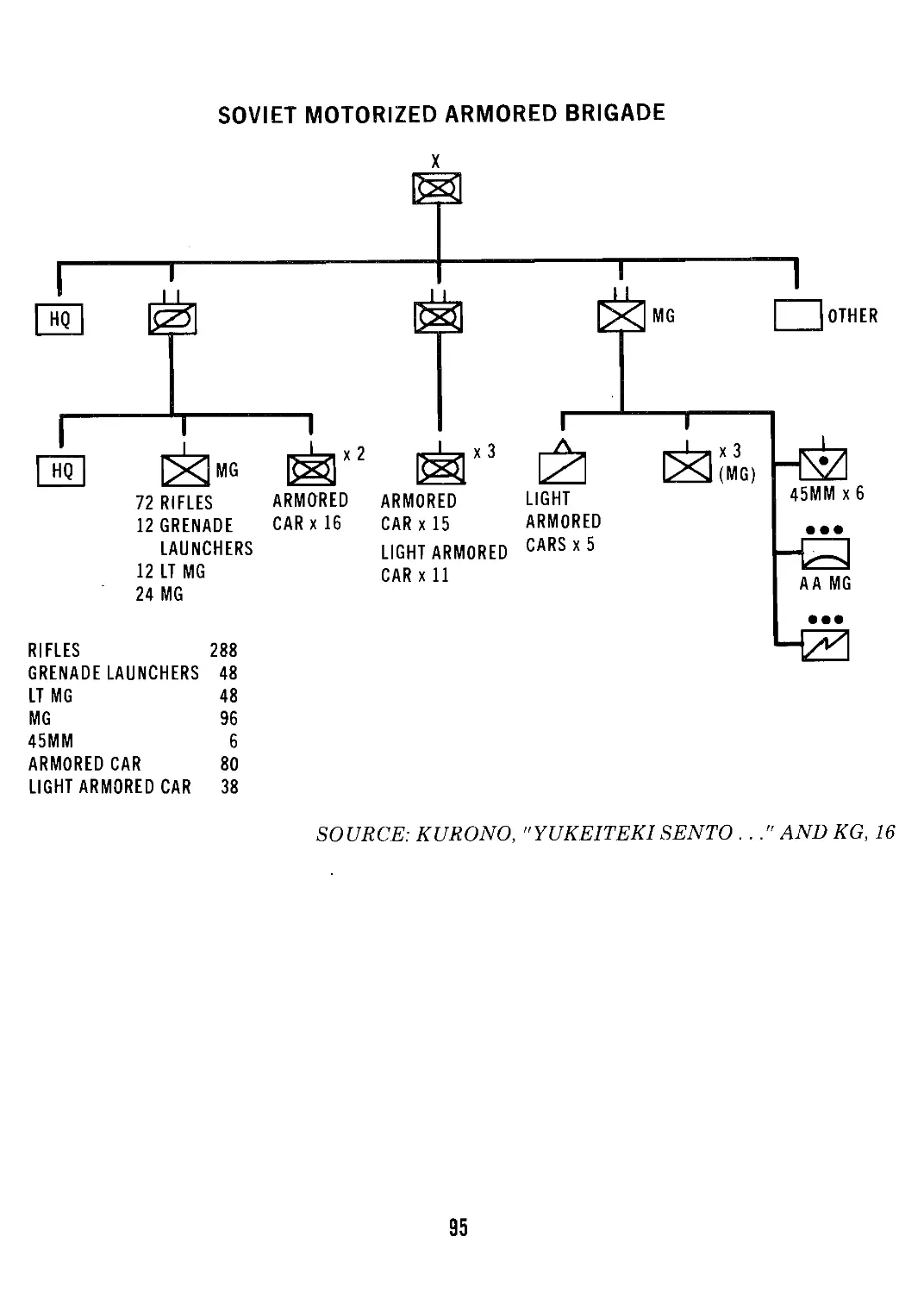


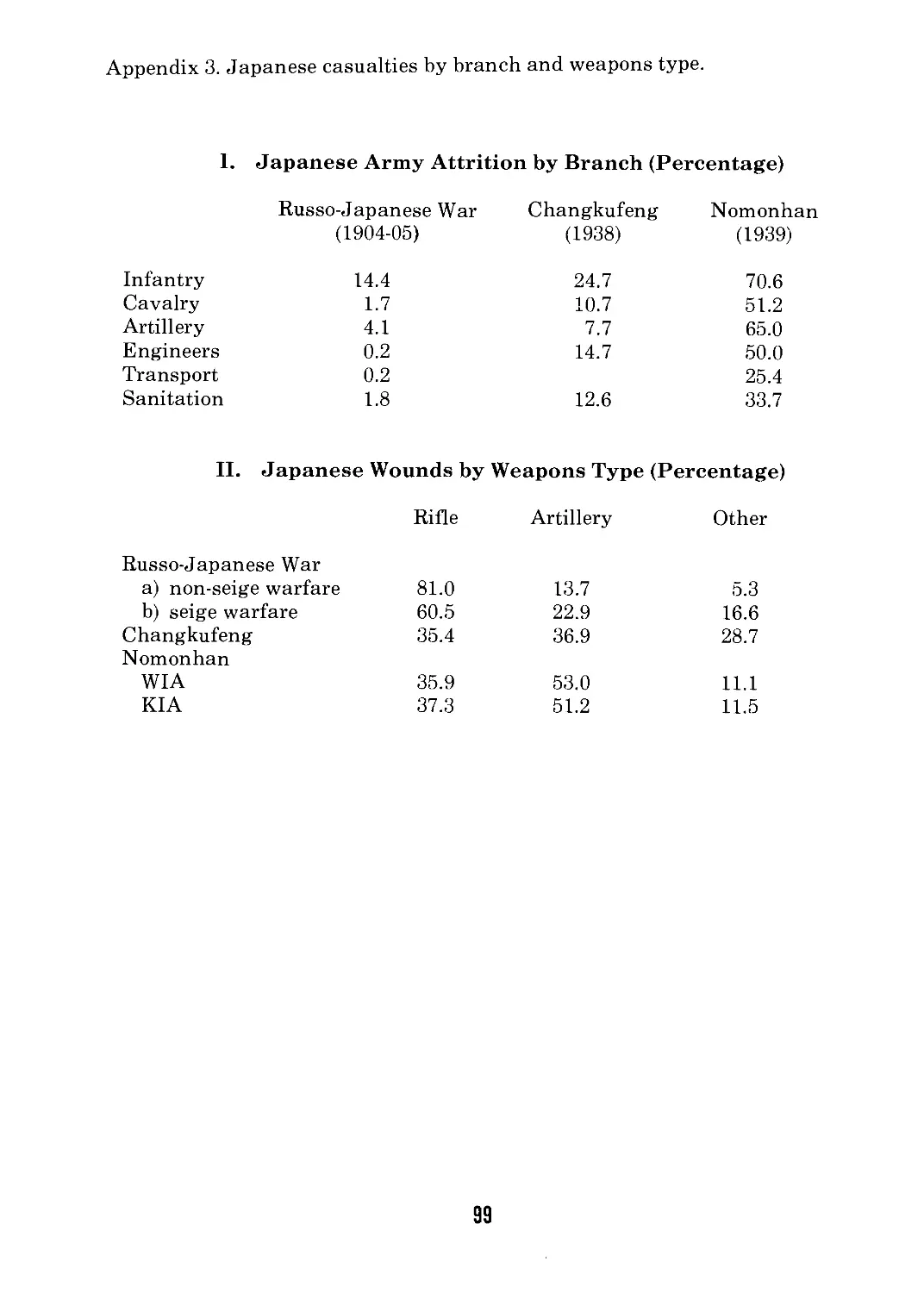









Author: Edward J. Drea
Tags: weapons military affairs military equipment army soviet army
ISBN: 0195-3451
Year: 1981

Text
                    Leavenworth
Papers
No. 2
Nomonhan:
Japanese-Soviet Tactical Combat,
1939
by Edward J. Drea
Combat Studies Institute
U.S. Army Command and General Staff College
Fort Leavenworth, Kansas 66027
JANUARY 1981
----------------------------------FORE WORD------------------------------------------------
Military history is the peacetime laboratory for the professional soldier. As duPicq reminds us, "only
study of the past can give us a sense of reality and show us how the soldier will fight in the future."
Serious study of our profession helps narrow the gap between training and battle. Publication and
dissemination of tactical battle studies is the central focus of the Combat Studies Institute and the
Leavenworth Paper series.
At first glance, the study of the Imperial Japanese Army fighting the Soviet Red Army would appear
to have little pertinence to the current doctrinal concerns of the U.S. Army. The great advances in
weapons technology seem to relegate the Nomonhan fighting to antiquarian status as remote as the
Outer-Mongolian border where the battle occurred. However, Dr. Edward J. Drea's, Nomonhan:
Japanese-Soviet Tactical Combat, 1939, which is the second publication in the Leavenworth Paper
series, goes beyond the mere narration of a remote combat engagement.
At its most basic level, this study provides an insight into how two foreign armies conducted field
operations in the days just before World War II. Of particular interest is the manner in which Japanese
stereotypes of Soviet tactics and doctrine adversely influenced the Japanese operations. At an interme-
diate level, this essay describes the Imperial Japanese Army's formulation of operational doctrine and
the application of that doctrine against the Red Army. It clearly reveals that doctrine must be dynamic in
both formulation and application; the theoretical must be relevant to the reality of the battlefield. Finally,
the paper makes us aware of the human factor in combat. Outnumbered, outgunned, and outmaneu-
vered, the Japanese officers and men of the 2d Battalion, 28th Infantry Regiment, 7th Infantry Division,
held their positions until they received orders to withdraw. Tradition, unit esprit, training, and doctrine
all contributed to this exceptional display of courage in the face of awesome enemy superiority.
Today the U.S. Army stresses the concept of fighting outnumbered and winning. To achieve that
difficult feat of arms will require thorough preparation and intensive, realistic training before the first
battle of the next war. This account of how the Imperial Japanese Army prepared for its "first battle"
should help us profit from the Japanese experience against a formidable Soviet enemy. While it points
out errors, it also identifies several Japanese strengths which almost prevailed against the greatest
concentration of armor and mechanized forces then к/town.	л л
WILLIAM R. RICHARDSON
Lieutenant General, USA
Commanding
Director
Colonel William A. Stofft
John F. Morrison Professor of Military History
Dr. D. Clayton James
Combined Arms Center Historian
Dr. Roger J. Spiller
Chief. Research Committee
Lieutenant Colonel Kenneth A. Steadman.
Research Fellows
Lieutenant Colonel Richard G. Brown
Major Charles E. Heller
Dr. Allen F. Chew
Dr. Edward J. Drea
Chief. Teaching Committee
Lieutenant Colonel David M. Glantz
Teaching Fellows
Major Robert K. Griffith, Jr.
Major Thomas W Sweeney
Captain Patricia B. GenLing
Dr Robert H. Berlin
Dr. Michael J King
CSM Kenneth Chavis. Jr.
Bibliographer
Elizabeth R. Snoke
Editor
Alice M. McCart
Staff
Major Scott L. Hays
SFC Nelson C. Rogers
SP4 Daisy M. Wilson
Mrs. Terri L. Castillo
The Leavenworth Papers are issued by the
Combat Studies Institute, an element of the
U.S. Army Command and General Staff Col-
lege, Fort Leavenworth, Kansas 66027. The
views expressed is this publication are those
of the author and not necessarily those of the
Department of Defense or any element there-
of. Requests for additional copies or for per-
mission to reprint Leavenworth Papers in
whole or part should be addressed to the Di-
rector, Combat Studies Institute, U.S. Army
Command and General Staff College, Fort Leav-
enworth, Kansas 66027.
Leavenworth Papers US ISSN 0195-3451
Leavenworth
Papers
No. 2
Nomonhan:
Japanese-Soviet Tactical Combat,
1939
by Edward J. Drea
Combat Studies Institute
U.S. Army Command and General Staff College
Fort Leavenworth, Kansas 66027
JANUARY 1981

Contents
Maps.....................................................v
Acknowledgments........................................vii
Introduction............................................ix
1.	THE NOMONHAN CAMPAIGN (MAY-SEPTEMBER 1939):
A SUMMARY
Japanese Initiatives ................................ 1
The Soviet Offensive .............................. 9
2.	MEN, DOCTRINE, WEAPONS
Manchuria in the Middle .................................12
Preliminary Skirmishes ............................14
Weapons and Doctrine ..............................16
Terrain ...........................................21
First Japanese Defeat..............................28
Mobilization of the 2/28th Infantry ...............29
Japanese Stereotypes of the Soviets ...............30
3.	THE IMPERIAL JAPANESE ARMY’S JULY OFFENSIVES
Overview ................................................32
Meeting Engagement ................................34
Night Attack I and Soviet Retaliation .............45
Redeployment ......................................47
4.	STALEMATE AND ATTRITION
Hills 742 and 754 .......................................53
Soviet Tactics ....................................59
Position Defense ..................................61
Night Attack II....................................66
5.	SOVIET STYLE BLITZKRIEG
Japanese Intelligence Failures ..........................71
Soviet Fixing Attacks .............................72
Encirclement of the 2/28th Infantry ...............77
iii
6.	CONCLUSION
Outcome............................................. 86
Doctrine ...................................... 86
The Cost of Courage............................ 89
Doctrinal Implications for the IJA............. 90
Appendixes.......................................... 91
Notes................................................ 101
Bibliography......................................... 109
iv
Maps
1.	Opposing orders of battle.................................. 2
2.	Disputed border area between Nomonhan and
Khalkhin Gol in 1939 .......................................... 3
3.	Destruction of Lieutenant Colonel Azuma’s
reconnaissance unit 28 May 1939 ............................... 5
4.	Japanese general offensive 1—4 July 1939 .................. 6
5.	Japanese general offensive 23—25 July 1939 ................ 8
6.	Soviet plan of operations 20 August 1939.................. 10
7.	Terrain features and roads near Nomonhan in 1939 ......... 22
8.	- The 250-kilometer radius of operations from major
Japanese and Soviet bases..................................... 25
9.	Transportation facilities ................................ 26
10.	Japanese offensive 3—5 July 1939 ......................... 38
11.	7th Company, 2/28th Infantry’s destruction of attempted
Soviet infiltration 7 July 1939 .............................. 44
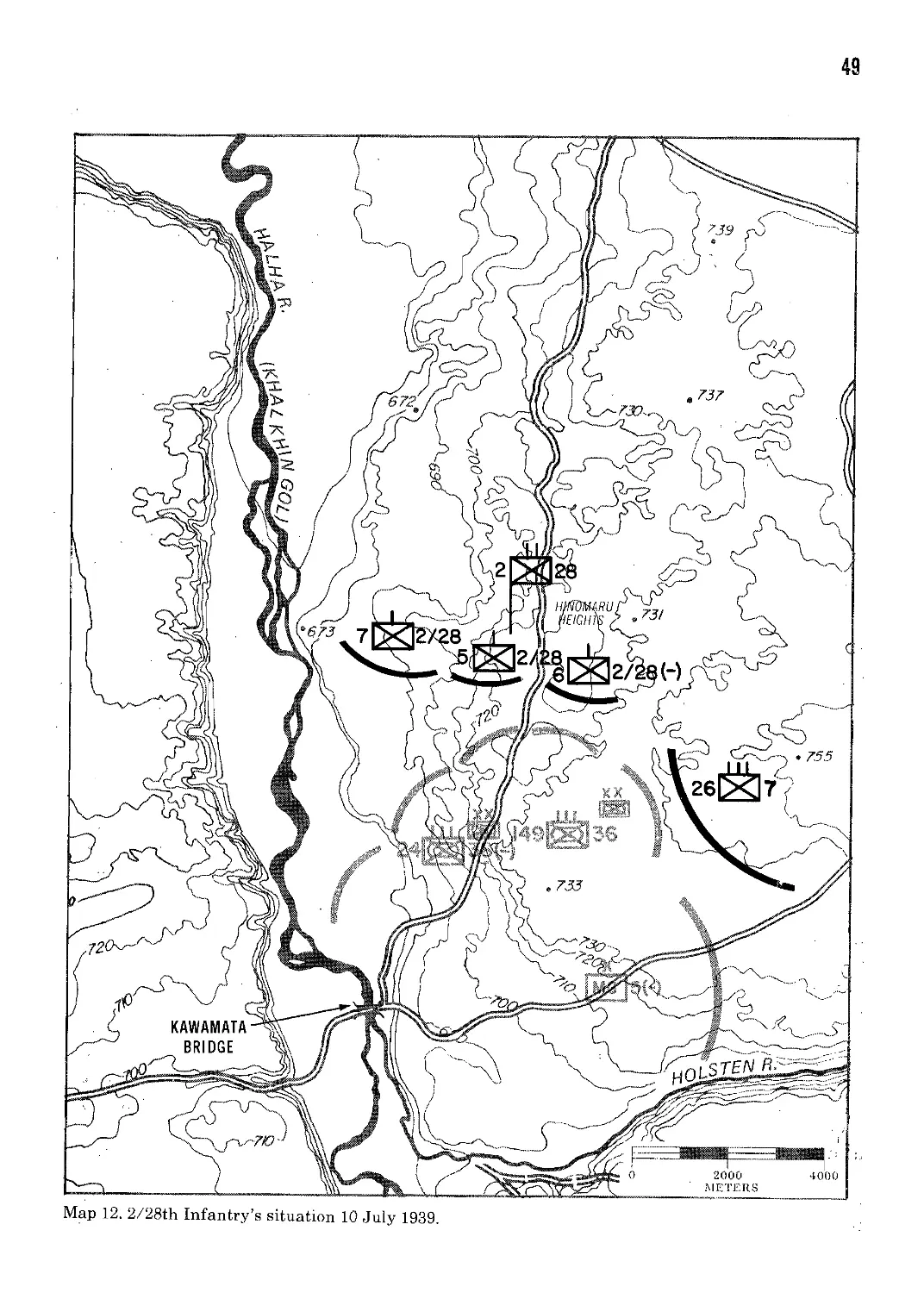
12.	2/28th Infantry’s situation 10 July 1939 ................. 49
13.	2/28th Infantry redeployment south of the
Holsten River 28 July 1939 ................................... 55
14.	General situation south of the Holsten River early
August 1939 .................................................. 58
15.	Annihilation of Soviet infiltration attempt
8 August 1939...............................................   63
16.	6th Company, 2/28th Infantry, night attack on Soviet
positions 18—19 August 1939 .................................. 68
17.	Soviet offensive south of the Holsten River
20—31 August 1939 ............................................ 74
18.	Soviet gains to 26 August 1939 ........................... 81
19.	Breakout of 2/28th and situation as of 28 August 1939..... 85
v

A CKNO WLEDGMENTS
Many persons have contributed their time helping in the prepa-
ration of this monograph. Special thanks must be given to the
Military History Department staff of the Japan National Defense
College whose kind assistance made it possible to assemble most
of the documents used in this study. In particular, LTG (RET)
Toga Hiroshi, director of the Military History Department, al-
lowed me access to the IJA archive holdings at the College.
Messrs. Kondo Shinji and Arima Seiichi provided valuable advice,
suggestions, and graciously agreed to read the manuscript. LTC
Inoue Motomu acted as my escort at the College and continues to
be a source of information of Japanese military history. Without
such able professionals, this paper could not have been written.
vii

INTRODUCTION
“A Strange War,” observed a 20 July
1939 New York Times editorial about
the fighting between the Soviet Red
Army and the Imperial Japanese Army
on the Mongolian steppes. The Times
derided both combatants’ claims as ex-
aggerated but inadvertently touched on
the distinctive feature of the fighting
when it described the battle as “raging
in a thoroughly out-of-the-way corner
of the world where it cannot attract a
great deal of attention.”1 Geography,
the combatants’ compulsive secrecy, and
the subsequent outbreak of World War
II in September 1939 all combined to
overshadow the most massive use of
tanks theretofore recorded. The Soviets
used over 1,000 tanks during the fight-
ing and, under the command of Gen-
eral Georgi K. Zhukov, evidenced skill
and sophistication at mechanized war-
fare. The Imperial Japanese Army
(IJA), essentially an infantry force,
fared poorly, and fell victim to a Soviet
double envelopment.
While this “Strange War” may be
all but forgotten in the West, the Sovi-
ets continue to regard it as a brilliant
example of the proper manner in which
to fight a limited border war. During
the time of border clashes with the Peo-
ples’ Republic of China in 1968 and
1969, it was no coincidence that several
articles about the 1939 border war ap-
peared in Soviet military journals. At
least a dozen such articles have ap-
peared in Soviet military literature in
the 1970s. Soviet experience gained in
1939 apparently still carries great
weight today.
Similarly, IJA staff officers subse-
quently examined the Japanese
Army’s performance at Nomonhan in
minute detail, and even today the bat-
tle serves as a case study at the ad-
vanced tactical schools of the Japanese
Ground Self Defense Forces. The inter-
est of an ally and of a potential adver-
sary suggests that it would be benefi-
cial for the U.S. Army to know what
happened at Nomonhan/Khalkhin Gol
in the summer of 1939.
Yet little on the subject has ap-
peared in English.2 Furthermore, Japa-
nese studies and the few accurate Eng-
lish language accounts tend to focus on
affairs at the division level or above.
The purpose of this paper is to examine
the battalion and company level tactics
that Japanese infantrymen used to
fight the Soviets and the degree of suc-
cess those tactics achieved.
All modern armies have a tactical
doctrine, the officially approved meth-
od for their various units to fight on
the battlefield. The IJA invested much
ix
time, talent, and treasure to formulate
a tactical doctrine that would be suc-
cessful against their potential enemy,
the Soviets, who were superior to the
IJA in manpower and materiel. This
essay briefly describes the evolution of
that IJA tactical doctrine, and then pre-
sents a detailed examination of how a
particular Japanese infantry battalion
applied that tactical doctrine in combat
against the Soviets in 1939.
Looking at a small unit in combat
allows the historian the chance to anal-
yze and to scrutinize, doctrine in the
test of battle. Such an approach, in
turn, surfaces questions about the flexi-
bility, applicability, and effectiveness
of doctrine which should concern all
armies.
The day-by-day account of a single
Japanese battalion in battle is not,
however, a comprehensive treatment of
the entire Nomonhan fighting. Ordi-
nary Japanese combat infantrymen,
like those of any army, did not have
the time to reflect on whether or not
their fighting techniques followed offi-
cial IJA doctrine. The Japanese private,
clinging to a sand dune during an en-
emy artillery barrage, could not have a
clear grasp of the overall battle, the so-
called “Big Picture,” which retrospect
provides. He received orders and car-
ried out those orders based on his previ-
ous training. His was a limited but
unique view of land warfare. Here an
overview of the Nomonhan campaign
is provided, but the theme is small unit
tactics and the focus is the battalion,
the microcosm, not the division or the
army.
The IJA’s 2d Battalion, 28th Infan-
try Regiment, 7th Infantry Division
(2/28th Infantry), serves as the vehicle
for this study. There are several rea-
sons for the selection of this particular
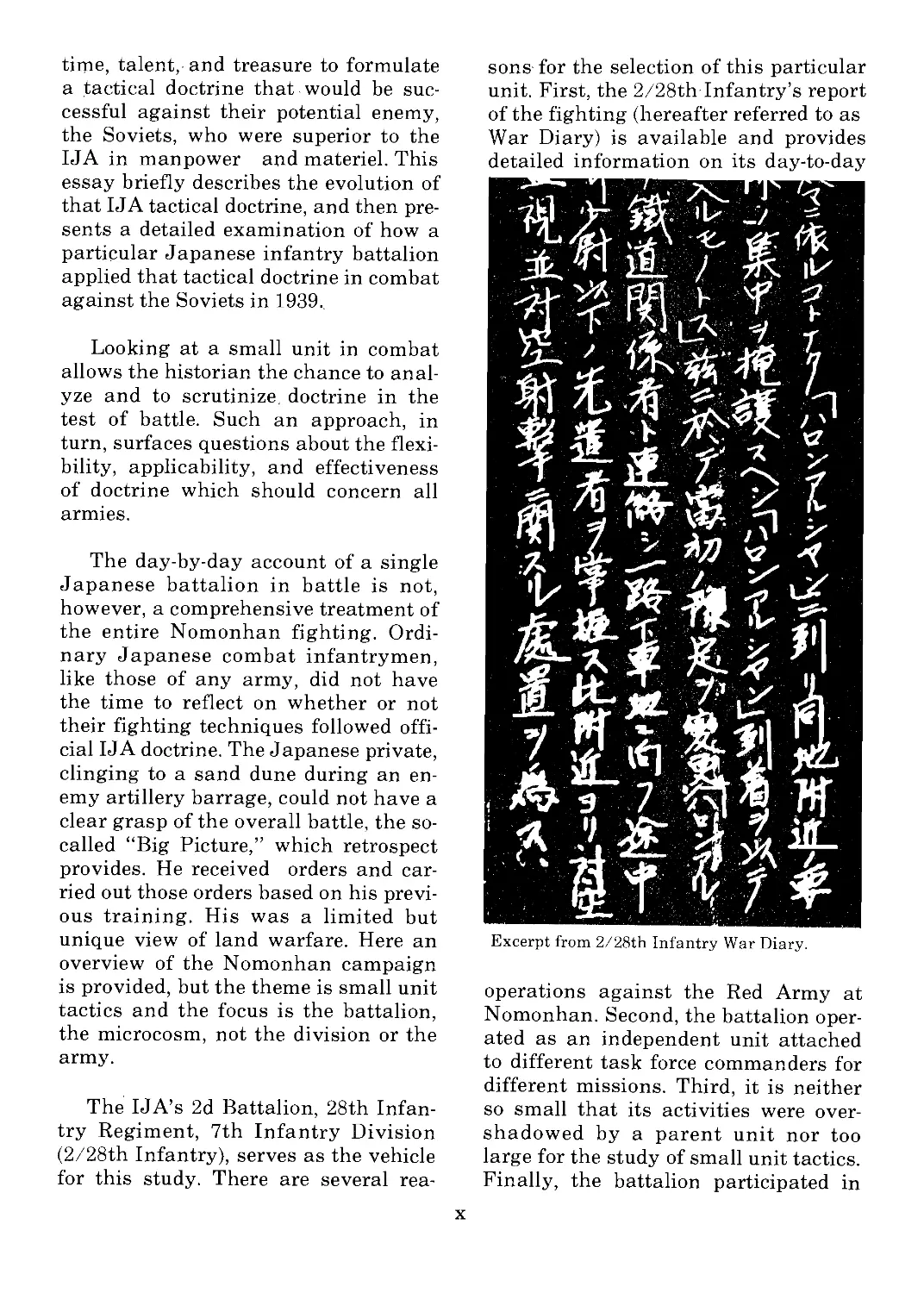
unit. First, the 2/28th Infantry’s report
of the fighting (hereafter referred to as
War Diary) is available and provides
detailed information on its day-to-day
Excerpt from 2/28th Infantry War Diary.
operations against the Red Army at
Nomonhan. Second, the battalion oper-
ated as an independent unit attached
to different task force commanders for
different missions. Third, it is neither
so small that its activities were over-
shadowed by a parent unit nor too
large for the study of small unit tactics.
Finally, the battalion participated in
x
both offensive and defensive opera-
tions against the Red Army, providing
an insight into IJA tactics for each
situation.
The primary documents used in this
study are in the IJA archives, which
are open to the general public. One col-
lection is available on microfilm in the
U.S. Library of Congress. The original
documents are kept at the National De-
fense College Archives in Tokyo, Ja-
pan. These IJA documents were origi-
nally classified materials, and I have
included the original military classifi-
cation when citing the documents to
allow the reader to have a sense of the
importance that the IJA attached to
these papers. Throughout this study all
Japanese personal names are given in
the Japanese manner, surname preced-
ing given name.
Edward J. Drea
Combat Studies Institute
U.S. Army Command and General
Staff College
Fort Leavenworth, Kansas
xi
The Nomonhan Campaign
(May—September 1939):
A Summary
Japanese Initiatives
The Imperial Japanese Army’s take-
over of Manchuria in 1931 brought Jap-
anese and Soviet armed forces eyeball
to eyeball along a 3,000-mile border.
Numerous border skirmishes and dis-
putes characterized the next several
years as both sides reinforced their re-
spective forces. In 1936 the Soviets
signed a mutual assistance treaty with
Outer Mongolia, and in January 1937
the Soviet High Command organized
the 57th Special Rifle Corps consisting
of the 36th Motorized Rifle Division,
6th Cavalry Brigade, 11th Tank Bri-
gade, and 7th, 8th, and 9th Armored
Car brigades. These units moved into
Outer Mongolia in 1938.1
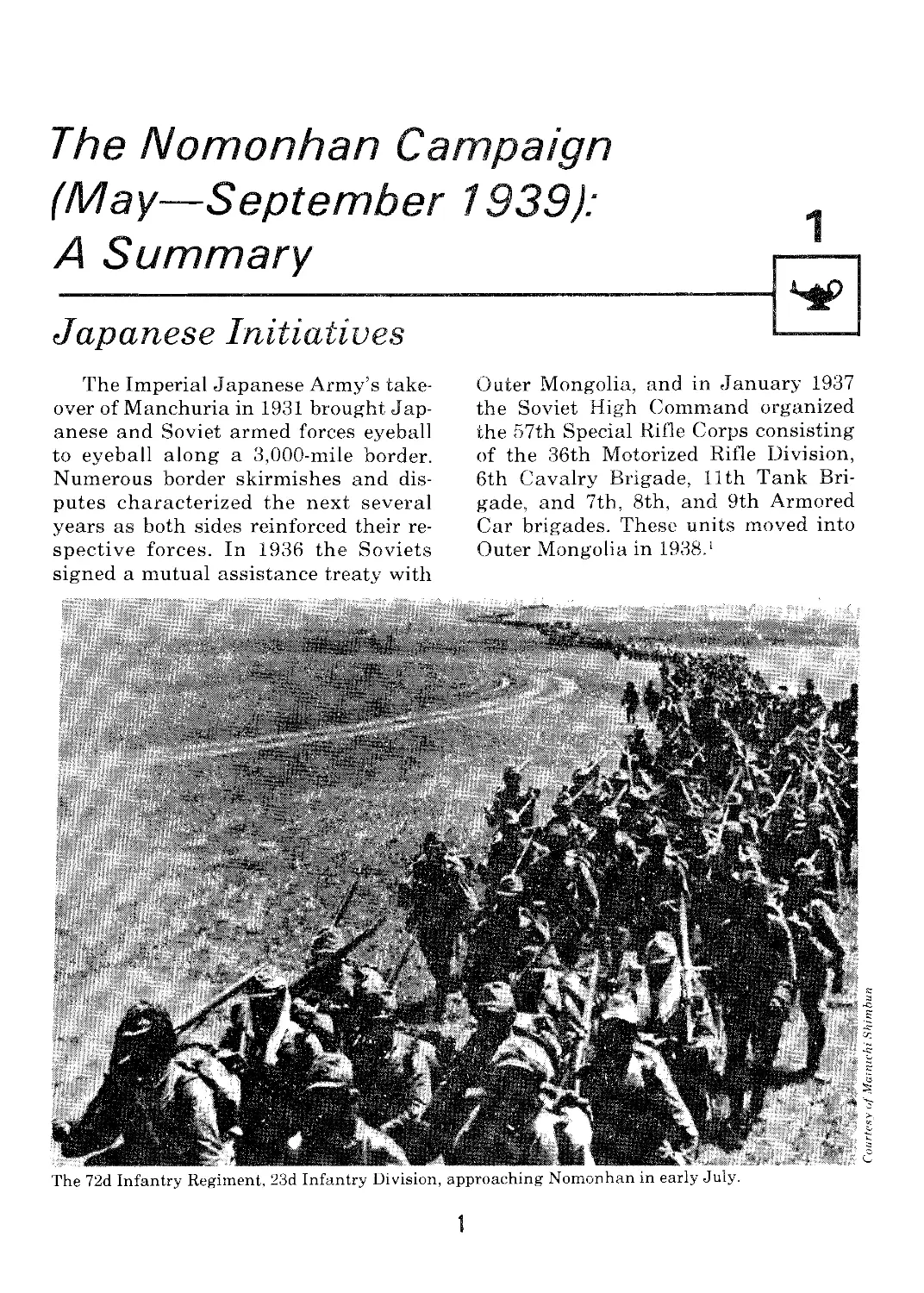
The 72d Infantry Regiment, 23d Infantry Division, approaching Nomonhan in early July.
Map 1. Opposing orders of battle.
3
An especially bloody affray at
Changkufeng/Lake Khasan in 1938 re-
sulted in over 2,500 casualties on both
sides. It also seemed to stiffen Soviet
resolve because the following year, Jo-
seph Stalin, speaking before the
Eighteenth Soviet Party Congress in
March 1939, warned that any acts of
aggression against the inviolable So-
viet frontiers would be met by twice the
force of any invader. Two months later,
a handful of Soviet allied Outer Mongo-
lian cavalry troops wandered into a
disputed border area between the
Halha River (Soviet name, Khalkhin
Gol) and the tiny village of Nomonhan.
The Japanese claimed that the
boundary followed the river, but the
Soviets maintained that it passed just
east of the village of Nomonhan.
Map 2. Disputed border area between Nomonhan and Khalkhin Gol in 1939.
4
On 11 May 1939 Japanese sponsored
Manchukuoan* cavalrymen drove the
Outer Mongolians back across the
Halha River. Two days later, however,
the Outer Mongolian cavalry forces re-
turned to the same location, but the
Manchukuoan troops were unable to
evict them. The Japanese Kwantung
Army, the designation for Japanese
forces stationed in Manchukuo, then
stepped into the act. Its 23d Infantry
Division was responsible for border se-
curity in the region where the skir-
mishes had occurred. The commander
of the 23d Division ordered its 64th
Infantry Regiment (minus two compa-
nies) and its reconnaissance element to
drive the Mongolians from the Japa-
nese claimed border area.
LTC Azuma Yaozo on 14 May led
the reconnaissance element into the dis-
puted territory, but the Outer Mongo-
lian troops refused to fight and re-
treated across the Halha. A Soviet and
Outer Mongolian build-up, however, con-
tinued in the area, and Azuma returned
one week later to oust the intruders.
This time the enemy surrounded and
annihilated Azuma’s force. Despite this
bloody setback, the Kwantung Army
wanted to drop the matter, but more
*The Japanese established a puppet state of
Manchukuo in 1932 in the Chinese provinces
known collectively as Manchuria.
and more Soviet troops poured into the
area. (See Map 3.)
The Kwantung Army decided that a
division size attack was needed to oust
the Soviets and their allies. This opera-
tion began on 1 July when the 23d
Division’s 71st and 72d Infantry Regi-
ments seized the high ground overlook-
ing the Halha about eighteen kilome-
ters north of its confluence with the
Holsten River. On 2 July this force
crossed the Halha and drove Soviet
units from Baintsagan Heights. Simul-
taneously, an armored task force con-
sisting of the 3d and 4th Tank Regi-
ments (seventy-three tanks total), the
64th Infantry Regiment, and the 2d
Battalion, 28th Regiment, 7th Infantry
Division, attacked Soviet positions on
the Halha’s east bank. (See Map 4.)
Although initially successful, the Jap-
anese drive on the Halha’s west bank
stalled by dusk of 3 July. General
Zhukov, realizing the Japanese threat
to his artillery on the west bank, com-
mitted his 11th Tank Brigade (minus
one battalion), 7th Motorized Armored
Brigade, and the 24th Motorized Rifle
Regiment of the 36th Motorized Rifle
Division, including approximately 186
tanks and 266 armored cars, against
the Japanese forces on the west bank.
Zhukov accepted the risk of sending
Japanese infantry with heavy machine gun operating on west bank of Halha probably on 3 July. Note
two Soviet armored cars.
5
Map 3. Destruction of Lieutenant Colonel Azuma’s reconnaissance unit 28 May 1939.
6
Map 4. Japanese general offensive 1—4 July 1939.
7
armor unsupported by infantry against
the Japanese soldiers because his own
infantry formations still had not ap-
peared at the front, and he believed
that to await their arrival would
squander an opportunity to destroy the
Japanese.
The unsupported Soviet tanks and
armored cars rolled forward and did
blunt the Japanese offensive. The cost,
however, to both sides was high. Japa-
nese troops destroyed at least 120 Sovi-
et tanks or armored cars with Molotov
cocktails, 37-mm antitank guns, and
antitank mines. The Japanese, in turn,
lost several hundred troops killed or
wounded. Moreover, the Japanese
forces depended for resupply on one
pontoon bridge across the Halha, the
rest of the Japanese bridging equip-
ment having been diverted to the China
front. This single bridge proved unable
to handle the amount of ammunition
and equipment required if the Japa-
nese were to continue the battle. Over
the next two days, consequently, the
Japanese withdrew to the east bank of
the Halha.
Meanwhile both Japanese tank regi-
ments operating on the east bank had
failed to break through Soviet defenses
despite the loss of half their armor. The
64th Infantry and 2/28 Infantry also
could not penetrate Soviet lines. After
the repulse of this two-pronged attack,
the battle centered on Japanese at-
tempts to wrest Hill 733 from the So-
viets.
From 7 through 22 July, a four-kilo-
meter wide front stretching from the
Holsten River to just north of Hill 733
was the location of the heaviest fight-
ing. The Soviets continued to reinforce
their positions, as the 24th Motorized
Rifle Regiment, 11th Tank Brigade,
149th Motorized Rifle Regiment, 5th
Machine Gun Brigade, and 602d and
603d Rifle Regiments of the 82d Rifle
Division established themselves on the
Halha’s east bank.
Unable to evict the Soviets from the
east bank, the Japanese moved in more
artillery guns to prepare for a late-July
general offensive. The Soviets also in-
creased their artillery, placing twenty-
four artillery pieces on the east bank
and another seventy-six on the west.
By shipping artillery units to Man-
chukuo from Japan, the Japanese man-
aged to accumulate eighty-two artillery
weapons. (See Map 5.)
On 23 July the 64th and 72d Infan-
try Regiments launched a frontal at-
tack against elements of the 11th Tank
Brigade, 149th Motorized Rifle Regi-
ment, and 5th Machine Gun Brigade.
The Japanese had expected that their
intense artillery preparation would si-
lence the Soviet artillery batteries and
allow the Japanese infantry to drive
the Soviet infantry back across the Hal-
ha. Soviet gunners quickly disabused
them of that erroneous notion. Even
though Japanese artillery pieces fired
over 25,000 rounds from 23 to 25 July,
the Soviets responded with a greater
volume of counterfire. While the Japa-
nese did succeed in pushing the Soviets
back, Japanese casualties continued to
be heavy. More than 5,000 Japanese
troops had been killed or wounded from
late May through 25 July.
After the limited Japanese gains,
both sides settled down to a war of
attrition along a thirty-kilometer front.
North of the Holsten River, a Japanese
reconnaissance unit guarded the north-
ern flank from Hill 721. About twelve
kilometers south, the 1st Battalion,
26th Infantry Regiment, and the 64th
8
Map 5. Japanese general offensive 23—25 July 1939.
9
and 72d Infantry Regiments held the
line. The Soviet 36th Motorized Rifle
Division and <5th Machine Gun Brigade
opposed these forces. South of the Hol-
sten, the 8th Border Guards Regiment,
2/28th Infantry Battalion, and 71st In-
fantry Regiment held a fifteen-kilome-
ter front. The Soviet 82d Rifle Division
opposed them.
The Soviet Offensive
Throughout early August, probing
attacks and occasional battalion-sized
assaults by the Soviets characterized
the activity on the battleground. Soviet
artillery gained superiority and daily
pounded Japanese positions. At the
same time General Zhukov built up his
forces in preparation for a great Soviet
offensive. The Soviets completed these
preparations in complete secrecy, con-
cealing the movement and disposition
of their forces.
Zhukov launched his offensive along
a thirty-kilometer front and caught the
Japanese defenders offguard. He con-
centrated two rifle divisions, two caval-
ry divisions, a motorized rifle division,
a machine gun brigade, two tank bri-
gades, and two motorized armored bri-
gades against slightly more than two
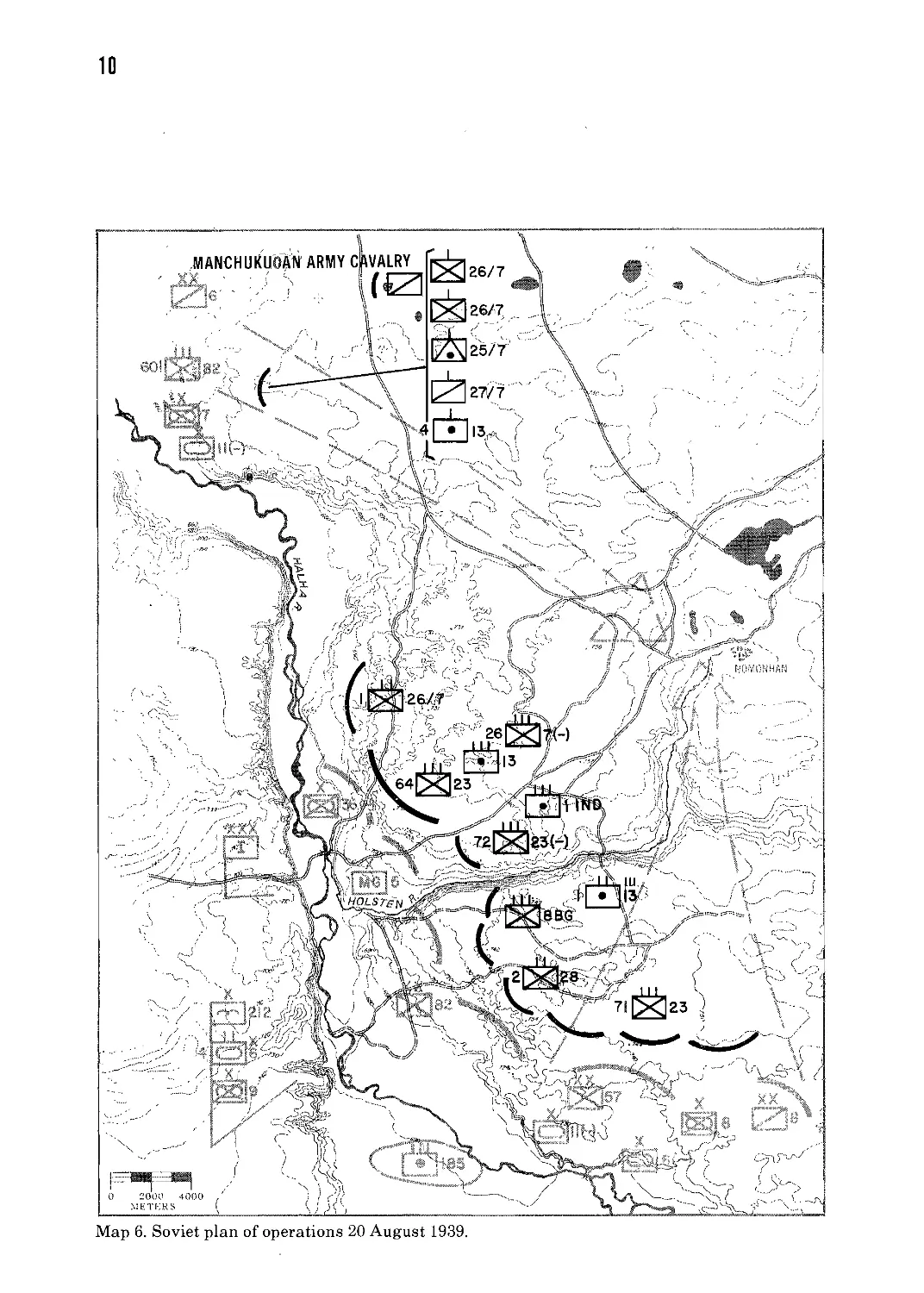
Japanese infantry divisions. (See Map
6.)
M inp iv < t '<7 nun
Battalions	35
Armin'i d ( .irs>	 lh
Fighting was savage. The 7th Moto-
rized Armored Brigade and 601st Rifle
Regiment stormed Hill 721 but failed to
take the heights. In the center, Soviet
units had the responsibility to engage
as many Japanese forces as possible so
that the Japanese would be unable to
reinforce their flanks. The southern
front was where Zhukov concentrated
his armor, over 320 tanks plus an ar-
mored car brigade. Supported by an
infantry division, the armor quickly
turned the Japanese left flank and
drove north toward Nomonhan.
Due to the ferocity of the fighting on
Hill 721, the commander of the 23d
Division mistakenly believed that the
main Soviet thrust was directed against
his right flank. As he sent reinforce-
ments to the north, the strong Soviet
armor units to the south cracked
through Japanese defenses and iso-
lated the 8th Border Guards Regiment
and 2/28th Infantry Battalion. Four
days of bitter fighting broke the Jap-
anese defense of Hill 721, and the So-
viet northern pincer then rushed south
to complete the encirclement of the 23d
Division.
The Soviets apparently were con-
tent with driving Japanese units east
of Nomonhan, but they also may have
lacked the resources in manpower and
materiel to conduct a vigorous pursuit.
As the Soviet offensive halted and Sovi-
et troops dug in, a new blitzkrieg style
of warfare unveiled itself on the plains
of Poland. Faced with the drastically
new situation in Europe, the antago-
nists at Nomonhan/Khalkhin Gol sus-
pended major military operations. The
tempo of diplomatic negotiations al-
ready underway between Japan and
the Soviet Union quickened and the
fighting diminished in early Septem-
ber. A cease-fire was declared on 16
September. Japanese losses in the four
months of fighting were extremely
heavy: over 17,000, including 8,440
10
Map 6. Soviet plan of operations 20 August 1939.
killed and 8,766 wounded. Soviet casu-
alties were given as 9,284 killed and
wounded.
With this brief outline of the fight-
ing at Nomonhan/Khalkhin Gol as
background, a detailed examination of
the action of the Imperial Japanese
Army’s 2d Battalion, 28th Infantry
Regiment, 7th Infantry Division, will
11
illustrate the types of problems and the
difficulties Japanese infantry encoun-
tered when fighting the Soviets. It will
also illuminate Japanese and Soviet
small unit tactics and doctrine of that
period and give the reader the opportun-
ity to gain an appreciation of why an
outnumbered and weary Japanese bat-
talion continued to fight against enor-
mous odds.
Men, Doctrine, Weapons
Manchuria in the Middle
From the beginning of the twentieth
century, the Imperial Japanese Army
regarded Czarist Russia and later the
Soviet Union as its primary potential
opponent. Japanese successes in the
Russo-Japanese War (1904-1905) tempo-
rarily removed the Russian threat and
placed IJA units on permanent garri-
son duty in Manchuria, the main battle-
ground of that war. Following the crea-
tion in 1905 of a governor-general’s of-
fice (directed by an IJA general) to
oversee Japanese interests along the
South Manchurian Railroad, troops
from two IJA divisions remained in
Manchuria to protect Japanese lives
and property. These units were eventu-
ally rotated back to Japan, and by 1910
six battalions composed of reservists
formed the independent garrison unit
and thereafter assumed responsibility
for the defense of Japanese interests in
Manchuria. IJA regulars replaced the
reservists in 1916, and in 1919 Army
Order Number Twelve established
Headquarters Kwantung Army to con-
trol IJA garrison units in Manchuria.
The Japanese contingent mustered
about 10,000 troops.
Kwantung Army headquarters staff
officers regarded themselves as the
guardians of Japan’s frontiers, in Man-
churia’s case a frontier for which over
160,000 Japanese casualties in the
Russo-Japanese War had paid in blood.
They came tb believe that the War Min-
istry and General Staff officers in To-
kyo did not fully realize the dangers
posed by the Soviet Union to Japanese
holdings in Manchuria. To meet this
threat, Kwantung Army officers took
unilateral action to manufacture a
casus belli between Japan and a Man-
churian warlord that ultimately en-
abled Kwantung Army units to extend
their control throughout Manchuria.1
Following this so-called Manchurian
Incident of 1931, Kwantung Army staff
officers quickly forced the creation in
early 1932 of a puppet state called Man-
chukuo.
Although the Kwantung Army had
rapidly conquered Manchuria and with
equal speed created a satellite state, its
ultimate success could not be assured
as long as the Soviet Union threatened
the new Japanese possession on three
sides. Kwantung Army officers and,
eventually after accepting the fait ac-
compli, their counterparts on the gen-
eral staff in Tokyo viewed the creation
of Manchukuo as an intermediate step
in Japanese preparations for a war
with the Soviets. The IJA, by exploit-
ing the rich natural resources of Man-
chukuo, could renovate and modernize
itself for the impending struggle. In
1937, however, the Japanese found
12
13
themselves fighting an unplanned war
against China—a classic case of the
wrong war at the wrong place at the
wrong time against the wrong enemy.
As casualty lists from the China
theater mounted (100,000 Japanese
troops killed or wounded by December
1937), War Ministry and General Staff
officers tried to bring hostilities to a
rapid conclusion. In general terms,
these officers may be divided into ex-
pansionists and anti-expansionists.
The expansionists believed that any
show of weakness by the Japanese
would only encourage Chinese resist-
ance. Only smashing military force
would convince the Chinese of their
errors. The anti-expansionists viewed
the China War as a debilitating effort
that was bleeding the IJA white while
the main enemy, the USSR, continued
a military build-up in the Soviet Far
East and menaced Japan and Manchu-
ria from the north. A common denomi-
nator between the two groups was that
both accepted the premise that the Sovi-
ets were indeed Japan’s number one
foe. The expansionists preferred to elim-
inate by military force any potential
Chinese threat to the Japanese flank in
operations against the USSR. The anti-
expansionists opted to end the sense-
less drain on IJA resources in order to
use such resources to prepare for war
with the USSR. Yet Japan’s military
and civilian leaders discovered no solu-
tion to stop the fighting, and by 1939
the IJA had twenty-five infantry divi-
sions, and about one million men total,
committed on the endless China front.
Since the Kwantung Army’s mis-
sion, the protection of Manchukuo from
Soviet aggression, remained un-
changed, its main forces were not en-
gaged in the China fighting. The IJA
continued to strengthen and to expand
forces assigned to the Kwantung Army,
whose size almost doubled from five in-
fantry divisions in 1937 to nine infan-
try divisions by 1939 while that of the
IJA rose from twenty-four to forty-one
divisions. Nor was it difficult for the
Kwantung Army to justify such troop
augmentations. Increasing numbers of
incidents—border violations, shootings,
kidnappings—led in turn to increases
in border security—pillboxes, barbed
wire obstacles, new border guard
units—all along the 3,000-mile Soviet
Manchukuoan border.2 As early as
1936 clashes between Soviet and IJA
units involving mechanized forces and
aircraft had occurred.
It became a vicious circle. As the
Kwantung Army grew, so did the Red
Army, from six rifle divisions in 1931
to twenty in 1936 with more than 1,000
tanks and a like number of aircraft.
The Special Far Eastern Army became
too large and loomed as a threat to
Stalin. Consequently, in 1935 it lost its
westerly elements with the creation of
the Trans-Baikal Military District. Af-
ter the Lake Khasan Incident in 1938,
Stalin abolished the Special Far East-
ern Army and established the 1st and
2d Special Red Banner Armies, respon-
sible for the Ussuri and Amur areas
respectively, both directly subordinate
to the Defense Commissariat. Also in
1938 the 57th Special Rifle Corps
moved into Outer Mongolia.3
In 1938 the IJA’s 19th Infantry Divi-
sion engaged in a bloody twelve-day
struggle with the Red Army in mid-
summer heat at Changkufeng/Lake
Khasan on Korea’s northern border
with the USSR.4 Although the 19th Di-
vision was able to hold the ground until
it had initially seized against fierce So-
viet counterattacks, it suffered heavy
losses. Over 500 Japanese troops were
14
killed and more than 900 wounded. So-
viet losses amounted to 236 killed and
611 wounded.5 In the view of the IJA
staff, however, the Soviets did not dis-
play innovative ground tactics or skill-
ful troop deployments, thus confirming
Kwantung Army observations that the
ongoing purges of the Red Army had
seriously impaired its battlefield effi-
ciency. As a result, in early 1939 Kwan-
tung Army headquarters adopted a
more aggressive series of rules of en-
gagement designed to crush any future
Soviet encroachments on Manchu-
kuoan territory.
Preliminary
Skirmishes
In April 1939 the Kwantung Army
drafted a new operations order called
“Principles for the Settlement of Soviet
Manchurian Border Disputes.” Later
that month the Kwantung Army com-
mander, General Ueda Kenkichi, ex-
plained these new guidelines at a corps
commanders’ meeting.6 Henceforth, ac-
cording to Operations Order Number
1488, Kwantung Army units could pre-
vent both the frequency and escalation
of border incidents by decisively pun-
ishing illegal Soviet violations. The
same order authorized Japanese troops
to invade Soviet or Outer Mongolian
territory as required to achieve their
objectives. In such cases, all Japanese
dead and wounded would be collected
from the battlefield and, along with
enemy corpses or prisoners of war,
would be returned to Manchukuoan ter-
ritory. Locally, aggressive patrolling
was expected and commanders had the
right, in cases where the border was
unclear, to determine the boundary for
themselves.7 Empowered with such
sweeping authority, IJA division com-
manders who were responsible for spe-
cific sectors of the long, unstable border
would be expected to use it.
On 11 May, about two weeks after
the promulgation of the new operations
order, about seventy to eighty Outer
Mongolian cavalry troops armed with
heavy and light machine guns crossed
the Halha River into Manchukuoan-
claimed territory in search of grazing
land and water for their horses. Near
the village of Nomonhan they attacked
a small Manchukuoan security force. A
battalion-size Manchukuoan force in
turn counterattacked the Outer Mongo-
lians and succeeded in driving them
back across the Halha River. The Mon-
golians abandoned five bodies, four
horses, and considerable small arms
and ammunition in their flight. The
next day a like number of Outer Mon-
golian troops appeared southwest of
Nomonhan but a 13 May counterattack
against them by Manchukuoan troops
proved unsuccessful. Such were the be-
ginnings of what the Japanese called
the Nomonhan Incident and the Sovi-
ets, Khalkhin Gol.8
To LTG Komatsubara Michitaro,
commander of the IJA’s 23d Infantry
Division, which was stationed at Hai-
laerh, and in whose area of operations
the incident had occurred, this latest
border skirmish seemed to be typical.
He believed that rapid application of
sufficient force would quickly resolve
the incident. Initial reports, wildly
exaggerated, indicated that approxi-
mately 700 Outer Mongolian troops had
transgressed the boundary. Komatsu-
bara ordered a quick reaction force
composed of the 23d Division’s recon-
naissance element (one cavalry com-
pany, one heavy armored car company,
and a headquarters element—593 men
total) and the 1st Battalion, 64th Infan-
15
LTG Komatsubara Michitaro, Commander, 23d
Infantry Division at Nomonhan.
try Regiment (minus two companies)
with a platoon of 37-mm rapid fire guns
attached, along with 100 automobiles
into the area.9 Japanese staff officers
were having great difficulty even locat-
ing Nomonhan on their operational
maps, so there seemed no reason to
believe that additional force might be
required to resolve the affray. Confi-
dent in their training and tactics, offi-
cers and men of the 23d Division ea-
gerly anticipated putting their long
months of preparation to use in battle.
were first- or second-year soldiers con-
scripted from the southern Japanese
cities of Fukuoka, Kumamoto, Hiro-
shima, and Oita. Traditionally troops
from these recruiting districts proved
to be able fighters, particularly in offen-
sive operations. Imperial General Head-
quarters (IGHQ) had originally organ-
ized the division expecting to use it to
garrison occupied areas in China. How-
ever, given the additional requirement
to strengthen the Kwantung Army,
IGHQ finally assigned the 23d Divi-
sion responsibility for the defense of
Heilungkiang Province in northwest
Manchukuo.10 Despite the quality of its
fighting men, Kwantung Army head-
quarters staff officers regarded the divi-
sion as organizationally deficient to
meet a major Soviet threat.
The maneuver elements of a triangu-
lar division like the 23d had one infan-
try brigade with three infantry regi-
ments attached to it. Regular pre-1937
Kwantung Army divisions, like the 7th
Division, to which the 2/28th Infantry
was attached, were square—two bri-
gades of two regiments each with three
battalions per regiment. The triangular
division had 12,000 men while the
square division had 15,000. Further-
more, the triangular divisions lacked
the artillery power needed to combat a
first-line Soviet division. The 23d Divi-
sion, for instance, had only sixty-five
artillery pieces, including seventeen
37-mm guns, in its Table of Equipment
compared to sixty-four artillery guns
and sixteen 37-mm guns organic to the
7th Infantry Division.11
The 23d Division was a relatively
new division activated in July 1938
and sent to Manchuria for training one
month later. Most of its enlisted troops
16
TOE STRENGTHS FOR JAPANESE AND SOVIET INFANTRY DIVISIONS, 1939
JAPANESE SQUARE DIVISION
75MM x4
JAPANESE TRIANGULAR DIVISION
SOVIET RIFLE DIVISION
XX
5----M	76MM x 24
45MMx6	122MM x 12
76MMx6	г1-1-1!
J
150MM x 24
LIGHT TANKS x 31
AMPHIBIOUS TANKS x 5
Weapons and Doctrine
Debates had raged within IJA for a
decade over whether or not the triangu-
lar division should be adopted as the
main combat division organization.
The decisive factor in the adoption of
the triangular division was the realiza-
tion among IJA planners that the trian-
gular infantry division offered a quick
way to increase the number of IJA divi-
sions. Otherwise, by maintaining the
square division, Japan lacked the re-
sources and the IJA lacked the military
budget required to expand the army. It
was more economical to build triangu-
lar divisions. The army reorganization
in 1936, by adopting the triangular
plan, squeezed six new infantry divi-
sions from the IJA’s standing force of
seventeen divisions.1'2 The money saved
by creating such “new” divisions was
spent on tank and aircraft develop-
ment. Operations during the China
War also favored a light division since
the Nationalist Chinese armies seldom
used armor effectively and the Chinese
Communists had none to use.
Within either type of division, the
battalion was the IJA’s smallest single
tactical unit capable of conducting inde-
pendent combat operations.13 Ideally
the battalion consisted of a headquar-
ters and four rifle companies of 194
men each, a heavy weapons company
with eight 7.7-mm heavy machine
guns, and a battalion artillery platoon
of two 70-mm howitzers designed to
support advancing infantry by destroy-
ing enemy machine gun nests. Each
company had three rifle platoons,
which in turn had three rifle squads
each. A rifle squad had eleven riflemen
and a 6.5-mm light machine gun crew,
and each weapons squad had eleven
more riflemen and three grenadiers
carrying 50-mm grenade dischargers,
often incorrectly referred to as knee
mortars. There was, however, no bat-
talion staff organization, so the battal-
ion commander and his aide-de-camp
had to coordinate all staff functions
like logistics, intelligence, operations,
and communications.
17
I. \ I I \1 H»\ \\ I
Weapon Mode1 Cal'ber Weuht
Rifle	Meiji 38	6 6 mm	9'	lb1
Heavy	Type 92	/ / P’m	61	lb*.
Machine цип (1932/	<122 л.111
Light	Type 96	6 5 mm	20
Machine run (1936)
Battalion	Model 92	70-mm	468 lb-.
howitzer (1932)
Grenade	Type 89	50-mm	10	lbs
discharger (19291
ИЯИИИЯ1 MAX ED		Rate of внкивн	Number of weapons per battalion
3 700	MB	ИВаННи
4 500	3 300	МИМ 230 ip-л	Ш^Нм
3.700	2 850	150 гот	M^M
-3 /00		10 г pm	НИН
666		jlO rpm	BMM
-40 5		Д20 ipm
'Maximum efiective ran/o
-’“‘‘Minimum effective tan.’»
Zfl-ued by one man
#1 ired by two men
Source: CINCPAC. CINCPOA Bulletin #55-45, 15 March 1945, Japanese Infantry Weapons. Originally
restricted, downgraded to unclassified.
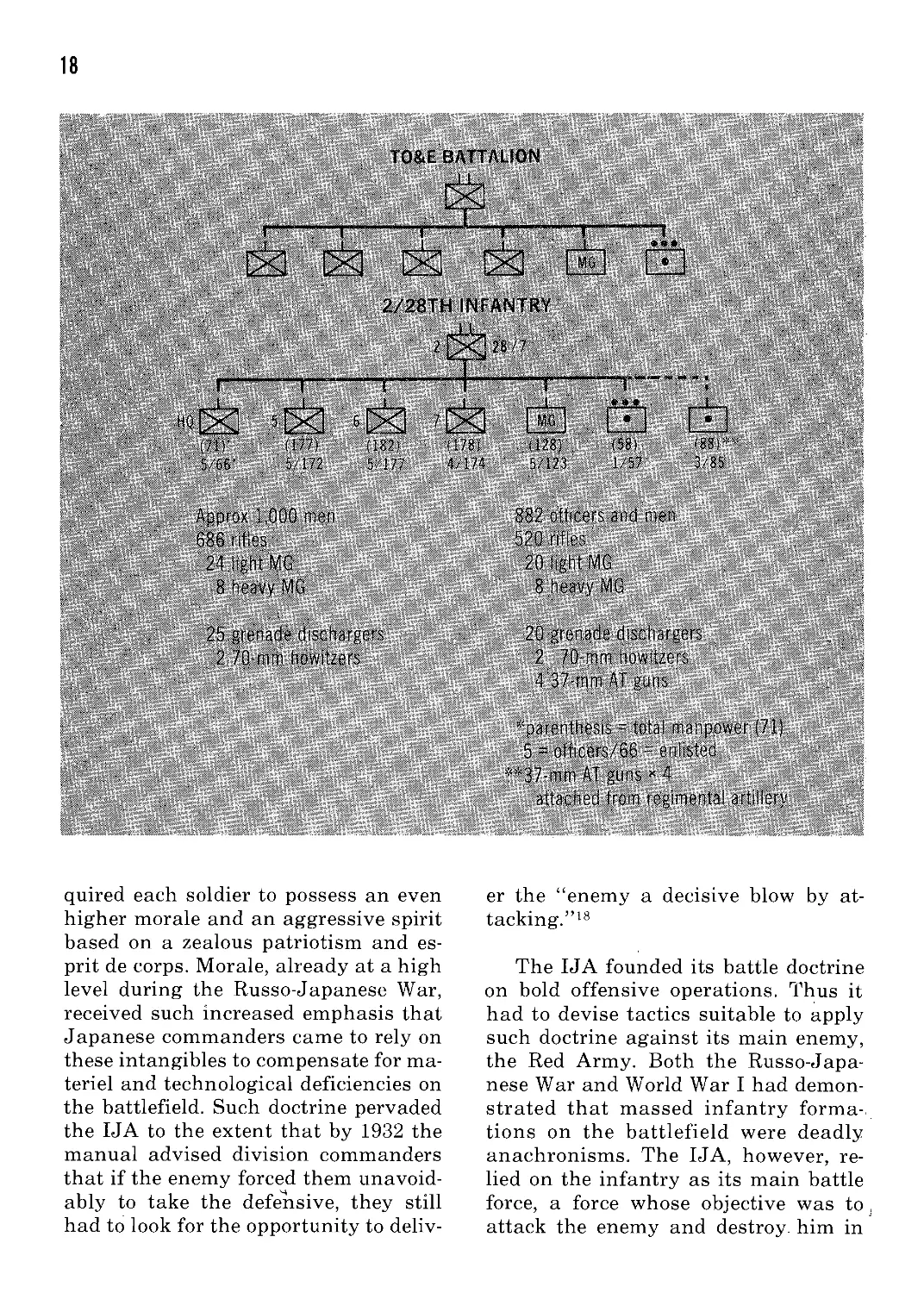
While this ideal battalion enrolled
about 1,000 men, a comparison with
the 2/28th Infantry at the time of the
Nomonhan fighting shows that unit at
about 80 percent strength.14
IJA units attached to the Kwantung
Army, whether regular infantry divi-
sions like the 7th or new divisions like
the 23d, spent most of their time in
Manchukuo undergoing rigorous train-
ing to prepare them to meet the Red
Army. For the 7th Division, training
exercises focused on infantry combat,
hand-to-hand combat, infantry tactics
as opposed to combined arms tactics,
and spiritual training. Spiritual train-
ing emphasized a certainty in victory,
loyalty and patriotic devotion to duty,
military tradition, and esprit de corps
all premised on instilling the spirit of
the offensive into every soldier.15
Every Japanese infantry training
and drill manual from 1909 through
1945 stressed the importance of the role
of the offensive in combat operations.16
The deadly new weaponry of the Russo-
Japanese War and the staggering Jap-
anese losses necessitated a new combat
doctrine that would compel the infan-
tryman to continue the fight even after
he saw his friends killed or wounded.
Based on the lessons of that war, the
1909 field manual emphasized the need
to inculcate spiritual factors, such as
the soldier’s belief in his inevitable tri-
umph and an unflagging offensive spir-
it, throughout the entire IJA.17 This
reliance on the intangibles of battle re-
18
2/28 ГН INf ANrRY
Approx 1,000 men
686 rifles
24.light MG
8 heavy MG
25 grenade dischargers
2 70-mm howitzers
882 officers and men
20 light MG
8 heavy MG
20 grenade dischargers
2 70-mm howitzers
4 37-mm AT guns
* parenthesis = total manpower (71)
5 = officers/66 = enlisted.
**37-mm AT guns x 4
attached from regimental artillery
quired each soldier to possess an even
higher morale and an aggressive spirit
based on a zealous patriotism and es-
prit de corps. Morale, already at a high
level during the Russo-Japanese War,
received such increased emphasis that
Japanese commanders came to rely on
these intangibles to compensate for ma-
teriel and technological deficiencies on
the battlefield. Such doctrine pervaded
the IJA to the extent that by 1932 the
manual advised division commanders
that if the enemy forced them unavoid-
ably to take the defensive, they still
had to look for the opportunity to deliv-
er the “enemy a decisive blow by at-
tacking.”18
The IJA founded its battle doctrine
on bold offensive operations. Thus it
had to devise tactics suitable to apply
such doctrine against its main enemy,
the Red Army. Both the Russo-Japa-
nese War and World War I had demon-
strated that massed infantry forma-
tions on the battlefield were deadly
anachronisms. The IJA, however, re-
lied on the infantry as its main battle
force, a force whose objective was to
attack the enemy and destroy him in
19
hand-to-hand combat.19 IJA tacticians
had to guarantee that the attacking
Japanese infantry reached the enemy
positions with a minimum of friendly
losses. Thus, the 1920s and the early
1930s became times of significant doc-
trinal ferment within the IJA.
By 1920 IJA tacticians realized the
need to disperse infantry formations in
order to reduce losses when attacking a
defender who possessed the lethal fire-
power of modern weapons. The revised
1925 edition of the Infantry Manual
emphasized tactics designed to allow
the attacker to reach the enemy defend-
er’s position. These included infantry
cooperation with other combat arms,
improved communications for com-
mand and control, night fighting and
maneuver, coordination of infantry fire-
power with hand-to-hand combat, and
increased reliance on the independent
decision making ability of junior offi-
cers and non-commissioned officers.20
Reliance on junior officers’ leader-
ship ability was central to the new tac-
tics but it required high-quality, well-
trained junior officers who were con-
cerned about their troops’ welfare and
who matured by continual service with
their regiments. In peacetime when an
average Military Academy class might
have 300—350 graduates and NCOs
might be given commissions to leaven
the junior officer force, the development
of aggressive, independent junior offi-
cers was possible. However, junior offi-
cer attrition during the China fighting,
abbreviated academy graduating class-
es each of more than 500 cadets, and
officer training schools producing still
more subalterns diluted officer quality.
Furthermore, outstanding company
grade officers achieved rapid promo-
tion to field grade rank in order to alle-
viate the acute shortage of majors and
lieutenant colonels caused by the IJA’s
rapid wartime expansion. By 1941 only
36 percent of all IJA officers were Acad-
emy graduates and the percentage was
even lower for company grade ranks.21
At the same time, the new revisions to
the Infantry Manual required junior of-
ficers capable of exhibiting imagina-
tive leadership and initiative.
The 1928 revised edition of Infantry
Manual placed great emphasis on the
use of cover and concealment to protect
advancing infantry and reduced the
distance to be covered in one dash by
an infantry under enemy fire from fifty
to thirty meters. Most of the revisions,
however, stressed night combat and the
requirement for night combat and ma-
neuver training.22 Day and night dis-
persal tactics also required new weap-
ons, and the revised manual paid parti-
cular attention to the use of the light
machine gun and the grenade discharg-
er.23 Despite these alterations, the basic
IJA reliance on offensive operations
which culminated in hand-to-hand com-
bat never changed.
By the 1930s, IJA planners realized
more than ever that the Japanese army
could not fight a war of attrition
against the ever-growing might of the
Soviet Union. Consequently, they de-
signed and refined their tactics to wage
a short war fought to a quick and deci-
sive conclusion of hostilities (sokusen
sokketsu). The goal of sokusen sok-
ketsu was to encircle the enemy and
then destroy him. The tactics employed
to achieve that end relied on unit mobil-
ity, initiative, concentration of forces,
night attack and night movement, and
close cooperation between artillery and
infantry.24 Coupled with the spiritual
or psychological values of offensive
spirit and the belief in the absolute
supremacy of Japanese arms, such tac-
20
tics produced one of the finest infantry
armies in the world. It was, however,
still an infantry army whose emphasis
on the value of intangibles like morale
or Japanese fighting spirit on the bat-
tlefield perhaps resulted from its status
as an army poor in the weapons of
modern warfare.25 It was an army, in
short, that tried to use doctrine to com-
pensate for materiel deficiencies.
By 1939 battlefield experiences in
China and against the Soviets seemed
to confirm the validity of the Japanese
way of warfare. In China time and time
again numerically inferior Japanese
forces routed Chinese troops. Against
the Soviets at Changkufeng/Lake
Khasan the decision was not so clear
cut, but since that engagement also
served to “prove” the efficacy of Japa-
nese tactics, particularly night combat
and hand-to-hand fighting, it merits
closer attention.
The engagement that would provide
a battle test for staff planners’ theories
began in the early morning hours of 31
July 1938. Members of the 1st Battal-
ion, 75th Infantry, 19th Infantry Divi-
sion launched a night attack against
Soviet troops occupying an approxi-
mately 150-meter high ridgeline at
Changkufeng/Lake Khasan. The at-
tackers carried the position and, after
fierce hand-to-hand fighting in the
darkness, the Soviet troops fled in dis-
order.26 The Japanese troops held their
gains despite heavy losses during the
next twelve days. More important, be-
cause this action was the first IJA
night attack against the Red Army, tac-
ticians regarded it as a brilliant suc-
cess which strengthened their faith in
the tactic of night attack.27 Paradoxi-
cally, although all proponents of the
offensive, these same tacticians paid
greater attention to the defensive les-
sons of Changkufeng, particularly that
a division in a strong natural or forti-
fied position could resist successfully a
three-division frontal assault.28 Simul-
taneously, the IJA chose to overlook
the superior firepower of the Soviet in-
fantry and artillery and continued to
stress the other intangible factors on
the battlefield. To paraphrase the offi-
cial Japanese history of Nomonhan,
clearly a Japanese lack of firepower
was the main reason for the emphasis
on spiritual training, but contributing
to the intangible factors was an abso-
lute faith in night combat, especially a
night attack that culminated in hand-
to-hand combat with the enemy.29
As the new conscripts of the 7th
Division underwent their advanced in-
fantry training on the dusty plains
near Tsitsihar, its members concentrat-
ed on the three cardinal drills of the
IJA: bayonet practice, firing practice,
and maneuver. They learned, as did
others before them, that a charge which
carried them face-to-face to the enemy
to kill him was the climax of infantry
combat. Most of the riflemen were just
completing their first year of company
training, a year that contained thirty-
eight weeks of night combat instruc-
tion averaging about ten hours per
week. The men studied night attacks in
various echelons, obstacle clearing,
concealment, noise prevention, orienta-
tion at night, patrolling, and security.30
Their officers taught them that night
attacks exploited the unique Japanese
characteristics of bravery, tenacity,
shrewdness, and audacity.31 In May
1939 the men of the 7th Division per-
haps were jealous that their comrades
in the 23d Division were about to get
the first crack at the Red Army at No-
monhan.
21
On 14 May 1939 the 23d Division’s
previously dispatched reconnaissance
detachment, consisting of an armored
car company and a cavalry squadron
commanded by LTC Azuma Yaozo, ar-
rived in the vicinity of Nomonhan. The
following day Azuma, hoping to trap
the Outer Mongolian troops on the east
side of the Halha River, launched a
two-pronged enveloping movement in
conjunction with 150 Manchukuoan
cavalrymen also from Hailaerh. The
attack began at 1300, but the Outer Mon-
golian troops slipped through the clos-
ing pincers of the attempted encircle-
ment and escaped to the western side
of the Halha. Three squadrons of IJA
aircraft bombed and strafed the area
causing some damage to about twenty
Mongol yurts. Since the Mongols had
fled back across the border, Lieutenant
General Komatsubara considered the
incident closed and ordered the Azuma
unit to return to Hailaerh.32
A few days later, aerial reconnais-
sance and Manchukuoan cavalry re-
ports revealed that about sixty Outer
Mongolian troops had again crossed
the Halha south of its confluence with
the Holsten River. By 21 May, an esti-
mated 300 to 400 enemy troops with at
least two cannon and light tanks were
busily constructing fortified positions
both north and south of the Holsten
River. That same day Lieutenant Gen-
eral Komatsubara ordered a task force
headed by COL Yamagata Takemitsu,
commander of the 64th Infantry Regi-
ment, 23d Division, to move into the
area and destroy Outer Mongolian
forces. The 64th Infantry (minus two
battalions), Lieutenant Colonel
Azuma’s reconnaissance element, a
wireless communications platoon,
transportation, and a field sanitation
unit composed the task force. They set
out to track down and destroy an elu-
sive foe in the barren desert steppes
around Nomonhan.
Terrain
A fine sand, in places as much as
ten centimeters (four inches) thick, cov-
ered the ground around Nomonhan.
Underneath this sandy covering, the
desert surface was generally firm
enough to support wheeled transport.
South of the Holsten River eucalyptus
trees grew, but north of the river only
shrubs or stubby one-meter (3 1/3 feet)
high pines appeared. Short, coarse
grass and wild flowers added a touch
of color to the desert landscape but the
lack of natural landmarks and the
sameness of the sand dunes made map
reading difficult. The infantryman
found it extremely difficult to select
readily identifiable reference points or
to maintain his sense of direction.
Along the east, or Japanese, side of
the Halha River ran a region of hill-
ocks about forty kilometers (twenty-five
miles) north and south and fifty kilo-
meters (thirty miles) east and west. Ele-
vation was about 700 meters above sea
level. The terrain was desert character-
ized by rolling, undulating sand dunes
twenty to forty meters high with ten-to-
forty meter depressions. These features
provided good cover and shelter for
small infantry units but presented little
obstacle for armor. Although roads in
the area were often blocked by drifting
sand, there was virtually no hindering
terrain in the area of operations.33 The
Halha’s west, or Soviet, side was a
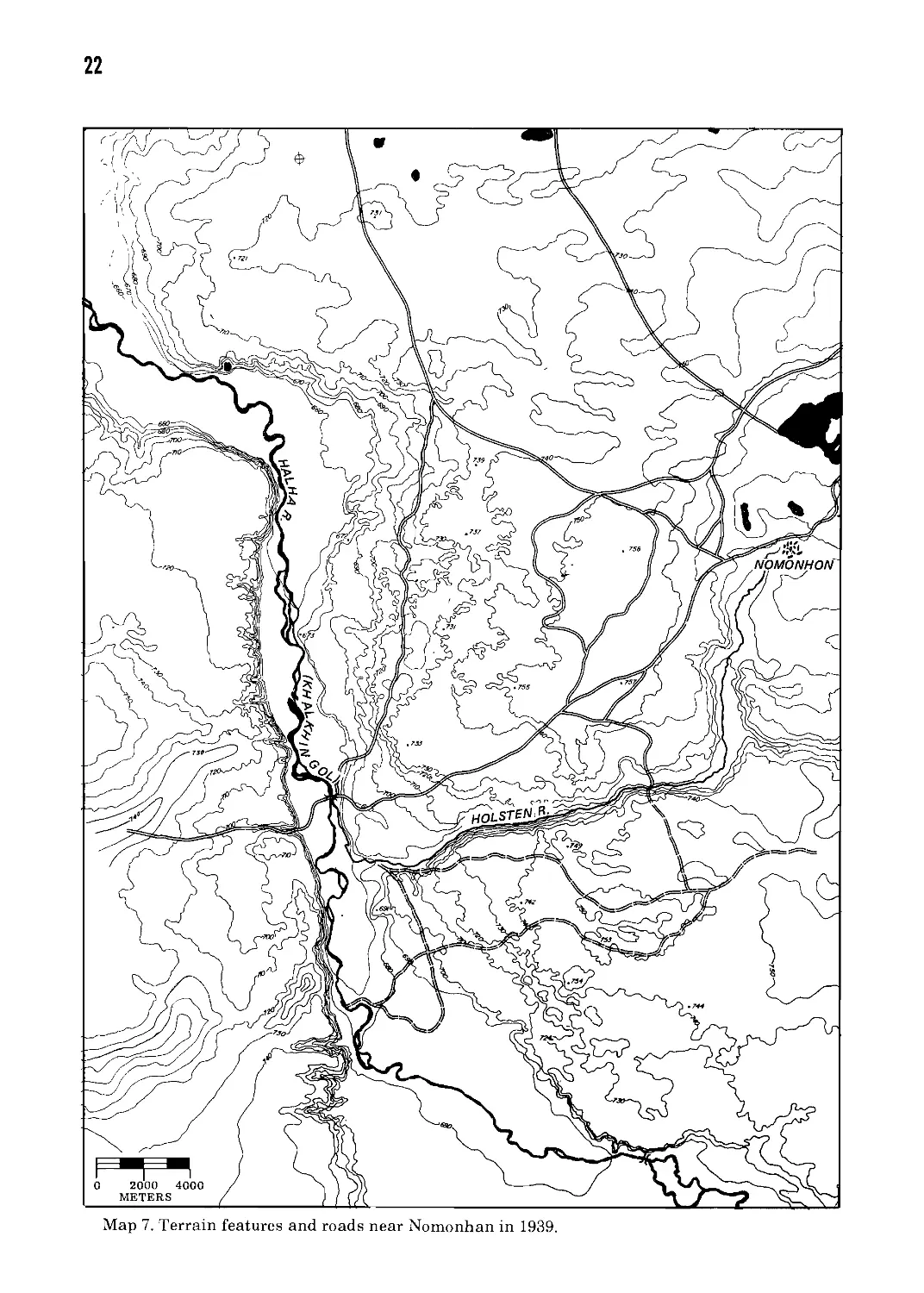
wasteland desert plain. (See Map 7.)
From the village of Nomonhan Jap-
anese troops descended to the Halha
over ground shaped like a basin the
center of which was the confluence of
22
Map 7. Terrain features and roads near Nomonhan in 1939.
23
the Halha and Holsten Rivers. The
Holsten was between three and four
meters wide and presented no impedi-
ment to military operations. It was,
however, the sole source of potable
under water in the region. The swamp
lands resulting from flash floods were
almost all saline. There were many
wells in the vicinity, but salt water also
had contaminated most of these.
The tactically significant river was
the Halha. It was an obstacle 100 to
150 meters wide with a sand bottom
and a current of one to two meters per
second. A band of intermittent swamp-
land extended one or two kilometers
away from the river on either side. The
Japanese east bank had a 15° to 30°
incline while the Soviet west bank rose
steeply at a 75° pitch. At the Halha’s
confluence with the Holsten or where
the Halha was fifty to sixty meters
wide, the Japanese judged that individ-
ual troops could ford it but that entire
units would have great difficulty cross-
ing it. Moreover, the west bank of the
Halha was higher than the east, thus
exposing Japanese troops operating
east of the river to enemy observation
and to direct enemy fire.
Juru:	0-100—or bolero
Juiv	0500-0b3()
Aiif:	0530--0630
Nomonhan’s temperature range and
climate were as harsh as its landscape.
Beginning in June there were hot days
but chilly, almost winterlike nights.
Temperatures during July and August
would be 30° to 40° C (86°—104° F) but
fell precipitously to 17° or 18° C (58°—
60° F) at night. These months were
also the peak rainfall season and the
combination of rain-soaked uniforms
and cold night air made soldiers miser-
able. Mosquitoes whose appetites sur-
prised even seasoned veterans plagued
the men during the day and crickets
screeched at them during the night.
Mornings usually meant dawn fogs but
a south or east wind would dissipate
these quickly. In June there were more
than sixteen hours of daylight, in July,
fifteen and one-half hours, and in Au-
gust, thirteen to fifteen hours.34
Approximately one hour of dawn al-
lowed Japanese infantrymen to see
very close targets completely, but at
700 to 1,000 meters, the mid-ranges
where enemy heavy machine guns and
light artillery were found, observation
was exceedingly difficult.35
2030—2100	64—48 minute-:
2030 1930	48—39 minutes
24
The desolation of the region affected
basic strategy, logistics, and the selec-
tion of lines of communications. IJA
operations hinged on railroads as con-
ventional IJA thought held that multi-
division operations could not be conduc-
ted outside of a 200- to 250-kilometer
zone from a major resupply base situ-
ated on a rail line. (See Map 8.) No-
monhan was aproximately 200 kilome-
ters south of the IJA base at Hailaerh,
but it was about 750 kilometers from
the nearest Soviet bases of operations
at Borzya, USSR, and Ondorhann,
Outer Mongolia, respectively. Looking
at their maps, Kwantung Army plan-
ners estimated that large scale Soviet
operations around Nomonhan would
be impossible. They thought that the
great distances from the nearest Soviet
railhead insured that the Red Army
could never concentrate large armor
and infantry forces at Nomonhan. This
meant, in turn, that the only Soviet
troops around Nomonhan would be
those assigned to the 7th Border Guard
Brigade. The 23d Division expected to
encounter only Outer Mongolian and
second-rate Soviet troops. Based on as-
sumed Soviet capabilities, a single IJA
division would suffice to handle this
latest border flare-up.3B
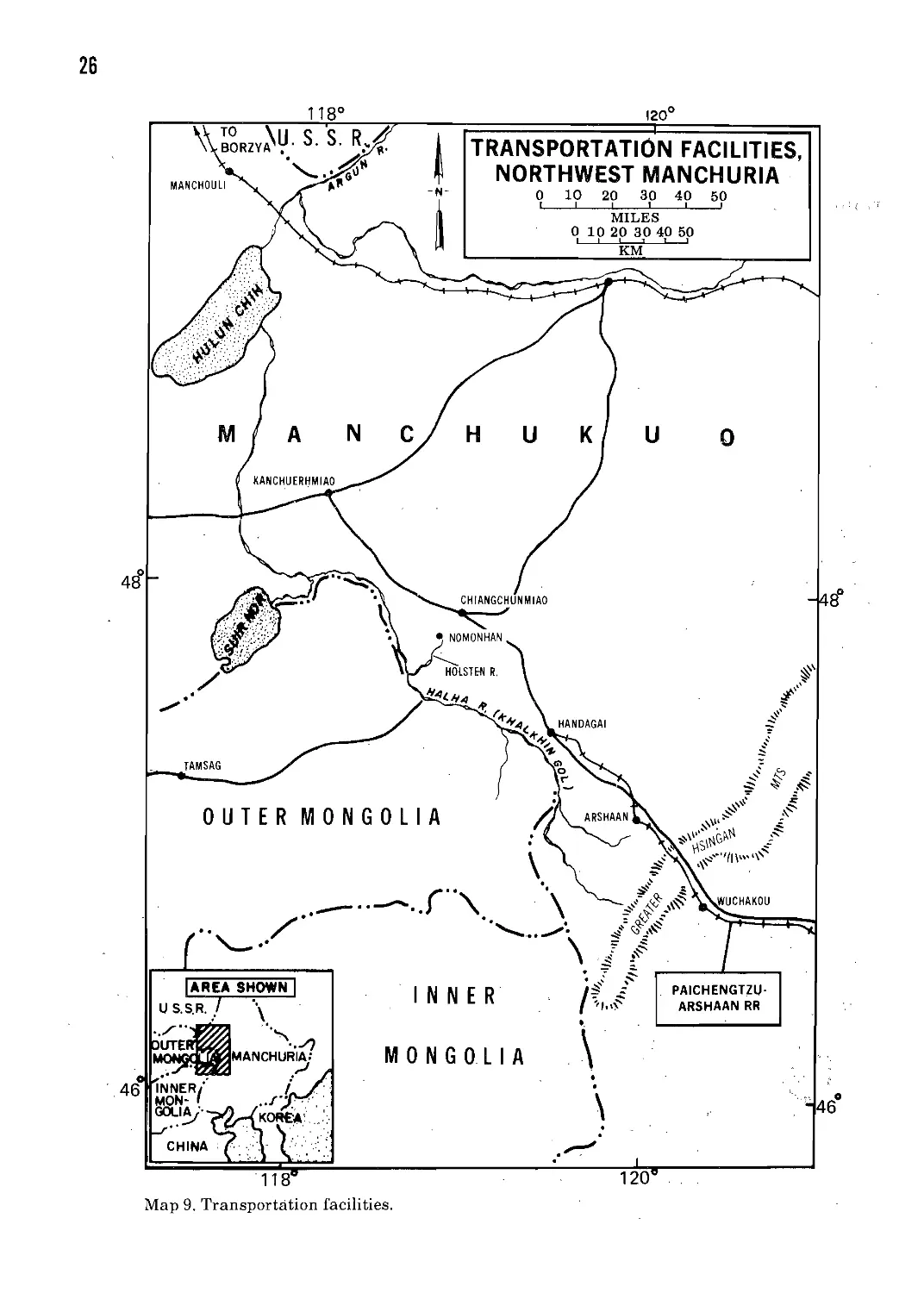
Roads from the Japanese railheads
approached Nomanhan from the north
and south. (See Map 9.) One northern
approach from Hailaerh to Chiang-
chunmiao, the IJA staging area ten
kilometers northeast of Nomonhan,
was unimproved sand or grass road
suitable for wheeled vehicles. It was
also completely exposed to aerial recon-
naissance and attack. An alternate
route from Hailaerh via Kanchuerh-
miao (approximately eighty-five kilome-
ters northwest of Chiangchunmiao)
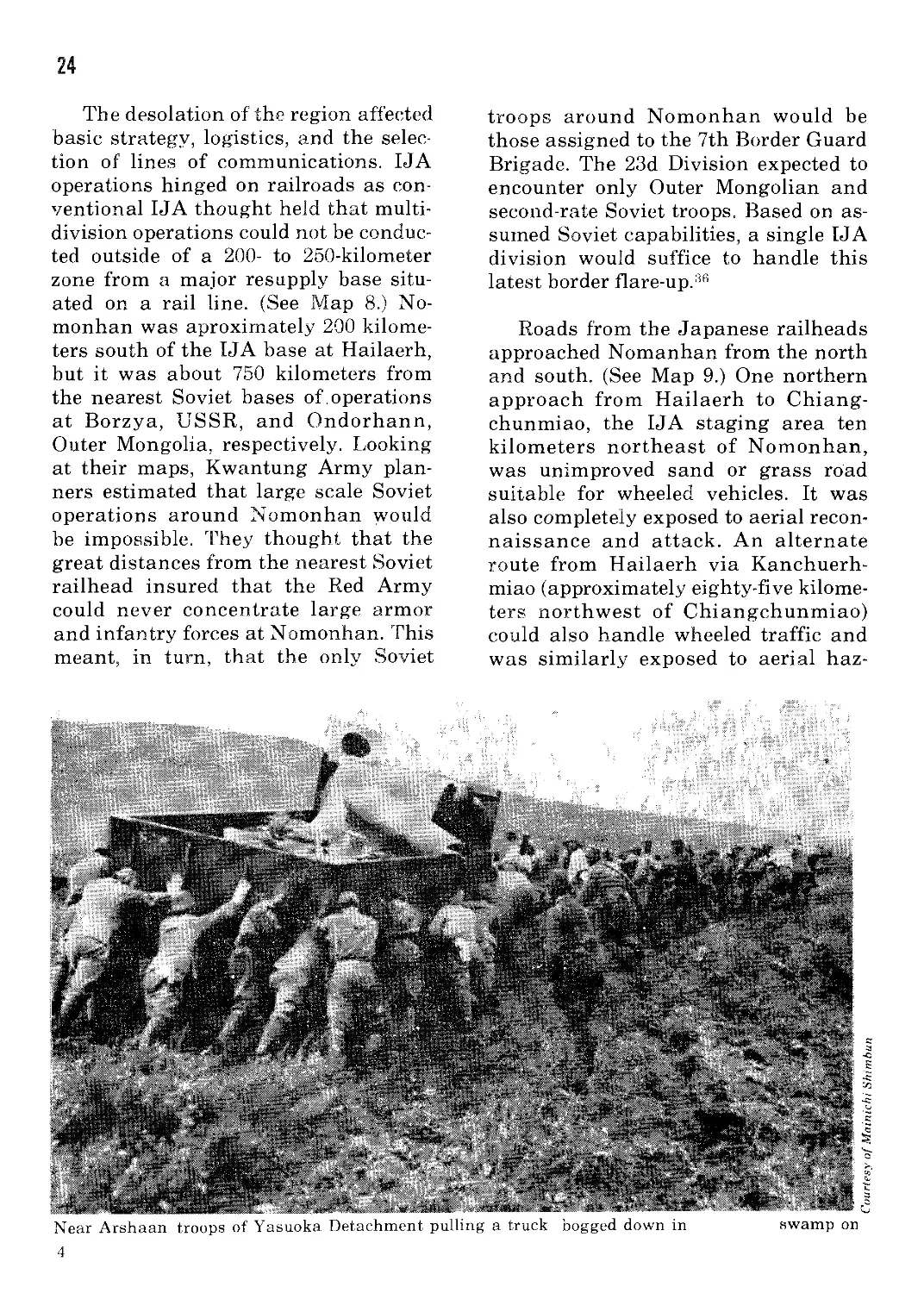
could also handle wheeled traffic and
was similarly exposed to aerial haz-
Courtesy of Mainichi Shimbun
Map 8. The 250-kilometer radius of operations from major Japanese and Soviet bases.
26
Map 9. Transportation facilities.
27
ards. Additionally, there was no water
between Kanchuerhmiao and Chiang-
chunmiao. From the south, the sixty-
five kilometer road running from the
railhead at Handagai to Chiangchun-
miao became a bog in late June with
the onset of the rainy season. While
light repairs corduroying the road
would allow trucks passage, about two-
thirds or forty kilometers of the road
were subject to flooding and rapidly
could turn into a quagmire in which
trucks sank to their undercarriages.
The IJA employed the logistics route
that ran from Hailaerh via Kanchuerh-
miao which was used as a stopover and
sorting point.37
After supply convoys reached
Chiangchunmiao, they could proceed
southwest on the so-called Nomonhan
Road, really little more than a track
but capable of supporting trucks and
tanks. The unimproved strip ran south-
west through Nomonhan and north of
the Holsten River to the Kawamata
Bridge spanning the Halha. No signifi-
cant roads existed south of the Holsten
although numerous tracks and trails
crisscrossed the area both north and
south of that river. It was into this hos-
tile region that Colonel Yamagata led
his 1,000-man task force.
Yamagata hoped to envelop what
he estimated to be a few hundred Soviet
border guards and Mongolian cavalry-
men occupying the Halha’s east bank
just north of the Holsten River. While a
company-size diversionary attack
fixed enemy attention to the front, the
battalion would hit the enemy’s north-
ern flank. Lieutenant Colonel Azuma,
as a separate force moving parallel to
Yamagata’s route, would advance
ahead of the main force in order to
block the Kawamata Bridge, the sole
avenue of enemy escape. Lieutenant
Colonel Azuma was so confident that
the enemy troops would panic when
Japanese regulars appeared, that he
neglected to bring his 37-mm antitank
guns for the operations. The Japanese
expected to encounter light infantry
and cavalry, not regular Soviet tank
and motorized units.
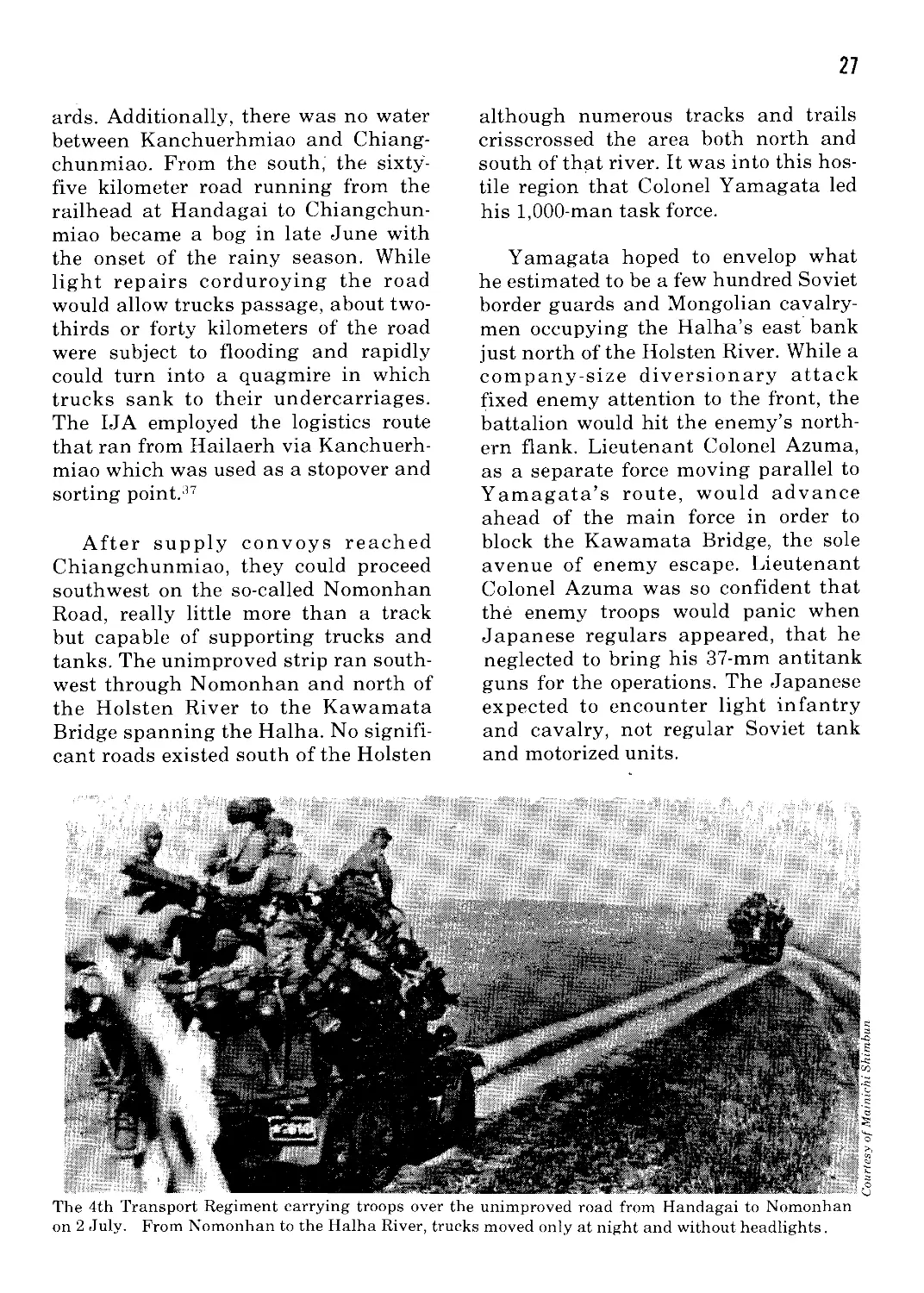
The 4th Transport Regiment carrying troops over the unimproved road from Handagai to Nomonhan
on 2 July. From Nomonhan to the Halha River, trucks moved only at night and without headlights.
28
First Japanese Defeat
By dawn 28 May the 220 officers
and men of Azuma’s force were about
two kilometers from their objective
when Soviet and Mongolian infantry-
men and ten tanks attacked their
flanks. Soviet artillery from the Hal-
ha’s west bank also began pounding
the Japanese. Lacking both artillery to
return fire and entrenching tools to dig
in, Azuma’s men hastily scooped holes
out of the desert sand with their hel-
mets as they sought protection from
the barrage. Simultaneously, Soviet
and Mongolian forces attacked Yama-
gata’s battalion, preventing it from as-
sisting the beleaguered Azuma unit
which by nightfall had exhausted its
ammunition. To make matters worse,
almost all the members of two ammu-
nition resupply squads from the Yama-
gata force who tried to reach Azuma’s
position under the cover of darkness
were killed.
On 29 May 400 enemy infantrymen,
supported by ten tanks and under the
protection of an artillery barrage,
again assaulted the Azuma unit. Sur-
rounded and outnumbered, with casu-
alties mounting, Azuma led seventy
men in a last ditch attempt to break the
enemy encirclement. Some' did escape,
but Azuma was not among them, for a
Soviet infantryman shot him through
the heart.
In the two days of fighting, the
Azuma detachment lost eight officers
and ninety-seven men killed and one
officer and thirty-three men wounded,
or 63 percent casualties. The next night,
30 May, Japanese troops, without any
hostile interference, recovered the bod-
ies of their slain comrades. Lieutenant
General Komatsubara on the basis of
wireless reports then ordered the task
force to return to Hailaerh.38
The severity of the fighting seemed
to catch the Japanese off guard, Japa-
nese troops were surprised, for in-
stance, that the pockets of abandoned
Mongolian corpses contained neither
food nor cigarettes, but were stuffed
full of hand grenades and small arms
ammunition.39 Lieutenant General
Komatsubara and Kwantung Army
Headquarters regarded the battle as a
draw and accepted that verdict because
they believed that the Nomonhan des-
ert was worth no more Japanese
blood.40 Throughout early June, how-
ever, reports of Soviet and Outer Mon-
golian activity near Nomonhan made
it difficult to ignore the barren place.
By mid-June Japanese intelligence indi-
cated a buildup of Soviet and Outer
Mongolian combined arms forces on
both sides of the Halha. Additionally,
Soviet aircraft flew daily reconnais-
sance sorties in the vicinity and also
provided air cover for small-scale com-
bined arms attacks on isolated Man-
chukuoan units.41 Faced with these re-
peated incidents, Lieutenant General
Komatsubara, whose 23d Division had
operational responsibility for the area,
requested of the Kwantung Army per-
mission “to expel the invaders.”42
Headquarters authorized Komatsu-
bara’s request chiefly because staff of-
ficers believed that the Soviets under-
stood only force. The 23d Division’s ini-
tial showing had not achieved success,
so two tank regiments (seventy-three
tanks and nineteen armored cars total)
and the 2/28th Infantry, 7th Division,
were attached to Komatsubara’s com-
mand. There were staff officers such as
MAJ Tsuji Masanobu who felt that
overall operational control should be
given to the 7th Division, the elite IJA
29
division in Manchuria. The difficulty
with that concept was that removing
Komatsubara from command would
have been tantamount to relieving him,
a very rare occurrence in the IJA.43 In-
stead, with the entire 23d Division plus
armor and artillery support, Komatsu-
bara would have the forces necessary
to fight a short war to a quick and de-
cisive conclusion, the sokusen sokketsu
of IJA military theorists.
Mobilization of the
2/28th Infantry
The 2/28th Infantry which joined
the 23d Division was regarded as an
excellent unit. Its officers and men
came from northern Hokkaido and south-
ern Sakhalin, areas which had been
thought to produce tenacious and
phlegmatic fighters. In June 1939,
when the battalion received its orders
for Nomonhan, it had been in Manchu-
ria about sixteen months. MAJ Kaji-
kawa Tomiji, the battalion commander,
was a Military Academy graduate and
a Kendo (swordsmanship) expert. He
was also a seasoned veteran who in
1932 had commanded the 9th Com-
pany, 2/28th Infantry, in North China.
Indicative of the strain of the China
fighting, only four of the' battalion’s
other officers were Academy men while
six were officer candidate school grad-
uates and twelve others were reserve
officers recalled to active duty.44 Most
of the enlisted ranks were first- or
second-year soldiers who were under-
going training and were learning the
proud tradition of the battalion which
dated from its participation in the
Russo-Japanese War.
Five minutes past midnight on 20
June, members of the 2/28th Infantry
were awakened in their barracks at
Tsitsihar to an emergency assembly or-
der. The men learned that they would
serve as a covering force for an armor-
ed task force being sent to Nomonhan.
That morning they proceeded to the
railroad station where (in universal mil-
itary fashion) they waited about two
hours for their train to leave. There
was an undercurrent of excitement dur-
ing the move to Arshaan as officers
checked on air raid precautions. The
initial deployment ended uneventfully
at Arshaan just before noon the next
day. There the 2/28th linked up with
the Yasuoka Task Force (64th Infan-
try, 3d and 4th Armored Regiments).
Following a briefing on the enemy
situation, the entire task force left Ar-
shaan around 0220 on 23 June, using
the darkness to conceal their departure.
Although some motorization had oc-
curred within the IJA, it still moved
essentially by horse, relying on pack
animals to transport a unit’s supplies,
ammunition, and artillery weapons.
The heavy June rains had turned
the road to Handagai into a bog and
made the march an exhausting one.
The Japanese infantryman was bur-
dened with a sixty-five pound pack
filled with his spare clothing, rations,
and tools. He also carried а ЭУг-рошМ
rifle, sixty cartridges, two hand gre-
nades, a canteen, and a gas mask.45
The already heavily burdened foot sol-
dier also had to help push and pull ve-
hicles and horses wallowing in the
muck.
The 2/28th Infantry took twenty-
four hours to cover the sixty-four kilo-
meters in the pouring rain. Not a single
man dropped out of the march even
though the troops were not allowed to
eat their field rations because the
march had not been expected to take so
30
long. After complaining to their battal-
ion officers, the men were allowed to
chew on a type of hardtack, but this
only made them thirsty and they guz-
zled water at every break.
Despite the exhausting, backbreak-
ing drudgery in the cold rain and mud,
morale among Japanese troops was ex-
ceptionally high.46 As they slogged
through the mud, they were confident
that they would make short work of the
Red Army.
According to IJA psychologists’ in-
vestigations after the action, almost all
the Japanese troops mobilized in June
eagerly looked forward to meeting the
Red Army in combat but they had only
vague notions of the potential conse-
quences. Since most held the Red Army
in low regard, the IJA’s very presence
near Nomonhan meant to them that
the incident was as good as finished.
The Japanese approach march then re-
sembled more a peacetime maneuver
than the deadly stalking of warfare.
One popular rationalization among the
troops was that unlike the mauled Ya-
magata task force, “We have a lot of
artillery so nothing like before should
happen.”47 Such wishful thinking re-
sulted from the mental baggage which
the Japanese soldier carried, that is,
his understanding of the Soviet men-
tality.
Japanese Stereotypes
of the Soviets
Japanese officers got their impres-
sion of the Soviet mind from a short,
classified manual titled How to Fight
the Soviets, which appeared in 1933
under the imprimatur of the IJA Chief
of Staff, Prince Kanin. The purpose of
this forty-nine-page, handwritten man-
ual was to serve as a guide for Japa-
nese officers in planning their opera-
tions against the Red Army. The first
chapter, on which the subsequent dis-
cussions of tactics were based, ana-
lyzed the characteristics of the Soviet
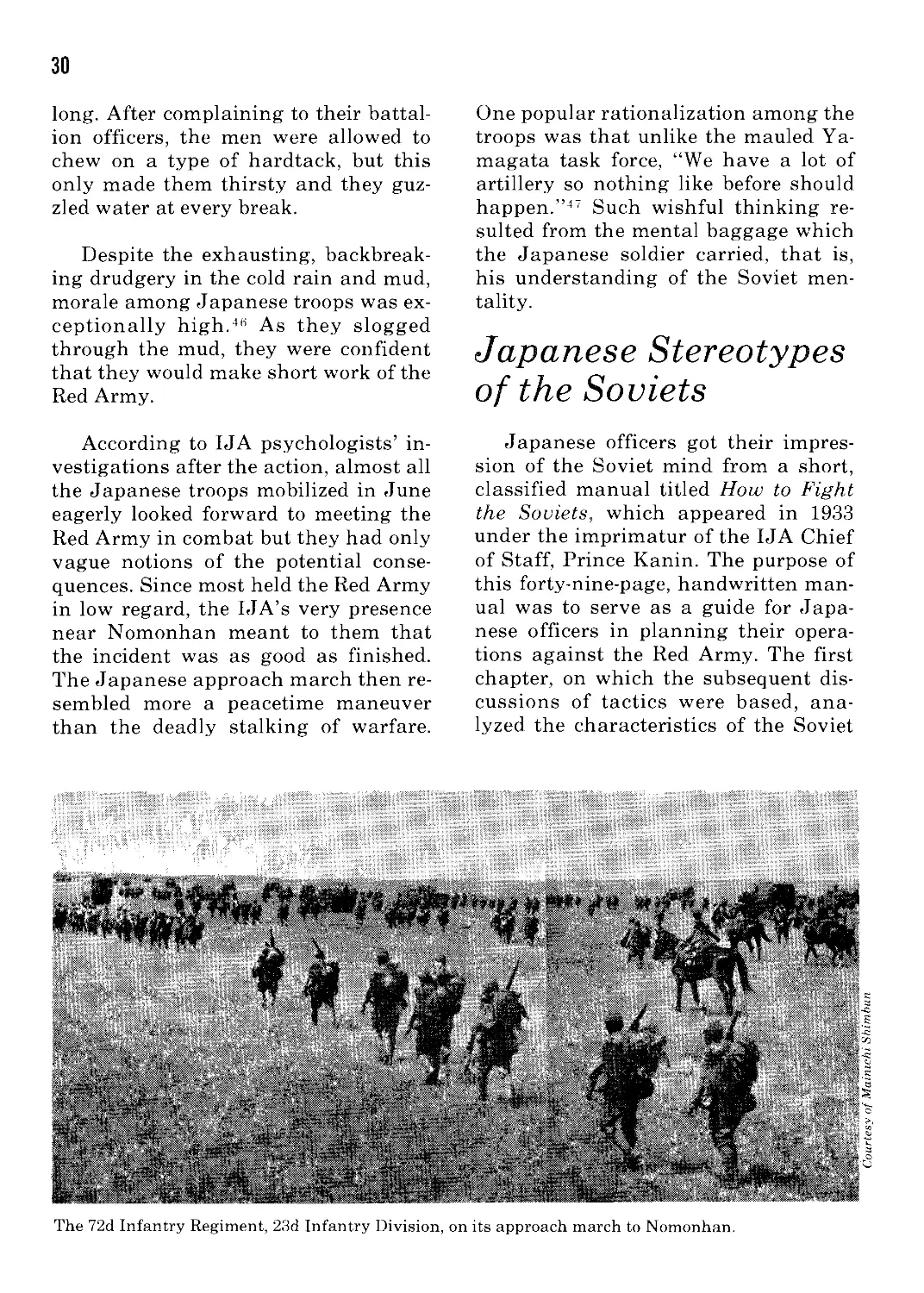
The 72d Infantry Regiment, 23d Infantry Division, on its approach march to Nomonhan.
31
people and army. According to the
manual, the Soviet people were submis-
sive, docile, and prone to blind obedi-
ence. Subjected to outside pressure,
however, they quickly fell victim to dis-
pair and depression. Likewise, since the
Soviet soldier shared these national
characteristics, he was capable merely
of following orders and showing little,
if any, initiative in his dull-witted, stol-
id manner.48 The recent fighting at
Changkufeng/Lake Khasan only dem-
onstrated in the minds of Japanese of-
ficers the accuracy of these general ob-
servations.49
The Japanese further felt that these
Soviet national characteristics, in turn,
created the Red Army’s greatest flaw,
the inability of Soviet units to cooper-
ate with one another in encirclements
or flanking maneuvers. The manual ac-
knowledged that the Soviet soldier
could defend a front with tenacity be-
cause of his lack of imagination and
initiative. An attack against the Soviet
flank that threatened their supply lines
would assure that the Soviet forces
quickly fell into disorder. In short, this
influential manual proposed taking ad-
vantage of the Soviet’s racial defects in
order to deliver a decisive blow that
would destroy the Red Army. It seems
an unlikely coincidence that such a
stereotype could have developed inde-
pendently of the tactical doctrine of so-
kusen sokketsu. Both concepts merged
in How to Fight the Soviets because a
lightning engagement with the Red
Army followed by a decisive IJA vic-
tory would lead to the breakdown of
Soviet morale.50 So while the Japanese
infantryman preparing to meet his So-
viet counterpart could be in high spir-
its, his misunderstanding and miscon-
ceptions about the Red Army were
about to exact a terrible price.
The Imperial Japanese Army's
July Offensives
Overview
3
The major fighting at Nomonhan in
July and August may be conveniently
divided into two phases. During the
first phase, roughly the month of July,
the IJA launched two major offensives
against the Red Army but ultimately
failed to dislodge the superior Soviet
forces. IJA losses in men and equip-
ment resulting from the failed offen-
sives forced the IJA on to the defensive
from late July through the remainder
of the battle.
Based on the advice of Kwantung
Army Headquarters staff officers MAJ
Tsuji Masanobu and LTC Hattori
Takushiro, Lieutenant General Komat-
subara decided on an enveloping at-
tack.1 His main force (71st and 72d
Infantry Regiments, 23d Division, 13th
Field Artillery Regiment and 23d Engi-
neer Regiment with the 26th Infantry
Regiment, 7th Division, in reserve)
would eliminate Soviet forces around
Hill 721, then cross the Halha River
and drive south to the Kawamata
Bridge, destroying Soviet artillery bat-
teries and supply dumps along the west
bank. Simultaneously, the Yasuoka
Task Force (64th Infantry, 2/28th In-
fantry, 3d and 4th Armored Regiments,
1st Independent Field Artillery Regi-
ment and 24th Independent Engineer
Regiment) would attack Soviet forces
on the Halha’s east bank, north of the
Holsten River. The link-up of the two
pincer columns would first encircle the
Soviet forces and then squeeze them to
death. The plan differed from Colonel
Yamagata’s earlier abortive one in two
respects. First, the Japanese believed
that their flanking movement would
force the Soviets to withdraw front the
Halha’s east bank. Second, the Japa-
nese maneuver would violate the inter-
national border that the Japanese
themselves maintained was the boun-
dary between Manchukuo and Outer
Mongolia.
The northern Japanese force seized
Hill 721 on 2 July according to plan
and that night crossed the Halha. The
attacking Japanese forces had initial
success storming Baintsagan Hill and
then pushing south along that ridge-
line for almost six kilometers. Farther
south, however, superior Soviet artil-
lery fired from Dungar-Obo Hill down
on the advancing Japanese. Then
Soviet counterattacks from three sides
involving more than 450 tanks and ar-
mored cars blunted the spearhead of
the Japanese attack. The heavy fight-
ing on the west bank rapidly reduced
Japanese equipment, ammunition, and
personnel. The single pontoon bridge
which the Japanese threw across the
Halha could not sustain the major re-
supply effort that the embattled IJA
32
33
Courtesy of Moinichi Shiinbun
units required to continue the battle.2
Facing encirclement, the Japanese
withdrew to the east bank, accomplish-
ing that retrograde movement by 5
July. During the same three days, the
Yasuoka Task Force had been fighting
an equally determined Soviet foe on the
Halha’s east bank.
LTG Yasuoka Masaomi, commander
of Japanese units operating on the east
side of the Halha, had the mission to
drive Soviet troops back from the Hal-
ha’s east bank. Yasuoka detailed the
2/28th Infantry to cover his right flank
and designated his two armor regi-
ments, to commence pursuit operations
against an enemy who, based on erro-
neous intelligence,3 he mistakenly
thought was in full retreat. Yasuoka
ordered a hurried pursuit operation. He
sacrificed planning time for speed, but
in the process he also sacrificed coor-
dination among his infantry, artillery,
and armor units.
According to Japanese armor doc-
trine tanks were infantry support vehi-
cles that destroyed enemy heavy weap-
ons and crushed obstacles and barbed
wire entanglements to clear a path for
the advancing foot soldiers.4 In pursuit
operations Japanese tanks were sup-
posed to chase the retreating foe to dis-
organize any attempts to regroup. This
pursuit operation was somewhat differ-
ent because terrain dictated that the
Soviet artillery positioned on the west
bank could easily pour effective ob-
served fire on Japanese tanks as they
tried to advance down the basinlike
slopes toward the Halha’s east bank. A
daylight attack would be murderous,
but in a night attack the tanks had a
chance of breaking into the enemy
lines and reaching the Kawamata
Bridge. However, the darkness also
made coordination among advancing
Japanese units difficult, moreso be-
cause the Japanese lacked sufficient
wireless equipment, flares, and obser-
34
vation devices. The tankers, moreover,
had only a vague idea of the enemy’s
location, the enemy’s strength, or the
type of terrain to be crossed to reach
the foe. They expected that the pursuit,
by keeping Japanese troops close to the
retreating Soviets, would exert “psy-
chological pressure” and disrupt the
enemy.5 Thus, on the night of 2—3 July
there began a wild night attack char-
acterized by individual units conduct-
ing independent battles in a driving
rainstorm and resulting in the loss of
about half the Japanese armor.
Meeting Engagement
In the predawn darkness of 3 July,
troops of the 28th Infantry made prep-
arations for their own dawn attack
while listening to the artillery and rifle
fire emanating from the scattered en-
gagements of the Yasuoka Detach-
ment. The 2/28th had moved from
Chiangchunmiao into position on Hill
726 during the night of 2 July under
orders to follow rapidly the already de-
parted Yasuoka Force. The battalion’s
mission was to provide right flank se-
curity for the main Yasuoka forces and
to conduct a reconniassance probe of
enemy dispositions on the Halha’s east
bank. Large scale maps of the Nomon-
han area were lacking, so the probe
would also serve the double purpose of
reconnoitering terrain for future com-
bat operations. For protection against
Soviet tanks, regimental headquarters
temporarily attached a 37-mm antitank
artillery company to the battalion’s com-
mand. At 0600 on 3 July, the 2/28th
Infantry, in the words in its unit his-
tory, “determined to join the battle,
moved toward the sound of the guns.”6
The battalion advanced according
to the manual. Rifle squads, whose
members camouflaged themselves with
branches of scrub willow, provided
flank and forward security as the bat-
talion’s three rifle companies ad-
vanced, two companies forward with
one in reserve. On the left flank, 6th
Company, under Captain Tsuji, rein-
forced with two heavy machine guns,
moved in a southeast direction while
5th Company, commanded by Captain
Aoyagi, also reinforced with two heavy
machine guns, followed a parallel
course on the right flank. A platoon
from 5th Company secured the west-
ern, or right flank of the advance. First
Lieutenant Saito led 7th Company,
which brought up the rear. Battalion
artillery and the antitank company re-
mained close to the lead companies
ready to deploy in order to suppress
hostile fire, should the occasion arise.
As the untested infantrymen moved
nervously along ridgelines or trails to-
ward the Halha River, they saw Japa-
nese fighters protect infantrymen from
about twenty Soviet aircraft which
were trying to bomb and strafe the
ground troops at low level. When one
Soviet aircraft exploded and crashed,
the rest fled across the Halha. Encour-
aged by this successful conclusion to
the first clash of arms they had ever
witnessed, the troops picked up their
pace and covered the ground along the
ridgelines more rapidly despite scat-
tered sniper fire. The hot desert sun
and 34° C (94° F) temperatures were
proving to be a greater enemy than the
Soviets.
Despite the sweltering heat, the
2/28th Infantry had to move quickly
because moving at night over unfamil-
iar terrain had delayed its arrival time
at the line of departure. Consequently
the unit had deployed for its attack
preparations several hours later than
35
Japanese troops in paddy near Halha River. Note field periscope binoculars.
the armored force and began to ad-
vance twelve hours after the tanks had
rolled forward. This lag became more
and more important as the hours
passed because the Yasuoka Force de-
pended on the 2/28th Infantry’s probe
of suspected enemy left flank positions
to provide intelligence information for
the conduct of future operations. Lack-
ing communication with the 64th Infan-
try, which was the right wing of the
Yasuoka Force, the 2/28th Infantry
could not provide this crucial battle-
field intelligence when the attacking
Yasuoka Force most needed it.7
Later that day when isolated enemy
machine guns or pockets of two or
three riflemen tried to impede the
sweep, the battalion’s heavy machine
guns and 70-mm artillery crews de-
ployed just as the training manual pre-
scribed and suppressed the hostile fire,
allowing the infantry’s advance to con-
tinue. Officers attributed this light re-
sistance, probably by the machine gun
battalion of the 9th Motorized Armored
Brigade, to the enemy’s concentrating
all his artillery on the 23d Division,
which was pushing down from the
north.
Japanese troops east of Halha River watching dust trails of Soviet armor on west bank.
36
After a day spent chasing individ-
ual Soviet troops, the battalion formed
its night defensive position with all
three companies on line forming an arc-
like perimeter. Tents were pitched.
Rifle squads on the flanks and rear
served as security with the heavy ma-
chine gun company, battalion, artil-
lery, and headquarters at the center of
the defensive position. According to
Japanese firing diagrams, the battal-
ion believed that at dusk of 3 July it
faced about two companies of Soviet
infantry supported by five or six tanks.
Major Kajikawa then sent scouts to
locate the Yasuoka Detachment. The
scouts accomplished their mission and
established contact with 8th Company,
64th Infantry, the right flank of the
Yasuoka Detachment. Thus 4 July be-
gan well and improved as by mid-
morning the battalion had already
pushed another 1,000 meters south
from their overnight encampment with-
out opposition. Even the sudden appear-
ance of a Soviet fighter aircraft roaring
in at low level to strafe the troops while
they were eating their mid-day rations
did not interfere with operations. After
the Japanese picked themselves up off
the ground and found no one hurt, they
joked about the inept Soviet pilots,
which boosted their morale.
That afternoon their advance con-
tinued as sharpshooters and machine
gunners of the two lead Japanese com-
panies, assisted by the 70-mm howit-
zers, scattered the already retreating
Soviet infantrymen. The sun proved a
greater enemy than the Soviets. The
Japanese battled the scorching 40° C
(102° F) heat, thirst, and fatigue as a
few of their comrades fought scattered
running gun battles over sand dunes
throughout the day against a Soviet
rear guard force. That day the Japa-
nese collected eight Soviet corpses and
took a prisoner. They also discovered
five destroyed trucks and one smashed
45-mm antitank gun. Water, however,
was becoming short as the heat, dust,
and anxiety of a combat operation com-
bined to dry both mouths and can-
teens.
Soviet resistance seemed extremely
weak. The enemy showed little inclina-
tion to stand and to fight. Major Kaji-
kawa and his aide-de-camp, First Lieu-
tenant Muranaka, attributed this inef-
fectual enemy performance to the re-
sults of the combined 23d Division and
Yasuoka Detachment attacks which,
they decided, must have uncovered the
weakness in the enemy defenses and
thus thrown the Soviets into confusion.
To add to the disorder, that night Kaji-
kawa sent raiding parties behind Sovi-
et lines to destroy the Kawamata
Bridge, the lifeline of Soviet troops on
the Halha’s east bank.
The patrol comprised two groups of
three men each. Captain Aoyagi, com-
mander of 5th Company, led two of his
men and Sergeant Hirai led two second
class privates from 7th Company. Near
the bridge Sergeant Hirai discovered a
Soviet heavy machine gun platoon and
the other group found Soviet tanks and
armored cars. Unable to get through
such heavy security forces, and with
dawn approaching, Hirai’s group
crawled to within fifty meters of the
Soviet position and planted two land
mines along the road leading east from
the bridge. Shortly afterwards Soviet
tanks clanked across the bridge and
moved east in parallel columns. As the
patrol watched, the lead tank passed
over their mines and exploded violent-
ly. The Soviet machine gun post came
alive, blasting wildly into the early
dawn light.8 Taking advantage of the
37
poor light, the three Japanese dashed
for some shrubs near the river bank
and there used their helmets to scoop
out a hole large enough to conceal them-
selves beneath the sparse foliage. They
spent the entire day listening to Soviet
patrols crisscrossing the area. That
night the three made their way back to
their lines.9
Meanwhile, other officer-led patrols
on the night of 4—5 July reported to bat-
talion that the approaches to the Kawa-
mata Bridge seemed lightly defended.
The Soviets apparently relied on wire
entanglements, dubbed “piano wire”
by the Japanese, to protect the bridge.
This thin, almost invisible wire, lay
coiled in grass or in shallow depres-
sions to ensnare the unwary infantry-
man’s ankles or, if he were crawling,
his shoulders and torso. Despite hav-
ing encountered a similar impediment
at Changkufeng almost a year earlier,
the IJA apparently had devised no ade-
quate countermeasures to hasten troop
passage through this time-consuming
and painful obstacle.
Based on this intelligence, Major
Kajikawa ordered a dawn attack for 5
July. In poor visibility because of a
light rain at dawn, Kajikawa sent his
5th and 7th Companies forward. Ma-
neuvering against an estimated three
companies of enemy soldiers supported
by fifteen tanks, 7th Company soon
made contact with company-size ele-
ments of the 64th Infantry on its left
flank. Kajikawa, mounted on horse-
back for greater mobility, then as-
sumed direct command of the 7th com-
pany to supervise the attack and to
maintain liaison with the 64th Infan-
try.
Taking advantage of folds in the
ground, sand dunes, and depressions
for cover, 5th and 7th Companies em-
ployed fire and movement tactics to
advance about 1,500 meters. Riflemen
would dash forward to the next suit-
able ground concealment and from
there fire at enemy strongpoints to
keep Soviet weapons crews pinned
down so that other Japanese infantry-
men could rush forward. (See Map 10.)
Nothing of the previous two days’
fighting prepared the Japanese sol-
diers for the action of 5 July. On this
day the Soviets fought with skill and
determination. As 5th Company tried
to turn the enemy’s left flank about
2,000 meters north of the Kawamata
Bridge, heavy artillery fire ripped into
their ranks. Soviet tanks also appeared
and began directing cannon and ma-
chine gun fire at the Japanese attack-
ers. The 7th Company, on the Soviet
right, supported by heavy machine
guns, managed to break through two
lines of the Soviets’ outer defenses, but
the increasing crescendo of artillery
and tank fire took a heavy toll on the
attacking force.
Enemy shelling continued to in-
crease, especially fire from the Halha’s
higher west bank which enfiladed the
2/28th’s axis of attack. So savage was
the barrage that it had already stopped
the Yasuoka Detachment at its morn-
ing line of departure. The 2/28th con-
tinued its leap-frog advance, finally ar-
riving about 1,800 meters from the
vital bridge but, by that time, Japanese
casualties from Soviet artillery fire
were heavy. Second Lieutenant Nishi-
nome, commander of 2d Platoon, 6th
Company, had been killed by machine
gun fire as he led his platoon into a
Soviet trench. Moreover, the men were
exhausted physically by the extreme
34° C heat, which, together with the
blazing sun and swirling sand and
38
Map 10. Japanese offensive 3—5 July 1939.
39
dust thrown up by artillery bursts, pro-
duced an agonizing thirst that they
were unable to slake as both sides
fought a punishing battle of attrition.
On 5 July the 2/28th Infantry expe-
rienced the full fury of Soviet defensive
combat as discrepancies between doc-
trine and tactical reality became appar-
ent. In the case of Changkufeng, Japa-
nese infantrymen broke through a
thinly held linear hilltop position to
seize their objective. Now at Nomon-
han there was no single line of Soviet
defense. The Japanese infantryman
found defenses in depth. Breaking the
enemy’s outer lines guaranteed no suc-
cess because the Soviets fell back into
prepared defensive positions covered
by interlocking automatic weapons
fire. Soviet artillery preregistered on
the vacated position could then blast
the Japanese attackers and swell their
casualty list.
After the Japanese broke into the
Soviet outer defense lines, enemy resis-
tance increased as reinforcements, prob-
ably from the 149th Motorized Rifle Regi-
ment, 36th Motorized Rifle Division,
bolstered the Soviet defenders. Fifteen
enemy tanks counterattacked 5th Com-
pany, but the battalion’s attached 37-
mm company, firing at long range,
scored a lucky hit on one tank which
burst into flames. A combination of ex-
treme heat, volatile gasoline fuel, and
exposed engines on the Soviet tanks
accounted for significant losses of Sov-
iet tanks in the early stages of the bat-
tle. The remaining tanks veered away
but there was no respite for the Japa-
nese infantry as Soviet artillery fired
shell after shell upon them. Having re-
grouped out of the four 37-mm guns’
range, Soviet tanks added their cannon
and machine gun fire to the barrage
that exacted a mounting toll of Japa-
nese soldiers.
More serious perhaps, was the fact
that the 2/28th was using its ammuni-
tion at a rate that would soon exhaust
it. The battalion’s normal basic load,
carried by its horse transport, was five
days’ ammunition and supplies. For
this engagement, the 2/28th had only
half of its basic load because its bag-
gage trains had been delayed four days
earlier by the mud-clogged road run-
ning between Arshaan and Nomonhan
and had not reached the battalion.10
Food and potable water were also in
short supply. A Soviet counterattack
threatened to annihilate the overex-
tended 2/28th forces. The battalion
aide-de-camp recorded that, “Even if
we could advance, it was a situation of
fighting an enemy on both our flanks
and to our front.”11
In order to conserve 37-mm armor-
piercing ammunition, the battalion’s
two 70-mm howitzers were ordered to
fire on the Soviet tanks that were shell-
ing Japanese lines, but their high ex-
plosive rounds had no effect on the
armor. Seeing all this, front-line infan-
trymen of 5th and 7th Companies fixed
bayonets partially in expectation of
hand-to-hand combat and partially be-
cause sand and swirling dust had jam-
med many rifles and rendered one of
every five light machine guns inoper-
able.12
The Soviet tanks did not make an-
other attack but stopped about 1,400 or
1,500 meters from the Japanese posi-
tions. From partial defilade, exposing
only their turrets, Soviet ВТ tanks con-
tinued pounding the forward Japanese
positions. Coupled with the mounting
volume of artillery fire, Japanese
troops fell dead or wounded one after
another. Contact with the 64th Infan-
try was lost as Soviet infantry now
threatened both flanks of the battalion.
40
At 1200, however, Yasuoka Detach-
ment Headquarters ordered the battal-
ion to hold its exposed positions
through the day and to prepare to
move to better cover at night. Even as
the order was being received, Japanese
front-line infantrymen reported that
Soviet tanks and infantry were attack-
ing under a heavy rolling barrage.
The main Soviet counterattack fell
on the 5th Company, which was de-
fending the battalion’s left flank. A pla-
toon from the 6th Company reserve
rushed forward to protect the 5th’s
exposed left flank as numerically supe-
rior enemy infantry, estimated at more
than 500 men, moved to attack it. Pas-
sing among the tanks that were provid-
ing covering fire, Soviet infantrymen
pressed determined attacks against the
Japanese, who hurriedly entrenched
themselves in the loose sand for protec-
tion against the hail of Soviet fire.
Making use of depressions and other
natural cover, the Soviet infantry
reached the Japanese lines and only
vicious close combat with bayonets,
swords, and fists prevented individual
Japanese squads from being overrun.
While 5th and 7th Companies strug-
gled with Soviet infantrymen on the
blistering sands, Soviet armor resumed
its assault. Japanese 37-mm guns, dis-
regarding the “approved solution” of
“one round, one hit,” fired their remain-
ing armor-piercing rounds at Soviet
tanks as fast as the gunners could
load, fire, and reload. The concentrated
fire from the four guns smashed into
the Soviet armor, sending smoke and
flames spewing from two tanks and
damaging a third which ground to a
halt. While this setback temporarily
stalled the main Soviet attack, several
tanks, showing skillful use of the rai-
ding terrain to mask their movement,
circled around the Japanese front and
appeared on 7th Company’s left flank.
A close attack squad13 from the 7th
tried to get close enough to the tanks to
detonate their Molotov cocktails or ex-
plosive mines against the hulls, but a
Soviet machine gun crew cut down the
Japanese attackers. Soviet tanks rolled
toward the open flank. Just then sev-
eral Japanese aircraft roared in and
bombed the advancing armor. That for-
tuitous support stopped the attempted
encirclement as Soviet tankers turned
away, followed by Soviet infantrymen
who began to pull back as they saw the
armor turn towards the south. The 7th
had held, but barely.
The 5th Company, whose ranks
were already depleted by its morning
attack, continued the unequal struggle
against Soviet armor and infantry.
Captain Aoyagi, the company comman-
der, was killed while he directed the
defense. Still more enemy reinforce-
ments moved across the Halha River
and about 100 of them, supported by
tanks, tried to turn the Japanese right
flank by rolling up the 6th Company
platoon that was providing flank secu-
rity. This new threat, the increasing
disparity in troops and weapons, and
crashing Soviet artillery placed the 5th
in danger of being overrun.
The Japanese survivors of 5th Com-
pany had to pull back. After collecting
their dead and wounded, 5th Company
began to withdraw, covered by the bat-
talion’s 37-mm guns firing high explo-
sive shells and its heavy machine
guns. At 1940 hours, without any de-
termined, aggressive hostile pursuit,
6th and 7th Companies also pulled
back to reorganize and consolidate at a
night defensive position about 300
meters north of Hill 731. The battalion
was back to its 3 July start line.
41
Around 2330 on 5 July rain began to
falL The Japanese troops collected rain-
water in helmets, canteens, canvas
tenting, or anything else available. In
the chill night air their soaked clothing
added to their general discomfort from
a shortage of rations and the galling
failure of their attack. Occasional Sovi-
et flares or illumination rounds tempo-
rarily lit up the dark landscape and
revealed charred tank hulks, animal
carcasses, and bloated human corpses
covered with swarming flies. Major
Kajikawa spoke to the assembled
troops at 0130 on 6 July and emphas-
ized that the disengagement was a tac-
tic to insure the accomplishment of the
overall mission. He encouraged both
officers and men to be confident of vic-
tory in the glorious tradition of the
28th Infantry.
These morale-building “pep talks”
were expected from Japanese field com-
manders. A good officer, to Japanese
thinking, made a good unit. Men
fought well because officers led them
well. An officer led twenty-four hours a
day, shared the same hardships as his
troops, and the soldiers expected his
encouragement. A good commander,
like Kajikawa, kept his men informed
of the overall plan of maneuver, at
least to the degree that he understood
it, given the wretched state of Japanese
communications equipment. If such
qualities were lacking, a unit under con-
stant stress of combat would quickly
disintegrate. The unit commander was
the heart that pumped life into a com-
bat unit.14
The battalion, in three days of com-
bat, had acquitted itself well against the
Red Army. It estimated that 300 enemy
personnel had been killed or wounded,
four; tanks destroyed (scouts would re-
port two more in the morning) or dam-
aged, two heavy and three light ma-
chine guns, plus half a dozen rifles
captured. Doctrine and training were
paying off and the Japanese precon-
ception of how their Soviet foe would
fight also seemed accurate.
The Soviets, for example, had em-
ployed their armor in direct support of
their infantry exactly as the Japanese
translation of the 1936 Soviet tactics
manual said they would, small num-
bers of tanks dispersed at company
level to advance in front of infantry
who in turn covered the tanks with
their firepower. Tanks also maneu-
vered rapidly to reduce losses. The Jap-
anese expected the Soviet tanks to lead
infantry assaults and their expecta-
tions were realized.15 Soviet artillery
fire had been heavy, but artillery was
known to be the backbone of the Soviet
Army.16 The Soviet private soldier had
exhibited tenacity but little individual
initiative, confirming Japanese stereo-
types of the stolid nature of the Rus-
sian people. Still the Japanese had suf-
fered heavy casualties, many perhaps
the direct result of deficiencies within
the battalion itself.17
Reassessing the battle to date, bat-
talion officers candidly acknowledged
that there had been no coordination
among regimental artillery and indivi-
dual infantry units.18 Moreover, the in-
dividual infantry units fought mainly
isolated engagements without mutual
support from adjacent friendly units.
In the case of the 2/28th, once battle
was joined, they quickly lost all coor-
dination with the 64th Infantry on
their left flank and thus exposed them-
selves to a tank attack that almost over-
ran the battalion. The lack of modern
communications equipment meant that
there simply was no fast and accurate
way for Kajikawa’s troops to comriiuh-
42
icate with Lieutenant General Yasuo-
ka’s forces. Battalion runners, while
daring under fire, could not be depend-
ed on to coordinate maneuvers in the
timely fashion demanded by a fluid
battle.
If command and control procedures
proved ineffectual for modern com-
bined arms warfare, so too did the
Japanese Army’s logistics system. Half
the 2/28th’s basic load had been mired
in the muddy roads leading to Nomon-
han. Division resupply was also unable
to keep pace with regimental artillery’s
unexpectedly heavy consumption of
shells.19 Troops also suffered the phys-
ical discomfort of hunger because
rations failed to reach them and dysen-
tery from drinking brackish water be-
cause that was all that was available.
Finally, there was the gnawing fear
that they would soon exhaust their am-
munition.
Tactically the Soviet artillery posi-
tioned on the high ground of the Hal-
ha’s west bank loomed ever more impor-
tant because as soon as the Japanese
exposed a firing position it was sub-
jected to retaliatory artillery fire.
Nevertheless, the 23d Division head-
quarters ordered renewed offensive op-
erations the following day, 6 July.
Three factors probably influenced
the decision to continue the offensive.
First, lower echelon intelligence was in-
adequate and did not permit an accu-
rate divisional staff assessment of bat-
tlefield conditions. Second, the Kwan-
tung Army Headquarters’ operations
officers like MAJ Tsuji Masanobu or
Lieutenant Colonel Hattori were pres-
sing for an offensive and the Kwan-
tung Army Intelligence Section had
almost no voice in planning compared
to,the Operations Section.20 Third, the
Japanese believed that the Soviets
would be unable to sustain the volume
of firepower, particularly artillery, that
characterized the initial fighting.
At dawn on 6 July the battalion
again pushed southward from Hill 731
towards the Kawamata Bridge. The
7th Company remained in reserve with
the 37-mm guns while the 6th Com-
pany led the advance flanked by 5th
Company survivors. Accurate enemy
artillery fire quickly engaged the Jap-
anese. The Japanese thought that the
Soviet gunners had simply guessed
right, but then they saw the Soviet air-
craft buzzing overhead, apparently
spotting for the artillery. The contrast
between the Japanese infantryman
and the Soviet airman symbolized the
fundamental difference between the op-
posing forces. The Japanese relied on
men to accomplish a mission, the Sovi-
ets also relied on men but added ma-
chines to help the men accomplish a
mission.
After advancing about 1,000 meters,
the point squad discovered that Soviet
troops were fortifying new positions
about 2,000 meters to their front. Field
telephone wire had been strung from
the reserve position as the units ad-
vanced so that this day the 2/28th
could coordinate its limited organic ar-
tillery support and its heavy machine
gun company’s firepower to disrupt the
enemy’s work. The improved Soviet de-
fenses, however, made further advance
impossible, indeed it had been difficult
to advance the initial 1,000 meters.21
The battalion spent the remainder
of the day along the ridgeline from
which it had discovered the enemy
troops. Soviet tanks seemed to be at-
tempting to turn the battalion’s flanks,
but, lacking contact with the 64th Reg-
43
iment, no one knew for sure. Soviet
artillery backed by tank cannon fire
continued to hammer the battalion
line. At dusk the two advance compan-
ies dug in for the night.
The next day, 7 July, the Kajikawa
unit continued to prepare for another
attack on the Soviets. During the hot,
humid afternoon, outposts reported
that about 150 enemy troops with two
machine guns and two artillery pieces
were trying to infiltrate battalion lines
after fording the Halha. First Lieuten-
ant Saito, 7th Company commander,
reacted quickly by swinging his 1st
and 2d Platoons around to meet this
attack upon his rear. The 3d Platoon
was held in reserve to act as a covering
force. (See Map 11.)
His troops skillfully concealed from
the approaching enemy, Saito used a
field telephone to coordinate the shift
of heavy machine guns and battalion
artillery to the north and then called in
their fire on the infiltrators’ right
flank. Stunned by the sudden burst of
fire, which destroyed one watercooled
machine gun, the Soviets scattered for
cover. In the meantime 1st Platoon, led
by Sergeant Nakaharu, maneuvered
closer to the enemy troops who were
still pinned down under heavy Japa-
nese fire. As Saito lifted the covering
fire, 1st Platoon charged into the still
disorganized enemy and bayoneted or
shot to death those Soviets who stood
and fought and routed the remainder.
The 3d Platoon Commander, Second
Lieutenant Suzuki, was killed by sniper
fire as he led his men trying to cut off
the enemy’s escape route. The company
gained a measure of revenge when its
grenade discharger squad, under Ser-
geant Iwaki, bombarded the fleeing en-
emy troops, making the Soviet debacle
complete. Altogether 102 enemy bodies
littered the sand, and the Japanese col-
lected twenty rifles, two machine guns,
and two artillery pieces.
The battalion remained on alert the
rest of the day and watched enemy
vehicle traffic on the Halha’s west
bank. Soviet artillery fire gradually in-
creased as the day wore on and Japa-
nese scouts reported that the enemy
seemed very busy repairing wire entan-
glements around his lines. Further-
more, reinforcements seemed to be
strengthening Soviet forces. Heavy
rain began to fall. Following the unsuc-
cessful Soviet infiltration attempt, Jap-
anese patrols scouted near the Halha
and reported that its rising level would
make it difficult for troops to ford but
not for tanks. An outpost was left
around Hill 673 to watch for any more
attempted Soviet crossings.
About one-half hour before the dis-
covery of the enemy infiltrators, Major
Kajikawa had issued orders to pre-
pare for a twilight attack, the objective
of which would be to seize and to hold
the banks of the confluence of the two
rivers. According to an enemy prisoner
taken that afternoon, the Soviets were
planning an attack of their own to take
the Kajikawa lines. When Kajikawa
learned of the impending Soviet attack,
he accordingly amended his original
orders at 2000 to cancel the attack and
instead ordered the troops to use the
remaining twilight to complete night
defensive trenches and foxholes.22
The night passed uneventfully, al-
though the cold rain made the troops
miserable. The battalion stayed on
alert into mid-morning of 8 July. Then,
at 1000, Lieutenant General Yasuoka,
by field telephone, told Major Kajikawa
that the enemy was retreating across
the Kawamata Bridge and ordered the
44
Map 11. 7th Company, 2/28th Infantry’s destruction of attempted Soviet infiltration 7 July 1939.
45
battalion to pursue vigorously to cut off
the enemy retreat. First Lieutenant
Sawada, 5th Company Weapons Pla-
toon Commander, led the advance with
one platoon and 6th Company. Two
heavy machine gun crews, two 37-mm
and two 70-mm guns provided the
muscle for the pursuit operation.
At 1100 Sawada began his advance
but soon discovered that contrary to
the general’s information, the enemy
was not retreating but clearly was re-
ceiving strong reinforcements. Sawa-
da’s reports only confirmed Kajikawa’s
personal observation of the advance.
Receiving heavy enemy artillery fire,
Sawada halted his men after advanc-
ing about 2,000 meters, occupying Hino-
maru Heights, and scattering an ene-
my outpost perched there.23 The bat-
talion estimated enemy strength to be
300 infantrymen, five tanks, and a
dozen artillery guns, probably of the
machine gun battalion and the 149th
Rifle Regiment whom the Japanese
had been fighting for the past week.
Night Attack I and
Soviet Retaliation:
Sheltering in hastily excavated fox-
holes, behind sand dunes, and in folds
in the ground, Sawada’s men endured
an afternoon of Soviet artillery fire.
Sawada himself saw an advantage to
his exposed position because it was
close enough to the enemy to strike in a
night raid. He informed Kajikawa by
runner of his intentions. Apprised of
these plans, the battalion commander
in turn decided to launch a battalion-
size night attack to chop off the enemy
flank.
Once again, however, the dynamics
of the battle forced a hurried improvi-
sation. Around 2230, Sawada’s out-
posts reported about two companies of
enemy infantry moving through the
darkness to attack Hinomaru Heights.
Sawada’s troops, already on line and
prepared for their own night attack,
quickly adapted to meet the enemy
probe. Sawada positioned his 5th Com-
pany platoon and heavy machine guns
along Hinomaru crest and moved the
6th Company around and down to the
east slope of the hill to enfilade the
advancing enemy soldiers.
Starting up the slope, the Soviets
opened covering fire with their heavy
and light machine guns and popped
flares to guide their assault troops. The
Japanese gunners promptly returned
an even heavier fire that cut a swath
through the startled attackers, who
thought they had achieved tactical sur-
prise. With the Soviet attack momen-
tarily stalled, First Lieutenant Sawada
led 6th Company’s charge into the ex-
posed right flank of the enemy attack-
ers, and sent them reeling in disorder.
Sawada pursued the fleeing enemy
troops into their own lines. This sort of
night fighting was the soul of the IJA
and the Japanese chased the Soviets
with a vengeance. Although a subse-
quent IJA study on small unit tactics
praised the operation for its bold impro-
visation and daring offensive spirit,
the night attack itself more closely re-
sembled a confused brawl in the dark,
punctuated by staccato machine gun
bursts and illuminated by Soviet flares,
tracers, and star clusters.
The 2/28th Infantry’s troops, many
of whom were beginning their second
full year of intensive night combat
training, were still not able to exploit
effectively the opportunity the ill-fated
Soviet attack provided them.24 Their
46
difficulties were characteristic of what
all Japanese infantrymen at Nomon-
han encountered or indeed of the pecu-
liar hazards of night combat. Main-
taining their sense of direction in a land-
scape with few easily recognizable ter-
rain features became an exhausting
and nerve-racking business. The 6th
Company was fairly disorganized by
the time it reached the Soviets’ out-
posts. Infantrymen bunched up to
maintain contact, but this made them
vulnerable to enemy hand grenades.
Fortunately for the Japanese attackers,
most of the Soviet small-arms fire
passed harmlessly over their heads,
but a high proportion of the raiders
suffered grenade fragment wounds.25
After action debriefings revealed
that when a few wildly thrown Soviet
grenades landed anywhere near Japa-
nese troops, they would stop advancing
and bunch up for a false sense of pro-
tection. Enemy rifle fire, though most
sailed high, had a similar effect. There
were few Japanese soldiers like the cou-
rageous Platoon Sergeant Iwakoshi
who personally accounted for twelve
enemy soldiers with his bayonet before
another intended victim shot him in
the chest. Sawada had to regroup and
to redirect his troops constantly. It re-
quired close personal and continual
leadership.
In the blackness, enemy foxholes
and communications trenches obstruc-
ted any attempt at coordinated troop
movement. Hastily organized squad for-
mations broke down within the Soviet
fortifications as some troops sprained
ankles or broke limbs after unexpected
falls into enemy trenches. Moreover,
after the initial attack, that is, the sei-
zure of the first Soviet line, no clear
objective existed for the troops.
After the battle, Japanese army psy-
chologists isolated four elements of
combat that most affected the morale
of attacking shock troops: the distance
to the objective, the clarity of it in
troops’ minds, any sudden change in
the objective, and unexpected losses
when taking the objective.26 In the case
of the 6th Company’s action, after the
ambush of the attacking Soviet troops
their objective suddenly changed, but it
was not completely clear what they
were to do when they reached the Sovi-
et lines. The Japanese also lost about
one-third of their attacking force, a
high price in any engagement. These
combined factors sobered 6th Company
ranks about the success of the raid, in
which an estimated 150 Soviets were
killed.
From the Kajikawa perimeter, Sa-
wada’s attack seemed to touch off a
fireworks display in the Soviet lines. So-
viet machine gun crews fired tracer
rounds into the night and other enemy
defenders shot dozens of illumination
rounds and flare after flare. Shaking
off their fascination with the multico-
lored explosions and glaring light of
flares, the remainder of the Kajikawa
Battalion moved forward to protect Sa-
wada’s right flank. About 0300 on 9
July, Sawada’s exhausted raiders re-
turned to Hinomaru Heights. They car-
ried most of their thirty dead and
wounded.
Survivors of 6th Company, less
than two platoons, and a depleted pla-
toon of 5th Company supported by bat-
talion artillery and heavy machine
guns dug in to defend Hinomaru
Heights. Meanwhile, Major Kajikawa
had used the distraction caused by Sa-
wada’s raid into the Soviet lines and
the cover of darkness to move this 7th
Company and a 5th Company platoon
47
about 750 meters south to form a flank
to defend Hinomaru Heights.
Apparently stung by their losses of
the previous night, the Soviets
launched a major counterattack
against the battalion on 9 July. About
300 enemy infantrymen, supported by
five tanks, advanced against the Jap-
anese lines under a rolling artillery bar-
rage. They reached the base of Hino-
maru Heights and brought up heavy
machine guns to cover riflemen who
were digging in there. As these front-
line skirmishers finished their fox-
holes, the tanks, each accompanied by
five or six infantrymen, including a
couple of sharpshooters, laid down pro-
tective fire as the rest of the infantry
dug foxholes.27 Only 7th Company
managed to keep the Soviet attackers
on fheir right flank at bay about 700
meters from the company’s front lines.
At Hinomaru Heights, however, af-
ter completing their temporary rifle
and machine gun pits, half of the So-
viet infantrymen began to advance up
the slope line in short dashes while the
remaining riflemen, machine gunners,
and tanks provided covering fire.
About thirty meters away the enemy
hurled grenades but otherwise showed
little stomach for hand-to-hand com-
bat. Lurking in depressions or behind
some shrubs, snipers also peppered the
Japanese ridgeline picking off careless
soldiers. The Japanese drove the Sovi-
ets from cover with hand grenades or
the more deadly grenade dischargers
and then back down the hill. But the
eneiny troops regrouped and attacked
again. The Soviet troops probably
hoped to take advantage of the weak-
ened condition of their opponents and
thus repeatedly stormed the hill. To in-
sure that there were no Soviet slackers,
GPU* agents oversaw the performance
of the Soviet infantrymen and prompt-
ly shot any soldier who did not unques-
tioningly obey any order.28 By night-
fall, about 100 Soviet dead dotted the
slope and two charred tank hulks were
near the bottom of the hill. But the
Japanese defenders on Hinomaru
Heights were equally exhausted
having been barely able to hold off the
repeated Soviet attacks.
Redeployment
Earlier that day, Major Kajikawa
received word informing him that the
Yasuoka Task Force was being dis-
solved and henceforth Kajikawa would
operate under the orders of COL Sumi
Shinichiro, Commander, 26th Infantry,
7th Division,29 whose unit replaced the
battered Yasuoka force on the 2/28th
Infantry’s left flank. As ordered, 6th
Company scouts linked up with the Ma-
chine Gun Company of the lst/26th
Infantry that afternoon.
The defeat of the Yasuoka Detach-
ment, of which the 2/28th was a part,
affected Japanese operational plan-
ning for the remainder of the battle.
But perhaps its influence in Lieutenant
General Komatsubara’s case was even
more malignant. As he surveyed the
battlefield he saw only corpses and
dead horses littering it. Shells were fal-
ling and hissing overhead and a pall of
black smoke hung over everything. It
reminded Komatsubara of an oil paint-
ing of the Battle of Moscow he had once
seen in a museum and he confided in
his diary, “The battlefield is a place of
misery.”30 His mood, although hardly
one expected from a general officer,
*The GPU or Main Political Directorate was
the Red Army’s offshoot of the KGB, the Com-
mittee of State Security.
48
matched the new atmosphere among
the Japanese private soldiers. After
early July, Japanese troops no longer
looked forward to combat with the Sovi-
ets. They would fight hard and well as
ordered, but their previous optimism
and confidence, like the tanks of the
Yasuoka Detachment, lay smashed
and broken on the desert dunes.31
All through the hot dusty day of 10
July, Soviet artillery bombarded
2/28th Infantry lines. The 6th Com-
pany, holding precariously to Hinoma-
ru Heights, managed to beat back sev-
eral Soviet infantry probing attacks by
using machine gun, 37-mm, and 70-mm
fire. The Soviet position resembled a
salient jutting out from Kawamata
Bridge into the battalion’s lines. With
Japanese units on the sides of the sa-
lient, the Soviet seizure of Hinomaru
Heights would split the Japanese
forces in two and pin the 2/28th Infan-
try to the Halha’s bank. The Japanese
had to hold to Hinomaru Heights
against superior Soviet forces or with-
draw, (See Map 12.)
In order to redress his lines for bet-
ter mutual fire support, Kajikawa or-
dered a night attack for 10 July
against Soviet troops remaining near
Japanese lines. Coordinating fire sup-
port with lst/26th Infantry’s Machine
Gun Company, Kajikawa ordered an
advance to a line 2,000 meters north of
the Kawamata Bridge. Covered by
darkness and a smokescreen because of
the moonlight, the battalion’s right
flank (7th Company) advanced and
met no enemy resistance. The company
also managed to get reinforcements
and ammunition to the beleaguered
forces on Hinomaru Heights. It took
about two hours to cover the 700 me-
ters.
By dawn on 11 July, the reorgan-
ized battalion positions had 6th Com-
pany with 37-mm and heavy machine
gun crews on the right flank, 7th Com-
pany with 37-mm guns on the left, and
a platoon of 5th Company providing
left flank security. The remainder of
5th Company was about 200 meters to
the rear with battalion headquarters.
As Soviet troops began to improve
their machine gun nests and entrench
in front of the Japanese, the battalion’s
heavy machine guns and artillery
opened fire, destroyed one Soviet ma-
chine gun, and scattered the enemy
troops. Almost immediately Soviet artil-
lery shells began crashing into the bat-
talion positions but the battalion’s 70-
mm howitzers replied with effective
counterbattery fire and the Soviet shell-
ing soon stopped. Throughout the day,
Soviet tanks and infantry remained ac-
tive in front of the battalion and Soviet
artillery fired occasional volleys to let
the Japanese know they were still
there.
Both sides worked that night to
strengthen their lines. The Japanese
covered their foxholes with canvas and
vegetation served as camouflage. The
next morning, 12 July, beginning
around 0900, Soviet artillery slammed
into Japanese lines for one hour. Bat-
talion artillery again returned fire, al-
though its volume could not match the
Soviets. Battalion machine gun crews
fired on Soviet artillery weapons, prob-
ably 45-mm guns, located forward with
Soviet infantry. Firing died down after
1000 and the remainder of the day was
spent repairing damage to the posi-
tions caused by enemy shelling and
reorganizing the defense. That after-
noon, 2d Platoon, 5th Company, under
Second Lieutenant Sano, scouted Hal-
ha River fords near Hill 673. They saw
49
Map 12. 2/28th Infantry’s situation 10 July 1939.
50
no sign of enemy activity but did report
that the 1.33-meter high water level
made it very difficult for infantry to
cross the river and that tanks also
would have problems. During the night
of 12—13 July, the battalion adjusted its
lines slightly, mainly to avoid being
zeroed in by enemy gunners.
Once again at 0900 artillery began a
brisk pounding of Japanese lines.
When the barrage lifted, riflemen on
opposing crests exchanged shots at
long range. The distance between the
lines varied from 450 to 1,000 meters
and riflemen were probably conducting
a reconnaissance by fire to discover
whether or not the opposing forces had
pulled back under cover of the barrage.
Major Kajikawa met with Colonel
Sumi at noon and was ordered to shift
his positions northeast to near Hill 731,
in effect, to pull back from Hinomaru
Heights. Lieutenant General Komatsu-
bara decided on the withdrawal follow-
ing the heavy fighting of the night of
11 July and early morning of 12 July.
The 64th Infantry lost 77 killed, 29
missing, and 160 wounded and, accord-
ing to Komatsubara, its offensive spir-
it. On 12 July, the general’s diary
entry noted, “The battlefield situation
does not permit optimism.”32
Heavy rain in the afternoon helped
to obscure the battalion’s preparations
for its move. At dusk the battalion
opened fire on the enemy lines, but no
return fire was received. Taking advan-
tage of this lull, the battalion disen-
gaged from its hard won and stubborn-
ly held positions around Hinomaru
Heights and moved at night to an inter-
mediary position. Enemy artillery on
14 July made any movement difficult
during daylight hours, so the battalion
waited behind sand dunes and in de-
pressions for nightfall to mask their
movements.
Then a battalion runner returning
frorti regimental headquarters reported
that Colonel Sumi planned a night at-
tack against the Kawamata Bridge be-
cause the Japanese believed that the
Soviets were retreating to the Halha’s
right bank and only small rear guard
units remained. This belief probably
stemmed from an incident on 12 July.
The Soviet 603d Rifle Regiment,
82d Rifle Division, moved to the Hal-
ha’s eastern bank on that day. The reg-
iment was activated in early July, so
this was the regiment’s first combat
experience. Under heavy Japanese ar-
tillery fire, the men panicked, but the
regimental commander and political
commissar were able to restore a semb-
lance of order. That night the 603d
went into reserve on the Halha’s west-
ern side where it received more thor-
ough combat training.
Sumi hoped to take advantage of
that disorder to advance to the Halha
and to destroy the Soviet troops still on
the east bank. The Kajikawa unit
would serve as a reserve force for the
26th Infantry, retrace its steps to Hino-
maru Heights, and occupy it.33 The
move back was difficult and by dawn
the battalion still had not reached its
objective. Major Kajikawa sent scouts
to reconnoiter Hinomaru Heights, but
they failed to return.34
With the scouts long overdue and
the sun rising, Kajikawa ordered his
battalion to move towards Hinomaru
Heights. About one hour later, a for-
ward security guard squad met retreat-
ing units of the Sumi Regiment. In-
formed that contrary to previous re-
ports the Soviets were not retreating
but were digging in, Komatsubara, in
51
Japanese infantry sheltering in a hasty position behind sand dunes sometime after 6 July.
consultation with Kwantung Army
Headquarters staff officers, decided to
call off the attack. He would build up
his heavy artillery forces before resum-
ing the offensive. Colonel Sumi was
withdrawing to shorten his lines and to
resupply his troops for the subsequent
offensive. Kajikawa realized the acute
danger that a Soviet counterattack
might isolate his unit on Hinomaru
Heights, and so he requested and re-
ceived a change of orders.35
That night the battalion spread out
behind sand dunes between Hill 731
and Hinomaru Heights to avoid enemy
observation and fire. On 15 July the
battalion conducted a dawn reconnais-
sance and by early afternoon laagered
behind sand dunes northeast of Hino-
maru Heights.
They remained there on 16 July
when a resupply column brought Lieu-
tenant General Komatsubara’s orders
for the battalion to go into reserve. The
respite was welcome, but the battle-
worn, weary, and disheveled infantry-
men were more interested in “comfort
bags” prepared by the Japan Society of
Hailaerh. The bags, containing sund-
ries like soap, hand towels, toilet paper,
toothbrushes, sugar cubes, and choco-
late, were distributed one per five men.
The truly lucky soldier was the one
who opened the bag to discover that
his favorite cabaret hostess had
packed it complete with pin-ups and
rather suggestive letters.36
Mail call. Troops with comfort bags from Japanese
civilians.
of Mainichi Shimbun.	Courlesv of Mainichi Shimbun
52
During the night of 17 July, the bat-
talion moved to its new positions on
Hill 731, completing the move in the
early morning hours of 18 July. The
next two days were spent fortifying the
hill and dodging the incessant Soviet
artillery fire. Division then ordered the
2/28th Infantry to act as a reserve for
the impending Japanese offensive so it
moved again. On the morning of 20
July, the 2/28th arrived at 23d Divi-
sion headquarters tired and wet after
marching most of the night in a driv-
ing rainstorm. The battalion remained
in reserve from 20 through 27 July,
during the entire IJA offensive which
commenced on 23 July.
Stalemate and A ttrition
Hills 742 and 754
4
The 64th and 72d Infantry regi-
ments spearheaded the Japanese fron-
tal assault on the Kawamata Bridge
defenses that began on 23 July. In sup-
port of the operation, additional artil-
lery units from Japan and from the ar-
tillery training school at Hailaerh were
mobilized in an attempt to overwhelm
the Soviets by a massive artillery bar-
rage. Japanese guns fired 15,000
rounds at the Soviets on 23 July, but
the Soviets responded with an even
heavier counterbarrage and counterbat-
tery fire.1 From 23 July through 25
July, Japanese field artillery guns con-
sumed half their doubled ten-day load
and their inability to replenish ammu-
nition stocks was a main reason for
calling off the general offensive on 25
July.2
Lieutenant General Komatsubara
ordered his forces to entrench after
they failed to drive the Soviets from the
Halha’s eastern bank. He planned first
to repulse an anticipated Soviet attack
against the Japanese lines and second
to counterattack and destroy the de-
moralized enemy. The 72d and 64th In-
fantry Regiments dug in on a line from
The 72d Infantry Regiment preparing artillery firing positions on lip of crater in August 1939.
Courtesy of Mainlchi Shimbun
53
54
about two kilometers north of Hill 733
south of the Holsten River. This terrain
overlooked the Halha River’s eastern
bank north of the Holsten and al-
lowed the Japanese to observe Soviet
troops in that area.
In order to protect the exposed
southern flank of the 72d and 64th Reg-
iments, Komatsubara also ordered COL
Nagano Eizo’s 71st Infantry Regiment
to occupy the high ground of Noro
Heights which dominated the area
south of the Holsten. Komatsubara
then decided that additional Japanese
troops should fortify the commanding
terrain south of Noro Heights, particu-
larly Hills 754 and 742.
Following the unsuccessful IJA offen-
sive, 23d Division Headquarters, in turn,
ordered the Kajikawa unit, with forty
new replacements assigned to the bat-
tered 5th Company, to reinforce the left
flank of the Nagano Detachment (71st
Infantry, 1st Battalion, 13th Field Artil-
lery Regiment) defending Noro Heights
and the key terrain around Hill 742. On
28 July the battalion moved by truck
from Irigin via Nomonhan and on the
Honmatsu Road to within 2,500 meters
of their objective. Dismounting from
the trucks on the hot, shimmering
sand, the battalion took positions on
the east or reverse slope of the heights
for protection.
Scouts reconnoitered enemy disposi-
tions and the new terrain that the bat-
talion would have to defend. They also
established contact with the Nagano
Detachment. After the scouts reported
to Major Kajikawa that Colonel Na-
gano wanted the battalion to relocate,
battalion officers moved the men for-
ward to a departure line closer to their
new positions. Kajikawa decided to
wait until twilight for the final ap-
proach and around dusk the battalion
rushed forward en masse to its new
lines. This tactic was used to mislead
the enemy about battalion strength
and to reduce Japanese losses from ene-
my artillery fire. Scattered artillery
shells did fall among the running
troops, but there were no casualties.
They reached the position and quickly
established a battalion command post
and perimeter defense. Three hours
later, in the total darkness, three sup-
ply trucks arrived carrying the battal-
ion’s food, water, and standard ammu-
nition loads.
About this time the Soviet infantry-
men, probably from the newly organ-
ized (June 1939) 82d Rifle Divi-
sion, attacked the right flank of the
Nagano Detachment and Kajikawa’s
troops could hear clearly the reports of
friendly and enemy rifle fire. The 7th
Company near Hill 742 actually helped
to repel the assault. The 5th and 6th
Companies, meanwhile, estimated that
about 200 enemy troops were very ac-
tive just 250 meters from their perime-
ter around Hill 754, about 2,000 meters
south of 742. These Soviet troops prob-
ably were also members of the 82d Divi-
sion. (See Map 13.)
The rest of the night, however,
passed without incident. Signal squad
members laid field phone wire within
the defensive arc of the 5th and 6th
Companies and between battalion
headquarters and the Nagano Detach-
ment Headquarters. The Japanese esti-
mated that they faced perhaps 300 ene-
my infantrymen supported by four
heavy machine guns, two tanks, and
four field guns plus two howitzers.
After daybreak on 29 July, the bat-
talion reorganized and reinforced its
new lines. An enemy light machine
gun peppered the ridgeline around Hill
55
ESTIMATED SOVIET FORCES
200 - <500 infantry
'14 --15 l|||
Map 13. 2/28th Infantry redeployment south of the Holsten River 28 July 1939.
56
754 and artillery batteries exchanged
fire as each side felt the other out. The
next day, 30 July, was hot and humid,
but the build-up continued. Troops
worked and cursed as they scavenged
for scrap lumber or wood to reinforce
their loose-sand foxholes and trenches.
Soviet artillery bombarded the 5th and
6th Companies for about an hour dur-
ing the day and at dusk Second Lieu-
tenant Takashima’s 2d Platoon of 7th
Company atop Hill 742 was also struck
by enemy artillery. Japanese casualties
were described as light.
Hill 742 was the linchpin of the Jap-
anese defenses south of the Holsten
River. Both Major Kajikawa and Colo-
nel Nagano recognized that this key
terrain had to be defended at all costs.
Even if strongly fortified, however, the
frontage that the 2/28th Infantry Bat-
talion had to cover was more than
4,000 meters, approximately twice that
prescribed by the manual. Dangerous
gaps, which Soviet infiltrators or at-
tackers could use to isolate the Japa-
nese, detracted from the overall Japa-
nese defense. The three companies,
whose ranks were already depleted
from battle casualties, would be
stretched beyond the breaking point to
cover all the openings. Rather than
fragment their forces, Kajikawa and
Lieutenant Colonel Azuma, acting com-
mander of the 71st Infantry north of
Hill 742, agreed to share in the defense
of the critical key terrain, one company
per battalion occupying Hill 742. Dur-
ing daylight hours, the Japanese would
use their firepower to cover gaps be-
tween positions and at night small pa-
trols would cover them. This solution
was an expedient as the battalion
chronicler acknowledged, “We are short
of the troops required to carry out this
mission as thoroughly as we would
like.”3
The first day of August dawned
clear and hot. The troops sweated as
they dug entrenchments in the dazzling
sun. Dugouts to the depth of the aver-
age man were prepared with walls
shored up by empty ammunition boxes
and roofs made of boards from the
boxes. Later in the day, strong north-
westerly winds began to blow, marking
the transition to autumn.4 The troops
took some solace in their knowledge
that the weather would be cooler in
about two more weeks.
Japanese troops sweeping the
ground between them and the Halha to
the east and then south with their bin-
oculars could detect no change in Sovi-
et dispositions. Scattered artillery fire
was exchanged during the day but no
major flare-ups of fighting occurred.
The night of 1—2 August, however,
about fifty enemy riflemen silently
made their way up Hill 742. While one
group provided covering fire with rifle
and automatic weapons, about thirty of
the enemy, lobbing hand grenades
ahead of them, rushed Second Lieuten-
ant Takashima’s platoon of 7th Com-
pany. Takashima’s men responded
with fire from their light machine guns,
grenade dischargers, and hand gre-
nades to keep the Soviets from reach-
ing their trenches. The Japanese de-
fenders drove off the attacking Soviets,
killed thirty enemy soldiers, and de-
scribed their casualties as “insignifi-
cant,” introducing a euphemism that
they would repeat many, many times
in the next few weeks.
The Soviets also realized that Hill
742 was the key to the Japanese de-
fenses. The next day, 2 August, enemy
infantry probes kept the Takashima
Platoon alert. Second Lieutenant Taka-
shima called in battalion 70-mm artil-
lery fire to silence the irritating, and
57
sometimes fatal, Soviet small arms and
light machine gun fire, but the Soviets
replied with a fierce counterbarrage.
Japanese losses were again described
as “insignificant.”5
A deadly routine for the Japanese
began to appear. Each day the Soviets
were firing nearly 2,000 rounds of artil-
lery, a standard of consumption un-
dreamed of by the Japanese.6 However,
by early August the enemy began using
iron shells, probably because his pro-
miscuous use of artillery fire had sur-
passed the bounds of Soviet productive
capability.7 Instead of matching that
Soviet profligacy, Japanese artillery
commanders appealed to regimental
and battalion commanders to be frugal
with scarce ammunition. Yet the front-
line infantry officers told Kwantung
Army commander General Ueda dur-
ing his 29 July frontline tour that
what they most wanted was a vast in-
crease in artillery weapons and shells.8
More significantly, the Soviets were
forcing the Japanese to fight a pro-
tracted battle of attrition that the Japa-
nese could not win. As long as the Japa-
nese infantrymen were digging static
defense lines and not following their
offensive doctrine the Soviets were win-
ning the battle at Nomonhan.
Over the next two days, 3—4 August,
the 2/28th Infantry consolidated its de-
fensive positions and dug communica-
tions trenches between 5th and 6th
Companies’ position and Hill 742. On 4
August enemy infiltrators again probed
Hill 742, but the Takashima Platoon
used grenade dischargers to cover dead
spaces and drove off the attack. That
same day the battalion received orders
placing it under the operational com-
mand of the Hasebe Unit whose defen-
sive sector stretched from Hill 742
north to the Holsten. (See Map 14.) Mem-
ers of the battalion signals squad laid
wire from battalion headquarters on
Hill 754 to Hasebe’s headquarters nor-
theast of Hill 742. Also that afternoon
Japanese field sanitation details crem-
ated their dead in funeral pyres whose
smoke darkened the sky and whose
stench stuck in men’s nostrils.
Meanwhile, the Soviets were also
busy digging in for extended combat
operations. On 5 August they began
fortifying Moko Heights, about 1,200
meters south of the 2/28th Battalion’s
left flank. The battalion’s 70-mm guns
temporarily interrupted their labor, but
the Soviets returned after dark to fin-
ish entrenching. Major Kajikawa, ad-
justing to this new threat, placed one
platoon of 5th Company in reserve and
used one platoon of 6th Company to
reinforce his left flank. While the Japa-
nese could detect no great change in
the Soviet situation, the enemy was
very active and it “seemed that they
were up to something.”10
Intelligence information, probably
from intercepted Soviet signals, con-
firmed these suspicions. According to
this information, the Soviets were plan-
ning a large-scale attack to commemo-
rate the first anniversary of the Chang-
kufeng fighting. Thus 6 August was a
tense day with the Japanese “standing
to” throughout the day.
The day started oddly. The shrill
whine of Soviet artillery was absent.
No enemy aircraft were seen in the
clear skies. Japanese re-supply truck
convoys operated freely during the
afternoon and brought in much needed
ammunition and provisions. But to the
frontline troops the lull was disquiet-
ing.11
5а
91MG
8HMG
Map 14. General situation south of the Holsten River early August 1939.
59
Soviet Tactics
The troops’ disquietude was a sound
instinct because the Soviets indeed
“were up to something.” At 0400 on 7
August a violent Soviet artillery bom-
bardment fell on the Hasebe unit’s lines
followed by a strong enemy infantry at-
tack. Although not directly engaged in
the fighting, Major Kajikawa sent his
reserve platoon to reinforce his right
flank on Hill 742. As Soviet illumina-
tion rounds hung over Japanese fox-
holes, enemy infantrymen surged for-
ward adding their yells and screams to
the general din heard by the battalion.
At dawn, however, the Soviets sudden-
ly broke off the attack.
Soviet infantrymen made several di-
versionary probes against the platoon
of 7th Company on Hill 742 during the
day. Kajikawa and his battalion aide-
de-camp officer concluded that these at-
tacks were designed to cover a major
enemy attack on 5th and 6th Company
lines.12
At 1830 on 7 August, the crescendo
of a Soviet barrage exploded on the
2/28th Infantry’s main lines around
Hill 754. The next two hours Soviet
field artillery, tank cannon, and 45-mm
fire methodically pulverized the Japa-
nese positions. For the Japanese infan-
tryman, crouching in terror or resigna-
tion in his foxhole, it seemed endless.
Direct hits obliterated machine gun po-
sitions and rifle firing pits. After the
first few minutes of deadly pounding,
flimsy shelters or sand foxholes not
reinforced with wood shoring collapsed
from near misses, in some cases suffo-
cating their occupants under a crush of
gravel and dirt. Those dazed soldiers
lucky enough to scramble out from
under a falling wall of sand faced the
unhappy prospect of either moving
under the barrage to a new shelter or
scooping out a shallow cavity in the
sand and hoping no Soviet shell fell
close by. Accurate Soviet 45-mm guns,
firing high explosive shells from about
800 meters, blew apart the canvas-
covered Japanese machine gun pits
and made them unusable during the
subsequent enemy infantry assault.
Japanese casualties would have been
even higher, but about 20 percent of the
Soviet shells were duds, and the sand
mitigated the blast and shrapnel ef-
fects of the bursting projectiles. There
were cases of Japanese troops surviv-
ing unscathed from artillery bursts a
few meters away.13
Japanese light machine gun pit and riflemen
(probably early July).
Courtes.v of Mainichi Shitnbun
60
At 2030 the enemy lengthened his
artillery fire beyond the first-line Japa-
nese defenses and used the extended
artillery fire as a steel curtain to cor-
don off the front to prevent Japanese
reinforcements from reaching the bad-
ly mauled first-line defenders. Then an
estimated 500 Soviet infantry and five
tanks advanced slowly on 5th and 6th
Company lines. As a signal flare burst
above Hill 754, the Soviet tanks opened
a covering fire and the infantry closed
to within forty meters of the Japanese
lines and began throwing hand gre-
nades.14 The Japanese were still trying
to repair their smashed trenches and
this necessary labor reduced the num-
ber of men available for the firing
line. Moreover, most of the light ma-
chine guns were either knocked out by
the Soviet barrage or else fouled with
dirt and sand the barrage had thrown
up as it walked through the Japanese
lines. Japanese riflemen had to shoot
down exposed Soviet attackers or use
their grenade dischargers to force the
Soviets out from concealment. The first
Soviet attack wave, really a twenty-
man probe, fell back.
The main Soviet attack of about
three infantry companies then began
making its way up the slopes towards
the Japanese lines. Again about forty
meters away the Soviets began to hurl
hand grenades at the Japanese defend-
ers atop the ridgelines. Stunned liter-
ally by grenade concussion, and figur-
atively by the seemingly limitless abun-
dance of Soviet hand grenades, the Jap-
anese fought back as best they could
with grenade dischargers, blasting So-
viet troops regrouping in dead spaces
in front of the Japanese perimeter. The
enemy apparently had great respect for
that weapon because the Japanese saw
several Soviet infantrymen drop their
weapons and flee when they heard the
dreaded sound of a grenade being fired.
The 5th Company’s opponents showed
little inclination to move any closer to
the Japanese trenches and combat de-
generated into a grenade-throwing con-
test. Such unwillingness to take the
last leap to hand-to-hand combat was,
as the Japanese infantryman saw it,
characteristic of his Soviet counterpart.
At that moment, 6th Company’s 1st
Platoon would have disagreed. There
Soviet infantrymen broke into the Jap-
anese trenches and deadly close-in fight-
ing went back and forth as the position
changed hands several times. If the
Soviets were driven back, more Soviet
troops appeared to repulse the Japa-
nese counterattackers. Each Soviet sol-
dier seemed to have an assigned job,
which he carried out without exhibiting
any initiative even when the situation
demanded it.15 Sheer numbers and So-
viet persistence exemplified by attack-
ing the same trench again and again
were wearing down the Japanese de-
fenders. Finally, the 6th Company com-
mander called for the battalion’s
70-mm artillery guns to fire at point-
blank range into the Soviet troops.
That fire finally broke the Soviet attack
and forced the enemy to retreat.
Around 1st Platoon, 6th Company, six-
ty enemy bodies lay contorted in death.
The enemy, however, did not panic.
They conducted an orderly retreat un-
der cover of Soviet artillery and auto-
matic weapons fire and managed to
police the battlefield as they withdrew,
collecting an estimated 300 dead and
wounded.
The battered defenders of 5th and
6th Companies tried to regroup and re-
organize their positions. Japanese reg-
imental artillery had been noticeable
by its absence during the Soviet attack,
perhaps because this was the first Jap-
61
anese exposure to a massive Soviet
frontal assault employing combined
arms tactics.16 The battalion’s survi-
vors also knew that the Soviets were
wearing down their ability to fight.
Major Kajikawa, who expected a
follow-up Soviet attack, placed his en-
tire battalion on alert. Scouts from 5th
and 6th Companies crawled through
the lines to reconnoiter enemy positions
and attack preparations but discovered
that the Soviets had pulled back about
500 meters. Apparently they feared a
Japanese night counterattack, and
wanted to put distance between them-
selves and the Japanese while they re-
grouped.
About the same time, a company of
Soviet infantry attacked the 7th Com-
pany south of Hill 742 but was driven
off with heavy losses. In retrospect,
that attack may have been a diversion
to cover the infiltration of an artillery
fire control and observation team rein-
forced with riflemen for security. First
Lieutenant Saito, commander of 7th
Company, first detected the infiltrators
and reported their move to headquar-
ters, which sent a platoon to reinforce
the company.
Position Defense
Farther south, 5th and 6th Compa-
nies pulled themselves together despite
enemy sniper fire. “Between 0900 and
1600 there was sporadic enemy shell-
ing.” That simple entry in the battal-
ion’s war diary masked the horrible
reality of Nomonhan. After a week of
sustained combat and under repeated
shelling, the Japanese were exhausted.
Apathy began to set in as all that the
soldiers could think of was eating white
rice again and washing it down with
fresh, clean water. In fact, the battal-
ion collected rainwater in oil drums or
helmets, but since their move to Noro
Heights there had only been one day of
rain. The troops, desperate for any wa-
ter, drank from stagnant, discolored
pools and got amoebic dysentery. The
two battalion doctors were over-
whelmed by the wounded and by the
sick and only the most seriously ill
could receive immediate attention.
Cases of thirty or more bloody bowel
movements a day might not be consid-
ered serious enough to be sent to a rear
area field hospital. Even typhus cases
were reported. The continual Sovi-
et shelling left the suffering troops no
choice but to defecate in their foxholes,
adding to the stench of rotting car-
casses and bloated corpses. Soviet ar-
tillery became so deadly the Japanese
troops lived like moles and Japanese
officers forbade cooking fires for fear of
betraying their positions. At times, the
soldiers were reduced to eating grass.17.
Nevertheless, the 2/28th Infantry re-
mained in its position as a unit. They
stayed because they were ordered to
stay, and even in their exhausted con-
dition their morale remained high.
Both officers and men shared a strong,
common sense of unit identity because
the Japanese regimental system of re-
cruiting drew men from the same towns
and villages into a unit, providing ho-
mogeneity within a battalion or com-
pany. They were, in effect, extended
neighbors as civilians and as soldiers
they cared about each other and shared
hardship and triumph together.18 Their
commanding officer and junior officers
bonded the unit together. Lastly, al-
though subject to daily Soviet shelling
and the galling spectacle of imperti-
nent Soviet soldiers bathing in the Hal-
ha River while they lacked drinking
water, the 2/28th Infantry could see
other Japanese units on both flanks
62
and knew that it was part of a compre-
hensive defense plan.
Against that backdrop of misery, re-
supply and replacements became major
events. On 8 August a first lieutenant,
detached from another of the regi-
ment’s battalions, led eight enlisted
troops to the 2/28th Infantry’s lines.
The desperately ill could then be sent
to the rear. But re-supplying and replac-
ing troops under Soviet observation
were a deadly business.
Most replenishment was accom-
plished at night. Infantrymen moving
forward as replacements knew enough
to be quiet and teamsters could be told
to maintain silence. On the poor trails
leading to the battalion lines, however,
momentarily frightened horses (and
horse-drawn transport or pack animals
carried the bulk of frontline re-supply)
could rear and neigh revealing the sup-
ply column’s approach and bringing
Soviet artillery down on it. These resup-
ply columns, toiling in darkness, per-
formed their vital logistics functions in
anonymity and suffered their casual-
ties without fanfare. By battle’s end,
one of every four of these service troops
would be dead or wounded.
Unit morale remained high, accord-
ing to the Japanese perception, because
of the skillful leadership exhibited by
battalion officers. The Japanese, more-
over, were able to punish their foes and
to inflict more damage than they suf-
fered. That very afternoon 5th Com-
pany patrols turned back about fifteen
enemy soldiers probing their defenses.
Furthermore, the Japanese were able to
strike deadly reprisals against Soviet
troops. The 7th Company engaged in
such a killer operation on 8 August.
Scouts from 7th Company shadowed
the would-be Soviet infiltrators first de-
tected by First Lieutenant Saito. They
appeared to be an artillery observation
squad with an infantry security pla-
toon. Officers rapidly maneuvered their
tired soldiers in predawn darkness to
surround the Soviet force. One Japa-
nese heavy machine gun on Hill 742
was pointed west and trained on the
north Soviet flank while another ma-
chine gun 800 meters away enfiladed
the exposed Soviet south flank. The
neighboring Sugitani Battalion19 pro-
vided standby fire support and a pla-
toon of 7th Company moved to attack
positions just south of the sand dunes
behind which the Soviets thought they
were securely hiding. (See Map 15.)
The Soviets’ first realization that
something was terribly wrong came
when Japanese machine gun bullets
began to rip into their perimeter from
both flanks. Battalion artillery
slammed high explosive shells one af-
ter the other into the bunched enemy
troops. Fire lifted only when thirteen
Japanese troops rushed the Soviet posi-
tion and finished off the survivors with
swords and bayonets. More than fifty
Soviet bodies were counted and the
Japanese took only a single prisoner.
While unit accounts maintain that the
Soviets resisted to the last man, it
seems more likely that a platoon of 7th
Company repaid some old scores in
cold blood and steel that morning.
Sweeping the killing ground, Japa-
nese troops recovered twenty rifles,
three light machine guns, a sniper rifle,
and twenty pieces of various field tele-
phone equipment suggesting that about
one-third of the Soviets were unarmed
or were not combat infantrymen. They
were all killed just the same.
63
Map 15, Annihilation of Soviet infiltration attempt 8 August 1939.
64
Speed and surprise were the hall-
marks of this action. The Japanese
viewed it as proof of their doctrine of
attack and exemplary of the spirit of
attack inculcated in platoon leaders’
ranks and below. It came to be regard-
ed as a classic example of plugging in-
filtration gaps on an extended front.20
Both combatants having spent and
bloodied themselves, they spent 9 Au-
gust in comparative tranquility. Soviet
troops kept active strengthening fortifi-
cations around Moko Heights and send-
ing in more reinforcements. Atop Hill
754 Japanese officers scanning the
area with binoculars felt that the Sovi-
ets were moving sizable forces south
into position against Colonel Morita’s
71st Infantry, the extreme left flank of
all Japanese positions south of the Hol-
sten.
At dusk 200 replacements arrived to
fill the battalion’s losses caused by
combat and sickness. As the newcom-
ers exchanged news and gossip with
the tired veterans, battalion headquar-
ters divided up the replacements and
formed a battalion reserve. Besides the
fairly peaceful day and the reinforce-
ments, rain provided more fresh water.
That night battalion morale was uni-
formly high.
On 10 August Soviet artillery was
active throughout the day, but the pre-
vious intensity was lacking. It was har-
assing fire which indeed did make exis-
tence miserable for the Japanese. The
comparative lull also gave higher head-
quarters time to decide new disposi-
tions for the 2/28th Infantry.
The 3d Platoon, 5th Company, was
assigned to general reserve for the
Hasebe Unit and left the battalion’s
control. Around Hill 742, Second Lieute-
nant Takashima’s platoon of 7th Com-
pany and the Sugitani Battalion at-
tempted to harden their defenses on
that vital hill. The separation of battal-
ion sectors of responsibility just north
of 742 was proving detrimental to the
overall Japanese defense because nei-
ther unit had the authority to overrule
the other. To try to remedy matters,
Colonel Hasebe ordered both units to
coordinate their artillery fire plans, to
clear firing lanes for mutual defense,
and to produce an integrated firing
plan linked to fire support from anti-
tank, battalion, and regimental artil-
lery. After the harrowing experience of
7 August, more effort went into con-
structing fortifications. Working par-
ties were sent back to Chiangchunmiao
to cut trees and to get logs that would
be used to reinforce trench fortifica-
tions.
The fine weather of 11 August lifted
the troops’ spirits, but higher headquar-
ters quickly lowered them by ordering
the battalion’s attached 37-mm com-
pany to return to the 71st Infantry.
This loss, the only antitank weapons
the battalion possessed, was serious in
itself, but the manner in which the or-
ders had to be carried out must have
made the infantryman wonder who, if
anybody, on the staff knew the real
frontline situation.
Major Kajikawa reluctantly told the
37-mm crews to prepare to move that
night. Regimental headquarters called
again and, with orders described as
“unfortunate” in the unit history, pre-
scribed that the guns be shifted as
quickly as possible. Kajikawa realized
that if the Soviets detected the daylight
move of the 37-mm guns, it would jeop-
ardize his defenses. His fears were con-
firmed when Soviet artillery began
shelling the gun crews who were trying
to limber their weapons for transfer.
65
One of the defender’s sharpest claws
had been pulled by his own headquar-
ters.
There were other worries too. Enemy
45-mm guns newly situated on Moko
Heights announced their presence with
sporadic registration shelling the bat-
talion’s south flank until nightfall. To
the north, 2d Platoon, 7th Company,
beat back yet another enemy probe
near their lines atop Hill 742. Japanese
casualties for the day-long skirmish
again were recorded as “insignificant.”
That word, “insignificant,” appears
more and more frequently after mid-
August.
Numerically, “insignificant” may
have meant 3 or 4 percent casualties.
Certainly these were not crippling
losses, but as a staff officer observed
shortly after the battle, after one month
of such warfare of attrition, the entire
Japanese force would have been anni-
hilated.21 An analysis of battle casual-
ties showed that slightly over half the
Japanese killed and wounded (51 and
53 percent respectively) fell to artillery
fire. A year before at Changkufeng,
about 37 percent of Japanese casualties
resulted from Soviet artillery.22
Constant shelling not only whittled
away Japanese strength. Shelling and
patrolling also helped to distract Japa-
nese attention by drowning out sounds
of Soviet troop movement, all of which
were accomplished at night. Almost
daily Soviet patrols poked and probed
for weaknesses in the Japanese de-
fenses. On 13 August, for example, at
0200 a squad of fifteen enemy crept to
within fifty meters of 6th Company’s
front lines before grenade dischargers
drove them off. This was another nui-
sance probe that interrupted a night’s
sleep. Hill 742 also remained active as
2d Platoon, 7th Company, pushed back
about ten enemy infiltrators. These in-
filtration attempts, in turn, highlighted
the difficulties of an understrength
company trying to defend a 1,000-meter
front.23
It was cloudy on 13 August. Strong
northwest winds blew sand into fox-
holes and faces making it almost im-
possible to see anything. Then it
rained, which at least provided fresh
water. Regimental artillery blasted at
suspected Soviet positions on and off
throughout the day. The 2/28th Infan-
try’s heavy machine gun crews tried to
disrupt movement in the enemy’s com-
munication trenches, but with little
success. The Japanese also deliberately
fired on Soviet lines when they thought
the enemy troops would be eating. An
interrupted meal was payment for inter-
rupted sleep. And every day another 3
or 4 percent of the Japanese soldiers
became casualties in this battle of attri-
tion.
In the early morning rain of 14 Au-
gust, Soviet artillery gunners began to
shell the battalion’s lines in a compara-
tively deliberate, almost leisurely man-
ner. Section by section a methodical
box barrage walked over the battal-
ion’s position. Infantrymen crouching
in foxholes or machine gun crews in un-
reinforced shelters could only wait for
the methodical shelling to pass over
their holes to the next section.
While no change in the enemy situa-
tion was apparent to Major Kajikawa
and his company commanders, they
did notice frequent enemy truck traffic
on the Halha’s west bank and, on a
more ominous note, a great deal of
enemy movement south of the battal-
ion’s left flank. This activity may have
been part of the Soviet deception effort
66
designed to condition the Japanese to
the sound of armor and the sight of
moving vehicles. Ten days or so before
the Soviet offensive, a number of Soviet
trucks without mufflers were driven
along the entire front.24
Next morning, 15 August, in the
mist and falling rain, the Soviets first
used mortars against the 2/28th Infan-
try. At 1000 mortar shells began ex-
ploding on the 6th and 7th Company
positions as Soviet crews calibrated
their weapons. Grenadiers from 6th
Company returned the enemy fire and
silenced the mortars temporarily, but
around noon enemy 45-mm guns near
Moko Heights began shelling 6th Com-
pany lines. Later during the cloudy,
rainy* day enemy mortars resumed
pounding 5th and 6th Companies. The
battalion’s 70-mm guns responded but
the Soviets seemed to have at least
eight mortars in action against the bat-
talion.
Rain changed to a cold drizzle dur-
ing the night and Japanese troops
shivered in their trenches. At 0900 on
16 August enemy mortar fire erupted
from Moko Heights and slammed into
2d Platoon, 6th Company, lines. The
company commander called for battal-
ion artillery support and directed the
two howitzers’ fire against the mortars.
At noon Soviet 45-mm guns on Moko
Heights began firing on 6th Company
positions. Again battalion artillery re-
ceived a hurried call for support. This
time they claimed that counterbattery
fire destroyed an enemy gun. At 1600
enemy mortars again fired from the
same location, but Japanese battalion
artillery managed to destroy an enemy
observation post and possibly a mortar
gun crew.
That night Second Lieutenant Ta-
hara of 5th Company led NCO scouts
from 6th Company to reconnoiter Sovi-
et positions around Moko Heights,
source of the most effective enemy artil-
lery fire. Tahara discovered a rein-
forced platoon of about sixty Soviets
fortifying the heights, but the enemy
outposts and sentries were extremely
alert and reacted to the slightest sound
or movement, something previously not
seen in Soviet night defense positions.
During Tahara’s absence, another
fifty replacements arrived at battalion
headquarters. These men filled the de-
pleted ranks as “normal wastage,” to
use the World War I euphemism, con-
tinued to feed the insatiable maw of
this battle of attrition. Morale, how-
ever, was still high, possibly because
according to battalion rumors the unit
would return to its base by mid-Sep-
tember.25
On 17 August Soviet troops tried to
fortify the rises between 7th Company
on Hill 742 and 5th Company on Hill
754. At 0900 a battalion artillery for-
ward observer serving with 6th Com-
pany detected an enemy mortar squad
trying to set up their weapon about 500
meters west of 5th Company lines. Bat-
talion artillery fire forced the enemy
quickly to withdraw. In the afternoon
battalion artillery smashed an enemy
observation post atop a rise about 600
meters west of 7th Company’s posi-
tions. That prompted Soviet retaliatory
artillery fire and both sides exchanged
barrages. The Japanese, almost predic-
tably, suffered “light casualties.”
Night Attack II
The enemy was also active around
Bosa Heights, approximately 200 me-
ters from 6th Company’s front line. To
67
determine the enemy strength, Captain
Tsuji, the company commander, sent a
patrol out after dark to scout that area
but again Soviet security and vigilance
prevented a thorough, close-in recon-
naissance of the position. The scouts
did report that at the very least the
enemy had established a skirmish line
atop Bosa Heights and enemy forces
probably were positioned in depth.
These scouts were discovering, al-
though they could not know it, the
signs of another shift in Soviet tactics.
The enemy forward line was the weak-
est point of a position defended in
width and depth. Japanese attackers
could easily reach and break through
that defense, but then they would en-
counter hardened defenses with inter-
locking bands of fire. Soviet artillery
had.also pre-registered its fire on this
outpost line and as soon as the Japa-
nese occupied the outpost line the Sovi-
ets would commence firing on them.26
Japanese scouts also overheard the
sounds of hammers, picks, saws, and
other construction tools indicating that
the Soviets were building new fortifica-
tions. According to Soviet accounts,
powerful transmitters capable of emit-
ting sound effects imitating construc-
tion noises were part of their deception
efforts.27 The purpose remained unclear
to the Japanese, but the enemy was
planning something.
Based on scouts’ information, on 18
August Captain Tsuji informed Major
Kajikawa that the enemy seemed to be
preparing for some new action. To foil
this plan, to reduce meaningless Japa-
nese casualties, and thereby to enhance
combat capability for future operations,
he requested Kajikawa’s permission to
launch a night spoiling raid on the So-
viet positions. Authorization was grant-
ed and Tsuji spent the day making pre-
parations to lead the night attack.
Troops wrapped their hobnail boots in
cloth or straw or discarded them in
favor of web-toed rubber soled socks to
muffle sounds. They stuffed their am-
munition pouches with paper, filled
their canteens, and sharpened their
bayonets. Tsuji donned a crossed white
belt over his shoulders for the troops to
guide on. His platoon leaders wore a
single sash for recognition.28 At 2200,
further concealed by falling rain, Tsuji
led the company through its front lines
along with elements from the rest of
the battalion augmenting the raiding
force. Tsuji was in the point squad fol-
lowed by 1st and 3d Platoons in column
with 2d Platoon as reserve bringing up
the rear. (See Map 16.)
Advancing slowly in the darkness,
the point squad unexpectedly bumped
into an enemy outpost where none was
thought to be. As became clear during
the action, the Soviets had adjusted
their positions during the thirty-six
hour lag between the Japanese recon-
naissance and night attack. Soviet rifle-
men fired several rounds in the general
direction of the raiders and the price
for the delay between the reconnais-
sance and the actual operation was
paid.
Tsuji, still hoping to capitalize on
the little element of surprise still his,
ordered 3d Platoon to assault the skir-
mish line on Nagayama Hill. Instantly
3d Platoon went on line and charged
the hill. Soviet heavy and light ma-
chine guns opened an ear-shattering
volume of fire. But since the Japanese
attackers continued up the hill in si-
lence, most of the Soviet automatic
weapons fire sailed well over the
crouching attackers’ heads. As Japa-
nese infantrymen reached the crest of
Nagayama, a hailstorm of Soviet hand
68
Map 16. 6th Company, 2/28th Infantry, night attack on Soviet positions 18—19 August 1939.
69
grenades greeted them and concussion,
blast, and fragments caused more cas-
ualties than the automatic weapons
fire. The Soviets had reacted too late as
the Japanese infantrymen leaped into
the trenches and shot or bayoneted
those enemy soldiers who did not hast-
ily withdraw.
Captain Tsuji, meanwhile, was try-
ing to execute his original plan. He
ordered 2d Platoon to seize enemy ma-
chine gun and 45-mm antitank gun po-
sitions on a sand mound about 400
meters to his north. As 2d Platoon as-
saulted the enemy’s left flank, 3d Pla-
toon swung around from Nagayama
and hit the enemy’s right. Again the
Soviets opened a violent storm of auto-
matic weapons and heavy machine
gun fire and flung grenades at flicker-
ing shadows. Both Japanese platoons
again withheld any counterfire and
continued to advance silently, guiding
on their platoon leaders’ backs. When
they had closed to within a few meters
of the Soviet frontline, with a half
scream, half battle cry, they leaped
into the enemy trenches slashing and
bayoneting the Soviet defenders there.
But Soviet defenses were no longer
linear like those encountered at Chang-
kufeng/Lake Khasan. Instead the ene-
my placed his automatic weapons in
depths 500 to 1000 meters behind the
initial defensive line. This enabled the
Soviets to provide punishing covering
fire in lanes while Soviet troops with-
drew to new fighting positions. More-
over, physically and psychologically
drained by the experience of hand-to-
hand combat at the Soviet first line,
the Japanese attackers had great diffi-
culty regrouping and pressing on
against the next line of Soviet defenses.
The Japanese concentrated grenade
discharger fire to suppress enemy auto-
matic weapons fire just before a dash
forward. This tactic was an expedient,
but effective, one.
Tsuji then used the exhausted survi-
vors of 3d Platoon’s two attacks as a
security force to cover yet another at-
tack by the 1st and 2d Platoons against
Akayama Hill, about 300 meters north
of the recently taken Sand Hill. Soviet
troops just evicted from Sand Hill, how-
ever, regrouped on Akayama and add-
ed their numbers to the defense to make
a combined strength of perhaps 300
enemy troops.
The company fired all its grenade
dischargers simultaneously to blast the
Soviet trenches and especially to dis-
rupt Soviet troops who might be en-
trenched on the reverse slope. Flares
and tracer rounds from Soviet lines lit
up the night sky as a platoon led by
Captain Tsuji tried to capitalize on the
shock of the grenade dischargers by
turning the enemy flank. With this di-
version, the main Japanese attack fell
on the weakly held Soviet front. Swords
and bayonets plunged into flesh and
bone and the surviving enemy troops
retreated into their prepared defenses.
There the Soviets fought tenaciously,
making the Japanese pay for the initial
success.
Second Lieutenant Nakano, leading
1st Platoon into the prepared enemy
defenses, used his sword to slash at
enemy defenders, but a Soviet rifleman
ducked underneath it and bayoneted
the lieutenant, mortally wounding him.
Tsuji was the only Japanese officer
standing as both 2d and 3d Platoon
leaders also fell wounded. Soviet artil-
lery fired to the Japanese rear to try to
isolate the raiders in no-man’s land un-
til dawn. Finally, the Soviets withdrew
into the darkness and Japanese scouts
70
sent in pursuit reported that the enemy
apparently had fled.
It was about 0230 when Tsuji or-
dered the weary troops to regroup, po-
lice the battlefield, and prepare to with-
draw to company lines. Collection of
the seven dead and twenty-two wound-
ed Japanese was especially difficult be-
cause the use of flares to illuminate
shadows and depressions where
wounded crawled to escape enemy fire
brought Soviet artillery fire down on
the Japanese. As the battalion aide-de-
camp pointed out, “As distasteful and
agonizing as it was, the collection of
our dead and wounded had to be accom-
plished,” because leaving the bodies of
comrades in arms to rot on the battle-
field would have a very adverse influ-
ence on morale.29 In addition reassem-
bling the scattered Japanese security
patrols and casualty collection teams
proved difficult because any signal to
indicate reassembly points immediate-
ly provoked Soviet artillery fire.
Back inside company lines, the raid-
ers assessed their night’s work. At least
eighty soldiers had been killed and ten
rifles, three light and two heavy ma-
chine guns captured. Overall the raid
was deemed a success, indeed it was la-
ter touted as a model of night attack
based on offensive spirit.30 But battal-
ion officers felt, in retrospect, that it
would have been better for the entire
company in one concentrated attack to
destroy completely one enemy strong-
point than for the three fragmented
platoons to conduct separate attacks.
It was still raining the morning of
19 August but even in the cold rain the
troops were in high spirits. They had
struck a hard blow at the Soviets, so
hard that the day passed quietly.31
Only a few isolated firefights marred
the tranquility. Around dusk platoons
of 7th Company fired with grenade dis-
chargers and light machine guns on
about 100 enemy troops who were mov-
ing toward the battalion’s lines. The
enemy quickly dispersed. Later, around
2300, Soviet troops suddenly fired long,
loud bursts of machine gun rounds into
a depression that was well forward of
6th Company’s lines. Then hand gre-
nades began to explode in front of the
Soviet positions. Members of 6th Com-
pany atop Hill 754 watched in fascina-
tion and then realized that the jittery
Soviet troops thought the Japanese
were attacking them and were in fact
firing at shadows. That provoked pro-
longed laughter among the Japanese
infantrymen. On 20 August, the next
morning, the Soviets would have their
turn.
Unable to dislodge the Soviets, the
Kwantung Army could not disengage
from the battle without seriously dam-
aging its credibility as a deterrent force
to Soviet expansion in northeastern
Asia. In that sense, Kwantung Army
Headquarters had to commit Lieuten-
ant General Komatsubara’s forces to a
battle of attrition. During the first three
weeks of August, the 2/28th Infantry’s
experiences typified those of the Japa-
nese forces around Nomonhan/Khalk-
hin Gol. They dug in, fought, and died.
They were, as the laconic War Diary
entry put it, “in contact with the enemy.”
5
Soviet Style Blitzkrieg
Japanese Intelligence Failures
At 0630 on 20 August a “large for-
mation” of enemy aircraft bombed and
strafed the 2/28th Infantry’s artillery
positions. The aircraft were part of as
many as 250 Soviet aircraft (144 accord-
ing to Soviet sources), including 150
bombers, that dramatically announced
the' beginning of the long-awaited
Soviet general offensive.1
From the end of July, Japanese intel-
ligence intercepted Soviet messages re-
lating to a general offensive. Details on
the scale and timing, however, re-
mained unclear.2 Soviet attacks had oc-
curred on 1 and 2 August as well as 7
and 8 August and some intelligence
analysts believed these were the sum of
the Soviet August offensives. In fact,
the Soviets’ first echelon massed two
rifle divisions, two motorized armored
brigades, seven artillery regiments,
and three cavalry divisions. Their
second echelon forces consisted of an-
other rifle division plus five motorized
armored or tank brigades. These forces
were spread over a fifty-kilometer front
and were about double what Japanese
intelligence credited them.3
Soviet logistics efforts must take a
great deal of the credit for the Soviet
success in achieving tactical surprise.
Japanese staff officers refused to be-
lieve that the Soviets could mass the
forces that they did because the great
length of the Soviet logistics “tail” pre-
cluded such a commitment. Trucks en-
abled the Red Army to supply its troops
around Nomonhan. The 1st Front Army
(organized during the Nomonhan fight-
ing) had over 2,600 trucks on hand,
including 1,000 fuel trucks. The 750-
kilometer logistics route from Borzya to
Nomonhan, however, required almost
5,000 trucks to supply adequately the
Soviet field forces. In mid-August,
General Zhukov received another 1,625
trucks from European Russia and these
additions enabled him to transport bare-
ly enough material for his 20 August
offensive. These numbers of trucks were
beyond the comprehension of Japanese
planners.
Poor weather and low visibility ham-
pered Japanese aerial reconnaissance
for about two weeks before the Soviet
offensive. From 12 August on, there
had been but one day of clear weather.
On 19 August, Japanese pilots did spot
a concentration of Soviet vehicles on
the Halha’s west bank, but their reports
were still being evaluated at higher
headquarters on 20 August.4 Potentially
significant intelligence data gathered
by lower echelon units like squads or
platoons was not expeditiously reported
71
72
to higher headquarters, most likely be-
cause there was no battalion intelli-
gence officer to evaluate or to dissemi-
nate such information.
Japanese operational planning to
meet such an offensive envisioned the
destruction of Soviet forces in front of
the Japanese lines followed by an army
level counterattack that would envelop
both Soviet flanks. Thus they believed
that they could smash any Soviet offen-
sive and then resume their offensive
operations against the weakened Soviet
forces.5
Soviet Fixing Attacks
After an hour of unopposed Soviet
aircraft bombing,6 an estimated four-
teen Soviet field artillery pieces blasted
the 2/28th’s positions. The first few
shells cut fieldphone land lines, isolat-
ing battalion units and the battalion
from higher headquarters. In the absence
of any cooperation between the battal-
ion and regimental artillery, the Soviet
artillery could concentrate its fire on
the Japanese front lines “almost des-
troying them” without fear of counter-
battery fire.7 The ЗУг-Ьоиг bombard-
ment collapsed Japanese fortifications
and buried their occupants in sand,
dirt, and debris.
During intervals in the enemy shell-
ing, Soviet infantrymen probed Japa-
nese positions. At 0900 enemy infantry
from the 602d Rifle Regiment ad-
vanced against Hill 742, but Sergeant
Matsushita’s heavy machine gun crew,
Second Lieutenant Takashima’s direc-
tion of the light machine gun fire, and
a sergeant who fired grenades from an
observation post stopped the enemy
progress about 100 meters in front of the
Japanese lines. The Japanese cheered
as the Soviets dumped their heavy
Maxim machine gun and fled. But a
split second later a high explosive
round from a Soviet tank disintegrated
the observation post, severely wound-
ing the sergeant and leaving his gre-
nade discharger a twisted pile of junk.8
From the south, under cover of the
barrage, twelve Soviet tanks began to
advance on Japanese lines from the
direction of Moko Heights and threat-
ened to turn 6th Company’s flank. Bat-
talion artillery had to brave the Soviet
artillery shells in order to fire on the
tanks to prevent an encirclement of the
battalion’s left flank. The tanks retreat-
ed but the Soviet artillery barrage con-
tinued with growing intensity. An esti-
mated 700 enemy infantrymen backed
by fifteen tanks, and seventy-five artil-
lery weapons faced the 2/28th Infantry.
Later that afternoon, 6th Company’s
left platoon, anchoring the entire bat-
talion’s left flank, coordinated its fire
with that of Sergeant Tanimura’s ma-
chine gun platoon to pin down enemy
troops who had reached a defile about
500 meters from the platoon’s lines.
At 1700 four enemy tanks attacked
6th Company’s lines. A Japanese anti-
tank squad, under cover of battalion
machine guns, managed to move close
enough to the tanks, which had no in-
fantry support, to set one ablaze with
hand grenades. The remaining three
tanks promptly withdrew toward Moko
Heights. Four hours later, however, the
three tanks reappeared to tow away the
burned tank. Japanese rifle grenade fire
hindered, but did not prevent, the sal-
vage effort.
The enemy also probed the main bat-
talion positions around Hill 754. At
noon, about twenty enemy soldiers of
73
the 603d Rifle Regiment advanced
on 5th Company’s right flank, but Jap-
anese grenade dischargers and ultimate-
ly hand grenades drove them back.
About 1320 another thirty Soviet infan-
trymen probed the company’s left flank
coming within thirty meters of the com-
pany’s lines before more Japanese hand
grenades forced them back.
To the north about 100 Soviet infan-
tryman tried to move through the 1,000-
meter gap separating 7th and 5th Com-
panies. Second Lieutenant Takashima’s
Platoon on the high ground of Hill 742
used its light machine guns and gre-
nade dischargers to scatter the enemy
below and break up his attempt to di-
vide the battalion’s perimeter.
The Japanese had repulsed success-
fully these Soviet infantry probes, but
the Soviets had accomplished their mis-
sion of “fixing” the Japanese center in
place for the Soviet armor to encircle.
Unknown numbers of enemy tanks
from the 6th and 11th Tank Brigades
and the 8th Motorized Armored Bri-
gade had swung southeast past the left
flank of the Japanese forces during the
extended Soviet artillery barrage and
then turned northeast to sever Japa-
nese supply lines. Ominously, the War
Diary author recorded, “Re-supply of
ammunition, provisions, and water will
be extremely difficult.”9 (See Map 17.)
Around 1600 Major Kajikawa as-
sessed the situation for his company
and platoon commanders. He believed
that the enemy used conventional Red
Army offensive tactics, so the enemy’s
frontal attacks and rapid withdrawals
were temporary fixing attacks designed
to cover the movement of other Soviet
units. That meant in turn the Soviets
would withdraw under cover of dark-
ness or use the night to move troops to
new positions providing the chance for
a Japanese counterstroke. Scouts were
dispatched to reconnoiter the area in
preparation for a Japanese counterat-
tack.
When the scouts returned, their news
was grim. They saw a vast concentra-
tion of more than 1,000 enemy trucks
and as many as 500 enemy tanks and
armored cars moving all along the bat-
talion’s left flank. Furthermore, 6th
Company atop Hill 754 had been watch-
ing the neighboring 71st Infantry pull
back in the face of the massive Soviet
onslaught. The 127th and 80th Rifle
Regiments of the 57th Rifle Division and
the 6th Tank Brigade combined against
the IJA’s 71st Regiment. Soviet armor
proved especially effective because
modifications of Soviet tanks made
them less susceptible to conflagration.
Soviet tankers, for example, used a
heavier, lower grade fuel and placed
wire netting or bricks over their engines
to negate the potential effects of Molo-
tov cocktails, the main Japanese anti-
tank weapon. These changes and the
cooler late August temperatures made
it increasingly difficult for the Japa-
nese to destroy Soviet tanks as easily
as they had in early July. The with-
drawal of the 71st Infantry left the
2/28th Infantry’s left flank undefended.
Instead of retreating, clearly the Soviets
were readying a full-scale offensive that
promised hard fighting.
On 21 August the Soviet artillery
barrage opened at 0800. Although the
fire was not so concentrated as the pre-
vious day, it was violent.10 The Soviets
also varied their tactics to confuse the
Japanese defenders. On 20 August, the
Soviet gunners fired all along the Jap-
anese front but on 21 August they
shelled Japanese strong points identi-
fied by the previous day’s probing at-
Map 17. Soviet offensive south of Holsten River 20—31 August 1939.
rV

75
tacks. As artillery fire smashed into
these key positions splintering wood
and bone, Soviet infantrymen silently
infiltrated into the Japanese lines.
The 7th Company experienced one
such attack. During the morning bar-
rage against Hill 742, Second Lieuten-
ant Takashima crouched in the front-
line trench and waited for the barrage
to lift. Suddenly an enemy grenade
sailed over his head and a flurry of
grenades followed. The enemy was al-
ready inside Japanese lines. Takashima
rallied his surprised troops and began
a deadly hunt to kill the Soviet troops
hiding in defiles, depressions, and dead
spaces.11
The Japanese lobbed hand grenades
into their own trenches and then rushed
dazed enemy troops, finishing them off
with bayonets. The fighting continued
through the morning and the Japanese
predeliction for hand-to-hand combat
won out: Japanese infantrymen felt
that their Soviet counterparts had no
idea how to use the bayonet properly
and that a single Japanese soldier was
worth five Soviets.12
If the Soviet soldier did not impress
his Japanese counterpart very much,
the coordination and cooperation be-
tween Soviet artillery and infantry did.
The artillery covered the infantry’s ad-
vance and opened holes in the Japanese
line for the infantry to exploit.
The Soviet tanks operating in the
battalion rear had effectively cut Jap-
anese supply lines, so that frontline
Japanese infantry could not use their
grenade dischargers to best effect be-
cause of a shortage of ammunition. Men
were also in short supply as by 21
August a majority of the battalion’s
troops were dead or wounded.
According to intelligence reports
from the 71st Infantry, the 23d Divi-
sion launched a counterattack against
the Soviets in the direction of Hill 752,
about sixteen kilometers northeast of
the 2/28th Infantry’s position.13 Major
Kajikawa then devised a plan to break
through the Soviet encirclement and
link up with the 23d Division. He sent
scouts to reconnoiter a route and to
check on enemy positions around Moko
Heights. The effort was wasted because
no Japanese offensive occurred on 21
August.
That day the 23d Division, however,
did order Colonel Hasebe’s detachment
(8th Border Guards and 2/28th Infan-
try) “to maintain contact with COL
Morita Tetsuji’s 71st Infantry Regiment
and hold its present position.”14 Staff
officer Major Ito personally told Hasebe
to hold out until 24 August in order to
allow the 23d Division and 6th Army to
prepare a counteroffensive against the
Soviets. After that, Ito continued,
Hasebe was free to shift his position to
Hill 749.
Another massive artillery bombard-
ment fell on the battalion beginning at
0800 on 22 August. As the hot sun rose
higher in the clear sky, some troops
went mad amidst the choking dust
hurled up by the shellfire, the screams
of maimed comrades, and scorching
heat. One private on Hill 742 stood up
in the trench giggling hysterically and
babbling for water. A corpsman who
rose up to help the poor wretch caught
a shell splinter in the throat.15 It was
indicative of the battalion’s fate should
their discipline break down completely.
The Soviets meanwhile repeated the
previous day’s tactics, advancing under
cover of, or through, artillery barrages
to reach the Japanese front lines. Tank
76
fire and automatic weapons fire covered
the Soviet troops as they moved up the
slopes towards the Japanese lines.
Soviet attackers showed increased de-
termination and only hand-to-hand
fighting broke their attacks at several
places along the battalion’s front. Bat-
talion artillerymen and heavy machine
gunners carefully selected targets in
order to conserve their scarce ammuni-
tion and drove back the rest of the
attackers. However, if the first Soviet
assault was repulsed, the attackers re-
grouped and repeated the attack accord-
ing to the original plan. Such tactics
were stolid, but they wore down the
Japanese defenders. That night the
enemy dug trenches within 100 meters
of 5th and 6th Companies’ lines, form-
ing an arc parallel to the Japanese per-
imeter and threatening to surround the
Japanese. In the north, enemy troops
tried to turn the left flank of 7th Com-
pany and, although repulsed, they also
entrenched about 150 meters from Jap-
anese lines.
The most serious threat remained
the Soviet armor, now sweeping behind
the battalion’s lines. All day long bat-
talion officers watched through binocu-
lars the unequal struggle between
Soviet armor and the 71st Infantry,
whose inevitable retreat meant more
Soviet armor could be expected on the
2/28th battalion’s left flank. One pla-
toon from 5th Company was detached
to provide security on the exposed left
flank. At 2100 about thirty enemy
troops moved up the slope to 5th Com-
pany’s lines but they were driven off
after a hand grenade exchange and
hand-to-hand combat. By this time, the
Japanese estimated that 1,000 Soviet
infantrymen with twenty-five tanks
and thirty artillery guns were opposing
them.
Enemy howitzers lobbed shells from
defilade behind Moko Heights and
added to the cacophony of bursting ar-
tillery rounds on 23 August. The shell-
fire from Moko was especially effective
and Japanese casualties continued to
rise. Psychologically the seemingly lim-
itless supply of Soviet ammunition,
tanks, aircraft, and troops began to
grind down Japanese morale. Although
the War Diary maintained that the
2/28th Infantry’s morale remained
high, Japanese psychologists later
found the troops discouraged and de-
pressed by their inability to respond in
kind to the Soviet onslaught.16 A medi-
cal officer serving adjacent to the 7th
Company wondered, “What are our
tanks and aircraft doing? I can’t see
the shape of a single friendly tank or
plane.”17
Again the Soviet infantry advanced
under cover of the barrage. At 0730,
taking advantage of ground fog, 150
troops with two heavy machine guns
and supported by five tanks tried to
break through the center of 6th Com-
pany lines. With the platoon officer
wounded, NCOs took charge of the de-
fenses and drove back the enemy at-
tackers with machine gun fire and bay-
onets and swords. Battalion artillery
fired point blank into the enemy, pro-
pelling their retreat down the sandy
slope. Although two heavy and two
light machine guns were abandoned by
the retreating Soviets, Japanese battal-
ion artillery had fired almost all its
ammunition. Only a handful of rounds
remained to withstand future attacks.
Additionally, the 2/28th Infantry re-
ported that the Soviets seemed to be
getting reinforcements and new units
had entered the fighting, bringing the
enemy infantry strength to 1200 men.18
77
The attacks continued on Japanese
lines. Both 5th and 6th Companies
spent the day ducking enemy artillery
shells then jumping up to drive away
enemy infantry probes. At 1300 enemy
mortar shells started to plunge down
on the beleaguered companies’ lines
and more Japanese were killed and
wounded. Battalion artillery remained
silent, too low on ammunition to fire
counterbattery rounds at the Soviet
mortar positions.
Perhaps even more aggravating
than the shortage of ammunition was
the lack of water. Japanese troops be-
came automatons, forgetting about food
and sleep, and just fighting to survive
a few more hours. Major Kajikawa tried
to set an example by walking through
company lines in the midst of heavy
shelling. His presence as shells whistled
overhead or crashed loudly nearby did
help lift the troops’ spirits even though
they expected it. “It was important for
officers to do this sort of thing.”19
Yet even morale could not replace
bullets. On the night of 23—24 August,
five enemy tanks with a platoon of
thirty infantrymen again tried to crack
through the center of 6th Company’s
lines. Only desperate hand-to-hand
fighting drove off enemy infantry who
proceeded the tanks apparently trying
to open a breach for the armor to pene-
trate. More Soviet tanks and infantry
assailed the 5th Company platoon,
which was guarding the battalion’s left
flank and rear, and overran the weakly
held position. The disorganized Japa-
nese survivors withdrew southeastward
into the battalion’s main lines while
the Soviet armor continued to roll
northward. From the clank of tracks
and roar of engines, the Japanese con-
cluded that nearly a score of enemy
tanks were encircling the battalion that
night. Enemy artillery fire had torn up
fieldphone lines so this information
could not be rapidly transmitted to regi-
ment or division headquarters.
All night flares and illumination'
rounds lit up the battlefield as Soviet
aircraft bombed suspected Japanese
fortifications and Soviet artillery blast-
ed away at anything that moved. The
firing continued throughout the night.
Encirclement of the
2/28th Infantry
On the next morning, 24 August,
Major Kajikawa discovered that the
71st Infantry had again pulled back
without notifying him. Perhaps runners
dispatched from the 71st had been
killed or wounded in their attempts to
bring the information, but the 2/28th
Infantry’s lack of coordination with
adjacent friendly units resulted from a
lack of communications equipment and
the lack of a battalion staff to plan and
to coordinate moves among units. A
more immediate problem was the ene-
my howitzers lobbing shells from defi-
lade behind Moko Heights. They extract-
ed a steady toll of Japanese casualties,
including a second lieutenant who was
killed by a direct hit while observing
for a machine gun crew.
More Soviet tanks appeared near the
battalion front, perhaps as many as
thirty altogether. Again using the con-
cealment afforded by morning mist,
Soviet infantrymen, following behind
an officer waving a red flag, rushed the
5th Company’s lines. Heaving grenades
as they came up the slope, they grap-
pled with the Japanese defenders who
used swords and bayonets to push the
attackers back down the hill.
78
More dangerous were the Soviet
tanks that broke through the com-
pany’s north flank. First Lieutenant
Sadakaji, swinging his sword over his
head, led several members of his ma-
chine gun company in a desperation
counterattack on the tanks. According
to the battalion War Diary,
Their ability to damage the enemy tanks was
nil, but the attack probably panicked the tank
crews who abruptly retreated. The tanks were
probably part of a probe for artillery survey and
registration as well as an armed reconnaissance
of our positions.211
From all directions, 5th Company
saw only doom. To the battalion rear,
seven enemy tanks fired into a Japa-
nese supply dump, and set it afire. As
the black smoke rose high in the blue
sky, Soviet armored cars lurched to-
ward 5th Company’s rear and infan-
trymen jumped from their improvised
transport to rush up the slope. Sergeant
Matsushita’s heavy machine gun crew
mowed down those attackers and pro-
vided a momentary respite.21
The Soviets then resumed their con-
centrated artillery shelling. Between
1200 and 1400 the fire was “especially
heavy.” After that pounding, enemy
light and heavy machine gun crews
raked the crest of battalion positions.
Soviet field artillery also joined in to
cover yet another infantry attack, this
time on 6th Company.
Enemy troops advanced to grenade-
throwing range where they lobbed sev-
eral hand grenades at the Japanese.
Hand-to-hand combat expelled those
enemy soldiers who climbed over the
crest, but they regrouped and again
came over the crest, repeating the same
tactics against 6th Company’s trenches.
Each time they were hurled back, but
the Japanese could no longer afford the
casualties involved in such vicious
close-in combat.
There was no Japanese reserve left
so all members of the battalion head-
quarters from Major Kajikawa down
grabbed rifles and joined the desperate
defense of 6th Company’s perimeter.
Everyone was absorbed in the wild
melee as Japanese and Soviets killed
and maimed each other face-to-face.
Rifle fire and hand grenades drove lurk-
ing Soviet troops from cover so that the
Japanese could kill them. Enemy tanks
moved up the hill to support the infan-
try, but Japanese tank killer squads
armed with Molotov cocktails drove
them away. Hand-to-hand fighting
raged back and forth across 1st Pla-
toon, 6th Company’s position and
ceased only when the entire platoon
lay dead or wounded. Similarly, the
machine gun platoon, whose deadly fire
had been so instrumental in stopping
previous Soviet attacks, was wiped out.
Kajikawa himself suffered a head
wound, and finally had no choice but
to abandon the position.
Battalion artillery fired its
last rounds of observed fire into the
Soviet troops now occupying the 6th
Company’s left flank and temporarily
sealed off the enemy penetration. Ene-
my tanks, however, moved into the cap-
tured position, forcing Kajikawa to
move east and reassemble his battered
survivors in a nearby depression. After
digging shallow foxholes around their
perimeter, the battalion’s baggage was
burned to deny it to the enemy. Around
1700 a sergeant and forty men sent by
Colonel Morita appeared as reinforce-
ments. Six hours later, during a lull in
the fighting, Kajikawa was still attempt-
ing to consolidate whatever troops re-
mained in battalion lines and ordered
Warrant Officer Takada’s platoon, at-
tached to 7th Company units just south
of Hill 742, to battalion headquarters.
During the 800-meter move, Taka-
da’s men accidentally ran into a lone
Soviet tank which had apparently lost
its way and blundered to the west of
the Japanese lines. Creeping in the
darkness, Takada led his men close
enough to the tank so that he could
explode a hand grenade on its turret
and set it aflame.
Such isolated successes were small
consolation because a majority of the
2/28th officers and men were dead or
wounded. The survivors’ ammunition
was almost exhausted. Moreover, ene-
my troops, using the captured 6th Com-
pany position as a jumping off point,
were infiltrating behind the battalion
and tightening the noose of encircle-
ment.
Before the noose was closed the bat-
talion signals platoon managed to
avoid Soviet patrols and tanks and to
lay fieldphone wire to 71st Infantry
Headquarters. Major Kajikawa reported
his desperate situation, but was ordered
to hold his positions at all costs. Kajika-
wa then tried to adjust his lines to
make contact with 7th Company to the
north. The enemy tanks and soldiers in
the battalion rear, however, made that
plan impossible.
The rest of the cold night passed
with sporadic shelling while the Soviets
apparently regrouped and prepared for
the next day’s offensive. At 0600 the
Soviet artillery began a crossfire bar-
rage on 5th and 6th Company positions
and tanks began to clank around the
Japanese left flank. Kajikawa requested
regimental artillery fire on the advanc-
ing Soviet armor, but this was denied
because regimental artillery had no
ammunition.
When two more hours of Soviet shell-
ing created so much dust and smoke
that it was difficult even to breathe,
another enemy attack began. Infantry-
men, covered by light and heavy ma-
chine gun fire sweeping the Japanese
ridge line, climbed the slope and, wav-
ing a red flag, tried to rush the Japa-
nese trenches. The scattered pockets of
Japanese resistance fought back sav-
agely against the attackers. Second
Lieutenant Tahara of 5th Company
charged into the Soviet infantrymen
and chopped down three of them with
his sword. A burst of Soviet automatic
weapons fire hit Tahara in the side,
sending him sprawling. Gravely wound-
ed but still alive, he shouted, “Long
live the Emperor,” and then killed him-
self with a pistol in order to avoid cap-
ture.22
Hand grenades only slowed the Sovi-
et wave as more and more troops poured
over the ridgeline. The battalion’s few
survivors tried to organize a circular
defense around the two remaining gre-
nade dischargers but from all around
came Japanese cries of “Pull back! Pull
out!” Soviet troops overran the battal-
ion artillery and machine gun units,
killing both Japanese commanders. By
1500 the Japanese exhausted their gre-
nade discharger ammunition, but Sovi-
et mortar shells still fell among the
remaining Japanese, killing more of
them. At 1600 Soviet armor sealed off
the position and enemy artillery began
pounding the almost helpless Japanese.
Again Soviet infantrymen clawed
their way over the ridgeline and again
the Japanese met them with fixed bay-
onets. By this time, the Japanese ranks
were so depleted that seriously wounded
troops had to be left where they fell.
Many died from lack of medical atten-
tion. Those wounded Japanese who man-
80
aged to reach cover were given gre-
nades by the battalion doctors and
ordered to stand their ground against
the enemy attack.
Almost all the battalion headquar-
ters members were wounded or dead.
Major Kajikawa called on his remain-
ing effectives to fight with him to the
last. Armed with hand grenades, rifle
butts, bayonets, and rocks, the Japa-
nese somehow managed to hold out un-
til darkness.
A handful of able-bodied, unwound-
ed Japanese remained with no ammu-
nition, food, or water. Even these
toughest and luckiest men of 5th and
7th Companies were exhausted and un-
able to function in combat any longer.
The survivors decided to break through
the .enemy ring that threatened to
squeeze them to death.
At 2100 the battalion survivors and
ambulatory wounded assembled for the
breakout. They hoped to use the com-
munications trench that ran to Noro
Heights and Second Lieutenant Taka-
shima’s 7th Company platoon. With
only a few wounded men, 5th Company
moved quickly but just as rapidly out-
distanced the rest of the battalion and
ran into enemy troops. Attempting to
move around the enemy’s left flank,
5th Company became completely sepa-
rated from the battalion.
Major Kajikawa ordered a runner to
try to contact 5th Company. No more
was ever heard of that soldier or of a
second runner given the same task.
Kajikawa then ordered the men to move
from the communications trench north-
east to link up with Second Lieutenant
Takashima’s unit. Kajikawa and six
NCOs took the point but in the dark-
ness they bumped into about thirty ene-
my troops. In the confusion and firing,
Second Lieutenant Saito’s rear guard
platoon became separated from the
other Japanese, drifted farther east and
managed to break through the enemy
ring to reach what they thought was
Second Lieutenant Takashima’s posi-
tion. However, Takashima’s men appar-
ently had vanished and Saito could not
contact anyone.23
Stragglers from 5th Company, after
wandering about 500 meters east in the
darkness, managed to infiltrate past
about twenty enemy troops and make
their way nbrth to Colonel Hasebe’s
headquarters. A few survivors of 6th
Company, also working east, were less
fortunate because they ran into enemy
tanks and were annihilated. Major
Kajikawa led the remainder of his men
west around the enemy’s right flank
and continued north 350 meters to 7th
Company’s main line. About two hours
later, 0200 on 26 August Kajikawa met
First Lieutenant Sawada at Hasebe’s
headquarters and learned that 5th
Company had arrived around mid-
night.24
The breakout from the south was
only a first step. An 8th Border Guards
officer told Kajikawa that Soviet troops
had begun infiltrating the Hasebe de-
tachment’s left flank and that enemy
artillery and mortar fire made any
movement within their perimeter dan-
gerous. The detachment itself was plan-
ning a breakout from the encirclement.
At this time, the 2/28th Infantry could
muster only fifty-five men, one heavy
and two light machine guns, and one
grenade discharger.25 (See Map 18.)
While the survivors of 5th and 7th
Companies made their way into the
Hasebe’s unit lines, Second Lieutenant
Takashima faced a new enemy push on
81
Map 18. Soviet gains to 26 August 1939.
82
Hill 742. It was deathly still, no artil-
lery fire or flares lit the night but like a
dark wave black shapes moved up the
hill to within fifty meters of the Japa-
nese. Using a captured Soviet machine
gun, the Japanese randomly sprayed
the attackers, who pulled back in the
same eerie silence in which they had
come.
On the morning of 26 August Second
Lieutenant Takashima scanned the
Soviet lines below Hill 742 with his
binoculars and spotted a Soviet lieu-
tenant about 250 meters away. Superi-
or Private Narita promptly shot him
to death. That brought a Soviet mortar
bombardment which bracketed the two
men and culminated when a shell land-
ed in their trench, shaking them but
otherwise leaving them unharmed.26
On the detachment’s south flank 100
enemy infantrymen with four tanks
tried to overrun the newly established
battalion positions. The Hasebe Detach-
ment’s artillery fire damaged one tank
and the others pulled back. Combined
infantry and artillery attacks against
7th Company positions marked the day,
but the heaviest attack came in the
evening.
Around 1930 a large number of ene-
my soldiers crawled through the even-
ing fog to Takashima’s lines. A flurry
of Soviet hand grenades exploded on
the Japanese trenches. Swords and bay-
onets met the enemy troops as they
grappled within Japanese lines. More
enemy infantrymen appeared south of
the platoon and a superior private man-
ning a heavy machine gun and scream-
ing “Bastards” at the top of his lungs
shot them down until a bullet in the
head killed him. Dead and wounded
Japanese fell everywhere. Only the sup-
port of the Hasebe unit’s four artillery
guns firing point blank broke the enemy
attack.27
The battalion was ordered to defend
its lines to the death. After all strag-
glers had been collected near Hill 742
and contact had been established with
Second Lieutenant Takashima, only 124
men were left to defend a 2,000-meter
front.28 Ammunition, food, and water
were gone and all that the trapped Jap-
anese could do was dig in and hope to
take a few of the enemy with them.
Mutual fire support was impossible and
each pocket of Japanese troops had to
fight its own lonely last stand. Wound-
ed soldiers also were ordered to fight to
the finish. Then the battalion got a
reprieve. Hasebe, recalling Major Ito’s
injunction to hold until 24 August, be-
lieved that he could not accomplish his
duty by allowing his troops to be anni-
hilated. Thus at 2100 he issued the
order to pull back.
Colonel Hasebe, by fieldphone, or-
dered Kajikawa to withdraw. The night
was perfect for such an escape because
there were no stars or moonlight and
patches of fog covered the banks of the
Holsten River, which the battalion had
to cross to reach safety.
Joining forces with elements of the
Hasebe Unit, the battalion moved out
at 0100 on 27 August in an extended
column formation. Second Lieutenant
Takashima and twelve men preceded
the column by 100 meters as point while
5th Company acted as rear guard 300
meters behind the column. During the
move there was no enemy pursuit or
opposition, but the point element, a
medical platoon, and a company of field
artillery got lost in the black, feature-
less desert. The battalion aide-de-camp,
First Lieutenant Muranaka, also disap-
peared in the blackness.
83
Second Lieutenant Takashima and
his point squad stumbled into a Soviet
picket line. He tried to bluff his way
through by answering a sentry’s chal-
lenge in Russian, but got small arms
fire in reply. The point then scattered
and only a few rejoined the main
column.
Most of the column reached Komu
Heights, about 3,500 meters northeast
of Hill 742, but found it occupied by
enemy troops. A brief skirmish broke
out around 0600, further disrupting the
column, and contact with Major Kaji-
kawa was lost. By luck the main column
and its stragglers both turned west and
soon joined forces. During the move the
Japanese met a Soviet patrol but drove
them off and even took a prisoner.
A superior private who had taken
cover in a shell hole looked up to see a
Soviet soldier peering over the crater’s
lip. The quick-witted Japanese trooper
grabbed his surprised opponent’s collar
and pulled him into the shell hole where
he pummeled him into unconsciousness.
He then used his canteen straps to tie
the prisoner’s hands and dragged his
quarry back to the Japanese positions.29
Using ground contours and depres-
sions to avoid detection, the battalion
moved near Hill 739 by noon and about
two hours later Japanese scouts found
elements of the 71st Infantry. Waving
a Japanese flag for recognition, the bat-
talion crossed into their lines. But Sovi-
et armor had also outflanked that unit
so Kajikawa’s men had to make yet an-
other escape.
A reconnaissance patrol reported
hearing gunfire near the pontoon bridge
across the Holsten where the unit hoped
to cross the river. Scouts sent to inves-
tigate the firing were never heard from
again. Similarly, a point squad, a
machine gun crew, and the remaining
battalion artillerymen were trapped
and annihilated by Soviet armor that
guarded the pontoon bridge. Fully
aware by then of the attempted Japa-
nese breakout, enemy artillery shelled
their positions, killing and wounding
several.
His position completely untenable,
Major Kajikawa led his men in another
breakout that night. The troops moved
in three ranks with Kajikawa in the
van. About 2200 the Japanese hap-
pened upon a broken-down Soviet sup-
ply truck and shot to death four enemy
soldiers guarding it. The truck held
canned meat and biscuits so the fam-
ished troops had nourishment for their
continuing withdrawal.10
When the Japanese reached the
south bank of the Holsten, the Soviet
tanks and infantry seemed to be every-
where. They spent precious time trying
to find a gap in the enemy patrols but
failed. By 0130 on 28 August enemy
tanks had surrounded them and spo-
radic firing was directed their way.
Waiting for daylight would mean anni-
hilation so Kajikawa ordered the men
to move toward the river.
Enemy tanks on both sides of the
Japanese detected the movement and
along with Soviet riflemen fired wildly
in the darkness hoping to hit some-
thing. Using the North Star for a guide,
the Japanese quite by chance filtered
through a gap in the enemy line and
pushed farther east. Under the impres-
sion that they had crossed the river
(they apparently skirted the swamp and
marsh bordering the south bank of the
Holsten), the battalion’s luck continued
as they met a Japanese truck convoy
attached to the 25th Infantry. They had
84
finally broken the Soviet encirclement.
(See Map 19.)
Major Kajikawa, leaving his exhaust-
ed but lucky survivors in 25th Infantry
lines, reported to LTG Ogisu Rippei,
commander of the 6th Army.31 Of 28
officers and 854 enlisted men, 13 offi-
cers and 264 soldiers had been killed in
action. Among the wounded were 11
officers and 367 men and 47 enlisted
men were missing.32 Of the battalion’s
original 24 officers, 17 were dead or
wounded, both battalion artillery offi-
cers were dead, and 4 junior officers
from other 28th Infantry companies
who served in the battalion were dead
or wounded.33
The 2/28th Infantry was in no con-
dition to perform any mission. The 6th
Army’s needs were so great, however,
that the 2/28th was designated a sec-
ond echelon unit, resupplied and re-
equipped for a general offensive.
Although about ten kilometers from
the Soviet lines, enemy artillery fire
forced the battalion to move to safer
positions on 30 and 31 August. Through
early September the men prepared for a
new offensive, but on 16 September a
cease-fire agreement went into effect.
The War Diary tersely concluded, “We
terminated our combat operations and
are awaiting orders.”34 Ironically, the
2/28th Infantry’s next combat orders
were for Guadalcanal where the battal-
ion would be destroyed.
85
Map 19. Breakout of 2/28th and situation as of 28 August 1939.
Conclusion
6
Outcome
The Soviet armored attack, skillfully
directed by General Georgi K. Zhukov
of later World War II fame, rapidly
turned the southern flank of the IJA’s
23d Division. To the north, progress
was slower, but after vicious fighting
on Fui Heights, where flame-throwing
Soviet tanks finally dislodged and
routed the Japanese defenders, the
“Red juggernaut” rolled up the Japa-
nese right flank. At the village of No-
monhan, the Soviet armored columns
met and sealed off the 23d Division. It
seems certain that if the Soviets had
pressed their pursuit operations, 6th
Army would have been routed. How-
ever, the Soviets halted at the bounda-
ry line that they maintained was the
border and began digging positions.1
Diplomatic negotiations already in
progress between Japan and the Soviet
Union were accelerated as the fighting
slackened in early September. Finally,
a cease-fire went into effect on 16 Sep-
tember.2
It may be argued that the mobile
warfare at Nomonhan was the “first
battle” of Japan’s anticipated “next
war” against the Soviet Union. The
Changkufeng battle one year earlier
was not a true test of Japanese tactical
doctrine because of its relatively small
scale and the terrain limitations on
each side’s ability to maneuver. The
manifestation of Soviet combined arms
doctrine, which, after all, was what the
IJA had designed its tactical doctrine
to counter, occurred then on Mon-
golian steppes in the summer of 1939.
Even though the IJA lost its “first bat-
tle,” the defeat had little impact on
Japanese tactical doctrine.
Doctrine
The Japanese had designed a tacti-
cal doctrine to meet a specific Soviet
combined arms threat. This doctrine
relied heavily on the intangibles of
battle—morale, fighting spirit, leader-
ship—to compensate for the relative
lack of Japanese materiel compared to
the Soviets. Doctrine substituted for the
heavy divisions that the Japanese
could have used against the Soviet
armor-heavy formations.
Like all doctrine, the IJA’s would
capitalize on national values and
strengths to defeat a foe. It also con-
tained specific assumptions about the
capabilities of the potential enemy. The
concept of a short war fought to a
quick, decisive conclusion (sokusen
sokketsu), for instance, merely ex-
pressed the IJA’s realization that it
lacked the manpower and materiel re-
sources to fight a protracted war
against the Soviets. The tactics to com-
86
87
plement that goal, particularly flank-
ing maneuvers to disrupt and demoral-
ize superior Soviet forces, were an at-
tempt to avoid a costly head-on battle
of attrition. Furthermore, the IJA did
adopt doctrine to exploit qualities like
extreme courage and audacity, which it
identified as being uniquely Japanese.
Such doctrine was unquestionably val-
uable against enemy infantry.
Japanese doctrine also contained
certain premises about the Soviet foe.
The Japanese did not underestimate
the Soviet’s materiel advantages, but
they believed that Japanese “spiritual
power”—the intangibles of the battle-
field—would offset the deficiency. Sovi-
et doctrine, they felt, was too inflexible
and the Russian character too rigid to
adapt quickly to Japanese tactics
which stressed surprise and maneuver.
If national strengths and enemy capa-
bilities may be described as dynamics
whose interaction produces doctrine, a
brief review of the Nomonhan fighting
will illustrate the effect of battle on
such forces.
Japanese infantry doctrine pre-
sumed imaginative leadership that
could adapt itself to a changing battle-
field. Yet after the failure of the 23d
Division’s July offensives, this leader-
ship, at least at the division and army
levels, accepted a defensive role in posi-
tional warfare that ran counter to all
Japanese Army doctrine. The Japanese
found themselves fighting the Soviets’
kind of war. Thus, the Japanese not
only lacked effective materiel counter-
measures against Soviet artillery and
air power, but also exhibited little flex-
ibility.
In July the Japanese offensives
against the Soviet forces testified to the
first psychological basis of Japanese
morale which did not waver during the
hard fighting. The IJA’s materiel basis,
however, was inadequate for the de-
mands of modern warfare. Doctrine
could carry it only so far when there
were too few Japanese tanks and too
few artillery pieces to influence deci-
sively the outcome of the battle. This
left the Japanese infantrymen armed
with gasoline-filled bottles to face coun-
terattacks by Soviet tanks and infantry
supported by artillery. It meant that
Japanese attackers could not reach
their objective, which was the enemy
infantry.
Stereotypes of their Soviet oppo-
nents also hindered Japanese opera-
tions. Japanese commanders refused to
believe that the Soviets could concen-
trate large combined arms forces so far
from a railhead. They rejected the no-
tion that the Soviets could adapt them-
selves to defeat Japanese tactics. At
the IJA division level this meant that
commanders were astounded when
their unprecedented artillery prepara-
tion for the 23 July offensive provoked
an even heavier Soviet counterbattery
fire. At the battalion level this meant
that Japanese soldiers suffered through
the daily Soviet artillery bombard-
ments because their own artillery was
quantitatively incapable of silencing
the Soviet guns.
The Japanese, then, underestimated
their enemy. Lieutenant Colonel
Azuma led his reconnaissance element
into a trap because he treated his foe
lightly. Similarly, the 7th Division
marched to Nomonhan confident of an
easy victory. Such preconceptions
made defeat even more stunning. For
whatever reasons, the Soviets took the
Japanese very seriously and were will-
ing to commit all the men and materiel
necessary to defeat them.
88
While on the defensive in August,
the Japanese had to fight in a doctri-
nal vacuum. One defended a position
only in order to prepare for a counter-
attack. Little wonder Japanese troops
erected flimsy shelters initially because
they believed that they would soon be
out of those positions and on the offen-
sive again. After Soviet artillery
pounded those shelters to rubble, the
Japanese dug deeper. The doctrinal
void also affected intelligence. Japa-
nese doctrine, based on maneuver and
surprise, presumed an enemy off-
balance and forced to react to Japanese
initiatives. It was not so much that the
Japanese at all levels ignored intelli-
gence indicators of a forthcoming Sovi-
et offensive. They failed to evaluate
these indicators properly. One reason
was that the Japanese were so preoccu-
pied, with the notion of counterattack-
ing the Soviets that they neglected the
possibility that a large-scale Soviet of-
fensive might not present them with
the chance to counterattack.
One Japanese misconception led to
another. Since the Soviets were inflex-
ible, their tactics were too rigid to break
the Japanese defenses. Any Soviet of-
fensive would soon collapse and then
the Japanese could counterattack and
destroy the Soviets. And so it went, ex-
cept that the Soviets showed adapta-
bility—especially in protecting their
light tanks—while the Japanese dis-
played inflexibility.
But never is a battle so clear-cut.
Many of the Soviet troops who initially
opposed the 2/28th Infantry were of
low caliber. The Soviet 82d and 57th
Rifle Divisions were poorly trained,
hastily organized territorial militia.
They made mistakes and the 603d Rifle
Regiment, 82d Rifle Division, broke
and ran its first time under fire. Soviet
tactics were repetitious, like their un-
imaginative frontal assaults or their re-
peated infiltration attempts despite dis-
astrous results. Such errors reinforced
Japanese preconceptions of the Soviets
and may have lulled the Japanese into
a false sense of security. Soviet
strength was, however, composite, de-
pending on the combined arms mass
and not the single unit.
Japanese strength, conversely, lay
in small units and the epitome of Japa-
nese doctrine was embodied in small
unit tactics. Night attacks at platoon
or company level and the willingness
to engage in hand-to-hand combat were
hallmarks of the Japanese infantry-
man. Indeed such tactics were very suc-
cessful against individual Soviet infan-
try units.
Imagination and daring were prime
ingredients in the 2/28th’s night at-
tacks. Officers welcomed the risks of
hand-to-hand combat and counted on
surprise and shock action to offset su-
perior numbers of enemy troops. Cour-
age and tenacity were readily apparent
throughout the 2/28th’s combat opera-
tions at Nomonhan. But such courage
and shock tactics had only limited
value against Soviet tanks and artil-
lery. No matter how much battle-
courage the men possessed, no matter
how competent their officers, they
could not get through the zone of Soviet
artillery fire protecting the Soviet in-
fantry. The Japanese soldier could not
get close enough to his Soviet foe to use
his courage and daring to best advan-
tage. While a Japanese squad might
charge headlong into a Soviet infantry
platoon with a good chance for success,
the same squad would be shot to pieces
if they tried to rush Soviet tanks.
Battlefield courage also influenced
the force structure. There was no bat-
89
talion staff to coordinate logistics, in-
telligence, operations, and personnel.
Battalion commanders and their aides-
de-camp had to assume these burdens.
But the primary role for Japanese com-
manders was to inspire battlefield cour-
age by their exemplary leadership.
Leadership had precedence over the
conduct of battalion affairs.
It was a system that made great de-
mands on officers’ courage and pushed
officers to the limits of their abilities.
The system also required junior officers
with courage and initiative. It is appar-
ent that the 2/28th Infantry had such
young officers, but even their elan
could not defeat Soviet tanks. The
price, moreover, of such aggressive
leadership was prohibitive.
The Cost of Courage
The 2/28th Infantry suffered almost
86 percent casualties, a percentage sub-
stantially higher than the staggering
73 percent overall Japanese losses. Yet
the men held together as a unit. Signif-
icantly, Japanese doctrine made leader-
ship like that displayed by Major Kaji-
kawa* the norm, not the exception.
Even had Kajikawa been killed or
otherwise incapacitated, it has been ar-
gued that the surviving junior officers
andNCOs would have held the unit
together and perhaps even exhibited
better leadership.3 It is a moot point,
but one worth noting, that the 71st In-
fantry, for example, went through four
commanding officers during the fight-
ing, and its performance suffered ac-
cordingly.4 Doctrine assumed all offi-
cers could lead equally well, but the
experience of the battlefield showed
some led more equally than others.
Faced with devastating casualties
and unimaginable hardships, the
2/28th did manage to function as a
combat unit throughout the battle. The
unit never enjoyed sustained logistic
support. Ammunition, replacements,
and supplies arrived sporadically, de-
spite the determination and risks of the
service troops. The Japanese never had
the logistic support they required, but
in part this resulted from the low prior-
ity assigned to logistics. The over-
worked battalion commander could ask
higher headquarters for more artillery
and more ammunition, and higher
headquarters could reply that more ag-
gressive leadership was the solution.
The aggressive, at times inspired, lead-
ership of junior officers was, in large
measure, responsible for unit cohesion.
As the price for such daring leadership,
the battalion lost more officers in terms
of percentage than their counterparts’
loss rate overall. Moreover, their bitter
experience undermined the survivors’
faith in the higher echelons of com-
mand.5 The 7th Division Headquarters
reported, for example, that Japanese
officers and men suffered so greatly
during the fighting against the Soviets
that it would be difficult to restore their
previous high morale.6 Morale, how-
ever, was central to Japanese tactical
doctrine.
Individual bravery and leadership
could not overcome doctrinal and mate-
riel deficiencies. In fact, the Japanese
emphasis on the spirit and on leader-
ship qualities probably exacerbated
Japanese losses. Attrition rates at No-
monhan were significantly higher than
in previous Japanese wars.7 The Japa-
nese regarded such spiritual power as
the soul of tactics and as fundamental
*Kajikawa died of illness on 1 February 1941
in a field hospital in Northern Manchuria.
90
for modern warfare. Spiritual power
was viewed as the great equalizer.
Leadership qualities flowed from those
tactical considerations rather than
being the source of them.
Doctrinal Implica-
tions for the IJA
While the overwhelming Soviet
qualitative and quantitative materiel
superiority ultimately defeated the Jap-
anese at Nomonhan, the defeat cannot
be ascribed to materiel deficiencies
alone. A tactical doctrine designed for
infantrymen that stressed offensive ac-
tion to achieve a quick victory was pit-
ted against a doctrine which empha-
sized combined arms and protracted
warfare. The Japanese decision to fight
a war of attrition against the superior
Soviet Red Army was, in retrospect, a
mistake. It should be remembered that
the Kwantung Army based its decision
on its perception of how the Soviets
would fight. In other words, the dyna-
mism between Japanese values and as-
sumed enemy capabilities produced a
Japanese tactical doctrine that was
neutralized when the Soviets did not
fight according to Japanese expecta-
tions. Only the decision of a battle ex-
poses what later generations regard as
self-evident truths.
First Lieutenant Sadakaji, with his
sword attacking Soviet tanks, personi-
fied the dilemma of doctrine and force
structure which impaled the Japanese.
A paucity of resources and money dic-
tated a light infantry force structure. A
tactical doctrine to complement this
force structure emerged after decades
of painstaking analysis and heated ar-
guments. To alter drastically IJA tacti-
cal doctrine was, in effect, to pull the
props from under Japanese spirit—the
intangibles of battle—to deny the mar-
tial values themselves. Perhaps it could
have been done, and the end result
would have been an army with a glitter-
ing array of weaponry, but no soul.
For that reason it should not be
strange that a major lesson IJA staff
officers drew from Nomonhan was the
value of the intangibles on the battle-
field exemplified by the courage to de-
fend a position to the death. Be it Sec-
ond Lieutenant Tahara committing sui-
cide to avoid capture, Captain Tsuji
urging his tried men to press forward
in a vicious night attack, or the name-
less hundreds of enlisted soldiers fight-
ing to the death, one cannot discard
overnight the training and doctrine
that produced such exceptional valor.
The IJA remained an infantry-
heavy force. It always lacked sufficient
armor because armor was unafford-
able. Japanese strategic thought opted
for the aircraft. Beyond that basic force
structure decision (made three years be-
fore Nomonhan) the IJA never did
solve the dilemma of a judicious bal-
ance of traditional martial values and
modern weaponry.
Despite the numerous postmortems
by field units and higher headquarters,
the IJA’s basic conclusion was that the
greatest lesson from the Nomonhan ex-
perience was the magnificent display
of traditional spiritual power as the ba-
sis of modern warfare.8 Naturally, fire-
power would have to be increased to
complement this spiritual power, but
the Japanese continued to rely on in-
tangible factors to win battles. As in-
fantry they were excellent, but as sol-
diers fighting a modern war they were
an anachronism, as the Pacific War
would ultimately demonstrate.
Appendix 1. Japanese and Soviet TO&Es circa 1939
36TH SOVIET MOTORIZED RIFLE DIVISION (1939)*
Г
HQ
1600
I ’
x 3
Г
HQ
EQUIPMENT
(REGIMENT)
RIFLES	1100
AW	162
LIGHT MG	81
MG	54
GRENADE LAUNCHERS 81
45MM AT	12
76MM	6
AAMG	2
XX
APPROX 7,200
MTZ
120
RECON
ILL, 1200
У-,150
9 ARMORED CARS
76MM ARTILLERY
76MM x 20
122MM x 16
LIGHT
TANK x 34
320
RESERVE
OTHER
* 36TH DIVISION STRENGTH IS AT VARIANCE WITH THE 1939 TO&E OF A SOVIET
MOTORIZED RIFLE DIVISION WHICH SHOWS 37 LIGHT TANKS, 58 ARMORED CARS, AND
AA AND AT BATTALIONS.
SOURCE KG, 160.
91

YASUOKA DETACHMENT
HQ
M x 25
LIGHT
ARMORED
CAR x7
H x 35
LIGHT
ARMORED
CAR x10
JAPANESE ESTIMATE OF 1939
SOVIET TANK BRIGADE TO&E
CAR x16
LIGHT
ARMORED
CAR x 5
STANDARD SOVIET TANK BRIGADE TO&E (1939)
216 H
24 SPGUNS
76MM x 18
SOVIET MACHINE GUN BRIGADE
X
ARMORED
CAR x 5
93
SOVIET TANK BRIGADE*
Г
HQ
TANK BRIGADE (TO&E)
ARMORED CAR
x 16
OTHER
RIFLES	288
GRENADE LAUNCHERS	48
LIGHT MG	48
MG	96
45MM AT GUN	6
LIGHT ARMORED CAR	21
LIGHT TANK	93
76MMSPGUNS	12
AA MG	3
LIGHT TANK
x 10
76MM
SPx4.
SOVIET LIGHT TANK BRIGADE (1938 TO&E)
X
54 x ВТ, T-26 TANKS
6 x 76MM SP GUNS
SUPPLY
TOTAL 216 LIGHT TANKS
24 SP GUNS
=•• THIS TO&E IS SIMILIAR TO THE 1935 SOVIET SEPARATE MECHANIZED BRIGADE,
SOMETIMES CALLED AN ARMORED INFANTRY BRIGADE, WHICH SUPPOSEDLY MERGED
INTO A TANK BRIGADE IN 1938.
SOURCE: К URONO, "YUKEITEKISENTO . .
94
SOVIET MOTORIZED ARMORED BRIGADE
I
OTHER
72 RIFLES	ARMORED	ARMORED	LIGHT
12 GRENADE	CARx 16	CARx 15	ARMORED
LAUNCHERS	LIGHT ARMORED CARS x 5
12 LT MG	CAR x 11
24 MG
RIFLES	288
GRENADE LAUNCHERS	48
LT MG	48
MG	96
45MM	6
ARMORED CAR	80
LIGHT ARMORED CAR	38
SOURCE: KURONO, "YUKEITEKISENTO . . AND KG, 16
95

Appendix 2. Japanese officers cited in text
Name	Rank	Position	Status
Aoyagi Kinichiro	CPT	Commander, 5th Company, 2/28th Battalion	KIA
Azuma Shuji	LTC	Acting Commander, 71st Infantry Regiment	KIA
Azuma Yaozo	LTC	Commander, Reconnaissance Element, 23d Division	KIA
Hasebe Riei	COL	Commander, 8th Border Guards	Suicide
Hattori Takushiro	LTC	Staff Officer, Kwantung Army	Relieved
Kajikawa Tomiji	MAJ	Commander, 2/28th Battalion	WIA
Komatsubara Michitaro	LTG	Commander, 23d Infantry Division	Relieved
Morita Tetsuji	COL	Commander, 71st Infantry Regiment	KIA
Muranaka Shoichi	1LT	Aide-de-camp, Commander, 2/28th Battalion	WIA
Nagano Eizo	COL	Commander, 71st Infantry Regiment	WIA
Nakano Tomizo	2LT	Commander, 1st Platoon, 6th Company, 2/28th Bn	KIA
Nishinome Shogoro	2LT	Commander, 2d Platoon, 6th Company, 2/28th Bn	KIA
Ogisu Rippei	LTG	Commander, 6th Army	Relieved
Sadakaji Tetsuo	1LT	Commander, Machine Gun Company, 2/28th Bn	KIA
Saito Kiyokichi	1LT	Commander, 7th Company, 2/28th Bn	KIA
Sano Shoji	2LT	Commander, 2d Platoon, 5th Company, 2/28th Bn	WIA
Sawada Tetsuro	1LT	Commander, Weapons Platoon, 5th Company, 2/28th	WIA
Sumi Shinichiro	COL	Commander, 26th Infantry Regiment	Relieved
Suzuki Katsushi	2LT	Commander, 3d Platoon, 7th Company, 2/28th Bn	KIA
Tahara Tamotsu	2LT	Commander, 1st Platoon, 5th Company, 2/28th Bn	KIA
Takashima Masao	2LT	Commander, 2d Platoon, 7th Company, 2/28th Bn
Tsuji Kiichi	CPT	Commander, 6th Company, 2/28th Bn	KIA
Tsuji Masanobu	MAJ	Staff Officer, Kwantung Army	Relieved
Ueda Kenkichi	GEN	Commander, Kwantung Army	Relieved
Yamagata Takemitsu	COL	Commander, 64th Infantry Regiment	Suicide
Yasuoka Masaomi	LTG	Commander, Yasuoka Task Force	Relieved
97

Appendix 3. Japanese casualties by branch and weapons type.
I. Japanese Army Attrition by Branch (Percentage)
	Russo-Japanese War (1904-05)	Changkufeng (1938)	Nomonhan (1939)
Infantry	14.4	24.7	70.6
Cavalry	1.7	10.7	51.2
Artillery	4.1	7.7	65.0
Engineers	0.2	14.7	50.0
Transport	0.2		25.4
Sanitation	1.8	12.6	33.7
II. Japanese Wounds by Weapons Type (Percentage)
	Rifle	Artillery	Other
Russo-Japanese War a) non-seige warfare	81.0	13.7	5.3
b) seige warfare	60.5	22.9	16.6
Changkufeng	35.4	36.9	28.7
Nomonhan WIA	35.9	53.0	11.1
KIA	37.3	51.2	11.5
99

Notes
Abbitwialii ns (Isfd m /Votes
Archil cs—Archives о/ the Imperial Army, Navy, and Other Government
N-JS—Nomonhan jikenshi Dai 22 shidan no sento.
Sf ->< Il l-i *-1111, 1 i ho- i hokiik и "ч пн--hinri । ho-.i 111 inoti'/ukll -hokeli
SWA IIP—Small Нагл and Harder Problems.
\X .il I>1.11' I ldh> I d.ll J4 Il-Ill 11 'Ll! _’ <1.111.11 Kii.llllli'ikll -ho -11111 h.lkllko - i\ n
kuki I’ukin Nomonhan fukin sento shoho.
Preface
1. New York Times, 20 July 1939, p. 18.
2. The most comprehensive treatment in English is U.S. Army, Office of the Chief of Military
History, Japanese Research Division, Military History Section, Headquarters U.S. Army
Forces Far East, Small IVars and Border Problems, vol. 11, pt. 3, Book В and Book C, The
Nomonhan Incident (1939) (1956) (hereafter cited as SIVABP). The re-appearance of IJA
archival materials previously believed destroyed dates these studies. A comprehensive treat-
ment of the Kwantung Army including an extensive examination of the Nomonhan fighting
will soon be available as Alvin Coox’s The Rise and Fall of the Kwantung Army: From
Portsmouth 1905 to Nomonhan 1939, forthcoming.
Chapter 1
1.	This overview is based on Boeicho Boeikenshujo senshibu [Headquarters Self Defense Forces,
Self Defense Forces National Defense College, Military History Department], ed., Soren gawa
shiryo kara mita Nomonhan jiken Soren no kokkyo funso taisho [The Nomonhan Incident
viewed from Soviet documents: coping with disputes on the Soviet border], (1978), passim.
Chapter 2
1.	For an excellent description of Japanese ambition and actions in Manchuria see Mark R.
Peattie, Ishiwara Kanji and Japan's Confrontation with the West (Princeton University
Press, 1975).
2.	Hata Ikuhiko, “The Japanese-Soviet Confrontation, 1935—1939,” translated with an intro-
duction by Alvin D. Coox in James W. Morley, ed., Deterrent Diplomacy: Japan, Germany,
and the USSR 1935—1940 (New York: Columbia University Press, 1976), p. 115.
101
102
3.	John Erickson, The Road to Stalingrad (New York: Harper & Row, 1975), pp. 55—56. By 1937
the Soviets had about 15,000 tanks and produced about 3,000 annually. By 1940 the Japanese
a total of 573 tanks. More than 80 percent of the Soviet tanks used in the August 1939 offen-
sive were light tanks.
4.	The most comprehensive treatment of the Changkufeng Incident is Alvin D. Coox, The Anat-
omy of a Small War: The Soviet-Japanese Struggle for Changkufeng/Khasan, 1938 (West-
port, Conn: Greenwood Press, 1977).
5.	Rikujo Jieitai kanbugakko" shiishinkai, [Ground Self Defense Forces Command and General
Staff College], ed., Kindai Nihon sensoshi gaisetsu [An outline of modern Japanese war his-
tory] (Tokyo: Rikujo Jieitai kanbugakko shiishinkai, 1968), p. 180.
6.	Hata, “Japanese-Soviet Confrontation,” p. 159.
7.	Kantogun shireikan [Kwantung Army Headquarters], “Kansakurei dai 1488 go bessatsu.
Man ‘So’ kokkyo funso shori yoko” [Principles for the settlement of Manchurian-Soviet border
disputes], cited in Tsunoda Jun, ed., Gendaishi shiryo, vol. 10, Nitchu Senso, pt. 3 [Documents
on modern history, vol. 10, The Sino-Japanese War, pt. 3] (Tokyo: Misuzu shobo, 1964), pp.
106—7 (hereafter cited as GDSSR 10).
8.	Boeicho senshishitsu [Ground Self Defense Forces Military History Room] ed., Nomonhan
jikenshi: Dai 23 shidan no sento [A history of the Nomonhan Incident: the battle of the 23d
Division], (1977) special study prepared for the use of students at the Japan Command and
General Staff College, p. 24 (hereafter cited as NJS).
9.	“Kohon sanden 194 sono 1—5” [Komatsubara headquarters staff transmission 194, pts. 1—5],
13 May 1939, GDSSR 10, pp. 107—8. Originally classified secret.
10.	NJS, pp. 14—15.
11.	NJS, p. 15. For a comparison of IJA square and triangular divisions see Boeicho boeiken-
shujo senshishitsu, ed., Senshi sosho Kantogun (1) Tai So senbi Nomonhan jiken [Official
war history series: the Kwantung Army, vol. 1, Preparations for the war against the USSR
and the Nomonhan Incident] (Tokyo: Asagumo shimbunsha, 1969), pp. 166—69 (hereafter
cited as KG).
12.	KG, p. 145.
13.	U.S. Army, Office of the Chief of Military History, Japanese Research Division, Military His-
tory Section, Headquarters U.S. Army Forces Far East, and Eighth U.S. Army (Rear), ed.,
Japanese Studies on Manchuria, vol. 5, Infantry Operations, 1956, p. 24.
14.	KG, p. 167; Hohei dai 28 rentai dai 2 daitai [Second Battalion, 28th Infantry Regiment],
Koanhoku-sho shin bakuko sayokuki fukin Nomonhan fukin sento shoho [Detailed report of
fighting in general area of Nomonhan in Hsing-an North Province], 20 June—16 September
1939, in Library of Congress, comp., Archives of the Imperial Army, Navy, and Other
Government Agencies, 1868—1945, Reel 133 (hereafter cited as Archives). The war diary com-
piled by the 2/28th Infantry during the Nomonhan fighting was originally classified top
secret (hereafter cited as War Diary).
15.	Shirokawa Yoshinori Rikugun daijin [War Minister Shirokawa Yoshinori], Sento koyo [Man-
ual of combat principles] (Tokyo: War Ministry, 1932; reprint ed., Tokyo: Ikeda shobo, 1977),
pp. 1—2. Also see Infantry Operations, pp. 78—81.
16.	See the parallels not only in doctrine but even in wording in Rikugun kyoiku kanbu [Inspec-
tor General of Military Education], ed., Meiji 42 nen Hohei soten [Infantry drill manual, 1909
edition] (Tokyo: Rikugun insatsubu, 1909), pp. 2—6; Rikugun kyoiku kanbu, ed., Hohei sento
kyoren hensan yoshi [Outline of the editing of the drill manual for infantry combat] (Tokyo:
Rikugun insatsubu, 1945), p. 1.
17.	Fujiwara Akira, Gunjishi [Military history] (Tokyo: Toyo keizai shinposha, 1961), pp. 109—10.
18.	Sento koyo, p. 12.
19.	KG, p. 28.
20.	Ibid., p. 34.
21.	Fujiwara, Gunjishi, pp. 188-89. The number of Military Academy graduates for 1929 to 1941
was as follows:
1929	1930	1931	1932	1933	1934	1935	1936	1937	1938	1939	1940	1941
239	218	227	315	337	338	330	388	471	466	506	635	1719
103
22.	Rikugun kyoiku kanbu, ed., Hohei soten kaisei riyusho [Written reasons for revision of the
infantry manual] (Tokyo: Rikugun insatsubu, 1928), p. 31 ff.
23.	Ibid., pp. 27, 33—34.
24.	KG, p. 36.
25.	Ibid, p. 174.
26.	For a detailed treatment of this fighting see Coox, Anatomy of a Small War, passim.
27.	KG, p. 177.
28.	Kantogun heibi kenkyu chosa iincho [Chairman of the committee for the research and inves-
tigation of the Kwangtung Army’s military preparations], Nomonhan jiken kenkyu hokoku
[Research report on the Nomonhan Incident], 27 November 1939, Archives, Reel 109. Origi-
nally classified military secret.
29.	KG, p. 533.
30.	U.S. Army, Office of the Chief of Military History, Japanese Research Division, Military His-
tory Section, Headquarters U.S. Army Forces Far East, Japanese Night Combat, pt. 1, Prin-
ciples of Night Combat (1955), charts 1-a—d, 2-a—f, and 3-a—e, respectively. A comparison of
these charts with the ones in the original Japanese language study Kyu Nihon rikugun no
yakan sentb [Night combat of the former Japanese Army] written in 1954 for the Historical
Section, Headquarters, U.S. Forces Far East, reveals slight differences in the training sche-
dule.
31.	KG, p. 176.
32.	KG, pp. 441—43; NJS, pp. 24—28.
33.	John G. Campbell, Major, U.S. Army, “The Khalkhin-Gol or Nomonhan Incident,” (Research
paper, U.S. Army Command and General Staff College, 15 May 1980), pp. 10-11.
34.	Terrain and climate conditions adapted from NJS, pp. 19—23; KG, p. 536.
35.	KG, p. 536.
36.	KG, p. 429.
37.	NJS, pp. 21—22; KG, p. 493.
38.	NJS, pp. 30—42; KG, pp. 447—62. Total Japanese losses amounted to 159 killed and 119
wounded. The Japanese claimed 440 Soviet or Mongolian troops killed and 21 tanks or
armored cars destroyed.
39.	Tsiiji Masanobu, Nomonhan (reprint ed, Tokyo: Hara Shobo, 1975), p. 95.
40.	NJS, p. 47.
41.	Ibid, p. 47; KG, pp. 468—69.
42.	NJS, pp. 48—49. Tsuji, Nomonhan, pp. 99—100, cites Komatsubara’s report.
43.	NJS, p. 51; KG, pp. 469—70. Tsuji later wrote bitterly, “If I were Komatsubara, I would have
slit my guts.” Tsuji, Nomonhan, p. 104.
44.	“Dai 7 shidan shSko koto bunkan shokuinhyo” [A list of officers and high ranking military
officials of the 7th Division], 20 March 1939. Originally classified secret. I am indebted to Mr.
Arima Seiichi for providing me a copy of this list.
45.	The description is adapted from Coox, Anatomy, p. 142.
46.	“Senjo shinri chosa hokoku: Senjo shinri chosa ni motozuku shoken.” [Report of investigation
of battlefield psychology: observation based on investigations of battlefield psychology], n.d,
but clearly written in late 1939. Originally classified secret (hereafter cited as SC).
47.	Ibid.
48.	“Tai So sento yoko” [How to fight the Soviets], 1933, pp. 3—5. Originally classified restricted.
A much abbreviated form of this manual appears in KG, pp. 182—85.
49.	According to Alvin Coox, the Japanese judged the Soviet troops at Changkufeng as generally
dull-witted or stolid soldiers who lacked an aggressive sense of responsibility. Occasionally,
the Soviets were capable of obstinate resistance. See Coox, Anatomy, p. 171. One reason for
the poor Soviet showing was the presence at Changkufeng of Lev Mekhlis, senior Army
Commissar and Deputy Defense Commissar. According to John Erickson, Mekhlis “showed
an almost criminal predilection for frontal assaults; the Soviet troops were charging Japa-
nese machine guns on the heights.” Erickson, Road, p. 22.
50.	“Tai So,” pp. 14—15.
104
Chapter 3
1.	Tsuji and Hattori reconnoitered Soviet west bank positions in a light aircraft and then
devised their plan.
2.	The Kwantung Army had already transferred almost all of its bridging equipment to the
China Front, so Japanese combat engineers had to use bridging equipment previously used
for unit training exercises to throw a single pontoon bridge across the Halha.
3.	Around 1940 on 2 July a Japanese reconnaissance pilot dropped a message to Yasuoka’s
headquarters. The message indicated that the Soviet forces were pulling back across the
Halha and that rapid pursuit was necessary to trap them. However, the pilot’s visibility and
accuracy were affected by clouds and rain. See KG, p. 504.
4.	KG, p. 505.
5.	Yasuoka shitai ‘Nomonhan’ jiken shiryo (Showa 14-7-1—14-7-10) [Documents of the Yasuoka
Detachment during the Nomonhan Incident, 1 July 1939—10 July 1939], “Kimitsu sakusen
riikki (an)” [Operations diary (draft)], entry for 2 July 1939 originally classified secret.
6.	War Diary, entry for 3 July 1939.
7.	Yasuoka shitai, “Ji 7 gatsu futsuka itaru 7 gatsu toka Sento yoho” [Report of combat opera-
tions from 2 July to 10 July], entries for 3 and 4 July.
8.	Mita Naohiro, ed., Shichi shidan senki Nomonhan no shito [Battle record of the 7th Division:
the death struggle at Nomonhan], n.d., p. 172. This material originally appeared in serialized
form in the Hokkaido Taimusu from February through November 1963. A copy of the compi-
lation is available at the Japan National Defense College Archive.
9.	Rikujo Jieitai dai 28 futsuka rentai, ed., Hohei dai 28 rental gaishi [A general history of the
28th Regular Infantry Regiment] (Hakodate, 1969), p. 173.
10.	KG, p. 493.
11.	War Diary, 5 July entry.
12.	Ibid.
13.	Close attack squad was a euphemism for what amounted to an almost suicidal tank killing
squad. These three-man teams, armed with Molotov cocktails and antitank mines, were
expected to maneuver close enough to enemy tanks to be able to detonate their weapons
against the hull or tracks of the tank. As regular Japanese infantry battalions had no organic
antitank weapons, these teams constituted the main form of Japanese light infantry antitank
defense.
14.	SC, p. 162.
15.	See Sanbo honbuyaku [Translation section, General Staff Headquarters], Sekigun tokuhon
[Red Army handbook] (Tokyo: Kaikosha, 1936), pp. 169—76. This source, originally classified
restricted officers use only, is a translation of A. I. Sedyakin’s 1935 tactics manual and was
designed as “a reference material for military education to acquaint officers with the charac-
ter of Soviet tactics.”
16.	Kaikosha, ed., Sekigun yagai kyorei [Red Army field training regulations], 1936 ed. (Tokyo:
Kaikosha, 1937), pp. 50—51. This translation originally was classified restricted.
17.	Actual casualties are not specified in this section of the War Diary. However, frequent refer-
ences to soldiers “falling one after the other” suggest significant losses.
18.	Rikujo bakuryobu [Ground Self Defenses Staff] ed., Nomonhan jiken no hoheisen [Artillery
combat during the Nomonhan Incident], 1965, pp. 53—59, blames this deficiency on lack of
battlefield experience among artillery officers and crews, incomplete unit training, unrealistic
training, failure of artillery tacticians to keep pace with technology, artillery training cadres’
being transferred to the China Front, and conservative firing instructions based on the ideal
of “one-shot, one hit.”
19.	See Nomonhan jiken no hoheisen, p. 68. Logistics were not given sufficient consideration
because army or division level commanders had little idea of supply tonnages or ammunition
requirements.
20.	Nomonhan jiken kenkyii hokoku-, Kotani Etsuji, Rekishi to tomo ni arukunda Watukushi no
zenhansei [Walking with history: the first half of my life], 1963, p. 9.
21.	Kajikawa butai sento kodo gaisetsu [Outline of combat operations for the Kajikawa Unit],
n.d., probably 1939. Originally secret.
22.	The orders are available as attachments 13 and 14 to the War Diary.
105
23.	The following description of the 8 July fighting draws on the War Diary and Kyoiku sokanbu
[Inspector General of Military Education], ed., Nomonhan Jiken shosen reishu [Collected
examples of skirmishes during the Nomonhan Incident] (Tokyo: 1940), fig. 16. This figure
contains firing diagrams and an analysis of the skirmish. Where minor discrepancies exist, I
have provided the version offered in the War Diary. See also Kajikawa butai sento kodo gai-
setsu.
24.	Critique taken from War Diary.
25.	According to Daihon’ei Rikugunbu ‘Nomonhan’ jiken kenkyukai iinkai [Imperial General
Headquarters, Army Department, research subcommittee on the Nomonhan Incident], ‘Nomon-
han’ jiken kenkyu hokoku [Research report on the Nomonhan Incident], 10 January 1940,
originally classified military secret, less than 5 percent of Japanese battle casualties at Nom-
onhan were victims of enemy grenades.
26.	SC.
27.	Rikugun gijutsuteki honbu dai 1 bu dai 3 ka [First Bureau, Third Section, Army Technical
Headquarters], Heiki tokyukai kiji (Nomonhan jiken) [Study of weapons and munitions in
light of the Nomonhan Incident], 1939, Archives, Reel 133. Originally classified secret.
28.	Ibid.
29.	The 26th Infantry had participated in the west bank fighting of early July and fought the
rearguard action as the Japanese retreated across the Halha. The unit was the last to leave
the west bank. On 9 July (minus one battalion and two companies) it joined the fighting on
the east bank.
30.	Cited in KG, p. 539. Komatsubara’s diary entry for 9 July 1939.
31.	SC.
32.	KG, pp. 555-56. Komatsubara’s diary entry for 12 and 13 July.
33.	See attachments 18 and 19 of the War Diary for copies of these orders.
34.	This was a fairly common occurrence. Japanese scouts, unaccustomed to the expanses of the
desert and the lack of landmarks, became easily disoriented or walked right into skillfully
camouflaged Soviet fortifications. SC, passim.
35.	The 26th Infantry was pulling back to reorganize for the 23 July general offensive.
36.	Mita, Shichi shidan, p. 230.
Chapter 4
1.	Cited in Hata, “Japanese-Soviet,” p. 167.
2.	Nomonhan jiken no hoheisen, pp. 70—71. The standard five-day loads for artillery batteries
were as follows:
Battery		Per Gun Per Day
38 Type Field Artillery	12,000	100 rounds
12 Type Howitzer	3,600	60 rounds
90 Type Howitzer	4,000	100 rounds
10 Type Cannon	800	60 rounds
15 Type Howitzer	4,000	50 rounds
15 Type Cannon	900	30 rounds
Source: KG, p. 561.
3.	War Diary, entry for 31 July.
4.	SWABP, C, pp. 520, 525.
106
5.	Shimanuki Takeji, Major, IJA, “Sakusen yoheijo yori mitaru ‘Nomonhan’ jiken no kyojun”
[Lessons of the Nomonhan Incident seen from operational handling of troops], 30 September
1939. Originally classified top secret.
Japanese casualties to 25
July were:
KIA 1,377 (96 officers)
WIA 3,044 (115 officers)
MIA 36 (3 officers)
ill 828 (4 officers)
KG, pp. 582, 609, 613.
By August they were:
KIA 1,860 (110 officers)
WIA 4,275 (133 officers)
MIA 87 (8 officers)
ill 1,128 (4 officers)
6.	Komatsubara’s diary, KG, p. 571.
7.	SWABP, C, p. 522.
8.	Nomonhan jiken no hoheisen, p. 69.
9.	Col Hasebe Riei commanded the unit which had 4 infantry battalions, 1 artillery regiment (2
battalins of 24 guns), and 1 engineer battalion (2 companies), a total of about 7,000 men.
10.	War Diary, entry for 5 August 1939.
11.	Oki Shigeru, Nomonhan sansen nikki [Diary of Nomonhan fighting] (privately published),
entry for 6 August 1939. Assigned to the 1st Division (depot), Oki was a doctor who served
with its 37-mm gun crews on Noro Heights.
12.	This deduction apparently was also based on signals intelligence.
13.	Heiki tokyukai.
14.	Description of Soviet tactics adapted from NJS, p. 119.
15.	Heiki tokyukai.
16..	War Diary, entry for 7 August 1939. See Nomonhan jiken no hoheisen for a more critical
assessment of Japanese artillery.
17.	NJS, pp. 137—38.
18.	The SC study provides an outline of these criteria of unit morale. The regimental system
could also work to a unit’s disadvantage. A battalion assigned to operate with another regi-
ment could develop a sense of isolation and independence versus cohesiveness and interde-
pendence.
19.	Lieutenant Colonel Sugitani commanded the infantry battalion attached to the 1st Sector, 8th
Border Guards.
20.	Shosen reishu, fig. 21.
21.	Shimanuki, “Sakusen yohei.”
22.	Konuma Haruo, Lieutenant Colonel, IJA, “ ‘Nomonhan’ jiken yori kansatsu seru tai ‘So’ kin-
daisen no jisso” [Observations from the Nomonhan Incident on the realities of Soviet modern
warfare], February 1940. Originally classified top secret. See appendix for percentage break-
down of casualties for Japan’s major wars.
23.	Standard company frontage' was 600 meters.
24.	SWABP, C, p. 594.
25.	Oki, Nomonhan, p. 59.
26.	Nomonhan jiken kenkyu hokoku.
27.	SWABP, C, p. 594.
28.	Description based on Coox, Anatomy, pp. 142—43, Japanese night combat at Changkufeng,
and adapted to Nomonhan.
29.	War Diary, entry for 18 August 1939.
30.	Shosen reishu, fig. 2.
31.	The Soviets probably were standing down in anticipation of their 20 August general offen-
sive.
Chapter 5
1.	NJS, p. 148.
2.	KG, p. 588.
107
3.	Shimazaki, Sakusen yohei and NJS, pp. 152—53. The 2/28th Infantry’s estimate of enemy
strength was 500 men, 5 tanks, and 20 guns on 16 August; 700 men, 16 tanks, and 25 guns on
20 August; and 1,200 men, 30 tanks, and 30 guns on 22 August.
4.	NJS, pp. 152—53.
5.	The Soviets deployed 35 infantry battalions (twice the Japanese), 216 artillery guns (three
times the Japanese), 500 tanks, and 346 armored cars (to none for the Japanese). See Hayashi
Saburo, Kantogun to kyokuto Sorengun [The Kwantung Army and the Soviet Far Eastern
Army] (Tokyo: Fuyo shobo, 1974), p. 177.
6.	The Soviets gained air superiority through a battle of attrition in which they eventually wore
down the outnumbered Japanese pilots. See Boei kenshujo senshibu ed., Nomonhan jiken
kokusakusen no kydsatsu [Considerations of air operations during the Nomonhan incident]
(1975), passim.
7.	War Diary, entry for 21 August 1939.
8.	Mita, Shichi shidan, p. 389.
9.	War Diary, entry for 20 August 1939.
10.	Oki, Nomonhan, p. 62.
11.	Mita, Shichi shidan, pp. 389—90.
12.	War Diary, lessons learned section.
13.	The information was incorrect. The 23d Division itself was fighting for survival north of the
Holsten.
14.	NJS, p. 158.
15.	Mita, Shichi shidan, p. 390.
16.	SC.
17.	Oki, Nomonhan, entry for 22 August 1939, p. 64.
18.	Soviet sources make no mention of new units employed against Japanese units south of the
Holsten on 23 August. However, that day the 7th Motorized Armored Brigade and 212th Air-
borne Brigade joined the fighting north of the Holsten at Fui Heights (Hill 721).
19.	War Diary, entry for 23 August 1939.
20.	War Diary, entry for 24 August 1939.
21.	’ Mita, Shichi shidan, p. 391.
22.	Ibid., p. 392. Similar instances of Soviet junior officers’ committing suicide to avoid capture
occurred at Nomonhan.
23.	Without the battalion’s knowing of his action, Colonel Hasebe had ordered Second Lieutenant
Takashima to attach his platoon to the 8th Border Guards.
24.	Shosen reishu, fig. 25.
25.	The breakdown does not include Second Lieutenant Takashima’s platoon.
Battalion headquarters	12 men
5th Company	15
6th Company	6
7th Company	3
Machine Gun Company	6
Battalion Artillery	13
Total	55	men
26.	Mita, Shichi shidan, p. 393.
27.	Ibid., p. 394.
28.	Breakdown:
Battalion headquarters	18 men
5th Company	32
6th Company	0
7th Company	63
Machine Gun Company	11
Battalion Artillery	12
Total	124	men
108
29.	Mita, Shichi Shidan, p. 397.
30.	Ibid., pp. 397—98.
31.	6th Army was organized on 4 August 1939 to conduct overall Japanese defense at Nomonhan,
32.	Forty-six were later listed as killed in action.
33.	All four were second lieutenants from the 2d, 9th, 10th, and headquarters companies respec-
tively.
34.	War Diary, entry for 16 September 1939.
Chapter 6
1.	Hata, “Japanese-Soviet,” p. 170.
2.	Ibid., pp. 170—75, narrates the de-escalation process at Nomonhan/Khalkhin Gol. In July
1940 the Japanese agreed almost in toto with the Soviet border claims.
3.	Correspondence with Mr. Arima Seiichi and discussions with COL Matsumura Tsutomu,
Japanese liaison officer at U.S. Army Command and General Staff College.
4.	COL Okamoto Tokuzo was wounded in action and later murdered in the 1st Field Hospital by
a fellow Military Academy classmate who held Okamoto responsible for the 71st’s defeat. His
successor, COL Nakano Eizo, was also wounded. COL Morita Tetsuji was killed in action as
was LTC Azuma Shuji during the Soviet August offensive. SC regarded the loss of an officer-
leader as the most deleterious influence on unit cohesion and morale.
5.	Interview with Mr. Arima Seiichi and Mr. Ito Tsuneo.
6.	Dai 7 shidan shireibu [Headquarters, 7th Division], Sento kodo hokoku [Report of combat
operations], 1939. Originally classified secret.
7-	. Nomonhan jiken kenkyukai hokoku. See appendix for attrition rates.
8.	See, for example, the Kwantung Army’s assessment appearing in Nomonhan jihen kenkyu.
hokoku, and in IGHQ’s Nomonhan jiken kenkyu hokoku.
Bibliography
Arima Seiichi, trans. ‘Soren gawa shiryo kara mita’ ‘Nomonhan jiken’ furoku:
Mongoru gawa kara mita Nomonhan jiken. Series document 78R-8H,
1978. A translation of a Mongolian language account of the Nomonhan
battles.
Beikokuto rikugun shireibu senshi. KyuNihon rikugun no yakan sento. Tokyo:
1954. The original Japanese language draft of what later became the
U.S. Army Japanese monograph called Japanese Night Combat.
Boei. kenshujo senshibu, ed. Soren gawa shiryo kara mita Nomonhan jiken
Soren no kokkyb funsb taisho. Series document 78RO-8H, 1978. A trans-
lation of a compendium of Russian language articles about Nomonhan.
. Senshishitsu, ed. Senshi sosho Kantogun (1) Tai So senbi Nomon-
han jiken. Tokyo: Asagumo shimbunsha, 1971. The Japan National
Defense College’s official history of the Nomonhan fighting. This is the
best single treatment of Nomonhan battles.
Nomonhan jiken kbkusakusen no kybsatsu. Series document HRO-
3, 1975. Analysis of the air war over Nomonhan.
______ chosakai, eds. Nomonhan jikenshi: Dai 23 shidan no sento. Rev.
ed., 1977. Originally prepared for instruction at the Japan Command
and General Staff College and subsequently revised, this presents a
more critical appraisal of the Japanese fighting at Nomonhan than does
the official history.
Boyle, John Hunter. China and Japan at War 1937—1945: The Politics of Col-
laboration. Stanford: Stanford University Press, 1972.
CINCPAC CINCPOA. Japanese Infantry Weapons. Bulletin #55-45, 15 March
1945. Restricted downgraded to unclassified.
Coox, Alvin D. The Anatomy of a Small War: The Soviet-Japanese Struggle for
ChangkufengJKhasan, 1938. Westport, Conn.: Greenwood Press, 1977.
“Dai 8 kokkyo shubitai shoko shokuinhyo.” 10 April 1939. Secret. A list of the
battalion and company officers assigned to the 8th Border Guards de-
tachment.
Daihon’ei Rikugunbu. Sanbbchb kaido sekijo ni okeru dai 5 kacho koen yoshi.
10 October 1939, Extremely secret. Gist of oral remarks delivered during
the conference of chiefs of staff, mainly on Soviet tactics, superiorities,
and deficiencies.
109
110
‘Nomonhan’ jiken kenkyii iinkai dai 1 kenkyii iinkai. ‘Nomonhan’
jiken Kenkyii hokoku. 10 January 1940. Military secret. Imperial Gen-
eral Headquarter’s Army Division official report on Nomonhan.
Dai 7 shidan shireikan. Sento kodo hokoku Showa 16 nen 8 gatsu 23 nichi
itaru 14 nen 9 gatsu 16 nichi. 1939. Secret. The after action engagement
report of the Headquarters, 7th Division.
“Dai 7 shidan shoko koto bunkan shokuinhyo.” 20 March 1939. Secret. A list
of the officers and high ranking officials of the 7th Division includes
headquarters and 25th, 26th, 27th, and 28th Regiments’ battalion and
company grade officers.
Erickson, John. The Road to Stalingrad. New York: Harper and Row, 1975.
Fujiwara Akira. Gunjishi. Tokyo: Toyo keizai shinposha, 1961. A survey his-
tory of the Imperial Japanese Army. A Marxist interpretive analysis of
the origins and expansion of the IJA. A standard work.
Goldman, Stuart Douglas. “The Forgotten War: The Soviet Union and Japan,
1937—39.” Ph.D. dissertation, Georgetown University, 1970.
Hata Ikuhiko. “The Japanese-Soviet Confrontation, 1935—1939.” Introduction
and translation by Alvin Coox. Deterrent Diplomacy, edited by James
Morley. New York: Columbia University Press, 1976.
Hayashi Saburo. Kantogun to Kyokuto Sorengun. Tokyo: Fuyo shobo, 1974.
Hayashi, a former IJA staff officer assigned to the Soviet intelligence
desk, provides an overview of Japanese Soviet relations, particularly
from 1931 to 1945. His chapter on Nomonhan is very general, but helpful
from the intelligence aspect he applies to it.
Hohei dai 26 rental Sento shoho. Pt. 7 of 7. 1939. Secret. The complete combat
report of the 26th Infantry Regiment. This section narrates an August
counterattack against the Soviet forces.
Hohei soten kaisei riyusho. Tokyo: 1928. The 1929 revisions of the Infantry
Manual.
Inaba Masao, Colonel, IJA (Daihon’ei rikugunbu). “Nomonhan jiken ni kan-
suru jakkan no kyosai.” 6 November 1939. A highly critical assessment
of Kwantung Army staff officers whom Inaba accuses of trying to shift
the blame for the Nomonhan disaster from themselves to Lieutenant
General Komatsubara, commander of the 23d Division.
Kaikosha, eds. Senkyuhaku sanjUrokunen happo Sekigun yagai kyorei. Tokyo:
Kaikosha, 1937. Restricted. The Japanese translation of the 1936 Red
Army field manual.
Kajikawa butai sento kodo gaisetsu. 1939. Secret. A brief summary of the
maneuvers of the 2/28th Infantry during the Nomonhan fighting. An
overview of its movement with only a few comments. It does include
casualty figures for the battalion.
Kobayashi. Lieutenant Colonel, IJA. “Tai sensha yoho (senho) no
hensen susei” in “Nisso senshi junbi shiryo.” Mimeographed. A repro-
duction of Kobayashi’s circa 1940 analysis of the evolution of armored
combat from World War I through Spain, Nomonhan, Poland, Finland,
and Western Europe.
Ill
Konuma Haruo, Lieutenant Colonel, IJA. Nomonhan jiken yori kansatsu seru
tai ‘So’ kindaisen no jisso. February 1940. Extremely secret. An evalua-
tion of Japanese capabilities to conduct modern warfare based on the
Nomonhan experiences. Critical analysis of the role of firepower, night
combat, organization, and tactics.
Kotani Etsuji. Rekishi to tomo ni arunkunda watakushi no zenhansen: Showa
7 nen sue kara Showa 20 nen made. An interview with Kotani conducted
in 1963. Mimeographed. Kotani was a subsection director of the 2d
Department (Operations), Russian subsection, Imperial General
Headquarters, Army Division, in 1939. His witty comments highlight
the gulf between operational planners and intelligence types.
Kurono Taeru, Major, GSDF. “Yukeiteki sento ryoku (chu toshite karyoku) ue
kara mita—Nomonhan jiken no ichi kyosatsu.” Kanbu gakko kiji vol. 27
(1979), no. 308, pp. 67—77; no. 309, pp. 41—51; no. 310, pp. 37—53. Anal-
ysis of the Nomonhan fighting in terms of the relative firepower of the
standard Japanese and Soviet division.
Kyoiku kanbu honbucho. Seigun dokuhon. Tokyo: Kaikosha, 1936. Restricted.
An authorized translation by the army general staff of A. I. Sedyakin’s
1935 Red Army field manual.
Kyoiku sokanbu (?). “Enshiiyo shuryohyo.” 1935. Restricted-Japanese officers
only. A list of quantities of materiel for use in exercises—the basic loads
required for a field unit, artillery, long and short tons, provisions, and
transport.
Hohei sento kyoren hensan yoshi. Tokyo: 1945. Secret. Revisions to
the Infantry Manual compiled from battlefield lessons.
Hohei sotensoan hensan riyusho. Tokyo: 1937. Secret. A draft revi-
sion of the Infantry Manual explaining reasons for the changes to that
manual.
 . Nomonhan jiken shosen reishu. Rikugun insatsubu, 1940. Re-
stricted. A tactics manual based on examples of small unit combat
drawn from the Nomonhan fighting. The 2/28th Infantry’s combat
actions are excerpted for five of the tactical illustrations.
Library of Congress, comp. Archives of the Imperial Japanese Army, Navy,
and Other Government Agencies, 1868—1945. Akai butai honbu jinchTi
nisshi. Microfilm, T1233, R133. June 1939. Field diary of the Akai unit at
Nomonhan in June 1939.
 .  . Dai niji Nomonhan jiken 1079 kochi sento shohb.
Microfilm, T1243, R133. 8—12 September 1939. Detailed report of regi-
ment fighting at Hill 1079 during second phase of Nomonhan Incident.
 . _______:_ . Heiki tokyukai kiji (Nomonhan jiken). Microfilm,
T1245, R133. 1939. A study of weapons and tactics of both Soviet and
IJA forces at Nomonhan with special emphasis to comparative aspects
of weaponry, antitank warfare, and the problems of modern warfare.
___:______. . Hohei dai 64 rental dai niji Nomonhan jiken jinchTi
nisshi an. Microfilm, T1242, R133. 30 August—6 October 1939. Draft
field diary of regiment fighting during second phase of Nomonhan.
112
. . Horusuten-gawa sagan 780 kochi fukin sento shoho.
Microfilm, T1238, R133. 23—29 August 1939. 1st Brigade attached to 7th
Field Artillery Regiment fighting in vicinity of Hill 780 in Hsing-an
North Province during Nomonhan Incident.
Jinchu nisshi 11th Company, attached to 224th Infan-
try Regiment. Microfilm, T1233, R133. 1—31 May 1939. Field diary of an
infantry company.
.	. Jinchu nisshi, Number 3. Microfilm, T1236, R133. 1
August—6 September 1939. 6th Battery attached to 13th Field Artillery
Regiment.
 .  . Jinchu nisshi, 4. Microfilm, T1244, R133. 22 Sep-
tember—28 October 1939. Field diary of an artillery regiment during
Nomonhan Incident.
--------—-------------Kanaizuka butai honbu Nomonhan jiken jinchu nisshi
an 8 gatsu chujun no bun. Microfilm, T1241, R133. August 1939. Head-
quarters, Kanaizuka Corps, draft field report during Nomonhan Inci-
dent.
----------------------Koan hokusho shin baruko sayoku ki fukin Nomonhan
fukin sento shoho. Microfilm, T1234, R133. 20 June—16 September 1939.
The report of engagement by the 2/28th Infantry regiment, a detailed
description of combat at Nomonhan. The basis for this Leavenworth
Paper.
----------------------Koan hokusho shin baruko sayoku ki Horusuten-gawa
sagan dokuritsu hyoko 780 kochi fukin sento shoho. Microfilm, T1237,
R133. 23—29 August 1939. Detailed report of regiment fighting in vicin-
ity of Hill 780 in Hsing-an North Province.
----------------------Koan hokusho shin baruko sayoku ki fukin Nomonhan
Abutrara-ko fukin sento shoho. Microfilm, T1240, R133. 26 August—16
September 1939. 2d Infantry Battalion, 27th Infantry Regiment, report
of engagement in the vicinity of Abutara Lake in general area of Nomon-
han.
---------- . —-------- . Kodo shoho. Microfilm, T1235, R133. 30 July—22
August 1939. Detailed report on movements by 28th Infantry Regiment.
----------------------Nomonhan fukin sento shoho. Microfilm, T1240, R133.
30 August 1939. Detailed report of 28th Infantry Regiment fighting in
the vicinity of Nomonhan.
—:-------- ---------- . Nomonhan jiken kenkyuhokoku. Microfilm, T803,
R109. 1940. Report of a study committee on the Nomonhan Incident with
special reference to logistics, communications, training, mobilization,
and tactics.
Mita Naohiro. Shichi shidan senki Nomonhan no shito. A series of articles on
individual officers and men of the 7th Infantry Division at Nomonhan.
The series originally appeared in the Hokkaido Taimusu from February
through November 1963.
Murakami Keisaku, Lieutenant General, IJA. Nomonhan jiken ni kansuru
kansatsu. 16 October 1939. Extremely secret. A copy of the Kwantung
Army’s Chief of Staff, 1st Section, evaluating Soviet tactics as pre-
scribed by the manual and as observed during Nomonhan fighting.
113
Nihon kindai shiryo kenkyukai, ed. Nihon Rikukaigun no seido soshiki jinji.
Tokyo: Tokyo daigaku shuppankai, 1975. The standard reference work
for the Imperial Japanese Army and Navy, it contains over 1,000 bio-
graphic entries of general officers and admirals, the evolution of the mil-
itary institutions in Japan, and the organization of those forces.
Nihon Kokusai seiji gakkai. Taiheiyo senso e no michi, vol. 4, Nitchu sen-
so(ge). Tokyo: Asahi shinbunsha, 1963. Particularly Ch. 1 by Hata Iku-
hiko, part of which is translated in Morley’s Deterrent Diplomacy.
Noguchi Kamenosuke, Major, IJA. Yasuoka shitai ‘Nomonhan’ jiken shiryo
S-14-7-1—14-7-10. July 1939. Secret. Draft report by a staff officer of the
1st Tank Brigade for the secret operations diary of Yasuoka Detachment
fighting 1 July—10 July 1939. Also contains maps.
Ogisu butai (HQ 6th Army). “Haruha gawa fukin senjozu.” September 1939.
Military Secret. Handdrawn 1:50,000 scale terrain map of the area
around Nomonhan and the Halha River. Originally produced appar-
ently as an operations map for headquarters 6th Army. _
Oki Shigeru. Nomonhan sansen nikki. Privately published, 1975. Oki was a
medical doctor attached to the IJA units around Hill 742, and his diary
provides a record of the ordinary Japanese soldier at Nomonhan.
Rekishigaku kenkyukai, eds. Taiheiyo sensoshi, vol. 3, Nitchu senso II (1937—
1940). Tokyo: Aoki shoten, 1972.
Rikugun hohei gakko. Hohei soten kaisei riyu setsumei sanko. 1939. Explana-
tions of the revisions to the Infantry Manual.
Rikugunsho, ed. Hohei soten. (Meiji 42) Tokyo: Rikugun insatsubu, 1909. The
Infantry Manual revised after the experience of the Russo-Japanese
War.
. Sento koyo. Tokyo: Ikeda shobo, 1977 (rpt. of 1932 manual). The
IJA War Ministry’s field manual on leadership and combat tactics for
division commanders and below. A “how to” manual stressing offensive
operations.
Rikujo bakuryo bu dai 5 bucho, ed. Nomonhan jiken no hoheisen. 1965. Pre-
pared as a reference work for instruction at the Japan Command and
General Staff College, the contents are based on the recollections of
former Major General Hata Yusaburo, commander of Japanese artillery
forces at Nomonhan. A candid, critical analysis of the deficiencies of
Japanese artillery.
Rikujo Jieitai/Boeikenshujo senshishitsu, ed. Nomonhan jiken ni okeru Dai
23 shidan no sento-fuzu-fuhyo. Campaign maps and organizational and
equipment tables for the Nomonhan battles.
Rikujo Jieitai Dai 28 futsuka rentai. Hohei dai 28 rentai gaishi. Hakodate:
Rikujo Jieitai, 1970. The history of the 28th Infantry Regiment from
1899 to 1945. A good reference for the role of the regiment and particu-
larly the 2d Battalion during the Nomonhan fighting.
Senjo shinri chosa hokoku. “Senjo shinri chosa ni motozuku shoken.” 1939.
Extremely secret. An 18-page report based on the analysis of Nomonhan
veterans by Japanese psychologists, this suggests why soldiers fight,
basic attitudes, reasons for unit cohesion, and reasons for unit destruc-
tion.
114
Shimada Toshihiko. Kantogun. Tokyo: Chuko shinsho, 1965. A general history
of the Kwantung Army from its founding through 1945.
Shimanuki Takeji, Major, IJA. “Sakusen yoheijo yori mitaru ‘Nomonhan’
jiken no kyojun.” 30 September 1939. Extremely secret. An assessment
and post-mortem on Nomonhan from the tactics used to maneuver and
to employ troops; sections on Soviet mobilization and concentration,
armored units, and idea of modern warfare.
Tsuji Masanobu. Nomonhan. Reprint. Tokyo: Hara shobo, 1975. Tsuji, an
operations officer on the Kwantung Army staff in 1939, was one of the
Japanese expansionists during the incident. A self-serving account, it is
valuable because it presents the perception of fire-breathing Japanese
officers about the Soviets.
Tsunoda Jun, ed. Gendaishi shiryo, vol. 10, Nitchu sensb, pt. 3. Tokyo: Misuzu
shobo, 1964. A collection of Japanese documents relating to the Sino-
Japanese War 1937—1945. The initial 150 pages contain documents,
operational orders, confidential operations diaries pertaining to the
Changkufeng and Nomonhan battles.
United States. Department of the Army. Office of the Chief of Military History.
Unclassified monographs prepared by Japanese Research Division
(JRD), Military History Section, Headquarters, U.S. Army Forces Far
East, Japanese Night Combat, unnumbered monograph (1955), pt. 1,
Principles of Night Combat, pt. 2, Excerpts from Japanese Training
Manuals; Japanese Studies on Manchuria, vol. 5, Infantry Operations;
vol. 11, pt. 3, Books B, Small Wars and Border Problems, and C, The
Nomonhan Incident.
Young, Katsu Hirai. “The Japanese Army and the Soviet Union: 1936—1941.”
Ph.D. dissertation, University of Washington, 1968.
* U.S. GOVERNMENT PRINTING OFFICE: 1988-554-001/82067
STUDIES IN PROGRESS
"Not War, But Like War": The American Intervention in Lebanon, 1958
German Tactical Doctrine Changes in World War I
Selected Operations of the Russo-Finnish War of 1939—40
Chemical Warfare: The Integrated Battlefield, 1917—18
Friendly Fire: The Problem of Amicicide in Modern War
Selected Ranger Operations in World War II
Dr. Edward J. Drea is currently a research fellow with the
Combat Studies Institute. Fort Leavenworth, Kansas. A graduate
of Canisius College, he received his master's in history from
Sophia University, Tokyo, Japan, and his doctorate in history
from the University of Kansas. He lived and studied in Japan for
six years. His Air Force service included tours in Japan and Viet-
nam. He is the author of The 1942 Japanese General Election:
Political Mobilization in Wartime Japan (1979) and "Yokusan
seiji no jisso," in Nihon no 1930 nendai (Tokyo, 1980). His book
reviews appear regularly in Military Review.
COMBAT STUDIES INSTITUTE
Mission
The Combat Studies Institute was established on 18 June 1979 as a separate, department-level
activity within the U.S. Army Command and General Staff College, Fort Leavenworth, Kansas, for the
purpose of accomplishing the following missions:
1.	Conduct original, interpretive research on historical topics pertinent to the current doctrinal con-
cerns of the U.S. Army in accordance with priorities established by the Commander, U.S. Army
Training and Doctrine Command, and to publish the results of such research in a variety of useful
formats.
2.	Prepare and present instruction in military history at the U.S. Army Command and General Staff
College and to assist other College departments in integrating applicable military history materials
into their instruction
3.	Act as the proponent agency for development and coordination of an integrated, progressive pro-
gram of military history instruction in the U.S. Army Training and Doctrine Command service school
system.	[—
or 1 г/ыгьл'сжтнглггл ?
Hefnip Woild '/'и II Pic Игре al Japam-.-e Аптц
(I 1Л1 di ii lop, <1 hi i-IIi.i.jPl tactical do'trine d“4iqnpri
to allow iL- infantry 'orcps tn fiqnt siirrp'-sfiill, -iq in,;
d Superior fop t T Si >VH t I In on A bdlll. I. at Of nidi
itnihincj effcutivenesa otcurred fro"- Jrinr thn>ii<|h
Aliqit®’ 1439 Thing 'Ju Outer Mot.qoliu'i Math finnan
of Pi- IJA -. 2d IJattaiinn JRth In'in’iy R. j uicnl 7l i
hikiiilK Div i on lor a two-moth period Dni.u.j ll at
In July the battalion paifiriinud in offensive op -t i
fri.‘r d l.Jdltl'.l u SoviL’1 LOinbinmJ drips fori у- ГПР l»pn
^rr rrq tided rJrfl_ll5V.- loch 1IL do UoriiltlOlldl 'П
nature and adopted it only tn gun t'luu to picporu lot i
(ount»r<dtd< к Defensive dnetrinn dictated If jl lei ram
uo hi kl uni.I Hip resumption nf offcn«-ivi opuialiutb
llidt would dedro/ ’up pn°m/ A link of f|. xihilily
doomed t"c Japan. ,e def-mim a effort General ZIihLuv
arriptlv ' toil KiHcd fib force's and in rnid-AuquM used
his armor rniumns tn ’P' и >" oil a double envelopment
of ll-ь stain Jdpdno'-P unit1 in a pni-ition d. fi-лj. The
Soviulb t-ncncled Pro Japdn-s- u"t«» inrluriinq tbi
7 ?8th Infantry end the Jopdoe,e burusor*- had *n
t>qht tnrn лт; bock to fin nuly lnn_‘.
Hit 2 28lli Infnntrvs War Disr, prnvnh-, j vivid
do, by do» icvounl of lb । ointiat operation' This in
turn nilr tvs tin етип,notion of Пол Hi*- Japanasp ap-
plied ln«-r tatu.-at dnotnnr- on t'n b ittlcf eld TiiuJepu-
net>c tried lo use an aqqr«>4=ivr rartiril dnc'iinu to
eo opt r niti for iirateriel and equipmi nt dctiriuiicicc <r
tl eir arm, Sinti an approach v.as 'iirrrssful j; |unq
as Pit- Japaiir-sp i nuiri nndii’t bnl 1 offonsm opera
I osturp hnwovni dKi ri,puouieu between tuetic-d doe-
tpn' .Hitt baitleliekt r-ab’y heramo ip|nioni Thebe
pnifiluiru applicable to di'f arrnv fnqnliqht tunriamri.
ral diffirult'i- of torue bliuetuie preconception» of po-
tential enemy npahiHi- s ind I IC -ole ol Jo< trine tr a
lunibdt envirnnmont An oxi nimtiuri jf .null unit
tjcli'.b i, ( ar I,' uf irlv useful tn illinri i»p The dynamics