/





Text
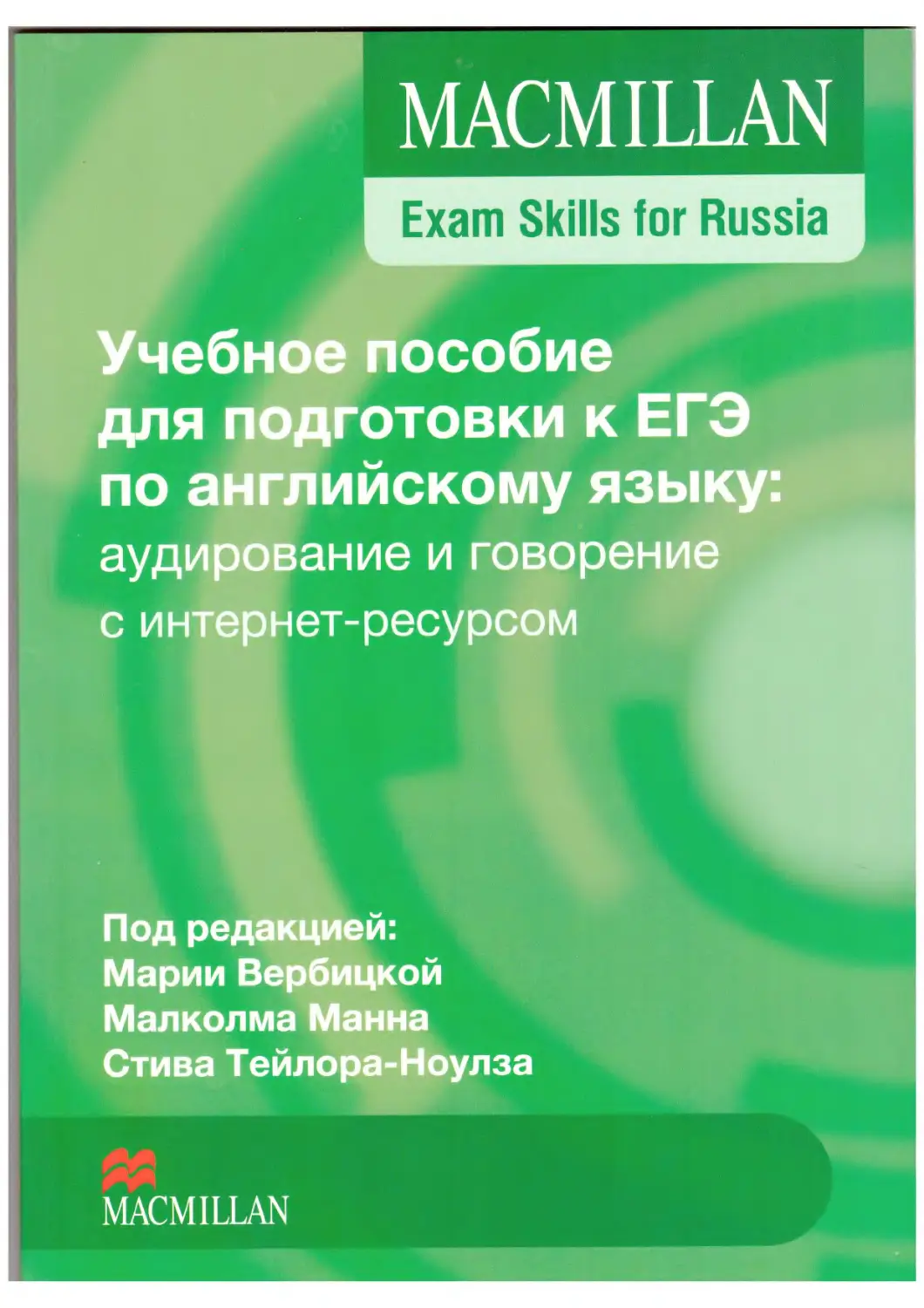
                    MACMILLAN
Exam Skills for Russia
Учебное пособие
для подготовки к ЕГЭ
по английскому языку:
аудирование и говорение
с интернет-ресурсом
Под редакцией:
Марии Вербицкой
Малколма Манна
Стива Тейлора-Ноулза
MACMILLAN
MACMILLAN
Exam Skills for Russia
Учебное пособие
для подготовки к ЕГЭ
по английскому языку:
аудирование и говорение
с интернет-ресурсом
Под редакцией:
Марии Вербицкой
Малколма Манна
Стива Тейлора-Ноулза
Contents
Introduction
page 4
Topic Listening skills	Speaking skills
Unit 1 page (i	Relationships	Skill: listening for gist Exam practice: EGE Listening Task 1	Skill: using stress in words Exam practice: EGE Speaking Task 1
	Entertainment	Skill: listening for specific information Exam practice: EGE Listening Task 2	Skill: understanding the situation Exam practice: EGE Speaking Task 2
Unit3 page 22	Chores and free time	Skill: listening for opinion Exam practice: EGE Listening Task 3	Skill: choosing a photo and planning Exam practice: EGE Speaking Task 3
	Friends	Skill: listening for attitude and feelings Exam practice: EGE Listening Task 1	Skill: giving a brief description Exam practice: EGE Speaking Task 4
Unit 5 page 38	Careers	Skill: understanding when something is not stated Exam practice: EGE Listening Task 2	Skill: using stress in words and sentences Exam practice: EGE Speaking Task 1
	Science	Skill: understanding difference in meaning Exam practice: EGE Listening Task 3	Skill: forming yes/no questions Exam practice: EGE Speaking Task 2
Unit 7 page 54	School	Skill: predicting Exam practice: EGE Listening Task 1	Skill: using description phrases Exam practice: EGE Speaking Task 3
	Holidays and traditions	Skill: understanding logic Exam practice: EGE Listening Task 2	Skill: speculating Exam practice: EGE Speaking Task 4
Unit 9 page 70	Fashion and shopping	Skill: listening for synonyms Exam practice: EGE Listening Task 3	Skill: using stress and intonation in sentences Exam practice: EGE Speaking Task 1
	Town and countryside	Skill: listening for specific information Exam practice: EGE Listening Task 1	Skill: forming wh- questions Exam practice: EGE Speaking Task 2
Unit 11 page 86	Technology	Skill: listening for synonyms Exam practice: EGE Listening Task 2	Skill: using your imagination Exam practice: EGE Speaking Task 3
	Travel	Skill: understanding implication Exam practice: EGE Listening Task 3	Skill: comparing and contrasting Exam practice: EGE Speaking Task 4
Unit 13 page 102	Health and fitness	Skill: listening for opinion Exam practice: EGE Listening Task 1	Skill: dealing with unknown words and phrases Exam practice: EGE Speaking Task 1
	Everyday life	Skill: predicting Exam practice: EGE Listening Task 2	Skill: understanding the prompts Exam practice: EGE Speaking Task 2
Unit 15 page 118	Higher education	Skill: listening for specific information Exam practice: EGE Listening Task 3	Skill: giving reasons Exam practice: EGE Speaking Task 3
	Nature and the environment	Skill: listening for synonyms Exam practice: EGE Listening Task 1	Skill: expressing a preference Exam practice: EGE Speaking Task 4
EGE Practice Test 1
EGE Practice Test 2
Listening Guide
Speaking Guide
Audio Track Listing
page 134
page 138
page 142
page 143
page 144
Учебное пособие для подготовки к ЕГЭ по английскому языку:
аудирование и говорение
Основная задача данного учебного пособия состоит в том, чтобы помочь учащимся подготовиться к
сдаче Единого государственного экзамена (ЕГЭ) по английскому языку для выпускников 11 классов.
Пособие с успехом может быть использовано также для подготовки к сдаче экзаменов по английскому
языку на уровень В2 Общеевропейской системы оценки владения иностранным языком, например,
экзамена Cambridge English: First (FCE) и Cambridge English: First (FCE) for Schools.
Структура книги для учащегося
Пособие включает 16 разделов (units), каждый раздел состоит из двух подразделов, один из которых
посвящён аудированию, второй — устной речи. Подразделы, включённые в один раздел, объединены
тематически и содержат лексические задания, что обеспечивает, помимо развития умений аудирования
и говорения, совершенствование использования лексических единиц в коммуникативно значимом
контексте в рамках школьной тематики.
Каждый раздел нацелен на развитие определённых умений аудирования (понимание основного
содержания прослушанного текста, понимание запрашиваемой информации, полное понимание
прослушанного текста) и говорения (умения монологической и диалогической речи) и включает задания
на формирование соответствующих микроумений.
В рубриках Develop your listening skills / Develop your speaking skills в простой и доступной форме
объясняются различные стратегии, характерные для данных видов речевой деятельности, и даются
задания, их формирующие.
Рубрика Exam Focus раскрывает важность каждого из развиваемых умений для успешного выполнения
заданий Единого государственного экзамена и содержит тренировочные задания в формате ЕГЭ.
Все разделы пособия содержат также рубрику Skills tip, где вы найдёте полезную информацию об
экзамене и советы по выполнению его заданий. Пособие включает также образцы развёрнутых ответов
на задания устной части экзамена.
Пособие также содержит два практических теста, которые включают все задания раздела
«Аудирование» и устной части ЕГЭ.
Раздел «Аудирование» Единого государственного экзамена
ЕГЭ по английскому языку начинается с раздела «Аудирование», который включает задания
на понимание основного содержания прослушанного текста, понимание в прослушанном тексте
запрашиваемой информации и полное понимание прослушанного текста.
В задании 1 вы услышите шесть коротких высказываний. Необходимо установить соответствие между
высказываниями и приведёнными утверждениями, которые выражают их основное содержание.
Каждое утверждение можно использовать только один раз. В задании есть одно лишнее утверждение.
Каждое правильно установленное утверждение оценивается в один балл, т. е. максимальная оценка
за выполнение задания 1 составляет шесть баллов. Данное задание проверяет понимание основного
содержания прослушанного текста.
В задании 2 вы услышите диалог. Ваша задача — установить, какие из приведённых утверждений
соответствуют содержанию прослушанного текста, какие не соответствуют и о чём в тексте не
сказано, т. е. на основании текста нельзя дать ни положительного, ни отрицательного ответа. Каждый
правильный ответ оценивается в один балл, т. е. максимальная оценка за выполнение задания 2
составляет семь баллов. Данное задание проверяет умение понимать и извлекать необходимую
запрашиваемую информацию в прослушанном тексте.
4
.	В заданиях 3—9 вы услышите интервью. Вам необходимо ответить на семь вопросов по содержанию
аудиотекста, выбрав правильный ответ из трёх предложенных. За каждый правильный ответ вы
получаете один балл, максимум за успешное выполнение этих заданий — семь баллов. Данные задания
проверяют полное понимание прослушанного текста.
Задания раздела «Аудирование» построены от наиболее простого к наиболее сложному. В целом
за правильное выполнение всех заданий раздела можно получить максимум 20 баллов, что составляет
20% от 100 тестовых баллов экзамена.
Устная часть Единого государственного экзамена
Устная часть ЕГЭ по английскому языку (раздел «Говорение») сдаётся в компьютеризированной
форме в отдельный день. Устная часть экзамена состоит из четырёх заданий: чтение текста вслух,
условный диалог-расспрос, тематическое монологическое высказывание и тематическое монологическое
высказывание с элементами рассуждения.
Первое задание устной части — чтение вслух текста информационного или научно-популярного
характера. Вы должны прочитать текст так, чтобы он легко воспринимался на слух. Это значит,
что необоснованные паузы в чтении отсутствуют, соблюдается фразовое ударение и интонационные
я	контуры, слова произносятся без нарушения нормы.
В задании 2 устной части вам предлагается жизненная ситуация, в которой вы, заинтересовавшись
рекламным объявлением, хотите получить дополнительную информацию. Ваша задача — задать пять
прямых вопросов па основе ключевых слов.
Задание 3 — двухминутное монологическое высказывание по предложенной теме. Вы выбираете одну
1	фотографию из трёх предложенных и описываете её. План высказывания, представленный в задании,
поможет вам успешно справиться с этим заданием.
Задание 4 — это также двухминутное монологическое высказывание, но уже с элементами рассуждения.
Вам предлагается сравнить две фотографии, г. е. найти в них общее и различное. Выполняя задание,
необходимо придерживаться предложенного плана.
Задания устной части ЕГЭ предлагаются последовательно: каждое последующее задание выдаётся после
окончания выполнения предыдущего. Во время всего ответа ведётся аудио- и видеозапись. Выполнение
заданий оценивается двумя независимыми экспертами, при значительном расхождении их оценок
назначается третий эксперт. Эксперты оценивают решение коммуникативной задачи, языковое
оформление высказываний и произношение.
В целом за правильное выполнение всех заданий устной части можно получить максимум 20 баллов,
что составляет 20% от 100 тестовых баллов ЕГЭ.
• Учебное пособие для подготовки к ЕГЭ по английскому языку: аудирование и говорение» поможет
в развитии умений и навыков, необходимых для успешной сдачи ЕГЭ по английскому языку.
Оно может эффективно использоваться как учителем для работы в классе, так и учащимися для
с ктоятельной подготовки к экзамену.
Надеюсь, что работа по нашему пособию будет полезна и интересна для вас.
Желаю вам успеха на экзамене!
Мария Валерьевна Вербицкая,
профессор, доктор филологических наук,
ведущий научный сотрудник ФИЛИ,
председатель Федеральной комиссии по разработке КИМ ЕГЭ по иностранным языкам
5
Listening for gist
Relationships
co
2|E Skill:
Vocabulary:
Exam practice:
Listening skill: listening for gist
Why is listening
for gist important?
Listening for gist helps you to understand the situation, the general opinion of each
speaker, and the main subject. Sometimes, understanding the general meaning is
enough to answer the question. Listening for gist also helps us to know when to listen
more closely for detail. Listening for gist involves focusing on ‘key words’ which help
you understand the situation. The speaker’s tone of voice sometimes helps too. When
you listen to the same listening recording twice, it’s a good idea to listen for gist the
first time and more detail the second time. Listening for gist is important in all parts
of the EGE Listening section.
Listening for gist means listening for
A detail.
В the general meaning.
C specific questions.
Get started
Look at the photo and answer the question.
 What kinds of relationships can we have with other people? Make a list.
Listening for gist
Develop your vocabulary
1 Choose the correct answer.
1	Some people find it very hard to do / make friends with others.
2	If you have a problem, it’s best to deal / handle with it quickly.
3	Learning from your mistakes is an important part of getting / growing up.
4	Dan and Philip were friends for years, but they fell / broke out because of a silly argument.
5	It was only a.joke - don’t go I get upset about every little thing!
6	You have to try to go / get on with people - even if you don’t want to be their best friend.
7	It isn’t sensible to go / get out every night when you’re supposed to be studying.
8	When you first go / get to know someone, how can you tell if you’re going to be friends?
Develop your listening skills: listening for gist
1 4>) Listen to a woman talking about friendship.
Are the sentences true (T) or false (F), according to what the woman says?
1	Making friends at a young age is mostly a good thing.	T /	F
2	Only children in their teens suffer from stress.	T /	F
3	Until the age of twelve, parents always choose the child’s friends.	T /	F
4	Relationships between friends get closer as the child gets older.	T /	F
5	The main point of the talk is relationship problems.	T /	F
2 4>) You will hear six different speakers. Match each speaker to the situation.
Speaker 1:
Speaker 2:
Speaker 3:
Speaker 4:
Speaker 5:
Speaker 6:
This person
a is helping someone.
b is upset about something that was said.
c is trying to phone a friend.
d has just passed an exam.
e is arranging a meeting with a friend.
f wants help from someone.
3 4)) You will hear two people talking about relationships.
As you listen, choose the best summary for what each speaker says.
Speaker 1
a I don’t take relationships too seriously,
b I sometimes wish I had more friends,
с I know' I don’t always do the right thing.
Speaker 2
a You should get what you can out of every relationship,
b I’m prepared to try to make relationships successful,
c Most relationships go wrong sometimes.
4 41) Listen to three short conversations and match them to three of the ideas below.
There is one idea you will not use.
Conversation 1:
Conversation 2:
Conversation 3:
a The boy doesn’t share the girl’s enthusiasm.
b The girl is hearing something she doesn’t want to hear.
c The girl is very angry at the boy’s suggestion.
d The boy and girl both agree on the subject.
7
Listening for gist
5 Look at the groups of key words and phrases and match them to the subjects that they belong to.
1 good company, walks, feed
2 boss, get on with, not close
3 angry, furious, not speaking
4 strict, fair, interesting
5 related, married to, uncle
6 close, in common, best
a Family
b Friends
c Arguments
d Work
e Animals
f Teachers
6 Ф) Listen to four people telling an interviewer about a relationship they have.
Match each speaker to the things they say. There are two items that you will not use.
Speaker 1:	a	Of course we have arguments - who doesn’t?
Speaker 2:	b	I’m very close to someone who is a family member’s wife.
Speaker 3:	c	She’s such a great teacher!
Speaker 4:	d	My pet means a lot to me.
e People are surprised that our relationship is the way it is.
f We have a good relationship, but it’s quite a formal one.
Exam focus:
EGE
1 Look at the exam practice section on page 9 and answer these questions about it.
1	How many questions are there in this section of the exam?
2	How many answer options have you got to choose from?
3	Are you going to hear monologues or dialogues?
4	Will the words in the answrer options always be the same as the words in the recording?
5	What should you always do before you listen to the recording?
Skills tip
In EGE Listening Task 1, does listening for gist help you
a understand every word of what you hear?
Yes / No
b identify the situation, main subject and general
opinions of the speakers?
Yes / No
2 Tick (/) the things that will help you when you are listening for gist.
1	Listen only for gist.
2	Look at the key words in the answer choices.
3	Expect to hear key words exactly as they are in the answer choices.
4	Expect to hear synonyms and words / phrases related to the key words.
5	Try to understand the main subject.
6	Listen carefully to understand the way the speakers feel about things.
Exam practice:
EGE
Skills tip
Выполняя задание 1 раздела «Аудирование» ЕГЗ, до первого прослушивания внимательно прочитайте все
утверждения (1-7). Определив ключевые слова в утверждениях, подумайте о синонимах к ним. В монологах
те же мысли будут перефразированы и выражены близкими по смыслу, но другими словами.
Раздел 1. Аудирование
Вы услышите 6 высказываний. Установите соответствие между
высказываниями каждого говорящего A—F и утверждениями, данными
в списке 1—7. Используйте каждое утверждение, обозначенное
соответствующей цифрой, только один раз. В задании есть одно
лишнее утверждение. Вы услышите запись дважды. Занесите свои
ответы в таблицу.
1.	Being ready to help others is important.
2.	You should never feel bad about saying what you think.
3.	We must have good working relationships at school.
4.	It’s important to talk about problems with family members.
5.	When you fall out with someone, you can’t change it.
6.	My friends all know how important family is.
7.	Personality is much more important than appearance.
OU
Говорящий	A	В	С	D	E	F
Утверждение
9
Using stress in words
Relationships
Skill:
Vocabulary:
Exam practice:
words
ships topic vocabulary
Speaking skill: using stress in words
Why is using
stress in words
important?
With one-syllable words, you never need to worry about how to stress them. However,
when a word has two or more syllables, usually only one syllable is stressed. Consider
the word ‘speaking’. It is pronounced SPEAking, not speaKING, because the stress is
on the first syllable. Some words with the same root have stresses in different places,
e.g. PHOtograph, phoTOgrapher, photoGRAPHic. There are rules, but there are also
many exceptions, so it is easier to learn where the stress is in each word. This means
listening carefully when you hear the word. It is important to stress words correctly
because it makes it easier for a listener to understand you. Using correct word stress
is important in all parts of the EGE Speaking section.
The best thing to do about word stress is to
A study all the rules.
В listen to how a word is pronounced.
C not worry if a word is pronounced incorrectly.
Get started
Look at the photo and answer the question.
 What are the main reasons for problems in relationships?
Develop your vocabulary
! Complete the text with the nouns in the box.
anger  excitement  humour  jealousy  loneliness  regret  stress  support
When good relationships go bad
Nobody likes to be alone for a long time and 1 must be one of the
saddest feelings. However, the 2	of being with friends can soon
disappear when things go wrong in a relationship.
Relationship problems are often caused by 3- for example, when
someone doesn’t like their friend spending time with others. But there are other
problems too. Some say that 4	 is a big cause of relationship problems
and, sadly, there are many situations when people feel this pressure. Other people are
so filled with 5  about the past that they can’t enjoy the present. And,
of course, there are often problems when one person in a relationship doesn’t offer
enough help and 6 to the other.
Problems can happen in even the strongest relationships and they can
hurt friendships. For example, if two people don’t have the same sense of
7	- one person says something funny, but the other person reacts
with 8	. Friendships can recover from these problems, but if they keep
happening, the relationship might end.
Using stress in words
Develop your speaking skills: using stress in words
1 40 Look at the words and underline the stressed syllable in each one. Then listen and check.
1 2 3 4 5	regret	6	support expect	7	damage picture	8	anger number	9	people posted	10	humour
2 Look at the words and choose the syllable that is stressed, a, b or c.
Practise saying the words aloud. One word has two answers.
er	1 2	jealousy a JEA b communicate a MU	b	LOUS NI	c c	Y CATE	6 naturally
						7	a NA another a A	b b	TUR NO	c c	LY THER
is s	3	communication a U	b NI		c	CA	8	researcher a RE	b	SEARCH	c	ER
	4	relationships a LA	b	TION	c	SHIPS	9	opposite a 0	b	POS	c	ITE
	5	networking a NET b	WORK	c	ING	10 regretted a RE		b	GRET	c	ED
3 40 In unstressed syllables, we often use the sound /э/. Underline that sound in the following words.
The sound appears twice in one word. Listen and repeat.
1	anger	6	media
2	another	7	never
3	compare	8	opposite
4	emotion	9	problem
5	however	10 relationship
Which of the statements do you agree with? Tick (/) them. Explain why you agree with them.
ms
re
d,
1	Loneliness is a problem when you haven’t got brothers or sisters.
2	The best friendships are built on trust.
3	The most important relationships that we have are with our family.
4	It's important for friends to share the same interests.
5	Being alone is awful.
6	It's better to have one or two close friends.
7	It's very easy to make new friends.
8	The people I meet on social networking sites are real friends.
>ep
11
Using stress in words
5 Complete the sentences with ideas of your own.
1	Relationships often end because
2	People get jealous because
3	I couldn’t be friends with someone who is
4	When I’m with friends, I usually feel
5	For me, dealing with relationship problems is
6	The people I get on best with are people who
Pronunciation: numbers and years
I Ф) How would you say these numbers aloud? Practise, then listen and check.
1	13	5	340	9 295,673
2	30%	6	856	10 1,000,000
3	25	7	6,400	11 2,000,037
4	54 per cent	8	36,000	12 67,500,000
2 Ф) Practise saying these years. Then listen and check. Repeat any that you got wrong.
1 1945
3 2001
5 2010
2 1997
4 2008
6 2020
Exam focus:
EGE
Look at the exam practice section on page 13 and write 5-10 words from the text that you need
to practise. Say them aloud.
Skills tip
In EGE Speaking Task 1, should you
a give your opinion on the text?
Yes / No
b rephrase the text in your own words?
Yes / No
Practise reading the following sentences. Pay attention to your word stress. Listen and check.
1	I don’t often chat online, so I’ve never said anything I later regretted.
2	A sense of humour, or a feeling of excitement, is better than jealousy or anger.
3	It’s OK to communicate your emotions to others, but be prepared for their reaction.
4	In 2014, a study found that 74 per cent of adults who were online were using social networking sites.
5	In steady relationships, people receive the support that is so necessary for happiness.
6	The majority of people like social media, but some people say that it causes them stress.
12
Exam practice:
EGE
Skills tip
Используйте время, отведённое на подготовку задания 1 устной части ЕГЭ, максимально эффективно.
Прочитайте текст целиком. Отметьте слова, которые вызывают у вас наибольшие затруднения,
и произнесите их вслух несколько раз.
Во время выполнения задания 1 не пытайтесь прочитать текст очень быстро. Старайтесь читать чётко,
в спокойном, размеренном темпе.
Устная часть
1
Task 1. Imagine that you are preparing a project with your friend. You have
found some interesting material for the presentation and you want to read this
text to your friend. You have 1.5 minutes to read the text silently, then be ready
to read it aloud. You will not have more than 1.5 minutes to read it.
When you communicate online, you usually expect others to read what you
have written. However, this could cause relationship problems. It’s OK
to share how you feel, but be prepared for what others might say about it.
And never say too much!
People can react to what you write online with different emotions: humour,
jealousy and anger, for example. A study which appeared in 2009 said that
over 30 per cent of people wrote things online that they later regretted.
54 per cent of these people were under 25 years of age.
Social networking can damage even steady relationships. In another study,
in 2013, researchers interviewed 24,000 people who all used social media
networks. Many of them said that these networks didn’t make relationships
stronger. In fact, many reported the opposite, saying relationships were
worse compared to when there were no social networking sites.
ds?
13
Listening for specific information
Entertainment
Skill:
Vocabulary:
Exam practice:
Listening skill: listening for specific information
Why is listening for
specific information
important?
Listening for specific information requires you to listen carefully for a particular
detail: a number, a day of the week, a time of day, a date or an item in a list of things
a person talks about, for example. In EGE Listening Task 2, you are asked to answer
questions with the answer ‘True’, ‘False’, or ‘Not stated'. This means you should
read the questions carefully, ensure you know what kind of information you are
listening for, listen for those details in the conversation and note what the speakers
say rega rding that specific detail. Listening for specific informa tion is particularly
important when you do EGE Listening Task 2.
When you listen for specific information, it’s most important to
A remember every single detail that, a speaker mentions.
В understand the situation in which the speaker is speaking.
C listen for details that will help you answer the questions.
Get started
Look at the photo and answer the question.
 In what ways does entertainment benefit our lives?
Develop your vocabulary
1 Complete these sentences with the words in the box.
I cinema  trailer  instrument  internet  magazines  message  phone  review
1	I’m thinking of writing a(n) about the film I saw last night.
2	Paula loves fashion, so she reads lots of to keep up to date with
what’s in style.
3	Have you seen the for that new film? It looks great!
4	If you haven’t got any plans for Friday night, would you like to go to the
_______________ with me?
5	Jack was surfing the for hours yesterday afternoon.
6	I’d like to learn how to play a musical- maybe the guitar or the
drums.
7	Steven and Julia had been talking on the. 	  for an hour when his
mum told him to hang up.
8	Sometimes it’s more convenient to send a text	than to call
someone.
Listening for specific information
Develop your listening skills: listening for specific information
1 Look at the sentences in exercise 3 and choose which detail you may need to listen for in each of the
monologues.
1	a day of the week / a period of time
2	a number / a type of music
3	names of cinemas / a type of film
4	a time of day / an age
5	items in a list/people
6	a day of the week / a type of book
2 -<» Listen to six short monologues and match the form of entertainment
to the speaker who mentions it.
Speaker 1:
Speaker 2:
Speaker 3:
Speaker 4:
Speaker 5:
Speaker 6:
a going to the cinema
b reading books
c playing a musical instrument
d dining out
e listening to music
f playing video games
3 Ml) Listen to the monologues again and decide if the sentences are true (T), false (F)
or not stated (NS).
1	The restaurant opened its doors two weeks ago.	T/F/NS
2	The speaker has over 50,000 music files.	T / F / NS
3	The speaker doesn’t like action films.	T/F/NS
4	The speaker had piano lessons in the evening.	T/F/NS
5	The speaker has lots of video games.	T/F/NS
6	The speaker was reading a book last Saturday.	T/F/NS
1 < >) Listen to part of a radio interview about a forthcoming event and choose
the best answer (a, b or c).
1 Ti tornas works at a___.
a radio station	b university	c	music shop
2 Thomas is a	. a music director	b radio presenter	c	university professor
3 Thomas has been in his current job for a number of		'
a weeks	b months	c	years
4 7 >mas is talking about the opening of a a radio studio	b concert hall	c	new department
* 7 opening will take place	. a in two weeks	b at the weekend	c	during the week
6 The opening will begin at	. a 7pm	b 8pm	c	9 pm
15
Listening for specific information
5 *0 Now continue listening to the interview and complete the sentences. Write numbers or one to
three words in each gap. The sentences are in the order that you will hear them in the interview.
1	Construction on the concert hall began	months ago.
2	The concert hall can seat up to	audience members.
3	The building is equipped with a state-of-the-art	system.
4	Concertgoers can go to a(n)	before and after performances.
5	will be served to guests on opening night.
6	Concerts and	will be performed at the hall in the forthcoming months.
6 *’) Listen to the dialogue and decide if the sentences are true (T), false (F) or not stated (NS).
1	The roller coaster is 103 metres high.	T / F /	NS
2	Bobby is planning to go to the amusement park	with two	of his friends.	T / F / NS
3	Trish won a toy animal at the park.	T / F /	NS
4	Trish tells Bobby that the amusement park has	an	Indian	restaurant.	T / F /	NS
5	Trish had some ice cream after her lunch.	T / F / NS
6	The pizza costs S6.00 for one slice.
T/F/NS
Exam focus:
EGE
Look at the exam practice section on page 17 and answer these questions.
1	How many speakers do you think you will hear?
2	How many statements do you have to respond to?
3	How many of the statements are negative?
4	Which statement does not mention a form of entertainment?
5	Which statements mention someone other than Julie or Lars?
6	Which statements mention a period of time or time of day?
Skills tip
In EGE Listening Task 2,
a are you asked to identify the general idea of what you hear?
Yes / No
b do most, if not all, of the statements involve listening for specific details?
Yes / No
Decide if these statements are true or false.
1	In EGE Listening Task 2, more than one statement can be answered with ‘Not stated’.
2	The statements are in a different order to the information in the recording.
3	The wording in the statements is sometimes different to the wording in the recording.
4	A negative statement can never be answered with ‘True’.
5	The speakers in the recording can use negative statements.
6	More than one answer may be correct.
vv.
Exam practice:
EGE
Skills tip
E задании 2 раздела «Аудирование» ЕГЭ вам необходимо определить, являются ли утверждения
кс-ыми, неверными или в аудиотексте не упоминается данная информация. Задание часто содержит
: '^.-цательные утверждения, например: Nicole doesn’t like burgers, или Jason isn’t meeting his friends
r -e park. Отрицательные утверждения усложняют задачу выбора правильного ответа.
~ :гатите на них особое внимание до начала прослушивания аудиотекста.
Раздел 1. Аудирование
2
Вы услышите диалог. Определите, какие из приведённых утверждении
A—G соответствуют содержанию текста (1 — True), какие не
соответствуют (2 — False) и о чём в тексте не сказано, то есть на
основании текста нельзя дать ни положительного, ни отрицательного
ответа (3 — Not stated). Занесите номер выбранного Вами варианта
ответа в таблицу. Вы услышите запись дважды.
1
A.	Lars often met up with friends during the break.
B.	Julie’s house wasn’t very quiet over the holidays.
C.	Julie enjoys crime novels best.
D.	Lars’s sister has a very large collection of magazines.
E.	Julie and Alice saw a film in the evening.
F.	Lars didn’t read any reviews before he went to the cinema.
G.	Lars’s guitar lesson lasts for an hour.
Утверждение	A	В	С	D	Е	F	G
Соответствие диалогу
ails?
17
Understanding the situation
Entertainment
co
s Skill:
Vocabulary:
Exam practice:
Speaking skill: understanding the situation
Why is
understanding
the situation
important?
In order to be able to ask appropriate questions to obtain information when you
do EGE Speaking Task 2, it is important to understand the situation that you’re
presented with. For example, if you are presented with an advert, it will, probably
contain a photo or some other type of visual prompt. Also, most adverts contain text.
So, by looking at the visual prompt and reading the text, you will better understand
the situation. You can then form appropriate questions to get information about
things that are not answered by the advert or other visual prompt that you see.
Understanding the situation is a very important skill to have when you do EGE
Speaking Task 2.
You see an advert which is illustrated with a photo of a sports car. Which of the following
questions would you ask?
A What places will we visit on this tour?
В How many kilometres has this vehicle been driven?
C In what year was the automobile invented?
Get started
Look at the photo and answer the question.
 You want to have swimming lessons. What three questions can you ask the pool staff?
Sk*" Develop your vocabulary
1 Match to make sentences.

1	We went to a music
2	The vendors at the craft
3	On TV tonight, there’s a talent
4	The outdoor
5	They attended a formal
6	We went on a hot-air balloon
7	I bought a used stereo
8	We attended the grand
a ride that took us over the park.
b concert we went to was very loud!
c festival that featured twenty artists.
d opening and got to eat free food.
e fair sold beautiful handmade
pullovers.
f event and had to dress very smartly.
g showr featuring singers, comedians
and musicians.
h system - it only cost me S50!
Understanding the situation
Develop your speaking skills: understanding the situation
1 What could you ask about these photos? Match the photos to the questions.
a Are we allowed to bring food into the concert?
c What qualifications has the music teacher got?
b Has the studio got good sound quality?
d How much does the drum set cost?
2 Read the situations and choose the correct question, a or b.
ing
1	attending the grand opening of a clothing shop
a Will there be a discount on men’s suits?	b
2	meeting your favourite musician at a music festival
a How much does each lesson cost?	b
3	learning how to surf in Hawaii
a Is the plane fare included in the price of the course? b
4	shopping at a local craft fair
a Will there be opportunities to buy handmade products? b
5	visiting an aquarium
a Can you tell me who will be performing?	b
6	going on a hot-air balloon ride
a What safety rules do you follow?	b
What time does your shop close?
Can we have our photo taken with the artist?
What prize money is awarded in the competition?
Is there a dress code we need to follow?
Is there a gift shop where we can buy souvenirs?
How long will it take to reach our destination?
aff?
3 Write the questions that you didn’t use in exercise 2 next to the suitable situations.
1 taking a train trip	_____
- nding a formal event
J . • г  > a local comedy theatre
4 - г •• ring a talent show
- .iming how to sing
-	- . ing a jewellery shop
s.
- study the photo and tick (/) the questions that you could ask to get more information about it.
1 How long does the trip last?
2 How much does the trip cost?
3 Where does the trip take place?
4 How much does the owner want for the boat?
5 How many other people are participating in the game?
6 What safety precautions should we follow?

Demanding the s'tuation
5 Look at the photo in exercise 4 again and write five questions based on these words or phrases.
1	sights
2	food and drink
3	weather
4	people per boat
5	lessons
Pronunciation: word spelling: c
Ф) Listen to six sentences and write down the word from each sentence that contains the letter c.
1 	3 	5
2 	4 	6
2 <») Practise how to pronounce the letter c by reading these sentences aloud.
Remember what you learned in exercise 1. Listen and check.
Lisa thinks that because she took first place in the competition, she’s really something special!
They’re playing early twentieth-century films at the local cinema in the city centre.
Exam focus:
EGE
Look at the exam practice section on page 21 and choose the correct answer, a or b.
1 You will be asked to study an_____.
a	article	b	advert
2 The things you are required to say will take the form of
a	questions	b	statements
3 You will have________to ask each question,
a	1.5 minutes	b	20 seconds
4 The photo has________that goes with it.
a	an address	b	text
5 The item in the photo is probably____.
a new	b used
6 The item is something that you could____
a listen to	b play
Skills tip
In EGE Speaking Part 2, are you often required to
a provide answers for your questions?
Yes / No
b understand a situation before you ask your questions?
Yes / No
Look at the situations. Using a few words, write four other things you would like to know about them.
Which of the two situations, a or b, is related to the exam practice section on page 21?
a stereo system for sale: cost of device,___________________
b outdoor concert: duration of concert,
Exam practice:
EGE
Skills tip
= задании 2 устной части ЕГЭ вам нужно задать пять вопросов по заинтересовавшему вас рекламному
:: ьявлению. Как правило, рекламное объявление состоит из фотографии и краткой текстовой информации.
Е-.-лательно изучите фотографию и сопровождающий её текст.
Е случаях, когда вы точно не можете определить, что изображено, текстовая информация может служить
зам подсказкой. Например, фраза only £55, подскажет, что речь идёт о стоимости продукта, услуги и т. п.
"аким образом, вы сможете составить требуемый вопрос, например: Where сап I buy the product?
Устная часть
2
Task 2. Study the advertisement.
Stereo System for Sale
Call Pete: 342-4590
You are interested in buying the stereo system and you would like to get
more information. In 1.5 minutes you are to ask five direct questions to find
out the following:
1)	price
2)	condition
3)	number of parts
4)	age
5)	sound quality
You have 20 seconds to ask each question.
21
Listening for opinion
C
1
Chores and free time
co
S Skill:
Vocabulary:
Exam practice:
Listening skill: listening for opinion
Why is listening for
opinion important?
When you listen for opinion, you want to find out what each speaker thinks. Th is
is important because there is a big difference between opinion and fact. Certain
words and phrases play an important part in understanding opinion. A speaker
might begin a statement with T think ...’or Tdon’t like ...’. This makes it easy to
understand their opinion. However, speakers can express their opinion with many
different words and phrases. For example, when someone says, ‘Absolutely!’, it shows
they agree with what the other person sa id. On the other hand, if someone says,
‘I’m not so sure about that... ’, they probably disagree. Listening for opinion is an
important skill when you do EGE Listening Task 3.
When you listen for opinion,
A it is always easy to understand what a speaker thinks.
В you should listen for facts too.
C you need to listen for certain words and phrases.
Get started
Look at the photo and answer the question.
 What chores do you dislike doing and what chores are not so bad?
Develop your vocabulary
Choose the
correct answer.
D° y?v Iive in a mess?
We can help!
We’ve all done it-we mess 1 ..n/ t
don’t put things 2 out / awa X ° °Ur r°°ms and the" we
Pretty soon, the mess builds 3 uo /	With them-
control and we can’t move! P *’ thln9s Set 4 in / out of
don’t just tidy°5 aXay/upCo P?fessional llfe or9anisers, we
too if you want). Our job is to sh °me ^a,thou9h we can do that
,lfe so that you can:	h you how to organise your
• quilklv dUecHOVerKqUiCkly and easi|y
quicKiy decide what to thr™, -> y
: whM ,0 kMp
Ine tnmgs you really love
Richards & Wilkins
rofessional Organisers
Contact us for more details
www.rworganise.com

Listening for opinion
Develop your listening skills: listening for opinion
I For each dialogue, decide if the second speaker agrees or disagrees with the first speaker.
Dialogue 1
Woman: We need some more cupboards in here - we can’t move around in this room. It would be great if we
could just throw everything away!
Man:	If you ask me, just putting things away when you’ve finished with t hem would solve the problem.
Dialogue 2
Boy:	There’s a new sports centre not far from here. You can do all kinds of things there - there’s even
a swimming pool. You should give it a try.
Girl:	Thanks! How did you know that I was into sport?
Dialogue 3
Girl:	I have to iron all my clothes t onight . There’s nothing I hate more than ironing. It’s a terrible waste of time.
Boy:	Do you really think so? Have you tried doing it in front of the TV? That’s what I do and it works for me.
I quite enjoy it actually.
Dialogue 4
Man:	Ah! A weekend of sport... there’s the football match to go to tomorrow and then there’s motor racing
on TV on Sunday. Perfect!
Woman: Oh, dear. I’d better find something to do then.
2 <>) Listen and answer the questions about each dialogue.
Dialogue 1
1 What does the woman think the problem is? ________________________________________________________
2 What does the man want the woman to do? _________
Dialogue 2
3 What does the boy think about his room? __
4 What does the girl think about the boy’s room? ____________________
Dialogue 3
5 What does the boy enjoy doing? _
6 What do they both dislike?
Dialogue 4
What does the boy first think about the woman asking him to help?
8 What does the woman think about the mess in the house?
we	3 Ф) Listen to the sentences. Circle Opinion or Fact according to what each speaker says,
n.
। Ol	1 opinion / Fact	3 Opinion/Fact	5 Opinion/Fact
2 Opinion / Fact	4 Opinion / Fact	6 Opinion / Fact
tat
- * >) Listen to four speakers. Decide which statement is closest to what each speaker says, a or b.
1 a Finding something relaxing to do is part of a healthy balance.
b You can find lots of interesting free-time activities to do if you try.
- a If you clean up your home, you will be happier about where you live.
b One reason we need to do household chores is because of the environment.
a If you organise your chores, you’ll find there’s more time to do things you like.
b You need to organise your free-time activities so you can get your chores done.
4 a It’s important to do as much housework as you can when you are free.
b Doing a small amount of housework - but doing it often - is the key.
23
Listening for opinion
5 <») Listen and complete the sentences.
1 If the mess in your house has built up,_____________________________________________________________
2 You shouldn’t try to do chores when_________________________________________________________________
3 Cleaning with a friend is better because_	_
4 Things that don’t belong in your room should go__
5 When you finish tidying up your room, you can enjoy
6 In the kitchen, the first two things to do are______________________________________________________
7 it’s very important to get into the habit of________________________________________________________
8 Making your life easy is____________________________________________________________________________
6 *>) Listen and match each speaker to their opinion. There is one extra opinion you won’t need to use.
Speaker 1:	a Pay attention to one part of the house at a time and tidy it up.
Speaker 2:	b I’ve changed the way I feel about one household chore.
Speaker 3:	c Someone else cleans the house -1 don’t mess it up, so it’s nothing to do with me.
Speaker 4:	d We should use our time wisely if we don’t want household chores to build up. e There are more important things than housework.
Exam focus:
EGE
I Look at the exam practice section on page 25 and answer these questions.
1 How many questions are there in this section of the exam?
2 Will the questions ever take the form of incomplete sentences?
3 Will you hear the correct answer exactly as it is written?
4 How many answer options are there for each question?
Skills tip
In EGE Listening Task 3, should you
a expect to hear all the words and phrases from the answer options?
Yes / No
b listen for words and phrases that mean something similar to one answer option?
Yes / No
2 Decide if these statements are true (T) or false (F).
In EGE Listening Task 3,
1	you will hear several short talks.	T /	F
2	you might hear someone being interviewed.	T /	F
3	it is important to understand the difference between opinion and fact.	T /	F
4	you should read all the answer options before you listen.	T /	F
5	the correct answer option may use synonyms for what you	hear.	T /	F
Exam practice:
EGE
Skills tip
E з.аланиях 3-9 вы услышите интервью. Чтобы выбрать правильный вариант ответа, ознакомьтесь со
азе- вариантами до начала прослушивания. Во время прослушивания важно понять точки зрения
:с :.'х собеседников. Правильный ответ обычно не повторяет лексику задания, а выражен близкими
з-ачению словами.
Раздел 1. Аудирование
'/слышите интервью. В заданиях 3-9 запишите цифру /, 2 или 3, соответствующую
выбранному Вами варианту ответа. Вы услышите запись дважды.
The interviewer’s first question suggests that she...
I)	thinks Adrian’s job is unnecessary.
2)	does not believe Adrian knows his job.
3)	is not a very organised person.
Ответ:
4___ What does Adrian say about not putting things away?
I)	It results from not having enough space.
2)	It means we have too many things.
3)	It can lead to major problems.
On the subject of badly organised space and time, Adrian believes that...
I)	it is better to find a little time to clean up every day.
2)	we need a whole morning to do a good cleaning job.
3)	people don’t clean because they think someone else will.
What does Adrian believe about people who hate doing chores?
I)	He cannot help people like that.
2)	They need to spend more time doing them.
3)	They can find a way to enjoy doing them.
For students, Adrian thinks that housework...
1)	can help them with their studying.
2)	makes them want to sleep.
3)	is as important than free time activities.
Ответ:
Ответ:
Ответ:
Ответ:
What gives Adrian the most job satisfaction?
1) Relaxing after a hard day’s work.
2) Helping people regain control.
.3) Developing good habits.
Ответ:
At the end, Adrian makes the point that a clean home...
1)	is not the most important thing in life.
2)	is what most people prefer.
3)	takes a lot of hard work.
Ответ:
25
Choosing a photo
and planning
Chores and free time
co
Skill:
Vocabulary:
Exam practice:
Speaking skill: choosing a photo and planning
Why is choosing
a photo
and planning
important?
In EGE Speaking Task 3, you have to choose one of th ree photos and talk about it.
This takes a bit of imagination. Your choice of photo should depend on how much
you think you can say about it - if you don’t really understand what’s going on in
a photo, don’t choose that one. To talk about the photo, you need to plan what tenses
you are going to use. Use the simple past and the past continuous to talk about where
and when the photo was taken. Use the simple present to talk about what/who is in
the photo. Use the present continuous to talk about what is happening in the photo.
Choosing a photograph and planning is a key skill in EGE Speaking Task 3.
When choosing a photo and planning to talk about it, remember that you
A should only use past tenses because the photo was taken in the past.
В need to use different tenses to talk about different aspects of the photo.
C have to use present tenses because the conversation is happening now.
Get started
Look at the photo and answer the question.
 What are your favourite free-time activities? Number the following starting with 1 as
your favourite:
Sport
Reading
Dancing
Music
Puzzles
Games
Videos
Other
Develop your vocabulary
i Complete the sentences with the words in the box.
do  enjoy  feel  listen  play  relax  take  watch
1	Photography is my hobby and people say I  pretty good photographs.
2	It doesn’t matter what we do - when I’m with friends I always myself.
3	Reading for an hour before bed always helps me.
4	I wish I could	tennis or do gymnastics, but I’m just not very good
at anything.
5	We don’t 	 a lot of television in my house.
6	If he could, my brother would	__ to music all night.
7	When my dad comes home, he likes to _	the crossword in the newspaper.
8	Some of rhe video games I have make me_________________very excited.
Choosing a photo and panning
Develop your speaking skills: choosing a photo and planning
1 ф) Listen to two speakers and fill in the missing information.
	Speaker 1	Speaker 2
1 What or who is in the photo?
2 When did they take it?
3 What is happening?
4 Why do they keep it in their album?
5 Why are they showing it to their friend?
2 Look at the three photos and answer the questions. Use your imagination where necessary.
1 Which of these free-time activities do you
eqjoy most?
2 Which do you know most about?
3 What exactly is happening in each photo?
4 How do you think the people are feeling?
Why?
5 What had happened before the photo was
taken?
6 What else was happening at the time the
photo was taken?
7 What happened after the photo was taken?
8 Which photo would you choose to talk
about? Why?
Look at the photo you chose in exercise 2 again. Build a story around it.
1	When did you take the photo? Where were you? Who else was there?
2	What or who is in the photo? How are the people feeling? Why?
3	What is happening? Had anything happened before the photo was taken? What?
4	Why do you keep it in your album? Are you pleased with it?
* -the photo special in any way? Why did you decide to show the photo to your friend?
4 cnplete the text about the photo you chose in exercise 2.
chosen photo number	. Do you like this photo?
It shows -av what or who is in the photo]
___________________________________. He/Shc/It/They I -
_____________________________________________. I took this photo because
. I thought it would be a good photo to show you because f ;
27
Choos.ng a photo and planning
5 Now, without using your notes, describe the photo you chose from page 27 aloud.
Aim to speak for about two minutes. Remember to talk about:
	where and when the photo was taken
	what/who is in the photo
	what is happening
	why you keep the photo in your photo album
	why you decided to show the picture to your friend
Pronunciation: word spelling: oo
1	Ф) Match the words that sound the same. Practise saying them. Then listen and check.
1	soon	a	look
2	flood	b	blood
3	cook	c	poor
4	door	d	moon
2	Ф) Use these words to make two lists. Then listen and check. Repeat any words that you get wrong.
afternoon  balloon  book  cartoon  childhood  choose  cool  good  took  wood
Sounds like ‘soon’
Sounds like ‘cook’
Exam focus:
EGE
I Look at the exam practice section on page 29 and tick (/) the sentences that are true.
1	You should say something about each photo.
2	You have to start talking about the first photo.
3	You have time to prepare what you’re going to say.
4	You have to say who took the photo.
5	There are prompts with the photographs.
6	You should speak informally.
Skills tip
In EGE Speaking Task 3, should you
a choose a photo that helps you think of a story?
Yes / No
b plan what to say before you start speaking?
Yes / No
2 Look at the exam practice section on page 29 again. What kind of stories can you think of to go with
each one? Use the following to help you:
Who?  What?  Where?  When?  Why?  How?
Exam practice:
EGE
Skills tip
В - ". а*е._эно подойдите к выбору фотографии - остановитесь на той, о которой вам легче всего рассказать.
5: всеми ответа представьте, что вы рассказываете своему другу о фотографии из вашего альбома.
•	:.дет 1.5 минуты на подготовку. В ответе важно использовать разные грамматические времена для
: -ия разных пунктов задания. Продумайте, что происходит на фотографии, что на ней изображено,
г - огда она была сделана. Представьте, почему вы храните эту фотографию в альбоме и почему решили
:; а-ь её другу. Начните рассказ с вводной фразы, например: What do you think of this photo? или This is
: of my best photos. Убедитесь, что вы раскрыли все пять пунктов задания.
g.
Устная часть
Task 3. Imagine that these are photos from your photo album. Choose one photo
to present to your friend.
Photo 1
Photo 2
Photo 3
You will have to start speaking in 1.5 minutes and will speak for not more
than 2 minutes (12—15 sentences). In your talk remember to speak about:
	 where and when the photo was taken
	what/who is in the photo
	what is happening
>tory?
	why you keep the photo in your album
	why you decided to show the picture to your friend
You have to talk continuously, starting with:
“I have chosen photo number ...”.
ith
Listening for attitude
and feelings
Friends
Skill:
Vocabulary:
Exam practice:
itude and feelings
opic vocabulary
Listening Task 1
Listening skill: listening for attitude and feelings
Why is listening
for attitude and
feelings important?
In EGE Listening Task 1, you will hear speakers talking about a common theme.
What the speakers say will reflect their attitude and feelings about experiences and
the specific common theme. Expressions, such as T feel’, ‘I think’, T believe’, etc. are
often used by the speakers and what follows these expressions will give the listener
an idea of the speakers’ attitude towards an experience or theme. Words like ‘happy’,
funny', ‘sad’, ‘angry’, ‘upset’ etc. are often used to describe the speakers’feelings,
which can be either positive or negative. The answer options in EGE Listeni ng
Task 1 express the speakers’ attitudes or feelings towards an experience or theme.
This means that listening for attitude and feelings is very useful when you do EGE
Listening Task 1.
Which statement expresses a negative attitude?
A I believe that friends should always be open and honest with each other.
В I think that at some point, any friend is going to make you sad or angry.
С I feel that helping others solve problems is an important part of being a friend.
Get started
Look at the photo and answer the question.
 How do you think the person receiving the gift is feeling?
Develop your vocabulary
I Complete these sentences with the words in the box.
argue  cause  get  hang  lose  make  spend  start
1	Jane decided to up with her friend by telling her she was
sorry for their fight.
2	My friends and I time together at the weekend riding our
bikes or playing football.
3	If your friend has a very different opinion about something, you may
__________________________with them about it.
4	If you take children’s toys away from them, they sometimes _____
crying.
5	I don’t want to any problems, but I think your friend told
you a lie.
6	Your best friend is someone you along well with - you share
a lot of interests with too.
7	My brother and I don’t  around with each other. He does
things with his friends, and I do things with mine.
8	Asking for too many favours is a good way to________________________ a friend.
Listening for attitude and feelings
Develop your listening skills: listening for attitude and feelings
1	Do these phrases have a positive or a negative meaning? Use them to make the lists.
I can’t stand  I don’t mind  I hate  I have trouble with  I share interests with  I stand up for sb  I stay in touch
I’m crazy about  I'm not close with  I’m not keen on
Positive	Negative
2	How do these people feel? Read what they say and put a tick (/) if they seem happy and
a cross (x) if they seem unhappy.
1	‘I don’t think I dealt with that very well.’
2	His parents haven’t got a lot of money, so I like to help him when I can.’
3	The next day she apologised, but I wondered why she hadn’t sent a text message.’
4	He called me a bad name! Can you believe that?’
5	We hang around together after school and at t he weekend, and I never get tired of it.’
6	'I think that’s so much more rewarding, don’t you?’
3 Ф) Now listen to these speakers and decide if the statements are true (T) or false (F).
1	Speaker A agrees with how her friend feels.	T / F
2	Speaker В feels a bit sorry for his friend.	T / F
3	Speaker C is good friends with the person she is talking about.	T /	F
4	'peaker D believes his friend doesn’t care about causing problems for him.	T / F
5	Speaker E wishes she had more time to herself.	T /	F
•	' >eaker F thinks having a lot of friends isn’t a good thing.	Т /	F
4 <• Listen to the speakers (A-F) from exercise 3 again and match them to the statements.
There is one statement you will not use.
s
:i lend who doesn't respect the rules is no friend at all.
r	_ I: s good to protect a friend who is less lucky than you.
S i- 'd friends bring out the best in each other.
4	hildhood friends rarely stay in touch when they grow up.
5	- >metimes even best friends don’t get along.
6	One good friend is worth ten friends you’re not very close with.
1	" Real friends do what they say they’re going to do.
hare
31
Listening for attitude and feelings
5	4) Listen to two friends talking and choose the best answer, a or b.
1	How does Beth feel about playing a computer game at the weekend?
a excited	b unsure
2	How does Beth react when she learns that Kyle isn’t coming?
a	relieved	b	disappointed
3	How did Harry feel about inviting his brother to play?
a	not really pleased	b	very happy
4	How would Beth describe Peter?
a	easy-going	b	hard work
5	How much does Harry like hanging around with Peter?
a a little	b not at all
6	How would you describe Beth’s opinion of family members?
a positive	b negative
6	4) Listen to the conversation again and write down the words and phrases that helped you answer
the questions in exercise 5.
1		4
2		5
3		6
Exam focus:
EGE
Look at the exam practice section on page 33 and answer these questions.
1	Which answer options express that friends are getting along?
2	Which answer option expresses that the speaker feels that telling the truth is important?
3	Which answer options express that there might be a problem between friends?
4	Which answer option might match to a speaker who mentions a sister as a friend?
5	Which answer options talk about friends doing things together?
Skills tip
In EGE Listening Task 1, before listening to the recording, is it a good idea to
a spend time thinking about which answer option you won’t use?
Yes / No
b read the answer options to figure out what the attitude of the person who says them might be?
Yes / No
2	Decide if these statements are true (T) or false (F).
In EGE Listening Task 1, it’s likely that the answer options which express negative feelings won’t be used.
1	A speaker with a positive attitude is likely to use words like ‘happy’, ‘great’, ‘wonderful’ etc.	T /	F
2	The positive answer choices might match to more than one speaker with a positive attitude.	T /	F
3	All of the speakers could have negative attitudes about something.	T /	F
4	Regardless of the speakers’ attitudes and feelings, they will all talk about a similar theme.	T /	F
32
Skills tip
Задание 1 раздела «Аудирование» ЕГЭ проверяет ваше умение понимать основное содержание
щдиотекста. Обращайте внимание не на отдельные детали, а на отношение говорящего к теме
zz оказывания. Одно-два утверждения в монологе, передающие настроение говорящего, обязательно
дадут подсказку для выбора правильного ответа.
Раздел 1. Аудирование
Вы услышите 6 высказываний. Установите соответствие между
высказываниями каждого говорящего A—F и утверждениями, данными
в списке 1—7. Используйте каждое утверждение, обозначенное
соответствующей цифрой, только один раз. В задании есть одно
лишнее утверждение. Вы услышите запись дважды. Занесите свои
ответы в таблицу.
1.	Good friends always make up after a fight.
2.	Without honesty, a friendship can’t last.
3.	Friends often make the best teammates in sport.
4.	Real friends are there for each other when they need something.
5.	Spending time with friends is the best way to relax.
6.	Our family members are our friends too.
7.	If you lose a friend, it may be for the best.
Говорящий	A	В	С	D	E	F
Утверждение
/F
/F
/F
/F
33
Giving a brief description
Friends
CO
Skill:
Vocabulary:
Exam practice:
ing a brief description
ids topic vocabulary
GE Speaking Task 4
Speaking skill: giving a brief description
Why is giving
a brief description
important?
In EGE Speaking Task 4, you’re required to give a brief description about what you
see in two photos. A description includes details, such as where something is taking
place, who’s taking part, what they’re doing and possibly how people feel about
something based on their facial expressions or other elements in the photo. A brief
description is just that - brief. You shouldn’t use more than three or four sentences to
give your description. However your descriptions should be meaningful, so try to pick
out the most important and interesting details to mention.
Which sentence gives a rather unclear description of a photo?
A A man is sitting at a table drinking coffee and reading the newspaper.
В There is someone drinking and reading something, and he looks happy.
C The man seems to be enjoying his breakfast while reading about the morning news.
Get started
Look at the photo and answer the question.
 How would you briefly describe this photo?
Develop your vocabulary
1 Match the words to the situations that they could describe.
a	arguing	c celebrating e dining	g studying
b	assisting d comforting f discussing	h watching
1	The three teenagers are in	a library. All of them have	got a school book	open
in front of them.
2	The two children are sitting in front of a TV and they seem to be quite
bored.
3	The couple is at a fancy restaurant and they’re about to eat a meal. _
4	These two men are working together to move a bookshelf up some stairs.
5	The parents seem to be talking to their children about something important.
6	The two people seem to be quite angry and one of them is yelling at the
other. _______
7	The woman seems to be crying and her friend has her arm round her
shoulder trying to make her feel better.
8	Everyone’s together for a special occasion, perhaps a birthday or a wedding
anniversary.
34
Develop your speaking skills: giving a brief description
What can these words describe? Use them to make the lists. More than one answer may be possible.
cheerful  crowded  encouraging  entertaining  hard  helpful  messy  outdoor  painful  peaceful
relaxing  stressed  stressful  tidy  worried
people:
location:
activities:
2 Use some of the words in exercise 1 to complete these descriptions. More than one answer may be
possible.
1	The girls in this photo aren’t arguing - they seem to be quite 	because they’re playing
and having a good time.
2	The man is reading his book in a lovely park and what he’s doing seems rather
3	The living room is very	and it looks like it hasn’t been cleaned in days.
4	They don’t look like they’re having fun because the beach is very noisy and
5	The women are lifting a heavy box, which seems quite	to do.
6	The children must be watching a(n)	TV programme because they’re laughing.
; Look at the photos and decide if the sentences describe photo 1 or photo 2.
1 This person is assisting a friend with a car problem.
se people are probably only a bit upset.
1 Ur • se people are probably discussing an emotional problem.
4 UtH people in this photo will need to use their hands to solve a problem.
5 These people are probably near a house that belongs to one of them.
' ।	 of these people looks like they’ve been crying.
- INow listen to two speakers giving brief descriptions of the photos in exercise 3.
Match the speaker to the photo they’re describing.
~ - aker 1: Photo	Speaker 2: Photo
35
Giving a brief description
5 4») Listen to this speaker compare the photos in exercise 3 on page 35 and complete the sentences.
1	In the first photo, one friend is another friend.
2	In the second photo, one friend is another friend with a car problem.
3	The photos are similar because they show people each other.
4	The photos are different because of the and kind of problem shown in each photo.
5	The speaker would rather be in the situation with the problem.
6	The speaker says he’d rather be in that situation because emotional problems can be very
to deal with.
Pronunciation: word spelling: ch
1 4>) The letter combination ch is common in many English words and there are three ways to pronounce
it: /к/, /J/, /t|7. Listen to these words and write the correct phonetic symbols.
1	children, choose, check
2	headache, school, stomach
3	chef, machine, chick
2 40 Listen to the words again and say them aloud.
Exam focus:
EGE
Look at the exam practice section on page 37 and decide if these sentences are true (T) or false (F).
1	This section of the exam involves choosing between two photos.	T /	F
2	You will be shown a list containing five different points.	T /	F
3	You will be given an example of what to say.	T /	F
4	You have 2 minutes to speak about each point.	T /	F
5	One of the points requires you to explain one of your answers.	T /	F
Skills tip
In EGE Speaking Task 4, will you
a choose a photo to describe in detail?
Yes / No
b compare and contrast the details of both photos?
Yes / No
2 Tick (/) the things you are required to say or discuss in EGE Speaking Task 4.
1	what is happening in the photos
2	where the photos were taken
3	who took the photos
4	quality of the photos
5	similarities in the photos
6	which photos you don’t like
7	reasons for your preferences
8	personal experiences that relate to the photos
es.
Exam practice:
EGE
Skills tip
.: мнение и сопоставление фотографий в задании 4 устной части ЕГЭ предполагает следование
-селённому плану. Такой план, состоящий из пяти пунктов, включён в задание. На выполнение задания
~: дится две минуты. Равномерно распределите время по каждому пункту. Помните, что вам необходимо
:".сать обе фотографии.
nee
Устная часть
Task 4. Study the two photographs. In 1.5 minutes be ready to compare and
contrast the photographs:
	give a brief description of the photos (action, location)
	say what the pictures have in common
	say in what way the pictures are different
	say which of the activities presented in the pictures you’d prefer
	explain why
You will speak for not more than 2 minutes (12—15 sentences).
You have to talk continuously.
Photo 1
Photo 2
37
Understanding when
something is not stated
Careers
09
S Skill:
Vocabulary:
Exam practice:
Listening skill: understanding when something is not stated
Why is
understanding
when something
is not stated
important?
Understanding when something is ‘Not stated’ can be a difficult listening task,
and it needs special care. For statements where you respond ‘True’ or ‘ False’, the
information can be checked. However, for statements where you respond ‘Not stated’,
you have to be very sure that the information is not in the recording before you
choose that option. What you need to do first is to read the statement and make sure
you understand the information it gives. Then, when you listen to the recording, you
should only choose ‘Not stated’ if you do not hear the information in the statement.
Often, you will hear words related to the statement, which makes you think it is stated,
but if you listen to the exact words, the speakers are saying something different.
So, listen carefully to what the people are saying.
Understanding when something is ‘Not stated’ means listening
A only for information that is false.
В for exact words in the statements.
C to the information given by the speakers.
Get started
Look at the photo and answer the question.
 What kinds of jobs are available for people your age? Make a list.
Develop your vocabulary
What is the difference between
1	being unemployed and being self-employed?
2	job opportunities and job satisfaction?
3	skills and qualifications?
4	a high salary and a rewarding job?
5	a temporary job and a permanent position?
6	a job and a profession?
7	a volunteer and a member of staff?
8	training for a job and studying?
Understanding when something is not stated
Develop your listening skills: understanding when something is not stated
1 Match the statements to what the speakers say. One of the statements is not stated.
J I’m not sure what I want to do, but I think job satisfaction is more important than a high salary. And
I believe it’s better to get a job than to be unemployed. When you’ve got a job you don’t like, there are
other opportunities to look at. However, if you’re not working, it’s hard to start your career.
2
There’s a big choice of jobs out there, but the sad thing is that finding a job that suits you might mean leaving
your home town or even your country. That’s just the way it is today. It means you have to move away from
your family, but most people do that when they go to university anyway, so we’re used to the idea.
3
I’ve looked at lots of possibilities and I’ve got ideas about what I want to do, but I really want to be my
\ own boss. So, I plan to start my own business! I know it’s hard work, but I don’t mind. I think I’ll need
five years or so working for a company and then I’ll be ready. By then, I’ll have the experience I need and
I being self-employed will allow me to be free!
4
My school thinks that a university education is the only way to get a job. It isn’t! There are thousands of
jobs available for people who haven’t got a university degree. The trouble is schools don’t tell us enough
about these jobs. Where are all the electricians, painters and car mechanics going to come from? School
should teach us these skills too.
a Working for yourself gives you a lot of freedom.
b It’s important to find a job that makes you happy.
c Going to university is the best thing you can do.
d School does not prepare you enough for the real world.
e You can’t always find a suitable job near where you live.
2 И >) Listen to a talk about careers. Are the sentences true (T), false (F) or not stated (NS)?
1	A university degree is the only way to get a good job.	T/F/NS
2	Rewarding jobs never pay good salaries.	T/F/NS
3	You may need to sit exams in some of the jobs mentioned.	T/F/NS
4	It is difficult to start a career in nursing.	T/F/NS
*	You need to pass an exam to join the police.	T/F/NS
•= rganisations always employ people who have volunteered for them.	T/F/NS
"	Y >u need skills to be a car mechanic.	T/F/NS
Ф) Listen to someone talking about Pushkin House in London and tick (/) the sentences which are true.
1 opened in 1954.
is been in the same building since it opened.
1 is a place to learn about Russian dance.
4	sometimes holds concerts.
5	regularly has art exhibitions.
6	is free to visitors.
7	is a place where you can learn Russian.
8	is looking for Russian teachers.
4 « | Listen and match the speakers to the statements. There is one statement that you will not use.
alter 1: ______________________________ a
•aker 2: 	b
aker 3: ______________________________ c
aker 4: 	d
e
Nowadays, we need to be prepared to change our jobs.
Schools don’t help much when choosing a career.
Getting a university degree teaches you how to be organised.
It’s important to choose the right career.
I’ve never wanted to do anything else.
39
Understanding when sometning is not stated
5 ч>) Listen to four short dialogues. For each one, answer the questions.
Sometimes the answers are not stated.
Dialogue 1
a Is the girl sure the boy is going to go to university? ___________________________________________
b Does the boy want to be a doctor? ________________________________________________________________
Dialogue 2
a Does the boy prefer the idea of becoming a pilot? ________________________________________________
b Which job does the girl think is more boring, pilot or journalist?
Dialogue 3
a Are the girl’s parents teachers? _________________________________________________________________
b Will the boy help the girl? ______________________________________________________________________
Dialogue 4
a Is the boy sure he’s going to fail his exams? ____________________________________________________
b Do exams begin the next day? _____ _______________________
6 <’) Listen to a conversation about a careers fair and answer the questions.
Write S (Stephen), A (Anna) or NS (not stated).
Who ...
1 knew details about the careers fair?
2 has booked t ickets to go?
3 is thinking of becoming a doctor?
4	knows exactly what career they want?__________
5	does a free-time activity that they might do as a job?
6	is sitting an exam on Monday?_________
Exam focus:
EGE
iuy rt lam/ст
Look at the exam practice section on page 41. Read each of the statements. How could the speakers
say what the statements express? There is an example here.
А - и tfnehers r/(ivv m.cfmtM Utfomatim about M
В
C ______________
D
E __________________________________
F __________________________________
G ______________
Skills tip
In EGE Listening Task 2, do you sometimes answer ‘Not stated’
a when you hear false information?
Yes / No
b when you don’t hear anything about the statement?
Yes / No
2 Read the sentences and tick (/) the ones that are correct.
1	In EGE Listening Task 2, there are always three true statements.
2	Some of the statements are both false and not stated.
3	You will always hear an informal dialogue.
4	You might not hear some of the information expressed in the statements.
40
Exam practice:
EGE
I--------------------------------------------------------------------------------------------
Skills tip
Г-е-сед прослушиванием адиотекста внимательно прочитайте утверждения и убедитесь, что вы
	: -/маете, о чём идёт речь в каждом из них. Слушая диалог, сопоставляйте звучащую информацию
-	/-формацией в утверждениях. Скорее всего, утверждение будет являться верным, если вы слышите
в перефразированном виде; неверным - если информация в аудиотексте противоречит ему. Ответ
stated следует выбрать в том случае, если вы не услышали в аудиотексте информацию, данную
	’верждении.
Раздел 1. Аудирование
Вы услышите диалог. Определите, какие из приведённых утверждений
A—G соответствуют содержанию текста (1 — True), какие не
соответствуют (2 — False) и о чём в тексте не сказано, то есть на
основании текста нельзя дать ни положительного, ни отрицательного
ответа (3 — Not stated). Занесите номер выбранного Вами варианта
ответа в таблицу. Вы услышите запись дважды.
A.	Alex learned about lawyers from his teacher.
B.	Vicky doesn’t think Alex would be a good lawyer.
C.	Alex has decided to be a lawyer because he’ll become rich.
D.	Vicky gets better marks than Alex.
E.	Vicky’s parents aren’t teachers.
F.	Vicky would like to become a writer.
G.	Vicky and Alex both think it is good to know what career you want.
Утверждение	A	В	С	D	Е	F	G
Соответствие диалогу
41
Using stress in words
and sentences
Careers
GO
S Skill:
Vocabulary:
Exam practice:
Speaking skill: using stress in words and sentences
Devel
1 <»)F
c
1 T1
u
2 C
C
3 к
D
4 T
Г1
Why is using
stress in words
and sentences
important?
It is difficult to know which syllables or words to stress, so it is very important
to listen carefully and learn how to pronounce them. With some words, the stress
changes depending on whether it is a noun, adjective or verb. An example of this is
recORD (verb) and RECord (noun). In phrases or sentences, we usually stress content
words such as verbs, nouns and adjectives and we leave grammatical words such as
articles, pronouns, prepositions, auxiliary verbs and linking words, unstressed, e.g.
I THINK he WANTS to GET a JOB in the FIELD of SCIENCE. However, with phrasal
verbs, we stress each word, e.g. the phrasal verb GET ON in We GET ON WELL.
Sometimes there is more stress on one word because we want, to emphasise it or
contrast it with something else, e.g. It’s a NICE house (but I’m not happy here) or It’s
a nice HOUSE (but the GARDEN is horrible). Using correct word stress and sentence
stress is important in all parts of the EGE Speaking section.
2 i>)<
1 Y<
2 It
3 Q
4 H
5 V
6 D
To use correct stress in words and sentences, you need to
A learn all the rules about word stress.
В stress all the grammatical words.
C listen carefully to the way they sound.
Get started
Look at the photo and answer the question.
 Which of the careers you’ve considered would suit you best?
Develop your vocabulary
1 Match.
1
2
3
4
5
6
7
8
a difficult
a careers
a university
give
experienced
career
the armed
find a
a professionals
b degree
c decision
d forces
e opportunities
f balance
g adviser
h guidance
3 4») ]
1
1	V
2	V
3	I
4	I
5	G
6	F
7	I
8	T
4 <•)]
।
1 I
a
Ij
a
t
Using stress in words and sentences
Develop your speaking skills: using stress in words and sentences
4>) Practise saying the pairs of sentences, paying attention to the underlined syllables. Listen and
check. Repeat any that you got wrong.
1	The project was interesting.	5	He’ll never progress in his career.
	We can project the picture onto the wall.		Are you happy with your progress?
2	Can you change the contrast on the screen?	6	The number of people in this profession will increase.
	Compare and contrast these jobs.		He got a small increase in his salary.
3	Who will present the prize?	7	I don’t object to hard work.
	Did you like your present?		What, is this strange object?
4	The content of the article was good.	8	We don’t export much fruit.
	I’m content with my job.		Oil is a major export.
2 И >) Circle the content words and practise saying the sentences. Listen and check.
ent
s
!
’s
'e
1	Your choice of career can present a problem.
2	It’s important to find a job you are content with.
3	Qualifications increase your chances of finding a good job.
4	He got a job with a company that exports cars.
5	My brother is a bit disappointed with his career progress.
6	Do you think this project will help me choose a job?
3 Ф) Read the sentences aloud, paying attention to the underlined phrasal verbs. Listen and check.
Repeat any that you got wrong.
1	What are you going to do if your plans fall through?
2	When they took me on, they filled me in on the basics of the job.
3	I need to get on with some work now.
4	I can't work out what to do.
5	George is going to take over the family business.
6	First you need to find out what careers are available.
They offered him the job but he turned it down.
* The phone call woke me up and I wrote down the wrong details.
4 Read the sentences, paying attention to the underlined words.
Choose the correct meaning, a, b or c. Listen and check.
I told you to go.
a Nobody else told you to go.
b I didn’t tell anybody else to go.
с I didn’t ask. you to go -1 told you.
hes a maths student.
a He’s not a maths teacher.
b He's a maths student - I’m not.
e He's a maths student - not a student of something else.
3 I took the train.
a I didn’t take the bus.
b Nobody else took the train.
с I didn’t miss the train.
4 She was in the living room.
a She wasn’t in the bedroom.
b She isn’t there now.
c Nobody else was in the living room.
43
Using stress in words and sentences
5 «)) Read the dialogues. Circle the stressed word in each bold phrase. Listen and check.
I like it... I think.
Do you like it? You don’t sound so sure.
What do you think of my new job?
It sounds good to me, but do you like it?
Is this your new phone?
Yes. Do you like it? I bought it yesterday.
You worked in a shop, didn’t you? Was it good? I liked the job. The money was bad, though.
I’m sure you hated that job.
No, not at all. I liked the job.
1 a
2 a
Who liked the job more - you or your brother?	I liked the job. My brother didn't.
Pronunciation: word spelling: ance
И •) Put the words in the correct category.'
Put the words in the correct category. Then listen and check. Repeat any that you get wrong.
advance  appearance  assistance  balance  chance  disappearance  distance  finance  glance  guidance
Sounds like ‘dance’:
Sounds like ‘importance’:
Sounds like ‘romance’:
2 1» Practise reading these sentences aloud, paying attention to the underlined words. Listen and check.
1	If you want your career to advance, why not study finance?
2	She glanced at her watch and decided to take a chance.
3	His appearance was a surprise.
4	He looked into the distance and lost his balance.
5	The disappearance of the laptop was a mystery.
6	I need some guidance and assistance.
Look at the exam practice section on page 45. Practise saying these sentences aloud.
1	Choosing a career without any assistance can present a serious problem.
2	This helps you to find out what you would be happy doing and increases your chances of making a good choice.
3	Experienced professionals then look closely at the content of your answers and give you guidance.
4	More importantly, they have the experience to fill you in on opportunities so you can get on with finding
your ideal career.
2
Skills tip
Look at the exam practice section again.
Practise saying the words and phrases
you find most difficult.
In EGE Speaking Task 1, should you
a stress every word?	Yes / No
b stress content words?	Yes / No
Exam practice:
EGE
Skills tip
":г:?дите к прочтению текста осмысленно. Во время подготовки проанализируйте значение не только
де -=ных слов, но и фраз, предложений. Читая, грамотно расставляйте ударение, выделяя наиболее
=?.-.-=ie по смыслу слова. Как правило, это знаменательные части речи: существительные (career, problems),
-дгательные (serious), смысловые глаголы (present) и т. д. Служебные слова, такие как can, a, from, you,
: -но остаются безударными.
Устная часть
heck.
Task 1. Imagine that you are preparing a project with your friend. You have
found some interesting material for the presentation and you want to read this
text to your friend. You have 1.5 minutes to read the text silently, then be ready
to read it aloud. You will not have more than 1.5 minutes to read it.
ice.
Choosing a career without any assistance can present a serious problem.
Qualifications tell you what you’re good at. However, finding a position that you
are content with in a field that interests you is not so easy. Many experts agree
that one of the best ways to start is to question yourself. This helps you to find
out what you would be happy doing and increases your chances of making a good
choice.
The questions you should ask yourself include what you like doing and the things
that really interest you. The aim of questions like these is to find a balance
between what you can do and what you want to do.
Experienced professionals then look closely at the content of your answers and give
you guidance. They can usually see at a glance what suits you. More importantly,
they have the experience to fill you in on opportunities so you can get on with
finding your ideal career.
45
Understanding difference
in meaning
Science
СЛ
2 Skill:
Vocabulary:
Exam practice:
Listening skill: understanding difference in meaning
Why is
understanding
difference
in meaning
important?
In EGE Listening Task 3, you will listen to a dialogue and answer questions with three
answer options. All three a nswer options will probably be mentioned in the dialogue
in some context, making it in ore difficult to choose the correct answer. For example,
if a speaker says ‘I was working as a scientist’s assistant at my university. ’, you may
see the question ‘The speaker worked for A) a university professor, B) a scientist’s
assistant or C) a scientist’. The answer options are all related to the speaker’s
statement, a nd to get the correct answer (C), you must understand the difference
in meaning between working for’ someone - which appears in the option, and working
‘as’ something, which is what the speaker says. It is very important to understand
differences in meaning such as this when you do EGE Listening Task 3.
Which of the following is similar to Peter studied science among great minds at university?
A Peter sat with his classmates while in class, rather than alone at the back.
В Peter was educated by world-renowned scientists at university.
C Peter’s classmates were highly intelligent and they all learned about science together.
Get started
Look at the photo and answer the question.
 What does a scientist do? Explain as much as you can.
Develop your vocabulary
I Choose the correct word.
1	The scientist hopes to publish I develop his findings
in a scient ific journal one day.
2	The dodo natural I extinct because it doesn’t exist
any longer.
3	Some dinosaur / living skeletons are large enough
to fill an entire exhibit hall.
4	Liz carefully developed I performed an experiment
involving the use of dangerous chemicals.
5	Scientists go to great lengths to publish / gather
reliable data while doing their experiments.
6	Many living / extinct organisms are so tiny that you
can’t see them without a microscope.
7	After months of studying corn crops, Mark began to
gather I develop a theory about why they weren’t
growing well.
8	Frank knows a lot about dinosaur / natural history
because he’s an anthropologist.
Understanding difference in meaning
Develop your listening skills: understanding difference in meaning
Look at this excerpt from an interview and then read the questions below. In the excerpt, underline
where each answer option (a, b and c) is mentioned. Choose the correct answer, a, b or c.
‘I’ve been fascinated by living organisms, especially the very small ones, ever since I used to gaze at them
on my parents’ cattle farm as a child. I wondered what made them do the things they did. For example, why
do ants build elaborate homes in the ground? What makes them form a line from where they gather things
to where their home is located? How can they be so organised? I realised that we as humans also share this
need for organisation. That’s why I decided to enter the field of entomology - to study insects.’
1	What did the speaker use to observe on her farm as a child?
a Farm animals.
b Insects.
c Family members.
2	What does the speaker say that ants and humans have in common?
a The way they construct their homes.
b The fact that they must have a system of doing things.
c Their gathering techniques.
2 <») Listen to a woman talk about her job and choose the correct words.
1	The speaker’s job is to prepare weather forecasts / study weather changes.
2	The speaker finds the work to be rather boring / very fulfilling.
3	The speaker conducts research in a very harsh climate / with numerous other scientists.
4	The speaker complains about the facilities / the food.
5	The speaker has been on her current mission for just under / more than three years.
6	The speaker hopes to publish her findings / write a book one day.
3 <») Listen to a lecture and decide if these statement are true (T) or false (F).
1	In the class before, the lecturer spoke about theories.	T / F
2	Beth tries to answer the lecturer’s question, but guesses incorrectly.	T /	F
3	The lecturer states that you conduct experiments first, then develop a theory.	T /	F
4	Martin is unsure about the answer to the lecturer’s second question.	T / F
5	The lecturer stresses the need to avoid writing anything down before conducting an	experiment. T / F
6	The lecturer says early theories can be proved incorrect by performing more experiments.	T /	F
4 Ф) Listen to an excerpt from an interview. Cross out the six mistakes in the journalist’s notes and
write the correct information.
	Notes on interview: marine biologist, Kyle Barton
	Length of time on expedition: 3 months
	Region of study: area south of Hawaii
	Studies ocean life activity
	Monitors movement changes in water currents
	Tests water for changes in carbon dioxide levels
	Maps ocean floor t o study plate movements
	Has used data to assist in oil drilling construction
47
Understanding difference in meaning
5 Ф) Now listen to the interview again and choose the correct answer, a or b.
1	The interviewer describes the Pacific
a grand.
2	Kyle ended his research expedition di
a equipment problems.
3	What do supply ships bring Kyle?
a Only the very basics.
4	Supply ships arrive ...
a fairly quickly.
5	Regarding the interviewer’s knowledj
a she knows something about it.
6	Why does Kyle do his work?
a To assist officials in Hawaii.
cean as being ...
b frightening.
to ...
b seasonal changes.
b Anything Kyle wants.
b after a long journey.
of the region, Kyle assumes ...
b she knows nothing about it.
b For the love of science.
6 Match each statement to a statement with a similar meaning.
1	The experiment didn’t go well.	a	It took a while to complete the experiment.
2	Hardly anyone assisted with the experiment.	b	The experiment had a surprising conclusion.
3	I wasn’t responsible for the mistakes in this experiment.	c	The experiment failed due to others’ miscalculations.
4	We achieved our goals in the experiment.	d	The experiment failed.
5	I was shocked, but thrilled by the results.	e	We did the experiment pretty much on our own.
6	This was quite a time-consuming experiment.	f	The experiment went as planned.
Exam focus:
EGE
Skills tip
In EGE Listening Task 3, in order to
understand difference in meaning should
you
a read the questions and listen for
synonyms?
Yes / No
b only listen for exactly the same words
that appear in the questions?
Yes / No
Look at the exam practice section on page 49 and answer the questions.
1	Who will you hear on the recording?
2	Which speaker should you pay the most attention to?
3	Which question requires you to listen for a place?
4	Which question contains a word that means ‘take down’?
5	Which question contains an answer option that means ‘boring’?
6	Which questions ask what the speaker thinks about something?
2 Decide if these statements are true or false.
1	In EGE Listening Task 3, you will never hear the exact words of the questions and answers in the dialogue.
2	The interviewer’s turns in the dialogue give you an idea of what the main speaker will talk about.
3	For any particular question, you will probably hear the main speaker say something that relates to all
answer options.
4	Many questions ask you to determine how the main speaker feels or thinks about something.
5	The interviewer often speaks more than the main speaker.
6	An answer to a question never appears in the main speaker’s last turn.
Exam practice:
--------------:-------------------------------------------------------------------------------------
Skills tip
В заданиях 3-9 вы услышите интервью. Основному блоку интервью предшествует короткое вступление,
в котором ведущий представляет своего собеседника. Именно в развёрнутых ответах собеседника
следует искать информацию, которая поможет выбрать правильный ответ на каждый из вопросов
задания. Помните, что предложенные вам тестовые вопросы обычно идут в том же порядке, что и
информация в тексте. Последний тестовый вопрос может относиться к пониманию текста в целом.
Раздел 1. Аудирование
Вы услышите интервью. В заданиях 3—9 запишите цифру 1, 2 или 3. соответствующую
выбранному Вами варианту ответа. Вы услышите запись дважды.
3
How does Donald feel about his career?
1)	He wishes he had done something else.
2)	He’s ready to move on to another field.
3)	He’s perfectly happy with what he does.
Ответ:
8
9
What does Donald believe to be untrue about the character of the diplodocus?
1)	That it was a very stupid animal.
2)	That it walked about smoothly.
3)	That it was peaceful towards other animals.
Dippy was discovered in...
1)	Wyoming.
2)	Pennsylvania.
3)	London.
Museum officials want to remove Dippy because...
1)	they recently learned that Dippy is a fake.
2)	the blue whale skeleton is much larger.
3)	the skeleton is not as important to natural history as it once was.
Some museum-goers complain about the new skeleton because it is...
1)	a real skeleton.
2)	unimpressive.
3)	of an animal that still lives.
Why might museum officials want to hang the skeleton of the blue whale?
1)	To impress visitors as they enter.
2)	To protect the skeleton better.
3)	So the skeleton will seem more relevant.
What is Donald's opinion about the blue whale skeleton?
1)	He’s clearly upset that Dippy will be removed.
2)	He’s waiting to see how he feels about it later.
3)	He’s glad that the museum is making an update.
Ответ:
Ответ:
Ответ:
Ответ:
Ответ:
Ответ:
49
Forming yes/no questions
Science
GO
S Skill:
Vocabulary:
Exam practice:
Speaking skill: forming yes/no questions
Why is forming
yes/no questions
important?
In EGE Speaking Task 2, you will probably need to form some yes/no questions to
complete the task. There are two parts to this process. First, you need to recognise
if a. yes/no question is needed. For example, if you're planning a visit to a museum
and. you see the text ‘School groups welcome!', you may find a, prompt for a yes/no
question, such as ‘Are school groups given a discount?’ Secondly, you need to know
how to form, yes/no questions. You can use the verb ‘to be’, which you can see in the
example question above. Other ways to form, yes/no questions include using the verbs
‘to have' and ‘to do’, for instance ‘Has the museum got a cafeteria?’ or
‘Does the museum close early at weekends?’
Which of these is a yes/no question?
A How do you get to your site?
В Is there a place to eat inside the grounds?
C Which exhibits have you got on display this month?
Get started
Look at the photo and answer the question.
 Which yes/no questions could you ask the person solving the problem on the board?
Develop your vocabulary
Complete these sentences with the words in the box.
display  ecosystem  museum  planet  plants  study  telescope  tour
1	The boy looked through the to see into the night sky.
2	Mary signed up for a research that involved trying out a new
medicine.
3	It’s an interactive , so you can use the buttons and levers to
control what happens on the screen and learn about science.
4	Most plants and animals live in a sensitive , so if the weather
changes slightly, it can cause great problems.
5	Is Earth the only we can live on?
6	The rainforest contains many endangered which you are not
allowed to collect.
7	This exhibit features real dinosaur bones found in Africa.
8	Would you like to go on a guided	of the aquarium?
Forming yes/no questions
Develop your speaking skills: forming yes/no questions
I. Choose the best yes/no question to ask for each photo.
Are you only open at night?
Do you offer guided tours?
Does this research study involve needles?
Have you got special prices for children?
2 Look at photo 1 in exercise 1 again. Tick (/) the prompts that could be used to form yes/no questions.
1	Interactive displays
2	Gift shop
3	Number of exhibits
4	Parking prices
5	Sundays
3 Write yes/no questions for the prompts that you ticked in exercise 2.
4 Look at the questions which you could ask about photo 2 in exercise 1.
Rewrite them as yes/no questions.
1	What safety precautions are in place?
2	How well does the guide know the area?
3	What food do you offer on the tour?
4	How far will we travel?
5	What endangered animals are there in the savanna?
51
Forming yes/no questions
5 M>) Listen to a speaker ask questions about photo 3 in exercise 1. Tick (/) the prompts which the
speaker uses to form yes/no questions.
1	Hours	4 Sights
2	Children under 12	5 Directions
3	Refreshments
Pronunciation: word spelling: ea
I Ф) Listen and complete the table with the words you hear.
Sounds like ‘meat’
Sounds like ‘steak’
Sounds like ‘health’
2 <>) Read these sentences aloud, paying close attention to how you pronounce ea. Listen and check.
We saw many sea creatures, and even a great white shark, at the marine park we visited last month.
I don’t want to eat. The menu says they do toasted bread with sliced pears, and breakfast is oatmeal topped
with sugary treats - not very pleasant!
Exam focus:
EGE
these questions.
Look at the exam practice section on page 53 and answer
1	What is being advertised?
2	Who are you pretending to be in the task?
3	What kind of trip are you going on?
4	Which question prompts could you possibly use to ask
a yes/no question?
5	For which question prompts could something about money
be the answer to your questions?
6	For which question prompt could you ask to be assisted
with something?
2 Imagine you’re going to visit a science museum. Use the prompts to form questions.
Sometimes more than one answer is possible.
Science museum
Cost of admission	How much is Hip cost (if admission?
Hours	_______________________________________________
Location__________________________________________________________________________________________
Guided tours
Children under 5
Special offers
Special museum exhibits
Skills tip
In EGE Speaking Task 2, should
your questions
a always be in the yes/no format?
Yes / No
b ask about two different things
at once?
Yes / No
Exam practice:
EGE
Skills tip
Рекламное объявление в задании 2 устной части ЕГЭ, как правило, содержит текстовую информацию,
которая помогает лучше представить ситуацию, но не является опорой для составления вопросов. Чтобы
правильно составить требуемые вопросы, руководствуйтесь указанными в задании ключевыми словами.
Определите, какой тип вопроса (общий или специальный) нужно построить в каждом из пяти пунктов.
Устная часть
Task 2. Study the advertisement.
Visit Eastwood Aquarium
Groups welcome!
You have decided to visit the aquarium and you would like more information.
In 1.5 minutes you are to ask five direct questions to find out the following:
1) cost of admission
2)	children under 12
3)	types of exhibits
4)	guided tours
5)	featured performances
You have 20 seconds to ask each question.
53
Predicting
School
co
S Skill:
Vocabulary:
Exam practice:
Listening skill: predicting
Why is predicting
important?
In listening tasks, predicting means thinking about what you are going to hear and
trying to make guesses. It is very important to read the answer options first. Your
work begins as soon as you can look at the paper - don't wait until you hear the
recording. When you read the answer options, think about what people might say and
which words and phrases they might use. This will help you when you listen because
you will know what you're listening for Remember that you will not hear exactly
what is written, so part of predicting is thinking of the synonyms that you should
expect. If you do this with all listening tasks, it soon becomes a habit. Predicting is
important in all parts of the EGE Listening section.
Predicting involves
A reading and thinking before yon listen.
В starting to read when you start to listen.
C reading after you listen.
Get started
Look at the photo and answer the question.
 What are the best things about school? Write down your top three things.
Develop your vocabulary
i Complete the sentences with the words in the box.
enthusiastic  gloomy  hard-working  lazy  noisy
positive  quiet  strict
The best schools are where ...
the teachers are 1 about their subject.
the students are 2 and polite.
the lessons are 3, calm and interesting.
the atmosphere is happy and 4.
The worst schools are where ...
the teachers are bad-tempered and too 5
the students are 6 and rude.
the lessons are too 7 or boring.
the atmosphere is dark and 8
Predicting
Develop your listening skills: predicting
[ Match the phrases that mean something similar.
1	a tradition	a	a problem
2	a second home	b	a home away from home
3	a worry	c	fewer students
4	smaller number of learners	d	expensive
5	free-time activities	e	friendships that last a lifetime
6	long-lasting relationships	Г	something that has existed for a long time
7	costly	g	things to do in the evenings and at weekends
2 Read the answer options in exercise 3. Rewrite each one using phrases from exercise 1.
1
2
3
4
5
6
7
3 Listen to a man talking about boarding schools in Britain. Are the sentences true (T) or false (F),
according to what the man says?
1	Boarding schools have not existed in Britain for a long time.	T/F
2	Some children think of boarding school like a second home.	T/F
3	Some find it a problem when they leave their family behind.	T / F
4	There are more students in every class at boarding school.	T/F
5	There are not many things to do in the evenings and at weekends.	T/F
6	Many students form long-lasting relationships.	T/F
7	Most boarding schools are not very expensive.	T/F
4 Ф) You will hear two people talking about their schools. As you listen, choose the best summary for
what each speaker says. Pay attention to the underlined words and phrases.
Speaker 1
a All the students in our lessons have a problem with learning.
b It would be nice to And out why some students are badly behaved.
c None of our teachers have the experience to find out why there are behaviour problems.
Speaker 2
a There isn’t much about my school that needs changing.
b The teachers are quite strict with us, so we are a bit scared to make a noise.
c There are a lot of things I’d like to learn at school that we just don’t cover.
55
Predicting
5 Look at the answer options below and answer the questions.
A Thanks to some professionals, you can get the guidance you need.
В In certain schools, none of the teachers have much opportunity to teach.
C The responsibility should be shared between teachers and students.
D All teachers have little experience or enthusiasm.
1 What main subject do you expect the speakers to talk about?
2 Which sentences say something negative? ______________________________________________________________
3 Why should you be careful with words like all, every, most, many, none of, a few and some?
6 1>) You will hear three different speakers. Match each speaker to an idea.
There is one idea you will not use.
Speaker 1:_______ Speaker 2:
a Thanks to some professionals, you can get the guidance you need.
b In certain schools, none of teachers have much opportunity to teach,
c The responsibility should be shared between teachers and students,
d All teachers have little experience or enthusiasm.
Speaker 3:
Examfocus:
EGE
Look at the exam practice section on page 57 and answer the questions.
1	Can you predict what all of the speakers have in common?
2	While you are reading the answer options, what should you do?
3	What main subject do you expect
all the speakers to talk about?
4	Which sentences say something negative?
5	Which sentences contain the word ‘ah’?
Skills tip
In EGE Listening Task 1, does predicting mean
a guessing what you might hear?
Yes / No
b thinking of other ways to express the answer options?
Yes / No
Look again at the exam practice section and rewrite the answer options using different words.
1
2
3
4
5
6
7
56
Exam practice:
EGE
Skills tip
Грамотно распределите время перед прослушиванием. Прочитайте утверждения, подчеркните в них
ключевые слова и подумайте о синонимах. В аудиотексте та же мысль будет выражена близкими по
смыслу, но другими словами.
Раздел 1. Аудирование
1
Вы услышите 6 высказываний. Установите соответствие между
высказываниями каждого говорящего A—F и утверждениями, данными
в списке 1—7. Используйте каждое утверждение, обозначенное
соответствующей цифрой, только один раз. В задании есть одно
лишнее утверждение. Вы услышите запись дважды. Занесите свои
ответы в таблицу.
1.	School was like a home away from home.
2.	Friendships you make at school can last a lifetime.
3.	Two professionals gave me excellent guidance.
4.	Our lessons are mostly calm and quiet.
5.	The teachers were all either too strict or unenthusiastic.
6.	Changes in my life have created problems for me in the past.
7.	This school prepared us all for further study.
Говорящий	A	В	С	D	E	F
Утверждение
57
Using description phrases
School
CD
I| Skill:
Vocabulary:
Exam practice:
Speaking skill: using description phrases
Why is using
description phrases
important?
Remember that in EGE Speaking Task 3 yo u have to talk about a photo fro m your
album. You can make your talk more interesting by using description phrases. In
your talk, you should use adjectives, e.g. He felt bored. / It was a boring day. You can
qualify adjectives with adverbs, e.g. He felt a bit bored. / It was an extremely boring
day. Don’t forget that we use different adverbs with extreme adjectives, e.g. It was
really / very I a little cold., but It was absolutely freezing. Also, you can use adverbs
with verbs, e.g. They cheered enthusiastically. / We ran fast. You can also use qualifiers
with adverbs, e.g. They cheered very enthusiastically. Finally, you can describe things
using compara tive structures, e.g. We were much happier. / He told the funniest jokes.
Knowing how to use description phrases is an important skill in Task 3 of the EGE
Speaking seel ion.
When using description phrases, remember that, you
A will need more adverbs than adjectives.
В should only use adjectives.
C can use both adjectives and adverbs.
Get started
Look at the photo and answer the question.
 How do you feel when you are at school? Write three adjectives.
Develop your vocabulary
I Match the adjectives to their opposites.
1	boring	a	awful / terrible
2	tired / exhausted	b	ready / prepared
3	perfect	c	exciting / interesting / fascinating
4	worried / anxious / nervous	d	fresh / refreshed
5	patient	e	careless
6	funny	f	calm / relaxed
7	surprised	g	impatient
8	careful	h	serious
Using description phrases
Develop your speaking skills: using description phrases
1 Complete the sentences using the words in the box with the correct -ed or -ing endings.
There may be more than one correct answer.
bore  excite  fascinate  interest  thrill  tire
1	We were and wanted to sleep after staying up all night the night before.
2	Going on the hot-air balloon ride was a(n)experience - I’ll never forget it!
3	Everyone was talking a lot because they were about going on the school trip.
4	My brother was not in having his picture taken.
5	We weren’t very happy because we’d just had a(n)lesson.
6	I thought the lesson was	 -1 learned so much that I hadn’t known before!
2 Choose the correct answers.
1	We were absolutely tired I exhausted after that school trip.
2	It was such a great day - everything was very / absolutely perfect!
3	Tom was a bit / absolutely more refreshed after his swim.
4	I was really I absolutely surprised to see him as I thought he was in Moscow.
5	I had a small accident, but I was a lot / totally more careful after that.
6	I did best / better than you in the test.
7	It was the funnier / funniest thing I had ever seen!
8	That lesson was a little much / more interesting than the previous one.
9	We waited impatient I impatiently until the end of the lesson.
10	We were all much more / most relaxed when we got home.
3 Look at this photo and answer the questions using words / phrases from exercises 1 and 2.
1 When do you think the photo was taken?
2 What or who is in the photo?
3 What is happening?
4 Why do you think the photo was taken?
5 Why would someone show this photo to others?
4 4>) Listen to someone describing this photo. Fill in the missing information.
1	When did the speaker take the photo?
2	What or who is in the photo?
3	What is happening?
4	Why did the speaker take the photo?__
5	Why did the speaker show it to their friend?
59
Using description phrases
5 Look at this photo. Imagine you took it. Build a story around it. Start by making notes below.
1 Who is in the photo? When did you take it?
2 What had happened before the photo was taken?
3 What is happening in the photo? How are people feeling? Why?
4 Why did you take the photo?
5 Why do you keep this photo in your album?
Pronunciation: word spelling: о
1 Ф) Practise saying these words. Then listen and check.
1 does	3 go	5 goes	7 done
2 do	4 going	6 doing	8 gone
2 Ф) Read these sentences aloud, paying attention to the underlined words. Then listen and check.
Repeat any that you get wrong.
1 He still does the same silly things.
2 Where do you live?
3 We were going to a show that day.
4 He’s doing his homework here, so he’s working hard.
5 I know she still goes to the same school.
6 That’s Tony, who has just done an exam.
7 We always do that!
8 That library’s gone now.
Exam focus:
EGE
( Look at the exam practice section on page 61 and decide if the sentences are true (T) or false (F).
1	You should describe each photo.	T/F
2	You should imagine you are talking to a friend.	T/F	Skills tip
3	You should think of description phrases before you start.	T/F	In EGE Speaking Task 3, should you
4	You can use adjectives and adverbs in your description.	T/F	a use adjectives?
			Yes / No
5	You shouldn’t use comparatives and superlatives.	T/F	b use adverbs?
			Yes / No
2 Look at the photos on page 61 again. Choose one of them. What kind of description phrases can you
think of to describe the following in the photo?
1 the people
2 what they are doing
3 what happened before
4 what happened after
5 why you took the photo
6 why you keep the photo in your album
60
Exam practice:
EGE
Skills tip
При подготовке к заданию 3 устной части ЕГЭ продумайте и подберите прилагательные и наречия, которые
подходят для описания выбранной вами фотографии. Они пригодятся для раскрытия всех пунктов плана
задания. Помните, что для описания одного существительного / глагола вполне достаточно одного-двух
прилагательных / наречий.
Устная часть
3
Task 3. Imagine that these are photos from your photo album. Choose one photo
to present to your friend.
Photo 1
Photo 2
Photo 3
You will have to start speaking in 1.5 minutes and will speak for not more
than 2 minutes (12—15 sentences). In your talk remember to speak about:
	where and when the photo was taken
	what/who is in the photo
	what is happening
	why you keep it in your album
	why you decided to show the picture to your friend
You have to talk continuously, starting with:
“I’ve chosen photo number
61
Understanding logic
Holidays and traditions
CD
ZE Skill:
Vocabulary:
Exam practice:
Listening skill: understanding logic
Why
is understanding
logic important?
In EGE Listening Task 2, you have to decide if statements are ‘True’, ‘False’ or ‘Not
stated’ according to a dialogue that you hear. Some statements might be expressed
negatively with words like ‘not’ and ‘never’. This means you have to decide whether
or not a. statement is ‘True’ or ‘False’ (or ‘Not stated’) based on a. negative meaning.
Therefore, you will be listening to determine if a speaker’s negative utterances match
to the statements correctly. If a sta tement says ‘Lisa has never been to a parade. ’,
and Lisa says ‘I think parades are great, but I haven’t been to one yet. ’, the answer is
‘True’, because the logic expressed in both statements is the same.
If a speaker says ‘Parades must be held on Sundays only.’, which of these statements is false?
A Parades can’t be held on any day other than Sunday.
В You can’t hold a parade on weekdays or Saturdays.
C Sunday is the only day that parades are not allowed.
Get started
Look at the photo and answer the question.
 Have you ever seen a celebration like this? When?
Develop your vocabulary
I Complete the sentences with the words in the box.
birthday celebration  fancy-dress party  festive activities  historical event
local gathering  street party  traditional meal  winter holiday
1	The students participated in, such as dancing to music and
singing songs.
2	We have two weeks off from school and for our we plan to go
skiing in the French Alps.
3	The village held a in the community centre so that new
members could get to know their neighbours.
4	This road has been closed because they’re having a this
afternoon.
5	People often have turkey at Christmas because it’s part of the
6	Melissa turns 18 this month, so we’re having a huge to mark
the occasion.
7	The 14th of July is called Bastille Day. It is a marking the
beginning of the French Revolution.
8	Monica dressed up as a pirate for Beth’s.
Understanding logic
Develop your listening skills: understanding logic
1 Read the speaker’s statements and decide if the explanations are logically correct (C) or incorrect (I).
1 ‘Karen came to the party badly-dressed.’
Karen wasn’t dressed well.	С /1
2	‘I don’t mind celebrating alone.’
The speaker hates celebrating alone.	С /1
3	‘I'd never been to such an exciting event.’
The speaker has never been to an exciting event.	С /1
4	‘Going on a boring holiday is a waste of time and money.’
Only exciting holidays are worth the time and money.	С /1
5	‘There’s nothing the matter with Sean’s friends, but I prefer my own.’
The speaker dislikes Sean’s friends.	С /1
6	‘Sadly, fewer than fifty people came to the celebration.’
Almost no one came to the celebration.	С /1
2 Complete the second sentence so that is has a similar meaning to the first sentence.
Use an affirmative word / phrase.
1	Paula certainly didn’t mind getting so many presents for her birthday!
Paula getting so many presents for her birthday!
2	Dan hasn’t known Peter for very long.
Peter and Dan a short time ago.
3	Celebrating a historical event doesn’t have to be a boring experience.
Celebrating a historical event experience.
4	Celia wasn’t surprised that everyone had dressed up for the party.
Celia that everyone would dress up for the party.
5	Frank had never eaten a more lavish meal in his life.
It was the most lavish meal that Frank.
6	Lisa was the only one at the party not wearing a costume.
Lisa was the only one at the party clothes.
3 41) Listen to six short dialogues and decide if these statements are true (T), false (F) or not stated (NS).
1	Harry was absent from the party because he had something else to do.	T / F / NS
2	Katharine thinks Paul should have shown up to the party later.	T /	F /	NS
3	Kevin thinks the forthcoming event is more or less a waste of time.	T /	F	/	NS
4	Jeff thought that nothing special happened at the dance.	Т/F/NS
5	Dina’s mum doesn’t just make traditional meals for special occasions.	T / F / NS
6	Jim was relieved that Lisa showed up to the party without a costume.	T / F / NS
4 4>) Listen to the dialogues again and decide who says what is expressed in the following statements.
1	‘I wasn’t able to make it.’ a Harry	b Paula	4	‘People thought they could wear what they like.’
			a Celia	b Jeff
2	‘You’re not serious, are you?’ a Katharine b Paul	5	‘That’s the best meal I’ve ever had.’ a Frank	b Dina
3	‘It’s not like it’s a week-long event.’ a Kevin	b Lila	6	‘I can’t say you’re wrong.’ a Lisa	b Jim
63
Understanding logic
5 4» Listen to an interview and put a cross (x) next to the statements that are NOT stated.
1	The speaker’s children dress up for Halloween.
2	Most people don’t give anything out on Halloween.
3	The speaker hardly ever dresses up for Halloween.
4	The speaker doesn’t know what Halloween used to be called.
5	Big celebrations are also held on All Saints’ Day.
6	The best decorated house in the speaker’s neighbourhood gets an award.
6 <») Listen to the interview again and choose the correct answer, a or b.
1 How many people celebrate Halloween in the speaker’s town?
a Hardly anyone.	b Nearly everyone.
2 How much do adults eryoy Halloween, according to the speaker?
a More than the children.	b The same as the children.
3 What does the speaker imagine adults do in regards to sweets?
a They almost certainly don’t ask for any.	b She thinks some might actually ask for some.
4 How much does the speaker know about the history of Halloween?
a Many things.	b Only one or two things.
5 Has the speaker ever carved a pumpkin?
a Possibly.	b Definitely.
Exam focus:
EGE
Look at the exam practice section on page 65 and write the numbers of the statements which require
you to listen for the following. You can use the same statement more than once.
1	a description
2	arrangements
3	an amount of an item
4	prior knowledge about an event
5	a destination
6	a period of time
2 Choose the correct answer, a or b.
Skills tip
In EGE Listening Task 2, should you
a guess the answers before you listen?
Yes / No
b assume negative statements will probably be ‘False’?
Yes / No
1 Which of these statements is in a negative form?
a ‘Maria hates celebrations.’
b ‘Maria doesn’t like celebrations.’
2	If someone says ‘Ivan doesn’t know Yuri.’, to which of the statements would you respond ‘False’?
a	‘Ivan has never met Yuri.’	b ‘Yuri knows Ivan quite well.’
3	If the statement says ‘Maria and Ivan are friends.’, and Maria says, ‘Ivan is in my class.,’ which is correct?
a	Not stated	b True
4	Which of these is in a negative form?
a ‘Ivan has already been ice-fishing.’
5	Which statement means Maria will be at the party?
a ‘I haven’t decided to go.’
b ‘Ivan has never been ice-fishing.’
b ‘Don’t worry. I won’t miss it.’
64
Exam practice:
EGE
Skills tip
В задании 2 раздела «Аудирование» ЕГЭ важным является умение понять отношение собеседников
к теме разговора. Если при описании событий, людей, ситуаций говорящий использует отрицательные
языковые конструкции, это может указывать на его негативное отношение к теме обсуждения.
И, наоборот, выраженное удивление может означать, что услышанная информация является для него
новой, неожиданной и т. п.
Перед прослушиванием обращайте внимание на утверждения, которые содержат элементы описания,
планы, факты и т. п., а во время прослушивания - на аналогичную информацию в аудиотексте.
Это поможет вам определить, является ли утверждение верным, неверным или данная информация
в тексте не упоминается.
Раздел 1. Аудирование
Вы услышите диалог. Определите, какие из приведённых утверждений
A—G соответствуют содержанию текста (1 — True), какие не
соответствуют (2 - False) и о чём в тексте не сказано, то есть на
основании текста нельзя дать ни положительного, ни отрицательного
ответа (3 — Not stated). Занесите номер выбранного Вами варианта
ответа в таблицу. Вы услышите запись дважды.
A.	Maria has just realised that Tatiana Day is tomorrow.
B.	Oscar’s brother described the Tatiana Day celebration to him.
C.	Oscar hasn’t known Yuri for very long.
D.	Maria is spending part of her winter holiday away from home.
E.	Oscar doesn’t think Maria will make it to the cabin.
F.	Oscar’s brother catches more fish than Oscar does.
G.	Maria is planning to be there for the start of Yuri’s party.
Утверждение	A	В	С	D	Е	F	G
Соответствие диалогу
65
Speculating
Holidays and traditions
CD
Skill:
Vocabulary:
Exam practice:
Speaking skill: speculating
Why is speculating
important?
Speculating plays a very important role in EGE Speaking Task -I, as you may need
to do guess what is happening in the photos. You can speculate about a situation
based on people’s facial expressions, their general appearance, their location and
their activities. You may not necessarily know exactly what’s going on in a photo,
but that’s OK. You won’t be penalised for saying someone’s at a. school dance when
it’s actually a school reunion, for example. But you should at least be able to say it’s
a school function that involves students who are having a good, time and then be able
to speculate further about additional aspects of the photo.
Which of the following would you expect to see at a university graduation?
A A large cake.
В A marching band.
C A group of well-dressed people.
Get started
Look at the photo and answer the question.
 Can you guess where this photo was taken?
Develop your vocabulary
1 Match to complete the sentences.
1 In order to demonstrate how people dressed long ago, locals will
2	By listening to people___, you can learn a great deal about their history.
3	They say you should never dress better than the bride or groom when you__!
4	It’s a very important day in their lives when students_.
5	If your friend is about to turn another year older, you should_for them.
6	In the summer, people often buy steaks and other kinds of meat and  in their
back garden.
7 On windy days, parents often take their children to the park to
8 A common tradition in April involves buying red, yellow, blue and green colouring
to
a attend a wedding ceremony
b go kite-flying
c graduate from university
d have a barbecue
e dye Easter eggs
f sing traditional songs
g throw a birthday party
h wear traditional clothing
Speculating
Develop your speaking skills: speculating
"| Read the sentences and underline the phrases that are used for speculating.
1	They are having a barbecue, I think.
2	They’re dressed quite nicely and it seems as if they’re attending a wedding ceremony.
3	I imagine they’re about to go on an Easter egg hunt.
4	Based on what they’re wearing, my guess is they’ve just graduated from university.
5	It looks like they’re celebrating someone’s birthday.
6	1 believe the little boy is about to go kite-flying.
2 Look at these photos and match them with the speculations.
a I imagine they’re on their way to a fancy-dress party.’
b ‘Maybe they didn’t get what they asked for.’
c ‘They’re getting ready for an egg hunt.’
d ‘This person doesn’t know what’s about to happen!’
3 Look at photo 2 in exercise 2. Tick (/) the sentences that could be used to speculate about what’s
happening in this photo.
1	I imagine this child can be difficult at times.
2	The parents might not have remembered what the child wanted.
3	This child must have got a lot of presents this year.
4	This is probably a good time for the child to open presents.
5	This child is used to getting what they want, I think.
6	I don’t think I’d want to go shopping for this child.
4 40 Listen to a speaker speculate about photo 1 in exercise 2. Do you agree with their speculation?
Is there anything you would say differently? Make notes.
67
Speculating
5 «») Listen to a speaker talk about photos 3 and 4 from exercise 2.
Write down the six phrases they use to speculate.
1		4
2	5
3	6
Pronunciation: silent letters
M>) Listen to the speakers say these words and underline the silent letter in each word.
assignment	knife	I	listen	|	write	I	climb
design	know	j	soften	|	wrong	|	doubt
2 Ф) Now read these sentences aloud, paying special attention to the silent letters. Which four words,
besides the ones above, have silent letters? Listen and check.
I doubt there’s a right or wrong answer to the essay question, just be sure you know what the
assignment involves.
Listen to me ... you can’t climb in this area. Read the sign. It’s in plain English; not a foreign language!
Exam focus:
EGE
i Look at the exam practice section on page 69 and tick (/) which ideas you might mention in your
discussion of the photos.
1	traditional clothing
2	street parade
3	traditional folk songs
4	modern wedding ceremony
5	traditional dancing
6	day of independence
Skills tip
In EGE Speaking Task 4, will you
a make guesses about what the people are doing?
Yes I No
b lose marks for speculating incorrectly?
Yes / No
2 Brainstorm ideas that would explain why a group of people would do the following.
Wear traditional clothes
Sing traditional songs
Skills tip
В задании 4 устной части ЕГЭ вам необходимо произнести монолог длительностью две минуты объёмом
примерно 12-15 предложений. Спланируйте свой монолог следующим образом: начните с вводной фразы,
например: I’d like to compare and contrast these two photos. Составьте 5-6 предложений по первому пункту
задания, используя равное количество предложений для описания каждой фотографии; постройте
1-2 предложения по каждому из оставшихся пунктов задания. В заключение скажите, например:
That’s all I wanted to say.
Устная часть
Task 4. Study the two photographs. In 1.5 minutes be ready to compare and
contrast the photographs:
	give a brief description of the photos (action, location)
	say what the pictures have in common
	say in what way the pictures are different
	say which of the celebrations presented in the pictures you’d prefer
	explain why
You will speak for not more than 2 minutes (12—15 sentences).
You have to talk continuously.
Photo 1
Photo 2
<	r, ja .ч~ . ••	- ...
69
Listening for synonyms
Fashion and shoppin
CD
S Skill:
Vocabulary:
Exam practice:
Listening skill: listening for synonyms
Why is listening
for synonyms
important?
Ла you’ve already learned, when you do a listening task, you shouldn’t expect to hear all
the exact words you see written in the questions and answer options. Usually, the correct
answer option is paraphrased, so you need to listen for synonyms. Sometimes you will
hear synonyms of words. For example, if you read the word ‘purchase’, you might hear
the word ‘buy’. Phrases and whole sentences are paraphrased too. For example, when you
read the sentence ‘The product was a big success. ’, you might hear ‘A lot of people bought
the product. ’ Both sentences mean the same thing. When you read the answer options,
it is important to think of synonyms and listen for them in the recording. Listening for
synonyms is important in all parts of the EGE Listening section.
Listening for synonyms means listening for words and phrases that
A are exactly the same as what you read.
В mean the same as, or something similar to, what you read.
C mean something different to what you read.
Get started
Look at the photo and answer the question. Explain your opinion.
• How strongly do you agree or disagree with the statement below?
‘Fashion affects more than just the clothes we wear.’
Develop your vocabulary
1 Match the words and phrases in bold to their opposites.
Fashion and you!
We want to hear your thoughts on fashion ...
1	Do you follow fashion?	*
2	Are you a fashion victim?	±
3	Does fashion influence everything you do?	Ф
4	Do you buy things as soon as they come into fashion?
5	What do you do with things that are old-fashioned or out-dated?
6	Do you know when clothes suit you?	*
7	Do you look the same as other people?	*
8	Are all your clothes casual?	*
Write and tell us your views on fashion.
a be in fashion
b be unsuitable
c not affect anything
d go out of fashion
e be an independent individual
f be formal
g pay no attention to
h look different to
Listening for synonyms
Develop your listening skills: listening for synonyms
"I In each group of synonyms and near-synonyms below, there is one word that does not belong.
Circle the odd one out.
1	happy (adj):	content, satisfied, delighted, eager, pleased
2	spot (v):	point, notice, observe, realise, detect
3	recommendation (n):	advice, complaint, tip, suggestion, guidance
4	criticise (v):	blame, fault, disapprove, judge, discourage
5	cruel (adj):	confused, unkind, horrible, unpleasant, nasty
6	genuinely (adv):	really, truly, honestly, literally, happily
2 Ф) Listen and write the synonyms you hear for the words below.
All the synonyms are from exercise 1.
1	content
2	notice
3	recommendations
4	criticise	________________________________________
5	unkind	____________________________________________________
6	really
3 Match the phrases that mean the same or nearly the same thing.
1	be in the majority
2	be influenced by
3	be taught
4	be individual
5	not differ much from
6	not follow fashion in clothes
7	have little money
8	be good value for money
a be generally similar to
b learn
c form more than half of a group
d be a bargain
e dress differently
f not be wealthy
g think for yourself
h be affected by
4 4>) Listen to six speakers. Write the phrases you hear that mean the same as the phrases below.
Listen again to check your answers.
Speaker I: my understanding of_________________________________________________________________
Speaker 2: not spend a long time thinking about___
Speaker 3: in vogue _____________________________________________________________________________
Speaker 4: is not limited to____
Speaker 5: currently_______	_______________
Speaker 6: do your own thing
71
Listening for synonyms
5 Rewrite the phrases using the synonyms in brackets.
1	Julianne feels strongly that... (really / believe)
a clothes greatly affect how other people perceive us. (a big influence / see)
b it makes no difference what we wear, (dress / not important)
2	Research has shown that wearing good clothes for your job ... (study / find / formally / work)
a makes others more confident in your abilities, (inspire confidence / look as if / know what you do)
b shows you are ready to work hard, (prove / prepare / do a good job)
3	What point is made about people who interview others a lot? (Julianne / say / experienced interviewers)
a The majority of them are critical of the way people look, (most / judge / base on / appearance)
b They easily not ice if you’re suitable for the job. (tell I position I suit)
4	What does Julianne believe about fashion? (how / feel / subject / fashion)
a It is not limited to the clothes we wear, (go beyond / way / dress)
----------------------------------------------—-----------------------------------------------------•
b It currently has a negative effect on our social behaviour, (negatively influence / the way / behave / these days)
6 <>) Listen to part of an interview with a psychologist. Choose the correct answer, a or b, in exercise 5.
Exam focus:
Look at the exam practice section on page 73 and tick (/) the things you need to do.
1	Think about synonyms before you listen.
2	Underline key words and phrases.
3	Listen for synonyms of words and phrases in the answer options.
4	Choose an answer option as soon as you hear synonyms.
5	Check that the whole sentence means the same as what you hear.
2 Look again at the questions and answer options on page 73
and underline the key words and phrases.
Think of synonyms for them.
Skills tip
In EGE Listening Task 3, should you
a expect to hear the exact words
you see in the answer options?
Yes / No
b listen for words that mean the
same as those in the answer
options?
Yes / No
72
Exam practice.
EGE
Skills tip
Перед прослушиванием подчеркните ключевые слова и фразы в вопросах и вариантах ответов.
Подберите к ним синонимы, а затем постарайтесь услышать их в аудиотексте. Однако, помните,
что синонимы могут содержаться как в верных, так и в неверных ответах, поэтому важно обращать
внимание на контекст, в котором они употреблены. Выбранный вами ответ будет являться правильным,
если он целиком совпадает по смыслу с услышанной информацией.
Раздел 1. Аудирование
Вы услышите интервью. В заданиях 3-9 запишите цифру 1, 2 илиЗ, соответствующую
выбранному Вами варианту ответа. Вы услышите запись дважды.
What does Stephanie say about the book Don’t Be a Fashion Victim?
1)
2)
3)
Her book states that people can’t help being fashion victims.
The book has helped a lot of teens be more individual.
Readers of the book write and ask how they can stay in fashion.
Ответ:
Stephanie says that her understanding of the term ‘fashion victim' is...
1)
2)
3)
that it is limited to people buying unsuitable clothes,
not something she has spent a lot of time thinking about,
generally similar to what the majority of people believe.
Ответ:
What first got Stephanie interested in writing her book?
1)
2)
3)
She was surprised at the way fashions in music change.
She was studying people’s everyday habits.
She realised how many things are influenced by fashion.
Ответ:
When Stephanie mentions children, she stresses that they...
1)
2)
3)
notice and are unkind to others who do not follow fashion.
are some of the biggest victims of fashion.
change their attitude and behaviour when they become adults.
Ответ:
What is said about the present situation?
I)
2)
3)
Less wealthy people can teach us an important lesson.
Everybody wants to buy too many luxury items.
It would be better if we all had less money.
Ответ:
On the subject of spending money, Stephanie believes we should...
I)
2)
3)
think about what really makes us happy,
purchase the best things that we can afford,
spend it on getting a good education.
Ответ:
What does the book Don’t Be a Fashion Victim recommend?
1)	Criticising people’s actions when you know they are wrong.
2)	Being more independent and accepting of others.
3)	Buying fashionable items if they are good value for money.
Ответ:
9b
Using stress and intonation
in sentences
Fashion and shoppin
co
Skill:
Vocabulary:
Exam practice:
Speaking skill: using stress and intonation in sentences
Why is using stress
and intonation
in sentences
important?
Not every word in a sentence is stressed. We don’t usually stress auxiliary verbs,
linkers, pronouns, prepositions or articles. Content words (nouns, verbs, adjectives
and adverbs) are stressed. We can also use logical (or contrastive) stress, when
we want to bring out an important word, to make something clearer or to correct
something we’ve said. Intonation refers to the tones with which stressed words
are pronounced. Usually all the stressed words but the last one in the sentence are
pronounced with level tones while the last stressed word is pronounced with a falling
intonation. Yes/No questions often have a rising intonation at the end, e.g. ‘Did you
go to the shops?’ Wh-questions usually have a falling intonation at the end, e.g. ‘Where
do you buy your clothes?’ Using stress and intonation helps make meaning clearer
and is an important skill to have when you do EGE Speaking Task 1.
Using stress and intonation in sentences
A helps people understand what the speaker means.
В is something we don’t have to do if we don’t want to.
C means saying every word in a sentence loudly and clearly.
Get started
Look at the photo and answer the question.
 What do you like about shopping? What do you dislike? Make two lists.
Develop your vocabulary
1 Complete the text using the words in the box.
assistants  ATM  cash  centres  items  parking • purchases  spending
The ‘science’ of shopping
Huge malls and shopping 1 are carefully designed to
encourage as much 2	 as possible. Getting to these places
is easy and you will often find regular train or bus services. If you go by car, there
is plenty of convenient and safe 3.
When you first enter one of these places, don’t be surprised if you find a(n)
4	 . They are there because shop owners, clearly, want you
to have lots of 5 with you. And, of course, experienced shop
6 will always be nearby to advise you how to spend that money!
Inside, the shops are designed so that your route takes you by the greatest number
of 7	 possible. This is because research has proved that the
more things you see, the more 8 you will make!
Using stress and intonation in sentences
Develop your speaking skills: using stress and intonation in sentences
Ф) Read the sentences aloud, emphasising the underlined words. Listen and check.
Repeat any that you find difficult.
1	I always spend more money than I plan to.
2	The shops in the town centre are a little bit more expensive.
3	I think it’s very convenient to have an ATM close to a big shop.
4	There’s a bus that takes you to the mall and it’s free!
5	Some shops are open seven days a week.
6	I sometimes forget about the outside world when I’m shopping.
7	They have clever ways to get you to spend your cash!
2 <» Listen and circle the words the speaker emphasises. Choose the correct meaning, a or b.
1	I don’t really like shopping.
a I do like other activities, though.
b Other people like it, though.
2	There are over three hundred different shops.
a I think that’s a lot of shops.
b They are not all similar.
3	Did you notice how few windows there were?
a I was surprised that there weren’t more windows.
b Lots of other people noticed this.
4	The lights are really bright inside.
a They’re not bright outside, though.
b The lights are so bright they hurt my eyes.
5	We only have small supermarkets in our town.
a There are no other kinds of shops.
b There aren’t any big supermarkets.
6	They want you to make as many purchases as possible.
a They are mainly interested in the number of items you buy.
b Other people are not so interested in how much you buy.
3 Ф) Listen and choose rising intonation (R) or falling intonation (F).
Practise saying each sentence aloud.
1	R/F	3	R/F	5	R/F	7	R/F
2	R/F	4	R/F	6	R/F	8	R/F
4 <’) Practise saying these sentences aloud. Listen and check your stress and intonation.
Repeat any that you get wrong.
1	What do you think about shopping - do you like it?
2	1 don’t mind most shopping, but 1 hate shopping for food.
3	How much did you pay for your new phone?
4	I didn’t realise that everything was so cheap here.
5	Do you think this is too expensive?
6	The nearest supermarket is about ten kilometres from my house.
75
Using stress and intonation in sentences
5 Answer the questions with your own ideas. Write full sentences.
Practise asking and answering aloud, paying attention to stress and intonation.
1	What things do you enjoy shopping for?
2	Are there any interesting shops where you live?
3	How far do you have to go to the nearest supermarket?
4	Do you often buy more items than you planned to?
5	How do shops encourage spending?
Pronunciation: word spelling: th
1	Ф) Add the words to each category. Then listen and check. Repeat any that you get wrong.
thanks  that  the  there  these  they  thing  thirteen  thirty  this  three  through
Sounds like ‘then’:_________________________________ _____________________________________
Sounds like ‘think’:
2	<» Practise saying these sentences. Then listen and check. Repeat any that you get wrong.
1	There’s nothing there!
2	These are my mother’s things.
3	There are three bathrooms.
4	My father is thirty-eight.
5	Those are my brothers over there!
6	These are the other things they think they need.
Exam focus:
EGE
—
Skills tip
In EGE Speaking Task 1, do you
a always stress words like linkers and prepositions?
Yes / No
b use the same intonation for all types of questions?
Yes / No
1	Look at the exam practice section on page 77
and underline any words that you think
you would like to emphasise.
2	Ф) Practise saying the following sentences
from page 77. Pay attention to the words
you underlined in exercise 1.
Listen and repeat.
1	The intii Metrocentre is the largest shopping centre in the UK.
2	Have you noticed that shopping centres like these have few windows or clocks?
3	They are full of bright lights, shiny surfaces and music.
4	Basics, like bread and milk, are often far apart.
5	Is this bad design?
76
Exam practice:
EGE
Skills tip
При подготовке к заданию 1 устной части ЕГЭ расставьте в тексте фразовое ударение и интонацию.
Помните, что служебные части речи (вспомогательные глаголы, местоимения, предлоги, артикли и т. д.),
как правило, безударны. Будьте внимательны при прочтении вопросительных предложений. Подумайте,
какую интонацию (восходящую или нисходящую) необходимо использовать.
Устная часть
Task 1. Imagine that you are preparing a project with your friend. You have
found some interesting material for the presentation and you want to read this
text to your friend. You have 1.5 minutes to read the text silently, then be ready
to read it aloud. You will not have more than 1.5 minutes to read it.
The intu Metrocentre is the largest shopping centre in the UK. It has over
340 shops and services, including banks, a post office and more than 50 places to
eat. It is open seven days a week, there is free parking for nearly ten thousand
cars and it has its own train station.
Have you noticed that shopping centres like these have few windows or clocks?
It’s so you forget about the outside world. They are full of bright lights, shiny
surfaces and music. They are designed to send you into the more comfortable
shops, where you stay longer and spend more money.
Even in smaller supermarkets, a lot of thought goes into where the products
are placed. Basics, like bread and milk, are often far apart. Is this bad design?
No, this is how they get you to make more purchases. This way, you see as many
different items as possible while you’re walking round.
77
10а
Listening for specific
information
Town and countryside
Skill:
Vocabulary:
g for specific information
and countryside topic vocabulary
□E Listening Task 1
Listening skill: listening for specific information
Why is listening
for specific
information
important?
In EGE Listening Task 1, you will hear six speakers talking about the same main subject.
However, while the main subject will be the same, each speaker will mention different,
specific things about the subject and their opinions on the subject will probably vary. The
specific words and phrases the speakers use provide you With clues to help you choose the
correct answer options. For example, if an answer option says something positive about
living in a city, and a speaker says ‘Living in a city has many advantages.’, this could be
the correct answer option. But be careful - you might change your mind about the option
depending on ivhat else the speaker says. Listen for the specific details presented by the
speakers and consider these details when choosing your answers. Listening for specific
information is a good skill to ha ve when you do EGE Listen ing Task 1.
If a speaker says ‘My country cottage was robbed recently!’, which answer option might it
match?
A City life has become very dangerous.
В Many people choose farm life for peace and quiet.
C The problems of cities can exist in the countryside too.
Get started
Look at the photo and answer the question.
 Which features do some cities have that make them similar to the countryside?
Develop your vocabulary
Choose the correct word.
1	In cities, cars create a lot of air pollution / waste - it’s awful!
2	In my small town, there are a few local abilities / facilities, such as a post office
and a bank.
3	I can easily get round the city using public vehicles / transport, such as buses
and trains.
4	Life in the city middle / centre can be quite interesting, as it’s full of people and
great places to visit.
5	I got stuck in a huge car / traffic jam and it took me ages to get across town.
6	They’ve just planted a botanical farm I garden where we can see many different
types of plants and flowers.
7	My dad worked on a(n) animal I livestock farm when he was growing up ... he
had to feed pigs, cows and chickens.
8	I love my grandmother’s cottage in the countryside - you can see open / free fields
from her kitchen window.
Listening for specific information
Develop your listening skills: listening for specific information
Read these sentences. In each sentence, circle the general category and underline the phrases that
belong in that category.
1	Public transport, such as buses, trains and trolleys, is very useful in cities.
2	I really enjoy farming chores, such as milking cows, gathering eggs and feeding pigs.
3	Air pollution, crime and traffic jams are some of the major disadvantages of city life.
4	Everyone should experience the benefits of farm life, like clean air, open fields, and stress-free living.
5	There are some city features that are similar to the countryside if you consider the parks, botanical gardens
and other green spaces.
6	The stress and tiredness we get from city living can be cured by a holiday in the countryside.
2 Complete the table with these phrases. Sometimes more than one answer is possible.
attending university  dining out in restaurants  going camping  going mountain climbing
going to the cinema  growing vegetables  picking fruit  relaxing in a park  riding horses
taking public transport  taking care of farm animals  working in an office
Life in the city
Life in the countryside
3 4») Listen and write down one phrase for each of the categories.
1	farm chores:	_______________________________________
2	family time:____________________________________________________
3	transport:
4	school activities:
5	household chores:
6	entertainment:	_______________________________________
4	<0 Listen again and choose the correct word.
1	The speaker likes / doesn’t like collecting eggs.
2	The speaker leaves for / arrives at school at 7.30 am.
3	The speaker gets home / finishes school at 3.30 pin.
4	The speaker helps her mum I mum and dad with the cooking.
5	The speaker watches TV until / goes to bed around 9.30 pm.
6	The speaker usually has to wake up early / gets to sleep late.
Listening for specif c information
5	4») Listen to two speakers, A and B, and answer the questions.
1	Why does Speaker A want to experience a different life?
2	What’s the problem with Speaker A’s nearby town?______________________________________________________
3	What does Speaker A plan to do later in life?_________________________________________________________
4	What is Speaker В doing over the summer?
5	What does Speaker В not like about the city?__________________________________________________
6	Which two things will Speaker В learn how to do over the summer?
6 <>) Listen to the two speakers again. Tick (/) which speaker, A or B, mentions each statement.
For some of the statements you may have to tick both speakers and for other statements
you may not have to tick either of the speakers.
A	В
1	Farms can be a great learning experience.
2	Riding horses is an enjoyable, rewarding activity.
3	Towns should offer a greater number of local facilities.
4	Farm life can be a bit dull at times.
5	Cities can make you a bit tired and ill after a while.
6	Universities are a great place to learn about farming.
Exam focus:
EGE

1 Look at the exam practice section on page 81. Write
information about the following.
1	the city
2	the countryside
3	work
4	entertainment
5	positive aspects
6	negative aspects
the numbers of the answer options which contain
Skills tip
In EGE Listening Task 1, will you
a listen for ideas and opinions about specific things,
not just specific words?
Yes I No
b only choose answer options if they contain words
that you hear in the recording?
Yes / No
2 Decide if these statements are true (T) or false (F).
1	In EGE Listening Task 1, dates and numbers never appear in the answer options or the monologues. T / F
2	The speakers often talk about specific situations, like an experience they have had.	T / F
3	The speakers don’t always speak about specific things - sometimes they give a general opinion
about something.	T / F
4	A speaker’s specific opinion about something can help you choose the correct answer option.	T / F
5	The speakers’ opinions always vary within their monologue.	T / F
80
Exam practice:
EGE
Skills tip
Если говорящий упоминает слова или фразы сразу из нескольких утверждений, будьте предельно
внимательны. Постарайтесь определить, является ли услышанная информация существенной или же
такие слова и фразы использованы, чтобы отвлечь ваше внимание.
Раздел 1. Аудирование
Вы услышите 6 высказываний. Установите соответствие между
высказываниями каждого говорящего A—F и утверждениями, данными
в списке 1—7. Используйте каждое утверждение, обозначенное
соответствующей цифрой, только один раз. В задании есть одно
лишнее утверждение. Вы услышите запись дважды. Занесите свои
ответы в таблицу.
1.	City life can be quite difficult compared to country life.
2.	Growing up in the countryside has advantages.
3.	There's lots to do in a big city in the way of entertainment.
4.	Life can be lonely in the countryside.
5.	Anyone can do farming jobs after a little training.
6.	There are some enjoyable chores to do on a farm.
7.	Cities have many different types of jobs, for all different kinds of people.
Говорящий	A	В	С	D	E	F
Утверждение
81
Forming wh- questions
Town and countryside
09
IE Skill:
Vocabulary:
Exam practice:
Speaking skill: forming wh- questions
Why is forming
wh- questions
important?
Forming wh- questions involves using the words who, what, when, where, which,
whose, why and how (the only question word that doesn’t start with wh-J. These
words are used to ask about people, things, times, places, reasons, possession and
methods. They differ from yes/no questions because the answer to them will involve
producing a specific piece of information. For example, if someone asked ‘Which city
do you live in?’, the answer would be the name of a, city. Wh- questions also differ
from yes/no questions because wh- words are used, in their construction. This means
you need to become familiar with the proper way to form these questions so you can
use them correctly when, you do EGE Speaking Task 2.
Which of these is not a wh- question?
A How much is the train ticket to the village?
В What crops do you grow on the farm?
C Is it hard work being a farmer?
Get started
Look at the photo and answer the question.
 What three questions woidd you like to ask about the picture?
Develop your vocabulary
1
2
3
4
7
8
6
I Complete these sentences with the words in the box.
commuting  feeding  getting  renting  riding  rowing  tending  visiting
Look at those people their boat on the river. How peaceful!
Grandpa is outside to vegetables that he’s growing in his garden.
Maria and Jessica are horses in the open fields behind the farm
house.
We’re a cottage for our two-week holiday - I’m looking forward
to the peace and quiet.
I hate h' stuck in traffic jams. It really makes me angry!
We’re going to spend the day places of interest, such as
museums, theatres and galleries.
It’s difficult work the farm animals every day, but they get
hungry, so you have to do it.
I don’t live very close to my office, but that’s fine, as I don’t mind
to and from work every day.
82
Forming wh- questions
Develop your speaking skills: forming wh- questions
I Write questions using the phrases and the wh- question words in bold.
1	the farm manager who
2	the location of the cottage where
3	the cost of the farming lessons how
4	breakfast served when
5	wear a riding helmet why
6	best way to get to the farm what
2 Match these answers to the questions from exercise 1.
1 About 50 kilometres outside of Manchester.
2 Iff were you, I’d take the M9 for about 30 kilometres, then get off
when you see the sign for Stirling.
3	8.30 am every morning!
4	You may fall off the horse and hurt yourself.
5	Ms Delia Jones.
6	£180.00 a month.
Question
Question
Question
Question
Question
Question
3 Look at these photos and match them to the questions.
a How much time do you spend commuting to and from work?
b How much do horse-riding lessons cost?
c Whose vegetable farm is that?
d What places of interest are there to visit?
4 1>) Listen to a speaker asking questions about photo 1 in exercise 3. For which of the phrases does
the speaker use a wh- question? Tick (/) them.
1	facilities near the square
2	public transport
3	bus station
4	time of fest ival
5	traffic jam
Forming wh- questions
5 The questions below were asked about photo 2 in exercise 3. Rewrite them as wh- questions, using an
appropriate question word and any other words you might need. Sometimes more than one answer is
possible.
1	Is the farm near a small town?
2	Can we come at the weekend? ___________________________________________________________________________
3	Do the farm animals eat vegetables? ___________________________________________________________________
4	Is it difficult to get there? _________________________________________________________________________
5	Is there a place for rowing boats or riding horses? ___________________________________________________
6	Does the farm belong to you? __________________________________________________________________________
Pronunciation: /w/
1	40 Listen and write the words you hear, paying close attention to the /w/ sound.
Remember, the /w/ sound is sometimes spelled ‘wh’.
1	5	9
2	6	10
3	7	11
4	8	12
2	4») Listen to the speakers and complete the sentences. Read the sentences aloud. Listen again and check.
1	 I was 	 for the to bring me some
I decided to talk to the	at the next table.
2	I looked out the________	____, I noticed a girl her
_________________dog.
Exam focus:
। Look at the exam practice section on page 85. Which question word could be used to form a question
about which prompt? Write the number of the prompt. Be careful - some question words may be used
for more than one prompt and some may not be used at all.
1	Who...	5 Why...
2	What...	6 Which...
3	When...	7 Whose...
4	Where...	8 How...
2 Match these wh- questions to the prompts.
1	Where exactly is the house located?
2	How many guests can the room accommodate?
3	How far away is the nearest bus station?
4	When can we rent the house?
5	Who does the cottage belong to?
6	What sort of things can we do on the farm?
Skills tip
In EGE Speaking Task 2, will you
a always use a wh- question for every prompt?
Yes / No
b have prompts for which more than one wh- question
could be possible? Yes I No
a available dates
b public transport
c location
d activities
e number of people
f name of owner
84
Exam practice:
EGE
Skills tip
Слово how используется для образования целого ряда специальных вопросов, например: How long...?,
How much ...?, How far...?, How many...? и т. д. Упоминание в пунктах задания таких слов, как number,
age, price, cost, length, distance и пр., является указанием на необходимость использования вопросов,
начинающихся с How.
Length: How long can we stay here?
Price / cost: How much does it cost to rent a room?
Distance: How faraway is the bus station?
Устная часть
Task 2. Study the advertisement.
For rent!
Call Joseph:
298-1278
You are interested in renting the cottage and you would like to get more
information. In 1.5 minutes you are to ask five direct questions to find out
the following:
1)	location
2)	available dates
3)	number of people it accommodates
4)	public transport
5)	activities near cottage
You have 20 seconds to ask each question.
Listening for synonyms
co
2> Skill:
Vocabulary:
Exam practice:
Listening skill: listening for synonyms
Why is listening
for synonyms
important?
In EGE Listening Task 2, you'll hear a conversation in everyday spoken English. This
means that you’ll have to deal with things like collocations and expressions, idioms and
phrasal verbs, and, how they can be paraphrased using synonymous words and phrases.
You’ll also have to deal with different grammatical structures, and how they can be
paraphrased. For example, if the statement sags ‘John was injured ...’, you might hear
‘I hurt my leg. ’ Or if the statement says 'Mary offered to help you might hear 'I’ll give
you a hand. ’ Or if the statement says ‘John’s computer made him ill... ’, you might hear
‘I’ve got a headache. I think it’s from the screen’; etc. The best way to prepare for EGE
Listening Task 2 is to think of how words in the statements might be pa raphrased in the
conversation that you’ll hear.
Listening for synonyms means listening for
A collocations and expressions only.
В idioms and phrasal verbs only.
C the way different words and phrases are paraphrased.
Get started
Look at the photo and answer the question.
 What do you use computers for? Make a list .
Develop your vocabulary
Complete the text using the words in the box.
click  desktops  laptop  mouse  programs  screen  surfing  tablet
Ever-changing technology
Just 30 years ago, hardly anyone had a home computer. The early models were
large, slow 1 with very little power. Few people had an internet
connection, so it was only when more people could go online that PCs started
selling in huge numbers. Very soon, we could find out all kinds of information with
just one 2	of a 3 	.Of course, using websites and
4 the internet are now among the most popular free-time activities.
Computer parts kept getting smaller and better, and new 5 were being
developed all the time. The 6	 was the next logical step in computer
technology because it meant people could carry computers with them. But we wanted
our technology to be even smaller and so the 7 was developed. And
nowadays, the modern mobile phone has more computing power than one of those
early home computers. The only limitation is the size of the 8-but
you can be sure a solution to that problem is just around the corner!
Listening for synonyms
Develop your listening skills: listening for synonyms
1	Match the words / phrases that mean the same or nearly the same thing.
1	intend	a	not a lot
2	need to	b	would like
3	fancy	c	recommend
4	useless	d	plan
5	a bit	e	interested in
6	also	f	too
7	suggest	g	no good
8	into	h	have to
2	<)) Listen and write the words / phrases you hear which mean the same or nearly the same thing.
1	give me a hand	______________________________________________________________________
2	decide
3	based my opinion on ___________________________________________________________________________
4	now	______________________________________________________________________
5	replace it	______________________________________________________________________
6	it’s expensive
7	it’s not good enough
8	save money
3 In each group of synonyms and near-synonyms below, there is one word / phrase that does not belong.
Circle the odd one out.
1	have the chance to: be able to, want to, have the opportunity to
2	get good marks: do well, pass, take
3	difficult: uninteresting, hard, challenging
4	decide: make up your mind, choose, examine
5	full time: in the mornings, all day, five days a week
6	get information: find out, learn, show
4 <>) Listen to two conversations about studying technology in Russia and decide if the sentences are
true (T) or false (F).
Conversation 1
1	Sarah says she’d like the chance to study in Russia. 2	James says his marks at school are good enough to study in Russia. 3	Sarah is worried that the Russian language test will be difficult . Conversation 2 4	Lucy has to decide which university to write about. 5	Lucy says students have to go to classes full time. 6	Mark thinks Lucy has got enough information.	T/F T/F T/F T/F T/F T/F
87
Lstening for synonyms
5 Choose the sentence, a, b or c, that is closest in
1	I can’t afford it.
a I don’t think it’s worth it.
b I don’t really like it.
c It’s out of my price range.
2	It broke down after a few weeks.
a We soon found a solution.
b It stopped working soon after I bought it.
c We had to buy a new one.
3	I’m just about to apply for a technology course.
a I’ve nearly finished studying.
b I can’t make up my mind what to study.
c I’m going to fill in an application soon.
meaning to the first sentence.
4	I’ll see what I can find out.
a I’ll try to learn more about it .
b I’ll look everywhere.
c I’ll go outside and have a look.
5	I find that it takes ages to load.
a It doesn’t perform very quickly.
b It’s difficult to find things on it.
с I don’t know what to do wil h it.
6	Don’t go by what the shops tell you.
a You should buy things online, not in the shops.
b Shops don’t give you enough information.
c You shouldn’t take the advice t hat they give you
in shops.
6 И» Listen to a conversation about tablets and decide if the sentences are true (T), false (F)
or not stated (NS).
1	Jane is worried about getting a new tablet.	T/F/NS
2	Jane is having problems with her tablet.	T/F/NS
3	Rob recommends a website.	T/F/NS
4	Rob had a cheap tablet that stopped working.	T/F/NS
5	Jane also wants to buy a new camera.	T/F/NS
6	Rob advises Jane to choose a tablet based on its appearance. T/F/NS
7	Jane finds ten tablets at a price she can afford.	T/F/NS
Exam focus:
EGE
I Look at the exam practice section on page 89. Read each of the statements.
How could the speakers say what the statements express? There is an example here.
A
В
C _____
D
E______________________________________________________
F ____________________________________________________
G _____________________________________________________
Tick (/) the sentences that are correct.
1	It is a good idea to think of synonyms before you listen.
2	Synonyms are always one word.
3	Predicting the wrong synonym is still helpful.
4	Sometimes you hear words that mean the opposite of what a statement expresses.
5	Not hearing any synonyms for what a statement expresses suggests that the correct response is ‘Not stated’.
-----------------------------------------------
Skills tip
In EGE Listening Task 2,
a will you always hear synonyms
of the words in the statements?
Yes I No
b should you expect to hear synonyms
of phrases as well as words?
Yes / No
88
Exam practice:
EGE
Skills tip
Перед прослушиванием аудиотекста внимательно ознакомьтесь с утверждениями и постарайтесь
подобрать синонимы к ключевым словам и фразам. Так вы подготовитесь к восприятию темы диалога.
Помните, что, если услышанная вами информация противоречит утверждению, необходимо выбрать
ответ 2 - False. Отсутствие в аудиотексте синонимов и антонимов к ключевой лексике утверждения
может говорить о том, что необходимо выбрать ответ 3 - Not stated.
\-------------------------------------------------------------------------------------------------
Раздел 1. Аудирование
Вы услышите диалог. Определите, какие из приведённых утверждений
A—G соответствуют содержанию текста (1 — True), какие не
соответствуют (2 — False) и о чём в тексте не сказано, то есть на
основании текста нельзя дать ни положительного, ни отрицательного
ответа (3 — Not stated). Занесите номер выбранного Вами варианта
ответа в таблицу. Вы услышите запись дважды.
A.	Susan has to replace her computer.
B.	Susan can’t decide what to buy.
C.	Ben is having problems with the computer he is using now.
D.	Ben thinks both laptops and desktops can be expensive.
E.	Susan often plays computer games.
F.	Ben thinks a laptop screen would not be good enough for Susan.
G.	Ben offers to go shopping with Susan.
Утверждение	A	В	С	D	Е	F	G
Соответствие диалогу
89
Using your imagination
Technolo\
T
co
Skill:
Vocabulary:
Exam practice:
ig your imagination
hnology topic vocabulary
EGE Speaking Task 3
Speaking skill: using your imagination
Why is using
your imagination
important?
In EGE Speaking Task 3, you have to choose a photograph and then talk about it.
To do this, you need to use your imagination. Try to imagine a story about the
photo by asking yourself quest ions like Where was the photo taken? I When was the
photo taken? / What is in the photo? / Who is in the photo? / What is happening in the
photo? / Why do I keep the photo in my album? I Why did I decide to show the photo
to my friend? After you've thought of answers to these questions, you can talk about
the photo in the same way you would actually talk about a, photo that you keep in
your album. Using you)- imagination is particularly important when you do EGE
Speaking Task 3.
Using your imagination in EGE Speaking Task 3 means you choose a photo and
A tell the most unusual story you can about it.
В build a story around it based on five questions.
C answer an examiner’s questions about it.
Get started
Look at the photo and answer the question.
 How does technology help us?
Develop your vocabulary
I Complete the text using the words in the box.
computer monitor  electronic gadgets  household appliances  medical equipment
remote control  robot technology  touch screens  washing machine
1	Many hospitals have modern which helps save lives.
2	Factories today use________________, so they need fewer workers.
3	Today, we just put our clothes in the, but in the past this chore
w as done by hand.
4	on things like smartphones and tablets make using them a lot
simpler.
5	, such as dishwashers and fridges, save us time and energy.
6	I can operate my TV, DVD player and sound system from my chair by using
a  .
7	_________________, like MP3 players and cameras, are getting cheaper all the time.
8	The is another name we use for the screen of a PC.
90
Using your imagination
Develop your speaking skills: using your imagination
1 ^>) Listen and answer the questions. Which photograph in exercise 2 is the girl describing?
1	Where and when was the photo taken? ______________________
2	What and who are in the photo?___________________________________________________________
3	What is happening in the photo?______
4	Why does the girl keep the photo in her album?___________________________________________
5	Why is the girl showing the photo to her friend?_
Photograph
2 Look at the two photos which weren’t described in exercise 1 and make notes in the table. Use your
imagination where necessary.
Photo
Photo
Where?
When?______________________
What/Who?__________________
What is happening?
Why do you keep the photo?
Why are you showing the photo?
3	Use the notes you made for one of the photos in exercise 2 to build a story around it.
4	Imagine you have photos in your album that show these situations. Choose one and complete the text.
Photo 1: Your class is visiting a factory.
Photo 2: A relative is using a new electronic gadget.
Photo 3: A friend is in hospital.
I have chosen photo number	____. Do you like this photo? It shows
' • > \ •• I!' = ! ( I i i ! S • 1 И ! < 1 > ! > j .
He / She / It / They [say what is happening] __________________________________________________
 . I took this photo because why]_______________________________________________
. I t hought it would be a good photo to show you because
[say w 1 )y |.
91
Using your imagination
5	Now, without using your notes, describe the photo you chose from exercise 4 on page 91 aloud. Aim to
speak for about two minutes. Remember to talk about:
	where and when the photo was taken
	what/who is in the photo
	what is happening
	why you keep the photo in your photo album
	why you decided to show the picture to your friend
Pronunciation: /а/
! ?>) Circle the /э/ sounds in these words. Practise saying them. Then listen and check.
1 appliance
2 medical
3 equipment
4 control
5 technology
6 machine
7 computer
8 television
2 Ф) Practise saying these phrases, paying attention to the /э/ sound. Then listen and check.
Repeat any that you get wrong.
1	This photo was taken a couple of years ago.
2	It’s a picture of my cousin and her husband.
3	The doctor is looking at the monitor.
4	My brother doesn’t really understand technology.
5	I haven’t got a computer at the moment.
6	Factories and hospitals have modern equipment.
Exam focus:
EGE
1 Look at the exam practice section on page 93 and choose the correct answer.
1 You need to describe one photo / all three photos.
2 You should start talking as soon as you see the photo / after looking at the photo for 1.5 minutes.
3 You must imagine a friend is showing you a photo / you are showing a friend a photo.
4 You should speak formally / informally.
5 You need to think up a really funny story / build a story.
2 Look again at the photos on page 93.
What kind of stories can you think of to go with each one?
Use the following to help you:
	Where?
	When?
	Who?
	What?
	Why?
Skills tip
In EGE Speaking Task 3, should you
a ask your friend questions about the photos?
Yes / No
b talk for not more than two minutes?
Yes / No
Exam practice.
EGE
Skills tip
Составляя рассказ по фотографии, проявите фантазию. Представьте, что вы показываете фотоальбом
своему другу. Придумайте, как ответить на вопросы: ИФо is this person?, Where was I?, When did it happen?,
What is happening here? и т. п.
Устная часть
Task 3. Imagine that these are photos from your photo album. Choose one photo
to present to your friend.
Photo 1
Photo 2
Photo 3
You will have to start speaking in 1.5 minutes and will speak for not more
than 2 minutes (12—15 sentences). In your talk remember to speak about:
	where and when the photo was taken
	what/who is in the photo
	what is happening
	why you keep the photo in your album
	why you decided to show the picture to your friend
You have to talk continuously, starting with:
“I have chosen photo number ...".
93
Understanding implication
Travel
CD
Skill:
Vocabulary:
Exam practice:
Listening skill: understanding implication
Why is
understanding
implication
important?
In EGE Listening Task 3, you have to answer seven quest ions based on what you hear.
For some of these questions, however, the answers will not be expressly stated - they will
be implied. Because the answer may not be directly given by the speaker, you will have to
work out what he or she is implying. To do this, you have to learn how to use two sets of
la nguage skills: your listening skills to clearly hear wha t a speaker says and your thinking
skills to understand what is being implied by what a speaker' says. Understanding
implication is important in EGE Listening Task 3 because there are often questions that
have an answer which is implied.
In which of the sentences is the idea of excitement being implied, rather than direct ly
expressed?
A The classroom was noisy because the children were excited about the school trip.
В The children talked to each other excitedly as they got on the bus.
C The children sat on the bus, impatiently waiting to arrive in London.
Get started
Look at the photo and answer the question.
 What are the best things about being a local guide?
Develop your vocabulary
Complete the sentences with these words.
architectural marvel  boutique hotel  exchange programme  luxury travel
international airport  metropolitan area  nature lover  railway system
1	Moscow is the largest	in Russia.
2	People with lots of money often like spending it on.
3	If you’re a(n) , you might like to travel to a dense forest in a
national park.
4	Bill is on a student and is currently staying with a family in
South Korea.
5	Some towns haven’t got an underground, so people have to get
around by bus or car.
6	The Burj Khalifa in Dubai is the tallest building in the world and is a(n)
7	The island of Crete has a(n)where planes from countries, such
as Cyprus and Turkey can land and take off.
8	The couple stayed in a lovely, which is housed in what was once
a famous castle.
Understanding implication
Develop your listening skills: understanding implication
1 These statements were said by a traveller. Tick (/) the ones which imply that he is upset.
1 ‘I can’t believe how much this ticket costs.’
2	Tm sure another bus will come along any minute.’
3	‘The cleaner didn’t make the beds or leave clean towels.’
4	‘It’s been an hour and the plane hasn’t moved.’
5	‘The manager promised me a room with a view, but all I see is a wall.’
6	‘To be honest, we’ve got better historical monuments in our town.’
7	‘I wasn’t expecting my host family to be so welcoming.’
8	‘These nature trails aren’t very well marked.’
2 What do these statements imply? Choose the correct answer, a or b.
1	‘We would travel to the Alps, if it weren't for the high cost of everything.’
a The speaker is travelling to the Alps soon.
b The speaker can’t afford to travel to the Alps.
2	‘A student exchange programme seems to be a huge commitment.’
a The work the programme requires discourages the speaker.
b The speaker is afraid of travelling long distances.
3	Tm late because, well, the railway system doesn’t run as well as the mayor thinks.’
a The mayor thinks there’s nothing wrong with the railway system.
b The mayor plans to improve the railway system.
4	‘Jill’s such a nature lover. 1 could never travel with her.’
a The speaker shares Jill’s interests.
b The speaker doesn’t like nature.
5	’The new international airport has made it much easier to travel abroad.’
a The speaker couldn’t travel abroad before the new airport opened.
b The speaker had difficulty travelling abroad before the new airport opened.
6	‘I wouldn't say it’s an architectural marvel, really.’
a The speaker isn't impressed by the building.
b The speaker isn’t interested in architecture.
3 *>) Listen to the speakers and choose the correct answer, a, b or c. Pay special attention to what is said
explicitly and what is implied.
1	What would the speaker have changed about her trip?
a her destination
b the weather
c a long wait
2	The speaker wishes he could
a make friends while t ravelling,
b travel with a group of friends,
c travel with his parents again.
3	What does the speaker imply in her talk?
a Her friend doesn’t speak Dutch.
b Her friend hated t he food.
c Her friend said things about the prices.
4	It is implied that the boy and his dad
a always catch fish on their camping trips.
b bring food with them on their camping trips.
c are both nature lovers.
4 *>) Listen to the speakers again and write down the phrases that helped you to choose your answers
in exercise 3.
1
2
3	_____
4
95
Understanding implication
5 <») Listen to a short radio interview and choose the correct word.
1	The speaker liked I hated many things about her trip.
2	The speaker is a singer / tour guide.
3	There were few / many people at the Agra concert.
4	The speaker was impressed / unimpressed by the Taj Mahal.
6 <’) Listen to the interview again and write down the phrases you hear that imply what is expressed in
the statements.
1	Too bad the food gave us stomach ache. _________________________________________________________
2	The band has put on good performances in the past.
3	I was happy that the crowd was happy.___________________________________________________________
4	It was good that it wasn’t as hot as people thought it’d be.
Exam focus:
EGE
I Look at the exam practice section on page 97. Tick (/) the questions that look as though they may
have an answer which might be implied.
1 Question 3
2 Question 4
3 Question 5
4 Question 6
5 Question 7
6 Question 8
7 Question 9
Skills tip
In EGE Listening Task 3, might there be
a some questions whose answers are implied?
Yes/No
b some questions with answers expressed directly?
Yes / No
2 Choose the correct word.
1	In EGE Listening Task 3, questions that contain / don’t contain the words ‘seem’ or ‘imagine’ are more
likely to have implied answers.
2	The questions with implied answers will probably be harder / easier to answer.
3	There could / couldn’t be more than one correct answer to questions with implied answers.
4	You will I won’t hear the speaker give the answer directly in a question with an implied answer.
5	Everything that a speaker implies will / might not be important for answering a question.
Exam practice:
EGE
Skills tip
Известное выражение «читать между строк» предполагает умение догадываться о скрытом,
завуалированном, не присутствующем прямо смысле написанного, сказанного. Именно это умение
требуется проявить при выполнении задания 3 раздела «Аудирование» ЕГЭ. Если в аудиотексте сказано:
We have fantastic summers, but sometimes you’ll need a jacket., напрашивается вывод, что летом обычно
тепло, но иногда случаются похолодания. Слушая интервью, рассуждайте логически, какое ещё
значение может приобретать высказывание в данном контексте.
Раздел 1. Аудирование
Вы услышите интервью. В заданиях 3—9 запишите цифру 1, 2 или 3, соответствующую
выбранному Вами варианту ответа. Вы услышите запись дважды.
When he was younger, Mark imagined Siberia to be...
1)	a very cold uninviting place.
2)	very different from how others believed it to be.
3)	a place full of learning opportunities.
Ответ:
Mark says summers in Siberia aren’t...
1)	suitable for outdoor activity.
2)	much hotter than winter.
3)	warm all the time, but usually are.
Ответ:
What does Mark believe about Siberians?
1)	They are aware of what people think about their region.
2)	They’re a bit quiet when they are around outsiders.
3)	They all like to get as much exercise as possible.
Ответ:
Mark strongly advises visitors to Siberia to go to places that...
1)	contain beautiful lakes.
2)	are full of trees and animals.
3)	suit the individual traveller.
Ответ:
For whom does it seem Mark is changing his business?
1)	People	who	love nature.
2)	People	who	enjoy photography.
3)	People	who	want fancy holidays.
Ответ:
What changes in Novosibirsk does Mark mention?
I)	More people are using the railway station.
2)	The city has made general improvements.
3)	There are many new architectural wonders.
Ответ:
What does Mark use to prove that Siberia is an excellent place?
1)	Things he has heard from his clients.
2)	Things that hotel owners have told him.
3)	Things that restaurant owners have said.
Ответ:
97
Comparing and contrasting
Travel
co
Z|> Skill:
Vocabulary:
Exam practice:
Speaking skill: comparing and contrasting
Why is comparing
and contrasting
important?
In EGE Speaking Task f .you are asked to compare and contrast two photos.
Comparing and contrasting requires you to talk about similarities and differences
between certain aspects of the photos, for example, the people, the activities, etc.
The specific details you decide to compare and contrast are important because you
want to show that you understand what’s relevant about the photos and what is not.
In other words, you need to consider what’s most important to compare and contrast
in the photos. There are also certain phrases you must learn to use so that, you can
compare and contrast photos well. Having these two skills allows you to compare and
contrast photos effectively and this is an important skill when you do EGE Speaking
Task •'/.
Which of these words is least useful for comparing and contrasting?
A similar to
В whereas
C in conclusion
Get started
Look at the photo and answer the question.
 Compare and contrast the photo with the place where you live. In what ways are they
similar or different?
Develop your vocabulary
Read the definitions and match them to the words.
1	an organised trip to see many things in one area
2	a place where you can relax and bathe in clean waters
3	a place in a cit y that many tourists visit
4	a trip through a hot dry environment t hat lasts for a few days
5	a very fast way of travelling over land
6	a place on a plane or train that comes with luxury service
7	a place that marks an important past event
8	a type of vehicle in which people can sit on two different levels
a high-speed rail
b double-decker bus
c sightseeing tour
d first-class seat
e major attraction
f desert excursion
g historical monument
h exotic spa
18
Develop your speaking skills: comparing and contrasting
Put the words / phrases in the correct category.
alike  as ... as  differs from  have in common  have similarities  however  not alike  on the other hand
similar to  the difference between  the same as  whereas
Used to describe similarities: _________________________________________________________________________
Used to describe differences:
2 Look at the photos and complete the sentences with words / phrases from exercise 1. Sometimes more
than one answer may be possible
1	The main thing that these pictures is that they are both travel photos.
2	In the one photo, they’re in the desert, 	in the other photo, they’re in a city.
3	The desert excursion looks quite exotic -	, the bus tour looks quite boring.
4	The tour bus activity is	a sightseeing tour activity - both involve visiting major
attractions.
5	The settings in the photos aren’t - they’re very different.
3 Look at the photos in exercise 2 again. Decide if these statements are true (T) or false (F).
1	The photos aren’t alike because of the activities that they show.	T / F
2	The photos have similarities because that they show groups of people.	T/F'
3	Going on a desert excursion is very similar to going on a city tour.	T/F
4	One difference between the two photos is the location.	T/F
5	It looks as if the person in the first photo is feeling exhausted.	T/F
4 <>) Listen to a speaker talking about two photos. In your notebook write down five phrases used for
comparing and contrasting. Listen again to check your answers.
Connparing and contrasting
5 Imagine you have two photos to compare and contrast. Decide which similarity / difference, a or b,
is more important to focus on in an exam task.
1	Photo 1; plane on a wef runway Photo 2: train in a sunny station	a	size	b	weather
2	Photo 1: people in first-class Photo 2: people in economy class	a	feelings	b	gender (male/female)
3	Photo 1: high-speed rail system Photo 2: underground railway	a	location	b	colour
4	Photo 1: a pilot Photo 2: an air hostess	a	activities	b	ages
5	Photo 1: a sleeping passenger Photo 2: two passengers talking	a	clothing	b	activities
Pronunciation: word spelling: -ed
1 Match to form rules for the pronunciation of words that end with -ed.
a /id/ as in ‘wanted’	b /d/ as in ‘stayed’	с Л/ as in ‘packed’
1	With verbs whose bare infinitive ends in a voiced sound, the -ed ending is pronounced
2	With verbs whose bare infinitive ends in an unvoiced sound, the -ed ending is pronounced
3	With verbs whose bare infinitive ends in the letter t or d, the -ed ending is pronounced
2 Ф) Complete the table with the words. Then listen and check. Repeat any words that you get wrong.
cleaned  decided  exhausted  finished  followed  hoped  played  presented  relaxed  started
travelled  watched
Sounds like /d/	Sounds like /id/	Sounds like /t/

Exam focus:
EGE
Look at the exam practice section on page 101. Tick (/) the prompts for which comparing and
contrasting is an important part of the task.
Prompt 1	Prompt 4
Prompt 2	Prompt 5
Prompt 3
2 Look at the exam practice section again.
Tick (/) which of these types of similarities/differences you should focus on in this task.
—:--------------------------------------1
Skills tip
In EGE Speaking Task 4, will you describe
a differences within a single photo? Yes / No
b similarities between two photos? Yes / No
1 clothing	3 activities	5 location
2 feelings	4 ages	6 gender (male / female)
100
Exam practice:
EGE
Skills tip
В задании 4 устной части ЕГЭ вам необходимо, согласно пунктам плана 2 и 3, сравнить две фотографии:
найти в них общее и различное. Выделите две-три детали, которые, на ваш взгляд, наиболее точно
отражают сходства и различия, и составьте по каждой из них два предложения. От вас не требуется
подробного описания всех нюансов фотографий. Так, если на фотографиях изображены люди в различных
обстановках, не следует сравнивать несущественные детали одежды, например: ‘The person in the photo on
the left is wearing a red shirt, whereas the person in the photo on the right is wearing a blue shirt.' Правильнее будет
сопоставить их местонахождение.
Устная часть
Task 4. Study the two photographs. In 1.5 minutes be ready to compare and
contrast the photographs:
	give a brief description of the photos (action, location)
	say what the pictures have in common
	say in what way the pictures are different
	say which of the activities presented in the pictures you’d prefer
	explain why
You will speak for not more than 2 minutes (12—15 sentences). You have
to talk continuously.
Photo 1
Photo 2
101
Listening for opinion
Health and fitness
GO
IE Skill:
Vocabulary:
Exam practice:
Listening skill: listening for opinion
Why is listening
for opinion
important?
Listening for opinion helps you understand what each speaker thinks. You need to know
if they agree or disagree with someone / something, if they like or dislike someone /
something, etc. Sometimes, speakers give their opinion very clearly. For example, you
might hear This restaurant is terrible! Other times, people don't say things so directly. For
example, You won’t find a worse restaurant than this! In both sentences the opinion of the
speaker is that he or she does not like the restaurant and th inks it is very bad. There are
many different ways to express opinion and you need to think about these when you are
listening. Understanding opinion is relevant to all parts of the EGE Listening section.
Listening for opinion means listening for the different ways people say
A what they think.
В how much they like something only.
C i f t hey agree wit h someone only.
Get started
Look at the photo and answer the question.
 What do you do to stay healthy? List all the things you do.
Develop your vocabulary
I Complete the health tips with words in the box.
added  fresh  fried  harmful  junk  packaged  regular  savoury
Health tips
Do you want a long healthy life? Just follow this advice.
Remember that 1
fruit and vegetables are the healthiest food
food - boil or grill it instead (if you roast it,
4 don’t use too much oil).  Remember that eating too much of anything is really
A 1
-Д 3_________„ for our bodies.  Don’t eat a lot of 4	 food - for
example, fast food, such as burgers or chips.  Keep in mind that 5
foods, like ready meals, or snacks, such as crisps, are not usually good for
___ you.  Look at the ingredients in food you buy - avoid food with 6
salt, sugar or fat.  Don’t eat too much 7 food - salt can be as bad
.for you as sugar.  And finally, don’t forget that 8
important as healthy eating.
exercise is as
102
Listening tor opinion
Develop your listening skills: listening for opinion
1 Read the statements and choose the answer, a or b, that is closest to what each statement means.
1	‘You will not forget eating at this restaurant - for all the right reasons.’
a The speaker is impressed with the restaurant.
b The speaker doesn’t like the restaurant.
2	T wish they would do more to warn us against eating too much salt.’
a Better education about the dangers of salt would be a good thing.
b Everybody knows that eating loo much salt is bad for us.
3	‘Am I careful about what I eat? No, not really.’
a I went on a diet, but it didn’t work.
b I don't pay much attention to my diet.
4	‘If you knew how bad it was for you, you would never cat it again.’
a I know how bad it is for you.
b I don’t know how bad it is for you.
5	‘You fry all your food? But that’s the worst thing you can do!’
a You should boil all your vegetables.
b Fried food is unhealthy.
6	‘They call high blood pressure the silent killer for a reason.’
a It’s well known that high blood pressure can kill people without warning.
b There’s an interesting history to the meaning of the phrase the silent killer.
2 40 Listen to four speakers giving their opinion on the subject of food.
Choose the statement, a or b, that is closest in meaning to what each speaker says.
1	a The girl is recommending the food at a restaurant.
b The girl says it’s difficult to find a good restaurant.
2	a I get immediate health benefits from exercising.
b The most important thing is living a long life.
3	a I always listen to advice from my friends.
b Sometimes I eat a lot.
4	a Some of the things they put into packaged foods are harmful.
b Home-cooked food is much tastier than anything you can buy.
3 <>) Listen and write down any phrases you hear that support the following opinions.
1	A bad diet will cause you problems one day.
lei.lfw thet/'ll have [triible'iiis / harmful ejjer-.ts mil take ymrs to ntalit’ us ill..but will
2	I want to cook in the way I’ve always cooked_______________________
3	I believe in eating healthy food.
4	A common ingredient is very dangerous.
5	A healthy diet is not enough. _______________________________________________________________________________
6	Junk food is harmful, but we don’t realise it.
7	The problem is not the food we eat.
4 40 Listen to a woman giving her opinion about health. Answer the questions.
1 What does she think about health education?
2 Do her children often visit the doctor? Why? I Why not?
3 What does she think about children and exercise?
4 How does she feel about her children eating sweets and chocolate?
103
Listening for opinion
5 4») Listen to four speakers talking about food in Russia. Match each speaker to the things they say.
There is one extra item that you will not use.
Speaker 1:
Speaker 2:
Speaker 3:
Speaker 4:
a There are some things I never eat.
b All fast food is bad for you.
с I prefer fast food to home-cooked food.
d I’m glad people in Russia want to eat healthily.
e Some foods are extremely bad for you.
6 <» Listen to the four speakers again and write down the phrases you hear that helped you choose
your answers in exercise 5.
Speaker 1:
Speaker 2:
Speaker 3:
Speaker 4:
Exam focus:
EGE
Look at the exam practice section on page 105 and write a different way of saying each answer choice.
1
2
3
4
5
6
7
Skills tip
In EGE Listening Task 1, is a speaker’s opinion
a always expressed directly? Yes / No
b given in different ways? Yes / No
. Look at the exam practice section on page 105 again and answer the questions.
1 How many answer options are there in t his section of the exam?
2 How many speakers will you hear?_________________________________________________________________________
3 How many of the answer options are about people’s opinions?
4 What should you do before you listen?
Exam practice:
EGE
Skills tip
В некоторых случаях точку зрения говорящего понять легко, так как она выражена чётко и ясно.
В других случаях требуется умение сделать правильный логический вывод из услышанного. Для этого
внимательно читайте утверждения, стараясь предположить, как иначе можно выразить ту же самую
мысль. Такой анализ поможет вам настроиться на поиск нужной информации в аудиотексте.
Раздел 1. Аудирование
Вы услышите 6 высказываний. Установите соответствие между
высказываниями каждого говорящего A—F и утверждениями, данными
в списке 1—7. Используйте каждое утверждение, обозначенное
соответствующей цифрой, только один раз. В задании есть одно
лишнее утверждение. Вы услышите запись дважды. Занесите свои
ответы в таблицу.
1.	Some of the ingredients in food are very bad for us.
2.	It’s the amount we eat that causes problems.
3.	The way we cook our food is important.
4.	I don’t like the taste of some food.
5.	I wish I could eat more food that I like.
6.	Athletic people have to eat more.
7.	We need better health education.
Говорящий	A	В	С	D	E	F
Утверждение
105
Dealing with unknown
words and phrases
Health and fitness
GO
Skill:
Vocabulary:
Exam practice:
inknown words and phrases
and fitness topic vocabulary
= Speaking Task 1
Speaking skill: dealing with unknown words and phrases
Why is dealing
with unknown
words and phrases
important?
There are some rules and patterns that you can use to help you work out how to say
unknown words a nd phrases. They include:
•	the sounds of two letters together, like the A:/ sound in heat (but the/a:/sound in
heart)
	the unstressed /э/, like the second о in doctor
	the short sounds with double letters (e.g. running - short sound on the u) and
the long sounds with vowel-consonant-e (e.g. age - long sound on the a)
	the different g sounds in words like long, big and age
	silent letters, like the c in muscle, the t in listen, or the first c in science
	the different gh sounds in words like laughter / enough and daughter I thought I might
 the soft /s/ sound (e.g. exercise) and the hard/к/sound (e.g. car)
You can also break longer words into parts. For example, the word, uninteresting is
made from un, interest and ing. Then you can guess where the stress should be. For
phrases, the stresses will be on the key words. Dealing with unknown words and
phrases is important in EGE Speaking Task 1.
When you have to pronounce unknown words and phrases,
A it helps to separate words into parts.
В pronounce all the silent letters.
C stress the beginning and end of each word.
Get started
Look at the photo and answer the question.
 How much exercise do you do each day? What do you do?
Develop your vocabulary
I Complete the text with the words in the box.
activity  benefits  exercising  heart  illnesses  injuries  lungs  muscles
Physical 1	 is very important for the health. Keeping fit and healthy
means 2 regularly, preferably every day. But it doesn’t have to be
a difficult sport for you to feel the 3. Anything that involves moving
around, like cleaning the house, can help.
The faster we do things, the better it is. This is because it makes the 4
beat faster and, as we breathe more deeply, it helps the 5	too.
People who look after their bodies in this way are less likely to suffer from
6, such as colds and flu. In addition, as they get stronger,
they are less likely to have 7	like broken bones or damaged
8.
Dealing with unknown words and phrases
Develop your speaking skills: dealing with unknown words and phrases
i ^>) Underline the silent letters in these words. Then listen and check.
1	muscle	7 half
2	wrist	8 write
3	thumb	9 hour
4	knee	10 island
5	heart	11 guess
6	sign	12 know
2 <>) Try to pronounce these words. Listen and check.
1 activity
2 continuous
3 scientist
4 veins
5 strengthen
6 physical
7 resistant
8 session
3 Choose the syllables that are stressed in the phrases below. Practise saying them aloud.
1	particularly significant
a PA and ANT
b LY and SIG
c TlandNIF
2	physical activity
a AL and TY
b PHYS and TIV
c PHYS and ACT
3	one cont inuous session
a TIN and SE
b CON and SION
c TIN and SION
4	resistant to illness or injury
a TO and OR
b ANT and NESS and RY
c SIS and ILL and IN
5	the reason for this is that it’s hard
a REA and THIS and HARD
b THE and FOR and IS
c SON and THAT and IT’S
6	an excellent form of exercise
a AN and OF
b ENT and О and ISE
c EX and FORM and EX
4 Complete the sentences with ideas of your own. Then read them aloud.
1	I get about	of physical activity a day.
2	The activities I enjoy most are.
3	Physical activity helps keep our healthy.
4	are the best ways to keep fit.
5	The biggest problem for people who don’t exercise is.
107
Dealing with unknown words and phrases
5 Ф) Underline any words or phrases in the text you don’t know and think about how they might be
pronounced. Then read the text aloud. Listen and check.
Swimming is an aerobic exercise that is good for the heart and the respiratory system. Like other sports, it also
helps build strong muscles and works on the circulatory system.
So, what makes swimming different from activities like running? Well, the water reduces the impact on the
body’s skeleton. The hard surfaces people run on always have the possibility to do damage to bones and joints.
In the water, though, there is nothing hard to hurt people.
This makes swimming especially good for people with stiff muscles and sore joints. For sufferers of more
serious complaints like arthritis, the benefits are huge. Swimming provides them with a way to improve their
condition and it often reduces pain. It has been found that people with arthritis receive greater benefits after
part icipating in water-based activities than other activities.
Pronunciation: word spelling: / r)/
I ^>) Listen and circle the word you hear. Practise any that you get wrong.
1 sin / sing	3 sun / sung
2 band/banged	4 ton/tongue
5 ran/rang
6 walking / walk in
2 Ф) Say these sentences aloud, paying attention to the underlined words. Listen and check.
1	Singing and playing some instruments are considered very good for your breathing.
2	What are you doing? Why are you running away?
3	I want to increase my strength, so I’ve started swimming in the evenings.
4	Can you sing me a song?
5	She’s exercising and listening to music - she can’t hear a thing!
6	Walking keeps the lungs healthy.
7	No, there’s nothing wrong - I’m just thinking about something. But thanks for asking.
8	I find running boring -1 much prefer doing something else, like cycling or going to the gym.
Exam focus:
Look at the exam practice section on page 109 and underline 5-10 words and phrases in the text that
you need to practise. Say them aloud.
2 <» Practise saying the following
phrases. Listen and check.
Repeat any that you get wrong.
Skills tip
For unknown words and phrases in EGE Speaking Task 1, should you
a practise saying them silently to yourself?	Yes / No
b try to guess how they should sound?	Yes / No
1 doctors and scientists
2 up to the age of seventeen
3 at least an hour of physical activity
4 two half-hour sessions
5 muscles, bones, veins and arteries
6 at a brisk pace
108
Exam practice:
EGE
Skills tip
Во время подготовки к чтению текста вслух обратите внимание на словесное и фразовое ударение.
Определите ударный слог в многосложных и/или незнакомых вам словах. Выделите важные по смыслу
слова во фразах и предложениях. Прочитайте текст целиком про себя.
Устная часть
Task 1. Imagine that you are preparing a project with your friend. You have
found some interesting material for the presentation and you want to read this
text to your friend. You have 1.5 minutes to read the text silently, then be ready
to read it aloud. You will not have more than 1.5 minutes to read it.
Doctors and scientists say that up to the age of 17, young people should be doing
at least an hour of physical activity every day. This includes playing, exercising,
doing a sport and doing household chores. The activity does not need to be in one
continuous session. It could, for example, be broken up into four periods of fifteen
minutes each or two half hour sessions.
This amount of activity will help keep our heart, lungs and other organs healthy,
as well as our muscles, bones, veins and arteries. This is particularly significant
for young people as it strengthens the body and makes it more resistant to illness
or injury in later life.
Walking is considered good exercise, but a part of the hour should be at a brisk
pace. The reason for this is that it makes the heart beat faster, adding to the
health benefits. Walking quickly is an excellent form of exercise.
Predicting
Everyday life
09
Z|> Skill:
Vocabulary:
Exam practice:
Listening skill: predicting
Why is predicting
important?
In Unit 7, you lea rued about one way of pred icting when you do EGE Listen ing tasks.
Another way of predicting that is helpful, especially in EGE Listening Task 2, involves
the questions that the speakers ask each other during the dialogue that you hear. Often,
the answers to the speakers’ questions can help you to respond correctly to the statements
in the task. By looking at the statements in the task, you can predict, to a certain degree,
what questions the speakers might ask each other in the dialogue. When you hear these
questions in the recording, you are ready to listen for information which will help you to
respond correctly to the sta tements in EGE Listening Task 2.
Which question might a speaker ask that would apply to the statement Mike washes
the supper dishes every night?
A Which daily chores does Mike do?
В What does Mike do for fun in the evenings?
C What did Mike have for supper last night?
Get started
Look at the photo and answer the question.
 What do you think is going to happen next and how will the person feel about it?
Develop your vocabulary
I Complete the sentences with the phrases in the box.
do household chores  do laundry  do office work  do the washing-up  do yoga
do the grocery shopping  keep a daily planner  make a to-do list
1 My sister and I___________________, such as tidying our rooms and taking out the
rubbish.
I have to because there’s absolutely nothing in the fridge.
Jack and I - our jobs involve sending emails, answering the
phones and attending meetings.
Would you like to   with me? There’s a class starting soon.
Sarah tried to ____ ___________, but she kept forgetting to write in it every day!
I’ve got a very busy day tomorrow, so I’m going to to stay
organised.
Mum, I don’t have any clean trousers ... when are you going to
The sink is full of dishes, but I really don’t want to.
Predicting
Develop your listening skills: predicting
Read these questions and predict what type of response will most likely follow.
Use the types of response in the box to help you.
advice  duration of time  explanation  frequency of something  person’s name  yes/no answer
1 ‘Would you like to join the new yoga class with me?’
2 ‘Who does the laundry in your house?’
3 ‘How long does it take you to do the washing-up?’
4 ‘What do you suggest I do for back pain?’
5 ‘How often do you make a to-do list?’
6 ‘What happened with all that office work you had to do?’
2 Read the responses and match them to the questions that were asked.
1 ‘Yes, but thankfully, I don’t have to do anything in the garden. I’m really not into that!’
2 ‘No, actually, I did it while I was chasing my brother round the house and 1 fell down.'
3	‘Oh, it was OK. A little bit boring. We did a few exercises on the board,
which was kind of fun.’
4	‘I’d love to! I’ve got basketball practice after school, but then I’m free around 7 pm.
Then we can meet.’
5	‘Yes, but once it’s finished, you’ll feel much better.’
6	‘Those are great for getting your life organised.’
a ‘Did you hurt your ankle at basketball practice?’
b ‘Don’t you hate moving house, with all that packing to do?’
c ‘My friend got me a really nice daily planner for my birthday - what do you think of them?’
d ‘Do you have any chores to do outside the house?’
e ‘Would you like to get some pizza with me tonight?’
f ‘How was your science class?’
3 40 Listen to these speakers and predict which type of response, a or b, will follow.
1	a	an explanation	b	a yes/no answer
2	a	a person’s name	b	a yes/no answer
3	a	a yes/no answer	b	a location
4	a	frequency of something	b	advice
5	a	a location	b	a person’s name
6	a	a duration of time	b	frequency of something
4 4») Listen to the speakers again and decide if these statements are true (T), false (F) or not stated (NS).
1	Becky only hurt herself a little at football practice.	T/F/NS
2	She has to be careful now when she’s practising.	T/F/NS
3	The cream she puts on her leg was expensive.	T/F/NS
4	Tom broke his arm doing the same thing as Becky.	T/F/NS
5	Becky saw her doctor as soon as she arrived at his office.	T/F/NS
6	Tom had to wear his plaster cast for over a month.	T/F/NS
111
Predicting
5 Ф) Listen to a part of a dialogue and choose the best answer, a, b or c.
1	What is true about George?
a He’s going to have a lot to do.
b Things are going to be easy for him.
c He’s going to be upset.
2	What does George have to deal with?
a schoolwork
b household chores
c friends
3
What does Jessica plan to do?
a help George round the house
b have supper with George
c revise something with George
4 What prediction can you make about George?
a He’ll do very badly on the exam.
b He won’t do very well on the exam.
c He’ll do well on the exam.
6 «0) Now, listen to the entire dialogue and choose the correct option.
1	George’s week seems well organised / not very well organised.
2	George is looking forward / not looking forward to Jessica’s visit .
3	Jessica’s mum is enjoying / not enjoying her yoga class.
4	George’s mum had a good / confusing conversation with Jessica’s mum.
5	George was impressed / unimpressed when he got his daily planner.
Exam focus:
EGE
Look at the exam practice section on page 113. The responses below are related to what you’ll hear in
the dialogue. Match them to the statements in the exam task.
1	ТТ1 call or send a text once I’m finished.’	Statement
2	‘She just helps Mum wash up in the kitchen.’	Statement
3	T haven’t even started yet!’	Statement
4	‘Thanks, I'd love to go!’	Statement
5	T have one so I can write down important dates and events.’	Statement
6	T have the usual chores, and I also do the grocery shopping with Mum.’	Statement
7	T always make a list of all the things I need to get done during the week.’	Statement
Skills tip
In EGE Listening Task 2, will the speakers
a always ask each other questions about all the statements? Yes I No
b and their questions sometimes help you to make predictions? Yes / No
2 Choose the correct answer, a or b.
1	In EGE Listening Task 2, which of the speakers might ask questions in the dialogue?
a the first one who speaks	b either of the speakers
2	In which way can you use the statements to predict what the speakers will say?
a predict the speakers’ questions	b guess the meaning of unfamiliar words
3	For how many of the statements should we predict what we will hear?
a as many as possible	b just one or two
112
Exam practice:
EGE
Skills tip
В задании 2 раздела «Аудирование» ЕГЭ понять основную тему и даже некоторые детали диалога
можно ещё до его прослушивания. К примеру, наличие в утверждениях лексики injury, hurt ту ankle,
doctor’s notes подскажет вам, что в диалоге речь, скорее всего, пойдёт о какой-то проблеме со
здоровьем, связанной с травмой. Просматривая утверждения, подумайте также, какого рода вопросы
могут задать друг другу собеседники. Так вам будет значительно легче воспринимать аудиотекст и
выполнять задание.
Раздел 1. Аудирование
2
Вы услышите диалог. Определите, какие из приведённых утверждений
A—G соответствуют содержанию текста (1 — True), какие не
соответствуют (2 — False) и о чём в тексте не сказано, то есть на
основании текста нельзя дать ни положительного, ни отрицательного
ответа (3 — Not stated). Занесите номер выбранного Вами варианта
ответа в таблицу. Вы услышите запись дважды.
A.	Donna isn’t interested in joining Ryan at the park.
B.	Ryan’s sister doesn’t have to help out with cleaning the bathroom.
C.	Donna has got more chores to do than Ryan.
D.	Ryan has a daily planner that he rarely uses.
E.	It takes Donna a long time to make her to-do lists.
F.	Donna doesn’t own a mobile phone.
G.	Donna is further behind with her essay than Ryan.
Утверждение	A	В	С	D	Е	F	G
Соответствие диалогу
113
Understanding the prompts
Everyday life
СЛ
Skill:
Vocabulary:
Exam practice:
Speaking skill: understanding the prompts
Why is
understanding
the prompts
important?
When you do EGE Speaking Task 2, you will be given a. list of five verbal prompts that
you must use to form questions about a visual prompt, often an advertisement. It’s
important to understand what these verbal prompts mean because if you don’t, you’ll
form questions that are incorrect or unsuitable for the task. For example, if you see
an a dvertisement for an exercise class and in the list you have the verbal prompt
‘location’, you should know that you have to form a question about where the class
takes place. It’s a good idea to familiarise yourself with, or revise, the prompts that
are often used in EGE Speaking Task 2.
Which prompt would make you ask the question How long does the class last ?
A cost
В duration
C frequency
Get started
Look at the photo and answer the question.
 Do you think making lists is helpful? Why? / Why not?
Develop your vocabulary
1 Choose the correct word.
1	I have to wait round the house for a while to accept / give a package
from a delivery service.
2	I love my dog, but somet imes I haven’t got time to run / walk him.
3	Stephen is an excellent maths tutor who gives / does private lessons
to university students.
4	Michelle was speaking on her mobile while she was taking I riding
in the taxi.
5	I can’t clean this whole house all by myself! I’m employing / working
a housecleaner!
6	It’s a good idea to buy / hire a car to get around when you go on
holiday.
7	My laptop stopped working, so I’m going to have to get / take
someone to repair it.
8	I’ve called a travel agency who’s going to help me make / buy all my
travel arrangements.
Understanding the prompts
Develop your speaking skills: understanding the prompts
1 Match the questions to the prompts.
1	location	a
2	fees	b
3	schedule	c
4	security	d
5	hours of operation	e
6	list of services	f
'How often do you come to clean the house?’
‘Where are your offices?’
How can I make sure nothing is stolen?’
What types of housecleaning chores do you do?’
'What time do you open and close?’
‘How much does your service cost?’
2	Look at these two photos. Which one goes with the questions in exercise 1?
Tick (/) the prompts that you might see in an exam for the other photo.
1 cost of delivery
2 meals included
3	arrival time
4	name of person
5	international rates
6	guarantee
3	Write questions for the prompts that you ticked in exercise 2. Try not to use the words in the prompt.
Look at the prompts and the photos. Which prompt goes with which photo? Complete the table.
cost  lessons offered  home study  hours of operation  qualifications  insurance
Photo 2
Both photos
Photo 1
115
Understanding the prompts
5 Ф) Listen to these speakers ask questions about these everyday services.
Number the prompts in the order you hear them.
hiring a car	making travel arrangements	using a computer repair company
daily rate	appointment	accessories
insurance	cancellation	appointment
opening hours	discounts	brands
emergency service	insurance	location
makes of cars	recommendations	cost
Pronunciation: word spelling: ough
И>) Listen and write each word in the correct category, according to how the -ough sound is
pronounced.
Sounds like the ‘o’ in ‘go’:
Sounds like the ‘oo’ in ‘too’: _
Sounds like the ‘off’ in ‘offer’:
Sounds like the ‘tiff’ in ‘suffer’: _____
Sounds like the ‘aw’ in ‘saw’:
2 Ф) Practise how to pronounce the -ough sound by reading these sentences aloud.
Remember what you learned in exercise 1. Listen and check.
Although this cough makes me sound rough, speaking really isn’t that tough.
We have enough flour to make dough for two pizzas. We ought to stop though, but we’re not quite through yet.
Exam focus:
j Look at the exam practice section on page 117. Tick (/) the questions you might ask in the exam task.
Write which prompt the ticked questions go with.
1	How often do you walk the dogs?	Prompt 		Skills tip
2	How long have you been walking dogs for a living?	Prompt
3	Is it dangerous to walk too many dogs at once?	Prompt	In EGE Speaking Task 2, will you
4	What’s your favourite type of dog to walk?	Prompt	a read the prompts aloud? Yes / No
5	What fees do you charge?	Prompt
6	Is this a tough job to do?	Prompt	b give a conclusion after asking your questions? Yes / No
7	Where are your offices located?	Prompt
2 Think of some things you’d like to know about a dog-walking service and make notes. Use the ideas
from the exam practice section and ideas of your own.
116
Exam practice.
EGE
Skills tip
В задании 2 устной части ЕГЭ при составлении вопросов, как правило, можно использовать ключевые
слова. Однако иногда необходимо видоизменить ключевое слово, применив навыки словообразования
Например, ключевое слово location в вопросе необходимо преобразовать в глагол locate: Where is your
business located?
Устная часть
Task 2. Study the advertisement.
Happy Tails
Dog Walking Services
You decided to use the dog-walking service and would like to get more
information. In 1.5 minutes you are to ask five direct questions to find out
the following:
1)	cost
2)	qualifications
3)	safety
4)	schedule
5)	location
You have 20 seconds to ask each question.
15а
Listening for specific
information
Higher education
(f)
Skill:
Vocabulary:
Exam practice:
Listening skill: listening for specific information
Why is listening for
specific information
important?
As you learned in Units 2 and 10, listening for specific information means paying
attention to details like names, dates, events, numbers and opinions. A part of
listening for specific information means listening for where in the recording the
answer to a question might be heard. For example, if you hear a key word from the
question (or a synonym of it), you can expect the answer to come in that part of
the recording. In EGE Listening Task 3, you often have to listen for details of many
different things the speaker says about something. You then put all the information
together to choose the correct answer option. The specific information you listen for
could be facts, opinions, examples, experiences, or a combination of all of these.
When you listen for specific information, you
A will always find 1 he correct answer because of one word or phrase.
В will not know when to listen for information to help you find the correct answer.
C might need to put information together to find the correct answer.
Get started
Look at the photo and answer the question.
 What opportunities for higher education are available in your country?
Develop your vocabulary
Complete the text using the words in the box.
application  campus  college  courses  degree  diploma  institutions
requirements
Whatever the differences between education systems around the world may be,
they have much in common. Some people will find a job after secondary school, but
many will go on to some form of higher education. There are lots of 1
to choose from, all offering a range of 2  in different subjects. Some of
these are quite specialised. You could, for example, go to a police or military academy,
or a technical 3, where you might study for a(n) 4
For many, university is the goal. Wherever you choose to study, you wall have to
make your 5	___and satisfy their entry 6	 before you get a
place. You might also have to attend an interview. Once you get in, you might live
on 7	or find your own accommodation nearby. Three or four years of
study will lead to a(n) 8 	, also called a B.A. (Bachelor of Arts) or a B.Sc.
(Bachelor of Science), which is the minimum qualification some employers ask for.
Postgraduate education comes after university, when you could choose to study for a
master’s or a doctorate.
Listening for specific information
Develop your listening skills: listening for specific information
"I Ф) Listen to someone talking about the history of higher education and match the places to the facts.
1	Plato’s Academy	a
2	The University of Al-Karaouine	b
3	The Al-Azhar University	c
4	The University of Bologna	d
5	Oxford and Cambridge	e
6	Aberdeen	f
7	Trinity Saint David	g
8	Queen’s University	h
oldest in Northern Ireland
one of the oldest in Scotland
originally for studying Arab literature
originally for study of divinity, but now with modern faculties
approximately 2,400 years old
first place to be known as a ‘university’
oldest surviving institution that still offers degrees
approximately 1,000 years old
2 <’) Read the sentences and think about how they might continue. Then listen to four people talking
about higher education and complete the sentences.
Speaker 1: When talking about the HND (Higher National Diploma), the man says that
Speaker 2: The woman found that the Open University helped her to study
Speaker 3: The man says that when he gets his degree he plans to
Speaker 4: According to the woman, the most important thing about choosing a course is
3 Read the questions and try to predict some of the words and phrases that you will hear in the recording.
1	What did the man like most about going to university?
2	What was the biggest problem he faced there?
3	Who helped him?
4	How did he change at the end of his second year?
5	What advice would he give to students today?
6	What would he change if he could go back in time?
4 4) Listen to a man talking about his time at university and answer the questions in exercise 3.
2	__________
3
4		___________________________________________________________________________________
5		 __________________________________________________________________________________
6
119
□.stoning for specific information
5 Ф) Listen to a radio interview and fill in the missing information with a word, number or year.
Durham University ...
regularly features in the UK’s top 10 universities and the top 1	in the world!
Faculties  Arts and humanities  2	 Social science and health
Number of departments/schools: 25  Number of colleges: 16
Number of 3 : 2 (one in Durham, one in Stockton)
Number of undergraduate courses: over 200  Total number of students: over 4
Durham has been offering degrees since 5	. During your visit, be sure to visit Durham
Castle, which was built in 6
6 •<» Listen to the interview again and choose the correct answers.
1	What does Laura say in answer to the first question?
a She was disappointed with her degree. b Choosing the right course is essential.
2	Students wanting to travel between the two campuses can ...
a walk easily.	b use the free bus service.
3	Laura mentions Oxford and Cambridge to show that these are the only two universities which are ...
a better than Durham.	b older than Durham.
4	What did Laura enjoy most about her time in Durham?
a Being a student in a pleasant environment. b Having both excellent lectures and a full social life.
Exam focus:
EGE
Skills tip
In EGE Listening Task 2, should you
a think of details to listen for before you start?
Yes I No
b listen for key words from only one of the answer options?
Yes / No
Look at the exam practice section on page 121 and try to predict what details you need to listen for to
choose the correct answer option.
3
4
5
6
7
8
9
2 Look at the exam practice section on page 121 again and decide which question each of these
statements is probably relevant to.
1	It’s often run by students who are already there - you can ask them questions about their course.
2	When we talk about higher education, we really mean a three- or four-year university degree, right?
3	I mean, do you need to get these qualifications?
4	Imagine someone asking you ‘What do you like about that course?’
5	Visit as many places as possible. _____
6	You register with an organisation and they put you in touch with a student who's studying what you want to
do.
7	Ask about the content of t he course.
Exam practice:
EGE
Skills tip
Прочитайте тестовые вопросы и варианты ответов, выделите в них существенную информацию
и подумайте, о чём пойдёт речь в записи. При прослушивании диалога вовремя переключайтесь
на нужный вопрос. Сигналом к переходу, как правило, служит использование говорящими ключевой
лексики вопроса. Выбирая ответ на обсуждаемый вопрос, постарайтесь понять, какой вариант наиболее
точно передаёт детали звучащего текста.
Раздел 1. Аудирование
Вы услышите интервью. В заданиях 3-9 запишите цифру 1, 2 или 3, соответствующую
выбранному Вами варианту ответа. Вы услышите запись дважды.
3
5
6
7
8
9
What does the interviewer learn about the meaning of higher education?
1)	Not everyone can get a place to study.
2)	There are no courses less than three years.
3)	In the UK, the term does not only refer to universities.
Rebecca says it is very important when choosing a course that it...
1)	doesn’t last for a really long time.
2)	eventually leads to employment.
3)	enables you to do a master’s or a doctorate.
According to Rebecca, the best thing about an online forum is that you...
1)	will be able to make lots of new friends.
2)	can get honest opinions about things.
3)	are in the same situation as the others using it.
What does Rebecca say about eMentoring?
1)	It gives you many different viewpoints.
2)	It is only available through your school.
3)	It is similar to an online forum.
When talking about questions to ask, Rebecca says you...
1)	should concentrate on the course first.
2)	have to know about living on campus.
3)	must find out about changing courses.
What is the advantage of going to an open day?
1)	You can talk to teaching staff.
2)	You can apply while you are there.
3)	You are more likely to get a place.
Alesha feels that the best indication a course is suitable for you is if...
1)	you can answer interviewer’s questions easily.
2)	you can find a lot of things to say about it.
3)	you can imagine yourself studying it.
Ответ:
Ответ:
Ответ:
Ответ:
Ответ:
Ответ:
Ответ:
121
Giving reasons
Higher education
CD
ZE Skill:
Vocabulary:
Exam practice:
Speaking skill: giving reasons
Why is giving
reasons
important?
hi EGE Speaking Task 3, you have to imagine that, you are looking at a photo
that is in your photo album and speak about it for not more than two minutes. If
you only give the basic details, your talk will be very short and you will not say
enough. You can say more if you give reasons for things. It helps to imagine the
word ‘because’ after every statement you make, e.g. T took this photo when I visited
Oxford University because I wanted, to have something to remind me of my trip /
because I thought the building was so beautiful / because I had never seen such an old
building. ’. Different linking words and phrases can be used to avoid repeating the
word ‘because’ every time. These include to, since, as, so (that), in order to, etc. Giving
reasons is a key skill in Task 3 of the EGE Speaking section.
When talking about a photo in EGE Speaking Task 3, remember to
A always say the word ‘because’.
В try to think about reasons for what you say.
C speak for more than t wo minutes.
Get started
Look at the photo and answer the question.
 What do you imagine life is like to be a student in higher education? Think about:
the social life  the workload  attending lectures  home study
organised sports and activities  the environment  leaving home  exams
Develop your vocabulary
I Complete the text using at, between, during, for, into, on, to.
Off to university soon? Read this first!
Firstly, if you’ve managed to get 1__________ the university of your choice,
congratulations! Here are a few things to think about ...
	Before you go, set up some kind of free online chat service with friends at home so
that you can save money 2 phone calls.
	Going 3 university is a big step - make sure you meet people so you
don’t feel lonely.
	Friends and family might want to come to see you 4 your time there.
Be prepared to say no if it’s not convenient .
	Find a balance 5	your studies and your social life - don’t do too much
of either!
	Studying 6 exams is no joke, so make sure you take it seriously -
that’s the main reason you’re 7 university, after all.
Givinc reasons
Develop your speaking skills: giving reasons
1	Ф) Listen and write the reasons the speaker gives. Which photo from exercise 2 is the speaker
describing?
1 Why was the photo taken?
2 Why is he looking so serious?
3 Why does she keep the photo in her album?
4 Why did she enjoy her visit so much?
5 Why is she showing the photo to a friend?
2	Look at the two photos which weren’t described in exercise 1. Choose one and say what reasons you
could give when responding to the prompts below.
 where and when the photo was taken
 what/who is in the photo
 what is happening
 why you keep the photo in your album
 why you decided to show the picture to your friend
3	Look at the photo that you didn’t choose in exercise 2 and imagine you have it in your album.
Make notes for reasons you could give for the questions below.
1	Why did you take the photo?
2	Why were you there?
3	How were you / other people feeling? Why?
4	Why do you keep the photo in your album?
5	Why are you showing the photo to your friend? __
4 Complete the sentences about the photo you made notes for in exercise 3.
Pay attention to the linking words and phrases given in bold.
1 I took this photo so that
2 1 went there in order to
3 We were feeling because	___
4 The main reason I keep it in my album is to
5 I’m showing it to you since / as ____
123
Giving reasons
5 Now, without using your notes, describe the photo you wrote about in exercise 4 on page 123 aloud.
Aim to speak for about two minutes. Remember to give reasons where you can.
Pronunciation: word spelling: ps, ph, etc.
1	Ф) Look at the beginnings of these words. Say them aloud and then add them to the categories.
Listen and check. Repeat any that you get wrong.
aesthetics  amphitheatre  archaeology  architecture  neuroscience  pharmaceutical  pharmacist
philosophy  physics  pneumonia  psychiatrist  psychiatry  psychologist
Sounds like ‘psychology’:
Sounds like ‘physical’: _________________________________________________________________________
Other sounds:	__ _______________________________________________________________________________
2	1» Practise saying these sentences aloud. Listen and check.
1	T’m not sure whether I want to st udy to be a psychiatrist or a psychologist.
2	James trained to be a pharmacist and he now works for a pharmaceutical company.
3	Aesthet ics is one of t he things we study in philosophy.
4	He missed part of his physics course because he had pneumonia.
5	On the archaeological field trip, we visited an Ancient Greek amphitheatre.
6	My brother is studying neuroscience.
7	I’m hoping to study to become an architect.
Exam focus:
EGE
1 Look at the exam practice section on page 125 and tick (/) the sentences that are true.
1	You have to offer more than just basic information.
2	You should think about reasons when you
are preparing to speak.
3	You can use ‘because’ to give reasons.
4	You should try to use other linking words
and phrases to give reasons.
5	You should only give reasons for keeping
the photo in your album.
Skills tip
In EGE Speaking Task 3, should you
a give reasons why you chose the photo?
Yes I No
b give reasons for many of the things you say?
Yes / No
2 Look at the photos in the exam practice section again. Choose one. What kind of reasons can you
think of to go with each one? Use the prompts to help you.
1	Why were you there?
2	Why were the other people there?
3	Why are people doing certain things?
4	Why do you keep this photo in your album?
5	Why did you decide to show it to a friend?
Exam practice:
EGE
Skills tip
Задание 3 устной части ЕГЭ представляет собой развёрнутое монологическое высказывание
продолжительностью около двух минут. Это время рассчитано таким образом, чтобы вы могли, без лишних
пауз и не торопясь, раскрыть все аспекты задания, при этом соблюдая логику рассуждения. Избегайте
односложных утверждений. Обратите особое внимание на пункты плана, начинающиеся со слова why.
Для пояснения причин используйте разнообразные лексико-грамматические средства: because, so that,
since, in order to и т. п. Заранее подготовьте идеи для аргументации.
Устная часть
Task 3. Imagine that these are photos from your photo album. Choose one photo
to present to your friend.
Photo 1
Photo 2
Photo 3
You will have to start speaking in 1.5 minutes and will speak for not more
than 2 minutes (12—15 sentences). In your talk remember to speak about:
	where and when the photo was taken
	what/who is in the photo
	what is happening
	why you keep the photo in your album
	why you decided to show the picture to your friend
You have to talk continuously, starting with:
“I have chosen photo number ...”.
125
Listening for synonyms
Nature and the environment
Skill:
Vocabulary:
Exam practice:
onment topic vocabulary
1

Listening skill: listening for synonyms
Why is listening
for synonyms
important?
As you learned in Units 9 and 11, there are a lot of ways to paraphrase words, phrases
and even whole sentences. Recause listening for synonyms is such an important skill to
have when you do all of the EGE Listening tasks, in this unit we will look at synonyms
of words in more depth. You proba bly know many words a nd. their synonyms already,
for example, ‘happy’, ‘glad’, and ‘pleased’, or fast’, ‘quick’and ‘rapid’. When you do EGE
Listening Task 1, the more synonyms you know, the better because you will read words
in the answer options and then hear their synonyms in the recording. Knowing as many
synonyms as possible provides you with clues so that you can choose the correct answer
options when you do EGE Listening Task 1.
Which words are synonyms of ‘tired’?
A sad, depressed, miserable
В exhausted, overworked, sleepy
C angry, cross, furious
Get started
Look at the photo and answer the question.
 Could you think of some words, and their synonyms, to describe the scene in the
photo? Make a list.
I
Develop your vocabulary
1 Complete the sentences with the words in the box.
creatures  environmental  forces  land  major  national  raging  unattended
1	It’s a very bad idea to leave a campfire.
2	Wildfires, earthquakes and floods are destructive of nature.
3	It’s wonderful to have the chance to see forest living in their
natural habitat.
4	It took firefighters a week to get the blaze under control.
5	The government turned this area into a(n)park a hundred years
ago.
6	As dozens of people lost their homes, the fire was considered a(n)
________________disaster.
7	There are laws that help provide protection against those who
want to damage nature.
8	Knowing how to farm, by using the soil properly, is a part of good
management.
Listening for synonyms
Develop your listening skills: listening for synonyms
1 Make the lists using these synonyms and near-synonyms of the words in bold.
considerate  countryside  damaging  devastating  educated  encounter  environment  fight  harmful
instruction  little  responsible  skilled  small  struggle  successful  thoughtful  trained  training
university  useful  valuable  wildlife • youthful
careful ________________________________________________________________________________________
qualified_______________________________________________________________________________________
nature	______________________________________________________________________________
destructive
effective ______________________________________________________________________________________
education_______________________________________________________________________________________
battle -----------------------------------------------------------------------------------—
young
2 Choose the best synonym, a or b, for the words in bold in these statements.
1	‘I'm positive that the fire has been completely extinguished.’
a optimistic	b certain
2	‘We must treat nature as the valuable asset that it is.’
a consider	b fund
3	‘A wildfire is a terribly destructive force of nature.’
a power	b influence
4	‘Can a trained firefighter handle a huge blaze?’
a hold	b manage
5	‘If more people cared for nature, we could make a difference.’
a change	b variation
6	‘A national park is the perfect place for a relaxing holiday.’
a correct	b ideal
3 40 Listen to these speakers and write synonyms or near-synonyms.
1	forest
2	beneficial _____________________
3	care	_________________
4	blaze
5	variation ______________________
6	intensely
4 40 Listen to one of the speakers from exercise 3 continue their talk.
Write synonyms or near-synonyms the speaker uses for these words.
1	documentary
2	increased ___________________
3	creates
4	unfortunately
5	accept
127
Listening for synonyms
5 ф)1asten to another speaker from exercise 3 continue their talk.
Write the synonyms or near-synonyms in the order that you hear them.
destroyed  harm  organisation  pleased  repaired  subject
1	4
2 	5
3 	6
6 Ф) Listen to this speaker make six statements. For each statement, decide if they use a synonym (S)
or the opposite (O) of these words.
1	city	S/O	4	assist	S/O
2	huge	S/O	5	nobody	S/O
3	starve	S/O	6	satisfying	S/O
Exam focus:
EGE
Look at the exam practice section on page 129. Find synonyms or near-synonyms of these words in the
answer options.
1	helpful
2	small
3	careful
4	trained
5	depressing
6	irresponsible
7	wonderful _________	____ ____
Skills tip
In EGE Listening Task 1, should you
a think about different words that mean almost the same thing?
Yes / No
b listen for and use opposites to help you choose the correct answer option?
Yes / No
2 Decide if these statements are true (T) or false (F).
1	In EGE Listening Task 1, you should only listen for synonyms of single words.	T/F
2	Every answer option will contain a word that you will hear in the recording.	T/F
3	You will probably have to deal with near-synonyms in EGE Listening Task 1.	T/F
4	You could hear synonyms of words from one answer option in more than one talk.	T / F
128
Exam practice:
EGE
Skills tip
В некоторых случаях можно услышать слово, близкое по смыслу слову, данному в утверждении, но не
полностью совпадающее с ним по значению. Например, оба слова алдту и furious означают «сердитый»,
однако прилагательное furious несёт более яркую эмоциональную окраску. Кроме этого, важно знать и
понимать, в каком значении употреблено то или иное слово, чтобы определить его смысловое сходство
с другим словом. Например, синонимами слова hard в значении «трудный, сложный» являются слова
difficult и challenging, а в значении «жёсткий, твёрдый» - solid и firm.
Раздел 1. Аудирование
Вы услышите 6 высказываний. Установите соответствие между
высказываниями каждого говорящего А-F и утверждениями, данными
в списке 1—7. Используйте каждое утверждение, обозначенное
соответствующей цифрой, только один раз. В задании есть одно
лишнее утверждение. Вы услышите запись дважды. Занесите свои
ответы в таблицу.
1.	Life would be miserable if our environment were completely destroyed.
2.	All it takes is one careless individual to start a raging forest fire.
3.	In some ways, forest fires are beneficial to forest health.
4.	Young children can and should be taught how to care for the environment.
5.	Qualified professionals are very effective at handling wildfires.
6.	Placing information in forests helps the public be more responsible.
7.	Universities offer excellent courses in managing the environment .
Говорящий	A	В	С	D	E	F
Утверждение
129
Expressing a preference
Nature and the environment
co
Skill:
Vocabulary:
Exam practice:
Speaking skill: expressing a preference
Why is expressing
a preference
important?
In EGE Speaking Task 4, you have to talk about two photos and express a preference.
The prompt that asks you to do this may say, for example, ‘say which of these
jobs you prefer’ or ‘say which of these activilies you prefer’ - the prompt tells
you exactly what you have to express a preference for. Words and expressions for
expressing preference include ‘I prefer’, ‘I’d prefer’ and Td rather’. In this task,
apart from expressing a preference, you have to explain your preference too. This
usually involves giving one or two valid reasons why you like something more than
something else. It is very important to be able to express preference when you do
EGE Speaking Task j.
Which of these statements expresses a preference and includes a valid reason for the
preference?
A I would prefer to go to university rather than start working immediately.
В I like English more than maths because it’ll be more useful to me in the future.
C I’d rather play football than cricket, wouldn’t you?
Get started
Look at the photo and answer the question.
 What are some ways we can learn more about the natural world? Make a list.
Develop your vocabulary
1 Complete these sentences with the words in the box.
farms  garden  life  plant  reserve  produce в smog a spill
1	They’re creating an urban where the old factory used to be.
2	There’s a nature outside of town where you can see lots of
animals.
3	There’s a huge variety of animal in the Amazon rainforest.
• * *	4 In Canada, it’s sometimes difficult to get fresh 	 during the
winter months.
5 I heard they’re finally going to close that horrible coal-burning car
Because of the oil
animals lost their homes.
e saw several wind	when we were in California - there
hundreds of windmills producing energy.
There is a thick layer of brown	 covering the city - you can
hardly breathe!
, many fish died and many birds and
130
Expressing a preference
Develop your speaking skills: expressing a preference
1 Circle the correct words.
1	Mike prefers / would prefer working with animals in need.
2	I would prefer cleaning / to clean up a beach or a seaside area.
3	I prefer saving trees to / than cutting them down for our use.
4	Shelley would rather there were more wind farms than / to solar farms.
5	Wouldn’t you rather / prefer have a clean planet?
6	It’s better to invest in clean energy to / than to continue to use dirty fuels.
2 Complete these sentences with prefer or rather.
1	I would _		a stress-free life in the country to city living.
2	She would	throw litter in the street than search for a rubbish bin.
3	Would you	_ to have more rubbish bins in the city or more recycling bins?
4	Would you _	spend more on eco-friendly products or save money on the usual ones?
5	Michelle would		to grow her own produce than buy it from shops.
6	They would			tie themselves to a tree than see it cut down.
3 Look at the photos and write sentences using the prompts.
1 rather / close down a coal-burning plant / breathe polluted air
2 prefer / build more wind farms / burn cheap fuels
3 better / produce power from unclean sources / have no power at all
4 prefer / do without oil / see injured animals
5 better / keep oil spills from happening / have to rescue birds
6 rather / see polluters in prison / let them continue to pollute
4 4» Listen to this speaker talk about the photos in exercise 3 and answer the questions.
1 How does the speaker say the air pollution affects residents? _______
2 Whatcaused the birds to be covered in oil? __________________________________
3 Which problem does the speaker prefer to assist with the most? _	_____	______
4 What’s the first reason the speaker gives as to why he would want to help the birds? _
5 What’s the second reason?
131
xpressing a preference
5 o) Listen to these speakers expressing preferences.
Make a note of the reason each speaker gives for their preference.
Reason given
Speaker 1
Speaker 2
Speaker 3
Speaker 4
Pronunciation: heteronyms
1 Ф) Heteronyms are words that have the same spelling, but different meanings and pronunciation.
Listen to sentences and choose the part of speech you hear.
1	close	a	adjective	b	verb
2	desert	a	noun	b	verb
3	produce	a	verb	b	noun
4	subject	a	noun	b	verb
5	tear	a	verb	b	noun
6	lead	a	noun	b	verb
2 <>) These sentences contain the words from exercise 1, but with different meanings.
Practise saying these sentences aloud. Listen and check. Explain the differences in meaning
between the heteronyms.
1 Can you close the door when you leave?
2 Does it ever rain in a desert?
3 It was a hard question, and she struggled to produce an answer.
4 How could Professor Burke subject us to such a hard exam?
5 A tear rolled down his cheek as he started to cry.
6 I don’t know where we’re going, so you have to lead the way.
Exam focus:
ГЛГ
tut
“ Look at the exam practice section on page 133.
Tick (/) the prompts for which you’ll be
expressing a preference and giving reasons for it.
Prompt 1
Prompt 2
Prompt 3
Prompt 4
Prompt 5
Skills tip
In EGE Speaking Task 4, can you
a begin by expressing a preference?
Yes / No
b say ‘I don’t really prefer either’ and stop talking?
Yes / No
2 Make notes about some of the benefits of the ideas below.
Zoos:
Wildlife preserves:
Exampractice,
EGE
Skills tip
В задании 4 устной части ЕГЭ вам потребуется выразить предпочтение относительно предложенных
фотографий. Если вам сложно сделать выбор и необходимо время на раздумье, заполните паузу фразой
It's difficult to say which activity/job / etc I like the most... или That’s a hard choice to make.... В противном случае
экзаменатор воспримет ваше молчание как недостаток словарного запаса.
Устная часть
Task 4. Study the two photographs. In 1.5 minutes be ready to compare and
contrast the photographs:
	give a brief description of the photos (action, location)
	say what the pictures have in common
	say in what way the pictures are different
	say which of the settings presented in the pictures you’d prefer
	explain why
You will speak for not more than 2 minutes (12—15 sentences).
You have to talk continuously.
Photo 1
Photo 2
133
EGE
Listening
Раздел 1. Аудирование
Вы услышите 6 высказываний. Установите соответствие между
высказываниями каждого говорящего A—F и утверждениями, данными
в списке 1—7. Используйте каждое утверждение, обозначенное
соответствующей цифрой, только один раз. В задании есть одно
лишнее утверждение. Вы услышите запись дважды. Занесите свои
ответы в таблицу.
1.	Competit ion is very tough for jobs in technology.
2.	Some electronic gadgets are not worth the money.
3.	Using technology can be unhealthy for the body.
4.	Technology graduates have great job opportunities.
5.	If we keep buying electronic devices, they’ll keep making them.
6.	Each electronic gadget has a slightly different use.
7.	A break from electronics is very positive.
Говорящий	A	В	С	D	E	F
Утверждение
Вы услышите диалог. Определите, какие из приведённых утверждений
A—G соответствуют содержанию текста (1 — True), какие не
соответствуют (2 — False) и о чём в тексте не сказано, то есть на
основании текста нельзя дать ни положительного, ни отрицательного
ответа (3 — Not stated). Занесите номер выбранного Вами варианта
ответа в таблицу. Вы услышите запись дважды.
A.	Marianna met Thomas by chance.
В.	Thomas isn’t feeling positive when Marianna meets him.
C.	Thomas hasn’t been at the school as long as the others.
D.	Thomas and Marianna first met at school.
E.	The conversation takes place on a Friday.
F.	It was Marianna’s decision to invite Thomas to town.
G.	Thomas will be at home tomorrow morning.
Утверждение	A	В	С	D	Е	F	G
Соответствие диалогу
Вы услышите интервью. В заданиях 3—9 а пишите цифру 1, 2илиЗ, соответствующую
выбранному Вами варианту ответа. Вы услышите запись дважды.
3 Rebecca became a life coach ...
1)	while she was still studying at in rsity.
2)	because other people asked her t< help them.
3)	to teach what she had learned about herself.	Ответ:
4
On the subject of making mistakes. Rebvna says that ...
1)	people do not want to make lifestyle changes after an illness.
2)	she wants to help stop them becoming serious problems.
3)	they are sure to make you very ill it you keep making them.
Ответ:
5
What does Rebecca say is the most important thing about avoiding illness?
1)	The changes you make must be permanent.
2)	Any changes you make must make y< >u happy.
3)	You must find the changes you make challenging.
Ответ:
6
________I
What point docs Rebecca make about chocolate?
1)	People always eat too much of it.
2)	It is important to cut it out of your diet.
3)	You enjoy it more if you eat less.
Ответ:
7
Speaking about exercising, Rebecca says that it ...
1)	does not need to be difficult for you to feel the benefit.
2)	is easier if you join a gym or take up a sport that suits you.
3)	only really helps you if you go on a diet at the same time.
Ответ:
8
What seems to be the most important thing that Rebecca learned from her own experience?
1)	Making small changes at first helps you make bigger changes.
2)	A really healthy diet is far more beneficial than anything else.
3)	Even small lifestyle changes can have an immediate effect.	Ответ:
9
Other things that Rebecca works on with a client include helping them to ...
1)	limit the time they need to spend exercising.
2)	plan their lifestyle changes on a computer.
3)	use their time more wiselv and effectivelv.	Ответ:
135
Speaking
Устная часть
Task 1. Imagine that you are preparing a project with your friend. You have
found some interesting material for the presentation and you want to read this
text to your friend. You have 1.5 minutes to read the text silently, then be ready
to read it aloud. You will not have more than 1.5 minutes to read it.
Science lessons at school are often criticised for being uninteresting and unrelated
to our personal experience. That is one reason for education experts wanting to
encourage young people to develop an inquiring mind about their own environment.
The internet has done a lot to help us understand science better, with videos of
home experiments proving very popular. A short video can sometimes help explain
a scientific principle more easily than a teacher can. If it is something that you can
safely do yourself in your own home using household products, then the lesson is
even more effective.
A simple example of a safe, but impressive home experiment is to mix vinegar
or lemon juice with soda and watch as the mixture bubbles over the top of the
glass. This neatly demonstrates the effect of combining an acid with an alkali, but
without any danger to the person conducting the experiment.
2
Task 2. Study the advertisement.
Sunvale
Sports Club
Coming soon!
Many different
activities
You decided to join this club and you would like to get more information.
In 1.5 minutes you are to ask five direct questions to find out the following:
1) opening date
2) location
3)	cost of membership
4)	types of activities
5)	qualifications
You have 20 seconds to ask each question.
136
Task 3. Imagine that these are photos from your photo album. Choose one photo
to present to your friend.
Photo 1	Photo 2	Photo 3
You will have to start speaking in 1.5 minutes and will speak for not more
than 2 minutes (12—15 sentences). In your talk remember to speak about:
	where and when the photo was taken
	what/who is in the photo
	what is happening
	why you keep the photo in your album
	why you decided to show the picture to your friend
You have to talk continuously, starting with: “I have chosen photo
number
4
Task 4. Study the two photographs. In 1.5 minutes be ready to compare and
contrast the photographs:
	give a brief description of the photos (action, location)
	say what the pictures have in common
	say in what way the pictures are different
	say which of the clothes present n the pictures you’d prefer
	explain why
You will speak for not more than 2 minutes (12—15 sentences).
You have to talk continuously.
Photo 1	Photo 2
137
Listening
Раздел 1. Аудирование
1
Вы услышите 6 высказываний. Установите соответствие между
высказываниями каждого говорящего A—F и утверждениями, данными
в списке 1—7. Используйте каждое утверждение, обозначенное
соответствующей цифрой, только один раз. В задании есть одно
лишнее утверждение. Вы услышите запись дважды. Занесите свои
ответы в таблицу.
1.	Performing music is more satisfying than listening to it.
2.	Listening to music outside is an enjoyable experience.
3.	My enjoyment of a music event was spoiled.
4.	We should all support music events in our local area.
5.	It’s rewarding to hear local talent at a music event.
6.	Music competitions are entertaining and great fun.
7.	It’s better to enjoy music at home than at a concert.
Говорящий	A	В	С	D	E	F
Утверждение
2
Вы услышите диалог. Определите, какие из приведённых утверждений
A—G соответствуют содержанию текста (1 — True), какие не
соответствуют (2 - False) и о чём в тексте не сказано, то есть на
основании текста нельзя дать ни положительного, ни отрицательного
ответа (3 — Not stated). Занесите номер выбранного Вами варианта
ответа в таблицу. Вы услышите запись дважды.
A.	Brenda didn’t like anything about her trip to Brazil.
B.	Brenda was tired the whole time she was in Brazil.
C.	Brenda saw some impressive buildings on her trip.
D.	Gary has travelled a lot during his lifetime.
E.	Everyone but Brenda enjoyed the food.
F.	Brenda ate at the hotel three times a day.
G.	Brenda was looking forward to trying Brazilian food.
Утверждение	A	В	С	D	Е	F	G
Соответствие диалогу
Вы услышите интервью. В заданиях 3-9 запишите цифру 1,2 илиЗ, соответствующую
выбранному Вами варианту ответа. Вы услышите запись дважды.
з
Regarding his own motivation, Tyler Cross ...
1)	is motivated 100 per cent of the time.
2)	often struggles to be motivated.
3)	occasionally has trouble with it.
Ответ:
4
What does Tyler do to get motivated every morning?
1)	lie has a cup of coffee.
2)	He does some exercise.
3)	He eats a big breakfast.
Ответ:
5
Regarding morning exercise, Tyler believes ...
1)	you can’t miss more than a day.
2)	it’s OK if you miss a few days.
3)	you must do it every single day.
Ответ:
6
What does Tyler put down on his to-do lists?
1)	Just one or two big tasks.
2)	A lot of smaller tasks.
3)	A mix of tasks, big and small.
Ответ:
7
Tyler thinks that if you don’t accomplish your list of tasks, you ...
1)	will lose all of the motivation you may have had.
2)	can carry them over to the following day.
3)	probably don’t need to do those things anyway.
Ответ:
8
Why did Tyler become a motivational speaker?
1)	He needed a break from more serious work.
2)	He wasn’t very good at his other job.
3)	He thought he had the right skills for it.
Ответ:
9
Tyler thinks that getting motivated every day ...
1)	is a simple process that hardly anyone fails at.
2)	involves changing all of your daily routine.
3)	is quite a difficult habit to get into.
Ответ:
139
* EGE
 Speaking
1
Устная часть
Task 1. Imagine that you are preparing a project with your friend. You have
found some interesting material for the presentation and you want to read this
text to your friend. You have 1.5 minutes to read the text silently, then be ready
to read it aloud. You will not have more than 1.5 minutes to read it.
The latest technology in printing involves a process called 3 D printing. This
involves using a machine to print, for example, a device or instrument that you
can use to do a task. It’s different from 2-D printing, the old-fashioned way of
printing things, in which we print text or images on a piece of paper.
Now, there are 3-D printers that can make glass objects. To create something from
glass requires enormous amounts of heat so that the glass melts. The printer has
to be able to handle such high temperatures.
It’s amazing to see the glass come out of the printer. It looks a little bit like bright
red honey. The objects are clear when they cool down. The 3-D printer was made
by a team of scientists at an American university. Right now, it’s used to make
simple objects. There will no doubt be more important uses for it one day.
2
Task 2. Study the advertisement.
New
URBAN GARDEN!
Volunteers
welcome!
.« I,.лиШНИЯВИН
You decided to volunteer to help with the urban garden and you would like
to get more information. In 1.5 minutes you are to ask five direct questions
to find out the following:
1)	location
2)	hours
3)	tasks
4)	special clothing
5)	required skills
You have 20 seconds to ask each question.
Task 3. Imagine that these are photos from your photo album. Choose one photo
to present to your friend.
You will have to start speaking in 1.5 minutes and will speak for not more
than 2 minutes (12—15 sentences). In your talk remember to speak about:
	where and when the photo was taken
	what,/who is in the photo
	what is happening
	why you keep the photo in your album
•	why you decided to show the picture to your friend
You have to talk continuously, starting with: “I have chosen photo
number ...”.
Task 4. Study the two photographs. In 1.5 minutes be ready to compare and
contrast the photographs:
	give a brief description of the photos (action, location)
	say what the pictures have in common
	say in what way the pictures are different
	say which of the places presented in the pictures you’d prefer
	explain why
You will speak for not more than 2 minutes (12—15 sentences).
You have to talk continuously.
Photo 1	Photo 2
I Listening Guide
I
Task 1: Multiple matching
In this task, you hear six speakers. You match each speaker to one of seven statements, based on what you hear.
There is one extra statement you don’t need.
	Read the instructions carefully so you know what to expect.
	Read the statements and think about the key words and phrases. Try to predict what you might hear.
	Think of synonyms for key words and think about how the ideas in the statements might be expressed
in the recording.
	As you listen, choose the statement that best matches each speaker. If you are not sure, remember that you
will hear the recording twice.
	The second time you listen, make sure your answer for each speaker is correct.
Task 2: True / False / Not Stated
In this task, you hear a conversation between two speakers. You are given seven statements and you have to decide
whether each one is true, false or not stated, based on what you hear.
	Read the instructions carefully so you know what to expect.
	Read the statements and think about what you are going to hear. Identify key words and phrases
in the statements so that you know what ideas to listen out for.
	Decide if each statement is true, false or not stated. Be particularly careful with ‘not stated’. Remember
that you must hear- information that confirms a statement to choose ‘true’. You must hear information that
contradicts a statement Io choose ‘false’. If you don’t hear oil her of these, choose ’not stated’.
	The second time you listen, check your answers.
Task 3: Multiple choice questions
In this task, most often you hear an interview. You are given seven multiple choice questions and you have to choose
I he correct answer, based on what you hear.
	Read the instructions carefully so you know what to expect.
	Read the questions and think about the key words and phrases. Try to predict what you might hear in
the recording.
	Listen for key words and phrases and synonyms of those key words and phrases. Remember that some
of the ideas in the incorrect answer options will probably also be mentioned. Don't choose an answer just
because you hear a few key words. Think carefully about what the person being interviewed is saying.
	The second time you listen, check your answers.
Speaking Guide
Task 1: Reading a text aloud
In this task, you are given a text which you have to read
aloud. You have 1.5 minutes to read the text silently and
then 1.5 minutes to read the t ext aloud.
	Read the text quickly to get the gist.
	Look at any words whose pronunciation you are
unsure of. Think about how the word might be
pronounced. It may help to break the word up into
parts.
	Look at where commas and full stops appear.
Remember that these are places to pause slightly
when you read the text aloud.
	Read the text aloud. Don’t go too fast or too slow.
Try to read it naturally. Pause slightly at each
comma and full stop.
what/who is in the photo
It’s a photo of my brother and his friends /
two of m y f riends / my cousin skiing / etc.
The photo shows my uncle cooking / my mum
and dad / our pet dog / etc.
what is happening
Use the present continuous for things that are
happening in the photo.
In the photo, my brother is playing tennis/
my friends are bowling /etc.
why you keep the photo in your album
I keep this photo in my album because it
makes me laugh/it reminds me of a happy time /
etc.
why you decided to show the picture to your friend
I wanted to show it to you because I thought
you might like it /1 know you like football /etc.
Task 2: Asking direct questions
In this task, you are given a visual prompt and some
written prompts. You have to ask five direct questions
based on the prompts.
	Ask wh- questions, such as: Whore do the lessons
take place? Wha t qualifications does the teacher
have?
	Ask yes/no questions, such as: Do I have to wear
any special clothes? Is there an age limit?
	Remember that you have 20 seconds to ask each
question. Don’t take longer than that.
Task 4: Comparing and contrasting
photos
In this task, you are given two photos and some written
prompts. You have to talk about the photos based on the
prompts. You have 1.5 minutes to prepare and 2 minutes
to speak.
	giving a brief description of the photos
The first photo shows a woman painting a picture.
The second photo is a picture of a man climbing a
mountain.
Task 3: Talking about a photo
In this task, you choose one of three photos taken
from your photo album. You are given a set of written
prompts. You have to talk about the photo based
on the prompts. You have 1.5 minutes to prepare and
2 minutes to speak.
	Choose one photo quickly and think about what you
are going to say.
	Start with “I have chosen photo number ...”
	Remember to talk about:
where and when the photo was taken
This photo was taken in Italy / at home/
in a restaurant / etc.
I took it on my birthday / a year ago /
last summer / etc.
comparing and contrasting the photos
Both photos show people at work.
One similarity is that both photos were taken
outdoors.
One thing the photos have in common is that
the people in them seem qu ite happy.
The man in the first photo is enjoying himself
whereas the man in the second photo isn’t.
While this photo was taken in a kitchen,
the other photo was taken in a garden.
saying which you would prefer and why
I would prefer the activity in the.first photo
because I like playing games.
143
Audio Track Listing
Аудиофайлы в формате MP3 можно бесплатно скачать на
сайте www.macmillan.ru/state-exams
Unit 1а
Track 1 page 7 exercise 1
Track 2 page 7 exercise 2
Track 3 page 7 exercise 3
Track 4 page 7 exercise 4
Track 5 page 8 exercise 6
Track 6 page 9 EGE Listening Task 1
Unit 1b
Track 7 page 11 exercise 1
Track 8 page 11 exercise 3
Track 9 page 12 exercise 1
Track 10 page 12 exercise 2
Track 11 page 12 exercise 2
Track 12 page 13 EGE Speaking Task 1
Unit 2a
Track 13 page 15 exercises 2&3
Track 14 page 15 exercise 4
Track 15 page 16 exercise 5
Track 16 page 16 exercise 6
Track 17 page 17 EGE Listening Task 2
Unit 2b
Track 18 page 20 exercise 1
Track 19 page 20 exercise 2
Unit 3a
Track 20 page 23 exercise 2
Track 21 page 23 exercise 3
Track 22 page 23 exercise 4
Track 23 page 24 exercise 5
Track 24 page 24 exercise 6
Track 25 page 25 EGE Listening Task 3
Unit 3b
Track 26 page 27 exercise 1
Track 27 page 28 exercise 1
Track 28 page 28 exercise 2
Unit 4a
Track 29 page 31 exercises 3&4
Track 30 page 32 exercise 5
Track 31 page 33 EGE Listening Task 1
Unit 4b
Track 32 page 35 exercise 4
Track 33 page 36 exercise 5
Track 34 page 36 exercises 1&2
Unit 5a
Track 35 page 39 exercise 2
Track 36 page 39 exercise 3
Track 37 page 39 exercise 4
Track 38 page 40 exercise 5
Track 39 page 40 exercise 6
Track 40 page 41 EGE Listening Task 2
Unit 5b
Track 41 page 43 exercise 1
Track 42 page 43 exercise 2
Track 43 page 43 exercise 3
Track 44 page 43 exercise 4
Track 45 page 44 exercise 5
Track 46 page 44 exercise 1
Track 47 page 44 exercise 2
Track 48 page 45 EGE Speaking Task 1
Unit 6a
Track 49 page 47 exercise 2
Track 50 page 47 exercise 3
Track 51 page 47 exercises 4&5
Track 52 page 49 EGE Listening Task 3
Unit 6b
Track 53 page 52 exercise 5
Track 54 page 52 exercise 1
Track 55 page 52 exercise 2
Unit 7a
Track 56 page 55 exercise 3
Track 57 page 55 exercise 4
Track 58 page 56 exercise 6
Track 59 page 57 EGE Listening Task 1
Unit 7b
Track 60 page 59 exercise 4
Track 61 page 60 exercise 1
Track 62 page 60 exercise 2
Unit 8a
Track 63 page 63 exercises 3&4
Track 64 page 64 exercises 5&6
Track 65 page 65 EGE Listening Task 2
Unit 8b
Track 66 page 67 exercise 4
Track 67 page 68 exercise 5
Track 68 page 68 exercise 1
Track 69 page 68 exercise 2
Unit 9a
Track 70 page 71 exercise 2
Track 71 page 71 exercise 4
Track 72 page 72 exercise 6
Track 73 page 73 EGE Listening Task 3
Unit 9b
Track 74 page 75 exercise 1
Track 75 page 75 exercise 2
Track 76 page 75 exercise 3
Track 77 page 75 exercise 4
Track 78 page 76 exercise 1
Track 79 page 76 exercise 2
Track 80 page 76 exercise 2
Track 81 page 77 EGE Speaking Task 1
Unit 10a
Track 82 page 79 exercises 3&4
Track 83 page 80 exercises 5&6
Track 84 page 81 EGE Listening Task 1
Unit 10b
Track 85 page 83 exercise 4
Track 86 page 84 exercise 1
Track 87 page 84 exercise 2
Unit 11a
Track 88 page 87 exercise 2
Track 89 page 87 exercise 4
Track 90 page 88 exercise 6
Track 91 page 89 EGE Listening Task 2
Unit 11b
Track 92 page 91 exercise 1
Track 93 page 92 exercise 1
Track 94 page 92 exercise 2
Unit 12a
Track 95 page 95 exercises 3&4
Track 96 page 96 exercise 5
Track 97 page 97 EGE Listening Task 3
Unit 12b
Track 98 page 99 exercise 4
Track 99 page 100 exercise 2
Unit 13a
Track 100 page 103 exercise 2
Track 101 page 103 exercise 3
Tr ack 102 page 103 exercise 4
Track 103 page 104 exercises 5&6
Track 104 page 105 EGE Listening Task 1
Unit 13b
Track 105 page 107 exercise 1
Track 106 page 107 exercise 2
Track 107 page 108 exercise 5
Track 108 page 109 exercise 1
Track 109 page 108 exercise 2
Track 110 page 108 exercise 2
Track 111 page 109 EGE Speaking Task 1
Unit 14a
Track 112 page 111 exercise 3
Track 113 page 111 exercise 4
Tr ack 114 page 112 exercise 5
Track 115 page 112 exercise 6
Track 116 page 113 EGE Listening Task 2
Unit 14b
Track 117 page 116 exercise 5
'frack 118 page 116 exercise 1
Track 119 page 116 exercise 2
Unit 15a
Track 120 page 119 exercise 1
Track 121 page 119 exercise 2
Track 122 page 119 exercise 4
Track 123 page 120 exercises 5&6
Track 124 page 121 EGE Listening Task 3
Unit 15b
Tr ack 125 page 123 exercise 1
Track 126 page 124 exercise 1
Track 127 page 124 exercise 2
Unit 16a
Track 128 page 127 exercise 3
Track 129 page 127 exercise 4
Track 130 page 128 exercise 5
Track 131 page 128 exercise 6
Track 132 page 129 EGE Listening Task 1
Unit 16b
Track 133 page 131 exercise 4
Track 134 page 132 exercise 5
Track 135 page 132 exercise 1
Track 136 page 132 exercise 2
EGE Practice Test 1
Track 137 page 134 EGE Listening Task 1
Track 138 page 134 EGE Listening Task 2
Track 139 page 135 EGE Listening Task 3-9
EGE Practice Test 2
Track 140 page 138 EGE Listening Task 1
Track 141 page 138 EGE Listening Task 2
Track 142 page 139 EGE Listening Task 3-9
Exam Skills for Russia
780230
4958
MACMILLAN
MACMILLAN
MACMII
ПО AH ( I
MACMILLAN
к ГИЛ
Компоненты
Бесплатное онлайн-тестирование в формате ЕГЭ на www.macmillan.ru
MACMILLAN
Учебное пособие
для подготовки к ЕГЭ
по английскому языку:
Книга для учащегося с интернет-ресурсом
Книга для учителя
Бесплатные аудиофайлы в формате MP3 на www.macmillan.ru
Учебное пособие для подготовки к ЕГЭ
по английскому языку: аудирование и говорение
поможет учащимся подготовиться к сдаче
раздела «Аудирование» и устной части Единого
государственного экзамена по английскому языку
(ЕГЭ) для выпускников 11 классов.
Книга ДЛЯ учителя включает ответы ко всем упражнениям
заданиям и тестам, тексты аудиозаписей, методические
рекомендации по организации работы с пособием, модели
устных ответов.
Учебное пособие содержит:
• 16 тематических разделов, каждый из которых состоит
из двух подразделов: Listening и Speaking-,
• широкий спектр заданий в формате ЕГЭ;
• рубрику Pronunciation, которая акцентирует внимание
учащихся на распространённых фонематических ошибках
и сложных интонационных рисунках;
• рубрику Develop your vocabulary, которая помогает развивать
практические навыки использования лексических единиц
и устойчивых речевых оборотов в рамках тематики
разделов;
• рубрику Skills tip, которая содержит практические
советы и рекомендации по подготовке и выполнению
экзаменационных заданий;
• аудиозапись образцов выполнения задания 1 устной части
экзамена;
• два практических теста, которые включают все задания
раздела «Аудирование» и устной части ЕГЭ.
MACMILLAN
Тесты для подготовки к ГИА
по английскому языку
MACMILLAN
Тесты для подготовки к ЕГЭ
по английскому языку
MACMILLAN
Учебное пособие
для подгоговки к ГИА