/


ISBN: 0-006-531008


Text
II
•
-
•.L-
-
_•
= •
•
•
3
•
•
•
-
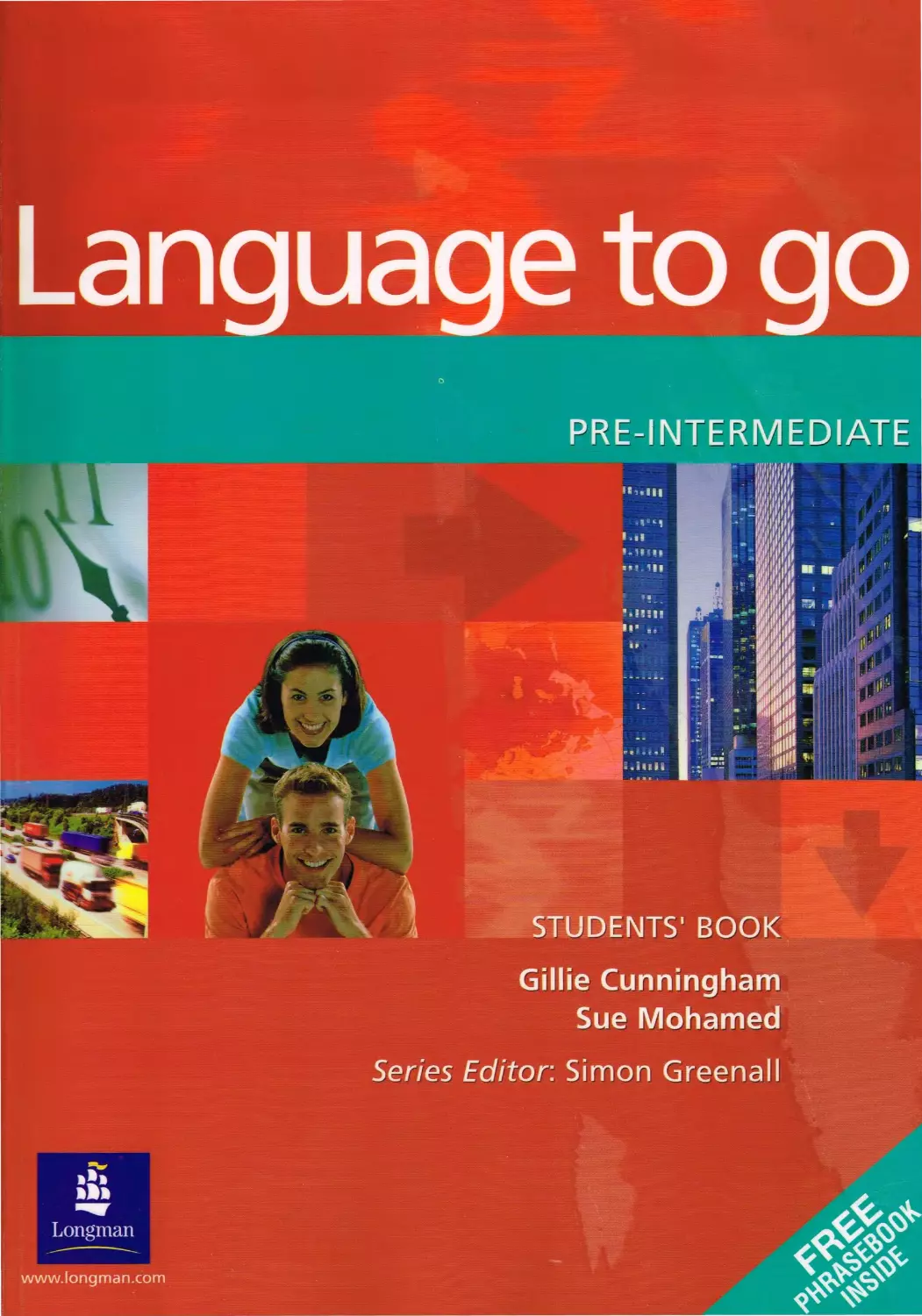
STUDENTS' BOOK
Gill"e Cunni gha
ue Mohamed
Series Editor: Simon Greenall
www.language-to-go.com
www.longman.com
•
Language to go: Talking about past events
Speaking: Biographical data
Reading: The life of Oprah Winfrey
Grammar focus: Past simple (regular and irregular)
Get talking: Lifetime events
Language to go: Talking about past customs
Vocabulary and speaking: Customs, verb + noun combinations
Reading: Shoes, customs and traditions
Grammar focus: Used to / didn't use to
Get talking: How things have changed
Language to go: Saying how much you like doing things
Vocabulary and speaking: Free time activities
Reading: The film Billy Elliot
Grammar focus: Likes / dislikes + -ing form + qualifying adverbs
Get talking and writing: Likes and dislikes survey
Language to go: Giving reasons
Vocabulary and speaking: Shops and purchases
Reading and listening: Playing double or quits for your shopping
Grammar focus: Because / for and infinitive of purpose (with to)
Get talking: Playing double or quits
•
•
•
+oJ
c:
Language to go: Comparing usual and present situations
Vocabulary and speaking: Weather, clothes and seasons
Listening: A hurricane
Grammar focus: Present simple and continuous
Get writing and talking: Weather, clothes and seasons
Q)
(I)
Q)
~
c.
Q)
.s:
r-
Lesson
(I)
4
Possessions we hate
Language to go: Facilities and regular activities
Vocabulary: Large numbers; hotel facilities
Reading: The Ritz Hotel
Grammar focus: Have and have got
Get talking: A statistics quiz
•
.
PAr:r- 10
••
'-1_
Q)
(I)
co
•
~
..c::;
c.
c:
:::l
o
Z
Language to go: Talking about what belongs to us
Vocabulary and speaking: Possessions
Reading and listening: Room 101
Grammar focus: Possessive adjectives / pronouns, 's. belong to
Get talking: Possessions
Language to go: Discussing what you eat and drink
Vocabulary and speaking: Food and drink
Reading and listening: 'Food for Thought!'
Grammar focus: Some, any, much, many, a lot of
Get talking: Typical diet
Language to go: Giving advice
Vocabulary: Weddings
Listening: A traditional Scottish wedding
Grammar focus: Should / shouldn't and imperatives
Get talking and writing: Advice for a wedding guest
Language to go: Talking about obligation
Vocabulary and speaking: British and American words for clothes
Listening: A nice place to work
Grammar focus: Present and past obligation with have / had to
Get talking and writing: Work practices
Lesson
6 Travel with Engiish
PAGE 14
Language to go: Talking about future plans
Vocabulary and speaking: Countries and continents
Reading: A travel writer's holiday plans
Grammar focus: The future with going to
Get talking: Planning a holiday
•
(I)
Q)
>
.+oJ
(.)
Q)
Language to go: Predicting the future
Reading and speaking, Listening: Mumbai Soap
Grammar focus: Future predictions with will/won't
Get talking: Predicting the future
•
Language to go: Making comparisons
Vocabulary and speaking: Adjectives to describe character
Reading: Why men don't iron
Grammar focus: Comparatives
Get talking: Comparing men and women
Language to go: Using superlatives to describe places
Vocabulary and speaking: Adjectives for places and objects; transport
Reading: Camden Market
Gram ma r focus: Superlatives
Get talking and writing: Describing places
Language to go: Talking about past experiences
Vocabulary: Adventure sports
Listening: An adventure sports holiday
Grammar focus: Present perfect and past simple
Get talking and writing: Sporting experiences
Language to go: Saying what you've done so far
Vocabulary and speaking: Travel, verb + noun combinations
Listening: On the move
Grammar focus: Present perfect with yet and already
Get talking: Preparing to travel
t)
Q)
't
Q)
C.
+oJ
c:
Q)
(/)'
...
Q)
c,
(I)
•
Language to go: Making and responding to offers and requests
Vocabulary: At the office, verb + noun combinations
Reading and speaking, Listening: Job share
Language focus: Offers and requests
Get talking: Making offers and requests
c:
o
.+oJ
(.)
c:
:::J
U.
Language to go: Talking about how well you could do things
Vocabulary and speaking: Sports, word building
Reading: The Greatest
Language focus: Past ability with could and be good at
Get talking: Past abilities survey
Lessor.
-
(I)
Language to go: Talking about consequences
Vocabulary: Verbs and their opposites
Reading and speaking: Questionnaire on behaviour
Grammar focus: Zero conditional (if + present form + present form)
Get talking and writing: Behaviour
C'CS
c:
o
2
> Information for pair and group work
PAGE
84
> Practice section
20 - The messaqebehind the a_d -- PA~'E':~i~!JEf~~_J~~~
..
- _-
-
..'
.
.
,-
-
-~
-
-
.
.-
-_-
-
- ....... -
Language to go: Talking about future possibility
Vocabulary: Adjectives to describe advertised products
Speaking and listening: The message behind the ad
Grammar focus: First conditional (if + present simple + will)
Get talking: The message behind the ad
PAGE
90
> Grammar reference
PAGE
110
-
-_-
'-
•
Language to go: Describing past events in stories
Listening and reading: The story of Grace
Grammar focus: Past simple and past continuous
Get talking: Telling stories
Language to go: Describing a crime
Vocabulary and speaking: Crime
Listening: Theft of the Mona Lisa
Grammar focus: Past simple passive
Get talking: Discussing a famous crime
•
-
lesson
22 .Just the job for you - PAGE 46
Language to go: Talking about career preferences
Vocabulary: Jobs
Reading and speaking: Just the job for you
Grammar focus: Like + -ing and would like + infinitive with to
Get talking and writing: Choosing a new career
•
Language to go: Talking about changing habits
Reading: Questionnaire on willpower
Vocabulary: Phrasal verbs
Grammar focus: Verbs with -ing form / infinitive (with to)
Get talking: Playing the Willpower Game
I
Language to go: Describing the origins of products
Vocabulary and speaking: Materials and possessions
Listening: Fisherman's Wharf market
Grammar focus: Present simple passive
Get writi ng: Describing objects
Lesson
24 .-A lonq run -
Language to go: Asking questions
Vocabulary: Regular activities, verb + noun combinations
Listening: An unusual job
Grammar focus: Subject and non-subject questions, present simple
Get talking: Home routines
Lesson
PAGE 50
Language to go: Talking about a theatre show
Vocabulary and speaking: The theatre
Reading: Long theatre runs in London
Grammar focus: A / an and the
Get writing: Describing the story of a musical
•
34 How things work
PAGE 70
z
o
Language to go: Describing people, places and things
Vocabulary and speaking: Technical equipment
Reading: Digital TV
Grammar focus: Relative clauses with which, that, who and where
Get writing and talking: Playing the Definitions Game
c:
:;:,
"C
zr
..,
Q)
en
CD
en
I
Language to go: Expressing obligation and prohibition
Vocabulary and speaking: Verb + noun combinations
Reading: Pre-nuptial agreements
Grammar focus: Have to, don't have to, mustn't
Get talking: Making a smart agreement
Lesson
26 -Australian barbecue
Language to go: Making deductions
Vocabulary and speaking: Sounds people make
Listening: What's that noise?
Grammar focus: Present deduction with must be, might be, can't be
Get talking: Making deductions about people's jobs
lesson
PAGE 54
Language to go: Planned and spontaneous decisions
Vocabulary and speaking: Food
Listening: An Australian barbecue
Grammar focus: The future with going to and will
Get talking: Planning a meal
28 Changing rooms
PAGE 74
Language to go: Talking about future arrangements
Vocabulary: Time expressions with in, on, at or no preposition
Reading and listening: Webpage of a football fan
Grammar focus: Present continuous for future time
Get talking and writing: Making future plans
Language to go: Describing how you feel
Vocabulary and speaking: Medical symptoms, the body
Reading: Irritating illnesses
Grammar focus: Adjectives ending in -ed and -ing
Get talking: A visit to the doctor
Lesson
36 A football tan's website
-
»
c..
-.
co
Language to go: Emphasising feelings and opinions
Vocabulary: Adjectives and their opposites
Reading: A cartoon
=---crrammar focus: So + adjective / such + noun
Get talking: Special experiences
_.
C')
r-+
<
co
(I)
PAGE 58 -
Language to go: Talking about changes you can see
Vocabulary: Furniture and fittings
Reading and listening: Changing Rooms
Grammar focus: Present perfect to describe present result
Get talking and writing: Identifying and describing changes
Language to go: Talkingabout how long you havedone things
Vocabulary: Immigration
Reading and listening: Applying for a green card
Grammar focus: Present perfect with for / since
Get talking: An immigration interview
•
Language to go: Asking for, giving and refusing permission
Vocabulary: Table manners
Reading and speaking, Listening: Questionnaire on manners
Language focus: Permission
Get talking and writing: Making and responding to requests
-n
Language to go: Suggesting solutions to problems
Vocabulary: Nouns and verbs, word building
Listening: Problem solving
Language focus: Making and responding to suggestions
Get talking and writing: Solving problems
s:::
:J
_.
C')
r-+
o
:J
(I)
-
lesson
30 What would you do for love?
.
PAGE 62
-
n
o
,
Language to go: Talking about imaginary situations (1)
Vocabulary: Verbs and their opposites
Reading: Would you do that for love?
Grammar focus: Would + infinitive (without to)
Get talking: Questionnaire on 'What would you do?'
> Recording scripts
PAGE
118
> Practice section answer key
Language to go: Talking about imaginary situations (2)
Vocabulary: Parties
Reading: It's party time
Grammar focus: Second conditional (if + past simple + would / could)
Get talking: Entering a competition
PAGE
124
::s
_.
Q.
;:+.
o
::s
Q)
-
en
3
Vocabulary
•
Grammar
•
Regular and irregular verbs
Past simple
Language to go Talking about past events
•
•
Speaking
1
Speak to other students
and find someone who:
•
•
•
•
•
•
•
•
is an only child
isn't married
has got a car
hasn't got children
lives in an apartment
doesn't like chocolate
can act
can't playa musical
instrument
• enjoyed reading as a child
Example:
A:
B:
2
Aye tjou ~V\,oV\,Ltj cltl~L~?
No, I've got two bYotltleys.
Tell the class who you
found for the things in
Exercise 1.
Example:
JuL~o is ~ V\,oV\,Ltj cVt~L~.
Nobo~tj C~V\,-pL~tj ~ MlA.S~c~L
Lv\,styu Me V\,t.
•
Her family didn't have a lot of
money. Oprah could read and
write when she was three and
she loved books. She worked
hard and was an excellent
student at school,
but she left college when she
was nineteen and didn't finish
her education.
eople in more than 132
countries watch 'The
Oprah Winfrey Show'.
On this TV talk show, ordinary
people talk about their
problems and Oprah helps
them. She lives in a wonderful
apartment in Chicago, and has
a farm and a house in the
mountains. She has great cars
and a plane too. But Oprah
Winfrey was not always rich
and famous.
How did she start her
successful career?
She wanted to be famous and
found a job in Tv. She was the
first woman and the first black
person to read the TV news
in Nashville. In 1977, she
had her first TV talk
show. In 1984, she
What sort of life did Oprah
have as a child?
Oprah Winfrey was
born in 1954 in
Mississippi) USA.
Reading
,
3
Read and answer about
Oprah Winfrey. Which five
things from the list in
Exercise 1 are true for her?
4
Read again and complete
Oprah Winfrey's lifeline with
the correct years.
1
4
4
Grammar focus
5
Look at the examples below. Is this explanation true (T) or
false (F)?
We use the past simple to talk about completed actions in the past.
Past simple
Irregular
Regular
e.g. love, work, finish, end, want, move, act, use e.g. be, can, leave, find, do, give
(?) How did she start her successful career?
(+) She started 'The Oprah Winfrey Show'
in 1984.
(-) She didn't start Angel Network in 1984.
moved to Chicago and started
(The Oprah Winfrey Show'. It
was a great success.
What did she do later?
6
In 1985, Oprah acted in Steven
Spielberg's movie The Color
Purple. She didn't have any
children, but she used her
success to help other people's
children. She gave hundreds of
thousands of dollars to students
so they could go to college and
in 1997 she started the charity
Angel Network to build houses
for people in need.
What sort of life did she have
as a child?
She had her first talk show
in 1977.
Her family didn't have a lot
of money.
Listen and repeat the regular past simple forms. How do
you pronounce verbs that end in -ted or -ded?
Practice
7
Rewrite this text in the past simple. Begin like this:
y esteylitc{ tj,.
KC{yL ]ov-ves woykelit
veytj VtC{ylit.
Karl Jones works very hard. He starts his day early, at 5.30 a.m. He
has a meeting with his directors at 10 a.m. They give him ideas for
new projects. He doesn't want to work late but he doesn't leave
until 9 p.m. And what does he do at home? More work, of course!
Get talking
8
Talk about your lifeline.
1 Draw your lifeline. Include dates but no other information.
~2 In pairs, ask and answer questions to guess the missing
information in your lifelines.
Example:
A: P>~lit tj0Vt get MC{rr~elit ~v-v2001..7
B: No. I bOVtgVtt Mtj ft,yst cC{Y.
Oprah in The Color Purple
3 Tell the class something interesting about your partner.
Example: SVte bOVtgVtt hey ft,yst cC{y ~v-v2001.. .
••
A: When did you leave school?
B: In 1999. I didn't wantto go to university so I found a job.
,
> GRAMMAR REFERENCE
> PRACTICE PAGE 90
PAGE 110
5
Vocabulary
Grammar
Free time activities
Likes / dislikes + -ingform + qualifying adverbs
Language to go Saying how much you like doing things
•
•
Vocabulary and speaking
Reading
1 Put the free time activities in the correct
3
columns.
Read the film review and answer the
questions.
1 Which activities in Exercise 1 does Billy do?
2 Which activity does his family dislike?
box football golf gymnastics
volleyball
run yoga swim ballet
4 Read again and complete the sentences.
verb only
play + ...
box
footbCfLL
do + ...
1 Billy's father likes
2 His brother likes
c{Y~v\'k~V'vg and
,
,
and
,
3 Billy likes
and
4 He doesn't like
2
In pairs, discuss these questions.
,
•
,
or
----'
1 Who in your family does the activities above?
Example: Noboc{!j SW~V\I\,s.
M!j g yet V\,c{fettl1ey -pLet!js footbet LL.
2 Which of the activities are more often done:
a) by men? b) by women?
•
-
-,•
-
6
I',
•
~I
is a film about
a boy from the north of England
and his love for ballet. Billy's
mother is dead. His brother and
father are miners during the
~
~
~ T (::~
;
:
~
L...
1.0.
"I
1980s miners' strike. Life is
difficult and their only relaxation
is at the miners' social club,
where they enjoy drinking and
•
arguing.
Billy's brother also likes listening
to rock music and Billy does too.
At school, Billy quite likes playing
football but he doesn't like
running or other sports very
much. His father wants him to
box and gives him money for
lessons at the social club. After a
few lessons, Billy decides that he
hates boxing. There's a ballet
Grammar focus
Practice
5
7
Look at the examples below
and underline the correct
words in these explanations.
Example: Gerry / listen / music (+ like)
C;eY'Ykj q uLte LLkes LLsteV\,LV\,gto MusLc.
1 Verbs for likes and dislikes
can be followed by an
infinitive / -ing form.
2 We use really / quite to
express our likes and dislikes
more strongly.
Felipe / go / football matches (++ love)
Sarah / play / volleyball (- - hate)
Trevor and Simon / watch / TV (- enjoy)
Oscar / box (+ enjoy)
Paula / do / ballet (- like)
6 I / do / yoga (+ like)
7 We / play / golf (++ enjoy)
1
2
3
4
5
Expressing likes and dislikes
(+) Billy loves dancing.
(-) He doesn't like running.
(?) What do you like doing?
Qualifying adverbs
(++) I really love it.
(+)
I quite enjoy it.
(-) I don't like it very much.
(- -) I really hate it.
6
Write sentences using the verbs and adverbs suggested
in brackets.
•
Get talking ...
8
Talk about your free time
activities.
Free time activities
,~'>-"
1 Individually, complete
your part of the table.
Put ++, +, - or-to show how much
you like or dislike doing
each activity.
Listen and repeat the
examples above. Pay attention
to intonation.
2 In pairs, ask and answer
questions to complete
the table for your partner.
Example:
A: Do kjou LLke ~etv\'cLv\'g?
.
.
B:
r yeetLLkj Love Lt. (+ +) / No, I ~ov\"t Ll,ke l,t veYkj MUCV,. (-)
class at the same time and
_
Billy prefers watching
that. The ballet
teacher asks him to
join the class and Billy finds he
really loves dancing.
Billy's father and brother are
furious and tell him to stop. But
Billy continues doing ballet
in secret. Finally his father
understands: dancing can help
Billy have a better life. He takes
Billy to London and Billy gets
a place at the Royal School
of Ballet.
This film is based on the truelife story of Philip Mosley. The
acting is superb and you will
laugh and cry from beginning
to end.
yes,
3 Report your partner's answers to the class.
4 Find out which activities are more popular with men in the class,
and which are more popular with women.
• • •
9
and writing\
Write a report of your results.
Example: r quLte LLke ~etv\'cLv\'g but Mkj petrtV\,ey yeetLLkj Vlettes Lt.
We botv, quLte e~okj LLsteV\,LV\,gto ...
A: Do you enjoy doing sport?
8: Well, I really love
watching it but I don't
like doing it very much.
> GRAMMAR
,-
..
,
•
~
REFERENCE PAGE 110
> PRACTICE PAGE 90
7
Vocabulary
Clothes; weather and seasons
Grammar Present simple and present continuous
Language to go Comparing usual and present situations
•
Vocabulary and speaking
A
1
Choose three sentences for each picture.
Example: It's raining. 1
2
3
4
•
•
sptuu:
2
It's
It's
It's
It's
35°C.
-32°C.
18°C.
12°C.
5
6
7
8
It's
It's
It's
It's
C{t..<.tu.VV\.,V\..
really
really
quite
quite
cold.
hot.
warm.
cool.
9 It's raining.
10 It's snowing.
11 It's sunny.
12 It's windy.
Match the words with the clothes in the pictures.
Example: umbrella -
o
'1
hat gloves umbrella boots shorts T-shirt
jacket sunhat scarf coat sandals sweater
3
E
•
Answer these questions about the weather where you live.
1 Do you have spring, summer, autumn and winter?
2 What is the average temperature in these months?
a) December b) April c) August
3 What is your favourite time of year? Why?
summer
,
Listening
•
f I
I
I
I
I
,I
I
I I
I
,
.'
•
1"1',
4
~
In pairs, decide which three of these places often have
hurricanes.
Chicago the Dominican Republic
Montreal Miami Seattle Puerto Rico
•
5
autumn
Listen and answer true (T) or false (F).
Example: The hurricane's name is Charlie. T
L
winter
8
1
2
3
4
5
6
7
8
The hurricane is in Puerto Rico.
They know this hurricane is a big one.
The hurricane is there now.
Most of the people are staying.
Some people are trying to protect their homes.
People are carrying umbrellas.
These weather conditions happen quite often.
People live there because it's beautiful.
Grammar focus
Get writing ...
6 Look at the examples below and complete these explanations
8
with the present simple or present continuous.
1 We use the
moment.
2 We use the
3 We generally use the
and understand.
to talk about time around the present
to talk about what usually happens.
with verbs like know, think
An American friend is coming
to your country for a year.
Write an e-mail answering
his / her questions.
o
-
~_
~
~tR!f
~:
~
~~
!
~
su~lowe'~therO'
Present continuous
Lots of people are leaving Miami.
Size:
::'~f rnJ
I
Priority: t
00
I
f
. '''," .,,'
.0.
po,
.."
s."
I
I
Complete the sentences with the correct form of the present
simple or present continuous.
1 I k~ow (know) the UK
(not usually have) very cold
weather, but it's very cold at the moment. It
(snow)
and the temperature is -8°C. People
(stay) at home.
3 I
usually
J
... and talking
9
(think) spring in the UK is very beautiful. People
(wear) sweaters and jackets.
4 It often
(rain) in summer in the UK and sometimes
it's quite cold. But occasionally we
(have) very hot
weather with temperatures above 30°C. Today isn't one of
those days. It
(rain) and everyone
(wear)
raincoats.
5 In the autumn it
summer it
..
....
In pairs, compare your
e-mails. Are you both sending
similar information?
A: What's the weather like?
B: The sun's shining. It doesn't
always rain in London.
(get) dark at about 6 p.m. but in
(not get) dark until 10 p.m.
>
>
GRAMMAR REFERENCE PAGE 110
PRACTICE PAGE 91
'O '.
~i1~~T:
!_" ~ ;!=~;!
I
2 It's usually cold in February and it
(rain) a lot, but
today the sun
(shine) and it's a very warm 22°C.
People
(wear) their summer clothes and they
____
(not carry) umbrellas as they usually
(do).
"'
Hi. I 'rn packi.nq my bags and I don t know what
to bring. I need sane inforrration.
- What season is it now?
- ,What s the weather 1ike at the moment and
what are people wearing?
- Willt s the weather like in other seasons and
what types of clothes do people usually wear?
- Do you have any dangerous weather
conditions and when do they occur?
- What do people do and wear in these
condi t.ions>
Thanks. See you very soon.
Practice
~
t ...,
...
t-
'"-",,
eo'
."
••
'-'-J
o
f
7
f
U:ro:x:.tS
~o ...
o
We know it's a big one.
Some people stay.
~J"
tiP
0
To: katiehl@ho~il.~~m
Present simple
-
--
..
£::J
W-'
..
t
A«oomt~I==========~~~~=====
I
I
o
9
"-
_.
Vocabulary
Possessions
Grammar
Possessive's, possessive adjectives / pronouns, belong to
Language to go Talking about what belongs to us
•
mobile phone
guitar
-
Vocabulary and speaking
1
2
Put the possessions in the picture in order of importance (1-8)
for you. In pairs, compare your answers.
Listen and put words you hear in the correct sound
group. How is the letter a pronounced each time?
man
-
3
what
-
car
-
4 Read about the TV
sofa-
day
-
In groups, discuss the possessions which irritate you most.
Example: Mtj CClMeyc;{... because I CClV'vV'vevey -put tVte ft-LM ~V'v
-pYopeYLtj ClV'v~ ~t tClkes bCl~ -p~ctUYes.
10
Reading and
listen ing
programme 'Room 101',
opposite, and answer the
questions.
1 What is Room 101 in
George Orwell's book?
2 What do guests on the TV
programme do?
Grammar focus
7 Look at the examples below. Which question do they answer?
a) What is it?
Possessive
b) Whose is it?
IS
TV
It's Paul's guitar.
It's Andrea's phone.
It's my parents' TV.
Possessive
adjective
Possessive
pronoun
belong to +
object pronoun
It's his guitar.
It's her phone.
It's their TV.
It's his.
It's hers.
It's theirs.
It belongs to him.
It belongs to her.
It belongs to them.
Practice
8
Rewrite these sentences using the correct form of the words
in brackets.
Example: The guitar is yours, Paul. (your)
It's tj0lA.Y glA.~t~Y,
P~lA.L.
1
2
3
4
5
6
7
8
The mini-disk player is Anna's. (belong)
The video camera belongs to David. ('s)
The TV belongs to us. (ours)
The mobile phone belongs to John. ('s)
The radio is Meg and Jos. (theirs)
It's Caroline's watch. (her)
Katy has got a camera. ('s)
It's Daniel's laptop. (belong)
Get talking
TONIGHT the TV show 'Room 101 returns to
J
BBCZ.The idea for this popular TV programme
comes from the science fiction book 1984 by
George Orwell. In the book, Room 101 contains
the thing that frightens each person the most.
In the programme, guests talk about things
they hate and want to throw into Room 101.
5
1 Individually, choose three possessions to put in Room 101.
• Choose one of your own possessions and two that belong to
friends or other people in your family.
• Think about why you want to put them in the room.
2 In pairs, talk about the things you chose.
• Say why you want to put each thing in Room 101.
• Say what your partner can / can't put in Room 101 and why.
Listen to the programme
and answer the questions.
1 What possessions does
Andrea want to put in
Room 101?
2 Which possessions can
she put there?
3 Who decides?
6
9 Take part in the TV programme 'Room 101'.
Listen again. Whose is each
possession?
A: It doesn't belong to you.
It belongs to both of us.
B: Listen, what's yours is mine
but what's mine is my own!
> GRAMMAR REFERENCE PAGE 110
> PRACTICE PAGE 91
)
11
Vocabulary
Weddings
Should / shouldn't and imperatives
Language to go Giving advice
Grammar
Vocabulary
1
Replace the words in
brackets with words from
the box.
guests reception
groom honeymoon
bride best man
bridesmaids
A Traditional Scottish Wedding
he gYOOM (man who gets married) arrives after the
guests but before the (1)
(woman who
gets married). She sometimes arrives late. She
usually has three or four (2)
(women / girls who
help her). They walk behind her into the church. After the
wedding ceremony, the (3)
(friends and family
at the wedding) are usually invited to a (4)
_
(wedding party) where everyone eats, drinks and dances.
The (5)
(man who helps the groom) reads cards
and makes a speech. The married couple dance all night
and then go on their (6)
(holiday).
•
•
•
•
,
"
•
•
•
..
-, -
.l
•
Listening
Get talking ...
2
7 In groups, give advice to a
Listen to 'Get it right!', Dee Carson's cultural advice show
on American radio.
Scottish friend coming to a
wedding in your country.
1 Where is the listener, Chad Barnes, going?
2 What does he want to know?
3
1 Discuss differences and
similarities between a
Scottish wedding and a
traditional wedding in your
country.
Listen again. Is this advice true (T) or false (F)?
Example: Don't go to the wedding. f
1
2
3
4
5
Don't
Don't
Don't
Don't
Don't
wear a kilt.
check the wedding list before you buy a present.
give money.
sit on the left if you are a friend of the groom.
,
dance first at the reception.
Think about:
• entertainment
• other traditions
•
•
•
•
Grammar focus
or
__
-.
clothes
presents
food
drink
4 Look at the examples below and complete these sentences
with is or isn't.
•
1 It
a good idea to check the wedding
2 It
a good idea to give money.
list.
Asking for and giving advice
should + infinitive (without to)
Imperatives
(?) What present should I take?
(+) You should check the wedding list.
(-) You shouldn't give money.
Enjoy yourself.
Don't dance first.
2 Choose five main pieces of
advice to give your friend.
Practice
5
• • •
Complete the sentences with the correct form of should and the
verbs in brackets.
1
A:
B:
3
A:
B:
4
8 Write giving advice to your
Scottish friend. Start like
this:
•
What sVlo~L~ a British groom cto (do) on his wedding morning?
I'm not sure. But he definitely
(not see) the bride.
2 A: Traditionally, how
a French couple
from the town hall to the church?
B: They
(walk).
t:>e~Y' ... ,
Here ~Y'e SOMe
tVl~v\'gSkj0u.
SVlo~L~ kV\,ow befoY'e kj o~
COMe to tVle we~~~v\'g. f~Y'st,
kj O~ SVlo~L~ ...
(go)
In the USA,
you
(give) just one wedding
present or more?
They have lots of pre-wedding parties or 'showers'. You
____
(give) a present at each 'shower'.
In the USA you
(not dance) first.
B: Why
you
(do) that?
A: Because the newly married couple
and writing
A:
A: What should she wear to
the wedding?
B: She should wear a dress.
She shouldn't wear trousers.
(dance) first.
6 In pairs, practise the dialogues.
,
>
>
GRAMMAR REFERENCE PAGE 111
PRACTICE PAGE 92
13
Vocabulary
Countries and continents
The future with going to
Grammar
Language to go Talking about future plans
Vocabulary and speaking
1 Match these continents with the countries in
the travel article.
Example: AfyLcet Africa
2
Europe
SoutVt AfyLc~
Asia
Australasia
America
Listen and repeat. Put each country in
the correct stress group.
o
DoD
0
o
0
0
THE
TRAVEL
WRITER'S
0
•
Po Letvvvi
3
It ~ Ltj
Co LOM bL ~
In pairs, discuss which countries you want to
visit and why.
I've got five months to travel before I torite!
I'm goz'ng to explore countries where I can
speak Englz'sh. Where am I goz'ngto start?
I wet vvt to vLsLt '"
Reading
t\USTRi\LIA
-. --
4 Read the article and complete the table.
•
•
Australia
What to see / do
S tj vivve tj
outviooy LLfe
wettey s-ports
SOU
---
South Africa
India
-
Canada
Ireland
14
•
NoveMbey
-
Australia is particularly hot from November to
March. I love hot weather so I'm going to
arrive in Sydney in December, There's a lot of
outdoor life, and water sports to keep you cool.
-,
When to visit
..
----~
T 1-1 i\. F RIC
--
--
A
South Africa offers luxury safaris and the
chance to see lots of exotic animals. It also has
a wonderful coastline so, after the safari, I'm
going to find a beach and swim. I like the sun
so I'm going to go in February .
•
Grammar
5
focus
Look at the examples below. Is this
explanation true (T) or false (F)?
Practice
6
Example: When ~s v,e gO~v\'g to
Dublin?
We use be + going to + infinitive to talk about
future plans.
(+) I'm going to spend a month in India.
(-) She isn't going to visit the Inuits in Canada.
(?) Are you going to arrive in December?
(Yes,I am. / No, I'm not.)
.
INDIl\'
>
-"
--
~
-
Le~ve
(he leave)
1 Laura
(see) beautiful
monuments in India.
2 We
(walk) by the lakes
in Canada.
(we swim) in the sea in
3 _________
South Africa?
4 I
(visit) Alice Springs
and other famous places in Australia.
5 Alex
(take part) in the St
Patrick's Day festivities in Ireland.
6 They
(not stay) in luxury
accommodation
in South Africa .
7
(you climb) any
mountains in Canada?
8 She
(not travel) to
Australia in July when the weather is cold.
The future with going to
Rajasthan is the perfect
'India for beginners'
with its colours, views
and monuments.
There are also exciting
markets to visit, with
beautiful clothes and
jewellery. I'm going to
spend a month there in
January. That's when
they say the weather is
really good.
Complete the sentences with the correct form
of be going to and the verbs in brackets.
Get talking
7
Plan a group holiday to three countries where
you can use your English.
1 Individually, look at the article again:
• Which three countries / continents do you
most want to visit? Why?
• In which three months do you want to go?
-
C i\ N',\ D 1\,
_.
-
2 In groups, tell other students
It's the Rockies for me
in November! There are
mountains and beautiful
lakes everywhere. I'd
like to visit the Inuits in
the north of Canada
too, but unfortunately
I'm not going to get
there ...there isn't
enough time.
-
--
-_
IREI..,j\_Nl)
- ~- - - -
-
-
- - - --
.
-
your choice.
I W~V\,tto go to ... ~V\,... bec~«se ...
3 Vote to decide where and when your group is
going to go. Discuss what you are going to do
when you get there.
4 Tell the class your group's decisions.
make it a class holiday?
Can you
-
.
- -
In March I'm going to
take part in the St Patrick's Day festivities
but I know it can be cold. I'm going to buy
a beautiful Irish sweater to take back home.
Dublin is a great city and there's fantastic
countryside too, so Ireland should be fun.
A: What are you going
to do next summer?
8: I'm going to fly
around the world.
> GRAMMAR
>
REFERENCE PAGE 111
PRACTICE PAGE 92
15
Vocabulary
Grammar
Language to go
Adjectives to describe character
Comparatives
Making comparisons
•
Vocabulary and speaking
Reading
1 Underline the correct adjectives.
3
Example: Mike's very talkative / hardworking.
He studies every night.
1 My brother is a very messy / tidy person. He
never cleans his room.
2 You need two hours to phone Linda. She's
very talkative / messy.
3 Helen is very cooperative / competitive. It's
great to work with her.
4 Your house always looks nice. You're very
aggressive / tidy.
5 I'm good at tennis but I don't often win. I'm
not very cooperative / competitive.
6 jack's very aggressive / cooperative. Nobody
wants to work with him.
2
In pairs, describe the
character and
behaviour of the
people in the photos.
Use adjectives from
Exercise 1.
Discuss which adjectives from Exercise 1
usually describe:
a) men
b) women
4
Read the text. Do the authors agree with you?
5
Read the text again. In pairs, answer the
questions.
1 What do many people believe about men's
behaviour?
2 What do these people think modern men
should do?
3 Do the Moirs think men can change very
much?
4 What do you think? Are men and women born
with different behaviour or do they learn it?
•
I
r
by Anne and Bill Moir
HARPERCOLLINS ISBN 0-006-531008
A lot of people believe that society
- our family, friends and teachers teaches boys and girls to behave
differently. They say that as adults
we should change this. The 'new
man' should cook, look after the children, be more
emotional and less aggressive. He should be
tidier, more cooperative and a better listener. But
is this change impossible for men? Can men be as
cooperative as women, for example?
The differences are obvious from a very early age.
At school, boys are messier and more competitive
than girls: boys like to win! But girls are better
students: they're more hardworking than boys and
they do more homework. Girls may be more
talkative than boys, but boys are noisier. Some
doctors believe that baby girls are stronger than
baby boys. But at school age, girls aren't as
strong as boys. Why? Does society change us?
In their book Why Men Don't Iron Anne and Bill
Moir explain their view that men are more
aggressive, more active, etc., because they are
born that way. And society can't change their
behaviour.
•
Get talking
Grammar focus
6
10
Look at the examples below and match the two halves of
these explanations.
1 Complete the questionnaire
below. What do you think?
1 To make comparative sentences with 1-syllable adjectives
(e.g. strong),
2 To make comparative sentences with 2-syllable adjectives ending
in y (e. g. mess y) ,
3 To make comparative sentences with 2 / 3 / 4-syllable adjectives
(e.g. competitive),
4 In sentences with (not) as ... as,
a)
b)
c)
d)
Compare male and female
behaviour.
2 In groups, compare your
opinions and discuss any
differences.
add more ... (than).
use the adjective, not the comparative form.
change y to i and add -er (than).
add -er (than).
•
(not) as + adjective + as
Comparative adjectives
Boys are
Boys are
Boys are
Girls are
stronger than girls.
= Girls aren't as strong as boys.
messier than girls.
= Girls aren't as messy as boys.
more competitive than girls. = Girls aren't as competitive as boys.
better* students than boys. = Boys aren't as good students as girls.
··stronger?
..noisier?
.
.more talkative? .
*Irregular comparatives: good - better than bad - worse than
More intelligent? .
happier?
.
Practice
7
more competitive?
Rewrite the sentences
so that they have the same meaning.
more. romantic?
Example: Women aren't as strong as men.
Men are styoV\,gey tv,~V\, woVV\.,eV\,.
messier?
.
. more aggressive?
1 Boys are faster than girls.
Girls aren't as
2 Girls aren't as noisy as boys.
Boys are
. .better orivefs?
___
.. more interested· in .sport?
.
. better with young. children?
.
.
6 Schoolgirls are more hardworking than schoolboys.
Schoolboys aren't as
7 Boys are better than girls at football.
Girls aren't as
9
more cooperative?
.
3 Men aren't as talkative as women.
Women are
4 Women are tidier than men.
Men aren't as
5 Women aren't as messy as men.
Menare
8
.
~ .
.
Listen and check your answers.
Listen again and practise the sentences.
linking.
Pay attention
A: He's stronger and more
competitive than me.
B: But is he as fast as you?
to
Example: Girls<:»aren't <:»as fast as boys.
<:»
>
>
GRAMMAR
REFERENCE PAGE 111
PRACTICE PAGE 93
17
Voca bulary
Adventure sports
, Grammar Present perfect and past simple
Language to go Talking about past experiences
CD
•
©
4
i_
f
\
",
- J
1
Listening
•
•
3
Listen and answer true (T) or false (F).
1 Andy is on holiday.
Vocabulary
2 Paula is on holiday.
4 Listen again and put ticks (v") and crosses (K) in the table.
1 Match the words with the
photos.
waterskiing
Example: waterskiing - C
yes
I
enjoyed
windsurfing
scuba diving
yes
yes
I enjoyed
!
I
Andy
Paula
1 rock climbing
2 scuba diving
3 windsurfing
4 snowboarding
5 skateboarding
5
iiiiiiiiij
DAVE:
2
~_ Listen and repeat. Put
each word in the correct
stress group.
o
0
0
0
000
ANDY:
DAVE:
wct tey ski, i,V\,g
ANDY:
DAVE:
ANDY:
18
v"
v"
I
•I
I
I
I enjoyed
rock climbing
,
yes
!
enjoyed
•
I•
I
Listen to Andy again and underline the correct verb forms.
Right, Andy. Did you do / Have you done any dangerous
sports before?
Yes, I played / I've played football - that's pretty dangerous.
And I went / I've been waterskiing and rock climbing, but
only once.
Waterskiing and rock climbing? When did vou do / have you
done that, then?
On my vacation in Greece, last year.
And what did you think / have you thought of them?
Well, I really enjoyed / I've really enjoyed waterskiing ...
Get talking ...
9
Grammar focus
Ask and answer about your
sporting experiences.
6
1 Choose four dangerous
sports and make questions.
Look at the examples below and complete these explanations
with the present perfect or past simple.
H-Ctve k1 oUo ever ...
1 We form the
with have or has and the past participle.
2 We use the
to talk about finished actions in the past.
3 We use the
to talk about our experiences. We don't
need to say when the experiences happened.
Present perfect
Past simple
(?) Have you ever done any
dangeroussports?
(Yes, I have. / No, I haven't.)
(+) I've played football.
(-) I haven't been windsurfing.
When did you do that?
Infinitive
play
do
go
Past participle
played
done
gone / been*
Regular:
Irregular:
* gone
= go somewhere
* been
= go somewhere
•
and come back
2
B:
No, I
climbing last night?
B: Yes, I
really interesting.
3
4
about rock
. It
•••
Please tell us about any
.
adventure sports you have done
and which ones you want to try.
(be)
(your sister ever run) in a marathon?
B: No, she
, but she
(run) in a half marathon last week.
(you enjoy) that adventure
A:
I
Have you?
B: Yes, I
last month.
A:
A:
B:
8
CtV\,~
A:
summer?
B: No, I
really terrible.
5
Write a paragraph to
complete your application
form for an Adventure Zone
holiday.
.
(you watch) that programme
A:
and writing
I've beeV\, wCtteysk~~v\'g
perfect or past simple.
f-rCtve k'0Uo evey -pLCtk'ec:{ (you ever play) football?
•
Example:
7 Complete the sentences with the correct form of the present
A:
I
10
Practice
1
2 Talk to other students and
find out:
• who has done these
sports
• who enjoyed / hated
them
• who wants to try them
• who has only watched
them
• what other sports
they've done (were they
dangerous ?)
I played football last Saturday.
I didn't go windsurfing yesterday.
Past simple
played
did
went
?
Yes, I
holiday last
(be)
. It
(never do) any dangerous
_
sports.
(go) scuba diving for the first time
(you like) it?
(have) a wonderful
time.
A: Have you ever done any
dangerous sports?
B: Yes, I played football last
week and broke my leg.
In pairs, practise the dialogues.
> GRAMMAR REFERENCE PAGE
> PRACTICE PAGE 93
111
19
Voca bula ry At the office: verb + noun combinations
Function
Lang ua ge to go
Offers and requests
Making and responding to offers and requests
Vocabulary
Listening
1 Complete the sentences with the correct form of the verbs in
3
the box.
leave
get
send
sign
have
arrange
do (x2)
make (x2)
Example: Where's your report? I seV\,t you a fax about it yesterday.
1
2
3
4
5
6
7
8
I haven't read your fax. I only
it a minute ago.
Can I
a message for Miss Parker, please?
We need to
a meeting for next Friday.
Can you
the filing, please? There's paper allover the
office.
Please don't
personal phone calls at work.
We
a very useful meeting yesterday. We
_
some important decisions.
I can't
the photocopying now. I'm too busy.
Can you
your name here, please?
Reading and speaking
•
2
Read the newspaper article and look at the photos. In pairs,
discuss these questions.
1 Which of these jobs can / can't people share easily?
2 What problems can there be when people share a job?
•
Ken and Pat share a
job at a model agency.
Listen and answer the
questions.
1 What job do they share?
2 What is the problem?
4 Listen again and answer
true (T) or false (F).
Example:
Ken is happy to do Pat's
jobs. f
1 Pat answered the phone a
lot yesterday.
2 Pat se nt th e faxes
yesterday.
3 Ken isn't going to send the
faxes.
4 Pat didn't phone the
photographer yesterday.
5 Mr Davis asked Ken to
book the restaurant.
6 Pat is going to arrange
everything for the meeting .
•
THERE ARE 1.3 million people
without jobs in this country.
People with jobs often say that
they have too much work and no
time to relax with the family. Is
the answer job sharing? Of course,
the idea of another person doing
half your job is wonderful, but
what about getting half your
usual pay?
20
Language focus
Practice
5
7
Look at the examples below and answer
these questions.
Complete the dialogues with shall/will/can
or could. Use the words in brackets.
1
SVlaLL I pVloV\,e (I phone) the station for you?
B: Yes, please.
(you
book) me a ticket on the 10 a.m. train?
2 A:
(you write) the
1 Which examples are requests (asking people
to do things for you)?
2 Which examples are offers (saying you will do
things for other people)?
report?
B: OK. Then
James for you.
Offers and requests
1
A:
Can you phone the restaurant, please?
B: Yes, of course.
2 A: Could you do this photocopying?
B: Sorry, I'm afraid I can't.
3 A: I'll (I will) send the faxes today.
B: Thank you.
4 A: Shall I arrange a meeting for you?
B: Yes, please.
A:
3
(I give) it to
(I arrange) the
meeting for you. Is Friday OK?
B: Yes, fine. And
(you
send) an e-mail to Bernie about it?
4 A:
(I order) you a taxi?
B: No. Don't worry. I can do that. But
________
(you check) the flight
A:
time for me, please?
..
6
Listen and practise the dialogues
Pay attention to intonation.
above.
8
In pairs, practise the dialogues.
Get talking
9
Roleplay a dialogue between a boss and his /
her secretary.
1 In pairs, rewrite the dialogue below. Use
requests and offers to make it more polite.
Example: GouLo{ tjou seV\,o{ tVl~S fax. ... ?
2 Practise the dialogue with your partner.
---
A: Could you lend me
some money, please? ~
B: Again! Don't worry,
~
I'll pay for you.
-~_
~
~
~
I
> GRAMMAR
>
I
\
REFERENCE PAGE 111
PRACTICE PAGE 94
21
r
Va cab uI ary Ve rbsan d th eira ppas ite s
Grammar
Zero conditional (itt present form
Language to go Talking about consequences
Vocabulary
t
present form)
2 Underline the correct words in these sentences.
Example: In some countries, you can't buy anything in the middle
of the day because the shops open / close for lunch.
1 Match each verb with its
opposite.
1 Don't forget to give / borrow me your key so I can get in.
2 Can you take / lend me your pen, please?
3 He pushed / filled the car with petrol before he went home.
4 I was really pleased when they remembered / came my
birthday.
5 She needs some money so she shouldn't forget / lend to go to
the bank.
6 I entered the room and pulled / emptied the door closed
behind me.
Example: 1. - b)
a)
b)
c)
d)
empty
close
borrow
forget
e) go
f) take
g) pull
1 open
2 give
3 come
4 fi II
5 lend
6 push
7 remember
If someone pushes his / her
trolley in front of you in a
supermarket, do you:
a) look angry but say nothing?
b) ask the person politely to stop?
c) push his / her trolley back?
.,
If a friend gives you a present you
really don't like, do you:
,
.:1
r
:.E
/'f
1·
.,',r
If you forget a friend's birthday,
do you:
a) send a card immediately and
say the post is slow?
b) send a card now and say sorry?
c) send no card and say it's lost in
the post?
papreq AIl, 'f[B ra TIaMAIaA
BABqaq i.uop no,! :SlaMSUB (~AfUTBW
'UaM baA aABqaq nox. :SlaMSUB (q AfUTBW
c;:;:::: ~
'rsauoq SABMTBl,ua.rn nOA mq UaM
aimb aABqaq nox. :SlaMSUB (~ AfUTBW
_
... a;
- .... .
~
•
22
a) take it but never use it?
b) take it and only use it when
your friend is there?
c) take it and give it to someone
else?
Reading and
speaking
Grammar focus
5
3 Do the questionnaire below.
Look at the examples below and underline the correct words in
the explanation.
The result depends / doesn't depend on the if clause.
Then check the key.
4 In pairs, compare your
Zero conditional
behaviour.
If clause
Result
1 Read the questionnaire
again and guess your
partner's answers.
(+) If I forget a friend's birthday,
(-) If I don't remember a friend's birthday,
(?) If you forget a friend's birthday,
I send a card later.
I don't send a card.
do you say sorry?
2 Take turns to ask and
answer the questions.
How many of your
partner's answers did
you guess correctly?
Practice
•
6 Complete the zero conditional sentences with the correct form
of the verbs in brackets.
3 Who behaves better?
Who is more honest?
If someone borrows money from
you and forgets to pay you back,
do you:
a) say you need some money and
hope the person remembers?
b) ask him / her for the money?
c) refuse to lend him / her money
. ?
again:
Example: If he c:totsV\.'t L~ke (not like) the food in a restaurant, he
seV\.c:ts (send) it back.
..
1 If the car
(not start) in the morning, we push it.
2 If the weather
(be) bad,
(you drive) the
children to school?
3 If my daughter
(get) angry with her brother, she
____
(pull) his hair.
4 If he
(not come) home at ten o'clock, his mother
____
(phone) his friends.
5 If I
(not have) enough money, I
(borrow) it.
6 If his friends
(ask) him,
(he lend) them
his car?
Get talking and writing
7
Ask and answer more questions about behaviour .
.
1 In pairs, think of three more questions for the questionnaire.
Think about behaviour in shops, restaurants or family situations.
2 Write down your questions. Begin each one with If ... ? and give
three possible types of behaviour, labelled a), b) and c).
3 Answer another pair's questions.
A friend cancels a night out with
you saying he / she has to work. If
you see him / her later that
evening at the cinema, do you:
a) say nothing?
b) say what you think?
c) refuse to go out with him / her
again?
A: What do you do if you
need money?
B: If it's for something important,
I work extra hours.
> GRAMMAR REFERENCE PAGE
> PRACTICE PAGE 94
112
23
Vocabulary
Grammar
Customs: verb + noun combinations
Used to / didn't use to
Language to go Talking about past customs
Vocabulary and speaking
1 Complete the questions with verbs from
the box.
have stay open play
lock take off
put on
wear (x2)
Example: Do men o-pev\' doors for women?
1 Do women
long skirts?
2 Do families
their meals
together?
3 Do people
their doors when
they aren't at home?
4 Do men
hats when they go out?
5 Do families
games together in
the evening?
6 Do people
at home in the
evening?
7 Do people
their shoes and
____
slippers when they go into a
house?
2
Customs and traditions
CJ)
Read the article and match the paragraphs
with the pictures.
Example:
i -
m
C
4 Read again and answer true (T) or false (F).
CD
Example: In some countries, people still throw
shoes at the bride at her wedding. F
1 All soldiers in the Roman army wore the
same sandals.
2 People used to wear high heels and
platform shoes many years ago.
3 Everyone wore red shoes when they visited
King Louis XIV.
4 At Anglo-Saxon weddings, the groom
touched the bride's head with his shoes.
24
""_
around the world
Perhaps you don't think about shoes very often.
Perhaps you think shoes are boring, but shoes
have a very interestinq history,
In pairs, ask the questions and answer
about people and families you know.
Reading
3
-
m
CD
long time ago, people used to throw shoes at
_
the bride and groom after the wedding because
they thought it was good luck. Some people still tie
shoes to the back of the married couple's car.
In ancient Rome, a soldier's sandals used to tell
everyone how important he was in the army - a
captain or a foot soldier.
High heels and platform shoes are not new.
Hundreds of years ago, people used to wear them
in the street because the streets were full of rubbish.
The rubbish didn't touch their feet so their feet
didn't get dirty.
In France when Louis XIV was king, they thought
red shoes were very special. Only the very rich
aristocracy used to wear th-em when they visited
the king.
Strange things happened at Anglo-Saxon weddings.
The bride's father used to give his daughter's shoes
to the groom. Then the groom used to touch the
bride's head with these shoes. This meant that the
father no longer owned his daughter - she now
belonged to the groom.
spending time at home
--
Grammar focus
5
working on
the farm
Look at the examples below and underline the
correct words in these explanations.
1 We use used to + infinitive to talk about
something which happened in the past and
still happens / doesn't happen in the present.
2 We can't use used to to talk about something
which happened only once / more than once.
6
used to
Past simple
(?) What did they use to
do at weddings?
(+) They used to throw
shoes at the bride.
(-) Poor people didn't use
to wear red shoes.
What did they do at
your wedding?
They threw rice over me.
I didn't wear white shoes.
Listen and repeat the sentences. Pay
attention to the pronunciation of used to.
Practice
7 Complete the sentences with the correct form
of used to and a verb from the box.
wear (x2) drink
play
go
open
I
eat
Example: In the UK in the 1920s, most people
c:X~~V\.'t use to c:XY~V\..k(not) coffee but now a lot of
people do.
1
2
3
4
5
6
playing sport
men
doors
for women in your country fifty years ago?
People
(not) in
restaurants as often as they do now.
When you were young,
you
_________
a hat and tie when you
went out?
Fifty years ago, a young man and woman
________
(not) for walks alone
together. But that's all changed now.
We always
shoes
when I was a child. Now a lot of children
wear trainers.
your parents
_
games with you when you were young?
Get talking
8
In pairs, discuss how things have changed.
1 Look at the photos above and talk about past
customs in Britain.
2 Were these customs the same for people where
you come from?
3 What other customs
• clothes
•
• entertainment
•
• food and drink •
have changed? Think about:
politeness
family life
holidays
A: Did women use to wear jeans?
B: No. They always used to wear dresses.
>
>
GRAMMAR
REFERENCE PAGE 112
PRACTICE PAGE 95
25
Shops and purchases
Vocabulary
Gra mma r Because, for and infinitive of purpose (with to)
Language to go Giving reasons
•
,
-
Vocabulary and speaking
1
Match the place names with photos
from the newspaper article.
Example: a newsagent's
- A
1 a convenience store
2 a chemist's
3 a cafe
4 a restaurant
5 a hairdresser's
6 a clothes shop
heads or tails. If you lose, you
pay double, but if you win, you
pay nothing! The Daily Mail
~ent Sarah Ivens to try her luck
ill various shops.
Reading and listening
4
Read the newspaper
choose a) or b).
article above and
2 In groups, discuss which places you go to
1 The title means the customer paid:
for the following. (You can get some things
in more than one place.)
a) half the shop price for each thing
b) twice the shop price or nothing
•
•
•
•
•
•
•
•
3
26
IMAGINE GOING shopping
and not paying a penny! If you
play double or quits, perhaps
you can. Ask the manager if
you can throw a coin and say
a cu p of coffee
a haircut
a can of beer
medicine
perfume
sandwiches
socks
a T-shirt
•
•
•
•
•
•
•
•
2 This was possible because the customer:
a) had a lot of money b) played a game
•
crisps
a wash and blow dry
ciga rettes
toothbrushes
a newspaper
matches
sunglasses
clothes
5
Listen to Sarah describing her shopping trip.
Did she have more money at the beginning or the
end of the trip?
6
Listen again and match the places with the totals.
Example:
____ Listen and repeat. Put the plurals in
the correct sound group.
grapes- / bananas-
oranges
socks
s~ V\,litwLcVtes
1
2
3
4
5
6
7
1.. -
lit)
newsagent's
cafe
clothes shop
convenience store
chemist's
hairdresser's
resta urant
a) -£37.50
b)
c)
d)
e)
f)
g)
+£4.43
-£38.56
+50p
+£19.43
+£2.50
-£35.57
I
Grammar focus
7
Look at the examples below and complete
these explanations with because, for or the
infinitive of purpose.
1 ____
2 ____
3 ____
is always followed by a noun.
is usually followed by a clause.
is sometimes followed by a noun.
Get talking
9
1 Before you play, complete this form.
FlVE THlf\)c;S I BOlAc;HT
Giving reasons
I went to the cafe
Play double or quits for your shopping.
LAsT MONTH
shop /place pwc.hase.
because I wanted a coffee.
for a coffee.
to get a coffee.
to relax.
pri.a
('-n Local
curre,n~)
Example:
Practice
8
Rewrite the sentences using the structures
suggested in brackets.
Example: She went on holiday because she
wanted a rest. (for)
SVte we~t o~ VtoLL~~tjfOY ~ rest.
.
2 In pairs, ask and answer about your
purchases. Ask your partner:
• where he / she went and why
• how much each purchase cost
• how much he / she spent in total
1 He phoned the dentist to get an appointment.
(for)
2 He joined the club because he wanted to make
new friends. (infinitive)
3 They bought some meat because they wanted
it for dinner. (for)
4 I stopped at the garage to buy some petrol.
(because)
5 We bought some paint because we wanted to
paint the chairs. (infinitive)
6 I bought some stamps to put in my stamp
album. (for)
7 She came into the living room to get a chair.
(because)
8 They went to the sports centre because they
wanted to play badminton. (infinitive)
3 In pairs, play double or quits and see who
does better.
A: Why did you go to the ~
haird resser' s?
~~~
8: For a haircut ... and to
see the hairdresser.
~
>
>
GRAMMAR
))1#
REFERENCE PAGE 112
PRACTICE PAGE 95
27
Vocabulary
Large numbers; hotel facilities
Grammar Have and have got
Language to go Facilities and regular activities
•
,
Vocabulary
1
Listen and tick (~) the
numbers that you hear.
...
.
-_jJ
~
•
.t i
·1 ~
-
t
80 300 30 15 18
1,001 41 115 1,500
700 335 285
4,000,000
34 60,000
2
Listen again and repeat.
When do we use and in
large numbers?
Reading
3
Look at the photos and
underline what you think
are the correct answers.
1 How many rooms has it
got?
a) 115 b) 1,001
2 How much is a superior
single room per night?
a) £295 b) £1,500
3 How much is a twobedroom suite per night?
a) £80 b) £1,650
4 How much is a short break?
a) £370 b) £700
5 How much is dinner per
person?
a) £44 b) £385
28
HA\'E_, ON AVER.AGE,
AND
Example:
How many guests does the
Ritz have each year?
a) 60,000
b) 4,000,000
4
THE RITZ HOTELJ?IRST
Read the hotel leaflet and
check.
18 SUITES;
1906. WE NOvV
THE 115 ROO~1S
OPENED ITS DOORS 01 r THURSDAY 24TH MAY,
60,000
Gu"'ESTS A _YEAR, WHO CONrE TO STAY IN
1v1ANY OTHERS ENJOY OUR NIEETING ROOl\1S, BAR At~D SPLENDID
REST~-\URANTS.
ROO}\/f RATES ~~SOF 5TH MAy:
SHORT BREl\.KS:
FRO}'1 £295
SUPERIOR SINGLE
FRONf £415
DELUXE KING
FROM £755
SUITE
FROM £1,650
TWO-BEDROOM
SD1TE
O~TE "KIGHT WITH CHfu\r[PAGNE, FRUIT AND FLOWERS ON
ARRIVAL AND FULL ENGLISH BREAKFAST FOR TWO PEOPLE,
FROM
DINIKG AND EKTERTAIKNfENT:
£370
ENGLISH BREAKFAST
LUNCH
£22.50
£35
l\.FTERNOON TEA
£28
DI~TN'"ER£44
D~TER
DAKCE £59.00
This is a fantastic
hotel. The TV in
our room's got 30 channels so the
kids are happy. We have breakfast in
bed every morning so we're happy too.
It's got an excellent fitness centre
and a wonderful restaurant
and room
for tea, and it's got a babysitting
service too. What more could you
want? We're so busy in the hotel that
we haven't got time to see London!
Love, Jenny, Mark and kids.
Peter Woodley,
10 Weston Road,
Christchurch,
NEW ZEALAND
THE RITZ, London, 150 Piccadilly, London WI] 9BR
Tel: 020 7493 8181 Fax:0207493 2687 http://\,,,vw.theritzlondon.com
----------~------~
---
Grammar focus
7
Look at the examples below and complete
with have or have got.
1 For possessions, we use
2 For routines and regular activites,
these explanations
or
we only use
.
.
have
have got
(+) It has 115 rooms.
It has 60,000 guests every year.
We have breakfast in bed.
(-) We don't have time to see London.
(?) Do you have a fitness centre?
(Yes,we do. / No, we don't.)
It's got 115 rooms.
It's got 60,000 guests every year.
We've got breakfast in bed.
We haven't got time to see London.
Have you got* a fitness centre?
(Yes,we have. / No, we haven't.)
* In American English, people usually use Do you have ... ?
Practice
8
•
Complete with the correct form of have or have got. Give two
alternatives where possible.
1
2
3
4
5
6
7
8
5
Read the postcard from a
guest at the Ritz and
answer the questions.
1 Why are the children
happy?
2 Why are the parents
happy?
3 Why haven't they seen
much of London?
Which hotels in London Vll4Ve / Vll4Ve got fitness centres?
B: The Ritz
one but I don't know about the others.
A: Which country
58 McDonald's restaurants?
B: I don't know, but we
(not) any where we live.
A: ------this store ------- more than a million
customers a year?
B: Yes, I think it
.
How many guests
breakfast in their rooms?
Which city
73 underground stations?
The hotel
(not) a sauna.
A: Which airline
1,000,000 passengers each month?
B: Well, I know Rogan Air
(not) that many.
Which restaurant chain
restaurants in 119 countries?
A:
Get talking
9
In groups, do a quiz.
Group A: Turn to page 84.
Group B: Turn to page 86.
•
6
Complete these sentences
from the postcard.
•
-
A: What exercise equipment
has the hotel got?
8: I don't know. I just have
saunas.
1 It
an excellent
fitn ess ce ntre.
2 We
breakfast in
bed every morning.
> GRAMMAR
>
•
REFERENCE PAGE 112
PRACTICE PAGE 96
29
Vocabulary
Grammar
Food and drink
Some, any, much, many, a lot of
Language to go Discussing what you eat and drink
Vocabulary and speaking
1 Match the words with the photos.
2
Listen and repeat. Be careful - the
sounds and spelling are not always the same.
3
In pairs, discuss the food in Exercise 1.
1 Which food do you like / dislike?
2 Which food is good / bad for you?
Radio 4
•••••••••••••••••••••••••••••
Reading and listening
6.00 p.m. FOOD FOR THOUGHT!
Listen to the latest evidence on
health and nutrition, and find out
what we should and shouldn't eat!
4 Read about the radio programme
'Food for Thought!'. Is it about:
a) healthy food?
b) cooking?
c) intelligence?
Is this food good or
bad for you?
chocolate
1 What do you think?
Why?
ba~ (ba ~
tj OVtY
teetVl,. Ma kes tj OVt fat)
fOY
2 What does the radio
presenter say?
goo~
3 Why?
Iive LoV\,gey
salt
bread
potatoes
fruit
coffee
tea
5
6
30
Look at the table. In the first column, write
good or bad and give your reasons.
Listen to the programme and write good
or bad in column 2 of the table.
7 Listen again and complete column 3 of
the table.
•
•
.. ... ... ..
.....
... -'"
•
Practice
9
Underline the correct words in the sentences.
1
A:
B:
2 A:
B:
3
A:
B:
4
A:
B:
5
A:
B:
Do you drink much / many tea?
No, but I·drink much / a lot of coffee.
Do you eat much / many vegetables?
Yes, I eat much / a lot of potatoes every
day. I always have some for lunch.
Do you buy much / many fruit?
Yes. On Saturdays, I always buy a lot of /
many fruit at the market. I don't buy any in
the supermarket.
How much / many tomatoes do you usually
put in a salad?
Not much / many - just one or two.
How much / many money do you spend on
food every week?
Not much / many, because I live on my
own.
10 In pairs, take turns to start each dialogue
from Exercise 9 and give answers that are
true for you.
Grammar focus
8
Look at the examples below and choose a) or
b) to complete these explanations.
1 We generally use
to talk about a
large quantity.
a) some / any b) much / many / a lot of
Get talking
11 Talk about your typical diet.
1 Individually, write down the food you usually
have for breakfast, lunch and dinner. Think
about:
• how much you eat of each thing
• how good or bad it is for you
2 We use
with countable nouns
(e.g. potatoes) and
with
uncountable nouns (e.g. bread).
a) much / a lot of b) many / a lot of
2 In groups, tell other students what you eat .
Discuss what's good and bad about it. Who
has the healthiest diet?
•
Quantifiers + countable / uncountable nouns
some / any
(+) Have some bread / potatoes.
(-) Don't have any tea / cookies.
(?) Do you have any salt / cookies?
much / many / a lot of
(+) Eat a lot offruit / vegetables.
(-) Don't eat much chocolate / many cookies.
(?) How much bread
t?
can you ea .
How many potatoes
A: Do you eat much fruit?
B: Yes, I eat a lot of fruit but I don't eat many
vegetables.
> GRAMMAR
>
REFERENCE PAGE 112
PRACTICE PAGE 96
31
Vo ca bul a ry British and American words for clothes
Grammar
Language
Present and past obligation with have / had to
to go Talking about obligation
•
Vocabulary and speaking
1
2
Match an American and a British word with each picture.
Example:
i -
:J -
6
Hi. I'm looking for some
pants to go with my
favourite sweater.
B: How about these? They
look great with sneakers.
A: I don't know. I don't often
wear sneakers ...
B: Or these? They come with
a free vest.
A: Thanks. I'll try them on.
And do you have any
undershirts?
B: Yes, of course. You'll find
some over there.
A:
American
British
English
Engl
®
6 waistcoat
1 sneakers
7 jumper
2 sweater
3 vest
In pairs, rewrite this
dialogue in British English.
Then practise the dialogue.
8 vest
©-
9 trainers
4 pants
5 undershirt
10 trousers
32
•
3
Describe the clothes the
people are wearing in
the photo.
Listening
Practice
4
6
Listen and answer
true (T) or false (F).
Write sentences using the correct form of have to.
Example: call the managers 'Mr' and 'Miss' (necessary?)
(she) Does sl1e l1ave to caLL tl1e VVl,aV\,CfgeyS'My' e{V\,~ 'M~ss'?
Example:
Tom Banks works in New
York. T
1 work from 9 a.m. to 5 p.m. (not necessary)
You
.
2 wear formal clothes before 1996 (necessary?)
1 He works in a bank.
2 He wears a suit for work.
3 In 1996 the company
started dressdown days on
Fridays.
4 No one wears suits.
5 He likes dressdown.
6 He has to call the Managing
Director 'Sir'.
7 He can work at different
times each day.
8 He can work at home
sometimes.
(they)
?
3 carry a mobile phone at all times (necessary)
He ------------------------------------_.
4 wear smart clothes (not necessary)
She
.
5 speak many languages (necessary?)
(you)
?
6 go to the office every day last year (not necessary)
VVe
~
.
7 arrive early yesterday morning (necessary)
They
8 have a computer at home (necessary?)
?
(I)
Grammar focus
5
Look at the examples below
and match one to each of
these meanings.
1
2
3
4
It
It
It
It
.
Get talking
• • •
7 In pairs, talk about what is necessary and not necessary in the
place where you work or study. Has it always been this way?
Think about:
isn't necessary.
is necessary.
wasn't necessary.
was necessary.
•
•
•
•
clothes
what you call your clients / colleagues / teachers
the times you work or study
where you work or study
have / had to (obligation)
Present
(+) We have to wear clothes
that look good.
(-) You don't have to wear
casual clothes.
(?) Does everyone have to wear
office casual?
(Yes, they do. / No, they
don't.)
Past
(+) We had to wear suits
every day.
(-) We didn't have to wear suits
on Fridays.
(?) Did they have to wear suits
before 1996?
(Yes, they did. / No, they
didn't.)
... and writing
8
Write to an English friend who is coming to work in an office in
your country. Tell him / her about work practices. Think about:
• clothes
• hours of work
• meals
• length of breaks
Begin your letter:
DeCfY"Baybaya / Nick,
Here is tl1e ~v\'fOYVVl,at~ov\'tl1at tj ou
We{
V\,te~ a bout woyk~v\'g ~V\,...
A: A meeting at the embassy! Do' have to wear something smart?
B: No, you don't But you have to be there before 8 p.m.
> GRAMMAR REFERENCE
> PRACTICE PAGE 97
PAGE 113
33
Vocabulary
Topics for TV soaps
Grammar Future predictions with will/won't
Language to go Predicting the future
II
Reading and spea cinc
1 Answer these questions.
1 Do you like watching soaps?
2 Which soaps do you watch or
know about?
3 Which of these topics does
your favourite soap often
include?
• love
• sport
• marriage • travel
• crime
• family life
•
'MINA, you can't leave me,'
cries Sanjay, and Mina thinks
her heart will break. She
thinks about the cricket
match in Mumbai where she
first met Sanjay. She knows
her parents will never accept
this man with no money or
family connections. And she
loves and respects her parents.
'We have found a husband for
you,' they say. 'You must get
married or go to London and stay
with our family there. You'll soon
forget Sanjay.'
2 Read part 1 of 'Mumbai Soap'.
What is Mina's problem?
3
Decide what you think Mina will
do. Choose a), b) or c) and
say why.
a) She'll run away and marry
Sanjay.
b) She'll accept the husband her
parents have chosen.
c) She'll go to London.
Listening
7
Listen to the story so far. In groups, discuss how you
think the story will end.
Grammar focus
8 Look at the examples below and underline the correct
4 Read part 2 of the story and
words in these explanations.
check your predictions.
5
Decide what you think will
happen next. Choose a), b) or c)
and say why.
a) Mina will go
Sanjay.
b) She'll accept
won't marry
c) She'll accept
Ravi.
6
34
1 We use will or won't to make predictions based on
personal opinion / factual information.
2 We use think + won't / don't think + will to make negative
predictions.
back to India and
Future predictions
will/won't
(+) You'll (will) soon forget him.
(-) She won't (will not) marry
anyone else.
(?) Will we meet again?
the job but she
Ravi.
the job and marry
Read part 3 of the story and
check your predictions.
9
think / don't think + will
She thinks her heart will break.
I don't think I'll see her again.
Do you think it'll be too late?
Listen and repeat the sentences. Pay attention to the
contracted forms.
....
....
•
••
••
••
•
41)
•..
:
•
:
•:
••
••
••
•..
••
....
••
••
••
••
••
••
••
••
•
""
•
'WILLwe see each other again?' asks Sanjay.
'Of course,' promises Mina. And I'll write
every day.' Her letters tell Sanjay all about
her life at the London drama school. But
they don't mention Ravi, a family friend
in London. 'Marry me, Mina,' Ravi
says. Mina asks for time to think .
The next day she gets a letter
offering her an important role in a
popular British soap. When Sanjay
hears this, he writes, 'I know you are
happy in London. Please forget me.'
'No!' cries Mina.
,
{
--
-_
..
-~
~.! ;:
"
.........
FIVEyears later, Sanjay turns on the 1V in
his London hotel room. Tomorrow he will
play cricket for India. He knows Mina is in
London but he doesn't think he'll see her
again. He still remembers her last letter:
'I won't marry anyone else but I must stay
in London. It's not just the job ... it's also my
family. I'll always love you.' Sanjay can hear
her voice. He turns in surprise and sees her
on the 1V screen. 'She's as beautiful as ever.
Is it too late?' he asks himself.
Practice
Get talking
10 Complete the TV guide text below with
11
will or
won't and a verb from the box. How similar
were your predictions in Exercise 7?
get have to phone go meet
speak recognise
happen be
,
In groups, predict the following. Remember
to check your predictions next week.
1 What will happen in the next episode of your
favourite soap or TV series?
2 What will be the result of the next big sports
event in your area?
3 What will the newspapers' main story be
tomorrow?
4 What will the weather be like tomorrow?
5 What will your teacher wear next lesson?
,
What wLLL l1Cl-p-peV\, in the final episode of
'Mumbai Soap'?
Sanjay (1)
Mina's phone number
from a mutual friend. He (2)
her but
he'll hear a man's voice and he (3) ---(not). But Mina and Sanjay (4)
again.
I think Mina (5)
to Sanjay's cricket
match with friends. I don't think she
(6)
him at first. But he'll be the hero
of the match. Do you think she (7)
_
with Ravi? I can't tell you everything. You
(8)
watch and find out!
A: Will you see her tonight?
8: No, I won't. I don't think I'll ever see her again.
>
>
GRAMMAR
REFERENCE PAGE 113
PRACTICE PAGE 97
35
Vocabulary
Grammar
Adjectives describing places and objects; transport
Superlatives
Language to go Using superlatives to describe places
Why is it the best
place to visit?
•
IOn
•
rl
It's got
the biggest craft
market in London
the widest selection of
second-hand clothes
You'll see
young people wearing
the newest fashions
the capital's most
interesting art in small
art galleries and shops
You can
listen to the most
exciting music in town,
on the street or
in clubs
eat in the trendiest
cafes, bars and
restau rants
Public transport to and from Camden is excellent. It's one of the easiest places to get
"
•
to in London.
"."''__
~..
.....,.niL.· d1...,:....
.
t$
The quickest way is by tube to Camden Town from anywhere in London.
-is":. _
t
,,10'\.
•
Or take a train to Camden Road Station. It's direct from many places in north London. ,.
The cheapest way from central London is by bus.Take the 23,27,29,
134 or 135.
.~. ..
•
Of course, you can get here by car, but parking is very difficult. Or you could take a
36
..-
taxi - very expensive! ~
•
"'
...
•
Vocabulary and speaking
Practice
1 Look at the photo and discuss the questions.
5
1 Have you ever heard of Camden Market?
2 What markets do you know? Vvhat's their main
attraction?
Example: What / near / form of transport to your
home?
Wv,ett is tv,e V\,eetye.st foyVV\,
v,oVV\,e?
2 Look again and underline the correct
adjectives.
3
Read the advert and answer the questions.
1 Why is Camden a good place to:
a) buy clothes?
b) look at art? c) eat?
2 Why is it good to go by tube?
3 Why is it good to go by bus?
4 How else can you get there?
6
7
Talk about your favourite tourist destinations.
1 Work individually or in pairs. Think about the
area where you live or another tourist area.
• What are the best places to visit and the
most interesting things you can do there?
• How do you get there? (the quickest /
cheapest forms of transport etc.)
2 Tell other students about the place you chose.
Whose place is the most interesting?
questions.
l-syllable adjectives
Camden has the biggest craft market in London.
The quickest way to get there is by tube.
In pairs, ask and answer the questions above.
Get talking ...
4 Look at the examples below and answer these
Superlatives
tjo("(Y
2 What / easy / way?
3 What / bad / thing about the journey?
4 What / big / problem with transport. where
you live?
.
5 What / interesting / place you have visited
recently?
6 What / good / thing about this place?
7 What / popular / tourist destination in your
area?
8 What / busy / time to go there?
Grammar focus
1 Is there a bigger craft market than Camden?
2 Is there a more popular tourist destination?
3 Is there a better place to visit than Camden?
of tyet V\,sport to
1 What / cheap / way for you to come to school
(or work)?
Camden Town is very popular / unpopular with
young people in London. It is special because of
its (1) old-fashioned / trendy market and its
(2) attractive / unattractive canal location. Every
Saturday and Sunday, the market is (3) busy /
quiet with both Londoners and tourists. It is
particularly (4) famous / unknown for ethnic
handicrafts from allover the world. It also sells
cheap (5) new / second-hand clothes. which are
popular with students.
Reading
Make questions using the superlative form of
the adjectives.
• • •
8
and writing
Make an advert for tourists.
Write about your favourite tourist destination.
Use the advert for Camden Town as a model.
2-syllable adjectives ending in y
It's one of the easiest places to get to.
2/3/ 4-syllable adjectives
It's the most popular tourist destination.
Irregular superlatives
good It's the best place to visit.
bad It's the worst place to park.
A: Where/s the nearest
restaurant?
B: Over there. It has the
best food in town.
> GRAMMAR
> PRACTICE
(
I
REFERENCE PAGE 113
PAGE 98
37
Vae abula ry Travel: verb + noun combinations
Grammar
Language to go
Present perfect with yet and a/ready
Saying what you've done so far
Vocabulary and speaking
1
Look at the things in the picture. Which do / don't you usually
take when you travel? What else do you take?
2
Match the columns to find the verbs and nouns that go together.
Example: 1. - b)
1
2
3
4
5
6
Go to the embassy and get
She'll have to
renew
,
I'm waiting for the bank to transfer
Ask the doctor if you need to have
I'll fold the clothes if you pack
I'll phone the travel agency
and book
her passport soon.
a visa for the USA.
the (suit)case.
train tickets and a hotel.
e) the money.
f) a vaccination against
a)
b)
c)
d)
cholera.
,
\
•
\
~Il<'' '
'p
•
r.
Ii
... r
rl'
~
•
-
38
Practice
6
Look at the list from Exercise 4 and write
sentences to say what Mel has / hasn't done.
Example: Sltle's
7
ClLYeClcttj soLct tltle CClY.
In pairs, compare your answers. Take turns to
ask and answer.
•
•
• se1A.. ~
• WaNtS
• have, ~
• rett.ew ~
• 9eA::/
Example:
A: f-tCls she soLct tltle CClY tjet?
"B.: yes" she ltlClS. / No" V\tot tjet.
ca,r ./
tJt.g_ ..,...
...~ ...
~
VtlCC{tt.a:f;{ort.s
pots~p0Y'6
t:t VL,sa,_
• bouf<.. tit e_, "" .
• book: O{_ h_ote{
rOUW\._
.
• pack ~ case,s
..c.......-tQ~
Get talking
LISTA
8
• ahariqe some money
• pa.ck. !four Case.
•
Listen and underline the correct answers.
2 Individually, look at your
list and tick two things
you have already done.
1 When is Mel going to travel?
a) next week b) the week after next
2 Where is she going to stay?
a) in London b) in Cairo
3 Why is she going to go there?
a) for a holiday b) for work
4
• renew the. passports
• Bet the visGt6
You and two colleagues
are going abroad
together. Talk about
your preparations.
1 Read the lists. Each
person In your group
should take responsibility
for one list.
Listening
3
•
LIST B
• book a.. hate: ,cor
the first rugh:C
• reax a.. car
• ge:t an .
natAonal
3 In your group, find out
drwer's ucencfl.
which things your
• pack !/0'U.r ca,.,se
colleagues have already
done. Make a list of all
the things left to do.
Discuss who is
going to do each
L-/5T C
one and when.
Listen again. Tick (./) the travel preparations
she has completed on the list above.
Grammar focus
• book Fer']! tlCkeJ;s
fur you and the car
• buy a.. 90 ad
5 Look at the examples below and complete
these explanations with yet, not yet or already.
guik bOT:Jk,
• orqaruse: traNeL
ins ccrarice-
When we talk about time up to and including the
present moment, we use:
• pack..!:Jour c,a,se..
1
when the action is complete.
(Sometimes we are surprised.)
2
when the action is not complete
but we think it will happen.
3
to ask if the action is complete.
Present perfect with yet and already
A: Have you booked the tickets yet?
8: No, I've already told you, I haven't done that yet.
(?) Have you sold the car vet!
(f) I've already booked the ticket.
(-) She hasn't phoned back yet.
>
>
GRAMMAR
REFERENCE PAGE 113
PRACTICE PAGE 98
39
Vocabulary
Fun ction
Sports: word building
Past abi Iity with could and be good at
Language to go Talking about how well you could do things
•
Vocabulary and speaking
1
LAlLA ALI is Muhammad Ali's daughter. In
1999, at the age of twenty, Laila began boxing.
In two years, she won seven fights and showed
she could box quite well. But she couldn't beat
her father's reputation.
Complete the table.
Person
Sport
Verb
boxer
boxing
to box
fighting
to fight
•
swimmer
cycl ist
to cycle
•
running
to dance
skier
2
In pairs, find out if your partner can box,
swim, cycle, dance or ski. How well can they
do each activity?
Example:
A: CCI V\, tj
B:
A:
B:
°lA. ski,?
yes...I CCIv\'.
~owweLL CCIv\' tj0lA. ski,?
veytj weLL / qlA.i,te weLL / V\,Otveytj weLL.
6
Reading
3
Look at the photos and try to answer the
questions.
1
2
3
4
Who are the two boxers?
What's the connection between them?
When did each one start boxing?
Whose career has been more successful?
4
Now read and check your answers.
5
Read again and complete the table about
Muhammad Ali.
he could
Before his illness
After his illness
40
Language focus
•
SWl,v-vt,
he couldn't
Look at the examples below and match the
two halves of these explanations.
1 Could / couldn't is followed by
2 Was / were good at is followed by
a) a noun or -ing form.
b) an infinitive (without to).
Past ability
could
(+++)
(++ )
(+)
/ couldn't
Ali could
They could
Laila could
(-)
We couldn't
(--) He couldn't
was /
(+++)
(++)
(+)
(-)
(--)
really well.
well.
box quite well.
very well.
at all.
were good at
Ali was really
They were
sport.
Laila was quite
good at
boxing.
We weren't very
He was no
MUHAMMAD ALI was 'The Greatest'. He was
the only boxer to become heavyweight champion
of the world three times. He was born in 1 942
and was called Cassius Clay. He started boxing in
1954. Somebody stole his new bicycle and he
wanted to hit the boy who stole it, so he went to
a gym to learn how to fight. Ali trained six days a
week. He could already swim very well. Now he
ran, skipped and boxed. He was soon really good
at boxing. Clay converted to Islam
in 1964 and changed his name
to Muhammad Ali.
As he got older, Ali became
ill. He couldn't speak very well or
move quickly. He was no good at
boxing. But he could still
help other people to fight
for a better world. And after
all those years, he still
wanted to find and hit the
boy who stole his bike. 'That
was a good bike,' he said.
Get talking
8
Talk about your abilities ten years ago.
1 Individuallv, complete your part of the survey
form. Write + / - signs to show how well you
could do each thing.
PAST ABILITIES SURVEY
YOU
Ten years ago, could you ... How well?
swim?
cook?
drive?
Practice
play an instrument?
ride a bike?
7
speak a foreign language?
other?
Write complete sentences about past ability,
using the adverbs suggested in brackets.
Example: Jane / good / yoga so she became a
yoga teacher. (+++)
YOUR PARTNER
How well?
•
2 In pairs. ask and answer questions and
complete the survey form for your partner.
Jetvve wets yeetLLtj gooet ett tj0get so she becetVV\,e et
tjoget teetcVtey.
Example:
A:
1 Martin / could / swim so he joined a swimming
club. (+)
2 I / good / playing the piano when I was young
but now I can play quite well. (--)
3 They / could / play golf so they decided to
have lessons. (-)
4 We / good / dancing so we entered the salsa
competition. (++)
5 My brother / good / taking photos so he was
very sad when I broke his camera. (+++)
6 She / could / sing before she got ill. (++)
7 He / good / sport so he didn't enjoy games
lessons at school. (-)
8 I / could / speak / Italian when I got my first
job in Rome. (--)
B:
A:
B:
CouLet tj0u sW~VV\,tevv tjeetys etgo?
Yes, I couLet sW~VV\,weLL. (+ + )
CouLet tj0u cook?
No, I couLetvv't cook ett au. (--)
3 Report your partner's answers to the class.
Which things could everyone in the class do?
A: Could you read before you
left primary school?
B: I couldn't read very well, but
I was really good at fighting.
>
>
GRAMMAR
REFERENCE PAGE 113
PRACTICE PAGE 99
41
Vocabulary
•
Grammar
Adjectives to describe advertised products
First conditional (if + present simple + will)
Language to go Talking about future possibility
•
•
•
Speaking and listening
3
In groups, describe an advert you've seen for
the types of product on the left.
4
Listen to the interview with an
advertising executive. Tick (V') the products
that you hear them talk about.
5
Listen again and answer the questions.
1 What kind of people do they use in car
adverts?
2 Which products often use families in their
adverts?
3 Does the interviewer think that most adverts
use sex to sell products?
4 Do people remember adverts for a long time?
CIC~
Grammar focus
6
Vocabulary
Look at the examples below and underline the
correct words in these explanations .
.
1 We are talking about present / future time.
2 The verb in the if clause is a present / future
form.
3 The if clause always comes first / can come
first or second in the sentence.
4 When the if clause comes first, it is / isn't
usually followed by a comma.
1 Underline the best adjectives for these
products.
Example: Medallion, a delicious
coffee. Try it - you'll love it.
/ shiny new
1 You'll have shiny / fresh hair every time you
use Gloss shampoo. So for reliable / healthylooking hair, use it today.
2 Sunease suncream will keep your skin fast /
safe from sunburn all through the day. And it
keeps your skin delicious / soft too!
3 Drink safe / fresh orange juice for breakfast the clean / healthy way to start your day.
4 Now Lux-Clean washing powder is even
better. Your clothes will always be clean /
delicious and so very reliable / soft.
5 This new Tomoto sports car is soft / fast and
completely healthy / reliable.
2
42
Listen and check.
First conditional
(+) If you buy this car, you'll meeta beautiful woman.
People will remember it if it's funny.
(-) Your kids won't (will not) getsunburnt if you use
this suncream.
(?) What will happen if I use this shampoo?
7
Listen and repeat the examples above.
Pay attention to intonation.
Practice
Get talking
8
9
Complete the advert slogans with the correct
form of the verbs in brackets.
Example: You'LL Lose(lose) weight quickly if you
~oV'v't e~t(not eat) sweet th ings.
(taste) this fresh Colombian
1 If you
(not want) to drink
coffee, you
anything else.
(use) Gloss shampoo, your
2 If you
(look) really shiny.
hair
(have) more energy if you
3 You
•
(eat) lots of fresh fruit.
(go) wrong with this
4 If anything
machine, we
(repair) it for free.
(buy) two bottles, you
5 If you
(get) one free.
(not feel) so unhealthy if you
6 You
(exercise) at our gym every day.
(be) softer if you
7 Your skin
(wash) with Calion soap every day.
Discuss the three adverts above.
1 In groups, decide who the advertisers are
trying to sell the products to.
• Are they young, middle-aged or old?
• Are they men or women, or both?
• Are they single or married people?
• Do they have children?
2 Use the first conditional to write down the
message behind the adverts.
3 Compare what you have written with other
groups.
-
A: If you buy this car,
you'll get lots of men.
B: Well, I'll certainly
need a mechanic!
> GRAMMAR REFERENCE PAGE 114
> PRACTICE PAGE 99
•
•
-
--...J
43
Irregular verbs
Past simple and past continuous
Vocabulary
Grammar
Language
Describing past events in stories
to go
Listening and reading
1
Find these things in
picture A.
deer country house
rifle river hunter
......
..
r
~~Jb=
/411 ijllftt
-
,
;
t,
i., 1
,
II
,
2
•
~
.~:-
~
:
:-:-
, I
Listen and look at
the picture on the right,
then answer the questions ..
I
i!
•
1 Who is Roddy?
2 Why is Grace crying?
REWA
3 Read the story and put
pictures A - E in order.
Example: 1 - A
•
-
, POLICE
-~- -.-
r
44
.
--
PART ONE
Twenty years ago, Grace lived in Scotland with her son, Sam. Sam fell in love
with Fiona Stewart. Fiona was the daughter of a rich landowner called Jim
Stewart. Fiona and Sam were both sixteen and very much in love.
One beautiful summer's day, Sam and Fiona were walking by the river on
her father's land. Her father was out hunting deer when he saw the two
young lovers. He was furious. Nobody was good enough for his daughter.
'If you see Fiona again, I'll kill you!' he said. And he pointed his rifle at
Sam's heart.
Practice
6 Complete each sentence
using one past simple and
one past continuous form.
Example:
That same night, Sam went to see Fiona" He wanted to say to her, 'I don't
care what your father says. I love you, Fiona, and I'll wait for you forever.'
When he arrived at the house, Fiona was sitting at her bedroom window,
crying. He began to climb the tree outside her room. He was still climbing
the tree when Jim Stewart came out of the house with his rifle. Without
saying a word, he shot Sam. Sam died.
When Sam / meet / Fiona for
the first time, she / ride / her
horse.
WVleV\,St:!m met F~ov\'C! fortVle f~r-st t~me, SVlewas r-~cI~v\'g
Vler-Vlor-se.
PART THREE
1 When jim Stewart / see /
Jim Stewart told the police, 'I thought he was a burglar. And when I fired my
rifle, I wasn't trying to kill him. I only wanted to frighten him.'
Jim Stewart didn't go to prison and he soon left Scotland.
Grace was heartbroken. All the people from the village came to Sam's
funeral. Everyone loved Grace and Sam, and everyone hated Jim Stewart.
Sam and Fiona, they / walk /
by the river.
2 Fiona / cry / in her bedroom
when Sam / arrive / at the
house.
PART FOUR
3 When jim Stewart / come /
out with a rifle, who / climb /
the tree?
No one knew where Jim Stewart was until last night. After twenty years he
came back to Scotland. He was driving to his country house when his car
suddenly stopped. He walked to the nearest village and found a little hotel.
It was Grace's hotel. He went in. He didn't know who Grace was, but Grace
immediately knew who he was. He asked Grace for a room and a glass of
whisky.
4 Grace / work / in the garden
when Roddy / tell/her
about her son.
S Where / jim Stewart / sit /
when Grace / give / him the
whisky?
PART FIVE
Grace carried the whisky to his room.
6 What / Roddy / do / when
Grace / run / into the police
station?
•
Grammar focus
•
4 Look at the examples below and
these explanations.
7 Tell the end of the story.
.
underline the correct words in
•
Group A: Turn to page 84.
Group B: Turn to page 87 .
•
Past simple (a)
(t) When Sam arrived ,
(-) When I fired my rifle,
(?) WhenMr Stewart came out ,
Past continuous
(b)
Fiona was sitting at the window.
I wasn't trying to kill him.
what was Sam doing?
~ogo
5
1 Grace was working at home.
2 We were having lunch.
A: What was she doing When
he arrived?
8: She was crying.
3 They were walking by the river.
4 He was standing near the window.
> GRAMMAR REFERENCE PAGE 114
>
PRACTICE PAGE 100
45
Vocabulary
Grammar
Verb patterns :.-.-_
jobs
Like + -ing and would like and infinitive with (to)
Language to go Talking about career preferences
:2;.
.
-
..
-
~
-
"_,_._
- '--
- -
_.
_.
-
_-_ -
-
- - ..
--- -
--
'
'-_
,
:
- -
-~
-
_,:
_.
-
_;.
'
......
_"
.'~~
-
co.
_._
...........
- ';:'._;~
•
Vocabulary
1
Look at the photos and describe
the jobs with these phrases.
Example: A ftlYMey work.s outs~cte.
•
•
•
•
•
•
•
•
•
•
•
work outside
work inside
earn a good salary
travel a lot
work with people
work with animals
work with machines
work alone
be creative
be active
have a lot of responsibility
chef
=-~:
<
,_--o
~=~~~~~~~
farmer
LJOU like creating new menus? =:
Would LJOUlike to join a new catering companLJ? ~
CDDo
CD
Have you got a good
telephone voice?
Would you like to work
from home?
Would you like to choose
what time you work?
We cater for weddings, parties and
business conferences.
We need people to conduct phone
interviews about products for an
advertisi ng agency.
3
Reading and speaking
2 Read the adverts and match
them with jobs from Exercise 1.
Example: 1 - cVtef
3
Do you like learning
new skills?
Would you like to work
with cars and motorbikes?
Our motor repairs business
offers young people
on-the-job training.
mDo you
like working with
people? Would you like to
work in a busy nightclub?
II
- Then we need you for a new
'j
club that's opening soon in
MANHATTAN.
-_
Read the adverts again and choose:
Get talking
1 a job you would like to do
2 a job you wouldn't like to do
8
4 In pairs, discuss why you chose or didn't choose each job.
•
!I
Help your partner to choose
a new career.
1 Write down three jobs you
would like to do and three
jobs you wouldn't like to
do. Keep this until later.
Grammar focus
5
•
Look at the examples below and decide which verb, like or
would like, is:
2 Ask your partner questions
using vocabulary from
Exercise 1 .
1 imagining a future possibility.
2 talking about present likes and dislikes.
Do !j0u LLke ?
WouLct kjou LLke to ... ?
000
like + -ing form
would like to + infinitive
(?) Do you like working with people? Would you like to work from home?
(Yes, I do. / No, I don't.)
(Yes, I would. / No, I wouldn't.)
(+) I like learning new skills.
I'd like to be a mechanic.
(-) I don't like working outside.
I wouldn't like to be a farmer.
3 Write down three jobs you
think your partner would
like to do and three he /
she wouldn't like to do .
•
•
4 Compare your list with the
.
list your partner made.
Practice
6
A careers officer (A) is talking to a student (8). Underline and
correct the mistakes.
A:
B:
A:
B:
SO, what type of job do you like to have?
Example: wouLct
I've been a barman, which is fun. I like to working
1
with people. But I'd also like earn some good money. 2
_
And your brother? What job would he liking to do? 3
_
Well, he likes to working outside and he loves
4
_
animals, so he'd likes to be a farmer. He'd like to
5
_
share a farm with me, but I don't know. I liking
6
_
being outside but I not would want to work outside 7
_
ail the time. My perfect job? I'd like be a
8
_
pilot. I like travelling and I'd like to visiting cities
9
_
allover the world. I really like to learn to fly.
10
_
... and writing
9
Look again at the adverts
above. Write a similar
advert for a job you would
like to do.
A: Do you like working here?
B: No, I don't
A: Would you like to work abroad?
B: Yes, I would.
7
> GRAMMAR REFERENCE PAGE 114
> PRACTICE PAGE 100
47
Voc abula ry
Grammar
Language to go
Materials and possessions
Present simple passive
Describing the origins of products
•
Vocabulary and
speaking
1
Match the materials in the
box with objects on the
poster.
wood silver leather
cotton glass metal
Iycra gold
2
In pairs, talk about materials.
1
2
3
4
5
Name as many things as you can made of wood or glass.
Do you prefer silver or gold jewellery?
Do you wear more cotton or Iycra?
Have you got any leather clothes?
What's your favourite possession made
of metal?
6 What's your most expensive
possession? What
material is it?
Example: F - LecttVtey sctV\,~ctLs
I
spectacular view of, e alj and
lfiandicrafts from all Dvef the world
S
..
..".
-
__
_
-,
" -.' . -
_"
l~~.i__
....
~
,
•
Listening
Practice
3
6
4
Listen to Rachel and Simon, British tourists at
Fisherman's Wharf in San Francisco. What does Simon buy and
why?
Example: My favourite shorts
Clye V\Il,CI~e (make) of Iycra.
Listen again and complete the table for the objects they talk
about.
Object
Material
Country of origin
1 They
(make)
good leather shoes in Brazil.
2 A lot of jewellery
_
(sell) at the market.
3
(these gloves make) in Italy?
4 She
(not buy) all
her clothes in France.
5
(they
sell) cigarettes in that shop?
6 This newspaper
_
(buy) by people interested in
business.
7 This watch
(not
make) of real gold.
8 I'm sure these chairs
____
(make) of wood.
Price
1
2
3
Grammar focus
5
Complete the sentences with
the active or passive form of
the verbs in brackets.
Look at the examples below and answer these questions.
,
1 Which is more important in the passive sentences?
a) the boxes and silver
b) the people who make, sell or buy them
2 How do we form the present passive?
a} be + past participle
b) do + infinitive
Present simple (passive and active)
Passive
Where are they made?
What are they made of?
The boxesare made in Hungary.
All my silver is bought in Mexico.
Active
Where do they make them?
What do they make them of?
They make the boxesin Hungary.
I buy aII my siIver in Mexico.
Get talking
7
In pairs, describe objects for
your partner to guess.
.
.
Student A: Turn to page 84.
Student B: Turn to page 87.
®
A: Did you make that ring?
B: Yes, I did.
A: What's itmade of?
B: Silver.
> GRAMMAR REFERENCE PAGE 114
> PRACTICE PAGE 101
Vocabulary
Grammar
The theatre
A / an and the
Language to go Talking about a theatre show
Vocabulary and
speaking
1 Underline the best words for
these sentences.
Example:
The Globe is the name of a
theatre / playwright in
London.
1 In an opera / musical,
many words are spoken as
well as sung.
2 A play / game is performed
by actors.
3 The spectators / audience
clap at the end of the play.
4 The singer / composer
writes the music.
5 The most expensive seats /
chairs are at the front of
the theatre.
The Mousetrap
AGATHA CHRI5TIE'S most famous
murder mystery is the world's
longest-running
play. 'The
Mousetrap' opened in 1952, and
more than ten million people
have seen it.
In the play, a man and his
wife have an old house. They
turn the house into a small
hotel. After some guests arrive,
it snows and nobody can leave.
A police officer arrives and says
one of the people in the house
is a murderer. During the play,
2 In pairs, discuss these
questions.
1 Do you prefer going to the
theatre or cinema? Why?
2 What is the most expensive
seat you have ever had at
the theatre or cinema?
3 Can you name any famous
musicals?
4 Who is your country's most
famous playwright?
5 Who is your favourite
composer?
6 Do you enjoy reading plays?
the audience tries to work out
who the murderer is.
50 what makes this more
popular than other murder
mysteries? Well, the play has a
very surprising ending and the
murderer asks the audience to
keep it a secret. Amazingly they
do - so if you want to know who
did it, you have to go and see
the play!
Phantom of
he Opera
ANDREW LLOYDWEBBER is the
(continued on page 87)
Reading
3
Read about one play only and complete your part of the table.
Student A: Read about 'The Mousetrap', above.
Student B: Turn to page 87 and read about 'Phantom of the Opera'.
1 date of first performance
2 type of show
3 how it ends
4 reasons for popularity
The Mousetrap
Phantom of the Opera
1.~52
1.~~G
4 Ask your partner about his / her play and complete the table.·
50
Get writing
8
• modern-day 'Romeo and
Juliet' in New York
• young man (Tony) / fall in
love / young woman (Maria)
• Tony / in a street gang (the
Jets)
• Maria's brother / in another
street gang (the Sharks)
• Jets / Sharks / enemies
• Jets / Sharks / fight
• a Jet / kill/Maria's brother
• then a Shark / kill/Tony
Grammar focus
5 Look at the examples below and complete these explanations
with a / an or the.
We generally use:
1
the first time we talk about something.
2
when we talk about the same thing again.
3
when there is only one.
4
with superlative adjectives.
a / an
the
A young couple have an old house.
They turn the house into a small hotel.
You have to go and see the play.
'The Mousetrap' is the longest
running play.
He falls in love with an opera singer.
The opera singer loves Raoul.
The Phantom is a young composer.
'Phantom of the Opera' is the most
Write the story of the
musical 'West Side Story',
using the prompts below
and the text in Exercise 7
as a model.
successful musical.
6
Listen and repeat the examples above.
1 How do we say a and the before a consonant?
2 How do we sayan and the before a vowel?
Practice
7
Complete each gap with a / an or the.
'Romeo and Juliet' is tltle most popular of Shakespeare's plays.
(1)
story is about (2)
young woman and
(3)
young man who fall in love. (4)
young
man is called Romeo and (5)
young woman is called
Juliet. Their families are enemies so they marry in secret. Romeo
gets into a fight and kills (6)
young man. (7) ---young man is Juliet's cousin. Romeo has to leave (8) ---city. Juliet sends him (9)
message. (10) ---message is very important because it explains how they can stay
together. But Romeo doesn't get it. Because of this, Romeo and
Juliet both kill themselves at (11)
end of
(12)
play.
•
A: I saw a play last night.
S: What was it like?
A: The play was good but the acting
was awful.
> GRAMMAR
>
REFERENCE PAGE 114
PRACTICE PAGE 101
•
51
Vocabulary
Grammar
Verb + noun combinations
Have to, don't have to, mustn't
Language to go Expressing obligation and prohibition
)
,
•••
I
•
NO ONE with big money in
California or New York these days
gets married without a pre-nuptial
agreement. This is particularly
true for Hollywood actors, who
agree, for example, that a husband
or wife will receive $5 million
if their partner is unfaithful.
But these agreements are also
becoming popular in European
countries such as Germany and
the Netherlands. Australia, too,
now accepts them.
Bus driver Bruce Collins, from
Perth, is delighted. His girlfriend
Suzanne Taylor has asked him to
marry her. Bruce has agreed but
plans to sign a pre-nuptial
Vocabulary and speaking
Reading
1 Match the columns to find the verbs and nouns that go together.
3
Example: :t -
f)
1 I can't get into the house. I've lost
21'm tired. I'm not going to stay
3 He always shouts when he loses
4 I hate dirty dishes! Please do
5 She hates complaining or making
6 She does it every year! She forgot
7 This flat is so dirty. We should do
8 He can't change his mind.
We made
2
,
,
a) our anniversary again.
b) a fuss in restaurants.
c) the washing up soon.
d) an agreement.
e) some housework.
f) my key.
g) his temper.
h) out late tonight.
In pairs, talk about the last time you did three of the things
above.
Example: I Lost vv\'kj kekjs L&tst VV\,oV\,tl1&tV\,o( I couLo(V\,'t get LV\,to
vv\'kj Vtou.se.
52
agreement first. (Suzanne mustn't
cut her hair short and she mustn't
stay out late,' he told us. (Last year
she forgot the anniversary of the
day we met and then she lost her
temper. She definitely mustn't do
that again.'
Suzanne thinks he's making a
fuss over nothing. (He'll have a
good life. I haven't got a job so I
can stay at home all day. In the
agreement it says that he doesn't
have to do much housework. He
doesn't have to do the cooking. All
he has to do is the washing up.'
But Bruce has a surprise for
Suzanne. (There's one thing in the
agreement that she doesn't know
about yet. Before I marry Suzanne,
she has to ... get a job!'
Read the article above. What
is a pre-nuptial agreement?
4 Read the article again and
answer true (T) or false (F).
Example:
Only the rich make pre-nuptial
agreements. F
1 Bruce asked his girlfriend to
marry him.
2 Bruce likes short hair.
3 Suzanne sometimes loses
her temper.
4 Suzanne wants Bruce to do
the washing up.
5 Bruce wants his wife to get
a job.
Get talking
8
Make your own smart
agreements.
1 In pairs, choose one or two
of the situations below and
discuss how to make them
successful.
SITUATIONS
Imagine you are going to:
• marry a millionaire/ess
• go into business with a friend
• travel round the world with a friend
• share a flat with someone you don't
know well
Grammar focus
5 Look at the examples below and match them with these
•
meanings.
2 Individually or in pairs,
choose one of the
situations you discussed
and write notes for your
own smart agreement.
a) It isn't necessary but you can do this if you want.
b) It is necessary to do this.
c) Don't do this.
have to, don't have to, mustn't (obligat.ion and prohibition)
Obligation:
1 She has to geta job.
No obligation: 2 You don't have to do much housework.
Prohibition:
3 You mustn't stay out late.
r' "
r,
QUE S"-I..cJRT/-lGR E£N£
7'
c'''\
f·:.!:
NT
~',
;i.ii
#r.I have tzo :
i;:.~
Vf
Practice
don't
~
x
~~
ha.ve tia:
f.i~
'E,
6 Complete the sentences with the correct form of have to, don't
have to or mustn't.
1
2
A:
B:
4
A:
B:
5
6
rr~:"
.,:
Dad, what time c\o I VtCtve to (I) come back home tonight?
B: You
be later than 11 p.m.
B:
3
caussa'« .
We
empty.
OK. And we
You
OK, but I
.
,
r 'c:
l;~
put some money in the bank. Our account is
s't'
do es01. -hOJLe. tia:
; ,f
l'i
"
,
e-
"
write any cheques for about a week.
~'
;;:
-C)':Ud£f=-t;:)!·:G :
,
use that washing machine. It's dangerous.
do some washing soon.
What time
(we) leave?
We've got lots of time. We
t;
f.' ,
,~
;.
f'
~
'':
! ':
'.,
~
.-.
~
... ""'".
~~":'L,.
""'-
J
::\..,
-
'![ .»
"'_
.....
:'\...~i"
-_'
leave yet.
I
forget to see him. It's important.
B: I know it's important, but you
go and see him. You
can phone.
Be careful. You
B: It's OK. I
r
'<"
"
A:
A:
i~:
~_The o_j;b££p_er..sOLJ~a.s~a.:
A:
A:
;;t
A: We mustn't be late.
lose your passport.
have a passport for Spain.
8: I know, but we don't have
to leave yet. It's too early.
7 In pairs, practise the dialogues.
>
GRAMMAR REFERENCE PAGE 115
>
PRACTICE PAGE 102
53
-
[\:'~
~K
" -:r
Vocabulary
Food: meat, vegetables, fruit
Grammar
The future with going to and will
Language to go Planned and spontaneous decisions
•
•
onions
Vocabulary and
speaking
beef
1 Put the food in the picture in
the correct columns.
Meat
Vegetables
Fruit
beef
2 Talk to other students about
eating habits where you live.
1 Do people generally eat a lot
of meat?
2 What type of meat do you
cook most often?
3 Do you eat a lot of fruit and
vegetables?
4 Are there many vegetarians?
Is it easy to find vegetarian
food in resta urants ?
5 Do people generally invite
friends to eat at home or in
restaurants?
6 Do you often have
barbecues? If so, what food
do you cook?
Listening
3
Listen to Lisa and Mike
planning a barbecue, then
answer the questions.
1 Where are they going to
have their barbecue?
2 What's the problem?
3 What's the solution?
4 Listen again and tick (tI) the
food words from Exercise 1
as you hear them. Which
words do they not mention?
54
Grammar focus
5
Look at the examples below and underline the correct words in
these explanations.
1 We use will/going
2 We use will/going
to when we have already made the decision.
to when we make the decision as we speak.
Decisions for the future
going to
(?) What are we going to cook?
(+) We're going to start with salads.
(-) She isn't going to cook.
will
What will you make?
OK then, I'll make vegetable kebabs.
So we won't have meat.
,
~.
....
~
.T
-
- -
~
_
--...
-_ __
~..-
chicken
......
mushrooms
,
-
~_/
-.
.;
Practice
6
~~==--'
Get talking
For each sentence, choose the correct
continuation, a) or b).
Example: 1.. - b)
:2 - CI)
1 I'm not sure what
I'm going to do today.
2 I'm afraid I can't
meet you this evening.
3 OK, what shall we
a) I'm going to visit
my mum.
b) Perhaps I'll visit
my mum.
eat tonight?
4 I bought some
spaghetti this morning.
a) I know! I'll make
some pasta.
b) So we're going to
have pasta tonight.
5 I've decided what to
a) I'll buy you a new
get for her birthday.
6 I've finished my
book and I'm bored.
book then.
b) I'm going to buy
her a book.
7 You can't wear those
a) OK then, I'll wear
Jeans.
b) I'm going to wear
shorts to the party.
8 What are you going
to wear to the party?
•
7 You want to invite a British family to eat
with you. In groups, plan the meal.
1 Discuss when and where to have the meal,
and what food and drink to have.
2 List your decisions. Then say what food and
drink each one of you will make or bring.
I'LL VVl,CIke / byi,v\'g ...
3 Tell the class what your group plans to do.
were
goi,v\'g to ltlClve tltle VVl,eClLov\, / at ...
DClv\'v\'~'s goi,v\'g to byi,v\'g / VVl,Clke ...
A: I'm going to
cook tonight.
8: Right. I'll go to a
restaurant then.
l
..
j
•
Jeans.
> GRAMMAR REFERENCE PAGE 115
> PRACTICE PAGE 102
55
Vocabula ry Medical symptoms; the body
Grammar
Adjectives ending in -edand -ing
Language to go Describing how you feel
•
•
•
--!!II
.aUAll~d
PFS
_
u-
7
.ar
:
Vocabulary and
speaking
1
Example: a headache - t:>
a headache
a sore throat
a rash a cold
a backache
a stomachache
an earache
2
_,
Match the symptoms with
people in the picture.
"~
@,.l·', •
\:
p=
•
• ' 4.
••
I,-•
.,
•
Listen, check and
repeat.
Reading
4 Read the letters opposite to Doctor Monica about medical
3
problems and answer the questions.
In pairs, take turns to begin
this dialogue. Each time,
complete it with a symptom
from Exercise 1 and a piece
of advice from the list
below.
A: WVtClt's tVte MClttey?
B: I've got ...
A: OlA. SVtolA.LC{ be CClyeflA.L ...
y
• Don't carry heavy things.
• Wear a hat and scarf when
you go outside.
• Have a hot drink of honey
and lemon.
• Sit quietly and try to relax.
• Take lots of Vitamin C.
• Try not to scratch it.
• Don't eat any more of that.
1 Which symptom(s) from Exercise 1 does each reader have?
2 Which reader is: a) worried? b) depressed? c) annoyed?
3 Which picture on page 57 (A-G) shows the cause of each
reader's problem?
5
Read and match the problems (1-3) with the answers (a-c).
Grammar focus
6
Look at the examples below and underline the correct words in
these explanations.
1 Adjectives ending in -ing / -ed describe how you feel.
2 Adjectives ending in -ing / -ed describe what or who makes you
feel this way.
Adjectives ending in -ed and -ing
Jez was
56
surprised
annoye d
.
because his symptoms were
•
•
surprtsmt;
•
ennovuu;
r
•
In
•
YOUR
•I
PROBLEMS
c
D
CD Dear Doctor
Monica,
Two weeks ago, I was enjoying the beautiful spring
flowers in the park when I got a terrible sore throat.
At home, I was really surprised to see that my eyes
were very red. It isn't a cold, but I still don't feel
CD
right. It's really annoying because I love playing sports
but I really don't want to go outside at the moment.
What's wrong with me?
Alex King, Manchester
CD Dear Doctor
Monica,
I used to eat chocolate every day. But a month ago, I
started getting terrible headaches. Then I read an
interesting article which said that chocolate can cause
G
this. I was completely shocked. Now I don't eat any
chocolate and I feel fine ... but it's also a bit
depressing. Can I really never eat chocolate again?
Sarah Kahn, New York City
Dear Doctor Monica,
My family has two dogs and a cat. I'm at university
now and, when I come home for the holidays, I get a
rash on my neck and my eyes are really red and sore.
It's a bit embarrassing - everyone thinks I'm crying! I'm
really worried because my parents think we should
find another home for the animals. I don't want them
to go. Is it necessary?
Frances May, London
-_
DOCTOR
Underline the correct adjectives in the
dialogues.
h
h
the pollen fromy~~esave ay fever and are allergic to
h e win ow~ sh~t. Don't be
w en the spring IS over.
eD Food allergies can be ve fri h .
is often difficult to find ~ ~ tening because the cause
problem, so you'll be fi~e °nuow
now the cause of your
chocolate again. I'm sorry!
. But you shouldn't eat
I'm really surprised / surprising. This is such
a terrible cold.
e: I know. It's a shame more politicians aren't
interested / interesting in the problem.
3
A:
I was shocked / shocking to hear he's in
hospital.
e: And nobody in the family has been to visit.
It's quite shocked / shocking.
4 A: He used to be frightened / frightening of
doctors.
e: Well, he's not frightened / frightening any
more. He is a doctor.
8
-
That rash is really worried / worrying.
e: The doctor isn't very worried / worrying.
A:
2 A: I've just read an interested / interesting
article on allergies. It says lots of them are
caused by pollution.
In pairs, practise the dialogues.
-
too worried _ you'll be OK
s: It's not surprised / surprising. You never wear
the right clothes.
1
BACK
® It Sounds as if
Example:
A:
WRITES
When
h
Ive somewhere else
you are ome, try not to touch the d
.
too
.
ogs or cat
Practice
7
MONICA
•
Get talking
9
Roleplay a visit to the doctor.
Group A: Turn to page 84.
Group B: Turn to page 87.
go
A: Oh dear. Life is really
depressing.
B: Of course you're depressed.
I'm very expensive.
-•
--
> GRAMMAR REFERENCE PAGE 115
> PRACTICE PAGE 103
57
Vocabulary
Gra m mar
Furniture and fittings
Present perfect to descri be present resu It
Language to go Talking about changes you can see
•
Vocabulary
1
2
Match the words with furniture and
fittings in the photos below.
Example: sofa - H1
2
3
4
5
6
armchair
bookshelf
cushion
carpet
cooker
cupboard
7
8
9
10
11
12
curtains
light
fireplace
sink
rug
washing machine
Match the sentences with the responses.
Example:
i-
e)
1 I don't like the table that colour.
2 We need a bookshelf.
3 The corner cupboard doesn't look very good.
4 I hate the floor in this room.
5 Those old cushions on the armchairs are really ugly.
a) We can make one.
b) Let's re-cover them and put them on the sofa.
c) Why don't we change the carpet or polish the
floorboards?
d) Let's move it to the other side of the room or
remove it completely.
e) Shall we paint it blue, then?
-
This week, two pairs of neighbours
......
......
,'..
,
-
. • p.
. - ...
and Peter Smythe, work with
'(hanging Rooms' interior designers
to change a room in each other's
home. They have two days and can
each spend a maximum of £500. To
see the results, watch '(hanging
Rooms' on Tuesday evening.
Reading and listening
Practice
3
7
Read about the programme 'Changing Rooms'
in TV Choice and answer the questions.
Look at the photo of Megan and Peter's new
kitchen below. Use the words in the box to
describe the changes their neighbours have
made to their old kitchen (on page 58).
1 What is Michelle and Jason Cole's relationship
with Megan and Peter Smythe?
2 What are they going to do?
3 How long do they have to do it?
4 How much can they spend?
4
Example: TVletj've -put t~e w~s~~v\'g M~c~~v\'e
~v\, ~ cu-pbo~l"ct.
the washing machine
the floor the cooker
. Listen to Michelle and Jason when they
the walls the sink
cupboards
see their new room.
1 Are they generally positive or negative about
the changes?
2 Who likes it more, Michelle or Jason?
5
Listen again. Match the columns to describe
what their neighbours have done.
Example:
1.- e)
1 They've removed
2 They've painted
3 They've made
4 They've moved
5 They've re-covered
6 They've put
a)
b)
c)
d)
e)
f)
the sofa.
the armchairs.
the walls bright red.
new curtains.
the carpet.
the books in the
cupboard.
•
Get ta king ...
Grammar focus
6 Look at the examples below and underline the
8
correct words in these explanations.
1 We use the present perfect to talk about a
present / past action.
2 We can / can't see the result in the present.
Are they new armchairs?
Student A: Turn to pages 84 and 85.
Student B: Turn to page 88.
'" and writing
Present perfect
Present result
What a change!
Look at the floor.
In pairs, find the six differences that the
'Changing Rooms' team has made to
another room.
Past action
(?) What have they done?
(+) They've polished the
floorboards.
(-) No, she hasn't bought
new armchairs.
9 Write a paragraph for a letter to a friend.
1 Describe recent changes you have made
either in your home or in your life.
2 What are the results of these changes?
A: Have you decorated the house?
B: We've painted the walls but we haven't done
anything else.
> GRAMMAR
>
REFERENCE PAGE 115
PRACTICE PAGE 103
59
Voca bulary
Table manners
Function
Permission
Language to go Asking for, giving and refusing permission
"It's
impolite to put your elbows
on a table at mealtimes. "
•
Vocabulary
1
Look at the picture and answer the questions.
, It's only OK to kiss
in public in the evening
when it's dark. "
®
Example: Who is snapping his / her fingers? G
1
2
3
4
5
Who
Who
Who
Who
Who
has got his / her elbows on the table?
is kissing someone in public?
is pointing at someone?
is eating with his / her fingers?
is blowing his / her nose?
CD
•
-.._-/ '\
•,
Reading and speaking
2 In pairs, decide which sentences,
1-10, are true (T) or false (F):
a) in your country
b) in the UK
Listening
3
:10 ..
Listen and match the
conversations with situations
described in sentences 1-10.
Example: A - ~
-
-
- -
When you meet
a person for the first time,
it's polite to kiss him / her
once on the left cheek. "
Language focus
4
Look at the examples below and match these headings with
the columns a), b) and c).
• Refusing permission
1
2
3
4
5
• Asking for permission
• Giving permission
a)
b)---
c)----
May we smoke in here?
Can I borrow your pen, please?
Could I have a glass of water?
Is it OK if I sit here?
Yes, certainly.
I'm sorry, but it's a no-smoking area.
I'm sorry. I need it myself.
Yes, of course.
Yes, sure.
No, sorry. This seat is taken.
Listen to questions 1-4 above. You will hear each question twice.
Which sounds more polite, a) or b)?
Example: 1 - b)
6
60
"When
you go to a dinner
party, it's polite to take
some food, perhaps some
ice cream or a cake. ,
Listen and repeat the polite questions and responses.
\
"In
a restaurant, it's rude to
snap your fingers when you
want a waiter or waitress, ,
, When someone invites
you to a restaurant for a
meal, it's rude to offer to
pay for your meal. ,
\
"When
people invite you to their
house for dinner, it's impolite to be
very late, "
"When
you are at a
friend's house, it's OK to
make a phone call without
asking your friend. "
"When
you want to smoke in
a public place or in someone's house,
it's polite to ask for permission. "
Get talking ...
..
''''":'
8
_
,
,
9
-
<-:'
-,
,_0-_
o _ •
•,
_,
Student A: Turn to page 85.
Student B: Turn to page 88.
" It's very rude to eat when
you are walking down a street. ,
Practice
... and writi ng
7 Use the prompts to make sentences asking
for, giving and refusing permission.
8
Make and respond to written requests.
2 Write a response to the note you receive.
Response
may / give you some advice?
OK / take this chair?
can / have an apple?
OK / smoke?
could / borrow your book?
may / leave my bag here?
10
1 Write two short notes, one to your teacher
and one to your partner, asking for permission
to do something. Give your notes to them.
Example: could / use your pencil?
A: COL.<.LC{ I «se k1 OL.<.Y -peV\,cLL,. -pLe~se?
B: Yes. of COL.<.yse. (vi')
1
2
3
4
5
6
In pairs, make and respond to requests.
(vi')
(~)
(vi')
(~)
(~)
A: Could I borrow your car?
B: Sorry. I need it tonight.
A: Well, is it OK if I phone for a taxi?
(vi')
In pairs, take turns to ask for permission and
respond, using the prompts above.
•
> GRAMMAR REFERENCE PAGE 115
> PRACTICE PAGE 104
61
Vocabulary
Grammar
Verbs and their opposites
Would + infinitive (without to)
•
Language to go Talking about imaginary situations
•
Reading
Vocabulary
1
2
Underline the correct words.
pictures on the right.
Example: I was really pleased that he
remembered / forgot our anniversary.
3
1 Jim and Sandra got married / divorced last
week. It was a lovely wedding.
2 I want to buy / sell my car. I need the money.
3 Richard refused / agreed to lend me his
computer. He's bringing it now.
4 Did you lose / find your wallet yesterday? Is
that it, under the sofa?
5 Don't lie / tell the truth. I know you took my
money!
6 We love it here, so we don't want to move /
stay.
Read and match the stories below with the
Read again and answer true (T) or false (F).
Example: The dangerous pedestrian caused eight
car accidents. T
1 The dangerous pedestrian wanted a boyfriend.
•
2 David Hillman would send her to prison.
3 John Mason sold his things to buy his
girlfriend a car.
4 Chris Drew would do the same for his
girlfriend.
r
5 The jealous wife sold her husband s clothes
for $5.
6 Her husband had another woman.
7 In the same situation, Monica Jenkins would
do the same thing.
•
rue
or
rue rna ness?
•
A WOMAN IN MOSCOW went to
prison because she caused eight car
accidents. Every time she saw a
good-looking man driving a car, she
walked in front of the car. She
thought the men would feel badly
about hitting her and so they would
ask her out on a date.
A MAN SOLD everything he had to
buy his girlfriend a ring. John Mason
sold his car, his guitar, his stereo
and even some of his clothes. Then
he borrowed another £5,000. The
ring his girlfriend liked was £15,000.
SHEILA PORTERsold her husband's
Porsche sports car because she saw
him with another woman. The car
was parked outside their house and
Sheila put a sign in the window:
'For Sale - $5'. Someone bought it
immediately.
I'm not sure what I would do with
someone like this, but I wouldn't
feel sorry for her.
Nice guy, but what an idiot! I would
never do that. My girlfriend would
think I was crazy.
In simple English, I'd kill her.
Sara Davies from Brighton
I wouldn't put this woman in
prison. I'd get her some psychiatric
help.
David
62
from Edinburgh
Chris Drew from
Where is this man? I'd marry him
tomorrow. I hope his girlfriend
knows how lucky she is.
Cynthia Farey from Liverpool
Paul jones from London
I can certainly understand this
woman. I would do the same in her
situation.
Monica Jenkins from Exeter
Grammar focus
Practice
4
6
Look at the examples below and choose
.a) or b) to complete the explanation.
We use would + infinitive (without to) for:
a) something we plan to do in the future.
b) something we are imagining.
lend
move
(+) I'd (I would) marry him tomorrow.
(-) I wouldn't put her in prison.
(?) Would you do that for love?
Yes, I would. / No, I wouldn't.
sell (x3)
stay
buy (x2)
1 A: OK. You really need some money, quickly.
What
you
?
B: Well, I
certainly
the
television, but I
the stereo. I like
music too much.
Listen and repeat. Pay attention to
contracted forms.
2
A:
3
A:
•
You win a lot of money.
you
____
a really expensive car?
B: No, I
, but I
a boat. I
love sailing.
OK. You can live in any country in the world.
Where
B:
4
•
marry
Example:
A: Your friend wants to borrow a lot of money.
WouLC{ you Lev-vc{ him some?
B: Yes, I think I wouLc{.
would + infinitive (without to)
5
Complete these dialogues about imaginary
situations with would or wouldn't and the
verbs in the box, where necessary.
_
.
...
7
I
you
right here, with you.
to?
You've only known your boyfriend /
girlfriend for two months but you
are very much in love.
you
____
him / her?
B: No, I
.
A:
In pairs, practise the dialogues but say what
you would do .
. .... ....
®
Get talking
8
Create a 'What would you do?' questionnaire.
Pair A: Turn to page 85.
Pair B: Turn to page 89.
_.
©
A: Would you marry
for money?
8: No, I wouldn't. I'd
only marry for love.
> GRAMMAR REFERENCE PAGE 116
> PRACTICE PAGE 104
63
Voc a bu la ry Crime: word bui Iding
Grammar
Language
Past simple passive
to go Describing a crime
•
Vocabulary and speaking
Listening
1
4
Complete the table.
Criminal
Crime
bank robbery b~v\'k yobbey
Verb
to kill
to burgle
mugger
1 It's called the Mona Lisa in
English. Do you know what
it's called in your language?
2 Who painted it?
3 Where can you see it today?
to take illegally (and often
to rob ~ b~v\'k
violently) from a bank
murderer
burglary
Meaning
to mug
to take illegally from a
building, especially a house
to attack and take something
from a person
5
to take from a shop without
paying
shopIifti ng
•
to steaI a car
car theft
to take a car illegally
2
In pairs, put the crimes in order of seriousness (1 = the most
serious, 6 = the least serious).
3
In pairs, decide what should happen to each type of criminal.
Should they:
a) go to prison? (say for how long)
b) pay a fine? (say how much)
c) be executed?
-
f,
•
stole the painting?
believed the copies
real?
6
Listen again and answer
true (T) or false (F).
Example:
The Mona Lisa was painted by
Michelangelo.
f
1 The painting was never
found.
2 The thief was arrested.
3 Six copies of the painting
were made.
4 Perugia was paid 500,000
lire for his help.
$
64
had the idea for the
a} Eduardo de Valfierno
b) rich collectors
c} Vincenzo Perugia
..
-
In 1911, the Mona Lisa
disappeared. Listen to the
story and match the
questions with the answers .
1 Who
theft?
2 Who
3 Who
were
Example: A vv\"uy~eyey sVtouL~ go to pyLsoV\, foy 30 k1e~ys.
.'
Look at this painting and
answer the questions.
5
2'
Practice
8
Underline the correct form
of the verb.
Example: I mugged / was
mugged in the street
yesterday.
1 They robbed / were
robbed the bank of
£50,000.
2 Our house burgled / was
burgled last month .
3 The police arrested / was
arrested the man for
shopl ifti ng.
4 The woman murdered /
was murdered the man.
5 My car stole / was stolen
yesterday.
6 They executed / were
executed the murderer.
7 The bank manager
murdered / was
murdered by the robber.
8 They found / were found
the videos in the
shoplifter's bag.
9 The mugger took / was
taken my wallet.
10 The thief paid / was paid
£50,000 for stealing the
painting.
..
dP':
...
•
+
~":dr.
.....•
•
-
•
•
Get talking
Grammar focus
9
7 Look at the examples below and underline the correct word in
the explanation.
We use the passive / active when we are more interested
action than in the person or thing that did the action.
Active sentences
Passive sentences
Subject
Verb
Object
Da Vinci painted the Mona Lisa.
the painting.
Someone stole
Verb
It
was painted
The painting was stolen.
Subject
Passive questions
Question word
VVho
VVhen
Auxiliary
was
was
Subject
the Mona Lisa
the painting
Past participle
painted by?
stolen?
in the
In pairs, ask and answer
about a famous crime.
Student A: Turn to page 86.
Student 8: Turn to page 89.
(Agent)
by da Vinci.
A: When was your car stolen?
B: Last year. The thieves were
never found.
> GRAMMAR REFERENCE
> PRACTICE PAGE 105
PAGE 116
65
Vocabulary
Grammar
Phrasal verbs
Verbs with -ingform / infinitive (with to)
Language to go Talking about changing habits
•
\
•
Can you do things you
want to do even if they're
difficult? Can you finish
what you start?
2 You realise you always
contact a particular friend
before he / she contacts you.
Do you decide to:
a) phone anyway and say
nothing about it?
b) wait for your friend to
phone you?
c) phone and say what you
think?
Read each situation and
choose a), b) or c). Then
check the key on page 86.
1 You have stopped eating
sweets but you want
something to eat. There's a
box of chocolates in the
cupboard. Do you decide to:
a) eat all the chocolates but
not buy any more?
b) throwaway the whole box?
c) eat one or two and then
throwaway the rest?
4 You don't enjoy doing exercise
3 You realise smoking is ruining
your health. Do you decide to:
a)'
smoking next week
and open a new packet?
b) give up smoking completely
and chew some chewing gum?
c) cut down and only smoke
one or two this evening?
Reading
Grammar focus
1 Do the questionnaire to find out
3
how much willpower you have .
•
but you are getting fat. You
take up jogging. As soon as you
start, you meet a good friend
who invites you for coffee.
Do you decide to:
a) stop and have a cup of
coffee with your friend?
b) say you don't need to have
a cup of coffee and
carry on jogging?
c) say you'll meet him / her in
five minutes and only jog
round the park once?
Look at the examples below. Are these verbs followed by an
-ing form or an infinitive form (with to)?
take up
promise
learn
cut down
Vocabulary
Verbs with -ing form / infinitive (with to)
2
Find phrasal verbs underlined
in the questionnaire that mean
the following.
Example: begin - tCtke u:p
1
2
3
4
66
continue
stop
do
less
•
put in the rubbish bin
-ing form
(?) Do you give up smoking?
(+) You carryon jogging.
(-) You don't enjoy doing exercise.
Infinitive (with to)
Do you decide to phone?
You want to eat something.
You don't need to have a cup
of coffee.
Practice
4
Complete the paragraph
of the verbs in brackets.
Get talking
with the correct form
I was going to Spain on holiday so I decided to
tctke ('{P (take up) Spanish. I wanted
(1)
(have) time to study properly so I
cut down on my hours at work. However, I gave
up (2)
(go) to classes a month before
the holiday. I couldn't carryon (3)
_
(have) lessons in the evenings because I was too
busy. I didn't enjoy (4)
(listen) to my
Spanish cassettes very much, so I gave that up
too. I didn't want (5)
(carry) a heavy
suitcase on the journey, so I decided
(6)
(throwaway) my big grammar
book. and buy a little phrasebook instead. But
when I arrived in Spain, I didn't need
(7)
(speak) Spanish at all. Everyone
spoke English!
5
In groups, play the Willpower
Game.
1 Take turns to throw a coin. If you throw
'heads', go forward one square. If you throw
'tails', go forward two squares.
2 When you land on a square, talk about the
topic. Tell the truth about yourself. (Move back
one square if your sentence is incorrect.)
Example: I've v-vevey sMokec\.
I ('{sec\ to SMoke
but I gctve u-p sMok~v\'g
tl1yee tjectys ctgo.
I l1ctvev-v't g~vev-v ('{-p tjet" b(,{t I've cut c\owv-v.
I v-veec\to g ive ('{-p sMok~v-vg.
3 The winner is the first player to reach the end.
S
T
R
(J
II
E
N
T
A: Have you got a cigarette?
B: Didn't you-decide to give up?
A: No. I only gave up buying cigarettes.
> GRAMMAR
> PRACTICE
REFERENCE PAGE 116
PAGE 105
67
Vocabulary
Grammar
Regular activities: verb + noun combinations
Subject and non-subject questions in the present simple
Language to go Asking questions
•
I
Vocabulary
1 Match the columns to find the verbs and nouns that go together .
•
Example: 1.. - ci)
1 I want to spend
2 I haven't paid
3 We must empty
4 I need to make
5 We employ
a)
b)
9)
d)
e)
100 new people every year.
a phone call before we go.
the telephone bill this month.
more time with my family.
the rubbish today.
2 Complete the sentences with verbs from Exercise 1.
1
2
3
4
5
I can't
this bill. I haven't got enough money.
I
the rubbish yesterday and it's full again.
Last week I
a lot of time helping Harry paint his house.
Last month we
ten new shop assistants.
Look at this phone bill! Did you
all these phone calls?
•
Listening
3
...
--
Listen and find Ron in the picture. What's his job?
4 Listen again and answer the questions.
1 What does Ron do at the parties?
2 What does his wife do to help?
5
3 Who drives Ron to the parties?
4 Does his wife get jealous?
In groups, talk about one of the following:
a) an unusual party you have been to
b) the last party you went to
Grammar focus
6
Look at the examples below and complete these explanations
with subject or object.
1 In question a), who refers to the
of the sentence.
2 In question b), who refers to the
of the sentence.
3 In
questions, we don't use the auxiliary do / does.
Subject and non-subject questions in the present simple
Subject
The agency
a) Who pays Ron?
The agency.
68
Verb
pays
Object
Ron.
b) Who does the agency pay?
Ron.
I
I
,
Practice
7 Complete the questions using the prompts in brackets.
WVto gets IA.p (who / get up) first in your house?
B: Usually I do.
A: And
(what time / you / get up)?
B: About 7.30.
1
A:
2
A:
(you / have) a computer at home?
B: Yes.
(who / use) it the most?
A:
•
B: My younger brother.
3
(who / make) the most phone calls?
A:
B: I do, I think.
•
(who / you phone) the most?
A:
B: My friend Judith.
_ ....
-- .
4
A:
(who / pay) the bills in your house?
B: My mother and father both pay.
5
A:
(who usually / do) the cooking?
I don't, that's for sure.
A: And
(who / empty) the rubbish?
B: Nobody. Look at the mess.
B:
6
(who / you spend) more time with, your
A:
friends or your family?
B: My friends.
(how many evenings a week / you stay)
A:
at home?
B: Four or five.
(who / spend) the most time in the
A:
house?
B: My mother, I suppose .
-
•
.._ .
8
Listen and check your answers.
Get talking
9
In pairs, ask and answer about your home routines.
1 Take turns to ask and answer the questions in Exercise 7.
.-
2 What are the similarities and differences
in your home routines?
.. _ -.. - .
....,.,...
.........
,..~..
.
_•
0#
•~011
A: Who uses the phone
most in your house?
B: My daughter.
A: Who does she phone?
B: Everyone.
> GRAMMAR
>
REFERENCE PAGE 116
PRACTICE PAGE 106
69
Vae abula ry Technical equipment
Grammar Relative clauses with which, that, who and where
Language to go Describing people, places and things
•
Vocabulary and
speaking
Reading
5
Example: We can communicate
1 Look at the names of
technical equipment and
answer the questions below.
1
2
3
4
5
Example:
Which two have a screen and
a keyboard?
a),
f)
a)
b)
c)
d)
e)
f)
g)
h)
computer
digital camera
mobile phone
photocopier
printer
laptop
scanner
digital TV
screen
,""").-:-,,.
_.",~...
,;,)1',.
~.
•
keyboard
:"oo"'a.~ . _-
._-. .
.'
-
•
Read about digital TV and answer true (T) or false (F).
You can't send e-mails from
Traditional TV pictures take
Digital pictures of buildings
Moving pictures take more
You can only receive digital
with digital TVs. T
digital TVs.
more space than digital pictures.
are sent many times.
space than still pictures.
TV on a special TV.
Grammar focus
6
Look at the examples below and complete these explanations.
To introduce relative clauses we use:
1
for places.
2
or
for things.
3
or
for people.
•
1 Which two can put pictures
or text on paper?
2 Which two make pictures
that you can look at on a
computer?
3 Which one has a screen and
a remote control?
4 Which one can go in your
pocket and rings when
someone wants to speak to
you?
.
remote
control
2
Listen and check.
3
Listen and repeat. Pay
attention to stress.
4
Discuss answers to these
questions.
1 Which of the technical
equipment in Exercise 1
have you got?
2 Which would you li·ke to
have?
3 Which do you think is the
most useful?
70
Relative clauses with which, that, who and where
t at
.
which
They only send the parts of the picture h
change.
t at
A studio is a place where they make programmes.
Practice
7 Make complete sentences with who, which, that or where.
Example:
1 A
2 A
3 A
4 A
5 A
6 A
7 A
8 A
1. - c)
A mechanic is someone who / tltlat mends cars.
mechanic is someone
garage is a place
brake is something
cook is someone
cooker is a machine
cash machine is a place
credit card is something
photographer is a person
a) makes meals.
b) takes pictures.
c) mends cars.
d) makes food hot.
e) is used to pay for things.
f) stops a car or a bike.
g) they mend cars.
h) you can get money when
banks are closed.
..
...
.. ..
...
-
- .
•
•
•
.
- -..
-
...
•
nth epa st, we us uaIIy ju st sat and w at c he
_....._..,.It
digital
TV is something
that
TV. B LJ t
..
we can comrnuhicate
"'"...:1-'"
with. We can easily
buy direct
answer
quiz questions.
e-mails
and vote.
from advertisements
for us all to
when we want, without
a video.
that
change.
because
of pictures
~~~...r'
0 n Iy
~\.::_
sen d the par t S 0 f the pic tu r e
So they send a picture
it doesn't
of people
programmes.
Pict
move.
of a building
But they
who are walking
send
a lot
or cars which
is a place where they make
res are sent from the TV studio
Tr aditional
send the pictures.
On di~ital
TV uses a lot of space
TV systems
so this system
pictures
to
don't
can send and receive
-
How
does
arrive
on
ou need a special
digital
the
my
TV pictur.e~~~~~~
TV?
TV, or a special
box for your non-
TV, which can put the pictures
together.
...
Then
-
Get writing and talking
8
-
.
are moving .
s we know, a TV studio
more information.
TV
•
...
use much space
the
smaller?
i g ita lTV sy st ems
once,
to our homes.
II e y make
gramme
We can also send and receive
And it will be possible
watch any programme,
or
....._
__
In groups, play the Definitions
Game.
1 lndividuallv. write definitions of six people places or things.
l
Example: A -pey,SoV\, WVlO ft~e.s-pLet v\'e.s.
A tVl~v\'g WVl~CVl -pLettj,S C,D,S.
2 In groups, take turns to read out your definitions and guess
the answers.
A: I want a camera that's
easy to use.
S: I know a place where you
can buy a really good one.
> GRAMMAR REFERENCE PAGE
> PRACTICE PAGE 106
116
71
Vocabulary
Grammar
Sounds people make
Present deduction with must bel might be, can't be
Language to go Making deductions
,
•
•
Vocabulary and speaking
Grammar focus
1
7
Listen and match the sounds with
people in the photos.
Example: i -
2
H-
Example: i - £it)
Now match the people in the photos with
these verbs.
Example: A - k1ClWV\,
shout
cheer
3
cry whistle
yawn clap
scream
laugh
you.'ye
k1ClWv\'~v\'g.
5 Listen again and answer the questions.
1 Which possible places and jobs does Marion
mention?
2 What is Marion/s final answer?
3 Which four possible jobs does Steve mention?
4 What is Steve's final answer?
5 What is the correct answer?
Example: -peCYpLe tClLk~v\'g
72
3 He might be a bus driver.
4 He can't be a taxi driver.
100% no 5 He isn't a taxi driver.
Listen to this radio phone-in competition
and answer true (T) or false (F).
In pairs, make a list of the
sounds that Marion and
Steve heard. How many
can you remember?
possible that he's a bus driver.
my opinion that he isn't a taxi driver.
a fact that he isn't a taxi driver.
a fact that he's a bus driver.
my opinion that he's a bus driver.
How sure are you?
1000/0 yes 1 He's a bus driver.
2 He must be a bus driver.
t
1 Marion and Steve have to guess what the
people's jobs are.
2 The prize is four tickets to a football match.
3 They both win a prize.
6
It's
It's
lt's
lt's
It's
50%
Listening
4
a)
b)
c)
d)
e)
must be, might be, can't be (present deduction)
In pairs, take turns to make the noises and
say what your partner is doing.
Example:
Look at the examples below
and match them with their meanings.
CD
Practice
Get talking
8
9
Complete the sentences with must be, might be or can't be.
Example:
A: What's that noise upstairs?
B: I don't know, but it cc;rvv't be the cat. I saw it go outside a
minute ago.
1
A:
B:
2
A:
B:
3
A:
B:
A:
4
A:
B:
5
A:
B:
6
A:
B:
7
A:
B:
8
A:
B:
Who's that kissing Gillian?
She got married last Saturday so it
her husband.
I can't find my glasses.
They
in the bathroom. You sometimes leave
them there.
How long was your journey?
Twenty-six hours.
You
rea Ily ti red.
Sam never does any work for his exams but he always passes.
Well, they
very difficult exams then.
Listen to his accent. He
American.
Not necessarily. He
from Canada.
I'm hun gry.
You
hungry. You've just eaten a three-course meal.
Linda and Jeff are going on holiday to Bermuda again. That's
their fourth holiday there this year.
They
quite rich then.
I can't find the scissors.
I had them a minute ago, so they
far away.
Take part in the radio
phone-in competition from
Exercise 4. What is this
person's job?
1 Listen to the first clue. In
pairs, list all the possible
jobs for the sounds you
hear. Tell the class.
2 Listen to the next clue. Are
all the jobs still possible? If
not, be ready to explain
why. Tell the class.
3 Listen to the last clue. You
should only have one
possible job. Tell the class.
4 Listen to the complete
sequence. What is the job?
Were you correct?
10
Now listen to the
next sequence of sounds
and follow the same
instructions.
CD
A: That might be John at
the door.
S: No, it can't be. He's in
the USA.
A: Then it must be Pete.
> GRAMMAR REFERENCE
> PRACTICE PAGE 107
PAGE 116
73
V 0 cab u Ia ry Ti me expres sion s with in, on, at 0 r no pre p 0 sit ion
Grammar
•
Language
Present continuous for future time
to go Talking about future arrangements
I
•
Vocabulary
Reading and listening
1
3
Put these time expressions
columns.
•
•
•
•
•
•
•
•
•
night
tomorrow morning
10 a.m.
the morning
this' Thursday
next Monday evening
last Friday afternoon
the evening
6.45 p.m.
•
on
In
•
•
•
•
•
•
•
•
in the correct
last night
Monday afternoon
the afternoon
Thursday
yesterday morning
midnight
midday
this evening
at
Read the webpage of a Manchester United
football fan and answer the questions.
1 Which three countries are
they travelling to?
2 How many matches are
they going to?
3 How long is their trip?
4
no preposition
V\..Lglttt
Listen to a
phone conversation
between Peter and
another fan. Change
the information on
the webpage.
D
-
Back
Forward
Address:~
2
Complete the sentences with a preposition
where necessary.
Example: I don't sleep very well C{t night.
1 Kim came home
4 a.m. yesterday.
2 Where did you go
last night?
3 I'm going to a football match
_
Saturday afternoon.
4 I'll phone you
the afternoon.
5 We're having a dinner party
Friday
evening.
6 Her plane left
midnight.
7 Did you see Anne
yesterday
evening?
8 I have to go to the dentist
this
afternoon.
•
74
Stop
Refresh
Home
Favourites
History
.
Grammar focus
Get talking ...
5
7
Look at the examples below and underline the
correct words in these explanations.
Arrange a game of football with friends.
1 Look at your diary page for next week. Choose
a day you would like to playa game of football
with your friends. Write this in your diary.
1 We use the present continuous to talk about a
possible future event / a definite future
arrangement.
2 When we use the present continuous for the
future, we usually need to / don't need to say
the time.
2 Think of six other activities you're doing next
week and add these and times to your diary.
3 You already have seven people for your team.
You have to find four more people who are free
at the time you're having the football match.
Present continuous for future time
(+) We're leaving on Monday morning.
4 The winner is the first to get four people to
complete his / her team.
(-) On Thursday we're not having lunch at Raffles.
(?) What time are we arriving in Kuala Lumpur?
Practice
MONDAY
6
TUESDAY
Use the information from Exercise 4 to write
five sentences about the trip.
Example: TVtetj ClyeV\t't LeClv~V\tg rteCltVtYDW CIt
1..:2. P: M.; tVtetj 're LeClv~V\tg CIt 1..0 P: M.
dritftJ51. Usc, 3p_. m.
- Help!
•
THURSDAY
FRIDAY
SATURDAY
A~
Autofi II
Larger
Sma Iler
SUNDAY
... and writi ng
PROVISIONAL
8
PLAN
Leave London Heathrow
Arrive in KuaLa Lumpur
Group dinner at hoteL
Sightseeing tour by coach
Sunday 22nd
Man Utd vs Malaysian
Allstars at Bukit Jalil Stadium
09.00' Fly to Singapore
Monday 23rd
19.00 Group dinner at RaffLes
Tuesday 24th
10.00 Sightseeing tour
20.00 Man Utd vs Singapore
League XI - National Stadium
Wednesday 25th 10.00 Fly to Bangkok
Thurs 26th - Sat 28th
Sightseeing, group meals etc.
Sunday 29th
18.30 Man Utd vs Thailand
National Team
Monday 30th
05.00 Return flight to UK
11.00 Arrive at London Heathrow
Friday 20th
Saturday 21st
12.00
06.00
19.00
10.00
21.00
Interested?
Click here
Write and exchange notes to arrange a
football match.
1 Write a note to a friend and ask him / her to
play football with you. Give the date and time.
2 Give your note to another student.
3 Write a reply to the note you received. Check
your diary and, if you can't play at that time,
explain why you can't.
A: Are you playing football next Saturday?
B: No. I can't. I'm studying for my exams.
> GRAMMAR
> PRACTICE
REFERENCE PAGE 117
PAGE 107
75
Vocabulary
Adjectives and their opposites
Gramma r So + adjective / such + noun
Language to go Emphasising feelings and opinions
~----~~~~~--~~
•
Vocabulary
•
.
~
1 Put the adjectives in the box in the correct columns.
ugly mean delicious attractive terrible special full great
hungry generous serious disgusting funny ordinary
adjective
Example: Something good to eat is:
1
2
3
4
5
6
1 •
work.
bUS>Ij
Q
~
-
3
Read the cartoon. What's
the joke? Do you think
it's funny?
4 Read the cartoon again and
underline the correct words .
you
Example:
~
Glenda and jim had a good /
bad day at work.
1 Eating out is a special/
ordinary occasion for them.
2 They are very tired /
rt- wa.;; a com e..dy , 'L-alA.9~ a MiVlLA-re..',
we. cer~irlly did +I'1af. r+ vva~ Y'eally
('2-) se.rious / (UM!!. AABV'ward<?
relaxed.
to my
-talfauV"jte- f"edz;iLA(aVlt arld as usual +he food waS
we-
3 They have a really
We,t1f
('?) delic,iouS ) d(~gu¢'Yl8. J wtJ.t; partiCJA/arly
(4) lull / hutl,gry - VJO /UYlcYt - So r af-e- 101-?
111e..-tY'OlAble- W6I<5 if wa~ta bit- expeYl~ive.- aVId :r:
d,(;J.V1'+- l1ave- eflou,9h VYlOl1e.y -Pot" +he- bill.
'But Mi(al1d61 ;.;; Ve,(y ('5) ge.nerQUs / me~YI arlo!
-she,.,. paid. W~eY\ we- left +he. f"e.s1-awaVlt It wa$
(aiVliV1._9.1here wa.s v10 vYlO'Yle-y left .poY t.I 1'"tJV<i. So
we. had tD walk. hOVYle-. MI'(aVida ~eeWled a b,t
upset. r dort'+- krloW why. I-tf1lTU9Vtt it wtJ.S a
(b)greaf /fel"rible e..vef1it'\9·
1'l( le+ yov kr1tWf r,aW -H1i~S Cdr1-tiMUe-.
interesting / boring
•
evening.
5
Listen to the cartoon
conversation and underline
so, such and other
stressed words.
6
In pairs, read the
conversation aloud. Pay
attention to stress and
intonation.
I
76
50
•
•
Reading
a VIeW d(e<?~.
L-ov~,
~V1j
•
5
Underline the correct words in the letter.
aVId
•
pe..op\e.. And I've, be.e"
+he- VIewS. r .finally asked. Mi(afld~
t"o 80 aut" wiM Wle..- YOl) kl'loW, #I.af t:1lfracfive./
u8/Y Womal1 -tY0'VYl +he. office- .. A':7 rt- w'a~ a
(1) specitll /ordir7t1Y")!' OCC6{?IOt\ J r booked -the.be-~f -tneatre- fic-ke..~ po?s',ble- 6{Vld MWaVlda w'd'{e.-
•
•
c{eL~c~olA.$ c{~sglA.$t~v\'g
Someone who's had enough to eat is:
Someone/thing that you like very much is:
Someone/thing that is amusing is:
Someone/thing that is good-looking is:
Someone/thing that is usual or common is:
Someone who doesn't like spending
money IS:
v~(6Iit5t/l,
r WlLA<?t-tell
•
opposite
•
2
•
•
t~60r( ~ \ WCl S So \01'1.9.
no prob\tf11.
_.....,:\hQ\:.'S an a tt(Qc..ri
. lit
.
dre.ss.
o
ro~+ovourlce, re.staurC\C)t.
d e,\ \ (I
~.
~~t=--__"
Th~r)ks.
..
L:
•
•
2
•
•
•
4
•
•
•
•
•
\ h} So c.\r~d.
>
•
me.
cao.
w~r.e. .90\(\.9 to hQ"e &uc.n C\
_9rt.Qt. e.ve_nltJ_9. Le.e.s r~la)('
aCId e.oJo~ it.
'\\
--
(t
/(
\/~f:f,~~-''''
~--..._,\~
~
•
6
7
•
Grammar focus
Get talking
7
9
Look at the examples below. Is this
explanation true (T) or false (F)?
Talk about some special experiences.
1 In pairs, tell your partner about three or more
of the following. Why was each experience so
special?
So and such make the words after them stronger.
so + adjective
such (+ adjective) + noun
,
tired.
I m so
hungry.
That was
h a disaster.
I war k wi
Wit h sue
boring people.
Practice
8
Complete the sentences with so or such.
Example: They are SL-<.CVlgenerous people. They
often invite friends to restaurants.
1 He didn't laugh at all. He's
serious.
2 We didn't have any dinner because we had
an enormous lunch.
---3 You should have more confidence. You are
____
an attractive person.
4 We fell asleep in the middle of the film. It was
____
boring.
5 Why are you
angry? It was an
accident.
6 I only agreed to marry him because he cooked
a delicious meal.
---7 I know I forgot to phone. But what's
terrible about that?
----
•
Example: The VV\,eetLwets gyeett becetuse Lt wets
L~ SL-<.CVlet p yetttj yestet L-<.yet vvt etvvc;{ tVle wet Lteys
were so fyLevvC;{Ltj ...
•
•
• a delicious meal you've had lately
• a:great place you've visited
• a famous person you've met and who you
think is very attractive
• a generous person you've known
• the funniest film / TV programme you've
seen recently
2 Tell the class about your partner's most
interesting experience and how he / she felt
about it.
A: This evening has gone so fast.
B: Yes, we had such a good time.
> GRAMMAR REFERENCE PAGE 117
> PRACTICE PAGE 108
77
•
Va c a bu la ry Immigration
Grammar
Present perfect with for / since
Language to go Talking about how long you have done things
Vocabulary
1
Going to the USA
Complete the text with
words from the box.
efore you visit the USA,check if you need a tOUy~st v~sC{in
your passport. Some nationalities need to have one, but
others don't. If you want to stay longer than 90 days, you
can apply to the (1)
department. It is also useful to
carry an (2)
or a (3)
with you so you can
prove who you are. If you want to work in the USA,you need a
(4)
. You also need a (5)
so you can live
there. When you have these permits, you get a (6)
which
proves that you have permission to live and work in the USA.
work permit green card
tourist visa driving licence
residence permit
ID (identification) card
immigration
•
•
-
•
,
,$
aM'. :111,,,,
.
•¥2&
_BY 1l11''101.
ION.a.".
,._'IE .r
•i.
'70 ••
31
_2 J2
'.14122
&UI
, : .'111111.1 I
• 24
1 2 a I 2 aSh
.llld J.
Case number:
•
•
eke.
IA.m ~
Reason for Interview:
'_"'y-~f
-.
IA_
5W. YJ1.gYl,n5
_ 11
ioeee.
in.. ~
(iI~
a¥\.
-rrt:Ut vi Sco.
f
eJ) /'"
mo. (Y(.u;(_ tMee. rn.crn;fh s
_ Kate ,·5 tt c;{t1.M.ce tea.
_
V5uaL<:; cio eoer
fhe
Love
Same ~fu·~.
.
ddy..
1m
(/
•
Reading and listening
Practice
2 Read the notes on page 78 about Kate and
6
Put the expressions in the correct columns.
Rod Bolton. Why is the immigration officer
interviewing them?
ages May two years nine months 4 a.m.
last summer Friday a couple of days 2001
3 Read the notes again and complete the table
with Rod's information.
•
since
for
Rod
~ges
Kate
Example: When did Kate
come to the USA?
7
1 Where did she live before
she came to New York?
2 When did Kate meet Rod?
3 Where did they meet?
4 When did they get
married?
5 What's Kate's job?
6 Do they like doing the
same things?
Complete the dialogue between Rob and the
investigator with the correct form of the verbs
. in brackets. Use for or since.
I: Nice cat.
R:
I:
R:
I:
4
Listen to the interview with Kate.
Complete the table above with Kate's
information. What information is different?
R:
I:
R:
Grammar focus
5
I:
Look at the examples below and answer
these questions.
R:
1 When did Kate first meet Rod?
2 When was she last in the UK?
3 Does she live in New York now?
R:
I:
8
f-t'Cfve kj0(..{. VtCfc{ (you have) him fOY a
long time?
Yes, I (1)
(have) him
(2)
ten yea rs.
And how long (3)
(you
live) in this apartment, Mr Bolton?
(4)
April 15th.
And your wife? How long
(5)
(she be) in the USA?
(6)
last September.
And how long (7)
(you
know) your wife?
(8)
six months.
And you (9)
(be)
married (10)
February. Is that right?
Yes, we (11)
.
And your wife (12)
(not
be) to the UK (13)
last September?
No, she (14)
.
•
Listen and check. Then practise in pairs.
Present perfect with for and since
, k
R d for* eight months.
(+) I ve nown 0
.
since" December.
(-) She hasn't been to the UK f~r eight months.
sttice September.
(?) Has she lived in New York for a long time?
Yes, she has. / No, she hasn't.
Get talking
9
In groups of 4, roleplay an immigration
interview.
Students A and B: Turn to page 86.
Students C and 0: Turn to page 89.
* We use forwhen we talk about a period of time.
We use since when we talk about a point in time.
A: How long have you lived here?
8: Oh, I've only been here for a
few days.
A: Really? I've been here since 1880.
> GRAMMAR REFERENCE PAGE 117
> PRACTICE PAGE 108
79
Vocabulary
Nouns and verbs: word building
Function
Making and responding to suggestions
Language to go Suggesting solutions to problems
•
q
0
.
,...
•
•
-
Vocabulary
1 Complete the sentences with
./
,. "
nouns made from the verbs in
brackets. Use a dictionary to
help you.
,
•
Example:
I had a vLsLt from my boss when
I was in hospital. (to visit)
1 Did you get an
to
M ick's dinner party? (to invite)
2 I was so angry about the food
that I made a
to
the manager. (to complain)
3 We need a
to this
problem. Any ideas? (to solve)
4 He says he's 40 but that's a
____
. He's 48. (to lie)
5 Adam had a good
.
He said we should sell the
company. (to suggest)
j'
5
2
Listen and repeat the
nouns. Where is the stress on
words that end in -tion?
1 What's Tom and jane's problem?
2 Did Tom talk to his neighbour about the problem?
3 What suggestions do Tom and jane make?
Language focus
3
Listen and match the
pictures with the situations.
6
4
Listen again to Jack and
Becky and answer the
questions.
Look at the examples below and match the two halves of
these explanations.
1 We use Why don't we / Shall we / Let's with
2 We use What about / How about with
a) the -ing form.
b) the infinitive (without to).
•
Making suggestions
Responding to suggestions
Why don't we.
?
Shall we
tell him the truth.
(+) That's a good idea.
That's not a bad idea.
Let's sell the flat.
(-) I don't think that's a very
good idea.
What about
How about
80
)
Listen again to Tom and Jane and answer the questions.
Listening
1 When did Dan arrive?
2 How long did jack invite Dan
to stay for?
3 What do jack and Becky want
Dan to do?
4 What suggestions do jack and
Becky make?
-
asking him to dinner?
7
-
•
•
Get talking and
writing
•
.!,
•
I
"
t·
. I
r
.....-
.
.,
9
.
In pairs, diseuseproblems
and make suggestions .
•
•
1 Read and discuss the
problem situations below.
Write down the suggestion
you both think is the best
for each situation.
(t L'
•.
•
WVl k:j ~oV'v't we ... ?
SVlClLL we ... ?
rtow / WVlClt Clbout ... ~V'vg?
Let's ...
2 Give your suggestions to
another pair of students.
..........,_
(
.-
.'
3 Read the suggestions you
receive and write a
response for each one.
Then give them back to the
original students.
:
Situation A You and your partner have
decided to have a dinner party. Your
friends, Richard and Judy, recently got
divorced and they really don't like each
other. By mistake, one of you has invited
Richard and the other has invit(jd Judy.
You don't want to upset them, but it wi II
be difficu It if they both come to the party.
•
Practice
7 Complete the suggestions on the left with How about, What
about, Let's, Why don't we or Shall we. Then match them with
the responses on the right.
1 rtow Clbout buying a new computer?
2
eat outside this evening?
8
3 ____
4 ____
ask Dad for some money.
paint this room yellow?
5
asking Tim to help us?
6
inviting the neighbours
to the party?
a) No. He hasn't got any.
b) Good idea. I love
that colour.
c) No, this one is fine.
d) That's a nice idea, but
I think it's going to rain.
e) That's not a bad idea.
Then we can make a
lot of noise.
f) He can't. He's too
busy.
Situation B Your 50-year-old uncle and
aunt are coming to visit you and your
partner for the day. Think about the area
where you Iive and plan what you are
going to do with them.
In pairs, practise the dialogues.
A: Shall we go out for a meal?
B: I haven't got any money.
A: How about asking your
brother for some?
>
GRAMMAR
> PRACTICE
REFERENCE PAGE 117
PAGE 109
,
81
l·:
Vocabulary
Grammar
Parties
Second conditional (itt past simple
t
would / could)
Language to go Talking about imaginary situations
•
Vocabulary
Reading
1 Put the words in the box in the correct
3
column.
soft drink a live band fancy dress beach
alcohol-free beer rock dinner jazz salsa
wine champagne
birthday lager
Party
2
1 Why is the magazine having a competition?
2 What do you have to do?
3 What's the prize?
4 How old do you have to be to enter the
competition?
Music
Complete the sentences with words from
Exercise 1.
Example: I wore a policeman's
fel V\,Ckj ~ yess pa rty.
•
Read the advert and answer the questions.
uniform to the
1 There's a
band playing at the pub
tonight, but I prefer salsa or jazz.
2 Have you got any
for the children?
A cola or something?
3 No, I can't have a normal beer. I'm driving.
Have you got any
?
4 I don't have
parties because I can't
cook.
5 What
would you like to drink,
red or white?
6 It's jan's
party on Saturday.
She's 21 years old.
To enter the competition you must be 16 or over.
The competition closes on 31 December.
I
B
4 Match the sentences with A or B above.
Example: If we had a formal dinner party with the
family, my parents would love it. "S
Practice
7 Use the prompts to make second conditional
sentences.
1 I'd have a party on a yacht if money were no
problem.
2 If it were possible, I'd have fireworks.
3 I'd take them to a special restaurant if I had the
money.
4 They wouldn't like it if they had to sit down to
eat.
5 If I had a live band, everyone would dance.
6 If the children didn't come, it wouldn't be such
a family occasion.
Example: I haven't got enough money so I won't
go on holiday.
If I l1a~ eV\,olA.gl1
VV\.,oV\,etj" I'~ go
Look at the examples below and underline the
correct word in the explanation.
We use the second conditional to talk about real/
imaginary situations.
Second conditional
(+) If I had a live band, everyone would dance.
I'd have a party on a yacht if money were* no
problem.
(-) If the children didn't come, it wouldn't be such a
family occasion.
They wouldn't like it if they had to sit down to eat.
(?) If you had a party for your friends, where would it be?
OV\,
l1oL~~~tj.
1 Lenny works in London so he lives there, but
he wants to live in the country.
2 I have a sister so I have to share a bedroom.
3 She wants to give up work, but she can't
because she needs the money.
4 jacob has three children so he has a car, but
he really wants a motorbike.
5 You don't use your computer very often so I
don't send you e-mails.
Grammar focus
5
•
Get talking
8
Enter the competition advertised and choose
•
a winner.
1 In pairs, discuss what to write on the entry
form.
2 Tell other students what you have decided.
3 Vote for the winning entry.
fI
•
v
.
•
o., .;-
• ••
* We can use were or was.
6
•
•
Listen and practise the examples above,
using contracted forms.
--:J:h' • (
> GRAMMAR REFERENCE
> PRACTICE PAGE 109
PAGE 117
83
•
•
or oarr ano ~rou- wor
n ormation
Lesson 13/ Exercise 9/
Group A
Lesson 21/ Exercise 7, Group A
1 With another student from Group A, discuss and write down
the part of the story where Grace killed Jim Stewart. Use the
phrases marked * in your story.
1 Use the prompts to make
questions to ask Group 8.
Use the correct form of have
or have got in your
questions.
1 Describe the hotel room jim Stewart was in.
2 What was he doing when Grace took him the whisky?
*= SVte ~L~V'v't set tj etV'vtjtVtLV'vg to VtLM but,.
3 What was Grace thinking about when she gave him the poisoned
whisky?
*= Ciyetce Left tVte YOOVV\.,LMMe~LetteLtj.
4 What was Grace doing when jim Stewart drank the whisky?
*= Aftey teV'v MLV'vutes,. Ciyetce weV'vt back to VtLs YOOM.
5 What did Grace say to jim Stewart when he was dying?
1 city / 56 museums and
galleries?
a) Amsterdam
b) San Francisco
c) Sydney
Example: WVtLcVt cLttj
Vtets got 5 G VV\.,
lAS e u MS et V'v~
get LLeri.es ?
2 restaurants / Hard Rock
Cafe? (in the world)
a) 112
b) 438
c) 209
3 underground system / 4.3
million passengers a day?
a) Moscow
b) New York
c) Lisbon
4 restaurant chain /
restaurants in 57 countries?
a) Hard Rock Cafe
b) Burger King
c) McDonald's
5 city / 274 underground
stations?
a) London
b) Madrid
c) Paris
6 restaurant chain / 45,000,000
customers a day?
a) Hard Rock Cafe
b) Burger King
c) McDonald's
I
I
2
Check the answers:
1 b)
2 a) 3 b) 4 b)
5 a)
6 c)
3
84
Ask Group 8 your questions.
Count the number of correct
answers they get.
2
Work with a student from Group 8. Put your parts of the story
together. Then read them to another pair of students.
Lesson 23, Exercise 7/ Student A
Describe these objects for Student 8 to guess.
(I tVtLV'vk) Lt's / tVtetj 're VV\.,et~e LV'v/ of ...
you weet y tVteVV\.,0V'v tj OUy ... / you «se tVteM to ...
• Calvin Klein underwear
• BMW cars
• Coca-Cola bottles
• Benetton sweaters
Lesson 27, Exercise 9, Group A
You are a patient.
1 Think of a medical problem then visit three or four doctors (students
from Group B). Tell them what the matter is and how you feel.
etV'v~ Lt's veytj ~LffL.cuLt to watk. I feeL
becet «se I Vtetve to stet tj ett VtOMe etLL tVte tLVV\.,e.
Example: I've got et betcketcVte
veytj ~~yesse~
2 Tell the class about your consultations. Who was the best doctor?
Did you get any worrying or surprising information?
Lesson 28/ Exercise 8, Student A
With Student 8, take turns to describe things in your pictures.
Find six more changes.
The picture opposite is of the room before the 'Changing Rooms' team
has changed it.
Student B's picture is of the room after the changes.
Example:
The wet LLs LV'vMtj YOOVV\.,etre wVtLte.
B:
IV'v Mtj YOOM,. tVtetj 're g yeeV'v.
A/B: SO tVtetj've -pet LV'vte~ +he wet LLs g ree-v.
A:
•
Information for pair and group work
Lesson 29, Exercise 9 Student A
Lesson 30 Exercise 8, Pair A
1
1
1
1
For each situation, imagine your partner is the
person underlined and ask him / her for
•
•
permission.
1 You missed your train and you need to phone for
a taxi. Your friend has a mobile phone.
In pairs, think of three alternatives for each
situation. Use vocabulary from Exercise 1
to help you.
Example: You met your boyfriend / girlfriend
two months ago. You love him / her but he /
she cannot stay in your country because of
visa problems.
2 You're in a cafe. There are four of you but there
are only three chairs round the table. The person
at the next table is alone and there are extra
chairs round his / her table.
Would you:
a)
b)
2
eV\,vt tltle yeL~t~ov\'sVt~'P?
VVl,ove to ~OlAY bo~fy~ev\'vt
/ g~YLfy~ev\'vt's
3 Your friend is coming to visit you and he / she has
a lot of luggage. Your sister / brother has a car.
You want to borrow it so you can meet your
friend at the airport.
c)
4 You're on a train. The window is open and you're
cold. There's a stranger sitting opposite.
1 You are at a restaurant with three friends.
You find $200 on the floor.
Would you: a)? b)? c)?
COlAV\,ty~ ?
Give permission.
Refuse permission because you're trying to study.
Give permission.
Refuse permission because you left it at home.
cOlALvt
st~ ~
2 Your sister says, 'My husband is going to
phone you. Please tell him I was with you
last night.' She wasn't with you.
Would you: a)? b)? c)?
Listen to your partner. Use these prompts to
respond.
1
2
3
4
yy~ ltl ~VVl, / ltley so he / she
~V\, ~ OlAV COlAV\,ty~?
VVl,~
2
Ask and answer your questions
with Pair B.
-
..
$
•
2
.
:
---
,-."
-
'.
,
)J j ;
-
85
Information for pair and group work
Lesson 31, Exercise 9, Student A
1
Read the text and write questions about the missing
information.
Lesson 13, Exercise 9,
Group B
1 Use the prompts to make
questions to ask Group A.
Use the correct form of
have or have got in your
questions.
Example: WVtat was stoLeV\! fy-oVV\, a ty-aLV\!?
n 1963 in the UK, (1)
was stolen from a train.
The crime was known as the Great Train Robbery. The
train was stopped near (2)
· The driver was
attacked and the train was then driven (3)
along
the line. 120 bags of banknotes were taken to a farm and
(4)
was shared between the train robbers. But
very soon, most of the criminals were arrested and they
were sent (5)
·
2
1 restaurants / Burger King?
(in the world)
a) 8,500
b) 4,900
c) 11,188
Exam pie: H-ow VV\,aV\!tj
y-esta u.y-a V\!ts Vtas 'B>u.y-geyKLV\!g got LV\! tVte woy-Lvi?
2 city / 700 live music events
every week?
a) Lisbon
b) Mexico City
c) London
3 city / 5 airports?
a) London
b) New York
c) Warsaw
4 city / 1000 mm of rain per
year?
a) St Petersburg
b) Barcelona
c) Mexico City
5 restaurant chain /
15,000,000 customers
a day?
a) McDonald's
b) Hard Rock Cafe
c) Burger King
6 stations / New York
underground (subway)?
a) 345
b) 468
c) 842
With Student B, ask and answer your questions.
Lesson 38, Exercise 9, Students A and B
1
You are a married couple.
B is from another country. Immigration officers are going to
interview you and you have five minutes to prepare for the
interview. Work together to make sure you give the same
information about:
• how long B has been in the country
• how long you've known each other
• where you met
• your wedding
• your jobs
• what you do in your free time
2
Student A: Answer Student C's questions.
Student B: Answer Student D's questions.
3
Discuss your interviews. Do you think you gave the same
answers?
2 Check the answers:
1 c) 2 c) 3 a) 4 c)
6 b)
Lesson 32, Exercise 1
KEY
Mainly a) answers: You have very little willpower. Try harder!
Mainly b) answers! You have a lot of willpower. Well donel
Mainly c) answers: You have some willpower but not enough.
Don't give up!
86
3
Ask Group A your
questions. Count the
number of correct
answers they get.
5 c)
Information for pair and group work
Lesson 21 , Exercise 7,
Group B
Lesson 23, Exercise 7, Student B
Describe these objects for Student A to guess .
.
1 With another student from
tl1etj 're VV\,C(ote~V\,/ of ...
weC( Y tl1eVV\, ov\, tj OUY ... / you use tl1eVV\, to ...
(I tVt~v\'k)
Group B, discuss and write
down the end of the story,
where we learn what
happened to Grace. Use the
phrases marked * in your
story.
you
1 What was the doctor doing
when Roddy phoned him?
1 Read about 'Phantom of the Opera' and complete your part of
• Gucci bags
• Levi jeans
Lesson 24, Exercise 3, Student B
the table.
* 111e otoctOY
weV\,t
~vv\'vv\'eot~C(teLtj to tl1e poL~ce
stC(t~o V\, C(V\,ot
1 date of first performance
2 type of show
3 how it ends
4 reasons for popularity
2 What did the doctor give
Grace?
* C;YC(ce soovv
stappeot
CYtj ~v\'gC(V\,ot
3 What was Grace doing
when Roddy and the doctor
went to the hotel?
* 111etj
2
The Mousetrap
Phantom of the Opera
i 352
i3~G
Ask Student A about 'The Mousetrap' and complete the table.
cL~vv\'beot tl1e stc( ~ys
C(V\,ot
Phantom of
the Opera
4 Where was jim Stewart
lying when Roddy and the
doctor went into his room?
5 Did Roddy and the doctor
tell anyone about the
murder?
6 What happened to Grace?
2
• Tag Heuer watches
• Nikon cameras
ANDREW LLOYDWEBBER is the
most successful writer of
musicals in the UK and 'Phantom'
is his most successful musical.
Since it opened in London in
1986, Her Majesty's Theatre has
never had an em pty seat.
The Phantom is a young
composer with an ugly face. He
hides his face behind a mask and
Work with a student from
Group A. Put your parts of
the story together. Then
read them to another pair of
students.
lives in the Paris Opera House.
He falls in love with a beautiful
opera singer called Christine,
but the opera singer loves
Raoul. The Phantom makes her
choose: 'Come with me and
Raoul lives. Choose Raoul and
he dies: She goes with the
Phantom, but in the end he
helps Christine and Raoul to
stay together.
Audiences love the costumes ,
the scenery, the story and the
•
mUS1C.
Lesson 27, Exercise 9, Group B
You are a doctor.
1 Three or four patients (students from Group A) will come and visit
you. You have a maximum of two minutes per patient. Listen to their
problems and give them advice.
you
SVtouLot ...
2 Tell the class about your patients. Which patient had the most
worrying / interesting / surprising symptoms?
87
"
Information for pair and group work
)).)'
Lesson 28, Exercise 8,
Student B
Lesson 29, Exercise 9, Student B
1 Listen to your partner. Use these prompts to respond.
With Student A, take turns to
describe things in your pictures.
Find six more changes.
The picture above is of the room
after the 'Changing Rooms' team
has changed it.
Student A's picture is of the room
before the changes.
Example:
B:
TVle Wci LLs ~V'v VV\.,tj y-oOVV\.,ci re
g y-eeV'v.
A:
IV'v VV\.,tj y-ooVV\.,,,tltletj 're wltl~te.
AlB: So tl.1etj've -pci ~V'vtec;( tl.1e WCi LLs
g y-eeV'v.
88
1
2
3
4
2
Give permission.
Refuse permission because you're waiting for some friends.
Refuse permission because you need it to get to work.
Give permission.
For each situation, imagine your partner is the person
underlined and ask him / her for permission.
1 You are going to your friend's party and you would like to stay for
the night because your last train home is at 11 p.m.
2 You want to watch television. Your flatmate is reading.
3 You need to leave the lesson early because you have a doctor's
appointment. Your teacher is quite strict.
4 You are in an English lesson and you need a dictionary. You think
your partner has one.
Information for pair and group work
Lesson 38, Exercise 9,
Students C and D
Lesson 30, Exercise 8, Pair B
1 In pairs, think of three alternatives for each situation. Use
vocabulary from Exercise 1 to help you.
1
Example: You met your boyfriend / girlfriend two months ago. You
love him / her but he / she cannot stay in your country because of
visa problems.
A and B are married. B is
from another country and you
don't think it's a real marriage.
You are going to interview the
couple and you have five
minutes to prepare for the
interview. Work together to
prepare questions to ask
them. You will ask both A and
B the same questions, about:
• how long B has been in the
country
• how long they've known
each other
• where they met
• their wedding
• their jobs
• what they do in their
free time
Would you:
a) eV'vvt tltte yeLVtt~ov\'sltt~-p?
b) VVl,ove to tj0V<.Y botjfy~ev\'vt
/ g~YLfy~eV'vvt '5 co V<.V'vtYtj?
c) VVl,Vlrrtj ltt~VVl,/ lttey so he / she coV<.Lvt StVltj ~V'v tj0V<.Y cOv<'V'vtYtj?
1 Your younger brother wants to take ten friends to your
Mediterranean villa for a holiday. You know they will make a
terrible mess. Would you: a)? b)? c)?
2 Your uncle works for a computer company and says he can get
you a well paid job there. You are no good with computers but
you need to earn more money. You have a friend who is very
good with computers. Would you: a)? b)? c)?
2 Ask and answer your questions with Pair A.
Lesson 31, Exercise 9, Student B
1
Read the text and write questions about the missing
information.
I
2
Student C: Ask Student A
your questions.
Student D: Ask Student B
your questions.
3
Compare A and B's
answers. Are they telling
the truth?
I
Example: WlttVtt was tltte cY'~VVl,e kV'vowV'v VIS?
.
--
a
_--
n 1963 in the UKr £2 million was stolen ftQin train" "..
The crime was known as (1)
.. The ttaiti was
, stopped near London, Th~ (2) ._ ".'
was attacked ...
and t?e train was then driven one kilometre along the }Hltl. ::
(3}
. bags of banknotss were taken to -a [aIm anti _-the money was shared between the train robbers. Burve;y· ..
soon, (4)
. were arrested and they were sent
to prison.
You are immigration
officers.
2 With Student A, ask and answer your questions.
89
•
.........
ractice
1 A life of achievement
2 Billy Elliot
Voca bulary: regula r and irregular verbs
Vocabulary: free time activities
1 Match a verb in A with two words / phrases
1 Find the activity which does not usually go
with the word on the left.
in B.
Example: C~v\' > .sW~VVl-/ -pL~kj footb~LL
A
1
2
3
4
8
a)
b)
c)
d)
be
have (got)
can
like
ten years old / single or married
play the piano I dance
chocolate / my friend
three brothers / a car
2 Write questions. Use these prompts and the
correct form of a verb above.
Example: What / your name?
WVl~t'.s
1 / you
2 / you
3 How
4 / you
5 How
6 / you
7 / you
kj OlA..Y
V\,~
VVl-e?
swim?
married?
many brothers and sisters / you / ?
/ Madonna?
old / you?
play the guitar?
/ a flat or a house?
Grammar: past simple
Example: to - run, dance, football
(play not to football)
1 play - gymnastics, volleyball, golf
2 do - ballet, yoga, run
3 to - golf, run, box
4 play - football, golf, ballet
5 do - yoga, swim, gymnastics
Grammar: likes / dislikes + -ing form
2 Look at the grid. Then add the correct name
and write a complete sentence from the prompts.
boxing
football
--
++
+
Jo
Pam
Dave
-
Ed
-
Lou
-
++
gymnastics
-
+
+
++
KEY ++ really love / enjoy / like
- not enjoy / like very much
ballet
+
++
-
-
--
--
++
+
- -
+ quite enjoy / like
- - really hate
3 Complete each gap with the correct past
simple form of the verb in brackets.
The entrepreneur, Anita Roddick, w~.s (be) born in
Britain in 1942. She (1)
(start) the first
'Body Shop' in 1976 in Brighton.
She (2)
(not have) experience of
running a cosmetic shop but she (3)
_
(have) lots of good ideas. She (4)
(want)
to 'make profits with principles';
she (5)
(not
want) to use cosmetics
tested on animals. She
(6)
(give)
fair money to all her
employees, including
people from poor
countries. By 1993,
Anita Roddick
(7)
(be)
one of the five richest
women in the world.
But her principles
(8)
(be) still important to her. In
November 1999, she (9)
(work) with
other protesters in Seattle to fight the World Trade
Organisation. In the year 2000 she (10)
_
(decide) to leave the world of business to be a
full-time campaigner on social issues.
90
> For more
Example: really like / play / football but he / not enjoy
box / very much.
Loic ye~ LLkj L~ke.s -pL~kj ~v\'g footb~ LL blA..t Vle ~oe.sv\"t
e~ 0kj bO)(~v\'g veYkj VVl-lA..CVl.
1 really hate / box / but he
2 quite like / play / football
ballet.
3 really enjoy play / football
gym nastics.
4 quite enjoy play / football
5 really hate do / ballet but
quite like / do / ballet.
and he really enjoy / do /
and he quite enjoy / do /
and she really hate / box.
he really love / boxing.
3 Correct the five mistakes.
Example: Charlie and Mike both like go to gO~v\'g
the cinema and watch (1) good films. They enjoy
going out with friends but Charlie prefers go (2) out
on Saturday because he is tired in the week, after
work. He is usually stay (3) in and watches TV. Mike
go (4) out every night. He loves going to the gym but
he doesn't like play (5) sports.
exercises, go to www.language-to-go.com
Practice
4 Possessions we hate
3 Hurricane
Vocabulary:
weather,
seasons and clothes
Vo cab uIary: po sse ssion s
1a) Complete the puzzle.
b) What word is in the central column?
(
guitar
1 Arrange the dominoes
and find the names of
six possessions.
I
b:'
mo lie
"
lap
player
:
Clues
vision
I ~¥
musical
c
E
Example: You ski on this. SV\,ow
1 You wear this on your head when it's sunny.
2 We write -19°. We say
nineteen degrees.
3 When the temperature isn't cold but it isn't really hot.
4 We write 30°.We say thirty
.
5 The thing you wear round your neck.
s
V\,
°
top
phone
W
f
-
c
v
E
....
.....
tn
::J
eledric
._C
tete
1
2
Grammar: possessive's,
3
adjectives
and pronouns
4
2 Complete the chart.
5
subject
pronoun
Grammar: present simple and present continuous
2 Underline the correct verb form.
Example:
A~ekjDU leav~v\'g?/
1 Today I am wearing / wear shorts but I usually am
wearing / wear jeans.
2 Are you usually having / Do you usually have lunch
at 1 p. m.?
3 Look. Pat isn't wearing / doesn't wear a sunhat
and it's really hot.
4 John is talking / talks to someone over there.
5 Gill isn't always walking / doesn't always walk to
work.
6 Paul is never watching / never watches TV.
7 Are you knowing / Do you know my wife?
8 He isn't sleeping / doesn't sleep. He's in the
kitchen.
3 Change the sentences to questions and write
short answers.
Example: I live in Seattle. (V)
Do !::j0u tive
1
2
3
4
5
6
7
8
~V\,
Seattle? Yes, I oto.
You work in a bank. (v)
They're doing the shopping. (v)
Carol usually gets home before 7 p.m. (K)
It's snowing. (K)
We're leaving now. (V)
Susan and Francis often visit you on Sunday. (K)
You know my address. (K)
Michael's having a bath. (v)
possessive
adjective
I
my
you
!::jou~
•
possessive
pronoun
•
mine
her
I
Do you leave now?
•
he
ours
I
they
3 Read about Paul and Jane. Then complete the
sentences and say who things belong to.
Example: It's Paul av\'~ JaV\,e's flat. It's Paul's
1 It's
2 It's
3 It's
4 It's
cat.
car.
mobile.
hi-fi.
5 They're
6 They're
7 They're
camera.
magazines.
glasses.
CDs.
Paul and Jane live in a small flat in London with their
cat, Smokey. Paul is a photographer. He drives to work
every day. Jane only drives their car at the weekend. She
always takes her mobile with her. She usually goes to
the tennis courts and plays tennis. Paul stays at home
and reads photography magazines. He wears glasses but
only for reading. When Jane comes home she usually
listens to music. She's got a big collection of CDs, and
she and Paul have got an excellent hi-fl.
4 Rephrase each sentence above twice. Use a
possessive adjective and a possessive pronoun.
Example: It's Paul and Jane's flat.
It's tV1e~~flat. It's tV1e~~s.
> For
more exercises, go to www.language-to-go.com
91
Practice
5 A Scottish wedding
6 Travel with English
Vocabulary:
Vocabulary:
weddings
oomrg
by~c{e
of'
~
..
8
1
,
.
SOLA..
f
I
1 II
't \
t
:
J.
'(
I
I• I
•
A
F RIC
•
I
•
4
••
1
~
,.
1
\
A
T
:s-
,•
1
with names of
Clues
1 Nelson Mandela was in prison in this country.
2 A Latin American country beginning with C.
3 The country where the composer Chopin was born.
4 Dublin is the capital of this country.
5 Go here to see the Taj Mahal.
6 This country has two official languages: French and
English.
7 A country famous for pizza and pasta.
8 What's this word?
...r,\ _.~
•
and continents
1 Complete the crossword
countries.
1 Look at the photo. Rearrange the letters and
label the people.
ebdir
countries
!:
~
{
,
(
)
> (\'t1
•
7
dsmrbdiaei
egtsu
nmstbea
Grammar:
should / shouldn't and imperatives
Grammar:
the future with going to
2 Look at the pictures and complete
to say what people are going to do.
sentences
Example: She is / She's going to watch TV.
2 Correct the doctor's advice for a healthy life.
Use imperatives or negative imperatives.
Example: You should smoke. DoV\,'t smoke.
1
2
3
4
5
You shouldn't drink lots of water.
You should stay up late at night.
You shouldn't eat lots of vegetables and fruit.
You should drink lots of coffee or tea.
You should sit in front of the computer all day.
3 Complete the sentences with should or
shouldn't
and one of these verbs.
wear
go
read
buy
wash
be
speak
Example: My hands are dirty. I SVtou.LC{ W~sVt them.
1 He
without his glasses. He'll get a
headache.
2 You are tired. You
to bed early tonight.
3 We
English in class.
4 It's cold. They
shorts.
5 That jacket is old. You
a new one.
6 She
unkind to her brother.
•
92
> For more
1 They
2
He
3 We
4 You
3 Match clauses from A and 8 to complete
sentences.
the
A
1
2
3
4
Kenny isn't going to buy a new car
Paula's going to leave her job
I'm not going to lend Jenny any money
We're going to have a dinner party on Saturday
B
a)
b)
c)
d)
exercises, go to www.language-to-go.com
and we'd like you to come.
because she never pays people back.
because she hates it.
because he hasn't got enough money .
Practice
7 VJhy women iron
8 Take a risk
Vocabulary:
Vocabulary:
adjectives to describe character
1 Match the two halves to make words.
Example:
VlCtYo.W
adventure sports
1 Write the name of the sport in each picture.
Example: .sV'vowboCtyC{LV'vg
oyk~v-vg
•
1
2
4
5
2 Complete the sentence with a word from
Exercise 1.
Example: jim is so VlCtyo.woykLV'vg
time to visit us.
he doesn't have
1 Peter always wants to win. He's very
_
2 Ruth is a very
person. She always
leaves her clothes on the floor.
3 Richard never speaks but his brother is the
opposite. He's very
.
4 Stop fighting! I hate this
behaviour.
5 Lucy is a very
person. She never leaves
her room in a mess.
6 Can't you be
just for once and help
me?
Grammar: comparatives
3 Read the letter. Only one comparative form is
correct. Correct the nine mistakes.
D€.a..(
1'«'-
Or"J. ,
~
8i.rLP-I·en~ is m..uc.h
Nee..- ~
Ca..roL. V-Vl,ce y
T m m.uc.h (}) ha_pp~ now. S k.. 'thn't
is (3)
\1'\
\...ave. ~
rnor e, soad
( 4-) as to tle.. as
3
Grammar: present perfect and past simple
2 Use the prompts to write the questions for the
answers.
Example: / you ever do / any rock climbing?
H"Ctve ~ ot..<.ever c{oV've CtV'v~ rock
1 / jack ever visit / Scotland? Yes, he has.
2 When / Susan first do scuba diving?
In the year 2001.
3 / you study / in London before?
No, I haven't. This is my first time.
4 / Ken ever live / in Africa?
No. I don't think he has.
5 / we send a card to Dad last week? Yes, we did.
6 / Penny get that bag for her birthday?
No. I don't think so.
7 / Helen and Lorrie buy their house last year?
No, they didn't.
8 / you see / this video before? Yes, I have.
3 Complete the conversation with the words
from the box.
o±.. list:a,,0(\,3' S,M's
-she.. s
(5) more.... 'ceo uJ-iM thall CafoL. The OY'Ilj
You.
rY\.Ust
snowboarding
haven't was
Co rol anc{
(.)('o'o\..Q.m is SM.. is (b) as
oJ: C ook.i.I''\5 sot' m a lot
th.,a..(\ TwaS
\:,e.:~.e...
~
Wof's€.- 0.5
('7) tYU..n
Soar\..
cLLMbLV'vg?
have never diving
ever did good went
I'Y\..Q....
TOM: Quick, Sam, look at these people
1'\01A)
.sV'vowboCt YC{LV'vg.
Well *:he.. ether r\Q.W5 \5 maL 8esttLrda::)
I 'oau hi: tA NLLU COJ. It's «: mcrre. fasvC
~
old ana. CU'lcl is ('1) mare ea~~
to dxilN?... Of course.... J: wasnJ:. as
(\0) d..sw...p e,( as th.a.. \ a st. co:c b u:t I I
Fantastic. Have you (1)
done that?
No, I (2)
. Have you?
Yes, I (3)
.
Really? When (4)
you do that?
Oh, about four years ago. When I (5)
_
to Sweden.
TOM: Was it (6)
?
SAM: Yes. It (7)
great.
TOM: The most frightening thing I've done is scuba
SAM:
TOM:
SAM:
TOM:
SAM:
(8)
SAM: I've (9)
> For more
.
done that.
exercises, go to www.language-to-go.com
93
Practice
9 job share
10 Behave yourself
Vo cab uIa ry: at th e offi c e
Vocabulary:
1 Underline the noun in each group which does
not usually go with the verb.
1 Write five more pairs of verbs under the
pictures.
arrange - an e-mail, a meeting, an appointment
1
2
3
4
5
6
send
get
write
do
answer
have
-
a phone, a fax, a report
a letter, an e-mail, a meeting
a report, the photocopying, a letter
the photocopying, a meeting, the report
a letter, a phone, a report
a meeting, the photocopying, an
appointment
2 Complete the memo with the correct form of
the verbs from Exercise 1. You may use these
verbs more than once.
give borrow send lend get
push remember take come
-e:
oJ\c\ I'v-e. (3)
but 1 dAd.n t
t
a
nave.
a
0
)
r:
~
a
b
a
a
b
a
b
Grammar: zero conditional
2 Write complete sentences. Use the zero
conditional and the person in brackets.
Example: If / get / headache / go / bed early. (I)
If I get ~ V1e~~~cV1e"I go to be~ e~YLtj.
1
2
3
4
5
3 Correct the mistake in each sentence.
Example: Can you send this e-mail Jim, please?
Can you send this e-mail to Jim, please?
94
go
ti.me. to
Language focus: offers and requests
1
2
3
4
5
6
7
8
b
COMe
the. pho~O-P:lIJ)~
all the e.-mQJL5,
a meet,Lng wi.th mrsyK€ 5 far -\h.ursdalj a.t \0 a.m .
l' U (5)
a fcv.x to !::he.
mClJ'\Qgef5 a.nd i.ruJita. them to tl'\e Ne.w
Year par'tj but could8O"U (b)_--Pe.nn~ aJ\ e.-maiL?
She. ne..t.X2.r(7)
he..< phone. o...nd she
sCl..l:\s '5he never (cg)
m':j
\ aU Q£S.
ThCLflkS. Hape. ~O"U haJJe. a '!load day.
Cneer5 , Li..t\da
(4-)
. CD
Il .
-
I'l)e. (2)
forget
pull go
Example:
mr~_C)
Oear K~,
.
I got a.f\ e.- ma.il. this mOfru/\cj rrOlll
mr B€X\s. He oskf2.d me tc pMtocorlj tN2.
(€RO\ t a..na t.cill eu-e.r'j0"f'\ e th QJ.j Me.
( 1)
a me.e..t:Ulcjthi s week .
verbs and their opposites
I meet you at the station tonight.
Can you send the information me, please?
Can you pass to me the milk, please?
Shall you carry this for me, please?
I help you.
Can you answer me the phone, please?
Shall I to get you a newspaper?
You can open the memo for me, please?
If / come / London / usually stay / with me. (Jo)
If / smile at people they often smile back. (you)
She get / angry if / forget / birthday. (we)
If / get / letter every week / be / happy. (they)
/ go / cinema if / have / time at / weekend. (she)
3 Match two clauses to make complete zero
conditional sentences.
.
Example: If Jack gets angry eveytj bo~tj Lettves.
1 If you ask a question
2 She takes the train
3 They don't always
dance
4 If he wants a cigarette
5 If we need a drink
6 You feel terrible
> For more exercises, go to www.language-to-go.com
•
a) if you stay up late
every night.
b) do we ask the waiter?
c) if they go to a club.
d) if she misses the bus.
e) they always answer.
f) can he smoke outside?
Practice
11 Customs cha-iqe
12 Win some, lose some
Vocabulary:
Voca bulary: shops and purchases
customs
1 Complete the sentences with the correct form
of the verb.
1 Reorder the letters. What did Daniel buy?
pnepreswa
wear (x 2) stay
play
take
open
V\-ewsp~pey
1
have
hhttoorbsu
amthsce
2
Example: He usually t~kes his jacket off in the
house.
•
ill
.f J
J. ~
1 I
a dress to the party last night.
2 My hands are full. Can you
the door for
me, please?
3 I
breakfast in bed yesterday.
4 I never
jeans to work.
5 Let's
at home tonight.
6 We
a game of cards yesterday
evening.
'I
3
t-tisrh
4
kcoss
..
-.
•
Grammar: used to / didn't use to
2 Look at the pictures and write sentences with
used to.
Example: I lA.Seot to e~t Me~t but
veget~bLes.
7
ssgnealuss
V\-ow I oV\-Ltje~t
5
6
nsewisdahc
ricssp
2 Daniel bought two things from each place.
Match the things above to the places below.
Example: a cafe - CY~SPs~V\-ot s~V\-otw~cVtes
a) a clothes shop
b) a newsagent's
c) a chemist's
past
now
now
past
Grammar: because / for / infinitive of purpose
~~,
~Cv
2
/ ....
3 Write the best ending for each sentence.
Example: I'm going to the garage ~.
..
past
now
II
4
past
now
a) to catch a train
b) to get some petrol
c) to wash
1
2
3
4
5
5
d) to open the door
e) to invite him out
f) to watch the football
They phoned Tom
_
Do you need a key
?
We went to the station
.
He got up late so he didn't have time
They turned on the TV
.
.
4 Complete each gap with to, for or because.
past
now
past
now
-
past
now
past
now
Example: She went to the restaurant to have a meal.
1 He visited his grandmother
birthday.
2 We are going to the park
3 I want to see you
about the meeting.
4 Shall we go to France
5 Do you need some money
it was her
a walk.
we need to talk
a holiday?
buy food?
> For more exercises, go to www.language-to-go.com
95
Practice
13 The Ritz
14 Food for thought
Vaca bulary: large numbers
Va cab u Ia ry: fa a dan d d rink
1 Write the following as numbers.
1 Put the letters in the correct order to make
names of food and drink.
Example: Two thousand and fifteen = 20:1.5
1
2
3
4
5
6
four hundred and ninety-eight
sixty-five thousand four hundred and ten
six thousand and thirty-seven
a hundred and fifty-two
five million four hundred thousand
nine thousand and forty-one
Example: tsla > setLt
6
3
eeelvtgasb
4
cuetlet
rteaw
2 Find the missing number.
+ 50 =
Example: twenty-nine
1
2
-3
4
7-3
a hundred and fifteen + ? = 480
a hundred x ? = 2,600
Four hundred -and sixty-seven - ? = 439
Three hundred and sixty -7- ? = 60
Glossary
+ plus
x times / multiplied by
Grammar:
-7-
5
-
7
-
luecJ
1
Grammar:
rrrsseewtabi
2
-
rgouyt
nsorno
some, any, much, many, a lot of
2 Playa memory game.
-
minus
divided by
have and have got
3 Complete the dialogues with have / has /
haven't / hasn't, do / does and don't / doesn't.
Use contractions where possible.
Example:
A: H-etve you got an alarm clock I can borrow, please?
B: Yes, I VletVe. I'll get it for you now.
1
john and Jane have lunch here?
B: No, they usually
it at the pub.
2 A: I
got any money. Will you lend me
some, please?
B: I'm sorry. I
only got £1 and I need it.
3 A:
Peter have the address of the hotel?
B: Yes, he
, but I don't know what it is.
4 A:
Paula got my CD?
B: No, she
. I think Dan
_
got it.
A:
4 Use the prompts to make questions. Write
questions with both have and have got where
possible.
Examples: / you / a swimming pool?
])0 tj Ol;{. V1 etve Cl swLVV\.,VlJl,LV'vg -pooL?
H-Clve ~Ol;{. got et swLVlJl,VlJl,LV'vg -pooL?
1
2
3
4
5
6
96
/
/
/
/
/
/
a) Look at the picture for two minutes then cover
it. Use the words in the box and write questions
about the tray. Use was / were like this:
Wets tVlere etV'vtj o yet V'vge j l;{.Lce 0V'v tVle tret tj?
1 coffee? 2 biscuits? 3 sugar? 4 fruit?
5 sandwiches?
6 cakes? 7 milk? 8 tea?
b) Answer your questions in complete sentences.
Then look at the picture again and check.
Example: There WClSV'v't etV'vtj oYClV'vgejl;{.Lce
tVle tyCl tj.
3 Write a question beginning How much? or How
many? for each sentence.
Example: I read a lot of books last week.
H-ow VlJl,ClV'vtj books ~L~ tj0l;{. yeCl~?
you / a car?
they always / coffee after a meal?
that hotel/many visitors each month?
you / a headache?
you / any money?
Tom sometimes / milk in his tea?
1
2
3
4
5
6
7
8
I bought some t-shirts yesterday.
I took a lot of photos on holiday.
I drank a lot of wine last night.
I wrote some postcards in Spain.
I watched a lot of videos at the weekend.
I listened to some CDs on my walkman.
I put a lot of sugar in your tea.
I ate a lot of fruit yesterday.
> For more exercises, go to www.language-to-go.com
•
oV'v
Practice
•
15 A nice place to work
16 Mumbai soap
Vocabulary: clothes
Vocabulary: topics for TV soaps
1 Write both the American and British English
words for each picture.
1 Put two of the words below under each topic.
American English
British English
cricket husband marriage football
theft prison passion parents
sweCftey
love
•
crime
sport
family
4
Grammar: future predictions with will/won't
2 Use will/won't
+ one of these verbs to
complete each gap in the horoscope.
Grammar: have to
2 Complete the dialogues with the correct form
of have to and do.
Example:
A: you (get up) early this morning?
DLct ou VlCfve to get u-p early this morning?
B: Yes, ctLct.
1
2
3
4
5
6
you (work) this evening?
B: Yes, unfortunately I
.
A:
Thomas (wear) a uniform at his last
school?
B: No, he
.
A:
Sara (wear) a suit at the office?
B: No, but I
.
A:
Tim (drive) to work?
B: No, he
but he prefers driving to
walking.
A:
I (finish) this report now? I'm not
well.
B: Well you
(finish) it before Friday.
A: Peter
(leave) now.
B: No, he
;- (not leave) until 9.30 a.m.
A:
3 Rewrite the sentences so they have the same
•
meaning.
Example: It's necessary for Sam to go to hospital.
SCtM VlCts to go to Vlos-pLtCtL.
1 It's necessary for him to work at the weekend.
2 It isn't necessary for us to call him now.
3 It wasn't necessary for us to wear a uniform at
school.
4 Was it necessary for you to work last Saturday?
5 It's necessary for Jason to phone his parents when
he gets here.
6 Is it necessary for me to have a visa?
wake up be make worry move
speak fall feel love have
You wLLL be very lucky next month. Your stars
(1)
into the best position possible
and you (2)
any problems. You
(3).
in love with a tall dark stranger
and this person (4)
you in return.
You (5)
lots of money and you
(6)
about anything. You
(7)
more and more confident.
You (8)
one morning and you
(9)
fluent English.
3 Look at the underlined words. Choose the
correct question word and write the question for
each prediction.
Example: You will work for three years LV\, Ct bCtv\'k.
WVleye wi II I work?
1 You will start work in January.
2 You will meet interesting
new people.
3 You will fall in love with a tall dark stranger.
4 You will get married in Paris.
5 You will have three children.
6 You will live in a big house.
7 You will earn a lot of money.
8 You will travel around the world.
> For
more exercises, go to www.language-to-go.com
97
Practice
17 Camden Market
18 On the move
Voca bula ry: adjectives describing pia ces/objects
Vocabulary: travel
.
1 Match each definition with the correct
adjective in the box.
1 Match each verb in A with two nouns it can go
with in B. Use each verb and pair of nouns once
only.
second-hand busy attractive
popular trendy unknown
(
A
Example: A place (or person) full of activity. bL-<.Skj
1 This place or person is good to look at.
2 People like this thing or person very much.
3 Someone bought these clothes, books or furniture
before you.
4 Nobody has heard of this person or thing.
5 This describes fashionable clothes, things or
people.
1
2
3
4
5
B
renew
rent
pack
book
transfer
•
quiet
a)
b)
c)
d)
e)
a suitcase I a bag
a passport I a visa
money I a bank account
a car I a flat
a hotel room I a ticket
1
____
e
A CAR FOR
Go to counter
to
___
money abroad.
YOUR HOLIDAYS HERE.
3
2 Complete the gaps in the chart.
comparative
quieter
~ ceyt~f(,c~te
2 Complete notices with the correct verb above.
Grammar: superlatives
adjective
+ ~ v~s~ /
Example: get
____
superlative
the quietest
4
A HOTEL IN CENTRAL LONDON.
®TO
a passport
please complete form 391
and take it and your old
passport to room 29.
II
new
big
the biggest
busy
busier
the most popular
popular
better
the best
the worst
bad
Grammar: present perfect with yet and already
3 Look at the list of holiday preparations. Write
your mother's questions to find out what you and
your flatmate Sarah have done so far.
3 Write sentences with comparatives and
superlatives.
Example: rent flat (VV\,e V)
Example: Carina is svv\'~lley than Amanda. Belinda is
the tetllest. Carina is the svv\'~llest. (tall Ismail)
tt~ve kjou yeV'vtectthe fL~t kjet?
Has S~y~h bookect ... ?
70 Po 8£ FoRE WE GO FoR. A WEEK...
IN THE CLJtlNT!<.Y
I'm Belinda. I'm 30.
Some people like me.
1 rent-ear-erne, v)
2 bozr:k hO+e{ (5a~ahX)
:3 cancel newspa'pe/S (me
I'm Amanda. I'm 25.
Everybody likes me.
5 b~ new b~ (5ar"ah v)
6 pa.ck caSe.- rme x)
7 cle,an ho-u5e (Sarah X
s do food shofP,i1,2 (me v)
Cf pa -tele hone ~/'l/ (?arCJh v)
10 p one
f~)(i fo alrparf (me X)
I'm Carina. I'm 20.
Nobody likes me.
1 Amanda is
Carina. Belinda is
____
. Carina is
. (old I young)
2 Belinda is
____
3 Belinda is
____
unpopular)
98
>
Amanda. Carina is
. Amanda is
. (happy
Carina. Amanda is
. Carina is
. (popular
x)
I sad)
I
4 Write a response for each sentence. Use
present perfect + already or yet.
Example: I've etlyeet~k1yeV'vtectthe fLett.
For more exercises, go to www.language-to-go.com
Practice
•
19 Real fighters
20 The message behind the ad
•
Vocabulary: sports
Vocabulary: adjectives in advertised products
1 Find each instructor's sport / activity, hidden in
their name.
1 Underline the adjective which does not usually
go with the noun.
Example: H. I. Dringrose = hor-ser-LotLV\,g
Example:
teeth - reliable clean white
,
1
2
3
4
5
SPORTS CENTRE
Room
number
instructor's name
I
N.U. Grinn
2
K.I. Sing
3
C.C. Nigly
4
Nic Gand
5
X. Bingo
6
Ian Tring
7
Ms. VVin Gim
8
Thin Figg
Grammar: first conditional
2 Use the prompts to make first conditional
sentences.
Example: You should take the medicine. If not
;::=======::::-:: / your cold / get worse
ou otoV\,'t tctke the Wl,eotLcL~, !:j0UY coLot wLLL get
If
wor-se.
2 Complete each gap in these definitions with
the name of the person or verb in the same
word family.
Example: A hor-ser-Loter- rides a horse.
1
2
3
4
5
6
7
8
A
A
A
A
A
A
A
A
orange juice - fresh healthy soft
hair - shiny delicious soft
clothes - soft clean healthy
coffee - delicious fresh reliable
car - reliable fresh fast
skis.
runner ---.
boxer
.
trains other sports people.
dances.
swimmer ---.
cyclist
.
fights.
1 You should use this shampoo. If
/ your
hair / be soft and shiny.
2 You shouldn't drink a lot of coffee. If ---/ you / not sleep.
3 You should try this coffee. If
/ you
/ love it.
4 You should go to bed now. If / not
_
/ you / feel tired tomorrow.
5 You should eat more fruit. If
/ you / not
get ill.
6 You should stop smoking. If
/ you / feel
better.
7 You should study more. If not
/ you
/ not pass your exam.
8 You shouldn't buy that coat. If
/ you
/ not have any money to buy the jeans.
Grammar: past abilities and adverbs of degree
3 Put the verbs in the correct form to complete
the dialogues.
3 Put these words iR the correct order. Make
sentences about people's past abilities.
Example:
A: What she (do) if she (get) ill?
What wLLL she oto if she gets ill?
8: If she (get) ill, she (find) a doctor.
If she gets ill, she'LL fl,V\,ot a doctor.
Example: play the well guitar couldn't very I
I couLot V\,'t -pLct!:j the g u.Ltct r ver-tj weLL.
1
2
3
4
5
6
7
8
very artist well draw could This
boxing at good The young were men quite
sing very well couldn't I
you Were at French speaking good?
We were could ski when we young well
wasn't dancing very good She at
swim He well couldn't very
were playing good really They musical
instruments at
1
But what (happen) if she (lose) her passport?
8: Well, if she (do), she (go) to the Embassy.
2 A: If jack (be) late, you (get) angry?
8: No, but if he (be) late, I (not wait) for him.
3 A: If Nancy (lose) her money, what she (do)?
8: She (call) us if that (happen).
4 A: If Pat (ask) you to her party, you (go)?
8: Yes. And if I (go), you (come) with me?
A:
•
> For
more exercises, go to www.language-to-go.com
99
Practice
•
21 The story of Grace
22 Just the job for you
Grammar:
Vo cab uIa ry: job s
past simple and past continuous
1 Look at the pictures and word prompts and
write sentences using the past simple and past
continuous.
Example: It was
vC{~V'v~V'vg
wltleV'v he Left tltle ltlouse.
Q
,
2 barman
.'\
rain
leave I
the house
.
CD
Peter I talk
I Tim
CD
~
l'o\)
y" \
Example: chef is creative I works with people I
travels a lot.
1 farmer
CD
1/111
1 Which description do you not usually associate
with each job?
t
~-
3 mechanic
see I
an accident
5 market
researcher
I
..
4 pilot
;::t
"
'"'"
Grammar:
We I watch
I video
everything I
suddenly I
go I black
2 Choose the best verb form.
Example: Last Saturday was a beautiful day. It was
warm and the sun shone I was shining so Helen
went for a walk.
Helen (1) walked I was walking in the park when she
(2) saw I was seeing something which (3) made I
was making her very angry. In the street just outside
the park a man (4) shouted I was shouting at a
woman. The woman (5) cried / was crying but the
man (6) didn't stop I wasn't stopping. Helen
immediately (7) ran I was running to help the
woman. When she got to the woman Helen
(8) started I was starting to laugh because she
(9) heard I was hearing another man say, 'OK stop.
Let's do that again.' Helen (10) realised I was
realising that the people (11) acted I were acting.
They (12) made I were making a film.
3 Use the prompts to make questions for each
answer.
Example: What I Helen see when she I walk I in the
park?
WltlC{t c{~ct rteLeV'v see wltleV'v she was wc{ Lk~V'vg ~V'v
tltle -pC{vk?
She saw something which made her very angry.
1 What I the man do I when Helen see I him?
He was shouting at a woman.
2 What I the woman do /? She was crying but the
man didn't stop.
3 Why I Helen laugh? She realised the people were
acting.
4 What I the people do I? They were making a film.
100
> For more
works outside I is creative I works with
animals
works alone I doesn't earn a very good
salary I works inside
works with machines I works with
animals I has dirt on his work clothes
doesn't travel very often I earns a good
salary I has a lot of responsibility
works with people I has a lot of
responsibility I works with animals
would like to + infinitive / like + -ing
2 Complete the dialogues with would / wouldn't /
do / does / don't / doesn't.
Example: Do you like taking photographs?
Yes I ~o.I wOlA.L~ like to be photographer.
1
(1)
Jane like swimming?
B:Yes, she (2)
.
A: (3)
she like to come with us on
Friday?
B: I'm sure she (4)
.
2 A: (1)
you like to be a politician when
you're older?
B: No. I (2)
like talking to big groups of
people.
3 A: (1)
you like to live in England?
B: No, I (2)
. I hate cold. wet weather.
A: (3)
you like going to very hot
countries?
B:Yes, I (4)
. I (5)
like to live
in Australia or Indonesia.
4 A: (1)
Nick and Jeremy like playing
football?
B: Nick (2)
but Jeremy (3)
.
A: Do you think Nick (4)
like to play on
Sunday?
B: I don't know. Ask him.
A:
3 Use the prompts to make full sentences.
1
2
3
4
5
Would Tom like I be a pilot?
Does Helen like work I with children?
Do Sam and Fran like act I ?
Would you like I do a more creative job?
Do you like work I with Harry? .
exercises, go to www.language-to-go.com
Practice
23 Made in the USA
24 A long run
Vocabulary: materials and possessions
Voca bu la ry: th e theatre
1 Find a word in each column to describe each
picture.
1 Look at the picture and label with words from
the box.
Example: 2 - wooc\ev-v box
number
material
object
2.
wooden
ashtray
metal
socks
leather
\
stage
chairs
actors singer game
audience musical seats
- box
cotton
jacket
glass
fork
gold
tray
si Iver
pen
•
-... __
silver
3
gold____,.__
6
7
Grammar: a / an and the
Grammar: present simple passive
2 Describe the picture above. Complete each
gap with a, an, the or one of the words in the box
in Exercise 1.
2 Change active sentences into passive
sentences.
Example: They make Scotch whisky in Scotland.
ScotCVt WVt~.skt1 is VV\..~C\e Lv-vScotl~v-vc\.
1
2
3
4
5
6
7
8
-
They make Nissan cars in Japan.
They sell stamps in a post office.
Where do they sell this Scandinavian furniture?
Do they sell Spanish oranges in British
supermarkets?
They don't make these earrings out of gold.
They sell Brazilian coffee allover the world.
They make leather jackets in Turkey.
Do they buy a lot of chocolate in Belgium?
3 Choose the correct form, active or passive, in
these sentences.
Example: Beautiful silver jewellery is made / makes
in Chile.
1
2
3
4
5
6
7
They are sold / sell perfume at the chemist's.
A lot of tea is bought / buys in China.
Glass is made / makes from sand.
They are bought / buy all their clothes in France.
They aren't sold / don 't sell cigarettes in this shop.
Milk is bought / buys directly from the farm.
They are made / make delicious food in that
restaurant.
8 Money is bought and sold / buys and sells every
day on the stock market.
> For
Last night we went to see ~ VV\..lA.S~c~lat the Queen's
Theatre in town. We had (1)
most
expensive (2)
in the theatre. We were
really near (3)
(4)
and we
could see all (5)
(6)
really
well. One group sat on (7)
and played
(8)
(9)
of cards.
(10)
best moment was when
(11)
(12)
sang the final song.
(13)
(14)
clapped and clapped.
3 Choose a / an or the.
Example: There was - a"' / the cat and a / the dog in the
room. A / The dog's name was Fido.
1 This morning I bought an / the apple and a / the
banana for lunch. I ate an / the apple but I didn't
eat a / the banana.
2 A: Have you got a / the car?
B: No, I haven't got a / the car but I've got a / the
bicycle.
3 We went out for a / the meal on Saturday. A / The
restaurant was really good and a / the food was
excellent. I had a / the best fish I've ever eaten.
4 They live in a / the house in a / the country. There
is a / the beautiful garden behind a / the house and
a / the big veranda at a / the front.
more exercises, go to www.language-to-go.com101
Practice
25 Smart agreements
26 Australian barbecue
Vocabulary: verb and noun combinations
Vocabulary: food
1 Choose the correct verb.
-
1 Put the torn-up shopping list back together
•
again.
. '.
• • r. •
Example: Did you do / make the housework before
you went to work?
Example:
1 He was sorry to lose / forget your birthday. He
won't do it again.
2 If we make / do an agreement not to talk about it, I
promise I won't.
3 I often forget / lose my temper when I'm tired.
4 You shouldn't do / make a fuss every time you
visit them.
sty~W
•
bevries
oran
pep
be
la
d1iCK
po
Grammar: have to, don't have to, mustn't
2 Complete the questions with the correct form
of have to.
1
2
3
4
5
6
When / we / leave the party?
How much / you / pay for a taxi?
What do you / do at work tomorrow?
Why / Pat / visit his grandparents?
How long / you / wait for the bus?
What time / I / phone you this evening?
•
'Or1~
en
fots
Grammar: going to and will
3 Rephrase these notices using mustn't.
Example:
er
you MustV\,'t sMoke.
2 Complete these dialogues with the correct
form of be going to or will. Use contracted forms
if possible.
CD
SILENCE!
Example:
A:Aye
(4 ,
NO
fiSHING
NO PARKING
B: Yes.
No
cycling
.
~
DON'T
STOP
NO ENTRY
4 Complete with mustn't or don't have to /
doesn't have to.
Example: Now I work from home I ~ov\"t Vt~\/e to get
up early.
1 You
feed bread to the goats. They get
ill if you give them bread.
2 You
forget to phone her. It's important.
3 We
leave yet. We have lots of time.
4 He's got a beard so he
shave.
5 She's very rich so she
work.
6 I
wear a jacket to work but I usually do.
7 You
tell anyone. It's a secret.
102
> For
ou oLV\, to (you) visit Mary this evening?
"M goLV\,g to drive there at about six
0' clock.
A:
Good. I'LL come too. I haven't seen her this week.
1
A:
What
(you) buy Vanessa for her
birthday?
B: I'm not sure. I think I
get her some
flowers.
A: That's a good idea. I
choose a pretty
vase to go with them.
2 A: Jane and I
watch TV this evening.
B: Oh, I think I
join you.
A: Ok, but come early. We
(not) stay up
late. We
have an early night.
3 A: How
(you) travel to the airport on
Sunday?
B: Pete
take me by car.
A: Lucky you. Do you think I can come with you?
B: I
ask him.
more exercises, go to www.language-to-go.com
Practice
27 Irritating illnesses
28 Changing rooms
Vocabulary: medical symptoms; the body
Vocabulary: furniture and fittings
1 Find ten parts of the body in the word snake.
They are all interconnected.
1 Do the puzzle. What word does 10
down make?
-
Example: b a c k nee I bow
•
stomach,•
=
back
4
+ kV\,ee + elbow
5
...
t
•
10
f'
1
f)oseYearmouthroatootheaQ"\
2
2 Put letters in order to make names of illnesses.
4
Example: ahtotceoh = tootVtVtcVte
1 hbcaceak
2 asrh
3 hhedacea
4 Ideo
5 hsocmacahet
3
-
7
5
6 haracee
7 rose trhota
-------
6
)
vt g e
----------L
y
7
I,
8
9
Grammar: adjectives ending in -ed and -ing
-----
8
-
-----
3 Underline the correct adjective.
Example: The football match was very excited /
exciting.
Grammar: present perfect for present result
1 The film was really bored / boring.
2 Use the prompts under each picture to complete
each sentence. What has happened in each one?
2
3
4
5
I used to be frightened / frightening of the dark.
These symptoms are very worried / worrying.
She was surprised / surprising to see her father.
You should read that book. It's very interested /
interesting.
6 She was very depressed / depressing after she
had the baby.
7 I was shocked / shocking to hear he was so ill.
8 The silence was embarrassed / embarrassing but
things soon went back to normal.
Example: The tj0L;<.V\,g WOMVtV\, VtVtS bOL;<.gVtt Vt ~yess.
1
~
III
fIII'!"h.~......
"-
I
I
'-~
-~J~
.. ~
~
win / race
have / accident
4 Form the correct adjective from the noun in
brackets.
Example: He was very ~e-pyesse~
job. (depression)
1 (boredom)
The film was so
I nearly went to sleep.
2 (shock)
3 (surprise)
not / go / out
see / film
The violence in this film
is quite
.
break / plate
CD
You will be
by the ending
of this film. It's quite extraordinary. ..--,,'"
4 (fright)
5 (depression)
6 (interest)
when he lost his
Horrific! Very
You won't sleep at night.
.
paint / room
1
2
3
4
Everyone in the film seemed
sad and --:----.
The runner
Charlie
The woman
They
go / sleep
.
.
.
.
5
6
7
8
not / finish / food
The child
.
The couple ---_.
Grandpa ---_.
The cat
.
The idea was ---but it didn't really work.
> For
more exercises, go to www.Ianquaqe-to-qo.corn
103
Practice
29 How rude!
30 What would you do for love?
Vocabulary: table manners
Voca bula ry: verbs and their opposites
1 Look at the pictures. Describe what
the person is doing in each picture.
1 Choose the correct opposites for the verbs
below from the box.
Example:
rte's got hi.s feet OV'vtVle sea+.
§',""~
1
~
-:
2.
f)~..:).
"'''"')J
lend tell the truth agree find
get married stay sell go
c:.
Example: borrow -
c,
r'~~(
\"
~('f'
1
2
3
4
LeV'v~
come
move (to)
lose
refuse (to do something)
5 lie
6 buy
7 get divorced
2 Use some of the verbs from Exercise 1 to
complete the sentences. Use the correct form of
the verb.
-
Example: I left my dictionary at home.
Can you LeV'v~ me yours, please?
Language focus: permission
2 Match a question to a response.
Example: 1... -
f)
A
1
2
3
4
5
6
Is it OK if Kim stays here tonight?
Can I borrow your umbrella, Jane?
Is it OK if I stay out late tonight?
Is it OK if I leave my car here?
May I close the window? I'm a bit cold.
Is it OK if Simon borrows your car?
B
a)
b)
c)
d)
e)
f)
Please do. I'm cold too.
Yes, sure. Park it behind mine.
I'm sorry, I need it. I'm going out now, myself.
OK, but no later than midnight.
No, it isn't. Why can't he get the bus?
Yes, of course. She can sleep in your room.
3 Find the mistake in each dialogue and
correct it.
Is OK if I use your mobile phone?
Is ~tOK if I use your mobile phone?
B: Yes, of course. Here it is. (This is correct.)
1 I haven't got a pen. Can I
yours,
please?
2 I'm going to
my CD player. I want $150
for it.
3 I'm so happy that she
to see the
doctor. I was worried.
4
me the truth. Did you really miss the
train?
5 I asked john to help me, but he
.
6 That's their old address. They've
to
Ireland.
7 Oliver always
about his age. He isn't
25. He's 30.
8 I can't leave the country. I
my passport.
Grammar: would + infinitive (without to)
3 Put the words in italics in the correct order.
Example:
A: you / that / hat / would / wear?
WouL~ !jou wetly tVltlt Vltlt?
B: Yes. It's great.
1 buy / Id / I / jacket / that. It's a beautiful colour.
A:
104
1
A:
Can I to leave early?
B: I'm sorry but I need you here until 8 p.m.
2
A:
2
A:
lend / a / you / stranger / would / money / some?
B:
No, I wouldn't.
3 nit / to / lie / my / would / I / friends. Would you?
Could I keep these books for three weeks?
B: Certainly. I'm afraid, you can only have them for
two.
4 would / move to / Prague / nit / they.
They couldn't leave their family.
3
A:
Is it OK I close the curtains?
B: Yes, certainly. The sun is in my eyes, too.
5 you / that / much / spend / money / would / a car /
4
A:
May I use your phone?
B: No, of course. I'm waiting for a call.
6 would j Janet / me / the truth / tell. She's my
friend.
on? I wouldn't.
> For more exercises, go to www.language-to-go.com
Practice
31 The art of crime
32 Willpower
Va ca bula ry: Crime
Vac abu la ry: phrasa I verbs
.
1 Complete the TV crime report with a noun or
the correct form of the verb in brackets.
1 Complete each thing on the list with the best
verb from the box.
Example: (shoplift) SVtgpLLfcLv-vg is now a big
problem in London. Every day more and more
SVtapLLfceY"s are caught.
carry
1 (rob) There was another bank
last
night. Can you help us to find two bank
_
who
Bingley's Bank in Market Street?
2 (burgle) Thank you for your phone calls about the
last week. Because of the information
---you gave us the police caught the
.
3 (murder) There was a
last night. Can
you help the police to find the person who
these two men outside a restaurant in
---Kings Road? The police think the
is
someone who was at the restaurant that evening.
give
cut
take
throw
{]tue up chocoLate.
1
Grammar: past simple passive
down on SUjM.
2 _==-_
~ !?-- ,
2 Choose the correct form of the verb.
3
hen I was young my sisters and I usually
saw / were seen my grandparents every
weekend. We really (1) enjoyed / were
enjoyed our visits. When the weather was fine our
grandparents (2) took / were taken us to the beach
near their house. One Saturday we went for a swim
and we (3) left / were left all our things on the
beach and everything (4) stole / was stolen. We
were very upset, but the next morning we (5) woke
/ were woken up very early by our grandparents
and we (6) took / were taken to the shops. Our
grandparents (7) bought / were bought us new CD
players, new cameras and new watches everything that (8) take / was taken by the thieves.
\
3
_
(j, --
__
on:
exercises
eller.!!
fl10
rrU.n.s.
•
Grammar: verbs and infinitive or -ing form
2 Make complete sentences from these word
prompts.
•
3 Complete the sentences with the past simple
active or past simple passive form of the verb.
Example: jack bou.gltlt (buy) some shirts with the
money he wc{s gLvev-v (give) for his birthday.
1 We (give)
the wrong address so we
never (find)
the restaurant.
2 Mr and Mrs Smith (told)
the party
(start)
at 8 p.m.
3 The teenagers (make)
so much noise
they (ask)
to leave the cinema.
4 I (ask)
to give you a letter but I (lose)
____
it. Sorry.
5 The plane (cancel)
so we (give)
a free lunch.
---6 Peter (give)
a new office but he (not
like)
it.
> For
Example: I / go / take up swim / next year.
I'm
1
2
3
4
5
goLv-vg to tC{ke u.p swLmmLv-vg
v-vex.t tjeC{Y.
Mary and john give up / smoke / three years ago.
I want / cut down / number of calories I eat.
/ you go / carry on learn / Spanish after / holiday?
Lucy want / give up eat / chocolate but she can't.
We should carry on phone / her even if / not
answer.
3 Choose the correct form of the verb.
Example: Do you enjoy to eat / eating in restaurants?
Do you want to see / seeing my brother?
He needs to visit / visiting a doctor urgently.
They gave up to wait / waiting for her.
They decided to phone / phoning home
immediately.
5 Will you give up to smoke / smoking?
6 He didn't take up to dance / dancing until the
year 2000.
1
2
3
4
more exercises, go to www.language-to-go.coml05
•
Practice
33 A typical day
•
34 How things work
Vocabulary: regular activities
Vocabulary: technical equipment
1 Complete the sentences with the correct form
of a verb from the box.
1 Name the pieces of equipment.
spend
pay
make
empty
employ
do
Example: Maria s1?ev\'~s a lot of time with her
children.
,
1 How many people do you
In your
company?
2 Robin
the electricity bill at the end of
last month.
3 Can I
a phone call, please?
4 Let's
the shopping now.
5 I
the rubbish every day.
=
2 Match the definition to the equipment.
Grammar: subject and non-subject questions
Example: A L~1?tapCOM:putey has a screen and a
keyboard and it's easy to carry around.
2a) Read the story. Who is late - Jack or Jane?
1 A
is a machine you use to talk to
people and you can carry it with you anywhere.
2 A
copies texts and pictures into your
computer.
3A
copies texts and pictures from one
piece of paper to another.
4 A
takes pictures but doesn't use a film.
5 A
prints things from your computer.
6 A
has a screen and a remote control.
Jack and Jane
My sister Jane and I have an argument about the
bathroom every morning. I like to sleep until about
8 a.m. and I get up at 8.15 a.m. This means I only
have fifteen minutes to get ready before I leave the
house to catch the 8.40 a.m bus to college.
Jane always gets up about 6 a.m. and then she
spends hours in the bathroom. I get really angry.
Her classes don't start until 10 and she never leaves
the house before 9.30 a.m., but she's always in the
bathroom when I need it. Jane's never late for class.
I'm late every day!
Jane always tells me to get up earlier. I tell her to
get her own bathroom. Then Mum tells us both to
be quiet. Not a good way to start the day.
Grammar: relative clauses
3 Complete each sentence with who, that, which
or where and a word from the box.
scarf dictionary photographer
dentist
airport cooker chef digital camera digital TV
Example: A person WVto helps people with dental
problems is called a ~eV\,tLst .
b) Use a verb from the box and the prompts
below to form questions about the story.
tell
get up (x2)
leave
get
catch
be
spend
1 A system
lets you watch
programmes when you want to is called a
----'
2 A person
a
Example: Who / jack and Jane to be quiet?
Their Mum.
3 A place
WVtO teLls J~ck ~V\,~ J~v\'e to be quLet?
4
1
2
3
4
5
When / Jack /? 8.15 a.rn.
Who / never late for class? Jane.
Who / the 8.40 a.m. bus? Jack.
Who / at 6 a.m.? Jane.
Why / jack / angry? Because he can't get in the
bathroom in the morning.
6 Who / hours in the bathroom? Jane.
7 When / Jane / the house? At 9.30 a.m.
106
5
6
7
8
takes photographs is called
.
people catch planes is called
an
.
A machine in your kitchen
cooks food
is called a
.
A person
cooks food in a restaurant
is called a
.
A book
has definitions of words is
called a
.
A thing
you wear round your neck is
called a
.
A machine
takes pictures without
using a film is called a
.
> For more exercises, go to www.language-to-go.com
Practice
35 What's that noise?
36 A football fan's website
Vocabulary: sounds people make
Vocabulary: prepositions and times of the day
1 Choose the best verb for each sentence.
1 Complete the sentence with a preposition
where necessary. X = no preposition.
Example: It was a very good show so we clapped /
yawned.
Example: a) I went to the cinema ~ last night.
b) I went to the cinema ett 8 p.m.
1 When her team won the football match Susie
1 a) Did you buy any cheese
b) Did you buy any cheese
2 a) Can you phone me
b) Can you phone me
3 a) I have to go to the doctor's
week.
b) I have to go to the doctor's
4 a) Let's go out for coffee
b) Let's go out for coffee
morning.
5 a) Henry came to see us
b) Henry came to see us
yawned / cheered.
2 Louise screamed / whistled when her brother
hit her.
3 I was so tired that I yawned / clapped all through
the lesson.
4 I cried / shouted because the film was very sad.
Grammar: present deductions with must, might,
can't + infinitive
yesterday?
Saturday?
the evening?
this evening?
next
6 p.m.
the afternoon.
tomorrow
•
2 Rewrite the first sentence with must be, might
be or can't be.
Example: I'm sure she isn't over 60 years old.
She goes running every day.
2 Correct the preposition
1990.
last month.
mistakes in this e-mail.
SVte cetV\,'t be over GO tjeetys oL~.
111m sure she's Australian. Listen to her talking.
She
2 It's possible that he's asleep. I haven't heard any
noise from his room.
He
3 I'm sure he isn't American. He's got an English
accent.
He
4 I'm sure Jack is rich. Look at his new car.
Jack
5 It's possible that Ben is ill. He didn't go to work
today.
Ben
.
.
Dear Jan,
It was good to talk to you on Friday and I would like to
come and see you in (1) Thursday afternoon on (2) about
3 p.m, or would it be better to come at (3) the morning?
Can you phone me in (4) this evening at home?
I usually get home (5) 6.30 p.m. We need to talk about
the meeting we're having on (6) February. I can't
believe it's New Year's Day (7) Wednesday. I hope you
have a wonderful time at (8) next year.
Best wishes, Freddie.
.
.
.
3 Match the pairs of sentences.
Example:
1. -
b)
Grammar: present continuous for future time
:2. - a)
1 They must be married.
2 They can't be married.
3 Sam must be tired.
4 Sam can't be tired.
5 This must be Jill's coat.
6 This might be Jill's coat.
a) He calls her his sister.
b) They're called Mr and
Mrs Smith.
3 Use the prompts to make sentences and add a
preposition if necessary.
a) He's yawning.
b) He only got up ten
minutes ago.
Aye tjou gO~v\'g to +he footbetLL MettCVt
a) But it looks too small
for Jill.
b) It's the only coat here.
7 It might be our bus stop. a) Quick! Let's get off.
8 This is our bus stop.
b) Ask that man.
Example: / you go / the football match / Saturday?
OV\,
SettUy~et tj?
1
2
3
4
5
6
7
8
/ Ken come / to the party next Friday evening?
I / not go / to my Japanese lesson tonight.
/ we have / spaghetti for supper this evening?
What / you do / Thursday evening?
Sue and Dan / not go / skiing January.
/ Betty have / her driving test / Tuesday morning?
Ken and Mary / have lunch / at 1 p.m.
I / meet /Jo and Fred / Saturday evening.
> For more exercises, go to www.language-to-go.coml07
•
Practice
37 It was so funny!
38 Green card
Vocabulary: adjectives and their opposites
Vocabulary: immigration
1 Rearrange the letters to make words.
1 Find opposites for these words below.
funny
horrible
mean
I like it. It's great.
full
special
ugly
I don't like it. It's terrible.
Example: oimaigtinrm
1 tmiepr
2 svai
~VVl,VVl,~gr-at~ov\'
3 drca
4 ceclein
2 Choose the correct word.
Example: I have to get a passport photo / picture for
my new passport.
1 To get a job in America you need a green permit /
card.
2 Underline great or terrible. Then choose the
best word above to replace great / terrible.
2 To drive a car you need a driving permit / licence.
3 In some countries you must have an identification
card / visa with you all the time.
4 You often need a tourist visa / permit to travel to
another country.
5 When you enter another country you have to go
through residence / immigration where you show
your passport.
6 When you work in another country you usually
need a work permit / licence.
Example: My uncle is really great / terrible. He
always buys me expensive presents. geV\,er-ous
Grammar: present perfect with for and since
hungry
Grammar: so / such + adjectives / nouns
1 The food in that restaurant is great / terrible. I'm
not eating there again!
2 Those clothes make you look really great / terrible.
The blue matches your eyes.
3 I feel great / terrible. I haven't eaten since
yesterday.
3 Complete each gap with so or such.
Example: The weather was so cold I needed a coat.
1 Everything is
expensive these days.
2 We had
a nice evening. Thank you very
much.
3 They go straight home after work because they are
usually
tired.
4 I've never heard
a stupid question.
5 Don't walk
slowly. We'll be late.
6 I couldn't finish it because it was
a
boring book.
4 Rephrase these sentences. Change so to such,
such to so and include the words in brackets.
Example: She is so nice. (person)
Sltle is sV<.cltla v\'~ce -per-sov-v.
1
2
3
4
5
6
108
The cake was so good. (It was ... )
He was so tall. (man)
I was so surprised. (It was ... )
It was such a strong wind. (The wind ... )
The story was so long. (It was ... )
You have such a lovely house. (Your house ... )
3 Use the prompts to make sentences with the
present perfect. Add for or since where
necessary.
.
Example: / you speak / to Joanna / last week?
ttave kj0V<. s-pokeV\, to JoaV\,V\,a s~V'vce Last week?
1
2
3
4
5
6
7
I / know / Matt / 1980.
I / not have / this job / long.
Sally / not be / to London / 1999.
/ you see / John / his birthday?
How long / you / have your driving licence?
We / not eat / any chocolate / ages.
They / not visit / Frank / June.
4 Write sentences which mean the same as
these sentences. Use the verb in brackets with
for or since.
Example: Pete moved to New York in 1998 and he
still lives there. (live)
'Pete's L~ve~ ~V\,New yor-k s~v\'ce 1.33~
..
1 Julian works at Ford. He started there two months
ago. (work)
2 Susan's got a nice leather jacket. She bought it
four years ago. (have)
3 We moved to this house in July. (live)
4 Peggy met David in 2000. (know)
5 Lucy got a new car. She got it on her birthday.
(have)
6 I'm a teacher. I became a teacher in 1995. (be)
7 Lorna divorced Ian a few months ago. (be)
- For more exercises, go to www.language-to-go.com
Practice
39 Problem solving
40 Celebrate
Vo cab u Ia ry:
Vo cab u Ia ry: p a rti e s
W 0 rd
b u iIdin 9
1 Complete the column with a verb or a noun.
noun
verb
solution
solve
•
1 Look at the clues and complete the crossword.
1
•
Invite
visit
suggest
lie
complain
,
8
2 Complete the sentences with a word from
Exercise 1 above.
Example: We must find a soLut~ov\' to this problem.
1 This food is terrible. I'm going to
to the
manager.
2 Jack told me to change my job and I think that's a
good
.
3 Did you get an
to Judy's party?
4 I know that's not true so don't
to me.
5 I'm going to
Mike in hospital.
6 We've had a lot of
about the
receptionist. People say she is rude.
7 We have
two hundred people to our
wedding.
Language
focus: suggestions
Clues ~
1 It's a
party.
•
6
7
8
9
I'll have a glass of red
.
I don't drink alcohol. Have you got a
I like jazz but I don't like
music.
The name of a kind of music and a dance.
?
3 Use the prompts to make suggestions.
1 What
2 Shall we
flowers?
3 Why
4 It's late. How
5 Let's
6 Why
back?
(come) to visit me tonight?
(send) your sister some
Grammar:
you (buy) some new clothes?
(phone) for a taxi?
(invite) Kelly to dinner.
we (complain) and get our money
second
conditional
2 Use a second conditional to rewrite the first
sentence. The meaning should be the same in
both sentences.
Example: I don't know his phone number so I can't
call him.
If I kV\,ew his pVloV\,e V\,uMbey" I'o{ c~LLVl~M.
4 Correct the mistakes in the sentences.
1 I don't know her e-mail address so I can't tell you.
2 She doesn't have enough money so she can't eat
out tonight.
3 Kim doesn't study very hard so she won't pass her
exam.
4 I don't do any sport sol' m not fit.
5 I feel tired so I can't play football today.
6 I haven't got my credit card with me so I can't buy
that jacket.
7 I haven't got time so I can't help you.
8 I don't know his address so I can't invite him to
the party.
Example: Let not go out tonight.
Let's not go out tonight.
1
2
3
4
5
6
7
8
What about watch a video tonight?
Let's to stay at home this evening.
Is a nice idea.
Why we don't ask Lucy to help us?
How about to sell our old computer?
Shall we buying Sam a bike for his birthday?
I can't I too busy.
Why don't we going to bed early?
>
For more exercises, go to www.language-to-go.coml09
•
___
• "loll".
-
~rammar re erence
.,
- -
-
Lesson 1
Past simple
• Use the past simple to talk about completed actions in
the past, often with a time reference (in 1990,
yesterday, last year, etc.):
She started her career as a TV newsreader in 2002.
He didn't see her on Sunday.
How did they become famous?
See the list of irregular verbs in the Phrasebook.
Lesson 2
Likes / dislikes + -ing form + qualifying adverbs
• Use a noun or the -ing form after these verbs: like,
don't like, love, enjoy, hate:
I like running.
He doesn't like swimming.
Do you enjoy dancing?
My children love milkshakes.
We don't like spiders.
• You can use qualifying adverbs (really, quite, very
much, etc.) to express yourself more strongly:
I really love cooking!
He quite likes spaghetti.
She really enjovs playing tennis.
We don't like running very much.
Note: These adverbs come before the main verb in the sentence,
except for very much which comes at the end:
I don't like cooking very much. NOT I don't like very much cooking.
• Use the present simple with these verbs: know, think,
understand.
I know hurricanes are dangerous.
NOT I am knowing hurricanes are dangerous.
Lesson 4
Possessive
IS
• Use possessive IS after people's names and singular
nouns:
They're the dog's toys.
It's not Paul's guitar.
Is that James's car?
• Use' after regular plural nouns:
That's her parents' house.
These are the boys' mini-disks.
• Use's after irregular plural nouns:
The children's tovs.
The men's cars.
The women's books.
People's problems.
Possessive adjectives
• Use possessive adjectives (my, your, his, her, its, our,
thei r) to replace the noun in a sentence:
This is Paul's guitar.
It's his guitar.
That is the dog's bed. That is its bed.
Note: it's = it is (short form) Its = possessive adjective
Possessive pronouns
Lesson 3
Present simple and present continuous
• Use the present simple to talk about things that happen
regularly ...
It often rains in England.
Tony doesn't eat chocolate.
Do your friends often go to concerts?
... and to talk about things that are always true:
The sun goes round the moon.
• Use the present continuous to describe things at this
moment and around now:
Look! The sun's shining.
He isn't doing his homework.
What are you doing?
110
• Use possessive pronouns (mine, yours, his, hers,
ou rs, theirs) to replace possessive adjectives and
nouns:
They're my books. They're mine.
It's our house.
It's ours.
belong to
• Use the verb belong to to describe your possessions:
The book belongs to me .
NOT
I belong to the bool<.
Belong to cannot be used in the continuous form:
The guitar belongs to Paul.
NOT The guitar is belonging to Paul.
•
"
.
Grammar reference
Lesson 5
should / shouldn't and imperatives
• Use should and shouldn't (without to) to ask for and
give advice. Use should to say something is a good
idea, and shouldn't to say it's a bad idea:
Should he wear jeans? No, he shouldn't.
Shouldn't we take a present?
You shouldn't give them money.
You should buy her some flowers.
You can use imperatives to give advice too:
Don't arrive late!
Be polite to the groom's parents.
Sit down.
Lesson 6
The future with going to
• Use be + going to + infinitive to talk about future plans:
Positive
I'm going to go to the Rockies in November.
She's going to spend two months in South Africa.
We're going to learn to water-ski.
Negative
I'm not going to go to the play tonight.
He isn't going to spend the money he won last week.
They aren't going to get married this year.
Question
Are you going to write a letter to him?
Is he going to play tennis tonight?
Are they going to get a dog?
Lesson 7
Irregular
bad, worse
good, better
• Use not as + adjective + as to say that there is a
difference between two people or things:
John isn't as hard-working as you are.
(You work harder than John.)
Girls aren't as messy as boys.
(Boys are messier than girls.)
• Use as + adjective + as to say that there is no
difference between two people or things:
I'm as tall as you are.
(We
are
the
same
height.)
•
Lesson 8
Present perfect and past simple
• Use the present perfect (have + past participle) to talk
about experiences up to now. It isn't important when
. the experiences happened:
I've acted on television.
(At some time in my life. It doesn't matter when.)
Have you ever been to Switzerland?
(At any time in your life 7)
Sophie has never eaten chocolate.
(Never in her life.)
• Use the past simple to talk about completed actions in
the past, often with a time reference (yesterday, last
year, etc.):
I went rock climbing a lot when I was young.
(A past action. I don't go now.)
Did you finish reading it?
(Action finished in past 7)
Campa ratives
• Use the comparative form of adjectives with than to
compare two things:
It's bigger than my town.
The climate is drier than in England.
Add r to one syllable adjectives ending in a vowel:
large, larger
Add er to one syllable adjectives ending in a consonant:
cheap, cheaper
Double the consonant and add er to one syllable
adjectives ending in consonant + vowel + consonant:
fat, fatter
Change y to i + er to two syllable adjectives ending in y:
heavy, heavier
Add more to two or more syllable adjectives:
beautiful, more beautiful
'Lesson 9
Offers and requests
• Use will in positive statements and shall in questions to
offer to do things for people:
I'll send the faxes for you.
Shall I book a restaurant?
• Use shall in questions only with I and we:
Shall I make some coffee?
Shall we help you with that?
NOT Shall he photocopy that?
• Use can and could (which is slightly more formal than
can) to ask people to do things for you:
Can you photocopy this, please?
Could you answer the phone?
111
-,-
Grammar reference
• Use can 17to offer to help someone:
Can I carry your bags for you?
Lesson 13
Have and have got
Lesson 10
Zero conditional (if + present form + present form)
• Use the zero conditional to talk about things that are
usually true:
If I forget a friend's birthday, I say sorry.
If you go out in the rain, you get wet.
If you don't charge the battery, it runs out.
Does the car run better if you put in unleaded fuel?
Note: The if clause often comes first but it can come second:
If I needmoney,I borrowit. I borrowmoneyif I needit.
See Lesson 20.
When the if clause comes first, put a comma after it.
You don't need a comma when it comes second.
• Use have or have got to talk about possessions:
I have a dog and a cat.
I've got a dog and a cat.
We don't have many CDs.
We haven't got many CDs.
Do they have any brothers or sisters?
Have they got any brothers or sisters?
• Use have to talk about routines or regular activities:
I often have fruit for breakfast.
NOT I often have got fruit for breakfast.
She doesn't have milk in her coffee.
Do they usually have toast?
Yes, they do. / No, they don't.
Note: In American English Do you have ... ? is more common than
Have you got ... ?
Lesson 11
Used to / didn't use to
• Use used to + infinitive to talk about things that
happened a number of times in the past but don't
happen now:
I used to drink a lot of coffee.
(But now I don't.)
Women didn't use to smoke in public.
(But now they do.)
Peter didn't use to play football but he plays it now.
Not didn't used to ...
Did you use to read a lot when you were a child?
Not Did you used to ... ?
• Use the past simple for a completed action in the past:
I drank a lot of coffee yesterday.
Amanda smoked all my cigarettes last night!
Lesson 14
Some, any, much, many, a lot of
Have some bread or some biscuits.
I don't eat much chocolate
or many cookies.
•
Do you have any milk?
We eat a lot of fruit and vegetables.
Countable and uncountable nouns
• Use some in positive statements when you don't know
the exact quantity or it isn't important:
I've got some bread.
We bought some apples.
• Use any in negative statements and questions:
He didn't get any cheese.
Did we buy any oranges?
Lesson 12
Because, for and infinitive of purpose (with to)
• Use because, for or an infinitive of purpose to answer
the question why or what for:
because + clause
I went to the bank because I needed some money.
for + noun
I went to the bank for a new cheque book.
infinitive with to + verb or noun
I went to the bank to collect my credit card.
NOT I went to the bank for to collect my credit card.
112
• Use a lot of to talk about a large quantity:
We eat a lot of fresh fruit.
I put a lot of vegetables in this dish.
Do you drink a lot of water?
I don't eat a lot of sweet things.
Countable nouns
• Use many in negative statements and questions:
I don't eat many vegetables.
How many tomatoes are there?
Are there many apples?
Grammar reference
Uncountable nouns
• Use much in negative statements and questions:
I don't spend much money.
How much milk is there?
Is there much yoghurt?
Add st to one syllable adjectives ending in a vowel:
large, the largest
•
Lesson 15
Past and present obligation with have / had to
Present
• Use have / has to to say that something is necessary:
I have to go to work today.
(I haven't got a choice.)
.
• Use don't / doesn't have to to say that it isn't
necessary:
I don't have to work today - it's Sunday.
(My office is closed on Sunday.)
Add est to one syllable adjectives ending in a consonant:
cheap, the cheapest
Double the consonant and add est to one syllable
adjectives ending in consonant + vowel + consonant:
fat, the fattest
Change y to i and add est to two syllable adjectives
ending in y:
heavy, the heaviest
Add most to two or more syllable adjectives:
beautiful, the most beautiful
Irregular
bad, the worst
good, the best
Lesson 18
Present perfect with yet and already
Past
• Use had to to say that something was necessary in the
past:
I had to go to the supermarket yesterday.
(I didn't have any food.)
• Use didn't have to to say that it wasn't necessary in the
past:
I didn't have to go to work last week.
(It was a holiday.)
Lesson 16
Future predictions with will/won't
• Use will and won't to predict the future:
(I think) Sanjay will be the hero of the match.
(This is my opinion about a future event.)
He won't fight.
(This is what I know, based on fact.)
Note: Use I don't think I'll ... NOT I think I won't ...
Lesson 17
Superlatives
• Use the superlative form of adjectives to compare
three or more things:
Camden has the biggest craft market.
It's not the best place to visit.
Is it the easiest place to get to?
• Use the present perfect to talk about actions that begin
in the past and have an effect on the present:
I've already bought a guide book.
(Here is the guide book.)
We haven't rented a car yet.
(We haven't got a car, but we will get one.)
• Use already when the action is completed:
I've already got the visas.
(Here are the visas.)
• Use not yet when the action is not completed but you
think it will happen:
I haven't found my passport yet.
(But I will.)
• Use yet to ask whether an action is completed:
Is the insurance organised yet?
(Have we got insurance 7)
Lesson 19
Past ability with could and be good at
• Use could / couldn't to talk about abilities in the past:
I could read when I was four.
I couldn't speak Italian when I got my first job.
Could you drive when you were eighteen?
You can also use was / were good at and wasn't /
weren't good at to talk about abilities in the past:
Ali was really good at boxing.
James wasn't good at Maths.
Were you good at sports?
113
Grammar reference
• Use adverbs of degree (quite, very, really) in positive
statements to emphasise what you are saying:
I was really good at playing the piano.
Paul was quite good at swimming but his brother was
very good.
James could swim really well when he was very young
Were you very good at French?
• Use adverbs of degree (very) in negative statements to
emphasise what you are saying:
I wasn't very good at basketball.
NOT I vvasn't really good ... OR I wasn't quite good ...
Lesson 20
First conditional (if+ present simple + will)
• Use the first conditional to talk about things that may
or may not happen in the future:
If you buy this car, you'll meet a beautiful woman.
(You mayor may not buy this car.)
If you don't hurry, we'll be late.
(You mayor may not hurry.)
We'll repair the machine if it goes wrong.
(The machine mayor may not go wrong.)
If we ring you tonight, will you be in?
(We mayor may not ring you.)
If + present, will/won't
+ infinitive.
Note: The if clause often comes first but it can come second:
If I lose weight,I'll be happy. I'll be happyif I lose weight.
When the if clause comes first, put a comma after it. You don't need
a comma when it comes second.
Lesson 21
Past simple and past continuous
• Use the past simple and past continuous together in
one sentence if the first action is still going on when the
second action happens:
Sam was climbing the tree when Jim came out of the
house.
(First Sam started climbing the tree; then jim came out
of the house.)
I was talking to Fiona when we heard the shot.
(First I started talking to Fiona; then we heard the shot.)
Tom wasn't doing his homework when his teacher
arrived.
Were the children walking the dog when it
disappeared?
Lesson 22
Like + -ing and would like + infinitive with to
• Use like + -ing form to talk about your present likes and
disl ikes:
I like learning new skills.
I don't like working outside.
Do you like that new boy band?
• Use would like + to + infinitive to imagine future
possibilities:
I'd like to be a teacher.
Would you like to write books?
I wouldn't like to be a farmer.
Lesson 23
Present simple passive
• Use the passive when you are not interested in who
does the action, or it isn't important who does it, or you
don't know who does it:
The boxes are made in Hungary.
(It isn't important who
makes
them.)
I
Where are the boxes made?
They are sold for $75 dollars.
(I~ isn't important who sells them.)
What are the boxes made of?
The object of an active sentence becomes the subject
of the passive sentence:
People make the boxes. (Active)
The boxes are made.
(Passive)
To form the present simple passive use the present
form of the verb to be + past participle:
The silver is bought in Mexico.
The boxes are made in Hungary.
Lesson 24
A / an and the
• Use a / an the first time you talk about something:
A young couple have an old house.
• Use the when you talk about the same thing again:
The couple turn the house into a hotel.
• Use the when there is only one example of something:
The moon goes around the Earth.
• Use the with superlative adjectives:
'The Mousetrap' is the longest-running
world.
•
114
play in the
•
Grammar reference
• Don't use the when you are talking about things in
general:
I like ice cream.
NOT I like the ice cream.
Shirley loves music.
NOT Shirley loves the music.
But use the when you are talking about something
specific:
I don't like the ice cream they make at our local
restaurant.
Did you enjoy the music he was playing yesterday?
Lesson 25
Have to, don't have to, mustn't
•
• Use have / has to to say that something is necessary:
John has to be home by ten.
(That's what his father says.)
Do I have to wait for you?
(Is it necessary to wait?)
Lesson 27
Adjectives ending in -ed and -ing
• Use adjectives ending in -ed to describe the way you
feel:
Marisa is annoyed.
Luke is shocked.
They're frightened.
Are you bored?
• Use adjectives ending in -ing to explain what or who
makes you feel this way:
Marisa is annoyed because she's just received an
annoying email.
Is Luke shocked because he's just read a shocking
newspaper article?
The film was frightening - the children were both
frightened.
. I'm bored because this work is boring.
•
Lesson 28
• Use don't / doesn't have to to say that it isn't
necessary:
You don't have to do the washing up.
(We've got a dish-washing machine.)
• Use mustn't
You mustn't
(That's what
You mustn't
(That's what
to say 'don't do it':
park here.
the law says.)
eat those sweets.
my mother says.)
Present perfect to describe present result
• Use the present perfect to talk about actions that
happen in the past and have a result in the present:
We've polished the floorboards.
(The floorboards are shiny now.)
He hasn't removed the fireplace.
(It's still there.)
Have they changed the sofa covers?
(I think they were blue. They're red now.)
Lesson 26
Lesson 29
The future with going to and will
Permission
• Use going to + infinitive to talk about decisions you
have made for the future:
I'm going to buy some new books.
I'm not going to see my grandmother tonight.
Are we going to ring Peter?
• Use can, could and may to ask for permission to do
something:
Can I borrow your car?
No, I'm sorry, you can't.
Could I use your mobile, please?
Yes, here you are.
May I use your telephone?
Of course you can.
• Use will + infinitive to make a decision at the time of
speaking:
What shall we have to eat?
I haven't decided yet, er ... OK, I'll make an omelette.
What are we going to take?
I don't know ... I've got an idea! We'll take sausages!
•
Note: could is more formal than can; may is more formal than
could.
• Use is it OK if ... in informal situations:
Is it OK if I smoke? Yes, of course.
115
Grammar reference
Lesson 30
Lesson 33
Would + infinitive (without to)
Subject and non-subject questions in the present
simple
• Use would + infinitive for imaginary situations:
I would buy a large house in the country.
She wouldn't tell anybody about it.
Would you tell a lie? No, I wouldn't. / Yes, I would.
•
Subject question
Who pays Ron? The agency.
(Who is the subject of the question.)
Object question
Lesson 31
Past simple passive
• Use the passive when you are more interested in the
action than in the person or thing that did the action:
Who does the agency pay? Ron.
(Who is the object of the question.)
When a wh word is the subject of the sentence, put it
before the verb. Don't use an auxiliary verb:
Who supervises Jonathan's work?
Who does donathan's work supervise?
Every day cars were stolen.
NOT
(I don't know who stole the cars.)
Who makes the most phone calls? My brother.
What happened? I fell over.
A window was broken.
(I don't know who broke it.)
When were the cars stolen?
Which bank was burgled?
If you want to say who did the action, use by + the
person / thing:
The manager was murdered by the robber.
The building wasn't hit by lightning.
What was the car hit by?
The object of an active sentence becomes the subject
of the passive sentence:
Someone found my wallet. (Active)
My wallet was found.
(Passive)
To form the past simple passive use the past form of the
verb to be + the past participle:
A copy of the painting was made.
Several banks were burgled.
The woman wasn't murdered.
Were the videos found?
When a wh word is the object, use normal question
word order, with an auxiliary verb:
Who is Ron talking to? The agency.
What did he say to them? He said ...
Lesson 34
Relative clauses with which, that, who and where
• Use relative clauses with who, which, that, where to
define people, places and things:
A producer is someone who makes TV programmes.
This is the button which makes it work.
A kettle is a machine that boils water.
A garage is a place where you can park a car.
• Use who or that for people, which or that for things,
and yvhere for places.
L.esson 32
Lesson 35
Verbs with -ing form / infinitive (with to)
Present deduction with must be, might be, can't be
• Use the infinitive with to after these verbs: want,
decide, need, learn, promise, would like / love / hate:
I want to go out tonight.
Jane doesn't need to buy any new clothes.
Isabelle is learning to play the drums.
Have you decided to go to the party?
• Use must + infinitive when you are almost sure
something is true:
I've been travelling for 35 hours. You must be tired.
• Use can't + infinitive when you are almost sure
something isn't true:
He can't be thirsty! He's just drunk a litre of water.
• Use an -ing form after these verbs: like, enjoy, love,
hate, fin ish, go, give up, take up, carryon, th row
away, cut down:
I don't enjoy cooking.
I will give up smoking.
Is Karen taking up judo?
116
• Use might + infinitive when you think something is
possible:
I think your car keys might be on the kitchen table.
Grammar reference
• Use for to talk about the length of time:
for eight days
for months
for a long time
Lesson 36
Present continuous for future time
• Use the present continuous and a time reference
(tomorrow,
next week, at ten o'clock, etc.) to talk
about definite future arrangements:
I'm seeing the doctor at four o'clock.
They're travelling to Istanbul next Saturday.
Are we having pasta tonight?
Lesson 39
Prepositions of time
• Use prepositions
• Use since to say when the action started:
since three o'clock
since last Tuesday
since 2000
of time to say when things happen:
Use in with:
months, years, the morning, the afternoon,
She's travelling round Turkey in May.
the evening
Use on with:
days, dates, Christmas day, New Year's day,
St Valentine's day
I'm seeing Patrick on Wednesday morning.
,
Use at with:
times, Christmas, Easter, break'ast,
We're leaving at six o'clock.
lunch, dinner
Note: You don't need an article or a prepositionwith these
expressions:yesterday, tomorrow, this morning / afternoon /
evening, last week / month / year, next week / month / year.
I'm seeingJulian next week.NOT I'm seeing Ju!ian the next week.
OR I'm seeingJulian in next weel<.
Lesson 37
So + adjective / such + noun
• Use so + adjective to emphasise what you are saying:
I'm so tired. I can hardly stay awake.
Tony is so busy at the moment. He has no time at all.
• Use such (+ a / an) (+ adjective) + noun to emphasise
what you are saying:
That was such a fantastic night!
We met such interesting people.
It was such a surprise!
Making and responding to suggestions
• Use let's, why don't we, shall we, what about and
how about to make suggestions:
Let's
I
sell
I
the car.
Why don't we
Shall we
What about
How about
That's a good idea.
to the theatre /
7
go zoo.
.
gOing
to the sea /
cinema?
h
7
Tes,w ynot.
v
No, I can't. I'm busy.
Lesson 40
Second conditional (if + past simple + would / could)
• Use the second conditional to talk about imaginary
situations in the present and the future:
If I had a lot of money, I'd buy a yacht.
(But I haven't got a lot of money, so I won't.)
If I became a millionaire, I'd give all my money away.
(But I probably won't become a millionaire.)
Note: You can use were or was with I, he, she and it
If I were rich. .. If he were my husband .
If it weren't raining. .. If I was younger .
If she was herenow ...
If + past simple, would / wouldn't + infinitive.
OR If + past simple, could / couldn't + infinitive.
Note: The if clauseoften comesfirst but it can comesecond:
If I were richer,I'd be happier. I'd be happierif I were richer.
When the if clausecomesfirst, put a commaafter it. Youdon't need
a commawhen it comessecond.
Lesson 38
Present perfect + for / since
• Use the present perfect with for and since to talk about
actions that started in the past and continue now:
I've lived in the USA for eight months.
(I live in the USA now.)
Sam has known Clare since he was twenty.
(He still knows her now.)
Peter hasn't had a pet since his dog died five years ago.
(He still hasn't got a pet now.)
Has Louise owned that house for a long time?
117
•
.no
ecor=
Lesson 1 A life of achievement
Lesson 4 Possessions we hate
Exercise 6
Exercise 2
loved
worked
finished
ended
wanted
moved
acted
used
started
man
what
car
sofa
day
camera
radio
mini-disk player
watch
laptop
guitar
musical instrument
Lesson 2 Billy Elliot
Exercise 6
Billy loves dancing.
He doesn't like running.
What do you like doing?
I really love it.
I quite enjoy it.
I don't like it very much.
I really hate it.
Lesson 3 Hurricane
Exercise 5
P = Presenter in studio
R = Rob, American reporter
P: Now, for the very latest on that hurricane in
the USA, we cross live to Rob Kilton in
Miami. OK, Rob. What's happening right
now? I understand it's bad.
R: Well, we're expecting hurricane Charlie in the
next 24 hours. We don't know exactly how
big it is but we know it's a big one.
P: What are people doing?
I
R: Well, lots of people are leaving. Most people
don't leave Miami every time there's a
weather crisis but this time they- are. The
roads are full and others are packing up and
getting ready to leave.
P: So they're telling people to go.
R: Yes, that's what they're advising, but of
course some people stay even during the
worst weather conditions.
P: And what are those people doing right now?
R: Most of them are trying to protect their
homes. They're covering windows; they're
getting food supplies in. Things like that. And
of course it's more like London here at the
moment. We're all wearing boots and
raincoats and hats.
P: But too windy for umbrellas, I imagine.
R: Much too windy.
P: Rob, how often do you get these freak
weather conditions?
R: Quite often.
P: So why do people choose to live there?
. R: Because it's so beautiful here and the sun
always shines ... well, usually.
P: Well, good luck. We're all thinking of you.
R: Thanks. We'll need it.
P: And we'll hear more from Miami later this
evening. Now the rest of todav's news ...
118
•
Exercise 5
P
= TV
presenter
A
= Andrea
P: So please meet tonight's guest. Andrea is
here to tell us about things she'd really like
to send to Room 101.
Hi, Andrea. So what's your first choice?
A: It's my brother Paul's guitar.
P: Your brother's guitar? Why don't you like his
guitar?
A: Well he doesn't play it very well and he plays
it a lot. It makes a terrible noise.
P: Yes, people who own guitars always think
you want to listen to them. I don't like noise
so I agree his guitar must go. Send it to
Room 101.
A: Thank you.
P: And what is possession number 2?
A: It's this mobile phone.
P: Who does it belong to?
A: It's mine. It rings all the time and I hate that.
P: But you can turn it off.
A: I can't. Sometimes the messages are
important. I don't like to turn it off.
P: Exactly. So you need your mobile phone. I'm
sorry, you can't put it in Room 101.
A: Oh. OK.
P: And what's the third possession you want to
throwaway?
A: My TV. Well, it's my parents' TV really.
P: You don't like your TV?
A: That's the problem. I love it. I watch it all the
time and I never do any work.
P: Yes, I see what you mean. Are you very
busy?
A: Yes, I'm in my last year at university and
there's lots of work.
P: OK, then. You have a very good reason, so
you can put your TV in Room 101.
A: Thank you ... um, I think.
Lesson 5 A Scottish wedding
0: OK, so ... Chad is going to Scotland this
summer and he's going to a Scottish friend's
wedding.
R: He'll have a great time!
0: The problem is ... his friend's fiance is from a
very traditional family and Chad doesn't know
what a traditional Scottish wedding is like.
What should he do? What should he wear?
And what kind of present should he take?
R: OK. Well, let's start with clothes.
0: He asks: 'Should I wear a kilt?'
R: If you want to, Chad, they'll love it. At an
ideal Scottish wedding, all the men wear
kilts.
0: Alright, so wear a kilt, Chad! And his next
question is: 'What kind of present should I
take?
R: It doesn't really matter, but most couples
have wedding lists. You should check the list
before you buy anything.
0: What about money? Is that a good present?
R: No, not really. You shouldn't give money ...
except if the couple ask for it.
0: OK, so a present from the wedding list, not
money.
R: Yes, and one other thing ... because you're a
friend of the groom, Chad, you should sit on
the right hand side of the church.
0: So is that friends of the groom on the right
and friends of the bride on the left?
R: Yes. And of course, at the reception, the
bride and groom should begin the dancing.
0: So don't dance first, Chad!
R: No, but then dance the night away! Scots
really know how to have a good time. Enjoy
yourself, Chad.
0: Well, Chad there you have it. I'm really
envious. Enjoy!
Lesson 6 Travel with English
Exercise 2
Poland
Italy
Colombia
Australia
Ireland
India
Canada
South Africa
•
Lesson 7 Why women Iron
Exercise 8
1
2
3
4
Exercise 2
5
o = Dee
6
R = Rory
0: Hi, this is Dee Carson and 'Get it Right!'.
This week we're talking about Britain and our
guest is Rory Graham. Welcome, Rory.
R: Hi.
0: OK, Rory, our first question. Chad Barnes
from Kentucky. He wants to know about
Scottish weddings.
R: Well, he's asking the right person. I'm
Scottish.
7
Girls aren't as fast as boys.
Boys are noisier than girls.
Women are more talkative than men.
Men aren't as tidy as women.
Men are messier than women.
Schoolboys aren't as hardworking as
schoolgirls .
Girls aren't as good as boys at football.
Recording scripts
Lesson 8 Take a risk
Exercise 2
1
2
3
4
5
6
Exercise 3
K = Ken P = Pat
waterskiing
scuba diving
rock climbing
windsurfing
snowboarding
skateboarding
Exercise 3
D = Dave A = Andy
P = Paula
D: Hi, everyone. I'm Dave, and welcome to
Adventure Zone. Now, let's find out which
sports you want to do. OK, and ... you are?
A: Andy jenkins.
D: Right, Andy. Have you done any dangerous
sports before?
A: Yes, I've played football - that's pretty
dangerous. And I've been waterskiing and
rock climbing, but only once.
D: Waterskiing and rock climbing? When did
you do that, then?
A: On my vacation in Greece, last year.
D: And what did you think of them?
A: Well, I really enjoyed waterskiing. But I dipn't
like rock climbing very much.
D: So, what do you want to try this time?
A: Scuba diving. I haven't done that before. But
I've seen it on TV and it looks great. And I
haven't been windsurfing. I'd like to try that,
too.
D:
P:
D:
P:
D:
P:
D:
P:
D:
P:
D:
P:
D:
Right. And you're ...?
Paula Benson.
Paula Benson ... er, I can't find your name.
But I'm not ...
Not on the list, I know. Never mind. Have
you ever done any of these sports, Paula?
Yes, but ...
Like what?
I've done all of them, lots of times, but ...
And you enjoyed them all?
Yes, I did, but I'm not here ...
OK. But surely there's something you haven't
done?
No, I've done everything. Look, I'm not here
on holiday. I'm the new instructor.
Ah ...
=
Dave A
K: Hi. So how were Monday and Tuesday?
P: Busy. Someone wanted one of our male
models immediately for a jeans advert. I had
to answer the phone every two minutes and
hundreds of people left messages. On top of
that, Mr Davis was giving me faxes to send,
photocopying to do. It was mad.
K: Oh dear ... so what did you do?
P: Not much, I'm afraid. I didn't have time to
send these faxes yesterday and I think
they're important.
K: Well. Shall I do that for you?
P: Oh, please. And can you phone the
photographer? Mr Davis wants to arrange a
meeting with him. He asked me to do that
yesterday, too.
K: Right. When for?
P: This evening, I think ... yeah, about 8 p.m.
K: This evening? Right. I'll phone him now.
P: Oh, thanks. And he wanted a meeting at
Loons Restaurant with the model. Could you
phone him too? I forgot. Er, I've got his
phone number here somewhere. Ah ... here
it is. Oh no, and I didn't book the restaurant!
Sorry.
K: Look. I have my own jobs to do for Mr Davis
today. I can't do your work too. I'll arrange
the meeting with the photographer, but can
you make the other calls before you go?
P: Sorry. I can't now. I'm meeting Sally for lunch
and I'm already late. Oh - I nearly forgot. Mr
Davis wants to see you. He's got a few extra
things he needs you to do today.
K: What!
Exercise 6
1
2
3
4
A
B
A
B
A
B
A
B
Can you phone the restaurant, please?
Yes, of course.
Could you do this photocopying?
Sorry, I'm afraid I can't.
I'll send the faxes today.
Thank you.
Shall I arrange a meeting for you?
Yes, please.
Lesson 11 Customs change
Exercise 5
D
Lesson 9 job share
=
Andy
D: Right, Andy. Have you done any dangerous
sports before?
A: Yes, I've played football - that's pretty
dangerous. And I've been waterskiing and
rock climbing, but only once.
D: Waterskiing and rock climbing? When did
you do that, then?
A: On my vacation in Greece, last year.
D: And what did you think of them?
A: Well, I really enjoyed waterskiing.
Exercise 6
They used to throw shoes at the bride.
Poor people didn't use to wear red shoes.
Lesson 12 Win some, lose some
Exercise 3
grapes
bananas
oranges
socks
sandwiches
cigarettes
•
crisps
toothbrushes
matches
sunglasses
clothes
Exercise 5
Well, this is what happened ...
First, I went to a newsagent's for a newspaper.
It cost 50p. I said 'heads' and won. My balance
was plus 50p. It felt good!
Then, I went to a cafe for a coffee. It cost £2. I
said 'tails' and won again. My balance was now
plus £2.50. Even better!
After that, I went to a clothes shop because I
wanted a new t-shirt. It cost £20. I said 'tails'
and lost for the first time! I couldn't believe it.
My balance went down to minus £37.50.
Next, I went to a convenience store to buy a
drink. It cost 53p and I lost again, so my balance
went down even more. It was now minus
£38.56! Things looked really bad.
I went to a chemist's because I had a terrible
headache and I wanted some aspirins! They cost
£2.99. I said 'tails' and won! My balance was
minus £35.57. It was a bit better.
My headache began to get better too. I went to
the hairdresser's to get a new haircut, wash and
blow dry. It cost £40. I was really scared.
Anyway, I said 'heads' and won! It was great.
My balance was plus again ... only plus £4 and
43p, but better than nothing!
In the end, I went to a restaurant to celebrate
with a Chinese meal. It cost £15. I said 'tails' and
... won again. My final balance was plus £19.43.
Not bad at all. It was really good fun.
Lesson 13 The Ritz
Exercise 1
one thousand five hundred
three hundred
three hundred and thirty-five
two hundred and eighty-five
four million
one thousand and one
eighteen
forty-one
one hundred and fifteen
sixty thousand
Lesson 14 Food for thought
Exercise 2
chocolate
vegetables
.
onions
bread
cookies
strawberries
lettuce
fruit
oranges
salt
JUice
water
yoghurt
119
Recording scripts
Lesson 16 Mumbai Soap
Exercise 6
I have good news today for all you chocolate
lovers. Recent studies say chocolate is good for
you! But how much chocolate should you eat?
Well, a maximum of three chocolate bars a
month, so not much. Eating twenty chocolate
cookies a day is definitely not a good idea. But
remember: chocolate eaters live longer than
non-chocolate eaters.
And the same is true for salt. The study from the
USA says salt eaters live longer. Now there's a
change! Do you have any salt in the house these
days?
Another myth from the past is that bread and
potatoes make you fat. A new study says, ,Eat a
lot of bread and potatoes. You'll lose kilos and
get thinner.' Ha! hal They don't know how many
potatoes I can eat.
Do you remember when dentists said, 'Finish
meals with fruit?' Well, they now say there is a
lot of acid in fruit. It's bad for your teeth so don't
eat much fruit.
Finally, they used to say that you shouldn't have
any coffee or tea, but now it's OK. Coffee is an
anti-depressant: it can make you happy. And ...
tea can help you think. So there's food for
thought! Happy eating!
Lesson 15 A nice place to work
Exercise 4
I
=
I:
T:
I:
T:
I:
T:
I:
T:
I:
T:
I:
T:
120
Interviewer
T
=
Tom
We've come to New York to learn about new
office practices in the USA. Tom Banks
works for a big law firm here in New York.
Tom, do people in your company have to
wear smart clothes for work, for example
suits?
Well, before 1996 we had to wear suits
every day. But in 1996 the company
introduced dressdown ...
Dressdown? What's that?
Dressdown means we can wear 'office
casual' clothes. We have to wear clothes
that look good and we can't wear sneakers
or jeans. But we don't have to wear suits
and ties and vests any more.
This began in 1996?
Yeah, but only on Fridays; we didn't have to
wear suits on Fridays. Then in 1999 we went
to dressdown all the time.
Does everyone have to wear 'office casual'
now?
No, no. You can wear suits if you want to.
Some people are happy in suits.
And what do you think of the new way of
dressing for work?
I love it. I'm comfortable in these clothes and
suits are expensive so I save money.
And do you have to call your boss 'Sir' or
'M·ISS , or 'M'r ....?
No. We even call the Managing Director by
his first name. But, erm, other things? Erm.
We don't have to work from 9 to 5, we have
flexi-time. For example we can work from 12
to 8, and we don't have to come into the
office every day. We can work at home some
of the time. The company wants really good
people so they make this a really nice place
to work.
Exercise 7
'Mina, you can't leave me,' cries Sanjay, and
Mina thinks her heart will break. She thinks
about the cricket match in Mumbai where she
first met Sanjay. She knows her parents will
never accept this man with no money or family
connections. And she loves and respects her
parents. 'We have found a husband for you,'
they say. ' You must get married or go to London
and stav with our family there. You'll soon forget
Sanjay.'
'Will we see each other again?' asks Sanjay. 'Of
course,' promises Mina. 'And I'll write every
day.' Her letters tell Sanjay all about her life at
the London drama school. But they don't
mention Ravi, a family friend in London. 'Marry
me, Mina,' Ravi says. Mina asks for time to
think. The next day she gets a letter offering her
an important role in a popular British soap. When
Sanjay hears this, he writes, '1 know you are
happy in London. Please forget me.' 'No!' cries
Mina.
Five years later, Sanjay turns on the TV in his
London hotel room. Tomorrow he will play
cricket for India. He knows Mina is in London
but he doesn't think he'll see her again. He still
remembers her last letter: '1 won't marry anyone
else but I must stay in London. It's not just the
job ... it's also my family. I'll always love you.'
Sanjay can hear her voice. He turns in surprise
and sees her on the TV screen. 'She's as
beautiful as ever. Is it too late?' he asks himself.
K: So what else have you got to do?
M: Pack the cases ... I haven't done that yet ...
but I can't until the last minute really ...
K: When do you start the new job then?
M: The week after next.
K: So it's definite now! You're off!
M: Yes, I hope I'm doing the right thing and that
Lesson 20 The message behind
the ad
Exercise 2
1
You'll have shiny hair every time you use
Gloss shampoo. So for healthy-looking hair,
use it today.
Sunease suncream will keep your skin safe
from sunburn all through the day. And it
keeps your skin soft too!
Drink fresh orange juice for breakfast - the
healthy way to start your day.
Now Lux-Clean washing powder is even
better. Your clothes will always be clean and
so very soft.
This new Tomoto sports car is fast and
completely reliable.
2
3
4
5
Exercise 4
I
=
I:
A:
Exercise 9
You'll soon forget him.
She won't marry anyone else.
Will we meet again?
She thinks her heart will break.
I don't think I'll see her again.
Do you think it'll be too late?
Lesson 18 On the move
I:
A:
I:
Exercise 3
K = Katia
M = Mel
K: Hi, Mel. How's it going?
M: Don't ask! I'm in a panic. There's so much to
do.
K: When are you going?
M: In a week. This time next week I'll be in
Cairo.
K: Wow. You must be excited. Last time we
spoke you were trying to sell the car. Have
you done that yet?
M: Yes, thank goodness. Someone bought it
yesterday so now I can contact the bank and
transfer the money. And I've had all my
vaccinations.
K: Well done. Did they hurt?
M: Yes - they were horrible, but at least I don't
have to worry about them any more. Oh, and
my new passport has arrived.
K: Great! What about the visa?
M: No, not yet. They couldn't do that without
the passport. But I've talked to someone at
the embassy in London. She promised to do
it quickly but she hasn't phoned back yet.
K: And what about your ticket?
M: Yes, I've already booked that ... and a hotel
room for the first week.
A:
I:
A:
I:
A:
I:
A:
Interviewer
A = Advertising Executive
Tonight we're talking to Joanna Lindsey, a
young and very successful advertising
executive. Joanna, when you're making an
advert where do you start?
Well first, we think about the group of people
who might want this product. Are they men
or women, young or old, how much money
do they have etc.? So, for example, in an ad
for an expensive car, we often use young,
good-looking men or women who look quite
rich. The message is: 'Young, successful
people drive this car.'
Usually it's the man who drives the car,
though, isn't it?
Er, yes. That's often true.
And he usually has a gorgeous, good-looking
girl. So isn't the message really: 'If you buy
this car, you'll meet a beautiful woman.' It
seems to me that adverts always use sex to
sell their products.
Not always. For example, with suncream
adverts we'd probably use a family. Parents
worry about their children so the message
here is: 'Your kids won't get sunburnt if you
use this suncream.'
OK, families for suncream and washing
powder, but what about coffee, shampoo?
Well, yes, I agree. Sex is used to sell a lot of
things from, as you say, coffee to shampoo.
Yeah. You'll meet the man of your dreams if
your hair is soft and shiny and you drink this
delicious coffee. But we also use humour in
adverts. People will remember it if it's funny.
And ... er, do you Iike what you do?
Yes. It's like making little movies. And, like it
or not, adverts sell products. People
remember adverts for a long time.
Perhaps, but they don't always remember
the product - Well, I'm afraid that's all we
have time for. Thank you, Joanna Lindsey.
Thank you.
Recording scripts
Exercise 7
If you buy this car, you'll meet a beautiful
woman.
People will remember it if it's funny.
Your kids won't get sunburnt if you use this
suncream.
What will happen if I use this shampoo?
Lesson 21 The story of Grace
Exercise 2
Nothing much happened in the sleepy Scottish
village of Glentrool. Roddy was standing by the
window looking at the rain when Grace ran into
the police station. She was crying.
'I've just killed someone. I've just poisoned
someone.'
Roddy put the CLOSED sign in the window and
locked the door.
'Calm down, Grace, and tell me exactly what
happened. Come on, Grace. Tell me. What
happened?
Exercise 5
1
2
3
4
Grace was working at home.
We were having lunch.
They were walking by the river.
He was standing near the window.
Lesson 22 Just the job for you
Exercise 7
W
= woman,
careers officer
M
=
Lesson 23 Made in the USA
Exercise 3
R:
S
=
Simon
SH
=
Lesson 24 A long run
Exercise 6
A young couple have an old house.
They turn the house into a small hotel.
You have to go and see the play.
'The Mousetrap' is the longest running play.
He falls in love with an opera singer. I
The opera singer loves Raoul.
The Phantom is a young composer.
'Phantom of the Opera' is the most successful
musical.
,
Lesson 27 Irritating illnesses
Exercise 2
a headache
a sore throat
a rash
a cold
a backache
a stomachache
an earache
Exercise 4
P
M:
J:
M:
P:
J
P:
J:
Exercise 3
M:
P:
Stallholder
Wow, Simon! This place is fantastic ... so
much to buy.
S: Yeah, but be careful. We've only just arrived
in San Francisco. And it's not cheap.
R: No, but it's my birthday and I'd love
something from Fisherman's Wharf.
S: OK. What do you think of these earrings?
R: Great. Where are they from?
SH: All my silver is bought in Mexico.
R: They're beautiful. How much are they?
SH: 100 dollars.
S: Rachel, that's too expensive.
R: Oh!
S: Come and look at these boxes.
R: Great. What lovely wood. Where are they
made?
=
Mike
L
=
Lisa
M: I've invited Carmen and Julio Gonzalez to a
barbie next Saturday.
L: The Argentinians? Good idea.
M: Yeah. It'll be great - a barbie at the beach '"
seven of us altogether. I've asked Monica
and Jan too ... and your mum. But she's not
going to cook. I've promised we'll do
everything.
L: Alright. What are we going to cook? Have
you decided?
M: Yes, more or less. We're going to start with
salads.
L: Good. I can help with that.
M: Good on yeh. What'll you make?
L: Pasta salad ... you know ... my speciality.
And then a fruit salad for dessert? I'll need
oranges, apples, bananas and pineapple.
M: OK. I'm going to do some shopping
tomorrow so I'll buy the fruit and meat then.
What shall I get?
L: Oh, the usual. Some beef steak and lamb
chops ... and chicken, of course.
M: Oh yeah. Chicken would be great. So, beef
steak, lamb chops and chicken.
L: Hey, hang on. Aren't Monica and Jan
vegetarians?
M: Oh no! You're right. So we won't have meat
... just vegetables.
L: You gotta be joking. You can't give
Argentinians vegetarian food. It's their first
Australian beach barbie!
M: No. OK then, I'll make vegetable kebabs for
Monica and Jan. We've got plenty of onions,
.green peppers, tomatoes and mushrooms.
L: Hmmm. Well, I'm glad I eat meat!
= TV presenter
P:
M:
J:
P:
J:
M:
J:
Lesson 26 Australian barbecue
M
D
C
B
E
G
A
F
Lesson 28 Changing rooms
male student
W: So, what type of job would you like to have?
M: I've been a barman, which is fun. I like
working with people. But I'd also like to earn
some good money ...
W: And your brother? What job would he like to
do?
M: Well, he likes working outside and he loves
animals, so he'd like to be a farmer. He'd like
to share a farm with me, but I don't know. I
like being outside but I wouldn't want to
work outside all the time. My perfect job? I'd
like to be a pilot. I like travelling and I'd like
to visit cities allover the world. I'd really like
to learn to fly.
R = Rachel
SH: They're made in Hungary. They're handpainted.
R: How much are they?
SH: That one's 50 dollars. They're sold for at
least 75 dollars in the big stores.
R: It is nice. What do you think, Simon?
S: I think we should look at some other things,
then come back later.
SH: Sure!
R: Oh, Simon. Look at these mirrors.
S: I love the colours round the glass.
SH: Everything I sell is made in my family's
village in Portugal.
S: That's it, Rachel. I'm going to buy you one
of these mirrors.
R: Wait, Simon. I'm not sure I like it best.
S: I do. Look. It's only 10 dollars! Happy
Birthday! ... Oh, Rachel?
R: Yes?
S: Could you lend me 5 dollars?
J:
P:
M:
J:
M:
P:
J:
M:
M
=
Michelle
J
= Jason
OK, you can open your eyes now.
Oh my goodness. What a change!
What have they done?
What do you think?
Well, it's certainly different.
Look at the floor. There's no carpet.
And they've polished the floorboards ... oh, I
like that.
Yes, it's great. The floors are lovely. I'm not
sure about the red walls.
Hmm, well - it's certainly an interesting
colour. I like it ... I think.
No, not me. I preferred it how it was.
Oh dear.
But the curtains look great. They make a real
change. They're lovely.
Yes, Megan and Peter made those. They're
very pleased with them.
Yes, and they've moved the sofa. I like it
under the window. It's good there.
Oh look. Are they new armchairs?
No, but they look great, don't they? That was
Megan. She hasn't bought new armchairs just new covers and cushions.
Yes, and where's the bookshelf?
It's gone, I'm afraid! The first thing they did
was remove the bookshelf.
I don't mind. I always hated it.
But where are the books then?
They're up in the cupboard. What a good
idea.
So all in all, then, what's the verdict?
Really nice. Yes, I love it.
Me too ... except for those red walls! !
Lesson 29 How rude!
Exercise 3
a
b
c
d
Sam, could I use your phone, please?
Yes, of course.
Is it OK if I smoke?
I'm sorry, but it's a no-smoking area.
Waiter. May I have the bill, please?
Yes, certainly, Sir.
Can I give you something towards the meal?
No. I'll pay. I invited you.
<,
<,
Exercise 5
1
2
3
4
a)
b)
a)
b)
a)
b)
a)
b)
-
May we smoke in here?
May we smoke in here?
Can I borrow your pen, please?
Can I borrow your pen, please?
Could I have a glass of water?
Could I have a glass of water?
Is it OK if I sit here?
Is it OK if I sit here?
121
•
Recording scripts
Exercise 6
1
2
3
4
May we smoke in here?
Yes, certainly.
Can I borrow your pen, please?
I'm sorry. I need it myself.
Could I have a glass of water?
Yes, of course.
Is it OK if I sit here?
No, sorry. This seat is taken.
Lesson 30 What would you do
for love?
Exercise 5
1
2
3
4
5
6
We'd
We'd live in America.
I'd
I'd buy a boat.
They'd
They'd keep the money.
You'd
You'd love India.
He'd
He'd move to New Zealand.
She'd
She'd stay in England.
I
R: An agency. So if a friend of yours wants to
surprise you on your birthday, they can
phone the agency. The agency phones me
and I come to your party and surprise you ...
with a kiss.
I: Who does my friend pay? Does she pay you
or the agency?
R: Oh, the agency, and the agency pays me.
I: How long does each job take?
R: The actual job takes about fifteen to twenty
minutes, but the preparation takes much
longer. My wife, Mary, does that ... she ...
I: Preparation? What preparation?
R: She buys some flowers and a card, and
writes a message in the card. When I arrive,
I find the birthday girl, give her a kiss and
dance with her. Then I get everyone to sing
Happy Birthday. I give her the card and read
out the message in it, and finally I give the
woman the flowers.
I: Doesn't your wife get jealous?
R: No, not really. She drives me to work and
drives me home. She always knows where I
am. And it's only a job - an unusual job
perhaps, but still just a job.
Exercise 8
1
Lesson 31 The art of crime
Exercise 5
2
The Mona Lisa was painted by Leonardo da
Vinci, and is probably the world's most famous
painting. You can see it in the Louvre, in Paris.
But are you sure it was painted by Leonardo da
Vinci?
3
In 1911 the painting was stolen from the
museum. Two years later it was offered to an art
dealer in Florence by someone called Vincenzo
Perugia for 500,000 lire. The art dealer called the
police and Perugia was arrested. It seems that
the painting was in Perugia's flat for two years.
But why?
4
5
6
In fact, the theft was planned by someone called
Eduardo de Valfierno. He asked Perugia to steal
the Mona Lisa. Then six brilliant copies were
made and sold to rich collectors. Each collector
thought his copy was the original, and when the
painting was found, Valfierno simply told them
that it was only a copy. Valfierno was paid for the
painting six times, and Perugia was never paid
for his help.
So the Mona Lisa was returned to the Louvre.
But are we sure that the painting really is the
original, and not one of many copies?
Lesson 34 How things work
Exercise 2
1
Lesson 33 A typical day
2
Exercise 3
3
I
=
Interviewer
R
=
Ron
4
I:
R:
I:
R:
I:
R:
I:
122
Ron, you have a very unusual job.
Yes, I'm a kissogram.
And what exactly do you do?
Well, I surprise people with a kiss.
You kiss people and you get paid?
Mmm. That's right.
So who employs you?
A Who gets up first in your house?
B Usually I do.
A And what time do you get up?
B About 7.30.
A Do you have a computer at home?
BYes.
A Who uses it the most?
B My younger brother.
A Who makes the most phone calls?
B I do, I think.
A Who do you phone the most?
B My friend Judith.
A Who pays the bills in your house?
B My mother and father both pay.
A Who usually does the cooking?
B I don't, that's for sure.
A And who empties the rubbish?
B Nobody. Look at the mess.
A Who do you spend more time with, your
friends or your family?
B My friends.
A How many evenings a week do you stay
at home?
B Four or five.
A Who spends the most time in the house?
B My mother, I suppose.
A printer and a photocopier can put pictures
or text on paper.
A scanner and a digital camera can make
pictures that you can look at on a computer.
A digital TV has a screen and a remote
control.
A mobile phone can go in your pocket and
rings when someone wants to speak to you.
Exercise 3
screen
keyboard
remote control
computer
printer
laptop
scanner
digital camera
mobile phone
photocopier
digital TV
Lesson 35 What's that noise?
Exercise 4
P
=
Presenter
M
=
Marion
S
=
Steve
P: You're listening to XS FM on 96 point 3 FM,
and it's time for our competition: 'What's the
job?' You will hear someone doing his or her
job. Guess what the job is and you get four
free tickets to a cinema near you. Line one is
Marion. Hello, Marion. Are you ready?
M: Yes, Chris. Well, he works somewhere noisy.
He might be in a train station or an airport.
He might be a bus driver, or a taxi driver. Can
I hear a bit more, Chris?
P: OK.
M: Well, he can't be a taxi driver because you
pay a taxi driver at the end of the journey. I
think I heard a bus. Erm, he must be a bus
driver.
P: Yes, he's a bus driver. Marion, you have won
four tickets to the cinema. Right, line number
two. This is more difficult. Steve.
S: Hi, Chris.
P: Here's your sound, Steve. What's this man's
job?
S: Well, he might be a lot of things. He might
be an actor in a theatre. He might be a
musician at a concert, or a tennis player.
Erm. He can't be a football player - it's
noisier at a football match.
P: OK. Here's a bit more to help you.
S: Well, he must be some kind of sportsman that was a body falling. Is he a judo player?
P: Sorry, Steve, and time's up. Here's the full
sequence. He's a boxer. So no tickets for
Steve. We'll play 'What's the job?' again a
little bit later, but right now it's time for the
latest weather ...
Exercise 9
1
2
3
4
Next caller. What's this woman's job?
Here's a little bit more.
And here is your last bit.
And here is the full sequence.
Exercise 10
1
2
3
4
And the next caller. Here's your first clue.
And here's a little bit more.
And here's your last clue.
Did you guess it? Well, here's the complete
sequence.
Recording scripts
Lesson 36 A football fan's
website
C:
P:
C:
P:
C:
P:
C:
P:
C:
P:
C:
P:
C:
P:
C:
P:
C:
I = Investigator
P = Peter
Hello.
Hello. Is that Charles?
Yes.
Charles, this is Peter Gibson. You know, the
guy organising the Manchester United trip.
Oh, yes?
Just phoning to tell you about a few
changes.
Not the dates, I hope. I've already asked for
time off work.
No, no. Nothing as bad as that. Don't veott».
It's just that we're leaving on Friday morning
at ten o'clock and not twelve o'clock.
Fine. So what time are we arriving in Kala
Lumpur?
At four o'clock in the morning, Malaysian
time, but there'll be a coach waiting a- :?le
airport to take us straight to the hotel. ~Ie
can sleep when we get there.
Fine. Anything else?
Yes, a couple of things. On Sunday we ca.':
get a coach for the sightseeing tour. e're
going to take taxis.
Right.
And on Monday we're not having din er aRaffles - it's full. We're going to the H;I:O
instead.
Oh, that's a pity.
Yes, sorry about that. And the last thine..., is
nobody wants to go sightseeing on Iuesca
so we're going to go shopping instead.
hope that's OK.
Yes, that sounds good. I really can't wait. 1:'11
be interesting to see what ...
Lesson 37 It was so tunnvl
Exercise 5
G = Glenda J = Jim
G: That was such a terrible day. I'm so tired.
How about you?
J: Terrible! But I'm feeling generous. Let's go
out for once and eat.
G: I'm sorry I was so long.
J: No problem. That's an attractive dress.
G: Thanks.
G: Where are we going?
J: To my favourite restaurant. You'll love i1 - the
food is delicious.
G: I'm so hungry.
J: Me too.
G: Oh Jim, I work with such boring people. And
I've been so busy at work.
G: I'm so tired.
J: Me too.
J: We're going to have such a great evening.
Let's relax and enjoy it.
I:
K:
I:
K:
I:
K:
I:
K:
I:
K:
I:
K:
I:
K:
I:
K:
I:
Exercise 3
J = Jack
Exercise 4
Exercise 4
C = Charles
Lesson 38 Green card
K = Kate .
So how long have you been in the USA, Miss
Bolton?
You mean Mrs Bolton. Er. I've been in the
USA for eight months but I've only been in
New York for five months. I was in Los
Angeles before.
And how long have you known Mr Bolton?
Er... I've known Rod since December, so ...
December, January, February March ... Er,
I've known him for four months. Yes, we
met four months ago.
And you've been married for three months?
Yes, I saw him at a party and it was love at
first sight.
Mmmm. I understand. And what do you do,
Mrs Bolton?
I'm a dancer. I teach dance.
Er ... Your neighbour says she has never
seen you with your husband.
Ah, yes, I can explain that. Er, you see we
like very different things. So we don't go out
together very often.
Ah, I see. OK, Mrs. Bolton. That's all I need
to know, thank you. Could I use your
bathroom before I go?
Bathroom?
I think in England you say toilet?
Ah, of course. Of course you can.
And where is it?
Ah, erm, er, yes, where is it? Erm ...
Perhaps I do have a few more questions,
Mrs Bolton, for you and Mr Bolton.
J: Look at this mess. We have to tell Dan to
leave.
B: Fine. But you invited him to stay with us.
J: Yes, but only for a week. That was two
months ago.
B: How about saying your brother's coming?
J: How does that help?
B: We can tell Dan we need the bed.
J: But that's a lie.
B: OK. Shall we tell him the truth? We want
him to leave.
J: Mmm. Perhaps the idea about my brother is
better.
J=Jane
R = Rod
I: Nice cat. Have you had him for a long time?
R: Yes, I've had him for ten years.
I: And how long have you lived in this
apartment, Mr Bolton?
R: Since April 15th.
I: And your wife? How long has she been in
the USA?
R: Since last September.
I: And how long have you known your wife?
R: For six months.
I: And you've been married since February. Is
that right?
R: Yes, we have.
I: And your wife hasn't been to the UK since
last September?
R: No, she hasn't.
T=Tom
J: Listen to that! We have to do something. I'm
going crazy. Did you talk to Oliver about this?
T: Yes, I did. And he's going to take the dog to
training classes.
J: It's so loud.
T: Oh no. Susan's awake again. Ooooohhhh.
What about asking him to dinner and we can
talk about the problem?
J: Who? The dog?
T: Why don't we buy Oliver a book on dog
psychology?
J: Oh, let's just sell the flat! It's the only
solution.
Lesson 40 Celebrate
Exercise 6
1
2
Exercise 8
I = Investigator
B = Becky
3
4
5
If I had a live band, everyone would dance.
I'd have a party on a yacht if money were no
problem.
If the children didn't come, it wouldn't be
such a family occasion.
They wouldn't like it if they had to sit down
to eat.
If you had a party for your friends, where
would it be?
•
Lesson 39 Problem solving
Exercise 2
a visit
an invitation
a complaint
a solution
a lie
a suggestion
123
•
•
rac Ice sec Ion answer
e
.......,.t
•
1 A life of achievement
1 1 a) 2 d) 3 b) 4 c)
J
2 1 Can you swim?
2 Are you married?
3 How many brothers and sisters have you
got?
4 Do you like Madonna?
5 How old are you?
6 Can you play the guitar?
7 Have you got a flat or a house?
4 Posses ions we hate
6 Travel with English
1 laptop / electric guitar / mobile phone /
television / musical instrument /
mini-disk player
1
subject
pronoun
you
2 Bil Y Elliot
5
.
2 run
3 golf
4 ballet
SWim
2 1 Jo really hates boxing but he quite likes
doing ballet.
2 Ed quite likes playing football and he really
enjoys doing ballet.
3 Lou really enjoys playing football and he
quite enjoys doing gymnastics.
4 Pam quite enjoys playing football and she
really hates boxing.
5 Dave really hates doing ballet but he really
loves boxing.
3 1 watching 2 to go / going
3 He usually stays in 4 goes out
5 playing
Q
2 minus
3 warm
my
mine
your
yours
7
---------
her
hers
he
his
his
we
our
ours
they
their
theirs
I T
2 1
2
3
4
They're / They are going to buy a house.
He's / He is going to wash his car.
We're / We are going to play tennis.
You're / You are going to have a bath.
3 1 d)
3 1 Paul and jane's 2 Paul and jane's
3 Jane's 4 Paul and jane's
5 Paul's
6 Paul's 7 jane's
2 c)
3 b) 4 a)
7 Why women iron
1 1 talkative 2 aggressive 3 tidy
4 competitive
5 cooperative 6 messy
It's their cat. It's theirs.
It's their car. It's theirs.
It's her mobile. It's hers.
It's their hi-fi. it's theirs.
They're his magazines. They're his.
They're his glasses. They're his.
They're her CDs. They're hers.
2 1 competitive
4 aggressive
2 messy 3 talkative
5 tidy 6 cooperative
3 1 happier 2 as talkative as 3 better
4 as tall as 5 correct 6 as bad as
7 thinner 8 faster 9 easier 10 cheap
5 A Scottish wedding
8 Ta!(e a ris«
groom
1 1) waterskiing
2) windsurfing
3) rock climbing 4) skateboarding
5) scuba diving
2 1
2
3
4
5
6
7
Has jack ever visited Scotland?
When did Susan first do scuba diving?
Have you studied in London before?
Has Ken ever lived in Africa?
Did we send a card to Dad last week?
Did Penny get that bag for her birthday?
Did Helen and Lorrie buy their house last
year?
8 Have you seen this video before?
1b) summer
.
2 1 am wearing - wear
2 Do you usually have
3 isn't wearing
4 is talking
5 doesn't always walk
6 never watches
7 Do you know
8 isn't sleeping
124
'D
.
4 degrees
3 1 Do you work in a bank? Yes, I do.
2 Are they doing the shopping?
Yes, they are.
3 Does Carol usually get home before
7 p.m.? No, she doesn't.
4 Is it snowing? No, it's not / it isn't.
5 Are we leaving now? Yes, we are.
6 Do Susan and Francis often visit you on
Sunday? No, they don't.
7 Do you know my address? No, I don't.
8 Is Michael having a bath? Yes, he is.
\
possessive
pronoun
possessive
adjective
3 Hurricane
1a) 1 sunhat
5 scarf
H
.
•
----------
1
L·Q
L A ~
she
4 1
2
3
4
5
6
7
AfR.ICA
("tIT
2 Complete the chart
3 (1) started (2) didn't have (3) had
(4) wanted (5) didn't want (6) gave
(7) was (8) were
(9) worked
(10) decided
1 1 gymnastics
8
•
guest
2 1
2
3
4
5
best man
bridesmaid
Drink lots of water.
Don't stay up late at night.
Eat lots of vegetables and fruit.
Don't drink lots of coffee or tea.
Don't sit in front of the computer all day.
3 1 shouldn't read 2 should go 3 should
speak 4 shouldn't wear 5 should buy
6 shouldn't be
3 1 ever 2 haven't 3 have 4 did 5 went
6 good 7 was 8 diving 9 never
9 job share
1 1 a phone 2 a meeting
3 the photocopying 4 a meeting
5 a report 6 the photocopying
2 1 having / going to have 2 done
3 sent / written 4 arrange 5 write / send
6 send / write 7 answers 8 gets
3 1 I will / I'll meet you at the station tonight.
2 Can you send the information to me,
please?
3 Can you pass me the milk, please?
4 Can / Could you carry this for me, please?
5 I'll help you.
6 Can you answer the phone for me, please?
7 Shall I get you a newspaper?
8 Can you open the memo for me, please?
Practice section answer key
10 Behave yourself
14 Food for thought
17 Camden Market
1 1 give / take 2 send / get 3 push / pull
4 borrow / lend 5 remember / forget
1 1 strawberries
2 onions 3 vegetables
4 lettuce 5 juice 6 water 7 yogurt
8 cookies
1 1 attractive
2 1 If Jo comes to London, he usually stays
2
3
4
5
with me.
If you smile at people, they otter- smile
back.
She gets angry if we forget her birthday.
If they get a letter every week, .. ey are
happy.
She goes to the cinema if sne as tme at
the weekend.
3 1 e)
2 d)
3) c)
4 f)
5 b)
6 a)
11 Customs change
1 1 wore 2 open
6 played
3 had
4 wear
2 1 I used to smoke but now I don't srnoxe
2
3
4
5
6
7
(at all).
I used to wear glasses but now I don't.
I used to read a lot but now I wa:cr T\'.
I used to have long hair but now 'l is so,,:.
I used to wear a skirt but now I wes:
trousers.
I used to cook all the time but now I
never do.
I used to ride a bike but now I drve a ca .
2b) 1 There
2 There
3 There
4 There
5 There
6 There
7 There
8 There
was some coffee on the tray.
weren't any biscuits ....
was some sugar
.
wasn't any fruit
.
were some sandwiches ....
were some cakes
.
was some milk
.
wasn't any tea
.
3 1 How many t-shirts did you buy?
2 How many photos did you take?
3 How much wine did you drink?
5 How many videos did you watch?
6 How many CDs did you listen to?
7 How much sugar did you put in?
8 How much fruit did you eat?
1 1 pants / trousers 2 vest / waistcoat
3 sneakers / trainers 4 undershirt / vest
2 ~ Do you have to work ... ? / do
2 a) socks and t-shirt
b} newspaper and matches
c) sunglasses and toothbrush
4 1 because
4 c)
2 for
2 Did Thomas have to wear / didn't
3 Does Sara have to wear / do
~ Does lim have to drive / doesn't
6 )0 J have to finish / have to finish
6 as to leave / doesn't have to leave
5 f)
3 because
4 for
5 to
3
13 The Ritz
2 1 365
2 26
~
~ehas to work at the weekend.
2 '\Ie don't have to call him now.
3 \'/e didn't have to wear a uniform at
1 1 498 2 65,410 3 6,037
5 5,400,000
6 9,041
3 28
school.
• Did you have to work last Saturday?
5 Jason has to phone his parents when he
gets here.
6 Do I have to have a visa?
4 152
~
4 6
3 1 Do / have 2 haven't / have
3 Does / does
4 Has / hasn't / has
4 1 Do you have / Have you got a car?
2 Do they always have coffee after a meal?
3 Does that hotel have many visitors each
month?
4 Do you have / Have you qot a headache?
5 Do you have / Have you got any mo ey?
6 Does Tom sometimes have milk in his lea?
adjective
comparative
superlative
quiet
quieter
the quietest
new
newer
the newest
big
bigger
the biggest
busy
busier
the busiest
popular
more popular
the most popular
good
better
the best
bad
worse
the worst
3 1 older than / the oldest / the youngest
2 sadder than / the saddest / the happiest
3 more popular / the most popular / the most
unpopular
18 On the move
4 e}
5 c}
4 How many postcards did you write?
1 1 toothbrush
2 matches 3 t-shi-t
4 socks
5 sandwiches
6 crisps
7 sunglasses
3 a)
5 trendy
1 1 b} 2 d) 3 a)
1S A rce place to work
2 d)
unknown
3 second-hand
2
2a) 1 Was there any coffee on the tray?
2 Were there any biscuits ... ?
3 Was there any sugar
?
4 Was there any fruit
?
5 Were there any sandwiches ... ?
6 Were there any cakes ... ?
7 Was there any milk
?
8 Was there any tea
?
12 Win some, lose some
3 1 e}
4
2 popular
..6 fviumoai soap
2 1 Rent 2 transfer
5 renew
3 Book
4 pack
3 1 Have you rented the car yet?
2 Have you booked the hotel yet?
3 Have you cancelled the newspapers yet?
4 Have you asked the neighbours to feed
the cat yet?
5 Have you bought a new bag yet?
6 Have you packed the case yet?
7 Have you cleaned the house yet?
8 Have you done the food shopping yet?
9 Have you paid the telephone bill yet?
10 Have you phoned for a taxi to the
airport yet?
4 1 I've already rented the car.
2 Sarah hasn't booked the hotel yet.
3 I haven't cancelled the newspapers yet.
4 I haven't asked the neighbours to feed the
cat yet.
5 Sarah has already bought a new bag.
6 I haven't packed the case yet.
7 Sarah hasn't cleaned the house yet.
8 I've already done the food shopping.
9 Sarah has already paid the telephone bill.
10 I haven't phoned for a taxi to the
airport yet.
1
•
love
•
marriage
•
passion
cnme
sport
family
theft
cricket
husband
football
parents
.
pnson
2 (1) will move (2) won't have (3) will fall
(4) will love {5} will make (6) won't worry
(7) will feel (8) will wake up (9) will speak
3 1 When will I start work?
2 Who will I meet?
3 Who will I fall in love with?
4 Where will I get married?
5 How many children will I have?
6 Where will I live?
7 How much will I earn?
8 Where will I travel?
19 Real fighters
1 1 running
5 boxing
8 fighting
2 skiing
6 training
3 cycling 4 dancing
7 swimming
2 1 skier 2 runs 3 boxes 4 trainer
5 dancer 6 swims
7 cycles 8 fighter
3 1
2
3
4
5
6
7
8
This artist could draw very well.
The young men were quite good at boxing.
I couldn't sing very well.
Were you good at speaking French?
We could ski well when we were young.
She wasn't very good at dancing.
He couldn't swim very well.
They were really good at playing musical
instruments.
125
Practice section answer
key
20 The message behind the ad
24 A long run
27 Irritati ng illnesses
1
1
1 stomach chin nose
mouth throat tooth
1 soft 2 delicious
5 fresh
3 healthy
4 reliable
audience
2 1 If you use this shampoo, your hair will be
2
3
4
5
6
7
8
3
soft and shiny.
If you drink a lot of coffee, you won't
sleep.
If you try this coffee, you'll love it.
If you don't go to bed now, you'll feel tired
tomorrow.
If you eat more fruit, you won't get ill.
If you stop smoking, you'll feel better.
If you don't study more, you won't pass
your exam.
If you buy that coat, you won't have any
money to buy the jeans.
stage
2
chairs
2
1 was walking 2 saw 3 made 4 was
shouting 5 was crying 6 didn't stop
7 ran 8 started 9 heard 10 realised
11 were acting 12 were making
3
1 What was the man doing when Helen saw
him?
2 What was the woman doing?
3 Why did Helen laugh?
4 What were the people doing?
3
2
3
1
2
3
4
5
is creative
works alone
works with animals
doesn't travel very often
works with animals
1
2
3
4
Does / does / Would / would
Would / don't
Would / wouldn't / Do / do / would
Do / does / doesn't / would
1
2
3
4
5
Would Tom like to be a pilot?
Does Helen like working with children?
Do Sam and Fran like acting?
Would you like to do a more creative job?
Do you like working with Harry?
2 seats 3 the 4 stage 5 the
6 actors 7 chairs 8 a 9 game 10 The
11 the 12 singer 13 The 14 audience
1 an / a / the / the
2 A: a
1
1 forget
2
1 When do we have to leave the party?
2 How much did you have to pay for a taxi?
3 What do you have to do at work
tomorrow?
4 Why does Pat have to visit his
grandparents?
5 How long do you have to wait for the bus?
6 What time do I have to phone you this
evening?
3
4
1
2
3
4
5
6
You
You
You
You
You
You
2 make
mustn't
mustn't
mustn't
mustn't
mustn't
mustn't
3 lose
4 make
talk / speak.
fish.
park.
cycle.
stop.
enter / go in.
1 mustn't
2 mustn't 3 don't have to
4 doesn't have to 5 doesn't have to
6 don't have to 7 mustn't
5
6
7
8
3
Nissan cars are made in Japan.
Stamps are sold in a post office.
Where is this Scandinavian furniture sold?
Are Spanish oranges sold in British
supermarkets?
These earrings aren't made out of gold.
Brazilian coffee is sold all over the world.
Leather jackets are made in Turkey.
Is a lot of chocolate bought in Belgium?
4
1 boring
2 shocking 3 surprised
4 frightening
5 depressed 6 interesting
10
2C
f
Y"
U
P
- - 3a r m
- - 4 S
n k
I
- - - Sf
ire
- - 6 tab
- 7 rug
- - 8 war
d
- - - 9b
0 0 k she
- - - - - - - 2
1
2
3
4
5
6
7
8
•
g
I,.
boa
e
r
p
I
ace
- - - - - e
- - rob
e
- - - f
-
The runner has won a race.
Charlie has had an accident.
The woman has not gone out.
They have seen a film.
The child has broken a plate.
The couple have painted the room.
Grandpa has gone to sleep.
The cat hasn't finished its food.
29 How rude!
1
1
2
3
4
5
He's
He's
He's
He's
He's
kissing a girl.
got his elbows on the table.
eating with his fingers.
pointing at a waiter.
blowing his nose.
2
2 c}
3
1 Can I leave
3 Is it okay if
3 d} 4 b} 5 a}
6 e}
2 Sorry. I'm ...
4 No, I'm sorry ...
30 What would you do for love?
1
1
1 go 2 stay 3 find 4 agree (to do
something) 5 tell the truth 6 sell
7 get married
2
1 borrow
5 refused
3
1
2
3
4
5
•
O'
.....r-v....cn.,.s
2
1 sell 2 is bought 3 is made 4 buy
5 don't sell 6 is bought 7 make
8 is bought and sold
126
•
1 A: are you going to B: (I}'II A: (1)'11
2 A: are going to B: (1)'11
A: aren't going to / (We}'re going to
3 A: are you going to
B: (Pete}'s going to
B: (I}'II
d
- - - - c h a
r
- - - - -
26 Australian barbecue
1 4 metal tray 1 leather jacket 7 cotton socks
5 glass ashtray 6 gold pen 3 silver fork
1
2
3
4
2 frightened 3 worrying
4 surprised 5 interesting 6 depressed
7 shocked 8 embarrassing
1 the
25 Smart agreements
23 Made in the USA
2
1 boring
1
3 a / The / the / the
4 a / the / a / the / a / the
22 Just the job for you
1
3
•
21 The story of Grace
1 Peter was talking to Tim when he saw an
accident.
2 I was having a bath when you phoned me.
3 We were watching a video when
everything suddenly went black.
1 backache 2 rash 3 headache 4 cold
5 stomachache 6 earache 7 sore throat
1
B: a / a
1
2
28 Changing rooms
1 will happen / loses / does / will go
2 is / will you get / is / won't wait
3 loses / will she do / will call/happens
4 asks / will you go / go / will you come
eye ear arm
head
2 sell 3 agreed 4 Tell
6 moved 7 lies 8 lost
I'd buy that jacket.
Would you lend a stranger some money?
I wouldn't lie to my friends .
They wouldn't move to Prague.
Would you spend that much money on a
car?
6 Janet would tell me the truth.
Practice section answer key
31 The art of crime
1
2
3
36 A football fan's website
1 robbery / robbers / robbed 2 burglary /
burglars 3 murder / murdered / murderer
1 1 a) x b) on
1 enjoyed
2
2 took 3 left 4 was stolen
5 were woken 6 were taken 7 bought
8 was taken
4 a) in b) x
1 were given / found
2 were told / started
3 made / were asked 4 was asked / lost
5 was cancelled / were given 6 was given /
didn't like
32 Willpower
1
1 Cut down on sugar. 2 Throwaway
clothes. 3 Take up Tai Chi classes.
on doing exercises every morning.
2
old
4 Carry
1 Mary and John gave up smoking three
years ago.
2 I want to cut down on the number of
calories I eat.
3 Are you going to carry on learning Spanish
after the holiday?
4 Lucy wants to give up eating chocolate but
she can't.
5 We should carry on phoning her even if
she doesn't answer.
3
1 to see 2 to visit
5 smoking
3 waiting
6 dancing
r
"
3 a)x
2 SA at 3 at- in 4 fA- x
•
In 7 on 8 -at- x
1 fA- on
6
3
2 a) in b) x
5 a) in b) x
39 Problem solving
SA
b) at
1
5 at
1 Is Ken coming to the party next Friday
evening?
2 I'm not going to my Japanese lesson
tonight.
3 Are we having spaghetti for supper this
evening?
4 What are you doing on Thursday evening?
5 Sue and Dan aren't going skiing in January.
6 Is Betty having her driving test on Tuesday
morning?
7 Ken and Mary are having lunch at 1 p.m.
8 I am meeting Jo and Fred on Saturday
.
evening.
Note:4, 68: no prepositionneededin US English.
2
2 paid
3 make
• 3
4
1 great
solve
invitation
invite
visit
visit
suggestion
suggest
lie
lie
complaint
complain
1 complain
2 suggestion 3 invitation
5 visit 6 complaints 7 invited
1 about coming 2 send 3 don't you buy
4 about phoning 5 invite 6 don't we
complain
1 watching 2 Let's stay 3 It's 4 Why
don't we 5 How about selling 6 Shall we
buy Sam 7 I'm too 8 go
generous
special
attractive
funny
delicious
full
40 Celebrate
terrible
mean
ordinary
ugly
.
serious
horrible
hungry
1
2
1 terrible / horrible
A
G
2 great / attractive
3 terrible / hungry
3 1 so 2 such
2a) Jack
solution
37 It was so funny!
4 to phone
4 do
verb
4 lie
33 A typical day
1 1 employ
5 empty
noun
3 so
4 such
5 so
6 such
2b) 1
2
3
4
5
6
7
When does Jack get up?
Who is never late for class?
Who catches the 8.40 a.m. bus?
Who gets up at 6 a.m.?
Why does Jack get angry?
Who spends hours in the bathroom?
When does Jane leave the house?
4 1
2
3
4
5
It was such a good cake.
He was such a tall man.
It was such a surprise.
The wind was so strong.
It was such a long story.
6 Your house is so lovely.
34 How things work
38 Green card
1 1 a photocopier 2 a digital TV / television
3 a scanner 4 a printer 5 a mobile phone
6 a digital camera
1
1 permit
2
1 card 2 licence 3 card
5 immigration
6 permit
2
3
1
2
3
4
5
1 mobile phone 2 scanner
3 photocopier 4 digital camera
6 digital TV / television
3 1
2
3
4
5
which
who
where
which
who /
6 which
7 which
8 which
/ that
/ that
that
/ that
/ that
/ that
5 printer
digital TV / television
photographer
airport
cooker
chef
dictionary
scarf
digital camera
35 What's that noise?
1 1 cheered
4 cried
2 screamed
3 yawned
2
1
2
3
4
5
She must be Australian.
He might be asleep.
He can't be American.
Jack must be rich
Ben might be ill.
3
3 a) 4 b) 5 b) 6 a) 7 b) 8 a)
2 visa
3 card
2
4 licence
4 visa
I've known Matt since 1980.
I haven't had this job for long.
Sally hasn't been to London since 1999.
Have you seen John since his birthday?
How long have you had your driving
licence?
6 We haven't eaten any chocolate for ages.
7 They haven't visited Frank since June.
1 If I knew her e-mail address, I'd tell you.
2 If she had enough money, she'd eat out
tonight.
3 If Kim studied hard, she'd pass her exam.
4 If I did some sport, I'd be fit.
5 If I didn't feel tired, I'd play football today.
6 If I had my credit card with me, I'd buy
that jacket.
7 If I had time, I'd help you.
8 If I knew his address, I'd invite him to the
party.
.4 1 Julian's worked at Ford for two months.
2 Susan's had her leather jacket for four
years.
3 We've lived in this house since July.
4 Peggy's known David since 2000.
5 Lucy's had her car since her birthday.
6 I've been a teacher since 1995.
7 Lorna and Ian have been divorced for a
few months.
127
Pearson Education Limited
Edinburgh Gate, Harlow
Essex CM20 2J E, England
and Associated Companies throughout the world
Designed by Sally Lace
Series design by Steve Pitcher
,
Cover design by Juice Creative
www.language-to-go.com
Back cover photographs of the authors by Trevor Clifford
Language to go is a trademark of Pearson Education Limited
Illustrated by: Andrew Baker, Clinton Banbury, Kathy Baxendale,
Stanley Chow, Linda Clark, Ian Dicks, Sophie Grillet, Paul Hampson,
Dave Hayden, Tony Husband, Alison Lang, Maltings Partnership, Gillian
Martin, Louise Morgan, Pierre-Paul Pariseau, Gavin Reece
© Pearson Education Limited 2002
The right of Gillie Cunningham and Sue Mohamed to be identified as
authors of this Work has been asserted in accordance with the
Copyright, Designs and Patents Act 1988.
All rights reserved; no part of this publication may be reproduced,
stored in a retrieval system, or transmitted in any form or by any
means, electronic, mechanical, photocopying, recording or otherwise,
without the prior written permission of the Publishers.
First published 2002
Sixth impression 2006
Set in 10/13pt Neue Helvetica Medium and 10/13pt Univers Light
Printed in Spain by Mateu Cromo, S.A. Pinto (Madrid)
ISBN 13: 978-0-582-403-97-0
ISBN 10: 0-582-403979
Author acknowledgements
We would especially like to thank the following people: Amybeth and
Emma for their continued support; all those colleagues and students,
especially at International House and Bell language schools, who have
helped us develop our ideas over the years; Bernie Hayden (Project
Manager); Judith King (Publishing Manager); Simon Greenall (Series
Editor); Suzanna Harsanvi (Editorial Director) and Frances Woodward
(Senior Publisher); Beth Sims and Fiona Beddall (Editors); Sally Lace
(Designer); the rest of the Longman team.
Publishing acknowledgements
The publishers would like to extend thanks to the freelance editorial
team. We are indebted to Bernie Hayden, Senior Development Editor
for the whole series and Project Manager of the Elementary and PreIntermediate levels, for his outstanding contribution to Language to go.
Special thanks are due to Fiona Beddall and Beth Sims for all their
excellent work as editors. We would also like to acknowledge with
thanks Kenna Bourke for her writing of the Grammar reference.
The publishers and authors are very grateful to the following people
and institutions for reporting on the manuscript:
Andrzej Antoszek, College of English/The Catholic University of Lublin,
Poland; Patrycja Baran, College of English/The Catholic University of
Lublin, Poland; Mariusz Mirecki, Lingua Nova, Lublin, Poland; Adam
Kunysz, The Catholic University of Lublin/A 1 School of Foreign
Languages, Poland; Anne Vernon James, IFG Langues, Paris; Philippa
Dralet, Le Comptoir des Langues, Paris; Celso Frada, Evoluta Idiomas,
Sao Paulo; Sarah Bailey, Lexis Instituto del Idioma, Malaga; Helen
Hadkins, British Language Centre, Madrid; Stephanie Oliver,
International House, Milan; James Tierney, The British Council, Milan;
Wendy Abu-Saad, The New School of English, Cambridge; Christopher
Reakirt, The New School of English, Cambridge; Steve Baxter, UK;
Phyllis Vannuffel, ITS Hastings; Rolf Donald, Eastbourne School of
English; Jennie Kober, Anglo English School, Hamburg; Nicholas Miller,
Elvis Language School, Prague, Czech Republic; Jodi Bennett, The
Language House, Prague, Czech Republic; David Todd, ILC Prague,
Czech Republic; Shaun Wilden, Akcent, IH Prague; Maria Eugenia
Batista, Brazil. We would also like to thank Robert Mass for his
contribution to Lesson 15.
128
•
Picture research by Hilary Fletcher
We are grateful to the following for their permission to reproduce
copyright material and photographs:
©Abode for page 58 (top), 59 (right); ActionPlus/Steve Bardens for
page 18 (d), /Slide File for page 19 (top), /Neale Haynes for page 43
(top right); All Action/Harry Siskind for page 5 (top); Allsport/Dave
Rogers for page 16 (bottom), /©Hulton Deutsch for page 25 (bottom
left); Aquarius Library for page 5 (bottom); Associated Press, AP/Chris
Pizzello, Stringer for page 53 (left), /Simon Thong, Stringer for page 74
(bottom); The Bridgeman Art Library/Louvre, Paris, France; BritstockIFA/ICS/Fabricius & Taylor for page 9, /West Stock Fotopic for page 46
(bottom right); Camera Press, London/(RING/RBO) London for page 41
(left); ©Chika, all rights reserved for page 40; Collections/John 0
Beldom for page 36 (right); Corbis Stock Market/Paul Barton for page
78 (top), /Jon Feingersh for page 39, /Bob Krist for page 46 (top right),
/Larry Williams for page 78 (bottom); ©Daily Mail for pages 26 (middle),
27 (left, right, middle left); The Edinburgh Photographic Library/Alex
Gillespie for page 12; EPS/Derek Santini for page 41 (right); Mary
Evans Picture Lib.rary for page 25 (bottom right); Hulton Deutsch for
page 25 (top left): The Image Bank/Daniel E.Arsenault Photgraphy Inc.
for page 73 (e), /Barros & Barros for page 20 (right), /Britt J.ErlansonMessens for page 16 (top), /Ghislain & Marie David de Lossy for page
20 (left), /Donata Pizzi for page 73 (b), /Sparky for page 46 (bottom left);
ImageState/AGE Fotostock for page 52; Impact/Martin Black for page
26 (left); ©IPC for page 58 (bottom); Katz Pictures/©Emma Boam
20000 for page 90; M irisch-7 Arts/United Artists (Courtesy Kobal) for
page 51 (bottom); PA Photos for page 53 (right); The Photographers
Library for page 46 (middle left); Pictor International for pages 14
(bottom), 43 (left), 72 (a); Pictorial Press for pages 50, 51 (top), /©2000
Universal for page 6; Popperfoto/Simon Bruty for page 18 (f);
Powerstock Zefa for pages 36 (left), 48, 72 (f), 73 (c), /Benelux Press
for page 43 (bottom right), /Index Stock Photography for page 18 (c);
Rex Features for page 26 (right), /SIPA for page 4; ©Ritz, London for
pages 28, 29; ©Sony for page 35 (TV); Stone/Lori Adamski Peek for
page 14 (top), /David Ball for page 15 (bottom), /John Beatty for page
46 (top left), /Christopher Bissell for page 73 (d), /Stewart Cohen for
pages 15 (top), 21 (top), /Ben Edwards for page 57, /G.D.T for page 73
(h), /Zigy Kaluzny for page 32, /Kaluzny/Thatcher for page 21 (bottom),
/David Madison for page 18 (e), /Jake Rais for page 78 (background);
©Superstock for page 82; Telegraph Colour Library/Ian D.Cartwight
(AVALON) for page 72 (g), /NONO for page 27 (middle right), /Philippe
Gelot for page 30 (bottom), /Richard Price for page 18 (a), V.C.L for
page 46 (bottom middle); Topham Picturepoint for page 25 (top right);
World Pictures for page 48 (left).
The following photographs were taken on commission for Pearson
Education by:
Trevor Clifford for pages 25 (frames), 30 (top), 31, 34, 35, 48 (objects),
54, 59 (left), 74 (top).
Front cover photographs left to right:
Photo Disc; Powerstock Zefa; Superstock; Superstock; Corbis Stock
Market.
•
--
-- •
= .
---
- -=-
-
=
-
-
~-
•
-
'"
-
-
....
-
.
-
--
-
--
=
NEW
-
ING
Bernard Smith
_-_. - P E -NO
U I,N
-.R E
A D'E R S-
-~-:
•
....
.~
-
-
ISBN 058240397-9
9 780582
403970