/


Author: Ehrlich Eugene Murphy Daniel Joseph
Tags: english grammar english language
ISBN: 0-07-019484-X
Year: 1991


Text
                    \j\u
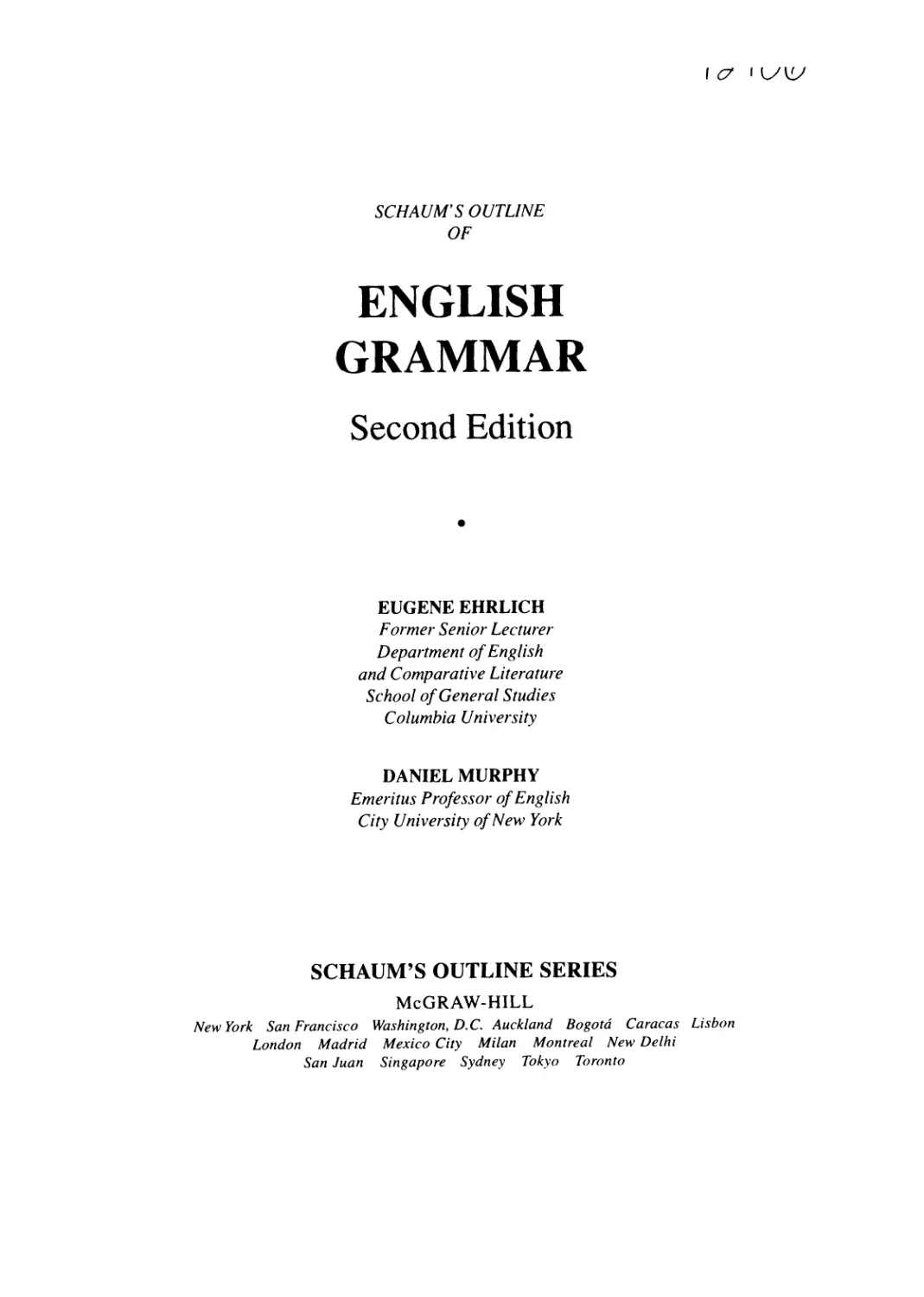
SCHAUM'S OUTLINE
OF
ENGLISH
GRAMMAR
Second Edition
EUGENE EHRLICH
Former Senior Lecturer
Department of English
and Comparative Literature
School of General Studies
Columbia University
DANIEL MURPHY
Emeritus Professor of English
City University of New York
SCHAUM'S OUTLINE SERIES
McGRAW-HILL
New York San Francisco Washington, D.C Auckland Bogota Caracas Lisbon
London Madrid Mexico City Milan Montreal New Delhi
San Juan Singapore Sydney Tokyo Toronto

EUGENE EHRLICH served as Senior Lecturer in the Department of English
and Comparative Literature, School of General Studies, Columbia University.
DANIEL MURPHY is a retired Associate Professor in the Department of
English, Baruch College, CUNY.
Schaum's Outline of Theory and Problems of
ENGLISH GRAMMAR
Copyright © 1991, 1976 by The McGraw-Hill Companies, Inc. All rights reserved.
Printed in the United States of America. No part of this publication may be
reproduced, stored in a retrieval system, or transmitted, in any form or by any
means, electronic, mechanical, photocopying, recording, or otherwise, without the
prior written permission of the publisher.
9 10 11 12 13 14 15 BAW BAW 9
isbn о-о7-оъччач-х
Sponsoring Editors: John Aliano, Patricia Andrews
Production Supervisor:Leroy Young
Editing Supervisors: Meg Tobin and Maureen Walker
Library of Congress Cataloging-in-Publication Data
Ehrlich, Eugene H.
Schaum's outline of English Grammar / Eugene Ehrlich, Daniel
Murphy.-2nd Edition,
p. cm.-(Schaum's outline series)
Includes index.
ISBN 0-07-019484-X
1. English language-Grammar-1950 - I. Murphy, Daniel Joseph,
1921- . II. Title. III. Series.
PE1112.E33 1991
428.2 - dc20 90-6533
CPI
McGraw-Hill
A Division ofThe McGrawHUl Companies

Preface
The study of English grammar has two principal advantages. It facilitates mastery of
writing and enables students to study the grammar of other languages more efficiently.
This second edition of English Grammar was developed to make the study of English
grammar as current and as effective as possible for all students, whether or not English is
their first language. A Glossary of Grammatical Terms is provided as a reference to be
used at any time. We hope that students will continue to find our exercises and
explanations helpful
Chapter 1 discusses the principal elements of the sentence, and the next six chapters
provide information and practice in all the parts of speech: nouns and articles, verbs and
verbals, pronouns, adjectives, adverbs, and prepositions and conjunctions. Each chapter
of the book first presents necessary definitions and discussions, complete with examples.
This presentation is then followed by exercises designed to help the student achieve
mastery of the subject. Answers to all exercises are provided at the end of the book. The
student is advised to work step by step through each chapter, doing each exercise in turn
and checking the answers before proceeding further.
Eugene Ehrlich
Daniel Murphy
ш

Contents
GLOSSARY OF GRAMMATICAL TERMS
Chapter 1 PRINCIPAL ELEMENTS OF THE SENTENCE 1
Verb 1
Subject 1
Direct Object 1
Complement 1
Indirect Object 6
Modifiers 7
Multiple-word Modifiers 8
Clauses 14
Phrases 15
Chapter 2 NOUNS AND ARTICLES 17
Nouns 17
Noun Functions 18
Types of Nouns 25
Plural Forms of Nouns 28
Possessive Forms of Nouns 29
Collective Nouns 30
Noun Clauses 31
Articles 32
Definite Article. Omission of the Definite Article.
Indefinite Article. Choosing between a and an.
Chapter 3 VERBS AND VERBALS 34
Verbs 34
Predicate 35
Transitive and Intransitive Verbs 36
Copulative (Linking) Verbs 37
Auxiliary Verbs 38
Shall and Will. Should and Would.
Mood 40
Uses of the Subjunctive Mood.
Voice 43
Number 44
Agreement of Subject and Verb. Compound Subjects and Their Verbs.
Collective Nouns and Their Verbs.

VI
CONTENTS
Person 48
Tense 49
Principal Parts of the Verb. Selection of Tense. Agreement of Tenses.
Present Tense for Ideas True for All Time.
Consistency of Verbs 56
Consistency of Voice. Consistency of Person. Consistency of Tense.
Consistency of Mood.
Verbals 58
Infinitive 58
Infinitive Phrases. Tenses of the Infinitive. Split Infinitives.
Participle 63
Tenses of the Participle.
Gerund 65
Verbals Used as Modifiers 67
Dangling and Misplaced Modifiers 67
Dangling Participles. Misplaced Participles. Dangling Infinitives.
Auxiliary Verbs and Infinitives in Compound Constructions 69
Auxiliary Verbs. Infinitives.
Parallel Structure and Verb Forms 71
PRONOUNS 73
Types of Pronouns 76
Personal and Impersonal Pronouns. Relative Pronouns. Demonstrative Pronouns.
Interrogative Pronouns. Reflexive Pronouns. Intensive Pronouns.
Reciprocal Pronouns. Indefinite Pronouns.
Pronoun Agreement 86
Plural and Singular Antecedents. Antecedents Joined by And, Or, от Nor.
Collective Nouns. Singular Pronouns as Antecedents.
Pronouns in the Subjective Case 90
Pronouns in the Objective Case 91
Pronouns as Objects of Verbals. Pronouns as Objects of Prepositions.
Pronouns in the Possessive Case 93
Pronouns as Appositives 93
ADJECTIVES 95
Types of Adjectives 95
Limiting Adjectives. Predicate Adjectives.
Position of Adjectives 98
Comparison of Adjectives 99
Adjective Phrases 99
Adjective Clauses 100
Restrictive and Nonrestrictive Adjective Clauses. That and Which with Adjective Clauses.
Chapter 4
Chapter 5

CONTENTS vii
Nouns Used as Adjectives 102
Adjectives Used as Nouns.
Participles as Adjectives 103
Dangling Participles.
Infinitives as Adjectives 105
ADVERBS Ю7
Recognizing Adverbs 108
Adverbs Ending in -ly. Recognizing Adverbs by Their Functions.
Distinguishing Adverbs from Adjectives 110
Comparison of Adverbs Ill
Nouns and Phrases Used as Adverbs 112
Adverbial Clauses 113
Conjunctive Adverbs 116
Intensifies 117
Infinitives as Adverbs 117
PREPOSITIONS AND CONJUNCTIONS 119
Prepositions 119
Commonly Used Prepositions. Object of Preposition. Differentiating
Prepositions from Other Parts of Speech. Prepositional Phrases as Modifiers.
Conjunctions 125
128
Chapter 6
Chapter 7
ANSWERS
INDEX
141

Glossary of Grammatical Terms
Accusative case. Form of a pronoun showing that the pronoun is the object of a verb or preposition: me, her,
him, us, them, whom. Also called objective case.
Active voice. See Voice.
Adjective. Word or words used to modify a noun, pronoun, or verbal: good food, wonderful you, poor
fishing.
Adjective clause. Subordinate clause used as adjective: Everyone who approves should vote for him.
Adjective phrase. Phrase used as adjective: The woman in the red dress is beautiful.
Adverb. Word or words used to modify a verb, verbal, adjective, adverb, or entire clause or sentence: run
quickly, to sit quietly, quite fresh, Naturally he was elected.
Adverbial clause. Subordinate clause used as adverb: John left whenever he felt like it.
Adverbial phrase. Phrase used as adverb: She sent her son to the store.
Antecedent. Word or words to which a pronoun refers: Alice (antecedent) asked for her (pronoun) dessert.
Apposition. Placement of a noun or noun substitute next to another to explain or identify it: New York, the
Empire State; Richard the Lion Hearted. The Empire State and the Lion Hearted are known as appositives.
Article. A, an, and the are articles. Their function is to modify a noun or noun substitute. A and an are the
indefinite articles. The is the definite article.
Auxiliary verb. Verb used with other verbs to form tense or voice: We should go to the movies. He was
slaughtered.
Case. Form of a noun or pronoun to show function. The three cases are nominative (subjective), genitive
(possessive), and accusative (objective). Nominative / saw. Genitive my hat. Accusative The dog bit me.
Clause. Group of words containing a subject and verb. Clauses are either dependent: The man who came to
dinner left early; or independent: The milkman left two bottles of cream.
Collective noun. A noun that appears to be singular but refers to a group. Treated as singular when the
group is thought of as a unit, treated as plural when the members of the group are considered individually.
Comparison. Inflection of adverbs or adjectives to show degrees of quality or amount. Absolute: good,
quickly, famous. Comparative: better, quicker, more famous. Superlative: best, quickest, most famous.
Complement. Noun or adjective used to complete the meaning of a copulative verb. Also known as
predicate complement: She is sick (predicate adjective). She is an opera star, (predicate noun).
Complex sentence. Sentence containing one independent clause and one or more dependent clauses.
ix

GLOSSARY
Compound sentence. Sentence containing two or more independent clauses.
Compound-complex sentence. Sentence containing two or more independent clauses and one or more
dependent clauses.
Conjunction. Word or words used to join words, phrases, or clauses. Coordinating conjunction joins
elements of equal value. Subordinating conjunction joins dependent clauses to independent clauses.
Conjunctive adverb. Adverb used as conjunction. Most common examples are: however, thus, and
therefore.
Coordinate. Of equal grammatical or syntactical importance: two nouns, two phrases, two clauses, etc.
Copulative verb. Verb that links a subject and its complement. Most common copulative verb is be. Also
known as linking verb.
Demonstrative adjective. Adjective that indicates a particular noun or pronoun: this hat, that boat, this one.
Demonstrative pronoun. Pronoun that specifies a particular referent: this is what I want; that is too much.
Dependent clause. See Subordinate clause.
Descriptive adjective. Adjective that names the condition or quality of noun it modifies: green trees,
wrecked wagon.
Direct address. Construction in which the writer addresses the reader directly: Paul, hand me the case.
Ethel, leave the room.
Direct object. Word or words that receive the action of a verb: The speaker hit the table. He believed that
the boy would return the book.
Gender. Of no consequence in English grammar. Refers to masculine, feminine, neuter nouns in certain
other languages. Personal pronouns in English have gender in third person singular: he, she, it.
Genitive case. Form of a noun or pronoun to show possession: woman's, hour's, her, hers, his, their, etc.
Also known as possessive case.
Gerund, -ing form of a verb used as a noun or performing a noun function: Swimming is more fun than
lying on the beach. They both love boating and fishing. Gerunds are verbals.
Imperative mood. Verb construction used in giving commands. The subject of the verb is usually lacking:
Go home! Stop smoking!
Indefinite pronoun. Pronoun that does not specify a particular referent: any, anyone, each, everyone, etc.
Independent clause. Clause that can stand alone and convey meaning as a simple sentence: She was fond of
all her friends, although she loved no one in particular. Also known as main clause or principal clause.
Indicative mood. Form of verb used to make a statement or ask a question: She drives well. Is he baking
bread?
Indirect object. Noun or pronoun receiving the direct object: They gave me a present. They gave a present
to me.

GLOSSARY xi
Infinitive. Simple form of the verb, usually preceded by to: (to) run, (to) jump, (to) attempt. Infinitives
function as nouns, adjectives, and adverbs. Infinitives are verbals.
Infinitive phrase. Infinitive plus its modifiers and object: to swim gracefully, to read a book . Infinitive
phrases have the same functions as infinitives.
Inflection. Change in form to indicate grammatical relationships. Inflection of nouns and pronouns is known
as declension. Inflection of verbs is known as conjugation. Inflection of adjectives and adverbs is known as
comparison.
Intensive pronoun. Pronoun used to strengthen a noun or pronoun: the manager himself, you yourselves, the
bee itself.
Interjection. Ejaculatory word or expression: Alas, there's no more to eat. Heavens above, is there no shame
in the man?
Interrogative adjective. Adjective used in asking question: whose book? which street?
Interrogative pronoun. Pronoun used in asking a question: whose was lost? which was stolen?
Intransitive verb. Verb that does not take an object: I smiled all day. She argues well. AH copulative verbs
are intransitive. Many verbs function transitively as well as intransitively.
Irregular verb. Verb that forms its past tense and past participle by a change of vowels: be, was, were; run,
ran, run; sing, sang, sung. Also known as strong verb.
Linking verb. See Copulative verb.
Modifier. Word or words that limit, describe, or make more precise the meaning of the words modified:
blue hat, the man whom you saw, they walked silently.
Mood. Characteristic of a verb that shows the manner in which a statement is regarded by the writer. See
Indicative mood, Imperative mood, and Subjunctive mood.
Nominative case. See Subjective case.
Nonrestrictive modifier. Modifier of a word or group of words already limited or restricted: Jane's father,
who rowed for Yale, still rows every day. I brought him to my house, which is in Pittsburgh.
Noun. Name of a person, place, thing, quality, action, or idea. Nouns function as subjects, objects, objects of
prepositions, objects of verbals, and as adjectives.
Noun phrase. Phrase that functions as a noun: afternoon tea, the train to Denver.
Number. Singular and plural aspects of nouns, pronouns, and verbs.
Numerical adjective. Adjective that numbers the word it modifies: six Indians, first anniversary.
Objective case. See Accusative case.
Parallel construction. Repetition of grammatical construction for coherence and emphasis: flying and
swimming; I came, I saw, I conquered.

xii GLOSSARY
Participle. Adjective form of a verb. Present participle ends in ing: running, walking. Past participle ends in
ed if the verb is regular, changes a vowel if the verb is irregular: walked, talked; run, eaten. Participles are
verbals.
Passive voice. See Voice.
Person. Forms of verbs and pronouns to indicate person speaking: / am first person; person spoken to: you
are second person; person spoken of: he is third person.
Personal pronoun. Pronoun used to indicate people: /, you, he, she, etc. I saw her.
Possessive adjective. Adjective used to indicate possession: my, your, his, her, hers, its, etc. Our hats, his
typewriter.
Possessive case. See Genitive case.
Predicate. In a clause or sentence, the verb with its modifiers, object, complement, or indirect object.
Predicate adjective. See Complement.
Predicate complement. See Complement.
Predicate noun. See Complement.
Preposition. A word or words that convey a meaning of position, direction, time, or other abstraction.
Together with a noun or pronoun and its modifiers, it forms a prepositional phrase, which serves as a modifier:
to the front, from the shore, with them. In these prepositional phrases, front, shore, and them function as
objects of prepositions.
Principal parts of a verb. The infinitive (look), past tense (looked), and past participle (looked).
Pronoun. A word that takes the place of a noun: /, it, etc. See Antecedent.
Proper adjective. Adjective formed from a proper noun: Italian restaurant, American history.
Proper noun. Name of a specific person, place, or thing: Elizabeth, Finland, Soldiers and Sailors
Monument.
Reciprocal pronoun. Each other and one another. Used only as the object of a verb or preposition: They
saw each other regularly. We spoke to one another yesterday.
Regular verb. Verb that forms its past tense and past participle by adding ed: worked, worked; talked,
talked. Also known as weak verb.
Relative adjective. Limiting adjective introducing subordinate clause: The bookseller whose store burned is
despondent.
Relative pronoun. Pronoun introducing subordinate clause: The man who hired you has been promoted.
The book that you gave me is missing.
Restrictive modifier. Modifier that limits or restricts a word or group of words: Henry the Eighth, the man
who worked for you.

GLOSSARY xiii
Sentence. Group of words normally containing a subject and predicate, expressing an assertion, question,
command, wish, or exclamation.
Strong verb. See Irregular verb.
Subject. Element in a sentence performing the action indicated by an active verb; element in a sentence
receiving the action of a passive verb: Jane saw her sister. She was received in court. Infinitives may also take
subjects: Mother asked him to return home.
Subjective case. Form of pronoun showing that the pronoun is the subject of a verb: /, she, he, we, they,
who. Also called nominative case.
Subjunctive mood. Form of verb used to express doubts, possibilities, desires, and conditions contrary to
fact: I doubt that she will ever become chairperson. If he were here, this problem would vanish.
Subordinate clause. Sentence element consisting of a subject and predicate and functioning as a noun,
adjective, or adverb: That he was fired is no surprise to me. The book you sent me never arrived. He wondered
when he would hear of his appointment. A subordinate clause, also known as a dependent clause, cannot stand
alone as a sentence.
Superlative. Highest degree of comparison used when comparing three or more units: my best effort, the
oldest child in the family, the smallest error. See Comparison.
Tense. Characteristic of verb forms that shows differences in time of action performed: / run, I ran, I will
run, I will have run, etc.
Transitive verb. Verb that takes an object: She bought the car. Jack and Jill carried the water. See
Intransitive verb. See Copulative verb.
Verb. Word or words used to express action or state of being of the subject: Anne studied hard. She is
willing. They are going home. The family will have received notice by this time tomorrow.
Verbal. Word derived from a verb, but functioning as a noun or modifier. See Gerund. See Infinitive. See
Participle.
Voice. Characteristic of verbs that differentiates between the subject as performer of the action of the verb
(active voice) and the subject as receiver of the action of the verb (passive voice). Active voice: The lecturer
emphasized her main points. Passive voice: The main points were emphasized by the lecturer.
Weak verb. See Regular verb.

Chapter 1
Principal Elements of the Sentence
A sentence is a group of words that makes a statement and can be followed by a period, question mark, or
exclamation point.
The principal elements of a sentence are the verb, subject of the verb, and direct object of the verb or
complement of the verb. Many sentences have only a verb and a subject.
Other important elements are the indirect object and modifiers.
VERB
A verb is the word or words that describe the action or state of being of the subject.
Rats eat mice. (The verb eat describes the action performed by the subject rats.)
John has felt well recently. (The verb has felt describes the state of being of the subject John .)
The organ was often played during chapel. (The verb was played describes the action of the
subject organ.)
SUBJECT
A subject is the person or thing that performs the action indicated by the verb or that is in the state of
being described by the verb.
Trees and shrubs line the driveway. {Trees and shrubs is the subject of the verb line, answering
the question Who or what line? Trees and shrubs line.)
Rare books are expensive. {Books is the subject of the verb are. Who or what are expensive?
Books are. Expensive is the complement of are. Complements are discussed below.)
DIRECT OBJECT
A direct object is the word or words that receive the action indicated by the verb.
Automobiles are polluting cities. (What is the action? Are polluting. What receives the action?
Cities. Cities is the direct object of the verb are polluting.)
The gardener fertilized the lawn and trees. (What receives the action? The lawn and trees. Lawn
and trees is the object of fertilized.)
The safe was robbed. (There is no direct object. This sentence has only a subject safe and a verb
was robbed.)
COMPLEMENT
A complement is the word or words that complete the meaning of verbs that express feeling, appearing,
being, and seeming. Such verbs are classified as copulative, or linking, verbs, which are discussed fully on
page 37. Copulative verbs do not take a direct object. They are completed by complements. Note that all forms
of the verb to be are copulative except when used as auxiliary verbs (see pages 38-40).
He seems Sick. (The verb seems does not describe action, but does describe a state of being. Seems
links the subject he with sick, and sick is the complement of seems . Note that it occupies the position
1

PRINCIPAL ELEMENTS OF THE SENTENCE [CHAP. 1
in the sentence that an object would occupy. The sentence He seems sick can best be understood by
imagining that a physician is receiving a report on a patient's health. No action is being reported, only
a state of being. The verb seems conveys no meaning without a complement. Thus, sick completes the
meaning of seems and is called the complement of the copulative verb seems.)
He is a carpenter. (The verb is links the subject he with carpenter, a noun. No action is being
performed. Carpenter complements—completes—the copulative verb is.)
She feels fine early in the morning. (The copulative verb feels links she with fine, the complement
of feels.)
It should be noted that the verb feel does not always function as a copulative verb. In the sentence She felt the
table, an action is being performed, the action of feeling. In this sentence, then, table is the direct object offelt.
To find the principal elements of a sentence:
A) Find the verb or verbs by asking yourself: What is happening? What state of being is indicated?
B) Find the subject or subjects by asking yourself: Who or what is performing the action described by
the verb or verbs? Whose state of being is described by the verb or verbs?
C) Find the direct object of the verb or verbs by asking yourself: Who or what is receiving the action of
the verb or verbs?
D) Find the complement of a copulative verb by asking yourself: What element of the sentence
completes the verb?
Note that a verb that takes a direct object cannot take a complement. A verb that takes a complement cannot
take a direct object.
1. This exercise tests your ability to identify subjects, verbs, direct objects, and complements. You may want
to review the material presented above before beginning work on this exercise. (The sentences include
certain elements not yet discussed. They will be discussed shortly.)
In the following sentences, identify the principal sentence elements as shown in these examples:
Many dogs have fleas.
Verb have
Subject dogs
Direct object fleas
Complement none
Juan and Maria appeared happy.
Verb appeared
Subject Juan, Maria
Direct object none
Complement happy
1. Playwrights and authors receive acclaim.
Verb
Subject
Direct object
Complement

CHAP. 1 ] PRINCIPAL ELEMENTS OF THE SENTENCE
2. Libraries contain the wisdom of civilization.
Verb
Subject
Direct object
Complement
3. Accountants are busiest at tax time.
Verb
Subject
Direct object
Complement
4. Buenos Aires has the largest opera house in the world.
Verb
Subject
Direct object
Complement
5. Religion is a required course in many colleges.
Verb
Subject
Direct object
Complement
6. Eli and Samuel were Old Testament prophets.
Verb
Subject
Direct object
Complement
7. Wars have produced death and destruction.
Verb
Subject
Direct object
Complement
8. Jane called her brothers and sisters.
Verb
Subject
Direct object
Complement
9. The waiter served seltzer to his customers.
Verb
Subject
Direct object
Complement

PRINCIPAL ELEMENTS OF THE SENTENCE [CHAP. 1
10. The house was ransacked.
Verb
Subject
Direct object
Complement
11. Burglars were ransacking the house.
Verb
Subject
Direct object
Complement
12. Emma studied Italian in Switzerland.
Verb
Subject
Direct object
Complement
13. She felt the lining of her coat.
Verb
Subject
Direct object
Complement
14. She felt well again.
Verb
Subject
Direct object
Complement
15. The defendants called their lawyer.
Verb
Subject
Direct object
Complement
16. An orderly mind ensures success in business.
Verb
Subject
Direct object
Complement
17. Transistors have revolutionized the television industry.
Verb
Subject
Direct object
Complement

CHAP. 1 ] PRINCIPAL ELEMENTS OF THE SENTENCE
18. A bibliography is a list of books and articles.
Verb
Subject
Direct object
Complement
19. Even teenagers have checking accounts today.
Verb
Subject
Direct object
Complement
20. Professionals in England still wear bowler hats.
Verb
Subject
Direct object
Complement
21. The shirt and tie suited him well.
Verb
Subject
Direct object
Complement
22. Matadors are highly respected in Spain.
Verb _^_
Subject
Direct object
Complement
23. Many homes now are air conditioned.
Verb
Subject
Direct object
Complement
24. Air conditioning cleans and cools buildings.
Verb
Subject
Direct object
Complement
25. Although Polish, Conrad wrote in English.
Verb
Subject
Direct object
Complement

PRINCIPAL ELEMENTS OF THE SENTENCE [CHAP. 1
INDIRECT OBJECT
An indirect object is a word or words that receive the direct object. You will encounter indirect objects in two
different ways:
A) When an indirect object follows the direct object, the indirect object will be preceded by to, for, or of.
B) When an indirect object appears between the verb and the direct object, the indirect object will
appear without to, for, or of.
Indirect objects occur most often with such verbs as ask, tell, send, give, and show.
Consider the following sentences:
He gave the book to me. (The direct object of gave is book. Me is the indirect object and is
preceded by to. Me receives book, the direct object.)
He gave me the book. (The direct object of gave hbook. Me is the indirect object. Me receives
book. Notice that to is omitted, because the indirect object appears between the verb gave and the
direct object book.)
The professor asked her a question. (The direct object of asked is question. Her, the indirect
object, receives question. Notice that of is omitted.)
The professor asked a question Of her. {Her is the indirect object and is preceded by of Her
receives question, the direct object.)
Television commentators give audiences the news. (The direct object of the verb give is news.
The indirect object audiences receives news, the direct object.)
Television commentators give the news to audiences. (The indirect object audiences receives
news, the direct object. The indirect object is preceded by to.)
Many florists send their best customers orchids on New Year's Eve. (The direct object of
send is orchids. The indirect object is customers.)
Many florists send orchids to their best customers on New Year's Eve. (The indirect object
customers receives orchids, the direct object.)
2. In the following sentences, underline the indirect objects as shown in these examples:
The bride threw her bouquet to the bridesmaids.
Gladstone delivered a major address to the House of Commons and House of Lords.
We paid her many compliments.
1. Guatemala provides excellent facilities for vacationers.
2. The storekeeper sent the carpet to the hotel.
3. Attorneys ask their clients searching questions.
4. The storekeeper sent his customer a red carpet.
5. I wrote a poem for him.
6. He gave the museum a rare vase.
7. The dog handler showed the Russian wolfhound to the judges.
8. She showed her stamp collection to Marie.
9. She showed her professor her paper.
10. He gave his Chinese vase to the Museum of Art.
11. We supplied him food and drink.
12. Librarians provide services for readers.

CHAP. 1] PRINCIPAL ELEMENTS OF THE SENTENCE 7
13. District attorneys may ask embarrassing questions of witnesses.
14. Cargo ships give reliable service to most clients.
15. Children may tell their parents many strange stories.
MODIFIERS
All words in a sentence that are not verbs, subjects, direct objects, indirect objects, or complements are
modifiers.
Typically, modifiers define, make more precise, identify, or describe a verb, subject, direct object, indirect
object, complement, or other modifier.
Modifiers may be single words or groups of words.
Consider the following sentences:
He ran quickly. (The verb ran is made more precise—is modified—by quickly.)
He ran as quickly as he COUld. (The verb ran is made more precise—is modified—by as quickly
as he could.)
The blue hat suited the woman. (The subject hat is described—is modified—by blue.)
The hat that she wore suited the woman. (The subject hat is modified by that she wore.)
The thief Stole an electric typewriter. (The direct object typewriter is modified by electric.)
A thief stole the typewriter that Andrew's wife had given him. (The direct object typewriter is
modified by that Andrew's wife had given him.)
Copyright lawyers forward their findings to waiting clients. (The subject lawyers is modified by
Copyright, and the indirect object clients is modified by waiting.)
Copyright lawyers forward their findings to clients who pay their bills. (The subject lawyers is
modified by Copyright, and the indirect object clients is modified by who pay their bills.)
Sean appeared overly anxious. (The complement anxious is modified by overly.)
Sean appeared anxious to an extreme degree. (The complement anxious is modified by to an
extreme degree.)
Excessively grateful people embarrass Others. (The modifier grateful is itself modified by
excessively.)
Uninformed by any standard, he continued to pose as an expert. (The modifier uninformed is
modified by by any standard. The subject he is modified by uninformed by any standard.)
3. In the following sentences, underline the single-word modifiers as shown in these examples:
Three large stores were opened simultaneously.
The open book lay on the professor's desk.
1. An outdoor market attracts enthusiastic visitors.
2. The patient dog greeted him joyfully.
3. The tired driver came home very late.
4. A tasty spaghetti dinner is welcome.
5. A regularly serviced car makes driving safer.
6. Susan opened the large package carefully.
7. The grocery store opened early and closed late.
8. Mother always folded clean sheets neatly.
9. I never hear the wolves.

8 PRINCIPAL ELEMENTS OF THE SENTENCE [CHAP. 1
10. The blond skater almost fell.
11. The teamsters will meet tonight.
12. Our weekly paper prints only local news.
13. Late-night television shows old movies.
14. Peter quickly repaired the broken pipe.
15. White wine improves roast chicken.
16. Herman's band was playing good dance music.
17. Bertha's diary has a blue binding.
18. I never saw him before.
19. The tall policeman gently comforted the frightened child.
20. Please bring two cold beers.
21. The red paint dries slowly.
22. The stormy winds raised high waves.
23. Happy schoolchildren study hard.
24. Robert's black car needs new tires.
25. They sell a million hamburgers annually.
MULTIPLE-WORD MODIFIERS
Multiple-word modifiers are composed of sentence elements known as phrases or clauses. A phrase is a
logical grouping of words that does not contain a subject or verb. A clause is a logical grouping of words that
does contain a subject and verb.
Consider the following sentences:
The house with the gabled roof belongs to the parson. (In this sentence, the phrase with the
gabled roof modifies house; the phrase to the parson modifies belongs. Note that there is no subject
or verb in either multiple-word modifier.)
The man who entered the room hastened to the hostess. (In this sentence, the clause who
entered the room modifies man; the phrase to the hostess modifies hastened. The first multiple-word
modifier has both subject who and verb entered. For this reason, the modifier is a clause. To the
hostess has neither subject nor verb, so it is a phrase.)
The girl whose arm was set awoke in the hospital. (In this sentence, the clause whose arm was
set modifies girl; the phrase in the hospital modifies awoke.)
4. In the following sentences, underline the multiple-word modifiers as shown in these examples:
Gloria clung tojhe arm of Jhe boy in the football uniform.
The expert who identified the forgeries was rewarded byjhe art collector.
I find him guilty, (none)
1. The dress that the champion wore on the tennis court was trimmed with green piping.
2. The man with blond hair ran down the stairs.
3. He went out at night without a coat.
4. The flanker of the visiting team ran around right end.
5. The building in which we live has been condemned.
6. A car that is double parked blocks traffic in the entire street.
7. The man wearing the brown suit left his papers on his desk.

CHAP. 1 ] PRINCIPAL ELEMENTS OF THE SENTENCE 9
8. Garbage had fallen across the sidewalk.
9. People of all ages enjoy swimming.
10. The shop on the comer sells newspapers from many cities.
11. A line of unemployed men appeared outside the office door.
12. The girl in the red dress walked down the street.
13. The light of morning shone through the window.
14. The rain we had yesterday left floods on many streets all over the city.
15. The window box Mary planted is full of red flowers.
16. A flock of black birds nests under that bridge.
17. Students from our class visited the museum.
18. The girl with brown eyes pointed across the room with her left hand.
19. The driver of our bus was pleasant to all the passengers.
20. Helen will have dinner at our house on Saturday.
21. The salesman who spoke only English could not communicate with many customers.
22. The batter who hit to left field reached second base before the ball was thrown in.
23. A dog that is well trained obeys a well-trained master.
24. The priest in our parish helps everyone who comes to him.
25. A skier who knows what she is doing moves with great caution.
5. In the following sentences, identify verbs, subjects, direct objects, complements, indirect objects, and
modifiers as shown in these examples:
The basement of the house across the street was flooded during the storm.
Verb was flooded
Subject basement
Direct object none
Complement none
Indirect object none
Modifiers of the house, across the street, during the storm
Joe Montana passed the ball to the fullback.
Verb passed
Subject Joe Montana
Direct object ball
Complement none
Indirect object fullback
Modifiers none
John Kennedy was an able man.
Verb was
Subject John Kennedy
Direct object none
Complement man
Indirect object none
Modifiers able

10 PRINCIPAL ELEMENTS OF THE SENTENCE [CHAP.
1. Susan hastily wrote an angry letter to her mother.
Verb
Subject
Direct object
Complement
Indirect object
Modifiers
2. Beethoven is the greatest composer of all time.
Verb
Subject
Direct object
Complement
Indirect object
Modifiers
3. While I was waiting for Jon, I met another old friend.
Verb _
Subject
Direct object
Complement
Indirect object
Modifiers
4. Michelle is the best student in the senior class.
Verb
Subject
Direct object
Complement
Indirect object
Modifiers
5. Mayor Dinkins gave an important speech on the radio.
Verb
Subject
Direct object
Complement
Indirect object
Modifiers
6. Albert gave Maria a very expensive present.
Verb
Subject
Direct object
Complement
Indirect object
Modifiers

CHAP. 1 ] PRINCIPAL ELEMENTS OF THE SENTENCE 11
7. The old man rose from his comfortable chair.
Verb
Subject
Direct object
Complement
Indirect object
Modifiers
8. Literary critics often are frustrated authors.
Verb
Subject
Direct object
Complement
Indirect object
Modifiers
9. The ornithologist identified many rare birds.
Verb
Subject
Direct object
Complement
Indirect object
Modifiers
10. Margaret Drabble has written many novels on modern English life.
Verb
Subject
Direct object
Complement
Indirect object
Modifiers
11. Working hard gave Gary bad headaches.
Verb
Subject
Direct object
Complement
Indirect object
Modifiers
12. Most Third World nations experience economic difficulties.
Verb
Subject
Direct object
Complement
Indirect object
Modifiers

12 PRINCIPAL ELEMENTS OF THE SENTENCE [CHAP. 1
13. Old typewriters are a burden to their users.
Verb
Subject
Direct object
Complement
Indirect object
Modifiers
14. Life has never been better for this generation.
Verb
Subject
Direct object
Complement
Indirect object
Modifiers
15. I never study on time.
Verb
Subject
Direct object
Complement
Indirect object
Modifiers
16. The brown puppies are the cutest of the lot.
Verb
Subject
Direct object
Complement
Indirect object
Modifiers
17. H. L. Mencken was an irreverent critic.
. Verb
Subject
Direct object
Complement
Indirect object
Modifiers
18. Tracy made good pottery for herself and her friends.
Verb
Subject
Direct object
Complement
Indirect object
Modifiers

CHAP. 1 ] PRINCIPAL ELEMENTS OF THE SENTENCE 13
19. Congressmen receive many letters every day.
Verb
Subject
Direct object
Complement
Indirect object
Modifiers
20. Fires endanger the lives of many city families.
Verb
Subject
Direct object
Complement
Indirect object
Modifiers
21. We went to the theater as often as possible.
Verb
Subject
Direct object
Complement
Indirect object
Modifiers
22. Food prices are high everywhere.
Verb
Subject
Direct object
Complement
Indirect object
Modifiers
23. When Dick cuts himself, he bleeds for a long time.
Verb
Subject
Direct object
Complement
Indirect object
Modifiers
24. Paper airplanes rarely fly for more than five minutes.
Verb
Subject
Direct object
Complement
Indirect object
Modifiers

14 PRINCIPAL ELEMENTS OF THE SENTENCE [CHAP. 1
25. Fishing is fun once you have learned the fundamental skills.
Verb
Subject
Direct object
Complement
Indirect object
Modifiers
CLAUSES
Like a sentence, a clause contains a subject and verb. It may also contain an object or complement, an
indirect object, and modifiers.
A clause that makes a complete statement and can stand alone as a sentence is called an independent
clause. A clause that cannot stand alone as a sentence is called a subordinate, or dependent, clause.
A sentence may consist of one or more independent clauses plus one or more subordinate clauses.
Consider the following sentences:
Before he sat down, he removed his coat. (This sentence consists of a subordinate clause Before
he sat down and an independent clause he removed his coat. You know from the previous discussion
of modifiers that, in this sentence, the subordinate clause modifies the verb removed in the main
clause. Note that both clauses have their own subjects and verbs: he sat, he removed. Note further that
the independent clause can stand as a sentence: He removed his coat. The subordinate clause cannot
stand as a sentence: Before he sat down. The subordinate clause does not make a complete statement
but depends on the independent clause for its meaning. The word Before connects the subordinate
clause to the independent clause. Before here is classified as a subordinating conjunction.
Conjunctions are discussed in Chapter 7.)
We went to the movies and they stayed home. (This sentence consists of two independent
clauses. Each clause has its own subject and verb: We went, they stayed . Either clause can stand as a
complete sentence. Each makes a statement that does not depend on the other. The conjunction here
is and, which is classified as a coordinating conjunction. Other coordinating conjunctions are but, for,
so, or, nor, and yet.)
6. In the following sentences, underline the independent clauses as shown in these examples:
We stayed on the dock long after the ship had gone.
Even though he was sick, he attended class regularly.
1. Some of us liked the program that night, and many people were enthusiastic about it.
2. Many women misinterpreted the remarks of the candidate, so he tried to restate his position.
3. While we were walking home, we considered the problem carefully.
4. Pooch lived a long and happy life, but his time had come to die.
5. During the years they spent raising their children, they had many happy experiences.
6. Cigarettes are known to be dangerous to health, yet many people continue to smoke them.

CHAP. 1 ] PRINCIPAL ELEMENTS OF THE SENTENCE 15
7. He agreed to join her in the new business, but he had little capital to invest.
8. Although there were enough instruments to go around, their quality was poor.
9. His first remarks were greeted with derision, but the audience later began to applaud.
10. Typewritten papers usually get higher marks than handwritten papers.
7. In the following sentences, underline the dependent clauses as shown in these examples:
Most of the seniors will be graduated before they reach eighteen.
At every opportunity he downgrades his associates. (none)
1. Some of them have been driving carelessly although they all passed Driver Education.
2. Aspens and poplars grow rapidly but are not useful in building.
3. They left California before their children entered school.
4. Sally never eats meat, even though her mother and father do.
5. We decided that she was not a friend of ours and that he was.
6. My wife could barely manage to get home on time from her job at school, where she taught reading
improvement.
7. The mayor told her constituents that she would do her best to meet the town's financial needs.
8. Supersonic transport airplanes have little to recommend them, since they save the traveler little time
and contribute heavily to air pollution.
9. I have reserved two seats for tonight's performance.
10. The movie held all of us spellbound except for Kate, who yawned audibly from the time the movie
began.
PHRASES
A phrase is a group of two or more words that does not contain a subject and verb. Phrases have many
forms and functions, which are discussed at length on pages 59, 60, 61, 62, 99, 100, 112, and 113. It is useful
here to learn to recognize phrases and to identify their functions as modifiers, subjects, complements, and
objects.
Consider the following sentences:
She hid behind the building. (The phrase behind the building modifies hid. Note that no single
word within the phrase conveys the meaning intended by the entire phrase, which functions as a
logical grouping of words that conveys a single meaning. Note also that the phrase has no subject or
verb.)
The child in front will win. (The phrase in front modifies child.)
Eating apples has been called a sure way to avoid doctors' bills. (The phrase Eating apples
functions as the subject of has been called . Note that words such as Eating often function as
subjects, objects, and modifiers. In these roles they are classified as verbals. See pages 59-68. In this
sentence Eating is a gerund, one of the three types of verbals.)
Her hobby was flying airplanes. (The phrase flying airplanes functions as the complement of was,
a copulative verb. Flying is also a gerund.)
Eileen wanted to finish her work early. (The phrase to finish her work early is the object of
wanted. Note that to finish is an infinitive, which is one of the three types of verbals.)

16 PRINCIPAL ELEMENTS OF THE SENTENCE [CHAP. 1
8. In the following sentences, underline the phrases as shown in these examples:
The children were taken to the store.
Winning the peace is more important now than winning the war.
She decided to spear an octopus for dinner.
1. We swam across the winding river.
2. After her downfall, all mention of her name was forbidden.
3. He saw himself pinned to the wall.
4. The glider soared skyward, soon enough to return to earth.
5. They baited the trap in hope of snaring something for dinner.
6. A simple country doctor was all she wanted to be.
7. Books were his best friends, time his greatest foe.
8. A cup of tea in late afternoon enabled him to survive until evening.
9. In the library the boy found peace and quiet.
10. The captain ordered us to pick up our gear and retreat to the nearest town as quickly as possible.

Chapter 2
Nouns and Articles
NOUNS
A noun is the name of a person, place, thing, quality, activity, concept, or condition.
Person
Abraham Lincoln is known throughout the world for his humanity.
Cervantes created one of the great comic novels.
Students of logic study Socrates.
The actor portraying Tarzan has a simple task.
Pele, the Brazilian football player, scored more goals than any other player in history.
Place
Lima is the capital of Peru.
Dublin experienced a literary renaissance just after the turn of the century.
Travelers find Scotland one of the beautiful sections of the British Isles.
Colombia is noted for marvelous coffee.
Afghanistan is no longer visited by many tourists.
Thing
A beach is unsurpassed for relaxation.
A man's house is his castle.
Dogs perform an important function for the blind.
The committee gathered around the conference table.
Russians enjoy tea brewed in a samovar.
Quality
I admire her childlike innocence.
A thing of beauty is a joy forever.
The House of Representatives is not noted for its integrity.
She discerned deceitfulness in his proposal.
The shopkeeper accused the salesman of opportunism.
Activity
Fishing had become a major sport.
He made his fortune in manufacturing.
Leisure has become increasingly important for the middle class.
The horse show listed six events, of which jumping was most important.
Writing is an art too often neglected.
One of the best books on studying is now out of print.
17

18 NOUNS AND ARTICLES [CHAP. 2
Concept or Condition
Christianity is one of the great religions of the world.
The newspaper carried a major article on perestroika.
Football is often a game of inches.
Allied Armies invaded Normandy in 1944.
Monarchy was the form of government in Europe at that time.
1. In the following sentences, underline all nouns as shown in these examples:
Intellect alone never provides an adequate answer.
Actors must study voice in order to be heard.
1. Harpo Marx was a great comedian.
2. The sky was full of parachutes.
3. Buffalo cuisine features chicken wings.
4. Bill wore a tweed coat.
5. Charity begins at home.
6. The football bounced off the statue of Marx.
7. The avenue is undergoing restoration.
8. The speech lasted nearly one hour.
9. Some chairmen fail to keep order.
10. Our puppy has black spots on his nose.
11. His hotel was near the casino.
12. My neighbor drives a small car.
13. Will the world ever forget Mikhail Gorbachev?
14. Love makes the world go round.
15. Ballpoint pens do not flatter the handwriting.
16. The train may get us to Chicago in time to catch the show.
17. Mary is allergic to roses, but she still loves them.
18. The cleaning fluid did not take out the stain.
19. A woman who misses her bus is in danger.
20. Lois found that no one would offer her a seat.
21. Mary refused to knit the sweater for her father.
22. Joe changed the tire and got back into his car.
23. He washed his hands as thoroughly as he could.
24. Bridge is not my cup of tea.
25. Planning takes all my time.
NOUN FUNCTIONS
A noun can have many functions in a sentence:
A) subject of a verb,
B) direct object of a verb,
C) object of a preposition,
D) object of a verbal (gerund, infinitive, participle),
E) indirect object of a verb,
F) predicate complement (complement of a copulative verb),
G) modifier of another noun.

CHAP. 2] NOUNS AND ARTICLES 19
Subject of a Verb
Houses built before 1950 are usually of good construction. (Subject Houses, verb are.)
Beauty is in the eyes of the beholder.
Indian art has many admirers.
Despite all assurances, the young dancer found his debut trying.
New York City appears to have reached a stable size.
Swimming was his greatest pleasure. (The gerund Swimming functions here as subject of was.)
Direct Object of a Verb
The hunter shot three deer. (Verb shot, direct object deer.)
The automobile forced the cows off the road.
African hunters found agriculture impossible to sustain.
Critical acclaim too early in her career may impede a novelist's development.
Improper education may cause delinquency.
They liked dancing. (The gerund dancing functions here as the direct object of liked.)
Object of a Preposition
They walked about the mall. (Preposition about, object of preposition mall.)
For his part, he would remember that day forever.
Up and down the river, there was solid ice.
She performed most of her chores during the afternoon. (Preposition of object of preposition
chores; preposition during, object of preposition afternoon.)
The couple decided to ski the upper slope before lunch.
Object of a Verbal
Swimming the channel was more than he could manage. (Verbal Swimming, object of the
verbal channel.)
To pass his examinations easily was all he wanted.
Fighting the rain, he slowly made his way home.
Having found his wallet, he decided to retire for the night.
The consulting engineer offered another suggestion for solving the problem.
Indirect Object of a Verb
The lawyer gave her secretary a brief letter. (Verb gave, indirect object secretary.)
We showed the curator the new acquisition.
The pitcher threw the fielder the ball.
The messenger gave Juan an envelope.
Teachers assign their classes enough work to keep anyone busy.
In all these sentences, the word order can be rearranged so that the indirect object can be made the object
of a preposition: The lawyer gave a brief letter to her secretary. We showed the new acquisition to the curator.
The pitcher threw the ball to the fielder. The messenger gave an envelope to Juan. Teachers assign to their
classes enough work to keep anyone busy.

20 NOUNS AND ARTICLES [CHAP. 2
Predicate Complement
In the eyes of many of her clients, she is the best lawyer in town. (Verb is, predicate
complement lawyer. The verb is, of course, is a copulative verb.)
Christianity is the religion of many Europeans.
She is the youngest teacher in our school.
The main difficulty of that country is the poverty of most of the population.
Word processors can be a blessing for those of us who write illegibly.
Modifier of Another Noun
Stone walls were built throughout Britain. (Noun Stone, modifying noun walls.)
The peace talks settled the costly strike.
Glass doors were installed in the kitchen.
Tennis champions played many tournaments that year.
John collected postage stamps.
2. In the following sentences, underline nouns and identify their functions in respective order as shown in
these examples:
Utamaro was one of the greatest artists of Japan,
subject of verb
object of preposition
object of preposition
The college has graduated many noted scholars,
subject of verb
direct object
Rosa sent her bloodhound to the veterinarian,
subject of verb
direct object
object of preposition (indirect
object)

CHAP. 2] NOUNS AND ARTICLES 21
To obtain a new halfback, the manager offered his star center,
object of verbal
subject of verb
modifier
direct object
Jane gave all her admirers a brief talk.
subject of verb
indirect object
direct object
Sven is an excellent carpenter,
subject of verb
predicate complement
1. Librarians like to help people find books.
2. MacDonald had a flourishing farm.
3. We went to the zoo on the first Saturday of the month.

22
NOUNS AND ARTICLES
[CHAP. 2
4. Violin music goes well with a bottle of wine and candle light.
5. All he said was that he thought we made beautiful clothing.
6. The dog ran in front of the car before we had a chance to stop.
7. Mother was annoyed because we stayed up so late to watch television.
8. Carl tried hard to become a painter, but only succeeded in becoming an illustrator.
9. We rode up the mountain on a chairlift.

CHAP. 2] NOUNS AND ARTICLES 23
10. Attending church on Sundays was not the custom in our family.
11. My wife likes to prepare elegant meals.
12. Marrying Avis changed his life, he thought.
13. Please give Harry a ticket for the baseball game.
14. I will knit Alfred a sweater even though I really should knit one for my father.
15. In a large family, laundry day is an everyday event.

24 NOUNS AND ARTICLES [CHAP. 2
16. Eyeglasses are not a sure sign of age; bifocals are.
17. A Bentley is not only a beautiful car, but a practical one if you can afford the initial investment.
18. Fine wine can be made of California grapes.
19. Term papers really should be called research papers.
20. I fail to see the advantages of color television.
21. Sculpture is a useful and interesting hobby.

CHAP. 2] NOUNS AND ARTICLES 25
22. Despite the advice of his doctor, Fred went on smoking cigarettes until the day he died.
23. Zucchini is easy to grow if you have room for it in your garden.
24. Mary had drunk too much Scotch whisky.
25. The new couch fits right into our living room.
TYPES OF NOUNS
Nouns are classified as proper nouns or common nouns.
A proper noun is the name of a specific person, place, or thing:
Michelangelo is universally admired.
She was a Communist in her youth.
Oh, to be in England
Lincoln Center attracts many visitors.
A common noun is the name used for any unspecified member of a class of persons, places, things,
qualities, or concepts:
Sculptors and painters work hard for recognition.
We all admire the work of fine novelists.

26 NOUNS AND ARTICLES [CHAP. 2
The city was known for its ugly architecture.
Oh, to be in a faraway country.
Tall mountains challenge experienced hikers.
The museum exhibited only some of its treasures.
He flirted briefly with communism in his youth.
Proper nouns are capitalized; common nouns are not, unless they are the first word in a sentence.
3. In the following sentences, underline all nouns and identify them as proper or common as shown in these
examples:
Mary submitted her paper in a folder,
proper
common
common
Thomas Edison slept only four hours a night throughout the major portion of his life,
proper
common
common
common
common
1. The road was icy, so Jane advised her husband to have chains put on the car.
2. Siberia supports thousands of migratory deer.
3. The Atlantic is polluted with congealed oil from New York to Portugal.

CHAP. 2] NOUNS AND ARTICLES 27
4. Many students are dropping out of school because of the high cost of tuition.
5. Physics textbooks, according to Smith, do not supply students with sufficient exercises.
6. Theaters in England are so inexpensive that tourists can attend every night of the week.
7. Rich people ordinarily find that restaurants are eager for their patronage.
8. Harding coined the word "normalcy" and made lexicographers unhappy.
9. Bernard Malamud was the author of many fine stories and books.
10. Roger Casement was an Irish patriot, an English traitor.

28 NOUNS AND ARTICLES [CHAP. 2
PLURAL FORMS OF NOUNS
Most nouns form their plurals by adding 5 to the singular: time, times; girl, girls; home, homes; bear,
bears.
There are many exceptions to this practice:
A) Add es when a noun
ends in s: kindness, kindnesses; lens, lenses
ends in z: fuzz, fuzzes; quiz, quizzes (note the doubling of z)
ends in sh: hash, hashes; flash, flashes
ends in ch: lunch, lunches; bunch, bunches
ends in x: mix, mixes; box, boxes
B) When a noun ends in у preceded by a consonant, change the у to i and add es: harmony, harmonies;
baby, babies; thievery, thieveries.
C) For certain words taken directly from foreign languages, form the plural as it is formed in those
languages: alumnus, alumni; alumna, alumnae; erratum, errata; stimulus, stimuli; phenomenon,
phenomena. There is a tendency to drop this practice and use the letter s to form plurals of words
taken directly from foreign languages. Thus, the plural of memorandum is now more often
memorandums than memoranda. A current dictionary will be useful in deciding questions of
pluralization.
D) Certain words do not change in forming plurals: deer, goods, headquarters, scissors, species, etc.
E) Certain words that have come down from Anglo-Saxon retain their Anglo-Saxon plurals: foot, feet;
tooth, teeth; woman, women; man, men; child, children; ox, oxen; etc.
4. Give the plural forms of the words and phrases in the following list as shown in the examples. Consult a
dictionary if necessary.
day days
hoot hoots
wilderness wildernesses
sleigh sleighs
acre acres
yeoman yeomen
1. fox
2. chief
3. attorney
4. potato
5. spoonful
6. valley
7. formula
8. genus
9. addendum
10. knife
11. laboratory
12. vocabulary
13. absence
14. cupful
15. baby sitter
16. crisis
17. diagnosis
18. synopsis
19. athletics
20. library
21. Jones
22. quota
23. datum
24. booth

CHAP. 2] NOUNS AND ARTICLES 29
25. buzz 38. freshman
26. axis 39. parenthesis
27. locus 40. attorney general
28. sky 41. analysis
29. echo 42. psychosis
30. preference 43. thesis
31. loaf 44. chassis
32. life 45. quantum
33. matrix 46. Smith
34. actuary 47. symphony
35. basis 48. ax, axe
36. neurosis 49. secretary
37. privilege 50. levity
POSSESSIVE FORMS OF NOUNS
Two rules are helpful, in forming possessive nouns:
A) With singular nouns and with plural nouns that do not end in s, add 's to form the possessive: boy,
boy's; child, child's; Jane, Jane's; children, children's; brethren, brethren's; sisters-in-law, sisters-in-
law's.
B) With plural nouns and with singular nouns that end in s, add ' or 's to form the possessive: boys,
boys'; girls, girls'; Russians, Russians'; Charles, Charles', Charles's; Yeats, Yeats', Yeats's.
5. In the following sentences, supply the missing possessive forms as shown in these examples:
The music of the Beatles did not appeal to everybody.
The Beatles' music did not appeal to everybody.
A delay of one hour will not bother me.
One hour's delay will not bother me.
1. The shirt that John will wear needs ironing.
shirt needs ironing.
2. The performance of the team in the first half was disappointing.
The performance in the first half was disappointing
3. Most meetings of the United Nations begin on time.
The United meetings mostly begin on time.
4. He objected to the reunification of Germany.
He objected to reunification .
5. Who has not admired the batting of the Yankees?
Who has not admired the batting?
6. John Ruskin was known for more than art criticism.
John reputation extended beyond art criticism.
7. The child of my next-door neighbor had a party today.
My next-door child had a party today.
8. The ambitions of most men are never realized.
Most ambitions are never realized.

30 NOUNS AND ARTICLES [CHAP. 2
9. The best dishes of our cook are reserved for nights when company is expected.
Our best dishes are reserved for nights when company is expected.
10. The poetry of John Keats will never go out of style.
John poetry will never go out of style.
11. With a little luck, the scrambled eggs my wife makes will resemble the real thing.
With a little luck, my scrambled eggs will resemble the real thing.
12. At midnight on December 31st, I shall be celebrating with my family.
I shall be celebrating New Eve with my family.
13. The shoes Corky wore had seen better days.
shoes had seen better days.
14. Retirement for the Johnsons did not last long enough.
The retirement years were too few and too late.
15. Mr. and Mrs. Jones said all they could at the meeting.
Mr. and Mrs. remarks bored everyone at the meeting.
COLLECTIVE NOUNS
A collective noun represents a group or class considered as a unit. Such a collective noun is considered
singular.
A collective noun may also represent a group or class of individuals considered as individuals. In this
case, the collective noun is treated as plural.
The writer must decide how he or she intends a collective noun to be understood and must be consistent in
the treatment of the noun.
Some of the most common collective nouns are: army, audience, band, committee, couple, group, jury,
majority, and team. Note that these nouns may be treated as singulars or plurals. When a collective noun is
singular, its verb must be singular. When plural, its verb must be plural.
The following sentences show both uses:
Singular
The army is advancing slowly. (The entire army as a unit.)
The band has played well. (The entire band as a unit.)
The jury has reached a verdict. (The entire jury as a unit.)
Plural
The audience are leaving their seats now. (The members of the audience are thought of as
individuals.)
The committee disagree with the stand taken by the minority. (The members of the committee
are thought of as individuals. The committee has not taken a single stand as a unit.)
The young couple were unhappy with the apartment they rented. (Both husband and wife, as
individuals, were unhappy.)
Certain collective nouns, for example, athletics, contents, and politics, appear to be plural because they
end in s. Yet they are treated as singulars when they are intended as singulars and, of course, they are treated

CHAP. 2] NOUNS AND ARTICLES 31
as plurals when they are thought of as plurals. Again, the writer must treat them consistently either as singulars
or plurals:
Singular
The contents of the valise was examined thoroughly by the guard. (The writer treats contents
as a unit.)
Statistics is not my best subject. (The writer is discussing a. course called statistics.)
Plural
The contents of the valise were thrown about the room. (The writer is thinking of the individual
objects that make up the contents of the valise.)
Statistics are said to mislead the unwary. (The writer is thinking of individual computations that
constitute what we call statistics.)
6. In the following sentences, identify the collective nouns as singular or plural as shown in these examples:
Humankind is coming to a decisive era in its history, singular
The public makes known its wishes slowly but forcefully, singular
The remainder are going to be left behind. plural
1. In many schools, athletics is funded from football receipts.
2. He decided that he would cut the herd so that its weakest members would not deprive the strongest of
food.
3. The class agreed that their teacher should be encouraged to permit early adjournment.
4. He asked the group to take their time in reaching a decision.
5. A minister may find that his congregation speaks with one voice in parish matters.
6. The team has decided to appoint a new captain.
7. The opposition are meeting quietly to organize their forces.
8. We wonder whether the remainder is sufficient to pay her way for the rest of her life.
9. His offspring surprises him every day.
10. His offspring are now going their separate ways.
NOUN CLAUSES
A noun clause has a subject and verb and functions as a noun. Noun clauses are usually introduced by
that, what, who, whoever, whatever, why, when, where, how, or which.
As Subjects
That a politician can act that way after years in office never occurred to me. (subject of
occurred)
Why he acts the way he does mystifies me. (subject of mystifies)
As Objects
She insisted that she would change her ways, (object of insisted)
She insisted she would change her ways, (object of insisted)

32 NOUNS AND ARTICLES [CHAP. 2
As Predicate Complements
Life is whatever you make it. (complement of is)
You now are where I would love to be. (complement of are)
As Objects of Prepositions
He is taking action on all the problems of which you complained, (object of of)
I purchased the book for which you bid. (object of for)
7. In the following sentences, underscore the noun clauses as shown in these examples:
His position is that he was not to blame.
How he can achieve his ambition bewilders me.
1. Whether we go tomorrow or stay depends on the weather.
2. Walter insisted that we pool our remaining capital.
3. His answers usually were whatever came into his head first.
4. He feels unhappy about what happened to him yesterday.
5. Alice cannot be held responsible for everything her children do.
6. This building is what modern architecture represents.
7. The librarian told me that the book was on reserve.
8. When the picnic is held is no concern of yours.
9. Whatever you do will affect the remainder of your academic career.
10. Whoever attends the meeting will have a vote in the election.
ARTICLES
There are two types of articles: definite and indefinite. Articles are considered modifiers of nouns and
pronouns.
Definite Article
The definite article is the. It is used to indicate a specific class of nouns or pronouns or a specific member
of a class of nouns or pronouns:
The whale is Still an endangered Species. (The whale as distinct from other species.)
He gave me the assignment I requested. (He gave me a specific assignment.)
The teacher gave the class enough homework for the week. (A specific teacher, a specific
class, a specific week.)
Reagan is the president I remember best.
They are the ones who own the property.
Omission of the Definite Article
The definite article is omitted when the writer does not specify a particular amount or quantity of the
noun.
Teachers assign homework. (An indefinite number of teachers assign an indefinite amount of
homework.)
Salt is an important commodity. (The writer has not specified an amount of salt.)
The salt on our table is rarely used. (In specifying a particular amount of salt, the writer uses the
definite article.)

CHAP. 2] NOUNS AND ARTICLES 33
Indefinite Article
The indefinite articles are a and an. They are used as modifiers to indicate an unspecified
class or member of a class of nouns:
Miss Smith gave her department enough work for a week. (The week is unspecified.)
A Steak costs $25 in some restaurants. (This means any unspecified steak.)
Carpenters may one day again be paid $20 an hour in New York. (This means any
unspecified hour regardless of when the work is performed.)
Choosing between a and an
A is used before a word beginning with a consonant sound:
A stereo played all night. (Consonant sound s.)
He used a hammer to nail the board. (Consonant sound h.)
A one-hour lecture is more than I can take. {One begins with the consonant sound w,
as in won.)
He was a useful person. (Useful begins with the consonant sound у as in yet.)
An is used before a word beginning with a vowel sound:
She was an able person. (Vowel sound a.)
He talked for an hour. (Hour begins with a vowel sound ou, as in our.)
8. In the following sentences, insert a, an, or the where needed as shown in these examples:
She gave the correct change to me, but I dropped three coins.
The conductor found a discarded wallet on the floor.
His first job paid less than $4 an hour.
Ellen decided to do the best she could.
Acid rock is not the best music to play in an, the emergency room.
Ballpoint pens have revolutionized penmanship.
1. My brother asked me whether I could spare few dollars.
2. No one knows trouble I have seen.
3. The defendant decided to plead guilty to charge.
4. Poverty does not always lead to unrest.
5. One simply cannot live on five dollars day in Europe anymore.
6. The lawyer stated that shooting was accidental.
7. hour in her company goes by in no time at all.
8. Frederick considered it honor to receive Alumni Award for Service.
9. One of cabdrivers warned me not to stay at Gideon Hotel.
10. ambitious young man should not work so hard that he damages his health.
11. Writing a letter to editor is not easy for all of us.
12. One of my dreams is to have seaworthy sailboat, ability to operate it, and
time to enjoy it.
13. Many potential investors are frightened by prospect of a new depression.
14. The doctor cured her of tuberculosis.
15. Nowhere else in the world can one find food as good as his wife's.

Chapter 3
Verbs and Verbals
VERBS
A verb is the word or words that describe the action or state of being of the subject of a sentence or
clause. The verb makes a statement about its subject.
Consider the following sentences:
Mrs. Jackson loves her daughter. (The verb loves makes a statement about the subject of the
sentence, Mrs. Jackson.)
Politicians campaign actively for election. (Verb campaign, subject Politicians.)
Things are not just what they seem. (Main verb are makes a statement about its subject Things.
The verb seem in the subordinate clause what they seem makes a statement about what, the subject of
the subordinate clause.)
I feel well this morning. (Verb/<?*?/, subject /.)
The ship sailed last Wednesday for France. (Verb sailed, subject ship.)
All the artists had finished their paintings for the show. (Verb had finished, subject All.)
Each verb—loves, campaign, are, seem, feel, sailed, had finished—describes an action performed by the
subject or describes the state of being of the subject.
1. In the following sentences, identify the verbs and their subjects as shown in these examples:
We dug for many hours and found nothing.
Verb dug, found
Subject We
Efforts in his behalf have proven useless.
Verb have proven
Subject Efforts
Both gladiators remained on their feet for an hour.
Verb remained
Subject gladiators
The paint was scraped from the building.
Verb was scraped
Subject paint
1. Richard boarded the boat an hour before it sailed.
Verb
Subject
2. Despite the attorney's arguments, the defendant found himself alone in his cell, unhappy and without
hope.
Verb
Subject
34

CHAP. 3] VERBS AND VERBALS 35
3. The door closed behind her as she left the dining room.
Verb
Subject
4. As the clock in the tower rang out, the people gathered quickly for prayer.
Verb
Subject
5. Eileen decided that a trip to the college was worth her time.
Verb
Subject
6. The unread books remained on their shelves year after year.
Verb
Subject
7. Philosophy was his first love, but knowledge of accountancy earned bread and shelter for him.
Verb
Subject
8. Butter your bread now, or you will have no dinner.
Verb
Subject
9. That train never leaves on time.
Verb
Subject
10. The children played at their games until they were called home.
Verb
Subject
PREDICATE
К predicate is the verb in a clause or sentence plus the modifiers and objects or complements of that verb.
A verb that has no modifiers, objects, or complements is referred to as a simple predicate. Two verbs that
have the same subject are referred to as a compound predicate.
The sun shone. (Simple predicate.)
The sun shone brightly. (Predicate consisting of verb and its modifier.)
He hit the ball. (Predicate consisting of verb and its object.)
He is a great man. (Predicate consisting of copulative verb and its complement.)
Amanda cooks and bakes every day. (Compound predicate.)
2. In the following sentences, underline the complete predicate as shown in these examples:
Emily has written many letters to us.
Veronique must leave for home.
1. The lawnmower is no longer sharp enough to cut grass.
2. City life has not improved her attitudes.
3. Fresh vegetables are much superior to canned produce.

36 VERBS AND VERBALS [CHAP. 3
4. I have not yet seen any proof of his supposed guilt.
5. Professional sports has become big business all over the world.
6. Can you imagine a world without war?
7. Noisy dogs are an abomination.
8. Video appears to be the main interest of America's young.
9. The farmer steered his tractor right into the hay pile and cursed his luck.
10. Men's hats will one day reappear as a stylish fashion.
TRANSITIVE AND INTRANSITIVE VERBS
A transitive verb must have a direct object. An intransitive verb does not have a direct object. Some verbs
function transitively and intransitively.
Consider the following sentences:
She ate the pudding. (In this sentence, ate is transitive, since it has the direct object pudding.)
She ate for hours on end. (In this sentence, ate is intransitive, since it has no direct object.)
The tree grew for many years even though concrete covered all its roots. {Grew is
intransitive, since it has no direct object. The second verb covered is transitive, since it has the direct
object roots.)
Her gardener grew the finest strawberries. (Here grew is transitive, since it has the direct object
strawberries.)
3. In the following sentences, underline the verbs and identify them as transitive or intransitive as shown in
these examples:
Stray dogs often menace children in our town. transitive
Television has helped him through lonely hours. transitive
He sat alone all afternoon. intransitive
1. Cigarette smoke blackened his lungs.
2. The automobile struck the wall directly and burned.
3. She smiled at last.
4. Divorce hurts many children.
5. The crowd indicated its approval.
6. Lech Walesa gave a memorable speech.
7. The stream ran through the valley.
8. Wars go on and on in all modern countries.
9. Their rudeness incensed him.
10. The churches of Rome always attract many visitors.

CHAP. 3] VERBS AND VERBALS 37
COPULATIVE (LINKING) VERBS
A copulative, or linking, verb joins a subject with its complement. The complement is either a predicate
noun or predicate adjective. A copulative verb does not take an object.
The most common copulative verbs are be, seem, appear, become, taste, feel, act, sound, and grow. (Note
that some of these copulative verbs may also be used transitively, for example, taste and feel: I tasted the egg.
She felt the dog's coat.)
Consider the following sentences:
Now you are a man. (The verb are is a copulative verb, doing nothing more than linking you with
man, a predicate noun. The verb be, in all its forms, is always copulative except when it is used as an
auxiliary verb.)
She felt ill during the play. (The verb/<?/f is a copulative verb linking she with ill, a predicate
adjective.)
She felt the fabric. (The verb felt is a transitive verb having fabric as its direct object.)
He acted morose. (The verb acted is a copulative verb, with morose as predicate adjective. )
He acted the part well. (The verb acted is transitive, having part as direct object.)
Thus, the manner in which some verbs are used determines whether they are copulative.
4. In the following sentences, underline copulative verbs and identify their complements as shown in these
examples:
They are culprits.
culprits, predicate noun
A cup of coffee tastes bitter when it stands too long.
bitter, predicate adjective
1. That tone does not sound correct to me.
2. Books seemed his only trustworthy companions.
3. The dictionary became more important as he learned English.
4. Engineers act childish when they are busy.
5. The child's ability to differentiate colors appeared uncanny.
6. Leonard was the only physician who was available at the time.
7. She seemed eager to take the job.
8. Emma's eyes grew lively as she listened to the sonata.
9. The dog acted sick after the veterinarian checked him over.
10. Jon was the only single man in the room.

38 VERBS AND VERBALS [CHAP. 3
AUXILIARY VERBS
Auxiliary verbs are used with other verbs to form the tenses, voices, and moods of those verbs. The most
common auxiliary verbs are be, do, and have. Less common auxiliary verbs are can, may, will, shall, must,
ought, might, could, should, and would.
Consider the following sentences:
I may go to the movies. (The auxiliary verb may indicates a possibility of future action.)
I shall go to the movies. (The auxiliary verb shall indicates an intention to undertake future action.)
I will go to the movies. (The auxiliary verb will indicates firm intention to undertake a future
action.)
Auxiliaries alter the meaning or time of the action of the verb: I am going, I do go, I have gone, I ought to go,
I might go, I could go, I should go.
5. In the following sentences, underline the auxiliary verbs as shown in these examples:
He does want the book after all.
Alice can have the job if she wants it.
Ed is studying French this summer.
1. Where shall we put the television set?
2. Can anyone in his right mind think that prices are coming down?
3. Where is she going now?
4. Teaching someone to play the piano is more easily said than done.
5. Grammar is taught badly in most schools.
6. Artists have found their income rising in recent years.
7. Might I have a little more soup, please?
8. Do you study as much as you wish?
9. Most teachers are forced to teach large classes.
10. Would you accompany me to the movies?
11. She should find herself out of funds by now.
12. Corporate mergers have accelerated.
13. They will slave until they are rich.
14. The best of his work is ignored.
15. Music does not often find its proper audience.
Shall and Will
Shall is used in the first person (/, we) in asking questions:
Shall I leave money for you?
Shall we depart now?
Will is used in the second and third persons (you, he, she, it, they) in asking questions:
Will you be able to find your way?
Will she have enough time to finish her thesis?
Will it be the only cat in the house?
Will they buy the food needed for the week?

CHAP. 3] VERBS AND VERBALS 39
Shall is used in all persons for emphatic statements:
/ shall 60 no such thing.
You shall not be permitted to return.
They shall not pass!
Shall is used in the first person to express future action or expectation:
/ shall be seeing him tomorrow.
We shall probably meet you at the museum.
Will is used in the second and third persons to express future actions or expectations:
You will be with us this evening as usual, I expect.
They w/V/find their way easily.
Should and Would
Should is used to express an obligation or condition:
/ should repair the hole in the fabric without charge, (obligation)
You should pay more attention to your studies, (obligation)
They should clean the apartment thoroughly before moving, (obligation)
If we should leave them penniless, they may starve, (condition)
If you should disregard all their requests, they will no longer trust you. (condition)
If they should find no merit in the application, his fellowship will be withdrawn, (condition)
Would is used to express a wish or customary action:
Would that / had spent more time with him. (wish)
Would that you made decisions more carefully, (wish)
Would thai he were still with us now. (wish)
We would walk together every day after we came home from work, (customary action)
You would always remember to call on Mother's birthday, (customary action)
They would decline every invitation that did not include a full meal, (customary action)
6. In the following sentences, underline the correct form of the verb as shown in these examples:
If Jane (should, would) find her purse, she will never be careless about her possessions
again.
All through those winters, they (should, would) prepare hearty breakfasts and ample dinners.
(Shall, Will) I ever hear from him again?
1. You (should, would) use your car sparingly to preserve gasoline, if you expect to get through the year
without getting into debt.
2. When the horse (should, would) leave the starting gate, he (should, would) always head straight for
the rail.
3. If he (should, would) forget his tickets, I give him little chance of making the Concorde on time.
4. Who (shall, will) enter the cathedral first, the bride or the groom?
5. Who (should, would) enter the cathedral first, the bride or the groom?

40 VERBS AND VERBALS [CHAP. 3
6. Jane and Kenyon (shall, will) compete equally for the prize.
7. Annette and Warren (shall, will) be on time or run the risk of losing their privileges.
8. (Should, Would) that she finally learns to keep her room in some semblance of order.
9. The youngest child (should, would) always be treated with some respect, both by parents and siblings.
10. The youngest child (should, would) always leave his possessions lying about, apparently in order to
annoy his older brothers and sisters.
11. (Shall, Will) the club be able to reach a consensus on this matter?
12. (Shall, Will) both of us leave the room at the same time next week?
13. The faculty (shall, will) meet at its regular time.
14. I hope that you (shall, will) join us for tea tomorrow afternoon.
15. They (should, would) pay their share of the bill, I suppose, since they indicated that they expected to
do so.
MOOD
Verbs make statements of fact and what is believed to be fact. They also express wishes, suppositions,
doubts, commands, and conditions contrary to fact. Mood is the characteristic of a verb that tells the reader
which of these functions a writer intends.
The three moods in English are indicative, subjunctive, and imperative. The indicative mood makes
statements of fact or what is believed to be fact. The indicative also asks questions.
John Donne was born in London. (There is ample evidence to support this statement, so the
writer uses the indicative mood to state it as fact.)
Was John Donne born in London? (This verb asks a question and so is in the indicative mood.)
She believes that her physician is well qualified. (Whether she is correct or not, the verb is
shows that she believes her statement to be true. The verb believes is in the indicative mood, because
the writer of the sentence is reporting what she takes to be fact.)
Is her physician at her bedside? (The verb is is in the indicative mood because it asks a
question.)
The subjunctive mood appears in relatively few constructions. It is used most often to express conditions
contrary to fact and to express wishes, suppositions, and doubts. (The uses of the subjunctive are discussed
fully in the next section.) The subjunctive appears most often in formal writing and in the speech of educated
people. The indicative mood almost always replaces the subjunctive mood in informal writing and everyday
speech.
I wish my father were Still alive. (This is a wish, so were is in the subjunctive mood.)
Suppose he were still alive, would he be in favor of that action? (were is in the subjunctive
mood because he were still alive is a supposition.)
If this be treason, make the most of it! (The speaker firmly believes he or she is not guilty of
treason, but there may be doubt in the minds of others. The subjunctive be expresses this doubt.)
If Helen Wills Moody were representing us at Wimbledon today, victory would be ours. (The
conjunction If introduces a conditional statement. Since Helen Wills Moody is not alive to represent
us at Wimbledon, the condition is contrary to fact. The verb were representing indicates that this
condition is contrary to fact.)

CHAP. 3]
VERBS AND VERBALS
41
The subjunctive mood is distinguished from the indicative in the third person singular of all verbs and in
certain forms of the verb be. The following table shows a typical verb want in the present tense and the verb
be in the present and past tenses.
I
you
he, she, it
we
you
thev
Indicative
Subjunctive
Present Tense
want
want
wants
want
want
want
want
want
want
want
want
want
Indicative
Present
am
are
is
are
are
are
Past
was
were
was
were
were
were
Subjunctive
Present
be
be
be
be
be
be
Past
were
were
were
were
were
were
The imperative mood expresses a command or makes an urgent demand:
Leave the room!
Call an ambulance!
Let them die!
The imperative mood is used only in the second and third persons, singular and plural.
7. In the following sentences indicate the mood of each of the italicized verbs as shown in these examples:
Are they really at home every evening? indicative
SeA7c/them to bed at once! imperative
wish I were sixteen years old again. subjunctive
1. They will remain home provided that Father consent.
2. If I were not the boss here, I would do things differently.
3. Corporations find that interest rates fluctuate widely.
4. Are you really supporting yourself comfortably by painting?
5. Were you the oldest person in the room?
6. Stay away from video games.
7. Dictionaries provide guidance in correct usage.
8. As long as you remain alert, you will find the access road.
9. Wild flowers give us much pleasure.
10. He will be honored with a new position provided he make a substantial donation.
11. Never give up the fight!
12. Swimming against the tide fatigued him greatly.
13. American history has been his specialty.
14. If he wants to succeed, he must work.
15. If you want to succeed, work hard.
Uses of the Subjunctive Mood
The subjunctive mood is used for A) conditions contrary to fact; B) wishes, recommendations, and
demands in clauses introduced by that or in clauses in which that is implied; and C) certain idiomatic
expressions.

42 VERBS AND VERBALS [CHAP. 3
The subjunctive has few uses in modern English. More and more, the subjunctive mood is being replaced
by the indicative mood or by simplified constructions that avoid verbs entirely. Nevertheless, good writing and
speech still employ the subjunctive.
Conditions Contrary to Fact
A condition that cannot be true is known as a condition contrary to fact.
/// were ten years younger, I would take up water polo. (The presence of a condition is signaled by
the conjunction //. Because the condition is contrary to fact, the subjunctive were is used.)
If President John F. Kennedy were still alive, he would find that many of the policies he followed are
still in force today. (Condition contrary to fact requires the subjunctive were.)
That Clauses
Clauses introduced by that or clauses in which that is implied frequently express wishes,
recommendations, demands, orders, formal motions, or parliamentary resolutions. The subjunctive is used in
these clauses. Consider the following sentences:
I wish that I were President of the United States. (The subjunctive were, not indicative was.)
I recommend that he take a trip abroad. (Subjunctive take, not indicative takes.)
We demand that they be Silenced. (Subjunctive be silenced, not indicative are silenced.)
We ask only that the guilty be punished. (Subjunctive be punished, not indicative are punished.)
She moved that parliamentary procedure be laid aside. (Subjunctive be laid, not indicative is
laid.)
Resolved, that a fifty-first state be admitted to the union. (Subjunctive be admitted, not
indicative is admitted.)
The relative pronoun that can be omitted from the first three of the preceding sentences without changing
meaning and without altering the requirement for employing the subjunctive mood:
I wish / were President of the United States.
I recommend he take a trip abroad.
We demand they be silenced.
Idiomatic Expressions
The language has certain constructions that remain fixed in the subjunctive mood. These constructions
include: be that as it may, be it said, come what may, God bless you, far be it from me, and suffice it to say.
8. In the following sentences, underline the correct form of the verb as shown in these examples:
I wish that he (was, were) not here.
I demand that she (leave, leaves).
If I (was, were) King, I would be the happiest man on earth.
1. Heaven (forbid, forbids) that she should marry a clone of her first husband.
2. 1 request that the Board of Elections (pay, pays) particular attention to votes cast in the Twelfth
District, where all the town cemeteries are located.
3. 1 wish she (was, were) going to law school in my place.
4. If she (insist, insists) on paying the bill, why not let her do so?
5. If the theater (was, were) any closer to my house, I would be able to walk there.

CHAP. 3] VERBS AND VERBALS 43
6. The judge ordered that the innocent children (are, be) protected.
7. (Come, Comes) what may, I shall forever believe you meant to do what was right.
8. A member of the opposition moved that the meeting (be, is) adjourned.
9. We request that they (are, be) admitted to the meeting.
10. I would make the situation clear to him if he (was, were) here.
11. I think James (was, were) on the beach when the poor boy died.
12. I ask only that I (am, be) treated with respect.
13. We believe that the bill (was, were) counterfeit.
14. If he (was, were) here, he would defend himself.
15. I recommend that he (apologize, apologizes) at once.
VOICE
Voice is the characteristic of a verb that tells the reader whether the subject of the verb is performing the
action of the verb (active voice ) or whether the subject of the verb is acted upon (passive voice). The passive
voice is identified by some form of the verb be and a past participle.
Active voice Passive voice
Present he finds he is found
Past he found he was found
Future he will find he will be found
Infinitive to find, to have found to be found, to have been found
(There are other tenses in English, of course, and they are discussed on pages 49-56.)
9. In the following sentences, indicate the voice of each of the italicized verbs as shown in these
examples:
They have gone home. active
He has climbed that mountain many times. active
That mountain has been climbed before. passive
1. Politicians are perceived by the voters in various ways.
2. The voters perceive politicians in various ways.
3. Novels of quality entrance many readers.
4. When will you paint the exterior of your house?
5. Is your house being painted?
6. The barn door must be rehung.
7. Flies carry disease.
8. The checks will be delivered when they are ready.
9. Many countries are experiencing severe drought.
10. Many countries have experienced drought.

44 VERBS AND VERBALS [CHAP. 3
NUMBER
Like nouns and pronouns, verbs have singular and plural forms. The number of the subject determines the
number of the verb.
Consider the following sentences:
I work hard. (Since the subject / is singular, the verb work is singular.)
We work hard. (Since the subject We is plural, the verb work is plural.)
10. In the following sentences, underline each verb, and indicate its number, as shown in these examples:
The cat raised its back high. singular
The house is up for sale. singular
Our neighbors have left for the beach. plural
1. They will be going home early tonight.
2. Nothing is better than blueberry pie and ice cream.
3. The Seine is one of the most beautiful rivers in Europe.
4. Vermont and New Hampshire cooperate in few ways.
5. Have you been sitting there all alone?
6. Have you and Anne been sitting there together?
7. He will be leaving right after dinner.
8. They find themselves at a loss for words.
9. Instead of lunch, we will be having tea and cakes.
10. This machine has seen better days.
Agreement of Subject and Verb
A singular subject must have a singular verb. A plural subject must have a plural verb. This rule for
agreement in number of subject and its verb is easy to learn. Two sentences are sufficient to illustrate its
proper application.
The skater has fallen through the ice. (Singular subject skater, singular verb has fallen.)
The skaters have fallen through the ice. (Plural subject skaters, plural verb have fallen.)
11. In the following sentences, supply the correct form of the verb as shown in these examples:
I (be) in complete agreement with everything you say. am
We (be) completely opposed to all your ideas. are
1. Cats (have) an extraordinary ability to get their own way.
2. A cat (have) complete freedom to roam in our neighborhood.
3. England (be) no longer a world power in the minds of many.
4. The countries of Europe finally (desire) economic unity.
5. Economic strength and political vitality (go) hand in hand.
6. Snow and ice (collect) in our driveway every winter.
7. Unpaid parking tickets (be) my greatest problem right now.
8. Alice (have) always been a good lawyer, the judge said.

CHAP. 3] VERBS AND VERBALS 45
9. Mark Twain still (find) a large readership in the Soviet Russia.
10. Many countries of South America (be) beginning to exploit valuable natural resources.
In many sentences containing a singular subject, plural words may intervene between subject and verb. In
such cases, the writer must remember that the subject is singular and must have a singular verb.
Consider the following sentences:
The importance of men, ammunition, and food supplies was not overlooked by the general.
(Because the subject importance is singular, the verb was overlooked is singular. The phrase of men,
ammunition, and food supplies modifies importance and has nothing to do with the number of the
verb.)
The safety of her many children was her first concern. (The subject safety is singular, so the
verb was is singular.)
Another problem in agreement may occur when the subject of a verb follows the verb instead of
preceding it.
Consider the following sentences:
There were three men ahead of me in the check-out line. (The subject of were is men. Since
men is plural, the plural verb were is used.)
There was little applause for the sopranos. (The subject of was is applause. Since applause is
singular, the singular verb was is used.)
Concerning the acrobats there was little discussion. (The subject discussion is singular, so the
singular verb was is used.)
Beyond the broad river stretches the ugly slum. (The singular subject slum requires the singular
verb stretches.)
Across the plains lie miles of untracked wilderness. (The plural subject miles requires the plural
verb lie.)
12. In the following sentences, supply the correct/orm of the verb as shown in these examples:
At the time of her death, Mary's principal hobby (be) all types of stitchery. was
On most subjects, Jane and Richard now (be) in agreement. are
He found that there (be) little use in continuing work on his novels and plays was
The aggression he observed in apes, large cats, and other mammals (be) also reported by
other investigators. was
1. The first violinist, as well as other members of the string section, (be) not ready to play when the
conductor raised his baton.
2. The first violinist and the entire string section (be) ready to resign, because the conductor is so
difficult to work with.
3. Beyond the knoll (lie) deposits of rock of the right type for the beautiful house he wants to build.
4. The necessity of assuring adequate stores of food and drink (be) not recognized by many of the
inexperienced hikers who undertook the climb.
5. Of primary importance (be) clear drinking water, if one is selecting a home site.
6. After the dinner, there (be) going to be two long speeches by the candidates.
7. Once the sap begins to flow next spring, there (be) going to be work for all of us.
8. After the principal address was given, there (be) few of us still awake in the room.

46 VERBS AND VERBALS [CHAP. 3
9. People are our main concern, even though there (be) many other problems facing us.
10. Inflation and recession (be) the most serious public concerns this year.
Compound Subjects and Their Verbs
A compound subject is two or more nouns, pronouns, or noun phrases acting together as the subject of a
verb: Jack and Bill, he and I, hearts and flowers, health or sickness, pounds of potatoes or onions. Compound
subjects connected by and usually take a plural verb. Compound subjects connected by or or nor usually take
a singular verb.
When compound subjects are connected by and, they are usually intended as plurals. Sometimes,
however, they are intended as singular constructions. The following sentences illustrate both types:
Plural
Jack and Bill are going up the mountain. (The subject of this sentence, Jack and Bill, can be
replaced by two boys or two men, which would be plural. The compound subject Jack and Bill,
therefore, is plural. For this reason, a plural verb is used: are going.)
Singular
A hot dog and sauerkraut is all I want for lunch. (The subject of this sentence is a single dish:
hot dog and sauerkraut. The subject, therefore, is singular and the verb must be singular: is.)
When compound subjects are connected by or, they are singular unless the parts of the compound subject
are themselves plural.
Consider the following sentences:
Singular
A box of candy or a basket of fruit is all I want. (Both parts of the compound subject box or
basket are singular, so a singular verb is needed: is.)
Plural
Candies or fruits are equally acceptable. (Both parts of the compound subject candies or fruits
are plural, so a plural verb is needed: are.)
When or connects the parts of a compound subject, the verb takes its number from the part of the
compound subject closer to it.
Plural
Either one leek or several onions provide the necessary flavor in most of Warren's recipes.
(Because onions, a plural, is closer to the verb than leek, a singular, the verb must be plural: provide.)
When the singular part of the compound subject is closer to the verb, the verb must be singular, as in the
following sentence:
Singular
Neither onions nor garlic is used in this dish. (The singular garlic is closer to the verb, so the
verb is singular: is used.)
When compound subjects are modified by each or every, they are always singular. This is true whether
and or or is used to connect the parts of the compound subject.

CHAP. 3] VERBS AND VERBALS 47
Consider the following sentences:
Singular
Each boy and girl is bringing a friend.
Every boy and girl is bringing a friend.
Each boy or girl is bringing a friend.
Every boy or girl is bringing a friend.
When only one part of a compound subject is modified by each or every, the compound is a plural.
Plural
Each boy and his friend are bringing presents.
Every boy and his friend are bringing presents.
13. In the following sentences, supply the correct/orw of the verb as shown in these examples:
An apple and an orange (be) in every lunch box. are
Pie or cake (be) the perfect dessert after such a meal. is
Neither Kate nor her friends (play) the piano. play
Every boy and girl alive (be) either a little Liberal or else a little Conservative. is
1. Ham and eggs (be) my favorite dish.
2. Spokane and Takoma (be) in the State of Washington.
3. Neither Alfred nor Bill (want) to be present when the bill arrives.
4. Either Henry or his father (carve) the turkey at our house.
5. Neither goats nor sheep (permit) to graze now in the upper pasture.
6. Either Anne or her brothers (be) welcome here.
7. All good brothers and sisters (take) their turns at doing the dishes.
8. A pound of potatoes (go) far when no hungry children are at home.
9. Three carrots and one parsnip (be) all you need to complete the stew.
10. Two big lamb chops or one small steak (feed) our little family.
11 . One duck and three geese (swim) outside the hotel window every morning.
12. Twelve votes for or one vote against (be) all we need for an acceptable decision in the matter.
13. One bus and three taxi cabs (stand) ready to take the delegates to the meeting.
14. The employees and their elected leader (agree) on the terms of the contract.
15. Strawberries and cream (be) all I want to eat.
16. Every man and woman (have) a single vote.
17. Every edition of the New Testament (have) admirers and attackers.
18. He has applauded most of the television scripts and movie scripts that (perform) by that company.
19. Flowers or cards (comfort) the bereaved.
20. Each member of the group and their friends (carry) part of the load.

48 VERBS AND VERBALS [CHAP. 3
Collective Nouns and Their Verbs
A collective noun takes a singular verb when the noun refers to a group as a unit. A collective noun takes
a plural verb when the noun refers individually to the members of a group.
Consider the following sentences:
A married couple is treated differently from the way in which a husband or wife is treated
alone. (The collective noun couple is made up of two people, but they are considered a single unit
in this sentence. Since couple is singular, the correct verb form is singular: is treated.)
The couple were living in our neighborhood at that time, so we saw much of them. (The
collective noun couple is considered to be two individuals in this sentence. The plural pronoun them
emphasizes the plurality of couple.)
The class was given its assignment. (The collective noun class is treated as a single unit, so the
verb is singular: was given. The pronoun its emphasizes the singularity of class.)
As is apparent, then, the writer must decide the meaning he or she intends in a collective noun and must
then be consistent in the use of verbs and pronouns that relate to that collective noun.
The writer must resist the temptation to treat as singular all collective nouns that have the appearance of
singulars—audience, class, group. The writer must also resist the temptation to treat as plurals all collective
nouns that have the appearance of plurals—athletics, politics, statistics.
Finally, the writer must remember that collective nouns that are singular in appearance can also be made
plural—audience, audiences; class, classes; group, groups. When they are made plural in this way, they have
different meanings and are treated as plurals.
14. In the following sentences, supply the correct/orm of the verb as shown in these examples:
The group always (vote) the way its leader tells it to vote. votes
Athletics (be) one of her great interests when she was an undergraduate. was
The majority (realize) that they have no more power than the smallest minorities. realize
1. He says that his committee no longer (expect) to vote tomorrow.
2. The minority always (vote) with a single voice.
3. Politics (make) strange bedfellows, but so does many another human enterprise.
4. While a number (be) defecting, many others will stay behind to reform the present administration for
the good of the nation.
5. The team (work) well as a unit and will probably win most of its matches.
6. An American crowd (leave) most of its garbage behind once it has dispersed.
7. Committees often (have) no other function than to meet and issue useless reports.
8. The contents of a shopping bag always (amaze) me.
9. The table of contents (be) never omitted from our company reports.
10. A dozen (be) much too expensive for my poor pocketbook.
PERSON
Person is the characteristic of verbs that indicates the speaker (first person), the person spoken to (second
person), and the person spoken of (third person). Personal pronouns also have the characteristic of person.

CHAP. 3]
VERBS AND VERBALS
49
First person
Second person
Third person
Singular
I call
You call
He, she, or it calls
Plural
We call
You call
They call
15. In the following sentences, indicate the person and number of each of the italicized verbs as shown in
these examples:
Thoreau is a favorite of few young people.
John smiled at the child. third person singular
third person singular
We cannot condone such outrageous behavior.
1. Dick and Lucy were good friends.
first person plural
2. You and Karen will be welcome for dinner.
3. Can you find your way alone?
4. Michael and I will be looking for rooms.
5. We return on the day after Labor Day.
6. They decided against supporting us.
7. You never achieve everything you desire.
8. I shall be calling you one day soon after I return.
9. Cows provide milk and cream.
10. Books have been his best friends.
TENSE
Tense is the characteristic of verbs that indicates the time of the action or state of being described. There
are six tenses in English: present, past perfect, past, present perfect, future, and future perfect. The progressive
forms of these tenses indicate ongoing action.
Tense
Active
voice
Passive
voice
Present
(present action,
habitual action,
simple future action
true for all time)
I call
You call
He calls
We call
You call
They call
I am called
You are called
He is called
We are called
You are called
They are called
Past perfect
(action completed
before a previous past
action)
I had called
You had called
He had called
We had called
You had called
They had called
I had been called
You had been called
He had been called
We had been called
You had been called
They had been called
Past
(action completed in the
past)
I called
You called
He called
We called
You called
They called
I was called
You were called
He was called
We were called
You were called
They were called

50
VERBS AND VERBALS
[CHAP. 3
Tense
Progressive
active
Progressive
passive
(exists only in
present and past)
Active
voice
Passive
voice
Progressive
active
Present
I am calling
You are calling
He is calling
We are calling
You are calling
They are calling
I am being called
You are being called
He is being called
We are being called
You are being called
They are being called
Present perfect
(action begun in the
past that continues in
the present)
I have called
You have called
He has called
We have called
You have called
They have called
I have been called
You have been called
He has been called
We have been called
You have been called
They have been called
I have been calling
You have been calling
He has been calling
We have been calling
You have been calling
They have been calling
Past perfect
I had been calling
You had been calling
He had been calling
We had been calling
You had been calling
They had been calling
Future
(simple future action)
I will call
You will call
He will call
We will call
You will call
They will call
I will be called
You will be called
He will be called
We will be called
You will be called
They will be called
I will be calling
You will be calling
He will be calling
We will be calling
You will be calling
They will be calling
Past
I was calling
You were calling
He was calling
We were calling
You were calling
They were calling
I was being called
You were being called
He was being called
We were being called
You were being called
They were being called
Future perfect
(action completed before a
future action)
I will have called
You will have called
He will have called
We will have called
You will have called
They will have called
I will have been called
You will have been called
He will have been called
We will have been called
You will have been called
They will have been called
I will have been calling
You will have been calling
He will have been calling
We will have been calling
You will have been calling
They will have been calling
16. In the following sentences, indicate the tense and voice of each of the italicized verbs as shown in these
examples:
Shakespeare continues to interest scholars. present, active
The plays of Shakespeare have continued to interest scholars. present perfect, active
Many plays of Shakespeare are produced each year. present, passive
1. Research and teaching supplement and reinforce one another.
2. Compliments have been exchanged regularly by political friends and enemies alike.
3. Is private enterprise in its unregulated form still possible in the modern industrial state?
4. They have been calling for justice for all men and women.
5. Ian will be forty years old on his next birthday.

CHAP. 3]
VERBS AND VERBALS
51
6. The minister will be calling on you soon.
7. Many are called, but few are chosen.
8. Many soldiers are being called to active duty.
9. You will soon find yourself in great peril.
10. By the time he was promoted, he was old and tired.
11. She had decided to forgo any further fruitless discussion.
12. Architects are found only in metropolitan areas.
13. Many of their books had been mutilated.
14. You soon will receive your final grades.
15. Alice has failed to comprehend the true situation.
Principal Parts of the Verb
Verbs form their various tenses from their four principal parts: the infinitive (call), present participle
(calling), past tense (called), and past participle (called). The verb call used in these examples is classified as
regular, because it forms its principal parts by adding ing or ed to the infinitive. Regular verbs are also known
as weak verbs. Verbs that form their past tense and past participle by a change of vowel in the infinitive are
classified as irregular, or strong, verbs. An example of an irregular verb is draw. The principal parts of draw
are draw, drawing, drew, and drawn.
The following is a list of the most common irregular, or strong, verbs:
Infinitive
arise
be
bear
begin
bid (offer)
bid (order)
bite
blow
break
bring
burst
catch
choose
come
dig
dive
do
draw
dream
drink
eat
fall
find
flee
fly
forget
Present participle
arising
being
bearing
beginning
bidding
bidding
biting
blowing
breaking
bringing
bursting
catching
choosing
coming
digging
diving
doing
drawing
dreaming
drinking
eating
falling
finding
fleeing
flying
forgetting
Past tense
arose
was
bore
began
bid
bade
bit
blew
broke
brought
burst
caught
chose
came
dug
dove, dived
did
drew
dreamed, dreamt
drank
ate
fell
found
fled
flew
forgot
Past participle
arisen
been
borne (carried)
born (given birth to
begun
bid
bidden
bitten, bit
blown
broken
brought
burst
caught
chosen
come
dug
dived, dove
done
drawn
dreamed, dreamt
drunk
eaten
fallen
found
fled
flown
forgotten, forgot

52
VERBS AND VERBALS
[CHAP. 3
Infinitive
freeze
get
give
go
grow
hang
have
hear
know
lay
lead
lend
let
lie
light
lose
pay
plead
prove
ride
ring
rise
run
say
see
set
shine
show
shrink
sing
sink
sit
slide
sow
speak
spit
spring
stand
steal
stink
swim
swing
take
tear
throw
tread
wake
wear
weave
win
Present participle
freezing
getting
giving
going
growing
hanging
having
hearing
knowing
laying
leading
lending
letting
lying
lighting
losing
paying
pleading
proving
riding
ringing
rising
running
saying
seeing
setting
shining
showing
shrinking
singing
sinking
sitting
sliding
sowing
speaking
spitting
springing
standing
stealing
stinking
swimming
swinging
taking
tearing
throwing
treading
waking
wearing
weaving
winning
Past tense
froze
got
gave
went
grew
hung, hanged
had
heard
knew
laid
led
lent
let
lay
lighted, lit
lost
paid
payed (ropes)
pleaded, pled
proved
rode
rang, rung
rose
ran
said
saw
set
shone, shined
showed
shrank, shrunk
sang, sung
sank,sunk
sat
slid
sowed
spoke
spat, spit
sprang, sprung
stood
stole
stank, stunk
swam, swum
swung
took
tore
threw
trod
waked, woke
wore
wove, weaved
won
Past participle
frozen
got, gotten
given
gone
grown
hung,hanged
had
heard
known
laid
led
lent
let
lain
lighted, lit
lost
paid
payed (ropes)
pleaded, pled
proven, proved
ridden
rung
risen
run
said
seen
set
shone, shined
shown, showed
shrunk
sung
sunk
sat
slid
sown, sowed
spoken
spit, spat
sprung
stood
stolen
stunk
swum
swung
taken
torn
thrown
trodden, trod
waked, woke, woken
worn
woven, wove
won

CHAP. 3] VERBS AND VERBALS 53
Infinitive
wind
wring
write
Present participle
winding
wringing
writing
Past tense
wound
wrung
wrote
Past participle
wound
wrung
written
17. In the following sentences, supply the required verb forms, as shown in these examples:
She has (write) a letter home every week. written
I (see) a good movie last week. saw
1. We spent the afternoon (dive) for shells off the reef.
2. The horse (run) a good race, even though it came in second.
3. Why did the unripe apple (fall) to the ground?
4. The bell tolled mournfully, and the old women (wring) their hands.
5. I have (show) you all the shoes in the store.
6. The hangman (lead) the patriot to the gallows.
7. We have (lay) in a good supply of potatoes.
8. Codfish can be (eat) all winter.
9. You can be sure that they (get) all that was coming to them.
10. He (dive) three times trying to reach the automobile.
11. Helen (lie) in her bed until noon that day.
12. Jane (shrink) the dress until it fitted her.
13. Savings and Loans have (lend) money unwisely.
14. The bells in the tower (ring) for fifteen minutes yesterday.
15. We sometimes regret words we have (speak).
Selection of Tense
The tense of the verb must indicate the appropriate time of action or state of being described by the verb.
It is worthwhile to review here the six English tenses:
A) Present tense:
I like you. (present action)
The 747 flies smoothly, (habitual action)
The 8:10 commuter train leaves in five minutes, (simple future)
The sun rises in the east, (action true for all time)
B) Past perfect tense—action completed before a previous past action:
She had left before I arrived, (arrived is past tense; had left is past perfect tense.)
The dog had eaten all the cat's food before I walked into the kitchen, (walked is past tense;
had eaten is past perfect tense.)
C) Past tense—action completed in the past:
The movie ended at 9:45.
Helen ate everything on her plate.

54 VERBS AND VERBALS [CHAP. 3
D) Present perfect tense—action begun in the past that continues in the present:
The tree has grown rapidly since last spring.
I have found myself troubled by his actions.
E) Future tense—simple future action:
I now will eat my dinner.
The book will be returned.
F) Future perfect tense—action completed before a future action:
Emily will have eaten by the time we leave, (leave indicates future action, so will have eaten is
future perfect.)
The library will have closed before we get there, (get indicates future action, so will have
closed is future perfect.)
18. In the following sentences, supply the appropriate forms of the verbs as shown in these examples:
I (eat) many great meals since arriving in Paris. have eaten
Two hours (pass) since you called. have passed, will have passed
The volcano no longer (erupt) regularly. erupts
1. Dick (be) thirty-eight years old next December.
2. Pomegranates (eat) by many people in recent years.
3. The language you speak (hurt) my ears.
4. Nursing homes (become) a permanent part of our lives once families stopped caring for their older
members.
5. The stores (raise) their prices again and again.
6. As difficult as it is to believe, Max (be) eighty years old before long.
7. He never (call) his broker during the business day.
8. (be) there any way out of the economic troubles that beset us?
9. Cigarettes are harmful to the health especially when smokers (inhale).
10. Hurry, children, the school bus (leave) on time this morning.
11. By the time the policeman arrived, the criminal (escape).
12. By the time the passengers arrive, the ship (leave).
13. Margaret (learn) to swim when she was three years old.
14. The earth (turn) continuously on its axis.
15. Every dog must (have) its day.
Agreement of Tenses
The tense of the verb in the main clause of a sentence determines the tense needed in a subordinate clause.
The time of the principal action or state of being described in a sentence is established by the tense of the
verb in the main clause. Since subordinate clauses depend on the main clause, the verb tenses in subordinate
clauses must agree logically with the tense of the main verb.
Consider the following sentences:

CHAP. 3] VERBS AND VERBALS 55
My dog cries whenever she is hungry. (The main clause is My dog cries. The subordinate clause
is whenever she is hungry. Since cries is present tense, indicating habitual action, is must also be
present tense.)
He coughed because he smoked so much. (Past tense coughed in main clause, past tense
smoked in subordinate clause.)
He coughs because he smokes so much. (Present tense coughs in main clause, present tense
smokes in subordinate clause.)
They will have finished their dinner before we begin to eat our own. (Future perfect will have
finished in main clause, present tense begin in subordinate clause. The present tense here indicates
simple future action. Obviously the actions of both clauses will begin in the future, but the future
action of the main verb will have finished will have been completed before begin, the second future
action, occurs. The verb in the subordinate clause can also be future, will begin.)
Thus, in establishing the proper tense of a verb in a subordinate clause, the tense of the main verb must
govern, and logic must be used.
19. In the following sentences, supply the appropriate forms of the verbs as shown in these examples:
She had decided to go to the country by the time her mother (return). returned
Once she (make) up her mind, she never changes it. makes
1. The courtesy car was no longer used, even though many customers (like) it.
2. Large automobiles did not disappear even though the manufacturers (learn) gasoline economy.
3. Jane found the letter that (deliver) to her secretary.
4. The book was delivered in a wrapper that (give) no indication of its contents.
5. I have always eaten meat because I (like) it.
6. Even though many passengers (miss) the plane, it left the gate on time.
7. As he (watch), most of the children left the bus.
8. While we (wait), many of the guests sat down to eat.
9. Students find their work piling up when the term (come) to a close.
10. They will have completed their jobs by Tuesday, which (be) the final date for the project.
11. The lecturer emphasized that the Romantic Period (be) rich in poetry.
12. Deirdre believed that imagination (be) the key to successful fiction.
13. Oak leaves stayed on the trees long after winter (arrive).
14. When most plays (act) no more, the works of Ibsen will continue to be popular.
15. Snow remains on the ground in Vermont until spring (be) well under way.
Present Tense for Ideas True for All Time
The present tense is always used when we wish to express ideas that are true for all time. This holds even
in subordinate clauses, regardless of the tense of the main verb.
Consider the following sentences:
He proved once more that truth is stranger than fiction.
Freud identified fundamental drives that are found in all of us.

56 VERBS AND VERBALS [CHAP. 3
The present tense is used in the subordinate clauses of both these sentences: is and are found. Yet the main
clauses have verbs in the past tense: proved and identified. Were the statements of the subordinate clauses not
true for all time, then the past tense would have been used instead of the present.
Consider the following sentences, in which the statements of the subordinate clauses are not true for all
time:
He proved once more that he was untrustworthy. (The verb was in the past tense is correct,
because proved is past, and he may one day reform and become trustworthy.)
Freud identified the condition that was disturbing his patient. (The verb was disturbing is
correctly formed in the past tense, since proper medical treatment can be expected to cure the
condition and the condition therefore is not true for all time.)
20. In the following sentences, supply the correct/orm of the verb as shown in these examples:
Peary established that man (be) the master of the Arctic ice. is
My aunt once said that Gulliver's Travels (be) her favorite book in childhood. was
1. He found that the endless sand of the desert (be) too much for him.
2. The skier found through experience that there (be) more to skiing than having the best equipment.
3. Her speech will emphasize that freedom (entail) responsibility.
4. The radio weather report did not say that we (have) snow tomorrow.
5. He intends to take the early flight, which (depart) tomorrow at 9 o'clock.
6. The dictionary has always given the meanings of all words that students (use).
7. Engineers and scientists always agreed that the accuracy of the slide rule (be) sufficient for most of
their work.
8. The argument that the defendant (be) the slave of his habits did not sway the jury in this case.
9. The lecturer went on at great length to prove that Hardy and Conrad (know) the lives of ordinary
people and (portray) those lives accurately.
10. The growing cost of education means that taxes (continue) to increase in the next decade.
CONSISTENCY OF VERBS
Shifts of voice, person, tense, and mood should be avoided within a sentence.
Consistency of Voice
Acceptable
After I completed the treatment, I was troubled with pain no longer. (One verb is active, the
other passive.)
Improved
After I completed the treatment, I experienced no more pain.

CHAP. 3] VERBS AND VERBALS 57
Consistency of Person
Incorrect
A student should study whenever you are fresh. (The main verb should study is third person,
but the subordinate verb are is second person.)
Correct
A student should study whenever he or she is fresh. (Both verbs third person.)
Correct
Study whenever you are fresh. (Both verbs second person.)
Consistency of Tense
Incorrect
An actress usually studies new roles during the run of a play, even though she was gainfully
employed. (Incorrect shift from present tense studies to past tense was employed. Note too that
studies is active voice, but was employed is passive.)
Correct
An actress usually studies new roles during the run of a play, even though she is working.
(Both verbs in present tense, active voice.)
Consistency of Mood
Incorrect
His advice was in two parts: discover what you want to do and then you will find your way
toward that goal. (The verb discover is in the imperative mood; the verb will find is in the
indicative mood.)
Correct
His advice was in two parts: discover what you want to do and then find your way toward
that goal. (Both verbs in imperative mood.)
21. Restructure the following sentences as necessary to achieve consistency of voice, person, tense, and
mood, as shown in these examples:
After I succeeded in overcoming the virus, progress toward general recovery began.
After I had succeeded in overcoming the virus, I began to recover generally.
Investors often will reinvest in declining stocks, because they were willing to throw good
money after bad.
Investors often will reinvest in declining stocks, because they are willing to throw good money
after bad.
1. The first thing to do is remove the wheel, and then you should examine the brakes.
2. Some writers work only four hours a day, because you cannot do creative work for longer periods.

58 VERBS AND VERBALS [CHAP. 3
3. They found that they could not sew the seams well, since you always make mistakes when you first
try to learn a new skill.
4. When one has little money to spend, you are careful about every purchase.
5. If you go to the dance, one will find unescorted women welcome.
6. Because he considered the design perfect, the judges had ruled against him.
7. Sit down, and the lecturer will tell you all you need to know.
8. He selected the material for the coat, and the tailor is then told to begin work on it.
9. The women had insisted on admitting men to their group, but the men find the meetings dull.
10. Nightmares disturb his sleep night after night, and he will find no relief in sedatives.
VERBALS
Verbals—infinitives, participles, and gerunds—are verb forms that can function as nouns, adjectives, and
adverbs.
INFINITIVE
The infinitive is the form of the verb that appears in the dictionary. It is usually preceded by to: to swim,
to play, to ask. The infinitive often appears without to, especially after can, do, may, must, shall, and will: can
swing, may play, must ask. The infinitive has both tense and voice.
Active voice Passive voice
Present tense (to) call, (to) be calling (to) be called
Perfect tense (to) have called (to) have been called
(to) have been calling
The infinitive functions as a noun, as an adjective, as an adverb, or as a complement.
Infinitive as Noun
To swim is my greatest pleasure. (To swim is the subject of the verb is.)
They asked to see the patient, (to see is the object of the verb asked.)
Infinitive as Adjective
Julia gave me something to eat. (To eat modifies the noun something.)
They have a desire to be saved. (To be saved modifies the noun desire.)

CHAP. 3] VERBS AND VERBALS 59
Infinitive as Adverb
I am happy to wait. (To wait modifies the adjective happy.)
The baby is heavy enough to go home. (To go modifies the adverb enough.)
Infinitive as Complement
Henry's ambition is to be a playwright. (To be is the complement of is.)
Ambition is to be expected of young executives. (To be expected is the complement of is.)
22. In the following sentences, identify the functions of the italicized infinitives as noun, adjective, adverb, or
complement as shown in these examples:
To teach well is an art. noun
She has a cross to bear. adjective
She was content to take half the money. adverb
He is to be congratulated. complement
1. The Oxford American Dictionary will have to be included.
2. That book is small enough to be carried in one's pocket.
3. She helped him work the calculus problem.
4. To learn grammar is not easy.
5. They watched us pour the wine.
6. The seeds are to be planted in shallow beds.
7. To have understood her was my earnest desire.
8. The instructor may have to delay the final examination.
9. Can we expect to find happiness?
10. He wants to speak before the others.
Infinitive Phrases
In some sentences, the infinitive itself has a subject, object or complement, and modifiers.
Such a construction is called an infinitive phrase, and it may function as subject, object, complement, or
modifier of another sentence element.
Consider the following sentences:
To mow the entire lawn required three men. (The infinitive phrase To mow the entire lawn is the
subject of the verb required. Within the infinitive phrase, lawn is the object of to mow. The entire
modifies lawn.)
Kate hoped to row the choppy lake. (The infinitive phrase to row the choppy lake is the object of
hoped. Within the infinitive phrase, lake is the object of to row, the choppy modifies lake.)
Deirdre is to graduate next year. (The infinitive phrase to graduate next year is the complement
of the copulative verb is. Within the infinitive phrase, next year modifies to graduate, and next
modifies year.)
They have enough firewood to last the winter. (The infinitive phrase to last the winter modifies
enough. Within the infinitive phrase, winter is the object of to last. The modifies winter.)

60 VERBS AND VERBALS [CHAP. 3
They wanted the instructor to submit his grades promptly. (The infinitive phrase the instructor
to submit his grades promptly is the object of wanted. Within the infinitive phrase, instructor is the
subject of to submit, grades is the object of to submit, his modifies grades, and promptly modifies to
submit.)
23. In the following sentences, underline each infinitive phrase, identity its function, and identify the function
of each word within the phrase as shown in these examples:
Fred wanted me to buy snowshoes immediately.
Function of phrase object of wanted
Functions of words me subject of to buy, snowshoes object of to buy, immediately
modifies to buy
To judge by her skeptical nature, she must have had some unfaithful friends.
Function of phrase modifies she
Functions of words by her skeptical nature modifies to judge, by introduces preposi-
prepositional phrase, her skeptical modifies nature, nature is object of
preposition by
1. The company executive ordered the employees to complete the job on schedule.
Function of phrase
Functions of words
2. To identify priorities, the President met with the National Security Council.
Function of phrase
Functions of words
3. Alex told her to ignore her problems completely.
Function of phrase
Functions of words
4. She asked me to answer the phone in her absence.
Function of phrase
Functions of words
5. To achieve his ambition required hard work.
Function of phrase
Functions of words
Tenses of the Infinitive
The present infinitive is used if its action occurs at the same time as the action of the main verb or after
the action of the main verb. The perfect infinitive is used if its action precedes that of the main verb.
Active Passive
Present (to) tell, (to) be telling (to) be told
Perfect (to) have told, (to) have been telling (to) have been told

CHAP. 3] VERBS AND VERBALS 61
Consider the following sentences:
She does not want to continue the conversation.
She did not want to continue the conversation.
In each of these sentences, the present infinitive to continue is used, because its action occurs either, in the first
example, at the same time as or, in the second example, after the action of the main verb.
It is senseless to have told such a story.
In this sentence, the main verb is is in the present tense. The writer of the sentence is stating something he or
she believes to be true now and forever. Yet the action that was considered senseless occurred before the
statement was made. For this reason, the perfect infinitive to have told is used.
It was senseless to tell such a story.
The meaning intended here is that telling the story was senseless at the time the story was told. Because the
action described by the infinitive occurred at the same time as the action of the main verb, the present
infinitive to tell is used.
24. In the following sentences, supply the correct/orm of the infinitive as shown in these examples:
There is no way possible (eat) all that food in one sitting. to eat
He decided (reveal) the whole truth. to reveal
1. How could he have been stupid enough (take) such a position on an issue that grave?
2. There will be time enough (forgive) all those who bolted the party.
3. He is inclined (hold) the line at least for one more monthly meeting.
4. The elephants ought (feed) now by the keepers.
5. The elephants ought (feed) hours ago by the keepers.
6. Can you think of any gentle way for us (tell) them all the gory details of the ugly incident?
7. I was unable (tell) them all the sordid facts of the case.
8. It is their intention always (play) fair with their opponents.
9. He is reluctant (admit) that he intentionally ruined their chances.
10. Everyone agreed it was useless (study) for such an examination.
Split Infinitives
An infinitive should not be split when the result is awkward.
English teachers and grammarians may have overstressed the idea of keeping the parts of an infinitive
together. This old-fashioned approach to style probably stems from Latin grammar. In Latin, the infinitive
never employs the preposition to, so there is no possibility of splitting an infinitive. In English, however, too
strict compliance with the advice never to split an infinitive may result in awkward constructions. At the same
time, splitting an infinitive with lengthy phrases or clauses may also result in awkwardness.
You recall that the infinitive has the following forms:
Active Passive
Present (to) find, (to) be finding (to) be found
Perfect (to) have found, (to) have been finding (to) have been found
Consider the following examples of good infinitive constructions, awkward infinitive constructions, and
impossible infinitive constructions:

62 VERBS AND VERBALS [CHAP. 3
Good
To think clearly at all times was her goal. (Clearly modifies to think.)
Awkward
To clearly think at all times was her goal. (This construction is awkward because clearly appears
to modify think rather than to think.)
Impossible
To clearly at all times think was her goal.
Good
He hoped to find his hat quickly.
Awkward
He hoped to quickly find his hat.
Good
They see no need to be thinking constantly and exclusively, day after day about the
problems they face.
Impossible
They see no need to be constantly and exclusively, day after day thinking about the
problems they face.
In some cases, a construction may be awkward because care has been taken not to split an infinitive.
Consider the following sentences:
Awkward
Their advice was to double more than our energies. (Surely this sentence makes no sense at all. What
else were we supposed to double?)
Good
Their advice was to more than double our energies. (By placing the modifier more than in the midst
of the infinitive, the sentence has some meaning.)
Modifiers can generally be placed in more than one position in a sentence. The writer must seek the best
position for modifiers, remembering that long modifiers that split infinitives almost always result in awkward
constructions.
25. In the following sentences, underscore and correct any awkward infinitive constructions as shown in these
examples:
The advice of the group was to moderately drink.
to drink moderately
She made it a rule to never hurriedly eat her meals,
to never eat her meals hurriedly

CHAP. 3] VERBS AND VERBALS 63
1. They expect to more than lose ten thousand dollars.
2. To relax and think quietly was her practice most afternoons.
3. To more than one hour work overtime in a day is against company policy.
4. After the game, the team was instructed to not board the bus for the trip home.
5. The hope of the search party was to safe and sound find the child before darkness set in.
6. She has decided to firmly but respectfully demand that the ruling be overturned.
7. To have within a period of ten minutes walked around the park was impossible.
8. There was nothing worthwhile left to do under the circumstances.
9. He decided to without hesitation tell the entire story.
10. The Smiths were impatient to without delay integrate the neighborhood.
PARTICIPLE
Participles are verbal adjectives that have present and past tenses: calling, called. When participles are
combined with auxiliary verbs—I am calling, she has called, etc.—they indicate tense (see pages 49- 50) and
do not function as adjectives. Consider the following:
Laughing at US, he threw US a penny. (Laughing modifies he. It is the condition he is in when he
performs the action of throwing. Laughing is modified by the prepositional phrase at us.)
The actress left the room, crying happily and throwing kisses at us all. (Crying and throwing
modify actress. They describe the condition the actress was in when she left the room. Crying is
modified by happily. Kisses is the direct object of throwing. At us all modifies throwing .)
The annoying child finally left the dining room. (Annoying modifies child.)
Having received my termination notice, I picked up my belongings and left the office.
(Having received modifies /.)
Sustained for more than an hour by her life belt, she made her way to shore. (Sustained
modifies she.)
26. In the following sentences, underline the participles and identify the word or words they modify as shown
in these examples:
The book relied on most by writers is the dictionary. book
Having written a best-selling novel, she left on an extended vacation. she

64
VERBS AND VERBALS
[CHAP. 3
1. Rushing through both rooms, Christopher slammed the door.
2. Having been told the news, he left the room.
3. Found money most often is spent foolishly.
4. Sustained by my faith, I shall go on as though nothing happened.
5. A child locked in a room will find mischief.
6. Swallowing hurriedly, he reached for the rifle.
7. Left on her own, she began to mature.
8. Having refused the second offer, William had little chance of keeping negotiations open.
9. Tired by the long argument, the attorney found herself unable to continue.
10. Congratulating her opponent, Navratilova left the court.
Tenses of the Participle
The present participle is used to indicate action occurring at the same time as the action of the main verb.
The past participle is used to indicate action prior to that of the main verb.
Present
Past
Active
telling
having told
Passive
being told
told, having been told
Consider the following sentences:
Telling the story as well as he could, he knew he would not get away with it.
Having to/c/the story as well as he could, he sat down.
In the first sentence, the subject of the sentence knows as he is telling the story that he cannot get away
with it. The present participle telling is used, because the action of the participle is occurring at the same time
as the action of the verb knew. In the second sentence, the action of the participle having told precedes the
action of the main verb sat. For this reason, the past participle is used.
27. In the following sentences, supply the correct form of the participle as shown in these examples:
(stare) at him severely, the child refused to answer.
Staring
(conclude) her summation of the evidence, the defense attorney rested her client's case.
Having concluded
1. (tell) he was no longer needed, he decided to ask for a transfer.
2. (find) the door closed behind him, he looks about for an emergency exit.
3. (leave) the Army with an honorable discharge, he was surprised that it took him three months to find
work.
4. (refuse) the honorary degree, the physicist returned to his hotel.

CHAP. 3] VERBS AND VERBALS 65
5. (offer) the house for $5000 less than its market value, he expected to sell it quickly.
6. Customers (arrive) after five o'clock will find the store closed.
7. The auditors will be concerned with entries (omit) from the books.
8. Our new dean will find the new position (challenge).
9. Not (realize) your problem was that difficult, I wondered why you were so long in arriving at a
reasonable solution.
10. (retire) from the stage, my wife is often called on to perform.
GERUND
A gerund is the -ing form of a verb used as a noun.
A gerund may function as the subject or object of a verb and as the object of a preposition:
Dialing is no longer necessary. (The gerund dialing is the subject of the verb is.)
She Still likes boxing. (The gerund boxing is the object of the verb likes.)
He is given to equivocating. (Equivocating is the object of the preposition to.)
This porch is used only for sunning. (Sunning is the object of the preposition for.)
A gerund may function as a complement, may be modified, and may take an object:
My favorite hobby is gardening, (gardening is the complement of is.)
My new interest is organic gardening, (gardening is modified by the adjective organic.)
Your future depends on working vigorously toward a realistic goal, (working is modified by the
adverb vigorously.)
Hoarding groceries in times of shortages leads to greater shortages. (Hoarding has as its
object the noun groceries.)
28. In the following sentences, identify the functions, modifiers, and objects, if any, of the italicized gerunds.
Remember that a gerund may function as the subject of a verb, object of a verb, object of a preposition, or
complement. If a gerund is modified, the modifier is either an adjective or adverb. Use the following
examples as guides:
Hours of dull editing ruined her day.
function object of preposition
modifiers
object
adjective dull
none
Economic forecasting is far from precise
function subject of verb
modifiers
object
adjective economic
none

66 VERBS AND VERBALS [CHAP. 3
Swallowing food hastily can lead to disaster,
function subject of verb
modifiers adjective hastily
object food
1. Plowing was hard work when a man had to depend on an animal instead of a tractor.
function
modifiers
object
2. He found cooking interesting for a while.
function
modifiers
object
3. For relaxation, Mr. Churchill often turned to painting.
function
modifiers
object
4. He also enjoyed bricklaying from time to time.
function
modifiers
object
5. Her principal occupation was finding enough to eat.
function
modifiers
object
6. Preparing specimens for dissection is not enjoyable before lunch.
function
modifiers
object
7. Cutting quickly to the bone helped the surgeon find the source of the infection that threatened the
patient's life.
function
modifiers
object
8. Writing scholarly papers rapidly is not as important as writing them well.
function
modifiers
object
9. Good writing is not easy to find,
function
modifiers
object

CHAP. 3] VERBS AND VERBALS 67
10. I found his writing tedious,
function
modifiers
object
VERBALS USED AS MODIFIERS
Participles and infinitives are verbals that are used as modifiers. Like all modifiers, they must be clearly
identified with the words they modify.
Consider the following sentences:
Driving for the tee, the golfer scored his first birdie. (The participle driving modifies the noun
golfer.)
Having served the general for six years, the soldier knew all his habits. (The participle
having served modifies the noun soldier.)
The teeming rain flooded the streets. (The participle teeming modifies rain .)
The grocer telephoned the wholesaler to order supplies. (The infinitive to order modifies the
verb telephoned, so to order functions as an adverb.)
Mary had an assignment to complete. (The infinitive to complete modifies the noun assignment,
so to complete functions as an adjective.)
DANGLING AND MISPLACED MODIFIERS
Modifiers not clearly identified with words they modify are called dangling modifiers or misplaced
modifiers.
Dangling Participles
Having eaten Chinese food many times before, there was no reason to become ill. (Having eaten is a
participle that is part of the participial phrase Having eaten Chinese food many times before. The
entire phrase acts as a modifier, but has nothing to modify in the principal clause there was no reason
to become ill. The phrase, therefore, is considered a dangling modifier.)
We repair the sentence by supplying a noun, pronoun, or noun phrase for the participle to modify:
Correct
Having eaten Chinese food many times before, I had no reason to become ill.
Another way to repair the sentence is to convert the participial phrase into a dependent clause:
Correct
Since I had eaten Chinese food many times before, I had no reason to become ill.
Correct
Since I had eaten Chinese food many times before, there was no reason for me to
become ill.

68 VERBS AND VERBALS [CHAP. 3
Misplaced Participles
Even when modifiers have a noun, pronoun, or noun phrase to modify, the writer may mislead the reader
if the modified element is not clearly identifiable. Such a modifier is classified as a misplaced modifier. The
construction is faulty and must be corrected.
Consider the following sentence:
Swimming as fast as possible, I saw the boy ahead of me. (Who was swimming as fast as
possible—the boy or /?)
Correct
I saw the boy ahead of me, swimming as fast as possible.
Correct
I swam as fast as possible and finally saw the boy ahead of me.
Dangling Infinitives
Thus far the discussion has centered on dangling and misplaced participles. But what is true for participles
is also true for infinitives.
Consider the following sentence:
To convey information, the reader must be considered. (To convey information does not
modify anything in the sentence.)
Correct
To convey information, the writer must consider the reader.
Correct
A writer who wishes to convey information must consider the reader.
29. In the following sentences, correct the dangling and misplaced modifiers as shown in these examples:
Stretching across the yard, I saw a clothesline.
I saw a clothesline stretching across the yard.
After showing my pass, the gate opened.
After I had shown my pass, the gate opened.
To reach my office by 8:15, the train must be on time.
The train must be on time if I am to reach my office by 8:15.
1. To sell that many automobiles, a great many people must like the design
2. Standing in the runway, a plane will hit somebody
3. Having run for many weeks, I considered the play a success.

CHAP. 3] VERBS AND VERBALS 69
4. Before gaining admittance to his apartment, a bell must be rung.
5. Having helped the old man across the street, the rest of the walk was uneventful.
6. To achieve even modest acceptance, all aspects of the painting must be considered carefully.
7. To interest a good audience, the performers must try their best.
8. Stumbling blindly in the fog, I saw a man appear.
9. Having assembled all the ingredients, a fine dinner is certain.
10. To prepare a fine dinner, all ingredients must be fresh.
AUXILIARY VERBS AND INFINITIVES IN COMPOUND CONSTRUCTIONS
Auxiliary Verbs
When different tenses are used within a compound construction, the auxiliary verbs must usually be
supplied in full. When the same tense is used throughout a compound construction, repetition of the auxiliary
verbs is not usually necessary.
Consider the following sentences:
Basketball has become and always will be the favorite sport of Americans. (The first part of
the compound verb is in the perfect has become . The second part is in the future will be . Because the
two tenses are different, the auxiliary verbs has and will must be supplied.)
All the players will be given uniforms if they have studied hard and practiced regularly.
(Note that have is not needed before practiced, because have studied and [have] practiced are both in
the perfect tense.)
Infinitives
In compound constructions employing infinitives, to can be used before each infinitive to emphasize the
parallel structure.
She was told to submit her application and to report for a physical examination.
The second to can be omitted if emphasis is not desirable:
She was told to submit her application and report tor a physical examination.
In a series employing infinitives, the first infinitive is always preceded by to. If the second infinitive is
also preceded by to, then all the rest must be preceded by to. In most series, however, the initial to is usually
sufficient.
Consider the following sentences:
Correct
She was told to submit her application, report for a physical examination, and present
suitable references from recent employers.

70 VERBS AND VERBALS [CHAP. 3
Correct
She was told to submit her application, to report for a physical examination, and to present
references from her recent employers.
Incorrect
She was told to submit her application, to report for a physical examination, and preseni
suitable references from recent employers. (The sentence can be corrected by deleting the to
before report or by inserting to before present.)
30. Where appropriate in the following sentences, supply all necessary parts of the verbs and infinitives as
shown in these examples:
She loves to swim, to skate, and fish,
to fish
Many of the new nations of Africa have been struggling to ensure that their populations wiii
have employment and that their economic goals been met by the end of this century,
will have been met
The various radical groups are joining forces to demand equal treatment of men and
women, to increase welfare payments for the needy, and establish day care centers for the
children of working parents,
to establish
1. The fire fighters must be given sufficient time off to regain their strength and repair their equipment.
2. Teachers who have studied their students closely report that all the children have been under strain
and going to do badly on their final examinations.
3. Books are said to comfort the bereaved, inspire the young, and guide the perplexed.
4. Reading Scripture is are said to comfort the invalid and guide the student.
5. They have been preparingfor the expedition all year and leaving by January.
6. Job applications are available for distribution to those who have passed the qualifying examination
and now desire employment.
7. Applications will be given to those who have passed the examination and willing to take jobs
immediately.
8. The couple decided to abandon their life in the country, to sell their possessions, and take an
apartment in the city.
9. Large houses have been and continued to be expensive to heat in cold weather.
10. Seal hunting has always been considered inhumane, but men continue to hunt these beautiful animals,
skinning them alive and to leave their dyings bodies behind to be eaten by scavenging birds.

CHAP. 3] VERBS AND VERBALS 71
PARALLEL STRUCTURE AND VERB FORMS
Parallel structure must be preserved in sentences using two or more verbs or verbals.
Parallel grammatical constructions are used to express parallel ideas. This means that compound
constructions must contain grammatically identical forms. This requirement is especially important for verbs
and verbals. (It is easy to recognize a compound construction by the presence of a coordinating conjunction:
and, but, or, nor.)
Consider the following sentences:
Correct
I often swim, fish, and hunt. (The three verbs are in identical form, the present indicative.)
Incorrect
I like swimming, fishing, and to hunt. (In the series, swimming and fishing are gerunds; to hunt is
an infinitive. The structure is not parallel.)
Correct
I like swimming, fishing, and hunting. (Three gerunds.)
I like to swim, fish, and hunt. (Three infinitives.)
Correct
Paradoxically, the helicopter has been used to save lives and to kill the innocent. (Two
infinitives.)
The coach stressed two ideas: play hard and win. (Play and win both imperative, second
person.)
The coach stressed two ideas: playing hard and winning. (Two participles modifying ideas.)
Incorrect
The coach stressed two ideas: play hard and winning. (The imperative play incorrectly
combined with the participle winning.)
31. In the following sentences, underline the mistakes in parallel construction and correct them, as shown in
these examples:
Marianne Moore was an outstanding American poet, loved baseball, and a Dodger fan,
was a Dodger fan
When jobs are hard to find, people who want to work must look for work constantly, keep
their spirits up, and be alert to every opportunity,
correct
1. Poor direction by management can cause employees to make many mistakes and creating poor
morale.
2. Rhododendrons must not be planted in northern climates or be cultivated closely.
3. He admired good books, loved classical music, and adored beautiful women.

72 VERBS AND VERBALS [CHAP. 3
4. Neither borrowing nor to lend will lead to happiness.
5. She spent her days peacefully, but she was finding that the evenings dragged.
6. To help other nations and preserving the independence of her own people was the president's goal.
7. Blending an acceptable spaghetti sauce and cooking it properly are easy tasks even for a novice cook.
8. Ketchup is an all-purpose food disguise, capable of masking the worst in a meat loaf and to ruin the
best scrambled eggs.
9. George felled the apple tree and then went right to his father to ask forgiveness.
10. Commencement exercises seemed to Jack both a bore and annoying.

Chapter 4
Pronouns
Л pronoun is a word or words used in place of a noun, a noun and its modifiers, or another pronoun. The
element replaced is called the antecedent of the pronoun.
Consider the following sentences:
Secrecy characterizes every action of the leading political parties. It is accepted
unquestioningly by the voters. (The word // substitutes for Secrecy. The noun Secrecy in the first
sentence is the antecedent of the pronoun It.)
The voters of the community refused to approve the bond issue. They vowed to vote no
additional funds. (They substitutes for the noun voters and its modifier of the community. The
voters of the community in the first sentence is the antecedent of They.)
She baked bread so well that her customers bought exclusively from her. (her and her are
pronouns with the common antecedent She.)
He worked SO well that his boss promoted him. (him is a pronoun with the antecedent He.)
1. In the following sentences, identify the pronouns and their antecedents as shown in these examples:
John gave the money to Jane. He gave the money to her.
pronoun her; He
antecedent Jane; John
Deirdre balanced her checkbook. She then deposited additional funds,
pronoun she
antecedent Deirdre
1. Kate and Leonard saved regularly for the house they would purchase one day.
pronoun
antecedent
2. The dog chased the ball and finally caught it.
pronoun
antecedent
3. The painter prepared five brushes and then he finally got to use them,
pronoun
antecedent
pronoun
antecedent
4. Heinrich Boll was awarded the Nobel Prize for Literature after he had achieved worldwide
recognition for his work,
pronoun
antecedent
73

74 PRONOUNS [CHAP. 4
5. Long after he had returned to civilian life, the war veteran found that he was still troubled from time
to time.
pronoun
pronoun
antecedent
6. John and Sally worked hard together. He did the physical labor, and she attended to the records.
pronoun
antecedent
pronoun
antecedent
7. John and Sally worked hard together. They shared the work fairly. He did the physical labor, and she
attended to the records.
pronoun
antecedent
pronoun
antecedent
pronoun
antecedent
8. The children found their game tiresome. It consisted of nothing more than repeating a few words over
and over until they were memorized.
pronoun
antecedent
pronoun
antecedent
9. Anne and Alice found they were working harder than they had expected.
pronoun
pronoun
antecedent
10. Teachers and students alike agreed that they had the same interests.
pronoun
antecedent
11. Extraction of a wisdom tooth can cause great pain if it is impacted.
pronoun
antecedent
12. The governor signed the proclamation even though he did not understand the reasons why it was
drafted.
pronoun
antecedent
pronoun
antecedent

CHAP. 4] PRONOUNS 75
13. Zebras are prized for the beauty they display,
pronoun
antecedent
14. Mr. Cunningham is known for music lessons of quality. They have a liveliness of their own that he
never fails to communicate,
pronoun
antecedent
pronoun
antecedent
15. Danny told his father that he needed a watch that would help him while he planned his hike,
pronoun
pronoun
pronoun
antecedent
16. Textbooks cost money, but they are worth it
pronoun
antecedent
17. Mary left all the dishes in the sink, even though she knew that she would have to do them when she
returned from the movies.
pronoun
pronoun
pronoun
antecedent
pronoun
antecedent
18. Marjorie's mother gave her a bracelet to wear when she attended the party,
pronoun
pronoun
antecedent
19. The doctor removed Jon's tonsils when he was five years old.
pronoun
antecedent
20. Ruth is bound to sell some antiques if she tries long enough.
pronoun
antecedent
21. Paris has its advantages, but they cost tourists dearly when they are not careful.
pronoun
antecedent
pronoun
antecedent

76 PRONOUNS [CHAP. 4
22. Two atomic bombs ended World War II, and they are still discussed today.
pronoun
antecedent
23. Vermont imposes heavy income taxes when it needs funds.
pronoun
antecedent
24. In a democracy, citizens have equal rights, but not all of them exercise their rights.
pronoun
pronoun
antecedent
25. San Francisco is a beautiful city, but it lacks proximity to New York.
TYPES OF PRONOUNS
There are many types of pronouns. The most important are: personal, impersonal, relative, demonstrative,
interrogative, reflexive, intensive, reciprocal, and indefinite. As a first step in learning these terms, examine the
following examples of each type:
Personal pronouns: /, you, he, she, we, they, one
Impersonal pronouns: it, they
Relative pronouns: who, which, that, whoever, whichever
Demonstrative pronouns: this, that, these, those
Interrogative pronouns: who, which, what, whoever, whatever
Reflexive pronouns: myself, yourself, himself, herself, ourselves, yourselves, themselves, itself
Intensive pronouns: myself yourself, himself, herself, ourselves, yourselves, themselves, itself
Reciprocal pronouns: each other, one another
Indefinite pronouns: each, either, any, anyone, some, someone, all
Personal and Impersonal Pronouns
Personal pronouns refer to people. Impersonal pronouns refer to everything but people.
Personal and impersonal pronouns can be singular or plural. They can also be in the subjective,
possessive, or objective case. Personal pronouns also indicate gender.
The following table summarizes personal and impersonal pronouns in number, case, and gender:
Subjective
First person
Singular
Plural
Second person
Singular
Plural
Third person
Singular
Masculine
Feminine
Neuter
Any gender
Plural
All genders
I
we
you
you
he
she
it
one
the>
Possessive
mine
ours
yours
yours
his
hers
its
one's
Obj
ours
us
you
you
him
her
it
one
theirs them

CHAP. 4] PRONOUNS 77
The following sentences illustrate the uses of personal and impersonal pronouns in each of the three cases:
Subjective Case
I (We, You, They) see the entire scene.
He (She, It, One) sees the entire scene.
Possessive Case (See pages 97-98 for a discussion of possessive adjectives.)
The mistake was mine (ours, yours, hers, his, theirs).
Mine (Ours, Yours, His, Hers, Theirs) was the only part that required revision.
Objective Case
The editor criticized me (us, him, her, one, them, it).
2. In the following sentences, supply the missing personal and impersonal pronouns as shown in the
examples:
William Jones graded the student's paper. He graded the student's paper.
William Jones graded __it .
The Governor signed the proclamation. She signed it .
1. For very young children, Miss Grant did not prescribe careful attention to detail.
For very young children, did not prescribe careful attention to detail.
2. In writing biography and criticism, the author must observe all scholarly traditions.
In writing biography and criticism, (or ) must observe all scholarly
traditions.
3. Few valid studies of Margaret Thatcher are concerned with the conditions under which the British
live.
Few valid studies of Margaret Thatcher are concerned with the conditions under which
live.
4. Mrs. Kaye is responsible for overseeing both the restaurant and the accounting office.
is responsible for overseeing both the restaurant and the accounting office.
5. I decided to give Alice and Bob the portrait they admired so much.
I decided to give the portrait they admired so much.
6. The agents agreed that John's gift was worth more than expected.
agreed that was worth more than expected.
7. Your view of London and my view differ widely.
Your view of London and differ widely.
8. American ballet is particularly interesting since is not confined by tradition.
9. John's view of London and mine differ widely.
differ widely.
10. Franklin and Eleanor Roosevelt had several children,
had several children.

78 PRONOUNS [CHAP. 4
11. In preparing manuscripts for publication, the writer must supply at least one clear copy.
In preparing manuscripts for publication, (or ) must supply at least one
clear copy.
12. Whatever preference you may have, there is a suitable wine.
Whatever your preference, there is a wine suitable for
13. Is there no way of forcing the hands of the opposing attorneys?
Is there no way of forcing hands?
14. Do you know when Dubliners was first published?
Do you know when was first published?
15. It is characteristic of Kate that she agreed to go to the dinner party even though the invitation arrived
late.
It is characteristic of that she agreed to go to the dinner party even though the invitation
arrived late.
16. Does this book belong to Norma and Ethel?
Does this book belong to ?
Is this book ?
17. I cannot recall whether the poem you refer to is by either Robert or Elizabeth Browning.
I am certain the poem you refer to is by one of
18. Bill's information was less complete than the information supplied to Louise.
Bill's information was less complete than the information supplied to
19. No one but Phyllis can do that job properly.
No one but can do that job properly.
20. Jane was instructed to give the paper to no one but Joe.
Jane was instructed to give the paper to no one but
21. The Lopez family is going to have its annual reunion.
are going to have an annual reunion.
22. It is time to give Pooch the medicine the veterinarian prescribed.
It is time to give Pooch the medicine (or ) prescribed.
23. Has the cat made a mess again?
Has made a mess again?
24. Does the painting belong in the neighbors' collection?
Is the painting one of ?
25. Was the portrait of his first wife?
Was the portrait ?
Relative Pronouns
Relative pronouns refer to people and objects.
They are used in the three cases:
Subjective
who
that
which
Possessive
whose
of that
of which, whose
Objective
whom
that
which, whom

CHAP. 4] PRONOUNS 79
Who refers to people; that to people or objects; which to animals, objects, or collective nouns.
The following sentences illustrate the uses of who, that, and which in all their cases:
Subjective Case
The man who wants to succeed in politics must dedicate himself to that end.
The boat that won the race had an outstanding crew.
Which of the contracts was witnessed by the notary public?
Possessive Case
Whose automobile was abandoned?
I have had enough of that
The problem of which you spoke has no solution.
The board of trustees, whose approval was needed, failed to act in time.
Objective Case
The literary figures to whom you refer merit no further study.
You cannot object to that\
The journals to which he contributes value his scholarship.
American authors to whom respect is due include Hemingway, Fitzgerald, and Faulkner.
Whoever, whomever, whichever, and whatever are also classified as relative pronouns:
Whoever thought that Amy would become an outstanding computer programmer must have
had a crystal ball.
Give it to whomever you deem most worthy.
You have three choices: whichever you overlook, you will be in trouble.
Whatever men do, they must be prepared to stand by their actions.
3. In the following sentences, supply the missing relative pronouns as shown in these examples:
__Whoever_ turns in the best essay will receive the award.
The table _Jhat__ you refinished is standing in the study.
1. This essay, is the best I have ever written, will surely be judged unworthy of
publication.
2. The story I told you must not be repeated.
3. Actresses are good enough for the Broadway stage must surely be good enough for
regional theatres.
4. The antiques of you boast so often are worthless.
5. Plays plots are that obvious cannot hold the interest of an audience.
6. Of I have no opinion worth declaring.
7. People in you place great trust are surely special people.
8. The paragraphs to you allude have been lost or stolen.
9. The answer to is clearly beyond my limited knowledge.

80 PRONOUNS [CHAP. 4
10. finds the dog will demand a reward for its return.
11. Coats and hats are left in the cloakroom must be claimed by their owners immediately
after the performance.
12. you cite, be certain that your footnote fully credits the source.
13. Horses find their way home cannot be thought of as dumb animals.
14. of the two paintings you buy is going to please her.
15. Blue flowers, for I have a special fondness, are not often found in her garden.
16. I decided to like she chose as her fiance.
17. The house I live in is for sale at any reasonable price.
18. My house, is for sale, sits on a large and attractive plot.
19. Houses designs are unconventional may not be readily marketable.
20. Despite her protests, 1 proceeded to buy the chair she did not want.
21. The partners signed the agreement lived to regret doing so.
22. Young men you see in bars may not be spending their time wisely.
23. is willing to undertake this project will find that he has contracted for a great deal of
work.
24. of these minor masterpieces do you prefer?
25. To shall I address the letter of sympathy?
Demonstrative Pronouns
Demonstrative pronouns replace nouns and function in the same manner as nouns in a sentence.
The principal demonstrative pronouns are: this, that, these, and those. (See demonstrative adjectives,
pages 96-97.) This and that are singular. These and those are plural.
Demonstrative pronouns have no gender, but they do have case.
Subjective
this
that
these
those
Possessive
of this
of that
of these
of those
Objective
this
that
these
those
The following sentences illustrate the uses of the demonstrative pronouns in all their cases:
Subjective Case
This is more than I can possibly read in one sitting.
That remains my last obstacle to success.
These are my only objections to the entire plan.
Those were the bequests that caused so much wrangling.
Possessive Case
The principal advantages of this are economy, beauty, and strength.
Of these, only a few are worthy of full deliberation.
Of those, none is worthy of comment.

CHAP. 4] PRONOUNS 81
Objective Case
We decided to give this our full attention.
They decided against that years ago.
The weather killed these last month.
Choose among those and let me know your decisions.
Other demonstrative pronouns commonly encountered are former, latter, other, such, so, same, and the
ordinal numbers: first, second, third, etc.
The following sentences illustrate the uses of these demonstrative pronouns:
The former was the one I intended, not the latter.
Such is not the case, despite what she said.
He told her so.
Now give me the other.
Enclosed find payment for same. (Old-fashioned business correspondence usage.)
The first was my choice, even though the fourth and sixth also caught my eye.
4. In the following sentences, supply the missing demonstrative pronouns as shown in these examples:
This suits me better than the previous choice.
The latter suits me better than the former
1. Indeed, if it were not , I would not have told you.
2. I sewed a few of before I went on to
3. Let stand as my best effort.
4. He decided to sell me instead of these.
5. Picture standing in your living room.
6. When you consider famous thoroughbreds of all time, it is doubtful that Secretariat would be the
that comes to mind.
7. We ate a little of and a little of
8. We ate a few of and a few of
9. When conditions are that airlines close down flights to our city, we no longer have full
employment.
10. who are willing to stand for office must be willing to debate in public.
Interrogative Pronouns
Interrogative pronouns are used in asking questions. The principal interrogative pronouns are who, which,
and what. Whoever and whatever occur less frequently.
Who is used for people. Which and what are used for things. These pronouns do not have gender.
Subjective
who
which
what
Possessive
whose
of which
of what
Objective
whom
which
what

82 PRONOUNS [CHAP. 4
The following sentences illustrate the uses of interrogative pronouns in all their cases:
Subjective Case
Who stole the compact disks?
Which performs best when the stock market is going down?
What is going to happen after she leaves the company?
Possessive Case
Whose did you take?
Which did you despair of first?
What do you think of all day long?
Objective Case
Whom did you take to the graduation party?
Which did you select?
What have you decided to do about the problem?
5. In the following sentences, supply the missing interrogative pronouns as shown in these examples:
Who has completed the English assignment?
What can I tell you about her situation?
1. is your favorite classical composer?
2. should we do about the broken window?
3. of those birds did Al shoot?
4. were you talking with when I walked by?
5. can you see through the telescope?
6. was playing baseball in the rain?
7. do you want me to do for you?
8. is the man Edith loves so much?
9. were you about to do when I interrupted you?
10. do you think of him as a candidate for president?
Reflexive Pronouns
Reflexive pronouns are used in sentences containing verbs whose actions are directed toward the subjects
of the verbs. These pronouns are formed by adding -self or -selves, as appropriate, to the personal pronouns
my, your, him, her, our, them, one and the impersonal pronoun it.
The following sentences illustrate the uses of reflexive pronouns:
I cut myself wh\\e shaving.
You are losing yourself \n your work.
He discovered himself after a period of intense introspection.

CHAP. 4] PRONOUNS 83
Janice supported herself by teaching karate.
We fail ourselves when we fail others.
Ask yourselves whether you have done right by your family.
They told themselves only what they wanted to hear.
If one only did what was right for oneself!
The giraffe found itself in trouble after its habitat was sprayed.
6. In the following sentences, supply the missing reflexive pronouns as shown in these examples:
Unfortunately, he excused himself early.
No matter how badly the merchandise was displayed, it sold itself
1. Gary helped to another large piece of cake.
2. You owe a long vacation far from home.
3. Our wishes are to blame for our faults.
4. Nancy washed in the stream.
5. I usually give the benefit of the doubt; doesn't one always give the
same advantage?
6. God helps those who help
7. After every meal she ate, the cat washed
8. You should stop fooling about your health.
9. Mr. Saunders made successful through hard work.
10. Pam taught Spanish and French.
11. You men should not blame for what went wrong.
12. We are forcing to lose weight.
13. She will end up hurting if she is not careful.
14. Many a writer has found at loose ends after completing her first novel.
15. The town was ruining by permitting neighboring towns to discharge waste into its
sewage system.
Intensive Pronouns
Intensive pronouns are used as appositives (see page 93)to strengthen the subject of a verb.
Intensive pronouns have the same forms as reflexive pronouns: myself, yourself himself herself
ourselves, yourselves, themselves, oneself and itself.
The following sentences illustrate the uses of the intensive pronouns:
I myself can see little use in following a poorly conceived plan.
I can see little use in that action myself.
You yourselfwill have to take full responsibility for your budget.
You will have to take full responsibility yourself.
Henry himself was not at fault in that matter, we have been told.
Henry was not at fault himself.
Erica herselffound little of interest in the new symphony.
Erica found little of interest in the symphony herself.

84 PRONOUNS [CHAP. 4
We ourselves are content to let the matter drop even though we have been hurt.
We are content ourselves to let the matter drop.
You yourselves can find the answers if you try hard enough.
You can find the answers yourselves.
The French themselves are abusing their language.
The French are abusing their language themselves.
The magazine itself is of little value.
The magazine is of little value itself.
7. In the following sentences, supply the missing intensive pronouns as shown in these examples:
He could do little himself to ease the pain.
Mary herself found the situation ludicrous.
1. We are responsible for our own actions.
2. The Jones family was not invited.
3. If he understood the problem, he would find the answer.
4. One must be alert to people's needs.
5. When I am to blame, I do what I can to help out.
6. You cannot consider that the two of you have completed the exercise
7. Oscar was a good horseman.
8. You must find an acceptable solution.
9. Alice was determined to complete the meal
10. Hugh designed and built the house.
11. We concluded that we were free of guilt.
12. Television does little to raise the literacy level in this country.
13. You will have to act as strong leaders.
14. You will have to show him the way
15. Do you mean that you will do this work?
Reciprocal Pronouns
The reciprocal pronouns are one another and each other. One another is generally used when writing of
more than two people. Both reciprocal pronouns have possessive and objective cases.
The following sentences illustrate uses of these pronouns:
John and Jerry found each other's company satisfying.
All the students sought one another's assistance.
He and his wife caught themselves shouting at each other.
He, his wife, and their daughter caught themselves shouting at one another.
Neighbors up and down the road stopped speaking to one another.
8. In the following sentences, supply the missing reciprocal pronouns as shown in these examples:
We have only each other or one another to blame.
If the triplets could see one another frequently, they would be happy.

CHAP. 4] PRONOUNS 85
1. All the kitchen staff helped in slicing and buttering bread.
2. The youngest child and his older brothers and sisters all made things as difficult as possible for
3. Gilbert and Sullivan had an intense dislike for during much of their
collaboration.
4. He and Mary found company almost unbearable.
5. We must do for what we would like to have others do for us.
6. They find houses more interesting than their own.
7. Children tend to prefer company to that of adults.
8. The three wives discovered that there was much they liked about
9. Music and art complement in the lives of many people.
10. All the senior faculty members agreed that there was no way they could consult
on all problems that had to be resolved.
Indefinite Pronouns
Indefinite pronouns comprise a large number of imprecise words that can function as pronouns. The most
frequently used are: all, another, any, anybody, anyone, anything, both, each one, either, everybody, everyone,
everything, few, little, many, more, much, neither, nobody, none, no one, nothing, oneself, other, others,
several, some, somebody, someone, something, and such.
The following sentences illustrate some uses of indefinite pronouns:
All we can do is try our best.
This suit fits anybody six feet tall.
Each one is reviewed in turn.
I gave him nothing for his labors.
If others were as concerned as he, there would be no problem.
Someone must be held responsible for this deed.
The crowd was such that the police feared a break-in at the gate.
9. In the following sentences, supply the missing indefinite pronouns as shown in these examples:
j\nyone portrayed in this manner can sue for libel.
We Spoke to each one or everyone in turn.
The police suspected that something was taken by the intruders.
1. When had left, I began cleaning the auditorium.
2. was able to complete the crossword puzzle, because it was exceptionally difficult.
3. Though many wanted to go aboard, was permitted to do so.
4. Sam said he would give her she asked for as long as the present would cost less
than a hundred dollars.
5. were indicted for perjury, but only two were convicted.
6. The party is open to who wants to contribute to the charity.
7. I gave her most of what I had, but she insisted on having

86 PRONOUNS [CHAP. 4
8. Unfortunately, there is that can be done.
9. Investigators finally decided that had been taken..
10. When I got through with it, there was left.
11. who works long enough and hard enough is bound to succeed.
12. You can tell me you want, but I probably will not believe you.
13. was discussed, but was done.
14. I have done I can, and now will have to wait and hope.
15. who is completely sane could have committed such a crime.
16. Peter asked he knew, but gave him a straight answer.
17. The weather was that a turbulent flight was inevitable.
18. Only a were able to qualify for the Olympics track events on the first day.
19. People always need to blame their troubles on.
20. was thrown into the water in turn.
21. The smoke bothered almost who was there.
22. were able to pass the examination, but did exceptionally well.
23. Richard told , not even his wife, about the robbery.
24. The books are sitting there, waiting for to read them.
25. Tamara wanted to buy the brown shoes for Sam, but he preferred the
PRONOUN AGREEMENT
Plural and Singular Antecedents
A pronoun is singular when its antecedent is singular, plural when its antecedent is plural.
Singular
Any woman who is friendly with her neighbors will be well regarded. (The pronoun who is
singular, because its antecedent, woman, is singular.)
The interesting thing about John is that he always completes his jokes whether or not he
has an audience. (The pronouns he and he are singular, because their common antecedent, John, is
singular.)
All three judges stated that they believed the convict had been accused unjustly. (The
pronoun they is plural, because its antecedent, judges, is plural.)
Mental health institutions care for patients as well as they can. (The pronoun they is plural,
because its antecedent, institutions, is plural.)
10. In the following sentences supply the missing pronouns as shown in these examples:
A file folder must be put in the place where it belongs.
Books that are widely read are frequently stolen.
1. The Mexican government relies heavily on the tourists can attract from the rest of
North America.
2. College professors state that believe the quality of their students is improving year
by year.

CHAP. 4] PRONOUNS 87
3. Radioactive wastes can be a threat to the residents of a town if do not take steps to
safeguard their water supply.
4. After Hazel and Harry had finished their work, went to the movies.
5. The New York Yankees, flourished during the era of Babe Ruth, have found
frequently longing for .
6. of the three violinists is best known by concertgoers?
7. After an electrical storm leaves an area, either dissipates or goes on to another area.
8. English teachers continue to make the same mistakes in the classroom have always
made.
9. General Motors, of the largest enterprises in the world, is always conscious of the
public image it projects.
10. The policeman said that caught all three burglars as were leaving the store.
11. Many experts deny the authenticity of that Vermeer, claiming that lacks the quality of
light associate with the master.
12. Although do not often admit their debt, many Americans would be lost if
could not turn to their freezers a half hour before starting dinner.
13. A man is true to his own conscience may find in trouble with the
authorities.
14. Howard Carter, studied in Egypt in 1922, discovered the tomb of Tutankhamen, the
Egyptian king died when was only eighteen.
15. My neighbor is good at training her own two horses, but not that boards .
16. In the middle of the examination, I broke my pencil and could not sharpen
17. Roger left on a trip to Peru without remembering to carry the Spanish dictionary
needed so badly.
18. Of all the plays of Shakespeare, King Lear is the one I like best, although the other tragedies surpass
as far as my wife is concerned.
19. of Dora's cats is gentler, the brown or the gray?
20. This book, I found in a secondhand book store, is proving valuable.
21. Graham Greene is much admired for his early novels, but many say that like all the
work published.
22. Fujiyama is a famous tourist attraction, but many tourists complain that on most days
are not able to see
23. Anne Frank recorded her deepest fears and hopes in a diary kept during the tragic
events of World War II, but never saw published.
24. After fighting the fish for hours, the fisherman found that could not bring in.
25. When Joe DiMaggio was in his prime, was the hero of all young boys,
dreamed of seeing play one day.

PRONOUNS [CHAP. 4
Antecedents Joined by And, Or, or Nor
Plural
A pronoun is plural when its antecedent is two or more words joined by and.
Richard and Deirdre are completing undergraduate degrees they hope to put to use.
Boys and girls are finding themselves disenchanted with school.
Singular
A pronoun is singular when its antecedent is two or more singular words joined by or or nor.
I don't know whether Joan or Eileen made herself clear in the argument.
Neither Sinclair Lewis nor Thomas Wolfe has yet received the final critical judgment he
deserves.
When a singular antecedent and a plural antecedent are joined by or or nor, the pronoun agrees in number
with the antecedent that is closer.
Either Barbara or the twins will have to do what they can.
Neither the salesmen nor the manager learned that he was at fault.
Neither the manager nor the salesmen learned that they were at fault.
If use of this rule risks ambiguity, the sentence must be recast.
11. In the following sentences supply the missing pronouns as shown in these examples:
A brother and his sisters sometimes go through life without knowing what they really
believe.
I cannot understand how the brothers believe they will work together harmoniously.
If a hotel or motel opens its doors next year, it will be operating profitably within
six months.
1. Neither Idaho nor Montana can boast of the winter weather receives.
2. The mountains and beaches are crowded by tourists every year even though are
becoming increasingly inaccessible.
3. Father raises cows and sheep even though are not profitable.
4. We have been given our paychecks, but neither Carole nor Susan has received yet.
5. Either the brothers or the sister will have to pay her debt before the credit manager will give
additional credit.
6. Either the sister or the brothers will have to pay their debt before the credit manager will give
additional credit.
7. Neither the union members nor their leaders showed any interest in a quick settlement of the dispute
between
8. Either the union president or the members will have to show interest in a quick settlement if
are to have labor peace.
9. The librarians and the library board are meeting tonight to adopt the budget we offered
for next year.
10. Neither Ted nor his brothers found were entirely happy.

CHAP. 4] PRONOUNS 89
Collective Nouns
If an antecedent is a collective noun treated as singular, the pronoun is singular.
The committee is meeting next week to reach the decision it wants.
The board of trustees has decided to name as chairperson the candidate it first met.
If an antecedent is a collective noun treated as plural, the pronoun is plural.
The committee are meeting next week to reach the decision they want.
The board of trustees have decided to reverse the chairperson they chose.
Collective nouns must be treated consistently within a given unit of writing. They must never be treated as
both singular and plural.
12. In the following sentences, supply the missing pronouns as shown in these examples:
The board of directors has not met since it recessed in January.
The board of directors have been in constant consultation, because they anticipate a
fiscal problem.
1. The debating team is having its best season since was organized.
2. The steering committee are meeting to declare that intend to strike.
3. No organization is effective if its members are not willing to support
4. I would be willing to be a member of a group that stands up for the positions believes in.
5. The contents of the box are stamped on the top, but can scarcely be read by a person of
normal vision.
6. Across the street live a couple who soon will find are grandparents.
7. A dozen is too much for a small meal and too little for a large one, but might be just
right for a bedtime snack.
8. My offspring are going to go to the theater
9. The company has sponsored a picnic every summer since started inbusiness.
10. A jury is not unanimous in its judgment unless one attorney or the other is extremely
skillful in arguing before .
Singular Pronouns as Antecedents
A singular pronoun is used with any of the following pronouns as antecedent: one, anyone, anybody,
someone, somebody, everyone, everybody, each, kind, sort, either, neither, no one, nobody.
Everyone who thinks he or she can write professionally needs an agent. (Everyone is the
antecedent of he or she.)
Each of the actors recited the lines he knew best.
The right sort of book will find a market for itself.
13. In the following sentences, supply the missing pronouns as shown in the examples:
Neither Manuel nor Juan was willing to say that he knew the answers.
Anyone who works hard will receive the reward he or she deserves.
1. I would like to locate somebody does house painting.

90 PRONOUNS [CHAP. 4
2. Somebody has to do his (her) work better than has been doing it, or somebody will find
out of a job.
3. No one can do more than has done to help the unfortunate.
4. He recommended the sort of program that usually commends to the uninformed
viewer.
5. Anybody who finds in conflict with the law is well advised to find a
lawyer.
6. Mary found For Whom the Bell Tolls the sort of book that works its way deep into the conscience of
any sensitive person who reads
7. One of the eggs was sticking to the pan, asserting that had a right to remain uneaten.
8. Either of the girls considers lucky when she has enough to eat.
9. Students were asked to share their dorm rooms, but nobody wanted to be the first to offer
10. The kind of woman who asserts is the kind of woman needed for an executive
position.
11. He found that each of the defects became immediately apparent once was pointed out.
12. The Dean of Women claimed that no one in the women's dormitory was interested in stepping
forward to declare available for the job.
13. Each of the organizations desired to review the entire spectrum of policies stood for.
14. Everybody in the extended community was going to assert
15. One of the fellows was denied permission to complete the project by
16. Any sort of food is acceptable as long as is palatable.
17. Anyone who wants to use my razor can do so if is willing to clean it.
18. Either was acceptable, provided that met the full test of credibility.
19. Everybody will be permitted to join as long as has the initiation fee.
20. She declared that no one had established full claim to ownership, because no one had filed the papers
was obliged to supply.
PRONOUNS IN THE SUBJECTIVE CASE
A pronoun used as the subject of a verb is in the subjective case.
She was one of the brightest pupils in the school.
/ know that most people want to marry.
The people who were willing to wait in line found that they were able to purchase tickets at a
reduced rate.
The concert that he attended was rewarding.
14. In the following sentences supply the missing pronouns as shown in these examples:
By the time their dinner was over, we or you or they were exhausted.
Mary found that she was unable to complete her work.
1. is the most beautiful flower in the entire greenhouse.
2. among you is willing to take over the job I am leaving?

CHAP. 4] PRONOUNS 91
3. I told her that was the most talented artist in the class.
4. The roles played made Barrymore sought after by all producers.
5. Pablo Casals was able to perform even when was in his nineties.
6. Owners of little dogs see to it that always have enough to eat and drink.
7. Persian melons are not always as succulent as appear to be.
8. The Tempest appeals to me more and more each time see it.
9. A telephone operator aids customers in times of emergency is eligible for a special
award.
10. The United States Senator is present on the floor of the Senate during debate is as rare
as is valuable to the community serves.
PRONOUNS IN THE OBJECTIVE CASE
A pronoun used as the object or indirect object of a verb is in the objective case.
Veterinarians inspect them each year.
Lawyers give us competent interpretations of the penal code.
15. In the following sentences, supply the missing pronouns as shown in these examples:
The firm dismissed him or her or them or us or you or me for no apparent reason.
The outfielder tossed her the ball, because she smiled at him winningly.
1. Although Mrs. Gilbert testified that I had misled her, I insist that I told the entire truth
before asking to sign my petition.
2. The boy to I gave the book is no longer a member of the group.
3. shall we invite to the office party?
4. They decided to give trouble, because I would not be a party to their conniving.
5. Baseball can distract from our legitimate work.
6. Going to the theater gave much pleasure in their old age.
7. Would you find it wrong of to offer my hand when you are leaving a bus?
8. She slapped as hard as she could when she realized that he had told lies.
9. must we send the last five copies to?
10. Is there any way we can find of helping when she needs help?
Pronouns as Objects of Verbals
A pronoun used as the object or indirect object of a verbal is in the objective case.
Having surveyed it, the general decided that the river could not be forded, (it direct object of
past participle having surveyed.)
While questioning me, the accountant found many more legitimate tax deductions, (me direct
object of present participle questioning.)
To give him all the credit he deserves, I will grant that he tried hard, (him indirect object of
infinitive to give.)
Fighting her was difficult, (her direct object of gerund fighting.)

92 PRONOUNS [CHAP. 4
16. In the following sentences, supply the missing pronouns as shown in the examples:
Constantly quizzing them is not going to make your students happier.
We wanted to distract her as much as possible, so she would spend her last days contentedly.
1. The staff insists that everything possible be done for the students to give the opportunity
they need in order to succeed.
2. Troublemakers are not going to be changed by confining to certain areas.
3. Having invited , we must do all we can to treat our guests well.
4. Memorizing a role is not as difficult as performing
5. Capturing prisoners is not the end; we must also treat humanely.
6. To give his due, Juan has been faithful to the people.
7. While we have been able to describe child abuse, we are having difficulty in eradicating
8. To prepare for examinations is only half the job; we also have the responsibility to pass
9. Elizabeth found herself facing all her problems honestly, but failing in her efforts to solve
10. Her guest had stayed so late that Eileen decided to invite to stay for breakfast.
Pronouns as Objects of Prepositions
A pronoun used as the object of a preposition is in the objective case.
We spoke to her as forcefully as possible.
The librarian gave the manuscript to him promptly.
To whom did you deliver the corsage?
17. In the following sentences supply the missing pronouns as shown in these examples:
Susan's mother asked for her or him or me or us or them or you often.
The cat trailed after me all day long, even though I tried to get away from it
1. Annie never cares whether people are talking about
2. Try as hard as we can, we cannot choose among
3. The subject was clearly beyond , so I decided to switch to a topic I understood
better.
4. As Dick looked out upon the city, he realized that all he had to do was reach out and grasp what lay
before
5. Within were storms of music waiting to be released by the young composer.
6. His mother was adamant: he had received the last dollar he was to get from
7. By was this written?
8. Inside once again was the fear he had known for so long.
9. Among are two or three lucky individuals who will win substantial amounts;
the rest will insist their fees had been taken from without a chance of
winning.
10. After learning that Rebecca had paid for the book, we returned it to

CHAP. 4] PRONOUNS 93
PRONOUNS IN THE POSSESSIVE CASE
A pronoun indicating possession is in the possessive case.
Yours is the last one I will accept.
Jon made full restitution because the book was mine.
Whose are you carrying?
18. In the following sentences supply the missing pronouns as shown in the examples:
We found his the best of the entries.
Theirs had been damaged, but not mine
1. Our book had been left unopened all those years, so was used.
2. We took everything they made, because were the least expensive and most reliable
tables available.
3. Several artists entered paintings. did you choose?
4. Harry told us was best because we had thought through the problem.
5. Ellen phrased so carefully that mine was totally ignored by all the people on the
committee.
6. All things considered, Amy prefers to market because she admires the work we do.
7. Hugh and Alice enjoy their new home more than we enjoy
8. Reading is valuable for their children as well as for
9. If you will do without yours, I will do without
10. When the big contributor announces her gift, we will announce
PRONOUNS AS APPOSITIVES
A pronoun used as an appositive is in the same case as the word with which it is in apposition.
Subjective
We, Linda and /, will underwrite the cost of Sam's education. (/ is in the subjective case because
it is in apposition with We, the subject of the verb will underwrite.)
Objective
All the damage incurred in the accident was caused by us, Mickey and me. (Me is in the
objective case because it is in apposition with us, the object of a preposition.)
Possessive
She asked whose bicycle had been broken, Margaret's or mine. (Mine is in the possessive case
because it is in apposition with whose, which is a possessive adjective.)
19. In the following sentences, supply the missing pronouns as shown in these examples:
We, John and _I_ , can do all the work.
She found us, Carole and me in the midst of preparing dinner.
I asked him whose class met first, his or mine?

94 PRONOUNS [CHAP. 4
1. The judge was stern to both of us, the defense attorney and
2. Both of us, the district attorney and , were called before the judge.
3. I did not know whose interests were being considered, but I believed we should take care of our own,
yours and , before we worried about a stranger's.
4. The will referred to the two of them, Robert and , as "good sons and worthy."
5. The two of us, Jenny and , were not invited to the party.
6. Walsh invited neither of us, Emma nor
7. We both have an interest in the matter, and I wonder whose understanding is closer to the truth, yours
or
8. Both our families, his and , are overjoyed at the thought of another festive reunion .
9. The election of 1988 found us, my wife and , ill prepared for another four years of that
philosophy of government.
10. We could find no valid answers, she in regard to financial matters and in regard to
personal relationships.

Chapter 5
Adjectives
Adjectives modify nouns and pronouns:
A happy man faces each day optimistically. (The adjective happy modifies man, a noun.)
The first one to finish receives a prize. (The adjective first modifies one, a pronoun.)
Adjectives may also be used to complete a copulative verb:
Alice is sad, because her son pays her little attention. (The adjective sad completes the
copulative verb is. Such an adjective is called a predicate adjective.)
1. Underline the adjectives in the following sentences as shown in these examples:
Green leaves are one sure sign of spring.
Weak men feel strong when they achieve success.
1. One apple is enough for a single tart.
2. Oaken buckets were used by early settlers.
3. The only one I saw was a little child.
4. Hard cheese can be eaten with great delight.
5. An orange jacket is useful on a ski slope.
TYPES OF ADJECTIVES
There are three types of adjectives: descriptive, limiting, and proper.
Descriptive adjectives name a quality or condition of the element modified: a perfect marriage, a red
dress, an honest attorney, running water, a broken axle.
Limiting adjectives identify or enumerate the element modified: that table, present company, many
illnesses, his love, seven days, fifth stanza.
Proper adjectives are descriptive adjectives that are derived from proper names: Indian customs, French
perfume, Austrian cuisine, Chinese checkers, American Indians.
2. In the following sentences, classify the adjectives as descriptive, limiting, or proper, as shown in these
examples:
The lecturer spent his time on French culture, not history.
his, limiting; French, proper
Many volumes have appeared in that series.
Many, limiting; that, limiting
1. Improper manners almost ruined his business career.
2. Careful analysis uncovered several flaws in his experimental data.
95

96 ADJECTIVES [CHAP. 5
3. Caucasian features are not admired by all people.
4. Poor Willy lost his Irish setter.
5. One dish does not a perfect meal make.
Limiting Adjectives
Limiting adjectives are classified according to their functions as demonstrative, indefinite, interrogative,
numerical, possessive, or relative.
A demonstrative adjective indicates or specifies the noun or pronoun it modifies: this one, that one, these
men, those women.
An indefinite adjective indicates more broadly the noun or pronoun it modifies: all people, any person,
each one, most people, many pennies, no book, some support, several others. There are many other indefinite
adjectives.
An interrogative adjective asks a question as it modifies a noun or pronoun: Whose hat is missing? What
time is it? Which one will you take?
A numerical adjective specifies a number as it modifies a noun or pronoun. Numerical adjectives may be
either cardinal or ordinal. Cardinal: six robins, twenty-four ounces. Ordinal: third horse, first violin, thirty-
fourth President of the United States.
A possessive adjective denotes ownership as it modifies a noun or pronoun: my mistake, one's serve, his
elbow, her prerogative, its aroma, our company, their pride.
A relative adjective introduces a subordinate clause that modifies a noun or pronoun. Whose is the only
relative adjective. Its function is illustrated in the following sentence:
The lad whose mother died has left school. (The subordinate clause whose mother died modifies
lad. The clause is introduced by the relative adjective whose, which is part of the modifier.)
3. In the following sentences, identify the italicized limiting adjectives as demonstrative, indefinite,
interrogative, numerical, possessive, or relative as shown in these examples:
Which side are you on?
interrogative
My first bad mistake was followed by many others.
first, numerical; many, indefinite
1. His folly was matched by his overbearing pride.
2. Eleven players are needed if we are to have a good game.
3. She spoke to her mother before serving breakfast to her sisters.
4. That shirt goes well with all my suits.

CHAP. 5] ADJECTIVES 97
5. What nonsense are you now up to?
6. Firemen whose only duties are clerical receive the same pay that all regular firemen receive.
7. Each sentence he uttered revealed his ignorance.
8. No decent person would voice such opinions.
9. Parents whose children play baseball have been known to carry on like maniacs.
10. Their turn is next in the examining room.
11. Your shoelaces are untied once again.
12. Which channel did you waste your time on last night?
13. The/in/ point to remember is that her role is worthy of recognition.
14. That boy is not the only one in your class.
15. Any student who uses material without proper attribution is guilty of plagiarism.
Predicate Adjectives
Predicate adjectives complete copulative verbs: act, be, become, feel, prove, seem, etc.
Copulative verbs are also completed by predicate nouns. (See page 20.) Together, predicate adjectives and
predicate nouns are referred to as predicate complements.
The following sentences illustrate both types of predicate complements:
She acts sick whenever Monday arrives. (The copulative verb acts has as its complement sick;
sick is an adjective, so sick is a predicate adjective.)
Anne is a physician. (Because physician is a noun, physician is a predicate noun.)
Harry is happy. (Because happy is an adjective, happy is a predicate adjective.)
4. In the following sentences, underline the predicate adjectives as shown in these examples:
He will act happier as time goes by.
Dick became an editor, (none)
1. This print looks fine to me.
2. Jane's story was excellent.
3. Henry's first novel was an exciting mystery thriller.
4. She felt bad.

98 ADJECTIVES [CHAP. 5
5. I feel better this morning.
6. Her hair appeared radiant.
7. Bob's nose has become longer.
8. This is the best novel in the library.
9. Jenny appears disconsolate.
10. Pogo acts sad when Ray leaves.
POSITION OF ADJECTIVES
Except for predicate adjectives, adjectives are usually placed next to the nouns or pronouns they modify,
and the most common position of all is immediately before the element modified:
red shoes, happy child, old man (descriptive adjectives)
this book, most poetry, six months (limiting adjectives)
French grammar, Italian cooking, Russian music (proper adjectives)
In some constructions adjectives can also be placed immediately after the element modified:
a poem short and beautiful (The writer has chosen this construction for the sake of rhythm.)
attorney general, court-martial (These terms were expressed this way in French and are accepted
as English expressions.)
a tale SO sad that all who heard it cried (Because the adjective sad is itself modified by the
clause that follows, its normal position is changed.)
Except in rare constructions, predicate adjectives follow the verbs they complete:
Jack looked doubtful.
Barbara seemed angry.
John felt hopeless.
Innocent was the Child. (This type of construction is reserved for special stylistic effect.)
5. Insert adjectives in appropriate positions in the following sentences as shown in these examples:
oldest The brother played the role of father to the five children.
oldest brother
happy Many patients in mental hospitals appear despite their troubles.
appear happy
1. fresh We hoped that trout would satisfy his hunger.
2. rare Books were his sole source of satisfaction.
3. Italian The Metropolitan no longer relies solely on opera.
4. ripe The pear was treat enough for the child.
5. exciting Some novels are so that I cannot put them down.

CHAP. 5] ADJECTIVES 99
COMPARISON OF ADJECTIVES
Adjectives have three comparative forms: absolute, comparative, and superlative to indicate greater or
lesser degrees of the quality described:
Absolute
sweet
fine
intelligent
beautiful
Comparative
sweeter
finer
more intelligent
more beautiful
Superlative
sweetest
finest
most intelligent
most beautiful
The comparative form of the great majority of adjectives can be achieved in two ways: by adding -er to the
absolute or by adding the adverb more. Similarly, the superlative can be achieved in two ways: by adding -est to
the absolute or by adding the adverb most. Some adjectives change forms radically to express comparison;
good, better, best; bad, worse, worst.
The comparative form is used when discussing two items or individuals, the superlative form when
discussing three or more:
Of the two sisters, Jane is the more intelligent.
Of the fifty states, Vermont is the most beautiful.
She is a better student than her brother.
She is the best student I know.
The comparative is used when comparing a single item or individual with a class of items or individuals:
She was a better swimmer than any of the men in her school.
That mountain is te//erthan any of the mountains in our state.
6. Supply the proper comparative or superlative forms of the adjectives in the following sentences, as shown
in these examples:
Dorothy is a (good) cook than her sister. better
Julian is the (good) copywriter in New York City. best
1. Broccoli usually tastes (good) when cooked in oil than in butter.
2. My social security checks will be (small) than yours.
3. The (young) student in the class is not always the most precocious.
4. I found his style (suitable) to fiction than to journalism.
5. Hawaii may have the (broad) ethnic mixture of any state.
6. Richard finds his new assistant (competent) than he expected.
7. A fine painting is worth more than the (good) photograph money can buy.
8. Of all the paintings by Renoir in the Metropolitan Museum of Art, the (good) one is practically
ignored by the public.
9. I believe the coastline of California is (long) than that of any other state in the country.
10. I believe California has the (long) coastline in the country.
ADJECTIVE PHRASES
An adjective phrase is a phrase used to modify nouns or pronouns. Adjective phrases are formed by
combining a preposition with a noun or pronoun and its modifiers:

100 ADJECTIVES [CHAP. 5
The chair in the living room needs to be repaired. (The phrase in the living room modifies the
noun chair. The preposition in has room as its object. Room is modified by the living.)
The one in the rear is my Choice, (in the rear modifies the pronoun one.)
The most common prepositions are at, between, by, for, from, in, of on, through, to, and with.
Adjective phrases must be kept near to the word or words they modify in order to ensure clarity. They
usually are placed immediately after the words they modify.
7. In the following sentences, underline the adjective phrases as shown in these examples:
The girl with the flaxen hair is my daughter.
The light at the end of the tunnel is dim.
1. Communication between you and me is no longer good.
2. Assistance for homeless children is a social obligation.
3. Hats are not worn as often as milliners with failing businesses would like.
4. The applicants with the least hope are complaining loudly.
5. Those with substantial interests are happiest about the economy.
6. Gardens between houses are well tended in my town.
7. The best of the Scotch whiskies have never been exported.
8. The view through my window is drab no longer.
9. The telephones lines to Europe are out.
10. He found that the wart on his right thumb was growing rapidly.
ADJECTIVE CLAUSES
An adjective clause is a clause used to modify nouns or pronouns. Like all clauses, adjective clauses
usually consist of subject, verb, modifiers, and object if appropriate.
Consider the following sentences:
Every change that is made between now and opening night will cause difficulty for the
actors. (The adjective clause that is made between now and opening night modifies the noun
change.)
Anyone who insists on getting his due must be persistent. (The adjective clause who insists on
getting his due modifies the pronoun anyone.)
Adjective clauses are often introduced by relative pronouns—that, which, who, etc.—as shown in the
preceding examples. Many times the relative pronouns are omitted:
The woman / have shared my life with all these years is standing beside me now.
Gardens he has tended have never won horticultural prizes.
Adjective clauses must be kept close to the word or words they modify in order to ensure clarity. They
usually are placed immediately after the words they modify.
8. In the following sentences, underline the adjective clauses as shown in these examples:
The evidence they left was enough to incriminate them.
Instructors who wish to teach well must prepare their lectures carefully.

CHAP. 5] ADJECTIVES 101
1. They found the photographs that had been missing for many years.
2. These animals, which are indigenous to Africa, will not survive in a cold climate.
3. Engineers, who are skillful in interpreting scientific data, are not usually capable of original research.
4. Children who find their immediate desires blocked may react by throwing temper tantrums.
5. Wines that have been stored properly will retain their bouquet for years.
6. Books I have treasured since childhood no longer please me today.
7. He found a wounded animal that had managed to survive without care.
8. The meal he plans to cook today is too rich for his guests' tastes.
9. The tree she felled with her hatchet is surprisingly large.
10. Anyone who has found himself unable to find a job will sympathize with those who are habitually
unemployed.
Restrictive and Nonrestrictive Adjective Clauses
A restrictive adjective clause is one that is essential in defining or limiting a noun or pronoun:
The girl / admire most is one who stands up for her rights. (/ admire most identifies girl.
limiting the general noun girl to one particular girl.)
A nonrestrictive adjective clause is one that is not essential in defining or limiting a noun or pronoun:
This one, which I have nurtured for many years, is not a particularly attractive shrub. (The
pronoun one is modified by which I have nurtured for many years, but the modifier does not identify
one in a way that makes one distinctive. The modifier that does make one distinctive is This. The
nonrestrictive modifier which I have nurtured for many years gives us useful, but not essential,
information.)
Nonrestrictive modifiers are set off by punctuation, while restrictive modifiers are not. Consider the
following sentences:
The word processor / bought makes too much noise. (The restrictive modifier / bought is not
set off by commas and cannot be omitted from the sentence without changing its meaning in a critical
way. / bought is needed to identify the word processor.)
My word processor, which I paid $1,500 for years ago, is still working well. (The modifying
clause is nonrestrictive. It can be omitted without changing meaning.)
9. In the following sentences, underscore the adjective clauses, identify them as restrictive or nonrestrictive.
and supply any punctuation needed, as shown in these examples:
I gave the money to the one who needed it most. restrictive
Apple trees^which are both beautiful and productive, do not-live forever. nonrestrictive
1. The research papers he did in his English courses taught him little.
2. Panamanian ships which were active in the period between the two world wars are still seen today.
3. Curries that have been left unrefrigerated lose their attractive taste rapidly.
4. Pets that have served their masters well are often allowed to die in pain.
5. She smiled a smile that conveyed gratitude but little warmth.
6. The book I rely on most is the dictionary.

102 ADJECTIVES [CHAP. 5
7. The African-Americans who have made many important cultural contributions to our country are
often reviled by the ignorant.
8. Swiss cheese which has a distinctive texture and appearance is sold throughout the world.
9. More maple syrup is processed in New York State than in Vermont which is the self-proclaimed
world leader in maple syrup production.
10. The multinational corporation which is a relatively new phenomenon has become a powerful force in
international politics as well as economics.
That and Which with Adjective Clauses
It is customary to use that to introduce restrictive adjective clauses, which to introduce nonrestrictive
adjective clauses. When the relative pronoun can be omitted before an adjective clause, the clause is
restrictive. Consider the following sentences:
The book that I bought yesterday has been stolen. (The adjective clause that I bought
yesterday is restrictive, since it cannot be omitted without making book unidentifiable. As a
restrictive clause, it is introduced by that. No commas are used to set off the clause. Because the
clause is restrictive, the relative pronoun that can be omitted: The book / bought yesterday has been
stolen.)
Cabell's first book, which was one of my favorites, is no longer in print. (The adjective clause
which was one of my favorites is nonrestrictive. For this reason it is introduced by which and is set off
by commas. The relative pronoun which cannot be omitted.)
10. Insert that or which in the following sentences and supply needed punctuation, as shown in these
examples:
Clothing that we buy with our own money fits well.
This coat, which I bought in a pawn shop, fits like a stolen ring.
1. The pipe I left behind was one of the best I ever owned.
2. My last dollar I wanted to spend on food was supposed to keep me alive until payday.
3. Two bottles of milk cost about half as much as a pound of meat have more food value as far as I am
concerned.
4. Yesterday's newspaper was left on my doorstep belongs to my neighbor.
5. The message the NAACP conveys is not to be ignored.
NOUNS USED AS ADJECTIVES
Nouns often function as adjectives: the Kennedy years, the Nixon White House, the Reagan
administration, the barber shop, the tailor shop, the toy store, the stationery store, college life, organization
man, street smarts.
11. In the following sentences, underline the nouns used as adjectives as shown in these examples:
Such a woman was once known as a grass widow.
Give me the bachelor life.

CHAP. 5] ADJECTIVES 103
1. The vice president could do with a little book learning.
2. Farmer cheese is no longer made daily in our area.
3. After he left the police force, he became a store detective.
4. Phonograph records are losing out to compact discs in music stores.
5. Progressive furniture manufacturers employ industrial designers.
Adjectives Used as Nouns
Just as nouns can be used as adjectives, many adjectives can be used as nouns: the high and mighty, The
Best and the Brightest, The Naked and the Dead, The Just and the Unjust, the rich, the poor, the destitute.
12. In the following sentences, underline the adjectives used as nouns, as shown in these examples:
The lame and the halt gathered before her.
He was expert in treating the old as well as the young.
1. The proud will have their day to learn humility.
2. Our country has always been known for its sympathy for the poor.
3. The race is not always to the swift.
4. The indigent are turned away along with the wealthy.
5. Who is there among us who does not respect the learned?
PARTICIPLES AS ADJECTIVES
Present and past participles are often used as adjectives: used cars, growing pains, worn tires, leaning
tower. Like other adjectives, they may themselves be modified by adverbs and prepositional phrases.
Consider the following sentences:
Watching carefully, he saw everything the men did. (The present participle watching modifies
the pronoun he and is itself modified by the adverb carefully.)
The ham, baking slowly, gave off tantalizing aromas. (The present participle baking modifies
the noun ham and is itself modified by the adverb slowly.)
Marilyn Monroe, adored by many, died prematurely. (The past participle adored modifies
Marilyn Monroe and is itself modified by the prepositional phrase by many.)
Participles used as adjectives may also take an object.
Watching her carefully, he quickly learned the secret of her tennis stroke. (The participle
watching modifies he and has as its object her. It is also modified, of course, by carefully.)
The detective, alertly pursuing every clue, finally decided that the butler had not committed
the crime. (The participle pursuing modifies detective and has as its object clue. The participle
pursuing is modified by the adverb alertly.)
13. In the following sentences, underline the participles used as adjectives, as shown in these examples:
Running water is often fit for drinking by animals, but not by human beings.
Changing quickly to his official uniform, Superman began to fly after the criminals.

104 ADJECTIVES [CHAP. 5
1. Junk bonds, sold as safe investments, soon fell into default in many areas.
2. Undeterred by the teacher's warnings, the class continued to delay work on the final project.
3. Swimming hard against the current, Alice managed to reach shore.
4. Sprinkled lightly on a salad, rosemary can bring out the flavor of the most common garden lettuce.
5. Policemen, victimized by crime themselves, often harbor fear and hostility toward ordinary citizens.
6. Many of my books, unopened on my library shelves, ought to be given to hospitals or to the Salvation
Army.
7. She finally abandoned the project, finding it dull and unrewarding.
8. Harassed and dispirited, Lucy decided to give up the oboe.
9. Gasping for breath, the marathon runners completed the long race.
10. Once achieved, a college education can be regarded with some affection.
Dangling Participles
When a participle functions as an adjective, care must be taken to make sure that the reader can easily
identify the noun or pronoun the participle modifies. When the reader is made uncertain of what is being
modified, the writer's mistake is referred to as a dangling participle.
Consider the following sentences:
Dangling
Cooked rare, I could not Chew the Steak. (Obviously / was not cooked rare. The steak was. But
rare is too close to/.)
Correct
I could not chew the steak, because it was cooked rare.
Dangling
While watching Closely, my handbag was Stolen. (Obviously my handbag was not watching
anything. Who was watching? I was watching. But / is not in the sentence.)
Correct
While I was watching closely, my handbag was stolen.
Dangling
Strolling blissfully down the garden path, / saw a scorpion. (Who was strolling? Assuming that
/ was, the sentence can be recast one way. Assuming that the scorpion was, the sentence can be recast
another way.)
Correct
While I was strolling blissfully down the garden path, I saw a scorpion.
While walking today, I saw a scorpion blissfully strolling down the garden path.
Dangling participles are corrected, therefore, by A) rearranging the sentence to bring the participle closer
to the nouns or pronouns being modified, B) inserting the words to be modified, or C) rewriting the sentence
completely.

CHAP. 5] ADJECTIVES 105
14. Where necessary, correct the following sentences as shown in these examples:
While thinking of the approaching examinations, my class came to an abrupt end.
While I was thinking of the approaching examinations, my class came to an abrupt end.
Completely taken by surprise, she offered no resistance to the mugger.
correct
1. Running as hard as possible, my breath was hard to catch.
2. Considering him the least likely candidate in the race, I ignored him completely.
3. After having walked in circles for three hours, the way was lost.
4. Being studious scholars, the library was heavily used.
5. Once cooked, I can enjoy a fine roast.
6. After I have dined, I am quite content to sit dreaming at the opera.
7. Considering everything he has done for the party, his defeat was a complete surprise.
8. Stuck in traffic for hours, a feeling of despair is no surprise.
9. While sitting quietly before a wood fire, the noisy children are a nuisance to young and old.
10. Upon meeting old friends, one's natural response is pleasure.
INFINITIVES AS ADJECTIVES
Infinitives often function as adjectives.
Consider the following sentences:
She has the most to gain of anyone on the staff. (The infinitive to gain modifies most.)
The way to proceed has not been determined. (The infinitive to proceed modifies way.)
Her urge to pray was overwhelming. (The infinitive to pray modifies urge.)
Infinitive phrases—infinitives together with their modifiers and objects or complements—may also
function as adjectives:
The general ordered his army into action to defeat the enemy force. (The infinitive phrase to
defeat the enemy force modifies action.)
That Store has Cutlery to carve every type Of roast. (The infinitive phrase to carve every type of
roast modifies cutlery.)
For Christmas, he was given a device to use in opening clams. (The infinitive phrase to use
in opening clams modifies device.)

106 ADJECTIVES [CHAP. 5
15. In the following sentences, underscore the infinitives and the infinitive phrases used as adjectives and
identify the elements they modify, as shown in these examples:
We all have our own lives to lead. lives
She wanted permission to arresHhe offending motorist. permission
1. The full jury reconsidered its vote to acquit.
2. Food to suit the happy occasion was served all day long.
3. Cats have owners to feed them.
4. His work consisted solely of music to dance to.
5. Judy hoped to find a good biography to read.
6. She always had a joke to meet every situation.
7. The proper tool to use for this job is a rubber mallet.
8. The minister gave her parishioners permission to miss Sunday services.
9. Eileen said she had no clothes to wear.
10. The first reporter to cover the story will get a byline.

Chapter 6
Adverbs
Adverbs modify verbs, adjectives, and other adverbs.
He walked quickly. (The adverb quickly modifies the verb walked.)
They snored melodically. (The adverb melodically modifies the verb snored.)
They were really unhappy. (The adverb really modifies the adjective unhappy.)
My daughters are completely fearless. (The adverb completely modifies the adjective fearless.)
He plays tennis very well. (The adverb very modifies the adverb well.)
Children are almost always hungry. (The adverb almost modifies always, which is an adverb that
modifies the adjective hungry.)
Adverbs also can modify entire clauses:
Perhaps you are wrong, but I will listen further. (The adverb Perhaps modifies the clause you
are wrong.)
Surely the train will be ОП time, but I hope not. (Surely modifies the train will be on time.)
Adverbs also can modify all the rest of a sentence:
Perhaps you are wrong.
Surely the train will be on time.
1. In the following sentences, underscore the adverbs and identify the elements of the sentences they modify
as shown in these examples. Note that there can be more than one adverb in a sentence.
They play their instruments lovingly. play
Certainly we will come to dinner. we will come to dinner
I thought she was extremely careful. careful
She was completely exhausted and thoroughly wet. exhausted, wet
1. She began to weep quietly when she heard the bad news.
2. She was completely honest in her work and in her dealings with everyone.
3. Ideally, the doctor would have completed her examination.
4. A partially closed mouth is usually ineffective against quietly spoken rumors.
5. Although they practice diligently, they never achieve excellence.
6. He sat patiently through the spectacle but finally withdrew.
7. Hugh works quite carefully at his drawing.
8. Subsequently, we discussed the bill with the manager.
9. The district attorney openly rebuked the witness for what was an extremely obvious exaggeration.
10. You can never work too carefully.
107

108 ADVERBS [CHAP. 6
RECOGNIZING ADVERBS
Adverbs Ending in -ly
The easiest adverbs to recognize are those that end in -ly. The only pitfall to avoid is confusing -ly adverbs
with -ly adjectives. Remember that adjectives modify only nouns and pronouns. Adverbs modify everything
else.
The following words are some of the adjectives that end in -ly: comely, costly, early, lively, lovely, surly.
See how they are used in these sentences:
A comely lass is always admired.
Costly jewelry is beyond the reach of most students.
The early bird catches the worm.
The fiddler played a lively tune.
The lovely sunset provided a fitting climax to our day.
The trainer was a surly one, all right.
In the first five sentences, the italicized adjectives modify nouns: lass, jewelry, bird, tune, sunset. The last
italicized adjective, surly, modifies one, a pronoun.
Adverbs that end in -ly are formed by adding -ly to an adjective, a present participle, or a past participle.
Adjective
beautiful
hateful
quick
sure
Present participle
fitting
swimming
terrifying
willing
Past participle
advised
affected
assured
deserved
Adverb
beautifully
hatefully
quickly
surely
Adverb
fittingly
swimmingly
terrifyingly
willingly
Adverb
advisedly
affectedly
assuredly
deservedly
Note that when an adjective ends in -able or -ible, the adverb is formed by changing the final e to y:
peaceable, peaceably; horrible, horribly; terrible, terribly.
Consider the following sentences:
He regarded her hatefully.
Surely they will reconcile their differences.
Rose will finally receive her permanent appointment.
They were terribly mangled in the accident.
All the italicized words in these sentences perform adverbial functions. Surely modifies the entire sentence it
appears in. The others modify the verbs in their sentences. They must not be confused with adjectives.

CHAP. 6] ADVERBS 109
2. In the following sentences, classify the italicized words ending in -ly as adjectives or adverbs as shown in
these examples:
The lively melody was typical of Schubert. adjective
A friendly gesture is always welcome. adjective
He regarded the world hostilely adverb
She closed her program fittingly by singing the national anthem. __adverb_
1. Disorderly conduct is a charge that covers many types of actions.
2. The manager closed his first year successfully.
3. They went along unwillingly to school.
4. He was slightly upset by the incident.
5. Most mothers look lovingly at their new infants.
6. A lovely dessert is a fitting end to a good meal.
7. Edith inferred correctly that she was no longer wanted.
8. He looked about him calmly and proclaimed his innocence.
9. To everyone's surprise, the copy editor made a costly error.
10. He will assuredly find fault with my work.
11. The dog will find its way home eventually.
12. Homely virtues are disappearing from city life.
13. He added parenthetically that he was pleased with the overall outcome.
14. The decline in output was considerably greater than we would have liked.
15. One could question whether the address was favorably received.
Recognizing Adverbs by Their Functions
Adverbs answer the following questions: how? how much? when? where? why? true or false? We thus
can classify adverbs as adverbs of manner, degree, time, place, cause or purpose, or assertion.
Adverbs of manner answer the question how?
He works carefully.
Norma cooks well.
Adverbs of degree answer the question how much?
You are inadequately prepared for medical school.
He has completely exhausted his inheritance.
Adverbs of time answer the question when?
They arrive late.
She has not played tennis recently.
Adverbs of place answer the question where?
He walked downstairs.
They went south for the winter.
Adverbs of cause or purpose answer the question why?
I will therefore quit the team.
She will consequently be dismissed.

1Ю ADVERBS [CHAP. 6
Adverbs of assertion answer the question true or false?
She will surely be hired for the job.
She is not acceptable in my home.
3. In the following sentences, underline all adverbs and identify their functions, as shown in these examples:
I cannot forgive you completely. degree
Lately I have had many colds. time
She certainly is our best speaker. assertion
1. Teachers sometimes make bad mistakes.
2. I may possibly join the two of you.
3. He almost lost his way.
4. He fell awkwardly to the kitchen floor.
5. Men never make passes at girls who wear glasses.
6. He lived carefully.
7. Finally our train arrived.
8. Have you ever gone there?
9. He has been paid less than I.
10. The bus leaves soon.
11. Yes, I will go to sleep.
12. You will undoubtedly be reprimanded.
13. I am guardedly optimistic.
14. You must move quickly.
15. Go west, young man.
DISTINGUISHING ADVERBS FROM ADJECTIVES
Many words in English function both as adjectives and adverbs. The surest way to tell whether a
particular word is an adjective or an adverb in a given sentence is to determine what its function is in the
sentence. For this you must go back to the fundamental distinction between an adjective and an adverb:
adjectives modify nouns and pronouns; adverbs modify everything else.
The following list supplies some of the words that are used both as adjectives and adverbs:
bad
better
bright
cheap
close
deep
doubtless
early
enough
even
fair
fast
first
hard
high
late
little
loose
loud
low
much
near
right
rough
second
sharp
slow
smooth
straight
third
tight
well
worse
far quick wrong

CHAP. 6] ADVERBS 111
Many of these words also have forms ending in -ly: badly, brightly, cheaply, deeply, etc. The -/>' forms are
preferred in formal English by some grammarians and, in many instances, are used exclusively in certain
idiomatic constructions.
Consider the following sentences:
The arrow fell close to the mark.
Observe him closely.
She practices hard all day.
She could hardly bend her fingers.
In both pairs of sentences, the modifiers close, closely, hard, and hardly perform adverbial functions.
Close modifies the verb fell. Closely modifies the verb observe. Hard modifies the verb practices. Hardly
modifies the verb bend. Thus, they are all adverbs.
By contrast, close and hard are used as adjectives in the following sentences:
Close work strains my eyes.
Hard times are upon us.
Close modifies the noun work. Hard modifies the noun times. Thus, they both are adjectives here. Of
course, closely and hardly are never used as adjectives.
4. In the following sentences, identify the italicized modifiers as adjectives or adverbs as shown in these
examples:
She was a bad writer. adjective
He will doubtless be fired. adverb
1. Drive slow if you want to enjoy your vacation trip.
2. He was much better than I was.
3. Even a small amount of that chemical will hurt you.
4. He was an even-tempered man.
5. We went to see her late in the afternoon.
6. She was fair and well groomed.
7. You can easily learn to swim well.
8. Are you sure you are well?
9. Are there enough knives and forks for dinner?
10. He slept enough for two.
11. I hope you have better luck next time.
12. I was better rested that afternoon.
13. He was a smooth talker.
14. The table top was as smooth as I could make it.
15. Try harder and you will succeed.
COMPARISON OF ADVERBS
Like adjectives, adverbs have three comparative forms—absolute, comparative, and superlative-
indicate greater or lesser degrees of the characteristics described.

112 ADVERBS | CHAP. 6
Adverbs that are identical with adjectives form their comparatives and superlatives in the same manner:
bad. worse, worst: well, better, best, etc. Even when the absolute form of an adverb ends in -ly, the
comparative and superlative are identical with the corresponding forms of the adjective: badly, worse, worst.
Adverbs also add -er and -est to the absolute to make their comparatives and superlatives: deep, deeper,
deepest; deeply, deeper, deepest.
Adverbs also employ more and most before the absolute form to express the comparative and superlative
degrees: timidly, more timidly, most timidly; happily, more happily, most happily. More and most are
commonly used with adverbs containing more than one syllable.
The dictionary is the ultimate authority for the comparison of adverbs. When in doubt, consult a
dictionary.
5. In the following sentences, supply the proper comparative or superlative form of the adverb
enclosed in parentheses as shown in these examples:
Of all the boys. Corky stayed under water (long). longest
She felt the loss (keenly) than her sister, because she was closer to the child. more keenly
1. Jon slept (comfortably) than she, because he had by far the softer bed.
2. The nights in the tropics affected him (deep) than the nights in Vermont.
3. She certainly treated her sisters (lovingly) than they treated her.
4. Rembrandt painted (vividly) than Delacroix.
5. Of all the Impressionists, Renoir painted (colorfully).
6. Dorothy took (long) to dress than she expected.
7. That dog eats (hungrily) than any dog I ever have seen.
8. The women's sixty-yard dash was the (hotly) contested race of the entire afternoon.
9. The school bus is the (heavily) overloaded of all the buses on this route.
10. Some say the role is so passionately portrayed that the play will be the (heavily) patronized offering
of the season.
NOUNS AND PHRASES USED AS ADVERBS
Nouns and phrases are often used as adverbs, particularly to indicate time and degree.
She Stayed home evenings. (The verb stayed is modified by the noun evenings.)
I would like to practice mornings. (The infinitive to practice is modified by the noun mornings .)
They jogged a mile. (The verb jogged is modified by the noun phrase a mile.)
He swam two hundred meters, which was more than any other swimmer could manage.
(The verb swam is modified by the noun phrase two hundred meters.)
He swam two hundred meters farther than any other swimmer. (The adverb farther is
modified by the noun phrase two hundred meters.)
The suit is not worth one hundred dollars. (The adjective worth is modified by the noun phrase
one hundred dollars.)
She always worked in the morning. (The verb worked is modified by the prepositional phrase in
the morning.)

CHAP. 6] ADVERBS 113
6. In the following sentences, underline the nouns and phrases used as adverbs as shown in the following
examples:
Have you ever seen France the French way?
He decided to go to_thebeachv.
1. All the children had been warned not to walk beyond the last house.
2. Coleridge wrote mornings.
3. Coleridge wrote in the morning.
4. In the cool evenings, they walked before dinner.
5. Vermeer painted in the Flemish manner.
6. They paid three dollars at the counter.
7. Sundays they always watched football on television.
8. They waited ten minutes and then attacked the enemy.
9. That house costs fifty thousand dollars.
10. She weighed twenty pounds more than her sister.
ADVERBIAL CLAUSES
Adverbial clauses modify verbs, adverbs, and adjectives, but they most often modify other clauses.
Adverbial clauses are best classified according to the type of modification they provide: cause,
comparison, concession, condition, manner, place, purpose, result, and time.
Cause—introduced by as, because, since:
As there was no other way to accomplish her purpose, she finally reached a decision. (The
adverbial clause answers the question why? It modifies the entire main clause.)
We went home because there was nothing else to do. (The adverbial clause answers the
question why? It modifies the entire main clause.)
Comparison—introduced by as and than:
Nuclear energy is as expensive as fossil energy. (The verb is is understood in the adverbial
clause as fossil energy [is]. The adverbial clause modifies the adjective expensive.)
That car costs more than I had expected to pay. (The adverbial clause modifies the adverb
more.)
Concession—introduced by although, even if, even though, though:
Although I am poor, I am quite content. (The adverbial clause modifies the entire main clause.)
I shall attend the concert even though I can ill afford it. (The adverbial clause modifies the
entire main clause.)
Condition—introduced by //, on condition that, provided that, unless:
I shall be glad to conclude this agreement if you are willing to make a small concession on
some of the terms. (The adverbial clause modifies the entire main clause.)
They offered to go on condition that we supply the food and drink. (The adverbial clause
modifies the entire main clause.)
Had she given her consent earlier, we would have complied as well. (The adverbial clause
modifies the verb would have complied. The subject and verb in the adverbial clause are
inverted—had she instead of she had.)

114 ADVERBS [CHAP. 6
Manner—introduced by as, as if, as though:
Many corporate officers act as they are instructed to act. (The adverbial clause modifies the
verb act in the main clause.)
He runs as if the devil were after him. (The adverbial clause modifies the verb runs.)
Place—introduced by where, wherever:
Where the bee sucks, there suck I. (The adverbial clause modifies the adverb there.)
I meet him wherever I go. (The adverbial clause modifies the entire main clause.)
Purpose—introduced by in order that, so, that:
We prepared dinner early in order that the team would not be held up. (The adverbial clause
modifies the entire main clause.)
We sent him to college so he could earn a good living and lead a full life. (The adverbia]
clause modifies the main clause.)
Result—introduced by so, that:
The electricity was turned off, so we shivered all night. (The adverbial clause modifies the
entire main clause.)
She delayed so many years that he grew tired of waiting. (The adverbial clause modifies the
entire main clause.)
Time—introduced by after, as, before, since, when, while, until:
After dinner was finished, she picked up her hat and left. (The adverbial clause modifies the
verbs picked and left.)
As I was walking downtown, I met Harriet and Clara. (The adverbial clause modifies the verb
met.)
7. In the following sentences, underscore the adverbial clauses and indicate their functions and what they
modify, as shown in these examples:
She received preferential treatment though her grades were j)oor.
concession—modifies main clause
We have been attending classes since the term began,
time—modifies verb have been attending
1. The air was so fetid that I could not remain in the room.
2. Had I paid adequate attention in class, I might have done better on the final examination.
3. As always, Ethel behaved as if she did not care at all about my feelings.
4. Faulkner is still considered a more profound novelist than most of his contemporaries.
5. Cindy was allowed to stay out late provided that she signed the register upon leaving.

CHAP. 6] ADVERBS 115
6. You will find a gas station wherever you look in New Jersey.
7. I had to register for the draft because I had reached the age of eighteen.
8. The rebel would not submit even though the committee questioned him all night.
9. Before you gather up your books, be certain your notes are complete.
10. Since a quorum is not present, no votes may be taken.
11. Although he tried every trick he knew, he could not manage to put the side out.
12. If no one shows up for the picnic, I will eat all the food myself.
13. I lost the heel of my right shoe as I was crossing the street.
14. I never again had as good a record as I had in my first term.
15. Had I remembered what the instructor told me, I would have finished the examination with plenty of
time to spare.
16. Under the stressful conditions of a dog show, puppies do not behave as their masters have taught
them.
17. Because there was nothing left to do but capitulate, the troops laid down their arms.
18. I am permitted to leave my station whenever I can find a replacement.
19. Open admissions is a splendid policy if the college maintains its academic standards.
20. I have been in this room only once since it was dedicated.
21. She pleaded silently as if she had too much to tell me.
22. Since there are only four of us, why not play bridge instead of poker?
23. Although nothing appeared to be wrong with the car, it would not start.
24. Wherever I go in New York, I meet old friends.
25. While I was eating my lunch, a friend walked in.

116 ADVERBS ICHAP. 6
CONJUNCTIVE ADVERBS
Conjunctive adverbs are adverbs used as conjunctions. (Conjunctions are treated in Chapter 7.) They join
elements of a sentence and affect meaning in a way that conjunctions cannot:
The committee had formally rejected his application; however, he decided to exercise his
right of appeal. (While however joins two independent clauses, it indicates a relationship between
the clauses that is not indicated by the most commonly used conjunctions: and, or, but, etc. The word
however is a conjunctive adverb.)
She relinquished her position as chairman of the group; moreover, she severed all
connection with the party that sponsored the group. (Again, moreover, a conjunctive adverb,
joins two independent clauses, but indicates a special relationship between the two clauses.)
This use of conjunctive adverbs between independent clauses requires a semicolon before the conjunctive
adverb and a comma after it as shown in the two examples above.
When conjunctive adverbs are placed within a clause, commas are used to set them off:
She will, therefore, establish her identity before the interrogation begins. (This use of a
conjunctive adverb suggests that something has been said in the preceding sentence that justifies the
use of therefore. For example, the preceding sentence may have been: The rules of interrogation are
quite rigorous in demanding that the witness be identified fully. She will, therefore, establish etc.)
When used at the beginning of a sentence, a conjunctive adverb is set off by a comma:
The rules of interrogation are quite rigorous in demanding that the witness be identified fully.
Therefore, she will establish her identity before the interrogation begins.
The most common conjunctive adverbs are: accordingly, also, anyhow, besides, consequently,
furthermore, hence, henceforth, however, indeed, instead, likewise, moreover, meanwhile, namely,
nevertheless, otherwise, still, therefore, and thus.
8. Punctuate the following sentences as shown in these examples:
The United States celebrated its bicentennial in 1976; meanwhile, many cities and towns
celebrated their tricentennials.
The experience gained in that war should have proved conclusively that colonial wars
always end in disaster; many nations, nevertheless, pursue policies that lead to war far from
their shores.
1. I insist on going to the movies I insist moreover that you go with me.
2. The organization treasury is completely empty it will nevertheless continue to attempt to raise funds
so that it can honor its debts.
3. The final date for submittal of proposals has not yet passed we will therefore receive all properly
executed offers until that date arrives.
4. Complete agreement between the two contestants is not likely however we can always hope that both
parties will somehow see that their interests lie in mutual trust.
5. The patient shows no signs of recovering despite all the medical treatment he has been given thus
there is nothing to do but hope that careful nursing and the processes of nature will see him through.

CHAP. 6] ADVERBS 117
INTENSIFIERS
Certain adverbs, such as certainly, extremely, highly, least, much, quite, somewhat, such, too,
tremendously, and very, are used to emphasize the meaning of an adjective or adverb. They are classified as
intensifiers. Intensifiers may do little to enrich adjectives and adverbs that are already meaningful.
Consider the following sentences:
She is a very pretty girl. (Does very add much to pretty?)
I am not too interested in his remarks. (Why not say / am not interested or / am uninterested?)
Yet, intensifiers sometimes convey important meaning:
I am too fat to get into my clothes.
He is too big for his britches.
The message is clear: use intensifiers when they add to meaning; omit them when they do not.
9. Underscore the intensifiers in the following sentences and indicate whether they should be kept or deleted,
as shown in these examples:
I had such trouble finding my way. delete
He is the least likely candidate for that office. keep
1. She is an extremely capable student.
2. He found himself in much the same poverty he had known before entering graduate school.
3. This color scheme is too violent.
4. I am somewhat embarrassed by all the attention I have been getting.
5. The crowd was tremendously fascinated by the fine addresses delivered that day.
6. I am extremely eager to continue until the year 2000.
7. This car is quite new in design, but it still makes bad mileage.
8. I am very sorry the former president died.
9. I was quite disappointed in my grades.
10. You are too beautiful for words.
INFINITIVES AS ADVERBS
Infinitives and infinitive phrases function as adverbs in many sentences:
Edward knows French well enough to pass as a Frenchman. (The infinitive phrase to pass as
a Frenchman modifies the adverb enough.)
The Senator returned to Maine to seek her reelection. (The infinitive phrase to seek her
reelection modifies the verb returned.)
He works to survive and reads to live. (The infinitive to survive modifies the verb works. The
infinitive to live modifies reads.)
10. In the following sentences, underscore the infinitives and infinitive phrases used as adverbs, and identify
the elements they modify as shown in these examples:

П8 ADVERBS [CHAP. 6
The Japanese diplomat felt confident enough to return home. enough
They sold to realize a profit. sold
1. Jerry tends to become violent when he is frustrated.
2. She seems to cover a lot of territory.
3. Resolutions were introduced to repeal the abortion laws.
4. He bats left-handed to utilize his great speed.
5. She didn't dare mock anyone; she was too gentle a person.
6. They intend to travel to China this summer.
7. Dogs are inclined to drink a great deal of water.
8. The landlord tried to evict his tenant.
9. Librarians are eager to stock their shelves with worthwhile books.
10. Most children love to travel on their own.

Chapter 7
Prepositions and Conjunctions
PREPOSITIONS
A preposition is a word that conveys a meaning of position, direction, time, or other abstraction. It serves
to relate its object to another sentence element.
A prepositional phrase consists of a preposition, its object, and any modifiers of the object. In the
prepositional phrase by the greatest German musician, the preposition is by, the object is musician, and the
modifiers of the object are the greatest German.
Prepositional phrases are used to modify verbs, nouns, pronouns, and adjectives:
Relating to Verbs
She found the baby in her room. (Where did she find the baby? In her room.)
They Stored their files on the table. (Where did they store their files? On the table.)
Relating to Nouns and Pronouns
She felt the hatred Of the entire family. (Whose hatred? The hatred of the entire family.)
I want something by that author. (What do I want by that author? Something.)
Relating to Adjectives
She was young in heart. (In what sense young? Young in heart.)
The book was considered profane in intent. (In what sense profane? Profane in intent.)
The nine most commonly used prepositions are: at, by, for, from, in, of, on, to, and with. There are many
more, and you will shortly be given a list of other frequently used prepositions.
1. In the following sentences, underscore all prepositional phrases as shown in these examples:
We have worked hard all week for our cause.
We went to the store yesterday at noon.
1. She was treated for hepatitis by the doctor.
2. I'm just a little girl from Little Rock.
3. She often goes to the theater with her father.
4. The Gardners will be at the seashore this summer.
5. I hope you reach the airport in time for the late flight.
6. On two occasions, you have forgotten your appointment with the dentist.
7. For all we know, life will never be the same.
8. The trees are alive with color in the autumn.
9. There are three people in the house who will stay for lunch.
10. This money will be reserved for charitable purposes.
2. In the following sentences, identify the prepositions and the objects of prepositions as shown in these
examples:
119

120 PREPOSITIONS AND CONJUNCTIONS [CHAP. 7
The surgeon operated for appendicitis.
They went to the planetarium in time for the afternoon showing.
1. These are the precursors of a business recession.
2. Your enthusiasm for hard work is not the greatest.
3. Some of my friends will not be at the next reunion.
4. The postal service has not delivered the mail for which I have been waiting.
5. She went once again to the stadium in dread of a boring afternoon.
6. A symphony by Beethoven is always a fresh experience.
7. She went from the nursery to the emergency care room.
8. Daffodils tell us of the arrival of spring, but say nothing of how cold spring can be.
9. Literature was one of her favorite studies, yet she was also fond of the sciences.
10. We shall be leaving for Scotland in a few months.
3. In the following sentences underscore the prepositional phrases and identify the verbs, nouns, pronouns,
or adjectives modified, as shown in these examples:
His respect for his elders was apparent. respect (noun)
Few of the later poems show any special qualities. Few (pronoun)
1. During the raid three guards were wounded.
2. They lost their purses in the bus station.
3. I removed my hat before the flag passed by the reviewing stand.
4. By the end of the performance, no one was left in the audience.
5. Close to our school is a new housing development.
6. He was rewarded for his courtesy by the old woman.
7. He took great delight in his coin collection.
8. Is this the most direct way to the station?
9. Elementary decency is never recognized by some people.
10. She selected her European itinerary with great care.
Commonly Used Prepositions
The following list identifies those prepositions most commonly encountered; it is by no means complete.
Among the words listed here are the nine prepositions that were given previously. In addition to the single
words that constitute most of the entries in this list, there are some phrases that function as prepositions: in
back of, in addition to, etc.
With each entry in the list, two phrases are supplied to illustrate use of the prepositions.
aboard aboard the ship, aboard the airplane
about about town, about people
above above all, above my head
according to according to the newspapers, according to custom
across across the way, across our front yard
after after a while, after meals

CHAP. 7] PREPOSITIONS AND CONJUNCTIONS 121
against against public opinion, against the wall
ahead of ahead of the crowd, ahead of his time
along along the street, along the route
alongside alongside the caravan, alongside the prison
amid amid our preparations, amid our activity
amidst amidst all my activity, amidst the local people
among among other things, among the crowd
apart from apart from my own feelings, apart from the expense involved
apropos apropos your lecture, apropos the opinion you gave
around around the corner, around her waist
as far as as far as Washington, as far as the train depot
aside from aside from his published writings, aside from my own thoughts
as to as to the point you raised, as to the performance itself
at at no point, at the final moment
back of back of the speech, back of the objection
because of because of his poverty, because of our great apathy
before before dinner, before leaving
behind behind his smile, behind closed doors
behind in behind in the rent, behind in his payments
below below the roof, below the living room
beneath beneath my standards, beneath respect
beside beside a garden wall, beside herself
besides besides the dean himself, besides the immediate family
between between you and me, between July and September
beyond beyond my ken, beyond the mountains
but but me, but a handful of people
by by the same writer, by tomorrow
concerning concerning taste, concerning her obstinacy
contrary to contrary to my advice, contrary to the Constitution
despite despite all our best efforts, despite his lateness
down down the stairs, down the street
due to due to lack of sleep, due to habitual absences
during during his tenure, during the Reagan years
except except me, except my brother
for for your own safety, for the sake of God
from from nowhere, from the western sky
in in back, in expectation
in addition to in addition to her efforts, in addition to AIDS
in back of in back of the house, in back of her mind
in front of in front of it, in front of the store
in lieu of in lieu of loving care, in lieu of a full-time chairman
in light of in light of her accomplishments, in light of the child's age
in place of in place of the flowers, in place of the current exhibit
in regard to in regard to your letter, in regard to her request
inside inside his head, inside the vault
in spite of in spite of his mother's request, in spite of his good intentions
instead of instead of the marines, instead of going home
into into a deep depression, into the French quarter
in view of in view of her prejudices, in view of your demands
like like a bee, like an angel
near near the old house, near despair
of of pioneer stock, of great reputation

122 PREPOSITIONS AND CONJUNCTIONS [CHAP 7
off off the roof, off his outstanding debt
on on my account, on occasion
on account of on account of the delay, on account of the inconvenience
on board on board the ocean liner, on board the Orient Express
onto onto the platform, onto her shoulders
out out the door, out the window
out of out of mind and out of sight, out of the hall
over over your head, over the party
owing to owing to your anxiety, owing to his eagerness
past past the school yard, past my comprehension
per per second, per minute
round round the barnyard, round my head
since since her death, since the turn of the century
through through my thoughts, through the gate
throughout throughout her life, throughout the night
till till death, till today
to to no purpose, to New York
toward toward better understanding, toward late afternoon
towards towards New York, towards the north
under under two flags, under suspicion
until until morning, until death
unto unto each other, unto ourselves
up up the staircase, up the wall
upon upon well-founded suspicions, upon further thought
up to up to now, up to the limit of his ability
via via the Alcan Highway, via Route 66
with with care, with no friends
within within his hearing, within the time
without without arms, without assistance
4. In the following sentences, underline the prepositional phrases as shown in these examples:
He was found smoking behind the barn.
The VCR I wanted was qutjDfstock.
1. Inside his private mind, he found her behavior utterly incomprehensible.
2. He turned the problem into a major exercise.
3. The Cadillac swerved past the guardrail and onto the lawn.
4. Italian vintners are known for their delicious white and red wines.
5. Across town there is a little restaurant that serves food like that of France.
6. Your request will be granted if it is within reason.
7. Because of his lateness in paying, electrical service has been terminated.
8. Out of the pitch black night came a creature of threatening appearance.
9. Margaret lived near the city center, but she played no part in it.
10. They swept past the maitre d'hotel and demanded to be seated near the orchestra.
11. The actress fell off the stage and broke both her legs.
12. Since her husband's death, Paula had had no life of her own.
13. I shall go instead of you.
14. In spite of everything you say, I am sure you had a good time.
15. He went straight toward the pit, despite my repeated warnings.

CHAP. 7] PREPOSITIONS AND CONJUNCTIONS 123
Object of Preposition
The object of the preposition is always in the objective case.
He gave the book to me. (The object of the preposition to is the pronoun me, which is in the
objective case.)
Whom did you give the book to? (Whom is the object of the preposition to and is in the objective
case.)
5. In the following sentences, supply the proper forms of the pronouns as shown in these examples:
I found the child with (he). him
If you won't do this for (she), (who) will you do it for? her, whom
1. Do you think anyone but (she) can do it?
2. I will not go to see you if you have her with (you).
3. Shirley told him she would give the present to (we).
4. The committee decided to award the plaque to (whoever) we chose.
5. I will go with (she) when she calls upon (they).
6. If you lack confidence in (they), why don't you tell me?
7. Ruskin had admiration for (he) as a painter.
8. William addressed his letter to (she) because he knew no one else.
9. (Who) are you referring to?
10. The letter you sent has been forwarded to (I) at the address I gave to (she).
Differentiating Prepositions from Other Parts of Speech
Many prepositions, such as after, but, for, and since, are also used as adverbs, adjectives, or conjunctions.
The way to differentiate the various uses of these words is to examine the roles they play in a sentence.
Consider the following sentences:
The ducks were in a row, one after another, (preposition)
Do not follow after him. (preposition)
Have you inquired after her? (preposition)
After dinner we were treated to cups of superb coffee, (preposition)
She was named after her aunt, (preposition)
Jill came after, (adverb)
They lived happily ever after, (adverb)
Do you believe there is an afterlife? (adjective)
The after years often are terrible, (adjective)
After I find the place I want, I shall buy it and settle down, (conjunction)
In the above examples, after, when used as an adverb or an adjective, directly modifies a word or words:
came after, lived after, after life, after years. In the sentence in which after is used as a conjunction, it is
followed by a clause: After I find the place I want. When used as a preposition, after introduces a prepositional
phrase: after another, after him, after her, after dinner, after her aunt.

124 PREPOSITIONS AND CONJUNCTIONS [CHAP. 7
6. In the following sentences, underline the prepositions, if any, as shown in these examples:
This has been the warmest winter since 1940.
She has since left this part of the country.
After her departure I have not been the same.
1. She will not be eligible, for she has not lived here long enough.
2. She will compete for the prize, since it represents her fondest dream.
3. No one but her can even be considered.
4. Shirley began to shout for joy, but soon stopped because of her sore throat.
5. They have an eye for beauty, but everything they try to paint pleases no one with any taste.
6. They followed closely after, but no matter how hard they tried, the thief got away.
7. I have not seen anything of him since.
8. After the ball was over, many a heart was broken.
9. He followed after her dutifully, wishing nothing else but her happiness.
10. For all we know, we may never meet again.
Prepositional Phrases as Modifiers
Prepositional phrases function as adverbs or adjectives. Consider the following sentences:
We decided at the last minute, (adverb modifying decided)
They come from Puerto Rico, (adverb modifying come)
Some government officials speak with caution, (adverb modifying speak)
The family vacationed in Saratoga Springs, (adverb modifying vacationed)
People of quality do not gossip all the time, (adjective modifying People)
The people in mourning wore black clothing, (adjective modifying people)
The hero as anti-hero characterizes American detective fiction, (adjective modifying hero)
Training in martial arts is becoming popular again, (adjective modifying Training)
7. In the following sentences, identify the italicized prepositional phrases as adverbs or adjectives as shown
in these examples:
She was recognized as a leader. adverb
The picture in the window was stunning. adjective
We dined in an elegant restaurant. adverb
1. On Thursdays I dine alone in a neighborhood restaurant, hoping to have complete privacy.
2. A house in a neighborhood that is well maintained can only appreciate in value.
3. He behaved in a manner that can charitably be described as poor taste.
4. Her attitude toward the excellent job offer staggered those of us who, like her, were unemployed.
5. The sailor in dress uniform sauntered into the cafe and ordered a glass of milk.

CHAP. 7] PREPOSITIONS AND CONJUNCTIONS 125
6. The traditional attitude towards graduate studies has shifted somewhat in light of the recession.
7. The trees behind our house need professional сак for survival.
8. Can you manage to inspect and repair plumbing in a single visit?
9. Little in this world can be accomplished without hard work.
10. The only flaw in his solution is that he has completely overlooked the best of clues.
8. In the following sentences, underscore all prepositional phrases, if any, as shown in these examples:
When my clothes need laundering, I take them to the automatic laundry for quick and
inexpensive washing, but I usually cannot afford to use the dryers, so I put my washed
clothes on a line. Besides hoping, there was little I could do, since nothing was left of the
money.
1. Of all the members, she is the first I would accuse of doing such mischief.
2. The cottage stood on a little hill behind the wall, waiting for someone to come along and buy it.
3. Paper is wasted by typists who believe that they must finish their work at any cost.
4. A pipe filled with good tobacco can help a lonely man.
5. Near the farm stood three unused kilns once devoted to the making of lime.
6. A maple tree will give sweet sap if the nights are cold and the days are warm.
7. She stood by the firehouse, wondering whether the alarm would ring during her lunch hour so she
could see how quickly the firemen would respond.
8. In the afternoons, he would walk about the city, looking for some diversion that would cheer him in
his misery.
9. The apartment was filled with smoke after the firemen stopped playing their water on the upper
floors.
10. Once he had completed his essay, he left the library and walked home.
11. The trees were in full leaf and looked as though they were happy that spring had come.
12. I had to spend most of my time on chores that left little evidence of completion once they were done.
13. Children, as we all know, often find amusement in tormenting other children.
14. For days on end, the pair worked to repair the damage to the sidewalk.
15. In the afternoons, she found that the sunlight was too strong for her eyes, which were more
accustomed to the half light of the nursing home where she worked.
CONJUNCTIONS
Conjunctions join words, phrases, or clauses. They are classified as coordinating or subordinating.
Subordinating conjunctions join only clauses. Coordinating conjunctions join words, phrases, and clauses:
He and I, She or I (coordinating conjunctions joining words)
The chair in the living room and the one in the den; the red car or the blue car (coordinating
conjunctions joining phrases)
She has been nominated, but I hope she withdraws, (coordinating conjunction joining clauses)
There still is time to get to the game, for we have fifteen minutes, (coordinating conjunction
joining clauses)

126 PREPOSITIONS AND CONJUNCTIONS [CHAP. 7
The most common coordinating conjunctions are and, but, for, nor, or, so, and yet. (So and yet sometimes
act as subordinating conjunctions.)
Other conjunctions classified as coordinating are the so-called correlatives, which occur in pairs:
either...or, neither...nor, not only...but, not only...but also, and both...and:
Either you leave at once or I shall call the police.
Neither Jane nor Alice deserves to be fired.
Not onty has the nation suffered domestically, but our reputation abroad is poor.
Not only does she write novels, but she also writes poetry.
Both coffee and tea were drunk to excess.
As can be seen, coordinating conjunctions are used to connect sentence elements having equivalent value.
Subordinating conjunctions connect sentence elements—clauses—of less than equal value. The most
common subordinating conjunctions are after, although, as, as if, as long as, because, before, how, if, in order
that, since, so, so that, though, till, unless, until, when, where, wherever, while, why, and yet. The relative
pronouns that, what, which, and who also act as subordinating conjunctions.
The following sentences show some uses of subordinating conjunctions:
I will take care of her after the doctor has gone.
I cannot take all the blame, although I will accept partial responsibility.
They arrived in our town before the others did.
We have been studying Latin since we entered second grade.
There comes a time when all bills must be paid.
Richard sat in the library while Jon was out on the playing field.
9. In the following sentences underscore the conjunctions and indicate whether they are coordinating or
subordinating as shown in these examples:
Helen worked as an engineer arnj designer, while her husband continued his graduate
studies.
coordinating, subordinating
He enjoyed working on the farm, but his wife objected to the strenuous and lonely life,
coordinating, coordinating
1. Not only have we wasted our health, but we have lost the will to live.
2. I did all this so that you might have a better life.
3. Since you left home, nothing has been the same except for the condition of your room and the cost of
feeding the family.
4. Until you find that you have work to do and responsibility to maintain, you cannot say you have
reached adult status.
5. Either the dog or the cat will have to make peace with the world, because life is much too hectic with
both of them forever fighting.

CHAP. 7] PREPOSITIONS AND CONJUNCTIONS 127
6. When you decide to complete the project, please let me know so I can arrange to have you paid.
7. The chair you gave me has no springs or cover, yet it has a charm all its own.
8. Henry or Deirdre will have to be present when we select a delegate to the national convention.
9. So there will be no misunderstanding, let me explain that we all must work together and choose our
words carefully as we address one another.
10. Wherever the job takes us, we must be prepared to go, without complaining or claiming we were kept
in the dark.

Answers
Chapter I
1. 1. Verb receive, Subject, Playwrights, authors, Direct object acclaim. Complement none
2. Verb contain, Subject Libraries, Direct object wisdom, Complement none
3. Verb are, Subject Accountants, Direct object none, Complement busiest
4. Verb has, Subject Buenos Aires, Direct object house, Complement none
5. Verb is, Subject Religion, Direct object none, Complement course
6. Verb were, Subject Eli, Samuel, Direct object none. Complement prophets
7. Verb have produced. Subject Wars, Direct object death, destruction, Complement none
8. Verb called, Subject Jane, Direct object brothers, sisters, Complement none
9. Verb served, Subject waiter, Direct object seltzer, Complement none
10. Verb was ransacked, Subject house, Direct object none. Complement none
11. Verb were ransacking, Subject Burglars, Direct object house, Complement none
12. Verb studied. Subject Emma, Direct object Italian, Complement none
13. Verb felt, Subject She, Direct object lining, Complement none
14. Verb felt, Subject She, Direct object none, Complement well
15. Verb called, Subject defendants, Direct object lawyer, Complement none
16. Verb ensures, Subject mind, Direct object success, Complement none
17. Verb have revolutionized, Subject Transistors, Direct object industry, Complement none
18. Verb is, Subject bibliography, Direct object none, Complement list
19. Verb have, Subject teenagers, Direct object accounts, Complement none
20. Verb wear, Subject Professionals, Direct object hats, Complement none
21. Verb suited, Subject shirt, tie, Direct object him, Complement none
22. Verb are respected, Subject Matadors, Direct object none, Complement none
23. Verb are air conditioned, Subject homes, Direct object none, Complement none
24. Verb cleans, cools, Subject Air conditioning, Direct object buildings, Complement none
25. Verb wrote, Subject Conrad, Direct object none, Complement none
2. 1. vacationers, 2. hotel, 3. clients, 4. customer, 5. him, 6. museum, 7. judges, 8. Marie,
9. professor, 10. Museum of Art, 11. him, 12. readers, 13. witnesses, 14. clients,
15. parents
3. 1. outdoor, enthusiastic; 2. patient, joyfully; 3. tired, very, late; 4. tasty, spaghetti; 5. regularly,
serviced, safer; 6. large, carefully; 7. grocery, early, late; 8. always, clean, neatly; 9. never;
10. blond, almost; 11. tonight; 12. weekly, only, local; 13. Late, night, old; 14. quickly, broken;
15. White, roast; 16. Herman's, good, dance; 17. Bertha's, blue; 18. never, before; 19. tall, gently,
frightened; 20. Please, two, cold; 21. red, slowly; 22. stormy, high; 23. Happy, hard; 24. Robert's
black, new; 25. million, annually
4. 1. that the champion wore, on the tennis court, with green piping; 2. with blond hair, down the stairs; 3. at
night, without a coat; 4. of the visiting team, around right end; 5. in which we live; 6. that is double
parked, in the entire street; 7. wearing the brown suit, on his desk; 8. across the sidewalk; 9. of all ages;
10. on the corner, from many cities; 11. of unemployed men, outside the office door; 12. in the red dress,
down the street; 13. of morning, through the window; 14. we had yesterday, on many streets, all over the
city; 15. of red flowers; 16. of black birds, under that bridge; 17. from our class; 18. with brown eyes,
across the room, with her left hand; 19. of our bus, to all the passengers; 20. at our house, on Saturday;
21. who spoke only English, with many customers; 22. who hit to left field, before the ball was thrown in;
23. that is well trained, well-trained; 24. in our parish, who comes to him; 25. who knows what she is
doing, with great caution
128

CHAP. 1] ANSWERS 129
5. 1. Verb wrote. Subject Susan, Direct object letter, Complement none, Indirect object mother, Modifiers hastily,
angry, her
2. Verb is. Subject Beethoven, Direct object none, Complement composer, Indirect object none, Modifiers
greatest, of all time
3. Verb met, Subject /, Direct object friend, Complement none, Indirect object none, Modifiers While I was
waiting for Jon, another, old
4. Verb is. Subject Michelle, Direct object none, Complement student, Indirect object none, Modifiers best, in
the senior class
5. Verb gave, Subject Mayor Dinkins, Direct object speech. Complement none, Indirect object none, Modifiers
important, over the radio
6. Verb gave, Subject Albert, Direct object present. Complement none, Indirect object Maria, Modifiers very,
expensive
7. Verb rose, Subject man, Direct object none, Complement none, Indirect object none, Modifiers old, from his
comfortable chair
8. Verb are. Subject critics. Direct object none, Complement authors, Indirect object none, Modifiers Literary,
often, frustrated
9. Verb identified, Subject ornithologist, Direct object birds, Complement none, Indirect object none, Modifiers
many, rare.
10. Verb has written, Subject Margaret Drabble, Direct object novels, Complement none, Indirect object none,
Modifiers many, on modern English life.
11. Verb gave, Subject Working, Direct object headaches, Complement none, Indirect object Gary, Modifiers
hard, bad
12. Verb experience, Subject nations. Direct object difficulties, Complement none, Indirect object none,
Modifiers Most, Third World, economic
13. Verb are, Subject typewriters. Direct object none, Complement burden, Indirect object none, Modifiers Old,
to their users
14. Verb has been, Subject Life, Direct object none, Complement better. Indirect object none, Modifiers never,
for this generation
15. Verb study, Subject /, Direct object none, Complement none, Indirect object none, Modifiers never, on time
16. Verb are, Subject puppies. Direct object none, Complement cutest, Indirect object none, Modifiers brown, of
the lot
17. Verb was. Subject H. L. Mencken, Direct object none, Complement critic. Indirect object none, Modifiers
irreverent
18. Verb made, Subject Tracy, Direct object pottery, Complement none, Indirect object herself, friends. Modifiers
good, her
19. Verb receive, Subject Congressmen, Direct object letters, Complement none, Indirect object none, Modifiers
many, every day
20. Verb endanger, Subject Fires, Direct object lives. Complement none, Indirect object none, Modifiers of many
city families
21. Verb went, Subject We, Direct object none, Complement none, Indirect object none, Modifiers to the theater,
as often as possible
22. Verb are, Subject prices. Direct object none, Complement high. Indirect object none, Modifiers Food,
everywhere
23. Verb bleeds, Subject he, Direct object none, Complement none, Indirect object none, Modifiers When Dick
cuts himself for a long time
24. Verb fly, Subject airplanes, Direct object none, Complement none, Indirect object none, Modifiers Paper,
rarely, for more than five minutes
25. Verb is, Subject Fishing, Direct object none, Complement fun, Indirect object none, Modifiers once you have
learned the fundamental skills
6. 1. Some of us liked the program that night, many people were enthusiastic about it
2. Many women misinterpreted the remarks of the candidate, he tried to restate his position
3. we considered the problem carefully
4. Pooch lived a long and happy life, his time had come to die
5. They had many happy experiences
6. Cigarettes are known to be dangerous to health, many people continue to smoke them
7. He agreed to join her in the new business, he had little capital to invest

130 ANSWERS [CHAP. 2
8. their quality was poor
9. His first remarks were greeted with derision, the audience later began to applaud
10. Typewritten papers usually get higher marks than handwritten papers
7. 1. although they all passed Driver Education
2. none
3. before their children entered school
4. even though her mother and father do
5. that she was not a friend of ours, that he was
6. where she taught reading improvement
7. that she would do her best to meet the town's financial needs
8. since they save the traveler little time and contribute heavily to air pollution
9. none
10. who yawned audibly from the time the movie began
8. 1. across the winding river; 2. After her downfall, of her name; 3. pinned to the wall; 4. soon enough to
return to earth; 5. in hope, of snaring something, for dinner; 6. to be; 7. none; 8. of tea, in late
afternoon, to survive, until evening; 9. In the library; 10. to pick up our gear and retreat to the nearest town
as quickly as possible
Chapter 2
1. I. Harpo Marx; comedian; 2. sky; parachutes; 3. Buffalo cuisine; chicken wings; 4. Bill; coat;
5. Charity; home; 6. football; statue; Marx; 7. avenue; restoration; 8. speech; hour; 9. chairmen;
order; 10. puppy; spots; nose; 11. hotel; casino; 12. neighbor; car; 13. world; Mikhail Gorbachev;
14. Love; world; 15. pens; handwriting; 16. train; Chicago; time; show; 17. Mary; roses; 18. fluid;
stain; 19. woman; bus; danger; 20. Lois; seat; 21. Mary; sweater; father; 22. Joe; tire; car;
23. hands; 24. Bridge; cup; tea; 25. Planning; time
2. 1. Librarians (subject of verb), people (object of verbal), books (object of verbal)
2. MacDonald (subject of verb), farm (direct object)
3. zoo (object of preposition), Saturday (object of preposition), month (object of preposition)
4. Violin (modifier), music (subject of verb), bottle (object of preposition), wine (object of preposition), candle
(modifier), light (object of preposition)
5. clothing (direct object)
6. dog (subject of verb), front (object of preposition), car (object of preposition), chance (direct object)
7. Mother (subject of verb), television (object of verbal)
8. Carl (subject of verb), painter (object of verbal), illustrator (object of verbal)
9. mountain (object of preposition), chairlift (object of preposition)
10. Attending (subject of verb), church (object of verbal), Sundays (object of preposition), custom (predicate
complement), family (object of preposition)
11. wife (subject of verb), meals (object of verbal)
12. Marrying (subject of verb), Avis (object of verbal), life (direct object)
13. Harry (indirect object), ticket (direct object), baseball (modifier), game (object of preposition)
14. Alfred (indirect object), sweater (direct object), father (object of preposition)
15. family (object of preposition), laundry (modifier), day (subject of verb), event (predicate complement)
16. Eyeglasses (subject of verb), sign (predicate complement), age (object of preposition), bifocals (subject of
verb)
17. Bentley (subject of verb), car (predicate complement), investment (direct object)
18. wine (subject of verb), California (modifier), grapes (object of preposition)
19. Term (modifier), papers (subject of verb), research (modifier), papers (direct object)
20. advantages (object of verbal), color (modifier), television (object of preposition)
21. Sculpture (subject of verb), hobby (predicate complement)
22. advice (object of preposition), doctor (object of preposition), Fred (subject of verb), cigarettes (object of
verbal), day (object of preposition)

CHAP. 3] ANSWERS 131
23. Zucchini (subject of verb), room (direct object), garden (object of preposition)
24. Mary (subject of verb), Scotch (modifier), whisky (direct object)
25. couch (subject of verb), room (object of preposition)
3. 1. road (common), Jane (proper), husband (common), chains (common), car (common)
2. Siberia (proper), thousands (common), deer (common)
3. Atlantic (proper), oil (common), New York (proper), Portugal (proper)
4. students (common), school (common), cost (common), tuition (common)
5. Physics (common), textbooks (common), Smith (proper), students (common), exercises (common)
6. Theaters (common), England (proper), tourists (common), night (common), week (common)
7. people (common), restaurants (common), patronage (common)
8. Harding (proper), word (common), normalcy (common), lexicographers (common)
9. Bernard Malamud (proper), author (common), stories (common), books (common)
10. Roger Casement (proper), patriot (common), traitor (common)
4. 1. foxes, 2. chiefs, 3. attorneys, 4. potatoes, 5. spoonfuls, 6. valleys, 7. formulas or
formulae, 8. genera, 9. addenda, 10. knives, 11. laboratories, 12 vocabularies, 13. absences,
14. cupfuls, 15. baby sitters, 16. crises, 17. diagnoses, 18. synopses, 19. athletics,
20. libraries, 21. Joneses 22. quotas, 23. data, 24. booths, 25. buzzes, 26. axes, 27. loci,
28. skies, 29. echoes, 30. preferences, 31. loaves, 32. lives, 33. matrices, 34. actuaries,
35. bases, 36. neuroses, 37. privileges, 38. freshmen, 39. parentheses, 40. attorneys general or
attorney generals, 41. analyses, 42. psychoses, 43. theses, 44. chassis, 45. quanta, 46. Smiths,
47. symphonies, 48. axes, 49. secretaries, 50. levities
5. 1. John's, 2. team's, 3. Nations', 4. Germany's, 5. Yankees', 6. Ruskin's, 7. neighbor's,
8. men's, 9. cook's, 10. Keats's, Keats', 11. wife's, 12. Year's, 13. Corky's, 14. Johnsons',
15. Jones'
6. 1. singular, 2. singular, 3. plural, 4. plural, 5. singular, 6. singular, 7. plural,
8. singular, 9. singular, 10. plural
7. 1. Whether we go tomorrow or stay
2. that we pool our remaining capital
3. whatever came into his head first
4. what happened to him yesterday
5. Everything her children do
6. what modern architecture represents
7. that the book was on reserve
8. When the picnic is held
9. Whatever you do
10. Whoever attends the meeting
8. 1. a, the; 2. the; 3. the; 4. (none required); 5. a; 6. the; 7. An; 8. an honor to receive the;
9. the cabdrivers warned me not to stay at the; 10. An, The; 11. the, an; 12. a seaworthy sailboat, the
ability to operate it, and the; 13. the; 14. (none required); 15. (none required)
Chapter 3
1. 1. verb boarded, subject Richard; verb sailed, subject it
2. verb found, subject defendant
3. verb closed, subject door; verb left, subject she
4. verb rang, subject clock; verb gathered, subject people
5. verb decided, subject Eileen; verb was, subject trip
6. verb remained, subject books
7. verb was, subject Philosophy; verb earned, subject knowledge

132
ANSWERS
[CHAP. 3
8. verb Butter, subject you [understood]; verb will have, subject you
9. verb leaves, subject train
10. verb played, subject children; verb were called, subject they
2. 1. is no longer sharp enough to cut grass
2. has not improved her attitudes
3. are much superior to canned produce
4. have not yet seen any proof of his supposed guilt
5. has become big business all over the world
6. Can ... imagine a world without war
7. are an abomination
8. appears to be the main interest of America's young
9. steered his tractor right into the haypile and cursed his luck
10. will one day reappear as a stylish fashion
3. 1. blackened transitive; 2. struck transitive, burned intransitive; 3. smiled intransitive; 4. hurts
transitive; 5. indicated transitive; 6. gave transitive; 7. ran intransitive; 8. go intransitive;
9. incensed transitive; 10. attract transitive
4. 1. does sound copulative, correct predicate adjective; 2. seemed copulative, companions predicate noun;
3. became copulative, important predicate adjective; 4. act copulative, childish predicate adjective; are
copulative, busy predicate adjective; 5. appeared copulative, uncanny predicate adjective; 6. was copulative,
physician predicate noun; was copulative, available predicate adjective; 7. seemed copulative, eager predicate
adjective: 8. grew copulative, lively predicate adjective; 9. acted copulative, sick predicate adjective;
10. was copulative, man predicate noun
5. 1. shall, 2. can, are, 3. is, 4. is, 5. is, 6. have, 7. Might, 8. Do, 9. are, 10. Would,
11. should, 12. have, 13. will, 14. is, 15. does
6. 1. should, 2. would, would, 3. should, 4. will, 5. should, 6. will, 7. will, 8. Would,
9. should, 10. would, 11. Will, 12. Shall, 13. will, 14. will, 15. should
7. 1. subjunctive, 2. subjunctive, 3. indicative, 4. indicative, 5. indicative, 6. imperative,
7. indicative, 8. indicative, 9. indicative, 10. subjunctive, 11. imperative, 12. indicative,
13. indicative. 14. indicative, 15. imperative
8. 1. forbid, 2. pay, 3. were, 4. insists, 5. were, 6. be, 7. Come, 8. be, 9. be,
10. were, 11. was, 12. be, 13. was, 14. were, 15. apologize
9. 1. passive, 2. active, 3. active, 4. active, 5. passive, 6. passive, 7. active, 8. passive,
9. active, 10. active
10. 1. will be going plural, 2. is singular, 3. is singular, 4. cooperate plural, 5. Have been sitting
singular, 6. Have been sitting plural, 7. will be leaving singular, 8. find plural, 9. will be having
plural, 10. has seen singular
11. 1. have, 2. has, 3. is, 4. desire, 5. go, 6. collect, 7. are, 8. has, 9. finds, 10. are
12. 1. was, 2. are, 3. lie, 4. was, 5. is, 6. are, 7. is, 8. were, 9. are, 10. are
13. 1. is, 2. are, 3. wants, 4. carves, 5. are permitted, 6. are, 7. take, 8. goes, 9. are,
10. feeds, 11. swim, 12. is, 13. stand, 14. agree, 15. is, 16. has, 17. has, 18. were
performed, 19. comfort, 20. carry
14. 1. expects, 2. votes, 3. makes, 4. are, 5. works, 6. leaves, 7. have, 8. amaze, 9. is,
10. is

CHAP. 3] ANSWERS 133
15. 1. third person plural, 2. third person plural, 3. second person singular, 4. first person plural, 5. first
person plural, 6. third person plural, 7. second person singular or plural, 8. first person singular, 9. third
person plural, 10. third person plural
16. 1. present, active; 2. present perfect, passive; 3. present, active; 4. present perfect progressive, active;
5. future, active; 6. future progressive, active; 7. present, passive; present, passive; 8. present
progressive, passive; 9. future, active; 10. past, passive; 11. past perfect, active; 12. present, passive;
13. past perfect, passive; 14. future, active; 15. present perfect, active
17. 1. diving, 2. ran, 3. fall, 4. wrung, 5. shown, 6. led, 7. laid, 8. eaten, 9. got,
10. dove or dived, 11. lay, 12. shrank or shrunk, 13. lent, 14. rang or rung, 15. spoken
18. 1. will be, 2. have been eaten, 3. hurts, 4. became, 5. have raised, 6. will be, 7. calls,
8. Is, 9. inhale, 10. will leave, 11. had escaped, 12. will have left, 13. learned, 14. turns,
15. have
19. 1. liked, 2. learned, 3. had been delivered, 4. gave, 5. like, 6. had missed, 7. watched,
8. waited, 9. comes, 10. will be, is, 11. was, 12. is, 13. had arrived, 14. are acted, 15. is
20. 1. was, 2. is, 3. entails, 4. will have, 5. will depart or departs, 6. use, 7. was, 8. was,
9. knew, portrayed, 10. will continue
21. 1. The first thing you should do is remove the wheel and then examine the brakes, or The first thing to do is
remove the wheel and then examine the brakes.
2. Some writers work only four hours a day, because they cannot do creative work for longer periods.
3. They found that they could not sew the seams well, since they always made mistakes when they first tried to
learn a new skill.
4. When one has little money to spend, one is careful about every purchase, or When you have little money to
spend, you are careful about every purchase.
5. If you go to the dance, you will find unescorted women welcome.
6. Because he considered the design perfect, the judges ruled against him.
7. correct
8. He selected the material for the coat, and the tailor was then told to begin work on it.
9. The women had insisted on admitting men to their group, but the men found the meetings dull.
10. Nightmares disturb his sleep night after night, and he finds no relief in sedatives.
22. 1. noun, 2. adverb, 3. adverb, 4. noun, 5. adverb, 6. complement, 7. noun, 8. noun,
9. noun, 10. noun
23. 1. the employees to complete the job on schedule
Function of phrase: object of ordered; Functions of words: the modifies employees, employees is subject of
infinitive to complete, the modifies job, job is object of to complete, prepositional phrase on schedule
modifies to complete, on introduces prepositional phrase, schedule is object of preposition on
2. To identify priorities
Function of phrase: modifies met; Functions of words: priorities is object of infinitive to identify
3. her to ignore her problems completely
Function of phrase: object of told; Functions of words: her is subject of infinitive to ignore, her modifies
problems, problems is object of to ignore, completely modifies to ignore
4. me to answer the phone in her absence
Function of phrase: object of asked; Functions of words: me is subject of infinitive to answer, the modifies
phone, phone is object of to answer, prepositional phrase in her absence modifies to answer, in introduces
prepositional phrase, her modifies absence, absence is object of preposition in
5. To achieve his ambition
Function of phrase: subject of required; Functions of words: his modifies ambition, ambition object of
infinitive to achieve

134 ANSWERS [CHAP. 4
24. 1. to have taken, 2. to forgive, 3. to hold, 4. to be fed, 5. to have been fed, 6. to tell, 7. to
tell, 8. to play, 9. to admit, 10. to have studied
25. 1. to more than lose; to lose more than
2. correct
3. To more than one hour work overtime; To work overtime more than one hour
4. to not board the bus; not to board the bus
5. was to safe and sound find the child; was to find the child safe and sound
6. to firmly but respectfully demand; to demand firmly but respectfully
7. To have within a period of ten minutes walked around the park; To have walked around the park within a
period of ten minutes
8. correct
9. to without hesitation tell the entire story; to tell the entire story without hesitation
10. to without delay integrate the neighborhood; to integrate the neighborhood without delay
26. 1. Rushing modifies Christopher, 2. Having been told modifies he, 3. Found modifies money,
4. Sustained modifies /, 5. locked modifies child, 6. Swallowing modifies he, 1. Left modifies she,
8. Having refused modifies William, 9. Tired modifies attorney, 10. Congratulating modifies Navratilova
27. 1. Having been told, 2. Finding, 3. Having left, 4. Having refused, 5. Having offered,
6. arriving, 7. omitted, 8. challenging, 9. realizing, 10. Having retired
28. 1. function: subject of verb; modifiers: none; object: none
2. function: object of verb; modifiers: interesting adjective; object: none
3. function: object of preposition; modifiers: none; object: none
4. function: object of verb; modifiers: none; object: none
5. function: complement of verb; modifiers: none; object: enough
6. function: subject of verb; modifiers: none; object: specimens
7. function: subject of verb; modifiers: quickly to the bone adverbial phrase; object: none
8. function: subject of verb; modifiers: rapidly adverb; object: papers
9. function: subject of verb; modifiers: good adjective; object: none
10. function: object of verb; modifiers: his, tedious adjectives; object: none
29. 1. For a company to sell that many automobiles, a great many people must like the design.
2. A plane will hit people standing in the runway.
3. The play having run for many weeks, most people considered it a success.
4. Before gaining admittance to his apartment, one must ring a bell.
5. After I had helped the old man across the street, the rest of the walk was uneventful.
6. For the painting to achieve even modest acceptance, all aspects of it must be considered carefully.
7. correct
8. As I stumbled blindly in the fog, I saw a man appear.
9. Having assembled all the ingredients, she is certain of a fine dinner.
10. To prepare a fine dinner, a cook must use fresh ingredients.
30. 1. to regain, 2. are going to do badly, 3. correct, 4. correct, 5. are leaving by January, 6. correct,
7. are willing to take jobs, 8. to take an apartment, 9. and continue to be expensive, 10. and leaving
their dying bodies
31. 1. and can create poor morale, 2. correct, 3. correct, 4. nor lending will lead, 5. but she found,
6. and preserve the independence, 7. correct, 8. and ruining the best, 9. correct, 10. both boring and
annoying, or. both a bore and an annoyance
Chapter 4
1. 1. pronoun they, antecedent Kate and Leonard; 2. pronoun it, antecedent ball; 3. pronoun he, antecedent
painter, pronoun them, antecedent brushes; 4. pronoun he, antecedent Heinrich Boll; 5. pronoun he, pronoun

CHAP. 4]
ANSWERS
135
he, antecedent veteran; 6. pronoun he, antecedent John, pronoun she, antecedent Sally; 7. pronoun they,
antecedent John and Sally, pronoun he, antecedent John, pronoun she, antecedent Sally; 8. pronoun it,
antecedent game, pronoun they, antecedent words; 9. pronoun they, pronoun they, antecedent Anne and Alice;
10. pronoun they, antecedent teachers and students; 11. pronoun it, antecedent tooth; 12. pronoun he,
antecedent governor, pronoun it, antecedent proclamation; 13. pronoun they, antecedent Zebras; 14. pronoun
they, antecedent lessons, pronoun he, antecedent Mr. Cunningham; 15. pronoun he, pronoun him, pronoun he,
antecedent Danny; 16. pronoun they, antecedent Textbooks, pronoun it, antecedent money; 17. pronoun she,
pronoun she, pronoun she, antecedent Mary, pronoun them, antecedent dishes; 18. pronoun her, pronoun she,
antecedent Marjorie; 19. pronoun he, antecedent Jon; 20. pronoun she, antecedent Ruth; 21. pronoun
they, antecedent advantages, pronoun they, antecedent tourists; 22. pronoun they, antecedent bombs;
23. pronoun it, antecedent Vermont; 24. pronoun all, pronoun them, antecedent citizens; 25. pronoun it,
antecedent San Francisco
2. 1. she, 2. he or she, 3. they, 4. She, 5. them, 6. They, it, 7. mine, 8. it, 9. They,
10. They, 11. he or she, 12. you, 13. their, 14. it, 15. her, 16. them, theirs, 17. them, 18.
her, 19. she, 20. him, 21. They, 22. he or she, 23. it, 24. theirs, 25. hers
3. 1. which, 2. that, 3. who, 4. which, 5. whose, 6. that, 7. whom, 8. which, 9. that,
10. Whoever, 11. that, 12. Whomever or Whatever, 13. that, 14. Whichever, 15. which,
16. whomever, 17. that, 18. which, 19. whose, 20. that, 21. who, 22. whom, 23.
Whoever, 24. Which, 25. whom
4. 1. so, 2. these, those, 3. this or that, 4. those, 5. this or that or these or those, 6. first or last,
7. this, that, 8. these, those, 9. such, 10. Those
5. 1. Who, 2. What, 3. Which, 4. Whom, 5. What or Whom or Which, 6. Who, 7. What,
8. Who, 9. What, 10. What
6. 1. himself, 2. yourself, 3. themselves, 4. herself, 5. myself, oneself 6. themselves, 7. herself,
8. yourself, 9. himself, 10. herself, 11. yourselves, 12. ourselves, 13. herself, 14. herself,
15. itself
7. 1. ourselves, 2. itself, 3. himself, 4. oneself, 5. myself, 6. yourselves, 7. himself,
8. yourself or yourselves, 9. herself, 10. himself, 11. ourselves, 12. itself, 13. yourselves,
14. yourself or yourselves, 15. yourself or yourselves
8. 1. one another's, 2. one another, 3. each other, 4. each other's, 5. one another or each other,
6. one another's or each other's, 7. one another's, 8. one another, 9. each other, 10. one another
9. 1. everyone, 2. No one or Nobody, 3. no one or nobody, 4. anything, 5. All or Many or Several,
6. anyone or anybody or everybody or everyone, 7. everything or more or all, 8. little or nothing,
9. little or nothing or everything or something, 10. nothing or little, 11. Anyone or Everyone or Anybody
or Everybody, 12. anything, 13. Much or Everything; little or nothing, 14. all or everything; everybody
or everyone, 15л No one or Nobody, 16. everyone or everybody; no one or nobody, 17. such, 18. few,
19. someone or somebody, 20. Everyone or Everybody, 21. everyone or everybody, 22. Many, few,
23. no one or nobody, 24. someone or somebody, 25. others
10. 1. it, 2. they, 3. they, 4. they, 5. who, themselves, him, 6. Which, 7. it, 8. they, 9. one,
10. he, they, 11. it, they, 12. they, they, 13. who, himself, 14. who, who, he, 15. those, she,
16. it, 17. he, 18. it, 19. Which, 20. which, itself, 21. they, he, 22. they, it, 23. she, it,
24. he, it, 25. he, who, him
11. 1. it, 2. they, 3. they, 4. hers, 5. her, 6. them, 7. them, 8. they, 9. them, 10. they
12. 1. it, 2. they, 3. it, 4. it, 5. they, 6. they, 7. it, 8. themselves, 9. it, 10. it

136 ANSWERS [CHAP. 5
13. 1. who, 2. he or she, himself or herself, 3. he or she, 4. itself, 5. himself or herself, himself or
herself, 6. it, 7. it, 8. herself, 9. his or hers, 10. herself, 11. it, 12. herself, 13. it,
14. himself or herself, 15. himself, 16. it, 17. he or she, 18. it, 19. he or she, 20. he or she
14. 1. It or This or That, 2. Who, 3. she, 4. he, 5. he, 6. they, 7. they, 8. I, 9. who,
10. who, he or she, he or she
15. 1. her, her, 2. whom, 3. Whom, 4. me, 5. us, 6. them, 7. me, you, 8. him, 9. Whom,
10. her
16. 1. them, 2. them, 3. them, 4. it, 5. them, 6. him, 7. it, 8. them, 9. them, 10. her or
him
17. 1. her or him or it, 2. them or you or us, 3. me or you or us or him or her, 4. him, 5. him or her,
6. her, 7. whom, 8. him, 9. them or you or us, them, 10. her
18. 1. his or hers or yours or theirs, 2. theirs, 3. Whose, 4. ours, 5. hers, 6. ours, 7. ours,
8. mine or yours or his or hers, 9. mine, 10. ours
19. 1. me, 2. I, 3. mine, 4. him, 5. I, 6. me, 7. mine or ours, 8. mine or ours, 9. me,
10. I
Chapter 5
1. 1. One, enough, single, 2. Oaken, early, 3. only, little, 4. Hard, great, 5. orange, ski
2. 1. Improper descriptive, his limiting, business descriptive
2. Careful descriptive, several limiting, his limiting, experimental descriptive
3. Caucasian proper, all limiting
4. Poor descriptive, his limiting, Irish proper
5. One limiting, perfect descriptive
3. 1. His possessive, his possessive, 2. numerical, 3. Лег possessive, Лег possessive, 4. That
demonstrative, all indefinite, my possessive, 5. interrogative, 6. whose relative, all indefinite, 7. Each
indefinite, his possessive, 8. indefinite, 9. relative, 10. possessive, 11. possessive, 12. Which
interrogative, your possessive, 13. first numerical, her possessive, 14. That demonstrative, only indefinite,
your possessive, 15. indefinite
4. 1. fine, 2. excellent, 3. exciting, 4. bad, 5. better, 6. radiant, 7. longer, 8. (none),
9. disconsolate, 10. sad
5. 1. fresh trout, 2. Rare books, 3. Italian opera, 4. good enough, 5. so exciting
6. 1. better, 2. smaller, 3. youngest, 4. more suitable or less suitable, 5. broadest, 6. more
competent or less competent, 7. best, 8. best, 9. longer, 10. longest
7. 1. between you and me, 2. for homeless children, 3. with failing businesses, 4. with the least hope,
5. with substantial interests, about the economy, 6. between houses, in my town, 7. of the Scotch whiskies,
8. through my window, 9. to Europe, 10. on his right thumb
8. 1. that had been missing for many years, 2. which are indigenous to Africa, 3. who are skillful in
interpreting scientific data, 4. who find their immediate desires blocked, 5. that have been stored properly,
6. I have treasured since childhood, 7. that had managed to survive without care, 8. he plans to cook today,
9. she felled with her hatchet, 10. who has found himself unable to find a job, who are habitually unemployed

CHAP. 6] ANSWERS 137
9. 1. he did in his English courses (restrictive)
2. , which were active in the period between the two world wars, (nonrestrictive)
3. that have been left unrefrigerated (restrictive)
4. that have served their masters well (restrictive)
5. that conveyed gratitude but little warmth (restrictive)
6. I rely on most (restrictive)
7. , who have made many important cultural contributions to our country, (nonrestrictive)
8. , which has a distinctive texture and appearance, (nonrestrictive)
9. , which is the self-proclaimed world leader in maple syrup production (nonrestrictive)
10. , which is a relatively new phenomenon, (nonrestrictive)
10. 1. The pipe that I left behind was one of the best I ever owned.
2. My last dollar, which I wanted to spend on food, was supposed to keep me alive until payday.
3. Two bottles of milk, which cost about half as much as a pound of meat, have more food value as far as I am
concerned.
4. Yesterday's newspaper, which was left on my doorstep, belongs to my neighbor.
5. The message the NAACP conveys is not to be ignored.
11. 1. book, 2. Farmer, 3. police, store, 4. Phonograph, music, 5. furniture
12. 1. proud, 2. poor, 3. swift, 4. indigent, wealthy, 5. learned
13. 1. sold, 2. Undeterred, 3. Swimming, 4. Sprinkled, 5. victimized, 6. unread, 7. finding,
unrewarding, 8. Harassed, dispirited, 9. Gasping, 10. achieved
14. 1. Running as hard as possible, I could not catch my breath.
2. correct
3. After having walked in circles for three hours, I knew I had lost my way.
4. Since many people were studious scholars, the library was heavily used.
5. Once it is cooked, I can enjoy a fine roast.
6. correct
7. correct
8. A feeling of despair is no surprise in one stuck in traffic for hours.
9. While sitting quietly before a wood fire, young and old find noisy children a nuisance.
10. Upon meeting old friends, one naturally responds with pleasure.
15. 1. to acquit—vote, 2. to suit the happy occasion—Food, 3. to feed them—owners, 4. to dance
to—music, 5. to read—biography, 6. to meet every situation—joke, 7. to use for this job—tool, 8. to
miss Sunday services—permission, 9. to wear—clothes, 10. to cover the story—reporter
Chapter 6
1. 1. quietly modifies weep; 2. completely modifies honest; 3. Ideally modifies the doctor would have
completed her examination; 4. partially modifies closed, usually modifies ineffective, quietly modifies spoken;
5. diligently modifies practice, never modifies achieve; 6. patiently modifies sat, finally modifies withdrew;
7. quite modifies carefully, carefully modifies works; 8. Subsequently modifies we discussed the bill with the
manager; 9. openly modifies rebuked, extremely modifies obvious; 10. never modifies can work, too
modifies carefully, carefully modifies can work
2. 1. adjective, 2. adverb, 3. adverb, 4. adverb, 5. adverb, 6. adjective, 7. adverb, 8. adverb,
9. adjective, 10. adverb, 11. adverb, 12. adjective, 13. adverb, 14. adverb, 15. adverb
3. 1. sometimes, time, 2. possibly, manner, 3. almost, manner, 4. awkwardly, manner, 5. never, time,
6. carefully, manner, 7. Finally, time, 8. ever, time; there, place, 9. less, degree, 10. soon, time, 11.
Yes, assertion, 12. undoubtedly, assertion, 13. guardedly, manner, 14. quickly, manner, 15. west,
place

138
ANSWERS
[CHAP. 6
4. 1. adverb, 2. adverb, 3. adverb, 4. adjective, 5. adverb, 6. adjective, 7. adverb,
8. adjective, 9. adjective, 10. adverb, 11. adjective, 12. adverb, 13. adjective, 14. adjective,
15. adverb
5. 1. more comfortably, 2. more deeply, 3. more or less lovingly, 4. more vividly, 5. most colorfully,
6. longer, 7. more hungrily, 8. most hotly, 9. most heavily, 10. most heavily
6. 1. beyond the last house, 2. mornings, 3. in the morning, 4. In the cool evenings; before dinner,
5. in the Flemish manner, 6. at the counter, 7. Sundays; on television, 8. ten minutes, 9. fifty
thousand dollars, 10. twenty pounds more than her sister
7. 1. that I could not remain in the room (result), modifies main clause
2. Had I paid adequate attention in class (condition), modifies main clause
3. as if she did not care at all about my feelings (manner), modifies verb behaved
4. than most of his contemporaries (comparison), modifies profound
5. provided that she signed the register upon leaving (condition), modifies main clause
6. wherever you look in New Jersey (place), modifies main clause
7. because I had reached the age of eighteen (cause), modifies main clause
8. even though the committee questioned him all night (condition), modifies verb would submit
9. Before you gather up your books (time), modifies main clause
10. Since a quorum is not present (cause), modifies main clause
11. Although he tried every trick he knew (concession), modifies main clause
12. If no one shows up for the picnic (condition), modifies main clause
13. as I was crossing the street (time), modifies main clause
14. as I had in my first term (comparison), modifies adjective good
15. Had I remembered what the instructor told me (condition), modifies main clause
16. as their masters have taught them (manner), modifies verb do behave
17. Because there was nothing left to do but capitulate (cause), modifies main clause
18. whenever I can find a replacement (time), modifies infinitive to leave
19. if the college maintains its academic standards (condition), modifies main clause
20. since it was dedicated (time), modifies main clause
21. as if she had too much to tell me (manner), modifies main clause
22. Since there are only four of us (cause), modifies main clause
23. Although nothing appeared to be wrong with the car (concession), modifies main clause
24. Wherever I go in New York (place), modifies main clause
25. While I was eating my lunch (time), modifies verb walked
8. 1. I insist on going to the movies; I insist, moreover, that you go with me.
2. The organization treasury is completely empty; it will, nevertheless, continue to attempt to raise funds so that
it can honor its debts.
3. The final date for submittal of proposals has not yet passed; we will, therefore, receive all properly executed
offers until that date arrives.
4. Complete agreement between the two contestants is not likely; however, we can always hope that both parties
will somehow see that their interests lie in mutual trust.
5. The patient shows no signs of recovering despite all the medical treatment he has been given; thus, there is
nothing to do but hope that careful nursing and the processes of nature will see him through.
9. 1. extremely (keep), 2. much (keep), 3. too (keep), 4. .somewhat (delete), 5. tremendously (delete),
6. extremely (delete), 7. quite (delete), 8. very (delete), 9. quite (delete), 10. too (keep)
10. 1. to become violent modifies tends, 2. to cover a lot of territory modifies seems, 3. to repeal the abortion
laws modifies were introduced, 4. to utilize his great speed modifies bats, 5. [to] mock anyone modifies
didn't dare, 6. to travel to China this summer modifies intend, 7. to drink a great deal of water modifies are
inclined, 8. to evict his tenant modifies tried, 9. to stock their shelves with worthwhile books modifies eager,
10. to travel on their own modifies love

CHAP. 7]
ANSWERS
139
Chapter 7
1.
2.
3.
4.
1. for hepatitis, by the doctor; 2. from Little Rock; 3. to the theater, with her father;
5. in time, for the late flight; 6. On two occasions, with the dentist; 7. For all; ?
autumn; 9. in the house, for lunch; 10. for charitable purposes
4. at the seashore;
with color, in the
(of) recession, 2. (for) work,
3. (of) friends, (at) reunion, 4. (for) which I have been waiting,
5. (to) stadium, (in) dread, (of) afternoon, 6. (by) Beethoven, 7. (from) nursery, (to) room,
arrival, (of) spring, (of) how cold spring can be, 9. (of) studies, (of) sciences, 10.
... (of)
(for) Scotland, (in) months
1. During the raid modifies were wounded (verb)
2. in the bus station modifies lost (verb)
3. by the reviewing stand modifies passed (verb)
4. By the end modifies was left (verb), of the performance modifies end (noun), in the audience modifies was
left (verb)
5. to our school modifies close (adjective)
6. for his courtesy modifies was rewarded (verb), by the old woman modifies was rewarded (verb)
7. in his coin collection modifies delight (noun)
8. to the station modifies way (noun)
9. by some people modifies is recognized (verb)
10. with great care modifies selected (verb)
1. Inside his private mind, 2. into a major exercise, 3. past the guardrail, onto the lawn, 4. for their
delicious white and red wines, 5. Across town, like that, of France, 6. within reason, 7. Because of his
lateness, in paying, 8. Out of the pitch black night, of threatening appearance, 9. near the city center, in it,
10. past the maitre d'hotel, near the orchestra, 11. off the stage, 12. Since her husband's death, of her own,
13. instead of you, 14. In spite of everything, 15. toward the pit, despite my repeated warnings
5. 1. her, 2. you, 3. us, 4. whomever, 5. her, them, 6. them, 7. him,
10. me, her
6. 1. none, 2. for, 3. but, 4. for, because of, 5. for, with, 6. none, 7. of,
but, 10. For
\. her, 9. Whom,
\. none, 9. after.
7. 1. adverb, adverb, 2. adjective, adverb, 3. adverb, adverb, 4. adjective, adjective, 5. adjective,
adverb, adjective, 6. adjective, adverb, 7. adjective, adjective, 8. adverb, 9. adjective, adverb,
10. adjective, adjective
8. 1. Of all the members, of doing such mischief, 2. on a little hill, behind the wall, for someone, 3. by
typists, at any cost, 4. with good tobacco, 5. Near the farm, to the making, of lime, 6. none, 7. by the
firehouse, during her lunch hour, 8. In the afternoons, about the city, for some diversion, in his misery,
9. with smoke, on the upper floors, 10. none, 11. in full leaf, 12. of my time, on chores, of completion,
13. in tormenting other children, 14. For days, on end, to the sidewalk, 15. In the afternoons, for her eyes,
to the half light, of the nursing home
9. 1. Not only ... but coordinating; 2. so that subordinating; 3. Since subordinating, and coordinating;
4. Until subordinating, and coordinating; 5. Either... or coordinating, because subordinating; 6. When
subordinating, so subordinating; 7. or coordinating, yet coordinating; 8. or coordinating, when subordinating;
9. So subordinating, that subordinating, and coordinating, as subordinating; 10. Wherever subordinating, or
coordinating, that subordinating

Index
Adjective:
clauses, 100-102
comparison, 99
definition, 95
infinitive used as, 105-106
noun used as, 102-103
position, 98
participle used as, 103-104
Adjective clauses, that and which, 102
Adjective phrases, 99-100
Adjective types, (see demonstrative, indefinite, in-
interrogative, numerical, possessive, relative)
Adjective used as noun, 103
Adverb:
conjunctive, 116
defined, 107
distinguished from adjective, 110-111
ending in -ly, 108-109
functions, 107
infinitive as, 117
nouns and phrases used as, 112-113
recognizing, 108-111
Adverbial clauses, 113-114
Adverbs, comparison of, 111-112
Agreement:
collective noun and verb, 48
compound subject and verb, 46-47
subject of verb, 44-45
Antecedents:
collective nouns as, 89
joined by and, or, nor, 88
pronoun, 86-90
singular pronouns as, 89-90
Article, definition, 32-33
Auxiliary verb:
definition, 38
compound construction, 69-70
Clause, definition, 14
Collective nouns, 30-31
Comparison of adjectives, 99
Complement, definition, 1
Compound predicate, definition, 35
Conditions contrary to fact, 42
Conjunction:
definition, 125-126
coordinating, 125-126
subordinating, 125-126
Conjunctive adverbs, 116
Consistency of verbs, 56-58
Copulative verbs, 1-2, 37, 97
Dangling modifiers, 67-69, 104-105
Definite article:
definition, 32
omission, 32
Demonstrative adjectives, 96-97
Demonstrative pronouns, 80-81
Dependent clause, definition, 14
Descriptive adjective, 95-96
Direct object, definition, 1
Gerund:
definition, 65
functions, 65
Idiomatic expressions, 42
Imperative mood, definition, 40-41
Impersonal pronouns, 76-77
Indefinite, adjectives, 96-97
Indefinite article:
choosing correct form, 33
definition, 33
Indefinite pronouns, 85-86
Independent clause, definition, 14
Indicative mood, definition, 40
Indirect object, definition, 6
Infinitive:
as adverb, 117-118
as modifier, 67
compound construction, 69-70
dangling, 68-69
definition, 58
functions, 58-59
split, 61-62
tenses, 60-61
Infinitive phrase, definition 59-60
Intensifies, 117
Intensive pronouns, 83-84
Interrogative adjectives, 96-97
Interrogative pronouns, 81-82
Intransitive verb, definition, 36
Limiting adjective, 95-97
Linking verb, definition, 37
Modifier:
dangling, 67-68
definition, 7
misplaced, 67-68
141

142
INDEX
Mood:
consistency, 57
definition, 40-43
idiomatic expressions, 42-43
Multiple-word modifier, definition, 8
Nonrestrictive adjective clauses, 101-102
Noun:
adjective used as, 103
capitalization, 26
collective, 30-31
common, 25
definition, 17
direct object of verb, 19
functions, 18-20
indirect object of verb, 19
modifier of a noun, 20
object of preposition, 19
object of verbal, 19
plural forms, 28
possessive forms, 29
predicate complement, 20
proper, 25
subject of verb, 19
Noun clauses, 31-32
Noun types, 25-26
Noun used as:
adjective, 102-103
adverb, 112-113
Numerical adjectives, 96-97
Parallel construction, verb forms, 71-72
Participle:
as modifier, 67
dangling, 67-68, 104-105
defined, 63
misplaced, 67-68
tenses, 64
used as adjective, 103-104
Past participle, 51-53
Past tense, 51-53
Person:
consistency, 57
definition, 48-49
Personal pronouns, 76-77
Phrase:
definition, 15
used as adverb, 112-113
Possessive adjectives, 96-97
Predicate adjectives, 97
Predicate (verb):
definition, 35
types, 35
Preposition:
definition, 119-120, 123-124
object of, 123
Prepositional phrase:
as modifier, 124
definition, 119-120
Prepositions, common, 120-122
Present tense for ideas true for all time, 55-56
Pronoun:
agreement, 86-87
as appositive, 93
definition, 73
objective case, 91
object of preposition, 92
object of verbal, 91-92
possessive case, 93
subjective case, 90
Pronoun types (see demonstrative, impersonal, in-
indefinite, intensive, interrogative, personal, re-
reciprocal, reflexive, relative)
Proper adjectives, 95-96
Proper noun, 25
Reciprocal pronouns, 84-85
Reflexive pronouns, 82-83
Relative adjective, 96-97
Relative pronouns, 78-79
Restrictive adjective clauses, 101-102
Sentence, elements of, 1-16
Shall and will, 38
Should and would, 39
Simple predicate, definition, 35
Single-word modifier, definition, 7
Split infinitive, 61-62
Subject, definition, 1
Subjunctive mood:
definition, 40-41
idiomatic expressions, 42
that clauses, 42
Subordinate clause, definition, 14
Tense:
agreement, 54-55
definition, 43, 49-51
present for ideas true for all time, 55-56
selection, 53-54
That clauses, 42, 102
Transitive verb, definition, 36
Verb:
agreement, 44-48
auxiliary, 38

INDEX
143
Verb (continued)
copulative, 37
definition, 1, 34
infinitive, 51-53
moods, 40-43
number, 44-48
parallel construction, 71-72
past participle, 51-53
past tense, 51-53
person, 48-49
predicate, 35
present participle, 51-53
principal parts, 51-53
shall and will, 38-39
Verb (continued)
should and would, 39
tenses, 43, 49-50
Verb, transitive, 36
Verbal:
as modifier, 67
definition, 58
Voice:
consistency, 56
definition, 43
Which clauses, 102