/











































Text
                    m
£
m
z
-4
>
r-
c
7C
>
‘ n
ГП
ROCKPOOL
GT.
—I
>
n
m
<
U
m
>
♦THE*
E L EM E N TA L
О R AsC L E
alchemy | science | magic
STACEY DEMARCO
Artwork by Kinga Britschgi
THE
ELEMENTAL
ORACLE

alchemy | science | magic
STACEY DEMARCO
Illustrated by Kinga Britschgi
R
ROCKPOOL
‘When we try and pick out anything by itself, we find it
hitched to everything else in the universe.’
- John Muir
This oracle is dedicated to every single atom vibrating and
dancing into and out of existence.
A Rockpool book
PO Box 252
Summer Hill NSW 2130
Australia
rockpoolpublishing.co
Follow us! f © rockpoolpublishing
Tag your images with #rockpoolpublishing
ISBN 978-1-925924-68-8
First published in 2020 by Rockpool Publishing
Copyright text © Stacey Demarco 2020
Copyright artwork © Kinga Britschgi 2020
Edited by Lisa Macken
Cover designed by Sara Lindberg. Rockpool Publishing
Internal design and typesetting by Jessica Le. Rockpool Publishing
Printed and bound in China
10 987654321
All rights reserved. No part of this publication may be reproduced,
stored in a retrieval system, or transmitted in any form or by any
means, electronic, mechanical, photocopying, recording or otherwise,
without the prior written permission of the publisher.
Contents
♦♦♦♦♦♦♦♦♦♦♦♦
Introduction	1
How to use the cards	5
1.	North: expansion.........................12
2.	South: adventure.........................14
3.	East: beginnings.........................16
4.	West: completion.........................18
5.	The equator: to make equal...............20
6.	Sun: light...............................22
7.	Moon: darkness...........................24
8.	Fire: ignition...........................26
9.	Volcanoes: power.........................28
10.	Bushfires: fury............................30
11.	Hearth: comfort............................32
12.	Outer core: fluidity.......................34
13.	Desert: solitariness.......................36
14.	Passion: the soul..........................38
15.	Earth: home................................40
16.	Mountain: clarity..........................42
17.	Cave: protection...........................44
18.	Inner core: solidity.......................46
19.	Plants: growth.............................48
20.	Rock: endurance...........................50
v
21.	Animals: companionship....................52
22.	Air: motion...............................55
23.	Storms: cleansing.........................57
24.	Wind: change..............................59
25.	Voice: speaking your word.................61
26.	Pressure: transformation..................63
27.	Breath: life..............................65
28.	Music: joy................................67
29.	Water: creation...........................69
30.	Oceans: bravery...........................71
31.	Lake: depth...............................73
32.	Marine life: richness.....................75
33.	Ice: purity...............................77
34.	Snow: silence.............................79
35.	Rain: fecundity...........................81
36.	Electricity: wildness.....................83
37.	Magnetism: attraction.....................85
38.	Dark matter: mystery......................87
39.	Gravity: groundedness.....................89
40.	Atoms: building..........................91
41.	Time: discipline..........................93
42.	Speed: movement...........................95
43.	Magic: alchemy............................97
44.	The biome: connection....................99
About the author..............................103
About the illustrator.........................104
vi
Introduction
This oracle is a love letter to what is: what is in our
world, what it is made up of, and what the visible and
invisible forces are that make it up, hold it together
and flow through it. There is great magic in all these
elemental aspects of the universe, including our world,
yet it seems a spiritual fashion to ignore the impressive
power of what we actually have for the ideas and
energies that take us off our physical planet.
Our ancestors made no such mistake.
We see the reverence and deep understanding of
the elements within the worlds of ancient cultures,
often initially through their creation myths. The big
four building blocks are, of course, earth, air, fire and
water, and the mythos of the beginning of the world
almost always recognised the alchemy between them.
We see a complex and advanced view of the
creation of the planet and life upon it deeply imbibed
with the building blocks that are the elements. The
ancient Greeks, for example, believed the earth started
in a state of everything and nothing, swirling in an
unformed and uncontained way. They called this state
kaos. Then, there was an explosion of an organising
force, Eros (love), that brought order to the matter.
1
This massive creative force brought Gaia (earth) into
existence and then Ouranos (the sky) became evident.
Sounds a hell of a lot like a slightly more poetic
description of the Big Bang theory to me.
Then there is the beautiful and dramatic way the
ancient Norse believed their world had been created.
They saw that in the beginning there was nothing but
the gaping void of Ginnungagap (a primordial abyss).
Nothing lived there; it was a dark place with no sky
or green things growing. Within the great tree of life
that held all worlds, Yggdrasil, this place was a grey
place that lay between the two home worlds of Muspell
and Niflheim. Muspell was a land of pure fire in which
molten rock and flame glowed white hot and blood red
and flowed everywhere. Niflheim was a white place of
ice and snow and wind; all there was frozen and dry,
and frost rose everywhere.
When the unwavering heat from Muspell and the
icy frost from Niflheim met and wove together above
Ginnungagap, the frost melted. Dripping and sizzling,
it fell into the great void and formed Ymir (Chaos), the
first frost giant. Life began.
Remembering that Norse lands such as Greenland
and Iceland are even now places of ice and snow,
volcanoes and lava and are shaped by huge elemental
forces such as pressure, cold, heat and wind, we can
appreciate how the Norse naturally took what is - in
2
this case quite accurately - to see how their world
would have begun.
We see the power of the elements through the
stories of some of the first nations people of Australia
too, particularly with the Rainbow Serpent. Her story,
whether oral or drawn, differs slightly from place to
place yet always centres on the pivotal power of water.
Water breathes life into the land and is central to
growth, fertility and regeneration.
Many believe that the Rainbow Serpent brought
water when the world was created. Others believe that
in the beginning, when there was nothing on earth, the
Rainbow Serpent cracked through the crust of the earth
and began her journey of waking up all life. As she
moved and travelled, stopped and slept, with her body
she created gullies and gorges, mountains and valleys
and of course the water lines that joined them all. Once
water appeared life on earth began to flourish: all the
animals, reptiles and birds awoke and began their life
cycles too.
But it isn’t just about the big four elements. The
cardinal directions came in quick succession, and were
especially important to the great navigating cultures
such as the Norse and Polynesians. Still today words
connected with direction finding and boats such as
south (sudr) and ship (skiff) remain the root of the
same words in English and sound almost the same
3
even if they don’t mean the same thing. The directions
connected and corresponded with the four elements.
While our ancestors may not have had words for
gravity’ or ‘dark matter’, they did understand the ideas
of weight and the void. They understood there were
forces they could see and those they could not. The
ancient cultures that loved and delved into what we
now term ‘science’, such as the Greeks or Egyptians,
tried to describe how the alchemy of life worked
and came to be. Energetic forces such as magnetism,
electricity, gravity and time - all of these were being
observed and thought about by our ancestors. The idea
that everything was made up of some kind of small
matter was an idea being considered in antiquity.
Everything is connected to everything else.
Energies, forces, electricity and living matter all build
upon each other, step by step, ingredient by ingredient,
swirling and weaving in powerful alchemy, creating a
synergistic whole that is so much more powerful than
the sum of its individual parts. Our earth, our world
is heaving and dancing with elemental aliveness, with
deep connectivity, with an electric creativity. If that
isn’t magic, I don’t know what is.
And so here, powerfully, you have a chance to plug
into the magic.
Enjoy.
4
* .
How to use the cards
The structure of the cards
Each card has the following structural elements:
•	the name of the element
•	the message of the card in summary
•	a word of power: often, (but not always) an
ancient word from various cultures or languages,
both ancient and modern. The essence of the
element, this word is said with intention and
power and invokes the energy of the card and
the element itself; it can be used in spells,
workings and ceremony or simply to assist you
when you need to invoke the energy promptly
•	a description
•	the element family: earth, air, fire or water
Using different spreads
The pantheon technique
If this deck is to be used for divination, I suggest you
first dedicate or bless your cards; I have included a
small ritual on page 10 if you do not already have
your own in mind. This will enliven the cards and
5
connect you with the energy of the earth and the
elements and the intention of the deck itself.
After you have dedicated or blessed your cards,
spread the whole deck out on a table or the floor or,
better still, the earth! Breathe deeply and relax. Allow
your gaze to soften and see which cards seem more
attractive to you: which ones jump out at you or call
to you in some way? These may well be the aspects
of the deck you need to integrate into your life right
now, or the themes that can most assist your growth
at this time. You will be attracted to them and the
card may almost jump into your hand.
Pay attention to those cards and take action if it
is indicated.
One-card divination
This is inspiration and divination in its simplest
form: take a breath, ask for guidance as you shuffle
the cards and simply choose a card. You may choose
to do this daily, as some of the ancients did. Meditate
upon this image: let it speak to you. Use this card as a
guide for the day, as both its light and shadow aspects
may well be useful to you at this time.
Full moon three-card draw
Full moons have always been linked with divination;
it’s a great time to do this three-card spread.
6
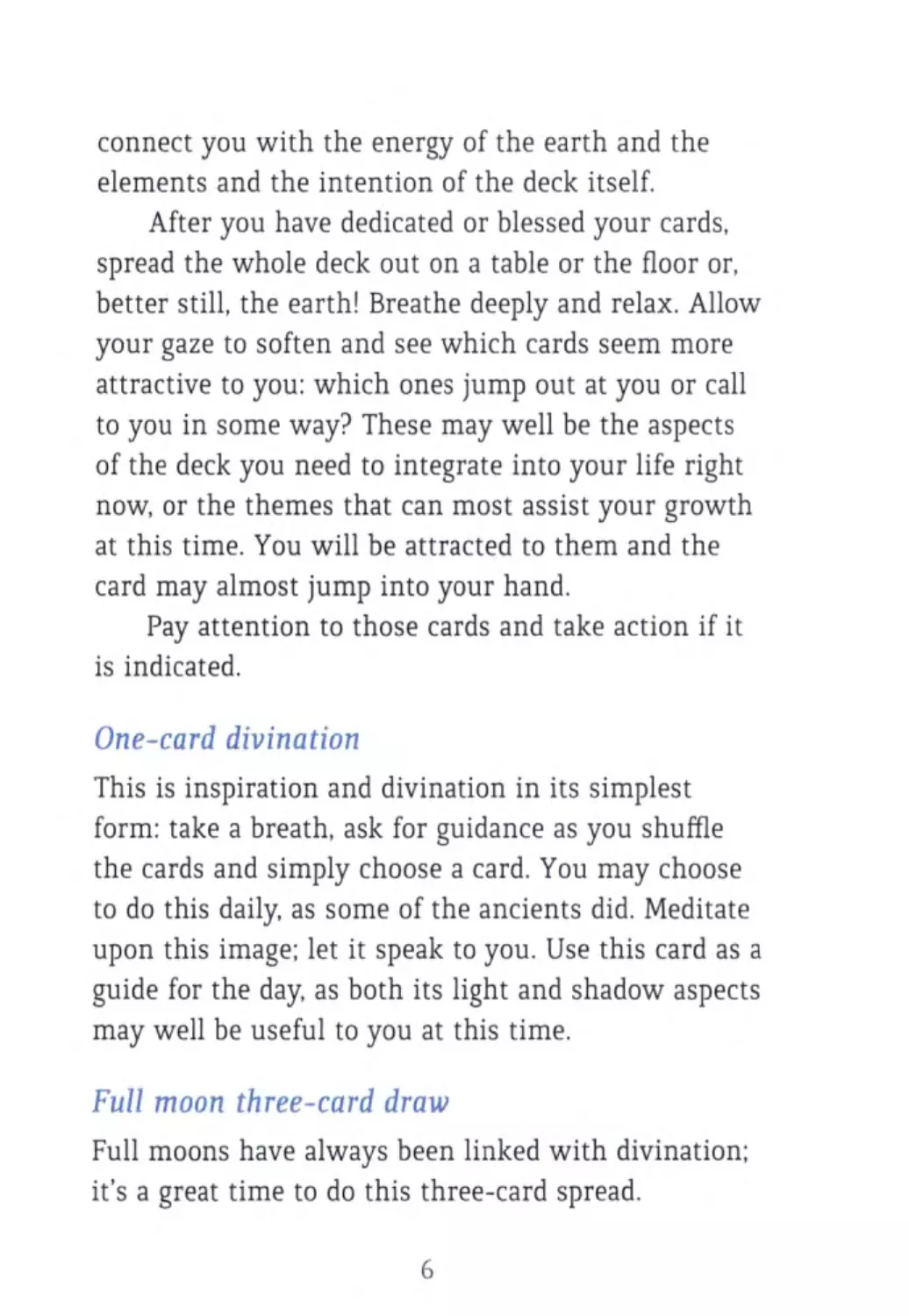
Card 1: the heart of the issue or question.
Card 2: the challenge.
Card 3: the solution.
Four elements spread
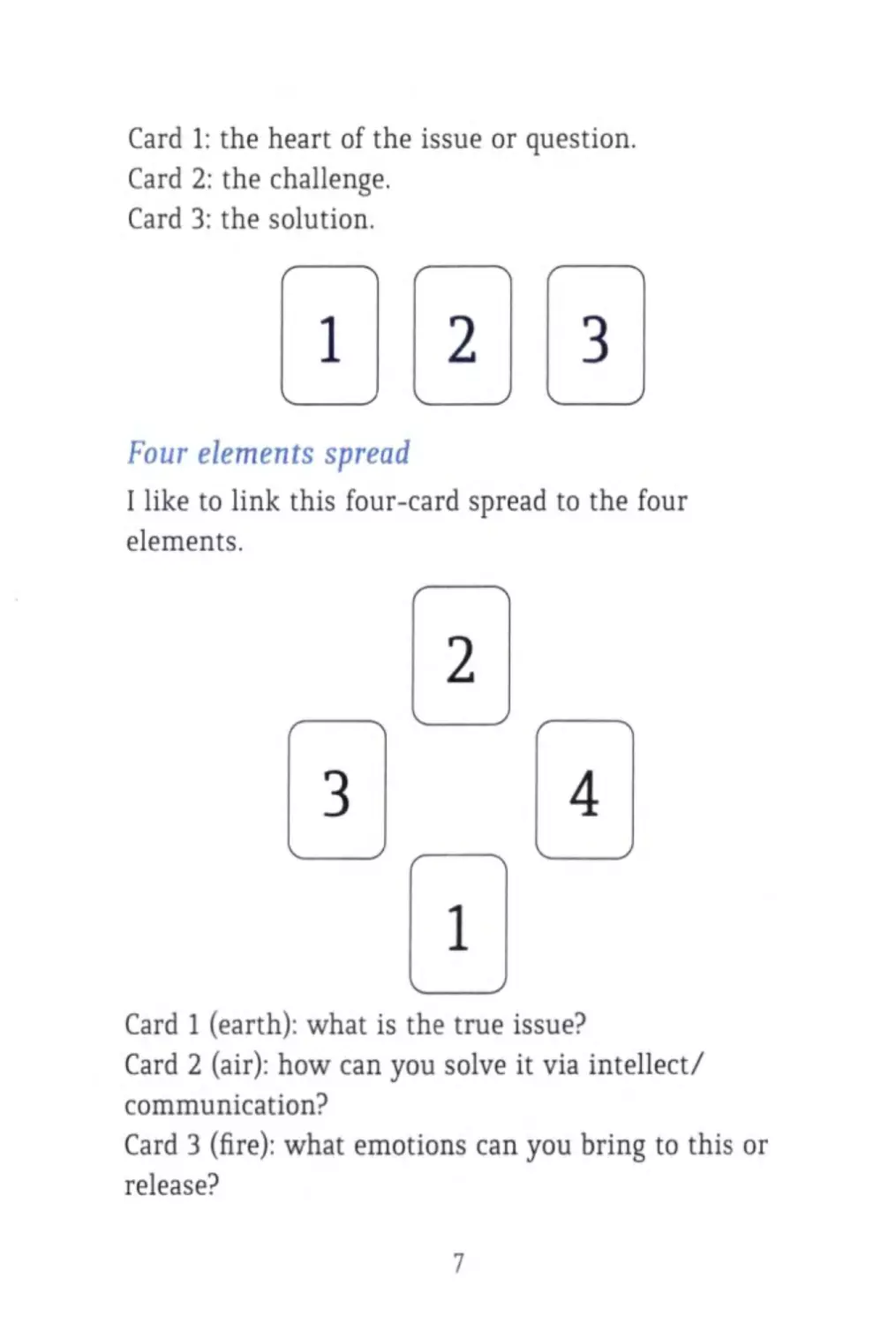
I like to link this four-card spread to the four
elements.
Card 1 (earth): what is the true issue?
Card 2 (air): how can you solve it via intellect/
communication?
Card 3 (fire): what emotions can you bring to this or
release?
7
Card 4 (water): how do you move on flowfully from
this issue?
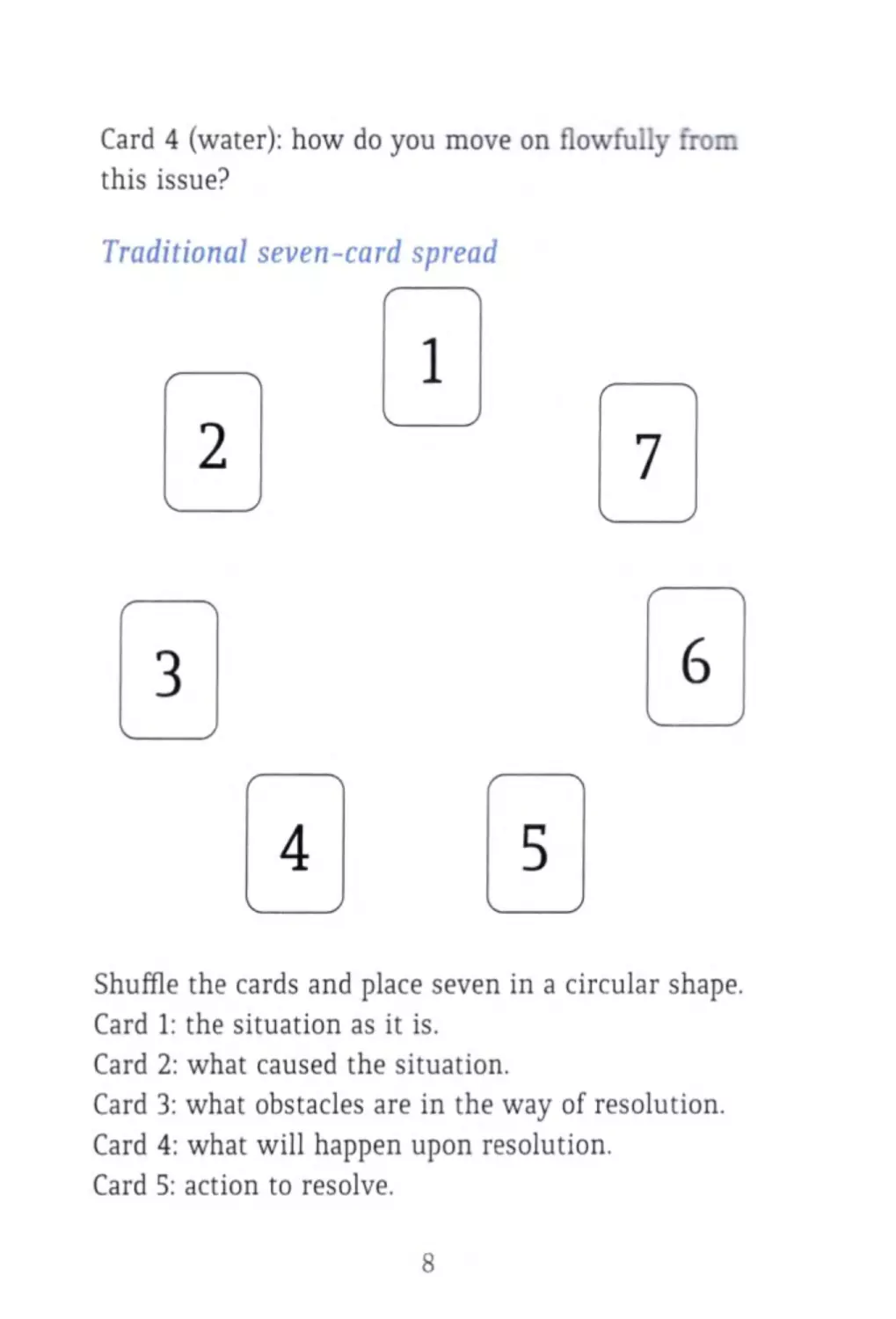
Traditional seven-card spread
1
Shuffle the cards and place seven in a circular shape.
Card 1: the situation as it is.
Card 2: what caused the situation.
Card 3: what obstacles are in the way of resolution.
Card 4: what will happen upon resolution.
Card 5: action to resolve.
8
Card 6: action to resolve.
Card 7: action to resolve.
Change does not happen merely by chance. Taking
even a small action towards your resolution or
intended outcome signals to the divine that you have
agreed to this co-creative process and, as such, that
you are serious about this desire.
Timing spread
This is a great spread to use when you want to know
the timing of something, for example, answers to
questions such as ‘When will I find a new partner?’,
‘When is the right time to move?’ or ‘Will it take a
long time for me to complete this project?’
Take a breath and hold your question in your
mind; try not to be anxious or concerned. Shuffle the
cards and ask your question.
Pull a card from the deck: this card represents the
positive aspect of your issue.
Pull a second card from the deck: this card
represents the difficulty or barrier inherent in the
request.
Pull a third card: this card gives you an indication
of timing.
9
Dedication for your cards
If you can, get outdoors. This can be by the sea, upon
the earth or up in the sky! Invite your animal friend
if you have one to be with you.
Burn some bay leaves, sage or frankincense and
allow it to burn and smoke fragrantly.
Throw some salt (sea salt is best) upon the pack
and say:
7 cleanse, I renew, I protect.'
Light a golden candle and say:
7 ask that the universal power of the elements, the
gods and goddesses, the sun, the moon, the earth and the
seasons to bless me and these cards. These honour you, I
honour you. I ask for guidance and truth, awakening and
clarity, and the strength and courage to make changes
should I need to. '
Pass the pack through the smoke of the herbs,
saying:
7 dedicate these cards to my and the greater good. May
only good enter here. And so it is!'
You can make your first divination knowing the
higher energies have heard your dedication and will
respond in kind.
10
Т Н Е
ELEMENTAL
ORACLE
1. North
Expansion
Be guided but do your
research. Focus and honesty
is needed to overcome
obstacles. You know you
know; you know your true
north, so be brave about the
next steps. We may have a
number of purposes in life, not just a single one: it is
time for true adventure.
Word of power: boreas (Greek: ‘god of the north
wind’).
North is one of the cardinal directions and,
in witchcraft, one of the guardian directions.
Traditionally north has been associated with ice and
snow, and the north wind is considered to be the
coldest. The Arctic Circle is large and passes through
Norway, Sweden, Finland, Russia, Canada, Denmark
(Greenland), Iceland and the Arctic Ocean.
There has always been a certain romanticism
about going north on adventures. During the peak
years of the age of exploration, the exploration of the
North Pole became almost a public mania. Perhaps
12
the greatest adventurers of the ancient world and the
most northerly were the Viking peoples; to viking
means to go exploring’.
The north has connotations around finding our
true essence or pathway. It can even be a referral to
finding a person who gives our life meaning. Finding
our true north indicates we have found a profoundly
right path and a direction that is authentic for us. So
strongly is north seen as a guiding direction it is the
one used to indicate direction on maps, usually with
a single arrow.
North is one of the quarters’ called in certain
traditions of witchcraft to purify or protect a space.
People may call upon the guardians of the north or
the northern as a way of unlocking the protective
energies of the portals of that element.
Element: air.
13
2. South
Adventure
Take a risk, but an educated
one. Do or see something
you haven’t before, as
experiencing something new
will help to clear your mind
and give wonder to your
heart. Look carefully at your
plan: something may be amiss. The situation may
have a happy medium, it is not all or nothing.
Words of power: notia, notos (Ancient Greek:
‘southerly’).
The south in some ways has a slightly bad rap. The
term ‘it could go south’ means something could go
wrong, and plans going awry are often referred to in
this way. As it is the opposite of north and north was
often seen as the right or sure direction, it’s easy to
see why.
The global south used to be a place of unknown
territories, a kind of terra nullius. To travel south from
the northern hemisphere as an explorer was to be
courageous and to break boundaries. In the 1800s
much of South America had still been unexplored,
14
and Darwin’s voyage on HMAS Beagle in 1831 caused
a sensation back in England when his flora and fauna
samples were scientifically examined. Australia
was named from terra australis, the hypothetical
south land described on maps from the 15th century
onward.
South is one of the quarters called in certain
traditions of witchcraft to purify or protect a space.
People may call upon the guardians of the south
or the southern direction as a way to unlock the
protective energies of portals of that element.
Element: fire.
15
3. East
Beginnings
Worry not: a new dawn is
breaking. Let go of the old
and embrace the new. Flow
forward without heaviness
or anxiety. New ways of
being are calling to you:
speak up with a clear voice.
Do not resist change.
Word of power: austr (ancient Norse: east’).
In the ancient world, to go east meant to go
somewhere new and exotic. The sun rose in the east,
so the direction heralded new beginnings and fresh
starts.
As the east was associated with the air
element, it has come to mean a much more cerebral
destination or way of processing. The east was a
place to find your fortune, a different way to be and
innovation. Eastern religions - Buddhism, Zen and
Hinduism, for example - were a completely different
paradigm from those of the West, with different
emphasis and processes.
East is one of the quarters called in certain
16
traditions of witchcraft to purify or protect a space.
People may call upon the guardians of the east or the
eastern direction as a way of unlocking the protective
energies of portals of that element.
Element: air.
17
4. West
Completion
Every cycle comes to a close.
Do not resist the end of
something, because the end
heralds a new beginning.
Complete the project; be a
finisher. Be not afraid of
death; it is a part of life.
Word of power: vestr (ancient Norse: ‘west’).
West is one of the cardinal directions. It is
the direction in which the sun sets and so,
traditionally, in many cultures it was linked
to death or the underworld. For example, the
Egyptians felt that west was the direction of
the underworld and the afterlife, which was not
considered to be a negative place, and in certain
cultures interred bodies faced west or their feet
faced west. Other sacred places such as Mecca
are westerly. In Buddhism, the west leads to
enlightenment.
The idea that a westerly trajectory leads to
wisdom or higher enlightenment is one shared by
the Norse and many other pagan pathways. It is a
18
powerful direction in which, because of the earth’s
rotation, most winds blow.
West is one of the quarters called in certain
traditions of witchcraft to purify or protect a space.
People may call upon the guardians of the west or
the western direction as a way of unlocking the
protective energies of portals of that element.
Element: earth.
19
5. The equator
To make equal
Find the balance in your
life. Equality among people
is a worthy goal. You are
worth it. Do not compare
yourself to others as this is a
useless task that only leads to
unhappiness; there can be a
doesn't have to be an extreme
happy medium. There
reaction all the time.
Word of power: aequare (Latin: ‘make equal').
The equator is the centre and equal point of any
spherical planet or body, including the earth; it is the
midway point between the geographical poles. On
earth the equator is about 40,075 km long, of which
78.8 per cent lies across water and 21.2 per cent over
land.
Importantly, the equator assists with navigation
and mapping, as it is the major latitudinal line. Our
planet earth bulges a little at the equator: the average
diameter of earth is 12,750 km, but the diameter
at the equator is about 43 km greater than at the
poles. Because of the lack of tilt, the temperature at
20
the equator does not change much according to the
seasons and remains at a very close balance.
The equator passes through countries such as
Indonesia, Uganda, Gabon, Kenya, Somalia, Ecuador
and Brazil, and the oceans of the Pacific, Atlantic and
Indian.
When we seek equality the energy of the equator
is a powerful addition to our workings.
Element: fire.
21
6. Sun
Light
Be grateful for what you
have right now. Every day
brings new possibilities and
opportunities. Concentrate
on building your vitality
and health. Shine a strong
light upon the dark corners;
honesty and transparency are vital at this time.
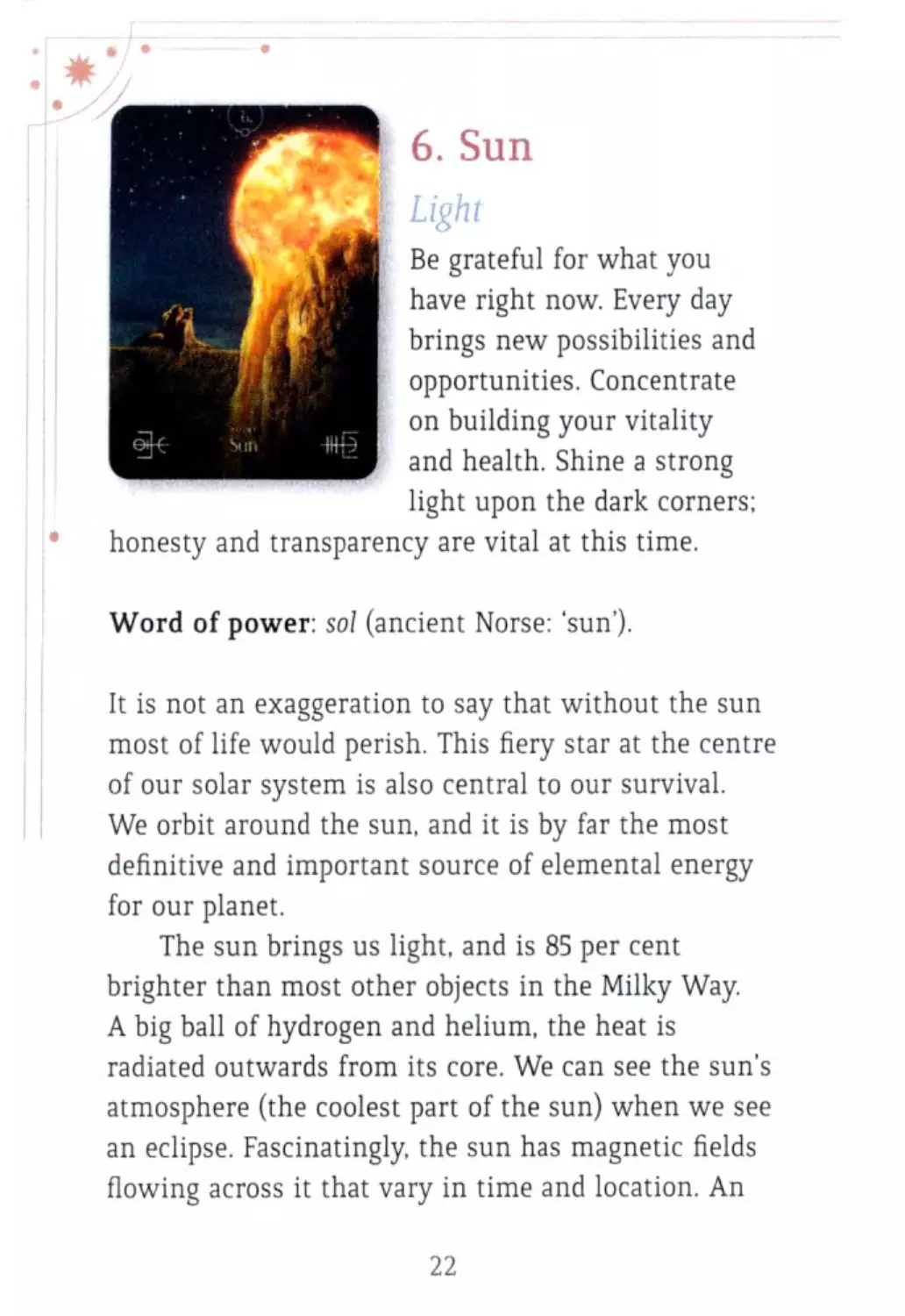
Word of power: sol (ancient Norse: ‘sun’).
It is not an exaggeration to say that without the sun
most of life would perish. This fiery star at the centre
of our solar system is also central to our survival.
We orbit around the sun, and it is by far the most
definitive and important source of elemental energy
for our planet.
The sun brings us light, and is 85 per cent
brighter than most other objects in the Milky Way.
A big ball of hydrogen and helium, the heat is
radiated outwards from its core. We can see the sun’s
atmosphere (the coolest part of the sun) when we see
an eclipse. Fascinatingly, the sun has magnetic fields
flowing across it that vary in time and location. An
22
1 l-уеаг solar cycle is the most prominent variation
in which the number and size of sunspots waxes and
wanes.
Such has been its influence and vital importance
that the sun was recognised by ancient peoples as one
of the first deities just as itself. Later on, solar deities
were recognised and many polytheistic cultures
had powerful sun gods. The sun was regarded as a
masculine energy (the moon is regarded as feminine),
most likely due to the sun’s fiery and extroverted and
extreme nature.
The seasons on earth are directly influenced by
the amount of sunlight a place receives and at what
angle. Winter days are short and winter nights longer
as the angle of the sun is lower and more acute,
which gives less heat and light.
Being deeply aware of and connecting to seasonal
energies such as the introversion of winter or the
explosion of attraction energy in spring can help
us find greater flow and ease in everything, from
creation of projects to the conception of a baby.
Element: fire.
23
7.	Moon
Darkness
There are cycles to everything
and a season for everything;
do not push yourself when
the tides are against you.
Do not be afraid of the
darkness as the darkness
is as necessary as the light.
Rest and repair. The divine feminine in all her forms
is rising. The time for introversion, stability and
planning is here.
Word of power: lysa (ancient Norse: ‘illuminate in
darkness’).
The moon has had an unshakeable pull on human
imagination since we were able to stand up on our
hind legs and look at it. Some of the earliest cave
artworks feature it. and it has been particularly linked
with feminine energies and the feminine divine.
The typical human menstrual cycle length is
the same length as a lunar cycle. We know the
luteinising hormone (lute means ‘light’) that triggers
ovulation is highly triggered by all light but especially
by moonlight. Goddesses of the moon are featured in
24
almost all polytheistic religions, and many such as
Diana, Artemis, Selene, Chang Xi, Arianrhod and Rati
are all still worshipped today.
Moon energy is flowful and changeable, just as
the moon’s gravitational pull influences the great
ocean tides. It is also stabilising. After the Big Bang
and the formation of planets such as the earth, our
planet had no moon. It spun wildly, which meant
very short days and nights, and it was quite unstable,
resulting in extremes of temperature. It is believed
that a Mars-sized planet collided with the earth, the
impact of which sent chunks of the planet off into
orbit and gradually formed our moon.
The moon began to have an effect on the earth,
with its gravitational pull slowing the rapid rotation
of the young earth and giving it greater stability:
there were less speed wobbles! Among the many
consequences of this, days and nights became longer
and more consistent and distinct seasons were born.
These seasons tempered the extremes of the planet,
and it became one that eventually harboured life.
These facts illustrate how we can be personally
affected by the moon and seasons. By following
the moon’s cycles and working with them we can
discover a new layer of stability within body, mind
and spirit.
Element: air.
25
8.	Fire
Ignition
Live your passion. Allow
your spirit to drive you
forward. Don’t overthink the
situation. Now is the time to
innovate and take action. Be a
lighthouse for others or find
yourself a mentor.
Word of power: logo (ancient Norse: ’blaze’).
It is said that Prometheus was asked by Zeus to create
man. Humans were formed with clay made of water
and earth and were fashioned in the gods’ image,
unlike other animals; however, these new beings
seemed quite helpless: no fur, no big teeth, few skills.
Prometheus felt sorry for mankind and asked Zeus if
fire could be given to them.
Prometheus knew that fire would allow
men to grow and thrive and would be totally
transformational to their life and survival. Stealing
it meant that all art and skills would only blossom
with fire and mankind would grow stronger with
fire when used for cooking and warmth. Prometheus
crept into Zeus’s own hearth and, lighting a small
26
flame within a stalk of giant fennel, took the fire and
escaped. He gave mankind the small fiery spark that
all others have been lit from. While man prospered,
Prometheus did not. So precious was fire to Zeus
that Prometheus was given the grisly perpetual
punishment of Zeus’ own eagle eating out his liver
daily, having it grow back overnight and then the
whole thing starting again the next day.
Fire is an element of profound significance. We
cook with it, transforming things from inedible to
edible, it provides light and protection and it was the
difference between freezing or not freezing. We burn
incenses and plant medicines for pleasure, healing
and spiritual significance. We hold fire so sacred that
perpetual flames were part of the honouring of many
deities throughout time the world over.
The fire element is the one that motivates and
inspires us. It is action oriented and light, so those
who like to utilise the fire element are innovative
and quick thinkers and they get things done. Fire is
linked with love and passion and is often used as an
element of magic in spells to attract such a partner.
Element: it traditionally corresponds with the
element of east, although in the southern hemisphere
it is aligned with north.
27
9.	Volcanoes
Power
Old grudges should be released
and let go. Heavy energy hurts
us should we hold it for too
long. Allow your anger to flow
through you rather than saving
it all up for an explosive release.
Reformation may be necessary.
Sometimes, the greatest powers are hidden from view;
you have the power to create or destroy.
Word of power: dynamis (Ancient Greek: ‘force, power’).
A volcano forms by a rupture in the earth’s crust,
releasing lava, ash, gases and more from the hot magma
chamber underneath. The crust protects us from the
heat and magma within the earth. Volcanoes are more
likely to form where two of the earth’s tectonic plates
rub together. The famous Ring of Fire, the horseshoe-
shaped basin in the Pacific Ocean where 90 per cent of
the world’s earthquakes occur, is also the home to over
450 volcanoes.
Volcanoes are incredibly powerful and their
explosiveness is hard to predict even with modern
methods. It is estimated that if the giant super volcano
28
Caldera under Yellowstone National Park in the US
ever decided to erupt explosively there would be so
much ash and debris and power released that it could
well trigger an extinction event on earth.
Ash is a danger to aircraft and to breathing.
Poisonous gasses are often released. The projectiles
thrown from the active eruption cause death and the
super-heated lava itself both destroys and reshapes
the environment.
During the 2018 eruption of Hawaii’s Kilauea,
one of the most active volcanoes on the planet, huge
tracts of land were reshaped by lava flows and land
was extended further into the sea. The newest land
on earth is created by volcanoes, and volcanic soils
are considered to be one of the most fertile of all for
growing food. While volcanoes signal destruction on
one hand, they create anew with the other.
Element: fire.
29
10.	Bushfires
Fuiy
Extreme emotions once engaged
are hard to put back in the
container. Anger is a healthy
emotion, yet fury is less
necessary. Warlike emotions
should be tempered unless
survival requires it. Emotional
intelligence is required at this time.
Word of power: mania (Ancient Greek: ‘fury, rage’).
Bushfires are a regular occurrence within some
ecosystems in places such as Australia, my home
country. Bushfires are often started naturally by
lightning strikes and unnaturally by arson or
uncontrolled back burning. Bushfires have a high heat
output and are greatly affected by wind, fuel load,
ambient temperature, humidity and slope.
The First Nations people in Australia used fire
to successfully control and manage the fertility and
appearance of the environment for much of the 60,000
years prior to European settlement. Particular care was
taken over time to create a patchwork series of burns,
allowing animals to escape and have food sources as
30
well as creating cold burns that did not reach the crown
of the trees.
While fires have always been a part of some
ecosystems, in fact integral to them because of things
such as fire-triggered germination, we are now
entering a time when fires burn so hot and furiously
due to climate change factors that the destruction is
catastrophic. Sadly, uncontrolled bushfires are becoming
the norm in this time of climate change in many
countries. These fires are furious, destroying everything:
habitat, native wildlife, human life and property. Some
areas have been so intensively burnt there is a chance
they will not recover and easily regenerate. The last
decade has seen huge forest and bushfires burn with a
never before seen intensity that have destroyed huge
areas of biome. The bushfires of the Australian summer
of 2019/2020 burnt over 12 million hectares and killed
around a billion animals, with half of all Australians
affected. These intense bushfires have a huge economic
cost, not to mention an emotional and spiritual one.
Fury is a difficult emotion both to feel and have
directed at you. Fury feels extreme and uncontrollable.
It is important to explore and work through such
emotions and be able to understand what they are and
what they mean. Unpicking why we feel such intensity
helps us to balance the fury.
Element: fire.
31
at this time. Focus on
11.	Hearth
Comfort
Take some time out to rest
and regenerate. Know what
makes you comfortable. Keep
the home fires burning. Create
a peaceful and beautiful home
life. Nourishing the mind,
body and spirit is important
le inner life.
Word of power: anesi (Ancient Greek: ‘comfort,
solace’).
For our ancestors the hearth or home fire was the
heart of the home a fire always burned there ready
for warmth or cooking. The hearth fire was stoked
carefully and rarely allowed to go out, as it was a
source of comfort for all and often a place where
family and friends would meet.
The city temple of the goddess Vesta in Rome was
considered the sacred heart of the city, and was where
the foculus, or ‘hearth’, was contained. This was a fire
that burned as the sacred heart of the city and its
territories. A second fire, one of protection, was also
within the temple. Vesta’s temple was one of the only
32
places of worship to be circular in design and was
completely covered to protect the holy flame from
being snuffed out by the weather.
The saying ‘Keep the home fires burning’ was
inspired by this practice. In Rome, husbands were
often sent away on military duty for years on end,
however, their wives were expected to not just keep
the home and often the business running but to
faithfully wait for their husbands until their return.
Vesta was the goddess to whom to pray to ensure the
family member’s safe return and keep the fires of love
stoked.
In these busy times it is important to focus on a
place where you can feel safe and comfortable. While
many of us don’t have a literal hearth, the home
(whatever that is) should be a place created to inspire
peace and nourishment.
Element: fire.
33
12. Outer core
Fluidity
Be fluid in your thinking.
Holding on to old ideas in a
rigid way is not beneficial
for you. A nimble mind is a
healthy mind. It is never too
late to admit you were wrong
or to change your mind
according to new information.
Word of power: levitas (Latin: volatility’).
The earth has four layers: crust, mantle, outer core and
inner core. The earth’s outer core is a fluid layer about
2,400 km thick that lies above earth’s solid inner core.
It is composed of mostly nickel and iron.
The outer core is extremely hot, ranging from
4,000-5,000°C. It is a low-viscosity fluid and is
extremely magnetic. It is thought the solid inner core
is at least 50 times more magnetic than the earth’s
surface. This magnetism is vital to the protection of
the earth from solar radiation. The radiation is pushed
to the poles, where it can be disseminated safely.
The fluidity of the outer core is necessary to life,
and being flexible and fluid in your thinking and ideas
34
makes life flowful. Resisting change by holding old
rigid ideas and beliefs benefits no one and stunts your
growth. Being open to new ideas and feeling confident
to transform old ones, especially if you are given more
information, is the way to navigate change.
Element: fire.
35
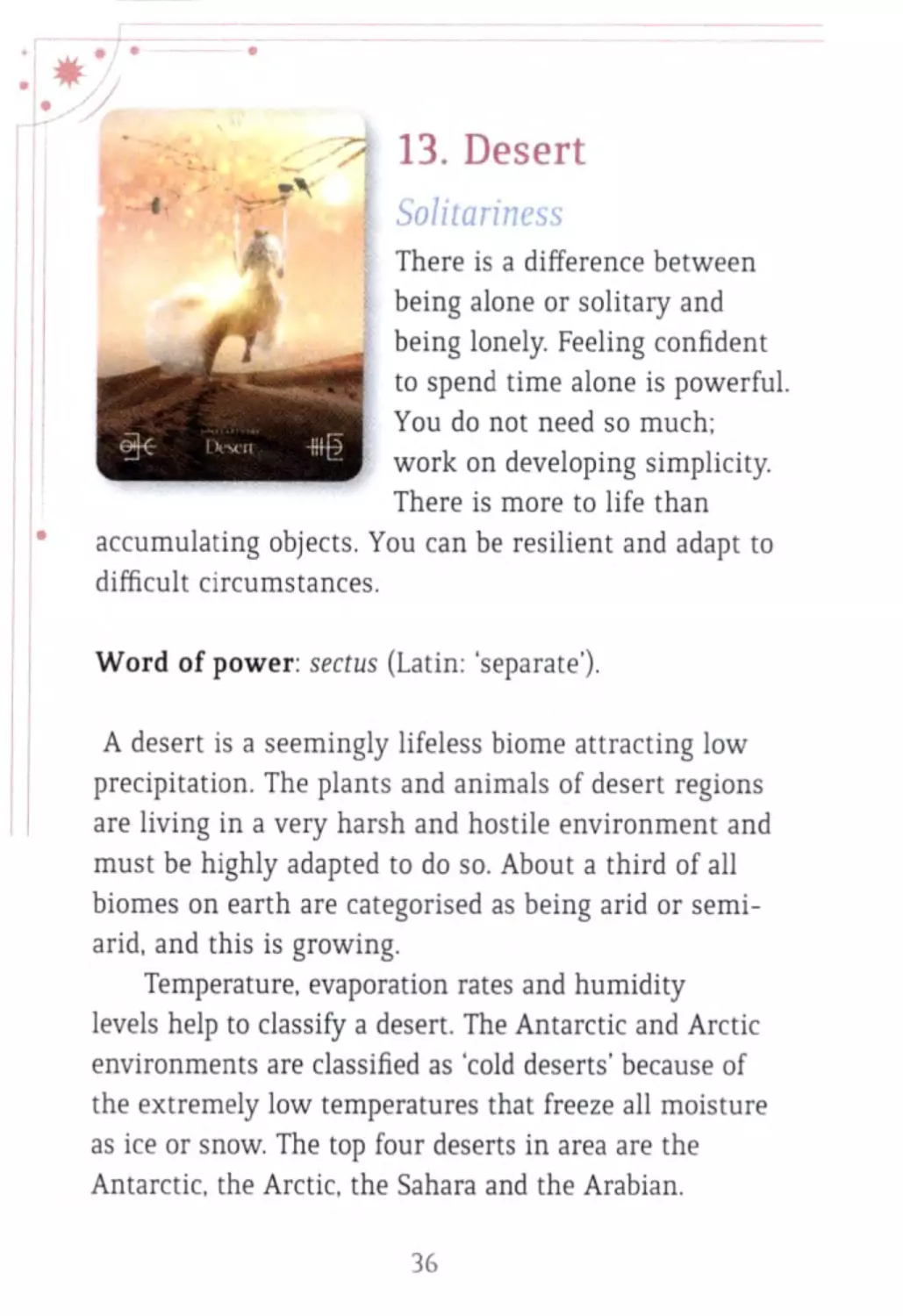
13. Desert
Solitariness
There is a difference between
being alone or solitary and
being lonely. Feeling confident
to spend time alone is powerful.
You do not need so much;
work on developing simplicity.
There is more to life than
accumulating objects. You can be resilient and adapt to
difficult circumstances.
Word of power: sectus (Latin: ‘separate’).
A desert is a seemingly lifeless biome attracting low
precipitation. The plants and animals of desert regions
are living in a very harsh and hostile environment and
must be highly adapted to do so. About a third of all
biomes on earth are categorised as being arid or semi-
arid, and this is growing.
Temperature, evaporation rates and humidity
levels help to classify a desert. The Antarctic and Arctic
environments are classified as ‘cold deserts’ because of
the extremely low temperatures that freeze all moisture
as ice or snow. The top four deserts in area are the
Antarctic, the Arctic, the Sahara and the Arabian.
36
The thing you most notice in a desert is the
simplicity of the landscape: the sparseness of plant
life, the lack of ground cover and the exposure of
the topsoil, leading to sand. The dust or sand can
be whipped up into epic sandstorms that can be
so fierce the wind-blown sand particles become
electrically charged and create enormous electrical
fields that can produce sparks and interfere with
telecommunications. These electrical fields can have
a negative effect on humans, causing nausea, vision
disturbances and headaches.
Many desert animals live underground or in
highly protected places. Plants normally have smaller
leaves or very few leaves and have shallow root
systems to capture any precipitation that may fall.
People who live in deserts have traditionally been
nomadic, moving with their prey or where food may
be. These people take only what they need and carry
only what is necessary but often have rich cultural
and spiritual lives.
Element: fire.
37
passion makes us feel
14. Passion
The soul
What is the spark that lights
you up? The divine lives
within you. Consider your
motivations carefully; know
where your resistance lies.
We all have more than one
purpose in life, and having a
more alive.
Word of power: psykhe (Ancient Greek: ‘soul, mind,
spirit’).
The idea that passion lives within your heart or soul
is both an ancient and common one. To ‘put your
heart into’ an activity means to dedicate yourself
completely or to make a great effort. To ‘live your
passion’ means your soul is expressing itself through
someone or something. The Greek word kharisma
means ‘gift of grace’; in Ancient Greek it meant
literally ‘a gift shining through’.
Passionate people are easy to identify; they
are focused, action oriented and propelled by their
intensity. The friend that cannot stop talking about
their new love interest, the teacher who lights up
38
when they are teaching their subject, the scientist
who stays up night after night happily working on
the research: all are examples of passion in action.
Whether or not you believe in the concept of the
soul, it is hard to not believe in purposeful passion.
We do not need a spiritual framework to see the good
being engaged when we try to attain something we
want or believe we can do.
Element: fire.
39
15.	Earth
Home
Take time to ground yourself.
The earth is our home and
we are a part of nature, not
apart from it. Do all you can
to take positive custodianship
of the world around you.
Pay attention to your body
and your home. Turn your eyes towards home. Avoid
disconnection with devises and extreme busyness.
Word of power: yaia (Greek: ‘earth’).
The earth is our home and of course is the beautiful
blue life-filled planet orbiting our sun within our
solar system. When astronauts were able to see the
earth from a distance that made it visible as a whole,
all were awed by the experience. Michael Collins,
part of the Apollo 11 team that first landed on the
moon, said: ‘1 really believe that if the political leaders
of the world could see their planet from a distance
of, let’s say 100,000 miles, their outlook would be
fundamentally changed. The all-important border
would be invisible, that noisy argument suddenly
silenced.’
40
We are creatures of the earth and are all
connected on the planet. The earth, although made
up of different biomes, is all one planet. Earth energy
is stabilising, growth inducing, generous, cyclic and
deeply reciprocal.
There is an awareness of a wise mother or
father of earth energy that is profoundly comforting.
Someone cooking you a nourishing meal when
you are down, doing the gardening, spending time
outdoors, building your own shelter: all give you a big
dose of earth energy.
Element: earth.
41
16.	Mountain
Clarity
There is an advantage to
looking at things from a
higher perspective: you are
too close to something to see
it properly and clearly. Take
the high road. Look at the big
picture. Are you making too
big a deal of something?
Words of power: fjall, gtoggr (ancient Norse:
‘mountain’).
The high places have always been places of sacredness
and clarity. While mountains are often inaccessible
they are places of profound beauty where the gods
themselves reside and heavenly realms began. For the
Greek gods it was Mount Oympus, for the Vulcans
Mount Etna, Mount Ida in Turkey for Cybele, Mauna
Kea for Pele, Blanca Peak as the home of the Dawn
Man of the Navajo, Mount Kilimanjaro for the Chaga
god Ruwa, while Mount Meru is a direct reflection of
and the centre of all creation.
Sacred mountains exist as energies that provide
all that people might need. For example, both Mount
42
Taranaki in New Zealand or Mount Kailash in Tibet
are considered to be the source of four rivers that
bless every person, plant and animal. Mt Kalaish is
sacred to the Jain, Buddhist, Hindu and Bon and has
never been climbed because it is a site of devout
pilgrimage.
Temples and other religious places including
hermitages have often being built among mountain
ranges. The contemplative quality and purity of
the environments have been contributors to this.
Escaping from the mainstream of people to seek
silence and going high where few go are aspects of
gaining a higher perspective.
Mountains remind us that we can look at the
minutiae of the world more purely and from a higher
vantage point. In mountains our troubles seem
tiny and insignificant. Taking time away from too
many opinions or pressures and trying to gain some
simplicity and clarity should be done on a regular
basis.
Element: earth.
43
17.	Cave
Protection
You are loved and protected
in your endeavours. Know
yourself. Taking silent time is
good for your mental health.
Retreating after periods
of extreme hard work is a
positive. Be embraced by
nature.
Word of power: clypeus (Latin: 'shield').
Caves can be considered to be the first human shelter
and temples. These natural spaces in the ground
or by the sea, and including rock walls or rocks,
provided shelter and temperature control in extreme
environments. For example, fire for warmth and
cooking would be safe from wind and precipitation.
Caves are normally formed by erosion, most
commonly of limestone by water or wind.
Caves are the natural habitat for specific
bacteria, plant species and animals such as bats and
salamanders. They became a natural haven for art
and communication with the gods and ancestors.
The oldest cave art found at the time of writing is
44
in South Africa at Pinnacle Point; it is estimated to
be about 170,000 years old. Sacred caves used for
ritual such as those in Crete, India and China often
contain sacred paintings and statues and were further
hollowed out to expand them.
The fact that many caves have incredible sound
qualities such as magnification of sound or echoing
allows for more otherworldly aspects to come to the
fore. Caves were also seen by some cultures as portals
to the other or underworlds and were utilised burial
sites.
Element: earth.
45
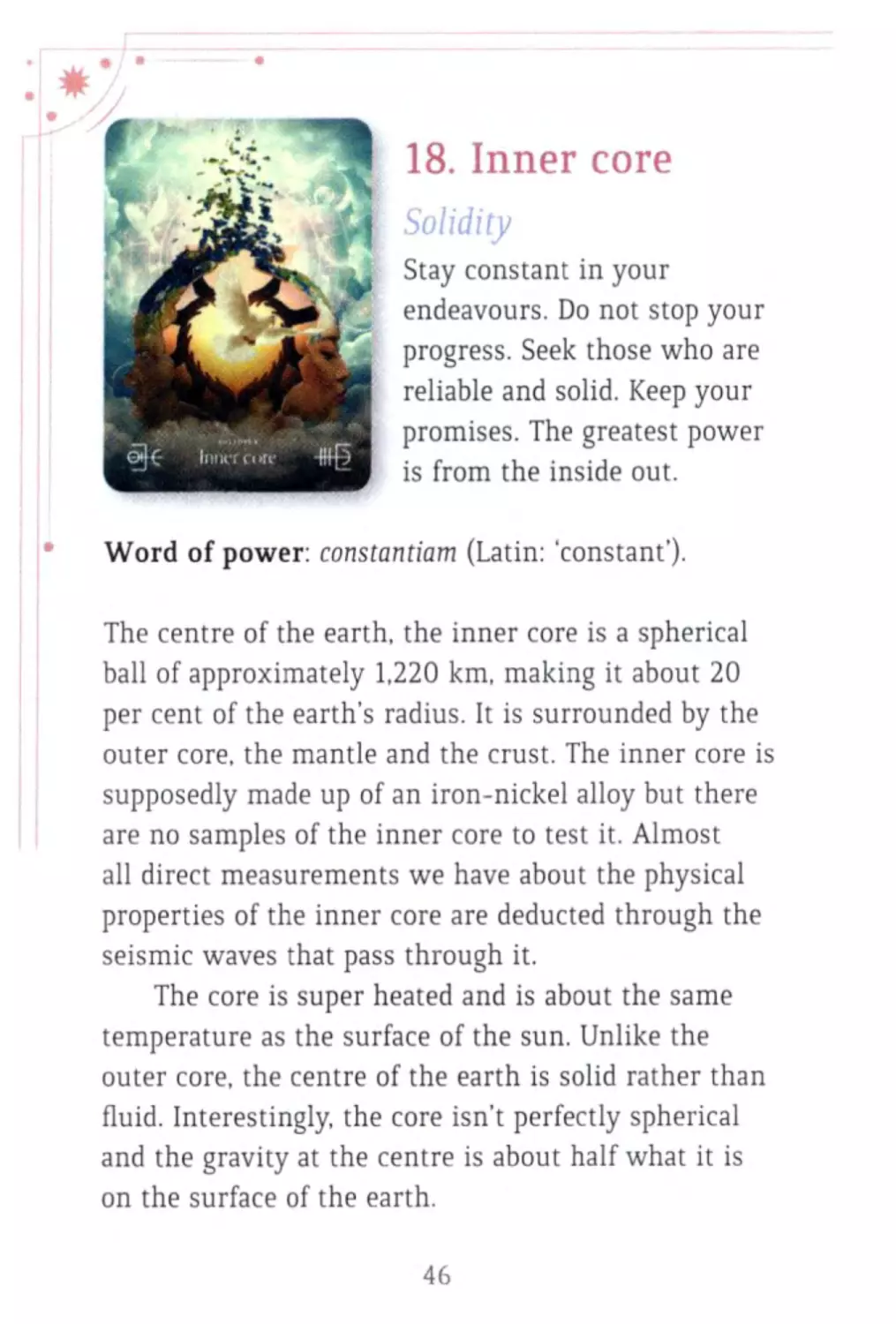
18.	Inner core
Solidity
Stay constant in your
endeavours. Do not stop your
progress. Seek those who are
reliable and solid. Keep your
promises. The greatest power
is from the inside out.
Word of power: constantiam (Latin: ‘constant’).
The centre of the earth, the inner core is a spherical
ball of approximately 1,220 km, making it about 20
per cent of the earth’s radius. It is surrounded by the
outer core, the mantle and the crust. The inner core is
supposedly made up of an iron-nickel alloy but there
are no samples of the inner core to test it. Almost
all direct measurements we have about the physical
properties of the inner core are deducted through the
seismic waves that pass through it.
The core is super heated and is about the same
temperature as the surface of the sun. Unlike the
outer core, the centre of the earth is solid rather than
fluid. Interestingly, the core isn’t perfectly spherical
and the gravity at the centre is about half what it is
on the surface of the earth.
46
There is still scientific debate about how the core
was formed, but it is believed to have originally been
liquid that cooled to form the solid mass. The solidity
gives stability to the earth, and while not magnetic
itself because of the heat it throws out it does affect
the magnetism of the outer core.
We live in a fast-paced world with many
distractions. Developing a sense of solidness and
reliability is important. We often do not honour the
promises we make to ourselves and yet we honour
our promises and commitments to others. We need to
be able to rely on our own word to ourselves.
Element: earth.
47
19.	Plants
Growth
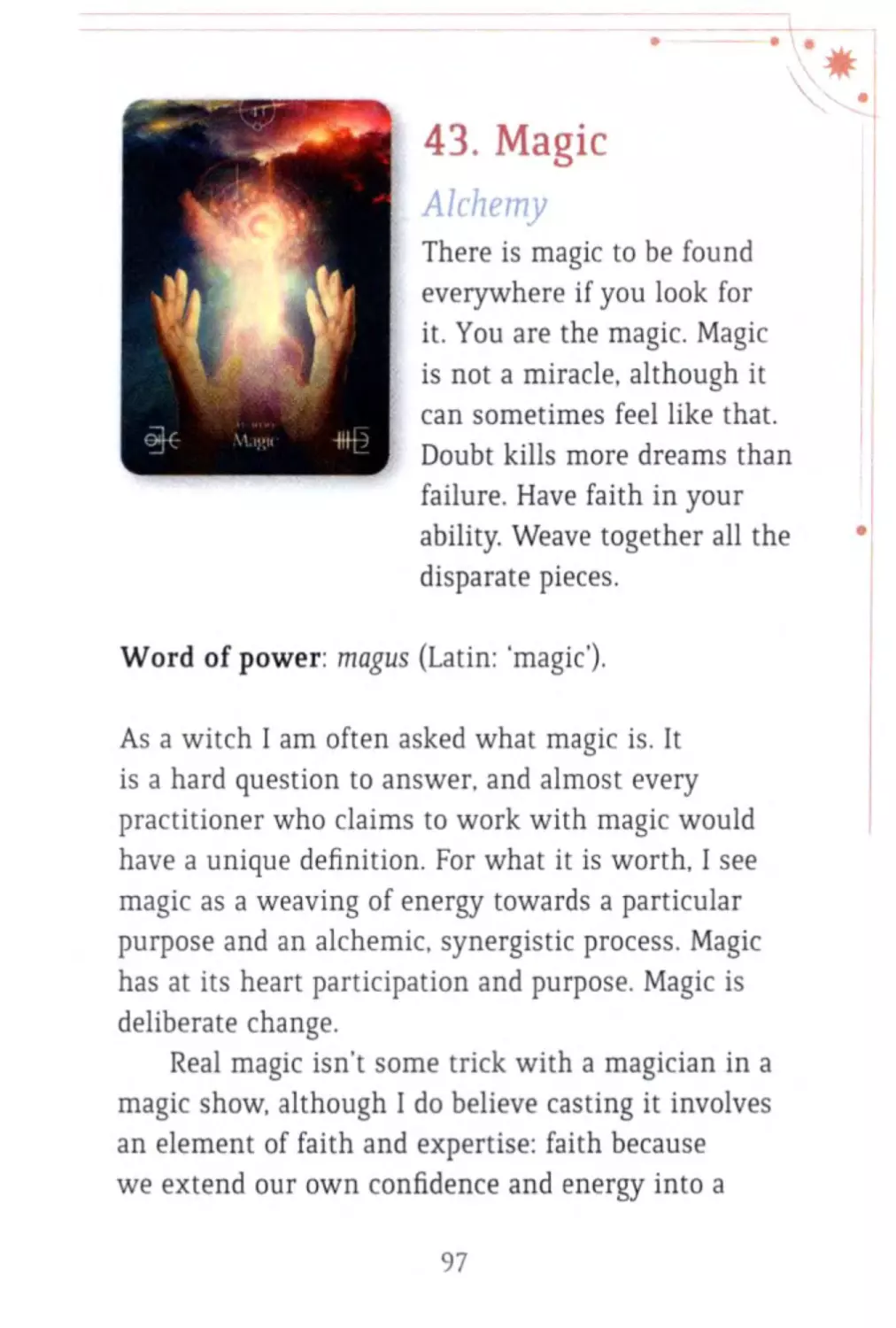
Magic is in everyday things.
You can make something
from nothing. Blossom: it’s
time! From small things big
things might grow: begin it.
Word of power: vaxa
(ancient Norse: grow’).
There are currently over 320,000 species of plants.
The Plantae kingdom of life includes the tiniest
mosses, algae, fungi, the most fragrant flower
producers, grains, carnivores and huge trees such as
the giant sequoia. Plants provide wood, medicine and
food and have cultural roles in perfume, ritual and
symbology.
Plants gain their energy through photosynthesis,
the conversion of sunlight and carbon dioxide into
oxygen and carbohydrates. Plants are found in almost
every biome on earth. Quite magically, the majority
of plant species have various kinds of symbiotic fungi
associated with their root systems. The fungi assist
the plant to gain more water and nutrients from
the soil than they would otherwise, while in return
48
the plant ‘feeds’ the fungi carbohydrates that are the
byproduct of photosynthesis. This association is called
‘mycorrhiza’.
The largest living organism on the planet is a
honey fungus that measures 3.8 km across 965 ha in
the Malheur National Forest in Oregon. Its mycelia, or
network of roots, produces mushrooms once a year if
the conditions are right.
Plants provide key nutrition to a wide variety
of fish and animals including humans. Many large
mammals are exclusively plant eating, including
whales, gorillas, bison, giraffes and elephants. Plants
are also the source of powerful medicine through the
compounds they produce. Modern medicines such as
aspirin, morphine, quinine, taxol and digitalis are all
from plant compounds.
Certain special psychoactive plants are used in
spiritual and religious frameworks and are important
in many cultures as pathfinders and in divination and
in healing. These include opium, psilocybin, ibogaine,
mescaline, thujone and mandragora. Some of these
plants are being tested and trialled as treatments for
depression and other psychological disorders as well
as to boost creativity and problem solving.
Element: earth.
49
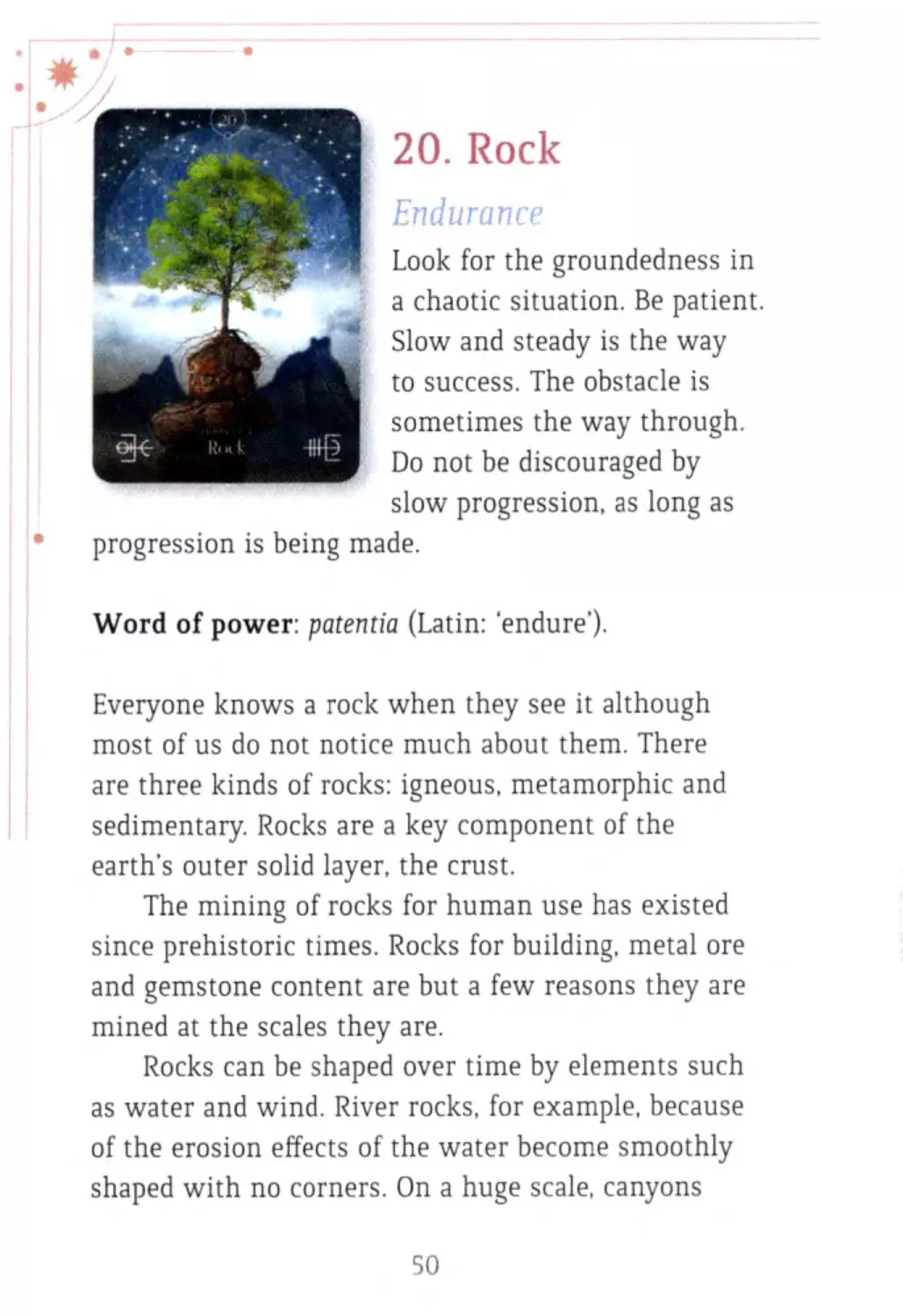
20.	Rock
Endurance
Look for the groundedness in
a chaotic situation. Be patient.
Slow and steady is the way
to success. The obstacle is
sometimes the way through.
Do not be discouraged by
slow progression, as long as
progression is being made.
Word of power: patentia (Latin: endure’).
Everyone knows a rock when they see it although
most of us do not notice much about them. There
are three kinds of rocks: igneous, metamorphic and
sedimentary. Rocks are a key component of the
earth’s outer solid layer, the crust.
The mining of rocks for human use has existed
since prehistoric times. Rocks for building, metal ore
and gemstone content are but a few reasons they are
mined at the scales they are.
Rocks can be shaped over time by elements such
as water and wind. River rocks, for example, because
of the erosion effects of the water become smoothly
shaped with no corners. On a huge scale, canyons
50
such as the Grand Canyon were worn down by water
and wind, yet they endure.
In cultures that have a deep spiritual belief in the
connectedness of everything and a close association
with the land itself, rocks are as alive as any animal
or human. The rocks in these frameworks have
stories to tell and lessons to teach. Some are used in
painting, some to hold sacred tracts of water, and in
ochre painting of the body to reinforce the dances and
spiritual rituals of the culture.
Element: earth.
51
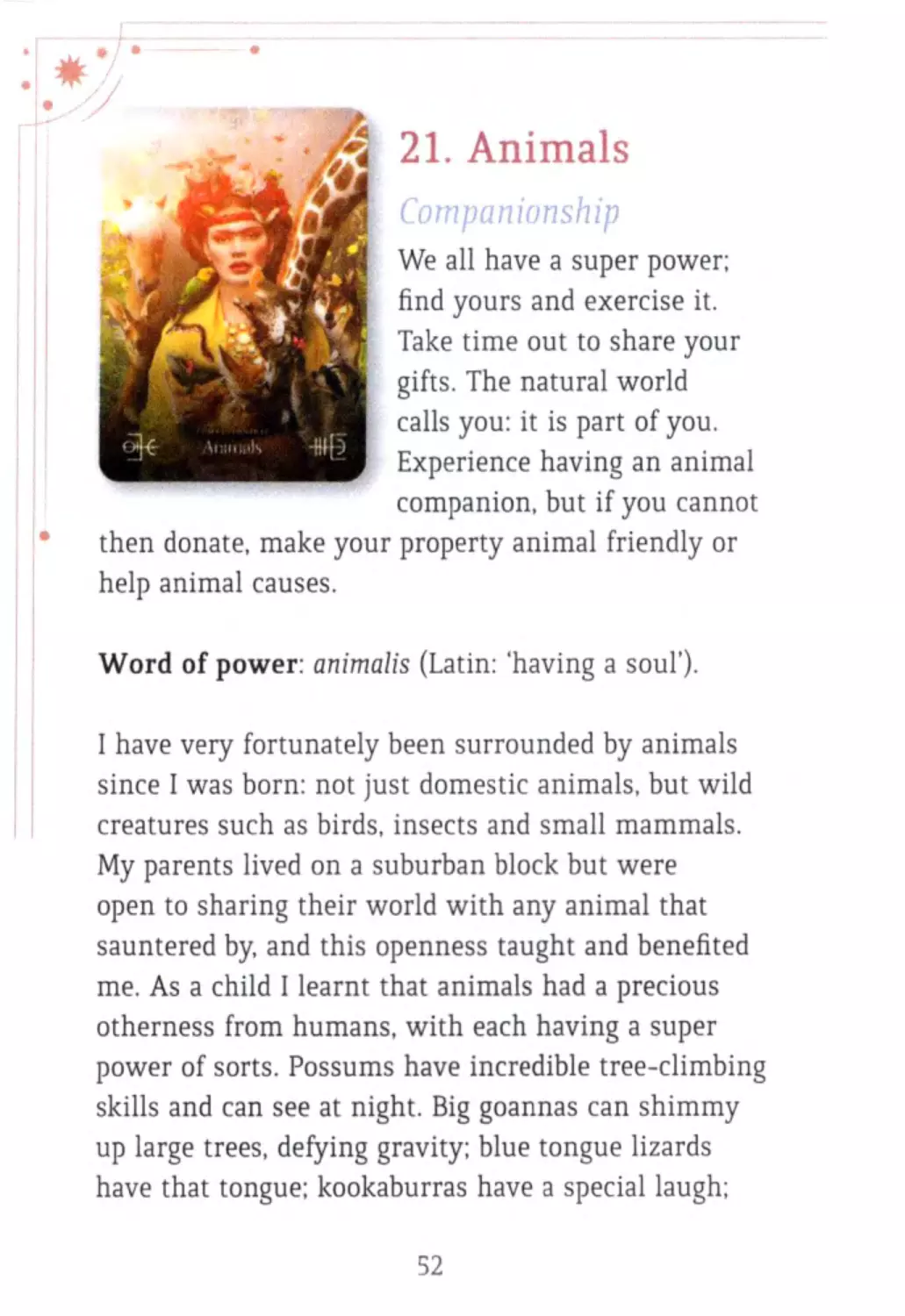
help animal causes.
21.	Animals
Companionship
We all have a super power;
find yours and exercise it.
Take time out to share your
gifts. The natural world
calls you: it is part of you.
Experience having an animal
companion, but if you cannot
then donate, make your property animal friendly or
Word of power: animalis (Latin: ‘having a soul’).
I have very fortunately been surrounded by animals
since 1 was born: not just domestic animals, but wild
creatures such as birds, insects and small mammals.
My parents lived on a suburban block but were
open to sharing their world with any animal that
sauntered by, and this openness taught and benefited
me. As a child I learnt that animals had a precious
otherness from humans, with each having a super
power of sorts. Possums have incredible tree-climbing
skills and can see at night. Big goannas can shimmy
up large trees, defying gravity; blue tongue lizards
have that tongue; kookaburras have a special laugh;
52
cockatoos are smart enough to know how to open the
seed bin on their own; and ravens tell their friends
about us and send their friends for food. All have
their intelligence, personalities and focus and all are
a joy to me.
We owe animals a debt we cannot ever repay.
Dogs are our companions, healers, and protectors and
can detect everything from drugs to cancer. Horses
were key to human travel and expansion. Cats were
not only our comforting companions but killed
disease-carrying rats. Domestic animals of all kinds
feed meat-consuming humans. Even animal dung
has contributed to the fertility of farm soils. I cannot
express the spiritual succour we gain simply by
observing wild animals going about their business.
Over 1.5 million species of animals have been
described under the kingdom Animalia. Most breathe
oxygen, reproduce sexually and consume organic
material. Animals are a key contributor to the
synergistic habit or biome.
Sadly, according to the World Wildlife Fund’s
latest Living Planet Report (2019) the number of
wild mammals, birds, reptiles, amphibians and
fish has dropped by 60 per cent since 1970, mostly
due to habitat loss from human encroachment or
through climate change that makes existing habitats
uninhabitable. The idea that we are apart from
53
animals and the ecosystem is one of the reasons why
this disconnection is so profound. We have no greater
rights than any other animal to be here, and we can
work with rather than against the animals.
Element: earth.
54
* ’*
22.	Air
Motion
Be flexible yet grounded.
Allow yourself free thought.
Move and choose. Find
your freedom. Use your
voice resourcefully. Stand
up for what you believe in.
Be mindful of the way you
communicate.
Word of power: aer (Latin: ‘air, ether’).
The element of air has always been associated with
movement and with the higher spirit. It is a cleansing
element that enables us to fly free and allow our
minds to travel.
Air is associated with all breath: breathing, the
lungs, the voice, music, winds and storms. It is the
element of communication.
At its most destructive air is disconnected,
chaotic, undisciplined and untethered. While
we consider a storm after a long drought to be
cleansing and nourishing, an intensive storm such
as a hurricane can be wildly destructive. The word
‘airhead’ normally refers to someone who doesn’t
55
consider things much and who just flits around from
one thing to another willy-nilly.
Finding your own space and healthy motion is
important, and finding your own breath of fresh air
will enable you to see things differently and to start
anew.
Element: air.
56
23.	Storms
Cleansing
Sometimes you need to raise
a lot of energy to blow away
what you no longer need. An
issue will come to a dramatic
head. Cleanse your body Let
go of what you feel you no
longer need. Be specific in
your release; harm as little as you can.
Word of power: tempestas (Latin: ‘storm’).
Storms are created when a centre of low
pressure develops with the system of high
pressure surrounding it. Thunderstorms
frequently form within areas where a warm moist
air front collides with and borders cool air fronts.
Spectacular, beautiful and somewhat dangerous, these
storms can also hurl out hail.
Watching a storm come in over the ocean or
watching storm clouds form is often an awe-inspiring
sight. Watching big steely grey clouds come in from
the horizon at the end of a steaming hot day was
a common occurrence where I grew up. We would
watch the clouds form and drop their heavy watery
57
burden, big fat drops hitting the bitumen and causing
steam to rise from the road. We always experienced
a feeling of all that intensity coming to a head and a
comfortable coolness replacing it.
Storms raise a lot of energy through movement
and kinetic power, and many witches and shamans
love to channel that energy into workings and spells.
Standing in a safe place plugging into storm energy is
a fantastic way to charge your own body’s batteries as
well as to practise holding and directing energy.
As climatic conditions warm on our planet,
storms will become more severe in some places
and non-existent in others, both extremes causing
imbalance. Controlling climate change will assist in
controlling this destructive intensity.
Element: air.
58
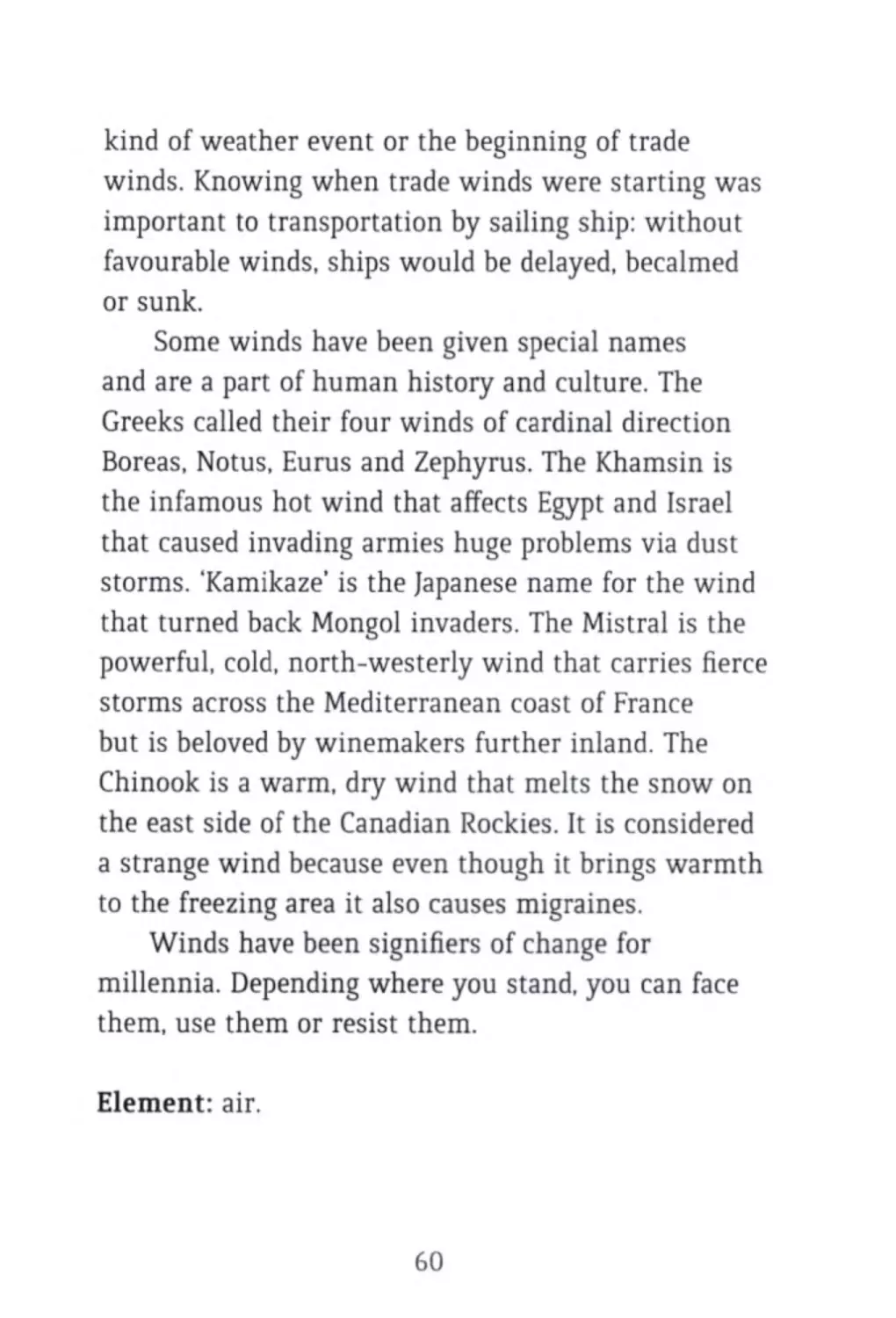
24. Wind
Change
Resisting change is useless.
Be prepared for a change in
direction. You have been
warned of change, so believe it.
Word of power: vedhr (ancient
Norse: ‘wind’).
Wind is responsible for the majority of the movement
of gasses on the earth’s surface. It is measured by
direction, speed, velocity and energy and moisture
content. Winds are caused by changes in atmospheric
pressure: when air moves from a higher pressure to
a lower or vice versa it creates movement in the air.
Winds are influenced by geography such as mountains
and seas.
Wind speeds are measured by the Beaufort wind
force scale and range from level 0 for calm to level 17 for
a super-cyclonic storm or typhoon with winds in excess
of 222 km. Level 17 winds cause total destruction of even
well-made structures with solid foundations.
Ancient peoples took a great deal of notice of
wind direction, as it could herald a change in season,
a message from the gods or guardians, a particular
59
kind of weather event or the beginning of trade
winds. Knowing when trade winds were starting was
important to transportation by sailing ship: without
favourable winds, ships would be delayed, becalmed
or sunk.
Some winds have been given special names
and are a part of human history and culture. The
Greeks called their four winds of cardinal direction
Boreas, Notus, Eurus and Zephyrus. The Khamsin is
the infamous hot wind that affects Egypt and Israel
that caused invading armies huge problems via dust
storms. ‘Kamikaze* is the Japanese name for the wind
that turned back Mongol invaders. The Mistral is the
powerful, cold, north-westerly wind that carries fierce
storms across the Mediterranean coast of France
but is beloved by winemakers further inland. The
Chinook is a warm, dry wind that melts the snow on
the east side of the Canadian Rockies. It is considered
a strange wind because even though it brings warmth
to the freezing area it also causes migraines.
Winds have been signifiers of change for
millennia. Depending where you stand, you can face
them, use them or resist them.
Element: air.
60
*
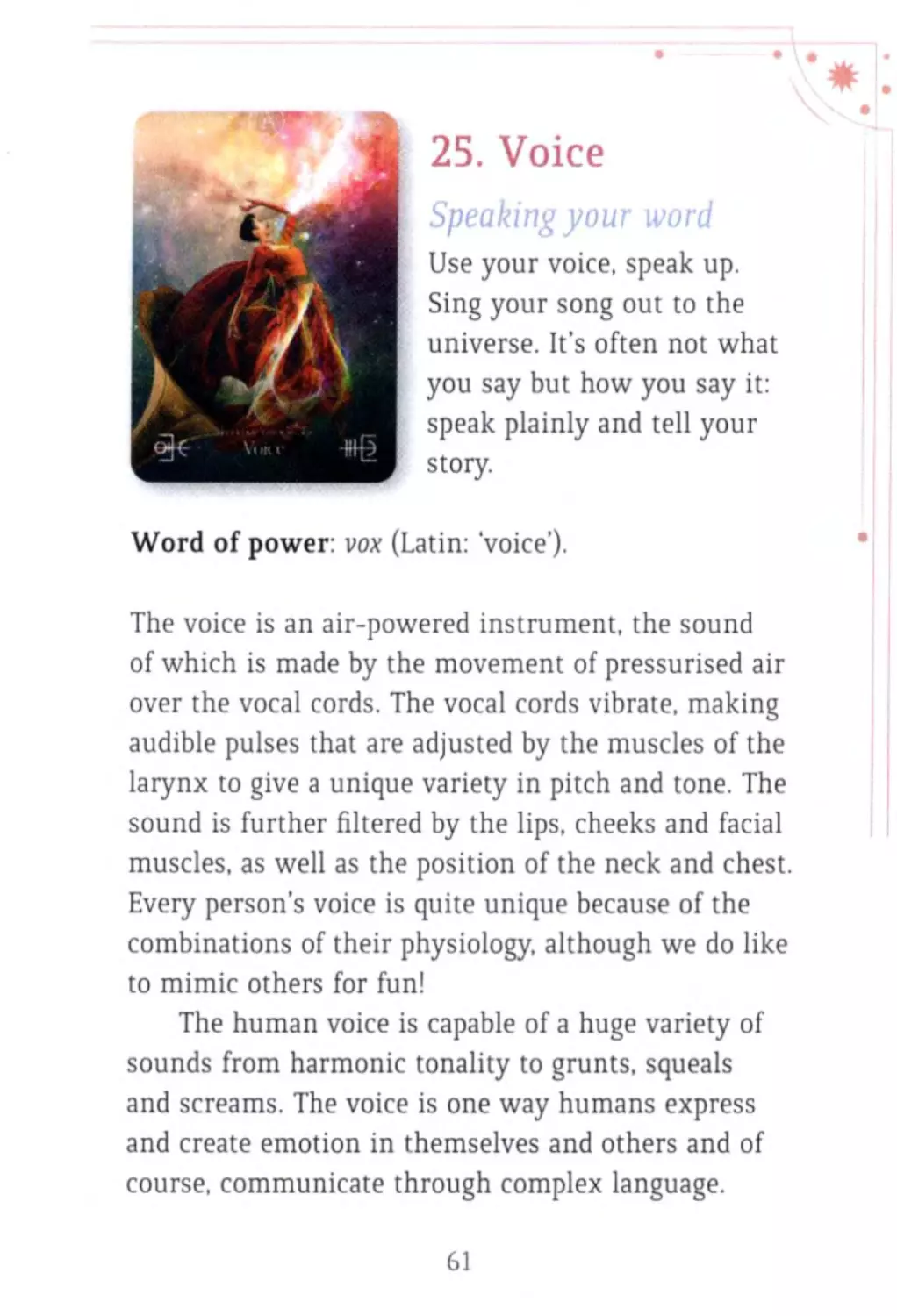
25. Voice
Speaking your word
Use your voice, speak up.
Sing your song out to the
universe. It’s often not what
you say but how you say it:
speak plainly and tell your
story.
Word of power: vox (Latin: ‘voice’).
The voice is an air-powered instrument, the sound
of which is made by the movement of pressurised air
over the vocal cords. The vocal cords vibrate, making
audible pulses that are adjusted by the muscles of the
larynx to give a unique variety in pitch and tone. The
sound is further filtered by the lips, cheeks and facial
muscles, as well as the position of the neck and chest.
Every person’s voice is quite unique because of the
combinations of their physiology, although we do like
to mimic others for fun!
The human voice is capable of a huge variety of
sounds from harmonic tonality to grunts, squeals
and screams. The voice is one way humans express
and create emotion in themselves and others and of
course, communicate through complex language.
61
Listening to amazing voices raised up in song is
something humanity has been doing since prehistory.
Yet perhaps more importantly, being able to speak out
about what is important to us is even more vital. You
must use your voice both kindly and for the greater
good. Not being afraid to speak out about injustice or
to change a bad law or system has always changed
the world for the better.
Element: air.
62
26. Pressure
Transformation
You can view pressure as
being negative or you can see
it as being a shaper, director
or positive influence. Find
a happy medium where
you can benefit and not be
disadvantaged.
Word of power: soemiligr (ancient Norse: ‘becoming’).
Pressure is simply defined as how much something
is pushing on something else, and is measured
scientifically by the analysis of an applied force by
a liquid or gas. Atmospheric or barometric pressure
is the pressure within the earth's atmosphere. Blood
pressure is how much pressure the force of the
circulating blood is applying to the veins and arteries
of the body.
Pressure can be a shaping influence, especially
when applied to the earth’s crust and plates. We also
find the liquid pressure of water important, especially
when going deep into the ocean when diving. The
pressure of air exerts change on boiling points, thus
at higher altitudes the air pressure is different.
63
Modern people often refer to the pressure their
jobs, bosses or life in general poses on them. Many
people perform best under pressure, viewing it as a
focusing force, while studies show a small amount of
pressure can assist performance in a wide variety of
fields. Emergency physicians, the military and pilots
train under higher than average pressure situations.
However, there can be a point when too much
pressure harms cognitive performance, when the
pressure becomes overwhelming and it is impossible
to focus clearly.
Element: air.
64
27. Breath
Life
Focus on your breath. Allow
it to guide your actions
and flow. Fear often means
breath holding; let that
all go. There is a place for
slowing down your breath
and being mindful of it. Take
a deep breath and rethink your strategy. Take a deep
breath and pause a few seconds before exhaling,
which will train you to give yourself that little bit
more time and space.
Word of power: zoi (Ancient Greek: ‘life’).
Simply, breath can be seen as an inhalation or
exhalation from the lungs. It is the process of passing
air into our lungs for respiration. However, the
pace of the breath and the quality can demonstrably
change state, mood and even peak physical
functionality. If you are not breathing deeply enough
it affects the function of your muscles, including
your heart, your capacity to take in enough oxygen to
feed your organs and brain and of course your sleep
patterns (snoring interferes with breathing).
65
Certain physical and spiritual pathways such as
yoga and meditation have always had a potent effect on
the power of the breath. Breathing through the nose,
using the diaphragm and allowing your body’s muscles
to relax enough to get a full breath are just a few ways
you can receive the power of having more oxygen in
your body. Keeping your chest open and an upright
posture allows your lungs to better do their work.
The emotion of fear or feeling stress often
sends hormones rushing into the body that speed
up breathing, or shock will cause you to hold your
breath in the form of rapid inhalation. If you realise
this is a behaviour you regularly do, try to be mindful
and relax. Stop and take a deeper and slower mindful
breath, which will give you more action and flow.
Element: air.
66
28. Music
Joy
Use music to change your
mood. Music raises your
vibration; create ways
you can express yourself
more fully. Move your
body through dance. Allow
your body to heal through
movement. Surround yourself with music to heal: it
can be the music of nature, natural soundscapes or
human-generated music.
Word of power: mousikos (Ancient Greek: ‘pertaining
to the Muses’).
Music is an air element activity. Not only are voices
powered by air and many instruments powered by
breath, but music is carried by the air element to
the ear.
Cultural expression is often through music
and not just language, and we are able to recognise
different cultures through their music. We know
flamenco guitar is Spanish and that certain drum
rhythms are African or Japanese, and we know what
jazz, pop or opera sound like.
Elements within music such as timbre, texture,
dynamics and expression, form, structure, rhythm
and pitch make it complex and unique. Music
is either notated, or written down in a musical
language, or is learnt by ear.
Music has the ability to change mood and state,
so spiritual, ritualised and religious music are of huge
cultural importance. Music was an integral part of the
ancient religions of India, Egypt, Cambodia, Greece
and Rome. Achieving trance or euphoric states can be
assisted by certain kinds of music, and this is part of
the study of the cognitive neuroscience of music.
The development of music therapy has advanced
quickly as a mode of healing, although we know that
ancient Greek centres of healing almost always had
a theatre and music section. It can be used to help
people of all ages with conditions such as depression,
sensory impairments, Alzheimer’s, developmental
disabilities and substance abuse issues.
Element: air.
68
ensure that you seek it.
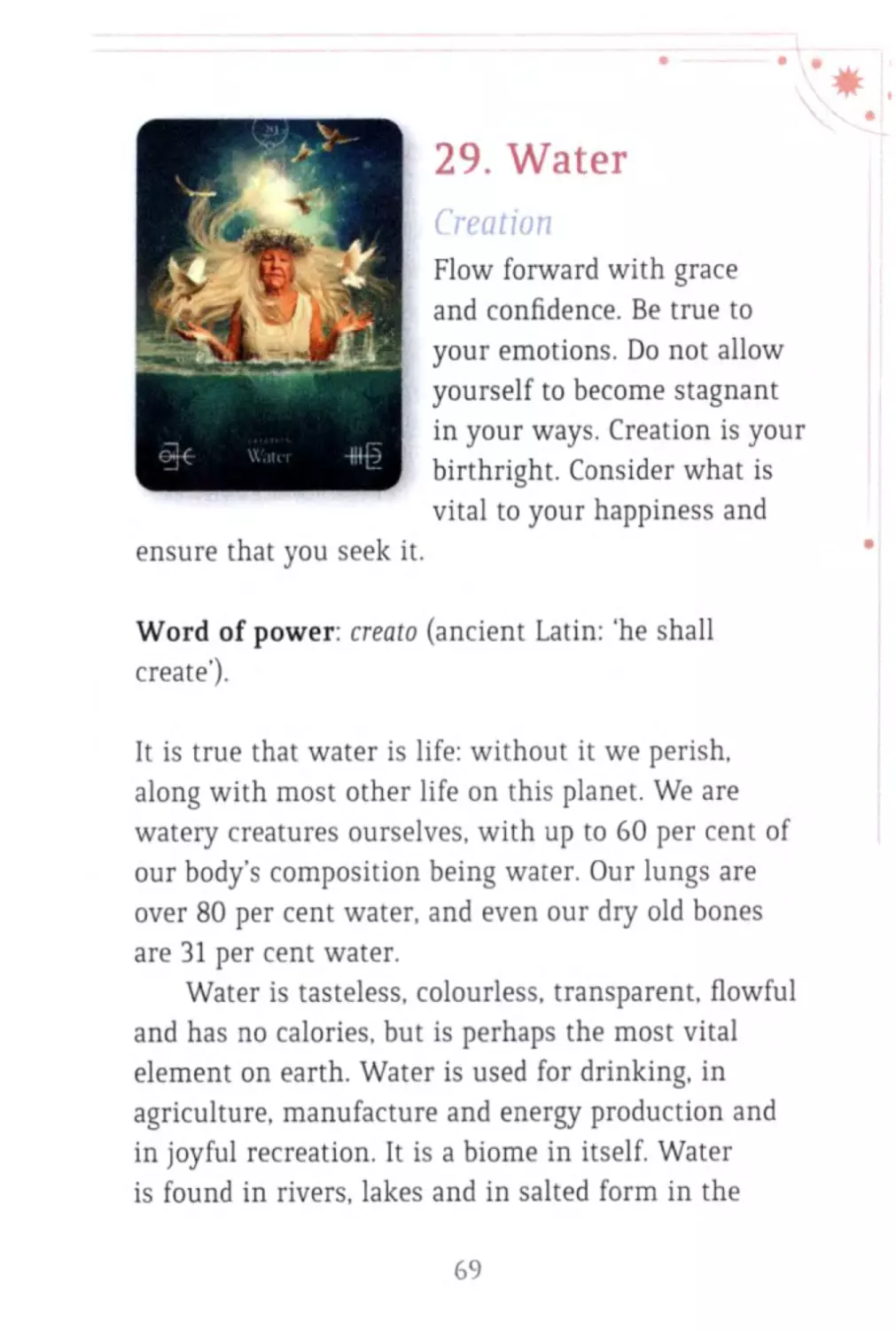
29.	Water
Creation
Flow forward with grace
and confidence. Be true to
your emotions. Do not allow
yourself to become stagnant
in your ways. Creation is your
birthright. Consider what is
vital to your happiness and
Word of power: creato (ancient Latin: ‘he shall
create’).
It is true that water is life: without it we perish,
along with most other life on this planet. We are
watery creatures ourselves, with up to 60 per cent of
our body’s composition being water. Our lungs are
over 80 per cent water, and even our dry old bones
are 31 per cent water.
Water is tasteless, colourless, transparent, flowful
and has no calories, but is perhaps the most vital
element on earth. Water is used for drinking, in
agriculture, manufacture and energy production and
in joyful recreation. It is a biome in itself. Water
is found in rivers, lakes and in salted form in the
69
oceans. It is mist, fog and condensation and is frozen
into ice, sleet, hail and snow.
As an element spiritually, water is related to flow,
prosperity and the direction of water movement. The
tidal cycle is used in spellcraft, with workings done
on the incoming tide for the bringing of prosperity,
love and blessings and on the outgoing tide to remove
and release what we no longer desire. Water magic
is both powerful and gentle, and almost all ancient
cultures had water deities including genius loci or
spirits of lakes, rivers, springs, even man-made wells.
As the climate warms, the pressure on water
supply will become acute. Also, places that flooded
only occasionally may do so with greater volume and
frequency, causing destruction and imbalance.
Element: water.
70
л*
30.	Oceans
Bravery
Go forth and explore; you
won’t see much if you keep
the shore always in sight. Be
brave in your choices, this
is not the time to be fearful.
Someone who is close to you
has a hidden side, and it is
best to be mindful of this in your decision making.
Words of power: mare (Latin: ‘sea’); tharros (Ancient
Greek: ‘courage’).
We know a lot about life on land but we know very
little about life in the world’s oceans, which comprise
71 per cent of the planet. We are still discovering
new species, for instance, a flesh-eating sponge and a
strange hairy crab, and we have only begun to explore
the deep ocean. We possibly know more about space
than we do our own blue seas.
The oceans are a source of great richness in
the form of marine life, and their very existence
influences everything from the weather to where
humans settled and lived. Ancient sea-going cultures
such as the Vikings and the Polynesians had an
71
intimate relationship with the oceans, tides, trade
winds and stars, which enabled them to navigate the
huge blue expanses. The bravery of such cultures -
leaving the sight of land, venturing and navigating
outwards towards often unknown destinations - is
considerable and a testament to the human spirit of
adventure and curiosity.
The sea has been integral to our very humanness:
sustaining us and allowing us to travel, trade and
learn. It is a part of our DNA, yet in our busy lives
we often overlook its importance. Because of this
disconnection the birthplace of life on this planet
has become a garbage dump through acidification,
pollution, overfishing and habit destruction. We do
know that without the oceans life cannot exist on
this planet and that the oceans are in trouble.
Ocean-based magic, like all water magic, concerns
itself with the cycles of movement in the forms of
stagnancy and flow, prosperity and emotional balance.
Element: water.
72
31.	Lake
Depth
Do not take the shallow
alternative. Deep dive; do the
research; do not cut corners.
You may not be seeing the
whole picture, so take your
time with a decision.
Word of power: profunde (Latin: ‘deep’).
Lakes are natural, self-contained bodies of water
not connected with an ocean. They have their
own ecosystems and often contain their own
endemic species. Most have at least one stream or
river directing the flow outwards. The different
classifications of lakes include glacial, tectonic, fluvial
and shoreline and those formed by meteorites hitting
the earth. As they are often fresh water, historically
lakes have attracted human occupancy as they are
a water source. On earth, most lakes were formed
in the higher northern latitudes, although there are
notable exceptions in Africa.
Spiritually lakes have been places of magic
and power. Lake Wanaka in New Zealand is said to
breathe in and out with the giant that lies underneath
73
it. Lake Baikal in Siberia, sometimes referred to as
the ‘sacred sea’, is the largest source of fresh water
in the world, containing over 20 per cent of the
world’s unfrozen fresh water. Over 630 km long,
Baikal is very deep and its waters are very clear and
it contains over 3,000 unique species. One common
shamanic practice is the offering of a small amount of
vodka in certain sacred spots; it is also believed that
something should be thrown into any fire you light as
an offering to the spirits. It is said that it if you bathe
here or in other lakes such as Lagarfljot in Iceland
you will receive healing energies from the pure and
ancient waters.
Element: water.
74
(Latin: ‘richness’).
32.	Marine life
Richness
Fertility is yours. Your
wishes will be granted. There
is more than one way to find
a solution to a problem. Adapt
to the new.
Word of power: opulentiam
As a biome, the oceans are unmatched in richness
and variety of life. It is estimated the oceans contain
a total of 230,000 marine species, but this just
scratches the surface. There are perhaps more than
two million marine species yet to be classified.
Marine life is vital to the health of the planet
because the majority produce oxygen and sequester
carbon, something we so desperately need in this
time of man-made climate change. The oceans do
indeed demand our respect, but I believe its creatures
demand it even more so. Even if they approach you
out of curiosity, sea animals are wild and should
not be pursued; they should be given all the space
they need. It is worth remembering it is we who are
visiting them, not the other way around.
75
Should you ever go with an organised adventure
or tour company, choose only those that strictly
follow a code of practice that protects the animals
and the sea itself and the local laws and permissions
of the area that you are diving or snorkelling in or
interacting within.
Element: water.
76
33.	Ice
Purity
The way forward is clear. See
nature in its purity - let it
comfort you and strip away
what is unnecessary. Freeze
out what is not of benefit to
you at this time. When you
look at things clearly there
will be a purity to the solution.
Word of power: svella (ancient Norse: ‘swell’).
When water gets chilled to 0°C it freezes into a
solid state; that is, ice is formed. Ice has different
appearances and forms that often depend on the
rapidity of the freezing. Ice is less dense in its frozen
form than in its liquid form, a kind of magic, really!
It does, however, increase in volume, having a larger
volume than water.
The biome where ice forms naturally is called a
cryosphere. Glaciers are very important forms of fresh
water storage, while icebergs are usually large pieces
of ice that have broken off from a land ice sheet.
One of the most tiny but beautiful kinds of
ice is that referred to as diamond dust. These are
77
ice needles that form at temperatures approaching
-40°C due to air with a slightly higher moisture
content mixing with colder, surface-based air. I have
witnessed this phenomena; it was so exquisitely
beautiful in the way it shimmered that I forgot how
cold I was.
Ice introduces an almost outer-worldly beauty,
a kind of purity that very few other elements can
offer. Ice festivals in places such as as Japan (Sapporo),
Russia (Krasnoyarsk), China (Harbin) and Norway
(Geilo) make any ice aficionado happy.
Element: water.
78

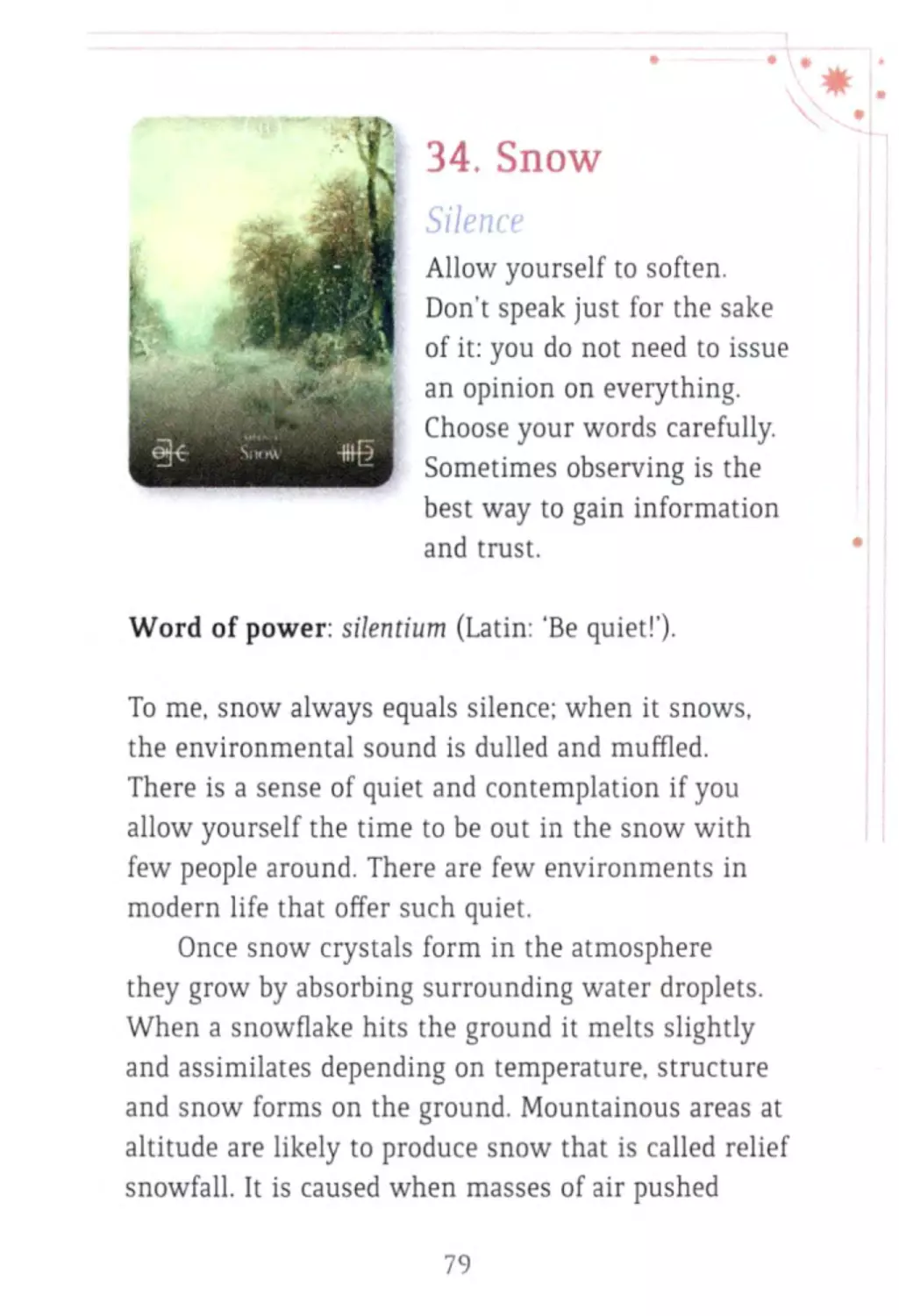
'I-' 34. Snow
Silence
Allow yourself to soften.
Don’t speak just for the sake
of it: you do not need to issue
an opinion on everything.
Choose your words carefully.
Sometimes observing is the
best way to gain information
and trust.
Word of power: silentium (Latin: ‘Be quiet!’).
To me. snow always equals silence: when it snows,
the environmental sound is dulled and muffled.
There is a sense of quiet and contemplation if you
allow yourself the time to be out in the snow with
few people around. There are few environments in
modern life that offer such quiet.
Once snow crystals form in the atmosphere
they grow by absorbing surrounding water droplets.
When a snowflake hits the ground it melts slightly
and assimilates depending on temperature, structure
and snow forms on the ground. Mountainous areas at
altitude are likely to produce snow that is called relief
snowfall. It is caused when masses of air pushed
79
by wind are forced up the side of elevated formations.
The lifting of air up the side of a mountain or
range results in adiabatic cooling and the resulting
precipitation needed for snow.
Snow forecasts are an important aspect of living
in snowy areas as large dumps affect everything from
transport to agriculture. Skiing, snow shoeing and
snowboarding are all extremely popular activities
to do in the snow. It was believed the Norse god
Ullr invented skiing so man could get around more
easily to hunt and travel, and Ullr is still honoured
for his invention. One Norwegian ski team had an
Ullr symbol on their uniforms during the winter
Olympics.
It is true that each snow crystal is unique,
although scientists have found through
microphotography they tend to correspond to around
80 specific shapes and sizes.
Element: water.
80
35.	Rain
Fecundity
The conditions of greater
prosperity are being met.
Know that all will be well.
Cleanse yourself of old
outdated views. You have
everything you need to grow.
Let yourself be cleansed.
Word of power: fecundatio (Latin: ‘fruitfulness’).
The sound of rain on leaves or a tin roof; the sweet
smell of rain as it hits the thirsty earth after a hot
day: the simple pleasures of life.
You soon know how much rain contributes to
the balance and health of a land when you haven’t
had any for a long time. You also understand how
much it contributes to the positive mental health of
communities that have been locked in drought states
for a considerable length of time.
Rain is liquid water from the atmosphere that has
become heavy enough to fall under gravitational pull.
It is a part of the life-giving water cycle and is the
main supplier of fresh water to the land. Raindrops
can vary in size due to temperature and the rate of
81
coalescence. The amount of rain helps form biomes
and ecosystems.
Without rain we have less fecundity. Plant life,
particularly plants that supply food, do not thrive
without rain or irrigation. Drought affects animals
and pollinators such as fruit bats and bees, which are
integral to the production of food.
Some biomes are wetter than others and have
almost constant rainfall, such as rainforests. Human
intervention has influenced rain patterns: particles
of solid or liquid matter suspended in the air can
increase cloud condensation and trigger a rain event.
Man-made global warming is also affecting rain
patterns, with some areas becoming drier and some
having more intense rainfall.
Element: water.
82
36.	Electricity
I Wildness
Embrace your wildness. Break
free of your self-imposed
constraints. Take immediate
action; there is no need for
further consideration of your
problem. You contain the
spark of the divine, so there
is no reason to feel lesser. Confront the issue head on.
Word of power: energeia (Ancient Greek: power in
action’).
Have you ever stood out in a storm and felt the
power of the lightning? Have you ever felt the hairs
go up on your neck and arms and smelt the ozone
after the crack? While I'm not encouraging you to
get into harm’s way, feeling the power of lightning is
one amazing way to get connected to the element of
electricity.
Electricity isn’t just generated during storms: it
is pretty much everywhere! Our bodies generate and
conduct electricity and we ‘run’ on electricity. Each
of our cells is designed to conduct energy through
electrical currents, and the chemical elements in
83
our bodies such as calcium, potassium and sodium
elicit a particular electrical change. These electrified
elements, which flow across cells, are called ions. Our
bodies use certain combinations of electrical impulses
to form thoughts, movements and instructive
behaviours. Some fish generate enough electrical
impulses to shock prey.
Certain organs such as the muscular heart need
specific electrical currents to work. The electrical
impulses that cause the heart to pump is possibly
the best example we can see of how the spark of
electricity is vital to our balance and health. The
spark of the divine is within you, and it is electric in
its inspiration.
Element: fire.
84
37.	Magnetism
Attraction
Know your values and needs
so you are more aware of
what your true attractions
are. Do not run with the
herd. Notice what or who you
attract: is this your intent?
There is always nemesis
(opposite) energy to any endeavour you might take;
this should not bother you as it is a natural law.
Word of power: magnetis (Greek).
Magnetism, one of the most obvious elemental
physical phenomena, is a highly active force.
A magnetic field is a vector field that describes the
magnetic influence of electric charges in relative
motion and magnetised materials. Magnetism is used
in a huge array of technology and extensively in
electrical engineering.
The word ‘magnet’ comes from the Greek term
magnetis lithos, meaning ‘lodestone’; the Greeks
noticed certain stones would attract iron. Magnetism
was studied the world over, and it was possibly
Petrus Peregrinus de Maricourt in France in 1269 who
85
most clearly demonstrated the idea of magnetic poles
and fields crossing in two points by using fine iron
needles on a magnet. He described magnets as having
north and south poles, which was revolutionary.
Models of magnetism were created and studied all
throughout the 17th, 18th and 19th centuries. In
1905 in his paper that described relativity, Einstein
demonstrated that both the electric and magnetic
fields are part of the same phenomena viewed from
different reference frames.
The earth itself produces its own magnetic field
that shields its ozone layer from destructive elements
such as solar winds. The earth’s magnetic field is
used in navigation and is measured using a compass.
Magnetism as a field in medicine is growing, with
MRIs in common usage and transcranial magnetic
stimulation in the testing stages for treatment for
problems such as depression.
We walk through and are part of the fields of
magnetism every day of our lives. The idea of being
magnetically repelled or attracted to something or
someone is an old but enduring one. It is important
that you know your needs and values so you can
make wise decisions upon what you can be attracted
to and why.
Element: earth.
86
38.	Dark matter
Mystery
The world still has mystery,
and this is a fine thing. Just
because you cannot see it
doesn’t mean it is not there.
You do not have to know the
details of everything; some
things are better not revealed
at this time. Have faith.
Word of power: musterion (Ancient Greek:
mysteries’).
Imagine an elemental force that makes up possibly
85 per cent of the universe that you can't see and
remains elusive but you know it is there. Imagine
this elemental matter is called dark because it’s
hard to perceive and it doesn’t interact with
electromagnetic radiation such as light, so it’s
virtually undetectable. Yes, mysterious!
How do we know such a thing exists if it
remains invisible? The math says it’s highly probable
due to the way the universe behaves. In practice, the
term ‘dark matter’ is often used to mean only the
non-baryonic component of dark matter.
87
We still don’t know what dark matter is made up
of, although there are many theories; scientists have
managed to categorise dark matter by cold, warm
and hot, terms that refer to velocity rather than
temperature.
Dark matter is the subject of a huge amount
of study. For now, we know we have a mysterious
force that holds the universe together, which is a
fantastic concept and one that invites the idea of the
unknowable into the frame. Science doesn’t know
everything yet!
Element: air.
88
39. Gravity
Groundedness
Seek a grounded perspective.
Word of power: gravitas
(Latin: seriousness').
Gravity is the natural force
that causes all things with
mass and energy to be attracted to each other. This
includes planets, galaxies, light and, yes, even apples.
The famous story about Isaac Newton and
the apple actually did happen but not in the way
most people think. While there is no evidence of
young Issac being bumped on the head by a falling
apple, he was sitting in the orchard and observed
an apple falling from a tree. He noticed every apple
fell the same way - straight down - not sideways
or somehow else impeded, and he wondered why.
This inspired him to formulate the law of universal
gravitation, which states that every body in the
universe is attracted to every other body with a force
that is directly proportional to the product of their
masses and inversely proportional to the square of
the distance between them. His famous apple tree
continues to grow at Woolsthorpe Manor.
89
Newton wasn’t the first scientist or great thinker
to consider there was such a thing as gravity. The
ancient Greek philosopher Archimedes proposed there
was a centre of gravity within a triangle. The ancient
Indian mathematician Aryabhata proposed in the 5th
century there was a force that stopped objects being
thrown into the air as the earth rotated. Later, Galileo
showed that gravitational acceleration is the same for
all objects by throwing balls off the Tower of Pisa.
Gravity still remains one of the most studied
forces in physics. Gravity is a fantastic element
to include in your workings for groundedness
and when you feel untethered because of trauma
or things going too fast. Breathing, putting your
awareness in your feet and asking gravity to do its
thing is good solid magic.
Element: earth.
90
40.	Atoms
Building
Everything is connected by
the same building blocks of
matter. You are electric and
vibrating in motion; being
stagnant in your beliefs and
growth is unnatural. Building
and changing is natural.
There is room for infinite variety.
Word of power: atomos (Greek: undivided’).
Many ancient cultures suspected the world was
made up of building blocks that couldn’t be seen.
While the elements of earth, air, fire and water were
part of their thinking, many also thought that even
these formidable elements were constructed from
something. The ancient Greek philosophers Leucippus
and his pupil Democritus suggested around 450 AD
that atoms existed, they were infinite and that there
must be different kinds to reflect the object that
was the end result. Indian and Islamic scholars also
reported on the ideas of atoms, but it wasn’t until the
16th-17th centuries the notion became a serious field
of study with Bernier, Boyle and Newton.
91
The last 200 years have given us a clearer idea of
what atoms are made up of. Each atom is composed
of a nucleus and one or more electrons bound to the
nucleus. The nucleus is made up of protons (sub-
atomic particles with a positive charge) and neutrons
(sub-atomic particles with no net charge that are
slightly bigger than protons).
The boundaries of an atom are not well defined,
so they are able to connect and vibrate. We can use a
scanning tunnelling microscope to view surfaces at
an atomic level.
The idea that we are all connected or that
everything is part of a whole is somehow born out in
quantum physics. It is not just some romantic ideal,
but is something solid.
Elements: all elements.
92
41.	Time
Discipline
Find out the causes of
your procrastination or
resistance. Do not miss your
opportunities. Someone is
wasting your time: be aware
of this. You have finite time
on this planet, so use it well.
Word of power: disciplinatus (Latin: ‘disciplined’).
As you grew up time seemed to pass very slowly
and you couldn’t wait to grow up. Then, conversely,
as you aged time went quickly as you knew it was
running out. We have an innate idea of time, but
what is it actually?
Physics says time is what a clock reads: simple!
Time has also been defined as the continued
indefinite progress of existence, but it is hard to put
a definition to the word without actually using the
concept of time.
We normally refer to time in what it can do
for us and what it means. Humans initially broke
time down in measurements: of light and dark, day
and night, when the sun rose, when it began to
93
circle across the sky, when it set, when the moon
rose and continued its arc. As humans became
more sophisticated and began to break down these
phenomena into hours, minutes and seconds, we
learnt how to accurately measure time although
many different cultures had just as many ways to
express time through their calendars. The study of
measuring time is called horology.
Time is an important element in the way it
combines with other elements: the speed of light, the
velocity of an object, space time and gravity.
Element: air.
94
42.	Speed
Movement
Savour the experiences of
your life. Be mindful and
aware of the speed in which
you do activities such as
eating and working. Do not
waste time, but understand
the discernment of taking
quality time.
Word of power: celeritatem (ancient Latin:
’swiftness, velocity’).
Scientifically, the speed of an object is the
magnitude of its velocity. It is an element we don’t
think about much unless we think of it in terms
of our cars when obeying the speed limit or in fast
transport such as aeroplanes and how long it takes
to get somewhere. Speed then has the dimensions
of distance divided by time, although it is a key
element that fits into many physical laws. For
example, ‘velocity’ describes both how fast and
in which direction an object is moving, and the
steady speed of light is key to many calculations
in astrophysics.
95
We first begin to understand the concept of
speed as children when we begin to observe the
concept of overtaking or one thing travelling faster
than another. It’s possibly also when we first get our
competitive urges!
It is often said that as you are growing up time
seems to pass very slowly and we cannot wait to
grow up. And then conversely, as we age time goes
quickly as we know it is running out. We live in a
speedy society, and knowing when to slow down can
be the difference between balance and imbalance.
Slow cooking, slow travel, taking time to think and
process and exercise self-care require a willingness to
slow down enough to savour them.
Element: air.
96
43.	Magic
Alchemy
There is magic to be found
everywhere if you look for
it. You are the magic. Magic
is not a miracle, although it
can sometimes feel like that.
Doubt kills more dreams than
failure. Have faith in your
ability. Weave together all the
disparate pieces.
Word of power: magus (Latin: ‘magic’).
As a witch I am often asked what magic is. It
is a hard question to answer, and almost every
practitioner who claims to work with magic would
have a unique definition. For what it is worth, I see
magic as a weaving of energy towards a particular
purpose and an alchemic, synergistic process. Magic
has at its heart participation and purpose. Magic is
deliberate change.
Real magic isn’t some trick with a magician in a
magic show, although I do believe casting it involves
an element of faith and expertise: faith because
we extend our own confidence and energy into a
97
working, and expertise as the ancient and modern
recipes of incantantion and ritual dictate.
Spellcasting does have rules, a skeleton if you
will. You need a clear purpose and intention, and
you need to be able to raise power, to release it in a
focused way and then take a physical step to start
the transformation. Magic is commonly extended to
heal, attract, repel, protect, lighten and clear the way,
and all workings with intentions such as these have
a layered set of instructions and combinations of
elements to make them effective. These might include
specialised timing that includes the seasons or moon
cycles, words of power and certain thought forms,
elements that are all organised into a set that will
influence time, space, atoms, thoughts and electricity.
Magic is a doing word, a working, a process.
Magic to me doesn’t exclude science; in fact, it is
part of science, probably influencing it at an atomic
level. That we don’t exactly know how this all
works doesn’t make it incorrect or fantasy. After all,
scientists are still trying to work out dark matter.
Elements: fire and air.
98
44.	The biome
Connection
The whole is greater than
the sum of its parts. You are
asked for synergy at present.
Be aware of the needs of
others. You are a part of
the same whole. Consider
working more closely with
your community.
Word of power: conligo (Latin: ‘deduce, infer’).
Biomes are not ecosystems: they contain ecosystems.
They are large areas of the earth based on
temperature by altitude and latitude, climate, relief,
geology, soils and vegetation.
A biome contains animals, plants, bacteria
and people - in fact, everything that is within and
connected within that space. Biomes can take up both
small and large geographical areas.
Some ancient cultures such as the Greeks
thought that the earth was alive as a being that
had awareness, and therefore all parts of it were
important to the whole. The definition is morphing
yet again, as a human microbiome could be an
99
individual person’s skin. Everyone has a skin full of
bacteria, fungi, skin cells, water and other debris that
form a unique skin biome. We are, in fact, made of
biomes.
Biomes on earth fit together like a giant jigsaw
puzzle or patchwork quilt; the health of one can affect
the health of another.
Element: earth.
100


*
About the author
Stacey Demarco, the Modern Witch, is passionate
about bringing practical magic to everyone and
inspiring people to have a deeper connection with
nature. She has been teaching for more than 20
years and is the author of the best sellers Witch in
the Boardroom, Witch in the Bedroom and The Coffee
Oracle, all of which have been translated into multiple
languages. She is also the co-writer of The No Excuses
Guide to Soul Mates, The No Excuses Guide to Uncovering
Your Purpose and Plants of Power. Her oracle card
decks include the best-selling Queen of the Moon Oracle
and Divine Animals Oracle, both illustrated by Kinga
Britschgi. Stacey has been the creator of the beautiful
annual Lunar & Seasonal Diary since 2011.
Stacey is the founder of Natureluster, which
educates and works to reconnect people to the health-
giving power of nature. She is also an animal activist,
ethical beekeeper and dedicated adventure traveller,
and lives by the beach on a cliff in Sydney with her
husband and furry companions.
Stacey provides private consults, teaches
workshops and leads the popular Wild Souls
naturelusting retreats nationally and internationally.
Learn more at www.themodernwitch.com.
103
About the illustrator
Kinga Britschgi is a Hungarian artist who has lived with
her American husband and son in the United States since
August 1995. Apart from her wonderful family she has
two big passions in life: art and linguistics (and teaching
both). Although possessing a degree in fine art, she began
her career as a language teacher and went on to gain a
Masters in Bilingual Education.
Kinga has been involved with digital art for many
years, working with Photoshop and other Adobe products
since 2002. She creates commercial graphics for many
clients, which she enjoys immensely. Her works are
regularly published in industry standard and other
magazines such as Advanced Photoshop, Photoshop Creative,
Practical Photoshop and Digital Studio. One of her images,
‘Midsummer Night - Titania’, was chosen as part of
Adobe’s official marketing campaign for their Creative
Cloud project. She has also worked on Stacey’s Queen of
the Moon Oracle and Divine Animals Oracle.
Kinga loves surrealism, magical realism and dark
whimsy, creating ‘story pictures’: figurative pictures
with seemingly realistic elements that often result in
surrealistic, mysterious images with lots of layers of
meanings. For more of her works, please visit
kingabrit.wixsite.com/kinga.
104
Other products by Stacey ...
Queen of the Moon Oracle
ISBN 9781925682588
For countless millennia, humans have connected to the mystical
power of the moon and the energy of the seasons. For our
ancient ancestors, the earliest veneration and sacred honouring
was of the Moon, the seasons, the cycles of light and dark, hot
and cold and fertility and rest, and this beautifully illustrated
Queen of the Moon Oracle allows you. the modern seeker, to plug
into these, the most primal energies of all.
Available at all good book stores or online at rockpoolpublishing.co
Other products by Stacey ...
Divine Animals Oracle
ISBN 9781925429947
The voices and energy of our animal kin have always been
a part of our human experience, across most cultures and
timeframes. The stories of their relationships with the
goddesses and gods entwined the two energies into a divine
form. Now it is time for us to again reconnect with this
powerful partnership.
Deeply researched and richly written, in this oracle you will
discover the mythos of the animals and the eternal deities.
Available at all good book stores or online at rockpoolpublishing.co