/


ISBN: 9781440839337

Text
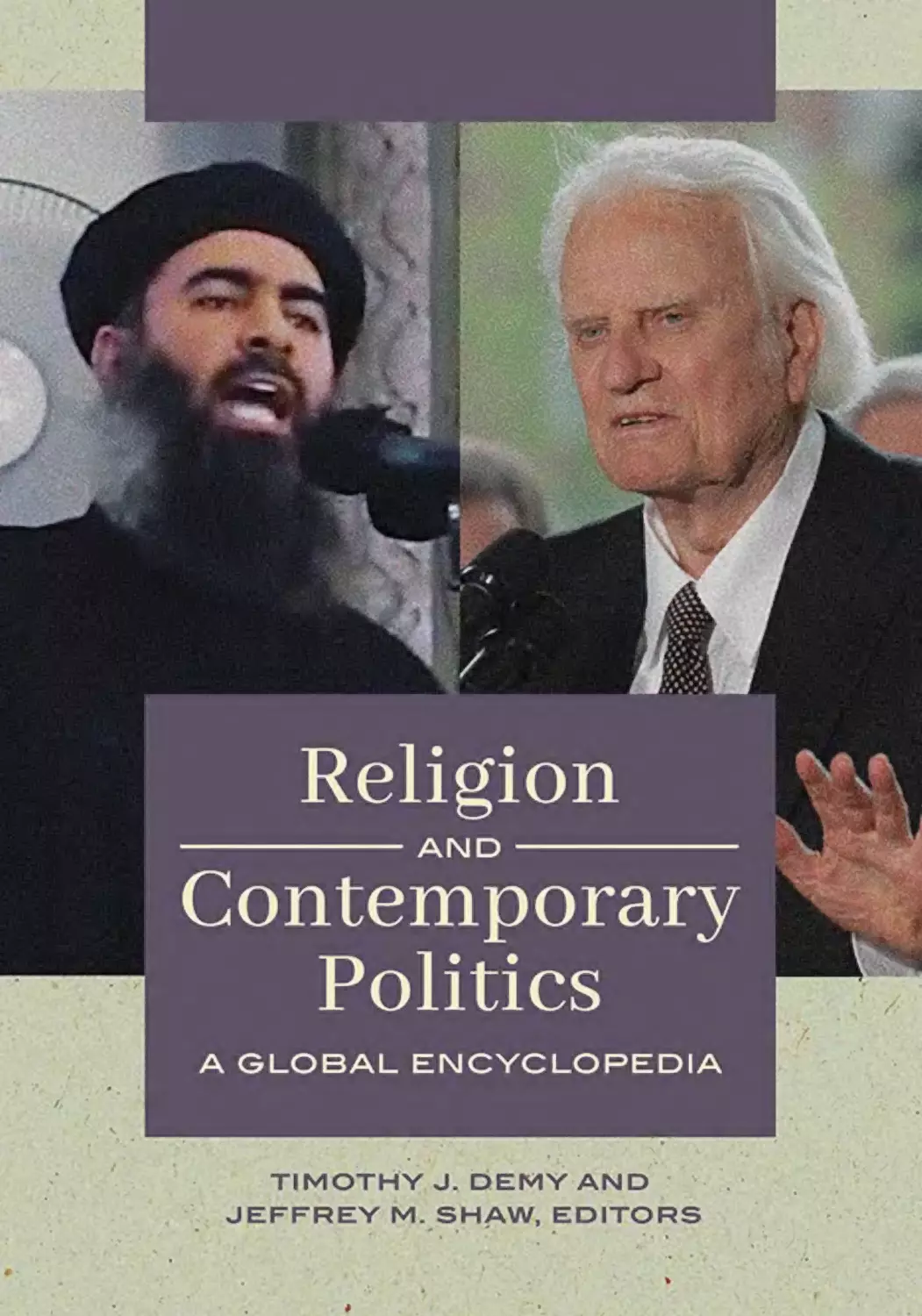
Religion and
Contemporary
Politics
Religion and
Contemporary
Politics
A Global Encyclopedia
Volume 1
Global/Africa/Asia/Australia and
Oceania/Central and South America
TIMOTHY J. DEMY AND
JEFFREY M. SHAW, EDITORS
Copyright © 2019 by ABC-CLIO, LLC
All rights reserved. No part of this publication may be reproduced, stored in a
retrieval system, or transmitted, in any form or by any means, electronic, mechanical,
photocopying, recording, or otherwise, except for the inclusion of brief quotations in a
review, without prior permission in writing from the publisher.
All views expressed in this work are solely of the editors and contributors and do not
represent or reflect the position or endorsement of U.S. Government, U.S. Naval War
College, or any other governmental agency or department, military or otherwise.
Library of Congress Cataloging-in-Publication Data
Names: Demy, Timothy J., editor.
Title: Religion and contemporary politics : a global encyclopedia / Timothy
J. Demy and Jeffrey M. Shaw, editors.
Description: Santa Barbara : ABC-Clio, 2019. | Includes bibliographical
references and index.
Identifiers: LCCN 2019010126 (print) | LCCN 2019019093 (ebook) | ISBN
9781440839337 (eBook) | ISBN 9781440839320 (set : alk. paper) | ISBN
9781440848636 (volume 1) | ISBN 9781440848643 (volume 2)
Subjects: LCSH: Religion and politics–Encyclopedias.
Classification: LCC BL65.P7 (ebook) | LCC BL65.P7 R42575 2019 (print) |
DDC 322/.103–dc23
LC record available at https://lccn.loc.gov/2019010126
ISBN:
978-1-4408-3932-0 (set)
978-1-4408-4863-6 (vol. 1)
978-1-4408-4864-3 (vol. 2)
978-1-4408-3933-7 (ebook)
23 22 21 20 19
1 2 3 4 5
This book is also available as an eBook.
ABC-CLIO
An Imprint of ABC-CLIO, LLC
ABC-CLIO, LLC
147 Castilian Drive
Santa Barbara, California 93117
www.abc-clio.com
This book is printed on acid-free paper
Manufactured in the United States of America
Contents
Preface
xix
Introduction
xxi
Volume 1
Global
Introduction
Timeline—Global since 2000
Anti-Semitism
Global Terrorism
Human Rights
Political Theology
Property
Religious Freedom
Religious Nationalism
Religious Persecution
Speech and Conscience
State Churches
Statist Utopianism
Terrorism Trends
United Nations and Religion
Women and Religious Freedom
1
1
2
3
5
8
13
15
18
22
26
31
35
39
42
46
49
Africa
51
Introduction
51
Timeline—Africa since 2000
52
African Indigenous Faith Traditions
54
African National Congress (ANC)
58
vi
Con te n ts
Algeria
60
Al-Shabaab
62
Angola
65
Apartheid
67
Arab Spring (2010–2012)
72
Benin
75
Boko Haram
76
Botswana
80
Bouazizi, Mohamed (1984–2011)
82
Burundi
83
Cameroon
85
Central African Republic
88
Chad
90
Christian-Muslim Conflict in Africa
92
Christianity in Africa
98
Congo, Democratic Republic of (DRC)
102
Congo, Republic of
105
Djibouti
106
Ennahda Movement
109
Equatorial Guinea
111
Eritrea
113
Ethiopia
116
Gabon
118
Gambia
120
Ghana
121
Guinea
125
Guinea-Bissau
126
Islam in Africa
128
Ivory Coast
131
Kenya
134
Kony, Joseph (1961–)
139
Liberia
141
C o ntents
Libya
143
Lord’s Resistance Army (LRA)
145
Madagascar
148
Malawi
150
Mali
152
Mandela, Nelson (1918–2013)
156
Mau Mau Rebellion (1952–1960)
159
Mauritania
161
Morocco
164
Mozambique
166
Namibia
168
Niger
169
Nigeria
171
Rwanda
175
Senegal
176
Sharia Law
178
Sierra Leone
180
Somalia
181
South Africa
184
South Sudan
187
Sudan
189
Tanzania
195
Togo
197
Tunisia
198
Tutu, Desmond (1931–)
201
Uganda
203
Western Sahara
205
Xhosa
207
Zambia
208
Zanzibar
210
Zimbabwe
212
Zuma, Jacob (1942–)
214
vii
viii
Con te n ts
Asia
217
Introduction
217
Timeline—Asia since 2000
218
Abu Sayyaf Group (ASG)
220
Afghanistan
223
Armenia
226
Aum Shinrikyo
228
Azerbaijan
229
Bangladesh
232
Bharatiya Jana Sangh
234
Bharatiya Janata Party (BJP)
236
Bhutan
238
Brunei
240
Buddhism and War
243
Buddhist Nationalism
247
Cambodia
249
Caodaism
252
China
254
China, Church-State Tensions in
258
Confucianism
262
Dalai Lama XIV (1935–)
264
Daoism
267
Daoism and War
269
Falun Gong
272
Gandhi, Mohandas (1869–1948)
274
Hindu Nationalism
278
Hindu Rights Action Force (HINDRAF)
279
Hinduism
282
Hinduism and War
283
Hui
287
India
289
India, Hindu-Muslim Conflict in
293
C o ntents
Indonesia
296
Japan
300
Jemaah Islamiyah
304
Kashmir
305
Kazakhstan
306
Komeito
309
Kyrgyzstan
311
Laos
314
Malaysia
315
Maluku Sectarian Conflict (Indonesia)
318
Mongolia
320
Moro Islamic Liberation Front (MILF)
321
Mujahideen
324
Myanmar
326
Nepal
328
Nhat Hanh, Thich (1926–)
331
North Korea
334
Pakistan
335
Philippines
340
Pol Pot (1925–1998)
342
Religious Freedom in Asia
345
Rohingya
347
Saffron Revolution
348
Shinto
350
Sikhism
353
Sikhism and War
355
Singapore
359
Soka Gakkai
361
South Korea
365
Sri Lanka
366
Taiwan
370
Tajikistan
372
ix
x
Con te n ts
Taliban
374
Thailand
376
Tibet
378
Tibet, Chinese Occupation of
382
Turkmenistan
384
Uyghurs
388
Uzbekistan
390
Vietnam
393
Zia-ul-Haq, Muhammad (1924–1988)
395
Australia and Oceania
397
Introduction
397
Timeline—Australia and Oceania since 2000
398
Australia
399
Christianity in Australia
402
Islam in Australia and Oceania
405
New Zealand
406
Oceania
407
Papua New Guinea (PNG)
409
Central and South America
411
Introduction
411
Timeline—Central and South America since 2000
412
Afro-Caribbean Religions
414
Argentina
416
Belize
419
Bolivia
421
Brazil
423
Cardenal, Ernesto (1925–)
425
Chile
427
Colombia
429
Costa Rica
431
Cuba
434
C o ntents
Dominican Republic
436
Ecuador
439
El Salvador
442
Evangelicals and Pentecostals in Central and South America
445
French Guiana
448
Guatemala
449
Guyana
453
Haiti
454
Honduras
457
Jamaica
460
Latin American Episcopal Council (Consejo Episcopal
Latinoamericano—CELAM)
462
Liberation Theology
464
Medellin Conference (1968)
467
Nicaragua
469
Panama
472
Paraguay
475
Peru
476
Roman Catholicism in Central and South America
479
Romero, Oscar (1917–1980)
482
Sandinista National Liberation Front
484
Suriname
487
Uruguay
489
Venezuela
491
Volume 2
Europe
Introduction
Timeline—Europe since 2000
Albania
Andorra
Austria
Balkans
495
495
496
499
501
501
504
xi
xii
Con te n ts
Belarus
506
Belgium
508
Benedict XVI, Pope (1927–)
511
Bonhoeffer, Dietrich (1906–1945)
514
Bosnia-Herzegovina
517
Bulgaria
520
Catholic Social Teaching
522
Chechnya
524
Christianity and War
526
Christianity in Europe
531
Christianity in Europe, Historical Backgrounds of
535
Croatia
539
Cyprus
540
Czech Republic
542
Denmark
545
Eastern Orthodox Church
548
Estonia
554
European Union (EU)
556
Finland
559
France
561
Francis, Pope (1936–)
565
Georgia
568
Germany
570
Greece
574
Greenland
577
Habermas, Jürgen (1929–)
579
Holocaust
580
Hungary
584
Iceland
587
Ireland
589
Islam in Europe
593
Islam in Russia
597
C o ntents
Italy
598
John Paul II, Pope (1920–2005)
601
Kosovo
603
Latvia
606
Liechtenstein
608
Lithuania
609
Luxembourg
612
Macedonia
613
Malta
615
Marx, Karl (1818–1883)
617
Moldova
620
Monaco
622
Montenegro
623
Netherlands, The
626
Northern Ireland
629
Norway
632
Patriarch Kirill (1946–)
634
Poland
637
Portugal
639
Putin, Vladimir (1952–)
641
Refugees
644
Romania
648
Russia
651
Russian Orthodox Church
653
Secularism in Europe
656
Serbia
660
Slovakia
662
Slovenia
664
Solidarity
666
Spain
669
Sweden
671
Switzerland
673
xiii
xiv
Con te n ts
Ukraine
675
United Kingdom
678
Vatican City
682
Weber, Max (1864–1920)
684
Middle East
687
Introduction
687
Timeline—Middle East since 2000
688
al-Assad, Bashar (1965–)
692
Alawites
694
Al-Qaeda
696
Baha’i Faith
700
Bahrain
702
Caliphate
704
Christianity in the Middle East
706
Coptic Christianity
711
Druze and War
713
Egypt
714
Erdoğan, Recep Tayyip (1954–)
718
Fedayeen
721
Gaza War (2008–2014)
726
Hamas
728
Hezbollah
730
Iran
734
Iraq
736
ISIS (the Islamic State of Iraq and Syria)
738
Islam and War (Jihad)
742
Israel
747
Jerusalem
751
Jordan
753
Judaism and War
755
Kurdistan Workers’ Party (Partiya Karkeren Kurdistan—PKK)
759
C o ntents
Kurds
762
Kuwait
765
Lebanon
767
Muslim Brotherhood
769
Oman
772
Palestine Liberation Organization (PLO)
774
Peshmerga
778
Qatar
780
Radical Islam
782
Saudi Arabia
784
Shia Islam
789
Shia Islam in Iran
791
Sunni Islam
799
Syria
802
Temple Mount
808
Turkey
810
United Arab Emirates (UAE)
812
Wahhabism
815
Yazidi
817
Yemen
819
Zionism
822
North America
825
Introduction
825
Timeline—North America since 2000
826
American Christianity and the Law
828
American Civil Religion
832
Berrigan, Daniel (1921–2016)
835
Buddhism in North America
837
Canada
839
Christian America, Idea of
841
Christian Heritage Party (Canada)
843
xv
xvi
Con te n ts
Christian Left in the United States
846
Christian Reconstructionism
848
Christian Right in the United States
851
Christianity and Canadian Domestic Policy
853
Christianity in the United States
856
Environmental Politics and Religion
859
Evangelicals and U.S. Foreign Policy
861
First Amendment Advocacy and Controversy
866
Free Exercise of Religion and the U.S. Supreme Court
869
Goldman, Emma (1869–1940)
873
Graham, William Franklin Jr. “Billy” (1918–2018)
875
Immigration and Sanctuary
877
Islam in North America
880
Israel, Evangelicals and
883
Israel Lobby and U.S. Foreign Policy
886
Jonestown Massacre (1978)
890
Judaism in the United States
891
Merton, Thomas (1915–1968)
897
Mexico
899
Native American Religion
902
Neuhaus, Richard John (1936–2009)
904
Niebuhr, Reinhold (1892–1971)
906
Ogle, Robert “Bob” (1928–1998)
909
Politics, Evangelicals and
912
Protestantism and Democracy
916
Religion and U.S. Domestic Policy
921
Religion and U.S. Presidents
925
Religious Demographics and U.S. Elections
929
Religious Minorities in the United States
932
Religious-Political Alliances
936
Schmitt, Carl (1888–1985)
939
Secularism in North America
941
C o ntents
Southern Baptist Convention (SBC)
943
United Nations
946
United States Commission on International Religious
Freedom (USCIRF)
949
Waco Siege (1993)
952
Bibliography955
Editors and Contributors
967
Index971
xvii
Preface
Religion and Contemporary Politics: A Global Encyclopedia provides its users with an
overview of the interplay between religion and global politics that focuses on the
period from 2001 to 2019. The religions of the world know no global boundaries,
but the experiences of religion and the practice of it have been, and continue to be,
shaped by national borders and histories.
This two-volume encyclopedia is not exhaustive. Not every nation is represented nor is every significant political leader or head of state mentioned. Such
a work would require several volumes. Rather, this encyclopedia aims to provide
high school students, college and university undergrads, and interested nonspecialist readers with information on some of the most prominent individuals, institutions, and ideas that have shaped the world of politics and religion, especially in
the twenty-first century.
Religion and Contemporary Politics contains about 350 entries written by an array
of scholars from a variety of disciplines; the entries are arranged alphabetically
within the following eight topical/geographical sections:
Global
Africa
Asia
Australia and Oceania
Central and South America
Europe
Middle East
North America
The entries cover ideas, individuals, events, institutions, controversies, organizations, and nations around the globe as they specifically relate to the interchange
of religion and politics. With respect to the nations of the world represented in
the encyclopedia, contributors were asked to develop entries that provide basic
geographic and demographic information on the nation and then consider two
questions: How does religion affect politics in this nation? and How does politics
affect religion in this nation? As one might expect, the answers vary widely from
nation to nation, continent to continent, and region to region. Each entry includes
cross-references to other related entries in the encyclopedia, as well as a brief bibliography listing current and relevant books, articles, and Web sites that can guide
the reader who desires greater in-depth information on the subject. In addition
to the alphabetical entries, readers will find numerous sidebars in each section
xx
Pr e fa ce
that provide ancillary information regarding religion and politics in contemporary
national and international environments.
Religion and Contemporary Politics also includes a general introduction that puts
the topic of religion and politics into broader historical context, brief section introductions and section timelines that trace important religious and political events
in each region since 2000, and an up-to-date bibliography for further study of
global religion and politics as a whole. Included at the end of the bibliography are
pertinent Web sites. A detailed subject index will allow readers to more easily and
quickly find terms and topics within the entries.
No religion is monolithic with respect to the ethnic, socioeconomic, doctrinal beliefs, and ritual practices and expressions of belief by the individuals and
groups that comprise each faith tradition. There is always a spectrum of belief
and practices. Similarly, with every nation, shifting and changing political policies
and practices affect religion within the nation’s borders. Many nations promote
religion, and many nations restrict religion. There is a spectrum of official and
unofficial response to the religious values and practices of every nation’s citizens.
The interplay of religion and politics within any nation is a complex and evolving environment that is sometimes consistent with the values and principles propounded by the nation’s founders, founding documents, and history and, at other
times, inconsistent with them. The politics and expressions of this environment
within any nation are as fluid as are the religions practiced within the nation. Such
realities make for an interesting and ever-changing global kaleidoscope of religion
and politics.
Introduction
Controversies and questions regarding the relationship between politics and religion are not new in the twenty-first century. In the third century of the Common
Era, Tertullian (Quintus Septimius Florens Tertullianus, ca. 155–ca. 240 CE), a
prolific and astute Christian theologian and philosopher from the Roman province
of Carthage (present-day Tunisia), asked, “What has Athens to do with Jerusalem?”
This famous question from On the “Prescription” of the Heretics (De praescriptione
haereticorum, 7) was written in the context of Tertullian’s defense of the Christian
faith. However, on a broader religiopolitical level, the question is one of enormous
significance, and it is as relevant today as it was almost 2,000 years ago. When one
thinks of Athens, it is often with respect to ideas of democracy, the city-state, and
the flourishing of philosophical and political concepts such as “freedom” and “justice.” Certainly, in the West, there is no fruitful narrative of the history of political
science or political theory without discussion of Athenian democracy. Similarly,
when one thinks of Jerusalem, it is often in the context of the development of three
of the world’s major faith traditions—Judaism, Christianity, and Islam. As a city
geographically located at a strategic crossroads of civilizations, Jerusalem has often
been a focal point of contemporary events. If those who are politically inclined in
the West look to Athens, then likewise those who are religiously inclined might
look to Jerusalem for understanding. Thus, when Tertullian asked his question and
when we consider an answer, we should think about the topics represented in the
question—politics and religion. If we were to rephrase his question, we might ask,
“What has politics to do with religion?” or, more broadly, “What has the sacred to
do with the secular?”
How individuals, societies, institutions, and governments answer Tertullian’s
question reveals much about their religious and political values and worldviews.
Secularists, humanists, atheists, and some totalitarian governments would answer
“nothing”—the political and the religious are to have completely separate domains,
with no overlapping of the two. Religion and government should be completely
separate and isolated. Some religiously devout individuals and governments would
answer “everything”—religion and government are to be domains or spheres of
influence that completely overlap. In short, the government should be a theocracy—a nation ruled by God (or gods). This immediately raises disagreement as
to what type of theocracy—Jewish, Christian, Hindu, Muslim, or something else.
For many people in the United States and in other democracies, the answer to
Tertullian’s question is “something”—there is to be some exchange, overlap, and
xxii
In tr oduc tion
interplay between the domains and spheres of government and religion. How
much interplay or interaction there should be is part of a nation’s democratic dialogue and process. There is disagreement, but there is also dialogue.
Ultimately, whether one is secular, religious, or a blend of the two, every person
must decide for herself or himself by what standard decisions regarding religious,
philosophical, political, social, and cultural norms will be made. For many people
in the world, the answer to the question “by what standard” is “religion.”
The term “religion” derives from the Anglo-Norman word “religion” and the
Latin “religare,” meaning “to tie fast or bind together.” Religion attempts to bind
the loose ends of life and answer the great spiritual and philosophical questions
of the ages. Religion projects human order into the totality of being and provides
order out of the chaos of life. It provides a spiritual and philosophical framework
for understanding ourselves and others. Religion serves many functions in the
lives of individuals, societies, and nations. For individuals, religion helps provide
a worldview and organizes life in the context of that worldview.
When one considers ideas such as ethics, law, religion, morality, and politics,
one must ask if there is a relationship between or among these ideas. If so, what
is it, and how should it be experienced in the lives of individuals, communities,
societies, and nations? Are the domains overlapping? Does one lead lineally to
the others (and if so, which one)? Or, are they completely separate domains?
The potential answers are many, and, around the globe, they are being answered
with different responses within countries and among countries—and the answers
are in constant flux, changing as national and international trends and dynamics
change.
A controversy raged in the West 50 years ago regarding the continued viability
of religion as a force in the political lives of nations. There was an idea that belief
in God (or gods) in any meaningful manner in the public square was a thing of the
past—in a modern and post-modern world, dynamic and consequential religious
belief was thought to be irrelevant and waning. But this “death of God” thesis
proved to be erroneous.
The religious and political realms of life in the twenty-first century are filled
with different philosophies, cultures, religions, viewpoints, ethnic backgrounds,
social strata, laws, and personal experiences; yet we are all the same—in that,
every person has rights (though they are not always acknowledged or upheld),
dreams, and desires for human security and flourishing. It is the responsibility of
governments to uphold and foster those things in the lives of its citizens. To the
extent that a government does so, it enhances individuals, communities, nations,
and global security. When governments fail to do so, the consequences are equally
significant—though disastrous.
The blending of the two can be constructive or destructive to each discipline
as well as to the individuals holding specific religious and political views and to
the countries in which they reside. Freedom of religion is deemed by the United
Nations and the 1948 United Nations Declaration of Human Rights in articles 16,
18, 19, and 20 to be a core human right of every person. Specifically, article 18
I ntr o d uc ti o n
states, “Everyone has the right to freedom of thought, conscience and religion; this
right includes freedom to change his religion or belief, and freedom, either alone
or in community with others and in public or private, to manifest his religion or
belief in teaching, practice, worship and observance” (United Nations, Universal
Declaration of Human Rights). Religion is a central part of the contemporary international regime of human rights understanding.
Consciously and unconsciously, religious beliefs affect our attitudes toward the
world and our actions during times of crisis. In today’s world, religion plays a
growing role in the domestic politics of many nations and in the values and perceptions that affect foreign policy and international relations. Indeed, one cannot adequately understand contemporary international relations without studying
world religions and their effects on national and international political processes.
Two decades ago, on the eve of the twenty-first century, at a conference on international affairs at Johns Hopkins University, sociologist Peter Berger stated, “Those
who neglect religion in their analysis of contemporary affairs do so at great peril.”
(1999, 18). Berger’s words were prophetic and prescient. The interplay of religion
and politics around the globe has cascaded in the last two decades.
Religion is a more complicated matter than most people imagine. There will be
no simple solutions for the geopolitical problems in which religion is a significant
factor. The late U.S. Senator (D-NY) and UN representative, Daniel Moynihan,
once said that the world does not need more “simplifiers”; it needs more “complexifiers.” Despite the contemporary view that differences can be reconciled through
sincere efforts and good communication, some beliefs are incompatible with one
another, and some religious positions are mutually exclusive. In the long run, the
success of one may depend upon the failure of another or upon the might of one
versus the meekness of another.
When considering religion and politics in a global environment, one must not
overlook or underestimate international trends. One such trend is that of secularization—especially in the West. Increasingly, and especially in the last 50 years,
there has been an ideological movement away from religion (especially in Europe)
in the intellectual arena. Proponents of secularization are continuing the enlightenment tradition of elevating reason over faith. If they do not deny the validity of
faith, they at least compartmentalize it and claim that, at most, it is a private matter,
one that should not affect public discourse or values.
A second trend is that of modernity and globalization, which ultimately leads
to pluralism. Throughout most of recorded history and regardless of where one
looks on the globe, the majority of human beings lived in communities with a
high degree of homogeneity of beliefs and values—religious and political. That
may be changing, but it is still important, as are the shifts and new patterns that
are emerging.
In times of confusion and unrest, people naturally gravitate toward the things
that give them the most meaning, significance, security, and stability. These often
come under what one might call faith, family, and the flag. Religious identity and
values, family identity and values (which can be extended to ethnic, tribal, and
xxiii
xxiv
In tr oduc tion
circles of influence), and national and cultural values (patriotism) are all important
in the political lives of people. When one mixes any two of these and sets them
against other people or puts them in a quest for scarce resources, the likelihood of
extreme and sustained violence or oppression occurs. This is especially true when
faith and the flag are coupled. When fervent nationalism and fervent faith come
together, we see what one observer called “the dark and bloody crossroads where
nationalism and religion meet” (Himmelfarb 1994, 107).
This occurs when religion becomes the ideological and pragmatic foundation
for an intense national spirit and government that seeks to subordinate or eliminate all other religions and political expressions. It is a blending of religious faith
and nationalist ideology. As we look around the world and try to understand geopolitical conflicts and trends, we need to ask if they are primarily nationalist movements, religious movements, or some other type of movement or a blending of
them.
The blending of nationalism and religion is significant because it entails a conscious rejection of monarchies, democracy, socialism, and most other governmental and political structures. All political perspectives and frameworks other than
the divine are abandoned.
In the long term, however, religious nationalism must be viewed on a larger
geopolitical scale. On this level, the questions are not solely those of strategic threat
but also those of ideological compatibility. Values have consequences, and philosophical and religious values can have dramatic political and military ramifications. The question that might be asked is, are religiously controlled nations and
groups more or less likely to go to war with each other and with secular states?
Policy-makers, strategists, and diplomats must understand and evaluate issues of
theological exclusivism and philosophical compatibility.
Just as religion has the power to reduce violence, it also has the power to produce violence. No major religion eschews violence under all circumstances or conditions, and when religious violence is initiated, religion has the capacity to inspire
ultimate commitment. By raising past and present disputes to a spiritual level,
religion can significantly affect the duration and intensity of conflict and be an
impediment to achieving peace. Because religion validates the struggle in which
the faithful are embroiled, it is often a deterrent to peace. Because religious rivalries
are often centuries old and flow from deep religious conviction, they can make
achieving peace especially challenging.
Mixing nationalism and religion creates a new social force with powerful political and psychological potentials. Religion and nationalism are two forces that
historically have been able to give moral sanction to martyrdom and violence.
Separately, either of these two forces is capable of gaining fatal allegiance. When
they are combined, one wonders if there might not be an exponential effect that
creates a powerful new force.
Additionally, in any culture, the appeal of religion and religious violence to those
who are marginalized can result in a sense of empowerment that was previously
I ntr o d uc ti o n
unknown. In such cases, religious violence becomes a justification for attempts at
achieving both social equilibrium or social dominance and spiritual victory. In the
struggle is the quest for both religious and social advancement, with each fanning
the flames of the other.
Religious nationalism is not confined to any particular religion. The theologies
are diverse, but the political and sociological visions they have often see a common
enemy in either the secular state or the state of a religious opponent. What they
have in common is what they oppose. The manifestations of religious nationalism
are many, but the opposition to a nonreligious or other-religious enemy is shared.
Concern about religious persecution extends beyond the horrible acts of brutality by governments against the faithful of any religion. Persecution violates human
rights and human dignity. The fundamental nature of religious freedom found
worldwide acceptance in the 1948 Universal Declaration of Human Rights. The
Declaration states, “Recognition of the inherent dignity and of the equal and inalienable rights of all members of the human family is the foundation of freedom,
justice, and peace in the world.” It is precisely this shared recognition of human
dignity as the basis for religious freedom—and all human rights—that enables
practical collaboration between believers of various faiths or no faith, despite irreconcilable differences regarding the ultimate source of human dignity.
In article 18, the Declaration states, “Everyone has the right to freedom of
thought, conscience and religion; this right includes freedom to change his religion
or belief, and freedom, either alone or in community with others and in public or
private, to manifest his religion or belief in teaching, practice, worship and observance.” Part of the solution to religious oppression and religious violence is for
governments and people of all faith perspectives to embrace this declaration and
to tie religious oppression to human rights. If religious persecution and oppression
are seen as human rights violations, then it moves above and beyond a cultural
clash or religious differences. It is not then an issue of East versus West or Christian versus Muslim or Hindu versus Muslim and Christian but, rather, an issue of
human rights and respect for the conscience and dignity of the individual.
The challenge of addressing issues between religion and international relations is great but not insurmountable. Because religion provides a comprehensive
framework or world view for the faithful, it will affect every area of life—including
political life and, ultimately, international relations. The challenge, therefore, is
not to avoid or dismiss it, but to understand it. Concepts of the religious as political and the political as religious in the twenty-first century are, at times, confusing, especially as there are shifting ideological and geographical boundaries.
Clarity can be achieved, and it is, in part, the hope of the editors that this encyclopedia will help readers achieve such clarity. Every person and every religion must
decide how to influence the world—either positively or negatively. Religion has
the power to make people friends or foes, to hurt or to heal, to bring division or
to bring unity.
Timothy J. Demy, editor
xxv
xxvi
In tr oduc tion
References
Berger, Peter L. “The Desecularization of the World: A Global Overview.” In The Desecularization of the World, 1–18. Washington, DC: Ethics and Public Policy Center, 1999.
Himmelfarb, Gertrude. Looking into the Abyss: Untimely Thoughts on Culture and Society. New
York: Vintage Books, 1994.
Tertullian. De praescriptione haereticorum. Early church texts. https://earlychurchtexts.com
/public/tertullian_on_faith_andphilosophy.htm.
United Nations. “Universal Declaration of Human Rights.” http://www.un.org/en
/universal-declaration-human-rights/.
Global
INTRODUCTION
In the aftermath of the terrorist attacks of September 11, 2001, the role of religion in
international relations and global politics has increased significantly, and an appreciation of the effects of the interplay between religion and politics on the global
stage has grown. Those who neglect to consider the role of religion on national
and international politics do so at significant risk. Though much of the world is
becoming more secularized, there is also an increase in religious fervor. Like waves
rolling in from different angles and converging at a single point, so are the trends of
secularization and religious fervor converging on nations. In a world diminishing
in size due to globalization, these trends are often fast-moving. Regrettably, not
all the developments with regard to religion and international affairs are positive.
While there is much that is constructive, such as religious peace-building and the
efforts of religious leaders and organizations to nurture faith, health, environmental
concerns, and human security, it is often the manipulation and abuse of religion or
persecution of religious groups that captures the headlines and media.
From these headlines, three specific topics are gaining prominence in religion
and international relations: religiously motivated terrorism, religious persecution,
and religious nationalism. Each of these is unique and has its own history and
dynamics. Each is also a growing part of the world of international relations. The
three are negative and destructive trends in global affairs, with extensive implications. Regardless of how one views the value and importance of religion on a personal level, since 2001, social and political expressions of religion have increased
in national and international politics. The mobilization of religious communities
within and across national boundaries is changing the character of politics and political discourse at every level of state, national, and international politics.
Most global issues are more complex and move beyond a cultural clash or religious differences. They are not solely an issue of north versus south, east versus west, Christian versus Muslim, or Hindu versus Muslim, but rather issues of
human rights and respect for the conscience and dignity of the individual. Wherever one looks on the globe, religious dynamics are affecting people and politics.
Further Reading
Banchoff, Thomas, ed. Religious Pluralism, Globalization, and World Politics. New York:
Oxford University Press, 2008.
Banchoff, Thomas, and Robert Wuthnow, eds. Religion and the Global Politics of Human
Rights. New York: Oxford University Press, 2011.
2
T I M E L I NE — G L O B A L S I N C E 2 0 0 0
Hanson, Eric O. Religion and Politics in the International System Today. Cambridge: University Press, 2006.
Hoover, Dennis R., and Douglas M. Johnston, eds. Religion and Foreign Affairs: Essential
Readings. Waco, TX: Baylor University Press, 2012.
Juergensmeyer, Mark. Terror in the Mind of God: The Rise of Religious Violence. 4th ed. Oakland:
University of California Press, 2017.
Lindkvist, Linde. Religious Freedom and the Universal Declaration of Human Rights. Cambridge:
Cambridge University Press, 2017.
Omer, Atalia, and Jason A. Springs. Religious Nationalism: A Reference Handbook. Santa
Barbara, CA: ABC-CLIO, 2013.
Rowe, Paul S. Religion and Global Politics. New York: Oxford University Press, 2012.
Soper, J. Christopher, and Joel S. Fetzer. Religion and Nationalism in Global Perspective.
Cambridge: Cambridge University Press, 2018.
Toft, Monica Duffy, Daniel Philpott, and Timothy Samuel Shah, eds. God’s Century: Resurgent
Religion and Global Politics. New York: W. W. Norton, 2011.
Witte, John, and M. Christian Green, eds. Religion and Human Rights: An Introduction.
New York: Oxford University Press, 2011.
TIMELINE—GLOBAL SINCE 2000
2001: In Afghanistan, the Taliban blow up two 2,000-year-old Buddhist statues in the cliffs above Bamian—despite an international outcry, which
included complaints from various Muslim nations
On September 11, terrorist attacks in New York City and Washington,
DC, raise international awareness of and responses to religiously motivated terrorism
The United States invades Afghanistan, beginning the war on terror
2003: Despite worldwide political demonstrations the previous month, the Iraq
war begins
2004: An Indian Ocean earthquake and tsunami on December 26 kills more
than 225,000 people in 14 countries
2005: Pope John Paul II dies and is succeeded by Joseph Ratzinger, who
becomes Pope Benedict XVI
2006: The United Nations Convention on the Rights of Persons with Disabilities is adopted and opened for signature (2007)
2007: The Declaration on the Rights of Indigenous Peoples is adopted by the
United Nations
2011: The United Nation adopts the United Nations Declaration on Human
Rights Education and Training
2013: Pope Francis, born Jorge Mario Bergoglio, becomes the 266th pope of the
Roman Catholic Church
2014:
A supposed Islamic Caliphate is established by the self-proclaimed
Islamic State of Iraq and the Levant in regions of war-torn Syria and Iraq,
drawing global support from radical Sunni Muslims
ANT I - SE M I T I S M
2018: The United Nations calls for Myanmar military leaders to be tried for
“genocidal intent” and crimes against the Muslim Rohingya
ANTI-SEMITISM
In the twenty-first century, international surveys analyzing statistics on 5.9 billion
people (85.9 percent of the world’s population) were conducted from 2000 to
2017 by the Anti-Defamation League (ADL). Results found a sustained and escalating increase in attitudes and incidents of anti-Semitism in 1.09 billion people (26
percent of the world’s population). Such statistics led the United Nations General
Assembly to hold its first-ever meeting on the growth of worldwide anti-Semitism
after a request from 37 nations. In Europe, anti-Semitic attacks, such as those that
occurred in France and Germany, indicate that anti-Semitism is on the rise across
Europe and is the highest since the time of the Nazi persecutions.
In 2018 (the latest period available for reporting), the ADL reported that anti-
Semitic incidents in the United States was the highest in two decades. While an
FBI survey of hate crimes also revealed an increase in anti-Muslim activity (which
might be expected as a reaction to 9/11 in the United States and international
Islamic terrorism), the incidence of anti-Jewish hate crimes was four times higher
than anti-Muslim hate crimes in every year from 2000 onward.
In the twenty-first century, a more concentrated form of anti-Semitism emerged
under the name the “new anti-Semitism” as the Palestinian Authority refocused the
traditional hatred of the Jewish people from individual Jews to Jews collectively,
forming the Jewish state. Advocates of the new anti-Semitism argue that this opposition is not against “Jews” but against “Zionists.” However, this is only semantics, since
the modern State of Israel was established by Jewish Zionists, based on the universal
Jewish tenet that the Land of Israel is the ancient Jewish homeland. The Palestinian
Authority is patently anti-Semitic as can be seen from the anti-Semitic slurs of their
leaders calling the Jewish people “the sons of apes and pigs,” the government’s use
of anti-Semitic images in media, and the anti-Semitic indoctrination of Palestinian
students in schools through government-issued textbooks. Almost all the Islamic
countries in the Middle East and in parts of Europe (such as Turkey) refuse to recognize the right of the Jewish state to exist, instead supporting the Uma (unified
Islamic State), in which sharia law requires dhimmi status for non-Muslims. These
countries, contending with Israel’s existence in land formerly under Islamic control
(the Ottoman Empire) and in which the Palestinian people now exist, level charges
of apartheid, racism, and occupation against Israeli Jews. In fact, Israel is a place of
refuge for Palestinians disenfranchised from the Palestinian National Authority (on
religious and social grounds) due to the imposition of sharia law on those who live
within its territories. The Jewish state offers citizenship and equal rights to Palestinians within its boundaries, protection to members of all religious faiths, including
the Baha’i faith (which originated in Iran), and provision of humanitarian relief to
those who suffered repression and persecution elsewhere in the Middle East, as well
as disaster relief internationally (regardless of race or religion).
3
4
ANT I - SE M I T I S M
In 2005, an anti-Semitic movement known as Boycott, Divest and Sanctions
(BDS) arose. It was birthed in the Middle East and led by the Palestinian National
Authority as a means of attack against the State of Israel, including its foreign
investors and academic institutions. The campaign involves coercing companies
that do business with Israel to divest, promoting a boycott of all goods and products made in Israel, and lobbying for economic and trade sanctions against the
Jewish state. In ideology and methodology, it resembles the infamous boycotts by
the Nazi SA and SS of Jewish businesses in 1933. At this time, boycotts, pogroms,
and anti-Jewish laws worked together to the point of almost completely annihilating the Jews of Europe. BDS has attained the international support of students and
faculty members at mainstream universities, leaders of mainline Christian denominations, assorted labor groups, and an assortment of individuals by depicting itself
in the cause of social justice. On American university campuses, Antifa, an extreme
left-wing “anti-fascist” organization, has also linked with BDS. This has produced
a significant rise in anti-Semitism on university campuses, with faculty members
being targeted and intimidated for their private support of Israel. Disrespect of and
assaults on pro-Israel students and invited speakers on university campuses have
been described by the University of California’s director of the AMCHA as “a paradigm shift.” BDS claims that it is not anti-Semitic, since it is against Israeli “policies” (listed as fascism, oppression, and colonialism) rather than against the Jewish
people. However, it is anti-Semitism, because it is directed exclusively against the
Jewish state and not against other countries whose actions fall far short of Israeli
practice, including political, religious, and academic freedom (e.g., Iran, Libya,
Bahrain, Saudi Arabia, Yemen, and the Palestinian National Authority itself). For
this reason, BDS has been viewed as part of a larger agenda of the enemies of Israel,
which is why states such as Texas and Ohio have enacted legislation against it and
against businesses promoting BDS.
In the first quarter of the twenty-first century, anti-Semitism appears to be growing rather than diminishing and seems to know few, if any, national, religious,
social, or economic boundaries. There has been a resurgence of anti-Semitism on a
global scale, especially with respect to the “new anti-Semitism” focused on the Jewish state, with global threats being issued by countries with an anti-Israel agenda,
such as the Republic of Iran.
Randall J. Price
See also: Global: Human Rights; Middle East: Iran; Israel
Further Reading
Anti-Defamation League. “U.S. Anti-Semitic Incidents Spike 86 Percent So Far in 2017 After
Surging Last Year, ADL Finds.” ADL. https://www.adl.org/news/press-releases/us-anti
-semitic-incidents-spike-86-percent-so-far-in-2017. See also “Global Anti-Semitism:
Selected Incidents Around the World in 2017.” ADL. https://www.adl.org/resources
/fact-sheets/global-anti-semitism-selected-incidents-around-the-world-in-2017.
Barrows-Friedman, Nora. “California Professor under Attack for Opposing ‘Study in Israel’
Scheme.” The Electronic Intifada (Berkeley, CA), January 2012. https://electronicintifada
.net/content/california-professor-under-attack-opposing-study-israel-scheme/10859.
G L O B A L TERROR I S M
Chesler, Phyllis. The New Anti-Semitism. New York: Gefen Publishing House, 2015.
Henley, Jon. “Antisemitism on Rise across Europe ‘in Worst Times since the Nazis.’” The
Guardian, August 2014. https://www.theguardian.com/society/2014/aug/07/antisemitism
-rise-europe-worst-since-nazis.
Holmes, Oliver. “Antisemitic Incidents in US Soar to Highest Level in Two Decades.”
The Guardian, February 27, 2018. https://www.theguardian.com/society/2018/feb/27
/antisemitism-us-rises-anti-defamation-league. See also Harmeet Kaur. “Anti-Semitic
Incidents Surged Nearly 60% in 2017.” CNN, February 28, 2018. https://www.cnn
.com/2018/02/28/us/antisemitic-incidents-2017-adl-report-trnd/index.html.
Jewish Council for Public Affairs. “Global Anti-Semitism.” Jewish Council for Public Affairs.
http://www.jewishpublicaffairs.org/issues/global-anti-semitism/.
Lipstadt, Deborah E. Antisemitism: Here and Now. New York: Schocken Books, 2019.Melnick,
Olivier Jack. “BDS Then and Now: A Recurring Danger!” The Blogs. The Times of Israel,
May 25, 2017. https://blogs.timesofisrael.com/bds-then-and-now-a-recurring-danger/.
Pessin, Andrew, and Doron Ben-Atar, eds. Anti-Zionism on Campus: The University, Free Speech,
and BDS. Studies in Anti-Semitism. Bloomington: Indiana University Press, 2018.
Pollack, Eunice G., ed. From Antisemitism to Anti-Zionism: The Past and Present of a Lethal
Ideology. Boston: Academic Studies Press, 2018.
Rosenfeld, Alvin H., ed. Deciphering the New Antisemitism. Bloomington: Indiana University
Press, 2015.
Sharkansky, Ira. “Anti-Semitism and Other Hatreds.” Jerusalem Post, December 31, 2015.
http://www.jpost.com/Blogs/Window-on-Israel/Anti-Semitism-and-other-hatreds-438533
#lE7lemovxmrduZIi.99.
Weitzmann, Marc. Hate: The Rising Tide of Anti-Semitism in France. Boston: Houghton Mifflin,
2019.
GLOBAL TERRORISM
Terrorism connotes an illegal, violent and intimidating use or threat of force
against civilian or state targets to achieve certain political objectives. The distinction between “terrorism” and “freedom fighting” in quest of a political cause or
national goal is often blurred rhetoric and is extremely controversial. For example,
the bombing of a café or bus in Israel by a Palestinian suicide bomber is likely to
be viewed by an Israeli as a terrorist attack, but by a Palestinian as a legitimate act
of freedom fighting. Similarly, the Socialist Sandinista government of Nicaragua
in the 1980s saw the U.S.-backed insurgent group, Contras, as criminal terrorists
desperate to unseat a legitimate administration, while the U.S. president Ronald Reagan viewed the Contras as freedom fighters and even likened them to the
United States’ founding fathers. Indeed, those regarded by many as terrorists do
not refer to themselves as such but instead as freedom fighters, holy warriors,
commandos, self-defense soldiers, and so forth. The designation of a person/group
as “terrorist” or “freedom fighter” essentially depends on the interests of the person or group doing the perception. But despite this conceptual controversy, the
nature and practice of terrorism depict it as a form of terror adopted by both state
and nonstate actors in international politics. Those who deny that the definitions
of freedom fighters and terrorists are synonymous counter that terrorism always
preys on the innocent.
5
6
G L O B A L TERROR I S M
The term “terrorism” is traceable to the late-eighteenth-century postrevolutionary France, when it was used to describe the acts of a legitimate government, the
“Reign of Terror” between June 1793 and July 1794, which adopted terror tactics
to assert its power. Hostage-taking, which later became a common feature of modern terrorism, emerged in 1871 in Paris. Soon afterward, terrorism evolved into a
global phenomenon with many incidents. For example, on September 16, 1920,
bomb attacks allegedly launched by Galleanist terrorists on Wall Street claimed 38
lives, injured 143 persons, and rattled the entire New York’s financial sector. On
May 15, 1973, some terrorists belonging to the Palestinian Liberation Organization
slipped into Ma’alot, Israel, and took more than 115 persons hostage, out of which,
25 were eventually killed and 66 injured. The Abu Nadil Organization bombed
a TWA international flight with about 80 passengers on board on September 8,
1974. All the passengers and the crew perished in the Ionian Sea. The World Trade
Center (WTC) in New York was rocked by bomb blasts on February 26, 1993.
However, the attack, perpetrated by Al Qaeda, failed in its objective of demolishing the twin towers. Timothy McVeigh, a white supremacist and antigovernment
separatist, launched a bomb attack on the Alfred P. Murrah Federal Building in
Oklahoma on April 19, 1995, killing about 170 persons, including children, and
injuring about 680 people. On August 3, 1997, operatives of the Armed Forces of
National Liberation (Fuerzas Armadas de Liberación Nacional Puertorriqueña—
FALN), a famous Puerto Rican nationalist group, launched ruthless attacks on both
the U.S. Defense and Mobil Oil buildings in Manhattan. Although the twin attacks
recorded only one death and eight injured persons, it resulted in significant financial loss and psychological and physical slap on U.S. power and defense capabilities. Chechnya and Russia came under multiple bomb attacks on March 24, 2001,
resulting in 20 deaths and 100 persons injured. On September 11, 2001, Osama
Bin Laden and his Al Qaeda network crashed airplanes into the World Trade Center and the Pentagon in Washington, DC, while the attack of a fourth hijacked
plane was thwarted and crashed in Pennsylvania. This remains the most destructive attack in the history of global terrorism. It reportedly killed 2,993 persons and
injured 8,900. In addition, it greatly eroded Americans’ confidence in U.S. national
intelligence and security power.
In the contemporary global order, terrorism became a major tool for pursuing
religiopolitical objectives. Al Qaeda is one of the world’s foremost religiopolitical
terrorist movements, as attested to by the wide spectrum of its global influence in
terms of the spread of Islamic radicalization and extremism and audacious and
destructive activities. A dominant feature of religiopolitical terrorist groups is that
they adopt a religious basis to lay exclusive claims to a specific territory, with little or no room for coexistence with adherents of other religions. In this regard,
Islamist and Jewish religious terror groups and individuals such as Hamas, Hezbollah, and Baruch Goldstein (1956–1994) have been very active in the Middle
East. In Africa, similar groups also abound. Al-Shabaab, an international Salafist
jihadi movement has been active in Somalia from the early 2000s and increasingly
in Kenya since 2013. In quest of its core objectives of creating a strict sharia state
and expelling foreign powers from Somalia, al-Shabaab launched an insurgency
G L O B A L TERROR I S M
against the Somali government and conquered and governed large territories of
the country, including important port cities like Mogadishu and Kismayo, until
2011, when the African Union Mission in Somalia (AMISOM) and independent
interventions by Ethiopia and Kenya liberated many of the group’s strongholds.
Similarly, Boko Haram emerged in Maiduguri, Borno State of Nigeria in 2002 with
the avowed objective of creating an Islamic government in Northern Nigeria. Boko
Haram eventually waged an Islamist insurgency that brought many parts of Northern Nigeria under its control until the Nigerian government and the Multinational
Joint Task Force (MNJTF) comprising Nigerian, Nigerien, and Chadian troops successfully dislodged the group from the conquered territories starting in 2016. The
group remains a threat to national sovereignty, peace, and security in West Africa,
particularly in Nigeria, Cameroun, Niger, and Chad. Christian religiopolitical terror groups also exist in some parts of the world, although they attract less attention
due to the relatively lesser scope and effect of their activities. The Lord’s Resistance
Army in Uganda, Anti-Balaka Movement in Central African Republic (CAR), and
National Liberation Front of Tripura (NLFT) in India provide examples.
The sociopolitical consequences of global terrorism (especially post-9/11) are
multifaceted. It brought adverse effects upon tourism, travel, and other segments
of national economies. In some authoritarian nations, the need for counterterrorism by governments and politicians has become a basis for state repression and
victimization or demonization of political opponents and groups, civilians and
religions. Tighter security and immigration measures, particularly at airports
and ports of entry, increasingly became necessary across the world.
Terrorism remains a global threat, and its alliance with criminal networks as
well as states willing to sponsor it means that efforts to reduce it must be multifaceted and accomplished through strong international cooperation. This must be
coordinated at many levels and must address not only terrorists but also supporters of terrorism and those who are susceptible to terrorism’s ideologies.
James Olusegun Adeyeri
See also: Global: Terrorism Trends; Africa: Boko Haram; Lord’s Resistance Army
(LRA); Asia: Abu Sayyaf Group (ASG); Aum Shinrikyo; Middle East: Hamas; Hezbollah; ISIS (the Islamic State of Iraq and Syria)
Further Reading
Atwan, Abdel Bari. After Bin Laden: Al Qaeda, the Next Generation. New York: New Press,
2012.
Gerges, Fawaz A. The Rise and Fall of Al-Qaeda. Oxford: Oxford University Press, 2011.
Gunaratna, Rohan. Inside Al Qaeda: Global Network of Terror. New York: Columbia University Press, 2002.
Harmon, Christopher C. Terrorism Today. New York: Routledge, 2000.
Hoffman, Bruce. Inside Terrorism. 3rd ed. New York: Columbia University Press, 2017.
Juergensmeyer, Mark. Terror in the Mind of God. Berkeley: University of California Press,
2003.
Juergensmeyer, Mark, Margo Kitts, and Michael Jerryson. The Oxford Handbook of Religion
and Violence. Oxford: Oxford University Press, 2012.
7
8
H U M AN R I G H TS
Kakar, Sudhir. The Colors of Violence: Cultural Identities, Religion, and Conflict. Chicago: University of Chicago Press, 1996.
Murphy, Andrew, ed. The Blackwell Companion in Religion and Violence. London: Wiley-
Blackwell, 2011.
Riedel, Bruce. The Search for Al Qaeda: Its Leadership, Ideology, and Future. Washington, DC:
Brookings Institution, 2008.
Soufan, Ali H. The Black Banners: The Inside Story of 9/11 and the War Against al-Qaeda. New
York: W. W. Norton, 2011.
Staub, Erwin. Overcoming Evil: Genocide, Violent Conflict, and Terrorism. Oxford: Oxford
University Press, 2011.
Wright, Lawrence. The Looming Tower: Al-Qaeda and the Road to 9/11. New York: Alfred A.
Knopf, 2006.
HUMAN RIGHTS
The term “human rights” refers to a special category of individual rights that
belong to all living human beings. Human rights are moral in nature and pertain
to the relationship between people and governing authorities. Human rights are
negative rights—that is, they describe limits to what governing authorities may do
to individuals. While human rights may be recognized or affirmed by government,
culture, or convention, they do not originate with human government, culture,
or convention. Because of this, no human government or other human agent has
authority to arbitrarily abridge human rights.
Human rights rest upon a principle of objective justice. Truth always precedes
justice. Human rights are based in absolute truth; if absolute truth does not exist,
the concept of human rights is meaningless. Human rights, because they are based
in truth rather than consensus—acts by a governing authority or the opinions
of men—are unalienable. Because they are unalienable, human rights can never
abridge any other human right. Human rights are not based upon needs; this
means both that the fact that something is a need does not make it a human right
and also that something may be a human right whether or not it is actually needed.
Secondary rights may follow from a human right, such as the right to keep and
bear arms deriving from the right to life. Finally, a human right can always be
claimed by anyone, without direct cost to others.
The notion of a right belonging to a person by virtue of the mere fact of his or
her personhood, existing above and beyond the reach of any human government,
would be baseless under naturalist assumptions (i.e., in the absence of a moral
authority higher than any human government). As such, the concept of a human
right requires the actual existence of a lawgiver with jurisdiction over the universe
of human life and experience—that is to say, God. Thus, while it is possible to
assert that there is no God, such a scenario would require abandonment of the
concept of human rights—or its redefinition as a mere human construct and, as
such, little different from ordinary legal rights.
Important questions follow:
H U M AN R I G H TS
1. Do human rights exist? And, if so, how can human beings discern them?
2. Can human rights ever be abridged? And, if so, under what circumstances
might their abridgement legitimately occur?
Since the question “Do human rights exist?” is contingent upon an affirmative
answer to the question “Does God exist?” and since this latter question is within
reach of human reason but beyond that of science, we are left in the tenuous position of wondering whether humanity will ever be able to affirm any right as a
human right, that is, a right beyond the legitimate reach of temporal government
or cultural norms. What, then, is to be done? Is hope lost? Hope is not lost, but
humble and sober reflection is required.
A few points must be emphasized. First, wanting something to be a human
right does not make it so. Second, gaining political consensus or the backing of a
powerful government body to affirm something as a human right does not make
it so. Third, human rights (if they exist) are not culturally conditioned and are,
therefore, equally valid, no matter the cultural context. Fourth, human rights (if
they exist) are not the provenance of a subcategory of humanity but are universal
among humans. Finally, human rights (if they exist) are necessarily harmonious.
As has been mentioned already, it would be impossible for one person to have a
human rights claim that infringes upon a human right of another person.
The second question, concerning the abridgment of human rights, may be
answered thus. Since human rights belong to all individual human beings simply
because they are human beings, the only way to abridge, limit, or forfeit a human
right is by the choice or voluntary action of the right holder.
When considering what rights might be human rights, first steps might include
listing possible human rights, scrutinizing them, and discarding those that are
logically disqualified. Some or all of the remaining possibilities may be human
rights.
Notable moments in the affirmation of rights include the signing of the Magna
Carta by King John in 1215. Other affirmations of rights have preceded and followed. In all these cases, rights were seen as granted, not inherent. Something
different happened with the signing of the United States’ Declaration of Independence in 1776. For what seems to be the first time in a political document, and
following the theories of John Locke, rights were declared “endowed by [the] Creator” and, therefore, unalienable. The seismic nature of this distinction has shaped
the world since that moment, laying the moral groundwork in the political realm
for abolition of slavery, freedom of speech and conscience, and other important
corrections in human societies.
The power of a human rights’ assertion makes it an attractive tool for those seeking moral high ground for their particular concerns; the natural result is that the
pool of claimed human rights will always contain many pretenders. Conversely,
the assertion that human authority to grant or rescind rights has limits is unappealing to some in power who would prefer ultimate authority to rest with the
9
10
H U M AN R I G H TS
Which Countries Still Outlaw Apostasy and Blasphemy?
Thirteen percent of the countries in the world have penalized those who convert to
a different religion. In the Sudan, 25 men were charged with apostasy for abandoning their faith, and the men, if convicted, will face the death penalty. Countries that
still observed apostasy laws as of 2016 are: Afghanistan, Bahrain, Brunei, Comoros,
Egypt, India, Iran, Iraq, Jordan, Kuwait, Maldives, Malaysia, Mauritania, Morocco,
Nigeria, Pakistan, Oman, Saudi Arabia, Somalia, Sudan, Syria, Qatar, United Arab
Emirates, West Sahara, and Yemen.
Source
Theodorou, Angelina E. “Which Countries Still Outlaw Apostasy and Blasphemy?” Pew
Research Center, July 29, 2016. http://www.pewresearch.org/fact-tank/2016/07/29/which
-countries-still-outlaw-apostasy-and-blasphemy/.
government. Today, regressive movements within the United Nations, the European Union, and elsewhere embrace the language of human rights, while, at the
same time, resisting the idea of such rights being God-given. Human nature being
what it is, the potential human cost of such regression in lives and justice will be
steep.
The UNDHR and the CDHRI
There have been recent attempts to establish authoritative lists of human rights.
Many people see the Universal Declaration of Human Rights (UNDHR) that was
passed in the United Nations in 1948 as the definitive statement on the subject. In
fact, the UNDHR as a whole is internally inconsistent and poorly drafted, but the
fact of its perceived authority requires attention here.
In its preamble, the UNDHR reveals a Marxist bias when referring, for example,
to the concerns of “the common people” rather than “all people,” as one might
expect in a document enumerating universal human rights. It similarly refers to
“the human person” in the abstract, rather than “each human person” or something similar. In its body, the Marxist slant is most evident in articles 22 through
28, selections of which follow. The UNDHR’s self-image, in short, is provincial and
political, lacking an overall sense of true universality of human rights as rooted in
reality beyond human institutions. This lack of focus has allowed the declaration
to wander far afield from actual human rights and deep into the realm of special
pleading and petty political theories.
Some examples of declared human rights contained within the UNDHR follow,
with commentary rooted in the principles already discussed:
•
“Right to life, liberty and security of person.” So far, so good. Among other
things, each of these may be affirmed for everyone without infringing upon a
human right of anyone else.
H U M AN R I G H TS
•
•
•
•
•
•
“Everyone has the right to recognition everywhere as a person before the law.”.
“Everyone has the right to an effective remedy by the competent national tribunals for acts violating the fundamental rights granted him by the constitution or by law.” At issue here is a political right, not a human right. First, competent national tribunals do not exist everywhere, and the right to a remedy by
them would not be a negative right (as all human rights are) but a positive one.
Second, the attentive reader will notice that the language of this clause refers to
fundamental rights as “granted” by constitution or by law. Remember; human
rights are not granted, they are inherent.
“Everyone has the right to…protection against unemployment.” This cannot
be a human right. Affirmative protection is a positive right, not a negative
right. It also cannot be a human right because its affirmation would likely infringe the human rights of others to property and its disposition.
“Everyone…has the right to equal pay for equal work.” This fails the test of
a human right since its affirmation would abridge at least two other human
rights: freedom of conscience of both employer and employee and the right
to property (which entails control over that property and determination of the
terms and conditions of its disposition) of employer.
“Everyone has the right to…periodic holidays with pay.” How could this be a
human right? Again, we are here presented with a positive right, the demand
for something, and such a thing can never be a human right. While holidays
with pay may indeed be desirable, from where will pay come when one is
unemployed? Suppose an employer is willing and able to hire without paid
holidays: must workers then forego employment in order to vindicate a “right”
to paid holidays?
“Everyone has the right to…food, clothing, housing, and medical care and
necessary social services…” Here the UNDHR reaches its most absurd point.
All of these, being demands for something, are positive rights, and, therefore, none can be human rights. Furthermore, violation of other human rights,
including the human right to liberty, would be required in order to affirm any
of the rights listed. That is to say, involuntary servitude on the part of workers or manufacturers and/or payers would be required in order to affirm the
alleged “human rights,” but involuntary servitude abridges the actual human
right to liberty.
In summary, while the UNDHR might have begun as a noble project, it fails for
lack of discipline and, in the end, was hijacked by special pleaders, leaving it adrift
without an anchor.
Another attempt to formulate a list of human rights is the 1990 Cairo Declaration on Human Rights in Islam. Like the UNDHR, but for different reasons, the
CDHRI fails at many points to affirm the universal nature of human rights—that
is, rights that belong to everyone by virtue of being human—and instead merely
couches classical Islam’s system of different rights for different people in human
11
12
H U M AN R I G H TS
rights language, while also (following the dictates of sharia) explicitly denying
some basic human rights such as freedom of speech and freedom of conscience/
religion. But those are major contingencies requiring scrutiny that has never yet
been applied, and the larger point here is that the rights listed, because they are
mostly not universal, generally do not rise even in form to the level of what we
have called human rights.
The Human Rights Situation in the World Today
Various watchdog organizations today score nations on their human rights policies
and records. Some, guided by the UNDHR, are similarly adrift. Major donors committed to crony, statist or collectivist political philosophies and seeking to leverage
the matter to that end compound the problem.
One of the strongest organizations today dealing with one aspect of human
rights is the U.S. Commission on Religious Freedom, created with passage of the
International Religious Freedom Act of 1998. The Act was introduced by Rep.
Frank Wolf (R-VA) and Sen. Arlen Specter (R-PA) and signed into law by President
Bill Clinton.
Conclusion
The risk of working with absolute truth—the very root of all human rights talk—is
the tendency for God to become secondary, a mere tool or political trump card, in
the hands of particular humans seeking to make their own position unassailable.
Many instances of such a practice (that is, abuse of the “God is on our side” argument) in history notwithstanding, illegitimate appeal to authority does not nullify
the authority itself. May justice increase as people of goodwill and sound mind
work to discern, delineate, and affirm true human rights.
Daniel A. Brubaker
See also: Global: Religious Freedom; Religious Persecution; United Nations and
Religion; Africa: Apartheid; Europe: Refugees; North America: Immigration and
Sanctuary; United Nations; United States Commission on International Religious
Freedom (USCIRF)
Further Reading
Banchoff, Thomas, and Robert Wuthnow, eds. Religion and the Global Politics of Human
Rights. New York: Oxford University Press, 2011.
Clapham, Andrew. Human Rights: A Very Short Introduction. New York: Oxford University
Press, 2016.
Donnelly, Jack. Universal Human Rights in Theory and Practice. Ithaca, NY: Cornell University Press, 2013.
Lindkvist, Linde. Religious Freedom and the Universal Declaration of Human Rights. Cambridge: Cambridge University Press, 2017.
P O L I T I C A L T H EO L O G Y
Runzo, Joseph, Nancy M. Martin, and Arvind Sharma, eds. Human Rights and Responsibilities in the World Religions. Oxford: Oneworld, 2003.
Witte, John, and M. Christian Green, eds. Religion and Human Rights: An Introduction. New
York: Oxford University Press, 2011.
POLITICAL THEOLOGY
The concept of political theology has broader and narrower connotations. Broadly
speaking, political theology indicates reflection on the relation between religious
faith and political authority. More narrowly, the concept arises from a thesis about
political sovereignty put forward by the German legal philosopher Carl Schmitt
(1888–1985) in his eponymously titled Political Theology of 1922. The admixture
of these senses engenders significant confusion in the literature on political theology. “Examining the twentieth-century discussions as well as the contemporary
engagements with political-theological issues,” writes Annika Thiem, “shows that
any project of providing a single comprehensive definition of political theology is
bound to fail” (Thiem 2013, 27).
Religious Faith and Political Authority
While Carl Schmitt claimed to have coined the term “political theology,” the phrase
had already appeared during the nineteenth century. The Russian anarchist Mikhail
Bakunin (1814–1876) used the phrase in an 1871 publication. In a parliamentary
debate in the German Reichstag in November of that same year, the liberal politician Friedrich Wilhelm Loewe (1814–1818) argued for the separation of church
and state in Germany. “For what is much worse than theology per se is the political theology or theological politics that we have to deal with here” (Loewe 1871,
483). The invertible phrase indicates the improper confluence of church and state,
without suggesting any particular theory of their proper relationship. Christian
theological reflection on “political theology” in this wide sense arguably goes back
to the Bible, though Constantine’s “Edict of Milan” in 313 inaugurated the Christian era of political theology.
Augustine’s City of God stands as the classic exposition of political theology
according to the broad view. A history of political theology in this broad sense also
includes major struggles between church and state, like the Investiture Controversy during the High Middle Ages and the Wars of Religion after the Protestant
Reformation. A list of political theologians under this rubric includes major figures
like Thomas Aquinas, Martin Luther, John Calvin, Johannes Althusius, and Karl
Barth, among others. Political philosophers like Thomas Hobbes, John Locke, and
Georg Wilhelm Friedrich Hegel would also make the list. A problem with casting
a definition of political theology this widely is the number of secular and religious
figures it trawls.
The Christian social ethicist Max Stackhouse (1935–2016) drew a distinction
between civil religion, political theology, and public theology. The shared symbols
13
14
P O L I T I C A L T H EO L O G Y
and beliefs in a polis constitute its civil religion. Civil religion generally reflects the
dominant religion but may diverge in critical ways. Political theology focuses on the
relation between church and state, whereas public theology addresses the relation
between church and spheres of society like the arts, business, and education. Dutch
prime minister and theologian Abraham Kuyper (1837–1920) gave classic expression to public theology in his concept of sphere sovereignty, namely, the doctrine
that all spheres of public life have independent divine orders that are not mediated by the church or the state. The University of Chicago theologian David Tracy
advanced the conversation about public theology during the twentieth century with
his differentiation of the three publics of the academy, church, and society.
Political Theology Versus Political Philosophy
Carl Schmitt introduced the term “political theology” in 1922 in apposition to
classical jurisprudence. Law (and, by extension, lawyers and legal philosophers)
cannot justify the underpinnings of constitutional order. Inquiries into the legitimacy of the state appeal to norms and values that both transcend and also come to
expression, at least partially, in the law. Schmitt regarded these transcendent values
as a secularized form of theology. Provocatively, he contended that “all significant
concepts of the modern theory of the state are secularized theological concepts.”
(Schmitt, 1922, 36).
In a close reading and reinterpretation of Schmitt’s Political Theology, Paul Kahn,
professor of law at Yale University, argues that political theology is not about the
application of any theology per se to politics. He contends that it would constitute
theocracy rather than political theology. Rather, political theology acknowledges
that “we will bring our deepest beliefs about the way in which order operates in the
world into our theories about the normative order of the state.” (Kahn 2011, 117).
These norms operate in our everyday discourse when we speak of sacrifice, sacred
duty, and pledge allegiance under God.
The political and theological senses of “political theology” became the subject of
an unusual exchange between Carl Schmitt and a Roman Catholic theologian, Erik
Peterson (1890–1960). In a 1935 work titled Monotheism as Political Problem: A
Contribution to the History of Political Theology in the Roman Empire, Peterson argued
against Schmitt that the Christian doctrine of the Trinity had ruled out political
theology in principle. Schmitt responded at length in Political Theology II: The Myth
of the Closure of Any Political Theology (1970), arguing that Peterson had committed
a category mistake. A theologian can, of course, judge that the Christian doctrine
of the Trinity eliminates the theological legitimacy of deriving political concepts
from the doctrine of God.
The “New” Political Theology
The rise of liberation theology in Latin America during the 1960s provoked a
renewal of political theology. Liberation theology differs from traditional political
P RO P ERT Y
theology and public theology due to its emphasis on action rather than theory.
Camilo Torres (1929–1966), Leonardo Boff, José Miguez Bonino (1924–2012),
and Gustavo Gutiérrez, among others, developed a praxis-oriented theology of liberation. Inspired by and also informing the growth of liberation theology, Johann
Baptist Metz developed a ”New Political Theology,” which aimed both to contradict
Carl Schmitt and to bring a critical, eschatological perspective to social and political problems. Dorothee Sölle (1929–2003) and Jurgen Moltmann also advanced
the new political theology, seeking to engage theology and theologians for social
justice.
Contemporary philosophers like Jacques Derrida (1930–2004) and Giorgio
Agamben have returned to Carl Schmitt’s “political theology” as they seek alternatives to Neo-Liberalism. That these conversations have little in common with the
“New Political Theology” demonstrates the phrase’s polysemy.
Clifford Anderson
See also: Central and South America: Liberation Theology; North America: Schmitt,
Carl (1888–1985)
Further Reading
Kahn, Paul W. Political Theology: Four New Chapters on the Concept of Sovereignty. New York:
Columbia University Press, 2011.
Lilla, Mark. “The Persistence of Political Theology.” Current History (January 2008): 41–46.
Phillips, Elizabeth. Political Theology: A Guide for the Perplexed. London: Bloomsbury T&T
Clark, 2012.
Schmitt, Carl. Political Theology: Four Chapters on the Concept of Sovereignty. Translated by
George Schwab. Chicago: University of Chicago Press, 1985.
Stackhouse, Max. “Civil Religion, Political Theology and Public Theology: What’s the Difference?” Political Theology 5, no. 3 (February 2004): 275–93.
Stenographische Berichte über Die Verhandlungen Des Deutschen Reichstages. Vol. 1. Berlin:
Verlag der Buchdruckerei der Norddeutschen Allgemeinen Zeitung, 1871. https://
books.google.com/books?id=fh5LAAAAcAAJ.
Thiem, Annika. “Schmittian Shadows and Contemporary Theological-Political Constellations.” Social Research: An International Quarterly 80, no. 1 (2013): 1–32.
PROPERTY
Ownership is the exclusive right of a person to disposition of any tangible or intangible thing. A thing owned is called property. Property can be material (such as a
book) or immaterial (such as an original song or a poem or an idea for a process that
may one day be produced) or even intangible (such as a good name). Property may
be held in partnership between people. Pooling of resources often allows people
to carry out a purchase much larger than any individual could accomplish alone.
The transfer and ownership of property is often governed by written contract, but
a written contract is not needed for ownership to exist or to be transferred. This is
15
16
P RO P ERT Y
because property (that is the fruit of labor) is a human right; as such, it is natural
and inherent.
Property is the residue of labor or ingenuity in life. Sometimes property is
received as a gift, inheritance, or exchange, but it always originates through the
effort of some person at some point along the way. Labor is the property of the
laborer unless or until it is exchanged with a third party by mutual agreement.
Labor is comprised of effort and time. People may use their labor to create something on their own; once created, it may be retained by the creator or exchanged
for something needed or wanted by the creator. Or, people may choose to exchange
their labor for a wage or a salary. In such a case, the product of labor generally
becomes the property of the one who pays the laborer, but, in all events, it follows
the specific terms of the agreement.
As people have a limited capacity for labor and a limited time on earth, their
labor and its fruits are among the most precious and sacred things in their lives.
If a person does not own himself or herself, it is hard to imagine that he or she
could own anything else. The right to dispose of one’s labor as one sees fit, to
exchange that labor for an agreed wage or some other tangible or intangible item,
or to refrain from labor altogether or for a time are all aspects of property. A state
in which such right exists is called liberty.
Ownership, then, is the basis of temporal justice. Punishment of theft rests
upon the premise that property exists. If there is no ownership, there can be no
theft, no rape, and no murder. It is possible to affirm property by social or political
convention asserting that a society protecting property is a better place to live than
one that does not. However, it is not possible to affirm property as a moral right
unless human rights exist, and human rights cannot exist unless there is an actual
lawgiver higher than human government. Apart from such an acknowledgment,
the protection of a right to property becomes merely pragmatic, and its universal
affirmation dissipates before the will of the mob. Thus, societies that acknowledge
God are most likely to extend universal protection for property.
The protection of property elevates humanity and tends to increase material
security for all members of society. This is because people secure in their ownership of themselves and the fruits of their labor tend to more zealously seek to
improve their situations, knowing that their efforts will not be for nothing but can
be parlayed into the basic needs of life and also into comfort, fulfillment, or satisfaction. When property is affirmed, and theft, therefore, punished, the surest way
to improve one’s situation is by engaging in some effort that is of value or benefit
to others, that is, for which others will be willing to exchange their own labor or
property. The affirmation of property is thus the encouragement of cooperation
for mutual benefit, a circumstance in which pursuit of self-interest actually helps
others. When multiplied throughout a nation over time, the result accounts for
the difference in standards of living between any capitalist country and any of the
communist nations of the twentieth century.
Although ownership is usually envisioned as material objects, monetary instruments, intellectual products, or land, the concept of property extends beyond
P RO P ERT Y
these. In truth, any injustice is a theft of something owned. A murder is a terminal
theft of another’s life. Wrongful imprisonment is the theft of a portion of a life.
Casting a single illegal vote is theft of the votes of all legal voters. Slander is theft
of a good name.
As stated above, property may only legitimately be acquired by the consent
of the owner. Taxation is a legitimate activity of government, and taxation may
be unjust under some circumstances, such as when a government taxes in order
to engage in activities not permitted to it by the consent of the governed or as a
means of coercion. Taxation is also unjust when it is a mechanism for leveling or
redistributing wealth among citizens. In most other cases, taxation is a legitimate
transfer of property because the governed have given their consent to the government’s authority and by their continued presence in the country from which they
also presumably derive the benefit of government functions that are funded by
taxes, such as roads and national defense. People also have ownership, jointly with
their fellow citizens, in their government, and this ownership may be leveraged in
various ways.
Property is a core concern of biblical justice and is addressed directly by at
least two of the Ten Commandments: “You shall not steal” and “You shall not
covet.” It is also a central theme in biblical justice, which requires contracts to be
honored, weights and measures to be honest, and workers to be paid the agreed
wage (though it may be a different wage from that of other workers) for work
completed.
The recognition of property is really, then, no more than the acknowledgment
that a person has temporal ownership (granted by God) of himself or herself; from
this follows the affirmation that derivatives or products of the person are also
owned unless or until released or forfeited by the owner. As such, property is a
necessary component of any just society.
The denial of property, conversely, is the denial of a person’s ownership of himself or herself or of his or her labor. Such denial is the philosophical basis of the
institution of chattel slavery, statism, eugenics or genocide, elective abortion and
euthanasia, socialism, and communism. Political parties or individuals that have
affirmed any of these tend to not be immune to the rest, and, as one falls out of
fashion, they tend to progress to another.
Daniel A. Brubaker
See also: Global: Human Rights
Further Reading
de Vattel, Emer. The Law of Nations. Indianapolis: Liberty Fund, Inc., 2008.
Hamilton, Alexander. The Federalist 31–36. Norwalk: The Easton Press, 1979.
Locke, John. Two Treatises of Government. Cambridge: Cambridge University Press, 1960.
Smith, Adam. The Wealth of Nations. Norwalk: The Easton Press, 1991.
Story, Joseph. Commentaries on the Constitution of the United States. 3rd ed. 2 vols. Clark: The
Lawbook Exchange, 2015.
17
18
RE L I G I OUS FREEDO M
RELIGIOUS FREEDOM
Religious freedom is a subcategory of freedom of speech and conscience, which
is a subcategory of human rights. Religious freedom is a concern that touches the
heart of one of the most personal aspects of life; it thus merits specific consideration. It is monitored by many nongovernmental organizations (NGOs) as well as
governmental and international agencies, through bodies such as the United States
Commission on International Religious Freedom (USCIRF). The latter organization reported in 2018 that as part of an ongoing multiyear trend, “Religious freedom conditions continued to deteriorate across the globe in 2017.”
Religious Freedom Violation
Religious freedom relates to religion. It is not the purpose of this article to define
religion but to consider what is meant by religious freedom as a human (i.e., natural, inherent) right, and what its contours, boundaries, and limits are. With
respect to religious freedom as a recognized human right recognized by the international political order, the basis is articulated in Article 18 of the Universal Declaration of Human Rights (1948). Freedom of religion and the freedom to follow
one’s conscience are considered fundamental and essential to human flourishing.
Based on various UN and other international declarations, specific components of
the right to freedom of thought, conscience, and religion include:
•
•
•
•
Freedom to change one’s religion or belief
Freedom to have or to adopt a religion or belief of one’s choice
Freedom from coercion that would impair an individual’s freedom to have or
to adopt a religion or belief of his or her choice
Freedom to manifest religion or belief in worship, observance, practice, and
teaching
Permissible Limitations on the Freedom to Manifest Religion or Belief
The 2017 USCIRF annual report stated, “The right to the freedom of religion or
belief is an encompassing right that can be taken away directly or indirectly, and
thus: You cannot have religious freedom without: …the freedom of worship;…the
freedom of association;…the freedom of expression and opinion;…the freedom
of assembly;…protection from arbitrary arrest and detention;…protection from
interference in home and family; and…You cannot have religious freedom without
equal protection under the law. And on it goes” (USCIRF 2017, 1).
Religious freedom naturally has two senses: belief (internal) and expression
(external). Generally, people cannot limit, manage, or even completely know what
happens in another’s head and heart unless that person reveals it, so strictly speaking, it is a given that religious freedom naturally exists unhindered in most cases
in this inner sense. The matter, then, concerns what happens when inner religious
belief is expressed outwardly.
RE L I G I OUS FREEDO M
There are many reasons that religious liberties are infringed upon today. Sometimes infringements come from people (or governments) of a secular mindset who
may not have ever reflected upon spiritual matters and who may think them nonsense or archaic or may have simply never considered how inseparable conscience
is from being human. They fail to realize that they too have metaphysical presuppositions that they wish to impose upon others if they seek to stifle religious
expression.
But particular religious belief systems themselves, and pseudo-religious ideologies for which religious beliefs pose a threat, are also common sources of limitations on religious freedom of rival systems. Their limitations usually serve the
interest of the belief structure that places them, favoring ingress of adherents and
the establishment of their own systems and disfavoring or even punishing exits or
the advocacy of alternate religious premises.
It is not possible here to survey religious freedom or its abridgment throughout
history, except to note that both pluralism and general tolerance on the one hand
and persecutions and heavy-handedness on the other have waxed and waned over
the centuries and across civilizations and societies. Standout examples of politically imposed orthodoxy on pain of death or imprisonment include the Spanish
Inquisition, begun in the twentieth century, in which deviation from the teachings
of the Roman Catholic Church was punished. Some Islamic societies have had a
steady thread of compulsion for theological reasons. Often affairs of religious bodies and groups have become so intertwined with those of a state that has been secular in all but its veneer, and religious issues have become the proxy battlefield for
international disputes, as in the sixteenth-century split of the Church of England
from the Roman Catholic Church. Sometimes matters of religious expression have
involved real security threats for others, as has often been the case for Jews in Israel
facing zealous Muslims who feel that land once conquered for Islam must remain
under Islam’s control until the day of judgment and, therefore, feel it a religious
obligation to wipe out any Jews or Christians who have made it otherwise.
Religious freedom, as a subcategory of the natural right to speech and conscience, is a form of negative liberty; that is, it is a limit upon others from interfering
with the exercise of this liberty. Religious freedom is not, however, merely the right
to expect noninterference in individual exercise of religious conscience; it is also
the right to not be coerced unduly to do something that is against one’s religious
convictions. Recent and current examples in the United States include cases in
which activists attempted to compel Christian bakers and florists to render their
services for same-sex marriage ceremonies that go against their own deeply held
convictions. Other recent examples include the United States government attempting to compel a Roman Catholic charity run by nuns called the “Little Sisters of
the Poor” to provide and pay for contraception for their employees, as required by
Obamacare, something anathema to them. In the United States, religious freedom
is protected under the First Amendment. Even so, it is challenged regularly.
Many matters of religious liberty are simple. Questions such as Can a person
kill another for an insult to one’s religion? And, can a government limit or control
19
20
RE L I G I OUS FREEDO M
movement between religious affiliations? These seem easy to answer with a resounding “no” in Western cultures. In some parts of the world and under some belief systems, however, these are open questions.
There are situations that are not so simple, usually involving other people. For
example, can parents deny medical treatment to their child on religious grounds?
Then there are questions such as can a person or government place legal limits on
verbal proselytization? Many countries do indeed limit proselytization, including
particularly many Muslim nations. While some may find the prospect of no missionaries pleasant, speaking without physically harming the other person is usually
protected as an expression of free speech. Indeed, religious conscience often serves
an important function as society’s conscience.
Violations of religious freedom in any nation and by any government, whether
intentional or not, threaten the stability of the nation and, if egregious enough, the
region. No religion is immune from persecution and the potential of having the
convictions and practices of its adherents stifled. Similarly, no religion is immune
to being associated with the infringement of religious freedom by its government.
Examples
Islam
Islam in practice and across history is varied in its application and expression.
Certain verses in the Qur’an as well as certain episodes from the life and example
of Muhammad have had a particular impact when it comes to shaping the range of
Islamic policies on the matter of religious freedom. Q2:256 famously states, “There
is no compulsion in religion,” but Q3:104 states, “And let there be among you a
nation calling to goodness, commanding the right and forbidding the wrong. Those
are the prosperous,” as well as the Qur’an’s other verses that speak of commanding
the right and forbidding the wrong, specifically Q3:110, 3:114, 7:157, 9:71, 9:112,
22:41, and 31:17. The exegetical literature on these topics is well-developed and
uniformly supports strict limitations upon religious practice for non-Muslims.
Muhammad himself declared that there must not be two religions in the Arabian
Peninsula. He also ordained and practiced death for apostasy, death for “seduction”
(i.e., proselytizing away from Islam), and death for insult to himself or the Qur’an;
he forbade free practice of non-Muslim religions under Muslim rule; and instituted
a rule of death or conversion for non-dhimmis (Christians, Jews, Zoroastrians, and
sometimes Hindus) under conquest by Muslims. These things are not always practiced but remain central to Islamic jurisprudence and form a generally sound basis
for those who occasionally seek to implement them.
Despite the “no compulsion” verse cited above, as Patricia Crone noted, “In
short, forced conversion is unnecessary, impossible, forbidden, required, a good
thing, and highly commendable” (Crone 2009, 8).
Marxism
As an atheist religiopolitical system, Marxism is generally hostile to all religious
expression except those, such as Liberation Theology, that are often facades for
RE L I G I OUS FREEDO M
Many Countries Favor Specific Religions,
Officially or Unofficially
Out of 199 countries, 80 countries favored or privileged a particular religion, according to studies. Forty-three (22 percent) countries honored an official state religion,
40 (20 percent) preferred or favored one religion over others, 106 (53 percent) did
not have an official state religion, and 10 (5 percent) have been hostile to religion and
subjected religious institutions to discriminatory policies.
Source
Pew Research Center. “Many Countries Favor Specific Religions, Officially or Unofficially,”
Pew Research Center, October 3, 2017. http://www.pewforum.org/2017/10/03/many
-countries-favor-specific-religions-officially-or-unofficially/.
its own agenda. Communist countries such as North Korea and China purged
churches and believing Christians, Jews, and Muslims. China established a state
church called “Three Self Church” to allow people the semblance of Christian worship without the content.
Hinduism
India is among the most religiously diverse countries of the world. As such, one
might expect that religious freedom would flourish there. In fact, this is only partially the case and varies by region and also with the succession of various political
parties in power. Laws change from time to time, and the suppression of certain
types of religious expression is often seen. The goal in any nation should be to
secure the maximum degree of religious freedom possible in the circumstances of
a given society. Yet, history and contemporary global affairs continue to show that
the securing of religious freedom (and other human rights) for all people remains
a global political challenge.
Daniel A. Brubaker
See also: Global: Human Rights; Religious Persecution; Speech and Conscience;
United Nations and Religion; Asia: China, Church-State Tensions in; Central and
South America: Liberation Theology; Europe: Secularism in Europe; North America:
American Christianity and the Law; First Amendment Advocacy and Controversy;
Secularism in North America; United States Commission on International Religious Freedom (USCIRF)
Further Reading
Bellow, Adam, ed. New Threats to Freedom. West Conshohocken, PA: Templeton Press,
2010.
Buckley, Thomas E. Establishing Religious Freedom: Jefferson’s Statue in Virginia. Charlottesville: University of Virginia Press, 2013.
Cook, Michael. Commanding Right and Forbidding Wrong in Islamic Thought. Cambridge:
Cambridge University Press, 2000.
21
22
RE L I G I OUS NAT I ONA L I S M
Crone, Patricia. God’s Rule: Six Centuries of Medieval Islamic Political Thought. New York:
Columbia University Press, 2004.
Crone, Patricia. “No Pressure, Then: Religious Freedom in Islam.” openDemocracy. https://
www.opendemocracy.net/patricia-crone/no-compulsion-in-religion.
Durie, Mark. The Third Choice: Islam, Dhimmitude and Freedom. Melbourne: Deror Books,
2010.
Friedmann, Yohanan. Tolerance and Coercion in Islam: Interfaith Relations in the Muslim
Tradition. Cambridge: Cambridge University Press, 2003.
Jenkins, Philip. “The Politics of Persecuted Religious Minorities.” In Religion & Security: The
New Nexus in International Relations, edited by Robert A. Seiple and Dennis R. Hoover,
25–36. Oxford: Rowman & Littlefield, 2004.
United States Commission on International Religious Freedom. “2017 Annual Report.”
USCIRF. https://www.uscirf.gov/sites/default/files/KeyFindingsRecommendations.2017
AnnualReport.pdf.
United States Commission on International Religious Freedom. “2018 Annual Report.”
USCIRF. https://www.uscirf.gov/sites/default/files/2018USCIRFAR.pdf.
Witte, John, Jr. Religion and the American Constitutional Experiment: Essential Rights and Liberties. Boulder, CO: Westview Press, 2000.
R E L I G I O U S N AT I O N A L I S M
Religious nationalism is a specific form of nationalism in which confessional categories define the political project’s organizing principle. As discussed below, identifying particular populations as nations, distinct from other masses of humanity,
enters into a discourse that inescapably resonates with religious terminology. While
it is in political romanticism that this kind of talk finds its most explicit utterance,
notions of a people having an authentic, exceptional, or unique “spirit” are common across geographic divides. The relationship between politics and theology is
commented upon enough, at least in some schools of international relations, as to
be presumed.
Religious nationalism intends something more than a nod to these religious
themes. By grounding a nationalist project in a specific religious confession, religion
is elevated above other resources, and motive forces informing a country’s politics.
Through such elevation, the championed confession sets the horizons of what is
politically possible. This signifies more than dictating possible outcomes of atomized political processes. Defining the horizons of political possibility involves, and
fundamentally is, the original and originating sovereign act of deciding friends over
enemies, thereby determining who and what acts are constitutive of the body politic.
The identity created within these horizons becomes the point of origin for all
subsequent normative systems that depend upon sovereign expression for their
own consistency and justification. Religious nationalism thus denotes more than
simply drawing upon, or even privileging, religious resources to enhance, enrich,
or inform political outcomes. Rather, religious nationalism defines a country’s preceding, enabling, and organizing political identity through a confessional vision
and in terms unique to it. In this way, a religious nationalist’s systems of commerce,
RE L I G I OUS NAT I ONA L I S M
ethics, law, and even language are both rooted in and extensions of a distinct confessional program.
This institutionalism of the confessional program within state structures is problematic. No matter how benevolent or charitable the confession, the state as a
phenomenon is defined by violence. Specifically, the state monopolizes both actual
violence and violence’s legitimacy. This monopolization of violence is what the
state—any state—is at its core. The establishment and sustainment of institutions
involve a channeling of violence into those structures that provide the state’s original and originating political identity its opportunity for duration.
To collapse a confessional program into the state’s program of institutionalization, which enables normative systems, is to champion a confession through
inherently violent means. Perhaps this violence might be mitigated in its scope,
and perhaps such violence might ultimately be deemed appropriate by the body
politic. Yet, it is uncontestable that religious nationalism involves wedding a confession to the violence that defines the state as a phenomenon.
It is, at least in part, from this observation about violence that the conceptual
tension arises between religious nationalism and the purported freedom of, or to,
religion as a human right. An essential component of sovereignty involves the right
of a body politic to navigate its own social contract, including the renegotiation of
rights any such social contract entails. Should a commonwealth arise and structure itself in explicitly confessional terms, it is difficult to dismiss its population’s
participatory consent in their manifestation of sovereign self-expression, while also
conserving democratic commitments to self-determination. While other sovereign
actors might rightly critique, and even intervene against, atrocities and human
rights abuses enacted by a program of religious nationalism, that a nation-state
might organize itself along such lines remains a defensible (if problematic) position
in international relations.
Religious nationalism informed republican movements in the wake of the
French Revolution, as well as decolonization following the World Wars and later
Soviet collapse. Yet the conceptual force of enlightenment thinkers, who had often
defined politics via the creation of secular terms intentionally against confessional
alternatives, provided a counterpoint to religious nationalists. In addition to the
Enlightenment’s legacy, by the mid-nineteenth century, religious nationalists also
had to contend against socialist, communist, and anarchist movements, which
were explicitly antagonist to confessional constructs.
So, while religious identities were sometimes championed as the dispositive
categories by which populations should demarcate themselves, religion was more
often tied to preexisting ethnic or linguistic divides. This collapse of religion along
ethnic and linguistic lines amplified the political romanticism of the nineteenth
and early twentieth centuries. During this period, explicitly confessional appeals
are observable within those larger movements of reactionary politics that are set in
opposition to both democratic and communist systems.
Also, as European imperialism collapsed, religious nationalist language can be
heard in some calls for the liberation and statehood of previously unrepresented
23
24
RE L I G I OUS NAT I ONA L I S M
populations. In Ireland, while early Irish republicans like Wolfe Tone called for
Irish unity across confessions, the struggle for Irish independence was expressed
by some partisans in confessional terms. In the void left behind by the Ottoman
Empire’s collapse, countries like Turkey struggled to not only secure themselves
against European imperialists, but also to define themselves in ways that acknowledged religion without privileging it. Zionism during this period is an intensely
complex project, navigating religious identity even as diverse ethnic and linguistic
identities were drawn upon to resource the founding of Israel. In opposition to
Soviet occupation, independence movements throughout Eastern European drew
upon both external democratic models and their own deep, long-standing religious traditions. That the founding documents of the Irish Republic, Turkey, Israel,
and former Soviet satellites like Hungary and Poland established these countries
as secular democracies is significant, speaking to how religious nationalism had
to contend with and against other political identities, motive forces, and themes.
Religious nationalist actors and movements are a contemporary feature of
twenty-first-century politics. It is interesting to note that, with the Irish Republic as
the notable exception, religious nationalist movements are ascending or ascendant
in the immediately aforementioned countries. Similar to the reactionary politics of
the previous century, in these and many other cases, religious identity is still being
married to ethnic and linguistic identities. This is especially true in Israel and Turkey, and even more so in the former Soviet satellite states.
Though the trend is observable in countries across the continent, throughout Eastern Europe, Christian identity is being positioned by religious nationalists as requisite for being authentically Polish, Hungarian, and so on, especially against the Islam
of Muslim migrants and refugees. Russia’s complex relationship with its Orthodox
Church has intensified, as the Kremlin presents itself as the champion of the faith
and, by extension, Christianity. In place of the European Union’s enlightenment traditions of secular markets and multiculturalism, that continent’s religious nationalists
are defining the legacy of the West in starkly Christian and apocalyptic language.
Religious Symbols on Their National Flags
One-third of the 196 countries have religious images on their flags, according to
one study. Of these 64 countries, 31 (48 percent) have Christian symbols on their
flags, 21 (33 percent) have Islamic imagery, 6 (other religions such Daoism) have
national and religious logos combined, and Hinduism/Buddhism symbols incorporated together are on three national flags. There are three other countries that are
Buddhist in flag imagery, and one flag has Jewish symbolism for its national standard.
Source
Theodrou, Angelina E. “64 Countries Have Religious Symbols on Their National Flags.”
Pew Research Center, November 25, 2014. http://www.pewresearch.org/fact-tank/2014
/11/25/64-countries-have-religious-symbols-on-their-national-flags/.
RE L I G I OUS NAT I ONA L I S M
Part of this is in reaction to external forces, specifically the mass migration of
populations into Europe from the Middle East due to that region’s destabilization.
Largely as a result of the American invasion and occupation of Iraq, but also in no
small part because of ongoing proxy wars between Saudi Arabia and Iran, several
Middle Eastern countries have collapsed in the twenty-first century. Both Saudi
Arabia and Iran can be understood as countries organized by religious nationalism, defining themselves as champions of their respective forms of Islam. Democratic opportunities made available by the Arab Spring of 2010 and 2011 were
undermined by a variety of factors, including actions taken by religious nationalist
groups like the Islamic State, other descendants of Al Qaeda, and the partisan
agents of the region’s main powers.
The same is true of nearby African countries that are struggling with similar
threats and destabilizing influences. Somalia serves as an example of an African
context for how Middle Eastern trends cross continents. While ISIS affiliates and
groups unique to the continent like Boko Haram exist, religious nationalism is less
of an issue throughout Africa. This is not to say that religion does not factor into
access to state power or protection from state violence. From the trans-Sahel and
southward, violence against homosexuals and women and countries’ unwillingness to institutionally respond to such is defended by explicit reference to Christian or Islamic identity. However, ethnic, linguistic, and class categories tend to be
the means by which populations organize themselves.
Returning to a discussion of Asia, the rise of Hindu nationalism in India is problematizing its long-tense relationships with neighboring Pakistan. Hindu nationalists have been accused of an upswing in violence against minority populations.
However, it is Buddhist nationalism that is perhaps the greater destabilizing threat
in the south Asian region. In Sri Lanka and Myanmar, Buddhist nationalists have
been accused of widespread violence and human rights abuses against minority
Muslim populations. In particular, the situation in Myanmar is escalating into a
humanitarian crisis that might require international intervention.
In the Western hemisphere, the main context for discussing religious nationalism remains the United States. Due in large part to long-standing interpretations
of the First Amendment to the United States Constitution, which explicitly protects a freedom of religion, the country’s democratic institutions remain in their
Enlightenment trajectories. However, the United States is experiencing trends
like those seen in the European republics. Violence against non-Christians rose in
recent years, as have calls to ban other faiths from being admitted into the country.
Fortunately, such actors seemingly represent a minority, though such sentiments
have begun to enter legislative and policy debates. Whether the United States will
remain committed to its secular and pluralistic traditions or alternatively adopt a
position similar to that of European religious nationalists who claim the West is to
be defined by Christian identity, remains one of the most pressing questions confronting twenty-first-century politics, religion, and international relations.
Troy Robert Mack
25
26
RE L I G I OUS P ERSE C UT I ON
See also: Global: Human Rights; Religious Persecution; Speech and Conscience;
Asia: Buddhist Nationalism; Hindu Nationalism; Myanmar; Rohingya
Further Reading
Barker, Philip W. Religious Nationalism in Modern Europe: If God Be for Us. New York:
Routledge, 2014.
Juergensmeyer, Mark. The New Cold War? Religious Nationalism Confronts the Secular State.
Berkeley: University of California Press, 1993.
Liow, Joseph Chinyong. Religion and Nationalism in Southeast Asia. Cambridge: Cambridge
University Press, 2016.
Omer, Atalia, and Jason A. Springs. Religious Nationalism: A Reference Handbook. Santa
Barbara, CA: ABC-CLIO, 2013.
Soper, J. Christopher, and Joel S. Fetzer. Religion and Nationalism in Global Perspective.
Cambridge: Cambridge University Press, 2018.
RELIGIOUS PERSECUTION
Religious persecution can be understood as either the intentional denial, by an
organized actor, of the access to practice a religion and observe its customs or the
denial of otherwise accessible privileges and rights based substantively on such
practices and observances. In either of these cases, there exists an infringement of
the purported human right both of and to religion. The difference between these
denials is a matter of whether this alleged right is explicitly, rather than functionally, denied.
The right is characterized here as alleged because human rights are themselves
difficult to assert as legal constructs. International law exists, yet the mechanisms
by which that law is manifested and brought to bear in the instance of its violation are inherently problematic. Arising in the wake of World War II and revelations of the Holocaust, the United Nations’ Universal Declaration of Human Rights
remains an indispensable reference for these conversations. Religion is explicitly
mentioned multiple times in that document, most robustly in Article 18’s affirmation, “Everyone has the right to freedom of thought, conscience and religion; this
right includes freedom to change his religion or belief, and freedom, either alone
or in community with others and in public or private, to manifest his religion or
belief in teaching, practice, worship and observance.”
However, securement of this right is left to the UN membership of individually sovereign states. The United Nations has no sustainable capacity within itself
to unilaterally or supranationally intervene. As such, any intervention to protect
the freedoms addressed in Article 18 presumably require a resolution by the UN
membership to act on behalf of these commitments. While the United Nations
would provide legitimacy and a platform for organization, the members themselves would be acting.
The above is significant, as it addresses the geopolitical and legal context within
which religious persecution occurs. The respective legal codes and constitutions
of sovereign states define, in vastly different ways, the extent of religious freedom
RE L I G I OUS P ERSE C UT I ON
and, by extension, the nature of religious persecution. So, while religious persecution is an observable phenomenon, what legally constitutes an infringement
against one’s right of and to religion will be contested. In harmony with Article 18,
most agree that an outright denial of access to practice a religion and observe its
customs is beyond defense. Yet, context matters; apostasy laws in various countries inveigh against Article 18’s affirmation that “this right includes the freedom to
change his religion or belief.”
Legal arguments in defense of an alleged right of and to religion predate the
Universal Declaration of Human Rights. Contemporary documents that are integral to the democratic revolutions of 1688, 1776, and 1789 each address religion
as a central matter for attention. It is important to note that even in these Western
European communities, a great diversity of thought was present in how religion,
and thus religious persecution, was to be addressed by state institutions. The Glorious Revolution, which established a monarchy that was profoundly limited in the
scope of its lawful power, nonetheless produced an English Bill of Rights in 1689
that precluded Catholic participation in government and declared, “It is inconsistent with the safety and welfare of this Protestant kingdom to be governed by
a popish prince.” The American Declaration of Independence and founding documents limit state entanglement with religion, most directly in the First Amendment of the United States Constitution, “Congress shall make no law respecting an
establishment of religion, or prohibiting the free exercise thereof; or abridging the
freedom of speech, or of the press; or the right of the people peaceably to assemble, and to petition the government for a redress of grievances.” Article 10 of the
Universal Declaration of the Rights of Man sets France, in 1789, on a trajectory
to address religion in ways that are subtly, yet profoundly different from Anglo-
American counterparts; a translation into English of Article 10 can read, “No one
shall be disquieted on account of his opinions, including his religious views, provided their manifestation does not disturb the public order established by law.”
These three approaches, despite originating from a seventeenth- and eighteenth-
century Western European context that shared many legal, philosophical, and religious resources, are quite distinct from one another. Such diversity of approach
only increases in the contemporary global context of the twenty-first century. Alternatives to democracy address religion in ways that are unique to their respective
systems. While the Universal Declaration of Human Rights provides a reference for
international discussion and cooperation, each sovereign state grapples with how
to reconcile constituents’ religious identities with, and within, its own respective,
enabling political identity.
In Europe, religious persecution is often defined on the continent against a
French tradition (resonate with Article 10 of the abovementioned Universal Declaration of the Rights of Man), sometimes summarized as a purported freedom
“from” religion. In this perspective, while access to the practice of religion is to
be initially guaranteed, the state’s guarantee extends only insofar as such practice
does not disrupt the priorities of the state itself. When such practices contradict
the state, the state’s interest is presumed to be dispositive.
27
28
RE L I G I OUS P ERSE C UT I ON
A quick note is relevant here. This continental approach is different from the
United States’ tradition, arising from its First Amendment, cited above, of freedom
“of” religion. In the United States’ tradition, which (since initiating a process of
Catholic relief in the eighteenth and nineteenth centuries) contemporary British
law now resembles, the right of the practitioner to engage in religious practice,
free from state intervention, is usually presumed dispositive, except only when the
state can make a compelling case to justify a finite and narrow curtailment of such
practice for an individual, or individuals, of specific interest. Even then, it is helpful to note that this Anglo-American tradition usually avoids addressing religious
practitioners, collectively or as members of a particular religion or confession, as a
distinct class over against which the state can act.
Returning to discussion of the continent, the tradition of freedom “from” religion
and its presumption of the state’s interests being dispositive has permitted passage
of various laws that can be interpreted as infringements of Article 18 of the UN’s
Universal Declaration of Human Rights. France’s “burqa ban,” which regulates face
coverings common to some forms of Islamic practice, is an example of such legislation. While France protects the right to religious belief, through this legislation, the
French state continues to assert that the specific practice of face covering impedes
the state’s interest in providing security through facial recognition, and thus cites
this interest as justification for the limiting of religious practice. Whether such laws
constitute religious persecution remains a topic of intense debate.
Elsewhere in Europe, the issue of religious persecution is more readily identified.
Religious nationalism, increasingly present throughout the continent, is particularly
observable in Poland, Hungary, and other former Soviet satellites. Reactionary movements in those countries are developing blatantly Islamophobic and increasingly
anti-Semitic habits of speech and political practice, often at the direct expense of refugees and migrants from destabilized areas of the Middle East. While debates regarding
both refugee policy and the reasonable extent of the European Union’s commitment to
freedom of movement among its member states are expected, the polemics deployed
by leaders in Poland, Hungary, increasingly the Czech Republic, and other Eastern
European countries portends a troublesome future for religious minorities in Europe.
How Widespread is Religious Persecution?
Since mid-2014, religious extremist attacks occurred in one of 5 countries around
the world from Sweden to Australia, plus 17 African nations. Where there were
egregious violations of religious freedom, three countries improved their record on
religious rights: Bhutan, Egypt, and Qatar.
Source
Aid to the Church in Need. Religious Freedom in the World Report 2016. Aid to the Church in
Need. http://religion-freedom-report.org.uk/.
RE L I G I OUS P ERSE C UT I ON
At the southeastern border of Europe, religious persecution is a rising concern
when considering the increasingly autocratic trajectory of Turkey. As power is consolidated into the office of its chief executive, Turkey’s commitment to securing
freedom of expression, including religious expression, is drawn into question. This
is complicated by trends common to republics throughout the neighboring Middle
East, in which security concerns are cited by ostensibly secular regimes as grounds
for state suppression of religious organizations and minorities.
Religious persecution has thus far been examined as a matter of states acting
against others, either internationally or against their own populations. Whether
nonstate actors engage in religious persecution in its legal sense is debatable within
international law. While Al Qaeda and its descendants, for example, clearly acted
in ways that explicitly engaged religious identities to justify violence, what was
unique about the transition of ISIS into the Islamic State in the past decade was
that the latter risked elevating, at least functionally, such organizations to the category of nation-state. Nation-states, as sovereign parties, are categorically different
in both functional and legal terms from other global actors. While opposition to the
Islamic State was likely inevitable, the genocidal language and violence deployed
by its leaders against religious minorities and apostates hastened collective action
against it.
Various nonstate actors continue to emerge in the twenty-first century as transnational powers capable of contesting established governments through extralegal
processes. Regimes have had to grapple with how to engage them. When such
nonstate actors are, at least in part, religious in their trappings (if not outright in
nature), and even if such religious trappings are expressed in ways heretical to
their professed religion’s historical orthodoxies, the question of whether state regulation constitutes religious persecution becomes intensely complicated.
Whether or not the ongoing Egyptian suppression of the Muslim Brotherhood
constitutes religious persecution will likely depend on whether one characterizes
the current government’s earlier ousting of the Muslim Brotherhood’s democratically elected candidate as either a military coup or necessary security action. Note
that religious persecution often relates to such constitutional crises, as the twenty-
first-century context usually presumes that states offer some guarantee regarding religious freedom. How such is balanced within sovereign borders, though,
is idiosyncratic to particular states, their respective histories, and their ongoing
challenges.
As with the European case studies, the issue of religious freedom in the Middle
East is often framed within discussions of both national security and fundamental
identity. Debate and legislation in Israel that seeks to declare whether that country
understands itself to be a secular state founded by Jews or, alternatively, a Jewish
state is creating tension and puts its peace talks with Palestinian factions at risk.
Even more problematically, it jeopardizes Israel’s status as a pluralistic democratic
state in a region dominated by countries that each champion specific, often rigid,
confessions and dogmas.
29
30
RE L I G I OUS P ERSE C UT I ON
The question of apostasy and its relation to the freedom to change religions is
a further complicating issue. Throughout the Middle East and the nearby African
trans-Sahel region, in both Sunni and Shia majority countries, apostasy is often
a crime. Muslims who change their religion face a range of sanctions, up to and
including the death penalty in a host of countries that includes regional powers
like Saudi Arabia and Iran.
Religious persecution in Africa is often less a matter of the suppression of religions and religious groups and more a matter of using religious language to justify violence against parties that are deemed heretical or undesirable. Ethnicity,
language, and class tend to be the operative organizing categories at work in the
politics of sub-Saharan Africa. Religion underpins social interaction yet is rarely an
explicit element of political expression, at least in ways common to the Middle East
and increasingly seen in Europe. Nonetheless, as a social force resourcing political
stability, religion is cited to justify violence inflicted upon those who transgress
norms. This is especially true of homophobic and misogynist violence. While such
might not be deemed religious persecution in the sense initially outlined, the use
of religious language in justifications of such violence warrants attention.
This use of religious language to suppress challenges to social norms is also
seen in Asian contexts, including Russia. Yet Asia also hosts explicit religious persecution of the kind explicitly condemned by the Universal Declaration of Human
Rights. The rise of anti-Semitism in Russia and former Soviet republics is noteworthy. Buddhist violence against Muslims, however, is an increasing threat to
stability and human rights across the southern part of the continent. Accusations
of massacres of Muslims by Buddhist nationalists in Sri Lanka remain a substantive
concern, yet it is Myanmar’s violence against its Rohingya population of Muslims
that might finally provoke intervention in the region. What form, if any, such intervention might take remains to be determined, but the ongoing threat to life in
Myanmar is an escalating humanitarian crisis.
Chinese suppression of Muslim populations in its western provinces is similarly
problematic. The internment of ethnic Uighurs, a predominantly Muslim group,
by the communist state is an example, like Myanmar’s Rohingya, of how ethnic
and religious identities are often related and jointly persecuted by state actors. The
escalation of religious persecution by China of its Uighurs also speaks to the inherent antipathy of communist countries for religious expression. Religion is seen as
a potential source for counternarratives and subversive organizations, justifying
suppression by a censoring, if not outright totalitarian, state. North Korean violence against Christians, particularly those accused of having ties to South Korea,
is likewise related to this dynamic.
In the Western hemisphere, religious persecution is an increasing concern in
the United States. Violence against non-Christians, though still relatively rare,
has increased. Moves to redefine American identity along geographic and lineage lines, rather than by common adherence to democratic values expressed
in a constitutional-legal order, collapse into an elevation of Christian identity
against other confessions. This has sometimes resulted in increased scrutiny of
S P EE C H AND C ONS C I EN C E
non-Christian individuals and communities by state actors, at times in ways later
found by American courts to be in violation of law. While the United States Supreme
Court found a recent ban on travel to the country by those originating from several
predominantly Muslim nation-states to not be, in itself, a “Muslim ban,” political
language continues to be deployed in ways that introduce Islamophobic rhetoric into public discourse and discriminatory ideas into legislative and policy processes. How these trajectories will ultimately challenge, and be challenged by, the
First Amendment to the United States Constitution remains to be seen.
Troy Robert Mack
See also: Global: Human Rights; Religious Freedom; Religious Nationalism; Speech
and Conscience; Women and Religious Freedom; Africa: Boko Haram; Christianity
in Africa; Islam in Africa; Asia: Buddhist Nationalism; China; China, Church-State
Tensions in; Hindu Nationalism; Indonesia; Malaysia; Myanmar; Rohingya; Tibet;
Uyghurs; Europe: Refugees; Middle East: Al-Qaeda; Christianity in the Middle East;
ISIS (the Islamic State of Iraq and Syria); Muslim Brotherhood; North America:
United States Commission on International Religious Freedom (USCIRF)
Further Reading
Den Dulk, Kevin R., and Robert J. Joustra. The Church and Religious Persecution. Grand Rapids, MI: Calvin College Press, 2018.
Grim, Brian J., and Roger Finke. The Price of Freedom Denied: Religious Persecution and Conflict in the Twenty-First Century. Cambridge: Cambridge University Press, 2015.
Marshall, Paul, Lela Gilbert, and Nina Shea. Persecuted: The Global Assault on Christians.
Nashville, TN: Thomas Nelson Publishers, 2013.
Pew Research Center. “Global Uptick in Government Restrictions on Religion in 2016.” Pew
Research Center, June 21, 2018. http://assets.pewresearch.org/wp-content/uploads
/sites/11/2018/06/19155938/Restrictions-IX-FULL-REPORT-WITH-APPENDIXES.pdf.
Philpott, Daniel, and Timothy Samuel Shah. Under Caesar’s Sword: How Christians Respond
to Persecution. Cambridge: Cambridge University Press, 2015.
Rychlak, Ronald J., and Jane F. Adolphe, eds. The Persecution and Genocide of Christians in the
Middle East: Prevention, Prohibition, & Prosecution. Kettering, OH: Angelico Press, 2017.
Smith, David T. Religious Persecution and the Political Order in the United States. Cambridge:
Cambridge University Press, 2015.
Webb, Ashlyn, and Will Inboden. “Religious Persecution Is on the Rise.” Foreign Policy, July
23, 2018. https://foreignpolicy.com/2018/07/23/religious-persecution-is-on-the-rise-its
-time-for-policymakers-and-academics-to-take-notice/.
SPEECH AND CONSCIENCE
Conscience and its expression, speech, are now widely assented to as human (that
is, universal and unalienable) rights in much of the world, even if still rarely fully
affirmed as such in law or practice. The first nation to legally recognize the right to
free speech for all people was the United States of America, with the passage of the
Bill of Rights, ratified in 1791.
31
32
S P EE C H AND C ONS C I EN C E
Speech is the willful use of language. Language is the main vehicle for shared
meaning among people. Through language (elements of which include symbols,
words, syntax, and grammar) the world “out there” (i.e., the physical universe
including our immediate surroundings), as well as the world “in here” (i.e., the
workings of our own minds) is understood by and between humans. Language
makes possible the description, examination, development, combination, and
application and expression of concrete and abstract concepts and tangible and
intangible realities, as well as theories and possibilities. Speech in its broader sense
can take forms including vocalized statements, writing or print, gesture, touch,
artistic creation, actions, or electronic transmissions.
Freedom of speech includes freedom of the press and, perhaps most importantly, freedom for individuals to hold and express unpopular or offensive opinions,
including views that may be false.
Societies that esteem such things as honor, control, feelings, and/or a veneer of
harmony more highly than they esteem truth often reject free speech in favor of
limits upon “offensive” or “insulting” speech. Those that value truth tend to affirm
speech even when it is offensive. Some tests of limits to free speech include the
right to criticize the government, the right to say things that are sexually explicit,
and the right to call for violent protest. Most Western nations strongly affirm the
first, affirm the second to a lesser degree, and affirm the third to an even lesser
degree. In fact, all three are part of the right to free speech and can be sorted out in
a free society by the marketplace of ideas. Many societies place limits upon context
for explicit or lewd speech, but the limitation is based upon appropriate context
(e.g., in the presence of children), not upon a broad censorship of the expression
of ideas.
As with any human right, the right to free speech may be rightfully forfeited
only at the consent of the right owner. Common environments in which speech
may be legitimately limited include situations of employment in which a person
enters into a voluntary contractual relationship, and the contract includes certain
expectations of behavior while on duty that may include exclusion of inappropriate, explicit, or political speech.
A right to not be offended and freedom of speech are mutually exclusive; a society may have one or the other but may not have both. Since the latter is a human
right, the former cannot be. The assertion of a right to not be offended represents
an attempt to manage others’ thoughts and expression rather than engage with it
and allow the battle of ideas to play out. A right to not be offended is most often
asserted by people who know their own ideas are weak or untrue and, therefore,
need protection in order to survive.
The ability or the potential to use language is essentially universal among
humans. Free speech, the expression of thought and will by way of language, is
probably a human right, and it is has been recognized as such throughout the
United States for over 200 years, as well as at Speakers’ Corner of London’s Hyde
Park today. In much of the rest of the world, the human right to freedom of speech
is almost always abridged to some degree or altogether nonexistent.
S P EE C H AND C ONS C I EN C E
Conscience is an internal sense of the rightness or wrongness of one’s words or
actions. Conscience, the moral sense, is related to the proposition of the soul. The
presence of a soul, according to the scriptures of both Judaism and Christianity, is
unique to humans among physical living things and related to the biblical assertion that men and women are made in the image of God. Islam lacks the latter
proposition. Within Buddhism, Hinduism, and other religions, a soul is also felt
to exist, but its definition, scope, or one-to-one correspondence with individual
people is different and/or it is not considered to be unique to humans.
Conscience and speech are related in that the former (whatever its metaphysical
nature) informs the will, while the latter is the expression of it. Speech does not
always follow the dictates of conscience, but, conscience being internal, the individual and God are the only true witnesses to the relationship between the two. As
a practical matter, it is generally assumed that a person acting or speaking free of
coercion is following his or her conscience.
Conscience, as mentioned above, is a moral faculty. Although this is an important subject, the nature and origins of morality are beyond the scope of this article.
What is important here is that each human being is a moral agent, and the ability
to act as such is also part of what it means to be human. Both conscience and
speech are human rights—that is to say, they are rights that belong to all people
inherently because they are God-given.
While free speech is a human right, and while most acts of speech are indeed
free speech and, therefore, may not be legitimately abridged by any human governing authority, there is speech that is not free speech and, therefore, may be
legitimately limited. For example, speech that is both factually false and causes
material harm to another person may be prohibited or penalized without violating
the speaker’s human rights. Slander is an example of such speech. Note that both
criteria must be met for this principle to apply; speech that is false but does not
cause another person material harm is still free speech, and likewise speech that
causes another person material harm but is true is also still free speech.
In similar fashion, freedom of conscience is a human right but also has limits. If
one’s conscience tells one to believe something to be true, one is free to believe it.
Beliefs are manifested in speech and action, and, therefore, freedom of conscience
cannot be limited to the internal life. If one’s conscience leads one to devote the
next 10 years to publicly extolling the virtues of cats, a government cannot compel
one either to be silent or to stay off the public streets. Another person has a corresponding right to stand opposite that person extemporizing the evils of cats and
even handing out pamphlets and showing multimedia presentations to emphasize
the point. However, if either’s conscience leads him or her to lay a hand on the
other, her or she has no right to do so, because the other’s corresponding human
right to freedom of conscience and freedom of speech is similarly God-given and,
therefore, inherent.
In a true state of nature, there is no issue with either the exercise of speech or of
conscience. However, a true state of nature does not define the general condition
of humanity, most of which is under some form of human government. In every
33
34
S P EE C H AND C ONS C I EN C E
society, many human actions are subject to laws. Through most of history, speech,
and to a certain extent also the exercise of conscience, has been felt fair target for
legal limitation by governing authorities. In modern times, however, a number of
societies, mostly comprised of those with a strong Christian and Protestant cultural
influence, have come to affirm a view that freedom of speech and the free exercise
of conscience should be in almost every case off-limits to public regulation.
The battle for free speech today is happening at too many levels to recount
here. Major movements to limit speech are occurring on university campuses via
official policies as well as through “no-platforming,” such as at Wilfrid Laurier in
Canada and Berkeley and Middlebury in the United States, among many others.
Muslims and progressives have united in the West as strange bedfellows in a quest
for laws to punish “hate speech” and have been successful in Australia, the United
Kingdom, and Canada. Legislation is not always necessary to limit speech; mafia or
schoolyard bully methods are employed frequently by some Muslims in the form
of violence up to and including murder when someone insults Muhammad or the
Qur’an. The second “Draw Muhammad” cartoon contest scheduled for November
2018 in the Netherlands, designed specifically to preserve space for free speech,
was cancelled after two tourists were stabbed a month prior, and the upcoming
contest was cited as the motive. Such tactics are designed to cause everyone else to
self-censor lest they face a similar fate. Muslims also threaten people’s livelihoods
and reputations by threatening to smear them with the label “Islamophobe” if they
engage in uncomplimentary speech about Islam, just as “social justice warriors”
wield epithets like “homophobe” or “transphobe” to similar effect. These are all
methods whose purpose is to avoid having to engage in the marketplace of ideas
and to win the public argument by causing the opposing side to decide to not show
up in the first place.
Most Western societies today pay lip service to freedom of speech and conscience, but the United States, at its founding, shifted the landscape by embedding
freedom of speech and conscience (and their corollaries, freedom of the press and
free exercise of religion) in its Constitution via the First Amendment. The United
Kingdom allows free speech at Hyde Park’s Speaker’s Corner but forbids it elsewhere via “hate speech” and “incitement to religious hatred” laws, for example.
The United Nations, via the Universal Declaration of Human Rights (UNDHR),
affirms the right to free speech in theory but regularly fails to impose sanctions
against member nations for abridging speech or conscience rights. Indeed, many
UN member states are among the world’s worst offenders.
Countries that place significant limits upon speech today include Cuba, North
Korea, Burkina Faso, Senegal, Russia, France, Vietnam, Germany, Brazil, Iran, Indonesia, South Korea, Finland, India, Greece, Hungary, Pakistan, Jordan, Nigeria,
Turkey, Lebanon, Italy, Malta, Kenya, Tanzania, Sweden, Saudi Arabia, the United
Kingdom (with the exception of Hyde Park Corner), Uganda, Canada, Sudan, and
South Africa.
Countries that today mostly affirm free speech include: the United States (with
the exception of California, Oregon, Washington State, and many university
STATE C H UR C H ES
campuses around the country), the Netherlands, Poland, Spain, Portugal, and New
Zealand.
Daniel A. Brubaker
See also: Global: Human Rights; Religious Freedom; United Nations and Religion;
Women and Religious Freedom; North America: United Nations
Further Reading
Beinart, Peter. “A Violent Attack on Free Speech at Middlebury: Liberals Must Defend the
Right of Conservative Students to Invite Speakers of Their Choice, Even If They Find
Their Views Abhorrent.” The Atlantic, March 6, 2017.
Geller, Pamela. Fatwa: Hunted in America. Miami: Dangerous Books, 2017.
Jeffords, Shawn. “Lindsay Shepherd Controversy: Students Never Complained About TA,
Laurier Finds.” Huffpost, December 18, 2017.
Snyder, Timothy. The Road to Unfreedom: Russia, Europe, America. New York: Tim Duggan
Books, 2018.
Wike, Richard, and Katie Simmons. Global Support for Principle of Free Expression, But Opposition to Some Forms of Speech: Americans Especially Likely to Embrace Individual Liberties.
Washington, DC: Pew Research Center, 2015.
Yeʾor, Bat. Islam and Dhimmitude: Where Civilizations Collide. Madison, NJ: Fairleigh Dickinson University Press, 2010.
S TAT E C H U R C H E S
The Christian Church in Europe has a long history of close involvement with the
state. In the twentieth century, World Wars I and II, the Cold War, and the rise of
secular, pluralistic democracy led to the disestablishment of most state churches.
Even in the nations that still have state churches, the relationships between the
church and the government are undergoing frequent changes. Contrasting with the
rise of pluralism in Western Europe are the countries of the former Soviet Union,
where, in several cases, the opposite effect can be observed, as formerly atheistic
countries encourage a closer and more central relationship with the church.
Established Churches
An established church has a constitutional and legal status as the particular church
of a nation. The relationship between the church and the state is codified in law
and often in the constitution, and the head of state is generally expected to be a
member of the established church. In some Protestant cases, as well as in Vatican
City, the head of state is also considered to be the supreme authority in the church.
•
Costa Rica: Roman Catholicism is established as the state religion in Costa
Rica. The state contributes to the support of the church from the public purse.
Other religions are provided the protection of religious freedom, provided they
do not oppose universal morality or good customs.
35
36
STATE C H UR C H ES
•
•
•
•
•
•
•
•
Denmark: The Evangelical Lutheran Church of Denmark is the constitutionally established church of the Danish nation. The Danish monarch must be a
Lutheran and is the supreme authority of the church regarding organization,
liturgy, and so on. The national parliament enacts church legislation, and there
is no synod to provide the church with separate authority. As the “church of
the people,” the local parish decides local activities of the church.
England: The Church of England is the official established church of England,
with Her Majesty the Queen as supreme governor, and 26 of the most senior
bishops of the church having the right to sit in the U.K. House of Lords. The
canon law of the church is part of the general law of England, and the monarch
is required by law to be an Anglican. Parliament is involved in the appointment of bishops, and Christian religious education is part of the curriculum in
primary and secondary schools.
Iceland: The Evangelical Lutheran Church of Iceland is the constitutionally
established church of the nation, with the state providing financial support for
church funds and pastoral salaries. The church has significant freedom and
manages its affairs through the church assembly and church council.
Liechtenstein: According to the constitution, the Roman Catholic Church is
the national church of Liechtenstein, enjoying the complete protection and
support of the state. The status of the establishment is under review, and, in
the near future, the church and the state may separate.
Malta: The Constitution of Malta declares the religion of Malta to be the Roman Catholic Apostolic religion, with the authorities of the church having the
duty and right to teach which principles are right and wrong. Roman Catholic
teaching is part of compulsory education in state schools.
Monaco: The Monegasque Constitution establishes the Catholic, Apostolic,
and Roman religion as the state religion of the principality.
Tuvalu: The Church of Tuvalu, a congregational church in the Reformed tradition, is the state church of the nation, with the official responsibility to carry
out religious state functions.
Vatican City: Vatican City is the home of the Roman Catholic Church, and the
bishop of Rome plays the dual role of sovereign of the state and supreme pontiff of the Roman Catholic Church. The purpose of Vatican City is to ensure the
ultimate independence of the Roman Catholic Church from any earthly power.
There is no secular civil government in the city-state.
Constitutional Recognition
Many nations who do not have established churches still officially recognize a particular religion or denomination as uniquely part of their national identity. Constitutional recognition takes various forms, from simple acknowledgement to full
support of the church from the public purse. Many constitutionally recognized
STATE C H UR C H ES
churches were formerly established and have been disestablished as a response to
growing secularism, pluralism, or other forces within various countries.
•
•
•
•
•
•
•
•
•
•
Andorra: Andorra is jointly headed by the Roman Catholic Bishop of Urgell
and the French president. The Roman Catholic Church is guaranteed free and
public exercise, as well as special cooperation with the state in accordance with
Andorran tradition. Additionally, there is special recognition of the legal status
of Roman Catholic bodies within the principality.
Argentina: The Constitution of Argentina officially recognizes the Roman
Catholic Church as the religion of the nation, and the government supports
the church from the public purse. The government also supports Roman Catholic private schools through state funding. The president of the country was
formerly in charge of appointing bishops, but this prerogative has returned to
the church in recent years.
Bulgaria: Eastern Orthodox Christianity is constitutionally the traditional religion of Bulgaria, though all religious institutions are separate from the state.
El Salvador: The Constitution of El Salvador provides special recognition of
the Roman Catholic Church as the majority religion of the nation.
Finland: Under the Finnish Constitution, the organization and administration
of the Evangelical Lutheran Church of Finland is provided for in the church
law, which can only be changed by the general synod of the church. Though
the state does not have any control over the church, the constitutional status
of the church ensures its special position in the nation, including the right,
shared with the Orthodox Church, to levy a special church income tax.
Georgia: The Republic of Georgia recognizes complete freedom of religion but
specifically recognizes the Orthodox Church of Georgia as having a special role
in the state, with a legally determined relationship governed by constitutional
agreement.
Greece: The Greek constitution lists the Eastern Orthodox Church as the
prevailing religion of Greece, and articulates a special relationship with this
church, though it maintains a separation of the church and the state in organization.
Hungary: The Christian faith is specially referenced as a source of pride and
of the preservation of Hungarian nationhood, but the church and state are
officially separate in the constitution.
Norway: The Evangelical Lutheran Church of Norway officially ceased to be
the state church of Norway in 2012 but remains the national church and, as
such, is protected in the constitution and supported by the state. The king of
Norway must also be a professing Evangelical Lutheran.
Poland: Poland, as in some other nations, singles out the Christian heritage of
the nation for special comment in the preamble of their constitution. Church
and state are separate, and all religious organizations are given equal rights.
37
38
STATE C H UR C H ES
•
•
•
Relations with the Roman Catholic Church, the majority Christian church, are
governed by special treaty with the holy see.
Scotland: The Presbyterian Church of Scotland, while not officially an established church, does have official status as the national church of Scotland
on the basis of the Act of Union of 1707. The Kirk has full control over its
doctrine, governance, discipline, and worship, with no state interference.
The monarch’s oath of accession includes the promise to “maintain and
preserve the Protestant Religion and Presbyterian Church Government” in
Scotland.
Sweden: The Church of Sweden, a Lutheran church, was disestablished in
2000 but continues to have special status within the nation. Though considered a “faith-community” along with other branches of Christianity and other
religions, the Church of Sweden is still legally regulated by the state, and the
monarch of Sweden must be a member and assent to its theology.
Zambia: The Zambian Constitution declares Zambia to be a Christian nation,
without specifying any particular denominational expression of Christianity as
the official state church. Most Zambians identify themselves as Christians, and
Christianity is taught in state schools.
Special Relationships
Some countries, though they do not have established churches or official constitutional recognition of a church, still maintain close working relationships
with Christian churches. These stem from the heritage of Christianity within the
nations, coupled with the ebb and flow of historical events, have necessitated the
disestablishment or legal separation of the church from the state.
•
•
•
Germany: Germany does not have a formal church establishment, but there
is an underlying mind-set that sees close cooperation between the church and
the government as a positive idea. Currently, Germany has a voluntary church
tax, levied by the government and used to support Christian church work, as
well as arrangements for religious education in public schools.
Russia: Part of the atheist Soviet Union until 1991, Russia does not have any
constitutional establishment or church/state relationship. In contrast with
many Western European countries, however, Russia has seen steady growth
in the relationship between the state and the Russian Orthodox Church. The
Russian state is currently pro-church, and has passed several key laws to reinforce the authority of the church in the Russian Federation.
Switzerland: Switzerland has no state church, but each of the cantons of the
nation has certain officially recognized churches that are entitled to receive
funds from state church taxes. These recognized churches are chosen based
upon majority representation in the population.
STAT I ST UTO P I AN I S M
State Religions
Some nations throughout the world have some form of state religion or constitutional recognition of a particular religious tradition. Hinduism, Buddhism, Islam,
and Judaism are all represented in the panoply of official and legal relationships
with various states. In addition to these other religions, nations such as France
have a legislated secular status, removing all religious expressions from official
public life. Secularism is considered by some commentators to have gained the
status of a state religion through its legislation of an official national belief system.
Matthew G. Rowley
See also: Africa: Christianity in Africa; Europe: Christianity in Europe; Christianity
in Europe, Historical Backgrounds of
Further Reading
Haynes, Jeffrey, ed. Routledge Handbook of Religion and Politics. New York: Routledge, 2009.
McLeod, Hugh, and Werner Ustorf, eds. The Decline of Christendom in Western Europe,
1750–2000. Cambridge: Cambridge University Press, 2003.
Merdjanova, Ina. Religion, Nationalism, and Civil Society in Eastern Europe: The Post-Communist
Palimpsest. Lewiston, NY: Edwin Mellen Press, 2002.
Soper, Christopher J., et al. The Challenge of Pluralism: Church and State in Six Democracies,
3rd ed. New York: Rowman and Littlefield, 2017.
Tomka, Miklos. Expanding Religion: Religious Revival in Pot-Communist Central and Eastern
Europe. New York: de Gruyter, 2011.
S TAT I S T U T O P I A N I S M
Statist utopianism (or “statism” or “utopianism”) is the pursuit of an ideal authoritarian state. At the foundation of the perspective are assumptions about many
political and philosophical questions such as: What are we? What is morality? Is
morality something invented or socially constructed, or does it come from some
point external to us? Are people generally good with some bad tendencies, or generally bad with some good aspirations? Do “good” and “bad” actually exist, or are
they just arbitrary standards arrived at by mutual agreement among humans and
societies? Do human rights naturally exist, deriving from an authority higher than
us, or are they, likewise, things that people or governments grant as a practical
matter? Is there any relationship between rights and religion? What happens when
religious or philosophical values conflict with a government? How do law and
religion relate? What is the purpose of government? Many of these questions may
be viewed as having religious connotations as well as political ones, depending on
the worldview of the individual or government espousing them.
Any structure for governance of people will do well if its answers to the above
questions align with reality, whatever that reality is, and will fail if it fails to assess
accurately reality. With human societies, a scientific approach, or at least one rooted
39
40
STAT I ST UTO P I AN I S M
in reason and experience that takes into account the large data set of human history, including field-testing of various political philosophies, commends itself but
is not always allowed to take precedence over theories and presuppositions rooted
in emotion.
Contemporary observers of the interplay of government, politics, and religion in
the United States, such as Mark R. Levin, highlight two broad schools of thought,
both with long histories and both having been applied in societies (and governments) concerning the way society ought to be structured. They are utopianism
and (for convenience) Americanism (though this idea extends beyond U.S. borders
and influences other Western liberal societies). Critics and observers contend that
the schools of thought are diametrically opposed. Both have deep philosophical
assumptions that relate to religion and the role or value of religion in a society and
nation. There is nothing particularly proprietary about Americanism except that,
historically, the United States was the first nation to fully apply it. As an alternative
to utopianism, Americanism is something that many nations are free to embrace
and adapt.
At the basis of statist utopianism is the proposition that human beings are essentially good and, as such, perfectible, given the right circumstances and guidance by
government.
Thinkers and proponents of the utopian stream in various iterations and stages
include Plato (The Republic), Thomas More (Utopia), Thomas Hobbes (Leviathan),
Karl Marx (Communist Manifesto), Woodrow Wilson, Franklin D. Roosevelt, Barack
Obama, and others. These people are all utopian, even though there are many
differences of thought and opinion among them. Each of them supports the government micromanagement of individuals through laws and policies that idealize
strict conformity and radical egalitarianism. Although they often talk about “looking out for the little guy,” utopians seek control over and submission of people.
This goal requires that members of a society be dehumanized and that power be
concentrated in the hands of masterminds. Utopians are committed to the premise
that unequal distribution of property is evil and that the micromanagement of society by a group of elites, even over the objections of minorities (or even majorities)
is the best way to achieve absolute control. This is how utopians tend to justify
their actions.
Critics contend that utopians/statists work against actual human rights according to the following process:
1. Denying that natural rights (human rights) exist, insisting instead that the individuals’ freedoms are granted by the state, and, therefore, individuals have no
inherent claim to them. Thus, for example, they argue that Woodrow Wilson
spoke not of “rights” but of “privileges” (Levin 2012, 189), and, thus, Franklin
D. Roosevelt modified “inalienable rights” to read “inalienable political rights”
(Levin 2012, 201), paving the way for step two;
2. Elevating such things as “the right to protection from unemployment,” or “the
right to free education,” or “the right to universal health care,” “the right to
STAT I ST UTO P I AN I S M
leisure” to the same standing as human rights. Critics argue that the problem
with such a perspective is that the guarantee of them requires an agent and
requires resources—and this is exactly what the statist utopian desires, as it
provides a pretext for government control and action against the individual.
3. Infringing on existing human rights. The newly minted “human rights” above
cannot be fully implemented without infringing actual human rights such as
free speech, the right to the fruit of one’s physical or intellectual labor (i.e., private property), and freedom of conscience.
4. Systematically undermining the rule of law in favor of whatever they want to do
at any given time. Thus, critics contend, the U.S. Constitution becomes “living
and breathing,” and so forth, to remove any obligation to the limits it places
upon the infringement of the rights of the individual.
Critics argue that utopians, insofar as they support utopianism, strike directly at
the twin moral foundations of the United States: universal liberty and justice. They
further contend that the United Nations, the European Union, and other entities
today are essentially founded on utopian statist premises.
The intellectual and philosophical basis for Americanism rests upon the writings
of such important thinkers as John Locke (1632–1704), Charles de Montesquieu
(1689–1755), and Alexis de Tocqueville (1805–1859). The political philosophies
of Locke and Montesquieu heavily influenced the writing of the U.S. Constitution
and thus the system of American government that sprang from it; (Tocqueville,
a Frenchman, visited the United States in the 1830s when the American experiment had been functioning for over half a century. He understood the wisdom and
described the benefits of liberty, as it was beginning to blossom at that time in the
young republic.
The framers of the U.S. Constitution were primarily concerned with the affirmation and preservation of liberty. The Constitution and Bill of Rights affirm natural rights by strictly limiting the role of the federal government. This affirmation
was the basis for development of the freest human society in history. This society accomplished the abolition of slavery and fostered the civil rights movement,
which were appeals to the God-given rights for all human beings that are recognized and asserted by the U.S. Constitution.
According to its proponents, Americanism upholds actual human rights, such
as equal standing before the law, freedom of speech, freedom of the press, private
property (e.g., the fruit of one’s labor), the Takings Clause (e.g., government may
not seize private property without a compelling public interest and fair compensation), freedom of religion (or irreligion), and the Establishment Clause preventing
the establishment of religion in government and vice-versa. The framers of the
U.S. Constitution understood these propositions. They understood from human
experience and history their various effects on humanity and human society, and
they soundly and forcefully rejected them.
Proponents believe that human nature causes government to tend toward tyranny. The framers affirmed true human rights and the rule of law that protects
41
42
TERROR I S M TRENDS
those rights; the framers also rejected anything that opposed such an affirmation.
They designed a governmental system that safeguarded liberty for themselves and
for all future generations. Statism/utopianism seeks to transform the United States
and the world into a mythical authoritarian paradise.
Not all statists begin with ill intentions; they have, in many cases, simply failed
to examine their premises or to think through the unintended consequences. Yet,
in all cases, critics argue, statist utopianism should be rejected because it fails to
account for human nature and replaces accountability with servitude, and justice
with tyranny.
The utopian-Americanism debate demonstrates how religious and philosophical values in the ideologies of political structures have enormous effects on the lives
of citizens. Ideas and values have consequences.
Daniel A. Brubaker
See also: Global: Human Rights; Religious Freedom; Speech and Conscience;
Europe: Secularism in Europe; North America: First Amendment Advocacy and
Controversy; Secularism in North America
Further Reading
Hayek, F. A. The Road to Serfdom: Text and Documents. Chicago: The University of Chicago
Press, 2007.
Levin, Mark. Ameritopia: The Unmaking of America. New York: Threshold Editions, 2012.
Locke, John. Two Treatises of Government. Cambridge: Cambridge University Press, 1988.
Montesquieu, Charles de Secondat. The Spirit of the Laws. Cambridge: Cambridge University Press, 1989.
Perry, Michael J. Toward a Theory of Human Rights: Religion, Law, Courts. Cambridge: Cambridge University Press, 2007.
Von Mises, Ludwig. Socialism: An Economic and Sociological Analysis. Indianapolis: Liberty
Fund, 1981.
TERRORISM. SEE GLOBAL TERRORISM;
TERRORISM TRENDS
TERRORISM TRENDS
Terrorism, including religiously motivated terrorism, has been an enormous international problem for several decades, and it has grown significantly in the twenty-
first century. According to the 2017 Global Terrorism Index (GTI), published by the
Institute for Economics & Peace, eight of the nine regions of the world have had
an increase in terrorism since 2002. Further, over the last 15 years, South Asia
has experienced the most terrorism, although Egypt, Turkey, and the Middle East
have also had significant increases in incidents. Terrorism, the violent attack of
innocents in order to achieve a political objective, is a tactic sometimes used by
TERROR I S M TRENDS
weak and morally depraved people in pursuit of a political or ideological objective
that the perpetrator wants but feels to be inferior. Some terrorist organizations are
religiously motivated or use religion as part of their doctrine, message, and propaganda, but many are not.
Terrorism has been used in conquest and war throughout recorded history. The
logic of it is that of a schoolyard bully or any common mafia. Because a terrorist’s
leverage is fear, he or she targets innocents. The intended message is, “If you do
what the bully wants, the bully might not attack again, and you will be safe.” Thus,
terrorism expert Christopher Harmon notes that “terrorism never loses its essential nature, which is the abuse of the innocent in the service of political power”
(Harmon 2000, xv). The psychology of terrorism is such that it can be effective if a
conqueror is willing and able to reconcile himself/herself to it morally. This is why
addressing worldviews in society is crucial.
Terrorism generally is most effective against self-governing societies because it
circumvents the tactical reasoning of military leaders and appeals directly to the
self-preservation instincts and emotions of the general population, who then (if
things go according to the terrorists’ plan) apply political pressure to leaders to give
the terrorists what they want.
Traits and Costs of Terrorism
Those terrorists who are not sociopaths employ “end justifies the means” moral
reasoning. Terrorists usually believe that their cause is morally justified but politically or intellectually weak. Although morally depraved, terrorism is not insanity;
it follows logic and often works. As long as it continues to work, it will continue
to be used.
Terrorism carries risks and costs, some of them to the perpetrators, some to the
victims, and some to society. Beyond actual current damage, among these are:
1. If the terrorists get their way, (cost to victims): i) An unworthy cause
advances, ii) Terrorism is proven an effective tactic and will, therefore, be used
again, but (cost to terrorist): iii) Terrorism creates public resentment among
victims, those close to them, and society in general who witness the injustice.
The bank of goodwill is depleted and may harm the cause of the terrorists in the
long run.
2. If the terrorists do not get their way, (costs to terrorists): i) Terrorism created
public resentment without any visible payout in terms of achieving the objective. The terrorists may now be on a designated terror list, if they were not
already, and become law-enforcement or military targets. ii) In the case of a suicide attack, a person or persons may have given their lives and harmed or killed
others, with no achievement of the intended objective.
Terrorism can be a long-term strategy, and those using it may do it repeatedly, without immediate success, to wear down and weary an opponent.
43
44
TERROR I S M TRENDS
Terrorism and Belief
The belief system of a person or group, particularly what they believe about God,
people, and the acceptable range of actions morally permissible in pursuit of a
goal, has a lot to do with whether they will consider terrorism as an option. If one
believes God does not exist and that humans are merely evolved animals, engaging
in terrorism is less problematic; this is why Marxist/socialists often embrace it.
Or, if a person believes God exists but that he permits or even demands terrorism
within particular parameters toward a particular objective, such a person will be
more likely to employ it. The two main ideologies whose adherents today most
often find ways to justify terrorism are Islam and Marxism/socialism, the latter
often under the guise of environmentalism. Of course there are exceptions to these
generalizations. In the past century, terrorism, including bombings and murder,
has been employed by the Irish Republican Army (IRA) and also by antiabortion
activists.
Islamic Terrorism
Islamic terrorism is terrorism that its perpetrators and some others see as expressly
justified by Islam. It is widespread in the world and increasing. The great majority of Muslims are not terrorists, and most Muslims reject major acts of terrorism,
like what was done to the United States on September 11, 2001. Many, though
certainly not all, Muslims (and others as well) tolerate or justify occasional acts of
terrorism under certain circumstances, within certain parameters, and/or in pursuit of particular causes.
In order to understand why believing Muslims are so often among those who perpetrate terrorist attacks and why a significant minority of Muslims worldwide will
Countries Most Affected by Terrorism in 2016
1.
2.
3.
4.
5.
6.
7.
8.
9.
10.
Iraq
Afghanistan
Nigeria
Pakistan
Syria
Yemen
India
Somalia
Egypt
Libya
Source
Dudley, Domenic. “The Ten Countries Most Affected by Terrorism.” Forbes, November 18,
2016. https://www.forbes.com/sites/dominicdudley/2016/11/18/countries-most-affected
-by-terrorism/#da1d8030d9c7.
TERROR I S M TRENDS
sometimes support such acts, one may look, in part, to the classical texts including
the Qur’an and hadith. The former contains what Muslims believe to be revelations
from God, and the latter contains much about the life example set by Muhammad,
an example that Muslims, and Sunni Muslims in particular, take very seriously
and seek to emulate. Muslims who carry out terrorist attacks are often quite open
about their theological justifications for their actions, and, for this reason, it is not
a complicated matter to just listen to what they say. Indeed, anyone who intends to
address the root motivators of such acts would be foolish not to listen.
A partial list of current Islamic terrorist groups include Hizbullah (Shia, Lebanon), Al Qaeda (Sunni, various), Gama’a al-Islamiya, Abu Sayyaf Group (Philippines), Boko Haram (Sunni, Nigeria), the Islamic State in Syria (Sunni, Syria),
al-Shabaab (Sunni, Somalia), al-Aqsa Martyrs Brigades (Sunni, Palestinian Territories), Lashkar-e Taiba (Pakistan), and Hamas (Sunni, Palestinian Territories).
Marxist/Socialist Terrorism
Marxist/socialist activists engaged in violent terrorism perhaps more than any other
movement of the last century. Not all of the more than 100 million killed under
socialism in the twentieth century are properly categorized as terrorism, but many
were. Indeed, the raw and shocking brutality of these young revolutionaries is
calculated as a warning and has too often proven effective in leveraging a relatively
small minority of ideologues into power.
In addition to killing and other violence, Marxist/socialist agitators often use
social or economic terrorism. Marxists have developed social and economic terrorism
and today deploy it frequently at high levels of business, media, and government.
Although it takes many forms, a typical scenario is this: The victim is a person
of high profile who is a hindrance to the Marxist or “social justice” program. The
attack comes suddenly in the form of an accusation, sometimes anonymous, usually a shocking moral failing, and always unprovable. Once the target chosen, the
mob is mobilized via social media. An instant outcry surrounds the victim, who
often is “doxxed”—that is, activists publicize his or her telephone number, home
address, names of family members, schools or children, and so on. The flood of
harassment, including many threats of violence, usually brings the desired surrender in the form of a resignation. As with all terrorism, the victim is not the primary
target. The show is done openly and publicly as a demonstration and warning to
anyone else of good character who might consider getting in the way of the Marxists. The message is this: Innocence of a charge is no protection. If you get in our
way, we will come for you too.
According to the 2017 Global Terrorism Index (GTI), there has been a decline in
the number of deaths from terrorism since 2014, but the number was still high—
25,673 in 2016. Further, five countries (Afghanistan, Iraq, Nigeria, Syria, Pakistan)
accounted for three-fourths of all deaths The Islamic State (ISIL/ISIS) accounted
for 9,132 deaths (primarily in Iraq) and was the deadliest terrorist group.
Daniel A. Brubaker
45
46
UN I TED NAT I ONS AND RE L I G I ON
See also: Global: Global Terrorism; Human Rights; Africa: Boko Haram; Nigeria;
Asia: Abu Sayyaf Group (ASG); Afghanistan; Aum Shinrikyo; Hindu Rights Action
Force (HINDRAF); Jemaah Islamiyah; Pakistan; Middle East: Al-Qaeda; Hamas;
Hezbollah; Iraq; ISIS (the Islamic State of Iraq and Syria); Islam and War (Jihad);
Syria
Further Reading
Bloom, Mia. Dying to Kill: The Allure of Suicide Terror. New York: Columbia University Press,
2005.
Cook, David. Understanding Jihad. Berkeley: University of California Press, 2005.
Cook, David, and Olivia Allison. Understanding and Addressing Suicide Attacks: The Faith and
Politics of Martyrdom Operations. Westport, CT: Praeger Security International, 2007.
Day, Vox. SJWs Always Lie: Taking Down the Thought Police. Kouvola: Castalia House, 2015.
Harmon, Christopher C. Terrorism Today. London: Frank Cass, 2000.
Institute for Economics & Peace. 2017 Global Terrorism Index. ReliefWeb. https://reliefweb
.int/sites/reliefweb.int/files/resources/Global%20Terrorism%20Index%202017%20
%284%29.pdf.
Kobrin, Nancy Hartevelt. The Banality of Suicide Terrorism: The Naked Truth About the Psychology of Islamic Suicide Bombing. Washington, DC: Potomac Books, 2010.
Ramakrishna, Kumar, and See Seng Tan, eds. After Bali: The Threat of Terrorism in Southeast
Asia. Singapore: Institute of Defense and Strategic Studies, 2003.
Testa, M. Militant Anti-Fascism. Oakland, CA: AK Press, 2015.
U N I T E D N AT I O N S A N D R E L I G I O N
The United Nations (UN) is a global intergovernmental secular organization, instituted for the promotion of international communication, cooperation and negotiation, particularly with respect to peace promotion and international security
and stability. It was established in 1945 following World War II, with the stated
purpose of preventing another similar international conflict. It is headquartered in
New York City and is funded by contributions from member states. It is the largest, most powerful, and most widely known intergovernmental organization in the
world, with almost 200 member states as of 2018. Its goals and objectives include
maintaining international peace and security, promoting and protecting human
rights, fostering economic and social development, addressing environmental concerns, and ensuring humanitarian aid following disaster or conflict.
Official UN positions on religion and religious liberty fall under the purview of
the Office of the High Commissioner on Human Rights (OHCHR), as it grounds
religious liberty in fundamental human rights. Although the United Nations has
always seen religion in the context of human rights, it has had some difficulty
adjudicating those rights. Perhaps more than any other area, religion has been the
cause of much debate over the meaning of human rights and discrimination for
UN member states.
The UN first established OHCHR in 1993, following a world conference on
human rights that same year. However, the UN has been concerned with human
UN I TED NAT I ONS AND RE L I G I ON
rights since its inception and published its Universal Declaration of Human Rights
in 1948, largely in response to the gross violations that took place during World
War II. In 1986, responding to pressure from external interest groups and to an
increased interest in the importance of religion in international diplomacy (see
“Religion” in “Peace Studies/Conflict Resolution”), OHCHR appointed a special
rapporteur on religious intolerance. In 2000, the title of the post was modified to
more accurately reflect concerns that the post could become involved in theological disputes and that it failed to address needed protections from secular/nonreligious belief and liberty of conscience. It is now called the special rapporteur on
freedom of religion or belief. The special rapporteur has been given a mandate
to promote freedom of religion and belief at national, regional, and international
levels; to identify obstacles to that freedom and to present recommendations for
overcoming those obstacles; to investigate purported incidents and governmental
measures that are incompatible with the provisions of the UN Declaration on the
Elimination of All Forms of Intolerance and of Discrimination Based on Religion
and Belief and to offer recommendations for remedial measures; and to identify
gender-specific abuses and offer recommendations. While these efforts have been
widely heralded as moves in the right direction, the work of OHCHR in religion
has not been without its problems.
From 1999 until 2010, the United Nations Council on Human Rights supported
resolutions condemning defamation of religions. These nonbinding resolutions were
controversial and came under fire from religious groups, human rights organizations,
and journalists. Journalists complained that the resolutions supported laws used to
imprison their colleagues by limiting free speech, and human rights advocates complained that they upheld laws that ultimately discriminated against religious minorities and prohibited religious diversity. The first resolution was introduced in 1999
by the Organization of the Islamic Conference (OIC, now Organization of Islamic
Cooperation), a voluntary political confederation of 59 member states—most with
Muslim majority populations—that purports to represent Muslim interests on the
international stage (e.g., by maintaining a permanent delegation to the UN). It prohibited speech that would “fuel discrimination, extremism, and misperception”
that could lead to “polarization and fragmentation.” Although supporters sought to
couch the resolution in terms of freedom, it was widely viewed in the West as tantamount to an international blasphemy law that could be used to imprison or harass
religious dissidents or critics. Over the next 10 years, OIC proposed several other
defamation resolutions, with opposition from Western democracies and increasingly
waning support from Islamic and developing nations. The last resolution passed in
2010, with only 20 members in support and 17 in opposition. In 2011, the OIC
altered its strategy to take a much more decidedly neutral stance, with a focus on
religious liberty, proposing a resolution “combatting intolerance, negative stereotyping,” stigmatization, discrimination, and religious violence. It received unanimous
support. Later that same year, the UN Human Rights Committee published a commentary on the International Covenant on Civil and Political Rights that effectively
held signatory nations in breach if they allowed blasphemy laws to stand.
47
48
UN I TED NAT I ONS AND RE L I G I ON
UNOHCHR support of antidefamation resolutions has been seen by some religious groups—particularly in the United States—as evidence of an anti-Christian
bias within the UN leadership. The resolutions, it is charged, support and
strengthen Islamic theocratic efforts, while OHCHR has consistently sought to
marginalize Christian governmental influence globally. As evidence, they point to
UN support of birth control and family-planning initiatives in third-world countries. Catholics and Evangelicals have both criticized UN attempts to increase availability of abortion by exerting pressure on governments where it is illegal and by
financially supporting NGOs that seek to make family-planning services, including abortion, available in remote locations where residents would otherwise not
have access to those kinds of medical services. Catholic organizations have also
expressed concern over UN support of the distribution of birth-control devices (in
particular, condoms) in third-world areas. But supporters of the programs insist
that they have nothing to do with religion and, rather, are concerned with public
health. The distribution of condoms has been heralded by many as an essential
component in the fight against AIDS in Africa and Asia. UN support of pluralism
is also seen as evidence of an anti-Christian bias by many Christian groups. These
conservative/neo-fundamentalist groups see this support as evidence of apocalyptic prophetic fulfillment with eschatological consequences. That is, they see this as
the beginning of the fulfillment of end-times prophecies that refer to a one-world
government headed by the Antichrist and a singular global religion headed by the
false prophet.
A more tempered analysis would simply see the UN as a modern liberal secular
organization pursuing a policy of religious peace, equality, and liberty grounded in
interfaith dialog and pluralistic cooperation, much like its own charter and strategies for political peace and cooperation. Just as it largely rejected the religious
defamation resolutions, not because of an anti-Islamic bias, but because of the
negative implications for certain fundamental human rights, so also has it seen the
global AIDS crisis as best addressed by methods that may run afoul of certain religious sensibilities (in this case, Catholic notions of acceptable birth control). UN
support of these efforts is not seen as religious, but secular. Of course, this explanation could simply be dismissed as naïve, but, in the end, the UN is seeking to balance its obligations and commitments to all of the rights/goals it seeks to protect.
John D. Laing
See also: Global: Human Rights; Religious Freedom; Religious Persecution; Speech
and Conscience; Europe: Refugees; North America: Immigration and Sanctuary;
United Nations
Further Reading
Abbas, Shemeen Burney. Pakistan’s Blasphemy Laws: From Islamic Empires to the Taliban.
Austin: University of Texas Press, 2013.
Carrette, Jeremy, and Hugh Miall, eds. Religion, NGOs and the United Nations. New York:
Bloomsbury Academic, 2018.
W O M EN AND RE L I G I OUS FREEDO M
Dickson, Brice. “The United Nations and Freedom of Religion.” International & Comparative Law Quarterly 44, no. 2 (April 1995): 327–57.
Gubo, Darara Timotewos. Blasphemy and Defamation of Religions in a Polarized World. Minneapolis: Lexington Books, 2014.
WOMEN AND RELIGIOUS FREEDOM
Concerns regarding women and religious freedom are matters that have no
national, geographic, or political boundaries. Rather, they are part of larger matters of women’s rights and human rights and broader issues of religious freedom
and freedom of speech and conscience. Such concerns also touch on matters of
education, literacy, health, marriage, divorce, remarriage, human trafficking, political opportunities, and economic opportunities for women. Every nation, every
culture, and every religion has different history with respect to its treatment of
women, and current policies, practices, and laws vary widely around the globe.
There are numerous societies and nations where there is not gender equality, but
the overall trend is one of broadening rights of women. For example, in September
2018, the Supreme Court of the Republic of India recently struck down a practice
of disallowing women from entering Sabarimala Temple in Kerala. Chief Justice
Dipak Misra, who headed the Constitution bench, termed the custom as a form
of untouchability. Further, the bench argued that notions related to pollution and
purity have no place in the Indian Constitution. Hinduism is not the only religion
wherein there are restrictive doctrines and practices; every religious tradition has
them in varying degrees—so much so that the U.S. Commission on International
Religious Freedom (USCIRF) created International Religious Freedom Act (IRFA)
in 1998 to monitor the universal right of freedom of religion or belief.
Religious freedom is an expansive right, incorporating freedoms of thought,
conscience, expression, association, and assembly. However, the majority of religions privilege men over women. Sociologists argue that the minimal participation
of women in religious duties contributed to the male domination in societies and
governments.
However, democratic and republic countries have been trying to match the constitutional rights with the religious practices so that they may avoid unwarranted
clashes between the two. Also, the human rights practitioners and equal rights
activists have been forcing the governments to enact laws and amendments that
broaden rights for women.
Amitabh Vikram Dwivedi
See also: Global: Human Rights; Religious Freedom; Religious Persecution; Speech
and Conscience; United Nations and Religion; North America: United Nations
Further Reading
De Bucholz, Kristian Arriga. “The Intersection of Religious Freedom and Women’s Rights.”
Council on Foreign Relations, Conference Call Transcript, April 12, 2017. https://
www.cfr.org/conference-calls/intersection-religious-freedom-and-womens-rights.
49
50
W O M EN AND RE L I G I OUS FREEDO M
Ghanea, Nazila. Women and Religious Freedom: Synergies and Opportunities. Washington,
DC: U.S. Independent Agencies and Commissions, 2017. https://www.uscirf.gov/sites
/default/files/WomenandReligiousFreedom.pdf.
Rautray, Samanwaya. “Women of All Ages Can Enter Sabarimala Temple, Rules Supreme
Court.” The Economic Times, September 29, 2018. https://economictimes.indiatimes.
com/news/politics-and-nation/supreme-court-allows-women-to-enter-sabarimala
-temple/articleshow/65989807.cms.
Africa
INTRODUCTION
As the second-largest and most populous continent, Africa has enormous diversity in every way imaginable, including religion and politics. Spanning the Northern Hemisphere and Southern Hemisphere, the African continent covers about
20 percent of Earth’s land and contains about 16 percent of the global population
who live in 54 fully recognized sovereign states, nine territories, and two independent states with limited or no recognition. Africa is deeply rooted in religion and
continues to be so, with observers and studies estimating that 99 percent of the
population claims a faith tradition. Both Christianity and Islam are growing fast in
Africa, and it has been estimated that by 2030, Christianity and Islam will account
for more than 90 percent of Africa’s population. Politically, Africa is equally diverse
and contains a spectrum of governance ranging from dictatorships to democracies. Such diversities in religion and politics create an environment wherein some
nations have social, cultural, economic, religious, and political stability and others
do not.
The African continent is subject to the same positive and negative influences
of globalization as other regions of the world—among them, terrorism, struggles
for human rights, secular and religious conflict, environmental concerns, issues
of economic development, varying interpretations of social and cultural norms,
health and medical issues, concerns regarding religious freedom and religious
persecution, and struggles for gender equality. Twenty-first century conflict with
strong primary and secondary ties to religion have been especially devastating in
the Central African Republic, Kenya, Mali, Nigeria, and Sudan. Terrorism, war, and
political violence in many parts of Africa continue to be debilitating and persistent
challenges to human security, flourishing, and freedom. Due to its size and diversity, it is difficult to make generalizations about Africa except that it is a continent
rich in people, resources, and potential.
Further Reading
Bongmba, Elias Kifon, ed. The Routledge Companion to Christianity in Africa. New York:
Routledge, 2016.
Gerlach, Julia, and Jochen Topfer, eds. The Role of Religion in Eastern Europe Today. Wiesbaden: Springer Fachmedien Wiesbaden, 2015.
Gow, James, Funmi Olonisakin, and Ernst Olonisakin, eds. Militancy and Violence in West
Africa: Religion, Politics and Radicalization. London: Routledge, 2013.
Jenkins, Philip. The New Faces of Christianity: Believing the Bible in the Global South. New
York: Oxford University Press, 2006.
52
T I M E L I NE — AFR I C A S I N C E 2 0 0 0
Levtzion, Nehemia, and Randall L. Pouwels, ed. The History of Islam in Africa. Athens: Ohio
University Press, 2000.
Maddy-Weitzman, Bruce, and Daniel Zisenwine, eds. The Maghrib in the New Century: Identity, Religion, and Politics. Gainesville: University Press of Florida, 2013.
Ranger, Terrence O., ed. Evangelical Christianity and Democracy in Africa. New York: Oxford
University Press, 2008.
Tayob, Abdulkader, and Wolfram Weisse, eds. Religion and Politics in South Africa: From
Apartheid to Democracy. Münster, Germany: Waxmann Verlag GmbH, 1999.
Vinson, Laura Thaut. Religion, Violence, and Local Power-Sharing in Nigeria. Cambridge:
Cambridge University Press, 2017.
TIMELINE—AFRICA SINCE 2000
2001: Riots revolving around the religious conflict between Christians and
Muslims result in an estimated 1,000 to 5,000 deaths in Jos, Nigeria
2002: Boko Haram organizes in Nigeria
More than 100 people are killed in Lagos, Nigeria, in clashes between
Hausas from the predominantly Islamic north and Yorubas from the predominantly Christian southwest
Miss World riots in Kaduna, Nigeria, explode into sectarian violence
over the introduction of sharia law and the beauty pageant; the disorder
claims the lives of 200 citizens
2003: The first case of genocide in the twenty-first century begins in Darfur,
Sudan, over religious rivalry between different Islamic groups and also
between Muslims in the north and Christians and animists in the south
of Sudan, with estimates of 200,000 to 400,000 dead and over 2 million
displaced from their homes
First known attack by the terrorist group Boko Haram
2004:
The 9.3-magnitude earthquake and resulting tsunami in the Indian
Ocean devastates Somalia in the Horn of Africa, with 298 dead and
50,000 displaced; the crisis elicits charitable relief efforts from various
religious organizations working hand in hand with government officials.
A state of emergency is declared in the central Plateau State of Nigeria
after more than 200 Muslims are killed in Yelwa by Christian militia
attacks; revenge attacks are launched by Muslim youths in Kano
2005: The Danish Newspaper Jyllands-Posten publishes 12 editorial cartoons
satirizing the Prophet Muhammad, the central figure of the Islamic faith;
the cartoons cause an international crisis and lead to the killing of 50
people in the Nigerian city of Maiduguri
2006: Over 1,000 women are accused of being witches and exiled into internment camps in Yendi, Ghana
In Nigeria, more than 100 people are killed when religious violence flares
in mainly Muslim towns in the north and in the southern city of Onitsha
T I M E L I NE — AFR I C A S I N C E 2 0 0 0
In Somalia, dozens of people are killed and hundreds are injured during
fighting between rival militias in Mogadishu; the violence is the worst in
Somalia in almost a decade
2007: Al Qaeda is blamed for the deadly explosion in the United Nations offices
in Algiers, which take the lives of over 60 Algerians
2008: The contested election of Kenyan President Mwai Kibaki provokes numerous riots, with critics charging that Kenyan slums became “killing
fields,” with over a 1,000 dead; Roman Catholic bishops in Kenya call
for peace and the restoration of order in the wake of postelection violence
2009: Rise of Boko Haram insurgency in Nigeria
Togo abolishes the death penalty
Pope Benedict XVI arrives for his first visit to Cameroon; the pope reaffirms
the Vatican’s ban on condom use in the midst of the AIDS and HIV crisis
in Africa and says peaceful coexistence between Muslims and Christians
in Cameroon should be seen as an example to other African nations
2010: Over 200 people are killed in religious riots between Christians and Muslims in the Nigerian city of Jos; many mosques and churches in Jos are
also destroyed
2011: Christmas Day bomb attacks by Boko Haram on churches kill about 40
people; President Jonathan of Nigeria declares state of emergency to contain violence by Boko Haram
South Sudan receives its independence
In Somalia, the United Nations formally declares famine in three regions
of the country; al-Shabaab partially lifts a ban on foreign-aid agencies in
the south of Somalia, and the United Nations airlifts its first aid consignment in five years to Mogadishu
2012: Drought in West Africa becomes a humanitarian disaster, affecting 13
million people
2013: Somali al-Shabaab militants seize the Westgate Shopping Mall in Nairobi,
Kenya, and kill more than 60 people; the militants call for Kenya’s military to pull out of Somalia
Dr. Joyce Banda, first female president of Malawi and the second female
president in Africa, honors the 200th birthday of the famed missionary Dr. David Livingston at the Scottish Parliament and announces trade
agreements between Malawi and Scotland
Death of former South African President Nelson Mandela
2014: In Guinea, 59 people die with the outbreak of the Ebola epidemic, and
faith-based charities respond to the crisis in cooperation with government officials by adopting preventive health precautions
Sierra Leone declares a state of emergency in response to a deadly Ebola
outbreak that has killed more than 700 in West Africa
53
54
AFR I C AN I ND I G ENOUS FA I T H TRAD I T I ONS
Cameroon deploys about 1,000 troops to the border with northern Nigeria to counter a rising threat of incursions and kidnappings by Boko
Haram militants
2015: In the Central African Republic, the United Nations accuses Christian
militia of ethnic cleansing
Pope Francis visits the Central African Republic and calls for peace
between Muslims and Christians
In acts of terrorism, Islamic State shoots and beheads 30 Ethiopian Christians in Libya for their religious convictions
2016: U.S. Secretary of State John Kerry declares that Sudanese authorities were
responsible for committing genocide against Christians and minorities,
actions reminiscent of the Sudanese genocide in Darfur in 2003
2017: President Nkurunziza of Burundi leads the country’s 14th annual National
Prayer Breakfast with the theme “Be the change you wish to see,” one year
after the beginning of his unprecedented third presidential term, which
precipitated an unsuccessful coup in 2015
A double truck bombing kills 350 people in Mogadishu, Somalia, and
the group al-Shabaab is the prime suspect
2018: UNICEF reports that Boko Haram has kidnapped more than 1,000 children in northeastern Nigeria since 2013
A South African court prohibits public schools from favoring any one
religion in educational curricula
South African President Jacob Zuma resigns under pressure from the
governing African National Congress (ANC) over corruption charges; the
ANC chooses veteran trade unionist and businessman Cyril Ramaphosa
as his successor
Ethiopia and Eritrea declare their war is over, as Ethiopia agrees to evacuate disputed territory
A F R I C A N I N D I G E N O U S FA I T H T R A D I T I O N S
In “Indigenous Religious Traditions of the World,” Robin Wright, an expert in the
field of religious studies, admitted, “The category of ‘Indigenous religions of the
world’ merits an encyclopedia all its own. For, as many tribal peoples as there
are in the world today, each has its own set of beliefs and rites that relate humans
and all other living beings to the ultimate sources of life.” Given the complex and
pervasive quality of tribal religions, the African indigenous faith traditions impact
the two major religions of African countries, Christianity and Islam, in belief systems and rites from traditional healers to magical charms. Naturally, the African
indigenous faith traditions also influence the culture, ethics, and politics of each
respective nation as part of the African continent. Paradoxically, even those who
are committed to their Christian or Islamic faith are still indelibly transformed by
the ancient beliefs and practices of the indigenous cultures. The traditional African
AFR I C AN I ND I G ENOUS FA I T H TRAD I T I ONS
religions are virtually inseparable from Christian and Muslim beliefs, and the
indigenous customs assume a prominent profile in the cultural psyche of numerous countries in Africa.
According to the Pew Forum on Religion and Public Life exposé on “Traditional
African Beliefs and Practices,” in four African countries, more than 50 percent
believed that their ancestors can protect them from harm, while in 11 of the
Sub-Saharan nations, at least one-fourth of the people accepted the protective
powers of juju (amulets and charms), shrines, and sacred objects (feathers, skulls,
skeletons, animal horns, etc.). With respect to belief in sacred objects, Senegal
exhibited the greatest faith in the value of sacred objects, with 75 percent of the
country trusting in their effectiveness. Another African tradition is the indigenous
belief of the evil eye that has the supposed potential of delivering a curse upon its
victims. A majority of the people in Tanzania, Cameroon, Democratic Republic of
the Congo, Senegal, and Mali practiced the indigenous custom of the evil eye when
they were interviewed in 2010. These select examples illustrate the widespread
imprint of African indigenous faith traditions in a number of countries at rather
high percentages, even though typical religious demographics portray only a small
percentage of practitioners in tribal rites who are exclusively devotees of tribal religions and not followers of Islam or Christianity at the same time. As these surveys
dramatize, the number of Christians and Muslims who observed the indigenous
religious customs boosts the statistical percentages for the impact of traditional
African rites all across the continent.
For example, in 2010, the Pew Research Center concluded that the religious
demographics of the Central African Republic consisted of 89.5 percent Christian and 8.5 percent Muslim, with the remaining 2 percent including indigenous religious beliefs and others—a small percentage for indigenous customs. Yet,
The World Factbook, in striving to capture the significant influence of traditional
indigenous beliefs, reported in 2014 that Christianity comprised 50 percent and
Islam 15 percent and indigenous spirituality at 35 percent—a large percentage
for traditional African beliefs. In a sense, both research organizations were correct
in pointing out the different perspectives. The World Factbook presented the wide
range of indigenous views, while the Pew Research Center established that many
of those who hold indigenous beliefs also follow Christian and Islamic teachings.
The Pew Research Center study on traditional African religious rituals highlighted
seven indigenous practices: the protective power of particular spiritual people, juju/
sacred objects, witchcraft/healers, evil-eye spells, ancestor worship, evil spirits, and
reincarnation. Interestingly, the median score for surveyed countries of those who
practice indigenous African belief was 25 percent, and for the Christian-majority
countries, the median average was 20 percent, and the median mark for Muslim
countries was 26 percent. The highest rating for national percentages of those who
partake in traditional African rituals was 62 percent for Tanzania, and the lowest
rating for national percentages for those devoted to indigenous beliefs was Rwanda,
at 3 percent. Whether a country is a Christian-majority nation, a predominantly
Muslim country, or a relatively equal mixture of Christian and Islamic groups, the
African traditions of indigenous rites still permeated a significant percentage of
55
56
AFR I C AN I ND I G ENOUS FA I T H TRAD I T I ONS
Top 10 Most Popular Religions in Africa
1.
2.
3.
4.
5.
6.
7.
8.
9.
10.
Christianity
Islam
Traditional African Religions
Hinduism
Baha’i Faith
Atheism
Buddhism
Judaism
Chinese Folk Religion
Jainism
Source
Okonkwo, Oge. “Top 10 Most Popular Religions In Africa.” Pulse TV, December 8, 2014.
https://www.pulse.ng/communities/religion/here-they-are-top-10-most-popular-religions
-in-africa-id3048509.html.
many African countries and displayed the syncretism of native religious customs
with other major world religions such as Islam and Christianity.
Though not easily isolated and identified as a specific sector of people contrasted
with the Christian and Muslim demographics, the indigenous African traditions as an
integral component of Muslim and Christian religions invariably shaped the politics,
ethics, and culture of African states as evidenced in a diversity of 2010 surveys conducted by the Pew Research Center. Five themes emerged as instructive findings that
illustrate the political effect of Islam and Christianity, fused with pervasive indigenous
perspectives. First, a strong majority of African countries expressed resolute support
for democracy, with some countries like Ghana weighing in at over 80 percent, and
those less-committed countries still proved that six out of 10 supported the notion of
a democratic government. Second, in terms of church/mosque/state relations, twothirds of those interviewed embraced the freedom of religion for all people and for
all denominations, and most valued religious liberty as a positive element of a democratic society. Third, an overwhelming majority of Christian and Muslim believers
with more than 50 percent were convinced that national law should reflect the Bible
in Christian-majority countries, and sharia law in Muslim-dominated nations. These
statistics for Muslim and Christian religions influenced by African indigenous beliefs
suggest the correspondence of religious belief and ethical behavior. Fourth, along
with that viewpoint, another survey indicated that the majority in every country
polled agreed that political leaders should have strong religious beliefs—in 12 of the
19 countries, eight out of 10 people expressed this opinion. Fifth, most countries
with a majority consensus conversely welcomed the political input and involvement
of religious leaders in the democratic process of government.
On social issues such as abortion, prostitution, suicide, homosexual behavior,
nine out of 10 Africans considered these choices as ethically wrong. Meanwhile
on cultural issues, though Africans generally enjoyed Western entertainment and
AFR I C AN I ND I G ENOUS FA I T H TRAD I T I ONS
programming, in 2010, most believed that Hollywood corrupts the moral values of
society. As for gender concerns, in 10 of 15 countries, more than half of the Muslim populations were persuaded that society, rather than the individual women,
should choose whether women should wear a religious veil (hijab) or not. In Muslim countries such as Mali (79 percent) and Djibouti (59 percent), parents had
their daughters circumcised. Pertaining to humanitarian issues of medicine, food,
and clothing, 13 of the 19 countries have majorities who asserted that it is the role
of government to care for the poor and ameliorate deplorable social conditions. On
many of the moral, cultural, and political decisions, most Africans valued the part
played by religion in society whether they were Muslims, Christians, or indigenous
followers, and their spiritual viewpoints, in large measure, helped form their political convictions. Though most Africans affirmed religious freedom in democratically elected governments, most Africans still hold that religious traditions should
be reflected in state laws and social mores.
In comparative religious studies, it can be difficult to distinguish the indigenous
African beliefs from Christian and Islamic worldviews and quantify the causation
and correlation with specific policies in African statecraft. Yet one provocative
analysis by Nathalie Wlodarczyk in Magic and Warfare: Appearance and Reality in
Contemporary African Conflict and Beyond attempted to explore the implications
and repercussions of indigenous African rituals, such as the use of magic by witch
doctors in modern warfare, as illustrated in the 1991 civil war in Sierra Leone.
Various rituals of magic were used to endue warriors with supernatural immunity
from enemy fire due to the Kamajor initiation of magical spells cast by witch doctors. Wlodarczyk observed that most of African indigenous religions and world
religions inform perceptions, dispositions, and ideological matrixes from which
nations draw resources for practices in warfare. Wlodarczyk supported the conclusion that indigenous beliefs exist side by side with the Abrahamic religions (Christianity, Islam, and Judaism) or overlap in a synthesis that is by no means pure but
a blend of customs and doctrines. Presupposing the foundational scholarship of
Stephen Ellis and Gerrie Ter Haar, Wlodarczyk argued that Africans use religious
ideas to interpret the world, and, through the resources of syncretistic religious
points of view, Africans are empowered to become social and political actors in
their respective communities and countries. Scholars of indigenous studies defend
that diversity of religious traditions, whether indigenous or missionary in origin,
makes Africans, not poorer, but richer in resources of resiliency for confronting the
social and political challenges of modern life.
Edward Erwin
See also: Asia: Confucianism; Daoism; Central and South America: Afro-Caribbean
Religions
Further Reading
Lugo, Luis, and Alan Cooperman. “Traditional African Religious Beliefs and Practices.” In
Pew Forum on Religion and Public Life. Pew Research Center (April 15, 2010). http://
www.pewforum.org/2010/04/15/traditional-african-religious-beliefs-and-practices
-islam-and-christianity-in-sub-saharan-africa/.
57
58
AFR I C AN NAT I ONA L C ON G RESS ( AN C )
Olupona, Jacob K. African Religions: A Very Short Introduction. New York: Oxford University
Press, 2014.
Wlodarczyk, Nathalie. Magic and Warfare: Appearance and Reality in Contemporary African
Conflict and Beyond. New York: Palgrave MacMillan, 2009.
Wright, Robin. “Indigenous Religious Traditions of the World.” In Religions of the World: A
Cultural Introduction to the Making of Meaning, edited by Lawrence E. Sullivan, 31–60.
Minneapolis: Fortress Press, 2013.
A F R I C A N N AT I O N A L C O N G R E S S ( A N C )
The African National Congress (ANC) is the largest political party in postapartheid South Africa, and it has held power from 1994 to the present, seeing itself as
the national custodian of liberation and freedom. The story of the ANC is indelibly tied to the modern history of South Africa. Since its inception, the organization has defended and advanced the civil and political rights of all South Africans
when these were under unprecedented threat. It was originally founded in 1912 in
Bloemfontein and named the South African Native National Congress (SANNC) to
campaign against the racist laws enacted by an all-white supremacist government
against nonwhite ethnic groups, before changing its name in 1923. For the next
few decades, the ANC used a variety of methods, from political dialogue to support
for strikes and mass protest movements as a means of extending citizenship and
franchise rights to all South Africans on a nonracial basis. Since its foundation, the
organization’s policies have been fused with a strong Christian ethos that promotes
harmony, ecumenicalism, and a universalist attitude to the various religious beliefs
of South Africa’s diverse religious faiths.
Despite its endeavors, the organization struggled to challenge white supremacist
rule, as segregationist legislation eroded more and more rights for nonwhites, while
it found itself eclipsed by other antiapartheid groupings that appealed to black
workers. To combat this, the ANC fostered relations with the Communist Party
of South Africa (CPSA) that has endured in one form or another ever since. This
accorded the ANC a voice in trade unionism. In 1943, the organization established
a youth wing, the ANC Youth League, which included individuals such as Nelson
Mandela (1918–2013) and Walter Sisulu (1912–2003), which did much to reinvigorate the organization as a modern mass movement. By the 1950s, the ANC had
confirmed itself as the dominant force of opposition to apartheid. It set out a progressive and visionary democratic program for South Africa in its Freedom Charter,
while, on the ground, it resisted further racial discriminatory legislation through
mass civil disobedience, defying pass laws and, with public expressions of moral
strength through church services, prayer meetings and other Christian pacifist
actions. Its then-leader, Albert Luthuli (1898–1967), famously asserted, “The road
to freedom is via the Cross” (cited in Quinn). However, by the 1960s, nonviolent
resistance gave way to more militant defiance in the face of government actions,
such as the killing of unarmed protestors at Sharpeville. The ANC was blamed
for the incident and banned. It responded the following year by forming its own
guerrilla organization to resist apartheid by force. The Umkhonto we Sizwe (“The
AFR I C AN NAT I ONA L C ON G RESS ( AN C )
Spear of the Nation”) was placed under Mandela’s command and began immediate
attacks against government forces and infrastructure. In spite of the success of government actions to expel the ANC out of South Africa, the organization continued
to operate from neighboring countries and sustained its activities in exile until the
1980s. The international boycott of South Africa, the slowdown in its economy and
the constant antigovernment protests throughout that decade sowed the seeds for
apartheid’s demise. National and international attention looked to the ANC as an
alternative government, with public attention focused on the imprisoned activist
Nelson Mandela. In 1990, Mandela was released from prison and became de facto
leader of the unbanned ANC. After lengthy negotiations, South Africa finally held
its first nonracial democratic elections with the ANC, winning a resounding victory.
In modern times, the ANC has had to transform itself from a liberation movement
into a political party, while initiating a democratic program and economic policy
that called for greater social distribution of wealth. Its Christian ethos has influenced many government measures. The establishment of the Truth and Reconciliation Commission (TRC) to heal deep social divisions in the nation was fused with
religious purpose, the ideals of forgiveness, and prayer. President Mandela led by
example, forgiving his former oppressors and praying with them at Sunday congregations. This liberal-Christian practice was implemented across various economic
plans, as the government strove to aid millions out of poverty, unemployment, poor
housing, illiteracy and want. This juxtaposition of religion and politics for social
good changed in recent years, with a focus more on the ANC political party as the
main custodian of religious virtue under former President Jacob Zuma’s leadership.
He asserted, “Believe in two things: God and the ANC” (“The Ten Commandments
according to Jacob Zuma”). While former ANC leaders saw religion as a conduit to
national unity and progression, Zuma has linked it entirely to the ANC party, and
the years of uninterrupted power have convinced Zuma that the party has a divine
right to govern, saying, “It is an unequivocal biblical declaration that if God is for
us, who can be against us?” (“The Ten Commandments according to Jacob Zuma”).
So prevalent has been the element of religion in the person of Zulu that at ANC
rallies, he has been symbolized as being a new, living Jesus, reaching out to the
poor and lifting them out of poverty, using phrases such as, “Zuma is Jesus,” and,
“Zuma is black Jesus.” In this new definition of politicoreligious harmony, the ANC
encapsulates the best interests of South Africa’s political future. Zuma declared that
any political party other than the ANC was ungodly, and a vote for them was a vote
for the Antichrist, by saying, “When you vote for the ANC, you are also choosing
to go to heaven. When you don’t vote for the ANC, you should know that you are
choosing that man who carries a fork…who cooks people…When you are carrying an ANC membership card, you are blessed. When you get up there, there are
different cards used, but when you have an ANC card, you will be let through to
go to heaven…The holy ones belong to the ANC.” With the recent election of Cyril
Ramaphosa (1952–) as ANC president in December 2017, the party has signaled
its preference for a popular leader who seeks consensus rather than division. Ramaphosa’s experienced background in trade unionism and democratic reform work
59
60
A L G ER I A
as part of the constituent assembly augers well for South Africa’s political future by
realigning political policy and religion on a national basis rather than a party one.
Barry N. Whelan
See also: Africa: Apartheid; Mandela, Nelson (1918–2013); South Africa; Zuma,
Jacob (1942–)
Further Reading
Dubow, Saul. The African National Congress. Gloucestershire, UK: Sutton, 2000.
Gilbert, Martin. History of the Twentieth Century. London: Harper Collins, 2002.
Inside Politics. “The Ten Commandments According to Jacob Zuma.” Inside Politics. https://
inside-politics.org/2012/09/17/the-ten-commandments-according-to-jacob-zuma.
Mail & Guardian. “Outrage at Zuma’s Promises of Heaven.” Mail & Guardian. https://mg.co
.za/article/2011-02-07-outrage-at-zumas-promises-of-heaven.
Mandela, Nelson. Long Walk to Freedom: The Autobiography of Nelson Mandela. London:
Abacus, 1995.
Nowak, Nigel, and Luca Ricci. Post-Apartheid South Africa: The First Ten Years. Washington,
DC: IMF, 2005.
Quinn, Frederick. African Saints: Saints, Martyrs, Prophets, and Holy People from the Continent
of Africa. New York: Crossroads, 2002.
Thompson, Leonard. A History of South Africa. New Haven, CT: Yale University Press, 2000.
Worden, Nigel. The Making of Modern South Africa: Conquest, Segregation and Apartheid.
Oxford: Blackwell, 1995.
ALGERIA
Officially known as the People’s Democratic Republic of Algeria, the country is
located in North Africa, bordering on the Mediterranean Sea in the north, sharing
its western border with Morocco and Western Sahara, the southern border with
Mauritania, Mali and Niger, and the eastern border with Libya.
The population is almost exclusively of Arab and Berber stock. Arabic is the official language, with French as the lingua franca of the state, and numerous Berber
dialects used in certain regions of the country. The vast majority of the population
follows the Sunni Muslim Maliki school of jurisdiction, with a minority of 1 percent made up of Christians (mostly foreign Pentecostals) and a very small number
of Jews, the latter numbering in the hundreds.
The region was under Ottoman rule between the early sixteenth century and
1830, with intermittent occupation of Mediterranean ports, notably Oran, by the
Spanish. Algeria became a French colony in 1834 until its independence in 1962
after a bloody struggle that brought about the end of the French Fourth Republic
and General De Gaulle’s ascendency to the presidency of the Fifth Republic. Algeria’s history since independence has been marked by direct or indirect military
rule, camouflaged by elections whose validity has been consistently questioned by
the opposition and the international community. The cancellation of the results
of the 1992 election led to several years of civil strife between the authorities and
Muslim fundamentalists, with the participation of progovernment paramilitary
A L G ER I A
death squads. The repression of Islamic political associations in the 1990s led to
eventual reconciliation in the 2000s with rebels and the freeing of Islamist prisoners involved in a civil war that claimed thousands of lives in the intervening
years. However, Islamist terrorism continued in the country under the aegis of Al
Qaeda in the Maghreb (AQIM) throughout the second half of the first decade of
the twenty-first century. AQIM continues to be a threat today to strategic energy
installations in the country, and to foreign workers in particular.
Presidential elections have a long history of fraud, with incumbent candidates—
backed by the military—winning impossibly high percentages of the popular vote.
Parliamentary elections have been equally suspect, with opposition parties usually
boycotting the proceedings. The Algerian president, Abdelaziz Bouteflika, elected
in 1999 and resigned in April 2019, had been mostly absent from public view
the past few years due to medical complications arising from a cerebral stroke in
2013. The lack of transparency in decision making by the government only adds
to the general feeling of malaise that pervades the electorate about a regime that
remains unresponsive to the serious problems in the country, notably high youth
unemployment, a disgruntled Berber community, and the halving of the price of
oil, which is the country’s main resource, accounting for 60 percent of the state
budget. There is a pervading political apathy among a population that distrusts any
government initiative to justify itself through the pantomime of holding elections
that only serve to extend the status quo.
After several years of a laissez-faire attitude toward illegal immigration from
sub-Saharan Africa, there has been an increase in forcible deportations from the
country since 2016, calling the attention of international human rights groups,
mostly Amnesty International. Besides the issue of illegal immigration, the other
notable international issue that involves Algeria is the prickly relation it maintains
with its neighbor and North African rival, Morocco, over the status of the Western
Sahara. Algeria has historically endorsed the United Nations resolution to hold a
referendum for the self-determination of the former Spanish Sahara, which was
illegally occupied by Morocco in 1975. Algeria has publicly supported the Polisario independence movement in the territory and is host to hundreds of thousands
of Saharawi refugees in the Tindouf region, close to the Western Saharan border.
Any efforts to improve relations between Algeria and Morocco have been repeatedly truncated by this unresolved matter.
The Algerian Constitution allows for freedom of conscience and worship as
long as there is respect for government regulations and public order. The Constitution names Islam as the state religion and prohibits government institutions from
undermining Islamic precepts. The law criminalizes any offense to the Prophet
Muhammed, and the Constitution establishes a High Islamic Court that permits
independent reasoning to tackle any modern-day matters that are not directly
addressed by the Qur’an. The study of Islam in public schools is supported by the
state, which also allows for information on Christianity and Judaism.
Proselytizing of Muslims by non-Muslim missionaries is considered a crime,
and government keeps a watchful control on the importation of religious material.
61
62
A L - S H A B AA B
In spite of Islam being the recognized state religion, the state does not recognize
Islamic extremists or political movements. There is a general prohibition on political funding of religious parties or of political parties based on religion.
All groups, religious or otherwise, are to be properly registered with the government. Religious groups are to be approved by the Ministry of Religious Affairs.
Muslim worship services are to be conducted only by state-approved imams and
to be held in similarly approved mosques, which are, in turn, subsidized by the
government. Non-Muslim services are also to be held in buildings specifically
approved by the government for said purposes. In view of government control of
the religious sphere and the presence of Islamist fundamentalism in the country,
non-Muslim faiths tend to keep a low profile.
Non-Muslims cannot run for the presidency of the country, and Muslim women
are prevented from marrying non-Muslim men. Although apostasy from Islam is
not as severely punished as in other Muslim countries, it does make one ineligible
to receive inheritance from succession.
With regard to the impact of religion on social issues, abortion is permitted
only if it is necessary for saving the life of the woman or for her physical and
mental well-being. The government does provide support for contraception, as
the rate of fertility is deemed to be too high in the country, with half of women
of child-bearing age using modern methods of contraception. Divorce tends to
place women at a disadvantage in relation to men, with reported cases of divorced
women either made homeless or forced to remain in the household of the male
ex-partner. Adult women are still subject to remain under the tutelage of a male
guardian, with the only concession being that women are allowed to choose who
the guardian should be. Homosexual practices are considered illegal in Algeria,
with imprisonment as punishment and no legal protection afforded to the LGBT
population with regard to housing or employment.
John Ruescas
See also: Africa: Libya; Mali; Mauritania; Morocco; Niger; Western Sahara; Middle
East: Al-Qaeda; Sunni Islam
Further Reading
Le Bilan du Monde, 2018 Edition, Societe Editrice du Monde, S. A., Paris, 2018.
Maddy-Weitzman, Bruce, and Daniel Zisenwine, eds. The Maghrib in the New Century: Identity, Religion, and Politics. Gainesville: University Press of Florida, 2013.
McDougall, James. A History of Algeria. New Haven, CT: Yale University Press, 2017.
U.S. Department of State. “Algeria—2017 International Religious Freedom Report.” U.S.
Department of State. https://www.state.gov/documents/organization/281220.pdfwww
.equaldex.com.
The World Almanac 2015. New York: World Almanac Books, 2014.
AL-SHABAAB
Al-Shabaab is a brutal terrorist group, espousing Salafi-jihadist ideology and seeking the establishment of an Islamic state in Somalia, ruled by sharia law. Known
A L - S H A B AA B
colloquially as al-Shabaab, Harakat al-Shabaab al-Mujahideen (Mujahideen Youth
Movement) is ostensibly a youth movement, but it is dedicated to the use of violence to achieve political and religious ends. The group claims approximately
5,000 dedicated fighters, although it could boast as many as 100,000 sympathizers worldwide. Al-Shabaab utilizes an array of terrorist tactics against military and
civilian targets, including suicide bombings, targeted assassinations, and indiscriminate assaults with machine guns.
Prior to al-Shabaab, al-Itihaad al-Islamiya and the Union of Islamic Courts
fomented Islamist extremism in Somalia. In 2000, the Somalia National Peace Conference launched the Transitional National Government, which failed. In 2004, a
new interim government known as the Transitional Federal Government emerged.
The Transitional Federal Government and Abdullahi Yusuf, the transition’s leader,
attempted to provide governance and stability throughout Somalia. In May 2006,
however, the Union of Islamic Courts seized the capital of Mogadishu and established sharia law throughout much of the country. Despite the Transitional Federal
Government’s endeavors, Somalia remained chaotic, and many observers characterized it as the epitome of a failed state. In response to the turmoil in 2006, neighboring Ethiopia intervened militarily in Somalia, and al-Shabaab grew in size and
strength as a result.
Ahmed “Mukhtar Abu al-Zubayr” Godane founded al-Shabaab in 2004, and the
group came to the forefront of Islamist extremism in Somalia in 2006, largely in
response to Ethiopia’s incursions into Somalia, which lasted from 2006 to 2009.
Ethiopia aided the Transitional Federal Government and quickly defeated the
Union of Islamic Courts, although al-Shabaab consolidated during this time and
garnered international attention. On March 18, 2008, the United States designated
al-Shabaab a foreign terrorist organization and increased U.S. counterterrorism
operations aimed at the organization. In January 2009, Ethiopia’s forces withdrew
from Somalia; the African Union Mission in Somalia (AMISOM) replaced Ethiopia’s military presence, which many Somalis viewed as an occupation by a foreign
power. The United Nations and the African Union hoped that such a move would
provide increased legitimacy to the Transitional Federal Government.
As a result of AMISOM’s presence, however, al-Shabaab targeted nations that
contributed to this peacekeeping mission. On July 11, 2010, al-Shabaab bombed
a restaurant in Kampala, Uganda, killing approximately 76 people, supposedly in
retaliation for Uganda’s provision of soldiers for AMISOM. In response, nations
neighboring Somalia deployed additional military units to the border regions
and into Somalia. AMISOM’s efforts somewhat weakened al-Shabaab, although
the group remained operational, active, and virulent. In October 2011, Kenya
deployed military forces to southern Somalia to combat al-Shabaab, and Ethiopia redeployed soldiers to western Somalia for the same purpose. These efforts
weakened al-Shabaab but did not eradicate the menace. On February 9, 2012, to
counter its apparent decline, al-Shabaab publicly aligned with Al Qaeda, thereby
internationalizing itself. From August to September 2012, the Federal Government
of Somalia emerged and replaced the Transitional Federal Government, providing
additional strength and counterterrorism ventures against al-Shabaab.
63
64
A L - S H A B AA B
Of the nations supporting AMISOM, al-Shabaab reserved its worst reprisals for
Kenya. In August 2011, the Kenya Defense Forces (KDF) launched an operation
in Somalia aimed at al-Shabaab and, in July 2012, became an official participant
in AMISOM. In retaliation, al-Shabaab increasingly targeted Kenya. Religion also
played a major role. Somalia’s population is approximately 98 percent Muslim. In
stark contrast, Kenya’s religious composition is approximately 80 percent Christian
and only 10 percent Muslim, representing a vast majority of Christian Kenyans.
On September 21, 2013, al-Shabaab launched a deadly terrorist attack in Westgate Mall in Nairobi, Kenya. The siege resulted in a four-day standoff, at the conclusion of which, local law enforcement officials had killed all four terrorists. Before
their deaths, the al-Shabaab assailants murdered 67 civilians and wounded more
than 200 others. Al-Shabaab claimed responsibility for the assault, purportedly in
retaliation for Kenya’s deployment of troops to Somalia. In April 2015, al-Shabaab
launched a brutal terrorist attack on Garissa University College in Kenya, using
suicide bombs and assault rifles. The attackers killed 147 students, and, again,
al-Shabaab claimed official responsibility. Observers mourned the onslaught as
one of the deadliest terrorist attacks in Kenya’s history. Undeterred by al-Shabaab’s
vicious assaults, in September 2015, Kenya defense forces commenced Operation
Linda Boni, which sought to clear al-Shabaab militants from Kenya’s Boni Forest.
AMISOM and the Somali National Army, in partnership with the United States
and international allies, continue to combat al-Shabaab in Somalia and the surrounding countries. The United States maintains a small military force in the area, tasked
with assisting the Somali National Army’s exertions to combat al-Shabaab. In spite of
these extensive counterterrorism pursuits, al-Shabaab remains active. It evidences,
however, increasing internal fissures, as debate rages among the terrorist organization’s leadership regarding maintaining their current affiliation with Al Qaeda or
escalating to possible affiliation with Islamic State of Iraq and the Levant, or ISIS.
William A. Taylor
See also: Global: Global Terrorism; Human Rights; Africa: Boko Haram; Ethiopia; Islam in Africa; Kenya; Sharia Law; Somalia; Middle East: Al-Qaeda; ISIS (the
Islamic State of Iraq and Syria); Islam and War (Jihad); Sunni Islam
Further Reading
Congressional Research Service. “Terrorism and Violent Extremism in Africa.” Congressional Research Service Report Prepared for Members and Committees of Congress.
July 14, 2016.
Fergusson, James. The World’s Most Dangerous Place: Inside the Outlaw State of Somalia. Boston: Da Capo, 2013.
Hansen, Stig Jarle. Al-Shabaab in Somalia: The History and Ideology of a Militant Islamist
Group, 2005–2012. Oxford: Oxford University Press, 2013.
Jones, Seth G., Andrew M. Liepman, and Nathan Chandler. Counterterrorism and Counterinsurgency in Somalia: Assessing the Campaign against Al Shaba’ab. Santa Monica, CA:
RAND, 2016.
Solomon, Hussein. Terrorism and Counter-Terrorism in Africa: Fighting Insurgency from Al
Shabaab, Ansar Dine and Boko Haram. London: Palgrave Macmillan, 2015.
AN G O L A
ANGOLA
The Republic of Angola is a South African nation with a population of about
27 million people. It is bordered on the west by the Atlantic Ocean, to the north
by the Congo, to the east by Zambia, and to the south by Namibia. It has enormous
mineral and petroleum reserves. Formerly a Portuguese colony, Angola declared its
independence on November 11, 1975 as the last colony of Portugal. Angola was
then embroiled in a 27-year civil war that severely ravaged the country by partisan politics, which invited the intervention of the former Soviet Union, Cuba, the
United States, and South Africa. By 2002, the Angolan Civil War ended with Jose
Eduardo Dos Santos of the People’s Movement for the Liberation of Angola (MPLA)
party prevailing over the National Union for the Total Independence of Angola
(UNITA) party for president. President Dos Santos consolidated his political rule in
a newly adopted constitution in 2010 and a 2012 presidential election win with a
five-year term. During the Angolan Civil War, 98 percent of the bridges, 80 percent
of the factories and schools, and 60 percent of the hospitals were destroyed, along
with most of the roads. In spite of the damaged infrastructure, Angola became the
fastest growing economy from 2000 to 2010 due to its enormous natural resources,
namely oil. At 481,384 square miles and with a population of 22.8 million, Angola
is nearly twice the size of Texas in the United States and is the location of Ruacana
Falls, one of the largest waterfalls and most spectacular natural wonders in Africa.
It is noteworthy that Angola is the second-largest oil and diamond producer in the
world.
In the midst of great wealth, the capital of Angola, Luanda, has been called the
“Paris of Africa” because of its emphasis on culture and fashion. The BBC News
called Luanda the most expensive city in the world, with apartments running as
much as 8,000 pounds (10,185 USD) per month. Even though Angola possesses
extraordinary wealth, most in Angola live for less than two dollars a day. With the
paradox of extreme wealth for some and relative poverty for the majority of the
people, it comes as no surprise that Angola has the highest infant-mortality rate in
the world. The seventh-largest country in Africa, Angola’s average life expectancy
is 54 years old, and 70 percent of the population is under the age of 24. Ironically,
the export of oil and diamonds generally sustains a dynamic economy and makes
Angola the major supplier of oil for China, making some as wealthy as royalty. In
fact, the name “Angola” is derived from the word ngola, a term used for kings from
ancient times.
In a mineral-rich and people-poor land, religion plays a prominent role in society and stirs political controversy too. Reflecting its Portuguese past, the dominant
religion in Angola is Roman Catholicism, with 41.1 percent of the population. In a
close second, Protestants compose 38.1 percent of the demographics, while other
religious affiliations count for 8.6 percent of the people, and 12.3 percent record
no formal religious identification. The Angolan Constitution prohibits religious
discrimination, acknowledges the state as a secular entity, and pledges to protect
religious liberty. According to the law, new religious groups must register 100,000
applicants from 12 of the 18 provinces in order to qualify as a religion with official
recognition by the Ministry of Justice and Human Rights. Government authorities
65
66
AN G O L A
fear that religious dissidents or terrorists may provoke political defiance and return
the country to a state of chaos, reminiscent of the 27-year civil war. On July 20,
2016, Vice President Manuel Vicente encouraged a closer cooperation between
the Roman Catholic Church and the government in order to foster moral values, human rights, mutual respect, democracy, and good governance. The vice
president made this statement during the opening ceremony of the 17th Plenary
Assembly of the Symposium of Episcopal Conferences of Africa and Madagascar
in Luanda.
In 2013, reports were issued that Angola was the first country in the world to
ban Islam. Nearly 80 mosques were denied official recognition because they had
not followed the legal process of registration. Yet a number of political magazines
and newspapers reported that Angola had prohibited Muslims. A BBC News report
uncovered that Angola had not banned Islam but required a registration of all religious groups, including Christian organizations. Also, while some mosques were
destroyed due to renovations from private developers after the civil war, substantially more Christian churches were devastated. Clare Spencer, in her BBC News
exposé on the alleged Islamic ban, suspected that the reemergence of the myth
in 2016 is a projection of political forces that would like to see Angola succeed
ostracizing Muslims as reprisal for the tactics of Muslims against Christians in
other African countries. Interestingly, one news story reported that a mosque was
knocked over in a Zango neighborhood in the capital of Luanda, and yet photographs clearly demonstrated that the mosque is still standing and is fully operational and growing as a community of faith. Adam Compos, an Angolan Muslim,
told the BBC News in 2016, “Islam is not banned in Angola; we face some difficulty
like other minority religious groups, because we are not recognized by the government. Now things are calm, and I hope they continue this way.”
Because of registration requirements and the closure of some mosques, though
many were reopened, Freedom House, a watchdog organization dedicated to civil
liberties and religious freedom, has categorized Angola as “Partly Free.” Though
the government officially recognizes 81 religious communities, not one religious
group has been registered since 2004, and estimates suggest that over 1,300 religious groups are operating in the country without state authorization. Only Christian groups are recognized, while tens of thousands of Muslims have no official
status. Observers comment that President Dos Santos, who has been in power
for 37 years, has restricted freedom of speech and religious expression to solidify his power over potential opposition in the midst of recent economic decline
with downward-spiraling oil prices. One such group was the Light of the World
Church. In April 2015, nine police officers and 13 civilians were killed in a clash
between police and members of the Light of the World Church. The leader of the
Light of the World Church, Jose Kalupeteka, and nine of his followers were found
guilty by an Angolan court on April 5, and Kalupeteka was sentenced to 28 years
in prison. In August 2016, another clash occurred, with reports of 30 sect members being massacred by police.
A PART H E I D
Government authorities would like to see the diverse religious groups return
to their mother churches or register as legal entities out of concern that extreme
religious sects might exploit those who are vulnerable due to poverty and holding
minimal education, fomenting political dissent and revolution. Critics argue that
deprivation of religious liberty in the name of national security and social cohesion
is a smoke screen for political manipulation and rhetorical scare tactics. Detractors
contend that political reformers like Martin Luther King Jr. were religious prophets
before they were later hailed as moral voices for justice and equality. Proponents
make the case that a society can only foster religious liberty within the context of
law and order and that social anarchy and political mayhem are not the marks of
religious freedom and vitality. Church-state relations in Angola once again showcase the classic struggle as old as the Sophoclean tragedy of Antigone, with the
conflict between conscience and cohesion, law and free expression, individual and
community, and politics and religion.
Edward Erwin
See also: Africa: Christianity in Africa; Congo, Democratic Republic of (DRC);
Congo, Republic of; Namibia; Zambia
Further Reading
Abramowitz, Michael, et al. “Country Profile on Angola.” Freedom House, 2018. https://
freedomhouse.org/report/freedom-world/2018/angola.
Central Intelligence Agency (CIA). “Angola.” The World Factbook, 2016. CIA. https://www
.cia.gov/library/publications/resources/the-world-factbook/geos/uz.html.
de Oliveuram, Ricardo Soares. Magnificent and Beggar Land: Angola Since the Civil War. New
York: Oxford University Press, 2015.
Pontifex, John. “Angola.” In Religious Freedom Report of 2016. http://religious-freedom-report
.org/report/angola/.
Spencer, Clare. “The Persistent Myth That Islam Was Banned in Angola.” BBC News, October 18, 2016. https://www.bbc.com/news/world-africa-37316749.
U.S. Department of State. “Angola—2016 International Religious Freedom Report.” U.S.
Department of State. https://www.state.gov/documents/organization/268860.pdf.
A PA R T H E I D
No one word defines recent South African history more than “apartheid” (meaning
apartness). This policy introduced official segregation by race and placed the minority white Afrikaner community above the overwhelming majority black community. Modern South Africa is still tackling the inherited injustices caused by
over a century of racial discrimination. Most blacks live in poor shantytowns with
few basic services, their children’s schooling is underdeveloped, and their prospects of skilled unemployment remain moderately low. This structural poverty
has forced present governments to channel enormous resources into alleviating
the plight of millions of people, yet the scale of South Africa’s social problems
67
68
A PART H E I D
are immense, with blacks disproportionately suffering unemployment, substance
abuse, and lower life expectancy compared to whites. Their grinding poverty has
also spawned other social problems, such as criminalization and the HIV-AIDS
epidemic that killed over 500,000 people in 2007 alone. The present inequities
in modern South African can only be understood through the history of apartheid
and white supremacy.
The roots of apartheid lay deep within South African history. After the establishment of a colony by the Dutch East India Company on the Cape of Good Hope in
1652, white Dutch settlers, known as Boers, clashed with indigenous African tribes
and later with British white colonists in the Cape who encroached on their commercial livelihoods. Fearing for their lives from the native tribes and from British
interference, the Boers migrated north in a series of treks known as the Afrikaner
Great Trek (1836–1854) and settled in two regions, later declared independent
by the Boers (Orange Free State and the Transvaal). The Boer community was
devoutly religious, and they saw themselves as God’s people in the wilderness. To
survive, they relied on social cohesion to preserve their identity, culture, language,
religion, and farming from immigrant white European and native black interference. This obsession with racialism spawned a prejudiced outlook toward all other
races in the region.
Renewed British encroachment led to further clashes, until the Afrikaners were
defeated and the Boer Republics crushed in the South African War in 1902. The
British allowed the Afrikaners to form a union of self-governing provinces under
the nominal control of the crown. The Afrikaners used their political power to
promote their own ethnic agenda, and from 1910 to 1939, white rule was consolidated, and Dutch culture promoted. Opposed to race integration and miscegenation, the Afrikaners legalized all forms of race discrimination. In 1913, the
Natives Land Act forbade blacks to purchase or lease land outside of areas known
as reserves. Constricted to these rural reserves and forbidden to leave without
temporary passes, the black populace was forced to pay poll tax and local taxes
but had no political representation. Blaming blacks for the influenza epidemic
of 1918 that spread through port cities, the government introduced the Natives
(Urban Areas) Act to empower urban authorities to instigate urban discrimination
by placing blacks into confined residential locations. A defense act established an
all-white citizen force to keep the races apart in both urban and rural areas, and a
school board act segregated education along race lines, with minimal government
provision for black education.
Economically, black Africans were forced to become laborers for white farmers.
The Master and Servant Amendment Act tied black tenants to work for white farmers, who already enjoyed large government assistance through railway and road
networks that served white farms and not the reserves. The Marketing Act (1937)
helped subsidize white farmers from foreign imports, and black workers were fired
and replaced with white workers. By 1939, white farmers had received over £112
million (142 million USD) of government subsidies. Mining was one of the key
industries in South Africa. Beginning in 1911, the government legalized color bars.
A PART H E I D
The Mines and Works Act gave whites a monopoly on skilled positions and prohibited blacks from striking. Whites were paid leave and pensions and enjoyed
union representation, while black miners were denied any such rights. In 1922,
the Apprenticeship Act provided advanced education to whites only to up-skill
in trades, and, in 1924, the Industrial Conciliation Act excluded blacks from the
definition of “employees.” The result of all these discrimination laws was the complete impoverishment of the black populace, who constituted over 80 percent of
the South African population. Reserves became overpopulated, and the inhabitants
destitute, with little health or sanitary services.
By the general election of 1948, segregation and racial discrimination had
become a hallmark of South African society, yet, for many Afrikaners, a pervading fear of the “Black Peril” remained. After World War II, Afrikaner nationalism
flourished, and support moved toward the National Party, which called for greater
segregation and discrimination. The party published a report in 1946 recommending the consolidation of black reserves, controls on urban settlement into race
zones, the segregation of all public facilities and transport, and the ending of white
representation of blacks in parliament. The report coined the term “apartheid”
(apartness), and the manifesto helped secure the Nationalist Party’s triumph in
the election. On June, 1 1948, the newly elected prime minister of South Africa,
Daniel F. Malan, arrived in Pretoria and declared before his Afrikaner followers,
“In the past, we felt like strangers in our own country, but today, South Africa
belongs to us once more. For the first time since Union, South Africa is our own.
May God grant that it always remains our own.” Malan’s Afrikaner Nationalist Party
had won the recent general election, despite the fact that Afrikaners only constituted 12 percent of the population. Once in office, the Nationalist Party set about
instigating this discriminatory policy for the next four decades by systematically
excluding nonwhites, especially black Africans, from all facets of political, economic, civil, and legal norms in order to maintain white supremacy.
The government set about implementing apartheid by codifying racial divisions.
Mixed marriages were illegal, and the Immorality Act (1950) barred sexual intercourse between whites and other races. A Population Registration Act (1950) codified society by race, and the Group Areas Act (1950) established residential zones
for each race. The Natives Resettlement Act (1954) permitted the state to move
blacks out of localities, such as the forced displacement of inhabitants of Sophiatown. Social interaction was outlawed under the Reservation of Separate Amenities Act (1953). Cinemas, public transport, restaurants, sports stadiums, public
beaches, and even lavatories were divided by race. Any incidence of black resistance was punishable by heavy penalties for civil disobedience under the Criminal
Law Amendment Act (1953), and any attempt at nonviolent resistance, such as
squatting, was made illegal.
Throughout the 1960s and 1970s, South Africa’s economy performed well,
thanks to increased mechanization of farms and greater output from mines. The
Afrikaner community prospered as a result. Every institution was Afrikanized—
police, army, civil service, state corporations, medical and legal services—and
69
70
A PART H E I D
these posts were filled primarily by Afrikaners, at the expense of native blacks and
English-speaking whites. In the rural areas, Afrikaner miners enjoyed wages over
20 percent higher than black miners. Government control of the media and press,
its violent clampdown on any subversive literature, and its coercive legislation to
enhance police powers (Riotous Assemblies Act (1956), Unlawful Organizations
Act (1960), Sabotage Act (1962), General Law Amendment Act (1966), Terrorism
Act (1967), and Internal Security Act (1976)) all helped maintain white supremacy
throughout the country and suppress black nationalism. When blacks did protest,
they were met with extreme violence. In 1977, more than 575 political killings
by state agencies occurred. South Africa’s military and economic dominance of
its nearest neighbors helped prevent any likelihood of outside assistance to the
repressed black majority.
Religion formed another component of apartheid, with many viewing the Dutch
Reformed Church as the “official” religion of the Afrikaner community. Its Presbyterian ethos and stress on the chosen few who will inherit the kingdom of God
reinforced the belief among Afrikaners that they were above other racial groupings.
The Dutch Reformed Church supported racial segregation, not only as government
policy but also in its congregations, by creating separate black African and Indian
churches for members who wanted to convert to the religion. The organization
came to be viewed as a pillar of white supremacist rule, and it reinforced its commitment to nonmixing of races by commissioning several studies that used theological discussions and biblical justification for this standpoint. Like the National
Party, it suffered international opprobrium and condemnation from European and
U.S. Reformed churches, but the Dutch Reformed Church continued to support
apartheid until the latter half of the 1980s.
By the 1980s, however, apartheid as a government policy began to fail. The
economy slowed down and went into recession. Black nationalist triumphs in
neighboring states made white rule in South African an anomaly. The United
Nations General Assembly declared apartheid a “crime against humanity” and
placed an arms embargo on South Africa. Even former supporters during the
Cold War, the United States and Great Britain, began to change policy in light of
increased public demonstrations outside South African embassies and consulates.
The U.S. Congress banned new investments and bank loans and cut all air links to
South Africa. Afrikaner society was also changing by the 1980s, with 80 percent
of the community now urbanized. The cost of maintaining apartheid and a topheavy state apparatus further undermined the policy. In 1984, more than 238,894
people were arrested for violating the pass laws yet private white employers relied
on cheap black labor despite government legislation. In 1987, more than 500,000
miners defied apartheid legislation and went on strike for three weeks. Opposition
to apartheid grew, not only from exiled and imprisoned black political leaders but
also from within religious circles, with the Anglican archbishop of Cape Town,
Desmond Tutu, denouncing the policy as unchristian.
Morally bankrupt and devoid of any workable solution to the crisis enveloping
the country, in 1988, the apartheid government finally realized it needed to reach
A PART H E I D
a political accommodation with the largest black South African organization, the
banned African National Congress (ANC), and its de facto imprisoned leader, Nelson Mandela. The new prime minister, Frederik Willem de Klerk, promoted an
active engagement with Mandela and, in his inaugural address to parliament on
February 2, 1990, de Klerk unbanned black organizations and ordered the release
of all political prisoners. After 27 years in prison, Mandela was free to negotiate
a political settlement to the divisive issue of race relations in South Africa and
prevent a civil war. In 1990, more than 3,699 political killings took place, most
perpetrated by government agencies.
Despite long political negotiations and continued civil strife between white and
black communities, Mandela worked with the apartheid government to agree on a
platform for free and democratic elections. In April 1994, millions of black South
Africans turned out to vote for the first time for a new society. The ANC won 62.25
percent of the vote in a peaceful transition. On May 10, Nelson Mandela took office
as president of the Republic of South Africa before the UN secretary general, 45
heads of state, and the world’s media on a platform of national reconciliation: “Let
there be justice for all. Let there be peace for all. Let freedom reign.”
Mandela destroyed the very structures of apartheid, not only by winning a democratic election but also by reaching out to all the races. He formed a national government of white, black, colored, and Indian ministers. The new nation’s flag and
national anthem fused all the different ethnic and racial communal identities, and
Mandela himself personally reached out to leading figures across the race divide to
build a united country. His presence at the final of the rugby World Cup in 1995
to support the Springbok team showed his commitment to a united South Africa,
the “rainbow nation.”
The scars of apartheid ran deep, however, and Mandela established a multiracial Truth and Reconciliation Commission, under the chairmanship of Archbishop
Desmond Tutu, to investigate human rights abuses from 1960. Witness testimony
and over 20,000 statements were taken from perpetrators and survivors of political crimes, from agencies and officials of the apartheid state to liberation activists.
Amnesties were granted to any acts that were politically motivated in a demonstration of restorative justice rather than retributive justice. In televised public hearings, South African society was finally presented with the crimes committed by the
apartheid state against other races, as well as offences committed by opponents of
apartheid. The commission’s work has helped to reconcile a nation and to reunite
and forge a unified South Africa without racial distinction, but in a country where
the majority of its population still suffer disproportionate unemployment, poverty,
poor health care, and poor sanitation, South Africa has not solved its social issues
or achieved equality across the ethnic divide.
Barry N. Whelan
See also: Global: Human Rights; Africa: African Indigenous Faith Traditions; African
National Congress (ANC); Mandela, Nelson (1918–2013); Tutu, Desmond (1931–);
Xhosa; Zuma, Jacob (1942–)
71
72
ARA B S P R I N G
Further Reading
Battle, Michael Jesse. Reconciliation: The Ubuntu Theology of Desmond Tutu. Rev. ed. Boston:
Pilgrim Press, 2009.
Brickhill, Joan. South Africa: The End of Apartheid? New York: Gloucester Press, 1991.
Gilbert, Martin. History of the Twentieth Century. London: HarperCollins, 2002.
Mandela, Nelson. Long Walk to Freedom: The Autobiography of Nelson Mandela. London:
Abacus, 1995.
Nowak, Nigel, and Luca Ricci. Post-Apartheid South Africa: The First Ten Years. Washington,
DC: IMF, 2005.
Thompson, Leonard. A History of South Africa. New Haven, CT: Yale University Press, 2000.
Worden, Nigel. The Making of Modern South Africa: Conquest, Segregation and Apartheid.
Oxford: Blackwell, 1995.
ARAB SPRING(2010–2012)
The Arab Spring was a wave of revolts—both violent and nonviolent—that affected
the Middle East and North African (MENA) countries between the end of 2010
and the first half of 2012. Its origins date back to the incidents that took place
in December 2010 in Tunisia. The suicide of Tarek el-Tayeb Mohamed Bouazizi
(1984–2011), who set himself on fire on December 17, 2010 as a protest against
the harassments some public officials inflicted on him, sparked the turmoil. The
first consequence was the fall of the government of President Zine al-Abidine Ben
Ali (January 14, 2011), who had led the country since November 1987, after
deposing his predecessor Habib Bourguiba (1903–2000; in office since 1957) in
a bloodless coup d’état. The Arab Spring was primarily secular, but it had political consequences in the region that affected religious groups with strong political
interests.
Following the Tunisian example, a wave of unrest struck Algeria (December 29),
Jordan (January 14), Oman (January 17), Egypt (January 25), and Yemen (January
27). In the following months, unrest extended to Djibouti, Somalia, Sudan, Iraq,
Bahrain, Libya, Kuwait, Morocco, Mauritania, Lebanon, and Saudi Arabia, culminating in the Syrian crisis and in the ensuing civil war (July–August 2011). The
unrest took different forms in the different countries, ranging from more or less
widespread riots to full-fledged civil war. In Egypt, popular mobilization led to the
downfall of President Hosni Mubarak (in power since 1981) and paved the way to
the political election of November 2011 to January 2012 and to the presidential
elections won by Mohamed Morsi and the Freedom and Justice Party (May–June
2012).
In Bahrain, the protests of the Shia community against the Al Khalifa ruling
family led to the intervention of a Saudi-led military coalition (March 2011). In
the same months, in Yemen, popular mobilization—in this case, involving large
segments of the country’s Shia population, the so-called “Houthis”—led to the
downfall of President Ali Abdullah Saleh (in office from 1990–2012). A fragile Gulf-Cooperation-Council-brokered agreement led to power Saleh’s former
vice-president, Field Marshall Abdrabbuh Mansur Hadi (February 27, 2012; acting
ARA B S P R I N G
president since November 23, 2011), who, in turn, was deposed in January 2015,
when Houthi militias (“Ansar Allah”) and their allies conquered Sana’a establishing
a new, equally fragile, national government.
However, in a long-term perspective, the most striking and momentous consequences of the Arab Spring were the two long-lasting civil wars that exploded
almost simultaneously in Libya and Syria between January and February 2011.
In Libya, the result was the ousting from power of Colonel Muammar Qaddafi
(in office from 1969 to 2011) after the intervention of the Atlantic Alliance (Operation Unified Protector, March–October 2011) upon request of the United Nations
Security Council (Resolution 1973/2011). Qaddafi’s rule had been shaken by the
protests that started in Benghazi in mid-February and the rebellion that followed,
which soon spread across the country and led to the establishment of an interim
government labeled National Transitional Council (NTC). In August, the insurgents took Tripoli, while the loyalist forces tried to carry on a rearguard campaign
moving toward the interior. On October 20, 2011, Qaddafi was killed after an airstrike against his convoy, and, on October 31, 2011, “Operation Unified Protector”
officially ended, leaving the country in a state of anarchy that paved the way—in
the following years—for the penetration of different terrorist and radical groups.
The same result emerged in Syria, where the harsh repression of the protests
sparked in March 2011 against the rule of Bashar al-Assad (in office: 2000–) led in
July to the first armed insurgencies. The failure of a UN-mediated cease-fire paved
the way for the military escalation, while the inroads of the Islamic State in Syria
and the Levant (ISIL, later simply “Islamic State”) favored the internationalization
of the crisis. By September 2012, rumors about gross violations of human rights
captured the attention of the international community, but no real step was taken
to stop the violence. International military presence started to rise in the following
months, especially to counter the penetration of ISIL militias and their joining
hands with local al-Nusra and other radical forces, but it was only after the terrorist
attack in Paris in November 2015 that France decided to intervene on a large scale
in the crisis, soon followed by Russia.
Until August 2017, no effort has proved able to solve the crisis, although infiltrations from neighboring Iraq have been reduced, and the radical forces are gradually losing their grip over the eastern part of the country. The will of President
Bashar al-Assad to remain in power is the main obstacle to the negotiation of a
stable agreement. Another element is the fear of the Alawi minority (who, under
Assad, comprised Syria’s ruling elite) of being discriminated against under a possible new institutional framework. The opposition forces are deeply divided, a
state of being that depends also on the strategies of their international supporters.
From this point of view, the Syrian crisis assumes the contours of the war by proxy,
involving not only the main regional actors (Saudi Arabia, Turkey, Iran, and Israel
among them) but also the United States and Russia, who are playing roles on the
Syrian stage somehow reminiscent of their Cold War competition.
The results of the Arab Spring are somehow mixed. In Tunisia, for example, they
triggered a credible, albeit difficult, process of democratization. In other countries,
73
74
ARA B S P R I N G
popular uprisings have been repressed with different degrees of violence. In any
case, popular participation has been a key element of the events. The use of social
media too has been widely referenced, although its role has often been overestimated. On the negative side, the wave of popular mobilization has often evolved
into sheer violence, such as in Libya, Syria, and Yemen. In these occasions, the protests against the ruling cliques often intermingled with other—sometimes deeper—
reasons of discontent, such as ethnic, religious, or regional discrimination. The
attitude of the foreign powers—at both the regional and global levels—was another
element affecting the outcome. The massive involvement of foreign actors and their
more or less hidden agendas, for example, goes a long way in explaining the negative evolution of protests in countries like Egypt (where Morsi’s government was
toppled in July 2013 by the then-minister of defense and commander in chief of
the armed forces, General Abdel Fattah el-Sisi), Bahrain, Yemen, Libya, and Syria.
Religion was not a primary factor in the uprisings, and the protesters were religiously, socially, economically, and politically diverse. For example, in Tunisia, the
major Islamist political organization, Ennahda, was limited in its activities at the
beginning of the revolt. The same was the case of the Muslim Brotherhood in
Egypt. This is, in part, because Islamist groups in Tunisia (and elsewhere) have
faced significant government restrictions on their activities with respect to political activities. However, as political circumstances in various nations changed
after 2011, the strength and power of Islamist groups increased, though tensions
also arose between seculars and Islamist groups (including Salafi Islamists). An
example of this change in Egypt was seen in the provision of social services and
security for protesters in Tahir Square by the Muslim Brotherhood. In Morocco,
the Islamist party, the Justice and Development Party (PJD), increased its representation in the 2011 parliamentary elections, and the country’s king, Mohammed VI,
selected PJD member Abdelilah Benkirane (b. 1954) to serve as prime minister. He
held the position until his April 2017 resignation.
For many people in the affected Arab nations, religion and politics in the post–
Arab Spring era have become more open in the public square. In the aftermath of
the uprising, many Islamist parties did well in elections in their respective countries. Religious parties throughout North Africa and the Middle East have served as
“strategic actors who each attempted to fulfill their own specific political objectives
based on domestic political conditions.”
Gianluca Pastori
See also: Africa: Libya; Morocco; Tunisia; Middle East: Bahrain; Egypt; Muslim
Brotherhood; Syria; Yemen
Further Reading
Brownlee, Jason, Tarek Masoud, and Andrew Reynolds. The Arab Spring. The Politics of
Transformation in North Africa and the Middle East. Oxford: Oxford University Press,
2013.
Cohen, Ronen A. Upheavals in the Middle East: The Theory and Practice of a Revolution. Lanham, MD: Lexington Books, 2014.
B EN I N
Haddad, Bassam, Rosie Bsheer, and Ziad Abu-Rish, eds. The Dawn of the Arab Uprisings: End
of an Old Order? London: Pluto Press, 2012.
Hochman Rand, Dafna. Roots of the Arab Spring: Contested Authority and Political Change in
the Middle East. Philadelphia: University of Pennsylvania Press, 2013.
Kamrava, Mehran. Beyond the Arab Spring: The Evolving Ruling Bargain in the Middle East.
London: Hurts, 2014.
Muasher, Marwan. The Second Arab Awakening and the Battle for Pluralism. New Haven, CT:
Yale University Press, 2014.
Muedini, Fait. “The Role of Religion in the ‘Arab Spring’: Comparing Actions and Strategies of the Islamist Parties.” Oxford Handbooks Online. New York: Oxford University
Press, 2014. http://www.oxfordhandbooks.com/view/10.1093/oxfordhb/9780199935
420.001.0001/oxfordhb-9780199935420-e-004.
Roberts, Adam, Michael J. Willis, Rory McCarthy, and Timothy Garton Ash, eds. Civil
Resistance in the Arab Spring: Triumphs and Disasters. Oxford: Oxford University Press,
2016.
Saikal, Amin, and Amitav Acharya, eds. Democracy and Reform in the Middle East and Asia:
Social Protest and Authoritarian Rule after the Arab Spring. London: I. B. Tauris, 2014.
BENIN
Benin is a small west African nation of approximately 11 million people, shaped
rather like a key and bordered by Togo in the west, Burkina Faso in the northwest,
Niger in the north, and Nigeria in the east. Its precolonial development, when the
southern portion of Benin was controlled by a succession of African kingdoms
and the northern portion by looser confederations of small tribes, is reflected in
the present-day demographics, with the population heavily concentrated near the
coast in the south and more sparsely in the hill country of the north.
The last great kingdom to occupy a portion of current day Benin was Dahomey,
which played such a central role in the African slave trade that the European powers renamed the Bight of Benin, the sweeping bay that dominates the southern
coast of West Africa, the Slave Coast. Because of its economic importance and its
effectiveness in procuring slaves, Dahomey was largely left free from European
interference until Britain began to actively suppress the Atlantic slave trade in the
early nineteenth century. From this point, Dahomey went into decline and was
ultimately conquered by France in 1894. France added the tribal areas north of
the kingdom to the new colony of Dahomey in order to make it contiguous with
other French possessions in Africa, setting the borders for what would become the
modern state of Benin. The colony was granted independence on August 1, 1960,
and began a turbulent political journey, which, to this point, has included 10 constitutions; multiple military coups; a communist dictatorship; and, since 1990, a
newly democratic government.
Christianity is the largest religious group in Benin, accounting for nearly half
of the population; Islam is the second-largest group, with a little over a quarter
of the population; and African traditional religions, particularly vodun, make up
the remainder. Benin has, in fact, long been the center of vodun in Africa, and the
religious picture there is consequently somewhat muddled by the high degree of
75
76
B O K O H ARA M
syncretism that exists between vodun and other religions. To make matters more
complicated, vodun and Christianity are often represented as opposite religious
poles, in continual spiritual conflict with one another. Islam was introduced to the
region in the early thirteenth century by Muslim traders and has, so far, avoided
much of the radical character that has sparked violence in other parts of West
Africa. The most established religious denomination in the country is Roman
Catholicism, which is often identified as the religion of the nation’s elites.
Benin has been an explicitly secular nation since Mathieu Kerekou’s military coup
in 1972, first as a communist nation, and then under the current 1990 Constitution, which states in article 2, “The Republic of Bénin shall be one—indivisible,
secular, and democratic.” Despite this, even during its Marxist period, a somewhat
constrained freedom of religion was allowed, as long as this freedom did not conflict
with the ruling party, and the transfer from communism to democracy was strongly
influenced by the Roman Catholic Church. The one exception to the general religious tolerance of this period was vodun, which experienced significant repression.
Benin’s current constitution guarantees “the right to freedom of thought, of conscience, of religion, of creed, of opinion and of expression.” To illustrate the contemporary role of religion in Beninese politics, Kerekou himself went through a
conversion to Christianity and, in his successful 1996 campaign for the presidency,
employed the slogan, “It is Kerekou that God has chosen for this people.” The Roman
Catholic Church continues to be the most influential religious group in Benin.
Adam Mattison
See also: Africa: African Indigenous Faith Traditions; Christianity in Africa; Niger;
Nigeria
Further Reading
Adjolohoun, Horace Segnonna. “Between Presidentialism and a Human Rights Approach
to Constitutionalism: Twenty Years of Practice and the Dilemma of Revising the 1990
Constitution of Benin.” In Constitutionalism and Democratic Governance in Africa: Contemporary Perspectives from Sub-Saharan Africa, edited by Morris Kiwinda Mbondenyi
and Tom Ojienda, 245–90. Cape Town, South Africa: Pretoria University Law Press,
2013.
Central Intelligence Agency (CIA). “Benin.” The World Factbook. CIA. https://www.cia.gov/
library/publications/resources/the-world-factbook.
Claffey, Patrick. Christian Churches in Dahomey-Benin: A Study of Their Socio-Political Role.
Boston: Brill, 2007.
Strandsbjerg, Camilla. “Kérékou, God and the Ancestors: Religion and the Conception of
Political Power in Benin.” African Affairs 99, no. 396 (July 2000): 395–414.
BOKO HARAM
Also known as the Islamic State in North Africa, Boko Haram is a militant jihadist
organization founded in 2002 and active primarily in Nigeria, and also in Chad,
northern Cameroon, and Niger. Nigeria straddles the often troubled and violent
B O K O H ARA M
frontier of Muslim/Christian interface in Africa, with Muslims in the north and
Christians in the south living in delicate balance between coexistence and conflict. Nigeria’s 186 million people reflect numerous tribes, races, and religious varieties that often claim primary identity and first allegiance that spill past artificial
colonial-era boundaries, as they act, counteract, intermix, stand apart, or form
new groups—such as Boko Haram—that bubble up and boil from an impossibly
complicated societal soup. The result has been far from a melting pot, with the
Boko Haram jihadists, killing thousands with abandon, more resembling an angry
volcano, spewing indiscriminate destruction.
Boko Haram did not spring from a void but synthesized various factors into its
own ideology and deadly practice. “Many post-colonial northern elites—university
intellectuals, members of the hereditary ruling class, politicians, and others—
espous[ed] antipathy toward Western-style education and secular government.…
Boko Haram’s ideas did not come out of thin air. The movement tried to harness and amplify certain ideas that were already circulating in the religious field,
particularly during the period between 1999 and 2003, when northern Nigerian
states were intensively implementing Islamic law (sharia)—a development that is
indispensable to understanding Boko Haram’s emergence.”
It started as a local movement in the northeastern city of Maiduguri, in Borno
State. Many Sunni Muslims were part of the Salafist movement that emphasized
not only strict interpretation of the Qur’an and the Sunna but also action to purify
lax Muslims. The role of modern Saudi Arabia as the cradle and worldwide funder
of Salafism must be mentioned. The worldwide development of philosophic jihadism, tracing its roots to the Muslim Brotherhood’s Sayyid Qutb, offered an ingredient of violent reaction against any who failed to display the requisite submission
and conformity to its precepts—including not only infidels, but errant Muslims,
such as traditional emirs who were considered to collaborate with Westerners,
and Sufis who focused on spiritual disciplines. Both groups represented hated and
effete elites. “Salafi-jihadism” brought Salafism and jihadism together in an especially toxic brew that soon burst forth to shock the world.
In the meantime, Nigeria’s Muslim north was considerably poorer than the
south and failed to benefit long-term from oil revenues, with the northeast breeding ground of Boko Haram seeing poverty rates of up to 72 percent. The honor/
shame basis of culture common to the region felt itself degraded, not only by the
poverty, but by the seeming subjugation of society—especially Islamic society—to
Western, colonialist, secularist, capitalist, and infidel domination. Serious religious
concerns remained at the forefront of many, gaining motivation not from poverty
as a cause, but as a reflection of judgment against those who failed to exemplify
Salafist-jihadist purity. Mohammad Yusuf appeared as a charismatic leader who
personified these concerns, starting a school to teach his unique beliefs that drew
many impoverished young men to its standard and training. Their group identifiably coalesced in 2002.
Yusuf’s initial impetus appeared to be one of gaining converts and forming a
sympathetic society—in other words, more a local congregation than conquest. The
77
78
B O K O H ARA M
group then grew and moved its presence in “base camps” into adjoining states.
However a checkpoint incident with authorities in 2009 escalated into a major conflict with the central government. Yusuf portrayed his group as a victim of shaming
and humiliation and framed its response as defensive. But its armed bands were
soon attacking police stations, and then the town of Gamboru Ngala, where a Christian church and customs post were first burned. Massive military response from the
government—including an armored division—quelled this initial, mostly unorganized rebellion. Yusuf himself was later captured by police and shot dead on the spot
after cursory questioning—likely following implicit or explicit orders from above.
In the meantime, popular media bequeathed the Boko Haram sobriquet more
than the group did itself. The name’s various interpretations include the understanding that Western civilization itself, in all its manifestations, including its supposed base in Christendom, is at its root evil and is to be avoided or repressed.
The group’s remnants went underground in 2010 to lick their wounds and reform.
The retrenchment did not need to last long. Abubakar Shekau, who had
been second-in-command to Yusuf, took the reins of Boko Haram and led it to
more-developed stages of religious precepts and operational policies, as it called
for the fall of governments. The group staged several attacks on prisons in 2010,
freeing hundreds of its captive members to reunite with them and learn their next
steps of guerilla jihadist action. Assassinations of police, politicians, and Muslims who had denounced Boko Haram followed, and then attacks on Christian
churches and “immoral places,” such as bars and brothels. The attacks escalated
dramatically—in frequency, geographic scope (including southern Nigeria), and
violence—upon the 2011 inauguration of Nigeria’s new president, Goodluck Jonathan, a Christian. This escalation soon spilled to the international level with an
attack on a United Nations building, and then on neighboring nations. Nigeria
entered an official state of emergency in 2012.
Though Boko Haram was locally based and focused, it began to make loose
links of affinity, information, propaganda, and coordination with other jihadist
groups. However it did not transcend its local grounding in that it did not focus
on the eschatological return of the Mahdi, who will, it is believed, destroy evil in
the world and usher in the righteous rule of Allah. As general warfare spread, Boko
Haram took on some characteristics of an army, and then a government, as it occupied towns and territory totaling about 20,000 square miles by 2015. However, in
two pitched battles, Nigerian armed forces prevented the group’s occupation of its
home base of Maiduguri.
Boko Haram’s indiscriminate violence became more of a signature as the war
endured. Towns rescued or recovered from its rule were found to have been ransacked of all resources rather than run on a sustainable basis. Executions were widespread, if such a judicial name can even describe the killings. In one case, Boko
Haram killed many of its own fighters’ wives before retreating from a town. The
kidnapping of more than 300 teen girls from a secular school in 2014 caused international outrage. Negotiations ensued, and dozens of the girls returned, through
escape or release, but two years later over 200 were still captive, forcibly converted
B O K O H ARA M
to Islam, married to fighters, and bearing children. “In early 2015, Boko Haram’s violence became systematically regional,” with hundreds of suicide attacks—some using
teen girls—made on neighboring Cameroon, Chad, and Niger, as well as Nigeria.
President Jonathan expanded his responses to stop Boko Haram’s metastasis.
He delayed the 2015 national election by several weeks to mount a major military
campaign that made much progress; yet Boko Haram’s attacks in response became
ever more savage and widespread, killing hundreds in surprise attacks at various sites. An international force supported by Cameroon, Chad, and Niger, with
limited help from the United States and France, largely dislodged Boko Haram
from its territorial holdings, even as it pledged allegiance to the Islam State, which
claimed caliphate authority by virtue of holding territory.
Once elections were held, Jonathan was supplanted by Muhammadu Buhari,
a former army general who had ruled in the 1980s following a coup and later
ran unsuccessfully for president several times. Following further military operations, he declared Boko Haram to be “technically defeated” in December 2015,
as its towns and territory—except for the Sambisa Forest stronghold—had been
reclaimed, and its cells and structures broken up. That forest stronghold was then
cleared of the group by December 2016. However, the Boko Haram organization,
even split among factions and operating on an underground basis, still sends out
numerous suicide bombers, who often succeed in their horrific missions.
Boko Haram’s local basis gave it focus such that even as its depredations
expanded to neighboring nations, it did not pose a direct threat beyond the region.
That focus also gave its operations horrendous strength that shook even a world
inured to an era of suicide bombings. While many factors remain of culture, nation,
and religion that coalesced into Boko Haram’s formation, those factors (such as
the colonial past) have been increasingly mediated by time and experience. The
regional experience of its unbound viciousness has convinced many that Boko
Haram represents a futile response to the factors that created it. Perhaps even the
Salafists’ efforts will subside to less forceful, if still strong, means. Boko Haram
is, by no means, the first—or last—of the jihadist groups that have metastasized
around the world. As a local expression, it is, for now, suppressed; but it may
continue for some time in that amorphous but like-minded and deadly network
of jihadism. That movement’s attacks may be attenuated somewhat by prevention
and response, but, to date, the religious fervor of the perpetrators lacks an overall
response of engagement to successfully stop their outbreaks.
Mark A. Jumper
See also: Global: Human Rights; Africa: Cameroon; Chad; Islam in Africa; Niger;
Nigeria
Further Reading
Comolli, Virginia. Boko Haram: Nigeria’s Islamist Insurgency. London: Hurst & Co., 2015.
Kassim, Abdulbasit, and Michael Nwankpa, The Boko Haram Reader: From Nigerian Preachers to the Islamic State. Oxford University Press, 2018.
79
80
B OTS WANA
Thurston, Alexander. Boko Haram: The History of an African Jihadist Movement. Princeton,
NJ: Princeton University Press, 2018.
Thurston, Alexander. “‘The Disease Is Unbelief’: Boko Haram’s Religious and Political
Worldview.” The Brookings Project on U.S. Relations with the Islamic World, January
2016. https://www.brookings.edu/wp-content/uploads/2016/07/Brookings-Analysis
-Paper_Alex-Thurston_Final_Web.pdf.
B O T S WA N A
On April 3, 2018, Freedom House, an independent watchdog organization for
civil liberties around the world, released an official statement with regard to the
election of Mokgweetsi Masisi as the new president of Botswana: “Botswana stands
out for its support of democracy, rule of law and human rights throughout southern Africa.” Jon Temin, director for Africa programs at Freedom House, added,
“With contentious elections coming up in the region, the new president will, more
than ever, be looked upon to lead and be a global champion of democratic governance.” Freedom House has ranked Botswana “free” for its protection of basic
human rights and, on a scale from 1 to 7 (1 being most free and 7 being least free),
rated Botswana an impressive 2/7. The BBC News confirmed the high praises of
Freedom House for Botswana, observing that this African nation is the most continuous multiparty democracy on the continent and one of the most stable African
governments. Covering a land mass of 224,607 square miles, with a sparsely populated nation of 2 million people, Botswana shares borders with Namibia, South
Africa, Zambia, and Zimbabwe. Botswana, declaring its independence from Great
Britain as a protectorate in 1966, is the largest producer of diamonds in the world
and stands as one of the most prosperous African economies, with a vibrant middle
class, touting a GDP per capita of $18,100 USD in 2017. According to The World
Factbook, the nation suffers from an HIV/AIDS infection rate of 22 percent among
those 15 to 49 years of age in 2018, the third-highest HIV/AIDS statistic in the
world. In spite of a robust economy, Botswana had an unemployment rate of over
20 percent in 2013, while 19.3 percent lived below the poverty level in 2009. The
diamond industry is the major source of wealth, followed by tourism at the famous
national wildlife preserves, such as the Central Kalahara Game Reserve (voted the
second-most famous wildlife refuge in Africa by CNN Travel) and Okavango Delta
(voted number nine in the top ten of Africa’s safari parks by CNN Travel). Botswana
is a landlocked African nation, bordered by South Africa, Namibia, and Zambia,
and it is rich in other natural resources besides diamonds, including, but not limited to, copper, nickel, salt, soda ash, potash, coal, iron ore, and silver.
In the midst of a stable democracy working to overcome the challenges of poverty and unemployment, religion plays an important role in influencing the politics,
culture, and ethics of Botswana. In a 2011 estimate, the religious demographics of
Botswana showed that it is a Christian-majority nation (Christian, 79.1 percent;
Badimo, 4.1 percent; other, 1.4 percent—Baha’i, Hindu, Muslim, Rastafarian—
none, 15.2 percent; and unspecified, 0.3 percent. The Pew Research Center gave
the following survey results in 2010, which demonstrate the significant imprint of
B OTS WANA
religion upon the national character of Botswana. Of those polled, 69 percent said
that religion is important in their lives, and 39 percent accepted the traditional
African beliefs of ancestor worship and protection from evil forces through charms.
Consistent with the Freedom House findings, 77 percent of Botswanans insisted
that they are free to practice their religious convictions in conformity with the dictates of individual conscience. In terms of tensions between Islam and Christianity,
only 6 percent indicated that they think religious conflict is a national problem. As
for the ethical application of biblical principles, 69 percent of the Christian majority in Botswana supported the translation of biblical standards into national law.
Interestingly, 74 percent of those surveyed agreed that they enjoy Western entertainment, but 59 percent admitted that Hollywood movies, television, and music
compromise the moral fiber of the country. When it comes to the influence exerted
by religion on political leaders, 66 percent suggested that they deemed it crucial
that their political leaders have strong religious beliefs.
With regard to overall happiness and contentment, 77 percent harbored optimism about the future, expressing hope that their lives would improve in the next
five years. Generally, as corroborated from the Pew Research metrics, religion is a
prominent feature in public life, affecting the national ethos and psyche with religious tolerance and interfaith cooperation.
The Botswana Constitution provides for freedom of thought and religion and
stipulates that these basic rights can only be restricted in extreme cases that jeopardize public safety, order, morality, or national defense. The Constitution also
prohibits any form of discrimination based upon creed and upholds the primary
liberty of conscience. Although Botswana is predominantly a Christian-majority
nation, the government prizes religious diversity, as illustrated in the foiled visit of
the Dalai Lama to Botswana. According to the Botswana 2017 International Religious
Freedom Report, the Dalai Lama was scheduled to attend a conference at Gaborone’s
Botho University on August 17 to 19, 2017. However, President Ian Khama condemned China’s efforts to preclude the Dalai Lama’s visit, adamantly asserting that
Botswana “is not a colony of China.” The Dalai Lama’s office released a statement
praising President Khama and the government for their welcoming of him, despite
significant pressure to do otherwise. While the Dalai Lama was unable to make the
scheduled conference, citing health issues, the incident demonstrated the national
resolve of Botswanan leaders to preserve freedom of speech and the legacy of religious liberty in their country.
Edward Erwin
See also: Africa: Namibia; South Africa; Zambia; Zimbabwe; Asia: Dalai Lama XIV
(1935–)
Further Reading
Abramowitz, Michael. “Botswana: New President Can Expand Democratic Governance
Leadership.” Freedom House News, April 3, 2018. https://freedomhouse.org/article
/botswana-new-president-can-expand-democratic-governance-leadership.
81
82
B OUA Z I Z I , M O H A M ED
BBC News. “Botswana Country Profile.” BBC News, April 3, 2018. https://www.bbc.co.uk
/news/world-africa-13040376.
Central Intelligence Agency (CIA). “Botswana.” The World Factbook. CIA. https://www.cia
.gov/library/publications/resources/the-world-factbook/geos/by.html.
Cooperman, Alan. “Tolerance and Tension: Islam and Christianity in Sub-Saharan Africa.”
Pew Research Center, April 15, 2010. http://www.pewforum.org/2010/04/15/executive
-summary-islam-and-christianity-in-sub-saharan-africa/.
U.S. Department of State. “Botswana—2017 International Religious Freedom Report.”
U.S. Department of State. https://www.state.gov/j/drl/rls/irf/religiousfreedom/index
.htm#wrapper.
BOUAZIZI, MOHAMED(1984–2011)
Born on March 29, 1984, Tarek el-Tayeb Mohamed Bouazizi was a Tunisian street
vendor whose self-immolation on December 17, 2010, and death on January 4,
2011, became the incentive for the Tunisian Revolution and the “Arab Spring.”
Bouazizi’s desperate act of defiance was his public protest of the confiscation of the
items he was selling and his humiliation by a municipal official and by others who
worked with and for her.
As a result of Bouazizi’s protest and suicide, Tunisia’s president, Zine al-Abidine
Ben Ali, resigned his office on January 14, 2011, after being in that position for
23 years. Public protests in Tunisia over the incident reflected widespread social,
economic, and political unrest throughout the region and spread to other Arab and
non-Arab nations. Bouazizi’s act of self-immolation was copied by several others in
hopes of capitulating their governments.
Bouazizi’s death attracted worldwide attention, and his defiance resulted in numerous awards, among them the Sakharov Prize for Freedom of Thought, awarded
by the European Parliament to him and four other Arabs in representation of the
Arab people and their drive for freedom and human rights. Additionally, the Times
of London named him “Person of the Year 2011,” and the Tunisian government
created a postage stamp honoring him.
Family and friends reported that the police had targeted and harassed Bouazizi
for many years and had routinely confiscated his wheelbarrow, in which he carried
produce to sell. Having no other job or means of supporting his family, he continued to work as a street vendor. On December 16, 2010, the night before his
self-immolation, Bouazizi contracted for the equivalent of about 200 USD to buy
produce that he could sell the next day. Midmorning on December 17, the police
began to harass him, ostensibly for not having a street vendor’s permit.
Bouazizi’s family contended that he was publicly humiliated by Faida Hamidi,
a female municipal officer. They say that she slapped him, spat at him, made a
slur against his deceased father, and then confiscated his produce cart and the
scales used to weigh the produce. She denied the accusations, and some witnesses
contradicted the details. Other eyewitnesses stated that he was kicked and beaten
after his goods were confiscated. Humiliated and angered by the incident, Bouazizi
went to the governor’s office to file a complaint. Refused by officials there, he was
quoted as declaring to them, “If you don’t see me, I’ll burn myself.”
B URUND I
Upon being refused a meeting or the return of his possessions, Bouazizi obtained
a can of gasoline and returned to the governor’s office. Standing in the street and
stopping traffic, he reportedly shouted, “How do you expect me to make a living?”
Less than an hour after the original altercation, he poured the gasoline on himself
and set it aflame.
His death is significant because it was the catalyst for a political uprising in the
region and symbolized the frustration and anger of common people with their
respective governments. The resentments and desires for change had been growing
for decades across the region. In each country, there were specific grievances and
histories but also shared social, economic, and political concerns that were often
interrelated with religious dynamics and political-religious groups calling for violent and nonviolent responses to the respective governments.
James W. Menzies
See also: Africa: Arab Spring (2010–2012); Tunisia
Further Reading
Abouzeid, Rania. “Bouazizi: The Man Who Set Himself and Tunisia on Fire.” Time, January
21, 2011.
Fahim, Kareem. “Slap to a Man’s Pride Set Off Tumult in Tunisia.” New York Times, January 21, 2011, 2. http://www.nytimes.com/2011/01/22/world/africa/22sidi.html?_r=1
&pagewanted=2&src=twrhp.
Fraihat, Ibrahim. Unfinished Revolutions: Yemen, Libya, and Tunisia after the Arab Spring. New
Haven, CT: Yale University Press, 2016.
Noueihed, Lin. “Peddler’s Martyrdom Launched Tunisia’s Revolution.” Reuters, January 19,
2011.
von Rohr, Mathieu. “The Small Tunisian Town that Sparked the Arab Revolution.” Der
Spiegel, March 18, 2011. http://www.spiegel.de/international/world/the-fruits-of-mohamed
-the-small-tunisian-town-that-sparked-the-arab-revolution-a-751278.html.
BURUNDI
According to the 2018 World Happiness Report, sponsored by the United Nations,
Burundi is the unhappiest country in the world. Struggling to recover from
12 years of civil war that was motivated by ethnic rivalry between the Tutsi minority and the Hutu majority, Burundi, The Guardian chronicled, has suffered from
the scars of civil wars, coup d’états, and ethnic cleansing. Burundi is considered,
at best, to be one of the 10 poorest countries, and, at worst, journalists in the BBC
News name it the poorest country in the world. The World Factbook reported that
chronic malnutrition among the children of Burundi is at a horrendous level of
60 percent of the population, with maternal mortality and fertility rates among the
highest in the world. A densely populated country, with an average of six children
born per woman, and three-fourths of the population under the age of 25-years
old, Burundi is poised for a population explosion of numerical growth, placing
even more burdens upon the already strained agricultural economy. The population of Burundi is 10.4 million, and the land mass covers 10,740 square miles,
83
84
B URUND I
comparable to Maryland in the United States. The country is located in Central
Africa and is bordered to the west by the Democratic Republic of the Congo, to the
east by Tanzania, to the north by Rwanda, and to the southwest by Lake Tanganyika. President Pierre Nkurunziza has served two terms as the leader of Burundi
and was reelected to a third term, requiring a revision of the constitution that will
allow the former Hutu rebel leader to potentially stay in power through 2034. Yet
the third-term victory for President Nkurunziza in 2015 was not without the price
of enormous protests and civil unrest.
In this fragile, if not failed, state, wrought with problems of refugees, human
trafficking, AIDS, and rampant poverty, religion plays an important role in the
Burundi society. The World Factbook estimated the following religious demographics from 2008: Roman Catholic at 62.1 percent; Protestant, 23.9 percent; Muslim, 2.5 percent; other, 3.6 percent; and unspecified, 7.9 percent. The WorldAtlas
indicated that the Burundi Constitution grants the freedom of worship to every
individual and that basic human rights are respected by the government and the
majority of the people. Religious groups are required to register their organizations
with the office of the Ministry of Interior, and all heads of religious denominations
are conferred with diplomatic status. The Religious Freedom Report 2016 added that
Burundi is a secular state and guarantees the rights of religion to engage in proselytization, construction of worship structures, use of media for religious purposes,
religious education in schools, and pastoral comfort in hospitals without government interference.
The constitutional crisis of 2015, with the unprecedented bid of President Nkurunziza for a third term in office, precipitated a national uproar reminiscent of the
bloody Burundi Civil War (1993–2005), which resulted in 300,000 deaths and 1
million people driven into exile. An unsuccessful coup attempt in mid-2015 resulted
in the loss of public free speech—that is, the government temporarily revoked the
freedom of radio programs to broadcast, accusing them of inciting the insurrection.
The brutal government crackdown following the insurrection attempt included
charges of systematic killings, torture, abduction, and the sexual abuse of women.
The Roman Catholic Bishops of Burundi opposed the president’s third term,
claiming it was unconstitutional, and Simon Ntamwana, archbishop of Gitega,
advised against the president’s bid for a new term in a homily given on March 29,
2015 in Kiryama’s Parish Church. The Roman Catholic Church called for a political dialogue to discuss the issues of the constitutional and political crisis, claiming
“no-God loving leader could be against it.” It is believed that this was an indirect
reference to President Nkurunziza, who is a pastor of an evangelical church. In
response to the criticism of the Catholic leadership, the president of the ruling party
CNDD-FDD (Congres National pour la Defence de la Democratie-Forces pour la Defence
de la Democratie) said that the opposition of the Roman Catholic Church was disappointing the people and that the bishops were involved in a purely political role
rather than spiritual one. Given the Roman Catholic Church’s opposition to President Nkurunziza’s third term and government officials’ refusal to honor a national
dialogue with all religious and political players, the Religious Freedom Report 2016
C A M EROON
projected that religious liberties could suffer in the future, given the political unrest
and turmoil of the country. However, President Nkurunziza led the country’s 14th
annual National Prayer Breakfast on November 14, 2017, with the theme “Be the
change you wish to see.” The president’s speech reaffirmed that it is important “to
root out evil and to plant good” and accept that “some things, only God can do.”
The role of religion in politics in Burundi is illustrated on both sides of the
conflict by the Roman Catholic Church and dissidents on one side, and government officials, who are also religious, on the other side of the national controversy.
Karl Marx once complained that religion was the “opiate of the people,” lulling a
citizenry into social and political complacency, with no regard to the ethical and
existential problems of society and only placating the people with the promise of
rewards in the afterlife to tolerate the injustices of this world. Yet the call of the
Roman Catholic Church for justice in the Burundi constitutional crisis and even
the response of religious leaders from the ruling administration for peace and stability demonstrate that religion cannot be legitimately accused of abdicating an
important role in the ethics and politics of the Burundi government and current
affairs. Amid calls for a new election in 2020, the U.S. ambassador to Burundi, in
the meantime, has called on the government to promote reconciliation and to foster religious cooperation, with the end result of benefiting a land that was ravaged
by multiple humanitarian crises of poverty, malnutrition, and disease.
Edward Erwin
See also: Africa: Congo, Democratic Republic of (DRC); Congo, Republic of;
Rwanda; Tanzania
Further Reading
BBC News. “Burundi Country Profile.” BBC News, May 21, 2018. https://www.bbc.co.uk
/news/world-africa-13085064.
Central Intelligence Agency (CIA). “Burundi.” The World Factbook. CIA. https://www.cia
.gov/library/publications/resources/the-world-factbook/geos/by.html.
Collinson, Patrick. “Finland Is the Happiest Country in the World, Says UN Report.”
The Guardian, March 14, 2018. https://www.theguardian.com/world/2018/mar/14
/finland-happiest-country-world-un-report.
Misachi, John. “Religious Beliefs in Burundi.” WorldAtlas, April 25, 2017. https://www
.worldatlas.com/articles/religious-beliefs-in-burundi.html.
Pontifex, John. “Burundi.” Religious Freedom Report 2016. http://religious-freedom-report
.org/report/burundi.
U.S. Department of State. “Burundi—2016 International Religious Freedom Report.” U.S.
Department of State. https://www.state.gov/j/drl/rls/irf/religiousfreedom/index.htm
#wrapper.
CAMEROON
Cameroon is a Central African country bordered by Nigeria, Chad, Central African
Republic, Republic of the Congo, Gabon, and Equatorial Guinea Presently, the
85
86
C A M EROON
country of Cameroon is divided between an interwoven elite—political, commercial, religious, traditional—and an ethnically diverse majority struggling for fundamental reform. The population is approximately 22.7 million, with an annual
growth rate of 2.5 percent. The majority of Cameroonians speak French, though
the Anglophone periphery has been especially vocal in its demand for equal rights
in recent years. In addition to language, the legacy of colonialism is felt along
several other social fault lines, including but not limited to public health, commerce, and ecology. The postcolonial administrations have been largely ineffective
in meeting the diverse needs of the country, although violence has not broken out
to the same extent as in other African countries. One reason is the geographical,
and thus historical, location of the region.
The first contact with Europeans occurred in 1472, when a Portuguese expedition landed on the shores near Douala, already a bustling city. When given the
opportunity for consolidation of power, the coastal chiefs accepted the Portuguese
offer and worked to provide slaves, in exchange for a variety of manufactured
goods. By the 1600s, the Dutch had taken over the slave trade in Cameroon.
However, not more than a century later, both local populations and British missionaries began strongly protesting the slave trade. Nevertheless, by the time the
monstrous system had been outlawed, the coastal elite had positioned themselves
as default liaisons and, thus, beneficiaries regarding the European presence in the
area. Tensions between traditional powers and the myriad groups of migrants in
the region stem primarily from this historical asymmetry. Thus, while the nationalist movement in Cameroon is often presented as the manifestation of a uniform
desire to throw off the shackles of colonial rule, the truth is far more complex.
Socio-economic disparity persists in the wake of independence and the reunification of British and French Cameroon.
As it concerns the arena of religion and politics, the Francophone areas of
Cameroon are predominantly Catholic, while the Anglophone regions are largely
Protestant. The current estimates show that the largest religious group as Catholic
Christianity, with approximately 40 percent of the total population. Protestants follow with approximately 26 percent of the population. In addition to these groups,
there are still large numbers of adherents to Islam and indigenous religious practices.
However, in light of the aforementioned tensions around reunification, the division
between Catholics and Protestants parallels the linguistic fault line. With growing
numbers of English-speaking missionaries and the many resources they offer, it
is reasonable to assume that the Anglophone minority will become increasingly
equipped to demand equal rights in terms of education and administrative policy.
And while the Protestant minority has been quite vocal in its demand for government reform, within the Catholic communities, liberation theology has also
taken root. Together, the emergence of a critical stance toward state policy and a
desire to remake Cameroon constitute a paradigm shift in the relation between
church and state. Religious authorities on both sides have expressed hope that
their efforts will restrain the arbitrary use of power by political elites and more
equitably distribute the wealth of the nation.
C A M EROON
Prior to this shift, churches were circumspect in making political statements,
largely because an official decree had been issued in 1962 prohibiting Cameroonians from making any statements critical of the regime. The execution of this policy
was showcased in an incident wherein a Catholic leader—Bishop Ndongmo—was
imprisoned and eventually exiled. Though he died in Canada, his body was flown
back to Cameroon and buried with pomp in the cathedral in which he served
in Nkongsamba. A galvanizing force for opposition movements, this is but one
example of the power of religion in shaping public policy for a “new” Cameroon.
Perhaps the most significant feature of religious practice in Cameroon is its
bridging of the divide between Anglo and French Cameroonians. Whereas in matters of civic administration and overall mobility, the groups are divided; as it concerns the abuses of power by the economic and political elite, Protestants and
Catholics, Francophone and Anglophone communities are united in their call for
reform. Historically, the mainline churches, especially the Presbyterian Church in
Cameroon and the Roman Catholic Church, have been the most vocal in their
denunciation. As is the case elsewhere, newly formed Pentecostal communities
have been more reluctant to embrace a political agenda. However, there is some
evidence that suggests that even this is changing.
Beginning in the 1990s and continuing through the present day, an emphasis on
hometown associations—cultural and development associations in Cameroon—
has produced a variety of subnationalisms, fostered in part by the ritual production of ethnicity. Most scholarship for the past three decades has suggested that
this focus on autochthons is what has led to the devastating outbreaks of violence
across all of sub-Saharan Africa. In this interpretation, emphasis on ethnic affiliations has subverted the emerging multiparty political system. In Cameroon, the
Bali/Bawock Crisis of 2006 to 2007 is an example of this trajectory. Not only did
it highlight the divisions between the Bali Nyonga and Bawock communities, but
it also evoked the specter of German colonialism. For at least two decades around
1900, the Bali Nygonga had partnered with the German authorities and subsequently, received firepower that enabled a certain consolidation of power.
However, emphasis on home association has become increasingly difficult to
maintain because of the increase in migration flows across the continent. While
originally a hindrance to the development of a multiparty system, currently the
hometown associations are less politically engaged and more focused on the assertion of basic needs for communities. It is likely that this “politics of belonging” is
in Cameroon to stay, but the production of ethnicity is now understood to be more
fluid and less historically determined. Thus, home is a relation to practice as much
as it is to soil.
As with the changes of any country, it is difficult to predict how Cameroon’s
cultural and political future will unfold. Clearly, a combination of local efforts in
partnership with national forces will continue to foster national sensibilities while
recognizing the importance of regional practices and identities.
Joshua A. Lawrence
87
88
C ENTRA L AFR I C AN RE P U B L I C
See also: Africa: Boko Haram; Central African Republic; Chad; Congo, Democratic
Republic of (DRC); Congo, Republic of; Equatorial Guinea; Gabon; Nigeria
Further Reading
Akoko, Robert Mbe, and Timothy Mbuagbo Oben. “Christian Churches and the Democratization Conundrum in Cameroon.” Africa Today 52, no. 3 (2006): 24–48.
Awasom, Nicodemus Fru. “The Reunification Question in Cameroon History: Was the
Bride an Enthusiastic or a Reluctant One?” Africa Today 47, no. 2 (2000): 90–119.
Mbembe, Achille. On the Postcolony. Berkeley: University of California Press, 2001.
Page, Ben, Martin Evans, and Claire Mercer. “Revisiting the Politics of Belonging in Cameroon.” Africa 80, no. 3 (2010): 345–70.
Schler, Lynn. “History, the Nation-State, and Alternative Narratives: An Example from
Colonial Douala.” African Studies Review 48, no. 1 (2005): 89–108.
CENTRAL AFRICAN REPUBLIC
The Central African Republic shares borders with Cameron, Chad, Congo (DRC),
Republic of Congo, South Sudan, and Sudan. Christianity is the predominant religion in the Central African Republic, which has an overall population of 4.6 million
in a region 239,383 square miles. The World Factbook provides the demographic
breakdown of different religious statistics for the Central African Republic: Protestants 25 percent, Roman Catholics 25 percent, Islam 15 percent, and indigenous
spirituality at 35 percent. Additionally, the animistic beliefs of the land deeply
influence the Christian majority in creed and conduct. Some studies indicate that
Christians represent 85 percent of the population, but the Christians are heavily
impacted by local indigenous practices and customs. In fact, the Pew Research
Center surveys in 2010 disclosed that Christians constitute as much as 89.5 percent of the population, with Muslims at 8.5 percent of the country’s residents.
In general, religion is often used for political ends, as evidenced throughout history and in current affairs. In particular, the U.S. Commission on International Religious Freedom reported that the Central African Republic has suffered from a long
history of political discord, coups d’état, and economic underdevelopment. The
religious revolution that targeted victims for killing based on their sectarian identity was a departure from this history of political upheaval. The religious violence
began in 2013 when a Muslim coalition of militias that toppled the Central African
Republic government of President Francois Bozize, and the rebel Muslim leader
Michel Djotodia of the Seleka declared himself president. Consequently, thousands
of people were killed; 2.2 million were in desperate need of humanitarian assistance; more than 480,000 became refugees; and more than 500,000 become internally displaced persons (IDP) in the midst of religious conflict before the interim
regime could assume authority a year later under Catherine Samba-Panza. Studies
showed that before 2012, 85 percent of the population was Christian and 15 percent was Muslim. By 2014, statistics suggested that 80 percent of the Muslims were
expelled from the country.
C ENTRA L AFR I C AN RE P U B L I C
For that reason, the United States Commission on International Religious Freedom recommended that the Central African Republic be designated a “country of
particular concern” in view of the religious cleansing and marginalization of Muslims, the ongoing sectarian violence, and severe human rights abuses. In 2017, the
religious tensions escalated again, in a manner reminiscent of 2014, with opposing
Muslim and Christian militias targeting and killing those of a different religious
creed, with the net effect of displacing tens of thousands of citizens. The emergency
relief coordinator of the United Nations, Stephen O’Brien, warned that the situation
in the Central African Republic demonstrated all the preliminary warning signs of
genocide. By the end of 2017, it is estimated that over 1 million Central Africans
were displaced in the midst of the sectarian violence, including the destruction of
villages and the rape of women and girls as weapons of sexual assault. In May of
2018, the United States Commission on International Religious Freedom sent a
delegation to monitor the status of religious freedom in the Central African Republic. Though the Constitution promises freedom of religion, the Constitution was
suspended in 2013 in the midst of political turmoil. The U.S. delegation proposed
the assimilation of the Muslim population into positions of leadership to government officials continuing efforts of religious reconciliation, holding accountable
perpetrators of crimes against humanity and egregious human rights abuse. While
senior government officials dismissed the accusations of religious persecution, ethnic cleansing, desecration of Muslim mosques, and gross violations of religious
liberty, the government has undertaken a number of steps to increase interfaith
cooperation and trust in rebuilding a volatile and very fragile society.
Additionally, the United States Commission on International Religious Freedom
has proposed the following measures of reform to build upon the progress, albeit
insufficient, that President Faustin-Archange Touadéra’s government has made in
attempts to solidify the country’s security and stability by reaching out to the Muslim population and inviting reconciliation in a multireligion nation that respects
the basic rights of the majority and minorities: (1) issue statements that Muslims
are full and equal citizens, (2) ensure Muslim participation in government administration, (3) safeguard the return of Muslim refugees and IDPs to their homes, (4)
recognize Muslim holidays as national holidays along with the Christian national
holidays, and (5) rebuild destroyed Muslim mosques and facilities. Along with
other comprehensive initiatives, the United States Commission on International
Religious Freedom solicited the continued involvement of the United Nations
Security Council in sanctioning those responsible for religious violence, most notably the Muslim Seleka rebels and Christian anti-Balaka vigilante forces, supporting
the formation of the special criminal court and the funding of humanitarian assistance programs for nutrition, medical, and rebuilding projects.
In his speech at the UN General Assembly September of 2017, President
Touadéra pleaded with the world powers for assistance on behalf of the Central
African Republic. He implored the world not to forget the plight of the Central African Republic, and many from the world do not want the people of the
Central African Republic to forget the tragic lessons learned that when religious
89
90
C H AD
extremism and political fanaticism converge to dismiss basic human rights and
religious liberties, the consequences can lead to political instability, social anarchy, and sectarian violence. Proponents and opponents alike hope that the new
administration can forge a lasting peace and restore the religious harmony prior to
the 2013 coup d’état, launching a new era of sectarian cooperation, tolerance, and
understanding in the Central African Republic.
Edward Erwin
See also: Africa: African Indigenous Faith Traditions; Cameroon; Chad; Congo,
Democratic Republic of (DRC); Congo, Republic of; South Sudan; Sudan
Further Reading
Central Intelligence Agency (CIA). “Central African Republic.” The World Factbook. CIA.
https://www.cia.gov/library/publications/the-world-factbook/geos/ct.html.
Kotler-Berkowitz, Laurence. “The Future of World Religions: Population Growth Projections,
2010–2050.” Pew Research Center Forum, April, 2015. http://www.globalreligiousfu
tures.org/countries/central-african-republic#/?affiliations_religion_id=0&affiliations_year
=2010®ion_name=All%20Countries&restrictions_year=2015.
Nag, Oishimaya. “Religious Beliefs in Central African Republic.” WorldAtlas, April 25,
2017. https://www.worldatlas.com/articles/the-religious-beliefs-of-the-central-african
-republic.html.
Pontifex, John. “Central African Republic.” Religious Freedom Report 2016. http://religious
-freedom-report.org/report/central-african-republic/.
United States Commission on International Religious Freedom. Central African Republic
Chapter–2018 Annual Report. http://www.uscirf.gov/sites/default/files/Tier1_CAR.pdf.
U.S. Department of State. “Central African Republic—2016 International Religious Freedom
Report.” U.S. Department of State. https://www.state.gov/j/drl/rls/irf/religiousfreedom
/index.htm#wrapper.
CHAD
The Republic of Chad shares borders with Cameroon, Central African Republic,
Libya, Niger, Nigeria, and Sudan. In “Tolerance and Tension: Islam and Christianity in the Sub-Saharan Africa,” Alan Cooperman et al with the Pew Research
Center in 2010 explored the religious factors that explain both the political strife
and synergy for the Republic of Chad. The study illustrated the mutual influence
of religion on politics and politics on religion, ranging from issues of gender, legislation, entertainment, and sectarian violence.
According to the Pew Research Center, 86 percent of the people in Chad appreciated the importance of religion. The most recent census in 2009 reported that
the religious demography was composed of 58 percent Muslim, 18 percent Roman
Catholic, 16 percent Protestant, and the remaining 8 percent embraced indigenous
religious beliefs. The survey revealed that 62 percent of Chadians respected the
freedom of religion for themselves and those whose religious traditions differed
from their own. However, the survey also showed that 70 percent of Christians
C H AD
viewed Muslims as violent, whereas 16 percent of Muslims viewed Christians as
violent. On the question of religiously motivated political controversy, 42 percent
of the population believed that religious conflict was one of the top national problems. While 22 percent of Muslims felt mistreated by government officials for their
religious affiliation, in the same survey, 33 percent of Christians considered themselves, as a group, discriminated against by the government. On interfaith relations,
47 percent of Chadian Christians believed that Muslims are hostile toward Christians, and 35 percent of Muslims regarded Christians as hostile toward Muslims.
Plus, 61 percent of Christians and Muslims in Chad expressed concerns over the
threat of religious extremism—that is, Boko Haram and ISIS, two fanatical Islamic
terrorist groups. In terms of applying religious ethics into official laws, 45 percent
of Christians supported the biblical basis for law in Chad, while 47 percent of
Muslims advocated for the implementation of sharia law into the proper jurisprudence of the region. When Chadians were surveyed on the effects of Hollywood
on culture, 70 percent of those polled claimed that Western music, movies, and
television corrupted the morality of society, even though they readily admitted that
they enjoyed them. On the religious perspectives of political leaders, 81 percent
stated that it was important for political leaders to have strong religious convictions. With respect to women’s issues in society, 57 percent of Chadians believed
that society rather than individual women should have the choice as to whether
women should wear a religious veil or not.
Once a colony of France, Chad declared its independence in 1960 and has since
suffered sectarian violence in three decades of civil war due to animosity from the
Muslim-Arab north and the Christian-animist south, according to the BBC News.
It is the fifth-largest country in land mass in Africa at 463,000 square miles, with
one-third covered by the Sahara Desert and a population of 11.8 million. Chad is
one of the most destitute nations in the world, with a life expectancy of 50 years
of age, one-third of the population illiterate, 60 percent of the citizenry under the
age of 25-years old, the third-highest maternal mortality rate in the world, and 87
percent of rural Chadians below the poverty level, as reported by the World Food
Programme. In 2015, Chad was ranked 73rd of 78 countries on the Global Food
Index and 184th of 187 countries by the Human Development Index concerning
the quality of life, with one medical doctor for every 38,000 inhabitants. While
Chad has been called the “Dead Heart of Africa” for its central geographical location, its crisis of 480,000 refugees from the Sudan, the Central African Republic,
and Niger has become a great moral burden that has grieved the hearts of many in
a beleaguered nation of poverty and prejudice that anxiously awaits the development and exports of the oil industry, which promises to bring prosperity and hope.
In June of 2017, President Idriss Deby called for an end to the religious hostility
and sectarian turmoil that have contributed to the deplorable social ills of Chad.
The Chadian Constitution declares the nation a secular state, with religious freedom for all, and the president’s speech reaffirmed the role of religious tolerance,
winning the approval of the secretary of the Chadian Churches and Evangelical
Mission for Harmony, the archbishop of the Catholic Church of Chad, and the
91
92
C H R I ST I AN - M US L I M C ONF L I C T I N AFR I C A
High Council for Islamic Affairs (HCIA) at the November 2017 National Prayer
Breakfast. Religious leaders renewed their commitment to interfaith dialogue
and peaceful cohabitation and vowed to collaborate with the government to help
solve many of the nation’s humanitarian challenges. In a note of optimism for
the nation’s future, Catholic archbishop of N’Djamena, Edmond Jitangar, undertook a campaign to rebuild the cathedral in the nation’s capital of N’Djamena that
was destroyed during the civil war in the 1980s. Archbishop Jitangar publicly
announced that the construction of the cathedral would take place next to the
Malik Faycal Mosque, symbolic of close cooperation and interfaith harmony. Resonating with that theme of human progress and political optimism, 73 percent of
Chadians were convinced that their lives were better than five years ago, according
to the Pew Research Center in 2010. Moreover, in that same poll, 95 percent of the
people voiced optimism about the future of Chad and the promise of new opportunities for personal happiness, professional success, and social cohesion.
Edward Erwin
See also: Africa: Boko Haram; Cameroon; Central African Republic; Christianity
in Africa; Libya; Niger; Nigeria; Sharia Law; Sudan; Middle East: ISIS (the Islamic
State of Iraq and Syria)
Further Reading
BBC News. “Chad Country Profile.” BBC News, May 8, 2018. https://www.bbc.co.uk/news
/world-africa-13164686.
Central Intelligence Agency (CIA). “Chad.” The World Factbook. CIA. https://www.cia.gov
/library/publications/resources/the-world-factbook/geos/by.html.
Cooperman, Alan. “Tolerance and Tension: Islam and Christianity in Sub-Saharan Africa.”
Pew Research Center, April 15, 2010. http://www.pewforum.org/2010/04/15/executive
-summary-islam-and-christianity-in-sub-saharan-africa/.
U.S. Department of State. “Chad—2016 International Religious Freedom Report.” U.S.
Department of State. https://www.state.gov/documents/organization/280968.pdf.
CHRISTIAN-MUSLIM CONFLICT IN AFRICA
Christians in sub-Saharan Africa constitute about 65 percent of the population.
Although Muslims are estimated to make up only 30 percent of the population
in the same region, the dominant Muslim population in North Africa is added in,
there is no doubt that both Islam and Christianity have commanding population
dominance on the continent. The history of the relationship of Christians and
Muslims in Africa is complex and varied, as evidenced in the continent’s different
geopolitical, cultural, historical, and colonial experiences. Therefore, to justifiably
broach this topic, it is imperative to acknowledge these differences and experiences. The geopolitical divisions of Africa are as follows: North Africa, West Africa,
Central Africa, East Africa, and Southern Africa.
Except for countries in North Africa, Ethiopia, and parts of Eritrea, all of
sub-Saharan Africa received Christianity through missionary activities that were
C H R I ST I AN - M US L I M C ONF L I C T I N AFR I C A
largely funded and supported by European colonial authorities. Conversely, Christian missionaries were substantially effective instruments of the colonial governments toward securing the submission and loyalty of native Africans to the
foreign dominance of European colonizers. These facts significantly underscore
the defining moments of Christian-Muslim relationships and eventual conflicts.
Many Muslims in different parts of postcolonial Africa continue to see Christianity
as an extension of colonial or Western governments. This also explains some of the
hostilities that prevail in Christian-Muslim relationships in different parts of Africa,
especially in northern Nigeria, Egypt, Kenya, and Sudan.
North Africa
The first Christian-Muslim conflict in this region began in the seventh century,
when Muslims invaded Egypt and, subsequently, other North African countries. For
the most part, Muslims had little resistance from Christians in most parts of North
Africa. One of the reasons is that although Christianity was the official religion in
these parts of Africa, a significant number of the indigenous people were considered
uncivilized people by either the Roman or the Byzantine Empire and fit into the
broad category of pagans or barbarians. In addition, when Islam took over parts
of North Africa, many of the local Christians welcomed their presence, because it
relieved the pressure of conformity required of them by the Byzantine church.
Coptic Christians in Egypt, in particular, facilitated and appreciated the overthrow of the Byzantine authorities in Egypt by the Islamic invaders. Muslim leadership did not pay attention to the differences of faith between the Copts and
the mainline Christianity of either the Roman or Byzantine churches. Moreover,
Muslims, for their part, were unequivocal about not demanding the conversion to
Islam of the Copts. But the latter were required to pay the dhimmi tax and other
additional property taxes to keep their religion. The Copts preferred paying the
taxes to the persecution and rejection they experienced from the Byzantine and
Roman churches.
The tension and negativity Coptic Christians of Egypt later experienced from
their largely Muslim neighbors gradually transpired into violent attacks. Such
attacks became more rampant and vicious as Egypt experienced control and colonization by European powers beginning in the nineteenth century. However, the
nationalist movement in Egypt that was initiated by the Muslim Brotherhood in
the 1920s attracted many Coptic Christians, who, like their Muslim neighbors,
were opposed to political control by the European colonial authorities. There have
been ongoing attacks against Coptic Christians and their churches in different
parts of Egypt with the growing political influence of the Salafi Islamic ideology
and the Muslim Brotherhood. Currently, Coptic Christians make up only about
10 percent of the Egyptian population, which is a huge drop from their pre-Islamic
population in Egypt.
Sudan is one country in North Africa that has experienced continued tension and conflict in Christian-Muslim relationships. The Sudanese demography
93
94
C H R I ST I AN - M US L I M C ONF L I C T I N AFR I C A
consists of people of Arab ancestry, most of whom are Muslims, and people of African descent, who are mostly African traditionalists or Christians. The old country
of Sudan is now split into the Republic of the Sudan and South Sudan. Prior to
the split in 2011, the former country experienced two different civil wars (1956–
1972 and 1983–2005), each of which was precipitated by the introduction of
the sharia legal system in the country’s constitution. The Christian minority, who
largely come from the south, felt alienated by the preponderance of state law in the
Islamic legal system. Even with the split of the former Sudan into two countries,
Muslim-Christian tension exists actively in the Republic of the Sudan.
The population of Christians in North Africa has gone through steady decline
due to the Islamic sharia policies regarding conversion, inheritance, and taxation, which put pressure on Christians to convert to Islam. The situation has been
further worsened, with the growing effect of militant Islamic threats and attacks
on Christian communities. While Coptic Christians in Egypt continue to draw
strength from the growing call for religious freedom in Egypt and the support of
the international community, the presence of Christians in other parts of North
Africa is often merely symbolic, reflected in the marginal numbers of Christian
immigrants from Europe, Asia, and parts of sub-Saharan Africa.
West Africa
All of West Africa was colonized in the nineteenth century, especially by France
and Great Britain. However, the Portuguese colonized Cape Verde and Guinea Bissau, while the Germans colonized parts of modern-day Cameroon and Chad (the
Germans lost their African colonies following Germany’s defeat in World War I).
The different colonial authorities in some of these countries of West Africa, as in
other parts of Africa, significantly impacted or defined Christian-Muslim relations.
For instance, in the early years of French colonization of Senegal, the Christian
missionaries had more appreciation for the local animists than the Muslims, as the
former provided a more successful response to the quest for proselytes by Christian missionaries. It is pertinent to recall that after the French Revolution, religion
(especially Christianity) lost its absolute control over the French social and political
structure. As a result, Christian missionaries in many French colonial territories
had to contend more with the French colonial officials’ restrictions on their missionary goals than the resistance they faced from local Muslims. In both French and
British territories, the norm was to discourage Christian evangelization of Muslims.
Except for northern Nigeria and currently in some parts of the Niger Republic and Mali, most Christians and Muslims in West Africa have cordial relationships. The case of northern Nigeria is further complicated by economic, social,
cultural, and political factors. With the jihad of Uthman Dan Fodio, which created
the Sokoto Caliphate in the nineteenth century, Islam in northern Nigeria took
on a puritanical approach, similar to Wahhabism and Salafism. Such puritanism
thrived in what became northern Nigeria and eventually metamorphosed into the
present-day radical fundamentalist Islam that perceives Christianity and its growth
C H R I ST I AN - M US L I M C ONF L I C T I N AFR I C A
in northern Nigeria as inimical to Islam. This mind-set crystallized into random
violent attacks targeting churches, Christian businesses, and Christian residences
in different parts of northern Nigeria, beginning in the late 1970s and continuing
into the twenty-first century. As the violent attacks on Christians became more
incessant, there were also ongoing tensions and even counterviolence among
Muslims of different tariqas or brotherhoods (especially between Tijjaniya and
Qadariya), as well as between other Islamic sects. However, the violence against
Christians attracts more national and global interest.
Due to the political and cultural factors affecting the Muslim-Christian relationship in northern Nigeria, among residents of northern Nigeria who identify
as Christians (most of whom belong to different ethnic groups than the Muslims,
who are predominantly of Hausa-Fulani ethnicity), there arose a surge of ethnic-
political development operating under the guise of Christian social-political activism, which waged ethnically motivated conflicts against the Hausa-Fulani ethnicity.
Some of these conflicts resulted in the Kafanchan crisis of 1987, Zango-Kataf riots
of 1992, Bauchi riots of 1991, Yelwa riots of 2002 to 2004, and the Jos crisis of
2001 to 2013.
Since 1999, 12 northern states in Nigeria have adopted the sharia legal system
in addition to the federal constitution. Although the application of sharia jurisprudence varies from one state to another, its strict application is also varied. However,
the existence of such jurisprudence has been at the center of conflicts between
Christians (who are generally opposed to it) and Muslims in different parts of
northern Nigeria. There have been violent riots between Muslims and Christians,
resulting from the sharia legislation, in different northern Nigerian cities.
The rise of Boko Haram from the eastern part of northern Nigeria has put a
different spin on existing Muslim-Christian conflicts and the general atmosphere
surrounding militant Islamic extremism. Boko Haram has brutally attacked Christians and Muslims alike, as well as public places and government establishments.
Therefore, while Boko Haram is not exclusively against Christianity, it is the latest
phenomenon arising from the incessant Muslim-Christian conflicts, as well as from
Muslim-Muslim conflicts in northern Nigeria.
At the national level, there have been attacks against Muslims and northern
Nigerian interests, especially in parts of southeastern Nigeria. These attacks are
often described as revenge attacks for the casualties suffered by Igbos from southeastern Nigeria who live in northern Nigerian cities, following attacks by Muslim
extremists. Southeastern Nigeria is dominantly Christian. It should, however, be
noted that the western Nigerian region has significant Muslim and Christian populations who have generally coexisted peacefully and collaboratively.
It is necessary to reiterate that most Muslims and Christians of West Africa live
peacefully together. It is also important to highlight that Christian-Muslim relations in places like Senegal, Gambia, and Sierra Leone, with large or dominant
Muslim populations, generally live peacefully. The same is true in northern Ghana,
Burkina Faso, Togo, Côte d’Ivoire, and the Benin Republic, where Muslims and
Christians live side by side with each other.
95
96
C H R I ST I AN - M US L I M C ONF L I C T I N AFR I C A
Central Africa
One of the flashpoints of Christian-Muslim conflicts today in Africa is the Central
African Republic (CAR). The political developments, based on ethnic differences,
in that country have eventually appropriated the weak link of religion to generate
some of the most vicious and inhumane attacks between Muslims and Christians.
The current violent conflict started after a group of Muslim soldiers took power
through a coup d’état in 2013, overthrowing the civilian government led by a
Christian, and then attacked some non-Muslim villages. The violent attacks of the
Saleka against non-Muslims set in motion what became a major sectarian crisis.
Given the Christian majority of the country, Muslims have been hugely outnumbered and viciously attacked by both Christians and African traditionalists. This
development has led to a mass wave of refugees, some of whom are fleeing to Chad,
Cameroon, Democratic Republic of Congo, and Republic of Congo for safety.
However, in most other central African countries, Christian-Muslim conflict is
minimal or nonexistent due to the small minority populations of Muslims. Therefore, the Christian-Muslim adversarial polemic, which is often fanned into violent
conflicts between people of the two religions, has not successfully crystallized in
most central African countries, except in the CAR.
East Africa
In countries of east Africa, Muslim-Christian relationships can be said to be
generally peaceful, except in Somalia, Djibouti, Kenya, and northern Uganda.
Al-Shabaab, a terrorist organization that originated in Somalia, has raised the tension level between Christians and Muslims in different parts of east Africa through
their attacks in the last several years. However, it is important to underscore that
Muslims in Kenya, given their minority status in a country whose population is
about 80 percent Christian, consider themselves oppressed and have expressed that
experience publicly. The attacks of al-Shabaab in Kenya exploit existing tension
between Christians and Muslims, further straining their relationship. The frosty
relationship between Muslims and Christians in Kenya exists not only because
of Islamic radicalization of the youth in Kenya but also because of the growth of
Christian fundamentalism, which intensifies religious intolerance in the country.
East Africa has large Muslim populations in Tanzania (especially in Zanzibar),
Djibouti, Comoros, Malawi, Mozambique, Eritrea, and Ethiopia. The relationship
between Christians and Muslims is quite cordial in most parts of these countries
and in other parts of the region. However, recent violent activities by Islamic militants often threaten the peaceful relationship between Muslims and Christians.
Southern Africa
In southern Africa, due to the low demographics of Muslims and the history of
apartheid, Christian-Muslim conflict in the region is quite minimal and is not as
much of an issue as it is in other parts of the continent. Indeed, the Christian-Muslim
C H R I ST I AN - M US L I M C ONF L I C T I N AFR I C A
relationship has a unique dynamic. While there have been more instances of conflict among Christians in southern Africa on the basis of racial differences, interestingly, there has also been more collaboration between black African Christians
and Muslims against apartheid and racial discrimination. Most Muslims in South
Africa emigrated from Asia.
In conclusion, while Christians and Muslims in Africa, for the most part, live
peacefully, there are areas of Africa that have become hot spots of conflict and
violence. These include northern Nigeria, Republic of the Sudan, Central African
Republic, and Kenya. The conflicts in these parts of Africa continue to make headline news across the world. The escalation of conflict between Christians and Muslims in Africa and its frequency has been boosted by the growing impact of extremist
Islam and its financial support from many Middle Eastern countries, especially
Saudi Arabia and Iran, as well as militant Muslim support from Muslim-majority
countries like Pakistan, Egypt, and Libya. The most widespread and toxic of these
foreign supports and influences is Wahhabism from Saudi Arabia. This brand of
Islam is puritanical, militant, and extremist. It is exponentially earning global outreach, largely contingent on its huge reserves of financial resources and ideologues.
It continues to exploit emotionally vulnerable, gullible, economically challenged,
and criminally inclined Muslims in different parts of Africa, conscripting them into
the new phenomenon of Islamic extremism. These recruits, who often describe
themselves as mujahideen, form the nucleus, tributaries, and infantry of growing
terrorist and militant Islamic organizations across Africa.
It is imperative at this juncture to acknowledge that the relationship between
Muslims and Christians in Africa is both complex and fluid. This is because, in
many cases, they live as family members, friends, and neighbors, as well as business
partners and political associates. Yet, in some cases, and while in the same spatial
context, they live as vicious opponents, biased against each other, and consider
each other as foes. Due to habitat and cultural proximity and the need to guarantee
political and economic security in their common geopolitical contexts, they invariably have to evolve the best ways to peacefully coexist. It is necessary that African
Muslims and Christians understand and appreciate that being neighbors, they owe
it to each other, to themselves, and to posterity to promote and support peaceful
coexistence. Conflicts persist when people focus on the things that tear them apart
and narrowly identify the causes of conflicts exclusively in the other.
Marinus Iwuchukwu
See also: Africa: Boko Haram; Cameroon; Central African Republic; Chad; Kenya;
Nigeria; Sharia Law; South Sudan; Sudan; Uganda; Middle East: Coptic Christianity; Egypt
Further Reading
Falola, Toyin, and Adebayo O. Oyebade. Hot Spot: Sub-Saharan Africa. Santa Barbara, CA:
Greenwood, 2010.
Foster, Elisabeth A. Faith in Empire: Religion, Politics, and Colonial Rule in French Senegal,
1880–1940. Stanford, CA: Stanford University Press, 2013.
97
98
C H R I ST I AN I T Y I N AFR I C A
Guirguis, Laure. Copts and the Security State: Violence, Coercion, and Sectarianism in Contemporary Egypt. Stanford, CA: Stanford University Press, 2016.
Haron, Muhammed. The Dynamics of Christian-Muslim Relations in South Africa (ca. 1960–
2000)—From Exclusivism to Pluralism. Sweden: Uppsala Universitetstryckeriet, 2006.
Iwuchukwu, Marinus. Muslim-Christian Dialogue in Postcolonial Northern Nigeria: The Challenges of Inclusive Cultural and Religious Pluralism. New York: Palgrave Macmillan, 2013.
Levtzion, Nehemia, and Randall L. Pouwels. The History of Islam in Africa. Athens: Ohio
University Press, 2000.
Sanneh, Lamin. Piety & Power: Muslims and Christians in West Africa. Maryknoll, NY: Orbis
Books, 1996.
Sharkey, Heather J. “Middle Eastern and North African Christianity: Persisting in the Lands
of Islam.” In Introducing World Christianity, edited by Charles E. Farhadian, 7–20.
Oxford: Blackwell, 2012.
Soares, Benjamin F. Muslim-Christian Encounters in Africa. Leiden: Brill Academic, 2006.
CHRISTIANITY IN AFRICA
The presence of Christianity in Africa—in particular the sub-Saharan regions—is
a significant part of the cultural and political realities in many African nations.
Research suggests that in 10 years, Africa is likely to have the most Christians of
any continent—700 million. While the extent of the economic and political impact
is unclear, Christianity is undeniably playing a role in the daily life and politics of
many African countries. It is tempting to focus only on recent phenomena, but
the presence of Christian institutions on the continent dates to the earliest years
of Christianity. The political and social issues that intersect Christianity in Africa
are as varied and complex as the countries in which Christianity is practiced—
either as a majority or minority faith. Political concerns span a spectrum of ideas,
including democratization, economic growth and liberalization, human rights, and
sexual mores. There is no single topic of religion and politics wherein one finds
unanimity of thought and action across the continent, and the issues must be
evaluated within each country or region. Neither the Christian experience nor the
political issues of the continent are monolithic. Much of the religiopolitical experience is tied to the colonial history of African nations and their emergence from
colonization in the last hundred years.
The history of Christianity in Africa can be divided into three phases. The first
concerns the influx of Christians from the Near East through trade routes, specifically the Nile River and the Red Sea. Consequently, this expansion led to the formation of the Coptic and Ethiopian Churches, as well as other North African ecclesial
communities. The second wave of Christianization corresponded to the nautical
explorations of European nations, specifically those conducted by the Portuguese
empire. These ventures primarily affected the coastal regions of western Africa,
where the slave trade had become a dominant economic force. Finally, the third
phase of African Christianity paralleled the European scramble for power in the
nineteenth century, and, while bonds of colonization were at least formally loosed
C H R I ST I AN I T Y I N AFR I C A
midway through the twentieth century, several African nations continue to suffer
as a result of the practices legitimated under colonial rule.
Despite what several modern critics have claimed concerning the Western
imposition of Christianity on the African continent, history tells a different story,
one in which at least northern Africa can lay claim to being an origin for Christianity as a world religion. During this early stage in Christian history, the missional
model of the church focused on royal conversion as the key to regional fidelity.
Notwithstanding the organic transmission through commercial exchange, most
formal efforts focused on a religious transformation of the court. The subjects of
the ruler then followed the lead of the sovereign, allowing for the development
of infrastructure that was capable of sustaining the new faith. In Egypt, the city
of Alexandria was the focal point for Christian growth, due in large part to the city’s
diasporic Jewish community. Though the origins of the church in Alexandria are
nearly as old as the faith itself, Coptic Church history formally begins in 284 CE,
with the accession of Diocletian. As a result of the emperor’s severe persecution of
Christians, the first 20 years engendered the Coptic identification with Christian
martyrdom, a topic addressed by leaders of the church and a source of theological
debate for centuries to come.
Just southeast of Egypt, the Nubian Church became formally recognized around
450 CE, though the Western acknowledgment of this part of church history is very
recent, as archaeologists discovered evidence of its existence only in the twentieth century. Unlike the Egyptian church, which spoke primarily Coptic instead
of Latin and thus became acculturated, the Nubian Church appears to have been
more a preference of the aristocracy, since it seems that it only used Latin in its
practice. Perhaps for this reason, it was more difficult for it to sustain itself in light
of the cultural shifts that occurred following the Muslim Arab invasions of the
seventh century.
Finally, Ethiopia was certainly one of the foremost Christian nations of the
world, owing its initial contact with Christianity to the Red Sea, which facilitated
regular communication between the Semitic population on the southwestern Arabian coast and northern Cushitic communities. The growth of this Christian movement assumed the form it is associated with today during the Solomonide period
(1270–1500), and it was protected from the invasions other areas experienced by
the mountainous topography in the north of the country.
This early phase of Christianity in Africa constitutes the majority of the Common Era, leading up to the fifteenth and sixteenth centuries, when a new model
of mission emerged. As in the first instance, the model of mission corresponded to
contemporary forms of governance and practice. Consequently, the phrase “conquista” was used to describe the efforts various missions undertook during this
period, indicating the belief in a divinely sanctioned plan to conquer parts of Africa
for the glory of God. This movement was essentially an attempt to transport the
Western model of church and state to the African continent, a synthesis attempted
in Elmina, Warri, Benin, and Kongo between 1470 and 1785. Though leaving a
99
100
C H R I ST I AN I T Y I N AFR I C A
mark on future European-African relations, these missions all failed. Consequently,
the second phase of Christianity in Africa was marred by the involvement of European countries in the slave trade, thereby compromising any legitimate efforts on
the part of Christian missionaries during this time.
The first successful mission in West Africa was the Nova Scotian settlement in
Sierra Leone (1792), where the development of republican forms of society and
religion corresponded to the efforts of missionaries to win converts. In addition to
challenging the hierarchy present in both traditional African societies and European nation-states, these new practices served to catalyze the antislavery movement. One figure of special importance for this new phase of Christian mission
was David George (1742–1810). George had been a slave in Georgia, who converted to Christianity and became one of the more important preachers of the
region. He eventually escaped to the north, bringing with him a desire to preach
and spread the gospel to other parts of the world. In particular, he wanted to help
establish a place where those who had been enslaved would fully experience the
benefits of emancipation. A central theme of this work was “God revives,” referring to social rehabilitation. George and others maintained the belief that their
faith should completely transform society, which initially aroused the suspicion
of the British officials who preferred the stability of the current system. Another
important reformer during this time was Paul Cuffee (1757–1812), who was born
a slave in Dartmouth, Massachusetts. Cuffee, who was born under the name Slocum, was freed, along with his family, by their Quaker master. His family adopted
Quaker Christianity, and it would prove to be a source of inspiration for his efforts
throughout his life. For Cuffee and many other reformers of the time, religion was
linked to personal enterprise, and by demonstrating the capacity of freed slaves
to succeed in all areas of life, he hoped to strengthen the abolitionist movement
at home and abroad. Both George and Cuffee wanted to translate the Christian
message of liberation into a death blow for slavery, and both felt that their religious
commitments required them to help birth a society that involved a change in philosophy from looking to princes and rulers to focusing on political disposables who
might be reclaimed, trained, and equipped to lead exemplary lives—in essence, a
vision of restoration.
What began in Sierra Leone continued in nearby Liberia, which soon became the
primary destination for freed slaves. This new phase of mission continued throughout the nineteenth and twentieth centuries, though it would be short-circuited by
the European nations’ colonial ambitions and the racism that accompanied their
Eurocentric projects.
From the early- to mid-nineteenth century, the only permanent representatives
of Europe in Africa were the missionaries. Many of them established societies,
centers, churches, and clinics, which functioned for most denominations as their
bases of operations. In most official church histories of Africa, this map is the sole
indicator of Christian faith and practice on the continent. However, the truth is
that migration flows created new possibilities for individual conversions, which,
in turn, led to the rhizomatic transmission of ideas and beliefs. Whenever this
C H R I ST I AN I T Y I N AFR I C A
transmission encountered a well-resourced base of operations, missionary activity
flourished. Both were necessary to the development of a distinctly African Christianity, one that, at the present time, is perhaps one of the most powerful forces on
the continent.
This is partly symptomatic of the political tumult caused by a colonial legacy
that engineered decades of oppression, resulting in tragic attempts by some to seize
power at the expense of a suffering population dealing with posttraumatic stress.
In the wake of these political crises, the church has emerged as a countervailing
force, a place of refuge and hope. At present, the largest number of African Christians reside in Nigeria, with an estimated population of 84 million, followed by
the Democratic Republic of Congo, with approximately 74 million. However, in all
of sub-Saharan Africa, the number of Christians is increasing at a rapid pace. The
majority of these Christians are predominantly Catholic, but the African independent churches have experienced a significant increase in numbers, corresponding to
a decline in the size of the Anglican communities. Generally speaking, the annual
change in the Christian population is approximately a net gain of 17 million. Additionally, the average age of Christians in sub-Saharan Africa is 19. Taken together,
the age and size of Christianity in Africa suggests some major cultural and political
shifts in the coming decades. No longer beholden to European standards of governance, it is conceivable that more nations will amend their constitutions to correspond to the changes in worldview. The specifics of these changes are impossible
to determine, but their inevitably is assured.
Furthermore, the Western churches have felt the impact of the African church’s
growth, in particular as it concerns the issue of LGBT rights. For example, in 2014, the
president of Uganda signed into law a bill known as the Uganda Anti-Homosexuality
Act. This bill criminalizes same-sex acts, relationships, and any advocacy thereof.
Though deemed invalid later that year, the momentum that enabled such a bill to
be signed in the first place is evidence of a strong push by Christian Evangelicals in
Uganda to align their political system with their religious beliefs. Some of the larger
denominations, like the United Methodist Church and the Anglican Church, have
experienced schisms, precipitated in part by the tension between the theological
views of Western-based religious communities and those in certain African nations.
In a different vein, the restoration program announced in the early nineteenth century by leaders such as David George and Paul Cuffee, has been an important part
of the sociopolitical shifts taking place. The importance of land preservation and the
work to end hunger have been important foci of the African Church.
Currently, one can only observe the tremendous changes that have occurred as
a result of the Christian Church’s growth in Africa. It has been and will continue to
be an important part of the continent’s history, and while one can never tell how
policies will be shaped going forward, it is certainly the case that African Christianity is playing an important role in the framing of both national and transnational
identities.
Joshua A. Lawrence
101
102
C ON G O , DE M O C RAT I C RE P U B L I C OF ( DR C )
See also: Global: Human Rights; Religious Freedom; Africa: Apartheid; Middle East:
Coptic Christianity
Further Reading
Bongmba, Elias Kifon, ed. The Routledge Companion to Christianity in Africa. New York:
Routledge, 2016.
Englund, Harri, ed. Christianity and Public Culture in Africa. Athens: Ohio University Press,
2011.
Gifford, Paul. Christianity, Development and Modernity in Africa. New York: Oxford University Press, 2016.
Jenkins, Philip. The Next Christendom: The Coming of Global Christianity. Oxford: Oxford
University Press, 2002.
Johnson, Todd M., and Gina A. Zurlo, eds. World Christian Database. Leiden: Brill, 2007.
Ranger, Terrence O., ed. Evangelical Christianity and Democracy in Africa. New York: Oxford
University Press, 2008.
Sanneh, Lamin. “‘A Plantation of Religion’ and the Enterprise Culture in Africa: History,
Ex-Slaves and Religious Inevitability.” Journal of Religion in Africa 27, no. 1 (1997).
Sanneh, Lamin. Whose Religion Is Christianity? The Gospel beyond the West. Grand Rapids,
MI: Eerdmans. 2003.
Sundkler, Bengt Steed. A History of the Church in Africa. Cambridge: Cambridge University
Press. 2005.
C O N G O , D E M O C R AT I C R E P U B L I C O F ( D R C )
On June 30, 1960, the Democratic Republic of Congo (DRC) attained independence from its European colonial master, Belgium (La Mere Patrie). This newly
formed nation promised so much potential. Its geographic territory bordered
nine countries, and its natural resources were abundant in gold, uranium, rubber,
copper, and diamonds. However, the legacy of colonial rule, the diverse ethnic
makeup of the country, the poverty of its people, and the interference of outside
states hampered and crippled the development and progression of the DRC to the
present day. To understand the contemporary Congolese political and religious
dimension, one must understand its history since independence.
The newly formed DRC was left with a paucity of political and administrative
structure from its former Belgian colonial master. This flawed inheritance meant
that, from the beginning, the nascent state was weak and had difficulty exerting central authority across the country and, more importantly, across the various
tribal regions. Unable to extend central command over the 260 different tribes,
many tribal communities broke away in the hope of attaining a homogeneous
ethnic state. The first region to secede after independence was the copper-rich territory of Katanga. Belgium, fearing for its commercial assets in the country, intervened in the civil war and, by so doing, set a pattern of international interference
in the DRC that continues to the present. The first democratically elected prime
minister, Patrice Lumumba, appealed to the United Nations (UN) for assistance,
and a peacekeeping mission was dispatched. However, Lumumba’s appointment of
C ON G O , DE M O C RAT I C RE P U B L I C OF ( DR C )
his own tribesmen in key positions was another recurrent issue that undermined
the efficiency of the state and its popular support, as the proliferation of offices
with one tribe always caused resentment and alienation among other tribes, who
felt denied of such postings. The DRC became a war zone, but also an international
battleground in the larger Cold War conflict between East and West.
The former chief of staff Joseph Mobutu, with Belgian assistance, staged a coup
against Lumumba before seizing power as dictator on November 24, 1965. Mobutu’s disregard for democracy, his prioritization of the public spending on his own
regime, and the military and police forces, set another pattern in Congolese politics that had lasting implications to the present. Mobutu redrew the map of the
DRC by renaming the country Zaire in 1971. He reduced the number of regions
to nine, created a single party state, and nationalized the economy. To remain in
power, the West poured money and weapons in to help Mobutu crush the regional
rebellions. Mobutu extended his political control over the religious community by
secularizing Catholic schools and attacking Catholic, Protestant, and Kimbanguist
churches. This silenced any religious opposition to his rule. Despite more rebellions, the backing of the West helped Mobutu stay in power until 1997.
The 1990s brought little respite or normalization for the Congolese people following Mobutu’s overthrow, as corrupt politicians and foreign invasions undermined the political and religious freedoms of the DRC. After the Rwandan genocide
in 1994, over 2 million Hutus fled to North and South Kivu in eastern Congo. This
influx of tribes created social and political instability and was exploited by the
regular armies and militia of nine African countries that intervened in the DRC
in order to acquire its coveted natural resources. The Great African War further
eroded central Congolese authority, particularly in the far-flung regions, causing
the deaths of over 5 million people and displacing millions more. In 2002, the DRC
president Joseph Kabila negotiated a peace deal to end the war, and the aggressor
states of Rwanda and Uganda agreed to withdraw their forces. The deal was ratified
in April 2003, when Kabila signed a transitional constitution.
Kabila has been in office as president of the DRC from 2003 to the present day,
and he has promised repeatedly to uphold the democratic constitution. Yet Congolese politics has inherited and maintained many of the corrupt practices that
were prevalent since independence. Kabila’s patrimonial system; the lack of multiethnic participation in the political sphere; and his continuance in office beyond
the prescribed two terms, as enshrined in the Constitution, has undermined public confidence in the political system. Opposition to Kabila since 2003 has taken
various forms. Armed militia forces in the Kivu regions continued to operate and
undermine central authority through armed campaigns that highlighted the fragmented state of the DRC. Kabila’s reputation was also undermined by the failings
in the general elections he won in 2006 and 2011, when the Independent Electoral
Commission cited obvious electoral corruption. These acts have further alienated
the trust ordinary Congolese citizens have in the democratic process, as the central
authority remains, in popular opinion, a dishonest and self-serving edifice, remote
from their impoverishment and general suffering, and incapable of providing
103
104
C ON G O , DE M O C RAT I C RE P U B L I C OF ( DR C )
security against armed militias. In September 2015, seven political parties formed
a grouping called G7 that split from the government and undermined Kabila’s political strength in the National Assembly. These political actions encouraged street
protest against Kabila’s attempts to circumvent the Constitution’s restriction of his
term in office and showed that the inherent political weakness and fragmentation of the opposition could unite to present a united front and credible political
alternative to Kabila.
In the political arena, Kabila has maintained the “strong-man” tradition of
Congolese political leaders, but, in the area of religion, the DRC has, in recent
times, been more open, democratic, and accepting of diversity. Over half the
71 million inhabitants of the DRC are Roman Catholic; 20 percent are Protestant;
10 percent, Kimbanguist; and the remainder Muslim, Jewish, or Jehovah’s Witness.
Religious practice is freely permitted, and over 90 percent of the public attend
weekly service. The Constitution guarantees religious practice, and the government has, in the main, respected this right. In education, the government has also
allowed religious communities to establish schools and private universities to teach
religious instruction, and over 20 radio and television stations operate, broadcasting religious content, in the DRC. The religious community in the DRC has used
its strong support within Congolese society to act as mediators between an unpopular president and the parliamentary opposition. In 2016, the Congolese Catholic
Church acted as an honest broker between Kabila and the political opposition to
negotiate a political settlement with regard to the president’s desire for a third term
in office and his opponent’s wish to uphold the Constitution. Modern DRC politics
shows that the ordinary people have more confidence in their religious leaders to
intercede on their behalf to preserve a fragile peace that guarantees civil liberties,
in a country still plagued by the poverty and disillusionment caused by domestic
political mismanagement and external interference since independence.
Barry N. Whelan
See also: Africa: African Indigenous Faith Traditions; Christianity in Africa; Rwanda;
Uganda
Further Reading
Berwouts, Kris. Congo’s Violent Peace: Conflict and Struggle Since the Great African War. London: Zed Books, 2017.
Boya, Loso K. DR Congo: The Darkness of the Heart: How the Congolese Have Survived Five
Hundred Years of History. Bloomington, IN: Xlibris, 2010.
Haskin, Jeanne. The Tragic State of the Congo: From Decolonization to Dictatorship. New York:
Algora, 2005.
Mangu, Andre Mbata B. “Law, Religion, and Human Rights in the Democratic Republic
of Congo.” African Human Rights Law Journal 8, no. (2008): 505–25. www.idgpa.org.
Oppong, Joseph. Democratic Republic of the Congo. New York: Chelsea House, 2007.
Prunier, Gérard. From Genocide to Continental War: The “Congolese” Conflict and the Crisis of
Contemporary Africa. London: Hurst, 2009.
Van Reybrouck, David. Congo: The Epic History of a People. New York: Harper Collins, 2014.
C ON G O , RE P U B L I C OF
CONGO, REPUBLIC OF
The Republic of Congo is also known as Congo-Brazzaville, or simply as Congo. It
is not the same as the neighboring nation, the Democratic Republic of Congo. To
its west, the Republic of Congo shares borders with Gabon and the Atlantic Ocean;
to the northwest, Cameroon; to the northeast, the Central African Republic; to the
east and south, the Democratic Republic of Congo; and the Angolan exclave of
Cabinda to the southwest.
In 1484, Portuguese explorer Diogo Cão reached the mouth of the Congo River,
and, soon after, commerce, including slavery, developed between the inland Bantu
kingdoms and European merchants. European colonization of the Congo River
delta by Europeans began in the late nineteenth century, with a major effect being
erosion of the power of the Bantu people.
In 1880, the area north of the Congo River came under French control and was
known first as French Congo, and then Middle Congo. In 1908, the region was
called French Equatorial Africa and comprised Middle Congo, Chad, Gabon, and
Oubangui-Chari (presently Central African Republic). France designated Brazzaville as the capital.
Although the Republic of Congo (Congo-Brazzaville) and the Democratic
Republic of Congo (Congo-Kinshasa) share nearly identical names and similar
cultures, both can be identified by a variety of factors. The name “Congo” stems
from the Bakongo, a Bantu tribe that populates both countries. Congo-Kinshasa is
the third-biggest country in Africa. By contrast, Congo-Brazzaville is smaller geographically and with a population of only 5 million, while Congo-Kinshasa has a
population of more than 10 million. Both countries gained independence in 1960
but were colonized by different countries; Congo-Brazzaville was colonized by
France, and Congo-Kinshasa was colonized by Belgium.
After abandoning Marxism in 1990, a democratically elected government took
office in 1992. In 1997 there was a brief civil war, and the former Marxist president
of 33 of the previous 38 years, Debus Sassou Nguesso, was restored to office. He
subsequently won controversial elections in 2002 and 2009. In 2015, he stated
his desire to run again, but a constitutional referendum changed the Constitution,
and he was prohibited from doing so in the 2016 election. The nation is one of the
largest petroleum producers in Africa, and its economy is heavily dependent on oil.
Due, in part, to the post-2015 drop in global oil prices, its economy and economic
growth has slowed considerably.
Constitutionally, the nation is secular, prohibiting religious discrimination, providing for freedom of religion, banning the use of religion as a means to political
ends, and stipulating that impositions on freedom of conscience arising from “religious fanaticism” shall be punishable by law. A decree by the government bans all
Muslim women from wearing full-face veils in public.
The above restriction is likely indicative of attempts to address increased social
and religious tensions, arising from increased growth in the Muslim community
in the last several years. However, religious leaders have not reported incidents
of conflict or oppression. Demographically, a 2012 survey by the government
105
106
D J I B OUT I
estimated that 55 percent of the native-born population was Protestant Christian
(33 percent being Evangelicals); 32 percent, Roman Catholic; 9 percent, other
Christian religious groups; 2 percent, Muslim; and 2 percent, atheist. Religious
groups and organizations must register with and be approved by the Ministry of
Interior. Religious instruction in public schools is prohibited by law.
James W. Menzies
See also: Africa: Angola; Cameroon; Central African Republic; Congo, Democratic
Republic of (DRC); Congo, Republic of; Gabon
Further Reading
Central Intelligence Agency (CIA). “Africa: Congo: Republic of the.” The World Factbook.
CIA. https://www.cia.gov/library/publications/the-world-factbook/geos/cf.html.
Eaton, David. “Diagnosing the Crisis in the Republic of Congo.” Africa: Journal of the International African Institute 76, no. 1 (2006): 44–69.
Edgerton, Robert. The Troubled Heart of Africa: A History of the Congo. New York: St. Martins
Press, 2002.
Petringa, Maria. Brazza, A Life for Africa. Bloomington, IN: AuthorHouse, 2006.
U.S. Department of State. “Congo, Republic of the—2017 International Religious Freedom
Report.” U.S. Department of State. https://www.state.gov/j/drl/rls/irf/religiousfreedom
/index.htm?d#wrapper.
C O T E D ’ I V O I R E . S E E I V O RY C O A S T
DJIBOUTI
The Republic of Djibouti is located on the Horn of Africa and is part of east Africa.
It is bordered by Eritrea to the north, Ethiopia to the south and the west, Somalia
to the south, and enjoys a coastline with the Red Sea and the Gulf of Aden. Djibouti is one of the few nations in the world in which the names of both the country
and the capital city are one and the same. Djibouti is a poor country, with a staggering unemployment rate of 50 percent and imports 80 percent of its food and
living staples from neighboring countries and Europe. More than 70 percent of the
population lives in urban centers, predominantly Djibouti City, with over 600,000
residents and three-fourths of the national demographics.
Though the country suffers from high rates of illiteracy, unemployment, and
child malnutrition, Djibouti has, in its relative stability, become a haven for refugees from neighboring countries, with approximately 100,000 migrants each year.
It is the only sub-Saharan African state to host a U.S. military installation and plays
a significant role in the war on global terrorism. Djibouti, at 23,200 square miles,
is the third-smallest country on continental Africa, comparable to the U.S. state of
New Jersey, and has a population of 865,267, as estimated by The World Factbook
in July 2017.
Lake Assal is one of the saltiest lake in the world, and it is the third lowest point
in the world, after the Sea of Galilee and the Dead Sea. Significantly, more than
D J I B OUT I
90 percent of the population is under the age of 55, and the average life expectancy is 63 years of age, reflecting the fragility and poverty of life in this harsh
sub-Saharan country. French and Arabic are the official languages of Djibouti, but
most of the people speak Afar and Somali as their primary languages. The French
territory of the Afars and the Issas declared its independence as a French colony
in 1977, yet it still maintains strong ties with France and hosts a robust French
military presence. Djibouti City serves as an important portal city for the maritime
shipment of commerce into east Africa and is strategically located near the busiest
shipping lanes in the world, close to the Arabian oil fields. In 1999, the first multiparty election took place, with the victory of Ismail Omar Guelleh as the president
of the east African nation. President Guelleh was reelected to a second term in 2005;
an historic third term in 2011, with the removal of constitutional term limits; and
a fourth term in 2016. Even though the geopolitical and socioeconomic context of
Djibouti is quite fascinating, the account of religion there is no less intriguing. In
fact, the distinctive interplay of religion and politics in Djibouti warrants further
investigation in the broader study of religious freedom and church-state relations.
In terms of the religious landscape, 94 percent of the country claims Sunni
Islam, and the remaining 6 percent is comprised of Shia Muslims, Roman Catholics, Protestants, and so forth. The government of Djibouti formally acknowledges
Islam as the religion of the state, while at the same time recognizing religious
freedom for other faiths, but it enshrines Islam into its legal framework. In 1992,
Article 1 of the Djibouti Constitution declares itself a democratic republic, but the
developing collaboration between religion and statecraft has political repercussions, as is evident in the amended constitution of 2010. The amended preamble
now reads, “In the name of God All-Powerful,” and Article 1 now promulgates
that “Islam is the Religion of the State.” Nonetheless, under Articles 1 and 3 of the
Constitution, the religious rights of all citizens are protected. Article 11 guarantees
every person “the right to the freedom of thought, of conscience, of religion, of
worship and of opinion within respect for the order established by the law and
the regulations.” Article 6 prohibits the collusion of political parties with religious
identification: “It is forbidden [for political parties] to identify themselves to a race,
to an ethnicity, to a sex, to a religion, to a sect, to a language or to a region.” In spite
of theoretical sanctions against religious discrimination, John Pontifex reports in
the Religious Freedom Report of 2016 that in Djibouti, converts to Christianity from
Islam face discrimination on the job and the threat of physical violence. Additionally, leaders of various Christian denominations in Djibouti complain that their
church properties have experienced acts of vandalism and destruction from individuals, without any reprisal of the law.
The following measures, adopted since 2012 further reinforce the state establishment of Islam as the official religion of the government, and also give proof of
state encroachment. even into the daily proceedings Sunni Islam:
1. In October of 2012, the Ministry of Islamic Affairs was granted a broad sweep of
power over mosques and the content of public prayers through the passage of a
law from the bicameral National Assembly. The government claims that the law
107
108
D J I B OUT I
2.
3.
4.
5.
will help counter the subversive effect of foreign influences, while critics argue
that the law exists in order to monitor opposition forces to President Guelleh’s
leadership. Freedom House, in a 2015 article, charged that security forces violated civil liberties when three imams were imprisoned over their sermons on
social justice and public policy.
The High Islamic Council of the Islamic of Ministry of Affairs can issue statements on all matters of Islamic faith, and it is responsible for coordinating all
activities of Islamic nongovernmental entities.
Customarily, the president and all government employees and magistrates take
a religious oath of office upon election or appointment to office.
All non-Muslim organizations are required to register their organizations or religious groups to the Ministry of the Interior, and a second application for registration must be submitted to the Foreign Ministry, if they are organizations with
international ties or origins. Critics have made allegations that non-Islamic organizations (Roman Catholics, Protestants, Greek/Ethiopian Orthodox believers)
have been repeatedly denied official registration for their churches.
As directed by a 2014 law conferring state control of mosques, the Islamic
Ministry of Affairs implemented a decree that effectively turned all imams into
civil-service employees under direction of the Islamic Ministry of Affairs and
transferred ownership of mosque facilities and other religious assets to the
government.
While many of these political measures illustrate the utilitarian value of Islam for
the state, the direct control of imams as civil servants and the transfer of religious
property to government authorities demonstrate the intrusive impact of the state
upon religion and its free exercise in Djibouti. Freedom House, a watchdog organization dedicated to the preservation of freedom and democracy around the world,
rated Djibouti with a “not free” status when it comes to an independent press, civil
liberties, and religious freedom. On a scale from 1 to 7 (with 1 = most free and
7 = least free), Freedom House rated Djibouti, in part because of state control of
religion, a dismal 5.5. Sir Tony Baldry, a member of Parliament in the United Kingdom, commented in a report on “Human Rights in Djibouti” that in spite of over
100 million dollars awarded to the state for the lease of military bases to the United
States, France, Japan, and Germany, due to government corruption and human
rights abuses, “Djibouti is a rich country but Djiboutians are poor.”
Detractors maintain that, rather than religion positively enriching the ethical
standards of the state, Djibouti is an example of the state negatively using and
impoverishing religion for its own political ends. Proponents reply that a stable
government, bolstered by religion, is the surest defense of religion and in the best
of interest of the country at large for political, economic, and cultural reasons.
Edward Erwin
See also: Africa: Eritrea; Ethiopia; Somalia
ENNA H DA M O V E M ENT
Further Reading
Abramowitz, Michael, et al. “Djibouti.” Freedom House, 2015. https://freedomhouse.org
/report/freedom-world/2015/djibouti.
Baldry, Tony. “Human Rights in Djibouti.” The International Center for Not-for-Profit Law.
http://www.icnl.org/research/library/files/Djibouti/hrdjib.pdf.
Central Intelligence Agency (CIA). “Djibouti.” The World Factbook. CIA. https://www.cia
.gov/library/publications/the-world-factbook/geos/dj.html.
Clapham, Christopher. The Horn of Africa: State Formation and Decay. New York: Oxford
University Press, 2017.
Kishi, Katayoun, et al. “Many Countries Favor Specific Religions, Officially or Unofficially.” Pew Research Center, October 3, 2017. http://www.pewforum.org/2017/10
/03/many-countries-favor-specific-religions-officially-or-unofficially/?utm_source
=Pew+Research+Center&utm_campaign=3e9f743f3c-Religion_Weekly_Update_2017
_10_04&utm_medium=email&utm_term=0_3e953b9b70-3e9f743f3c-399930681.
Pariona, Amber. “State of Religious Beliefs and Freedoms Today in Djibouti.” WorldAtlas,
April 25, 2017. https://www.worldatlas.com/articles/state-of-religious-beliefs-and-free
doms-in-djibouti-today.html.
Pontifex, John. “Djibouti.” Religious Freedom Report of 2016. http://religious-freedom-report
.org/report/djibouti/?pdf=true.
U.S. Department of State. “Djibouti—2016 Report International Religious Freedom
Report,” August 15, 2017. https://www.state.gov/j/drl/rls/irf/religiousfreedom/index
.htm#wrapper.
ENNAHDA MOVEMENT
Inspired by the Muslim Brotherhood in Egypt, a group of intellectuals, including Rachid Ghannouchi, who has since become the group’s figurehead, founded
the Islamic Tendency Movement in Tunisia in 1981, encouraging a more visible Islamic identity and society in Tunisia. In 1989, when the party was second
behind Tunisia’s ruling party for votes during the elections, they renamed themselves Ennahda, or “Renaissance.” Following these elections, the party experienced
repression at the hands of President Zine al-Abidine Ben Ali, until he banned the
party in 1992. Ennahda did not regain legal status in Tunisia until 2011, part of
widespread antigovernment demonstrations throughout the country that resulted
in the removal of President Ben Ali from power and launched the Arab Spring revolutions throughout the Middle East and North Africa.
In the months leading up to new elections in 2011, originally scheduled for
June, but finally held in October, Ennahda politicians tried to reassure critics,
both in and outside of Tunisia, that they would protect civil rights and support
democracy in the country. While throughout the 1980s, Ennahda aligned itself
with more-extreme Islamist movements in the Arab world, following its return
to Tunisian politics in 2011, Ennahda compared itself to the Justice and Development Party in Turkey, with both parties desiring to reconcile Islam and modernity.
Ennahda also began referring to the party as Islamic instead of Islamist, seeing negative connotations with the latter, though not all members and supporters of the
109
110
ENNA H DA M O V E M ENT
party agree, with some maintaining the Islamists label and referring to Ennahda as
“God’s party.” This, along with rumors that the party was receiving funds from the
Gulf, made some secularist Tunisians concerned that the party could be vulnerable
to conservative and other outside influences or change plans if it came to power.
In 2011, in Tunisia’s first elections after the Arab Spring, Ennahda claimed victory,
achieving the highest number of seats in the new Constituent Assembly, and created a coalition government with the Congress for the Republic and Ettakatol, both
left-leaning parties. Once in power, Ennahda declared it would focus on internal
security and the economy and not on issues causing religious tension within the
country, such as blasphemy and alcohol consumption. One of the new government’s immediate tasks was drafting a new constitution. It would also be required
to hold elections within the year. Tunisia’s rating in Freedom House’s Freedom in
the World report did change with Ennahda’s entry into Tunisian government. In
2011, Freedom House ranked Tunisia as “not free,” but by 2012, only a year after
Ennahda came to power, Tunisia received “partly free” status, which it kept for the
2013 and 2014 reports.
After struggling while maintaining the majority government between 2011 and
2014, Ennahda ultimately lost the majority in the second elections in October
2014. The leadership pushed for a minor role in a coalition government with its
rival party, Nidaa Tounes and supported unpopular bills as part of its compromise
to do so. By 2015, coinciding with Ennahda’s decline in political power, Tunisia
ranked “free” in Freedom House’s Freedom in the World report. During a party congress held in May 2016, the Ennahda movement divided into a civil political party
and a separate religious movement, a step designed to leave the Islamism of its past
behind it. While the political party used Islam as a reference for its political agenda
moving forward, it was no longer defined as a religious opposition movement.
Most recently, Ennahda continues to fight to regain majority control in Tunisia;
however, its two major opposition parties, Nidaa Tounes and Mashrou Tounes,
find themselves working together to prevent that.
Norah Schneider
See also: Africa: Tunisia; Middle East: Muslim Brotherhood
Further Reading
Al Saidani, Al Munji. “Parliamentary Alliance Between Nidaa Tounes, Mashrou Tounes.”
Asharq Al-Awsat. August 17, 2018. https://aawsat.com/english/home/article/1365896
/parliamentary-alliance-between-nidaa-tounes-mashrou-tounes.
Freedom House. “Tunisia—Freedom in the World 2011.” Freedom House. https://freedom
house.org/report/freedom-world/2011/tunisia.
Freedom House. “Tunisia—Freedom in the World 2012.” Freedom House. https://freedom
house.org/report/freedom-world/2012/tunisia.
Freedom House. “Tunisia—Freedom in the World 2013.” Freedom House. https://freedom
house.org/report/freedom-world/2013/tunisia.
Freedom House. “Tunisia—Freedom in the World 2014.” Freedom House. https://freedom
house.org/report/freedom-world/2014/tunisia.
E Q UATOR I A L G U I NEA
Freedom House. “Tunisia—Freedom in the World 2015.” Freedom House. https://freedom
house.org/report/freedom-world/2015/tunisia.
Hussain, Faheem A. “Political Islam in Tunisia: A History of Ennahda and the Tunisian
Exception.” openDemocracy. September 7, 2017. https://www.opendemocracy.net
/north-africa-west-asia/faheem-hussain/political-islam-in-tunisia-history-of-ennahda
-and-tunisian-exc.
Lewis, Aidan. “Profile: Tunisia’s Ennahda Party.” BBC News, October 25, 2011. https://www
.bbc.com/news/world-africa-15442859.
Marks, Monica, and Sayida Ounissi. “Ennahda from within: Islamists or ‘Muslim Democrats’? A Conversation.” Brookings Institution: Islamists on Islamism Today. March 23,
2016. https://www.brookings.edu/research/ennahda-from-within-islamists-or-muslim
-democrats-a-conversation/.
McCarthy, Rory. “How Tunisia’s Ennahda Party Turned from Its Islamist Roots.” The Washington Post, May 23, 2016. https://www.washingtonpost.com/news/monkey-cage/wp
/2016/05/23/how-tunisias-ennahda-party-turned-from-their-islamist-roots/?noredirect
=on&utm_term=.282865d22efc.
NPR Staff. “The Arab Spring: A Year of Revolution.” NPR, December 17, 2011. https://
www.npr.org/2011/12/17/143897126/the-arab-spring-a-year-of-revolution.
Wolf, Anne. Political Islam in Tunisia: The History of Ennahda. New York: Oxford University
Press, 2017.
E Q U AT O R I A L G U I N E A
Equatorial Guinea, officially known as the Republic of Equatorial Guinea, is a central African country lying on the equator, comprising of a mainland area that borders on Cameroon and Gabon and several islands in the Bight of Biafra. With a
population of 894,000, it is the only Spanish-speaking country in Africa. The vast
majority of the Equatoguineans belongs to the Fang tribe (85.7 percent), with a
second tribal group—the Bubis—claiming almost 7 percent of the population.
Roughly 93 percent of the population professes a Christian faith, with 87 percent
of the population adhering to the Roman Catholic Church and about 5 percent
belonging to the Reformed Church of Equatorial Guinea. It is expected that the
Sunni Muslim population, currently at 2 percent of the total, will grow in future
years due to immigration to the country from other African countries and the Middle East, drawn by the burgeoning oil industry in this, the third-largest oil producer in sub-Saharan Africa and new member of OPEC as of 2017. Though it is the
wealthiest country in Africa in terms of gross domestic product per capita, more
than half of the population lies below the poverty line, with a medium-to-low
2015 UN Human Development Index ranking of 135 out of 188 countries. In spite
of the country’s economic wealth and rich resources—and the fact that education
is obligatory and free—there is low public spending on education and health care.
Spanish Guinea, as it was known during colonial times, was ruled by Spain for
almost two centuries after the cession by Portugal in 1778 of two islands off the
African mainland. It was a center of slave trade during the first century of a colonization that ended with independence on 12 October 1968. The country has
been ruled dictatorially ever since by two members of the same family: President
111
112
E Q UATOR I A L G U I NEA
Francisco Macias Nguema, who destroyed the new country’s political, social, and
economic institutions and was eventually deposed in 1979 by his nephew, Teodoro
Obiang Nguema, who has ruled with an iron fist through to the present day, making him the world’s second-longest-serving nonroyal head of state. Obiang’s son,
Teodorin, is slated to succeed his father, even after being indicted in a French court
in 2017 for embezzlement and corruption, with a three-year suspended prison
sentence and severe fines. Obiang was reelected in 2016, and legislative elections
in November 2017 placed mayors from the ruling party in all the country’s town
halls, while winning 99 out of 100 seats in the national congress. Aside from the
failures of the political and socioeconomic institutions, Equatorial Guinea is also
a known transit point for human trafficking for forced labor and the sex trade.
Although the country’s constitution supports the 1948 Universal Declaration of
Human Rights, in a 2012 statement, Human Rights Watch declared statement that
the Equatoguinean government resorts to torture and to arbitrary arrest of suspected political dissidents. In 2015, the president decreed the dissolution of the
entire judiciary, under the pretext of improving the service to its citizens and to
abide by international standards of independence of the judiciary branch of government and the application of the rule of law.
In contrast to the lack of civil liberties or political pluralism, there is complete
freedom of religion in the country. The state concedes to Roman Catholicism a
privileged position as the major denomination in the country. Specific Catholic
holy days, such as Corpus Christi and the Immaculate Conception are recognized
as national holidays, and Catholic liturgy is integrated in the celebrations of secular
observations, such as Independence Day. Roman Catholic and Reformed Church
officials are exempt from airport entry and exit taxes. The government does not
impose any restrictions on religious practice, religious education, or proselytism, nor are there reports of societal religious discrimination. However, religious
denominations are expected to obtain permission to conduct any activities outside
places of worship and are not allowed to participate in politics. Approval for the
registration of religious denominations can be delayed due to bureaucratic issues,
but it tends to be swifter for religious denominations that provide beneficial social
benefits, such as education and health care. Religious organizations that operate
without proper registration could be subject to fines or closure, but this is rarely
enforced. Roman Catholic schools tend to be the best educational option in the
country, and non-Catholic students are expected to attend catechism classes and
Roman Catholic liturgical services. Other Christian denominations have entered
the education field.
For a country with a Roman Catholic majority and with a state preference for
the Roman Catholic Church, there is a qualified separation of church and state
concerning social issues. Abortion has been legal since 1991 to save the life of the
pregnant woman, as well as for the preservation of her mental and physical being.
However, abortion is not available upon simple request and must be carried out
by an approved health professional in a certified health center. It is not allowed in
cases of incest, rape, malformation, or to respond to economic or social concerns.
ER I TREA
There is no government support for contraception, and birth control is practiced
by a small minority (13 percent) of women in the country.
Homosexuality, though not readily socially accepted by the population, is legal,
without restrictions on LGBT-themed events. The state’s constitution formally punishes discrimination, although the media and political discourse exhibits a tendency to ridicule or subtly undermine by allusion LGBT rights.
John Ruescas
See also: Africa: Cameroon; Gabon
Further Reading
Le Bilan du Monde, 2018 Edition, Societe Editrice du Monde, SA, Paris, 2018.
Marin Ferrer, Emilio. Ifni, Sahara, Guinea: Ultimas Colonias. Madrid: Susaeta Ediciones,
2016.
U.S. Department of State. “Equatorial Guinea—2017 International Religious Freedom
Report.” U.S. Department of State. https://www.state.gov/documents/organization
/280980.pdf.
ERITREA
Eritrea spent decades fighting for political independence. Located between the
Red Sea, Djibouti, and Sudan in sub-Saharan Africa and also sharing a border
with Ethiopia, Eritrea first gained independence from Italy in 1941 but quickly
fell under 10 years of British administrative control. In 1952, at the hands of the
United Nations, Eritrea became an autonomous region in the Ethiopian Federation, until Ethiopia annexed Eritrea as a province 10 years later, sparking 30 years
of violent fighting for independence. In 1991, this struggle ended, when Eritrean
rebels defeated government forces, and Eritreans approved independence in a
1993 referendum. Isaias Afwerki has been the country’s only president, holding
the position since Eritrea voted for independence in 1993. Under his increasingly
more oppressive rule, especially in the 2000s, Eritrea has become a more militarized society, with the introduction of mandatory military service, which many in
the country do not support.
The Eritrean Constitution calls for the separation of church and state, recognizes
freedom of religion and belief, and bans all discrimination on the basis of religion.
However, the Eritrean government recognizes just four officially registered religious groups: the Eritrean Orthodox Church, Sunni Islam, the Roman Catholic
Church, and the Evangelical Lutheran Church of Eritrea. The heads of the first
two groups are appointed by the government. In 2002, the government ordered
all other religious groups to cease all worship services and other activities until
their applications for registration had been approved. The Eritrean Department of
Religious Affairs has not approved the registration application of any group since
2002, so any but the four registered religious communities are prohibited from
printing and distributing any documents.
113
114
ER I TREA
According to U.S. estimates, the population of Eritrea in 2017 was about
5.9 million people. The government provides no accurate statistics on religious
affiliation in Eritrea, but estimates are that both Sunni Muslims and Christians
comprise about 48 to 50 percent of the population. Members of the Eritrean
Orthodox Church comprise the majority of the country’s Christian population,
with Roman Catholics, Protestants, and other Christian denominations, including Greek Orthodox, Jehovah’s Witnesses, and Pentecostals, comprising less than
5 percent. About 2 percent of the population is estimated to be animist, the belief
system that invests nature and other inanimate objects with spirits. There is also an
Eritrean Baha’i community that numbers about 200 people. The Baha’i faith teaches
unity and equality of all people, along with the essential worth of all religions. It is
also reported that only one Jew remains in the entire country. All religious groups
in Eritrea encounter some types of government restriction, but unregistered minority religious communities have suffered imprisonment and have had members
die while in government custody due to mistreatment and poor prison conditions.
Members of registered religious groups also report being detained with no explanation. Some religious prisoners are held for national security reasons instead of
religious reasons, meaning they are not allowed visitors, and their families often do
not know where they are being held.
Throughout 2017, there were multiple arrests of people of various faiths for
protesting government laws relating to religion, as well as mistreatment of those
already in government custody. Hajji Musa Mohamed Nur, president of the Al Diaa
Islamic School, was arrested in October 2017 for opposing government attempts to
close the school and remained imprisoned until his death in March 2018, despite
protests against his arrest. Meanwhile, the director of a Roman Catholic secondary
school was arrested and later released for protesting government attempts to shut
down religious schools and regulate curriculum along more secular lines. Between
May and December 2017, around 210 evangelical Christians were arrested in multiple house raids for belonging to an unregistered religious group, according to
Human Rights Watch and Christian Solidarity Worldwide. In 2006, the government placed the patriarch of the Eritrean Orthodox Church under house arrest for
protesting government interference in church affairs. Authorities also removed him
as patriarch, replacing him with a government-chosen leader. In 2017, he made
his first public appearance since 2006, though reports state that he remains under
house arrest, despite government claims that he chose to remain secluded from the
public. Jehovah’s Witnesses, who lost their citizenship in 1994, after they refused
to vote in the 1993 independence referendum, encountered difficulty obtaining
identification documents and were essentially barred from most types of employment, government benefits, and travel. They also faced arrest for refusing to serve
as part of the mandatory military service. Along with the persecution experienced
by minority religious groups in Eritrea, most of their places of worship were also
closed. Notably, however, most of these buildings were protected and undamaged.
Religious groups are limited in their responses to government actions, as Eritrea
law prohibits their involvement in politics. Restrictions on freedom of speech and
ER I TREA
public assembly and government control of the media also limit what information
becomes public. It is unknown how many people are imprisoned for religious reasons, due to the government’s unwillingness to share such information and reports
of intimidation of anyone willing to share it. Furthermore, reports on arrests and
releases are often nonexistent.
For years, Freedom House has considered Eritrea one of the least free countries
in the world. In its Freedom in the World report for 2018, Eritrea received 7 out 7,
meaning least free, in all three categories: freedom, political rights, and civil liberties.
In the category of electoral process, Eritrea received 0 out of 12, while in the category of political pluralism and participation it received 0 out of 16. Eritrea received
0 out of 16 for freedom of expression and belief and 0 out of 12 for associational
and organizational rights. Eritrea also received 0 out of 16 in rule of law. Of a total
possible 100 points, with 100 meaning most free and 0 meaning least free, Eritrea
received 3 points in the 2018, 2017, and 2016 reports. Due to actions by Eritrea’s
government, it has been designated as a country of particular concern under the
International Religious Freedom Act of 1998 since 2004 and was redesignated as
such in 2017. With this designation, the United States has placed an arms embargo
as well as restrictions on American assistance to the country. July 2018 brought a
glimmer of hope among international organizations, with the signing of a peace
agreement between Eritrea and Ethiopia, ending a “state of war” that had existed
between the two countries since a border conflict from between 1998 and 2000.
Humanitarian organizations hope the peace agreement will finally bring the world’s
attention to the human rights and civil liberties violations occurring in Eritrea, as
well as the need to finally fully implement the 1997 constitution, including overdue
national elections. So far, however, religious persecution has continued in Eritrea.
Norah Schneider
See also: Africa: Djibouti; Ethiopia; Sudan
Further Reading
Bader, Laetitia. “Along with Peace, Eritreans Need Repression to End.” reliefweb. August 8,
2018. https://reliefweb.int/report/eritrea/along-peace-eritreans-need-repression-end.
BBC News. “Eritreans Hope for Democracy after Peace Deal with Ethiopia.” BBC News, July
17, 2018. https://www.bbc.com/news/world-africa-44848184.
Central Intelligence Agency (CIA). “Eritrea.” The World Factbook. CIA. https://www.cia.gov
/library/publications/the-world-factbook/geos/er.html.
Freedom House. “Eritrea—Freedom in the World 2018.” Freedom House. https://freedom
house.org/report/freedom-world/2018/eritrea.
Giorgis, Andebrhan Welde. Eritrea at a Crossroads: A Narrative of Triumph, Betrayal and
Hope. Houston: Strategic Book Publishing and Rights Co., 2014.
Human Rights Concern—Eritrea (HRCE). “Death in Custody and Mass Arrests in Eritrea
Continue.” Human Rights Concern-Eritrea (HRCE). March 12, 2018. http://hrc-eritrea
.org/death-in-custody-and-mass-arrests-in-eritrea-continue/.
Linzer, Isabel. “No More Excuses for Eritrea.” Freedom House: Freedom at Issue Blog. July
17, 2018. https://freedomhouse.org/blog/no-more-excuses-eritrea.
115
116
ET H I O P I A
Maza, Cristina. “Not Just Russia: Jehovah’s Witnesses in Eritrea Are Being Imprisoned
and Abused, Reports Reveal.” Newsweek, June 1, 2018. https://www.newsweek.com
/not-just-russia-jehovahs-witnesses-eritrea-are-being-imprisoned-and-abused-954690.
Ochab, Ewelina U. “Is Eritrea Becoming the North Korea of Africa?” Forbes. June 13, 2018.
https://www.forbes.com/sites/ewelinaochab/2018/06/13/is-eritrea-becoming-the-north
-korea-of-africa/.
Taylor, Mildred Europa. “Why Jehovah’s Witnesses, Evangelical and Pentecostal Christians
Can’t Worship in Eritrea.” Face2Face Africa. August 10, 2018. https://face2faceafrica
.com/article/why-jehovahs-witnesses-evangelical-and-pentecostal-christians-cant
-worship-in-eritrea.
U.S. Department of State. “Eritrea—2017 International Religious Freedom Report.”
U.S. Department of State. https://www.state.gov/j/drl/rls/irf/religiousfreedom/index.htm
#wrapper.
ETHIOPIA
Officially, the Federal Democratic Republic of Ethiopia, the nation shares borders
with Djibouti, Somalia, Sudan, South Sudan, and Kenya. With an estimated population of 105.5 million, 44 percent of Ethiopian residents consider themselves
to be members of the Ethiopian Orthodox Church. Another 34 percent of the
population identify as Sunni Muslims. People who claim to be adherents of either
evangelical or Pentecostal Christian groups make up another 19 percent of the
population. Other religious groups, like Roman Catholics, Mormons, Jehovah’s
Witnesses, and Jews, make up less than 5 percent of the population. Given the
demographic spreads in this ancient country, religion plays a significant role in the
everyday life of the people.
In terms of history, the land that is now known as northern Ethiopia was home
to one of the first nations that officially embraced Christianity. King Ezana of the
Kingdom of Aksum was converted to Christianity through the evangelistic efforts
of St. Frumentius of Tyre during the fourth century. Yet, even before the nation
embraced Christianity, the evangelistic efforts of the early apostles are believed to
have made their way into the region in the first century. According to Acts 8:26–39,
Philip, a first-century evangelist, explained the gospel of Jesus to an Ethiopian government official and baptized him into the Christian church. The people from the
Ethiopian region are well-known throughout the Jewish and Christian scriptures.
The Hebrew term, Cush, or Cushite, typically refers to those who are from the Ethiopian region. Given its ancient history among the Abrahamic religions, it is not
surprising, then, to see a strong religious influence in Ethiopia.
As for the politics in Ethiopia, the government attempts to be a parliamentary
republic, with a balance of power between the government and the parliament.
The former is responsible for exercising executive power, while the latter works
to write the laws of the nation. The judicial branch of the government operates
with relative independence from the executive and legislative branches. While the
House of Peoples’ Representatives, the lower chamber of the Ethiopian Federal
Parliamentary Assembly, is responsible for electing the president of Ethiopia for
ET H I O P I A
a six-year term, Parliament is responsible for choosing the prime minister, who
serves as the head of the government.
Though Ethiopia is a nation with deep ties to antiquity, its government is fairly
recent. Since 1991, several conflicts have resulted in political unrest and upheaval.
Following that defeat of the Mengistu regime in May 1991 by the Tigrayan People’s
Liberation Front and the establishment of a transitional government by the Oromo
Liberation Front in July 1991, Ethiopia moved to its current form of democratic
government, with the ratification of its constitution in 1994.
The details of the relationship between politics and religion are spelled out in
several articles in the Constitution. Article 11, entitled, “Separation of State and
Religion,” defines the relationship between politics and religion. Three elements
are listed succinctly in article 11:
•
•
•
State and religion are separate.
There shall be no state religion.
The state shall not interfere in religious matters, and religions shall not interfere in state affairs.
In Article 27, entitled “Freedom of Religion, Belief and Opinion,” the Constitution
lists five more-expansive elements of human rights related to the interplay between
politics and religion in Ethiopia. They are as follows:
•
•
•
•
•
Everyone has the right to freedom of thought, conscience, and religion. This
right shall include the freedom to hold or to adopt a religion or belief of his or
her choice, and the freedom, either individually or in community with others
and in public or private, to manifest his or her religion or belief in worship,
observance, practice, and teaching.
Without prejudice to the provisions of sub-Article 2 of Article 90, believers
may establish institutions of religious education and administration in order to
propagate and organize their religion.
No one shall be subject to coercion or other means that would restrict or prevent his or her freedom to hold a belief of his or her choice.
Parents and legal guardians have the right to bring up their children, ensuring
their religious and moral education in conformity with their own convictions.
Freedom to express or manifest one’s religion or belief may be subject only to
such limitations as are prescribed by law and are necessary to protect public
safety, peace, health, education, public morality or the fundamental rights and
freedoms of others, and to ensure the independence of the state from religion.
Other articles in the Constitution protect other ancillary rights and freedoms that
promote freedom of religion without government influence or religious establishment within the government. Barring the government’s requirement for religions
to be registered with the state and to provide annual reports, and the fact that
a state of emergency led to temporary restrictions on religious activity in 2016,
117
118
G A B ON
the current Ethiopian government protects religious freedom and promotes peace
among rival religions in its region. In summary, given the recent establishment of
Ethiopia’s democratic and constitutionally governed politics, religion and politics
seem to function with a similar degree of separation that are often reflected in other
modern Western societies.
Casey B. Hough
See also: Africa: Djibouti; Kenya; Somalia; South Sudan; Sudan
Further Reading
Central Intelligence Agency (CIA). “Ethiopia.” The World Factbook. CIA, 2019, https://www
.cia.gov/library/Publications/the-world-factbook/geos/et.html.
Eshte, Tibebe. The Evangelical Movement in Ethiopia: Resistance and Resilience. Waco, TX:
Baylor University Press, 2017.
Livingstone, E. A. The Concise Oxford Dictionary of the Christian Church. 3rd ed. Oxford:
Oxford University Press, 2013.
U.S. Department of State. “Ethiopia—2017 International Religious Freedom Report.” U.S.
Department of State. https://www.state.gov/documents/organization/280984.pdf.
GABON
Located in Central Africa and crossed by the equator, Gabon is between the Republic of Congo and Equatorial Guinea, with the Atlantic Ocean to the west and Cameroon to the north. Gabon’s small population, estimated to be around 1.8 million
in 2017, primarily live rurally throughout the country, with the capital, Libreville,
being the largest urban area in the country. Its population size and significant natural resources, including petroleum, natural gas, diamonds, gold, and uranium,
help with the country’s wealth and stability, despite difficult political conditions.
Gabon gained its independence from France in 1960. It formed a presidential
republic, and, in 1967, El Hadj Omar Bongo Ondimba became Gabon’s president
and one of the world’s longest-ruling leaders, ruling until his death in 2009. Reports
of election fraud occurred in the 2002 local elections and the 2005 presidential
election, revealing weaknesses in Gabon’s political structures. Following President
Bongo’s death, his son, Ali Bongo Ondimba, was elected president. His reelection,
in August 2016, came with significant controversy and opposition protests never
before seen in Gabon, including the burning of the parliament building. The opposition contested his reelection after international election observers identified fraudulent results. The election was reviewed by Gabon’s Constitutional Court, which
upheld the president’s victory for a seven-year term. During the protests, however,
the government blocked access to social media and the Internet for five days. Following the five days, social-media sites remained blocked, and the Internet was only
available for 12 hours a day, until full access was returned at the end of September.
Estimates from the Episcopal Conference of Gabon have around 80 percent
of the population as Christian, with two-thirds being Roman Catholic, and onethird Protestant. About 10 percent of the population is Muslim, according to the
G A B ON
High Council of Islamic Affairs, with many of this number consisting of noncitizen
residents from West Africa. The remaining 10 percent of the population practices
animism, the belief that objects in nature and other inanimate objects have spirits,
a combination of Christianity with animism or other traditional belief, or choose
to not identify with a religious group.
Gabon’s constitution declares a separation of state and religion and defines the
state as secular, though it is a member of the Islamic Conference, as its leaders are
Muslim. Under the Constitution, all citizens are viewed as equal before the law, and
religious discrimination is illegal, with citizens provided the free practice of religion. There is the exception that any religious communities encouraging conflict
among ethnic groups or with activities contrary to Gabon’s laws can be banned. By
law, all associations within the country, including religious groups, must register,
and part of the registration process is providing all statutes and rules. With this
information, the government maintains an official registry of all religious groups.
Registered groups are also eligible for exemptions from certain fees and permits.
Public schools do not provide any religious education, but the Constitution states
that parents have the right to choose religious education for their children, and all
religious schools must register with the Ministry of Education.
Notably, however, in 2017, Freedom House’s annual publication Freedom in the
World, which rates each country using a methodology examining freedom indicators, civil liberties, and political rights, rated Gabon “not free.” With 1 being the
most free and 7 being the least free, Gabon received a 5.5 in freedom, a 6 in political
rights, and a 5 in civil liberties. Religion falls under the category of civil liberties,
asking such questions as are religious institutions and communities free to practice
their faith and express themselves in public and private. Significantly, in the “freedom of expression and belief category,” Gabon received 9 out of 16 points, though
this was down a point from the 2016 report. The 2016 report explicitly noted that
authorities strive to uphold the religious freedom outlined in the country’s constitution, though recently, Muslims were profiled by authorities, specifically those
wearing full-face veils, because of fears of terrorists using the religious veils to hide
their identities. Despite this increased scrutiny, wearing the veil remains legal in
Gabon. Gabon was the first African nation to sign a full agreement with the Holy
See in 1977, providing full judicial rights to the Catholic Church and its institutions. One right of the Catholic Church, which is not granted to other religious
groups in the country, is free airtime on StateTV, an issue of contention. There is
also a ban against Jehovah’s Witnesses, enacted in 1970, though, despite this law,
members of the group do practice within Gabon without restrictions.
As a country with religious freedom in its constitution, there is significantly little
discussion regarding religion in Gabon, with its growing political and social issues
seeming to have little impact on freedom of religion.
Norah Schneider
See also: Africa: Cameroon; Congo, Democratic Republic of (DRC); Congo, Republic of; Equatorial Guinea
119
120
GAMBIA
Further Reading
Central Intelligence Agency (CIA). “Gabon.” The World Factbook. CIA. https://www.cia.gov
/library/publications/the-world-factbook/geos/gb.html.
Freedom House. “Gabon—Freedom in the World 2016.” Freedom House. https://freedom
house.org/report/freedom-world/2016/gabon.
Freedom House. “Gabon—Freedom in the World 2017.” Freedom House. https://freedom
house.org/report/freedom-world/2017/gabon.
U.S. Department of State. “Gabon—2017 International Religious Freedom Report.”
U.S. Department of State. https://www.state.gov/j/drl/rls/irf/religiousfreedom/index
.htm#wrapper.
GAMBIA
Gambia, the West African nation officially titled the Republic of The Gambia, is
surrounded by the nation of Senegal except for its western coastline of the Atlantic
Ocean. The nation is the smallest country on Africa’s mainland and has a population of 2.1 million people. Although it is secular state, according to 2013 records,
the population is about 96 percent Muslim, and the majority of them are Malikite
Sunnis, with the influence of Sufism infused in their faith. The nation’s constitution protects and guarantees freedom of religion (Articles 17, 25, 32, 33, and
212). There is also a prohibition of political parties forming on the basis of religion
(Article 60).
As with other West African nations, The Gambia shares a history of participating in the slave trade, first as a Portuguese colony, and later as part of the British
Empire. Under the latter, it was established in 1765 as the Province of Senegambia.
The Gambia gained independence in 1965, under the leadership of Dawda Jawara
(b. 1924). In 1994, in a bloodless coup, Yahya Jammeh (b. 1965) seized power. In
2017, Adama Barrow (b. 1965) became the nation’s third president, and, following
a constitutional crisis during which Jammeh refused to accept election results,
military troops of the Economic Community of West African States intervened,
resulting in his exile.
Farming, fishing, and tourism dominate the nation’s economy, and as of 2008,
about one third of the population lived below the international poverty level of
$1.25 per day.
Islam is the nation’s largest faith tradition, with 96 percent of the population
practicing it (predominantly Sunni Islam). There are also large groups who follow
the Ahmadiyya tradition, an Islamic revival movement that arose in Punjab, British
India, in the nineteenth century. The Shiite population of the nation is derived primarily from Lebanese and other Arab immigrants.
Islam’s influence in the country dates to the seventh century when North African Berber traders who had converted to Islam came to the region, significantly
affecting its history and the faith of the people of West Africa. There has been a
continuous Muslim presence since the fourteenth century.
In December 2015, Reuters reported that Gambia was declared to be an Islamic
state by the country’s president, Yahya Jammeh. “In line with the country’s religious
G H ANA
identity and values, I proclaim Gambia as an Islamic state,” said Jammeh on state
television, adding, “As Muslims are the majority in the country, the Gambia cannot afford to continue the colonial legacy.” The main opposition political parties
rejected the president’s proclamation and declared it unconstitutional and argued
that the declaration would be used by Jammeh’s government to consciously favor
Muslims over Christians and others.
Even though the nation has an extremely high percentage of Muslims among its
population, there is a tolerant attitude of other faith traditions. Depending upon
the survey one uses, the Christian population is about 5 to 8 percent of the population, primarily identified as Roman Catholic, which first came into the region in
the fifteenth century through Portuguese traders.
The small portion of the population (perhaps 2 percent) that does not identify as Muslim or Christian practices traditional African religious and indigenous
beliefs such as the Serer faith or beliefs practiced by the Jola people. Because of
immigration from South Asia, there are some Buddhists, Hindus, and followers of
the Baha’i Faith in Gambia. The Islamization of Gambian politics continues to be
a concern of many observers of religion and politics in Gambia, especially in view
of the rise of religious and political violence in West Africa, and especially Nigeria.
James W. Menzies
See also: Africa: Ghana; Guinea; Nigeria; Senegal; Middle East: ISIS (the Islamic
State of Iraq and Syria)
Further Reading
Access Gambia. “Religion.” Access Gambia. http://www.accessgambia.com/information
/religion.html.
Gow, James, Funmi Olonisakin, and Ernst Dijxhoorn, eds. Militancy and Violence in West
Africa: Religion, Politics, and Radicalization. London: Routledge, 2015.
Oram, A. T. The Village on the Edge of the World: Travels in West Africa. Kindle Edition. Amazon Digital Services, 2015.
Republic of the Gambia Office of the President. http://statehouse.gov.gm/.
Reuters. “Gambia President Declares Country an Islamic Republic.” Reuters, December 11,
2015. http://www.reuters.com/article/us-gambia-politics-idUSKBN0TU2TA20151211
Williams, Mark. West Africa Is My Back Yard: Ex-Pat Life in The Gambia and Beyond: Part 1:
Where on Earth Is The Gambia Anyway? Chicago: Odyssey, 2015.
GHANA
The Republic of Ghana is a West African nation bordered by the Ivory Coast,
Burkina Faso, Togo, the Gulf of Guinea, and the Atlantic Ocean. Because European
explorers discovered major deposits of gold in the region, Ghana was originally
called the “Gold Coast” and became a colony of Great Britain in the nineteenth
century. In the postcolonial period, Ghana was the first state in sub-Saharan Africa
to declare its independence from the European powers and established its autonomy from Great Britain on March 6, 1957. In the years to follow, Ghana suffered a
121
122
G H ANA
number of military coups d’état and political instability. Since its return to democracy in 1992, the election of Nana Akufo-Addo of the New Patriotic Party to the
national presidency in 2016 marks the third time a constitutional change of political parties has occurred. During this general time frame, Kofi Annan served
as the secretary general of the United Nations between 1997 and 2006 and is
undoubtedly the most renowned of all Ghanaians for his international role as a
prominent world leader. In terms of geography, Ghana is nearly the size of Oregon
in the United States, at approximately 92,098 square miles, with a population of
27,499,924 people.
Due to its colonial past, the official language is English, and an additional 40
languages are spoken in Ghana, with the literacy rate at 76.6 percent of the population. Interestingly, the word “ghana” means “warrior king” and dates back to the
Ghana Empire, beginning in the ninth century.
As for agricultural trade, Ghana is the second-largest producer of cocoa beans in
the world, following the Ivory Coast. One of the leading commercial centers in the
Gold Coast is Kejetia, which has the largest market of household goods and agricultural products in West Africa. Not surprisingly, the Gold Coast, as implied by its
unofficial name, is the largest producer of gold in Africa and the eleventh-biggest
producer of gold in the world, with 47 percent of all national revenues generated by the export of gold (2012), though the price of gold in a volatile market
decreased dramatically in 2014, losing over 600 million dollars. The Latin proverb
footnotes the transience of worldly exploits in Ghana and, for that matter, in the
global economy: Sic transit Gloria mundi (“Thus passes the glory of the world”).
In spite of gold’s central value to the country’s economy, perhaps even more significant is the national solidarity and social acceptance that is attributable in large
measure to religious tolerance in Ghana.
The Global Peace Index has designated Ghana as the most peaceful country in
Africa. For that reason, Freedom House, a watchdog organization on civil liberties,
has classified Ghana as “free.” On a scale from 1 to 7, with 1 = most free, and 7 =
least free, Ghana scores an impressive 1.5 and an overall mark of 83 out of 100,
with 1 = least free, and 100 = most free. Equally important, on the issue of civil
liberties, Ghana ranks 2 out of 7, with 1 = most free, and 7 = least free. Specifically,
on the freedom of expression and belief, Ghana rates at 14 out of 16, with 1 =
least free, and 16 = most free. Freedom House reports that the Ghana Constitution
upholds the freedom of religion and the rights of individual conscience and generally maintains that constitutional principle in practice.
Contrary to this cohesive history of religious neutrality, Muslim families have
lodged complaints that Christian prayers and instruction are compulsory in
schools, thus violating the religious freedom of school children. In the Ghana 2016
International Religious Freedom Report, the United States Department of State notes
that, in publically funded Christian mission schools, Muslim girls are prohibited
from wearing their hijabs (head covering) in class. As well, in publically funded
Muslim mission schools, Christian girls are compelled to wear the Islamic hajibs.
Both actions are regarded as illegal, as directed by the Ministry of Education. The
G H ANA
issue of religious symbols has also emerged in the case of Muslim staff members
desiring to wear hajibs in hospitals. Though the requests have received critical
scrutiny from local hospital administrators, the Ministry of Health accepts this
religious practice in the hospitals as an expression of religious freedom.
Though Ghana is predominantly a Christian-majority country, Ghana helps
subsidize the Islamic hajj (pilgrimage) to Mecca for believers. The hajj is one of
the following five pillars of Islam, which represent the foundational truths of the
Muslim faith: (1) the Shahada is the primary creed affirming the existence of Allah
and his Prophet Muhammed; (2) the Salat is the practice of prayer five times a day;
(3) the Zakat constitutes a 2.5 percent charity tithe to help the poor and the needy;
(4) the Swam is a fast between sunrise and sunset during the holy days of Ramadan
in the ninth month of the lunar calendar to commemorate Muhammed’s receiving
the sacred writings known as the Qur’an; and (5) the hajj is a pilgrimage to the
sacred city of Mecca in Saudi Arabia during the twelfth month of the Islamic lunar
calendar, for a period of five days to coincide with the Eid al-Adah, the Festival of
Sacrifice, remembering the faith of the Prophet Ibrahim (Abraham) and his willingness to offer up his son Ishmael as a sacrifice at Mount Moriah. All believers are
expected to make this pilgrimage once in their lifetimes to perform ancient rituals
and circle the revered black stone called the Kaaba in the Grand Mosque—the
most sacred site in Islam.
The demographics indicate that 71 percent of Ghanaians are Christian, and
18 percent are Muslim, with 5 percent adhering to indigenous beliefs, and the
remaining 6 percent with no stated beliefs or sectarian convictions. The Ghanaian government, in addition to the financial support of the hajj, has made tremendous efforts during official gatherings to encourage a pluralistic outlook that
includes Christian ministers and Islamic imams for prayers. President Akufo-Addo
has emphasized peaceful coexistence and religious tolerance in speeches at public
Support for Both Democracy and Religious Law
Most of the 19 countries surveyed in Sub-Saharan Africa supported the implementation of religious law for the jurisprudence of the country, with Christians at a median
60 percent, and Muslims at a median 63 percent across the continent. Meanwhile,
as high as 8 out of 10 (e.g., Ghana and Botswana) and as low as 6 out of 10 (e.g.,
South Africa and Mozambique) in the 19 countries subscribed to the conviction that
democracy is the best form of government. Additionally, in all the 19 countries studied, the overwhelming majority (8 out of 10) believed that political leaders should
have strong religious beliefs with the exception of Tanzania at 35 percent.
Source
Pew Research Center. “Religion in Society.” In Tolerance and Tension: Islam and Christianity
in Sub-Saharan Africa. Pew Research Center, April 15, 2010. http://www.pewforum.org
/2010/04/15/religion-and-society-islam-and-christianity-in-sub-saharan-africa/.
123
124
G H ANA
meetings. The Dr. Martin Luther King Jr. Annual Award Ceremony and the Presbyterian Interfaith Resource and Research Center, along with other high-profile
conferences have recognized the altruistic contributions of key Islamic leaders and
legitimized their civic roles of leadership in shaping societal values, religious reconciliation, and public policy. Furthermore, religious training that gives an overview
of both Christianity and Islam is obligatory in state and private schools, with the
strategic purpose of furthering religious understanding, tolerance, and harmony.
Michael Okyerefro, Daniel Fiaveh, and Kofi Asante, professors at the University
of Ghana and Northwestern University, have collaborated in a research project
in the Journal of African Studies and Development to assert that religion serves as a
tool in strengthening the democratic process of state affairs in Ghana. The scholars have compiled evidence to substantiate the claim that elected officials have
courted the support of religious leaders and in a quid pro quo (“something for
something”) basis have been responsive to the ethical and political concerns of religious communities. Roman Catholic, Protestant, and Islamic clerics have fostered
interfaith dialogue through the auspices of the National Peace Council and issued
theological statements that unite, rather than divide, the general public. Ministers
have preached sermons that reinforce the cooperation of diverse religious groups,
peaceful participation in public debates, and the integrity of the electoral process.
Whether it is the Peace and Justice Commission of the Catholic diocese organizing election observers to monitor fair voting practices or Muslim imams forbidding Islamic youths from engaging in unruly behavior that erroneously gives the
impression that Islam is a violent belief system or Protestant leaders calling for
honesty and integrity against potential government corruption, religious leaders
have made a profound impact in bolstering the democratic fundamentals of government in Ghana. The professors conclude that “in fact, religion has become a
tool to guard and strengthen the democratic process in Ghana.” It may be argued
that it is inconceivable to understand the political and moral identity of Ghana
without understanding the important strides of religious tolerance demonstrated
by government authorities and religious stakeholders in the Gold Coast, where the
humanitarian goodwill of the people is, in many ways, far more valuable than its
mineral exports of gold.
Edward Erwin
See also: Africa: Ivory Coast; Togo
Further Reading
Abramowitz, Michael, et al. “Country Profile on Ghana.” Freedom House, 2018. https://
freedomhouse.org/report/freedom-world/2018/ghana
African Facts. “Facts about Ghana.” https://africa-facts.org/facts-about-ghana/.
Central Intelligence Agency (CIA). “Ghana.” The World Factbook, 2016. CIA. https://www
.cia.gov/library/publications/the-world-factbook/geos/gh.html.
Gow, James, Funmi Olonisakin, and Ernst Olonisakin, eds. Militancy and Violence in West
Africa: Religion, Politics and Radicalization. London: Routledge, 2013.
G U I NEA
Okyerefro, Michael, et al. “Religion as a Tool in Strengthening the Democratic Process in
Ghana.” Journal of African Studies and Development 3, no. 6 (June 2011): 124–30.
Pontifex, John. “Ghana.” Religious Freedom Report of 2016. http://religious-freedom-report
.org/report/ghana/.
Quashigah, Kofi. “Religion and the Secular State in Ghana,” Religion and the Secular State.
National Reports at the XVIII International Congress of Comparative Law, Complutense Universidad de Madrid, July 2014: 331–38.
U.S. Department of State. “Ghana—2016 International Religious Freedom Report.” U.S.
Department of State. https://www.state.gov/documents/organization/268898.pdf.
GUINEA
Officially titled the Republic of Guinea, the nation is located on the western coast
of Africa. Until its independence from France, it was known as French Guinea. It
is also sometimes called Guinea-Conakry, in attempts to distinguish it from other
areas of the larger region with similar names, such as Guinea-Bissau and Equatorial
Guinea. The population of Guinea is about 10.5 million people. It is bordered by
the Atlantic Ocean to the west, Guinea-Bissau and Senegal to the north, Mali, Ivory
Coast, Liberia, and Sierra Leone to the south.
Guinea is a republic that gained independence from France as a colony in 1958.
The term “guinea” is derived from the Portuguese word guiné, which arose in the
fifteenth century after European contact with the area. The economy of Guinea is
primarily dependent upon agriculture and mineral reclamation. It is the world’s
second-largest bauxite producer and also has valuable diamond and gold deposits.
The nation has had quite a bit of social and political turmoil in recent years. In
2011, there were reports and claims by the U.S. government there were ongoing
human rights abuses, including torture carried out by security forces, the abuse of
women and children (including female genital mutilation), and other offenses. In
2014, Guinea was at the center of the Ebola outbreak.
Religiously, the population is approximately 85 percent Muslim, 8 percent Christian, and 7 percent adhering to indigenous religious beliefs. There is also quite a
bit of syncretism among the population, wherein Christians and Muslims incorporate beliefs and practices from traditional African religions into their practices. Of
those who proclaim Islam, the majority are Sunni Muslims of the Maliki strand of
jurisprudence. There is also however, the influence of Sufism and Ahmadiyya. The
number of Shia practitioners is very small. Among those practicing Christianity,
there is a spectrum of Roman Catholics, Anglicans, Baptists, Seventh-day Adventists, and others. Other faith traditions, primarily among expatriates, include small
communities of the Baha’i faith, Buddhists, Hindus, and traditional Chinese folk
religions.
Guinea’s constitution, though suspended during a military junta in 2009 until
after democratic elections in 2010, states that although Guinea is a secular state,
there is freedom of religion and equality before the law of all faiths. Individuals are
permitted to change their faiths without penalty and to practice the faith of their
choice. It is the responsibility of the government’s Secretariat of Religious Affairs
125
126
G U I NEA - B I SSAU
(SRA) to oversee and promote enhanced relations among religious groups and to
lessen ethnic tensions. To accomplish this, there are six appointed national directors, who lead the offices of general inspector, Christian affairs, Islamic affairs,
places of worship, pilgrimages, and economic affairs, and the endowment.
In the capital city of Conakry and in other major cities, the imams and administrative staff of the mosques are government employees. There have been some
reports of the prohibition of celebration of non-Muslim holidays in some areas of
the country, as well as denial of permission by officials to build churches. Further,
in some parts of the country, there are reports of strong pressure being applied
within communities, by families, or economically in order to discourage Muslims
from converting to other faith traditions.
In July 2013, several days of ethnoreligious conflict took place in Nzerekore,
involving Christians, animists, and Muslims of the ethnic Kpelle and Konianke
groups. At least 54 people were killed. As a result, the military imposed a curfew, and the president appealed on television for calm. The nation has not been
exempt from the economic and political instabilities of the region, though it has
not experienced civil war as have other nations in the region, and it has not had
terrorist attacks.
James W. Menzies
See also: Africa: African Indigenous Faith Traditions; Christianity in Africa; Guinea-
Bissau; Islam in Africa; Ivory Coast; Liberia; Mali; Senegal; Sierra Leone
Further Reading
Camara, Mohamed Saliou. Political History of Guinea since World War. New York: International Academic Publishers, 2014.
De Zurara, Gomes Eanes. The Chronicle of the Discovery and Conquest of Guinea, translated
by Charles Raymond Beasely and Edgar Prestage. New York: Cambridge University
Press, 2010.
Schmidt, Elizabeth. Mobilizing the Masses: Gender, Ethnicity, and Class in the Nationalist Movement in Guinea, 1939–1958. Portsmouth, NH: Heinemann Publishers, 2005.
U.S. Department of State. “Guinea—2015 International Religious Freedom Report.” U.S.
Department of State. https://www.state.gov/documents/organization/256243.pdf.
GUINEA-BISSAU
Guinea-Bissau, officially the Republic of Guinea-Bissau, is a country in west Africa,
bordered by Senegal and Guinea and covering 13,948 square miles, with an estimated population of 1,704,000.
Originally part of the Kingdom of Gabu (also known as Kaabu and Ngabou),
as well as the Mali Empire until the eighteenth century in some areas, the majority of Guinea-Bissau came under Portuguese control from the sixteenth through
seventeenth centuries and was colonized by the Portuguese in the nineteenth century. In 1973, colonial independence was declared, and, in 1974, the new nation
G U I NEA - B I SSAU
was recognized. In order to avoid name confusion with Guinea (formally French
Guinea), the name of the nation’s capital, Bissau, was added to the country name.
Since independence, the nation has had a history of social and political instability. In recent years, there a significant amount of foreign debt was incurred by the,
nation and there were also major concerns with the international drug trade. Former finance minister José Mário Vaz was elected as president in 2014, following a
military mutiny in 2012 that sent the country into further chaos. Political stability
remains fragile and seemingly elusive.
The population of about 1.8 million people is religiously diverse. Estimates in
recent years indicate that about 40 to 45 percent of the population is Muslim
(Sunni and Sufi), 20 to 22 percent is Christian, 15 percent practice animism, and
another 18 percent practice other African indigenous religions.
Islam came to Guinea-Bissau via trans-Saharan traders and caravans before the
twelfth century and subsequently experienced a significant increase in the eighteenth and nineteenth centuries. Christianity was introduced via Portuguese traders and missionaries in the fifteenth century, but major expansion did not occur
until the twentieth century.
The nation’s constitution provides for freedom of religion, and, generally, this
has been respected. Religious groups must have a license to practice that is issued
by the Ministry of Justice. The teaching of religion in public schools is prohibited.
There is interreligious dialogue among religious leaders to discuss broader issues
of interaction with civil authorities and religion in the media.
James W. Menzies
See also: Africa: Equatorial Guinea; Guinea; Senegal
Further Reading
BBC News. “Guinea-Bissau Country Profile.” BBC News, August 2017. http://www.bbc
.com/news/world-africa-13443186.
The Economist. “The Danger in the Desert.” The Economist, January 26, 2013. https://www
.economist.com/news/briefing/21570720-terrorism-algeria-and-war-mali-demonstrate
-increasing-reach-islamist-extremism.
Hawthorne, Walter. Planting Rice and Harvesting Slaves: Transformations along the Guinea—
Bissau Coast, 1400–1900. Portsmouth, NH: Heinemann Publishers, 2003.
Mendy, Peter Karibe, and Richard A. Lobban Jr. Historical Dictionary of Guinea-Bissau. Lanham, MD: Rowman & Littlefield Publishers, Inc., 2012.
United Nations. “Despite End of Political Stand-off in Guinea-Bissau, Extended Crisis Would
Threaten Post-Electoral Gains, Security Council Warned.” United Nations. Meetings
Coverage and Press Release, June 14, 2016. https://www.un.org/press/en/2016/sc12400
.doc.htm.
U.S. Department of State. “Guinea-Bissau—2015 International Religious Freedom Report.”
U.S. Department of State. https://www.state.gov/documents/organization/256245.pdf.
ZIF: Center for International Peace Operations. “Guinea Bissau.” ZIF: Center for International Peace Operations. http://www.zif-berlin.org/en/analysis-and-information/peace
-operations/africa/guinea-bissau.html.
127
128
I S L A M I N AFR I C A
ISLAM IN AFRICA
Africa, often divided into north and sub-Saharan, because of the general cultural
divide across the natural barrier of the Sahara, is, in both cases, an important
continent for Islam. Among the reasons for this are: (1) Islam had links to Africa
(Ethiopia) during the lifetime of Muhammad; (2) North Africa was part of the first
stage of the early Arab conquests after Muhammad’s death; (3) Africa has been
the location of important developments in Islamic theology and material culture,
including transmission and preservation of the Qur’an; (4) Africa (notably Egypt)
has been the seat of Islamic institutions of religious authority (including the Azhar)
since the early years of the religion; (5) East Africa has been engaged over the centuries with a much larger Islamic world around the Indian Ocean; (6) Islam today
is deeply rooted in many parts of Africa and its theology and political implications
(in various strains and expressions) have been manifested to great consequence in
modern times, along with the developments of colonialism and political and tribal
conflicts; (7) the impact of movements of Islam born and rooted in Africa, such as
the Muslim Brotherhood in Egypt and Boko Haram in Nigeria, as well as others,
have been felt in many other parts of the world; and, perhaps most importantly, (8)
due to the generally strong presence of Islam in Africa, the vast majority of Africa’s
1.3 billion people are affected by Islam in some way, some quite consequentially.
The heaviest concentration of Muslims on the continent today is in North
Africa, West Africa, and East Africa. All of North Africa, has a Muslim population
of greater than 90 percent, especially Tunisia (99.5 percent) and Somalia (99.8 percent). Most of southern Africa, with the exception of the eastern coastal countries,
has Muslim populations of less than 10 percent. Sub-Saharan Africa as a whole
(including much of west Africa, with its generally higher concentration of Muslims) is composed of approximately 30 percent Muslims to approximately 63 percent Christians. Following are some regional highlights, which are, by no means,
thorough, but give a sense of some contours.
North Africa
Islam’s first major entry into Africa (there had been a minor contingent of Muslims
who migrated earlier) was with Umar bin al-Khattab’s conquest of Egypt in 641
CE, founding the city of Fustat, originally a military camp, in Cairo. In the subsequent years, Islam spread quickly westward, reaching the Maghreb (Morocco), and
then crossing to the Iberian Peninsula in short order to reach the furthest extent
of the vast empire (under multiple caliphates by then) in the Pyrenees. Despite
gaining rapid political control of the cities and military outposts across north Africa
by the end of the seventh century, the outlying areas remained largely Christian
for a much longer time, transforming to Muslim dominance only over a span of
centuries.
Egypt, though it retained a Christian majority until probably the fourteenth century, has been under Muslim political control since the time of the Arab conquests—
Shia during the Fatimid period, and Sunni since the thirteenth century. Today, it
I S L A M I N AFR I C A
houses many of Islam’s archeological treasures, including manuscripts and other
artifacts. Cairo is the home, as mentioned, of Al-Azhar University. Founded in
the late tenth century CE, it is the world’s oldest Islamic university and the seat
of Sunni Islamic religious authority. Egypt, throughout the past century, has, in
many respects, been held in tension between East and West. Heavily reliant in
recent decades upon tourism as an industry, and having important diplomatic relations with the United States and Britain as well as the other nations in the region,
Egypt has, for the most part, tempered its official position (particularly after the
1967 war) with respect to Israel. Tensions, both religious and political (often intertwined), have played out in the form of coups, assassinations, and regime changes.
In 2011, the “Arab Spring,” which began in Tunisia, spread to Cairo via a series of
protests. The movement called for the ousting of President Hosni Mubarak and,
indeed, forced his resignation within one month’s time. The quick installation of
Mohamed Morsi in his place followed soon after.
In the years following the 1924 end of the Ottoman Caliphate, a new organization emerged in Egypt that was to become consequential for the world, and today
continues to have colonizing impact in the West. It was the Muslim Brotherhood.
Major figures were Hasan Al-Banna and Sayyid Qutb (see “Muslim Brotherhood”).
Qutb’s commentary on the Qur’an has been influential, and his small book Milestones has sold more copies than any other title in the Islamic world. The Muslim
Brotherhood became the parent organization to Hamas, and, out of it, many have
come who are currently living in and engaging in activism inside the United States,
including several who have come to be high-level advisors inside both the Bush
and Obama administrations.
Egypt is the most populous, and certainly the most important regarding theological developments, in late antiquity and also in the twentieth century. There is,
of course, much to say about Islam through Libya, Algeria, Morocco, and Tunisia,
all of which have been nearly completely Muslim since the seventh century, and
culture, as well as politics and dialect, do vary across this expanse, but space does
not permit in this brief article.
Indian Ocean and Red Sea
East Africa was integrated into the Indian Ocean trade long before the advent of
Islam. As elsewhere in Africa, the existing trade lines acted as conduits for the early
spread of Islam into this region—that is, to the Swahili coast and also into India,
Malaysia, and Indonesia. The earliest archaeological evidence for Islamic presence
in East Africa dates to the end of the eighth century or the first half of the ninth
century. Until the nineteenth century, Indian goods, including textiles dominated
the coastal areas of the Indian Ocean. From Africa came precious metals; ivory;
lumber; and eventually many fruits, nuts, and spices that had first been imported,
and then grown, in East Africa. The influence of Arabic culture along the East
African littoral is most evidently seen in the linguistic features of the area: many
thousand words of Arabic influence exist in the Malay and Swahili languages. The
129
130
I S L A M I N AFR I C A
cosmopolitan nature of the coastal areas that led to these linguistic influences also
allowed the establishment of Islam, with which these areas are much more saturated than the more inland regions.
West Africa
After the initial and rapid spread of Islam, at least in the urban centers and military
outposts, across North Africa, the subsequent stages of Islam’s expansion slowed in
pace and also in character. The spread of Islam southward across the Sahara mostly
took place during the tenth to thirteenth centuries along the trade routes, and in
much more organic (that is to say, less violent) fashion, mostly by Sufism.
For centuries, Islam in West Africa existed rather peacefully along with the other
faiths, including tribal beliefs and practices. Toward the end of the eighteenth century, a 40-year-old Usuman Dan Fodio initiated missionary work as a teacher, and
then led a declared jihad to purify Islam in the region. He engaged extensively in
the practice of takfir, or declaring other Muslims to be disbelievers (that is, because
they did not follow a pure form of Islam), and taking up arms against them. Now
considered a mujaddid or “renewer” of Islam in his time and region, he established
the Sokoto Caliphate and, in so doing, initiated a chain of events (next led by
his son Muhammad Bello) that have led to the present day, in which 14 states
in northern Nigeria, though technically under the laws and constitution of the
nation, are, in reality, ruled by sharia law. These are the areas that have seen much
recent violence including, the emergence of Boko Haram and the accompanying
slave-taking, rape, and forced marriage of Christians by Muslim soldiers; the burning of churches; and other raiding and killing.
At the same time, Sufi practice and culture persists strongly throughout west
Africa. In Senegal, for example, Sufi brotherhoods abound, with the Tijaniyya order
dominant. Also an important figure in Senegal was the Cheikh Ahmadou Bamba,
founder of the Muridiyya order. The Sufi brotherhoods, though long-established,
galvanized and played a role throughout the period of French colonization.
Sects and Schools of Law
From the earliest centuries, Sufism has been, and continues to be, a widespread
phenomenon in Africa. Sufi practice crosses most theological barriers and touches
common people, in part because of its strong emphasis upon spiritual experience
and power, while de-emphasizing many theological particulars, permits a level of
connection with regular people that speaks to their day-to-day experiences and
also leaves room for a certain degree of syncretism with tribal and folk traditions.
Put differently, Sufism can be a link between a distant theological formality and a
local and personal sense of connection with things unseen. Sufi sheiks sometimes
reach a mystical status in life and veneration for power and blessing in death,
much to the chagrin of Salafi Muslims. Sufi orders are often tied to a particular
trade and form a social club that can be the heart of that trade. Members of a tariqa
I V OR Y C OAST
will go to mosque together, socialize after hours, look after one another’s family
needs, and so forth.
Of the Sunni schools of law, the Maliki is most widespread in Africa and is often
associated with African Islam. In the Horn of Africa and on the Swahili coast, as
well as along the Cape of South Africa, the Shafi is dominant. The Hanafi school
is present in parts of north Africa, and also along the coastal towns of the Horn.
Today, Islam and Christianity are on a collision course in the African continent.
As the tribal religions are dissipating and their adherents entering one of these two
faiths, a time is coming, and in some places (such as Nigeria) is already here, when
there will be a clear and stark division between the rivals. There are few places on
earth other than West Africa where Christianity and Islam are at approximate parity in terms of numbers, and this creates a different dynamic when combined with
the local history and cultures.
Daniel A. Brubaker
See also: Africa: Arab Spring (2010–2012); Boko Haram; Morocco; Nigeria; Sharia
Law; Somalia; Tunisia; Middle East: Egypt; Muslim Brotherhood; Sunni Islam
Further Reading
Comolli, Virginia. Boko Haram: Nigeria’s Islamist Insurgency. London: Hurst & Co., 2015.
Hiskett, Mervyn. The Sword of Truth: The Life and Times of the Shehu Usuman Dan Fodio. New
York: Oxford University Press, 1973.
Levtzion, Nehemia, and Randall L. Pouwels, eds. The History of Islam in Africa. Athens:
Ohio University Press, 2000.
Mapping Militant Organizations. “Boko Haram.” Mapping Militant Organizations. http://
web.stanford.edu/group/mappingmilitants/cgi-bin/groups/view/553.
Martin, B. G. Muslim Brotherhoods in 19th-century Africa. Cambridge: Cambridge University
Press, 1976.
Middleton, John, ed. Encyclopedia of Africa South of the Sahara. 4 vols. New York, Charles
Scribner’s Sons, 1997.
Pew Research Center. “Table: Religious Composition by Country (2010),” 234–45. https://
assets.pewresearch.org/wp-content/uploads/sites/11/2015/03/PF_15.04.02_Projections
FullReport.pdf.
Smaldone, Joseph P. Warfare in the Sokoto Caliphate: Historical and Sociological Perspectives.
Cambridge: Cambridge University Press, 1977.
I V O RY C O A S T
Slightly larger than New Mexico in the United States, the West African nation
of Ivory Coast (or Côte d’Ivoire) is bordered by Ghana to the east, Liberia and
Guinea to the west, and Burkina Faso and Mali to the north, with a southern
coastline on the Atlantic Ocean. With a population of 24,184,810, according to
the 2014 Census, the Ivory Coast has two capitals. Abidjan is the de facto capital
of the country, with a major port and center of commerce on the Gulf of Guinea.
Abidjan, the largest city in the Ivory Coast, with 4.86 million and 20 percent of
131
132
I V OR Y C OAST
the national population, and is the fourth-largest city in Africa, and retains most of
the government and embassy buildings. By contrast, Yamoussoukro is the political
and administrative capital, with demographics of 259,000. The perfume, fishery,
and forestry industries form a key role in the economy of Yamoussoukro. Historically, the Ivory Coast was once called the “teeth coast” due to its trade in the ivory
business, and, at one point, it possessed the largest forest in West Africa, before
the deforestation of heavy logging occurred. One of the biggest producers of palm
oil and coffee, the Ivory Coast is also the largest producer and exporter of cocoa
beans, comprising 33 percent of the total world market. Formerly a French colony,
the Ivory Coast declared its independence on August 7, 1960, and, not surprisingly, the official language is French, with an additional 77 indigenous languages
and dialects spoken in the country. The Ivory Coast is considered to be one of the
most affluent countries in west Africa and the most prosperous in the sub-Saharan
Africa, with a certain je ne sais quoi (a pleasing but indescribable quality) that
permeates cultured society; yet, contrary to expectations, the average life span is
59 years, and the literacy rate is 43 percent of the citizens.
The distinguishing features of the Ivory Coast would be incomplete without the
germane facts about religion and its political role in both the fragmentation and
the social cohesion of the country. Uniquely, the Ivory Coast can celebrate several
architectural feats and religious items of fame, including that the city of Yamoussoukro hosts the largest church in the world. In fact, most travel and encyclopedia
articles point out that besides Yamoussoukro being the political capital of the Ivory
Coast, the city’s most important element of interest is the largest Roman Catholic
basilica. The Basilica of the Lady of our Peace is patterned on St. Peter’s Basilica
in Rome but is larger, at 323,000 square feet in size. Basilique Notre-Dame de la
Paix, the largest church in the world in terms of physical parameters, can seat
8,000 parishioners, with additional standing room for 11,000 worshippers, and
was constructed between 1985 and 1990. In 1990, Pope John Paul II consecrated
the basilica, with cost estimates ranging between 175 and 400 million dollars.
Religious demographics chart Islam as the largest population in the Ivory Coast,
with Christianity as the second-largest. However, the margins are so close between
the two major world religions that some studies indicate that Christianity is the
largest religion, with Islam as a close second. According to the U.S. State Department International Religious Freedom Report 2016, experts calculate that 42 percent
of the population is Islamic, 34 percent is Christian (Catholics and Protestants
are almost evenly matched), 4 percent consists of tribal and animistic beliefs, and
20 percent express no religious affiliation. The Ivory Coast Constitution, newly
adopted on October 30, 2016, guarantees religious neutrality on the part of the
state and bans any prejudice or bias toward an individual’s choice of religion. The
U.S. State Department describes the intent of the constitution: “It prohibits religious discrimination in public and private employment and provides for freedom
of conscience and religious belief and worship consistent with the law, the rights
of others, national security, and public order.” Though the Ivory Coast Constitution protects freedom of religion and promulgates that it is a secular state, the
I V OR Y C OAST
government nonetheless encourages and supports religion by subsidizing the pilgrimage to Mecca for Muslims and, likewise, the pilgrimage of Catholics to France
and Israel in similar journeys of faith.
Like many countries in the world, the Ivory Coast requires the registration of all
religious organizations and provides tax incentives for those who register, and no
financial benefits for those that fail to register. More to the point, religious registration reflects the fear of security failures, and government officials in the Ivory Coast
are concerned about the formation of terrorist cell groups and the mayhem that
religious extremists can cause to disrupt national unity and jeopardize the public’s
safety. Plus, political revolutionaries can take advantage of religious preconceptions
in the country for political gain.
Tragically, religious differences between Christians and Muslims were exploited
during the 2011 Civil War, with rebels seizing the Ivory Coast region in the north,
which is predominantly Muslim, as distinct from the Ivory Coast in the south,
which is decisively Christian. Essentially, the division between the north and south
turned Muslims against Christians and vice versa. But the religious diversity that
pulled the nation apart then is now helping to initiate healing and reconciliation in
the Ivory Coast, as illustrated in two separate accounts.
First, on March 13, 2016, six terrorists allegedly shouted the Islamic rally cry,
“Allahu Akbar” (“God is great”), as they killed 22 people and injured another 33
bystanders in Grand Bassam. Al Qaeda in the Islamic Maghreb and Al-Mourabitoun
claimed responsibility. In response, the Islamic National Council of the Ivory Coast
condemned this act of violence as horrifying and disavowed all efforts of terrorism
to achieve political or religious objectives. President Alassane Quattara and the
First Lady attended an interfaith memorial service in Grand Bassam a week after
the attack, where different public officials voiced words of condolence, tolerance,
and reconciliation, along with the prayers of a Muslim imam and a Roman Catholic
priest. This day of remembrance displayed a national resolve to bring unity and
healing to a land assaulted by ideological radicalism.
Second, to illustrate the collective will of the people for mutual respect and
religious tolerance, on May 25, 2017, the Vatican Insider Comment introduced a
human interest story that tells of interfaith cooperation and humanitarian goodwill. Cristina Uguccionni interviewed Father Matteo Pettinari, who heads the
mission of Consolata in the northern region of the Ivory Coast, where Islam is
prevalent. The Catholic priest voiced these inspiring words of hope and encouragement: “To say that in this area of the Ivory Coast, Christians and Muslims tolerate each other would mean downsizing the phenomenon. Here mutual respect
runs deep: there is love” (Uguccionni 2017). The high level of trust and cooperation is underscored by the fact that when the local mosque raised money to paint
it, the imam approached Father Pettinari and asked whether they could also paint
the Catholic church with the same color of paint. The generous offer was accepted,
and now both places of prayer are painted the same color. No doubt what appears
most clearly is not so much the pigment of the paint, but the trust and charity that
is transparent in a local community among all people of faith. Dr. Abudu Sumaila,
133
134
K EN YA
a Muslim physician who runs the local health clinic in the area, provides this profound insight and optimism for the Ivory Coast and indeed for the world: “I am
convinced that [good relations among Christians and Muslims] are a fundamental
factor for social cohesion, not only in my country but in the rest of the world as
well. I think that truly religious people (of different religions) who live and work
together in harmony and peace can show and teach the world that loving God
means to love one another and accept differences” (Uguccionni 2017).
From the stories examined, it is evident that religion can impact society negatively and divide a land, as was the case during the 2011 Civil War, but it is also
apparent that religion can impact society positively and unite a people, as exemplified in the interfaith solidarity after the terrorist attack in 2016 and in the goodwill
expressed by Father Pettinari and Dr. Sumaila in the northern region of the Ivory
Coast.
Edward Erwin
See also: Africa: Ghana; Guinea; Liberia; Mali
Further Reading
Central Intelligence Agency (CIA). “Cote D’Ivoire.” The World Factbook. CIA. https://www
.cia.gov/library/publications/the-world-factbook/geos/iv.html.
Lugo, Luis, and Alan Cooperman. “Tolerance and Tension: Islam and Christianity in
Sub-Saharan Africa.” Pew Research Center, April 15, 2010. http://www.pewforum.org
/2010/04/15/executive-summary-islam-and-christianity-in-sub-saharan-africa/.
Sawe, Benjamin. “Religious Beliefs in Ivory Coast.” WorldAtlas, April 25, 2017. https://
www.worldatlas.com/articles/religious-beliefs-in-ivory-coast.html.
Uguccionni, Cristina. “Ivory Coast, Where Deep Respect Binds Muslims and Christians.”
Vatican Insider Comment, May 25, 2017. http://www.lastampa.it/2017/05/29/vatican
insider/eng/comment/ivory-coast-where-deep-respect-binds-christians-and-muslims
-ehWm5M4oZpJaUT3d4E1dEJ/pagina.html.
U.S. Department of State. “Cote D’Ivoire—2016 International Religious Freedom Report.”
U.S. Department of State. https://www.state.gov/documents/organization/268884.pdf.
K E N YA
The Republic of Kenya burst on the scene as a new independent state within east
Africa in December 1963, with a relatively peaceful final transition to self-rule as a
former British colony. The nation borders Ethiopia, Somalia, Sudan, Tanzania, and
Uganda. Kenya’s independence, however, followed the end of a state of emergency,
which was declared under British rule during the Mau Mau Uprising to regain their
ancestral Gikuyu (Kikuyu)-Embu-Meru traditional farming and herding lands in
Kenya’s fertile Central Highlands—near the country’s capital, Nairobi—that extend
from the Aberdare Mountain Range to the escarpment above the Great Rift Valley
and surrounding Mount Kenya. The equatorial sub-Saharan country was named for
Mount Kenya, which translated from the local Gikuyu (Kikuyu), Embu, and Kamba
dialects means “God’s resting place.” Africa’s second-highest peak, the snow-capped,
K EN YA
cloud-covered Mount Kenya served as the focal point of the Gikuyu’s traditional
religious worship before and during the Mau Mau rebellion, which rejected British
rule as well as Western-based faiths as a reaction to colonialism. Because most missionaries were from the United States, Great Britain, or Europe, the Mau Maus also
rejected Christianity as a Western construct; however, later, many Mau Mau warriors converted to Christianity after Kenyan-born local pastors, such as Yohannah
Nyenjeri, convinced them that Christianity did not originate in the West but was
based on the Bible as God’s word for all people, everywhere.
Many of Kenya’s religious, educational, and medical institutions were founded
and supported by missionaries but are now operated under local jurisdictions
(sometimes still in partnership with mission organizations). This relates to the
indigenous acceptance of Christianity, which now includes roughly 83 percent of
all Kenyans. Muslims make up just over 11 percent, and other faiths comprise the
balance (roughly 6 percent) among Kenya’s population of more than 47.6 million
people.
The Political Revolution and Evolution in Kenya
Kenya’s first president, Mzee Jomo Kenyatta, received his higher education at the
London School of Economics before returning home to Kenya during the British state of emergency. In Kenya, he was imprisoned as a suspected revolutionary
Kikuyu leader (Gikuyu in the original language), along with thousands of other
Kikuyu men and Mau Mau warriors who were held in prison camps during the
state of emergency. After Kenyatta’s release prior to Kenya’s declaration of independence from Britain, he served as the first prime minister, as Kenyans celebrated their
independence from Great Britain on Jamhuri Day, December 12, 1963, and became
Kenya’s first president one year later (in December 1964). Under Kenya’s new
presidential-parliamentary government, Kenyatta appointed a cabinet, comprised
of representatives from among Kenya’s more than 40 other tribal groups, including
Jaramogi Oginga Odinga (a chieftain from the Luo people group near Lake Victoria), and then later Daniel arap Moi (from Kenya’s Kalenjin people group) as his last
vice-presidential choice. Through constitutional succession, Moi became Kenya’s
second and longest-sitting president upon the death of Jomo Kenyatta in 1978.
Even though Kikuyus, the largest people group in Kenya, have also been in
the majority politically, Moi, from the area near Eldoret in western Kenya, held a
tight grip on power, serving another 24 years before conceding prior to peaceful
elections in 2002. Kenya remained a strict one-party state under Kenyatta and
Moi’s Kenya African National Unity Party (KANU) until 1991. After two multiparty
elections in 1991 and 1997 that were marked by regional violence but generally
considered valid, Moi was reelected as president, but he decided not to run again
in 2002. Instead, he nominated Uhuru Kenyatta, the son of his predecessor, to run
as KANU’s candidate against other party candidates, including Mwai Kibaki, who,
under the new National Rainbow Coalition (NARC) Party, won the 2002 election
over Kenyatta and other candidates.
135
136
K EN YA
However, in the next election, in 2007, violence erupted throughout the country when there was no immediate clear-cut winner, after which Raila Odinga’s rival
Orange Democratic Movement (ODM) Party challenged the election results. Kenya’s election commission announced Kibaki as the official winner, after an unofficial announcement was broadcast declaring Odinga as the winner. Odinga, whose
father had fallen out of favor with Kenya’s founding administration because of his
aspirations to serve as Kenya’s president, objected to the election commission’s
determination, and widespread violence broke out throughout the country.
The 2007 to 2008 post-election violence resulted in the deaths of more than
1,100 Kenyans. Up to 600,000 citizens were displaced, fearing a return to their
homes following local violence against members of Kibaki’s Kikuyu tribal group.
Retaliatory violence took on the nature of a vicious cycle in the two months after
the election. The violence (largely based upon tribal and party affiliation) was
finally halted in February 2008 after former UN secretary general Kofi Annan brokered a power-sharing arrangement in which Kibaki would serve as president, and
Odinga as prime minister, with Kenyatta serving as deputy prime minister, until
these temporary offices were abolished under Kenya’s new (2010) Constitution.
Following the 2007 to 2008 postelection violence, the UN’s International Criminal
Court (formed under the Rome Statute, of which Kenya was a signatory at the
time of the 2007 election) began an investigation and decided to try Uhuru Kenyatta, William Ruto (Odinga’s running mate during the 2007 election), and others,
including a Kenyan journalist, Joshua arap Sang, as well as three other Kenyan
politicians, against whom charges were not confirmed. Known as the “Ocampo
Six,” they were initially charged by the first ICC prosecutor (Luis Moreno Ocampo)
for crimes against humanity, among other charges. Prior to charges being dropped
by the second ICC prosecutor (Fatou Bensouda), when ICC judges determined
there was not enough evidence to continue the trials, Uhuru Kenyatta won the
presidency in the 2013 elections (along with his vice-presidential running mate,
William Ruto). Kenyatta and Ruto formed the Jubilee Party and were again elected
in August 2017.
While high drama in politics has continued in Kenyan elections, the country
has remained relatively peaceful since the 2007 election, despite allegations of
fraud and vote rigging. After the 2017 election results and allegations by ODM,
Kenya’s Supreme Court ordered a new election to be held in October 2017, which
Kenyatta again won, after Odinga’s ODM Party boycotted, citing lack of a new
campaigning period.
Kenya’s new 2010 Constitution reorganized the parliamentary structure to
include a bicameral Parliament, with a Senate and General Assembly comprised of
specially appointed representatives for women and the disabled, along with regularly elected members of parliament (MPs), as well as 47 new county governments.
A majority of Kenyans voted for the new Constitution that expanded the role of
local government (over centralized government) and the rights of the people, the
media, and reinforced guarantees for religious, cultural, and other forms of expression while continuing broad powers of the president.
K EN YA
Although high drama has continued in Kenyan politics at every level, quasi-
official civil-society human rights commissions were formed to monitor election
violence and hate speech during campaigning. These commissions have sometimes added to Kenya political drama by taking any and all allegations against MPs
and other candidates, requiring them to answer in hearings and court proceedings.
The Role of Religion in Kenya
The leaders of Kenya’s mainline denominations have been outspoken about Kenyan
politics since the time of Kenya’s independence. The National Council of Churches
in Kenya (NCCK) was instrumental in defining Nairobi as an international meeting place for worldwide Christian ecumenical groups, such as the World Council
of Churches. Additionally, individual religious leaders have added their voices on
issues related to faith-based values in addition to political issues.
For instance, a majority of church leaders protested parts of the 2010 Constitution that added a layer of Islamic religious courts (Kadhi courts), which they
claimed were unnecessary since Christians or other religions were not allowed
to have special religious courts to resolve family or land/property issues. In the
1990s, the church was also involved in protesting one-party rule in Kenya. Prominent church leaders such as Reverend Timothy Njoya, who, at that time, headed
the Kenyan Presbyterian Church, decried corruption in government and were
involved in protests in July 1997, during which seven protestors were killed. Kenyan police beat Reverend Njoya and protestors after he allowed students and protestors to take refuge in a church. The earlier 1990s’ protests against one-party rule
and the killing of protestors are remembered on “Saba Saba Day” (July 7) every
year in Kenya.
Christian groups have left their major mark on education, since most schools
began as faith-based mission schools. Religion, therefore, remains a part of education, including public primary and high schools, even though, as a democratic
republic, the Kenyan government does not espouse any particular religion as
state-favored. Parents choose between Christian or Islamic religious instruction for
their children in schools. As a result of religious-based educational requirements in
public schools, religion has remained a paramount part of Kenyan society, as well
as influencing the political realm in Kenya.
Kenya’s religious leaders tried to stop the 2007 to 2008 postelection violence,
after horrendous violence occurred when Kenyans taking refuge in churches were
burned alive after entrances and exits were blocked, and even women and children
were killed when they tried to escape. Religious leaders also tried to intervene
on the national level to garner an agreement between President Kibaki and Raila
Odinga but could not convince the two rivals to agree, until Kofi Annan and African Union leaders helped broker the power-sharing, coalition government.
African Traditional Religions, ATRs (although officially practiced by less than
2 percent of the Kenyan population) have also had an impact as a cultural-political
expression. In the 1990s, an attempt to revive the Mau Mau religious and political
137
138
K EN YA
ideology under the secret Mungiki sect evolved into more of a youth gang, until
the leader of the outlawed group, Maina Njenga, dramatically revealed that he
espoused Christianity and formed a church group along with many of his followers. Traditional religious practices among some of Kenya’s tribal groups have also
created a syncretic mix of Christianity and local customs (but these are not overtly
practiced or taught by the clergy).
Kenya’s Christian and Muslim faith groups were not in conflict before or after
independence. However, the incursion of Somali refugees into Kenya, which hosts
one of the largest refugee camps in Africa at Dadaab in northeastern Kenya, has
affected politics by putting pressure on Kenya’s political leaders to stop the violence
of Somali al-Shabaab insurgents. A local movement on the coast, called the Mombasa Republican Council (MRC), has called for secession from Kenya in recent
years, based on calls for land rights, which MRC claims were granted to Swahili
people groups by the Sultanate of Oman’s control along the Swahili Coast, prior to
British rule. However, the MRC has been a local Swahili-Muslim movement that
is unrelated to the external attacks by Somalia’s al-Shabaab, which Kenyan troops
and the African Union military coalition has pursued into Somalia.
Despite political turmoil and drama surrounding Kenyan elections, Kenya has
remained a resilient pluralistic democracy within east Africa. Those escaping persecution and war from Uganda during the time of Idi Amin; from the Sudan during
and following South Sudan’s struggle for independence; and from Congo, Ethiopia, and Somalia have all sought refuge in Kenya. Also serving as a regional hub for
the United Nations, the nation’s capital, Nairobi, hosts international organizations
and has maintained Kenya’s reputation as a regional leader.
Since Kenya’s independence in 1963, religion has played a major role in society
that could be viewed as sustaining the collective conscience, representing religious
values and issues within the nation. Christian broadcasting played an important
role in this development, since Kenya’s first president, Kenyatta, gave the church
a priority in broadcasting on the nation’s first station, the Voice of Kenya, which
featured missionary-supported radio programs from Biblia Husema Broadcasting
(BHB) Studios, headed by Africa Inland Mission and featuring the voice of national
radio pastor, Timothy Kamau. Now, a plethora of independently-licensed religious
broadcasts, within the extended national media networks, has resulted in a harmonious national balance between church and state in Kenya.
Linda S. Waits-Kamau
See also: Africa: African Indigenous Faith Traditions; Christianity in Africa; Ethiopia; Islam in Africa; Mau Mau Rebellion (1952–1960); Somalia; Sudan; Tanzania;
Uganda
Further Reading
Constitution of Kenya. Revised Edition. Kenya’s National Council for Law Reporting with the
Authority of the Attorney General: 2010.
Gifford, Paul, ed. Christianity, Politics, and Public Life in Kenya. New York: Oxford University
Press, 2009.
K ON Y, J OSE P H
International Crisis Group. “Kenya’s 2013 Elections” Africa Report, No. 197. January 17,
2013. http://www.crisisgroup.org/~/media/Files/africa/horn-of-africa/kenya/197-kenyas
-2013-elections.pdf.
Kenyatta, J. Facing Mount Kenya: The Tribal Life of the Gikuyu. New York: Vintage Books,
1965. Reprinted from Jomo Kenyatta. Facing Mount Kenya: The Tribal Life of the Kikuyu.
London: Secker and Warburg, 1953. https://books.google.com/books.
Khadiagala, G. M. “Regionalism and Conflict Resolution: Lessons from the Kenyan Crisis.”
Journal of Contemporary African Studies 27, no. 3 (2009): 431–44.
New York Times News Service. “7 Killed in Kenya Political Violence.” Chicago Tribune, July
8, 1997. http://www.chicagotribune.com/news/ct-xpm-1997-07-08-9707080162-story
.html.
K O N Y, J O S E P H ( 1 9 6 1 – )
Joseph Kony is the notorious leader of the Ugandan rebel group the Lord’s Resistance Army (LRA). He ascended to leadership of the LRA on the wings of the Holy
Spirit Movement. In 1986, Alice Lakwena, claiming to be a medium for the spirit
Lakwena, sparked the Holy Spirit Movement, which blended religious syncretism
with professed aspirations to improve conditions for the Acholi people in northern
Uganda, who had suffered under the Ugandan government. The following year,
the movement militarized under the banner of the Uganda People’s Democratic
Army and launched an insurgency against the Ugandan government but eventually
suffered defeat at Magamaga in Jinja at the hands of Uganda’s army, also known as
the Uganda People’s Defense Force (UPDF). Kony then seized on the Holy Spirit
Movement and launched the Lord’s Army, which ultimately became the LRA.
Kony claimed to be a spirit medium and messiah seeking to establish a theocracy in Uganda, based upon his extreme interpretation of the biblical Ten Commandments and Acholi traditions. He also employed and even glorified brutality
to achieve his ends. Kony and the LRA initially attacked Uganda’s government,
claiming that Yoweri Museveni, the president of Uganda, and his administration oppressed the Ugandan people, most notably the Acholi. Kony’s willingness
to mete out violence against fellow Acholi undercut his purported rationale of
improving their circumstances. The Ugandan government launched multiple military operations against Kony, including Operation North (1991), Operation Iron
Fist (2002), and Operation Lightning Thunder (2008). As a result, Kony fled with
his fighters into neighboring countries. From these largely ungoverned spaces,
Kony continued his brutal campaign, first in the area that became South Sudan,
then in the Democratic Republic of the Congo (DRC), and most recently in the
Central African Republic.
The International Criminal Court (ICC) has attempted to prosecute Kony and
his senior commanders for their numerous and vicious human rights abuses,
which include kidnapping, rape, mutilation, and murder, among many others. The
toll of human suffering has been immense; over the past three decades, Kony’s LRA
has displaced approximately 2 million Ugandans, resulting in the deaths of tens
of thousands of civilians. In addition, they have abducted approximately 30,000
139
140
K ON Y, J OSE P H
children over the course of 30 years, forcing most of them to serve as LRA soldiers.
In several heinous attacks, known collectively as the “Christmas Massacres,” LRA
militants killed more than 600 civilians and kidnapped another 150 children in
the remote northern region of the Democratic Republic of the Congo. On July 8,
2005, the ICC issued arrest warrants for Kony and four of his senior accomplices,
including Vincent Otti, Okot Odhiambo, Raska Lukwiya, and Dominic Ongwen.
The warrants charged Kony and his commanders with a lengthy list of war crimes
and crimes against humanity. Several of these individuals subsequently died prior
to their apprehension, including Lukwiya in 2006, Otti in 2007, and Odhiambo in
2013, although Odhiambo’s death could not be confirmed until 2015. Kony and
Ongwen remained at large.
Kony’s cruelty also garnered international attention. In 2012, Invisible Children,
Inc. produced the video Kony 2012, which more than 100 million people viewed.
The documentary exposed Kony’s ruthless methods to viewers around the world
and sparked a “Stop Kony” movement, aimed at the arrest of the infamous LRA
leader and cessation of his inhumane onslaught. While social media succeeded at
increasing public awareness of Kony’s heinous actions, he remained at large and
continued to commit atrocities. In 2013, Uganda and the United States partnered
on the African Union Regional Task Force, which sought to apprehend Kony and
his senior commanders and thereby prevent further LRA human rights abuses. In
January 2015, the effort achieved some success, when Ongwen surrendered to a
force comprised of U.S. Special Operations forces and Uganda People’s Defense
Force soldiers.
After nearly two years of preparation, the ICC announced in December 2016 the
trial of Ongwen, which was the first international trial of an LRA commander, and
it began in January 2017. More than 4,100 victims of Kony’s ruthless onslaught
will eventually participate in the proceedings. Charged with 70 counts of war
crimes and crimes against humanity, Ongwen was himself a former child soldier.
The LRA abducted Ongwen at the age of 10 and trained him to become a fighter;
he eventually rose through the ranks to become one of Kony’s most vicious lieutenants. In April 2017, the United States and Uganda ceased searching for Kony, after
spending more than $750 million doing so from the operation’s inception in 2011.
Kony remains at large at the time of this writing, most likely in the remote border
region of Kafia Kingi between Sudan, South Sudan, and the Central African Republic. Although Kony and the LRA remain capable of barbarisms, they cannot mount
the large-scale abuses that they perpetrated for much of the last three decades.
Kony has receded in power, and his LRA has dwindled to less than 100 soldiers.
William A. Taylor
See also: Global: Global Terrorism; Human Rights; Religious Nationalism; Religious Persecution; United Nations and Religion; Women and Religious Freedom;
Africa: African Indigenous Faith Traditions; Central African Republic; Christianity
in Africa; Lord’s Resistance Army (LRA); South Sudan; Uganda; North America:
United Nations
L I B ER I A
Further Reading
Arieff, Alexis, Rhoda Margesson, Marjorie Ann Browne, and Matthew C. Weed. “International Criminal Court Cases in Africa: Status and Policy Issues.” Congressional
Research Service Report Prepared for Members and Committees of Congress. July 22,
2011.
Branch, Adam. Displacing Human Rights: War and Intervention in Northern Uganda. Oxford:
Oxford University Press, 2011.
Cakaj, Ledio. When the Walking Defeats You: One Man’s Journey as Joseph Kony’s Bodyguard.
London: Zed, 2016.
Finnström, Sverker. Living with Bad Surroundings: War, History and Everyday Moments in
Northern Uganda. Durham, NC: Duke University Press, 2008.
Oloya, Opiyo. Child to Soldier: Stories from Joseph Kony’s Lord’s Resistance Army. Toronto:
University of Toronto Press, 2013.
LIBERIA
Liberia, formally known as the Republic of Liberia, is a coastal nation along the
central west African continent. Originally achieving independence in 1847, Liberia became a hub for freed African American slaves. With a constitution modeled after the United States of America, Liberia has the merit as the oldest African
republic. Liberia’s flag is red, white, and blue, with similar bands of red and white
to those of the flag of the United States, while implementing a single star in the
upper left corner. Monrovia is the capital, and there are several smaller towns that
duplicate popular historical U.S. names. The descendants of the original settling
African Americans became known as Americo-Liberians, who had different cultural practices, religion, social order, and economic policy from the vast majority
indigenousness Africans. The Americo-Liberians settled into the urban cities along
the Atlantic Coast and became the proponents of freedom and Western culture;
however, to date they make up less than 3 percent of the population. This has,
in the history of Liberia, caused a rift between the tribes and the ruling American
descendants.
Religious Background
Liberia is split in its population between 40 percent Christians (including nondenominational, Protestants, and some Roman Catholics) and 41 percent ethnoreligionists (those traditional religions held by Liberians living further from the
coastline, in the rural portions of the country). Some recent polls have indicated
that the Christian population may be as high as 80 to 85 percent. The Christian
population grew out of the Americo-Liberians and missionaries living in the coastal
cities. The ethnoreligionists are known for their medicine men, use of magic to
heal people and predict the future, and alleged ritual killings. The third-largest
religious population is Muslims, at 16 percent, primarily Sunnis. The National
Muslim Council has worked in conjunction with the Liberian Council of Churches
to promote religious peace and, because of this, was awarded the Desmond Tutu
141
142
L I B ER I A
Peace Prize. However, there is a rift between the people who practice the ethnoreligions and those of other religions.
History of Conflict
On numerous occasions, the United States has sent troops to Liberia to secure
economic facilities there. The long-time president of Liberia, President William
Tolbert Jr., was assassinated in 1980, after an economic crisis and coup d’état. His
successor, President Samuel Doe, ruled by suppression, leading to the civil war in
1990. To support the ruling government, U.S. troops were sent to secure President
Doe; however, they were unsuccessful. After this, a mixture of rebel leaders took
charge of the nation during the first Liberian Civil War, lasting up until elections
were held in the summer of 1997. The opposing forces during the war were the
National Patriotic Front of Liberia, led by Charles Taylor, and the United Liberation Movement, led by a slew of the original government officials. The outcome
was 250,000 dead, and millions of refugees displaced into the surrounding countries. President Charles Taylor won an election in 1997; however, it was contested
by a rebel force in Northern Liberia, and fighting continued into a second phase of
the Liberian Civil War.
By 2003, President Taylor was indicted for war crimes by the government of
Sierra Leone and the United Nations. By November 2005, current president, Mrs.
Ellen Johnson Sirleaf, was elected and has been trying to create stability in Liberia,
even with setbacks, such as the 2014 outbreak of the Ebola virus.
Religious Division
In 1986, the phrase in the national constitution that thanked God for “the blessings of the Christian religion” was removed from the national constitution, but
Christianity still permeates governmental affairs and leadership. In recent years,
there has been political tension between the Muslim and Christian populations
over political efforts to officially declare Liberia a “Christian nation,” reinstating
Christianity as the state religion. In 2013, Liberian Christian leaders failed in a
petition to the Liberian House and Senate to advance this idea, but, in April 2015,
lawmakers passed a constitutional amendment that was sent to the president for
approval. If passed, some observers fear marginalization of Liberian followers of
Islam and the potential of renewed civil unrest or civil war.
Maximilian E. Petri
See also: Africa: Central African Republic; Christianity in Africa; Nigeria
Further Reading
Duyvesteyn, Isabelle. Clausewitz and African War: Politics and Strategy in Liberia and Somalia.
New York: Frank Cass, 2005.
Ellis, Stephen. The Mask of Anarchy: The Destruction of Liberia and the Religious Dimension of
an African Civil War. Rev. ed. New York: NYU Press, 2006.
L I B YA
Harris, David. “Civil War and Democracy in West Africa: Conflict Resolution, Elections
and Justice in Sierra Leone and Liberia.” International Library of African Studies. Vol.
29. London: I. B. Tauris, 2012.
Hoffman, Danny. The War Machines: Young Men and Violence in Sierra Leone and Liberia.
Cultures and Practice of Violence Series. Durham, NC: Duke University Press, 2011.
Moran, Mary H. Liberia: The Violence of Democracy. The Ethnography of Political Violence.
Philadelphia: University of Pennsylvania Press, 2006.
L I B YA
Officially known as the State of Libya, the North African nation is bordered by the
Mediterranean Sea, Egypt, Sudan, Chad, Niger, Algeria, and Tunisia. The population of approximately 6.2 million is predominately Muslim (97 percent), and the
majority practice Sunni Islam. The Libyan interim Constitutional Declaration, in
effect since 2011, proclaims Islam as the state religion, and sharia law as the primary source of legislation. It also grants non-Muslims the freedom to practice their
religion.
The name Libya was adopted in 1934, during the period of the Italian domination, to designate the colony that was created through the merging of the former
Ottoman provinces (vilayets) of Tripolitania and Cyrenaica on the country’s Mediterranean coast, with the Saharan region of Fezzan. From 1551 until the Italian
conquest in 1911 to 1912, Libya was part of the Ottoman Empire, although Ottoman sovereignty was often little more than nominal. Neither the Ottomans nor the
Italians could effectively merge the different parts of the country or foster a true
sense of statehood, and Tripolitania, Cyrenaica, and Fezzan largely preserved their
historical, cultural, and political peculiarities.
Islam arrived in Libya in mid-seventh century CE, when the Arabs overthrew
the Byzantine presence, conquering Tripoli in about 647. Fezzan was conquered in
667, overthrowing Berber resistance. The region was subject to all the main Islamic
dynasties (Ummayad, Abbasid, and Fatimid), with different degrees of autonomy.
Despite widespread Islamization, Arabization was limited to the coastal areas, and,
with the decline of the Fatimid rule in the eleventh century, other forces—such as
the Berbers, Banu Khazrun and Banu Ghaniya—gained increasing importance in
the regional balance of power.
Under the Ottoman, Tripoli’s role emerged. The city was ruled by a governor
(dey), styled “pasha,” and appointed directly by the sultan in Constantinople,
while a bey acted as agent of the government in Benghazi. In the 1580s, the rulers of Fezzan gave their allegiance to the sultan. The janissary military elite were
another important element in the country’s political life, becoming their de facto
rulers in 1661, and relegating the pasha largely to a ceremonial role. The rise of
the Karamanli Dynasty (1771) marked the apogee of this period, which ended in
1835, when Sultan Mahmud II reasserted the Ottoman sovereignty, ousting from
power the last Karamanli dey, Ali II.
In this period, the Sanussiyyah movement gradually emerged. Founded in 1837
by the Algerian Sayyid Mohammed Ali as-Senussi (1787–1859), who moved to
143
144
L I B YA
Cyrenaica in 1843, the tariqa spread its influence on a vast and almost empty region
between eastern Sahara and central Sudan. Originally headquartered in Jaghbub,
and later in Kufra, it grew under Mohammed Ali’s son (Muhammad al-Mahdi,
1845–1902) and grandson (Ahmed Sharif, 1873–1933), the latter playing a key
role in resisting Italian penetration. After World War I, the agreements entered
into by the Italian authorities gave Muhammad Idris (Ahmed Sharif’s cousin and
head of the Sannussiyyah since 1916) the honorific title of Emir of Cyrenaica; full
administrative powers over the oases of Kufra, Jalu, Jaghbub, Awjila, and Ajdabiya;
and a monthly allowance. The Italian government, in its turn, assumed the administrative duties in the other areas under Senussi control.
In 1922, after the rise of the Fascist government, Muhammad Idris went into
exile in Egypt, where he remained until 1950. Following the UN General Assembly
Resolution 289 (November 21, 1949), calling for Libya’s three regions to merge
into a single independent state, on December 24, 1951, Idris announced the birth
of the Kingdom of Libya.
The Kingdom lasted until September 1, 1969, when a putsch led to power a
clique of young army officers, led by Muammar Qaddafi (ca. 1942–2011). The
leaders of the new Libyan Arab Republic purged monarchists and members of
Idris’s clan from political life and armed forces in an effort to consolidate the revolutionary government and modernize the country. The discovery of significant
oil reserves in 1959 and the income from oil sales enabled Libya to evolve into an
extremely wealthy state. However, corruption and the uneven distribution of the
wealth had fueled a discontent that the “free officers”—low-ranking figures, with
rural working and middle-class backgrounds—could easily exploit. The new government quickly affirmed Libya’s identity as an Arab and Islamic state; rejected
communism; and espoused a vision of socialism that integrated Islamic principles
with social, economic, and political reform.
In April 1973, the revolution took a more radical turn, embodied in the publication of Qaddafi’s Green Book (1975) and in the establishment of the Great Socialist
People’s Libyan Arab Jamahiriya (1977). Foreign relations deteriorated, and, in
the 1980s, Libya was often associated to state-sponsored terrorism. This period
experienced a growth in domestic Islamist opposition, formulated into groups
like the Muslim Brotherhood and the Libyan Islamic Fighting Group. After several
assassination attempts against Qaddafi in 1989, the security forces raided mosques
believed to be center of counter-revolutionary preaching. In October 1993, elements of the increasingly marginalized army initiated a failed coup in Misrata; in
September 1995, Islamists launched an insurgency in Benghazi; and, in July 1996,
an anti-Qaddafi riot broke out in Tripoli.
Efforts of reconciliation, both at home and abroad, punctuated the following
decade, improving relations with both the United States and Europe. However,
Qaddafi’s unshaken grasp on power, the consequences of the large-scale privatization process started in early 2000s, as well as long-lasting local grievances, conjured in making the domestic situation unstable. On February 17, 2011, in the
wake of the Arab Spring, violence exploded, spreading from Benghazi throughout
L ORD ’ S RES I STAN C E AR M Y ( L RA )
the country and eventually leading, on March 25, 2011, to the beginning of a
NATO-led military intervention (Operation Unified Protector), which played an
important role in Qaddafi’s overthrow and killing on October 20, 2011.
Qaddafi’s death and the establishment of an interim authority (National Transitional Council, NTC) did not stop violence, while the end of Unified Protector left
the country in a state of anarchy that paved the way to the penetration of radical
and terrorist groups, some of them linked to al Qaeda and the self-proclaimed
“Islamic State.” In 2012, the NTC issued a law banning political parties based on
religion. Divisions plaguing the NTC resurfaced in the clash between the government of the House of Representatives (sitting in Tobruk and supported by Egypt,
United Arab Emirates, and General Khalifa Haftar’s Libyan National Army), and the
pro-Islamist Tripoli-based National Salvation Government, supported by a General
National Congress that was elected in 2014. In December 2015, efforts to end
this state of things led to formation of a UN-supported Government of National
Accord (GNA), led by former MP Fayez al-Sarraj. However, although the GNA
was recognized by the UN as Libya’s sole legitimate government, it proved largely
unsuccessful in unifying the country as expected. In recent years, the humanitarian
crisis of refugees from Libya and elsewhere in North Africa and the Middle East has
gained international attention, showing the fragility of contemporary politics and
instability of many nations in the region.
Gianluca Pastori
See also: Africa: Algeria; Arab Spring (2010–2012); Chad; Niger; Tunisia; Europe:
Refugees; Middle East: Egypt; ISIS (the Islamic State of Iraq and Syria); Muslim
Brotherhood
Further Reading
Ahmida, Ali A. The Making of Modern Libya: State Formation, Colonization, and Resistance.
2nd ed. Albany: State University of New York Press, 2011.
Cole, Peter, and B. McQuinn, ed. The Libyan Revolution and Its Aftermath. New York: Oxford
University Press, 2016.
Harris, Lillian C. Libya: Qadhafi’s Revolution and the Modern State. Boulder, CO: Westview,
1987.
Martinez, Luis. The Libyan Paradox. New York: Columbia University Press, 2007.
U.S. Department of State. “Libya—2016 International Religious Freedom Report.” U.S.
Department of State. https://www.state.gov/documents/organization/269148.pdf.
Vandewalle, Dirk. A History of Modern Libya. 2nd ed. Cambridge: Cambridge University
Press, 2012.
Vandewalle, Dirk, ed. Libya since 1969: Qadhafi’s Revolution Revisited. Basingstoke, UK: Palgrave Macmillan, 2011.
L O R D ’ S R E S I S TA N C E A R M Y ( L R A )
The Lord’s Resistance Army, or LRA, is a Ugandan rebel group purportedly seeking,
through violence, to establish theocratic rule over Uganda, based on an extreme
145
146
L ORD ’ S RES I STAN C E AR M Y ( L RA )
interpretation of the biblical Ten Commandments and Acholi traditions. Ethnic
conflict and insurgency have plagued Africa for decades. The LRA epitomizes these
contemporary security issues, while infusing them with an extreme religious ideology. The Acholi are an ethnic group in northern Uganda, which the Ugandan
government abused throughout much of the 1970s and 1980s. In response, many
Acholi leaders fomented an insurgency against the Ugandan government, seeking
to improve conditions for the Acholi people. In the case of the LRA, however, its
violent actions, especially its increasing cruelty against other Acholi, indicated that
the group’s ulterior motive was more likely perpetuation and expansion of its own
power at any costs. LRA fighters currently number approximately 100, although,
at its peak strength, several thousand soldiers filled its ranks, many of whom were
abducted children.
Syncretism, the blending of various religious traditions, is common to sub-
Saharan Africa. In the case of the LRA, syncretism manifests itself through an amalgamation of extremist Christian ideology, spiritual mediums, and Acholi beliefs. In
1986, Alice Lakwena, claiming to be a medium for the spirit Lakwena, sparked the
Holy Spirit Movement, which combined religious syncretism with professed aspirations to better circumstances for the Acholi people in northern Uganda. The following year, the Uganda People’s Democratic Army rebelled against the Ugandan
government and initiated a violent insurgency. After a crushing defeat of the insurgents by government forces at Magamaga in Jinja, Joseph Kony assumed leadership
of the insurgency. He first claimed the title of the Lord’s Army and later seized the
mantle of the Lord’s Resistance Army. As a result, Kony channeled the Holy Spirit
Movement into the LRA, claimed to be a spirit medium himself, seized absolute
control of the group, and shifted its tactics to religious extremism, unrestrained
violence, and terrific brutality.
Initially, the LRA focused its violence on Uganda’s government, claiming that
Yoweri Museveni, the president of Uganda, and his administration oppressed the
Ugandan people, especially the Acholi. In response, the Ugandan government
launched a series of military operations targeting the LRA, including Operation
North in 1991 and Operation Iron Fist in 2002. Beginning around the time of
Operation North, the LRA increasingly shifted the focus of its attacks from government targets to local populaces, ushering in a reign of terror, and committing numerous and brutal human rights violations. In the decades that followed, the LRA
expanded its assaults from northern Uganda, first to the area that would become
South Sudan, and then to the Democratic Republic of the Congo (DRC). The results
of the violence were staggering. The ruthless onslaught produced approximately
1.5 million internally displaced persons and another approximately 350,000 refugees, destabilizing Uganda and the surrounding central African region.
Among its many heinous acts, the LRA employed significant numbers of child
soldiers, abducting the vast majority of them, and then forcing them to support
and participate in the group’s atrocious activities. Kidnapping became the LRA’s
primary recruitment strategy. After taking children, the LRA indoctrinated them,
often forcing them to mutilate or kill others, including, at times, the children’s own
L ORD ’ S RES I STAN C E AR M Y ( L RA )
Terrorist Groups in Africa
The four most significant and active terrorist groups in Africa are the following:
1. Al Qaeda in the Islamic Maghreb (AQIM)—most active in Algeria and the Sahara
Desert region of North Africa, as well as the Sahel, the semi-arid region just south
of the Sahara
2. Al-Shabaab—most active in East Africa
3. Boko Haram—most active in West Africa
4. Lord’s Resistance Army—most active in Uganda
Source
ABC News. “Kidnapped Nigerian Girls: Key Terrorist Groups in Africa.” ABC News. https://
abcnews.go.com/Blotter/fullpage/african-terrorist-groups-infographic-23610960.
family members. The human suffering wrought by the LRA was immense, not only
from conflict but also from disease. Of the nearly 2 million people displaced in
Uganda, tens of thousands died as a result. The LRA has been especially inhumane
to children. Estimates of the number of children abducted by the LRA vary, but
most observers count it at around 20,000 children over the past 30 years.
The international community has made numerous attempts to stop the LRA. In
2005, the International Criminal Court (ICC) located in The Hague, Netherlands,
issued arrest warrants for Kony and his senior accomplices, charging them with
crimes against humanity. Undeterred, the LRA expanded its assaults to neighboring countries. In 2005, the LRA began to operate in the Democratic Republic of
the Congo. The following year, the United Nations Organization’s Mission in the
Democratic Republic of the Congo, also known as MONUC, attempted, but failed,
to capture LRA leaders operating in the DRC. In 2008, the LRA shifted its base of
operations to the Central African Republic, and the group maintained deadly capability even as its numbers dwindled. In December 2009, several dozen LRA fighters
massacred Makombo, located in the Haut Uele district of the DRC. Over the span
of four days, the militants killed nearly 350 civilians and kidnapped 250 more.
The LRA’s extreme and brutal campaign garnered international attention from
the African Union, United States, European Union, and United Nations. In 2010,
President Barack H. Obama signed the LRA Disarmament and Northern Uganda
Recovery Act, which aimed to apprehend LRA leaders and end their campaign of
terror. Additional efforts, many fueled by social media, spotlighted LRA’s many
abuses, including the Kony 2012 video, which more than 100 million people
viewed. Efforts to eliminate the LRA have continued. International partners provide military training for African governments combating the LRA, and the ICC
began in 2016 the trial of Dominic Ongwen, a senior LRA commander.
William A. Taylor
147
148
M ADA G AS C AR
See also: Global: Global Terrorism; Human Rights; Religious Nationalism; Religious
Persecution; United Nations and Religion; Women and Religious Freedom; Africa:
African Indigenous Faith Traditions; Central African Republic; Christianity in
Africa; Kony, Joseph (1961–); South Sudan; Uganda; North America: United Nations
Further Reading
Allen, Tim, and Koen Vlassenroot, eds. The Lord’s Resistance Army: Myth and Reality. London: Zed, 2010.
Amony, Evelyn. I Am Evelyn Amony: Reclaiming My Life from the Lord’s Resistance Army.
Edited with an introduction by Erin Baines. Madison: University of Wisconsin Press,
2015.
Arieff, Alexis, and Lauren Ploch. “The Lord’s Resistance Army: The U.S. Response.” Congressional Research Service Report Prepared for Members and Committees of Congress. April 11, 2012.
Cline, Lawrence E. The Lord’s Resistance Army. Santa Barbara, CA: Praeger, 2013.
Dolnik, Adam, and Herman Butime. Understanding the Lord’s Resistance Army Insurgency.
Hackensack, NJ: World Scientific, 2017.
MADAGASCAR
The Republic of Madagascar is a large island nation located off the southeast coast
of Africa, separated from the continent by the 250 to 600-mile-wide Mozambique
Channel. The island is relatively close to Mozambique and South Africa. Of its
25 million people, 90 percent are ethnic Malagasy, and approximately half the
population follows traditional religious beliefs. Close spiritual ties between the
living and the dead are central to the Malagasy religion, which is characterized by
elaborate funeral rites and family tombs. (The key ceremony of famadihana (“turning over of the dead”) involves the removal and rewrapping of ancestral remains
as part of an annual family celebration. Fady (taboos) are also characteristic of the
Malagasy religion, but they vary widely in different parts of the country. Of the
remaining population, 41 percent professes belief in a variety of Christian denominations, and 7 percent in Islam. Many of the country’s Christians and Muslims
incorporate indigenous beliefs into their religious practice.
Madagascar was most likely first colonized by Indo-Malayans from Borneo
between 350 and 550 CE, while there is also evidence of Afro-Arab settlement
prior to 1000 CE. Malagasy, the country’s official language, belongs to the Austronesian language family and is unrelated to the Bantu languages of the nearby
African mainland. Throughout its early history, the island was governed by various
small, local tribes, and included some independent Muslim enclaves along the
coast. It was not until the early nineteenth century that Merina nobles gained control over the majority of the country and established the Kingdom of Madagascar.
Portuguese explorers visited the island in the early 1500s, and the French established forts and trading posts in the 1600s. Major European influence dates to the
1800s, when King Radama I allied with the British to oppose French settlements,
encouraging the work of Protestant missionaries at the same time. Subsequent
M ADA G AS C AR
governments pursued widespread modernization, suppressed the Malagasy religion, and adopted Protestantism. France then began to extend its influence in
Madagascar, ultimately annexing the island in 1896. Roman Catholic missionaries
accompanied French colonists.
The early twentieth century saw mounting opposition to French rule, culminating in an unsuccessful rebellion in 1947. The Malagasy Republic gained full
independence in 1960 but, in the decades since, has suffered from recurring military coups and contested elections. Marxist policies retarded economic growth,
and corruption remained a serious problem. Religion has played a key role in
the nation’s postcolonial politics, primarily because Protestant and Roman Catholic organizations are the largest, best-organized groups in an otherwise fractured
Malagasy society; as a result, political candidates often emphasized their religious
identities to appeal to larger portions of the electorate. The presidential election of
2001 saw opposition candidate Marc Ravalomanana defeat the long-ruling President Ratsiraka, and the early years of the twenty-first century saw a number of
constitutional reforms implemented. However, in 2009, violent protests broke
out, and opposition leader Andry Rajoelina seized power, backed by the military
and high court. Democratic rule was re-established in 2013 with the election of
President Rajaonarimampianina, but political unrest continues. Former presidents
Ravalomanana and Rajoelina are standing for reelection in late 2018. Parties supporting both candidates have been involved in demonstrations protesting new
electoral laws, which have been suppressed by government security forces.
Madagascar’s constitution guarantees freedom of religion and mandates the separation of church and state. In recent years, faith-based groups have withdrawn
from prominent roles in politics, calling for calm and supporting calls for increased
transparency in government. While there are some contemporary claims of government discrimination on the basis of religion, particularly against Muslims on
citizenship issues, overall levels of religious favoritism and persecution appear to
be low. Modern-day Madagascar struggles with widespread inequality due to the
“concentration of power in the hands of the few elites” (Manjakahery 2018) whose
“neo-patrimonial networks” control state institutions, but it does not appear to
suffer from significant religion-based strife or political interference.
Darren F. McClurg
See also: Africa: Mozambique; South Africa
Further Reading
Association of Religious Data Archives (ARDA). “Madagascar.” Association of Religious
Data Archives, updated 2014. http://www.thearda.com/internationalData/countries
/Country_137_1.asp.
BBC News. “Madagascar Country Profile.” BBC News. https://www.bbc.co.uk/news/world
-africa-13864364.
Filou, Emilie. “Understanding Madagascar’s Latest Political Crisis.” African Arguments, May
24, 2018. https://africanarguments.org/2018/05/24/understanding-madagascar-political
-latest-crisis-impeachment-impasse-unholy-alliance/.
149
150
M A L AW I
Global Security.org. “Madagascar—Religion.” Global Security.org. https://globalsecurity
.org/mililtary/world/africa/ma-religion.htm.
Hamilton, Richard. “Madagascar Mixes Religion and Politics.” BBC News World Edition, January 22, 2003. http://news.bbc.co.uk/2/hi/africa/2681011.stm.
Manjakahery, Tsiresena. “Tensions Rise in Madagascar Ahead of Vote.” The Mail & Guardian, April 26, 2018. https://mg.co.za/author/tsiresena.manjakahery.
News24. “Madagascar Army Calls for End to Political Crisis.” News24. https://www.news24
.com/africa/news/madagascar-army-calls-for-end-to-political-crisis-20180502.
Radio France Internationale. “Political Crisis in Madagascar Has Deep Roots.” Radio France
Internationale Online, May 10, 2018. http://en.rfi.fr/20180510-madagascar-protests
-elections-opposition/.
U.S. Department of State. “Madagascar—2017 International Religious Freedom Report.” U.S.
Department of State, 2017. https://www.state.gov/documents/organization/281002.pdf.
WorldAtlas.com. “Religious Beliefs in Madagascar,” WorldAtlas.com. https://www.worldatlas
.com/articles/religious-beliefs-in-madagascar.htm.
World Politics Review. “With Elections Looming, Madagascar’s Political Tensions Are Boiling Over.” World Politics Review, May 9, 2018. https://worldpoliticsreview.com/trend
-lines/24700/with-elections-looming-madagascar-s-political-tensions-are-boiling-over.
M A L AW I
Known for the legendary Christian medical missionary David Livingston and his
famed adventures during the nineteenth century, Malawi, at 18.6 million citizens,
is a nation with a Christian majority and a sizable Muslim contingency. The nation
in southeast Africa is bordered by Tanzania, Mozambique, and Zambia. According
to the WorldAtlas, Christians compose 75 percent of the population—Protestants
comprise 44 percent of the religious demographics, followed by Roman Catholics
at 18 percent, and other Christian denominations such as Baptists, Anglicans, and
Seventh-day Adventists at 13 percent. Sunni Islam is the second-largest religion
behind Christianity, with 19 percent of the religious topography. The remaining
6 percent of the people adhere to indigenous African beliefs in witchcraft, magic,
and the veneration of spirits. The Malawi Constitution provides for freedom of religion, conscience, and individual thought, and these constitutional liberties can be
abridged only when the Malawian president declares a state of emergency. To protect social cohesion and religious harmony, the constitution stipulates that those
who have a broadcast license cannot communicate any material that is offensive
to a group’s religious convictions. According to the constitution, religious groups
must register like other nonprofit groups to qualify for tax-exempt status. Religious education is mandatory in all state primary schools in order to promote religious tolerance and understanding. Local school-management committees elected
by parent-teacher associations determine whether the religious curriculum to be
taught in that school is “Bible knowledge,” which is Christian in orientation, or
“moral and religious education,” which is interfaith in focus, drawing from Christian, Islamic, Hindu, and Baha’i tenets.
Issues of religious pluralism include concerns from Muslim parents who wish
that the schools their children attended taught the moral and religious education
M A L AW I
curriculum rather than the Bible knowledge option. These criticisms emanated primarily from Catholic hybrid grant-aided schools, where the government pays the
salaries of the teaching staff. Also, members of the Rastafarian community became
upset that their schoolchildren had to shave off their dreadlocks and conform to
a standard grooming. Though government meetings usually begin and end with
Christian prayers, a number of ecumenical public forums incorporate the prayers
from diverse interfaith backgrounds in order to represent all religious denominations. In various civic and business functions, Christian, Muslim, and Hindu
leaders express their viewpoints about contemporary issues in culture, ethics, and
politics. For instance, the Livingstonia Synod issued a declaration that highlighted
“the perpetual failure” of the government to engage in meaningful dialogue about
socioeconomic challenges in Malawi.
Population growth, agricultural problems, government corruption, immigration, and the epidemic of HIV/AIDS constitute the chief struggles for Malawi that
often draw the attention of religious leaders. Once a British protectorate, Malawi
proclaimed its independence in 1964 yet, in spite of its autonomy, has faced daunting difficulties when it comes to politics, economics, and general health. Tragically,
estimates suggest that as many as 75 percent of the people live in dire poverty
and survive on less than one U.S. dollar a day. From 2013 to 2018, the number
of refugees to Malawi rose from 17,000 to 37,000, creating a crisis of resources
in a fragile state already burdened with terrible poverty. With one of the most
underdeveloped economies in the world, coupled with a low life expectancy and
a high infant mortality rate, Malawi remarkably claims to be “the warm heart of
Africa” and is known for its hospitality and friendship to neighbors and tourists.
Economically challenged, the people of Malawi are considered to be some of the
happiest people in all of Africa and yet the least happy compared to the rest of
the world. The United Nations World Happiness Report 2018 ranked Malawi as 147
out 156 countries, ahead of some African neighboring states yet comparatively
low in overall happiness, even though critics observed that the survey questions
and answers were subjective in nature. Nicolas Dausi, minister of information and
communications in Malawi, rebutted the report with this comment: “Malawians
are happy people and can be seen with happy faces in the village and urban areas.”
While economic troubles, disease, droughts, and immigration problems naturally impact the political and social climate of a nation, the people of Malawi can
be consoled to some degree in the fact that they generally demonstrate religious
tolerance, cooperation, and charity toward all peoples of all religions in their land.
Yet John Pontifex of the Religious Freedom Report 2016 warns of religious volatility
combined with economic poverty concerning the immigration plight from those
who seek to flee Malawi and those who seek to find shelter there: “As experience
has shown, where there is extreme poverty and members of different religions live
close together, the danger of religiously motivated tensions can also arise.”
In the meantime, the first female prime minister of Malawi and only the second
female to lead an African country, Joyce Banda, on March 19, 2013, paid tribute
to the legacy of David Livingston, a great humanitarian, the most renowned of
151
152
MALI
European explorers, and a fierce opponent of the slave trade. She marked the
bicentenary commemoration of Livingston’s birth in a ceremony at Westminster
Abbey. In a later address to the Scottish Parliament, Banda encouraged investors
and charitable organizations to honor the legacy of the Scottish missionary with
financial investments in his adopted home, the poverty-stricken Malawi. Banda
inspired the audience with memorable words about the most famous humanitarian, credited with a prominent role in ending slavery in Africa: “You can still sit
under the tree where Dr. Livingstone negotiated with slave traders to set people
free.” During Banda’s three-day visit to Scotland, Alex Salmond, first minister of
the Scottish Parliament announced a new investment of 4.9 million pounds in
15 projects in Malawi. With the renewed support of Livingston’s native Scotland,
Banda triumphantly declared, “Let me assure the people of Scotland that Malawi is
poised for transformation. We’ve endured the dangerous zone and we’re just about
to realize our destiny.” Banda said, “There’s hope for my people and indeed there’s
hope for my country.”
The religious heritage of Malawi, owed in part to the humanitarian and missionary labors of Livingston, now in large measure contributes to a tangible hope
of a reinvigorated partnership between the African nation and Scotland. That
Malawi-Scotland collaboration exemplifies the productive relationship between
the religion and politics of goodwill and mutual support.
Edward Erwin
See also: Africa: Mozambique; Tanzania; Zambia; Middle East: Sunni Islam
Further Reading
Carrell, Severin. “David Livingston’s Bicentenary Marked by an Appeal from Malawi.” The
Guardian, March 19, 2013. https://www.theguardian.com/world/2013/mar/19/david
-livingstone-bicentenary-appeal-malawi.
Central Intelligence Agency (CIA). “Malawi.” The World Factbook. CIA. https://www.cia
.gov/library/publications/the-world-factbook/geos/iv.html.
Kimutai, Kenneth. “Religious Beliefs in Malawi.” WorldAtlas, April 25, 2017. https://www
.worldatlas.com/articles/religious-beliefs-in-malawi.html.
Pontifex, John. “Indonesia.” Religious Freedom Report 2016. http://religious-freedom-report
.org/report/malawi/.
U.S. Department of State. “Malawi—2016 International Religious Freedom Report.” U.S.
Department of State. https://www.state.gov/documents/organization/268988.pdf.
MALI
Since its independence from France in 1960, Mali has been a secular republic as
per the three successive constitutions (1960, 1974, and 1992) and the fundamental laws (1968 and 1991) established by the transitional authorities of the time.
The population is estimated to be 90 percent Muslim (mostly Sunni). The first
government (1960–1968) of independent Mali, under the leader of the socialist Modibo Keita (1915–1977), greatly valued the secular nature of the state and
MALI
aimed at lessening the role of Islamic institutions in the country (for example,
nationalizing Islamic schools but keeping Arabic as the language of instruction so
as to have diplomatic personnel for the Middle East). After the coup of 1968 and
the establishment of the military regime of Moussa Traoré (1936–) during the years
from 1968 to 1991, the control over civil society organizations increased. As such,
religious organizations and Islam in particular as a possible mobilizing force were
strictly controlled by the state, which allowed a single, closely monitored and controlled umbrella-organization for Malian Muslims: the Association Malienne pour
l’Unité et le Progrès de l’Islam (AMUPI). The fall of the military regime and return
to the democratic order in 1992 brought about the liberalization of the Malian
public sphere and the explosion of civil society organizations, including in the religious field. From 1992 onward, religious organizations (Islamic ones in particular)
have grown in number and in influence, participating in Malian public debates on
issues with religious dimensions (the modifications to the family law or the jihadist
movements in Northern Mali) or not (sanitation in the District of Bamako).
The Legal Framework
The preamble to the Malian Constitution of 1992 declares, with no ambiguity,
the secular nature of the Republic of Mali and the will of the people of Mali to
defend it. The Constitution, therefore, bans the formation of political parties along
religious lines, and all parties must respect the principle of laicity. The teaching
of religion is banned from public schools, although private schools can teach the
religion of their choice. The Constitution of the republic and its concept of laicity
also implies a clear division between public and private sphere, where the citizen,
as actor in the public sphere, is to be coequal with others and undifferentiated by
religion or any other characteristics. As such, the Constitution grants individuals
the freedom of thought, conscience, and religion, and protects them from discrimination based on religion. However, the motto of Mali “Un Peuple—Un But—
Une Foi” does refer to one (nonspecified) faith, in addition to one people and one
goal, as a unifying factor.
The Ministry of Religious Affairs and Culture (Ministère des Affaires Religieuses
et du Culte), created in 2012, following the political crisis and the increased role
of religious authorities in public debates, is responsible for overseeing the organizational aspects of religion in Mali. The ministry is tasked with encouraging and
maintaining religious tolerance and coordinating religious activities (such as the
pilgrimage and religious holidays) in the country. Malian law requires religious
organizations and associations to register with the state—the indigenous religions
are exempt—although the registration grants no fiscal benefits, and no penalties are incurred for failure to do so. The Ministry of Territorial Administration is
responsible for overseeing the religious organizations in Mali.
The Malian penal code follows the principles established in the constitution.
Discrimination based on religious beliefs is punishable by law, as are all infringements on the individual freedom of religion and practice. Religious belonging is
153
154
MALI
not found on any Malian official personal identification papers, such as passports
or national cards, and religious marriages are not recognized by the state.
Religious Organizations
Estimates put the total population of Mali at 16.9 million inhabitants in 2015.
Of these, the Muslim population represents an estimated 95 percent—the vast
majority being Sunni following the Maliki rite and having loose or formal ties with
the Sufi brotherhoods. The remaining 5 percent of the Mali population is mostly
Christian, represented by the Catholic Church and the Association des Groupements d’Eglises et Mission Protestantes Evangéliques au Mali (AGEMPEM).
Islam in Mali is multifaceted and diverse, but two Islamic organizations stand
out in terms of their weight and activism in representing Muslim interests in the
public sphere, although they are by no means the only ones: the Haut Conseil
Islamique and the Ançar Dine. Due to the political clout of their respective leaders
and the sheer number of followers, both organizations are privileged interlocutors
with the state when issues of religion come to the political forefront. An example
of such is the 2010 to 2011 public debate in light of the government’s attempt to
reform Malian family code, in which both Islamic organizations weighted heavily.
The Ansar Dine was founded in 1991 by its charismatic leader, Chérif Ousmane
Madani Haïdara, claiming descent from the Prophet Mohammed. It is the largest
and most successful Islamic organization in Mali. The Ançar Dine is a highly diverse
organization, straddling the lines between civil association, caritative organization,
Sufi order, and international NGO. The Ançar Dine is estimated to have 70,000
members, mostly in Mali, Ivory Coast, and Burkina Faso, although, when Haïdara
preaches publicly, he can attract up to 30,000 followers and admirers in the evening at a stadium in Bamako. The organization generally appeals to individuals
from low-income, poorly educated groups in neighborhood and villages where it
is active in providing basic social services and emergency relief. The organization
is active in the domains of education, including Islamic schools for children and
continuous education for adults, health care, radio, television, and politicoreligious negotiations since the political crisis of 2012. As such, the organization and
its leader are fierce critiques of the establishment—be it political or religious—and
of so-called Wahhabi and jihadist movements in Mali, going as far as to publicly
state that they are not actually Muslims.
The Haut Conseil Islamique du Mali (HCI) was founded in 2002 and has been
presided over by Mahmood Dicko since 2008. In these 15 years, the HCI has
established itself as the dominant reformist (often called a Wahhabi) umbrella
organization in the country, serving as the representative of this Islamic tendency
in public and political debates. The general mission of the HCI is to protect Islamic
values and principles in Mali so as to consolidate its place and foster its growth;
coordinate the activities of the Malian Muslim community and serve as the interface between it and the government; and to contribute to the economic, social, and
cultural development of Mali. As part of this mission, the HCI aims at structuring
MALI
the Malian Muslim community through guidelines for the training of ulamas and
imams, the supervision of preaches offered in mosques, and an ambition program
of theological and professional workshops, debates, meetings, and so forth. The
organization also aims at serving the Malian community—Muslim or not—and
establish good working relations based on common understanding, tolerance, and
cooperation with other monotheistic religious organization within Mali or abroad.
The HIC also seeks to prevent and/or to moderate intra- and inter-religious conflicts
in Mali. As such, the organization and its president have been actively involved as
mediators in the talks between the Malian government and the extremist groups
of Northern Mali.
The Christian community in Mali represents about 5 percent of the population.
It is concentrated in Bamako, the capital city, and in other major cities. The archdiocese of Bamako is the metropolitan see for the Catholic community of Mali; it was
elevated in 1955. The archbishop is seated at the Sacré-Cœur-de-Jésus Cathedral
in Bamako. The Malian Catholic Church is active in intra- and inter-faith dialogue
and is active in public debates regarding the place of religion in Mali. The Malian
Protestant community represents less than 2 percent of the population and is
internally diverse. It is represented nationally by the Association des Groupements
d’Eglises et Mission Protestantes Evangéliques au Mali (AGEMPEM), an umbrella
organization for various Protestant churches. The AGEMPEM members strongly
emphasize their belonging and support to a national body of citizens through its
stated mission: to seek peace and collaboration with all religious organizations in
Mali, to promote social peace as the basis for development, and to pray and act for
long-term peace and prosperity for all Malians.
Religious Tensions and Violence
In 2012, the Tuareg nationalist group, National Movement for the Liberation of
Azawad (Mouvement National pour la Liberation de l’Azawad—MNLA) started
the fifth rebellion aiming at an independent Tuareg nation in Northern Mali and
beyond. Very quickly, the MNLA was joined, and eventually overshadowed, by
various Salafist and jihadist movements such as Ansar al-Dine (not to be confused
with the southern Malian organization of the same name, led by Chérif Ousmane
Madani Haïdara), al Qaeda in the Islamic Maghreb (AQMI), and Movement for
Oneness and Jihad in West Africa (Mouvement pour l’Unicité et le Jihad en Afrique
de l’Ouest—MUJAO), eventually combining with the Signers in Blood (Signataires
par le Sang) to become the Al-Mourabitoune. The goal of these (as well as other
factions) is the imposition of an Islamic state in Northern Mali.
The ongoing military actions of the Malian National Armed Forces (supported
by French troops and by a UN mission) in Northern Mali to retake and control the
territory from the various jihadist movements, as well as the continuous guerilla
tactics of the jihadist movements, such as kidnapping civilians and attacking army
posts, has brought religious discourses to the forefront of Malian politics and public debates. Religious authorities of all faith and denominations, and most notably
155
156
M ANDE L A , NE L SON
Haïdara of the Ançar Dine and Dicko of the Haut Conseil Islamique du Mali, have
spoken against the jihadist movements in Northern Mali and stated their commitment to the democratic and secular ideals of the Republic of Mali. They have, on
multiple occasions, participated in interfaith collective prayers and other public
demonstrations against religious extremism.
Émilie Roy
See also: Africa: Islam in Africa
Further Reading
Chivvis, Christopher S. The French War on Al-Qa’ida in Africa. Cambridge: Cambridge University, 2016.
Constitution du Mali. Bamako, 1992.
Heacock, Ashley Michelle. Understanding Mali: Connections and Confrontations Between the
Tuareg, Islamist Rebels, and the Government. CreateSpace Independent Publishing Platform, 2013.
Holder, Gilles. “Chérif Ousmane Madani Haïdara et l’Association Islamique Ançar Dine.”
Cahiers d’études africaines (2012): 206–07. http://etudesafricaines.revues.org/17056.
Soares, Benjamin. “Islam in Mali since the 2012 Coup.” Cultural Anthropology, June 10,
2013. https://culanth.org/fieldsights/321-islam-in-mali-since-the-2012-coup.
U.S. Embassy in Mali. “Rapport 2015 sur la liberté de religion dans le monde—Mali.”
Résumé analytique. 2016. https://ml.usembassy.gov/fr/rapport-sur-la-liberte-de-religion
-dans-le-monde-2015-mali/.
M A N D E L A , N E L S O N ( 1 9 1 8 – 2 0 1 3 )
Nelson Mandela became South Africa’s first black president following democratic
elections held in April 1994. He was a longtime leader of the African National Congress (ANC) and one of the founders of the ANC Youth League in 1944. Mandela
was released from 27 years of political imprisonment in 1990. As the internationally recognized leader of the struggle against the racist South African apartheid system, he led the ANC after his release in negotiations with the National Party (NP)
government to build a new multiracial political system for the nation. Mandela
stepped down as national president following the general elections of June 1999.
He died on December 5, 2013, at the age of 95.
Early Years, Civil Disobedience, Imprisonment
Mandela was born the son of a tribal chief of the Xhosa-speaking Tembu people on
July 18, 1918, near the Transkei town of Umtata. In his early life, he was groomed
to become chief. However, after his father’s death, he was sent to a Methodist
boarding school, where he became a devout Christian. He later claimed that many
of his actions and positions arose from his Christian faith. Though he returned
to his village to undergo the three-month circumcision ceremonies that marked
his passage to adulthood in 1934, he later renounced his right as successor to the
M ANDE L A , NE L SON
tribal chiefdom. In 1938, he set out to begin a legal and political career by entering
Fort Hare University, South Africa’s first university for blacks.
At the university, Mandela became a friend of Oliver Tambo. In 1940, they
were both expelled for taking part in a student protest. He continued to study law
through correspondence at Witwatersrand University while working as a police
officer and a miner. He received his law degree in 1942. In 1944, with Tambo,
Walter Sisulu, and others, he founded the ANC Youth League. During the early
1950s, the group pushed the parent organization into more active opposition to
the apartheid system, newly institutionalized by the NP, which had come to power
in 1948.
Elected ANC deputy national president in 1952, Mandela led a civil disobedience campaign against apartheid laws and took part in the mass protest against
the establishment of separate black homelands in 1956. In 1956, the government
arrested Mandela and 155 others for staging a peaceful demonstration. However,
he was eventually found not guilty on the trumped-up charges, though the trial
dragged on until 1961. Meanwhile, in March 1960, police killed 70 black demonstrators at a protest in Sharpeville, and the ANC was banned days later. Mandela
went underground but surfaced for an address to the All-In African Conference
in March 1961. He also led a three-day general strike, demanding representative
national elections. He was arrested by police in Natal in August 1962, and, after
police learned of his role in a newly established paramilitary wing of the ANC, he
was sentenced to life in prison. Mandela was held in the isolated Robben Island
fortress, seven miles offshore. Nevertheless, his writings and deeds became known
worldwide and his reputation grew over the years.
Mandela Builds a New Government
Mandela’s release in February 1990, after the government ended the ban on the
ANC, received international attention. His talks with President F. W. de Klerk on the
dismantlement of apartheid soon led to a series of multiparty negotiations. These
talks culminated in the historic April 1994 democratic elections and Mandela’s
inauguration the following month as South Africa’s first black president. He and
de Klerk jointly received the 1993 Nobel Peace Prize for their efforts in leading
the country to democracy. Often referred to as “father of the nation”; “Madiba,”
his Xhosa clan name; or “Tata,” meaning “father,” Mandela remains one of Africa’s
most revered leaders.
Mandela formally stepped down as head of the ANC in December 1997, handing over leadership to deputy president Thabo Mbeki. The previous year, Mandela had announced his endorsement of Mbeki to succeed him as president at
the end of his electoral mandate in May 1999. He delivered his final address to
Parliament on March 26, 1999, declaring, “To the extent that I have been able
to take our country forward to this new era, it is because I am the product of the
people of the world who have cherished the vision of a better life for all people
everywhere.”
157
158
M ANDE L A , NE L SON
Mandela’s Final Years
After leaving the presidency, Mandela kept a high global profile as an advocate
for many social and human rights causes. Among other activities, he campaigned
against HIV/AIDS; was involved in peace negotiations in other African countries;
and made many public appearances on behalf of the Mandela Foundation, a charitable fund he established. He often spoke out on global issues, and, in early 2003,
he was sharply critical of U.S. and British plans to go to war with Iraq without the
approval of the United Nations (UN).
Mandela was diagnosed with prostate cancer in 2001. In 2004, with his health
declining, he announced his retirement from public activities to spend more time
with family. However, on his 89th birthday in July 2007, he announced the formation of The Elders, a group to offer “collective influence and experience to support peace building, help address major causes of human suffering and promote
the shared interests of humanity.” Mandela took the lead in forming the group.
Other members included Desmond Tutu, South African archbishop emeritus; Kofi
Annan, former UN secretary general; Jimmy Carter, former president of the United
States; and Mary Robinson, former prime minister of Ireland and former UN high
commissioner for human rights.
Mandela had struggled with recurring respiratory infections since contracting
tuberculosis during his imprisonment on Robben Island. In 2013, he was hospitalized a number of times due to the lung condition. In announcing Mandela’s death
in a televised address on December 5, 2013, South Africa’s president Jacob Zuma
said, “Our nation has lost its greatest son. Yet, what made Nelson Mandela great
was precisely what made him human. We saw in him what we seek in ourselves.”
Legacy of Nelson Mandela
Mandela was always a controversial figure. Many white South Africans believed
him to be a terrorist and a communist, who threatened their security and way of
life, while many black opponents of the apartheid regime denounced his willingness to negotiate with, and later reconcile with, those who had supported apartheid. However, he won much acclaim and a great international reputation for his
political and social activism, receiving many honors, including the Nobel Peace
Prize, the U.S. Presidential Medal of Freedom, and the Soviet Lenin Peace Prize.
On December 16, 2013, a large bronze statue of Mandela, entitled “Day of Reconciliation,” was dedicated in Pretoria by then-president Jacob Zuma.
Lisa McCallum
See also: Africa: Apartheid; South Africa; Tutu, Desmond (1931–)
Further Reading
Barnard, Rita. “Introduction.” In The Cambridge Companion to Nelson Mandela, edited by
Rita Barnard. Cambridge: Cambridge University Press, 2014, pp. 1–26.
Lodge, Tom. Mandela: A Critical Life. Oxford: Oxford University Press, 2006.
M AU M AU RE B E L L I ON
Mandela, Nelson. Conversations with Myself. New York: Farrar, Straus and Giroux, 2010.
Mandela, Nelson. Long Walk to Freedom: The Autobiography of Nelson Mandela. 2 vols. Boston: Little, Brown, 1994.
Mandela, Nelson. The Struggle Is My Life: Nelson Mandela’s Autobiography. New York: Oxford
University Press, 1996.
Sampson, Anthony. Mandela: The Authorised Biography. London: HarperCollins, 2011.
M A U M A U R E B E L L I O N ( 1 9 5 2 – 1 9 6 0 )
The Mau Mau Rebellion of 1952 to 1960 was an insurgent religiopolitical movement in what was then British Kenya. It is also known as the Mau Mau Revolt, Mau
Mau Uprising, or Kenya Emergency. The Mau Mau was a radical secret organization and political movement that emerged in the Kenyan nationalist movement
among the largest ethnic group, the Kikuyu, in the mid-twentieth century, with
the ultimate objective of achieving independence quickly and recovering lost land
from the British for Kenya through violence and force. Although the real meaning and origins of Mau Mau remain controversial and shrouded in mystery, the
name first came to bearing among the European population of the British colony
of Kenya in 1948, when police authorities started receiving rumors of odd and
nocturnal ceremonies in the jungle. The subhuman night rituals and ceremonies,
which reportedly involved cannibalism, mocked Christian rites. Led by Dedan
Kimathi (1920–1957), Stanley Mathenge (ca. 1919– ca. 1955), and others, Mau
Mau’s membership originally comprised of Kikuyu indigenes, but later swelled
with the inclusion of large numbers of non-Kikuyus forced to partake in its blood
oaths.
Oathing was central to Mau Mau membership and operations. The taking of
oaths was deeply rooted in the social and religious culture, and organizations, institutions, and churches often used oaths to prevent deception. The blood oaths were
administered to prospective members in order to ensure the secrecy of the organization and its activities. The leadership of the Kikuyu Central Association (KCA),
Mau Mau’s “political wing,” which fronted for the movement’s secret activities,
also adopted oath-taking to foster union, cohesion, and solidarity in the independence movement against British colonial rule over Kenya. The oath administered
by radicals such as Waruhiu Itote (1922–1993, and popularly known as General
China) had some general features that, in some respects, distinguished it from earlier Kikuyu oaths. The new oath was highly militant and tacitly threatened violence
against whites and betrayers of the organization. It was issued to large numbers
of people and also to small groups. It was administered to men and women on an
equal basis and sometimes at the same ceremony. It was compulsory, and prospective oath-takers were not allowed to decline once at the ceremony. Out of a small
portion of the Kikuyu population who dared refuse the oath, some persons, mainly
Christians, died. Some of the Christians who refused, particularly members of the
Revival fold, did so because they held firm opposing ideological views against the
Mau Mau. As a consequence, they were a latent counterpoise and real threat to the
159
160
M AU M AU RE B E L L I ON
secret movement. In addition, the oath administrators adopted cursing, physical
pressure, and threatened serious harm to members who revealed the rituals to
nonmembers in order to enforce the secrecy of the oath. By the oath, violation of
which was purportedly punishable by death, members entered into a covenant to
fight for freedom; assist the movement with guns and ammunition, money and
other needs; take orders from superiors; never forsake or sell Kikuyu/Kenyan land
to Europeans; and never betray the underground movement. Yet there were also
some in the rebellion who were Christians who believed that Ngai (God) was central to the revolt and that Christian support of it was a religious duty.
The movement was relatively well-organized. Its apex organ was the Central
Committee. Next in hierarchy was the War Office and Headquarters of the Land
Freedom Party, which had authority over all the militants in the country. Under
the aegis of the Central Committee, some other committees represented the districts, with the chief duty of recruiting new members and collecting money, arms,
and ammunition for the movement. Besides the guns and ammunition seized from
police stations, the movement’s weaponry was thin, comprised mainly of traditional
weapons such as the panga (Mau Mau’s favorite machete and weapon), spears,
arrows, clubs, and knives. Due to the unfavorable balance of force, the movement
could not engage in open, pitched battles against the colonial force that was better
trained and armed, and therefore resorted to guerilla and terrorist tactics.
During the rebellion of 1952 to 1959, the movement launched violent resistant
attacks against British colonial authority, white settlers, and African regime loyalists. The attacks were initially targeted at Africans considered to be British allies,
especially Kikuyu land owners, who had benefitted from their relationships with
the British authorities. At first, the Colonial Office in the United Kingdom waved
aside the festering rebellion as localized violence that could be easily quenched.
But the stabbing to death of a white woman on October 3, 1952 sparked tension
and sharp reactions among the settler community. The gruesome daylight murder
of Chief Warihiu, a leading British ally, on October 9 gave rise to the declaration
of a state of emergency on October 20, 1952, a situation that subsisted until 1960.
As an immediate follow-up, the colonial administration suspended Kenyan political activities and launched Operation Jock Scott, during which about 180 alleged
leaders of the Mau Mau were arrested and incarcerated. Despite the government
clampdown on the Mau Mau leadership, the movement’s brutal crimes persisted,
especially from late 1952 through August 1953. Among the brutal crimes of the
movement, two were particularly outstanding. First was the Lari Massacre, a horrendous late-night attack on March 23, 1953, during which the movement’s freedom fighters burnt about 75 Kikuyu men, women, and children in their huts, who
were bound together to prevent escapees, while those who tried to escape were
cut down with pangas. The other incident, which attracted huge media attention
across Africa and Europe, was the cold-blooded murder of the Ruck family, including their six-year-old child, who were farm owners in the settler community.
Counterinsurgency operations anchored on military and intelligence initiatives
in the Mount Kenya and Aberdare Forest’s operational bases of the underground
M AUR I TAN I A
movement were launched by the colonial administration in June 1953. Like the
Mau Mau, the British government committed a litany of horrendous atrocities,
such as the Hola Massacre of March 3, 1959, during which the Hola detention
camp guards clobbered to death at least 11 Mau Mau detainees, while the survivors sustained grave permanent injuries. At the end of the rebellion in 1960, Mau
Mau had reportedly killed 32 white civilians and 1,819 Kenyan civilians, while the
movement itself suffered over 11,000 fatalities.
On the whole, the rebellion inspired a number of significant sociopolitical
changes. Kenyans gained participation in the civil service and politics. It promoted
constitutional development in Kenya through constitutional conferences, held in
London between 1954 and 1960. Finally, it made government introduce vigorous
agrarian reforms and quickened the pace of political reforms, which eventually
culminated in independence in 1963. Beyond its importance in the decolonization
events of the twentieth century, the rebellion is an example of the use of religion in
political and social life and how religion can be used to justify violence and turn it
into a sacred cause.
James Olusegun Adeyeri
See also: Africa: Christianity in Africa; Kenya
Further Reading
Atieno-Odhiambo, E. S. “The Production of History in Kenya: The Mau Mau Debate.”
Canadian Journal of African Studies/Revue Canadienne des Études Africaines 25, no. 2
(1991): 300–07.
Atieno-Odhiambo, E. S., and John Lonsdale. Mau Mau and Nationhood: Arms, Authority and
Narration. Eastern African Studies. Oxford: James Currey, 2003.
Berman, Bruce J. “Nationalism, Ethnicity, and Modernity: The Paradox of Mau Mau.” Canadian Journal of African Studies/Revue Canadienne des Études Africaines 25, no. 2 (1991):
181–206.
Githuku, Nicholas K. Mau Mau Crucible of War: Statehood, National Identity, and Politics of
Postcolonial Kenya. London: Lexington Books, 2016.
Kinyatti, Maina wa. Thunder from the Mountain: Mau Mau Patriotic Songs. London: Zed,
1980.
Mwangi, Evan. “The Incomplete Rebellion: Mau Mau Movement in Twenty-First-Century
Kenyan Popular Culture.” Africa Today 57, no. 2 (Winter 2010): 86–113.
M A U R I TA N I A
Mauritania, officially known as the Islamic Republic of Mauritania, is a country
located in northwest Africa, bordered on the northwest by the Western Sahara, on
the northeast by Algeria, on the east and south by Mali, and on the southwest by
Senegal. The western limit of the country borders on the Atlantic Ocean. The vast
majority of the country’s surface is within the Sahara Desert.
The population of approximately 4.3 million is divided into three major ethnic groups: Arabic-speaking black Moors (40 percent); white Moors of Arab and
161
162
M AUR I TAN I A
Berber descent (30 percent), and non-Arabic-speaking black Africans (30 percent).
The official language is Arabic, and there are also minor national languages and
French, the latter being used for commercial purposes. As the official name of the
state points out, the national government claims 100 percent of its citizens to be
Muslim, although there is a tiny presence of Christians and animists.
Mauritania was a French protectorate from 1903 through independence in
1968. In 1976, it claimed the southern third of the then-Spanish Sahara upon
Spain’s abandonment of the colony, but the claim was renounced in 1979, after
Mauritania signed a peace treaty with the independence-seeking Polisario Front.
The history of Mauritania since independence had been punctuated by a series of
intermittent military coups, interspersed with weak civilian governments. The current head of state, President Mohamed Ould Abdel Aziz, accessed power in 2008,
in a military coup that toppled the elected government, and subsequently won a
disputed election in 2014.
There has been a constant concern for illegal immigration to the Spanish Canary
Islands, leaving a tragic toll of thousands of deaths since 2006. The average annual
number of illegal immigrants has decreased dramatically in recent years due to
increased patrolling of the waters off the Atlantic Coast of Mauritania by Frontex (Spain, Mauritania, and Senegal) and reinforced Spanish-border surveillance.
However, the major security concern that Mauritania poses internationally is the
Islamic terrorist threat presented by al Qaeda in the Islamic Maghreb, which is
confronted by local counterterrorism units, reinforced by U.S. Special Operations
Forces’ training and equipment.
A major social concern in Mauritania is the presence of slavery, which, though
officially illegal, is estimated to encompass about 20 percent of the population. In
1981, Mauritania became the last state in the world to make slavery illegal.
A new constitution suppressing the Senate was approved by 85 percent of the
population in August 2017, although the referendum was boycotted by the opposition to the government, with only 53 percent of the eligible electorate voting.
In autumn of the same year, the government adopted a law proposing the death
penalty for apostasy from Islam, in a concession to Islamists and wide conservative
sectors of the working class.
The political structure of the state is shaped largely by the official adherence to
Islam and religious structures and organizations linked to sharia. Regulations of the
banking and insurance sectors follow French patterns. The overwhelmingly Sunni
Muslim population includes two major Mauritanian Sufi movements, Qadriya and
Tijaniyyah, which are similar in structure and rituals. Most Moors belong to the
more-complex, yet less-demanding, Qadriya order.
The constitution restricts freedom of religion, and all citizens are expected to be
Muslim. Non-Muslims cannot be considered for Mauritanian citizenship, and any
Mauritanian who apostatizes not only loses the citizenship but is liable to have all
property confiscated by the Treasury and to be sentenced to death if there is no
repentance within three days of the declaration of apostasy.
M AUR I TAN I A
Sharia provides the basis for the country’s legal framework, with imams in the
High Council of Islam acting as an advisory body to the government to ensure
adherence to Islamic principles. Judicial procedures on family matters are based
on Islamic precepts, whereas modern legal procedures apply to other matters of
concern.
Gender inequality is reinforced by discriminatory laws that limit educational
opportunities for females in a country that already invests little in education and
where barely more than half of the population is literate. The prevalence of forced
early marriages and the practice of female genital mutilation compound the lower
status of women in this society. Education is also limited for the black Moor population, which helps in perpetuating the practice of forced servitude and child labor
as a means of survival.
Health risks are high in a country that also invests little in its health resources.
The average woman gives birth to four children, and government support for natural and modern forms of contraception is allowed for therapeutic reasons and out
of concern for high rates of infant and maternal mortality. There is a general prohibition of abortion, except in cases where the prospective mother’s life is in danger.
Homosexuality is illegal, and no protection is offered to the LGBT community.
The punishment for conviction for male homosexual activity is death by stoning,
while lesbian sexual activities can be punished by fines or imprisonment. Change
of legal gender requires surgery, and it is provided by the government.
Non-Muslim religious groups are not required to be registered, but the law
requires them to request authorization from the interior ministry for group meetings, even if they are held in private homes. Although there is no specific law prohibiting non-Muslim proselytizing, in practice, it is not permitted. The printing and
distribution of non-Muslim publications (i.e., the Bible) are likewise not permitted.
Among the recognized non-Muslim religious organizations are the Roman Catholic Church and other smaller Christian congregations. Authorized non-Muslim
religious services can only be conducted in recognized churches or houses of worship, and Mauritanian citizens are not allowed to attend these services. No public
expression of religion, other than Islam, is permitted. The Mauritanian government provides funding for mosques, Islamic schools, Qur’anic television channels
and radio stations, and maintenance and salaries for a number of imams.
John Ruescas
See also: Africa: Algeria; Mali; Senegal; Sharia Law
Further Reading
Buehler, Matt. Why Alliances Fail: Islamist and Leftist Coalitions in North Africa. Syracuse, NY:
Syracuse University Press, 2018.
Hill, J. N. C. Democratisation in the Maghreb. Edinburgh: Edinburgh University Press, 2016.
Pazzanita, Anthony G. Historical Dictionary of Mauritania. Lanham, MD: Scarecrow Press,
2008.
163
164
M ORO C C O
MOROCCO
Officially known as the Kingdom of Morocco, the country is situated in the northwest corner of the African continent. The west of the country is bathed by the
Atlantic Ocean, and the north of it by the Mediterranean Sea. It borders on the east
with Algeria and on the south with the western Sahara, a disputed territory administered by Morocco that is recognized by several states—most notably by Algeria,
Cuba, and South Africa—and the African Union as the Sahrawi Democratic Arab
Republic (S.A.D.R.). It is officially considered by the United Nations as a territory awaiting a referendum of self-determination, with Spain—the former colonial
administrator—still listed as the de jure power.
The population of Morocco is approximately 35.2 million, and it almost completely consists of Arab and Berber stock. Arabic is the official language, with
Amazigh (Berber) widely spoken by the native population, as well as French for
business, diplomatic, and government use, and Spanish in the various regions that
were once under Spanish rule. The overwhelming majority—not to say all—of the
population follows Sunni Islam of the Maliki school of Sharia, with 1 percent of the
remaining population consisting of Christians, Jews, and Baha’i.
Spanish presence in portions of Moroccan territory dates from the late fifteenth
century, while the rest of the country has been under French rule from the second
decade of the twentieth century through independence in 1956, with the liberation and unification of the French protectorate with the Spanish protectorates of
Spanish Morocco and the Tarfaya Strip. Spain ceded Ifni in 1969, and the former
Spanish Sahara (now Western Sahara) was occupied by Morocco in 1976 upon
Spain’s abandonment of the territory. Spain still controls two enclaves—Ceuta
and Melilla—on the Mediterranean coast, as well as some offshore islands, which
Morocco claim to be part of its territory.
Morocco is a constitutional monarchy, ruled by King Mohammed VI since 1999,
with a bicameral legislative branch established in the 1990s. A long-standing ally
of the West, the country has suffered in recent years from Islamist terrorist activity,
notably in Casablanca in 2003 and further suicide bombings in 2007. The Arab
Spring movements that sprang in north Africa and the Middle East in the second
decade of the twenty-first century spurred government reforms, especially after
protests against high employment, lack of freedom of speech, and unjustified detentions. Some of the reforms specifically targeted gender equality and family law.
Besides the importance of Morocco’s role in international efforts against terrorism, the country is at the forefront in the battle against illegal immigration and
drug trafficking. This situation gives the country an edge in Western eyes in the
dispute over the illegal occupation of Western Sahara, as the latter is a vast, underpopulated area that could be exposed to intrusion by Islamist groups operating in
the Maghreb. In spite of a cease-fire signed in 1991 between the Moroccan government and the Polisario Front, the United Nations maintains peacekeeping duties
with the deployment of MINURSO but without the power to monitor the abuse of
human rights of the local Sahrawi population.
M ORO C C O
The current government, elected in 2016 and led by the Islamist Party of Justice and Development (PJD), must confront the challenges of high unemployment
in both its youth and in the general population. Beginning in late 2016, and as a
result of cultural and economic marginalization, a regional conflict has developed
in the northern Rif area (formerly Spanish Morocco), which has resulted in the
arrests of hundreds of protestors. The monarchy made an effort in 2017 to pacify
the region through addressing some of the issues of mismanagement of the local
economy and lack of development.
The uncertainty of the economy has provoked emigration to France, Italy, and
Spain, which has benefitted the Moroccan economy through the remittances sent
by expats on the European continent. The immigration issue has become problematic through the increasing use of Morocco as a departure point for illegal immigrants from sub-Saharan Africa and other regions of North Africa, which attempt
to reach the Spanish enclaves on Morocco’s Mediterranean coast as well as Spain’s
Canary Islands. In spite of increasing efforts made by the Moroccan government to
legalize illegal immigrants who reach its territory and integrate them into Moroccan society, the persistent presence of racism and xenophobia present challenges to
these efforts. Besides the problem of illegal immigration into Europe from Morocco,
the country is also considered to be the world’s largest producer and exporter of
cannabis to the European continent. The border between Morocco and the Spanish
enclaves is one of the three borders in the world that display the greatest economic
disparity between neighboring societies, along with the North-South Korean border and the U.S.-Mexican border.
Islam is the official religion of the state, with the king possessing a constitutional
role as a defender of the faith. However, the Moroccan constitution allows for freedom of religion. Non-Muslim religious groups are allowed to function, with some
restrictions on the distribution of non-Muslim literature and materials or on proselytizing. Christian and Shia proselytizing are particularly targeted, with reports of
expulsions from the country of Christian missionaries.
Any dispute about the monarchy’s role in religious matters is viewed more as a
political criticism than as a religious issue. The involvement of the Moroccan government in religious matters is never more obvious than in the vetting of sermons
at the mosques–both in Morocco and in the diaspora—as well as in the oversight
of Qur’anic schools to ensure the correct propagation of Islamic ideals. Mosques
are not to be used for any covert political activity. There are reports of government
oversight of non-Maliki and Shia followers in order to prevent extremist political
movements.
There has been a recent effort to foment female religious guides to promote
moderate Islam, although women are forbidden to deliver sermons at the mosques
or to occupy the rank of imam. Through recent reforms of family law, women have
improved their situation in Moroccan society, though gender equality is far from
social reality and acceptance. Fertility has decreased from five children per woman
in the 1980s to 2.2 children in 2010 through improvements in female education,
165
166
M O Z A M B I Q UE
greater access to contraceptive methods, and delayed marriages. More than twothirds of Moroccan women practice birth control, with almost half of them using
modern methods.
Abortion was decriminalized in 2015 and 2016 to allow for exceptions in cases
of danger to the life of the mother, malformation of the fetus, and in cases of rape
and incest. Though sharia forbids abortion based on the belief of the sanctity of
life, the principle of the lesser of two evils has allowed for the relaxation of the law
against abortion.
There are two sets of laws and courts for settling family matters, such as
inheritance and marriage, among others—one for Muslims (sharia), and one for
Jews. Christians are attended by civil law when it comes to inheritance matters.
Non-Muslims are expected to convert to Islam before marrying a Muslim or adopting children. However, Judaism is practiced openly, and Jewish, as well as Christian, schools are allowed to operate and to matriculate Muslim children.
Sexual relations by Moroccans outside of marriage are subject to punishment
by law, and it is up to the discretion of Moroccan hotel owners whether to allow
non-Moroccan guests to stay in the same room. Homosexuality is likewise punishable through fines or imprisonment, but the law is rarely enforced. Although
there is currently no legal provision for gender change and no legal protection for
discrimination against LGBT individuals—including a ban against their presence
in the military—the government is looking to decriminalize and normalize the
situation for the LGBT community.
John Ruescas
See also: Africa: Algeria; Morocco; Tunisia
Further Reading
Feuer, Sarah J. Regulating Islam: religion and the State in Contemporary Morocco and Tunisia.
Cambridge: Cambridge University Press, 2018.
Howe, Marvine. Morocco: The Islamist Awakening and other Challenges. New York: Oxford
University Press, 2005.
Le Bilan du Monde, 2018 Edition. Paris: Societe Editrice du Monde, SA, 2018.
Maddy-Weitzman, Bruce, and Daniel Zisenwine, eds. The Maghrib in the New Century: Identity, Religion, and Politics. Gainesville: University Press of Florida, 2013.
Marin Ferrer, Emilio. Ifni, Sahara, Guinea: Ultimas Colonias. Madrid: Susaeta Ediciones,
2016.
Spiegel, Avi Max. Young Islam: The New Politics of Religion in Morocco and the Arab World.
Princeton, NJ: Princeton University Press, 2017.
The World Almanac 2015. New York: World Almanac Books, 2014.
MOZAMBIQUE
The Southeast African nation of the Republic of Mozambique is bordered by the
Indian Ocean, Tanzania, Malawi, Zambia, Zimbabwe, Swaziland, and South Africa.
It is also near Madagascar, although they are separated by the Mozambique Channel.
M O Z A M B I Q UE
Its population is about 29.6 million people. Although it is one of the world’s poorest and least developed countries, Mozambique has vast natural resources and the
potential for economic growth and viability. Its economy is primarily agricultural,
although its tourism industry is growing.
During the first through fifth centuries CE, there was a migration of Bantu-
speaking peoples from the north and west, and, in 1498, the region was explored
by Portuguese explorer Vasco da Gama, the first European explorer to reach India
by sea. In 1505, Portugal colonized the areas. Mozambique gained independence
in 1975 but descended into civil war from 1977 to 1992. Since 1994, when the
first multiparty elections occurred, there has been relative stability in the presidential republic. For several years, especially between 1979 and 1982, there was a
strong antireligious atmosphere engendered by the ruling Marxist governing party,
Mozambique Liberation Front (Frente de Libertação de Moçambique—FRELIMO).
Since 2013, there has been a renewed guerrilla insurgency by RENAMO (Resistência Nacional Moçambicana), which is the same group that pushed for independence in the 1970s.
Religious demographics in the country indicate that approximately 56 percent
are Christian, 17 to 18 percent are Muslim (primarily Sunni), 18 percent do not
identify with a religious tradition, and about 7 percent follow other religious traditions. Evangelical Christians are the fastest-growing religious community in the
nation. Within the Christian majority, there are large numbers of Anglican, Baptist,
Methodist, Nazarene, Presbyterian, Seventh-day Adventist, and Roman Catholic
adherents. There are also growing numbers of members of the Church of Jesus
Christ of Latter-day Saints (Mormon), Pentecostal churches, and the Universal
Church of the Kingdom of God. Many smaller Christian groups have splintered
off from larger denominations and fused their doctrines and practices with traditional African religious beliefs. The majority of Muslims in the nation are Sunni.
A very small percentage of the population are from the Baha’i Faith, Judaism, and
Hinduism.
International religious groups and missionaries operate freely in Mozambique.
The nation’s constitution provides for the free exercise of religion, and the government upholds the right. In recent years, some Muslims have sought government
permission to wear a head scarf in photographs for government identification documents and such requests were granted. However, the wearing of a veil or burqa in
public schools and some other institutions is not permitted.
James W. Menzies
See also: Africa: Christianity in Africa; South Africa; Zimbabwe
Further Reading
Central Intelligence Agency (CIA). “Mozambique.” The World Factbook. CIA. https://www
.cia.gov/library/publications/the-world-factbook/geos/mz.html#People.
Finnegan, William. A Complicated War: The Harrowing of Mozambique. (Perspectives on
Southern Africa). Berkeley: University of California Press, 1993.
167
168
NA M I B I A
Minter, William. Apartheid’s Contras: An Inquiry into the Roots of War in Angola and Mozambique. London: Zed Books, 1994.
Morier-Genoud, Eric. “Of God and Caesar. The Relation between Christian Churches &
the State in Post-Colonial Mozambique, 1974–81.” Le Fait Missionnaire No. 3 (1996).
https://www.academia.edu/723136/Of_God_and_Caesar._The_Relation_between
_Christian_Churches_and_the_State_in_post-colonial_Mozambique_1974-81_Le
_Fait_Missionnaire_No.3_1996.
Silva, Teresa Cruze. “Evangelicals and Democracy in Mozambique.” In Evangelical Christianity and Democracy in Africa, edited by Terence O. Ranger, 161–90. New York: Oxford
University Press, 2008.
U.S. Department of State. “Mozambique—2010 International Religious Freedom Report.”
U.S. Department of State. https://www.state.gov/j/drl/rls/irf/2010/148708.htm.
NAMIBIA
Namibia, officially the Republic of Namibia, is a country of southwestern Africa.
Windhoek is the country’s largest city and capital. With a long Atlantic Coast as
its western boundary, Namibia is bordered by Angola to the north and Zambia to
the northeast, by Botswana to the east, and by South Africa along its southern and
southeastern borders. On March 21, 1990, Namibia, which was once a German
colony, won independence from South Africa. Namibia is today a member of the
United Nations, the Commonwealth of Nations, the Southern African Development Community, and the African Union.
Namibia’s name derives from the Namib Desert, which means “vast place.” Prior
to gaining independence in 1990, Namibia was known as German Southwest
Africa, and then as Southwest Africa. Both names reflected the colonial occupation
of the area by the Germans and the South Africans.
Namibia has a population of about 2.6 million people, and its government is
a stable parliamentary democracy with multiple parties. Its economy is rooted in
tourism; agriculture; herding; and the mining of minerals including gold, silver,
diamonds, and uranium.
An extremely high percentage of the population identifies as Christian (approximately 97 percent), with about 50 percent professing Lutheranism and 20 percent
Roman Catholicism. Of the remaining 27 percent professing Christianity, there are
many Baptists, Methodists, Pentecostals, Anglicans, Adventists, and Reformed tradition proponents as well as members of the Church of Jesus Christ of Latter-day
Saints (Mormons). Some Christian groups combine traditional African religious
beliefs with Christianity. The remaining 3 percent of the population is comprised
of Muslims, Buddhists, Jews, Baha’is, and other non-Christian traditions.
Under its constitution, Namibia is a secular state, and any discrimination based
on religion is banned. Citizens enjoy a constitutional right to think and worship as
they choose; they can practice or promote any religion or belief system they wish.
However, these rights may be subject to restrictions if they are thought to detract
from national security and public order, including decency or morality within the
N I G ER
nation. Religious groups do not have to register with the government as long as
they have written constitutions that state their purpose.
Private religious schools are allowed, but such schools may not deny entry
based on any religious belief. Government schools are nonsectarian in their religious training, and there is a moral component to the class offerings. Students are
introduced to a variety of world religions, including African traditional religions.
Periodically, the government engages in consultations with religious leaders to discuss matters such are religious and government cooperation in the alleviation of
poverty and other economic and social concerns.
Even though there are provisions for the freedom of religion in the nation’s
constitution, observers note that Namibia lacks effective legislation to regulate religious institutions that are suspect of financial mismanagement, discrimination,
and abuse of rights by clergies at the institutional level.
Observers concede the existence of a serious social decay in the Namibian society, but defenders point out that social decay is not unique to the country but is,
rather, the case in all sub-Saharan African countries and the world at large.
James W. Menzies
See also: Africa: Angola; Botswana; South Africa
Further Reading
Horn, Nico, and Bösl, Anton eds. The Independence of the Judiciary in Namibia. Macmillan Education Namibia, 2008. http://www.kas.de/wf/doc/kas_15058-1522-2-30.
pdf?081215141846.
U.S. Department of State. “Namibia—2016 International Religious Freedom Report.” U.S.
Department of State. https://www.state.gov/documents/organization/268922.pdf.
NIGER
Officially known as the Republic of Niger, this west African landlocked country
is bordered by Libya, Chad, Benin, Burkina Faso, and Algeria. The population is
about 21 million people, and 70 percent of the country lies in the Sahara Desert.
Historically, the relationship between religion and politics in Niger has been relatively inconsequential. Occupied by France in 1890, Niger became independent in
1960. As a result of French occupation, there is a small community of Christians,
descended from French colonial families, that accounts for less than 2 percent of
the population. Ninety-eight percent of the population practices Islam (95 percent
Sunni, and 5 percent Shia), while small communities of Baha’is and those who
practice indigenous religions also exist. The constitution provides for freedom of
religion but forbids political parties from having a platform based on any religious
ideology.
Although the government has generally respected freedom of religion, this
changed after February 18, 2010, when the military seized power. The Supreme
Council for the Restoration of Democracy, the military junta that now runs the
169
170
N I G ER
country, dismantled the Ministry of Religious Affairs and placed oversight of religious affairs with an expanded Ministry of the Interior, Security, Decentralization,
and Religious Affairs. Religious organizations must register with the Ministry of the
Interior (MOI), and the government must also authorize construction of any place
of worship.
The influence of religion on politics in Niger—and vice versa—has been amplified in recent years due to the spread of religious extremism in the region. The
collapse of the Qaddafi regime in Libya in 2011 caused thousands of heavily armed
Tuareg tribesmen, who had supported Qaddafi, to flood into their ancestral home
in Northern Mali. Joined there by other Tuareg insurgents and by extremist groups
connected to al Qaeda, they seized control of Northern Mali from the government. This Tuareg insurgency in Mali threatened Niger, because the country had
fought its own Tuareg separatists in the past, and now these dissidents had potential access to fighters and weapons from Libya.
Close cultural, economic, and religious ties between southern Niger and northern Nigeria present Niger with another serious threat of religious extremism. The
radical Islamist ideology of Boko Haram, which was founded by Mohammed
Yusuf, a Nigerian Muslim, has great resonance in Niger’s border towns. Nigerien
authorities initially kept Boko Haram under close surveillance, but, in 2014, Boko
Haram’s territorial influence expanded rapidly toward the border with Niger, due
to a drive to recruit young Nigeriens to the cause. Under pressure from its international allies and its neighbors to become more actively engaged in the fight
against Boko Haram, Niger joined the Multinational Joint Task Force (MNJTF) in
its military efforts at containing the group. Tasked with ending the Boko Haram
insurgency, the multinational MNJTF comprises military forces from Benin, Cameroon, Chad, Niger, and Nigeria.
Another concern is Ansar Dine—“defenders of faith” in Arabic—which is an
Islamist group that controls parts of Northern Mali. Ansar Dine is connected with
al Qaeda in the Islamic Maghreb (AQIM), a north and west African affiliate of the
al Qaeda terror network. Because fighters of both groups, as well as members of
smaller Islamist factions, operate along the Niger-Mali border, Nigerien soldiers
patrol the area continuously.
The Niger government has responded to the increase in religious extremist
activities in the country by establishing a state of emergency in several regions,
scaling up defense and security forces, and launching new military operations.
With regard to the latter, in 2017 Niger joined G5 Sahel countries Burkina Faso,
Chad, Mali, and Mauritania in launching a 5,000-strong joint force, in partnership
with French troops from Operation Barkhane and MINUSMA, to combat terrorism
in the region.
The government has also initiated nonmilitary responses to the threat of Islamic
extremists. The Ministry of the Interior (MOI) created a committee to regulate
preaching and sermons, account for all religious buildings, and evaluate Qur’anic
schools. Comprising representatives from Muslim organizations and government
agencies, the National Islamic Council seeks to promote a revitalization of the type
N I G ER I A
of moderate, tolerant Islam that characterized the practice of the religion in Niger
for many centuries. The National Islamic Council also attempts to counter extremist interpretations of Islam that are imported from, or influenced by, other Islamic
nations. The government also closely monitors religious expression it views as
threatening to public order or national unity and requires imams in some regions
to submit their sermons for government approval before delivery.
Brenda Oppermann
See also: Africa: Algeria; Benin; Boko Haram; Chad; Libya
Further Reading
Institute for Security Studies. “Under Attack? Niger Faced with Religious Extremism and
terrorism.” ECOWAS Peace and Security Report, Issue 7, September 2013. https://
www.files.ethz.ch/isn/179222/ECOWAS7ENG17Oct2013.pdf.
International Crisis Group. “Niger and Boko Haram: Beyond Counter-Insurgency.” International Crisis Group, Africa Report no. 245, February 27, 2017. https://d2071andvi
p0wj.cloudfront.net/245-niger-and-boko-haram-beyond-counter-insurgency.pdf.
U.S. Department of State. “Niger—2016 International Religious Freedom Report.” U.S.
Department of State. https://www.state.gov/documents/organization/268924.pdf.
U.S. Embassy in Niger. “Niger.” 2015 International Religious Freedom Report, U.S. Embassy
in Niger. https://ne.usembassy.gov/wp-content/uploads/sites/56/2016/08/2015Religious
-freedom-report.pdf.
NIGERIA
The Federal Republic of Nigeria is a west African country bordering the Gulf of
Guinea, Benin, Chad, Cameroon, and Niger. Throughout the western Horn of
Africa, religion plays an increasingly critical role in national and even international
affairs. About 50 percent of the more than 190 million population of Nigeria is
Muslim, 40 percent is Christian, and 10 percent practice local religions.
Long-vital at the local levels of family, clan, tribe, city, and even state, religion is
so interwoven into contemporary Western Africa that it is increasingly seen as one
of the flashpoints of conflict for the entire continent (for example, the insurgency
by al Qaeda in the Islamic Maghreb in the nation of Mali, which occasioned France
deploying a sizable contingent of Army forces to quell the uprising and stabilize
the government in its former colony). This is no less true for the nation of Nigeria,
for it contains the major religious fault lines that mark much of the rest of Africa,
including militant Islam, ascendant Roman Catholicism, and a globally powerful
Anglicanism.
Plentifully awash in oil as a natural resource but pitifully suffering from poor
state and federal governance, Nigeria is an emergent democratic bulwark in Western Africa. In recent years, the nation has seen fairly stable transitions of power
between new presidential administrations, even once marking a shift from principally Christian to Islamic executives. However, religion in Nigeria must always be
measured against the less-visible demarcation of tribal affiliations of leaders at any
171
172
N I G ER I A
level. The Igbo are the dominant tribe controlling the federal hierarchy, but that
is contested by other tribes, such as the Ijaw. Moreover, there is a generally definitive religious fault line running from east to west that divides the nation: Islam
(particularly a rudimentary Islam supporting a conservative reading of sharia law)
dominates most of the nation’s states in the north, while Christianity is predominant in the southern half of the nation. As a further line of demarcation, within the
Christian south, Anglicanism dominates the southwest third of the nation, while
Roman Catholicism dominates the southeast. In fact, so strong are these religious
expressions that Nigeria now contains more confessing, practicing Anglicans than
the United Kingdom, Canada, and United States combined. However, thrown into
this religious cauldron is the presence and control of the nation’s dominant natural
resource of oil. Nigeria produces roughly 8 percent of the world’s crude oil sold
on the commodity market, but it is difficult to bring to production, often due to
religious or tribal tensions, which inhibit extraction and transport to refineries and
ocean ports, where it can be transported globally. As well, the nation’s poor road
network is further compounded by a riverine network in the south that makes
waterborne transport the only viable means of shipping crude from interior wells
to ports in the south. This has led, in part, to the rise of the practice of oil “bunkering,” where brigands of many stripes tap into existing oil pipelines to steal crude,
and then sell it to the highest bidder. As a result, major international oil companies
have deployed their own paramilitary forces to protect wells, lines, refineries, and
ports, such that, particularly the southern half of the nation, is extremely lawless,
violent, and armed by both oil thieves and conglomerates alike. Oil bunkering as a
practice has led to such corporations repeatedly declaring force majeure in recent
years, a term in international law that connotes an inability to fulfill existing global
production contracts. Here, religion plays at least a perceived role, as the often Islamist northern tribes use their confessional identities as a means of mobilizing local
insurgent support against those largely Christian federal leaders who control oil’s
production, refinement, and sale to these international corporations. Whether this
is true or not, religious affectations in Nigeria have become an important superstructure at the local level for motivating continued conflict that destabilizes the
nation as a whole.
It is, in part, this local resource contest that has played out as a national ideological contest between Islam and Christianity. An example of this can be seen in the
rise and efficacy of Boko Haram, a name given to the broad northern Islamic insurgency, which roughly translates to “Western education is apostate.” The most infamous example of this insurgency’s effectiveness has been the kidnapping of almost
300 young Christian girls in 2008 from Chibok and the largely Christian Fulani
tribe to become slaves of the insurgents. It is now well documented that these girls
were taken from their ostensibly safe schools to become hostages of Boko Haram
(often used as sexual slaves) for individual insurgents. There was widespread international condemnation and pressure on the federal government for their return.
However, less well-known on the global level was that these poor captive girls were
a part of a long-standing practice of kidnapping as a tactic of war, which enslaved
N I G ER I A
over 10,000 other young girls and children, again, almost all Christian. Recently,
many of these girls were repatriated after ransoms were paid to their kidnappers
but not until significant international pressure was applied toward the federal government to seek an applied military solution. Sadly, such pressure is somewhat
tangential and sporadic, and the fates of many of the other captive Christian girls
and children is less-certain, both now and in the future.
In the midst of this internal national contest, Nigerian Christianity has played an
increasingly important role in global developments. Beginning with the episcopacy
of former primate of all Nigeria, Archbishop Peter Akinola, Nigerian Anglicans
have increasingly led other African Anglicans in pressuring their more theologically liberal colleagues in the worldwide Anglican Communion. Particularly over
issues such as the ordination of women to the priesthood or the church’s ministry
to (or ordination of) homosexuals, Nigerian Anglicans have exercised their numerical ascendancy to resist such trends, arising mostly from Western nations, such
as the United Kingdom, Canada, and United States. This has signaled a broader
trend, however, that many sociologists of religion have noted: to wit, the increasing shift in the center of gravity of Christianity as a faith is shifting to the so-called
global south (those nations generally found in the southern hemispheres of the
world’s major continents). Moreover, this trend is not only present in Anglicanism
but also in Roman Catholicism. Within the Vatican state hierarchy, Cardinal Peter
Turkson (from Ghana and appointed a cardinal by Pope John Paul II in 2003)
heads the Dicastery for Promoting Integral Human Development and is widely
considered papabile, or a primary candidate for election as the next pope. While
The Importance of Faith in Africa
The world’s most committed Christians live in Africa, Latin America, and the United
States, with Ethiopia and Nigeria having the highest percentages among their Christian citizens. The percentage of Christians who say that religion is very important
to them is highest in the following countries: Ethiopia (98 percent), Honduras
(94 percent), Philippines (91 percent), Ghana (89 percent), Nigeria (82 percent),
Colombia (80 percent), Ecuador (80 percent), South Africa (79 percent), Peru
(74 percent), United States (68 percent), Malaysia (67 percent), Israel (58 percent),
Greece (58 percent), Italy (23 percent), Germany (12 percent), United Kingdom
(11 percent), and Denmark (9 percent).
Source
Marshall, Joey. “The world’s most committed Christians live in Africa, Latin America – and
the U.S.” Pew Research Center, August 22, 2018. http://www.pewresearch.org/fact
-tank/2018/08/22/the-worlds-most-committed-christians-live-in-africa-latin-america-and
-the-u-s/?utm_source=Pew+Research+Center&utm_campaign=e192a4d6fe-EMAIL
_CAMPAIGN_2018_08_22_12_15&utm_medium=email&utm_term=0_3e953b9b70
-e192a4d6fe-400562053.
173
174
N I G ER I A
not specifically Nigerian, Cardinal Turkson represents the growing importance
of Catholicism throughout Africa to the global Roman Catholic Church. Indeed,
between both Anglicanism and Roman Catholicism, Nigeria hosts over 40 million
Christians of these two confessions alone (so not counting other Christian protestant or evangelical denominations), a number roughly equivalent to 25 percent of
Nigeria’s total population.
What challenges lie ahead for Nigeria as it navigates ascendancy as a nation
state? Relative to religion, of course, the first obstacle must be a peaceful, legal
adjudication of competing faith tensions between Islam and Christianity. While
such tensions are often played out on the local level in court disputes, economic
competitions, or even physical violence and insurgency, Nigeria must find a way for
leading adherents of each religion to reach accords for their common life together
as citizens. Related to this, such peaceful accords must be exercised in both good
governance that is free of corruption and that distributes power and decision making from the federal level to the state level. As a start, a good example of this is the
federal government, in 1999, allowing state governments to impose and enforce
sharia law, a move largely applauded in the principally Islamic north, but which
has been the focus of claims by Christians in such states of unequal legal treatment and even persecution. A third challenge Nigeria must face is its crumbling
infrastructure, particularly amid an explosion in population. Schools and universities, hospitals, public utilities, commodity-development nodes (for example oil
and agriculture), transportation networks, and so forth, need a serious and consistent application of capital resources to set the economic conditions necessary
for all Nigerians to thrive. Fourth and finally, Nigeria must develop a capacity to
peacefully secure its borders and assist regional neighbors in Western Africa to do
the same. State stabilization will help nullify the pressure of the fractious Islamist
insurgency which operates across borders in the northeast of the country with both
Niger and Chad. Given such internal stabilizing influences, Nigeria’s influence in
both the western Horn of Africa and across the continent will only grow in stature
and lasting impact.
Timothy S. Mallard
See also: Africa: Benin; Boko Haram; Cameroon, Chad; Christianity in Africa; Islam
in Africa; Niger
Further Reading
Campbell, John. Nigeria: Dancing on the Brink. Lanham, MD: Rowman & Littlefield, 2013.
Editors, the. “Rescuing a Lost Generation in Nigeria.” In Persecution, 24–25. Washington,
DC: International Christian Concern, 2017.
Falola, Toyin, and Matthew M. Heaton. A History of Nigeria. Cambridge: Cambridge University Press, 2008.
Mossman, Matt. “Hope Springs in Nigeria.” Foreign Affairs, March 8, 2015. https://www
.foreignaffairs.com/articles/nigeria/2015-03-08/hope-springs-nigeria.
O’Grady, Siobhan. “If Nigeria Is a Petrostate, Why Is It Always So Short on Fuel?” Foreign
Policy, May 26, 2015. http://foreignpolicy.com/2015/05/26/if-nigeria-is-a-petrostate-why
-is-it-always-so-short-on-fuel/.
R WANDA
U.S. Commission on International Religious Freedom. “Nigeria.” In 2017 Annual Report
of the U.S. Commission on International Religious Freedom. Washington, DC: U.S. Commission on International Religious Freedom, 2017, pp. 50-55. http://www.uscirf.gov
/sites/default/files/2017.USCIRFAnnualReport.pdf.
U.S. Department of State. “Nigeria—2016 International Religious Freedom Report.”
U.S. Department of State. https://www.state.gov/j/drl/rls/irf/religiousfreedom/index.htm
#wrapper.
Vinson, Laura Thaut. Religion, Violence, and Local Power-Sharing in Nigeria. Cambridge:
Cambridge University Press, 2017.
R WA N D A
Rwanda, officially the Republic of Rwanda, is located in central and East Africa and
is one of the smallest countries in Africa. It shares borders with Uganda, Tanzania,
Burundi, and the Democratic Republic of the Congo. The nation has a presidential
system of government.
Rwanda has a population of about 11.9 million people. The population derives
from one cultural and linguistic group (the Banyarwanda) that has three subgroups:
the Twa, Tutsi, and Hutu. Conflict between the latter two of the three subgroups
resulted in enormous bloodshed and atrocities in the nation in the 1990s.
During the 1400s, the subgroups and clans began to develop into kingdoms,
such that, by 1700, there were eight kingdoms. One, the Kingdom of Rwanda,
was ruled by the Tutsi Nyiginya clan and became the dominant kingdom, reaching
its zenith under the reign if King Kigeli IV Rwabugiri, who reigned from 1853 to
1895. Under his rule, the kingdom was expanded, and he generated administrative
reforms and changes that caused division between the Tutsi and Hutu populations.
In 1959, three years before Rwanda gained independence from Belgium, the ruling Tutsi king was overthrown by the Hutus, and, in the aftermath, several thousand
Tutsis were killed, and more than 150,000 fled into exile in nearby countries. In
recent years, the children of the exiles formed a rebel group, the Rwandan Patriotic
Front (RPF). In 1990, a civil war erupted. Exacerbated by heightened ethnic tension and other economic and political factors, the civil war culminated in genocide
against the Tutsi during a 100-day campaign, from April to July 1994, orchestrated
by the majority Hutu government. An estimated 500,000 to 1,000,000 Tutsis were
killed—approximately three-fourths of the Tutsi population—in the mass slaughter, during which the Tutsis were portrayed as non-Christian. The genocide ended
when, operating out of Uganda and northern Rwanda, the Tutsi RPF defeated the
army and Hutu militias. The RPF subsequently established an RPF-led government
of unity for the nation. However, fearing Tutsi retribution, approximately 2 million Hutu refugees fled to nearby Burundi, Uganda, Tanzania, and what was then
Zaire (presently, the Democratic Republic of the Congo). Although most have now
returned, several thousand remained and created an insurgency group. In the years
since the genocide, Rwanda has endured several insurgencies but has regained
some economic growth and political stability, with the help of international assistance, through institutions such as the International Monetary Fund and the World
Bank.
175
176
SENE G A L
Based on Rwanda’s most recent (2012) census, 44 percent of the population is
Roman Catholic, and 35 percent is Protestant, including a large number of Anglicans. Seventh-day Adventists are numerous, claiming 12 percent of the population.
About 2 percent of the population is Muslim, and African indigenous religions
claim about 1 percent.
Although Rwanda’s constitution and other laws provide for the freedom of religious expression and prohibit religious discrimination, there are instances of violation of these rights. The greatest political, social, and religious challenge within
the nation continues to be rebuilding in every way in the aftermath of the genocide
that left the nation, people, and institutions (including religious) devastated.
James W. Menzies
See also: Global: Human Rights; Africa: Burundi; Congo, Democratic Republic of
(DRC); Congo, Republic of; Tanzania; Uganda
Further Reading
Central Intelligence Agency (CIA). “Africa: Rwanda.” The World Factbook. CIA. https://
www.cia.gov/library/publications/resources/the-world-factbook/geos/rw.html.
Kelsall, Tim. Business, Politics, and the State in Africa: Challenging the Orthodoxies on Growth
and Transformation. London: Zed Books, 2013.
Kinzer, Stephen. A Thousand Hills: Rwanda’s Rebirth and the Man Who Dreamed It. Hoboken,
NJ: Wiley Publishers, 2008.
Rittner, Carol. Genocide in Rwanda: Complicity of the Churches. St. Paul, MN: Paragon House,
2004.
Straus, Scott, and Lars Waldorf, eds. Remaking Rwanda: State Building and Human Rights
after Mass Violence. Critical Human Rights. Madison: University of Wisconsin Press,
2011.
U.S. Department of State. “Rwanda—2017 International Religious Freedom.” U.S. Department of State. https://www.state.gov/documents/organization/281020.pdf.
SENEGAL
Senegal, officially the Republic of Senegal, is a country in West Africa with a French
colonial heritage. Senegal shares borders with Mauritania, Mali, Guinea, Guinea-
Bissau, and Gambia. Geographically, it is the western-most country in Africa, sharing a maritime border with Cape Verde. Its land area is about 76,000 square miles,
and it has a population of approximately 15 million people. There is freedom of
religion in Senegal, and the majority of Senegal’s population practices Islam, which
is prevalent in many aspects of the nation’s cultural, social, and political experience.
Islam first came to the area about 1,000 years ago, during the eleventh century.
Contemporary Senegal is rooted in European colonialism, dating from the
mid-fifteenth century, when European nations vied for trade in the region. This
culminated in the nineteenth century, with French control of the region. Senegal
gained independence in 1960 and politically, has remained relatively stable since
independence
SENE G A L
Religion is prominent in Senegal, and Senegalese society is religiously tolerant of differing religious traditions. Senegal’s constitution provides for freedom
of religion and practice without government interference, but all religious groups
must register with the government. Political parties are prohibited from identifying
with a specific religious tradition. The government does provide some assistance
in maintaining places of worship and schools run by religious groups. It has also
provided some assistance to Islamic citizens desiring to participate in the hajj. For
civil family matters, Muslim citizens may choose whether to use civil family code
or sharia, with respect to matters such as inheritance and marriage. About 92 to
96 percent of the population practices Islam represented by Sunni Islam; Ash’ari
theology; and Sufism, the latter being represented by brotherhoods of Tijanism,
Muridism, Qadiriyya, and Lavenism.
The most important Sufi group in the nation is Tijanism (Tarîqah Tijâniyyah),
comprising about 60 percent of the population. The oldest Sufi brotherhood in
Senegal is the Qadiriyya, founded in the twelfth century.
Christians are a distinct minority in Senegal, representing about 4 percent of
the population and comprised primarily of Roman Catholics. Less than 1 percent
of the population professes African indigenous religion as their faith tradition, but
there is syncretism in the practice of religion in the nation.
While there is some generational shift in religious participation as found in
many nations, there are also strong student movements in Senegal promoting religion as a foundational component of values, society, and stability for the future.
Some of these began in the 1970s and 1980s, but they increased in the 1990s,
when students who had studied internationally at secular schools returned to
Senegal and founded Islamic revivalism groups. Religiosity is affecting local and
national politics and public life.
Local and international aid groups have been working with the government to
alleviate forced begging by students, as with some Islamic religious schools, known
as daaras, although observers say this campaign has met with limited success.
Regardless of the source, the rise shows that religion and politics in Senegal will
continue to shape the nation and its people well into the twenty-first century.
James W. Menzies
See also: Africa: Ghana; Guinea; Guinea-Bissau; Mali; Mauritania; Nigeria; Middle
East: ISIS (the Islamic State of Iraq and Syria)
Further Reading
Diagne, Souleymane Bachir. “Religion and the Public Sphere in Senegal: the Evolution
of a Project of Modernity.” Working Paper No. 09-008 March 2009. Institute for the
Study of Islamic Thought in Africa. The Roberta Buffett Center for International and
Comparative Studies, Northwestern University. buffett.northwestern.edu/documents/
working-papers/ISITA_09-008_Digne.pdf.
Gifford, Paul. “Religion and Politics in Contemporary Senegal.” African Affairs 115, no. 461
(October 1, 2016): 688–709.
177
178
S H AR I A L AW
Jones, Hilary. The Métis of Senegal: Urban Life and Politics in French West Africa. Bloomington: Indiana University Press, 2013.
Klein, Martin A. Islam and Imperialism in Senegal: Sine-Saloum, 1847–1914. Palo Alto, CA:
Stanford University Press, 1968.
Markovitz, Irving Leonard. “Traditional Social Structure, the Islamic Brotherhoods, and
Political Development in Senegal.” The Journal of Modern African Studies (2008).
https://doi.org/10.1017/S0022278X00019364; https://www.cambridge.org/core/jour
nals/journal-of-modern-african-studies/article/traditional-social-structure-the-islamic
-brotherhoods-and-political-development-in-senegal/.
S H A R I A L AW
The word “sharıˉʿa” is Arabic for “way,” and it is understood, in the context of
Islamic jurisprudence, to mean the right way to live life as individuals and society,
which Muslims believe was laid out as a set of laws or principles by God and delivered to mankind through Muhammad. Sharia refers not merely to the principles,
but actually to the all-encompassing system of laws relating to all areas of life, from
how to eat and dress, how to urinate, how to greet people, what to wear depending
upon which of Islam’s classes one belongs to, to many more consequential things.
Muslims believe Muhammad was a true prophet, that the Qur’an was his revelation, and that his life is a model to follow.
Despite sharia being all-encompassing and something that Muslims indeed
believe to exist (i.e., the Straight Path, given by Allah), as a practical matter, it does
not actually exist as a single authoritative canon; it is, thus, the cumulative set of
rulings by jurists and religious scholars, and, while there is broad agreement on
many points, there is also disagreement among Muslim jurists about some points
and on many finer details.
The above difficulty obviously rests upon two main needs: (1) knowing what
the faith and practice of Muhammad and his revelation was. It is far from a cut and
dried matter for a variety of reasons, including the vast extent of the classical literature, including the Hadith collections (reports of what Muhammad said and did,
approved and disapproved), the sometimes conflicting nature of individual reports
within these collections, the lack of clarity or openness to multiple interpretations
of many of these, questions about relative authority of different reports when they
do disagree, differences in methods of interpretation and in opinions about which
authority or jurist should take precedence, and so forth; and (2) the actual variation in the exegetical and juristic traditions that derive from the classical material.
There are today multiple schools of jurisprudence within Sunni Islam: the Shafi,
the Hanafi, the Hanbali, and the Maliki. Within Shia Islam, there are several others,
˙
including the Jafari, the Zaydi, and the Ismaili.
Sharia in the form of the various schools of law (the above-mentioned and a
number of others) grew through an organic historical process. Joseph Schacht has
demonstrated the contours of this process and demonstrated that, in many cases,
the supporting traditions and chains of transmitters grew beside each other, and
even sometimes to fill the needs of the developing legal culture for support for the
S H AR I A L AW
various doctrines that were becoming firmly rooted. Ultimately, sharia is a complex
and varied study that is rooted in many classical texts and many secondary texts
of Islam. The various schools of law predominate in different parts of the Muslim
world, and their variations contribute to some of the cultural variations in those
regions where each school is dominant.
Muslim Feelings about Sharia Today
Questions of sharia’s place in secular societies represent a key point of intersection and concern with the non-Muslim world (neither is it of little consequence
within the Muslim world itself, both for Muslims and for religious minorities who
live among them), and Muslim sentiment about its proper place in society can
be an important factor, as the numbers of Muslims continues to grow in Western self-governing societies. How do Muslims feel about sharia? A 2017 Pew poll
found that 30 percent of U.S. Muslims believe there is a natural conflict between
Islam and democracy. Around the world, significant portions of Muslims say that
sharia ought to be established as the law of the land.
Unfortunately, Pew excluded questions concerning attitudes toward sharia from
recent extensive surveys of Muslims in the United States, so we cannot know for
sure the relative prevalence of attitudes. However, a global Pew survey looked at the
question among Muslims in many other countries. Support by Muslims for making
sharia the official law of their countries ranged from 8 to 91 percent in those nations
surveyed. It is worth noting what the attitudes are of Muslims in some countries
from which the United States receives many Muslim immigrants. Those who favor
making Islamic law the official law in their country: Pakistan, 94 percent yes; Egypt,
74 percent yes; Nigeria, 71 percent yes; Palestinian Territories, 89 percent yes; and
Indonesia, 72 percent yes. Asked whether sharia should apply to both Muslims and
non-Muslims, those who favored sharia being the law of the land and who said sharia should apply not just to Muslims but to all citizens were: Pakistan, 34 percent;
Egypt, 74 percent; Palestinian Territories, 44 percent; and Indonesia, 50 percent.
It is unclear to what extent the attitudes toward making sharia the law of the
land apply once Muslims from other countries immigrate to the United States, but
it is worth watching, since, at numerous points, those aspects of sharia upon which
Muslims are in general agreement conflict sharply and irreconcilably with principles that form the very bedrock of Western civilization. For this reason, it is not
enough to affirm “multiculturalism”—that is, the proposition that all ideas must
be equally affirmed or that “no faith can be America’s enemy.” When free speech
and limitation of speech come into conflict, one must prevail. When freedom to
change one’s religion conflicts with a death penalty for doing so, one must prevail.
If Western societies do not clarify their identities and their confidence in the moral
rightness of their foundations, the more restrictive standards of a belief system that
is more sure of itself will eventually become established.
Daniel A. Brubaker
179
180
S I ERRA L EONE
See also: Global: Speech and Conscience; Africa: Islam in Africa; Europe: Islam in
Europe; Middle East: Shia Islam; Sunni Islam
Further Reading
Crone, Patricia. God’s Rule: Government and Islam. New York: Columbia University Press,
2004.
Friedmann, Yohanan. Tolerance and Coercion in Islam. Cambridge: Cambridge University
Press, 2003.
Hallaq, Wael B. Sharıˉʿa: Theory, Practice, Transformations. Cambridge: Cambridge University
Press, 2009.
Pew Research Center. “U.S. Muslims Concerned about Their Place in Society, but Continue to Believe in the American Dream: Findings from Pew Research Center’s
2017 survey of U.S. Muslims.” https://www.pewforum.org/2017/07/26/findings-from
-pew-research-centers-2017-survey-of-us-muslims/.
Pew Research Center. “The World’s Muslims: Religion, Politics and Society: Chapter 1:
Beliefs about Sharia.” Pew Research Center. https://www.pewforum.org/2013/04/30
/the-worlds-muslims-religion-politics-society-overview/
Schacht, Joseph. Muhammadan Jurisprudence. Oxford: Oxford University Press, 1950.
SIERRA LEONE
Sierra Leone, officially the Republic of Sierra Leone, is a country in west Africa
bordered by Guinea to the northeast, Liberia to the southeast, and the Atlantic
Ocean to the southwest. The Portuguese explorer Pedro de Sintra likely named the
country “Serra Leoa” (Lion Mountains) for the mountains he saw while sailing the
West African coast in 1462.
The British set up a trading post near present-day Freetown in the seventeenth
century for timber and ivory and later involving the slave trade. After the American
Revolution, the British establish a settlement in the region known as “Province of
Freedom” for free African American loyalists who had been slaves and were resettled in Nova Scotia and elsewhere. In the aftermath of the British abolition of the
slave trade in 1807, thousands of Africans were freed from slave ships and resettled
in Sierra Leone, particularly to Freetown. Sierra Leone became a British colony
from 1808 until 1961. Since gaining independence more than half a century ago,
politics in Sierra Leone has been dominated by the All People’s Congress and the
Sierra Leone People’s Party. From 1991 to 2002, the nation underwent a devastating civil war resulting, in the deaths of more than 50,000 people and the displacement of more than 2 million people (about a third of the population). Sierra Leone
suffered another national setback in 2014, with the outbreak of the Ebola virus.
Both required regional and international intervention and assistance.
Sierra Leone, officially a secular state, is a constitutional republic. The nation’s
constitution provides for the free exercise of religion and freedom of conscience and
prohibits establishing a state religion. National laws prohibit religious discrimination. Sierra Leone is known to be one of the most religiously tolerant nations in Africa
(even though there are 16 ethnic groups, each with its own language and customs),
SO M A L I A
and there is a significant amount of interfaith dialogue and cooperation with the government and among religious leaders. English is the official language of the nation
and is used in schools and the government, but Krio, an English-based Creole, is the
most widely-spoken language—by an estimated 97 percent of the citizens.
Religious demographics in Sierra Leone indicate that Islam and Christianity
are the two largest groups. Approximately 60 percent of the citizens are Muslim
(Sunni), and 30 percent are Christian, although many citizens blend Islam and
Christianity (as well as animism) in their daily lives and practice. The majority of
Christians in Sierra Leone are Protestant, and, among them, the largest group is
that of Wesleyan Methodists. Other significant denominations are Baptists, Presbyterians, Seventh-day Adventists, Anglicans, and Pentecostals. About 8 percent
of the population is Roman Catholic. There is a small Orthodox community, and
the evangelical and nondenominational presence is growing fast (as in other parts
of Western Africa).
In recent years, concerns of aggressive proselytization by Christian and Muslim groups (often foreign) have concerned religious leaders and the government
insofar as it has created social and community disturbance. Additionally, loud
Christian music being played during Ramadan and Islamic radio broadcasts denigrating Christian beliefs have raised concerns. Intermarriage between Christians
and Muslims is not unusual. As in many African nations, issues of abortion and
sexuality remain politically active, as citizens and leaders continue to address laws
and emerging trends dealing with such topics.
James W. Menzies
See also: Africa: Guinea; Liberia
Further Reading
Berewa, Solomon E. A New Perspective on Governance, Leadership, Conflict and Nation Building in Sierra Leone. Bloomington, IN: AuthorHouse UK, 2011.
Higbie, James, and Bernard S. Moigula Sierra Leone: Inside the War: History and Narratives.
Thailand: Orchid Press, 2017.
Keen, David. Conflict & Collusion in Sierra Leone. Rochester, New York: James Currey, 2005
The Republic of Sierra Leone Official Government Site. https://statehouse.gov.sl/.
SOMALIA
Somalia, officially the Federal Republic of Somalia, is a geographically diverse
country on the Horn of Africa. Comprising great plateaus, wide plains, and highland regions, Somalia also has a long Indian Ocean coastline, which constitutes
the longest stretch of coast belonging to any African nation. It is bordered by three
other nations, with Ethiopia lying to the west and Djibouti and Kenya to the northwest and southwest respectively. Its eastern and northern extent is defined by the
Gulf of Aden, the Guardafui Channel, and the Indian Ocean.
The most homogeneous African nation, Somalia, according to a 2017 estimate, contains 11 to 14 million residents. The majority of its residents, around
181
182
SO M A L I A
85 percent, are ethnic Somalis. The Somalis live mainly in the country’s northern
regions, while various ethnic minority groups live largely in the south. Somali
and Arabic are the country’s official languages. According to the Somali Ministry
of Religious Affairs, the population is almost entirely (99 percent) Sunni Muslim.
Throughout history, Somalia, as part of various empires and Islamic sultanates,
has been an important commercial center, dominating regional trade. By the late
nineteenth century, Britain and Italy, through a series of treaties with various Somali
states, won control of coastal Somalia. Successive British attempts to conquer the
interior were foiled by the Dervish State of Mohammed Abdullah Hassan, which
was finally defeated in 1920. In 1960, a British withdrawal allowed British Somaliland to join with Italian Somaliland to form the independent state of Somalia.
In 1969, Mohammed Siad Barre came to power in Somalia as a result of a military coup, launched after the assassination of the country’s second president. The
new authoritarian regime declared Somali a socialist state and used imprisonment
and torture to suppress all political dissent. Barre’s government collapsed in 1991,
throwing the country in anarchy, as various groups and factions fought among
themselves for power. An independent Republic of Somalia was declared in May
1991, but its authority presently extends to only five administrative regions. The
republic has not been recognized by any other government, but it continues to
work toward the establishment of a constitutional democracy throughout the country and continues to conduct elections for local and national offices. Since 1998,
the state of Puntland, comprising three Somali regions, has been self-governing.
Though not controlled by the Republic of Somalia, Puntland has not claimed independence from it, but the two states have recently argued over borders. Puntland
has also had some success in re-establishing a representative government, though
it also continues to be plagued by civil conflict. A UN humanitarian effort (primarily in south-central Somalia) began in 1993 and alleviated most of the country’s
famine, but following significant casualties, the UN withdrew in 1995, and order
still had not been restored.
Without a strong central government since the fall of the Barre regime in 1991,
Somalia saw the return of customary and religious law in most of its regions.
Besides Puntland, other autonomous regions arose, especially in the north. In
2000, a new federal administration, known as the Transitional National Government (TNG), was established. In 2004, the creation of the Transitional Federal
Government (TFG) led to the re-establishment of a Somali military force, which,
with the assistance of Ethiopian forces, extended the TFG’s control throughout
much of the southern region. By 2006, the TFG had largely suppressed the Islamic
Courts Union (ICU), which had dominated much of the south. The ICU then
splintered into various Islamic radical organizations, such as al-Shabaab, which
conducted a terrorist insurgency against the TFG.
The Islamic insurgents had lost most of the territory they controlled by mid2012, and by that time, a political process for the creation of a stable and permanent democratic government for Somalia had gotten underway. This framework
provided the opportunity for a new provisional constitution, reforming Somalia as
SO M A L I A
a federation in August 2012 and ending the TFG’s interim mandate. The Federal
Government of Somalia, the country’s first permanent central government since
1991, was formed, and reconstruction began in Mogadishu. Based mainly on livestock, telecommunications, and remittances from Somalians working abroad, the
country has sustained an informal economy.
As a result of harassment and persecution, non-Muslim groups and Christians
across the country report being unable to practice their religions, and Christians
have been keeping a low public profile. The primary source of education is private schools that offer religious instruction in Islam. There are no public places of
worship for non-Muslim faith practitioners. Basic education is provided by externally funded madrassas, many of which teach a Salafist ideology, primarily in the
al-Shabaab controlled areas.
The right of individuals to practice their religion is provided by the provisional
federal constitution (PFC), which also makes Islam the state religion and prohibits the propagation of any other religion. All laws must comply with the general
principles of sharia. Most areas outside of Mogadishu are outside the control of the
PFC constitution. Federal state and interim regional administrations, including
Somaliland, Puntland, the Interim Juba Administration (IJA), the Interim South
West Administration (ISWA), the Interim Hirshabelle Administration (IHA), and
the Interim Galmudug Administration (IGA), govern their jurisdiction through
local legislation. Somaliland and Puntland constitutions both prohibit converting
to another religion and the propagation of any religion other than Islam and declare
Islam as the state religion. Authorities closed the only Roman Catholic Church in
Hargesia in July 2017, only 10 months after its reopening. A National Curriculum
Framework for all primary and secondary schools was announced by the Ministry
of Education in May 2017 to improve and better regulate Islamic instructions.
Concerns about the terrorist group al-Shabaab killing and maiming persons
who converted from Islam to other religions has attracted international attention
and criticism. The protection of human rights continues to concern international
observers and organizations promoting human rights and religious freedom.
James W. Menzies
See also: Global: Global Terrorism; Human Rights; Africa: Djibouti; Ethiopia; Middle
East: Sunni Islam
Further Reading
Central Intelligence Agency (CIA). “Africa: Somalia.” The World Factbook. CIA. https://www
.cia.gov/library/publications/resources/the-world-factbook/geos/so.html.
Fergusson, James. The World’s Most Dangerous Place: Inside the Outlaw State of Somalia. Boston: Da Capo Press, 2013.
Lewis, I. M. A Modern History of the Somali: Nation and State in the Horn of Africa. Eastern
African Studies. Athens: Ohio University Press, 2003.
U.S. Department of State. “Somalia—2017 International Religious Freedom Report.” U.S.
Department of State. https://www.state.gov/documents/organization/281030.pdf.
Venter, Al J. Somalia: Unending Turmoil, Since 1975. Barnsley, UK: Pen and Sword, 2017.
183
184
SOUT H AFR I C A
SOUTH AFRICA
The history of modern South Africa is one of immense contrast. Since the end of
apartheid in 1994, the country has undergone profound change. On the one hand,
the new state witnessed the dawn of democracy; free and transparent elections
for all citizens; an open, liberalized economy; the restoration of diplomatic ties
with the international community; state-led investment into social care and educational provision; and major sporting achievements, most notably, the success of the
Springboks rugby team in the 1995 and 2007 world cups. However, South Africa
still suffers from major economic and social challenges, caused by the structural
inequities inherited from the apartheid era. Throughout South Africa, the effects of
religion on politics and politics on religion are evident, extending even to African
indigenous faith traditions.
In April 1994, South Africans went to the polls for the first time in free and
democratic elections. The African National Congress (ANC) won 62.6 percent
of the national vote, and their political leader, Nelson Mandela, became the first
black African president of the Republic of South Africa. Mandela’s task was to
unify a nation with diverse ethnic, cultural, and linguistic groups through a policy of reconciliation and national healing after the trauma of the apartheid era.
The enormity of the challenges he faced, however, was not to be overcome in his
lifetime and will, in fact, take generations to reconcile. Under apartheid, South
Africans were divided by race, with white Afrikaners given political and economic
hegemony over the majority black population. Millions of blacks were confined
to overcrowded and poorly sanitized reserves. It is this structural weakness that
has caused so much continued poverty, social inequality, health, and educational
problems to this day.
The new state began a national building program to upgrade the living standards
of these poor people, and, by 1999, over 747,717 new houses were constructed
and 700 new medical clinics built by 2003. Money that the apartheid government
had previously spent on defense and administration was now channeled toward
social policy. This major program continues to the present, and, as the black population rises annually, the demands of this housing program has not abated but,
rather, increased. By 1999, the government’s social policy had also provided electricity to over 32 percent of rural households, who were served with inadequate or
no electrical services in the apartheid era. Despite these major advances to the lives
of ordinary citizens, over 40 percent of all South Africans had no electricity or basic
water supply in 2000. These major investments in social policy were further offset
by the HIV-AIDS epidemic, which has severely undermined South Africa’s health
system and the lives of those affected, most of whom are black Africans. In 2002,
over 12 percent of the population, 5.4 million, were HIV positive. A quarter of
adults aged between 15 and 49 were infected, with hundreds dying every day. The
HIV-AIDS epidemic accounted for 30 percent of all deaths nationally in 2001, and
life expectancy fell from 64 in 1994 to 49. AIDS resulted in over 700,000 orphans
in 2001, and, despite the government spending over a quarter of the health budget
SOUT H AFR I C A
and streamlining new drug treatment and educational programs to tackle the problem, the scale of the crisis continues to endure. In 2007, for example, over 500,000
people died of AIDS, and, in 2012, over 1,000 people were diagnosed with the
infection every day.
The impoverishment of black people, who constitute over 90 percent of the
population, under apartheid rule has had other significant long-term consequences
to the present day. Blacks were deliberately denied the same educational standards
as whites for over a century, and most left school early with little formal education. This policy of exclusion left black people with few skills, and most could
only aspire to being unskilled laborers with no fixed incomes. Many others simply ended up unemployed. The democratic state sought to reverse this structural
inequality by introducing legislation to open the labor market to black workers
through the Labour Relations Act and Basic Conditions of Employment Act that set
basic pay rates, weekly hours, severance pay, unionization rights, and leave entitlements, all rights that had previously been denied to the majority of the population
under apartheid. Coupled with this initiative, the state liberalized the economy,
expanded the services sector and mining industry to offer better prospects for
work for most blacks and built over 56,000 classrooms between 1994 and 2003.
However, the geographic division of race under apartheid proved difficult to solve,
with many skills and management shortages across several sectors in the economy remaining. Unemployment in 1994 stood at 26 percent, and it remained at
this level in 2004, with most unemployed being black Africans. Most blacks also
remain “unbanked,” having no bank accounts.
The social inequality in South African society that had been enforced under
apartheid has also been a contributing factor to the high crimes rates within the
country in recent years. Impoverishment of generations has pushed many young
Africans, born into an environment of destitution and social neglect, into drugs
and substance abuse. To sustain these addictions, they have resorted to criminal
behavior. South Africa has had the largest crime rate in the world since the 1990s,
exceeding that of the United States. In 1998, over 49,280 women were raped, and
its murder rate was 58.5 killings per 100,000 people, 10 times the U.S. rate of 6.3
murders per 100,000. The true scale of the country’s social demands to reverse
over a century of enforced prejudice has made the task of modern South Africa
almost insurmountable and will, in truth, take generations to lift the majority out
of poverty.
Under apartheid, government was a white-dominated and controlled process
that excluded the majority black population from all participation in the economic, political, and cultural life of the country. The advent of democracy in 1994
changed the political landscape and introduced free and open elections. This seminal event has been instrumental in advancing civic and constitutional rights for
all citizens, especially blacks, and has gone a long way to unifying the country.
The new state showed its commitment to minority races, most notably with the
changes in the national anthem and flag to embrace the diversity of the country’s
185
186
SOUT H AFR I C A
The Growth of Christianity and Islam in Africa
in the Last 100 Years
Since 1900, Christianity has grown from 7 million to 450 million followers, and
the numbers for Islam are similar. Both Christianity (southern Africa) and Islam
(northern Africa) make up over 80 percent of the population, with indigenous African traditions constituting the remainder and concentrating the highest numbers in
central Africa.
Source
Chiorazzi, Anthony. “The Spirituality of Africa.” The Harvard Gazette, October, 2015. https://
news.harvard.edu/gazette/story/2015/10/the-spirituality-of-africa/.
ethnic communities. While major progress has been made in advancing political
rights as well as to ensure that no one race would ever be victimized again, the
issue of race still divides South Africans. The ANC has remained in power since
1994. Its origins grew out of black resistance to white rule and, within white communities, there is still a feeling to the present day that the hegemony of the ANC in
South African politics has strangled the rights of the white community, with many
feeling a sense of marginalization. Contrary to this, the ANC has always polled well
among most blacks, who identify with the party’s roots and its role in government
to ameliorate their sociopolitical and socioeconomic lives. South Africa has walked
a long road to freedom since 1994 and into the twenty-first century, but that road
still has many turns ahead.
A prominent feature of modern South Africa is the intertwining of race with
religion and politics. Each of the different racial groups in the country is defined in
some way by its religion, which, in turn, defines its politics. Descendants of immigrant white Europeans are predominantly Christian, descendants of Asian laborers
remain Buddhist or Hindu, and native black Africans belong in the majority to the
Traditional African Religion. Successive political leaders in recent years from Mandela to the incumbent president Jacob Zuma have used religion at political gatherings and incorporated religious lexicon in their political speeches. Under Zuma,
however, there has been an increased use of religion in politics to make political
policy defined in terms of good and evil. He linked divine approval to political
decisions, while he evoked divine wrath on his opponents. In 2011 Zuma again
used religion in a political speech to categorize supporters of his ANC party as
God-obeying, blessed citizens who would go to heaven for supporting and voting
for his political party, while he claimed opponents would suffer eternal damnation,
and a vote for them was a vote for Satan and his followers. Zuma has used religion
to deflect attention away from shortcomings in his political office by presenting
himself as a Christ-like figure, sacrificing himself for the good of his people, against
charges of corruption and misconduct. In a country as religiously active as modern
South Africa, there is a danger that the fusion of religion and politics may lead to
SOUT H SUDAN
social unrest. While Mandela utilized religion in a clever way to reach out to other
races and encourage communal understanding and reconciliation, Zuma has used
it to align his political party with the majority race and to present the ANC as the
only lawful political party, because it has divine approval. Such a practice naturally
alienates non-ANC and non-Christian communities. History showed that, under
apartheid, when the Dutch Reformed Church aligned itself with the National Party,
its support gave religious acceptance to racial segregation. Modern South Africa
has defined itself as a democratic and pluralist society that embraces all religions
and political creeds, yet it is evident that, again, the ruling political establishment
is harnessing religion to serve political ends, when, in fact, it should serve as the
moral watchdog within South African politics.
Barry N. Whelan
See also: Africa: African Indigenous Faith Traditions; African National Congress
(ANC); Apartheid; Mandela, Nelson (1918–2013); Tutu, Desmond (1931–);
Xhosa; Zuma, Jacob (1942–)
Further Reading
Battle, Michael Jesse. Reconciliation: The Ubuntu Theology of Desmond Tutu. Rev. ed. Boston:
Pilgrim Press, 2009.
Brickhill, Joan. South Africa: The End of Apartheid? New York: Gloucester Press, 1991.
Gilbert, Martin. History of the Twentieth Century. London: Harper Collins, 2002.
Mandela, Nelson. Long Walk to Freedom: The Autobiography of Nelson Mandela. London:
Abacus, 1995.
Nowak, Nigel, and Luca Ricci. Post-Apartheid South Africa: The First Ten Years. Washington,
DC: IMF, 2005.
Tayob, Abdulkader, and Wolfram Weisse, eds. Religion and Politics in South Africa: From
Apartheid to Democracy. Münster, Germany: Waxmann Verlag GmbH, 1999.
Thompson, Leonard. A History of South Africa. New Haven, CT: Yale University Press, 2000.
Worden, Nigel. The Making of Modern South Africa: Conquest, Segregation and Apartheid.
Oxford: Blackwell, 1995.
SOUTH SUDAN
South Sudan (officially Republic of South Sudan) became an independent state on
July 9, 201,1 joining the United Nations four days later. It is bordered on the north
by Sudan, on the east by Ethiopia, on the south by Kenya and Uganda, and to
the west by Central African Republic and the Democratic Republic of the Congo.
Although numbers are unreliable, 2015 estimates of the population of 12 million
place Christian as the majority, the Muslim population at 18 to 35 percent, and
African Indigenous Faith Traditions at about 30 percent.
The country (which is one of the poorest and less developed despite its relevant oil potential) was born through a secession from Muslim Sudan, after a long
internal war and equally long years of (according to South Sudan’s authorities)
economic and political exploitation by the hand of Khartoum. The war (second
187
188
SOUT H SUDAN
Sudanese civil war) began in 1983, largely as a product of the outcomes of the first
Sudanese civil war (1955–1972), and lasted until January 2005, when a Comprehensive Peace Agreement (“Naivasha Agreement”) paved the way to the independence of the country.
After the independence, South Sudan’s stability was sapped by the rivalries
existing among the different militia commanders who had fought against Khartoum. These kinds of rivalries were common during the war. Since 1991, for
example, the main insurgent force (John Garang de Mabior’s Sudan People’s Liberation Army–SPLA) often split into competing factions along ethnic or territorial
lines. In some occasions, these factions negotiated a modus vivendi with the central authorities; in others, they fought against them, as well as against their former
comrades and allies to strengthen their position within the country and vis-à-vis
their regional supporters.
In December 2013, this state of things degenerated into large-scale violence,
when a new power struggle broke out between John Garang’s successor as leader of
the SPLA, President Salva Kiir Mayardit (in office: 2011–) and his former deputy,
Riek Machar (in office: 2011–2013). Violence soon degenerated into a full-fledged
civil war, which spread after the involvement of Uganda in support of the country’s
legitimate government. The clash between Kiir’s SPLM (Sudan People’s Liberation
Movement) and Machar’s SPLM-IO (Sudan People’s Liberation Movement-in-
Opposition) is still undergoing, although different cease-fires have been negotiated,
and, for a brief period, Machar was reintegrated into his previous institutional role
(as first vice president, April to July 2016). Since 2011, the United Nations operate
a military mission (UNMISS—UN Mission in South Sudan) in Sudan. The mission
was some 12,000 men strong at the end of 2016. However, this did not deter the
parties from engaging into a conflict in which up to 50,000 people have been killed
and that produced notable atrocities, such as the massacre occurring when the
forces of the Nuer-led SPLM-IO occupied the village of Bentiu (April 15, 2014).
The element making South Sudan’s civil war so intractable is its mixture of ethnic, religious, and regional grievances, together with the personal rivalries existing
among the main political figures. The clash between Kiir and Machar somehow
mirrors the clash between their ethnic groups, the agro-pastoral Dinka and the
pastoralist Nuer, which, together, form the majority of South Sudan population
(51.4 percent in 2013). In turn, the clash between Dinka and Nuer mirrors the
clash between western (states of Northern Bahr el-Ghazal, Western Bahr el-Ghazal,
Lakes, and Warrap) and western South Sudan (states of Upper Nile, Jonglei, and
Unity), with their different socioeconomic structures and their different links with
the neighboring regions. Finally, on the religious side, Kiir, being a Roman Catholic, is somehow at odds in a country in which at least 60 percent affirm some
type of Christianity, although the different Christian denominations often compete
among themselves to strengthen their relative positions.
Not surprisingly, the war has had heavy impacts on civilians. According to the
UN, the conflict produced more than 2 million IDPs (internally displaced people)
and refugees, most of whom sought refuge in Uganda, while more than 5 million
SUDAN
people face severe food shortage, due also to persistent environmental problems.
In February 2017, famine was formally declared in parts of Unity State, where
100,000 people were on the verge of starvation. Civilians are also the main victims
of the abuses of both the regular army and the militias. According to the opposition, President Kiir’s aim is the establishment of a personal dictatorship, and the
creation of a sort of “Dinkacracy” at the expenses of the other ethnic groups. South
Sudan’s ethnic mosaic includes, in fact, not only Dinka and Nuer, but also Azande
(6 percent of the population); Bari (4 percent); Shilluk (3 percent); Toposa and
Otuho (2 percent each); Luo, Moru, and Murle (1 percent each); and a host of
smaller groups, accounting for about 28 percent of the population. Beyond this
political ambitions, Kiir also has a poor record in the field of human rights, with
charges including mass murdering, the systematic use of torture and extrajudicial
executions, the enrollment of child soldiers, the murder and torture of journalists,
and a general lack of transparency and accountability in judicial activities.
Gianluca Pastori
See also: Global: Human Rights; Africa: African Indigenous Faith Traditions; Central
African Republic; Christianity in Africa; Congo, Democratic Republic of (DRC);
Congo, Republic of; Ethiopia; Islam in Africa; Kenya; Sudan; Uganda
Further Reading
Berkley Center for Religion, Peace & World Affairs, Georgetown University. “Sudan: Race
and Religion in Civil War.” Georgetown University. August 27, 2013. https://berkley
center.georgetown.edu/publications/sudan-race-and-religion-in-civil-war.
Daly, Martin W., and Ahmad Alawad Sikainga, eds. Civil war in the Sudan. London and New
York: British Academic Press, 1993.
Horjen, Stein Erik. Reconciliation in the Sudans. New York: International Academic Publishers, 2016.
Idris, Amir H. Conflict and Politics of Identity in Sudan. New York: Palgrave Macmillan, 2005.
Johnson, Douglas H. The Root Causes of Sudan’s Civil Wars. Bloomington: The International
African Institute and Indiana University Press, 2003.
Johnson, Hilde F. South Sudan. The Untold Story from Independence to Civil War. London: I.
B. Tauris, 2016.
Malwal, Bona. Sudan and South Sudan: From One to Two. New York: Palgrave Macmillan,
2015.
Massoud, Mark Fathi. Law’s Fragile State: Colonial, Authoritarian, and Humanitarian Legacies
in Sudan. New York: Cambridge University Press, 2013.
Rolandsen, Øystein H., and Martin W. Daly. A History of South Sudan: From Slavery to Independence. Cambridge: Cambridge University Press, 2016.
U.S. Department of State. “South Sudan—2015 International Religious Freedom Report.”
U.S. Department of State. https://www.state.gov/documents/organization/256285.pdf.
SUDAN
The Sudan, also known as North Sudan since South Sudan’s independence, and
officially the Republic of the Sudan, is a country in northeast Africa, bordered by
189
190
SUDAN
Egypt to the north; the Red Sea, Eritrea, and Ethiopia to the east; South Sudan to
the south; the Central African Republic to the southwest; Chad to the west; and
Libya to the northwest. Its population is 37 million people (2017 est.), and it
occupies a total area of 718,722 square miles, making it the third-largest country
in Africa. Sudan’s predominant religion is Islam.
Islamization of Sudan dates back to the seventh century CE when the Arabs
entered the country from Egypt, extending their influence southward along the
upper Nile valley. The equivalent of a modus vivendi (“baqt”) allowed the Christian kingdoms of Nubia to hold out through the Middle Ages, with Makuria and
Old Dongola collapsing only in the early fourteenth century. Throughout this period, Sufi orders played a significant role in the spreading of Islam, remaining a
key element of Sudanese political-religious landscape in the following centuries.
The emergence of the Mamluk (1250–1517 CE) and Ottoman (1517–1867 CE)
powers led to Sudan’s greater integration with Egypt, although a clear-cut division
remained between the Islamized north and the south, where animism was still
prevalent.
Between 1820 and 1824, during Mahmet Ali’s tenure of power (1805–1848),
Egyptian armies conquered Lower Nubia, Jezirah, Sennar, and Northern Kordofan
up to the Darfur border and the Nuba Mountains. New territories were added
later, including Kassala (1840), the Upper White Nile region (1855), Suakin and
the Red Sea coast (1865), Equatoria (1870), and Darfur (1874). The Egyptian rule
on Sudan was harsh and punctuated by outbursts of violence. Involuntary exploitation of men and resources were the main reason of discontent, while endemic
clashes among the populations living beyond the borders made the southern
marches a traditionally turbulent area.
In 1879, the decline of central authority fostered the rebellion of Muhammad
Ahmad ibn as Sayyid Abd Allah (ca. 1844–1885), who proclaimed himself the
Mahdi (“the guided one”) and, leveraging on local discontent, launched a holy
war (jihad) against the Egyptian rule (“Turkiyyah”). Although the Mahdi’s original
forces mostly came from the Baggara nomads of Kordofan, he was capable of rallying almost all the elements of the highly fragmented Sudanese Islam around
his flag, with the sole main exception of the pro-Egyptian Khatmiyyah brotherhood (tariqa). By the end of 1883, the Mahdist movement robustly controlled
Kordofan. While its cradle was in the northern and western regions, it also found
support from the Nuer, Shilluk, and Anuak tribes from southern Sudan, as well
as from the tribes of Bahr al-Ghazal province. In January 1885, despite a joint
Anglo-Egyptian military effort to oppose them, the Ansar occupied Khartoum, killing the British governor-general, Charles Gordon, and establishing a new Mahdist
state (Mahdiyyah).
The Mahdiyyah lasted until 1898 under the leadership of Abdallah ibn Muhammad (r. 1885–1899), who emerged as the Mahdi’s successor after his death and a
period of domestic struggle. Abdallah styled himself “Khalifa” (“successor”) and
shaped a regime based on sharia (“religious law”), national feeling, and personal
loyalty. His power base rested on the Baggaras, which supported his conquest of
SUDAN
power, helped him in suppressing the internal rebellions in 1885 to 1891, and
fueled the inherent expansionist thrust of the Mahdist state. In the domestic realm,
he focused on the establishment of a “true” Islamic state—although the Mahdi
had modified the creed (“shahada”) and the five pillars of Islam in support of the
dogma that loyalty to him was an essential part of true belief—severely persecuting
the Coptic Christians living in Sudan. On the international side, he was engaged in
a semipermanent conflict with Ethiopia and even tried to invade Egypt; the effort
ended in the Sudanese defeat at Tushki (August 3, 1889).
Between 1896 and 1898, a new joint British-Egyptian military campaign, culminating in the battle of Omdurman (September 2, 1898), led to the downfall of
Mahadiyya, to the Khalifa’s death at Umm Diwaykarat (November 25, 1899), and
to the establishment of an Anglo-Egyptian rule (“Condominium”), which lasted
until 1956.
Under the Anglo-Egyptian rule, a policy of “divide and rule” increased frictions between Sudan’s different ethnic groups, fueling nationalistic sentiments in
Egypt at the same time. At the outbreak of World War I, with the formal end of
the Ottoman sovereignty and the deposition of the last Khedive, Abbas Helmi
II, Hussein Kamel (r. 1914–1917) was declared the sultan of Egypt. A single
Egyptian-Sudanese state endured when the sultanate was renamed the Kingdom
of Egypt and Sudan (1922), while the British continued to frustrate these efforts.
In 1952, the “Free Officers” coup led to the abdication of King Farouk (July 26)
and the downfall of the Egyptian monarchy (June 18, 1953), paving the way to the
end of the Condominium and to the proclamation of Sudan’s independence under
Prime Minister Ismail al-Azhari.
After the independence (January 1, 1956), Sudan’s political life remained turbulent. After a first military putsch, led by Major General Ibrahim Abboud, who
ruled the country between 1958 and 1964, in May 1969 Colonel Gaafar Nimeiry
(1930–2009) toppled a short-lived civilian government and established a personal rule lasting until 1985. Until the mid-1970s, he adopted a socialist and
pan-Arabist political agenda, somehow reminiscent of the Nasserite model and
supported by the harsh repression of any opposition, especially of Sadiq al-Mahdi’s
Islamic-based Umma Party, which repeatedly tried to overthrow the government.
In 1972, Nimeiry signed the Addis Ababa Agreement, granting autonomy to the
non-Muslim southern regions and ending the civil war that began in 1955. In
1973, he finally adopted a new constitution, which declared Sudan a democratic
socialist state and gave ample power to the president.
In 1977, a certain degree of political pluralism was allowed; al-Mahdi reentered
Sudan and Hasan al-Turabi (1932–2016), a well-known Islamist leader who had
been imprisoned and exiled after the putsch in 1969, became justice minister and
attorney general (1979). In 1981, Nimeiry, pressured by his Islamic counterparts,
allied with the Muslim Brotherhood and began a shift toward Islamist positions. In
1983, sharia was imposed throughout the country, alienating the overwhelmingly
Christian and animist population in the south. The administrative boundaries of
the southern provinces were redrawn too, and, in violation of the Addis Ababa
191
192
SUDAN
Agreement, the Southern Sudan Autonomous Region was abolished, thus prompting a renewal of the civil war (1983).
Nimeiry’s downfall (April 6, 1985) opened a four-year period of instability,
during which the Islamist forces (especially Hassan al-Turabi’s National Islamic
Front) gained increasing power. On June 30, 1989, a new putsch led by Brigadier
Omar al-Bashir overthrew Sadiq al-Madhi’s weak government; al-Bashir assumed
full power, striking an uneasy deal with al-Turabi. The al-Bashir/al-Turabi relation
was troublesome and ended in 1999, when a palace coup ousted the latter from
his office of speaker of the National Assembly and led to his imprisonment. The
impact of this relationship on Sudanese politics and society was important.
Between 1989 and 1999, the government fostered a large-scale Islamization of
Sudan’s everyday life. Sharia’s weight in the legal system was enhanced, and the role
of the religious police expanded, while the war in the south was commonly labeled
a jihad. In the same period, the country became a safe haven for several radical
leaders and terrorists, among them Osama bin Laden (1957–2011), who found
shelter in Sudan in between 1992 and 1996 under Turabi’s patronage; “Carlos the
Jackal” (Ilich Ramirez Sánchez, 1949–) and the Palestinian leader Abu Nidal (Sabri
Khalil al-Banna, 1937–2002), founder of the militant group Fatah—Revolutionary
Council (Fatah al-Majlis al-Thawri).
The ousting of Turabi from power strengthened the individual role of President al-Bashir. However, relations with the international community continued to
deteriorate. In 1993, Sudan had been included in the U.S. State Department’s list
of the terrorist sponsor states, while, in the aftermath of 9/11, its role of safe haven
for Osama bin Laden and other al Qaeda leaders was repeatedly pointed out. Civil
war also spread from the southern regions to Darfur, in the western part of the
country. Religious differences remained, ostensibly, the main bone of contention,
with Christian and animist minorities opposing the Islamization policy promoted
by central authorities. Both the regular forces and the rebels were accused of largescale human right violations, but most of the blame fell on the Baggara militias
allied with the government (“Janjaweed”). According to the rebels, these militias
have been engaged, since the beginning, in a systematic ethnic cleansing of the
non-Baggara groups. Moreover, the fighting displaced hundreds of thousands of
civilians, mostly in neighboring Chad, with a heavy humanitarian impact. With
reference to the Darfur conflict, the International Criminal Court (ICC) indicted
President al-Bashirfor on several counts of war crimes, crimes against humanity,
and genocide. Two arrest warrants were issued on March 4, 2009, and July 12,
2010.
In January 2005, a comprehensive peace agreement (“Naivasha Agreement”)
was signed between Khartoum’s authorities and the rebel groups in South Sudan.
This agreement paved the way to the independence of South Sudan, which
was proclaimed on July 9, 2011, favoring a short-lived de-escalation of tension
between the two countries. Conversely, Sudan became increasingly involved in
Darfur, where the crisis internationalized due to the political and military intervention of Chad; the African Union (which sent a peacekeeping mission in the region
SUDAN
in August 2004); and the United Nations, which deployed the United Nations
Mission in the Sudan in March 2005 and the joint African Union/United Nations
Hybrid Operation in Darfur in July 2007.
Since independence from Anglo-Egyptian rule in 1956, Sudan has been largely
governed by pro-Islamic military regimes and has endured two prolonged civil
wars, with the first ending in 1972, and the second beginning in 1983. The roots
of these civil conflicts were found in attempts by the Islamic, Arabic North to
economically, politically, and socially dominate the mostly non-Arab, non-Muslim
south. During the period 2002 to 2004, peace talks between the two sides led to
the signing of several accords. As a precursor to a referendum on independence for
southern Sudan, the North/South Comprehensive Peace Agreement (CPA), signed
in January 2005, granted autonomy to the southern rebels. Held in January 2011,
the referendum was a vote of support for independence. On July 9, 2011, South
Sudan became an independent state. Nonetheless, security and economic agreements that Sudan and South Sudan signed in September 2012 in an effort to normalize relations between the two states have yet to be fully enforced, and the final
status of the contested Abyei region remains undecided.
Shortly after South Sudan declared independence, the new government and
the Sudan People’s Liberation Movement–North in the states of southern Kordofan and Blue Nile were in conflict. This conflict displaced or severely impacted
about in 1.1 million persons, leaving them in need of humanitarian assistance. In
2003, another conflict broke out in western Darfur; this struggle displaced almost
2 million more people and caused thousands of deaths. Although actual fighting
has died down in the region, the rule of law is still weak, and civilian populations
continue to suffer from banditry and intertribal warfare.
Since 2011, the government of Sudan has waged war against the Sudan Revolutionary Front. Allegations of human rights abuses, religious persecution, and the
harboring of terrorists have isolated Sudan from most of the international community. Years later, these charges led the United Nations (UN) to impose sanctions
on Sudan.
The great majority of Sudanese are Sunni Muslim belonging to the Maliki school
of jurisprudence, although there are also some Sunni who follow the Shafi and
Hanafi rites. According to recent surveys of religious membership, the population
of Sudan is about 97 percent Muslim, 1.5 percent African traditional religion, and
1.5 percent Christian. Shia Islam and the related Mahdist ideology have become
more popular in Sudan in recent years. A great majority of Muslims in Sudan
adhere to Sufism or are influenced by it.
The impacts of these dynamics shape Sudan’s current international positions.
Although most of the U.S. sanctions imposed on the country had been lifted under
the Obama and Trump administrations, President al-Bashir still faces the ICC’s
indictment. In the south, in South Kordofan and Blue Nile provinces, a new conflict started in 2010 for control of the oil-rich area of Abyei. A motley coalition of
different regional forces—the Sudan Revolutionary Front (SRF), aggregating movements from both the southern provinces and Darfur—is now the main domestic
193
194
SUDAN
challenge to the Khartoum’s government. Since the SRF also includes Muslim
groups, the debate on the role of Islam in a hypothetical federal post-Bashir Sudan
is emerging as a major issue, with the Justice and Equality Movement (JEM), one of
SRF’s pillars, resenting the more secular attitude of the other members: the Sudan
People’s Liberation Movement–North, the Sudan Liberation Army–Abdul Wahid,
and the Sudan Liberation Army–Minni Minawi.
This situation confirms the inherent complexity of Sudan’s political-religious
landscape. Behind the Muslim/Christian divide, roughly reflecting the division
between Sudan and today’s South Sudan, fractures also separate the different confessional groups, normally mirroring ethnic, tribal, or geographic affiliation. This
cleavage, in its turn, affects political loyalties, both within and outside the ruling
elite, with the separation between Umma and Democratic Unionist Party following, for example, the confessional divide between the Ansar and the Khatmiyyah.
At another level, the internal subdivisions (such as the one among the Umma Party
Reform and Renewal faction led by Mubarak al Fadil al Mahdi, the Umma Party
Collective Leadership faction led by al Sadiq al Hadi al Mahdi, and the Federal
Umma Party led by Ahmad Babiker Nahar) reflect personal allegiances and individual rivalries among their respective leaders. In the same way, together with
personal rivalries, the long-lasting power struggle between President al-Bashir and
Hassan al-Turabi reflected their different vision of Islam, more “national” in its
form and outlook than the one supported by al-Bashir, and more open to foreign
influences and framed into an international perspective than the one supported by
al-Turabi.
Sudan’s Interim National Constitution (INC) calls for freedom of religion, with
all religious groups being allowed to freely assemble, worship, and maintain places
of worship. The government bases some of its laws and policies on its interpretation of sharia law, a practice some human rights groups charge discriminates
against certain religious minorities and Muslim groups. Apostasy, blasphemy, and
conversion to a religion other than Islam are criminalized. People cannot question
or criticize the Qur’an, the Sahaba (the Companions of the Prophet), or the wives
of the prophet. Although there is no specific law against worship, the government
sees proselytizing as a criminal act and has prosecuted it as a form of apostasy.
Anyone suspected of proselytizing is closely watched by the government. The
law, including immigration status, is often used to harm these individuals through
deportation or through financial impact; hence, public proselytizing is frequently
refrained from by most non-Muslim groups. The government also prohibits the
importation of any unapproved religious texts, thus preventing most Christian
denominations from bringing teaching materials or religious texts into the country,
even though such importation is guaranteed by the constitution.
Gianluca Pastori and James W. Menzies
See also: Global: Global Terrorism; Human Rights; Africa: Central African Republic;
Chad; Christianity in Africa; Eritrea; Ethiopia; Islam in Africa; Sharia Law; South
Sudan; Middle East: Egypt; Islam and War (Jihad)
TAN Z AN I A
Further Reading
Cockett, Richard. Sudan: The Failure and Division of an African State. 2nd ed. New Haven, CT:
Yale University Press, 2016.
Collins, Robert O. A History of Modern Sudan. Cambridge: Cambridge University Press,
2008.
Deng, Francis M. War of Visions. Conflict of Identities in the Sudan. Washington, DC: Brookings Institution, 1995.
Holt, Peter M., and Mark W. Daly. A History of the Sudan: From the Coming of Islam to the
Present Day. New York: Longman Pearson, 2011.
Karrar, Ali S. The Sufi Brotherhoods in the Sudan. London: Hurst, 1992.
Powell, Eve T. A Different Shade of Colonialism: Egypt, Great Britain, and the Mastery of the
Sudan. Berkeley: University of California Press, 2003.
U.S. Department of State. “Sudan—2017 International Religious Freedom Report.” U.S.
Department of State. https://www.state.gov/documents/organization/281036.pdf/.
TA N Z A N I A
This east African country is bordered by Kenya, Uganda, Rwanda, Burundi, Democratic Republic of the Congo, Zambia, Malawi, Mozambique, and the Indian
Ocean. Once a German and later a British colony known as Tanganyika, Tanzania
joined a political union with the offshore archipelago of Zanzibar in 1964 to form
the United Republic of Tanzania. Tanzania has avoided much of the internal strife
and sectarian unrest characteristic of other African countries, but that political
stability has not remedied the endemic poverty, where many Tanzanians live below
the poverty level. The World Bank reported in May of 2015 that 70 percent of Tanzanians lived off less than two U.S. dollars a day, and 16 million live in moderate
to extreme poverty. With a population of 55.5 million and a land mass covering
364,900 square miles, Tanzania has made significant strides in the reduction of
poverty, especially between 2007 and 2012, through family planning and educational initiatives, as confirmed by the World Bank. President John Magufuli,
nicknamed the “Bulldozer,” elected in 2015 has launched an aggressive campaign
improving the state infrastructure through road building, striving to eliminate government corruption, developing a reputation for honesty in all state programs,
and pursuing economic growth. Though in 2012 Statoil and Exxon Mobil discovered gas reserves off the coast of Tanzania, holding great promise for the future,
the main attraction of Tanzania is the tourist industry. The mainland of Tanzania
entices tourists to the highest peak in Africa at Mount Kilimanjaro and the famous
wildlife preserve, the Serengeti National Park. Meanwhile, Zanzibar, on the island
of Unguja, is a tourist magnet, drawing Westerners to a mixture of African, Arabic,
and Indian cultures in a dynamic cosmopolitan center of fascinating history and
culture, dating back to the spice and slave trades.
The potential threat to the political stability and economic growth of the United
Republic of Tanzania is the relationship between Tanzania and Zanzibar and the
emerging protests of separatists on the archipelago of Unguja and Pemba. The
prominent separatist group is Uamsho, officially titled the Association for Islamic
195
196
TAN Z AN I A
Mobilization and Propagation, which has condemned the opulent tourist industry
on Zanzibar as juxtaposed by the extreme poverty of indigenous Africans, just
blocks away from extravagant restaurants and hotels for the affluent Western tourists. The murder of the Catholic priest Father Evarist Mushi in Zanzibar in February 2013 sparked concerns of potential religious conflict between Christians
and Muslims, according to Jacey Fortin, a journalist with the International Business
Times. Part and parcel of this geopolitical context is the religious backdrop that
divides the two territories: Tanzania is a Christian-majority country, and Zanzibar
is a Muslim-majority, semiautonomous territory. The World Factbook reported in
2010 that the religious topography of Tanzania is composed of Christian, 61.4 percent; Muslim, 35.2 percent, folk religion, 1.8 percent; other, 0.2 percent; and unaffiliated, 1.4 percent. By contrast, Zanzibar is 99 percent Muslim, as documented by
The World Factbook in a 2010 estimate.
The impact of religion on politics, culture, and ethics is significant for the United
Republic of Tanzania, as verified in a Pew Research Center exposé in 2010. In this
insightful study, the Pew Research Center staff examined the tolerance and the tension inherent in the sub-Saharan African nations. As part of the study, 93 percent of
Tanzanians affirmed the importance of religion, and 86 percent stated that they were
free to practice their religious beliefs. While only 12 percent of Muslims in Tanzania
perceived Christians as violent, 43 percent of Christians viewed Muslims as violent. Concerning religious conflict as a national problem, 24 percent of Tanzanians
believed that sectarian strife was a major issue for the country. Plus, 63 percent of
Christians voiced that they knew very little about Muslim beliefs, and 59 percent of
Muslims agreed that they were not well-informed about Christian convictions and
practices. As for public perceptions, 36 percent of Christians had a favorable outlook
on Muslims, and 75 percent of Muslims had a positive view of Christians. Pertaining
to the ethical foundation of society, 37 percent of Muslims would like to see sharia
law as the basis for Tanzanian jurisprudence, and 39 percent of Christians would
like to implement the Bible as the underpinning for the laws of the nation. Furthermore, 80 percent of Tanzanians accepted that Western entertainment through
Hollywood movies, television, and pop music had tarnished the moral landscape
of the country. When Tanzanians were surveyed about the justification of religious
violence, only 2 percent of Christians and 3 percent of Muslims supported that religious violence can ever be used as a means to obtain political and social ends. This
study clearly illustrated the central role of religion in the life of Tanzania but also
the tensions between Muslims and Christians, exacerbated by a lack of knowledge
about each other’s religion. In spite of the religious unfamiliarity, the study also
pointed out that the justification of religious violence is virtually nonexistent, as
confirmed by over 97 percent of the Muslim and Christian population.
The most recent incident that has caused alarms over religious liberty has not
come from any Muslim-Christian division, but between Christian pastors and the
government administration. Zachary Kakobe, bishop and founder of the Full Gospel
Bible Fellowship Church, criticized the Tanzanian government of “quietly turning
the country into a one-state rule by systematically banning political activity” during
TO G O
a Christmas message preached in December of 2015. Government officials threatened to revoke the religious registration licenses of churches and mosques that mix
religion and politics. Consequently, critics have voiced opposition to the limitations
on free speech, but proponents have cautioned that political stability and economic
growth are essential to the prosperity and the overall welfare of Tanzania. According
to The Tanzania 2017 Religious International Freedom Report in April of 2017, President Magufuli addressed Easter services at the African Inland Church and St. Peter’s
Church and reaffirmed his commitment to religious tolerance and freedom, thanking all members of religious denominations for their prayers and urging all Tanzanians to preach and practice national unity, religious harmony, and peaceful relations
among all people. Nowhere is the interaction between religion and politics more
apparent than in the role of government officials who openly address worshipping
congregants about the value of religious liberty and the positive role of spirituality
in the social cohesion of a nation as vividly illustrated in the appearance and speech
of President Magufuli to Easter services in 2017.
Edward Erwin
See also: Africa: Burundi; Congo, Democratic Republic of (DRC); Congo, Republic
of; Kenya; Malawi; Mozambique; Rwanda; Uganda; Zambia
Further Reading
BBC News. “Tanzania Country Profile.” BBC News, May 8, 2018. https://www.bbc.co.uk
/news/world-africa-14095776.
Central Intelligence Agency (CIA). “Tanzania.” The World Factbook. CIA. https://www.cia
.gov/library/publications/resources/the-world-factbook/geos/by.html.
Cooperman, Alan. “Tolerance and Tension: Islam and Christianity in Sub-Saharan Africa.”
Pew Research Center. http://www.pewforum.org/2010/04/15/executive-summary-islam
-and-christianity-in-sub-saharan-africa/.
Fortin, Jacey. “Murder in Zanzibar: Christians, Muslims Struggle to Keep the Peace in Tourist Hotspot.” International Business Times. https://www.ibtimes.com/murder-zanzibar
-christians-muslims-struggle-keep-peace-tourist-hotspot-1092046.
U.S. Department of State. “Tanzania—2017 International Religious Freedom Report.” U.S.
Department of State. https://www.state.gov/documents/organization/281040.pdf.
TOGO
Togo, officially the Togolese Republic, is a west African nation that shares borders
with Ghana, Burkina Faso, and Benin. With a population of 7.6 million, it is one
of the smallest countries in Africa. Togo’s constitution provides protection for religious adherents and equality under the law for religious belief, as well as outlining
the secular character of the state. Though three religions are officially recognized
in Togo—Roman Catholicism, Protestantism, and Islam—other religious groups
may register as religious associations. There are hundreds of these associations,
including other Christian groups and other world religions. Animist or indigenous
religions are the dominant religions in Togo. The largest of these is West African
197
198
TUN I S I A
Voodoo. Estimates vary, but up to half of the population practices indigenous religions, with around 10 percent of the population being Protestant, 20 to 30 percent
Roman Catholic, and around 15 percent Muslim. It is not uncommon for Togolese
Christians or Muslims to incorporate indigenous beliefs and practices into these
faiths. Christians mostly live in the southern areas of the country with Muslims
primarily in the north.
Togo was ruled by the dictator Eyadema Gnassingbe from 1967 to 2005, when
he died. The Togolese military installed his son Faure Gnassingbe to replace him,
leading to political upheaval and violence in Togo and condemnation by other
nations. Faure Gnassingbe was confirmed in power by elections in 2005. Though
there were concerns about that election, the subsequent elections in 2010 and
2015, in which he was reelected, have been generally judged fair. There is one
dominant political party, the Union for the Republic (UNIR), headed by Gnassingbe, which controls the other branches of government. Attempts by UNIR to
secure ongoing political power for Gnassingbe have been met with antigovernment
protests, most notably in 2005, 2015, and 2017. Political tension appears to be
driven more by ethnic divisions than religious ones.
The government in Togo has not shown preferential treatment for any one religion. In contrast to nearby states such as Nigeria, religious adherence and beliefs
have not had major impacts on the political processes of the country. The government has encouraged the use of Christian, Muslim, and Voodoo ceremonies to
promote the easing of political tensions and to promote reconciliation. Muslims
have grown in numbers in recent decades in Togo, but the country has not experienced religiously motivated violence or antigovernment insurgencies that have
plagued some of the other nations of sub-Saharan Africa. Though Islamist groups
such as Boko Haram and al-Shabaab have not launched offensives in Togo, nearby
political-religious conflicts in Mali and Nigeria have brought refugees from those
nations and conflicts to Togo. Recent arrivals of Muslim refugees from Nigeria and
Lebanon have raised concerns for the potential of radicalization of the indigenous
Muslim population, but, at present, that has not come to fruition.
Joshua Michael
See also: Global: Human Rights; Africa: African Indigenous Faith Traditions;
Al-Shabaab; Benin; Boko Haram; Ghana
Further Reading
Seely, Jennifer. The Legacies of Transition Governments in Africa: The Cases of Benin and Togo.
New York: Palgrave Macmillan, 2009.
U.S. Department of State. “Togo—2015 International Religious Freedom Report.” U.S.
Department of State. https://www.state.gov/documents/organization/256293.pdf.
TUNISIA
Tunisia, officially the Republic of Tunisia, is a country in North Africa, covering
64,000 square miles. Its northernmost point, Cape Angela, is the northernmost
TUN I S I A
point on the African continent. The word “Tunisia” derives from Tunis, a central
urban hub and the capital of modern-day Tunisia. The present form of the name
evolved from French Tunisie, generally associated with the Berber root, which
means “to lay down” or “encampment.”
Bordered by the Mediterranean Sea to the north and east, Libya to the southeast, and Algeria to the west and southwest, Tunisia is home to almost 12 million
people, of whom 99 percent are Sunni Muslim. Much of Tunisia soil is fertile, lying
between the Sahara Desert and the eastern end of the Atlas Mountains. The Sicilian
Strait and Sardinian Channel provide mainland Africa access to the second- and
third-nearest points (after Gibraltar) to Europe and its 810 miles (1,300 kilometers) of coastline, including the nexus of Africa’s western and eastern parts of the
Mediterranean Basin.
Tunisia is considered the only full democracy in the Arab world, with its unitary
semipresidential representative democratic republic. It is a member of La Francophonie, the Group of 77, the Union for the Mediterranean, the Arab Maghreb
Union, the Arab League, the OIC, the Greater Arab Free Trade Area, the Community of Sahel-Saharan States, the African Union, and the Non-Aligned Movement
and has an association agreement with the European Union and a major nonNATO ally of the United States.
Historically, Berbers were the first inhabitants of Tunisia. Beginning in the twelfth
century bce, Phoenician immigrants founded Carthage, which soon became a
major mercantile power and rival of the Roman Republic until its defeat by Rome
in 146 bce. For the next 800 years, Rome occupied Tunisia and introduced the
Christian faith. Arabs sought to conquer Tunisia starting in 647 and possessed
the country by 697. The Ottoman Empire took control of the area between 1534
and 1574 and continued to rule for over 300 years. In 1881, the French colonized
Tunisia. Independence was declared in 1957 by Prime Minister Habib Bourguiba.
President Zine al-Abidine Ben Ali was overthrown during the Tunisian Revolution
of 2011, and parliamentary elections were held. On October 26, 2014, the country
voted for parliament, and it voted for president a month later, on November 23.
Although a small number of Ibadhi Muslims exist among the Berber-speaking
people of Jerba Island, the majority of Tunisians are Muslim mostly of the Malikite
madhab. Mosques and religious leaders are paid, subsidized, and controlled by the
government, and the grand mufti of the republic is appointed by the president.
The Law on Mosques, passed in 1988, stipulates that only government-appointed
individuals may lead mosque activities and that mosques must remain closed,
except during regular prayer times and religious ceremonies, such as funerals and
marriages. New mosques become the property of the government upon completion, and all construction must be in accordance with national urban-planning
regulations.
A small indigenous Sufi Muslim community also exists in Tunisia, and their
tradition of religious mysticism permeates the country. A small “Maraboutic” Muslim community, known as “turuq,” is also present. The government recognizes the
Muslim holidays of Eid al-Adha, Eid al-Fitr, and Mawlid.
199
200
TUN I S I A
The government of Tunisia considers itself the “guardian of religion” and, as
such, justifies the arrest of people violating Islam. A small number of men were
arrested in 2017 for eating in public during Ramadan, convicted of committing
public indecency, and sentenced to a month in jail.
The Christian community in Tunisia is estimated to be around 25,000 individuals scattered throughout the country and comprised of a large group of nativeborn citizens of Arab descent, indigenous Berber residents, and Tunisians of Italian
and French descent. Tunisia was home to large populations of Christians of French
and Italian descent from the late nineteenth century to World War II, but, following independence, almost all Christians, along with the majority of the Jewish
population, left the country.
Tunisia counts an estimated 20,000 Roman Catholics among its archdiocese of
Tunis, where the church operates 12 churches, 9 schools, 2 clinics, and several
libraries. The church has also opened a monastery, regularly performs charitable
work, and freely organizes cultural activities. The Protestant population is estimated at 2,000 adherents, including many who have converted to Christianity.
There is one church of approximately 100 practicing members of the Russian
Orthodox Church in Tunis, one Anglican Church with several hundred predominantly foreign members, and one Reformed Church of France with approximately
140 primarily foreign members. Seventh-day Adventists report approximately 50
believers in Tunisia, and the Greek Orthodox Church maintains three churches (in
Tunis, Sousse, and Dierba) with its 30 members. Many religious groups, such as
the Roman Catholic and Protestants, hold services in nonchurch locations, such as
private residences. One study estimated that approximately 500 Christian believers in Tunisia are from Muslim backgrounds.
The third-largest religion, with an estimated 1,500, members is Judaism.
Approximately one-third of the Jewish population descends from Israelite and
Spanish immigrants and is concentrated in and around Tunis. Jews living outside
the capital city primarily reside on the island of Dierba, where a Jewish community
has existed for 2,500 years.
With some restrictions, freedom of religion and the freedom to practice one’s
religion are guaranteed in the Constitution of Tunisia, provided it does not disturb
public order. Islam is the official state religion, and the Constitution declares the
country’s determination to adhere to the teachings of Islam. The president must
be Muslim. Establishing political parties on the basis of religion and proselytizing
to faiths other than Islam are prohibited by the government. Changing religions is
legal, but societal pressure is brought against Muslims who decide to leave Islam.
A small number of foreign religious charitable NGOs (nongovernmental organizations) are allowed to provide some social services. Notably, Tunisia was the country
in which the “Arab Spring” revolution began in December 2010, in the aftermath of
the death of Tunisian street vendor Mohamed Bouazizi, who set himself afire (and
died in January 2011) in protest to the confiscation of his property and humiliation
and harassment by authorities.
James W. Menzies
TUTU , DES M OND
See also: Africa: Algeria; Arab Spring (2010–2012); Bouazizi, Mohamed (1984–
2011); Ennahda Movement; Libya
Further Reading
Alexander, Christopher. Tunisia: Stability and Reform in the Modern Maghreb. Oxford: Taylor
& Francis, 2010.
Eakin, Hugh. “Why Tunisia?” The New York Review of Books. http://www.nybooks.com
/daily/2015/07/02/tunisia-jihad-terrorism-why/.
Gana, Nouri, ed. The Making of the Tunisian Revolution: Contexts, Architects, Prospects. Edinburgh: Edinburgh University Press, 2013.
Johnstone, Patrick, and Duane Alexander Miller. “Believers in Christ from a Muslim Background: A Global Census.” Interdisciplinary Journal of Research on Religion 11, no. 15
(2015).
Masri, Safwan M. Tunisia: An Arab Anomaly. New York: Columbia University Press, 2017.
Miller, Duane Alexander, and Patrick Johnstone. “Believers in Christ from a Muslim
Background: A Global Census.” Interdisciplinary Journal of Research on Religion, St.
Mary’s University, San Antonio, Texas 11, Article 10 (2015). https://www.academia
.edu/16338087/Believers_in_Christ_from_a_Muslim_Background_A_Global_Census.
Samuels, Gabriel. “The Country Where People Are Forced to Observe Ramadan.” The
Independent, June 13, 2017. https://www.independent.co.uk/news/world/africa/rama
dan-tunisia-protests-five-jailed-men-failing-observe-muslim-holiday-islam-a7787381
.html.
Wolf, Anne. Political Islam in Tunisia: The History of Ennahda. New York: Hurst & Co., 2017.
TUTU, DESMOND(1931–)
Archbishop Desmond Tutu is a South African Anglican cleric who has earned a
revered place among the people of South Africa and the international community
for his resistance to apartheid, his championing of human rights, and his belief
in the importance of forgiveness to heal deep social divisions. A man of profound
religious faith, Tutu grew up in a country that upheld white supremacy. Educated,
like most black South Africans, in a Christian mission school, Tutu developed
an intense connection with God that shaped his consciousness. In 1961, he was
ordained a priest in the Anglican Church and, by 1976, had become the first black
Anglican dean of Johannesburg. Tutu began correspondence with the South African
prime minister, urging him to abandon the racist policies of his government, but
to no avail. Undeterred, Tutu’s standing as a community and spiritual leader continued to rise, as he became the first black general secretary of the South African
Council of Churches; was appointed Bishop of Johannesburg in 1985; and, in the
following year, reached the highest position in the South African Anglican Church
with the appointment of archbishop of Cape Town.
Tutu advocated a progressive vision for his country that called for equality
between the races, the empowerment of women, and the promotion of nonviolent
resistance to apartheid, declaring, in 1989, “Stability and peace in our land will not
come from the barrel of a gun because peace without justice is an impossibility.”
Despite deploring the use of violence, Tutu favored the international economic and
201
202
TUTU , DES M OND
diplomatic boycott of his country during the 1980s. His constant campaigning for
social justice earned him international acclaim, and his words on the subject are
often repeated: “If you are neutral on situations of injustice, you have chosen the
side of the oppressor.” He was awarded the 1984 Nobel Peace Prize in recognition
for his public condemnation and exposure of the crimes of apartheid.
In 1994, after President Nelson Mandela (1918–2013) was inaugurated as the
first democratically elected head of state, he approached Tutu to become chairman of an important Truth and Reconciliation Commission (TRC), which was
established under the Promotion of National Unity and Reconciliation Act. The
commission was tasked with investigating politically motivated crimes, to hear
cases in public, and to grant amnesties to defendants who gave full disclosures
and sought forgiveness. Tutu supported restorative justice as a means to heal deep
social divisions in society: “Without forgiveness, there is no future.” Tutu infused
the commission’s meetings with a religious aura by dressing in his purple cassock,
offering daily Eucharist, reciting prayers before and at the end of meetings, and
lighting candles and singing hymns to commemorate the dead: “Most of us felt that
what we were being asked to undertake was profoundly religious and spiritual”
(Tutu 1999, 76). Through his innate belief in the power of God, Tutu believed that
the work of the commission could bind the wounds of those who suffered injustice
and foster mercy between all: “This is a moral universe which means that, despite
all the evidence that seems to be to the contrary, there is no way that evil and injustice and oppression and lies can have the last word. For we who are Christians, the
death and resurrection of Jesus Christ are proof positive that love is stronger than
hate, that life is stronger than death” (Tutu 1999, 76).
In 1998, the commission presented its report to President Mandela. Despite
some failings, the TRC has been viewed as a benchmark in restorative justice that
prioritizes the role of forgiveness to bring closure to victims and to those who
committed crimes. This religious evocation proved one of its strongest attributes:
“If you want peace, you don’t talk to your friends. You talk to your enemies” (Gritz
2009).
The archbishop continued to speak out on issues as diverse as black consciousness, climate change, AIDS, and war. He condemned the invasion of Iraq, criticized Israel for its militancy toward Palestinians, and promoted conflict resolution
throughout the world. As leader of a group known as the Elders, Tutu called for
an end to social conflict and used the example of the TRC as well as his belief in
the power of spiritual clemency to overcome sociopolitical differences: “Do your
little bit of good where you are; it is those little bits of good put together that overwhelm the world.” He promoted conflict resolution in Northern Ireland, Cyprus,
Kenya, and Rwanda. In retirement, Tutu still spoke out as a moral guardian of
his country, attacking the administration of former President Jacob Zuma, whose
term in office was characterized by corruption allegations, misogynist behavior,
and moral degeneracy. His message of hope still resonates across the world in his
enduring belief that humanity is good, God is merciful, and that by appealing to
the better aspects of one’s nature, any problem or crisis can be solved: “There is no
U G ANDA
situation that is not transformable. There is no person who is hopeless. There is no
set of circumstances that cannot be turned about by ordinary human beings and
their natural capacity for love of the deepest sort.” Tutu’s life and words reflect the
power of religion and one individual to effect national and international politics
and policies.
Barry N. Whelan
See also: Africa: African National Congress (ANC); Apartheid; Mandela, Nelson
(1918–2013); South Africa; Zuma, Jacob (1942–)
Further Reading
Brickhill, Joan. South Africa: The End of Apartheid? New York: Gloucester Press, 1991.
Gilbert, Martin. History of the Twentieth Century. London: Harper Collins, 2002.
Gritz, Jennie Rothenberg. “The African in Him.” The Atlantic, January–February 2009.
https://www.theatlantic.com/magazine/archive/2009/01/the-african-in-him/307238/.
Nowak, Nigel, and Luca Ricci. Post-Apartheid South Africa: The First Ten Years. Washington,
DC: IMF, 2005.
Thompson, Leonard. A History of South Africa. New Haven, CT: Yale University Press, 2000.
Time Magazine. “Top Quotes of 1989.” Time Magazine. http://content.time.com/time/spe
cials/packages/article/0,28804,1905167_1905168_1905157,00.html.
Tutu, Desmond. No Future without Forgiveness. London: Rider, 1999.
Worden, Nigel. The Making of Modern South Africa: Conquest, Segregation and Apartheid.
Oxford: Blackwell, 1995.
UGANDA
Uganda is a landlocked country in East Africa, with a population of over 41 million
people, the majority of whom are indigenous Africans living in rural areas. Over
84 percent of Ugandans subscribe to mainstream Christian churches—Roman
Catholic, Anglican, Pentecostal, Seventh-day Adventist, Presbyterian, and Baptist.
Approximately 14 percent of the population adheres to Islam and lives primarily in
the Iganga District in the eastern region of the country. The Ugandan constitution
prohibits religious discrimination and stipulates that there shall be no state religion. The constitution also recognizes freedom of belief and the right to practice
and promote any religion.
Uganda borders five African countries (Kenya, South Sudan, Democratic Republic of the Congo, Rwanda, and Tanzania), and, like many of them, it has experienced political and ethnic conflicts for several decades of the twentieth century.
Prior to independence in 1962, the territory was explored by the Imperial British
East African Company, which saw potential in the natural resources, the rich fertile environment of the land, and Lake Victoria for commercial ventures. In 1894,
a protectorate was established by the British over the territory. White colonial
administration over the territory continued until October 9, 1962, when Uganda
formally declared its independence from the British Empire. Despite a commitment to democracy, the new state, under the political leadership of Milton Obote,
203
204
U G ANDA
suppressed democratic freedoms and ushered in an era of repression. Uganda
became a pawn in the larger Cold War conflict and the violent dictatorship of Idi
Amin (1971–1979), who overthrew Obote, further plunged the Ugandan people
into internecine conflict between various political and ethnic groups. Amin’s overthrow did little to stabilize the country. More authoritarian rule followed, and the
country was plagued by roaming private guerrilla armies, most notably Joseph
Kony’s Lord’s Resistance Army (LRA), which displaced over 2 million people and
forced over 60,000 children to enlist as soldiers and sex slaves in an attempt to
turn Uganda into a theocracy. Beginning in the early 1990s, Uganda’s economy and
political instability recovered, under the presidency of Yoweri Museveni. Although
he came to power in 1986 through another coup, his National Resistance Movement (NRM) promised a ten-point program to usher in unity, peace, democracy,
and modernization. Museveni has held power for over three decades, and, in
recent times, despite improvements in general conditions for most Ugandans, religious-political differences have resurfaced as a result of his administration’s corruption, electoral interference, and disreputable efforts to prolong his longevity in
high office.
To remain in power as president beyond the proscribed 75-year age restriction
stipulated in the constitution, Museveni overturned the law: “I salute the 317 MPs
who defied intimidation, alignment and blackmail and opted for a flexible constitution.” To opponents, this marked his regime as another example of authoritarianism. Religious leaders from across the faiths joined in condemning the changes
to the constitution. Catholic archbishop Cyprian Kizito Lwanga stepped into the
political arena to denounce this action by the president: “Let us resist bad politics
and promote national unity because we are all interested in this country and also
to bring a strong future for the country.” He reminded Museveni of his original
commitment to democracy and the rights of people under law, at a time when political opponents to the constitutional amendment were suffering harassment from
state authorities. Anglican archbishop and chairperson of the Uganda Joint Christian Council Stanley Ntagali also attacked the president and his corrupt regime:
“Corruption is an evil that is condemned by scripture.” In recent years, the international community withdrew aid funding to Uganda, after it was uncovered that
millions of aid money destined for war-scarred northern Uganda and Karamoja, the
country’s poorest region, had been misappropriated by Museveni’s officials. Ireland
was just one country to suspend any further aid payments until this money was
returned. To other ecclesiastics, Museveni and his regime had betrayed the people
and the NRM’s ten-point manifesto, from which they derived their “mandate.”
A firm believer in religion himself, he once declared, “Societies that have abandoned religion have not fared well.” Museveni turned on the Christian religious
hierarchies and used religion himself to defend his political policies and sharply
criticize the nation’s spiritual leaders: “Instead of working for the independence
of Africa, they are always in cahoots with foreigners—encouraging the latter to
meddle in our affairs.” He went further and charged them with “arrogance” and
treachery to the state in attacking him as an act of national “betrayal,” and he
W ESTERN SA H ARA
likened himself to Jesus Christ who was being unjustly tried in the court of public
opinion by these modern-day high priests: “Some of our religious people are so
full of arrogance. They talk most authoritatively on all and everything even when
they have not bothered to find out the truth. This is assuming they do not have evil
intentions, which would be worse. That would make them into Caiaphas, the chief
priest that betrayed Jesus.” The decision by the joint leaders of Uganda’s Christian
faiths to step into the political fray to publicly call for a democratic transition and
an end to Museveni’s tenure in office has been welcomed by most Ugandans and
the international community. As a deeply religious people, it is likely that this
action by the country’s spiritual leaders will be the catalyst for national change and
a transition to greater inclusivity and progressive political reform.
Barry N. Whelan
See also: Africa: Congo, Democratic Republic of (DRC); Congo, Republic of; Kenya;
Rwanda; South Sudan; Tanzania
Further Reading
Iliffe, John. Honour in African History. Cambridge: Cambridge University Press, 2005.
Kyemba, Henry. A State of Blood: The Inside Story of Idi Amin’s Reign of Terror. London: Corgi
Books, 1977.
Museveni, Yoweri. What is Africa’s Problem? Minneapolis: University of Minnesota Press,
2000.
Reid, Richard. A History of Modern Uganda. Cambridge: Cambridge University Press, 2017.
Shepherd, Ben. Oil in Uganda: International Lessons for Success. London: Chatham House,
2013.
Williams, Paul. War and Conflict in Africa. Cambridge: Polity, 2011.
WESTERN SAHARA
Covering approximately 103,000 square miles, Western Sahara is part of the
Maghreb, a region of North Africa that extends across the northwestern edge of
the continent, from Libya to Mauretania. According to a 2014 estimate, Western
Sahara is thinly populated, with only about half a million people living within its
borders. About 40 percent of that number resides in Laayoune, the largest city in
Western Sahara.
Western Sahara was a Spanish colony from 1884 until 1975, when the government of the region passed to an administration that was jointly controlled by the
neighboring states of Morocco and Mauritania. Both countries had claimed the territory since the 1950s. The new administration was soon embroiled in a war with
the Polisario Front, a nationalist movement of the Sahrawi people. The term Sahrawi, meaning “inhabitant of the desert,” describes a people of mixed Arab-Berber
culture, living mainly in the western Sahara Desert. The Polisaro Front declared
Western Sahara to be the Sahrawi Arab Democratic Republic (SADR). However,
after Mauritania renounced its claims to the territory in 1979, Morocco gradually
secured control of about two-thirds of the territory, including the long Atlantic
205
206
W ESTERN SA H ARA
coastline and Laayoune and most other towns and settlements. SADR, now led by
a government in exile, based in Tindouf, Algeria, was reduced to strips of territory
in the northeast and southeast, along the borders with Algeria and Mauretania.
The United Nations, which brokered a cease-fire in the war in 1991, supports
the right of the Sahrawi people to self-determination and recognizes the Polisario
Front as their legitimate representative. Although the Moroccan administration
has received some support from the French, American, and other governments, no
UN-member state has recognized the Moroccan regime, and, in 2016, the European Union formally declared that the territory of Western Sahara was not part of
Morocco. SADR, meanwhile, has been formally recognized by almost 40 states and
has been invited to join the African Union.
Sunni Islam is the majority religion in Morocco, and Moroccan law governs religious practice in most of those areas in Western Sahara controlled by the Moroccan
administration. The veneration of religious figures and the tombs in which they are
believed to be interred, known as maraboutism, is frequently practiced in Western
Sahara. The territory is also home to a small group of Roman Catholics.
Islam is the state religion, and Morocco is a sovereign Muslim state, according
to the Constitution. All political parties are prohibited from infringing upon Islam,
even though the Constitution guarantees freedom of thought and religious practice. Foreign Christian and Jewish communities in Morocco and Western Sahara
are free to attend worship in approved locations, although Christian citizens usually do not attend due to societal pressures. Any attempt to convert Muslims to
other religions is prohibited by law, and the government discourages conversion
from Islam. No significant Moroccan government actions related to religious freedoms in Western Sahara have been reported. The Constitution states that the king
must grant approval of all fatwas and serve as the guarantor of freedom to practice
religion. The king holds the Islamic title of commander of the faithful, protector
of Islam.
The 2016 death of the Polisario Front’s longtime leader Mohamed Abdelaziz has
raised concerns of the appeal of religious extremism to youth in Western Sahara.
The death places the movement at an ideological crossroads, and more than 50
percent of the population of the Polisario refugee camp is under the age of 18.
There have been prior Sahrawi individuals with ties to religious extremism. Such
ties show the concern in many nations of the attraction of religious extremism to
youth, especially when poverty is also part of the political equation.
James W. Menzies
See also: Africa: Mauritania; Morocco
Further Reading
Boukhars, Anouar, and Jacques Roussellier, eds. Perspectives on Western Sahara: Myths,
Nationalisms, and Geopolitics. Lanham, MD: Rowman & Littlefield Publishers, 2013.
Fiddian-Qasmiyeh, Elena. The Ideal Refugees: Islam, Gender, and the Sahrawi Politics of Survival. Syracuse, NY: Syracuse University Press, 2014.
X H OSA
McGregor, Andrew. “Political Stalemate Heightens Appeal of Religious Extremism for Western Sahara Youth.” Terrorism Monitor 14, no. 13. https://jamestown.org/program/polit
ical-stalemate-heightens-appeal-of-religious-extremism-for-western-sahara-youth/.
Middle East Policy Council. “Western Sahara: War, Nationalism and Conflict Irresolution.”
Middle East Policy Council. http://www.mepc.org/western-sahara-war-nationalism
-and-conflict-irresolution.
Mundy, Jacob, and Stephen Zunes. Western Sahara: War, Nationalism and Conflict Irresolution. Syracuse, NY: Syracuse University Press, 2010.
Pew Research Center. “Tolerance and Tension: Islam and Christianity in Sub-Saharan Africa.”
Pew Research Center: Religion and Public Life. http://www.pewforum.org/2010/04/15
/executive-summary-islam-and-christianity-in-sub-saharan-africa/.
Shelly, Toby. Endgame in the Western Sahara: What Future for Africa’s Last Colony. London:
Zed Books, 2013.
XHOSA
Xhosa is one of the official 11 languages of South Africa, spoken by over 8 million
people. It is characterized by a number of clicking sounds, which are formed by
the tongue and are represented by the letters C, X, and Q. Most of the languages
in South Africa that involve tongue-clicking originate from indigenous people,
who included plenty of different clicks in their speech and language. Xhosa falls
under the umbrella of the Bantu languages, and its origins lie in the Nguni people—a tribal community, who enjoyed mixed farming in the southeastern region
of Africa, which today is known as the Eastern Cape, where the language is spoken
extensively and taught in the schools. Historically, cattle were the most prized
possessions of the Xhosa people and indicators of wealth in their culture. A former
Dutch official, upon encountering the Xhosa, noted how highly they rated cattle:
“For the well-being of the family, a sufficient number of cattle are required, whose
attendance and treatment is the sole responsibility of the father of the family, in
which he is assisted by his sons…He sees to their grazing, and in the evening to
their return to the stable, constructed of a jumble of thorny branches, and which
adjoins his hut.” Like many other black Africans, the Xhosa suffered discrimination
and racial segregation under the Apartheid era, and many prominent opponents
of the apartheid state originated from the Xhosa people, including Nelson Mandela (future president of South Africa) and Desmond Tutu (future archbishop of
Cape Town), who both campaigned for greater civil rights, inclusivity, and black
consciousness.
The Xhosa culture is marked by its hospitable nature, its sense of community,
and its spiritualism. Traditionally, the community believed strongly in the power of
diviners, healers, and prophets, who could all intercede and act as intermediaries
between the living and God. After the arrival of white settlers (Dutch and British), Christianity spread quickly throughout the culture, and most Xhosa-speaking
people identify themselves within the various branches of Christianity. The characteristics of the Xhosa people have been best-illustrated in the history of modern
South Africa, through a fusion of politicoreligious visions for the modern state.
207
208
Z a mbi a
Speaking upon his inauguration as president in 1994, Nelson Mandela declared,
“The calm and tolerant atmosphere that prevailed during the elections depicts the
type of South Africa we can build. It set the tone for the future. We might have our
differences, but we are one people with a common destiny in our rich variety of
culture, race and traditions…This is democracy. I hold out a hand of friendship to
the leaders of all parties and their members, and ask them to join us in working
together to tackle the problems we face as a nation.” Another prominent leader of
Xhosa heritage, Desmond Tutu, used his community’s attachment to religion to
champion forgiveness and a better of society for all: “My humanity is bound up in
yours, for we can only be human together.” In building the modern state of South
Africa and forging a collective unity across the various ethnic and racial divides,
it is not surprising that the Xhosa community’s standing as an open, friendly, and
spiritual people has been utilized as a model to achieve healing, reconciliation, and
forgiveness.
Barry N. Whelan
See also: Africa: Mandela, Nelson (1918–2013); South Africa; Tutu, Desmond
(1931–)
Further Reading
Brickhill, Joan. South Africa: The End of Apartheid? New York: Gloucester Press, 1991.
Gilbert, Martin. History of the Twentieth Century. London: Harper Collins, 2002.
Mandela, Nelson. “Address by Nelson Mandela Announcing the ANC Election Victory,
Johannesburg.” 1994. http://www.mandela.gov.za/mandela_speeches/1994/940502
_anc.htm.
Nowak, Nigel, and Luca Ricci. Post-Apartheid South Africa: The First Ten Years. Washington,
DC: IMF, 2005.
Thompson, Leonard. A History of South Africa. New Haven, CT: Yale University Press, 2000.
Tutu, Desmond. No Future without Forgiveness. London: Rider, 1999.
Worden, Nigel. The Making of Modern South Africa: Conquest, Segregation and Apartheid.
Oxford: Blackwell, 1995.
ZAMBIA
Zambia, formerly known as Northern Rhodesia, is a landlocked country in southern Africa that borders eight other countries. Despite an abundance of natural and
mineral resources, chiefly copper, Zambia is one of the poorest countries in the
world, with two-thirds of its 16.5 million people living below the poverty line. Life
expectancy for men is less than 59 years, and for women less than 64. The majority of Zambians belong to Christian faiths, with a small Hindu and Muslim community inside the country. Since independence in 1964, the country has enjoyed
political stability and avoided internecine conflict, which is in sharp contrast to its
nearest neighbors from the postcolonial period.
Like its nearest neighbors, modern-day Zambia was forged through an independence struggle against colonial rule. During the 1920s, a European influx, chiefly
Z a mbi a
from Britain, arrived into the territory, after copper deposits were discovered. A
white colonial administration exercised political hegemony over the territory, while
ensuring discriminatory race laws and social barriers were applied to the native
black Africans. In 1953, Northern Rhodesia joined its neighbors Southern Rhodesia (now Zimbabwe) and Nyasaland (now Malawi) in forming the Federation of
Rhodesia and Nyasaland. Beginning in 1960, a concerted opposition from black
Africans through the United National Independence Party (UNIP), under the leadership of Kenneth Kaunda challenged white supremacy over all facets of political,
social, and economic life. In 1963, the Federation collapsed, and, in 1964, the new
republican state of Zambia declared its independence. President Kaunda embarked
on an ambitious program of “Zambianization,” with industries nationalized in an
attempt to socialize the economy. By 1972, President Kaunda and UNIP declared
one-party rule and exercised power until 1991, when widespread popular resistance and the Movement for Multiparty Democracy (MMD) successfully pressured
for a return to democracy. Despite this achievement, successive administrations
have been characterized by rampant corruption, poor national economic progress,
and high unemployment.
Contemporary Zambia enjoyed cordial politicoreligious relations between the
state and the predominantly Christian churches until recent times. In 2015, an
amendment to the constitution declared the country to be a Christian nation but
upheld freedom of conscience, belief, and religion for all persons. It prohibited discrimination based on religion and provided for the right of individuals to manifest
and propagate religion or belief in worship, teaching, practice, and observance. The
constitution afforded religious groups the right to establish and maintain private
schools and provide religious instruction to members of their religious communities, with religious instruction in all schools from grades one through nine. Despite
its respect for religious diversity, however, under the incumbent president, Edgar
Lungu, and the Patriotic Front, religion has been used in the political sphere, with
the electorate being informed that Lungu was “sent by God” to rule them, while
the opposition were “Satanists.” Lungu has repeatedly identified his administration
closely with religion, especially Christianity, and he moved to form a Ministry of
National Guidance and Religious Affairs to direct and regulate the religious affairs
of the country. He has publicly led Christian prayers for good crop yields and rains.
This deliberate use of religion for political goals has conversely witnessed religious leaders stepping into the political arena to challenge politicians and to remind
them that religion should not be disabused for political purposes. Senior ecclesiastics in the Catholic and Protestant churches, along with leaders of minority religions, have criticized the new government ministry and have called for a respect
for all faiths, not just Christian faiths. The Council of Churches in Zambia has also
criticized the harassment of political opponents to the president and has reiterated
the need to respect the religious plurality and democratic provisions enshrined in
the Zambian constitution: “Leadership, particularly at the national level, requires
integrity, truthfulness, honesty and sincerity. We believe that the political leadership has failed on this score…The dictum that God knows how to count only up
209
210
Z AN Z I B AR
to one when it comes to his children is the truth that makes us realize just how
each one of us is important in God’s eyes. We firmly believe that this nation can
overcome all our current political differences through genuine dialogue aimed at
true reconciliation and nation building.” While Zambian politicians utilize religion
to reach out to the electorate and undermine their opponents, the religious leaders
of the country are using religion as a reminder to the electorate that Zambia must
remain constitutionally a democratic, pluralist, and open nation for all its citizens.
Barry N. Whelan
See also: Africa: Angola; Botswana; Congo, Democratic Republic of (DRC); Congo,
Republic of; Malawi; Mozambique; Namibia; Tanzania
Further Reading
Cohen, Andrew. The Politics and Economics of Decolonization in Africa: The Failed Experiment
of the Central African Federation. London: I. B. Tauris, 2013.
Fraser, Alastair, and Miles Larmer. Zambia, Mining and Neoliberalism: Boom and Bust on the
Globalized Copperbelt. London: Palgrave, 2010.
Phiri, Bizeck. A Political History of Zambia: From Colonial Rule to the Third Republic, 1890–
2001. Trenton, NJ: African World Press, 2006.
Roberts, Andrew. A History of Zambia. New York: Africana, 1976.
Sardanis, Andrew. Zambia. The First 50 Years. London: I. B. Tauris, 2014.
ZANZIBAR
Zanzibar is an archipelago in the Indian Ocean with a land mass of 950 square
miles and a population of 1.3 million. It consists of two main islands, Unguja
and Pemba, and exists as a semiautonomous territory in political union with Tanzania. Once the center of trade in spices and slavery, inundated with commerce
from Arabs, Europeans, and Indians, Zanzibar is supported by a thriving economy
based on tourism as an adventurous location for sightseers. In its colonial history,
Zanzibar was a British protectorate from the 1800s, but, in 1964, the indigenous
African majority overthrew the Arab minority in a revolutionary uprising and collaborated with neighboring Tanzania (once a German, and later a British colony
called Tanganyika) to form the United Republic of Tanzania. The semiautonomy of
Zanzibar provides the territory with its own president, a parliament of fifty seats,
and a cabinet known as the Revolutionary Council. Ali Mohamed Shein from the
governing Chama Cha Mapinduzi party won the presidential election in November of 2010, and President Shein was elected in a controversial rerun election in
2016. According to the BBC News, separatist forces have increased independence
sentiments on the islands and aim to abolish the political union with Tanzania.
One factor that figures in the political contention between Tanzania and Zanzibar is a difference of religions. The World Factbook reported in 2010 that the religious topography of Tanzania is composed of Christian (61.4 percent), Muslim
(35.2 percent), folk religion (1.8 percent), other (0.2 percent), and unaffiliated
(1.4 percent). By contrast, Zanzibar is 99 percent Muslim. The religious, political,
Z AN Z I B AR
and economic tensions between Tanzania and the archipelago of Zanzibar surfaced
in the murder of a Roman Catholic priest Father Evarist Mushi in February 2013.
This murder mystery reflects the confluence of politics and religion for the United
Republic of Tanzania and the potential religious division between the mainland
and the islands.
On the way to celebrate Sunday Mass at Betras Catholic Church in Mtoni, not
far from the World Heritage Site at Stone Town, Father Mushi was murdered, reminiscent of another Roman Catholic priest who, in December 2012, was attacked
and seriously wounded south of Stone Town. The murder and attempted homicide
of the two Catholic priests, according to Jacey Fortin with the International Business
Times, aroused suspicions that both violent assaults were religiously motivated
to intimidate and coerce the Christian minority on Zanzibar. The Pew Research
Center reported in 2010 that 93 percent of both Christians and Muslims valued
the importance of religion; by an overwhelming preponderance, Christians and
Muslims asserted that religious violence could never be justified. Yet, in the same
survey, as Fortin argued, the majority of Christians and Muslims know very little
about those of the other religion, and that accentuates the differences between the
two world religions, a fact that only heightens tensions raised by the murder mystery of Father Mushi. Alhaj Juma Salum, a chief sheikh in Dar es Salaam, informed
police that the terrorists who killed Father Mushi might have been associated with
the Uamsho political agenda—an Islamic extremist group. The Uamsho organization, officially titled the Association for Islamic Mobilization and Propagation, has
allegedly increased terrorist activities and called for Zanzibar’s secession from the
United Republic of Tanzania, criticizing the lavish tourist industry on the island of
Unguja that caters to Western extravagance only a short distance from the abject
poverty of nearby neighborhoods.
The convergence of religion, politics, and economics centers on the dynamic
tourist industry of the region. According to the International Business Times, Tanzania is one of the poorest countries in the world, and the vast majority of Tanzanians depend on an agricultural-based economy for their livelihood, with a GDP
per capita of $1,700. The tourism of Zanzibar helps in large measure, generating
17 percent of the Tanzanian GDP that is contingent on the confidence of the travel
market. Naturally, the murder mystery and the rise of religious violence by extremist groups, it is feared, could diminish the tourist business and thus jeopardize the
Tanzanian economy. To allay fears, the inspector general of the Tanzanian Police,
Said Mwema, released this statement to the Tanzania Daily News: “We understand
that these crimes are being propped up by some bad elements under the pretext
of politics, religion, or economic reasons, though no religion or political grouping
supports violence in principle.” Government authorities, including Mwema, have
vowed to solve the murder mystery and punish the perpetrators of this crime, calling for national unity, religious tolerance, and economic growth in a land dependent on the revenues and goodwill of the tourist industry.
Edward Erwin
211
212
ZIMBABWE
See also: Africa: Tanzania
Further Reading
BBC News. “Zanzibar Country Profile.” BBC News, May 8, 2018. httww.bbc.co.ps://wuk
/news/world-africa-14115176.
Central Intelligence Agency (CIA). “Tanzania.” The World Factbook. CIA. https://www.cia
.gov/library/publications/resources/the-world-factbook/geos/by.html.
Fortin, Jacey. “Murder in Zanzibar: Christians, Muslims Struggle to Keep the Peace in Tourist
Hotspot.” International Business Times (February 19, 2013). https://www.ibtimes.com
/murder-zanzibar-christians-muslims-struggle-keep-peace-tourist-hotspot-1092046.
Sawe, Benjamin. “Religious Beliefs in Tanzania.” WorldAtlas, April 25, 2017. https://www
.worldatlas.com/articles/religious-beliefs-in-tanzania.html.
ZIMBABWE
Zimbabwe, formerly known as Southern Rhodesia, is a landlocked country in
south-central Africa, with a population of 17 million people, over 80 percent of
whom are Africans living in rural areas. The nation borders Botswana, Mozambique,
South Africa, and Zambia. Most Zimbabweans subscribe to mainstream Christian
churches—Roman Catholic, Anglican, Seventh-day Adventist, Dutch Reformed
Church, and Methodist. Zimbabwe has three official languages—English, Shona
and Ndebele. Its economy is primarily based on mining, agriculture, tourism, and
manufacturing.
The history of modern Zimbabwe is linked indelibly to its colonial past
and race relations. British occupation began with the arrival of the Cecil John
Rhodes-sponsored Pioneer Column in 1890. Following a whites-only referendum,
the country rejected union with South Africa and chose self-government in 1923.
In 1953, Southern Rhodesia (Zimbabwe) joined its neighbors Northern Rhodesia
(Zambia) and Nyasaland (Malawi) in the Federation of Rhodesia and Nyasaland, also
known as the Central African Federation (CAF). In 1965, Southern Rhodesia declared
unilateral independence from Britain. Throughout all these years, both white immigrants and white colonial administrators strove to serve the interests of their race
above others. Black African consciousness was forged in resistance to this system.
African opposition to the CAF played a major part in its collapse, while black political
and military organizations, chief among them the Zimbabwe African People’s Union
(ZAPU) and the Zimbabwe African National Union (ZANU), fought a sustained guerrilla war against the government of Southern Rhodesia, eventually leading to the
Lancaster House Conference in 1979 and independence elections that voted Robert
Mugabe as prime minister of independent Zimbabwe. Mugabe’s tenure in office up
to 2017 was characterized by anticolonial policies that, however well-intentioned,
led to disastrous economic consequences, hyperinflation, antiwhite sentiment, widespread corruption, abuse of power, electoral rigging, and international opprobrium.
Religious opposition to the Mugabe regime played an important role in his political demise. On October 30, 2017, religious leaders from across all Christian
denominations gathered at a signing of the Memorandum of Association between
ZIMBABWE
Zimbabwe Catholic Bishops’ Conference and the Zimbabwe Council of Churches
Clerics to denounce Mugabe’s regime. The heads of the denominations, under the
chairmanship of Bishop Ishmael Mukuwanda, evoked scripture to awaken public
consciousness that a Kairos (opportunity) was at hand for a better future, saying,
“We see the current arrangement as an opportunity for the birth of a new nation.
Our God created everything out of chaos.” The memorandum excoriated Mugabe’s abuse of power: “There is a general feeling that the wheels of democracy
have become stuck in the mud of personalized politics where the generality of
the citizenry plays an insignificant role. It is this lack of democratic renewal and
the resulting stagnation, sterility, and fatigue that has culminated in the current
situation.” The religious leaders believed that God had given them the authority
to denounce Mugabe’s rule: “God has put the church in the nation so that it can
be a conduit for the healing of the nation” and to outline a different political path
for the nation based on democracy and a government of national unity: “We can
either take the current situation as a mere crisis to be resolved by a winner-takesall mentality or we use this as an opportunity for us to find one another to build
something that is permanently healing for our nation.”
Not only senior ecclesiastics but also junior ones used the political and economic stagnation of the late-Mugabe era to speak out against the system and
encourage greater representation for all in the political affairs of the country. Evangelist pastor Evan Mawarire publicly denounced Mugabe despite his forceful arrest
on two occasions: “We are getting to a place where we are now expressing that we
have had enough. What we are doing is about one action, one voice concerning
our frustration. Enough is enough.” With the support of the Zimbabwean defense
forces and political opponents, chiefly Emmerson Mnangagwa, the religious leaders of Zimbabwe played a significant role in removing Robert Mugabe from office
and ushering in a new era in the country’s political life. Ironically it was a religious missionary education that had taught Mugabe, like so many leaders of the
independence-struggle era, the tenets of Christianity, yet it would be his apparent
unchristian policies that moved the religious leaders of the country to oust him:
“There is a deep concern that there seem to be no clear distinctions between the
ruling party and the government. There is concern that the priorities of the poor
have become relegated to charity of those who have access to national resources
without proper commitment to addressing the root causes of these problems.”
Despite Mugabe’s ousting, political and social protests continue over economic
conditions in the major cities, and in 2019 Zimbabwe suffered extensive flooding
due to Cyclone Idai. The nation continues to slowly recover.
Barry N. Whelan
See also: Africa: Botswana; Mozambique; South Africa; Zambia
Further Reading
Compagnon, Daniel. A Predictable Tragedy: History in Mugabe’s Zimbabwe. Philadelphia:
University of Pennsylvania Press, 2011.
213
214
ZUMA, JACOB
Dorman, Sara. Understanding Zimbabwe: From Liberation to Authoritarianism and Beyond.
Oxford: Oxford University Press, 2016.
Lamb, Christina. House of Stone: The True Story of a Family Divided in War-Torn Zimbabwe.
Chicago: Chicago Review Press, 2009.
McGregor, Joann, and Ranka Primorac. Zimbabwe’s New Diaspora: Displacement and the Cultural Politics of Survival. Oxford: Berghahn, 2010.
Mlambo, Alois. A History of Zimbabwe. Cambridge: Cambridge University Press, 2014.
Tendi, Blessing-Miles. Making History in Mugabe’s Zimbabwe. Oxford: Peter Lang, 2010.
ZUMA, JACOB(1942–)
Jacob Gedleyihlekisa Zuma is an uneducated Zulu traditionalist and polygamist,
a former African National Congress security chief and deputy to the presidency
who became the fourth president of South Africa on May 9, 2009, serving until
his resignation on February 14, 2018. Even before his term began, he was marred
by controversy, having been indicted on charges of accepting bribes, money laundering, and racketeering. The charges were dropped in 2009 but were reopened
in 2018 and remain with the National Prosecuting Authority. He was also in court
over another serious issue that involved the alleged rape of a former colleague’s
daughter. Zuma’s defense was that the sexual encounter was consensual, and he
was acquitted.
In office, one of Zuma’s greatest achievements was to turn the Mbeki administration’s policies on HIV and AIDS around completely and to make treatment
available to most HIV-positive people in South Africa. Access to state-sponsored
treatment and care increased dramatically, as the government organized the biggest
public antiretroviral treatment in the world. By 2012, the HIV infection rate and
the number of deaths due to AIDS starting dropping. The Zuma administration
also targeted other aspects of urgent social concern in the country. In 2013, the
administration paid out state grants to over 16 million people who lived in acute
poverty. In tandem with this, the number of households with access to electricity
and piped water increased significantly during Zuma’s tenure, and the ANC published its road map for economic growth and development up to 2030, known as
the National Development Plan, to provide jobs, education, security, and other
benefits to millions of impoverished South Africans. In 2010, Zuma’s popularity rose across the country, as football fever hit South Africa as host of the FIFA
World Cup.
Despite these achievements in office, allegations of nepotism and corruption
continued to dog Zuma’s administration. He enjoyed the use of three lavish official residences in Cape Town, Pretoria, and Durban and spent millions of state
funds furnishing his private home in Nkandla, while millions continued to live
in shacks with few or no amenities. His ties to the wealthy Gupta family also
fomented charges of corruption, with the president appearing beholden to private
business interests. In the area of education, his administration invested heavily but
with little return—less than 5 percent of black South Africans held a tertiary qualification, and, in the Eastern Cape, over 400 mud schools were still in operation.
ZUMA, JACOB
His attempts to undermine the constitution by reviewing the role of the constitutional court smacked of political interference in the independence of the judiciary:
“We don’t want to review the Constitutional Court; we want to review its powers.”
One of the defining characteristics of Zuma’s time in office was the focus on the
ANC as the most important entity of the state: “The ANC is more important than
the constitution.” Zuma transformed popular notions of the ANC party as a political movement into one that had a divine right to rule: “God expects [the ANC]
to rule this country because we are the only organisation which was blessed by
pastors when it was formed. It is even blessed in Heaven. That is why we will rule
until Jesus comes back.” Zuma evoked religious lexicon time and again to portray
both himself and the ANC as the rightful custodians of South Africa, who would
deliver the people into a promised land of plenty that led straight to God’s kingdom: “Those who vote for the ANC will be blessed on earth and heaven.” However,
Zuma’s politicoreligious vision was a deeply conservative one that stressed traditionalist religious values and not diversity: “Same sex marriage is a disgrace to the
nation and to God. When I was growing up, ‘ungqingili’ [homosexuals in Zulu]
could not stand in front of me, I would knock him out.”
The identification of the ANC as a religious movement moved political discourse in South Africa into another sphere, and while this proved popular with
Zuma’s followers, in the wider country, the systemic corruption, bureaucracy, and
inefficiency that became a hallmark of his administration proved deeply divisive.
The ANC party moved a no-confidence motion against him and, unable to disentangle himself from past controversies, especially in relation to allegations of
personal embezzlement, the South African parliament, the ANC, and the public at
large, turned against Zuma. After initially indicating his determination to remain
in power, he finally faced up to an inevitable outcome and resigned from office on
February 14, 2018. He was succeeded by Cyril Ramaphosa as president of South
Africa and the ANC.
Barry N. Whelan
See also: Africa: South Africa
Further Reading
Brickhill, Joan. South Africa: The End of Apartheid? New York: Gloucester Press, 1991.
du Preez, Max. A Rumour of Spring: South Africa After 20 Years of Democracy. Cape Town:
Zebra Press, 2013.
Gilbert, Martin. History of the Twentieth Century. London: Harper Collins, 2002.
Nowak, Nigel, and Luca Ricci. Post-Apartheid South Africa: The First Ten Years. Washington,
DC: IMF, 2005.
Thompson, Leonard. A History of South Africa. New Haven, CT: Yale University Press, 2000.
Worden, Nigel. The Making of Modern South Africa: Conquest, Segregation and Apartheid.
Oxford: Blackwell, 1995.
215
Asia
INTRODUCTION
Asia is the world’s largest and most populous continent. Similar to Africa, Asia has
also experienced large shifts in religious demographics in recent decades. Historically, most of Asia’s population was Buddhist or Chinese Folk Religionist, but by
2015, only about 20 percent of the continent’s population practiced these religions. However, in the last 50 years, the number of Muslim and Christians in Asia
has grown significantly. In 2000, Muslims were the largest religious community in
Asia. There is also great religious diversity within many countries in Asia claiming
a significant percentage of the population as adherents.
With respect to political matters, Asia has a spectrum of political governance,
from a dictatorship in North Korea to the world’s largest democracy in India. Such
a range results in enormous opportunities for political advocacy, dissent, affirmation, and repression of religious values. For example, in communist China, Christianity is growing at such an enormous rate that, by 2030, it may be the largest
Christian nation in the world. For a government that is wary of any outside influence, control of such a religious population poses a problem. In several areas and
countries, internal and external political tensions are exacerbated by religion or
religious nationalism and often fuel violence and conflict. Such has been the case
in Afghanistan, India, Pakistan, Indonesia, Philippines, Myanmar, and elsewhere.
In Afghanistan, there has been conflict throughout the twenty-first century. The
repression of human rights, including religious freedom, has been present and persistent in several Asian countries. Collectively, the countries of Asia are like a fine
woven tapestry, with each country representing a vibrant strand. However, as in
any country or continent, care must be taken to keep the strand from unraveling.
Further Reading
Abbas, Hassan. The Taliban Revival: Violence and Extremism on the Pakistan-Afghanistan Frontier. New Haven, CT: Yale University Press, 2014.
Bays, Daniel H. A New History of Christianity in China. Malden, MA: Wiley-Blackwell, 2012.
Goossaert, Vincent, and David A. Palmer. The Religious Question in Modern China. Chicago:
University of Chicago Press, 2011.
Khalid, Adeeb. Islam after Communism: Religion and Politics in Central Asia. Berkeley: University of California Press, 2014.
Künkler, Mirjam, and Alfred Stepan, ed. Democracy and Islam in Indonesia. New York:
Columbia University Press, 2013.
Liow, Joseph Chinyong. Religion and Nationalism in Southeast Asia. Cambridge: Cambridge
University Press, 2016.
218
T I M E L I NE — AS I A S I N C E 2 0 0 0
Powers, John. The Buddha Party: How the People’s Republic of China Works to Define and Control Tibetan Buddhism. New York: Oxford University Press, 2016.
Rashid, Ahmed. Jihad: The Rise of Militant Islam in Central Asia. New Haven, CT: Yale University Press, 2003.
Shaw, Rebecca Samuel, and Joel Carpenter, eds. Christianity in India: Conversion, Community
Development, and Religious Freedom. Minneapolis, MN: Fortress Press, 2018.
Starr, S. Frederick, ed. Xinjiang, China’s Muslim Borderland. Abingdon, UK: Routledge, 2015.
Zutshi, Chitralekha, ed. Kashmir: History, Politics, Representation. Cambridge: Cambridge
University Press, 2017.
TIMELINE—ASIA SINCE 2000
2001: In Afghanistan, the Taliban blow up two 2,000-year-old Buddhist statues
in the cliffs above the Bamyan Valley—despite an international outcry
that includes complaints from various Muslim nations
The Dalai Lama, the exiled political and spiritual leader of Tibet, makes
an official visit to President Chen of Taiwan, a visit that elicits sharp criticism from communist authorities in Beijing, China
2002: Over 1,000 Muslims are killed in interfaith violence after 59 Hindu
pilgrims die in a train fire in Godhra, Gujarat, India, and Muslims are
accused of plotting the tragic deaths
2003: The World Health Organization (WHO) reports 8,098 probable cases of
severe acute respiratory syndrome (SARS) virus from 29 different countries during the period from November 2002 to July 2003; the cases result
in 774 SARS-related deaths and a fatality rate of more than 9 percent
During a three-day conference in South Korea, Reverend Bob Edgar,
general secretary of the National Council of Churches, calls upon the
George W. Bush administration to reconvene negotiations with communist North Korea
2004: U.S. forces begin the use of drones to attack Al Qaeda terrorists in Pakistan, and Pakistan launches its first attacks against Al Qaeda positions
An Indian Ocean earthquake and tsunami on December 26 kills more
than 225,000 people in 14 countries
2005: Three days before his official visit to China, President Bush challenges the
communist state to relax restrictions on religious liberties
2006: In China, the government blocks access to Wikipedia, less than one week
after access had been allowed
Islamic militants are blamed for a bomb explosion that kills 180 train
passengers in Mumbai, India
A bomb blast outside an army training center in northwest Pakistan kills
at least 42
Indonesia and Australia sign an anti-terrorist security treaty
T I M E L I NE — AS I A S I N C E 2 0 0 0
In India, thousands of people attend mass ceremonies, at which hundreds of low-caste Hindus (Dalits) convert to Buddhism and Christianity
2007: 200 protestors are killed in mass demonstrations in Myanmar for criticizing rising fuel prices; Buddhist monks are among those participating
in demonstrations against the inequities of the government’s economic
policies
2008: A peaceful demonstration by Buddhist monks in Lhasa, Tibet, turns into
a riot that kills 18 civilians when police, backed by the Chinese government, disrupt the demonstration. This incident leads to a series of violent
anti-Chinese riots across Tibet and eventually the world, including the
United States
An Islamist Indian group known as the Mujahidin is blamed for killing
49 people in Ahmedabad, Gujarat, India, in a politically motivated terrorist attack
2009: During his visit to Tibet and China, President Barack Obama is urged
by human rights groups urge to facilitate a meeting between the Tibetan
Dalai Lama and Chinese president Hu Jintao
In Japan, the Liberal Democrats, the political party that has ruled the
country since 1955, loses power
2010: The Malaysian court decision to allow non-Muslims the right to use the
name “Allah” for their reference to God in worship services causes protests and political unrest throughout the country
2011: The 14th Dalai Lama announces separation of church and state, thereby
devolving his position to religious leader and handing political authority
over Tibet’s government in exile to Prime Minister Lobsang Sangay, thus
ending 370 years of Ganden Phodrang theocratic rule over Tibet
The Vatican criticizes the appointment of a Catholic bishop without Pope
Benedict XVI’s approval in Chengde, China; the Vatican also objects to
continued state control of the Catholic Church in China
2012: The Vatican announces that the second Roman Catholic saint from the
Philippines, Pedro Calungsod, will be canonized; over 600,000 people
gather to celebrate the church’s church announcement and to show
national support for the embattled chief justice of the Philippines, Renato
Corona
2013: In an act of protest against the persecution of Tibetan Buddhism by communist China, Kunchok Kyab, a Tibetan farmer, sets himself on fire,
thereby raising the total number of self-immolations in Tibet to 99 since
February 2009
2014: Brunei becomes the first East Asian country to adopt sharia law, under
the leadership of Sultan Haji Hassanal Bolkiah, who describes the legal
introduction as a “great achievement” for his country
219
220
A B U SAY YAF G ROU P ( AS G )
2014: Philippines president Rodrigo Duterte receives an updated draft of the
Bangsamoro Basic Law (BBL), granting increased political autonomy in
majority Muslim areas of the Philippines
2015: The Pan-Malaysian Islamic Party (PAS) petitions the Malaysian Parliament to expand the strict Islamic penal code, including flogging, stoning,
and public executions
2016: Philippines president Duterte approves a “strategic peace roadmap” that
continues implementation of peace agreements with Muslim and other
Mindanao separatists groups
Tensions increase in the Philippines between the Duterte administration
and the Roman Catholic Church, which criticizes the high number of
alleged extrajudicial killings carried out as part of Duterte’s war on drugs
2016: Phra Dhammachayo, abbot of the influential Buddhist Wat Phra Dhammakaya, is reportedly too sick to appear before authorities and answer
charges of money laundering and illegal donations in a religious controversy that has created political divisions in Thailand
2017: On the first workday of the New Year, thousands of Japanese attend the
1,300 year-old Shinto shrine to pray for good luck and prosperity in the
New Year; Prime Minister Shinzo Abe also visits the Ise Grand Shrine to
convey greetings and express hope for economic recovery in the New Year.
Islamists continue to wage a high-profile campaign of violence against
atheists, bloggers, and nonreligious intellectuals in Bangladesh
2018: The “Sinicize” campaign in China (i.e., making the atheist Communist
Party a priority over religion) continues, as pastors and religious-freedom
watch groups charge that government officials have destroyed crosses,
shut down churches, and burned Bibles in recent crackdowns
Pope Francis and the Vatican begin diplomatic relations with communist
China in an effort to win papal participation in the appointment of mainland Chinese bishops; prior to this recognition, the government of the
Republic of China on Taiwan had served for over 60 years as the de facto
Chinese Roman Catholic diplomatic representative
A B U S AY YA F G R O U P ( A S G )
Abu Sayyaf Group (ASG) is an extreme Islamic separatist group operating primarily in Southern Mindanao, Republic of the Philippines, though it has carried out
attacks in the capital city of Manila as well. Its name in Arabic translates as “sword
bearer.” Its adherents are Salafist, separatist, and Sunni Muslims. ASG’s stated goal
is the creation of an independent, indigenous Moro Islamic State, separate and
apart from the Republic of the Philippines, and the driving out of all nonindigenous
Moro and Islamic influences. Christians, including indigenous Philippine Roman
Catholics, as well as outside missionaries have been targeted. ASG has ties to the
A B U SAY YAF G ROU P ( AS G )
group Al Islamic Tabligh as far back as the 1980s, the Moro National Liberation
Front (MNLF), al-Qaeda, and Jemaah Islamiyah and received early funding sources
and external support from groups inside Saudi Arabia, Pakistan, and elsewhere.
Historically, the ASG is a splinter group that was established after the fracturing
of the MNLF into two groups, including that of a more conciliatory sect, the Moro
Islamic Liberation Front (MILF). The ASG came into being, in part, because of
differences among these competing groups and perceived cooperation and compromise with the Philippine government.
The exact date of its establishment has been obscured, some favoring a date as
early as 1990, while others cite 1991. It is a radical, southern Philippine sect, which
originated in Basilan Province, with the stated goal of establishing a breakaway
state within Southern Mindanao. Abu Sayyaf was founded by Abdurajak Abubakar
Janjalani, who was killed by Philippine Police Forces in 1998. His brother, Khaddafy Janjalani, assumed leadership after his death.
Far beyond the establishment of the provisional Autonomous Region in Muslim
Mindanao (AARM), the goal of the ASG is ostensibly to drive out all non-Muslim
populations within Mindanao and the greater southern Sulu and Islands and create
a separate Islamic state. Though small in numbers at present, it continues to agitate
for its cause and sporadically creates conflict in the region. The ASG came into
being as a radical ideology, determined to create a “Muslim Mujahideen” in defense
of Islam and the “cause of Allah” (Hutchison 2009, 4).
ASG began its reign of terror in the early 1990s with the murder of two Evangelical Christians. Their tactics have varied over time but have included the following: beheadings, bombings, kidnap for ransom, drug trafficking, and targeted
assassinations. The pronounced violence, methods, and tactics of the ASG have
been disavowed by both the MNLF and the MILF. Through its violent acts, ASG,
though small in numbers, has had an impact on increased instability in the region,
as well as tourism and trade.
Funding for ASG’s terrorist acts has also varied over the course of its existence. It
was funded primarily in its early years by Al Qaeda, along with support from within
the country by terrorist operatives to train and equip ASG militants. Funding by
Al Qaeda was severed after 2006, when contact with Al Qaeda was made difficult
by increasing Philippine government activity. Other funding sources and external
supports have been traced to groups inside Saudi Arabia, Pakistan, and elsewhere.
The ASG is considered a small splinter group that is not a serious threat to the
Philippine government or a significant factor in negotiations for ensuring peace.
Only one significant maritime terrorist act of piracy, attributable to ASG “in the
Sulu and Celebes seas” was recorded in 2018, in contrast to a reported six in 2007
(Wallis 2018). An estimate by Philippine government sources placed the number
of active ASG members at around 1,000 in 2002 and declining to around 200 to
400 by 2006. The Philippine Army began targeting and waging an increasingly active campaign against ASG, greatly reducing its membership. As a consequence, as
of 2018, the estimated strength of their adherents numbers around 300. Philippine
military operations in 2006 named OPLAN ULTIMATUM and BALIKATAN, dealt
221
222
A B U SAY YAF G ROU P ( AS G )
a significant defeat to ASG, which reduced its forces and scattered adherents. Since
this time, U.S. forces and monetary aid have been routinely used in support of the
Philippine government to stop this group.
Despite the concentrated and sustained efforts of the Philippine government and
the U.S. support, ASG persists. “The ASG is a symbol of the complexities of armed
violence in the southern Philippines that interact with issues of banditry, terrorism,
rebellion, separatism, clan conflict, ethnic conflict and warlordism” (Banlaoi 2010,
19). While diminished in strength, the fervor for their cause has not waned, and,
as of 2018, the ASG threat has not yet been extinguished.
William S. Riley
See also: Global: Global Terrorism; Asia: Jemaah Islamiyah; Moro Islamic Liberation
Front (MILF); Philippines; Middle East: Al-Qaeda
Further Reading
Banlaoi, Rommel C. “The Sources of the Abu Sayyaf’s Resilience in the Southern Philippines.” Combating Terrorism Center, WestPoint 3, Issue 5 (May 2010), 17–19. https://
ctc.usma.edu/the-sources-of-the-abu-sayyafs-resilience-in-the-southern-philippines/
Council on Foreign Relations. “Abu Sayyaf Group (Philippines, Islamist Separatists): A
Profile of the Terrorist Organization Based in the Southern Philippines.” Council
on Foreign Relations. May 27, 2009. https://www.cfr.org/backgrounder/abu-sayyaf
-group-philippines-islamist-separatists.
Hammerberg, Kathleen P., Pamela G. Faber, and Alexander Powell. “Abu Sayyaf Group
(ASG) An Al-Qaeda Associate Case Study.” CNA Analysis & Solutions. October, 2017.
https://www.cna.org/cna_files/pdf/DIM-2017-U-016122-2Rev.pdf.
Hutchison, Billye G. “Abu Sayyaf.” The Counterproliferation Papers Future Warfare Series,
No. 49. USAF Counterproliferaton Center, Air University, Maxwell Air Force Base, Alabama. September 2009. http://cpc.au.af.mil/pub/pdfs/monographs/49abusayyaf.pdf.
International Crisis Group. “The Philippines: Counter-Insurgency vs. Counter-Terrorism in
Mindanao.” Crisis Group Asia Report No. 152, May 14, 2008. http://www.operation
spaix.net/DATA/DOCUMENT/5344~v~The_philippines__CounterInsurgency_VS
__Counter-Terrorism_in_Mindanao.pdf.
Mears, Paul, K. “The In-Depth Look at the Downfall of the Abu Sayyaf. Look into Terrorism in the Philippines and the Connection to Worldwide Terrorism.” Conference
Paper, American University of Emirates. September 29, 2016. Terrorism.https://www
.researchgate.net/publication/310385545_The_in_depth_look_at_the_Downfall_Of
_the_Abu_Sayyaf_Look_into_Terrorism_In_The_Philippines_and_the_connection
_to_Worldwide_Terrorism.
Niksch, Larry. “Abu Sayyaf: Target of Philippine–U.S. Anti-Terrorism Cooperation.” Congressional Research Service, CRS Report for Congress-Received through the CRS Web.
January 24, 2007. https://fas.org/sgp/crs/terror/RL31265.pdf.
Sarmiento, Bong S. “Philippines Vows to Crush ‘Weakened’ Abu Sayyaf Terror Group.”
Asian Correspondent, February 5, 2018. https://asiancorrespondent.com/2018/02
/military-abu-sayyaf/.
Stanford University. “Mapping Militant Organizations: Abu Sayyaf Group.” July 20, 2015.
http://web.stanford.edu/group/mappingmilitants/cgi-bin/groups/view/152?highlight=
al+qaeda.
AF G H AN I STAN
Wallis, Jack. “Abu Sayyaf: Weakened But Not Defeated.” NYA Insights, March 21, 2018.
https://www.nyarisk.com/2018/03/21/abu-sayyaf-weakened-not-defeated/.
A F G H A N I S TA N
Religion and politics in Afghanistan have been interrelated for centuries, and
Islam is deeply interwoven into individual and tribal identities, legal procedures,
educational structures, and daily life in the country of about 35 million people.
The nation is bordered by China, Iran, Pakistan, Tajikistan, Turkmenistan, and
Uzbekistan. Officially the Islamic Republic of Afghanistan, the country is more
than 99 percent Islamic, with about 90 percent of the population following Sunni
Islam. The constitution declares that Islam is the state religion. According to the
constitution, unless otherwise stated or provided for in the constitution, jurisprudence and legal procedures follow Sunni Hanafi sharia law.
The origins of the south and central Asian country of modern Afghanistan date
back to the mid-eighteenth century, when Ahmed Shah Durrani (born Abdali:
ca. 1722–1772), formerly in service of the Afsharid king of Persia, exploited the
weakness of both Persia and Mughal India to unify under his control all the territories stretching from Khorasan to Northern India, and from the Amu Darya to
the Arabian Sea. Crowned King of Afghanistan in 1747, after the killing of Nadir
Shah Afshar, he was able to keep a reasonable balance among the different warlike
tribes of the country and to carry out a long string of external wars, culminating in
a victory against the Marathas in the third battle of Panipat (1761).
The Durrani Empire did not survive to his founder’s death. Its sheer extension,
coupled with the almost total lack of administrative structures, fueled centrifugal
forces, even during Ahmed Shah’s life, while the power struggle following his death
led to the fragmentation of the Durrani Empire and lasted until the mid-nineteenth
century. The fear that czarist Russia could extend its influence to the turbulent
Afghanistan was the main reason that lead the British authorities in India to support Shah Sujah Durrani (r. 1803–1809, 1839–1842) against Dost Mohammand
Khan Barakzai (r. 1826–1839, 1845–1863), a decision that sparked the first
Anglo-Afghan war in 1839 and had a long-lasting effect on Afghan history. After
the British withdrawal and Sujah’s killing (April 5, 1842), a brief civil war ended,
with the return of Dost Mohammand Khan in power and with the final emergence
of the Barakzai Dynasty as the country’s ruling family. The Barakzais ruled Afghanistan until 1973, when former prime minister Mohammed Daoud (1909–1978)
deposed the last Barakzai king, his cousin Mohammed Zahir Shah (r. 1933–73),
and proclaimed the new Afghan republic, and became its first president.
Through all this period, Afghanistan struggled to preserve its sovereignty. After
the second Anglo-Afghan war (1878–1881), although gravitating in the political
orbit of British India, the country acted as a buffer between the raj and the Russian
Empire. Under Abdur Rahman (r. 1880–1901), greater centralization emerged,
with the emir imposing his supremacy over tribes, local chiefs and clergy, creating a national army and laying the foundations for an embryonic bureaucratic
administration. In this framework, in 1888–1893, he crushed the rebellion of Shia
223
224
AF G H AN I STAN
Hazara and, in 1895–1896, forcefully converted to Islam the pagan population of
present-day Nuristan (“Kafiristan”), strengthening the already strong Sunni character of the kingdom. On the other hand, he made efforts to limit the power of
ulamas, appointing some of them to the Royal Council, while also trying to limit
their influence among the population.
Abdur Rahman’s son, Habibullah (r. 1901–1919), and grandson, Amanullah (r.
1919–1929), followed his path, Habibullah with a moderate reformistic attitude,
Amanullah on more secularist lines. Under Amanullah, the efforts to reduce the
impact of clergy and religion on society, as Mustafa Kemal was doing in Turkey and
Muhammad Reza in Iran, triggered widespread opposition. In 1924–1925, a tribal
uprising (Khost Rebellion) was suppressed, but, in 1928, large-scale violence led
to Amanullah’s abdication in favor of his brother, Inayatullah (January 14, 1929).
Inayatullah surrendered power to Habibullah Kalakani (“Bacha-i Saqao”), one of
the leaders of the revolt, three days later. Kalakani, a Tajik from the Shamali area,
ruled some nine months before being captured and hanged by the loyalist forces
of Nadir Shah (r. 1929–1933), who restored Barakzai rule. Like Habibullah, Nadir
Shah took steps to modernize Afghanistan; at the same time, he tried to appease
the religious feelings of the great majority of the population, giving constitutional
relevance to the principles of Sunni orthodoxy.
With the end of the monarchy, President Daoud tried to give momentum to
the reforms, looking for closer relations with the Soviet Union. However, it was
only after his killing and the establishment of the pro-Soviet Democratic Republic
of Afghanistan (April 28, 1978) that the new president, prime minister, and general secretary of the People’s Democratic Party of Afghanistan, Muhammad Taraki
(1917–79), embarked in a Soviet-style scheme of socioeconomic modernization,
including a land reform and a large-scale effort of secularization. Resistance started
immediately, gaining strength after the coup d’état that replaced Taraki with Hafizullah Amin (September 1979). The Soviet invasion (December 27–28), the killing
of Amin and the rise to power of Babrak Karmal were to no avail. The 10 years
of Soviet presence led to the U.S. involvement in the conflict, as well as to the
involvement of the main regional powers, most notably India, Pakistan, and Iran.
At the same time, the resistance progressively assumed the traits of a holy war
(jihad) against the atheistic Soviets and their local supporters.
In 1989, the Soviet withdrawal paved the way to a bloody civil war among the
different mujahideen factions, with Gulbuddin Hekmatyar’s Hezb-e Islami (“Islamic
Party”) being the most prominent in opposing the transitional government, led by
Burhanuddin Rabbani and his Jamiat-e Islami (1992–1996). The widespread violence of the first half of 1990s, together with the prominent role exerted by the
northern elements in the national government, were the main drivers behind the
emergence of the Taliban movement. Born in the Deoband madrassas of northern
Pakistan, the movement gained increasing popular support in its march toward
Kabul. On September 27, 1996, the Taliban entered Kabul, establishing the Islamic
Emirate of Afghanistan. By the end of 2000, the Taliban ruled some 90 percent of the
country, aside from the opposition (Northern Alliance) strongholds in the northeast
corner of Badakhshan Province. Under the Taliban, Afghanistan grew increasingly
AF G H AN I STAN
Muslim Support for Honor Killing
As of 2013, Muslims had mixed views on honor killings of women who were involved
in premarital or extramarital sex: 14 of 23 Muslim countries rejected the practice, but
9 accepted it, with the highest support being in Afghanistan, Iraq, Egypt, and Jordan.
Percentage numbers of approval for the death penalty were comparatively smaller for
men who engaged in premarital or extramarital sex.
Source
Fisher, Max. “What the Muslim World Believes, on Everything from Alcohol to Honor Killings,
in 8 Maps, 5 Charts.” The Washington Post, May 2, 2013. https://www.washingtonpost
.com/news/worldviews/wp/2013/05/02/what-the-muslim-world-believes-on-everything
-from-alcohol-to-honor-killings-in-8-maps-and-4-charts/?utm_term=.4f52a58ee81f.
isolated from the rest of the world, while in the domestic realm, they imposed a
rigorous and strict version of sharia, frequently intermingled with Pashtun customs.
The Taliban also provided shelter to Osama bin Laden (1957–2011) from mid1996, when the founder of Al Qaeda had to leave his previous shelter in Sudan.
The terrorist attack of 9/11 and the following U.S.-led Operation Enduring
Freedom led to the downfall of the Taliban government (October 2001). However,
despite the effort of the international community, the adoption of a new constitution (January 2004), and the establishment of a representative government (led by
Hamid Karzai until 2014, since then by Ashraf Ghani, with Abdullah Abdullah as
chief executive), the country still faces massive problems. The main weaknesses
relate to both the country’s low level of social and economic development and a
large-scale insurgency that is still undergoing. The beginning of NATO’s Operation Resolute Support soon after the end of the previous NATO-led International
Security and Assistance Force (ISAF), together with a new surge in the U.S. military presence (2015) did not prevent the insurgent forces to gain control of some
45 percent of the territory by mid-2017.
Throughout the years since September 11, 2001, there has been significant international attention on Afghanistan on many fronts, including economic, political,
religious, and military. A major religious concern of the international community has been and continues to be the strict social policies of the ultraconservative
Taliban, which has overseen the destruction of non-Islamic cultural and religious
history, such as occurred in the town of Bamiyan with the March 2001 dynamiting
and destruction of the monumental statues created in the fourth and fifth centuries, known as the Buddhas of Bamiyan. Additional restrictions and social policies
of the Taliban have included the near total exclusion of women from public life,
including opportunities for education and employment. The ongoing political and
military instability in the country, coupled with numerous economic and social
concerns, indicate that Afghanistan will remain a focal point of global religious and
political attention in the coming years.
Gianluca Pastori
225
226
AR M EN I A
See also: Global: Religious Freedom; Asia: China; Pakistan; Tajikistan; Taliban;
Turkmenistan; Uzbekistan; Middle East: Iran
Further Reading
Abbas, Hassan. The Taliban Revival: Violence and Extremism on the Pakistan-Afghanistan
Frontier. New Haven, CT: Yale University Press, 2014.
Barfield, Thomas. Afghanistan: A Cultural and Political History. Princeton, NJ: Princeton University Press, 2010.
Crews, Robert D., and Amin Tarzi, eds. The Taliban and the Crisis of Afghanistan. Cambridge,
MA: Harvard University Press, 2008.
Gregorian, Vartan. The Emergence of Modern Afghanistan: Politics of Reform and Modernization, 1880–1946. Stanford, CA: Stanford University Press, 1969.
Hopkins, B. D. The Making of Modern Afghanistan. Houndsmill, Basingstoke, UK: Palgrave
Macmillan, 2008.
Kakar, M. Hassan. Afghanistan: The Soviet Invasion and the Afghan Response, 1979–1982.
Berkeley: University of California Press, 1995.
Moj, Muhammad. The Deoband Madrassah Movement: Countercultural Trends and Tendencies.
London: Anthem Press, 2015.
U.S. Department of State. “Afghanistan—2016 International Religious Freedom Report.”
U.S. Department of State. https://www.state.gov/j/drl/rls/irf/religiousfreedom/index
.htm#wrapper.
ARMENIA
Sharing borders with Azerbaijan, Turkey, Georgia, and Iran, Armenia claims the
status of the oldest Christian nation in the world, having first converted in 301 CE.
During long periods of foreign rule, Christianity provided the religious and cultural strength to reinforce Armenian national identity. Under the Ottoman Turks,
Armenians were the victims of an attempted genocide, leading to the worldwide
dispersion of Armenian refugees and an active present-day diaspora. Under the
Soviets, the Armenians experienced total restriction of their religious lives. With
the coming of independence in 1990 and the official institution of the Armenian
Constitution in 1995, religious freedom was officially restored and protected within
the nation. Though separation of church and state is enshrined in the constitution,
the Armenian Apostolic Church is granted unique recognition, and the relationship between the church and the government is regulated by special legislation.
Armenian Apostolic Church
The Armenian Apostolic Church is recognized within the Armenian constitution as
having an “exclusive mission, as a national church, in the spiritual life of the Armenian people, in the development of their national culture and the preservation of
their national identity.” Most academics view Armenia’s cultural identity as inextricably linked with Christianity, as even the alphabet was developed in order to provide translations of the Bible into Armenian. This Christian identity is wrapped up
in the uniquely Armenian church, to which almost all ethnic Armenians subscribe
AR M EN I A
as an element of national identity. The AAC is the only recognized church in the
nation, all other churches being considered religious communities.
The Armenian government takes the official stance that the damage done to the
AAC by 70 years of communism should be redressed by the government, both
through restitution of property and through the restoration of the traditional status
that the church had within the country. The rebuilding of parish life, the encouragement of fresh recruitment into AAC seminaries, and the provision of land and
materials for new church construction are all seen to be within the purview of
restoring the damage of the communist years.
As the national church, the AAC has special rights to preach and spread its
beliefs throughout the nation’s territory. It also has right of access to and the ability
to station representatives in hospitals, orphanages, boarding schools, the army,
prisons, and other state institutions, while other religious groups are only able
to do so after receiving specific permission. Additionally, the AAC has the right
to participate in the syllabus development for courses relating to religion that are
taught in the public schools, including the mandatory history of the Armenian
Church course. The AAC is also allowed to organize extracurricular religious activities within state educational institutions with no prior approval.
Other Faiths
Other faiths in Armenia make up only about 2.2 percent of the population. Proselytizing is banned in Armenia, as it is seen to be a political, more than a religious
activity, in the homogenous religious climate of the nation, leading to disunity and
threat to the cohesion of the country. Islam is mostly practiced by ethnic Kurds and
Azeris, and there are some Jews as well. Various forms of Protestantism are present
in Armenia, but due to laws against proselytizing and the unwillingness of Armenians to abandon their cultural religion, there is little conversion, and numbers
remain small. There are also strict limitations over where other faiths can preach
(in private homes or in their own houses of worship only), and all foreign financial
support for religion is forbidden within the country.
Politics and Religion
The AAC is a highly respected and active voice within the political life of the
nation. While from a legal point of view, the AAC has no official authority to speak
politically, the deep respect and moral authority of the church means that all politicians must listen closely to the voice of the church as they govern.
Unlike in Western nations, Armenians do not separate their religious identity
from their political and cultural identity. Politics must be informed by their religious views, and their church leadership has significant authority to guide their
decisions. Due to the power of the church, politicians work to be seen as good
church people and to curry favor with church leadership, and this has led some to
accuse the AAC of lack of transparency and bias in political matters. Despite these
227
228
AU M S H I NR I K Y O
attacks, the vast majority of Armenians look to their church as the most trustworthy
guide for their lives, and religion and politics in Armenia remain solidly linked.
Matthew G. Rowley
See also: Asia: Azerbaijan; Europe: Georgia; Middle East: Iran; Turkey
Further Reading
Isaacs, Rico, and Abel Polese, eds. Nation-Building and Identity in the Post-Soviet Space: New
Tools and Approaches. New York: Routledge, 2016.
Merdjanova, Ina. Religion, Nationalism, and Civil Society in Eastern Europe: The Post-Communist
Palimpsest. Lewiston, NY: Edwin Mellen, 2002.
Ramet, Sabrina P. Nihil Obstat: Religion, Politics, and Social Change in East-Central Europe and
Russia. Durham, NC: Duke University Press, 1998.
AUM SHINRIKYO
Aum Shinrikyo is a Japanese apocalyptic Buddhist/Hindu cult, best known for its
1995 sarin gas terror attacks on the Tokyo subway system. It is significant in contemporary religious and political dimensions because of its ideological and theological blending of beliefs in the use of modern religiously motivated terrorism.
The name means “supreme truth,” and the group was founded in 1987 as a yoga
and meditative movement by Chizuo Matsumoto (1955–). He later changed his
name to Shoko Asahara and claimed to be the first Buddha since Siddharta (the
original Buddha). He was able to attract graduates from the most prestigious universities in Japan, eventually convincing them to use their knowledge of nuclear,
biological, and chemical engineering in service of the movement.
On March 20, 1995, during rush hour, five members of the group entered different subway trains headed toward the political district of Tokyo and punctured
plastic bags filled with deadly sarin gas. Thirteen people were killed, and almost
6,000 injured. This was not the first time the group used sarin in a deadly attack—
seven persons were killed in the small hamlet of Matsumoto in 1994 in an attempt
by Aum followers to eliminate three judges who ruled against the organization—
and its history of biological-weapons research stretches back to its founding. It
purportedly attempted to develop botulin, anthrax, and Ebola for use as weapons.
The group went underground after the Tokyo attack and, in 2000, changed its
name to Aleph. In 2007, Asahara’s successor, Fumihiro Joyu, disavowed Aleph and
its commitment to Asahara’s teachings and formed a separate group called Hikari no
Wa (Circle of Rainbow Light). While both groups are labeled terrorist organizations
by the United States and have been outlawed in Russia, they remain legal in Japan.
Although Aum Shinrikyo promoted traditional Buddhist/Hindu practices of
yoga, meditation, asceticism, and self-discipline to develop positive karma and
ascend the seven chakras (Aleph), its theology was grounded in the supposed
apocalyptic eschatological visions of Asahara. Those visions proclaimed a cataclysmic world war, in which 90 percent of the population would be killed. Only
then could humanity be purified of its sin and suffering through the teachings of
A Z ER B A I J AN
Aum Shinrikyo. Asahara prophesied that World War III would begin as a result
of a nuclear confrontation between Japan and the United States, and much of the
group’s efforts focused on making that war a reality. Consequently, there is evidence that Aum members attempted to acquire Russian nuclear warheads and
develop a means for their delivery and also sought to mine uranium in Australia.
Similarly, in a purported effort to instigate this world war, 24 Aum members—
including Asahara—ran for public office in Japan in 1990 but failed to gain any
significant political support.
The enduring legacy of Aum Shinrikyo for politics and religion is fourfold.
First, it made clear that religiopolitical terror attacks were not confined to economically depressed or unstable political societies. Rather, they could happen anywhere, even in modern nations with strong educational systems, stable economies,
sophisticated law enforcement agencies, and low crime rates. Japan was among the
strongest in all of these categories at the time of the sarin gas attacks, and it was still
vulnerable. Second, it demonstrated that affiliation with a rogue state is not necessary to engage in large-scale biological and/or chemical warfare. Prior conventional
wisdom was that attacks like those perpetrated upon the Tokyo subway system
were too complex for a nonaffiliated organization to execute without significant
help. Third, it challenged assumptions about the relationship between religion
and terrorism, in particular the idea that certain religions are peaceful and, therefore, immune to distortion for use by terror-prone leaders. Last, it caused political
officials worldwide to take warnings about and threats from apocalyptic religious
organizations seriously, no matter how far-fetched the claims or threats may seem.
After the arrests of top leaders in Aum, authorities were shocked to discover the
extent of Asahara’s designs on fulfilling his own prophecies of nuclear war, and at
just how close he came to procuring the necessary components for the weapons.
John D. Laing
See also: Global: Global Terrorism; Asia: Japan
Further Reading
Brackett, D. W. Holy Terror: Armageddon in Tokyo. Boulder, CO: Weatherhill, 1996.
Kaplan, David E., and Andrew Marshall. The Cult at the End of the World: The Terrifying Story
of the Aum Doomsday Cult, from the Subways of Tokyo to the Nuclear Arsenals of Russia.
New York: Crown, 1996.
Lifton, Robert Jay. Destroying the World to Save It: Aum Shinrikyo, Apocalyptic Violence and the
New Global Terrorism. New York: Picador, 2000.
Reader, Ian. Religious Violence in Contemporary Japan: The Case of Aum Shinrikyo. Honolulu:
University of Hawaii, 2000.
AZERBAIJAN
Azerbaijan is located in southwestern Asia, bordering Iran to the south, Russia to
the north, Georgia and Turkey to the northwest, Armenia to the northeast, and
sharing the coastline along the Caspian Sea. According the BBC News, Azerbaijan is a major energy player in the region, with a population of 9.7 million and a
229
230
A Z ER B A I J AN
land mass encompassing 33,400 square miles. Declaring its independence from
the Soviet Union in 1991, Azerbaijan struggled for decades to emerge from its
Soviet past, haunted by issues of government corruption and the ongoing problem
of poverty. But as the BBC News article reported on April 12, 2018, Azerbaijan has
capitalized on its enormous reserves of petroleum to become a power broker in
the region, utilizing its massive export of energy to subsidize the development of
its own national infrastructure and social services to reduce the disparity between
rural and urban areas. The original birthplace of the petroleum industry, Azerbaijan produces 873,260 barrels of oil per day and ranks as the 20th-largest producer
of crude oil in the world, as documented by The World Factbook. At the crossroads
between Eastern Europe and western Asia, Azerbaijan is one of the few predominantly Shia Islamic countries in the world and, yet, one of the most secular Muslim-
majority countries at the same time.
The WorldAtlas confirmed through research in 2017 that Muslims make up
93 percent of the Azerbaijani religious demographics, divided by Shia Muslims, with
80 percent of the country, and Sunni Muslims, at 13 percent of the overall religious
sector. The remaining metrics of other world religions are as follows: 3 percent
Orthodox Christianity; 2 percent atheism/agnosticism; 1 percent Roman Catholic, Protestant, and other Christian denominations; and 1 percent other beliefs.
Uniquely, Azerbaijan is one of the largest Shia nations, second only to Iran. Shias
and Sunnis differ theologically on a number of points, but primarily they disagree
over the proper succession to the Prophet Muhammad. Sunnis do not believe that
Muhammad appointed his successor and that his political successor (caliph) is
determined by community consensus and the religious leaders and clerics (ulamas,
muftis, and faqihs) are also selected by the Islamic community, known as the umma.
By contrast, the Shias believe that the Prophet Muhammad appointed his cousin
and son-in-law Ali Muhammad as the imam to succeed him. In the Shiite tradition,
the imam embodies both political and religious authority. Throughout history, these
dramatic differences between Sunnis and Shias have caused both theological and
political conflict because of different ideological principles and liturgical practices.
Yet Benjamin Sawe, in the WorldAtlas, pointed out that the constitution does not
declare the Azerbaijani state an Islamic nation and promises freedom of religion.
Sawe contended atheism and agnosticism are more likely to define the national
character of Azerbaijan than the Shiite Muslim majority in outlook. In a Pew
Research article “The Worlds Muslims: Religion, Politics, and Society,” the survey
results in 2013 reinforced the secular quality of life in Azerbaijan. Only 8 percent of Azerbaijanis wanted to implement sharia law as a universal program for
society—the lowest score of all Islamic countries polled. Eighty-eight percent said
that honor killing, according to sharia law for those involved in premarital sex or
adultery, is morally wrong. Fifty-two percent preferred democracy over a strong
leader for a constitutional system of government. Only 14 percent desired that religious leaders play a significant role in the political arena. In the same study, only
1 percent perceived the Sunni-Shia divide as a major issue in Azerbaijani society,
contrary to the conflicted history and current affairs typical for most of Islam.
A Z ER B A I J AN
However, the most secular Muslim-majority country is not without controversy over the mutual interaction between religion and politics. Regretfully, critics
have observed religious intolerance on the part of the government toward minority religious groups. Authorities, critics charge, have maintained strict control
over religious matters through various laws of religion and administrative codes
of the penal system. Protestants, Jehovah’s Witnesses, and some Muslim groups
have suffered police harassment, raids, and fines for not adhering strictly to government regulations for religious services. Ironically, Shiite clerics and activists
have been arrested on charges of suspected subversion and as insurgents from
neighboring Iran. For example, 12 members of Muslim Unity Movement (MUM)
were arrested in 2016 on charges of terrorism and sentenced to between 12 and
17 years of imprisonment. One year later, 18 members from MUM received 10- to
20-year imprisonment terms for religious and political fanaticism. A number of
nongovernment organizations (NGOs) argued that of the 160 Azerbaijani prisoners of conscience, two-thirds have been incarcerated on the grounds of religious
convictions.
For that reason, the United States Commission on International Religious Freedom has categorized Azerbaijan as a tier-two country because of religious freedom
violations and sufficient evidence of religious discrimination—tier-one countries
are classified as “countries of particular concern” (CPC) due to egregious violations of religious freedom and basic human rights. The commission proposed a
number of reform measures designed to enhance religious liberty and harmony
through relaxing the strict religious registration requirements for houses of worship and allowing freedom of religious observance for all religious groups throughout the country, consistent with the Azerbaijani Constitution of religious neutrality.
Defenders of strict religious limitations advocate that religious extremism threatens
national security and peace, and the invocation of “religious freedom” is a front for
ideological terrorists, whose agenda is the overthrow of the democratically elected
government. Opponents of the present Azerbaijani policy criticize the draconian
arrests and treatment of detainees as violations of the laws of the secular republic
and the ethical laws of human decency, and the political crackdowns are overreactions, disproportionate to the actual threats, in order to justify the suspension of
fundamental human rights and centralized government authority.
In a national communiqué on January 5, 2018, President Ilham Aliyev issued
words of congratulations and good wishes on the celebration of Christmas by the
Orthodox Church, highlighting cultural tolerance as a priority of the state. Supporters
of the newly elected President Aliyev are encouraged that the new administration
will follow through on the goodwill of the Christmas greeting to include substantive reforms of religious regulations that will expand the scope of religious freedom
and diversity, in keeping with the constitutional provisions of religious impartiality by the Azerbaijani state. According to the Pew Research Center, 64 percent of
Azerbaijanis affirmed that it’s important that those of a different religion have the
freedom to worship according to the dictates of their conscience, and 94 percent
of Azerbaijanis supported the principle of religious freedom for their homeland.
231
232
B AN G L ADES H
When surveyed on whether suicide bombing could ever be justified, Azerbaijanis
scored the highest among Islamic countries against such religious extremism, with
96 percent against religious terrorism. Plus, only 3 percent of Azerbaijanis were
very concerned or somewhat concerned about the danger of religious extremism
in their country. These statistics on politics and religion suggest that if President
Aliyev fulfills his Christmas promise of religious freedom and cultural tolerance, he
will enjoy the support of an overwhelming majority of his constituents in making
Azerbaijan a place where freedom of worship and cultural diversity truly matter.
Edward Erwin
See also: Europe: Georgia; Russia; Middle East: Iran; Turkey
Further Reading
Altstadt, Audrey L. Frustrated Democracy in Post-Soviet Azerbaijan. New York: Columbia
University Press, 2017.
Bell, James. “The World’s Muslims: Religion, Politics, and Society.” Pew Research Center
Forum. April 30, 2013. http://assets.pewresearch.org/wp-content/uploads/sites
/11
/2013/04/worlds-muslims-religion-politics-society-full-report.pdf.
Central Intelligence Agency (CIA). “Azerbaijan.” The World Factbook. CIA. https://www.cia
.gov/library/publications/the-world-factbook/geos/ct.html.
De Waal, Thomas. The Caucasus: An Introduction. New York: Oxford University Press, 2010.
Pontifex, John. “Azerbaijan.” Religious Freedom Report 2016. http://religious-freedom-report
.org/report/azerbaijan/.
Rashid, Ahmed. “Azerbaijan Country Profile.” BBC News, April 12, 2018. https://www.bbc
.com/news/world-europe-17043424.
Sawe, Benjamin. “Religious Beliefs in Azerbaijan.” WorldAtlas, April 25, 2017. https://www
.worldatlas.com/articles/religious-beliefs-in-azerbaijan.html.
United States Commission on International Religious Freedom. Azerbaijan Chapter—2018
Annual Report. http://www.uscirf.gov/sites/default/files/Tier1_CAR.pdf.
U.S. Department of State. “Azerbaijan—2016 International Religious Freedom Report.”
U.S. Department of State. https://www.state.gov/j/drl/rls/irf/religiousfreedom/index
.htm#wrapper.
BANGLADESH
Bangladesh, officially known as the People’s Republic of Bangladesh, is a south
Asian country surrounded on three sides in the west, north, and east by India, and
sharing a small portion of its southeastern border with Myanmar. Nearly 400 miles
of the southern border demarcates a fertile land delta, where myriad tributaries
flow into the Bay of Bengal littoral region. The arable land has drawn an impoverished population, creating a high density of people who are focused primarily on
agriculture, including the production of rice and wheat. Bangladesh covers an area
in total of almost 56,000 square miles, roughly half the size of Iceland. As a nation,
Bangladesh was created in 1971, after India intervened in a civil war in Pakistan, which resulted in what was originally known as East Pakistan. The nation
is presently democratic but plagued by violent and fractious politics, creating an
B AN G L ADES H
extremely fragile state in which Islamist threats are rising, along with widespread
and documented reports of religious and political intolerance.
As of 2017, the U.S. Department of State estimated the total population of Bangladesh at more than 157 million. It is the world’s eighth-most populous nation.
Religious demographics from the Bangladesh national census of 2013 reported
Sunni Muslims as the primary religious group, at 89 percent. Hindus comprise
10 percent of the population, with the remaining 1 percent consisting mainly of
Roman Catholic Christians and Theravada Buddhists. The nation was founded as a
secular state, but, in the 1980s, Islam was made the state religion. According to the
constitution, “The state religion of the Republic is Islam, but the State shall ensure
equal status and equal rights in the practice of the Hindu, Buddhist, Christian and
other religions.” Although Islamic law plays a role in Muslim civil matters, Islamic
law (sharia) has not been implemented on non-Muslims. However, international
observers have noted increased restrictions upon religious minorities, especially in
rural areas. There has also been a rise in violence by the Islamic State (ISIS/ISIL).
Religious studies are compulsory in all government schools. Although human
rights are enshrined in Part III of the Constitution of Bangladesh, there have been
numerous reports of widespread and systemic violations. With respect to religious
freedom, according to the 2017 International Religious Freedom Report, abuses
include things such as the government has guided imams in the content of their
sermons, village leaders working with religious leaders have often published fatwas to punish women and other groups for perceived “moral transgressions,” the
content of non-Muslim authors has been removed from traditionally secular textbooks, and numerous attacks on religious minorities have been reported.
Apart from internal governmental policies with respect to religion, politics, and
human rights, the nation continues to deal with the international humanitarian
crisis of an estimated 650,000 to 700,000 Rohingya refugees who have fled violence and persecution in Myanmar. The mixture of religion and politics in Bangladesh, when coupled with the nation’s history and culture, has created a fragile
situation of international concern and an uncertain future.
Gina Granados Palmer and Timothy J. Demy
See also: Global: Human Rights; Religious Freedom; Religious Nationalism; Speech
and Conscience; Asia: India; Myanmar
Further Reading
Bandow, Doug. “Will Religious Instability Destroy Bangladesh?” The National Interest, January 16, 2018. https://nationalinterest.org/blog/the-skeptics/will-religious-instability
-destroy-bangladesh-24090.
BBC News. “Bangladesh Country Profile.” BBC News, February 14, 2018. https://www.bbc
.com/news/world-south-asia-12650940.
Brass, Paul R., ed. Routledge Handbook of South Asian Politics: India, Pakistan, Bangladesh, Sri
Lanka, and Nepal. New York: Routledge, 2013.
Freedom House. “Bangladesh.” Freedom House. https://freedomhouse.org/country
/bangladesh.
233
234
B H ARAT I YA J ANA SAN G H
Ramani, Samuel, “Here’s How the Bangladesh Government Is Making Religious Violence
More Likely.” The Washington Post, July 21, 2016. https://www.washingtonpost.com
/news/monkey-cage/wp/2016/07/21/heres-how-the-bangladesh-government-is-making
-religious-violence-more-likely/?noredirect=on&utm_term=.6ca829c85752.
Riaz, Ali, and C. Christine Fair, eds. Political Islam and Governance in Bangladesh. New York:
Routledge, 2015.
United States Commission on International Religious Freedom. “Bangladesh.” United States
Commission on International Religious Freedom. http://www.uscirf.gov/countries
/bangladesh.
U.S. Department of State. “Bangladesh—2017 International Religious Freedom Report.”
U.S. Department of State. https://www.state.gov/documents/organization/281262.pdf.
B H A R AT I YA J A N A S A N G H
Bharatiya Jana Sangh was a Hindu nationalist party from 1951 to 1977. Since
India’s independence in 1947, three divergent views have been trying to lead
Indian polity: the liberal-democrat wants to see the country as both parliamentary
and secular in character, the socialist wishes collectivist principles governed social
and economic organization, whereas the Hindu nationalist wants the state to run
on Hindu traditions and values. The factors that were trying to build up a broad
Hindu nationalist constituency formed Bharatiya Jana Sangh (Indian People’s
Party) in 1951, under the leadership of Syama Prasad Mookerjee (1901–1953),
targeting 75 percent of the majority Hindu population. Bharatiya Jana Sangh soon
became determined to win power through general elections.
Main Stages of Development
The initial units of Jana Sangh were formed in north India, where it attracted Hindutva ideology in the states of Uttar Pradesh and, after 1956, in Rajasthan, Madhya
Pradesh, Punjab, and Delhi. The Jana Sangh won the first lion’s share of popular votes
in the northern states in the general elections of 1957 but could not continue with
its success in the next decade. However, it achieved huge success in the 1967 general
election, and it also formulated a leading role in the short-lived coalition governments. In the early 1970s, the Jana Sangh lost ground but joined opposition against
the Prime Minister Indira Gandhi’s emergency regime during 1975 to 1977. When
the imposed emergency was lifted in January 1977, the Jana Sangh combined with
its allies to form the Janta Party, and Jana Sangh was dissolved in April 1977. In the
late 1970s, the Janta Party won elections in the center and in many states; however,
in April 1980, the Janta Party became the Bharatiya Janata Party (BJP), which has
succeeded to form government twice—in 1998, with a coalition, and independently
in 2014, with a historical landslide victory under the leadership of Narendra Modi.
People Behind Jana Sangh
Established in 1951, Jana Sangh attracted people concentrated mainly in three
sections: Hindu conservatives and traditionalists within the Congress party; Hindu
B H ARAT I YA J ANA SAN G H
nationalists and Hindu traditionalists within the Hindu Mahasabha (“Hindu Congress”), and aggressive Hindu nationalists within the Rashtriya Swayamsevak
Sangh (RSS) “national volunteer organization.” The Hindu traditionalists were not
comfortable with the leadership of the prime minister, Jawaharlal Nehru (1889–
1964), preferring the home minister Sardar Vallabhbhai Patel (1875–1950). They
were in favor of replacing Hindi-speaking middle class and Hindu traditions with
the older, English-speaking middle class and Western ideas.
The Hindu Mahasabha was initially formed as a voluntary association in the
1920s and 1930s, but, under the leadership of Vinayak Damodar Savarkar, it
actively participated in elections and party politics in 1937, and showcased itself
as a competitor and a substitute to the Congress and the Muslim League. However, it failed to make any significant impact on politics and identified itself with
socially conservative and upper-caste Brahminical views. The RSS was founded in
1925 on different philosophical grounds than the Hindu Mahasabha, and, therefore, it became more successful in attracting young men and adolescents. The RSS
used to train swayamsevaks (“volunteers”) into informal militia bands (shakhas) and
inculcate in them the feeling of brotherhood. The ultimate aim of the RSS was to
improve Hindu society and eventually create a Hindu rashtra (nation).
However, things changed after Gandhi’s assassination by a Hindu Mahasabha
member, Nathuram Vinayak Godse. The elected Congress government started
treating the Hindu Mahasabha and the RSS as immediate threats to law and order,
and, consequently, their top leaders, V. G. Deshpande and M. S. Golwalkar, were
arrested. Thereafter, both the Mahasabha and the RSS modified their organization’s
aims: the Mahasabha gave a written undertaking that it would forsake party politics altogether, and the RSS faced a temporary ban. In 1950, when a pro-Hindu
Purushottam Das Tandon won the Congress presidency election, the Hindu traditionalists within the Congress thought they would promote the Hindi language
and fight for the cause of a Hindu rashtra from inside the Congress party. But
Home Minister Patel’s death in 1950 left them virtually leaderless.
Following that, Mookerjee resigned from the Congress Cabinet in April 1950
and proposed to Golwalkar of the RSS that a new political party should be established to unite all the Hindu traditionalists and nationalists. In a meeting on July
31, 1950, Mookerjeee urged the members of the Hindu Mahasabha, including
Mahant Digvijay Nath, V. G. Deshpande, and Ashutosh Lahiri, to dissolve the
Mahasabha and join his new party. On October 21, 1951, members and representatives from the various units and organizations met at the Delhi convention, where
the Bharatiya Jana Sangh was founded, and Mookerjee was appointed as its first
president. There were also two general secretaries from Delhi: Bhai Mahavir and
Mauli Chandra Sharma, and 15 executive members in the Jana Sangh—two from
each of Punjab, Delhi, Uttar Pradesh, and one from each of Madhya Bharat, Berar,
Mahakoshal, Vidhya, Rajasthan, Ajmer, Bihar, West Bengal, and Karnataka.
In the first manifesto of the party, the Jana Sangh wanted to showcase itself as liberal, and, therefore emphasized the enhancement of economic and administrative
decentralization and accepted that the biggest problem the country faced was the
economic provision for food, clothing, and shelter. Also, the manifesto advocated
235
236
B H ARAT I YA J ANATA PART Y ( B J P )
measures for improved storage facilities and better seeds, provision of holdings,
and irrigation facilities. The party declared that it would abolish zamindari and
jagirdari of land tenure and would distribute land to the tillers. It promised to
make the country self-sufficient, and the Sangh emphasized that essential defense
needs should be publically owned. Concerning national safety and how to deal
with Pakistan, the Jana Sangh declared that it would go for a strict policy of reciprocity, not of appeasement, and would safeguard Indian interest and honor at
any cost.
The party existed until 1977, and then merged with several other parties, ultimately reforming in 1980 as the Bharatiya Janata Party (BJP), India’s largest political
party. It is significant for contemporary religion and politics because it demonstrates the long-standing and continued interest in nationalist politics, coupled
with strong religious identity, and shows that secularism has not eradicated religious dynamics in politics.
Amitabh Vikram Dwivedi
See also: Asia: Bharatiya Janata Party (BJP); Hinduism; India
Further Reading
Dwivedi, Amitabh V. “Hinduism.” In The SAGE Encyclopedia of War: Social Science Perspectives, Vol. 2, edited by Paul Joseph, 786–87. Thousand Oaks, CA: Sage Publications,
2016.
Graham, B. D. Hindu Nationalism and Indian Politics: The Origins and Development of the
Bharatiya Jana Sangh. Cambridge: Cambridge University Press, 2008.
Sharma, Jyotirmaya. Hindutva: Exploring the Idea of Hindu Nationalism. New York: HarperCollins, 2015.
B H A R AT I YA J A N ATA PA R T Y ( B J P )
The Bharatiya Janata Party (BJP) is a Hindu nationalist party and currently the
largest political party in India. The mother of the BJP is the Bharatiya Jana Sangh,
formed in 1951 by Syama Prasad Mookerjee (1901–1953). After then-Prime Minister Indira Gandhi’s imposed emergency in 1977, when her Congress Party lost
the general election, the Hindu nationalists, chiefly Lal Krishna Advani (1927–)
and Atal Bihari Vajpayee (1924–2018) of Jana Sangha got a chance to represent the
Hindu right-wing party Rashtriya Swayamsevak Sangh (RSS) ideology in Morarji
Desai’s Janata Party coalition government. This was the first time after independence that Hindu nationalists became politically powerful at the center. In January
1980, Indira Gandhi’s Congress (I) party came to power, the Janata Party dissolved,
and Jana Sangh reconvened to form the BJP; however, this short experience in
power was sufficient for both Vajpayee and Advani to understand that the Hindu
nationalist ideology had a bright future in Indian politics.
The early BJP, under Vajpayee, claimed a heritage that the Jana Sangh had forged
under the influence of Jayaprakash Narayan (1902–1979)—that is, the BJP—in
B H ARAT I YA J ANATA PART Y ( B J P )
that, its political ideology was similar to Gandhian socialism. But Vajpayee was also
looking at the BJP as a replacement for the Janata Party and an alternate to Congress (I). So post-emergency, the BJP not only articulated its nationalist agenda,
along with democratic, value-based politics but also informed itself with positive
secularism. For a party that was based on the Hindutva ideology and talking about
secularism, this was a bit ambiguous and contradictory, yet the BJP equaled Hinduism with a way of life, rather than a religion, and somehow matched it up with
secularism.
However, at the same time, the BJP leadership was aware that Dharama
nirapeksh—the indifference of the state to religion—was neither a popular opinion
nor a reflection of the party’s inherent ideology. However, adopting the positive
secularism ideology seemed a suitable win-win situation for the BJP during that
time, as it not only incorporated the view that all religions were equal and provided
concessions to the minority groups, but also helped free itself from the antimodernizing Gandhian philosophy. But in 1984, Vajpayee’s moderate strategy couldn’t
secure more than two seats in the Lok Sabha (Parliament of India), and Lal Krishna
Advani replaced him as BJP president in 1986.
In the following year’s incidents, such as mass conversions of untouchables to
Islam in Meenakshipuram, Tamil Nadu; Ravi Gandhi’s overturning of the apex
court (i.e., the Supreme Court ruling of 1985 on the Shahbano case); banning of
Salman Rushdie’s The Satanic Verses in 1988; anti-Sikh hysteria by Congress (I);
and the civil war between Tamil Hindus and the Sinhala-Buddhist government
gave way to a vociferous discourse by the Vishva Hindu Parishad (VHP) that Hinduism was under threat. So the BJP, under the leadership of Advani, moved toward an
explicit Hindutva agenda. Also in 1985, the BJP adopted Deendayal Upadhyaya’s
integral-humanism philosophy, along with the concept of cultural nationalism.
In 1989, the BJP formed an electoral alliance with V. P. Singh’s new Janata Dal
party and campaigned on an extremist Hindutva agenda, based on constructing the
Ram temple at Ayodhya and scrapping article 370 of the Indian Constitution. Also,
the BJP wanted to replace the India’s Minorities Commission with a Human Rights
Commission and introduced a uniform civil code in the country. Consequently,
the BJP won 86 seats in the Lok Sabha. In August 1990, L. K. Advani started his
famous Rath Yatra “a mass procession” through some ten northern Indian states
to build the Ram Temple at Ayodhya. This resulted in the demolition of the Babri
Mosque in 1992. The Rath Yatra not only consolidated and unified the Hindu
religious-popular imagination of Ram Rajya “rule of Lord Ram” but also integrated
the Hindus, who were against each other following the recommendation of Mandal Commission on caste division two years earlier. In a way, the mass procession
under the leadership of Advani can be interpreted as an anti-Mandal strategy to
unify Hindus. Lalu Prasad Yadav ordered the arrest of Advani in Bihar, and, consequently, the BJP withdrew its support from V. P. Singh’s National Front coalition
government in late 1990.
In the next year, Rajiv Gandhi of the National Congress Party was assassinated during the political campaign by a suicide bomber of the Tamil Liberation
237
238
B H UTAN
Movement. In the midterm 1991 election, the BJP campaigned on the slogan Ram
Rajya, and its election manifesto declared it as the party of nationalism, holism,
and integral humanism, reproducing Savarkar’s definition of Hindutva. Narasimha
Rao’s Congress (I) won the election; however, the BJP increased its share in the Lok
Sabha to 120. It now became the main opposition party. During the period from
1991 to 1996, the BJP again diluted its militant Hindutva philosophy, and the
leadership was passed from Advani to Vajpayee.
The BJP entered the 1996 general elections with an election manifesto of “for
a strong and prosperous India” and made appeals to Muslim and Dalit voters.
The BJP won 161 seats and formed a government for 13 days; however, it lost a
nonconfidence vote, and H. D. Deve Gowda’s National Front came to power. In
1998, the BJP won 182 seats in the Lok Sabha and formed a coalition government with the help of Jayalalithaa’s AIADMK. But when the AIADMK withdrew
its support, the 13-month-old Vajpayee faction lost another vote of confidence in
October 1999. Next, the BJP, as the head of the National Democratic Alliance, got
182 seats in the Lok Sabha and remained in power for a full term, till 2004. For the
next 10 years, the BJP remained out of power, but in 2017, under the leadership of
Narendra Modi, the BJP won 282 seats and formed government.
For contemporary religion and politics, the BJP is significant because it demonstrates the long-standing and continued interest in nationalist politics, coupled
with a strong religious identity, and shows that secularism has not eradicated religious dynamics in politics.
Amitabh Vikram Dwivedi
See also: Asia: Bharatiya Jana Sangh; Hindu Nationalism; India
Further Reading
Flaten, L. T. Hindu Nationalism, History and Identity in India: Narrating a Hindu Past under the
BJP. London: Routledge, 2017.
Jaffrelot, C. Hindu Nationalism: A Reader. Princeton, NJ: Princeton University Press, 2009.
Sharma, Jyotirmaya. Hindutva: Exploring the Idea of Hindu Nationalism. New York: HarperCollins, 2015.
B H U TA N
Bhutan, officially known as the Kingdom of Bhutan, is a south Asian, Himalayan
country surrounded by India on more than half of its borders—on the west, south,
and east—and by the Tibet Autonomous Region (TAR) of China in the north.
Less than 15,000 square miles in size (slightly smaller than Switzerland), Bhutan bears strategic geopolitical importance as a buffer state between China and
India. Although India’s borders with both Tibet (China) and Bhutan are well established, the boundary between Tibet (China) and Bhutan is currently in dispute
and has remained an area of conflict and tension among China, India, and Bhutan.
China claims that the Bhutan border is south of the Doklam plateau and valley,
B H UTAN
Heads of State Who Must Belong to a Certain Religion
In a 2014 survey, 15 percent of countries in the world, 30 countries, required that
their leaders belong to a specific religion, and over half of those countries hold that
their heads of state be Muslim. Those countries that stipulated the head of state
must be Christian were Andorra and Lebanon. Heads of state that must be Muslim in faith included Afghanistan, Algeria, Brunei, Iran, Jordan, Malaysia, Maldives,
Mauritania, Morocco, Oman, Pakistan, Qatar, Saudi Arabia, Somalia, Syria, Tunisia,
and Yemen. Those countries mandating Buddhist heads of state were Bhutan and
Thailand. Uniquely, those countries that legally prohibited clergy in political office
were Bolivia, Myanmar, Costa Rica, El Salvador, Honduras, Mexico, Nicaragua, and
Venezuela.
Source
Theodorou, Angelina E. “In 30 Countries, Heads of State Must Belong to a Certain Religion.”
Pew Research Center, July 22, 2014. http://www.pewresearch.org/fact-tank/2014/07/22
/in-30-countries-heads-of-state-must-belong-to-a-certain-religion/.
starting at Mount Gipmochi, while India and Bhutan contest China’s claim to the
Doklam area.
The majority of Bhutan’s population is Buddhist, compromising upward of
84 percent of the total population of more than 750,000. More than 11 percent
are Hindu, and less than 4 percent practice ancient Bon, similar to Tibet’s animist
tradition. The number of animist practitioners is difficult to accurately delineate, as
Bon is often practiced in conjunction with either Tibetan Buddhism or Hinduism.
Less than 1 percent practice Christian, Muslim, or other faiths. The constitution
currently provides for freedom of religious practice and prohibits religious discrimination. The official state religion is Vajrayana (Mahayana) Buddhism, and
Nyingma and Drukpa Kagyu schools co-dominate Bhutanese tradition. For the
Buddhist majority, national and religious identities closely intertwine, and, as such,
ethnic Nepali Hindu believers in southern Bhutan have faced religious and ethnic
discrimination and persecution at the hands of the state and monarchy.
With an aggregate score of 56 out of 100 for freedom, political rights, and civil
liberties, Bhutan has made significant strides in establishing a functioning government and electoral process. Beginning the path of modernization toward a parliamentary democracy and constitutional monarchy, King Jigme Singye Wangchuck
started to cede power in 1998, finally abdicating in 2006 to his son, Jigme Khesar
Namgyel Wangchuck. The first parliamentary elections were held in 2008, amid
a series of bomb explosions that was credited to groups protesting King Jigme
Singye Wangchuck’s early 1990s persecution and exile of ethnic Nepalis under his
“one nation, one people” policy, an ethnic cleansing that displaced over 100,000
ethnic Nepalis to refugee camps in eastern Nepal. In addition to forced displacement, Human Rights Watch also cited state torture of prisoners and destruction of
239
240
B RUNE I
homes. Although the majority has relocated to other countries, to date, thousands
remain in these camps without much hope of return. Despite this refugee crisis
and continued ethnic tensions over the decades, parliamentary elections were held
again in July 2013, and the People’s Democratic Party won two-thirds of the seats
in the bicameral parliament’s national assembly lower house. Although corruption
is an issue, the current prime minister, Tshering Tobgay, advocates transparency,
and the court system serves as a moderate check and balance to the legislative
arm of government. Progress toward religious tolerance was further instituted in
Bhutan’s well-known “gross national happiness” index, recognized by the United
Nations (UN) in 2011 as a positive example measure of the population’s well-being
and happiness. Prime Minister Tobgay has since distanced policy from the index,
cautioning that such measures fail to address specific state issues, including a high
poverty rate, continued corruption, and human rights violations against women
and ethnic and religious minorities. The border dispute continues to produce tension among the three countries as well, and China’s building of roads and other
activities, such as resource mining, in the disputed Doklam area continues to stoke
conflict and provoke Bhutanese and Indian protests and demonstrations.
Gina Granados Palmer
See also: Global: Human Rights; Asia: China; India; Nepal; Tibet
Further Reading
BBC News. “Bhutan Profile—Timeline.” BBC News, February 14, 2018. https://www.bbc
.com/news/world-south-asia-12641778.
Freedom House. “Bhutan—Freedom in the World 2016.” Freedom House. December 1,
2016. https://freedomhouse.org/report/freedom-world/2016/bhutan.
Rizal, Dhurba P. Bhutan, Decentralization and Good Governance. Delhi: Adroit Publishers,
2001.
Schicklgruber, Christian. The Tower of Trongsa: Religion and Power in Bhutan. Ghent, Belgium:
Snoeck, 2009.
U.S. Department of State. “Bhutan—2017 International Religious Freedom Report.” U.S.
Department of State. https://www.state.gov/j/drl/rls/irf/religiousfreedom/index.htm.
BRUNEI
Brunei is a sovereign state located on the north coast of the island of Borneo in
Southeast Asia. Its population, as of 2017, is 444,000. Sunni Islam is the official
religion, comprising 78 percent of the country. Other faiths practiced are Buddhism
(13 percent), Christianity (9 percent), Freethinkers (7 percent), and indigenous
religions (2 percent). The Freethinkers are mostly Chinese, who usually practice
a form of religion that blends elements of Buddhism, Confucianism, and Daoism.
Because they claim no religion officially, they are usually listed as atheists in official
surveys.
Religious identification varies widely among ethnic groups. Official statistics
from 2015 show that ethnically, Malay Bruneians comprise 66 percent of the
B RUNE I
population and mainly practice Islam, a faith tradition into which they were born.
Chinese Bruneians, both citizens and permanent residents, comprise about 10 percent of the total population and are 65 percent Buddhist and 20 percent Christian.
Indigenous peoples comprise about 4 percent of the population and are about
50 percent Muslim and about 15 percent Christian; the other 35 percent are followers of other religious groups, including those who follow traditional practices.
Brunei is a monarchy, and all power is concentrated in the sultan, who is currently His Majesty Sultan Hassanal Bolkiah. A parliament exists, but no elections
for its members have been conducted since 1962. Besides being head of state,
the sultan is acting prime minister, minister of defense, minister of finance, and
supreme commander of both the armed and police forces.
While the constitution allows the practice of all religions “in peace and harmony,” it also declares the Shafi school of Sunni Islam to be the state religion.
However, the government bans certain religions considered as deviant, such as the
Baha’i faith and Jehovah’s Witnesses, and the practice of black magic. The Shafi
school differs from other major schools of Islam with regard to which sources have
binding authority. Credible sources include the Qur’an, the Hadiths, and the consensus of Muhammad’s closest companions.
Brunei is the first and only country in East Asia to introduce sharia law into
its penal code. Brunei’s government system encompasses strong Malay cultural
influences, the important role of Islam in governance, and respect for the monarchy. This system is considered essential to the country’s way of life and its best
defense against extremism. Divided between civil law and sharia law, the Brunei
legal system maintains separate civil and sharia courts for both criminal and civil/
family laws. In some cases, Islamic sharia law overrides common law, even for non-
Muslims; offenses are punishable by fines or imprisonment.
The Sharia Penal Code (SPC) has three phases. Under the first phase, Muslims
can legally renounce their religion by informing the Islamic Religious Council in
writing. No Muslim under 14½ can convert to another religion. Under the law, the
children of converts to Islam are not automatically Muslims themselves. Proselytizing other faiths to Muslims or nonbelievers is illegal, as is criticizing Islam. Phases
two and three include strict regulations and punishments, but to date, they have yet
to be implemented. Under these, crimes such as apostasy, contempt of the Prophet
Muhammad, or insulting the Qur’an are punishable by death. The Brunei government has banned 19 Islamic words from use by non-Muslims, including the word
“Allah,” Arabic for God. These ordinances apply to foreigners, as well as to offenses
committed outside the country by citizens or permanent residents. Non-Muslims
are not required to partake in Friday prayers or obligatory almsgiving.
Religious groups are required to register and provide the names of their members. Applicants are subject to background checks for leaders and must furnish
information on assets and activities in order to operate, reserve public space, and
raise funds. Approval can be refused for any reason.
Access to religious literature is limited. Customs restrictions disallow any
importation of bibles or other non-Islamic religious books. Any religious teaching
241
242
B RUNE I
in schools other than Shafi Islam is banned during school hours; however, it is permitted in private settings. For children born to mixed parents, all parental rights
belong to the Muslim parents, and the non-Muslim parents do not appear on
birth certificates or any official documents unless they convert to Islam. Custodial
rights cannot be surrendered to a non-Muslim parent. The Ministry of Religious
Affairs declares mandatory circumcision for Muslim girls, claiming it as a cultural
practice that does not violate human rights under the precepts of World Health
Organization.
A fatwa remains in effect, barring church and temple expansion or renovation,
though the government granted a Christian school permission to build a muchneeded parking lot to reduce congestion. Frequent road closures for official events
prevent Christians from getting to church, resulting in services being rescheduled. Because the country has only six officially approved Christian churches,
congregations are often too large for their facilities, and worship services often
require outdoor overflow seating. The same fatwa governs Chinese temples,
with only one such temple preserved as a cultural heritage. To date, there are 99
registered mosques. Non-Muslim businesses are required to close during the two
hours of Friday prayers, and restaurants are banned from selling any food other
than takeout during Ramadan’s fasting hours. Eating in public during Ramadan is
also a crime. Restaurants and supermarkets are inspected to ensure they do not
violate halal and alcohol regulations. Non-Muslim restaurant owners must apply
for a halal certificate or apply for an exemption in order to serve non-Muslim
clientele.
The government recently published guidelines for respecting Islam; the celebration of Christmas is permitted in Brunei, provided it is not done in public.
Government regulations restrict celebrations and worship to churches and private residences only. However, unlike in previous years, the government has not
recently issued warnings that public Christmas displays and traditional Chinese
New Year’s lion dances could be offenses under the SPC. Lunar New Year lion
dances are limited to a three-day period and are restricted to the Chinese temple,
Chinese school halls, and private residences. Nonetheless, the Brunei royal family
and the Minister of Religious Affairs have occasionally attended Lunar New Year
celebrations.
Both Non-Muslims and Muslims reportedly face social pressure to adhere to
Islamic codes of conduct. Both Muslims and Christians desiring to convert to
another religion fear harassment and/or alienation from family, friends, and their
communities. Pressure to convert has been reported by non-Muslims in workplaces, as well as in social settings. At the risk of fines and imprisonment, religious
freedom continues to be deliberated in social media. Negative comments about
Islam are reportedly promptly removed from view.
The government offers incentives, such as monthly assistance and housing
allowances, to prospective converts to Islam. The benefits of converting to Islam
are widely propagated in the media. All non-Muslims wishing to marry Muslims
must convert before the wedding takes place. Embassy officials in Brunei continue
B UDD H I S M AND WAR
to express concern that further implementation of the Sharia Penal Code will not
comply with international human rights norms.
Jacqueline M. Allee
See also: Africa: Sharia Law; Asia: Malaysia; Middle East: Sunni Islam
Further Reading
Cohen, David, and Kevin Tan, eds. Keeping the Faith: A Study of Freedom of Thought,
Conscience, and Religion in ASEAN. Depok, Indonesia: Human Rights Resource Centre, University of Indonesia. http://hrrca.org/wp-content/uploads/2015/11/Book-of
-Keeping-the-Faith_web.pdf.
Malik, Maszlee. Foundations of Islamic Governance: A Southeast Asian Perspective. New York:
Routledge, 2017.
U.S. Department of State. “Brunei—2017 International Religious Freedom Report 2017.”
U.S. Department of State. https://www.state.gov/documents/organization/281052.pdf.
B U D D H I S M A N D WA R
Buddhism is the dharma or teachings of the Lord Buddha. The exact dates of
his birth and death are not known. Known as Prince Siddhartha, he was born in
Lumbini, which belonged to what is today Nepal, during the fifth or sixth century
bce. He was the son of King Suddhodana, who was the leader of the Shakya clan in
India. His mother, Queen Mahamaya (or Maya), passed away after his birth. Subsequently, he was raised by Queen Prajapathi Gothami. According to chronicles,
a few days after Prince Siddhartha’s birth, astrologers told King Suddhodana that
the prince would either be a great military conqueror if he were to continue his
lay life (a Sakvithi Raju in Sinhala) or a great spiritual leader if he left the lay life.
The father, who wished his son to be a great king, made every effort to ensure that
the prince did not experience human suffering and frustrations during his lay life,
and, to this effect, he built for him four houses for the four seasons and employed
dancers and singers to ensure he always remained happy.
The prince was taught all the required knowledge in the arts and sciences of that
period, in the art of war, and in all other skills that would be needed for a ruler, and
he demonstrated a sharp brain and a great physique. However, when he reached
the age of 29, he was convinced of the futility of lay life, when he saw a man with
disease, an old man, a dead body, and a priest. After thinking deeply about the
realities of the world beyond the luxurious life that he enjoyed, he became much-
attracted to the life of a priest. The day his son, Prince Rahula, was born to his wife,
Princess Yashodara, Prince Siddhartha left the palace in search of a permanent
end for the suffering of samsara, which was understood to be the limitless cycle
of rebirths and suffering life entailed, following the great tradition of the prevalent
religions of the time.
After following two extremist traditions—giving great comfort to the body
(Kame Sukallikanu Yogaya) and experiencing great suffering (Attakilamathanu
243
244
B UDD H I S M AND WAR
Yogaya)—Prince Siddhartha realized the importance of the middle path, which
was not to enjoy extreme luxury or extreme suffering, and he was able to understand the reasons behind the continuation of samsara. He ceased his rebirth by
attaining nirvana.
Buddhist Traditions
Buddhist practices today are mainly divided into two schools of thought, namely the
Mahayana and Theravada traditions. The everyday practices of Buddhism around
the world suggest that the original teachings of the Lord Buddha are mixed with
local traditions. The Theravada tradition has been practiced in countries such as Sri
Lanka, Myanmar, Thailand, Cambodia, and Laos. A majority of the Chinese population practices the Theravada tradition in China, Bangladesh, Malaysia, Nepal, and
Vietnam. The Mahayana tradition has been practiced mainly in Japan, Korea, and
Mongolia, while the minority follows the Theravada tradition. Today, the Mahayana
tradition is a mixture of the Chinese Chan, Tiantai, Zen, Nichiren, and Pure Land
traditions. A significant factor is that Mahayana traditions and other different traditions are mixed in countries that practice Theravada Buddhism. In addition, Buddhism was remarkably influenced by colonial interventions in south Asian countries,
such as Sri Lanka, India, and Bangladesh. The colonists brought different Christian
and Catholic traditions, which influenced, modified, and modernized Buddhism
during colonial invasions and against threats posed by different religions, such as
Christianity and Islam. Today’s Sri Lankan form of Buddhism is identified as Protestant Buddhism and as Sinhala Buddhism by some scholars, under which the religion
could be used to justify wars and to fight to safeguard the sovereignty of a country.
Is War Good or Bad in Buddhism?
There have never been reported cases of Buddhists waging wars in the name of
religion anywhere in the world. However, there have been wars in Buddhist societies that were based on economic and political issues. In Buddhist history, there
are reports of the great king Ashoka (304–232 bce) waging wars against regional
kingdoms in India. He saw the great number of soldiers and civilians killed, the
damage caused to property, and the suffering of the people during a war. This situation led him to work to establish peace and reconciliation in India, as well as to
send the message of Buddhism to Sri Lanka. King Ashoka honestly accepted the
violations of human rights and the destruction of humanity caused by war, and it
eventually led him to give up territorial conquest (digvijaya) policies and to follow
the law of virtue as expounded in Buddhism.
Buddhist teachings take us beyond the right/wrong dichotomy. According to
the Buddha’s teachings, not only acts, but also the thoughts that lead to the acts
cause harm and lead to akusal (sin). This is connected to Buddhist morality, which
is not based on a policy or law but rather on a principle. Buddhists can fight to
B UDD H I S M AND WAR
protect their nation, motherland, or themselves. However, harboring hate, and
even regarding another as one’s enemy, is still a way of acquiring akusal. Sowing
seeds of war is also considered to be a way of collecting akusal.
Buddhists consider war and fighting as an akusala or as being sinful. This is
connected to their thinking of rebirth or the liberation from samsara and from
being released from suffering and achieving nirvana, which ceases rebirth. Buddhists observe the five precepts and the avoidance of killing any breathing being.
The Lord Buddha himself has intervened on many occasions to resolve wars and
to highlight the value of humanity and the need to resort to nonviolent means. A
Buddhist scripture narrates a situation in which the Lord Buddha arrived to settle
a war between the Sakyans and Kolyans over sharing the water of the Rohini River.
The Dhammapada verses 197, 198, and 199 explain the Buddha’s position on
war. Sri Lankan folklore reveals how the Lord Buddha arrived to resolve a battle
between Chulodara and Mahodara, two brothers who were involved in a dispute
over a precious chair that was made with gems.
Buddhist Involvement in Wars
Ground-level realities have meant that Buddhism has not been completely uninvolved in war. The monks of the Shaolin temple engaged in a war in 621 CE
that established the Tang Dynasty. Tibetan monks aligned with Mongol generals
to benefit from the war. During the fourteenth century, Buddhist combatants supported the expelling of Mongols from China. There are reports about the link
between samurai warriors and Zen Buddhism in the period between 1930 and
1940 and during World War II. During this period, Japanese Zen Buddhist teachings were exploited to justify assassinations.
A critical analysis of the involvement of Buddhism in wars reveals that it is an
outcome of abusing or misusing the Dharma (Buddha’s teachings) to justify killings. This has happened when Buddhism has been linked with party politics and
nationalism in Buddhist countries. The social, cultural, and economic aspects of
society, including the local religions, suffered heavily during colonial rule in most
Asian countries. Citizens of these countries have fought against those of different
religions, such as Islam, and against Christians, who were favored by the colonial
powers. With these efforts, the revival of religious movements was linked with
the independence movements in these countries. These movements were linked
to the determination of the political shapes of these countries after independence.
Buddhist monks, too, continuously involved themselves in attempting to secure
a better share for their own religious groups in these states and to ensure their
continuation, as well as to act against foreign and local threats to state affairs.
Within this context, we can understand monks’ involvements in political activities in countries such as Myanmar and Sri Lanka. Monks played a leading role in
sociopolitical activities in these societies. The Saffron Revolution in Myanmar and
the March 2008 demonstration by Tibetan monks are such examples.
245
246
B UDD H I S M AND WAR
Buddhist Monks’ Involvement in Wars via Ethno-National Politics
The violent forms of Buddhism or Buddhist monks’ aggressive behavior mostly
appear with their political involvement and social activism, mainly in the southAsian regions. It is primarily an outcome of securing countries from foreign invasions and of protecting one’s own religious groups from other ethnoreligious
groups that were introduced by colonial powers. The radicalization of monks is
also an outcome of their involvement in electoral politics. Mostly in Asian countries, Buddhism and monks play a vital role in the shaping of public opinion.
Therefore, almost all political parties compete against each other to attract monks
for their political campaigns.
Among popular examples, the Saffron Revolution in Myanmar is very significant. Monks there took to the streets to revolt against the existing military governments. Monks mostly engaged in demonstrations in Tibet in 2008. In Sri Lanka,
Buddhist monks engage in party politics through parties such as the Jathika Hela
Urumaya (JHU), or National Heritage Party. The JHU was formed following the
ethnopolitical or Buddhist chauvinist revival against Muslims in Sri Lanka and was
aggravated by Gangodawila Soma Thero’s death in Russia, which convinced local
Buddhists of an apparent/alleged Christian fundamentalists’ conspiracy that gave
rise to Sinhala Buddhist chauvinist thinking. By the time of his demise, Soma Thero
was campaigning against the expansionism of Islam and various Hindu places of
worship and the spread of Christianity in Sri Lanka. Exploiting these emotions,
a few Buddhist monks contested in the general election and were able to obtain
seats in parliament. They became advisers, as well as ideological supporters and
opinion-creators of the government’s military action against the Liberation Tigers
of Tamil Eelam, or Tamil Tigers, in 2009. The postwar “victorious” situation gave
rise to a few other rebellious monk groups, such as the Bodu Bala Sena (BBS), or
Buddhist Power Force, and the Ravana Balaya. The BBS contested in the 2015 general election under the newly formed political party called the Bodu Jana Peramuna
(BJP) but could not secure the necessary percentage of votes to enter parliament.
Buddhist monks were considered to be enemies by the Tamil Tigers, and the latter
deployed a few infamous attacks against Buddhist monks, such as the killing of 33
novice Buddhist monks, commonly known as the Aranthalawa Massacre, on June
2, 1987. The Tamil Tigers deployed attacks not only against Buddhists monks and
followers, but also at religious places. The Tamil Tigers attacked the Jaya Sri Maha
Bodhiya, which is a sapling of the original Bodhi tree under which Lord Buddha
attained Enlightenment, and perpetrated a suicide bomb attack in the premises of
the Dalada Maligawa (the Temple of Tooth Relic) in Kandy.
Buddhist Identification of the “Enemy”
Buddhist teachings reveal that greed (lobha), hatred (dosa), and delusion (moha)
are the three main causes of violence. The Lord Buddha’s teachings suggest the
need for loving one’s enemy. According to Buddhist literature, the Lord Buddha
kindly tolerated the demon Alawaka to correct his misbehavior that had damaged
B UDD H I ST NAT I ONA L I S M
that society. The Lord Buddha also went to see Angulimala, who was collecting the
fingers of the people he murdered to make a garland to offer his teacher. These
stories suggest that the Lord Buddha highlighted the need for searching for the reasons/backgrounds that led an “enemy” to engage in antisocial activities. The Lord
Buddha was able to correct Angulimala and teach him the correct path. The Lord
Buddha preached to him, and this preaching, known as the Angulimala piritha,
is chanted now to pregnant females in the last few days of their pregnancies as a
means of healing pain and invoking blessings for a comfortable delivery, as well as
for the good health of both the mother and child.
Anton Piyarathne
See also: Asia: Buddhist Nationalism; Dalai Lama XIV (1935–); Myanmar; Nhat
Hanh, Thich (1926–); Sri Lanka; Tibet; Tibet, Chinese Occupation of
Further Reading
Ford, Eugene. Cold War Monks: Buddhism and America’s Secret Strategy in Southeast Asia.
New Haven, CT: Yale University Press, 2017.
Gombrich, Richard, and Gananath Obeyesekere. Buddhism Transformed: Religious Change in
Sri Lanka. Delhi: Motilala Banarsidass, 1988.
Jerryson, Michael, and Mark Juergensmeyer. Buddhist Warfare. Oxford: Oxford University
Press, 2010.
Kulshrestha, Mahendra. Culture India. New Delhi: Lotus Press, 2006.
Maguire, Jack. Dhammapada. Mumbai: Jaico, 2007.
Oldenberg, Hermann. Buddha: His Life, His Doctrine, His Order. Delhi: Motilala Banarsidass,
1997.
Perez, Louis G., ed. Japan at War: An Encyclopedia. Santa Barbara, CA: ABC-CLIO, 2013.
Shahar, Meir. The Shaolin Monastery: History, Religion, and the Chinese Martial Arts. Honolulu: University of Hawaii Press, 2008.
Subramanian, Samanth. This Divided Island: Stories from the Sri Lankan War. London: Atlantic Books, 2014.
Swearer, Donald K. Becoming the Buddha: The Ritual of Image Consecration in Thailand.
Princeton, NJ: Princeton University Press, 2004.
Tambiah, S. J. Buddhism Betrayed?: Religion, Politics, and Violence in Sri Lanka. Chicago: University of Chicago Press, 1992.
Thera, Narada. The Dhammapada. Kuala Lumpur: Buddhist Missionary Society, 1978.
Zaun, Kathy. Inside Buddhism. Dayton, OH: Milliken, 2003.
B U D D H I S T N AT I O N A L I S M
In “The Regional Reach of Buddhist Nationalism,” Devon Haynie of U.S. News
reported on November 7, 2017, that hundreds of thousands of Muslim minorities, namely the ethnic Rohingya, fled as refugees from Myanmar to Bangladesh
to escape the horrors of religious persecution at the hands of Buddhist nationalists. Stories of gang rape, the destruction of whole villages, and the stabbing
and beheading of babies followed in the wake of the Rohingya’s flight from the
Buddhist-majority country, where UN Human Rights Chief Zeid Ra’ad al-Hussein
247
248
B UDD H I ST NAT I ONA L I S M
has classified the massacres as classic textbook examples of ethnic cleansing. The
hostilities perpetrated by Myanmar Security Forces and local mobs have driven as
many as 600,000 Rohingya from Myanmar to Bangladesh, according to U.S. News
estimates. Government authorities justified the mass atrocities on the grounds that
these extreme measures were proportional responses to the Rohingya militants’
attacks on Myanmar Security Forces outposts. Scholars attribute the MuslimBuddhist animosity to the rivalry endemic during British colonial rule and the
separatist policies in Myanmar. In Sri Lanka, on June 15, 2014, violence erupted
against Muslims in Aluthgama, in which there were desecrated mosques, looted
businesses, burned homes, 80 people injured, and four left dead in the worst
outbreak of sectarian conflict in almost a century. Religious atrocities and ethnic
violence were motivated by the fanatic extremism of Buddhist nationalism.
Hate speech and violence have not been limited to Myanmar and Sri Lanka but
have extended into Thailand as well. The anti-Muslim sentiment stemmed not simply from Buddhist nationalism but from the emergence of a Muslim separatist movement. For over 13 years, the Malay Muslims have waged an independence campaign
against the Thai government and the Buddhist-majority country, where 95 percent
of the population is Buddhist. In Thailand’s conflict, over 7,000 people have been
killed. So far, the controversy has been restricted to the southernmost provinces of
Thailand. In spite of the Muslim separatist sympathies in Thailand, U.S. News chronicled that the campaign of anti-Muslim sentiments has not been strictly organic to
each individual country; instead, Buddhist nationalists and extremist monks have
coordinated their regional efforts through social media in Southeast Asia.
In reaction to charges against extremist monks and violent followers of Buddhism, a world religion known for its pacifist leanings, the worldwide reaction
has been one of dismay and disbelief. Many of the 1.3 billion people who practice
meditation and tranquility methods in the Buddhist tradition are horrified and outraged that the teachings of the Buddha could be so manipulated for nationalistic
and genocidal purposes. In a New York Times article, Dan Arnold and Alicia Turner,
on March 5, 2018, attempted to answer the questions of shock caused by Buddhist
nationalism in “Why Are We Surprised When Buddhists Are Violent?” Arnold and
Turner asserted in the opening paragraph of their incisive column, “History has
shown us, however, that religious traditions are human affairs, and that no matter
how noble they may be in their aspirations, they display a full range of both human
virtues and human failings.” Arnold and Turner, professors from the University
of Chicago and York University respectively, argued that religious beliefs do not
automatically translate into behavior. Religious dogma cannot account for historical, ethnic, and cultural factors that also play a major role in each nationalistic
insurgency, not just religion. The problem with all the major world religions is not
their aspiration for universal peace through virtues of compassion and spirituality,
but the fact that all noble religions consist of imperfect people who historically fall
short of their faith’s grand ideals.
To remind the followers of Buddhist principles of peace and ahimsa, the Dalai
Lama, on his 79th birthday, before a crowd of over tens of thousands in the town of
C A M B OD I A
249
Leh, India, called upon the Buddhist-majority countries of Myanmar and Sri Lanka
and other places of violence to stop the atrocities and militant campaigns of hate
against Muslim minorities. The Dalai Lama, the spiritual leader of Buddhism and
the exiled political leader of Tibet, issued a statement condemning the hostilities of
Buddhist nationalism: “I urge the Buddhists in these countries to imagine an image
of Buddha before they commit such a crime. Buddha preaches love and compassion. If the Buddha is there, he will protect the Muslims whom the Buddhists are
attacking,” Though the Buddhist-majority nations, with the provocation of extremist Buddhist monks, have stirred up nationalistic fervor and prompted crimes of
ethnic cleansing in the name of religion, the Dalai Lama reminded the belligerents
of their founding principles of compassion and peace. As the phenomenon of Buddhist nationalism vividly illustrates, contemporary religious practices can impact
national and international politics either positively or negatively, depending on
whether they conform or depart from the ancient teachings of altruism and piety
that are characteristic of most world religions.
Edward Erwin
See also: Global: Human Rights; Asia: Bangladesh; Buddhism and War; Dalai Lama
XIV (1935–); Myanmar; Rohingya; Sri Lanka; Thailand
Further Reading
Arnold, Dan, and Alicia Turner. “Why We Are Surprised When Buddhists Are Violent.”
The New York Times, March 5, 2108. https://www.nytimes.com/2018/03/05/opinion
/buddhists-violence-tolerance.html.
Haynie, Devon. “The Regional Reach of Buddhist Nationalism.” U.S. News, November
7, 2017. https://www.usnews.com/news/best-countries/articles/2017-11-07/buddhist
-nationalism-reaches-beyond-myanmar.
Hume, Tim. “Dalai Lama to Myanmar, Sri Lanka Buddhists: Stop Violence against Muslims.”
World-Wide Religious News Service, July 7, 2014. https://wwrn.org/articles/42895/.
Peck, Grant. “Myanmar Rohingya Hatred Has Its Roots in Buddhist Nationalism.” Religious
News Services, September 29, 2017. https://religionnews.com/2017/09/29/myanmar
-rohingya-hatred-has-roots-in-buddhist-nationalism/.
Tikhonov, Vladimir, and Torkel Brekke. Buddhism and Violence: Militarism and Buddhism in
Modern Asia. New York: Routledge, 2015.
B U R M A . S E E M YA N M A R
CAMBODIA
The Kingdom of Cambodia is a Southeast-Asian nation sharing borders with Thailand and Vietnam. Its history is a dynamic combination of Chinese and Indian
heritage, replete with both Hindu and Buddhist practices. Though it is culturally
diverse, consisting of over 38 people groups, the majority of the Cambodian population is ethnic Khmer and traces its lineage to the Angkorean Empire, which lasted
250
C A M B OD I A
from approximately the ninth to fifteenth centuries CE. Prior to the Angkorean
age, Chinese sources reference the Funan and Zhenla Kingdoms, lasting from the
third to seventh centuries CE. In 802, Jayavarman II, a ninth-century king of Cambodia, began construction on Angkor Wat, which would become part of the largest
temple complex in the world. Originally devoted to the Hindu god Shiva, for the
past 500 years, it has been partially occupied by Theravada Buddhist monks. Theravada Buddhism came into Cambodia primarily from Thailand after the decline of
the Angkorean Empire.
The present-day Kingdom of Cambodia recognizes Buddhism as its official religion, though freedom of religion is formally endorsed by the government. Approximately 86 percent of the population identifies as Buddhist, while Christians,
Muslims, and ethnoreligionists comprise an additional 9 percent. Presently, the
population is estimated to be 16 million, with an annual growth rate of 1.7 percent.
While the history of the region is expansive, most in the West now associate
Cambodia with the tragic 1970s genocide that claimed over 2 million lives. Like
most areas of the world attempting to throw off the shackles of colonial rule, Cambodia had experienced recurrent periods of nationalist fervor, leaning at times
toward the restoration of a classical monarchy, while at other times committed to
more radical structural changes. In 1970, the United States supported a coup by
military leader Lon Nol. The United States was conducting an offensive against the
Vietcong and wanted to use Cambodia as a site of operations.
For five years, the Cambodian people suffered under a harsh military dictatorship supported by Western powers allied against the Soviet-backed Vietnamese
Communists. This played a large role in the Khmer Rouge coming to power in
1975, since the Khmer Rouge had the official support of the deposed Prince Sihanouk as well as the Vietcong. Once in power, the Khmer Rouge evacuated the cities
and instituted a rural work program known now as the Killing Fields. Over the
next four years, a quarter of the population died, including public intellectuals,
businesspersons, and religious leaders—essentially anyone who represented the
“old order.” Although the Khmer Rouge lost power in 1979, the violence continued in Cambodia. Civil strife and nationalist resistance to the “liberating” Vietnamese forces lasted through the 1980s, during which time the country received
little Western aid as a result of Cold War strategies. Since the country was formally
under control of Communist Vietnam, the international community refused to
offer direct assistance.
With the collapse of the Soviet bloc in 1989, the country hemorrhaged economically, leading to an increased dependence on foreign aid to simply sustain the population at the most minimal of levels. Most of the time since this period has been
an attempt on the part of policy makers in Cambodia and abroad to reconfigure the
region so as to increase both GDP and overall quality of life. And while successes
have been too few for many commentators, it would be hasty to conclude that such
efforts have been complete failures. In general, the country has expanded protections for non-ethnic Khmers and has worked toward the inclusion of women
in the public sphere—tasks that are far from over. Along with these changes, an
C A M B OD I A
increased awareness of human rights has emerged. For most Cambodians, these
changes are interpreted through the lens of Buddhism. As a secular discourse, the
language of human rights has no hold on most of the population, but as fidelity to
the tenets of Buddhist doctrine, human rights has assumed a great importance in
Cambodia.
As evidence for this development, several movements testify to the rebuilding
of Cambodian Buddhism in conjunction with a steady influx of international aid
and development. These include the Dhammayietra peace marches, the Association of Nuns and Laywomen of Cambodia (ANLC), Santi Sena, and Buddhism for
Development. Originally conceived in areas that are tangential to the epicenter of
Cambodian politics, each of these movements experienced considerable growth
in the early to mid-1990s, as the entire world became engaged in Cambodia’s
reconstruction.
The Dhammayietra always had a clear transnational element, and since it originated in refugee camps along the Thai border during the period of repatriation, the
emergent discourse resembled broader developments in human rights work. While
closely linked to a prominent Cambodian monk—Ven. Maha Ghosananda—the
movement has nevertheless grown stagnant in recent years.
Similarly, ANLC has appealed to numerous Western nongovernment organization (NGO) and development corporations in the past two decades, but it has
yet to develop a strong following in Cambodia. Most of its funding comes from
outside the country, in particular, from the Heinrich Böll Foundation. The public
literature has been framed in terms of social activism, lending greater credence to
the suggestion that it is an outside infusion rather than an indigenous outgrowth.
Like Dhammayietra and ANLC, Santi Sena and Buddhism for Development are
clearly Buddhist NGOs who foreground human rights discourse and social engagement. Santi Sena was founded in 1995 by the Ven. Nhem Kim Teng, a Buddhist
monk with close ties to Dhammayietra. It serves the eastern provinces of Cambodia, while Buddhism for Development is most active in the west. Combined,
these organizations have found ways to secure international funding by translating
certain Buddhist principles into language that is more amenable to Western sensibilities. Consequently, they remain an active presence on the ground in Cambodia,
albeit one supported predominantly by foreign aid.
Clearly, the past 25 years have witnessed a significant development in Cambodian Buddhism, transforming what had previously been a mostly apolitical
religious practice into a social force. As recently as 2006, Buddhist monks were
present at the March for Freedom of Expression and Non-Violence in Cambodia.
And throughout the past decade, tensions have risen regarding the ability of monks
to vote. Some monastic leaders explicitly forbade it, while others have endorsed
this kind of political involvement. Some of these developments have occurred
due to the overwhelming demand arising from over a decade of intense suffering.
Monks and teachers have been unable to stand back against the tidal wave of social
need. Yet, it is unclear whether what has occurred represents a sustainable political
organization, or simply a spontaneous outburst in the midst of crisis.
251
252
C AODA I S M
The rich and varied history of Cambodia suggests that religious leaders have
always played a significant role in shaping the country, and most nationalist movements have been forced to acknowledge the centrality of Buddhism to the identity
of the Khmer people especially. The extent of future political involvement will
most likely depend on how the reconstruction and stabilization of the country
proceeds in the coming years.
Joshua A. Lawrence
See also: Asia: Laos; Malaysia; Thailand; Vietnam
Further Reading
Chandler, David P., and Alexandra Kent, eds. People of Virtue: Reconfiguring Religion, Power,
and Morality in Cambodia Today. Copenhagen: NIAS Press, 2008.
Kiernan, Ben. The Pol Pot Regime: Race, Power and Genocide in Cambodia under the KhmerRouge, 1975–1979. 3rd ed. New Haven, CT: Yale University Press, 2008.
Öjendal, Joakim, and Mona Lilja, eds. Beyond Democracy in Cambodia: Political Reconstruction in a Post-Conflict Society. Copenhagen: NIAS Press, 2009.
Thyu, J. K., Hanns Hoerschelmann, and Ann Juergensen. “Cambodia.” The Ecumenical
Review 64 (2012): 104–24.
U.S. Department of State. “Cambodia—2012 International Religious Freedom Report.”
Current Politics and Economics of South, Southeastern Asia 22, no. 4: 453–56.
CAO DAI. SEE CAODAISM
CAODAISM
Caodaism (also known as Dao Cao Dai or Cao Dai) is an indigenous Vietnamese
form of monolithic religious syncretism that combined the traditions of Confucianism, Buddhism, Taoism, Roman Catholicism, and Spiritualism. It was based
on Chinese and French spiritualism and the practice of spiritual séances. Caodaism
was founded in 1926 in colonial Saigon, in what was then known as Cochinchina
or Southern Vietnam. It was linked to the social, economic, and political struggles
of the Vietnamese people under French colonialization.
The term “Caodaism” is a paraphrase of where the Supreme Being resides. “Cao”
refers to the Supreme Being, and the term “Đài” refers to a palace. In the original teachings, the Supreme Being is said to have chosen the Vietnamese people
to become master teachers of all humanity. Its early doctrine described the faith
as a Dai Dao, or Great Way, and its prayers and rituals were confirmed by spiritual mediums and séances. The current practice of worship includes meditations,
group prayer in temples, rituals, and festivals. The religious symbol is one eye surrounded by sun rays, similar to a well-known Masonic symbol. The organization
is modeled after the Roman Catholic Church, with a similar hierarchy, including a
pope, cardinals, archbishops, and bishops.
C AODA I S M
Caodaism endows its believers with a vision of redemption as the Supreme
Being’s chosen people to spiritually lead the world. There are elements of ancestor
worship, and its pantheon of saints includes such figures as Buddha, Lao Tzu,
Confucius, Muhammad, Jesus Christ, Pericles, Julius Caesar, Joan of Arc, Victor
Hugo, Sun Yat-sen, and Vladimir Lenin.
Ngô Văn Chiêu is considered the earliest founder and the first to have contact
with Cao Đài, the Supreme Being, in 1919. Seven years later, on November 18,
1926, the new religion celebrated its inauguration. The Caodai Official Declaration
and Religious Constitution were compiled and the Holy See established in Tây
Ninh, approximately 60 miles northwest of Saigon, under the leadership of Pha.m
Công Tă´c, a French-educated civil servant and spiritualist. Phaa.m Công Tă´c also
established religious structures and authorities, mobilized the populace against
colonial rule, and increased the presence of Caodai in the political arena.
In the 1940s, under Trần Quang Vinh, the Caodai military forces were established to protect property during the Japanese occupation of Indochina. During
the time of the Indochina War, the Caodai army gained prominence, embraced a
message of nationalism, and became semiautonomous in the Mekong Delta. After
military and political pressure from the Ngo Diem, the then president of the newly
formed Republic of Vietnam in the south, the Caodai military forces ceded their
independence. Pha.m Công Tă´c was forced into exile in Cambodia, as the Caodai
leadership was attacked, and many Caodaists killed.
In 1975, after the fall of Saigon, adherents in the diaspora fled to Australia,
Europe, and North America. While there were and are efforts to re-establish Caodaism as an innovative and transnationalist religious movement, there are continued disagreements over theology, religious practices, and institutional structures.
Today, in the Socialist Republic of Vietnam, there are between 1 and 3 million
adherents of Caodai, which represent approximately 1 to 4 percent of the communist state’s population. Caodai is recognized by the Vietnamese government as an
official religion/faith tradition; however, not all congregations are registered and recognized by the government and remain independent. There is a tense divide between
Caodaists who are members of the Fatherland Front, an organization aligned with
the Vietnamese Communist Party, and those who choose to practice their religion
independently. Independent Caodai groups and individuals are reportedly subject
to targeted governmental harassment, which includes disruption, land grabbing,
destruction of religious property, and imprisonment. The international community
is critical of the Vietnamese government’s disregard for religious freedom, indicating
that its laws and actions are inconsistent with international human rights.
Judy T. Malana
See also: Asia: Confucianism; Vietnam
Further Reading
Fall, Bernard B. “The Political-Religious Sects of Viet-Nam.” Pacific Affairs 28, no. 3 (1955):
235–53.
253
254
C H I NA
Gobron, Gabriel, and Pha.m Xuân Thái. History and Philosophy of Caodaism: Reformed Buddhism, Vietnamese Spiritism, New Religion in Eurasia. Rockville, MD: Wildside Press,
2008.
Hoskins, Janet. The Divine Eye and the Diaspora: Vietnamese Syncretism Becomes Transpacific
Caodaism. Honolulu: University of Hawaii Press, 2015.
Smith, R. B. “An Introduction to Caodaism. I. Origins and Early History.” Bulletin of the
School of Oriental and African Studies, University of London 33, no. 2 (1970): 335–49.
Smith, R. B. “An Introduction to Caodaism. II. Beliefs and Organization.” Bulletin of the
School of Oriental and African Studies, University of London 33, no. 3 (1970): 573–89.
U.S. Department of State. “United States Commission on International Religious Freedom
2018 Annual Report.”
CHINA
China is one of the oldest civilizations in the world, with an unparalleled history
of cultural achievement. The list of Chinese inventions is impressive, including
paper money, gunpowder, movable type printing, the compass, the mechanical
clock, modern agriculture, papermaking, umbrellas, multistage rockets, chess, the
decimal system, the seismograph, advanced medicine, and many, many others.
Chinese civilization appearing in the form of city-states within the Yellow River
basin, and Chinese history goes back between four and five thousand years. The
first written records appeared around 1500 bce.
The history of China can be traced through the history of the various dynasties
that have ruled China through nearly the whole of its history. The first historically
documented dynasty was the Shang Dynasty (around 1500–1050 bce), which was
followed by the Zhou Dynasty (approximately 1050–221 bce), which sought to
create a single Chinese state. The Warring States period, which lasted from the fifth
to the third centuries bce, was a period in which the Zhou Dynasty was fractured
into various warring states, each seeking to defeat the others and unify China under
its rule. This period exerts a major influence on Chinese strategic thinking to this
day, with concern about the breakup of a unified China and the resulting chaos and
weakening of China on the global stage with regard to China’s periphery and its
minorities, particularly Tibet and Xinjiang. The Chinese fear the chaos and instability that they believe will arise from a fragmented China. The strategic lessons of the
Warring States period also bring lessons to Chinese strategic thinkers in its approach
to the United States, as that period of Chinese history teaches that a weaker state can
rise to defeat a materially stronger state through careful, clever, and patient strategy.
The Warring States period ended with the victory of the Qin emperor, Qing Shihuangdi, who unified China under his rule. Following this, China went through
several periods of fracturing and reunification under various dynasties and gradual
geographical expansion of the area under the rule of the Chinese emperor. The
last three dynasties consisted of the Mongol Dynasty, which took the name “Yuan
Dynasty”; the Han Chinese Ming Dynasty, and the final dynasty, which was Manchu in origin, known as the Qing Dynasty. During the Qing Dynasty, China entered
what has become known as the “Century of Humiliation,” in which a weakening
C H I NA
and insular China faced a foe with far superior technology, the West, and lost much
of its sovereignty and respect on the global stage. Beginning with the First Opium
War with Great Britain, which lasted from 1839–1842 CE, China was unable to
defend its interests against the superior military technology of its opponents and
was subject to their demands and regularly defeated in military campaigns.
The psychological humiliation felt by this great civilization was made even
deeper due to the heights of its cultural achievement in previous centuries and
the fact that China had for so long been one of the wealthiest, most technologically advanced, and most powerful civilizations in the world. As China found itself
weak in the face of the Europeans, and then the rapidly modernizing Japanese,
the country began a prolonged period in which Chinese society debated how it
had reached this point and what should be done to strengthen it. Various schools
of thought existed, but a large one advocated political reform and Westernization.
This cultural and intellectual ferment was ongoing when the Qing Dynasty finally
breathed its last in late 1911, to be replaced with a “Republic of China,” founded
by Sun Yat-sen, and an attempt to build a democratic, parliamentary form of government. For various reasons, this attempt failed, with China coming to be ruled
by regional warlords. The next several decades saw Sun’s successor as the leader
of Sun’s Nationalist (Guomingdang) Party, Chiang Kai-shek, unify much of China,
only to be faced with Japanese invasion in the 1930s, as well as a strong rebellion
against his rule by the Chinese Communist Party (CCP), under the leadership of
Mao Zedong, which believed that communism and alignment with other communist powers was the means by which China could strengthen itself and protect
itself from foreign depredations.
After World War II ended with Japan’s defeat, Chiang Kai-shek, who had allied
himself with the United States and its allies, attempted to take control over the
whole of China, only to be defeated by Mao’s communist guerillas in the late
1940s. Defeat in the Chinese civil war forced Chiang and the Nationalist Party into
exile on the island of Taiwan and resulted in the establishment by Mao Zedong
of the People’s Republic of China on October 1, 1949, in Beijing. The Chinese
civil war was never legally resolved, and, while Taiwan is no longer ruled by the
Nationalist Party (although it remains a major influence on the island), the legacy
of the civil war is still seen in the attempt by Taiwan to exist as a de facto, if not a de
jure, independent nation, while mainland China, still ruled by the CCP, denies its
independence and has repeatedly threatened to invade the island in order to force
a reunification with the mainland.
After the failure of Maoism in China, Deng Xiaoping, who succeeded Mao,
launched a “reform and opening” campaign that sought free-market economic
reforms, along with limited political reform, beginning in the late 1970s. This
economic regeneration was made possible by the Sino-American rapprochement
under Richard Nixon and Mao Zedong, which took place in 1971 and 1972, and
the decision on the part of the United States to welcome the Chinese into the international community and assist China’s economic reform process, in the hope that
economic reform would lead to political liberalization over time.
255
256
C H I NA
The 1989 Tiananmen Square protests marked a major turning point in Chinese
history. At that point, the Chinese Communist Party had some reform-minded
leaders, particularly Hu Yaobang and Zhao Ziyang, who believed that political liberalization was necessary for China’s continued development. Hu’s death led to
large-scale demonstrations commemorating his death and political legacy, which
turned into calls for more aggressive political reform and greater democratic
freedoms.
Zhou Ziyang was pushed out of government and placed under house arrest,
due to his reformist views and sympathies with the student demonstrators. The
demonstrations convinced the leadership of the CCP that the United States and
the West were pursuing peaceful evolution of China’s political system, the goal of
which was the removal of the CCP from its ruling position. The result has been
a hardening of attitudes, a determination to guard against any genuine political
liberalization, and a determination to do whatever needed to be done in order to
maintain the Communist Party’s monopoly on political power. The CCP’s interrelated goals today are to strengthen its position at home and to raise China up
the geopolitical power hierarchy. China’s desire to rise up the geopolitical power
structure has been driven partially due to a desire to retake what many Chinese see
as its rightful place at the apex of global power, a position seen by many as China’s
historical destiny.
Today’s China, under the leadership of the CCP, seeks to reshape the international order, particularly the norms that govern it (which support free markets and democratic governance), with norms that will be more amenable to the
authoritarian leanings of the CCP and supportive of its continued monopoly on
domestic political power. It has sought to meet these twin goals of solidifying the
CCP’s position at home and strengthening China’s position abroad through an economic strategy that has seen China go from one of the world’s poorest countries to
its second-largest economy in the space of just a few decades. Today, it seeks these
twin goals through the building of a global network of trade and infrastructure, at
which China is the center, and which seeks to maximize China’s economic clout in
terms of political influence.
Simultaneously, it has sought to modernize its military and pursue asymmetrical
weapons systems that would neutralize the technological advantage of the U.S.
military, while also attempting to undermine the U.S. alliance system abroad, in
particular in the Indo-Pacific, where Beijing seeks to replace the United States as
the dominant power.
China faces numerous major challenges, however, in its continued economic and
geopolitical rise, which are so great as to threaten the continued rule of the CCP.
One of these is demographics. China’s economic growth and productivity growth
in the 1980s, 1990s, and 2000s was driven, in part, by a large population of youth,
what is known as a “demographic dividend” among development specialists. That
dividend has now largely disappeared, due to China’s draconian implementation of
its “one child policy” in the late 1970s. As a result of that policy, China faces a large
gender imbalance, which is causing social problems, as well as a “demographic
C H I NA
cliff,” in which China’s population is quickly aging, and numerous other major
problems. According to data from the Chinese Ministry of Human Resources and
Social Security, China’s working age population began to decline in 2012, is declining by an increasingly large number each year, and is expected to decline with
particular rapidity after 2030. By 2050, at the latest, China is expected to have
the largest population in the world over the age of 60. China’s aging population is
already beginning to exert a drag on China’s economic performance and bringing
with it negative social and political implications. China is going to grow old before
it ever reaches middle-income status, much less before it becomes a rich society.
At the same time, the CCP believes its position of political control within China
to be increasingly tenuous. The party essentially made a deal with the Chinese
population that it could continue to have sole governing authority and deny Chinese citizens democratic freedoms as long as it continued to preside over dramatic
increases in their standards of living. As the Chinese economy slows significantly
due to the demographic challenge as well as many other structural challenges,
this “Beijing consensus” is increasingly coming under question. The CCP has
responded to its sense of insecurity by rejecting its former embrace of corporate
rule and presidential term limits and doing away with such term limits, concentrating power in the hands of current President Xi Jinping, and authorizing him to
suppress all sources of potential challenge to the CCP’s political position.
Thus, President Xi has presided over what is becoming, in many ways, a return
to the Maoist era, not only in terms of the concentration of power in the hands
of one man and in the recultivation of a cult of personality, but also in terms of
repression of religion and of the limited civil society that had begun to grow in the
previous decade and in terms of control of information. The area of religious freedom is one that bodes particularly ill for the future of Chinese citizenship rights, as
illustrated by China’s egregious repression of Uighur Muslims, Tibetan Buddhists,
Falun Gong, and Christians. Given that the nineteenth-century Taiping Rebellion
that nearly toppled the Q’ing Dynasty was led by a Christian (of sorts—his theological beliefs were highly unorthodox) and sought to reshape China in terms of
Christian values, the Chinese leaderships’ sense of history has taught them to be
very wary of the political potential of Christianity. The fact that a disproportionate
share of Chinese lawyers working to advance citizenship rights are Christians has
added to the regime’s concerns about Christianity. And the explosive growth of
Christianity within China, which will see China have possibly the world’s largest
population of Christians within another couple of decades, has only added to the
worry and the desire to staunch Christianity’s growth or, at a minimum, find ways
to control Christianity within China.
Simultaneous to China’s growing authoritarianism and repression at home
(which has been strengthened by the ubiquitous use of advanced technology),
the Chinese government has been acting aggressively abroad, both in terms of its
muscular use of geo-economic influence and neocolonial behavior with resource
producers and developing nations, but also in terms of the explosive growth
of military spending, military saber rattling, and expansive claims, aggressively
257
258
C H I NA , C H UR C H - STATE TENS I ONS I N
advanced, in the Indo-Pacific. This has caused a strategic counterbalancing to take
place in the Indo-Pacific, surrounding China with powers that are increasingly
concerned about the nature of China’s rise and are working together to frustrate
China’s intentions to dominate the region.
Beijing’s increasingly authoritarian character at home belies deep insecurity, as
does its aggressive behavior abroad. Its sense of historical grievance toward the
West, and toward the United States in particular, is adding to the intensity of its
determination to reshape world order in ways that are favorable to its regime and
to rise to the top of the global power hierarchy. Given Chinese history and China’s
growing power and desire to have a greater say in global governance, norm-shaping,
and global affairs in general, it is highly unlikely that China will accept a secondary
role in an American-shaped and dominated international system but will continue
to attempt to aggressively reshape global norms and strategic reality in its favor.
For these and other reasons, tensions and conflict in the Sino-American relationship are likely to increase in the coming years.
Paul Coyer
See also: Global: Human Rights; Religious Freedom; Speech and Conscience; Asia:
China, Church-State Tensions in; Confucianism; Dalai Lama XIV (1935–); Falun
Gong; Hui; India; Kashmir; Mongolia; Nepal; Pakistan; Taiwan; Tibet; Uyghurs
Further Reading
Aikman, David. Jesus in Beijing: How Christianity Is Transforming China and Changing the
Global Balance of Power. Washington, DC: Regnery, 2003.
Albert, Eleanor. “Christianity in China—Backgrounder.” Council on Foreign Relations,
March 9, 2018. https://www.cfr.org/backgrounder/christianity-china.
Bays, Daniel H. A New History of Christianity in China. Malden, MA: Wiley-Blackwell, 2012.
Goossaert, Vincent, and David A. Palmer. The Religious Question in Modern China. Chicago:
University of Chicago Press, 2011.
Kindopp, Jason, and Carol Lee Hamrin, eds. God and Caesar in China: Policy Implications of
Church-State Tensions. Washington, DC: Brookings Institution, 2004.
Ownby, David. Falun Gong and the Future of China. New York: Oxford University Press,
2008.
Rocca, Francis X., and Eva Dou. “Critics Divide on Vatican’s Deal with China over Bishops.” Wall Street Journal, September 23, 2018. https://www.wsj.com/articles/critics
-divided-on-vaticans-deal-with-china-over-bishops-1537720164.
United States Commission on International Religious Freedom. “2018 Annual Report—
China.” https://www.uscirf.gov/sites/default/files/Tier1_CHINA.pdf.
Xi, Lian. Redeemed by Fire: The Rise of Popular Christianity in Modern China. New Haven, CT:
Yale University Press, 2010.
C H I N A , C H U R C H - S TAT E T E N S I O N S I N
There have been and continue to be long-standing challenges for individual and
group expression of the freedom of religion in the People’s Republic of China.
C H I NA , C H UR C H - STATE TENS I ONS I N
According to Article 36 of the Constitution, “Citizens of the People’s Republic of
China enjoy freedom of religious belief. No state organ, public organization, or
individual may compel citizens to believe in, or not to believe in, any religion;
nor may they discriminate against citizens who believe in, or do not believe in,
any religion. The state protects normal religious activities. No one may make use
of religion to engage in activities that disrupt public order, impair the health of
citizens, or interfere with the educational system of the state. Religious bodies and
religious affairs are not subject to any foreign domination.” Though the constitution states that citizens have religious freedom, the government limits such freedom and government protection to what it deems “normal religious activities,” and
it does not define “normal.” When the government perceives any group, religious
or otherwise, as threatening the state or Chinese Communist Party (CCP) interests,
there are restrictions or suppression. Religious organizations are obliged to register
with the government. There are only five religious associations deemed patriotic
and state-sanctioned (Buddhist, Taoist, Muslim, Roman Catholic, and Protestant)
that are permitted to register and hold worship services.
In the history of China, as with many other Asian nations, the role of religion
and of belief systems generally, in societal development is a factor that has always
attracted considerable attention from the ruling elites that have governed. China
is, officially, a multireligious country, with Taoism, Buddhism, Islam, along with
Catholic and Protestant Christianity, being dominant forces in the spiritual sphere
of national life. However, the study of Chinese religion in China is complicated.
Chinese belief systems have no concept of a deity or deities, making classification of these systems as either a religion or a philosophy difficult; their belief systems emphasize the sacred and spiritual worlds. While Daoism evolved a religious
structure that included priests, monks, and temples, Confucianism has continued
to be largely a thoughtful pursuit.
Unlike many Western religions, Chinese religions do not require exclusive
adherence among their members. They might often visit Buddhist temples while,
at the same time, following Daoist principles and participating in ancestor worship
rituals. Some of these forms include shamanism, Daoism, Chinese folk religion,
ancestor worship, and worship of local deities.
By the beginning of the twentieth century, many high-ranking officials and intellectuals in China characterized all religions as “superstitious” and began attacking
the religious basis of Chinese society as the factor that kept China backward and
lagging behind the Western world. China has been ruled by the Communist Party
of China since 1949, which prohibits party members from practicing their religions when working. Since the late-nineteenth-century Boxer Rebellion, multiple
campaigns have been underway that go against Mao’s traditional Cultural Revolution, which took place from 1966 to 1976, fighting against the older ideas, habits,
culture, and customs that destroyed much of China’s ancient and modern religious
institutions and forced the remaining devotees underground.
In terms of present-day religious activity, China remains partitively atheistic,
as well as nativistic in terms of religious beliefs. Chinese folk religion, including
259
260
C H I NA , C H UR C H - STATE TENS I ONS I N
local cults to deities and ancestors, along with aspects of Confucianism, Taoism,
and Buddhism accounts for 73.56 percent of the population. Institutional Buddhism represents 15.87 percent, other traditional Chinese religions, including
folk Salvationism and Taoism make up 7.6 percent, while Christianity is practiced
by 2.53 percent and Islam by 0.45 percent. Although all these religions are, in
theory, supposed to be protected under the Chinese constitution, in reality, they
are all restricted by a tight level of regulation and oversight, with principle “foreign” denominations of Christianity being subjected to surveillance by the Chinese authorities. The revised regulations of 2018 include restrictions on religious
schooling, monitoring religious activity online (including reporting donations
exceeding 100,000 yuan/$15,900), and the logistics (times and locations) of religious events. The primary reason for this, from a Chinese Communist standpoint,
is to exert some level of official control over religious content that intrudes into the
secular sphere and to counteract societal infiltration by foreign powers.
Sino-Vatican relations have been contentious since 1949, with major historic
issues between the two sides on account of the ruthless persecution of Chinese
Christians, especially during the Cultural Revolution. There are two Catholic bodies in China. The Chinese Catholic Patriotic Association (CCPA), created by China’s Religious Affairs Bureau, claims patronage over China’s Catholics, whereas the
underground Catholic Church of China takes its mandate, authority, and spiritual
guidance directly from the Holy See in Rome, refusing to recognize the Beijingappointed CCPA as a legitimate church in any way. Additionally, the Catholic
Church operates freely, without any CCPA oversight, in the Macau and Hong Kong
areas, due to the historic colonial independence of both territories that are organized into the Diocese of Hong Kong and the Diocese of Macau. The Vatican has
indicated its wish to develop better and full diplomatic relations with China. The
conflict lies in the strict Catholic doctrine, which allows only the Roman pontiff
the authority to appoint bishops in the church, whereas the CCPA bishops were
appointed by the state, to the detriment of Sino-Vatican relations. It is also the case
that the Vatican’s good relations with Taiwan, which does not formally recognize
the People’s Republic, has aggravated papal diplomacy toward Beijing.
On September 22, 2018, the Vatican signed an historic agreement with the Chinese government concerning the appointment of bishops in China. The agreement
states that China will recommend candidates for bishoprics, which, depending
on suitability, will be appointed by the pope, and grants the pope authority to
veto any candidate recommended as bishop by Beijing. As a symbolic gesture,
Pope Francis approved seven bishops who were appointed by Beijing, withdrawing church censures against these and a deceased CCPA bishop who received an
episcopal consecration without papal approval. This move has been applauded as
a monumental breakthrough in Western cultural relations with China, as well as
a victory for ecumenism, but it has attracted intense criticism from more conservative elements of the Chinese Catholic Church, especially from the leaders of the
Underground Church and the dioceses of Hong Kong and Macau. The deal was
strongly denounced by Cardinal Joseph Zen, former archbishop of Hong Kong and
C H I NA , C H UR C H - STATE TENS I ONS I N
the architect of opposition to the agreement, as a sellout to the communist government and an “incredible betrayal” of the loyal pro-Vatican Catholics of China, who
were being driven “into the mouths of the wolves.”
Protestant Christians and Buddhists have also encountered persecution in
China, despite attempts to conform to Chinese communist principles. Chinese
Protestants, like their Catholic counterparts, are divided between those who practice their faith as members of the Three-Self Patriotic Movement of the Protestant Churches in China, a Protestant version of the CCPA, and the independent
underground denominations of Protestantism, which are evangelical in nature and,
thus, regarded as particularly dangerous by the Chinese authorities. In 2013, the
Chinese government began a campaign of demolition that targeted large Protestant and Catholic churches with steeples and crosses, resulting in the demolition
of an evangelical church in Shanxi province that held a congregation of 50,000.
This occurrence, together with the fact that Chinese authorities require churches
to be officially sanctioned and regulated, has led to a phenomenon of “house
churches,” where a variety of cults of evangelical worship based on Bible teachings
are practiced.
During the Cultural Revolution, Buddhists were persecuted and sent for reeducation, and temples and religious artifacts were vandalized and destroyed. Buddhism has been experiencing a revival in modern China, but Buddhist institutions
are still subjected to regulation and control. Tibetan Buddhists are still affected by
the targeted persecution of their religious culture since the launch of a campaign
in 1999 to promote atheism in order to allow Tibetans to “free themselves from the
negative influence of religion.”
Joseph Peter Quinn
See also: Global: Human Rights; Religious Freedom; Speech and Conscience; Asia:
Confucianism; Dalai Lama XIV (1935–); Falun Gong; Hui; India; Kashmir; Mongolia; Nepal; Pakistan; Taiwan; Tibet; Uyghurs
Further Reading
Aikman, David. Jesus in Beijing: How Christianity is Transforming China and Changing the
Global Balance of Power. Washington, DC: Regnery, 2003.
Albert, Eleanor. “Christianity in China—Backgrounder.” Council on Foreign Relations,
March 9, 2018. https://www.cfr.org/backgrounder/christianity-china.
Bays, Daniel H. A New History of Christianity in China. Malden, MA: Wiley-Blackwell, 2012.
BBC News. “China Announces ‘Civilizing’ Atheism Drive in Tibet.” BBC News: World Mediawatch, January 12, 1999. http://news.bbc.co.uk/2/hi/world/monitoring/253345.stm.
China Family Panel Studies (CFPS). This study examined cultural and religious practices
in China and surveyed a sample of 13,857 families and 31,665 individuals across the
Chinese mainland. 2014. http://www.isss.pku.edu.cn/cfps/EN/
Chu, Cindy Yik-yi. The Catholic Church in China: 1978 to the Present. New York: Palgrave
Macmillan, 2012.
“Constitution of China, Article 36: Freedom of Religion.” https://berkleycenter.george
town.edu/quotes/constitution-of-china-article-36-freedom-of-religion.
261
262
C ONFU C I AN I S M
Goossaert, Vincent, and David A. Palmer. The Religious Question in Modern China. Chicago:
University of Chicago Press, 2011.
Haas, Benjamin. “China Church Demolition Sparks Fears of Campaign against Christians.”
The Guardian, January 11, 2018. https://www.theguardian.com/world/2018/jan/11
/china-church-demolition-sparks-fears-of-campaign-against-christians.
Kindopp, Jason, and Carol Lee Hamrin, eds. God and Caesar in China: Policy Implications of
Church-State Tensions. Washington, DC: Brookings Institution, 2004.
Leung, Beatrice. Sino-Vatican Relations: Problems in Conflicting Authority, 1976–1986. Cambridge: Cambridge University Press, 1992.
Ownby, David. Falun Gong and the Future of China. New York: Oxford University Press,
2008.
Rocca, Francis X. “China and Vatican to Sign Landmark Deal over Bishops.” Wall Street
Journal, September 14, 2018. https://www.wsj.com/articles/china-and-vatican-to
-sign-landmark-deal-over-bishops-1536929831.
Rocca, Francis X., and Eva Dou. “Critics Divide on Vatican’s Deal with China over Bishops.” Wall Street Journal, September 23, 2018. https://www.wsj.com/articles/critics
-divided-on-vaticans-deal-with-china-over-bishops-1537720164.
Shan, Patrick Fuliang. “Triumph after Catastrophe: Church, State and Society in Post-Boxer
China, 1900–1937.” Peace and Conflict Studies 16, no. 2 (Fall 2009): 33–50.
Sherwood, Harriet. “Vatican Signs Historic Deal with China—but Critics Denounce Sellout.” The Guardian, September 22, 2018. https://www.theguardian.com/world/2018
/sep/22/vatican-pope-francis-agreement-with-china-nominating-bishops.
United States Commission on International Religious Freedom. “2018 Annual Report—
China.” https://www.uscirf.gov/sites/default/files/Tier1_CHINA.pdf.
Xi, Lian. Redeemed by Fire: The Rise of Popular Christianity in Modern China. New Haven, CT:
Yale University Press, 2010.
C H I N E S E O C C U PAT I O N O F T I B E T. S E E T I B E T,
C H I N E S E O C C U PAT I O N O F
CHRISTIAN SCIENCE. SEE CHINA, CHRISTIAN
SCIENCE IN
CONFUCIANISM
Born into an aristocratic family, Confucius (551–479 bce) served as teacher and
senior advisor to his government and became founder of an influential movement
of philosophy that would later be called Confucianism. One of the most sacred
places for this philosophy/religion is the Temple of Confucius in Qufu, China, and
the sacred texts include the Analects, The Four Books, and The Five Classics. Many
scholars contend that Confucianism is not a religion but a philosophy, because
it is not interested in the afterlife or the deities but in the development of order
during a day of declining family and traditional values, but others argue that it has
sacred texts, a moral system, contemplative balance, and social harmony, as does
C ONFU C I AN I S M
religion. Confucius believed that human beings can be very good in nature but not
in isolation from the community and important interactions. Therefore, Confucius
was concerned about right relationships and harmony in society, especially in the
following associations: father-son, elder brother-younger brother, husband-wife,
elder-younger, and ruler-subject. Confucianism is not only about the ideal society
but also about the ideal of a perfect human being (junzi) who integrates competence, sensitivity, loyalty, nobility, and the virtues. Shu–sometimes called the Silver
Rule because it closely re-phrases the Golden Rule—states this maxim, “Do not do
unto others what you would not wish done to you.” As a positive philosophy about
human nature and the importance of custom, Confucianism prohibits insubordination to the proper social hierarchy, honors the elders of a community, and advocates the ceremonial rituals of ancestor worship. With 6 million followers per se,
Confucianism, as a religion, can claim devout followers throughout China, Taiwan,
Singapore, Vietnam, Korea, and Japan, but even more than that, Confucianism as
a philosophy has impacted untold millions throughout history and around the
world. Because Confucianism is an eclectic belief system, it can as a philosophy
adapt to other religions—that is, Daoism and Confucianism are so compatible that
Daoism is often called the yin, and Confucianism the yang.
Criticized for its patriarchal bias and its focus on tradition rather than innovation, Confucianism has been relegated by some to a waning order of belief that
is irrelevant to modernity, yet Shaohua Hu, professor of government and politics
at Wagner College, has formulated a defense of Confucianism as a viable philosophy and religion that still influences contemporary Chinese politics. Though
Confucianism was, in a manner of speaking, the uncrowned king under the Chinese monarchial system up until 1911 as the state ideology initiated by Emperor
Wu in 140 CE, Confucianism has continued to shape political affairs, Professor
Wu asserted in Confucianism and Contemporary Chinese Politics. Wu attributed the
following two factors to the revival of Confucianism: (1) The denigration of Communist ideology through the reform measures of Deng Xiaoping has permitted the
rise of Confucian principles in Chinese current affairs, and (2) The philosophical
clash between the civilizations based on the Christianity of the West and the Islam/
Confucianism of the East has validated the reemergence of the ancient ideas of
Confucius, especially in view of the East Asian Model and its economic success in
the 1980s. Wu admitted that the primary critique of Confucianism, as espoused
by Joseph Levenson in 1969, stems from the analysis that it is historically antiquated, given the absence of the monarchial system of government. Yet in 1994,
Kim Dae Jung, later South Korea’s president, rebutted the myth of anti-democratic
ideas of Confucianism and acknowledged that Confucianism complements Western individualism with appropriate duties of communitarian values. In this sense,
Confucianism provides the necessary counterbalance of communal duty with the
rights of individual liberty. As proponents have defended, the rights of the individual and the community can be well-matched in Confucian-inspired political
policies—the ideal human being in the ideal community, where virtue and loyalty
are interdependent.
263
264
DA L A I L A M A X I V
Wu made several predictions pertaining to the effect of Confucianism on contemporary Chinese politics. (1) Confucianism will continue to shape Chinese culture and politics because the Chinese value the importance of law, and the Chinese
people take ownership and pride in their cultural heritage and, in general, locate
their national identity in the time-honored customs and precepts of Confucianism.
(2) Confucianism in the modern world is not likely to reclaim its former preeminence during the monarchial period of Chinese history. The ancient doctrines of
order, custom, family, and propriety find themselves as antithetical to the nationalism, individualism, and capitalism that is operative in the international economy.
Yet Confucianism may serve as an ongoing counterweight and critique of Western
culture and supplies an alternative philosophy to capitalism and communism. In
a juxtaposed balance between the rights of the individual in capitalism and the
obligations of society in communism, the philosopher Confucius wisely taught
this aphorism: “He who wishes to secure the good of others has already secured his
own.” In a day when etiquette and morals were in a period of decline, Confucius
developed a benevolent set of philosophical ideals, championing patriotism, family
cohesion, and individual discipline—values that transcend any period and place
in world history.
Edward Erwin
See also: Asia: China; Daoism; Falun Gong; South Korea
Further Reading
Hu, Shaohua. “Confucianism and Contemporary Chinese Politics.” Politics & Policy 35, no.
1 (2007): 136–53.
Zaoh, Suisheng, ed. Debating Political Reform in China: Rule of Law vs. Democratization.
Armonk, NY: Sharpe, 2006.
Zheng, Bijian. “China’s ‘Peaceful Rise’ to Great-Power Status.” Foreign Affairs 85, Issue 5
(2005): 18–24.
DALAI LAMA XIV(1935–)
Tenzin Gyatso was only a child when he was recognized as the 14th Dalai Lama
in 1939. He is the religious leader of Tibetan Buddhism and the founder of the
Tibetan government in exile in Dharamshala, India, to which he fled in 1959 following the 1950 Chinese invasion of Tibet. Born on July 6, 1935, he is the 14th
incarnation of the Dalai Lama, the Bodhisattva or “embodiment of compassion.”
Tibetan Buddhists revere him as a living prophet—similarly to how Christians
would relate to Christ if he were alive today—and commonly refer to him as “His
Holiness the Dalai Lama” (HHDL).
Given the dualistic concepts of diplomacy and defense that dominate global
politics, how might one’s thinking and actions change if, as Tibetan Buddhists
advocate, compassion rather than aggression were the primary objective of international relations? Widely respected as a world leader and nonviolence advocate,
DA L A I L A M A X I V
the Dalai Lama is uniquely qualified to address this challenge of embracing and
promoting a “peace first” approach to human conflict:
It is . . . my belief that whereas the 20th century has been a century of war and untold
suffering, the 21st century should be one of peace and dialogue. As the continued
advances in information technology make our world a truly global village, I believe
there will be a time when war and armed conflict will be considered an outdated and
obsolete method of settling differences among nations and communities. (Gyatso
2000, 1)
Tibet and Conflict
Located at an elevation exceeding 13,000 feet, the Tibetan Plateau borders numerous countries, including China and Nepal. Tibet’s strategically advantageous position at the “rooftop of the world” has seen it fought over for centuries. For instance,
in the nineteenth century, China and India were rivals for dominance in Tibet.
Tibet’s spiritual and political leader since the age of 15, the 14th Dalai Lama
adhered to a strict policy and philosophy of nonviolence. From a position of peace
through negotiation, he fought to preserve Tibet’s independence from growing
Chinese interference in the Tibetan government. During the 1950 Chinese invasion of Tibet and subsequent Tibetan resistance, monks and nuns took up arms,
torn between a commitment to nonviolence and the realistic need to protect the
life of the Dalai Lama and fight for Tibetan independence. The Dalai Lama’s people
feared for his life, and he was forced to escape to India to avoid arrest in 1959.
Despite his refugee status, he continued to urge his people to exercise nonviolent
resistance and believed that if Tibetan independence could not be attained, then
autonomy in government could be negotiated with world support. The U.S. Central Intelligence Agency (CIA) assisted his escape into India and initially provided
the Tibetan Freedom Fighters with support and training.
After the Dalai Lama established a Tibetan government in exile in India, China,
despite international pressure and the ongoing Tibetan rebellion, did not restore
Tibetan independence but, instead, exercised a policy of strict control, suppression
of dissent, and assimilation. Chinese government plans that risk marginalizing ethnic Tibetans include mass resettlement campaigns that aim to increase the urban
population of Tibet by as much as 30 percent by the year 2020. Meanwhile, the
Dalai Lama has remained in exile with little to no hope of return. As a result of his
adherence to compassion and nonviolence in the midst of the Tibetan struggle for
independence, he was awarded the Nobel Peace Prize in 1989.
Given the current global political and security environment, it is unlikely that
China will acknowledge the Dalai Lama’s spiritual legitimacy, apart from his role as
Tibet’s former political leader. They view the Dalai Lama as a separatist who hides
behind religion to foment Tibetan political resistance and dissent. Delegitimizing
the Dalai Lama necessitates, for China, continued refusal to acknowledge his spiritual authority in order to retain control over Tibet, its geopolitical advantages, and
its resources.
265
266
DA L A I L A M A X I V
Devolving his role as a political leader in 2011, the Dalai Lama retired from
politics and ceded power to Lobsang Sangay (1958–present, a former legal scholar
at Harvard Law School) as the elected chief executive of the Tibetan exile government. The Dalai Lama retains his role Tibetan Buddhist spiritual leader and as a
prominent world figure in human rights.
Amid the political conflict, and as a result of the religious break in Tibetan
religious succession in 1995 by Chinese interference, the 14th Dalai Lama has
announced that he may choose to not reincarnate and therefore may be the “last
Dalai Lama.” Alternatively, he may also choose to reincarnate in a location not currently under Chinese control. According to Tibetan religious tradition, the Dalai
Lama identifies the Panchen Lama, who, in turn, identifies the next Dalai Lama to
keep from breaking the reincarnation succession. The Chinese government broke
the Tibetan succession in 1995 by taking into custody Gedhun Choekyi Nyima
(born in 1989 and missing since May 17, 1995). Nyima is the reincarnation identified as the 11th Panchen Lama by the Dalai Lama himself in May 1995. China
replaced Nyima with its political selection for Panchen Lama, Gyaltsen Norbu
(1990–present). China has stated that it has historically had authority over Tibetan
successions in the past, while the Dalai Lama asserts that he is the sole authority
over his own choice to reincarnate. The controversy over the Dalai Lama’s reincarnation continues to gain complexity and highlights continued Chinese government violations of Tibet human rights and religious and civil freedoms.
Major contributions and achievements during his more than 50 years guiding
the Tibetan people and its government in exile include: forwarding global peace
and nonviolence through international promotion of positive human values and
interfaith harmony, advocating global environmental responsibility, and promoting
and preserving Tibetan Buddhist culture. He has met with prominent religious and
political leaders, including H. H. Pope John Paul II; Mikhail Gorbachev (former
president of Russia); U.S. Presidents George Bush and Barack Obama; and fellow
Nobel Peace Laureate, Aung Sung Suu Kyi.
In addition to the Nobel Peace Prize, his numerous awards include the International League for Human Rights award in 2004; a U.S. Congressional Gold Medal
in 2007; and numerous honorary doctor degrees from educational institutions
worldwide, including U.S.-based Columbia University and Emory University and
France’s University of Paris.
War: An Outdated Response to Conflict
The 14th Dalai Lama continues to promote Tibetan Buddhist ideals, based on compassion, through teachings, book authorship, and advocacy. His political experience leading Tibet provided an ideal crucible for coalescing realist needs for defense
with nonviolent diplomatic policy; conflict, where the tenets including just warfare
must be debated, will always occur. He has, for example, cited the World War II
case of the Allies stopping Hitler’s aggression as regrettable but necessary. However,
despite realist application in the case of the Tibet/China conflict, the Dalai Lama
DAO I S M
has forged the conviction that debate must focus beyond just war considerations.
He advocates the idea that all individuals and communities must value peace,
nonviolence, and compassion above all else and consider the needs and interests
of each person and family and every individual’s right to happiness and well-being.
His works pertinent to global conflict, politics and religion include the following: The Book of Joy: Lasting Happiness in a Changing World (2016), The Wisdom of
Compassion (2015), Beyond Religion: Ethics for a Whole World (2012), Toward a True
Kinship of Faiths (2010), Path of Wisdom, Path of Peace (2005), and The Political Philosophy of His Holiness the Dalai Lama—Selected Speeches and Writings (1998). His
reputation as a leader and advocate of peace and humanitarian issues has gained
international acclaim and respect for his causes.
Gina Granados Palmer
See also: Global: Religious Freedom; Asia: Buddhism and War; China; Tibet, Chinese Occupation of
Further Reading
.
Bsod-nams-dban-’dus, Khe-smad, Basil John Gould, and Hugh Edward Richardson. Discovery, Recognition, and Enthronement of the 14th Dalai Lama: A Collection of Accounts.
Dharamshala: Library of Tibetan Works & Archives, 2000.
Dunham, Mikel. Buddha’s Warriors: The Story of the CIA-backed Tibetan Freedom Fighters, the
Chinese Invasion, and the Ultimate Fall of Tibet. New York: J.P. Tarcher, 2004.
Gyatso, Tenzin. “The Message of the Dalai Lama Sent to the Millennium World Peace Summit.” Letter to Delegates. August 23, 2000. New York: United Nations Headquarters,
2000.
Kanwal, Gurmeet. “China’s Long March to World Power Status: Strategic Challenge for
India.” Strategic Analysis 22, no. 11 (1999): 1713–28.
Mishra, Pankaj. “The Last Dalai Lama?” The New York Times Magazine, December 6, 2016:
40–45, 70, 82–83.
Norbu, Dawa. “Chinese Strategic Thinking on Tibet and the Himalayan Region.” Strategic
Analysis 32, no. 4 (2008): 685–702.
DAO CAO DAI. SEE CAODAISM
DAOISM
Daoism is a Chinese philosophical-religious approach to life that emphasizes following the natural path, or “the Way” (Dao). Daoism encourages adherents to live
in harmony with nature, because it views this as the only way that true personal,
social, and even cosmic harmony may be achieved. It therefore follows a naturalist
ethic, but it is best described as one that is somewhat laissez-faire.
A central motif of Daoism is wu wei (literally, “no action”), which suggests that,
rather than acting in prescribed manners, one should simply accept the way things
naturally result. While alchemy and magic have some association with Daoism,
267
268
DAO I S M
they do not function as means of manipulating or transforming the natural world.
Rather, they enable the adherent to return to or unite with it. Another foundational and well-known principle of Daoism is that of the yin and yang, which are
seen as opposite but complementary—rather than oppositional—forces at work
in the natural world. To be in harmony with the world, one must accept the interplay between yin and yang and learn to work with both, even allowing them to
reside within. The primary text of Daoist thought is the Dao De Jing (Tao Te Ching),
thought to have been composed by the sixth-century bce philosopher, Lao Tzu.
One legend tells that he wrote it in one day when a guard refused to let him leave
the land unless he first wrote down his wisdom for future generations. Popular
expressions of Daoism in both China and abroad include fêng shui, the application of Daoist principles to living and work spaces (through architecture, design,
furniture placement, etc.), and qigong, a breathing technique designed to improve
both movement and relaxation by synchronizing one’s breath (and soul) to one’s
surroundings and, ultimately, nature itself.
Properly speaking, Daoism does not promote a political ideology, but it has
often been linked to revolutionary or anarchist thought. This is probably due to
its core belief that nature, which is in constant flux, points to truth. This emphasis
upon allowing the natural way to emerge seems to challenge traditional notions of
objective truth and governmental powers and to endorse a strong sense of individualism and lack of centralized control. In some cases, Daoist writings, most notably the highly influential writings of Zhuangzi (entitled by the same name), have
suggested that political leaders can learn about life, reality, and even leadership
from common laborers. This theme can be interpreted as subversive and has occasionally been appropriated by protest groups. For example, during the Tiananmen
Square incident, some students adopted slogans from the writings of Zhuangzi as
their mantra against the oppressive government. Similarly, after the Mao-led Cultural Revolution (1966–1976), designed to remove all vestiges of traditionalism
and capitalism from China, the first graduating class from the newly reopened
Wuhan University erected a statue of a legendary bird from Zhuangzi as a symbol
of the rebirth of education.
Daoism, along with Confucianism, has enjoyed renewed interest and emphasis
within China in recent years. This revitalization may be attributed to a number of
factors, including the emergence of a Chinese middle class and globalization and to
China’s rise to prominence on the world stage. As China takes its place as a global
superpower—some experts predict its economy could surpass that of the United
States by 2032—current president, Xi Jinping, has begun a campaign to promote
traditional culture and religion. Most analysts see this as an effort to garner popular
support within China, while also increasing its prestige internationally. A prominent example of this campaign can be seen in the opening ceremonies of the 2008
Beijing Olympics, which included characteristic Daoist emphasis upon harmony
with nature, most notably in the giant scroll with the word “harmony” inscribed,
and in the Tàijíquán (tai chi) performance.
John D. Laing
DAO I S M AND WAR
See also: Asia: China; Confucianism
Further Reading
Johnson, Ian. The Souls of China: The Return of Religion after Mao. New York: Pantheon,
2017.
Rapp, John A. Daoism and Anarchism: Critiques of State Autonomy in Ancient and Modern
China. New York: Bloomsbury Academic, 2012.
D A O I S M A N D WA R
“Daoism” in English is quite a loose term that has been linked with what is called
“philosophical Daoism,” represented by Laozi (sixth century bce) and Zhuangzi
(369–298 bce) and what is called “religious Daoism,” characterized by a variety
of practices, such as divinatory rituals, inner alchemical experiments, martial arts,
and medicine. These two forms of Daoism have been interrelated but also separated in many ways over the past 2,000 years in China.
The Daodejing (DDJ, commonly translated as the Classic of the Way and Virtue
and sometimes written as Tao Te Ching) by Laozi is an ancient text, traditionally
taken as a representative Daoist classic, expressing a distinctive view on war from
the Warring States period (475–221 bce). As a matter of fact, one of the crucial
interpretative traditions seen throughout the history of China views the DDJ as a
military text. Nevertheless, what makes the DDJ distinctive from other well-known
texts on warfare or what is called the “art of war corpus” in China is that the discourse on war in the DDJ is presented via its unique understanding of peace and
peacemaking at the personal, social, and political levels. Although the DDJ does
contain chapters that discuss how to be engaged in war, including various tactics
and strategies, it actually uses warfare to express a philosophy of peace and harmony. Laozi’s critique of war is focused on the Daoist method of preventing war
from happening amid a world full of selfish interests and excessive desires. The
Zhuangzi (commonly translated as the Book of Zhuangzi), another important Daoist
text, also demonstrates the author’s explicit skeptical position on war, including
the notion of “just war” that was argued by other philosophical schools at the time.
For both Laozi and Zhuangzi, moral claims on war, if used inappropriately, can be
dangerous.
The Daoist views on war and peace are based on an ontocosmological argument concerning the Dao, expressed through two key concepts in Daoism—that
is, naturalness (ziran) and nonaction (wuwei). Naturalness (also meaning self-soness and spontaneity) is taken as a critical Daoist concept, for it speaks to both the
primordial origin of the Dao and sociopolitical aspects of human life envisioned
by the Daoists. For Daoists, the primordial Dao of the universe is natural and
self-so-ing, upon which human society actualizes its primordial nature (i.e., self-
ordering) in perfection. That is to say, the way for humanity to flourish is to follow
the principle of naturalness and self-so-ness. Nonaction, on the other hand, refers
to a specific method to achieve the idea of naturalness, particularly at the political
level. According to the notion of nonaction, the best sage-ruler is one who “reigns
269
270
DAO I S M AND WAR
without ruling.” Questioning the “paternalistic model” of Confucian governance,
the Daoist advocates the idea of following a “spontaneous order” by avoiding all
coercive and excessive actions. Thus nonaction does not mean that there is no
action, per se, but that there is no coercive action. As such, the Daoist ideal of a
sage-ruler is more centripetal, allowing more freedom for people to find the Dao
and transform themselves in their own ways. The political leader a la Confucianism is one who draws people upward through the excellence of his moral charisma
like a polar star, whereas the political leader a la Daoism is one who puts himself
in a low and humble position, like a valley that is more nourishing and accommodating, thus allowing people to focus on their own spontaneous tendencies, which,
in turn, lead them to live in greater harmony and peace. In fact, the DDJ suggests
a correlation between ontocosmological self-ordering and self-ordering in human
society. It follows that war-waging is a sign of the disruption of cosmic naturalness.
In the DDJ, there is a well-known statement that cautions against war: “Weapons
are nothing but ominous instruments / Not the instruments of the cultured and
refined / They are used only when there is no other alternative.” For both Laozi
and Zhuangzi, great peace in the world starts with the inner peace of an individual person that then extends to the world as a whole. Peace, according to Daoism,
refers primarily to an inner peace that comes from personal cultivation. And this
personal peace (pinghe) can be expanded to society at large (heping). In modern
Chinese, when this phase “peace” (heping) is reversed as pinghe, it references one’s
personal character and disposition. This progressive structure from the personal to
the social is translated into a statement in the DDJ: “Thus you use your person to
survey other persons, your family to survey other families, your village to survey
other villages, your state to survey other states, and your world to survey worlds
past and yet to come.”
Although Daoism, represented by Laozi and Zhuangzi, condemns weapons and
warfare, tempting many contemporary scholars to identify the Daoist thought with
pacifism, such an interpretation does not completely square with the complicated
dimensions of the Daoist tradition, especially if one takes into consideration religious Daoism, which was highly influenced by the Daoist thought of Laozi and
Zhuangzi but, at the same time, has developed its own unique belief systems and
practices.
The religious views on war articulated by religious Daoism can be seen as a
combination of early Daoist philosophy (such as the DDJ, the Zhuangzi, and other
Daoist-oriented texts, as well as their commentary tradition) and various ideas that
can be traced back to the early military school (bingjia), especially the one that is
called “the military yin-yang school” (bing yinyang), an esoteric tradition derived
from the military school in the Warring States period. One of the characteristics
of religious Daoism with regard to its view on war and peace is to identify statecraft and warfare with the practice of alchemical experiments and cultivation of
qi—energy. For instance, the Huangdi Yinfujing, known as the Yinfujing (the Yellow
Emperor’s Hidden Talisman Classic, hereafter YFJ), is an anonymous and esoteric
Daoist text that became popular during the Tang period (618–907). The title of
DAO I S M AND WAR
the text implies the notion of “hidden” or “secret,” and the word “fu” means correspondence and unification, suggesting its connection to the genre of talisman (fulu)
in the religious tradition. The esoteric sign used in the text, according to Daoism,
refers to the tallies of various specified lengths employed between the emperor and
his generals for confidential communication in war. The YFJ has been conceived
as one of the important classics of religious Daoism, second only in significance
to the DDJ. The religious canon of Daoism (daozang) contains more than 30 commentaries on the YFJ. Another text that follows the basic format of the YFJ is The
Classic of Dark Yin (Taibai yinjing), written by Li Quan (ca. 712–763), a famous
Daoist and military theorist in the Tang Dynasty who also wrote a commentary on
the YFL. Li claimed that his book was meant to be “miraculous strategies” on military affairs. Like the YFL, Li’s book also combines Daoist onto-cosmology and the
technique of the internal alchemy of meditation with the art of military strategies.
During the Song Dynasty (960–1279), both Chuxuan (1147–1203), the founder
of the Mount Sui (Suishan) lineage, and Qiu Chuji (1148–1227), the founder of
the Dragon Gate (Longmen) lineage, wrote their own textual exegeses on the YFJ to
explicate the importance of warfare to punish social evil and establish social order.
Religious Daoism did not hesitate to use war as way of achieving what they called
“great peace” (taiping).
Therefore, one of the biggest differences in terms of views on war that marks
the departure of religious Daoism from early philosophical Daoism represented
by Laozi and Zhuangzi is that religious Daoism is more militaristic, in that it even
takes war as a necessary means to stop evil (i.e., social injustice) and restore social
order, holding that great harmony can only be achieved through phases of chaos
and disorder. This shift from peace to war in religious Daoism would not be surprising, given that religious Daoism, over the past 2,000 years in Chinese history,
had often been connected to peasant upheavals and sanctioned violence.
In sum, defining Daoism as a form of pacifism is reductionistic, if not totally
wrong. Despite its pacifistic sentiment, the DDJ not only talks about war as the last
resort but also suggests proper conduct in war and after war. For Daoists, a pacifist
gesture is a guiding idea rather than a fixed principle. As suggested by traditional
Chinese medicine, the upper medicine is meant to be preventive before any disease
can set in, while the lower medicine is meant to be remedial in treating specific
diseases. Thus war, even if it can be justified, is like a remedial drug that can be
poisonous and generate side effects. As such, preventing war from happening in
the first place is more critical and effective. This is why Daoism, especially the Daoism advocated by Laozi and Zhuangzi, was more concerned with peace-making
than war-making.
Ellen Y. Zhang
See also: Asia: Buddhism and War; China; Hinduism and War; Sikhism and War;
Taiwan; Europe: Christianity and War; Middle East: Islam and War (Jihad); Judaism
and War
271
272
FA L UN G ON G
Further Reading
Ames, Roger T., and David L. Hall. Daodejing: Making This Life Significant. New York: Ballantine Publishing Group, 2003.
Legge, James. “Yin Fû King, or Classic of the Harmony of the Seen and the Unseen.” In The
Texts of Taoism. New York: Dover Publications, 1962.
Lewis, Mark E. Sanctioned Violence in Early China. Albany: State University of New York
Press, 1990.
Zhang, Ellen Y. “‘Weapons Are Nothing but Ominous Instruments’: The Daodejing’s View
on War and Peace.” Journal of Religious Ethics 3 (2012): 473–502.
FA L U N G O N G
Falun Gong, “discipline of the dharma wheel,” also known as Falun Dafa, is a recent
phenomenon in Chinese political and religious history, having come into existence
in the People’s Republic of China in 1992. Since 1999, following rapid growth and
popularity across the nation, the practice of Falun Gong has been banned and its
followers prosecuted vigorously by the Beijing regime. It is widely believed that the
bodies of executed Falun Gong members have been a source for organ harvesting.
How this recently developed religious practice, involving meditation and an exercise regimen akin to tai chi and aiming to achieve moral purification and spiritual
salvation, came to achieve pariah status is essential to understanding the problematic relationship between religion and government within the present-day Chinese
regime, and perhaps within Chinese culture.
With influence from Buddhist and Daoist thought and with roots in the Chinese
concept of chi, or bodily energy, Falun Gong was launched as a religious practice
at a middle school in Jili province in northeastern China in 1992 by Li Hongzhi. Li
Hongzhi explained the following in the 2015 preface to the online edition of Zhuan
Falun (or Turning of the Law Wheel), the discipline’s core text:
It was Dafa—the Great Way of the universe—that created the cosmic body, the universe, life, and all of creation. Any life that turns away from Dafa is truly corrupt.
Any person who can align with Dafa is truly a good person, and will be rewarded and
blessed with health and happiness. And any cultivator who is able to become one
with Dafa is an enlightened one—divine.
From its modest beginnings in 1992, Falun Gong spread rapidly within China
during the early and middle years of that decade, its followers expanding to an
estimated 100 million in China, along with significant numbers of ethnic Chinese
and others worldwide.
It is remarkable that within China, Falun Gong achieved a following among
every segment of society, from impoverished farmers and working classes to military, from high-ranking business people to Communist Party members. This wide
appeal could not have gone unnoticed by China’s sole governing political party, but
its rapid and dramatic growth occurred in the years following the 1989 Tiananmen
Square protests, and the regime was focused on stifling democratic movements and
policing the then-new Internet, as it was developing within the People’s Republic.
FA L UN G ON G
In any case, Falun Gong received little criticism until the mid-1990s, and as
late as 1997 and 1998, it was receiving praise by some Communist Party officials
as a traditional Chinese exercise. For example, in a 1998 article that appeared in
the New York Times, People’s Liberation Army General Li Qihua wrote that “China’s
leaders should look kindly on the spiritual movement” and urged “leaders to study
Falun Gong personally to improve their own physical and mental health.”
On October 20 of the same year, the National Sports Commission of China
announced that, as a result of its own investigation, “We’re convinced the exercises
and effects of Falun Gong are excellent. It has done an extraordinary amount to
improve society’s stability and ethics. This should be duly affirmed.” And a 1998
Chinese study on Falun Gong produced by Politburo member and chairman of the
National People’s Congress Qiao Shi included the observation that, “Falun Gong
has hundreds of benefits for the Chinese people and nation, and does not a bit of
harm.” That Qiao Shi was a political rival of Jiang Zemin is significant in understanding the trend toward persecution of Falun Gong’s followers that had, by that
point, already begun. During the summer of 1996, the China News Publishing
Bureau had accused Falun Gong of “spreading superstition” and banned further
publication of Falun Gong books in China, and newspapers began running a campaign of criticism of Falun Gong practices. In 1998, Bureau No. 1 of the Ministry
of Public Security published Document No. 555, attacking Falun Gong as a dangerous cult and authorizing surveillance of Falun Gong followers. Police began
disrupting public practice of Falun Gong exercises, in some instances with water
cannons, and raiding the homes of Falun Gong practitioners.
In fact, persecution of Falun Gong was largely driven by competition between
factions within the Chinese leadership. Jiang Zemin, who rose rapidly in the leadership ranks during the 1989 Tiananmen events and held top positions during
the 1990s, realized that control over an armed force would be essential to protect
his influence when his term of office expired. A concerted response to widespread
Falun Gong activity in China would allow control of existing police forces or,
better, would allow for the creation of a new agency. In April 1999, Jiang found
exactly the opportunity he needed. In Tianjin, prominent party theorist He Zuoxiu
had criticized Falun Gong in a Tianjin periodical, prompting followers to assemble, petitioning for redress. Told they must take their appeal to Beijing, on April 25,
1999, no fewer than 10,000 Falun Gong practitioners petitioned the government
in Beijing to demand fair treatment.
With the assembly taking place adjacent to the Communist Party leaders’ residences, Jiang was in a powerful position to insist on the creation of the new agency
to deal with the Falun Gong phenomenon. One must recall that the Chinese government and society are both acutely concerned about any appearance of “chaos,”
and despite the fact that the April 25 assembly was peaceful from beginning to end,
Jiang had little trouble creating what would become the “6-10 Office,” charged
specifically with suppressing Falun Gong throughout the nation, and empowered
to arrest and detain its practitioners. As of July 20, 1999, Falun Gong was officially
banned, and, throughout the summer of that year, a massive propaganda campaign
273
274
G AND H I , M O H ANDAS
ensued, announcing the illegality of the practice and the suppression and arrest
of members. PLA General Li Qihua publicly recanted his support for the organization, and others who had supported the movement publicly confessed or were
forced into retirement. Founder Li Hongzhi and leaders living in New York went
into hiding. With leadership positions in the 6-10 Office and elsewhere to offer to
his political allies, Jiang’s position was significantly enhanced, and his influence
guaranteed. By the 16th Party Congress in 2002, Jiang had effectively won the
control he needed, with the security force in place, and also added three of his
allies to the previously six-member Party Standing Committee; he could retire in
safety in 2002.
A decade and a half later, the 6-10 Office continues in its work to identify
and prosecute Falun Gong practitioners. The government of the People’s Republic
of China is notoriously unforthcoming with human rights data, but it is beyond
dispute that significant numbers of Chinese Falun Gong practitioners remain in
prison. In considering the emergence, growth, and persecution of Falun Gong,
the conclusion that one reaches is that religious practice takes place in China at
the pleasure of government. More specifically, religious sects—especially one as
large and influential as Falun Gong—can become pawns in the struggles for power
between rival factions.
Daniel C. Palm
See also: Global: Human Rights; Religious Persecution; Speech and Conscience;
Asia: China
Further Reading
Gutmann, Ethan. The Slaughter: Mass Killings, Organ Harvesting, and China’s Secret Solution
to Its Dissident Problem. New York: Prometheus, 2014.
Vuori, Juha A. Critical Security and Chinese Politics: The Anti-Falungong Campaign. London:
Routledge, 2014.
GANDHI, MOHANDAS(1869–1948)
Mohandas Karamchand Gandhi, also known as “Mahatma” and Great Soul or
Father of the Nation, was the leader of the Indian nationalist movement, an advocate of nonviolence, a political thinker, and a prolific writer. He was born into a
merchant family on October 2, 1869, in the western coastal city of Porbandar,
India, and died on January 30, 1948, when he was assassinated by a Hindu fanatic
in New Delhi.
Gandhi’s belief in religious pluralism, with its foundation in the principle of love,
contributed to his status as an icon in India’s struggle to become an independent
nation through nonviolent means. Gandhi was brought up in a traditional Hindu
way, but, at the age of 12, he was sent to an English language school and began
a British style education, with extracurricular activities of football and cricket. At
the age of 13, he was married to 14-year-old Kasturbai Makhanji Kapadia, but the
G AND H I , M O H ANDAS
couple lived separate lives. Gandhi moved to England to undertake his university education at University College London Faculty of Laws. He lived in London
while he pursued his legal studies, and, in 1891, after he was called to the Bar,
he moved from England to South Africa, where he stayed for 23 years practicing
law. These years were formative for him in becoming a social activist. He experienced discrimination when he was thrown off a train at Pietermaritzburg station,
because he did not want to move from the first-class carriage when he had a firstclass ticket. He realized firsthand what racism, injustice, and prejudice were. From
that moment onward, Gandhi dedicated his entire life to teaching people about
nonviolence.
In 1910, he established Tolstoy Farm near Johannesburg, where he taught his
disciples about peaceful resistance. Gandhi returned to India in 1915. In 1919,
when the Rowlatt Act authorized British authorities to imprison those suspected
of sedition without trial, Gandhi called for a campaign of peaceful protests and
strikes. Unfortunately, violence broke out at one of these, and, on April 13, 1919,
in the Massacre of Amritsar, British troops killed nearly 400 unarmed demonstrators. Gandhi became the leading figure in the Indian home-rule movement.
He called for mass boycotts, students to stop attending government schools, soldiers to leave their posts, and citizens to stop paying taxes and purchasing British
goods. He bought a portable spinning wheel to make his own cloth, which, in
turn, became a symbol of Indian independence and self-reliance.
Gandhi was arrested by British authorities in 1922 and pleaded guilty to three
counts of sedition. He spent nearly six years in prison. Upon his release, he began
a three-week fast to urge unity between Hindu and Muslim factions. In 1930,
he arranged peaceful protests against Britain’s Salt Acts, which did not allow the
Indian population to collect or to sell salt (a staple of the Indian diet) and also
imposed a heavy tax on it. Gandhi planned a 242-mile march to the Arabian Sea,
where he would collect salt in symbolic defiance of the government monopoly.
Gandhi wrote to the British viceroy, Lord Irvin, that his ambition was to convert
the British people through nonviolence and make them see the wrong they had
done to India. Gandhi always wore his iconic clothes of a homespun white shawl
and sandals and carried a walking stick. He set out from his religious retreat in
Sabarmati on March 12, 1930, with a few dozen followers, but when he arrived in
the coastal town of Dandi 24 days later, he was accompanied by thousands.
Gandhi’s nonviolent struggle against British colonial rule in India during the
twentieth century contributed greatly to his fame around the world. He was not
just the foremost practitioner of nonviolence but, through his prolific writing,
provided the basis for a theory of nonviolence. He drew upon ancient religious
traditions, as well as on the thoughts of writers such as Henry David Thoreau
(an American essayist and philosopher, 1816–1862) and Leo Nikolaevich Tolstoy
(Russian writer, 1828–1910).
Gandhi’s approach was one of principled nonviolence; he believed that nonviolence was a moral necessity and a way of life. He introduced the term “satyagraha,”
or “truth force,” which is made up of the two Sanskrit words, “satya” (truth) and
275
276
G AND H I , M O H ANDAS
“agraha” (firmness). This term describes not just a nonviolent strategy but also
emphasizes the spiritual element inherent in any nonviolent action. Gandhi studied Hindu and Buddhist religious thinking, read the Christian Gospel, and analyzed the Sermon on the Mount. He knew well the Bhagavad Gita (the sacred
Hindu book). Gandhi often said that there was no distinction between Hinduism,
as represented in the Bhagavad Gita, and the revelation of Christ, and both must be
from the same source. He also stated on numerous occasions that he was a Christian and a Hindu and a Muslim and a Jew, implying in that way that love is central
to all the religious traditions, and, from love, the concept of nonviolence emerges.
Gandhi belonged to a Hindu Jain sect that preached nonviolence in the way that
the Christian Sermon on the Mount was interpreted and developed “ahimsa” from
Jainism and Christianity. Jainism is a reforming sect of Hinduism that renounced
violence in action, thought, and word. The founder of Jainism, Mahavira, was
born in approximately 600 BC into an aristocratic family in India but rejected
all worldly riches and traveled through villages, proclaiming ascetic life and the
concept of reincarnation. The main idea of Jainism is that knowledge is relative.
Within its faith, violence is not encouraged not because one has sympathy or
empathy for one’s opponent, but because violence corrupts the soul. Within that
context, Jains stay away from violent resistance, because they do not want to stain
their souls. Gandhi’s concept of nonviolence and “causing no evil” was adopted in
the movement of the Satyagraha (Might of Truth movement). It was based on the
same pivotal message of universal love, self-sacrifice, strict abstinence from sex
(doctrine of brahmacharya), and vegetarianism practiced by Gandhi. He said, “I
venture to suggest in all humility that, if India reaches her destiny through truth of
non-violence, she will have added no small contribution, to the world of peace for
which that nations are thirsting.…For peace will not come out of the clash or arms,
but out of Justice, lived and done by unarmed nations in the face of great odds.”
His intention was to influence the conscience of people in India with his theory.
He shook the British Empire and aroused 300 million men and inaugurated in
human politics the most powerful movement in 2,000 years. Mahatma Gandhi
contended that nonviolence was not a single virtue or a single quality of life; it was
a set of qualities or virtues; it was a spirit, a way of life, a religion, or—as he would
say—the law of one’s being. Mahatma Gandhi perceived nonviolence as something
far beyond the mere absence of physical contact or harm to one’s opponent. For
Gandhi, nonviolence was a state of mind and being. It included what transpired
in thought and speech. In fact, a nonviolent practitioner could not engage in acts
of deception and hatred; thus, the Gandhian conception of nonviolence included
love, compassion, kindness, gentleness, courage, fearlessness, and humility.
Mahatma Gandhi’s position on nonviolence revealed many complex questions:
Where is the place of rage in non-violence? What does disturbing the peace and
entrenched stability mean in terms of nonviolent activism for social change? How
do we capture inner feelings and thoughts that simultaneously harbor resistance—
and struggles for justice at the same time as we seek love, common humanity, compassion, and kindness? Love is central to the works of Gandhi. He uses the term
G AND H I , M O H ANDAS
“ahimsa” to explain his understanding of love, which, in the Sanskrit language,
literally means “no harm” or, more fully, not to intend harm to one’s opponent.
Mahatma Gandhi once explained the connection between ahimsa and the search
for truth in the following parable:
It appears that the impossibility of full realization of Truth in this mortal body led
some ancient seeker after Truth to the appreciation of ahimsa. The question that
confronted him was, shall I bear with those who create difficulties for me, or shall
I destroy them? The seeker realized that he who went on destroying others did not
make headway but simply stayed where he was, while the man who suffered those
who create difficulties marched ahead and at times even took the others with him.
The first act of destruction taught him that the Truth, which was the object of his
quest, was not outside himself but within. Hence, the more he took to violence,
the more he receded from Truth. For in fighting the imagined enemy without, he
neglected the enemy within.
Gandhi’s nonviolence was, first of all, a creed of personal ethics that included love,
truth, service and methods and means, tolerance of differences, moderation in the
pursuit of material things, and leading a fairly ascetic life. His understanding of
nonviolence was also a technique for prevention of conflict between races, communities, and countries. Gandhi launched his first satyagraha, his first nonviolent
campaign, in South Africa on September 11, 1906. He inspired many world leaders, such as Martin Luther King, Jr. and Nelson Mandela to choose nonviolence
to fight for equal human rights. October 2 is commemorated in India as Gandhi
Jayanti day, a national holiday and international day of nonviolence.
Anna Hamling
See also: Africa: Mandela, Nelson (1918–2013); Asia: Hinduism; India
Further Reading
Adams, J. Gandhi: The True Man Behind Modern India. New York: Pegasus Books, 2011.
Brown, J. M., and A. Parel, eds. The Cambridge Companion to Gandhi. Cambridge: Cambridge University Press, 2011.
Brown, R. Gandhi’s Spinning Wheel and the Making of India. New York: Routledge, 2010.
Erikson, E. H. Gandhi’s Truth: On the Origins of Militant Nonviolence. New York: Norton,
1969.
Gandhi, M. K. An Autobiography or the Story of My Experiments with Truth. Ahmedabad,
Gujarat, India: Navajivan Trust, 2003.
Gandhi, M. K. Nonviolence in Peace and War. 2nd ed. Ahmedabad, Gujarat, India: Navajivan
Trust, 1944.
Gandhi, M. K. The Selected Works of Mahatma Gandhi: Satyagraha in South Africa. 2nd ed.
Edited by S. Narayan. Translated by V. G. Desai. Ahmedabad, Gujarat, India: Navajivan Trust, 1968.
Gandhi, M. K. The Story of My Experiments with Truth. Translated by M. Desai. Ahmedabad,
Gujarat, India: Navajivan Publishing House, 1983.
Lelyveld, J. Great Soul: Mahatma Gandhi and His Struggle with India. New York: Knopf, 2011.
277
278
H I NDU NAT I ONA L I S M
Parekh, B. Gandhi: A Very Short Introduction. New York: Oxford University Press, 2001.
Sharma, A. Gandhi: A Spiritual Biography. New Haven, CT: Yale University Press, 2013.
H I N D U N AT I O N A L I S M
Hindu nationalism, a term that became popular in the news media when the Bharatiya Janata Party (BJP) came to power in 1999. Notably, the BJP opened its account
in the Lok Sabha with two seats in 1984, and reached 282 seats in the 2014 Indian
general election. However, the origin of Hindu nationalism dates to the 1920s, and
its main incarnation is the Rashtriya Swayamsevak Sangh (RSS), founded in 1925.
In fact, the Indian socialist party and the Indian communist party also formed in
the same decade. Moreover, Hindu nationalism grew up as an ideology along with
the Congress Party, which developed as a dominant idiom in Indian politics in the
1920s. Hindu nationalism, like Muslim separatism, rejected the universalist view
of nationalism stated by Congress, and this rejection made some Congress leaders,
like Nehru, furious—so much so that they branded it derogatorily as communalism, and, until recently, it was abused by some irresponsible Congress leaders
as “Hindu terrorism.” More correctly, the motto of Hindu nationalism has been
“Hindu, Hindi, Hindustan,” also popularly known as “Hindutva” ideology.
Hindu nationalism first emerged when upper-caste Hindus mobilized in the
nineteenth century and provided ideological reaction to European domination,
and thus gradually bore out “neo-Hinduism.” The Hindu upper castes, particularly Brahmins, emerged as reformists under the influence of British Raj. Ram
Mohan Roy, the founder of Brahmo Samaj in 1828, was one such influential Brahmin reformist who looked at the British presence as a providential development.
His main contribution was the abolition of sati. Though he was a reformist and
supporter of Western ideas, he was very critical of the proselytizing of Christian
missionaries.
Swami Dayananda Saraswati was another reformist who emphasized India’s
spiritual glory and proclaimed that the Vedic people had been endowed by their
gods with the most perfect language. This claim was further strengthened by the
British Orientalist William Jones. Unlike Ram Mohan Roy, Dayananda looked at
British colonialism as a threat to Hindu civilization. He perceived the conversion
of Hindu untouchables to Christianity as a challenge and threat to Hinduism. For
that, he adapted a Hindu ceremony of shuddhi, by which defiled Hindus could
reintegrate with their religion. Also, he presided over the shuddhization of a few
Christian converts who desired to return to the Hindu religion.
Influential Arya Samaj leaders later formulated Hindu sabhas and joined hands
with Sanatanis in the United Provinces in the 1910s. Madan Mohan Malaviya,
a Sanatani and leader of Hindu Sabha, initiated the foundation of the Banaras
Hindu University (BHU) in 1916. Gradually, the Hindu Sabha movement spread
beyond the United Province and Punjab and entered Bihar, Bengal, and the central
provinces and Berar and into the Bombay presidency. This paved the path for the
formulation of All India Hindu Sabha or Hindu Mahasabha in 1915. In 1921, the
H I NDU R I G H TS A C T I ON FOR C E ( H I NDRAF )
members of Hindu Mahasabha met at Haridwar and agreed that Muslims were
posing a threat to Hinduism.
The Hindu Mahasabha was working as a lobby within Congress, but due to
Gandhi’s influence, they were not making much progress in spreading Hindutva
ideology. Therefore, they parted with Congress and became a full-fledged party
under the leadership of V. D. Savarkar in the late 1930s. Savarkar wrote a revolutionary book, titled Hindutva: Who is a Hindu? as a reaction to the pan-Islamic
mobilization of the Khilafat Movement in the early 1920s, when he first dreamed
of the Hindu Rashtra. Technically, Savarkar provided Hindu nationalism with
an ideological base, which was later adapted by Keshav Baliram Hedgewar, who
founded the RSS. Later, with the help of the RSS, the Bharatiya Jana Sangh, a forerunner of the present BJP, formulated in 1951.
Amitabh Vikram Dwivedi
See also: Asia: Bharatiya Jana Sangh; Bharatiya Janata Party (BJP); India
Further Reading
Jaffrelot, C. Hindu Nationalism: A Reader. Princeton, NJ: Princeton University Press, 2007.
Jaffrelot, C. The Sangh Parivar: A Reader. Delhi: Oxford University Press, 2005.
Lajpat, R. Hindu Nationalism. Lahore: Central Hindu Yuvak Sabha, 1938.
Sharma, Jyotirmaya. Hindutva: Exploring the Idea of Hindu Nationalism. New York: HarperCollins, 2016.
HINDU RIGHTS ACTION FORCE (HINDRAF)
The Hindu Rights Action Force (HINDRAF) is a political action organization
based upon the teachings of the Hindu religion and dedicated to the protection
of Indian basic human rights and the preservation of the Hindu heritage in a
multiracial Malaysia. On November 25, 2007, a number of dissidents gathered
at Kuala Lumpur, the capital of Malaysia, to protest the ethnic and religious discrimination against Indians. That protest, consisting of various Hindu nongovernment organizations (NGOs), religious organizations, and action committees,
formed the beginning of the Hindu Rights Action Force (HINDRAF), though
some studies argue that HINDRAF was established as early as 2006 and as late as
2009. The protestors in the HINDRAF Rally in 2007 stunned the Islamic establishment, with crowd estimates between 3,000 and 30,000 people. With regard
to the multiracial and multireligious environment, Malaysia is composed of three
primary ethnic/religious groups: Malays, Chinese, and Indians. Malays represent
60 percent of the population, and they are overwhelmingly Muslim. Indians constitute 8 percent of the ethnic demographics, and they are preeminently Hindu,
at 6 to 8 percent of the religious topography. Chinese make up nearly 30 percent
of Malaysian society, and they are predominantly Buddhists. As part of the overall
religious demographics, Buddhists constitute 20 percent of the Malaysian population at large.
279
280
H I NDU R I G H TS A C T I ON FOR C E ( H I NDRAF )
One of the founders of HINDRAF, P. Uthayakumar (b. 1961) objected to the
quota system that unfairly prejudices all employment to Malays over Indians. Moreover, critics complained that Indian children who speak the Tamil language did not
receive comparable funding for their schools, and that fact disadvantaged them in
a competitive Malaysian market, where Apple and Sony thrive in the information
technology industry. Furthermore, HINDRAF argued that the 2 million Hindus
in Malaysia have suffered intense religious persecution, with the destruction of
numerous Hindu temples. In particular, with 300 devotees in prayer present at the
historic Malaimel Sri Selva Kaliamman Temple, the house of worship was cleared,
and then bulldozers from city hall at Kuala Lumpur leveled the century-old shrine
on April 21, 2006, as crying parishioners begged them to stop the destruction,
according to the Agence France-Presse. Against such charges, government officials
rebutted that the destruction of Hindu temples was a matter of city-ordinance violations and the modernizing expansion of new business ventures.
Prime Minister Abdullah Badawi added that the mass protests were not customary in Malaysia and were unacceptable as a means of reaching a political solution. Even some Indians who are part of the ruling political establishment, such
as Malaysian Indian Congress (MIC) secretary general Dr. S. Subramaniam, contended that mass protests are alien to the Malaysian culture and thus counterproductive. According to the BBC News report, Dr. Subramaniam stated, “They are
concerned because of the multi-racial element in this country…it can grow into
something which cannot be controlled.” Reminiscent of the 1967 rallies and civil
unrest, where hundreds died in the march, the HINDRAF movement was based on
a desire for just and equal treatment—“a voice for the voiceless”—in the midst of
religious, social, and financial discrimination.
If the crisis of Malaysia emanated from the desecration of religious holy sites,
disparate school funding, and unfair employment practices, Indians also found
themselves in disagreement over the application of Malaysian jurisprudence.
The Asia Times reported that Malaysian minorities have united as a common
front against the imposition of sharia law on even non-Muslims. Where the nonMuslims seek the rule of civil law, Muslims want the sharia law of their faith as the
guiding principles for society. Baradan Kuppusamy, a journalist for the Asia Times,
observed that two different societies have converged and conflicted in Malaysia—
the Islamic community that wants the religious way of life in sharia, which literally
means “path to the water hole,” and those who aspire to implement civil law as a
colonial legacy of British common law.
One example in which Muslim Malays and Hindu Indians are divided over legal
jurisdiction was the burial of M. Moorthy in 2006. A 36-year old mountaineer
and soldier, Moorthy was buried as a Muslim over the outcry of his Hindu wife.
A sharia court ruled that the man was Muslim and must be buried as a Muslim, but his widow maintained that he converted to Hinduism. In spite of protests from the widow and the candlelight vigils orchestrated by HINDRAF, human
rights champions objected that this is only one example of forced Muslim burials
H I NDU R I G H TS A C T I ON FOR C E ( H I NDRAF )
among many, and yet one more intrusion into the private lives of non-Muslims by
sharia law.
HINDRAF pushed for the repeal of Article 121 (1A) in the constitution, which
grants sharia law authority over civil law, a controversial amendment adopted in
1988. Malay National Force (TERAS) president Mohd Azmi Abdul Hamid disputed
the HINDRAF claims of greater justice under secular courts and assured the nation
that the sharia courts would guarantee greater justice for all than under any common law legacy from the colonial past. As a counter-objection, the human rights
advocate P. Uthayakumar of HINDRAF queried, “How can anyone even suggest
such a remedy to non-Muslims? What becomes of the civil law, the judicial system,
and the secular constitution? We non-Muslims have suffered long enough.” The
issue of forced burials and death conversions in a multiethnic and multireligious
society has tarnished the projected image of Malaysia as a pluralistic society of
peace and tolerance in a thriving global economy.
Although Malaysia is officially an Islamic country under the dominant school of
Sunni Islam, the Malaysian Constitution does afford religious freedom and tolerance in principle, although in practice, religious and ethnic minorities, including
Shia Muslims, Hindus, Buddhists, and Christians face religious restraints. Freedom House, a watchdog organization for international civil liberties and religious
freedom, has categorized Malaysia as “partly free,” detailing cases of human rights
infractions and restrictive policies but also noting that most religious minorities are
able to worship freely without excessive government interventions. Nonetheless,
on a scale from 1 to 4, with 4 being the optimal quality of religious freedom and
1 being the most minimal level of religious liberty, Freedom House in 2018 labels
Malaysia a deplorable 1 out of 4 on its record of church/mosque-state relations.
Although defenders of Islamic Malaysia decry the methods of political negotiations
through mass rallies, HINDRAF has gained strength and made progress as a political broker in the movement to provide religious freedom and equal opportunities
for all Hindus and other minority groups as well.
Edward Erwin
See also: Asia: Hinduism; Hinduism and War; Malaysia
Further Reading
Abramowitz, Michael. “Malaysia Profile: Freedom in the World 2018.” Freedom House,
January 25, 2018. https://freedomhouse.org/report/freedom-world/2018/malaysia.
Brant, Robin. “Malaysia’s Lingering Ethnic Divide.” BBC News, March 4, 2008. http://news
.bbc.co.uk/2/hi/asia-pacific/7121534.stm.
Kuppusamy, Baradan. “Malaysia’s Minorities Unite Against Sharia.” Asia Times, January 14,
2006. http://www.atimes.com/atimes/Southeast_Asia/HA14Ae04.html.
Malhotra, Sunder. “Is There any International Outcry to Stop Demolishing Hindu Temples
in Malaysia?” NRI News, December 2, 2007. http://www.nriinternet.com/NRIhindu
/MALAYSIA/Malaysia-demolshing_Hindu_Temples/index.htm.
281
282
H I NDU I S M
HINDUISM
The prevailing religion in India and Nepal and with large populations in Bangladesh, Indonesia (Bali), and Mauritius, Hinduism, also known as Sanatan Dharma
(“eternal law”) is more a way of living than a religion. There is no historical founder
of Hinduism as we find in the majority of world religions, such as Islam, Christianity, Sikhism, Jainism, and Judaism. The essence of Hinduism is to know the
difference between good and bad, and the guiding principle of this religion is
universal brotherhood, love, and respect for all religions. The Hindu religion has
around 800 million followers around the world, and the majority of these are
found in India and South Asia. During the British colonial rule, Hinduism was
discovered by early British Indologists and Orientalists, such as Charles Wilkins,
Sir William Jones, and Nathaniel Halhead. Although they thought highly of the
ancient Hindu intellectual and cultural attainments, they vehemently denounced
faith-ridden superstitions, such as sati (“widow immolation”), human sacrifices,
child marriages, female infanticide, and prohibition of remarriage for widows.
Early Reformists
In 1828, the earliest reformation in Hinduism started, when Ram Mohan Roy
established Brahmo Sabha society, which denounced polytheism and dedicated to
the worship of one God. In 1869, Mahadev Govind Ranade established Prarthana Samaj (“Prayer Society”) with a similar aim. Dayanand Saraswati criticized
idol-worship and established Arya Samaj, based on Vedic values. Saraswati
started the revivalist movement and considered himself a modernist. However,
Vivekananda, the disciple of mystic Ramakrishna Paramahansa, is considered to
be a youth icon among contemporary Hindus. He not only took the message of
Hinduism to the West but also energized the world through a form of political
spiritualism. Many freedom fighters, such as Lala Lajpat Rai, Bal Gangadhar Tilak,
Aurobindo Ghosh, and Gandhi accommodated Hinduism to their political thinking. The first half of the twentieth century witnessed a swarm of modern spiritual masters. Srila Prabhupada founded the Hare Krishna Movement, and Swami
Sivananda established the Divine Life Society Movement. The Sai Baba of Shirdi
stressed Hindu-Muslim unity and on the harmony between Islam and Hinduism,
whereas Ramana Maharshi propagated self-inquiry and transcendental meditation
through nondualism.
Masculine Conception of Hinduism and Corruptions
A virile and masculine conception of Hinduism took Indian politics by storm when
Hindu Mahasabha member Nathu Ram Godse assassinated Mohandas Gandhi
in 1947. This can be seen as the starting point of Hindu militancy. Further, on
December 6, 1992, as many as 150,000 Hindu fanatics, instigated by the leaders of
Vishva Hindu Parishad (VHP), participated in the demolition of the Babri Mosque
in India, causing Hindu-Muslim riots and the death of 2,000 people.
H I NDU I S M AND WAR
Contemporary Hinduism has been suffering from corruptions of fake religious
leaders. In 2014, a self-proclaimed godman Asaram Bapu was accused of sexually
abusing a 16-year-old girl. In 2015, Radhe Maa, who used to present herself as the
goddess Durga, was charged for obscenity, fraud, and cheating. In 2016 and 2017,
many Hindu fanatics participated in cow-protection-related lynchings and in the
killings of beef eaters. Many soft Hindus and Muslims believe that such incidents
occurred due to the silent nods of the present-day ruling party, namely Bharatiya
Janata Party.
Amitabh Vikram Dwivedi
See also: Global: Religious Nationalism; Asia: Bharatiya Jana Sangh; Bharatiya Janata
Party (BJP); Gandhi, Mohandas (1869–1948); Hindu Nationalism; Hindu Rights
Action Force (HINDRAF); Hinduism and War; India; Nepal
Further Reading
Doniger, Wendy, and Martha C. Nussbaum, eds. Pluralism and Democracy in India: Debating
the Hindu Right. New York: Oxford University Press, 2015.
Dwivedi, Amitabh V. “Hinduism.” In The SAGE Encyclopedia of War: Social Science Perspectives, Vol. 2, 786–87. Thousand Oaks, CA: Sage Publications, 2016.
Dwivedi, Amitabh V. “Personality Disorders.” In Encyclopedia of Psychology and Religion,
1–2. Munich: Springer-Verlag GmbH Germany, 2017.
Knott, Kim. Hinduism: A Very Short Introduction. New York: Oxford University Press, 2016.
Vanaik, Achin. The Rise of Hindu Authoritarianism: Secular Claims, Communal Realities.
London: Verso, 2017.
H I N D U I S M A N D WA R
Scholars have long questioned whether the concept of religion has any meaningful
application to Hinduism. For some, the term “Hinduism” is an artificial construct
that emerged under the combined influence of British colonial Orientalism, Western education, and indigenous reform movements within India. There is much
truth in this assertion. The term “Hinduism” first came into existence in the nineteenth century. An amalgam of philosophy and religious practice from about 1500
bce, what is now known as Hinduism progressively became the dominant dharma,
or system of beliefs, for the people living between the Indus River and the Arakan
Yomas Mountains. Numerous gods and goddesses are recognized within this tradition. Thus, it is by no means a monotheistic religion. Nor is Hinduism bound up
with a single authoritative text, heroic figure, or hierarchical structure. Likewise, it
is nearly impossible to identify a single coherent body of beliefs within Hinduism.
Under this name, there coexists a multitude of different orientations, such as Brahmanism, Vedantism, Vaishnavism, Shakti, Tantra, and the like. Thus, Hinduism is
more a dharma than a religion.
However, it cannot be denied that Brahmanism, as it emerged at the dawn of
Aryan civilization in South Asia, constitutes the core of Hinduism even today.
283
284
H I NDU I S M AND WAR
Hinduism is closely linked with the caste system, which still operates in the subcontinent even after two millennia. And throughout its different historical periods, Hinduism has been identified with certain key texts: the Vedas (Rig, Yajur,
Atharva, and Sama) and the Bhagavad Gita, and then the dharmashastra literature
(i.e., Manavadharmasastra), which took root during the Common Era. After 900
CE, the growth of Hinduism was shaped by different commentaries on the above-
mentioned sources. Finally, from the fifteenth century onward, two epics in particular, the Ramayana and the Mahabharata, came to acquire special significance.
The prevalent assumption of Western political scientists and historians is that
India lacks the concepts of power politics and strategic theory, due to the overwhelming influence of Hindu fatalism, which did not encourage long-term planning. Due to the influence of the caste system, it is argued, a strong state failed to
emerge, and, in the absence of a state, one did not need a standing army. Consequently, without a standing army, there could be no decisive battles. At best, the
ancient Indian segmented polities engaged in ritualized battles known as “flower
wars,” which, according to Western scholars, were accompanied by intrigues and
treacheries. And even today, Hindu metaphysics, runs the argument, prevent the
managerial elite of India from pursuing any meaningful strategy. The reality is
actually more complex.
The philosophical strands in Hinduism could be divided into two schools:
world renouncer/spiritual and Lokayata/Carvakas. The classical Hindu texts following the second philosophical strand make no watertight division between the
two concepts of shanti and yuddha/vigraha. War and peace constituted indivisible
entities for the acharyas. From their perspective, routine administrative activities
involved waging war and making peace; hence these two activities are inextricably
mixed together. In this sense, war and peace are not separable, either conceptually
or in practice. Yuddha is subdivided into dharmayuddha and kutayuddha.
In the Vedas, self-aggrandizement and dominance are unabashedly embraced
and unashamedly displayed, both in ritual and secular domains. Violence and
power are represented as part and parcel of the natural order. They accept that
Vedic ideology is brutal and materialistic. The Bhagavad Gita shows the duties of
a warrior during dharmayuddha in the context of an intra-Aryan struggle around
1200 bce and the issue of civil supremacy over the military. In recent times, some
authors have tried to find elements of just war theory in classical Hinduism. The
twin Hindu concepts of dharmayuddha and kutayuddha are somewhat equivalent
to the Christian concepts of just and unjust war. University of Oslo professor of
religious studies Torkel Brekke asserts that, unlike the Western theoreticians, the
Hindu writers took little interest in the moral conditions underlying the inception
of war (what the Western literature terms jus ad bellum), particularly the issue of
right authority. He suggests that this was because Hindu theoreticians made no
distinction between private duels and public violence or between internal and
external enemies. Harvard Divinity School professor Francis X. Clooney asserts
that Hindu philosophy somewhat addresses the issue of jus ad bellum through its
underlying supposition that righteous activities are context specific. Thus, the
H I NDU I S M AND WAR
king’s duty was to rule the realm, and. in pursuit of this task, only the king had the
legal authority of the scriptures to inflict pain by using force during situations of
emergency. In so doing, the ruler must be conscious of using force proportionately
and only as a last resort.
Certain Hindu texts of ancient India discuss the issue of just use of force by
the ruler in pursuit of rajadharma. One component of the rajadharma is waging
yuddha against external and internal enemies. The division between external warfare (interstate war) and internal war (intrastate or civil war, now in many cases
referred to as counterinsurgency) is a Clausewitzian one. Conceptualizing warfare
into these two watertight compartments is also due to the peculiar Eurocentric
development where small nation states, each with a homogeneous ethnic populace, emerged after the Thirty Years’ War. However, in Indian history, large agrarian
bureaucratic empires were the norm. These huge Indian political entities were
comprised of diverse religious and linguistic groups. Further, differing physical
environments in various regions of the subcontinent accelerated the genesis of
subnationalities. As a result, throughout history, the central Indian governments
had been engaged primarily in internal security campaigns.
The rulers of the subcontinent realized that if internal rebellion broke out
during an external invasion, the regime would be doomed. In addition, foreign
support for internal rebels could also subvert the indigenous regime. Thus, Indian
political theorists like Kautilya and Kamandaka emphasize the interconnections
between interstate war and internal rebellions and the possibility that support for
the internal rebels by an external enemy might result in escalation to war with the
hostile foreign power. It is to be noted that only in the post–Cold War era have
Western political and military theorists begun to realize the complex interconnections between conventional warfare and counterinsurgency campaigns. After 9/11,
a number of Western military theoreticians began advocating that armed stateless
marginal groups constitute the principal threat to the state. Proponents of what is
often called fourth-generation warfare not only speak of insurgency as the main
threat to existing societies but also hint at evolving fifth-generation warfare. This
warfare visualizes a small group of individuals or even a single individual conducting large-scale, devastating terrorist-like strikes. Interestingly, Kautilya’s Arthasastra
elaborates on how trained individual secret agents could raise a commotion in the
enemy kingdom and highlights the linkages between internal warfare and external
war and the primacy of the former type of warfare. Kautilya’s Arthasastra emphasizes kutayuddha in the context of an evolving large empire (ca. 300 bce).
The Manava Dharmashastra reflects the swing of the pendulum back to dharmayuddha during the beginning of the Common Era. Manu’s work is, on the one hand,
a Brahmanical reaction against the rise of new religions (Buddhism and Jainism)
and, on the other hand, a critique of Kautilya’s amoral approach to statecraft. During
the fifth century CE, Kamandaka’s Nitisara realized that Manu’s idealistic norms of
warfare were inoperable, especially as nomadic tribes from the northwest frontier
threatened the subcontinent. Thus, Kamandaka’s Nitisara reverts back to Kautilya’s kutayuddha, yet without totally neglecting the influence of the Brahmanical
285
286
H I NDU I S M AND WAR
reaction. Hence, Kamandaka offers an attenuated version of Kautilya’s kutayuddha.
Kautilya and Kamandaka refer to the existence of predatory forest chieftains who
might foment kopa. Kamandaka, like Kautilya, points out the linkages between
kopa and its foreign sponsors. For maintaining the internal order, Kamandaka urges
the king, if necessary, to act like Yama, the god of death. However, coercion is not
the only option. Kamandaka, following Kautilya, elaborates the concept of paternal
despotism. Both these authors refer to the existence of nonstate actors, like trading
and craft guilds, with their private soldiery who were hired by the rulers during
emergencies to meet both internal as well as external threats.
In the medieval era, under Muslim rule, the acharyas did not generate any
political-strategic treatises. In the early twentieth century, a radical intervention
came with Mohandas Karamchand Gandhi in relation to the broader Hindu tradition on violence and warfare. Western theoreticians equate Gandhi’s philosophy
with nonviolent resistance. They argue that Gandhi showed the world a new way
by discovering the quintessential principle inherent in Hinduism: nonviolence.
Several Western commentators regard nonviolence as the salvation for the future.
Due to Gandhi, Hinduism is considered a religion of peace, in contrast to Islam
with its baggage of jihad and Christianity with its adage of crusades. Gandhi, while
leading the Indian National Congress against the Raj, propounded his philosophy
of ahimsa. Gandhi claimed that his satyagraha, which is based on ahimsa, is derived
from the Bhagavad Gita. In his framework, ahimsa derived from Hinduism could
provide a way out of the present violence-ridden world.
In reality, Hinduism is anything but a nonviolent religion. We have seen in the
above paragraphs that violence is often endorsed in classical Hindu texts. Viewed
in light of this lineage, it must be acknowledged that Gandhian philosophy was
the product of a particular historical context. The world renouncer/spiritual school
(not to be confused with pacifism) asserts that through penance and sacrifice, satya
can be established. This strand of thought influenced fasting by Gandhi, voluntary imprisonment by the satyagrahis, and so on. Overall, Gandhi is an idealist
and a moralist rather than a realist. Gandhi challenges the Darwinian principle of
survival of the fittest and opposes Western materialism with Indian spiritualism.
Gandhi, in his writings, emphasizes general disarmament and vehemently opposes
the possession of nuclear weapons. Even today, the anti-nuclear lobby in India
derives moral support from Gandhi’s views.
The realist school within Hinduism claims that enforcing bala through danda
is necessary for enforcing peace. Enforcement of peace might lead to warfare.
And long-term shanti could only be established after waging a successful dharmayuddha. As long as ashanti remains, it is justified to wage kutayuddha against the
internal enemies of the social order. The radical proponent of kutayuddha (i.e.,
Kautilya) influences the Bharatiya Janata Party’s (a right-wing Hindu party) advocacy of a “Hindu” nuclear program. Further, use of brahmastra is described in the
Mahabharata for establishing a “just” Hindu order in the subcontinent. This provides further legitimacy to the nuclear lobby.
Kaushik Roy
HUI
See also: Asia: Buddhism and War; Daoism and War; Hindu Nationalism; Hindu
Rights Action Force (HINDRAF); India; Malaysia; Sikhism and War; Taiwan;
Europe: Christianity and War; Middle East: Islam and War (Jihad); Judaism and War
Further Reading
Brekke, Torkel. Makers of Modern Indian Religions. Oxford: Oxford University Press, 2002.
Clooney, Francis X. S. J. “Pain but Not Harm: Some Classical Resources toward a Hindu
Just War Theory.” In Just War in Comparative Perspective, edited by Paul Robinsonn,
109–25. Aldershot, UK: Ashgate, 2003.
Rowell, James L. “Gandhi and bin Laden: Religious Conflict at the Polar Extremes.” Journal
of Conflict Studies 26, no. 1 (Summer 2006): 35–54.
Roy, Kaushik. “Hinduism.” In Religion, War, and Ethics: A Sourcebook of Textual Traditions,
edited by Gregory Reichberg and Henrik Syse, with Nicolle M. Hartwell, 471–543.
New York: Cambridge University Press, 2014.
Roy, Kaushik. Hinduism and the Ethics of Warfare in South Asia: From Antiquity to the Present.
Cambridge: Cambridge University Press, 2012.
Roy, Kaushik. “Just and Unjust War in Hindu Philosophy.” Journal of Military Ethics 6, no.
3 (2007): 232–45.
HUI
The Hui are an east-Asian ethnoreligious group of Muslims, located primarily
in northwestern China but also in Kazakhstan, Kyrgyzstan, and Mongolia. The
Martyr’s Memorial in Shadian, China, marks the massacre of the Hui Muslims in
July 1975 by the People’s Liberation Army. Suspected of an Islamic revolt, 4,000
houses were destroyed, and 1,600 villagers were killed by the People’s Liberation Army in one week’s time. Prior to the massacre, Red Guards had destroyed
the mosques of this predominantly Hui community, forcing captives to wear pigs’
heads around their necks—pork is anathema to Muslims. One of the two Muslim
minority groups in China, the Hui people were martyred for their faith that historic
week, for which the Chinese government later apologized and helped to rebuild
the village, blaming the act of terror on the Gang of Four, the visionaries of the
infamous Cultural Revolution. In spite of official apologies and restitution in the
reconstruction of the community by the government, the memorial in Shadian
does not celebrate the government reparations but the faith of the Hui people, with
a gray pillar topped by a crescent moon with the names of the victims, the Fatiha
(the first chapter of the Qur’an); and the Chinese word shexide, which denotes
“martyr.” Near the Shadian Memorial is the Grand Mosque, a $19 million modern
edifice constructed through private donations by the Hui Muslims. According to
Alice Su in The New Yorker, contemporary Huis attribute both their tenacity and
adaptability to the ancient Sayyid Ajjal Shams al-Din Omar al-Bukhari in the thirteenth century. This exemplar of Muslim tolerance taught that Islamic precepts
could coexist with indigenous Confucian philosophy. Imam Ahmed reverently said
of Sayyid Ajjal’s legacy of harmony and hierarchy, “Chinese tradition teaches the
dao of man, and Islam teaches the dao of heaven—the two are complementary.”
In fact, Sayyid Ajjal was known for having established Confucian academies right
287
288
HUI
next to Islamic mosques, as if to say through architecture that Islam and Confucianism are compatible and complementary in philosophical and theological perspectives on human existence. By contrast, Imam Ahmed, in his interview with
The New Yorker journalist, contended that the reason the other Muslim minority,
the Uighurs, have suffered numerous setbacks and worse persecution than the
Hui people is their inability to adjust and blend with the Chinese culture. Imam
Ahmed defined the Hui mentality in the following description: “We have Islam
with Chinese characteristics.”
However, as The New Yorker exposé unveiled, the history of the minority Hui
with the ethnic Chinese majority, Han, has not always been characterized by
peaceful coexistence. In 1856, the Chinese Qing Dynasty ordered the massacre of
the Hui over a controversy of apportionment concerning Yunnan’s minerals that
resulted in the deaths of 4,000 Hui, which, in turn ignited a 16-year Hui revolution that ended disastrously, with over 10,000 Hui dead. Despite sporadic episodes
of horrific persecution, the Hui, by and large, have become entrenched in Chinese
culture, and Shadian, with its modern mosque, has become an Islamic tourist
center in China. Hui scholar Bai Liangcheng, who has combined the study of the
Qur’an with Confucian classics, depicted Shadian as “the cradle of Chinese Islamic
culture.”.
The World Factbook noted that the 2010 religious demographics of China and
the small percentage of Muslims in China: Buddhist, 18.2 percent; Christian, 5.1
percent; Muslim, 1.8 percent; folk religion, 21.9 percent; Hindu, less than 0.1
percent; Jewish, less than 0.1 percent; other, 0.7 percent (Daoist); and unaffiliated, 52.2 percent. It is also helpful to contextualize the ethnic demographics in
comparing the Han, the Hui, and any potential threats of ethnic animosity due to
the size of groups. The World Factbook recorded this 2010 data and configuration
of ethnic metrics: Han Chinese, 91.6 percent; Zhuang, 1.3 percent; other (Hui,
Manchu, Uighur, Miao, Yi, Tujia, Tibetan, Mongol, Dong, Buyei, Yao, Bai, Korean,
Hani, Li, Kazakh, Dai, and other nationalities), 7.1 percent. The Han represent
over 90 percent of the population, and the Hui, comprised with other minority
groups, less than 7 percent. When the Hui ethnic percentage (less than 7 percent)
and the Muslim religious affiliation percentage (less than 2 percent) are combined,
it is reasonable to conclude that these minute statistics do not ostensibly represent
a viable threat to Chinese culture and tradition.
However, as Hannah Beech, reporter for Time, observed in 2014, the Hui population has not been declining but has been experiencing a revival of faith: “Indeed,
members of the Muslim Hui community are enjoying a flowering of faith in what
is, officially, still an atheist communist nation.” Where the Uighurs experienced systematic government hostilities and repressive tactics, the Hui have enjoyed a renaissance of spiritual development, without any methodical harassment by authorities.
Beech argued in her article that the Uighurs have vied for autonomy and synthesized a dangerous mixture of religion and politics that has presented Islam as a
threat to the Communists. However, the Hui have personified a combination of
Islamic religion and Chinese culture in a synthesis that is neither rebellious nor
I ND I A
disingenuous to faith. Consequently, Dru Gladney, a foremost expert on Chinese
Muslims, concluded that based on 1,300 years of Hui history in China, the Hui
strategy of collaboration has not only allowed them to survive but to thrive as a
dynamic community of growth and spirituality in a sometimes hostile environment.
Edward Erwin
See also: Global: Human Rights; Religious Freedom; Religious Persecution; Asia:
China; Kazakhstan; Kyrgyzstan; Mongolia
Further Reading
Beech, Hannah. “If China Is Anti-Muslim, Then Why Are These Chinese Muslims
Enjoying a Faith Revival?” Time, August 12, 2014. http://time.com/3099950/china
-muslim-hui-xinjiang-uighur-islam/.
Central Intelligence Agency (CIA). “China.” The World Factbook. https://www.cia.gov
/library/publications/resources/the-world-factbook/geos/by.html.
Su, Alice. “Harmony and Martyrdom among China’s Hui Muslims.” The New Yorker, June 6,
2016. https://www.newyorker.com/news/news-desk/harmony-and-martyrdom-among
-chinas-hui-muslims.
INDIA
Officially, the Republic of India, the nation is a south Asian country with a population of more than 1.2 billion people that shares its border with Bhutan, China,
Nepal, and Pakistan. Nearby India in the Indian Ocean is the island nation of Sri
Lanka.
India, which has a prehistoric record of civilization, has had an interesting past.
With testimony of a developed civilization and achievements in almost every walk
of human life in the ancient phase of its history, it has seen a mixed phase during
the last two centuries. Many rises and falls of empires and the related introduction,
struggles, assimilation, and reformulations of civilizations, cultural syntheses and
adaptations have made it a continent in itself. It became a British colony in 1707
and, after a long struggle, freed itself from the British colonizers in 1947. Subsequently, the people of India, under the newly prepared constitution, resolved to
constitute it into a “Sovereign, Socialist, Secular, Democratic Republic,” and “to
secure to all its citizens: Justice, social, economic and political; Liberty of thought,
expression, belief, faith and worship, and the Equality of status and of opportunity.” The constitution declares to promote a sense of fraternity among the people
of India, which is all set to assuring the dignity of the individual and the unity and
integrity of the nation.
India religious policy is based on secular canons, and the foreign policy believes
in the principles of universal brotherhood and peace. The Constitution of India,
under its Articles 25 to 28, grants religious freedom to its citizens. The provisions
of “Freedom of conscience and free profession, practice and propagation of religion” have been marked under Article 25 of the Constitution, “freedom to manage
289
290
I ND I A
religious affairs” is provisioned under Article 26, “freedom as to payment of taxes
for promotion of any particular religion.” under Article 27, and the “freedom as to
attendance at religious instruction or religious worship in certain educational institutions” has been granted under Article 28.
India represents a vast religious diversity, ranging from nature worshippers,
atheists, to different old and new religions like Hinduism, Islam, Sikhism, Jainism,
Buddhism, Christianity, Zoroastrians, and so forth. The Hindus believe in Vishnu,
Shiva, and Shakti as godly figures. They believe in punarjanma (reincarnation),
karma theory (one’s actions are liable for the status of birth and living in the next
life), and the varna system. Sacred Hindu scriptures include the Vedas, the Gita,
and the Ramayan. About 330,000 deities are mentioned in Hindu popular culture.
Sikhism is another Indian religion, founded in the sixteenth century by Guru
Nanak. It is based on the teachings of Guru Nanak and that of the nine gurus after
him. They believe in the oneness of God, and equality of human beings, and focus
on doing good work rather than merely performing rituals. Guru Granth Sahib is
their holy book.
Jainism, another Indian religion, believes in the welfare of each and every being
in the universe. A Jain believes that every animal, plant, and human being has a
living soul, so everything should be treated with respect and compassion. Jains are
mostly vegetarian.
Islam is a monotheist and Abrahamic religion in India, which believes in the
unity of Allah (God). Allah has deputed, from time to time, many prophets to
spread the Islamic teachings. Adam, Noah, Jesus, Moses, and Abraham are also
the prophets of God. The Muslims believe that Islam existed in the world from the
earliest of its creation, but the time of the migration of Muhammad from Medina to
Mecca is considered the beginning of this religion for practical purposes.
Buddhism is another popular religion in India. It is based on the preaching
of Gautam Buddha. After Buddha’s demise, there arose many disagreements and
schisms within Buddhism that led to its division into 18 sects.
Religion in contemporary India has been treated as a prism. Different stakeholders in Indian society accept and use it in their own way, as per the contexts of time
and clime. In political circles, starting from the colonial rule, it has been used as a
tool in the hands of power. Post-independence India also observed such a trend,
although quite moderate in form. In the 1990s, it tilted toward becoming a tool of
the vote bank. Hinduism and Islam in particular, and other minority religions in
general, are dragged to the centers of powers and are deviated from the precincts of
their sanctum sanctorum. Different processions, rallies, societies, and groups have
created a neoreligious subculture. Even the sections and sects of these two major
religions of India have received fresh interpretation from their followers.
The other face of religion is seen among the youths. The younger Indians,
exposed to the contemporary trends of globalization, liberalization, and privatization are more or less detached from the orthodox patterns of religion. They are
keener to look at the spiritual side of religion. The patterns of values, ethics, and
human welfare have given way to the patterns of new spirituality, and religion is
somehow emerging as a subculture among the youth.
I ND I A
General elections in the Indian democratic setup, have polarized the citizens on
the basis of religion, although the last five years have seen the issue of development leading the way. Bharatiya Janata Party, which is the ruling political party, has
gained the vote of the majority on the slogan of inclusion and development of all
(sabka saath, sabka vikas), and several state governments in the federation, where
the right-wing political party has come to majority, have set the trajectories of
development as the goal in their manifestos, and thus gained power.
The present Bharatiya Janata Party government, under the leadership of Narendra Damodardas Modi, is looking forward to reviving the ancient glory of India,
which is modeled on value-based, sustainable development, by recalling the phase
when India was known as the teacher of the world by virtue of its philosophy,
value system, and all-around progress keeping the altruistic sense in center. Altruisms were the guiding forces of Indian life and milieu, which is evident in the lines:
“Ashtadash Puraneshu, Vyasasya Vachana Dvayam, Paropkaraaya Punyaya, Paapaya
Parapeedanam,”—“After reading eighteen puranas, all that sagacious Vyaasa concluded is this—it is virtuous (punya) to facilitate people, and it is sinful (paap) to
snag them.”
During the last three years in Indian sociopolitical life, the good ideals of Hinduism are in the foreground as the political virtues, and, somehow, a trend of revivalism and renaissance is seen in nation-building. In the beginning of the twenty-first
century, India was going through the transition of yoking religion with politics,
and here a tailored and adapted face of religion was shown as the true religion,
which was sometimes too far away from the books and scriptures or original canons. The practice continued for over two decades, starting in December 1992,
when the Babri Mosque, a disputed structure of the Muslims in Ayodhya (the
birthplace of Lord Rama, the avatar of the eternal force, as seen by the Hindus) was
demolished by a mob and resulted in quite a few religious clashes and communal
riots, culminating in an unfortunate social divide for a short spell. Religion, henceforth, very rapidly came to gain center stage in political debates and many other
religiopolitical agendas, affecting almost every phase of Indian life in recent past.
As far as the foreign policy of the country is concerned, after its independence,
India joined the Commonwealth of Nations and became a staunch supporter of
the freedom struggles in other countries. During the Cold War, Indian foreign
policy was based on the patterns of nonalignment, yet it developed a friendship
with the former USSR, which became a close alliance in its industrialization. After
the end of the Cold War, India emerged as a big player in the world economy. It
has developed strategic partnerships with Russia, Israel, and the United States of
America. India has been a founding member of the United Nations Organizations,
the Asian Development Bank, New Development BRICKS Bank, and the G-20. It
has an important relationship with the European Union. Its role has been seminal
in the meetings and functions of the East Asia Summit, International Monetary
Fund, World Trade Organization, G8+5, ISBA Dialogue forum, and regionally in
the activities and programs of the associations like the SAARC and the BIMSTEC.
India has played a major role in peacekeeping internationally and has been a major
partner and contributor in many UN peace missions. During the last two decades,
291
292
I ND I A
it has come closer to the United States and is also trying to keep a balanced relationship at the regional level.
The comment of Bhabani Sen Gupta holds true in India’s political spectacle on
the home front today. He observes that “India’s democracy has brought millions of
long-deprived people, the intermediate castes, into the power structure over the
past 10 years through the revolution of the ballot box. Without a preconceived
blueprint, without the initiative of the leaders of the principal political parties, a
federal polity has begun to dismantle the command and control of the single party
state under the pressure of successive democratic elections. The contrast with the
history of European democracies at comparable stages of development is quite
impressive, though this is seldom kept in mind by observers of the contemporary
world.”
The trends of liberalization, globalization, and privatization are paving the way
for a more liberal economy, and the same is true with reference to society and
religious patterns in India. Toward combating with many negative forces like corruption, patriarchy, and illiteracy, it has come up with tremendous measures, such
as green policy, social justice, gender justice, environment preservation, free education, and financial reforms, as well as ensuring the rights of children, women,
and minorities. Reforms in bureaucracy, local self-governance, digitization, and the
recent demonetization have tremendously contributed toward maintaining transparency in governance and administration.
Indian citizens and the policymakers, irrespective of their religious and political
alliances, have understood the power of change, and they are accepting any kind
of change for the development of the nation toward becoming a superpower. The
multinational companies and business-process outsourcing are common scenarios
in the country. Foreign direct investment is a welcome step, at par with the slogan,
“Made in India.” It welcomes the partners from far and near for collaborations.
Twenty-first-century India is establishing itself as a developed nation by 2020.
Ravindra Pratap Singh
See also: Global: Religious Nationalism; Asia: Bharatiya Jana Sangh; Bharatiya Janata
Party (BJP); Bhutan; China; Gandhi, Mohandas (1869–1948); Hindu Nationalism; Hindu Rights Action Force (HINDRAF); Hinduism and War; Nepal; Pakistan;
Sikhism; Sri Lanka; Tibet
Further Reading
Austin, Granville. The Indian Constitution: Cornerstone of a Nation. 2nd ed. New York:
Oxford University Press, 1999.
Basham, A. L. The Wonder that Was India. London: Sedgwick and Jackson, 1954.
Guha, Ramachandra. India after Gandhi: The History of the World’s Largest Democracy. New
York: Harper, 2008.
Khanna, Justice H. R. Making of India’s Constitution. Delhi: Eastern Book Company, 2015.
Sen Gupta, Bhabani. “India in the Twenty-First Century.” International Affairs (Royal
Institute of International Affairs 1944) 73, no. 2, Asia and the Pacific (April 1997):
297–314. http://www.jstor.org/stable/2623830.
I ND I A , H I NDU - M US L I M C ONF L I C T I N
Singh, R. B. The Constitution of India: Ideals and Working. Ghaziabad, India: Bookshelf, 2008.
Tejomayananda, Swami. Hindu Culture: An Introduction. Piercy, CA: Chinmaya Publications.
1993.
INDIA, HINDU-MUSLIM CONFLICT IN
Conflict between Muslim and Hindu communities in India has been a common
occurrence for hundreds of years. This conflict is endemic in the history of India
and continues as a defining element of its contemporary history. It reflects an
intense rivalry between the two religious groups and has resulted in the death of
more than a million victims of religious and communal violence. While rooted in
religious differences, the conflict has expanded over the years to include political
competition, terrorism, geopolitics, nuclear confrontation, and genocide.
The origins of the contemporary Hindu-Muslim conflict have deep historical
roots, originating with the sixth-century expansion of Islam out of the Arabian
Peninsula. Within 100 years of the Prophet Muhammad’s establishment of Islam,
it had expanded to encompass most of the known world, including much of contemporary India. The history of Islam in India includes gradual expansion during
its early years, culminating in the domination of the entire region by the Mughal
Empire during the sixteenth century. Mughal Muslim rule over the Hindu majority alternated between remarkable religious toleration and suppression of Hindu
beliefs and practices, including the destruction of Hindu temples and the reported
construction of mosques on those sites, a source of religious conflict today. The
British came to India in the seventeenth century, first as the British East India Company, and then as the British government, beginning in 1857. British rule heralded
the end of the Mughals and a new relationship between Hindus and Muslims,
with some efforts aimed at reconciliation, but it was most often characterized by
conflict.
Hindu-Muslim conflict was a common occurrence within British colonial India.
This conflict arose out of the two large religious groups living in close proximity
and having very different practices and values. Political competition between Hindus and Muslims began in the early twentieth century and first became evident
with the 1905 British partition of Bengal, creating a majority Muslim province and
a majority Bengali province, where there had previously existed a Hindu-ruled
entity. Hindu leaders implemented a boycott of all British goods, called swadeshi.
The boycott was very effective, driving the government to negotiations with the
Congress Party, which claimed to be a secular organization representing all Indians
but largely reflected Hindu interests. Muslim leaders, fearful that their interests
would be eclipsed by the majority Hindus, entered negotiations with the British
government and guaranteed their support against the Hindu boycott, lending credence to charges that the British were following a “divide and conquer” approach
to guarantee British rule. This event caused widespread Hindu-Muslim conflict,
as Hindus attacked Muslim merchants who continued to sell British goods. The
All India Muslim League was formed in 1906, largely as a result of this conflict
and a desire to ensure the representation of Muslim political interests before the
293
294
I ND I A , H I NDU - M US L I M C ONF L I C T I N
government. It also set the stage for continuing political friction between the two
religious communities throughout the twentieth century, the communal problem.
The communal problem frustrated Great Britain’s efforts to placate increasingly
strident Indian demands for political participation, representation, and eventually for independence from Britain in the early twentieth century. The All India
Congress Party, led by Mahatma Gandhi (1869–1948) and the political dynasty
of Jawaharlal Nehru (1888–1964), initially attempted to forge a Hindu-Muslim
coalition to present a united front to the British. By 1922, those efforts had failed,
with Hindu-Muslim relations divided by arguments over equal representation,
“weightage” of electorates, and the allocation of seats in various political assemblies. Throughout these political discussions, the British government sought to
guarantee minority rights, while the Congress Party insisted that it alone spoke
for all of India. Minority parties, including the Muslim League, were distrustful of
Congress Party intentions and motivations. They feared that the Congress Party’s
inclusionary public pronouncements hid privately held sectarian commitments.
Politics at the local level involved arguments over resources allocated along sectarian lines, including funding for education, rural sanitation, and women’s health
services. The practical result resembled civil war, as sectarian strife raged throughout the country. Riots, abuse of women, and murder were common, perpetrated
over Hindu insults to the Prophet, Muslim cow slaughter, Hindu parades and
music that interfered with Muslim prayer times, and a myriad of other religious
slights. Between 1900 and 1947, many thousands died in riots between the two
groups. The intensity of this violence, however, paled in comparison to the conflagration that engulfed the country with the 1947 Partition of India.
After World War II, governance of India became a burden for war-weary and
cash-strapped Great Britain. Indian independence was inevitable, as was the intensified political competition between the Muslim League and the Congress Party.
The Congress Party, led by Nehru, insisted that it alone represented India. The
Muslim League, led by Muhammad Ali Jinnah, insisted on a separate Muslim
homeland. As the League became frustrated by Congress Party intransigence, Jinnah called for a “Direct Action Day,” which resulted in an explosion of violence
that lasted from August to October 1946. In Muslim areas, the mounds of dead
were primarily Hindu. In Hindu areas, the opposite was true. In the midst of continuing violence, the British government announced the Partition of India on July
15, 1947, scheduled to take place one month later. The dividing lines between a
Hindu-dominated India and a Muslim-dominated Pakistan did not accurately represent Hindu or Muslim regions. As the Partition approached, masses of Muslims
and Hindus took to the roads, traveling to the areas in which their religion would
dominate. These unfortunate religious refugees experienced intense sectarian savagery, with as many as a million deaths attributed to the violence. Mahatma Gandhi
was a victim of these times as well, assassinated on January 30, 1948, by a Hindu
communalist who believed Gandhi had been too friendly toward Muslims.
Modern India is a secular state, with a large Hindu majority, a significant Muslim minority, and many other religious minorities, including Sikhs, Christians,
I ND I A , H I NDU - M US L I M C ONF L I C T I N
and Buddhists. Hindu political elements have often sought to make Hinduism the
official state religion. These elements were largely discredited by the assassination
of Mahatma Gandhi in 1948. But Hindu sectarian sentiments have continued to
foment at the local level. They exploded in violence in the Indian state of Gujarat
between February and March 2002. The violence was sparked by a fire at a railway
station in Godhra, in which 58 people died, mostly Hindus. The fire was blamed
on Muslim vendors in the station. Hindu religious extremists began a two-week
rampage in which 2,000 Muslims were killed. The dead included men, women,
and children, many of them horribly mutilated, raped, and tortured. The local and
state governments are reported to have colluded with the attackers, with the police
ignoring the violence, and the state’s chief minister, the Bharatiya Janata Party’s
(BJP) Narendra Modi, terming the violence “understandable.” Subsequent investigations at the state level were stonewalled by local officials, and the investigation
was eventually taken over by the national government.
The BJP, implicated in the Gujarat violence, is a Hindu religious right party that
pursues a platform of “one nation, one people, one culture.” It seeks to return
India to its historic roots, with the abolition of cow butchering, the restoration of
historic Hindu temples (often on Muslim sites), and the recognition of India as a
Hindu country. It has been blamed for numerous instances of religious violence
against Muslims, as well as Christians. In the wake of the 2002 Gujarat killings, the
BJP ran an electoral campaign that was openly anti-Muslim and Hindu-first, and
it won in a landslide. The party has gained nationwide recognition and recently
won a national election, installing its first prime minister in the government. These
electoral results seem to herald a rise of sectarian politics against secular ones represented by the Congress Party.
Muslims have also perpetrated significant violence in modern India, but primarily from outside the country. The 2008 terrorist attack in Mumbai is representative
of this violence, probably designed to increase international tension between India
and Pakistan. The 2008 attack was perpetrated by the radical Muslim Islamayyit-
i-Tayyiba, a Pakistani terrorist group. Launched by boat in Pakistan, the attack
was conducted by 10 Muslim terrorists, who focused their weapons on Mumbai’s
tourist attractions, including hotels, restaurants, religious institutions, and popular
sites. The attack raged for more than 48 hours, left 163 dead, and saw the military
of both countries moving to the border between the nations.
India continues to be a country divided between democratic secularism and
religious communalism. The United States Commission on International Religious
Freedom (USCIRF) classifies India as a second-tier country—that is, a country
in which religious freedom is seriously challenged. The commission highlights
religious violence against Muslims and Christians and a culture of impunity for
perpetrators of that violence. It is also concerned that five states have adopted
laws against forced religious conversion. These laws, focused primarily on Hindu
religious conversion, require those who convert to register within 30 days with
government officials, who “assess the sincerity” of the conversion and levy fines
on those individuals and groups who encourage religious conversion. The USCIRF
295
296
I NDONES I A
indicates that these laws are used to intimidate non-Hindu religious groups and
nongovernmental organizations (NGOs). The 2013 report also highlights an
increased use of rape to intimidate religious minorities, particularly Muslim and
Christian women. The report anticipates an increase in communal violence as
national elections take place, encouraged by political leaders who use communal
issues to increase electoral support.
Discussion of the violence between India’s Hindus and Muslims must also
include India’s relations with Pakistan, its Muslim neighbor. The relationship can
only be described as tense, with the two countries waging three wars since the
1947 Partition, largely over Kashmir. These tensions have included numerous border clashes, an insurgency in Kashmir, and the introduction of nuclear weapons in
1974 (India) and 1998 (Pakistan).
Unfortunately, religious violence between Muslims and Hindus and other religious groups seems to be a part of the cultural fabric of modern India. Rooted in
ancient history, it led to the division of the country in 1947 and has resulted in
more than a million deaths over the last 100 years. The communal and sectarian
nature of modern Indian politics and international relations is a significant concern
for the global community, as it also involves a nuclear arms race between India and
Pakistan. It would be unfortunate indeed if India’s religious problems were allowed
to unleash the forces of Shiva, Hinduism’s god of destruction, upon the world.
Dayne E. Nix
See also: Asia: Bharatiya Jana Sangh; Bharatiya Janata Party (BJP); Hindu Nationalism; Hinduism; India
Further Reading
Cohen, Stephen Philip. India: Emerging Power. Washington, DC: Brookings Institution
Press, 2001.
Hardy, P. The Muslims of British India. Cambridge: Cambridge University Press, 1972.
James, Lawrence. Raj: The Making and Unmaking of British India. New York: St. Martin’s
Griffin, 1997.
Nussbaum, Martha C. The Clash Within: Democracy, Religious Violence and India’s Future.
Cambridge, MA: Belknap Press, 2007.
Wolpert, Stanley. A New History of India. 7th ed. Oxford: Oxford University Press, 2004.
INDONESIA
As the largest country in the world composed of islands (archipelagic state), Indonesia has 6,000 settled islands and another 11,508 that are uninhabited. Of the
10 largest islands around the world, three belong to Indonesia: Borneo, Papua/
New Guinea, and Sumatra. Indonesia has another distinction when it comes to
islands—the most populated island is Java, with 140 million people. Following China, India, and the United States, Indonesia is the fourth-most populous
nation, with 238 million inhabitants. Three times the size of Texas, Indonesia is
I NDONES I A
the 14th-largest country in terms of land mass and the seventh-largest country
that encompasses both land and sea. Jakarta, the capital of Indonesia, is the 13th
most populous city in the globe. Once a Dutch colony for centuries, Japanese
occupation ended Dutch rule during World War II. After Japan’s defeat, Indonesia
gained its independence and is now served by a republican form of government,
with both a constitutional parliament and presidency. Indonesia is the greatest
producer of palm oil, one of the biggest producers of nutmeg, and the 22nd-largest
exporter of oil in the international market. Indonesia is strategically postured on
the Strait of Malacca, the world’s busiest maritime chokepoint, with 25 percent of
the entire global economy passing through this shipping lane annually and 15.2
million barrels of oil per day. Although Indonesia is a member of the G20 and
has the largest economy in Southeast Asia and the 16th-largest economy worldwide, half the population lives on less than two dollars a day. Still, between 2006
and 2013, 10 million Indonesians made the transition out of poverty, with one of
the lowest international unemployment rates at 5.5 percent in 2015. The name
“Indonesia” is a combination of the Latin word Indus, meaning “Indian” and the
Greek word nesos, signifying “island.” Originally, Indonesia was called the “East
Indies Island,” upon which the Dutch became famous for the Dutch East Indies
Company. In a historic real estate exchange, on September 8, 1664, the Dutch,
under the leadership of Pieter Stuyvesant traded New Amsterdam (later New York
City) for the British-ruled Indonesian island of Run. Prior to Dutch discovery of
the region, the legendary explorer Marco Polo was the first traveler from Europe
to encounter the people of Indonesia in 1292 in his famous journeys around the
world.
Perhaps even more significant than Marco Polo as the first European explorer
were the Arab merchants, who introduced the religion of Islam to Indonesia
in the ninth century. With 86.5 percent of the population Muslim, Indonesia
represents the largest-majority Islamic country in the world and the third-most
populous democracy. Therefore, Indonesia assumes a high-profile status as the
largest majority-Muslim country and Islamic democracy in the world. Indonesia
demonstrates, at best, the positive interaction of religion and policy in civil liberties and state affairs but, at its worst, showcases the tragedies of religious fanaticism
fomenting violence and destruction.
According to the WorldAtlas estimates, in 2017, Sunni Muslims ranked at
86.5 percent of the population, followed by Protestant Christianity at 7 percent,
Roman Catholic Christianity at 2.9 percent, Hinduism at 1.7 percent, Buddhism at
0.7 percent, Shia Muslims at 0.4 percent, Ahmadi Islam at 0.2 percent, Confucianism at 0.1 percent, and other beliefs such as animism at 0.5 percent. While Islam
is unquestionably the largest religion in Indonesia by a substantial majority, in
GeoCurrents, Martin Lewis examined the religious map of Indonesia and made the
observation that Christianity is the largest minority religion, but, in some places,
it is the largest faith group, as is the case on the island of Nias. So Islam is not a
homogenous majority that is equally distributed in numbers throughout the vast
expanse of islands as one might initially surmise.
297
298
I NDONES I A
Indonesia is a secular democracy, and the Indonesian Constitution guarantees
freedom of religion. Yet as part of the Pancasila, the state philosophy introduced
by Indonesia’s first president Soekarneo in 1945, the constitution in its preamble recognizes “the one and only God.” In spite of express secular stipulations in
the constitution, Indonesia officially recognizes six religions: Islam, Protestantism,
Catholicism, Hinduism, Buddhism, and Confucianism. Every citizen is required to
select one of the six official religions for passport and identification card purposes.
Atheism is not an option for either legal documentation or as a matter of personal
conviction. Atheists who have posted their worldviews on social media or in journals have been arrested on charges of blasphemy, which could entail imprisonment
upon indictment.
In an article on religion in Indonesian Investments, Richard Cox asserted that
Indonesia is a peaceful country that accepts religious pluralism and freedom of
conscience. However, Indonesia Investments cautioned that when President Suharto’s “new order” ended in 2008, there was a marked increase in religious violence, since his authoritarian regime suppressed any substantial form of dissent
or protest—a strong central government that was weak in civil liberties. According to Cox, those extreme Islamic groups that had been subdued emerged and
intimidated some officials into complicity, either through their refusal to prosecute
lawbreakers or the imposition of light sentences for the convicted terrorists who
burned churches and mosques. Voicing the concerns and assurances of the business community in Indonesia, Cox maintained in the 2018 article that Islamic
radicalism is the exception rather than the rule in Indonesian society.
John Pontifex of the Religious Freedom Report 2016 also confirmed that Indonesia
in the philosophy of Pancasila, meaning “five principles” outline the country’s core
values of governance: faith in a supreme being, a civilized humanity, national unity,
democracy, and social justice. Similarly, the national motto for Indonesia is “unity
in diversity.” Though Indonesia has placed safeguards in the constitution to protect
religious diversity and freedom, Pontifex also agreed with Cox that radical Islamic
groups have gained disproportionate influence over state issues at the expense of
human rights and civil liberties for religious and ethnic minorities. Human Rights
Watch’s deputy Asia director Phelim Kline explained regretfully that religious tolerance in Indonesia is “under acute threat.” Dr. Musdah Mulia, chair of the Indonesian Conference on Religion and Peace, conceded that Indonesia has at least 147
“discriminative laws and public policies in regards to religion” and feared that “as
long as those laws are permitted to prevail, there is always a strong potential for
violence.” Such restrictive and discriminatory laws include the adoption of sharia
regulations in many of Indonesia’s provinces and municipalities, blasphemy laws,
prohibitive building permits for religious groups not belonging to the six recognized religions, interreligious marriages, proselytization penalties, and deviant or
alternative interpretations of Islam. As an example of sharia regulations and sharia
courts, in April 2016, Remita Sinaga, a 60-year-old Christian woman, was arrested
for secretly selling bottles of alcohol and was the first non-Muslim subjected to 30
lashes with a cane in Aceh. In addition, Christianity Today announced an alarming
I NDONES I A
statistic that 1,000 Christian churches have closed since 2006 in Indonesia due
to terrorist attacks, intimidation tactics by religious vigilantes, and harassment of
parishioners by radical Islamic youth organizations.
Pontifex and other critics of Indonesia’s record on religious liberty have catalogued numerous human rights abuses, but observers have also welcomed the
election of President Joko Widodo in 2014. Proponents of religious liberty cautiously harbor the reasonable expectation that the new president will restore ethnic
stability and religious harmony in the region. In a variety of public venues, President Widodo has condemned religious intolerance and embraced the importance
of religious pluralism. The U.S. Commission on International Religious Freedom
reaffirmed that President Widodo and his administration “have demonstrated a
more inclusive approach toward religious communities, which has helped mitigate
some religious-based violence,” and the government’s draft religious protection
bill “is expected to address issues such as houses of worship and the treatment of
non-recognized religious groups.” The election of President Widodo signaled a
return to moderation and a restoration of basic human rights for religious minorities. Indonesians once again nurture the hope that they can expect the fulfillment
of all five founding principles (faith in a supreme being, a civilized humanity,
national unity, democracy, and social justice), not just the one religious principle
in the Pancasila. Indonesia’s motto “unity in diversity” seems now less a dream and
more a reality, with a new administration that has the resolve to monitor and curb
religious fanaticism that has, in recent years, haunted a society that was previously
marked by religious pluralism and acceptance.
Edward Erwin
See also: Global: Human Rights; Religious Freedom; Religious Persecution; Africa:
Sharia Law; Asia: Jemaah Islamiyah; Malaysia; Maluku Sectarian Conflict (Indonesia); Moro Islamic Liberation Front (MILF); Middle East: ISIS (the Islamic State of
Iraq and Syria)
Further Reading
Central Intelligence Agency (CIA). “Indonesia.” The World Factbook. CIA. https://www.cia
.gov/library/publications/the-world-factbook/geos/iv.html; internet.
Cox, Richard. “Religion in Indonesia.” Indonesia-Investments. https://www.indonesia
-investments.com/culture/religion/item69.
GeoCurrents. “Mapping Religion in Indonesia.” GeoCurrents, October 14, 2010. http://
www.geocurrents.info/cultural-geography/mapping-religion-in-indonesia.
Lewis, Künkler, and Alfred Stepan, eds. Democracy and Islam Indonesia. New York: Columbia University Press, 2013.
Picard, Michael, and Rémy Madinier, eds. The Politics of Religion in Indonesia. New York:
Routledge, 2014.
Pontifex, John. “Indonesia.” Religious Freedom Report 2016. http://religious-freedom-report
.org/report/indonesia/.
Seo, Myengkyo. State Management of Religion in Indonesia. New York: Routledge, 2013.
299
300
J A PAN
Sousa, Gregory. “Religious Beliefs in Indonesia.” WorldAtlas, April 25, 2017. https://www
.worldatlas.com/articles/religious-beliefs-in-indonesia.html.
U.S. Department of State. “Indonesia—2016 International Religious Freedom Report.” U.S.
Department of State. https://www.state.gov/documents/organization/268988.pdf.
J A PA N
Japan is a northeast Asian nation composed of nearly 7,000 islands, but the majority of its population of 127 million lives on the four sizeable main islands of Honshu, Kyushu, Shikoku, and Hokkaido. Religious demographics in Japan require
some explanation. In a 2015 government survey, 89.5 million Japanese identified with Shintoism, 88.7 million with Buddhism, 1.9 million with Christianity,
and 8.9 million with various other religions. The total exceeds the population
because most Japanese participate in both Shinto and Buddhist rituals periodically
throughout their lives (birth, coming of age, marriage, death, etc.). Yet this participation is rarely indicative of strong religious belief; 68.6 percent of the 2015 survey
respondents also asserted that they did not follow any religion.
Shintoism and Buddhism have been the dominant religions in Japan for centuries, coexisting peacefully for the most part. They have been tightly woven into
the nation’s politics for just as long, with the norm being government supervision
of religious organizations in the interests of the state. Both religions continue to
exercise considerable social, cultural, and political influence in Japan to the present day.
Shinto is the ancient, indigenous religion of Japan. It was largely local and
not institutionalized until the eighth century CE, when two foundational works
appeared. The first was a systematic account of regional deities and myths, known
as the “Kojiki.” This work legitimized the imperial system and asserted the divinity
of the emperor as a “manifest kami,” descended from the sun god Amaterasu. The
concept of Japan as a “divine nation” was first articulated in the “Nihonshoki,” the
second foundational work.
Buddhism, Japan’s other major religion, arrived in the sixth century CE and
heavily influenced the institutionalization of Shintoism. Adherents of the two religions clashed in the seventh century, after which Buddhism flourished as a state
religion among elites, in part because it offered a clear path to stable political and
social orders. During the eighth century, the emperor required provinces to build
Buddhist temples and staffed them with state-certified priests and nuns. One of
their key tasks was to perform rituals focused on regime protection.
In the centuries that followed, both religions coexisted and shared many elements. Overall, Buddhist influence in government, with many aspects of Shinto,
grew between the twelfth and seventeenth centuries, when every household was
required to register with a local temple. In addition to their religious functions, the
temples served as extensions of state administration. In part, this was a reaction
against Catholicism. The Roman faith was introduced into the country by the Portuguese in the sixteenth century and banned in the seventeenth. A local rebellion
J A PAN
in the 1630s involving Christians ended in mass executions, driving the remaining
few into hiding until the Meiji Restoration.
The eighteenth and early nineteenth centuries witnessed increasing opposition
to the rule of the shogun, with opponents advocating a return to native values and
the divine authority of the emperor. This period culminated in the shogun’s overthrow and the elevation of the Meiji emperor to power in 1868. The Constitution
of the Empire of Japan, adopted in 1889, guaranteed religious freedom. Nonetheless, Buddhism—associated with the feudal period—suffered several decades
of persecution. In its place, Shinto shrines were effectively forced to function as
administrative extensions of government in much the same way, conducting rituals
and festivals designed to promote state ideologies. The emperor was both sovereign and divine, and all other religions were either suppressed or subordinated.
State Shinto became government policy and provided the spiritual foundation for
patriotism and ultranationalism. This helped propel Japan into overseas conquests
starting in the late nineteenth century, culminating in the twentieth century with
World War II. As a spiritual reward for their sacrifice on behalf of the emperor, the
Yasukuni Shrine was built in the late nineteenth century to house the spirits of
Japan’s war dead.
Following defeat in World War II, occupation authorities abolished state Shinto
to “prevent misuse of religion for political ends, and to put all religions, faiths, and
creeds upon exactly the same legal basis, entitled to exactly the same opportunities
and protection. It forbids affiliation with the government and the propagation and
dissemination of militaristic and ultra-nationalistic ideology not only to Shinto but
to the followers of all religions, faiths, sects, creeds, or philosophies.”
Presently, the term “Shrine Shinto” is often used to differentiate the modern religion, divorced from state sponsorship. Japan’s postwar constitution was imposed
on the country by occupation authorities in 1947. Like the Meiji Constitution, it
guaranteed religious freedom but also specified a separation of church and state
for the first time.
Religious organizations are not prohibited from participation in Japanese
politics. In the 1950s and 1960s, several fielded candidates for local and
national elections, either directly or under umbrella organizations such as the
Federation of New Religious Organizations of Japan. Some formed affiliated political parties that continue to exert considerable influence in Japanese politics
today. Generally speaking, the political arms of these religious organizations do
not push purely religious agendas, but rather advocate for government policies
that align with their principles. Nevertheless, the constitutionality of some of their
activities has been debated frequently. Two religious organizations in particular—
one Buddhist and one Shinto—are especially powerful in modern day Japanese
politics.
Soka Gakkai (“Society for the Creation of Value”) is the most influential religious
organization in Japan’s modern political landscape. Formed in 1930s, it focuses on
the religious teachings of Nichiren Buddhism. In the early postwar years, determined proselytizing efforts resulted in dramatic increases in membership. As of
301
302
J A PAN
The End of State Shinto in Japan
Shinto was dismantled as the state religion of Japan after World War II through three
key documents:
•
•
•
the Directive for the Disestablishment of State Shinto (1945)
the Imperial Rescript renouncing Divinity (1946)
the postwar Constitution
The three documents parallel Shinto purification rituals, since their purpose is to
restore purity and cleanliness to a once good religion that had been polluted by
political action.
Although Shinto is no longer a state religion, many Japanese still regard it as
such. However, postwar Shinto is very different from the pre-1946 version. Postwar
Shinto was cleansed of the political, nationalistic, and militaristic elements that were
included in State Shinto.
Some elements of State Shinto still remain in Japanese culture:
• the Emperor is a symbol of the state
• the emperor is still regarded as in some sense “holy” among the more devout
Shintoists
• Shinto rituals are involved in the accession of a new emperor
• the emperor is still required to take part in Shinto rituals
• some Shinto shrines--such as the Ise Grand Shrine--are thought to play a part in
preserving the Japanese nation
•
some Shinto shrines--such as Yasukuni--still have a (controversial) role in
national remembrance of Japanese who died in warfare
• several public holidays and annual ceremonies remain based on Shinto traditions
Source
BBC. “Shinto and Nationalism.” BBC News, updated September 17, 2009. http://www.bbc.co
.uk/religion/religions/shinto/history/nationalism_1.shtml.
2016, Soka Gakkai membership in Japan stood at nearly 8.3 million households.
Its members came to regard political activism as one of their religious duties, and
Soka Gakkai excelled at getting out the vote. It formed the Komeito (“Clean Government”) political party, which, by 1967 was Japan’s third-largest opposition
party. New Komeito (the current iteration) has been a significant player among
the opposition, and was a member of ruling coalitions several times, including the
current administration of Prime Minister Abe.
The Association of Shinto Shrines is another powerful religious group with
significant influence in Japanese politics. Representing around 80,000 shrines, it
is considered a religious administrative organization that advocates for policies
through its political wing, Shinto Seiji Renmei (“Shinto Association of Spiritual
Leadership”) and through the Shinto Political Alliance Diet Members’ Association.
J A PAN
As of 2013, the latter’s membership included 240 Japanese lawmakers and 16 of
the 19 cabinet members, while Prime Minister Abe served as its secretary-general.
These organizations’ political agendas include constitutional revision, patriotic and
moral education, and the defense of conservative values. Among their accomplishments are the restoration of imperial holidays to the Japanese calendar, such as
Culture Day, which falls on the Emperor Meiji’s birthday, and Labor Thanksgiving
Day, which coincides “with the Emperor’s annual performance of the Niiname rite,
a celebration of Amaterasu’s gift of rice to Japan.” In October 2013, Abe became
the first prime minister in 84 years to attend the most important ceremony in
Shito at the Ise Shrine. Sengyo no Gi is a centuries-old ritual, in which the main
shrine buildings are demolished and rebuilt. Ise is home to the emperor’s ancestors, including Amaterasu. Three years later, in 2016, he opened the G7 summit
at the shrine.
Beyond the bombings of Hiroshima and Nagasaki, two additional events have
deeply impacted Japanese politics in the modern era and tested its constitutional
restraints. The first was the enshrinement of the spirits of convicted war criminals
in Yasukuni Shrine in the late 1970s. The Liberal Democratic Party has long sought
to make Yasukuni a national memorial for veterans but has been stymied by the
prohibition against state sponsorship of religion. Visits by members of government
became the fallback position to appease supporters. In addition to international
condemnation, other religious groups have argued that the visits constitute government support for a particular religion and are, therefore, unconstitutional. The
second modern event was Aum Shinrikyo’s sarin gas attack in Tokyo in 1995.
Following a fast-tracked revision to the Religious Corporation Law in December of that year, government monitoring and oversight of religious organizations
increased dramatically—a move that some argue violates constitutional provisions
guaranteeing religious freedom.
Although Japan is a nation filled with shrines and temples, religious apathy is
the norm among the population. The “Japanese are among the least religious of
nations,” and, in fact, strongly held religious beliefs are often socially taboo. Nevertheless, Shinto and Buddhist rituals and customs remain deeply embedded in
Japanese culture, while powerful religious interests continue to influence politics
in significant ways, at times testing constitutional boundaries.
Darren F. McClurg
See also: Global: Religious Nationalism; Asia: Aum Shinrikyo; Komeito; Shinto;
Soka Gakkai
Further Reading
BBC. “Shinto & Nationalism.” BBC—Religions, September 27, 2009. http://www.bbc.co
.uk/religion/religions/shinto/history/nationalism_1.shtml.
Dorman, Benjamin. “Religious Politics, Japanese Style.” Religion in the News 9, no. 1 (Summer 2006). http://www.trincoll.edu/depts/csrpl/rinvol9no1/religious%20politics,%20
japanese%20style.htm.
303
304
J E M AA H I S L A M I YA H
Gale, Thomas. “Politics and Religion: Politics and Japanese Religions.” Encyclopedia.com,
2005. https://www.encyclopedia.com/environment/encyclopedias-almanacs-transcripts
-and-maps/politics-and-religion-politics-and-japanese-religions.
Government of Japan. Agency for Cultural Affairs. “2015 Annual Statistical Research on
Religion.” Government of Japan. http://assets.pewresearch.org/wp-content/uploads
/sites/11/2017/11/20105733/Religion20171117.pdf.
McLaughlin, Levi, Alex Klein, and Steven R. Reed. “The Power of Japan’s Religious Party.”
Wilson Center, Asia Program, December 4, 2014. https://www.wilsoncenter.org/article
/the-power-japans-religious-party.
McNeil, David. “Back to the Future: Shinto’s Growing Influence in Politics.” The Japan
Times, November 23, 2013. https://www.japantimes.co.jp/news/2013/11/23/national
/politics-diplomacy/back-to-the-future-shintos-growing-influence-in-politics / #
.W0EqVdJKiyI.
Reynolds, Isabel. “Japan’s Shinto Shrines in Crisis Despite Abe Pushing Religion.”
Bloomberg, May 23, 2016. https://www.bloomberg.com/news/articles/2016-05-23/abe
-shines-spotlight-on-japan-s-shinto-shrines-in-grip-of-crisis.
Shipman, Matt. “Religion & Politics in Japan: A Conversation with Religion Scholar
Levi McLaughlin.” NC State University. https://news.ncsu.edu/2014/12/McLaughlin
-japan-election.
Sumimoto, Tokihisa. “Religious Freedom Problems in Japan: Background and Current
Prospects.” International Journal of Peace Studies 5, no. 2 (2000): 77–86. http://www
.gmu.edu/programs/icar/ijps/vol5_2/sumimoto.htm.
U.S. Department of State. “Japan—2017 International Religious Freedom Report.” U.S.
Department of State. https://www.state.gov/documents/organization/281070.pdf.
Yamagishi, Keiko. “Freedom of Religion, Religious Political Participation, and Separation
of Religion and State: Legal Considerations from Japan.” Brigham Young University Law
Review Issue 3 (2008): 919–42.
Yoshida, Reiji. “Abe’s pro-Shinto Motives in Spotlight with Choice of G-7 Opening Ceremony Venue.” The Japan Times, May 26, 2016. https://www.japantimes.co.jp/news
/2016/05/26/national/politics-diplomacy/abes-pro-shinto-motives-spotlight-choice-g
-7-opening-ceremony-venue/#.W0dPhNJKhaQ.
J E M A A H I S L A M I YA H
Jemaah Islamiyah (also Jemaah Islamiah) is a militant Islamist terrorist group that
is active throughout several Southeast Asian countries. Jemaah Islamiyah (literally
“Islamic Organization”) is primarily known for its alleged responsibility for the
2002 and 2005 terrorist bombings in Bali. The terrorist group has also targeted
Christians in eastern Indonesia, conducted a suicide bombing outside the Australian embassy in Jakarta in September 2004, and attacked a J. W. Marriott hotel in
Jakarta in 2003.
The organization is believed to have links to the Al Qaeda network and to have
attacked or plotted against targets in the United States, Indonesia, Singapore, and
the Philippines. The organization’s founding may date as far back as the 1970s but
is more likely to be in the late 1980s, with a small group of Indonesian exiles in
Malaysia. Its roots are found in the violent radical movement in Indonesia known
as Daru Islam that came about in the 1940s in opposition to colonial Dutch rule
K AS H M I R
and advocated the establishment of sharia law. The organization’s spiritual leader
is Abu Bakar Bashir (b. 1938), an Indonesian Muslim cleric who publicly pledge
allegiance to Abu Bakr al-Baghdadi, the leader of ISIS. Jemaah Islamiyah is known
to have sympathies and links with other terrorist groups in Southeast Asia, such as
the Moro Islamic Liberation Front in the Philippines.
Timothy J. Demy
See also: Global: Global Terrorism; Africa: Sharia Law; Asia: Malaysia; Moro Islamic
Liberation Front (MILF); Philippines; Singapore; Thailand; Middle East: Al-Qaeda;
ISIS (the Islamic State of Iraq and Syria)
Further Reading
Abuza, Zachary. Militant Islam in Southeast Asia: Crucible of Terror. Boulder, CO: Lynne Rienner Publishers, 2003.
Barton, Greg. Jemaah Islamiyah: Radical Islam in Indonesia. Singapore: Singapore University
Press, 2005.
Conboy, Ken. The Second Front: Inside Jemaah Islamiyah, Asia’s Most Dangerous Terrorist
Network. Sheffield, UK: Equinox Publishing, 2005.
Council on Foreign Relations, “Jemaah Islamiyah (a.k.a. Jemaah Islamiah).” Council on
Foreign Relations. https://www.cfr.org/backgrounder/jemaah-islamiyah-aka-jemaahislamiah.
KASHMIR
Kashmir is a northern regional area in India with a strong political movement that
is seeking a separate state. Additionally, control of the area is contested by both
India and Pakistan. Conflict in the region that has a population of 12.5 million
people, predominantly Muslim, has occurred since the Partition of India in 1947,
and three wars have been fought between Pakistan and India over the region. At
times, China has also played a role in the political dynamics in the region. The people of a different language, religions, and culture first came under the jurisdiction
of one ruler when the British empire sold Kashmir Valley to the Hindu Dogra ruler,
Gulab Singh in 1846, under the terms of the Treaty of Amritsar. A century later,
when India and Pakistan became two independent nations in 1947, Maharaja Hari
Singh, the great-grandson of Gulab Singh, decided to join India. Since then, India
and Pakistan have been fighting over Kashmir Valley, and, at present, one-third of
the former princely state is occupied by Pakistan, and two-thirds by India.
Since 1949, the cease-fire situation between the two countries has been monitored by the United Nations Military Observer Group. However, when East Pakistan became independent Bangladesh in 1971, the cease-fire line was renamed as
the line of control (LOC). The Kashmir conflict first received international attention when the Indian government made a formal complaint against Pakistan to the
Security Council of the United Nations in 1948.
In 1948 and 1949, the United Nations suggested three resolutions that recommended that Pakistan and India should go for a plebiscite. Besides this, two
305
306
K A Z A K H STAN
countries held three summits—Tashkent in 1966, Shimla in 1972, and Lahore in
1999—to solve the conflict; however, they could not reach to an agreement. In
1950, Sir Owen Dixon, the UN representative for India and Pakistan, argued that
Kashmir Valley is “not really a unit geographically, demographically or economically,” but “an agglomeration of territories brought under the political power of
One Maharaja.” In the Pakistan-occupied Kashmir, the residents are culturally distinct from the rest of Kashmir and Pakistan, whereas India-administered Kashmir
Valley is dominated by Kashmiri Muslims, with a small percentage of Sikhs and
Hindus. In Jammu, the majority of the population is Hindu, and, in Ladakh, half of
its population is Buddhist. So technically, plebiscite is not a correct option in such
a complex geographical entity.
Since 1989, the majority of the Kashmiri Muslim inhabitants of the valley have
been protesting against India under the banner of a movement calling itself the
Jammu and Kashmir Liberation Front (JKLF). As a matter of fact, the guerrilla fighters receive financial and diplomatic support from Pakistan. The Pakistani government has been reviving the jihadi spirit in a covert war against India. The JKLF
claims that its objective is to liberate Indian-administered Jammu and Kashmir
and to reunite with Pakistani Kashmir as a single independent state. The Carnegie
Endowment for International Peace in 1995 states, “Before 1989, India and Pakistan
fought over Kashmir. Since late 1989, it is Kashmiris who have done [much of] the
fighting” —and most of them were killed. However, the Indian government claimed
that more than 4,600 security personnel were killed, along with 13,500 civilians
and 15,937 militants. In 1999, India and Pakistan fought a limited war, when the
Pakistani army crossed the line and occupied strategic heights on the Indian side.
Amitabh Vikram Dwivedi
See also: Asia: India; Pakistan
Further Reading
Bose, Sumantra. The Challenge in Kashmir. Delhi: Sage Publications, 1977.
Mahapatra, Debidatta Aurobina. Conflict Management in Kashmir: State-People Relations and
Peace. Cambridge: Cambridge University Press, 2017.
Newberg, Paula R. Double Betrayal: Repression and Insurgency in Kashmir. Washington, DC:
Carnegie Endowment for International Peace, 1995.
Taylor, D. D. Kashmir. Oxford: Clio Press, 2000.
Zutshi, Chitralekha, ed. Kashmir: History, Politics, Representation. Cambridge: Cambridge
University Press, 2017.
K A Z A K H S TA N
The central Asian country of the Republic of Kazakhstan is the world’s largest landlocked nation and shares borders with Russia, China, Kyrgyzstan, Uzbekistan, and
Turkmenistan. The people and the place called Kazakhstan include noteworthy
distinctions in politics, geography, economics, and religion. Kazakhstan was the last
K A Z A K H STAN
Soviet republic to declare its autonomy from the former Soviet Union on December
16, 1991. Kazakhstan is the ninth largest country in the world and generates 60
percent of the gross domestic product (GDP) in all of central Asia, primarily through
the production of oil and rich mineral deposits. According to 2007 government statistics, Kazakhstan encompasses 1,052,540 square miles, with an estimated population of 15.4 million people. The overwhelming majority of the country is Muslim,
with over 70 percent of the population adhering to Islam according to the 2009
Census. In a Pew Research Center study, scholars discovered in 2012 surveys that
three-quarters of Islamic Kazakhs identify themselves as nominal Muslims, which
is the highest percentage of any Islamic country. Rather than self-identifying their
affiliation with Sunni, Shia, or Sufi denominations, 74 percent of Islamic believers when interviewed about specific religious associations answered that they are
“just a Muslim.” Many non-sectarian Kazakhs are believers but do not belong to
traditional expressions of Muslim communities in the local mosques, though the
country has a predominantly Sunni heritage. Still, Kazakhstan hosts 2,200 mosques
that are members of the Spiritual Association of Muslims of Kazakhstan (SAMK), a
significant organization known for its close ties with the government.
As for other religious metrics, Christianity claims over 26 percent of the religious landscape, with 257 Eastern Orthodox churches constituting most of the
non-Muslim demographics. Roman Catholicism comprises less than 2 percent of
Kazakhstan citizens and has 82 registered churches. Official state records indicate
964 registered Protestant organizations, with 546 places of worship, depicting a
wide gamut of mainstream liturgical churches from Lutherans and Presbyterians to
nonliturgical Evangelicals such as Baptists and Pentecostals. As part of the overall
equation, Jews make up 1 percent of the population with synagogues in Almaty,
Astana, Ust-Kamenogorsk, and Pavlodar.
Article 22 of the Kazakhstan Constitution guarantees that all citizens enjoy the
right to freedom of conscience pertaining to religious liberty, and, to that end, in
2003, Kazakhstan officials established the Congress of Leaders of World and Traditional Religions to help foster tolerance and mutual understanding among various
religious groups. On May 18, 2011, the Kazakhstan government adopted a presidential decree, forming the Agency of Kazakhstan for Religious Affairs in order
to facilitate religious freedom and interfaith dialogue. The Agency of Kazakhstan
for Religious Affairs is tasked with the responsibility to ensure that all religious
groups register with the government, in conformity with the law as expressed in
Administrative Code Articles 374 and 375. However, in a Forum 18 News Service
article, journalist Mushfig Bayram pointed out in June 2011 that critics believe
that the Agency of Kazakhstan for Religious Affairs does not protect, but restricts,
religious liberty. For example, Ahmadi Muslim mosque was closed, and a group
of Protestants were fined a sum 100 times the minimum monthly wage. In both
cases, neither group had registered with the Agency of Kazakhstan for Religious
Affairs. On May 2, 2017, Teymur Akhmedov, a Jehovah’s Witness, conducted an
unauthorized Bible study in his home and was sentenced by the court to five years
of imprisonment for provoking religious dissension.
307
308
K A Z A K H STAN
In the Astana Times, Kairat Lama Sharif, chairman of the Agency of Kazakhstan
for Religious Affairs, responded to the criticisms by suggesting that to preserve religious liberty and freedom of conscience for all religious groups, the government
must implement all of the law and not just some of the law. And the monitoring
laws of religious registration (Articles 374 and 375) are designed to protect the
religious liberty of the population from religious extremism, pseudoreligious organizations, and potential terrorist groups. Unfortunately, criminal elements have
exploited and manipulated religion in Kazakhstan in order to disrupt the social
order, and it is the threat of religious gangs and radicalized fundamentalist cells
that have prompted religious regulations.
Kazakhstan has been historically an Islamic nation, and, in view of religious
threats, government authorities have unofficially sought to cooperate with Muslim
clergy to meet the challenges posed by religious dissent and jihadists. Collaboration
has only reinforced the perception that the religious freedom in Kazakhstan is a
guise, under which government control suppresses nontraditional religious activities. The low index of living standards, ethnic rivalry, high unemployment, and
dissatisfaction with traditional religion make the young people of Kazakhstan more
susceptible to the ideological weapons of extremist factions. To help bring peaceful
resolution to the conflict-ridden relations between religion and state, Aklybayeva
and his university associates suggested the following proposals: (1) the creation of a
transparent and objective religious database for religious registration; (2) new methods of cooperation, including, most notably, the introduction of religious tolerance
in the educational process; (3) social service volunteers to work with youth and the
most conceivably marginalized of society; (4) coordination of regular meetings of
all religious leaders in order to establish trust; (5) provision of legal, financial, and
psychological support to the family to help preserve this traditional pillar of society;
and (6) the formation of an agency that will inculcate a culture of peace, religious
literacy, and the positive role of spirituality in the media. All these measures, in part,
aspire to sustain the legacy of religion and its vital contribution to society in cooperation with spiritual leaders and political leaders to help balance diversity of religion
and the importance of individual freedom with the legitimate needs of national
security, social cohesion, and moral development.
Edward Erwin
See also: Global: Religious Freedom; Asia: Afghanistan; China; Kyrgyzstan; Tajikistan; Turkmenistan; Uzbekistan; Europe: Russia
Further Reading
Aklybayeva, Indira, et al. “Potentiality of Religious Conflict in Kazakhstan.” European Scientific Journal (June 2014): 576–82.
Aubakirov, Anur, and Yelden Saryba. “Religious Affairs Agency Works to Protect Freedoms,
Stop Extremist Ideologies.” The Astana Times, July 10, 2013. https://astanatimes.
com/2013/07/religious-affairs-agency-works-to-protect-freedoms-stop-extremistideologies/.
K O M E I TO
Bayram, Mushfig. “Kazakhstan: Ahmadi Muslim Mosque Closed, Protestants Fined 100
Times Minimum Monthly Wage.” Forum 18 News Service, June 7, 2011. http://www
.forum18.org/archive.php?article_id=1577.
Gardner, Scott, et al. “The World’s Muslims: Unity and Diversity.” Pew Research Center,
August 9, 2012. http://www.pewforum.org/2012/08/09/the-worlds-muslims-unity-and
-diversity-1-religious-affiliation/#identity.
U.S. Department of State. “Kazakhstan—2008 International Religious Freedom Report.”
U.S. Department of State. December 26, 2017. https://www.state.gov/j/drl/rls/irf/2008
/108501.htm.
KOMEITO
Komeito, formerly called New Komeito and abbreviated NKP, is a Japanese political
party founded in 1964 by Nichiren Buddhist members of the Soka Gakkai (“Value
Creation Society”) movement. In “50 Years of Losing its Religion,” Mizuho Aoki,
staff writer for The Japan Times, makes the bold assertion that we cannot understand postwar politics in Japan without understanding the Komeito Party. Even
further than that, Masuru Sato, in A Transformative Force: The Emergence of Komeito
as the Driver of Japanese Politics argues that without a realization of Komeito’s significant impact on public policy in the past, one cannot reasonably project Japan’s
destiny in the future. Komeito is a crucial player in Japanese politics, culture, and
religion. Uniquely, as noted above, Komeito is the political wing of the Buddhist
lay organization Soka Gakkai and claims not only to represent the best interests of
Japan but to advocate for its electoral constituency the basic values of Buddhism.
Komeito has championed the Buddhist precepts of pacifism, social welfare, and
moral integrity since its inception in 1964. The Komeito Party official Web site gives
this explanation: “The founding premise and purpose of the Komeito Party was to
elect individuals of ethical integrity who would honestly serve its electorate. New
Komeito has carried this mandate forward, serving the most vulnerable members of
society, from the owners of small businesses and nonunion workers to women, the
elderly, and the disabled, who have had little or no voice in the political process.”
The word “komeito” is a compilation of three Japanese characters, meaning
“public/government,” “light/brightness,” and “political party.” The conjunction of
the two Japanese characters together, “ko-mei” is generally interpreted as justice,
and the Komeito Party is often viewed as a party of moral fairness and the ethical
conscience of Japan. The last 50-plus years of Komeito’s existence has been marked
by a consistent level of national influence—that is, the organization has often
ranked as the third-largest political party in Japan, with 65 seats in Parliament
in 2003. More recently, Komeito had 35 seats in the House of Representatives in
the 2014 election and 20 elected officials in the House of Councilors in 2013. For
much of its history, Komeito might be categorized politically as a liberal party left
of center, a justice party standing up for “clean government” and the human rights
of the marginalized in society. However, Komeito has gradually become regarded
as a conservative party right of center, especially in view of its political alliance
with the Liberal Democratic Party (LDP) since 1999.
309
310
K O M E I TO
Over the years, the Komeito Party and the New Komeito Party (1998–2014)
have incurred criticism for a variety of reasons from different ends of the political
spectrum. In the twentieth century, a number of critics charged that the Komeito
Party, as the political counterpart of the Soka Gakkai, violated Article 20 of the
Japanese Constitution, which upholds the freedom of religion and the neutrality
of the state in matters of faith. The tragic legacy behind Article 20 is the militaristic exploitation of the Shinto religion by the state in the rationalization of
Japanese aggression during World War II. In spite of this criticism, proponents of
the Komeito Party have successfully argued that Article 20 does not prohibit the
involvement of religious organizations in political affairs, but rather protects religion from the interference and control of the state.
In the twenty-first century, critics are not accusing Komeito of religious idealism
but complaining that Komeito has abandoned its pacifist standards in its support
of the LDP. If Komeito was once dubbed too religious in orientation by opponents,
it is now criticized by contemporary detractors for not being religious enough.
Due to fewer seats in both the Lower and Uppers Houses of Parliament, Komeito
leaders formed a coalition with the LDP, which some have criticized as a compromise of its founding religious values. Namely, in 2014 Prime Minister Shinzo
Abe of the LDP sought to reinterpret Article 9 of the Japanese Constitution, which
restricts Japan’s use of military force to self-defense purposes only. Prime Minister
Abe tried to expand the role of the Japan Self-Defense Forces to support collective
defensive security for allies. Critics make the case that Komeito’s participation in
the LDP coalition effectively ended its historic and religious support of pacifism.
However, Komeito leader Natsuo Yamaguchi voiced opposition to Prime Minister
Abe’s proposal, which, in turn, caused the government to repackage its measure
from an actual authorization of collective self-defense to a potential authorization
of a collective self-defense policy. Thus, Yamaguchi claimed that Komeito served
as a moderating check and balance to the LDP’s agenda for an increasing use of
the Japan Self-Defense Forces, and that constituted a moral victory. Nevertheless,
many agree that the concession brokered entailed the likely expansion of Japan’s
military power and Komeito’s capitulation of pacifist notions.
In the widely respected work Komeito: Politics and Religion in Japan, one of the
contributing authors, Steven Reed, contends that Komeito must strategically compromise in order to be part of the ruling coalition: “They bargain hard, and they
often lose. Komeito’s choice is to have no influence or some influence.” Indeed,
some would define the very essence of politics as the calculating art of compromise.
To that end, Komeito continues to exert influence in Japanese politics today as part
of the ruling LDP coalition, but that success has come at the perceived abandonment of its historic principles in both politics and religion through repeated compromises. All in all, Komeito has chosen to have some influence instead of none,
ostensibly at the cost of sacrificing part of its core platform, but the alternative of
strict adherence to its historic principles of pacifism might have come at the price
of political isolation and social irrelevance.
Edward Erwin
K Y R G Y Z STAN
See also: Asia: Japan; Soka Gakkai
Further Reading
Aoki, Mizuho. “Komeito’s 50 Years of Losing Its Religion.” The Japan Times, November
20, 2014. https://www.japantimes.co.jp/news/2014/11/20/national/politics-diplomacy
/komeitos-50-years-of-losing-its-religion/#.Whgwq0qnHIV.
Ehrhardt, George, et al. Komeito: Politics and Religion in Japan. Berkeley: University of California, Institute of East Asian Studies, 2014.
Komeito Official Web Site. “On Politics and Religion.” Komeito Official Web Site. https://
www.komei.or.jp/en/about/view.html.
Sato, Masaru. A Transformative Force: The Emergence of Komeito as the Driver of Japanese
Politics. Tokyo: Daisanbunmei-sha, Inc., 2017.
K Y R G Y Z S TA N
Kyrgyzstan, officially the Kyrgyz Republic, is a landlocked and mountainous
central Asian country. It is bordered by Kazakhstan, Uzbekistan, Tajikistan, and
China. It has a long and rich history, and its geography placed it along the ancient
network of caravan trade routes between China and the Mediterranean known as
the Silk Road.
Since its independence from the former Soviet Union in August 1991, it has
been a unitary parliamentary government, and its constitution guarantees freedom of conscience and religion. Some observers of political events in Kyrgyzstan
asserted that, after the collapse of the Soviet Union, the mountainous country of Kyrgyzstan was hailed for a time as the “Switzerland of the East,” under
the progressive leadership of President Askar Akayev (1944–) and an “island of
democracy floating in a sea of authoritative regimes,” with the establishment of
over 1,000 humanitarian goodwill organizations. Yet the fourth-largest country
(118,868 square miles), with the fourth-largest population (5.7 million) in central
Asia, has the highest infant mortality among developing countries in the world; the
lowest standard of living, with inadequate medical care and minimal education;
and the weakest economy of former Soviet republics, according to researchers. In
spite of meager conditions, the Kyrgyz Republic hosts two important air bases: one
for the Russians, established in 2003 to counter Muslim guerillas, and one for the
United States and allies, created at Manas in 2001, in the war against Al Qaeda in
Afghanistan. Though Kyrgyzstan is predominantly an agrarian society and a country of modest resources, it plays a central role in world affairs through the strategic
placement of military facilities used to combat global terrorism incited by religious
extremism.
While these military bases may seem like a contradiction, since Kyrgyzstan is
primarily a Muslim country, the bases are symptomatic of the nation’s quest for
stability in the region over and against the terrorist threats of religious fanatics.
Interestingly, 80 percent of the population is Muslim; 15 percent is Eastern Orthodox; and the remaining 5 percent includes Protestants, Roman Catholics, Jews,
Buddhists, Jehovah’s Witnesses, atheists, and nonreligious, according to the 2013
“International Religious Freedom Report.” Though various reports indicate that
311
312
K Y R G Y Z STAN
the overwhelming Muslim majority is historically Sunni, the Pew Research Center, in 2012, conducted a study, in which 64 percent of Kyrgyzstanis answered
that they were “just a Muslim.” That statistic puts Kyrgyzstan as the third-highest
Muslim nation to give that response, following the number one Muslim-majority
country, Kazakhstan, with 74 percent, and Albania, with 65 percent of the religious
landscape claiming no Sunni, Shia, or Sufi self-identification.
Formerly a country in which atheism was encouraged, Kyrgyzstan experienced a
revival of religion in the late 1990s, from 50 religious organizations under the Soviet
rule of President Mikhail S. Gorbachev to over 2,000 religious organizations after
liberation from the U.S.S.R. Dr. Julie McBrien, assistant professor of anthropology
at Amsterdam University and chronicler of the return to religion in the new democracy, observes how most Kyrgyzstanis are on a journey of not simply belonging to
a Muslim heritage of the past but attempting to reclaim the importance of religious
belief in the rediscovery of Kyrgyzstan’s national identity. Yet the return to Kyrgyzstan’s Islamic roots has not been without conflict in a society divided by ethnic
rivalry, political corruption, and ideological extremism in a state legally committed
to religious liberty and neutrality. Four years after the Tulip Revolution and the election of President Kurmanbek Bakiyev in 2005, a new piece of religious legislation
was passed in 2009, in which all groups must meet a 200-member-minimum criterion for registration purposes of new religious communities. Critics fear that the
law represents a retreat from the previous defense of human rights and constitutes
ostensible discrimination against religions other than traditional Islam and Russian
Orthodoxy. In effect, the 2009 legislation criminalized nonregistered religions and
provoked both domestic and foreign controversy, including allegations of international standards violations from the Organization for Security and Cooperation
in Europe (OSCE) and the Council of Europe’s Venice Commission.
With regard to the growth of religion, Kyrgyzstan claims 3,003 registered religious groups, consisting of 2,429 mosques and over 380 Christian organizations,
among them Catholics, Protestants, and 41 Jehovah’s Witnesses centers. Yet under
new laws, 700 additional Muslim mosques are not registered and are, therefore,
deemed illegal. Consolidating restrictions against nontraditional religions, the
ensuing 2012 legislation monitors and censors religious materials that are not official texts approved by the Hanafi School, which is one of four schools of jurisprudence in Sunni Islam. The religious materials approved by the Hanafi School are
the Sunni texts, and this Hanafi organization is carefully aligned with government
officials. Journalists from Forum 18 News Service report that the United Nations
Human Rights Commission and the United States Commission on International
Religious Freedom have raised the following concerns in Kyrgyzstan: state censorship of religion, the increasing state control of Islam, the apparent banning of the
traditional Muslim hijab (head scarf) and abaya (cloak) for women, the exhumation of Protestant dead in Islamic cemeteries, and the prohibition of the Ahmadi
Muslim community, among other things. The laws are designed, in part, to stem
the fear of religious extremism and the threat of fanatical terrorists while protecting national security and social order. According to political pundits, the human
K Y R G Y Z STAN
rights campaign initiated by the liberal President Akayev during the Velvet Revolution of 1991 has been eroded by the legislative restrictions of the failed Tulip
Revolution of 2005. Detractors of the new religious laws see the diminution of
free thought, religious liberty, and human rights. Defenders interpret the new laws
as necessary checks and balances to preserve political stability, social cohesion,
and national identity. Dr. Kadyr Malikov, director of Religion, Law, and Politics, a
research center on Islamic law and its foundations (Al-Fiqh wa Usuluhu), expresses
the ambiguity and ambivalence in both the politics and religion of the emergent
Kyrgyzstan: “Islam represents a new movement in Kyrgyzstan for talking about
social problems. Yet we have no model of what kind of state we should build, or of
what it means to be a secular state in a Muslim-majority country.” Kyrgyzstan may
then be defined by the struggle to preserve its religious freedom as a secular state,
while honoring the religious heritage of the distant past, with the ever growing
popularity and power of Islam already an overwhelming majority in the present,
such that the World Values Survey in 2010 to 2014 found that nine out of 10 Kyrgyzstanis are Muslim, and 85 percent regard these religious convictions as either
important or very important.
Edward Erwin
See also: Global: Religious Freedom; Asia: Afghanistan; China; Kazakhstan; Tajikistan; Turkmenistan; Uzbekistan; Europe: Russia
Further Reading
Anderson, John. “Religion, State, and Society in the New Kyrgyzstan.” Journal of Church and
State 41, Issue 1 (January 1, 1999): 99–116.
Bayram, Mushfig, and John Kinahan. “Kyrgyzstan: Religious Freedom Survey, November
2014.” Forum 18 News Service, November 4, 2014. http://www.forum18.org/archive
.php?article_id=2013.
Galdini, Franco. “Islam in Kyrgyzstan: Growing in Diversity.” ODR Russia and Beyond,
October 22, 2015. https://www.opendemocracy.net/od-russia/franco-galdini/islam-in
-kyrgyzstan-growing-in-diversity.
Gardner, Scott, et al. “The World’s Muslims: Unity and Diversity.” Pew Research Center.
August 9, 2012. http://www.pewforum.org/2012/08/09/the-worlds-muslims-unity-and
-diversity-1-religious-affiliation/#identity.
McBrien, Julie. From Belonging to Belief: Modern Secularisms and the Construction of Religion
in Kyrgyzstan. Central Eurasia in Context. Pittsburgh: University of Pittsburgh Press,
2017.
McGlinchey, Eric. “Islamic Revivalism and State Failure in Kyrgyzstan.” The National
Council for Eurasian and East European Research, University of Washington, 2009.
https://www.ucis.pitt.edu/nceeer/2009_822-09g_McGlinchey.pdf.
Schenkkan, Nate. “Kyrgyzstan: Hijab Controversy Charges Debate over Islam’s Role In Society.”
Eurasia Review, January 8, 2018. https://www.eurasiareview.com/13102011-kyrgyzstan
-hijab-controversy-charges-debate-over-islam%E2%80%99s-role-in-society/.
U.S. Department of State. “Kyrgyz Republic—2016 International Religious Freedom Report.”
U.S. Department of State. https://www.state.gov/documents/organization/269178.pdf.
313
314
L AOS
LAOS
Laos, officially known as the Lao People’s Democratic Republic, or LPDR, shares a
western border with China, Myanmar (Burma), and Thailand; an eastern border
with Vietnam; and a southern border with Cambodia. This landlocked geographical location directly affects Laos’ politics, religion, and international relations. The
geography naturally divides into three main regions: highland (Lao Sung), midland (Lao Theung), and lowland (Lao Loum).
Laos has a population of 6.9 million people, with at least 48 distinct ethnic
minority groups. According to the Laos 2015 national census, the religious demography of the population is 64.7 percent Buddhist, 31.4 percent no religion, 1.7
percent Christian, and 2.1 percent other religion. More than half (53.2 percent) of
the population are Theravada Buddhists, residing in the lowland Lao Loum region.
Although the Laos Constitution and Prime Ministerial Decrees to date protect basic
religious freedoms, including the rights to practice and proselytize, religious groups
must register with the government in order to be recognized. The four religious
groups currently recognized include Buddhism, Christianity, Islam and Baha’i. As
such, those who are animists of ancient Laotian folk religion—comprising most
of the 31.4 percent listed as “no religion”—are considered nonreligious by the
government, even though these animist beliefs are considered compatible with
Buddhism and are often practiced along with it in rural areas. Freedom House rates
Laos low on freedom of expression and belief, with a score of 4 out of 16, citing
punishments restricting Christian faiths and government interference in religious
activities. Overall ratings for freedom, political rights, and civil rights were some
of the world’s lowest, with an aggregate score of 12 out of 100, a score of 0 out of
4 for press freedom, and a reputation for a high level of corruption and criminal
activity including human trafficking.
A French protectorate from 1893 to 1945, and then again in 1946 after World
War II, Laos gained independence in 1953 to 1954, precipitating a civil war
between the those loyal to the Sisavang Vong monarchy and the communist movement known as Pathet Lao. The Pathet Lao finally gained communist rule over
Laos in 1975, with the support of the Soviet Union. Laos’s geographic proximity
to Cambodia and Vietnam made it a key access point and bombing target during
the Vietnam War. Alignment with the Soviet Union during World War II and with
the communist countries during Vietnam caused tension with the United States,
who imposed a long-standing embargo and blocked IMF (International Monetary
Fund) aid until trade was finally reinstated in 2004. After the break-up of the
Soviet Union, Laos explored global markets in agriculture and has since focused
on exploiting the potential hydropower market by harnessing the Mekong River,
which begins at the Tibetan Plateau and runs the entire southwest border of Laos.
The hydropower outlook is controversial, as countries such as Vietnam and China
have protested any Laotian control of Mekong water flow, but the project is moving forward despite a recent dam collapse disaster in July 2018, with thousands of
people displaced and hundreds reported dead or missing. However, the sustainability outlook is long-range, with the Mekong River Commission (MRC) currently
M A L AY S I A
moving forward with the $2.4 billion Pak Ben dam, one of nine dams proposed for
development in the original 2006 plans. Establishing Laos as a hydropower center
is a bold move, which, if successful, could give Laos an energy market advantage, similar to the Netherlands water-power model, as the self-ascribed “battery
of Asia.” Despite its growing economic potential, there remain concerns regarding
human rights and religious freedom violations in Laos.
Gina Granados Palmer
See also: Global: Human Rights; Religious Freedom; Asia: Buddhism and War;
Cambodia; China; Myanmar; Thailand
Further Reading
BBC News. “Laos Profile—Media—BBC News.” BBC News, January 21, 2013. https://www
.bbc.co.uk/news/world-asia-pacific-15353971.
Bouté, Vanina, and Vatthana Pholsena. Changing Lives in Laos: Society, Politics, and Culture in
a Post-Socialist State. Singapore: National University of Singapore Press, 2017.
Foreign Law Guide. “Laos—Census, Standards & Statistics.” Foreign Law Guide.
doi:10.1163/2213-2996_flg_com_115161.
Freedom House. “Laos—Freedom in the World 2018.” Freedom House, June 6, 2018.
https://freedomhouse.org/report/freedom-world/2018/laos.
U.S. Department of State “Laos—2016 International Religious Freedom Report” U.S.
Department of State. https://www.state.gov/documents/organization/268986.pdf.
M A L AY S I A
To understand the vital interaction between religion and public life in the Southeast Asian nation of Malaysia, it is important to consider its geopolitical setting,
its national treasures, and its strategic role in the global market. This study on
world religions and contemporary politics will demonstrate both the creative and
destructive potential of religion for moral values, spiritual well-being, and social
cohesion as part of the larger political, economic, and cultural identity of Malaysia.
Malaysia has a parliamentary system of government and a constitutional monarchy, with the lineage of the Malaysian royal family dating back to the legendary
times of Alexander the Great, in the fourth century bce. During the eighteenth
and nineteenth centuries, the present region known as Malaysia formed British
colonies and protectorates. Malaysia gained its independence from Great Britain
in 1963 and successfully defeated the communist insurgencies that followed. It
was during the political rule of Prime Minister Mahathir bin Mohammad (1981–
2003) that Malaysia began to develop and diversify its economy through probusiness policies that have continued through the administration of Prime Minister
Mohammad Najib bin Abdul Razak since 2009. Totaling 204,957 square miles,
Malaysia has an estimated population of 31,381,992 as of July 2017. It is located in
southeastern Asia, on a peninsula surrounded by Thailand, Borneo, Indonesia, and
Brunei in the South China Sea and strategically positioned on the Strait of Malacca,
the busiest shipping lane in the world. The Strait of Malacca is the central shipping
315
316
M A L AY S I A
channel between the Pacific Ocean and the Indian Ocean, with 94,000 maritime
vessels transporting material goods through this narrow choke point each year,
representing 25 percent of the world’s commerce and over 15.2 million barrels of
oil each day. The capital of Malaysia is Kuala Lumpur, with an estimated 6.837 million residents in 2015, followed by the next largest city, Johor Bahru, at 912,000
citizens. Once called the Aurea Chersonesus, meaning the “peninsula of gold” by
Ptolemy, in his famous work Geographia in 150 CE, Malaysia still claims valuable
natural and human resources. It is the world’s third-largest rubber producer, the
second-largest producer of tin, the second-largest producer of palm oil, and the
ninth-largest tourist site in the world.
Perhaps, the most significant travelers to leave their mark upon the land were
the Arab merchants in approximately 1,000 CE, when they established trade
with the region of Malaysia and introduced the religion of Islam to the indigenous people. According to the 2010 World Factbook, the religious topography of
Malaysia includes these estimates: Muslim, 61.3 percent; Buddhist, 19.8 percent;
Christian, 9.2 percent; Hindu 6.3 percent; Confucianism, Daoism, and other traditional Chinese religions, 1.3 percent; other, 0.4 percent; none 0.8 percent; and
unspecified, 1 percent. According to both its constitution and national traditions,
Malaysia is officially an Islamic nation, with its jurisprudence consisting of both
civil and sharia law. In Malaysia, it is a crime for Muslims to convert to another
world religion, and it is a crime for missionaries from other world religions to
attempt to proselytize those who are of the Islamic faith.
In 2014, the Pew Research Center, from various surveys, concluded what the
greatest threats posed to particular countries were. While some countries earmarked nuclear proliferation, inequality, or environmental violations, the gravest
fear Malaysians identified was religious and ethnic hatred. Where 22 percent of
Malaysians categorized nuclear war as the most severe threat, notably, 32 percent
of Malaysians stated it was religious and ethnic hatred. Researchers indicate that,
of those countries surveyed, religious and ethnic hatred ranked highest among
Malaysia, Bangladesh, Indonesia, and India. On that note, Malaysia is comprised
of three distinct ethnic/religious groups: Malays, Chinese, and Indians. Malays
represent 60 percent of the population, and they are by and large Muslim. Indians represent 8 percent of the ethnic demographics, and the majority of them are
Hindu, at 6 to 8 percent of Malaysian society. Chinese form almost 30 percent of
the Malaysian population, and they are mainly Buddhist in belief. As part of the
overall religious demographics, Buddhists constitute 20 percent of the Malaysian
population at large. These three ethnic and religious groups vie and militate against
one another for privileged and state-sponsored benefits in the multireligious and
multiethnic Malaysian culture.
Religion is an essential facet of life in Malaysia for an overwhelming majority of
Malaysians. From the World Values Survey, 84.12 percent acknowledged that religion
is very important to them. Fully 68 percent of those polled suggested that following
the customs of one’s faith or family is a significant factor in quality of life for the individual. Significantly, 91.3 percent of Malaysians recognized that they either place “a
M A L AY S I A
great deal” or “quite a lot of confidence” in their mosque, temple, or church. When
asked how much people trust people of another religion, however, 66.5 percent
answered that they do not trust them at all or very little. Only 1 percent admitted
that they trust those of a different religion. In addition, 67.1 percent professed that
the only acceptable religion is their own. These metrics, especially the last three,
corroborate the conclusion from the Pew Research data that the most dangerous
threat to societal well-being is religious and ethnic hatred in Malaysia. Where there
is such a high degree of religious distrust and intolerance, the resulting social phenomenon can easily translate into estrangement, discrimination, and persecution.
Specifically, one issue in two different time periods illustrates the real and potential conflict in Malaysia about religion, as it spills over into public policy. In 2009,
Malaysian courts rendered the ruling that non-Muslims could refer to their God
as “Allah” in printed literature and liturgies. Consequently, religious division and
hostilities increased over the theological usage of the word “Allah” in non-Muslim
forums and venues. Dozens of Christian churches and Muslim prayer halls were
attacked and burned as the result of religious furor over the legal decision. However, by 2013, appeal courts overturned the 2009 court decision, ruling that non-
Muslims could no longer invoke and pronounce the name “Allah” in their own
public and private expressions of worship. According to a BBC news article, Chief
Judge Mohammad Apandi Ali said, in delivering this ruling, “The usage of the
word Allah is not an integral part of the faith in Christianity. The usage of the word
will cause confusion in the community.” The controversy over the divine name
“Allah” exacerbated religious tensions between diverse groups, and the apparent
issue of religious semantics transcended theological reflections and metaphysical
speculations to become a high-profile issue for national debate and political alignments in Malaysia—a volatile example of religion impacting public life.
Although news reports confirm the statistics and surveys that religious differences have negatively impacted politics, culture, and ethics through distrust and
intolerance, two encouraging survey results can inspire hope for religious freedom
and harmony in Malaysia. According to the World Values Survey, 69.7 percent of
Malaysians are accepting of their neighbors who are of a different religion, and
77.9 percent believe that those who belong to a different religion from their own
are just as moral as those who belong to their religion are. These two important
pieces of information suggest a common ground from which Malaysians can forge
religious acceptance, cultural tolerance, and civil liberty. As long as the majority
of Malaysians can live peaceably with neighbors of different religious backgrounds
and can appreciate the moral values of those who subscribe to different religious
creeds, then they can foster reasonable expectations that citizens can avoid the fear
of their greatest societal threat: religious and ethnic hatred.
Edward Erwin
See also: Global: Human Rights; Religious Freedom; Africa: Sharia Law; Asia: Brunei;
China; Indonesia; Taiwan; Thailand; Middle East: Sunni Islam
317
318
M A L U K U SE C TAR I AN C ONF L I C T ( I NDONES I A )
Further Reading
Central Intelligence Agency (CIA). “Malaysia.” The World Factbook. CIA. https://www.cia
.gov/library/publications/the-world-factbook/geos/iv.html.
Haerpfer, Christian. “Malaysia.” World Survey Values, 2014. http://www.worldvaluessurvey
.org/WVSContents.jsp.
Kishi, Katouyan, and Anglelina Theodoru. “Middle Easterners See Religious and Ethnic Hatred as Top Global Threat.” Pew Research Center, October 16, 2014. http://
www.pewglobal.org/2014/10/16/middle-easterners-see-religious-and-ethnic-hatred
-as-top-global-threat/.
Pak, Jennifer. “Muslim Courts Rule that Non-Muslims Cannot Use ‘Allah.’” BBC News,
October 14, 2013. https://www.bbc.com/news/world-asia-24516181.
Pontifex, John. “Malaysia.” Religious Freedom Report of 2016. http://religious-freedom-report
.org/report/malaysia/.
U.S. Department of State. “Malaysia—2016 International Religious Freedom Report.” U.S.
Department of State. https://www.state.gov/documents/organization/268988.pdf.
WorldAtlas. “Malaysia.” WorldAtlas. January 24, 2018. https://www.traveldocs.com/world
-atlas/Malaysia-atlas134#Economy.
M A L U K U S E C TA R I A N C O N F L I C T ( I N D O N E S I A )
The Maluku Sectarian Conflict (1998–2002) in Indonesia was a distinct set of religiopolitical events of interest to anyone studying human conflict and how factors
such as religion, ethnicity, and sectarianism affect human and group behavior. The
Maluku Islands form an archipelago in Indonesia; the Maluku city of Telok Ambon
is approximately 395 miles east of Kendari, Indonesia. Historically, Maluku was a
place of ethnic solidarity between Christians and Muslims who fought the Dutch
in unison, yet conflict flared at the start of the Reformasi movement, ending the
Suharto (1968–1998) Indonesian presidency in 1998. The main events of the conflict terminated on February 13, 2002, with the signing of the Malino II Accord.
Scholars principally attribute the causes of the conflict to ethnopolitical unrest
sparked, by the Indonesia economic crisis–a domino effect that spread to Maluku,
starting with the Asian Financial Crisis in 1997. The disaster affected Southeast Asia
in general, but Maluku was particularly vulnerable to financial system failure, as
the Indonesian rupiah and economy were linked to the U.S. dollar. Currency flight
resulted, and short-term loans were called in when the rupiah-to-dollar exchange rate
inflated to 16,800:1. A geopolitical split of North Maluku from Maluku province–
initiated in the peaceful time well before the monetary crisis hit—marked a sharp
divide, emphasizing ethnoreligious and economic differences. Northern Maluku’s
economy had been poised to grow as the region gained its independence, but the
crisis exacerbated political disputes between districts, based on Christian and Muslim tensions, and unrest manifested in a physical clash between the ethnic Makians
and indigenous Kaos communities. Villages were destroyed, and men were killed in
the fighting, which set off a chain reaction of violence across North Maluku between
Muslims (who identified with the Makians) and Christians (who supported the
Kaos). Religious militia from both sides escalated the conflict into all-out warfare,
M A L U K U SE C TAR I AN C ONF L I C T ( I NDONES I A )
including the anti-Christian Laskar Jihad (“Warriors of the Holy Struggle”) and rival
Christian militias. Fighting included forced conversions, killings, mutilations, and
destruction of hundreds of mosques and churches and nearly 30,000 houses.
Sectarian tensions were not the sole cause of continued violence during the four
years of the crisis: a majority of crimes were opportunistic and involved armed
groups targeting civilian populations, in order to displace and take over communities and control territory. However, human rights groups categorized many displacement attacks as pogroms, and the violence included politically and religiously
motivated campaigns (the Laskar Jihad militia, for example, transferred from Java
in 2000 to defend Northern Maluku Muslims from Christian attack and retaliated
against all Christians in return). Although analyses of the events and their principal causes have produced conflicting accounts and conclusions, analysts generally
identify the first event precipitating the spread of riots as a personal argument in
Ambon between a bus driver and a Muslim Bugis passenger on January 19, 1999.
The violence spread from the localized fight to include neighboring Christian and
Muslim gangs, escalating to widespread riots and conflict along sectarian lines
throughout Ambon and Maluku.
Districts with roughly equal populations of Muslims and Christians, such as
Tobelo and Galela in Northern Maluku, fell to some of the most brutal clashes in
1999. Thousands of Christians expelled all Muslims from Tobelo, and as many as
1,000 on both sides died fighting. By 2003, International Crisis Group estimated
that as many as 5,000 were killed and 700,000 of the population of 2 million
people were displaced. Although experts attribute the precipitation of the crisis to
political and economic instability, specific contributing factors likely include elite
versus populist tensions, ethnic grievance and identity, and exploitation of local
groups and religious conflicts. As evident in historical and current geopolitics,
powerful groups, including nonstate actors such as criminal gangs, may manipulate any of these factors to foment fighting and cause chaos during times of uprising, uncertainty, and political change. The case of Maluku sectarian violence is
instructive and worthy of study. Conflict along sectarian lines—although it is currently more than 15 years after the signing of the Malino II accord—continues
today in a more limited form, and the Maluku archipelago has unfortunately not
yet recaptured the interreligious harmony of decades past.
James W. Menzies and Gina Granados Palmer
See also: Asia: Indonesia
Further Reading
Bertrand, Jacques. Nationalism and Ethnic Conflict in Indonesia. Cambridge: Cambridge University Press, 2004.
Duncan, Christopher R. “The Other Maluku: Chronologies of Conflict in North Maluku,
Eastern Indonesia.” Indonesia 80 (2005): 53–80. http://www.academia.edu/1933134
/Duncan_Christopher_R._2005._The_Other_Maluku_Chronologies_of_Conflict_in
_North_Maluku_Eastern_Indonesia._Indonesia_80_53-80.
319
320
M ON G O L I A
Duncan, Christopher R. Violence and Vengeance: Religious Conflict and Its Aftermath in Eastern
Indonesia. Ithaca, NY: Cornell University Press, 2013.
Sidel, John T. Riots, Pogroms, Jihad: Religious Violence in Indonesia. Ithaca, NY: Cornell University Press, 2006.
Van Klinken, Gerry. “The Maluku Wars: Bringing Society Back In.” Indonesia 71 (April
2001): 1–26. https://cip.cornell.edu/DPubS?service=UI&version=1.0&verb=Display&
page=record&handle=seap.indo/1106942065.
Vickers, Adrian. A History of Modern Indonesia. Sydney, Australia: University of Sydney,
2013.
MONGOLIA
Mongolia, an east-central Asian country, has an estimated population of over 3.1
million people and covers a footprint of nearly 600,000 square miles–an area significantly larger than France. Mongolia serves as a geopolitical buffer between
Russia along its northern border and China to the west, south, and east. The
landlocked country is also proximal to Kazakhstan at its westernmost tip. This
geographically strategic location has shaped Mongolia’s history and complex interaction with its neighbors, especially China. The region is famed for an extended
period of empirical conquests led by legendary warrior king Genghis Khan (also
known as Temüjin Borjigin, ca. 1162–1227). By the 1200s, Khan’s Mongol Empire
controlled much of central Asia and China. In the centuries following his death,
control of the country fluctuated between different degrees of Mongolian and Chinese control. Key events included independence from China’s Qing Dynasty in the
early 1900s, a 1921 Mongolian Revolution terminating two years of Chinese rule,
and 1924 establishment of the communist Mongolian People’s Republic (MPR)
under strong influence from the former Soviet Union. Following the 1989 communist collapse, and similar to Tibet, fluctuations between independence and Chinese
control resulted in designation by the People’s Republic of China (PRC) of a large
part of the country into an autonomous region–in Mongolia’s case, over 450,000
square miles of land adjacent to northern China is now the Inner Mongolia Autonomous Region (IMAR). The majority of the current population in the autonomous
region is Han Chinese, with Mongolians comprising a minority group. Despite this
imbalance, however, a higher percentage of ethnic Mongolians live in the IMAR
rather than in modern Mongolia (approximately 6 million compared to modern
Mongolia’s 3.1 million). Compounding the IMAR’s strategic value, Inner Mongolia
is rich in resources, including iron ore, coal, and rare earth metals and minerals.
According to Mongolia’s 2010 national census, the population is more than
53 percent Buddhist, more than 38 percent nonaffiliated or atheist, 3 percent Muslim, 3 percent Shamanist, and 2 percent Christian. As with other ancient South
Asian religions, the native Shamanist tradition is compatible with other faiths, and
many combine traditional practices with Buddhism. Proximity to Kazakhstan in
the west naturally incorporated ethnic Kazakh Muslims living in the northeastern
regions. As Mongolia’s geography connects mountain, steppes, and desert, nearly
one-third of the people are nomadic.
M ORO I S L A M I C L I B ERAT I ON FRONT ( M I L F )
Mongolia successfully transformed into a democracy with free elections after
its peaceful 1990 revolution. Although corruption and economic poverty are still
serious issues, Freedom House rates Mongolia high in political rights and civil
liberties, with free and fair elections, a score of 16 out of 16 for political pluralism
and participation, and a score of 9 out of 12 for functioning of government. Freedom of expression and belief is scored at 14 out of 16, with individuals allowed to
practice religion or nonbelief and high academic freedom freely. These high scores
followed the election of President Khaltmaagin Battulga in July 2017, despite
claims of election corruption. Orderly protests resulted in several positive reforms,
including a new Mongolian People’s Party (MPP) under Prime Minister Ukhnaagiin
Khürelsükh, head of the government and cabinet.
Mongolia’s constitution guarantees freedom of religion and has established a
legal framework that motions toward separation of church and state. Religious
institutions are ideally prohibited from participating in politics, and religious
groups are required to register with and respect all laws of the state. Registration
practices still present difficulties to unregistered groups, particularly with restrictions imposed on Shamanist organizations and minority faith groups, such as Jehovah’s Witnesses, whose practices are less known and understood by government
officials. Despite leaps supporting democratic and religious freedoms, Mongolia
still fails to provide equal opportunity and freedom from exploitation for impoverished and vulnerable groups, including women and children living in poverty
without economic opportunity or social program support. Corruption includes
continuation of human trafficking and forced labor violations.
Gina Granados Palmer
See also: Global: Human Rights; Asia: Bhutan; Buddhist Nationalism; China;
Kazakhstan; Nepal; Tibet; Europe: Russia
Further Reading
Central Intelligence Agency (CIA). “Mongolia.” The World Factbook, September 19, 2018.
CIA. https://www.cia.gov/library/publications/the-world-factbook/geos/mg.html.
Kaplonski, Christopher. The Lama Question: Violence, Sovereignty, and Exception in Early
Socialist Mongolia. Honolulu: University of Hawaii Press, 2014.
U.S. Embassy in Mongolia. “International Religious Freedom Report 2017.” U.S.
Embassy in Mongolia. https://mn.usembassy.gov/our-relationship/official-reports/2017
-international-religious-freedom-report/.
Wang, Liping. Ethnicizing the Frontier: Imperial Transformation and Ethnic Confrontations in
China-Inner Mongolia, 1890s–1930s. Ann Arbor MI: ProQuest, 2013.
M O R O I S L A M I C L I B E R AT I O N F R O N T ( M I L F )
The Moro Islamic Liberation Front is a separatist organization concerned with the
civil rights of the Moro people, a Muslim minority ethnic group indigenous to
the Mindanao region of the southern Philippines. It initially began as a result of
an internal ideological disagreement within the Moro National Liberation Front
321
322
M ORO I S L A M I C L I B ERAT I ON FRONT ( M I L F )
(MNLF). Its founding is normally dated to 1984, when it officially adopted its
current name in an effort to distinguish it from its parent organization and to more
closely identify with the Muslim religion (possibly in an effort to gain popular support among the populace and/or foreign sympathies), but it existed as a splinter
group within the MNLF as early as 1977, when Hashim Salamat failed to secure
control of the MNLF from cofounder Nur Misuari. Salamat’s New Moro National
Liberation Front originally presented itself as a moderate alternative to Misuari’s
MNLF. It suggested that it was ready to accept regional autonomy, while, at the
time, the MNLF demanded complete independence from the Philippines. In the
early 1980s, several hundred New MNLF leaders trained and fought in Afghanistan beside the mujahideen, and it is this experience that most experts credit with
introducing New MNLF leaders to more fundamentalist and extremist Islamic ideologies, ultimately leading to the name change.
In its early years, the Moro Islamic Liberation Front (MILF) engaged in sporadic
terror-styled attacks, normally bombings of government facilities, but its broader
strategy was to build a strong paramilitary through its Bangsamoro Islamic Armed
Forces (BIAF) and to present itself to the Philippine government and the Moro
people as a strong representative for the region. In the late 1980s, the Filipino
government sought to divide the Moros by meeting with both MNLF and MILF
leadership, but, by the early 1990s, the MILF had gained strong support throughout the Mindanao region and began to eclipse the MNLF as the primary Moro
separatist group. MILF leaders established parallel government structures and, in
some cases, simply took control of government operations in the region. While
there may have been some armed conflict or intimidation involved, most accounts
credit MILF success to its popular support and its work in meeting the needs of
the people more effectively than the Filipino government, which was widely perceived among the Moros to harbor racist and anti-Islamic attitudes and to have
pro-Catholic sympathies. For example, MILF leadership allowed local Moro communities to provide input in the governance of their areas, provided services like
issuing marriage and birth certificates (something the Filipino government frequently failed to do for Moros), and began to develop infrastructure that had been
largely ignored by both governmental and MNLF leaders. While it is true that some
within the MILF sought to impose stricter adherence to Qur’anic teachings, and
that this met some resistance, it seems that the Moro people were, overall, satisfied
under MILF governance.
Between 1996 and 1997, the MILF and the Philippines’ government clashed
as a result of the government’s peace agreement with the MNLF, which effectively
placed Misuari as governor of the Autonomous Region for Muslim Mindanao
(ARMM), even though most Moros disagreed with the way ARMM was established
and managed. Many MNLF members defected to MILF, and it quickly became the
dominant Moro militant organization. The MILF continued to build up its military
resources, moving beyond its basic BIAF to include its Special Operations Group
(SOG). The SOG engaged in some terror-styled attacks against government entities
and other MILF enemies. These violent acts led President Joseph Estrada to declare
war on the MILF in 2000, and the MILF responded by declaring jihad of its own
M ORO I S L A M I C L I B ERAT I ON FRONT ( M I L F )
against the Filipino government. The short-lived war was broadly unpopular and
led to widespread civilian displacement, and, in 2001, newly elected President
Macapagal Arroyo ended the war and sought peace. As part of the peace negotiations, Arroyo convinced the United States to refrain from designating the MILF
as a terrorist organization, and Salamat has since officially distanced himself from
terror groups working in the region (e.g., Abu Sayyaf Group; Jemmah Islamiyah)
and denounced attacks by former MILF members and SOG units.
Salamat died in 2003, and he was succeeded by Al Haj Murad Ebrahim, widely
considered to be more moderate. Ebrahim worked closely with Manila to secure a
lasting peace, and, in 2008, signed the Memorandum of Agreement for Ancestral
Domain (MOA-AD), which was designed to build upon and eventually replace
the unpopular ARMM. Although the Filipino Supreme Court ruled the MOA-AD
unconstitutional, talks continued between the government and MILF under President Benigno Aquino, and, in 2012 and 2014, two new agreements were signed,
both of which allow for an autonomous Bangsamoro region that includes power
and wealth sharing and is governed by both secular and religious principles—they
establish sharia courts for Muslims and secular courts for non-Muslims. They also
outline measures for the decommissioning of MILF armed forces and the establishment of official government forces under regional jurisdiction. The status of the
Moro region remains unresolved. Some MNLF leaders have consistently sought
to block any initiatives that would remove the 1996 ARMM and replace it with
a new agreement, but, as of 2017, the new Bangsamoro Basic Law, which essentially upholds the peace agreement between the federal government and the MILF,
seems poised to pass under the leadership of current president, Rodrigo Duterte.
Duterte, a Mindanaoan who counts family members among both the MNLF and
the MILF, has consistently expressed sympathy for the Moro people and blamed
Western Christian colonialism for the poor human rights record in the Philippines. Although MILF leaders have sought to distance their movement from jihadist groups, some experts fear that as the movement becomes more mainstream,
younger and more radical members may be drawn to Islamist groups like Islamic
State, which has stepped up its efforts in the Philippines in recent years (e.g., 2016
Davao City bombing, 2017 Battle of Marawi). MILF leaders have warned that this
could be the fallout if peace talks break down.
John D. Laing
See also: Asia: Abu Sayyaf Group (ASG); Jemaah Islamiyah; Philippines
Further Reading
Abuza, Zachary. Forging Peace in Southeast Asia: Insurgencies, Peace Processes, and Reconciliation. Lanham, MD: Rowman and Littlefield, 2016.
Abuza, Zachary. Militant Islam in Southeast Asia: Crucible of Terror. Boulder, CO: Lynne Reinner Publishers, 2003.
McKenna, Thomas M. Muslim Rulers and Rebels: Everyday Politics and Armed Separatism in
the Southern Philippines. Comparative Studies on Muslim Societies. Berkeley: University of California Press, 1998.
323
324
M U J A H I DEEN
MUJAHIDEEN
The mujahideen (holy warriors) were Afghan resistance fighters who, beginning
in the late 1970s, rebelled against communist rule by various factions of the
People’s Democratic Party of Afghanistan (PDPA). The movement drew heavily
from religious as well as cultural influences. The harsh geography of the country
emphasized local communities and made central government difficult, especially
for external powers. Islam was a unifying factor for the mujahideen, as it was
the predominant religion throughout Afghanistan. Mujahideen groups ranged in
strength from a couple hundred to several thousand combatants and were usually
organized along tribal lines, such as the lashkar (fighting force). By 1980, several
thousand Islamists had joined the mujahideen, and the movement was a factor in
the Soviet Union’s withdrawal from Afghanistan in 1989.
In April 1978, a communist coup in Kabul overthrew Mohammed Daoud, who
had most recently ruled Afghanistan from 1973, after he overthrew the traditional
monarchy at that time. The communists labeled their 1978 coup the Saur Revolution and renamed the country the Democratic Republic of Afghanistan. It resulted
in a new government, led by Nur Muhammad Taraki, as well as subsequent purges
of Afghanistan’s middle- and upper-class leaders, including the death of Daoud
and his family. A series of leadership changes ensued, as Hafizullah Amin replaced
Taraki upon the latter’s death. In December 1979, the Soviet Union invaded
Afghanistan to strengthen the fledgling communist government there. More than
80,000 Soviet troops initially deployed to the country and commenced an almost
decade-long occupation of Afghanistan. Over time, the force swelled to more than
100,000 Soviet soldiers. In late 1979, communist leaders installed Babrak Karmal
as head of state upon Amin’s death and established a Revolutionary Council to rule
the government.
The Soviet invasion sparked the mujahideen insurgency. Local leaders characterized the foreign presence as illegitimate occupation of Muslim land requiring violent jihad (struggle) in response. Over time, volunteers known colloquially
as Afghan Arabs joined the mujahideen, and key Islamist figures helped them.
For example, Abdullah al-Azzam, a leader of the Muslim Brotherhood in Jordan,
organized the mujahideen with the help of Osama bin Laden. Azzam and bin
Laden provided funds, training, and recruits, while Umar Abd al-Rahman and
Ayman al-Zawahiri also assisted. They established the Maktab al-Khidamat (Services Office), which funneled money, personnel, and weapons to the mujahideen.
Thousands volunteered to join the campaign, many from outside Afghanistan. The
mujahideen trained in the use of weapons and explosives and became increasingly
proficient in waging guerrilla warfare against Soviet forces. Eventually, the resistance numbered in the tens of thousands.
The mujahideen also received significant external support, most notably from
Saudi Arabia, Pakistan, and the United States. Pakistan channeled much of their
aid through Pakistan’s Inter-Services Intelligence (ISI) agency. The U.S. government provided assistance because, at that time, U.S. officials perceived the mujahideen as a useful local ally to counter Soviet expansion. In 1986, Soviet leaders
M U J A H I DEEN
replaced Karmal with Mohammed Najibullah. In 1988, American and Soviet diplomats agreed to the Geneva Accords, which outlined a framework for a Soviet
Union withdrawal that both the United States and the Soviet Union supported.
The agreement stipulated that all Soviet troops withdraw from Afghanistan no later
than February 15, 1989.
As the Soviet occupation of Afghanistan ended, Azzam and bin Laden leveraged
their heightened profiles, which resulted from their efforts with the mujahideen,
to found Al Qaeda, a violent Sunni Islamist terrorist organization. In 1989, the
United States closed the American embassy in Kabul due to heightened security
concerns. That same year, Azzam died and Osama bin Laden rose to the unrivaled
leadership of Al Qaeda. Upon his return to Saudi Arabia, bin Laden argued for
a Saudi Arabian response to Saddam Hussein’s provocations that was based on
the mujahideen model, but Saudi officials instead allowed U.S. troops into Saudi
Arabia as a deterrent. Bin Laden exploited that decision to push Al Qaeda toward
identifying the United States and its citizens as primary targets.
In 1989, Soviet military forces withdrew from Afghanistan after a lengthy, costly,
and unpopular war. The Soviet-backed government in Kabul remained, led by
Afghan president Najibullah. At the end of 1991, the Soviet Union collapsed,
which severely limited Soviet influence in Kabul. The following year, mujahideen
forces captured Kabul and ruled briefly. Throughout 1989 to 1992, Afghanistan
experienced anarchy and civil war. Shuras (consultative councils) ruled locally,
and the mujahideen increasingly suffered from internal divisions and competing
factions.
A new constitution renamed the country the Islamic Republic of Afghanistan.
The Taliban, many of whose members were recent graduates of madrassas (Islamic
schools) in Afghanistan and neighboring Pakistan, rose in influence. Mullah
Mohammed Omar led the Taliban, first capturing Kandahar in 1994, and then
Kabul in 1996. Over time, the mujahideen resistance hampered the Soviet occupation and eventually contributed to the Soviet withdrawal from Afghanistan. The
mujahideen experience also initiated the significant relationship between Osama
bin Laden, the Taliban, and Afghanistan that enabled Al Qaeda to grow in influence, reach, and capability.
William A. Taylor
See also: Global: Global Terrorism; Asia: Afghanistan; Middle East: Al-Qaeda; Islam
and War (Jihad)
Further Reading
Barfield, Thomas. Afghanistan: A Cultural and Political History. Princeton, NJ: Princeton University Press, 2010.
Coll, Steve. Ghost Wars: The Secret History of the CIA, Afghanistan, and Bin Laden, from the
Soviet Invasion to September 10, 2001. New York: Penguin, 2004.
Grau, Lester W., and Michael A. Gress, trans. and eds. The Soviet-Afghan War: How a Superpower Fought and Lost. Lawrence: University Press of Kansas, 2002.
325
326
M YAN M AR
Johnson, Robert. The Afghan Way of War: How and Why They Fight. Oxford: Oxford University Press, 2012.
Kakar, M. Hassan. Afghanistan: The Soviet Invasion and the Afghan Response, 1979–1982.
Berkeley: University of California Press, 1995.
Saikal, Amin. Modern Afghanistan: A History of Struggle and Survival. London: I. B. Tauris,
2004.
M YA N M A R
Myanmar, also known as Burma and, officially, as the Republic of the Union of
Myanmar, is a Southeast Asian country with a total area of over 252,000 square
miles. Situated between the Bay of Bengal and the South China Sea, Myanmar
shares its border in the north and west with Bangladesh and India, in the northeast
with China, in the east with Laos, and in the east and south with Thailand. The Bay
of Bengal and Andaman Sea flank Myanmar in the southwest. This elongated sea
border, along with extensive natural and mineral resources including oil, gas, and
gemstones, gives Myanmar significant geopolitical import for its mining potential
and as an access point to the Indian Ocean.
As of July 2017, the U.S. Department of State estimates the Myanmar total population at more than 55 million, with a religious demography of approximately
88 percent Theravada Buddhist; 6 percent Christian, 4 percent Muslim; and less
than 2 percent Hindu, Chinese traditional/indigenous, Jewish, and other religions.
Religion correlates significantly to ethnicity, and, as such, the Buddhist majority
is Bamar, along with Rakhine, Shan, Mon, and some Karen and Karenni ethnic
groups. Those of Muslim faith are Kaman and Rohingya, with some Bamar and
ethnic Indian. Notably, the Myanmar government has been criticized for failing to
protect the Muslim Rohingya minority from systematic human rights abuses by the
former military junta, who remains influential and in partial control despite recent
democratic advancements, including general elections in 2010 and 2015 and the
appointment of former political prisoner Aung San Suu Kyi to the head-of-state
position of state counselor in 2016. The United Nations has recently denounced
Suu Kyi’s failure to intervene to protect hundreds of thousands of Rohingya Muslims forced to flee to Bangladesh from military attacks in 2017.
Government-sponsored violence against the Rohingya broke out in October
2016 and August 2017, creating an international refugee crisis. Prior to the 2016
to 2017 crisis, there were about 1 million Rohingya living in Myanmar, but, by
December 2017, an estimated 670,000 Rohingya refugees had crossed into Bangladesh. In October 2017, the United Nations declared the crisis the “world’s fastest
growing refugee crisis and a major humanitarian emergency” (UNHCR, 2017).
The United States contends that the military and government in Myanmar are
engaged in ethnic cleansing of the Rohingya. There have also been repeated reports
of discrimination and abuses targeting religious minorities including Christians,
Hindus, and Muslims (even though Pope Francis visited Myanmar in November
2017 and full diplomatic relations were established with the Vatican). At present,
M YAN M AR
Aung San Suu Kyi and the Rohingya
In August 2018, Nobel representatives announced to U.S. news agencies that they
would not strip Myanmar state leader Aung San Suu Kyi of her Burmese Peace Prize,
awarded to her in 1991 for her work in establishing democracy and promoting ethnic
harmony in Myanmar. United Nations investigators have recommended the investigation and persecution of Myanmar military leaders for genocide and alleged human
rights abuses, including the continued killing, rape, and assault of Rohingya Muslims.
In March, amid calls for revocation of Suu Kyi’s Peace Prize for failing to use her moral
authority to protect the Rakhine state against and failing to rebuke the Myanmar army,
the U.S. Holocaust Memorial Museum revoked her Elie Wiesel Award, given to those
who “confront hatred, prevent genocide and promote human dignity,” stating her failure to do something “to condemn and stop the military’s brutal campaign.” Buddhist
nationalists joined with the Myanmar military to kill thousands of Rohingya Muslims
in Rakhine, causing hundreds of thousands of Muslim refugees to flee to Bangladesh.
Source
Fouche, Gwladys. “Aung San Suu Kyi Won’t Be Stripped of Nobel Peace Prize: Committee.” Reuters,
August 29, 2018. https://www.reuters.com/article/us-myanmar-rohingya-nobelpeaceprize
/aung-san-suu-kyi-wont-be-stripped-of-nobel-peace-prize-committee-idUSKCN1LE1X7.
Schwirtz, Michael.“U.S. Holocaust Museum Revokes Award to Aung San Suu Kyi.” New York
Times, March 2, 2018. https://www.nytimes.com/2018/03/07/world/asia/aung-san-suu
-kyi-holocaust-rohingya.html.
Myanmar is considered by international observer organizations to be one of the
most egregious violators of religious freedom in the international community.
Gina Granados Palmer and Timothy J. Demy
See also: Global: Human Rights; Religious Persecution; United Nations and Religion; Asia: Bangladesh; Buddhist Nationalism; China; Laos; Rohingya; Thailand;
Europe: Refugees; North America: United Nations
Further Reading
BBC News. “Myanmar Profile–Timeline.” BBC News, September 3, 2018. nhttps://www
.bbc.com/news/world-asia-pacific-12992883.
Central Intelligence Agency (CIA). “Burma.” The World Factbook, September 26, 2018. CIA.
https://www.cia.gov/library/publications/the-world-factbook/geos/bm.html.
Crouch, Melissa, ed. Islam and the State in Myanmar: Muslim-Buddhist Relations and the Politics of Belonging. New York: Oxford University Press, 2016.
Freedom House. “Myanmar.” Freedom House. https://freedomhouse.org/country/myanmar.
Ibrahim, Azeem. The Rohingya: Inside Myanmar’s Genocide. London: Hurst, 2018.
Idris, Mazhun. “Rohingya in a Humanity-Defying Crisis.” Berkeley Center for Religion,
Peace & World Affairs.https://berkleycenter.georgetown.edu/responses/rohingya-in-a
-humanity-defying-crisis.
327
328
NE PA L
Marshall, Katherine. “Religious Factors in the Rohingya Crisis: A Horrific State of Crisis.”
Huffington Post, October 24, 2017. https://www.huffingtonpost.com/entry/religious
-factors-in-the-rohingya-crisis-a-horrific_us_59ef4b20e4b0b8a51417bd3e.
United Nations High Commissioner for Refugees (UNHCR). “Joint Statement on the
Rohingya Refugee Crisis.” UNHCR. October 16, 2017. http://www.unhcr.org/en-us
/news/press/2017/10/59e4c17e5/joint-statement-rohingya-refugee-crisis.html.
U.S. Department of State. “Burma—2017 International Religious Freedom Report.” U.S.
Department of State. https://www.state.gov/documents/organization/281054.pdf.
Walton, Matthew J. Buddhism, Politics, and Political Thought in Myanmar. Cambridge: Cambridge University Press, 2017.
N E PA L
Nepal, officially the Democratic Republic of Nepal, is a nation in south Asia bordered by China and India. Multireligious and blending multiple cultures and races,
the Himalayan nation is the birthplace of Gautama Buddha—born in approximately the sixth century bce in the city of Limbini—on whose religious teachings
Buddhism is based. Nepal is also recognized as a nexus and emulating point of
Hinduism after the Mongol invasions of India from 1221 to around 1300 CE. Hinduism remains the dominant religion of Nepal today, with over 80 percent of the
population identifying themselves as Hindu. Nepali Hindus and Buddhists have
influenced each other’s practices over time, and many Nepalis today identify with
both religions.
As a result of this multiplicity, religion, politics, and culture in Nepal have
developed, intertwined, throughout the centuries. Before the 1700s, the nation
was a collection of kingdoms and states with conflicting monarchs and dynasties. In 1768, King Prithvi Shah unified these disparate entities into a single Kingdom of Nepal, well known as the first Hindu kingdom under the Shah Dynasty.
The Kingdom of Nepal weathered both internal and external conflict in the eighteenth and nineteenth centuries, including aggression into Tibet prompting a joint
Chinese-Tibetan retaliatory attack, resulting in a treaty with Tibet in 1855 and the
Ghurka War with the British from 1814 to 1816. The Shah Dynasty continued to
rule until the 1840s, when political unrest allowed the Rana family to ascend as
the sovereign power. Reducing the Shah ruler to a figurehead, the Rana Dynasty
ruled as hereditary prime ministers for more than 100 years until the Revolution
of 1951.
Political unrest and conflict continued throughout the Rana Dynasty, and the
beginnings of constitutional law and attempts at instituting parliamentary and
other political systems resulted in The Government Act of 1948, the Interim Government of Nepal Act in 1951, and The Constitution of the Kingdom of Nepal
in 1959. Individual and civil rights, including freedom of speech and assembly,
were constitutionalized, but freedom of religion was excluded in these initial
constitutions. In 1962, Nepal was officially declared an independent, sovereign
Hindu kingdom when King Mahendra Bir Bikram Shah Dev abolished parliament,
introduced the Panchayati Political System, and created the 1962 Constitution of
NE PA L
Nepal. The 1962 Constitution provided basic individual and civil rights but did
not allow the forming of political entities that might challenge the sovereign right
of the king to rule. Finally, nearly 30 years later, the 1990 Constitution of the
Kingdom of Nepal reintroduced parliament and allowed the formation of political
parties, establishing a constitutional monarchy that, from a religious perspective,
allowed freedom of practice of as-born religion but still prohibited proselytizing
and converting peoples from one religion to another. Freedom to form political
parties, however, did not cure ruling elite corruption, rampant during the Rana
Dynasty and Panchayat Regimes. Modern political rule failed to expediently provide stability and equity to Nepal’s masses in the postcolonial era, culminating in
the Nepalese Civil War from 1996 to 2006, and the Nepalese Royal Massacre on
June 1, 2001.
Nepal politics before 2001 vacillated between the twin pillars of monarchy and
democracy. By 2005, tensions between the monarchy and democratic parties had
reached another fluctuation point. King Gyanendra Shah, tired of the ineffective democratic experiment instituted by the Constitution of 1990 and the chaos
inflicted by civil war and the Maoist insurgency, attempted to reinstitute monarchic
power by arresting politicians and firing the prime minister. However, the king
did not anticipate the weight of the Maoist insurgent influence in the political
arena, combined with a mass demand for representative democracy. Indeed, the
prevailing wisdom in the twin pillars “constitutional monarchy and multiparty
democracy” debate held that the parties and king would defeat the Maoists to
restore constitutional peace. Antithetical to the twin pillar approach, the Maoists
combined power with other democratic parties to sign a peace treaty in 2006,
ending the civil war, institutionalizing their partnership, and usurping the king’s
control of the Nepal Army. The People’s Movement of 2006 produced Nepal’s 2007
The Major Religions of Asia
Religion
Population
Hinduism
25.3 percent
Islam
24.3 percent
Unaffiliated
21.2 percent
Buddhists
11.9 percent
Folk Religions
9.0 percent
Christian
7.1 percent
Other
1.3 percent
Source
WorldAtlas. “The Major Religions of Asia.” WorldAtlas, July 19, 2018. https://www.worldatlas
.com/articles/the-major-religions-of-asia.html.
329
330
NE PA L
Interim Constitution. The Interim Constitution established Nepal as a secular
state, yet its brand of secularism did not enforce separation of religion and state.
The philosophy, morality, customs, and laws were tightly bound to dominantly
Hindu religion and tradition, recognizing the rights of religious freedom of all
Nepalese citizens.
The push and pull between partial sovereignty and partial democracy, however,
is far from over. The September 20, 2015 Constitution officially established the
Federal Democratic Republic of Nepal, but the 2008 Madhes Movement, which
fought to include federalism in the constitution, elected a constituent assembly
that dissolved when the State Restructuring Committee could not agree on state
lines. In 2013, the parties formed the second constituent assembly, the largest
party being the Nepali Congress. The country continued to be racked with economic hardship, class disparity, and civil unrest—and the Madhesi Party continued
to protest the state line formations after the government formed seven provinces
after the 2015 earthquake caused massive infrastructure devastation. The Madhesi Party has seen some success in their call for federalism, culminating in the
September 20, 2015 Constitution and the establishment of three levels of government: federal, provincial, and local.
Religion remains a key component of Nepali identity, in tandem with political
affiliation. Although more than 80 percent of the population identifies as Hindu,
Nepal declared itself a secular state under the 2007 Interim Constitution, and freedom of religious practice and acceptance of other religions has been the general
custom and practice. As of 2011, Nepal government statistics reports the population is made up of 81 percent Hindu, 9 percent Buddhist, 4 percent Muslim, 3
percent Kirati, less than 2 percent Christian, and less than 1 percent other or no
religious affiliation. Despite customary religious freedom in practice, Nepal rates
low relative to other multireligious countries in freedom of religion, due to its
intolerance of religious conversion. Not surprisingly, Hindu opponents of secularization object to the potential loss of voting power and political influence that
might accompany democratization and secularization. The prohibition on religious conversion restricts Christian groups, as they cannot proselytize, register as
religious organizations, or own land.
Hindu tradition has affected politics and government through the adherence to
traditional caste structure. Hindu monarchies and elites have been loath to relinquish power, and corruption is a temptation that is difficult to regulate and eliminate in a failing state with near-yearly major power shifts. As the caste system
advantages elites and disadvantages the poor, the economic disparity is a hard-set
feature of a strongly religious and majority Hindu electorate. Lower-caste Hindus,
or Dalits, are documented as experiencing discrimination in the court and government systems, along with other non-Hindu minorities, such as Christians and
immigrant Tibetans.
From monarchical times to the present growing stability of a democratic government, Nepal’s religion and politics have been, and remain, interlinked. Monarchs
in dynastic times ruled with Hindu tradition and morality largely unchecked; yet,
N H AT H AN H , T H I C H
over time, the government has moved toward secularism and recognition of the
human rights and the right of representation of minorities and the lower caste.
Gina Granados Palmer
See also: Asia: China; Hinduism; India; Tibet
Further Reading
Burbank, Jon. Cultures of the World: Nepal. Singapore: Times Book International, 1991.
Christie, Kenneth. “Religion and Politics in South Asia.” Politics, Religion & Ideology 12, no.
2 (2011): 225–26. doi:10.1080/21567890.2011.591987.
Coningham, R., K. Acharya, K. Strickland, C. Davis, M. Manuel, I. A. Simpson, K. Gilliland, J. Tremblay, T. Kinnaird, and D. Sanderson. “The Earliest Buddhist Shrine: Excavating the Birthplace of the Buddha, Lumbini (Nepal).” Antiquity 87, no. 338 (2013):
1104–123. doi:10.1017/s0003598x00049899.
Freedom House. “Nepal—Freedom of the World 2017.” Freedom House, August 25, 2017.
https://freedomhouse.org/report/freedom-world/2017/nepal.
Gellner, David N., Joanna Pfaff-Czarnecka, and John Whelpton. Nationalism and Ethnicity in
a Hindu Kingdom: The Politics of Culture in Contemporary Nepal. Amsterdam: Harwood,
2005.
Jha, Prashant. Battles of the New Republic: A Contemporary History of Nepal. New Delhi:
Aleph Book Company, 2014.
Mitra, Subrata Kumar. Politics of Modern South Asia: Critical Issues in Modern Politics. Milton
Park, Abingdon, UK: Routledge, 2009.
Statistical Year Book 2015 Nepal, Central Bureau of Statistics, Government of Nepal. http://
cbs.gov.np/image/data/2017/Statistical%20Year%20Book%202015.pdf.
Torrón, Javier Martinez, W. Cole Durham, and René Pahud De Mortanges. Religion and the
Secular State: National Reports: Issued for the Occasion of the XVIIIth Congress of the International Academy of Comparative Law, Washington, D.C., July 2010. “Religion and Law in
Nepal” by Kanak Bikram Thapa, 517–21.
Whelpton, John. A History of Nepal. Cambridge: Cambridge University Press, 2008.
N H AT H A N H , T H I C H ( 1 9 2 6 – )
A Buddhist monk, peace activist, and author, Thich Nhat Hanh understands that world
peace is tethered to the capacity to develop inner peace. Born in 1926, in the city of
Hue, central Vietnam, Nhat Hanh, or Thay to his followers, is the author of more than
100 books on issues ranging from mindfulness meditation to engaged Buddhism.
Nominated for the Nobel Peace Prize in 1967 by Dr. Martin Luther King, Jr., who
called him “an Apostle of peace and nonviolence,” Nhat Hanh has been instrumental
in bridging the East-West divide, founding six monasteries and over 1,000 sanghas
(mindfulness practice communities) throughout America and Europe. Through these
networks, Nhat Hanh’s teachings on mindfulness, peace, and community-building
illustrate the profound overlap between the religious and the political.
Ordained a Buddhist monk in 1949, even as a young bhikkhu (monastic
monk), Nhat Hanh already understood his religious education as political. By the
331
332
N H AT H AN H , T H I C H
early 1950s, Nhat Hanh found himself actively engaged in the movement to renew
Vietnamese Buddhism as a response to the French-Indochina War (1946–1954).
With the advent of the Vietnam War, Nhat Hanh was forced to reconcile his
adherence to the contemplative life with a world mired in violence, resulting in
a re-envisioning of Buddhism that was more responsive to the modern moment.
Unable to ignore the realities of bombing and war, Nhat Hanh chose to connect his Buddhist focus on compassion with an antiwar perspective, leading to
the founding of engaged Buddhism, an applied approach to Buddhism that Nhat
Hanh introduced in his book, Vietnam: Lotus in a Sea of Fire. Engaged Buddhism
represents a reform movement dedicated to social activism and advancing human
rights by applying Buddhist principles to modern realities of personal and interpersonal suffering, including economic inequality, environmental degradation, and
sociopolitical injustice.
Throughout the 1960s, Nhat Hanh applied his vision to real world praxis,
renewing efforts among the monastic community to prevent the proliferation of
war by establishing the Institute for Higher Buddhist Studies (later named Van
Hanh University), the La Boi Publishing House (an influential peace activist magazine), and the School of Youth for Social Service (SYSS). Initially imagined as an
experimental village, the SYSS, a grassroots relief organization, directed by Buddhist principles of nonviolence and compassion, provided aid to areas directly
affected by war, with over 10,000 volunteers concentrating on the rebuilding of
schools and health care clinics. On February 5, 1966, with the ordination of six
leaders of the SYSS, Nhat Hanh officially founded a new religious order, the Tiep
Hien (the Order of Interbeing). Guided by Nhat Hanh’s modernized take on the
14 mindfulness precepts, the Order sought to realize a life of service, based on
the recognition that “love and understanding are not only concepts and words.
They must be real things, realized, in oneself and in society.” (Thich 2005, 88).
Such beliefs pushed Nhat Hanh to travel to Western countries to advocate for
peace and an end to hostilities in Vietnam, culminating with an appeal to the U.S.
government to end bombings in favor of national reconstruction. Such an appeal,
however, led South Vietnam to denounce Nhat Hanh as a traitor, beginning an
exile from his homeland that lasted 39 years, until he was finally invited to return
in 2005.
In addition to lobbying Western powers to end the Vietnam War, Nhat Hanh
helped to found the Vietnamese Buddhist Delegation, which worked as a source
of humanitarian aid to Vietnamese in distress and, in 1969, led the Buddhist delegation to the Paris Peace Talks. This consistent dedication to peace resulted in the
founding of intentional communities designed to be centers of resistance through
cultivation of mindfulness and the actualization of engaged Buddhism, including
the Unified Buddhist Church (UBC) in France (1969); the Sweet Potato Community near Paris (1970s); and, as the latter community grew, Plum Village in Bordeaux (1982). Named after the 1,200 plum trees found throughout the property, by
1992, the community produced over six tons of fruit annually, using the proceeds
from harvests to support its international relief work. Plum Village welcomes up to
N H AT H AN H , T H I C H
8,000 visitors annually, who are interested in learning the art of mindfulness, and
also offers a four-year program designed to train individuals—lay and religious—
to become positive influences within their local communities.
The success of Plum Village ultimately thrust Nhat Hanh back onto the world
stage. Beyond attending the 1982 Reverence for Life Conference in New York or
addressing international leaders at UNESCO in an effort to reduce war and global
warming, Nhat Hanh contributed to growing East-West dialogue through published works, including Living Buddha, Living Christ (1995), and the establishment
of meditation centers and Buddhist communities from Germany to Thailand to the
United States, including the Deer Park Monastery in California, the Blue Cliff Monastery in New York, and Vermont’s Green Mountain Dharma Center and Maple
Forest Monastery. More recently, Nhat Hanh founded Wake Up, a youth movement
seeking to develop and educate an active international community, where the practice of mindfulness offers the means to finding more meaningful, joyful, healthy,
engaged, and compassionate orientations to everyday living.
Suffering a debilitating stroke a month after his 89th birthday (November 11,
2014), Nhat Hanh currently resides in his hermitage at Plum Village, continuing
to inspire others to work for a world where “the essence of love and compassion is
understanding, the ability to recognize the suffering of others” and the willingness
to respond (Thich 2001, 99).
Morgan Shipley
See also: Asia: Vietnam
Further Reading
Berrigan, Daniel, and Thich Nhat Hanh. The Raft is Not the Shore: Conversations Toward a
Buddhist-Christian Awareness. New York: Orbis Books, 2001.
Khong, Sister Chan. Learning True Love: Practicing Buddhism in a Time of War. Berkeley:
Parallax Press, 2007.
King, Sallie B. Socially Engaged Buddhism. Honolulu: University of Hawaii Press, 2009.
Moon, Susan. Not Turning Away: The Practice of Engaged Buddhism. Boulder, CO: Shambhala, 2004.
Nhat Hanh, Thich. At Home in the World: Stories and Essential Teachings from a Monk’s Life.
Berkeley: Parallax Press, 2016.
Nhat Hanh, Thich. Being Peace. Berkeley: Parallax Press, 2005.
Nhat Hanh, Thich., ed. Engaged Buddhism in the West. Somerville, MA: Wisdom Publications, 2000.
Nhat Hanh, Thich. Essential Writings. Edited by Robert Ellsberg. New York: Orbis Books,
2001.
Nhat Hanh, Thich. The Heart of the Buddha’s Teaching: Transforming Suffering into Peace, Joy,
and Liberation. New York: Broadway Books, 1999.
Nhat Hanh, Thich. Interbeing: Fourteen Guidelines for Engaged Buddhism. Berkeley: Parallax
Press, 1987.
Nhat Hanh, Thich. Living Buddha, Living Christ. New York: Riverhead Books, 1995.
Nhat Hanh, Thich. Vietnam: Lotus in a Sea of Fire. New York: Hill and Wang, 1967.
333
334
NORT H K OREA
Queen, Christopher S., ed. Engaged Buddhism: Buddhist Liberation Movements in Asia. New
York: State University of New York Press, 1996.
Rothberg, Donald. The Engaged Spiritual Life: A Buddhist Approach to Transforming Ourselves
and the World. Boston: Beacon Press, 2006.
Schwamm Willis, Jennifer, ed. A Lifetime of Peace: Essential Writings by and about Thich Nhat
Hanh. New York: Marlowe & Company, 2003.
NORTH KOREA
North Korea, officially the Democratic People’s Republic of Korea (DPRK), is an
East Asian country bordered in the north and west by China, in the northeast by
Russia, and in the south by South Korea. Over 7,800 square miles in size (roughly
one-fourth the size of Belgium), North Korea is located on the Korean Peninsula.
The border dividing the peninsula, known as the demilitarized zone, or DMZ, has
constituted a physical manifestation of the ideological divide and continued conflict between north and south since its establishment as part of the 1953 Korean
Armistice Agreement, signed by United Nations, North Korean, and Chinese forces,
ceasing armed conflict on the Korean peninsula. Information on any aspects of religion and politics in the nation is difficult to obtain due to the repressive nature
of the government. According to the United States Commission on International
Religious Freedom 2017 Annual Religious Freedom, “Although other Communist
countries restrict freedom of religion or belief—even if they pretend to protect it
constitutionally—the North Korean regime stands apart for its state-generated ideology known as Juche. Through this dogmatic stranglehold over society, the regime
engenders cult-like devotion to and deification of current leader Kim Jong-un, just as
it did for Kim’s father and grandfather before him. This forced loyalty leaves no room
for the expression or practice of individualized thought, nor for freedom of religion
or belief, which in practice does not exist.” Juche ideology is a philosophy based on
Marxist materialism and socialism that is fundamentally opposed to religion.
North Korea’s total population in 2017 was estimated at over 25 million, but
the religious demography is difficult to ascertain with any degree of accuracy, as
national census information is opaque, and government cooperation with international human and religious rights groups is constrained. United Nations reports
estimate the percentage of the population identifying with religion at less than
2 percent as of 2002, with a likely Christian population between 200,000 and
400,000. The North Korean government reported to the United Nations that
percentages of people exercising faiths included 12,000 Protestants, 10,000 Buddhists, 800 Roman Catholics, and 15,000 neo-Confucian practitioners. Similar
to other south and east Asian countries, indigenous animist traditions are widely
practiced and are difficult to assess, as they are incorporated into the North Korean
culture and complementary to other practices and faiths. North Korea has only
five official Christian churches, all of them located in Pyongyang: three Protestant,
one Catholic, and one Russian Orthodox. Most Christians in North Korea worship
secretly. There is also the practice of Buddhism and Shamanism in North Korea,
PA K I STAN
but participants in these traditions are also subject to significant restrictions, monitoring, and persecution. What little religious freedom exists in the country appears
to be aimed primarily at foreigners and visitors.
Although the nation’s constitution provides for the freedom of religion, international observers consider the nation to be one of the most repressive governments
of the world. According to the “2017 Annual Report,” written by the United States
Commission on International Religious Freedom, “The North Korean government
continues to rank as one of the world’s most repressive regimes, in part because
of its deplorable human rights record. Freedom of religion or belief does not exist
and is, in fact, profoundly suppressed. The regime considers religion to pose the
utmost threat—both to its own survival and that of the country. The North Korean
government relentlessly persecutes and punishes religious believers through arrest,
torture, imprisonment, and sometimes execution.” With respect to religious and
political freedom, North Korea has been named by the United States as a “country
of particular concern.” Various strands of folk religion remain engrained in much
of the population, but the ongoing suppression of religious practices remains a
major international and human rights challenge.
Gina Granados Palmer and Timothy J. Demy
See also: Global: Human Rights, Religious Freedom; Religious Persecution; Speech
and Conscience; Asia: China; South Korea
Further Reading
Bandow, Doug. “North Korea: The World’s Worst Religious Persecutor.” Huffpost Blog,
November 14, 2016. https://www.huffingtonpost.com/doug-bandow/north-korea-the
-worlds-wo_b_12969994.html.
BBC News. “North Korea Profile—Timeline.” BBC News, June 13, 2018. https://www.bbc
.com/news/world-asia-pacific-1527861.
Freedom House. “North Korea—Freedom in the World 2018.” Freedom House, February
16, 2018. https://freedomhouse.org/report/freedom-world/2018/north-korea.
Kang, Ji-Min. “Ask a North Korean: Is Religion Allowed?” The Guardian, July 2, 2014.
https://www.theguardian.com/world/2014/jul/02/north-korea-is-religion-allowed.
United States Commission on International Religious Freedom (USICRF). “2017 Annual
Report—North Korea.” USICRF, 56–60. https://www.uscirf.gov/sites/default/files
/2017.USCIRFAnnualReport.pdf.
U.S. Department of State. “International Religious Freedom Report 2017.” U.S. Department of State. https://www.state.gov/j/drl/rls/irf/religiousfreedom/index.htm.
PA K I S TA N
Pakistan is a south Asian nation bordered by India, China, and Afghanistan. Established as an independent Muslim nation in 1947 out of Muslim-majority regions
of British Colonial India, Pakistan (officially the Islamic Republic of Pakistan) has
evolved into a complicated member of the community of nations. Religion and
335
336
PA K I STAN
politics are inextricably linked by virtue of its self-definition as an Islamic republic,
but that reality is further complicated by ethnic competition, personal political
rivalries, a strongly politicized military, the historic division between Sunni and
Shia (and other religious viewpoints) and by an internal religious insurgency that
has killed thousands, as well as regional and global influences. Political life in the
country has alternated between democracy, under the leadership of two political
dynasties, the Bhuttos and Nawaz Sharif, interspersed by four military coups in
1958, 1968, 1977, and 1999. The picture that emerges of political life in Pakistan
is intriguing, chaotic, and often dangerous.
The Pakistan that emerged from the calamity of partition in 1947, under the
leadership of Muhammad Ali Jinnah, was an independent Commonwealth country
with the Government of India Act of 1935 serving as its first constitution. Jinnah,
the Quaid i-Azam (beloved leader), intended that Pakistan would be a secular state
that recognized Islam as its primary cultural expression, a view shared by many
liberal minded members of Pakistan’s contemporary civil society. Jinnah’s untimely
death in 1948 deprived Pakistan of his influence and set Pakistan on a trajectory
of increasing Islamization. The first constitution of 1958 established Pakistan as
an Islamic republic. The final constitution of 1973, promulgated under Zulfikar
Ali Bhutto, established Islam as the state religion, provided for the compulsory
teaching of the Qur’an, and guaranteed that its laws would conform to the Qur’an
and Sunnah. It also established that Pakistan’s federal government would consist
of a bicameral parliament, composed of a senate and national assembly, under the
leadership of a prime minister. The president, in a largely ceremonial and unifying
role, would serve a term of five years and is the commander in chief of the military.
Both the president and the prime minister must be Muslim.
Bhutto’s successor, General Muhammad Zia-ul-Haq, came to power through a
military coup on July 5, 1977, and introduced a number of traditional elements
to reinforce Pakistan’s Islamic identity. Zia, a Deobandi Sunni, introduced the
Hadood laws that instituted an Islamic penal code, the blasphemy laws that prohibited defamation of Islam or the Prophet, and Zakat as the basis for Pakistan’s
tax system and established Islamic judges within the federal judiciary to ensure
that Pakistan’s civil legal system would not contravene sharia law. The madrassas,
Muslim religious schools, were given financial support and were incorporated into
the official educational system. To guarantee the continuing influence of Islam
throughout the country, Zia appointed large numbers of conservative Muslims to
government, military, and bureaucratic posts. Most were members of the Jamaate-Islami, a Muslim religious political party. In 1985, Zia convinced the legislature
to confirm these changes, thus cementing his Islamic legacy, one that continues to
influence Pakistan’s religious and political life today.
Pakistan is a federal government, consisting of four provinces: Punjab, Sindh,
Khyber Paktunkhwa, and Baluchistan. These four provinces, led by elected provincial governments, have very different ethnic and religious identities. This has led
to ethnic conflict and violent independence movements in Sindh, Baluchistan, and
Khyber Paktunkhwa.
PA K I STAN
The Punjab: Punjabis form the majority ethnic group within Pakistan, with 45
percent of the population. They are primarily Sunni Muslim, although Hindus,
Sikhs, and Christians also live within the province. The Pakistan Muslim League
originates from the Punjab and serves as the political base for Nawaz Sharif, the
current prime minister. Punjabis also provide a majority of participants in the military. General Muhammad Zia-al-Huq, instigator of the 1977 military coup, is from
the Punjab. The highly regarded Islamist party, the Jamaat i-Islami (JI) has its headquarters in Lahore and is especially attractive to the military.
The Sindh: The Sindhi ethnic group makes up about 14 percent of Pakistan’s
population. They speak a distinct language and have had an historic relationship
with Sufism. The majority of its Muslims are Sunni Hanafi, followed by Shia. Hindus also make up about 8 percent of the population. The Bhuttos hail from the
province, and their political party, the Pakistan People’s Party (PPP), finds its political base there. The Muhajirs, Muslims who emigrated from India during the Partition, form a distinct ethnic group within the Sindh, located primarily in Karachi.
Composed mostly of business and industrial people, they form the economic elite.
This reality has served as a source of conflict within the province. General Pervez
Musharraf, leader of the 1999 military coup, is a Muhajir. There is also a Muhajir
political party, the Muttahida Qaumi Movement (MQM) that is socially liberal and
democratic. It has begun to challenge the PPP in the Sindh and Punjab.
Baluchistan: Comprising 42 percent of Pakistan’s land mass and only 5 percent
of its population, Baluchistan is home to a distinct ethnic group that has sought
independence from Pakistan in four bloody civil wars. Islamist political parties are
active in the region, finding acceptance due to the traditional tribal nature of its
people. The province borders Afghanistan, and large numbers of Pashtun refugees
have settled in the area. Sunni Islam predominates, and Salafist and anti-Shia tendencies find ready acceptance. The MMA, an alliance of six Islamist political parties, registered significant electoral successes there in 1970 and 2002, with a sharia
program that is similar to that of the Taliban in Afghanistan.
Khyber Paktunkhwa: Formerly known as the Northwest Frontier Province
(NWFP), this province is home to the Pashtun ethnic group and its traditional
tribal ways. The predominantly Sunni Muslim community has accepted Salafist
doctrine and provided a haven for the Mujahedeen during the Afghan resistance
against the Soviet Union. Many radical Islamist political parties find their base here
and pursue an anti-modern program to implement sharia law. Pakistan’s Interservices Intelligence Directorate (ISI) supported some of the most extreme Islamists
there during the jihad against the Soviet occupiers in Afghanistan, largely with
U.S. funds. The Taliban was born in the border regions between Afghanistan and
Pakistan and enjoyed the support of Pakistan’s Islamist political parties and the
ISI. Beginning in 2002, the Taliban in Pakistan (Terik-e-Taliban Pakistan—TTP)
began an insurgency against the Pakistan government, launching hundreds of suicide attacks against the military, police, and government officials. Thousands have
been killed in the violence, including many civilians. The government launched
military action against them in 2009 (Swat Valley), 2010 (South Waziristan), and
337
338
PA K I STAN
2014 (North Waziristan) that drove much of the Taliban into the border regions of
Afghanistan and provided some relief from their ruthless ways. In 2016, the Pakistani Taliban resumed their attacks, focusing on police and government officials.
Pakistan’s 20,000 to 40,000 madrassas are an important element in the religious and political landscape of Pakistan. These conservative religious schools,
supported by the various Muslim religious groups, political parties, Saudi Arabia,
and Iran provide a ready source of volunteers for the radical Islamist groups. The
large numbers of graduates have only a religious training, possess few marketable
job skills, and are often radicalized by their education. Their presence adds a dangerous volatility and polarization to the political landscape. Beginning in 2002,
President Musharraf attempted to rein in this volatility by requiring registration of
the schools and the disestablishment of the most radical ones. His efforts were only
minimally successful, as many schools refused to register, and the Islamist parties
opposed his efforts.
Pakistan’s political life is intimately connected with its religion. Political leadership has alternated between the Bhutto’s family dynasty, with its mix of moderate Muslim faith and modern liberal outlook; the Sharif Dynasty, representing
the majority Punjabi and more conservative Sunni elements; and military rule,
imposed when the failures of the civilian political establishment threatens national
stability, often with the popular support.
The major political parties, the left-leaning PPP and the right-leaning PML, usually poll between 40 and 50 percent of the electorate and represent a moderate
and liberal electorate. Islamist parties, who universally seek to impose sharia law
within Pakistan, rarely poll more than 5 percent but often find places of influence
within the government as members of ruling coalitions. An unfortunate element
of Pakistan’s political life is the resort to violence by various sectarian and extremist groups opposed to the government. There has been a significant surge of this
violence since 2001, fueled by opposition to Pakistan’s support for the U.S. role
in Afghanistan and the desire to overthrow the secular government and institute
sharia law. It must be noted that Osama bin Laden and Mullah Omar both found
refuge within Pakistan, ostensibly without the government’s knowledge.
The early twenty-first century has seen all of these elements in play within Pakistan. The new century opened with General Pervez Musharraf ruling Pakistan,
after his military coup of 1999, in which he had removed Nawaz Sharif from office,
charging him with corruption. Musharraf was declared president in 2001, after
a national referendum that was heavily influenced by the ISI. Musharraf initially
enjoyed some popular support, but his failures of leadership and support for the
unpopular U.S. interventions in Iraq and Afghanistan alienated all elements of
Pakistan society: the military and the Islamists, as well as civil society. In 2006,
he removed a Supreme Court Justice who had opposed him and raised a storm of
opposition to his rule. In an effort to legitimize his rule, he announced elections for
2008 and declared his candidacy for the presidency. Simultaneously, he allowed
Benazir Bhutto and Nawaz Sharif to return from exile to Pakistan to contest the
2008 elections.
PA K I STAN
Bhutto, heir to her father’s political dynasty and a two-time prime minister,
returned to a hero’s welcome. It appeared she would be swept into government
by her popularity. Islamist parties were opposed to her presence, considered her
a tool of the United States, and feared she would bring anti-Muslim modernism
into the country. An attempt was made on her life in Karachi immediately after
her return to Pakistan, on October 18, 2007. She survived the attempt, but 136 of
her supporters died. A second assassination attempt, as she was leaving a political
rally in Rawalpindi on December 27, was successful. Responsibility for her death
remained uncertain, with Al Qaeda; the Lashkar-e-Jhangvi (a Pakistani extremist
group); and Baitullah Mehsud, leader of the Pakistan Taliban, being blamed. All
agreed, however, that the police and Musharraf’s government did not provide the
protection required. In 2009, her husband, Asif Ali Zardari, was elected to the
presidency, having won on a wave of electoral sympathy. He completed his fiveyear term in 2013, one of the few elected leaders to do so without being relieved
by a military coup. His administration was dogged by charges of corruption and a
wave of suicide bombings perpetrated by the Taliban in Pakistan. Nawaz Sharif was
returned to power in 2013 and is currently serving as prime minister. Musharraf
resigned in 2008 and left Pakistan. He returned in 2013 to run for political office
but was, instead, charged with a number of crimes, including high treason. He was
allowed to leave the country in 2016, ostensibly to receive medical care, but most
interpreted the move as an accommodation between the civilian government and
military.
The January 2011 assassination of Salman Taseer, the PPP governor of the Punjab, further illustrates the volatile relationship between religion and politics in
Pakistan. Taseer had voiced opposition to Pakistan’s blasphemy laws. The laws,
passed under the regime of General Zia ul-Haq, are often used for “revenge or personal gain.” The civilian government usually commuted death sentences on those
convicted by religious courts, but Muslim radicals often take matters into their
own hands, dispensing vigilante justice. Taseer’s killer was praised by the religious
community as a defender of Islam. Upon his execution in 2016, thousands of Islamists demonstrated and dispersed only when given assurances that the blasphemy
laws would not be abrogated.
Pakistan’s international relations are intimately linked to its religion and politics. The continuing feud with India, its activities in Afghanistan, and the support of international jihad by Islamist elements within the country are all fueled
by Pakistan’s Islamic identity. The volatile dance between a modern liberal, civil
society and Pakistan’s traditional Islamist elements continues, and the outcome is
in doubt, with many authors asserting that Pakistan is “on the brink” of disaster.
The fact that Pakistan possesses nuclear weapons makes its future one that should
concern the entire international community.
Dayne E. Nix
See also: Asia: Afghanistan; India
339
340
P H I L I P P I NES
Further Reading
Cohen, Stephen Cohen, ed. The Future of Pakistan. Washington, DC: Brooking’s Institution
Press, 2011.
Cohen, Stephen Philip. The Idea of Pakistan. Washington, DC: Brooking’s Institution Press,
2004.
Jaffrelot, Christophe, ed. A History of Pakistan and Its Origins. New York: Anthem Press,
2004.
Rashid, Ahmed. Pakistan on the Brink. New York: Viking Press, 2012.
Siddiqi, Farhan Hanif. The Politics of Ethnicity in Pakistan. New York: Routledge, 2012.
Weaver, Mary Anne. Pakistan: In the Shadow of Jihad and Afghanistan. New York: Farrar,
Strauss and Giroux, 2002.
Zaidi, Manzar. Insights on Insecurity in Pakistan. Lahore: Narratives Publication, 2012.
PHILIPPINES
The Philippines, officially the Republic of the Philippines, is a Southeast Asian
country unifying over 7,000 islands within a 115,800-square-mile, Pacific Ocean
archipelago. It is of critical geopolitical significance for freedom of navigation in
the Philippine and South China Seas. Its capital is Manila.
The Philippines, with an estimated total population of more than 106 million,
is roughly divided among the following ethnic groups: 28 percent Tagalog, 13 percent Cebuano, less than 8 percent Visaya, 7.5 percent Ilocano, 6 percent Bikol, less
than 4 percent Waray, and more than 25 percent other ethnicities. According to
the Philippine Statistics Authority (National Statistics Office), the religious demography is more than 79 percent Roman Catholic, 9 percent non-Roman Catholic Christian denominations, at least 6 percent Muslim, and 4 percent other or
no religious affiliation. The large percentage and influence of Roman Catholicism
stem from over 300 years of Spanish colonization and settlement, which began
with explorer Ferdinand Magellan’s discovery of the archipelago in 1521. This
long period of Spanish rule ended in 1898, with the Spanish-American War, U.S.
Saint Pedro Calungsod (1654–1672)
Saint Pedro Calungsod is the second saint from the Philippines to be canonized by
the Vatican, after Saint Lorenzo Luis of Manila. Canonized by Pope Benedict XVI in
October 2012, his charitable works and virtuous deeds included his devotion to the
Catholic faith as a lay catechist in his youth and his mission to the Chamorros with
Father Diego de San Vitores. The Vatican recognizes him as martyred while protecting Father Diego from a village chief named Mata’pang from Tumon, Guam, who
opposed his Christian wife’s baptizing their daughter. Mata’pang hurled spears at the
missionaries, and Calungsod could have escaped, but he chose not to abandon San
Vitores, was struck in the chest, and died by his side. He is often depicted as clutching a catechism book in Filipino religious imagery.
P H I L I P P I NES
military rule, and the subsequent Philippines-American War from 1899 to 1902.
Additional key events included the first elected Philippine Assembly in 1907, the
establishment of a commonwealth in 1935, Japanese occupation during World
War II from 1942 to 1945, and independence in 1946 as the Republic of the Philippines. In its centuries-long quest for independence, the government was plagued
by internal revolt, war destruction, poverty, and corruption, including periods of
declared and constituted martial law. The most infamous of these martial-law periods included the rule of President Ferdinand Marcos, from 1972 until he fled into
exile to the U.S. state of Hawaii during the 1986 People Power Revolution.
Religion and Politics in the Modern Period
After the lifting of Spanish empirical influence in the early 1900s, the influence of
the Roman Catholic Church remained, and many Christian faiths have taken root
and flourished in the spiritual lives of the vast majority of the population. Although
the nation remains predominantly Roman Catholic, there are geographic regions
and islands with extremely high Muslim populations. Estimates in 2018 vary from
6 to 12 percent Muslim affiliation and, according to the U.S. Department of States’
“International Religious Freedom Report,” the majority of Muslims, members of
numerous ethnic groups, live in Mindanao and other islands in the southern Philippines, although significant numbers of practitioners have migrated away from
rural islands into urban city centers. In the last two decades, there has been a
significant increase in terrorist attacks and religiopolitical tensions and violence.
Attribution of abuses to a specific religious group is complicated, as clan ethnicity
and religion are tightly interlinked. As such, the government categorizes terrorist
activity regarding nonstate actors. For example, the Philippine government identified the Maute Group, the Abu Sayyaf Group, and other ISIS-related groups as
responsible for killings and ransom kidnappings in the Mindanao area. Reportedly,
however, clan violence in conjunction with these groups has specifically targeted
Christians. “Foreign fighters,” in concert with these same groups, Ansar Al-Khalifa, and the Bangsamoro Freedom Fighters (BFF) took control of areas in Marawi
City, Mindanao, in May 2017, destroying property and buildings and targeting
Christians. They killed at least 10 residents after verifying that they were Christians
and took a Catholic priest and church staff hostage in the first days of the siege
and killed hundreds of civilians by the time the fighting ended in October. The
Roman Catholic Church had been active and influential in the Philippines in the
past centuries, and the current Philippine constitution protects religious freedoms
and practice—and, in recent years, the Muslim minority in Mindanao has gained
influence. The current president, Rodrigo Duterte, is leading implementation of a
“strategic peace roadmap”; negotiating a “just and lasting peace” with armed conflict groups and protecting and promoting the rights of Muslims, nationally and in
local clan areas; and promoting standardized education inclusive of Islamic values
curricula for schools with at least 10 percent Muslim students. Clan violence, on
the other hand, also reportedly targeted Muslims, including physical attacks and
341
342
P O L P OT
housing and employment discrimination. Freedom House rates the Philippines
below average for freedom, political rights, and civil liberties, with an aggregate
score of 62 out of 100 (100 equating to “most free”). Functioning of government
is above average, at a score of 7 out of 12, due to the ability of the ability of
freely elected officials to determine policy—but a high level of corruption and low
level of transparency have hampered the government’s ability to operate effectively.
Freedom of expression and belief are high, with a rating of 14 out of 16, yet the
rule of law is at a low 3 out of 16, and President Duterte has been criticized for
lack of due process and state violence in the form of extrajudicial killing in the
war against drugs. Recently, Duterte declared martial law in Mindanao and has
been unable to quell violent nonstate activity in Mindanao despite his attempts to
address the concerns and rights of the Muslim minority.
Gina Granados Palmer
See also: Global: Global Terrorism; Human Rights; Asia: Abu Sayyaf Group (ASG);
Brunei; China; Indonesia; Malaysia; Taiwan
Further Reading
Central Intelligence Agency (CIA). “Philippines.” The World Factbook, CIA, September 19,
2018. https://www.cia.gov/library/publications/the-world-factbook/geos/rp.html.
Freedom House. “Philippines—Freedom in the World 2018.” Freedom House. https://
freedomhouse.org/report/freedom-world/2018/philippines.
Friend, Theodore. Religion and Religiosity in the Philippines and Indonesia: Essays on State,
Society, and Public Creeds. Washington, DC: Southeast Asia Studies Program, Paul H.
Nitze School of Advanced International Studies, Johns Hopkins University, 2006.
Philippine Statistics Authority. “2010 Census.” Philippine Statistics Authority. http://www
.psa.gov.ph/.
Philippine Statistics Authority. “2015 Census.” Philippine Statistics Authority. http://www
.psa.gov.ph/.
Thompson, Mark R., Eric C. Batalla, and P. N. Abinales. Routledge Handbook of the Contemporary Philippines. Abingdon, UK: Routledge, 2018.
U.S. Department of State. “International Religious Freedom Report for 2017.” U.S. Department of State. https://www.state.gov/j/drl/rls/irf/religiousfreedom/index.htm.
POL POT(1925–1998)
Pol Pot was the leader of the Cambodian communist Khmer Rouge movement
from 1975 to 1979. He is considered one of the most infamous leaders in modern
history. Cambodia went through a radical political, social, and economic revolution
under his rule. Its people were removed from the outside world, with 1.5 million
people (of a population of roughly 8 million) massacred or forced to starve to death.
Pol Pot was born Saloth Sar on May 19, 1925, in Cambodia, then a French protectorate. His father was a prosperous Khmer farmer, with political connections in
the capital, Phnom Penh. After a basic education in Cambodia’s French-speaking
schools, in 1949, family connections enabled Pol Pot to obtain a scholarship that
P O L P OT
allowed him to study in Paris, where the influence of communist ideology began
to take hold in him. Upon his return to Cambodia in 1953, Pol Pot assumed leadership of the Khmer Rouge, an underground communist movement. By 1963, the
Khmer Rouge, seeking to overthrow the regime led by Prince Norodom Sihanouk,
had established guerrilla bases in remote parts of the country. In April 1975, the
Khmer Rouge captured Phnom Penh. Now in control of the country, the Khmer
Rouge declared a new era for Cambodia, resetting the calendar to “Year Zero” and
initiating a transformation of Cambodia into their vision of a communist, rural
society with no currency, no central bank, and no free-market economy.
Khmer rule was draconian and absolute. Traditions and customs that the Cambodian people had observed for hundreds of years were perfunctorily banned.
Family members were separated and sent to different cooperatives, following the
philosophy that the Khmer Rouge was the only true parentage and that biological
parents meant nothing. As such, children, at around seven or eight years of age
were uprooted from their families and placed in military-style units, where most
were forced into manual labor and rudimentary agricultural tasks. Marriages were
not allowed unless they were approved by the Khmer Rouge, which arranged mass
wedding events where the bride and the groom were randomly decided, in accordance with Khmer requirements. But of all the outrages against the Cambodian
people, many believe that none were more far-reaching and destructive than Pol
Pot’s political vilification of religious freedom.
For many centuries, the Cambodian people had followed Buddhism, with generation after generation finding refuge and inspiration in local pagodas, where the
people traditionally received cultural and religious counsel designed to foster a
civilized, mannered society that respected the canons of Buddhist morality. However, on April 17, 1975, the government fell into the hands of the Pol Pot’s Khmer
clique, and, from that day, the Buddhist clergy, as well as their Cambodian followers, were systematically ostracized and condemned to a life of persecution.
From the first days of their occupation of the capital, the Khmer authorities
drove the Buddhist monks and nuns and other religious people from the city
by deceiving them with the then seemingly plausible pretext that they would be
allowed to return after two or three days. But this proved to be inaccurate. In order
to lessen their influence, Pol Pot’s strategy was to force the monks and nuns into
the more distant, underdeveloped regions of the country, where many perished,
succumbing to diseases such as malaria, typhoid, encephalitis, and yellow fever.
Those who did not immediately obey the Khmer directives were either threatened
or simply assassinated by Khmer internal security operatives.
In Cambodia, some 20,000 monks and nuns were eventually removed from the
population centers and made to abandon their religious lives, including their symbolic yellow gowns, and become ordinary citizens. Forced into a rural, agrarian
existence, they were compelled to raise pigs, tend to cows and chickens, and make
simple wooden implements and storage boxes. In many instances, the tasks were
directly in conflict with Buddhist teachings. The clergy was further subjected to
a regimen of exhausting physical labor, with no rest and very little food. In some
343
344
P O L P OT
cases, as many as 10 people were compelled to share a single bowl of 11 ounces
of rice each day. Many monks were killed in barbaric ways in the course of Khmer
operations to force them to become unbelievers. For example, one monk was tortured before being plunged into a Leyden jar filled with water, where he drowned.
Other members of the clergy who resisted or disobeyed Khmer edicts suffered
skulls fractures and a slow death, brought about by repeated blows from bamboo
canes or wooden pick handles.
Members of the Buddhist clergy whom Pol Pot’s agents had not yet had time to
eliminate were ultimately saved when the regime was finally overthrown by Vietnam
in January 1979, when they hurriedly established a special court, the Revolutionary
People’s Tribunal, to deal with the aftermath of Pol Pot’s rule. The new government,
an opponent against the Khmer Rouge, worked to protect Buddhist heritage and the
traditional Cambodian family. It also strived to defend national minorities.
Tep Vong, a Khmer survivor who had been called the great supreme patriarch of
Cambodia’s Buddhist clergy, served as the principal witness in testifying about both
the murder of monks and Pol Pot’s systematic destruction of the Buddhist culture.
Though the trial lacked some essential components of due process, it did succeed
in exposing Khmer Rouge brutality, when many outside of Cambodia remained
unaware of its ruthless history. The tribunal convicted Pol Pot of genocide and
sentenced him to death. But the value of the decision was merely symbolic, as the
trials were held without his presence. With the encroaching Vietnamese takeover,
Pol Pot and his core Khmer supporters fled to the Thai border. They were then
given support and assistance from The People’s Republic of China, which continued to back the Khmer Rouge, both financially and militarily, after its overthrow.
In the end, Pol Pot never personally stood trial for his crimes. He died on the
night of April 15, 1998, just two days prior to the 23rd anniversary of the Khmer
Rouge takeover of Phnom Penh. Questions were raised about his death—whether
he had either committed suicide by overdosing on prescribed medications or was
murdered by fellow Khmer exiles. The truth will probably never be known. His
body was cremated beneath a pile of rubbish and personal possessions in a jungle clearing, 500 yards inside the Cambodian border with Thailand, despite the
government’s request to examine his remains. No senior figures attended the cremation, and neither did his wife or daughter. A Khmer representative spoke to
reporters after the ceremony. “Most people are happy because Pol Pot is finished,”
he said. “There is no more Khmer Rouge, no more bad reputation.”
Brett F. Woods
See also: Global: Human Rights; Asia: Buddhism and War; Cambodia; China; Vietnam
Further Reading
Andreopoulos, George. Genocide: Conceptual and Historical Dimensions. Philadelphia: University of Pennsylvania Press, 1997.
Chandler, David. Brother Number One: A Political Biography of Pol Pot. Boulder, CO: Westview Press, 1992.
RE L I G I OUS FREEDO M I N AS I A
De Nike, Howard, John Quigley, and Kenneth J. Robinson, eds. Genocide in Cambodia: Documents from the Trial of Pol Pot and Leng Sary. Philadelphia: University of Pennsylvania
Press, 2000.
Kiernan, Ben. How Pol Pot Came to Power: Colonialism, Nationalism, and Communism in
Cambodia, 1930–1975. New Haven, CT: Yale University Press, 2004.
McDermid, Charles. “Looking Back at the 1979 People’s Revolutionary Tribunal.” The
Phnom Penh Post, January 26, 2007.
Nhem, Boraden. The Khmer Rouge: Ideology, Militarism, and the Revolution That Consumed a
Generation. Santa Barbara, CA: Praeger, 2013.
Prasso, Sheridan T. “The Riel Value of Money: How the World’s Only Attempt to Abolish Money Has Hindered Cambodia’s Economic Development.” Asia Pacific Issues 49
(January 2001).
Short, Philip. Pol Pot: Anatomy of a Nightmare. New York: Henry Holt, 2005.
RELIGIOUS FREEDOM IN ASIA
The diversity of religion and expressions of it among the nations of Asia is enormous and extends from monotheism to polytheism to atheism, with no preference
of or practice of religion. The support of religious freedom or denial of it by the
governments of Asia’s countries is also diverse and varied. In some nations, there
is noninterference by government authorities, while in others, there is extensive
regulation or interference of what is deemed by the United Nations and Universal
Declaration of Human Rights to be a fundamental human right. Thus, for example,
in Myanmar (Burma), one finds reports of significant abuses and denial of religious
freedom, especially among the Muslim Rohingya people. In other nations, such
as Cambodia, there are few reports by observers of religious violations. In recent
years, Asian countries such as China and Vietnam have sought to increase control over religion within their borders, through increased legislation regarding religious practices and imprisonment of violators of such laws and legislation. In other
nations, such as Pakistan, there has been an increase in violence against specific
religious communities. In India, there have been numerous accounts of religious
hostilities being at the center of social unrest and violence. Such instances have
led international observers to the conclusion that there is an erosion of religious
freedom in Asia.
As a term, “religious freedom” can be problematic if undefined because of an
assumption that its meaning is self-evident, and, yet, in so doing, it can be reductionistic, reducing the ideas of “religion” and “freedom” to the same meaning and
interpretation for all religions. When considering the idea of religious freedom in
Asia and elsewhere, the idea may be approached by considering cases involving
degrees of religious freedom, cases involving kinds of religious freedom, and cases
involving constraints on or prohibition of religious freedom.
There are different types of religious freedom, including the right or freedom to
express or hold no religion. There may also be constraints placed on an individual’s
religious freedom if he or she is limited by religious leaders, government officials,
or political authorities.
345
346
RE L I G I OUS FREEDO M I N AS I A
With respect to Asia (or any part of the world), the foundation of religious
freedom as a fundamental human right is enshrined in Article 18 of the Universal
Declaration of Human Rights adopted by the United Nations in December 1948.
Article 18 proclaims the right to choose or not choose any religion, to practice it
freely in community or individually, and to freely change religion if one desires. In
this respect, it is important to note the contrasting manner in which the membership of a religious community is framed within the Western or Abrahamic religions
and the Asian religions. One is permitted to practice one religion exclusively or to
blend religious practices and beliefs if desired. In the West, the former is usually
the norm, but, in Asia, it is frequently the latter. In such instances, there may be
either a blending of religious practices or even dual religious affiliation (as is sometimes the case in Japan). For example, it is not unusual for a Japanese citizen to
practice Shinto and Buddhism, with no internal or external concerns.
This blending or dual allegiance is significant in Asia, where philosophy and
religion are not as compartmentalized as they are in the West. These elements
thus operate within a wider religious framework, which also permits multiple religious identities and does not always demand the denunciation of one identity as a
requirement for assuming the other.
It is also necessary to note the marked diversity of sociopolitical and legal provisions and resolutions that have developed and collapsed under the rhetoric of
“religious freedom” across Asia. Asian societies tend to blur culture, ethnicity, and
religion to shape identity in a relatively different way than in individualistic societies. Religion in Asia is often a public and political issue, not confined only to private lives, as is in the West. Consequently, a straightforward trajectory toward social
order in the strategy of many Asian governments is through endorsing compliance
to the majority ethnic group’s culture and religion. This means that there is growing
pressure on minorities to adapt to the cultural and social customs of the majority.
One aspect related to religious freedom that is evidently growing in Asia is
fundamentalism—not only Muslim fundamentalism but also Hindu and Buddhist
fundamentalisms, as noticeably witnessed in a number of incidents in Burma
(Myanmar), Sri Lanka and India.
Thus, any attempt to understand religious freedom must pay close attention to
the specific local and transnational contexts in which the construct has been used
and contested. Although religions are seen as driving forces in the search of metaphysical truth, but it must also be perceived as a search to endorse greater respect
for the rights of individuals, groups, and communities.
Sayan Chattopadhyay
See also: Global: Human Rights; Religious Persecution; Speech and Conscience
Further Reading
Asad, Talal. Formations of the Secular. Stanford, CA: Stanford University Press, 2003.
Bhuta, Nehal. “Two Concepts of Religious Freedom in the European Court of Human
Rights.” South Atlantic Quarterly 113 (2014): 9–35.
RO H I N G YA
Burke, T. Patrick. The Major Religions: Introduction with Texts. Oxford: Blackwell, 1996.
Cavanaugh, William. The Myth of Religious Violence: Secular Ideology and the Roots of Modern
Conflict. New York: Oxford University Press, 2009.
Mandair, Arvind-Pal S. Religion and the Specter of the West. New York: Columbia University
Press, 2009.
Oxtoby, Willard G. The Meaning of Other Faiths. Philadelphia: The Westminster Press, 1983.
Oxtoby, Willard G., ed. World Religions: Eastern Traditions. Toronto: Oxford University
Press, 1996.
Phan, Peter C. Being Religious Interreligiously: Asian Perspectives on Interfaith Dialogue. MaryKnoll, NY: Orbis Books, 2004.
Reader, Ian. Religion in Contemporary Japan. London: Macmillan, 1991.
Rosenthal, Franz. The Muslim Concept of Freedom. Leiden, Netherlands: Brill, 1960.
R O H I N G YA
The Rohingya people are a stateless Southeast Asian people with a population of
about 1.3 million people, are found primarily in the Rakhine state of Myanmar
(formerly known as Burma). The majority of the Rohingya are Muslim, though
a small percentage are Hindu. The history of the Rohingya people dates to the
twelfth century, and the concentration of Rohingya in the Rakhine state in Myanmar dates to the period of pre-twentieth-century British colonial rule on the Indian
subcontinent, when there were large internal migrations.
In the aftermath of Burmese independence in 1948, the Rohingya Muslims were
viewed negatively by the Buddhist majority population in Burma. Much of this was
due to the Rohingya still being considered “Bengali,” due to the migration patterns of
their ancestors, and the anti-Rohingya sentiment was fuelled by Buddhist extremists.
Government sponsored violence against the Rohingya broke out in August 2017.
Prior to the 2016 to 2017 Rohingya crisis in Myanmar, there were about 1 million Rohingya living in Myanmar, but, by December 2017, an estimated 670,000
Rohingya refugees had crossed into Bangladesh. The government of Myanmar, a
predominantly Buddhist country, denies citizenship to the Rohingya, considering them illegal immigrants from Bangladesh. There has been sporadic communal
violence against the Rohingya for many decades, but, following an August 2017
attack on police posts by Rohingya militants and insurgents known as the Arakan
Rohingya Salvation Army (ARSA), widespread and systematic violence supported
by the government erupted, and at least 6,700 Rohingya were killed in the first
month. In October 2017 the United Nations declared the crisis the “world’s fastest
growing refugee crisis and a major humanitarian emergency.” The United States
contends that the military and government in Myanmar are engaged in ethnic
cleansing of the Rohingya. With respect to religion and politics, the plight of the
Rohingya is a contemporary example of ethnic and religious persecution by a government of people within its borders, with a consequence not only of egregious
human rights violations but the precipitation of a transnational refugee crisis.
Timothy J. Demy
347
348
SAFFRON RE V O L UT I ON
See also: Global: Human Rights; Religious Persecution; United Nations and Religion; Asia: Myanmar; North America: United Nations
Further Reading
Ibrahim, Azeem. The Rohingya: Inside Myanmar’s Genocide. London: Hurst, 2018.
Idris, Mazhun. “Rohingya in a Humanity-Defying Crisis.” Berkley Center for Religion,
Peace & World Affairs. https://berkleycenter.georgetown.edu/responses/rohingya-in-a
-humanity-defying-crisis.
Marshall, Katherine. “Religious Factors in the Rohingya Crisis: A Horrific State of Crisis.” Huffington Post, October 24, 2017. https://www.huffingtonpost.com/entry
/religious-factors-in-the-rohingya-crisis-a-horrific_us_59ef4b20e4b0b8a51417bd3e.
United Nations High Commissioner for Refugees (UNHCR). “Joint Statement on the
Rohingya Refugee Crisis.” October 16, 2017. http://www.unhcr.org/en-us/news/press
/2017/10/59e4c17e5/joint-statement-rohingya-refugee-crisis.html.
SAFFRON REVOLUTION
The Saffron Revolution was a momentous nationwide uprising in Myanmar, one
of the world’s poorest countries, during 2007 and 2008. Saffron was the color of
the robes worn by the thousands of Buddhist monks who were at the forefront of
protests against Myanmar’s military regime. The government sparked the revolution on August 15, 2007, by announcing the end of diesel fuel and natural gas
subsidies. Abolition of the subsidies caused immediate and substantial increases in
the prices of those commodities and fueled a general inflation of prices throughout
the economy. Consumers quickly faced significantly higher prices for such basic
items as oil and rice. Economic distress caused widespread protests, which soon
comprised not only political activists, but thousands of students, Buddhist monks,
and average citizens. Led by activists of all types, and especially by members of the
National League for Democracy (NLD) Party, nonviolent protests began in Rangoon within four days of the government announcement. Although police and
army troops harassed and beat the demonstrators, the protests quickly spread from
the capital to other parts of the country. As part of its crackdown, the government
sent police and soldiers into Buddhist monasteries, killing some of the dissident
monks and imprisoning many others.
On September 5, State Peace and Development Council (SPDC) security forces
fired cautionary shots to break up a demonstration of several hundred monks in
Magway Region in Myanmar. Four days later, a coalition group of Buddhist monks,
representing several monastic groups, were established in response to the crisis
that was known as the All Burma Monks Alliance (ABMA). The ABMA demanded
that the SPDC release all detained political prisoners and enter dialogue with democratic forces in Myanmar.
The government’s reluctance to agree to the ABMA demands resulted in a wave
of countrywide protests against the military regime. Because the military regime
had not faced protests of this magnitude in over 20 years, it was not prepared for
them.
SAFFRON RE V O L UT I ON
The monks’ association in the protests increased the impetus and conveyed
greater acceptability and support for the demonstrations. Eventually the protests
spread throughout the country.
The government tried to govern the state of affairs through mass arrests, punishment, and assassinations. Pro-government forces invaded monasteries and imprisoned alleged protest participants. Different groups provided different numbers of
campaigners killed during the Saffron Revolution. While the government claimed
that only 13 people died during the uprising, according to the UN Human Rights
Council, the death toll was 31, and according to pro-democracy groups, the number was as high as several hundred. After the demonstrations were contained, government security forces continued to investigate anyone suspected of involvement
in them, and some political executions took place.
Buddhist monks enjoy a unique position in Burmese society as spiritual leaders
and educators, and most adult males have served as monks or as apprentices at
some point in their lives. Because of this and the history of monks participating
in earlier protests, when Myanmar was under British colonialism, there was great
respect for their actions, as well as precedent for such a protest. Buddhist monks
also rely on the generosity of others for their food and livelihood. During the revolution, the monks took a bold step of denying spiritual services to members of the
regime and their families and also engaged in the rare practice of patam nikkujjana
kamma, overturning the begging bowl and refusing assistance from the regime
members and military. Such a refusal was rare in Buddhist history and in the history of Myanmar and served to deny legitimacy to the regime for its actions.
The Saffron Revolution attracted international attention, especially through the
Internet, and, at one point, the government shut down Internet connection in the
country and restricted the use of international phone capabilities. This increased
international sympathy for the protestors, and many demonstrations were held
globally in support of them. A number of governments and United Nations Human
Rights Council issued strong statements against the regime.
Sayan Chattopadhyay
See also: Asia: Buddhism and War; Myanmar
Further Reading
Burke, T. Patrick. The Major Religions: An Introduction with Texts. Oxford: Blackwell, 1996.
Chowdhury, Mridul. “The Role of the Internet in Burma’s Saffron Revolution.” Internet &
Democracy Case Study Series, Harvard: Berkman Center for Internet and Society,
2008.
Clapp, Priscilla. “Burma’s Long Road to Democracy.” United States Institute of Peace Special
Report, November 2007. http://www.usip.org/pubs/specialreports/sr193.pdf.
Conze, Edward. Buddhism: Its Essence and Development. New York: Harper and Brothers,
1959.
Fallers Sullivan, Winnifred. The Impossibility of Religious Freedom. Princeton, NJ: Princeton
University Press, 2005.
349
350
S H I NTO
Fink, Christina. Living Silence: Burma under Military Rule. London: Zed Books, 2001.
Glaser, Mark. “Can Internet, Blogs Sustain the Saffron Revolution?” MediaShift, October 8,
2007. http://www.pbs.org/mediashift/2007/10/burma_unrestcan_internet_blogs.html.
Oxtoby, Willard G., ed. World Religions: Eastern Traditions. Toronto: Oxford University
Press, 1996.
Parry, Richard Lloyd. “Burma Is Lying about Democracy Protest Death Toll.” Times Online,
December 8, 2007. http://www.timesonline.co.uk/tol/news/world/asia/article30170
89.ece.
Schober, Juliane. Modern Buddhist Conjunctures in Myanmar. Honolulu: University of Hawaii
Press, 2011.
Selth, Andrew. “Burma’s ‘Saffron Revolution’ and the Limits of International Influence.”
Australian Journal of International Affairs 62, no. 3 (2008): 281–97.
Smith, Martin. Burma: Insurgency and the Politics of Ethnicity. London: Zed Books, 1991.
SHINTO
Shinto is the traditional polytheistic religion of the Japanese people. The name is
Chinese, from Shen-Dao, “the way of the gods,” with the Japanese being kami-nomichi. Shinto is strongly tied to the land of Japan and the Japanese people through
its creation myth. It begins with a primeval chaos and numerous kami (or deities/
gods). Two kami—a female, Izanami (“she who invites,”) and a male, Izanagi (“he
who invites”)—became cosmic parents and created the islands of Japan, first by
dipping a bejeweled spear into the chaotic waters. After this, they gave birth to
other kami, who were associated with elemental forces. The birth of the fire kami
burned, horribly disfigured, and eventually killed Izanami. Izanagi tried to rescue her from the Underworld, but he was unable, and he was so traumatized by
the sight of her disfigured and maggot-ridden body that he went into shock. He
returned to the land of the living and purified himself with water. His tears created the spirits of the sun, Amaterasu, and the moon, Tsukiyomi, and the wind
came forth from his nostrils (Kami Susanowo) and caused disruption across the
land. Amaterasu sent her grandson Ninigi to restore order to the islands, and from
his marriage to a descendant of Susanowo came Jimmu Tenno, the legendary first
emperor of Japan.
This myth is important for a number of reasons. First, the creation myth introduces the concepts of pollution (tsumi) and ritual purity through washing and
expiation (harai), prominent themes in Shinto spirituality. Second, a number of
scholars see the Shinto creation myth as a sort of unifying principle. They argue
that the kami of sun, moon, and wind were worshiped separately as the main deities for different tribes on the islands, and that the creation myth unites the people
by putting these kami into familial relationship (siblings). Third, it helped solidify
the position of the imperial family over the different peoples of the islands by tying
it to the kami, in particular Amaterasu. Last, it set the Japanese people and land
apart as sacred. These beliefs had largely negative consequences with regard to foreign relations. The Japanese conceived themselves as a superior race, with divine
S H I NTO
rights to other territories, and had a religious determination to defend their own
land and emperor at all costs.
These notions—in particular the divinity of the imperial family and sacredness
of the land—were appropriated by the Japanese government during the Meiji era
(1868–1912) and taught in public schools as historical fact rather than religious
myth. In this way, government leaders were able to identify Shinto beliefs and
practices with patriotism and morality, to engender allegiance to the emperor by
appeal to powerful religiopolitical traditions, and to claim that they were honoring their constitutional responsibility to protect religious freedom. They thus
sought to use a secularized version of Shinto in service of the Empire. They implemented state sponsorship of certain Shinto shrines (most notably Yasukuni and Ise
shrines), employed Shinto priests and teachers in public schools, declared Shinto
rituals state—rather than religious—functions, banned syncretistic approaches to
Shinto and Buddhism, established the Bureaus of Shrines and Religions within
the federal government (thus separating Shinto from other religions), and began
a campaign of persecution against dissenters. In the interwar period, imperial
leaders capitalized on this connection of Shinto and state, and used it to justify
incursions into Manchuria and other neighbors. Notably, the so-called State Shinto
played a significant role in the decision of American leaders to drop atomic bombs
on Japan to end World War II. It was thought that the Japanese people were so
prepared to defend the land and the emperor with their lives, that a land invasion
would be more costly to both the Japanese and the Americans. In recent years,
many scholars have disputed these ideas, claiming that State Shinto did not exist
or was not widespread enough to garner popular support among the Japanese
populace. Nevertheless, following World War II, the United States distinguished
between “State Shinto” and “Sect Shinto.” U.S. military leaders banned State Shinto
through the 1945 Directive for the Disestablishment of State Shinto, the Imperial
Rescript Renouncing Divinity (1946) and their efforts to establish the post-war
Japanese Constitution. The Directive outlawed the use of public funds for Shinto
shrines and clerical training, prohibited Shinto rites at political events, and censored public school textbooks to remove all references to Shinto myths in the
establishment of Japan. It, along with the Rescript, specifically banned the doctrines claiming superiority of the Isles of Japan and its people and the divinity of
the Imperial line.
Shinto has recently seen a revival of sorts with the ascendancy of the Liberal
Democratic Party. The increased prominence of Shinto in Japanese politics is evident in the number of top national leaders who are members of the Shinto Political Alliance Diet and in the lobbying activities of Shinto Seiji Renmei (the political
wing of the Association of Shinto Shrines). For example, in 2007, it successfully
secured a national holiday honoring Hirohito, the emperor during World War II.
This rise can be attributed to several factors. First, the role of Soka Gakkai, a Buddhist educational reform movement characterized by a conservative agenda, cannot be underestimated. Although Soka Gakkai seeks to proselytize for Buddhism,
351
352
S H I NTO
its political arm, Komeito, has formed a coalition with the ruling party in a combined effort to desecularize Japanese culture. Second, some within the government, in particular education minister Hakubun Shimomura and Prime Minister
Shinzo Abe, fear that Japanese youth have low self-esteem and little national
pride. They view a return of Shinto to prominence as part of a larger program of
national restoration, with economic, social, and religious aspects. Prime Minister
Abe’s visit to the annual Ise Shrine celebration—the first visit of a national leader
since the end of World War II—signaled a shift in Japanese attitudes toward the
clear separation of Shinto and politics, and this, in conjunction with his support
of holidays honoring the Emperor Hirohito (1901–1989) and lobbying efforts in
favor of an elevation of the Imperial family, have fueled fears of a return of Political
Shinto, especially among Chinese and Korean leaders.
Last, there seems to be a burgeoning attitude of suspicion and perhaps even
resentment of the collective guilt of the Japanese people for Japan’s role in World
War II. Younger Japanese are more likely to have doubts about the standard narratives of Japanese responsibility for atrocities and/or for bringing the United
States into the war. This is due, in part, to the influence of postmodernism and
the popularity of revisionist historiography. A number of Japanese historians have
challenged standard narratives of atrocities committed by the Imperial forces, particularly in Manchuria and the Philippines, and they question the veracity of war
crimes allegations made by Allied leaders. In addition, they have also charged the
United States with crimes against humanity for the fire-bombing of German cities
(like Dresden) and Tokyo, and for the destruction of Hiroshima and Nagasaki. Suspicion also results from a growing sense, particularly among millennials, that they
should not and cannot be held responsible for the actions of previous generations.
This reflects a broader generational attitude that is not confined to the Japanese but
can also be observed among Germans and even Anglo-Americans. These political
attitudes can be seen in the increased attendance at festivals/celebrations held at
the Yasukuni shrine, where many Japanese war leaders (many of whom have been
accused of war crimes) are enshrined.
John D. Laing
See also: Asia: Japan; Soka Gakkai
Further Reading
Hardacre, Helen. Shinto: A History. New York: Oxford University Press, 2016.
Hardacre, Helen. Shinto and the State, 1868–1988. Studies in Church and State. Princeton,
NJ: Princeton University Press, 1989.
Shimazono, Susumu. “State Shinto and the Religious Structure of Modern Japan.” Journal
of the American Academy of Religion 73, no. 4 (2005): 1077–98.
Starrs, Roy, ed. Politics and Religion in Modern Japan: Red Sun, White Lotus. New York: Palgrave MacMillan, 2011.
Yamakage, Motohisa. The Essence of Shinto: Japan’s Spiritual Heart. Ottawa: Kodansha International, 2012.
SIKHISM
SIKHISM
The meaning of the word “Sikh” can be traced back to the Sanskrit language. It is
derived from the word “shishya,” which means a disciple—the one who has come
to learn. In the Sikh tradition, the word has come to be used for the disciples of
Guru Nanak Dev and his nine spiritual successors, leading finally to Guru Granth
Sahib.
Sikhism owes its origin to Guru Nanak Dev (1469–1539) and his nine spiritual successors. Guru Nanak and some of his successors expressed their mystic
experiences in the form of divinely inspired verses. These, along with some select
compositions of different saints from the Bhakti and Sufi traditions, were compiled
in one volume by Guru Arjan Dev, the fifth guru, in 1604. This holy volume was
then installed in the newly constructed Harimandar Sahib, now popularly known
as the Golden Temple. The 10th guru, Guru Gobind Singh, added more verses to
the version created by his predecessor, Guru Teg Bahadur. On this enlarged volume, he bestowed the power of guru in 1708. Since then, the scripture has come
to be acknowledged and revered as the Guru Granth Sahib—the guru eternal for
the Sikhs. The three main principles of Sikhism are:
1. Remember God (Naam Japo)—the remembrance of God by repeating and focusing
the mind on his name and his blessings. Remembrance of the divine name is the
key practice. The verbal repetition of the name of God is an established practice in religious traditions in India, but Guru Nanak’s interpretation emphasized
inward, personal observance. Guru Nanak’s ideal is the total exposure of one’s
being to the divine name and a total conforming to dharma or the “Divine Order.”
2. Honest work (Kirat Karo)—to work and earn, to live a family life, and practice
truthfulness and honesty in all dealings is a fundamental part of Sikhism. This
principle encompasses carrying out good deeds and earning an honest, pure,
and upright livelihood by exercising one’s God-given skills, abilities, talents and
hard labor, keeping the benefit and improvement of the individual, their family,
and society at large in center.
3. Share with others (Vand Chakko)—to share one’s wealth with others in the community, to give to charity, to distribute in langar (free kitchens), and to generally
help others in the community who need help. Sikh teachings stress the concept of sharing through the distribution of free food at Sikh gurdwaras (langar),
giving charitable donations, and working for the good of the community and
others (seva).
There have been interesting global developments in the Sikh faith during the last
two decades. The major reason has been a series of celebrations on the occasion of
completing the 300 years of the formation of the Khalsa Panth in the year 1999,
followed by the fourth centennial of Pehla Prakash (first incarnation) of Guru
Granth Sahib in 2004, and recently concluding with the 350th birth anniversary
celebrations of Guru Gobind Singh.
353
354
SIKHISM
The Sikhs, an adventurous and industrious people, have been tremendously
affected by Guru Nanak’s teachings and travels. The Sikh diaspora from India has
nurtured the faith for a century and more in far countries across the globe. Sikhism
has even been adopted by some Americans, and a small but significant minority
of Europeans as well. In India, the Sikh community has flourished in almost every
part of the land, well beyond the confines of Punjab. The community also flourishes in Australia and New Zealand, as well as in countries like Malaysia and Singapore, despite many sociocultural pressures.
Sikhism has developed as an academic powerhouse, due to the establishment of
centers of comparative Sikh Studies from Madurai Kamaraj University in India to
New York’s Hofstra University and elsewhere.
Sikhism has gradually developed into a faith of peace and global outreach. For
example, it was demonstrated in Barcelona, Spain, in July 2004, at the Parliament of World’s Religions. The Sikhs from the United Kingdom, in their authentic,
resplendent Sikh attire, won people’s hearts with their beautiful and imaginative
display of Seva and Simran—that is, the daily langar and spellbinding recital of
Gurbani Kirtan.
As believers in their own respective religion, with convictions on the Fatherhood of God and the brotherhood/sisterhood of all humans and their mutual coexistence and responsibility for others, the Sikhs believe that example is better than
precept. Starting with their own families and communities and their belief in leading by example, they build a culture of solidarity, caring, and sharing so that peace,
happiness, and prosperity may abound in the world.
Yet, there has been, within Sikhism, a political separatist movement seeking
to create a separate country called Khalistan in the Punjab region of south Asia.
Although there has been violence in the past, the region is generally regarded as
peaceful at present.
Ravindra Pratap Singh
See also: Asia: India; Sikhism and War
Further Reading
Chima, Jugdep S. The Sikh Separatist Insurgency in India: Political Leadership and Ethnonationalist Movements. New Delhi: SAGE Publications, 2010.
Cole, William Owen, and Piara Singh Sambhi. A Popular Dictionary of Sikhism: Sikh Religion
and Philosophy. Oxford: Taylor & Francis, 1997.
Cole, William Owen, and Piara Singh Sambhi. The Sikhs: Their Religious Beliefs and Practices.
Eastbourne, UK: Sussex Academic Press, 1995.
Nesbitt, Eleanor. Sikhism: A Very Short Introduction. Oxford: Oxford University Press, 2016.
Singh, Khushwanr. The Illustrated History of the Sikhs. New York: Oxford University Press,
2006.
Singh, Nirmal. Searches in Sikhism. New Delhi: Hemkunt Press, 2008.
Singh, Pashaura, and Louis E. Fenech. The Oxford Handbook of Sikh Studies. Oxford: Oxford
University Press, 2014.
S I K H I S M AND WAR
S I K H I S M A N D WA R
Though the Sikh tradition does not have a theology of military ethics akin to those
found in classical Christian just-war theory or Islamic jurisprudence, the just use
of force features prominently in mainstream Sikh self-understanding and the institution of the khalsa (the collective body of initiated Sikhs). Distinguishing Sikhism’s approach from other religious theories of just war is the degree to which the
answers on the use of armed force are drawn from the community’s understanding
of its own history, rather than direct extracts from scripture or theological works.
Still, scripture is so central to Sikhism that it must be considered as a starting point
for this subject.
Scripture
The primary Sikh scripture, the Guru Granth Sahib, was elevated into the role of a
living guru for the Sikhs by the 10th and final human guru, Guru Gobind Singh.
It occupies a central role in Sikh theology. Its hymns are credited to numerous
writers, including six Sikh gurus, Hindu and Islamic bhagats, and courtly poets
(bhatts). These writings are primarily concerned with the individual’s relationship
with God through meditation on his nam, or name. Very few hymns, however,
contain material easily translated into a theory of just war.
Indeed, it may appear, at first glance, that a literalist reading of select hymns,
particularly the writings of bhagat Kabir, might lend itself to a theology of strict
pacifism:
You kill living beings, and call it a righteous action. Tell me, brother, what would you
call an unrighteous action? You call yourself the most excellent sage; then who would
you call a butcher?
Kabir, they oppress living beings and kill them, and call it proper. When the Lord
calls for their account, what will their condition be? Kabir, it is tyranny to use force;
the Lord shall call you to account. When your account is called for, your face and
mouth shall be beaten.
Other passages may seem to allow for armed violence:
The spiritual warriors enter the field of battle; now is the time to fight! He alone is
known as a spiritual hero, who fights in defense of religion. He may be cut apart,
piece by piece, but he never leaves the field of battle.
Kabir, kill only that, which, when killed, shall bring peace. Everyone shall call you
good, very good, and no one shall think you are bad.
Contextualized, this language ties into broader themes in the spiritual text: criticism of forms of religiosity not rooted in a direct relationship with God and the
struggle inherent in establishing that relationship. So these hymns have not historically formed a basis for a detailed theory of the just use of force.
The Dasam Granth, a text of disputed legitimacy within the Sikh community, is
more prolific in its use of martial imagery. Said to have been written and compiled
355
356
S I K H I S M AND WAR
by Guru Gobind Singh, much of the poetry is rooted in the martial exploits of the
archetypal Hindu goddess and epic heroes.
As per tradition, the text itself was intended to rouse a passionate response
against the Sikh communities’ many persecutors in the late seventeenth and early
eighteenth centuries. Consider the following examples:
He is the remover of darkness, the masher of the Pathans of Khorasan, perisher of
the egoists and idlers, He is described as the destroyer of people full of vices. Whom
should we worship except the Lord who is the Vanquisher of the Conquerors, giver
of the Glory of conquest and who shoots the miraculous arrows from His bow.
He, who wields the sword in his hand, he is the remover of millions of sins.…The
sword appears impressive in his hand, seeing which the sins run away.
With the use of weapons and arms, the winsome armours were being cut; And the
warriors performed the irreligious duties in a nice manner.
The text also contains the most direct commentary on the ethics of war found
in Sikh scripture: “When all other methods fail, it is proper to hold the sword in
hand.” This extract appears in the Zafarnama, a letter said to have been written by
Guru Gobind Singh to the Mughal emperor Aurangzeb. It features prominently in
Sikh commentary on the ethics of warfare.
A History of Resistance
Ultimately, neither of the scriptures, the guru Granth Sahib and the Dasam Granth,
feature centrally in the Sikh community’s understanding of its approach to the
question of just war. It is rather their reflection on a history of endured persecution
and martyrdom.
Following Guru Arjan’s execution, at the order of the Mughal authorities, his
successor and sixth guru, Hargobind, established the concept of miri-piri: the temporal and spiritual authority of the guru. Guru Hargobind was the first guru to
call the Sikhs to arms, but it was the 10th guru, Guru Gobind Singh, who codified
martial symbols with the founding of the khalsa. All initiates into the khalsa are to
adopt the uniform of the guru by keeping their hair uncut, carrying a comb for
personal grooming, arming themselves with a sword or dagger, wearing a steel
bracelet, and donning a loose pair of shorts as undergarments.
Today, the distinction between the khalsa and mainstream Sikhism is blurred. The
majority of Sikhs are not members of the khalsa, but nevertheless hold the institution
in esteem, viewing initiation as the logical endpoint for any individuals serious about
their faith. From the khalsa perspective, the ideal Sikh is a sant sipahi, a saint soldier;
wholly devoted to the guru in faith and in action, including armed action.
What, exactly, “action” means is understood through the prism of the community’s shared history of persecution. As referenced above, Guru Arjan was the first
guru to be martyred, followed by the ninth guru, Guru Tegh Bahadur, and Guru
Gobind Singh himself. The eighteenth century is remembered as a time of even
greater hardship, as the Sikhs suffered under harsh Mughal governors and Afghan
S I K H I S M AND WAR
invaders. The community remembers two large ghallugaras, or massacres, and the
martial exploits of Sikh community leaders such as Baba Dip Singh and Banda
Singh Bahadur.
Central to the Sikhs’ reading of their history is the Sikh role as defenders of the
weak and punishers of tyrants. Guru Tegh Bahadur is said to have been martyred for
his aggressive defense of Kashmiri Hindus, for example, and military commander
Banda Singh Bahadur is remembered for his raid on the Mughal provincial capital of
Sirhind. This history of martyrs and sant sipahis revolves entirely around an acceptance
of the use of force, as long as it is justified by the aggression of the opposing party.
These same perspectives inform the community’s reflection on its role during
the colonial period. Though Sikhs are famed for their extensive participation as
soldiers in Britain’s imperial army, serving across continents in both world wars,
Sikhs remember in equal measure their role in anticolonial resistance. Sikhs were
disproportionately imprisoned and executed by imperial authorities following acts
of protest. Bhagat Singh, a young revolutionary who was born into a Sikh family
and executed in his early 20s after throwing bombs into the central legislature
of British India, is most emblematic of the era in the popular imagination. Also
important is the Gadar Party, an armed revolutionary group founded by diasporic
Sikhs on the West Coast of North America in the early twentieth century. The Jallianwala Bagh massacre of 1919 led by Colonel Reginald Dyer of the British Indian
Army was an especially potent turning point for the Sikh community, after which
armed resistance appeared to be wholly justified.
Contemporary Concerns
Postindependence, the 1984 raid by the Indian military on the Sikhs’ most holy
place of worship, the Golden Temple, and the chaos that followed have been
interpreted by many Sikhs through the same framework of just violence against
oppressors. The raid followed several decades of growing tension between Sikh
politicians and the central government. Sikhs felt that promises made as the British left south Asia were still not being honored. The rise of the fiery Jarnail Singh
Bhindranwale was supported initially by senior figures in the Indian central government. They sought to discredit the Sikh Shiromani Akali Dal party by forcing it
toward extremism in attempting to match Bhindranwale’s growing popularity. This
plan spiraled out of control, as he and his followers occupied the Golden Temple
and smuggled arms into the complex.
Sikhs debated the actions of Bhindranwale among themselves, but few could
support the military’s decision to conclude the crisis with a Golden Temple raid,
particularly one coinciding with the day of commemoration of the martyrdom of
Guru Arjan. Hundreds of pilgrims were killed along with Bhindranwale and his
followers, while the complex itself was extensively damaged.
The months that followed saw the mutiny of Sikh army soldiers, the assassination of Prime Minister Indira Gandhi by her Sikh bodyguards, and pogroms against
ordinary Sikhs in Delhi and other cities across north India. An armed insurgency
357
358
S I K H I S M AND WAR
against the state simmered in Punjab through the mid-1990s, and tens of thousands of Punjabis left to settle abroad in Canada, the United Kingdom, and several
other Western countries.
Those who left India as refugees and economic migrants during this period
played a central role in rallying the wider diaspora against the actions of the Indian
state. They used the language of martyrdom to describe Bhindranwale and his close
associates, as well as the assassins of Indira Gandhi and other famous militants.
They won elections to the boards of local gurdwaras and installed framed photographs along with paintings depicting the martyrdom of eighteenth-century Sikhs
and Sikh gurus. They also raised the slogan of Khalistan—a proposed Sikh homeland to be carved primarily out of Indian and Pakistani Punjab as an independent
country. Though the vast majority of diasporic activists agitated peacefully against
the Indian government, a small group of Sikhs in Canada organized the placement
of bombs aboard two Air India flights in 1985, causing more than 300 deaths.
It is important to note that attitudes toward these events, the way they are
remembered, and the calls for Khalistan are often contested by both diasporic and
Indian Sikhs. Some argue that Indian Sikhs will continue to prosper as long as
Punjab remains at peace, uncomfortable with Khalistan being held up as a panacea
for political ills. The underlying value afforded to bravery and just resistance in
these narratives nevertheless remains inseparable for most, especially when contemplating what it means to be a khalsa Sikh.
As the Sikh community has become truly global in reach via its large diaspora,
new voices have entered the conversation on the just use of force. A generation
of politically active youth draws inspiration from Sikh anticolonial resistance and
brings a critical eye to Western foreign policy in the post-9/11 era. They reflect on
the actions of figures such as Bhagat Singh or the wider anti-imperialist struggle
of the diasporic Gadar Party, mentioned earlier. Others choose to enlist in the
military in countries like Canada and Australia, an opportunity now available to
khalsa Sikhs despite earlier institutional hostility toward Sikh articles of faith. The
most recognizable such figure is Harjit Singh Sajjan, Canada’s minister of national
defense following the election of Justin Trudeau’s Liberal Party in 2015. Sajjan, a
baptized khalsa Sikh, is a former police officer and military veteran. The majority
of vocal Canadian Sikhs expressed pride in his achievement and the place of their
community within Canadian society, rather than questioning whether the interests
of the khalsa align with those of the Canadian armed forces.
But Sikhs engage with the question of the use of armed force through a wide range
of channels. New voices in academia now critique traditional historical narratives,
while others use the Internet and other modern tools to share these narratives in
novel, creative ways. Rather than the twenty-first century finally seeing the authorship of a grand work on the just use of force, emerging from theological circles in
Punjab, it is much more likely that it will be defined by a multiplicity of perspectives
on the question, expressed both by the Sikhs of India and the global diaspora.
Stephen Gucciardi and A. Walter Dorn
S I N G A P ORE
See also: Asia: Buddhism and War; Daosim and War; Hinduism and War; India;
Nepal; Sikhism; Europe: Christianity and War; Middle East: Islam and War (Jihad);
Judaism and War
Further Reading
Dasam Granth Sahib. 2010 [18th century]. Translated by Surinder Singh Kohli. Birmingham: Sikh National Heritage Trust, 2000. http://www.searchgurbani.com/dasam
_granth/introduction.
Dorn, A. Walter, and Stephen Gucciardi. “The Sword and the Turban: Armed Force in Sikh
Thought.” Journal of Military Ethics 10, no. 1 (2011). http://www.walterdorn.net/87.
Guru Granth Sahib. 2010 [1604; 1707]. Translated by Sant Singh Khalsa. Gurbani Files.
http://www.searchgurbani.com/dasam_granth/introduction; available in one-volume
text (PDF) at http://www.gurbanifiles.org/translations.
Mahmood, Cynthia Keppley. Fighting for Faith and Nation: Dialogues with Sikh Militants.
Philadelphia: University of Pennsylvania, 1997.
SINGAPORE
Singapore is an island city-state, geographically situated off southern Malaysia.
There are few countries in the post-9/11 world that balance a multicultural population with secular politics as successfully and tenuously as the small nation-state
of Singapore. With a population of approximately 5.9 million people on a land
mass slightly smaller than Bahrain, it contains many of the world’s major religions
dispersed over three ethnic groups. Chinese make up the largest percentage of
the population (74.3 percent), of which, Buddhism, Christianity, and Daoism are
primarily practiced. Malay follows, with 14 percent of the population, many of
whom practice some form of Islam. Finally, 8 percent of the population is Indian
and practice Hinduism. Overall, 85 percent of the population practice some form
of religion; the remaining minority claim no religious affiliation.
Religion and politics have been separate in Singapore from its independence in
1965 to today. Singapore is a secular state and has no official state church. Lawmakers have emphasized their secular nature—one of equality and harmony—on
numerous occasions. In 1965, Singapore’s founder, Lee Kuan Yew (1923–2015),
declared that the country would be a multiracial meritocracy, “not a Malay nation,
not a Chinese nation, not an Indian nation [but a country where] everybody will
have his place: equal; language culture and religion.” Lee knew early on that the
country’s diverse population and religious beliefs required a secular government—
it was essential if the leadership wanted to maintain peace in the small republic.
Over the years, Singapore officials have echoed Lee’s words. Former Deputy Prime
Minister of Singapore, Mr. Wong Kan Seng, said, “Our laws and policies do not
derive from religious authority, but reflect the judgment and decisions of the secular government and Parliament to serve the national interest and the collective
good. These laws and public policies apply equally to all, regardless of one’s race,
religion, or social status. This gives confidence that the system will give equal
359
360
S I N G A P ORE
treatment and protection for all, regardless of which group one happens to belong
to.” In fact, each major religion and ethnicity has two government observed holidays in Singapore, as well as other secular days of celebration.
To ensure the equality and tranquility among diverse ethnicities and religions,
Singapore’s government carefully balances religious freedom and expressions of
faith while monitoring the activities of registered religious groups. The country’s
constitution allows for the practice of religion; however, certain religious groups—
Jehovah’s Witnesses and the Unitarian Church, in particular—have been banned
from practicing their religion in the country. The 2016 U.S. Department of State’s
“International Religious Freedom Report” stated:
The government banned Jehovah’s Witnesses in 1972 on the grounds the church
was prejudicial to public welfare and order because it objected to national service,
reciting the national pledge, or singing the national anthem. A 1996 decision by the
Singapore Appeals Court upheld the rights of individual members of the Jehovah’s
Witnesses to profess, practice, and propagate their religious belief. The government
does not arrest Jehovah’s Witnesses for attending or holding meetings in private
homes; however, it does not allow them to hold public meetings or publish their
literature, which is banned. The government banned the Unification Church in 1982
on grounds it was a “cult” that “could have detrimental effects on society.
While the country is officially secular, the government maintains close relationships
with religious groups in the country to ensure that their religious needs are met,
while also monitoring organized religious groups to prevent subversive acts that
would disrupt civility and public harmony. One such important group is the Majlis
Ugama Islam Singapura, also known as the Islamic Religious Council of Singapore,
or “MUIS.” The MUIS is an important government board, whose members are
picked by the president of Singapore. MUIS is charged with advising the president
of Singapore on all matters that might affect the Muslim community in the country.
The government of Singapore specifically describes the role of MUIS as one “to see
that the many and varied interests of Singapore’s Muslim community are looked
after. In this regard MUIS is responsible for the promotion of religious, social, educational, economic and cultural activities in accordance with the principles and
traditions of Islam as enshrined in the Holy Quran and Sunnah.” MUIS performs
administrative functions that guide Muslim daily activities in the public sphere,
namely, “the administration of zakat, wakaf [endowment], pilgrimage affairs, halal
certification; the construction and administration of mosques development and
management; the administration of madrasahs and Islamic education; the issuance
of fatwas [religious rulings]; provision of financial relief to poor and needy Muslims; and the provision of developmental grants to organisations.”
The future challenge for Singapore—as the relationship between religion and
politics is concerned—is the risk that radicalized followers of Islam will execute an
attack in the country. A survey conducted in 2016 in the country’s popular newspaper, The Straits Times, said that three out of four people believed an attack was
imminent—that it was only a matter of time. And in mid-2017, Singapore arrested
SO K A G A K K A I
Religious Diversity in Asia
Asia leads the world in religious diversity. Half of the most religiously diverse countries
belong to the Asia-Pacific region, with Hinduism at 25 percent, Islam at 24 percent,
and unaffiliated at 21 percent of the demographics. Asia-Pacific countries ranked in
the top three on the Religious Diversity Index: with the highest level of diversity being
10, Singapore scored 9, followed by Taiwan at 8.2, and Vietnam at 7.7.
Source
Keck, Zachary. “Asia Leads World in Religious Diversity.” The Diplomat, April 9, 2014. https://
thediplomat.com/2014/04/asia-leads-world-in-religious-diversity/.
its first female citizen who is believed to be an Islamic State in Iraq and Syria (ISIS)
sympathizer. In an attempt to prevent the radicalization of Islamic followers, Singapore’s government officials stress that they will maintain close ties to religious
leaders and organizations—particularly through MUIS and local leaders—to identify and prevent a possible attack in the future.
Christopher D. Nelson
See also: Asia: China; Malaysia
Further Reading
Ahmed, Ishtiaq, ed. The Politics of Religion in South and Southeast Asia. New York: Routledge.
2011.
Haynes, Jeffrey, ed. Routledge Handbook of Religion and Politics. New York: Routledge, 2008.
Hedges, Paul, ed. Controversies in Contemporary Religion: Education, Law, Politics, Society, and
Spirituality. Santa Barbara: CA: ABC-CLIO, 2014.
Government of Singapore Web site. https://www.muis.gov.sg/About/overview-of-muis
.html.
Kong, Lily, and Orlando Woods. Religion and Space: Competition, Conflict and Violence in the
Contemporary World. London: Bloomsbury Publishing, 2016.
Kwang, Han Fook, et al. Lee Kuan Yew: Hard Truths to Keep Singapore Going. Singapore:
Straits Times Press, 2011.
Richardson, James T., ed. Regulating Religion: Case Studies from Around the Globe. New York:
Springer Science & Business Media, 2004.
U.S. Department of State. “Singapore—2016 International Religious Freedom Report.”
U.S. Department of State. https://www.state.gov/documents/organization/269008.pdf.
SOKA GAKKAI
Soka Gakkai (“Society for the Creation of Value”) is a Japanese lay religious group
that follows the teachings of Nichiren Buddhism. Founded in Japan in the 1930s,
it has played a prominent role in Japanese politics since the 1950s and is the only
361
362
SO K A G A K K A I
religious organization “to secure a lasting and influential presence in the National
Diet” (McLaughlin 2015, 13). It currently claims a membership of approximately
8 million, and while this represents around 6 percent of the Japanese population,
an unmatched ability to “get out the vote” has meant that its followers constitute
nearly a fifth of those who actually vote.
Soka Gakkai was founded as Buddhist education-reform movement in 1930
by Tsunesaburo Makiguchi and Josei Toda. Along with other religious groups, it
was persecuted by government authorities for rejecting compulsory worship of the
emperor. Both founders were jailed, and Makiguchi died in prison in 1944. After
the war, Toda shifted the organization’s focus to social reforms. He led very aggressive proselytizing efforts during the 1950s aimed at the disenfranchised portions
of the Japanese population; they succeeded in dramatically expanding membership. He also began fielding candidates for local elections, and adherents came
to regard political participation as one of their religious duties. Following Toda’s
death in 1958, Daisaku Ikeda became the organization’s third president. Under his
leadership, Soka Gakkai founded the Komeito political party (“Clean Government
Party”) in 1964, with the express goal of realizing Buddhist doctrinal objectives.
These included what was effectively state sponsorship for the religion and conversion of the entire population to Nichiren Buddhism. More generally, the religious
group and its affiliated party advocated for pacifism, including the abolition of
nuclear weapons, and social policies benefiting the less fortunate. With sustained
support from Gakkai voters, Komeito was the third-largest party in the Diet (the
Japanese legislature) by 1967.
In addition to continued domestic expansion during the 1960s and 1970s,
which included founding a diverse array of affiliated cultural and educational institutions, Ikeda also branched out internationally. He met frequently with foreign
leaders, encouraged the establishment of local chapters in foreign countries, and
was especially active and successful in promoting cultural and social exchanges
with China following normalization of relations. Chinese engagement continues to
this day. Current Soka Gakkai president Minoru Harada met with Chinese premier
Li Keqiang during the latter’s visit to Japan in May 2018.
The first chapter outside Japan was incorporated in the United States in 1963.
Later, Soka Gakkai International was founded in Guam in 1975, with Ikeda as its
president (he remains president to this day). SGI serves as an umbrella organization
for foreign adherents and claims 12 million members worldwide. But the parent
organization has pledged that it will not engage in political activities outside Japan.
Since it began to gain political influence in Japan, Soka Gakkai has attracted
sustained criticism from other political parties, academia, and the press. The Japanese Constitution guarantees freedom of religion and prohibits government sponsorship of any particular faith. But many believe Soka Gakkai’s political activity
violates constitutional restrictions, especially its original goal of converting the
population. It also demanded exclusive adherence from its followers, a practice
that conflicted with centuries-long cultural norms. Although relatively few are
devout believers, most Japanese do participate in both Shinto and Buddhist rituals
SO K A G A K K A I
and typically have family affiliations with both religions, stretching back generations, often to particular shrines and temples. Soka Gakkai insists on a severing of
these traditional bonds.
Additionally, the majority of Japanese regard strongly held religious beliefs of
any kind with suspicion, if not distaste. Suspicion of strong religious beliefs is not
limited to Soka Gakkai—although its political power has made it a prominent
target. Christianity and other minority faiths, and even devout belief in Japan’s
ancient religions of Shintoism and Buddhism, are also regarded with suspicion.
“New” religions or cults are particularly unwelcome.
In 1969, this antipathy came to a head, when Soka Gakkai attempted to use its
political wing to suppress publication of a highly critical book. As a result of the
fallout from this attack on free speech, Soka Gakkai and Komeito were forced to
separate, and both renounced their goal of converting the population to Nichiren
Buddhism. Although weakened, strong links between the two remained, and Gakkai voters continue to supporter Komeito politicians. Ikeda stepped down from
leadership of the organization in 1979 but remains its honorary president and its
spiritual leader to this day. The Economist called him “the most powerful man in
Japanese politics” as late as 1999.
Two events in the 1990s dealt further serious blows to Soka Gakkai’s prestige
and legitimacy. In 1991, it was excommunicated from its parent sect, Nichiren
Shoshu, as a result of long-running disputes between leadership. This severed its
relationship to a long-established (and therefore legitimate) religious sect. Secondly,
Aum Shinrikyo released sarin gas in the Tokyo subway system in March 1995. (In
1993, Aum Shinrikyo had attempted to assassinate honorary president Daisaku
Ikeda, also using sarin gas.) This domestic terrorist attack by a religious cult dramatically increased suspicion of all religious organizations, especially “new” ones,
and provoked fast-track legislation for enhanced legal restrictions and domestic
surveillance. Many believe these measures were primarily aimed at eroding Soka
Gakkai’s political power.
While these setbacks probably dealt a fatal blow to its prospects for further
expansion, the organization largely retained its core group of followers and its
long-established networks for “vote-getting.” Its focus turned inward, to defending
itself from criticism and cultivating those born into membership. Soka Gakkai
still wields considerable political clout, which is primarily employed in support
of Komeito politicians, but also of ruling coalition partners like the Liberal Democratic Party. The support of Gakkai voters is considered critical to the retention
of seats for both Komeito and some LDP politicians. Although the LDP has long
sought more-compatible coalition partners, none can match Soka Gakkai’s turnout
at the polls. Especially since 2015, however, there are mounting indications of
Gakkai dissatisfaction with Komeito’s achievements as part of the Abe government.
Fundamentally a pacifist group, some Gakkai supporters (in line with the majority
of Japanese) strongly opposed Prime Minister Abe’s push, reluctantly supported
by Komeito, to reinterpret Article 9 of the Constitution to permit limited collective self-defense. This would allow Japan’s Self-Defense Forces to operate more
363
364
SO K A G A K K A I
closely with allies, particularly the United States, but many feared it might increase
chances of involving the country in conflicts. Over 120,000 protestors voiced their
opposition in front of the Diet building in August of 2015, with Gakkai adherents
prominent among them.
Whether these developments will translate into a deeper estrangement between
the religious organization and the political party it founded remains to be seen. In
the meantime, Komeito continues as a junior partner in the LDP’s ruling coalition
under Abe, and Soka Gakkai remains a powerful force in Japanese politics.
Darren F. McClurg
See also: Asia: Aum Shinrikyo; Japan
Further Reading
Dorman, Benjamin. “Religious Politics, Japanese Style.” Religion in the News 9, no. 1 (Summer 2006). http://www.trincoll.edu/depts/csrpl/rinvol9no1/religious%20politics,%20
japanese%20style.htm.
Gebert, Andrew. “Soka Gakkai.” Oxford Research Encyclopedia of Religion, August 2016.
http://religion.oxfordre.com/view/10.1093/acrefore/9780199340378.001.0001
/acrefore-9780199340378-e-196.
Harding, Robin. “Abe’s Constitution Dream Collides with Buddhist Allies.” Financial Times,
July 14, 2016. https://www.ft.com/content/ee27717a-48d2-11e6-b387-64ab0a67014c.
Hirano, Ko. “Soka Gakkai Expert Casts Light on Buddhist Group’s Struggles since Enactment of 2015 Security Laws.” Kyodo, The Japan Times, January 7, 2018. https://www
.japantimes.co.jp/news/2018/01/07/national/soka-gakkai-expert-casts-light-buddhist
-groups-struggles-since-enactment-2015-security-laws/#.W2pE0ChKiyI.
The Mainichi. “Abe’s Remarks on Constitutional Revisions Inconsistent with LDP’s Intraparty Talks.” The Mainichi, May 9, 2017. https://mainichi.jp/english/articles/20170509
/p2a/00m/0na/021000c.
McLaughlin, Levi. “Did Aum Change Everything?” Japanese Journal of Religious Studies 39,
no. 1(2012): 51–75.
McLaughlin, Levi. “Komeito’s Soka Gakkai Protesters and Supporters: Religious Motivations for Political Activism in Contemporary Japan.” The Asia Pacific Journal 13, Issue
41, no. 1 (October 12, 2015). https://apjjf.org/-Levi-McLaughlin/4386.
McLaughlin, Levi, Alex Klein, and Steven R. Reed. “The Power of Japan’s Religious Party.”
Wilson Center, Asia Program, December 4, 2014. https://www.wilsoncenter.org/article
/the-power-japans-religious-party.
Mizuho, Aoki. “Komeito’s 50 Years of Losing Its Religion.” The Japan Times, November
20, 2014. https://www.japantimes.co.jp/news/2014/11/20/national/politics-diplomacy
/komeitos-50-years-of-losing-its-religion/#.W22flOhKhaQ.
Nanzan Institute for Religion and Culture, 2012. https://www.jstor.org/stable/4149
5889?seq=1#page_scan_tab_contents.
Obuchi, Keizo. “Support, at a Price.” The Economist. July 1, 1999. https://www.economist
.com/asia/1999/01/support-at-a-price.
Okuyama, Michiaki. “Soka Gakkai as a Challenge to Japanese Society and Politics.” Politics &
Religion Journal, 4, no. 1 (January 2017): 83–96. https://www.politicsandreligionjournal
.com/index.php/prj/article/view/142.
SOUT H K OREA
Shipman, Matt. “Religion & Politics in Japan: A Conversation with Religion Scholar
Levi McLaughlin.” NC State University. https://news.ncsu.edu/2014/12/McLaughlin
-japan-election.
Soka Gakkai. “Soka Gakkai President Harada Meets Chinese Premier Li Keqiang, Reaffirms Commitment to Strengthening Sino-Japanese Ties.” PR Newswire, May 14, 2018.
https://www.prnewswire.com/news-releases/soka-gakkai-president-harada-meets
-chinese-premier-li-keqiang-reaffirms-commitment-to-strengthening-sino-japanese
-ties-300647470.html.
Sumimoto, Tokihisa. “Religious Freedom Problems in Japan: Background and Current
Prospects.” International Journal of Peace Studies 5, no. 2 (2000): 77–86. http://www
.gmu.edu/programs/icar/ijps/vol5_2/sumimoto.htm.
Yamaguchi, Natsuo. “Japanese Politics—The Odd Couple.” The Economist. February 1,
2014. https://www.economist.com/asia/2014/02/01the-odd-couple.
SOUTH KOREA
South Korea, officially the Republic of Korea (ROK), is an example of a non-
Communist Asian country where the majority of the population is nonreligious.
The constitution states that all citizens of the ROK have freedom of religion and
that there shall be no discrimination of citizens in their political, economic, social,
or cultural lives due to of religion. According to a 2015 national census, 56.1
percent of South Koreans have no formal affiliation with any religion. Among the
remaining 44 percent who identify as religious, over a quarter of the overall population practices Christianity, with Protestant Christians representing 19.7 percent
of the population and Catholics, 7.9 percent. Buddhism accounts for just 15.5
percent of the population, while a tiny percentage of South Koreans, numbering
only 0.8 percent, are adherents of other religions, including Confucianism, Cheondoism, Daesun, Daejongism, Jinrihoe, Jeungsanism, Won Buddhism, and Islam.
This means that just under 17 percent of South Koreans practice a religion that is
native to the Korean peninsula.
There is tremendous diversity in the religious practices of South Koreans,
which is protected by law. Koreans, along with other nationalities, are free to lead
a religious life of their choice, according to their own conscience and convictions.
However, the four principle religions in the ROK, namely Christianity, Buddhism,
Confucianism, and Islam have each grown increasingly prominent throughout the
modern era, with the Christian faith seeing the greatest incremental rate of growth.
At the beginning of the twentieth century, Christians made up less than 1 percent of the Korean population, but, by the end of the century, they had become
the single largest religious group in South Korea. Evangelical Protestantism has
become especially dominant in South Korea’s religious culture and has evolved
into a very powerful homegrown brand of Pentecostalism, leading to the participation of Korean Christians in missionary work abroad. It is well known that
Evangelicalism grew phenomenally in South Korea from the early 1960s to the
late 1980s, with the considerable explosion of religious fervor being attributed to
rapid urbanization in the 1960s and 1970s, which weakened traditional values.
365
366
SR I L AN K A
In addition, a convergence between the Christian faith and Korean nationalism,
assisted by highly effective work by European missionaries, occurred throughout
the 1905 to 1945 period of Japanese colonial occupation.
Roman Catholicism was first introduced to Korea from China through Korean
envoys who visited Beijing, as well as the European missionary priests who came
after. The first Catholics of Korea were subjected to severe persecution, just as they
were in Japan, but Catholicism nonetheless spread among the common people
across the country. This persecution of Catholics by subsequent rulers of Korea
resulted in the Korean peninsula producing the fourth-largest number of canonized martyrs in the world. Catholicism, which is referred to in South Korea as the
“Religion of the Lord of Heaven” is currently flourishing in Korea, due to a peculiar
dynamism in Korea’s Catholic population, and the Church is widely respected for
being active in the areas of human rights, democracy, social justice, peace, and
reconciliation. The president of South Korea, President Moon Jae-in, is the third
Catholic president of the Korean Republic, and his efforts to secure a diplomatic
resolution to the 65-year-long conflict with North Korea are in keeping with a
general Korean Catholic attitude to achieve a solution to the problem through
conciliation, rather than conflict.
Joseph Peter Quinn
See also: Asia: North Korea
Further Reading
Barrett, David B., et al., eds. World Christian Encyclopedia. Vol. 1. 2nd ed. Oxford: Oxford
University Press, 2002.
Catholic Digest. “Catholicism Flourishing in South Korea: Winter Olympics Provide ‘an
Extraordinary Opportunity’ for North and South.” Catholic Digest, October 3, 2018.
http://www.catholicdigest.com/news/nationworld/catholicism-flourishing-south-korea/.
Korea.net: Gateway to Korea, Department Global Communication and Contents Division.
“Religion.” Korea.net. http://www.korea.net/AboutKorea/Korean-Life/Religion.
Lee, Timothy S. “Beleaguered Success: How Korean Evangelicalism Fared in the 1990s.”
Religion and Culture Web Forum, October 2007. https://divinity.uchicago.edu/sites
/default/files/imce/pdfs/webforum/102007/beleaguered_success.pdf.
Lee, Timothy S. “A Political Factor in the Rise of Protestantism in Korea: Protestantism and
the 1919 March First Movement.” Church History 69, no. 1 (March 2000): 116–42.
Rausch, Franklin. “Catholic Christianity in Korean History.” Asian History, Oxford
Research Encyclopaedias, March 2018. http://asianhistory.oxfordre.com/view/10.1093
/acrefore/9780190277727.001.0001/acrefore-9780190277727-e-311.
SRI LANKA
Formerly Ceylon, the Democratic Socialist Republic of Sri Lanka is an Indian
Ocean island nation of 25,332 square miles. Located off the southern tip of the
Indian subcontinent, its population of 22.4 million (2017) is divided along major
ethnic-religious lines. Sinhalese Buddhists make up the majority (70.2 percent),
SR I L AN K A
while 12.6 percent are Tamil Hindus, 9.7 percent are Muslims, and 7.4 percent
are Christians. Ethnoreligious differences have long exercised profound effects on
Sri Lankan politics, a trend that continues to the present day. Sinhalese-Buddhist
nationalism remains a powerful political force that often drives wedges between
the majority Sinhalese and Tamil Hindu, Muslim, and Christian minorities. Such
differences were a major factor in the country’s decades-long civil war and in
ethnic-religious violence as recently as 2018. The country’s constitution affords
“Buddhism the foremost place” and charges the government with fostering and
protecting it, while also ensuring religious freedom for minorities. In practice,
especially at the local level, discrimination and violence against religious minorities
remains a serious challenge.
The first major settlements on the island probably occurred in the sixth century
bce, with the arrival of Sinhalese settlers from northern India. Buddhist history
in Sri Lanka stretches back nearly as far. The Mahavamsa (Great Chronicle) is the
central text of the Sinhalese-Buddhist heritage. Written in the sixth century by
Theravada monks, it dates the introduction of Buddhism to the third century bce
and claims that the Buddha visited the island three times to prepare it as the repository for that religion. The text further designates the island as sihadipa (island of
the Sinhalese) and dhammadipa (island ennobled to protect and propagate Buddhism). The vast majority of Sinhalese accept the Mahavamsa’s pro-Buddhism and
pro-Sinhalese accounts as indisputable history, a viewpoint that deeply colors their
relationship to the country’s minority religions.
The Tamils are Sri Lanka’s largest minority population. A predominantly Hindu
people originally from Southern India, they began to arrive in the third century
bce, concentrated primarily in the northern and northeastern portions of the
island. The history of conflict between Hindu Tamils and the ruling Buddhist Sinhalese dates back to the eleventh and twelfth centuries, often linked to incursions
by southern Indian kingdoms. Additional, smaller waves of Tamil immigration
occurred during the colonial period, primarily for plantation labor.
Islam arrived in the eighth century, along with Arab and Somali traders. Drawn
by the island’s plentiful spices, elephants, and tea, plus its strategic location for
Indian Ocean trade routes, they established various settlements. Their descendants
are known as Sri Lankan Moors. Having lost their mother tongues, they mostly
speak the Tamil language. Small populations of Muslims arrived later from
present-day India, Pakistan, Malaysia, and Indonesia, but Sri Lankan Moors make
up 95 percent of the country’s Muslim population.
Christianity joined Sri Lanka’s religious landscape when the Portuguese seized
most of the island in the sixteenth century. Dutch and British colonial rule followed
in turn, and all three European nations brought aggressive Christian missionary
efforts to the island. Portions of the population, including both Sinhalese and Tamil
elites, converted to Christianity, which helped position them for leadership roles.
Tamils in particular, were singled out by the British as a minority population more
likely to be loyal, and they were afforded preferential education and employment
opportunities under colonial administration. By the nineteenth century, Buddhist
367
368
SR I L AN K A
and Hindu revivalist movements began to push back against Christian proselytizing, while privileges afforded to minority Tamils stoked Sinhalese resentment.
After its independence from Britain in 1948, the majority Sinhalese Buddhists
gained political power and pursued policies that discriminated against the island’s
minorities, especially the Tamils. Sinhalese became the sole official language in
1956, and Tamil plantation workers were disenfranchised. A new constitution,
adopted in 1972, gave priority to Buddhism and changed the country’s name from
Ceylon to Sri Lanka (the Sinhalese name). Discriminatory government policies
provoked a cycle of retaliatory ethnic violence.
Some Buddhist monks were prominent advocates of Sinhalese nationalism. In
addition to the Mahavamsa, the Bhiksuvage Urumaya (Heritage of the Bhikkhu),
published in 1946, “argued the [Buddhist monk’s] role as a social servant was
fundamentally political and had been so since ancient times.” It further justified
Buddhist support of militarism in defense of religion and the nation. The majority
of the Buddhist priesthood rejected the political activism and militarism of a small
minority of their number, but the latter continue to exercise significant influence
in Sri Lankan politics.
The cycle of discrimination and violence, with no clear prospects for political
resolution, led to the formation of the Liberation Tigers of Tamil Eelam (LTTE) in
1976. A quarter century of brutal civil war broke out in earnest in 1983, following
widespread anti-Tamil riots, in which thousands of people were killed. Although
Buddhism was a significant force behind Sinhalese nationalism, the civil war was
not primarily a religious conflict. The LTTE was a secular organization, but it deliberately targeted monks and religious sites as symbols of Sinhalese ethnic identity. In
1998, they bombed the Temple of the Tooth, one of Buddhism’s holiest sites. Adherents of minority faiths caught in the fighting tended to side with their ethnic groups
(for example, some of the country’s most well-known generals, widely regarded as
national heroes by the Sinhalese population for their roles in the civil war against the
LTTE, are/were Christian Sinhalese), but Christians and Muslims also suffered at the
hands of both sides during the civil war, which finally ended in 2009.
Since the end of the conflict, militant Buddhist groups such as the Bodu Bala
Sena (Buddhist Power Force) have pursued systematic discrimination and periodic violence, especially against minorities, particularly Muslims. As recently as
March 2018, widespread riots against Muslims provoked the first nationwide state
of emergency since the end of the civil war. Former president and prominent Sinhalese nationalist Mahinda Rajapaksa has openly supported anti-Muslim violence
and hate speech, and his party posted significant victories in local elections earlier in 2018. Although government leaders probably do not support the violence
against religious minorities, action against the Buddhist groups involved (often led
by Buddhist monks) remains politically dangerous. On Easter Sunday, April 21st,
2019, terrorist suicide bombers in churches and hotels killed more than 300 people and wounded hundreds of others. An obscure radical Islamist group local to
Sri Lanka, National Thowheeth Jamath, claimed responsibility for the bombings,
and Islamist State (ISIS) also claimed a linked role.
SR I L AN K A
Sri Lanka’s current constitution does provide better protections for ethnic and
religious minorities. Specific ministries in the government have secondary roles of
addressing the needs of each major religious faith (for example, the Ministry of Post,
Postal Services, & Muslim Religious Affairs). Government business is now conducted
in both Sinhalese and Tamil, with English as the bridging language. However, religious minorities remain at risk, and justice and reconciliation measures, intended to
address past war crimes and other human rights abuses, have been slow. According
to an article in The Economist, “There [remain] longstanding and deeply rooted fears
among many Sinhalese that the Sinhala and Buddhist character of the island is under
threat and must be protected,” which continues to drive discrimination and violence
against minority ethnic-religious populations. Sri Lanka is still seeking a stable balance
between “ethnic and religious pride” and “the ideals of pluralism and secularism.”
Darren F. McClurg
See also: Asia: Buddhist Nationalism; India
Further Reading
Berkley Center for Religion, Peace, & World Affairs. “Sri Lanka Civil War along Ethnoreligious Lines.” Georgetown University, August 2013. https://s3.amazonaws.com
/berkley-center/130801BCSriLankaCivilWarEthnoreligiousLines.pdf.
Central Intelligence Agency (CIA). “Sri Lanka.” World Factbook: South Asia. CIA. https://
www.cia.gov/library/publications/the-world-factbook/geos/ce.html.
DeVotta, Neil, and Jason Stone. “Jathika Heia Urumaya and Ethno-Religious Politics in
Sri Lanka.” Pacific Affairs 81, no. 1 (2008): 31–51.
Dibbert, Taylor. “Mounting Religious Violence in Sri Lanka.” The Diplomat, June 28, 2017,
https://thediplomat.com/2017/06/mounting-religious-violence-in-sri-lanka/.
Dibbert, Taylor. “Sri Lanka: Lost in Transition,” Foreign Affairs, April 21, 2016. https://
www.foreignaffairs.com/articles/sri-lanka/2016-04-21/sri-lanka-lost-transition.
The Economist. “Anti-Muslim Riots in Sri Lanka Signal a New Social Fissure: Sinhalese
Nationalists May Be Looking for an Enemy.” The Economist, Print Edition: Asia,
Colombo, March 8, 2018. https://www.economist.com/asia/2018/03/08/anti-muslim
-riots-in-sri-lanka-signal-a-new-social-fissure.
Ganguly, Meenakshi. “Sri Lanka after the Tigers.” Foreign Affairs, February 17, 2016. https://
www.foreignaffairs.com/articles/sri-lanka/2016-02-17/sri-lanka-after-tigers.
Hanzich, Joey. “Dying for Independence.” Harvard International Review 25, no. 2 (Summer
2003): 32–35.
Imtiyaz, A. R. M., and Ben Stavis. “Ethno-Political Conflict in Sri Lanka.” Journal of Third
World Studies, Americus 25, no. 2 (Fall 2008): 135–52.
Keenan, Alan. “Buddhist Militancy Rises Again in Sri Lanka.” Crisis Group, March 2018.
https://www.crisisgroup.org/asia/south-asia/sri-lanka/buddhist-militancy-rises
-again-sri-lanka.
McGowan, William. “Buddhists Behaving Badly: What Zealotry Is Doing to Sri Lanka.”
Foreign Affairs, August 2, 2012. https://www.foreignaffairs.com/articles/asia/2012-08
-02/buddhists-behaving-badly.
Parliament Secretariat. “The Constitution of the Democratic Socialist Republic of Sri
Lanka.” Department of Government Printing, Revised Edition 2015.
369
370
TA I WAN
Safi, Michael, and Amantha Perera, “Sri Lanka Declares State of Emergency after Communal
Violence.” The Guardian, March 6, 2018. https://www.theguardian.com/world/2018
/mar/06/sri-lanka-declares-state-of-emergency-after-communal-violence.
U.S. Department of State. “Sri Lanka—2017 International Religious Freedom Report.” U.S.
Department of State, 2017. https://www.state.gov/documents/organization/281278.pdf.
Weisman, Steven R. “Sri Lanka: A Nation Disintegrates.” The New York Times, December
13, 1987.
Wickramasinghe, Nira. “Sri Lanka’s Conflict: Culture and Lineages of the Past.” Journal of
International Affairs 60, no. 1 (Fall 2006).
TA I WA N
Taiwan, officially known as the Republic of China (ROC), is an East Asian country
with an area of nearly 14,000 square miles. Geopolitically significant for stability
in the East China Sea and Pacific Islands, its capital, Taiwan, is approximately
179,000 miles east of Quanzhou, China; 772,800 miles southwest of Kumamoto,
Japan; and 719,000 miles north of Manila, Philippines. With an estimated total
population of more than 23.5 million, Taiwan’s religious demography is approximately 35 percent Buddhist, 33 percent Daoist, and less than 5 percent other religions. Over 80 percent practice traditional Taiwanese folk religion in conjunction
with Buddhism, Daoism, and other faiths. The majority of indigenous Taiwanese,
numbering over 550,000, are Christian.
Historical control over Taiwan has fluctuated between China and Europe. Other
key events include Japanese occupation from 1895 to the end of World War II
in 1945, re-establishment of Chinese authority for nearly 50 years after the displaced Kuomintang government transferred from mainland China to Taiwan, and
free elections in 1996 and the inauguration of President Chen Shui-bian in March
2000. Control over Taiwan in modern times vacillates between coalitions promoting mainland People’s Republic of China (PRC) control versus those moving
toward Taiwan independence as the “Republic of Taiwan.” Identifying which side
represents the “One China” is a complicated matter, as both sides claim to rule over
the joint territory comprised of Taiwan and mainland China (albeit from opposing
locales). For example, the ROC evacuated from mainland China to Taiwan after
the Communists won control of mainland China in 1949—yet, at that time, the
UN still recognized the ROC as the legitimate government of mainland China,
and continued to do so until the 1970s. Communist and non-communist political
groups splintered even further within Taiwan itself. Accordingly, whether the PRC
controls Taiwan depends on whether a pro-PRC or pro-independence party wins
control of Taiwan’s government through an election. Such seesawing makes it difficult for other countries and organizations to identify both Taiwan and China as
well-defined, universally agreed upon entities.
Although tensions continue between PRC and pro-independence coalitions, the
economies of Taiwan and China are tightly bound, and the relationship remains
collaborative toward a “One China” ideal. Party politics are competitive, yet,
according to Freedom House, the last three power shifts since 2000 were peaceful,
TA I WAN
with a high aggregate freedom score of 93 out of 100. Political rights and civil
liberties are among the highest scoring worldwide, with free and fair elections
(scoring 16 out of 16), and full political rights and electoral opportunities for all
segments of the population, including LGBT, gender, religious, ethnic, and other
groups. Freedom of the press is also rated high, at 4 out of 4, and adherence to
rule of law is 15 out of 16. Corruption is still reportedly a minor issue, as are
discrimination against and equal pay issues for women. Labor exploitation also
presents legislation and enforcement difficulties. Taiwan has employed more than
600,000 foreign migrants from nearby Asian countries, including the Philippines
and Indonesia, and these populations are at risk compared to permanent citizens.
Required worker and human rights improvements include enforced protection of
domestic help and fishing industry workers—and illegal sex trafficking is a significant area of concern. According to the U.S. Department of State, discrimination
against Tibetan Buddhists also continues to pose problems, with incidents as recent
as 2017, including China-backed ads promoted by a rival Buddhist organization
named the True Enlightenment Practitioners Association. The group purchased
billboard and other ads claiming that “Tibetan Buddhism is not real Buddhism.”
The Taiwan government and courts have had problems addressing and ruling on
the matter. Recent government shifts have continued to aggravate and confuse
countries and organizations trying to ascertain Taiwan’s diplomatic status. Despite
their first female candidate for president, the pro-China Kuomintang (KMT) party
could not advance their political standing in the polls and electively lost control to
the pro-Independence Democratic Progressive Party (DPP) in May 2016. Since that
time, President Tsai Ing-wen and parliament have continued to lose recognition as
Taiwan to China supporters such as Panama. China continues to pressure countries worldwide to refuse to recognize Taiwan as a sovereign state.
Similarly to the PRC stance on Tibet, China punishes any country or organization
that supports Taiwan separatism. In their view, these countries have always been
a part of China, and, as long as China remains an economic superpower, it shall
retain control over these strategically advantageous territories. A 2018 development illustrates the ramifications of how international religion and politics can
affect regional religious and national concerns: an agreement between China and
the Vatican has turned Roman Catholic Church recognition back to the pro-PRC
government and away from the pro-independent coalition. Since 1951, the Vatican
had been conducting diplomatic relations exclusively with the pro-Independence
ROC, causing the PRC to expel foreign priests and bishops, many of whom fled to
Taiwan. Pope Francis’s recognition of the PRC to participate in the appointment of
mainland-China bishops is of great concern to the Taiwanese, as the PRC will likely
demand the Vatican withdraw all diplomatic relations with Taiwan. The more state
and nonstate entities that endorse mainland PRC diplomatic relations, the more
those entities are constrained from also recognizing pro-independence Taiwan.
Without international consensus or reunification of the two coalitions, tensions and
conflict will continue between the two sides and preclude a definitive “One China.”
Gina Granados Palmer
371
372
TA J I K I STAN
See also: Global: Religious Freedom; Asia: China; China, Church-State Tensions in;
Tibet
Further Reading
BBC News. “Taiwan Profile—Timeline.” BBC News, January 9, 2018. https://www.bbc.com
/news/world-asia-16178545.
The Economist. “A Deal between China and the Vatican Stirs Anxiety in Taiwan.” The
Economist, September 27, 2018. https://www.economist.com/asia/2018/09/29/a-deal
-between-china-and-the-vatican-stirs-anxiety-in-taiwan.
Freedom House. “Taiwan—Freedom in the World.” Freedom House, February 12, 2018.
https://freedomhouse.org/report/freedom-world/2018/taiwan.state.gov/j/drl/rls/irf
/religiousfreedom/index.htm.
Laliberté, André. The Politics of Buddhist Organizations in Taiwan, 1989–2003: Safeguard the
Faith, Build a Pure Land, Help the Poor. London: Routledge, 2014.
Madsen, Richard. Democracy’s Dharma: Religious Renaissance and Political Development in
Taiwan. Berkeley: University of California Press, 2008.
U.S. Department of State. “Taiwan—2017 International Religious Freedom Report.” U.S.
Department of State. https://www.state.gov/documents/organization/281104.pdf.
TA J I K I S TA N
The Republic of Tajikistan is a central Asian nation that gained independence on
September 9, 1991, in the wake of the collapse of the former Soviet Union. The
landlocked nation is bordered by Afghanistan, China, Kyrgyzstan, and Uzbekistan.
Tajikistan considers itself a secular state, and its constitution provides for the freedom of religion. The first line of its constitution declares, “The Republic of Tajikistan is a sovereign, democratic, law-governed, secular, and unitary state.” However,
international observers contend that the country is continuing in the pattern established by its Soviet predecessor wherein the government promotes what it considers
to be a good, national religion and suppresses other “foreign” forms of religion—
especially other forms of Islam. Within the government of Tajikistan, the Committee on Religious Affairs (CRA) is the main body responsible for overseeing and
implementing all religious laws. All religious groups that desire to provide religious
education must obtain permission from the CRA. The importation, publication, and
distribution of religious literature is tightly monitored and controlled by the CRA.
The constitution bans political parties based on religion. Additionally, Islamic
prayers are restricted to specific locations, and the locations of mosques are regulated. Further, mosques must be registered, and people under 18 are prohibited
from participation in public religious activities with the exception of funerals. The
government has taken strong measures through laws and arrests to attempt to prevent individuals from joining organizations and groups deemed to be politically
radical or religiously extreme. Although much of this was aimed at radical Islam,
there were non-Muslim arrests as well, among them Jehovah’s Witnesses and Protestant Christians. The government has also encouraged Muslim women not to
wear hijabs and Muslim men not to wear beards.
TA J I K I STAN
When Tajikistan gained independence, the new nation was burdened with
enormous economic and social challenges that persist to the present day and
form the background for much of the religious and political friction that is present in the nation. The nation remains the poorest country in post-communist
Eurasia. The population of Tajikistan is approximately 8.7 million people, and,
of these, 98 percent are Muslim, the overwhelming majority of whom are Sunni
Islam. Approximately 2 percent of the population practices Russian Orthodoxy,
Protestantism, Buddhism, or Zoroastrianism.
From 1992 to 1997, Tajikistan was divided by a civil war, but, since the end
of the war, there has been political stability and slow economic growth, fuelled in
part by foreign aid. Because of Tajikistan’s geographic location and because Tajiks
are the second-largest ethnic group in Afghanistan, Tajikistan has become strategic
partner with the United States and North Atlantic Treaty Organization (NATO) in
the struggle against radical Islam in Afghanistan and the region. This has occurred
in spite of continued concerns regarding the suppression of religious freedom by
the government of Tajikistan under the presidency of Emomali Rahmon, who has
been president since 1994.
The United States has designated Tajikistan a “country of particular concern”
since 2016 under the International Religious Freedom Act of 1998. However, there
has been a waiver of sanctions granted by the U.S. Secretary of State due to national
interests between the United States and Tajikistan.
Religiously and culturally, most Tajiks follow a moderate form of Islam and,
according to reports and studies, for many, Islam is more important as cultural
heritage than religion. For many years, the Islamic Renaissance Party of Tajikistan
(IRPT), founded in 1990, was the nation’s only viable political party promoting
democracy. However, in September 2015, the party was outlawed by the government and declared a terrorist organization. As legitimate space for religious
and political expression continues to diminish in Tajikistan, and with few people
willing to publicly express concerns, there is uncertainty about the future of democratic values in the nation, and some fear that the current circumstances will
continue to deteriorate and create audiences for radical Islamists. For a nation that
is two decades beyond a civil war, the religious and political suppression by the
government concerns many internal and external observers.
Timothy J. Demy
See also: Global: Human Rights; Religious Freedom; Religious Persecution; Asia:
Afghanistan; China; Kyrgyzstan; Uzbekistan; Middle East: Sunni Islam; North America: United States Commission on International Religious Freedom (USCIRF)
Further Reading
“Constitution (Basic Law) of the Republic of Tajikistan.” http://www.president.tj/en
/taxonomy/term/5/28.
Hiro, Dilip. Inside Central Asia: A Political and Cultural History of Uzbekistan, Turkmenistan,
Kazakhstan, Kyrgyzstan, Tajikistan, Turkey, and Iran. London: Overlook Press, 2011.
373
374
TA L I B AN
Ovozi, Qishloq, “Tajikistan Takes on the God Squad.” Radio Free Europe, January 28,
2015.
Swerdlow, Steve. “Tajikistan’s Fight against Political Islam.” Foreign Affairs, March 14, 2016.
https://www.foreignaffairs.com/articles/tajikistan/2016-03-14/tajikistans-fight-against
-political-islam.
Thibault, Helen. Transforming Tajikistan: State-Building and Islam in Post-Soviet Central Asia.
London: I. B. Tauris, 2018.
U.S. Department of State. “Tajikistan—2017 International Religious Freedom Report.” U.S.
Department of State. https://www.state.gov/documents/organization/281280.pdf.
TA L I B A N
The Taliban is a political and religious movement that began in Afghanistan in the
1990s. The word Taliban means “students” and is an Arabic word used in many
Muslim countries to signify students from madrassas (Islamic schools). In the mid1990s, however, Afghan students from Pakistani madrassas adopted the name for
a political-religious movement that eventually established an Islamic theocracy in
much of Afghanistan.
When Soviet forces invaded Afghanistan in 1979, many young Afghan boys and
other noncombatants fled the country and were lodged in refugee camps in Iran
and Pakistan. During the 10-year Soviet occupation, more than 2 million refugees,
mainly Pashtuns, found refuge in Pakistan’s Northwest Frontier Province (NWFP),
especially the tribal areas. The NWFP was also home to hundreds of fundamentalist madrassas run by the Deobandi sect, as well as Wahhabi schools established
by wealthy Saudi donors. Tens of thousands of Afghan and Pakistani boys thus
received a fundamentalist/Islamist education in these madrassas.
Soviet forces departed Afghanistan in 1989, and Afghan communist forces met
defeat in 1992, but civil war between rival mujahideen leaders erupted soon afterward. Much of the fighting pitted Pashtuns against ethnic Tajiks, Uzbeks, and
Hazaras of northern and central Afghanistan. Pakistan, which hoped to establish
lucrative trade routes with central Asia, sought a strong Pashtun-dominated government to provide stability.
By the mid-1990s, many refugee children were old enough to fight, and their
strict, fundamentalist Islamic education made them ideal recruits for the Taliban.
The Taliban emerged in 1994, when Mullah Mohammed Omar led a small group
of fighters in liberating several villages from local warlords. In late 1994, Pakistan enlisted the Taliban’s support. Omar and approximately 200 fighters overran
Spin Boldak and Kandahar and, in the process, captured many weapons, including tanks, artillery, and aircraft. Their success prompted thousands of Afghan and
Pakistani students to join them. By early 1995, the Taliban controlled much of the
Pashtun regions of the country.
Thereafter, the Taliban confronted better organized non-Pashtun forces in northern Afghanistan. Both sides committed numerous atrocities, mainly against rival
ethnic groups. Despite several defeats, the Taliban captured Herat in 1995, Kabul in
1996, Mazar-i Sharif in 1998, and Taloqan in 1999. By 2000, fighting had largely
TA L I B AN
stalemated with the non-Pashtun Northern Alliance bottled up in northeastern
Afghanistan and portions of central Afghanistan, although it still controlled Afghanistan’s United Nations (UN) seat. Pakistan, Saudi Arabia, and the United Arab Emirates were the only countries to recognize the Taliban government. Pakistan, Saudi
Arabia, and various Arab Gulf states also provided weapons to the Taliban, while
India, Iran, Russia, and the central Asian states supported the Northern Alliance.
Ironically, the United States initially leaned toward supporting the Taliban, but that
changed when the Taliban offered sanctuary to the terrorist group Al Qaeda.
Widespread human rights violations provoked international condemnation, but
the Taliban consistently ignored outside criticism. Their version of Islamic theocracy was perhaps the harshest ever seen in the Muslim world. Women were virtually imprisoned in their homes, medieval-like Islamic punishment became routine
for criminal offenses, and international aid organizations were expelled, with no
attempt to provide for millions of destitute Afghans. The Taliban even went so far
as to destroy priceless historical and cultural treasures, such as the Buddhas of
Bamiyan, which they claimed were blasphemous to Islam.
The Taliban’s downfall came following the September 11, 2001, terrorist attacks
against the United States, when the Americans and other allies launched major military operations in support of the Northern Alliance in October 2001. The United
States sought to topple the Taliban because it had failed to turn over Al Qaeda
leader Osama bin Laden after the attacks and because it continued to give refuge
to terrorists. Disenchanted Pashtuns rose up as well and established a Southern
Alliance. Within weeks, most of the Taliban and foreign jihadists had fled to the
tribal areas, where they found sanctuary.
This autonomous region had historically resisted British and Pakistani control.
Fearing the internal consequences, the Pakistani government refused to conduct
sustained counterinsurgency operations there after the September 11 attacks. Consequently, the Taliban used the area to rebuild its forces. Although weakened, the
Taliban remains a potent threat in the Pashtun regions of Afghanistan, and Pakistan
and coalition forces continue to battle with its fighters in Afghanistan. Since 2007,
the number of Taliban-inspired attacks in Afghanistan has risen steadily, so much
so that the United States and other coalition nations have had to expend more
troops and resources to counter the Taliban resurgence.
Chuck Fahrer
See also: Asia: Afghanistan; Mujahideen; Pakistan; Middle East: Al-Qaeda
Further Reading
Abbas, Hasan. The Taliban Revival: Violence and Extremism on the Pakistan-Afghanistan Frontier. New Haven, CT: Yale University Press, 2014.
Coll, Steve. Ghost Wars: The Secret History of the CIA, Afghanistan, and bin Laden, from the
Soviet Invasion to September 10, 2001. New York: Penguin Press, 2004.
Euben, Roxanne Leslie, and Muhammad Qasim. Princeton Readings in Islamic Thought: Texts
and Contexts from Al-Bamma to Bin Laden. Princeton, NJ: Princeton University Press,
2009.
375
376
T H A I L AND
Goodson, Larry P. Afghanistan’s Endless War: State Failure, Regional Politics, and the Rise of the
Taliban. Seattle: University of Washington Press, 2001.
Rashid, Ahmed. Taliban: Militant Islam, Oil and Fundamentalism in Central Asia. New Haven,
CT: Yale University Press, 2001.
Rashid, Ahmed. Taliban: The Power of Militant Islam in Afghanistan and Beyond. New York:
I. B. Tauris, 2010.
Zaeef, Abdul Salem. My Life with the Taliban. New York: Oxford University Press, 2010.
THAILAND
The Kingdom of Thailand has 69 million people and a land mass of 198,115 square
miles in the Southeast Asian Indochinese Peninsula. The largest city in the country
and the capital of Thailand is Bangkok, with a population of 8.3 million. The form
of government is a constitutional monarchy, with King Maha Vajiralongkorn as the
head of state since December 2016, having ascended to the throne after the death
of his father, King Bhumibol Adulyad, who was the longest reigning monarch in
history, with over 70 years in power. Thailand’s military has overthrown numerous
civil administrations in 12 different coups since the end of the absolute monarchy
in 1932, and the last military usurpation of political power in 2014 resulted in
General Prayuth Chan-ocha assuming the office of prime minister.
According to the BBC News, Buddhism, the monarchy, and the military have
formed the basis of society and politics in Thailand. The religious demographics
of Thailand, as estimated by The World Factbook in 2015, comprised the following statistics: Theravada Buddhist, 94.6 percent; Muslim, 4.3 percent; Christian,
1 percent; other, less than 0.1 percent; and none, less than 0.1 percent. The “2017
Thailand International Religious Freedom Report” indicated that King Vajiralongkorn approved a new constitution that was voted upon by a national referendum
in 2016, granting religious liberty and outlawing religious discrimination. To that
end, military authorities (NCPO) adopted a plan designed to encourage religious
tolerance, mutual understanding, and political reconciliation of different religious
groups within the country in order to reduce sectarian violence and strife.
For more than 13 years, the Malay Muslim insurgents in the deep south of
Thailand have spearheaded a separatist movement in which religious and ethnic
identities are closely intertwined. During this period of insurgency, over 7,000
people have lost their lives in the sectarian conflict. Although the Malay Muslim
insurgency has deepened divisions in Thailand along religious and ethnic lines,
Buddhist nationalism has provoked hate speech and fomented violence against
Malay Muslims. Although Buddhism, in its foundational principles, is known for
pacifism and the practice of ahimsa (“do no harm”), Buddhist nationalism deviates
from its pacifist ideals and, in the name of Buddha, calls upon the faithful to drive
out and destroy Muslim foreigners. The Buddhist nationalism evident in Thailand
has also occurred in Myanmar and Sri Lanka, causing over 600,000 refugees to flee
religious persecution, prompted by numerous atrocities of ethnic cleansing.
Undergirding the Buddhist influence in Thai society, the law makes any
insults against Buddhism or the Buddhist clergy illegal, with a one-year term of
T H A I L AND
imprisonment or a $610 fine—or both. Moreover, the penal code prohibits any
disturbance of religious places or services of the five state-recognized religions
(Buddhism, Islam, Brahmin-Hinduism, Sikhism, and Christianity), with a prison
term ranging between one and seven years or a $61-$430 fine—or both. Interestingly, the Thai Constitution disallows Buddhist priests, novices, and monks
from voting or running for political office. Thailand has over 40,000 temples and
360,000 Buddhist clergy. Other religious clergy are also forbidden from political
office and voting privileges, with the exception of Muslim imams, who are not
generally considered by the authorities to be priests or clergy. Still, the exclusion
of Buddhists from political office and voting does not reflect the minimal impact
of Buddhism in Thai culture, ethics, and politics. In fact, this policy demonstrates
exactly the opposite: the influence of Buddhism is so formidable that any further privileges to the Buddhist monks would confer even greater power upon an
already powerful group.
The election of the supreme patriarch in 2014 has caused political turmoil and
reflected possible scandal pertaining to the misappropriation of funds. The previous
supreme patriarch, Somdet Phra Nyanasamvara, died at 100 years old, and he was
greatly revered for his humility, moral integrity, and piety. The frontrunner for the
supreme patriarch position was Somdej Phra Maha Ratchamangalacharn, a 90-yearold abbot who has faced charges of tax fraud over luxury cars. The Religion News
Service, in January 2016, quoted an opposition leader Buddha Issara who said
about the frontrunner Ratchamangalacharn, “Allegations of corruption following
this nominee could be seen as a direct endorsement of corrupt practices.” In spite
of protests from opposition candidates and allegations of financial scandal, which
the frontrunner has denied, the spokesperson for the National Office of Buddhism,
Somchai Surachatri, defended the integrity of the electoral process and the unquestionable role of the supreme council in determining the next leader of Buddhism
in Thailand, by saying, “What the Supreme Council wants to do is the business of
the Supreme Council; normal people have no business and no say in this. There are
traditions that need to be respected and opposition groups can protest all they want.”
In December 2016, the Thai junta voted to give the king the authority to
appoint the next supreme patriarch, bypassing the supreme council altogether.
The king does not require the supreme council’s endorsement, only the countersigning authority of the prime minister. Consequently, on February 7, 2017, King
Vajiralongkorn appointed Somdet Ambaro the supreme patriarch over the protest
of the supreme council, but with the general approval of the public that the political authorities solved what the religious authorities could not. Suffice it to say,
Buddhism, as a religion, has not only been entangled in the politics of Thailand,
but the politicians of Thailand have been entangled in the politics of religion, as
exemplified in the appointment of the supreme patriarch of Thailand. In the interplay of religion and politics, this study of Thailand shows how the religion of a
country can impact the politics of a state and, conversely, how the politics of a state
can impact the religion of a country.
Edward Erwin
377
378
T I B ET
See also: Asia: Buddhist Nationalism; Cambodia; China; Myanmar; Vietnam
Further Reading
Central Intelligence Agency (CIA). “Thailand.” The World Factbook. CIA. https://www.cia
.gov/library/publications/the-world-factbook/geos/th.html.
Jerryson, Michael K. Buddhist Fury: Religion and Violence in Southern Thailand. New York:
Oxford University Press, 2011.
Staff Writers. “Thai Buddhist Leaders Battle over Politics, Sex and Money Scandals.” Religion News Service, January 19, 2016. https://religionnews.com/2016/01/19/buddhist
-sex-money-politics-thailand/; internet.
U.S. Department of State. “Thailand—2017 International Religious Freedom Report.” U.S.
Department of State. https://www.state.gov/documents/organization/281106.pdf.
TIBET
Tibet is a high mountain and glacial region located at the nexus of central, south,
and east Asia. Throughout history, contiguous groups prized Tibet’s geographically
strategic value as an ally or conquest, and thus geography has shaped religious,
political, and cultural relationships between Tibet and its neighbors. The Tibetan
plateau, at an elevation of over 13,000 feet, borders China, India, and Nepal—
countries that have vied over control of Tibet and its resources for centuries.
The religious composition of Tibet, according to estimates based on 2010 China
census information, includes a population of over 2.7 million ethnic Tibetans,
more than 75 percent of whom practice Tibetan Buddhism. Less than 15 percent
practice Bon, an eleventh-century religion indigenous to Tibet that is similar to
Tibetan Buddhism but is based on three scriptures, accounting the myths of the
Buddha Shenrab. The remainder practice Chinese religions, including Daoism and
Confucianism (9 percent), and less than 1 percent identify with Muslim, Christian, and other religions. Tibetan Buddhism is generally divided into four groups:
Nyingmapa, Kagyupa, Sakyapa, and Gelukpa (or “Virtuous School,” founded by
Tsong Khapa Lobsang Drakpa and currently led by the 14 Dalai Lama). The U.S.
Department of State is careful to note that, although the China census states that
more than 2.7 million ethnic Tibetans form 91 percent of the total population, the
actual number of nonethnic Tibetans and Han Chinese now residing in the region
may be “significantly underreported.”
Prior to 600 CE, the origins of Tibetan politics and religion are shrouded in
mystery and indigenous myth. Scholars generally agree that in early Tibet, rule
was decentralized and characterized by small religious clans, including those practicing the indigenous Bon religion. Control fluctuated between tribes who fought
to dominate the Tibetan Plateau while simultaneously expanding their kingdoms
into regions of China and India. In 620 CE, the Tibetan Empire was established
by the Yarlung Dynasty, unifying Tibet’s tribes under King Srong-btsan-sgam-po,
the 33rd monarch in the Yarlung line. Buddhist historians credit Srong-btsan with
introducing Buddhism to the region. Notably, his father, gNam-ri-srong-btsan, was
the first Tibetan king to establish international relations with China in 608. In
T I B ET
649, Emperor Gaozong of China’s Tang Dynasty granted Srong-btsan the title of
“baowang,” or “king of the west.” Conference of this title recognized Srong-btsan’s
religious connection to Chinese Buddhism and continued to solidify the relationship between China as a protectorate state and Tibet as an autonomous and distinct cultural and religious region. Today, Tibet is simultaneously referred to on
many world maps as the “Tibet Autonomous Region (TAR)” and “Tibet.” “TAR” is
an administrative delineation indicating Tibet as a region of China, while “Tibet”
is used as a descriptor indicating the ethnic and religious identity of the region.
Tibetan rule has fluctuated among imperial rule, regional warlords, various
forms of family rule, conquest by neighboring states, independence, and autonomy. Early Tibetan rule, before religious adherence to nonviolence, included family lines of religious warriors, similar to those in seventeenth-century Nepal. China
dominated Tibet under the Qing dynasty in the 1720s, and the Kingdom of Nepal
attacked Tibet intermittently in the eighteenth and nineteenth centuries. More
than 100 years later, China and Tibet jointly attacked Nepal in retaliation, finally
resulting in an 1855 treaty between Nepal and Tibet as a Chinese protected region
in 1855. In the early 1900s, China also protected Tibet from invasion by preventing British entry into the region. Thus, the relationship between Tibet (as an intermittently independent religious and cultural state) and China (who has protected
Tibet as an autonomous region for centuries) is fraught with political upheaval and
mired by long-held tension between autonomous freedom and remote regional
control.
During Mongol invasion and rule over Tibet, Mongolian leadership recognized
the Dalai Lama as a religious leader. In 1640, the fifth Dalai Lama–as both religious
and political ruler empowered by the Mongol overlord—united Tibet by establishing the Gelukpa School over competing Tibetan Buddhist sects. Over time,
and despite the rise of Dalai Lama rule, political unrest and control over Tibet
continued to fluctuate, with invasions by China, Sikh empires, and the British. In
1910, the Dalai Lama fled Tibet to India, finally returning in 1912 after Tibetan
independence from the fallen Qing Dynasty. This period of “de facto” independence continued for almost 40 years, until the People’s Republic of China (PRC)
re-established China rule over Tibet from 1950 to 1951. China never formally
acknowledged Tibet’s Mongolian and British-backed claim of independence in
1913, and the Chinese government maintains that Tibet has been a part of China’s
Yuan Dynasty since as early as the thirteenth century.
Invading in the 1950s, China incorporated Tibet into the People’s Republic of
China (PRC). The PRC viewed this incorporation as a liberation of Tibetans from
the feudal-caste structure and preindustrial poverty, while rebelling Tibetans took
up arms and fought against occupation. The 14th Dalai Lama signed the Seventeen Point Agreement in 1951, forced to acknowledge the PRC’s sovereignty yet
maintaining continued Tibetan rights to autonomy and both religious and political self-determination. Despite the agreement, Tibetans continued to rally and
fight for independence. In order to quell Tibetan rebellion, the PRC abolished
the claim of the 14th Dalai Lama and all related theocratic and political entities
379
380
T I B ET
Panchen Lama
Since 1642, Tibetan theocratic rule was consolidated under the Ganden Phrodrang
regime. At this time, the fifth Dalai Lama instituted the Abbot of Tashilhunpo as the
Panchen Lama. The succession of the Dalai Lama line as theocratic ruler of Tibet
continued until 2011, when the 14th Dalai Lama abdicated political power over
the Tibetan Government in Exile to Prime Minister Lobsang Sangay. The 14th Dalai
Lama’s recognized 11th Panchen Lama, Gedhun Choekyi Nyima (b. 1989), has been
missing and presumed kidnapped by the PRC since he and his family disappeared
on May 17, 1995. China chose a different boy, Gyaltsen Norbu, as the 11th Panchen
Lama, using their state-sanctioned selection process. Despite international calls
for the release of Gedhun Choekyi Nyima, the Tibetan Government in Exile and
human rights activists have been unable to persuade the People’s Republic of China
to release the boy and his family or to show proof of his safety and whereabouts. The
controversy persists, as the 14th Dalai Lama has announced he will exercise his right
not to reincarnate and that he will, therefore, be the last Dalai Lama. The PRC, with
their installation of Gyaltsen Norbu, son of two Communist Party members, intends
to install their own state-sanctioned Dalai Lama line when their 11th Panchen Lama,
Gyaltsen Norbu, identifies the leader subsequent to the 14th Dalai Lama’s death.
Ethnic Tibetans who are the followers of the 14th Dalai Lama will recognize him as
the last Dalai Lama, while the PRC will declare continuation of the line.
Source
Sperling, Elliot. “Human Rights Violations in Tibet.” Statement to the U. S. Senate Committee on
Foreign Relations Subcommittee on East Asian and Pacific Affairs. Human Rights Watch,
June 13, 2000. https://www.hrw.org/news/2000/06/13/human-rights-violations-tibet.
to rule Tibet—a major break from the path to Tibetan autonomy and previously
negotiated agreements. Fearing for his life, the Dalai Lama escaped into India,
establishing an exile government in Dharamshala, India, where it remains to the
present day. Shortly after, and as a result of the PRC refusal to recognize his rule,
the 14th Dalai Lama repudiated the Seventeen Point Agreement and called for
Tibetan independence. In the following 50 years, a diaspora of more than 80,000
displaced Tibetans in over 40 countries have called for the return of the exiled
Dalai Lama and his government to Tibet, culminating in mass protests in 2008 and
hundreds of self-immolations. Adding more layers of complexity, external conflict
between the Tibetan Government in exile and China is compounded by the complex internal battle for control over Tibet, Competing Tibetan Buddhist sects fail
to unite against the PRC as a cohesive group, with some even collaborating with
China to legitimize the PRC’s state-chosen religious leaders to supplant the internal
Tibet-determined Dalai Lama lineage.
On March 10, 2011, the 14th Dalai Lama announced the separation of church
and state, thereby devolving his position to religious leader without any political authority over Tibet’s government in exile. This devolution necessitated a
T I B ET
democratically elected leader as “sikyong,” or political and administrative leader.
In keeping with the Dalai Lama’s political and religious stances, the sikyong must
seek nonviolent and peaceful solutions to the problems of Tibetan autonomy and
freedom of self-determination with the PRC. In a June 2017 speech in New Zealand, Sikyong Lobsong Sangay called for a peaceful solution to the Tibetan “problem,” while denouncing the PRC’s “denial of religious freedom in Tibet…[utilizing
a strategy of] cultural assimilation [to] make Tibet into China; make Tibetans into
Chinese.” While calling for a peaceful solution, Sangay admonished the PRC’s
aggressive takeover, noting that in the 10 years following PRC occupation of Tibet,
China destroyed 98 percent of Tibet’s monasteries and nunneries. Notably, Sangay
also reminded the world of Tibet’s strategic resources: all major rivers in Asia flow
from Tibet, making the environmental and water resource importance of Tibet to
the region at large, affecting more than 1 billion inhabitants.
The PRC views Sangay and the 14th Dalai Lama as separatists who encourage
Tibetan political dissent. As such, China refuses to acknowledge the Dalai Lama as
Tibet’s spiritual authority. The PRC resolves to retain control over Tibet, its geopolitical advantages, and its resources, including water, copper, iron ore, and other
minerals. China suppresses any indication of separatism, and maintains tight control over religion, politics, and economy. This includes PRC approval of Panchen
and Dalai Lamas and their reincarnations. China’s selection of Panchen Lama exercises political control over future Tibetan Buddhism, while the Dalai Lama maintains that religion is divine and not controllable by politics.
Tibet and the government in exile under Sangay seek genuine autonomy, as
written in the Chinese constitution—a “middle way” approach, where Tibet
remains under “One China.” Sangay expresses a wish to forgo separation with PRC
assurances, checks, and balances to ensure the recognition of basic human rights,
religious freedoms, and political autonomy. Importantly, terms of reconciliation
also include the recognition of the Dalai Lama line, as autonomously determined
by the 14th Dalai Lama, and neutrality of Tibetan water and mineral resources, as
determined by the Tibetan people and democracy.
Gina Granados Palmer
See also: Global: Human Rights; Religious Freedom; Asia: Buddhism and War; Buddhist Nationalism; China; Dalai Lama XIV (1935–); India; Mongolia; Nepal; Tibet,
Chinese Occupation of
Further Reading
Freedom House. “Tibet—Freedom in the World 2017.” Freedom House. December 1,
2017. https://freedomhouse.org/report/freedom-world/2017/tibet.
Gayley, Holly. “Theorizing the Secular in Tibetan Cultural Worlds.” HIMALAYA, the Journal of the Association for Nepal and Himalayan Studies. http://digitalcommons.macalester
.edu/himalaya/vol36/iss1/.
Human Rights Watch. “World Report 2018: Rights Trends in China.” Human Rights
Watch, January 18, 2018. https://www.hrw.org/world-report/2018/country-chapters
/china-and-tibet.
381
382
T I B ET, C H I NESE O C C U PAT I ON OF
Kolås, Åshild. “Tibetan Nationalism: The Politics of Religion.” Journal of Peace Research 33,
no. 1 (1996): 51–66.
Kollmar-Paulenz, Karénina. “The Buddhist Way into Tibet.” In The Spread of Buddhism,
edited by Ann Heirman and Stephen Peter Bumbacher, 303–40. Leiden: Brill, 2012.
McKay, Alex. The History of Tibet: To c. 850 AD, The Yarlung Dynasty. London: Routledge
Curzon, 2006.
Powers, John, and David Templeman. Historical Dictionary of Tibet. Lanham, MD: Scarecrow Press, 2012.
U.S. Department of State. “China (Tibet)—2015 Report on International Religious Freedom.” https://www.ecoi.net/en/document/1011815.html.
T I B E T, C H I N E S E O C C U PAT I O N O F
Chinese occupation of Tibet dates back to 1950, when, between October 6 and 7,
the People’s Liberation Army (PLA) entered the country, gaining an easy success
over the Tibetan army (October 19). On May 23, 1951, Tibetan authorities were
forced to sign the Seventeen Point Agreement, recognizing Tibet’s right to exercise
national regional autonomy under the leadership of the Central People’s Government of the PRC, establishing China’s sovereignty over the country and allowing it
to station forces of the PLA within Tibet’s borders. In October 1951, the Dalai Lama
accepted the Seventeen Point Agreement, although he repudiated it after his flight
to India in 1956. Tibetan authority remained in place all over the country, except
in the Qamdo area.
In the central and western regions, social and political structures were quite
unaffected by Chinese occupation, while in Qinghai, Eastern, and Western Kham,
land redistribution was implemented. Slavery and serfdom were abolished, secular schools created, and running water and electrical systems were built in Lhasa.
Roads and railways were also built to reach Lhasa and the Indian, Nepalese, and
Pakistani borders. A census was held in 1954, counting 2,770,000 ethnic Tibetans, 1,270,000 of whom lived within the borders of the Tibet Autonomous Region
(TAR), formally established in 1965.
In 1956, a wave of violence affected the country, starting in Amdo and Eastern
Kham, and spreading to Ü-Tsang. In the following year, turbulence affected Kham
again, with the local monasteries actively involved in the anti-Chinese resistance.
Chinese reaction grew increasingly militarized, although a “gradualistic” approach
still seemed to prevail in Beijing. By early 1959, the situation in Tibet was almost
out of control. In this framework, the Khamba uprising (December 1958) was only
the final step that led to the great Tibetan rebellion of March 1959, the following
repression, the flight of Dalai Lama to India (March 30 and 31), and the establishment of the Government of Tibet in Exile in Dharamshala (present-day Himachal
Pradesh, 1960).
After crushing the 1959 rebellion, the Chinese authorities engaged in a long
effort to eradicate Buddhism from Tibet and reshape the country’s traditional social
structures. They also engaged in a long-term strategy of “China-ization” of the
country, based on the immigration of Chinese natives to the region and on cultural
T I B ET, C H I NESE O C C U PAT I ON OF
politics aimed at diluting its ethnic and historical specificity. Until the death of
Mao Zedong (September 9, 1976), Tibet’s domestic situation reflected—in more
or less similar forms—the ebbs and flows of Chinese life. Tibet was affected by the
famine that followed the “great leap forward” (1958–1962). While in mid-1960s
to mid-1970s, it heavily resented the consequences of Mao’s Cultural Revolution
(1966–1969, although its effects lasted until Mao’s death). In Tibet, these consequences were even deeper due to the strong religious feelings of the population. In
this period, Buddhist cultural heritage was repeatedly targeted, and a new wave of
ideologically motivated vandalism hit the region’s main temples and sites, following the first wave between 1959 and 1962.
However, the success in affecting Tibet’s demographic balance was quite limited, due also to the rugged terrain and the harsh climate of the province, which
discouraged the settlement of foreign immigrants. Currently, Chinese represent
less than 8.2 percent of Tibetan population. The opening of the 1,215-mile-long
Qingzang Railway connecting Tibet to the Qinghai Province strengthened the links
between the province and mainland China; despite this, it neither really fostered
the China-ization process nor led to the “swamping” of Tibet with immigrants that
the Government of Tibet in Exile denounced at the time of the inauguration (2005).
Nonetheless, the political power remains tightly in the hands of non-Tibetan
bureaucrats. In fact, although the chairman of the local People’s Government is
traditionally a Tibetan (with the only exception the period of the Cultural Revolution), non-Tibetans provide the centrally appointed regional secretary of the
Communist Party of China (CPC), who supervises the government’s action and the
majority of the members of the regional CPC’s Standing Committee.
This state of things has led to repeated outbursts of violence. Since the late
1980s, Tibet enjoyed a certain degree of economic growth, and living conditions
improved, even according to independent sources; on the political side, Chinese
authorities adopted a more conciliatory attitude (in 2008, for example, a generously
financed national fund was allotted to restore the main Tibet Buddhist temples),
but the situation remained tense. In March 2008, a nationalistic and anti-Chinese
outburst of violence affected the region, leading to widespread unrest, especially
in Lhasa, where Han and Hui dwellers were attacked and properties looted and
destroyed after the police disbanded a demonstration of the Tibetan Uprising Anniversary (March 14). Buddhist monks took a prominent position in the demonstrations, while the Chinese authorities blamed the Dalai Lama and the Government
of Tibet in Exile of having masterminded the riots. According to Chinese sources,
the mob killed some 20 people, while 400 were injured. On the other hand, proTibet activists reported massive violations of human rights and denounced that,
in the following days, while violence spread throughout the province, the Chinese
authorities arrested over 2,300 Tibetans from various parts of the country; in early
April, according to the same source, more than 140 people had been killed in the
crackdown on the unrest, with the figure increasing to 400 by mid-month.
The protests extended outside TAR, in Gansu, Qinghai, and Sichuan, raising
widespread international attention and linking to an ongoing string of pro-Tibetan
383
384
TUR K M EN I STAN
and anti-Chinese demonstration involving—according to the then Chinese Premier Wen Jiabao (in office: 2003–13)—between 10 and 20 Chinese embassies
and consulates worldwide. The imminent opening of the 2008 Beijing Olympics
(August 7–28) gave the protests greater visibility and fostered the media interest
about the Tibetan issue. However, it is difficult to assess the real extent of the incidents or their death toll, also because—despite some limited openings of the Chinese authorities in the following years—Tibet remains an almost isolated country,
where journalists, diplomats, professional media photographers, and government
officials are still not admitted.
Gianluca Pastori
See also: Global: Human Rights; Asia: Buddhism and War; China; Dalai Lama XIV
(1935–); Tibet
Further Reading
Dunham, Mikel. Buddha’s Warriors: The Story of the CIA-Backed Tibetan Freedom Fighters, the
Chinese Invasion, and the Ultimate Fall of Tibet. New York: Penguin, 2004.
Goldstein, Melvyn C. A History of Modern Tibet, 1913–1951. 3 vols. Berkeley: University of
California Press, 1989–2014.
Goldstein, Melvyn C., and Matthew T. Kapstein, ed. Buddhism in Contemporary Tibet:
Religious Revival and Cultural Identity. Berkeley: University of California Press, 1998.
Powers, John. The Buddha Party: How the People’s Republic of China Works to Define and
Control Tibetan Buddhism. New York: Oxford University Press, 2016.
Sautman, Barry, and June Teufel Dreyer, eds. Contemporary Tibet. Politics, Development, and
Society in a Disputed Region. Armonk, NY: M.E. Sharpe, 2006.
Shakya, Tsering. The Dragon in the Land of Snows. A History of Modern Tibet since 1947. New
York: Columbia University Press, 1999.
Smith, Warren W. Jr. Tibetan Nation. A History of Tibetan Nationalism and Sino-Tibetan Relations. Boulder, CO: Westview Press, 1996.
Whalen-Bridge. John. Tibet on Fire: Buddhism, Protest, and the Rhetoric of Self-Immolation.
New York: Palgrave Macmillan, 2015.
T U R K M E N I S TA N
Turkmenistan is located in central Asia and shares borders with the Caspian Sea,
Kazakhstan, Uzbekistan, Afghanistan, and Iraq. The country has a population
of about 5.5 million people, and about 90 percent identify as Muslim (primarily
Sunni). The constitution of Turkmenistan provides for freedom of religion, but the
government also imposes legal restriction on all forms of religious expression, and
all religious groups must register to gain legal status.
Encyclopedias, dictionaries, and travel guides, to name only a few genres,
highlight the entertaining and educational facts about Turkmenistan, a country extraordinary in geography, history, politics, engineering, and finances. The
ancient oasis city of Merv in Turkmenistan was founded as Alexandria in 330 bce
by Alexander the Great and was part of the important medieval trade route from
TUR K M EN I STAN
Europe to China known as the “Silk Route.” Government authorities, in 2008, celebrated Turkmenistan as the crossroads of civilization, with the remarkable claim
that 100 percent of all adults in that country are literate. Because Turkmenistan
has the fourth-largest natural gas reserves in the world, no citizen has had to pay
for energy bills, including natural gas; electricity; or, for that matter, water, since
1993. In terms of population, Turkmenistan at 5,125, 693 residents, is the smallest of the central Asian republics, with a country (189,657 square miles) roughly
the size of Spain or California. Approximately, 80 to 90 percent of the country
consists of the famous Karakum Desert, one of the world’s largest deserts. Turkmenistan boasts one of the longest canals and irrigations systems in the world,
called the Karakum Canal. The word Turkmenistan is derived from the ancient
Persian language and means “the land of the Turkmen.”
Turkmenistan became part of the former Soviet Union after World War I and
declared its independence on October 27, 1991 during the general dissolution of
the Communist rule in the Soviet empire. Turkmenistan is the ninth-largest cotton
producer in the global economy and ranks fifth in gross domestic product (GDP)
growth rate, and its historic Persian rugs, reminiscent of the ancient Silk Route, are
famous throughout the world.
In spite of the previously cited features of national acclaim, Turkmenistan suffers from numerous human rights abuses and severe restrictions of religious liberty.
According to the World Report 2014: Turkmenistan, “Turkmenistan remains one of
the world’s most repressive countries. The country is virtually closed to independent scrutiny, media and religious freedoms are subject to draconian restrictions, and
human rights defenders and other activists face the constant threat of government
reprisal.” Reporters without Borders 2014 World Press Freedom Index rated Turkmenistan as the third-worst country in the world following North Korea and Eritrea for
issues pertaining to the freedom of the press. In fact, Turkmenistan is regarded as one
of the top-10-most censored countries, and, for that reason, the Pew Research Center
has placed Turkmenistan in the top 5 percent of the most hostile countries to religion
in a 2017 report. In “Many Countries Favor Specific Religions, Officially or Unofficially,” Katayoun Kishi contends in the Pew Research Center article that most of the
10 countries within the top five percent are former Soviet republics that are hostile
to religious institutions, and one of those is Turkmenistan, along with other neighboring countries of central Asia. Kishi makes the case that before the dissolution
of the Soviet Union in 1991, religion was restricted very closely and even “harshly
repressed.” Yet once the countries gained freedom, the newly formed republics that
constitutionally acknowledged the freedom of religion continued to monitor religious activity as in the Soviet era. While government authorities unofficially embrace
Islam, at the same time, they register and scrutinize even Muslim mosques and
imams. The vast majority (94.7 percent) of the Turkmenistan population is Sunni
and Shia Muslim, while Christianity in various denominations represents 1.5 percent
of the religious topography, and the remainder consists of Baha’i, Buddhist, Jewish,
Jehovah’s Witnesses, agnostic, atheist, nonreligious, and so forth is 3.8 percent of the
religious demographics, according to a Religious Freedom Report in 2018.
385
386
TUR K M EN I STAN
In the face of an overwhelming Muslim majority, many religious minorities feel
threatened, especially in the aftermath of the new legislation in March 2016. The
Law on Religious Organizations and Religious Freedom requires all previously registered religious groups to reregister with a minimum of 50 applicants. In a World
Watch Monitor article “Evangelical Churches in Turkmenistan Want Official Registration,” posted January 16, 2018, evangelical churches have suffered religious discrimination and persecution, ranging from fines, arrests, and raids during worship
services to the loss of employment for new converts. The Religious Freedom Report
calls Turkmenistan the “hermit kingdom” because of the government’s policy to isolate the country from the rest of the world and maintain the absence of alternative
news vis-à-vis the official state news. Forum 18 News Service has labeled Turkmenistan’s religious prohibitions as “systematic and scientific” in execution. While religious freedom is permitted, in theory, as established by the 1991 Law on Freedom
of Conscience and on Religious Organizations, in practice, religion is attacked as
evidenced in torture during interrogations, incarcerations, and confiscation of property, asserts journalist Felix Corley in a 2015 Forum 18 News Service exposé.
In office since 2006, President Gurbanguly Berdymukhamedov has perpetuated
what Human Rights Watch calls “unlimited power and total control over all aspects
of public life” and has created a personality cult that is virtually unrivaled in a unicameral and one-party state government. For example, in May 2015 a 21-meterhigh statue covered in 24-carat gold, funded by donations from state employees,
was dedicated in honor of President Berdymukhamedov. Former president Saparmurat Niyazov set a precedent for the continuing repressive government intervention into religious affairs through the creation of a personality cult, when he
authored a religious text, published in 2001, and a second volume in 2004 called
the Ruhnama. Given equal status with the Qur’an, the Ruhnama became the philosophical foundation for the state educational system and was required to be placed
side by side with the Qur’an in all mosques. So pervasive was the circulation of
the Ruhnama that a basic knowledge of the text was mandated for the approval of
driver’s licenses in Turkmenistan.
The United States Commission on International Religious Freedom (USCIRF) classified Turkmenistan as one of the worst violators of religious freedom, and the
U.S. Department of State has put Turkmenistan on a list of countries of particular
concern (CPC) due to notorious religious freedom infractions since 2014. Chairman Daniel Mark of USCIRF delivered in his 2017 report a chilling indictment of
those on the CPC list, but, in particular, he had this serious charge for Turkmenistan when he categorized Turkmenistan as “perhaps the most egregious offender.”
Mark specified the nature of the allegations: “Religious prisoners disappear into
the notorious desert prison of Ovadan-Depe, where they are held incommunicado
under horrific conditions. One religious prisoner who died in the prison in 2016 is
said to have weighed only fifty-five pounds at the time of his death.” According to
the International Religious Freedom Report 2016, the U.S. ambassador and embassy
officials arranged meetings with the Turkmenistan government to raise objections
TUR K M EN I STAN
over arrests and imprisonments of religious community members. U.S. representatives also encouraged the government to better its treatment of religious minorities
and to spell out the procedures for the registration of religious groups. Additionally, a U.S. delegation urged the Turkmenistan government to expedite the process
of religious registration for new religious entities and to suspend the ban on the
distribution of religious literature. On October 31, 2016, the U.S. Department of
State has redesignated Turkmenistan as a CPC for its ongoing violations of religious
liberty.
Edward Erwin
See also: Global: Religious Freedom; Asia: Afghanistan; Kazakhstan; Uzbekistan;
Middle East: Iraq
Further Reading
Central Intelligence Agency (CIA). “Turkmenistan.” CIA World Factbook, 2018. CIA. http://
www.ciaworldfactbook.us/asia/turkmenistan.html.
Corley, Felix. “Turkmenistan: Torture and Jail for One 4-Year and 14 Short-Term Prisoners of Conscience.” Forum 18 News Service, May 21, 2015. http://www.forum18.org
/archive.php?article_id=2063.
Daniel, Mark. “CSCE Briefing on Religious Freedom Violations in the OSCE Region: Victims and Perpetrators.” November 15, 2017. United States Commission on International
Religious Freedom. http://www.uscirf.gov/chairman-daniel-mark-csce-briefing-religious
-freedom-violations-in-the-osce-region-victims-and.
Hale, Henry. Patronal Politics: Eurasian Regime Dynamics in Comparative Perspective. Washington, DC: George Washington University, 2014.
Hendon, David, and Brenda Norton. “Notes on Church-State Affairs.” Journal of Church and
State, 58, no. 3 (2016, July 1): 593–607.
Human Rights Watch. “World Report 2014: Turkmenistan.” https://www.hrw.org/world
-report/2014/country-chapters/turkmenistan.
Kishi, Katayoun, et al. “Many Countries Favor Specific Religions, Officially or Unofficially.” Pew Research Center, October 3, 2017. http://www.pewforum.org
/2017/10/03/many-countries-favor-specific-religions-officially-or-unofficially/?utm
_source=Pew+Research+Center&utm_campaign=3e9f743f3c-Religion_Weekly
_Update_2017_10_04&utm_medium=email&utm_term=0_3e953b9b70-3e9f743
f3c-399930681.
Pontifex, John. “Turkmenistan.” Religious Freedom Report of 2018. http://religious-freedom
-report.org/#report.
Reporters without Borders. Reporters without Borders 2014 World Press Freedom Index.
Reporters without Borders. https://rsf.org/en/world-press-freedom-index-2014.
U.S. Commission on International Religious Freedom. “Turkmenistan.” In 2017 Annual
Report of the U.S. Commission on International Religious Freedom. Washington, DC, 2017,
pp. 102–07. http://www.uscirf.gov/sites/default/files/2017.USCIRFAnnualReport.pdf.
U.S. Department of State. “Turkmenistan—2016 Report International Religious Freedom Report.” August 15, 2017. U.S. Department of State. http://www.refworld.org
/docid/59b7d82913.html.
387
388
U Y G H URS
UYGHURS
The Uyghurs are a Turkic population in central Asia, with the largest component—
approximately 10 to 11 million—inhabiting China’s western-most region, Xinjiang
province, a massive and strategically important territory bordering Kazakhstan,
Afghanistan, Kyrgyzstan, and Tajikistan. The Uyghur homeland is an essential
block in Chinese Premier Xi Jinping’s Belt and Road Initiative, linking China to
Central Asia. A majority of Uyghurs practice Islam, prostrating themselves westward, toward Mecca rather than to Beijing. In a nation that demands unequivocal
loyalty of its population, it is inevitable that the Uyghurs’ religion will affect their
political thought and actions. Likewise, Beijing’s perception of the Uyghurs’ religion informs the regime’s policies toward the region.
The modern Uyghur population descends from varied ethnic strains, including
various Turkic peoples, Mongols, and Han Chinese. In the People’s Republic of
China, Uyghurs constitute one of 55 government-recognized ethnic minorities.
At various times in its lengthy history, the Uyghurs and other populations inhabiting the region adhered to Manicheism and Buddhism, with Sunni and Sufi Islam
largely displacing these practices in the ninth century CE.
Reliable information about twenty-first-century Uyghurs and their interactions
with the Chinese government is scarce. Such narratives, which emerge from the
region from refugees, along with the experiences and accounts that have surfaced
from other western regions ruled by Beijing, suggest that the Uyghur practice of
Islam (predominantly Sunni) is at odds with Chinese governance and Chinese
Communist Party thought.
Like their Tibetan neighbors to the south, the Turkic Uyghurs long posed a geopolitical problem to the dynasties and regimes that precedes modern China. While
generally arid and at a high altitude, the Xinjiang region has historically been able to
support a significant and hardy population that tended to resist Chinese administration. During periods of weakness and disorder in Han populated regions, the Uyghur
population might pose a threat of some magnitude. Indeed, for a century (744–840
CE), a Uyghur Khaganate or empire extended from Xinjiang, eastward across Mongolia to the Sea of Okhotsk. More recently, the danger to Han Chinese authority was
demonstrated during the 1930s when Soviet armies invaded Xinjiang, wresting control from a weakened Republic of China, and establishing the Second East Turkestan
Republic, a Soviet client state that endured until Mao’s Communist forces’ achieved
victory in 1949. Six years later, the Chinese People’s Liberation Army gained control
of the territory, establishing the Xinjiang Uyghur Autonomous Region.
China’s 1982 Constitution guarantees that “the people of all nationalities have
the freedom to use and develop their own spoken and written languages, and to
preserve or reform their own ways and customs.” Prior to that sentence, however,
the Constitution notes that “all the national autonomous areas are inalienable parts
of the People’s Republic of China.” Indeed, an essential component of modern Chinese political thought concerns the unity of the regime, the “inviolable” character
of the motherland, and the grave danger of “splitism.” To the extent that Uyghur
religious practices are perceived by Beijing as supporting political independence
U Y G H URS
from Beijing, the response will be severe. The difficulty experienced by researchers
in gaining access to the region or gathering data respecting the Uyghur perception
of Chinese authority, along with news of arrests, civil unrest, reeducation camps,
and disappearances, all suggest that the Chinese regime sees the Uyghur population’s Islamic faith and practices as amounting to a significant political threat.
It must be noted that violent responses from Uyghur groups are not insignificant. In 2014, four Uyghur jihadis murdered 31 Chinese civilians and injured 140,
at the Kunming train station in central China. Incidents like this, as well as Uyghur
connections to Al Qaeda, and virtually any expression of civil disobedience are
cited by Beijing as representing one or more of the “three evils” of terrorism, splitism, and religious extremism, each necessitating a severe response.
Thus politics and religion in the contemporary setting are closely enmeshed.
In 2007, U.S. House of Representatives Resolution H. R. 497 held that the PRC
government had “manipulated the strategic objectives of the international war on
terror to increase their cultural and religious oppression of the Muslim population
residing in the Uighur Autonomous Region.” A 2009 U.S. Department of State
report on human rights abuses in the Uyghur Autonomous Region listed “severe
religious and cultural persecution” of ethnic Uyghurs in the region. Restrictions on
Uyghurs’ religious activities, limitations on teaching in religious institutions, mass
arrests and detentions in reeducation centers, and politically motivated executions
have been reported as standard operating procedures.
In 2017, Radio Free Asia reported that the Chinese Communist Party, in the
continued interest of preventing separatist sentiment, issued a dictate for the
region entitled “Naming Rules for Ethnic Minorities,” effectively banning over a
dozen “extreme” religiously connected forenames, such as Muhammed, in common usage for babies among other Muslim nations. Additional restrictions followed, including limits on beards, the burqa, and fasting during the month of
Ramadan. The same year, tracking devices became mandatory for motor vehicles,
and spyware for all cell phones.
Most significantly, by multiple accounts, Beijing has aimed to alter Uyghur
demographics by importing large numbers of Han Chinese, increasing the percentage of the latter from 5 percent in 1950 to 40 percent, effectively reducing
the Uyghur population in Xinjiang to minority status. Destruction of mosques,
confiscation of Islamic texts, and an outright ban on religious practice in some
instances appear to be components of Beijing’s long-term strategy toward minimizing Uyghur religious practice.
Daniel C. Palm
See also: Global: Religious Freedom; Religious Persecution; Asia: Afghanistan;
China; Kazakhstan; Kyrgyzstan; Tajikistan; Middle East: Sunni Islam
Further Reading
Brophy, David. Uyghur Nation: Reform and Revolution on the Russia-China Frontier. Cambridge, MA: Harvard University Press, 2016.
389
390
U Z B E K I STAN
Jacobs, Justin M. Xinjiang and the Modern Chinese State. Seattle: University of Washington
Press, 2017.
Kim, Hodong. Holy War in China: The Muslim Rebellion and State in Chinese Central Asia,
1864–1877. Stanford, CA: Stanford University Press, 2004.
Reed, J. Todd, and Diana Raschke. The ETIM: China’s Islamic Militants and the Global Terrorist Threat. Westport, CT: Praeger, 2010.
Rudelson, Justin Ben-Adam, and Justin Jon Rudelson. Oasis Identities: Uyghur Nationalism
along China’s Silk Road. New York: Columbia University Press, 1997.
Starr, S. Frederick, ed. Xinjiang, China’s Muslim Borderland. Abingdon, UK: Routledge, 2015.
U Z B E K I S TA N
Uzbekistan is one of only two countries in the world that is doubly landlocked
(that is, surrounded by countries that are landlocked), the second country being
Lichtenstein. It is a little larger than the state of California in the U.S., at 172,742
square miles, with the largest population in central Asia, at 32,979,000. Bordered
by Afghanistan to the south, Kazakhstan to the north, Kyrgyzstan to the northeast,
Tajikistan to the southeast, and Turkmenistan to the southwest, Uzbekistan is a
nation that is legendary in history and natural resources. In the days of antiquity,
Uzbekistan was once part of the famed Persian Empire before being conquered by
Alexander the Great in the fourth century bce. Uzbekistan, by the eighth century,
became dominated by the Arabs and the population converted to Islam. In the
thirteenth century, Genghis Khan and the Mongolians captured the region from
the Seljuk Turks and were later succeeded by the rule of Tamerlane the Great
and the Golden Horde, until they were defeated in the sixteenth century by the
Uzbeks, who were, in turn, overcome and assimilated by Czarist Russia in the
mid-nineteenth century. Uzbekistan vehemently resisted the Bolshevik Revolution
during World War I but ultimately became part of the Union of Soviet Socialist
Republics (USSR) until its declared autonomy in 1991.
As a constitutional republic, President Islam Karimov led the nation from 1991
until his death in 2016. His successor was President Shavkat Mirziyoyev, the second president of Uzbekistan, who has initiated a number of human rights reforms,
as contrasted by the authoritarian and repressive rule of his predecessor. Once at
the historic crossroads on the Silk Road, the strategic trade route from medieval
Europe to spice-laden China, Uzbekistan still possesses vast natural resources in
gas, oil, uranium, and gold. The Muruntan gold mine is one of the largest openpit gold mines in the world. Though its economy grew by 8 percent in 2015 due,
in part, to the export of gold and natural gas, Uzbekistan is one of the poorest
countries in Asia. Known for its “white gold” as the centerpiece of its agricultural
economy, Uzbekistan is the fifth-largest producer of cotton and the second-largest
exporter of cotton in the world. Tashkent, the capital of Uzbekistan, is the host of
the most famous and elegant train station in the world, embellished with exquisite
marble pillars, engraved metals, and magnificent chandeliers. Yet the beauty of this
opulent capital metro cannot hide the tragic abuse of human rights and religious
liberty in Uzbekistan history and contemporary politics.
U Z B E K I STAN
Ironically, the name Uzbekistan, when broken down into its distinct parts, is
literally translated as “the land of the free.” Yet the violations of religious freedom
in Uzbekistan belie the claim of its namesake from persecution under the Communist era to the autocratic prohibitions under President Karimov. According to the
Pew Research Center, of 199 countries surveyed, 10 countries are hostile to religious institutions. In “Many Countries Favor Specific Religions, Officially or Unofficially,” Katayoun Kishi asserts that, while a number of countries legally endorse or
unofficially embrace a particular religion, 5 percent of the countries investigated,
most of which are former Soviet republics in central Asia, including Uzbekistan,
display state control, interference, or even persecution of various religions.
On the surface, this conclusion seems to be an oxymoron, given the presence of
an overwhelming Islamic majority and the predominant sense of goodwill toward
religion—that is, the religious topography, self-affiliation, and religious satisfaction data. Islam comprises 92.5 percent of the population, with the vast majority
coming from a Sunni denominational context; 5.9 percent of the religious demographics stems from Eastern Orthodoxy; and Roman Catholicism, Judaism, Zoastrianism, and others make up the remaining percentage. As a general rule for most
of central Asia, religious preferences often follow ethnic lines, with most Muslims
in the case of Uzbekistan correlating with an Uzbek or indigenous background,
and most of the Orthodox believers deriving from a Russian ancestry. Interestingly,
in “The World’s Muslims: Unity and Diversity,” studies from the Pew Research
Center reveal that a number of Islamic-majority countries do not self-identify with
Sunni, Shia, or Sufi sects but, rather, assume a rudimentary Muslim faith. In fact,
for nearly all of central Asia, when respondents were interviewed, they replied
that they were “just Muslim.” In Uzbekistan, 54 percent acknowledged that they
were “just Muslim,” and 18 percent answered that they were of the Sunni variation
of Islam. The Pew Research findings do not imply that the Islamic religion is not
important, only that denominational allegiances within Islam are minimal in the
largest-populated central Asian country.
In the World Values Survey 2014, studies substantiated that religion is essential to life in Uzbekistan. Religion was rated as very important in their lives for
34.3 percent of respondents, and 38.7 percent indicated that religion was rather
important in their lives. In effect, 73 percent of Uzbekistanis affirmed the value
of Islamic religious beliefs. In the same study, 96 percent reported that they were
either very happy or rather happy with life. When the question was asked about
the role of politics in Uzbekistan, only 45 percent maintained that they thought
politics was very or rather important. By and large, the people of Uzbekistan see
the central worth of religion and feel a sense of overall happiness, yet over half do
not appreciate the significance of politics. These survey outcomes may show the
raison d’être for the government’s attempted control of religion in order to capitalize on the importance of spirituality or explain why over half of the people do not
care for their government because state officials have interfered in religious affairs.
Though the Uzbekistan Constitution promises religious freedom without threat
of retaliation, theory and practice are contradictory. In 2017 alone, Forum 18 News
391
392
U Z B E K I STAN
Service in 10 different articles itemized numerous allegations of religious freedom
violations, involving raids, seizures, torture, imprisonment, surveillance, destruction of Bibles, confiscation of Qur’ans, banning of religious literature, censorship,
and illegal fines. Though many of these reported charges pertain to religious minority groups that are not registered, many also pertain to Muslim groups that may not
have official state backing. Because of restrictions for freedom of press, religion, and
individual rights, Freedom House categorized the freedom status of Uzbekistan as
“not free” and labeled Uzbekistan as “the worst of the worst.” Since 2006, Uzbekistan has been designated as a “country of particular concern” (CPC) by the U.S.
Department of State, under the International Religious Freedom Act of 1998, for
having authorized or permitted severe abuses of religious liberty. The U.S. Department of State estimates that between 5,000 and 15,000 were imprisoned by the
Uzbekistan government for crimes of religious extremism in 2015, according to
various NGOs. The Religious Freedom Report 2016 characterized the administration
of President Karimov as “presiding over a regime with one of the worst human rights
records in the world.” Quoting a BBC article, the Religious Freedom Report 2016 reinforced that description of President Karimov, who “takes a ruthlessly authoritarian
approach to all forms of opposition using the danger of Islamic militancy to justify
the absence of civil rights.” Along with the coercion of religious rights, Uzbekistan
tolerates human trafficking on a massive scale, reflecting, yet again, a callous disregard for basic human dignities. The Walk Free Global Slavery Index maintains that
Uzbekistan has the second-highest level of slavery in the world, with 3.97 percent
(1.2 million) conscripted into forced labor to harvest cotton crops.
Critics of the relationship between religion and state accuse the Uzbekistan government of suspending religious freedom in violation of the constitution through a
variety of repressive policies that attempt, at best, to justify the control of religion in
order to protect national security from religious extremists and, at worst, to manipulate religion in order consolidate the power of an authoritarian regime. Defenders
of the political status quo argue that religious fanaticism post 9/11 is a legitimate
threat that cannot be underestimated especially in a fragile economy. In response
to the accusations of critics, advocates of the new administration point out that
President Mirziyoyev has engaged in meaningful conversation with the legitimate
complaints of human rights organizations, called for an end to cotton slavery, and
given amnesties to a number of political/religious prisoners. These reforms have
given some hope to critics that a less-autocratic Uzbekistan government will inspire
greater religious freedom and, at the same time, restore other basic human rights.
Edward Erwin
See also: Global: Religious Freedom; Asia: Afghanistan; Kazakhstan; Kyrgyzstan;
Tajikistan; Turkmenistan
Further Reading
Abramowitz, Michael, et al. “Country Profile on Uzbekistan.” Freedom House, November
12, 2017. https://freedomhouse.org/report/freedom-net/2017/uzbekistan.
V I ETNA M
Central Intelligence Agency (CIA). “Uzbekistan.” World Factbook, February 22, 2018. CIA.
https://www.cia.gov/library/publications/resources/the-world-factbook/geos/uz.html.
Haerpfer, Christian. “Uzbekistan.” World Values Survey, 2014. http://www.worldvaluessurvey
.org/WVSContents.jsp.
Kishi, Katayoun, et al. “Many Countries Favor Specific Religions, Officially or
Unofficially.” Pew Research Center, October 3, 2017. http://www.pewforum
.org/2017/10/03/many-countries-favor-specific-religions-officially-or-unofficially
/?utm_source=Pew+Research+Center&utm_campaign=3e9f743f3c-Religion_Weekly
_Update_2017_10_04&utm_medium=email&utm_term=0_3e953b9b70-3e9f743
f3c-399930681.
Pew Research Center. “The World’s Muslims: Unity and Diversity.” Pew Research
Religion & Public Life, August 9, 2012. http://www.pewforum.org/2012/08/09/the
-worlds-muslims-unity-and-diversity-executive-summary/.
Pontifex, John. “Uzbekistan.” Religious Freedom Report of 2016. http://religious-freedom
-report.org/report/uzbekistan/.
U.S. Department of State. “Uzbekistan—2016 Report International Religious Freedom
Report-.” August 15, 2017. https://uz.usembassy.gov/international-religious-freedom
-report-2016/.
VIETNAM
Vietnam, officially the Socialist Republic of Vietnam, is a one-party state largely
controlled by the Communist Party of Vietnam (CPV). The CPV was established in
the 1930s, and the country’s constitutional reforms in 1980 and 1992 institutionalized it as the sole authority of leadership. The CPV leads the National Assembly
and People’s Council and remains an enigmatic organization. Its political institutions and policy processes have little to no transparency.
While the government of Vietnam has been stable for several decades, its society
is rapidly transforming in a dynamic global market economy. Factors that threaten
the government’s status quo include government corruption, social inequality, and
increased pressures for democracy from within. External pressures, such as territorial
disputes with China over the Spratly Islands, participation in the Trans-Pacific Trade
Partnerships, its role in the Association of Southeast Asian Nations, and the promise
of economic openness, have increasingly thrust Vietnam into the global spotlight.
As Vietnam’s economy continues to prosper, its record of human rights violations, including religious freedom, continues to be monitored by the global
community. The United States Commission on International Religious Freedom
(USCIRF) designated Vietnam as a “country of particular concern” (tier one) in
2004, 2005, 2006, and again in 2018. The USCIRF reported that the government
of Vietnam engaged in or tolerated particularly severe religious freedom violations
that were systematic, ongoing, and egregious, such as harassment and violence
toward individual or religious groups by pro-national mobs, disruption of religious
activities, land grabbing, and arrests and imprisonment of clergy members. The
CPV has been suspicious of religious groups, viewing them as potentially undermining national unity, national security, and the good order of society.
393
394
V I ETNA M
The population of Vietnam is approximately 90 million. Statistics from the
government of Vietnam indicate that 24 million are followers of one of the
state-recognized religious traditions. These are Buddhism, Islam, Baha’i, Roman
Catholicism, Protestantism, Mormonism, Hoa Hao, Cao Dai, Buu Son Ky Huong,
Tinh Do Cu Si Phat Hoi, Tu An Hieu Nghia, Phat Duong Nam Tong Minh Su Dao,
Minh Ly Dao Tam Tong Mieu, and Khmer Brahmanism.
According to the Vietnamese government, the majority of the population,
roughly 73 percent, is identified as either practicing folk religion or irreligious.
The largest religious group is Buddhism (approximately 12 percent), followed by
Christianity (approximately 8 percent of the population). These are followed by
smaller indigenous religious groups of Caodaism (approximately 5 percent) and
Hoa Haoism (approximately 1 percent).
In 2016, the National Assembly ratified the Law on Belief and Religion to optimize the administration of religious affairs. The law received harsh criticism from
international human rights organizations, ASEAN parliamentarians, and religious
groups, who claim the law contains stringent processes for the registration and
approval of religious organizations, grants the state excessive interference with
the internal affairs of existing religious organizations, and does not respect international human rights standards. Despite the criticism of the new law, Vietnamese
clergy members suggest that religious freedom is gradually expanding. Whether or
not religious freedom violations decline remains to be seen.
Judy T. Malana
See also: Asia: Cambodia; Caodaism; Laos
Further Reading
Ashwill, Mark A., and Thai Ngoc Diep. Vietnam Today: A Guide to a Nation at a Crossroads.
London: Nicholas Brealey, 2011.
Crook, John R. “United States Announces Classified Religious Freedom Agreement with
Vietnam.” The American Journal of International Law, 99, no. 3 (2005): 705–06.
doi:10.2307/1602311.
Hunt, Luke. “Vietnam’s Religious Law Testing the Faithful.” The Diplomat, January 2017.
https://thediplomat.com/2017/01/vietnams-religious-law-testing-the-faithful/.
Lewis, James F. “Vietnamese Religions, Asian Studies, and the Rule of Law.” Review of
Faith & International Affairs 11, no. 2 (June 2013): 55–63.
Liên, Claire Tràˆn Thi.. “Communist State and Religious Policy in Vietnam: A Historical
Perspective.” Hague Journal on the Rule of Law 5, no. 2 (September 2013): 229–52.
London, Jonathan. Politics in Contemporary Vietnam Party, State, and Authority Relations.
Basingstoke, UK: Palgrave Macmillan, 2014.
Reimer, Reg, and Hien Vu. “Towards the Rule of Law for Freedom of Religion and Belief in
Vietnam.” Review of Faith & International Affairs 14, no. 4 (December 2016): 78–88.
Scharffs, Brett G. “Trends in Regulating Religion in Southeast Asia: Differentiating Core,
Important, and Desirable Factors Regarding Religion and the Rule of Law.” Review of
Faith & International Affairs 14, no. 4 (December 2016): 16–27.
Transformation Index BTI. “BTI 2018–Vietnam Country Report.” BertelsmannStiftung.
http://www.bti-project.org/en/reports/country-reports/detail/itc/vnm/.
Z I A - U L - H A Q , M U H A M M AD
United States Commission on International Religious Freedom. “2018 Annual Report–
Vietnam.” United States Commission on International Religious Freedom. https://
www.uscirf.gov/reports-briefs/annual-report/2018-annual-report.
ZIA-UL-HAQ, MUHAMMAD(1924–1988)
General Muhammad Zia-ul-Haq was president of Pakistan between 1977 and
1988. Born in Jalandhar (British India), the son of a clerk of the army headquarters
in Delhi, he joined the British Indian Army, graduating at the Royal Indian Military
Academy in Dehra Dun in 1945. He participated to the final stages of World War
II, serving with the British armored forces in Southeast Asia. In 1947, after the Partition of British India, he opted for Pakistan. He fought in two wars against India
(1965 and 1971) and discharged command duties at regiment, brigade, division,
and corps level. In 1972, he was president of the military court that judged a group
of army officers alleged of conspiracy against the then-president Zufikar Ali Bhutto
(1928–1979).
He became lieutenant general in 1975 and chief of the army staff in 1976. In this
position, he led the coup d’état that deposed Ali Bhutto on July 5, 1977 (Operation
Fair Play). The ostensible reason of the putsch was the turmoil affecting Pakistan
after the contested general elections held on March 7, 1977, won by Bhutto’s Pakistan Peoples Party (PPP), and the widespread violence opposing by left-wing PPP’s
supporters to the supporters of the right-wing Pakistan National Alliance (PNA).
Moreover, a bloody civil war was raging in Baluchistan since 1973, triggered by
Bhutto’s choice to depose the local government and introduce military rule. This
was a widely resented decision that plunged Baluchistan into an apparently endless
guerrilla war between the army (deploying some 70,000 men in the region) and
the Balochistan People’s Liberation Front (BPLF), largely supported by the Afghan
government and the Mengal and Marri tribes.
Following the introduction of martial rule, Zia governed as sole authority until
the nonpartisan elections of 1985. In the same year, the Sindi conservative prime
minister Muhammad Khan Junejo (1932–1993) formed a civilian government,
although President Zia continued to exert a constant grip on power. The contrasts
between the president and the prime minister ultimately led to Junejo’s dismissal
(May 1988). Both before and after the 1985 elections, Zia coherently pursued a
policy of Islamization of Pakistan’s life and legislation, culminating in the adoption
of the sharia as the fundamental of the country’s legal system. From this point of
view, Islamization (or “sharia-ization”) was the centerpiece of his government. The
Iranian revolution (February 1979) and the invasion of Afghanistan (December
1979) had enhanced Pakistan’s geopolitical importance, making the country a key
U.S. ally in the region. At the same time, the emergence of the religiously based
guerrilla of the mujahideen gave Islam a special appeal, merging the call to jihad
against the “atheistic” government of Kabul with the strategic needs of what President Ronald Reagan labeled “the second Cold War.”
From this point of view, Zia’s pro-Islam politics were the product of both domestic and external pressures. It was a reassertion of Sunnism against the militant
395
396
Z I A - U L - H A Q , M U H A M M AD
Shiism of the Iranian Revolution and tightened the bonds between Pakistan and
Saud Arabia. In the domestic realm, it rewarded the support that the religious
forces gave to its authority, emphasizing, in the eyes of the public opinion, the
cleavage that existed with its “secularist” predecessor. It also made his government
a champion of Islam in a moment when the religious affiliation was deeply felt
among the Pashtun tribes on both sides of the Afghan-Pakistani border. In dealing with these tribes, Zia’s pro-Islam attitude was instrumental in pursuing the
message of Pakistani nationalism, fueling the call for the establishment a “Greater
Pashtunistan,” and providing the country with the “strategic depth” that its military leaders required since its birth.
Zia died in a mysterious plane crash over Bahawalpur (Pakistani Punjab) on
August 17, 1988, together with 31 other people, among them the chairman of
the joint chiefs of staff, General Akhtar Abdur Rahman; the American ambassador
Arnold Lewis Raphel; and General Herbert M. Wassom, head of the U.S. military
mission to Pakistan. The chairman of the senate, Ghulam Ishaq Khan (in office:
1988–1993) succeeded him as president, pursuing a policy of reconciliation supported by both the PPP (now led by Benazir, daughter of Ali Bhutto, who was
executed in April 1979) and the right-wing Islamic Democratic Alliance (Islami
Jamhoori Ittehad) led by Muhammad Nawaz Sharif (1949–). Nonetheless, the
impact of Zia’s Islamization remained strong. His “Hudood Ordinances” (1977), a
centerpiece in the Islamization of the country’s penal code, are still in force, albeit
partially amended. On the other hand, the flourishing of madrassas that marked
his tenure of power had a long-lasting impact on both the social and educational
system of country and, through the process of radicalization that they promoted,
on the political and military situation of the whole region.
Gianluca Pastori
See also: Asia: Afghanistan; India; Pakistan
Further Reading
Ayub, Muhammad. An Army, Its Role and Rule: A History of the Pakistan Army from Independence to Kargil, 1947–1999, Pittsburgh: RoseDog Books, 2005.
Haqqani, Husain. Pakistan: Between Mosque and Military Washington, DC: Carnegie Endowment for International Peace, 2005.
Harrison, Sleigh S. In Afghanistan’s Shadow: Baluch Nationalism and Soviet Temptations. New
York: Carnegie Endowment for International Peace, 1981.
Hussain, Mushahid. Pakistan’s Politics: The Zia Years. Lahore: Progressive Publishers, 1988.
Jalal, Ayesha. The State of Martial Rule: The Origins of Pakistan’s Political Economy of Defence.
Lahore: Vanguard, 1991.
Waseem, Muhammad. Pakistan under Martial Law 1977–1985. Lahore: Vanguard, 1987.
Australia and Oceania
INTRODUCTION
Though distant and diverse, the nations of Australia, New Zealand, and others in
Oceania are experiencing many of the same trends with respect to religion and
politics as found elsewhere in the world. For example, a century ago, New Zealand
was one of the most religious countries of the world, with the great majority of its
people believing in some form of Christianity, but, as of 2017, reports indicated
that almost half the population does not associate with any religion. As such, New
Zealand is following a pattern seen in other developed nations, such as France,
Sweden, and the United Kingdom. This illustrates the effects of globalization and
secularization on religious communities and shows that no country or region of
the world is immune. In neighboring Australia, as the general population becomes
less religious, the parliament is becoming more religious, infusing national politics
with a dimension that affects policies as diverse as immigration, human rights,
education, and sexuality. In other nations of Oceania, the religiocolonial heritage
(primarily Christian) continues to affect politics. In countries such as Papua New
Guinea, Solomon Island, and Fiji, Christianity is a vibrant force, and Christianity
and politics have redefined each other in the twenty-first-century world. Across
the region, issues of religiously motivated terrorism, heritage, ethnicity, immigration, human rights, health, education, economic development, and sexuality have
all been affected by the interplay of religion and politics.
Further Reading
Ahdar Rex J., and John Stenhowe, ed. God and Government: The New Zealand Experience.
Dunedin, New Zealand: University Otago Press, 2000.
Bonney, Norman. Monarchy, Religion, and the State: Civil Religion in the United Kingdom, Canada, Australia, and the Commonwealth. Manchester: Manchester University Press, 2013.
D’Arcy, Paul. The People of the Sea: Environment, Identity, and History in Oceania. Honolulu:
University of Hawaii Press, 2008.
Fenna, Alan, Jane Robbins, and John Summers. Government and Politics in Australia. 10th
ed. Melbourne: Pearson Education Australia, 2013.
Mulgan, Richard G. Politics in New Zealand. Auckland, New Zealand: Auckland University
Press, 2004.
Strathen, Andrew, and Pamela J. Stewart, et al. Oceania: An Introduction to the Cultures and
Identities of Pacific Islanders. 2nd ed. Durham, NC: Carolina Academic Press, 2017.
Swain, Tony, and Garry Trompf. The Religions of Oceania. New York: Routledge, 1995.
Thompson, Roger C. Religion in Australia: A History. 2nd ed. Oxford: Oxford University
Press, 2002.
398
T I M E L I NE — AUSTRA L I A AND O C EAN I A S I N C E 2 0 0 0
Tomlinson, Matt, and Debra McDougall, eds. Christian Politics in Oceania. New York:
Berghahn Books, 2012.
Trompf, Garry. Melanesian Religion. Cambridge: Cambridge University Press, 2004.
TIMELINE—AUSTRALIA AND OCEANIA
SINCE 2000
2001: Australia turns away hundreds of boat people over several months, the
most prominent group having been rescued from a sinking ferry; Australia pays Nauru to detain many of these people
2002: Australia mourns the deaths of 88 citizens in a nightclub bombing in Bali,
Indonesia, an incident some call Australia’s September 11. The attacks,
which kill 202 people, are claimed by Al Qaeda
New Zealand Prime Minister Helen Clark apologizes to Samoa for New
Zealand’s poor treatment of its citizens in colonial times; the apology is
made at a ceremony in Samoa marking 40 years of independence
2004: New Zealand’s Parliament passes a bill that recognizes civil unions
between gay couples
Micronesia’s Yap Island is devastated by Typhoon Sudel
2006: Australian troops spearhead peacekeeping forces in the Solomon Islands
and East Timor after unrest in both countries
Australia and Indonesia sign an antiterrorist security treaty
In Tonga, a leader of the pro-democracy movement criticizes Australia
and New Zealand for intervening in response to riots against authoritarian rule
2007: The Declaration on the Rights of Indigenous Peoples is adopted by the
United Nations, but the Australian government does not announce its
support for the Declaration until 2009
2008: The Australian government apologizes for past wrongs committed against
the indigenous population of Australia
Australia ends its policy of sending asylum seekers into detention on
small Pacific islands, with the last refugees leaving Nauru
Pope Benedict XVI lauds the Australian government for apologizing to
indigenous people for past injustices
After years of authoritarian rule, the return of democracy is celebrated in
Togo
2009: Fiji’s military government bans a massive annual hymn-singing contest
and Methodist Church conference due to fears that the potential crowd
of 10,000 might destabilize the strife-torn nation
2010: Australian nun Mary MacKillop, O. P. becomes the first saint of Australia
canonized by the Vatican
AUSTRA L I A
2011: More than 3 million people are affected by flooding in Australia, which is
a major economic disaster
Hundreds are killed by an earthquake in Christchurch, New Zealand
2012: Nauru’s cabinet sacks by President Dabwido due to a legislative impasse
2013: New Zealand becomes the first country in the Asia-Pacific region to legalize same-sex marriage
The first National Children’s Commissioner is appointed in Australia
Following a series of brutal public killings, Papua New Guinea repeals
the controversial 1971 Sorcery Act, which acknowledged the accusation
of sorcery as a plausible defense in murder cases; however, parliament
also extends the range of offenses for which the death penalty can be
applied, to the dismay of human rights organizations
2013: Papua New Guinea agrees to provide offshore processing for asylum
seekers who reach Australia by boat
2014: A 6.3 magnitude earthquake rattles New Zealand’s North Island, but
without causing major damage or serious injury
2014: Australian police carry out the nation’s largest ever counterterrorism raids,
with 15 arrests in Sydney and Brisbane; the raids are sparked by intelligence reports that Islamic extremists were planning random killings
2016: Fiji becomes the first country in the world to formally approve the UN
climate deal after its parliament ratifies the Paris agreement
2017: Australian indigenous leaders from across the country reject a bid for
recognition in the country’s constitution, deciding instead to push for
representation in parliament
AUSTRALIA
The Commonwealth of Australia is a large and diverse country, home to a wide
variety of religious practices. Prior to its colonization by Great Britain in the eighteenth century, Australia was home to an indigenous belief system. With the arrival
of European colonists, Christianity took root on the continent, with Roman Catholic, Anglican, and some Methodist groups making up the majority of the population. When the British Parliament granted the Australian Constitution, Australia
became an officially secular state, with the constitution requiring that the Commonwealth make no law for the establishment of religion, the imposition of religious observance, or restricting the free exercise of any religion. It further prohibits
any religious test as a qualification for participation in national public life.
Since its founding as a modern commonwealth, Australia has been a majority
Christian nation. As in many Western nations, however, this majority status has
seen a sharp drop in recent decades, and those who profess no faith at all have
grown to represent 30 percent of the population. The official model of state secularism and the encouragement of religious plurality have been met with increasing
399
400
AUSTRA L I A
diversity among Australian religious beliefs. Currently, in addition to its various
Christian denominations, Australia is home to significant populations of Muslim,
Buddhist, Hindu, Sikh, and Jewish practitioners, as well as smaller groups of various Middle Eastern religions, East Asian belief systems, and the traditional Australian aboriginal religious practices. Perhaps the most unique minority are the
48,000 people who identified as practicing Jedi.
Roman Catholics make up 23 percent of the population, while Anglicans claim
13 percent. Other Christian denominations include the Uniting Church (3.7 percent), Presbyterian and Reformed Churches (2.3 percent), Greek Orthodox (1.6
percent), Baptist (1.5 percent), Pentecostal (1.1 percent), and Lutheran (0.7 percent) groups. Membership in all Christian denominations continues to shrink rapidly, and the median age of those who profess Christianity continues to climb.
As in other Western countries, faith groups, particularly the various Christian
confessions, play a significant role in social care and volunteerism within the Australian nation. They are also active in the private education field, with Christian private
schools making up 30 percent of all educational facilities in the country. In addition
to Christian private schools, there is a growing number of Islamic religious schools.
As in many Western countries, the secularization of Australian public life has
led to religious freedom tensions. Due to the implementation of same-sex marriage,
abortion, and other practices that counter traditional faith values as legally sanctioned rights, religious groups and individuals, primarily Christian, are finding their
rights to practice their religion curtailed. In cases such as that of a Christian Brethren
campground that refused to allow a gay and lesbian organization to use their camp,
the courts ruled that businesses could not refuse service on religious grounds. In
a similar case, a Christian doctor who refused, on moral grounds, to perform a
sex-selective abortion or to refer the woman to someone who would do so was disciplined under the State of Victoria abortion laws. These and other cases illustrate
a growing hierarchy of rights that places religious freedom beneath other concerns.
In Australia, public religious expression, particularly Christian politics, is more
an expression of political conservatism similar to the Moral Majority in the United
States, rather than a true Christian political movement. While large portions of
the Australian population identify as Christian, few of those would be considered
“born again” or “evangelical” in the American senses of the words. Rather, there
is a general cultural conservatism that manifests itself through support for traditional culture and opposition to such things as Islam and political correctness.
An example of this cultural Christianity was the 2017 postal poll on same sex
marriage, in which opposition was centered, not on the biblical prohibition against
homosexual practice, but upon secular conservative arguments regarding religious
freedom and child welfare. Only a small proportion of those identifying as Christians were willing to criticize homosexual conduct. Despite this shift in methods,
Australian Protestant churches, especially, still seek to provide a moral conscience
on public issues and debates and remain active in lobbying and speaking publicly
about issues that affect the morality of the nation.
Traditionally, the largest religious divide in the country was between the Roman
Catholics, who were largely working class in their membership, and the Anglicans,
AUSTRA L I A
who were largely middle and upper class. Political allegiances fell along religious
lines, with Roman Catholics traditionally supporting the Australian Labour Party,
while Anglicans and other Protestants supported the Liberal Party (Australia’s conservative party). As time went on and the Labour Party swung away from traditional
Christian values to more progressive views, the Roman Catholic segment of society
moved to the Liberal Party to maintain a voice within Australian politics. Active Australian Christians continue largely to support conservative parties in the present day.
A key battleground for Australian faith groups is the issue of state funding for
private religious schools. Proponents of secularism are working to remove funding from schools that actively teach the Christian faith as an important aspect of
their curriculum. In response, rather than a specific concern for Christian religious belief, proponents of private religious schools argue on conservative cultural
grounds that they provide “standards, discipline, and traditional cultural values.”
Australian courts have upheld government funding of religious schools as educational and nonreligious in their nature, ensuring continued support for the role of
faith in education.
An aspect of the debate over religion in the public sphere has been the spate of
terrorist attacks, beginning in 2014, that have been particularly linked to Islamic
extremist groups. Debate has arisen around the role that the Islamic faith has
played in these attacks, with Australian politicians of all stripes actively pointing to
extremist expressions of Islam as the cause of these attacks. This has launched an
ongoing national conversation on religious discrimination and the role of minority
religion in Australian life, especially relating to Islam.
Despite the battles over faith and secularism, in recent years, Australian politicians have become more public regarding their religious convictions and the
Religious Composition of Australia
Belief System
Australian Population
Roman Catholic Christian
25.3 percent
Atheist or Agnostic
22.3 percent
Christian other than Catholic or Anglican
18.7 percent
Anglican Christian
17.1 percent
Other Beliefs
10.1 percent
Buddhism
2.5 percent
Islam
2.2 percent
Hinduism
1.3 percent
Jewish
0.5 percent
Source
Pariona, Amber. “Major Religions in Australia.” World Atlas, updated July 6, 2018. https://
www.worldatlas.com/articles/religious-composition-of-australia.html.
401
402
C H R I ST I AN I T Y I N AUSTRA L I A
effects that these convictions have on policy. This is especially noticeable in the
use of conscience votes within the Australian Parliament on issues like same-sex
marriage, abortion, and euthanasia. It can also be seen in the formal religious ceremonies that accompany the opening of the Australian Parliament, as well as the
active Member of Parliament Christian Fellowship.
Though faith in Australia seems to be in decline, the conversation around faith
and the significance of religious belief in the political life of the nation continues
to be important. As religious groups find their freedoms curtailed in favor of other
kinds of rights and as religious extremism continues to impact the daily life of the
nation, faith will remain a contentious issue in public life. The final settlement of
the relationship between religious faith and public practice has yet to be reached
in the Australian Commonwealth.
Matthew G. Rowley
See also: Australia and Oceania: New Zealand; Oceania
Further Reading
Bonney, Norman. Monarchy, Religion, and the State: Civil Religion in the United Kingdom, Canada, Australia, and the Commonwealth. Manchester: Manchester University Press, 2013.
Fenna, Alan, Jane Robbins, and John Summers. Government and Politics in Australia. 10th
ed. Melbourne: Pearson Education Australia, 2013.
Thompson, Roger C. Religion in Australia: A History. 2nd ed. Oxford: Oxford University
Press, 2002.
CHRISTIANITY IN AUSTRALIA
Home to a rapidly growing population of 24 million people, the Commonwealth of
Australia is a religiously diverse country. Since its founding as a modern commonwealth, Australia has been a majority Christian nation. In recent years, however,
this majority has experienced rapid decline, both due to high levels of immigration
and to the secularizing tendencies of Western culture. Presently, 30 percent of Australians (especially young people) declare no religious belief at all.
Status of Christianity in Australia
Modern Australia is similar to many other Western nations, with a strong historical
relationship to Christianity but a present-day decline in religious faith and practice. Despite this decline, Christianity is still, by far, the largest religious affiliation
in Australia, with 52 percent of Australians still identifying as Christian. At 23 percent of the population, Roman Catholicism is the largest single religious group and
Christian group within Australia. Traditionally the church of the working classes,
the Roman Catholic Church maintains an important role in education, health
care, and volunteerism. Following the Roman Catholics, Anglicans represent the
second-largest religious affiliation at 13 percent. Traditionally the church of the
middle and upper classes, Anglicanism was, for a time, the established church and
C H R I ST I AN I T Y I N AUSTRA L I A
continues to be a significant public face of Christianity. Besides these large groups,
other Christian denominations include the Uniting Church (3.7 percent), Presbyterian and Reformed Churches (2.3 percent), Greek Orthodox (1.6 percent), Baptist (1.5 percent), Pentecostal (1.1 percent), and Lutheran (0.7 percent) groups.
Membership in most Christian denominations continues to shrink rapidly, and
the median age of those who profess Christianity continues to climb. Evangelical denominations, especially the Pentecostals, have bucked the trend of decline,
showing modest increases in numbers, even as the total percentage of the Christian
population shrinks.
As in other Western nations, Christian churches continue to be among the largest and most significant providers of social care and volunteers within Australia.
Additionally, up to 30 percent of all educational facilities are provided by Christian
private educational institutions, catering to Christians and non-Christians alike.
Government Impact on Christianity
The government stance regarding religion is best described as pragmatic pluralism,
as the government seeks to balance secularism, religious diversity, and public religious practice. As secularism has increased in Australian society, Christian public
practice has come under attack from several quarters, especially in relation to publicly funded Christian private education. Proponents of secularism have increasingly sought to remove state funding from any schools that teach the Christian
faith as part of their curriculum, arguing that it violates the country’s constitutional
separation of church and state. To date, the Australian courts have continued to
uphold the rights of religious schools to teach their faith, maintaining some level of
religious freedom. On the other hand, the courts have curtailed religious freedom
on issues such as homosexuality, abortion, and other practices that run contrary
to traditional faith.
Christian Impact on Government
Christian influence on the political life of the nation has traditionally been divided between the Roman Catholics, whose membership was largely working class,
and the Anglicans, who tended to be the church of the middle and upper classes.
Because of their demographics, the Roman Catholics typically supported the Australian Labour Party, which leans to the left of center, and the Anglicans tended to
support the Liberal Party (Australia’s conservative party). As time has gone on and
the Labour Party has swung more strongly toward progressive politics, however,
active Australian Christians on both sides of the religious divide have increasingly
supported the Liberal Party as their best voice in politics.
Public expression of Christian faith in Australia is the common practice of those
who seek to express political conservatism on many issues, even as the numbers
who profess Christianity shrink. Unlike many other Western nations, where religious faith is seen as a private matter that should have little bearing on how a
403
404
C H R I ST I AN I T Y I N AUSTRA L I A
politician behaves, in recent years, Australian politicians of all stripes have become
much more vocal about their relationship to Christianity and faith in general. On
issues such as same-sex marriage, abortion, and euthanasia, politicians invoke
Christian values as part of their decision-making process, and the parties have
made significant use of conscience votes on these issues, allowing their members
to vote against the party line.
Despite the Christian speech of politicians, when it comes to political issues,
Christian faith does not seem to be the driving factor in how Australians make their
political choices. A significant battleground for Australia during the early years of
the twenty-first century was the push to institute same-sex marriage. Those who
opposed legalization did not do so on traditional Christian grounds relating to the
biblical prohibitions against homosexuality but, rather, focused on secular conservative arguments about religious freedom and child welfare. Only a small minority of those who expressed Christian faith were willing to criticize homosexual
conduct. In December 2017, despite conservative political arguments, homosexual
marriage was legalized.
Australian churches, especially the Protestant churches, still seek to provide
a moral conscience on issues of public policy, and they continue to be active in
lobbying the government and providing platforms for those who seek to impact
public morality. Despite this purpose, however, Australian churches have been
relegated to an increasingly minor role by the secularizing tendencies of popular
Australian culture.
Australian society continues to experience the shift from a traditionally Christian
outlook to a modern, secular one. As the forces of secularism and progressive public policy continue to guide Australian life, traditional Christian faith and practice
will be placed under greater pressure, and the freedoms and livelihoods of Christians will be placed under threat by public-policy initiatives and court activism. At
the same time, Christians continue to play a significant role in education, social
care, and volunteerism, and Christian values continue to be invoked by politicians
and parties. The Christian church still plays a role in Australian life and still has an
important prophetic mission to remind their government and citizenry of the belief
in the supremacy of God, which was part of the founding ideals of their nation.
Matthew G. Rowley
See also: Australia and Oceania: Australia; New Zealand; Oceania
Further Reading
Bonney, Norman. Monarchy, Religion, and the State: Civil Religion in the United Kingdom, Canada, Australia, and the Commonwealth. Manchester: Manchester University Press, 2013.
Fenna, Alan, Jane Robbins, and John Summers. Government and Politics in Australia. 10th
ed. Melbourne: Pearson Education Australia, 2013.
Soper, J. Christopher, Kevin R. Den Dulk, and Stephen V. Monsma. The Challenge of Pluralism:
Church and State in Six Democracies. 3rd ed. New York: Rowman and Littlefield, 2017.
Thompson, Roger C. Religion in Australia: A History. 2nd ed. Oxford: Oxford University
Press, 2002.
I S L A M I N AUSTRA L I A AND O C EAN I A
ISLAM IN AUSTRALIA AND OCEANIA
Islam spread relatively early to many countries linked by sea trade routes across the
Indian Ocean. Today, these regions, particularly the three nations of India, Indonesia, and Pakistan, are home to the greatest numbers of Muslims of any nations of
the world. These interactions, however, seem not to have touched Australia, New
Zealand, Polynesia, Micronesia, and Melanesia until much more recently. Today,
there are minorities of Muslims in Papua New Guinea, Fiji, and other countries
around the region.
Australian interaction with Islam seems to have begun by the sixteenth century,
where Malay men came to the town of Broome to work in the pearling industry. By
the late nineteenth century, existing Muslim communities were growing in Perth,
Sydney, and Melbourne. By that time, some European Muslims had joined the mix.
A mosque built in 1889 in Adelaide is still used. In the opening years of the twentieth century, Muslims arrived on Western Australian timber plantations from Albania and, in subsequent years, from Turkey, the former Yugoslavia, and Romania.
These were all minor migrations; by 1947, the number of Muslims in Australia was
between 3,000 and 38,000; the latter figure, at that time, represented 0.5 percent of
the general population. In this region, as in the United States and many European
countries, Muslim populations have grown dramatically in both actual and relative
numbers. Today, the Muslim population in both Australia (281,578, or 1.5 percent
of the population by 2001) and New Zealand (23,631 or about 5 percent
of the population, but doubling every five years throughout the last two decades of
the twentieth century) has risen significantly and continues to climb.
As Muslim populations have grown, so has their political engagement and influence. Recent controversies have arisen about speech that is critical of Islam, which
has sometimes been censured, with some critics being forced to mount costly legal
defenses, as well as matters of plural marriage, including second marriages entered
into outside of Australia (not recognized under Australia’s Marriage Act), sometimes with underage girls. Such controversies bring to light contrasts between what
is permitted under sharia law and raise questions about which law will prevail in
society. These are not matters unique to the Australia and Oceania region; they are
encountered everywhere Islam intersects with non-Muslim or secular societies and
tend to come into sharper relief as Muslim populations increase for the first time.
Daniel A. Brubaker
See also: Africa: Sharia Law; Australia and Oceania: Australia; New Zealand; Oceania
Further Reading
Abdullah, Saeed. Islam in Australia. London: Allen & Unwin, 2003.
Ansari, Humayun. “Islam in the West.” In The New Cambridge History of Islam. Vol. 5. Cambridge: Cambridge University Press, 2010, pp. 686–716.
Esmaeili, Hossein. “Australian Muslims: The Role of Islamic Law and Integration of Muslims Into Australian Society.” Flinders Law Journal no. 2 (2015): 69–94.
Rippin, Andrew, ed. The Islamic World. Milton Park, UK: Routledge, 2008.
405
406
NE W Z EA L AND
NEW ZEALAND
New Zealand, an island nation in the South Pacific, with a population of 4.5 million people, is a unitary parliamentary representative democracy and pluralistic
society with a diverse religious population. As of the 2013 census, a majority of
the population (about 48 percent) claim some type of Christian domination, with
Catholicism as the predominant Christian faith in the country, followed by Anglicans and then Presbyterians. The Maˉori people, the indigenous people of New
Zealand who do claim a religious affiliation, generally practice some form of Christianity. However, a significant portion of New Zealanders (between 40 and 42 percent), particularly young adults, claim no religious affiliation. The remaining 6 to
7 percent of respondents define themselves as followers of Hinduism, Buddhism,
Islam, or Judaism.
Due to the large portion of New Zealand’s population claiming no religious
affiliation, combined with a tolerant Christian demographic, politics and religion,
while important to many New Zealanders’ personal lives, do not play significant roles in public discourse. Unlike political parties in other Western European
nations, particularly the U.S. Republican and Democratic parties, politicians in
the two dominant political parties in New Zealand—the center-right New Zealand
National Party and the center-left Labour Party—are not expected to make any
statements of religious affirmation to secure office. While Christian voters tend to
support the more conservative National Party and many past prime ministers have
made public statements regarding their faiths, these are often made in the spirit
of personal beliefs, not in a significant attempt to shape social or economic policies. Widely differing religious opinions are respected by the fact that one prime
minister in the twenty-first century—Helen Clark (1999–2008)—publicly stated
that she has no religious affiliation and that she is agnostic. Furthermore, while
New Zealand swears allegiance to the British monarchy, Her Majesty the Queen of
England, whose official state church is the Church of England, New Zealand does
not have an official state church.
Politics and religion have collided in New Zealand in the past 10 to 15 years, as
it has in other liberal democratic nations, due to the progressive social movement
advocating homosexual marriage. In New Zealand, this issue was settled in 2013,
with the legalization of same-sex marriage. New Zealand was the first country in
the Asia-Pacific region and the 13th country in the world to allow same-sex marriage. However, this was not without debate. The New Zealand Catholic Church;
conservative members of parliament; and conservative lobbying groups, such as
Family First New Zealand, stridently opposed such government measures.
Overall, though, overt Christian political parties have not been prevalent in
New Zealand politics in the twenty-first century. In the past 20 years, New Zealand has had a few smaller political parties that were conservative and espoused a
more socially conservative, Christian agenda, namely the Christian Heritage Party
of New Zealand. However, due to a series of scandals in which the party’s leader,
Graham Capill, was tried and convicted for sex crimes in 2005, the party shut
down shortly thereafter, in 2006.
O C EAN I A
The political focus for both major New Zealand political parties into the
twenty-first century is addressing economic issues, in particular housing, employment, and trade policies, as a large percentage of the country’s wealth comes from
agriculture, farming, and tourism. Yet the influx of migrants into the country
remains a challenge for both political parties, as they try to maintain a vibrant economic workforce, ensuring New Zealanders have jobs, while encouraging skilled
migrants to integrate into the country’s economy. Many of the migrants coming
into New Zealand do represent the minority religions—particularly Hinduism and
Buddhism—that, while still a minority, represent the largest growing populations
and religions in the country today. Thus, politics and religion will still play a role
in this Asia-Pacific island nation in the foreseeable future.
Christopher D. Nelson
See also: Australia and Oceania: Australia; Christianity in Australia; Islam in Australia and Oceania; Oceania
Further Reading
Ahdar Rex J., and John Stenhowe, ed. God and Government: The New Zealand Experience.
Dunedin, NZ: University Otago Press, 2000.
Farhadian, Charles E. Introducing World Christianity. Hoboken, NJ: John Wiley & Sons,
2012.
Hanson, Eric O. Religion and Politics in the International System Today. Cambridge: University Press, 2006.
Mansouri, Fethi, and Boulou Ebanda de B’béri. Global Perspectives on the Politics of Multiculturalism in the 21st Century. New York: Routledge, 2014.
Mulgan, Richard G. Politics in New Zealand. Auckland, New Zealand: Auckland University
Press, 2004.
OCEANIA
Oceania is a geographic area spanning the eastern and western hemispheres. The
region includes Australia, New Zealand, Micronesia, Papua New Guinea, Micronesia,
and Polynesia. Oceania covers an area of the Pacific Ocean that is approximately
one-third of the earth’s surface and has a population of about 40 million people. The
largest continental landmass of Oceania is Australia. The boundary between Asia
and Oceania is not clearly defined. For political reasons, the United Nations considers the boundary between the two regions to be the Indonesian-Papua New Guinean border. Oceania is the smallest continental grouping with respect to land area as
well as population (other than Antarctica for population). Collectively, there are
hundreds of islands, of which, some are independent sovereign states (such as Fiji,
Marshall Islands, Samoa, Solomon Islands, Nauru, Tuvalu, Vanuatu, etc.). Yet others
are territories of nations, such as Australia, Chile (Easter Island), France (French
Polynesia, New Caledonia), New Zealand (Cook Islands, Niue), the United Kingdom (Pitcairn Islands), and the United States (American Samoa, Guam, Wake
Island). Oceania’s islands are dispersed over the widest expanse of sea in the world.
407
408
O C EAN I A
The M/V Tampa Affair (2001)
In August 2001, the Australian Government denied entry to a Norwegian flagged
freighter that became a rescue ship in Indonesian waters with 433 asylum seekers
from Afghanistan and Iraq. The refusal polarized Australians and the international
community advocating stricter immigration laws on one side and international
human rights conventions for humane treatments of refugees and those rescued
seeking asylum from violent circumstances on the other. The Australian Government
subsequently enacted the “Pacific Solution,” directing refugees to Manus Island to
await any legal processing, rather than allowing entry into Australia first. Subsequent
Australian ad campaigns warning asylum seekers have drawn criticism from human
rights advocates.
Source
Crock, Mary. “In the Wake of the TAMPA; Conflicting Visions of International Refugee Law in
the Management of Refugee Flows.” Pacific Rim Law & Policy Journal 12, no. 1 (2003).
Formerly, traditional religions predominated across the region; today, however,
due to European exploration, colonization, settlement (resisted in places such
as Polynesia), and Christian missionary endeavors, more than 90 percent of the
people of Oceania profess to be Christian. Christianity remains a popular religion
wherever there is more Western influence, such as in Australia, New Zealand, and
Papua New Guinea. Yet traditional or indigenous religions are also practiced and
prevalent among traditional tribes. Some tribes believe in spirits such as Masalai in
Tok Pisin. In recent Australian and New Zealand censuses, large proportions of the
population say they belong to no faith tradition (which includes atheism).
To date, in the twenty-first century, there have been broad political, strategic,
and socioeconomic shifts in the Asia-Pacific region of the world, including Oceania. Much of this pertains to relationships with China, but in Oceania, there have
also been instances of ethnic conflict and political instability, such as coups d’état
in Fiji in 2000 and 2006 and persistent political instability in the Solomon Islands.
Some observers of religion and politics throughout the region have recently argued
that the interplay between Christianity and politics in the region is so intertwined
and pervasive that each has reshaped the other in recent decades, to such an extent
that the two are inseparable at any level of analysis.
Timothy J. Demy
See also: Australia and Oceania: Australia; New Zealand; Papua New Guinea (PNG)
Further Reading
D’Arcy, Paul. The People of the Sea: Environment, Identity, and History in Oceania. Honolulu:
University of Hawaii Press, 2008.
Strathen, Andrew, Pamela J. Stewart, et al. Oceania: An Introduction to the Cultures and Identities of Pacific Islanders. 2nd ed. Durham, NC: Carolina Academic Press, 2017.
PA P UA NE W G U I NEA ( P N G )
Swain, Tony, and Garry Trompf. The Religions of Oceania. New York: Routledge, 1995.
Tomlinson, Matt, and Debra McDougall, eds. Christian Politics in Oceania. New York:
Berghahn Books, 2012.
Trompf, Garry. Melanesian Religion. Cambridge: Cambridge University Press, 2004.
PA P U A N E W G U I N E A ( P N G )
Papa New Guinea, or PNG, is a nation of approximately 8 million people, comprising the eastern half of the island of New Guinea as well as several hundred smaller
outlying islands. New Guinea, the world’s second largest island, is part of the Melanesian region of the Pacific Islands and lies very close off the northeastern shore
of Australia. Papua New Guinea’s one land border is with Papua, the Indonesian
province that, along with West Papua, comprises the western half of the island.
This somewhat artificial division is a remnant of the colonial occupation of the
nineteenth and early twentieth centuries.
The history of the island before European contact remains obscure, though there
is evidence that the various peoples living in the interior had developed sophisticated agricultural techniques prior to contact. Spain was the first European power
to discover and subsequently lay claim to New Guinea in the seventeenth century,
but the rulers of Castile never made any serious attempt to enforce that claim.
Rather, it was a colonial possession of various Southeast Asian empires until 1828,
when the Netherlands acquired New Guinea as part of the Dutch East Indies. As
their interest in the island was primarily to provide a safe harbor to facilitate trade
in the Spice Islands, the Dutch made only minimal attempts to either settle or
develop the island. Instead, many of the first Europeans to arrive were missionaries, which does much to explain why the current population of PNG identifies as
approximately 96 percent Christian of varying denominations. As Dutch influence
was waning in the closing decades of the nineteenth century, Germany annexed
the northeastern portion of the island, and Britain the southeastern in 1884. In the
aftermath of World War I, these two colonial possessions were combined into the
Australian territory of Papua and New Guinea. With the exception of a period of
Japanese occupation during World War II, PNG remained an Australian territory
until its independence in 1975.
As a former Australian territory, PNG remains a British Commonwealth, with
Queen Elizabeth as its nominal head of state. Membership in the Commonwealth
requires acceptance of the group charter, which mandates freedom of religion.
This general provision of the Commonwealth Charter is rendered somewhat less
robust by PNG’s own constitution, which lists religious freedom as a qualified right
that may be restricted for a variety of reasons that fall under the broad heading
of public interest. However, because of the religious composition of the country,
suppression of religious freedom has not yet been an issue. Lutheran missionaries
from the Gossner Society arrived in 1855 and were the first to proselytize in PNG.
The Roman Catholic missionaries who arrived later were more effective, which
explains the current religious demographics, which identify the population as
409
410
PA P UA NE W G U I NEA ( P N G )
27 percent Catholic but only 20 percent Lutheran, with the remaining 49 percent
belonging to various other Protestant denominations.
Because PNG is overwhelmingly Christian, it is very common for religious
themes to be utilized in political campaigns, even to the extent of using images of
Jesus on campaign posters. The term “God-fearing” appears so often in campaign
material that it has become almost a necessary feature of PNG political life. There
is also a high degree of coordination between the recognized churches and the
government in education and health, although explicitly religious political parties, such as the Christian Democratic Party, have never fared well in elections.
The notion of reserving 10 percent of the national budget as funding for churches
has been put forward several times, although each time, it has failed to overcome
opposition, including from the churches themselves, who have expressed concern
that the extra funding would be a means for the government to exert greater control over their operations. The exception to this coordination between church and
state is the fundamentalist churches, which largely forbid their leaders from participating in politics, either as candidates or campaigners. As of 2007, PNG switched
to Limited Preferential Voting for all elections. The long-term consequences of this
shift for the relationship between PNG’s churches and government is not yet clear.
Adam Mattison
See also: Asia: Indonesia; Australia and Oceania: Australia; Oceania
Further Reading
Central Intelligence Agency (CIA). The CIA World Factbook. CIA. https://www.cia.gov
/library/publications/resources/the-world-factbook.
George, Bruce, and Patricia Millett. “Papua New Guinea: A South Pacific Democracy.” The
World Today 40, nos. 8 and 9 (1984): 377–85.
Gibbs, Philip. Political Discourse and Religious Narratives of Church and State in Papua New
Guinea. Canberra: State Society and Governance in Melanesia Project, Australian
National University, 2005.
May, R. J., Ray Anere, Nicole Haley, and Katherine Wheen, eds. Election 2007: The Shift to
Limited Preferential Voting in Papua New Guinea. Canberra: ANU Press, 2013.
Central and South America
INTRODUCTION
The Latin American countries comprising the geographic region of Central America and South America are rich in history and culture. Like other areas, the countries in this region are not monolithic. Each one has a unique and powerful history.
Because of a pre-twentieth-century European influence and colonization, historically, there has been a very high rate of Roman Catholicism in many of the countries. Nearly 40 percent of the world’s Roman Catholics live in Latin America.
However, in the last 30 years, especially since 2000, there has been an enormous
growth of Protestant Evangelical and Pentecostal Christianity. In recent decades,
religion has played a significant role in the political lives of these nations. Both
Roman Catholics and Protestant voices have called for social, economic, and political changes. In countries such as Nicaragua, Guatemala, and El Salvador, one
finds populations that are the most religiously committed and politically conservative. By contrast, people in the “Southern Cone” of Argentina, Chile, and Uruguay
are among the most secular, with relatively low levels of religious commitment.
However, in 2013, Pope Francis, born in Argentina, was the first pope elected from
the Southern Hemisphere and is bringing a distinctively Latin American emphasis
to many in the larger global world of Roman Catholicism.
Further Reading
Aguilar, Maria, I. History and Politics of Latin American Theology: Volume One. Norwich, UK:
Hymns Ancient & Modern Ltd. 2007.
Cleary, Edward L. Power, Politics, and Pentecostals in Latin America. New York: Routledge,
2018.
Douthat, Ross. To Change the Church: Pope Francis and the Future of Catholicism. London:
Routledge, 2018.
Freston, Paul, ed. Evangelical Christianity and Democracy in Latin America. New York: Oxford
University Press, 2008.
Jenkins, Philip. The New Faces of Christianity: Believing the Bible in the Global South. New
York: Oxford University Press, 2006.
LaRosa, Michael L., and German R. Mejia. Colombia: A Concise Contemporary History. Lanham, MD: Rowman & Littlefield Publishers, 2017.
Offutt, Stephen. New Centers of Global Evangelicalism in Latin America and Africa. Cambridge: Cambridge University Press, 2017.
Steigenga, Timothy J. The Politics of the Spirit: The Political Implications of Pentecostalized
Religion in Costa Rica and Guatemala. Lanham, MD: Lexington Books, 2001.
412
T I M E L I NE — C ENTRA L AND SOUT H A M ER I C A S I N C E 2 0 0 0
TIMELINE—CENTRAL AND SOUTH AMERICA
SINCE 2000
2001: The U.S. government furnishes humanitarian relief to Cuba in the aftermath of Hurricane Michelle, providing emergency food relief for the first
time in a 40-year time frame; NGOs and church organizations also help
Cuba in this time of crisis
2002: The United Nations Human Rights Commission criticizes Castro’s Cuba for
its poor record on fundamental human rights; the Roman Catholic Church
corroborates the report with allegations of censorship of religious freedom
2003: President Daniel Ortega of Nicaragua, a former Marxist guerrilla leader,
gradually renews ties with the Roman Catholic Church and begins
attending mass
2004: Pentecostal churches in Bolivia, Colombia, and Mexico experience significant growth and rank at 13 percent of total Latin American religious
demographics
2005: Brazil becomes the fifth-most populous country in the world, with 188
million people; at this time, Brazil has the largest Roman Catholic population in the world
2006: The Workers’ Party of Brazil president Luiz Inácio Lula da Silva allies
with the Brazilian Republican Party, which the Universal Church of the
Kingdom of God—one of Brazil’s largest Pentecostal churches—helped
establish in 2005
In Chile, a judge orders the arrest of former president Augusto Pinochet
for torture, murder, and kidnapping during the early years of his regime,
three decades ago
2007: President Evo Morales of Bolivia adopts a new constitution, redistributing the wealth of the country and placing greater authority in the hands
of the indigenous majority; the new constitution disestablishes the Catholic Church, which, until 2007, had been the state religion of Bolivia
In Nicaragua, the former Sandinista leader Daniel Ortega is sworn in as
president
Pope Benedict XVI criticizes “authoritarian governments” in Latin America in a speech at the end of his five-day tour of Brazil
A court in Argentina convicts a former Roman Catholic police chaplain of
collaborating in murders during the country’s “Dirty War” era of military
rule
2008: Former Roman Catholic priest Fernando Lugo wins the Paraguay presidential election, but news emerges of a scandal in which the former
leftist priest fathered four children with a teenager; this illicit relationship
transpired while Lugo was still a priest
2009: Colombia arrests Daniel Herrera, the most wanted drug lord in the country; Colombia was once considered the most dangerous place for a priest
T I M E L I NE — C ENTRA L AND SOUT H A M ER I C A S I N C E 2 0 0 0
to serve because of drug violence, but Mexico has since exceeded Colombia in its reputation for crime and corruption
For two months, Indians in northern Peru maintain fuel and transport
blockades to prevent drilling for oil on their ancestral land
British Roman Catholic bishop Richard Williamson is ordered to leave
Argentina because of inflammatory comments about the Holocaust; in
2013, he is convicted of Holocaust denial by a German court
2010: Argentina becomes the first Latin American country to approve samesex marriages when President Cristina Fernandez de Kirchner signs an
Argentine Senate bill into law
2011: More than 45,000 Mexicans die in drug-related killings during the five
years from 2006 to 2011, despite the Mexican government’s 2006 declaration of war against drug cartels; during a memorial service for three victims of drug-related violence, Benjamín Jiménez Hernández, the bishop
of Culiacán, Sinaloa, urges Catholics to continue to fight for their faith
and their future
2012: Criminals perpetrate 134,519 homicides in Latin America in 2012, constituting 31 percent of cumulative world murders; at a Sunday Mass in
Leon, Mexico, Pope Benedict XVI condemns the violence caused by Mexican drug cartels
2013: Argentinian Cardinal Jorge Mario Bergoglio is elected as the 266th pontiff
and takes the papal name Francis; Pope Francis is responsible for leading
the world’s 1.2 billion Roman Catholics
The Vatican denies accusations that Pope Francis failed to speak out
against human rights abuses during the period of military rule known as
the “Dirty War” in his native Argentina
2014: A Pew Research study reports that 69 percent of Latin Americans identify
themselves as Roman Catholic, 19 percent as affiliated with Protestantism, and 8 percent regard themselves as nonaffiliated; the study indicates that Catholicism in Latin America had decreased significantly since
the 1960s, when 90 percent of the population considered themselves
Catholic
Some 230 members of an Orthodox Jewish group known as Lev Tahor
leave a village in western Guatemala after a bitter row with the local
indigenous (Mayan) community
2015: During an eight-day tour of South America, Pope Francis preaches on the
value of the planet and the needs of the poor during an official visit to
Quito, Ecuador
2016: During the Paralympic Games in Rio De Janeiro, Brazil, the Religious
Freedom and Business Foundation announces 17 finalists who exemplify
religious tolerance and cooperation around the world; this was the first
recognition ceremony of interfaith collaboration by the Religious Freedom
413
414
AFRO - C AR I B B EAN RE L I G I ONS
and Business Foundation, but the innovative program plans to coordinate
ceremonies with each winter and summer Olympics in the future
Former Cuban President Fidel Castro dies
2017: San Cayentano Day annually honors the legacy of the Italian-born saint
who symbolizes work and food sustenance; hundreds of thousands of
people march in protest in Buenos Aires, Argentina, demanding that
President Mauricio Macri announce a food emergency and provide government relief for the needy on this sacred holiday
2018: Reverend Ruben Diaz, a Roman Catholic priest, is stabbed to death in his
own church in Mexico City, bringing the total of murdered priests to 22
since 2012; the Roman Catholic Church vocally supports the Mexican
government’s war against the drug cartels
Martyred archbishop of San Salvador Oscar Romero is canonized by
Pope Francis
AFRO-CARIBBEAN RELIGIONS
In The Pluralism Project, Diana Eck, Professor of Comparative Religion and Indian
Studies at Harvard University, traced the religious journey of slavery from Africa
to America by way of the Caribbean. Many of the slaves came mostly from a Muslim background, with some Christian influence, while virtually all of them carried
indigenous African traditions with them to the Caribbean. The various streams of
Afro-Caribbean religions include Cuban Santeria, Haitian voodoo, Jamaican Revivalism, and Rastafarianism. All these religions, at their core, share a wide range of
characteristic beliefs with an affirmation of a Supreme Being or high God and the
acceptance of lesser multiple spirits called orisha (supernatural beings). Shared
Afro-Caribbean beliefs are accompanied by practices of sacred dance and percussive music to commune with the gods for the purpose of spirit possession during
crises of grief, illness, misfortune, and rites of passage. The devotees, who often are
named “wives” or “horses,” are controlled by the spirits when they offer sacrifices of
worship, such as food and blood, during rites of cleansing, healing, or festive praise.
Eck explored, as have many scholars, the question why the Afro-Caribbean religions remained distinct, while the African American versions of Christianity lost
some of the unique traits of indigenous beliefs from Africa and the Caribbean.
One contributory to the distinct character of the Afro-Caribbean religion is that
in Cuba, the ratio of Africans to Europeans was much greater than the ratio of
Africans to Americans in the South. Plus, slavery continued longer in Cuba and
Brazil than it did in the United States. Consequently, in the American South, the
predominant worship in Protestant Christianity assimilated the indigenous African
rituals of the slaves quicker than did the preeminently Roman Catholic Caribbean. The second factor is that the Roman Catholic Caribbean was rich in the
iconography of the saints, which rendered a sympathetic environment more conducive to the indigenous beliefs in the local deities such as the Yoruba, Fon, and
Kongo gods. The Yoruba or Lucumi customs of candles, statutes, and lithographs
AFRO - C AR I B B EAN RE L I G I ONS
comprise the worship of the orisha, and these customs are sometimes called the
Santeria, “the way of the saints.” In Cuba, for example, the Roman Catholic veneration of the saints correlates with the honoring of the Yoruba orisha, with similar
rituals, in such a manner that devout Roman Catholics also participate in the local
indigenous beliefs such as the Yoruba.
The leading anthropologist Melville J. Herskovits has made the case that,
although the Afro-Caribbean religions did not survive intact in the American South,
African American Christianity is nonetheless influenced by Africanisms, including
sacred dance; spirited music; and festive worship practices, such as being filled
with the Holy Spirit—liturgical traditions that have enriched Protestant worship
traditions as well as Pentecostalism. American culture honors the heritage of the
Afro-Caribbean influences in the nine-day observance of Kwanza in December,
paying tribute to the indigenous customs and beliefs of the slaves and the African
diaspora in the United States.
Yet in what ways do Afro-Caribbean religions impact the politics of the Caribbean, if at all? Scholars such as Robin Wright and Nathalie Wlodarczyk contend
that the indigenous narratives, charms, witchcraft, spells, black magic, and worship
rituals shape the psyche of the people and the character of the land. This influence of
religion inescapably molds both the culture and the politics of a particular country
in subtle ways that may not always be apparent. For instance, Michelle Maldonado,
professor of religious studies at the University of Miami, assessed how “Religion
Shapes Cuba despite Castro’s Influence.” Though the Cuban government under
Castro was officially atheist and the revolutionary leader dismantled the Catholic
school system, Castro did receive three official visits from the last three popes—most
notably with the state visit of Pope Francis on September 20, 2015. Also, Castro
reversed his Communist atheism, as revealed in his 1998 speech, reflecting the new
tolerance, if not the unofficial acceptance of Christianity in Cuba: “If instead of being
born and elaborating his ideas when he did, Christ had been born in these times,
you can be sure—or at least I am—that his preaching would not have differed much
from the ideas or the preaching that we revolutionaries of today try to bring the
world.” By 1992, the Cuban Constitution was amended to acknowledge that Cuba
was no longer an atheist regime but a secular state, and, as Maldonado pointed out,
Roman Catholicism and Protestant Christianity have been thriving in Cuba.
It is also of particular interest that the death of Fidel Castro was marked by
a religious paradox that depicts the syncretism of Roman Catholicism and the
local indigenous traditions. That is, Castro was buried on December 4, 2016,
which is the feast day of St. Barbara, one of the most important Afro-Caribbean or
Afro-Cuban days of celebration in the calendar year. It is a day commemorating
Chango, the orisha who is the lord of lightning and thunder and a symbol of male
power and virility. The Roman Catholic feast day for this celebration honors Santa
Barbara from the third century, a young woman who remained chaste and devout
but was killed by her father with a sword. Though the messages of the two icons
contradict one another (one a symbol of sexuality and the other a symbol of chastity), the day honors both the Christian and the Afro-Caribbean indigenous faith
of Cuba. The dual holiday date for the burial of Castro was no accident, asserted
415
416
AR G ENT I NA
Maldonado. The convergence of the two different religious traditions embodies
the diversity of Cuban culture. Symbolically, the burial date for the Cuban revolutionary places the political legacy of Castro within the customs of the country,
illustrating the significant role of religion in the political life of Cuba, and even the
triumph of religion over what was once an atheist regime.
Edward Erwin
See also: Central and South America: Cuba; Dominican Republic; Haiti; Roman
Catholicism in Central and South America
Further Reading
Eck, Dianna. “Rivers of Faith.” The Pluralism Project Website. Harvard University. http://
pluralism.org/religions/afro-caribbean/afro-caribbean-traditions/from-africa-to-america/.
Maldonado, Michelle. “Religion Shapes Cuba Despite Castro’s Influence.” World-Wide Religious News Service (December 5, 2016). https://wwrn.org/articles/46365/.
Molloy, Michael. Experiencing the World’s Religions: Tradition, Challenge, and Change. 7th ed.
New York: McGraw-Hill, 2017.
Wlodarczyk, Nathalie. Magic and Warfare: Appearance and Reality in Contemporary African
Conflict and Beyond. New York: Palgrave Macmillan, 2009.
Wright, Robin. “Indigenous Religious Traditions of the World.” In Religions of the World: A
Cultural Introduction to the Making of Meaning, edited by Lawrence E. Sullivan, 31–60.
Minneapolis: Fortress Press, 2013.
ARGENTINA
The Argentine Republic is a nation in the southern part, or “Cone,” of the South
American continent. The nation of almost 49 million people shares borders with
Bolivia, Brazil, Chile, Paraguay, and Uruguay. At the time of the 2010 census, the
republic’s population was over 40 million. Argentines live in a vast, temperate
country whose mass forms the eighth-largest land area in the world. Like most
of her Latin American neighbors, Argentina gained independence from Spain in
the nineteenth century. Its Spanish influence is reflected in language and religion.
Unlike its Spanish-speaking neighbors, Argentina has had a large, diverse, and
influential immigrant population from Italy and northern Europe. Emigration in
the late nineteenth and early twentieth centuries resulted, in part, from the nation’s
long-standing constitutional commitment to the free exercise of religion.
The most recent census did not survey religious affiliation, but the estimates are
that about 77 percent of Argentines are Roman Catholic. While this figure seems
to represent an extraordinary majority, the Roman Catholic Church has experienced both small triumphs and great setbacks in its power and prestige during the
closing decades of the twentieth century and the opening years of the twenty-first.
In addition, religious service attendance, one measure of commitment to the traditional church is low, at about 22 percent. Meanwhile, evangelical Protestants, a
majority of whom are Pentecostals, have grown in influence since the 1980s, when
they represented 2 percent of the population. By 2015, the best estimates put
AR G ENT I NA
Protestant population at 10 to 11 percent. Some observers believe that the rapid
growth of Pentecostalism in Argentina plateaued by 2010. But Argentine Evangelicals show more individual political involvement than ever before. Evangelicals
have also been instrumental in creating political organizations that reflect their
interests. Some of those groups are Values for My Country (VPMP), Argentine Federation of Evangelical Churches (FAIE), and the Christian Alliance of Evangelical
Churches in Argentina (ACIER).
While issues like poverty, abortion, and same-sex marriage are the most important issues among the country’s religious voters today, the question of religious
freedom and equality looms as large as it has since the establishment of the republic. Argentina’s constitution dates from 1853, and, until the twenty-first century,
the most significant political issues involving religion related to the status and
autonomy of the Roman Catholic Church. The framers sought to effect a compromise between the liberal ideal of free exercise of religion with the dominant cultural influence of the Roman Catholic Church. Article 2 of the constitution states
that the federal government supports the worship of the Roman Catholic Church.
Framers reinforced the preeminence of the church by a religious test for the offices
of president and vice president. But no other offices required this religious test.
Enacting patronage, the state retained the right of refusal of papal appointments
in connection with bishops. Patronage left the church with moral influence but
without autonomy. It persisted until lawmakers removed it in 1994, but so did
the religious tests for the highest federal offices. Since 1994, Argentina has been a
laicidad positiva, a secular order, with an “official religion.” The church is autonomous but continues to cooperate with the government. The Argentine government
offers a modest amount of financial support, and any social work that the church
undertakes is a justification for the necessity of its official status. According to the
Civil Code, the Roman Catholic Church is a public entity, while all other religious
sects are private.
While evangelical Protestants in Argentina enjoy the right to exercise their faith,
the issue of religious inequality persists. Along with the remarkable recent growth
of Pentecostalism, negative attention has come from both the Catholics and the
establishment media. Many evangelicals come from the poor and marginalized populations that have felt unwelcome in the unfamiliar rough and tumble of Argentine
politics. The Roman Catholic Church often advanced the notion that Pentecostals
were dangerous cults that did not deserve a voice. The Pentecostals’ charismatic
practices reinforced negative publicity in the opinions of the general population. A
few members of Congress even sought to deny them the all-important registered
status that was necessary, beginning in the 1970s, for a religious denomination to
enjoy the privilege of free exercise. The fact that all non-Catholic religious groups
must register with the office of the Secretary of Worship demonstrates the second-class status of evangelicals. For example, while tax exemption is automatic for
Catholics and their organizations, the government requires non-Catholics to register. However, this inherent inequality served as the starting point for concerted
evangelical political action.
417
418
AR G ENT I NA
Judaism in South America
Perhaps surprising to many people is the fact that Judaism has a significant following in South America. Argentina has the largest population of Jews in South
America, which is estimated to number over 0.3 million. However, this population
is small when compared to historical numbers, with the country having as many as
0.4 million Jews in the early twentieth century. The decline in Jews is attributed to a
massive immigration to Israel after its founding as a nation in May 1948. Argentina’s
capital, Buenos Aires is home to the majority of the country’s Jewish people, with the
second-largest Jewish population in the Americas, behind New York.
Source
Sawe, Benjamin Alisa. “Major Religions of South America.” WorldAtlas, updated June 22,
2018. https://www.worldatlas.com/articles/which-is-the-largest-religious-group-in-south
-america.html.
For most of the current century, the Roman Catholic Church has been in a political contest with the Kirchnerists, a left-wing populist Peronist political movement
named for Nestor and Cristina Kirchner. Nestor (1950–2010) served one four-year
term (2003–2007) as president, and his wife and senator, Cristina (1953–) succeeded him for two terms (2007–2015). The Kirchner administrations were cold
toward the church due to ideological differences and alleged church complicity
in the Dirty War or the National Reorganization Process (1976–1983). In the late
1970s, a reactionary military junta initiated a reign of terror in which they targeted
thousands of suspected left-wing dissidents and innocents with human rights
abuses, torture, kidnapping, and murder. Thousands or tens of thousands of real
and perceived enemies of the state disappeared. A central plank of Kirchnerism is
a commitment to expose and prosecuted all living perpetrators of crimes and their
collaborators during the Dirty War, many of whom were staunch Catholics. The
Kirchners considered the Jesuit cardinal Jorge Mario Bergoglio (1936–) a political
rival until popular opinion forced President Cristina Kirchner to thaw relations
when he became Pope Francis in 2013. Some members of the Kirchner’s party, the
Justicialist Party, have accused Bergoglio of complicity with the former junta, but
they have never proved their charges, and there is much reliable evidence to the
contrary.
An era of unprecedented growth has increased their political diversity, and evangelicals are present across the political spectrum. A strong concern for the poor
and marginalized has made left-wing populism a popular alternative for many
Pentecostals. Despite strained relationships in the recent past, evangelicals have
the potential to make common cause with the conservative Catholics in the future,
because most share opposition to abortion and same-sex marriage. But there is
pluralism within the Catholic Church. Some groups of priests and laypeople have
opposed the church’s official stand on sexual issues, for example. A small number
BELIZE
of liberal Protestants from historic denominations such as the Methodists, Lutherans, and some Reformed groups have made common cause with the dissident
Catholics.
Liam J. Atchison
See also: Central and South America: Bolivia; Brazil; Chile; Evangelicals and Pentecostals in Central and South America; Paraguay; Roman Catholicism in Central
and South America; Uruguay
Further Reading
Aasmundsen, Hans Geir. “Pentecostals and Politics in Argentina: A Question of Compatibility?” Ibero Americana (Sweden) 42, no. 1 (2012): 85–109.
Cleary, Edward L. Power, Politics, and Pentecostals in Latin America. New York: Routledge,
2018.
Mallimaci, Fortunato, and Verónica Giménez Béliveau. “Beliefs and Unbelief in the Southern Cone of America: Between the Diffuse Religiosity, the Pluralization of the Religious
Field and the Relations with the Public and the Political.” Argentine Magazine of Sociology 5, no. 9 (2007): 44–63.
Padilla, Norberto. “Religion and the Secular State in Argentina.” Religion and the Secular
State: National Reports 2 (2015).
BELIZE
Belize is a small country (9,087 square miles), with a total population of 322,453,
according to the 2010 census. Located in the Yucatán Peninsula, Belize is bordered
by Mexico to the north and Guatemala to the west.
The first inhabitants who developed a succinct culture were the Maya, and
the country was an important part in the great Mayan Empire, possibly the most
sophisticated civilization in the ancient Americas. Despite Spanish rule, Belize
never fully came under Spanish control. resulting in pirates from England and
Scotland finding shelter and safety in the area during the seventeenth century.
When Britain defeated the Spanish in the Battle of St. George’s Caye in 1798,
they gained full control of Belize and replaced the Spanish influence with one that
was decidedly British. With the United States involved in a Civil War from 1861–
1865, Great Britain was able to declare the colony of British Honduras without
concern for the Monroe Doctrine.
Aid provided by the U.S. government in recent years has offered stability to
Belize. Its standing army of only 550 soldiers is evidence of such aid and is a reason
for the country’s pro-U.S.-government attitude.
The free exercise of religion is guaranteed by the Constitution of Belize, and
the government seeks to protect against any abuse from either the private sector
or government sector. The U.S. Department of State recognizes the government’s
support of religious freedom but points out that one member of the 13-member
senate is appointed with advice of the Council of Churches and the Evangelical
Association of Churches.
419
420
BELIZE
Due to a heavy British influence, the Protestant population of Belize exceeds
that of any other county in Central America, even though the majority of the population is Roman Catholic. The Maya and Garifuna practice their own mixture of
shamanism and Christianity, and remnants of Mayan religion are traced among
some who practice Roman Catholicism in Belize. Such vestiges are not uncommon
among indigenous populations who converted to Roman Catholicism during the
era of European conquest and colonization.
An estimated 40.1 percent of the populations are Roman Catholic, the largest
single denomination in Belize (estimated at 129,456 adherents). Although there has
been a reduction from 49.4 percent of the population in 2000 and 57.71 percent in
1991, absolute numbers have still risen. Much of the increase in Roman Catholicism
is immigrants coming to Belize due to war and conflict in Guatemala and Mexico.
Other major religious groups experiencing an increase in numbers include Pentecostal (up from 6.3 percent in 1991 and 7.4 percent in 2000 to 8.4 percent presently), and the Seventh-day Adventists (from 4.1 percent in 1991 to 5.2 percent in
2000 to 5.4 percent presently). Experiencing a decrease in numbers is the Anglican
Church with only 4.7 percent reported in 2010, compared to 6.95 percent in 1991.
A reported 15.5 percent, just under 50,000 people, declared to have no religion
in 2010. This number was double what was reported in the 2000 census. A little
over 11 percent follow religions such as the Maya religion, Afro-American religions (including Garifuna, Obeah, and Myalism), Mormonism, Hindu, Buddhism,
Baha’i, Rastafarian, and others. About 3.7 percent (close to 12,000) report to be
Mennonites, and 1,333 claim to be Mormons. In 2015, the Church of Jesus Christ
of Latter-day Saints claimed 4,807 members in 11 congregations.
The census of 2010 found an almost steady number of Baha’is from 2000 (219
in 2000 and 216 in 2010). Other faiths reported in triple digits include Buddhists
(0.3 percent or 820) and Hindus (roughly 650). The Association of Religion Data
Archives reports that as of 2005, 2.5 percent identified as Baha’i, 2.0 percent as
Hindu, 1.1 percent as Jewish, 1.05 percent as spiritists, 0.6 percent as followers of
indigenous religions, 0.5 percent as Muslim, and 0.5 percent as Buddhist. It is estimated that Belize contains the highest proportion of Baha’is of any country, with
7,776 practitioners (though this is not the highest in absolute numbers).
The Roman Catholic churches in Belize come under the Diocese of Belize City-
Belmopan, while the Anglican churches are under the Diocese of Belize, a branch
in the province of the West Indies. Muslims have had a presence in Belize since the
eighteenth century, with a number of converts a result of the political and social
activism of the 1960s. The Greek Orthodox Church is also present in Santa Elena.
The constitution and other laws in Belize protect religious freedom and the diversity
of religious traditions and expressions of faith (and no faith) are widely accepted.
James W. Menzies
See also: Central and South America: Evangelicals and Pentecostals in Central and
South America; Guatemala; Roman Catholicism in Central and South America;
North America: Mexico
BOLIVIA
Further Reading
The Association of Religious Date Archives (the ARDA). “Belize.” The ARDA. http://www
.thearda.com/internationalData/countries/Country_23_2.asp.
Mayr, Renate J. Belize: Tracking the Path of Its History: From the Heart of the Mayan Empire to
a Retreat for Buccaneers, a Safe-Haven for Ex-Pirates and Pioneers, a Crown Colony and a
Modern Nation. New York: LIT Verlag, 2014.
Statistical Institute of Belize. http://www.sib.org.bz/.
Sutherland, Anne. The Making of Belize: Globalization in the Margins. Westport, CT: Greenwood Publishing, 1998.
U.S. Department of State. “Belize—2014 International Religious Freedom Report.” U.S.
Department of State. https://www.state.gov/documents/organization/238734.pdf.
BOLIVIA
Bolivia, officially the Plurinational State of Bolivia, is a landlocked country located
in western-central South America. The capital is Sucre, the seat of government
is La Paz, and the largest city and principal economic center is Santa Cruz de la
Sierra. Bolivia shares borders with Argentina, Brazil, Chile, Paraguay, and Peru.
Bolivia is constitutionally a unitary state, divided into nine departments, and
is the fifth-largest country in South America and the twenty-seventh largest in
the world, with an area of 424,164 square miles. The Andean Mountain Range
comprises about one-third of the country. The population of 11 million includes
Amerindians, mestizos, Europeans, Asians, and Africans. Of the 36 languages with
official status, the most commonly spoken are Guarani, Aymara, and Quechua.
Spanish remains predominant and is the country’s official language.
The Andean region of Bolivia was part of the Inca Empire prior to Spanish
colonization, though the eastern and northern lowland remained populated by
independent tribes. In the sixteenth century, Spanish conquistadors from Cusco
and Asunción took control of the country. In 1809, a call for independence was
issued, and this was followed by 16 years of war before the establishment of the
republic, which was named after Simon Bolivar. Several territories were lost during
the nineteenth and twentieth centuries, including the coastline to Chile in 1879.
The political climate of Bolivia was stable until 1971, when Hugo Banzer replaced
the socialist government of Juan Jose Torres with a military dictatorship. Banzer
was deposed in 1978 but was later elected democratically as president and served
from 1997 to 2001.
Though remaining one of the poorest countries in Latin America, Bolivia has
experienced some of the fastest economic growths in the region. Currently, it is a
charter member of global organizations such as UN, IMF, NAM, OAS, ACTO, Bank
of the South, ALBA, and USAN.
In the past, Bolivia recognized Roman Catholicism as the state religion. The
Constitution of 1967 granted official status to the Roman Catholic Church, while
also guaranteeing the public exercise of other religions. But, with the constitutional
referendum of 2009, Bolivia became a secular state. The recent government has no
record of suppressing any religious groups.
421
422
BOLIVIA
Top 10 Countries with Protestants Raised as Roman Catholics
Percentage of current Protestants in Latin America who say they were raised Roman
Catholics is as follows in the countries listed below:
1.
2.
3.
4.
5.
6.
7.
8.
9.
10.
Colombia 74 percent
Paraguay 68 percent
Peru 66 percent
Ecuador 62 percent
Bolivia 60 percent
Venezuela 56 percent
Argentina 55 percent
Brazil 54 percent
Nicaragua 50 percent
Dominican Republic 48 percent
Source
Pew Research Center. “Religion in Latin America: Widespread Change in a Historically Catholic
Region.” Pew Research Center, November 13, 2014. http://www.pewforum.org/2014/11
/13/religion-in-latin-america/.
Approximately 76 percent of the population identifies itself as Roman Catholic; 17 percent as Protestant (including Pentecostal, Non-Catholic Charismatics,
Lutherans, Methodists); 59 percent are active nonreligious; 5 percent are atheist,
none, or agnostic; and 1 percent are Mormon, Baha’í, Jewish, Muslim, Buddhist,
and Hindu.
The Roman Catholic Church made numerous efforts to instill religion in social
life in Bolivia following the Second Vatican Council (1962–1965). The church
was organized into the four archdioceses of La Paz, Santa Cruz, Cochabamba,
and Sucre; four dioceses; six apostolic vicariate; and two territorial prelatures.
Although the bishops had 750 (mostly foreign) priests at their disposal, this number was insufficient to make any lasting impact. Because the native population saw
no contradiction in mixing Roman Catholicism with local folk religion and ritual,
the weak influence of the church resulted in a native religion that was foreign to
Roman orthodoxy.
The blending of orthodoxy and local ritual is evidenced in the Quechua and
Aymara mix of Christian and preconquest spirit beings; lakes and mountains are
often associated with supernatural beings; and the Virgin Mary is associated with
the virginal daughter of the Inca sun god. Pachamama, the earth mother, and fertility rituals play important roles in the everyday life of the Bolivian faithful. Certain
denominations made impressive gains among the rural and urban squatter populations in the 1980s. These included Mormons, Jehovah’s Witnesses, Seventh-day
Adventists, and various Pentecostal organizations. Because of the emphasis these
groups put on individual salvation, many leftists groups accused them of being
B RA Z I L
agents of the U.S. government. As a result, two Mormon missionaries from the
United States were murdered near La Paz by left-wing terrorists in May 1989.
James W. Menzies
See also: Central and South America: Argentina; Brazil; Chile; Paraguay; Peru
Further Reading
Bakewell, Judith R., and J. J. Tepaske. Research Guide to Andean History: Bolivia, Chile, Ecuador, and Peru. Durham, NC: Duke University Press, 1981.
Klein, Herbert S. A Concise History of Bolivia. Cambridge Concise Histories. 2nd ed. Cambridge: Cambridge University Press, 2011.
Postero, Nancy Grey. Now We Are Citizens: Indigenous Politics in Postmulticultural Bolivia. Palo
Alto, CA: Stanford University Press 2006.
U.S. Department of State. “Bolivia—International Religious Freedom Report.” U.S. Department of State. https://www.state.gov/j/drl/rls/irf/2007/90243.htm.
BRAZIL
Brazil, the world’s fifth-largest nation in area, with a population of over 200 million, has experienced major religious changes in recent years. The South American
nation shares borders with Argentina, Bolivia, Colombia, French Guiana, Guyana, Paraguay, Peru, Suriname, and Venezuela. The constitution guarantees free
exercise of religious belief. Roman Catholicism was the religion of the Portuguese
colonizers who came in 1500. It remained the official religion till 1891. The main
feature since then has been the growth of non-Catholic groups, leavened with
dynamics and effects that display a deep mix of theological, cultural, racial, economic, and political factors.
Roman Catholicism dominated Brazil’s religious scene for centuries, comprising
about 95 percent of the population in 1950. But its decline since then has been
precipitous. Census records show a reduction of the population share to 89 percent in 1980, 83 percent in 1991, 74 percent in 2000, and 65 percent in 2010.
Millions of Brazilians—30 percent of a growing population—have gone elsewhere.
Nonetheless there are more Catholics in Brazil than in any other nation.
Brazilian Catholics have long dealt with strong syncretistic and indigenous spiritist traditions that were accepted—both covertly and overtly—in that church’s life,
diluting its purity and strength. Protestant groups first took root in European immigrant communities in the late 1800s but gradually moved into Brazilian life with
Brazilian congregations and leaders. Their numbers have never been large—just
under 4 percent of the population in the 2010 census—but their influence, particularly in education and politics, has been significant. However, it is the Pentecostal
movement that has grown most explosively as a grass-roots popular movement
that shows no sign of cresting, moving from 3 percent of the population in 1980—
then about the same as traditional Protestants—to 6 percent in 1991, 12 percent
in 2000, and 19 percent in 2010, with major faith events in stadiums becoming known nationwide. While spiritist and Afro-Brazilian religions only comprise
423
424
B RA Z I L
2 percent or so of Brazilians, an unknown but significant number evince interest,
belief, and general practice of various facets of those amorphous movements. But
Pentecostals increasingly fill the need for fervent, emotional, supernatural faith
that provides tangible benefits in improved life. Finally, the “no religion” group
(“nones” in the United States) has grown from 2 percent in 1980 to 9 percent in
2010, reflecting trends in other advanced countries.
This religious ferment occurs against a background of economic advancement,
with Brazil claiming the world’s eighth-largest economy, the largest coffee exporter,
the third-largest producer of civil aircraft (Embraer, which produces many passenger jets flown in the United States), and the fourth-largest automobile market. Brazil also maintains Latin America’s largest military forces and space flight resources.
However, its Gross Domestic Product per capita ranks only 77th in the world, betraying bipolar income distribution even as the middle class grows, with the infamous
favela slums draped chokingly around the prosperous cities. Economic and political
corruption is endemic, costing the nation huge sums in lost revenue and efficiency,
with great loss of trust in government, institutions, and social relationships. Environmental destruction is also of great concern and increasing consciousness.
Brazil’s growth in prosperity may be traced in part to its growth of evangélicos—
including both traditional and Pentecostal Protestants—as religious revival brings
better behavior with commitment to stable family, work ethic, and communal
responsibility, with global-minded churches sending out over 2,000 missionaries. Roman Catholic charismatics (somewhat similar to Pentecostals) number
15 million and also exhibit fervor and positive characteristics. Some Catholic
liberation-theology “Base Communities” from the 1960s are still found, focused on
hearing from and serving the poor through about 1 million “Bible circles.”
Tensions have long existed between Roman Catholics and Protestants, with the
former giving up privileges and preferences under duress, accusing the latter of
taking parishioners from their churches, while evangélicos, said to be up to 70 percent ex-Catholic, excoriate Catholic belief as heretical. Even so, both groups find
common cause on occasion, especially in the face of secularism.
Brazil’s religious scene is highly complex and changeable. Religious numbers and
influence continue to grow in this newly industrialized nation, contrary to trends
elsewhere. The future is bright for the nation, if its problems of corruption, slums,
and environmental devastation are taken up for solution. Evangélicos, Protestant and
Pentecostal—with many Catholics of true faith and good will—stand ready to lead.
Mark A. Jumper
See also: Central and South America: Argentina; Bolivia; Colombia; Evangelicals and
Pentecostals in Central and South America; French Guiana; Guyana; Paraguay;
Peru; Roman Catholicism in Central and South America; Suriname; Venezuela
Further Reading
Ireland, Rowan. Kingdoms Come: Religion and Politics in Brazil. Pittsburgh: University of
Pittsburgh Press, 1992.
C ARDENA L , ERNESTO
Mandryk, Jason. Operation World, Seventh Edition. Colorado Springs, CO: Biblica Publishing, 2010.
Schmidt, Bettina E., and Steven Engler, eds. Handbook of Contemporary Religions in Brazil.
Leiden, The Netherlands: Koninklijke Brill NV, 2016.
U.S. Department of State. “Brazil—2017 International Religious Freedom Report.” U.S.
Department of State. https://www.state.gov/documents/organization/281298.pdf.
CARDENAL, ERNESTO(1925–)
Born on January 20, 1925, in Granada, Nicaragua, Ernesto Cardenal Martínez is
noted as a leading voice of liberation theology. A politician and poet, as well as a
former Roman Catholic priest, Cardenal, who studied at the University of Mexico
from 1944 to 1947 and at Columbia University in New York from 1947 to 1949,
also founded a primitive art community in the Solentiname Islands, where he lived
from 1965 to 1977.
As cofounder and honorary president of the literary and cultural organization
Casa de los Tres Mundos, based in Granada, Cardenal was a former member of the
Nicaraguan Sandinistas and ordained a priest in 1965. From 1979 to 1987, he also
served as Nicaragua’s minister of culture.
Born in Granada to an upper-class family, Cardenal is the first cousin of poet
Pablo Antonio Cuadra. Beginning his studies in literature in Managua, he went on
to study in Mexico from 1942 to 1946, and in New York City from 1947 to 1949,
and traveled widely throughout Italy, Spain, and Switzerland in 1949 to 1950.
Returning to Nicaragua in 1950, Cardenal participated in the April Revolution
of 1954 against the regime of Anastasio Somoza García. The failure of the coup and
the resulting deaths of many colleagues led Cardenal to Thomas Merton, another
well-known and respected poet-priest, at the Trappist Monastery of Gethsemani in
Kentucky. He left the monastery in 1959 to study theology in Cuernavaca, Mexico.
Cardenal is well known throughout the United States for his stand on justice
and Latin American self-determination. Among Spanish speakers, he is considered
a major poet. Combining his poetry and political views, he has used his poetry to
support the revolution that overthrew Somoza in 1979 and to protest outsiders
encroaching on the native Nicaraguans.
Throughout his life, Cardenal has been a controversial figure and remains Latin
American’s most important and influential poet. His place is secure as one of the
most significant figures in the literature and contemporary life of Nicaragua. His
work also influenced the hungry generation of writers in India. In 2007, Cardenal
was involved with the Stock Exchange of Visions project.
Cardenal founded a monastic peasant Christian community in the Solentiname
Islands following his ordination. This project later resulted in the establishment on
the islands of a colony of painters and sculptors. Notables visiting the community included Willarson Brandt, Julio Cortazar, and Aedes Margarita. During this
time, Cardenal wrote his famous El Evangelio en Solentiname (The Gospel of Solentiname). He also collaborated with the Sandinista National Liberation Front (Frente
425
426
C ARDENA L , ERNESTO
Sandinista de Liberación Nacional—FSLN), a leftist group seeking the overthrow
Anastasio Somoza Debayle’s regime. The Solentiname community also served as
a training ground for guerrilla warfare by the FSLN. In 1977, Somoza’s National
Guard raided and burned the Solentiname community, forcing Cardenal to flee to
Costa Rica.
After the Sandinistas took power in 1979, the new regime named Cardenal minister of culture and appointed his brother Fernando minister of education. During
a 1983 visit to Nicaragua, Pope John Paul II publicly rebuked Ernesto for refusing
a papal order to resign from the government and focus on improving conditions
in the Nicaraguan church. The following year, on February 4, 1984, the Pope
defrocked Cardenal for his involvement in liberation theology. Despite the setbacks
with the Catholic Church, he remained minister of culture until 1987 when, due
to economic reasons, his ministry was closed.
As a protest against the authoritarian direction of Daniel Ortega, Cardenal left
the FSLN in 1994, though he retained his leftist opinions. He participated in the
2006 Nicaraguan general election as a member of the Sandinista Renovation Movement (Movimiento de Renovacion Sandinista—MRS).
With a few exceptions, Cardenal’s earliest works sought to encourage others,
with themes of life and love; however, as some have pointed out, his “Zero Hour”
ran parallel with his Marxist ideas and to the assassination of guerrilla leader Cesar
Agusto Sandino. His later works focus heavily on his understanding of science and
evolution but still exhibit the influence of Marxist and Catholic thought. In a PBS
NewsHour interview, Cardenal summarized has later work as follows:
In the first place, one matures, and can write about things one couldn’t before.
One couldn’t get poetry out of this theme or this situation. And later, you can do it
because you have more technical ability to do it. Now I can do easily things that were
impossible for me to do when I was younger. That also happens to painters, I guess,
and to all artists and creators. Even politicians mature and become, perhaps, more
astute or more cunning.
When Cardenal toured the United States in 2011 to promote his latest writings,
the American Society for the Defense of Tradition, Family and Property, which
denounced his Marxist ideology, opposed his appearances at such Catholic universities as Xavier in Cincinnati.
James W. Menzies
See also: Central and South America: Liberation Theology; Nicaragua; Roman Catholicism in Central and South America; Europe: John Paul II, Pope (1920–2005)
Further Reading
Brief Biographies. “Ernesto Cardenal: 1925–: Poet Biography—Married Poetry to Politics,
Found Inspiration in Religion, Became Spokesman for Sandinistas, Maintained Dream
of Utopia.” Brief Biographies. http://biography.jrank.org/pages/3558/Cardenal-Ernesto
-1925-Poet.html.
CHILE
Cardenal, Ernesto. Apocalypse, and Other Poems. New York: New Directions Publishing, 1974.
Poetry Foundation: Ernesto Cardenal. https://www.poetryfoundation.org/poets/ernesto
-cardenal.
Roig-Franzia, Manuel. “Ernesto Cardenal, Poet and Catholic Priest, Still Causes Controversy at Age 86.” Washington Post, May 26, 2011. https://www.washingtonpost.com/.
Stony Brook Medicine’s Department of Surgery. “About Ernesto Cardenal.” Stony Brook
Medicine. https://www.uhmc.sunysb.edu/surgery/cardenal3.html.
CHILE
Chile, officially the Republic of Chile, comprises a long, narrow strip of land sandwiched between the Pacific Coast and the Andes Mountains. The country has borders with Peru and Bolivia on the north and northeast and with Argentina on the
east. Its extreme southern border touches the Drake Passage. The Pacific islands of
Juan Fernández, Salas y Gómez, Desventuradas, and Easter Island are also part of
Chile. Until superseded by the Antarctic Treaty of 1959, Chile also claimed a large
portion of Antarctica.
With high income, economy, and living standards, Chile is one of South America’s most economically and socially stable nations. It currently has one of the
lowest homicide rates in South America and leads Latin America in rankings of
economic freedom, a low perception of corruption, human development, income
per capita, and globalization. It also consistently ranks high regionally in democratic development and sustainability of the state.
Chile is a founding member of a number of organizations, including the United
Nations (UN), the Union of South American Nations (UNASUR), and the Community of Latin American and Caribbean states (CELAC). In 2010, Chile joined the
Organization for Economic Cooperation and Development (OECD).
Prior to the beginning of the Spanish conquest and colonization in the mid-
sixteenth century, northern Chile was part of the Inca Empire, but south-central Chile
was inhabited by the independent Mapuche people. The colony gained independence from Spain in 1818 and, by the 1830s, was a stable authoritarian republic.
Mapuche resistance ended in the 1880s, and, by the end of the nineteenth century, Chile saw significant economic and territorial growth. After defeating Peru
and Bolivia in the War of the Pacific (1879–1883), Chile gained its current northern territories. In 1973, the military launched a coup that overthrew the democratically elected leftist government of President Salvador Allende (1908–1973). The
coup initiated 16 years of repressive right-wing military government under General
Augusto Pinochet (1915–2006). The Pinochet regime is considered responsible for
the death or disappearance of over 3,000 people. Defeated in a 1988 referendum,
the regime collapsed in 1990 and was replaced by a series of center-left coalition
governments that held power under four presidents until 2010.
According to estimates, Chile’s diverse population is about one-half Caucasian,
one-third mestizo (mixed European/Amerindian ancestry), and the remainder
comprising people of indigenous/Amerindian and African descent.
427
428
CHILE
With the Spanish colonization of the sixteenth century, Roman Catholicism
came to Chile, and, despite tensions under Salvador Allende and Augusto Pinochet, Roman Catholicism is the professed faith of the majority. Beginning with
Lutheran immigrants from Germany, arriving in the early nineteenth century, the
second-largest body of believers in Chile are Protestants, who, unlike Roman Catholics, have been steadily increasing in number almost from the beginning. Today,
the increases in Protestant numbers are attributed to religious converts rather than
to the immigrant population.
Chile’s constitution provides for freedom of religion, with little to no oppression. There is a privileged status given to the Catholic Church. as seen in the role
of the Mass in government and military functions, in public schools, and in hospitals. However, this bias has been steadily improving, and the country has been
diversifying over the years.
The major religion in Chile is Christianity, with about 68 percent of the population, of which 55 percent are Roman Catholic, 13 percent are members of various
Evangelical denominations, and about 7 percent are adherents of other Christian
groups. About one-quarter of Chileans are agnostics or atheists. The country’s Jewish population is small, but its history goes back to 1535. Chile also contains about
25,000 members of the Baha’i faith; a small Buddhist community consisting largely
of ethnic Japanese migrants from Brazil; and about 3,000 Muslims, whose history
in Chile also goes back to colonial times.
Christmas, Good Friday, the Feast of the Virgin of Carmen, the Feast of Saints
Peter and Paul, the Feast of the Assumption, All Saints’ Day, and the Feast of the
Immaculate Conception are all recognized as national holidays by the Chilean
government.
James W. Menzies
See also: Global: Human Rights; Central and South America: Argentina; Bolivia;
Evangelicals and Pentecostals in Central and South America; Peru; Roman Catholicism in Central and South America
Further Reading
Central Intelligence Agency (CIA). “Chile.” The World FactBook. CIA. https://www.cia.gov
/library/publications/the-world-factbook/geos/ci.html.
Collier, Simon. Chile: The Making of a Republic, 1830–1865: Politics and Ideas. Cambridge
Latin American Studies. Cambridge: Cambridge University Press, 2007.
Collier, Simon, and William F. Sater A History of Chile, 1808–2002. Cambridge Latin American Studies. Cambridge: Cambridge University Press, 2004.
Fleet, Michael, and Brian H. Smith. The Catholic Church and Democracy in Chile and Peru.
Kellogg Institute Series on Democracy and Development. Notre Dame, IN: University
of Notre Dame Press, 2015.
Gooren, Henri. “The Growth and Development of Non-Catholic Churches in Chile.” Review
of Religious Research 57, no. 2 (June 2015): 191–218. https://www.jstor.org/stable
/43920097.
COLOMBIA
COLOMBIA
Colombia, officially the Republic of Colombia, from the last name of Christopher
Columbus, is a sovereign state in the northwest of South America, with territories in Central America and borders with Panama, Venezuela, Brazil, Ecuador, and
Peru. It is a unitary, constitutional republic comprising 32 departments, originally inhabited by indigenous peoples, including the Muisca, Quimbaya, and the
Tairona.
With the fourth-largest economy in Latin America, Colombia is considered a
middle power and regional actor. It is a member of a number of international
organizations including the UN, the WTO, the OECD, the OAS, and the Pacific
Alliance. It possesses a rich cultural heritage and is considered one of the most
ethnically and linguistically diverse countries in the world. The highlands of the
Andes Mountains are home to its major urban centers.
The Spanish first arrived in what is today Colombia in 1499. Known, along with
the territories of modern-Day Venezuela and Ecuador as New Granada, the region
became part of the Viceroyalty of Peru in 1542. In 1547, New Granada became
a separate captaincy-general within the viceroyalty, with its capital at Santa Fe de
Bogota. In 1819, New Granada proclaimed its independence from Spain, with
Simón Bolívar becoming the first president of the new republic of Gran Colombia.
However, the new state proved unstable, and, in 1830, it split into three separate
republics—New Granada, Venezuela, and Ecuador.
After several official name changes, New Granada became the Republic of
Colombia in 1886. The country experienced several civil conflicts in the nineteenth century, including a two-year civil war in the early 1860s and the more significant Thousand Days War from 1899 to 1902. The country was stable until the
late 1940s, when conflict between the main political parties, the Conservatives and
the Liberals, led to a decade of civil war, known as LaViolencia (“The Violence”).
The immediate cause of the war was the assassination of Jorge Eliecer Gaitan, the
Liberal candidate for president, on April 9, 1948. The murder sparked a series of
riots in Bogotá, known as El Bogotazo; these disturbances soon spread throughout
the country and led to tens of thousands of deaths. After a period of military rule,
the war, which may have cost as many as 200,000 lives, was finally ended in 1958,
when moderates of both parties formed the National Front, a bipartisan coalition
government led by President Alberto Lleras Camargo.
Political turmoil erupted again in the 1990s, as government forces fought
various insurgent groups, who funded themselves principally through the drug
trade. The most significant of these groups was the Revolutionary Armed Forces of
Colombia (FARC), a leftist military organization that had opposed the government
since its inception in 1964. Formal peace talks between the government and FARC
began in 2012 and concluded in November 2016, with the mutual signing of a
peace accord that was promptly ratified the Colombian Congress. FARC agreed
to disarm and disband its forces, whose members were to seek reintegration into
Colombian society. The government agreed to establish various commissions to
429
430
COLOMBIA
provide justice, reconciliation, and reparation for people on both sides who were
impacted by the long conflict. The truth commission, for instance, was to seek
answers for the families of the many people who disappeared during the war. The
Special Jurisdiction for Peace was to adjudicate and seek justice in all cases of
war-related crimes.
Official religious affiliation for the country is prohibited by law. Freedom of religion and the right to profess one’s personal religion are secured in the Constitution.
The Constitution also prohibits discrimination based on religion. There is no official
state church or religion in Colombia, although the law makes it clear that the state is
not agnostic or atheist, nor indifferent to the religious sentiments of the Colombian
people. All churches and people are equal before the law. The right of traditional
authorities to enforce the observation and participation in traditional religious beliefs
on indigenous reserves was upheld in a 1998 Constitutional Court ruling, and recent
rulings refer to the 1998 decision in maintaining this decision. The Holy See and
government entered into a concordant that later became law, recognizing marriages
performed by the Roman Catholic Church as well as prohibiting members of the
Roman Catholic clergy from compulsory public service, including military service,
and allowing the church to provide chaplaincy services. Courts later ruled such services were constitutional, provided that they are applied to all religious groups.
Though the government has never taken a precise census, the Roman Catholic
Church estimates that, in 2017, 75 percent of the 47.6 million people are Roman
Catholic. According to the most recent study by the Pew Research Center, in 2014,
an estimated 79 percent of the population is Roman Catholic, while 13 percent is
Protestant, and another 6 percent are considered to be atheist or agnostic. Members
of other religious groups, such as nondenominational worshipers and members of
groups including Jews, Muslims, Jehovah’s Witnesses, Seventh-day Adventists, the
Church of Jesus Christ of Latter-day Saints (Mormons), and Mennonites together
constitute less than 5 percent of the population. There are approximately 4,200 Jews,
according to the Colombian Confederation of Jewish Communities (CJCC). There is
also a tiny population of animists and practitioners of other syncretistic beliefs.
Certain geographical regions are often home to specific religious groups. The
Pacific Coast is typically home to African Colombians, who blend Catholicism
with African animism, while Jews typically reside in the major cities, and Muslims
on the Caribbean Coast. Those who practice indigenous animistic religions inhabit
the remote rural areas, and there is a small Daoist community that inhabits the
mountainous region of Santander Department.
Religious freedom and tolerance are promoted through programs and community engagement of faith-based and interfaith NGOs. The Córdoba Declaration, promoting religious coexistence and pluralism, was signed on October 30, 2017, by
the Episcopal Conference of Latin America, the Latin American Jewish Congress,
the Latin American Council of Churches, and the Islamic Organization for Latin
America and the Caribbean.
James W. Menzies
C OSTA R I C A
See also: Central and South America: Brazil; Ecuador; Evangelicals and Pentecostals
in Central and South America; Liberation Theology; Panama; Peru; Venezuela
Further Reading
Central Intelligence Agency (CIA). “Colombia.” World Factbook. CIA. https://www.cia.gov
/library/publications/the-world-factbook/geos/co.html.
LaRosa, Michael L., and German R. Mejia. Colombia: A Concise Contemporary History. Lanham, MD: Rowman & Littlefield Publishers, 2017.
Posada-Carbo, Eduardo, ed. Colombia: The Politics of Reforming the State. Latin American
Studies Series. London: Palgrave Macmillan, 1998.
U.S. Department of State. “Colombia—2017 International Religious Freedom Report .”
U.S. Department of State. https://www.state.gov/j/drl/rls/irf/religiousfreedom/index.htm
#wrapper.
C O S TA R I C A
Costa Rica is a Central American nation sharing borders with Nicaragua to the
north and Panama to the south. To its east is the Caribbean Sea, and to the west is
the Pacific Ocean. Costa Rica may be the most secular state in Latin America, yet
there are notable influences of political and religious interlinking dating as far back
as colonial times. In fact, many of the first Spanish colonists were purportedly Jewish converts to Christianity who fled Spain in 1942 to avoid the Inquisition after
being expelled. Nearly 3,000 Jews who live in Costa Rica today are joined by other
minority groups such as Jehovah’s Witnesses and Mormons, who make up only 10
percent of the population. Much like other Central American countries, Costa Rica
remains predominantly Catholic, with Protestants gaining ground.
Because more than 90 percent of Costa Rica’s population claims some form
of Christianity, its influences within a sociopolitical context cannot be underestimated. An examination of a brief historical background of the Christian Church in
Costa Rica is necessary, as it is backdropped by structural factors such as universal
strength, political alliances, financial dependency, and competition among other
religious groups.
At the onset of Costa Rica’s beginnings was the era of Colonial Christendom.
During this period, the Roman Catholic Church and the state shared complementary goals of colonization and evangelization, which resulted in the church
assuming a subordinate yet ideological role. In response to the church’s uncritical
alliance, the state offered it protection from religious competition through various
legal and political assurances.
Once Costa Rica gained independence from Spain, a Conservative Christendom
era emerged. In response to liberalism and anticlericalism, the church formed alliances with political conservatives to guard its place and influence in civilization.
By supporting the established power, Catholics no longer maintained a monopoly over state institutions but kept a significant influence over education, cultural
values, and church hierarchy Despite a general tilt away from Vatican II reforms,
431
432
C OSTA R I C A
Church social doctrine, and lay participation, 99 percent of the population considered themselves to be Catholic.
Between the 1960s and 1970s, the Neo-Christendom era materialized because
of the ruthless military dictators who dominated the scene. During this reformist
timeframe, the church stood against socioeconomic injustices, defended human
rights issues, and became more tolerant to social change. In spite of the more faithful application of the Vatican II reforms, numerous local priests continued to focus
their efforts toward elite groups in society, in hopes that they would collectively be
beneficial for the culture, due to their political and financial governing power. The
radical shift to liberation theology was substantial.
Whereas Catholic liberation theology persuaded parishioners to take shortlived action for their faith, Protestants called upon members to stay in their houses
of worship and “pray without ceasing.” These efforts marked the beginning of a
37-percent decline in Catholic membership and a significant boom in evangelical growth. While the number of priests and Catholic involvement decreased,
the number of evangelical missionaries and local Protestant pastors increased, a
phenomenon that is consistent with other countries in Central America. Though
Catholicism no doubt remains the leading religion today, only 48 percent describe
themselves as practicing.
Even with less involvement, Catholicism remains embedded almost everywhere
in society, such as in town names that begin with “San” or “Santa”—translated to
“If God wishes it” and “God bless.” Nearly every city has a Catholic church and a
patron saint that is recognized. Other official holidays are also observed, 33 percent of which are religious. This reality is not surprising, when Article 75 of their
constitution establishes Catholicism as the official state religion, though it also
prohibits the state from impeding the free exercise of other religions. In 2005, the
courts rejected a motion to remove language in the constitution declaring Roman
Catholicism the official state religion. Other attempts in 2014 failed, when the Partido Acción Ciudadana (PAC) party’s bill fell short of votes. As of 2017, 55.3 percent of Ticos believed that Catholicism should remain the state’s official religion.
Views on Religion and Politics of Latin America
Of 19 countries surveyed in Latin America, only four favored the government promoting religious beliefs and values: Costa Rica (50 percent), Guatemala (51 percent),
El Salvador (55 percent), and Dominican Republic (57 percent). When it comes
to the political role of religious leaders, the results from the polls were mixed. The
highest score for the political role of religious leaders was Panama at 73 percent, and
the lowest score was Uruguay at 24 percent.
Source
Pew Research Center. “Views on Politics.” In Religion in Latin America. Pew Research Center,
November 13, 2014. http://www.pewforum.org/2014/11/13/chapter-7-views-on-politics/.
C OSTA R I C A
Costa Rica’s Constitutional favor toward Catholicism also influences the educational code, which deems that the Catholic Church has sole authority to choose
teachers of religion within the public schools. Under the Ministry of Education,
where the church maintains an office, only teachers of the Catholic faith are certified to teach religious education. Though Catholic religious instruction is offered
in public schools, it is not mandatory when students have an exemption from a
parent or local pastor.
For as much influence the Catholic Church may have because of its official
status under the law, including performing state marriages, no religious institution
is exempt from the constitutional prohibition of clergymen or laymen engaging in
political propaganda. Furthermore, the constitution establishes that the president,
vice president, cabinet members, and Supreme Court justices may not be clergy
members. That notwithstanding, clergy or other religious leaders can serve in any
other political offices.
Since 1949, liberal Catholic groups have dominated the political sphere in parties like the Christian Democrats (Partido Unidad Social Cristiana—PUSC) and
the social-democratic National Liberation Party (Partido Liberación Nacional—
PLN). Together they have governed without interruption. The tide may be turning,
however. Neither party made it through the first round in the January 2018 election, leaving a runoff between evangelical member of congress Fabricio Alvarado
Muñoz from the conservative National Restoration Party and former Minister Carlos Alvarado Quesada from PAC. Polls show that more than 70 percent of the population believe that religion is not only important in society, but also in politics.
Large sectors of the population feel that recent administrations have made too
many concessions to the LGBT community, immigrants, public servants, and the
environment. Instead, Alvarado vows to return the country back to traditional values by establishing the National Institute for the Family, promising increased penalties for abortions, opposing sex-education programs in schools, and integrating
evangelical pastors into government.
Current trends in Costa Rica differ from that of numerous other Latin American
countries. Most nations in the region believe church and state should be “kept
separate” over the notion that government “should promote religious values and
beliefs.” Costa Rica, however, is divided on the matter. The public leans toward
the position that government should promote religious values and beliefs rather
than separating church and state. This movement corresponds with the increase of
evangelical influence both in communities and the national political debate.
Daniel W. Thompson
See also: Central and South America: Evangelicals and Pentecostals in Central and
South America; Nicaragua; Panama
Further Reading
Arias, L. “Catholics Still a Majority in Costa Rica, but Church Is Losing Ground.” Tico Times,
April 10, 2017. http://www.ticotimes.net/2017/04/10/catholic-costa-rica-losing-ground.
433
434
CUBA
Central Intelligence Agency (CIA). The CIA World Factbook 2018. New York: Skyhorse Publishing, 2018.
Fuchs, Gustavo. “Is Costa Rica on the Path to Evangelical Theocracy? The New Internationalist. February 9, 2018. https://newint.org/features/web-exclusive/2018/02/09/costa
-rica-theocracy.
Garrard-Burnett, Virginia. Religion and Politics in 20th Century America. New York: Oxford
University Press, 2016.
Pew Research Center (PRC). Religion in Latin America: Widespread Change in a Historically
Catholic Region. November 13, 2014.
Steigenga, Timothy J. The Politics of the Spirit: The Political Implications of Pentecostalized
Religion in Costa Rica and Guatemala. Lanham, MD: Lexington Books, 2001.
Williams, Philip. The Catholic Church and Politics in Nicaragua and Costa Rica. Pittsburgh:
University of Pittsburgh Press, 1989.
CUBA
Officially known as the Republica de Cuba, the country occupies the largest island
in the Caribbean, and it is 90 miles south of the Florida peninsula. The population of approximately 11,400,000 inhabitants is composed of almost two-thirds
Caucasians, over a quarter mixed-race, and the remaining tenth being of African
heritage, with some very small Asian minorities. The official language is Spanish.
Although the majority of the population is deemed to be Roman Catholic, there is
a growing minority of Protestant and evangelical congregations that coexist with
widely practiced Afro-Cuban religions—collectively known as Santeria—which
are amalgams of Roman Catholic faith and African rites, brought to the island by
the slaves during colonial times.
The island was, for over 400 years, considered to be the “key to the New World”
by the Spanish Empire in the Americas, with the capital city of Havana being at
the heart of commerce between the Spanish colonies and metropolitan Spain. The
Spanish-American War (1898) resulted in the eventual independence of the nation
in 1902, but this was followed by over half a century of American tutelage of the
country’s politics. The Cuban Revolution that culminated in the entry into Havana
by the forces led by Fidel Castro in 1959 immersed Cuba in the center of the Cold
War, climaxing in the standoff between the United States and the Soviet Union in
1962 during the Cuban Missile Crisis. Years of economic and social changes have
led to substantial improvements in the educational and sanitary systems, comparable to similar systems in more developed nations, and a high United Nations
Human Development Index for a developing country. However, a lack of fundamental political and human rights has fostered massive emigration from the country, beginning in the 1960s through today, with the majority of emigrants settling
in the United States and Spain.
The country was ruled effectively from 1959 through 2006 by Fidel Castro,
who formally passed on the presidency in 2008 to his brother, Raul Castro, due to
illness. Under Raul Castro, there had been a timid opening to economic reform,
taking the Chinese model as an example, although with few minor concessions
CUBA
made to political liberalization. The main effects of these economic reforms have
been the shrinking of the share of the inefficient public sector in the country’s
economy and the growing participation of private enterprise and self-employment,
which has greatly benefitted the expansion of the tourism industry. However, private enterprise is generally severely restricted, and an unpredictable legal system
continues to dissuade the necessary amount of foreign investment that would
definitively transform an economy that has been battered by the vicissitudes of
world politics for the last two decades. Beginning with the dire “special period”
brought about by the collapse of the Soviet Union in the early 1990s, the economy has been subject to Cuba’s ability to forge alliances with like-minded regimes.
After being weaned off Soviet subsidies, the Cuban economy rallied as the result
of a codependent economic arrangement with the Socialist-led regime of Manuel
Chavez in Venezuela in the decade of the 2000s, which currently seems unsustainable with the imploding Venezuelan economy of the 2010s under the presidency
of Nicolas Maduro.
The visit to Cuba by Pope John Paul II in 1998, and subsequent visits to the
island nation by Popes Benedict XVI and Francis in 2012 and 2015, respectively,
opened a new phase in relations between the Communist regime and the Roman
Catholic Church after decades of a tense standoff, marked by the unique mutual
diplomatic recognition between the Vatican and Communist Havana. During the
early decades of the Revolution, Catholic schools and seminaries were closed, and
foreign clergy were invited to leave the country. Traditional Catholic holidays were
suspended, and public religious observances were not permitted. Afro-Cuban
practices were deemed to be mere cultural manifestations of the black minority
rather than religious practices per se. Beginning in the 1990s, a growing relaxation
of control over the religious realm and a constitutional amendment allowing for
nondiscrimination on religious grounds—including the permission of Christians
to be members of the Communist Party—led to an increase in the establishment of
new religious communities, the building of worship centers, and the restoration of
the observance of Catholic holidays in the national calendar.
Through the effective mediation of the Vatican, and most particularly of
Pope Francis, the American administration, under President Barack Obama,
re-established diplomatic relations with Cuba in 2015, previously severed for at
least half a century. Raul Castro resigned from the presidency in April 2018, allowing for the first post-Revolutionary head of state since 1959, Miguel Diaz-Canel,
deemed to be a practical politician who is expected to tow the Communist party
line, at least until Raul Castro relinquishes his remaining post as first secretary of
the Cuban Communist Party, expected to occur in the first years of the 2020s.
In social matters relevant to religious and political concerns, Cuba is firmly in
the secular camp, in spite of the growing participation of Christians in the social
and political spheres. Abortion is permitted and widely practiced as a method
of birth control. Contraception is made widely accessible by government health
centers, yet insufficient supplies of modern contraceptive methods and limited
choices have made the practice of abortion prevalent.
435
436
DO M I N I C AN RE P U B L I C
Government policy toward LGBT persons has been liberalized substantially
since the repressive days under Soviet tutelage, when LGBT persons—and particularly sufferers of AIDS—were confined to labor and detention camps. The
reforms that allowed for greater visibility and participation of LGBT persons in
Cuban society were notably led by Mariela Castro, daughter of Raul Castro. However, LGBT organizations—as any other organizations in Cuba—remain under
the watchful eye of the government to ensure there are no deviations from the
government-scripted reforms.
John Ruescas
See also: Global: Human Rights; Religious Freedom; Central and South America:
Afro-Caribbean Religions; Dominican Republic; Haiti; Roman Catholicism in
Central and South America; Europe: Francis, Pope (1936–); John Paul II, Pope
(1920–2005)
Further Reading
The Conversation. “Religion Shapes Cuba despite Castro’s Influence.” The Conversation.
December 1, 2016. http://theconversation.com/religion-shapes-cuba-despite-castros
-influence-69701.
Dodson, Jualynne E. Sacred Spaces and Religious Tradition in Oriente Cuba. Albuquerque:
University of New Mexico Press, 2008.
Mutzner, Michael. “Evangelicals in Cuba: Controlled, Repressed, but Still Multiplying.”
The Christian Post, August 18, 2018. https://www.christianpost.com/voice/evangelicals
-cuba-controlled-repressed-but-still-multiplying.html.
United States Commission on International Religious Freedom (USCIRF). “2017 Annual
Report—Cuba.” USCIRF. https://www.uscirf.gov/sites/default/files/2017.USCIRFAnnual
Report.pdf.
U.S. Department of State. “Cuba—2017 International Religious Freedom Report.” U.S.
Department of State. https://www.state.gov/documents/organization/281308.pdf.
The World Almanac 2015. New York: World Almanac Books, 2014.
DOMINICAN REPUBLIC
Religion and politics have often intertwined in the long history of the Caribbean
country to such an extent that it can often be described as a symbiotic association.
The majority of the population of about 10.5 million people claim to be Christian,
with 90 percent proclaiming Roman Catholicism. The nation’s constitution provides for religious freedom and other laws and policies support this freedom.
Roman Catholicism, its religious teachings, and values have dominated public and private life since the discovery of the island of Hispaniola (shared by
modern-day Haiti and the Dominican Republic) by Christopher Columbus in
1492. Under Spanish colonial rule, the island became a bastion of Roman Catholic
identity, with place names, churches, and monasteries dominating the landscape
in tandem with a political system that subscribed to a conservative and traditional
Catholic model. After independence, the symbol of the new country continued
DO M I N I C AN RE P U B L I C
to fuse religion and politics. Its flag carried a white cross, and the national coat of
arms was festooned with a cross and the words “Dios” (God) and “Patria” (Country). In the twentieth century, the alignment of religion and politics intensified
under the dictatorship of General Rafael Trujillo (1891–1961), whose regime was
closely tied with the Roman Catholic hierarchy in the country. Religious life was
intertwined with political life, as the church backed the dictator’s domestic and
foreign policies, as well as endorsed many of his architectural projects in return for
donations from Trujillo.
Modern-day Dominican Republic has witnessed the country evolve into a democratic state with a constitution that guarantees the freedom to practice religion.
The new constitution, promulgated on January 26, 2010, extended the right to
celebrate religious marriages to other religious groups, and it provides all civil
rights in accordance with the law. The constitution further decreed that it accorded
the same religious rights and privileges to all religions. Historically many of these
privileges had been designated solely to the Roman Catholic Church. While the
constitution provides for freedom of religion and belief, the government signed a
concordat in 1954 with the Vatican that assigned Catholicism as the official religion and extended special privileges to the Roman Catholic Church not granted
to other religious groups. The state also continues to recognize many of the holy
festivals of the Roman Catholic Church, including the Epiphany, Our Lady of Altagracia Day, Good Friday, Corpus Christi, Our Lady of Mercedes Day, and Christmas. The prominence still accorded to Catholicism by the country’s government
can be attributed not only to the historic ties between religion and politics in the
Dominican Republic, but also to the fact that over 95 percent of the population still
identify themselves currently as Roman Catholics.
Despite the historic linkage between the political system and the Roman Catholic Church, in more recent times, the religious community has begun to challenge
socioeconomic failings in the Dominican Republic and has taken it upon itself to
provide for the welfare of ordinary Dominicans through organizations such as the
Catholic Relief Services (CRS), which serves the needs of the poor by providing
food and Roman Catholic social teaching in schools. Historically, the economy of
the Dominican Republic was largely agricultural and rural; however, toward the
end of the twentieth century, huge migration from the countryside to the cities
to escape poverty has meant that the majority of its citizens now live in cities,
especially in the capital, Santo Domingo. This mass urbanization has been one of
the largest in the world, and, as a consequence, there has been a major vacuum in
social services, which successive governments have failed to address. The religious
community has spoken out against these failings and, through a grass-roots connection with the local people, has provided the assistance that the state has failed
to provide. Coupled with the lack of social services in the urban environment, the
corruption of the judicial and political system has turned public confidence away
from the political sphere and toward the traditional religious sphere. One outspoken critic, Cardinal Nicolás de Jesús López Rodríguez of the Archdiocese of Santo
Domingo, denounced the government’s lack of action on corruption. The church
437
438
DO M I N I C AN RE P U B L I C
spoke out against the revocation by President Danilo Medina of citizenship for
Dominicans of Haitian descent, which further eroded church-state relations, with
the former denouncing the practice as discriminatory. The growing narcotics trade,
with the island being used as a port for drug trafficking from Latin America to the
United States, has also further encouraged religious condemnation of a political
system that has failed in its socioeconomic as well as moral duties.
Yet the power of the church to speak on socioeconomic issues and to attack government failures has, in recent years, seen prominent outspoken religious leaders
in the country comment on other areas of political concern. These intrusions by
the religious community into the political sphere have further inflamed relations
between the church and state. In 2016, Cardinal Rodríguez pressured the government to recall the U.S. ambassador to the Dominican Republic, James Brewster,
in a letter uncovered and published by a local newspaper. The letter, signed by
other Catholic ecclesiastics, was sent to President Medina and the Ministry of Foreign Affairs. It rounded on the U.S. diplomat for his alleged homosexuality, which
caused a diplomatic furor. In the letter, the Roman Catholic group stated, “We view
this invitation to public homosexuality as an indecency and a lack of decorum that
shames the modesty of the majority of the Dominican population that neither shares
in homosexual practices or practices their sexuality in promiscuous environments.”
In a country that is still overwhelmingly Catholic in its identity, the church, in
recent years, has found itself at odds with the democratic government over many
issues. Its support for those in poverty has given it the moral leadership to enter the
political fray, yet this may not always work in its favor. The relationship between
religion and politics is changing in the Dominican Republic, and the change is
eroding the symbiotic relationship that once characterized this association.
Barry N. Whelan
See also: Central and South America: Afro-Caribbean Religions; Haiti
Further Reading
Betances, Emelio. The Catholic Church and Power Politics in Latin America: The Dominican
Case in Comparative Perspective. Lanham, MD: Rowman and Littlefield, 2007.
Diederich, Bernard. Trujillo: The Death of the Dictator. Princeton, NJ: Markus Weiner, 2000.
Grattan, Steven James. “Gay US Ambassador to Dominican Republic Comes under Fire
from Catholic Church.” Latin Correspondent, January 13, 2016. http://latincorrespond
ent.com/2016/01/gay-us-ambassador-to-dominican-republic-comes-under-fire-from
-catholic-church/#CSKBbj8VymMQ8bJF.97.
Krohn-Hansen, Christian. Political Authoritarianism in the Dominican Republic. New York:
Palgrave, 2009.
Moya-Pons, Frank. The Dominican Republic: A National History. Princeton, NJ: Markus
Weiner, 2010.
San-Miguel, Pedro. La Guerra Silenciosa: Las Luchas Sociales en La Ruralia Dominicana. Mexico City: Instituto de Investigaciones, 2004.
Vega, Bernardo. Dominican Cultures: The Making of a Caribbean Society. Princeton, NJ:
Markus Weiner, 2007.
E C UADOR
ECUADOR
Located on the Pacific Coast of northwestern South America, the Republic of Ecuador is wedged between Colombia on its northern border and Peru on its eastern
and southern borders. Lying over 600 miles to the west in the Pacific, the Galápagos Islands, made famous by the visit paid to them by Charles Darwin in the
1830s, are also part of Ecuador. Quito, the capital, is located in northern Ecuador in the Andes Mountains; being over 9,000 feet above sea level, it is, after La
Paz, Bolivia, the highest national capital in the world. Quito also lies closer to the
equator than any other national capital; its city center is only 16 miles south of
the equator, and its northern outskirts come within a mile of the equator. With a
population of about 2 million people, Guayaquil is the country’s largest city. Lying
southwest of Quito, Guayaquil is situated on the Guayas River, which gives access
to the Pacific and makes the city Ecuador’s main port.
The Ecuadorian economy is based on the export of oil and the production and
export of various agricultural commodities. Oil comprises about 40 percent of the
country’s exports, while bananas, cocoa, coffee, cassava, and flowers are Ecuador’s
main agricultural exports. Ecuador’s economy has grown in recent decades, and the
country’s poverty rate has been cut in half since 2001, thanks, in part, to increased
emigration of Ecuadorians to other countries to find better job opportunities and
living conditions. Tourism has become an increasingly important component of
the economy in the twenty-first century, as more foreign tourists discover the cultural sites in Quito and other historical Inca centers and the unique natural beauty
of the country, especially in the Galápagos Islands. Ecuador is recognized as having a megadiversity of animals and plants. In 2008, Ecuador moved to protect
this ecological heritage by including ecosystems rights in its constitution, thereby
becoming the first country in the world to provide its natural treasures with legally
enforceable rights.
Archaeologists believe that various Paleo-Indian groups arrived in what is today
Ecuador at the end of the last glacial period, perhaps about 12,000 to 13,000 years
ago. Most of these groups would have come from the north, from North America,
where peoples from Asia are first thought to have entered the Americas via the
Bering land bridge to Alaska. It is also possible that some people came to Ecuador
from the west, via the Pacific Ocean, while others moved up the tributaries of the
Amazon from the east or followed the Andes valleys up from the south. Each of
these developed and maintained its own culture and language. In the 1200s, the
Inca, a people centered in the Andes in northern Peru, began a period of political
and cultural expansion that eventually forged an empire running along the Andes
from modern-day Ecuador to modern-day Chile. The Spanish overthrew the Inca
state in 1533, and Ecuador eventually became part of the Viceroyalty of New
Granada, with Quito serving, since 1563, as a seat of Spanish colonial government.
Spanish rule was overthrown in Guayaquil in 1820, and in July 1822, the two
great South American liberators, Simón Bolívar and José de San Martín, met in
the city, at what became known as the Guayaquil Conference, to discuss the political organization of the newly independent areas of northwestern South America.
439
440
E C UADOR
Bolívar preferred to see the creation of a series of republics, but San Martín thought
a monarchical government would be best, perhaps under a European prince. In
May 1822, Antonio José de Sucre defeated the Spanish at the Battle of Pinchincha, near Quito, thereby freeing the rest of Ecuador, which then followed Bolívar, becoming part his Republic of Gran Colombia, a political grouping that also
included modern-day Colombia and Venezuela. In 1830, Gran Colombia dissolved, and Ecuador became a separate republic.
A series of territorial disputes between Ecuador and its neighbors, especially
Peru, characterized the country’s history in the nineteenth and early twentieth centuries. These disputes led to the Ecuadorian-Peruvian War, which raged from July
1941 to January 1942, and the brief Cenepa War, fought in January to February
1995. The long-running border dispute was finally resolved by the Brasilia Presidential Act of 1998, which achieved a mutually agreed border adjustment between
Ecuador and Peru. After a period of military government in the 1970s, Ecuador
has enjoyed decades of civilian government. However, political instability continues to plague the country, and several recent democratically elected presidents
have been removed from office midway through their term. In 2008, Ecuador
ratified its twentieth constitution since independence.
The freedom to choose, practice, and change religions is granted by Ecuador’s
constitution, which also bans all religious discrimination. All religious groups must
register with the government, which can confiscate the property of any groups that
fail to do so. In 2017, the current president, Lenin Moreno issued new decrees,
making this registration process less restrictive.
Approximately 92 percent of the estimated 16.3 million population (2017) profess some religious affiliation or belief. The overwhelming majority are Roman
Catholic (80.4 percent), with evangelical Christians (including Pentecostals) comprising 11.3 percent, Jehovah’s Witnesses about 1.3 percent, and another 7 percent
spread among various groups, including Muslims, Buddhists, Jews, Hindus, Mormons, Episcopalians, Anglicans, Lutherans, Presbyterians, and Eastern Orthodox.
The Family Federation for World Peace and Unification, Baha’is, spiritualists, and
followers of African faiths and of the traditional Inca sun god, Inti, are also present,
as is a small community of Cubans who practice Santeria.
In the coastal areas, Mormon and Muslim leaders attribute growth to conversions; other groups such as those in the Amazon Jungle and Choco regions
combine indigenous beliefs with Roman Catholicism. In the highland provinces,
Pentecostals draw from the indigenous peoples, while Jehovah’s Witnesses are
found throughout the country, with their largest populations found in the coastal
areas. Many of the evangelical churches maintain independence by not affiliating
with any particular denomination.
The Ministry of Justice, Human Rights, and Worship (MOJ) and The National
Secretary for Policy Management (NSPM) offer religious groups training in how to
properly follow the registration process. The need for change at the governmental
level was the result of complaints by evangelical Christian and Roman Catholic
groups about lengthy delays, high costs, and excessive demands for membership
E C UADOR
Should the Government Promote Religious Values?
Percent of those surveyed who say religion should be kept separate from government
policies:
Uruguay
Mexico
Chile
Ecuador
Brazil
Puerto Rico
Panama
Argentina
Venezuela
Honduras
Costa Rica
75%
74%
70%
67%
63%
58%
54%
53%
52%
52%
47%
Central America
Nicaragua
Peru
Colombia
Bolivia
Guatemala
Paraguay
El Salvador
Dominican Republic
52%
51%
51%
48%
46%
44%
42%
42%
Source
Pew Research Center. “Religion in Latin America: Widespread Change in Historically Catholic Region.” Compassion International Incorporated, November 13, 2014. https://www
.compassion.com/multimedia/religion-in-latin-america-pew-research.pdf.
information. Approximately 4,000 religious groups operated in the country according to the MOJ, but only half had registered, due to the cumbersome procedure
prior to revision.
Religious groups, such as Jews, Muslims, and Mormons, regularly engage with
other religions through social projects and interfaith discussions on ways to promote
religious values among young people and how best to respect different belief systems.
Religions for Peace, an interfaith group, organizes conversations between representatives from monotheistic religions as a way to promote respect for traditions within
the Anglican, Evangelical, and Roman Catholic communities. Although some religious leaders have complained that traditional religious values are being lost, none
have complained that they are being prevented from worshipping as they please.
Issues facing religious groups are often discussed by embassy officials, including
the challenges of the registration process and the MOJ and NSPM. On February 9,
441
442
E L SA L VADOR
2017, a round-table discussion between religious leaders and the ambassador was
held in Guayaqyil, and another in Quito on March 29, to discuss challenges and to
foster conversation. Attendees were leaders from Roman Catholicism, the Baha’i,
Evangelicals, Judaism, Jehovah’s Witnesses, Mormons, and Muslim communities.
Matters discussed included the registration process for religious groups and the
lack of public knowledge concerning non-Catholic religious traditions.
Missionaries and religious volunteers from foreign countries must obtain temporary residence work visas and must submit letters of sponsorship from a religious organization to the Ecuadorian Ministry of Foreign Affairs. The sponsoring
organization must guarantee payment of the missionary’s living expenses and must
describe in detail the individual’s proposed activities. Ecuador is a participant to
the International Covenant on Civil and Political Rights.
James W. Menzies
See also: Central and South America: Colombia; Evangelicals and Pentecostals in
Central and South America; Peru
Further Reading
Central Intelligence Agency (CIA). “Ecuador.” The World Factbook. CIA. https://www.cia
.gov/library/publications/the-world-factbook/geos/ec.html.
De la Torre, Carlos, and Steve Striffler, eds. The Ecuador Reader: History, Culture, Politics. The
Latin America Readers. Durham, NC: Duke University Press, 2009.
Lyons, Barry J. Remembering the Hacienda: Religion, Authority, and Social Change in Highland
Ecuador. Austin: University of Texas Press, 2006.
U.S. Department of State. “Ecuador—International Religious Freedom Report.” U.S. Department of State. https://www.state.gov/j/drl/rls/irf/religiousfreedom/index.htm#wrapper.
E L S A LVA D O R
El Salvador is a Central American nation sharing borders with Guatemala to the
north and Honduras to the east. The nation has always had a strong Roman Catholic identity, but, in recent decades, the Protestant evangelical and Pentecostal presence has greatly increased.
The Spanish conquest and occupation of Central America in the 1520s opened
the door for Catholic missionaries to capitalize on the defeat of Amerindian armies,
who saw their animistic gods as powerless before the conquistadors’ God. Franciscan friars superimposed a new religious system onto the natives in El Salvador
after driving out Indian priests and demolishing their pagan idols. During and
after this colonial period, thousands of Amerindians converted. Roman Catholicism remained dominant as late as 1985, despite anticlerical laws of the 1870s,
priest shortages of the 1940s, and severe persecution of the 1970s. At that point,
nearly 87 percent of Salvadoreans considered themselves to be Roman Catholic.
For hundreds of years, the Roman Catholic Church went unchallenged. Even
when Protestants arrived in 1896, the Central American Mission could only boast
32 members. By the late 1940s, just 1 percent of the national population identified
E L SA L VADOR
as Protestant. Things changed dramatically in the 1980s, however, when Evangelicals gained significant ground in El Salvador. From 1988 to 2014, Protestants grew
from 17 percent to over 36 percent, while Roman Catholics reduced to 50 percent
of the population. Much of this growth is attributed to how Evangelicals initially
maintained an apolitical posture, while also providing a positive solution that was
within the grasp of most poor Salvadorans during the nation’s perpetual sequence
of bloodshed and hopelessness.
During the 1970s, 1980s, and 1990s, El Salvador’s Roman Catholic Church
found itself in a polarizing dilemma. A majority of bishops supported the government’s overriding authority, while priests, nuns, and laity were sympathetic to the
rebels and expanded aid. When clergy spoke out against the regime’s human rights
abuses, they were quickly eliminated. Such was the case of Archbishop Romero,
who was accused of interjecting political demagoguery. In 1980, he was assassinated while conducting Mass, marking his death as one of the most notorious political murders of the twentieth century. This action not only triggered a full-blown
civil war that left 80,000 dead, but it forced pastoral agents and base-community
members to go underground. This resulted in a reduced Roman Catholic presence and an increased Protestant offensive to care for the poor, speak out against
injustices, and win over converts for Christ. In contrast to some Catholic leaders
who spoke against the regime, evangelical leaders were alert to preserve amiable
relations with the government.
As recently as 2009, 33 percent of Protestants still see the role of the church more
as one of prayer than of political action. That notwithstanding, evangelical trends
continue to converge with Roman Catholic views, which lean toward greater civic
and social participation. Active church members helped shine attention toward the
corrupt political situation and inspired citizens to protest. Christian organizations
such as the Central American Society interact with U.S. churches and the U.S. government to give the El Salvadorian problems both faces and names. Ministries such
as these illustrate one of the important public functions religion has displayed in
El Salvador, by serving as a legitimizing voice for political order and challenging
existing political structures.
In modern El Salvador, Christian denominations and nongovernmental organizations such as ENLACE (Entidad Natural Latinoamericana de Cooperación
Estratégica) not only make it their mission to assuage human rights violations,
they also take action to transform impoverished communities. As recently as 2011,
members of the Good Shepherd Church worked with ENLACE to implement a
large-scale potable water project, erosion-mitigation initiatives, street-paving projects, school infrastructure improvements, local health campaigns, and disease
prevention efforts. Such constructive actions have helped limit corruption at a
nonelite level, foster economic and educational advances, and expand religious
liberty. These positive contributions have unquestionably lubricated El Salvador’s
democratic process.
While church parishioners are permitted to serve in politics, in 2017, El Salvador’s constitution still states that members of the clergy may not occupy the
443
444
E L SA L VADOR
positions of president or other political positions. The constitution does provide,
however, for the free exercise of religion by enabling faith groups to apply for official recognition. Partiality remains evident to the Roman Catholic Church for its
automatic exemption status.
Other ways the contemporary church in El Salvador leverages its influence on
politics is at the ballot box. According to a Pew Research study, 55 percent believe
that government policies should promote religious values and beliefs. This intent
was played out in the 2009 elections, where the left-leaning Farabundo Martí
National Liberation Front candidate met with 600 pastors to convey his party’s
faith-based platform. More than 70 percent of Protestants and Catholics helped
elect him. To this day, many morality laws remain in place, such as a ban on abortion and same-sex marriage. In addition to this political voice, religious leaders
have joined members of civil society to develop a new security plan. These and
many other issues are being tackled, both at the voting booth as well as in public
meetings with civic leaders.
Influence of modern religion in El Salvador did not materialize overnight. The
movement mainly evolved out of a response to the repression of political elites,
who weaponized military forces among its citizens. Beginning in the late 1960s
and for the next 50 years, activist clergy and laity rose up by creating grass-roots
Christian Base Communities to seek out social justice. As evangelical churches
grew, both Protestant and Roman Catholic groups encouraged congregational
members to pursue social and political change, in contrast to waiting for change
to be affected within the existing social and political order. Persistence paid off. In
January 2016, the government agreed to cooperate with INTERPOL to arrest 17
former soldiers accused of the 1989 murder of six Jesuit priests who spoke out
against the civil rights abuses during the country’s civil war. Whether directly or
indirectly, religion continues to exert tremendous influence on El Salvador’s social
and political consciousness, largely in response to the ruthless acts that were once
committed by the government’s political agenda.
Daniel W. Thompson
See also: Central and South America: Evangelicals and Pentecostals in Central and
South America; Guatemala; Honduras; Liberation Theology; Romero, Oscar
(1917–1980)
Further Reading
Aguilar, Edwin Eloy, Jose Miguel Sandoval, Timothy J. Steigenga, and Kenneth M. Coleman. “Protestantism in El Salvador: Conventional Wisdom versus Survey Evidence.”
Latin American Research Review 28 (1993): 119–40.
Boland, Roy. Culture and Customs of El Salvador. Westport, CT: Greenwood Press, 2001.
Brett, E. T. The U.S. Catholic Press on Central America: From Cold War Anticommunism to
Social Justice. Notre Dame, IN: University of Notre Dame Press, 2003.
Central Intelligence Agency (CIA). The CIA World Factbook 2017. New York: Skyhorse
Publishing, 2016. https://www.cia.gov/library/publications/the-world-factbook/geos
/print_es.html.
E VAN G E L I C A L S AND P ENTE C OSTA L S I N C ENTRA L AND SOUT H A M ER I C A
Cooperman, Alan. Religion in Latin America: Widespread Change in a Historically Catholic
Region. Washington, DC: Pew Research Center, 2014.
Huff, James G. “Pentecostalized Development and Novel Social Imaginaries in Rural El
Salvador.” The Journal of Latin American and Caribbean Anthropology 19 (March 2014):
22–40.
Lakhani, Nina. “Details of Plot to Murder Archbishop Óscar Romero Revealed in New
Book.” The Guardian, January 2017. https://www.theguardian.com/world/2017/jan/19
/archbishop-oscar-romero-murder-el-salvador-book.
Miller, Donald E., and Kimon H. Sargeant. Spirit and Power: The Growth and Global Impact
of Pentecostalism. New York: Oxford University Press, 2013.
U.S. Department of State. El Salvador 2016 International Religious Freedom Report. Washington, DC: Government Printing Office, 2016.
E VA N G E L I C A L S A N D P E N T E C O S TA L S
IN CENTRAL AND SOUTH AMERICA
The nations of Central America and the South American continent is the setting for
the most explosive growth of Evangelicalism in history. Evangelicalism is a Christian religious movement that transcends national borders and is not limited to a
particular denomination, though it comes out of Protestantism. While Evangelicals do not always agree on politics or even on theology, they maintain common
beliefs that tie them together. These are the need to respond to the gospel message
through personal conversion, the centrality of the cross in proclaiming the gospel,
the inspiration and authority of the Bible as God’s Word, and the impulse to be part
of God’s program to spread the gospel and bring his peace (shalom) to the world.
In Central and South America, the largest group of Evangelicals identify with a
movement whose theology highlights the experience of the baptism of the Holy
Spirit as an initiation into a life expressed through the exercise of spiritual gifts.
Adherents named this movement Pentecostalism because it treats as normative the
supernatural experiences of the early Christian church, as seen in New Testament
passages, such as Acts 2. They have even influenced those Evangelicals in Latin
America who would not call themselves Pentecostal.
It is difficult to get accurate numbers of Evangelicals in so many countries,
spread over so vast an area. While appraisals vary, most agree that the growth of
the movement in Central and South America since the last decades of the twentieth century has been remarkable. Estimates suggest that in Latin America in 2016,
there were over 120 million Protestant Evangelicals, up to 90 percent of whom are
Pentecostal. Also, there may be between 80 and 100 million Roman Catholics who
would identify themselves as charismatics, who share the features of Pentecostalism. If the above estimates are accurate, then over one-third of the population of
Latin America is either Evangelical or influenced by Evangelicals.
Unprecedented growth has made political involvement possible for this religious group, drawn from the poor and marginalized populations of an impoverished part of the world. Evangelicals have few networks that connect them to the
West. Because they are “below the radar,” they tend to be invisible to the Western
445
446
E VAN G E L I C A L S AND P ENTE C OSTA L S I N C ENTRA L AND SOUT H A M ER I C A
media and other elites. Misunderstandings accompany this lack of information.
Early predictions held that Evangelicals in Latin America would either tend to be
apolitical or reactionary, so experts did not count on them to advance democracy.
These predictions have not yet proved to be true. The growth of Evangelicalism
has increased its political influence. Evangelicals are filling in a growing vacuum of
moral leadership, diversifying along the political spectrum in response to the need,
and creating new civic organizations to advance their values.
For the most part, Evangelicals are providing fresh, independent, moral leadership. Roman Catholicism is losing its religious monopoly. Catholicism, as supported by the authoritarian state structures, once commanded the allegiance of
almost all Latin Americans. Now, in a wave of democratization, a majority of
nations in Central and South America have separated the state from traditional ties
with the Vatican. Evangelicals are better equipped to navigate these changes with
their egalitarian approach that does not distance them from their constituents.
While these changes have created tensions with the established church, Evangelicals have flourished. Because of their growing success, they now have a voice in
the political dialogues of their respective countries. However, inequalities remain,
so the ongoing relationship of the state to the Roman Catholic Church is a current
interest. At the same time, Evangelicals share similar social concerns with Roman
Catholic leaders, who tend to be conservative in politics.
Evangelicals in Latin America are diverse in their political opinions. Categorizing the politics of Central and South American Evangelicals is difficult. Since 2010,
the trend of presidential elections in Latin American nations has been showdowns
between candidates from socialist and conservative parties. Conservatives have
made significant gains in the second decade throughout the region because of a
backlash to the “Pink Tide” of socialist advances in the 1990s and 2000s. Neither
end of the political spectrum in most countries can afford to ignore the evangelical vote. As in the United States, conservatives tend to attract evangelical voters
because of shared opposition to abortion and same-sex marriage. However, Latin
American Evangelicals may side with socialists on economic and environmental
issues because of their concern for fair treatment of the poor. Most Latin American
Evangelicals oppose abortion. However, as voters, they may support a candidate
who favors it, if they perceive there is a greater momentary need.
In Brazil, Marina Silva (1958–) was a presidential candidate on the Sustainability Party ticket in 2018. A member of the Assemblies of God, Silva is left of
center, with a focus on environmental issues, and she is flexible in her views on
abortion. In Venezuela, many Evangelicals supported Hugo Chávez (1954–2013)
the populist Marxist-socialist president who was an avowed enemy of the West. In
contrast, Costa Rican right-wing pastor Fabricio Alvarado (1975–) ran for president with the support of most Evangelicals in 2018 and won the first stage of the
election, but lost in a runoff by a substantial margin. In Chile, right-wing Sebastián
Piñerás (1949–) asked evangelical pastors and representative for their support
before the presidential election. He won the majority of evangelical votes on a platform that opposed the same-sex legislation of his predecessor. Guatemala elected
E VAN G E L I C A L S AND P ENTE C OSTA L S I N C ENTRA L AND SOUT H A M ER I C A
an Evangelical as president in 2015. Seventy-two percent of voters swept Jimmy
Morales (1969–) into office on an anticorruption plank. In an ironic twist, three
years later, Guatemalans called for his resignation after he decided to bar the head
of a United Nations antigraft commission from entering the country. His action
came amid allegations of campaign law violations. Thousands of former supporters
took to the streets to protest.
As their numbers grow in the region, Evangelicals are leading protests and forming political action groups. In Mexico, the evangelical-led Social Encounter Party
joined a coalition that boosted the presidency of socialist López Obrador (1953–).
Brazil is home to the most significant evangelical population in Latin America, and
the fourth-largest in the world (42 million). When resentment boiled over in 2013
as the country was spending billions on new football stadiums for the World Cup
but allowing the infrastructure to fall apart, Evangelicals joined in public dissent
and formed protest groups. Guilherme de Carvalho, an evangelical pastor in Belo
Horizonte, started Igreja na Rua, a networked group of Evangelicals, who joined in
the protests and used their association to work for increased political representation.
Polls have suggested that a majority of Brazilians think that religious leaders should
be able to exercise political influence in the country. The growth of evangelical legislative representation in Brazil may be due to the political vetting system enacted by
more influential Pentecostal churches. In this system, the bigger churches interview
and approve church members for public service. The focus is on developing local,
provincial, and congressional leaders. One study has shown that church-supported
candidates fare better in proportion to the size and prestige of their supporting
church. The added benefit is that this system reduces campaign costs.
Central and South American Evangelicals in the first decades of the twenty-first
century have proved to be neither apolitical nor reactionary. They have become a
powerful voting and organizing bloc in the region. While most align themselves
against abortion and same-sex marriage, they are social conservatives rather than
reactionary. They may also support a socialist who promises to deal with corruption (a big issue in the region) or who has more compassion for the poor. They
might join their Catholic or non-Christian neighbors in supporting an authoritarian
leader, like Hugo Chávez, if they perceive that the government preserves freedom.
They will also take to the streets to protest the socialist who is corrupt or ineffective. On balance, the political experiences of Evangelicals in Latin American politics
have been as hopeful, disappointing, encouraging, and disgusting as we would
expect from the rough and tumble of political action.
Liam J. Atchison
See also: Global: Human Rights; Central and South America: Roman Catholicism in
Central and South America
Further Reading
Anderson, Allan Heaton. An Introduction to Pentecostalism: Global Charismatic Christianity.
Cambridge: Cambridge University Press, 2004.
447
448
FREN C H G U I ANA
Cleary, Edward L. Power, Politics, and Pentecostals in Latin America. New York: Routledge,
2018.
Cox, Harvey. Fire from Heaven: The Rise of Pentecostal Spirituality and the Reshaping of Religion
in the 21st Century. Boston: Da Capo Press, 2009.
Freston, Paul. “The Future of Pentecostalism in Brazil: The Limits to Growth.” In Global
Pentecostalism in the 21st Century, edited by Robert W. Hefner, 66–91. Bloomington,
IN: Indiana University Press, 2013.
Freston, Paul. “Religious Pluralism, Democracy, and Human Rights in Latin America.” In
Religion and the Global Politics of Human Rights, edited by Thomas Banchoff and Robert
Wurthnow, 101–27. New York: Oxford University Press, 2008.
Lacerda, Fábio. “Assessing the Strength of Pentecostal Churches’ Electoral Support: Evidence from Brazil.” Journal of Politics in Latin America 10, no. 2 (2018): 3–40.
Lewis, Donald M., ed. Christianity Reborn: The Global Expansion of Evangelicalism in the
Twentieth Century. Grand Rapids, MI: Wm. B. Eerdmans Publishing, 2004.
FRENCH GUIANA
Located on the Atlantic Coast of northeastern South America, French Guiana is
not an independent state, but a department of France and, as such, is the largest
non-European region in the world to be a part of the European Union (EU). Since
1981, it has been the last territory on the American mainland to be governed by
a European state. Bordered by Suriname on the west and Brazil to the south and
east, French Guiana has a population, according to a 2013 estimate, that does
not exceed 250,000 people, with about half of that number living in and around
the capital, Cayenne. French Guiana is currently governed by the French Guiana
Assembly, which was created in December 2015. The Assembly, currently headed
by President Rodolphe Alexandre, oversees local administration.
The first French settlement in the region was established in 1503, but a lasting
European presence in the area was not assured until Cayenne was founded in
1643. Slavery was practiced in the colony until the 1790s, when the institution
was abolished throughout France and its possessions during the French Revolution. In the nineteenth century, French Guiana was a penal colony, with prisoners set to forced labor in a series of camps and prisons built along the coast.
During World War II, Guiana’s colonial administrator Felix Ebouse was among the
first overseas French officials to support General Charles de Gaulle’s Free French
Forces. In 1946, Guiana became a French department. When he became president of France, De Gaulle established the Guinea Space Center in 1965, which is
currently operated by CNES (the Centre National d’Etudes Spatiales), Arianespace
and the European Space Agency (ESA). In the late 1970s and early 1980s, several
thousand Hmong refugees migrated from Laos to French Guiana.
French Guiana is a part of the European Union and fully integrated in the French
central state with the Euro its official currency. With the highest GDP per capita,
French Guiana is the most prosperous territory in South America. The Guiana
Space Center makes up a large part of the economy and is now the European Space
Agency’s primary launch site near the equator. The official language is French, but
G UATE M A L A
Guianan Creole is the most widely spoken language, and each ethnic community
contains his own separate dialect.
The Roman Catholic Diocese of Cayenne forms a single diocese in a population
estimated to be 75 percent Roman Catholic. Due to the influence of missionaries helping to bring them to the country, many Hmong people are also Roman
Catholic. Some indigenous Amerindian and Maroon people maintain their own
religions. French Guinea is home to a small minority of an Islamic population, the
majority belonging to the Sunni tradition. They are, primarily, Arabs from Lebanon and Afghan Muslims. There is also an Islamic center and a Muslim school in
Cayenne, the capital, and in Kourou. In 2007, a few Ahmandi Muslims established
themselves in the country. There is also a relatively small Hindu population. The
relationship between politics and religion with respect to policy and practice is
minimal.
James W. Menzies
See also: Central and South America: Roman Catholicism in Central and South
America; Suriname; Europe: European Union (EU); France
Further Reading
Hyles, Joshua R. Guiana and the Shadows of Empire: Colonial and Cultural Negotiations at the
Edge of the World. Lanham, MD: Lexington Books, 2013.
Préfecture de Guyane Official Website (French). http://www.guyane.gouv.fr/.
Redfield, Peter. Space in the Tropics: From Convicts to Rockets in French Guiana. Oakland:
University of California Press, 2000.
Spieler, Miranda Frances. Empire and Underworld: Captivity in French Guiana. Cambridge,
MA: Harvard University Press, 2012.
G U AT E M A L A
The Central American nation of Guatemala, officially, the Republic of Guatemala,
shares borders with Belize, El Salvador, Honduras, and Mexico. The nation’s history shows the significant relationship between the state and the church, mainly
Roman Catholic, recording the transition process from the conception of the officially Roman Catholic state to the officially secular state (which recognizes and
promotes religious freedom), the participation of citizens based on their faith, and
the incidence of the convictions of governors and governed in government decisions. The nation’s constitution provides for freedom of religion for the nation’s
17.2 million inhabitants and, as with many countries in Central America and
South America, the religious demographics are shifting and broadening from a
nation that is overwhelmingly Roman Catholic to one in which Protestant Christianity and other faith traditions are growing significantly, especially evangelical and
Pentecostal Protestants.
In colonial times, Roman Catholicism prevailed as the official religion, excluding other faith traditions. In 1821, the provinces of the Capitanía General de Guatemala (formed by Chiapas, Guatemala, El Salvador, Nicaragua, Costa Rica, and
449
450
G UATE M A L A
Honduras) proclaimed their independence from the monarchy of Spain. The act of
independence made Roman Catholicism official in the region, and, subsequently,
laws were issued supporting Roman Catholicism.
It was the Federal Constitution of Central America (1835) that established freedom of religious worship in its normative body. Several British clerics introduced
Spanish Bibles into the country, and, in 1843, one of them, Frederick Crowe,
established a school dedicated to Bible study, initiating the beginnings of a Protestant evangelical presence in the nation.
In 1847, the State of Guatemala was declared an independent republic. Born
as such, the power was held by the conservative’s group. The religion of the state
was Roman Catholic, Apostolic, and Roman, but citizens were free to be of another
belief, without being disturbed.
In 1871 the conservative power was overthrown, and a series of political, economic, and social reforms was launched. The practice of all religions was allowed,
without any preeminence. In 1882, through the British ambassador in Guatemala
and contacts with President Justo Rufino Barrios, the first evangelical missionary,
the Reverend John Clark Hill, arrived in Guatemala. In 1885, his Bible school in
Spanish was opened. Later, multiple Presbyterian missionaries made their presence
in the country, founding colleges and churches.
The first Protestant missionaries were not very successful in strictly numerical
terms; however, they quickly became established as important social interlocutors
in many communities. These pioneers also assumed a leading role in the cultural
life of the country, printing elements of liberal ideology.
In 1930, the president, General Jorge Ubico, assumed dictatorial powers and
methods of espionage and repression, which affected the social life of the country.
His government did not allow more missionaries to enter the country. There were
cases of religious harassment, verbal attacks, extradition, and much opposition,
because Protestants were considered subversive, and, as a result, Protestantism
receded in terms of participation in public life.
The repressive government had, as a consequence, civil, political, and social
movements that, on October 20, 1944, resulted in a coup and began an era of the
Guatemalan Revolution (1944–1954). The revolutionary governments strengthened the moral instances of society—that is, the university, the secondary schools,
the press, the church, the intellectuals, the university professionals. Seventeen different Protestant missions were established in the country, and Evangelicals and
other Christians supported the government in literacy projects and educational
reforms, establishing dozens of rural schools, although the education was secular.
The revolutionary government was branded communist. At this time, the political
consciousness of Christians continued to grow and be acted upon in civil, political,
and social realms.
The revolutionary era was followed by a period of counterrevolution and military governments In 1954, Castillo Armas assumed the presidency of Guatemala
after overthrowing the revolutionary government. When in power, he did not
allow associations and imposed a severe censorship and persecution against the
G UATE M A L A
intellectuals. As a result, the church’s civic-political participation waned. Yet evangelical Christianity continued to grow throughout the 1960s and have a presence
among members of congress and the judicial branch. In 1966, internal armed
conflict arose.
The military governments were established, with the excuse of stopping the
insurgent action, repressing all types of activity considered as suspicious. In 1976,
an earthquake left the country in ruins, and churches and religious organizations
responded with enormous effect.
During the government of General Fernando Romeo Lucas García, the country
suffered a spiral of violence that reached unimaginable levels, highlighted with the
burning of the Embassy of Spain (1980) and the murder of hundreds of Roman
Catholic catechists and Christian leaders of towns and villages. In 1982, General Ríos Montt—at the time leader of the evangelical church El Verbo—assumed
power. He proclaimed himself head of state. He was the first Protestant president
in the history of Guatemala. The general was overthrown in 1983, by General
MejíaVíctores, who justified his coup by saying that religious fanatics abused their
positions in the government.
Although it was claimed that Guatemalan Protestantism has had a profound
impact on Guatemalan politics, the military era was one of the times with the lowest participation of Evangelicals in power and in public life.
Democratic Governments
In 1986, the democratic era of Guatemala began. Vinicio Cerezo inaugurated this
era by promoting the Esquipulas I and II Agreements in his government to seek a
firm and lasting peace. In many rural communities, evangelical pastors had become
part of a new class of community leaders who displaced traditional leaders, both
culturally and politically.
In 1991, Jorge Serrano Elías, the second Protestant president of Guatemala,
assumed power. With the authorship of the book The Participation of the Christian
in Public Life, he demonstrated the strength of the evangelical vow. However, he
tried to produce a state self-coup and subsequently fled the country. This was to
the detriment of the reputation of the evangelical church.
In December 1996, the peace accord was signed, ending a 36-year conflict.
The Roman Catholic Church was very involved as a mediator between both sides,
the government and the insurgency, as well as the subsequent executor of the
agreements.
In 2006, the United Nations and the Government of Guatemala signed the
agreement to create the International Commission against Impunity in Guatemala (Comisión Internacional contra la Impunidad en Guatemala—CICIG) as an
independent, international body, supporting the state to eradicate corruption. At
that time, the country had high crime rates, corruption, and impunity.
In 2007, Dr. Harold Caballeros, founder of the evangelical church El Shaddai,
where he was the ecclesiastical leader, founded the political party Visión con
451
452
G UATE M A L A
Valores, a grass-roots evangelical party, which opened the gap for the incursion of
the church into partisan politics.
In 2015, CICIG discovered serious cases of corruption in high government
officials, including the presidential binomial, which resulted in 20 consecutive
weeks of civil protest manifestations, convoked through social networks, which
forced the resignation of the presidential binomial. These manifestations ended
with almost 30 years of silence, repression, and apathy.
The evangelical church, somewhat fragmented, had various pronouncements
and actions, from prophetic proclamations and calls for fasting and prayer for the
country and the authorities, to calls to participate actively in the manifestations.
In 2016, Jimmy Morales Cabrera, the third Protestant president of Guatemala,
assumed power. Morales began his government under the shadow of the corruption scandals of the previous government. His administration has not been easy
with a country that has been convulsed. Soon he began to be criticized.
Today civil society participates actively in the public life of the nation. The evangelical presence is strongly felt, defending its position; mobilizing against laws; and
creating civil associations and political groups that exercise increasing pressure in
the political debate on issues of family, gender, and sexuality. Evangelicals have
emerged with increasing force. Although the census varies, it is estimated that the
percentage of Evangelicals equal or exceed Roman Catholics, serving as a clear
marker of the shifting trends of religion and politics in Central America and South
America.
Pierce Samayoa
See also: Global: Human Rights; Central and South America: Belize; El Salvador;
Evangelicals and Pentecostals in Central and South America; Honduras; Liberation Theology; Roman Catholicism in Central and South America; North America:
Mexico
Further Reading
Bendaña, Ricardo. La Iglesia en la historia de Guatemala. Guatemala: Artemis Edinter, 2010.
Freston, Paul, ed. Evangelical Christianity and Democracy in Latin America. New York: Oxford
University Press, 2008.
Garrard-Burnett, Virginia. Protestantism in Guatemala: Living in the New Jerusalem. Austin:
University of Texas Press, 1998.
González, Camargo, and Elizabeth Edna. Historia de la cultura de Guatemala. Guatemala: Cooperativa de Ciencia Política de la Universidad de San Carlos de Guatemala,
1993.
U.S. Department of State. “Guatemala—2017 International Religious Freedom Report.”
U.S. Department of State. https://www.state.gov/documents/organization/281320.pdf.
Woodward, Ralph Lee Jr. A Short History of Guatemala. La Antiguq, Guatemala: Editorial
Laura Lee, 2008.
Zapata Arceyuz, Virgilio. Historia de la Iglesia Evangélica en Guatemala. Guatemala: Génesis
Publicidad, 1982.
G U YANA
G U YA N A
Guyana, officially the Co-operative Republic of Guyana, is a sovereign state on
the northern mainland of South America. At 83,000 square miles, Guyana is the
fourth-smallest country after Uruguay, Suriname, and French Guiana on mainland
South America. It is bordered by the Atlantic Ocean, Brazil, Venezuela, and Suriname and has a population of about 780,000 people. Due to its historical, cultural,
and political ties with other Anglo-Caribbean countries and the Caribbean community, it is included within the Caribbean region (CARICOM).
Originally the name “Guyana,” meaning “land of many waters,” included Guyana (British Guiana); Suriname (Dutch Guyana); French Guiana; and parts of
Colombia, Venezuela, and Brazil. Lying in the large shield landmass north of the
Amazon River and east of the Orinoco River, the area was originally home to several indigenous groups before being settled by the Dutch and coming under British
control in the late eighteenth century. Until the 1950s, the country operated with
a plantation-style economy as British Guiana. In 1966, it gained independence
and officially became a republic within the Commonwealth of Nations in 1970.
The country’s political administration and diverse population of Indians, Africans,
Amerindians, and multiracial groups continues to reflect the legacy of British rule.
Guyana is comprised primarily of nine indigenous tribes: the Wai Wai, Macushi,
Patamona, Lokono, Kalina, Wapishana, Pemon, Akawaio, and Warao, but the
Lokono and Kalina people historically dominated Guyana. The Dutch were the
first to establish colonies in Essequibo (1616), Berbice (1627), and Demerara, but
Christopher Columbus reported seeing Guyana during his third voyage in 1498.
The Dutch ceded the area in 1814, having assumed control in 1796. The consolidation of the three separate colonies into what became known as British Guyana
took place in 1831. It is estimated that half of today’s Guyanese population is a
result of Indians, who served as lower-caste indentured servants who were transported from Indian villages to Guyana in 1838, where they intermixed with the
Guyanese people.
The majority of the population speak an English-based Creole language, Guyanese Creole, though Guyana is the only South American nation with English as its
official language. While one of the few Caribbean countries that is not an island in
the West Indies, Guyana is a part of the Anglophone Caribbean. The largest city
and capital, Georgetown, is headquarters for CARICOM. Guyana joined the Union
of South American Nations as a founding member in 2008.
The dominant religions of Guyana are Christianity and Hinduism. A nationwide census taken in 2012 shows that 63.9 percent of the population identified
as Christian, with 24.8 percent Hindu and 7 percent Muslim. Another 1.4 percent adhered to other religions, while 3.1 percent did not profess any religion. A
majority of those identified as Christian, 34.8 percent, were mostly Protestant. This
number includes Pentecostals (23 percent), Seventh-day Adventists (5 percent),
and Anglicans (5 percent). There is also a sizable number of Roman Catholics
(7.1 percent) and small number of Jehovah’s Witnesses (1.3 percent).
453
454
HAITI
The major tradition among Hindus in Guyana is Vaishnavism (25 percent),
while Sunni forms the majority among Muslims, with minority numbers of Shia
and Ahmadiyya. Outside of the majority religions of Christianity and Hinduism,
the Rastafarian movement, Buddhism, and the Baha’i Faith have significant numbers of followers. Studies between 1991 and 2012 show that while Pentecostalism
more than doubled in size and less-established Christian groups nearly quadrupled, Hinduism, Islam, Roman Catholicism and mainline Protestant churches all
experienced significant declines, despite a 3 percent growth in the population.
Historically, the Anglican and Roman Catholic churches helped Guyana maintain its social and political status quo. In the 1950s, the Roman Catholic newspaper, the Catholic Standard, associated with the conservative United Force and
opposed the People’s Progressive Party (PPP). A decade later, the Church changed
its stance, and the Catholic Standard became a critic of the government, resulting
in a number of priests being forced by the government to leave the country. Criticism continued to grow in the mid-1970s, as Anglicans and other Protestants
denounced the government. Though unsuccessful, Anglicans and Roman Catholics opposed the government’s control of church schools in 1976. Criticism continued throughout the late 1970s and 1980s. The nation’s constitution provides for
freedom of religion, and governmental and societal abuses of the freedom have not
been found in recent years.
James W. Menzies
See also: Central and South America: Evangelicals and Pentecostals in Central and
South America; Roman Catholicism in Central and South America
Further Reading
Daly, Vere T. The Making of Guyana. New York: Macmillan Publishers, 1974.
Guyana News and Information. http://www.guyana.org/.
Ishmael, Odeen. The Guyana Story: From Earliest Times to Independence. Bloomington, IN:
XLIBRIS, 2013.
Paton, Diana. The Cultural Politics of Obeah: Religion, Colonialism and Modernity in the Caribbean World. Cambridge: Cambridge University Press, 2015.
United Nations Development Programme. “Human Development Report 2016.” United
Nations Development Reports. http://hdr.undp.org/sites/default/files/2016_human
_development_report.pdf.
HAITI
Located in the Greater Antillean Archipelago in the Caribbean, Haiti is on the
western third of the island of Hispaniola, with the Dominican Republic to its east.
Despite a major earthquake in 2010, many of the country’s landmarks, dating to
the early nineteenth century, still stand, including the Citadelle la Ferriere and the
ruins of the former royal home of King Henry I, the Sans-Souci Palace. The total
area of Haiti is 10,714 square miles (27,400 square kilometers) with a population of approximately 10 million people. Haiti’s capital is Port-au-Prince, and the
HAITI
official languages are Haitian Creole and French (10 percent), with English and
Spanish becoming increasingly common.
Haiti is the poorest country in the Americas, according to the Human Development Index, and the nation has experienced political violence throughout its history. Haiti’s regional, historical, and ethnolinguistic position is unique for several
reasons. Haiti was the first black-led republic in the world and the first independent
nation in Latin America, both resulting from a successful slave revolution in 1804.
The country is also the only predominantly Francophone independent nation in
the Americas and one of only two (along with Canada) independent nations in the
Americas with French as an official language.
The indigenous Taino people were the first to inhabit Haiti. During his first
voyage across the Atlantic Ocean from Spain in 1492, Christopher Columbus’s flagship, the Santa Maria, ran aground north of what is known today as Limonade, thus
creating the first European settlement in the Americas. In honor of his destroyed
ship, Columbus named the area La Navidad. Once claimed by Spain, the country
was named La Espanola and ruled by the Spanish until the seventeenth century.
France and Spain made claims on the island, leading to the ceding of the western
portion of France, which subsequently named its new possession Saint-Domingue.
The blending of voodoo (also known as Vodou) and the religions of Roman
Catholicism, along with the influence of both religions upon the government, is
hard to overestimate. While not entirely accurate, the saying that Haiti is 90 percent Roman Catholic and 100 percent voodoo emphasizes the synergy of the two
religions and illustrates how deeply religious worldviews permeate the society and
culture. The influence of Roman Catholicism is evidenced in Haiti’s election of its
first democratically elected president, Jean-Bertrand Aristide (elected twice, February 7, 1991, and October 15, 1994), who was a former Roman Catholic priest.
Though failing to win large numbers of slave converts in the colonial period,
Roman Catholicism was the official religion of the French colony of SaintDomingue. Roman Catholic influence declined dramatically following the revolt of
1791 and was practically nonexistent after the 1804 Declaration of Independence,
with only a handful of priests and no bishop in the country. By the middle 1860s,
the majority of Haitian peasants were alienated from Catholicism. The religious
vacuum was filled by the practice of voodoo.
Voodoo is a syncretistic religion that is ubiquitous in Haitian culture. It provides a social support system, helping individuals to cope with illness, enemies,
and questions of life and meaning and provides opportunities for citizens to participate in ceremonies involving all aspects of culture such as crafts, skits, dance,
and music. Voodoo meeting places are not just for religious services but serve as
clubhouses, dance halls, or pharmacies.
With respect to Roman Catholicism, a significant moment in Haitian’s religious
history was the concordat negotiated between Pope Pius IX and President Fabre
Geffrard in 1860. The agreement guaranteed the free exercise of ecclesiastical powers by church authorities and began a century of foreign domination in ecclesiastical affairs.
455
456
HAITI
By the early 1940s, the Roman Catholic Church, with the support of the president, Elie Lescot (served May 1941–January 1946), began an aggressive policy against voodoo. Cultic shrines were destroyed, and Roman Catholics were
obliged to renounce voodoo beliefs and practices. However, the policy was not
well received by the general population, who saw it as a foreign-dominated body
undermining the traditions of Haitian culture, and many policy leaders were later
exiled from the country.
By 1965, President François “Papa Doc” Duvalier François (ruled 1957–1971),
who had used Haitian culture and voodoo as rallying points for keeping political
power, felt enough had been done to reduce the political power of the Roman
Catholic Church in Haiti. At the same time, the Church was advocating local
priest-led parishes where possible in order to prevent perpetuating ecclesiastical
colonialism. Thus, Duvalier’s policy and that of the Church were one. By 1966,
steps were announced by Pope Paul VI to assist in settling differences between the
Holy See and the Haitian government.
Because orphanages number in the hundreds across the country, a major program
where government and religion find agreement as well as disagreement is in the
adoption of orphans. With a growing evangelical Protestant population in the country, adopting Haitian orphans has grown as a special interest among American evangelical Christians, with hundreds of children, out of an estimated 30,000 children
living in orphanages, adopted by foreigners each year. This is despite the fact that the
vast majority of children living in Haitian orphanages are not actually orphans. The
Haitian government estimates that 90 percent of orphans have a least one living parent; poverty is the major cause of parents turning their children over to an orphanage.
The most severe earthquake to hit Haiti in over 200 years was a 7.0 magnitude
quake that struck the island on January 12, 2010, leaving a reported 46,000 dead
and 85,000 homeless. A subsequent outbreak of cholera sparked from cholera-
infected waste from a United Nations Stabilization Mission in Haiti (MINUSTAH)
peacekeeping station that contaminated the country’s main river, the Artibonite,
resulted in the country’s failure to recover. The damage caused by these disasters
was compounded by a government considered to be ineffective long before the
earthquake and cholera outbreak.
The worst hurricane to strike Haiti since Cleo in 1964, Hurricane Matthew,
made landfall near Les Anglais on October 4, 2016, sweeping the country with
deadly winds and rain and leaving approximately 3,000 dead, thousands displaced, and Haiti’s infrastructure all but destroyed. As happened following the
earthquake, cholera again spread beyond the control of the officials, due to additional flooding following the storm.
Although Haiti has a rich and unique cultural identity, consisting of a blend of
traditional customs of French and African, mixed with Spanish and indigenous
Taíno culture, and its art is known for its brilliant colors and sly humor, and its
music reflects influences of the many people who have settled here, the country
remains burdened by the damage done by politics, climate, and health.
James W. Menzies
H ONDURAS
See also: Central and South America: Dominican Republic; Evangelicals and Pentecostals in Central and South America; Roman Catholicism in Central and South
America
Further Reading
Arthur, Charles. Haiti in Focus: A Guide to the People, Politics, and Culture. Northampton,
MA: Interlink Publishing Group, 2002.
Dayan, Colin. Haiti, History, and the Gods. Berkeley: University of California Press, 1998.
Ferrer, Ada. Freedom’s Mirror: Cuba and Haiti in the Age of Revolution. New York: Cambridge
University Press, 2014.
Girard, Philippe. Haiti: The Tumultuous History. New York: Palgrave 2010.
Haiti Digital Library. https://sites.duke.edu/haitilab/english/nineteenth-century/.
Laguerre, Michael S. Voodoo and Politics in Haiti. New York: Palgrave, 1989.
Prichard, Hesketh. Where Black Rules White: A Journey Across and About Hayti. Reprint ed.
Charleston, SC: Nabu Press, 2010.
Taylor, Patrick. Nation Dance: Religion, Identity and Cultural Difference in the Caribbean.
Bloomington, IN: Indiana University Press, 2001.
HONDURAS
Honduras, officially the Republic of Honduras, is a Central American nation that is
bordered by El Salvador, Guatemala, and Nicaragua. Political and religious influences in Honduras have been inextricably linked for millennia. Most notably, the
Mayan Empire, which stretched throughout the region, exercised cultic ceremonial practices that symbiotically connected to the tribal politics of the day. The
Lenca were another dominant Mesoamerican group who occupied the west-central
region of Honduras around the time when Christopher Columbus landed on the
north coast in 1502. Subsequently, it was he who christened Honduras’s new name,
meaning “the depths” because of the deep waters off its shores.
The Honduran shores were deep, but so was the resistance from the indigenous
society. Lempira, a well-known warrior chief of the Lenca people, called together
over 200 other tribes to defend their religious practices, property, and families
from the Spanish conquistadors. When Lempira refused to surrender in 1538, a
hidden sniper shot and killed the Lenca chief. Nearly 30,000 natives retreated or
capitulated to the Spanish, expediting the conquest at a rapid rate. Throughout
the 320 years of colonial rule in Honduras, the Spanish imposed their centralized
government authority, strict adherence to commercialism, and austere Catholic
indoctrination.
Once Honduras declared independence from Spain on 15 September 1821,
the link between church and state greatly depreciated. All foreign priests were
expelled, meaning that the church hierarchy had no access to government decisions. In fact, the relationship was so strained that, when the 1957 Constitution was
implemented, Catholics were forbidden from playing any role in public education.
This was a sharp contrast from the early 1800s, when clergy were given special
privileges, such as freedom from taxation, special courts, extensive landholdings,
and control of education and other social institutions. Religious influence was
457
458
H ONDURAS
beginning to shift from an elitist notion of exploiting the natives to a social justice
belief of liberating the poor through politics, social conditions, and spirituality.
Organizations such as the Union Nacional Campesina (UNC) emerged, becoming the largest and most politicized Catholic society in the rural area that directed
peasant groups to seize land and petition the government for it. The social-activist
phase stalled for a period of time after landowners in Olancho brutally murdered
10 peasants, two students, and two priests. However, the resistance movement
once again became violent years later. In the face of the government’s attempt at
widespread institutional reforms, Marxist activists ousted President Manuel Zelaya
on June 28, 2009, by way of a militant coup. Supporters of the coup not only
included retired military officials, journalists, and businesspeople, but liberal religious leaders from both the Catholic and Protestant denominations.
Due to the overthrow of Honduras’s commander in chief, progress of democracy was set back to the Cold War era. The democratically shaped constitution of
1982 was now in crisis. Whether for or against the 2009 takeover, the revolution
clearly demonstrated that when liberation theology clerics felt oppressed and their
voices were muted, they found ways to affect change. After all, articles 198 and
238 of Honduras’s constitution stipulate that only laypersons may seek election to
Congress and not clergy.
Despite pastoral and other limitations, the penal code enshrines the right of
religious freedom by making it a crime to interfere with someone’s religion. Honduras’s constitution, law, and treaties have established a secular state, where all
religions are acceptable, church and state are separate, and no religion should be
preferred. While there is no state religion, the armed forces do have an official
Catholic patron saint. Depending on the spiritual need, Honduran base commanders may either install a Catholic or Protestant chaplain.
In practice, Honduras currently favors two key religious groups: the Catholic Church and the Confraternity of Evangelical Churches. Combined, these two
Christian organizations make up virtually the entire country, while Muslims, Jews,
indigenous, and other peripheral religions play a very miniscule part of the population. Remarkably, from 1970, to 2014 Catholic membership declined from
94 to 46 percent, while Protestants surged from 3.4 to 41 percent between 1986
and 2014. Regardless of their fluctuations, these numbers show the sheer impact
Christianity has in Honduras.
Christian influence can be seen across multiple government lines. For instance,
Protestants and Catholics tend to support free trade with more enthusiasm in comparison to those who do not profess any faith. Because church attendance has an
optimistic effect on support for capitalism, those who attend church more frequently hold more favorable opinions regarding free-trade agreements. So when
both Catholic and evangelical groups are asked to provide input to quasi-official
commissions, they are able to affect major issues of mutual concern, including free
trade and the National Anticorruption Commission. Both denominational groups
have held reserved seats and have sat on the nominating committee to influence
the selection of Supreme Court candidates as well as state policies.
H ONDURAS
Religious Belief in Latin America
Survey results by country for the question “Do You Believe in God?” Percent who say
they believe in God:
Country
Percent (%)
Responding Yes
Guatemala
> 99
Nicaragua
>99
Honduras
99
Paraguay
99
Puerto Rico
99
Bolivia
99
Brazil
99
Colombia
99
Dominican Republic
99
El Salvador
99
Venezuela
99
Costa Rica
98
Ecuador
98
Panama
98
Peru
98
Mexico
94
Argentina
93
Chile
92
Uruguay
81
Source
Pew Research Center. “Religious Beliefs.” In Religion in Latin America. Pew Research Center,
2014. http://www.pewforum.org/2014/11/13/chapter-3-religious-beliefs/.
It naturally follows, then, why the state does not restrict church schools or why
Holy Thursday, Good Friday, and Christmas are observed as national holidays. It
is also why many laws in Honduras are consistent with Judeo-Christian values.
Most Evangelicals and Catholics believe that life begins at conception, which is
why Article 126 of their constitution defines abortion at any time during pregnancy or during birth to be the death of a human being. This carries a three- to
10-year sentence, depending on the severity of the crime. In addition to these
faith-driven abortion laws, the 2005 Constitution explicitly prohibits a marriage
or union between two people of the same gender. Even though there is no statute
459
460
JAMAICA
prohibiting homosexual behavior, same-sex partners are forbidden to adopt. Consistent with the Christian ethic of loving neighbors as oneself (James 2:8), Article
321 of the penal code legally protects LGBT individuals from discrimination.
From colonial times to present, Honduras has inseparably linked religion and
politics. During the early 1800s, government pushed back from the hierarchal control of the Catholic Church; eventually, local priests began to refocus their efforts
away from elitism and more toward the lower class. Liberation theology soon took
root, which provided the necessary fertilizer for overturning an “oppressive” regime
and gaining political influence. While the Honduran Constitution prevents clergy
from being elected to Congress, ministers have made strides in finding other ways
to participate in other areas of government, thus influencing such laws regarding
free trade, abortion, and same-sex marriages. Now that an overwhelming majority of Hondurans consider themselves either Catholic or Evangelical, much of the
culture and legal system has consistently reflected these Judeo-Christian ideals.
Daniel W. Thompson
See also: Central and South America: El Salvador; Evangelicals and Pentecostals in
Central and South America; Guatemala; Liberation Theology; Nicaragua; Roman
Catholicism in Central and South America
Further Reading
Central Intelligence Agency (CIA). The CIA World Factbook 2017. New York: Skyhorse Publishing, 2016.
Cooperman, Alan. “Religion in Latin America: Widespread Change in a Historically Catholic Region.” Pew Research Center, November 13, 2014. https://www.compassion.com
/multimedia/religion-in-latin-america-pew-research.pdf.
Fox, Jonathan. Political Secularism, Religion, and the State: A Time Series Analysis of Worldwide
Data. New York: Cambridge University Press, 2015.
Leonard, Thomas M. The History of Honduras. Santa Barbara, CA: ABC-CLIO, 2011.
Stoll, David. Is Latin America Turning Protestant? The Politics of Evangelical Growth. Los Angeles: University of California Press, 1990.
JAMAICA
Jamaica is an island country, situated in the Caribbean Sea and consisting of the
third-largest island of the Greater Antilles. The island, 4,240 square miles in area,
lies about 90 miles south of Cuba and 119 miles west of Hispaniola (the island
containing the nation-states of Haiti and the Dominican Republic) and is the
fourth-largest island country in the Caribbean by area.
The island’s indigenous Arawak and Taino people came under Spanish rule
in 1494, in the aftermath of the arrival of Christopher Columbus. The Spanish
imported African slaves as laborers, and a number of the indigenous people died of
disease. The island remained under Spanish rule until 1655, when England (later
Great Britain) conquered it and changed its name from Santiago to Jamaica.
JAMAICA
With plantations dependent on African slave labor, Jamaica became a leading
sugar importer under British colonial rule. Slaves were emancipated by the British
in 1838, but many of the freed slaves preferred to work on a subsistence farm
rather than on sugar plantations. As a consequence, the British started to import
Chinese and Indian indentured labor to work on the plantations beginning in the
1840s, and, on August 6, 1962, the island gained independence from the United
Kingdom.
Jamaica has an estimated 2.8 million people and the capital, and largest city (est.
937,700), is Kingstown. The population of Jamaica consists of significant Europeans, Chinese, Hakka, Indian, and mixed-race minorities. Queen Elizabeth II serves
as monarch and head of state, because Jamaica is a Commonwealth realm. The
governor-general of Jamaica serves as the queen’s appointed representative. With
its legislative power held by the bicameral of Parliament of Jamaica, made up of an
appointed Senate and a directly elected House of Representatives, the county is a
parliamentary constitutional monarchy.
Freedom and the free practice of religion are protected by Jamaica’s constitution.
The law prohibits all abuse, either by private actors or the government, on religious
grounds and respects the practice of religious freedom. Religious demographics
show that the island is overwhelmingly Christian. Roman Catholicism forms a
minority of the population with only 2 percent, an estimated 50,000 practitioners. Protestants make up approximately 70 percent of the country, making it the
largest religion in Jamaica. The largest Protestant denominations are the Church
of God (2 percent), Seventh-day Adventists (11 percent,) Pentecostal (10 percent),
Baptist (7 percent), Anglican (4 percent), United Church (2 percent), Methodist
(2 percent), Moravian (1 percent), and Plymouth Brethren (1 percent), according
to the 2001 census. In much smaller numbers, there are also Rastafarians, Muslims,
Hindus, Buddhists, and Jews. There has been a Jewish presence in Jamaica since
the early fifteenth century, when the first settlers arrived from Spain and Portugal.
In the 1930s, a new religious movement began to spread in the predominantly
Christian culture of black descendants of slaves, the “Rasta,” or Rastafarian, movement. This religion taught the worship of Haile Selassie I, the emperor of Ethiopia, who ruled from 1930 to 1974. Adherents worshipped him as either God
in the flesh, Christ in his Kingly Character, or as the Second Advent of Christ in
his Kingly Character (depending on their views of the emperor). Rastafarianism
is the largest religion indigenous to Jamaica, with an estimated 29,026 (25,325
males, 3,701 females), according to a 2011 census. Mormons (the Church of Jesus
Christ of Latter-day Saints) and Muslims each claim an estimated 5,000 adherents.
There is one Roman Catholic archdiocese in Jamaica, the Archdiocese of Kingston
in Jamaica, which is divided into three dioceses: the Diocese of Mandeville, the
Diocese of Montego Bay, and The Missionaries of the Poor monastic order that
originated in Kingston.
As it does throughout the Caribbean region, religion plays a vital role in Jamaican history and contemporary life. Much of this relates to the importance of religion for Jamaicans when they were slaves. Religious values and Christian concepts
461
462
L AT I N A M ER I C AN E P I S C O PA L C OUN C I L
are woven throughout Jamaican life, including politics, where biblical passages
and illustrations are frequently a part of discourse. However, observers note that
there remains a void of political influence by religion in the nation. One reason that
this is thought to happen is that although Jamaicans are very religious, there is also
great fragmentation among the churches, with few denominations having significant numbers. Second, observers note that when religious leaders speak publicly
in the media, it is rarely about larger social and political issues in the nation.
James W. Menzies
See also: Africa: Christianity in Africa; Ethiopia; Nigeria; Central and South America:
Cuba, Dominican Republic; Evangelicals and Pentecostals in Central and South
America; Guyana; Haiti
Further Reading
Austin-Broos, Diane J. Jamaica Genesis: Religion and the Politics of Moral Orders. Chicago:
University of Chicago Press, 1997.
Barrett, Robert E. Sr. The Rastafarians. Boston: Beacon Press, 1997.
Black, Clinton. History of Jamaica. London: Livingstone, Churchill, 1988.
Digital Library of the Caribbean. National Library of Jamaica. http://www.dloc.com/inlj.
Sherlock, Philip Manderson, Sir. The Story of the Jamaican People. Kingston, Jamaica: Ian
Randle Publishers, 1998.
U.S. Department of State. “Jamaica—2007 International Religious Freedom Report.” U.S.
Department of State. https://www.state.gov/j/drl/rls/irf/2007/90259.htm.
L AT I N A M E R I C A N E P I S C O PA L
C O U N C I L ( C O N S E J O E P I S C O PA L
L AT I N O A M E R I C A N O — C E L A M )
The Latin American Episcopal Council (Consejo Episcopal Latinoamericano), better known as CELAM, is a council of the Roman Catholic bishops of Latin America, created in 1955 in Rio de Janeiro, Brazil. From its headquarters in Bogota,
Colombia, CELAM was influential in moving the Second Vatican Council (1962
01501965) to adopt a more progressive position. The 1968 Medellin Conference
in Colombia was prepared by CELAM and officially supported “base Ecclesiastic
communities” and the liberation theology espoused in the 1972 landmark essay of
liberation theologian Gustavo Gutierrez “A Theology of Liberation: History, Politics and Salvation.” The president of the Department of Missions of CELAM was
Bishop Ruiz of Chiapas, Mexico.
Pope Paul VI and the Vatican resisted CELAM’s support for liberation theology. The pope personally sought to slow progress of the movement after the Vatican Council (1962–1965). Relations between the Roman Curia and CELAM were
under the supervision of Cardinal Antonio Samore, who also served as the leader
of the Pontifical Commission for Latin America. Cardinal Samore was ordered by
the Vatican to put a deadline to the orientation of liberation theology.
L AT I N A M ER I C AN E P I S C O PA L C OUN C I L
Conservatives gained control of CELAM with the election of Alfonso Lopez Trujillo as general secretary in 1972 and by regaining control of the Roman Curia. Trujillo was considered a candidate for pope at the 2005 papal conclave and remained
CELAM’s general secretary until 1984. But by 1979, a progressive wing of the
clergy presented strong opposition to the conservative reorientation of CELAM at
the Conference of Puebla. This progressive wing was the first to define the idea of
a “preferential option for the poor,” a phrase Pope John Paul II quoted in his 1987
encyclical Sollicitudo rei socialis.
The Vatican twice condemned the tenants of liberation theology: once in 1984,
and again in 1986, especially its elements of Marxism. While in Nicaragua, Pope
John Paul II severely condemned what he referred to as the “popular church,” his
term for the “base ecclesiastic communities” supported by CELAM. He also criticized the Nicaraguan clergy’s support of the Sandinistas and insisted on Vatican’s
sole authority.
In 2007, CELAM launched AVAAZ (a word meaning “voice” in some European, Middle Eastern, and Asian languages) as a way of bringing political decision-
making information to people everywhere and TECHO, otherwise known as Un
Techno para mi Pais (a nonprofit that brings youth volunteers together to fight
poverty in Latin America through social inclusion programs and constructing transitional housing). Both AVAAZ and TECHO seek to eliminate human rights abuses
and global poverty. Other agencies of CELAM include a Christian radio station
and a television station, both of which have been used in CELAM’s ongoing efforts
for peace in the Colombian conflict and for a cease-fire between the Revolutionary Armed Forces of Colombia (Fuerzas Armadas Revolucionarias de Colombia—
FARC), a guerrilla movement involved in the Colombian armed conflict since
1964) and the Colombian government forces.
From 1995 to 1999, CELAM’s general secretary was Cardinal Oscar Andres
Rodriguez Maradiaga (archbishop of Tegucigalpa). Cardinal Luis Aponte Martinez,
archbishop of San Juan, served with him. CELAM’s current president is Cardinal
Rubén Salazar Gómez (2015–2019), metropolitan archbishop of Bogotá, Colombia. The general secretary is Bishop Juan Espinoza Jiménez (2015–2019), auxiliary
bishop of Morelia, Mexico. The history and work of CELAM provides an excellent
example of the influence of religion upon politics in Central and South America.
James W. Menzies
See also: Central and South America: Liberation Theology; Medellin Conference
(1968); Roman Catholicism in Central and South America
Further Reading
AVAAZ. “About Us.” AVAAZ. https://secure.avaaz.org/page/en/about/.
Bethell, Leslie. Ideas and Ideologies in Twentieth-Century Latin America. Cambridge: Cambridge University Press, 1996.
Bingemer, Maria Clara. Latin American Theology: Roots and Branches. Maryknoll, NY: Orbis
Books, 2016.
463
464
L I B ERAT I ON T H EO L O G Y
Consejo Episcopal Latinoamericano—CELAM. http://www.celam.org/.
Gutiérrez, Gustavo. A Theology of Liberation: History, Politics, and Salvation. Maryknoll, NY:
Orbis, 1973.
Hartch, Tadd. The Rebirth of Latin American Christianity. New York: Oxford University Press,
2014.
Klaiber, Jeffrey L. The Catholic Church in Peru, 1821-1985: A Social History. Washington, DC:
Catholic University of America, 1992.
Tombs, David. Latin American Liberation Theology. Boston: Brill Academic, 2002.
L I B E R AT I O N T H E O L O G Y
Liberation theology is a group of theological systems that arose in Central and
South America in the 1950s and 1960s that employ the personages, terminology,
and tropes of the Hebrew Bible and the New Testament in service of radical egalitarian materialism (Marxist socioeconomic thought). Liberation theology blended
with political thought and social and political activism in many developing countries to call for sweeping economic, social, and political change. Common terms
used in liberation theology include “social justice,” “oppression,” “liberation,” “violence,” “victimization,” “class,” “privilege,” “struggle/fight,” “inequality,” “access,”
“solidarity,” “dignity,” “poverty,” “structural/institutional (poverty, racism, etc.),”
and “scandal (of poverty, of inequality, etc.).” It is primarily associated with Roman
Catholicism, due in part to the large number of Roman Catholics in Spain, Central
America, and South America. However, since the 1970s, there has also been an
influx of liberation theology into Protestant Christianity in these regions (coinciding with the rise of black theology in the United States). It is an attempt to integrate a specific interpretation of Christianity with Marxist political thought in the
context of Central and South American history, politics, economics, and culture.
Many injustices, both past and present, provided the basis for the emergence
and popular appeal of liberation theologies. Indeed, liberation theologies start with
a proper and thoroughly biblical concern for the plight of oppressed, poor, and
downtrodden people, as well as a thirst for temporal justice.
Liberation theology is activist by nature and is aligned with leftist politics in
the United States and abroad. Its presuppositions are not new but have roots as
far back as Plato. Today, liberation theology is used to attach a veneer of biblical morality to the identity politics of second-wave feminism, LGBT movements,
open-borders advocacy, socialism (national and global), labor unions, abortion
rights, environmental causes that mystify nature and elevate plants and animals
above humanity, multiculturalism, totalitarianism in the form of Antifa—including
its tactics such as no platforming and street violence, and other such movements.
Liberation theology is diverse but it has certain common themes. Liberation theologies have taken particular root inside parts of the contemporary Roman Catholic Church, and Pope Francis has strong affinities with it. Beyond Central American
and South America, black liberation theology (following James Cone and others),
feminist, and womanist theologies have also been affected by it.
L I B ERAT I ON T H EO L O G Y
History
Liberation theology emerged by name in the latter part of the twentieth century,
but it is part of longer spiritual, social, political, and intellectual trends. Important
areas of emergence and development in the last half century have included Latin
America, the Roman Catholic Church, and on the American (and British) left, particularly in theologically liberal churches and seminaries.
In 1968, an assembly of the Latin American bishops in Medellín, Colombia.
That session endorsed a “preferential option for the poor” on behalf of the Roman
Catholic Church in Latin America. The ideas of this conference were expounded
upon in the landmark book, A Theology of Liberation by Peruvian theologian and
priest Gustavo Gutiérrez, (b. 1928).
The following four ideas are central to the movement:
1. The “preferential option for the poor,” which is interpreted to mean that Christianity must align itself with the poor and economically disadvantaged as they
demand justice.
2. A belief in institutional violence through ecclesiastical and social acceptance of
the status quo, which creates hunger and poverty for the masses.
3. Colonialism and neocolonialism that creates and sustains a feudal social structure that liberation theologian deems to be structural sin that is more grievous
than individual sin.
4. A term liberation theologians call “orthopraxis,” by which they mean that correct action is more important than correct theology—that is, orthodoxy.
As liberation theologies leverage the concept of “victim” and “oppressor” toward
political advantage, the elusive nature of material equality ensures the impossibility of complete resolution.
Liberation Theology and Catholic Social Teaching
In May 1891, Pope Leo XIII issued the encyclical Rerum Novarum. The document,
on the one hand, affirmed the right to property and rejected socialism as injustice;
on the other, it contains Marxist terms and categories—the terms “class(es)” and
“the working class(es)” occur 32 times in the space of 20 pages—and the document uses the term “proletarian” as well as “unchecked competition.”
The Rerum Novarum contains the seeds of what later came to be known as the
“preferential option for the poor” when it claimed, “When there is question of
defending the rights of individuals, the poor and badly off have a claim to especial
consideration.” The statement seems to intend counterbalancing the advantage of
rich people via an imposed counteradvantage to poor or weak people. However,
critics contend that it countermands biblical justice, which says that neither rich
nor poor should be shown favoritism, but everyone should be judged fairly. The
solution to injustice is not more injustice, but striving for true justice.
465
466
L I B ERAT I ON T H EO L O G Y
Critics argue that Rerum Novarum, though defending property as essential to
justice, nevertheless cracked the door to both injustice and socialism, when it
declared, “The public administration must duly and solicitously provide for the
welfare and the comfort of the working classes,” and, “Justice . . . demands that the
interests of the working classes should be carefully watched over by the administration,” and so forth. Rerum Novarum’s wording on these points became the
foundation for some within the Roman Catholic Church to advocate liberation
theology. However, beginning in the 1980s and continuing through the 1990s,
the Vatican as an institution also pushed back against liberation theology under
then-cardinal Joseph Ratzinger (later Pope Benedict XVI). In the aftermath of his
resignation and with the election of Pope Francis in 2013 (the first pope from the
Americas), there has been a renewed invoking of liberation theology themes.
Wider Influence
Since Peruvian Gustavo Gutiérrez began using the term “theology of liberation”
in the late 1960s, the term and ideas have spread globally. In 1971, John Rawls
published his extensive book A Theory of Justice, which reframed justice in Marxian
terms (e.g. “distributive justice”) and became the cornerstone of subsequent social
justice activism in the West that continues to this day. James Cone is the father of
black liberation theology In United States. As noted above, it has had an enormous
influence on late-twentieth- and current twenty-first-century theology and politics
in developing nations around the world. Though it is a serious attempt to address
social and economic inequalities, it has presented ideas and practices that critics
argue are counterproductive to political stability and counter to principles of democracy and the Western liberal political tradition.
Daniel A. Brubaker
See also: Global: Human Rights; Central and South America: Argentina; Brazil;
Cardenal, Ernesto (1925–); El Salvador; Guatemala; Medellin Conference (1968);
Nicaragua; Peru; Romero, Oscar (1917–1980); Uruguay; Europe: Catholic Social
Teaching; Francis, Pope (1936–)
Further Reading
Allen, John L., Jr. “Key Principle of Liberation Theology.” National Catholic Reporter Online,
June 2, 2000. http://www.natcath.org/NCR_Online/archives/060200/060200i.htm.
Berryman, Phillip. Liberation Theology: The Essential Facts About the Revolutionary Movement
in Latin America and Beyond. New York: Pantheon Books, 1987.
Boff, Leonardo, and Clovis Boff. Introducing Liberation Theology. Maryknoll, NY: Orbis,
2000.
Bradley, Anthony B. Liberating Black Theology: The Bible and the Black Experience in America.
Wheaton, IL: Crossway Books, 2010.
Cone, James H. A Black Theology of Liberation. Maryknoll, NY: Orbis Books, 2010.
Cone, James H. Risks of Faith: The Emergence of a Black Theology of Liberation, 1968–1998.
Boston: Beacon Press, 1999.
M EDE L L I N C ONFEREN C E
Douthat, Ross. “Pope Francis Is Beloved: His Papacy Might Be a Disaster.” The New York
Times, March 16, 2018.
Dussel, Enrique. Philosophy of Liberation. Eugene, OR: Wipf and Stock Publishers, 1985.
Farrow, Douglas. “Discernment of Situation: We Must Not Forget the Sacramental Nature
of the Church.” First Things, March 2017.
Ferm, Deane William. Third World Liberation Theologies: An Introductory Survey. Eugene, OR:
Wipf and Stock Publishers, 1986.
Griffin, Michael, and Jennie Weiss Block, eds. In the Company of the Poor: Conversations with
Dr. Paul Farmer and Fr. Gustavo Gutiérrez. Maryknoll, NY: Orbis Books, 2013.
Gutiérrez, Gustavo. On Job: God-Talk and the Suffering of the Innocent. Maryknoll, NY: Orbis
Books, 1987.Gutiérrez, Gustavo. A Theology of Liberation. New York: Mary Knoll Press,
1971.
Harris, James H. Preaching Liberation. Minneapolis: Fortress Press, 1995.
Mainwaring, Scott. Christian Democracy in Latin America: Electoral Competition and Regime
Conflicts. Stanford, CA: Stanford University Press, 2003.
Rawls, John. A Theory of Justice. Cambridge, MA: Harvard University Press, 1999.
Rerum Novarum. http://w2.vatican.va/content/leo-xiii/en/encyclicals/documents/hf_l-xiii
_enc_15051891_rerum-novarum.html.
Ruether, Rosemary Radford. Liberation Theology: Human Hope Confronts Christian History
and American Power. New York: Paulist Press, 1972.
Smith, Christian. The Emergence of Liberation Theology: Radical Religion and Social Movement
Theory. Chicago: University of Chicago Press, 1991.
West, Gerald. Biblical Hermeneutics of Liberation: Modes of Reading the Bible in the South African Context. Hilton, South Africa: Cluster Publications, 1991.
MEDELLIN CONFERENCE(1968)
The Medellin Conference of 1968 refers to a Roman Catholic bishop’s conference
held in Medellin, Colombia. At the conference, bishops agreed that the Church
should take a preferential option for the poor and decided to form Christian “base
communities,” in which they would teach the poor how to read by using the Bible.
The goal was to liberate the people from what they referred to as the “institutionalized violence” of poverty, and they argued that poverty and hunger were
preventable.
Throughout the nineteenth century, the Roman Catholic Church aligned itself
with the upper classes, and only minimally addressed the grievances of the poor.
Even the Latin American independence movements, which had promised liberation and hope, benefitted only an elite sector of society. Because religion played
a major role in the European conquest of Latin America and South America, the
Roman Catholic Church naturally aligned itself with the ruling elite. Rather than
a reflection of the people, the Church acted as a privileged model of success and
power.
But by the early twentieth century, Roman Catholicism in the region began to
exhibit evidence of slight moves toward a social tradition and transitioned from
simple participation in individual charity to an acknowledgement of distributive
and social justice. Inspired by Pope Leo XIII’s 1891 encyclical Rerum Novarum
467
468
M EDE L L I N C ONFEREN C E
(“Of New Matters” or “Revolutionary Change”), the notion of “an option for the
poor” or special consideration for lower classes began to become more prominent.
As Latin American states experienced growing urbanization and industrialization,
efforts increased to create a more independent economic system through nationalizing programs such as import substitution, an increasing pressure for similar
political and social reforms began to emerge.
One of the most important manifestations of this changing ideology was the
advent of the Catholic Action movement. In Peru, the movement was led by Holguin of Arequipa and Farfán of Cusco, who established a separation between the
church and the state and introduced a more-militant Roman Catholicism. This
initial organization linked social activists and leftists who later worked to create
what became known as liberation theology. The Catholic Action movement also
helped alter the role of religion in society, by linking the Roman Catholic Church
to political action. These changes underlay a growing desire to break the allegiance
between the Church and the rich. Slowly, the Church began to recognize the role
it could play for the oppressed.
Moved by the Cuban Revolution of 1959 and increasing pressure for similar
change, progressive clergy members began meeting to discuss the future of the
Church and its role in the politics of society. The Latin American Episcopal Conference (Consejo Episcopal Latinoamericano—CELAM), worked to push the Second Ecumenical Council of the Vatican (1962–1965), an international conference
where Catholic leaders assessed church policy and discussed processes of modernization, to focus on church unity and renewal and a more progressive stance.
In 1968, Vatican II organized a meeting in Medellin, Colombia, with the hope
of supporting ecclesiastic communities and continued reformation of the Roman
Catholic Church. At this conference, Peruvian priest Gustavo Gutiérrez (b. 1928)
first presented the term “liberation theology” in a paper titled “Toward a Theology
of Liberation,” in which he articulated a commitment to actions and expressed the
importance of theology as critical evaluation, stating that theology is reflection.
The concepts referenced during this talk were more clearly laid out in his 1971
magnum opus, A Theology of Liberation. In an atmosphere of increasing clerical
reform, liberation theology emerged as a new way of being human and Christian. A
networked group of religious figures began a movement to align Christianity with
the needs of the poor.
During the mid-twentieth century, disenchanted members of the clergy and the
oppressed classes of Latin America united together to reinterpret the role of the
Roman Catholic Church in society and to reclaim religion toward the pursuit of
social justice. Liberation theology encouraged a break from an elitist notion of
the Church and the return of control to the people. By involving the poor in their
own liberation and offering Christianity as a tool toward a more perfect society,
liberation theologians dramatically changed the relationship between not only the
Church and state, but also the Church and the people. Guided by the innovative
Peruvian priest, Gustavo Gutiérrez, the movement reinvigorated marginalized people in Peru and throughout Latin America, while still utilizing a formal theological
N I C ARA G UA
approach. Though ultimately opposed by the Vatican because of its radical leanings, liberation theology both permanently implicated the Church in the destiny
of the oppressed and allowed for the participation of the poor in the future of the
Roman Catholic Church. The election of Argentinian born Pope Francis (Jorge
Mario Bergoglio) in 2013 brought a renewed emphasis from the Vatican on the
plight all who are oppressed and will continue to be a religious and political voice
shaping religion and global in the future.
James W. Menzies
See also: Central and South America: Latin American Episcopal Council (Consejo
Episcopal Latinoamericano—CELAM); Liberation Theology; Roman Catholicism in
Central and South America
Further Reading
Bingemer, Maria Clara. Latin American Theology: Roots and Branches. Maryknoll, NY: Orbis
Books, 2016.
Brook, Angus. “Towards a Theology of Liberation” University of Notre Dame Australia,
ResearchOnline@ND, 2008. http://researchonline.nd.edu.au/cgi/viewcontent.cgi?article
=1001&context=theo_article.
Cavanaugh, William T. “The Ecclesiologies of Medellin and the Lessons of the Base Communities.” Cross Currents 44, Issue 1 (1994): 67–84.
Fawcettt, Bruce G. “A Critical Analysis of Some Hermeneutical Principles Found in Latin
American Theologies of Liberation.” Journal of the Evangelical Theological Society 37, no.
4 (December 1994): 569–81.
Gutiérrez, Gustavo. A Theology of Liberation: History, Politics, and Salvation. Maryknoll, NY:
Orbis Books, 1988.
Hartch, Tadd. The Rebirth of Latin American Christianity. New York: Oxford University Press,
2014.
Peña, Milagros. “Liberation Theology in Peru: An Analysis of the Role of Intellectuals in
Social Movements.” Journal for the Scientific Study of Religion 33, no. 1 (March 1994):
34–45.
Rhodes Ron. “Christian Revolution in Latin America: the Changing Face of Liberation Theology.” Christian Research Journal (Winter 1991): 9–14.
Tombs, David. Latin American Liberation Theology. Boston: Brill Academic, 2002.
NICARAGUA
Nicaragua is a Central American nation bordered by Honduras and Costa Rica.
Linkages between religion and politics in Nicaragua can be traced to the Spanish
conquistador efforts in Central America during the sixteenth century. More specifically, politics of culture in colonial Nicaragua were on full display when hundreds
of thousands of indigenous people converted to Christianity. During this period
of Spanish control, the Roman Catholic Church and government were united.
After its independence in 1826, Nicaragua made Roman Catholicism the official
state religion, outlawing other faith groups, at least until the Liberal constitutional
reform of 1894 that reversed that stance. Even with the reform, up until the early
469
470
N I C ARA G UA
1970s, over 90 percent of Nicaraguans called themselves Roman Catholic. Consequently, church doctrine and ecclesiastical influence played a dominant role in
local and state politics for hundreds of years.
Nicaragua’s Catholic ascendency reached its peak in 1979, when a consortium
of factors, such as natural disasters, governmental corruption, and the clergy withdrawal from Somoza’s party forced its collapse, paving way for a Marxist regime
to govern the next 22 of 38 years. At first, the Frente Sandinista de Liberación
Nacional (FSLN) party enjoyed a short-lived rapport with the Catholic hierarchy.
Homogeneity deteriorated when Pope John Paul II criticized the new liberation
theology movement and limited political roles for local revolutionary priests who
joined the Marxist party, which practiced socialism, censorship, repression, and
assassinations.
Clearly at odds with the traditional Marxist doctrine, the FSLN (aka Sandinistas)
published a Communiqué on Religion in 1980, pleading for Christians to become
an integral part of the new society, using religion as a means of legitimation and
political credence. Sunday Mass was broadcast over the state television for free,
and the FSLN contributed $150,000 to building a new cathedral. Such examples proved to the U.S. administration that Marxist forces were manipulating the
Church and utilizing it as a political weapon against capitalistic ideals.
Unlike several priests who occupied political offices within the FSLN, most
evangelical pastors have distanced themselves from political activism over the last
15 years. However, much like in the Catholic Church, there are left-wing Protestants who participated in the revolution. They utilized the Protestant Development
Committee (CEPED) as the semiofficial vehicle to help mediate foreign funding
with the government. On the whole, evangelical Protestantism in Nicaragua does
not see itself as a revolutionary religion in the political sense; nonetheless, its personal revolution of the soul generates very real political consequences. Because
Protestants in Nicaragua primarily operate in the problematic barrios of the poor,
their doctrine material helps provide the structure by which the poor can organize themselves in the face of marginalization and exploitation. Whereas liberation
theology’s affinity to the revolution is chiefly ideological, Evangelicalism’s is chiefly
sociological.
According to the Pew Research Center, between 1970 and 2014, the percentage
of Catholics plunged from 93 to 50 percent respectively, while Protestants grew
exponentially from just 5 percent representation in the 1970s to nearly 40 percent
in 2014. A year later, the U.S. Department of State, in its “International Religious
Freedom Report,” indicated that the percentage of Catholics decreased further and
represented 46 percent of the population, while Protestants increased to 44 percent. Despite these shifts, Nicaraguan bishops continue to occupy more influence
in the political arena than Evangelicals. As late as 2002, the Council of Evangelical
Churches for Denominational Alliance (Consejo de Iglesias Evangélicas Pro-Alianza
Denominacional—CEPAD) argued that the government showed favoritism toward
the Roman Catholic Church, citing hundreds of thousands of dollars in donations
to the Church and Universidad Católica. Special tax exemptions for the Church
N I C ARA G UA
were also accommodated so that luxury cars could be imported. In 2007, the
independent newspaper La Prensa illustrated how Roman Catholic groups received
greater appropriations than Evangelicals through direct national budget subsidies.
Rising up for the first time with a pastoral letter in 2002, three important Protestant organizations in Nicaragua banded together to demand an economic strategy
by the administration, yet no response was ever given. Due to the overwhelming
tradition and influence of the popular church, Nicaragua still observes Roman
Catholic holidays as national holidays, and it often uses religious symbols to further its ideological and political agenda. For instance, in 2016, when President
Daniel Ortega was up for reelection, he used government-sponsored billboards
throughout Nicaragua, with the slogan “Christian, Socialist, and in Solidarity.”
Even though the constitution prohibits discrimination on the basis of religion,
the sitting establishment has shown intolerance toward those who comment on
sociopolitical matters. Evangelical churches reported that the 30 radio stations
they owned were shut down because officials refused to reissue licenses. CEPAD
also reported that the government refused to allow them to distribute resources.
Simply put, there has been an inverse relationship between communicating opinions and ideas that condemn government misconduct and the tier of access to
government services.
In spite of governmental retaliation against politically active religious groups,
Catholics and Evangelicals alike have maintained their moral and theological influence within the courts. In 2006, Nicaraguan president Enrique Bolanos signed a
bill banning abortion even when a woman’s life is endangered, making Nicaragua
the sixth country in the world to do so. Though homosexuality has been legal since
2008, the National Assembly of Nicaragua approved a new law stipulating that
marriage is defined as the exclusive union of one man and one woman. Moreover,
the code states that only opposite-sex married couples, whether Nicaraguan or foreign, can adopt children. The statute also bans same-sex couples from undergoing
fertility treatments that would lead to pregnancy.
Early on, religion played a powerful role in the political makeup of Nicaragua. Church and state were nearly inseparable, yet, over time, the relationship
morphed. When the new socialistic government took over, only clergy who were
sympathetic to its Marxist causes were given a seat of political influence. Meanwhile, the church hierarchy has sat on the sidelines, watching many priests and
friars join the Sandinista movement. With such an infinitesimal footprint in Nicaragua up to the 1970s, Protestants have made incredible strides, both in numerical
growth and in assisting the poor. That growth has not translated politically, however. Protestants still lack significant political clout, mainly due to denominational
divisions, inexperience, and lack of qualified evangelical bureaucrats. Aside from
their differences, in the last 12 years, Roman Catholics and Protestants have joined
forces to greatly influence new laws that not only impact the nation, but decades
of cultural values to come.
Daniel W. Thompson
471
472
PANA M A
See also: Central and South America: El Salvador; Evangelicals and Pentecostals in
Central and South America; Guatemala; Honduras; Liberation Theology; Roman
Catholicism in Central and South America; Sandinista National Liberation Front
Further Reading
Cooperman, Alan. “Religion in Latin America: Widespread Change in a Historically Catholic Region.” Pew Research Center, November 13, 2014. https://www.compassion.com
/multimedia/religion-in-latin-america-pew-research.pdf.
Dussel, Enrique. A History of the Church in Latin America: Colonialism to Liberation, 1492–
1979. Translated by Alan Neely. Grand Rapids, MI: William B. Eerdmans, 1981.
Frazier, Joseph. “Nicaraguan Leader Signs Abortion Law.” The Guardian, November 20,
2006. https://www.theguardian.com/world/2006/nov/20/mainsection.international11.
O’Shaughnessy, Laura Nuzzi, and Luis H. Serra. The Church and Revolution in Nicaragua.
Athens: Ohio University Center for International Studies, 1986.
U.S. Department of State. Bureau of Democracy, Human Rights, and Labor. Diplomacy in
Action: Nicaragua. International Religious Freedom Report 2010.
Zubb, Roberto. Protestantismo y Elecciones en Nicaragua. Managua, Nicaragua: Ediciones
Nicarao, 1988.
PA N A M A
Panama is a Central American country sharing borders with Costa Rica and Colombia. Not only is Panama considered the “Bridge of the World” for of its strategic
location between North and South America, it is also an intersection for where religion and politics impact one another. Ever since Spanish explorers visited Panama
in the early 1500s, Roman Catholicism has remained the dominant belief system.
Franciscan missionaries established the Diocese of Panama in 1514, making it the
oldest in the Americas.
For centuries, Roman Catholic influence affected politics more indirectly than
directly. Between 1910 and 1970, nearly 85 percent of the population considered
themselves to be Roman Catholic. Thus, by sheer population, the Church’s theological ideologies were securely embedded within the culture. Statistically, there
was no need to push an ecclesiastical agenda when most politicians already followed Catholic tenants. Even to this day, many politicians call on Catholic clergy
to conduct religious invocations at government events. Aside from minor contributions such as these, the Church has traditionally lacked involvement in national
politics, mainly due to organizational structure deficiencies and foreign clergy who
lacked the hierarchy’s political viewpoints.
Then in the 1960s and 1970s, religious leaders incrementally found their
voices. A Catholic movement emerged to address social concerns, as well as resist
the Torrijos government. Efforts were further fueled when Father Héctor Gallegos,
a distinguished priest, was captured and killed by soldiers of the National Guard.
Nearly 15 years later, religious activism began to take shape and affect the political landscape, when Archbishop Marcos Gregorio McGrath led the charge with his
Latin American bishops to strongly support Panama’s claims to sovereignty over
PANA M A
the Canal Zone. He, along with many from the Protestant community, argued for
the ratification of the Panama Canal treaties.
The Panama Canal treaties became a unifying goal for many unlikely bedfellows. Just as Catholic leadership rallied behind the cause, so did evangelical groups,
who synchronized their efforts with American liberal Evangelicals. Post-American
evangelical leaders urged constituents to write their senators, indicating support for
the new treaty as a step toward justice for Panama and better relations with all of
Latin America. All of the Christian championing both home and abroad appeared to
make a difference, when President Jimmy Carter finally stepped in. He leveraged the
canal’s control with the assurance of mitigated oppression from the Torrijos regime.
When Carter signed the treaty in 1977, it guaranteed Panama’s possession of the
canal in 1999. With just 10 percent of the population, progressive Evangelicals won.
Even with these attempts to loosen authoritarian rule, politicians appeared to
be unmoved. The Catholic Church, in the late 1980s, then stepped up its criticism
of the Noriega administration, accusing the military of beating, humiliating, and
arresting civilians without provocation. Priests frequented many Cruzada Civilista
Nacional (CCN) rallies, which called for a national strike that eventually paralyzed
the economy for several days. All this was in response to the government’s unconstitutional censorship. Such calls by the Roman Catholic Church for a peaceful
solution were all but ignored by Noriega; instead, the government threatened to
arrest protesters and seize their property of business. While the archbishop insisted
on pursuing a moderate, neutral course within the conflict, two assistant bishops
and many other clergy members issued their own letter, denouncing Noriega’s
actions and imploring military changes.
Parishioners and clergy, both from evangelical and Roman Catholic camps, were
becoming more active than ever before. When the first trace of missionaries landed
in the late 1980s, Protestants represented small numbers, but they were now gaining ground, both in their voice and in church growth. Nevertheless, church leadership in Roman Catholic and Protestant denominations not only criticized the lack
of democracy in Panama, they also urged a return to elected civilian rule.
Resulting from years of dictatorial control, Panamanians, as recently as 2014,
believed that church and state should be “kept separate” in order to avoid a theocracy or authoritarian government. Most Panamanians also held that religious
leaders should have either “some influence” or a “large influence” in politics. Interestingly, more citizens stay in tune with public affairs in Panama than any other
citizens in Latin America.
Despite an unusually high interest in Panama politics, some people are constitutionally restricted from holding certain political offices. Religious leaders, for
instance, can only serve in positions surrounding social assistance, education, and
scientific research. Evangelical lay members, on the other hand, can and have been
increasingly involved in making political runs. Though small in number, Muslims
and Jews also have served and are serving in the president’s cabinet.
Even though Panama’s constitution may not officially designate a state religion,
it does recognize Catholicism as the “religion of the majority.” To that end, many
473
474
PANA M A
Roman Catholic programs receive state‐sanctioned incentives that other faithbased establishments do not. For instance, under the Constitution, public schools
are allowed to teach Roman Catholic doctrine, with the option for parents to move
their children to other secular classes. An underground movement is currently
underway to challenge the Catholic-leaning policy, raising questions of fairness in
education subsidies for parochial schools and the need for equality for all religious
groups.
While the constitution prescribes tolerance with respect to religious freedom,
it does not prescribe tolerance regarding sexual orientation. Nearly 90 percent
of Protestants and 81 percent of Roman Catholics declare homosexual behavior
as morally wrong, perhaps explaining why same-sex marriage remains outlawed.
Another law highly influenced by the force of religious doctrine is that of abortion.
With nearly 84 percent of Panamanians opposing abortion, a penal code was instituted to criminalize abortions except for life-threatening situations or pregnancies
resulted from rape or incest.
Prior to the 1980s, political scientists dismissed how religion could ever influence political outcomes, based on historical evidence in Panama—that is, until the
Church could not sit back any further, forcing scholars to reexamine their secularization theories. The Roman Catholic Church had held the status quo position
for centuries, until there was increasing impoverishment and widespread, violent
state repression. Priests reversed course and urged politicians to reform. During
this period, an explosion of Evangelicals also saturated Panama, leading to a boom
in political activism and an eventual return to elected civilian rule. Since then,
faith-based groups have demonstrably made inroads, from ratifying canal treaties
to influencing policies around such matters as same-sex marriage and abortion.
Officials may try to wield their influence by either threats or harm as in the past,
but when over 90 percent of Panamanians practice religion, no sensible politician
would again wish to poke that sleeping giant.
Daniel W. Thompson
See also: Central and South America: Colombia; Costa Rica; Evangelicals and Pentecostals in Central and South America
Further Reading
Carter, Heath W., and Laura Porter. Turning Points in the History of American Evangelicalism.
Grand Rapids, MI: William B. Eerdmans Publishing Co, 2017.
Central Intelligence Agency (CIA). The CIA World Factbook 2017. New York: Skyhorse Publishing, 2018.
Cooperman, Alan. “Religion in Latin America: Widespread Change in a Historically Catholic Region.” Pew Research Center, November 13, 2014. https://www.compassion.com
/multimedia/religion-in-latin-america-pew-research.pdf.
Joseph, Gilbert M., and Daniela Spenser. In from the Cold: Latin America’s New Encounter
with the Cold War. Durham, NC: Duke University Press, 2008.
Meditz, Sandra W., and Dennis M. Hanratty, eds. Panama: A Country Study. Washington,
DC: GPO for the Library of Congress, 1987.
PARA G UAY
Stiller, Brian. Evangelicals around the World: A Global Handbook for the 21st Century. Nashville, TN: HarperCollins Christian Publishing, 2015.
PA R A G U AY
Paraguay, officially the Republic of Paraguay, is a landlocked country in central
South America, bordered by Argentina to the south and southwest, Brazil to the
east and northeast, and Bolivia to the northwest. The country lies on both banks of
the Paraguay River, which runs north to south through the center of the country,
and it is one of the two landlocked countries outside Afro-Eurasia. It is the smallest
landlocked country in the Americas.
The majority of Paraguay’s estimated 6.7 million citizens are located in the southeast region of the country. One-third of the population resides in the country’s capital and largest city, Asuncion. Unlike most nations in Latin America, the country’s
indigenous culture and language, Guarani, remains influential. Both Guarani and
Spanish are official languages and are spoken widely throughout the country. Due
to decades of intermarriage among different ethnic groups, most residents identify
themselves as mestizo in government censuses.
Prior to the arrival of the Spanish in the sixteenth century, the indigenous Guarani inhabited eastern Paraguay for at least a millennium. Nomads, of whom the
Guaycuru were the most prominent, inhabited the Gran Chaco of western Paraguay.
It was not until the seventeenth century that Jesuit missionaries introduced Spanish
culture and Christianity to the region. Until it achieved independence from Spain in
1811, Paraguay was a peripheral colony of the Spanish Empire. After independence,
Paraguay was ruled by dictators, who implemented protectionist and isolationist
policies. During the years 1864 to 1870, the Paraguayan War decimated the country of between 60 to 70 percent of its population through casualties and disease and
ceded one quarter of its territory (54,000 square miles) to Argentina and Brazil.
Paraguay endured a succession of authoritarian governments throughout the
twentieth century, culminating in the reign of Alfredo Stroessner, South America’s
longest-living military dictator (1954–1989). An internal military coup overthrew
Stroessner, and free multiparty elections, including the legalization of communist
parties, were held for the first time in 1993. Paraguay joined Argentina, Brazil,
and Uruguay in 1994 to found the regional economic collaborative Mercousur.
Paraguay is one of the original founding members of the Organization of American
States (OAS), the Non-Aligned Movement (NAM), the United Nations (UN), and
the Lima Group.
The population of Paraguay identifies religiously as predominantly Roman
Catholic at 89.6 percent, 6.2 percent are evangelical Christian, 1.1 percent are
“other” Christian faiths, 0.6 percent practice indigenous religions, 0.3 percent follow other non-Christian religions, 1.1 percent are nonreligious, and 1 percent are
“unknown,” according to a government census taken in 2002. In a survey taken
four years later (2006), the number of Roman Catholics had dropped slightly to
84.7 percent, a 4.9 percent decrease from the 2002 results.
475
476
P ERU
Six major religious groups prominent in Paraguay include Roman Catholic,
evangelical Christian, mainline Protestant, Jewish (including the Orthodox, Conservative, and Reform branches), Church of Jesus Christ of Latter-day Saints (Mormon), and the Baha’i Faith. Because of substantial migration from the Middle East,
particularly Lebanon, a large Islamic community resides in the eastern Department
of Alto Parana, and a large community of Mennonites is in the western Department
of Boqueron.
The historical and dominant influence of the Roman Catholic Church is recognized in both the constitution and in public life. Mass is often celebrated at government functions, and the national holidays include Maundy (Holy) Thursday,
Good Friday, the Founding of Asuncion (formerly the Assumption of the Blessed
Virgin Mary), the Virgin of Caacupe Day (formerly the Immaculate Conception of
the Virgin Mary), and Christmas.
All religious organizations and churches seeking to operate in Paraguay must
register with the Ministry of the Interior. Registration includes completing required
paperwork, passing financial and criminal background checks, paying a small fee,
and obtaining certification as a nonprofit organization. In spite of this requirement,
many churches remain unregistered, and the government imposes few controls on
religious groups. Though most government officials are Roman Catholic, the government is officially secular, and no legal advantage or disadvantage is determined
by adherence to a particular creed.
The constitution provides for the freedom and practice of religion and is
respected by the Government. Government policy continues to contribute to
the free practice of religion. Positive steps to promote religious freedom are often
led by prominent societal leaders, and the government of Paraguay regularly discusses religious freedom and human rights issues with representatives of the U.S.
government.
James W. Menzies
See also: Central and South America: Argentina; Brazil; Uruguay
Further Reading
Lambert, Peter, and Andrew Nickson, eds. The Paraguay Reader: History, Culture, Politics.
Durham, NC: Duke University Press, 2013.
U.S. Department of State. “Paraguay—2007 International Religious Freedom Report.” U.S.
Department of State. https://www.state.gov/j/drl/rls/irf/2007/90263.htm.
Uzo, Marvin. Paraguay History: Discovery and Settlement, Independence and Dictatorship, the
Society, the Economy, Government, Politics, People, Culture. CreateSpace Independent
Publishing Platform, 2016.
PERU
Peru, officially the Republic of Peru, is a country in western South America, bordered in the north by Ecuador and Colombia, in the east by Brazil, in the southeast by Bolivia, in the south by Chile, and in the west by the Pacific Ocean. The
P ERU
multiethnic population of Peru is estimated at over 31 million people and includes
Amerindians, Europeans, Africans, and Asians. Although a significant number
of Peruvians speak Quechua, Aymara, and other native languages, Spanish is the
main spoken language.
The Incas, captured in 1533 by Spanish conquistadors, were the most notable
of several prominent Andean civilizations in Peru. Proclaiming its independence in
1821, Peru secured its final independence three years later (1824), following the
military campaigns of José de San Martin (1778–1850), Simón Bolivar (1783—
1830), and the decisive battle of Ayachucho.
Peru has a poverty rate of around 19 percent, with a high level of development
and upper middle-income level. Its government is a representative democratic
republic divided into 25 regions. Due to its mining, manufacturing, agriculture,
fishing, telecommunications, and biotechnology industries, it remains one of the
region’s most prosperous economies. It is an active member of the Pacific Alliance, the Asian-Pacific Economic Cooperation, the Transpacific Partnership, and
the World Trade Organization. Peru enjoys having the third-lowest homicide rate
in all of South America.
Peru experienced numerous coups, social unrest, armed territorial disputes,
and internal conflicts, as well as long periods of stability and economic upswing.
The individual credited with economically stabilizing Peru and ending the Shining
Path insurgency is President Alberto Fujimori (1990–2000), who was also accused
of suppressing political dissent and violating human rights. He was charged with
human rights violations and imprisoned until he received a pardon by President
Pedro Pablo Kuczynski in 2017.
The religious population of Peru is 76 percent Catholic, 14.1 percent Protestant,
5.1 percent no religion, and 4.8 percent “other,” according to the 2017 census.
There are a reported 578,000 members of the Church of Jesus Christ of Latter-day
Saints; 50,000 practicing Buddhists; 41,000 Baha’is; and an estimated 5,000 Muslims, residing largely in the capital of Lima.
The Roman Catholic Church is allied closely with and has significant influence
in the Peruvian government. The historic and contemporary influence of Roman
Catholicism is enormous and continues to affect social and political attitudes
toward such matters as abortion, sexuality, and feminist issues. The Church’s role
as an important development of the nation is recognized in Article 50 of Peru’s
constitution. State remuneration and stipends are paid to Roman Catholic clergy.
A 1980 agreement between the government and the Vatican grants the Roman
Catholic Church preferential treatment and tax benefits, education, and the immigration of religious workers.
For centuries, Roman Catholicism has been the predominant faith in Peru,
though it is practiced with a high degree of syncretism with indigenous religions.
Discrimination based on religious affiliation and freedom of conscience and religion are prohibited by the constitution. Recognizing the historic importance
of the Roman Catholic Church, the constitution provides for the separation of
religion and state. Some religious minorities and some Roman Catholic Church
477
478
P ERU
Shifting Religious Identity in Latin America
Percent of Latin American adults raised in a religious group versus the percentage
currently identifying with each religious group:
Religion
Percent (%)
Raised
Percent (%)
Currently
Catholic
84
69
Protestant
9
19
Unaffiliated
4
8
Source
Results based on aggregated survey data from 18 countries and the U.S. territory of Puerto Rico.
Pew Research Center. “Religion in Latin America Widespread Change in a Historically
Catholic Region.” Pew Research Center, 2014. http://www.pewforum.org/2014/11/13
/religion-in-latin-america/.
members continue to criticize the 2011 religious freedom law accusing the government of maintaining institutional preferences for the Roman Catholic Church.
The government-revised religious freedom regulations please many non-Catholic
groups by reducing the government registry standards for non-Catholic entities. In
2016, changes were adopted to the registration regulations, prompting more religious groups to register with the Ministry of Justice’s (MOJ) Directorate of Justice
and Religious Freedom. Some non-Catholic groups stated improvement in practicing their religion and of receiving tax and visa benefits and other governmental
services by the removal of the registration prerequisite.
In 2016, U.S. embassy officials discussed the revised regulations to the 2011
religious freedom law with Peruvian government representations and emphasized
the importance of equal treatment of all religions. Embassy officials also discussed
tolerance and respect for religious diversity among leaders of the Roman Catholic
Church, the Church of Jesus Christ of Latter-day Saints (Mormons), Baha’i, evangelical Protestant, Jewish, and Muslim communities.
Application for visas must be made through the Ministry of Interior’s Office of
Immigration for all foreign religious workers. The MOJ accepts the group’s registration as proof that the applicant represents a religious organization. Decisions on
organizations that are not registering with the MOJ are considered on a case-bycase basis. Peru is affiliated with the International Covenant on Civil and Political
Rights. The religious influence of various groups, but especially Roman Catholics,
Protestant Evangelicals, and Pentecostals, has ongoing effects with political, economic, and cultural issues as labor movements, the treatment of indigenous populations, and abortion and family policies.
James W. Menzies
RO M AN C AT H O L I C I S M I N C ENTRA L AND SOUT H A M ER I C A
See also: Central and South America: Brazil; Colombia; Ecuador; Evangelicals and
Pentecostals in Central and South America; Roman Catholicism in Central and
South America
Further Reading
Central Intelligence Agency (CIA). “Peru.” World Factbook, South America. CIA. https://
www.cia.gov/library/publications/resources/the-world-factbook/geos/pe.html.
Davies, Nigel. The Ancient Kingdoms of Peru. Reprint ed. New York: Penguin Books, 1998.
Fleet, Michael, and Brian H. Smith. The Catholic Church and Democracy in Chile and Peru.
Notre Dame, IN: University of Notre Dame Press, 2015.
Kirk, John Foster, and Prescott, William H. History of the Conquest of Peru with a Preliminary
View of the Civilization of the Incas. Wolcott, NY: Scholar’s Choice Publishers, 2015.
Lumbreras, Luis G. Peoples Cultures Ancient Peru. Translated by B. J. Meggers. Washington,
DC: Smithsonian Institution Press, 1978.
U.S. Department of State. “Peru—2017 International Religious Freedom Report for 2017.”
U.S. Department of State. https://www.state.gov/j/drl/rls/irf/religiousfreedom/index.htm
#wrapper.
R O M A N C AT H O L I C I S M I N C E N T R A L
AND SOUTH AMERICA
The Roman Catholic Church in Central and South (Latin) America has a long
history that began with the Spanish colonization of the Americas and continued
through the independence movements of the Spanish American colonies. Its presence and influence continues to the present and is a powerful entity in most countries of Central and South America, although it is diminishing in some countries,
especially with the significant rise of Protestant Evangelicals and Pentecostals.
In the papal bull Inter caetera (1493), Pope Alexander IV awarded to Spain and
Portugal colonial rights over most of the newly discovered lands. Christianization of the indigenous populations of the Americas, such as the Aztecs and Incas,
came as a result of the expansion of the Catholic Portuguese Empire, the Spanish
Empire, and the Roman Catholic Church. State authorities were able to control
clerical appointments, with no direct contact with the Vatican, under the patronato
system.
The Roman Catholic Church was able to extend Christianity and establish a
number of missions in the Americas and other colonies throughout the New World
during the Age of Discovery, beginning with the voyage of Christopher Columbus
in 1492. The Franciscans spread not only Roman Catholicism, but also imperialism and the extension of the Spanish language, culture, and political control.
Urbanization became a primary goal by the offering of gifts and military security,
thus changing the nomadic and agricultural Indian into a lesser replica of Spanish
society.
The Spaniards were quick to prevent any hindrance to their mission by the
purging of any native cultural practices. The American groups, however, were able
to blend Roman Catholicism with traditional beliefs, thus preventing complete
479
480
RO M AN C AT H O L I C I S M I N C ENTRA L AND SOUT H A M ER I C A
assimilation. Though the Spaniards imposed their religious beliefs, they did not
impose their language. This resulted in the missionary works in Quechua, Nahuatl,
and Guarani contributing to the expansion of the American languages and equipping them with systems of writing.
In the last two centuries, numerous regimes struggled to reduce the power and
influence of the Roman Catholic Church through the promulgation of anticlerical
laws. Anticlerical violence resulted in the destruction of church property and the
killing of certain religious leaders and priests in some countries. Social awareness
and politicization in the Church gave birth to liberation theology in the 1960s,
which openly supported imperialist movements and challenged church and state
alliances. A number of religious institutes, Christian communities, and radical
priests lent support to this social, political, and economic change.
The development of liberation theology was significantly influenced by liberal
Jesuits, although the movement remained highly controversial within the Roman
Catholic theological community and was condemned by both Pope John Paul II
(r. 1978–2005), and Pope Benedict XVI (r. 2005–2013). Less critical and more
willing to embrace many elements of liberation theology, especially its dedication
of the Church to the poor and marginalized, is Pope Francis, whose papal reign
began on March 13, 2013.
A primary proponent of liberation theology was the Peruvian priest Gustavo Gutiérrez (b. June 8, 1928). In the bishops’ conference held in Mexico in
1979, the Latin American churches’ preferential treatment for the poor was officially declared. A vocal supporter of the movement, Archbishop Oscar Romero
(1917–1980) became its most famous martyr, when, in 1980, he was murdered by
forces allied with the government while celebrating Mass. He was declared a saint
(canonized) by the Church in 2018. The movement has been denounced by both
Pope John Paul II and Pope Benedict XVI (as Cardinal Ratzinger). The Brazilian
theologian Leonardo Boff (b. December 14, 1938) was ordered to cease teaching
and publishing—twice. While criticized for dealing severely with proponents of
the movement, Pope John Paul II maintained that the Roman Catholic Church
should not resort to violence or partisan politics in its efforts to champion the poor.
Though the Roman Catholic Church faces new challenges today from the Pentecostal movement, liberation theology remains alive in Latin America.
Comprising nearly 40 percent of the world’s total Roman Catholic population,
Latin America is currently home to over 425 million Roman Catholics and can
now boast of its first Latin American pope in the Church’s history. Yet in spite of
these advantages, surveys identify a decline in Roman Catholicism throughout the
region.
At least 90 percent of Latin America’s population was Roman Catholic throughout a great part of the twentieth century, from 1900 on through the 1960s. Among
adults, recent surveys report that under 70 percent of adults identify as Roman
Catholic. Countering such growth are the net losses evidenced in surveys, as
individuals either joined evangelical Protestant churches or rejected all organized
RO M AN C AT H O L I C I S M I N C ENTRA L AND SOUT H A M ER I C A
religion. For example, among Nicaraguans, roughly one in four report being former Roman Catholics. Among Brazilians, the number is one in five and among
Venezuelans, one in seven report leaving the Roman Catholic Church.
Among Latin American adults, 84 percent reported being raised Roman Catholic, a number 15 percent higher than those who currently identify as Roman
Catholic. The downward trend in Roman Catholicism is in sharp contrast with
the increase among Protestants and those who identify with no religion. While
only 9 percent (one in ten) of Latin Americans were raised in Protestant churches,
19 percent (one in five) describe themselves as Protestant. Among the Latin Americans raised without any religious affiliation, (4 percent), twice as many (8 percent)
currently register as unaffiliated.
Most of the drift toward Protestantism and away from Roman Catholicism took
place within the span of a single lifetime. In most surveys of the countries, more
than half the Protestants say they were baptized Roman Catholic, and a third claim
to have been raised in the Roman Catholic Church. Among Protestants in Colombia, 84 percent say they were baptized Roman Catholic, and three-quarters report
being raised Roman Catholic.
For the first time in its history, there is evidence of continuing Roman Catholic
decline in the region. While Pope Francis’s January 2018 visit to Peru, his sixth
to Latin America, including a controversial stop in Chile, seems to have energized
the base in the Andean nation, the rapidly shifting Latin American religious landscape, in which Catholicism is transitioning from a majority to a plurality religion,
appears to be a trend for the near and distant future.
James W. Menzies
See also: Global: Human Rights; Central and South America: Evangelicals and Pentecostals in Central and South America; Liberation Theology; Medellin Conference
(1968); Romero, Oscar (1917–1980); Europe: Catholic Social Teaching; Francis,
Pope (1936–); John Paul II, Pope (1920–2005); North America: Immigration and
Sanctuary
Further Reading
Aguilar, Mario I. History and Politics of Latin American Theology: Volume One. Norwich, UK:
SCM Press, 2007.
Chestnut, Andrew. “Is Latin America Still Catholic?” Catholic Herald, January 26, 2018.
http://catholicherald.co.uk/issues/january-26th-2018/is-latin-america-still-catholic/.
Dussel, Enrique. A History of the Church in Latin America: Colonialism to Liberation. Grand
Rapids, MI: Wm. B. Eerdmans Publishing, 1982.
Koschorke, Klaus, Frieder Ludwig, Marian Delgado, and Roland Spliesgart, eds. A History
of Christianity in Asia, Africa, and Latin America, 1450–1990: A Documentary Sourcebook.
Grand Rapids, MI: Wm. B. Eerdmans Publishing, 2007.
Pew Research Center. “Religion in Latin America Widespread Change in a Historically
Catholic Region.” Pew Research Center Religion & Public Life. http://www.pewforum
.org/2014/11/13/religion-in-latin-america/.
481
482
RO M ERO , OS C AR
ROMERO, OSCAR(1917–1980)
Oscar Arnulfo Romero Galdamez, assassinated in 1980, was the prelate of the
Catholic Church in El Salvador and served as the fourth archbishop of San Salvador, the nation’s capital. In 2013, the newly elected Pope Francis removed roadblocks in the cause for Oscar Romero’s (1917–1980) canonization. Having been
beatified in 2015, at the time of writing, Romero is only one step away from official
sainthood in the Roman Catholic Church. Yet, for many, he is already a “saint of
the Americas.” Romero employed his voice to denounce human rights violations
perpetuated by conflicting factions in El Salvador, including those transgressions
committed by successive governments. He was then martyred while saying Mass in
a small chapel in the capital city. There, a sniper struck, violently ending Romero’s
all-too-brief three-year tenure as archbishop of San Salvador.
Oscar Arnulfo Romero Galdamez was the second-born of seven children. His
parents were relatively well-off residents of the town of Cuidad Barrios, located in a
mountainous department of northeast El Salvador. There, he discerned a vocation
to the priesthood and, with the support of his family, was able to pursue studies
on a half scholarship at the minor seminary in San Miguel. His family struggled
to pay the balance of his fees and expenses. During a particularly difficult time,
Romero even worked briefly with his brother in mining to ensure his family did
not lose their small landholding that had been mortgaged to fund his education in
the seminary.
Notwithstanding such challenges, a bright Romero was able to continue his education both at the Jesuit Seminary in San Salvador and the Gregorian University in
Rome. He was ordained in Rome in 1942 and called back to El Salvador the following year. En route, he and another priest were detained in Cuba for four months as
a result of the politics of World War II. They made their way to San Miguel on New
Year’s Eve, and Oscar was able to say his first Mass in his hometown on January 11,
1944. After three months as pastor of an isolated parish in Anamoros, the bishop
of San Miguel summoned Romero to be his personal secretary and serve the cathedral’s parish church. Romero became very active as a pastor, administrator, and
advisor to lay movements. He also gained a reputation for his media contributions,
particularly through editorials in the parish newspaper and on radio programs.
Although he had done practical pastoral work, like helping organize shoeshine
boys in San Miguel, at this time there was little indication that the spirit of Vatican
II’s turning to the world had affected Romero. In fact, he was almost universally
thought of as a conservative on both political and ecclesial issues.
Romero moved to the capital in 1967 after being named secretary general of
the national bishop’s conference, and he was appointed auxiliary bishop of San
Salvador in 1970. The next year, he took over as editor of the diocesan newspaper
in the wake of the former editor being deemed to have gone too far in supporting
a Colombian priest who had become a guerilla. His work editing left Romero’s
conservative reputation largely intact, as he questioned any interpretations of the
documents of Vatican II (1962–1965) and the Medellin Conference of the Latin
American Bishops (1968) that offered support for communist-style thinking.
RO M ERO , OS C AR
In 1974, he was appointed as the first bishop of Santiago de Maria. In that post,
he came face-to-face with the intersection of issues that would define his time as an
archbishop, namely, government-sanctioned human rights abuses and the reality
of poverty among the marginalized, which he had also witnessed in his childhood.
It was here that he first attempted to address this deadly confluence by building
on his connections with the political class and writing to then-president Colonel
Molina (in power 1972–1977) about the abuses. Yet, when he was appointed archbishop of San Salvador in 1977, progressive priests working throughout El Salvador greeted the news with disdain. Their view, however, began to shift in the first
days of Romero’s tenure as archbishop. His old friend, the Jesuit Rutilio Grande,
was gunned down along with two companions while traveling to a religious festival. Grande had fully embraced rural pastoral ministry in solidarity with people
living in poverty. That a priest and a close friend could be killed in this manner
triggered something in Romero.
He soon resolved to bring attention to the murders by taking the highly unusual
step of holding only one Mass, a funeral service for the three victims—a priest; a
teenaged boy; and an old man, who was a pastoral assistant—in the entire country
the following Sunday. As the abuses worsened under the presidency of General
Carlos Humberto Romero Mena (in power 1977–1979), the archbishop used his
voice to denounce abuses of human rights committed by the government and
paramilitary groups on both sides of the political spectrum. Whereas he had been
expected to be a quiet archbishop, the newly inspired Romero, despite never abandoning his pietistic practices or his associations with the conservative Opus Dei
movement, engaged in several politically charged acts. Many of these actions severed the traditional configuration in Salvadorian politics that assumed the Catholic
hierarchy would lend its support to an alliance between the oligarchy, the military,
and the government that served to maintain an unjust status quo.
In sharp contrast, the assumption that the Church would fall in line with the
powers that be, Romero took steps to document those who were disappeared by
the government and paramilitary groups, hiring a team of pastoral workers and
lawyers to support this work. He met with representatives from that team each
week in order to include up-to-date information on the political situation in his
weekly homilies. These reflections on the gospel’s application to contemporary
politics were broadcast via the Catholic Church’s radio station. It is said that one
could walk across entire barrios and rural villages when Romero’s homilies were
being broadcast, and his words would be perfectly audible, as the radios of the
people joined together to bring his message to those living on the margins. At the
same time, Romero wrote a public letter asking Jimmy Carter to end the military
aid flowing from the United States to the government. Meanwhile, the Salvadorian
president has been deposed by a revolutionary military junta (1979–1982), which
went through several incarnations, working under the slogan “God, Unity and
Freedom,” demonstrating how religion was being invoked at all levels of politics
in El Salvador at this time. Despite that slogan, disappearances and other human
rights abuses only accelerated under the junta’s rule. While Romero personally
483
484
SAND I N I STA NAT I ONA L L I B ERAT I ON FRONT
feared a violent end to his earthly life and had received several death threats, in
March 1980, he nonetheless opted to preach a homily, calling on members of the
Salvadorian military to disobey orders to kill their fellow citizens. His aforementioned death at the hands of a sniper came the following week. Romero’s funeral
Mass, despite being attended by delegates from around the world, remains unfinished, as snipers fired on the crowd assembled outside the Metropolitan Cathedral
during the memorial homily, and his body was hastily buried in the crypt, which
remains a site of pilgrimage.
As Romero’s remains were being taken to the crypt, at least 30 people died
from sniper fire and by trampling, as some of the crowd, estimated at 200, 000,
rushed into the cathedral for sanctuary. El Salvador soon descended to an all-out
civil war that only definitively ended with the signing of peace accords in 1992. In
contrast to the extreme violence of that conflict, which saw over 75, 000 people
killed, Romero is remembered as a peace activist who came to embody the Catholic
social-teaching principle as the preferential option for the poor. His image is found
throughout El Salvador and further afield as the subject of murals, T-shirts, statues,
and small photographs. The archbishop is also the subject of songs, poems, and
books. In those modes and others, Romero’s example is often employed to symbolize the importance of standing in solidarity with the oppressed and marginalized.
Christopher W. Hrynkow
See also: Global: Human Rights; Political Theology; Central and South America: El
Salvador; Liberation Theology; Medellin Conference (1968); Roman Catholicism
in Central and South America
Further Reading
Alas, Jose Inocencio. Land, Liberation, and Death Squads: A Priest’s Story, Suchitoto, El Salvador, 1968–1977. Translated by Robin Fazio and Emily Wade Hill. Eugene, OR: Resource
Publications, 2017.
Brockman, James R. Romero: A Life. Maryknoll, NY: Orbis, 2005.
Pineda, Ana Maria. Romero and Grande: Companions on the Journey. Hobe Sound, FL;
Resource Publications, 2016.
Will, Emily Wade. Archbishop Oscar Romero: The Making of a Martyr by. Eugene, OR: Wipf
and Stock, 2016.
S A N D I N I S TA N AT I O N A L L I B E R AT I O N F R O N T
The Sandinista National Liberation Front is now a democratic socialist political party, but it began as an opposition movement in the 1960s. In 1979, after
nearly two decades of bloody struggle for liberation, the member of the Sandinista National Liberation Front (Sandinista de Liberación Nacional—FSLN) gained
control of the Nicaraguan government in Managua. One of the drivers for that
revolution was Christian support, inclusive of that emanating from some Roman
Catholic bishops and priests in the country, who espoused the preferential option
for the poor and, frequently, the politically engaged theology of liberation, which
SAND I N I STA NAT I ONA L L I B ERAT I ON FRONT
was on the ascendency in Latin America at the time. Beginning in the 1980s, the
FSLN transitioned to become a democratic socialist party that features prominently
in contemporary electoral politics in Nicaragua.
“Sanidistas” was chosen as a name for the leftist popular movement to invoke
the memory of Augusto Cesar Sandisto, who, from the mid-1920s to the early
1930s, led the guerilla opposition to the occupation of Nicaragua by the U.S.
Marines. After the U.S. Marines withdrew, Sandisto was assassinated by National
Guardsmen in 1934. Two years later, General Anastasio Somoza García, the head of
the National Guard, which had strong ties to the United States, engineered a coup
and established a family dynasty that ruled Nicaragua for nearly half a century.
In order to consolidate efforts to remove that dynasty from power, the FSLN was
formed in 1961. They took power in 1979 at the cost of the lives of about 75, 000
of their members. Religious people were intimately involved in the streams that
came together to drive the FSLN toward its revolutionary success. While most of
the Christian actors in the FSLN movement were Catholic, Protestants also participated. Beyond a majority membership of lay Catholics, further energy came
from base ecclesial communities, members of religious orders, and parish priests.
Three of the seven Nicaraguan Catholic bishops in office during 1979, saw the
FSLN as representing a chance for the Church in the country to more fully live out
imperatives for the integral development of the human person under conditions of
social justice, as described by Pope Paul VI in his landmark encyclical Populorum
Progressio and further contextualized by the Latin American bishops conference at
their meetings in Medellin (1968) and Puebla (1979).
Discerning a confluence with their movement, these progressive formulations in
Catholic social teaching and the theology of liberation, the new FSLN government
was keen to attract the support of Catholics and their leaders, the former of whom
had traditionally acted to back comfortable and conservative politics in Nicaragua.
To counteract this tendency toward status quo politics and bolster support among
faith-inspired actors, the FSLN released statements upholding the integral importance of Christian revolutionaries and Catholic social principles to the Sandinista
movement. They also affirmed religious freedom and appointed priests to key portfolios in the government, including external affairs, social welfare, and culture. Further, a Jesuit priest was put in charge of the new national literacy campaign, which
employed politically engaged liberationist pedagogy. So prominent were such contributions in the early 1980s that it is likely that the Sandinista example led John
Paul II to personally intervene and impose greater restrictions on priestly participation in formal politics within the 1983 revisions to the Catholic Code of Canon Law.
A prickly issue active here was how the FSLN, as part of Cold War dialectics, was
often lumped together with atheistic and oppressive communist regimes.
A basis for this conclusion is that the Sandinistas had help from Cuban military
advisors in winning the last stages of the revolution. Also, the FSLN employed
a popular socialist message and did not always treat antirevolutionaries in line
with human rights norms. Yet, many in the movement were committed to democratic politics. Seeing hope in that fact, during the last 18 months of the Carter
485
486
SAND I N I STA NAT I ONA L L I B ERAT I ON FRONT
administration, the American president offered an aid package of 99 million USD
in order to help ensure that the new regime would be United States-friendly. However, by the final months of his time on office, Carter authorized the CIA to help,
without recourse, to arms and organizing anti-Sandinista movements in Nicaragua. With Ronald Reagan’s inauguration and the subsequent polarization of Cold
War politics, Nicaragua became a proxy battleground for the Cold War. The Regan
administration, both overtly and covertly and mainly through the CIA, in strategies exposed in the infamous Iran-Contra Affair hearings, provided military aid
and training to the Contras, who were formed with U.S. assistance as an umbrella
organization to resist Sandinista rule.
The Contras soon began engineering armed rebellion against the FSLN government. Amid the escalating conflict, two significant political events occurred. First,
John Paul II journeyed to Nicaragua in 1983. Reportedly, many at the Vatican
were unhappy with what they read as the lukewarm reception by the FSLN regime
during the papal visit to Mesoamerica. Second, in what were generally considered
fair elections, in 1984, a large majority returned the Jesuit-educated Sandinista
coordinator of the Junta for National Reconstruction, Jose Daniel Ortega Saavedra, to power as president. However, during this period, conservative clerics were
expelled from Nicaragua by the FSLN government, while both Reagan and John
Paul II hardened their positions against the Sandinistas.
In 1985, John Paul II stripped the three priests who were ministers in the Sandinista government of their ability to celebrate Mass. At the same time, his disfavor
for aspects of the theology of liberation and his policy of appointing bishops who
concurred with his theopolitical views served to quell official Catholic support
for the Sandinistas. In Nicaragua, John Paul II found support for these politically charged policies in the archbishop of Managua, Miguel Obando y Bravo, who
had acted as mediator between the Sandinistas and the Somoza-era oligarchy but
quickly became identified with opposition to the FSLN regime. In 1985, Obando
y Bravo was elevated to cardinal by John Paul II, who is understood to have seen
a parallel between church-Sandinista relations in Nicaragua and his own difficult
experience with the Polish United Workers Party. Reagan saw Obando y Bravo as
a symbol of courageous resistance against a totalitarian government. By the mid1980s, even as it became clear that the Contras would never achieve a military
victory in Nicaragua, Obando y Bravo suppressed practices associated with popular Catholicism in the country and journeyed to the United States to advocate for
increased support of the Contras in 1986.
These interventions are indicative of how the Catholic hierarchy is rarely far
removed from Nicaraguans politics. Yet, their tendency to intervene also supported
the cause of peace. John Paul II was instrumental in brokering peace, inclusive of
bringing Ortega to the Vatican for that purpose in 1988, while Obando y Bravo was
involved in the peace negotiations and served, at Ortega’s request, on the National
Reconciliation Commission following the Trans-Mesoamerican Esquipulas II peace
accord in 1987. After the decommissioning of the FSLN and Contra forces, Ortega
SUR I NA M E
came second in presidential elections in 1990, 1995, and 2001. However, he won
the presidency in 2006, 2011, and 2016.
Part of the reason Ortega was able to regain power was that he made an agreement with Obando y Bravo that, in return for the cardinal’s support, an FSLN
government would restrict access to abortion in the country. Ortega also rather
famously journeyed to an ostracized Iran (2007) and cited bonds between the
two nations’ revolutions; hosted Venezuelan president Hugo Chavez and Iranian
President Mahmoud Ahmadinejad in Managua for his 2012 inauguration; and
refused to sign the 2015 Paris Agreement, arguing that it did not go far enough in
ensuring ecological vitality on the planet. Recently, Pope Francis lifted the ban on
the Sandinista priests saying Mass. Although certainly not without its detractors
and tensions in regards to issues of transparency, in noteworthy ways, the FSLN
remains remarkably in-line with select Catholic social teaching principles, including supporting social and ecological sustainability, along with offering an alternative to hegemonic geopolitical domination and neoliberal capitalism in the service
of the marginalized in a manner that echoes Francis’s teachings. This parallel and
the agreement with Obando y Bravo are only two indicators of how the relationship between the Sandinistas and religion in Nicaragua remains complicated, but
undeniably, intertwined.
Christopher W. Hrynkow
See also: Global: Human Rights; Central and South America: Liberation Theology;
Medellin Conference (1968); Nicaragua; Roman Catholicism in Central and South
America; Europe: John Paul II, Pope (1920–2005)
Further Reading
Kirk, John M. Politics and the Catholic Church in Nicaragua. Gainesville: University Press of
Florida, 1992.
Penyak, Lee M., and Walter J. Petry, eds. Religion in Latin America: A Documentary History.
Marknoll, NY: Orbis Books, 2006.
Randall, Margaret. Christians in the Nicaraguan Revolution. Translated by Mariana Valverde.
Vancouver: New Star Books, 1983.
Vanden, Harry E., and Gary Prevost. Democracy & Socialism in Sandinista Nicaragua. Boulder, CO: Lynne Rienner Publishers, 1993.
SURINAME
Suriname, also spelled Surinam, officially known as the Republic of Suriname
(Dutch: Republiek Suriname), is a sovereign state on the northeastern Atlantic
Coast of South America, bordered by French Guiana to the east, Guyana to the
west, and Brazil to the south. Suriname is the smallest country in South America at just under 64,000 square miles. Its capital and largest city is Paramaribo,
which, along with the country’s north coast, is home to the majority of the nation’s
566,000 inhabitants, according to a 2013 estimate.
487
488
SUR I NA M E
Long before coming under Dutch rule in the late seventeenth century, Suriname
was inhabited by various cultures of indigenous tribes and contested by a number
of European powers. The country became a constituent country of the Kingdom
of the Netherlands in 1954 and, on November 25, 1975, became an independent
state while maintaining close economic, diplomatic, and cultural ties to its former
colonizer, the Kingdom of the Netherlands.
Suriname is a member of the Caribbean community (CARICOM) and is culturally considered a Caribbean country. An English-based Creole language, Sranan, is
spoken throughout the country, but Dutch is the official language and is spoken by
a majority of the population, making Suriname the only territory outside Europe
where a majority of the population speaks Dutch. Consisting of a multitude of ethnic, religious, and linguistic groups, the people of Suriname are considered among
the most diverse in the world.
The country’s heterogeneous and multicultural character is reflected in its religious demographics. About half of the population, 48.4 percent, are Christian—
21.6 percent report as Roman Catholic, 11.18 percent are Pentecostals, and
11.6 percent are Moravian, according to the latest census in 2012. Individuals not adhering to these denominations report being a part of other Protestant
denominations.
The second-largest religious group in Suriname, at 22.3 percent of the population is Hindu, making it the fourth-largest proportion of any country in the
Western Hemisphere, after Guyana, Trinidad, and Tobago. The majority of Hindus
are among the Indo-Surinamese population. In lesser numbers are the Winti (an
Afro-American religion practiced by those of Maroon ancestry), Javanism (a syncretic faith practiced among some Javanese Surinamese), and other indigenous
traditions that often incorporated into Christianity or one of the other larger religions. Only about 10 percent of the total population give no religious preference
or are nonreligious.
Hindus constitute the largest religious group, primarily in the northern coastal
regions of Nickerie, Wanica, and Saramacca and are mostly of Indian descent.
The Muslim population in Suriname is about 13.9 percent of the country’s total
population according to the most recent census, making it the highest proportion
of Muslims on the American continent. Most Muslims in Suriname today came as
indentured laborers from South Asia and Indonesia.
As early as 1639, the English government allowed Sephardi Jews to settle the
region, but the community struggles today, with dwindling membership and funding. In a twenty-first-century census, less than 200 answered “Judaism” as their
religion. Some other small religious groups with a presence in the country include
the Church of Jesus Christ of Latter-day Saints (LDS Church), Buddhists, Baha’is,
and Ahmadiyya Muslims.
Six of the eight governing coalition parties have strong ethnic ties, with members practicing one faith. For example, the mostly ethnic Javanese Pertjaja Luhur
Party are typically Muslim, and the mostly ethnic-Indian United Reform Party
are practitioners of Hinduism. In spite of these political-religious groupings, no
URU G UAY
requirements are made by the political parties regarding any specific religion. It is
a small country with an unusual amount of religious diversity.
James W. Menzies
See also: Central and South America: Brazil; French Guiana; Guyana; Roman Catholicism in Central and South America
Further Reading
Central Intelligence Agency (CIA). “Suriname.” The World Factbook. CIA. https://www.cia
.gov/library/publications/the-world-factbook/geos/ns.html.
Dew, Edward M. The Trouble in Suriname, 1975–93. Westport, CT: Greenwood Press, 1994.
Digital Library of the Caribbean. http://www.dloc.com/.
Official Website of the Government of the Republic of Suriname (Dutch). http://www.gov.sr/.
Thoden Van Velzen, H. U. E. In the Shadow of the Oracle: Religion as Politics in a Suriname
Maroon Society. Long Grove, IL: Waveland Press, 2004.
U R U G U AY
Uruguay, officially the Oriental Republic of Uruguay, is a country in the southeastern region of South America, bordering Argentina, Brazil, the Río de la Plata (River
of Silver), and the Atlantic Ocean. Uruguay is home to an estimated 3.44 million
people, of whom 1.8 million live in the metropolitan area of its capital and largest
city, Montevideo. With an area of approximately 68,000 square miles, Uruguay is
geographically the second-smallest nation in South America.
Uruguay was inhabited by the Charrúa people for approximately 4,000 years,
before the Portuguese established Colonia del Sacramento in 1680. Montevideo
was founded by the Spanish in 1726 as a military stronghold and, due to its natural
harbor, became an important commercial and military stronghold.
Between 1811 in 1828, Uruguay gained its independence from Argentina, but
only after a four-way struggle between Spain, Portugal, Argentina, and Brazil.
Throughout the nineteenth century, the country was subject to foreign intervention
and influence, with the military being heavily involved in the country’s domestic
politics. A civil-military dictatorship was established after a military coup in 1973,
and it was more than a decade before democracy came to Uruguay, following the
presidential election of Julio Maria Sanguinetti in 1985.
Much earlier, widespread political, social, and economic reforms began during
the administration of President José Pablo Torcuato Batlle y Ordonez (May 23,
1856–October 20, 1919).The Tupamaros, a violent Marxist urban guerrilla movement, was launched in the late 1960s resulting in Uruguay’s president turning
control of the government over to the military in 1973. The rebel movement was
destroyed by the end of 1973, but the military held on to the government until
civilian rule was restored in 1985. The left-of-center Frente Amplio Coalition won
national elections in 2004, thus ending 70 years of control by the Colorado and
National (Blanco) parties. Uruguay can boast having some of the freest political
and labor conditions on the continent.
489
490
URU G UAY
Uruguay today is known for its liberal social laws, health and education systems,
secularism, and well-developed social security program. Among Latin America and
Caribbean countries, it stands as one of the few where the entire population has
access to clean water. The country’s high level of literacy and educational attainment is attributed to its unique provision of free primary through university education. Unfortunately, its investment in education has been somewhat diminished
by emigration.
With respect to prosperity, size of the middle class, and freedom of the press,
Uruguay often ranks first in South America. The country contributes more troops to
the United Nations’ peacekeeping missions than any other country on a per-capita
basis and holds the unique position of being at the top in rankings of terrorism
in South America. In economic freedom, income equality, and per-capita income,
Uruguay often ranks second. It is also the third-best country on the continent
in categories of innovation, GDP growth, and infrastructure and is regarded as a
high-income country by the United Nations. Uruguay is a founding member of
Mercosur, the Organization of American States, the United Nations, the Union of
South American Nations, and the Non-Aligned Movement. Today Uruguay’s president serves as both head of state and head of government, serving in a democratic,
constitutional republic.
The Uruguayan government guarantees freedom of religion and maintains no
official religion. Roman Catholicism is the majority religion, with 45 to 47 percent
of the population claiming it. Non-Catholic Christians comprise 9.0 percent of
the population, and 0.6 percent are animists or Umbandistas (an Afro-Brazilian
religion), and 0.4 percent Jewish. Those reported as believing in a deity but not
belonging to any religion make up about 30 percent of the population, and about
14 percent report being either atheist or agnostic. Montevideo, Uruguay’s capital, is home to a sizable Armenian community, specifically Armenian Apostolic
Christians.
Because of the relatively minor role of the Church in the colonial era, Uruguay
is currently considered by most political observers one of the most secular countries in the Americas. Anticlerical ideas continued to spread throughout Uruguay
after independence, particularly from France, leaving the Church with minimal
influence. Civil marriage was recognized in 1837, and the state took over running
the public cemeteries in 1861. Divorce was legalized in 1907, and all religious
instruction was banned from state schools in 1909. Complete separation of church
and state was introduced in a new constitution of 1917, under the influence of
President José Batlle y Ordonez.
James W. Menzies
See also: Central and South America: Argentina; Brazil; Paraguay
Further Reading
Adams, Evan. Uruguay History, and from Pre-Columbian Yimes to the Conquest: Artigas’s Revolution, 1811–20; The Great War, 1843–52; The Society; The Economy; Government; Culture; Tourism. Abidjan: Sonit Education Academy, 2016.
V ENE Z UE L A
Central Intelligence Agency (CIA). “Uruguay.” The World Factbook. CIA. https://www.cia
.gov/library/publications/the-world-factbook/geos/uy.html.
Consulado, Uruguay. The Republic of Uruguay, South America: Its Geography, History, Rural
Industries, Commerce, and General Statistics. Amazon Digital Services LLC, 2015.
Fitzgibbon, Russell H. “The Political Impact on Religious Development in Uruguay.” Church
History 22, no. 1 (March 1953): 21–32.
Shields, Charles J. Uruguay. Discovering South America: History, Politics, and Culture. Broomall, PA: Mason Crest Publishers, 2015.
VENEZUELA
Venezuela is located on the northern side of the South American continent, on the
southern edge of the Caribbean Sea, and is bordered by the Caribbean Sea and
the Atlantic Ocean on the north and northeast, Colombia to the west, Guyana to
the east, and Brazil to the south. The country was given its name, meaning “Little
Venice,” because some of the native peoples lived in homes resting on stilts over
lakes. Venezuela is a beautiful land with a wide variety of topographies, ranging
from Caribbean coastline, to desert, to savannah, to part of the Amazon River basin,
to the northern reaches of the Andean mountain range, which features mountains
as high as Pico Bolivar (at more than 16,000 feet). Venezuela’s Gran Sabana (Grand
Savannah) region features the world’s tallest waterfall, Angel Falls, with a height of
more than 3,200 feet.
Christopher Columbus reached Venezuela on his third voyage, in 1498, and
wrote a letter to Spanish King Ferdinand and Queen Isabella describing the land as
a “Terrestrial Paradise.” Alonso de Ojeda and Amerigo Vespucci explored the country the following year. Spain’s first permanent settlement in Venezuela, founded in
1515 by Franciscan friars, was located at the site of the present-day city of Cumaná
in northwest Venezuela on the Caribbean coast. The current capital of Caracas was
founded in 1567.
In 1810, Venezuela rebelled against Spanish colonial rule under Francisco de
Miranda, and became one of the first Spanish colonies to declare independence
on July 5, 1811. De Miranda was jailed by the Spanish in 1812 and brought to a
prison known as “la Carraca,” just outside Cádiz, Spain, where he died in 1816. De
Miranda was succeeded in the role of revolutionary leader by Simon Bolivar. Bolivar (known by the nickname “el Libertador,” or “the Liberator”), organized a broad
resistance to Spanish colonial rule among what became present-day Colombia,
Panama, Ecuador, Venezuela, and parts of Peru, Guyana, and Brazil, with those
regions becoming a single polity in 1819. When independence was won in 1821,
the large Republic, Republic of Greater Colombia (Republica de Gran Colombia),
was more formally organized. Venezuela became a fully independent state in 1830,
the year of Bolivar’s death, as Gran Colombia, of which Venezuela had been a constituent part, disintegrated.
For most of the remainder of the nineteenth century, Venezuela was ruled by a
series of “cadillos,” or strong men who ruled as virtual dictators. Its economy was
based primarily on agriculture, with coffee being the primary agricultural export.
491
492
V ENE Z UE L A
Under General Juan Vicente Gomez, who ruled Venezuela from 1908 to 1935, oil
was discovered at Lake Maracaibo in 1918, leading to the transformation of the
Venezuelan economy into the wealthiest in Latin America. For a while shortly after
World War II, Venezuela had the fourth-largest GDP per capita in the world—
only the United States, Switzerland, and New Zealand were wealthier in per-capita
terms. This was in the context of a world devastated by World War II, but the fact
nevertheless illustrates the extent of the impact of oil on the Venezuelan economy
and how quickly the country developed on the back of the wealth oil generated.
Politically, until 1958, Venezuela continued to be led by a series of authoritarian leaders, usually generals. In 1958, an opposition political coalition deposed
the military dictator, Perez Jimenez, and installed a democratic government.
That democratic coup, and the new constitution of 1961, which institutionalized
democratic institutions and norms, began a several-decade-long period in which
Venezuela became a rarity in Latin America—a stable, prosperous, civilian-run
democracy with functioning democratic institutions
Despite the great economic promise of Venezuela and the political promise
brought by the 1958 democratic restoration and the 1961 democratic constitution,
as well as the fact that Venezuela was Latin America’s most affluent nation, the corruption, inflation and mismanagement of many of these democratic governments
gave rise to popular discontent and protests. In November 1992, riding a wave of
discontent, a group of Venezuelan Army officers, led by Lt. Col. Hugo Chávez Frias,
attempted a military coup to unseat President Carlos Andres Perez. The coup failed,
and Chávez was imprisoned, but he became a popular folk hero due to the impression that he was standing up for the rights of the people against a corrupt government. President Perez, against whom the coup was targeted, was impeached in
1993 on corruption charges, and his successor, Rafael Caldera, pardoned Chávez.
Despite the problems that Chávez justifiably criticized in the 1990s, Venezuela
was, by far, one of the most economically developed nations in Latin America, had
a relatively stable democracy supported by democratic institutions, had the highest standard of living among Latin American countries, and 40 years of civilian,
democratic rule. Yet the evident corruption and other problems resulted in much
popular discontent. In 1998 Chávez rode the wave of popular frustration with
corruption and the perception that his coup attempt was truly aimed at ridding the
country of corruption and lining up government policies with popular needs, and
ran for president on a leftist, populist platform at the head of a coalition of leftist
political parties. He promised an end to corruption, more economic development,
a stronger social welfare system, and antipoverty programs.
With his election victory, Chávez proposed a new constitution, which was
adopted in 1999. That constitution retained many democratic protections, but,
over the ensuing years, Chávez sought to change that constitution to strengthen his
authority, and, under his rule, Venezuela’s democratic institutions were gradually
systematically undermined and its democratic norms eroded. After his 2006 election victory, Chávez forged the Partido Socialista Unido de Venezuela (PSUV) out
of the coalition of leftist parties that had supported him to that point. The PSUV
V ENE Z UE L A
remains the ruling party in Venezuela today. By the time of Chávez’s death of cancer
in Havana in early 2013, Venezuela was well on its way to becoming a fully-fledged
authoritarian nation.
Chávez’s handpicked successor, Nicolas Maduro, and the PSUV he heads, has
continued to undermine Venezuela’s democratic institutions until, by 2018, Venezuela had devolved into what for all intents and purposes is a dictatorship that
maintains power through the support of the Venezuelan military and Cuban security services that violently suppress dissent. Venezuela has become a center of narco-
trafficking, widely engaged in and controlled by government and senior military
officials, and has proven ties to international terror networks, including Hezbollah
and others. Venezuela’s PSUV-controlled government engages in widespread arrest
of dissidents and protestors, torture, and a level of systemic corruption that makes
the corruption against which Chávez railed in the 1990s pale in comparison.
In addition to the support of the Venezuelan military and the Cuban security
services, the activities of foreign actors in support of the Venezuelan regime has
also been particularly important for maintaining itself in power, often using their
presence in the country to counter the United States’ influence within Latin America. The primary foreign actor that supported first Hugo Chávez, and then Nicolas
Maduro has been Cuba. The Venezuelan regime has also developed fairly close
relations with Iran, as well as with Russia and China, which has become a primary
source of foreign capital in the absence of funding from international financial
institutions such as the IMF and the World Bank, from which the regime has cut
itself off. Various financial arrangements with China have left control over much
of Venezuela’s future oil production in China’s hands, crippling the ability of any
future successor government to put Venezuela’s fiscal house in order and attempt
to rebuild the economy. The China-Venezuela funding agreements involve, as do
so many of China’s funding agreements with resource producers globally, the signing over of legal rights to the resource in question—in Venezuela’s case, primarily
oil—to Beijing as a means of repayment of the debt.
The implosion of law and order and the rise in violent crime, as well as the lack
of food, consumer goods, and many public services within Venezuela has led to the
largest migration crisis in Latin American history, as Venezuelans have, in the past
several years, flooded into neighbors, including Brazil, Colombia, Ecuador, Peru,
and, in 2017, became the largest group of asylum seekers in the United States. Venezuela has also become a major security concern due to its ties with international
criminal networks, as well as the very real potential for the implosion of the Venezuelan military and the breakdown of public order. It has become increasingly
isolated within Latin America as a result of the departure of many of Latin America’s leftist leaders in the past several years, as well as the worsening of conditions
within Venezuela and the government’s continued flouting of democratic norms.
Several of Venezuela’s neighbors have expressed concerns that its government has
perpetrated crimes against humanity.
Venezuela’s vast natural resources and wealth make the current situation particularly tragic. Venezuela has one of the world’s largest proven oil reserves, as well
493
494
V ENE Z UE L A
as vast mineral resources, including iron ore, gold, bauxite, coal, and diamonds, in
addition to its large energy reserves, which include the hemisphere’s second-largest
natural gas reserves.
In February 2019, political shifts continued as presidential opposition leader
Juan Guaidó declared himself interim president, claiming the 2018 presidential
election was rigged. The European Union, the United States, and most Latin American countries recognized him, but President Maduro refused to cede office. The
future of the country will be determined largely by the choices made within the
Venezuelan military.
Paul Coyer
See also: Global: Human Rights; Speech and Conscience; Central and South America:
Brazil; Colombia; Cuba; Guyana
Further Reading
International Humanist and Ethical Union (IHEU). “Venezuela—The Freedom of Thought
Report.” IHEU. https://freethoughtreport.com/countries/americas-southern-america
/venezuela/.
Levine, Daniel H. Religion and Politics in Latin America: The Catholic Church in Venezuela &
Colombia. Princeton, NJ: Princeton University Press, 2014.
U.S. Department of State. “Venezuela—2017 International Religious Freedom Report.”
U.S. Department of State. https://www.state.gov/documents/organization/281352.pdf.
Religion and
Contemporary
Politics
Religion and
Contemporary
Politics
A Global Encyclopedia
Volume 2
Europe/Middle East/North America
TIMOTHY J. DEMY AND
JEFFREY M. SHAW, EDITORS
Copyright © 2019 by ABC-CLIO, LLC
All rights reserved. No part of this publication may be reproduced, stored in a
retrieval system, or transmitted, in any form or by any means, electronic, mechanical,
photocopying, recording, or otherwise, except for the inclusion of brief quotations in a
review, without prior permission in writing from the publisher.
All views expressed in this work are solely of the editors and contributors and do not
represent or reflect the position or endorsement of U.S. Government, U.S. Naval War
College, or any other governmental agency or department, military or otherwise.
Library of Congress Cataloging-in-Publication Data
Names: Demy, Timothy J., editor.
Title: Religion and contemporary politics : a global encyclopedia / Timothy
J. Demy and Jeffrey M. Shaw, editors.
Description: Santa Barbara : ABC-Clio, 2019. | Includes bibliographical
references and index.
Identifiers: LCCN 2019010126 (print) | LCCN 2019019093 (ebook) | ISBN
9781440839337 (eBook) | ISBN 9781440839320 (set : alk. paper) | ISBN
9781440848636 (volume 1) | ISBN 9781440848643 (volume 2)
Subjects: LCSH: Religion and politics–Encyclopedias.
Classification: LCC BL65.P7 (ebook) | LCC BL65.P7 R42575 2019 (print) |
DDC 322/.103–dc23
LC record available at https://lccn.loc.gov/2019010126
ISBN:
978-1-4408-3932-0 (set)
978-1-4408-4863-6 (vol. 1)
978-1-4408-4864-3 (vol. 2)
978-1-4408-3933-7 (ebook)
23 22 21 20 19
1 2 3 4 5
This book is also available as an eBook.
ABC-CLIO
An Imprint of ABC-CLIO, LLC
ABC-CLIO, LLC
147 Castilian Drive
Santa Barbara, California 93117
www.abc-clio.com
This book is printed on acid-free paper
Manufactured in the United States of America
Contents
Preface
xix
Introduction
xxi
Volume 1
Global
Introduction
Timeline—Global since 2000
Anti-Semitism
Global Terrorism
Human Rights
Political Theology
Property
Religious Freedom
Religious Nationalism
Religious Persecution
Speech and Conscience
State Churches
Statist Utopianism
Terrorism Trends
United Nations and Religion
Women and Religious Freedom
1
1
2
3
5
8
13
15
18
22
26
31
35
39
42
46
49
Africa
51
Introduction
51
Timeline—Africa since 2000
52
African Indigenous Faith Traditions
54
African National Congress (ANC)
58
vi
Con te n ts
Algeria
60
Al-Shabaab
62
Angola
65
Apartheid
67
Arab Spring (2010–2012)
72
Benin
75
Boko Haram
76
Botswana
80
Bouazizi, Mohamed (1984–2011)
82
Burundi
83
Cameroon
85
Central African Republic
88
Chad
90
Christian-Muslim Conflict in Africa
92
Christianity in Africa
98
Congo, Democratic Republic of (DRC)
102
Congo, Republic of
105
Djibouti
106
Ennahda Movement
109
Equatorial Guinea
111
Eritrea
113
Ethiopia
116
Gabon
118
Gambia
120
Ghana
121
Guinea
125
Guinea-Bissau
126
Islam in Africa
128
Ivory Coast
131
Kenya
134
Kony, Joseph (1961–)
139
Liberia
141
C o ntents
Libya
143
Lord’s Resistance Army (LRA)
145
Madagascar
148
Malawi
150
Mali
152
Mandela, Nelson (1918–2013)
156
Mau Mau Rebellion (1952–1960)
159
Mauritania
161
Morocco
164
Mozambique
166
Namibia
168
Niger
169
Nigeria
171
Rwanda
175
Senegal
176
Sharia Law
178
Sierra Leone
180
Somalia
181
South Africa
184
South Sudan
187
Sudan
189
Tanzania
195
Togo
197
Tunisia
198
Tutu, Desmond (1931–)
201
Uganda
203
Western Sahara
205
Xhosa
207
Zambia
208
Zanzibar
210
Zimbabwe
212
Zuma, Jacob (1942–)
214
vii
viii
Con te n ts
Asia
217
Introduction
217
Timeline—Asia since 2000
218
Abu Sayyaf Group (ASG)
220
Afghanistan
223
Armenia
226
Aum Shinrikyo
228
Azerbaijan
229
Bangladesh
232
Bharatiya Jana Sangh
234
Bharatiya Janata Party (BJP)
236
Bhutan
238
Brunei
240
Buddhism and War
243
Buddhist Nationalism
247
Cambodia
249
Caodaism
252
China
254
China, Church-State Tensions in
258
Confucianism
262
Dalai Lama XIV (1935–)
264
Daoism
267
Daoism and War
269
Falun Gong
272
Gandhi, Mohandas (1869–1948)
274
Hindu Nationalism
278
Hindu Rights Action Force (HINDRAF)
279
Hinduism
282
Hinduism and War
283
Hui
287
India
289
India, Hindu-Muslim Conflict in
293
C o ntents
Indonesia
296
Japan
300
Jemaah Islamiyah
304
Kashmir
305
Kazakhstan
306
Komeito
309
Kyrgyzstan
311
Laos
314
Malaysia
315
Maluku Sectarian Conflict (Indonesia)
318
Mongolia
320
Moro Islamic Liberation Front (MILF)
321
Mujahideen
324
Myanmar
326
Nepal
328
Nhat Hanh, Thich (1926–)
331
North Korea
334
Pakistan
335
Philippines
340
Pol Pot (1925–1998)
342
Religious Freedom in Asia
345
Rohingya
347
Saffron Revolution
348
Shinto
350
Sikhism
353
Sikhism and War
355
Singapore
359
Soka Gakkai
361
South Korea
365
Sri Lanka
366
Taiwan
370
Tajikistan
372
ix
x
Con te n ts
Taliban
374
Thailand
376
Tibet
378
Tibet, Chinese Occupation of
382
Turkmenistan
384
Uyghurs
388
Uzbekistan
390
Vietnam
393
Zia-ul-Haq, Muhammad (1924–1988)
395
Australia and Oceania
397
Introduction
397
Timeline—Australia and Oceania since 2000
398
Australia
399
Christianity in Australia
402
Islam in Australia and Oceania
405
New Zealand
406
Oceania
407
Papua New Guinea (PNG)
409
Central and South America
411
Introduction
411
Timeline—Central and South America since 2000
412
Afro-Caribbean Religions
414
Argentina
416
Belize
419
Bolivia
421
Brazil
423
Cardenal, Ernesto (1925–)
425
Chile
427
Colombia
429
Costa Rica
431
Cuba
434
C o ntents
Dominican Republic
436
Ecuador
439
El Salvador
442
Evangelicals and Pentecostals in Central and South America
445
French Guiana
448
Guatemala
449
Guyana
453
Haiti
454
Honduras
457
Jamaica
460
Latin American Episcopal Council (Consejo Episcopal
Latinoamericano—CELAM)
462
Liberation Theology
464
Medellin Conference (1968)
467
Nicaragua
469
Panama
472
Paraguay
475
Peru
476
Roman Catholicism in Central and South America
479
Romero, Oscar (1917–1980)
482
Sandinista National Liberation Front
484
Suriname
487
Uruguay
489
Venezuela
491
Volume 2
Europe
Introduction
Timeline—Europe since 2000
Albania
Andorra
Austria
Balkans
495
495
496
499
501
501
504
xi
xii
Con te n ts
Belarus
506
Belgium
508
Benedict XVI, Pope (1927–)
511
Bonhoeffer, Dietrich (1906–1945)
514
Bosnia-Herzegovina
517
Bulgaria
520
Catholic Social Teaching
522
Chechnya
524
Christianity and War
526
Christianity in Europe
531
Christianity in Europe, Historical Backgrounds of
535
Croatia
539
Cyprus
540
Czech Republic
542
Denmark
545
Eastern Orthodox Church
548
Estonia
554
European Union (EU)
556
Finland
559
France
561
Francis, Pope (1936–)
565
Georgia
568
Germany
570
Greece
574
Greenland
577
Habermas, Jürgen (1929–)
579
Holocaust
580
Hungary
584
Iceland
587
Ireland
589
Islam in Europe
593
Islam in Russia
597
C o ntents
Italy
598
John Paul II, Pope (1920–2005)
601
Kosovo
603
Latvia
606
Liechtenstein
608
Lithuania
609
Luxembourg
612
Macedonia
613
Malta
615
Marx, Karl (1818–1883)
617
Moldova
620
Monaco
622
Montenegro
623
Netherlands, The
626
Northern Ireland
629
Norway
632
Patriarch Kirill (1946–)
634
Poland
637
Portugal
639
Putin, Vladimir (1952–)
641
Refugees
644
Romania
648
Russia
651
Russian Orthodox Church
653
Secularism in Europe
656
Serbia
660
Slovakia
662
Slovenia
664
Solidarity
666
Spain
669
Sweden
671
Switzerland
673
xiii
xiv
Con te n ts
Ukraine
675
United Kingdom
678
Vatican City
682
Weber, Max (1864–1920)
684
Middle East
687
Introduction
687
Timeline—Middle East since 2000
688
al-Assad, Bashar (1965–)
692
Alawites
694
Al-Qaeda
696
Baha’i Faith
700
Bahrain
702
Caliphate
704
Christianity in the Middle East
706
Coptic Christianity
711
Druze and War
713
Egypt
714
Erdoğan, Recep Tayyip (1954–)
718
Fedayeen
721
Gaza War (2008–2014)
726
Hamas
728
Hezbollah
730
Iran
734
Iraq
736
ISIS (the Islamic State of Iraq and Syria)
738
Islam and War (Jihad)
742
Israel
747
Jerusalem
751
Jordan
753
Judaism and War
755
Kurdistan Workers’ Party (Partiya Karkeren Kurdistan—PKK)
759
C o ntents
Kurds
762
Kuwait
765
Lebanon
767
Muslim Brotherhood
769
Oman
772
Palestine Liberation Organization (PLO)
774
Peshmerga
778
Qatar
780
Radical Islam
782
Saudi Arabia
784
Shia Islam
789
Shia Islam in Iran
791
Sunni Islam
799
Syria
802
Temple Mount
808
Turkey
810
United Arab Emirates (UAE)
812
Wahhabism
815
Yazidi
817
Yemen
819
Zionism
822
North America
825
Introduction
825
Timeline—North America since 2000
826
American Christianity and the Law
828
American Civil Religion
832
Berrigan, Daniel (1921–2016)
835
Buddhism in North America
837
Canada
839
Christian America, Idea of
841
Christian Heritage Party (Canada)
843
xv
xvi
Con te n ts
Christian Left in the United States
846
Christian Reconstructionism
848
Christian Right in the United States
851
Christianity and Canadian Domestic Policy
853
Christianity in the United States
856
Environmental Politics and Religion
859
Evangelicals and U.S. Foreign Policy
861
First Amendment Advocacy and Controversy
866
Free Exercise of Religion and the U.S. Supreme Court
869
Goldman, Emma (1869–1940)
873
Graham, William Franklin Jr. “Billy” (1918–2018)
875
Immigration and Sanctuary
877
Islam in North America
880
Israel, Evangelicals and
883
Israel Lobby and U.S. Foreign Policy
886
Jonestown Massacre (1978)
890
Judaism in the United States
891
Merton, Thomas (1915–1968)
897
Mexico
899
Native American Religion
902
Neuhaus, Richard John (1936–2009)
904
Niebuhr, Reinhold (1892–1971)
906
Ogle, Robert “Bob” (1928–1998)
909
Politics, Evangelicals and
912
Protestantism and Democracy
916
Religion and U.S. Domestic Policy
921
Religion and U.S. Presidents
925
Religious Demographics and U.S. Elections
929
Religious Minorities in the United States
932
Religious-Political Alliances
936
Schmitt, Carl (1888–1985)
939
Secularism in North America
941
C o ntents
Southern Baptist Convention (SBC)
943
United Nations
946
United States Commission on International Religious
Freedom (USCIRF)
949
Waco Siege (1993)
952
Bibliography955
Editors and Contributors
967
Index971
xvii
Europe
INTRODUCTION
During the last several decades, and even more so since the turn of the twentieth
century, Europe has become increasingly religiously diverse. A large increase in the
Muslim population, due to immigration and high birth rates, coupled with increasing secularism from many traditionally Christian segments of European society has
created an unusual divide between secularists and religionists. In some countries
of Europe, religion is on the rise, and in others, it is in decline. Historically, the vast
number of the world’s Christians lived in Europe, but, as of 2015, only about onefourth of them lived on the European continent. With the demise of communism
and the former Soviet Union, many previously practicing atheists and agnostics
embraced some form of Christianity (but often in conjunction with state-sponsored
Christianity), and this has created new religiopolitical dynamics in some countries. Issues of refugees, religious attire, terrorism, speech and conscience, and even
religious nationalism can be found in many of Europe’s nations. Europe’s Muslim
population is largely an immigrant population from northern Africa and western
Asia and a smaller indigenous Muslim population in countries of southern Europe
such as Albania, Bosnia, and Kosovo. Another rising concern in Europe is renewed
anti-Semitism. Questions of the future and membership of the European Union
continue to capture European headlines, and many of the concerns have significant
religious dimensions that affect national and regional politics.
Further Reading
Burgess, John P. Holy Rus’: The Rebirth of Orthodoxy in the New Russia. New Haven, CT: Yale
University Press, 2017.
Cherribi, Sam. In the House of War: Dutch Islam Observed. New York: Oxford University
Press, 2012.
Dekker, Paul, Joep de Hart, and Loek Halman, eds. Religion and Civil Society in Europe. New
York: Springer Books, 2013.
Elver, Hilal. The Headscarf Controversy: Secularism and Freedom of Religion. New York:
Oxford University Press, 2014.
Garrard, John Gordon, and Carol Garrard. Russian Orthodoxy Resurgent: Faith and Power in
the New Russia. Princeton, NJ: Princeton University Press, 2015.
Gerlach, Julia, and Jochen Topfer, eds. The Role of Religion in Eastern Europe Today. Wiesbaden: Springer Fachmedien Wiesbaden, 2015.
Jenkins, Philip. God’s Continent: Christianity, Islam, and Europe’s Religious Crisis. New York:
Oxford University Press, 2007.
Krawchuk, Andrii, and Thomas Bremer, eds. Churches in the Ukrainian Crisis. London: Palgrave MacMillan, 2016.
496
T I M E L I NE — E U R O P E S I N C E 2 0 0 0
Lipstadt, Deborah E. Antisemitism: Here and Now. New York: Schocken Books, 2019.
Pauly, Robert J. Islam in Europe: Integration or Marginalization? Farnham, UK: Ashgate Publishing, 2007.
Perica, Vjekoslav. Balkan Idols: Religion and Nationalism in Yugoslav States. New York: Oxford
University, 2005.
Schmiedel, Ulrich, and Graeme Smith, eds. Religion in the European Refugee Crisis. New
York: Palgrave Macmillan, 2018.
Tomka, Miklos. Expanding Religion: Religious Revival in Post-Communist Central and Eastern
Europe. Berlin: De Gruyter, 2011.
TIMELINE—EUROPE SINCE 2000
2002: Former Serbian President Slobodan Milosevic goes on trial in The Hague,
charged with war crimes and genocide
2004: A series of coordinated bombs on commuter trains in Madrid three days
before Spain’s general elections kills 191 and wounds more than 1,800
people
2005: The Danish newspaper Jyllands-Posten published 12 editorial cartoons,
most of which depicted Muhammad, the founder of Islam; leading Muslim groups in Denmark complained
Pope John Paul II dies and is succeeded by Joseph Ratzinger, who
becomes Pope Benedict XVI
London bombings on three underground trains and a bus kill 56 people
In the United Kingdom, the Civil Partnership Act comes into force, giving
same-sex couples the same rights as heterosexual married couples
2006: Montenegro, formerly a part of Yugoslavia, becomes independent
2007: The European Court of Human Rights, sitting in Strasbourg, rules that
mandatory Christian education classes in elementary schools in Norway
violate Article 2 of the European Human Rights Convention
2009: Earthquakes in Abruzzo, Italy, leave hundreds dead and thousands homeless
Russian Orthodox Church leaders select Metropolitan Kirill, a 62-yearold modernizer, to be the next head of the church
2010: The European Union voices support for Europe’s Roma population, arguing against any restrictions on the free movement of EU citizens
2011: The satirical newspaper Charlie Hebdo is firebombed in Paris for satirizing
the Prophet Muhammad
Right-wing extremist Anders Behring Breivik plants a bomb in Oslo, and
then launches a shooting massacre on a youth camp on Norway’s Utoya
Island, killing 77 people, many of them teenagers
Under a decree by the French prime minister, François Fillon, women are
banned from wearing the niqab in any public place; it is the first ban of
its kind in Europe
T I M E L I NE — E U R O P E S I N C E 2 0 0 0
2013: Two Al Qaeda-inspired extremists run down British soldier Lee Rigby in
a London street, and then stab and hack him to death
Pope Francis, born Jorge Mario Bergoglio, becomes the 266th pope of the
Roman Catholic Church
The U.K. House of Commons votes to block U.K. military involvement
in Syria, embarrassing the British government
2014: The European Court of Human Rights upholds France’s burqa ban; the
judges say preservation of a certain idea of “living together” is the “legitimate aim” of the French authorities
2015: Two Islamist gunmen force their way into the Paris headquarters of
Charlie Hebdo and kill 12 staff members as retribution for the newspaper’s
satirical treatment of the prophet Muhammad
In Copenhagen, Denmark, two people are killed in shootings at a freespeech seminar and at a synagogue service
A series of coordinated terrorist attacks in Paris kill 130 people and injure
hundreds more; the attacks consist of mass shootings and suicide bombings, for which ISIS claims responsibility
Three Americans help thwart an attempted mass shooting on a train from
Amsterdam to Paris; they help overpower a gunman who opens fire with
a Kalashnikov
ISIS claims responsibility for the attack on the offices of the satirical magazine Charlie Hebdo, and four other attacks around Paris that killed a total
of 17 people
The Dutch cabinet approves a partial ban on face-covering Islamic veils
on public transport and in public areas; the ban does not apply to wearing the burqa or the niqab on the street, except when there are specific
security reasons
The United Nations estimates that 1 million people crossed the Mediterranean to escape war, poverty, and persecution in their home countries
in 2015
2016: The United Kingdom votes to leave the European Union
A large truck plows through a Christmas market in central Berlin, killing 12
and injuring 48; ISIS claims responsibility for the attack and says, through
the Amaq news agency, that the attacker was “a soldier of the Islamic State”
Pope Francis visits Auschwitz-Birkenau, the notorious Nazi concentration camp in Poland
Seventy-seven people are killed in Nice, France, when a truck is driven
through a crowd on Bastille Day (July 14); ISIS claims responsibility for
the attack
Two suicide bombings occur in Belgium on March 22, 2016—one at
Brussels Airport and the other in the city’s subway system—combined,
497
498
T I M E L I NE — E U R O P E S I N C E 2 0 0 0
the attacks kill 32 people; the ISIS cell that claimed responsibility for
the Brussels attack is also linked to those involved in the November 13,
2015, terror attacks in Paris
A teenager attacks a Jewish teacher in Marseille, France, with a machete;
the attacker tells police that he did it in the name of ISIS
2017: At least 22 people are injured when an apparent bucket bomb explodes
on a London subway, causing mass panic and flash burns
A van attack kills 14 people in Barcelona, Spain, while another person
is stabbed to death by the attacker as he flees; another attack in nearby
Cambrils a day later leaves one dead—both attacks are claimed by ISIS
In London, seven people are killed and dozens are injured by three assailants who plow through pedestrians on London Bridge and stab revelers
in Borough Market
Outside an Ariana Grande concert in Manchester, England, 22 people
are killed and dozens more injured by a suicide bomber with apparent
connections to an organized terror network
In Paris, an attacker gets out of a car and fires an automatic weapon at
a parked police van, killing the officer inside, before shooting at others
who are standing on the nearby sidewalk and injuring two before he is
shot and killed by police
In Stockholm, Sweden, five people are killed when a man drives a truck
driven into a pedestrian shopping street and department store, injuring
over a dozen others; the 39-year-old man allegedly admits to being a
member of ISIS
In Saint Petersburg, Russia’s second-largest city, a suicide bombing on the
subway kills more than a dozen passengers and injures dozens more
Five people, including a London police officer who was stabbed and the
perpetrator, are killed in a terror attack; more than 40 people are injured
outside the Parliament building—ISIS later claims responsibility
Austria’s ruling coalition agrees to prohibit full-face veils such as the
burqa and niqab in courts and schools
In its first decision on the head-scarf issue, the European Court of Justice
rules that employers can bar staff from wearing visible religious symbols
A machete-wielding man yelling, “Allahu Akbar,” attacks soldiers in a
shopping mall near the Louvre in Paris
2018: The Danish parliament votes to ban garments that cover the face, including Islamic veils such as the niqab or burqa; the bill was presented by the
ruling center-right coalition
Ireland legalizes abortion
ALBANIA
ALBANIA
Albania is a country in southeastern Europe, located in the southwestern portion
of the Balkan Peninsula, and it shares borders with Greece, Macedonia, Serbia, and
Montenegro. Albania was the first nation in the world to officially declare itself an
atheist country in 1967 and subsequently stated so in Article 37 of the Albanian
Constitution of 1976, although at present, it is constitutionally a secular country. The former communist government pursued a systematic policy to destroy
all vestiges of religion and religious life through actions such as the imprisonment of clergy, confiscation of churches and mosques, and the indoctrination of
youth in public schools. Based upon recent history and all appearances, Albania
would seem to be a place hostile to the free expression of religion, yet the evidence
demonstrates that since the adoption of Article 24, Albania, in its new constitutional reform (1998–2008), which upholds religious liberty, Albania has experienced the resurgence of traditional religions—namely, Islam, Bektashism (within
Sufi Islam), Orthodoxy, and Roman Catholicism. According to the Albanian 2011
Census, 57 percent are Sunni Muslim, 11 percent Roman Catholic, 7 percent
Orthodox, 2 percent Bektashi Islam, and less than 1 percent Protestant and Jewish,
with the remaining 22 percent undeclared or nonreligious. Though different religious groups within the country and prominent international organizations, such
as the Council of Europe and the World Council of Churches outside the country,
contest the methodology employed in the census, Albania is indisputably, by whatever marginal variance of census percentage points, the first European country to
be a majority-Muslim nation.
Contrary to popular stereotypes, the facts pertaining to Albania present a nation
that is not governed by sharia law; does not mandate burqas and hijabs for women
in public places; and recognizes the value of tolerance for all religions, especially
the four historic religions of Islam, Bektashism, Eastern Orthodoxy, and Roman
Catholicism. Observers note that although more than 300 disgruntled and unemployed youths from Albania may have joined ISIS in 2015 as radicalized Muslims,
Albania is not a hard-liner Islamic state in practice or policy. When the Paris terrorist bombings took place in November 2015, Albania’s prime minister Edi Rama,
along with two Albanian Muslim clerics, joined the official protest in Paris against
terrorism and Islamic extremism. The Islamic holidays that are state-recognized
holidays are more family-oriented than spiritually driven observances. In a 2007
to 2008 Gallup Poll, 63 percent of Albanians acknowledged that religion did not
factor as a significant part in their lives.
The unique role of religious tolerance in this European Islamic nation has been
studied, and several plausible explanations have been given for how it succeeds.
First, the enlightened tolerance may stem from a degree of religious skepticism,
given the clash of ecclesiastical creeds and communist propaganda from the past—
and, additionally, it might be construed as a reversal of its former role of oppression and, in some ways, represent attitudes of remorse and restitution for previous
wrongs. Second, the Bektashi Order is a derivation of Sufi mysticism that is open
499
500
ALBANIA
to Western democratization, accompanied by a spirit of learning and acceptance,
because, in the past, this order has been persecuted by other Muslims out of religious ignorance and dogmatism. Finally, the “Islamic-lite philosophy” of Albanians
may be attributed to the foundational belief that Albania was wrested from the
West by the aggression of the Ottoman Empire in the fourteenth century, and
that viewpoint is reinforced by occidental preconceptions or glamorized notions
of Western values.
The present course of Albanian policy on religion and state issues has become a
model of tolerance and dialogue that has won the favor of many in the West who
are weary of extreme religious fanaticism and terrorist threats. In September 2014,
Pope Francis visited Albania and noted the amicable relations between the small
minority Roman Catholic, Eastern Orthodox, Protestant, and Jewish communities
in a predominantly Islamic country. The pontiff depicted the interfaith associations
as “marked by the peaceful coexistence and collaboration that exists among the
followers of different religions in an atmosphere of respect and mutual trust.”
Perhaps, the most famous daughter of the Balkan states is Mother Teresa (Anjezë
Gonsxhe Bojaxhiu, 1910–1997), known in the Roman Catholic Church as Saint
Teresa of Calcutta, who was born of ethnic Albanian parents in Skopje, now the
capital of the Republic of Macedonia. In a USA Today interview, one Albanian Muslim said, “I am a Muslim, and I am proud of her [Mother Teresa] because she’s done
so much for so many people and she made history.” A resident of Kosovo (where
93 percent are ethnic Albanians), Mimoza Xhemshiti added this insight on the
Albanian legacy of Mother Teresa’s humanitarian assistance: “That’s what makes us,
maybe, better people.” Albania’s legendary saint inspires hope based on a heritage
of service and charity to all regardless of creed or ethnic background.
Edward Erwin
See also: Europe: Balkans; Christianity in Europe; Eastern Orthodox Church; Islam
in Europe; Secularism in Europe
Further Reading
Elbasani, Arolda. “Islam and Democracy at the Fringes of Europe: The Role of Useful
Historical Legacies.” Politics and Religion 8, Issue 2 (June 2015): 334–57.
Likmeta, Besar. “Pope Lauds Albania’s Religious Tolerance.” BalkanInsight, January 13,
2015. http://www.balkaninsight.com/en/article/pope-francis-lauds-albania-as-symbol
-of-religious-tolerance.
Plesch, Valerie. “Albanians Celebrate Balkan Nation’s Ties to Saint Teresa.” USA Today, September 3, 2016. https://www.usatoday.com/story/news/world/2016/09/03/albanians
-celebrate-balkan-nations-ties-saint-teresa/89827856/.
Ramet, Sabrina, ed. Religion and Politics in Post-Socialist Central and Southeastern Europe:
Challenges since 1989. Palgrave Studies in Religion, Politics, and Policy. New York:
Palgrave Macmillan, 2014.
Tanner, Marcus. “A Hardliner’s Nightmare: Religious Tolerance in Europe’s Only Majority-
Muslim Country.” Newsweek, March 31, 2015. http://www.newsweek.com/business.
A U ST R I A
ANDORRA
Andorra is an independent European co-principality with a population of about
86,000, situated among the southern peaks of the Pyrenees Mountains and
bounded by France to the north and east and by Spain to the south and west. Covering an area of 180 square miles, it is the sixth-smallest nation in Europe, and its
capital is Andorra la Vella. The present principality was created in 1278. Andorra’s
constitution provides for the freedom of religion, and, although there is no state
religion, there is a special relationship with the Roman Catholic Church that is
acknowledged. Historically, Roman Catholicism has been the nation’s only religion, although presently, there are small numbers of other Christian groups in the
principality. More than 99 percent of the population is Roman Catholic. With the
recent rise of immigrants coming to Europe from north Africa and the Middle East,
there is a very small but growing Muslim community. The wearing and display of
religious symbols such as crucifixes has not been an issue as it has been in some
European nations, and there has been no issue of wearing the Islamic head scarf
in public or in government buildings. In public schools, there are religion classes,
and the government pays the teachers who are provided by the Roman Catholic
Church. There are very few reported instances of societal abuses based on religion,
and there is cooperation among the various religious groups.
Andorra has been a member of the United Nations since 1993. Much of the
social, cultural, legal, and religious life is shared with the neighboring region of
Catalonia, and the official language is Catalan.
James W. Menzies
See also: Europe: France; Spain
Further Reading
Abbott, Leo. Andorra History, Art, Culture and Tourism: People, Tradition, Religion and Custom.
Amazon Digital Services LLC, 2016.
Bueno Salinas, Santiago, and Francisca Perez-Madrid. “Religion and the Secular State in
Andorra.” In Religion and the Secular State: National Reports. Provo, UT: International
Center for Law and Religion Studies, 2010. https://www.iclrs.org/content/blurb/files
/Andorra.2.pdf.
Central Intelligence Agency (CIA). “Andorra.” The World Factbook. CIA. https://www.cia
.gov/library/publications/the-world-factbook/geos/an.html.
Eccardt, Thomas M. Secrets of the Seven Smallest States of Europe. New York: Hipporene
Books, 2005.
University Libraries. “Andorra.” University of Colorado at Boulder. https://web.archive.org
/web/20090227101123/http://ucblibraries.colorado.edu/govpubs/for/andorra.htm.
AUSTRIA
From the Holy Roman Empire to the Hapsburg Dynasty, Roman Catholicism
has been the predominant religion in Austria and its surrounds for over 1,000
501
502
A U ST R I A
years. As early as the Austro-Hungarian Empire to the constitutional democracy of modern-day Austria, religion and politics have been inseparably bound
together in common issues. Though Roman Catholicism was the state religion of
the Austro-Hungarian Empire, the Patents of Tolerance in 1781, Article 14 on the
Basic Law on the General Rights of Nationals in 1867, and the 1874 Recognition
Act bestowed religious tolerance and liberty for all faiths in conformity with conscience and creed. Collectively with the previous laws, Article 63 of the State Treaty
of Saint-Germain-en-Laye of 1919 as well as Article 9 of the European Convention
on Human Rights in 1950 formed the basis for the separation of church and state.
Austria, as a secular state, values freedom of religion and accordingly recognizes 14
religions and 10 additional religious communities.
Though Roman Catholicism is not the official state religion, demographic studies in 2001 revealed that as many as 75 percent of all Austrians were Roman Catholic. In a state where conceivably three out of four Austrians are Roman Catholic,
religion can play an important role in culture, ethics, and politics. However, studies indicate that despite the demographic metrics, many are “baptismal certificate
Catholics” and do not adhere to all the doctrines of the faith. In fact, many disagree with the Vatican’s position on moral issues, ranging from same-sex marriages,
abortion, female clergy, and so forth. Research shows that many Roman Catholics
object to the church tax (Kirchenbeitrag) and its imposition on them; they oppose
a system where they must pay for religious services. Though the majority agrees
with Roman Catholicism’s teachings on the afterlife, the number of adherents has
decreased to 60 percent, according to some polls in 2016, because the church has
encountered difficulty in reaching out to the younger generations. The Eurobarometer of 2004 conducted research and found that 18 percent of Austrians attend
church weekly; 44 percent believe in a traditional idea of God; 38 percent accept
the reality of a Supreme Intelligence; and 12 percent are nonreligious, agnostic, or
atheist. Some surveys in 2016 reflect that as many as 20 percent are nonreligious,
and the second-largest religion in Austria is not Protestantism, at 4 percent, or
Eastern Orthodoxy at 6 percent, but Islam, with as many as 8 percent of the total
population, due in large measure to recent immigration trends.
By law, Austria is a secular state, but by tradition and culture, Austria is still very
much influenced by Roman Catholicism. Even in the face of declining statistics,
the Roman Catholic Church still commands an overwhelming majority of the population, and that has tremendous political potential. In a constitutional democracy,
religion can influence voters and thus have impact at the polls. Plus, the personal
charisma and popular appeal of Pope Francis may encourage a resurgence and
revitalization of Roman Catholicism for Europe, and Austria in particular. Austrian
journalist Gudren Sailer, covering Pope Francis’s visit to Vienna in 2015, dubbed
the galvanizing phenomenon of the Roman Catholic pontiff for the church as the
“Francis Effect.” These ecclesiastical traditions and social trends have set the stage
for political and religious opportunity and conflict in Austria. The dynamics of
different generations, establishment and immigration, and convention and innovation mark the entanglement of religion and politics among the Austrian people as
evident in the following developments.
A U ST R I A
The Forum for Religious Freedom for Europe (FOREF) submitted a report to the
Human Rights Committee of the United Nations, charging Austria with several violations of religious freedom. First, in cooperation with Roman Catholic and Protestant groups, the Austrian government established the anticult efforts of the Austrian
Federal Agency for Sect Issues (Bundesstelle für Sektenfragen) in order to monitor the
formation of cults. Because Catholic and Protestant churches are not considered
in this category, FOREF charges that this action by the Austrian government violates the principle of religious equality and demonstrates discriminatory practices
toward mainstream religions. Both government agencies and Catholic/Protestant
representatives collaborate in joint projects to limit the religious freedom of minority faiths in state schools, and, therefore, this initiative crosses the line of respecting
the separation of church and state. Second, the Austrian government passed legislation in 2015 that prohibits foreign funding of Islamic imams, mosques, and mission
activities, which undermines religious neutrality by the state. FOREF argues that
this biased standard is not applied to Roman Catholic and Protestant churches and
introduces a double standard, which renders a mockery of religious liberty.
By way of description and explanation, two academics, Martin Dolezal and
Marc Hebling, make the case that populist reactionary parties in recent years have
gained strength in Austria, with the more visible presence of Muslims in the public
sphere, and that issues of extreme religious fanaticism and terrorism have catapulted church-state relations dramatically into the arena of open debate. Populist
parties have capitalized on the fear, anger, and distrust of their constituents in
reaction to the massive influx of immigrants, and populist politicians rebut that
the 2015 amendments to the Islamgesetz (religious recognition of Islam law) are
not religious freedom infractions but legitimate concerns for national security,
balanced immigration policy, and proactive attempts to protect citizens from the
threat of radicalized terrorist cell groups.
Julia Permoser from the University of Vienna points out that, as a promising
solution to some of the church-state quandaries, the Austrian government has
begun to partner not only with the established churches but with the Islamic and
Orthodox religious minorities to form a working relationship that seeks to integrate immigrants, with religious leaders acting as political entrepreneurs in public
policy. While this model of church-state cooperation creates tension between religious groups and even with the ethnic communities that the religious delegates
seek advocacy for, Permoser maintains that this method of civil adjudication opens
channels of communication, facilitates social cohesion, and legitimizes the role of
established and more recent religious groups to the benefit of all. The partnership
of church and state, as exemplified in the Austro-Hungarian Empire, has reemerged
to incorporate established religions (Roman Catholicism and Protestantism) with
new political actors and entrepreneurs, such as Islamic and Orthodox representatives, who help address one of the most pressing challenges of statecraft today,
and that is the issue of immigration. When it comes to the relevancy and the moral
authority of religion’s effect on international policy, it is telling that on September
7, 2015, according to a CNN report, as 12,000 immigrants poured into Austria,
Pope Francis welcomed migrant families into the Vatican and, at the end of the
503
504
B A L K A NS
Angelus prayers stated, “May every parish, every religious community, every monastery, every sanctuary of Europe host a family, starting from my diocese of Rome.”
This is a poignant example of the interaction between religion and politics and the
moral suasion that spirituality can provide in international affairs.
Edward Erwin
See also: Europe: Christianity in Europe; European Union (EU); Islam in Europe;
Refugees; Secularism in Europe
Further Reading
Austrian Federal Chancellery. “Austria’s Religious Landscape.” Austrian Embassy Washington. http://www.austria.org/religion/.
Betz, Hans-George. Radical Right Wing Populism in Europe. New York: St. Martin’s Press, 1994.
Dolezal, Martin, and Marc Hebling. “Debating Islam in Austria, Germany and Switzerland
Ethnic Citizenship, Church–State Relations and Right-Wing Populism.” West European
Politics 3, Issue 2 (March, 2010): 171–90.
Forum for Religious Freedom Europe. “Austria’s Violations of Freedom of Religion.” FOREF
Europe Reports to the UN Human Rights Committee, December 24, 2014. https://foref
-europe.org/2014/12/24/austrias-violations-of-freedom-of-religion/.
Hutcherson, Kimberly, Melissa Gray, and Frederik Pleitgen. “European Migrant Crisis: Pope
Francis to Welcome Migrant Families at Vatican.” CNN, September 7, 2015. http://fox2
now.com/2015/09/07/european-migrant-crisis-austria-germany-near-tipping-point/.
Permoser, Julia. “Austrian MEPs: Between Privatisation and Politisation of Religion.” Religion, State, Society 42, Issues 2-3 (October, 2014): 251–65.
Permoser, Julia. “Religious Organisations as Political Actors in the Context of Migration:
Islam and Orthodoxy in Austria.” Journal of Ethnic and Migration Studies 36, 10 (October, 2010): 1463–81.
Pongratz-Lippitt, Christa. “Women in Leading Positions Increasing in Vatican.” National
Catholic Reporter, December 3, 2015. https://www.ncronline.org/blogs/ncr-today
/women-leading-positions-vatican-increasing.
BALKANS
Within the past 20 years or more, religion in the eastern and southeastern European region of the Balkans has been a source for deep social division and war, but,
thankfully, it shows signs of now being a unifying force for a set of fractured people
groups and new nations. To be sure, one cannot begin to explore religious currents
in the region without at least starting with the Bosnian Civil War from 1992 to 1995.
With the fall of communism in Europe in 1989 and of the Soviet Union in 1991,
the bipolarity of the Cold War ended. As a result, the alliance of the Warsaw Pact
also ended, and the U.S.S.R. client states lost the regulating influence of Soviet
hegemony and of lesser regional communist dictators. The latter category included
polarizing leaders such as Marshall Tito of Yugoslavia, whose death resulted in the
loss of his strong hand in unifying the disparate people groups making up that
nation (including Bosnia, Croatia, Serbia, Slovakia, and Slovenia). With the secession of Croatia and Slovenia in 1991, the Serbs (who aligned with ethnic Russia and
B A L K A NS
its branch of the Orthodox Church) framed national aggression in terms of a religious effort to cleanse historically Serbian lands from Croatian Catholic and Bosnian
Muslim peoples. Without Tito, the loose communist ties that had bound these historically and religiously differing peoples severed completely, and Serbia, under the
nationalist leader Slobodan Milosevic, sought to annex Serb-dominated sections in
Bosnia, Herzegovina, and Croatia. Initially, the Croats sided with the Serbs but eventually allied with the Bosnians, forcing a cease-fire through the Dayton Accords in
1995, a framework enforced by the United Nations Implementation Force (IFOR)
that created a zone of separation between the warring parties. However, this result
didn’t come until over 200,000 people had died, including the mass slaughter by
the Serbs of over 7,000 Muslim men and boys in the supposedly UN-protected
enclave of Srebrenica. Though politically weakened, Milosevic later led Serbia in an
attempt to retake Kosovo as well, itself dominated by central-European Islam. Eventually, the UN sent a further force to Kosovo to protect the Kosovar Muslims from
ethnic cleansing, but, by 1998, these wars had forever introduced a new term into
the vocabulary of international relations and strategic military planning: genocide.
Since 1998, the Balkans has stabilized, and the threat of its war spreading to the
remainder of Europe abated. However, there is no less of an influence of religion
throughout the region. For example, Middle Eastern Muslim nation-states such as
Saudi Arabia have sent tens of millions of dollars and trained Islamic clerics to reestablish Muslim mosques and communities throughout the Balkans, a missional effort
that has recently subsided to competing domestic political demands within Saudi
Arabia. A resurgent Russia, however, has also provided political and economic support to a now settled Serbia since Milosevic was deposed from power, arrested, and
then died in 2006 awaiting trial at The Hague for war crimes. Croatia has likewise
stabilized and now enjoys one of the strongest economies in the region, based on its
booming tourist industry, its proximity to the Adriatic Sea, and a historical reputation
for scenic coastal towns. Slovenia has emerged from years of communist rule with a
strong economy centered on the major cosmopolitan city of Ljubljana, fast becoming
a banking center of the Balkans, and resurgent agricultural production that also sustains and further stabilizes the region. However, Slovenia’s populace (which shares a
historical tie to Roman Catholicism) is, frankly, almost functionally atheist as a derivation of its long dominance by Marxist-Leninist political ideology. Along with many
of the former Eastern bloc, Soviet client states, Slovenia demonstrates strong signs
that evangelical Protestantism is making inroads into this dominant atheism, particularly among teens and young adults. Slovakia, like its neighbor Serbia, remains
culturally and religiously tied to the Russian Orthodox Church, though, unlike Serbia, Slovakia has retained a discrete sense of national identity and purpose apart from
Russia. This has been fueled by Slovakia’s entrance into the European Union and
the North Atlantic Treaty Organization, and, resulting from these ties, the influx of
many European manufacturing and industrial jobs. The sum of these developments
in the past 20 or more years is that although religious identities and beliefs remain
distinct within each country in the Balkans, each of these countries is well on a path
of recovery from the Balkans War and has increased economic ties to one another
and the major economic and political powers of central Europe.
505
506
BELARUS
Given this recent history, however, the Balkans faces a growing threat as a potential crossroad for terrorist influence. With the potential for so many religious ideologies to compete for dominance in the social sphere in this region, the introduction
particularly of jihadists traversing the Balkans into and out of central Europe risks
destabilizing the region and fracturing its hard-won social order. This is especially
true since the region sees Islamic influences from both the Middle East to its south
and to its east from the central Caucasus countries, such as Azerbaijan; Georgia;
and, particularly, Chechnya. With nascent central governments, which may not be
able to adequately control borders or combat corruption, terrorists may find the
Balkans to be a convenient nexus to use as a line of communication to and from
stronger home countries in order to attack stable European democracies.
Timothy S. Mallard
See also: Global: Human Rights; Europe: Albania; Bosnia-Herzegovina; Bulgaria;
Christianity in Europe; Croatia; Eastern Orthodox Church; Islam in Europe;
Kosovo; Macedonia; Montenegro; Refugees; Serbia; Slovenia
Further Reading
Banchoff, Thomas, ed. Religious Pluralism, Globalization and World Politics. Oxford: Oxford
University Press, 2008.
Clark, Wesley K. Waging Modern War: Bosnia, Kosovo, and the Future of Combat. New York:
Public Affairs, 2002.
Office of the Historian. “Milestones, 1993–2000: The Bosnian War, 1992–1995.” Washington, DC: U.S. Department of State. https://history.state.gov/milestones/1993-2000
/bosnia.
Perica, Vjekoslav. “Religion in the Balkan Wars.” Oxford Handbooks Online, October 2014.
http://www.oxfordhandbooks.com/view/10.1093/oxfordhb/9780199935420.001
.0001/oxfordhb-9780199935420-e-37.
Silber, Laura, and Alan Little. Yugoslavia: Death of a Nation. New York: Penguin Books,
1997.
BELARUS
Founded in 1919 as part of the Soviet Union, the Republic of Belarus began its life
with strict minimization of the role of the church within the state, to the point of
active persecution of believers and clergy, despite formal constitutional proclamations of freedom of religion. In the post-Soviet era, there has been a drastic shift
in the status of religion in Belarus, with the Belarusian Orthodox Church especially attaining new influence within the public life of the nation. The landlocked
Eastern European nation of about 9.5 million people shares borders with Latvia,
Lithuania, Poland, Russia, and Ukraine.
Presently, 53 percent of Belarusians identify themselves with the Belarusian Orthodox Church, which is a subordinate to the Russian Orthodox Church. In addition
to this group, a larger number professes a cultural loyalty to Orthodoxy as part of
the Belarusian national fabric. The government of Belarus recognizes Orthodoxy as
BELARUS
the principal religion of the country and favors the BOC through a special concordat signed in 2003 that recognizes its unique role in the formation of the spiritual,
cultural, and national traditions of the nation, as well as its role as one of the most
important social institutions. The BOC receives state subsidies, which ensure the
continued financial health of the church despite low weekly church attendance. The
concordat also provides for privileged cooperation between the government and
the BOC on matters of education, culture, charitable work, family values, morality,
and more. Additionally, the BOC actively works with the government to combat
religious views that are deemed to be a danger to individuals and society.
Despite the close connection between the church and the government within
certain spheres, there is continued strong resistance to any closer relationship or
official establishment on the parts of both the church and the government.
In addition to the privileged status of the BOC within the nation, Belarus also
recognizes the Roman Catholic Church as having a unique spiritual, cultural, and
historical role within the territory of Belarus. Roman Catholics, making up roughly
6 percent of the religious population, are largely ethnic Poles, and, as such, their
faith is closely tied to their cultural identity, providing an important element of
cohesion. Concordat with this church group provides the government with a useful relationship, as it seeks to carry out its public-policy initiatives.
The Evangelical Lutheran Church, Judaism, and Islam are also “traditional”
faiths, and are recognized by the government for their inseparability from the history of the people of Belarus. While these groups are more privileged than the “nontraditional” or “sect” groups, their political influence is severely limited. As with
the Roman Catholics, these religious groups also comprise minority ethnic blocs,
ensuring their continued toleration as a matter of prudent public policy.
In comparison to traditional faith groups, nontraditional groups and sects have
far fewer religious and regulatory advantages. The state actively works to limit their
influence within the life of the nation, and the constitution provides the legal justification for the limitation of religious activities that the state deems to be harmful
to the spiritual, cultural, and state traditions of the Belarusian people. Through
regulatory requirements such as the prohibition of religious activity by unregistered religious organizations, the Belarusian government maintains strict control
over the ability of religious organizations to proselytize and function. Religious
minority groups of all varieties continue to find the Belarusian government to be
unsympathetic to their religious freedoms, even to the point of contravening the
guarantees of religious freedom contained within the constitution.
As with many other post-Soviet countries, Belarus has experienced a renaissance in the influence and involvement of the Orthodox Church in the political life
of the nation. In practical matters, especially in the sphere of education, the church
has definite influence, but that influence also has its limits. This was witnessed in
the 2006 case of the Belarusian Metropolitan’s request to tighten abortion laws,
which was not supported by the president and ultimately failed. The influence of
the BOC appears to be limited to those matters in which the government believes
that its own ends are served by the involvement of the Orthodox faith.
507
508
BELGIUM
In addition to Orthodoxy, Roman Catholicism enjoys a smaller, though still
measurable, level of influence upon the government and the public life of the
nation, though also with the limitation of government perception of benefit.
Overall, despite the public professions of loyalty to the traditional Christian
churches of the nation and supposed tolerance toward minority religious professions,
the government continues to limit the actual effectiveness of the churches, subordinating their influence and initiatives, and treating them as another tool of public policy rather than as an independent spiritual force within the nation. The status of the
Orthodox Church and other religious groups continues to evolve, and a final stable
relationship has yet to materialize between the political realm and religion in Belarus.
Matthew G. Rowley
See also: Europe: Latvia; Lithuania; Poland; Russia; Ukraine
Further Reading
Gerlach, Julia, and Jochen Topfer, eds. The Role of Religion in Eastern Europe Today. Wiesbaden: Springer Fachmedien Wiesbaden, 2015.
Merdjanova, Ina. Religion, Nationalism, and Civil Society in Eastern Europe: The Post-Communist
Palimpsest. Lewiston, NY: Edwin Mellen, 2002.
Tomka, Miklos. Expanding Religion: Religious Revival in Post-Communist Central and Eastern
Europe. Berlin: De Gruyter, 2011.
BELGIUM
Belgium is a western European federal state, divided between French-speaking
Walloons and Dutch-speaking Flemish, along with newer immigrant communities, primarily from Africa and Italy. Belgium is one of the six founding nations
of the European Union. Historically, Belgium, the Netherlands, and Luxembourg
comprised what were known as the Low Countries. In 1830, Belgium seceded
from the Netherlands. While adherence to Roman Catholicism once bound Walloons and Flemish together in opposition to the Dutch Protestants, linguistic
divisions now fuel nationalist movements, particularly in Flanders. The major religions in Belgium today are Roman Catholic (50 percent) and atheist/none (41.8
percent), along with a growing population of Muslims (5 percent) and smaller
populations of Protestants and Jews. Belgium accords special legal status and provides financial subsidies to six religions (Anglicanism, Islam, Judaism, Orthodox
Christianity, Protestantism, and Roman Catholicism) in addition to those adhering
to a “non-confessional worldview.” The nation’s constitution guarantees freedom
of religion for its citizens, and Belgian law and policy supports the separation of
religion and the state. The long religious history of Belgium has had a distinct effect
on contemporary religion and politics in the nation.
Conversion to Christianity
While Christianity had already spread through the Roman province of Gallia Belgica, Servatius, a fourth-century bishop of Armenian origin, established a bishopric
BELGIUM
in the southern Low Countries, in the city of Tongeren. According to legend, he
transferred the episcopal see to Maastricht (in the contemporary Netherlands)
when, on returning from a pilgrimage to Saint Peter’s tomb in Rome to pray for
peace, he discovered that its inhabitants had reverted to lawlessness. Historically,
war in the region probably forced the shift. The establishment of cloisters and
monasteries during the seventh and eighth centuries spread the Christian faith
across the southern Netherlands.
Beguines
A distinctive form of women’s spirituality emerged in the Low Countries during
the late twelfth century. The “beguines” were lay women who voluntarily adhered
to chastity and poverty while serving the destitute. Hadewijch of Brabant, leader of
a beguinage, wrote poetry and described spiritual visions in the thirteenth century.
The church condemned heresy among the Beguines at the Council of Vienna in
1312 and, while not abolishing the movement, restricted its freedom.
Reformation to the Twentieth Century
Martin Luther’s (1483–1546) writings became widespread in the Low Countries
in the 1520s despite the opposition of the Habsburg emperor, Charles V. Throughout the Habsburg Empire, Antwerp was renowned for its printing presses and
developed into a center of Protestant activity. The Habsburg regime organized
countermeasures to inhibit the spread of the Reformation. The University of Louvain burned Luther’s writings in 1520. The introduction of the Inquisition to the
Low Countries led to the execution in Brussels of the first two Lutheran martyrs
in 1523. After outbreaks of iconoclasm in 1566 to 1577, Philip II sent the Spanish
Duke of Alva to Brussels to combat heresy in the Low Countries. Alva’s persecutions helped provoke a revolt led by William the Silent, which became a religious
struggle between Calvinists and Roman Catholics. The “Eighty Years’ War” between
Spain and the United Provinces ended with the Treaty of Münster in 1648.
The Spanish authorities gave the Protestants in the territories they reconquered
a choice: exile or conformity. The Counter-Reformation in the Catholic Netherlands proved successful in reconverting the populace to Roman Catholicism. The
newly arrived Jesuit order placed a priority on instructing the common folk in the
fundamentals of the Roman Catholic faith. The introduction of the baroque style
in architecture and the plastic arts delineated the Roman Catholic provinces in the
south from the Protestant provinces in the north.
As a consequence of the War of the Spanish Succession (1701–1714), the Southern Netherlands came under Austrian sovereignty after 1713. The Austrian emperor,
Joseph II, imposed enlightened reforms on the Roman Catholic Church in the Southern Netherlands. He introduced toleration in 1781, centralized the education of the
clergy, and closed “useless” monasteries. These reforms provoked a popular reaction
that temporarily drove the Austrians from the southern Netherlands in 1789.
The armies of the French Revolution occupied the southern Netherlands by 1794.
The south became annexed to France, and the “Batavian Republic” set up in the north.
509
510
BELGIUM
The leaders of the French Revolution repressed the Roman Catholic Church. Clergy
were sentenced to death for not taking an oath of unconditional loyalty to the state,
monasteries dissolved, and public celebration of the Mass was forbidden. These repressions lasted until the concordat that Napoleon reached with Rome in 1801.
The Congress of Vienna united the southern and the northern Netherlands in 1815
under King William I. The constitution granted equal protection to all religions, but
William I promoted enlightened reforms in the south. Although William I reached
a concordat with Rome in 1827, his policies had already driven Roman Catholics
and liberals into an anti-Dutch alliance. The Belgians revolted in 1830. The German
Lutheran Leopold I became the King of newly independent Belgium. The Belgian Constitution of 1831 guaranteed freedom of religion (Article 14), freedom from religious
compulsion (Article 15), and restricted state interference in the church (Article 16).
Secularism became a social alternative to Christianity (and other religions) in
Belgium during the nineteenth century. Freemasons and allied secularists founded
the Free University of Belgium (Université libre de Belgique), now the Free University of Brussels, in 1834. Legislative measures have put secularism (or “humanism”) on equal footing with organized religions. The system of “pillarization” that
emerged in Belgium after the revolution saw the partitioning of social life into ideological pillars and the establishment of subsidized private religious (Roman Catholic) charities, hospitals, schools, and so forth alongside “neutral” state institutions.
Although Belgium maintained neutrality in the lead up to World War I, German
forces invaded the country on August 4, 1914. Cardinal Désiré Joseph Mercier,
archbishop of Malines, gained international prestige because of his outspoken criticisms of the occupying forces. Germany again occupied Belgium during World War
II. Cardinal Van Roey, archbishop of Malines, supported the decision of King Leopold III to remain in occupied Belgium and sought to adapt the church to the “new
order”; his relationship with the occupying forces deteriorated after 1942. The Germans carried out their anti-Semitic program of deportation and extermination in
Belgium, murdering around 23,000 Jews from a population of around 68,000.
The Flemish movement, long opposed to the church’s adherence to a unitary
state, challenged the authority of the church in the 1960s, after the Belgian bishops
declared that the Catholic University of Louvain should continue teaching in Dutch
and French. The ensuing uproar among Flemish nationalists forced the bishops to
retract their decision in 1967. The university divided into Dutch-speaking and
French-speaking sections in 1968. In the intervening years, the Vlaams Blok (now
the Vlaams Belang or “Flemish Interest”), a right-wing nationalist party founded in
1978, has continued lobbying for linguistic division, though the party’s primary
focus in recent year has been against Muslim immigration and assimilation.
The Rise of Islam
Islam emerged as a significant religion in Belgium after the federal government
encouraged workers to emigrate from Morocco and Turkey in the 1960s. In 1974, the
Belgian parliament granted Islam the same status in law as other officially recognized
B ENE D I C T X V I , P O P E
religions in Belgium. Bureaucratic wrangling and governmental interference in selecting representatives of Islam slowed the implementation of legal equality for Muslims.
On December 13, 1998, elections took place to represent the Islamic community in
a Muslim Executive of Belgium (Executief van de Moslims van België—EMB). Another
vote took place on March 20, 2005, but divisions among Turkish and Moroccan
communities led to the abandonment of this system of electing representatives.
The perceived failure of Muslim immigrants to integrate into Belgian society
prompted the passage of a controversial law in June 1, 2011 to ban public veiling.
In May 2014, an ISIS gunman shot and killed four people at a Jewish museum
in Brussels. The terrorist attacks on March 22, 2016, which claimed the lives of
32 people at the Brussels International Airport and a metro station, inflamed worries about the presence of Islamic fundamentalists in Belgium. Concerns were also
raised by the earlier, November 2015, coordinated attacks in Paris at a concert hall
and sports stadium that killed 130 and wounded hundreds was accomplished by
ISIS perpetrators with Belgian ties, a country with very high reported numbers of
recruits to Islamist armed groups. In response, the Belgian government has enacted
several new counterterrorism laws.
The decline of Roman Catholicism, as well as pressure from Buddhist and Hindu
immigrant communities for official recognition has also tested the Belgian system
of public support for religious organizations. The convergence of strong nationalist
sentiments, immigration, the growth of minority religious traditions, and secularism has created a unique political and religious tapestry that covers much of the
nation and continues to shape religious and political matters.
Clifford Anderson
See also: Global: Global Terrorism; Europe: Christianity in Europe; France; Islam in
Europe; Luxembourg; Netherlands, The; Secularism in Europe; Middle East: ISIS
(the Islamic State of Iraq and Syria)
Further Reading
Ben-Rafael, Eliezer. Confronting Allosemitism in Europe: The Case of Belgian Jews. Leiden: Brill,
2014.
Fitzmaurice, John. The Politics of Belgium: A Unique Federalism. Boulder, CO: Westview
Press, 1996.
Kossmann, E. H. Low Countries 1780–1940. Oxford: Clarendon, 1988.
Rath, Jan, Rinus Penninx, Kees Groenendijk, and Astrid Meyer. Western Europe and Its
Islam. Leiden: Brill, 2001.
Zemni, Sami. “The Shaping of Islam and Islamophobia in Belgium.” Race & Class 53, no.
1 (July 2011): 28–44.
BENEDICT XVI, POPE(1927–)
Because his relatively short papal reign (2005–2013) was sandwiched between
two giants of the contemporary papacy (John Paul II and Pope Francis), Benedict
XVI can sometimes be underestimated in regards to his political contributions.
511
512
B ENE D I C T X V I , P O P E
Yet, he still served as leader of the Holy See (the sovereign government of the
Roman Catholic Church) for a time equivalent to a two-term U.S. president, and
Benedict played both a significant visible and invisible political actor role in the
papacies of John Paul II (r. 1979–2005), who was canonized in 2014, and Francis
(r. began 2013). Most prominently, starting in 1981, he served as prefect for the
Congregation for the Doctrine of the Faith (CDF) in his predecessor’s regime, with
responsibility for Roman Catholic Church governance in the areas of theological
and ethical orthodoxy and, since 2013, in the rather unique role of pope emeritus.
That title flowed from Benedict being the first bishop of Rome to voluntarily resign
since Pope Celestine V’s five-month stint on the throne of St. Peter in the thirteenth
century and the last to abdicate since Pope Gregory XII did in the fifteenth century.
As a result of joining his example with these other two, Benedict helped break
the otherwise established precedent of bishops of Rome remaining in office until
their deaths, a practice that most Roman Catholics and papal commentators had
assumed was inviolable in the contemporary era.
Inclusive and beyond ecclesial roles, Benedict’s life has been marked by politics. Born, in 1927, in Bavaria, Joseph Aloisius Ratzinger came of age during the
Nazi regime in Germany and was drafted into the Hitler Youth. He then served
in the German Army during World War II, ending his involvement in the conflict
as a prisoner of war. Following the cessation of hostilities in Europe, he joined
his brother Georg in entering the seminary. Georg is the namesake of Joseph’s
great uncle, who had been a progressive priest-politician. The two brothers were
ordained in 1951, as the Marshall Plan was bearing its intended fruit in Europe. In
the postwar environment, opportunities abounded for talented theologians. Having completed a doctoral dissertation discussing Augustine of Hippo’s ecclesiology (political philosophy of church) in 1953, Ratzinger then passed the qualifying
exam that allowed him to be a professor in the German system.
As a peritus (theological expert), he attended the Second Vatican Council (1962–
1965), which articulated a renewed relationship between the Catholic Church and
the world. Subsequently, he also provided advice to the Conference of German
bishops and was named to the International Theological Commission. These roles
secured him the necessary prominence for a rapid promotion through the ecclesial ranks; Ratzinger was named archbishop of the important see of Munich and
Freising in March of 1977 and elevated to cardinal, becoming one the “princes of
the church” with the power to vote in the papal conclave, in May that same year.
In November 1981, John Paul II named Ratzinger prefect of the CDF, president
of the Pontifical Biblical Commission, and president of the International Theological Commission. He also served as a member of many of the Vatican’s other
committees. Perhaps due to his wide-ranging administrative service within the
Holy See, he was elected as vice-dean of the College of Cardinals in 1998, and
dean in 2002.
It was from that position of influence that he was, in turn, the successful candidate at the papal conclave in April 2005. That outcome surprised many commentators because of not only his entanglements with the Roman Curia (the Vatican’s
B ENE D I C T X V I , P O P E
bureaucracy) but also his association with the conservative wing on the Catholic theopolitical spectrum. Specifically, he had earned the ire of more left-leaning
Catholics when, as prefect for the Congregation of Doctrine of the faith, Ratzinger
joined other heads of key dicasteries in the Roman Curia, including the Congregation for the Clergy, in implementing the pushback against political theologies,
notably certain aspects of the theology of liberation, and priests’ involvement
as candidates in leftist electoral politics. He also sealed his negative reputation
with progressive Catholics by giving rather problematic theological and doctrinal weight to the premise that the Catholic Church did not have the authority to
ordain women.
As pope, he charted a political course that, on the one hand, argued at venues,
including the UN and national assemblies, for the importance of politicians dialoguing with the world’s religious traditions in order to establish firm foundations
for international cooperation by overcoming moral relativism and, on the other
hand, held firm to the importance of a Roman Catholic Church that was composed of people more faithful to its doctrine, even if that meant a smaller church.
He also advocated for caring for creation as religious duty and named purchasing
as a moral act with political implications. Benedict saw no contradiction in these
emphases, which is indicative of how he did not always fit easily into the left and
right political dichotomies.
Nonetheless, these orientations help explain the positions he emphasized in
relation to many of the ecclesial and geopolitical issues during his reign. For
example, he famously advocated for a priority of chastity and fidelity associated
with traditionalist Roman Catholic doctrine over the distribution of condoms in
response to the AIDS crisis. Yet, he also continued the papal tradition of employing
the Holy See’s extensive diplomatic resources in the service of international peacemaking, saying that he selected his regal name to invoke the memory of Benedict
XV (r. 1914–1922) in this regard. The accompanying peace initiatives did not stop
Benedict XVI from earning the criticism for his handling of the clerical abuse scandals within the Roman Catholic Church. However, perhaps Benedict XVI’s most
prominent political fumble came in April 2005, when he returned to the University of Regensburg, where he held a chair in theology.
In his Regensburg address, albeit in a qualified manner, he quoted a Byzantine
emperor who correlated Islam with violence. The resultant sound bite triggered
political reaction around the world, including condemnations from both Western
and Muslim political leaders and intensely emotional demonstrations by Islamic
activists. Subsequently, Benedict XVI invoked the moral seriousness of Muslims as
partners against the moral relativism that was encroaching in the West according to
the main topic of the notorious address. Nonetheless, having the quotation equating Islam with violence spoken in a public forum and from the mouth of a pontiff
did considerable damage to Catholic-Muslim relations. For many commentators,
this moment became emblematic of how Ratzinger the gifted theologian, who displayed his brilliance via the medium of the book, did not have a comparable or
charismatic skill set when it came to governing the Holy See.
513
514
B ON H OE F F E R , D I ET R I C H
As such, it is perhaps unsurprising that after Benedict’s decision to abdicate,
the cardinals chose a figure like Pope Francis, the embodiment of a charismatic
leader with the ability to rebuild the political reputation of the Roman Catholic
Church among a broader constituency. Up until the time of writing, Benedict has
been largely on the margins of the Roman Catholic political landscape in his role as
pope emeritus. However, those on the conservative end of the spectrum, unhappy
with the current direction in which Catholicism is being guided, have elevated his
few public statements and new writings about the problematic nature of cultural
relativism and rough progress of the Roman Catholic church in the contemporary
world to the level of critiques of Francis’s papacy. In the medieval period, Celestine
V was imprisoned by his successor to avoid the establishment of an antipope. The
political reality of the Roman Catholic Church has certainly shifted in the interim,
yet the sentiment of right-wing Catholics provides a cogent comparative point of
reflection. In the end, it may turn out that Benedict XVI’s abdication will be his
most significant political accomplishment, whether it was for making space for
Francis, setting a new precedent for the contemporary papacy, or providing a figurehead for his successors’ critics.
Christopher W. Hrynkow
See also: Europe: Francis, Pope (1936–); John Paul II, Pope (1920–2005); Vatican City
Further Reading
Benedict XVI. “Encyclical Letter Caritas in Veritate of The Supreme Pontiff Benedict XVI to
the Bishops, Priests and Deacons, Men and Women Religious, the Lay Faithful, and
All People of Good Will on Integral Human Development in Charity and Truth.” The
Holy See, 2009. http://w2.vatican.va/content/benedict-xvi/en/encyclicals/documents
/hf_ben-xvi_enc_20090629_caritas-in-veritate.html.
Boeve, Lieven, and Gerard Mannion, eds. 2010. The Ratzinger Reader. London: T & T
Clark, 2010.
Rowland, Tracy. Benedict XVI: A Guide for the Perplexed. London and New York: T & T
Clark, 2010.
Rowland, Tracy. Ratzinger’s Faith: The Theology of Pope Benedict XVI. Oxford: Oxford University Press, 2008.
Twomey, D. Vincent. Pope Benedict XVI: The Conscience of our Age. San Francisco: Ignatius
Press, 2007.
BONHOEFFER, DIETRICH(1906–1945)
Dietrich Bonhoeffer was a German Protestant pastor and theologian during World
War II. He was imprisoned and executed by the Nazi regime because of his ties
to the German resistance movement against Adolph Hitler and his involvement in
conspiracies to assassinate Hitler. He was arrested in April 1943 and executed on
April 9, 1945.
Bonhoeffer was born in Breslau (now Wrocław, Poland), into a large family, and
completed his education in Germany, receiving the doctor of theology degree
B ON H OE F F E R , D I ET R I C H
from Berlin University in 1927. In 1930, he came to the United States to study
at Union Theological Seminary, New York City, under American theologian
Reinhold Niebuhr (1892–1971). He served as an assistant pastor of a German-
speaking congregation in Barcelona, Spain, and traveled widely, visiting Cuba, Mexico, Italy, Libya, Denmark, and Sweden. In addition to Spain, he lived for a time
in England and in the United States. He was influenced in his political philosophy
by the nonviolent resistance ideas of Mohandas “Mahatma” Gandhi (1869–1948).
At one point, Bonhoeffer applied for and received permission to travel to India to
visit Gandhi but never went due to the increasing instability and oppression of the
Nazis in Germany.
The rise of Adolph Hitler and the Nazi regime greatly troubled Bonhoeffer. The
Nazi ascension to power in January 1933 also changed the course of Bonhoeffer’s academic and ecclesiastical activities. At this time, Protestantism in Germany
consisted of numerous regional denominations, and the new Nazi regime sought
to unify them as one pro-Nazi church, the German Evangelical Church (Deutsche
Evangelische Kirche), also known as the Protestant Reich Church. Protestant groups
that opposed National Socialism formed a counter group known as the Confessing
Church (Bekennende Kirche), and Bonhoeffer was an integral part of this organization and later headed its underground seminary in Finkenwalde, until the Gestapo
closed it in 1937. In 1936, Bonhoeffer was declared an enemy of the state, and his
teaching position at the University of Berlin was revoked. Forbidden to speak or
preach in public in 1940, by 1941 he also was denied the ability to publish.
In 1938, Bonhoeffer made contact with German Resistance members, and,
through his brother-in-law Hans von Dohnányi (1902–1945), who worked for
the Abwehr, the German military intelligence service, Bonhoeffer was able to gain
civilian affiliation with it. This enabled him to avoid conscription and have the
appearance of supporting the regime. However, in secret, leaders, such as its chief
admiral Wilhelm Canaris (1887–1945), and members of the Abwehr were at the
core of the resistance to Hitler and the Nazis. Although he was a staunch pacifist,
he came to oppose the regime and believed it his responsibility to seek its demise.
In so doing, he recognized that he was violating his pacifist principles but contented that he would bear the personal guilt of his actions for the greater good.
He had knowledge of various plots to assassinate Hitler, and he also worked with
von Dohnányi in smuggling Jews out of Germany. Ultimately, the Abwehr conspirators were discovered and Bonhoeffer, Canaris, von Dohnányi, and others were
executed.
As a Lutheran theologian reading religion at the time of Hitler’s rise to power,
Dietrich Bonhoeffer read it as a distortion of Christianity that takes the form of
idolatry. He even made a radio broadcast of this the day after Hitler became Reich
chancellor, but it was cut short when the microphone was switched off. Bonhoeffer
understood the church as a community standing over the state and functioning as
a corrective when the state becomes idolatrous—a confessing church. His understanding of “confession” and his criticism of religion, which provided the basis
for his resistance to Nazism, are rooted in scholarly work that he did early in his
career.
515
516
B ON H OE F F E R , D I ET R I C H
In an essay on the church written in 1932, Bonhoeffer evoked the image of a
self-interpreting act. This can be read backward as a development of his earliest
works in theology, Sanctorum Communio and Akt und Sein, and forward as the basis
for his political action. Bonhoeffer describes the deed as “our confession of faith
before the world,” a secular and political act. The Word, on the other hand, is
between God and the community. The Word is embodied in the intersection of
God with the world, an intersection that, properly speaking, is God’s action, our
passion. This relationship between action and passion is the crux of Augustinian
theology in its Lutheran manifestation, and it is definitive for Bonhoeffer’s theology.
The heart of Bonhoeffer’s theology is the claim that the Word is God’s act and that,
in this act, God becomes fully human. That act defines what it means to be fully
human in a world where the humanity we encounter and the humanity with which
we encounter it is always broken. It places a passion at the heart of what it means
to be human in a world simultaneously fallen and redeemed, and it means that it is
God’s presence that makes human action possible. Bonhoeffer could proceed with
confidence not because he believed his action would save the world, but because
he believed God is present even in the flawed and sinful action of flawed and sinful
beings. This is what the Confessing Church in Germany confessed. When the State
denies the possibility of God’s presence in the human actions of some human beings,
it becomes idolatrous and must be resisted, not as a heroic act but as an act of faith.
At its most radical, Lutheran theology seizes the powerful symbol of crucifixion
and paradoxically transforms the presence of God into God’s absolute absence:
God is most fully present in the world when God dies. But this absolute absence
is a kind of ubiquity, and, so, Lutheran theology has devoted considerable attention to understanding how God can really be present in every moment, every
place, and every time. One of the ways this has been understood is via the “two
kingdoms” doctrine, which has its origins in Augustine’s distinction between the
human and the divine city. But because God is present in every moment, there is
no city devoid of God’s presence. So Protestant reformer Martin Luther (1483–
1546) spoke anthropomorphically of a kingdom of God’s left hand and a kingdom of God’s right hand, and Bonhoeffer did not abandon this. He did reject any
implication that there could be a human realm devoid of God’s presence or strictly
human orders in which God’s presence was contained. This enabled him to reject
the German Lutheran Church when it became identified with Nazism (and it is
the rationale behind the Bethel and Barmen Confessions): the church could not
constrain the presence of God, so Bonhoeffer could say that the church is present
where God is (even if that is outside the boundaries defined by the institution).
It also led him to reject the “Lutheran” concept of “orders of creation.” Rather
than “orders,” Bonhoeffer spoke of mandates, locating the imperative for human
action in God’s command, which is not constrained by any structure. Family, labor,
church, and government are defined as places of God’s action—but one does not
owe them uncritical allegiance as though they had some divine significance apart
from and prior to God’s act. This does not mean that God founds the family, work,
church, and government once and for all. Instead, it means that each of these
B OSN I A - H E R Z E G O V I N A
“orders” is constituted by God’s act in the world; so it is God’s action here and now,
not an “order” established there and then, that makes us who we are, forms our
action, and shapes our political presence in the world.
Bonhoeffer’s religious and political legacy is enormous. His opposition to the
tyranny of the Nazi regime and its unjust policies and laws served as a role model
for leaders such as Martin Luther King, Jr. (1929–1968) and movements, including the civil rights movement in the United States, the anti-Apartheid movement in
South Africa, and pro-democracy movement in former Eastern bloc nations during
the Cold War. His ethics, teaching, writings, and personal example as a Christian
martyr have become a catalyst for many people who are seeking to integrate religion into their political values and activities.
Steven Schroeder
See also: Global: Political Theology; Africa: Apartheid; Asia: Gandhi, Mohandas
(1869–1948); North America: Niebuhr, Reinhold (1892–1971)
Further Reading
Bonhoeffer, Dietrich. Act and Being (Akt und Sein). Dietrich Bonhoeffer Works, Volume 2.
Translated by H. Martin Rumscheidt. Edited by Wayne Whitson Floyd Jr. Minneapolis:
Fortress Press, 1996.
Bonhoeffer, Dietrich. Christ the Center. Revised translation by Edwin H. Robertson. New
York: Harper & Row, 1978. [Based on lectures given at the University of Berlin in
1933, reconstructed from student notes by Eberhard Bethge.]
Bonhoeffer, Dietrich. Conspiracy and Imprisonment 1940–1945. Dietrich Bonhoeffer Works,
Volume 5. Translated by Jørgen Glenthøj, Ulrich Kabitz, and Wolfe Krötke. Edited by
Mark S. Brocker. Minneapolis: Fortress Press, 2006.
Bonhoeffer, Dietrich. Ethics. Dietrich Bonhoeffer Works, Volume 6. Translated by Reinhard
Krauss, Charles C. West, and Douglas W. Stott. Edited by Clifford J. Green. Minneapolis: Fortress Press, 2005.
Bonhoeffer, Dietrich. Letters and Papers from Prison. Dietrich Bonhoeffer Works, Volume 8.
Translated by Isabel Best, Lisa E. Dahill, Reinhard Krauss, and Nancy Lukens. Edited
by John W. DeGruchy. Minneapolis: Fortress Press, 2009.
Bonhoeffer, Dietrich. Sanctorum Communio. Dietrich Bonhoeffer Works, Volume 1. Translated by Reinhard Krauss and Nancy Lukens. Edited by Clifford J. Green. Minneapolis:
Fortress Press, 1998.
Dramm, Sabine. Dietrich Bonhoeffer and the Resistance. Minneapolis: Fortress Press, 2009.
Hauerwas, Stanley. Performing the Faith: Bonhoeffer and the Practice of Nonviolence. Grand
Rapids, MI: Brazos Press, 2004.
Tietz, Christiane. Theologian of Resistance: The Life and Thought of Dietrich Bonhoeffer. Translated by Victoria J. Barnett. Minneapolis: Fortress Press, 2016.
BOSNIA-HERZEGOVINA
Bosnia-Herzegovina (also seen as Bosnia and Herzegovina) is located on Europe’s
Balkan Peninsula, where it shares borders with Croatia, Montenegro, and Serbia.
Between 1992 and 1995, following the disintegration of Communist Yugoslavia
517
518
B OSN I A - H E R Z E G O V I N A
(independence from the Soviet Union in 1992), the region of Bosnia-Herzegovina
suffered a major civil war in which genocide, ethnic cleansing, and 2 million citizens were displaced, amounting to over 50 percent of the population. According to
the BBC News, the controversy revolved around the formal issue of whether Bosnia
should remain within the Yugoslav Federation. The former Yugoslavian Communist regime under the rule of President Tito experienced repression yet relative
stability for a number of years, but beneath the outward calm, there had been the
undercurrents of ethnic and political rivalry that date back to the 1914 assassination of Austrian Archduke Franz Ferdinand by a Bosnian Serb, which precipitated
the outbreak of World War I. With the intervention of NATO and the conclusion
of the civil war, the warring Bosnians, Serbs, and Croats negotiated the 1995 Dayton Peace Agreement that established two distinct political states: a Bosniak-Croat
Federation of Bosnia/Herzegovina and the Bosnian Serb Republic. With the overall
capital in Sarajevo and a land mass of 19,740 square miles and a population of
3.5 million, each of the two sister republics has its own president, parliament,
police, and other government agencies. The central government that overarches
the two separate political entities is organized under a federal parliament and a
rotating presidential position that must, by law, alternate each term to a Croat,
Serb, and Bosniak (Bosnian Muslim) every eight months in the Federation of Bosnia and Herzegovina. Bakir Izetbegović, a Bosniak, was elected as the chairman
of the presidency of Bosnia and Herzegovina in March 17, 2018. Though Bosnia-
Herzegovina is haunted by a past of sectarian conflict in the twentieth century, the
nation has enjoyed comparative peace and progress in the new millennium, albeit
with the many challenges of a postwar society. The request for membership into
the European Union in 2016 is but another sign of Bosnia-Herzegovina’s resolve to
learn from its history of multiethnic, multireligious violence.
However, without understanding the religious diversity of the former Yugoslavia, it is impossible to understand the historical and political dynamics of Bosnia-
Herzegovina. The religious demographics of the three separate ethnic groups
reflect the diversity of the region. The World Factbook cited these religious demographics from a 2013 estimate: Muslim 50.7 percent, Orthodox 30.7 percent,
Roman Catholic 15.2 percent, atheist 0.8 percent, agnostic 0.3 percent, other
1.2 percent, and undeclared/no answer 1.1 percent. In the same report, the ethnic background consisted of these metrics: Bosniak 50.1 percent, Serb 30.8 percent, Croat 15.4 percent, other 2.7 percent, and not declared/no answer 1 percent.
Not surprisingly, the ethnic and religious metrics closely correlate, as might be
expected, given that the vast majority of Serbs are Orthodox, Croats Catholic, and
Bosniaks Muslim. In “Religious Belief and National Belonging in Central and Eastern Europe,” Scott Gardner and Jonathan Evans argued that national identity in the
former Soviet Bloc countries is intertwined with religious affiliation. In fact, this
study drew the conclusion that being an Orthodox Christian for most in central
and Eastern Europe, where Orthodoxy is the prevalent religion, defines the essence
of nationalism for each respective country (70 percent of those surveyed).
The equation of national identity with religious and ethnic background can
explain the conflicted past of Bosnia-Herzegovina. Naturally, the religious hostility
B OSN I A - H E R Z E G O V I N A
of the past between different ethnic groups shaped their identity and their outlook
on political problems. According to the Religious Freedom in the World Report 2016,
the 50 years of Communist oppression and manipulation of religion, along with
the destruction of mosques and churches rendered religious groups vulnerable to
nationalistic fervor and ethnic rivalry that culminated in the Yugoslav Wars.
Religion has been part of the problem in the past (as Islam and Christianity have
been a source of division), but, in recent years, religion has also been part of the
solution. The turning point in the interfaith movement was engendered by the formation of the Interreligious Council in 1997, as maintained by the Religious Freedom in the World Report 2016. During a visit on June 6, 2015, Pope Francis attended
the interfaith and ecumenical dialogue with a diversity of religious leaders present
and commended those in attendance for their efforts to cooperate together, challenging them to build a lasting peace predicated on the value of ethnic diversity
and religious acceptance. In addition, the scholars at the Pew Research Center
discovered in a 2017 study that most of the citizens of Bosnia-Herzegovina, weary
of war and ethnic/religious conflict, are eager to resolve differences and pursue
amicable relationships. Almost three-quarters of adults in Bosnia (73 percent)
and about two-thirds in Serbia (66 percent) and Croatia (65 percent) concurred
that multicultural, multinational, and multireligious society was advantageous.
Indicative of reconciliation and new attitudes in Bosnia-Herzegovina, 95 percent
of Orthodox, 96 percent of Catholics, and 94 percent of Muslims affirmed that
they would accept those of a different religion as part of their country. Similarly,
91 percent of Orthodox, 92 percent of Catholics, and 87 percent of Muslims would
accept neighbors of a different faith background. But when asked whether they
would embrace someone of a different religion as a member of their family, the
statistics dropped significantly: 40 percent of Orthodox, 43 percent of Catholics,
and 42 percent of Muslims would be amenable to a new family arrangement (i.e.,
marriage and adoption) with someone of a different religion. Moreover, the Pew
Research article found that most Bosniaks and Serbians are very proud of their
unique cultures and beliefs—that is, 68 percent of Bosniaks and 65 percent of
Serbians confirmed the notion that though its citizens are imperfect, its culture is
superior to others.
Although several pieces of data suggested that the different ethnic and religious groups have not achieved total reconciliation across the gamut, as many
had wished, the rest of the findings reached the conclusion that the majority of
the people of Bosnia-Herzegovina have made significant progress in the area of
ethnic tolerance and religious acceptance since the civil war of 1992 to 1995. This
breakthrough in popular perspectives, as displayed in the Pew Research study,
can bolster the people of this region with a sense of confidence and optimism that
ethnic and religious rivalry need no longer divide them but can provide a source of
strength and encouragement for the future.
Edward Erwin
See also: Europe: Croatia; Montenegro; Serbia
519
520
BULGARIA
Further Reading
Central Intelligence Agency (CIA). “Bosnia Herzegovina.” The World Factbook. CIA. https://
www.cia.gov/library/publications/resources/the-world-factbook/geos/by.html.
Gardner, Scott, et al. “Religious Belief and National Belonging in Central and Eastern Europe.”
Pew Research Center, May 10, 2017. http://www.pewforum.org/2017/05/10/religious
-belief-and-national-belonging-in-central-and-eastern-europe/?utm_source=Pew+
Research+Center&utm_campaign=efff8a5e05-EMAIL_CAMPAIGN_2017_05_10&utm
_medium=email&utm_term=0_3e953b9b70-efff8a5e05-399961033.
Gardner, Scott, and Jonathan Evans. “Most in Former Yugoslavia Favor Multicultural
Society.” Pew Research Center, May 22, 2017. http://www.pewresearch.org/fact
-tank/2017/05/22/most-in-former-yugoslavia-favor-multicultural-society-although
-some-tensions-remain/.
Staff Writers. “Bosnia-Herzegovina.” Religious Freedom in the World Report 2016. http://
religion-freedom-report.org.uk/wp-content/uploads/country-reports/bosnia
-herzegovina.pdf.
Staff Writers. “Bosnia Herzegovina Country Profile.” BBC News, May 28, 2018. https://
www.bbc.com/news/world-europe-17211415.
BULGARIA
Bulgaria, officially the Republic of Bulgaria, is a Balkan country in southeastern
Europe that is bordered by Romania to the north, Serbia and Macedonia to the west,
Greece and Turkey to the south, and the Black Sea to the east. With a territory of
42,855 square miles, Bulgaria is Europe’s 16th-largest country. The majority of the
approximately 7.2 million citizens are Eastern Orthodox, with the second-largest
tradition being Sunni Islam. The constitution of Bulgaria guarantees the free exercise of religion, and religious communities in the nation coexist peacefully.
A unified Bulgarian state first emerged in 681 CE as the First Bulgarian Empire,
and it dominated much of the Balkan region throughout the Middle Ages, also
serving as a cultural focal point for Slavs. It was followed by the Second Bulgarian
Empire but succumbed to Ottoman rule after 1396, and the Ottomans controlled
the region for 500 years. This was followed by the Third Bulgarian State that arose
as a result of the 1877 to 1878 Russo-Turkish War. In the twentieth century, Bulgaria aligned with Germany during both world wars. After World War II, Bulgaria became a one-party socialist state as part of the Soviet-led Eastern bloc. It
continued under Soviet oversight until December 1989. With the collapse of the
Soviet Union, Bulgaria’s ruling Communist Party allowed multiparty elections, and
the nation transitioned to a democracy. Bulgaria’s present political structure was
created after the 1991 adoption of a democratic constitution.
Bulgaria’s constitution permits freedom of religion and freedom of conscience.
There is no requirement for religious groups to register, although registered groups
receive some benefits, such as state funding and property—tax exemption. There
is no state religion in Bulgaria, but the constitution acknowledges Eastern Orthodox Christianity as the “traditional” religion of the nation and exempts the Bulgarian Orthodox Church from registration.
BULGARIA
Bulgaria adopted Christianity in 865 and, traditionally, has been a Christian
state. The dominant confession is Eastern Orthodoxy of the Bulgarian Orthodox
Church of Eastern Orthodoxy is the dominant faith, with about three-fourths of
the population identifying it as their faith. During the period of Ottoman rule of
the Balkans, Sunni Islam established itself in Bulgaria. Additionally, the Roman
Catholic Church has had a presence in the country since the Middle Ages. Protestantism is a more recent development, arriving in the nineteenth century. The Bulgarian Orthodox Church was also prominent in the rise of Bulgarian nationalism
in the eighteenth and nineteenth centuries, and it was active in the establishment
of Bulgarian statehood in the aftermath of the Russo-Turkish War.
During the years when Bulgaria was under communism, the Orthodox Church
did not have a dominant or powerful status, and the clergy suffered governmental
repression. Once communism collapsed, the influence of the church began to
rise again, although there were repeated attempts by the government to influence
or intervene in internal ecclesiastical affairs. Presently, the Bulgarian Orthodox
Church is a source of nationalism and is frequently observed to be a sponsor of
public hostility toward non-Orthodox traditions and religious groups. Protestants
and Roman Catholics each comprise about 1 percent of the population.
According to the 2017 census, about 10 percent of the population identifies as
Muslim, and the largest community among Muslims is the ethnic Turkish community. During the waning years of communist control, the names of 850,000
Muslims were forcibly changed by the government, continuing a history of discrimination against them.
Before World War II, religious communities had differing relationships with
the government, but most of them retained some autonomy and jurisdiction (e.g.,
Muslim courts for family matters such as divorce). With the rise of postwar communist control, this autonomy was lost, and the government confiscated the property of many religious communities.
Unlike the neighboring former Yugoslavia experience of the 1990s, Bulgaria has
not experienced significant ethnic and religious fracturing or violence. There is
peaceful coexistence of the religious communities. This is illustrated and experienced daily in Sofia, the nation’s capital, in the “Square of Religious Tolerance,”
where, in the center of the city, four diverse houses of worship stand within yards of
each other: St. Nedelya Church (Eastern Orthodox), St. Joseph Cathedral (Roman
Catholic), Banya Bashi Mosque (Muslim), and Sofia Synagogue (Jewish).
In 2016, there were legal and political proposals to make changes to the penal
code to criminalize radical Islamic preaching and illustrates the growing concern
in some European countries about the merging of religion and politics, specifically
the growth of extreme elements within Islam.
James W. Menzies
See also: Europe: Balkans; Eastern Orthodox Church; European Union (EU); Greece;
Macedonia; Romania; Serbia
521
522
C AT H O L I C SO C I A L TE A C H I N G
Further Reading
Kirchenrecht.net. “Religious Freedom and Church-State Relations: Bulgaria.” Kirchenrecht.
net. http://www.kirchenrecht.net/bg/relig.pdf.
Otfinoski, Steven. Bulgaria. Nations in Transition. New York: Infobase Learning, 2004.
Riis, Carsten. Religion, Politics and Historiography in Bulgaria. New York: Columbia University Press, East European Monographs, 2002.
Sarieva, Iona. “Some Problems of the Religious History of Bulgaria.” Occasional Papers on
Religion in Eastern Europe 15, Issue 3, Article 1. Philadelphia: Temple University, 2005.
http://digitalcommons.georgefox.edu/cgi/viewcontent.cgi?article=1857&context=ree.
C AT H O L I C S O C I A L T E A C H I N G
Roman Catholic social teaching deals with the multiple issues of human dignity
and the common good in society. This entails all aspects of political thought and
includes matters as diverse as justice, war, peace, bioethics, sexuality, human
rights, and economics. It is conventionally recognized that the moral-theological
reflection on social relations is connatural to the history of the Roman Catholic
Church. The glossed and commented readings of the Old Testament and the Gospels have created burgeoning literature due to the exegetical works of the Fathers
of the Church and to the philosophical flowering of the late scholastics and the
School of Salamanca. Throughout history, this approach to analyzing all the issues
concerning economic and societal aspects has been constant and vibrant.
In modern times, however, to better define the Catholic Social Doctrine, it is
necessary to start with the encyclical Rerum novarum (May 15, 1891). In this document, Leo XIII investigates issues of capital and of labor that arose in the wake
of the Industrial Revolution and created elements of conflicts that went “beyond
the sphere of politics and made its influence felt in the cognate sphere of practical economics.” In an era of progress and, at the same time, growing misery, the
encyclical focuses on the dignity of the working people and their families, rejecting
the extremist forms of state socialism or unlimited capitalism. Private property is
never questioned, and a new paradigm, based on mutual solidarity, common good,
subsidiarity, and the right to just wages and fair working conditions, is proposed.
In the encyclical Quadragesimo Anno (May 15, 1931), Pius XI underlines that “the
unity of human society cannot be founded on an opposition of classes, so also the
right ordering of economic life cannot be left to a free competition of forces.”
Among social riots in the aftermath of World War I, this “middle way” mediates between the excesses of individualism and collectivism. World War II was an
epigone of social degeneration, which caused further division within the human
family. A deep analysis of the Cold War—with its nuclear weapons and threats—
can be found in John XXXIII’s encyclicals Mater et Magistra (May 15, 1961) and
Pacem in Terris (April 11, 1963), in which he reassures the primacy of family and
the right to private property and the workers’ association. Moreover, John XXXIII
emphasizes the promotion of peace and international solidarity. His aim is for a
better international order that promotes social justice and does not ignore the cry
C AT H O L I C SO C I A L TE A C H I N G
of pain of the poorer and the more vulnerable groups found, especially, within
agricultural-based economic models.
The Second Vatican Council (1962–1965)—especially with the declaration Dignitatis Humanae and the pastoral constitution Gaudium et Spes—brought new life to
Catholic social thought with a more pragmatic and ecumenical vision, reaffirming
that “man is the source, the center, and the purpose of all economic and social
life.” In an epoch of great technological change, the responsibility of humanity
for the development of human persons is the primary topic of Paul VI’s encyclical
Populorum Progressio (March 26. 1967), in which there is a strong emphasis on the
universal destination of resources and goods in an interdependent world.
In the encyclical Octagesima Adveniens (May 14, 1971) the same pope tried to
exhort the Catholic lay people to take their task to transform the temporal order
seriously and give a substantial and innovative response to fight flagrant inequalities. With the encyclical Laborem Exercens (September 14, 1981), John Paul II
insisted on the spiritual value of all human activity. In the encyclical Sollicitudo
rei socialis (December 30, 1987), he underscored the importance of a true human
development, giving precedence to labor over capital and excessive consumerism.
Upon the collapse of communism, the encyclical Centesimus Annus (May 1, 1991)
analyzes the fundamental errors of materialism and focuses on the positive role of
personal creativity and entrepreneurship in the wake of responsible freedom and
protection of human rights. According to the encyclical Evangelium Vitae (March
25, 1995), human life must be protected in all its forms, and abortion, euthanasia,
and capital punishment are strongly condemned.
Theologically reflecting on globalization, Benedict XVI further deepens the concept of Christian love as an effective catalyst of progress in his encyclicals Deus
caritas est (December 25, 2005) and Caritas in Veritate (June 29, 2009). In this last
document, he states, “The risk for our time is that the de facto interdependence
of people and nations is not matched by ethical interaction of consciences and
minds that would give rise to truly human development.” In his Apostolic Exhortation Evangelii Gaudium (November 24, 2013), Pope Francis invites the Catholic
Church to become more active in the rebuilding of society—through the joy of
the Gospel—attacking “the structural causes of inequality” that create an inhuman
culture of waste with its idolatry of a superficial consumerism, adulation of money,
and corruption. From an ecological point of view, this mentality—as he states in
his encyclical Laudato Si’ (June 18, 2015)—generates a negligence with “the care
of our common home,” causing environmental degradation and other disastrous
consequences.
Each of the encyclicals addressed prominent concerns of their era, and each had
a lasting effect on political and religious dynamics among Roman Catholic populations around the globe. The encyclicals demonstrate the strong voice and presence
of religion in political life and the long-lasting influence that religion can exert in
shaping social, cultural, and political life among a population and in a nation.
Elisabeth M. Yang and Giovanni Patriarca
523
524
C H E C H N YA
See also: Global: Human Rights; Political Theology; Religious Freedom; Central and
South America: Liberation Theology; Europe: Benedict XVI, Pope (1927–); Francis,
Pope (1936–); John Paul II, Pope (1920–2005); Refugees; Vatican City
Further Reading
Hitchcock, James. Abortion, Religious Freedom, and Catholic Politics. Abingdon, UK: Routledge, 2016.
Massaro, Thomas J. Living Justice: Catholic Social Teaching in Action. 2nd ed. Lanham, MD:
Rowman & Littlefield, 2011
O’Brien, David J., and Thomas A. Shannon, eds. Catholic Social Thought: The Documentary
Heritage. Maryknoll, NY: Orbis Books, 2010.
Papal Encyclicals Online. http://www.papalencyclicals.net/.
C H E C H N YA
The Chechen Republic, commonly known as Chechnya, is an autonomous republic within the Russian Federation. It enjoys much freedom from the rest of the
Federation politically, including its own leadership and constitution. As in the
greater Constitution of the Russian Federation, Chechnya guarantees separation of
religion from the state, religious freedom, and equality before the law of all faiths.
Despite this official stance, Chechnya’s internal religious and political reality is
much different.
Islam and Other Faiths
Chechnya has a largely Sunni Muslim population with a heritage that extends back
prior to the Russian conquest of the area. Both officially and unofficially, Islam is
central to the life of average Chechens, providing community standards, governmental influence, and education. In addition, Chechen Islam has been strongly
influenced by Wahhabism and other extremist ideologies that continue to work
toward an independent Islamic state. Islamic clerics have immense influence, and
the Islamic mufti, or spiritual leader, is one of the most powerful men in Chechnya,
with a significant, if unofficial, voice in matters of government.
The large majority of Chechen citizens are ethnic Chechen Muslims. There are,
however, small pockets of ethnic Russians who practice Russian Orthodoxy, as well
as some Georgians and Armenians who practice their own forms of Christianity.
Though officially protected by the constitution, minority faiths are restricted at
best and persecuted at worst within Chechnya, and, at times, the Russian government has been forced to act to protect minorities.
Islam and the Chechen Wars
Political and religious tensions between Russia and Chechnya are a long-standing
historical fact, as ethnic, national, and religious differences have limited any
rapprochement between the two sides throughout their historical involvement.
C H E C H N YA
Following the collapse of the Soviet Union, these tensions escalated, as Chechnya
attempted to secede from the Russian Federation and found a totally independent Islamic state. Russia responded by sending troops to invade the autonomous
republic, quell the separatists, and restore order. The conflict began as a political
and nationalistic one, but, in response to the Russian invasion, Chechen war leaders declared jihad, making the war to secede from Russia a holy war, with some
Chechen leaders calling for the total eradication of all Russians. After finding themselves unable to destroy the Chechen movement, the Russians retreated and signed
a truce, allowing virtual Chechen independence.
Following the truce, the Chechen government began a plan to implement traditional Islamic law and reshape the country into an Islamic state. Chechen unity
began to break down, as the government attempted to implement strict sharia law,
supported by militant Islamists within Chechnya, as well as foreigners who had
entered the republic to fight in the jihad. Some Chechens rejected sharia enforcement in favor of traditional Caucasian religious and political practices. Radical
Wahhabist forces also came into play, using violence to encourage greater Islamization of Chechnya. By 1999, the government of the republic declared its intention
to build a new constitution based on the Qur’an and to fully implement sharia law
throughout the republic.
As tensions and violence increased, especially toward the ethnic Russian minority,
the Russian government began to contemplate fresh intervention in the breakaway
republic. After the 1999 Chechen incursion into Dagestan and terrorist bombings
of several apartment buildings throughout Russia, Russian prime minister Vladimir Putin ordered troops to begin an antiterrorist campaign within Chechnya. The
Russians were able to regain control over Chechnya and also to restore a government that is more in favor of continued federal cooperation between the two states.
As time has gone on, the Chechen separatist movement has become increasingly
Islamized, with the goal of not simply fighting for freedom, but rather of fighting a
holy war against the enemies of the faith and to build an Islamic state. This has led
to the adoption of terrorist tactics and an ongoing guerilla war against the Russian
people as well as other minorities within the borders of Chechnya. Though the
Russians were able to pacify the conflict, there is an ongoing battle between the
radical separatists and the Russian-backed Chechen government.
Politics and Religion
Following the Chechen wars, the Chechen Republic adopted a constitution that
is broadly in line with the Russian federal constitution, rejecting the attempts to
found an Islamic republic. Despite this constitution, and against Russian federal
law, the government of Chechnya continues to encourage Islamic style community standards, even if they are not enshrined in law. A large majority of Chechens
remain Muslim, and Islamic belief continues to guide their ideas about lawmaking
and education. In addition, radical Islamic forces continue to seek influence over
the people and government of Chechnya, believing that the government has not
525
526
C H R I ST I A N I T Y A N D WA R
gone far enough toward implementing Islamic standards. Though the country has
become far safer and calmer, due to massive Russian government support and
control, the forces of religious and political tensions continue to boil close to the
surface, and more internal and external conflicts are likely.
Matthew G. Rowley
See also: Global: Human Rights; Religious Freedom; Europe: Georgia; Islam in Russia; Putin, Vladimir (1952–); Russia; Middle East: Sunni Islam
Further Reading
Gerlach, Julia, and Jochen Topfer, eds. The Role of Religion in Eastern Europe Today. Wiesbaden: Springer Fachmedien Wiesbaden, 2015.
Le Huerou, Anne, et al. Chechnya at War and Beyond. New York: Routledge, 2014.
Merdjanova, Ina. Religion, Nationalism, and Civil Society in Eastern Europe: The Post-Communist
Palimpsest. Lewiston, NY: Edwin Mellen, 2002.
Ramet, Sabrina P. Nihil Obstat: Religion, Politics, and Social Change in East-Central Europe and
Russia. Durham, NC: Duke University Press, 1998.
C H R I S T I A N I T Y A N D WA R
Christian responses to war are on a spectrum, ranging from absolute rejection to full
participation in war with proclamations of divine authority and blessing. Throughout its 2,000-year history, Christians have justified, rationalized, restrained, and
informed the act of war and the conduct of warfare. They have, in various times
and by various means, upheld and departed from consensual standards, as well as
debated and denied the existence of such standards. Both ecclesiastical and secular
leaders have appealed to biblical teachings for personal and national guidance and
support with respect to war.
Central to the Christian understanding of war is a belief in the broken nature
of humanity that is rooted conceptually in the biblical story of the fall from grace
of Adam and Eve as recorded in the creation narrative of Genesis, chapters 1 to
3—all of humanity and every aspect of personal and corporate life are marred by
original sin and sin. The sinful nature corrupts international relations, as well as
interpersonal relations. For Christians, war is ultimately a reflection of the consequences of sin. Wars are fought on battlefields but are waged first in human hearts.
The question for Christians regarding participation in war is whether war in all
cases is avoidable. For the Christian pacifist, the answer to the question is yes,
while for just-war proponents, the answer is no. The death, destruction, horrors,
and personal and property losses of war are real. For Christians to think about
issues of war is to struggle with the problem of evil. While there has not been unanimity of thought regarding the participation of Christians in war, recognition of
the tragedy of war has been normative in Christian thinking.
There is disagreement among historians of Christianity regarding the position
of the early church toward war and military service. In the first century, there was
C H R I ST I A N I T Y A N D WA R
a general avoidance of military service by Christians. However, the reason for this
was not necessarily pacifism or an abhorrence of war. Rather, there was an abstinence from many social, commercial, and political activities in the expectation of
belief by Christians in the imminent Second Coming of Christ in an apocalyptic
event. It was not so much pacifism as it was an otherworldly expectation—the
expectation of the coming of Christ’s kingdom, rather than acceptance of Caesar’s
already present earthly kingdom. It was not necessarily explicitly violence and
war as it was the affairs of the world that were to be shunned by Christians due to
eschatological expectations.
During the second and third centuries, there was a mixture of participation and
pacifism. There was a plurality of views. There were also other social and religious
reasons for not participating in the military. Persecution of Christians because of
their faith and because they were seen as unsupportive of the Roman state was
frequent. For many Christians, service would have been difficult. Some of the
rejection of military service in the early church was not an embrace of pacifism
but a rejection of what Christians believed to be idolatrous practices within the
Roman army. Yet, in spite of pagan religious practices in the Roman army, it contained some Christians, and, in at least one legion, the Legio Fulminata (“Thundering Legion”), Christians may have been a majority. There is evidence that from 173
CE onward, there were significant numbers of Christians in the military, despite
occasional attempts to purge them. There are clear statements by early Christian
theologians against military service. Both Tertullian (ca. 160–225 CE), arguing
against military service on the grounds of idolatry, and Origen (185–254 CE),
arguing against it because killing is not the way of Christ, reject Christian participation in the military. Other voices include Cyprian, Clement of Alexandria, and
Hippolytus. There are also records of Christians in military service who became
martyrs because of their Christianity.
The early Christians—bishops and laypeople, monks and magistrates—agonized
over war and if and when it was right to participate or not participate, just as
Christians have continued to do ever since. Because of this, a consensual Christian understanding of the ethics of war and peace through the ages can be seen to
emerge. This wider consensus is located in the just-war perspective—a perspective
that unites thinkers in the Christian moral tradition, from Ambrose and Augustine
(fourth and early fifth centuries); medieval thinkers such as Gratian, Alexander
of Hales, and Thomas Aquinas; sixteenth-century Protestant reformers, such as
Martin Luther and John Calvin; early-modern theorists, such as Francisco Vitoria,
Francisco Suárez, Hugo Grotius, and John Locke; to modern theorists, such as
John Courtney Murray, Paul Ramsey, William V. O’Brien, James Turner Johnson,
and Jean Bethke Elshtain.
Properly understood, the just-war tradition—and it is precisely this, namely, a
moral tradition—understands itself as a mediating or moderating position between
two ideological poles that are absolutist in their attitudes toward coercive force.
Although not all just-war proponents argue from a position of Christianity, the
just-war tradition is rooted historically in Christian thought, even though there
527
528
C H R I ST I A N I T Y A N D WA R
are nonreligious representations of it today. On the one hand, the militarist—
whether secular (sometimes called the “political realist”) or religious (the crusader
or jihadist)—views war and coercive force as justifiable under any circumstance.
No moral restraints beyond political expediency or the “command of God” need
be applied. On the other hand stands the pacifist. Given the untold suffering and
bloodshed caused by violence and war, the pure or principled pacifist believes that
war and coercive force can never serve just purposes; they are to be rejected under
any and all circumstances.
The just-war position, an expression of consensual Christian thinking about war
and peace through the ages, seeks to mediate this tension. As a form of “Christian
realism,” it rejects the lines of reasoning that nothing in the way of coercive force
is ever permissible or that everything is. War is both permissible and limitable and,
thus, must be subject to severe qualification. At its base, just-war thinking proceeds
with a presumption, not against war or coercive force per se, but against injustice.
It expresses itself in an ethics of protection that is undergirded by the wedding of
charity and justice, both of which are universal virtues in their prescription and
rooted in the conviction of human dignity.
Thomas Aquinas, in his famous treatment of the subject in Question 40 of II–
II of his Summa Theologica, frames the question by asking, “Is it always sinful to
wage war?” The framing of the question in this manner suggests that Thomas is
responding to standard religious objections of his own day. His response is that
three things are required for a war to be “just”: just cause, legitimate authority, and
right intention. These three elements are the primary criteria from which traditional discourse on the justice of going to war (Latin: jus ad bellum) proceeds. The
second, broader category of just-war doctrine, justice in prosecuting war (Latin:
jus in bello), entails two chief criteria: discrimination (or noncombatant immunity)
and proportionality. Yet a third category, justice in the aftermath of conflict (jus post
bellum), has received considerable attention in the last decade.
In the 1500s, during the era of the Reformation, Martin Luther found it necessary to address this very question in his important tract “Whether Soldiers, Too
Can Be Saved.” His response was that Christians may engage in public service,
such as military service, since, without such vocations, the world would descend
into utter chaos.
To ask if Christians are permitted to fight in a war is to ask whether Christians
are permitted to use coercive force in any context. This, of course, is to ask whether
Christians are permitted to enter vocations that contribute to the common good
or maintain justice. This includes not only military service but also a broad array
of civil and public service positions. There are no biblical injunctions prohibiting any particular vocations per se. The Christian scriptures do, however, counsel
with regard to motives and intentions, condemning that which is selfish, unjust,
or malevolent. Thus, for example, Christ’s teaching found in the Sermon on the
Mount and St. Paul’s teaching in the New Testament in Romans 12, both of which
address the matter of retaliation, speak to matters of the heart and not statecraft.
Specifically, Jesus’s teaching in the New Testament in Matthew 5 regarding the slap
C H R I ST I A N I T Y A N D WA R
of the cheek—a text frequently used to justify ideological pacifist nonresistance
and the rejection of coercive force—is addressing insult, not assault; it speaks to
matters of private conscience, not matters of public policy. Evidence of this is
found in the text itself. While the Christian pacifist is not required to use force
in self-defense, the Christian is obligated to defend an innocent third party by
appropriate and just means. This, after all, is a duty of charity and has become part
of the ethics of protection and idea of the responsibility to protect, known in the
contemporary international arena as “R2P.” Notwithstanding the idealistic appeal
of religious pacifism, coercive force can be used for just and moral purposes as not
only just-war theorists but also law enforcement officers and agencies well know
and experience on a daily basis.
One particular part of Christendom that remains pacifistic is the Anabaptist
tradition. Part of the wider Protestant Reformation of the sixteenth century, Anabaptists confessed from the beginning that the sword was not to be wielded by
believers. In large part, this theological stance was the result of the tragic fact
that both Roman Catholics and fellow Protestant reformers used the sword against
them; hence, the language of the “ban” in Article 6 of the early-sixteenth-century
Schleitheim Confession. Consequently, the standard Anabaptist account of the
early church’s attitude toward military service and war—an account that religious
pacifists in general share together—is grounded in certain baseline assumptions:
•
•
•
•
•
That a “faithful” reading of the Sermon on the Mount prohibits Christians from
serving in the military
That military service and warfare were condemned from the beginning because of bloodshed
That the silence of early patristic voices is evidence that Christians were not
participating
That the ante-Nicene church fathers—and the two principal pacifist fathers,
Tertullian and Origen, in particular—offer us a uniformly negative testimony of
Christian participation
That, by the late fourth century, the church’s progressive decline in moral
purity was advanced to the point that we may speak of its “fall,” its being
“coopted,” its being the unwitting handmaiden of the state
This sketch, it should be emphasized, is simplistic and ignores countervailing
patristic evidence during the early Christian centuries. Recent ongoing historical
scholarship has adjusted this painting of early Christian attitudes (and of Constantine, for that matter), yielding a more nuanced and accurate portrait, indicating
greater diversity than many thought and confirming the presence of Christians in
the Roman legions by the mid- to late second century—a fact the two main pacifist
church fathers, Tertullian and Origen, seem to be aware of. We may thus conclude
that any reservations about military service are, at most, prudential and not absolute moral proscriptions, which is why soldiers qua soldiers are never excommunicated from the church or refused the sacraments.
529
530
C H R I ST I A N I T Y A N D WA R
While the just-war position shares pacifism’s commitment to peace, it acknowledges the potential for the existence of an unjust peace, as exists, say, within the
Mafia or among terrorists or tyrants in order to plunder others; therefore, peace
must be justly ordered. The reason for the just-war tradition’s nuanced and qualified
view of force lies in its underlying philosophical foundation—namely, its wedding
of justice and charity (or neighbor-love), which gives it its unique ethical character. Christians believe that charity must motivate all that is done, including the
application of coercive force, as the tradition maintains. This commitment to right
intention, requiring the confluence of justice and charity, bestows on it a distinctly
Christian imprimatur, which comports with the Christian church’s mainstream
teaching.
Throughout the history of Christianity, thinking about war from a perspective
of Christian ethics and Christian theology has meant that individual Christians,
groups, and denominations have wrestled with ideas and values that were upheld
because they were believed to be greater than any individual, nation, or era. In the
early modern era, the contributions of Christian thinkers on war, such as Francisco
de Vitoria (ca. 1483–1546), Suarez (1548–1617), or Hugo Grotius (1583–1645),
were enormous in the development of law and international relations. Currently,
contributions of Christian ethics with regard to war include, at the most basic
level, an approach to international law grounded in universal “laws of humanity”
(originally rooted in natural law theory), by which international relations might
be governed, and, concomitantly, clearly defined rules of international law for the
conduct of war. Christian voices across the political spectrum have been central to
the development of Western ideas about ethics and war.
Christianity proceeds on the assumption that war and coercive force are ultimately matters of policy, and policy is ultimately determined not by the church but
by representative government. Herein Christianity distinguishes itself, for example,
from Islam, whose theocratic foundations fail to acknowledge the distinction
between “Caesar” and “God” in the way that Jesus himself taught, as recorded in
the New Testament books of Matthew 22:21 and Mark 12:17. While on the one
hand, Jesus desacralizes political power by relativizing its claims over him (John
18:28–42 and 19:11), he does not deny its place, nor does he fuse religion and
political power. Both realms, the spiritual and the political, coexist and are distinct
realms. The teaching of the New Testament is that the sword must justify itself.
Caesar and God are not the same.
J. Daryl Charles and Timothy J. Demy
See also: Asia: Buddhism and War; Daoism and War; Hinduism and War; Sikhism
and War; Middle East: Islam and War (Jihad); Judaism and War; North America:
Evangelicals and U.S. Foreign Policy; Niebuhr, Reinhold (1892–1971)
Further Reading
Charles, J. Daryl, and Timothy J. Demy. War, Peace, and Christianity: Questions and Answers
from a Just-War Perspective. Wheaton, IL: Crossway Publications, 2010.
C H R I ST I A N I T Y I N E U R O P E
Demy, Timothy J. “War.” In The Oxford Encyclopedia of the Bible and Ethics, edited by Robert
L. Brawley, 395–403. New York: Oxford University Press, 2014.
Hashimi, Sohail. Just Wars, Holy Wars, and Jihads: Christian, Jewish, and Muslim Encounters
and Exchanges. Oxford: Oxford University Press, 2012.
Helgeland, John, Robert J. Daly, and J. Patout Burns. Christians and the Military: The Early
Experience. Philadelphia: Fortress Press, 1985.
Holmes, Arthur F., ed. War and Christian Ethics: Classic and Contemporary Readings on the
Morality of War. 2nd ed. Grand Rapids, MI: Baker Books, 2005.
Johnson, James Turner. Morality and Contemporary Warfare. New Haven, CT: Yale University Press, 1999.
O’Donovan, Oliver. The Just War Revisited. Cambridge: Cambridge University Press, 2003.
Partner, Peter. God of Battles: Holy Wars of Christianity and Islam. Princeton, NJ: Princeton
University Press, 1997.
Thomas, Heath A, Jeremy Evans, and Paul Copain, eds. Holy War in the Bible: Christian
Morality and an Old Testament Problem. Downers Grove, IL: Inter-Varsity Press Academic, 2013.
CHRISTIANITY IN EUROPE
In a major study released by the Pew Research Center on May 29, 2018, “Being
Christian in Western Europe,” researcher Neha Sahgal discovered through exhaustive surveys that most Western Europeans identified themselves as Christian, but
most did not consistently attend worships services. In a study of 15 countries
across Western Europe, the data revealed the following metrics: 91 percent were
baptized, 81 percent were raised Christian, 71 percent were currently Christians,
but only 22 percent attended divine services monthly or more. Western Europeans in 2018 fell into these four basic demographics: the nonpracticing Christian
(46 percent), religiously unaffiliated (24 percent), church-attending Christians
(18 percent), and other religious affiliations (5 percent). Sahgal reached a number
of empirically verifiable conclusions based upon the survey findings. First, the
majority of the church-attending Christians believed in the God as portrayed by
the Bible (64 percent); the majority of nonpracticing Christians believed in God,
but not as described in the Bible (51 percent); and the majority of the religiously
unaffiliated did not generally believe in a Supreme Intelligence (61 percent). Second, the nonpracticing Christians (62 percent) were more positive about the role
of religious organizations, as charitable organizations, in helping the poor and the
needy in society than the religiously unaffiliated (48 percent) were, but they were
not as positive in their perceptions of the church as were the church-attending
Christians (78 percent). Third, Western Europeans who self-identified as Christian were more likely to hold negative viewpoints about immigrants as well as
Muslims and Jews than were the religiously unaffiliated. Forty percent of churchattending Christians, 37 percent of nonpracticing Christians, and 28 percent of the
religiously unaffiliated agreed that immigration should be reduced in their respective countries. According to Tom Heneghan, in a separate study on the mounting
hostilities toward Muslim immigrants in Europe, one-third of all political parties
531
532
C H R I ST I A N I T Y I N E U R O P E
in Europe in 2016 included nationalist parties opposed to Muslim minorities and
open immigration policies. Fourth, the church-attending Christians (72 percent)
expressed stronger nationalistic feelings than nonpracticing Christians (52 percent), and nonpracticing Christians were more likely to be nationalistic than those
who were religiously unaffiliated (42 percent). Fifth, the nonpracticing Christians
(85 percent) and the religiously unaffiliated (87 percent) championed the legal
rights of abortion more than did the church-attending Christians (52 percent),
who adopted more conservative outlooks on these social issues. Sixth, with regard
to same-sex marriages, 87 percent of the religiously unaffiliated, 80 percent of the
nonpracticing Christians, and 58 percent of church-attending Christians affirmed
the legalization of same-sex marriages. Seventh, when it comes to the interaction
between religion and politics, 58 percent of church-attending Christians were
persuaded that governments should uphold religious values and beliefs, while
35 percent of nonpracticing Christians held the same perspective, but only 14 percent of the religiously unaffiliated accepted that religion should receive assistance
from the government.
In a comparative study published by the DW News, based upon Pew Research
data compiled in 2014 and 2017, U.S. Christians and the religiously unaffiliated
were more religious than Christians in Western Europe. For example, 68 percent of
American Christians said that religion was important to them, whereas 14 percent
of Western European Christians made similar comments. Even more surprising,
among those interviewed in the United States who were religiously unaffiliated,
13 percent maintained that religion is a significant component in the quality of
life, as contrasted with their counterparts in Europe, where only 1 percent of the
religiously unaffiliated articulated the value of religion for quality of life. The DW
News disclosed that roughly twice as many American Christians attended church
as did Western European Christians (64 percent, compared to 31 percent). In
addition, six out of 10 Americans acknowledged the reality of an all-powerful
God compared to only one out of four Western Europeans. The DW News headline encapsulated the noteworthy comparisons and contrasts between U.S. and
Western European Christianity: “Religiosity Reigns in US, on the Wane in Western
Europe.”
Though the research demonstrates the relative decline of Christianity in Western Europe compared to U.S. religious standards and past religious demographics
for Western Europe itself, Christianity has shown an increased self-affiliation in
central and Eastern Europe. The World Religion News posted this article title on May
11, 2017: “Orthodox Christianity Is on the Rise in Central and Eastern Europe.”
The subtitle for the article touted that “Orthodox Christianity Defeats Former
Communist Atheism.” In Russia, those who identified themselves as Orthodox
Christians in 1991 added up to 37 percent, but by 2015, 71 percent of Russians
described themselves as Orthodox Christians. Fifty-nine percent of Bulgarians
considered themselves Orthodox Christians in 1991, but 75 percent did in 2015.
In the Ukraine, those who recognized themselves as Orthodox Christians in 1991
totaled 39 percent, but this rose to 78 percent in 2015. Though only 10 percent
C H R I ST I A N I T Y I N E U R O P E
of central and eastern European Orthodox Christians attended weekly services
during the timeframe of the study, Lee Raine of the Pew Research Center submitted
that after the fall of atheist communism, religion has reasserted itself in a major way
in central and Eastern Europe. Research has substantiated that the once atheistcommunist countries have experienced a sharp increase in religious sentiments
and church membership. In some former Soviet bloc countries where Orthodox
Christianity is dominant, national identity and religious identity are one and the
same for a majority of the people, according to the Pew Research Center, with a
median score of 70 percent of those who advocated this outlook. In “Religious
Belief and National Belonging in Central and Eastern Europe,” Alan Cooperman
summed up the findings of an important study, “National and religious identities converge in a region once dominated by atheist regimes.” This documented
correlation between Orthodox Christianity and nationalism has enormous implications for church-states relations and political statecraft when the majority are
Orthodox and, at the same time, voting citizens in constitutional democracies.
Overall, Christianity has experienced a decrease in religious belief and observances in Western Europe, but Orthodox Christianity has become reinvigorated,
with increased statistics suggesting that between 1991 and 2015, the percentage
of people who self-identified as Orthodox Christians has doubled in a number
of countries in central and Eastern Europe. In each of the studies examined, the
results suggested that religious affiliation for each country and region has an impact
on a wide range of issues: societal norms, national identity, political parties, and
government policies such as immigration and religious freedom.
Richard Dawkins, the famous biology professor at the University of Oxford,
University, the celebrated leader of the New Atheists, and the author of The God
Delusion, has softened his stance toward Christianity. According to Dawkins,
Christian Numbers in Europe
Although Christianity remains the world’s largest religious group, its numbers are
declining in Europe. The composition of global religious demographics in 2015 was
comprised of Christians at 31.2 percent (2.3 billion), Muslims at 24.1 percent (1.8
billion), unaffiliated at 16 percent (1.2 billion), Hindus at 15.1 percent (1.1 billion),
Buddhists at 6.9 percent (0.5 billion), folk religions at 5.9 percent (0.4 billion), other
religions at 0.8 percent (0.1 billion), and Jews at 0.2 percent (0.01 billion). While
studies disclosed that Christianity is declining in Europe, Muslims are projected to
be the fastest growing religious group by 2015–2060.
Source
Hackett, Conrad, and David McClendon. “Christians Remain World’s Largest Religious
Group, but They Are Declining in Europe.” Pew Research Center, April 5, 2017.
http://www.pewresearch.org/fact-tank/2017/04/05/christians-remain-worlds-largest
-religious-group-but-they-are-declining-in-europe/.
533
534
C H R I ST I A N I T Y I N E U R O P E
Christianity has the power to defeat the religious fanaticism and terrorism that is
rampant in the world. The World Religion News reported that Dawkins defended
that the teachings of Christ in the Bible do not encourage violence, promote suicide
bombings, or condone capital punishment for apostasy. Journalist Gary Nyugen
noted the apparent change of perspectives for this outspoken critic of Christianity:
“Even though he has mixed feelings about why Christianity has been declining in
today’s times, he still has hope that it can be used to combat something far worse.
Even though Dawkins is now being seen to be in favor of Christianity, he was not
like that before.” If the formidable antagonist of religion has mellowed in his opposition to Christianity, it is because Christianity, Dawkins reasons, has a positive
message of peace and hope that can counteract the religious extremism of terrorism. This modified outlook on the part of Dawkins, though he is still a committed
atheist, has encouraged many Christians and churches to preach and practice the
authentic message of the Christian faith, which fosters human dignity, compassion
toward all, and forgiveness, based upon the unconditional grace of God through
faith in Jesus Christ as Savior of the world. In the midst of enormous secularizing
and polarizing trends in Europe and elsewhere, there remains an active Christian
presence in Europe that is committed to social and political activity.
Edward Erwin
See also: Global: United Nations and Religion; Europe: Christianity in Europe, Historical Backgrounds of; Islam in Europe; Secularism in Europe; North America:
United Nations
Further Reading
Cooperman, Alan. “Religious Belief and National Belonging in Central and Eastern
Europe.” Pew Research Center, May 10, 2017. http://www.pewforum.org/2017/05/10
/religious-belief-and-national-belonging-in-central-and-eastern-europe/.
Glover, Nathan. “Orthodox Christianity Is on the Rise in Central and Eastern Europe.”
World Religion News, May 11, 2017. https://www.worldreligionnews.com/religion-news
/orthodox-christianity-rise-central-eastern-europe.
Heneghan, Tom. “In Europe, Religious Minorities Face Mounting Hostility, Harassment.” Religion News Service, June 27, 2018. https://religionnews.com/2018/06/27
/europe-hostility/.
Nguyen, Gary. “Atheist Richard Dawkins: Christianity Has the Power to Defeat Radical
Islam.” World Religion News, January 18, 2016. https://www.worldreligionnews.com
/religion-news/atheist-richard-dawkins-christianity-has-the-power-to-defeat-radical
-islam.
Sahgal, Neha. “Being Christian in Western Europe.” Pew Research Center, May 29, 2018.
http://www.pewforum.org/2018/05/29/being-christian-in-western-europe/.
Staff Writers. “Religiosity Reigns in US, on the Wane in Europe in Western Europe.” DW
News, September 22, 2018. https://www.dw.com/en/religiosity-reigns-in-us
-on-the
-wane-in-western-europe/a-45391838?utm_source=Pew+Research+Center&utm
_campaign=6521d36d06-RELIGION_WEEKLY_CAMPAIGN_2018_09_12&utm
_medium=email&utm_term=0_3e953b9b70-6521d36d06-400562053.
C H R I ST I A N I T Y I N E U R O P E , H I STO R I C A L B A C K G R O U N D S O F
CHRISTIANITY IN EUROPE, HISTORICAL
BACKGROUNDS OF
Christianity, in its different denominations, is currently the largest religion in
Europe. Although the figure was declining, in 2010, some 76.2 percent of the
European population identified themselves as Christians. Since the legalization of
Christianity by Emperor Constantine I (Constantine the Great, r. 306–337 CE),
Europe has been an important center of Christian culture. At the same time, Christian culture has been a key factor in Western civilization, influencing the course
of philosophy, art, and science. With the edict of Milan, Constantine legalized
Christian religion among the other religions of the Roman Empire in 313 CE. In
the following years, he favored the integration of the Imperial government with the
church, playing a fundamental role in convening the first ecumenical council in
Nicaea (325 CE). In 380 CE, Emperor Theodosius I (r. 379–392 CE) made Christianity the Roman Empire’s official religion, and in 392 CE he prohibited all pagan
cultic worship. Historians point to this shift as the beginning of caesaropapism, the
idea of combining secular government and religious power, or of making secular
authority superior to the spiritual authority.
The downfall of the Western Roman Empire (476 CE) strengthened this tendency. In the former western part of the empire, the political role of the Roman
Church increased, also due to the acquisition of a territorial presence in Rome and
in its neighborhood. The forged “Donation of Constantine” legitimized the Pope’s
ambition to act as the legal heir of the Roman Emperor. In the same period, in the
previously eastern part of the empire (now Byzantine Empire), caesaropapism was
imposed as the typical key pattern of relation between state and church. Between
the third and tenth centuries CE, the Byzantine emperors exerted their authority
over the Eastern Christian Church (Church of Constantinople) from 330 to the
tenth century CE. The emperor was the protector of the church and managed its
administration, presided over the Ecumenical Councils, appointed patriarchs, and
set the territorial boundaries for their jurisdiction. He exercised control over the
hierarchy, and the patriarch of Constantinople could not hold his office without the
emperor’s approval. Emperors like Basiliscus (r. 465–476 CE), Zeno (r. 474–475
CE, and 476–491 CE), Justinian I (r. 527–565 CE), Heraclius (r. 610–641 CE),
and Constans II (r. 641–668 CE) published ecclesiastical edicts, either on their
own or by exercising their influence on the councils that adopted them. During
the Gothic wars, between 537 and 752 CE, the Byzantine emperors also stretched
their influence over the Roman Church, imposing to the popes the need to request
imperial approval for episcopal consecration.
In 800 CE, the crowning of Charles the Great as Holy Roman Emperor led to
the revival of the imperial idea and added to it a distinctly religious undertone. In
the new ideological discourse, the power to command (imperium) was the direct
product of the religious consecration, thus attesting the primacy of the pope over
the emperor. In the following centuries, until the Concordat of Worms (Pactum
Calixtinum, 1122 CE), the two powers struggled to affirm the supremacy of one
over the other. This struggle deeply influenced European policy, with the emerging
535
536
C H R I ST I A N I T Y I N E U R O P E , H I STO R I C A L B A C K G R O U N D S O F
territorial potentates siding with the pope or the emperor to enhance their respective power. Through this process, the clash between the two powers led to the crisis
of the idea of res publica christiana (Christian Commonwealth)—that is, of a single,
harmonious, political subject, covering the whole Christianity and having the pope
as the main authority and the emperor as his main vicarious in the secular realm.
The crisis of the Christian Commonwealth fostered the emergence of the modern state system. One of the main results was the effort of the new territorial states
to assert control over their religious establishments; on the other hand, the papacy,
as part of this new system, strengthened its political and territorial dimension,
extending its presence in central Italy and reaffirming its rights in other parts of
Europe, such as the Comtat Venaissin, in France. In several regions, religious or
parareligious entities emerged as territorial powers, such as the Ecclesiastical Principalities of Mainz, Tier, and Cologne, in western Germany or the Deutschordensstaat of the Teutonic Order that controlled vast portions of present-day Estonia,
Latvia, Lithuania, Poland, Russia and Sweden in 1230 to 1525, when his last grand
master, Albert of Brandenburg-Ansbach (r. 1510–1568), nephew of Sigismund I of
Poland and member of a cadet branch of the House of Hoenzollern, embraced the
Lutheran faith, dissolved the order and assumed the secular title of Duke of Prussia.
The Protestant Reformation (conventionally starting in 1517, when Martin
Luther sent his Ninety-Five Theses on the Power and Efficacy of Indulgences to the
Archbishop of Mainz) had a major impact on these processes. Luther (1483–1546)
was only one in a long string of religious reformers, whose origins remounts to
John Wycliffe (1331–1384), Jan Hus (1369–1415), and the Bohemian Brethren
(mid-fifteenth century). One of the main reasons for his success was the support
he gained from the German rulers, aiming at asserting their autonomy from the
interference of both the pope and the emperor. Due to the preaching of (among
others) Luther, Huldrych Zwingli (1484–1531), John Calvin (1509–1564), Philip
Melanchthon (1497–1560), Johannes Bugenhagen (1485–1558) and Johannes
Oecolampadius (1482–1531), the Reformation quickly spread in large parts of
present-day Germany, Switzerland, and the Netherlands (then under Spanish control), as well as in the Habsburg possessions in central Europe. In Britain, King
Henry VIII (r. 1509–1547) was the key figure behind the schism that gave birth
to the Anglican Church (Act of Supremacy, 1534), while, in Scotland, John Knox
(1513–1572) gave an even more radical vision of the Calvinist doctrine. Protestantism also gained strong footholds in France, where the war of religion (1562–
1598) jeopardize the same unity of the kingdom, and in some parts of northern
Italy, where the new doctrines merged with the last scions of older “heretical”
movement like the Waldensians, which entered into the family of the Calvinist
churches in 1532.
The success of the Reformation triggered the Catholic reaction at both the religious and political levels. On the one hand, the Roman Church started its own
Counterreformation, embodied in the decisions taken at the Council of Trent
(1545–1563), which affected the clergy’s customs, as well as many forms of popular devotion. On the other hand, the beginning of the Counterreformation led
C H R I ST I A N I T Y I N E U R O P E , H I STO R I C A L B A C K G R O U N D S O F
to widespread violence between Catholic and Protestants, among and within the
different states. The culminating moment of these wars of religion was the Thirty
Years’ War (1618–1648). The conflict (resulting in more than eight million casualties) was one main turning point in European history. The Peace of Westphalia that
ended it laid several principles, crucial to modern international relations, such as
the sovereign equality among states, the inviolability of borders, and noninterference in the domestic affairs of sovereign states. Moreover, the violence of the conflict paved the way to a more general reflection of the conduct of political affairs. In
France, the politiques (whose most well-known figure was Jean Bodin) championed
the state’s neutrality in religious disputes. The spreading of a new skeptical attitude
toward life and morals linked to the emergence the libertine philosophy, and the
incumbent scientific revolution was another element that challenged the cultural
and social role of religion.
In the long term, these aspects played key roles in the emergence and consolidation of the enlightenment and in the evolution of the idea of separation between
church and state. The French revolution had distinct antireligious undertones,
largely due to the fact that the clergy (the so-called “second state”) was a privileged social class under the ancient regime. After Napoleon’s coup d’état of the 18th
Brumaire (November 9, 1799), religion returned to be a traditional instrumentum regni. Napoleon himself was crowned emperor of the French on December 2,
1801, in Notre Dame Cathedral, in the presence of Pope Pius VII, thus remarking
on both the religious character of his consecration and religious meaning of a ceremony connecting him with the ancient Frankish emperors. In any case, during
the revolutionary and the Napoleonic wars, the Catholic establishment sided, in
its overwhelming majority, with the counterrevolutionary forces. The clergy was
important in anti-Napoleonic resistance in Spain as well as in several other parts
of Europe, like southern Italy and Tyrol. A strong religious sentiment also inspired
the Holy Alliance, signed during the Congress of Vienna (1814–1815) by the monarchs of Austria, Prussia, and Russia (Emperor Francis I, King Friedrich Wilhelm
III, and Czar Alexander I, respectively). Broadly speaking, this was an aspect of the
conflict that, throughout the whole nineteenth century, opposed the church to an
increasingly strong liberal movement. In Italy, where, after the end of the ancient
regime, the state of the church retained the bulk of its territorial possessions, this
conflict took its most striking forms, with Pope Pius IX (r. 1846–1878) refusing to
recognize both the establishment of the new kingdom (March 17, 1861) and the
annexation to the same Kingdom of Rome and of the residual papal possession on
September 20, 1871.
The end of the pope’s temporal power and the dissolution of the Papal States
marked the end of the more-than-1,000-years-long “institutional” link between
church and politics. In the second half of the nineteenth century, almost all European states reshaped, on a new legal basis, their relations with the different confessions that were active in their respective territories. In several Catholic countries, the
Roman Church maintained a special status. In Italy, for example, a concordat signed
1929 in the framework of the Lateran Pacts, made Catholicism the “sole religion
537
538
C H R I ST I A N I T Y I N E U R O P E , H I STO R I C A L B A C K G R O U N D S O F
of the Italian state” and reserved privileges to the Catholic faith and its ministers
that were partially amended only in 1984, after the signing of a new concordat. At
the same time, the Lateran Treaty (also part of the Lateran Pacts) gave the church
financial compensation for the loss of the Papal States and recognized the full sovereignty of the Holy See in the State of Vatican City. In 1947, the Lateran Pacts were
recognized by the Italian Constitution as regulating the relations between the state
and the church. During the nineteenth and twentieth centuries, Catholicism, in its
different aspects, also became a source of inspiration of political parties all around
Europe, most of them—like the Italian Christian Democracy, heir of Father Luigi
Sturzo People’s Party, or the German Christian Democratic Union (Christian Social
Union in Bavaria)—playing key roles in the aftermath of World War II.
Greater awareness of the social problems and a slow opining to modern democracy had an important part in shaping this new attitude. Leo XIII’s encyclical Rerum
Novarum (“Of the new things”) laid the foundations of the modern Catholic social
teaching and paved the way to the following Quadragesimo anno (“In the fortieth
year”), Mater et magistra (“Mother and teacher”), and John Paul II’s Centesimus
annus (“In the hundredth year”). Widespread secularization and increasing “coolness,” even among self-proclaimed Christians also impacted on the church’s posture, fostering competition on the religious market and making its message just
one of the many confronting in the political arena. Nonetheless, Christianity and
the church as main vectors of the Christian message remain main features of contemporary European political scenario. The crisis of the left-wing ideologies, with
their message of justice and equality, contributes in explaining the religious revival
started in the second half of the twentieth century. In any case, pluralism seems,
now, the main tract of “Christian Europe,” although its impact on the secularization process is still to be assessed. While several authors agree in pointing out the
role of secularization in present-day European religious landscape, strong evidence
shows how religious symbols and active religious groups can be found nowadays
across the political spectrum, from the extreme right to the extreme left.
Gianluca Pastori
See also: Europe: Catholic Social Teaching; Christianity in Europe; Secularism in
Europe
Further Reading
Clark, Christopher, and Wolfram Kaiser, eds. Culture Wars: Secular-Catholic Conflict in
Nineteenth-Century Europe. Cambridge: Cambridge University Press, 2003.
Evans, Gillian Rosemary. The History of Christian Europe. Oxford: Lion Hudson, 2008.
Hillerbrand, Hans J., ed. The Protestant Reformation. New York: Harper Perennial, 2009.
MacCulloch, Diarmaid. History of Christianity: The First Three Thousand Years. London:
Allan Lane, 2009.
Ryrie, Alec. Protestants: The Radicals Who Made the Modern World. London: William Collins,
2007.
Stanley, Brian. Christianity in the Twentieth Century. A World History. Princeton, NJ: Princeton
University Press, 2018.
C R O AT I A
C R O AT I A
Croatia is a European nation of 4.1 million people sharing borders with Bosnia-
Herzegovina, Hungary, Montenegro, Serbia, and Slovenia. One of the constituent
republics of the former Yugoslavia until its 1991 declaration of independence, the
Republic of Croatia has a long tradition of close involvement between the Christian
religion and the state. As a modern, Western-focused member of the European
Union, however, there is also tension between the Western idea of human rights
and the government’s relationship with the Roman Catholic Church. The Croatian
Constitution mandates freedom of religion, and the country has a good, if short,
record of carrying out the constitutional ideal in practice.
As in many areas of the Balkans, religious affiliation has much to do with one’s
ethnic background. In Croatia, 90 percent of the population, predominantly of
Croat ethnicity, claim to be Roman Catholics. This number is representative of
Croatia’s position on the borderlands between the traditionally Christian Orthodox East of Europe, and the traditionally Roman Catholic and Protestant West
of Europe. Due both to a long heritage of Roman Catholicism dating back to the
Roman Empire and to its recent history of standing against the Communist Party
within Yugoslavia, the Roman Catholic Church is one of the most influential organizations within the country. At least 30 percent of Croatian Catholics attend Mass
weekly, and, among the rest, there is a strong cultural bond between the church
and everyday life. The church’s position within the nation is regulated by several
formal concordats signed between the government and the church. The church
has influence in the day-to-day life of Croatians, both through unofficial means
and through such official acts as religious processions and holy days, which are
national holidays. Especially important is the involvement in the educational system, both in private Catholic schools and in universities and through religious
instruction within the publicly run school system.
Serbian Orthodoxy was formerly a significant minority belief system in Croatia,
roughly paralleling the 10 percent of the Croatian population who were ethnic
Serbs. Following Croatia’s 1991 declaration of independence and the subsequent
four-year war, however, most ethnic Serbs emigrated from Croatia, leaving the
current numbers of Serbian Orthodox believers at roughly 4 percent of the population. In addition to Orthodoxy, 1.5 percent of the population are Muslim, and
a further 1.5 percent follow other religions of various kinds (this includes Protestants, who are a very small minority, and Jews, of whom there are roughly 2,000
in total), as well as 3.8 percent of the population who claim no religion at all. As
an EU country, Croatia is required to live up to strict human rights laws, which
include freedom of religion and religious equality. As such, Croatia equally supports all registered minority religions that have comparable concordats to that of
the Roman Catholic Church.
Relations between the church and the state were formalized through a series of
concordats in the mid to late 1990s, resulting in the government’s affirmation of
the independent status of the church and government agreement in supporting
and encouraging the work of the church in health care and education, as well as
539
540
CYPRUS
providing for Roman Catholic chaplains within the military and government institutions, such as prisons. The church has been a strong supporter of Croat nationalism and was very involved in the drive toward independence in 1991. During the
resulting war, the church endeared itself to the nation by actively supporting and
encouraging Croatian independence, as well as taking a significant role in caring
for those who had been displaced due to the fighting. The Holy See also took part
in the independence issue as the first sovereign nation to recognize the fledgling
republic. Additionally, Pope John Paul II visited Croatia in 1994, braving the wartime conditions to show solidarity with his flock. These and other actions helped
to bolster the church’s role as the unofficial national church.
Despite the overall support of the national campaign for independence and its
close relations with the government, the church has, at times, challenged the government, such as in the early 2000s when it challenged the government’s decisions
over the handling of war crimes charges. The church has also been responsible for
some ecumenical dialogue with the Serbian Orthodox Church, which, in turn, has
aided Croatian-Serbian relations since the war.
Religion and politics continue to be strongly connected within Croatian society. Through the turmoil of independence and war, the Roman Catholic Church,
especially, has found its role in caring for the people of the Croatian nation and
providing an important voice on behalf of those people.
Matthew G. Rowley
See also: Europe: Bosnia-Herzegovina; Hungary; Montenegro; Serbia; Slovenia
Further Reading
Gerlach, Julia, and Jochen Topfer, eds. The Role of Religion in Eastern Europe Today. Wiesbaden: Springer Fachmedien Wiesbaden, 2015.
Merdjanova, Ina. Religion, Nationalism, and Civil Society in Eastern Europe: The Post-Communist
Palimpsest. Lewiston, NY: Edwin Mellen, 2002.
Ognjenovic, G., and J. Jozelic. Politicization of Religion, the Power of State, Nation, and Faith:
The Case of Former Yugoslavia and its Successor States. New York: Palgrave Macmillan,
2014.
Ramet, Sabrina P. Nihil Obstat: Religion, Politics, and Social Change in East-Central Europe and
Russia. Durham, NC: Duke University Press, 1998.
CYPRUS
The Republic of Cyprus is an island nation situated in the eastern Mediterranean
Sea. It is renowned for its abundance of natural resources, as well as its varied
topography and its spectacular beaches. The origin of the name Cyprus is unclear,
but it may be reflected in the ancient practice of mining copper on the island, as
the ancient Latin word for copper is, “cuprum.” Its capital is the ancient city of
Nicosia, and it is separated in two parts by a “line of cease-fire.” This division corresponds to the political and geographical occupation by the Greek Cypriot majority to the south and the Turkish Cypriot community in the north).
CYPRUS
Basic Facts
The economy remains predominately that of a free market or “free-enterprise” variety. Its principal GDP (as of 2017, estimated to be 31.59 billion USD) rests upon
agriculture, the production of exportable items, and tourism, among others.
As of July 2017, the population of the island was estimated to be 1,221,549.
The ethnic makeup of the island consists of the following, as of 2017: Greek 98.8
percent, other 1 percent (includes Maronite, Armenian, Turkish-Cypriot), and
unspecified 0.2 percent.
The predominant religious faith is Christian, with approximately 78 percent
of the population identifying as such. A detailed breakdown of the religious traditions in 2017 is as follows: Orthodox Christian 89.1 percent, Roman Catholic 2.9
percent, Protestant/Anglican 2 percent, Muslim 1.8 percent, Buddhist 1 percent,
other (includes Maronite, Armenian Church, and Hindu) 1.4 percent, unknown
1.1 percent, and none/atheist 0.6 percent. Turkish Muslims on the island are
Sunni. The Orthodox Christian majority is represented by the Church of Cyprus,
an autocephalous body—that is, a self-ruled church that is not subject to outside
authority in establishing its leadership of bishops.
The roots of conflict in Cyprus extend back millennia. Various peoples have
ruled and maintained control over its long history. Both Greek and Turkish peoples
have taken and held the island. The Ottoman Empire ruled Cyprus until its annexation by Britain in 1914, and it became a British colony in 1925. In 1960, the
nation gained independence from Britain. Greek Cypriot guerillas arose in the
mid-1950s, agitating and fighting for the purpose of ending British rule. With
the withdrawal of the British, both Greek and Turkish Cypriots ostensibly agreed
to joint governance and established a constitution for that purpose. However, by
1963, Turkish Cypriots had pulled out of the joint government, and the constitution was partly suspended.
In 1974, Turkish forces invaded the island. By the following year, they had
established what amounted to a Turkish Cypriot state, comprising the northern
third of the island. This occupied area, named the Turkish Republic of Northern
Cyprus, declared independence in 1975. To this day, it remains officially unrecognized internationally, except by Turkey. By 1985, this northern Cypriot government had established its own constitution. A major source of ongoing tension
remains the lack of status for the “autonomous” region by the Turks in northern
Cyprus and their isolation and independent unilateral actions.
Major Concerns
The migration of “refugees and internally displaced persons” is an important issue
in Cyprus. During the invasion of the north by Turkish forces in 1974, migration
by the Greeks in the north created displacement and mass migration to the south.
Consequently, the areas south of the line of separation have created an unequal
distribution of population centers and people. Because of this forced migration,
the economic development of the island suffered, including loss of property and
541
542
CZECH REPUBLIC
resources. In all, an estimated 217, 000 Cypriots, both Greek and Turkish have
been displaced.
Today, Greek Cypriots, with substantial assistance by international banking
and UN development funds, have help to sustain and grow Cyprus into a thriving
economy. The same, unfortunately, cannot be said for the Turkish occupied terri
tory in the north. The Turkish population is sparse, and agriculture alone is the
major source of the economy. Little cooperation in trading occurs between the
Greek south and Turkish north. At the present time, the major mutual cooperation remains utility sharing, with electricity supplied by the Greeks, and sewage
processing by the Turks. The Turkish northern region’s “market-based” economy is
only a fifth the size of the Greek south.
The production and distribution of illegal drugs and their shipment across borders from the north into both Lebanon and Turkey, as well as distribution internationally, remains a real and present threat, despite government efforts.
William S. Riley
See also: Europe: Greece; Refugees; Middle East: Turkey
Further Reading
BBC News. “Cyprus Profile Timeline.” BBC News, 2018. https://www.bbc.com/news/world
-europe-17219505.
Central Intelligence Agency (CIA). “Cyprus.” The World Factbook, 2018. CIA. https://www
.cia.gov/library/publications/the-world-factbook/geos/cy.html.
CyprusIsland.net. “Cyprus Religion.” CyprusIsland.net, 2018. https://www.cyprusisland
.net/cyprus-religion.
CyprusIsland.net. “Nicosia.” CypressIsland.net, 2018. https://www.cyprusisland.net/cyprus
-cities/nicosia.
U.S. Department of State. “Cyprus—2017 International Religious Freedom Report.” U.S.
Department of State. https://www.state.gov/documents/organization/281138.pdf.
WorldAtlas. “Religious Beliefs in Cyprus.” WorldAtlas, 2017. https://www.worldatlas.com
/articles/religious-beliefs-in-cyprus.html.
CZECH REPUBLIC
Central Europe’s Czech Republic borders Germany, Austria, Slovakia, and Poland.
The former communist country of Czechoslovakia collapsed in 1989 and dissolved
peacefully in January 1993, and two independent democratic states emerged—the
Czech Republic and Slovakia. The Czech Republic joined the North Atlantic Treaty
Organization (NATO) and European Union (EU) in 2004.
According to statistics collected by the Pew Research Center, the Czech Republic
has more atheists and nonreligious citizens proportionally than any other country
in central and Eastern Europe. Significantly, seven out of 10 Czechs (72 percent)
are not formally affiliated with any religious group. Though religious identification
and belief in the existence of God do not necessarily correlate, the same study
reveals that 66 percent of Czechs do not believe in God, while 29 percent claim
CZECH REPUBLIC
that they do accept God’s existence. By contrast, neighboring countries indicate,
according to the polls, strong statistical evidence for a widespread belief in God.
Scholars offer a number of explanations for this aberration from the rest of Eastern and central Europe, where the median average who espouse faith in the existence of God is 86 percent. Historians argue that the present-day dissatisfaction or
disinterest in the Czech Republic for religion dates back to Jan Hus (1369–1415),
a Bohemian priest and precursor to the Protestant Reformation, who dissented
from the Roman Catholic Church, prompting the popular Hussite movement.
However, in retaliation, Hus was burned at the stake as a heretic in 1415, and after
the Thirty Years’ War (1618–1648), the Counter-Reformation campaign of the
Roman Catholic Austro-Hungarian Empire dominated the region and suppressed
the Protestant movement by forcibly reconverting the area to Catholicism. However, after World War I, many of the Czechs became disenchanted with Roman
Catholicism, due to strong feelings of anticlericalism, associated with secularization. After World War II, under communist rule, religion was strongly discouraged
and suffered diverse forms of persecution. These historic reasons help explain why
10.5 percent of the population are Catholic, Protestants account for 1 percent of
the demographics, and other religious groups such as Orthodox members and
Jehovah’s Witnesses make up 1 percent of the religious landscape, with nondenominational believers at 6.8 percent and other world religion followers at less
than 1 percent.
Despite the overwhelming statistical proof that the Czech Republic is seemingly
nonreligious, the metrics do not tell the entire story of religious complexity in
the Czech Republic. Even though Czechs overall do not subscribe to a traditional
understanding of God, they still adhere to a number of general spiritual beliefs,
consistent with other European countries. For example, 44 percent aver the concept of the soul, 43 percent affirm the role of fate, and 37 percent acknowledge the
occurrence of miracles. Fewer Czechs than neighboring counterparts believe that
religious institutions enhance social cohesion and practical ethics, yet 51 percent
of Czechs in a cross-comparison commensurate with other European countries
uphold the viewpoint that institutional religion plays an important role in assisting
the poor and the needy through acts of charity.
During a forum at the Oxford Centre for Religion and Politics in 2008, Daniel
Raus and Hanka Rausova made the case that Czechs are more religious than commonly understood. Raus of the Czech National Radio asserted that “Czechs are
among Europe’s most ardent atheists, yet Czech psychics and fortune tellers earn
more money than trained psychologists.” Contrary to mainstream perceptions,
Czechs are very religious, but not according to historical expressions of religion.
Raus and Rausova assert that Czechs are the most superstitious atheists in all of
Europe, with a survey disclosing that 50 percent of all Czechs are very superstitious in their basic worldviews. Raus stated in his lecture, “Philosophically speaking, we can say that the Czechs are a unique and very modern example of the old
G. K. Chesterton adage: ‘When people stop believing in God, they don’t believe in
nothing—they believe in anything.’”
543
544
CZECH REPUBLIC
Other researchers contest the negligible role of religion in Czech society, a supposition predicated upon a prima facie reading of the research data. They have
noted the divergence of religion’s importance at an individual level and a societal
level. Existentially, individual Czechs have increasingly experienced secularization
and the distancing phenomenon of religion in their country. However, ethically,
the institutional role of religion (specifically Roman Catholicism) has continued to
assume an important place in society as a political actor, illustrated most recently
in the July 2012 Church Property Restitution Bill and the legal battle over St. Vitus
Cathedral in Prague, wherein compensation was made to churches for property
seized by the Communist government.
First, in 2012, a coalition of Roman Catholics, Jews, and other religious groups
pushed for a bill that would financially compensate churches for the confiscation of property during the communist era, totaling 5 billion euros. The bill met
with the opposition from Social Democrats while garnering the support of Civic
Democrats and the TOP 09 Party in the Czech Parliament. While proponents and
opponents of the bill invoke arguments of religious liberty, the successful passage
of the bill for the restitution of church property, confiscated before the “Velvet Revolution” with the fall of communism in 1989, reflects the robust clout and political
alliances of the religious coalition.
Second, in the Czech Republic, the state and the church have been embroiled in
a legal tug-of-war since 1992 over the St. Vitus Cathedral that began construction
in 930 and was completed nearly 1,000 years later in 1929. The government has
advocated ownership over the Gothic cathedral in the name of the people as the
national treasury of the coronation jewels and the resting place of Czech kings and
Holy Roman Emperors. Meanwhile, the Catholic Church has argued that historically and spiritually the church represents the rightful heirs of this Roman Catholic
legacy. In 2010, as an act of compromise, President Vaclav Klaus and Archbishop
Dominik Duka ended the 18-year-old controversy over ownership rights of the
largest and most important cathedral in the Czech Republic with an amicable
agreement of joint administration. President Klaus released the following official
statement:
The state and the Catholic Church will work together to administer and maintain
the cathedral as they have done for centuries. The Church will continue to use the
cathedral as a metropolitan church and the state will secure the necessary funds for
its maintenance.
If the 18-year-old controversy highlights the tension between church and state,
the newly arbitrated agreement underscores an era of partnership in church-state
relations, in which both sides have reached a win-win resolution.
Havlicek and Luzney insightfully point out that, although the Czech Republic
has the highest number of atheists in any European country percentage-wise, religion shows significant influence in the public sphere on national policy. Granted,
religion does not attract popular support from individual followers; nonetheless, the church enjoys, for its size, a disproportionate position of privilege and
D EN M A R K
persuasion as a political entrepreneur, in a state where three-fourths of the Czechs
do not personally support religion. Religion and politics in the Czech Republic is
an example of the secularization of Europe, as well as the recovery of religion in
postcommunist European countries.
Edward Erwin
See also: Europe: Christianity in Europe; European Union (EU); Islam in Europe;
Secularism in Europe; Slovakia
Further Reading
Catholic News Agency. “Czech Republic and Catholic Church Come to Agreement in
Prague Cathedral Dispute.” May 31, 2010.
Evans, Jonathan. “Unlike their Central and Eastern European Neighbors, Most Czechs
Don’t Believe in God.” Pew Research Center, June 19, 2017. http://www.pewresearch
.org/fact-tank/2017/06/19/unlike-their-central-and-eastern-european-neighbors-most
-czechs-dont-believe-in-god/?utm_source=Pew+Research+Center&utm_campaign=
d84f79aa88-EMAIL_CAMPAIGN_2017_06_21&utm_medium=email&utm_term=0
_3e953b9b70-d84f79aa88-399961033; internet.
Havlicek, Jakub, and Dusan Luzny. “Religion and Politics in the Czech Republic: The
Roman Catholic Church and the State.” International Journal of Social Science Studies 1,
no. 2 (October, 2013): 190–204.
Potts, Richard. “Summary Article: Religion and Politics in the Czech Republic.” Based
on lectures by Daniel Raus and Hanka Rausova at the Oxford Centre for Religion
and Politics. October 24, 2008. http://www.ocrpl.org/2008/presentation-summary
-religion-politics-in-the-czech-republic/.
Sulak, Marci. “An Analysis of Relations among the Vatican, the Catholic Church, and the
State in the Czech Republic.” Occasional Papers on Religion in Eastern Europe 15, Issue
2, Article 3 (April 1995). http://digitalcommons.georgefox.edu/ree/vol15/iss2/3.
DENMARK
In a profound essay on the official government website of Denmark, Hans Iverson,
the Director of the Center for Church Research, portrays the Danish relationship of
church and state as an enigma. Iverson writes on the Web site that Christianity has
shaped the social organizations and popular opinion in Denmark to an extraordinary degree as compared to most other countries, and he adds that religion is deeply
etched in the national character of Denmark in an unparalleled way, as contrasted
by the growing secularism of other nations. Yet, at the same time, Iverson contends
that Denmark is one of the most secularized societies in Europe and that religion
plays a minor, if not indirect role, in the forum of public issues. To unravel the
paradox of seemingly contradictory statements in this exposé on religion and politics, it is important to understand the historical context of church-state relations
in Denmark.
In 965 CE, King Harald Bluetooth engraved on the rune stone in memory of
his father and mother what he deemed the two inseparable achievements of his
545
546
D EN M A R K
rule: the consolidating conquest of Denmark and Norway and the Christianization of the nation. The unification of state and church continued in 1536 with the
Protestant Reformation and the conversion of the state to Lutheranism. In 1849,
Denmark acknowledged the Evangelical Lutheran Church as the official state religion. The Folkekirke (literally translated as the People’s Church or the Church of
Denmark) claims as many 80 percent of the population, with the Danish monarch serving as the head of the church, and the parliament functioning as the
governing body of the church. Because the national church has no ecclesiastical
hierarchy or synod, the church and state system in Denmark is a unique configuration of both autonomy and interdependence. Article 4 of the Danish Constitution established the Evangelical Lutheran Church as the National Church of
Denmark, while acknowledging the religious freedom of other spiritual groups.
Though atheists and religious minorities make the case for the disestablishment
of the Folkekirke, the overwhelming majority of Danes seem content to respect the
historical affiliation between the church and state and the benevolent applications
of Christianity in the development of the present-day welfare state. The history
of Denmark shows the impact of Christianity upon the political character of the
nation in social policies and cultural practices without expressly involving partisan
politics per se.
The Folkekirke performs rituals of solemnization for the state in christenings,
weddings, and funerals. In exchange for the managerial and administrative operations that the church conducts for the government, most notably civil registrations
at birth, the Folkekirke receives financial subsidies and differential treatment in official recognition. While Denmark recognizes other religions and provides financial
offsets in tax-exempt donations for contributors to all churches, some within the
minority religions object to the sanctioned status of the Folkekirke. Demographic
studies point out that in the 5.5 million population of Denmark, there are over 4.4
million Lutherans; 250,000 Muslims; 37,000 Catholics; 25,000 Buddhists; 16,000
Hindus; 6,000 Jews; and a growing number of the nonreligious. Concerns about
the establishment of a state religion stem not only from development of religious
diversity in Denmark, due, in large measure, to immigration, but also from those
within the Folkekirke who desire the formulation of a religious constitution separate from the state that confers greater independence for religious affairs outside
government channels. The contemporary formation of the Interchurch Council
and the meetings of the Folkekirke bishops signify a recent movement away from
the state influence over the church. Despite some protests over church-state affairs,
the vast majority and their elected officials do not share the sentiment for the disestablishment of the Evangelical Lutheran Church.
The issues of same-sex marriages, the ordination of gay clergy, and religious liberty for minority groups have sparked some debate on the interface between politics and religion in Denmark, but, by and large, the state has not interfered in the
internal policies of the church, and the church has not interjected formal positions
in the political debates of the state. The common support for the respective roles
of church and state has not generated substantive interest in the need for change in
D EN M A R K
this church-state arrangement. However, in 2011 Per Stig Moller, as the minister
of ecclesiastical affairs expressed the desire for a larger measure of autonomy for
the Folkekirke within the legal framework of the Danish Constitution. That gesture
was rebuffed by most politicians, who did not want to provoke religious/political controversy and appreciated the stability of the pragmatic-working association
between the church and the state.
Yet the relative calm in Denmark over church-state issues erupted into a maelstrom of controversy in September, 2005, when Kurt Westergaard designed a series
of religious cartoons in the Jyllands-Posten, depicting the Prophet Muhammad with
a bomb in his turban. The ensuing controversy of the cartoon publication culminated in death threats for the cartoonist, mass protests, Islamic boycotts of Danish
commerce in the Middle East, and the withdrawal of diplomats from Denmark.
According to The Huffington Post, this was the first time that the United Nations
described a cartoon as a violation of human rights, and some scholars have called
this incident the first transnational humor scandal. Danish prime minister Anders
Fogh Rasmussen refused to apologize for the freedom of the press but, at the same
time, articulated the importance of religion and a respect for the basic human
rights of all people regardless of creed. The twofold emphasis in his statement
reflects the majority viewpoint of Danes, who prize freedom of speech and religious tolerance for both those inside and outside their country.
The enigma of church-state affairs in Denmark is not a set of contradictions
but a paradox, illuminated by the proverbial two sides of the same coin analogy:
freedom of individual conscience on the one side and freedom of religious experience on the other. Considered to be the greatest philosopher of Denmark and
the father of existentialism, Soren Kierkegaard (1813–1855), in the nineteenth
century, criticized the establishment of a state church and advocated for the separation of church and state in order to avoid the theological compromises that would
downplay the authentic challenges of Christian discipleship. Though Kierkegaard
was reprimanded and ridiculed for his extreme views on individual freedom by the
religious and political establishments of that time, it would seem that in the last 20
years, within the generally accepted parameters of a National Church, more Danes
are paying attention to the importance of personal choice and freedom for religious
minorities, and even in the Folkekirke itself, of a religious liberty that Kierkegaard
championed centuries ago.
Edward Erwin
See also: Global: State Churches; Europe: Christianity in Europe; European Union
(EU); Islam in Europe; Secularism in Europe
Further Reading
Andersen, Peter, Peter Gundelach, and Peter Lüchau. “A Spiritual Revolution in Denmark?”
Journal of Contemporary Religion 23, no. 3 (2013): 385–400.
Anderson, John. “Cartoons of Prophet Met Outrage.” Washington Post, 2006. http://www
.washingtonpost.com/wp-dyn/content/article/2006/01/30/AR2006013001316.html.
547
548
E A STE R N O R T H O D O X C H U R C H
De Hart, Joep, Paul Dekker, and Loek Halman. Religion and Civil Society in Europe. New
York: Springer, 2013.
Furseth, Inger. Religious Complexity in the Public Sphere: Comparing Nordic Countries. Palgrave Studies in Religion, Politics, and Policy. New York: Palgrave MacMillan, 2017.
Iverson, Hans. “Religion in Denmark.” Official Website of Denmark, 2017. http://denmark
.dk/en/society/religion/.
Klausen, Jytte. The Cartoons that Shook the World. New Haven, CT: Yale University Press,
2009.
Linberg, Jonas. “Religion as a Means to Societal Cohesion in Nordic Politics 1988–2010.”
The Politics and Religion Journal 9, no. 2 (2016): 147–68.
Lowrie, Walter. Kierkegaard. 2 vols. Gloucester, MA: Peter Smith Publishers, 1970.
McGraw, Peter, and Joel Warner. “The Danish Cartoon Crisis of 2005 and 2006.” The
Huffington Post, 2012. http://www.huffingtonpost.com/peter-mcgraw-and-joel-warner
/muhammad-cartoons_b_1907545.html.
Nielsen, Jorgen, ed. Islam in Denmark: The Challenge of Diversity. Lanham, MD: Lexington
Books, 2012.
Nielsen, Marie, and Lenie Kühle. “Religion and State in Denmark: Exception Among
Exceptions?” Nordic Journal of Religion and Society 24, no. 2 (2011): 173–88.
EASTERN ORTHODOX CHURCH
Orthodoxy (commonly called in the West the Eastern Orthodox Church) is a major
branch of Christianity that is geographically concentrated in Eastern Europe, Eurasia, and along the Mediterranean, but there are also fast-growing congregations
in northern Africa. A 2017 Pew Research study on religion and public life, reports
that Orthodox Christians globally number nearly 260 million, though others put
the number closer to 300 million.
The Orthodox Church is a group of self-governing (autocephalous) and, usually, national churches, consisting of bishops grouped into synods and having a top
bishop known as a patriarch. According to the World Council of Churches (WCC),
Orthodox churches in communion together include four major patriarchates (Constantinople/Istanbul, Jerusalem, Alexandria, and Antioch); the self-governing autocephalous churches (also called junior patriarchates) of Russia, Romania, Serbia,
Bulgaria, and Georgia; the autocephalous archbishoprics of Cyprus, Albania, Poland,
Czech lands and Slovakia, and Greece; and autonomous churches that fall under
one patriarchate or another, like Belarus, Latvia, Ukraine, Moldova, Japan, China,
Finland, and Estonia. The Orthodox Church in America (OCA) also considers itself
autocephalous, having been recognized as such by the Russian church, under which
it had formerly been governed. However, the OCA is not recognized as autocephalous by most of the other churches, nor does the Ecumenical Patriarchate recognize
it. In all, the Orthodox Church worldwide comprises about 40 major groups.
History
When the emperor Constantine (I) the Great dedicated his capital city of Constantinople (now Istanbul) on the site of the historical city of Byzantium in
E A STE R N O R T H O D O X C H U R C H
330 CE, three ecclesiastical bishoprics were most prominent in the east—Jerusalem, Antioch, and Alexandria. The emperor added a fourth, Constantinople,
which was considered a kind of “new Rome.” These cities represent historically
recognized episcopal sees, later deemed “patriarchates.” After the fall of Rome in
476 CE, Constantinople was considered the dominant patriarchate of Christendom until its fall in 1453 to the Ottoman Turks, at which point Moscow (the “third
Rome”) took over as the largest and most powerful Orthodox patriarchate. Today,
the archbishop of Constantinople is considered the de facto head of the Orthodox
Church, although its ecumenical patriarch, recognized as the “first among equals”
(primus inter pares), cannot pronounce or make binding church-wide edicts like
the pope. He may make declarations and recognize church communions, but his
decisions are not always binding. The full validity of an Orthodox communion
comes from its recognition by all other patriarchates.
Within itself, the Orthodox Church has experienced several schisms, which
have, in some sense, determined the geographical shape of the church. After the
Fourth Ecumenical Council (Chalcedon, 451 CE), several groups distanced themselves from the majority and currently remain separated. These are known as the
Oriental Orthodox Churches and comprise the Church of the East (also called
Assyrian or Nestorian), located mainly in Iraq and Iran and the non-Chalcedonian
(or Monophysite) churches, comprising the Syrian (Jacobite) church of Antioch,
the Syrian church of India, the Coptic church in Egypt, the Armenian church, and
the Ethiopian church.
The next breach, the Great Schism, happened in 1054, when the church divided into Western (Roman Catholic) and Eastern (Eastern Orthodox) branches,
having disputed over issues such as clerical celibacy, additions to the Nicene Creed
(filioque controversy), and the form and language of the liturgy. The mutual excommunications uttered between the top prelates at that time (Michael Cerularius and
Cardinal Humbert, representing Pope Leo IX) persisted until the twentieth century
and were finally nullified in 1965 at Vatican II.
By the time of the Great Schism, Christianity had spread over a vast expanse into
Eurasia, driven by the missionary efforts of Cyril and Methodius, brothers who
evangelized the Slavic countries of Bulgaria, Serbia, and Russia. In 988, they celebrated the baptism of Prince Vladimir and of his Rus nation. The fall of Constantinople to the Ottoman Turks brought about further religious and demographic
shifts, as the city of Moscow prepared to administer the Orthodox Church, styling
itself the “Third Rome” and heir to the true faith. During the next few centuries
under Ottoman rule (1453–1923), ethnic-religious ties grew stronger, as Orthodox
populations under Muslim rule came to identify more closely with the patriarch of
Constantinople, appointed by the sultan(s) as social and civil administrator.
The nineteenth-century wave of nationalism that swept over Europe resulted
in the formation of many modern European states. Both the Hapsburg Dynasty
behind the Austro-Hungarian Empire, as well as the Turkish Ottoman Empire, fragmented and collapsed, was completely defeated after World War I. In fact, between
1804 and 1912, there were nationalistic uprisings, revolts, national unifications, or
549
550
E A STE R N O R T H O D O X C H U R C H
recognitions of independence in Serbia, Norway, Greece, Hungary, Romania, Montenegro, Croatia, Belgium, Poland, Lithuania, Italy, and Germany. This political
and social ferment indelibly impacted the Orthodox churches of these nations in
three main ways. First, the newly formed, independent nation-states demanded an
autonomous national church, independent of Constantinople, thus the increase in
autocephalous communions. Second, through historical and political exigencies,
nationalistic fervor linked politico-ethnic identity with religious identity. In the
Orthodox Church of the Balkans, this was especially the case—in other words, a
good Russian or a good Romanian is also an adherent of Orthodoxy. Third, to the
political-religious brew that already existed in these countries, there was added
other Christian groups, whose national identities were just as strong, but who were
perceived as outsiders (religiously and politically) by the majority Orthodox population. Often, political issues exacerbated underlying religious unrest and ethnic
tensions in such situations. For example, Eastern Catholic Christians are in this situation, because, while their political citizenship is in a majority-Orthodox or even
majority-Muslim country (like Syria), their church is in communion with Rome.
Oriental Churches
The churches of the Middle East are in a tenuous position vis-à-vis the state, as
they are Christian minorities in Muslim majority nations. They are more likely to
be repressed than used or co-opted by the state, especially since the “Arab Spring”
in 2010 to 2011. In recent years, Coptic Christians in Egypt and Ethiopia have
experienced violent attacks by the government or by terrorist groups such as ISIS/
ISIL (2017–2018), Daesh, or Muslim Brotherhood, with minimal government protection, and the churches in Iran and Iraq have been decimated, becoming almost
nonexistent.
The Balkans Nations
For the Orthodox churches in the former Communist bloc that had suffered brutal
repression under socialist, atheist, and fascist governments, the fall of the Berlin
Wall and the rending of the Iron Curtain (both in 1989) signaled a welcome light
of hope and freedom, although the future model of church-state relations in the
new political reality was still uncertain. As has virtually always been the case, the
state’s political territorial sovereignty intersects with the church’s canonical administration of its dioceses; therefore all political territory is religious as well, and vice
versa. The state offers protection, and the church offers its moral influence, in some
sense validating the ruling power and even sacralizing politics. This partnership
between church and state is known as “symphonia” and has been a ByzantineOrthodox political-religious ideal since Constantine convened the Council of
Nicaea in 325 CE, dubbing himself “the Thirteenth Apostle” and voting with the
council of bishops. The ideal relationship between church and state in Orthodoxy
is a kind of co-reciprocity, wherein the state protects its citizens in the earthly realm
E A STE R N O R T H O D O X C H U R C H
as they live out Christian ideals, and the church cares theologically and pastorally
for the people in their heavenward journey. With both the earthly power and spiritual power collaborating in this holy task and meeting mystically with God in the
holy liturgy, surrounded by saints and icons, citizens can be confident of having
the support they need to enter heaven, and perhaps even to participate in the
incarnation of the Kingdom of God on earth. The church prays for the state and
makes its own voice heard on ethical issues of civil society.
This ideal relationship has both succeeded and backfired, largely because the
line between the church’s spiritual jurisdiction and the state’s political jurisdiction
is indistinct. For example, in Greece, its constitution begins with an invocation of
the Holy Trinity, and from the time of Greece’s national independence, the church
effectively became part of the state, which confirmed and/or deposed every Greek
archbishop. Also, as in Romania and other countries, clerical and episcopal salaries
are paid by the state. Attempts at delineating the church-state distinction have both
succeeded and failed. For example, in Romania, an 1863 Secularization Law instituted by Alexandru Cuza, intended to separate church and state, resulted instead
in the church’s almost complete subordination to the state: the church’s land was
taken, its priests made state employees, its bishops government-appointed, and its
ministries administered through state intermediation.
This theory of an exalted and mystical, divine partnership between the governing power and the spiritual power gave rise throughout the Balkans to political
myths, which served as encouragements to identity-building but may be detrimental to democratization and church-state separation. Myths have arisen around
national saints like Stefan the Great in Romania (used by the postcommunist government), Saint Sava and Prince Lazar in Serbia (used by Slobodan Milosevic to
support Serbian rights over the Albanian majority in Kosovo), and Saints Cyril
and Methodius in Bulgaria (used to suggest closer relations between Bulgaria and
Russia based on commonalities of language and culture).
For the five “junior patriarchates,” the fall of Communism has given the church
a new chance to raise its moral voice and to participate in the future shape of
their nations. The Russian Church has achieved a high level of participation in
political affairs; although its national constitution claims separation of powers, the
reality is that the church-state relationship is a managed symphonia. After the fall
of Communism, two dynamic leaders steered the helm of the Russian Church.
Patriarch Aleksii II (1990–2008) “focused mainly on brick-and-mortar rechurching, reacquiring and rebuilding physical churches, with minimal engagement
in secular issues.” After him, Patriarch Kirill (2009–present) continued his legacy and focuses on spreading the church’s mission through current technological
means. While church and state are separate in their concerns, they are also mutual,
but the patriarch makes it clear that his highest accountability is to God, not to
the state.
In Romania, the second-largest Orthodox nation after Russia, the church has
participated in the political dimension in several ways. First, it unofficially supported political candidates (mainly by association), who, in turn, used the church’s
551
552
E A STE R N O R T H O D O X C H U R C H
clout to claim the rightness of their candidacy and platform; in both the 1996
and 2000 national elections, one’s religious commitment was a primary factor in
garnering popular favor. Second, the church mandated religious education in public schools (1990) and the removal of Darwinist evolution from school textbooks
(2007). Although these moves received some outside criticism, this kind of ideological detoxification after decades of atheistic socialism and Marxism probably
prevented Romanians from descending into a very dark nihilistic chasm.
Religious-Political Turbulence
The nations of the former Yugoslavia have not fared as well, and, after the fall of
the Soviet bloc, ethnic, religious, and political tensions boiled over tragically, as
ethnic groups in that country made their own attempts at political autonomy. After
45 years of communist repression, followed by tolerance, and then compromise
between church and state (with the Serbian Orthodox Church singled out as a
showpiece to demonstrate the government’s allowance of religious freedom), in
1990, the diverse religious groups within Yugoslavia began to declare independence. The Catholics in Croatia and Slovenia broke away in 1991, but when the
Serbs in Bosnia attempted to declare independence in 1992, the situation erupted
into a bloody conflict between the Orthodox Serbs, the Catholic Croats, and the
Bosnian Muslims, resulting in atrocities and ethnic cleansing, until 1995, with the
intervention of the United States and NATO. The recently emerged states out of
the former Yugoslavia include Serbia; Bosnia-Herzegovina; and Republika Srbska
(which will shortly go to the polls in the November 2018 elections), Kosovo, and
Montenegro. All are candidates in process for European Union membership, possibly to join by 2025. More recently, Albania and Macedonia are also in talks about
joining the European Union, but they still have some sizable obstacles. Other
Majorities in Orthodox Countries Look to
Russia to Counter the West
Most Orthodox Christians have been counting on Russia to serve as a buffer against
Western influence, and they feel that Russia has an obligation to assist not only ethnic
Russians but also Orthodox Christians. In a 2017 survey, those Orthodox-majority
countries that agreed that a strong Russia is necessary to balance the influence of the
West are: Russia (85 percent), Armenia (83 percent), Serbia (80 percent), Belarus (76
percent), Greece (70 percent), Moldova (61 percent), Bulgaria (56 percent), Georgia
(52 percent), Romania (52 percent), and the Ukraine (22 percent).
Source
Pew Research Center. “Religious Belief and National Belonging in Central and Eastern
Europe.” Pew Research Center, May 10, 2017. http://www.pewforum.org/2017/05/10
/religious-belief-and-national-belonging-in-central-and-eastern-europe/.
E A STE R N O R T H O D O X C H U R C H
countries from the region joined the European Union previously: Greece (1981),
Slovenia (2004), Czech Republic and Slovakia (both 2004), Romania (2007), and
Croatia (2013).
In Ukraine, the religious and political situation has devolved somewhat in recent
years. Christianity first came to Russia through Ukraine, as Prince Vladimir brought
it from Crimea to the state of Kievan Rus in 988 CE, setting up a bishopric in the
city of Kiev. Crimea, and specifically Kiev, is vital to historic Orthodox Christianity
in Russia. Ukraine is home to three branches of the Orthodox Church, all three
quartered in Kiev: an ancient, continuous autocephalous branch, not recognized
by any other communion; the Ukrainian Orthodox Church-Moscow Patriarchate;
and the “schismatic” Ukrainian Orthodox Church-Kiev Patriarchate, unrecognized
by Moscow. As of September 30, 2018, the recognition of the Ukrainian Orthodox
Church (Kiev patriarchate) is in dispute between the Russian Orthodox Church
(Moscow patriarchate) and Constantinople, as Ukraine desires to become autonomous from Moscow. Events are still developing, but, after a meeting between
Kirill, patriarch of the of the Russian Orthodox Church and Bartholomew, the Ecumenical patriarch at Constantinople, the Russians have decided to sever ties with
Constantinople upon its validation of the breakaway Ukrainian church branch
in Kiev and the probability that Bartholomew will declare its autocephaly. These
moves have been under discussion for some time, but the 2014 Russian invasion
and subsequent annexation of Crimea have doubtlessly expedited negotiations
and increased tensions. In March 2014, the patriarch Bartholomew convened a
synod of 14 Orthodox churches, announcing a full council meeting of all Orthodox churches in 2016, which was held in June, 2016. At the last minute, however,
Russia and three other churches withdrew, stating that Moscow was the proper
place to hold a true synod. No doubt these events served as bumps on the way to
the tense situation that has come about in Ukraine.
Stefana Dan Laing
See also: Europe: Belarus; Bulgaria; Christianity in Europe; Cyprus; Georgia; Greece;
Macedonia; Moldova; Refugees; Russian Orthodox Church; Ukraine
Further Reading
Bershidsky, Leonid. “Ukraine Could Beat Putin in Church Battle.” Bloomberg, September 3, 2018. https://www.bloomberg.com/view/articles/2018-09-03/ukraine
-could
-beat-putin-in-orthodox-church-battle.
European Union. “The 28 Member Countries of the EU.” European Union, 2018. https://europa
.eu/european-union/about-eu/countries_en#the-28-member-countries-of-the-eu.
Foster, Peter. “Russian Orthodox Church Cuts Ties with Constantinople Patriarch in Bitter
Row over Ukraine.” The Telegraph, September 15, 2018. https://www.telegraph.co.uk
/news/2018/09/15/russian-orthodox-church-cuts-ties-constantinople-patriarch-bitter/.
Freeze, Gregory L. “Russian Orthodoxy and Politics in the Putin Era.” Task Force on U.S.
Policy toward Russia, Ukraine, and Eurasia. White Paper, February 9, 2017. https://
carnegieendowment.org/2017/02/09/russian-orthodoxy-and-politics-in-putin-era
-pub-67959.
553
554
ESTON I A
Iuga, Nicolae. “Harmonious and Discordant Elements in the ‘Symphony’ of the Romanian
Orthodox Church—the Romanian State after December 1989.” Journal for the Study of
Religions and Ideologies 8 no. 24 (Winter, 2009): 95–103.
Kokosalakis, Nikos. “Balkan States.” In Encyclopedia of Politics and Religion, edited by Robert
Wuthnow. Washington, DC: CQ Press, 2006.
Leustean, Lucian N., ed. Eastern Christianity and Politics in the Twenty-First Century. New
York: Routledge, 2014.
Leustean, Lucian N. “Eastern Orthodoxy, Geopolitics and the 2016 ‘Holy and Great Synod
of the Orthodox Church.” Geopolitics 23, no. 1 (2018): 201–16.
Leustean, Lucian N. “Orthodoxy and Political Myths in Balkan National Identities.” National
Identities 10, no. 4 (2008): 421–32.
Peel, Michael, Neil Buckley, and Laura Pitel. “Two Balkan States Clear Hurdle in
Quest to Join EU.” Financial Times, April 17, 2018. https://www.ft.com/content
/2234d578-418a-11e8-803a-295c97e6fd0b.
Stan, Lavinia, and Lucian Turcescu. Religion and Politics in Post-Communist Romania. New
York: Oxford University Press, 2007.
Ware, Timothy. The Orthodox Church. London: Penguin, 1993.
ESTONIA
One of the Baltic countries of northern Europe, Estonia is bordered by Finland,
Latvia, and Russia. Since it regained its independence in 1991. following the collapse of the former Soviet Union, Estonia has become very economically successful. Historically a Lutheran Protestant nation, Estonians are the least religious
among all countries in the European Union (EU), according to a 2009 report by
Elitsa Vucheva in the EU Observer. When asked whether religion is an important
aspect of one’s life in a Gallup Poll conducted in 2009, only 14 percent of Estonians
answered positively that religion represents a significant factor in their personal
well-being and happiness. A WIN/Gallup International Poll in 2008 indicates
that Estonia was not only the least religious European country but, remarkably,
the third-least religious country in the world. In the 2010 Eurobarometer, studies
revealed that 18 percent of Estonians say they believe in God, while 50 percent
accept the existence of a life force, spirit, or deity and 29 percent denying anything
divine. In the 2011 Census, nonreligious/atheists ranked in demographic appraisals at 54.14 percent. Eastern Orthodoxy polled at 16.15 percent. Lutheranism
claimed 9.91 percent of the population. Other Christian denominations included
2 percent of the nation. Meanwhile, the undeclared came in at 16.55 percent, and
other faiths comprised 1.25 percent of the religious landscape.
In “Is Estonia Really the Least Religious Country in the World?” Ringo Ringvee
of The Guardian maintained that religious associations account for only one-fifth
of the Estonian population and explains that the lack of religious involvement
in Estonia is due to the persecution of Christians during the Soviet era. Prior to
World War II, 90 percent of the nation was Christian and historically Lutheran.
Yet under the oppression of the Communist reign, churches were destroyed, and
the family tradition of faith being passed down from generation to generation was
ESTON I A
severely disrupted. When it comes to traditional religion, Ringvee contends that
“in Estonia, religion has never played an important role on the political or ideological battlefield.” While Ringvee chronicles the decline of historic Christian groups
in Estonia, he notes the reappearance in the last 15 years of neo-paganism among
younger generations who enjoy the wonders of nature.
However, Ringvee wrote his article in 2011 and based his conclusions upon
data collected prior to that time frame. More recent assessments illuminate new
developments with different conclusions. The International Social Survey Program
found in 2015 that surprisingly 57 percent of Estonians self-identified with Christianity. That affiliation consisted of Eastern Orthodoxy at 27.6 percent, Lutherans
at 26 percent, and other Christian ecclesiastical bodies at 3.3 percent. Those who
did not claim any religious affiliation constituted 38.9 percent of the demographics. The Pew Research Center and the Eurobarometer provided corroborating evidence, with little variation in numbers in that same year of 2015. What explains
the rather dramatic reversal from 2011 to 2015 in the metrics for religious renewal
and, in particular, a revitalization of Christian identification?
The discrepancy in surveys could be attributed to semantics and the choice of
questions selected for the interviews. However, the correlation between religion
and nationalism in countries where Eastern Orthodoxy prevails could, in part,
illuminate the increased significance of faith in the former Soviet bloc country.
According to an article published by the Pew Research Center in 2017, national
and religious identities converge in countries once dominated by atheist regimes.
Scott Gardner and his colleagues at the Pew Research Center document how many
countries in the former Soviet Union believe that religion, specifically Eastern
Orthodoxy, is central to national identity.
The percentage points for Estonia are not as high as the ratings in most other
Orthodox countries, Gardner maintains, but still, 23 percent believe that their
religiously formed culture is superior to other countries, 34 percent look to Russia
to counteract Western influences, and 23 percent see themselves as more religious
today than during the Soviet period. Additionally, 48 percent of Estonians perceive
a conflict of values with the West. Among those with religious affiliation, 72 percent of Estonians said that they are proud of their religion. Out of those who said
that they are religious, 28 percent stated that faith is a personal matter, whereas
55 percent said that their religious convictions are about national culture and family tradition. Importantly, 83 percent admitted that they raise their children as
Christians. Though 3 percent attend weekly services and 9 percent pray daily,
among Orthodox Christians, 74 percent have icons in their homes, 86 percent
light candles in church, and 59 percent wear religious symbols.
When it comes to the interplay between religion and politics in Estonia, the Pew
Research Center discloses that 56 percent support the view that religion strengthens
social cohesion, 52 percent argue that religion contributes to morality in society,
and 59 percent believe that religion helps the needy through works of charity. Most
Estonians (68 percent) agree that religion and politics should be kept separate.
However, that does not mean that religion cannot impact the state through cultural,
555
556
E U R O P E A N U N I ON ( E U )
social, and moral influences. Nowhere is that showcased more than in the data
among the nonreligiously affiliated: 41 percent acknowledge religion’s moral effect
on society, 47 percent adhere to the perspective that religion unites society, and
62 percent understand the value of religion in benefitting the less fortunate through
altruistic programs. When the nonreligious observe the importance of religion in
society by these decisive statistical margins, that fact reaffirms the significant place
of faith in Estonia. An increasing religious affiliation in recent years could mean an
increasing importance of faith in the public forum. In 2009, Estonia might have
been one of the least religious countries in the world according to certain questionnaire criteria, but now, due to a number of factors and recent trends, Estonia might
arguably be described as one of the most emergent religious countries in the world.
Edward Erwin
See also: Europe: Finland; Latvia; Russia; Secularism in Europe
Further Reading
Gardner, Scott, et al. “Religious Belief and National Belonging in Central and Eastern
Europe.” Pew Research Center, May 10, 2017. http://www.pewforum.org/2017/05/10
/religious-belief-and-national-belonging-in-central-and-eastern-europe / ?utm
_source=Pew+Research+Center&utm_campaign=efff8a5e05-EMAIL_CAMPAIGN
_2017_05_10&utm_medium=email&utm_term=0_3e953b9b70-efff8a5e05-399961033.
Goeckel, Robert F. Soviet Religious Policy in Estonia and Latvia: Playing Harmony in the Singing
Revolution. Bloomington: Indiana University Press, 2018.
Kiviorg, Merilin. “Church and the Secular State in Estonia.” International Center for Law
and Religion Center. https://www.iclrs.org/index.php?blurbId=31115&table=Blurb.
Ringvee, Ringo. “Is Estonia Really the Least Religious Country in the World?” The Guardian, September 16, 2011. https://www.theguardian.com/commentisfree/belief/2011
/sep/16/estonia-least-religious-country-world.
Vucheva, Elitsa. “Estonians the Least Religious in the World.” EU Observer, February 11,
2009. https://euobserver.com/social/27587.
EUROPEAN UNION (EU)
The European Union (EU), consisting of 28 independent member states (as of
April 2019), makes up one of the largest integrated legal unions in the world, with
a dual legal framework of European and local national law providing a particularly complex relationship between religion and the state. The European Constitution provides for freedom of religion and belief, specifying that both the belief in
something or the lack of belief in anything is both equally protected. Additionally,
equality of religion is enshrined in the constitution.
Christianity
With a history of European engagement stretching back to the founding of the religion, Christianity remains the majority religion of the European Union, though the
number of those professing religious faith continues to decline. Roman Catholics
E U R O P E A N U N I ON ( E U )
make up roughly 48 percent of the population, while Protestants represent 12
percent, Christian Orthodox 8 percent, and other Christians make up 4 percent.
In addition to the demographic decline, numbers of regularly practicing Christians
continue to decline rapidly.
As the home of Vatican City, the official papal state and center of the Roman Catholic Church, as well as such significant church leaders as the Orthodox Patriarchs
of Constantinople and Moscow and the archbishop of Canterbury, the European
Union has a strong Christian constituency. Additionally, several European nations,
such as the United Kingdom, Denmark, and Norway have either state churches
or special relationships with Christian churches, which provide continued close
involvement of the Christian church in national politics. This is especially evident
in the Christian national political parties, such as the Christian Democratic Union
in Germany.
Islam
Currently comprising roughly 3 percent of the European population, Islam is the
one religious group that is showing steady gains in overall membership within the
European Union. Muslim populations are more heavily spread within the Western
nations, with France having one of the highest populations, at roughly 8.8 percent.
Recent large waves of migrants from Africa and the Middle East have swelled the
ranks of Islam in several EU countries, the most notable being Germany, which, in
2017 alone, accepted one million. As this demographic grows, issues around the
integration of the Islamic faith into European public life and culture continue to
come to the fore within individual EU member states and in the European Union
as a whole.
Other Faiths
EU constituent nations also have a long history of small but vibrant minority faith
communities, such as Judaism (stretching back to the Roman Empire), Sikhism,
Buddhism, and Hinduism. These other religions together make up around 1 percent of the total European population. In addition, there is a growing constituency
of nonbelievers/agnostics/atheists within the European Union. This trend toward
nonbelief is especially noticeable in the younger demographics and is unequally
distributed between the different constituent nations, with the Czech Republic
having the highest nonbelief rates at 91 percent among people aged 16 to 29.
Politics and Religion
As a Western, secularist, and liberal institution, the European Union has taken,
at best, a neutral stance toward religion, declaring tolerance and appreciation of
diversity within the union. In practice, religion has very little impact upon the
decision-making bodies of the European Union, as it is relegated to the realm of
personal private belief. This stance is very similar the laïcité of France.
557
558
E U R O P E A N U N I ON ( E U )
Despite the avowed stance of religious toleration and freedom, the European
Union has used such instruments as the European Court of Justice to force member states to change their internal legal frameworks in ways that impact religious
freedom and belief. This is often done under the constitutional mandate of equality of all beliefs, requiring that constituent countries do not show favoritism to
one religious expression over others. A recent example is the ECJ mandate, which
required the United Kingdom to change its law on same-sex marriage to conform
to the EU standard, despite the protests of the established Anglican Church that
such a law would limit or endanger religious freedom.
The European Union’s drive has been toward official secularization and the separation of church and state in all member states. It has been claimed that this drive
toward secularization and its determination to mandate national religious issues
contributed to the United Kingdom’s decision to leave the European Union in the
2016 referendum. Another example of EU interference within constituent countries is the mandating of equal support for all religious organizations in countries
that have special arrangements with their state churches or with other traditional
majority churches.
Another key aspect of politics and religion is the contentious issue of largescale Muslim immigration into EU constituent countries. The European Union has
rejected all concerns regarding the religious aspect of these migrations as xenophobia, but constituent countries continue to see growing challenges due to the
perceived dilution of national and cultural life and religious demography due to
the growing and active body of Muslim immigrants. The lack of fruitful conversation within the EU structure has been partially blamed for the rise of far-right
movements in many of the constituent countries, as well as contributing to the
weakening of EU cohesion.
Despite the desire of the European Union to drive for separation of church and
state and the secularization of member states, as the home of the Roman Catholic,
Anglican, and other major Christian churches, as well as major Jewish, Muslim,
and other religious communities, the political involvement of religion continues
apace. Religious groups work to make their voices heard within the European
Union, though they find a much-friendlier hearing at the national level than they
do at the EU level when their goal is to challenge EU mandates. Despite this struggle, the voices of religious groups within the constituent nations appear to be
growing stronger as time goes on and as the core unity of the European Union is
shaken by repeated crises.
While, for a time, it appeared that religious faith and practice was waning within
the European Union, enabling it to function without serious consideration of religious issues, in recent years, there have been signs of a renewal in religious loyalties, especially in relation to national and cultural identities. This will require the
European Union to take a much more serious view of religious sensibilities, as it
continues to drive for an ever closer union in the future.
Matthew G. Rowley
FINLAND
See also: Global: Religious Freedom; United Nations and Religion; North America:
United Nations
Further Reading
Gerlach, Julia, and Jochen Topfer, eds. The Role of Religion in Eastern Europe Today. Wiesbaden: Springer Fachmedien Wiesbaden, 2015.
Gould, Andrew C., ed. Europe’s contending Identities: Supranationalism, Ethnoregionalism,
Religion, and New Nationalism. New York: Cambridge University Press, 2014.
Haynes, Jeffrey, ed. Routledge Handbook of Religion and Politics. New York, Routledge, 2009.
McLeod, Hugh, and Werner Ustorf, eds. The Decline of Christendom in Western Europe,
1750–2000. Cambridge: Cambridge University Press, 2003.
Ramet, Sabrina P. Nihil Obstat: Religion, Politics, and Social Change in East-Central Europe and
Russia. Durham, NC: Duke University Press, 1998.
Soper, Christopher J., et al. The Challenge of Pluralism: Church and State in Six Democracies.
3rd ed. New York: Rowman and Littlefield, 2017.
FINLAND
Finland is a Scandinavian and northern European nation that borders Sweden,
Norway, and Russia. It has a population of about 5.5 million people, and about
80 percent of the population belongs to the Evangelical Lutheran Church, although,
in recent decades, there has been growing religious diversity within the country,
due primarily to immigration.
Like many nations in Europe, Finland is a traditionally Christian nation, with a
history of close relationship between church and state. Under the Finnish Constitution, two churches, the Evangelical Lutheran Church of Finland and the Orthodox Church are legally recognized as public organizations, and, while they do not
have the status of official state churches, they have close legislative and economic
ties to the Finnish government.
Evangelical Lutheran Church
The Evangelical Lutheran Church of Finland is the majority church of the nation,
claiming 80 percent of the population as adherents. Though it does not have an
official establishment, and though there is a high degree of internal autonomy in
the church, the Lutheran church has a special status, enshrined within the constitution and government legislation. The term used to describe the church is a
“folk church,” a church that seeks to care for all the people of the country, even
those who do not share the Evangelical Lutheran faith. The present status of the
Lutheran church is heavily influenced by the European Union’s human rights and
religious freedom policies, which have forced the church to change its legal role
to maintain the standards enacted by the wider EU community. Despite this pressure from the European Union, significant economic and administrative ties still
remain, in addition to formal public religious expressions, such as worship services at the opening of the parliament.
559
560
FINLAND
The Evangelical Lutheran Church is entitled to levy a special church tax upon
all its members. This tax is collected by the government, and it uses these funds
to carry out various societal duties, such as cemetery maintenance, church record
keeping, and social-service work. The church also receives a percentage of government corporation tax. The use of church funds, as well as pensions and other
aspects of its financial life, is autonomously controlled by the church, though it is
still subject to national financial law.
The Evangelical Lutheran Church is much like other mainline churches in Western Europe. It seeks to be accommodating to the present-day political factors of
the nation, as well as to public opinion. The church takes broadly progressive or
liberal stances on political issues, such as immigration, the environment, same-sex
marriage, and women’s rights. The church acts as a buttress to government policy.
Orthodox Church
The Orthodox Church in Finland makes up only 1 percent of the population,
but due to Finland’s historical relationship with Russia, there is still an officially
legislated relationship between the church and the government. It is specifically
mentioned in the Freedom of Religion Act as one of the two official churches of
the nation. The Orthodox Church can levy taxes upon its members and receives
a percentage of the corporation tax in the country. Though it is legislatively regulated by the government, it has wide internal autonomy regarding policy, clergy
appointment, and other matters. Despite its special relationship and historic
status, the effect of the Orthodox Church on public policy and political life is
negligible.
Other Religious Groups
Finland espouses the principles of religious freedom and the right to practice any
religion, or no religion at all. Under Finnish law, religious organizations with at
least 200 members can be recognized and can apply for a state subsidy, based
upon their membership numbers. Despite this aid, a large percentage of religious
organizations are not officially recognized and do not receive any variety of state
funding. Finnish law also allows church or other religious groups to maintain their
own legislative autonomy within their faith communities, allowing such groups as
the Roman Catholic churches or Islamic sects to maintain male-only clergy, despite
the Finnish government legislation regarding gender equality.
Politics and Religion
As in many Western nations, religion is not recognized as a significant driver of
political thought and action in Finland. The ideals of EU religious freedom and
secularism are encouraged by those in the halls of power. While the nation is
largely Christian in name, actual church attendance and involvement is low, and
the number of people who make their political decisions based upon their faith
FRANCE
stance is negligible. The Finnish state education system does provide students with
religious education in their own faith traditions, while those with no faith background are educated in life skills, but this is the limit of active political involvement in religion.
Despite the ongoing relationship between the church and the government in
Finland, religion has continued to fade in political significance within the country.
As the ideals of the European Union continue to guide Finnish public life, increasing secularization and further separation are foreseeable.
Matthew G. Rowley
See also: Europe: Eastern Orthodox Church; Norway; Russia; Secularism in Europe;
Sweden
Further Reading
Haynes, Jeffrey, ed. Routledge Handbook of Religion and Politics. New York: Routledge, 2009.
Ka∙∙∙∙aria∙∙ien, Kimmo. “Religion and State in Finland.” Nordic Journal of Religion and Society 24,
no. 2 (2011): 155–71.
McLeod, Hugh, and Werner Ustorf, eds. The Decline of Christendom in Western Europe,
1750–2000. Cambridge: Cambridge University Press, 2003.
Tomka, Miklos. Expanding Religion: Religious Revival in Post-Communist Central and Eastern
Europe. New York: de Gruyter, 2011.
FRANCE
France is a prominent European country with a population of about 66 million
people. Geographically it is bordered clockwise by Belgium, Luxembourg, Switzerland, Italy, Monaco, Andorra, and Spain. Historically Roman Catholic, France is
increasingly secular and also has a very large Muslim population.
History
France has a historical relationship with the Roman Catholic Church, which
stretches back to the time of the Roman Empire. For a time, the pope even resided
in Avignon, France. From roughly 1500 to 1789, the political and social structure of
the nation revolved around the estates, with the clergy making up the First Estate,
the nobility the Second, and the laboring classes the Third. Support from the church
as the First Estate was indispensable to the monarchy and aristocracy as they ruled
the French nation. Registration of births, marriages, deaths, and baptisms were all
within the purview of the church, and baptism into the French Catholic Church
was the chief signifier of French nationality. Through land grants and monetary
endowments, the church became wealthy, and many of the higher orders of the
clergy were among the richest persons in the French nation. Extreme persecution
of any other religious groups was common, especially toward Protestant Christians.
The French Revolution of 1789 to 1799 caused a seismic shift in the relationship between the church and the government, transforming the nation not only
561
562
FRANCE
politically, but also religiously. Under the new French Republican regime, a systematic process of dechristianization and implementation of French Republican
civil religion was undertaken. The clergy were deprived of their lands and other
property, forced to swear allegiance to the new French order, and subjected to local
elections. The revolutionary government even went so far as to rewrite the Christian calendar and repurpose church buildings as “temples of reason.”
With the advent of Napoleon, there was a limited national rapprochement with
the Roman Catholic Church, but the secular nature of French society remained.
Church educational work was limited, and there was growing tension between
the church and the government, culminating in the 1905 Law on Separation of
Church and State, which ended all public funding for faith-based schools and
expropriated existing religious buildings raised with government funds, granting
their ownership to local and national governments. It also banned the display of
all religious words and symbols on public buildings. These laws continue to be in
effect to the present day.
Present Relationships
In Article 1 of the preamble of the French Constitution, the Republic endeavors
to “ensure the equality of all citizens before the law, without distinction of origin,
race, or religion. It shall respect all beliefs.” Article 10 further states, “No one must
be disturbed because of his opinions, even in religious matters, provided their
expression does not trouble the public order established by law.” These two articles
provide the framework for the French legal position regarding the public relationship between church and state (or lack thereof). Additionally, France is a signatory to the European Convention on Human Rights, Article 9 of which declares,
“Everyone has the right to freedom of thought, conscience, and religion; this right
includes freedom to change his religion or belief and freedom, either alone or in
community with others and in public and private, to manifest his religion or belief,
in worship, teaching, practice, and observance.” These two separate legal frameworks provide much tension in the present-day interactions of the French nation
and the Christian church (as well as other religious groups), as interpretations of
“respect of all beliefs,” “troubling public order,” and others are open to dispute
and lead to varying applications, especially in regard to proselytization and public
practice of faith.
The primary description of the official French attitude toward religion in general
is described by the word laïcité, a term which is translated broadly as “secularism”
in English, but the concept of is difficult to translate (partly due to the ambiguity
of the term in the French milieu). The term roughly describes the separation of
religion from any kind of influence over the public sphere in France. All French
citizens, as well as French public institutions, must maintain a separation between
their public lives, where they must be good republicans, as defined by their strict
conformity to republican ideals, and their private lives, where they are permitted
to differ in beliefs and practices. The requirement is that religion be constrained to
FRANCE
its own buildings, and that worship should only be carried out within the confines
of those buildings or in the privacy of the home. Toleration of privately held beliefs
is allowed, but any conspicuous practice of religion in the public sector, in school,
or in other public places (including the street) is prohibited as divisive to republican unity and, therefore, damaging to the greater good of the French nation.
A significant modern challenge to the French ideal of laïcité has developed
with the post–World War II influx of Islamic immigrants, chiefly from the former
French colonies in north Africa. For the first time, the French government was
forced to deal with a citizenry that was not ethnically and religiously homogenous,
and which was not interested in taking on the core ideals of public republican
unity. The result has been mixed, with some government leaders emphasizing integration and toleration, while others have emphasized exclusion and deportation.
Attempts to bring this population into line with French ideals have met with significant resistance, leading to riots and other tensions, as the immigrant groups
refuse to submit their religious and public lives to the French government plan.
Muslim groups have pushed strongly against the cultural order, seeking concessions regarding public places of prayer, dietary accommodation in workplaces and
schools, and other recognition of their faith within the secular French cultural
environment. Cultural alienation and violence has become common in certain
areas of France, such as suburban Paris and Marseilles, where significant communities of north African immigrants and their descendants make up the majority
of the population. This is especially linked to the religious and racial tensions that
have developed as the French nation has wrestled with this fresh evolution in their
republican life. An example of the tension between the two competing ideals of life
is the 2010 legislation prohibiting the concealment of the face in public spaces, a
law seen by most to target Muslim women who choose to wear the burqa or niqab.
Critics challenged the law as denying the religious freedom of Muslim women,
while proponents responded that Muslim face coverings violate French principles
of gender equality and laïcité. Despite a challenge in the European Court of Human
Rights, the ban was deemed to be legitimate and remains in effect. Other bans,
such as that of the burqini in Nice, have been less successful, but they are still illustrative of the tension between laïcité and Islamic public life.
The French government has also worked to encourage a particularly French
form of Islam, legislating and encouraging the cutting of ties of influence from
external Muslim communities, especially those in the Middle East. The French
Council of the Muslim Religion was formed in 2003, with the goal of accommodating the particular practices of Islam with the republican ideals of the state.
Though this council is seen by the government as the official voice of French Islam,
it competes with other, sometimes transnational, groups with different ideologies
and focuses.
The drive for an acceptable French Islam has been complicated by the recent
rise in terrorist attacks committed by people and groups claiming Islamic jihadist
religious motivation, costing the lives of hundreds of French people and leading
to a state of national emergency. The jihadist nature of the attacks has increased
563
564
FRANCE
the desire within the nation to restrict Islam’s public presence, and such legislation
as the burqini ban in Nice must be understood in this context. Several attacks,
such as the one carried out at the Hypercacher kosher market, were particularly
anti-Semitic in nature, causing great concern for the Jewish community in France,
which has already experienced a steady and sharp rise in anti-Semitic feeling in
the broader French nation. The rise in anti-Semitic feeling has been linked to
the growth of radical Islamic sentiment in some quarters, as well as the struggle
between Israel and the Palestinians in the Middle East.
Recent floods of predominantly Islamic migrants, fleeing war and economic
unrest in north Africa and the Middle East, have also created a challenge for French
ideals of republican unity. These fresh waves have overwhelmed the existing organs
of cultural integration, exacerbating an already significant problem and adding to
concerns about terrorism and cultural fragmentation. Due to French membership
in the European Union, the ability of the government to limit immigration has
been restricted, leading to uncertainty and hostility toward the migrants, as well
as fueling political reaction to their presence. The French government has been
forced to seek fresh methods of engaging with this new and unprecedented alteration to the fabric of public life.
Education
Due to the law regarding separation of church and state, French religious schools
are able to operate only under severe restrictions. All religious schooling must be
undertaken as separate, voluntary “cultural” associations, with the national government exercising strict oversight. While there is a significant demand for private
education, which is predominantly Roman Catholic, the French government does
not like to give private religious education a free hand, as schools are thought to be
one of the main bastions of “republican values.”
A compromise has been developed, whereby religious schools are permitted,
but religious education must be voluntary for students. Within this model, the
state provides substantial funding for private schools but also requires that the
national curriculum be taught and that students of any religious background are
permitted to attend. The government is also closely involved in the selection of
teachers, curriculum, and testing requirements, leading some to contend that private religious education in France has been secularized.
Church Civic Work and the State
The French government has worked since the Revolution to both retain the civic
work of the church and other religious organizations and, at the same time, remove
any religious overtones to that civic work. Despite this push, religions associations
continue to grow in their significance to French social life, as the state falls short of
providing all the necessary supports required by the French people, and as Islamic
and other groups prefer their own religious organizations to the secular organs of
the state. This need for the work of the Roman Church and other religious bodies
FRANCIS, POPE
is providing fresh impetus to religious groups, especially Christians, seeking to
reassert their faith as a key component of their public, as well as private lives.
Conclusion
The French state remains one of the most purposefully secular states in the world.
Their public mission of republican laïcité continues to have a powerful influence on
the nation through education and government policy. At the same time, obvious
needs in the educational and social sectors show that even French secularism does
not have all the answers for providing the care that is in the natural territory of the
church. In addition to the resurgent Roman Catholic Church, Islam is an increasingly
vocal and significant force in French life, challenging the existing ideals of republicanism and leading to a state of ferment and uncertainty. Cultural fragmentation and
religious pluralism are in tension with the ideals of laïcité, and, as the French nation
continues to seek a life without God, organizations such as Le Manif Pour Tous,
which mobilized over one million people nationwide to protest against the French
government’s imposition of same-sex marriage, show that church groups are still
willing and able to engage in public demonstrations of firm belief. There are signs
that the new millennium is bringing continued growth and vitality to the Roman
Catholic Church and, to a lesser extent, the Protestant churches. Compounded with
the rise of Islam and other religious forces, this new dynamism will continue to affect
French public life in ever more significant ways. The tension between the twin poles
of laïcité and religious belief has yet to be resolved by the Republican vision of unity.
Matthew G. Rowley
See also: Global: Global Terrorism: Europe: Andorra; Belgium; Christianity in
Europe; Islam in Europe; Italy, Luxembourg; Monaco; Refugees; Secularism in
Europe; Spain; Switzerland
Further Reading
Haynes, Jeffrey, ed. Routledge Handbook of Religion and Politics. New York: Routledge, 2009.
Kepel, Giles. Terror in France: The Rise of Jihad in the West. Princeton, NJ: Princeton University Press, 2017.
Laurence, Jonathan, and Justin Vaisse. Integrating Islam: Political and Religious Challenges in
Contemporary France. Washington, DC: Brookings Institution, 2007.
McLeod, Hugh, and Werner Ustorf, eds. The Decline of Christendom in Western Europe,
1750–2000. Cambridge: Cambridge University Press, 2003.
Scott, Joan Wallach. The Politics of the Veil. Princeton, NJ: Princeton University Press, 2007.
Soper, Christopher J., et al. The Challenge of Pluralism: Church and State in Six Democracies,
3rd ed. New York: Rowman and Littlefield, 2017.
F R A N C I S , P O P E ( 1 9 3 6 – )
During the March 2013 papal conclave, held as a consequence of Benedict XVI’s
surprising abdication, the archbishop of Buenos Aires, Jorge Mario Cardinal Bergoglio, was 76 years old. He had filed a mandatory post-75 resignation letter with the
565
566
FRANCIS, POPE
Vatican. Nonetheless, he was elected as the 266th pontiff of the Roman Catholic
Church. Although South American by birth, he had significant connections within
the Vatican City State and to the culture and the country surrounding his church.
His father’s family left Italy in 1929 because they opposed the fascist government of
Benito Mussolini. As a young man, his father, Mario José Bergoglio (1908–1959),
worked as an accountant. His mother, Regina María Sívori (1911–1981), was from
a second-generation Italian-Argentinean family. She was a homemaker who cared
for the couple’s five children, of whom Jorge Mario was the eldest.
Upon his election as pope, Cardinal Bergoglio chose a name, Francis, that no
pope had ever used before. The papacy of Pope Francis has been marked by a
number of significant firsts. The first non-European to be pope in over a millennium, Francis is also the first New World pope and the first from the Southern
Hemisphere. He is also the first member of the Society of Jesus (popularly known
as the Jesuits) to be elected pope.
As young priest in Argentina, Bergoglio served as the Jesuit provincial, a position
that required him to balance conservative politics and the effects of the infamous
Dirty War with the social justice concerns and projects of liberation theology. The
Dirty War was a period of state terrorism directed by Argentine military regimes
against opponents between 1974 and 1983. He left his leadership role in 1979, following a controversy over the way he handled the imprisonment by the military junta
of two Jesuit liberationists. Bergoglio then reinvented himself by shifting his political
views and becoming known for his compassion for the poor and humble nature. As
archbishop, he took public transit through Buenos Aires, even when visiting barrios,
and was elevated to cardinal, a “prince of the church,” eligible to vote in papal elections. Hence, he was literally an insider during the conclave that elected him.
Since that conclave, Francis’s style of political engagement with actors both
within and outside of the Roman Catholic Church has built upon the contributions
of his predecessors on the throne of St. Peter and shifted them with new emphasis
and a pastoral flair. The former can be read as engendering a populist response,
characterized by the invocation of ideals of solidarity, care for the ecological world,
fostering of sociopolitical cultures of peace, deep respect for diversity, and a commitment social justice. These are ideals that contrast sharply with more fractious
approaches among some of his contemporaries on the global political scene. The
ultimate spiritual leader of over a billion Roman Catholics and the temporal ruler of
the Holy See, Francis has employed the political opportunity structure available to
him to ignite the moral imaginations of those open to the ideals he has invoked. His
teachings have also been met with both indifference and resistance from political
actors, some of whom are located within the Catholic Church and would have identified as papal loyalists prior to 2013. Such indifference and even defiance comes
from those opposed not only to his ideals for fair, green, diverse, and substantively
peaceful human societies but also to the implementation of his ecclesial reforms.
In this regard, Francis has elevated the significance and overall role of the local
church; he has often chosen to identify himself as the bishop of Rome rather than
as the universal pontiff. He began this practice during his first papal address, an
FRANCIS, POPE
apostolic blessing urbi et orbi (to the city and the world) that was broadcast live
worldwide. This speech acknowledged the pope’s great dependence upon all other
Roman Catholics and on all people of good will in the world. Recalling the example
of his regal namesake Saint Francis of Assisi, although in a distinct and contemporary manner, Pope Francis has taught, through both word and action, solidarity
with children and other people on the margins of society, such as migrants into
Europe and Bangladesh. Further, he has displayed concern for the impoverished,
establishing an annual World Day for the Poor in November 2017. He also advocated for nonviolence as a style of politics for peace; attempted to broker peace
in multiple geopolitical conflicts; and, partly in response to the peace and justice
issues raised during the escalated tensions between the United States and North
Korea in the fall of 2017, clearly tied together various facets of Catholic social
teaching to emphasize that not only the use but also the possession of nuclear
armaments for deterrence could never be justified.
He has additionally promoted a greater, if one lacking in gender justice, role
for women in Roman Catholic sociopolitical life—for example, he has appointed
women to key commissions and upheld the value of women’s peace-building efforts.
However, these appointments and praise for women’s peace-building aptitude has
not transferred into changing the doctrine that the Catholic Church can only ordain
men into the priesthood. He has also upheld that doctrine in his social teaching.
This is a significant barrier for women accessing the political opportunity structure
within the Catholic community, in general, and ecclesial governance, in particular.
Nonetheless, Francis has initiated processes to reform the curia in other ways, moving away from centralized, administrative power within the Roman Catholic Church
in Rome. He asked priests and bishops to minister in such a way that they take on
“the smell of the sheep.” By appointing a council of like-minded cardinals to advise
him on matters of church governance, Francis has indicated his willingness to
explore avenues whereby he can consult more fully with others and provide greater
participation to many groups. Francis is also making the papacy less formal and
scripted. For example, he often appears, with only the required amount of notice, to
break bread and talk with religious communities and marginalized people.
These orientations symbolize the desire of Pope Francis to move toward a simpler political expression of the papacy. For instance, immediately upon his election
as pope, he refused to wear the cape of power. He moved out of the papal apartments, which he considered too large, and now lives in a smaller priest’s residence
near the Vatican borders to be closer to the lay people. The papal apartments made
it difficult for visitors to get to the pope, as they had to pass through curial officials
and offices along the way. Francis has kept a focus on the poor, asking Catholics
and clergy alike to see life from the perspective of the poor. He has directed papal
nuncios, the Vatican’s diplomatic core, to consider potential candidates for bishoprics based not only on their pastoral acumen, but also their “inward spirit of
poverty.” Setting the example himself, Francis has declined traveling in a papal
limousine and has worked to distance the papacy from the symbols of wealth and
excess embraced by some of his predecessors. This is part of a general orientation
567
568
G EO R G I A
of the Roman Catholic Church out toward the world, which, in the political realm,
includes advocacy for deep concern for integral human development and ecological
justice issues as expressed in his landmark social encyclical, Laudato Si’, on caring for “our common home.” That document contains several passages calling on
political leaders to take into account human dignity and deep sustainability when
crafting their policies, inclusive of very specific invocation to craft binding, effective, international agreements to address social and ecological challenges. He has
expressed concern for the growing numbers of refugee from the Middle East and
elsewhere, including the Rohingya of Myanmar. Further, he has encouraged geopolitical stability, called for a deescalation of tensions on the Korean peninsula, called
for nuclear disarmament, Middle East peace, and for world leaders to recognize
that migrating to another country is a “fundamental human right” (Lamb 2018). In
sum, despite the claim that he sometimes makes that his teachings and actions are
not political, Francis’s papacy has been ripe with political themes and significance.
Christopher W. Hrynkow
See also: Global: Human Rights; Europe: Benedict XVI, Pope (1927–); John Paul II,
Pope (1920–2005); Refugees; Vatican City
Further Reading
Boff, Leonardo. Francis of Rome & Francis of Assisi. Maryknoll, NY: Orbis Books, 2014.
Douthat, Ross. To Change the Church: Pope Francis and the Future of Catholicism. London:
Routledge, 2018.
Francis. “Address of His Holiness Pope Francis to Members of the Diplomatic Corps
Accredited to the Holy See.” January 13, 2014. Vatican City: Libreria Editrice Vaticana.
Francis. Evangelii Gaudium: Apostolic Exhortation of the Holy Father to the Bishops,
Clergy, Consecrated Persons, and the Lay Faithfull on the Proclamation of the Gospel
in Today’s World. November 24, 2013. Vatican City: Libreria Editrice Vaticana.
Francis. Laudato Si’: Encyclical Letter of the Holy Father Francis on Care for Our Common
Home. June 18, 2015. Vatican City: Libreria Editrice Vaticana.
Francis. “Message of his Holiness Pope Francis for the First World Day of the Poor: Let
us Love Not with Words but with Deed.” November 19, 2017. Vatican City: Libreria
Editrice Vaticana.
Lamb, Christopher. “Pope Francis Issues Blueprint for Geopolitical Stability.” The Tablet:
The International Catholic News Weekly, January 8, 2018. http://www.thetablet.co.uk
/news/8360/pope-francis-issues-blueprint-for-geopolitical-stability.
Valley, Paul. Pope Francis: Untying the Knots. London: Bloomsbury, 2013.
GEORGIA
Georgia, with a population of 3.7 million people, is located at the crossroad of
Europe and Asia and is bordered by the Black Sea, Russia, Turkey, Armenia, and
Azerbaijan. Georgia has a long history of close involvement between the Orthodox
Church and the government, stretching back to the adoption of Christianity as the
national religion in 327 CE. Under the rule of the former Soviet Union, Georgian
G EO R G I A
religious life was severely curtailed, although not officially banned. After declaring independence from the Soviets in 1991, the Georgian government adopted a
modern constitution that stipulates complete freedom of religion and equality for
all, and Georgia has seen rapid growth in the numbers of people who identify as
religious. Additionally, the constitution recognizes the special role of the Georgian
Orthodox Church in the country’s history and provides for a constitutional agreement between the church and the state.
Georgian Orthodox Church
The Georgian Apostolic Autocephalous Orthodox Church has a distinguished
pedigree, going back to Saint Andrew as its founder. From 327 CE until Georgia
was incorporated into the Russian Empire in 1800, it had the status of state religion (during the Russian period the Russian Orthodox Church held sway). During
the Soviet era, the Orthodox Church was encouraged to atrophy by the atheistic
state, being reduced to 80 churches and only 50 priests by 1977. Since 1991, the
church, led by the charismatic Patriarch Ilia II, has grown sharply, with at least
1700 priests and 82 percent of the population identifying as Georgian Orthodox.
The church has a special relationship with the government, governed by the 2002
constitutional concordat. This enables the church to be tax free, as well as to have
numerous property benefits. Especially significant for the long-term health of the
church has been the restoration by the government of all property confiscated
during the Soviet era, as well as the payment of generous compensation to offset
the costs of restoring those properties to their pre-Soviet condition.
Other Faiths
As with other Caucasian nations, religious affiliation is closely linked to ethnicity.
Ethnic Azerbaijanis make up most of the 10 percent of the population who are Muslims, while ethnic Armenians adhere to the Armenian Apostolic Church. Roman
Catholics, Kurdish Yezidis, Greek Orthodox, and Jews, as well as “nontraditional”
churches and religions such as Baptists, Pentecostals, Jehovah’s Witnesses, and Hare
Krishnas make up only 3 percent of the population. Minority religious groups have
freedom of religion under the constitution, and, in general, Georgians are tolerant
of minority faiths, but there are isolated incidents of religious discrimination and
assaults against minorities, especially against Jehovah’s Witnesses. Overall, the Georgian government continues to improve its record regarding minority faith rights, but
the political influence of non-Georgian Orthodox religious groups is severely limited.
Politics and Religion
The Georgian Orthodox Church has a very active role in the political life of the
nation, providing intellectual and spiritual guidance to several political parties.
Patriarch Ilia II is one of the most respected influencers in the nation, and his
569
570
GERMANY
sermons provide these parties with key religious guidance regarding secular and
political issues within the country. Through the 2002 concordat, the church has
the right to collaborate with the government for the welfare of the nation, and
this extends to active participation in the education system, as well as chaplaincy
within the armed forces and the prison system. Additionally, the church and government cooperate in joint social programs. In addition to clearly legislated rights,
the consultative role of the church provides significant influence for the patriarch
and other leaders in relation to government leaders of all political stripes.
Since the Georgia-Russia conflict of 2008, the Georgian Orthodox Church
has played an important role in mediation and providing unofficial diplomatic
connections with the Russian Orthodox Church and, through that, the Russian
government. In 2013, Ilia II met with the Russian patriarch Kirill and President
Vladimir Putin and reinforced the Georgian government’s determination to restore
the breakaway provinces of Abkhazia and Ossetia to a united Georgia. Activities
such as these show the unique status of the Georgian Orthodox Church in the political life of the Georgian nation.
In 2018, the government lost several court cases regarding the privileged status
of the Georgian Orthodox Church, resulting in the court-mandated requirement
to equalize treatment toward other faith groups in the country on issues such as
taxes. Despite these court rulings and other challenges by religious minorities, the
combination of government policy and the majority will of the Georgian people
ensures the continual, growing, and unique influence of the Georgian Orthodox
Church in the political life of the nation.
Matthew G. Rowley
See also: Asia: Armenia; Azerbaijan; Europe: Russia; Middle East: Turkey
Further Reading
Isaacs, Rico, and Abel Polese, eds. Nation-Building and Identity in the Post-Soviet Space: New
Tools and Approaches. New York: Routledge, 2016.
Merdjanova, Ina. Religion, Nationalism, and Civil Society in Eastern Europe: The Post-Communist
Palimpsest. Lewiston, NY: Edwin Mellen, 2002.
Ramet, Sabrina P. Nihil Obstat: Religion, Politics, and Social Change in East-Central Europe and
Russia. Durham, NC: Duke University Press, 1998.
GERMANY
Religion is deeply embedded into the history of the German people, and no less
than in the contemporary nation-state of the Federal Republic of Germany. Germany is a Western European nation with a population of more than 82 million
people. About 60 percent of the population identifies as Christian, and the two
largest groups are the Roman Catholic Church and the Evangelical Church in German (EKD), which is a Protestant confederation of churches. The second-largest
religion is Islam, with about 2.1 to 4.7 percent adherents.
GERMANY
A relatively new nation (whose formal establishment dates to between 1870
and 1871 and the end of the Franco-Prussian War), Germany traces its religious
roots to the establishment of Roman Catholicism in ancient Gaul at the end of the
Roman Empire in 486 CE. With the Protestant Reformation beginning in Wittenberg on October 31, 1517 through the Augustinian monk Martin Luther, Germany began a period of intense interplay between pietistic faith, civil rule, nascent
Lutheranism, and emerging civil religion where Christianity played an increasingly
important national role. This continued after statehood when Protestantism (the
then-dominant expression of German confessional Christianity) wedded itself to
emergent nationalism to support the imperial ambitions of the Kaiserine monarchy. This trend led to Germany’s decision to go to war in 1914 and fueled the
interwar social upheaval from 1919 to 1939, which Adolf Hitler and the National
Socialists capitalized on to assume power in 1933. The legacy of the relationship
between religion and nationalism continues today to color the identity of contemporary Germany, as many citizens distrust the wedding of these forces, and thus
church and state are distinctly separate in German national law, public policy, and
geopolitics.
Today, Germany has no formal state religion, though each German citizen pays a
portion of annual income tax to support the maintenance of historic church structures, clergy salaries, and many ecclesiastically based social programs. This tax,
however, has not produced a concomitant religious participation by the German
people—particularly Christianity—and so Germany is now both legally supportive of the free exercise of religion while functionally atheistic in praxis. In particular, Lutheranism as a historically important faith confession is quite in decline
today, and many churches, seminaries, and colleges have closed or been converted
to secular uses. Contrastingly, Roman Catholicism has maintained a steady, if not
unremarkable, presence in modern Germany, most especially in the southeastern
portion of the country (particularly Bavaria, bordering Austria). In fact, it was this
region that produced Germany’s only elected Roman Catholic pontiff, the former
Cardinal Joseph Ratzinger of Regensburg, who took the name Pope Benedict XVI
(Pope Benedict also became the first modern pope to not die in office but to abdicate in favor of a successor, the reigning Holy Father Pope Francis).
However, this does not mean that religion plays no role in contemporary Germany. A major social phenomenon in the late twentieth century was the influx
of émigrés from Turkey to fill an emerging labor shortage in a booming postwar
economy. Globally known corporations in the former West Germany increasingly
needed inexpensive labor to work in leading industries such as automotive, shipping, airline, banking, construction, and commodities production (among many
others), and Turkish laborers increasingly filled the bill. With some hundreds of
thousands of such workers coalescing in urban enclaves, Germany became the
largest single host of Turks outside of Turkey in the world. Since these Turkish citizens retained their distinctly Muslim identity and faith practice, mosques sprang
up around Germany, and Islam increasingly came to make itself felt in German
education, business, and politics. Today, this has found expression in the federal
571
572
GERMANY
policies of Chancellor Angela Merkel’s four (2005, 2009, 2013, and 2017) successive administrations (herself the putative head of the leading Christian Social Democratic Party) in welcoming resettlement of over one million principally Muslim
refugees fleeing war zones in the Middle East, such as Iraq and Syria via Turkey.
However, this has produced immense social costs for the German state, not to mention sparking an intense debate about the lack of assimilation of many past Turkish
refugees into German life and questions as to whether new refugees will similarly
follow suit. Moreover, Germany has increasingly experienced multiple small-scale
terrorist attacks by Islamic jihadists, intent on disrupting German social cohesion
and seemingly protesting German involvement (via NATO) in antiterrorist military
coalition operations in both Iraq and Afghanistan. This issue of the nexus between
a growing tide of Muslim immigrants amid an established German political and
social order will continue to dominate Germany’s national life for the foreseeable
decade or more. As well, many observers portend the possibility of Islam one day
supplanting Christianity as the dominant social religious expression throughout
Germany, though there are signs that some strains of Protestant Evangelicalism
are making inroads among both German nationals and Islamic immigrant people
groups (for example, among Iranian refugees).
Further, it is important to note distinct regional and historical differences in
German religious expressions, particularly in Christianity and Judaism. As mentioned previously, Roman Catholicism remains a very important construct of social
life principally in southeastern Germany, with many celebrations such as Fasching
(the Tuesday prior to Lent), holidays such as Öster Montag (the Monday after Easter Sunday), and convents, monasteries, and churches influencing rural and village life (though certainly not as decisively as they once did in feudal times). In
states such as Saxony, the Palatinate, and the former region of Prussia, Lutheranism
remains socially and politically important. This is especially true, as in 2017, Germany marked the 500th anniversary of the Protestant Reformation and welcomed
tourists from around the world to vital sites such as Wittenberg, Marburg, Worms,
and Augsburg. Finally, a critical note must be said regarding Judaism in Germany,
which, in truth, was almost wiped out by the Nazis before and during World
War II. Though contemporary German Jews enjoy freedom of religious belief and
expression, it cannot be understated how deeply non-Jewish Germans have appropriated an understanding of their social culpability in the near-extinction of Jews
during the Holocaust. As a result, though Judaism remains a minority faith in
Germany today, Germans nationally have endeavored to build appropriate historical reminders of the Holocaust, museums to the history of German Jewry, and
renewed synagogues to support local Jewish congregations and, most critically,
have become accustomed to acknowledging Germany’s responsibility for the Holocaust and dedication to ensuring people of all faiths are free to practice their faith
as their consciences and confessions demand.
Finally, let us address some religioethical issues that Germany faces today.
First and foremost, of course, is the debate over the tension between integrating immigrants into the national culture and maintaining appropriate security
controls against terrorism and protecting existing citizens. Since these issues are
GERMANY
The European Union Constitution and Freedom of Religion
The European Union Constitution provides for freedom of religion and prohibits
discrimination of any form on the basis of religious creed. Article II-70.1 stipulates:
“Everyone has the right to freedom of thought, conscience and religion. This right
includes freedom to change religion or belief and freedom, either alone or in community with others and in public or in private, to manifest religion or belief, in worship, teaching, practice and observance.” Article II-82 recognizes the importance of
religious tolerance: “The Union shall respect cultural, religious and linguistic diversity.” In spite of provisos that protect religious liberty, critics, nevertheless, point out
the customary reference to God in the preamble is conspicuously absent.
Source
European Union. “A Treaty Establishing a Constitution for Europe.” European Union, January 13, 2005. https://europa.eu/european-union/sites/europaeu/files/docs/body/treaty
_establishing_a_constitution_for_europe_en.pdf.
necessarily ones that often center around religious identities (such as regnant German Roman Catholicism or Lutheranism and Islam), then this becomes a social
problem attenuated by fundamental human rights. A second issue in this vein
is Germany’s role in the European Union (and European Economic Community)
now that Great Britain has voted to leave. German leadership of either the European Union or European Economic Community might raise concerns from some
Europeans about German nationalism, but, by the same token, many Germans
remain concerned about overburdening Germany with economic costs supporting
other member nations. Thus nationalism, or the debate about “who” Germany will
be in contemporary Europe, must necessarily incorporate issues regarding history,
language, culture, and religion, to name but a few such influencing forces. A third
and, as yet, frankly ignored issue in German society is the rapidly declining birthrate of native-born citizens. Put baldly, Germans are not having enough children to
replicate the population, and such a trend is deeply tied to the decline of German
participation in traditional social structures, such as the various Christian churches
or faith in general. At current rates, native-born German citizens will be eclipsed
by newly admitted immigrant citizens within 50 to 100 years, presenting particular challenges around maintaining the current German welfare state and German
identity as a distinct people group.
Timothy S. Mallard
See also: Europe: Christianity in Europe; European Union (EU); Islam in Europe;
Refugees; Secularism in Europe
Further Reading
Dahm, Karl-Wilhelm. “German Protestantism and Politics, 1918–1939.” Journal of Contemporary Church History 3, no. 1 (January 1968): 29–49.
573
574
G R EE C E
Gritsch, Eric W. “Luther Posts the 95 Theses.” Christian History Issue 28: 100 Most Important Events in Church History (1990). http://www.christianitytoday.com/history
/issues/issue-28/1517-luther-posts-95-theses.html.
Hull, Isabel V. Absolute Destruction: Military Culture and the Practices of War in Imperial Germany. Ithaca, NY: Cornell University Press, 2006.
Livingstone, E. A. The Concise Oxford Dictionary of the Christian Church. 3rd ed. Oxford:
Oxford University Press, 2013.
Office of the Historian. “Milestones, 1914–1920: The Paris Peace Conference and the
Treaty of Versailles.” Washington, DC: U.S. Department of State.https://history.state
.gov/milestones/1914-1920/paris-peace.
Speigel Staff, et al. “Two Weeks in September: The Making of Merkel’s Decision to Accept
Refugees.” Der Spiegel, August 30, 2017. http://www.spiegel.de/international/germany
/a-look-back-at-the-refugee-crisis-one-year-later-a-1107986.html.
Thomas, Andrea. “Germany’s Turks Face Quandary in Coming Election.” The Wall Street
Journal CCLXX/57 (September 7, 2017): A8.
GREECE
Officially the Hellenic Republic, Greece is a southern European nation at the tip of
the Balkan Peninsula of approximately 11 million people. It shares borders with
Albania, Bulgaria, Macedonia, and Turkey. Religiously, more than 90 percent of
the population and perhaps as high as 97 to 98 percent are Greek Orthodox; 1.3
percent are Muslim; and 0.7 percent are other religions, including Roman Catholic, Protestant Christians, Hindu, Sikhism, Hellenic paganism, and atheism. The
Greek Constitution states that freedom of religious conscience is central to political
life. The constitution provides for freedom of worship with some restrictions. It
recognizes Greek Orthodoxy, which is part of the larger communion of the Eastern
Orthodox Church, as the “prevailing religion.” The Greek Orthodox Church, the
Jewish community, and the Muslim minority of the geographic region of Thrace
(which encompasses part of Greece, Bulgaria, and Turkey) have long been recognized as official religious legal entities by law. Other established Christian religious
groups were automatically granted the status of religious legal entities under a
national 2014 law.
Contemporary Greece is the scene of tremendous social turmoil, including the
state’s economic challenges and the nation’s status as a crossroad for refugees fleeing war in the Middle East and emigrating toward continental Europe. However,
the nation of Greece has a far broader role in the history of both Western cultures and Christendom, particularly as a key nexus in the early establishment and
spread of Christianity as a faith and, later, because of the lasting and global reach
of the Eastern Orthodox Church, a major confession of contemporary Christianity.
Exploring this history is critical to understanding Greece’s future role in religious,
political, and world events.
Many readers are familiar with the pantheistic nature of ancient Greece’s cosmology of gods who represented human virtues, events, impulses, and phenomena
(for example Ares, the ancient Greek god of war or Athena, the goddess of wisdom
G R EE C E
and reason). Historical human philosophers such as Socrates, Plato, and Aristotle
(to name but a few) built off this cosmology to speak, teach, and write about the
nature of the divine/human relationship but, most importantly, on the essence of
human personhood, the development and perfection of the soul, and the relationship of the individual to the collective in support of the advancement of human
culture. These conceptual developments in human thought formed the basis for
ancient Greece’s major contributions to the foundation of Western culture and
are enjoying a resurgence today in the much-discussed concept of eudaimonia, or
“human flourishing” (both individual and collective).
However, by the time of the life and death of Jesus of Nazareth, Greece existed as
a vassal nation of the global Roman Empire. That said, Hellenism, as the extension
of Greek culture (particularly via the Greek language, thought structures, political ideals, and most especially educational systems), continued to dominate the
first-century Mediterranean world into which Jesus was born. Not surprisingly,
early Christianity cannot be understood apart from its Hellenistic influences. The
New Testament, for example, contains numerous direct references to Greek places
(Colossae, Thessaloniki, Philippi, etc.); intersections with Greek cosmology (Paul’s
speech to the Athenians in the Book of Acts, contrasting Greek gods and early
Christian concepts of the human/divine nature of Jesus Christ); inclusion of Greek
logic structures in major writings (such as the book of Romans) and especially a
basis in language, as the entire second half of the Bible was written in and translated from ancient, biblical Greek. Indeed many Greek words from the ancient New
Testament remain theologically vital to contemporary Christianity, such as Logos
(the concept from St. John’s Gospel that Jesus Christ is the divine incarnation of
the preexistent, eternal God), agape (Jesus’s emphasis in his earthly teaching on the
third major Greek understanding of love as that demonstrated in sacrificial action
for another), and Parousia (the name given to the foundational Christian doctrine
of Christ’s Second Coming to consummate God’s redemptive mission to humanity).
These linkages between Hellenism and apostolic Christianity, in turn, helped
form the basis for the development of what we know today as the Eastern Orthodox Church. Though this confession is now split into various branches (such as
the Russian Orthodox Church, the Greek Orthodox Church, and others), it was
the orthodox faith in Greece that was the progenitor for these branches over 2,000
years ago. From the beginning, this Christian confession highlighted several distinctives: an adherence to apostolic authority (that is a direct tie to the faith established by Jesus Christ and bequeathed to the disciples); an episcopal structure
built on bishoprics covering geographic regions or major cities, further overseeing
priests appointed to local congregations; a worship style incorporating ancient liturgy built on the Christian Bible and the celebration of sacraments (including the
Eucharist and Baptism, etc.); an ecclesial monastic system of both monasteries (for
men) and convents (for women) dedicated to the daily, continual life of prayer
by the church for the world; and, perhaps most famously, an incorporation into
both worship and prayer of the aesthetic appreciation of music, iconography (the
praying to and through saints and veneration of physical representations of divine
575
576
G R EE C E
figures such as the Holy Trinity, the Holy Family, Jesus Christ, various saints, etc.),
and art, such that worship today in this tradition is known as very much a sensory
experience. Finally, another aspect of this confession was its missionary impulse,
so that, from Greek Orthodoxy, the faith (hewing to the above parameters) was
geographically extended to the Balkans, Russia, Egypt, and eventually even America. Indeed, in contemporary America, one can now find churches representing the
Greek Orthodox Church, the Russian Orthodox Church, the Armenian Orthodox
Church, and others, each granting allegiance to their respective episcopal overseers, known as primates.
However, we cannot fail to ignore the Great Schism that advanced in the eleventh century, but which had its roots in even earlier tensions. At that time, both
Eastern Orthodoxy and Roman Catholicism divided principally not over ecclesial
differences but rather political and cultural differences, particularly over the issue
of episcopal authority, as it was tied to temporal governing structures. The Roman
model wanted to localize all ecclesial authority in the bishop of Rome as the chief
among all bishops; indeed Roman Catholicism demanded allegiance to the papacy
as the only legitimate authority to administer the one, holy, catholic, and apostolic
church as the legacy of the Roman Empire. In contrast, the Eastern Orthodox
model wanted to localize authority in bishops in each city across the remains of the
Byzantine Empire and to finalize authority in the exercise of councils of bishops
that, historically, had been important to all churches (for example at Nicaea in 325
CE, Constantinople in 381 CE, or Chalcedon in 461 CE). This divide has long separated communicants of both Catholicism and Orthodoxy but, more recently, has
shown possibilities for potential healing, particularly given the very public efforts
at an ecclesial rapprochement started by both Pope John Paul II and Ecumenical
Patriarch Dimitrios in Istanbul in 1979.
In addition to the spiritual indebtedness of Christianity to Greece for part of its
religious history and heritage, there is also an intellectual and political indebtedness to Greek history and thought for the concept of democracy. In fifth-century
bce city-state (polis) Athens, the idea of direct democracy began to be practiced and
flourished. In so doing, it provided first to the West, and then to the world, the
prevailing idea of individual participation in political self-determination and later,
national determination. With respect to the history of religion and politics in the
West, Greece is the fountainhead of much of it.
Such ancient roots, branches, and offshoots of Eastern Orthodoxy continue to
mark present-day Greece as a nation where religion remains vital to the functioning of both people and culture. Indeed, with the strategic ties between this faith
and Roman Catholicism perhaps now strengthening, the world may once again
witness the primacy of this ancient faith coming to the fore of global events in the
very near future. In recent years, there have been political and ideological conflicts
between the conservative Greek Orthodox Church and the left-leaning government of Greece. For instance, in 2016 there was significant opposition by the
Orthodox Church to the building of new mosques for Muslims in parts of Greece,
such as in Athens, where church leaders argued that such construction does not fit
G R EEN L A N D
with the history and culture of Greece. Also, in March 2018, protestors marched
and signed a petition for the Greek parliament, protesting religious-instruction
textbooks that were thought to endanger the cultural primacy of the Greek Orthodox faith. There has also been opposition from the church regarding social policies
of the secular government with respect to sexuality and immigration. Also, Greece
garnered international praise for its treatment of refugees (who are mostly Muslim) from the Middle East, especially with respect to the civil war in Syria. There
have been rising tensions in Greece, as some immigrants attempted to remain in
the largely homogeneous Christian nation rather than pass through to other parts
of Europe. Such things demonstrate the powerful of influence of religion in the
social, cultural, and political life of citizens in nations where there has been a
strong presence of religion throughout the nation’s history.
Timothy S. Mallard
See also: Europe: Albania; Bulgaria; Eastern Orthodox Church; John Paul II, Pope
(1920–2005); Macedonia; Refugees; Secularism of Europe; Middle East: Turkey
Further Reading
Banchoff, Thomas, ed. Religious Pluralism, Globalization and World Politics. Oxford: Oxford
University Press, 2008.
Livingstone, E. A. The Concise Oxford Dictionary of the Christian Church. 3rd ed. Oxford:
Oxford University Press, 2013.
Makrides, Vasilos N., and Victor Roudometof, ed. Orthodox Christianity in 21st Century
Greece: The Role of Religion in Culture, Ethnicity and Politics. London: Routledge, 2010.
Molokotos-Liederman, Lina. “The Impact of the Crisis on the Orthodox Church of Greece:
A Moment of Challenge and Opportunity?” Religion, State and Society 44, no. 1 (2016):
32–50.
Neumann, Jeannette, Giovanni Legorano, and Nektaria Stamouli. “Despite Growth Europe
Lacks Jobs.” The Wall Street Journal CCLXX/41 (August 18, 2017): A5.
Papastathis, Konstantinos. “Religious Discourse and Radical Right Politics in Contemporary Greece, 2010–2014.” Politics, Religion & Ideology 16:2–3 (2015): 218–247.
Pew Research Center, Religion & Public Life. “Religious Belief and National Belonging in
Central and Eastern Europe.” May 10, 2017. http://www.pewforum.org/2017/05/10
/religious-affiliation/.
Roudometof, Victor, and Vasilios N. Makrides. Orthodox Christianity in 21st Century Greece:
The Role of Religion in Culture, Ethnicity and Politics. New York: Routledge 2010.
Triandafyllidou, Anna, Ruby Gropas, and Hara Kouki, ed. The Greek Crisis and European
Modernity. New York: Palgrave Macmillan, 2013.
U.S. Department of State. “Greece—2016 International Religious Freedom Report.” U.S.
Department of State. https://www.state.gov/documents/organization/269064.pdf.
GREENLAND
First settled by Europeans in the tenth century and maintaining one of the smallest populations per square mile on earth (roughly 56,000 people), Greenland
577
578
G R EEN L A N D
is a unique jurisdiction. Politically, it is an autonomous dependent territory of
Denmark, with limited self-government, and is working toward full independence. Religiously, Greenland is an independent diocese of the Danish Evangelical
Lutheran Church, which is the constitutionally established state church of Denmark. Ninety-six percent of Greenlanders identify with the Lutheran Church, and
the rate of church attendance is much higher than that of Denmark. The Church of
Denmark, including the diocese of Greenland, is officially supported by the state,
and the bishop of Greenland is appointed by the Danish church. The Church of
Greenland continues to work toward independent establishment on the model of
the Faroe Islands but has yet to achieve this separation from the parent church.
The bishop of Greenland has taken on an increasingly important role in guiding
the Greenlandic church, and this process will continue as time goes on.
The Constitution of Denmark, which still governs the official status of religion
in Greenland, mandates religious freedom for all and guarantees the free practice
of belief according to conscience. The Church of Denmark is supported by public
funds, the monarch of Denmark is the head of the church, and the parliament
of Denmark is its decision-making body. As of 2009, the government of Greenland took over direct responsibility for church legislation and support, though,
as with all government function, this is still subsidized by the Danish government. Lutheran religious education is part of the mandatory curriculum of Danish
schools, though, as in many European nations, this is being challenged. Greenland
likewise has religious education classes, though the Inuit religion is beginning to
be taught along with the Christian religion and is seen as a tool for developing
independence and autonomy in comparison with the Danish educational system.
As an autonomous territory, Greenland has been taking responsibility for many
aspects of its domestic affairs, and the current government and political parties are
working toward full independence. As in many Western nations, religion does not
play a large role in the day-to-day working of the government, and most Greenlanders
do not claim to make political decisions from the standpoint of their religious faith.
Despite this fact, religion is seen as a more significant part of daily life than in Denmark,
and the church continues to play a role in social care issues. Religious voices have not
been significant either for or against the push for independence, and, on other issues,
such as the environment, they are not the strongest definers of the views of the people.
Overall, religion continues to play a small role in Greenlandic public life and will continue to do so as Greenlanders increase their independence from Denmark.
Matthew G. Rowley
See also: Europe: Denmark; Iceland
Further Reading
Ehrlich, Gretel. This Cold Heaven: Seven Seasons in Greenland. New York: Vintage Books,
2003.
NationMaster. “Religion Greenland Stats.” NationMaster. http://www.nationmaster.com
/country-info/profiles/Greenland/Religion.
H A B E R M A S , J Ü R G EN
H A B E R M A S , J Ü R G E N ( 1 9 2 9 – )
Jürgen Habermas, an interdisciplinary social theorist, has influenced many different areas of humanities and social sciences, including philosophy; sociology;
politics; legal theory; cultural studies; and English, German and European studies.
He is a prolific writer, who has been writing for five decades. His works are well
informed and motivated by important historical incidents he lived in, such as the
post–World War II period, the Cold War, the establishment of the Federal Republic
of Germany, the demise of the Soviet Union, and the fall of the Berlin Wall in 1989,
and his writings have inspired and influenced the democratic left in Germany.
Early Life and Influences
Born in 1929 in Düsseldorf, like most of middle-class German families, Habermas
uncritically adapted to the Nazi regime and joined the Hitler Youth movement in
1945. Only after viewing the atrocities of the Holocaust and the proceedings of the
Nuremberg trials did he realize the horrifying reality of the Nazi period. Habermas
devoted many years to understanding Heiddeger, but, at later stages, he became
quite critical of Heidegger’s unapologetic muteness over his Nazi membership.
In 1954, Habermas was awarded a doctorate for his work on Friedrich Schelling, and he also showed early interest in Karl Marx and Herbert Marcuse. Then
he moved on to Theodor Adorno and Max Horkheimer at Frankfurt. He started
his early professional career as a research assistant of Theodor W. Adorno at the
Institute for Social Research at Frankfurt. After two years, he left Frankfurt and,
thereafter, became a professor of philosophy at Heidelberg and, in 1964, rejoined
the University of Frankfurt as professor of philosophy and sociology. For more
than a decade, between 1971 and 1983, he worked as the director of the Max
Planck Institute in Starnberg.
In the early 1990s, Habermas became interested in John Rawls, an American political philosopher. Those with a cursory understanding of Habermas’s works often
portray him as a fickle-minded and easily influenced philosopher who started his
career as a Marxist critic and ended up a defender of American liberal democracy.
However, the truth is that his theories are harder to grasp than his opinions. After
retirement from Frankfurt in 1994, he now teaches part-time in the United States
and writes regularly on current events, such as Iraq, terrorism, bioethics, gene
technology, American foreign policy post 9/11, and cosmopolitanism.
Mature Works and Its Preparation
Habermas’s mature works appeared between 1980 and the present. However, in
Structural Transformation of the Public Sphere (1962) he provided a critical response
to Adorno’s and Horkheimer’s conception of critical theory. In this text, he combined interdisciplinary ideas—both progressive and rational—with a methodological approach closer to a Socratic mode of argumentation, namely immanent
criticism. His public sphere translates into publicity, transparency, and openness.
579
580
H O L O C A U ST
The critical account Habermas presented in his theory is rather optimistic and
many-sided, contrasted with Adorno’s and Horkheimer’s pessimism and onesidedness. Habermas’s critical theory is a variation of immanent criticism, also
known as criticism of ideology, because ideologies are generally false beliefs that are
considered to be true. The concept of the bourgeois public sphere that developed
independently at coffee houses and salons and in literary texts, according to Habermas, is simply an ideology. Though subjects participate rationally in that space for
the pursuit of truth, in reality, it explicitly excluded the majority of illiterate and
poor people, particularly the marginalized ones. In the second part of Structural
Transformation, Habermas traces the decline of the public sphere, while indicating
how newspapers and literary magazines became prey to giant capitalist corporations. Habermas keeps himself away and apart from Adorno’s and Horkheimer’s
pessimist account of culture industry and firmly believes in the concept of the
public sphere, as it has some hope for reviving the ideal of a democratic politics.
With The Theory of Communicative Action (1981), Habermas established himself
as a mature theorist. This text provides solutions to three problems: the problem
of understanding meaning in the social theory, irrationality and the problem of
ideology criticism, and the problem of social order. For better understanding of
meaning, he proposes that the theory of meaning of action is dependent upon
a theory of linguistic meaning, accessible to both the agent and the interpreter.
While explaining why people behave irrationally, Habermas asserts that people
are funneled by administrative and economic systems into a typical way, which
instrumentally controls rational behavior. Further, he believes that the problem of
social order exists because when agents use language to coordinate their actions,
they enter into commitments to justify their actions. He remains a seminal figure in
European thought, and his ideas have influenced many in contemporary politics,
religion, and social thought.
Amitabh Vikram Dwivedi
See also: Global: Political Theology; Speech and Conscience; Europe: Secularism in
Europe
Further Reading
Baynes, Kenneth. Habermas. London: Routledge, 2016.
Finlayson, James Gordon. Habermas: A Very Short Introduction. New York: Oxford University Press, 2005.
Specter, Matthew G. Habermas: An Intellectual Biography. Cambridge University Press, 2010.
HOLOCAUST
The Holocaust was the state-sponsored persecution and ultimate murder of close
to six million Jews by Germany’s National Socialist (Nazi) regime of Adolf Hitler
during World War II. It was systematic and carried out by the massive bureaucracy
put in place by the Nazi Party. It permeated all levels of society, though a debate
H O L O C A U ST
remains as to the level of blame that should be placed on lower-level officials,
many of whom claimed they were merely following orders, and on the ordinary
citizenry in Germany, some of whom continued to claim ignorance long after the
war ended in 1945. The Nazi regime also targeted, imprisoned, persecuted, and
killed other peoples whom they deemed to be “inferior” and who did not fit into
their ideal society. These included, but were not limited to, Soviet prisoners of war
(2 to 3 million); ethnic Poles (1.8 million); Serbs (300,000–500,000); disabled,
both mentally and physically (270,000); gypsy or Romany (90,000–220,000);
Freemasons (80,000–200,000); Slovenes (20,000–25,000); homosexuals (5,000–
15,000); and Jehovah’s Witnesses (2,500–5,000). When added to the 5.93 million
Jews, it brings the number to close to 12 million. Many of these ethnic people were
referred to as Untermenschen or subhuman by the Nazis, in stark contrast to the
Herrenvolk, the Aryan master race of the German people.
When Adolf Hitler came to power in Germany in 1933, there were more than
9.5 million Jews in Europe. While they constituted less than 2 percent of Europe’s
population, they accounted for more than 60 percent of the world’s 15 million
Jews (Jewish population reached a peak of 17 million in 1939). Most of the Jewish
population was concentrated in Poland and the Soviet Union, though Germany
had a sizeable Jewish population. Poland was home to more than 3 million Jews,
while the Soviet Union had 2.5 million, and Romania 750,000. Germany was
home to 525,000 Jews, followed by its neighbors, Czechoslovakia with more than
350,000, and Hitler’s homeland of Austria, with close to 200,000. By contrast,
today there are only 14.2 million Jews in the world. The majority live in Israel
and the United States, and only 1.5 million live in Europe, the majority of those in
Western Europe, as opposed to Eastern Europe, where the majority resided before
the Holocaust.
Years before the outset of the war, the Nazi regime used slave labor to help
build their infrastructure. Jews and non-Jews were subjected to this forced labor,
both inside and outside of concentration camps. The first concentration camps
were opened in 1933, the year Adolf Hitler came to power. Hitler’s henchmen, the
Storm Troopers (Sturmabteilung—SA), the Protection Squadrons (Schutzstaffel—
SS), the police, secret police, and even civilian authorities organized various detention camps to house actual and perceived political opponents of Nazism, as well as
those who posed a threat to Aryan supremacy, such as Jews.
The first concentration camp was Dachau, established in March 1933, outside
of Munich, Hitler’s original base of power in southern Germany. In 1933, Dachau
was home to approximately 4,800 prisoners. Initially these internees were mostly
German communists, other liberals, and leftists or socialists, as well as anyone who
politically opposed the Nazi Party. Eventually, others were imprisoned at Dachau,
such as Jehovah’s Witnesses, homosexuals, and gypsies. During the first years, few
Jews were interned in Dachau. By the end of 1933, 27,000 prisoners were interned
in concentration camps across the Third Reich.
By the late 1930s, the Nazis began to increase their exploitation of slave labor,
enslaving peoples whom they deemed to be enemies of the Reich. By the end of
581
582
H O L O C A U ST
1937, most Jewish men in Germany were required under law to perform forced
labor for different government agencies. Leading up to the outbreak of World
War II in 1939, the Nazis undertook a process to “Aryanize” Germany. By doing
this, they fired Jews and other non-Aryans from jobs. They seized Jewish-owned
businesses, while also stripping Jewish doctors and lawyers of their patients and
clients. In 1935, Hitler’s government passed the Nuremberg Laws. Under these
decrees, anyone with three or four Jewish grandparents was considered a Jew and
subject to harsh restrictions. Those Germans with two Jewish grandparents were
designated as Mischlinge, which translates to half-breeds. Under the Nuremberg
Laws, Jews became regular targets of verbal and physical abuse and were routinely
persecuted in every way imaginable. This escalated to an event known as Kristallnacht, or the “night of broken glass,” in late 1938. All across Germany, synagogues
were set on fire, while windows in Jewish homes and shops were smashed. More
than 100 Jews were killed, and thousands were arrested.
On September 1, 1939, the German army invaded Poland, and, by the end of
the month, they occupied the western portion of Poland, with the Soviet Red Army
occupying the eastern half. Accompanying the German Army into Poland was the
secret police, the Gestapo. They, along with the SS, forced hundreds of thousands
of Polish Jews from their homes and into ghettos in the larger cities such as Warsaw. They confiscated Jewish property and gave it to Germans who had moved into
Poland, or even to Polish Christians who collaborated with the Nazis. The ghettos
were completely isolated from the outside world and surrounded by high walls
and barbed wire.
At the same time, within Germany, the Nazi government identified more than
70,000 Germans who had been institutionalized for mental illness or physical disabilities to be killed in a euthanasia program. After numerous German religious
leaders, including Catholic clergy, protested, Hitler ended the program in 1941,
though close to 300,000 were murdered during the war across Europe.
As German armies conquered Western Europe in 1940, tens of thousands of
Jews fell under German control. Starting in 1941, these Jews were transported
east to ghettos in Poland. On June 22, 1941, more than 3 million German soldiers
invaded the Soviet Union, bringing more than a million Jews under German control. Following the Germany army were mobile killing units, or Einsatzgruppen.
These units ultimately murdered more than 500,000 Soviet Jews and others over
the next two to three years.
Also commencing in 1941, the Nazis began to transport large numbers of Jews
from the ghettos to concentration camps. At first, they sent those who were viewed
as the least useful—the infirm, old, weak, and the extremely young. To many
high-ranking Nazis, this was not enough, and there was still a “Jewish problem.”
On January 20, 1942, high-ranking Nazis, along with government officials, met
outside of Berlin, in Wannsee, to discuss and ultimately lay out plans for the “Final
Solution to the Jewish Question.” This “Final Solution” was merely a code name
for the systematic and deliberate mass genocide aimed to wipe out Europe’s Jews.
Director of the Reich Main Security Office, Reinhard Heydrich, called the Wannsee Conference to gain support from government officials relevant to the “Final
H O L O C A U ST
Solution,” while also revealing to those present that Hitler had personally asked
him to coordinate the action. At the conference, most present were already aware
that the Nazis had been involved in the mass murder of Jews and other civilians in
German-occupied areas of Europe. They were aware of the Einsatzgruppen, which
were slaughtering thousands of Jews in the Soviet Union, while also being privy
to the fact there were units in the German Army and the SS that were killing Jews.
It was decided that the easiest method of extermination would be gassing, as it
was informal and easier on the guards, while it would also allow the Nazis to kill
hundreds at a time without wasting valuable ammunition. Gas chambers were created at special extermination camps, which differed from the earlier concentration
camps and whose sole purpose was to annihilate the inhabitants. The chambers
were modeled after large shower rooms, and, as a means of avoiding mass panic,
the prisoners were told they were to be cleaned before entering the camp. Prisoners
were brought into an antechamber, where they were told to strip off their clothing
and leave all their valuables for redemption at a later time. All of their belongings
were subsequently taken by the Nazis. It is not certain whether or not the Nazis
meant to display them at a proposed “Museum of an Extinct Race,” which was
to be built in Prague. Other items were merely appropriated for use by German
citizens.
The first mass gassings began at Belzec in Poland in March 1942. Five more
extermination camps were constructed in Poland: Sobibor; Treblinka; Chelmno;
Majdanek; and the largest and most notorious, Auschwitz-Birkenau. From 1942 to
1945, Jews were deported to the camps from German-occupied territory, as well
as countries allied with Germany. The summer and fall of 1942 saw the heaviest
transportations, as more than 300,000 were deported from the Warsaw ghetto
alone.
As the war continued, it became clear that the Allied Powers were going to
defeat Nazi Germany, and as the Allies stormed across Europe in 1944 and 1945,
they began to encounter concentration camps and tens of thousands of dead, as
well as survivors. Many of the surviving prisoners were suffering from disease and
starvation and were near death themselves. Many died soon after liberation by the
Soviet, American, and British forces.
The Red Army was the first to find a major camp, reaching Majdanek in Poland
in July 1944. The Germans had not expected the Soviets to reach Poland that
quickly and hastily tried to cover up their crimes by destroying the camp. They
demolished the crematorium used to burn the bodies, but left the gas chambers
standing. Other camps, such as Sobibor, which had been out of commission since
1943, were discovered later in the summer. The Red Army liberated Auschwitz in
January 1945, but, by this time, the Nazis already had forced many of the prisoners
west on one of their notorious death marches to camps within Germany. The Soviets therefore found very few survivors, but what they found shocked and horrified
them. The prisoners were emaciated and barely resembled human beings.
American forces liberated the Buchenwald concentration camp outside of Weimar in central Germany in April 1945, weeks before the war came to an end and
a few days after the Nazis evacuated the camp. They found more than 20,000
583
584
HUNGARY
prisoners at the camp, prisoners who had just seized control of the camp from
the retreating guards. The U.S. Army also liberated Dachau in southern Germany,
Mauthausen in Austria, and two other camps. British forces liberated Neuengamme
and Bergen-Belsen in northern Germany, freeing close to 60,000 at Bergen-Belsen
in April 1945. Of that number, close to 20 percent died of disease and malnutrition
within days or weeks of the liberation.
After the war, the Allies brought some 22 Nazi leaders to trial for their crimes
in Nuremberg, Germany. Of those, 12 were sentenced to death. Almost all of the
defendants admitted to their crimes but claimed they were merely following orders
from someone higher up the chain of command. Adolf Hitler had committed suicide before the war ended, and Adolf Eichmann, one of the main architects of the
Holocaust, escaped, as many Nazis did, to South America, living in Argentina until
his capture by Israeli commandos in 1962.
Healing the wounds of the Holocaust was a slow process. Many survivors refused
to return to their prewar homes, while many could not return, creating a refugee
problem that pressured the Allies to create a Jewish homeland, Israel, which came
into existence in 1948. Germans struggled with the legacy of the Holocaust, and,
beginning in 1953, West Germany started paying reparations to individuals and to
the state of Israel. Presently, several nations, including Germany, have laws that ban
Holocaust denial. There has also been a movement around the world, including in
Germany, over the past 20 years to create more Holocaust museums in an effort to
memorialize the catastrophe, and also ensure that it is not repeated.
Seth A. Weitz
See also: Global: Anti-Semitism; Human Rights; Religious Freedom; Religious Persecution; Speech and Conscience; Middle East: Israel
Further Reading
Bergen, Doris. War & Genocide: A Concise History of the Holocaust. Lanham, MD: Rowman &
Littlefield, 2003.
Browning, Christopher. The Origins of the Final Solution: The Evolution of Nazi Jewish Policy,
September 1939–March 1942. Lincoln: University of Nebraska Press, 2004.
Burleigh, Michael. The Third Reich: A New History. New York: Hill and Wang, 2000.
Delin, Grant. Lebensraum: Extermination Camps of the Third Reich. London: Westzone, 2001.
Hilberg, Raul. The Destruction of the European Jews. New Haven, CT: Yale University Press,
2003.
Lipstadt, Deborah. Antisemitism: Here and Now. New York: Schocken Books, 2019.
Rosenfeld, Alvin H., ed. Deciphering the New Antisemitsm. Bloomington: Indiana University
Press, 2015.
H U N G A RY
According to ancient Greek mythology, the chimera was a fire-breathing monster,
possessing a lion’s head, a goat’s body, and a serpent’s tail and, as such, represented
a composite of incongruous anatomical members. That is the primary and historic
HUNGARY
definition of chimera, but the secondary definition is particularly illuminating.
Chimera is not simply a reference to a mythological creature, but it can also mean
an illusory and unobtainable goal. In 2003, Zsolt Enyedi and John Madeley made
a noteworthy contribution to scholarship on church-states relations in Church and
State in Contemporary Europe: The Chimera of Neutrality. Enyedi and Madeley assert
that the concept and practice of church-state neutrality represent a configuration
of diverse and incongruous components of custom, spirituality, philosophy, and
statecraft. Moreover, the pursuit of strict neutrality in the affairs of religion and
civil society comprises an illusory and unreachable objective. As an abstract ideal
and unrealizable dream, religious and political neutrality constitutes a mythology of contemporary policy in Europe. In the particular case of Hungary, Enyedi
maintains, in her incisive chapter, “The Contested Politics of Positive Neutrality
in Hungary,” that the Hungarian state attempts to sustain the separation of church
and state, in accord with the national constitution, yet demonstrates a positive
neutrality that is friendly toward the historic religions, especially Roman Catholicism, as unofficial political allies in state affairs.
In the eleventh century, most of Hungary adopted Roman Catholicism, under
the leadership of Saint Stephen, the founding father and most revered monarch in
Hungarian history. Whether in Monument Square or the St. Stephen’s Basilica in
Budapest, King Stephen is honored as the most heroic king of all the Hungarian
crowned heads and was canonized as a saint and a defender of the faith. In the sixteenth century, during the Protestant Reformation, most Hungarians converted to
Calvinism. For a time, Reformed Protestantism was deemed the faith of the nation.
But in response to the successful Counter-Reformation, launched by Roman
Catholicism, the nation once again became predominantly Catholic through the
reign of the Austro-Hungarian Empire (1867–1918). During the Communist era
in the 1950s, the Catholic Church suffered persecution but actually thrived as a
protest voice to the Communist regime. When the Communist rule in Hungary
made accommodations to religion in the 1960s, the churches seemed to dwindle
in numbers and appeal, because the senior leadership of the churches were viewed
as collaborators with the Communist establishment. With the collapse of the Communist government in 1989, the four historic religions (Catholicism, Lutheranism,
Calvinism, and Judaism) gained both prestige and public recognition. According
to the Eurobarometer, conducted in 2012, Christianity was the largest religion,
with 71 percent of the population self-identifying themselves with this faith—58
percent were Catholic in their allegiances (though the 2011 census puts the numbers at 39 percent); 13 percent defined themselves as Protestant; agnostics and
nonreligious accounted for 21 percent; atheists made up 1 percent; and less than a
percentage were Jews, with over two-thirds of the Jewish community being either
executed or relocated to concentration camps during the Holocaust in World
War II.
Though Hungary is, by tradition and culture, Christian in religion and, more
specifically Roman Catholic, the Hungarian Constitution recognizes the value of
religious liberty and the importance of separation of church and state. The criminal
585
586
HUNGARY
code contains a provision on the “Violation of the Freedom of Conscience and
Religion,” which declares that whoever denies the religious liberty of another
person through violence or threats or prevents that person from freely exercising
his or her religion perpetrates a crime, which is punishable by up to three years
of imprisonment. If a person abuses someone because of his or her involvement
with a religious organization, the convicted may serve a sentence up to five years
of incarceration. The 1990 Church Act regulates the activities and the benefits
enjoyed by religious communities, and the State Office for Church Affairs monitors
any possible abuses of religious liberty. Prior to Communist and Post-Communist
rule, citizens in the Austro-Hungarian Empire benefited from a number of imperial edicts and acts of tolerance that respected the dictates of conscience vis-à-vis
religious convictions and associations. Since Hungary’s European Union (EU) presidency in 2011, the Hungarian government entered strategic partnerships with the
four historic religions in order to redress wrongs that transpired during Nazi and
Communist regimes, which confiscated or destroyed property, with appropriate
financial compensation or restitution of property.
However, that same year, the Hungarian government passed the controversial
legislation “Law on the Right to Freedom of Conscience and Religion, and on
Churches, Religions and Religious Community,” which officially recognizes the
four historic religions, plus ten other faith groups, but overlooks formal acknowledgement for 348 other spiritual organizations. The groups not officially recognized must have a petition of a 1,000 signatures and anticipate formalized relations
after a 20-year waiting period of ongoing scrutiny. In the meantime, those staterecognized religions receive state subsidies for religious classes in the public schools
and salaries for priests/ministers in low-income or rural areas that are unable to
fund pastoral salaries. The European Court of Human Rights (ECHR) in Strasbourg ruled against the discriminatory religious practices in favor of other minorities and Evangelicals who call for religious equality. Nonetheless, according to one
news report of February 16, 2017 in the Budapest Beacon, the Hungarian government continues to resist internal criticism from the political and religious left and
outside pressures from the European Union to revoke the controversial legislation.
While advocates of strict church-state neutrality are outraged by the Hungarian
legislation, defenders argue that a strict model of separation of church and state
from other EU countries is not a cookie-cutter paradigm that must be implemented
in order for Hungarian democracy to show respect for the human rights of religious
freedom. Established religions in the United Kingdom, Norway, and Denmark do
not negate religious liberty or tolerance for minority religious groups, proponents
point out. Also, academic Lavinia Stan makes the case that the church-state model
in Hungary resembles a restrained pluralistic model that seeks to collaborate with
historic mainstream religion representatives to broker policies of compromise that
benefit the majority and are consistent with the religious traditions of the past,
while granting tolerance to minority views. Church-state neutrality is never forged
in an historical or cultural vacuum in any country. A state can foster a negative
neutrality that is seemingly hostile to religion, or a state can nurture a positive
ICELAND
neutrality that is friendly to religion. Hungary embodies the latter alternative and
has chosen its own solution unique to its past traditions and its present opportunities. Anything other than biased church-state neutrality is the chimera that Enyedi
and Madeley warn is only illusory and an unattainable dream. The history of Hungary shows that, in church-state relations, the pendulum has swung in many different directions and, though the policy of religious liberty, has moved center-right
for the time, if Hungary is true to its history, its next direction is open in the future,
as only a free people can decide through a process of self-determination and democratic deliberation.
Edward Erwin
See also: Europe: Christianity in Europe; European Union (EU); Islam in Europe;
Secularism in Europe
Further Reading
Balaz, Schanda. Legislation on Church-State Relations in Hungary. Budapest: Ministry of Cultural Heritage, 2002.
Bos, Stefan. “Hungary Pressured to Revoke Controversial Church Law.” BosNewsLife,
August 14, 2011. http://www.bosnewslife.com/17837-hungary-pressured-to-revoke
-controversial-church-law.
Dreisziger, Nandor. Church and Society in Hungary and in the Hungarian Diaspora. Toronto:
University of Toronto Press, 2016.
Enyedi, Zsolt. “The Contested Politics of Positive Neutrality: Hungary.” In Church and State
in Contemporary Europe: The Chimera of Neutrality, edited by Zsolt Enyedi and John
Madeley, 159–74. London: Frank Cass Publishers, 2003.
Novak, Benjamin. “HCLU Lawyer Szabolcs Hegyi . . .” The Budapest Beacon, February
16, 2017. http://budapestbeacon.com/featured-articles/hclu-lawyer-szabolcs-hegyi
-church-law-pushed-issue-religious-freedom-hungary-back-19th-century/44694.
Punger, Joseph. “Church-State Relations in the New Hungary.” Religion, State and Society 22,
no. 4 (January 2, 2008): 355–66.
Stan, Lavinia. “Church State Relations in the Expanded Europe: Between Religious Pluralism and Church Establishment.” Paper prepared for the South East and Eastern European Countries EU Accession Quandary Conference, University of Victoria, British
Columbia, January 16–17, 2009.
Uitz, Renata. “The Pendulum of Church-State Relations in Hungary.” In Religion, Rights,
Secular Society: European Perspectives, edited by Peter Cumper and Tom Lewis. Cheltenham, UK: Edward Elger Publisher, 2016, 189–214.
ICELAND
Iceland, originally settled by the Vikings around 860 CE, has a history closely
related to the Scandinavian countries, especially Denmark. That relationship
evolved from Iceland’s union with Denmark from 1376, to increasing calls for
autonomy during the nineteenth century, and the establishment of Iceland as an
independent republic in 1944. The church in Iceland has experienced a similar
587
588
ICELAND
evolution over those years, evolving from an arm of the Danish Lutheran Church
in the nineteenth century to a fully independent Icelandic state church in the twentieth century. Under the 1944 Icelandic Constitution, the Evangelical Lutheran
Church was established as the National Church of Iceland, with government representatives and church leadership sharing responsibility for church administration.
That constitution also guaranteed the complete freedom of religion for all Iceland’s
citizens.
The law regulating the relationship between the church and state was adjusted
in 1997 in Article 62 of the Icelandic Constitution, which states, “The Evangelical
Lutheran Church shall be the national church in Iceland and, as such, it shall be
supported and protected by the state.” Instead of a state church, the church is
“considered an independent religious association having a special relation with the
state” (Petursson 2004, 194). Under this change, the administration of the church
was transferred completely to ecclesiastical and lay authorities. The government
of Iceland also collects a national church tax from all its citizens, which is used to
support the national church as well as other recognized religious bodies.
Although Iceland is not a member of the European Union, it participates in the
European single market and has adopted many of the European Union’s laws. It
also shares in European and Scandinavian culture with modern attitudes to contemporary social issues. Although the national church does not actively participate
in political activity, rapidly evolving social attitudes have brought about a collision
between the church and Icelandic politics. In 2010, the Althingi (Iceland’s legislative assembly) passed a law approving same-sex marriage. There was concern
among some of the more conservative members of the ecclesiastical leadership
that clergy might be forced by the legislation to perform same-sex marriages. This
fear was alleviated when the new legislation included an allowance for clergy to
excuse themselves from performing same-sex marriages for reasons of conscience.
In 2015, the current bishop of the national church announced that clergy should
not exercise the right of conscience regarding same-sex marriage, reflecting the
increasingly liberal attitudes of Icelandic culture and church leadership.
Other issues that reflect the intersection of church and politics in Iceland is the
recent call by political representatives for legislation banning male circumcision for
children under the age of 18, which has raised opposition from Jewish, Muslim,
and Catholic groups. The political leaders stated they see no difference between
female circumcision, which is nearly universally condemned, and male circumcision. The sponsor of the bill also stated that he did not consult religious representatives, because he did consider the issue a religious one. The Catholic Herald terms
this legislation, “The latest front in the war on religious freedom.” There are also
increasing calls for a complete separation of church and state, reflecting the opinion
of some that Iceland should reflect its increasingly liberal and secular culture. This
movement was somewhat attenuated by a 2015 poll, which found 56 percent of
the population favored maintaining the status quo, accepted by many as evidence
that the national church is viewed as an integral element of the national culture.
IRELAND
This issue will probably be revisited, as there is a significant element within Iceland
committed to a secular worldview.
Dayne E. Nix
See also: Europe: Christianity in Europe; Greenland; Norway; Sweden
Further Reading
Alexander, Fr. Lucie-Smith. “Iceland is the Latest Front in War on Religious Freedom.”
Catholic Herald. April 20, 2018. http://www.catholicherald.co.uk/commentandblogs
/2018/04/20/iceland-is-the-latest-front-in-the-war-on-religious-freedom/.
Arce, Dwyer. “Iceland Parliament Approves Same—Sex Marriage Legislation.” WayBack
Machine. https://web.archive.org/web/20150919173428//jurist.org/paperchase/2010
/06/iceland-parliament-approves-same-sex-marriage-legislation.php.
Petursson, Petur. “Religion and Politics—The Icelandic Experiment.” Temenos 50, no. 1
(2014): 115–35.
Petursson, Petur. “Religion and State in Iceland.” Nordic Journal of Religion and Society 24,
no. 2 (2011): 189–204.
Underwood, York. “Priests in Iceland Cannot Deny Gay Marriage.” They Reykjavik Grapevine. October 29, 2015. https://grapevine.is/news/2015/10/29/icelandic-preists-cannot
-deny-gay-marriage/.
IRELAND
The Republic of Ireland, with a population of about 4.7 million people, shares
the island of the same name with Northern Ireland, which is part of the United
Kingdom. When Ireland achieved independence from Britain through the Government of Ireland Act 1920, the relationship between constitutional nationalism and
the Roman Catholic Church, which had been present since the early nineteenth
century, became a mainstay of politics in the newly formed state. The connection between religion and politics was such that when Eamon De Valera (himself a devout Roman Catholic) rewrote the Irish Constitution, which came into
law on December 29, 1937, the Catholic hierarchy commented in great detail on
the drafts, to the exclusion of the members of the government. The relationship
between the church and state was described in the resulting constitution thus:
“The State acknowledges that the homage of public worship is due to Almighty
God. It shall hold His Name in reverence, and shall respect and honour religion. The State recognises the special position of the Holy Catholic Apostolic and
Roman Church as the guardian of the Faith professed by the great majority of the
citizens. . . . The State shall not impose any disabilities or make any discrimination
on the ground of religious profession, belief or status.” This was changed when
the Fifth Amendment of the Irish Constitution was signed into law on January
5, 1973, and Article 44 now states, “The State recognises the special position of
the Holy Catholic Apostolic and Roman Church as the guardian of the Faith professed by the great majority of the citizens. The State also recognises the Church
589
590
IRELAND
of Ireland, the Presbyterian Church in Ireland, the Methodist Church in Ireland,
the Religious Society of Friends in Ireland, as well as the Jewish Congregations and
the other religious denominations existing in Ireland at the date of the coming into
operation of this Constitution.”
As a consequence of the 1937 Constitution, the Catholic Church became the
state church in Ireland in all but name. Its pervasive influence focused mainly
upon the areas of education and sexual morality. For example, in 1951, along
with the Irish Medical Association, it prompted a major political crisis through its
opposition to Noel Browne’s Mother and Child Scheme, which would have offered
universal health care to all expectant mothers and children up until the age of 16.
The church objected to this on the grounds that it interfered with the right of parents to oversee the physical and moral care of their children, an argument that was
underpinned by a fear that such medical intrusions would lead to a proliferation
of abortion and birth control. This led to the resignation of Noel Browne from the
cabinet in April 1951 and a general election being called the next month.
These events were, according to Louise Fuller, to be the end of Irish Catholic
Church’s political power and influence. By the 1960s, a broad cultural change
began to occur in Ireland, which directly challenged the relationship between religion and politics in the country. Speaking in July 2017, Diarmuid Martin, archbishop of Dublin and primate of all-Ireland, defined the impact of this shift thus:
“In Ireland it has long since moved from being politically risky to get into a battle
with the church, to a situation in which there are few votes to be won through
being too closely linked to church issues.” As we approach the centennial of the
1921 foundation of the state, Ireland is now a country with a dramatically different religious landscape and, therefore, relationship between religion and politics.
Secularization is now well underway, and Roman Catholic shibboleths regarding
sexual morality and education no longer hold any sway.
In a poll conducted by the Irish Examiner in March 2008, 84 percent of those
sampled stated a belief in God, while 45 percent attended a weekly church service.
Such figures show a decline from those reported in 1981, which reported that
97 percent of the population believed in God, and 82 percent regularly attended
church. By the time of the 2016 census, 10 percent of the population described
themselves as being of no religion, and 78 percent ticked the box for Catholic.
There are now 63,400 practicing Muslims living in Ireland and approximately
50 mosques and prayer centers within the state, with five Muslim clergymen or
qualified imams. According to an Economist article on the 2016 census, “to state
the obvious [about the decline in numbers of practicing Catholics], the standing
of Ireland’s Catholic Church has been devastated by revelations of clerical child
abuse, and in particular of shabby collusion between church and state authorities
in covering up such practices.”
In the 1990s, it rapidly became apparent that child abuse, both sexual and
physical, had been systemic within the Catholic Church, with those accused of
abuse being quietly moved on by their bishops rather than face justice. This was
done to preserve the church’s reputation and assets. The Civil Authorities, most
IRELAND
notably the police and the health boards, were also seen by complainants as not
having responded adequately to accusations of abuse, both contemporary and historic. The scandal was such that the case of Father Brendan Smith, a Norbertine
monk who was convicted in 1994 on 143 counts of sexual abuse from 1948 to
1989, led to the collapse of the Fianna Fáil-Labour Party Coalition government as
a consequence of its failure to honor an extradition request by the Northern Irish
Authorities. The Commission of Investigation Act was passed in 2004 for the purpose of examining the manner in which allegations of abuse were handled between
1975 and 2004, resulting in the Ferns (2005), Cloyne (2011), and Raphoe (2011)
Reports. Successive inquiries have further uncovered the extent of the abuse of
both trust and power. The 2009 Ryan Report documented the systematic sexual,
physical, and emotional abuse of children in church-run, state-funded institutions;
the 2009 Murphy Report revealed the extent of abuse in the Archdiocese of Dublin; and, in 2013, the McAleese Report documented the imprisonment of more
than 10,000 women in church-run, state-funded Magdalene Laundries. In June
2009, the taoiseach (prime minister), Brian Cowen, issued an apology to victims
of childhood abuse, with Pope Benedict XVI publishing a pastoral letter of apology
in March 2010. Most recently, the discovery of 796 undocumented child burials at
the Bon Secours Mother and Child Home in Tuam has provided further proof of the
corruption of Catholic teachings on the dignity of human life in Ireland. As novelist Emer O’Toole argues, “A mass grave full of the children of unmarried mothers
is an embarrassing landmark when the state is still paying the church to run its
schools and hospitals. Hundreds of dead babies are not an asset to those invested
in the myth of an abortion-free Ireland; they inconveniently suggest that Catholic
Ireland always had abortions, just very late term ones administered by nuns.”
The issue of a woman’s right to an abortion has epitomized the role of sexual morality in relationships between religion and politics in Ireland, showing
how one of the fundamental teachings of the Catholic Church on the right to life,
although upheld by the state, has been challenged by the populous. In 1983, a
referendum led to the Eighth Amendment to the Irish Constitution, recognizing
the right to life of the unborn child. Three years later, the High Court ruled that
women could not have access to information on an abortion outside the state. This
issue was brought into sharp relief by the 1992 X case, where a High Court ruling
prevented a 14-year-old rape victim from travelling to the United Kingdom to get
an abortion. This was later overturned by the Supreme Court, as the victim was
deemed to be suicidal. Two referenda followed in the same year, which further
varied the constitution by protecting the right of the mother to travel and receive
information on services abroad. Ten years later, a referendum on an amendment
aimed at setting aside the threat of suicide as grounds for a legal abortion was narrowly defeated. The issue was prorogued until the death in October 2012 of Savita
Halappanavar, who was denied an abortion by doctors in Galway Hospital, despite
the fact that she was suffering a septic miscarriage. In July 2013, Enda Kenny’s government passed the Protection of Life during Pregnancy Act. At the height of the
debate, the issue of communion for pro-abortion Catholics took center stage, with
591
592
IRELAND
the archbishop of Armagh stating that pro-abortion Catholics should not approach
a priest seeking communion. Enda Kenny, himself a practicing Catholic, expelled
six members of his Fine Gael party who refused to back abortion. The ties between
church and state, and therefore religion and politics, had finally been cut.
Further evidence for this conclusion is provided by the same-sex marriage vote
of 2015, with 62 percent of the population voting in favor of the Thirty-Fifth
Amendment of the constitution, allowing a marriage between two people of the
same sex the same status as one between a man and a woman. Many politicians
and public figures who were practicing Catholics campaigned for a yes vote, and
the muted and cautious tone of the no campaign demonstrated that the Catholic
Church understood that its opinion was no longer heeded in the public square.
The Catholic Church’s control of the education system in Ireland has also been
challenged over the past decade, demonstrating that the links between religion
and politics no longer exist within the state. In 2014, education minister, Ruairí
Quinn, stated that Catholic schools should no longer allocate time to the teaching
of religion. Ninety-six percent of state-funded primary schools are run by religious
organizations, and of those, 93 percent are Catholic, requiring that a child be baptized in order to be admitted. The changing religious demographics of Ireland have
caused a good deal of debate on this issue. Unbaptized children are unable to go
to their local schools, and many parents baptize their children purely for this purpose. The compulsory nature of religious education, with 30 minutes a day being
devoted to faith formation, had been a cause of tension until January 2016, when
Jan O’Sullivan, the then education minister, abolished this rule. This willingness
to change in line with the evolving demographics of the country has not led to
an abolition of faith-based education. As Leo Varadkar, the Fine Gael taoiseach,
pointed out, such a move would prevent minority religions from maintaining their
own schools.
In November 2011, the Irish government closed its embassy to the Holy See. In
doing so, the government signaled that the special relationship between the Irish
State and the Catholic Church, which had been a staple of Irish identity for so long
was over. The years since the mid-1990s have seen accelerated change in Irish
society, with the child-abuse scandals providing the fuel. Ireland is now a pluralist,
liberal, and European country, with a vocal secularist minority. If the Irish Catholic
Church is to continue to have any influence over policy in the state, it must redefine its approach and understand that it no longer has the privileged access to the
corridors of power it once had.
Maria Power
See also: Europe: Northern Ireland; Secularism in Europe; United Kingdom
Further Reading
Erasmus. “The Ebb and Flow of Religious Power in the Irish Republic.” The Economist, June
5, 2017.
ISLAM IN EUROPE
Fuller, Louise. Irish Catholicism since 1950: The Undoing of a Culture. Dublin: Gill &
Company, 2002.
Hilliard, Mark. “The Abortion Issue and Ireland: A Timeline from 1983.” Irish Times,
October 15, 2016. https://www.irishtimes.com/news/health/the-abortion-issue-and
-ireland-a-timeline-from-1983-1.2831517.
Irish Stationery Office. Bunreacht Na hÉireann—Constitution of Ireland. Dublin, 2015. https://
www.taoiseach.gov.ie/eng/Historical_Information/The_Constitution/Bunreacht_na
_hÉireann_October_2015_Edition.pdf.
Keogh, Dermot. “The Catholic Church and the Writing of the 1937 Constitution.” History
Ireland, May/June 2005. https://www.historyireland.com/20th-century-contemporary
-history/the-catholic-church-and-the-writing-of-the-1937-constitution/.
Martin, Diarmuid. “The Challenge for the Church in the 21st Century.” Lecture
given at the Diocese of Wurzburg, July 8, 2017. http://www.dublindiocese.ie/the
-challenge-for-the-church-in-the-21st-century/.
O’Toole, Ermer. “The Catholic Church is “shocked” at the hundreds of children buried at Tuam. ‘Really?’ The Guardian, March 7, 2017. https://www.theguardian.com
/commentisfree/2017/mar/07/catholic-church-children-buried-at-tuam-ireland.
ISLAM IN EUROPE
Overall, the population of Europe includes about 6 percent Muslims. While a significant proportion of Muslims exist mostly in countries that used to be a part of the
Ottoman Empire (such as Montenegro, Cyprus, Macedonia, Bosnia-Herzegovina,
Albania, and Kosovo), countries with no traditional Muslim populace, such as
Germany, Greece, Germany, and Sweden, have acquired Muslims of various origins
and immigration circumstances throughout the twentieth and twenty-first centuries. Their rapidly increasing quantitative and qualitative presence in the region,
coupled with ideological, political, and sociological developments both in Europe
and in the Islamic world has led to a rise in the prominence and complexity of the
“Muslim Question,” both in traditional and new settings of Islam and Muslims on
the continent. This has been exacerbated in recent years by political instability in
countries in the Middle East and North Africa, which has created refugee numbers
that are overwhelming European nations and the capacity to quickly assimilate the
refugees.
Historically, the histories of Islam and the Islamic world have been entangled
with the history of Europe and the Europeans since the inception of the religion in the seventh century. While early Islamic centers of settlements included
Spain and Sicily (coming from Morocco and the Arabian Peninsula) and Russia,
Ukraine, Belarus, and Poland (coming mostly from Central Asia), by the early
modern period, the Balkans became the Islamic stronghold of the continent, which
is reflected in its demographic composition, even in the twenty-first century. In the
twentieth century, an influx of Muslim immigrants has reached countries where
little to no Muslim population had existed before, following the internal migration
after World War II and the waves of decolonization. That era was followed by
593
594
ISLAM IN EUROPE
an era of labor migration (ca. 1955–1973), which, in some ways, remains to the
present. Finally, the unstable political atmosphere in much of the Islamic world,
first and foremost in the Middle East, brought even more immigrants to European
territories. Overall, the share of Muslims in the European population grew from 2
percent in 1950, to 6 percent in 2017.
In the twenty-first century, fueled by the overall awakening of fundamentalist
Islamic movements utilizing terror, the European perception of Islam and Muslims
became much closer to a “clash of civilizations,” as espoused by Samuel Huntington (1927–2008). Following a wave of terrorist acts inspired by the “Islamic State”
and a migration crisis spurred by the civil war in Syria and other Middle Eastern
territories, surveys demonstrate a rise in the overall perceived presence of Muslims
on the continent, with the difference between the actual proportion of Muslims
and the perceived one varies between 5 and 25 percent. Such overestimation was
also fed by the increasing attention given to issues that might be related to Islamic
conduct and lifestyle, such as the French ban on face covering, publicly known as
the “Burqa Ban.”
There are no states with a Muslim majority or with an Islamic character in the
European Union. That being said, two out of five recognized candidates and two
of the potential candidate countries do have such a character—Turkey and Albania with a Muslim majority, and Bosnia-Herzegovina and Kosovo with an Islamic
character. While religion itself is not a criterion to membership and not a “common value” of the European Union, opinion polls such as the Pew Survey present
negative to mixed opinions of the Muslim population of the European Union, with
significant deterioration over time, while Muslim responders generally tend to
associate positive attributes with “the West.” This social-cultural bias could lead to
resistance and hindrance in admitting such candidates into the European Union,
despite the official neutral policy.
In addition to the “Burqa Ban” mentioned above, issues of religious tradition,
Islamic above all, have been a recurring actor in politics. The head covering, traditionally worn by Muslim women as a sign of religious modesty, has often been
Widespread Support for Banning Full Islamic Veil
in Western Europe
While many European countries disapproved of the Islamic headdress for women,
65 percent of Americans opposed a legal ban of religious veils. Popular opinion in
European countries favored a ban, as evidenced in these metrics: France (82 percent), Germany (71 percent), Britain (62 percent), and Spain (59 percent).
Source
Pew Research Center. “Widespread Support for Banning Full Islamic Veil in Western Europe.”
Pew Research Center, July 8, 2010. http://www.pewglobal.org/2010/07/08/widespread
-support-for-banning-full-islamic-veil-in-western-europe/.
ISLAM IN EUROPE
taken as a sign of extremism and of cultural seclusion, “a mark of separation,” as
described by then British prime minister Tony Blair in 2006. In many cases, proposals to ban such Islamic dress has an overall anti-Islamic character, such as the
proposal made by Dutch politician Geert Wilders, which also extended its arms
to seek a ban on Islamic schools, building of new mosques, and any immigration
from non-Western countries. In fact, it is sometimes a statement of cultural policy,
as evident by the 2016 decision adopted by the Latvian parliament to ban Islamic
face covering in public, despite the rare appearance of such clothing on the Latvian
streets. In other cases, such a ban would represent a larger tendency to emphasize
the secular nature of society and not a particular anti-Islamic sentiment, such as
in the French and Turkish cases. In Turkey, the ban on Islamic dress in state institutions and state-funded establishments demonstrates its commitment to Western
concepts of separation of church and state, perhaps to further vouch for its compatibility with the European Union. Currently, such bans apply in a great share
of European states, especially those in the European Union, and drafts calling to
enact such bans receive popular support in many other states, including traditionally Muslim ones, such as Albania.
The religiously motivated terrorist acts carried out by Muslims on the continent have raised the issue of law enforcement, integration, and immigration.
Many scholars analyze the phenomenon of violent extremism as a problem of
European integration, while others reject this analysis. In any case, this has led to
enhancement of the power of law enforcement agencies and home security policies on immigration and asylum. Such steps, which include France’s monitoring
of mosques and Italy’s expulsion of clerics for hate crimes, have raised questions
about the boundaries between national security and civil liberties. This is a good
example of the way Islam has served in public discourse to challenge and reassure
the core values of society, as demonstrated by Spain’s reluctance to withdraw civil
liberties in favor of national security, drawing on their history of Francoism.
The issues mentioned thus far treated Islam as a concept, sometimes imagined,
and, even more often, as monolithic religious and sociological phenomena. Yet
Muslims and Islam are not singular in either expression or experience. European
Islam, in virtually all states with a significant number of nonmigrant Muslims,
is torn between the “natives” and the “newcomers.” These countries are mostly
Eastern European. In Poland, the Tatars residing in Poland for centuries are the
“official” representatives of Islam, despite the fact that there are at least three
times more immigrants than Tatars. Such animosity is both ideological—whose
Islam is right?—and political, since this involves questions of political representation, as well as power and funding. Public opinions are nuanced accordingly,
with many surveys demonstrating clear preference to “our Muslims” over “those
Muslims,” showing unease with recent refugee immigrant populations. Therefore,
politics, Islam, and Muslims interact in a way that reflects upon the Muslim communities, not only on the secular civil society but also inside the Muslim communities of the country. Political tensions are internal and external to the faith
communities.
595
596
ISLAM IN EUROPE
Such diversity restricts opportunities for unity, which, in turn, translates into
poor ability to accumulate political power. In European countries where state religion is part of the social and political structures of national life, expressions of
Christianity are the cultural norm (although this is increasingly being overcome
by secularism). Muslims, however, are not as numerous nor as united as are some
parallel religious groups. In addition, immigrants and weakened populations tend
to be disengaged with politics, due to their lack of voting rights (if immigrants) or
due to inhabiting Muslim-led areas (such as Molenbeek in Brussels).
In countries with a Muslim majority, such as Bosnia, Albania, or Kosovo, Islam
plays a minor role in politics. Virtually all of them, post-Communist, tend to inhibit
strong tendencies toward separation of church and state. This, however, does not
necessarily mean “secular.” Indeed, in Albania and Bosnia, a religious revival began
in the late 1990s and continues to this date, characterized by building projects
and, in its extremes, by an interest in extremist ideas (backed by Saudi funding).
Despite this cultural and social trend, politics are largely secular. Kosovo’s only
party that adheres to traditional Islamic values—the Justice Party—was considered unlikely to join the parliament had it not joined the wide coalition along with
staunch secular parties. As briefly mentioned earlier, such countries, such as Bosnia and Kosovo (but not yet Albania), even restrict Islamic (or any religious) dress
in public environments.
In conclusion, Islam shapes contemporary politics as much as contemporary
politics shape Islam. The myriad of Muslim communities, experiences of integration and immigration, and internal politics has led to weak political socialization
and representation, while Islam as a (threatening) concept has also shaped politics
and societies without actual Muslim participation. Today, more than ever, Islam is
an integral part of the way Europe defines itself and its “European nature.”
Orel Beilinson
See also: Europe: Belgium; Denmark; European Union (EU); France; Germany;
Greece; Secularism in Europe; Switzerland; Middle East: ISIS (the Islamic State of
Iraq and Syria)
Further Reading
Amitai, Reuven. Islam in Europe: Case Studies, Comparisons & Overviews. Jerusalem: European Forum at the Hebrew University, 2008.
Elver, Hilal. The Headscarf Controversy: Secularism and Freedom of Religion. New York:
Oxford University Press, 2014.
Esposito, John L., and François Burgat. Modernizing Islam: Religion in the Public Sphere in the
Middle East and Europe. London: Hurst & Company, 2003.
Górak-Sosnowska, Katarzyna. Muslims in Poland and Eastern Europe: Widening the European
Discourse on Islam. Warsaw: University of Warsaw, Faculty of Oriental Studies, 2011.
Pauly, Robert J. Islam in Europe: Integration or Marginalization? Farnham, UK: Ashgate Publishing, 2007.
I S L A M I N R U SS I A
ISLAM IN RUSSIA
Islam is an integral part of the Russian state for both historical and demographical reasons. With about 10 percent of the population of the Russian Federation
identifying as Muslims, it is the second-largest religion in the country after Christianity (most of which belong to the Russian Orthodox Church). Despite this demographic prominence, this relatively big minority is not united by any common
organization, political or religious.
Throughout the imperial and Soviet periods, Muslims were part of the demographic fabric of Russia. Until the period of Catherine the Great, who reigned from
1762 to 1796, Islam and Muslims were subject to repression through systematic
policies. Catherine integrated Muslims (as well as other religious minorities) in the
imperial apparatus, and, eventually, Muslims were interconnected within both official and unofficial imperial networks, making them trade partners, Cossacks, and
soldiers of the emperor. With the Revolution of 1905, modernizing movements
among the Muslims of the empire began forging communities of Muslim identity,
some aiming for a larger all-Muslim union, while most others sought to limit the
“nation-building” process to a certain section of society.
Inspired by the newly independent ex-Soviet republics, some Muslim areas
within what became the Russian Federation increasingly demanded to realize their
right for self-determination. Chechnya in the Caucasus declared its independence
in October 1991 and was even de facto independent for three years. A year later,
in 1992, the republic of Tatarstan, a part of Russia since the sixteenth century,
reached 62 percent in favor of independence in a referendum. Such independence
movements, as was in Bashkortostan as well, resulted, as a rule, in integration
within the Russian Federation.
One exception to that was Chechnya. In 1991, the Chechens declared its sovereignty over what they called the Chechen Republic of Ichkeria. Led by a former
Soviet Air Force general, independent Chechnya was left unrecognized by the Russian Federation and, yet, was de facto independent. Amid a civil war in Chechnya,
Russia, under Yeltsin, decided to embark on a military intervention. Following
what is now known as the First Chechen War, Russia recognized the right of
Chechen independence, hence making the Chechen autonomy under Russia temporary. A second Chechen War erupted in 1999 and officially ended in 2009, yet
the status of the Chechen Republic is left an open question, even if a dormant one.
After 74 years of state-mandated atheism, the Russian state readopted the
Orthodox Church, and the Orthodox Church readopted the Russian state. Under
the auspices of Alexander Dugin, a political science with close ties to the Kremlin, Russia adopted an exceptionalist view of itself, independent of both the Eurasian world and the West. This national vision is enhanced and supported by the
church, which, in return, is supported by the state. Under this ideology, Islam is
seen as a religion that is more similar to Christian Orthodoxy than Catholicism is,
as evident from Putin’s own direct words. This is perhaps due to the anti-Western
sentiments that both religions can provoke. Furthermore, Putin asserted, in 2003,
597
598
I TA L Y
that Russia’s history is “intertwined with the Islamic world.” As a part of this view,
Russia has successfully gained an observer status in the Organization of Islamic
Cooperation in 2005.
While no Islamic organization of national scope unites Russia’s Muslims, the
government supports muftiates and other Islamic institutions. While Muslims
have no powerful political parties, they are well integrated in the political arena,
even if they are somewhat underrepresented, as they occupy positions of leadership in the provincial and, to a lesser degree, on the national level. The idea of a
united Russian Muslim community, first promulgated in the nineteenth century by
intellectuals, such as Ismail Gasprinski, has been supported by the government.
The idea of national Islam can serve both as a unifying force for the country’s
Muslims, making governmental influence easier to assert, and as a shield against
radical Islam, inspired by the political developments in the Middle East.
Orel Beilinson
See also: Europe: Chechnya; Islam in Europe; Russia
Further Reading
Crews, Robert D. For Prophet and Tsar: Islam and Empire in Russia and Central Asia. Cambridge, MA: Harvard University Press, 2006.
Dannreuther, Roland, and Luke March. Russia and Islam: State, Society and Radicalism. London: Routledge, 2010.
Hunter, Shireen, Jeffrey L. Thomas, and Alexander Melikishvili. Islam in Russia: The Politics
of Identity and Security. Armonk, NY: M.E. Sharpe, 2004.
Johnson, Juliet, Marietta Stepaniants, and Benjamin Forest, eds. Religion and Identity in
Modern Russia: The Revival of Orthodoxy and Islam. New York: Routledge, 2017.
Pilkington, Hilary, and Galina M. Yemelianova. Islam in Post-Soviet Russia: Public and Private
Faces. London: Routledge Curzon, 2003.
I TA LY
A European country with a long Mediterranean coastline, Italy has been influential
in the shaping of Western history, religion, and culture for centuries. Politics can
help shape the moral issues of any religion, and, in turn, religion can help inform
the political issues of any community. Nowhere is that claim more plausible than in
the religious heritage of Italy, where there is a centuries-old close historical connection between church and state. The synthesis of religion and politics can be traced
to the Council of Nicaea in 325 CE, in which the Roman emperor Constantine
convened the gathering of 300 bishops in a joint attempt to resolve disputes of theology and, in so doing, bring unity to the Roman Empire. That historic ecumenical
council established a precedent for the mutual involvement of church and state in
public affairs that persists in Italy today.
Though Roman Catholicism has not been the official religion of Italy since the
Vatican-Italian concordat was signed in 1984, it is the unofficial religion of the
I TA L Y
state, with polls indicating that as many as 88 percent of all Italians are Catholic.
Vatican City, as a country within a country, generates 80 million euros in revenue
annually, draws five million tourists and pilgrims each year, and dominates headlines with the latest news of the pope. Vatican-operated hotels and restaurants still
do not pay property taxes as of 2017. Military chaplains are Catholic by faith. Religion classes that are Catholic in doctrine are taught in public schools and funded
by the state. Religious symbols, such as crucifixes, hang in public places. Liturgical
festivals in honor of patron saints for different cities are celebrated as national holidays. High-profile politicians, dignitaries, and military personnel attend Catholic
masses on special occasions at a minimum. Moreover, a significant number of politicians are eager to support the Roman Catholic Church and adopt legislative positions that align themselves with the teachings of the pope. In the New York Times
article, “Italy’s Church and State: A Mostly Happy Union,” Ian Fisher asserts that
church-state relations, dating back to Emperor Constantine’s formal declaration
of Christianity as the imperial religion, has established the forum for an amicable
dialogue between faith and politics. Fisher calls the church-state configuration in
Italy “an almost indistinct whole,” where recent secularization in national policy
over the legalization of abortion and divorce in the 1970s has been counterpoised
by the continuity of church-inspired culture, art, history, and architecture. Paul
Ginsborg, a nationally renowned scholar in Italian history, portrayed the public
milieu as one of la religione diffusa, or the “religion of everyone.” Even those who do
not agree with the theological or ethical teachings of the church respect the role of
Roman Catholicism in Italian society as a sine qua non, or an indispensable aspect
of Italian life. In what approaches a civil religion, Roman Catholicism is as Italian
as pasta, quips a leading journalist.
Consequently, Roman Catholicism and current politics are inescapably intertwined, as Alex Roe observes in a 2012 article “How the Vatican Influences Italy,”
in Italy Chronicles. For example, in a 2007 national survey (National Resources
Inventory), 67 percent of Italians from 16 to 74 years old believe that the Catholic religion influences politics in Italy, with 66 percent stating that the Catholic
Church should adhere to its principles and not conform to worldly opinions, yet
73 percent qualify that perspective with the insistence that individuals have the
right to disagree with the Catholic Church on sexual matters and, in spite of those
disagreements, can still be good Catholics. Although Italian culture values freedom
of personal choice when it comes to issues of marriage, abortion, and sexuality,
Italians respect the biblical teachings of the church, especially the Golden Rule as
applied in the Good Samaritan Law, where each citizen must oblige himself or herself to supererogatory acts of charity and assist one’s neighbor in a time of crisis or
else commits a crime. Furthermore, Italians look to the pope for words of encouragement and direction when it comes to issues of social justice, poverty, and war.
Customarily, most Italians have agreed with the Holy Father on pleas of charity for the poor, but the issue of the refugees has stirred strong emotions of fear,
suspicion, and competition that is inhospitable to the assimilation of thousands of
immigrants within Italy. Concerned by questions of national security and terrorist
599
600
I TA L Y
threats by extreme Islamic refugees, an undercurrent of Italian communities has
been critical toward Pope Francis’s homilies on the need to welcome refugees, and
his ethical messages of inclusivity have not always received enthusiastic acceptance from all segments of Italian society. According to the Pew Research Center
in 2010, 94 percent of Italians consider immigration to be a major problem, and
73 percent deem immigration to have a negative impact on the country. In that
same survey, Italy was ranked number one among Western European countries
for the greatest resistance to the existing policies of immigration, and 83 percent
agreed that stricter immigration control was needed. From 2014 to 2017, nearly
half a million refugees poured into Italy, and that provoked numerous protests and
even threats of mass migrant deportation. In conversation with the concerns of the
Italian public, according to Diane Montagna in an article published in January 31,
2017 in the Aleteia, Pope Francis has presented a balanced approach that incorporates both generosity toward the refugees and prudence on the part of politicians.
Montagna reports that Pope Francis cautions that public authorities must demonstrate the virtue of prudence to make certain that incoming refugees “respect the
laws, culture and traditions of the countries in which they are received.” Pope
Francis identifies the two-fold emphasis that meets the Christian duty of hospitality and the importance of wisdom in the application of altruism for individual
practice and national policy: “Hearts must not be closed to refugees, but those who
govern need prudence.” Pope Francis’s careful wording epitomizes an engagement
with the contemporary problems of society and the demands of faith in a way that
expands the conversation between the church and the state. That healthy dialogue
between the pope and society, where political actors of state and church talk with
one another in a meaningful exchange of ideas rather than talking at one another,
may or may not reflect what topics ought to be discussed, but it provides a compelling case for how church and state affairs are discussed with mutual respect and
shared learning.
Edward Erwin
See also: Global: Human Rights; Europe: Christianity in Europe; Francis, Pope
(1936–); Refugees; Vatican City
Further Reading
The Economist. “Migrants, Italians, and the Church.” The Economist, March 10, 2017.
http://www.economist.com/blogs/erasmus/2017/03/migrants-italians-and-church.
Enyedi, Zsolt, and John Madeley, eds. Church and State in Contemporary Europe: The Chimera
of Neutrality. London: Frank Cass Publishers, 2003.
Fisher, Ian. “Italy’s Church and State: A Mostly Happy Union.” The New York Times, December 1, 2004. http://www.nytimes.com/2004/12/01/world/europe/italys-church-and
-state-a-mostly-happy-union.html?_r=1.
Horrowitz, Juliana. “Widespread Anti-Immigrant Sentiment in Italy.” Pew Research
Center, January 12, 2010. http://www.pewglobal.org/2010/01/12/widespread-anti
-immigrant-sentiment-in-italy/.
J O H N PA U L I I , P O P E
Kent, Peter C. Catholicism in Modern Italy: Religion, Society and Politics since 1861. New York:
Routledge, 2008.
Martino, Simone. “Politics and Religion in Italy: A Catholic History.” Politics and Religion
Journal 11, no. 1 (April 1, 2017): 233–47.
Molloy, Michael. Experiencing World’s Religions: Tradition, Challenge, and Change. 5th ed.
New York: McGraw-Hill, 2010.
Montagna, Diane. “Pope Francis on Welcoming Migrants and Refugees with Both Generosity
and Prudence.” Aleiteia, January 31, 2017. http://aleteia.org/2017/01/31/pope-francis
-on-welcoming-migrants-and-refugees-with-both-generosity-and-prudence/.
O’Connell, Gerard. “Pope Francis: Protecting the World’s Migrants and Refugees Is a
Moral Imperative.” America: The Jesuit Review, February 21, 2017. https://www
.americamagazine.org/politics-society/2017/02/21/pope-francis-protecting-worlds
-migrants-and-refugees-moral-imperative.
Roe, Alex. “How the Vatican Influences Italy.” Italy Chronicles, February 27, 2012. http://
italychronicles.com/the-vatican-influences-italy/.
J O H N PA U L I I , P O P E ( 1 9 2 0 – 2 0 0 5 )
Pope John Paul II, recently canonized as a saint, was born Karol Józef Wojtyła on
May 18, 1920, in Wadowice, Poland. He was ordained as Roman Catholic priest,
became the archbishop of Krakówand and was later elected a cardinal. In 1979, he
was elected pope and became the leader of the Roman Catholic Church. An active
and energetic pope, he traveled the world and attracted huge crowds wherever
he went. Pope John Paul II was a truly global figure, and his influence went far
beyond the Roman Catholic Church. He was outspoken in his criticism of political
oppression and social injustice. Pope John Paul II was a conservative, regarding
church government, theology, and social teachings. He reigned as pope and sovereign of Vatican City for 26 years. A Polish nationalist, he is widely credited with
helping undermine Communism in Eastern Europe. After a long illness, he died on
April 27, 2005. Pope John Paul II was canonized as a saint in the Roman Catholic
Church in April 2014.
Born into a middle-class family, he attended University in Kraków. The Nazis
closed the universities after their 1939 invasion and occupation of Poland, and the
young Karol was forced to find menial work. At the same time, he secretly studied
for the priesthood in an underground seminary in Kraków. He was very fortunate
to escape being shot by the Germans in the aftermath of the Warsaw Rising in
1944. His escape confirmed his sense of a religious vocation. During the war, he
helped several Jews escape from the Nazis. In 1946, he was ordained a priest and
sent to Rome for further study. He returned to Poland and continued his studies
in philosophy and theology. He was greatly influenced by the philosophers Max
Scheler and Thomas Aquinas. He also worked as a parish priest in two rural parishes, and he became very interested in the role of the common worker in society
at this time. Postwar Poland was dominated by a Stalinist government, and it was
extremely difficult for Roman Catholic priests, who were under constant surveillance and who worked under the constant threat of imprisonment. In 1958, he
601
602
J O H N PA U L I I , P O P E
was appointed auxiliary bishop of Kraków. Pope John Paul’s intellectual brilliance
meant that he was invited to participate in the Second Vatican Council, and, in
1967, he helped to draft a papal encyclical that forbade Catholics to obtain an
abortion or use contraception. During this time, the future pope’s reputation as an
intellectual was enhanced after the publication of his work. In 1967, Archbishop
Wojtyła was appointed by the pope to the College of Cardinals.
Pope John Paul II
In August 1978, Pope John Paul I died suddenly. The College of Cardinals was
called to elect his successor, and after they elected Pope John Paul II as a compromise candidate. Pope John Paul II, as he became known, was the first non-Italian
Pope in over 400 years, and he immediately stamped his mark on the papacy.
Soon after he was elected, he began a series of pastoral trips around the world,
which continued until illness prevented him from traveling. Pope John Paul II
visited many countries that had never been visited by a pope, such as the United
Kingdom. During his visits, he often publicly expressed his sympathy and support
for the poor and oppressed as in Haiti. In all his travels as pope, he urged dialogue
between enemies and called for an end to violence. Because of his visits, the pope
became a well-known figure throughout the world and was a great moral authority.
Despite his own personal popularity and prestige, Pope John Paul II failed to halt
a decline in church attendance, especially in the Western world.
Teaching of Pope John Paul II
Despite appearing to be a very modern pope who sought to engage with the poor
and common people, he was, in many ways, a traditionalist and a conservative.
His ideas were very much influenced by the idea of personhood and the sanctity
and dignity of human life. John Paul II was considered a conservative on theological and social matters. As pope, he defended many of the most contentious
doctrines in Catholic teaching. He was particularly conservative when it came to
sexual reproduction and the ordination of women and was particularly opposed to
abortion. On the other hand, he had many progressive ideas, and he condemned
capital punishment and campaigned for social justice around the world. In the
church, he was regarded as an authoritarian figure, and he was very critical of any
liberal developments in the church, such as liberation theology.
The Fall of Communism
John Paul had lived under a communist regime and was an implacable foe of the
system and its ideology. His election inspired many people in the Eastern bloc to
resist Communism. In 1979, he visited his homeland, Poland, and he celebrated
mass before huge crowds. He implicitly criticized the Communist regime in his
sermons. His election as pope and his views soon inspired a new generation of
K OSO V O
Poles to resist the Communist government. In 1980, the Solidarity Trade Union
was formed, and it was widely held at the time to have been inspired by the pope.
Many of the Union’s leadership were practicing Catholics, and the Union’s ideology was influenced by John Paul’s social teachings and his view of the role of the
worker. The Communist regimes grew increasingly fearful of John Paul’s influence,
not only in Poland but elsewhere. In 1980, the Bulgarian Secret Service organized
an assassination attempt on him. The pope was critically injured, but he survived,
and this only galvanized opposition to the Communists in Poland and elsewhere
in Eastern Europe. John Paul is widely credited with helping undermine Communism in Eastern Europe and its downfall. His anticommunism did not prevent him
from criticizing Western governments and society, especially the consumerism and
materialism of the West.
Death and Sainthood
John Paul was diagnosed with Parkinson’s Disease. He bravely bore this condition
and continued to travel the world. He continued to lead the church until his death
in 2005. He was later beatified and was canonized a saint in 2014.
Wafa Hozien
See also: Europe: Benedict XVI, Pope (1927–); Catholic Social Teaching; Francis,
Pope (1936–)
Further Reading
Darcy O Brien. The Hidden Pope. Chicago: Daybreak Books, 1998.
Mannion, Gerard, ed. The Vision of John Paul II: Assessing His Thought and Influence. Collegeville, MN, Liturgical Press, 2008.
Noonan, Peggy. John Paul the Great: Remembering a Spiritual Father. New York: Penguin
Group, 2005.
Stourton, Edward. John Paul II: Man of History. London: Hodder & Stoughton, 2006.
Wojtyła, Karol. Love and Responsibility. London, William Collins Sons & Co. Ltd, 1981.
Yallop, David. The Power and the Glory. London: Constable & Robinson Ltd, 2007.
KOSOVO
The Republic of Kosovo is in southeastern Europe on the Balkan Peninsula. It is
a disputed region and a partially recognized state. It shares borders with Albania,
Republic of Macedonia, Montenegro, and Serbia. A former province of Yugoslavia/
Serbia, which officially declared its independence in February 2008, it has since
been recognized by 112 of 193 United Nations member states. Kosovo is largely
populated by ethnic Albanians, though it has always had a sizeable ethnic Serb
community. Most Kosovar Albanians self-identify as Muslim, though a significant
Albanian Catholic community exists, predominantly near the towns of Letnica,
Pec, and Prizren. Nearly all ethnic Serbs are Serbian Orthodox.
603
604
K OSO V O
Kosovo was part of the larger Serbian empire until the Ottomans defeated the
Serbs at the Battle of Kosovo Field (Kosovo Polje) in 1389. From that point forward, the Ottomans encouraged conversion to Islam, most notably by requiring
non-Muslims to pay the jizya (religious tax), though there were also other political and economic incentives to conversion. Most Albanians eventually converted,
while most Serbs and Greeks refused. While this created some tension between the
different ethnic groups, it cannot be held responsible for all of the hostility, much
of which was grounded in racism/ethnic pride.
With the looming breakup of Yugoslavia and growing nationalist sentiments,
tensions between ethnic Serbs and Albanians increased. In 1989, on the 600th
anniversary of the Serb defeat at the hands of the Ottomans, and amid growing
concerns over Albanian nationalism and persecution of Kosovar Serbs, Serbian
president Slobodan Milosević gave a speech at Kosovo Polje, in which he made
allusions to the poor treatment of Serbs in Kosovo and vowed that Serbia would
never again face the humiliation of defeat. He drew upon a narrative of Serbian
victimization and self-sacrifice—most importantly, the notion that Serbia sacrificed its sons in battle with the Ottomans in order to stop the Muslim advance
into Europe—and called upon Serbs to liberate themselves and fight against the
forces that seek to keep Serbia down, a thinly veiled reference to Albanian political power in Kosovo. He also utilized language of war and suggested that while
the battles Serbs face are largely economic and political in nature, they may also
include actual armed conflict. The Yugoslav wars began in 1991 in Slovenia and
Croatia and then, in 1992, in Bosnia-Herzegovina. Meanwhile, Kosovar Albanians
complained about the loss of self-determination due to the 1989 revision to the
Serbian Constitution, sponsored by Milosević, and charged that they were not
receiving fair representation in the Serbian Parliament. As a result, they called
for a return to the 1974 Constitution (which granted Kosovo significant selfgovernance), though some lobbied for complete autonomy as early as 1994. By
1995, the Kosovo Liberation Army (KLA) began a series of attacks upon Serbian
police stations in Kosovo in an attempt to force Serbian authorities to recognize
the problem and in order to garner popular support among the Albanian majority
in Kosovo. Over the next three years, the KLA stepped up its terror-styled attacks
against Serbian law enforcement and military groups, following strategy and tactics
similar to those of the Irish Republican Army. In February 1998, large numbers
of Yugoslav (Serbian and Montenegrin) paramilitary units were sent into Kosovo,
and they began a campaign against the KLA and its sympathizers. Stories of mass
exterminations, murder, and rape began to surface rather quickly, and images of
Kosovar Albanians fleeing their homes led to concerns over ethnic cleansing and
war crimes. NATO eventually intervened with an air campaign targeting Serbian
military and paramilitary units, as well as key infrastructure supporting the war
effort. By June 1999, Milosević agreed to a Serb withdrawal and to the establishment of a United Nations peacekeeping force for Kosovo (known as KFOR). The
ethnic tensions leading up to the war and the war itself displaced an estimated
300,000 Serbs and 1.4 million Albanians, as well as a significant percentage of the
K OSO V O
Roma population. The cessation of hostilities did not prevent ethnic tensions from
boiling over again; in both 2000 and 2004, there were major incidents involving
clashes between Serbian and Albanian groups.
Although most Albanians self-identify as Muslim, and Serbs are Serbian
Orthodox, claims that the tensions between the two are primarily religious are
unfounded. Foreign media outlets often characterized the war as between “Orthodox Serbs” and “Muslim Albanians,” but, in reality, religion had little, if anything,
to do with the violence. In fact, as early as 1999, representatives from the Islamic,
Serbian Orthodox, and Roman Catholic communities gathered at a meeting held
by the World Conference on Religion and Peace and presented a joint statement
condemning the use of religion and religious symbols to promote violence and
intolerance. They also pledged to continue interfaith dialog in an effort to promote
peace and reconciliation. Despite these efforts, some religious symbols were still
used by paramilitary fighters during the Serbian assault (e.g., three fingers as a
sign of the Trinity and a sign of Serbian victory/nationalism), even though it is
doubtful that religion served as a motivator for their actions. Most scholars agree
that hostilities were largely ethnically based, though they admit that it is virtually impossible to separate one’s religious identity from his or her ethnic identity.
This is especially true for Serbs; to be Serb just is to be Serbian Orthodox, and
this creates confusion when attempting to ascertain the religious aspects to the
1998/1999 conflict.
While Kosovo is largely secular and (in principle) supports freedom of religion,
its record on religious liberty is mixed. Kosovar Protestant Christians, most often
associated with the Kosovo Protestant Evangelical Church, complain of persecution in the form of intimidation, denial of burial plots and rejection of the necessary
paperwork to build church facilities. While foreign missionaries do not experience
threats or persecution, locals complain that Muslim extremists put pressure on
family members to renounce their Protestant loved ones. Serbs have long complained about the influence of Islamic extremism in Kosovo, though there is little
evidence that it has taken root. Although significant amounts of money have been
funneled into Kosovo from the Middle East, sometimes from Muslim charitable
organizations with ties to extremist ideologies raising concerns of Western leaders,
most experts agree that the majority of Kosovo’s Islamic community is moderate in
theology and practice, and friendly to Western political structures and influence.
Thus, in part due to encouragement from Western nations and the influence of
the United Nations Mission in Kosovo (UNMIK), Kosovo’s Parliament passed a
draft religious freedom law in 2006, which provides protections for all religions.
Previous versions of the law required that religions demonstrate a certain number of adherents before being granted protections under the Kosovo Constitution.
While religious freedom is now protected under the Kosovar Constitution, relations between Serbs and Albanians in Kosovo remain strained, especially in light
of ongoing investigations into war crimes committed by persons on both sides of
the conflict. Belgrade and Moscow have both been accused by Western powers of
trying to exacerbate an already tense situation, and talks of partitioning Kosovo
605
606
L AT V I A
based on ethnic populations (e.g., separating the Serb-dominated northern provinces from the rest of Kosovo) have been revived.
John D. Laing
See also: Europe: Albania; Macedonia; Montenegro; Serbia
Further Reading
Buckley, William J., ed. Kosovo: Contending Voices on Balkan Interventions. Grand Rapids, MI:
Eerdmans, 2000.
Duijzings, Ger. Religion and the Politics of Identity in Kosovo. New York: Columbia University
Press, 2001.
Mojzes, Paul. Balkan Genocides: Holocaust and Ethnic Cleansing in the Twentieth Century.
Lanham, MD: Rowman and Littlefield, 2015.
Perica, Vjekoslav. Balkan Idols: Religion and Nationalism in Yugoslav States. New York: Oxford
University, 2005.
L AT V I A
As a former Soviet Republic and current European Union member, Latvia’s relationship between church and government has been significantly affected by external
political forces in the last century. Latvia shares borders with Estonia, Lithuania, and
Russia. The Latvian constitution provides for freedom of conscience, thought, and
religion, and officially mandates separation of church and state. Despite this officially mandated separation, however, the Latvian government maintains legislated
relationships with the main religious groups of the nation, providing special status
and privileges to the eight “traditional” religions (Evangelical Lutherans, Roman
Catholics, Latvian Orthodox, Old Believers, Baptists, Methodists, Seventh-day
Adventists, and Jews).
“Traditional” Faiths
All of the “traditional” faiths in Latvia benefit from individual legislation governing
their legal relationship with the government. These agreements provide special tax
advantages, as well as the ability to teach religion classes in government schools
and officiate marriages without the need for a civil marriage license. Additionally,
the “traditional” religious groups are represented on the Ecclesiastical Council, an
official government body that advises on religious matters on an ad hoc basis. “Traditional” groups are able to provide chaplaincy to the military, prisons, hospitals,
and other state organizations, as well as hold public services in government parks
and buildings with greater ease than other organizations can. Further, they receive
public funding for the restoration of their buildings and priority in the restitution
of Soviet-era expropriations.
The largest religious group in Latvia is the Evangelical Lutheran Church, with
roughly 35 percent of Latvians claiming membership. As one of the “traditional”
L AT V I A
Latvian faiths, the Lutherans have a special legal arrangement with the government
and can officiate marriages without a civil license and teach religion courses in
schools. They also benefit from special tax status.
Latvian Orthodox believers make up roughly 19 percent of the population,
mostly native Russian speakers connected with Soviet-era population movements.
It is a self-governing church under the authority of the Moscow patriarchate. Due
to its relationship with Russia and the ongoing tense relationship between the
Russian and Latvian states, the Orthodox Church experiences low standing in
public eyes.
Roman Catholicism makes up the next largest group of believers, at 18 percent
of the population. They are most greatly represented in the southeast of the country, and their influence was helped significantly by their firm resistance to Soviet
pressure during Latvia’s involvement in the Soviet Union. This resistance bought
the Catholic Church much goodwill among the populace, and, as one of the “traditional” faiths, they receive the full benefits of religious concordat with the Latvian
government.
The other “traditional” faiths are demographically small, though the Protestant
denominations have experienced strong growth in the post-Soviet era. “Traditional” status aids their ability to proselytize and import foreign missionaries into
the country.
Other Faiths
Other faiths make up a very small portion of the religious population (roughly 1
percent) and are regulated by a single law, passed by the Latvian government. All
religious organizations must register with the government in order to gain access
to tax benefits and other government aid, and this registration must be yearly
for religious groups of less than 10 years’ standing. Despite their small numbers,
minority religious groups are not persecuted or limited by the government, with
the only notable denial of a religious registration being “The Church of the Flying Spaghetti Monster,” whose 2015 application for registration was rejected due
to the supposed “faith’s” doctrine largely consisting of mockery of other religious
groups.
Politics and Religion
As a postcommunist nation, Latvia has seen a strong revival of religious life, and the
nation’s long Christian history has become a touchstone for conservative political
movements, which, for example, have pushed for mandatory Christian religious
education for every grade from one to 12. There is popular and political support
for the idea that Latvian national life is inextricably linked to Christian belief and
tradition. Due to the small numbers of other religions and limited foreign migration, there has been little need to discuss pluralism or the issues related to the
influx of non-Christian migrants that some other EU countries have dealt with.
607
608
L I E C H TENSTE I N
Religious figures are respected voices on political issues of the day, speaking with
authority and providing perspectives that are deemed to be above petty politics.
Latvian politicians are quick to discuss their personal faith and to admit that they
make policy decisions based upon belief. Religious faith has become closely tied
with political life, and despite the influence of the European Union, it appears that
this is a growing trend in the national life.
Matthew G. Rowley
See also: Europe: Christianity in Europe; Estonia; Lithuania; Russia
Further Reading
Gerlach, Julia, and Jochen Topfer, eds. The Role of Religion in Eastern Europe Today. Wiesbaden: Springer Fachmedien Wiesbaden, 2015.
Merdjanova, Ina. Religion, Nationalism, and Civil Society in Eastern Europe: The Post-Communist
Palimpsest. Lewiston, NY: Edwin Mellen, 2002.
Tomka, Miklos. Expanding Religion: Religious Revival in Post-Communist Central and Eastern
Europe. Berlin: De Gruyter, 2011.
LIECHTENSTEIN
The Principality of Liechtenstein is a German-speaking microstate in central
Europe with an area of only 62 square miles. It shares borders with Switzerland
and Austria. It is a constitutional monarchy headed by the prince of Liechtenstein. The principality is the fourth-smallest in Europe and contains a population
of about 37,000 citizens. Liechtenstein is divided into 11 municipalities, and its
capital is Vaduz.
Religious demographics indicate that the principality is about three-fourths
Roman Catholic, about 8 percent Protestant, about 4.5 percent Muslim, and 1
percent Eastern Orthodox Christian. There is a very small Jewish community. In
the last two decades, there has been an increase in the Muslim population (though
there is no mosque in Liechtenstein). There is interfaith dialogue and religious
tolerance throughout the principality.
Liechtenstein’s constitution provides for freedom of religion. The constitution
states that the Roman Catholic Church is the “national church” of the country.
The government provides annual funding for religious groups in the form of subsidies, as decided by the parliament and in proportion to membership, based on
the national census. Religious education is part of the public school curriculum.
Religious organizations receive tax exemptions. In a 2002 census of religious participation in Liechtenstein, only 44 percent of Muslims, 23 percent of Catholics,
and 24 percent of non-Catholic Christians regularly participate in weekly religious
services.
James W. Menzies
See also: Europe: Austria; Christianity in Europe; Switzerland
LITHUANIA
Further Reading
Eccardt, Thomas M. Secrets of the Seven Smallest States of Europe: Andorra, Liechtenstein,
Luxembourg, Malta, Monaco, San Marino and Vatican City. New York: Hippocrene Books,
2004.
Raton, Pierre. Liechtenstein: History and institutions of the principality. Schaan, Liechtenstein:
Liechtenstein-Verlag, 1970.
Temperman, Jeroen. State-Religion Relationships and Human Rights Law (Studies in Religion,
Secular Beliefs and Human Rights). Leiden, Netherlands: Martinus Nijhoff, 2010.
U.S. Department of State. “Liechtenstein—International Religious Freedom Report.” U.S.
Department of State. https://www.state.gov/j/drl/rls/irf/2009/127320.htm.
LITHUANIA
The Republic of Lithuania is a nation in northern Europe. The Baltic Sea forms its
border on the west, Latvia on the north, Belarus to the east, Poland to the south,
and an exclave of Russia on the southwest. It is the southernmost of the three
Baltic states that include Estonia and Latvia. One must take its relatively small
population and geographical location into account to fully appreciate its recent
history and contemporary politics. Lithuania is the only former Soviet republic
that is predominantly Roman Catholic and, in the early twenty-first century, was
the most religious and religiously homogeneous of the Baltic states. The Roman
Catholic Church in Lithuania retained the highest percentage of members under
communism. The Roman Catholic Church’s link to the national identity and its
actions in opposition to the official atheism of the Communist Party may explain
its perseverance through the Soviet era.
Grand Duke Gediminas (1275–1341) ruled greater Lithuania for a quarter of
a century. He founded Vilnius, the capital, and initiated a dynasty that ruled until
the sixteenth century. Despite dominating a vast area that stretched from the Baltic
to the Black Sea, Gediminas led an isolated country whose dominant culture was
pagan. For more than a century, the Teutonic Order had carried out the Roman
pope’s mandate for the conversion of Lithuania, more through violence than gentle
persuasion. Gediminas was a skilled ruler who craftily held out the promise of
conversion to his Roman and Orthodox enemies while maintaining the ancestral status. Because the early Gedaminid rulers associated pagan religion with the
country’s identity, Lithuania was the last nation in Europe to hold out on official
conversion to Christianity. Finally, in 1385, Grand Duke Jogaila agreed to become
Catholic to marry the Polish queen and signed the Act of Kreva, which officially
made Lithuania a Catholic country, united in a commonwealth with Poland.
Despite official recognition of Roman Christianity, it took many decades for the
conversion of all tribes. Lithuania retained its relationship with Poland until 1795,
when Poland-Lithuania was partitioned, and the latter became a part of Russia.
Following the success of the Bolsheviks in toppling the czar in 1918, Lithuania
declared its first independence from Russia and remained a republic until World
War II, when Nazi, followed by Soviet, totalitarianism dominated the country. The
Soviet Union annexed Lithuania in 1940. In August 1991, Lithuania once again
609
610
LITHUANIA
became an independent state. The nation fulfilled the popular will to become a
part of Europe and move away from a Russian sphere of influence when it became
a part of the European Union in 2003. In creating a new nation and laws consistent with those of the liberal Western democracies, the founders of the reborn
Lithuania made many provisions to provide religious liberty, without establishing
a state church.
Lithuania adopted a constitution in 1992. At least five of its 154 articles are
concerned with religion. Article 25 concerns the freedom of expression, in which
individual citizens have the right to express religious convictions as long as they
do not instigate criminal actions. Article 26 addresses the freedom of religion and
the exercise of thought and conscience. Citizens are allowed to choose any religion
and have minimal restrictions to worship and follow the teachings of their faith.
No one may coerce another person to adopt a religion. Parents have the freedom
to educate their children according to their religious and moral convictions. Article
26 repeats that the only limits to religious freedom are those properly prescribed
by law and further elucidates on this principle that religious liberty is circumscribed only when necessary to preserve individual rights and to protect the constitutional order. Article 27 provides that religious conviction can never justify the
commission of a crime. Article 29 prohibits the restriction of rights or the grant of
privilege based on a person’s religion or religious convictions. Article 40 addresses
the state’s obligation to supervise all education and asserts that government educational institutions are to be secular but offer religious instruction “at the request of
parents.” Article 43 provides for the agreements by which religious organizations
may interact with the state and operate in the country. There is to be no establishment of a national church. The state will maintain a test for the recognition of
traditional churches and a process for recognizing nontraditional religious organizations. These recognitions have implications for the military chaplaincy and for
special exemptions, such as from military service or taxes. Article 145 says that
during martial law or a state of emergency, the freedom of expressing certain opinions may be abridged temporarily, but the government has no expressed right to
abridge the other religious freedoms delineated in the constitution.
The criminal code considers religious discrimination and acts of hate based
on religion to be serious crimes. If convicted of illegal discrimination based on
religion, an offender can receive up to two years in prison. Incitement of religious
hatred carries up to a three-year penalty. According to the 2011 census, more
than 83 percent of the 2.9 million Lithuanians identify with one of the traditional
Lithuanian churches. Less than 1 percent self-identified as nontraditional. The test
the government established for traditional religious groups is that their presence
in Lithuania can be traced back at least 300 years. The law preserves the status of
nine traditional groups: Roman Catholic, Evangelical Reformed, Lutheran, Russian Orthodox, Greek Catholic, Old Believers, Rabbinic Judaism, Sunni Muslim,
and Karaite Judaism. Clergy from the traditional groups may receive annual government subsidies and establish joint private/public schools. These long-standing
organizations are not required to pay social and health insurance taxes for clergy.
LITHUANIA
Traditional clergy members perform state-recognized marriages and apply for diplomatic passports.
Despite its official position as one of nine traditional churches, Roman Catholicism is, by a considerable margin, the largest and most influential religious group
in the country, representing over 77 percent of the population, according to the
2011 census. Nevertheless, adherents often have a perfunctory relationship to it,
particularly in the cities. Many Roman Catholic Lithuanians limit contact with
the church to the provision of religious services, such as marriages, funerals, and
baptisms.
Nontraditional religious organizations present in the country are required to
register with the Ministry of Justice. Groups may apply to the ministry for state
recognition 25 years after they register with the state. Parliament then grants official status upon recommendation by the Ministry of Justice. Bureau recognition
of nontraditional groups entitles their clergy to perform marriages and provide
religious instruction in schools, but they do not receive special exemptions or
subsidies, and they do not draw social and health care contributions from the government. By 2017, the only state-recognized nontraditional religious organizations
in Lithuania were the Evangelical Baptist Union of Lithuania and the Seventh-day
Adventist Church. At the same time, there were more than 180 nontraditional
associations registered in Lithuania. Official registration is needed to open a bank
account, own property, and construct all kinds of facilities that groups employ for
religious activities. Unregistered groups have no legal status but may conduct services and enroll members.
Under totalitarian rule in Lithuania in the twentieth century, the government
seized many church and synagogue properties. In the new nation, the return of
confiscated properties is a major issue, and religious groups have been invited
to register claims. If an official investigation substantiates the claim that a former regime seized property, the government now returns the assets. An official
fund was established to compensate Jewish communities for their losses in the
twentieth century. The government committed to providing 37 million euros by
2023. Called the Foundation for the Disposal of Good-Will Compensation for
the Immovable Property of Jewish Religious Communities, its board of national
and international Jewish leaders manages the fund. By 2017, the government had
provided more than 600,000 euros for traditional religious groups to reconstruct
property damaged or destroyed under totalitarian rule.
Liam J. Atchison
See also: Europe: Christianity in Europe
Further Reading
Ališauskiene, Milda, and Ingo W. Schröder. Religious Diversity in Post-Soviet Society: Ethnographies of Catholic Hegemony and the New Pluralism in Lithuania. New York: Routledge, 2016.
Froese, Paul. “After Atheism: An Analysis of Religious Monopolies in the Post-Communist
World.” Sociology of Religion 65, no. 1 (2004): 57–75.
611
612
LUXEMBOURG
Lane, Thomas. Lithuania: Stepping Westward. New York: Routledge, 2014.
Streikus, Aru- nas. “The History of Religion in Lithuania since the Nineteenth Century.” In
Religious Diversity in Post-Soviet Society: Ethnographies of Catholic Hegemony and the New
.
Pluralism in Lithuania, edited by Milda Ališauskiene and Ingo W. Schröder, 37–55.
Burlington, VT: Ashgate, 2012.
LUXEMBOURG
The small Western European nation of Luxembourg, officially the Grand Duchy of
Luxembourg, is bordered by Belgium, Germany, and France. It covers a geographic
area of about 1,000 square miles and has a population of about 575,000 people. As
such, it is one of the least populated nations of Europe. Once part of Charlemagne’s
empire in the Middle Ages, Luxembourg became an independent nation in 963.
Much later, from the fifteenth to eighteenth centuries, it came under Spain, France,
and Austria in turn, until the 1815 Congress of Vienna made it a grand duchy
under the control of the Netherlands. A portion of it was ceded to Austria in 1839,
and, in 1867, it gained complete independence. During the twentieth century, it
was occupied by Germany during World War I and II. It was later one of the six
founding nations of the European Union in 1957.
Although it is a secular state, the Luxembourg Constitution (Article 19) guarantees freedom of religion and public practice of religion. Constitutionally (Article
22), there is state influence in the administration of some religious communities and
required cooperation between the government and the religious communities. However, in 2015, a new agreement was signed between religious communities and the
government that acknowledged more adaptability to contemporary social trends.
There was also agreement on a common values education curriculum being introduced into public schools and a revising of the relationship religious communities
and local municipalities regarding church properties.
Demographically, about two-thirds of the population identifies as Roman Catholic and about 3 percent as Protestant and 1 percent Orthodox. About 3 percent of
the population is Muslim. Similar to many nations in Europe, there is rising secularism in Luxembourg. Although the history of Roman Catholicism is very strong
and long in the country, the active practicing of the faith is decreasing, and only a
small percentage of those claiming Roman Catholicism routinely attend Mass. In
2005, a Eurobarometer poll found that 44 percent of the citizens of Luxembourg
affirmed belief in God, whereas 28 percent affirmed belief in a spirit or life force,
and 22 percent rejected either of the beliefs.
James W. Menzies
See also: Europe: Belgium; European Union (EU); France; Germany
Further Reading
Central Intelligence Agency (CIA). “Luxembourg.” The World Factbook. CIA. https://www
.cia.gov/library/publications/the-world-factbook/geos/lu.html.
M A C E D ON I A
DMOZ. “Luxembourg.” DMOZ (directory.mozilla.org). http://dmoztools.net/Regional
/Europe/Luxembourg/.
European Commission. “Discrimination in the EU in 2012—Special Eurobarometer
393.” European Commission. http://ec.europa.eu/public_opinion/archives/ebs/ebs_393
_en.pdf.
European Commission. “Eurobarometer on Social Values, Science and Technology 2005.”
http://ec.europa.eu/public_opinion/archives/ebs/ebs_225_report_en.pdf.
Kreins, Jean-Marie. Histoire du Luxembourg (in French). 3rd ed. Paris: Presses Universitaires
de France, 2003.
Luxembourg Official Website (in French). http://www.etat.public.lu/fr/index.php.
Operation World. “Luxembourg.” Operation World. http://www.operationworld.org/luxe.
Pew Research Center. “Luxembourg.” Pew Research Center Religion & Public Life. http://
www.pewforum.org//search/?query=Luxembourg.
MACEDONIA
Macedonia, officially the Republic of Macedonia, is a country in southeastern
Europe, located in the Balkan Peninsula. Macedonia was one of the republics
within the former country of Yugoslavia and celebrates September 8, 1991 as its
day of independence. The majority religious tradition in Macedonia is Orthodox Christianity, specifically, the Macedonian Orthodox Church. Muslims are the
second-largest religious group in the country. Macedonia shares borders with Albania, Bulgaria, and Serbia.
From the ancient kingdom of Macedonia, Alexander the Great, in the fourth century bce conquered most of the then-known world and implemented the Hellenization of different cultures with far-reaching consequences in military strategy and
political alliances. If Alexander the Great, as a legendary figure in the world of action,
demonstrated the historic influence of Macedonia, then his tutor, Aristotle the great
philosopher, illustrated the extraordinary impact of Macedonia in the world of ideas
from classical antiquity to contemporary ethical theories. The namesake of that legacy is disputed by two distinct countries today—the region of Macedonia in Greece
and the Republic of Macedonia, a constituent of the former Yugoslavia.
If the name controversy has created an external crisis to the newly formed state,
then the controversy over the selection of an Albanian speaker of parliament, Talat
Xhaferi, on April 27, 2017, has generated an even greater internal controversy, and
that political divide has implications based on the role of religion in Macedonia.
Xhaferi (b. 1962), an ethnic Albanian, was elected by an alliance of the three Albanian parties in coalition with the Social Democrats, but he has not been recognized
by the Macedonian president Gjorge Ivanov (b. 1960), an ethnic Macedonian representing the nationalist VMRO-DPMNE Party. Among other issues, the disruptive
point of contention has been the concession to the Albanian parties by the Social
Democrats in parliament that Albanian would become the second official language
of Macedonia.
Meanwhile, in nearby Bosnia, Serbia, and Croatia, surveys disclose that diverse
ethnic groups have developed a greater sense of multicultural acceptance and
613
614
M A C E D ON I A
religious tolerance in the aftermath of the culturally driven war between Bosnia
and Herzegovina (1992–1995). Yet the conflict in Macedonia would represent
an exception to the trend in neighboring countries. According to research in the
former atheist regimes in Yugoslavia, the resurgence of traditional religions such
as Eastern Orthodoxy has become synonymous with national identity. Religious
belief and national belonging have converged in the former Soviet bloc countries,
such that many feel that one cannot be a true citizen if one is not also an Orthodox
believer. Not coincidentally, 65 percent of the people are ethnic Macedonians and
Orthodox, and 33 percent of the people are ethnically Albanians and Muslim.
Though the argument can be advanced that religion is the centerpiece of turmoil
in Macedonia, ethnic and religious correlations in politics cannot be proven as the
causation for the violence, corruption, and scandals of the major political parties.
However, the influence of the Macedonia Orthodox Church upon the policies of
the republic is undeniable. For example, on February 23, 2017, during the Macedonian Orthodox Church–Ohrid Archbishopric (MOC-OA) Holy Synod, grave
concerns were expressed regarding recent political developments over the Albanian platform of a second official language, and the church leaders called for the
preservation of the constitutionally protected Macedonian language and national
unity, while challenging all to engage in reconciliation, forgiveness, and accountability. The Holy Synod advocated a census for everyone living in the country in
order to respect the political rights and dignity of every community, removing
anxiety that their rights might be rescinded. Previous census attempts have failed,
based upon different polling criteria, contested by both sides. Macedonians insist
on a census of those living in the country or not residing outside the country for
more than 12 months, as contrasted by Albanians, who argue that emigrants who
have lived abroad for years but may still be counted.
As with other nations of the Balkans, Macedonia provides a remarkable study of
the confluence of religion, politics, and nationalism. Given the ethnic and religious
divisions in the former Yugoslavian state, it will take the bold leadership of Alexander the Great, the wisdom of Aristotle, and a contagious multicultural acceptance
from neighboring states for the people of Macedonia to forge both a discerning
justice and an enduring peace to help resolve the difficult political issues they face
in the twenty-first century.
Edward Erwin
See also: Europe: Balkans; Christianity in Europe; Eastern Orthodox Church; Islam
in Europe; Secularism in Europe
Further Reading
Dragostinova, Theodora, and Yan Hashamova, eds. Beyond Mosque, Church, and State: Alternative Narratives of the Nation in the Balkans. Budapest: Central European University
Press, 2016.
Flere, Sergej, et al. “Six Cases Making a Pattern: Special Problems Arising in Countries
with an Orthodox Tradition,” Journal of Church and State 56, Issue 3 (Summer, 2014):
553–73.
M A L TA
Gardner, Scott, and Jonathan Evans. “Most in Former Yugoslavia Favor Multicultural
Society.” Pew Research Center, May 22, 2017. http://www.pewresearch.org/fact
-tank/2017/05/22/most-in-former-yugoslavia-favor-multicultural-society-although
-some-tensions-remain/.
Gardner, Scott, et al. “Religious Belief and National Belonging in Central and Eastern
Europe.” Pew Research Center, May 10, 2017. http://www.pewforum.org/2017/05/10
/religious-belief-and-national-belonging-in-central-and-eastern-europe / ?utm
_source=Pew+Research+Center&utm_campaign=efff8a5e05-EMAIL_CAMPAIGN
_2017_05_10&utm_medium=email&utm_term=0_3e953b9b70-efff8a5e05-399961033.
Gerlach, Julian, and Jochen Topfer, eds. The Role of Religion in Eastern Europe Today. Wiesbaden, Germany: Springer VS, 2015.
M A LTA
The Mediterranean island nation known as the Republic of Malta has a population
of about 475,000 people, of whom, about 88 percent claim to be Roman Catholic.
Maltese identity is tied inextricably to the ardently Roman Catholic worship of the
population. The Roman Catholic Church of Malta is often referred to as the only
extant Apostolic See (any episcopal see whose foundations are attributed to one of
the Apostles of Jesus) other than Rome itself. There are over 365 Roman Catholic
churches, and the parish churches are found at the literal and metaphorical heart
of every village. The Maltese national anthem is a prayer for God’s blessing. The
most important and prestigious event in the village is the feast of the patron saint
of the parish church.
The first article of the Constitution of Malta declares that “Malta is a democratic
republic founded on work and on respect for the fundamental rights and freedoms
of the individual.” At its core, this document enshrines the identity of the nation
as a liberal, parliamentary democracy. Article 2.1 then adds that “the religion of
Malta is the Roman Catholic Apostolic religion” and furthers this declaration of the
national religion with Article 2.2, which states that “the authorities of the Roman
Apostolic Church have the duty and the right to teach which principles are right
and which are wrong.” While freedom of religion is advocated and respected,
Roman Catholicism has consistently played an integral part in the identity of the
Maltese. In a survey carried out by Malta Today in April 2018, it was determined
that a remarkable 93.9 percent of the populace still identify as Catholic, and that
opposition to removing this from the constitution ran “uniformly across all age
groups, all regions and is irrespective of political inclination.”
Although the church is not, therefore, in a position to legislate or impose decisions upon the society of a state that purports to be secular and not a theocracy,
it has a right to raise its voice against perceived injustice and to seek to provide
moral counsel to the citizens. As a result, it is a prominent influence on the identity
and decision making of the Maltese citizenry, even without legislative authority.
Despite an Erastian constitution, religion still plays a significant role in national
culture.
This strong Christian identity has been long-standing in Malta and harkens back
almost 2,000 years. Annually, on February 10, the populace celebrates the shipwreck
615
616
M A L TA
of Saint Paul the Apostle (Saul of Tarsus) on the Maltese shores in approximately
60 CE. Saint Paul is attributed to have converted the island to Christianity. With
religion being tied so closely to Maltese identity, it is little wonder that it has had
a significant impact on political life. In 1798, Napoleon, intent on choking British trade routes to India, conquered Malta and ousted the Knights of Saint John,
who had ruled since 1530. On the one hand, Napoleon sought, in many ways, to
modernize Malta: the inquisition, slavery, and feudal rights and privileges were
abolished. Significant improvements were made to public finance administration
and public education. However, the French did not have the finances to dedicate
to these reforms, and they committed the one cardinal sin that the Maltese could
never accept: the ransacking of its churches to fund military campaigns abroad.
The Maltese sought the assistance of the British, whose blockade starved out the
French, with the result that, beginning in 1803, Malta came under British control
for more than 150 years, until independence was granted in 1964. Under British
rule, the relationship between politics and religion in Malta proved to be a turbulent one.
It is unsurprising that conflicts would arise between the Roman Catholic Church
and the state in the wake of Maltese independence from Great Britain in 1964, as
each struggled to exert influence over the citizenry. The clash of ideologies has
persisted into the twenty-first century. For example, on May 28, 2011, a referendum was held in Malta to determine whether divorce should be introduced. Prior
to this, Malta and Philippines were the only two countries in the world to ban
divorce. The campaign period was highly vitriolic, with both sides—the Catholic
Church and the pro-divorce movement—accusing the other of disregarding the
welfare of the nation. In October 2011, Malta became the last European nation
(excluding the Vatican City) to legally permit divorce.
The newly elected Labor prime minister, Joseph Muscat, stressed in 2013 that
his government would ensure a clear separation between church and state. In
2014, a bill was introduced to introduce same-sex civil unions. Pope Francis was
shocked that it would allow these couples to adopt children, yet the bill passed. A
series of reforms followed, including a constitutional amendment outlawing discrimination on the basis of sexual orientation that was groundbreaking, not only
for Malta but across Europe. Malta, which became the first country in Europe to
enshrine gender identity protection into the constitution, has received widespread
support for its LGBT-friendly legislation. Vilification of religion was repealed as a
crime in July 2016. Abortion, however, remains a red line for parties across the
political spectrum, and, in line, with its adherence to Catholic doctrine, Malta
secured an exemption when it joined the European Union in 2004 (Protocol 7) in
order to maintain its absolute ban. This has often brought the nation under scrutiny from progressive and feminist parties abroad.
In recent decades, the spread of education, the media, the involvement of the
state, and new religions entering Malta has brought a decline in the influence
of the parish priest over his parishioners. The introduction of the cinema, television, the spread of the media, and the growth of tourism since the 1960s have
MARX, KARL
affected the authority of the church at the social level. However, lay groups continue to help the Roman Catholic Church to exercise its direct and indirect action
in all the fields of today’s social demands and problems: religious, cultural, technical, family life, workers’ movements, and among youth.
Although the majority of the population is Roman Catholic, the islands have
become more cosmopolitan, and there is a range of beliefs represented among
the populace. There were approximately 6,000 Muslims in Malta by 2010, most
of whom are Sunni and foreigners. In a 2017 survey, the Maltese were split about
evenly over a proposal to teach Islam in state schools. However, a solid majority
oppose teaching Islam in church schools, and most of those surveyed said they
would not support or vote for either a Muslim or an atheist candidate for public
office. Distrust of Islam proved stronger than distrust of atheism; only 20 percent
said they would vote for a Muslim candidate in a general election, while 30 percent
said they would vote for an atheist candidate. Although there are indications that
Malta is becoming a more secular society, the survey revealed continuing strong
support, among all age groups and education levels, for retaining Roman Catholicism as Malta’s official religion. This result suggests that Roman Catholicism is
becoming more a defining mark of cultural identity that defies racial and ethnic
stereotypes. It also suggests a tension between the more open Roman Catholicism
preached by Pope Francis and Archbishop Charles Scicluna and a resurgent traditionalism, which might accept more civil liberties but defends symbols of identity.
Hillary V. Briffa
See also: Europe: Catholic Social Teaching; Francis, Pope (1936–); Italy; Vatican City
Further Reading
Debono, James. “MaltaToday Survey: Maltese Split on Teaching of Islam in State Schools.” MaltaToday, April 17, 2017. https://www.maltatoday.com.mt/news/data_and_surveys/76301
/survey__maltese_split_on_teaching_of_islam_in_state_schools#.W39OiPZFxS8.
Frendo, Henry. Europe and Empire: Culture, Politics and Identity in Malta and the Mediterranean. Santa Venera, Malta: Midsea Books, 2011.
Sansone, Kurt. “MaltaToday Survey: Maltese Identity Still Very Much Rooted in Catholicism.” Malta Today, April 2, 2018.https://www.maltatoday.com.mt/news/data_and
_surveys/85738/maltatoday_survey__maltese_identity_still_very_much_rooted_in
_catholicism#.WuRoKkxFxQY.
Vassallo, Mario Thomas. The Europeanization of Interest Groups in Malta and Ireland: A Small
State Perspective. New York: Palgrave MacMillan, 2015.
M A R X , K A R L ( 1 8 1 8 – 1 8 8 3 )
Karl Marx engaged the relationship between religion and politics early in his career,
and his thinking on the matter evolved (as did the whole body of his work) under
the influence of Georg Wilhelm Friedrich Hegel (1770–1831) and Ludwig Feuerbach (1804–1872). Whether he remained a Hegelian in his mature thought is still
hotly debated, but the dialectic at the heart of this relationship, as he understood
617
618
MARX, KARL
it, is radically Hegelian. The evolution of his thinking on religion and politics (and
Hegel and Feuerbach) is itself—arguably—an instance of Aufhebung (sublation or
“synthesis”) in the Hegelian sense (one aspect of what Marx described as an inversion: taking a philosophy that was standing on its head and putting it on its feet).
As a religious thinker and a political animal, Marx took his own advice and made
his way from philosophy through Feuerbach (the “stream of fire”) to economics.
The rest, as they say, is history. The matter of religion plays a pivotal role in that
politically transformative move, a move that had a powerful impact on the twentieth century and beyond.
Marx’s lucid account of the criticism of religion in the introduction he wrote for
a critical analysis of Hegel’s 1820 book Elements of the Philosophy of Right (Grundlinien der Philosophie des Rechts) that he projected but never completed marks
his transition from Hegelian idealism to the historical materialism for which he
is best known. In that account, he speaks about religion in two ways that reflect
the tension between his readings of Hegel and Feuerbach and demonstrate how
Feuerbach’s transformational criticism of Hegel enabled him to right the Hegelian
system and stand it on its feet. The ways in which critical readers of his work (both
supporters and opponents) have handled that tension has had a lasting impact on
politics and continues to be important for political theorists and activists, particularly as it relates to the place of religion vis-à-vis socially transformative action.
The first way—which, though not the most familiar, is arguably the most
significant—is as the aroma of a decaying state. That metaphor marks religion as a
symptom, but, more importantly, it marks it as pervasive. In a decaying state (and
for a theorist who stakes his politics, not on violent revolution so much as on the
withering away of the state, every state is in a state of decay), religion is everywhere. One implication of this is that serious criticism of religion is, at least indirectly, criticism of the state. (Otherwise, it is nothing more than burning incense to
cover a bad odor.) That is to say that it is political from the outset—and once one
finishes talking about the odor (as Marx suggested German critics had), one gets to
the decaying matter from which it emanates. Another implication is that hostility
to religion is largely a waste of energy (which distinguishes Marx’s argument from
Marxism-Leninism and some forms of Maoism): dispose of the matter that is in
decay, and the odor simply goes away. It is ironic that Marxism became so entangled with violent revolution and militant atheism in the twentieth century. Both
seem to be diversions from Marx’s argument that the decay of the state is a natural
process that culminates in its withering away and taking its aroma, religion, with
it. This was critical in the divergence between Soviet communism and democratic
socialist movements working within Western European parliamentary systems. It
may also partly account for the failure of socialism to take root in the United States
in the twentieth century.
The second—more familiar—way is less negative in its treatment of religion.
This way sees religion as an opiate, a way to deal with the chronic pain caused by
a decaying state. Marx’s oft-stated quote from the introduction in his 1844 work A
Contribution to the Critique of Hegel’s Philosophy of Right reads: “Religion is the sigh
MARX, KARL
of the oppressed creature, the heart of a heartless world, and the soul of soulless
conditions. It is the opium of the people.” While the first way marks religion as an
unavoidable symptom of decay, the second embraces it as a potentially useful palliative. As long as the decaying state exists and causes pain, religion has a legitimate
place. That is politically paradoxical; and Marx struggled with it, as have Marxists
since his early work became widely available in the second half of the twentieth
century. On the one hand, masking the pain by treating the symptom is likely to
dampen the revolutionary fervor required to treat the disease. It is—as Marx said
of utopian socialism—holy water for the burning conscience of the bourgeoisie.
But, on the other hand, where there is real pain, a pain killer, while not a cure, is a
perfectly legitimate prescription.
Both ways hinge on the transformative criticism of Hegel that Marx adopted
from Feuerbach—not on earlier, utopian, forms of socialism that developed as
capitalism was taking shape, first in the United Kingdom and later in Europe and
the United States. To the extent that utopian socialism was a religious phenomenon (as in Christian socialism in the United Kingdom), Marx’s criticism resulted
in tensions that were largely irresolvable. Marx’s transformative criticism of Hegel
encouraged a distinction between “religious” and “scientific” approaches that pitted them against one another and splintered socialist movements that, on their
face, had a great deal in common and a great deal to gain by working in concert.
Particularly as Marx turned his attention to factory conditions in the United Kingdom, two parallel streams of socialism competed for one constituency. The competition hinged (as Marx suggested in “On the Jewish Question”) on the relation
of religion to the state. For Marx, both religion and state are subsumed under the
political project of emancipation: religious antagonism is abolished by abolishing
religion, and that is accomplished by abolishing the state, which is accomplished
by transforming the economy. The point is not freedom of religion but emancipation from religion, and that parallels emancipation from the state. Marx states in
his 1843 work “On the Jewish Question,” “The question of the relation of political emancipation to religion becomes for us a question of the relation of political
emancipation to human emancipation.” The focus is human emancipation, and
that, for Marx, is a critical political activity that criticizes both religion and the state
as such.
Steven Schroeder
See also: Global: Political Theology; Central and South America: Liberation Theology
Further Reading
Althusser, Louis. Politics C History: Montesquieu, Rousseau, Marx. London and New York:
Verso, 2007.
Avineri, Shlomo. The Social and Political Thought of Karl Marx. Cambridge: Cambridge University Press, 1968.
Cropsey, Joseph. “Karl Marx.” In History of Political Philosophy, edited by Leo Strauss and
Joseph Cropsey, 802–28. Chicago and London: University of Chicago Press, 1987.
619
620
M O L D O VA
Joas, Hans, and Wolfgang Knobl. War in Social Thought: Hobbes to the Present. Translated by
Alex Skinner. Princeton, NJ: Princeton University Press, 2013.
Marx, Karl. The Economic and Philosophic Manuscripts of 1844. Translated by Martin Mulligan.
Moscow: Progress Publishers, 1959.
Marx, Karl, and Friedrich Engels. Karl Marx on Society and Societal Changes: With Selections
by Friedrich Engels. Edited by Neil J. Smelser. Chicago: University of Chicago Press,
1973.
Marx, Karl, and Friedrich Engels. On Religion. Various translators. Mineola, NY: Dover
Publications, Inc., 2008.
Ollman, Bertell. Alienation: Marx’s Conception of Man in Capitalist Society. 2nd ed. Cambridge:
Cambridge University Press, 1976.
Tucker, Robert. Philosophy and Myth in Karl Marx. New Brunswick, NJ: Transaction
Publishers, 2001.
M O L D O VA
Moldova, officially the Republic of Moldova, is an Eastern European country sharing borders with Romania and Ukraine. Remarkably, Moldova, a breakaway country from what was then the officially atheist Soviet Union in 1991, is now over
97 percent Christian in religious belief and has one of the highest percentages of
church membership in Europe. The Constitution of Moldova provides for religious
freedom, but a series of laws, such as the 2002 Law on Religions and the 2003
Law on Combating Extremism, have raised concern that the law could be used to
curtail religious freedom. For example, the Law on Religion contains restrictions
on religious groups that are not registered with the government.
According to the 2004 Census, 93.34 percent of Moldovans identified themselves as Eastern Orthodox. The Eastern Orthodox Church is comprised of two
primary denominations: the Metropolis of Chisinau and Moldova (the Russian
Orthodox Church), functioning as the Moldovan Orthodox Church claims the
largest number of churches with 1,194 parishes, and the Metropolis of Bessarabia
(the Romanian Orthodox Church) has 124 parishes. Russian Old Rite Orthodox
Churches, otherwise known as Old Believers, constitute 0.15 percent of the religious demographics. Protestants comprise 1.89 percent of the national religious
landscape, while Roman Catholics account for 0.14 percent. Jews are 0.11 percent, and the nonreligious, atheists, agnostics, and no-answer respondents factor
in at less than 5 percent. Yet according to the 2014 Census, the Eastern Orthodox
Church has grown in membership to 96.8 percent of the Moldovan citizenry, with
Old Believers increasing to 3.8 percent of the population.
Even though the Eastern Orthodox Church represents almost the entire religious population with respect to religious involvement, surveys show that the
spiritual authority of the Orthodox Church does not necessarily translate into political authority in the public arena. For instance, the Public Opinion Barometer
conducted by the Public Institute of Moldova in 2014 found that, while 80 percent
of Moldovans have confidence in the institutional credibility of the church as a
whole, 85 percent believe that the church should be distinct from government
M O L D O VA
agencies, and 76 percent hold that the church should not become entangled in
politics. Again, 71 percent are of the opinion that state officials should not use
religious language in political campaigns or seek endorsements from the church,
and 72 percent agree that elected officials should not wear religious symbols, such
as the cross, in public. All the 2014 data reaffirms both support for the importance
of the Orthodox Church in religious matters and the constitutional freedom of
religion and the impartiality of the government in church-state relations.
However, according to data collected in 2017 by the Pew Research Center, several trends indicate the increasing role of the church in state affairs in recent years.
Where the former Soviet Empire once dominated central and Eastern Europe and
suppressed the public role of religious organizations with coercive and punitive
restrictions, Eastern Orthodoxy has thrived and become a central component
for a number of countries in the region including Russia. Sixty-three percent of
Moldovans answered that the Orthodox religion is very important or somewhat
important in defining their sense of national character. According to the study of
Lipka and Sahgal, Moldova is one of 18 countries where a third or more of those
surveyed are convinced that the government should foster strong church-state ties
and financially help support the Orthodox Church. Seven out of ten Moldovans
(70 percent) assert that Russia serves as a counterbalance to the influence of the
West and that the Moscow Patriarchate plays a decisive role for the Orthodox
Church in Moldova. Among the 18 countries where Orthodoxy is prevalent, the
majority displays more conservative social and ethical values on abortion, gender
identification, and traditional family roles. For example, 91 percent of Moldovans
see homosexuality as morally wrong and against the teachings of the Orthodox
Church. Interestingly, Lipka and Sahgal point out that 70 percent of Moldovans
view the collapse of the Soviet Union as a detrimental occurrence, and Moldovans
are nostalgic in some ways for the past, prior to the dissolution of the Soviet Union.
Most Moldovans do not perceive democracy and the free market enterprise as
favorable to the previous economic and political policies of Soviet Communism.
It should not be surprising then that the Communist Party of Moldova (Partidul
Comunist al Moldovei—PCM) wields considerable influence and has been, in different periods of time, the major political party in Moldova, even after the fall of
the Iron Curtain—that is, in 2001 to 2009, the PCM was the ruling party in the
Moldovan Parliament, and Vladimir Voronin was elected as the first Communist
president of Moldova after the “Velvet Revolution” in 1991.
Within the community of Orthodox Christians in Moldova, there is an ongoing ecclesiastical dispute that has become a political dispute that has reached the
Supreme Court of Moldova and the European Court of Human Rights. The dispute pertains to which Orthodox Church is the successor of the pre–World War
II Romanian Orthodox Church in the country for purposes of church property
ownership. Both the Moldovan Orthodox Church and the Romanian Orthodox
Church (under the Metropolis of Bessarabia) claim a legal right to the property, and
different political parties in Moldova support different Orthodox factions, keeping
the ecclesiastical matter in the political arena as well.
621
622
M ON A C O
Many have described the resurgence of the Eastern Orthodox Church in the former Soviet Union countries as a revival of religion marked by the increase of Eastern Orthodox membership and the rising significance of Orthodoxy for national
identity. Given this historic phenomenon of church growth, it can be reasonably
argued that religion significantly impacts church-state relations in Moldova, helping define culture and ethics and, therefore, politics. While some European Union
countries have witnessed a decline in the importance of religion in recent years,
the Orthodox Church in Moldova has experienced substantial growth, with nine
out of 10 Moldovans self-identified as Orthodox in belief. Given the growing hegemony of Eastern Orthodoxy in Moldova, religion will undoubtedly continue to
influence government policy in a constitutional democracy where popular opinion
matters to elected officials.
Edward Erwin
See also: Europe: Eastern Orthodox Church; Romania; Secularism in Europe;
Ukraine
Further Reading
Hug, Adam, ed. Traditional Religion and Political Power: Examining the Role of the Church in
Georgia, Armenia, Ukraine and Moldova. London: The Foreign Policy Centre, 2015.
Lipka, Michael, and Neha Sahgal. “9 Key Findings about Religion and Politics in Central
and Eastern Europe.” Pew Research Center, May 10, 2017. http://www.pewresearch
.org/fact-tank/2017/05/10/9-key-findings-about-religion-and-politics-in-central-and
-eastern-europe/.
Norris, Pippa, and Ronald Inglehart. Sacred and Secular: Religion and Politics Worldwide. 2nd
ed. Cambridge: Cambridge University Press, 2011.
Panainte, Sergiu. “Secularism in Republic of Moldova-Politics of Religion or Religious
Politics: Where Do We Draw the Boundaries?” Romanian Journal of Political Science 6,
no. 2 (Winter 2006): 89–105.
MONACO
Monaco is a sovereign city-state, country and microstate on the French Riviera in
Western Europe, with a population of about 35,000. It is the second-smallest and
most densely populated independent state in the world. France borders the country on three sides, while the other side borders the Mediterranean Sea. Monaco
has an area of 0.78 square miles (about three times the size of the National Mall
in Washington, DC) and a total border length of 5.3 miles, of which 2.5 miles is
coastline. The seat of government is at Monaco-Ville.
Freedom of religion is guaranteed by the constitution, but, according to Article
9 of the Constitution, Roman Catholicism is the official state religion, with about
90 percent of the population adhering to tenets of the Roman Catholic Church.
Monaco is one of the last remaining monarchies that is formally Roman Catholic. There are five Roman Catholic churches and one cathedral in the principality.
M ONTENE G R O
Protestants form the second-largest group after Roman Catholics, with two Protestant churches. Monaco is also part of the diocese of Gibraltar of the Church of
England, with one Anglican Church (St. Paul’s Church), located on the Avenue
de Grande Bretagne in Monte Carlo. There is also one Greek Orthodox Church.
Monaco also claims one synagogue. There is a small Muslim population, but they
are primarily residents and not citizens. The only private religious schools are
Roman Catholic.
James W. Menzies
See also: Europe: France
Further Reading
Annesley, Claire, ed. A Political and Economic Dictionary of Western Europe. Philadelphia:
Routledge/Taylor and Francis, 2005.
BBC News: Monaco Country Profile. BBC News. http://www.bbc.com/news/world-europe
-17615784.
Duursma, Jorri. Self-Determination, Statehood, and International Relations of Micro-States: The
Cases of Liechtenstein, San Marino, Monaco, Andorra, and the Vatican City. New York:
Cambridge University Press, 1996.
Embassy of Monaco, Washington, DC. http://monacodc.org/monhistory.html.
Encycloepdia.com. “Monaco.” Encyclopedia.com. https://www.encyclopedia.com/places
/britain-ireland-france-and-low-countries/french-political-geography/monaco#
RELIGIONS.
Euro Docs. “History of Monaco: Primary Documents.” Euro Docs. https://eudocs.lib.byu
.edu/index.php/History_of_Monaco:_Primary_Documents.
MONTENEGRO
Montenegro is a Balkans nation situated in southeastern Europe. Montenegro and
Serbia reconstituted as the Federal Republic of Yugoslavia in 1992 with the collapse of Communist Yugoslavia, but, on June 3, 2006, Montenegro declared its
independence from Serbia by popular referendum. Bordered by Croatia to the
west, Bosnia-Herzegovina to the northwest, Serbia to the northeast, Kosovo to the
east, Albania to the southeast, and the Adriatic Sea to the southwest, Montenegro
reflects the religious demographics and political persuasions of the region. According to the 2011 Census, 72 percent of the population is Eastern Orthodox, consisting of either the Serbian Orthodox Church (SOC) or the Montenegrin Orthodox
Church (MOC). Local media calculates that the SOC accounts for approximately
70 percent of the Orthodox parishioners, where the MOC constitutes the remaining 30 percent. The census also indicates that 19.1 percent of the population is
Muslim, 3.4 percent is Roman Catholic, and 1.2 percent is atheist. The regional
media approximates the Jewish community numbers at 350. Religious ties in
Montenegro generally correlate with ethnic backgrounds. Montenegrins of Serbian background typically belong to the SOC, ethnic Montenegrins are usually
623
624
M ONTENE G R O
associated with the MOC, ethnic Albanians are frequently Catholic or Islamic, ethnic Croats commonly identify with Roman Catholicism, and ethnic Bosnians are
customarily Muslim.
The Montenegrin Constitution protects freedom of religion and punishes any
coercions of religious beliefs or conscience with strict penalties ranging from fines
of 200 euros (211 USD) to 16,000 euros (16,860 USD) or up to two years of
imprisonment. The desecration or mockery of religious symbols can be punished
with prison sentences from six months to 10 years. The government recognizes
22 religions, and the Ministry of Human and Minority Rights (MHMR) provides
subsidies to different religious bodies. In 2016, the MOC received 55,520 euros;
the Islamic Community of Montenegro 53,310 euros; the SOC 51,491 euros; the
Catholic Church 22,117 euros; and the Jewish community 17,500 euros. Other
government departments fund the different religious groups through various forms
of financial assistance and even through grants of property. However, unlike other
countries that have remunerated religious organizations for the expropriation of
church property during the communist era, the Montenegrin government does not
build or reconstruct churches in recompense for confiscated religious property in
Communist Yugoslavia. Religious education is not allowed in the public schools,
and religious sites cannot be exploited for political purposes.
Though the Montenegrin government strives to observe impartiality with respect
to diverse religions and maintain the decorum of neutrality in order to promote
harmony and political stability, one of the greatest sources of political contention
is between the SOC and the MOC. Each claimant asserts to be the true authority
of Eastern Orthodoxy in Montenegro. In 2016 the SOC and the MOC debated
the ownership of 750 Orthodox churches in Montenegro. Moreover, the SOC and
MOC conducted separate Christmas services at different sites, with police protection. On January 6, 2016, SOC and MOC priests planned parallel Yule log lightings for Orthodox Christmas Eve: the SOC in Podgorica and the MOC in Cetinje.
The Christmas services were peaceful, and, yet, the division within the Orthodox
Church reflects, if not engenders, fragmentation within the country. Not surprisingly, the divisions fall along ethnic lines. The SOC favors Serbia, as evidenced
in Bishop Amfilohije’s remarks when he preached to Christmas crowds waving
Serbian flags that it was a mistake for the country to join NATO and any Western
alliance that attacks true Christianity. The Bishop argued that NATO was simply a
continuation of German and Austrian assaults from World War I and World War
II. Meanwhile, Montenegrin Bishop Mihailo warned the faithful at Christmas services to beware of the Serbian priests and their overall mission to thwart national
progress. In the BalkanInsight, Dusica Tomovic poignantly commented that Christmas normally brings people together, but in Montenegro, Christmas celebrations
deepen divisions in the country. Separate celebrations questioning the legitimacy of
the SOC or the MOC only hurt national unity, maintains Tomovic. Yet as if to note
an element of hope and progress, Tomovic concludes his report by contrasting this
divided Christmas celebration with those of the past, in that this year the observances were peaceful, unlike those from the past, which were marked by violence.
M ONTENE G R O
Neha Saghal, in a recent article with the Pew Research Center, found that in
central and Eastern Europe, the majority of those polled wanted to keep religion
and religious leaders out of politics. In Bosnia, Croatia, Poland, and Greece, twothirds said that religious leaders have influence in politics, even though two-thirds
in the same countries want to keep religion and politics distinct from one another.
Those interviewed criticized the church’s preoccupation with money, power, rules,
and political involvement. However, at the same time, the majority think that religion strengthens morality, enhances social cohesion, and benefits the poor through
charitable actions. The median score for central and Eastern Europe in the Pew
Research article resulted in the discovery that 55 percent believe that religion supports social cohesion, 53 percent accept that religion strengthens morality, and
50 percent claim that religion assists the impoverished.
Interestingly, in this study of 18 countries, Montenegro was not included. The
division between the SOC and the MOC within the largest religion in Montenegro
would perhaps skew the trends with the other 18 countries. In general, religion has
the power to reinforce social bonds, as validated in the Pew Research Center data
among the 18 countries, but religion can also have the power to divide, as confirmed
in Montenegro. In spite of constitutional prohibitions and popular survey conclusions that religion and politics should be separate, the reality in Montenegro is that
the division between the SOC and the MOC has far-reaching political implications
in a country that has only recovered from the ethnically prompted Kosovo War less
than two decades ago. Significantly, on Christmas Day, January 7, 2017 according
to the Eastern Orthodox calendar, there were no news stories of violence or heated
rhetoric during the Christmas services in Montenegro for the SOC and the MOC,
and, in this case, no news means good news for stability in the Balkan country.
Edward Erwin
See also: Europe: Albania; Balkans; Bosnia-Herzegovina; Christianity in Europe; Croatia; Eastern Orthodox Church; Islam in Europe; Kosovo; Secularism in Europe;
Serbia
Further Reading
Masci, David. et al. “Gay Marriage Around the World.” Pew Research Center, August 8,
2017. http://www.pewforum.org/2017/08/08/gay-marriage-around-the-world-2013/.
Ognjenovic, G., and J. Jozelic. Politicization of Religion, the Power of State, Nation, and Faith: The
Case of Former Yugoslavia and Its Successor States. New York: Palgrave Macmillan, 2014.
Saghal, Neha. “Views on Religion and Politics, Religious Belief and National Belonging in
Central and Eastern Europe.” Pew Research Center, May 10, 2017. http://www.pew
forum.org/2017/05/10/views-on-religion-and-politics/.
Tomovic, Dusica. “Orthodox Montenegrins Celebrate Christmas Divided.” BalkanInsight,
January 7, 2016. http://www.balkaninsight.com/en/article/orthodox-montenegrins
-celebrate-christmas-divided-01-07-2016-1.
U.S. Department of State. “International Religious Freedom Report 2012.” U.S.
Department of State. https://www.state.gov/j/drl/rls/irf/2012religiousfreedom/index
.htm?year=2012#wrapper.
625
626
NET H E R L A N D S , T H E
NETHERLANDS, THE
The Netherlands is a Western European nation, informally known as Holland,
and bordering Germany, Belgium, and the North Sea. Historically, the Netherlands, Belgium, and Luxembourg comprised what were known as the Low Countries. In 1830, Belgium seceded from the Netherlands. The Netherlands was
traditionally a Calvinist country with a significant Roman Catholic population
and a small Jewish minority. While Roman Catholics (28 percent) outnumber
Protestants (9 percent) today, the majority of Dutch citizens identify as secular,
with almost two-thirds of the population claiming no religious affiliation. A large
majority of the population contend that religion should not have a role in politics
or public education, yet three of the 13 political parties in the Dutch parliament
are based on Christian belief (Christian Democratic Appeal; Christian Union; and
the Reformed Political Party, known by its Dutch initials SGP). Further, the Dutch
constitution guarantees freedom of education, and this means that secular and
religious schools receive the same government funding. The long and rich religious history of the Netherlands has had an enormous effect on contemporary
perspectives of religion and politics.
Christianity spread late in the northern Low Countries, then known as “Frisia.”
While the Morivingian monarchs promoted the Christian faith after the conversion
of Clovis (466–511), the region was predominantly pagan when the Northumbrian Willibrord (c. 658–739) arrived as a missionary to the Frisians and established a bishopric in Utrecht.
The political consolidation of much of the Low Countries under the dukes of
Burgundy in the fifteenth century coincided with the rise of Christian humanism in the northern Netherlands. The roots of Christian humanism lay partly in
the Devotio Moderna, a movement initiated by Geert Groote at Deventer in the
late fourteenth century and popularized by Thomas á Kempis in his De Imitatione
Christi, which emphasized religious education and introspection. Rudolf Agricola
and Desiderius Erasmus became internationally famous as humanist scholars for
their philosophia Christi and for their opposition to scholastic theology.
While the Protestant reformer Martin Luther’s texts were already available in
the Netherlands by the 1520s, the Dutch Reformation did not produce a national
leader during this period. The Anabaptists were among the few in the 1530s who
dared to organize formally. A chiliastic faction took over Münster in 1534. After
the fall of Münster in 1535, a pacifist faction gathered in Friesland and Groningen
under the leadership of Menno Simons (1496–1561).
While William the Silent (1533–1584, also known as William of Orange), the
main leader of the Dutch revolt against the Spanish, officially supported a policy of “religious peace” among the confessions, the revolt against Spanish Rule
in the 1560s increasingly polarized Protestants and Roman Catholics. The Union
of Utrecht in 1579, although guaranteeing freedom of conscience, cemented the
supremacy of Calvinism in the rebellious United Provinces. The assassination
of William the Silent and the Spanish reconquest of the southern Netherlands
NET H E R L A N D S , T H E
effectively divided the Low Countries into a mainly Protestant north and a predominantly Catholic south. The religious refugees that flowed from south to north
brought with them a militant Calvinism, hardened by years of religious struggle;
the French-speaking refugees formed “Walloon” congregations throughout the
United Provinces. The Eighty Years’ War with Spain concluded with the Treaty of
Münster in 1648.
The first national synod of the Dutch Reformed Church took place in Emden
in 1571. The synod decided on a Presbyterian polity and adopted the Belgic Confession by Guido de Bray and the Heidelberg Catechism (the Genevan Confession
for the Walloon churches). A dispute between Jacobus Arminius and Franciscus
Gomarus—professors at the University of Leiden—about the doctrine of election
and the capacity of the human will threatened the unity of the church. Arminius
and his followers wrote a formal appeal, a “remonstration,” to the church authorities. The Synod of Dordt (1618–1619) settled the dispute in favor of Gomarus’s
party, removing the Arminians from office. The synod tilted the balance of power
in the United Provinces toward the orthodox Calvinists and the House of Orange,
leading to the downfall of the more religiously tolerant Holland patricians.
The revolt of the northern provinces made the Concordat of 1559, giving the
Spanish king the right to appoint bishops, which was impossible to maintain.
The establishment of the Missio Hollandica after 1592, which put pastoral care in
the United Provinces in the hands of an “apostolic vicar,” allowed the Roman Catholic Church to continue to operate under Protestant rule.
The United Provinces allowed Jews greater religious freedom than the rest of
Europe in the seventeenth century. Amsterdam became a center of Jewish culture
with, significant populations of Sephardic Jews from Portugal and Ashkenazic Jews
from Eastern Europe. The philosopher Baruch Spinoza, banned from the Portuguese synagogue in Amsterdam in 1656, became internationally celebrated for his
pantheistic ethics.
The French Revolutionary Army occupied the United Provinces in 1795 and
proclaimed a “Batavian Republic.” Napoleon abolished the Republic in 1806, first
installing his younger brother as King Louis I, and then annexing the country in
1810. These political events shattered the tie between the Dutch Reformed Church
and the state.
After the Congress of Vienna created the Kingdom of the Netherlands, the
Dutch Reformed Church adopted new “general regulations” in 1816 that broke,
at least partially, with the church order of Dordt. These regulations gave the synod
a primarily administrative, rather than doctrinal, role. The Belgian revolt in 1830
returned Protestantism to its central place in the Dutch state, though the constitution of 1848, which guaranteed religious freedom.
The liberal constitution of 1848 also made it possible in 1853 to reintroduce
the Roman Catholic hierarchy to the Netherlands. The restoration of the hierarchy
initially heightened tensions between Roman Catholics and Protestants, encouraging the development of separate economic, social, and political organizations—a
627
628
NET H E R L A N D S , T H E
process known as Verzuiling or the “pillarization” of society. The division of society
into Calvinist, liberal, socialist, and Roman Catholic pillars became a distinctive
feature of Dutch social and political life.
Calvinist orthodoxy enjoyed a renaissance in the Netherlands around the turn
of the twentieth century, under the leadership of Dutch journalist and senior politician, Abraham Kuyper. Kuyper’s concept of “sphere sovereignty” called for Calvinist engagement in all “spheres” of life, such as politics, the sciences, the arts, and
the church. His attempts to restore discipline to the Dutch Reformed Church led to
a schism in 1886; Kuyper and his followers joined with churches that had seceded
under Hendrik de Cock in 1834 to form the Reformed Churches in the Netherlands in 1892. The zenith of Kuyper’s influence came in 1901, when he became
prime minister at the head of a Protestant-Roman Catholic coalition government.
Although the Dutch remained neutral during World War I, the churches
watched the rise of Nazism in Germany with alarm during the 1930s. The Dutch
bishops issued pastoral letters in 1934 and 1936 that excommunicated prominent
supporters of the National Socialist Movement. The Reformed Churches in the
Netherlands banned party membership in 1936. Germany occupied the Netherlands during World War II. A large percentage of Jews perished in the Netherlands;
German deportations to concentration and death camps reduced the population of
Dutch Jews from roughly 140,000 to 35,000. The posthumously published diary
of Anne Frank (1929–1945) opened a window worldwide into the suffering of
Jews during the Holocaust.
While the pillarization of society persisted in the Netherlands after the war, a
process of “depillarization” and secularization set in during the 1960s. The ideological pillars tottered when prominent Protestants left the Christian political parties to join the socialist party. Broader sociological trends since the 1960s have led
to decreasing church affiliation and to a diminished role for the church in society.
The three largest Protestant churches voted in 2003 to form the United Protestant
Church of the Netherlands.
There is a long history of interaction between the Dutch and Islam. The Dutch
East India Company established trade with Muslim rulers in the East Indies
(present-day Indonesia) during the seventeenth century. In the nineteenth century, the Dutch created a colony in the East Indies, stationing a governor-general
in Batavia (present-day Jakarta). The Dutch monarchs ruled over more Muslims
during this period than Christians. In 1873, the Dutch began hostilities against
the Aceh Sultanate on Sumatra; Islamic ulama (or teachers) played a key role in
fomenting the resulting insurgency, which lasted until 1904. After suffering under
Japanese occupation from 1942 to 1945, Indonesia declared independence in
1949. Indonesians now make up 2.2 percent of the population in the Netherlands.
Immigration from Turkey and Morocco since the mid-1960s have made Islam
a significant minority religion. Dutch politicians have advocated different strategies for integrating these immigrant communities, from multiculturalism to a
neo-pillarization model. A series of events in the opening decades of the twenty-
first century, from the 2004 assassination of the Dutch filmmaker Theo van Gogh
NO R T H E R N I R E L A N D
(1957–2004) by a Dutch Moroccan to the outspoken criticisms of Islam by the
right-wing Geert Wilders, have heightened tensions and led to renewed political
discussion about nonviolence and toleration in Dutch society.
Clifford Anderson
See also: Global: Global Terrorism: Europe: Belgium; Christianity in Europe; France;
Islam in Europe; Luxembourg; Secularism in Europe; Middle East: ISIS (the Islamic
State of Iraq and Syria)
Further Reading
Blei, Karel. De Nederlandse Hervormde Kerk: Haar Geschiedenis en Identiteit. Kampen: Kok,
2000.
Cherribi, Sam. In the House of War: Dutch Islam Observed. New York: Oxford University
Press, 2012.
Israel, Jonathan Irvine. The Dutch Republic: Its Rise, Greatness, and Fall, 1477–1806. Oxford:
Clarendon Press, 2007.
Kossmann, E. H. Low Countries 1780–1940. Oxford: Clarendon, 1988.
Rath, Jan, Rinus Penninx, Kees Groenendijk, and Astrid Meyer. Western Europe and Its
Islam. Leiden: Brill, 2001.
Veer, Peter van der. “Pim Fortuyn, Theo van Gogh, and the Politics of Tolerance in the
Netherlands.” Public Culture 18, no. 1 (December 2006): 111–24.
NORTHERN IRELAND
Northern Ireland is part of the United Kingdom and located in the northeast portion of the island of Ireland, sharing a border to the south and west with the
Republic of Ireland. When Jesus instructed the Pharisees and Herodians to “render unto Caesar the things that are Caesar’s, and to God the things that are God’s”
(Mark 12:17), he may have been speaking specifically about taxation, but, in the
twenty-first century, his words resonate loudly in a region on the western edge of
Europe with a population of 1.8 million. According to the most recent 2011 census, about 40 percent of the population is Roman Catholic, 41 percent is Protestant, and the remainder is either other religions, nonreligious, or not stated.
One of the four constituent countries of the United Kingdom, Northern Ireland is known not only for its 30-year conflict but also for the close relationship
between religion and politics, personified by the fiery rhetoric of the Rev. Ian Paisley (1926–2014), the only person to have founded both a church and a political
party. This relationship is not embedded in church-state relations, as it was until
1973 within the Republic of Ireland and still is in England, where the Church of
England remains the established church with the queen being both head of state
and supreme governor of the Church of England. Instead, the line between the
personal nature of religious belief and the political is crossed by politicians, both
nationalist and unionist, creating an environment in which religious beliefs openly
inform law and policy. The result has been the creation of a social democratic
state, combined with a conservatism relating to issues of sexual morality, such
629
630
NO R T H E R N I R E L A N D
as abortion and LGBT rights. Instead of taking a literalist interpretation of Jesus’s
instruction to “render unto Caesar” then, politicians in Northern Ireland blend
religion and politics in a manner that is almost always controversial, and which has
led to sensationalist accusations of zealotry and backwardness in the media, which
miss the nuance of the thought processes and arguments.
Issues of sexual and social morality are important in Northern Ireland, and
conservative Christianity provides the backdrop against which these subjects are
debated and legislated upon. The two issues that have received the most attention
in this regard are the rights of the LGBT community and the right of women to
access abortions.
The 1998 Good Friday Agreement, a major development in the present government and peace process in Northern Ireland placed a statutory duty on public
authorities to promote equality of opportunity for everyone. This was supported
by the Equality Act (sexual orientation) Regulations Northern Ireland of 2006,
which prohibited discrimination against the LGBT community. Conservative religious groups have opposed both pieces of legislation. Consequently, the Northern
Irish LGBT community has the most limited rights in the whole of the United
Kingdom of Great Britain and Northern Ireland, and, in a radical break from the
past, their rights are also more regulated than those living in the Republic of Ireland. Much of this is due to the relationship between religion and politics in the
region and, in particular, the fundamentalist Christian beliefs of many members of
the ruling Democratic Unionist Party (DUP). Any progress that has been made on
these matters is often a result of direct rule rather than local legislative reform. In
2005, civil partnerships became available for same-sex partners, although religious
organizations could not conduct the ceremonies. Despite this, marriage equality
has yet to be achieved. This failure is a direct consequence of the DUP’s religious
beliefs impacting upon its legislative agenda. The Northern Irish Assembly has
voted on legislation for same-sex marriage five times, passing with a slim margin on the fifth attempt in November 2015. In order to prevent the legislation
allowing same-sex marriage in the region to be brought into law, the DUP issued
a petition of concern, a mechanism designed to prevent sectarian legislation from
being passed. The petition of concern required the proposal to achieve a crosscommunity majority. While 41 nationalists backed the proposal, it was approved
by only four unionists, meaning it could not pass.
Members of the LGBT community have sought to challenge such restrictions of
their rights. For example, in January 2015, a same-sex couple married in England
and residing in Northern Ireland sought to have their marriage locally recognized.
In August 2017, the High Court ruled that same-sex marriage was a matter of
social policy and, therefore, not within the sphere of influence of the judiciary.
Perhaps the most famous legal challenge concerning LGBT rights was the Ashers Bakery case. Ashers is a Northern Irish chain of bakeries and cafés run by an
evangelical Christian couple who openly acknowledge their faith on the company’s
Web site. On May 9, 2014, LGBT rights activist, Gareth Lee, placed an order at
the company’s branch in Belfast for a cake decorated with a pro-same-sex marriage
NO R T H E R N I R E L A N D
slogan. The order was initially accepted and paid for. Two days later, Ashers telephoned Lee, informing him that his order could not be completed and offering
him a full refund. The Northern Irish Equality Commission asked Ashers to offer
modest compensation, a request that the company refused. The Commission then
commenced court proceedings against Ashers. In court, a member of the family-
run business gave evidence stating that the order could not be completed due to
“deeply held religious beliefs.” It was ruled that the company’s decision not to
make the cake was discriminatory, and the Ashers subsequently appealed to the
Supreme Court. At the time of writing (September 2018), a decision had yet to be
handed down. The reaction to the case tells us much about the relationship of religion and politics in Northern Ireland; and reaction to it was framed in terms of religious freedom or liberty. Mass rallies were held in Belfast both in favor and against
Ashers Bakery, and the family received support from the Christian Institute. The
DUP, perhaps unsurprisingly, supported Ashers, with DUP MPs William McCrea,
Nigel Dodds, and Sammy Wilson launching a petition in support of the company,
and MEP Diane Dodds raising the case in the European Parliament. In December
2014, DUP MLA, Paul Given, launched a private member’s bill at Stormont, calling
for the introduction of a conscience clause into equality legislation. This clause
would allow businesses to refuse to provide some services if they clashed with their
strongly held religious convictions. Mr. Givan said, “Christians do not feel there is
space being made for their religious beliefs.” This move was, however, opposed by
Sinn Fein, who threatened to issue its own petition of concern if the amendment
was voted into law. Such a reaction demonstrates that politics in Northern Ireland
still runs along sectarian fault lines, with religious belief now used as a means of
highlighting the victimization of communities. Thus, while Unionists and Nationalists are generally agreed on matters relating to welfare, the economy, and health
service, matters of sexuality, as evidence by the Ashers case, provide a new battleground upon which politicians can appeal to the populist tendencies of their
constituents. Nationalists and Republicans support LGBT rights on the grounds of
equality and minority rights, while the Loyalist DUP opposes them on conservative
religious grounds. Such sectarian division on the matter prevents LGBT rights in
Northern Ireland from being improved.
The devolution of health policy to Northern Ireland has provided another area
in which the relationship of religion to politics in the region directly impacts upon
legislation. This has affected women’s rights to access to abortions, as the 1967
Abortion Act that legalized the termination of pregnancy in the rest of the United
Kingdom does not extend to Northern Ireland. Thus, under the terms of the 1861
Offences against the Person Act and the Criminal Justice Act (Northern Ireland)
1945, anyone who performs or procures an abortion is liable to imprisonment
for life. Women are however, able to travel to the United Kingdom and, since
May 2018, to the Republic of Ireland, in order to terminate a pregnancy. Again,
activists have challenged such legislation and have used human rights legislation
to support their case. In June 2018, the Supreme Court of the United Kingdom
ruled that Northern Ireland’s abortion laws were incompatible with Article 8 of the
631
632
NO R WAY
European Convention on Human Rights. Since the success of the “yes campaign”
in the Republic of Ireland in changing the Irish constitution and legalizing terminations in the region, there have been a number of calls for a similar referendum
to be held in Northern Ireland. The British government refused this request on the
grounds that it would place too much pressure on the DUP, who are currently providing the Conservative government with its majority. The DUP objects to abortion being legalized on the grounds of the sanctity of life and the rights of both
the mother and the child, once more blending religion and politics in the area of
sexual morality.
Religion and politics have been intertwined in Northern Ireland since the state
was founded in 1921. Initially, religious labels were attached to political objectives,
but since the new millennium, this has changed. Religious convictions and beliefs
themselves have now become a battleground in Northern Ireland, and are used
as a means of maintaining support within the Protestant and Catholic communities. Both Sinn Fein and the DUP have created populist positions around issues
relating to morality. Sinn Fein has used LGBT and abortion rights to emphasize
their credentials as the party of equality and minority rights, while the DUP have
continued to emphasize the conservative and, at times, fundamentalist, beliefs that
were part of its founding tradition and that have now become a way of protecting
a beleaguered loyalist and unionist community.
Maria Power
See also: Europe: Ireland; United Kingdom
Further Reading
Brewer, John D., Gareth I. Higgins, and Francis Teeney. Religion, Civil Society, and Peace in
Northern Ireland. New York: Oxford University Press, 2014.
Bruce, Steve. Paisley: Religion and Politics in Northern Ireland. New York: Oxford University
Press, 2009.
Cochrane, Feargal. Northern Ireland: The Reluctant Peace. New Haven, CT: Yale University
Press, 2013.
McKittrick, David. Making Sense of the Troubles: A History of the Northern Ireland Conflict.
London: Viking Press, 2012.
Mitchell, Claire. Religion, Identity and Politics in Northern Ireland: Boundaries of Belonging and
Belief. New York: Routledge, 2006.
Mulholland, Marc. Northern Ireland: A Very Short Introduction. New York: Oxford University
Press, 2003.
N O R WAY
The Scandinavian and European country of Norway, officially the Kingdom of
Norway, shares borders with Finland, Sweden, and Russia and has an extensive
coastline with the Atlantic Ocean and Barents Sea. The nation is about 70 percent
Protestant Lutheran. The Evangelical-Lutheran Church of Norway was the established state church of Norway from 1537 until the amendment of the national
NO R WAY
constitution in 2012. The Norwegian Constitution declares, in Article 2, that “our
values will remain or Christian and humanist heritage,” emphasizing the continued place of the thousand-year Christian tradition in the nation. Additionally, Article 4 of the constitution requires that the king professes the Evangelical-Lutheran
religion at all times. Finally, Article 16 grants all inhabitants of the realm the right
to free exercise of religion but maintains the Church of Norway, an Evangelical-
Lutheran church, as the national church, with support from the state. While the
separation of the Church of Norway from government control has been effected,
as of this writing, the church law of the country continues to be in development,
with greater separation the most likely outcome.
Despite the separation of the Church of Norway from the state, there is still a
detailed legislative framework governing the relationship between the church and
the government. The main difference prior to the 2012 constitutional changes
was that the government exercised a substantial amount of oversight and control regarding clergy appointment and other church matters. The responsibility
for these matters has now been transferred to the Church of Norway’s operational
bodies, providing far more independence for the church from political interference
in appointments. Clergy officially ceased to be employed as civil servants as of the
2017 implementation of the newest changes to church law. Despite the constitutional change, the government is still responsible for granting funds for the support of the Church of Norway, including clergy and church property, as well as the
other related expenses (marriages, births, funerals, etc.), and municipalities must
continue to support Church of Norway activities within their jurisdictions. Legal
restrictions are placed upon the design, building, sale, and other uses of Church
of Norway buildings.
While 73 percent of Norwegians are officially members of the Church of Norway, the actual number of persons who regularly attend church is much lower,
and religion does not have a significant voice in the political life of the nation,
outside certain formal nods toward faith (such as the king being required to profess
Evangelical-Lutheran faith). Indeed, due to legislation that automatically makes a
newborn child part of the Church of Norway, providing that at least one of their
parents is a member, the numbers of adherents are probably vastly inflated. The
political system currently favors the modern Western idea of humanistic secularism as it prevails across the West, and Norway is not considered to be a particularly
religious nation. Political stances are rarely driven by religious faith.
The Church of Norway follows a progressive policy, in line with many Western
mainline churches, striving for “human dignity, peace, human rights, and environmental responsibility.” The church actively works to cooperate with the Norwegian
government and other civil leadership, seeking to be a constructive voice in their
culture. On issues such as homosexuality, it takes a liberal stance, allowing church
wedding ceremonies for same-sex couples. In this and other areas, the church
takes its guidance from the political leadership and the mood of the public.
Within the educational system, there is still state-sanctioned religious education, but the structure has been broadened in response to recent court actions
633
634
PAT R I A R C H K I R I L L
to include an ecumenical approach to all faiths and nonfaiths. That being said,
because the country is predominantly Christian and Evangelical-Lutheran in identification, religious education classes spend much time on education in the Christian faith (though these classes make up a small part of the overall curriculum).
Since the decision to separate the church and the state, there has been increasing
impetus toward the removal of even this limited involvement of the educational
system with religion.
Post-2000, there has been continual growth of other Christian denominations,
as well as other religious and nonreligious expressions, and the Norwegian government commits itself to encouraging religious freedom. The Roman Catholic Church
and Islam are the largest-growing demographics, and there is potential for them
to become increasingly involved in the political life of the nation as their numbers
grow. Unlike some other countries, however, Norway has maintained a very strict
immigration policy, which means that the demographic makeup of the country is
much more stable than in countries with a high population of immigrants.
Religion and politics in Norway has already experienced much turmoil in the
past decade, and the process has yet to be completed. The shift from state Christianity to separation of church and state has yet to fully make itself felt. While
religion’s official role in politics has been greatly minimized, the continued relationship between church and state in law and in education means that religion will
make itself felt in the political life of Norway for the foreseeable future.
Matthew G. Rowley
See also: Europe: Finland; Russia; Sweden
Further Reading
Dekker, Paul, Joep de Hart, and Loek Halman, eds. Religion and Civil Society in Europe. New
York: Springer, 2013.
Haynes, Jeffrey, ed. Routledge Handbook of Religion and Politics. New York: Routledge, 2009.
Tomka, Miklos. Expanding Religion: Religious Revival in Post-Communist Central and Eastern
Europe. New York: de Gruyter, 2011.
PAT R I A R C H K I R I L L ( 1 9 4 6 – )
Primate of the Russian Orthodox Church, Patriarch Kirill, is officially the patriarch
of Moscow and all Rus’. Kirill, or Cyril in English, was born Vladimir Mikhailovich Gundyaev on November 20, 1946. He became patriarch of Moscow and all
Rus’ (Russia, plus all ethnically Russian territories where Orthodox Christianity is
practiced) on February 1, 2009, after the death of his predecessor, Patriarch Alexi
II. As patriarch of Moscow, he is, as noted above, also the primate of the Russian
Orthodox Church.
Kirill, the first patriarch of Moscow to be born in an atheist Russia, is the son
and grandson of Orthodox priests and was born into a very religious and clerical
family in Leningrad. His father, Rev. Mikhail Gundyaev, died in 1974, and his
PAT R I A R C H K I R I L L
mother, Raisa Gundyaeva, a German teacher, died in 1984. His elder brother is
Archpriest Nikolay Gundyaev, who is professor of moral teaching at the St. Petersburg Theological Academy and rector of the Holy Transfiguration Cathedral in St.
Petersburg. His grandfather, Rev. Vasily S. Gundyaev, was imprisoned in Solovki
prison camp and was exiled during the 1920s, 1930s, and 1940s for his church
activities, along with his involvement in the struggle against Renovationism, which
was a movement that tried to reconcile Christianity with the goals of the Bolshevik
State.
After he finished the eighth grade, Vladimir Gundyaev secured a position in
the Leningrad Geological Expedition, working from 1962 to 1965 as a cartographer, combining work with studies. After graduation from school, he entered
the Leningrad Seminary and the Leningrad Theological Academy, from which he
graduated cum laude in 1970. He was trained and ordained by the Metropolitan
Nikodim (Rotov) of Leningrad and Novgorod and took the ordinate name of Kirill.
He was identified as a very talented seminarian and acted as the rector’s assistant
for students’ affairs at the Leningrad Theological Schools, while, at the same time,
working as the personal secretary to Metropolitan Nikodim (Rotov) and as the
supervising instructor of the first-year seminarians.
Prior to becoming patriarch, Kirill served as archbishop and, later, metropolitan
of Smolensk and Kaliningrad, a role to which he was appointed in December 1984.
In 1989, he became chairman of the Russian Orthodox Church’s Department for
External Church Relations and a permanent member of the Holy Synod. He has
also attracted notoriety for becoming a KGB agent, known as Agent Mikhailov, a
second-tier informant agent of the Soviet KGB, during his ascent through the ranks
of the Russian Orthodox Church. This, however, is nothing exceptional, since all
senior clerical appointments in the Soviet era were made by the KGB and mediated
through the government’s Council for Religious Affairs. In addition, almost all senior leaders of all officially recognized religious faiths in the Soviet Union, including
Catholics, Baptists, Adventists, Georgian Orthodox, Armenian Church, Muslims
and Buddhists were recruited KGB agents.
In cultural and social affairs, Kirill has collaborated closely with the Russian
state under President Vladimir Putin, and he backed the expansion of Russian
military forces into Crimea and eastern Ukraine in 2014. After an appeal from
the leading members of the Lebanese Druze Christian community for the Russian
Orthodox Church to act to prevent further atrocities against Christians in Lebanon
and Syria, Patriarch Kirill responded by bringing the Eastern Orthodox and even
the Middle Eastern Catholic communities under the special protection of the Moscow Patriarchate. In addition to highlighting the impotence of the Vatican in acting
decisively to protect the Middle East’s Christian population, including their own
Catholic communities, from jihadi violence, Kirill persuaded Putin to look beyond
the mere protection of Russian strategic assets in Syria and to allocate much greater
military resources to assist the Assad Regime in defeating Islamic State.
Kirill is committed to ecumenism, meeting various religious leaders throughout
his clerical career. His most momentous interfaith meeting occurred with Pope
635
636
PAT R I A R C H K I R I L L
Francis in Havana, Cuba, on February 12, 2016, which marked the first encounter
in history between a Roman Catholic Pope and a Russian Orthodox Patriarch in
the nearly 1,000 years since Eastern Orthodoxy split from Rome. Despite his willingness to dialogue with other religious leaders and interact with other faiths, Kirill
is staunchly conservative in his religious and theological outlook and has condemned various “reforms,” particularly the rapprochement toward the homosexual
community, as grave moral errors in Christian teaching. He is regarded as controversial for his very vocal arguments that the trend of legalizing “gay marriage” is “a
very dangerous sign of the apocalypse” and has warned that, in embracing liberal
views of homosexuality, “people are choosing a path of self-destruction.” Patriarch Kirill is also pessimistic about theological dialogue with Protestant Christians,
believing that Protestantism has undermined Russian Orthodoxy, the nation of
Russia, and its values. His actions and views show a staunch religious nationalism
and close political alliance with the present government in Russia.
Joseph Peter Quinn
See also: Global: Religious Nationalism; Speech and Conscience; Europe: Eastern
Orthodox Church; Russia; Russian Orthodox Church
Further Reading
“Bulgarian Deputy PM about Patriarch Kirill of Moscow: KGB Agent Dares to Teach Us?!”
Belsat (Bulgarian News Agency), March 9, 2018. ttp://belsat.eu/en/news/bulgarian
-deputy-pm-about-patriarch-kirill-of-moscow-kgb-agent-dares-to-teach-us/.
Burgess, John P. Holy Rus’: The Rebirth of Orthodoxy in the New Russia. New Haven, CT: Yale
University Press, 2017.
Canadian Orthodox History Project. “Patriarch Kirill (Gundyaev).” Canadian Orthodox
History Project. http://orthodoxcanada.ca/Patriarch_Kirill_(Gundyaev).
Corley, Felix. “The Mikhailov Files: Patriarch Kirill and the KGB.” Academia. 2018. https://
www.academia.edu/37152767/The_Mikhailov_Files_Patriarch_Kirill_and_the_KGB.
Eibner, John. “The Moscow Patriarchate and the Persecuted Church in the Middle East.”
Christian Solidarity International, April 2017. https://csi-schweiz.ch/app/uploads
/sites/2/2017/05/Keston-Papers-Moscow-Patriarchate.pdf.
“‘Finally!’: Pope and Russian Patriarch Meet for First Time in 1,000 Years.” The Guardian,
February 13, 2016. https://www.theguardian.com/world/2016/feb/12/pope-francis
-russian-orthodox-patriarch-kirill-make-history-cuba-first-meeting-in-1000-years.
Peck, John, Fr. “Patriarch Kirill on Homosexual Marriage.” Fr. John Peck: The Orthodox
Church of Tomorrow. http://frjohnpeck.com/patriarch-kirill-on-homosexual-marriage/.
Rozanskij, Vladimir. “Patriarch Kirill Is Pessimistic about Dialogue with Protestants. ‘Foreign
Interference’ for Young Russians.” AsiaNews.it, March 7, 2018. http://www.asianews
.it/news-en/Patriarch-Kirill-is-pessimistic-about-dialogue-with-Protestants.-‘Foreign
-interference’-for-young-Russians-43288.html.
The Russian Orthodox Church. “Patriarch Kirill of Moscow and All Russia as Chairman
of the Moscow Patriarchate Department for External Church Relations from 1989 to
2009.” The Russian Orthodox Church: Department for External Relations. https://
mospat.ru/en/the_patriarch/.
Weigel, George. “Patriarch Kirill and Mr. Putin.” First Things, April 11, 2018. https://www
.firstthings.com/web-exclusives/2018/04/patriarch-kirill-and-mr-putin.
POLAND
POLAND
Religion has played a fundamental role in the Polish identity ever since Prince
Mieszko I (ca. 930–962) was baptized in 966, and the cathedral and first Christian
archdiocese were founded in Gniezno in the tenth century. These early historical
events have influenced Polish nationality, Polish values, and the Polish identity in
so far as Christianity and, specifically, Roman Catholicism have been at the center
of every religious and political event since. In 1385, the Polish state formed a union
with Lithuania that resulted in a historic religious and cultural union between
Catholicism and Orthodoxy.
When the Polish king Wladyslaw Jagiello defeated the Teutonic Order at Grunwald in 1410, the Jagiellonian Dynasty became one of the most powerful in Europe.
The symbolic icon of the Black Madonna that dates from the fourteenth century
is the dominant feature in the cathedral in Gniezno, where the coronations of the
Polish kings were held over many centuries. This image of the Virgin with the
Child Jesus has been the strongest unifying factor and pilgrimage destination for
all Poles in political, social, and personal upheavals. It has given strength and hope
to the Polish people. The cathedral in Gniezno also served as a safe place during
the three partitions that Poland encountered during its history, in 1795, 1831, and
1863. The partitions in Poland resulted in the division of Polish territory into the
monarchies of Prussia, Russia, and Austria that tried to subjugate both the Polish state and Polish church to their own structures. The Roman Catholic Church
became an ally to all the Polish uprisings against the partitions. Religion played
a very important role in maintaining the hope of the Polish people to become
independent again.
The present prestige and influence of the Polish Roman Catholic Church is
closely linked to the role it played historically, when Poland was occupied by
foreign powers throughout the nineteenth century. In that period, it appeared as
the only center of stability and resistance against the invaders, with the ideal that
“Poland stands for Catholicism.” The family was another symbol of Polish resistance to foreign occupation, in conjunction with the powerful symbol of the “Polish
Mother” (Mary, Mother of God and of the nation). After World War II, the Roman
Catholic Church became an alternative to the Communist Party and its members.
During the early years of the communist regime, Polish Christian suffered repression from the Stalinist state, but, from 1956, Polish communists and the Roman
Catholic Church worked on the basis of an informal agreement that the church
would not interfere in the politics of the party. The communist regime did not
manage to discredit the church or downplay its authority; it achieved the contrary
result of enhancing its popularity. Polish Catholics were expressing their faith by
opposing the government and participating in Roman Catholic Masses, by sending their children to religion classes organized by churches, and by participating
in religious events. Any antigovernment demonstration attracted people holding
crosses, icons of the Virgin Mary, and singing “Bogurodzica,” a Roman Catholic
hymn affirming Polish identity with Roman Catholicism. Both the government
and the Polish Catholics knew that they lacked power to defeat the other, and the
relative state of peace and stability was established.
637
638
POLAND
In 1978, Cardinal Karol Wojtyla of Krakow became Pope John Paul II, and he
became a main pinnacle of the forthcoming political changes and the fall of communism. When he visited Poland in 1979, he reminded the Communist authorities of their responsibility of change “before history and before your conscience.”
Polish people responded to John Paul II’s visit with enthusiasm in the hope of
change, which was initiated by the Solidarity Movement and its iconic leader, Lech
Walesa (1943–).
Poland achieved the status of a free democratic country without bloodshed in
1989. All the solidarity leaders and the Polish population supported the deeply
conservative Roman Catholic Church in Poland. Polish people believed that it was
the Polish pope and the Polish Church that led them out of communism. Most
of the Polish leaders since that time have a deep gratitude to the Polish Church,
even though it remains deeply conservative on social issues, such as the reproductive rights of women, that many see as out of step with contemporary society. It
preserves a hard-line policy on abortion, even in the event of rape, and such an
attitude is not acceptable for many Polish women born after the collapse of communism into contemporary European society. The so-called Black Protests against
the abortion ban brought a crowd of an estimated 150,000 into the streets in
December 2016. However, in spite of the criticism of the Roman Catholic Church,
91.8 percent of Poles still identified themselves as Roman Catholic in 2015 (in a
census conducted by the Central Statistics Office), and about 93 percent of marriage ceremonies are still performed in the Roman Catholic Church.
Although younger Poles express some interest in other religions, Christianity
and, specifically, Roman Catholicism remains the overwhelming religious identity
of Poles and affects cultural, social, and political institutions enormously. At the
same time, left-leaning and democratic liberal parties often receive a greater percentage of popular support than do Catholic ones, showing that homogeneity in
a democracy is difficult to sustain. This trend is also evidenced in the preamble of
the Polish Constitution, ratified in 1997, that speaks of those who believe in God
and of those who do not. There is a small Muslim population of about 30,000 in
Poland, and there has been a Muslim presence in the country since the fourteenth
century; however, Poland has not experienced the same challenges of Muslim
immigration and integration as have some other European nations.
Anna Hamling
See also: Europe: Christianity in Europe; European Union (EU); John Paul II, Pope
(1920–2005); Secularism in Europe
Further Reading
Boguszewski, R. Moralność Polaków po dwudziestu latach przemian (The Morality of Poles after
Twenty Years of Transformation). Warsaw: CBOS, 2009.
Borowik, Irena. “Religion and Politics in Poland.” Europ/topics, April 18, 2016. http://
archiv.eurotopics.net/en/home/presseschau/archiv/magazin/gesellschaft-verteilerseite
/religion/religion_polen/.
PORTUGAL
Borowik, Irena. “The Roman Catholic Church in the Process of Democratic Transformation: The Case of Poland.” Social Compass 49, no. 2 (2002): 239–52.
Delong, M. “The Approach of Pope John Paul II to European Integration.” Politics and
Society 8 (2011): 845–52.
Eberts, M. W. 1998. “The Roman Catholic Church and Democracy in Poland.” Europe-Asia
Studies 50 (1998): 817–42.
Gertz, Steven. “What Part Did Pope John Paul II Play in Opposing Communism in Eastern Europe?” Christian History, 2003. http://www.christianitytoday.com/history/2008
/august/what-part-did-pope-john-paul-ii-play-in-opposing-communism.html.
Góra, M., and Z. Mach. “Between Old Fears and New Challenges: The Polish Debate on
Europe.” In J. Lacroix and K. Nicolaïdis, eds. European Stories. Oxford: Oxford University Press, 2010, pp. 221–40.
Korbonski, A. “Poland Ten Years After: The Church.” Communist and Post-Communist Studies 33, no. 1 (2000): 66.
Ramet, Sabrina P., and Irena Borowik. Religion, Politics, and Values in Poland: Continuity and
Change since 1989. New York: Palgrave Macmillan, 2016.
Requena, Miguel, and Mikolaj Stanek. “Religiosity and Politics in Spain and Poland: A
Period Effect Analysis.” Social Compass 61, no. 3 (July 2014): 348–67.
POPES. SEE BENEDICT XVI, POPE (1927–);
F R A N C I S , P O P E ( 1 9 3 6 – ) ; J O H N PA U L I I ,
POPE (1920–2005)
PORTUGAL
The southern European country of Portugal is on the Iberian Peninsula and borders the Atlantic Ocean to the west and Spain to the east. Roman Catholicism is not
the official religion of Portugal, but it constitutes the unofficial religion by virtue of
popular support and its legal backing by the state. According to the 2011 Census,
the religious landscape of Portugal is comprised of 81 percent Roman Catholic; 3.3
percent Protestant, Orthodox, and Evangelical; 0.06 percent Jewish and Muslim;
8.3 percent unspecified; and 6.8 percent nonreligious. In the 1995 Eurobarometer, Portugal was ranked number two for the highest religious indicators among
nations in Europe. Specifically, when interviewees were asked about belief in God,
79 percent responded that God was either important or very important in their
lives. In the same survey, 89 percent commented that they considered themselves
religious, and 37 percent stated that they attended worship services weekly or
more. The widespread affirmation of the Christian religion in general and Roman
Catholicism in particular is not only attested in the polls, but codified in the policies and statecraft of concordats—official agreements of heads of state with the
Holy See.
Though the Portuguese Constitution protects the freedom of religion for all
citizens and opens up opportunities to all religious bodies in the Religious Freedom Act of 2001, the Roman Catholic Church enjoys unparalleled legal privileges,
639
640
PORTUGAL
based on Article 58 Law on Religious Freedom, which safeguards the concordats of
1940 and 2004. While the second concordat modified the previous one, with some
amendments to priests’ salaries and taxes on nonpastoral activities, the concordat
of the twenty-first century upholds the special rights and arrangements promised
to the Roman Catholic Church pertaining to religious education in public schools,
the civil impact of religious marriages, and the exequatur or unique authority of
Roman Catholic courts conferred by the secular state. Additionally, the concordat protects Roman Catholic symbols in government facilities and public spaces;
the observance of Catholic services, integrated with inauguration ceremonies and
military programs; and the government subsidies of Catholic parish facilities and
other Catholic programs. The Roman Catholic Church’s status vis-à-vis other religions in Portugal resembles the Latin formula of primus inter pares (first among
equals) given the constitutional protection of all religions, but Catholicism, in the
first-place position, benefits from enormous prestige, financial resources, and legal
safeguards.
Portugal distinguishes itself as a place of Roman Catholic faith and also as country that adopts stances that are not always in keeping with the traditions of Roman
Catholic practices and that uniquely impact church-state relations in unorthodox
measures. First, many Catholic priests in Portugal have resigned their calling in
order to marry. According to a news story on June 3, 2014 in the BBC News, over
400 priests in Portugal recently quit the priesthood in order to marry, and as many
as six left the priesthood in Lisbon in one day. In response, Pope Francis declared
that priestly celibacy is not an article of faith, and supporters of married priests are
hoping that the events in Portugal will transition the Roman Catholic Church to a
place where the sacraments of marriage and the priestly vocation will not be seen
as mutually exclusive.
Second, in 2010 Portugal became the eighth country to legalize same-sex
marriages. Though Portugal’s president Anibal Cavaco Silva asked parliament to
review the measure, parliament reaffirmed the passage of the law. Significantly,
in a predominantly Catholic country where the faith prohibits homosexuality
and sanctions only the traditional view of marriage between a man and a woman,
Portugal has embraced same-sex marriage and, in so doing, joins other Catholic
majority countries, such as Ireland, Spain, Brazil, Argentina, and so forth, that
have legalized same-sex unions.
Where the issues of same-sex marriages and priestly marriages depict a departure
from Catholic tradition, another recent innovation brings both church and state
together in a common alliance of restitution. That is to say, World-Wide Religious
News on January 29, 2015 reports that Portugal has granted dual citizenship to
Sephardic Jews in order to make amends for the persecution of the Inquisition in
the sixteenth century. Five centuries after Jews were burned at the stake, forcibly
converted, or expelled from the country, President Mario Soares, in 1988, formally
apologized to the remaining 1,000 Jews of Portugal, and, on March 13, 2000, Pope
John Paul II publically apologized for the suffering imposed on Jews in the past by
the Roman Catholic Church. It is hoped that the plan for Portuguese citizenship
PUTIN, VLADIMIR
extended to the descendants of the Sephardic Jews will bring reconciliation and
hope for the future, while helping to expunge the dark atrocities of the past. The
faithful would argue that the bold dual-citizenship plan for the Sephardic Jews,
unlike priestly marriages and same-sex marriages, signifies Christian orthodoxy.
Restitution to the Sephardic Jews for the Inquisition is not a departure from the past,
but the true development of authentic spirituality as contrasted with the Inquisition,
which was the real departure from Christianity. Critics hold that the plan cannot in
any way begin to compensate adequately for the horrors Jews experienced during
the Portuguese Inquisition, but they are appreciative for steps in the right direction.
In May 2017, Pope Francis visited Portugal to name two children as saints in
honor of the Fatima visions and miracles associated with the children, Francisco
and Jacinta Marto. On March 13, 1917, the two children purportedly received the
first of six visions from the Virgin Mary while they were watching their sheep. The
Catholic Church maintains that the visions of persecution, communism, and war
were fulfilled by twentieth-century tragedies, and half a million Portuguese citizens observed the unprecedented canonization ceremony of children saints. Amid
the political innovations and divergences from Catholic orthodoxy in Portugal,
the canonization of children saints confirms the basic message of hope inspired by
faith and shared by most Portuguese citizens, despite modern church-state controversies. Portugal is a country where tradition and reform meet to shape the political processes in matters of church and state.
Edward Erwin
See also: Europe: Christianity in Europe; Spain; Vatican City
Further Reading
BBC News. “Portugal: Priests Quitting to Marry.” BBC News, June 3, 2014. http://www.bbc
.com/news/blogs-news-from-elsewhere-27686569.
Duarte, Paulo. “Pope Francis Names 2 Children Saints on Anniversary of Fatima Visions.”
CBS NEWS, May 13, 2017. https://www.cbsnews.com/news/pope-makes-fatima
-children-saints-on-centenary-of-visions/.
Manuel, Paul, et al. Religion and Politics in a Global Society: Comparative Perspectives from
the Portuguese-Speaking World. Lanham, MD: Rowman & Littlefield Publishing Group,
2013.
World-Wide Religious News. “Portugal Approves Citizenship Plans for Sephardic Jews.”
World-Wide Religious News, January 29, 2015. https://wwrn.org/articles/43835/.
P U T I N , V L A D I M I R ( 1 9 5 2 – )
Vladimir Vladimirovich Putin, president of Russia, was born in Leningrad (Saint
Petersburg) in the Soviet Union on October 7, 1952. He studied law at Leningrad
State University, graduating in 1975. Putin was a KGB foreign intelligence officer
for 16 years, rising to the rank of lieutenant colonel, and was serving in East Germany when the Berlin Wall fell in 1989. Putin resigned his commission in 1991
641
642
PUTIN, VLADIMIR
to enter politics in Saint Petersburg, where he rose quickly to become mayor of
the city. In 1996, he joined President Boris Yeltsin’s administration at the Kremlin,
where he was soon appointed prime minister, and became acting president on
December 31, 1999, when Yeltsin resigned. He has acted, interchangeably, as president and prime minister of the Russian Federation since 2000. As leader of the
United Russia Party, he enjoys strong electoral support.
Russian politics and society in the post-Soviet era has been affected greatly by
the changing tide of global economics and Western geopolitical ambitions. The
current political order in the Russian Federation under President Putin is characterized as a hybrid regime, showing elements of democracy, as well as authoritarianism, along with “accompanying theologies.” Putin’s style of national governance
is characterized as “managed pluralism,” with specific policies targeting various
interests in Russian society, such as religion, party-political activities, media, labor
unions, civil society, business associations, and federal relations.
Putin has been described as a Russian nationalist, with both autocratic and
imperialist tendencies, which would fit well with the profile a czarist loyalist. Putin
displays a particular preference toward Russian Orthodoxy, and a highly significant program of construction and restoration of churches, which commenced in
the 1990s, continued under Putin. His approach to religion is one that is justified
as support for religious freedoms but also an attempt to unify different religions
under the authority of the state. Buddhism, Orthodox Christianity, Islam, and
Judaism are defined under Russian federal law as Russia’s traditional religions, are
considered to be an integral part of Russia’s historical heritage, and have received
a certain degree of state support in the Putin era. In July 2009, Putin’s predecessor
and current prime minister, Dmitry Medvedev, said that he supported the inclusion of religious studies into the curriculum of Russian schools, assuming that
the parents of the schoolchildren selected the subject themselves. Russian school
pupils can now choose from the basic catechesis of the Orthodox, Muslim, Jewish,
or Buddhist religions, or choose a course examining a selection of the main religions in Russia or simply secular ethics. However, only secular teachers and not
priests are permitted to teach these subjects, in order to secure the most impartial
instruction in the basics of any religious tradition.
Putin is a baptized Russian Orthodox Christian, and he publicly attends the
most important services of the Russian Orthodox Church on Orthodox Christian
holidays. He has also very publicly displayed his religious devotion by appearing at
religious celebrations held on traditional Russian Orthodox holy feast days. Every
year on the Feast of the Epiphany, Orthodox believers commemorate the baptism
of Jesus Christ in the River Jordan by submerging themselves in rivers and lakes.
Putin publicly immersed himself in the freezing waters of a frozen lake, 250 miles
north of Moscow, in January 2018, during a ceremony that received global media
coverage. He has forged friendly and productive working relationships with the
patriarchs of the Russian Church, especially the former and current Patriarchs of
Moscow, the late patriarch Alexi II, and the current patriarch Kirill. As president,
he has played a fundamental role in ending an 80-year schism within the Russian
PUTIN, VLADIMIR
Orthodox Church through the restoration of relations between the Moscow-based
Russian Orthodox Church and the Russian Orthodox Church outside Russia
through the formulation of the Act of Canonical Communion with the Moscow
Patriarchate. Speaking at the ceremony in the Cathedral of Christ the Savior in
Moscow, where the act was signed, on May 17, 2007, Putin argued that “unity in
the Church is an essential prerequisite for the restoration of the lost unity of the
entire Russian world, a world in which the Orthodox faith has always acted as a
spiritual foundation.” Putin was honored in the city of Bethlehem in June 2012,
and a street was named after him.
Putin and his United Russia Party also have major electoral support in the
Muslim-majority republics of Povolzhye and the North Caucasus, despite the war
in Chechnya, which is interpreted by Islamic fundamentalists as being a crusade
against Muslims by “infidel” Russian Orthodox Christians. Putin has also justified the current involvement of Russian armed forces in the ongoing Syrian Civil
War on account of the persecution and massacre of Christians in the region by
jihadi militias fighting for the Islamic State. Through Kirill’s influence, and because
of the patriarch’s extension of protections to Lebanese and Syrian Christian communities under the Moscow Patriarchate, Putin has firmly committed the Russian
Federation to the protection of the region’s remaining Christian population by military force, though critics have described this move as subterfuge for his actual
intentions.
Putin is widely regarded as one of the most pro-Jewish Russian leaders of modern times. He is popular among the Russian Jewish community, who see him as a
force for stability. Russia’s chief rabbi, Berel Lazar, has said that Putin “paid great
attention to the needs of our community and related to us with a deep respect.”
He has also cultivated an excellent relationship with the State of Israel, and he
is known to be friendly with the Israeli prime minister Benjamin Netanyahu. In
2016, Ronald S. Lauder, president of the World Jewish Congress, praised President
Putin for making Russia “a country where Jews are welcome.”
Joseph Peter Quinn
See also: Global: Human Rights; Religious Freedom; Europe: Chechnya; Eastern
Orthodox Church; Islam in Russia; Patriarch Kirill (1946–); Russia; Russian Orthodox Church; Middle East: Syria; Turkey
Further Reading
ABC News. “Bethlehem Street Named after Putin.” ABC (Australian Broadcasting Corporation), June 26, 2012. http://www.abc.net.au/news/2012-06-27/bethlehem-street
-named-after-putin/4094628.
Admiraal, Beth. “A Religion for the Nation or a Nation for the Religion: Putin’s Third Way
for Russia.” In Russian Nationalism and the National Reassertion of Russia, edited by
Marlène Laruelle. New York: Routledge, 2009.
Balzer, Harvey. “Managed Pluralism: Vladimir Putin’s Emerging Regime.” Post-Soviet Affairs
19, no. 3 (2003): 189–227.
643
644
R E F U G EES
Bell, Imogen, ed. Eastern Europe, Russia and Central Asia 2003. 3rd ed. London: Europa
Publications, 2002.
Casper, Jayson. “Mideast Christians See Russia—not the US—as Defender of Their Faith.”
Christianity Today, June 21, 2018. https://www.christianitytoday.com/ct/2018/july
-august/mideast-christians-see-russia-not-us-as-defender-of-their-f.html.
Krichevsky, Lev. “In Putin’s Return, Russian Jews See Stability.” Jewish Telegraphic
Agency, The Jerusalem Post, October, 10, 2011. https://www.jpost.com/Jewish-World
/Jewish-Features/In-Putins-return-Russian-Jews-see-stability.
Merati, Simona E. Muslims in Putin’s Russia: Discourse on Identity, Politics, and Security. New
York: Palgrave Macmillan, 2017.
Putin, Vladimir. Speech at the Ceremonial Signing of the Act on Canonical Communion
of the Moscow Patriarchate and the Russian Orthodox Church Abroad, 17 May 2007,
President of Russia. http://en.kremlin.ru/events/president/transcripts/24258.
Wallis, David. “World Jewish Congress’ Ron Lauder Praises Putin, Chides Obama, Misses
Reagan.” Observer, July 15, 2016. https://observer.com/2016/07/world-jewish-congress
-head-ronald-lauder-expects/.
Zhukova, Liudmila. “Religion and Ideology in Modern Russia.” 2010. Slavic-
Eurasian
Research Center. http://src-h.slav.hokudai.ac.jp/rp/publications/no13/13_5-1_Zhukova
.pdf.
REFUGEES
If the twentieth century was the century of World Wars and the Cold War, the
twenty-first century is likely to be known as the century of refugees due to ethnic
and sectarian violence. The breakup of the former Soviet Union (USSR) and the
former Yugoslavia led to several conflicts that threatened to draw the world into
war and resulted in some refugee crises. In 1999, United States-led NATO bombed
Serbia in an attempt to stop the humanitarian crisis emerging on the borders of
Albania, Macedonia, and Montenegro as Kosovo Albanians fled what was then
described as genocide and ethnic cleansing. In 2003, following the United States–
led invasion of Iraq, sectarian violence erupted, resulting in civil war, the rise of
ISIS, and widespread migrations. Also in 2003, violence between the ruling Arab
Muslims and the poorer black African Christians in the Darfur region of Sudan
resulted in approximately 1 million refugees pouring into neighboring countries.
Between 2014 and 2017, millions of Iraqis and Syrians fled the violence of their
countries’ civil wars and their governments’ respective wars with Islamic State;
most sought refuge in Europe. In 2013, civil war broke out in South Sudan, leading to over 1 million refugees seeking asylum in Uganda and other neighboring
countries. And between 2015 and 2017, violence erupted in Myanmar between
government forces and a Rohingya separatist group, with government forces targeting civilians. This has resulted in over 1 million Rohingya refugees seeking
shelter in Bangladesh. In most of these conflicts, ethnicity, religion, and politics all
play a role.
United Nations resolution 429(v) documents the classification, status, and treatment of refugees. It was developed in the UN Convention relating to the Status of
R E F U G EES
Refugees and adopted on July 28, 1951, partly in response to the admitted errors
of turning Jewish refugees from continental Europe away at many international
borders. It begins by defining refugees as persons seeking asylum in a foreign
country due to fear of harm in their home state and continues by acknowledging
the basic fundamental dignity of all humans, the burden refugee crises can place
on some nations, the international character of refugee problems, and the desire
for international collaboration and cooperation in addressing these crises. It effectively requires signatory states to accord legal refugees the same rights and freedoms
given legal residents and makes provisions for refugees who enter nations illegally
due to fear of death or persecution.
The religious demographics of both the Middle East and Europe have been
affected by the recent mass migrations of peoples due to war, sectarian violence,
and economic need. In the Middle East, particularly in the regions affected by
recent conflicts and political upheaval (including Iraq and Syria and, to a lesser
extent, Egypt), the Jewish and Christian populations have come under increased
pressure to leave and have, in some cases, experienced intense persecution. In Iraq,
the sectarian violence following the U.S. invasion of 2003 included several incidents of persecution of Jews so that the Jewish population of Baghdad decreased
dramatically to single digits in 2006, down from an estimated 2,000 under Saddam
Hussein, and 60,000 before the creation of the state of Israel in 1948. With the
advent of ISIS/ISIL (Daesh) in response to the Maliki administration’s harsh measures against the Sunni minority, new persecutions emerged. When Islamic State
took Mosul, reports of persecution of the sizable Christian population began to
surface. Beheadings, crucifixions, forcible removal, and church bombings were all
reported, and, eventually over 100,000 people fled to Turkey. An estimated 1 million Christians have fled Iraq since 2003, representing approximately two-thirds
of Iraq’s Christian population. The violence also created a humanitarian crisis for
the Yazidi people, but most of them did not cross international borders. In Syria,
the second-largest city of Aleppo—bombed repeatedly by the Assad regime—lost
a significant portion of its sizable Christian population. Since 2011, approximately
5 million people in total have fled Syria, roughly 20 percent of them Christian
(approximately half of the country’s 2 million Christians). In Egypt, since the political unrest following the fall of President Hosni Mubarack in 2011, Islamist groups
have had greater freedom, and this has resulted in persecution of the country’s
Coptic Christian community. Several historic church buildings have been bombed,
and over 1 million Christians have fled the country.
Thus, although a recent Pew Research Center study suggests that the religious
makeup of the Middle East is not expected to change dramatically in the next 50
years, the numbers only tell half the story, and, even in this, the percentage of
Christians, for instance, has decreased dramatically, from 10 percent of the population in 1900 to 5 percent in 2010 and estimated to be approximately 4 percent
in 2050. The relative stability of the projected Christian and Jewish populations
(i.e., from 2010 to 2050) is credited to the significant migrant worker needs and
job opportunities in Gulf Cooperation Council countries (United Arab Emirates,
645
646
R E F U G EES
Saudi Arabia, Bahrain, Kuwait, Oman, and Qatar). But the loss of the 2,000-yearold Christian and 2,500-year-old Jewish (dated to the Babylonian exile of the sixth
century bce) communities of Iraq and Syria quite possibly represents the most
dramatic shift in the religious demographics of the region since the rise of Islam in
the seventh century.
In Europe, the Muslim population has risen from 3.75 percent (19.5 million) in
2010 to 5 percent (roughly 26 million) in 2016, but is expected to continue to rise
due to continued immigration/migration and higher birth rates among the Muslim refugee population. The sheer numbers of refugees pouring into Europe have
overwhelmed many nations’ infrastructures and economies. In 2015, somewhere
between 1.5 and 2 million refugees entered Europe, many through Turkey and
Greece, and, in 2016, the estimates range between 400,000 and 1 million more.
Some nations have attempted to close their borders (e.g., Hungary unsuccessfully
tried to close its border with Croatia), but they have inadvertently created humanitarian crises due to the large numbers of persons arriving at the borders daily.
The economic strain, along with the failure of the immigrant communities to
assimilate into European culture has led to the rise of controversial nationalist
political movements in some European nations. For example, in Germany, where
almost 1 million refugees have sought asylum, the right-wing Alternative for Germany (AfG) political party has leveraged fears of immigrants in the wake of several
high profile violent crimes, suspected to have been committed by Muslim refugees,
most notably the thousands of sexual assaults on German women at New Year’s Eve
celebrations at the advent of 2016. AfG has called upon the German government
to close its borders, has held wide-scale protests against the Merkel government,
and seems poised to make significant gains in the Reichstag in upcoming elections. Similarly, the National Front party in France gained international attention
when it seemed poised to win the presidential election and numerous seats in
the parliament (though it ultimately only won eight seats). It has blamed sectarian violence and recent terror attacks (e.g., the coordinated attacks upon Bataclan
Theater, where 130 people died) on the ruling party’s (La République En Marche)
soft position on immigration. Both of these parties run on anti-refugee platforms,
have been accused of racist ideologies (AfG has specifically been tied to neo-Nazi
groups), and have been linked to violence against refugees. The groups play on
fears that many of those coming into the European Union countries are not simply
families displaced by war but, rather, are criminals and terrorists, taking advantage of the situation and the willingness of European nations to resettle displaced
persons.
The problems many European nations have had with the twenty-first-century
refugee crisis have also had an impact on politics in the United States, where illegal immigration has been a contentious political issue for years. When Donald
Trump announced his candidacy for president, one of his top priorities was not
only to stop illegal immigration, but also to more closely regulate immigration
from those countries from which many of the refugees were coming. While he
did not specifically call it a Muslim ban on immigration, it effectively functioned
R E F U G EES
as one, as statistics have born out in the first two years of his tenure; a disproportionate percentage of those granted visas by the U.S. Department of State are
Christian. These policies provoked some legal, political, and religious challenges
and responses. Many conservative religious groups and persons—especially evangelical Christians—support the president and his positions, but a number of religious leaders have questioned these immigration policies on moral and religious
grounds. For example, some Christian theologians and pastors have pointed to
the many biblical passages where Jesus commanded love of neighbor and care for
the downtrodden or outcasts, and they, along with rabbis and synagogue leaders,
have also pointed to the Hebrew Bible’s (i.e., Christian Old Testament) emphasis
on ethical treatment of the “foreigner living among you” as justification for challenging the Trump Administration on this issue.
The refugee crisis in Bangladesh has received less media attention in the West
but is no less significant. As of 2018, the largest refugee camp in the world resides
on the border between Bangladesh and Myanmar, filled with almost half a million
Rohingya, a Muslim minority group that has resided in the northern Myanmar
state of Rakhine for generations. They are viewed by the majority Barmar people
as illegal Bengali immigrants, and there is a sizable and powerful Buddhist nationalist Barmar movement that has called for their expulsion. Violence against the
Rohingya began in 2015, after a Rohingya separatist insurgent organization, the
Araka Rohingya Salvation Army (ARSA), attacked three border outposts, killing
nine border agents and four military service members. This prompted a crackdown by the Myanmar military, which has a long history of repression and violence against civilian populations. As it began a sweep of villages in Rakhine State,
ostensibly to find ARSA terrorists, reports began surfacing that civilians were being
targeted. ARSA then recruited some villagers to help in a larger, coordinated attack
on 30 police stations in 2017, and this fueled the current crisis. The Myanmar
military increased the number and intensity of its sweeps of the region, and has
been accused of far-reaching human rights abuses. Rapes of women and girls, executions of men and boys, slaughter of small children and babies, and systematic
burning of villages have all been cataloged by human rights organizations and
international media. As Zeid Ra’ad Al Hussein, UN high commissioner for human
rights has said in comparing the military’s actions to the tactics of Islamic State, it
is a “textbook case of ethnic cleansing.” Since violence broke out in 2015, an estimated 70 percent of the Rohingya population—nearly 700,000 people—have fled
their homes to seek shelter and aid, most in bordering Bangladesh. Almost 7,000
Rohingya have been killed since 2017, according to Amnesty International.
The largest refugee crisis in Africa is in South Sudan, the world’s youngest
nation. It was granted independence from Sudan in 2011 after decades of civil
war. It garnered international attention in 2003 due to alleged systematic ethnic
cleansing in Darfur province by Sudanese government-backed forces, and many
world leaders began calling for a separate South Sudanese nation, where the largely
Christian black-Sudanese could have self-governance. Arab Muslim Junjaweed
(militia forces) attacked non-Arab villages, specifically targeting civilians. Men and
647
648
ROMANIA
boys were gunned down, women and girls raped, and villages burned. Survivors
fled to neighboring states (e.g., Chad) as refugees. It was unclear if the violence
was due to ethnic, religious, or political animosity, though most analysts believe
it was a combination of all three factors. Unfortunately, independence did not
provide respite. In 2013, civil war broke out in South Sudan, and a humanitarian
crisis emerged. Roughly 30 percent of the population is displaced—nearly 5 million people—and almost 2.5 million have fled to neighboring countries. Uganda
alone hosts approximately 1 million people, mostly women and children. These
numbers are overwhelming the relatively poor nations surrounding South Sudan.
Although the crisis has political implications, the violence has little, if anything, to
do with religion.
In each of the cases discussed, politics, economics, ethnic tension, and religion
all play some role. In some cases, religious groups are targeted because their theology is misunderstood or feared, while, in others, competing political aspirations
may also be reflected in the religious and/or ethnic makeup of opposing groups.
John D. Laing
See also: Global: Human Rights; Religious Freedom; Religious Persecution; Speech
and Conscience; United Nations and Religion; Asia: Rohingya; Europe: Islam in
Europe; Middle East: ISIS (the Islamic State of Iraq and Syria); Syria; Yazidi; North
America: Immigration and Sanctuary; United Nations
Further Reading
Mavelli, Luca, and Erin K. Wilson, eds. The Refugee Crisis and Religion: Secularism, Security
and Hospitality in Question. New York: Rowman and Littlefield, 2017.
Saunders, Jennifer B., Elena Fiddian-Qasmiyeh, and Susanna Snyder, eds. Intersections of
Religion and Migration: Issues at the Global Crossroads. New York: Palgrave Macmillan,
2016.
Schmiedel, Ulrich, and Graeme Smith, eds. Religion in the European Refugee Crisis. Religion
and Global Migrations. New York: Palgrave Macmillan, 2017.
ROMANIA
Romania is a southeastern European county. For decades in communist Romania,
the state dominated the church. In a dramatic reversal of church-state relations,
the case can be made that in postrevolutionary Romania, after the collapse of the
communist regime in 1989, the church has dominated the state in several facets
of civic life. According to the 2011 census, the Romanian Orthodox Church represents more than 81 percent of the more than 21 million citizens. The remaining
percentages reflect the diverse religious demographics of the Romanian nation:
Roman Catholics (5.10 percent), Greek Catholics (-.75–3.30 percent), Protestants (Reformed 2.99 percent, Pentecostals 1.80 percent, Baptists 0.56 percent,
Seventh-day Adventists 0.40 percent, Plymouth Brethren 0.16 percent, Lutheran
0.17 percent, and Unitarians 0.29 percent), Muslims (0.30 percent), Jehovah’s
ROMANIA
Witnesses (0.25 percent), Old Believers (0.16 percent), Jews (0.02 percent),
and atheists/agnostics (0.20 percent). While the Romanian Orthodox Church is
not the de jure religion of the state, in all respects, it is unofficially the de facto
state religion. During communist rule, the Romanian Orthodox Church cooperated at some level with the various administrations to survive. That paradigm of
cooperation in church-state relations transcended the communist era to reemerge
as a precedent for the strong alliance of church and state in the postrevolutionary
period.
Since 1989, the Romanian Orthodox Church has enjoyed privilege and power,
as evidenced in these ostensible instances of state preferential treatment toward
the church. (1) In 2010, the Romanian government helped support and subsidize
the construction of a national cathedral, known as the Cathedral for the Salvation
of the Romanian People. The strategic placement of the national cathedral next
to the parliament building in Bucharest reflects in space, proximity, and architecture the stature and prominence of the Romanian Orthodox Church. Additionally, as reported in 2013 by the BBC News, Orthodox churches large and small
were built by the government at a rate of a new church facility every three days.
(2) Public schools provide courses on religion as part of the standard curriculum.
Even in the university system, professors teach such innovative classes as theology
and geography, theology and communication, theology and foreign languages, and
so forth. The pervasive character of religious classes in the public schools and
state universities shows the robust involvement of religion in the Romanian culture, with the financial support of the government. (3) The Romanian Orthodox
Church, Catholics, and Protestants, along with the backing of most religions, have
adopted official stances against the social issues of homosexuality, abortion, stem
cell research, and euthanasia. Those running for public office are mindful of the
church’s influence on a vast majority of their constituents, where nine out of 10
voters, at some point, may sit in a church pew. Consequently, the persuasive force
of religion in the political arena impacts majority opinion and the legislative process in a constitutional democracy.
In the interplay of religion and politics, the state has exerted its authority and
curtailed, to some degree, the benefits of the Romanian Orthodox Church in order
to safeguard the religious liberty of all houses of worship. (1) The state has recognized 17 other religions in Romania and has given credence to the value of religious
freedom by making the religious curriculum in public schools more ecumenical
in nature. (2) The Romanian government has made restitution to other religious
groups besides the Romanian Orthodox Church for properties that were destroyed
or confiscated during the communist period. (3) The Northern Transylvania Holocaust Memorial Museum was established in Simleu, Silvania, in 2005. This measure was both significant and symbolic given the anti-Semitism of the Romanian
past, even prior to World War II. This initiative, in part, reflects the state’s acknowledgement of collusion in the Holocaust and, at the same time, a respect of religious
liberties for minority faiths within the country. (4) Public officials sanction the
assistance of religion by the state in order to promote the overall well-being of their
649
650
ROMANIA
citizens, and, in return, on a quid pro quo basis, priests endorse, from the pulpits,
supportive candidates campaigning for office in upcoming elections.
In the church-state debate, critics charge that the government has, for too
long, done too little to redress the grievances of minority religions vis-à-vis the
Romanian Orthodox Church. Proponents of the present church-state configuration make the counterpoint that the government has done more for the Romanian
Orthodox Church, not out of favoritism, but out of a utilitarian concern for the
greatest number of Romanians who are Orthodox and have the greatest need for
more churches. While critics assert that the church-building program violates the
antiestablishment of religion proviso in the constitution, defenders respond that
restitution is not an issue of establishing a national religion but one of justice in
restoring what the Romanian Orthodox Church lost more proportionally than any
other religious group during the communist rule.
The church-state relationship in Romania is, by law, the separation of church
and state, but in reality, the church-state relationship is one of symbiotic interdependence, encompassing mutual accommodation and national stability. The
Christian religion (Orthodox, Catholic, and Protestant) has experienced an ecclesiastical resurgence and spiritual awakening in this former Soviet-bloc country.
The renewal of the church and its influence in Romania indicates how religion
has captured the heart and the national heritage of its people. In a 2008 European
Values Survey, a substantial number of Romanians, in contrast with other Europeans, answered that religion was one of the most important factors necessary for
personal happiness. When religion satisfies the deepest needs of the human condition, it will inescapably affect the ethos and politics of a nation, as is the case in
Romania, one of the most religious countries in the European Union.
Edward Erwin
See also: Europe: Eastern Orthodox Church; European Union (EU); Hungary;
Moldova; Serbia
Further Reading
Alexandru, Felicia. “Church-State Relations in Post-Communist Romania.” Romanian Journal of Political Science 6, no. 2 (Winter 2006): 57–69. https://www.questia.com/library
/journal/1G1-161806253/church-state-relations-in-post-communist-romania.
Demacopoulos, George E., and Aristotle Papanilolaou, eds. Christianity, Democracy, and the
Shadow of Constantine. New York: Fordham University Press, 2016.
Dunlop, Tessa. “Romania’s Costly Passion for Building Churches.” BBC News Romania
Magazine, August 7, 2013. http://www.bbc.com/news/magazine-23420668.
Gillet, Oliver. “The Religious Situation in Romania.” Observatory of Religions and Secularism, September 27, 2015. http://www.o-re-la.org/index.php?option=com_k2&view=
item&id=1357:the-religious-situation-in-romania&Itemid=85&lang=en.
Muntean, Aurelian. “Church-State Relations in Romania.” Journal for the Study of Religion
and Ideologies 4, no. 12 (Winter 2005): 84–100. http://www.jsri.ro/ojs/index.php/jsri
/article/viewFile/283/282.
R U SS I A
Stan, Lavinia, and Lucian Turcescu. Religion and Politics in Post-Communist Romania. New
York: Oxford University Press, 2007.
RUSSIA
As one of the most populous countries in the world, Russia is home for multiple
religious groups and a variety of religious beliefs. The 1997 Law, “On Freedom of
Conscience and Religious Associations,” establishes a “recognition” of the “special
role of Orthodoxy in the history of Russia” and “respect” of “Christianity, Islam,
Buddhism, Judaism, and other religion, constituting an integral part of the historical heritage of the peoples of Russia.” To these religions, one should add native
faiths of all sorts, which include Tengrism and other varieties of shamanism, along
with Hinduism and Daoism. While religion has generally played a noticeable role
in politics, no other religious institution has asserted such influence on, and be so
influenced by, the government than the Russian Orthodox Church.
Indeed, the most active religious actor in the political arena is the Russian
Orthodox Church. Following years of repression, at least formally, by the Soviet
authorities, the church has become a cornerstone in the new Russian national
ideology, a role it played a long time before the 1833 slogan of Orthodoxy, Autocracy, and Nationality. In Boris Yeltsin and Vladimir Putin’s Russian Federation, the
church and the state are neither really separated nor really equal. Their relationship is much of a bargain, in which the church provides the state with the divine
legitimacy it needs to rule over such a vast number of people, and the state provides it the legitimacy and resources it needs after the traumatic period it experienced. While they are in accord regarding many issues, especially domestically,
the church has developed its own mechanisms of foreign policy, allowing them to
diverge from the official policy lines in issues of relatively minor importance, under
the condition that this divergence will not appear to be an attack on or rejection of
governmental authority.
While the strong Jewish presence in the early Soviet Union gave way to increasing anti-Semitism, under the Russian Federation, today Jews are not officially discriminated against but are also virtually unnoticeable in the public sphere. While a
good share of Russia’s oligarchs have Jewish roots, Judaism in itself is not a prominent issue in the Russian street. Putin himself, however, does embrace a “pro-Jewish”
stance, having visited Israel and giving what some might call preferential treatment
to organizations and leaders of the Chabad Hasidic movement. In fact, Judaism
has been attacked in contemporary Russia, mainly because of the leaders of the
resurgent communist movement, who even identify the noncommunist leadership
of the Kremlin as Jewish or Zionist.
Islam is more visible in local politics than in the national arena. While there has
been some movement toward the idea of national Islam, no such project has won
a significant audience. As a whole, Russian Muslims tend to be quite secular, but
their religion is still a major component of their identity. This can be demonstrated
651
652
R U SS I A
by the unrest in the streets of Kazan, expressed by, among other ways, vandalism
in churches, following a proposal submitted to the Parliament, the State Duma, to
declare the Russian Orthodox Church to be the state religion. As a whole, while
Islamic terrorism and fundamentalism are increasingly evident in Russia, they are
not yet a coherent movement or overtly visible. Islam, therefore, is an important
part of its believers’ identity and the consolidation of a national Islam is a national
goal for Russia, yet it is neither a major issue of policy-making nor a major source
of headlines.
As seen from the case studies above, the communist legacy of Russia left most
of its people nonobservant, with religion staying as a category of identification.
Surveys constantly show a strong religious identification (as the percent identifying
as “nonreligious” revolves around 20), combined with extremely low levels of participation, with less than 10 percent attending church services more than once a
month. Religion, however, as seen above, is a crucial part to Russia’s vision of itself
as a nation. While Orthodox Christians find religion to be a sign of their narrow
scope of a nation—containing Russians who are usually Orthodox—Muslims and
Jews take the lack of an official religion and the years of state atheism as a sign of
wider Russian nationalism, one that integrates its minorities.
It is not surprising, then, that the Russian government adopts both lines of
policy. On the one hand, it brings the Orthodox Church closer to the Kremlin,
enforcing its role in the national identity and in the legitimacy of its rulers (for
example, the Russian Orthodox Church supported the invasion of Ukraine and
annexation of Crimea). On the other hand, it seeks to establish national versions of
other religions (such as Chabad Judaism) and invests money in their own projects,
construction among them, as a way to integrate the minorities in the Federation.
This mixture of two distinct lines of nationalism requires elasticity and results in a
nuanced, sensitive view of religion, utilizing its ability to serve as a driving force,
while carefully designing its path of driving to fit that of the state.
In 2016, Vladimir Putin approved a series of antiterrorism laws in which there
were tighter restrictions placed on missionary activity and evangelism. Protestants
(estimated at 1 percent) and religious minorities, whose numbers are small enough
to meet in homes, expressed concern over the law that requires a government permit
in order to evangelize. Such legislation shows both the power and influence of the
Russian Orthodox Church, which often views Protestant and other religious groups
as a religious threat, and the concerns of the Russian government regarding the
potential use of religion by groups for activities against the state, such as terrorism.
Orel Beilinson
See also: Global: Anti-Semitism; Europe: Chechnya; Islam in Europe; Putin, Vladimir (1952–); Russian Orthodox Church; Ukraine
Further Reading
Balzer, Marjorie Mandelstam. Religion and Politics in Russia: A Reader. New York: Routledge,
2015.
R U SS I A N O R T H O D O X C H U R C H
Dannreuther, Roland, and Luke March. Russia and Islam: State, Society and Radicalism. London: Routledge, 2010.
Garrard, John Gordon, and Carol Garrard. Russian Orthodoxy Resurgent: Faith and Power in
the New Russia. Princeton, NJ: Princeton University Press, 2015.
Leustean, Lucian N. Eastern Christianity and Politics in the Twenty-First Century. New York:
Routledge, 2014.
Pilkington, Hilary, and Galina M. Yemelianova. Islam in Post-Soviet Russia: Public and Private
Faces. London: Routledge Curzon, 2003.
Richters, Katja. The Post-Soviet Russian Orthodox Church: Politics, Culture and Greater Russia.
London: Routledge, 2014.
RUSSIAN ORTHODOX CHURCH
The Russian Orthodox Church is an autocephalous—that is, independent—church
that is in full communion with the other Eastern Orthodox churches. It is the state
religion of the Russian Federation, while claiming to have jurisdiction over all
Orthodox Christians in the former USSR, excluding Georgia and Armenia, despite
the existence of other church mechanisms in some, though not all, of these territories. Historically, the church has had periods of immense political influence, as well
as periods of intense discrimination and persecution, with the recent post-Soviet
years witnessing a sharp increase in its influence, as well as power, in the political
sphere.
Russia was not always Christian. Greek missionaries introduced Christianity to
the region in the ninth century. The conversion of the entire population of what
was the nucleus of the eastern Slavic state, now encompassing Belarus, Russia,
and the Ukraine, was a lengthy process, orchestrated by political and ecclesiastical authorities alike. During the medieval and early-modern era, the church grew
from the original Kievan Metropolitanate under the Patriarchate of Constantinople
to an independent patriarchate, with a patriarch sitting in Moscow. This era was
characterized by a close relationship between the ruler—be it a Kievan prince or
a Mongol suzerain—enjoying relative prosperity and space to grow. Throughout
this period, religion was the sticking glue of the vastly varied societies of Rus’.
Following the Byzantine model of caesaropapism, the leader of the church had a
say in secular politics, and the leader of the state had a say in ecclesiastical affairs.
In the imperial period, the church was brought under governmental control.
Peter the Great (r. 1682–1725) replaced the patriarch with a “Holy Synod,” who
was subject to his personal supervision, going as far as appointing bishops himself.
While this trend indeed continued throughout the history of the empire, waves of
religious renaissance ebbed and flowed, striking lower-class peasants, as well as
high-ranking officials. Despite occasional restrictions laid by various emperors, no
other period in Russian history demonstrated such a close union of church and
state. Unlike the caesaropapist model of Byzantium and Rus’, the Russian Empire
controlled its church, which served as an organ of the state.
The Bolsheviks, who took power in October 1917, declared complete separation of church and state—not only separation, but also alienation. In the first
653
654
R U SS I A N O R T H O D O X C H U R C H
years of Soviet rule, church officials and members of the clergy were persecuted,
arrested, and sometimes executed; institutions of religious nature were shut down;
“religious and antireligious propaganda” were banned; most nonliturgical religious
activities were banned; and, in many cases, liturgy itself was not spared the rod of
state atheism.
However, one should not see the history of religion under the Soviet Union
as a black-and-white image of religious persecution and secularist triumph. The
pragmatists who engineered the complicated communist enterprise understood
the moral effect of the church, and the 1936 Constitution of the USSR guaranteed
freedom of religious. During World War II, Stalin utilized the church, after years of
harassing many of its clergy and devout believers, to gain popular support for the
war. The tide continued under Nakita Khrushchev (1894–1971) and Leonid Brezhnev (1906–1982), who held their own cycles of repression, formally forbidding
religious people from joining the Communist Party.
Under Mikhail Gorbachev (1931–), a new age of church-state relations began,
as the Soviet government began lifting its ban on public religion. During his reign,
an event of utmost importance colored the city of Moscow and the Union as a
whole—1,000 years to the baptism of Rus’. The state funded highly televised and
carefully planned celebrations. However, as archival research uncovered in the
1990s and continues to uncover today, the church became entangled in the communist bureaucracy, with some linking the ecclesiastical authorities and activities
to the KGB.
Following the fall of the USSR in the 1990s, massive construction projects
emerged, and the church grew more dominant, both in the architectural sphere
and the ideological-political sphere, as discussed below. While there is a clear
reciprocal relationship between the Russian Federation and the Russian Orthodox
Church, a return to symbiosis of the Muscovite/Imperial era has been denied by the
church, with the official spokesman of the Synodal Department of the Patriarchate
reinforcing in 2011 the official position that “The Russian Church has never in its
history been so independent of the state as it is now. It treasures this independence.
However, it also treasures the dialogue that it has with the modern state. No doubt,
this dialogue cannot be called easy, but it can be called constructive.”
In the pursuit of a Russian identity, now that the heavy Soviet component has
moved away, the Russian Orthodox Church served as an ideological anchor for
the newly created or newly rejuvenated Russian-proper nationalism. The role of
religion as the cement tying together the Russian nation was not acquired without
struggle. Indeed, foreign missionaries filled the land, attempting to win the hearts
of what they conceived as atheists’ souls who can repent. However, a victory for the
Orthodox Church was marked in 1997, when the government enacted a law that
restricted the place of “foreign” religious groups.
The vision promulgated by the church largely matches, or at least greatly benefits, that of the government. An exceptionalist view of Russia can be easily cultivated
based on well-known historical motifs of Russia as the “Third Rome,” a successor
to Byzantium. More often than not, this ideological line is conveyed implicitly. One
R U SS I A N O R T H O D O X C H U R C H
example to such a case is the 2008 primetime documentary Death of an Empire: A
Byzantine Lesson (Gibel’ imperii: Vizantijskij urok), which taught how the “world’s
greatest empire” became such, based on a firm rule of an autocrat in union with the
church. The film was narrated by Archimandrite Tikhon, the personal confessor of
Russian president Vladimir Putin. This alliance between church organs and state
organs is manifested in the mutual persecution of political and doctrinal dissents
accordingly, further demonstrating a strong union between church and state.
With the rise of Vladimir Putin (1952–), the alliance between the state and the
church became almost formal. In a series of legislations, Putin has restored thousands of confiscated church properties from the Soviet era to the hands of the patriarch. In more informal ways, most of the major industries, especially state-owned
energy firms, gave billions of dollars to the building of churches and restoration
of churches.
Step by step, the church has acquired further political and social rights. Such
rights vary from a purely cultural-social one, with no explicit political value, such
as a virtual monopoly over religious instruction in public education and an ecclesiastical TV channel to rights of clear and unprecedented political value, such as
the right to review legislation submitted to the parliament, the Duma. In return,
Patriarch Kirill is a staunch supporter of Putin, whom he calls “a miracle from
heaven,” and an uncompromising prophet against what he sees as the doom that
awaits Western, materialist civilization.
Despite the obvious existence of some shared goals and an overarching shared
vision, some issues, such as the Ukrainian problem, remind us that these organs are
still separate and are not always unanimous. On the one hand, Putin’s annexation of
Crimea was conveyed in religious imagery, evoking Vladimir the Great’s baptism in
the Crimean city, then Byzantine, of Chersonesus—the foundation of what “unites
the peoples of Russia, Ukraine, and Belarus.” Crimea, according to this foundation,
was a “spiritual foundation,” equal to “Temple Mount” in Jerusalem. The joy and
acceptance, as covered by the press, was not challenged by some figures of the
church, leading the patriarch to opt for neutrality, refraining from taking sides.
In addition, the church has been careful to maintain its own foreign relations, at
least on the outside, independent from that of the state. In 2003, it has created its
own permanent delegation in Brussels. Moreover, the Russian Orthodox Church
has been active in church-church relations, growing closer to the Roman Catholic
Church in defense of shared values, such as the sanctity of the family. The renewed
relationship with the Catholics has also yielded shared declarations regarding current affairs, revealing even further contradictions or divergence from official Russian policy, such as with the Syrian war.
In conclusion, a multifaceted, nuanced view should be employed when looking at the Russian Orthodox Church and its role within Russian society. On the
one hand, it has shown remarkable affinity with the government in various periods of Russian history, including the contemporary, post-Soviet period. On the
other hand, as aptly shown by its positions on certain foreign issues, it also has a
space for manipulation and dissemination of its own point of view, often drawing a
655
656
SE C U L A R I S M I N E U R O P E
slightly different ideological standpoint than that of the government. The church’s
reliance on the state was crucial to its success in the postcommunist stage, and
vice versa. The current relationship, which can be best described as one of mutual
reliance yet not of identical ideology and philosophy, benefits both organs in the
search for legitimacy, power, and place in the twenty-first century world.
Orel Beilinson
See also: Europe: Putin, Vladimir (1952–); Russia; Ukraine
Further Reading
Bremer, Thomas. Cross and Kremlin: A Brief History of the Orthodox Church in Russia. Grand
Rapids, MI: Eerdmans, 2013.
Daniel, Wallace L. The Orthodox Church and Civil Society in Russia. College Station: Texas
A&M University Press, 2006.
Ellis, Jane. The Russian Orthodox Church: A Contemporary History. Bloomington: Indiana
University Press, 1988.
Garrard, John, and Carol Garrard. Russian Orthodoxy Resurgent: Faith and Power in the New
Russia. Princeton, NJ: Princeton University Press, 2008.
Richters, Katja. The Post-Soviet Russian Orthodox Church: Politics, Culture and Greater Russia.
New York: Routledge, 2014.
Strickland, John. The Making of Holy Russia: The Orthodox Church and Russian Nationalism
Before the Revolution. Jordanville, NY: Holy Trinity Publications, 2013.
SECULARISM IN EUROPE
Though defined differently in a variety of places, secularism is broadly understood
as a worldview in which religion and politics are wholly separate. The norms governing this definition are that the state should be religiously neutral, while simultaneously providing citizens religious freedom. In recent years, the plausibility of a
secularist worldview has come under attack from both religious practitioners and
social theorists. Known widely as the crisis in European secularism, this entry will
provide a basic framework for understanding the history of secularism in Europe,
as well as a description of the current state of affairs.
One story of liberal secularism begins at a time when decades of religious wars
and state persecution had left the European continent reeling. Some would suggest
that these fatal errors led to understanding for future generations as it concerned
the direction of the nation-state. Others do not believe that the rise of a secular
state occurred through a certain enlightenment, instead emphasizing pragmatic
concerns and a corresponding intolerance toward those considered different. Making sense of these two stories is an essential task when analyzing the phenomenon
of secularization, and the critique of the dominant Western view on secularism will
become more apparent by highlighting recent events that challenge the rhetoric of
objectivity and openness on the part of Western governments.
The dominant Western view centers on the evolution of religion. In the sixteenth and seventeenth centuries, religion came to be understood as a common
SE C U L A R I S M I N E U R O P E
substratum of humanity, one that would eventually culminate in a perfect political
constitution. This rather optimistic view had its share of detractors, but, generally,
it was assumed that religion was a process of development. From primitive origins
to Western modernity, the trajectory of religion moved toward a rational form,
wherein the trappings of superstition would be abandoned. In this scenario, the
modern West is the apex of human development.
Clearly, this account is Eurocentric and racist, and the important question that
remains is why Europeans viewed their history in this way. Was it simply a strategy
for the imposition of structure and, thus, meaning on an otherwise contingent set
of events? The answer might be contained in the dominant model of religion in the
West: Christianity. Like other religions of the book (Judaism and Islam), Christianity believes that God is active in history and guides it along a path to a desired
end. This embedded teleology is largely responsible for why the West has viewed
its economic and military might as part of a divinely ordained plan rather than an
unpredictable constellation of “guns, germs, and steel.” But if secularist evolution
is dependent on Christian doctrine, then the apparent political accommodations
of modern nation-states are less objective than many citizens of the West assume.
Consequently, the political forms of modern society can be understood as secularized theological structures. This accounts for why concepts in Western social
and political thought have less impact in other regions than do those of math and
science. However, does this insight result in the irrelevancy of the term “secular” or
its sociopolitical process, “secularization”? To the contrary, it necessitates a redefinition that will exceed the parameters of Western thought, while simultaneously
refusing a crypto-Western universalism. In the past 10 years, this alternative trajectory has been described as decolonial—in contrast to postcolonial—and advances
both emancipatory political action and epistemological delinking.
Decoloniality can be defined simply as the move from universal to pluriversal.
Instead of the in/famous Cartesian slogan, cogito ergo sum, decoloniality announces,
“I am where I think.” Context is of the utmost importance, as decolonial thought
is an epistemology of dwelling. That said, the demand for a framework to understand secularism requires the application of this insight to a globally interwoven
practice. More specifically, the relation between contemporary Western culture and
other geopolitical regions must be addressed in order to envision a way forward at
the present time.
As a case in point, S. N. Balagangadhara, at Ghent University in Belgium, has
developed a research program over the last three decades, focused on cultural
constraints and their impact on international relations. Surprisingly, his research
suggests that, in contrast to the perception of the West as a secular culture, its
defining feature is its religiosity. In order to grasp this insight, Balagangadhara
journeys through the study of religion and sees theological precepts at the core of
Western modalities. The guiding assumption of the West is that all cultures have
religion, from which various accounts are provided, ranging from naturalistic to
confessional. The so-called scientific consensus concerning religion amounts to
a predetermined range of behaviors. This leads to the following questions: What
657
658
SE C U L A R I S M I N E U R O P E
explains the stubborn belief that explaining another culture requires excavating its
religion and belief system? Does religion exist at all, and, if yes, what is its distinct
structure?
The research of Balagangadhara defines religion as an explanatorily intelligible account of the cosmos and itself. This definition yields only three religions:
Christianity, Judaism, and Islam. None explain every phenomenon completely, but
they do make the universe an intelligible entity. And from this construction, a
tension arises: the will of God (the creator of the intelligible universe) is revealed
at particular times and places to specific people groups, but each account seeks
universality as the account of the universe. The specifics of each religion become
obstacles to the universality that they also seek, making each account more generic
in its effort to encompass the globe. Secularization, consequently, can be seen as
the aspiration toward universality.
Finally, the religious motivation behind European, or Western, secularism can
be seen as the effort of Christianity to universalize its message. Proselytization and
secularization are one and the same. It is no wonder, then, that other religious
communities feel the weight of a governmental structure that is rhetorically secular but actually Christian. This leads to a final analysis of specific instances, where
Western secularism has been unable to achieve consistency in its effort to demonstrate no bias as it concerns different religious practices.
The strongest challenge to secularism in Europe comes from established Muslim
communities. During his time as pope, Benedict claimed that secular Westerners
had much in common with their religious fellows, emphasizing the divide between
the West and other geopolitical areas—especially the Near East and northern Africa.
Giscard d’Estaing, former president of France, once asserted that he never went to
Does Religion Help Society?
Most people said that religion reinforces social bonds, strengthens morality, and
helps the needy, according to a study of Central and Eastern Europe. The median
score for the 18 European countries on the issue of religion increasing social bonds
was recorded at 55 percent, strengthening morality at 53 percent, and assisting the
indigent of society at 50 percent. Of the 18 countries surveyed, most agreed that
religion and politics should not mix. However, Armenia (59 percent) and Georgia
(52 percent) were the exceptions, and the majorities in these countries felt that religion should impact positively politics. Conversely, Armenia (59 percent) and Georgia (52 percent) supported the view that government should advance the spread of
religious values and beliefs.
Source
Pew Research Center. “Religious Belief and National Belonging in Central and Eastern
Europe,” Pew Research Center, May 10, 2017. http://www.pewforum.org/2017/05/10
/views-on-religion-and-politics/.
SE C U L A R I S M I N E U R O P E
church, but Europe was a Christian continent. Both secular president and religious
leader are making a claim supported by scholars of religion and philosophers, who
suggest that contemporary political structures are rooted in theological precepts.
The comparable stances point to a “muscular liberalism”—a term used by former
British prime minister David Cameron—wherein the goal of a liberal society is to
produce liberal individuals. While not overtly endorsing a religious worldview, the
sentiment shared by those leaders mentioned here clearly implies that Islam specifically, but perhaps other religious practices as well, must accommodate themselves
to a secular/Christian Europe.
This secular worldview manifested itself in France in 2004, concerning the wearing of the hijab by Muslim women. During this time, the French National Assembly
passed a law prohibiting the wearing of any overtly religious insignia, whereby students professed a certain religious allegiance in school. However, when examining
the nature of what constitutes a religious symbol, problems arose. Non-Muslims
wear scarves all the time, but they are not considered religious objects. How is the
government to determine what counts as religious and what is simply a fashion
preference? In short, it cannot and will never be able to make this determination.
Only specific religious teachings can transform a mundane object into a means of
devotional expression.
Like the hijab in France, the crucifix in Italy has caused a similar disturbance.
In both 2009 and 2011, in the case of Lautsi vs. Italy, a mother contested the presence of crucifixes on the walls of the public schools that her sons attended. Soile
Lautsi argued that the crucifixes violated the principle of secularism, according to
the Italian constitution. However, the high court found both times that the crucifix
had indeed been a religious symbol but that it had also become a historical cultural symbol, central to Italian identity. While the Grand Chamber of the European
Court of Human Rights did initially side with Lautsi, in the end, they agreed that
it was not their place to discern the proper application of secularist principles in
state matters. So, after significant discussion, the problems with secularism, or
more precisely with the application of secularist principles, continue to thwart the
European nation-states.
Ultimately, the secularist worldview does not appear to be leaving Europe anytime soon, even though it does appear to have suffered serious setbacks to its
universal aspirations. The beliefs and practices of European governments have not
been received in other countries, which poses a challenge to the supposed universality claimed by advocates of a secularist worldview. Recent scholarship suggests
that examining the deeply religious nature of secularism is one way to foster a better relationship between different governmentalities. The global conflicts that continue to rage are evidence of a growing divide, which only emphasizes the urgency
of this task. Without an appreciation for the contributions of secularism, as well as
its severe limitations, the understanding desired by so many persons will remain
shrouded by ignorance and fear.
Joshua A. Lawrence
659
660
SE R B I A
See also: Global: Speech and Conscience; State Churches; United Nations and Religion; Europe: Christianity in Europe; European Union (EU); Islam in Europe; North
America: United Nations
Further Reading
De Roover, Jakob. Europe, India, and the Limits of Secularism. Oxford: Oxford University
Press, 2017.
Joppke, Christian. The Secular State Under Siege: Religion and Politics in Europe and America.
Cambridge: Polity Press, 2015.
Mignolo, Walter. The Darkness of Western Modernity. Durham, NC: Duke University Press,
2011.
Modood, Tariq. “Is There a Crisis of Secularism in Western Europe?” Sociology of Religion
73, no. 2 (2012): 130–49.
Requejo, Ferran, and Camil Ungureanu, eds. Democracy, Law and Religious Pluralism. London: Routledge, 2014.
SERBIA
The Republic of Serbia at the crossroad of central and southeastern Europe in
the Balkans and is bordered by Hungary, Romania, Bulgaria, Macedonia, Croatia,
Bosnia-Herzegovina, and Montenegro. It also claims a disputed border with
Albania through Kosovo. The majority of the population of 7 million people has
traditionally been Christian, practicing Eastern Orthodoxy.
Contemporary Serbia is a nation that embodies the tremendous tensions resulting
from latent nationalism; historical conflict; nascent political institutions; and powerful and, at times, conflicting religious tides. Perhaps more than any other nation in
modern central Europe, Serbia still contains the power to reignite the region into a
wide-scale and destructive war, though, at present, the nation is calm and acting in
a responsible manner with its neighbors, including the contested region of Kosovo.
Serbia today is emerging from the shadow of its recent (and most infamous)
leader, the nationalist Slobodan Milosevic, who died in 2006 during his trial for
war crimes at The Hague in the Netherlands. Milosevic took advantage of the
fractured and chaotic state of affairs after the former nation of Yugoslavia broke
apart, as communism collapsed as a political ideology at the end of the twentieth
century. Fueled by personal ambition and nationalist animus, Milosevic assumed
a leading role as a Serb military commander and led his forces to commit multiple
atrocities during the Bosnian Civil War, particularly against largely Muslim places,
such as Srebrenica. When that conflict ended with the military intervention of the
NATO Implementation Force (IFOR) after the Dayton Accords, Milosevic and his
Serbian forces retreated back across their borders. However, he continued to press
the Serbian nationalist case, particularly in a subsequent campaign to compel the
region of Kosovo to remain within the contiguous borders of Serbia. While Kosovo
is almost composed of almost 98 percent of Kosovar Muslims (most from an ethnic
Albanian population, drawn from that neighboring country), the minority Serbian
Orthodox population has historically controlled the region and still sees it as an
endemic part of greater Serbia. It was this relationship that motivated Milosevic to
SE R B I A
conduct a military incursion into Kosovo in 1999, attempting to institutionalize
Serbian military and political power. It was only the concerted NATO air campaign
in response (and the threat of a further intervention of ground forces) that forced
Serbian armed forces to retreat and accept the intervention of the NATO Kosovo
Force (KFOR). Though Bosnia-Herzegovina eventually stabilized and the IFOR
redeployed its forces to its member nations, KFOR remains today and is headquartered outside the Kosovo capital of Pristina, largely made up of rotating U.S. forces
from the U.S. Army National Guard. In the interim, Kosovo declared its independence from Serbia in 2008 and has been formally recognized as a nation by over 100
other countries, though both Serbia and a handful of its like-minded neighbors
(and its patron Russia) refuse to do so.
What motivates this continuing tension and irresolution of nationalistic claims?
Certainly there are collective historical memories that influence both Serbian and
Kosovar claims. Serbs see Kosovo as a prize, won when largely Slavic Orthodox
forces achieved a strategic (though not tactical) victory over Ottoman Muslim
forces at the Battle of Kosovo in 1389 CE (just outside the modern city of Pristina). Moreover, Serbs claim a national kinship with other Slavic peoples, such
as Russia, a linkage that prompted czarist Russia to come to Serbia’s defense at
the outset of World War I and on which modern Serbia continues to draw. However, there is no doubt that a lingering and unresolved religious tension continues
to corrode Serbian and Kosovar relationships. Serbian Orthodox Christians and
Kosovar Muslims, though tense neighbors for many centuries, still cannot resolve
lingering mistrust; claims for historical ascendancy and political power; and even
basic issues of common life together, such as education, infrastructure, health care,
and economics, due to their competing religious ideologies. It is this religious conflict that, in its most basic form, contains the power to reignite the region into a
wider war that could destabilize all of Europe and forces NATO to keep the KFOR
in place, with no foreseeable plan for its redeployment and close of that military
mission. However, there are signs of an emerging trend toward an uneasy peace.
First, though Kosovo particularly continues to be beset with local religiopolitical
unrest, the European Union recently brokered a major regional political framework that allows both Serbia and Kosovo to retain claims of legitimacy. The Brussels Agreement (2013) normalized relations by allowing Serbia to maintain a type
of supernumerary representation of ethnic Serbs inside of Kosovo, while allowing
Kosovar Muslims to retain rights for protected status, regional political legitimacy,
and a pathway toward eventual full independence. (It must be noted that, though
neither nation signed this agreement, they continue to abide by it.) This is driven
largely by major economic interests of both Serbs and Kosovars, to be sure. The
European Economic Community (EEC) has offered Kosovo a major advance, with
full integration into the EEC if it can meet agreed-upon political goals by specified target dates. Knowing that their survival and health as a nation is based on
integrating into the wider economic power of Europe has provided Kosovars with
a major incentive to seek peace and stability with their Serb neighbors. Likewise,
this same integration into the monetary, trade, and commodities markets of central Europe has been made to Serbia, forcing Serbs to choose between historic
661
662
S L O VA K I A
grievances or alliances and the possibility of an economic stabilization that Serbia
has never before experienced. Moreover, since such economic power is not something that contemporary allies such as Russia can match, Serbia must make a prudential decision that balances national identity, religious accommodation, political
stabilization, and capital growth for a healthy self-future.
Thus in conclusion, there is a legitimate basis for hope regarding the potential
stabilization of the Balkans as a region, based on the health and vitality of Serbia.
One could, in point of fact, make the argument that Serbia remains the key to
maintaining peace and social order among neighboring states, such as Kosovo;
Albania; Croatia; Bosnia-Herzegovina; and even larger, more established states like
Hungary, Romania, and Bulgaria. What cannot be known is what effect the intervention of outside actors might exert on the situation (such as the introduction
of Russian military forces into Serbia or a renewed presence of Islamic proselytizing missionaries into Kosovo, backed by Middle Eastern patrons or nation-states).
Still, absent such catalyzing events, Serbia and Kosovo are now on a path toward
greater political stability, economic vitality, and regional integration. If both can
continue on this path and find effective, permanent means for resolving competing
religious claims and grievances, then Serbia can quickly become the foundation for
a Balkan resurgence that contributes to the health of all of central Europe.
Timothy S. Mallard
See also: Europe: Albania; Balkans; Bosnia-Herzegovina; Bulgaria; Christianity in
Europe; Croatia; Eastern Orthodox Church; Hungary; Islam in Europe; Macedonia; Montenegro; Romania
Further Reading
Bosco, David. “Serbia and Kosovo Get Their Reward.” Foreign Policy, April 22, 2013. http://
foreignpolicy.com/2013/04/22/serbia-and-kosovo-get-their-reward/.
Clark, Wesley K. Waging Modern War: Bosnia, Kosovo, and the Future of Combat. New York:
Public Affairs, 2002.
Greenberg, Jessica. After the Revolution: Youth, Democracy, and the Politics of Disappointment
in Serbia. Stanford, CA: Stanford University Press, 2014.
Kaplan, Robert. Balkan Ghosts: a Journey Through History. New York: St. Martin’s Press,
2003.
Keating, Joshua. “Kosovo: The Model?” Foreign Policy, December 1, 2009. http://foreign
policy.com/2009/12/01/kosovo-the-model/.
U.S. Department of State. “Serbia—2016 International Religious Freedom Report.” U.S.
Department of State. https://www.state.gov/j/drl/rls/irf/religiousfreedom/index.htm#
wrapper.
S L O VA K I A
The Slovak Republic, founded in 1993 as a breakaway state from the Czech Republic and a member of the European Union (EU) and North Atlantic Treaty Organization (NATO) since 2004, has 5.4 million residents and is bordered by Hungary,
the Czech Republic, Austria, Poland, and the Ukraine. Religion in Slovakia is
S L O VA K I A
comprised of the following demographics: 62 percent Roman Catholic, 10 percent Protestant, 4 percent Greek Catholic, 1 percent Orthodox, 1 percent other
religions, and over 22 percent undeclared or nonreligious. Almost 77 percent of
Slovaks are self-identified as Christian in religious convictions. Data collected by
the National Opinion Research Center at the University of Chicago indicated that
34 percent of Slovaks strongly believe in the existence of God, and 11 percent repudiate the existence of God. The study revealed that only five countries increased in
faith by significant percentages from 1991 to 2008, during which time the survey
was conducted, and Slovakia was one of those. According to a poll in 2007, 44 percent of adult Slovaks attend church once a week, not including weddings, funerals,
christenings, and baptisms.
In a study by the Pew Research Center, three words describe how people around
the world connect to religion: belonging, believing, and behaving. Not all countries exemplify all three categories and may demonstrate only one dimension of
religion or a dynamic combination of two or even three of these spiritual elements. A substantial number of Slovaks believe, behave, and belong when it comes
to their faith perspective, which, in the case of Slovakia is preeminently Roman
Catholicism. Belonging: almost half of the Slovaks attend church weekly. Believing:
in a 2010 Eurobarometer poll, 63 percent of Slovaks believe in a personal God,
and another 23 percent acknowledge a higher power. Behaving: recent political
events in Slovakia illustrate how religion impacts politics, and how politics, in
turn, affects religion.
For example, in November of 2016, the Slovakian Parliament voted for stricter
regulations on the registration and recognition of official religions, such that it
effectively disadvantages Muslims. The Slovak National Party sponsored legislation
stating that in order for religions to receive state subsidies and funds for religious
schools, adherents must have 50,000 members—previously the required number
was 20,000 members. But with anti-immigrant and anti-Muslim sentiments high
in Slovakia, the legislation passed, and with it a reaffirmation of Slovakia’s Christian heritage. The legislation was passed by a two-thirds majority from both ruling
and opposition parties in the Slovakian Parliament. According to a recent census,
Islam has 2,000 members in Slovakia, though the Islamic Foundation estimates
that the number is 5,000. Currently, no recognized mosques exist in Slovakia.
With such statistics, it will be increasingly difficult for Muslims to receive official
recognition and financial support from the Slovakian government. Slovak National
Party Chairman Andrei Danko has argued that the state should prohibit women
from wearing Muslim burqas in public, ban the construction of mosques and minarets, and refuse official recognition for Islam. Reflecting the fear of extreme religious fanaticism on the part of many in Slovakia, Danko stated, “Islamisation starts
with a kebab and it’s already underway in Bratislava; let’s realise what we can face
in five to 10 years . . . We must do everything we can so that no mosque is built
in the future.”
Critics of the new legislation maintain that the policy is discriminatory and exhibits an Islamophobia that denigrates religious liberty and state neutrality in matters
of faith and conscience. Proponents counter that the original bill introduced set the
663
664
S L O V EN I A
minimum number for state support at 250,000 members, but ultimately ended up
with the 50,000 number. As proponents contend, that process does not reflect an
agenda to exclude a new religious organization but to ensure significant support
for its registration. The new legislation, similar to registration standards adopted in
other European states, is designed to deter, as defended by Slovak National Party
spokespersons, the duplicitous registrations of bogus spiritual groups such as the
satirical Church of the Flying Spaghetti Monster, which has attracted worldwide
followers. Critics debunk the cited arguments for the religion bill as a smokescreen
for an undeniable bias against Muslim immigrants. The debate over the pros and
cons of the parliamentary action notwithstanding, the new legislation unmistakably shows the connection between politics and religion, and the common struggle
that many European countries face as they seek to preserve religious liberty yet
protect national security amid the daunting challenges of immigration in what
Pope Francis has called the humanitarian crisis of the twenty-first century.
Edward Erwin
See also: Europe: Christianity in Europe; Czech Republic; European Union (EU);
Islam in Europe
Further Reading
Bryner, Jeanna. “Older People Hold Stronger Belief in God.” Live Science, April 28, 2012.
https://www.livescience.com/19971-belief-god-atheism-age.html.
Gardner, Scott, et al. “Religious Belief and National Belonging in Central and Eastern
Europe.” Pew Research Center, May 10, 2017. http://www.pewforum.org/2017/05/10
/religious-belief-and-national-belonging-in-central-and-eastern-europe/?utm
_source=Pew+Research+Center&utm_campaign=efff8a5e05-EMAIL_CAMPAIGN
_2017_05_10&utm_medium=email&utm_term=0_3e953b9b70-efff8a5e05-399961033.
Jancarikova, Tatiana. “Slovakia Toughens Church Registration Rule to Bar Islam.” Reuters World News, November 30, 2016. http://www.reuters.com/article/us-slovakia
-religion-islam-idUSKBN13P20C.
Swanbrow, Diane. “Study Identifies Worldwide Rates of Religiosity, Church Attendance.”
University of Michigan News, January 22, 2007. http://ns.umich.edu/new/releases/1835.
SLOVENIA
The Republic of Slovenia is a parliamentary republic, located in southern Central
Europe and bordered by Italy, Austria, Hungary, Croatia, and the Adriatic Sea.
Slovenia’s constitution guarantees freedom of religion, and there are more than
40 different religious groups and faith traditions represented in the country. The
prevailing faith tradition is Christianity, and more than half the population of
2 million people identify as Roman Catholic. It has a population of about 2 million
people and is a member of the European Union.
With a recent provenance in an official state position of communist atheism,
Slovenia struggles today with many social effects of a lack of organized religion. As
with other Eastern European countries, Slovenia faces derivative increased rates of
S L O V EN I A
alcoholism, suicide, depression (particularly among teens), decreasing birth rates,
and the dissolution of organic families. However, the nation now has several positive factors that militate for a positive future with increased social cohesion. As a
basis for the below discussion, we must note the pre-communist-era heritage of
fierce partisan resistance that rebelled against German occupation during World
War II, a point of pride for contemporary Slovene national identity, on which the
people will forge a contemporary, collective identity.
First, with closer economic relationships with the European Economic Community, Slovenia has enjoyed increased economic vitality and, thus, personal wealth,
particularly through tourism, banking, agriculture and trade. Combined with modern transportation networks and no lingering effects of recovery from war (as in
Bosnia-Herzegovina), Slovenia has a robust economic foundation on which to build.
Second, as a political ideal, Slovenia more actively protects the genuine free exercise
of religious belief in both law and praxis, so that there is a legal basis for a variety
of religious confessions to move in and through the populace, further strengthening
social stability while adding adherents. Third, because of its Roman Catholic heritage, there is a resurgent emphasis by Rome to lead existing episcopal sees out of
the shadows of atheism and into positive growth at the local parish level. This will
always include, not only local congregations, but also some schools and certainly
monasteries, convents, and support for venerated religious sites and shrines. Fourth,
however, and in a postcommunist development, Slovenia indicates that evangelical
Protestantism is making progress among teens and young adult couples and families
in converting the next generation of citizens to an active and vibrant faith.
Whereas in some Eastern European countries that officially proclaim freedom of
religion but socially marginalize all but historic faith confessions (such as the Orthodox Church), Slovenia demonstrates a willingness to let a number of religious confessions operate in the public square. In the vein of contemporary missiology, such
efforts have arisen from non-Slovene missionaries but are quickly being turned over
to Slovene nationals, who are then taking the lead in establishing new churches,
youth camps, and social ministries. Fifth and finally, we must say a word about the
role of the Orthodox Church in Slovenia. Since the nation lies at the historic nexus
of several faith confessions (e.g., Orthodox Christianity, Roman Catholicism, and
Islam), the Orthodox Church, by historic ties, remains a consistent presence in the
country. However, there currently exist no data points to suggest that this Christian confession is experiencing any marked resurgence within its populace and/or
increased impact on the development of a rapidly strengthening nation.
Timothy S. Mallard
See also: Europe: Austria; Croatia; Hungary; Italy
Further Reading
O’Grady, Siobhan. “Slovenia’s Solution to the Refugee Crisis? ‘Technical Obstacles’ on its
Borders.” Foreign Policy, November 10, 2015. http://foreignpolicy.com/2015/11/10
/slovenias-solution-to-the-refugee-crisis-technical-obstacles-on-its-borders/.
665
666
SO L I D A R I T Y
Orenstein, Mitchell A., and Bojan Bugaric. “The Eastern European Spring: Voters Tilt
Toward Pro-EU, Anti-Corruption Candidates.” Foreign Affairs, December 8, 2014.
https://www.foreignaffairs.com/articles/eastern-europe-caucasus/2014-12-08/eastern
-european-spring.
Pelikan, Egon. “The Catholic Church and Politics in Slovenia.” In Post-Socialist Central and
Southeastern Europe: Challenges Since 1989, edited by Sabrina P. Ramet, 115–30. New
York: Palgrave Macmillan, 2014.
U.S. Department of State. “Slovenia—2016 International Religious Freedom Report for
2016.” U.S. Department of State. https://www.state.gov/j/drl/rls/irf/religiousfreedom
/index.htm#wrapper.
SOLIDARITY
Solidarity (Independent Self-Governing Trade Union) is a trade union in Poland
that was formed in 1980 at the Lenin Shipyard (now Gdansk Shipyard). The
trade union initially campaigned for improvement in Polish workers’ wages and
conditions of employment under the Communist regime. The union was formed
through the merging of several workers’ councils throughout Poland, and its membership soon swelled to hundreds of thousands of workers. Lech Walesa (1943–)
was elected the first national leader of the union, and, under his leadership, it
became overtly political. An independent trade union was unheard of in the Communist Eastern bloc, but its popularity grew, such that the Soviet and Polish Communist governments understood that Solidarity had become a viable option for
the people. Poland was deteriorating into political and economic chaos, with food
shortages, rising unemployment, and strikes. In 1981, martial law was declared
in Poland, and the union was forced underground. Martial law was eventually
lifted, but the union continued to be repressed. The Communist government in
Poland was increasingly unpopular, and, in 1988, it carried out secret negotiations
with the union. This led to partially free elections in 1989, which were won by a
Solidarity-led coalition. This marked the end of communist rule in Poland. Since
1989, Solidarity has become more of a traditional trade union.
Early History
By 1980, there was great unrest in Poland because of political repression, falling
wages, and high prices. In August 1980, a worker nearing retirement was dismissed from the Gdansk shipyards. The staff of the shipyard led unplanned strikes
that supported the dismissed worker. The strikers demanded that they be allowed
to form their own legal trade union, and the Communist government agreed and
recognized Solidarity on August 31, 1980. The union soon grew in numbers and
became a national movement, and, in December 1980, Lech Walesa was elected as
leader of the movement. Under him, the movement became notably more political
and issued a manifesto and soon began to demand political and legal reforms. Solidarity was greatly influenced by Roman Catholic social teaching and was inspired
by the election of the Polish-born Pope John Paul II (1920–2005). The movement
SO L I D A R I T Y
advocated nonviolence and had a diverse membership that included Roman Catholics and left-wingers. The growing power of the movement was viewed with concern by the communists in Warsaw and Moscow.
Martial Law (1981–1982)
Throughout 1981, Solidarity members staged strikes in several cities in order to
secure economic reforms and also to force the Communist government to involve
the union in the decision-making process. The union was effectively seeking to
become partners in the government. Walesa came under pressure from more hardline members of the union, who wanted more action and believed that they sought
to depose the unpopular Communist government. Solidarity’s positions hardened
as the moderate Walesa came to be pressured by more militant unionists. The
Polish government of Wojciech Jaruzelski (1923–2014) came under increasing
pressure from the union and from Moscow. The Polish government was informed
by the Soviets that if the government did not suppress Solidarity, the Soviets would
send military forces into Poland to suppress the Union. The Polish president
Jaruzelski opted to impose martial law in an effort to end the union and its constant agitation and strikes. Under martial law, Solidarity was declared illegal, and
the organization was dismantled. The leaders of the movement, including Lech
Walesa, were arrested, and its members were harassed by the Polish secret police.
The Communists granted themselves sweeping powers, but they were unable to
destroy the union, although it was driven underground. Martial Law was lifted in
October 1982.
Solidarity after Martial Law
Despite the official lifting of martial law in 1982, the Communist regime continued to repress Solidarity, and it remained illegal. Solidarity became a clandestine movement, and it continued to work for economic and political reforms. It
published underground papers, held meetings, and broadcasted antigovernment
propaganda. The movement was no longer a direct challenge to the Communist
government but remained a significant force in Polish society. The leaders of the
movement were imprisoned or under surveillance, and several emigrated. Solidarity and its aims were supported by the Roman Catholic Church, under the leadership of John Paul II, and this allowed the movement to survive. It also received
clandestine financial support from the United States, and President Ronald Reagan
(1911–2004) worked to support Solidarity and undermine communism.
Fall of Communism
By 1988, Poland was slipping into chaos, economically and socially. Moreover,
Mikhail Gorbachev (1931–), the new Soviet leader wanted to reform communism
and the Soviet economy, and he favored a more pragmatic and open approach to
667
668
SO L I D A R I T Y
dissent. In 1988, Solidarity organized a series of strikes around Poland, once again
demanding improved conditions for workers and meaningful reforms. The Polish
Communists were very weak by now, and Moscow was urging them to adopt a
more pragmatic approach to Solidarity. The Communists did not reimpose martial
law but opted for dialogue. Secret talks were taking place between the Communists and Solidarity and resulted in the agreement of fully free elections in four
years. The Communists still retained control of the state apparatus, even after the
election. In 1989, a Solidarity-led coalition won the semi-free election by an overwhelming majority, and the Communists received little support. On August 24
1989, Tadeusz Mazowiecki (1927–2013), became the first non-Communist prime
minister in Poland since 1948. It soon became apparent that the Communist Party
in Poland was finished as a political force. The example of Solidarity inspired many
in Eastern Europe to seek more freedom and agitate for democratic reforms. The
union inspired many to protest Communist governments in their own countries,
and this contributed to the fall of the Berlin Wall in November 1989.
Solidarity after the Fall of Communism
In December 1990, Walesa became the first non-Communist president of Poland
in more than 40 years. Solidarity was split on how quickly the country would
move in the direction of a free market. This created a rift between Walesa and the
prime minister, Mazowiecki and damaged the Solidarity coalition, ultimately preventing it from governing the country in the wake of the Polish Communist Party’s
collapse. This ultimately led to Solidarity dwindling as a political force, apart from
a brief spell in power in 1996. Presently, Solidarity is a traditional trade union,
whose membership was once in the millions and, in 2011, had a total of 400,000
members. From a religious and political perspective, the role of Pope John Paul II
in Polish social and political struggles in the 1980s, in a country with a traditionally
devout Roman Catholic population, was extremely significant and demonstrated
the enormous political potential of religion in national and international politics.
Wafa Hozien
See also: Europe: John Paul II, Pope (1920–2005); Poland
Further Reading
Eringer, Robert. Strike for Freedom: The Story of Lech Wałe˛sa and Polish Solidarity. London:
Dodd Mead, 1996.
Furet, François. The Passing of an Illusion: The Idea of Communism in the Twentieth Century.
Translated by Deborah Furet. Chicago: University of Chicago Press, 1999.
Garton Ash, Timothy. The Polish Revolution: Solidarity. New Haven, CT: Yale University
Press, 2002.
Kenney, Patrick. The Burdens of Freedom. New York: Zed Books Ltd., 2006.
Perdue, William D. Paradox of Change: The Rise and Fall of Solidarity in the New Poland.
New York: Praeger/Greenwood Press, 1994.
S PA I N
Szporer, Michael. Solidarity: The Great Workers Strike of 1980. Chicago: Lexington Books,
2006.
Weigel, George. The Final Revolution: The Resistance Church and the Collapse of Communism.
New York: Oxford University Press, 1992.
Zamoyski, Adam. The Polish Way: A Thousand-Year History of the Poles and Their Culture.
London: Hippocrene Books, 2003.
S PA I N
Religion is a fundamental part of Spanish identity and is intertwined with its history. For more than 1,000 years bce, the Phoenicians, Greeks, Carthaginians. and
Romans fought to dominate the Iberian Peninsula. Roman occupation gave Iberia the name Hispania, which evolved to its current name España (Spain), and
imposed Christianity in the region. Christian Germanic tribes invaded the peninsula after the Romans, and they, in turn, were conquered by the Moors from North
Africa in 711 CE. The Islamic presence in “Muslim Spain” lasted until 1492 and
is marked in the religious history of Spain as the Golden Age of convivencia (living
together) between Muslims, Christians, and Jews in relative peace and harmony.
As long as Christian and Jewish people paid their taxes, they were permitted to
practice their respective religions.
The legacy of Moorish domination in Muslim Spain includes some of the most
beautiful buildings in the world, such as the Great Mosque in Cordoba, the Alhambra in Granada, and the Alcazar in Sevilla. All three cultures and religions were able
to contribute toward the achievements in arts, philosophy, and science through the
translation movement, with its school in Toledo (fourteenth century), where manuscripts were written and translated into Arabic from Greek, Latin, and Hebrew.
The period of great achievement came to an end in 1492, when the Roman Catholic monarchs, Ferdinand and Isabel, finally conquered Granada, the last remaining Muslim kingdom in the peninsula; it happened the same year that Columbus
discovered the “New World” and brought new realms under the rule of Spanish
Catholicism. In the process of “Reconquista” by Isabel and Ferdinand, the Muslims
and Jews were faced with a choice: either convert to Roman Catholicism or face
exile from Spain. The following 400 years in the religious history of Spain were
marked by the Inquisition, decline, isolation, ignorance, and tyranny.
Religious intolerance included persecution of freethinkers in the seventeenth
century’ followers of the enlightenment in the eighteenth century’ liberals in the
nineteenth century; and democrats, socialists, and communists in the twentieth century. Religious fanaticism prevailed in the Spanish Civil War (1936–1939)
when, on one hand, Spanish priests were killed by the communist supporters of the
Spanish Republic, and, on the other hand, the Catholic Nationalists and supporters
of General Francisco Franco tortured their enemies with brutality. After the war,
the Spanish Catholic Church dominated the country’s education and religious life,
trying to revive the power of the Spanish empire of previous Catholic monarchs.
During almost 40 years of Franco’s power (1939–1975) there had to be a crucifix
669
670
S PA I N
and a portrait of the Generalissimo in every classroom, as required by law. With
the death of General Francisco Franco in 1975 and the implementation of the new
Spanish Constitution in 1978, Catholicism ceased to be the official religion of the
Spanish state, but it maintained its privileges, with Spanish citizens contributing
0.5 percent taxes to the church, independently of their personal religious affiliation.
The Catholic Church lost much of its control over education with the separation of
church and state. However, the Catholic education is considered to be better than
the public school system, and both believers and nonbelievers alike prefer their
children to get educated in the private schools and universities run by the Roman
Catholic Church or by religious orders such as the Dominicans, the Jesuits, or Opus
Dei. The Dominicans (founded by the Castilian priest Dominic in the thirteenth
century) were involved in the Inquisition. The Jesuits were founded by the Basque
soldier Ignacio de Loyola in the sixteenth century and are well known for their
missionary and educational work. Opus Dei was founded by the Catalan priest
Josemaría Escrivá de Balanger in 1928; its members are Catholic men and women,
clerics and lay people using political interests to advance their positions in society.
While all three orders defend their Catholic faith, Opus Dei members are rich,
well educated, influential, and powerful, with an air of mystery. They held positions in the conservative governments in Spain from 1960 and had strong ties
to the papacy. In the twenty-first century in Roman Catholic Spain, the religious
minorities include about 300,000 Protestants; 500,000 Muslims; and 20,000 Jews,
together with some sects and cults, such as “Moonies,” Hare Krishna, and Arco
Iris (Rainbow). One-third of the young population in Spain believes in reincarnation and spiritualism, and The New Age mysticism is becoming very popular.
Spanish people celebrate their saints and worship the Virgin Mary with the help of
Cofradías, the religious brotherhoods and powerful social groups. Pilgrimages are
often organized to local or regional shrines, one of the most important ones being
the Camino Santiago to Compostela, with its cathedral, where the apostle James is
believed to be buried. Popular religion, with its innumerable colorful processions
and festivities on saints’ days, attracts millions of tourists every year.
There are about 2 million Muslims in Spain (4 percent of the population), and,
with respect to immigrant communities, the integration has been more successful than in some other European countries. As with much of Europe, there has
been a secularizing trend in Spain in recent decades that has affected religion and
politics and such matters as religious education in schools and religious services
attendance.
Anna Hamling
See also: Europe: Christianity in Europe; Islam in Europe; Portugal; Secularism in
Europe
Further Reading
Callahan, William. Church, Politics and Society in Spain, 1750–1874. Cambridge, MA: Harvard University Press, 1984.
S W E D EN
Payne, Stanley. Spanish Catholicism: An Historical Overview. Madison: University of Wisconsin Press, 1984.
Requena, Miguel, and Mikolaj Stanek, “Religiosity and Politics in Spain and Poland: A
Period Effect Analysis.” Social Compass 61, no. 3 (July 2014): 348–67.
Rodgers, Eamon. Encyclopedia of Contemporary Spanish Culture. London and New York:
Routledge, 1999.
Stanton, Edward. Religion. Westport, CT: Greenwood Press, 1999.
Walsh, Michael. Opus Dei: An Investigation into the Secret Society Struggling for Power within
the Roman Catholic Church. New York: Harper Collins, 1992.
SWEDEN
Sweden, like its fellow Nordic countries of Norway, Denmark, Finland, and Iceland, has been a Christian country for centuries. However, in the past 20 years,
Sweden has seen significant changes in its relationship between politics and
religion—between the church and the state. In 2000, the Swedish government
formally “disestablished” the Church of Sweden as the official state church of the
country. This was a historic moment for the country and their then approximately
8.8 million citizens. It was, in effect, a separation of church and state—a separation that came quite later than many other European countries. Then minister of
culture, Marita Ulvskog, noted that “[Swedes] were using tax money to support
one church, and that was fine when everybody belonged to one church . . . [b]ut
in a multicultural society, there was no justification for unequal treatment. So we
made the leap.” The legislation was an attempt to strive for equality between all
religious faiths in the predominantly Protestant, and particularly Lutheran, nation.
Many Swedes still consider themselves Christians or associate themselves with
the Church of Sweden. In fact, in 2010, 70 percent of the population associated
themselves with the Church of Sweden. However, an interesting contradiction
exists in Swedish culture between the religious identity of the majority of its population and the fact that Sweden is often referred to as one of the most secular
nations in the world. While many Swedish people identify with the church and
its history, many do not attend church services regularly or believe the tenets and
teachings of the church. Thus, into the twenty-first century, church attendance in
Sweden has declined, and the percentage of the population that does not identify
with any particular region has grown. The Swedish people still attend church on
special occasions, such as weddings, baptisms, Christmas, and Easter. This juxtaposition between the low attendance in church and the culture’s adherence to
ritual has sometimes been referred to as the “Nordic Paradox.”
Religion and political issues that pertain to questions about morality and belief
are not often contentious topics for debate between Swedish political parties. For
example, same-sex marriage has been legal in the country since 2009, as Sweden
was an early proponent of LGBT rights and is considered one of the more progressive European countries on the issue. Also, questions on the legality and morality
of abortion are also largely consistent and settled among the various political parties in Sweden.
671
672
S W E D EN
One issue that has risen between political leaders and religious organizations
is the continued operation of private religious schools in the country. In 2018,
the country’s Social Democratic Party proposed closing religious independent
schools. The proponents of the school closures argue that the religious schools,
even though they must strictly adhere to a government-approved curriculum, cannot charge tuition and so must receive subsidies from the government, and they
segregate students and genders. They also argue that schools should not be a place
where religion should have any influence.
Another issue—one that is less about religion and more about crime—is that
Sweden has been one of Europe’s strongest supporters of immigration. The influx
of immigrants (Sweden took in 160,000 immigrants in 2015, and, for the past
10 years. has taken in five times per capita more refugees than the United States)
has resulted in small community enclaves in the country that are mostly settled
by immigrant minorities. Crime has surged in some of these immigrant communities over the past few years. This surge in crime associated with immigrant communities, in some aspects, has supported the rise of Sweden’s far-right party, the
Sweden Democrats. And while Muslim immigrants make up a small percentage of
the Swedish population, Sweden, like other European countries grappling with an
influx of immigrants from predominantly Muslim war-torn nations, may face the
future challenge of nationalist movements that decry immigrants and any associated cultural identity. If so, this may create even greater challenges for immigrants
to assimilate in the Nordic nation.
Christopher D. Nelson
See also: Europe: Christianity in Europe; Denmark; Finland; Iceland; Islam in
Europe; Norway; Refugees; Secularism in Europe
Further Reading
Furseth, Inger, ed. Religious Complexity in the Public Sphere: Comparing Nordic Countries.
New York: Palgrave MacMillan, 2018.
Pancevski, Bojan. “Sweden’s Far Right Rises in a Campaign Defined by Immigration.”
The Wall Street Journal, September 6, 2018. https://www.wsj.com/articles/swedens
-far-right-rises-in-a-campaign-defined-by-immigration-1536226200.
Pettersson, Per. “State and Religion in Sweden: Ambiguity between Disestablishment and
Religious Control.” Nordic Journal of Religion and Society 24, no. 2 (2011): 119–35.
http://tapir.pdc.no/pdf/NJRS/2011/2011-02-2.pdf.
Pew Research Center. “Abortion Laws Around the World.” Pew Research Center. September
30, 2008. http://www.pewforum.org/2008/09/30/abortion-laws-around-the-world/.
Reid, T. R. “Church of Sweden Is Thriving on Its Own.” Washington Post, December 29, 2000.
thttps://www.washingtonpost.com/archive/politics/2000/12/29/church-of-sweden
-is-thriving-on-its-own/2a52605f-40c4-43f6-b1cd-9c16f7b27a4e/?utm_term=
.fe82c1fa90c0.
Rezac, Mary. “Catholics Decry Swedish Political Party’s Plan to Close All Religious
Schools.” Crux, March 21, 2018. https://cruxnow.com/global-church/2018/03/21
/catholics-decry-swedish-political-partys-plan-to-close-all-religious-schools/.
SWITZERLAND
SWITZERLAND
The religious history of Switzerland is rich in tradition and principle. Though
Switzerland is relatively small in geography, it is large in a way that is disproportional to its size when it comes to its influence upon the world in the field of
religion and international politics. In great measure, the Protestant Reformation
was birthed in Switzerland. In the sixteenth century, in the city of Zurich, Ulrich
Zwingli (1484–1531) was the first of the Reformed theologians and was heavily
influenced by the Renaissance humanist Desiderius Erasmus (1466–1536). The
successor to Zwingli was John Calvin (1509–1564) in Geneva. Calvin’s theological
magnum opus, Institutes of the Christian Religion, solidified Reformed theology and
its emphasis on the sovereignty of God and the depravity of humanity. Politics and
religion in Switzerland were frequently intertwined in the Reformation era of the
sixteenth and seventeenth centuries.
In the twentieth century, Protestant theologian Karl Barth (1886–1968) from
Basel championed what came to be known as Neo-Orthodoxy, with the reapplication of Reformation ideas to the discipline of theology. Barth rediscovered the
authority of the Scriptures in a day when the historical-critical method of Albrecht
Ritschl (1822–1899) and Adolf von Harnack (1851–1930) had reduced the Bible
to subjective experience and mythology. Pope Pius XII (1876–1958; reigned 1939–
1958) so esteemed the Church Dogmatics of Barth and its refreshing approach to
theology that he called Barth the greatest theologian since Thomas Aquinas. At the
beginning of the twenty-first century, Alvin Plantinga (1932–), regarded as one of
the most formidable Christian philosophers in recent times, advocated a position
known as Reformed epistemology. Accordingly, Plantinga formulated the concept
of proper basic belief as a premise derived from the teachings of Calvin, acknowledging the limitations of human reason. These legendary religious thinkers, to
name only a few, represent the profound impact that Switzerland has had on the
world of religion. Figures such as these, when combined with things such as the
provision of the Swiss Guard for Vatican City, the founding in 1863 of the International Committee of the Red Cross in Geneva, the presence of the United Nations
in Geneva, and Switzerland’s legacy of political neutrality, have made the country
extremely influential in the realms of religion and global politics.
If Switzerland’s past is one of robust and vibrant faith, then Switzerland’s present,
by contrast, is seemingly one of aloof and disenchanted faith. In an article written
by Clare O’Dea in 2007, “Swiss Keep Religion at a Distance,” she asserted that presently, the Swiss are disillusioned with religion. Most Swiss who do attend religious
services are nominal in their commitments and have reservations about organized
spirituality. In 2007, the National Research Program (NRP 58) explored the landscape of religion in Switzerland for five years, along with 28 other countries. In
2012, the 135 contributing researchers presented the demographic statistics on
religious associations in Europe. For Switzerland, Roman Catholics represented
38.8 percent of the population, with Protestants claiming 30.9 percent. The nonreligious sector grew by 8.9 to 20.1 percent of the population. Muslims were at
4.5 percent, Jews were at 0.2 percent, and other unaffiliated church groups were
673
674
SWITZERLAND
at 5 percent. Researchers drew the following conclusions as explanations for the
decrease in religious identification. First, many of those researched indicated that
they had lost a sense of connection with the church. Second, others attributed their
alienation from religion to feelings of anger with the ecclesiastical hierarchy due, in
part, to their inability to relate to the common problems of the typical parishioner.
Third, interviewees who attended church on a regular basis complained that the
church tax seemed more like a penalty than an act of charity. Most people surveyed
believed that religion should be consigned to the private sphere, and extreme religious behaviors, such as proselytization, are unacceptable forms of public conduct.
Switzerland is known for its international status of political neutrality, especially
during times of war. Switzerland can also be described as neutral in church-state
affairs, if not critical of religious attempts to encroach upon the public sector. Four
cases exemplify the Swiss neutrality on religious issues and the value of religious
liberty, as founded upon Article 15 of the Swiss Constitution. (1) In 1990, the Swiss
Supreme Court disallowed the display of crucifixes in the public schools, and the
majority court opinion agreed that the display of crucifixes violated a neutrality
of religion with explicit sectarian symbolism in the classroom. (2) In 2008, the
Swiss Supreme Court overturned an earlier decision that protected Muslim female
students from wearing bathing suits and taking swim lessons in public schools.
In this ruling, student integration within the community took precedent over the
religious convictions and practices of Islamic modesty in dress. (3) In 2009, the
Swiss Supreme Court prohibited a primary school teacher from wearing an Islamic
head scarf, or hijab, while instructing school children for fear of unduly influencing impressionable students. (4) In 2009, a majority of Swiss citizens embraced
legislation forbidding the construction of Islamic minarets by a 59 percent vote. It
could be argued that this referendum was motivated by xenophobia or antagonism
toward the Islamic religion of immigrants. Yet all four cases, including the denial
of crucifixes in the classroom, reflect in church-state relations a strong bias against
the intrusion of religion into the public spaces of Swiss citizens.
Critics argue that the Swiss political system has demonstrated hostility toward
religious expression and practice on a number of contemporary issues already
cited. While the Swiss Supreme Court claims that the freedom of religion entails
freedom for all, not just some, critics maintain that recent policies do not protect religious freedom but curtail the very right it is constitutionally obligated to
defend. Proponents of the present church-state framework point out that the issues
are not simply a matter of right versus wrong but a conflict of worthy ideals, where
right must be adjudicated between other pressing allegiances for what is right. For
instance, the freedom of religion for some to practice a particular article of faith in
public places, such as in the school system, cannot deny the freedom of religion
for those who differ in belief. Nor can it seem that the public display of religious
symbols is the state’s endorsement of a particular religion.
Though the religious heritage of Switzerland is marked by extraordinary theologians and churchmen from the past, the excellence of their accomplishments
did not take place in a vacuum, free of opposition or controversy. Perhaps the
U K R A I NE
church-state conflicts of the twenty-first century in Switzerland are not the signs
of decline but signs of vitality, as the principle of religious neutrality encounters
the ethical and political dilemmas of modernity. Because the Swiss Reformation
attempted to integrate church and state and suffered tragic failures, abuses, and
violence, the Swiss people hope to avoid the mistakes of the past by cherishing the
freedom of religion in the separation of church and state.
Edward Erwin
See also: Europe: Christianity in Europe; European Union (EU); Islam in Europe;
Secularism in Europe
Further Reading
Chambers, Mortimer, Barbara Hanawalt, Theodore Rabb, Isser Woloch, and Lisa Tiersten.
The Western Experience. 10th ed. New York: McGraw-Hill Education, 2009.
De Hart, Joep, Paul Dekker, and Loek Halman. Religion and Civil Society in Europe. New
York: Springer, 2013.
Dowley, Tim, John Briggs, Robert Linder, and David Wright, eds. Eerdmans’ Handbook to
the History of Christianity. Grand Rapids, MI: Eerdmans Publishing Company, 1977.
Feichtinger, Hans. “Moves towards Authentic Freedom. Church and State in Switzerland,
and Beyond.” The Saint Anselm Journal 10, Issue 2 (Spring, 2015): 47–64.
Mortanges, Paul. “Religion and the Secular State in Switzerland.” Religion and the Secular
State Interim Reports. Conducted by International Center for Law and Religion Studies. Washington, DC: The XVIIIth International Congress of Comparative Law, 2012,
pp. 1–13.
O’Dea, Clare. “Swiss Keep Religion at a Distance,” Swiss Information Chanel (swissinfo.ch),
2012. http://www.swissinfo.ch/eng/research-results-_swiss-keep-religion-at-a-distance
/33178332.
Reich, Johannes. “Switzerland: Freedom of Creed and Conscience, Immigration, and Public Schools in the Postsecular State—Compulsory Coeducational Swimming Instruction Revisited.” International Journal of Constitutional Law 7, Issue 4 (October 1, 2009):
754–67.
Stausberg, Michael, and Steven Engler, eds. The Oxford Handbook of the Study of Religion.
Oxford: Oxford Press, 2016.
UKRAINE
With a Christian tradition stretching back to the earliest periods of Christian
expansion in Eastern Europe, religion and politics have always been closely intertwined in Ukrainian life. Like many nations of the former Soviet Union, the present interaction of religion and the political sphere has as much to do with cultural
identity and international politics as it does with matters of theology or religious
belief. Under the constitution of Ukraine, the church and state are separate, and
religious freedom is guaranteed. The teaching of religion as part of mandatory
school curriculum is prohibited, but voluntary religious courses are made available. Foreign religious activity is restricted by law, and all foreign religious groups
675
676
U K R A I NE
must be invited from within Ukraine and approved by the government before they
are permitted to function. Despite official constitutional separation, Eastern Orthodox Christianity is closely linked to the current political situation in the nation.
Orthodoxy
Eastern Orthodoxy is, by far, the strongest religious affiliation in Ukraine, with 65
percent of the population identifying as Orthodox. Orthodoxy itself is broken into
three different affiliations: the Ukrainian Orthodox Church (Moscow Patriarchate),
the Ukrainian Orthodox Church of the Kyiv Patriarchate (UOC-KP), and the small
Ukrainian Autocephalous Orthodox Church. Twenty-one percent of Orthodox
adherents profess no membership in any of the main Orthodox bodies, choosing
to be known as “just an Orthodox believer.” This is most likely because of the
political overtones that have been connected with the two main churches since the
beginning of the Ukrainian crisis in 2004.
Ukraine officially practices separation of church and state, including in education. However, like many former Soviet states, Ukraine has experienced rapid
growth, both in the membership and influence of the Orthodox Church in its
educational, moral, cultural, and political life. This has been especially true since
2004, as Ukraine experienced severe political and national challenges.
National and international politics have played a significant role in shaping the
different elements of Ukrainian Orthodoxy, especially with regard to Ukraine’s relationship with Russia. The UOC-KP owes its existence to the nationalistic surge
that followed the collapse of the Soviet Union and the independence of Ukraine,
as Kyiv Patriarch Filaret created an independent national church for an independent nation. Roughly 25 percent of Ukrainian Orthodox believers affiliate with
the UOC-KP, and this number has continued to rise since 2004, as the crisis in
Ukraine began. The UOC-KP is not recognized by the broader Orthodox hierarchy, which still considers the UOC-(MP) as the holder of ecclesiastic jurisdiction
in Ukraine.
Though there is no official relationship between the church and the state, the
government of Ukraine has actively boosted the role of the UOC-KP as a means of
strengthening the national and cultural unity of the Ukrainian people and has privileged this church against other Orthodox branches and religious minorities. The
UOC-KP, in turn, actively works to boost national unity and cultural identity, and
there has been a remarkable surge in religious participation and dynamism since
the fall of the Soviet Union.
The UOC-(MP) comprises roughly 15 percent of Ukrainian Orthodox believers, maintaining strong influence in the nation, though it has declined sharply
since 2004, and especially after the 2014 annexation of Crimea. As the original
Orthodox church of Ukraine, and the only one that is recognized by the greater
Orthodox hierarchy, it still maintains a large, though shrinking, following, as well
as a privileged relationship with the government.
U K R A I NE
The UAOC comprises a remnant of churches that refused to amalgamate into
the UOC-KP, preferring to maintain their own structure. At 1.8 percent of the population, it represents a much-smaller core than the other two churches.
Religion and the Ukrainian Crisis
The crisis in Ukraine began with the Orange Revolution of 2004 and escalated
sharply with the demonstrations on the Euromaidan of 2013 to 2014. These events,
as well as the subsequent occupation and annexation of Crimea and the ongoing
proxy war in Eastern Ukraine, have all had a significant religious dimension.
The UOC-KP played an important role in the Euromaidan demonstrations, with
priests ministering to the protesters, standing between the protesters and police,
and performing lifesaving roles after violence broke out. As the crisis developed,
the UOC-KP positioned itself (and was positioned by the government) as the
church of national loyalty and opposition to Russian cultural and national domination. UOC-KP leaders are active in speaking against the occupation of Crimea,
the breakaway republics in Eastern Ukraine, and Russian involvement in Ukraine,
and UOC-KP priests are embedded with units as chaplains. By contrast, the UOC(MP) has positioned itself as the voice of Russian ascendency and the drive for
unity of identity between all Orthodox peoples (which extends to a Russian world
political ideal). UOC-(MP) leaders have sided with Russia during the conflict, and
local priests have encouraged Russian orientation among their parishioners.
As the cradle of Russian, as well as Ukrainian Orthodoxy, Kyiv plays a key role
in the tensions between Russia and Ukraine. Sites holy to both sides stand within
Ukrainian national territory, and the conflict between opposing political forces has
taken on aspects of holy war, as the Orthodox churches and believers take sides in
the nationalistic struggle.
The result of this strong nationalist political stance on the part of the main
Orthodox churches has been growing religious intolerance, as faith is increasingly
linked to national loyalty and political sympathies. This is especially true in Crimea
and the breakaway republics of Eastern Ukraine, where religious minorities have
experienced significant persecution, but it is also true, to a lesser extent, within
the territory still controlled by the Ukrainian government (though the government
does not sanction those acts).
Other Religious Groups
Ukraine is home to a robust group of religious minorities, including the Ukrainian
Greek Catholic Church (which practices Orthodox liturgy but is under the jurisdiction of the Roman Catholic Church), Protestant denominations, Judaism, and
Islam. Ukraine has a better track record of permitting religious minorities the freedom of worship and practice in comparison with some other former Soviet states,
but there is a hierarchy of toleration depending on the traditional representation
677
678
U N I TE D K I N G D O M
of minority groups. Roman Catholics, Baptists, Pentecostals, Jews, and Muslims
are all viewed as traditional religious communities and benefit from more official
tolerance than other “sects.”
Politics and Religion
Despite the upheaval in Ukraine and thanks, especially, to the division of the
Orthodox Church in Ukraine and the strong presence of religious minorities, the
Orthodox Church does not have the ability that it enjoys in some other countries
to force its political will upon the nation. The result is broader involvement of religious minorities in national political life, with other issues besides faith providing
the leading drive for political engagement, though churches other than the UOC(MP) tend to encourage pro-Europe, pro-Western political policy. Due to Ukraine’s
recent history of political and national crisis, the relationship between politics and
religion continues to be in flux, with the final landscape yet to be determined.
Matthew G. Rowley
See also: Europe: Belarus; Eastern Orthodox Church; Hungary; Moldova; Poland;
Putin, Vladimir (1952–); Romania; Russia; Russian Orthodox Church; Slovakia
Further Reading
Gerlach, Julia, and Jochen Topfer, eds. The Role of Religion in Eastern Europe Today. Wiesbaden: Springer Fachmedien Wiesbaden, 2015.
Krawchuk, Andrii, and Thomas Bremer, eds. Churches in the Ukrainian Crisis. London: Palgrave MacMillan, 2016.
Merdjanova, Ina. Religion, Nationalism, and Civil Society in Eastern Europe: The Post-Communist
Palimpsest. Lewiston, NY: Edwin Mellen, 2002.
Tomka, Miklos. Expanding Religion: Religious Revival in Post-Communist Central and Eastern
Europe. Berlin: De Gruyter, 2011.
UNITED KINGDOM
Like all Europe, the United Kingdom (England, Scotland, Wales, and Northern
Ireland) has undergone a noticeable shift in the types, fidelity to, and practice of its
major religions since the end of World War II. Yet religion remains a viable force in
politics in the United Kingdom. According to the 2011 census, 59.5 percent of the
population identified at Christian, with the next largest group identifying as Muslim (4.4 percent) although 32.8 percent identified as no religion or religion not
stated. Sikhism claimed 0.07 percent, and Judaism and Hinduism each claimed
0.04 percent.
Christianity remains paradigmatically allied to the state but has declined
remarkably in praxis by adherents in the second half of the twentieth century, such
that many Britons now routinely identify as having no religious preference if not
avowedly agnostic or atheistic. This is true, despite the Church of England being
U N I TE D K I N G D O M
the official religion of the kingdom, with the reigning monarch (currently Queen
Elizabeth II) always deemed the head of the church by both public and canon
law. (This ascription dates back to the establishment of Anglicanism under King
Henry VIII in England’s break from Roman papal authority in 1538.) Still, religion
is a very important part of contemporary British life, if perhaps in new, previously
unforeseen ways.
To begin, the story of Christianity and its shifts is really attenuated by each
nation. Since the mid-sixteenth century in Scotland, the birthplace of Presbyterianism, with a heritage stretching back to the Reformer John Knox, many churches
have closed and Presbyterianism as a denominational identity has almost vanished
from the public scene. Roman Catholicism remains somewhat relevant in Scotland, as do some individual churches that are allied with international strains of
Christian Pentecostalism. In Ireland, long a bulwark of practicing Roman Catholicism, the clergy abuse scandals of the 1990s and early 2000s seriously damaged
that church’s reputation and level of adherence among the populace, negatively
affecting the operation of many traditional Catholic parishes, schools, and charities. However, there have recently been signs of increasing free-church evangelical
Protestantism making inroads in Ireland, particularly in some of the major urban
centers, such as Dublin and Belfast (in Northern Ireland). No discussion of Christianity in that nation, however, would be complete without acknowledging the bitter
discord between nationalist Roman Catholics, linked to the Irish Republican Army,
and loyalist Protestants supportive of the English monarchy and parliament. It was
this tension between the two religiopolitical factions that fueled “the Troubles” in
Northern Ireland, as they were euphemistically known, throughout the second
half of the twentieth century, and were a broad, ongoing, low-grade insurgency
championing Irish nationalism and sovereignty in the face of English authority.
Finally, in Wales, Christianity remains almost a mark of broader Welsh cultural
identity rather than a functioning publically practiced faith. This is ironic, given
Wales’s rich history of Protestant Evangelicalism, with roots in the major revivals
of 1904 and 1914, events that sent many Welsh missionaries overseas (particularly
to Asia) to spread the gospel. As well, Welsh hymnody has profoundly shaped
Protestant church music around the world, and Wales today still enjoys wide public participation in local communal choirs that sing, in Welsh, both patriotic and
cultural songs and many of those same rich church hymns. Still, despite a strain
of Evangelicalism now rising in Wales (particularly in the south), many historic
Christian churches and chapels are in disrepair from lack of use.
Despite these trends, Christianity remains politically quite powerful in the
United Kingdom. Ecclesiastically ruled by the sitting archbishop of Canterbury,
Church of England (Anglican) senior bishops in England are usually made peers
in the House of Lords for the duration of their curacies. Since Anglicanism is the
state religion, monarchial functions, such as royal coronations, marriages, births,
and deaths are all marked by public acts of Anglican worship, including rites, sacraments, and ordinances. This reinforces the social stature of Anglicanism, to be
sure. However, the Church of England has experienced immense social pressure
679
680
U N I TE D K I N G D O M
Religious Affiliation is Obligatory for Ceremonial Monarchies
Nineteen countries obligate their reigning monarchs to support and defend an established religion. Sixteen of these heads of state who are monarchs are part of the
Commonwealth of Nations with Queen Elizabeth II. The other three countries with
religious requirements for royalty are Denmark, Norway, and Sweden. Since the sixteenth century, the monarch of England has been recognized by statute as the head
of the Church of England; she still holds that title today and is also head of all
the churches in the Commonwealth countries that are associated with the Anglican
Church.
Source
Pew Research Center. “In 30 Countries, Heads of State Must Belong to a Certain Religion,”
Pew Research Center, July 22, 2014. http://www.pewresearch.org/fact-tank/2014/07/22
/in-30-countries-heads-of-state-must-belong-to-a-certain-religion/.
from British citizens to be more responsive to changing attitudes, often around
divisive topics. Issues such as the ordination of women to both priesthood and
episcopacy; marriage of and ordination of practicing, non-celibate homosexual
men and women; and changes to liturgies around these and other issues have
fueled a major, internal movement for reform within the ranks of Anglicanism.
Moreover, since Anglicanism has arisen as a powerful force overseas in places such
as western Africa (Nigeria alone has more Anglican adherents than the United
Kingdom, Canada, and the United States combined), then Anglican bishops from
the global south have exerted great pressure for fidelity to both the Bible and traditional Anglican theology, going back to the founding of the Church of England.
Another major religious social pressure that Great Britain has undergone since
the mid-1960s is the rise of Islam, particularly in key urban centers, such as London, Manchester, Birmingham, and Liverpool (but really across the country). Of
course, most recently this has been tied to the rise of terror attacks, such as the
London bus bombings of 2005; the check on violent, inflammatory language in
the sermons of key Islamic clerics; the media-fueled controversy reporting that
the former archbishop of Canterbury, the Rt. Rev. Rowan Williams, seemed to
call for integrating sharia law into wider English life; the emigration of some
English Muslims to jihadist battlefields in the Middle East (particularly aligning
with Islamic State in the Levant); and the recent election of London’s first Muslim
mayor. In these and other ways, contemporary Britain is still struggling with the
integration of Islam as a religion that seeks to align faith with social life, but surely
signs of success are manifest. Most particularly, practicing Muslims are leaders
in higher education but are also now members of parliament, the judiciary, the
armed forces, key national economic nodes such as banking and equities trading,
the National Health Service, and local community councils and civic renewal and
growth efforts. Finally, Muslim religious leaders have also taken part in critical
U N I TE D K I N G D O M
interreligious dialogue at the state level (for instance sponsored by the Church of
England) and outside Great Britain, with Muslim leaders in strategically important
countries throughout the Middle East, including Egypt, Saudi Arabia, and the Gulf
States. What remains to be seen is what long-term effects the United Kingdom’s
exit from the European Union will have on these current national religious trends.
Lastly, we should address some religioethical issues that Great Britain confronts
today. First, and like other modern European nations, of course, is the debate over
the tension between integrating immigrants into the national culture and maintaining appropriate security controls against terrorism, protecting citizens, and
maintaining civil rights in a pluralistic culture. Since these issues are necessarily
ones that are often attenuated by religious identities (such as historic Anglicanism
and rising secularity and Islam), this then becomes a social problem, centering on
fundamental human rights. A second issue in this vein is Great Britain’s maintenance of its political ties within the kingdom now that the nation has voted to leave
the European Union (the so-called Brexit). Will the nation be able to maintain
political unity among the English, Welsh, Scots, and Irish, and, if so, what will this
new national identity be forged from, including religious beliefs? This touches distinctly on civil rights in the kingdom, as the recent 2017 debate about the control
of the state or parents over human life-and-death decisions with young Charlie
Gard ignited a fierce, wider questioning of this issue across the public square. A
third and, as yet, ignored issue in Great Britain society is the rapidly declining
birthrate of native-born citizens. Put baldly, the British (like other modern European nations) are not having enough children to replicate the population, and such
a trend is deeply tied to the decline of Briton’s participation in traditional social
structures, such as the Anglican Church or faith in general. However, in contrast
to Germany, due to anticipated immigration controls, arising from Brexit, Great
Britain does not forecast a replacement of native British citizens by immigrants but
only a continuing decline of its citizenry, thereby potentially imperiling the very
existence of the nation itself.
Timothy S. Mallard
See also: Global: State Churches; Europe: Christianity in Europe; Ireland; Islam in
Europe; Northern Ireland; Refugees; Secularism in Europe
Further Reading
Berger, Peter. “Globalization and Religion.” The Hedgehog Review: Critical Reflections on
Contemporary Culture 4, no. 2 (Summer 2002): 7–20.
Bruce, Steve. Politics and Religion in the United Kingdom. New York: Routledge, 2012.
Davie, Grace. Religion in Britain: A Persistent Paradox. 2nd ed. Malden. MA: Wiley Blackwell, 2015.
Editors. “1534: The Act of Supremacy.” Christian History Issue 28: 100 Most Important
Events in Church History (1990). http://www.christianitytoday.com/history/issues
/issue-28/1534-act-of-supremacy.html.
Hoffman, Bruce. “A Growing Terrorist Threat on another 9/11.” The Wall Street Journal
CCLXX/59, September 9–10, 2017, C4.
681
682
VAT I C A N C I T Y
Livingstone, E. A. The Concise Oxford Dictionary of the Christian Church. 3rd ed. Oxford:
Oxford University Press, 2013.
Mason, Chris. “Religion and State: Parliament and Church of England (Film).” BBC
International (May 1, 2014). http://www.bbc.co.uk/news/av/uk-politics-27239434
/religion-and-state-parliament-and-church-of-england.
Woodhead, Linda, and Rebecca Catto, eds. Religion and Change in Modern Britain. New
York: Routledge, 2012.
VAT I C A N C I T Y
The Vatican, or properly speaking, the Holy See, is the government of the Roman
Catholic Church and is located on about 110 acres known as Vatican City. Located
geographically in Rome and with a population of about 1,000, Vatican City is an
independent city-state. In its self-understanding, the Holy See dates back to the
founding of the Church of Rome by Peter in apostolic times. Its roots can certainly
be traced to well before the coming together of the present international system,
and it retains some intriguing features that are of interest to anyone concerned with
issues at the intersection of religion and contemporary politics. Brought forward in
the twenty-first century, this history has afforded the Holy See some unique, but
certainly not uncontested, spaces, among the political efforts of religious leaders
today. These spaces allow the pope and Vatican diplomats to be actors in international politics, both in and beyond circles normally reserved for national governments and their representatives.
The Holy See is headed by the bishop of Rome, the pope. Since 1929, the
Holy See has benefitted from the status of a microstate, commonly called Vatican
City. Practically speaking, as distinct from the ancient See of Peter, the microstate
encompasses St. Peter’s Basilica, the Vatican Gardens, the Sistine Chapel, St. John
Lateran (the seat of the bishop of Rome), and a few less well-known buildings,
completely surrounded by the city of Rome, along with the pope’s summer palace,
Castel Gandolfo, which is located in the Alban Hills on the southeast outskirts
of the city. Today, it employs its position to undertake a range of governmental
functions, from issuing its own postage stamps to practicing a green-energy policy,
featuring solar panels installed during the reign of Benedict XVI (r. 2005–2013),
which help make Vatican City the only carbon-neutral state in the world. The
microstate came into being through the Lateran Pacts, concluded in June 1929,
with Mussolini’s Fascist government in Italy, which bound the new Vatican City
State to formal neutrality. For over half a century prior to the signing of the pacts
with the Italian government, the popes had taken on the status of “prisoners of the
Vatican” after losing the last remnants of what had once been a sprawling kingdom,
covering much of central Italy, commonly known as the Papal States, to the forces
of Italian unification in 1870.
Previously, the pope’s temporal power had essentially been that of a medieval
king, as exercised over the Papal States, which were governed in day-to-day matters
largely by clerics who performed similar functions to nobles in other monarchical
systems. Today, the remnant microstate is still a monarchy headed by the pope,
VAT I C A N C I T Y
but the Holy See’s primary significance outside of ecclesial politics is as an actor
in the international system. With its diocesan structure, the Holy See has a global
reach, with a territorial presence in all inhabited areas of the world. When used
effectively, that global reach can help alert the Vatican to pressing local and global
issues that merit international political attention. The Holy See also maintains an
extensive diplomatic corps, with papal nuncios and their aids deployed around
the world to maintain diplomatic relations with 180 nations. Correspondingly, the
Vatican receives ambassadors from other countries, and the pope himself addresses
these officials in Rome. He and members of the curia (in roughly equivalent political science terms, the Vatican civil service) frequently send messages and receive
messages through these diplomats. Moreover, since 1964, the Holy See maintained
a “permanent observer state” status with the United Nations (UN), which grants
access to most arms of UN activity, including participation in the General Assembly,
but without voting rights. Despite lobbying by liberal Roman Catholic organizations and others to have that status removed in favor of understanding the Roman
Catholic Church as the world’s largest nongovernmental organization (NGO), the
Holy See has not been shy about employing its influence within the UN system.
The papal nuncio and his representatives attend UN communities and submit both
written and oral interventions on myriad issues involving peace, security, human
rights, and integral development. Most notably, in the twenty-first century, this
influence has been exercised in support of religious freedom worldwide and, in
alliance with some Muslim countries, particularly under John Paul II (r. 1978–
2005) and Benedict XVI’s reigns, to challenge the Western consensus concerning
reproductive rights and gender equality. That same political location at the United
Nations has also been used to support a peace agenda, a prime recent example, in
part afforded by the monarchical nature of the Vatican, was employing the Holy
See’s status as a diplomatic entity to both sign and then ratify the Treaty on the Prohibition of Nuclear Weapons the very day it opened for signatures in September 2017.
The Holy See has also employed its positionality as an international political
actor in a number of other ways in the twenty-first century. In the lead-up to the
new millennium, it argued through various channels for the relieving of the international debt in order to better promote integral human development. It responded
to the disruption to the international system caused by the events of September 11,
2001, to support the nonviolent responses, including the United Nations’ initiative
aimed at fostering dialogue (rather than the clash framing made popular by Samuel
P. Huntington) among civilizations. It also orchestrated a full-throttle effort to prevent war in Iraq in 2003, with John Paul II himself making the Holy See’s position
on the matter known to other world leaders.
Pope Francis (r. 2013–present) has been employing the Holy See and the Vatican City State in his peace-building work. In Francis’s social teaching, peace is
understood in a broad sense to include both fair and just relationships within
the community of nations, within individual society, and with the larger natural
world. As such, to unfold one example, in June 2014, the presidents of Palestine
and Israel, Mahmoud Abbas and Shimon Peres, embraced in the Vatican gardens,
with Pope Francis looking on. That purposely photogenic occasion also included
683
684
WEBER, MAX
the participation of the (Eastern Orthodox) Ecumenical Patriarch Bartholomew I,
who joined with Francis, Abbas, and Peres, in jointly employing shovels to contribute to the planting of an olive tree in the Vatican gardens, symbolically and
ecologically grounding the still-unrealized hope for sustainable peace in the Middle East, within a framing of healing broken relationships. Then the pope and
ecumenical patriarch, along with other Christian, Jewish, and Muslim leaders, all
joined together in reciting multilinguistic prayers, representing their faith traditions’ intentions for global peace.
As part of that vision for global peace, Francis has been employing the Holy
See’s diplomatic structures in attempt to improve the situation of migrants around
the world, including the prominent cases of those attempting to cross into Europe
via the Mediterranean, along with the Rohingya crisis in Myanmar and Bangladesh,
making locations associated with both groups the focus of Francis’s apostolic journeys with diplomatic purpose since his papacy began. On one occasion, as part of
his April 2016 visit to a migrant camp on the Greek Island of Lesbos, Francis even
took advantage of his monarchical imperative to bring three Syrian refugee families, 12 people in total, back to the Vatican with him, granting them permanent
sanctuary there. The above-presented examples are indicative of how what may be
considered the vestiges of medieval and early modern power continue to permit
the Holy See to participate in the international system as a soft power actor, backed
by symbolic and moral authority, mixed with a certain measure of formal international political power. In application, as this entry has begun to demonstrate,
that rather unique hybrid status continues to allow the Vatican a reach far beyond
most other microstates and faith-inspired organizations.
Christopher W. Hrynkow
See also: Global: Human Rights; United Nations and Religion; Europe: Catholic
Social Teaching; Francis, Pope (1936–); North America: United Nations
Further Reading
Baum, Gregory. Amazing Church: A Catholic Theologian Remembers a Half-Century of Change.
Maryknoll, NY: Orbis Books, 2005.
Carrette, Jeremy, and Hugh Miall, eds. Religion, NGOs and the United Nations: Visible and
Invisible Actors. London: Bloomsbury Academic, 2017.
Duffy, Eamon. Saints and Sinners: A History of the Popes. London: Yale University Press,
2006.
Stensvold Ann, ed. Religion, State and the United Nations: Value Politics. Abingdon, UK:
Routledge, 2017.
W E B E R , M A X ( 1 8 6 4 – 1 9 2 0 )
Max Weber was a German sociologist and political economist, whose thought
strongly influenced twentieth-century thought with respect to economic and political history and the nature of social and political groups. He is best known for his
WEBER, MAX
book The Protestant Ethic and the Spirit of Capitalism, in which he wrote that capitalism in northern Europe and democracies is strongly linked to Protestant Christianity (especially Calvinism) and the work ethic that is derived from it. When
the contemporary sociologist Anthony Giddens asserted that, “No one has any
alternatives to capitalism,” it becomes interesting to debate whose interests are to
be served through this, and in which direction society needs to go. In this context, Max Weber becomes significant in the present time, especially with respect to
nations in which there are new and emerging calls for democracy or the broadening of current political practices. Weber is often described as one of the founding
fathers of sociology, along with Karl Marx (1818–1883), as both of them provided
a comprehensive overview of modern capitalism, and both addressed to the presence of religion in economic and political systems. The question remains as to the
extent of the application of Weber’s thought and writings in the post-2001 world.
Weber did not confine his writings to testing narrow hypotheses, based on detailed
quantitative and qualitative studies. Instead, it searched for what constituted the
fundamental dynamic of modern society, while incorporating the totality of experience of life under capitalism. Under his writings, the capitalist social structure
receives a piercing scrutiny that is not only relevant but also quintessential for
sociology and is also relevant for political science.
When contemporary sociologists argue that Weber is more relevant than Marx
in the present time, it becomes important to find out to what extent Weber’s social
theories contribute to present-day academic learning. Weber provides a multiclass
model in place of a rigid, two-class model of modern society. Also, Weber recommends multifactorial causation, unlike Marx’s economic determinism. So, in a way,
Weber warns us of the impending danger of bureaucratization, instead of giving
immature hopes of a utopian world. He knew that revolution was not the solution,
therefore, he preached and practiced the ways through which modern-day social
complexities are addressed. However, his pessimistic views, such as domination
of human beings by other human beings is inevitable, often invites a critique. But
this also implies that he does not give any suggestions for total societal change, as
suggested by Marx.
Weber could not enjoy popularity for his book Economic and Society during his
lifetime, and it was only after his death, when his wife Marianne complied four collections of his writings, that he became widely recognized. Though the Heidelberg
Circle and Karl Jaspers also played a significant role in making Weber an outstanding personality. Also Johannesburg Ferdinand Winckelmann argued that Weber
provided an alternative account of historical development to Marx, and he carefully assembled Weber’s work for the construction of a timeless piece of value-free
sociology so that Weber’s advocacy of German nationalism, particularly the Nazi
regime, would not shock the readers. Finally, Talcott Parson’s text, The Structure of
Social Action (1937) placed Weber upon the sociological canon, arguing that Weber
was “fighting against the positivistic tendencies of Marxian historical materialism.”
Parsons Americanized Weber and presented him as an architect of a sociological system. According to Keith Tribe, “There appears to be some justification for
685
686
WEBER, MAX
concluding that it was the ‘agenda setting’ activities of Parsons and his associates
that played the greatest role in establishing Weber as a classical sociologist, an
agenda that was then supplemented by the teachings of émigrés and the appearance of translations. Representing Weber in this way, Parsons set forth in the world
a construction that was based on a set of assumptions, which were then employed
in the reading of selected ‘central’ texts.”
After this, Weber’s thought, a valuable ideological weapon during the Cold War,
and the United States used his thought to combat the former Soviet Union’s championship of Marx. For Weber, capitalism is actually an embodiment of rational
impersonality, whereas individual freedom is equal to irrational sentiment and privacy. The extent to which his ideas are fully utilized or embraced in the post-2001
world is yet to be realized.
Amitabh Vikram Dwivedi
See also: Europe: Marx, Karl (1818–1883); North America: Niebuhr, Reinhold
(1892–1971)
Further Reading
Giddens, Anthony. “Marx, Weber and the Development of Capitalism.” Sociology 4, no. 4
(1970), 289–310.
Parsons, Talcott. The Structure of Social Action. Glencoe: Free Press, 1949.
Tribe, Keith. Reading Weber. London: Routledge, 1989.
Weber, Marianne. Max Weber: A Biography. New York: John Wiley, 1975.
Middle East
INTRODUCTION
The birthplace and crossroad of civilization and recorded history, the Middle East
continues to be prevalent in world news and events. Since the turn of the century, it has endured continuous violence and conflict in countries such as Iraq
and Syria. Ongoing clashes between Israel and Palestinians, and the rise and geographic demise of the Islamic State have created a perpetual cycle of violence in the
region. Fueled by religious and political interests and divisions within the Middle
East, as well as interests from neighboring and other nations, Middle Eastern affairs
are always a focal point of international concern. The series of protests known as
the Arab Spring that began in North Africa and spread across parts of the Middle
East in 2010 highlighted long-standing political and economic concerns for many
citizens and demonstrated the fragile nature of many governments in the region.
Civil War, collapsing regimes, and domestic uncertainty have caused thousands of
people to flee their homelands, creating an international refugee crisis. Throughout
the region, there continue to be concerns of religious persecution, the hindrance of
religious freedom, and human rights abuses. The region is the birthplace of three
of the world’s great religions—Judaism, Christianity, and Islam—the Middle East.
Each of these religions is vibrant and dynamic. Each of them also plays a unique
part in the history of the nations of the Middle East. The Middle East is a region
of dreams and nightmares. The dreams are of such things as security, prosperity,
stability, harmony, and growth. The nightmares have been lived by many in the
region and entail such things as civil war, terrorism, oppression, war, and poverty.
The resources to make the dreams come true are present in the Middle East, but
the future is yet to be known.
Further Reading
Ayoub, Mohammad, and Hasan Kosebalaban. Religion and Politics in Saudi Arabia: Wahhabism and the State. London: Lynne Rienner Publishers, 2008.
Chapman, Colin. Whose Holy City: Jerusalem and the Israel-Palestinian Conflict. Oxford: Lion
Hudson, 2004.
Chatty, Dawn. Syria: The Making and Unmaking of a Refugee State. New York: Oxford University Press, 2018.
Guirguis, Laure. Copts and the Security State. Stanford, CA: Stanford University Press, 2016.
Hasan, S. S. Christians versus Muslims in Modern Egypt: The Century-Long Struggle for Coptic
Equality. New York: Oxford University Press, 2003.
Kerr, Michael, and Craig Larkin, eds. The Alawis of Syria: War, Faith and Politics in the Levant.
New York: Oxford University Press, 2015.
688
T I M E L I NE — M I D D L E E A ST S I N C E 2 0 0 0
Lewis, Bernard. Faith and Power: Religion and Politics in the Middle East. Oxford: Oxford
University Press, 2010.
Rychlak, Ronald J., and Jane F. Adolphe, ed. The Persecution and Genocide of Christians in the
Middle East: Prevention, Prohibition, & Prosecution. Kettering, OH: Angelico Press, 2017.
Van Dam, Nikolaos. Destroying a Nation: The Civil War in Syria. London: I. B. Tauris, 2017.
Wagemakers, Joas. Salafism in Jordan: Political Islam in a Quietist Community. Cambridge:
Cambridge University Press, 2018.
TIMELINE—MIDDLE EAST SINCE 2000
2000: Likud leader Ariel Sharon visits the Jerusalem religious site known to
Jews as the Temple Mount and to Muslims as Al-Haram al-Sharif; Palestinian protests of the visit escalate into new wave of violence
The U.S. naval vessel USS Cole is damaged in al-Qaeda suicide attack in
Aden, Yemen; 17 U.S. naval personnel are killed
The Palestinian Authority launches the Second Intifada in Israel and the
Palestinian territories; although largely political in nature, the uprising
centers on religion
2001: 15 of the 19 hijackers involved in the September 11 attacks on New York
and Washington, DC, are Saudi nationals
Sheikh Saleh Al-Luheidan, chairman of the Supreme Judicial Council
in Saudi Arabia, condemns the 9/11 attacks in the United States: “As a
human community we must be vigilant and careful to oppose these pernicious and shameless evils, which are not justified by any sane logic, nor
by the religion of Islam.”
2002: The Israeli army launches Operation Defensive Shield on West Bank after
a spate of Palestinian suicide bombings; it is the largest military operation
on West Bank since 1967
15 schoolgirls in Mecca, Saudi Arabia, are killed, and another 50 are
injured in a burning school house at the Mecca Intermediate School No.
31; critics charge that Saudi Arabia’s police did not allow the girls to escape
because they were not in proper Islamic attire or escorted by a male
2003: The Israeli astronaut, Air Force Colonel Ilan Ramon, carries a Torah scroll
saved from the Holocaust aboard Space Shuttle Columbia on a 16-day
mission into outer space
A U.S.-led invasion topples Saddam Hussein’s government in Iraq
2004: The Houthis (Zaidi Shia-led extremists) launch a massive protest in Yemen
against the United States and Israel; Hussein al-Houthi, the founder of
the Houthi movement, is killed by government forces, but his followers
continue the religious insurgency until a treaty is signed in 2010.
Suicide bombers in Iraq attack Shia festival-goers in Karbala and Baghdad, killing 140 people
Fighting erupts in Najaf, Iraq, between U.S. forces and the Shia militia of
radical cleric Moqtada Sadr
T I M E L I NE — M I D D L E E A ST S I N C E 2 0 0 0
2005: The Jyllands-Posten in Denmark publishes 12 critical cartoons ridiculing
Muhammad; the cartoons cause riots throughout Africa and the Middle
East, with an estimated 200 dead and widespread destruction of property
Israel withdraws all Jewish settlers and military personnel from Gaza
while retaining control over airspace, coastal waters, and border crossings
Voters in Iraq approve a new constitution that aims to create an Islamic
federal democracy
2006: An al-Qaeda leader in Iraq, Abu Musab al-Zarqawi, is killed in an air
strike
An Israeli incursion into Lebanon, conducted in response to deadly Hezbollah attack and the abduction of two soldiers, escalates into the Second
Lebanon War; the Israeli government faces criticism over conduct of war,
which leaves Hezbollah forces largely intact
Six days of turmoil erupt in the Middle East as Israel vows to strike
Hamas (a Palestinian Sunni terrorist group) and Hezbollah (a Shia militant organization) in Lebanon, until its two kidnapped soldiers are freed;
the conflict leaves 204 dead and 415 injured
Sectarian rivalries explode in Iraq between Sunni and Shiite Muslims,
with each side targeting the other in terrorist acts and bombings of
mosques and shrines
Israel states that “as a last resort,” it will launch air strikes against Iran’s
nuclear facilities; Iran’s foreign ministry states that Iran would “retaliate
with a crushing blow”
Saddam Hussein, the former leader of Iraq, is executed for crimes against
humanity
2007: Saudi authorities announce the arrest of a group of men suspected of
planning attacks on holy sites during the Hajj pilgrimage
Al-Qaeda is blamed for the deadly explosion in the United Nations offices
in Algiers, taking the lives of over 60 Algerians
2008: Hamas, a Palestinian Sunni Islamist organization considered a terrorist
group by the United States and the European Union, executes a suicide
attack at a shopping center in Dimona, Israel, that kills one woman
Military courts in Egypt sentence 25 leading Muslim Brotherhood members to jail terms after a crackdown targeting the organization’s funding
Israel launches a month-long full-scale invasion of Gaza to prevent
Hamas and other groups from launching rockets into Israel
2009: The U.S. Department of State releases its annual survey and condemns
the abuse of human rights, including freedom of speech, assembly, and
religion, in Iraq, Iran, Saudi Arabia, Jordan, Syria, Egypt, and Israel and
its occupied territories
2010: A diversity of religious leaders (Jews, Christians, and Muslims) unite to
support President Barack Obama’s efforts to negotiate a lasting peace
689
690
T I M E L I NE — M I D D L E E A ST S I N C E 2 0 0 0
between belligerents in the Middle East; members of the National Interreligious Leadership Initiative for Peace in the Middle East meet national
security advisor General James Jones and Secretary of State Hillary Clinton to discuss a fair solution in the Middle East
2011: Arab Spring protests spread from Egypt to Syria and help foment Islamist
groups and the beginning of the Syrian Civil War, which has left over
100,000 dead and 10.9 million Syrians displaced as refugees
Saudi women mount symbolic protest and drive in defiance of ban on
female drivers
King Abdullah of Saudi Arabia announces more rights for women, including the right to vote and run in municipal elections and to be appointed
to the consultative Shura Council
Violence erupts in Cairo’s Tahrir Square as security forces clash with protesters who are accusing the military of trying to keep their grip on power
Civil war erupts in Syria over domestic political issues; the country is soon
split along sectarian lines between Sunni, Alawite, and Shiite Muslims
2012: Pope Benedict XVI makes an historic visit to Lebanon to reassure Christian minorities and to offer a message of hope and reconciliation for a
region torn by sectarian violence
2013:
During a state visit to Israel, President Obama calls for the “two state
solution” as a just peace, balancing the needs of Israeli security and the
Palestinian right of self-determination
In April, Sunni insurgency in Iraq intensifies, with levels of violence
matching those of 2008. By July, the country is described as being, yet
again, in a state of full-blown sectarian war
In August, 40 Coptic Christian churches in Egypt are destroyed in a wave
of attacks
United Nations weapons inspectors conclude that chemical weapons
were used in an attack on the Ghouta area of Damascus, Syria, in August;
the attack killed over 300 people
2014: A new Egyptian constitution bans parties based on religion
In June, Islamic State of Iraq and Syria militants declare a “caliphate” in
territory from Aleppo in Syria to the eastern Iraqi province of Diyala
The U.S. Congress establishes a new position at the Department of State,
which is designed to protect religious minorities across the Middle East
and monitor charges of religious liberty violations
Houthi rebels take control of most Sanaa, the capital of Yemen
2015: Egyptian aircraft bomb Islamic State positions in eastern Libya after an
extremist group released a video, apparently showing the killing of 21
Egyptian Coptic Christians; Egypt seeks a UN mandate to sanction international intervention in Libya
T I M E L I NE — M I D D L E E A ST S I N C E 2 0 0 0
More than 2,411 pilgrims are killed on the Muslim holiday Eid al-Adha
in the most deadly hajj stampede in recorded history at Mina outside the
city of Mecca
The Islamic State carries out its first major attacks in Yemen—two suicide
bombings targeting Shia mosques in Sanaa, in which 137 people are killed
The Islamic State claims responsibility for the destruction of a Russian
airliner over Sinai, in which the entire crew and 224 tourist passengers
are killed
2016: The Knights of Columbus (a lay group of the Roman Catholic Church)
delivered a 280-page report detailing the Islamic State genocide of
Christians and other religious groups in the Middle East; the Knights of
Columbus called on the U.S. Department of State to use the terminology
of genocide in its description of sectarian violence in the region
2017: Pope Francis uses his traditional Christmas Day message to call for “peace
for Jerusalem” and dialogue between Israelis and Palestinians
The Egyptian military carries out a series of airstrikes against alleged jihadist training camps in Libya, after the Islamic State group claimed responsibility for ambushing and killing Christians on a bus in Minya province
A U.S. raid kills several suspected al-Qaeda militants and civilians in its
first military action in Yemen under President Donald Trump
U.S. vice president Mike Pence announces plans to visit Israel and Egypt
to support persecuted Christian minorities and to reroute funds from the
United Nations to support humanitarian relief for those suffering under
religious hostilities
In November, Iraqi government forces, with Shia and Kurdish allies,
drive the Islamic State forces out of all but a few redoubts
U.S. president Donald Trump recognizes Jerusalem as the capital of
Israel, thereby upsetting the Arab world and some Western allies
2018: Southern Yemeni separatists—backed by the United Arab Emirates—
seize control of Aden
Claims of a new chemical attack by the Syrian regime in Eastern Ghouta’s
main town of Douma prompt the United States, United Kingdom, and
France to carry out a wave of punitive air strikes on Syrian targets
Public cinema returns in Saudi Arabia, almost 40 years after it was banned
as un-Islamic
Amid controversy, the U.S. government officially moves its embassy from
Tel Aviv to Jerusalem as the capital of Israel, gratifying Israeli right-wing
supporters and alienating Palestinian hard-liners who argue that East
Jerusalem rightfully belongs to them; Jerusalem is the center of the three
Abrahamic religions (Judaism, Christianity, and Islam), all of which prize
their distinct historic religious sites in the Holy City
691
692
A L - A SS A D , B A S H A R
Parliamentary elections are held in Iraq; the political bloc of Shia cleric
Moqtada al-Sadr wins the most votes
President Sisi of Egypt wins a second term in elections against a sole
minor opposition candidate; more serious challengers either withdrew
or were arrested
Seventeen people in Egypt are sentenced to death over the 2016 to 2017
wave of Islamic State attacks on churches, and a further 19 receive life
sentences
A L - A S S A D , B A S H A R ( 1 9 6 5 – )
Born the second son of former Syrian President Hafez al-Assad, who took control
of Syria five years after al-Assad’s birth, al-Assad was educated in Damascus at the
Arab-French al-Hurriya School, where he became fluent in English and French.
He continued his studies in medicine at the University of Damascus, graduating
in 1988, and moved to London in 1992 to further his education at the Western
Eye Hospital. He was called back to Syria in 1993, at the age of 29, when his
older brother, who was being groomed for the presidency, died in a car accident.
Al-Assad immediately stopped his medical studies and entered the military academy at Homs, in North Damascus, where he quickly moved through the ranks,
becoming a lieutenant colonel in only five years. He was promoted to colonel in
1999. He also became an advisor to his father during this time and led a campaign
against corruption. When his father died in 2000, the Syrian Parliament voted to
lower the minimum age for presidential candidates from 40 to 34 so that al-Assad
would be eligible to take office. Al-Assad became president of Syria on July 11,
2000, also becoming leader of the Baath Party and commander in chief of the
military. He made it clear that he did not see Western-style democracy as the right
political model for Syria. In 2007, a referendum was held to confirm al-Assad’s
presidential candidacy, with no one running in opposition. He won the referendum with 97 percent of the vote.
Despite promising human rights reforms when he took office, there was not
much change. In 2006, Syria expanded its use of travel bans against dissidents to
prevent them from leaving the country. Social media sites were blocked in 2007,
and again in 2011. Human rights groups report that al-Assad’s political opponents have been tortured, imprisoned, disappeared, and killed on a routine basis.
In March 2011, however, Syria became part of the Arab Spring, despite al-Assad’s
insistence that Syria was immune to the uprisings that were spreading around the
Middle East, and the situation in Syria intensified. Antigovernment protests called
for the end of a state of emergency that had been in place since 1963, a reinstatement of civil rights, revolution, and the release of political prisoners, among other
things. Human rights groups reported that over 2,000 people had been killed by
the sixth month of the protests, and people fled Syria in large numbers. Al-Assad,
meanwhile, kept a low profile until the end of 2011, when he denied responsibility for his government’s violent response to the protests. The protests began
A L - A SS A D , B A S H A R
a civil war in Syria between government forces and opposition rebels. Despite
calls for his resignation by multiple countries, al-Assad refused and held elections in 2014, though they were entirely for show, as voting was conducted only
in government-controlled areas. Making no public appearances following the
announcement of his candidacy, al-Assad won 88 percent of the vote. The violent
civil war raged for years, with al-Assad using chemical warfare against his own
citizens. By August 2018, seven years into the civil war, only one rebel territory
remained, and it appeared that government forces would successfully take it, giving al-Assad victory in the Syrian civil war that he had spent years denying.
In the wake of civil war, certain parts and people of Syria are rebuilding. In
Homs, though the Muslin district remains in ruins, the Christian district is recovering, with the rebuilding of churches and other buildings. Orthodox Christian
leaders are praising President al-Assad for saving one of the world’s oldest Christian communities. Those cities recaptured by the government are now in the hands
of Syria’s triumphant religious minorities: Christians; Shia Muslims; and Alawite
Muslims, the religion that al-Assad practices. Though Alawite Muslims identify
as Shiite Muslims, they also practice beliefs, including Christian and Zoroastrian
beliefs, that predate Islam. Additionally, instead of the traditional five pillars of
Muslim faith, Alawites have seven. Furthermore, many of the beliefs of Alawites
are unknown, as they tend to be quite secretive after experiencing so much oppression. Some Muslims do not even consider Alawites to be Muslims, viewing them,
instead, as heretics. Syrian rebel forces were mostly made up of Sunni Muslims,
and, as they were chased out of cities in defeat, most Sunni civilians followed in
fear. Almost all Syrians displaced during the civil war were Sunnis. It seems that
al-Assad’s government intends to keep this religious division, though, officially.
it states that all displaced Syrians are welcome to return, regardless of religion or
sect. Security clearance is required to return to cities and rebuild. Almost no Sunnis receive security clearances. Some Sunnis are attending Christian Mass in hopes
that they may receive charity or a visa to the West from bishops who have foreign
connections. In Damascus, less impacted by the civil war, the Iranian-backed Shia
militias have expanded the city’s Shia quarters into the former Sunni and Jewish
areas. Those Shia militiamen and Christians who are loyal to al-Assad have been
rewarded by the president with property left behind by Sunnis. The government
even passed a new law, Law 10, to legitimize the government’s seizure of these
assets, stating that title holders forfeit their property if they fail to reregister it,
something difficult for those who have fled the country to do.
Despite such actions, the ruling Baath Party states that they represent all religions and sects in Syria. Though the country has been led by Alawites since 1966,
Sunnis have held senior positions in government, business, and the armed forces.
Some Sunnis continue to prefer the secular rule of President al-Assad over the rule
of Islamist rebels, even after the actions taken against Sunnis during the civil war.
Norah Schneider
See also: Europe: Putin, Vladimir (1952–); Refugees; Middle East: Alawites; Iran; Syria
693
694
A L AW I TES
Further Reading
Al Jazeera. “Profile: Bashar al-Assad.” Al Jazeera. April 17, 2018. https://www.aljazeera
.com/news/middleeast/2007/07/200852518514154964.html.
The Economist. “The Future of Syria: How a Victorious Bashar al-Assad Is Changing
Syria.” The Economist. June 28, 2018. https://www.economist.com/middle-east-and
-africa/2018/06/28/how-a-victorious-bashar-al-assad-is-changing-syria.
Los Angeles Times. “What Does It Mean to Be Alawite, and Why Does It Matter in Syria?” Los
Angeles Times, February 7, 2012. http://latimesblogs.latimes.com/world_now/2012/02
/syrian-president-alawite-what-does-that-mean-and-why-does-it-matter.html.
Sky news. “How Assad Won the Syrian Civil War: A Timeline.” Sky news. https://news.sky
.com/story/how-assad-won-the-syrian-civil-war-11473940.
A L AW I T E S
The Alawites, also rendered as Alawis, are a syncretic sect of the Twelver branch of
Shia Islam, primarily centered in Syria (Twelver Shiism is the principal and largest
branch of Shiite Islam). They revere Ali (Ali ibn Abi Talib), the Prophet Muhammad’s cousin and son-in-law, considered the first imam of the Twelver school. They
are generally considered to be ghulat (Shiite extremist) by other sects of Shia Islam.
Alawites have added aspects of other faiths, including Christianity, to their practice of
Islam, and have what some refer to as a “Holy Trinity,” comprised of Muhammad, Ali,
and Salman the Persian, a companion of the Prophet. This divine triad, comprising
three aspects of the one God, appear cyclically in human form throughout history.
Alawites once called themselves Nusayris, after their founder, Ibn Nusayr
(d. ca. 868), who was said to be a follower of the 10th and 11th Shiite imams,
and declared himself the bab (gateway to truth), a central figure in Shiite theology,
but the term has become a pejorative. When the French seized control of Syria in
1920, they imposed the name “Alawite” (followers of Ali), to highlight the similarities between the sect and Shiite Islam. Similar to other Muslims, Alawites recognize the Qur’an as their primary holy book and the Prophet Muhammad as the
messenger of God. However, despite self-identification as Shiites, the Alawi sect
differs from mainstream Shiite Islam in theology and practice, and their methods
are considered by many as socially liberal. Key departures include rejection of sharia law (including the female tradition of wearing the hijab) and consumption of
alcohol, which other sects generally prohibit as an intoxicant.
It is thought that Alawites were founded by Ibn Nusayr during the ninth century. Today, they represent about 12 to 15 percent of the Syrian population, or
about 2 million people, and are a significant minority in Turkey and northern Lebanon, with a small population living in the village of Ghajar in the Golan Heights.
In Syria, they are concentrated in the mountainous areas of Latakia on the northwestern coast, where they constitute almost two-thirds of the population. They
form the dominant religious group in towns along on the Syrian coast, which is
also inhabited by Sunnis, Christians, and Ismai’lis.
Alawi identity currently holds not only religious, but political significance, as
current Syrian president Bashar al-Assad (b. 1965) uses the support of the Alawi
minority to suppress Sunni Muslim and other majority dissenters. Many Sunni
A L AW I TES
and other mainstream Muslims believe that Alawites are extremists and heretical,
as their faith integrates elements of Christian, Persian, Muslim, and indigenous
practices. As a result, both political and religious groups have persecuted Alawites
over the centuries, forcing them to flee first from Iraq to Syria in the tenth century,
and eventually to the northwestern mountains on the Syrian coast in the eleventh
century. Continued marginalization of Alawites includes a fatwa legally proclaiming Alawites heretics by Sunni religion and law scholar Ibn Taymiyyah in the fourteenth century, and ill-treatment of the group as non-Muslims in the Ottoman era
in the fifteenth through nineteenth centuries.
The year 1920 marked a critical turning point for Alawites, when the French
mandated the predominantly Alawi region of Latakia as one of four partitioned Syrian territories. The French elevated the group’s influence by establishing an Alawi
State and indefinitely recruiting Syrians (including Alawites) into the French armed
forces. Although the Alawi State was eventually dismantled, Alawites continued to
comprise a significant percentage of Syria’s armed forces. The French Mandate was
a key factor in promoting the Alawite Hafez al-Assad to power through the Baath
Party in the 1970 Corrective Movement. Sharp boundaries between groups are
difficult to ascertain, as Syrians identify on various levels, including geopolitical,
religious, sectarian, ethnic, familial, class, and cultural.
To develop and consolidate power as a descendant of Alawite background,
Hafez al-Assad (1930–2000) had to gain the support of a majority of Syrian. He
found control and institutionalized his authoritarian regime by allying with coalitions on these various identity levels, starting with the Alawite community, backed
by the military might of the Syrian army’s martial law (notably, Alawites dominated
both the military and the Mukhabarat security services), and making political and
social concessions to appease Alawite, Shia, and Sunni sects. Due to this complex
structure, the al-Assad family controlled opposition to its rule with a Baath party in
constant flux. As such, Bashar al-Assad, Hafer’s son, who rose to power after Hafer’s
death in 2000, continued to shift party composition as needed to maintain control. Indeed, Bashar al-Assad has taken many of his father’s emplaced men out of
power—yet, at the same time, he continues to balance Alawite control of the military with Sunni majority control over the highest-ranking official state functions.
The Arab Spring uprising (2011–2012) upset Bashar al-Assad’s efforts to settle
and contain the opposition. His challengers came together to lead protests against
al-Assad in Syria in January 2011, and he quickly realized that the movement was
too powerful to be reversed by the past relationship between the Assad family and
the Alawite minority.
The Arab Spring events in 2011 and 2012 destabilized Bashar al-Assad’s balance
among Alawite, Sunni, and other groups, culminating in continued armed conflict
among a growing number of Syrian groups, their regional and international supporters, and nonstate actors. Part of the complex battle is a continuation of sectarian
Sunni and Shia religious warring. Part of the chaos is fueled by external parties, such
as Russia backing al-Assad’s largely Alawite government, and the United States backing opposition groups. Destabilization of the area has resulted in nonstate groups,
such as ISIS (the Islamic State of Iraq and Syria), capitalizing on the civil chaos to
695
696
A l - Q a e da
take control of portions of the country and to wreak havoc among civilians. As a
result, many religious groups have been targeted at various points in the conflict,
including Shias, Sunnis, Christians, minority religious groups, and Alawite Muslims.
Notably, class plays a significant role, in which Alawites benefit from al-Assad’s
continued reign in office—as ruling class elites continue to reap financial benefit, while Alawites in remote mountain villages see little to no improvement in
economic status. Further, although the al-Assads in the past have attempted to
encourage Alawites to convert entirely to mainstream Shiite Islam, the Alawi Muslim minority continues to be a target of orthodox Shiite actors, who have been
empowered by the al-Assad government. Beyond the complexities of religious and
sectarian Syrian identity, Bashar al-Assad continues to exploit Alawi and Sunni
sectarian insecurity.
James W. Menzies and Gina Granados Palmer
See also: Middle East: al-Assad, Bashar (1965–); Islam and War (Jihad); Shia Islam;
Syria
Further Reading
Baltaciouglu-Brammer, Ayse. “Alawites and the Fate of Syria.” Origins: Current Events in Historical Perspective, published by the History Departments at The Ohio State University
and Miami University, 7, no. 4 (January 2014). http://origins.osu.edu/article/alawites
-and-fate-syria.
Douwes, Dick. The Ottomans in Syria: A History of Justice and Oppression, London: I. B.
Tauris, 2017.
Fildis, Ayse Tekdal. “Roots of Alawite-Sunni Rivalry in Syria.” Middle East Policy XIX, no. 2.
(Summer 2012). https://www.mepc.org/roots-alawite-sunni-rivalry-syria.
Goldman, Leon T. “Syria’s Alawites and the Politics of Sectarian Insecurity: A Khaldunian
Perspective.” Ortadogu Etutleri 3 (2012): 33–60. https://www.researchgate.net/publica
tion/281230449_Syria’s_Alawites_and_the_Politics_of_Sectarian_Insecurity_A_Khal
dunian_Perspective.
Goldsmith, Leon T. Cycle of Fear: Syria’s Alawites in War and Peace. London: Hurst Publishers, 2015.
Van Dam, Nikolaos. Destroying a Nation: The Civil War in Syria. London: I. B. Tauris, 2017.
AL-QAEDA
Al-Qaeda is a violent Sunni Islamist terrorist group. The group’s Arabic name translates as “the base.” Al-Qaeda promotes religious faith as a justification for conflict.
While the term “jihad” means “to struggle, strive, or exert oneself,” al-Qaeda advocates external jihad, especially involving violence. The group interprets the Qur’an
and other Islamic religious texts as providing sanction and legitimacy for violence
against Christians, Jews, and any Muslims the group deems to be apostates. The
organization claims that such conflict is intended to cleanse the Muslim community, known collectively as the umma. Al-Qaeda also focuses heavily on the concept
of tawhid, a doctrine that blends Islamic religion, politics, and society.
A l - Q a e da
Al-Qaeda has three professed goals. The first is to eliminate Western influence
from Muslim countries. The second is to remove from power governments in the
Middle East that the faction judges secular. The third is to establish in the region an
Islamic caliphate, governed by sharia law. The group is international in scope and
anti-Western in ideology and action. Al-Qaeda has identified the United States as
the most powerful symbol of Western influence and, therefore, seeks to attack the
United States and its allies. Al-Qaeda also espouses anti-Israel rhetoric, including
support for the Palestinian cause. In addition, the movement decries U.S. support
of local governments in the Middle East that al-Qaeda claims are either secular or
pro-Western. The group characterizes these Muslim leaders as illegitimate. Examples include the Al Saud royal family in Saudi Arabia and Hosni Mubarak’s former
regime in Egypt. Al-Qaeda perpetrates violence against members of these governments, their supporters, and Westerners worldwide, with no distinction between
military and civilian targets.
A pivotal moment in the formation of al-Qaeda occurred in Afghanistan during
the 1980s. In December 1979, Soviet Union forces invaded Afghanistan. From
1979 to 1989, mujahideen fighters waged a vicious insurgency against the Soviet
Union. Osama bin Laden recruited and trained fighters, funded their operations,
and personally participated in the insurgency. In 1984, Osama bin Laden and
Abdullah al-Azzam, an influential leader of the Muslim Brotherhood in Jordan,
founded the Maktab al-Khidamat (Services Office) to organize the insurgency. Maktab was the nascent seed that became al-Qaeda four years later. In February 1989,
the costly insurgency convinced Soviet Union leaders to withdraw their forces
from Afghanistan. Osama bin Laden and many al-Qaeda leaders promoted the
Soviet Union’s withdrawal as a vindication of violent jihad against foreign influence
and a model for future al-Qaeda operations.
In 1988, Osama bin Laden and Abdullah al-Azzam formally founded al-Qaeda.
Azzam was widely credited as the founder of the mujahideen insurgency, and the
two had previously worked together to form Maktab. Bin Laden was one of 20 sons
born to a wealthy Saudi family. He was highly educated, having studied at King
Abdul Aziz University in Jeddah, Saudi Arabia. Bin Laden revered the teachings of
Muhammad Qutb, whose brother Sayyid Qutb founded the Muslim Brotherhood.
During the first two years of al-Qaeda’s existence, bin Laden and Azzam struggled to control the ideology, leadership, and direction of the movement. In 1989,
Azzam died, and bin Laden emerged as the undisputed leader of the group. Some
observers estimate that al-Qaeda members numbered as many as 10,000 at the
time of the organization’s founding.
Early in its history, al-Qaeda shifted its primary target from the Soviet Union
to the United States. The U.S.-led war against Iraq in 1990 to 1991, known in the
United States as Operation Desert Shield/Storm or simply the Gulf War, brought
approximately 500,000 coalition troops to the region, many of them deployed to
Saudi Arabia. More than 5,000 American military personnel remained in Saudi
Arabia after the conflict ended. Al-Qaeda railed against this foreign presence,
labeling it, at best, interference in Saudi Arabian affairs and, at worst, foreign
697
698
A l - Q a e da
occupation of religiously revered territory. The Saudi royal family disagreed with
bin Laden on the necessity of coalition troops to counterbalance the regime of
Saddam Hussein in Iraq, creating an open schism between the leadership of
Saudi Arabia and al-Qaeda. In 1991, al-Qaeda shifted its base of operations to
Sudan and further emphasized its target of choice as the United States and its
citizens.
During the 1990s, al-Qaeda consolidated its organization and launched increasingly deadly attacks against foreign targets. In 1996, the government of Sudan
expelled bin Laden under heavy diplomatic pressure from the United States. As
a result, al-Qaeda relocated its base of operations back to Afghanistan. There, the
group worked closely with the Afghanistan Taliban. In the fall of 1996, the Taliban captured the capital, Kabul, and asserted control over much of the country. Afghanistan remained the primary al-Qaeda base of operations until 2001. In
1996, al-Qaeda openly declared jihad against the United States. The group claimed
that the regimes they sought to remove from power in Middle Eastern countries,
such as Saudi Arabia and Egypt, only remained in power due to U.S. backing,
funding, and support. Al-Qaeda sermonized that by removing U.S. influence from
the region, they could achieve victory over these apostate regimes and, ultimately,
establish an Islamic caliphate. In 1998, bin Laden issued a fatwa (religious edict)
labeled “The World Islamic Front against Jews and Crusaders.” In it, al-Qaeda
called for the indiscriminate killing of U.S. citizens worldwide, with no distinction
made between military personnel and civilians.
By the late 1990s, al-Qaeda converted its religious ideology into increasingly
deadly terrorist attacks. In 1998, al-Qaeda bombed the U.S. embassies in Nairobi, Kenya, and Dar es Salaam, Tanzania. The brutal attacks killed more than
225 people and wounded more than 5,000 others. On October 8, 1999, the U.S.
Department of State designated al-Qaeda a foreign terrorist organization. On October 12, 2000, al-Qaeda bombed the USS Cole (DDG-67), a U.S. Navy warship. The
ship was in port in Aden, Yemen, on a routine refueling stop. Al-Qaeda operatives
came alongside the Cole in a small vessel, laden with explosives. The resulting blast
ripped a 40- by 60-foot hole in the hull of the warship, killed 17 American sailors,
and wounded 39 more.
On September 11, 2001, al-Qaeda conducted its most notorious and horrific
terrorist attack on the United States. On that tragic day, 19 members of al-Qaeda
hijacked four commercial airliners and crashed two into the World Trade Center
in New York City and another one into the Pentagon building in Washington, DC.
Due to the heroic efforts of its passengers and crew to retake control of the fourth
airliner, that plane crashed near Shanksville, Pennsylvania, instead of reaching its
likely intended target of the U.S. Capitol or the White House. Al-Qaeda chose these
targets for their perceived symbolic value, representing in turn U.S. economic, military, and political power. The horrendous attacks claimed the lives of almost 3,000
innocents, including citizens of more than 75 countries. On October 7, 2001, the
United States launched Operation Enduring Freedom in response to the terrorist
A l - Q a e da
attacks of 9/11. The U.S.-led coalition military operation sought to drive al-Qaeda
from Afghanistan and to critically weaken Taliban control of the country.
The contemporary structure of al-Qaeda includes a core group of operatives
from the original organization. International counterterrorism efforts have significantly degraded the centralized leadership of al-Qaeda. In December 2001, U.S.
forces and their Afghan allies tracked Osama bin Laden to the Tora Bora Mountains
near the Khyber Pass but were unable to capture or kill the al-Qaeda leader at that
time. Nearly a decade later, in May 2011, U.S. special operations forces killed bin
Laden in Abbottabad, Pakistan. Shortly thereafter, a Central Intelligence Agency
(CIA) drone killed Atiyah Abd al-Rahman, another top al-Qaeda leader. The CIA
drone program has killed more than 60 senior al-Qaeda leaders during its existence. Osama bin Laden’s location at the time of his death, less than a mile from the
Pakistani military academy, reinforced the belief that al-Qaeda had transferred its
base of operations once again, this time to Pakistan.
Al-Qaeda has also increased its cooperation with the Pakistani Taliban. The
group has increased its presence in Pakistani cities such as Karachi and Lahore.
The expansion of al-Qaeda into Pakistan has spurred attacks by Pakistani al-Qaeda
affiliates on the Hindu population of India. In November 2008, al-Qaeda affiliates
launched a horrific terrorist attack in Mumbai, India, that killed more than 170
people. After Osama bin Laden’s death, Egyptian Ayman al-Zawahiri assumed the
mantle of leadership for al-Qaeda, presumably directing the organization from the
desolate tribal region on the Pakistan-Afghanistan border. It is useful to distinguish
between the core group of al-Qaeda operatives located in Pakistan and the organization’s many affiliates worldwide. The core al-Qaeda group, located primarily in
Pakistan, has a membership numbered only in the hundreds. More significantly,
al-Qaeda has diffused its ideology to many affiliates worldwide, including both
individuals and groups.
Al-Qaeda has increasingly preached its violent ideology, combining faith and
conflict, globally. Similar groups have emerged in places as diverse as Yemen, Algeria, the West African Sahel, Nigeria, Somalia, and Indonesia. Al-Qaeda has also
perpetrated terrorist attacks globally; for example, in Kenya, Saudi Arabia, the
United Kingdom, and Pakistan. Since 9/11, al-Qaeda has planned and attempted
multiple unsuccessful terrorist attacks on the United States. Al-Qaeda affiliates
exist in as many as 75 countries. Affiliated groups include al-Qaeda in the Arabian
Peninsula (AQAP), al-Qaeda in the Islamic Maghreb (AQIM), the Islamic Movement of Uzbekistan (IMU), and al-Shabaab, among others. Affiliates also include
notorious individuals such as American-born Anwar al-Awlaki and groups that
have openly split from al-Qaeda, such as al-Qaeda in Iraq (AQI), referred to after
its 2013 reorganization alternatively as the Islamic State of Iraq and Syria (ISIS),
the Islamic State of Iraq and the Levant (ISIL), or simply the Islamic State (IS).
Al-Qaeda is the largest, most notorious, and most dangerous violent Islamist
terrorist organization in the world. Due to internal fissures and external pressure,
the group evidences a splintered ideology, with many affiliated individuals and
699
700
B A H A’ I FA I T H
groups pursuing their own interests and interpretations of the original al-Qaeda
tenets. Most importantly, al-Qaeda has increasingly engaged in sectarian conflict,
much of it highly controversial, even among Islamist extremists. Examples include
the killing of local civilian Muslims whom al-Qaeda or its affiliates label as heretics.
The willingness to engage in sectarian conflict has eroded al-Qaeda’s legitimacy
among some former supporters. The open split between al-Qaeda and Islamic State
exemplifies this schism, with Islamic State employing increasingly brutal methods
against more and more Muslims, in addition to its atrocious attacks on members
of other religious groups. In the end, al-Qaeda epitomizes the highly volatile and
extremely dangerous combination of faith and conflict. Originally envisioned as
“the base” for Muslim purification of foreign influence, al-Qaeda has gradually
spurred conflict between Muslims. In this vein, al-Qaeda represents the deadly
ways in which extremists can exploit religious faith to spark violent conflict.
William A. Taylor
See also: Global: Global Terrorism; Terrorism Trends; Africa: Boko Haram; Asia: Abu
Sayyaf Group (ASG); Afghanistan; Taliban; Middle East: ISIS (the Islamic State of
Iraq and Syria); Islam and War (Jihad); Wahhabism
Further Reading
Atwan, Abdel Bari. After Bin Laden: Al Qaeda, the Next Generation. New York: New Press,
2012.
Berger, J. M. Extremism. Cambridge, MA: MIT Press, 2018.
Gerges, Fawaz A. The Rise and Fall of Al-Qaeda. Oxford: Oxford University Press, 2011.
Gunaratna, Rohan. Inside Al Qaeda: Global Network of Terror. New York: Columbia University Press, 2002.
Holbrook, Donald, ed. Al-Qaeda 2.0: A Critical Reader. New York: Oxford University Press,
2018.
Riedel, Bruce. The Search for Al Qaeda: Its Leadership, Ideology, and Future. Washington, DC:
Brookings Institution, 2008.
Soufan, Ali H. The Black Banners: The Inside Story of 9/11 and the War Against al-Qaeda. New
York: W. W. Norton and Company, 2011.
Wright, Lawrence. The Looming Tower: Al-Qaeda and the Road to 9/11. New York: Alfred A.
Knopf, 2006.
B A H A’ I FA I T H
The Baha’i Faith, a monotheist religion founded by Baha’u’llah (1817–1892) in
the 1860s, emphasizes the value of all faiths and the equality of all peoples. Originating in the Middle East, the religion, as of 2010, had an estimated 5 million or
more members worldwide. Adherents believe that religion and politics are fundamentally incompatible and do not mix well, because religion concerns spiritual
matters, and politics concerns worldly matters—they are two separate spheres of
human activity. Practitioners of the Baha’i Faith are encouraged to be good citizens but not to be engaged in political activity. Instead, they are to focus their
B A H A’ I FA I T H
thoughts and efforts on promoting universal love and a global community, rather
than nationalist sympathies. Baha’i members contend that the world is in a period
of transition from one set of political rules, wherein power and violence have dominated world history, to a new era of global and political unity.
Founded in Iran and based on a nineteenth-century interpretation of Shia Islam,
the Baha’i Faith is an extension of the Bab Persian religion originated by Bab, also
known as Sayyid Ali Muhammad Shirazi (born in 1819 and publicly executed as
a heretic in 1850). Followers of the Baha’i Faith have faced persecution since its
inception because they recognize founder Baha’u’llah as a prophet and incorporate
teachings from other non-Muslim faiths. Islamic clergy in Iran reject Baha’i and
Bab claims to divine revelation. Both Sunni and Shiites consider Baha’i followers
apostates of Islam, while Baha’i members themselves consider Baha’i Faith a distinct religion from Islam, having its own sacred texts, tradition, and history.
In addition to characterizing the Baha’i Faith as aberrant or heretical, some critics accuse followers of “political crimes”—including dual national allegiance or
involvement with enemies of the state—and thereby persecute Baha’i followers
under the guise of national security. Discredited accusations of politically based
criminality include Baha’i member ties to Russian, British, American, and Zionist
movements, and responsibility for pro-Western policies of the late 1970s’ shah of
Iran regime.
With between 5 to 7 million members, Baha’i is thinly spread throughout the
globe, with small concentrations in Iran (at over 300,000 people), Jordan, and the
Middle East. As such, governments easily mask systematic discrimination, and
persecution is more difficult to track than widespread violations. Yet the United
Nations and the United States Commission on International Religious Freedom
(USCIRF) have reported that Iran systematically discriminates against Baha’i converts based on religion, including arbitrary detentions, harsh sentencing based on
religious activities, closing of shops due to operation on Baha’i religious holidays,
and threats to freedom of religious expression and safety on the Internet.
Despite promises from Iran’s president Rouhani to protect religious rights of
minorities, the faith is derided as a “deviant” sect, and tens of thousands of anti-
Baha’i propaganda pieces air on state and state-sanctioned channels. More than
1,000 Baha’is have been arrested since 2008, including four out of seven Baha’i
religious leaders, based on religious beliefs and held on false charges. University
students have been expelled on the basis of religion, including three who wrote to
the government to protest the denial of enrollment and were jailed for five years
each, charged with membership in an “antistate” cult. Treatment of Baha’i victims
of violence is more acceptable under Iran law: killing a Muslim bears the death
penalty, while killing a Baha’i follower does not. As such, adherents are subject to
hate crimes and killings based on faith. The persecution of Baha’i members has
strengthened the Baha’i Faith’s longtime commitment to promoting international
human rights and working with the United Nations in that arena. Specific areas
of endeavor include the promotion of religious tolerance and religious freedom,
gender equality, and the eradication of poverty. Although its origins and major
701
702
BAHRAIN
presentations are in the Middle East, the Baha’i Faith’s global community serves the
cause of peace and human growth in many nations.
James W. Menzies and Gina Granados Palmer
See also: Global: Human Rights; Religious Freedom; Religious Persecution; Middle
East: Iran; Shia Islam; Shia Islam in Iran
Further Reading
The Baha’i Faith: The Website of the Worldwide Baha’i Community. http://www.bahai.org/.
Bahaiteachings.org. bahaiteachings.org/bahai-principles-religion-and-politics.
Cameron, Geoffrey, and Benjamin Schwel, eds. Religion and Public Discourse in an Age of
Transition: Reflections on Bahá’í Practice and Thought. Waterloo, Ontario, Canada: Wilfrid Laurier University Press, 2017.
Esslemont, J. E. Baha’u’llah and the New Era: An Introduction to the Bahai Faith. Wilmette, IL:
Baha’i Publishers, 2006.
Schaefer, Udo, Gollmer, Ulrich, and Towfigh, Nicola. Making the Crooked Straight: A Contribution to Baha’i Apologetics. Thornhill, Ontario, Canada: George Ronald Publishers,
2001.
Smith, Peter. An Introduction to the Baha’i Faith. Cambridge: Cambridge University Press,
2008.
BAHRAIN
A small Persian Gulf island situated between regional heavyweights Iran and Saudi
Arabia, religious, ethnic, and sectarian divisions have long featured in Bahrain’s
complex politics. While Bahrain is believed to have a Twelver Shia majority, the
exact proportion of Sunni and Shia citizens is unknown, with 55 to 70 percent
thought to be Shia Muslims. A small number of other religions, including Jews,
Christians, and Hindus, are included among the citizen population, with the
remainder Sunni Muslims.
The ruling Al Khalifa family conquered Bahrain in 1783 from present-day Qatar
and were readily distinguishable from the island’s Shia majority due to their Sunni
tribal origins. Bahraini society was largely segregated on the basis of sect and ethnicity until the twentieth century, when the emirate’s British “protectors” forced through
social reforms, aimed at improving the position of Bahrain’s Shia, many of whom had
labored within a system of indentured servitude. From the mid-twentieth century,
a number of cross-sectarian political movements emerged in Bahrain, mobilizing
under the banner of workers’ rights or Bahraini nationalism. Following independence in 1971, the Al Khalifa continued the British strategy of sectarian divide and
rule to prevent broad coalitions from challenging for power. The 1979 Iranian revolution also exacerbated sectarian tensions, with some Iranian clerics reviving Iran’s
claim of sovereignty over Bahrain, along with active attempts to export revolutionary
Shiism to Iran’s neighbors. An attempted coup in 1981 by a group called the Islamic
Front for the Liberation of Bahrain, allegedly backed by Iran, further contributed to
growing Sunni suspicion of the Shia community’s loyalty.
BAHRAIN
A brief experiment with elected parliament during the postindependence era
led to fresh cross-sectarian collaboration in the 1990s, when a coalition of Sunni
and Shia notables sponsored a petition calling on the emir to reinstate parliamentary elections. The government sought to present the new movement as exclusively Shia and succeeded in dividing its cross-sectarian base. This led to a popular
uprising of Bahraini Shia from 1994 to 1999, motivated by grievances resulting
from decades of discriminatory measures, including underinvestment in health,
education, and housing services in Shia-majority areas and restrictions on employment in the public sector and military. The uprising was brought to an end by a
package of reforms initiated by the new emir, Hamad bin Isa (1950–), who, in
2002, transformed Bahrain into a kingdom. King Hamad’s National Action Charter, approved via a referendum in 2001, provided for an elected lower house of
parliament and led to the release of political prisoners detained during the previous decade’s unrest. While the largest Shia political society established during
the reforms, known as al-Wefaq, initially boycotted the elections, they entered
Parliament in 2006 with the most seats of any political society. A number of other
religion-based societies held seats in Parliament during this time, including the
Sunni Muslim Brotherhood-affiliated al-Minbar and the Salafi al-Asalah society.
Both Sunni parties, along with independents, consistently frustrated al-Wefaq’s
attempts to both reform the electoral system, seen as gerrymandered in favor of
the Sunni minority, and to enact legislation tackling sectarianism and corruption.
Christianity in the Gulf Countries
All the Gulf countries in the Middle East have very few, if any, indigenous Christians.
Yet most of them have significant populations of expatriate workers from around the
world, many of which include sizeable Christian communities. In most countries of
the Gulf region, the expatriates have freedom of worship but are not allowed to try
to convert Muslims to Christianity.
•
•
•
•
•
•
•
BAHRAIN: Total population 807,000; Christians 88,000 (7 percent)
KUWAIT: Total population 3.1 million; Christians 241,000 (8.8 percent)
OMAN: Total population 2.9 million; Christians 120,000 (4.3 percent)
QATAR: Total population 1.5 million; Christians 168,000 (9.6 percent)
SAUDI ARABIA: Total population 26.2 million; Christians 1.2 million (4.4
percent)
UNITED ARAB EMIRATES (UAE): Total population 4.7 million; Christians
944,000 (12.6 percent)
YEMEN: 24.3 million; Christians 41,000 (0.17 percent)
Sources
BBC News. “Guide: Christians in the Middle East.” BBC News, October 11, 2011. https://www
.bbc.com/news/world-middle-east-15239529.
703
704
C A L I P H ATE
The Arab Spring arrived in Bahrain in February 2011, igniting frustration in both
the Sunni and Shia communities over the cosmetic nature of King Hamad’s reforms
and the lack of meaningful popular participation in Bahrain’s governance. Tens of
thousands of Bahrainis of both sects participated in the initial protests; however,
the government amplified the fears of some Sunnis that democracy could replace
the Al Khalifa with Shia theocratic rule and depicted the protesters as exclusively
Shia and backed by Iran. A series of violent crackdowns led to the escalation of
the protesters’ rhetoric, with some calling for the overthrow of the monarchy. The
Al Khalifa’s inability to control the unrest ultimately saw Saudi and Emirati troops
enter Bahrain in March 2011, precipitating a brutal three-month crackdown, in
which over 100 Shia citizens were killed and thousands imprisoned.
Sectarian tensions in Bahrain reached a fever pitch in the wake of the uprising, with a number of newly formed Sunni groups pressuring the government to
take an uncompromising approach to the Shia demonstrators, including a growing
number of Sunni extremists, some of whom went on to join the Islamic State.
Since the Arab Spring, the politicization of Bahrainis’ religious identity has led
to growing intercommunal tensions and even greater institutional discrimination
against the country’s restive Shia majority. Accusations that the Shia are backed by
Iran, coupled with Saudi Arabia’s continued military presence and influence over
Bahrain’s Al Khalifa rulers, will ensure that Bahrain remains a geopolitical fault line
in the region in the years to come.
Kylie Moore-Gilbert
See also: Middle East: Shia Islam; Sunni Islam
Further Reading
Coates Ulrichsen, Kristian. “Bahrain’s Uprising: Regional Dimensions and International
Consequences.” Stability: International Journal of Security & Development 2, no. 1
(2013): 1–12.
Gengler, Justin. Group Conflict and Political Mobilization in Bahrain and the Arab Gulf: Rethinking the Rentier State, Bloomington: Indiana University Press, 2015.
Khuri, Fuad I. Tribe and State in Bahrain. Chicago: University of Chicago Press, 1980.
Louër, Laurence. Shiism and Politics in the Middle East. New York: Columbia University
Press, 2012.
Moore-Gilbert, Kylie. “From Protected State to Protection Racket: Contextualising Divide
and Rule in Bahrain.” Journal of Arabian Studies 6, no. 2 (2016): 163–81.
Wehrey, Frederic M. Sectarian Politics in the Gulf; From the Iraq War to the Arab Uprisings.
New York: Columbia University Press, 2014.
C A L I P H AT E
The caliphate is the primary religiopolitical institution in Islam, tracing a chain of
supreme temporal authority, delegated by God, back to Muhammad. The Arabic
word khalıˉfa may be properly translated as “successor,” “deputy,” or sometimes
“vice-regent”—that is, of either God or of Muhammad. It has theological roots
C A L I P H ATE
inside the Qur’an, which declares that at the time of creation, God told the angels
that he was making man a khalıˉfa on the earth: “When your Lord said to the angels:
‘I am placing a deputy on earth,’ they said: ‘Will you place one who will make
mischief in it and shed blood, while we sing Your praise and glorify your sanctity?’
He said: ‘I know what you do not know’” (Q2:30). Like the Hebrew Bible and New
Testament, the Qur’an sees man as having been given a special place and purpose
that is distinct from all other living creatures. In disagreement with the Hebrew
Bible and New Testament, the Qur’an sees man as having been created higher than
the angels, and the angels jealous of him for this special position. The Qur’anic
references do suggest a sense of mankind as a ruler over the earth, although the
Qur’an is not overt about this, that may hearken back to Genesis 1:28, where God
commands the man and woman he has just created to fill the earth, subdue it, and
rule over it.
The caliphate as a political position of supreme authority—that is, referring to a
position specific to a singular series of men rather than all men generally—is ordinarily traced back to Muhammad, though the Qur’an does use the word to describe
the authority of David as well and, as already mentioned, Adam.
The succession was of obvious importance during the lifetime of Muhammad,
as the authority he claimed to derive from God was the basis of his rule and religious gravity. At his death, it seems the young community of believers was not
completely prepared to handle the important matter of succession and hastily convened a council, who elected Abu Bakr the successor to Muhammad. After the
first four caliphs, succession became generally hereditary, leading to a series of
dynasties.
A hadith favored by Shia Muslims reports that at an earlier time, Muhammad
designated his cousin and son-in-law Ali to be his successor. Based upon this and
other details in the traditions, the partisans of Ali feel that the young community
went wrong by choosing instead Abu Bakr, then Umar, and then Uthman to hold
the office of successor to Muhammad after his death, before the role eventually
fell to Ali for a short time. The first three caliphates post-Muhammad, they assert,
were illegitimate.
In contrast, the Sunni view, in which the caliph is elected by a shura (council of
elders), is supported by another hadith, in which Muhammad is recorded to have
proclaimed, “My community shall never agree upon an error.” Based upon this
reasoning, if the elders designate a caliph and the people then recognize the choice
as valid and authoritative, the decision cannot be wrong.
The office of the caliphate continued mostly unbroken via successive dynasties
(the rashidun or “Rightly-Guided” caliphs (632–661), the Umayyads (661–750),
the Abbasids (750–1258, 1261–1517), and the Ottomans (sixteenth or seventeenth
century until 1924), though, at times, with synchronous rival dynasties, from the
time of Muhammad until it was abolished in 1924. Several other dynasties—for
example, the Fatimids in Cairo, the Umayyads in Andalusia, and the Almohads
in North Africa—ran parallel to the caliphal successions just mentioned. Regional
caliphates have also been declared at various times in modernity, most notably the
705
706
C H R I ST I A N I T Y I N T H E M I D D L E E A ST
Sokoto Caliphate of northern Nigeria, founded by Usuman Dan Fodio, lasting from
1809 until the present, though under British administrative control since 1903.
Nearly a century after the formal end of the Ottoman caliphate in 1924, the
worldwide caliphate was declared to have been reestablished on June 29, 2014, by
self-proclaimed caliph Abu Bakr al-Baghdadi in Syria. Al-Baghdadi expanded his
state across several borders, attracting followers from around the world and aggressively seeking expansion. He and his Islamic State (AKA ISIS, ISIL or “Daesh”)
have been declared “not Islamic” by several prominent non-Muslim world leaders,
including one U.S. president, and also by some Western Muslims. A spring 2015
Pew survey, while failing to ask whether ISIS was “Islamic,” did show that most
Muslims in the surveyed countries at least held a negative view of ISIS; those with
a positive view peaked at 14 percent in Nigeria. In some of the countries surveyed,
a negative view was not as universal as others; in Pakistan for instance, only 28
percent of respondents had a negative impression, with a large number having no
opinion. Nevertheless, al-Baghdadi did declare the global caliphate, root it in a
land with a polity, and worked studiously to anchor it in classical Islamic tradition;
even though he is, as of this writing a fugitive, he remains at large, and the caliphate he declared does seem to technically still exist.
Thinking about what conditions are needed in order to fully live out a Muslim
life has begun to shift in the eyes of some Muslim thinkers. As an example, Abdullahi Ahmed An-Naim has argued that an Islamic state is not only unnecessary to
Muslims but actually hinders the full expression of Islam. An-Naim’s view is certainly not the classical position, and it might be possible to view it as an exercise
in reinterpreting the sources in light of the real-world situation, but it does show a
different perspective regarding the need for Islamic governance.
Daniel A. Brubaker
See also: Global: Global Terrorism; Religious Freedom; Religious Nationalism; Terrorism Trends; Middle East: Iran; Iraq; ISIS (the Islamic State of Iraq and Syria);
Islam and War (Jihad); Syria
Further Reading
An-Naim, Abdullahi Ahmed. Islam and the Secular State. Cambridge, MA: Harvard University Press, 2008.
Crone, Patricia. God’s Rule: Government and Islam: Six Centuries of Medieval Islamic Political
Thought. New York: Columbia University Press, 2004.
Oliver-Dee, Sean. The Caliphate Question. Lanham, MD: Lexington Books, 2009.
Poushter, Jacob. “In Nations with Significant Muslim Populations, Much Disdain for ISIS.”
Pew Research Center. www.pewresearch.org.
CHRISTIANITY IN THE MIDDLE EAST
The Middle East is the birthplace of Christianity. The early centers of Christianity
were almost all in the Middle East and North Africa, from Jerusalem to Alexandria,
Egypt, to Antioch (where Christians were first called “Christians”), to the cities of
C H R I ST I A N I T Y I N T H E M I D D L E E A ST
Asia Minor (modern-day Turkey), and, today, the world’s oldest Christian denominations are found in the Middle East. The Syriac Orthodox Church, for example,
claims descent from the Patriarchate of Antioch, making it the oldest Christian
church in the world. Christian missionaries from the Middle East spread their
faith to Europe and much of Asia, traveling to Persia and along the Silk Road to
central Asia and Afghanistan. Nestorian Christians, based in Persia, were the first
to spread the Christian message to China, arriving in T’ang Dynasty China in 635
and receiving a warm welcome. A stele dating from the eighth century, found near
the ancient Chinese capital of X’ian records, in both Chinese and Syriac, the arrival
of these followers of “the luminous religion.”
Christianity’s dominant status in the Middle East began to change with the advent
of Islam, which arose within an Arabian peninsula that was heavily populated by
both Jewish and Christian tribes and had a large influence on the birth and shaping
of the new religion. At the time of the rise of Arab Islam, Asia Minor (modern-day
Turkey), Syria, Lebanon, Egypt, Jordan, much of modern day Iraq, and North
Africa, among other areas, were predominantly Christian. The population center
of Christianity was located in the Middle East, not Europe, and Christianity had
experienced six centuries of expansion, a fact that caused Christian leaders to not
take the new religion from the Arabian Peninsula as seriously as they should have.
The swift rise of Islam, however, on the back of the conquering Arab armies,
irrevocably changed Christianity’s status in the Middle East. Within the first decade of the Muslim conquests, three major cities of the Byzantine Christian Empire,
Damascus; Jerusalem; and Alexandria, Egypt, fell to the Arabs. The quick pace of
conquest continued afterward for a century, and Christianity began to transition
into minority status throughout most of the Middle East. The earliest capital of the
new Islamic caliphate was placed in Damascus, which, for centuries, had been one
of the most important centers of Christianity.
Yet for several hundred years, due primarily to the continued presence of the
Christian Byzantine Empire, Christianity remained the majority religion and was
protected by what remained of Byzantine power in Asia Minor (modern-day Turkey), where it remained dominant until the eleventh century. In the growing areas
of the Middle East under the control of Muslim rulers (first the Arab Muslims, and
eventually the Ottoman Turks), many of the centers of Christian monastic life in
the region, of which there had been many, remained, despite the destruction of
some. Today there remain some ancient Christian monasteries in the region, some
of which existed for between 1,400 and 1,700 years, testifying to Christianity’s
ancient roots in the Middle East, as well as to its tenacious continuing presence, in
spite of persecution and genocide against the Christian population in some parts
of the region. These monastic centers were also centers of Christian intellectual
life, which engaged with their Islamic counterparts in rigorous theological and
philosophical debate.
In Asia Minor, the population shifted from almost wholly Christian to almost
wholly Muslim within approximately 500 years, starting in the eleventh century,
as Byzantine power receded, and the Ottoman Turks conquered the area. With
707
708
C H R I ST I A N I T Y I N T H E M I D D L E E A ST
the conquering of Constantinople and the ending of what was left of the Byzantine Empire in 1453, Islam attained unrivaled dominance in the Middle East. The
short-lived Christian kingdoms of the Holy Land that had resulted from the Christian Crusades from the late twelfth through the fourteenth centuries did nothing
to change the trend of the region away from Christianity and toward Islam during
their period of existence, and Christian demographic decline throughout the Middle East continued.
Although holding dhimmi status within the caliphates and lacking many of the
rights of Muslim citizens, Christians, nevertheless, did rise to positions of prominence within the governments of the Muslim caliphates—Arab early on, and later
Ottoman, and also contributed to society as respected scholars, as well as in other
roles. The Arabization of the Middle East, starting in the seventh century, brought
with it an Arabization of Christianity in the region, with Arabic coming to be a
primary language used by Christians in worship and in literature, a trait that continues today.
Over the centuries of Muslim rule, while there were periods of relatively harmonious relations with the majority Muslims, there were also frequent persecutions
of Christians, including in Egypt (against the Copts), in Asia Minor (as Muslim
armies gradually conquered more of Asia Minor from the crumbling Byzantine
Empire), and throughout the Middle East, which gradually reduced Christianity as
a proportion of the population. One particularly large wave of persecution was that
undertaken by Tamerlane in the fourteenth century, in which Assyrians, Georgians,
Armenians, and other Christians were targeted with genocide, resulted in the decimation of Christian numbers in Mesopotamia. (Tamerlane also targeted Arabs,
Turks Persians, Jews, and others.) More recently, the Ottoman Empire undertook
genocide against the Armenian Christians, as well as Assyrians, Greek Orthodox,
and others, in the late nineteenth and early twentieth centuries. Christians were, at
the same time, playing a leading role in Arab and other Middle Eastern nationalist
movements in the late nineteenth and early twentieth centuries, as the Ottoman
Empire was crumbling.
Middle Eastern Christian churches tend to have a distinctive cultural and ethnic
identity, exemplified by the Assyrians, the Syriacs, the Maronites, the Copts, the
Chaldeans, and Arab Christianity. Anthony O’Mahony of the University of London,
one of the world’s foremost authorities on Middle Eastern Christianity, noted that
Middle Eastern Christians tend to be “tribal in their affiliation to their Church.”
The case of the Assyrian people is a case in point, in which Assyrian ethnic and
national identity is considered by Assyrians to be inseparable from their overwhelmingly Christian identity. In Egypt, Copts, likewise, although being distinctive in that they are Christian, also have an ethnic identity that is distinctive from
the Arab Muslim majority.
According to research by Pew, nearly two-thirds of Christians in places such
as Iraq, Jordan, Syria, Lebanon, and Israel are Orthodox, both Eastern Orthodox
and Oriental Orthodox. The large presence of Eastern Christianity in the region
is largely a legacy of the “Great Schism” of 1054 between Eastern and Western
C H R I ST I A N I T Y I N T H E M I D D L E E A ST
Christianity, as well as the fact that the Byzantine Empire was the center of Eastern Orthodoxy. Still today, the spiritual leader of Eastern Orthodoxy, the “first
among equals,” the Ecumenical patriarch Bartholomew, remains based in Istanbul,
formerly Constantinople, the capitol of the Byzantine Empire. Roman Catholic
churches also have a large presence in the Middle East, however, with a small percentage of Christians belonging to various Protestant denominations.
Christianity in the Middle East today operates under severe persecution and
restrictions on the practice of the Christian faith throughout most of the region.
Christians who undertake evangelical activities and who share their faith with their
Muslim neighbors face severe legal penalties, and Christians in many places face
regular violence and possible death for their faith. In the past decade or two, the
remaining Christian population of the Middle East has fallen at an alarming rate.
In part, this has been an unforeseen result of the American invasion of Iraq, which
unleashed Shia-Sunni conflict within Iraq, although the myth that Saddam Hussein’s rule was a sort of “golden era” in which Christians were protected by the Iraqi
state is just that—a myth. In Iraq, Christians have also been squeezed, particularly
in the Nineveh Plain, by the competition between the Kurdish regional government and the Iraqi federal government for control of the Nineveh Plain, as well as
by the activities of external actors, each maneuvering to strengthen its ability to
shape events in Iraq, often through the empowerment of groups such as militias
hostile to Christianity. Between these dynamics and the genocide wrought by the
Islamic State, the situation in Iraq has resulted in a drop of the Christian population there from an estimated 1.6 million in 2003 to anywhere between 150,000
and 250,000 today—a loss of approximately 90 percent.
The rise of the Islamic State saw the rapid removal of much of the existing
Christian population in Iraq and Syria through genocide and a wave of forced
emigration. Relations between Christians and Muslims in much of Iraq and Syria
have broken down irreparably due to the participation of many of the Christians’
Muslim neighbors in the depredations and atrocities against Christians that took
place under the rule of the Islamic State’s short-lived, but brutal, caliphate.
Christians face severe persecution, not just in Iraq and Syria, nor just at the
hands of Muslim extremist actors such as the Islamic State and al-Qaeda. Muslim
extremists attempt to portray Christianity as alien to the Middle East and to tie
Middle Eastern Christians to the “Christian West,” and that narrative has found
a receptive audience with many Muslims throughout the region. Societal intolerance toward Christians on the part of the Muslim majority throughout the Middle
East creates an environment of hostility, which negatively shapes the lives of those
Christians who remain in the region. A long-term lack of economic opportunity for
Christians throughout the region, where jobs and other opportunities are denied
them because of their faith, has contributed to the large-scale emigration of Christians out of the Middle East, a trend that has been ongoing for several decades.
Christians have been the victims of sectarian violence for years in Egypt and
have even seen an upsurge in violent attacks against them there recently. The Egyptian Constitution outlaws insults of Islam, Christianity, or Judaism, although, in
709
710
C H R I ST I A N I T Y I N T H E M I D D L E E A ST
practice, the law is only upheld with respect to insults of Islam. The Coptic Church
has been the victim of assault with firearms and of bombings, including that of a
large church on Palm Sunday, and Christians have been sentenced to prison by
Egyptian judges for “contempt of Islam.” On the positive side, Egyptian President
al-Sisi has expressed a level of support for the country’s Coptic population that was
not expressed by previous presidents, including visiting a church at Christmas,
giving several permits for the building of churches (something that is rarely, if
never, allowed in the Middle East), and publicly declaring his support for Egypt’s
Christian population.
The total number of Coptic Christians in Egypt is in dispute, as there is no
accurate count, but many estimates put the total at approximately 10 percent of the
population (although some estimates place that percentage as high as 20 percent),
making the number of Christians in Egypt the largest proportion of Christians
in any Middle Eastern country, aside from Lebanon. Egypt’s Copts are the largest
single Christian population in the Middle East. While Egypt has the largest population of Christians in the Middle East, Lebanon has the largest proportion of
Christians within its population, at just over one-third of the population, and is the
only Middle Eastern country in which Christians have real political influence. The
Maronite Christians, in particular, are powerful and are, by far, the largest Christian sect in Lebanon. Lebanon’s president, Michael Aoun, is the only Christian
head of state in the Middle East. Despite this, Christians in Lebanon, too, fear the
diminution of their numbers and political influence through demographic trends
and Christian emigration.
The continued mix of civil wars, sectarian violence, nearly failed states, societal
hostility toward Christians, genocide, extremism, and geopolitical jostling for position and influence by the powers of the region, have all combined to threaten the
future of the faith within the region of its birth.
The rapid disappearance of Christians from the Middle East threatens to denude
the region of a key demographic that, although a small minority in most countries,
has nevertheless strengthened civil society, has been a source of social healing,
and has contributed to the stability of the region to a degree that far outstrips its
numbers. If Christians are completely forced out of the Middle East, the future of
the region is certain to be decidedly less tolerant (at a time when tolerance within
the region is already in very short supply), less pluralistic, and less capable of
interacting in a healthy manner with the rest of the world. Numerous studies show
that religious freedom and tolerance has a marked positive impact on numerous
developmental indicators, including economic vitality and on other democratic
freedoms. Denuding the Middle East of Christians, just as Jews were removed from
most of the region in the mid-twentieth century, will be a bow to religious intolerance and will have a decidedly negative impact on the region in terms of political
and social stability (at a time when the region already faces severe challenges in this
area), in terms of economic flourishing, and in terms of religious and other democratic freedoms. The future stability and vitality of the Middle East will depend to
a large degree on the future of pluralism and on whether or not religious freedom
C O P T I C C H R I ST I A N I T Y
in the region expands and grows or continues to decline and, along with it, other
democratic freedoms that studies have repeatedly shown to be strongly affected by
the presence or absence of religious freedom.
Paul Coyer
See also: Global: Human Rights; Religious Freedom; Speech and Conscience; Middle
East: Al-Qaeda; Coptic Christianity; Egypt; Iraq; ISIS (the Islamic State of Iraq and
Syria); Israel; Jordan; Lebanon; Saudi Arabia; Syria; Turkey
Further Reading
Bailey, Betty Jane, and J. Martin Bailey. Who Are the Christians in the Middle East? 2nd ed.
Grand Rapids, MI: William B. Eerdmans, 2003.
Guirguis, Laure. Copts and the Security State. Stanford, CA: Stanford University Press, 2016.
Hasan, S. S. Christians versus Muslims in Modern Egypt: The Century-Long Struggle for Coptic
Equality. New York: Oxford University Press, 2003.
Rychlak, Ronald J., and Jane F. Adolphe, eds. The Persecution and Genocide of Christians in
the Middle East: Prevention, Prohibition, & Prosecution. Kettering, OH: Angelico Press,
2017.
Sennott, Charles M. The Body and the Blood: The Middle East’s Vanishing Christians and the
Possibility for Peace. New York: Public Affairs, 2003.
COPTIC CHRISTIANITY
The presence of Copts, or Coptic Christians, within contemporary Egypt is both
a stabilizing factor and religiopolitical flashpoint, within the nation and across
North Africa. Copts represent roughly 10 to 15 percent of Egypt’s population but
are generally concentrated in the east and in the Nile Delta region. As a result, they
have often been left out of national political life but, to be sure, this is as much a
collective choice of such adherents as it is a result of overt political stigmatization.
Recently, however, since this unique faith is so ancient (tracing its roots back to the
so-called “Flight Into Egypt” for the Holy Family, recorded in the second chapter of
St. Matthew’s gospel and the evangelization of the nation by the apostle and gospel
author St. Mark in Alexandria in 42 CE), and yet so decidedly Christo-centric in
its theology and ecclesiology. Coptic Christians have come under increasing persecution by members of both the Muslim Brotherhood and Islamic State in the Sinai.
In contemporary Egypt, Copts have enjoyed a relative amount of religious freedom, political participation through suffrage, and social integration, including
economic and educational opportunity. Such rights were constitutionally secured
from the Nasser through the Sadat and Mubarak regimes (though there have
long been complaints of Copts not being able to repair or build new churches
in accordance with the nation’s laws) and only brought into question with the
short-lived ascendency to the presidency in 2011 of Muhammad Morsi, the putative leader of the Muslim Brotherhood. However, since this revolution (part of
Egypt’s “Arab Spring”) occasioned disastrous effects on Egypt’s central economy
and regional political legitimacy, the armed forces overthrew the Morsi regime and
711
712
C O P T I C C H R I ST I A N I T Y
soon installed the currently serving president Abdel Fattah el-Sisi. Since el-Sisi
regime’s rule, Egypt has stabilized, but persecution against Coptic Christians has
actually increased.
This current bout of religious persecution by both the Muslim Brotherhood
and, more actively, Islamic State in the Sinai, has been manifest in multiple church
bombings, instances of violations of Copts’ political and civil rights (including false
charges of blasphemy and heresy in the judicial system), and small-arms attacks
against prominent Coptic families, tribes, and clans. As a result, this has tested the
legitimacy of el-Sisi regime’s power, as such persecution almost always occurs at
some distance from the nation’s major population center and capital in Cairo. If
President el-Sisi cannot demonstrate the operational reach to extend military and
law enforcement powers to every corner of Egypt, then it creates the impression
of central government weakness and emboldens insurgents to operate with more
impunity. Thus, the persecution of Copts across Egypt is grounded in religious
intolerance and hostility but embodies a far-larger challenge to the nation’s stability
through the central government. If such stability cannot be guaranteed, then this
further undercuts economic investment from outside Egypt in key industries, such
as tourism and trade. In a very real sense, Egypt’s Copts are caught in the crosshairs of a far-larger political contest.
That said, Coptic Christianity is not bound to or destined for only remaining
within Egyptian borders. Rather, Copts have emigrated and established significant
enclaves in both the United States and Canada and across Europe. Moreover, they
are increasingly utilizing Internet and satellite television technologies to propagate
the approved teachings of the church and enrich their faithful around the globe.
Since many Coptic communities outside Egypt rely on close-knit ethnic and religious identity but are open to both transnational immigration and new technologies, then the future of this ancient faith is indeed one of promise and growth.
Timothy S. Mallard
See also: Global: Human Rights; Religious Persecution; Africa: Christianity in Africa;
Middle East: Egypt
Further Reading
Editors. “Isis Murders 7 Sinai Christians.” In Persecution. Washington, DC: International
Christian Concern, June 2017, pp. 22–23.
Elsasser, Sebastian. The Coptic Question in the Mubarak Era. New York: Oxford University
Press, 2014.
Guirguis, Laure. Copts and the Security State. Stanford, CA: Stanford University Press, 2016.
Hasan, S. S. Christians versus Muslims in Modern Egypt: The Century-Long Struggle for Coptic
Equality. New York: Oxford University Press, 2003.
Morgan, Robert. History of the Coptic Orthodox People and the Church of Egypt. Victoria, BC:
Friesen Press 2016.
U.S. Department of State. “Egypt—2016 International Religious Freedom Report.” U.S.
Department of State. https://www.state.gov/j/drl/rls/irf/religiousfreedom/index.htm
#wrapper.
D R U Z E A N D WA R
D R U Z E A N D WA R
The Druze are a cloistered, nonpreaching religious sect derived from the Shia
Ismaili faith in the early eleventh century. They call themselves Muwahhidun,
which is Arabic for Unitarians. Their population is about 2 million, living mainly
in Syria, Lebanon, Israel, and Jordan. Their language is Arabic, and they have no
unified religious leader, but each country has its own religious authority known as
the Aqqal, or “knowledgeable one.”
Druze beliefs developed during the rule of the Fatimid Ismaili Shia caliph
al-Hakim in Cairo (r. 996–1021). Muhammad Ismail Anushtakin appeared in
Cairo in 1017, claimed that Caliph al-Hakim was God, and wrote a book similar
to the Qur’an called al-Dustur (Persian for “constitution”). Al-Darzi was the third
preacher during al-Hakim’s rule to proclaim his divinity. Al-Darzi had thousands
of followers in Egypt, and he became a close confidante of Caliph al-Hakim, who
encouraged al-Darzi to move to Syria to spread this message. Caliph al-Hakim was
murdered in 1021, in a cave in the Muqattam Mountain in Cairo, but his body
was never found. The Druze believe that he is alive and will return. This belief
resembles that of many other Shia sects, including the Twelvers in Iran and Iraq
or the Buhara in India, all of whom maintain the faith that a divine individual will
return to earth.
The Druze ethnicity is a mixture of Arab and Syriac, but their language is only
Arabic. Due to their secret faith and closed communities, their faith has always
been shrouded in mystery, and there is little if any proselytizing ever done by the
Druze. The Druze are found primarily in mountainous and semi-isolated areas in
the Levant, such as the al-Summaq Mountains west of Aleppo, in the Wadi al-Taym
in southern Lebanon, in the Golan Heights in Syria, and in the Suwayda Mountain
in southern Syria.
The Druze saw the rise of some powerful families, such as the Arslans, who still
lead more than half the Druze community in Lebanon. Through family bonds,
tribal pacts, and followers of their doctrine, they maintained a semi-independent
society with a distinct culture, forbidding marriage outside the community of
believers. Muslim forces carrying the banner of jihad against the crusaders and the
Mongols also led military campaigns against the Druze, the primary campaigns
taking place from 1260 to 1277, and another under the leadership of al-Nasir ibn
Qalawun. The Druze were considered heretics, along with other Shia-originated
sects, such as the Nusairis, now known as Alawites.
When the Ottoman Empire dominated Syria and the Levant in 1516, they continued to prosecute the Druze, until the Ottomans finally recognized the authority of some Druze families, like the Maan and the Shihab in Lebanon and parts
of Syria, who eventually paid fealty to the empire. Between 1840 and 1860, the
Druze and the Christian Maronites fought a series of bitter civil wars in Lebanon
and Syria, areas in which the Christian population was widely oppressed under
the Ottomans. In the early years of the twentieth century, the al-Atrash family led
a rebellion against the Ottomans, and, after World War I, fought for autonomous
status within the French mandate under a distinct Druze flag. In Lebanon, the
713
714
EGYPT
long-surviving Druze family of Arslan (Turkish for lion) competed with a rival, the
Janbolat family of Syria, each family today claiming authority over the Druze in
Lebanon.
The basic doctrine of the Druze is contained in the “book of wisdom” written
by Hamza ibn Ali, a follower of Caliph al-Hakim. They do not recognize or follow
many of the basic Islamic rules, such as requiring the hajj, or pilgrimage to Mecca.
They also do not build mosques. They have their own religious building, called
the khilwa, which is the same term used to describe the building in which Caliph
al-Hakim worshipped in Cairo before his death.
The Druze in Israel have been one of the most integrated ethnic groups in the
state, and they are trusted, unlike Muslims or Christians, to serve in the Israeli
armed forces on an equal footing with Jewish citizens. The Druze in Israel were
rewarded for their extreme loyalty to the state during the Arab-Israeli War of 1948.
Taef Kamal El-Azhari
See also: Middle East: Israel; Jordan; Lebanon; Shia Islam; Syria
Further Reading
Abraham, Antoine J. Lebanon at Mid-Century: Maronite-Druze Relations in Lebanon, 1840–
1860: A Prelude to Arab Nationalism. Washington, DC: University Press of America,
1981.
Abu Izzedin, Nejla M. The Druzes: A New Study of Their History, Faith, and Society. Leiden:
Brill, 1993.
Atashe, Zeidan. Druze and Jews in Israel: A Shared Destiny? Sussex, UK: Sussex University
Press, 1997.
Betts, Robert Brenton. The Druze. New Haven, CT: Yale University Press, 1988.
Churchill, Charles Henry. The Druzes and Maronites under the Turkish Rule, 1840–1860. London: Bernard Quaritch, 1862.
Farah, Caesar E. The Politics of Interventionism in Ottoman Lebanon, 1830–1861. Oxford:
Centre for Lebanese Studies, 2000.
Firro, Kais M. History of the Druzes. Leiden: Brill, 1992.
Treston, Mark. Galilee: The Christian, the Druze, the Jew and the Muslim. New York: iUniverse, 2006.
EGYPT
Egypt enjoys the paradox of being both one of the world’s most ancient civilizations
and one of the region’s most important contemporary geopolitical players. Since its
inception, religion has been an integral part of Egyptian society and what is today
considered politics. From pharaohs to presidents and from the complex system
of polytheistic beliefs and rituals of ancient Egyptian religion to contemporary
Christianity and Islam, politics and religion have been linked together. Though
the present government is considered secular, there are political complexities in
recent decades in Egypt, in which Islam has been mobilized by successive leaders
to combat Islamist challenges to various regimes’ legitimacy. The heritage of the
EGYPT
nation goes back to its role as the birthplace of pharaonic rule and establishment
as perhaps the first true hegemon, with Egypt exercising diplomatic, military, and
economic might across the ancient near and Middle East. The nation’s dominant
religious expression of this era was marked by a belief in gods associated with
nature and events (for example, Isis with the sun and Osiris with the dead) and
a practiced concern with the afterlife, which gave rise to the famed practice of
embalming the dead in preparation for their existential journey. Today, Egypt is
predominately Muslim (about 85 to 90 percent of the nation’s 80 million citizens),
and the majority of them are Sunni. About 10 to 15 percent of the population
is Christian, and the majority of those are Coptic Orthodox Christians. Article
45 of the Constitution of Egypt grants religious freedom to the Abrahamic faiths
(Judaism, Christianity, and Islam), and any new legislation must implicitly agree
with Islam. In recent years, there has been an increase in sectarian violence, aimed
primarily at Coptic Christians, although religious freedom conditions are noted
to have improved in the last year or so, and, by early 2017, the government had
rebuilt or restored more than 50 churches destroyed by sectarian violence in 2013.
Notwithstanding the abundant archeological record that attests to these practices and Egypt’s hegemonic status, ancient Egypt retains its myth as a global
power in the biblical account of the enslavement, persecution, and liberation of
the Hebrew peoples under Moses (c.f., the Pentateuch record beginning with the
selling of Joseph into slavery, found in Genesis 37:25 and continuing through Israel’s establishment and the death of Moses in Deuteronomy 34:10–12). Indeed, the
Exodus as an event in the identity of Judaism remains the paradigmatic expression
of Yahweh’s covenant love for the Jews and establishment of the nation of ancient
Israel, which modern Jews annually commemorate in their celebration of Passover.
Rightly stated, Judaism simply cannot be properly understood without this linkage
to ancient Egypt.
Egypt’s hegemonic status continued until the rise of the ancient Greeks, when
Egypt was eclipsed as a world power and conquered during the military campaigns
of Alexander the Great in 331 bce. However, Egypt retained a leading role in the
further rise of ancient Rome and then, almost subversively, with the rise of Christianity under Roman rule (c.f., the Matthean gospel account of Joseph, Mary, and
the infant Jesus’s “flight into Egypt” to escape Herod the Great’s persecution of all
Hebrew males two years and under in first-century Bethlehem in Matthew 2:13).
However, though the biblical record offers scant further commentary about the
Holy Family’s sojourn in Egypt, we do know that the nation served as the catalyst
for two further developments relative to the Christian faith. First, there remains
today a vibrant Christian population in Ethiopia (immediately south and bordering modern Egypt), which traces its direct lineage to the reception, care for, and
continuing veneration of the Holy Family during their exile from Palestine. Indeed,
there are manifest shrines and churches throughout Ethiopia that contain ancient
murals depicting Joseph, Mary, and Jesus during their time there, many of which
particularly venerate Mary as the Mother of God and, which, in reality, mark the
advent of her appreciation by the faithful in the Christian salvific tradition. Second,
715
716
EGYPT
in modern Egypt, the heritage of ancient Christianity finds expression today in
the Coptic Christian Church, a faith that comprises approximately 10 percent of
Egypt’s population today, but which is under increasing persecution from Islamic
jihadism, particularly the Muslim Brotherhood (c.f., article below on Coptic Christianity for a more detailed discussion of this wave of persecution).
The Islamic conquest of Egypt occurred early in the history of Islam, while
Egypt was part of the Byzantine Empire, but against the backdrop of the struggles
between the Byzantine and Persian Empires. The conquest began in 639 and culminated in 642, and then spread throughout North Africa, under what is known
as the Rashidun Empire.
What of Egypt today? After colonization during the rise of the British Empire
in the seventeenth century, Egypt gained its independence after World War I, as a
putative vassal of the victorious Allied powers. However, this status waned with
the dissolution of the British Empire and Egypt’s increased stature in World War II,
as a strategic front for Allied victory in the Africa Campaign and the vital importance of the Suez Canal as a logistics line of communication from Europe and the
Mediterranean to the Middle East. Capitalizing on its newfound strategic status,
Gamal Abdel Nasser ascended to Egypt’s presidential leadership after the Suez Crisis in 1956 and inaugurated a new geopolitical reality for the nation: the solidity of
Arab nationalism as the defining political identity for contemporary Egypt.
Despite President Gamal Abdel Nasser’s death in 1970 and the rise of both Anwar
Sadat (1918–1981), and then Hosni Mubarak (b. 1928, president 1981–2011),
Arab nationalism was unrealized as a force until Egypt’s defeat in the Six-Day War
with Israel in June 1967, a shameful blow to national pride that, according to the
noted scholar Fouad Ajami, coalesced into a renewed identity with fidelity to Sunni
Islamic purity. Such a social movement had lain dormant with the establishment
of the Muslim Brotherhood in Egypt in 1947 by Hassan al-Banna (1906–1972)
but emerged as a growing social and political force in the late twentieth century,
particularly after Egypt’s reversal of fortune in 1973, with its defeat of Israel in The
Arab-Israeli War.
Death Penalty for Religious Conversion
In six Muslim-majority countries, citizens favored death penalty for those who abandon their faith and convert to another religion. Majorities in six countries supported
the death penalty for apostates—that is, two-thirds in Egypt and Pakistan and threefourths in Afghanistan upheld capital punishment for apostasy.
Source
Fisher, Max. “What the Muslim world believes, on everything from alcohol to honor killings,
in 8 maps, 5 charts.” The Washington Post, May 2, 2013. https://www.washingtonpost
.com/news/worldviews/wp/2013/05/02/what-the-muslim-world-believes-on-everything
-from-alcohol-to-honor-killings-in-8-maps-and-4-charts/?utm_term=.4f52a58ee81f.
EGYPT
With that defeat and the rise of oil as a strategic factor during the Arab Oil
Embargo of the same year, the Soviet Union and United States were sidelined
in favor of a nascent Egyptian nationalism in tension with rising Islamic fervor.
Potential for a lasting peace with Israel was possible but unrealized through the
Camp David Accords in 1976, yet the two nations gladly exist now in a respectful
tension that recognizes each other’s legitimacy, though Egypt refuses to contribute
to resolution of the question of Palestinian statehood. This tension remained until
the more recent Arab Spring revolution of 2011, when the Islamic-based Muslim Brotherhood overthrew the Mubarak Regime and ascended to national power,
immediately seeking to enshrine sharia law as the legal framework for the nation.
This produced both international condemnation and pressure and an iterative
revolt by Egypt’s military, which overthrew the government, imposed martial law,
and asserted new political leadership under the then-head of the army, General
Abdel Fattah el-Sisi (b. 1954, president 2014–).
Since this period, Egypt has returned to some political stability but has experienced a concomitant decline in tourism and economic vitality and a rise in domestic terrorism, and now pairs this state of affairs with an increasing population and
need for infrastructure development. As well, the Muslim Brotherhood remains a
powerful underground movement, now oriented on persecuting Egypt’s Coptic
Christian Church, further undermining the social stability that the el-Sisi government seeks to enshrine. However, within the Muslim Brotherhood today, there are
some who are calling for the separation of politics and religion inside the organization in the same way that a separation was done in 2016 by the Ennahda movement in Tunisia. Moreover, with Libya’s rise as a failed state to Egypt’s west and a
porous border with the same, a major concern of the government is the threat of
growing Islamic fundamentalist military power of al-Qaeda in the Islamic Maghreb.
Indeed, unless Egypt arrests the rise of Islamic fundamentalism in its western borderlands and major city suburbs, it risks re-devolving into anarchy and revolution
and destabilizing the whole of northern Africa.
To conclude, Egypt confronts today the challenge of achieving internal stabilization and navigating regional competitions with other state and nonstate actors.
While the current Egyptian presidential administration provides stabilizing allusions to past strong, military-backed regimes, it faces internal civil challenges that
it must ameliorate if it is to increase social stability and increased religious freedom. This is particularly true given the threats to all of Egypt caused by religiously
motivated attacks against Coptic Christians and the attempts by the Islamic State
to militarize the Sinai Peninsula. However, within both northern Africa and the
near Middle East, Egypt seeks to reassert itself as a stabilizing Arabic presence, bent
on checking Iranian or Shiite influence. To do so, it will need to navigate this set
of circumstances, while setting a vision for itself as a new model of a healthy democratic nation-state that builds on its Arabic identity, cultivates civil liberties (especially freedom of religion), develops economic ties to other nations on a global
scale, and increasingly stabilizes the region against terrorism.
Timothy S. Mallard
717
718
E R D O Ğ A N , R E C E P TAY Y I P
See also: Global: Human Rights; Religious Freedom; Africa: Arab Spring (2010–
2012); Ennahda Movement; Libya; Sudan; Middle East: Al-Qaeda; Coptic Christianity; Israel; Muslim Brotherhood; Sunni Islam
Further Reading
Ajami, Fouad. The Arab Predicament: Arab Political Thought and Practice Since 1967. Cambridge: Cambridge University Press, 1992.
Asad, Talal. “Thinking About Tradition, Religion, and Politics in Egypt Today.” Critical
Inquiry 42, no.1 (Autumn 2015): 166–214. http://criticalinquiry.uchicago.edu/thinking
_about_tradition_religion_and_politics_in_egypt_today/.
August, Oliver. “A Sub-Saharan Spring? North Africa’s Spirit of Protest Will Spread South.”
The Economist, November 17, 2011, 1–2. http://www.economist.com/node/21537028
/print.
Bashir, Abu Bakr, and Rory Jones. “Bomber Strikes Hamas in Gaza Strip: Attack Comes as
Group Deepens Ties With Egypt, Cuts Them With Islamic State.” The Wall Street Journal CCLXX/41, August 18, 2017, A8.
Brown, L. Carl. Religion and State: The Muslim Approach to Politics. New York: Columbia
University Press, 2001.
Gawrich, George W. The 1973 Arab-Israeli War: The Albatross of Decisive Victory. In The
Leavenworth Papers, No. 21. Fort Leavenworth, KS: Combat Studies Institute, 1996.
Ketchley, Neil. Egypt in a Time of Revolution: Contentious Politics and the Arab Spring. Cambridge: Cambridge University Press, 2017.
Lewis, Bernard. Faith and Power: Religion and Politics in the Middle East. Oxford: Oxford
University Press, 2010.
Makar, Johannes A. “In Egypt, Religion Remains a Vital Political Tool.” Atlantic Council,
August 19, 2014. http://www.atlanticcouncil.org/blogs/menasource/in-egypt-religion
-remains-a-vital-political-tool.
Masoud, Tarek. Counting Islam: Religion, Class, and Elections in Egypt. Cambridge: Cambridge University Press, 2014.
Rubin, Barry. Islamic Fundamentalism in Egypt’s Politics. New York: St. Martin’s Press, 1990.
Trados, Samuel. “Religious Freedom in Egypt.” The Heritage Foundation, November 9,
2010. http://www.heritage.org/civil-society/report/religious-freedom-egypt#_ftn28.
Trafer, Eric. Arab Fall: How the Muslim Brotherhood Won and Lost Egypt in 891 Days. Washington, DC: Georgetown University Press, 2016.
United States Commission on International Religious Freedom. “Egypt.” United States
Commission on International Religious Freedom, 2017. Washington, DC. https://www
.politics.ox.ac.uk/podcast-series/religion-politics-defining-the-civil-state-in-egypt.html.
University of Oxford Department of Politics & International Relations. “Religion & Politics:
Defining the Civil State in Egypt.” March 12, 2015 Podcast. https://www.politics.ox.ac
.uk/podcast-series/religion-politics-defining-the-civil-state-in-egypt.html.
Zeidan, David. “Radical Islam in Egypt: A Comparison of Two Groups.” Middle East Review
of International Affairs 3, no. 3 (September 1999): 1–10.
E R D O Ğ A N , R E C E P TAY Y I P ( 1 9 5 4 – )
Born on February 26, 1954, in Rize, Turkey, Recep Tayyip Erdoğan is a Turkish
politician who founded the ruling Justice and Development Party (AKP) in Turkey
E R D O Ğ A N , R E C E P TAY Y I P
in 2001 and served as prime minister between 2003 and 2014, and then as president from 2014 to the present.
After his membership to the National Turkish Students Association (Milli Turk
Talebe Birligi) during his high school (Imam Hatip high school-vocational schools
to train imams—prayer leaders) and university years, in 1976 Erdoğan became the
chair of the youth branch of National Salvation Party’s (Milli Selamet Partisi) Beyoglu district (Istanbul). However, he started his active political life in the Welfare
Party (Refah Partisi), which was the successor of the National Outlook Movement
(Milli Gorus Teskilatı), established by Necmettin Erbakan and his friends, which
prompted the Islamic ideology and has attempted the revitalization of Islamic
community culture of the Ottoman era, banned by the Turkish Republic, but this
time in politics.
Erdoğan, who became the chair of the Istanbul city branch of the Welfare Party,
has been the candidate of the Welfare Party to the national assembly in 1986 and
1991 and the mayoral candidate in 1989, but, in all three instances, he failed to
get elected. Then in 1994, he was elected mayor of Turkey’s biggest city, Istanbul.
Erdoğan is a politician who comes out of the tradition of the Islamist National
Outlook movement. The role of Islam in successor political parties of this movement, in which Erdoğan has been involved, has been an area of particular concern in Turkey. In 1970, Necmettin Erbakan established the Milli Nizam Partisi
(National Order Party). In 1971, following a military ultimatum, the constitutional
Court banned the party, finding that its political use of religion violated the provisions of Turkey’s constitution requiring secularism. Erbakan then founded the
Milli Selamet Partisi (National Salvation Party), which professed the same political
ideology espoused by the National Order Party. After enjoying brief success, the
National Salvation Party was dissolved in 1980 by the military regime that took
power in that year.
In the 1983 election, the first since the military coup, Turgut Ozal’s center-right
Anavatan Partisi (Motherland Party), which later inspired Erdoğan’s Justice and
Development Party, launched a liberalization and democratization program that
allowed a greater degree of religious expression in the public sphere. Ozal, as a member of the Iskenderpasa Naksibendi Sufi order, had influence in some Islamic circles.
In the 1990s, Necmettin Erbakan returned to politics once the political ban
imposed by the military in 1980 was lifted. In the general election of December 24,
1995, his new Refah Partisi (Welfare Party) was victorious; this was the first election
since the foundation of the Turkish Republic that an Islamist party won a majority.
However, on February 28, 1997, during the political crisis known as “Post-Modern
Coup,” the Turkish military intervened in the democratic political process, shutting down the Welfare Party and forcing Erbakan to resign from the government.
This tumultuous politics pawed the victory of “renewalists” (yenilikçiler) in party
under the leadership of Erdoğan against the “traditionalists” (gelenekciler), which
were more dedicated to the Islamist National Outlook ideology.
In April 1998, Erdoğan was given a 10-month prison sentence, of which he
served four months in 1999, with the charge of “openly inciting public enmity and
719
720
E R D O Ğ A N , R E C E P TAY Y I P
hatred by pointing out racial and social differences,” in accordance with Article
312 of the Turkish Penal Code, and, as a result, he lost his mayoral position.
On August 14, 2001, the Justice and Development Party (Adalet ve Kalkinma
Partisi—AKP) emerged on the Turkish political scene under the leadership of Recep
Tayyip Erdoğan and gained a victory in national elections in 2002. By crafting the
term “conservative democracy”—rather than an Islamic reference—to explain his
political agenda, Erdoğan focused first on pro-market reforms and also on creating
a new middle class, loyal to him and situated in the peripheries of big cities, where
the population generally voted for secular parties. AKP’s Islamist rhetoric, which
prioritizes the development of a strong connection with the rural masses, discriminated against by the elites of the republic who saw the religion as an obstacle to the
modernization project and to the integration of Western values and civilization.
Between 2002 and 2006, the AKP government passed a series of reforms to
harmonize Turkey’s judicial system, civil-military relations, and human rights
practices with European norms, and there was a discussion about political settlement with the Kurds. The Economist noted, in 2008, “No Islamic party has been as
moderate and pro-Western as the AKP, which catapulted into government in 2002
promising to lead Turkey into the European Union.” Membership in the European
Union was a strategic priority of the AKP leadership.
Instead of an immediate radical overhaul of the system, Erdoğan chose to go
slow under the existing constitution, which was written in the wake of Turkey’s
last and most violent military coup, which also facilitated solidifying AKP’s position in Turkish politics. Over time, the positive attitude left a sense of alarm in its
place. Erdoğan perceived that the power he eagerly awaited would not continue
under laws that are compatible and harmonious with EU norms. He admitted that
democracy with a Western interpretation is not a sustainable instrument to lead
his absolute and unconditional power over the population, and that’s why he took
a quick stance from the EU and Western countries.
As a consequence of deepening authoritarianism, on November 24, 2016, the
European Parliament voted overwhelmingly in favor of suspending EU membership talks with Turkey, reflecting a hardening stance toward Ankara following
President Recep Tayyip Erdoğan’s crackdown on opponents, such as thousands
of journalists, members of political opposition, judges, teachers, soldiers, and
other civil servants who had been jailed since the failed putsch in July 2016, with
the accusation of being linked to Fethullah Gulen, while extending the state of
emergency.
On April 16, 2017, Turkey held a national referendum on constitutional reforms
that would usher in a powerful presidency, a change Erdoğan strongly advocated;
voters approved the reforms.
Ebru Öztürk
See also: Global: Global Terrorism; Terrorism Trends; Middle East: Kurdistan Workers’ Party (Partiya Karkeren Kurdistan—PKK); Turkey
F E D AY EEN
Further Reading
Cagaptay, Soner. The New Sultan: Erdoğan and the Crisis of Modern Turkey. London: I. B.
Tauris, 2017.
Genc, Kaya. Under the Shadow: Rage and Revolution in Modern Turkey. London: I. B. Tauris,
2016.
Heper, Metin. “Engineers: Technocratic Democracy.” In Turkey and the West: Changing Political and Cultural Identities, edited by Metin Heper, et al., 199–218. London: I. B. Tauris,
1993.
Nilüfer, Göle. “Secularism and Islamism in Turkey: The Making of Elites and Counter-Elites.”
Middle East Journal 51, no. 1 (Winter 1997): 46–58. http://www.jstor.org/stable/4329022.
F E D AY E E N
Contemporary fedayeen (also fida’i/fidayeen) are members of paramilitary groups
in the Middle East with a nationalist orientation, who are willing to sacrifice themselves for their cause and for their faith. The term has a long history that has mixed
religious connotations. Although it is usually associated with strong Islamic belief,
in the twentieth century, there were also fedayeen with strong Marxist leanings.
Numerous popular and academic sources assert that the word “fedayeen” “literally means to sacrifice.” Others have tried to be more accurate, asserting that the
word “fideyeen” as a plural noun (as opposed to a verb) “literally” means “those
who sacrifice,” “men who sacrifice,” or “self-sacrificers” for Islam. Others insist that
the word pertains only to Arabs and that the first-known use of the word occurred
in 1955. These statements are incorrect. The word “fedayeen” (from the singular fida’i) has undergone a series of transformations because of politico-historical
events, unrelated to the inception of Islam as a religion or the use of the word in
the Qur’an.
Textual analysis of the Qur’an demonstrates the original religious use of the
word “fida’i” and its derivations refer to and translate as “ransom.” But an etymological study of the word “fida’i” shows that the transformation of the word “fida’i”
from its Qur’anic meaning of ransom to its now dominant, colloquial understanding began during the eleventh century, with the marginalized sect of Nizari Ismailis. European and Islamic writers then expanded and popularized the Nizari use
of the word fidayeen during the nineteenth and twentieth centuries. Anticolonial,
pro-democracy groups across the Middle East and into the Indian subcontinent
adopted the transformed meaning of the word at the start of the twentieth century. Fida’i/fidayeen is now understood to mean “sacrificer/s,” but this is neither
the literal nor original meaning. This entry concisely elucidates the meaning and
use of fedayeen in the Qur’an (Part I) during the height of Nizari Ismaili activity
(Part II), in nineteenth-century European literature and during the anticolonial,
democracy movements of twentieth century in Iran (Part IV) to demonstrate the
word’s transformation and argue that the modern and popular use of the word
began before 1955.
721
722
F E D AY EEN
Qur’anic Meaning of Fida’i
The Qur’an mobilizes the word “fida’i” or one of its cognates in four interrelated
categories, all having to do with an individual demonstrating belief through acts
of adherence and devotion. In each of the following instances, the word “fida’i”
means ransom. But in categories three and four, fida’i is more efficiently understood to mean the word substitute:
1. 2:83–2:86, where the Qur’an chastises Jewish tribes for ransoming fellow Jews
2. 2:196, 3:91, 10:54, 13:18, 39:47, and 70:11, where the Qur’an explains that
material objects, regardless of their worth, cannot be ransomed in place of tangible actions demonstrating belief
3. 2:184, where the Qur’an explains that believers can ransom/substitute one act
symbolizing devotion for a similar act of devotion
4. 37: 105–110, where the Qur’an explains why God allowed Abraham to ransom/
substitute the life of his son Ishmael with that of an animal.
From the ethical lessons that the Qur’an aims to impart through these verses, textual analysis makes clear that the meaning of the word “fida’i” and its cognates
is ransom. The Qur’an uses other words (most often nusuk or dabiha, as well as
qorban and hadi in different contexts) to impart the meaning of the word “sacrifice.” But early and medieval Qur’anic exegetes did not insist upon a single, stable
meaning or application of nusuk or dabiha. This allowed for linguistic ambiguity.
Although the textual analysis makes clear that “fida’i” does not mean sacrifice,
the Qur’an does impart the idea that adherents of Islam can use a ransom (fida’i)
as a substitute for certain acts of sacrifice (nusuk or dabiha) under specific circumstances. The practice of allowing a ransom to substitute for a sacrifice opens the
potential for the linguistic transformation of fida’i. This potential is compounded
by the linguistic ambiguity of the words that do mean sacrifice. But the understanding of fida’i did not change solely because of linguistic ambiguity and collapse that
allowed sacrifice to substitute for ransom. Fida’i came to denote sacrifice because
of politico-historical events that have retroactively been designated as religious.
Nizari Ismailis, Their Iteration of Fida’i, and Their Fedayeen
Like other religions, Islam has schisms within it. The division between Shiites
and Sunnis is the religion’s main, long-standing schism. As in other religions, the
division between Sunnis and Shiites arose as a result of political contestation over
succession that has been reconstructed and solidified after hundreds of years as a
religious dispute.
Within Shiism itself, similar disputes exist. There is the larger divide between
Ismailis and Jafaris, where the former believe that Ismail ibn Jafar succeeded Jafar
al-Sadiq as the seventh Shia imam (hence the moniker “Seveners”) over his younger
brother Musa al-Kadhim (who became imam to Twelvers). But there is also the
lesser-known divide within Ismai’lis themselves. Like other political divisions
F E D AY EEN
claiming to be solely religious in nature, the Nizari sect arose from within Ismailism because of contestation over succession to rule.
Originally Caliph Mustansir Billah of the Fatimid Dynasty nominated his oldest
son, Nizar, to succeed him. But upon the caliph’s death in 1094, Mustansir’s war
minister, al-Afdal, sought to garner control over the Fatimids by placing the caliph’s
younger son, Musta’il, on the throne. al-Afdal thus claimed that Mustansir made
a deathbed change regarding succession. Nizar contested the alleged change. War
ensued. Nizar was defeated and executed, but the Ismai’lis were divided between
Nizaris and Musta’ilis. Nizar’s son, Hadi, assumed his father’s role and sought his
rightful place as caliph.
Hadi and the Nizaris flourished with the help of Hassan Sabbah, who converted
shortly after his arrival to Egypt from Persia. Much of Sabbah’s success with the
Nizaris focuses on the structural organization he recommended and implemented,
which enabled the Ismaili political might and intellectual prowess to flourish. Sabbah divided the sect into disciplined groups, assigned certain tasks. These categories included murshids (teachers), da’is (administrators), and fidayeen. The last
group consisted of a corps that specialized in espionage, guerilla warfare, and the
assassination of powerful political figures as a means to protect the sect from physical harm and to overthrow the repressive Abbasid Caliphate and then its successors, the Seljuks, Turks, and Crusaders. One author argues that the understanding
of the fedayeen “most specifically refers to those who, in the face of [Seljuk] massacres against the community, risked their lives to protect their fellows.” The Mongols effectively eliminated the Nizaris as a threat in 1256.
During the nearly 150 years during which the fedayeen Nizaris fought against
and assassinated their political opponents, they captured the imaginations of the
sect’s friends, enemies, and neutral parties. Importantly, stories developed among
Muslim detractors and Crusaders, alleging that the fedayeen formed privileged
ranks among the Nizaris and undertook special training and committed unheralded feats of daring. Both allegedly occurred in conjunction with the use of hallucinogens, specifically “hashish,” to induce a state of tranquility that prepared and
allowed members to perform leaps of death/faith up and down towers and over
walls in the course of what were otherwise suicide missions to murder opponents. These actions, according to polemicists, demonstrated that the members were
“faithful” to their leader and “devoted” to their cause; nothing and no one would
cause them to waiver. European writers depicted the fedayeen with a wonder of
both fear and respect.
Elsewhere, Nizari sympathizers and historians of the period asserted that the
fedayeen willingly gave up their lives at the command of Sabbah. In Arab literature, particularly from Syria, writers portrayed the fedayeen as dashing figures
composed of chivalrous men, invincible soldiers, and dedicated warriors from the
mountains, steadfastly insisting upon their independence against outside intervention and interference. The fedayeen, and sometimes the Nizaris as a whole,
were depicted as a valorous group seeking justice. The context largely remained
political, and not religious. The Nizaris themselves significantly contributed to
723
724
F E D AY EEN
this image. Poets likened the faith and devotion of the fedayeen to their leader as
akin to their own devotion to a lover. Faithful and devoted have become English
synonyms for the fedayeen.
The European Writings and the Modern Transformation of the Fedayeen
Silvestre de Sacy helped reignite European imaginations with new writings on the
fedayeen in the nineteenth century. Using the works of Muslim detractors, Christian Crusaders, and other polemicists, de Sacy depicted the nizaris as the fedayeen
and the fedayeen as men who were willingly free from the individual and material
wants of the world. Depictions of the assassins’ transcendence became highly popular and intertwined with the Nizaris as a whole. So engaging and powerful were
these stories that eventually Nietzsche described the entirety of the Muslim sect as
an order of assassins, composed of “free spirits par excellence.” Nothing allegedly
tied them to this world. Ultimately, this portrayal of the Nizaris as composed only
of fedayeen soldiers helped transform the word “nizari” from “signifying the name
of a sect” to its new meaning describing a “professional murderer,” “the destroying
angels,” and possibly history’s “first terrorists.”
The Fedayeen in Iran
In Iran, the modern use of the word fiday largely began during the Constitutional
Revolution of 1905 to 1911. During these years, a populist alliance shook the
Qajar monarchy (1800–1925) to such an extent that Shah Muzaffir al-Din acquiesced to grant a constitution, to form a national assembly (the Majles), and to
abdicate in favor of his young son. Members of the merchant and clerical class led
the popular, democratic mass urban movement that included artisans, the intelligentsia, and the working class. This confluence of interests and classes coalesced
because the population as a whole had long suffered under the king’s arbitrary rule
and Anglo-Russian incursions that further drained the country’s resources.
But despite his father’s promises, the new king Mohammad Ali Shah refused to
give any monarchical power to a national assembly. He mobilized a counterrevolutionary movement. Progress in the Constitutional Movement came to a halt.
In response, radical elements increasingly offered to sacrifice or ransom much,
including their lives and the lives of others to gain ground in the political battle.
These men were the fedayeen of the Constitutional Movement.
The most well-known fedayeen act of the time is the assassination of chief minister Amin al-Sultan. Fedayeen member Abbas Agha assassinated al-Sultan on
August 31, 1907—the same day England and Russia signed the Anglo-Russian
Treaty dividing Iran into “spheres of influence” and as al-Sultan neared securing
another loan from Russia. Abbas Agha was not associated with religious circles but
was, rather, part of a secret society associated with the radical Iranian Social Democrats (ijtimaiyun-e ’amiyun) from Tabriz, which continued their nineteenth-century
defense of Iran against Russia and for constitutionalism.
F E D AY EEN
The Tabriz Organization of Social Democrats believed in a confluence of ideas,
notably classic liberalism and nationalism. They drew lessons from other revolutions, particularly the importance of violence in the French Revolution of 1789
to 1799, the Russian Revolution of 1905, Meiji Restoration of 1868, and Indian
nationalist campaigns. They supported Shia religious traditions and worked to
co-opt clerics to the revolutionary cause but were generally were critical of the
ulama, particularly those who did not agree with or had moderate views on constitutionalism. But constitutionalism in Iran did not ultimately win.
In the twentieth century, those believing they were fighting against despotism,
monarchism, colonialism, and other types of oppression, used the word “fida’i” or
a variation thereof to indicate a willingness to ransom life, liberty, and other personal as well as material interests in the pursuit of a cause. The affiliations of such
groups varied from the political to the religious and included causes that encompassed both. Most often the word “fedayeen” has been used in relation to a nationalist cause. At the time of the Iranian Constitutional Revolution of 1906 to 1911,
the word “fedayeen” appeared in the Egyptian press to describe unrest in Russia
affecting Christians and Muslims. Later, volunteers who fought against the British
control of the Suez Canal called themselves fedayeen. And, very often, the word
is associated with Palestinians fighting Israel. Use of the word continues in India
and throughout the subcontinent. Through historical events, linguistic collapse,
and popular discourse, the word fedayeen has come to mean individuals who are
willing to sacrifice for a cause, but this understanding is not the literal meaning,
which does not originally derive from religion.
Neda Bolourchi
See also: Global: Religious Nationalism; Middle East: Iran; Shia Islam; Shia Islam
in Iran
Further Reading
Afary, Janet. The Iranian Constitutional Revolution, 1906–1911: Grassroots Democracy, Social
Democracy, and the Origins of Feminism. New York: Columbia University Press, 1996.
Ali, ‘Abdullah Yusuf. The Meaning of the Holy Qur’an, New Edition with Revised Translation
and Commentary. Brentwood, MD: Amana Corp., 1992.
Bonakdarian, Mansour. “A World Born through the Chamber of a Revolver: Revolutionary
Violence, Culture, and Modernity in Iran, 1906–1911.” Comparative Studies of South
Asia, Africa and the Middle East 25, no. 2 (2005): 318–40.
Canney, Maurice. “The Assassins.” An Encyclopedia of Religions. London: Routledge and
Sons, 1921, pp. 40–41.
Daftary, Farhad. The Assassin Legends: Myths of the Isma’ilis. London: I. B. Tauris, 1994.
Grdseloff, Dorothee. “A Note on the Origin of Fedallah in Moby Dick.” American Literature
27, no. 3 (1955): 396–403.
Hodgson, Marshall. The Secret Order of the Assassins: The Struggle of the Early Nizari
Ism’ailis Against the Islamic World. Philadelphia: University of Pennsylvania Press, 2005
[1955].
Lewis, Bernard. The Assassins: a Radical Sect in Islam. New York: Octagon Books, 1980.
725
726
G A Z A WA R
Nietzsche, Friedrich. On the Genealogy of Morals. Translated by Walter Kaufmann. New
York: Vintage, 1967.
Virani, Shafique. The Ismai’lis in the Middle Ages: A History of Survival, a Search for Salvation.
Oxford: Oxford University Press, 2007.
G A Z A WA R ( 2 0 0 8 – 2 0 1 4 )
The Israel-Palestine conflict, of which the Gaza War (2008–2014) is an integral
part, has both political and religious elements. At the political level, the conflict
is about a territorial dispute between political Zionism and Arab nationalism.
However, major clashes between Jews and Muslims in the Holy Land during the
twentieth century due to disagreements over prayer rights at the Western Wall in
Jerusalem are clear indications that the larger conflict also has religious undertones
and motivations. Moreover, the growth of the religious settler movement in Israel,
coupled with the rise of Hamas and other Islamist-political Palestinian movements
is indicative of the religious origins and character of the conflict.
Gaza War is a descriptive term for any of the three major military confrontations
between the State of Israel and the Hamas (Palestinian Resistance Movement)-
controlled Palestinian territory within the Gaza Strip between 2008 and 2014. The
Gaza Strip, a small strip of land between Israel and Egypt, has been a battleground
in the intractable Arab-Israeli Conflict since 1948. During the First Arab-Israeli
War (1948–1949), Egypt annexed Gaza but lost its densely populated urban area
to Israel in the Egypt-Israel War of 1956. Israel returned the territory to Egyptian control after the war but seized it again after the Egypt-Israel War of 1967,
holding on to it ever since. It is worth noting that although the post-1967 peace
treaty between Israel and Egypt ceded effective control of Gaza to Israel, the territory became a battleground in the recurrent Palestinian uprising (Intifada) against
Israel from the late 1980s as part of the wider Israeli-Palestinian conflict. Under
the subsequent peace treaty, the Oslo Accords, in 1994, the Palestinian Authority/
government, dominated by the Fatah political-Islamist resistance movement, took
over governmental authority over the Gaza Strip, excluding the Israeli settlements
and military areas.
The background to the outbreak of the First Gaza War (2008–2009) is traceable to Prime Minister Ariel Sharon-led Israeli government’s withdrawal of its
military and Jewish settlers from the Gaza Strip in August 2005. Israel’s tactical
withdrawal was meant to enable it to postpone wider negotiations on the future of
West Bank (another contentious Israeli-occupied Palestinian territory), undermine
the cohesion and strength of the Palestine Liberation Organization (PLO), and
induce United States commitment on potential Israeli gains from resumed West
Bank negotiations, possibly in the future. In reality, however, Gaza remained an
occupied territory because its airspace, coastal waters, trade, human movement,
and land border with Israel continued to be under Israel’s control. Contrary to
Sharon’s calculation, the divide and rule policies of Israel strengthened the more
militant factions of the PLO, particularly Hamas, which defied Israeli attempt to
G A Z A WA R
exterminate it and proceeded to win the Palestinian Parliamentary elections of
2006. The forceful seizure of power by Hamas via a coup d’état or counter coup
(depending on whether perception is from a pro-Fatah or pro-Hamas viewpoint)
between June 10 and 15, 2007, prepared the ground for the recurrent Gaza War
since 2008. In late 2008, Israeli Defense Forces (IDF) under an operation codenamed Cast Lead commenced airstrikes, followed by a major ground invasion
against Gaza, actions that Israel authorities justified as an inevitable response to
continued Hamas rocket attacks against southern Israel and the need to neutralize
terror infrastructure in Gaza.
The Second Gaza War, codenamed “Operation End of Hamas” by Israeli authorities, began on March 13, 2012, when the Israeli Air Force launched attacks with
laser-precision bombs on government buildings and other infrastructure, thereby
crippling the mobility of resistance fighters from across the Gaza Strip. Hamas
retaliated with bomb attacks, some of which damaged the Bank of Israel, the Israeli
prime minister’s residence, the Tel Aviv Stock Exchange, and the Dizengoff Shopping Center, among other targets. This phase of the war was followed by a massive
invasion of Gaza by hundreds of Israeli fighter jets, helicopters, tanks, and soldiers,
which eventually defeated Hamas fighters, who relied mainly on rocket attacks and
suicide bombings.
The Third Gaza War (July to August 2014), which Israel tagged Operation Protective Edge, was launched by Israel to consolidate its strategy and efforts since the First
Gaza War to decapitate Hamas terror infrastructure. In the 2014 war, Israel sought
to return durable calm to its towns and villages by destroying Hamas rocket launchers, production facilities, and terror tunnels. Despite Israel’s untrained reservists’
insufficient armored personnel carriers (APCs) and antimissile systems for tanks,
Israeli troops had the upper hand against Hamas fighters, who were better prepared
than they were in the 2008 to 2009 war. However, given Hamas’s continued tenacious and defiant posture since the end of the 2014 war, it appears that Israel only
achieved limited success in its objective of total defeat of the violence and threat.
The recurrent Gaza War has elicited serious social, economic, and political consequences, particularly for Gaza and its inhabitants. Thousands of people in Gaza,
mostly civilians, lost their lives, while the majority of the population was traumatized
by Israeli military ground assaults and air strikes. Well over 20,000 homes were
reduced to rubble by artillery attacks and aerial bombardment, while about 500,000
Gazans were internally displaced by the 2014 war alone. The Gaza economy, social
infrastructure, and health care were also negatively affected. Although human casualty and the general impact of war suffered by Israel was far less than Gaza’s, the
Gaza War has increasingly accumulated Palestinian/Arab hatred and sentiments
against Israel. In addition, the military confrontations have seemingly made Hamas
more defiant and resolute in its militancy and opposition to Israel. From all that has
been said above, and in view of recent developments and tough talks from Hamas
and Israeli authorities, a Fourth Gaza War may, unfortunately, be in the offing.
James Olusegun Adeyeri
727
728
HAMAS
See also: Middle East: Hamas; Israel; Palestine Liberation Organization (PLO)
Further Reading
Brenner, Björn. Gaza under Hamas: From Islamic Democracy to Islamist Governance. London:
I. B. Tauris, 2017.
Dearden, L. “Israel-Gaza Conflict: 50-Day War by Numbers.” The Independent Online, 2014.
www.independent.co.uk/news.
“The Guardian View on the Causes of the Fighting in Gaza.” The Guardian, 2014. https://www
.theguardian.com/commentisfree/2014/jul/25/guardian-view-causes-fighting-gaza.
Inbar, E. “The Third Gaza War.” Middle East Forum, 2014. www.meforum.org>third-gaza-war.
Litvak, M. “The Islamization of the Palestinian-Israeli Conflict: The Case of Hamas.” Middle
Eastern Studies 34, no. 1 (1998): 148–63.
Pfeffer, A. “The Israel-Palestine War Is Not Just about Land. It’s a Bitter Religious War.”
The Guardian, 2014. https://www.theguardian.com/commentisfree/2014/nov/20/israel
-palestine-conflict-religious-war.
HAMAS
Hamas “is a branch of the Muslim Brotherhood chapter in Palestine,” whose explicit
purpose is the complete expulsion of Israel and the Jews from the lands Hamas
claims for Islam, via armed struggle, “from the Mediterranean Sea to the River Jordan,” and “the establishment in it of an independent Islamic State.” Its name is a
shortening of h arakat al-muqaˉ wama al-islaˉ miyya, or Islamic resistance movement.
˙
Hamas was founded in 1987 as a general rejection of the secular and non-Islamic
approach of the Palestine Liberation Organization (PLO), while explicitly seeking
to remain on good terms with its members, and as a specific rejection of any possibility of a compromise agreement with Israel. Since 2006 Hamas has controlled the
Palestinian Legislative Council, having been swept to victory, the first time Hamas
ceased boycotting elections and decided to run candidates. Hamas is generally felt
to represent mainstream Palestinian Islam.
Its religious character notwithstanding, Hamas’s acts, in many ways, like a secular political party when it comes to practical matters, such as housing, health,
agricultural policy, education, scientific research, and so forth. It runs female candidates in elections, and many of its candidates are professionals or people with
advanced degrees. Indeed, Hamas’s political success may be partly attributed to its
ability to adapt or reinterpret the Islamic traditions to social reality and connect
its purposes and priorities with the day-to-day lives of its constituents. Hamas
remains popular among Palestinians, who feel Hamas is looking out for them, and
because Hamas remains popular with its constituents, it can continue pursuing its
mission.
Hamas has, over the years, engaged heavily in suicide attacks (from 1993
onward) and other terrorist tactics against Israel, killing and injuring many. One
intended effect of the suicide attacks has been to derail the peace process, since
Hamas is opposed to any compromise whatsoever with Israel. Jihad is the central
method, openly embraced by Hamas for its intended defeat of Israel. In its words,
HAMAS
“There is no solution to the Palestinian problem except through jihad.” Among
other things, Hamas often fires rockets into Israel from Gaza. Over many weeks in
the summer of 2018, Hamas stirred up Gaza activists to try to breach the border
fence in various ways, as well as firing rockets and raising incendiary balloons.
Many were injured and killed attempting to break through the border fence against
Israeli warnings not to approach it.
The Hamas Charter (1988) declares the group a Muslim organization that “welcomes all Muslims who share its beliefs and ideology, enact its program, keep its
secrets, and desire to join its ranks to carry out the duty and receive their reward
from God.” Following one of its intellectual grandfathers, Sayyid Qutb, the Charter
further states about Hamas, “God is its goal, the Messenger [i.e. Muhammad] its
leader, the Qur’an is its constitution, Jihad is its methodology, and death for the
sake of Allah is its most coveted desire.”.
Its charter states that Hamas “strives to raise the banner of God over every inch
of Palestine” and is “a link in the chain of Jihad against the Zionist occupation.”
From its founding, Hamas has seen itself as playing a special eschatological role
because of its proximity to the Jews in the land. Citing the hadith collections of
Bukhari and Muslim, the charter says, “The Final Hour will not come until Muslims fight against the Jews and the Muslims kill them, and until the Jews hide
behind rocks and trees, and a stone or tree would say: O Muslim, servant of God,
there is a Jew hiding behind me, come on and kill him!”
Hamas asserts that the entire “land of Palestine is an Islamic land entrusted to
the Muslim generations until Judgment Day.” The Charter explicitly rejects peaceful solutions and international conferences as means to resolving their concerns,
“because giving up any part of Palestine is like giving up part of religion.”
Hamas has been classified as a terrorist organization by the United States since
1997, and also by the United Kingdom, the European Union, and others, including the European Court of Justice.
Daniel A. Brubaker
See also: Global: Global Terrorism; Terrorism Trends; Middle East: Islam and War
(Jihad); Israel; Palestine Liberation Organization (PLO)
Further Reading
BBC News. “Profile: Hamas Palestinian Movement.” BBC News, May 12, 2017. https://
www.bbc.com/news/world-middle-east-13331522.
Frantzman, Seth J. “Inside Look: How Gaza Protestors Attempted to Breach the Border
Fence.” The Jerusalem Post, May 15, 2018.
Gunning, Jeroen. Hamas in Politics: Democracy, Religion, Violence. New York: Columbia University Press, 2008.
Hroub, Khaled. Hamas: Political Thought and Practice. Washington, DC: Institute for Palestine Studies, 2000, pp. 267–301.
Mishal, Shaul, and Reuben Aharoni. Speaking Stones: Communiqués for the Intifada Underground. Syracuse, NY: Syracuse University Press, 1994.
729
730
HEZBOLLAH
HEZBOLLAH
Hezbollah is a Shiite Islamist extremist group based in Lebanon that engages in terrorism, politics, and social services. The group melds violence in the name of religion with anti-imperialism under the banner of nationalism. Hezbollah translates
as “party of God” from Arabic, symbolizing the group’s religious ideology. Hezbollah is also known as “the resistance,” denoting its Lebanese nationalist agenda.
Diverse religious communities such as Sunni and Shiite Muslim, Christian, and
Druze, among others, comprise Lebanese society. Lebanon has a population of
approximately 6 million people, with nearly one-third of the total population living in the capital, Beirut. Muslims, fairly evenly divided between Sunni and Shia,
and Christians, predominately Maronite Catholics, compose the two largest religious communities in Lebanon. Sectarian tensions in the country have always been
significant, and Hezbollah has often exacerbated them. Hezbollah has traditionally
maintained substantial popular support within Lebanon due to its deadly military
capabilities, expanding role in Lebanese politics, and vast social services network.
Escalating sectarian violence within both Syria and Lebanon has eroded some of
Hezbollah’s reputation regionally, especially among Sunnis.
Hezbollah claims to be the defender of the Shiite Islamist goals espoused by
Iranian revolution leader Ayatollah Khomeini and carried on by Iranian supreme
leader Ali Khamenei. Hezbollah merges religious faith with a zealous dedication
to the defense of Lebanon. Ultimately, Hezbollah envisions an assertion of Shiite
power, both within Lebanon and throughout the region. Hezbollah vows to resist
foreign occupation, especially incursions by Israel. Hezbollah steadfastly refuses
to recognize Israel’s right to exist and rejects any settlement with Israel on the
Palestinian issue. There is a significant Palestinian population in Lebanon, demonstrated by the many large Palestinian refugee camps located across the country.
The Palestine Liberation Organization (PLO) increased its influence significantly
in Lebanon after its expulsion from Jordan in September 1970.
Hezbollah justifies its military existence as offsetting the relative weakness of the
Lebanese government, especially perceived shortcomings in the Lebanese Armed
Forces (LAF) and Internal Security Forces (ISF). Hezbollah contends that the inadequacy of these military forces results in the government’s inability to defend Lebanon from Israel. Both the religion of Islam and Arab nationalism resonate widely in
Lebanon, particularly with Shiites, who have traditionally been marginalized there.
As a result, Hezbollah blends religion, politics, and culture and uses that volatile
mixture to spark conflict with Israel; the United States; and, more recently, Sunni
Muslims in both Lebanon and Syria. Hezbollah makes little distinction between
military and civilian targets in pursuing conflict, rationalized by both faith and
nationalism.
In the 1970s, Lebanon experienced an infusion of assertive Shiite leaders from
Iraq. Shiite extremist groups such as Al Dawa al Islamiya (Islamic Call) and Al
Amal al Islamiya (Islamic Amal) emerged, later seen as forerunners of Hezbollah.
These organizations received support from Iran from their inception, especially
HEZBOLLAH
training and logistical assistance, from Iran’s Revolutionary Guards. In 1975, Lebanon erupted into a brutal civil war, which created severe tensions in the country between Muslims and Christians. The ensuing violence eventually claimed the
lives of more than 100,000 people. Purportedly to stabilize the situation, Syrian
forces entered Lebanon in 1976. In March 1978, Israel responded to repeated PLO
attacks by launching a major military operation into Lebanon. The Israeli invasion prompted protests at the United Nations; formal calls for Israel’s withdrawal,
embodied in UN Security Council Resolution 425; and the establishment of the
peacekeeping UN Interim Force in Lebanon (UNIFIL). Israel quickly withdrew
its forces from Lebanon, but the violence between the PLO and Israel continued
unabated. This was the first Israeli invasion specifically aimed at eliminating PLO
influence in Lebanon and degrading the PLO’s ability to launch attacks against
Israel from Lebanon. In June 1982, Israel occupied Lebanon and eventually withdrew to southern Lebanon in 1985.
Subhi al-Tufayli and Abbas al-Musawi cofounded Hezbollah as a loosely
organized movement in 1982. In 1985, the group publicly announced its goals
in a detailed manifesto. These goals included the elimination of Israel and anti-
imperialist rhetoric, aimed at both the United States and the Soviet Union. In
1989, the Taif Accord ended the Lebanese civil war. As a result, Hezbollah’s goal
shifted to resistance against the Israeli occupation of southern Lebanon. Hezbollah
engaged in repeated terrorist attacks, including kidnappings, assassinations, and
suicide bombings of both military and civilian personnel. Israel eventually withdrew from Lebanon in June 2000. Hezbollah claimed that its resistance campaign
expelled the foreign influence, thereby garnering popular support in Lebanon. The
Israeli withdrawal resulted in a United Nations demarcation between Lebanon and
Israel, referred to as the Blue Line. There still exist territories disputed by Israel
and Lebanon, especially the Shib’a Farms; the Kfar Shouba Hills; and northern Al
Ghajar, located near the convergence of the borders of Lebanon, Syria, and Israel.
The group’s current leader is Sayyid Hassan Nasrallah. Hezbollah claims supporters numbering in the tens of thousands. The group engages in terrorist attacks,
political campaigns, and social functions. Within the region, both Iran and Syria
support the organization. This is especially true of Iran, which utilizes Hezbollah
as a proxy military force that it can wield regionally, with some degree of plausible deniability. As a result, Iran provides funding, weapons, and training to the
group. Hezbollah is led by a Majlis al Shura (Consultative Council). This seven-
member body chooses Hezbollah’s secretary-general and oversees the group’s various subcouncils, such as the political, jihad, parliamentary, executive, and judicial
assemblies.
Hezbollah’s military actions are directly antiforeign, especially anti-Israel and
anti–United States. In 1982, U.S. President Ronald Reagan deployed U.S. Marines
to Lebanon as part of the Multi-National Force (MNF) peacekeeping mission. Early
Hezbollah terrorist attacks targeted U.S. and Western personnel, the most infamous attack being the bombing on October 23, 1983, of the U.S. Marine barracks
731
732
HEZBOLLAH
in Beirut, which killed 241 Americans. A practically simultaneous bombing of the
nearby French forces barracks killed 58 French paratroopers. President Reagan
withdrew U.S. troops from Lebanon the following February. Hezbollah ardently
refuses to recognize Israel’s right to exist, and the U.S. Department of State designated Hezbollah a foreign terrorist organization on October 8, 1997.
The Lebanese political system is a confessional democracy that aims to share
power among various religious sects to mitigate sectarian conflict. In 1992, Hezbollah entered politics during national elections with some success, securing eight
seats in the Lebanese Parliament. The February 14, 2005, assassination of former
Lebanese prime minister Rafiq Hariri further polarized Lebanese politics. It resulted
in splitting Lebanese politics into two main associations. The first is the March 8
Coalition that is predominately Shiite, includes Hezbollah, and strongly supports
the regime of Syrian president Bashar al-Assad. Hezbollah played an important
role in forming the March 8 Coalition in 2005. The alliance’s name refers to public
protests on March 8, 2005, that included Hezbollah as well as other political parties, such as Amal, the Free Patriotic Movement, and the Progressive Socialist Party,
and signified the participants’ steadfast support of Syria. The second is the March
14 Coalition, which is composed predominately of Sunni Muslim and Christian
groups and opposes the Assad regime, ostensibly due to its alleged involvement in
the Hariri assassination.
In April 2005, allegations of Syrian involvement in the assassination led to
mounting Lebanese criticism of Syria and, ultimately, pressured the withdrawal of
Syrian forces from Lebanon. As a result of the assassination, the United Nations
established the Special Tribunal for Lebanon located in The Hague, Netherlands.
The tribunal focused on the role of Hezbollah in the assassination. Since Hezbollah
refused to surrender any suspects, the tribunal tried them in absentia. In June 2011,
the Special Tribunal for Lebanon indicted four members of Hezbollah in the assassination and indicted another Hezbollah member for complicity in October 2013.
In 2006, Hezbollah engaged in a war against Israel that lasted from July until
August. Hezbollah kidnapped two Israeli soldiers and assaulted Israel with several
thousand rockets. Israel responded with potent air strikes and an intensive ground
invasion of Lebanon. Throughout the brief war, Hezbollah military forces displayed
increasingly lethal capabilities. In August 2006, United Nations Security Council
Resolution 1701 established a cease-fire, which the United Nations Interim Force
in Lebanon (UNIFIL) enforced. However, Hezbollah’s forceful display of power
during the war demonstrated the organization’s deadly military capabilities, which
have been further honed since then. The confrontation between Hezbollah and
Israel continued after the cease-fire of 2006. In 2008, Israel declared that it would
hold the Lebanese government responsible for Hezbollah attacks. Later, Hezbollah
secretary-general Sayyid Hassan Nasrallah threatened Israel’s military and civilian
populations by claiming that the group possessed sophisticated long-range weapons and was willing to use them against targets inside Israel.
In May 2008, Hezbollah and other Lebanese factions waged a bitter internecine conflict, largely along sectarian lines. The violence followed almost a year
HEZBOLLAH
and a half of political gridlock, during which Hezbollah demanded an enlarged
role in Lebanese politics. When the Lebanese government attempted to weaken
Hezbollah, violence erupted. The ensuing fighting lasted nearly a month. Hezbollah demonstrated dangerous military capabilities by seizing West Beirut but also
lost credibility among some previous supporters for fostering violence among the
Lebanese population. Hezbollah is a complex organization that has historically
garnered broad popularity among Shiites within Lebanon. However, the group has
recently encountered decreasing legitimacy among Sunnis, especially due to Hezbollah’s controversial defiance of the Special Tribunal for Lebanon and its unflinching support for the brutal regime of Syrian president Bashar al-Assad.
Hezbollah also claimed some success in the 2009 national elections by winning 10 seats in the Lebanese Parliament (out of 128) and two cabinet positions
(administrative reform and agriculture). On November 30, 2009, Hezbollah
secretary-general Sayyid Hassan Nasrallah attempted to modernize the group’s
goals but, notably, maintained firm opposition to Israel’s right to exist. In 2013,
the group garnered 12 seats in the Lebanese Parliament (out of 128) and two seats
in the Council of Ministers. Hezbollah also provides an extensive array of social
programs throughout Lebanon, including health clinics, schools, businesses, and
charities. Hezbollah’s social services are especially prominent in southern Lebanon. Hezbollah’s social programs have undergirded the organization’s legitimacy
within Lebanon, especially among Shiites in the country. Hezbollah also maintains
a robust communications infrastructure, including Al-Mannar Television, Al-Nur
Radio, and extensive use of the Internet to conduct public relations, recruiting, and
fund-raising campaigns.
In 2013, Hezbollah forays into Syria resulted in reprisals from Sunni extremists
in both Syria and Lebanon. Approximately 1 million refugees fled the violence in
Syria to Lebanon. This migration of mostly Sunni Muslims further destabilized
Lebanon and heightened sectarian tensions in the country. Recently, Hezbollah has
shifted its resistance from Israel to extremist Sunni Muslim groups within or near
Lebanon, such as Jabhat al-Nusra; the Abdullah Azzam Brigades; and the Islamic
State of Iraq and Syria (ISIS), also known as the Islamic State of Iraq and the Levant
(ISIL) or simply the Islamic State (IS). Compounding the problem of counterbalancing Hezbollah is the political stalemate that has prevented a fully functioning
government from emerging in Lebanon. Hezbollah remains a significant force militarily, culturally, and politically within Lebanon and one that combines faith and
conflict, albeit in unique ways that are often as much about augmenting Hezbollah’s own power as they are about religion.
William A. Taylor
See also: Middle East: Israel; Lebanon; Shia Islam; Syria
Further Reading
Azani, Eitan. Hezbollah: The Story of the Party of God: From Revolution to Institutionalization.
New York: Palgrave Macmillan, 2009.
733
734
IRAN
Blanford, Nicholas. Warriors of God: Inside Hezbollah’s Thirty-Year Struggle Against Israel.
New York: Random House, 2011.
Byman, Daniel. A High Price: The Triumphs & Failures of Israeli Counterterrorism. Oxford:
Oxford University Press, 2011.
Gleis, Joshua L., and Benedetta Berti. Hezbollah and Hamas: A Comparative Study. Baltimore:
Johns Hopkins University Press, 2012.
Levitt, Matthew. Hezbollah: The Global Footprint of Lebanon’s Party of God. Washington, DC:
Georgetown University Press, 2013.
Norton, Augustus Richard. Hezbollah: A Short History. Princeton, NJ: Princeton University
Press, 2014.
IRAN
The Islamic Republic of Iran is in western Asia has a population of more than
81 million people and shares borders with Armenia, Azerbaijan, Turkmenistan,
Afghanistan, Pakistan, Turkey, Iraq, the Caspian Sea, Persian Gulf, and Gulf of
Oman. Perhaps more than any other contemporary nation-state, Iran embodies the
admixture of theology and polity in its national life, with significant implications
for the world. Exploring the nexus of religion and politics in Iran is historically
and geopolitically complicated, yet necessary, particularly for understanding the
state’s role as a regional hegemon throughout the Middle East and the world and
for assessing what consequences this entails for the future.
It is important to note, first, that Iran is predominantly (though not completely)
Persian in its ethnicity. The history of ancient Persia stretches back past prebiblical
times to ancient Mesopotamia. However, the kingdom of Persia plays a critical role
in the historical record of the Old Testament, as Cyrus, king of Persia, is explicitly
listed as Yahweh’s servant in the book of Jeremiah for his role in giving the captured exiles of Judah license to return to Jerusalem after he had conquered the
Babylonian empire, in what is modern-day Iraq. As well, Cyrus gave personal and
kingly sanction to Nehemiah to return to Jerusalem and oversee reconstruction
of the city wall, the precursor to the return of the exiled people from slavery to
freedom. Finally, in the Matthean account of the birth narrative of Jesus of Nazareth, the Gospel of Matthew takes pains to mention the journey of the three magi
(wise men) from the east, who followed the natal star to Bethlehem that they might
worship the newborn King of Israel. Many New Testament scholars conclude that
these wise men were likely Persian astrologers, who, having studied the ancient
Jewish prophecies about the coming of the Messiah, were looking for the heavenly
sign marking Jesus’s birth.
Beginning with the seventh century CE, however, religion in Iran changed from
a predominant focus on Zoroastrianism to Islam, and specifically the Shiite branch
that remains dominant in the country today. While Sunni Islam moved north from
Saudi Arabia into Iraq and looked for the successor to the Prophet Muhammad
(PBUH) to arise from the sunna (or direct family line) for all Islam, Shia Islam
disputed this claim and looked for the successor to arise from the Shia (or cosmic, faithful line). Both Sunnis and Shiites have been in conflict over prophetic
IRAN
succession since Islam’s inception, a tension that was only exacerbated by ancient
conflicts, such as the Battle of the Chains in 681 CE and, more recently, the IraqIran War from 1980 to 1988, in which over 1 million combatants and civilians
were killed.
However, contemporary Shia Islam in Iran cannot be understood apart from
the Islamic Revolution of 1979 and the rise of Ayatollah Ruhollah Khomeini. Most
Americans will recall this event for the Iranian revolutionaries taking over 300
U.S. hostages from the United States Embassy in Tehran, the nation’s capital, and
holding them in captivity for over one year. However, what is more lasting from
this revolution, which saw the overthrow of the Shah Reza Pahlavi regime and the
establishment of the Islamic Republic of Iran, is the fusion of theocratic power in a
contemporary nation-state. In recent years, the theocratic regime of Iran has fused
all national power in the Council of Elders (the small cohort of Islamic clerics who
make public policy for the nation) and the Iran Republican Guards Force (IRGC),
the military arm of the state, which also owns significant economic interests across
the Iranian economy.
Timothy S. Mallard
See also: Global: Anti-Semitism; Human Rights; Asia: Afghanistan; Armenia; Azerbaijan; Pakistan; Turkmenistan; Middle East: Iraq; Turkey
Further Reading
Brown, L. Carl. Religion and State: The Muslim Approach to Politics. New York: Columbia
University Press, 2001.
Byrd, Dustin. Ayatollah Khomeini and the Anatomy of the Islamic Revolution in Iran: Toward a
Theory of Prophetic Charisma. Lanham, MD: University Press of America, 2011.
Eickelman, Dale F. “Trans-State Islam and Security.” In Transnational Religion and Fading
States, edited by Susan Hoeber Rudolph and James Piscatori, 1–20. Boulder, CO:
Westview Press, 1996.
Gerecht, Reuel Marc. “The Secular Republic of Iran.” The Wall Street Journal CCLLXXI/4
(January 5, 2018): A13.
Johnson, James T. The Holy War Idea: Western and Islamic Traditions. University Park: The
Pennsylvania State University Press, 2005.
Lambert, Stephen P. The Sources of Islamic Revolutionary Conduct. Washington, DC: Center
for Strategic Intelligence Research, 2005.
Lewis, Bernard. The Crisis of Islam: Holy War and Unholy Terror. New York: The Modern
Library, 2003.
Lewis, Bernard. Faith and Power: Religion and Politics in the Middle East. Oxford: Oxford
University Press, 2010.
Nasr, Vali. The Shia Revival: How Conflicts Within Islam Will Shape the Future. New York: W.
W. Norton and Company, 2006.
Rashid, Ahmed. Jihad: The Rise of Militant Islam in Central Asia. New York: Penguin Books,
2003.
Terrill, W. Andrew. The Saudi-Iranian Rivalry and the Future of Middle East Security. Carlisle,
PA: Strategic Studies Institute, 2011.
735
736
IRAQ
U.S. Commission on International Religious Freedom. “Iran.” In 2017 Annual Report of
the U.S. Commission on International Religious Freedom, 44–49. Washington, DC, 2017.
http://www.uscirf.gov/sites/default/files/2017.USCIRFAnnualReport.pdf.
U.S. Department of State. “Iran—2016 International Religious Freedom Report.” U.S.
Department of State. https://www.state.gov/j/drl/rls/irf/religiousfreedom/index.htm
#wrapper.
IRAQ
Contemporary Iraq is a nation struggling to establish itself in the wake of war and
sectarian violence, often fueled by the competing interests of other state and nonstate actors. However, the nation has a rich history of religious beliefs that order
and structure cultures for multiple people groups and an emerging resilience that
is bent on framing a new Iraqi identity for the twenty-first century. Iraq’s constitution provides for religious freedom but also recognizes Islam as the official religion
of the nation and states that no law may be enacted that contradicts the teachings
of Islam. However, Iraq’s religious history and population is diverse, including
minority populations of adherents of Christianity, Judaism, Yazidis, Zoroastrianism, and others.
Most people are familiar with the invasion by coalition forces of Iraq in early
2003, which resulted in the overthrow of the dictatorial Hussein regime and the
Baath Party that controlled the nation’s political apparatus. However, what many
may not know is that the fifth resident of Iraq, Saddam Hussein (1937–2006),
though a Tikriti tribally and a Sunni Muslim religiously, saw religious freedom as
a means of establishing social order and harmony and so forcefully allowed differing religious traditions to operate with relative safety during his tenure. Arab
Sunnis, Iraqi Shiites, Chaldean and Nestorian Christians, and Kurdish Muslims all
lived within Iraq’s contiguous borders but freely practiced their faiths and achieved
relative economic prosperity without either interference from the government or
competition from other religious expressions. However, when coalition forces
overthrew the Baath Party in 2003 and forced Hussein into hiding, it opened the
floodgates for a wave of sectarian violence, fueled by long-simmering rivalries and
a quest for control of the new central, democratic government. In the end of this
process (roughly 2010, with Hussein tried, condemned, and executed), the Shiite
majority in the south wielded the greatest control of the nation-state through the
presidency and, thus, appointed key allies to critical ministries of the government,
such as foreign affairs and defense.
With Shiites, Sunnis, and Kurds nominally sharing power across the central
government, however, this provided a means for Iran to exert greater and greater
control over Iraqi internal sovereignty. Sharing a border with Iran, the first Shiite
presidency of Nouri al-Maliki allowed tacit permission for Iran to develop economic and military ties, which eventually proved constricting for the al-Maliki
government, in an attempt to turn Iraq into a proxy state of Iran and increase that
nation’s regional hegemony. In turn, this produced an internal social discord in Iraq
IRAQ
that weakened the federal nature of important institutions, such as the military, law
enforcement, or justice functions of the government and allowed the conditions
to fester that produced the rise in western Iraq of the jihadist militants allied with
Islamic State in the Levant (ISIL, also known by an alternative acronym of ISIS).
Indeed, Imam Omar al-Baghdadi proclaimed from a mosque in the ancient northern Iraqi city of Mosul (the biblical city of Nineveh) the putative claim to forming a
new pan-Islamic caliphate (a political empire based on the religious claim of being
the caliph, or religious head of all Islam as the identified successor to the Prophet
Muhammad—PBUH). However, al-Baghdadi instituted a rule based on a strict
interpretation of sharia law that sought to limit civil liberties; coerce populations
through torture, sexual trafficking, and public executions (among other heinous
tactics), enforce taxation and economic support for ISIL; and exterminate all nonSunni competing religious expressions, such as Shia Islam, Christianity, and even
minority yet established expressions like the Yazidis (historically located in the
western part of the country, bordering Syria and centered around the important
religious site of Mount Sinjar).
Recently, though, this trajectory backfired on ISIL and produced a coordinated
military response in both northeastern Syria and western Iraq by the United States,
Great Britain, Russia, and even Iraq (among other contributor nations). This coalition military campaign resulted in the Iraqi Army recapturing the city of Mosul
(with both Iranian and United States support) and driving ISIL fighters back across
the border into increasingly smaller pockets of territory in Syria, thus ostensibly
ridding Iraq of this malign influence. Concomitantly, the central government in
Baghdad has taken steps to further its legitimacy through both increased social services to the populace and support for a more professional Iraqi Army that extends
the government’s power throughout the nation. Indeed, Baghdad has gone so far
as to take steps to curb Iranian influence by now courting increased ties with its
historic Sunni neighbor to the south, Saudi Arabia, and to limit the influence of
the almost-independent Kurds in the northeast of the country, who continue to
seek establishment of an independent Kurdistan that unites their people group,
not only in Iraq but also in Syria and Turkey.
What ethno-religious issues does Iraq face in its immediate future? First and
foremost, of course, the national government must secure its borders and its populace. Only through this most basic civil requirement can the government set the
conditions for economic, educational, legal, and social prosperity for the country,
in which all Iraqis can participate. This will necessarily include securing international assistance in rebuilding northern and western Iraq from the destructive
after effects of the short-lived ISIL insurgency. However, this basic overall goal of
national security will also only be built on a reclaimed political legitimacy for all
religious expressions in the nation to fully and openly participate in the public
square, including in decisions about local or regional issues and in participation in
democratic processes. Second, Iraq must decide, as a nascent nation, with which
neighboring states it will seek open but limited accord, specifically Iran to the east,
Saudi Arabia to the south, Syria to the west, and Turkey to the north. Each of these
737
738
I S I S ( T H E I S L A M I C STATE O F I R A Q A N D S Y R I A )
nations has its own national aims, and Iraq must stand firm in its own new identity
to claim its interests in concert with one or more of these nation-states without
being subsumed into any or all of them. Finally, a key to this project will be the
national government decisively taking control of the oil industry in the country
and using it as a basis for prosperity and sovereignty for all of Iraq. It’s no secret
that Iraq has become the second-largest producer/exporter of oil in all of OPEC,
but to capitalize on this asset, Baghdad must coordinate Iraqi oil exportation to
the world in accord with the nation’s needs, and then distribute wealth from this
resource to all its peoples. This must include a corresponding security of Iraqi
borders and ports, as well as a concerted control of corruption, particularly in the
commodity and banking sectors. If Iraq can achieve these three basic aims, it will
heighten nation-state sovereignty and strength and, as a result, produce a future
that looks bright in its emerging move toward a truly pluralistic democracy.
Timothy S. Mallard
See also: Middle East: Christianity in the Middle East; Iran; ISIS (the Islamic State of
Iraq and Syria); Shia Islam; Sunni Islam; Syria; Turkey; Yazidi
Further Reading
Brown, L. Carl. Religion and State: The Muslim Approach to Politics. New York: Columbia
University Press, 2001.
Fadl, Khaled Abou El. The Great Theft: Wrestling Islam from the Extremists. New York: Harper
Collins, 2005.
Haider, Hamid Hadji. Liberalism and Islam: Practical Reconciliation between the Liberal State
and Shiite Muslims. New York: Palgrave Macmillan, 2008.
Hoffman, Bruce. “A Growing Terrorist Threat on another 9/11.” The Wall Street Journal
CCLXX/59, September 9–10, 2017, C4.
Jensen, Sterling. “Iraq Weathers the Political Storm.” Middle East Quarterly (Summer 2011):
31–34.
Lewis, Bernard. The Crisis of Islam: Holy War and Unholy Terror. New York: The Modern
Library, 2003.
Little, David, and Donald K. Swearer. Religion and Nationalism in Iraq. Cambridge, MA:
Harvard University Press, 2007.
Nasr, Vali. The Shia Revival: How Conflicts within Islam Will Shape the Future. New York: W.
W. Norton and Company, 2006.
Ricks, Thomas. Fiasco: The American Military Adventure in Iraq. New York: Perseus, 2006.
Strasser, Fred. “How Iraq’s Minorities Can Secure a Future after ISIS.” United States Institute for Peace, August, 3, 2017. https://www.usip.org/publications/2017/08/how-iraqs
-minorities-can-secure-future-after-isis.
U.S. Department of State. “Iraq.” U.S. Department of State. https://www.state.gov/documents
/organization/171735.pdf.
I S I S ( T H E I S L A M I C S TAT E O F I R A Q A N D S Y R I A )
In the second decade of the twenty-first century, a new jihadi movement emerged
in Iraq and Syria, animated by a religious vision of cosmic war. It seemed to come
I S I S ( T H E I S L A M I C STATE O F I R A Q A N D S Y R I A )
out of nowhere but quickly conquered a vast sweep of territory in eastern Syria and
western Iraq, including the cities of Raqqa in Syria, and Mosul, the second-largest
city in Iraq. The movement’s leaders originally called it al-Dawla al-Islamiya al-Iraq
al-Sham, which is an Arabic phrase translated into English as “the Islamic State of
Iraq and Greater Syria.” However, the name was shortened to the Islamic State (or
sometimes, the Caliphate). For ISIS, the word al-Sham (“Greater Syria”) includes
the contemporary nations of Syria, Lebanon, and Jordan. Historically, this is a
region that the French termed “the Levant,” and, thus, the initials of the movement
in English are presented sometimes as ISIL. Another term used for the movement
is “Daesh,” which is derived from the acronym of the Arabic name of the organization. Coincidentally, the Arabic term “daesh” means something like the English
word “bullies.” Thus, Western political leaders and other opponents made reference to the organization by that term as an intentional insult to the movement. It is
also the term that is frequently used by those who have been its victims.
Although the movement came to international attention and prominence in
2014, it did not arise in political, religious, or historical vacuum. Its origins derive
from the social and political unrest in Iraq in the aftermath of the 2003 invasion
and occupation of Iraq by coalition forces, led by the United States, during “Operation Iraqi Freedom.” Iraqi dictator Saddam Hussein (1937–2006) was overthrown,
and this created some apprehension by Iraqis, especially in Anbar Province (Al
Anbar Governate) and other areas of western Iraq, where there were large and
dominate Arab Sunni Muslim communities that feared the loss of Sunni power
that was previously experienced, even though the regime was secular (Saddam had
favored the Sunnis, who were his community). In the aftermath of Saddam’s defeat,
the Shia majority in Iraq had gained power in the rich region from Baghdad to
Basra and began marginalizing Sunnis. Because of this marginalization, the Sunnis
were drawn to any movement that promised the potential for power.
The Sunni individual who rose to prominence in this environment was a Jordanian militant jihadi, Abu Musab al-Zarqawi (1966–2006). After a troubled youth
that included drugs and theft, al-Zarqawi converted to a strict form of Islam that
was influenced by the narrow moral codes of Wahhabism, which had originated
in Saudi Arabia. One practice permitted by the tradition is execution by beheading for those who are deemed to threaten the faith. This is a practice that ISIS
embraced and used to gain international attention (and support).
Al-Zarqawi’s movement was grounded in these teachings and played to the
desires of Sunnis in western Iraq, who wanted freedom from military occupation
and Shia political domination. Zarqawi named the movement al-Qaeda in Iraq, in
hopes of gaining support from the international terrorist organization al-Qaeda of
Osama bin Laden and Aymen al Zawahiri, who were, at that time, hiding in Pakistan. However, there were never good relations between bin Laden and al-Zarqawi,
because al-Zarqawi insisted on different priorities and leadership style than those
of bin Laden. Al-Qaeda leaders were also opposed to al-Zarqawi’s adoption of
beheading as a tactic and his extreme anti-Shia stance. With respect to the tactic
of beheading, the al-Qaeda leaders thought it would eventually lead to alienation
739
740
I S I S ( T H E I S L A M I C STATE O F I R A Q A N D S Y R I A )
of the population whose support they were seeking. In this matter, their concerns
proved true.
Although al-Qaeda in Iraq flourished briefly in 2004 due to support of young
radical Arab Sunnis, especially after the destruction of the city of Fallujah in 2004,
the Sunni tribal elders increasingly distanced themselves from al-Zarqawi’s rigid
Islamic policies and his authoritarian leadership practices. On June 7, 2006,
al-Zarqawi was killed when the house where he was holding a meeting was targeted and bombed by the U.S. military. His successor as leader of al-Qaeda in
Iraq was an Egyptian, Abu Ayyub al-Masri (1967–2010). Al-Masri kept the name
al-Qaeda in Iraq but announced that the organization would create an Islamic state
in the region that would have an Iraqi caliph, Abu Omar al-Baghdadi (1959–2010)
as its leader. Both leaders were killed on the same day in a joint Iraqi and U.S. military operation near Tikrit. The movement’s new leader, an Iraqi named Ibrahim
Awwad Ibrahim Ali Muhammad al-Badri al-Samarrai (1971–), took the name Abu
Baka al-Baghdadi and, in 2013, became the proclaimed caliph of the Islamic State.
Previously, al-Qaeda in Iraq, the predecessor organization of the Islamic State,
was militarily defeated under the leadership of U.S. general David Petraeus. U.S.
troops were withdrawn from western Iraq, and local tribal militants turned against
the movement, restoring the region to traditional tribal and religious leadership
and control.
This worked well, until U.S. military forces were withdrawn in 2011, and the
responsibility for sustaining the Sunni tribal leaders became that of the Shia-
dominated Iraqi government in Baghdad. The Arab Sunni leaders were abandoned
by the government led by Nouri al-Maliki, who chose to bolster the new Iraqi government from his Shia base, thereby marginalizing and disenfranchising Sunnis.
This division between Sunni and Shia leaders and power enabled al-Baghdadi
and the Islamic State to reemerge, and the uprising and civil war in neighboring
Syria in 2011 gave them a base for operations. ISIS fighters infiltrated Syrian resistance fighters and built within those fighting pockets their own jihad forces, such
that they were eventually able to control large segments of Sunni eastern Syria. The
Islamic State’s primary competition in the battle-weary nation of Syria was another
jihadist organization known as al-Nusra Front, which was a movement associated
with al-Qaeda, and with which al-Baghdadi chose not to cooperate, proclaiming
instead, the Islamic State. In 2014, the Islamic State made significant territorial
conquests in Syria and Iraq, including conquering Mosul, Iraq’s second-largest
city. While in control of Mosul, ISIS plundered the city for its wealth and military
arms. However, by 2016, most of the territorial claims had been retaken, and, in
December 2017, the Iraqi government announced that its four-year conflict with
the Islamic State was over.
Because it has used extreme acts of violence for political ends to intimidate its
enemies and even its own population, it is fair to describe ISIS as a terrorist organization. In addition to the beheadings of Western journalists and international aid
workers that ISIS posted on the Internet, there were many (perhaps hundreds) of
similar executions of recalcitrant Sunnis, who came under ISIS control and who
I S I S ( T H E I S L A M I C STATE O F I R A Q A N D S Y R I A )
refused ISIS demands. In addition to Sunnis, there were also people who identified
as Christians, Yazidis, and other minorities, as well as individuals who refused to
dress in the clothing ISIS demanded. ISIS used terrorism as a tool of governance
and social and political control. It attempted to influence foreign policy directed
against it through acts of terrorism, including suicide attacks in Paris, Brussels,
and Istanbul, and by encouraging individual “lone wolf” activists to attack targets
in the name of ISIS, as they did in the United States at San Bernardino, California,
and Orlando, Florida.
Though it was clearly a potent political movement with a religious name, the
question arises about how religious it actually was. Muslims from all corners of the
world raised their voices in protest against ISIS, citing their beliefs and attitudes as
non-Muslim. Still, the leaders of ISIS claimed Qur’anic authority for their actions,
strict sharia law as the basis of their jurisprudence, an apocalyptic vision of Islamic
prophecy as its future scenario, and the promise of salvation for those recruited
into its ranks.
Some of the followers were true believers in the apocalyptic Islamic vision of
the ISIS caliphate. Others saw the movement as one of Sunni empowerment. Many
of the tens of thousands of young volunteers who flocked to the region to join
the movement were attracted by the lure of warfare and the sense of community.
ISIS used the young male volunteers largely as cannon fodder to carry out acts of
extreme violence and to become living bombs as suicide fighters in ISIS attacks.
The young female volunteers were turned into sex slaves to service the troops.
The young men usually did not survive long in their involvement in what they
thought would be a triumphant and glorious battle, and many of the women tried
to escape, so the movement constantly needed new volunteer recruits, which it
garnered through slick online recruiting videos and social network contacts.
The young people who found ISIS alluring had numerous reasons for becoming
followers, one of the most prominent being the desire to be a part of a bloody war
that mirrored the epic struggles of their gory computer games. Some were led to
ISIS by their pious convictions, hoping to give their lives for their faith. The connection between faith and cosmic war was provided by an apocalyptic prophetic
vision of Islam, propagated by the publicists and inner circle of ISIS that saw the
end of the present world as very near and at the verge of a cosmic battle that would
engulf the world.
The question of whether ISIS should be regarded as a religious movement is
therefore not easy to answer. The religious credentials of al-Baghdadi gives credibility to the movement’s religious appeal. He received a PhD in Islamic studies
from the Islamic University of Baghdad, specializing on traditions of recitation
of the Qur’an, and he knew the scriptures and the tradition of Islam better than
most jihad activists. The official ideology of the moment was a kind of Islamic
apocalypticism that aimed to imitate the strict legal code of medieval Islam in
preparation for the coming of the Mahdi, the triumphant moment of catastrophe
and redemption that would result in a new Caliphate of Islamic rule throughout
the world.
741
742
I S L A M A N D WA R ( J I H A D )
Yet the credentials and the apocalyptic vision of al-Baghdadi did not necessarily make the movement Islamic, nor did the Islamic whitewashing of the regime’s
terrorist actions or the cruel imposition of medieval punishment. The judgment
of its religiosity has been in the eye of the beholder. Although it may have given
many of its young followers a sense of community and provided Sunni Arabs in
the region with their own governance, to most Muslims around the world, ISIS
was the very antipathy of their own Muslim faith. Although its military power has
been seriously degraded and it is not as powerful as it was in 2014 to 2015, with
respect to the amount of geographic territory it controls, ISIS retains some global
influence and presence via the Internet and social media. In August 2018, the
United Nations acknowledged that even though ISIS experienced significant losses
in Syria and Iraq, it morphed from being a regional threat and regional group into
a covert global network that continues to be an international concern and threat,
especially in places such as Afghanistan and central Asia.
Mark Juergensmeyer
See also: Global: Global Terrorism; Terrorism Trends; Africa: Boko Haram; Middle
East: Al-Qaeda; Iraq; Islam and War (Jihad); Syria
Further Reading
Al-Ali, Zaid. The Struggle for Iraq’s Future: How Corruption, Incompetence and Sectarianism
Have Undermined Democracy. New Haven, CT: Yale University Press, 2014.
Atwan, Abdel Bari. Islamic State: The Digital Caliphate. London: Saqi Books, 2015.
Byman, Daniel. Al Qaeda, the Islamic State, and the Global Jihadist Movement: What Everyone
Needs to Know. Oxford: Oxford University Press, 2015.
Cockburn, Patrick. The Rise of Islamic State: ISIS and the New Sunni Revolution. London:
Verso, 2015.
Juergensmeyer, Mark. “Cosmic War.” The Oxford Encyclopedia of Religion Online, 2016.
http://religion.oxfordre.com/.
Juergensmeyer, Mark. “How ISIS Will End.” The Cairo Review of Global Affairs (Fall 2016).
Juergensmeyer, Mark. Terror in the Mind of God: The Global Rise of Religious Violence. Berkeley: University of California Press, 2003.
McCants, William. The ISIS Apocalypse: The History, Strategy, and Doomsday Vision of the
Islamic State. New York: St Martin’s Press, 2015.
Stern, Jessica, and J. M. Berger. ISIS: The State of Terror. New York: HarperCollins, 2015.
Weiss, Michael, and Hassan, Hassan. ISIS: Inside the Army of Terror. New York: Regan Arts,
2015.
Wood, Graeme. “The Three Types of People Who Fight for ISIS.” The New Republic, September 10, 2014.
I S L A M A N D WA R ( J I H A D )
“Jihad” literally means “struggle, striving” and appears either in its root or derivatives about 40 times in the Qur’an. The word has a secondary but dominant
meaning of “regulated warfare with divine sanction.” Doctrine concerning jihad
in the Qur’an does not use this word but instead favors the alternate word qital
I S L A M A N D WA R ( J I H A D )
(“fighting”). Traditional Islamic exegesis of the Qur’an divides the doctrine of jihad
into four distinct phases—all except the first one dating from the Medinan period
of the Prophet Muhammad’s ministry (ca. 622–632 CE). These phases are:
Nonconfrontation (Qur’an 15:94–5)
Defensive fighting (Qur’an 22:39–40)
Initiating attack allowed but within strictures (Qur’an 2:217)
Unrestricted warfare against all pagans (and perhaps against all unbelievers) at all
times (Qur’an 9:5)
In general, the final phase of the Qur’anic doctrine of jihad was held to be 9:29:
“Fight those among the People of the Book [Jews and Christians] who do not
believe in Allah and the Last Day, do not forbid what Allah and His Apostle have
forbidden and do not profess the true religion, till they pay the poll-tax [jizya] out
of hand and submissively.” This limitation of jihad to the period prior to accepting
the protection (dhimma) of the Muslims is good for ahl al-kitab, the People of the
Book (Jews, Christians, Sabeans, later Zoroastrians, and finally Hindus). However,
protection is not accorded to pagans, who only have the choice between conversion to Islam and fighting.
For jihad to be legitimate, it has to be sanctioned by an authoritative personality (in Sunni Islam, either the caliph or an imam, and in Shia Islam, the imam
or one of his representatives and later the ulama), directed against a legitimate
target, fought according to the rules laid down by the Qur’an and tradition, and
concluded in a manner according to verse 9:29 cited above. These facts mean that,
although there are a great many wars associated with Muslims throughout their
history, only a limited number of them constitute jihad. However, because of the
spiritual prestige of jihad, it is not unusual for there to be disputes concerning
the question of whether a given battle or conflict constitutes a legitimate jihad or
whether it does not.
A general consensus exists among Muslims that the Prophet Muhammad’s jihad
against the polytheists of Mecca and other Arab polytheists during his lifetime was
legitimate. Questions began to arise once the prophetic authority was removed. In
the immediate wake of his death, most Arab tribes revolted against the authority
of Abu Bakr (632–634 CE), and some refused to pay their zakat tax. Abu Bakr’s
uncompromising attitude toward those who refused this Islamic obligation has
made it normative to see the Ridda (apostasy) Wars (632–633 CE) as a legitimate
jihad as well.
Shortly after the Ridda Wars, the Arabs began to attack and conquer most of
the regions bordering Arabia (Iraq, Syria, Egypt, etc.). These conquests (ca. 634–
740 CE) transformed the Middle East, causing a linguistic shift from Aramaic and
Greek to Arabic; a religious transformation from Christianity, Zoroastrianism, and
Judaism to Islam (over a period of centuries); and formed the territorial basis for
the region bound together by the high Islamic culture. Presumably these conquests
were jihad; if so, then they would be the best available example of offensive jihad.
743
744
I S L A M A N D WA R ( J I H A D )
(Other prominent Muslim military advances such as the Ottoman conquests are
sometimes portrayed in the contemporary sources as jihad.) Since the boundaries
reached by the early Muslim conquerors were, in many cases, natural ones (mountain ranges, oceans, or deserts), with few exceptions, there was no pressing need
for offensive jihad during the period in which Muslim law was codified, which
took place between the eighth and eleventh centuries. In general, beyond this
initial period, jihad was declared to repel an invader, to preempt an invasion, or to
conquer an area that had been missed by the first Muslim conquerors.
As the doctrine of jihad coalesced in the middle Islamic period, jurists usually
divided the world into two sections: Dar al-Islam, the area in which Islam was predominant, and Dar al-Harb, the area where war (jihad) was permitted. Sometimes
a third area, the Dar al-Sulh, the area with which there is a peace agreement or
truce, is included in this list. The laws of jihad make elaborate provisions for those
non-Muslims from the Dar al-Harb or the Dar al-Sulh to travel in Muslim lands
with an aman (a safe-conduct), usually for the purposes of commerce or pilgrimage. In essence, laws concerning jihad govern all aspects of the relations between
Muslims and non-Muslims, whether there is hostility or peace between the two
groups.
Jihad is portrayed in both Sunni and Shia sources as a spiritual exercise leading
to redemption. The Sunni authority al-Bukhari (d. 870), in his Kitab al-sahih , gives
jihad a rank immediately after prayer and filial piety (birr al-walidayn). The spiritual value of jihad is legitimate only when one fights for raising the word of Allah
to the highest. Likewise, the Shia al-Kulini (d. ca. 941) states, “Jihad is the most
meritorious [action] after the [sacred religious] obligations.” Jihad is usually said
to be incumbent upon those who fulfill six criteria: Muslim, male, adult, sane, free,
and able-bodied. Although it is imperative that the community as a whole conduct jihad to enjoy these spiritual blessings (fard kifaya, a communal obligation) at
all times, during an invasion, this obligation becomes incumbent upon each and
every Muslim (fard ʿayn, an individual obligation). Whether this includes women
is debatable; most classical scholars follow Bukhari, who cites a tradition that states
a woman’s jihad is a righteous performance of the hajj pilgrimage.
Beyond these spiritual aspects, jihad as warfare is governed by a number of regulations in both Sunni and Shia law. Declaration of war must be accompanied by
a call to convert to Islam, with the other two options being to surrender and pay
the jizya tax or to fight. Killing of civilians, including women and children, elderly
noncombatants, and monks, is strictly prohibited. Excessive forms of warfare, such
as indiscriminant killing, desecration of bodies, or wanton destruction are also forbidden. Spoils taken in warfare are divided in accordance with Qur’an 8:41: “And
know that whatever booty you take, the fifth thereof is for Allah, the Apostle, the
near of kin, the orphan, and the wayfarer.” The religious authorities are responsible
for distributing this fifth to others in need. Other laws concerning jihad involve
the question of captives. Sunni law affirmed that it was the responsibility of the
caliph or the commander in the field to decide what to do with them: they could
be held for ransom, sold as slaves, killed, or set free according to his discretion.
I S L A M A N D WA R ( J I H A D )
Laws concerning the ending of jihad are less clear; it seems that this was also up
to the discretion of the commander or was decided on the basis of the benefit for
the Muslim community.
The most tangled questions concerning jihad focus on the locus of authority
to declare a jihad and the issue of fighting other Muslims. In general, Sunnis held
that the caliph or rightful imam had the right to declare jihad, but when an invader
invades Muslim lands, there is no need for a formal proclamation of jihad, as it is
fard ʿayn. Since the destruction of the Sunni caliphate by the Mongols in 1258, the
caliph has had little role in the declaration of jihad (despite occasional attempts by
the Ottomans to prove otherwise), and, effectively, the right to declare jihad has
fallen to the ulama.
The question of which Muslims can be subject to jihad is problematic. In a
widely cited (both Sunni and Shia) tradition, Ali b. Abi Talib said, “I was ordered to
fight those who leave [Islam] [al-mariqin], those who broke their oaths [al-nakithin]
and the unjust ones [al-qasitin].” The first group is usually said to be the Kharijites
(exemplified by the Battle of Nahrwand, 658); the second those such as al-Zubayr,
Talha, and Aisha whom Ali fought in the Battle of the Camel (656); and the final
group was the Umayyads (the Battle of Siffin, 657). When the implications of this
tradition are considered, there are a wide range of possibilities of waging jihad
against heretical Muslims or against corrupt and unjust Muslim rulers.
Jihad is also foundational within Muslim society because of the confrontation
against evil that is implicit in it. One widely cited tradition that indicates this type
of confrontation is: “The best type of jihad is a word of truth [or justice] in the presence of the sultan.” The great Sufi synthesizer al-Ghazali (d. 1111) also wrote on
jihad. According to his analysis, jihad was part of the process of creating a just and
ethical society. Without this positive, militant action, the believer would be unable
to enforce Muslim norms. Thus, by the end of the classical period, jihad was divided into several categories: jihad of the hand or of the sword (militant jihad); jihad
of the tongue (speaking truth to power), which sometimes includes the jihad of
wealth; or jihad of the heart, the Sufi “greater jihad.”
Modern interpretations of jihad have usually been either apologetic or radical
and aggressive. The apologetic trend began in India during the nineteenth century,
when Muslims were first exposed to the polemics of Christian missionaries under
the protection of the British raj. A number of the missionaries polemicizing against
Islam characterized the entire religion as violent and aggressive. To counteract this
polemic, Muslim apologists sought to highlight the defensive nature of jihad and
its spiritual aspects (the “greater jihad”). The more radical and aggressive interpretations of jihad have been common among radical Muslims, especially since
the 1960s. Most of these interpretations have centered on the idea that because of
the unwillingness of Muslim governments to impose sharia, they are apostate, and
jihad against them is necessary. Radical Sunni interpretations of this type usually
do not emphasize the role of spiritual jihad.
Contemporary radicals such as al-Qaeda and the Islamic State divide the targets of jihad into “the near enemy” (Muslim governments and societies that refuse
745
746
I S L A M A N D WA R ( J I H A D )
to fully implement sharia) versus “the far enemy” (non-Muslim governments and
societies that either occupy Muslim territory or prop up “the near enemy”). The
goal in both cases is the ultimate unification of world Muslims into a sharia Islamic
state, but there is significant disagreement about how to accomplish this task.
The primary methodology utilized by contemporary radical Islamic groups is the
suicide attack (which is often called the martyrdom operation), and the primary
means by which these groups communicate their message is through social media.
Facebook, Twitter, and other media are the vehicles for conveying Islamic State
videos, which recruit Muslims worldwide to the cause. The Islamic State has been
particularly successful in this regard because it is headed by a caliph, who is viewed
by a segment of world Muslims as legitimate, and because it has actually founded
a state straddling Iraq and Syria.
David Cook
See also: Global: Global Terrorism; Terrorism Trends; Africa: Al-Shabaab; Boko
Haram; Christian-Muslim Conflict in Africa; Asia: Abu Sayyaf Group (ASG);
Afghanistan; Buddhism and War; Daoism and War; Hinduism and War; India,
Hindu-Muslim Conflict in; Mujahideen; Sikhism and War; Taliban; Europe: Christianity and War; Middle East: Al-Qaeda; Iraq; ISIS (the Islamic State of Iraq and
Syria); Judaism and War
Further Reading
Abu Da’ud al-Sijistani. Sunan. 4 vols. Beirut: Dar al-Jil, 1988.
Al-Sarakhsi, Muhammad. Kitab al-mabsut. 15 vols. Beirut: Dar al-Fikr, 2000.
Bayhaqi, Ahmad b. al-Husayn. Kitab al-zuhd al-kabir. Beirut: Dar al-Jinan, 1987.
Bonner, Michael. Jihad in Islamic History: Doctrines and Practice. Princeton, NJ: Princeton
University Press, 2006.
Bonney, Richard. Jihad from Qur’an to bin Laden. New York: Palgrave Macmillan, 2004.
Bukhari, Ismail b. Muhammad. Sahih al-Bukhari. Edited by Abdallah b. Baz. 5 vols. Beirut:
Dar al-Fikr, 1991.
Cook, David. Understanding Jihad. 2nd ed. Berkeley: University of California Press, 2015.
Firestone, Reuven. Jihad: The Origin of Holy War in Islam. Oxford: Oxford University Press,
1999.
Ghazali, Abu Hamid. Ihya ’ulum al-din. 5 vols. Beirut: Dar al-Qalam, n.d.
Khadduri, Majid. War and Peace in the Law of Islam. Baltimore: Johns Hopkins University
Press, 1955.
Kohlberg, Etan. “The Development of the Imami Shi’i Doctrine of jihad.” Zeitschrift der
Deutschen Morgenländischen Gesellschaft 126 (1976): 64–86.
Kulini, Muhammad b. Ya’qub. Furu ’al-Kafi. Edited by ’Ali Akbar al-Ghifari. Beirut: Dar
al-Kutub al-Islamiyya, 1375/1996.
McCants, William. ISIS: The Apocalypse. The History, Strategy and Doomsday Vision of the
Islamic State. New York: Palgrave Macmillan, 2015.
Renard, John. “al-Jihad al-akbar: Notes on a Theme in Islamic Spirituality.” Muslim World
78 (1988): 225–42.
Tusi, Muhammad b. al-Hasan. Tadhhib al-ahkam. 11 vols. Beirut: Dar al-Adwa’, 1992.
ISRAEL
ISRAEL
The modern State of Israel is one of the most politically controversial nation-states
on the globe, in part because of its centuries-old status as the Holy Land, sacred to
three faith traditions—Judaism, Christianity, and Islam. The land of Israel has been
contested throughout its history, even though the historic borders of ancient Israel
are not contiguous with those of the modern state. This distinction is particularly
pertinent in considering the status of Israel’s remaining disputed territories, which
include the Golan Heights and the West Bank, the latter of which comprises much
of the biblical land of Israel. For this reason, the West Bank’s Jewish residents refer
to the territory by its historical name of Judea and Samaria. The long history of the
struggle for the land of Israel contributes to Israel’s uniqueness as a Middle Eastern
land, whose value has little to do with the presence (or absence) of oil or other
natural resources.
Beyond land, Israel has historically been a designation of a people, even when
they dwelled outside the land. Identification with the land of Israel, even if only
on a spiritual basis, has been central to Judaism and Jewish traditions throughout
history and has been an integral part of cultivating a sense of people- and nationhood. Although from the founding of Christianity, many Christians and Christian
theologians attempted to appropriate the designation and style Christendom as
the “New Israel,” the idea of Israel as the basis of Jewish identity has persisted
and has been complicated by the founding of the modern state in 1948. This
paradox of being an ancient land and a modern “start-up nation,” along with the
very minimal presence of Jewish people in the land that was known as Palestine
during the centuries of exile, has contributed to the political contestation of the
Jewish claim to the land. The secular nature of the founding of the State of Israel
has also posed challenges to the traditional Jewish theological ideas of exile and
return—the latter contingent on the arrival of the Messiah. Although a yearning for
Zion has been integral to Jewish thought throughout Jewish history, the modern
Zionist movement, which began in the late nineteenth century, was, in essence, a
secular movement based on German ideas of Romantic nationalism that believed
there should be a national homeland for the Jewish people in what was understood
to be the historic land of Israel. Yet from the beginning, Zionism had to address
the paradox of creating a new state from an ancient land, and the title of Theodor
Herzl’s treatise on the future Jewish state, Atlneuland (“Old New Land”) expressed
this paradox succinctly.
Even though Israel was established as a secular democracy, religion has shaped
the direction of the state, founded on this “Old New” land that had, during the
intervening centuries, also become home to significant, predominantly Muslim
Arab populations. Traditional Judaism had initially opposed political Zionism on
the grounds of short-circuiting the Messianic redemption, and the early Reform
movement within Judaism rejected any idea of Jewish national identity in favor of
embracing America as Zion. However, many religious Jews came to accept the idea
of a human-founded Jewish state, aided by the rise of a religious Zionist movement,
747
748
ISRAEL
based on the thought of Rabbi Isaac HaCohen Kook (1865–1935), who was the
first Ashkenazi chief rabbi of British Mandatory Palestine. The Orthodox rabbinate
of the state, and the Yishuv (provisional government) that preceded it, demanded
and was granted a degree of authority by the secular founders of the nation, which
enabled it to legislate Orthodox practice into the lives of all Israeli Jews, religious or
secular, especially in matters of marriage and divorce. Additionally, ultra-Orthodox
Jews were granted exemptions from the military service that was otherwise mandatory for all Jewish Israelis. Conversely, Christian, Muslim, and Druze religious
courts have adjudicated matters of personal status for most non-Jewish Israelis. In
addition, while the religious Zionist movement made Zionism acceptable to most
Orthodox Jews, it also affected subsequent civil, religious, and political land disputes that continue to the present day, affecting the peace process between Israelis
and Palestinians.
In Israel, contemporary political issues are more often than not shaped by the
historical meaning of the land in multiple religious traditions. Judaism has always
venerated the land of Israel, first as the Promised Land of Canaan, and then as the
ancient Jewish homeland of Zion, longed for during two millennia of exile between
the destruction of the Second Temple in 70 CE and the founding of the modern
state in 1948. In traditional Jewish theology, exile and return remain important,
and a number of religious commandments (mitzvahs) and observances can be
performed only in the biblically defined Land of Israel. Although for most of exilic
Jewish history, the return to the land was religiously tied to the coming of the
Messiah, modern nationalism contributed the idea of rebuilding the state through
human agency.
For Christians, the religious significance of Israel has its own complexities and
diversity of opinions. Although Israel, sometimes referred to simply as the Holy
Land, remains venerated as the land of Jesus, the Jewish presence in/governance
of the land has had a variety of sometimes clashing meanings. For Christian theologians, the emergence of the state required a rethinking of their relationship with
the Jews, beyond the theological supercessionist assumptions of many Christian
theologians regarding Jewish exile as evidence of rejection by God over the Jewish
rejection of Jesus. But contemporary Christian assumptions about the land and the
Jewish connection to it are shaped by variety of factors that include length, official
status, and indigeneity of denominational presence in Israel, along with ethnicity, which is predominantly—though not entirely—Arab. Furthermore, indigenous Christian views of Israel are shaped by the presence of Christian holy places
in both the Palestinian territories and in Israel proper. Internationally, Christian
support for the nation of Israel is strong among American evangelical Christians
(though not unanimously) who also constitute a significant portion of the Israel
lobby in the United States.
Religion and ethnicity shape the Muslim connection to Israel, more often
referred to as Palestine by Muslims, in multiple ways. Beyond the tradition-based
connection based on Mohammed’s ascent to heaven from Jerusalem, as recorded
in surah al-Isra of the Qur’an and hadith, the land of Israel had long been part of
ISRAEL
the various Muslim-controlled empires from the 700s onward. After largely unsuccessful European attempts to dislodge Muslim control during the Crusades, the
land remained more firmly under Muslim control until the end of the Ottoman
Empire in 1918.
The creation of Mandatory Palestine as a Jewish national homeland by the British increased Muslim hostility toward Jewish settlement, and the 1948 founding
of the State of Israel and its upsetting of the traditional Muslim doctrine assigning
Jews (and Christians) the status of subject people contributed to subsequent hostility toward the Jewish state by neighboring Muslim nations. In recent decades,
Palestinian nationalism has been closely tied in with Islam. Beyond these three
major faiths, Israel is also home to a significant Druze community that maintains
its own religious courts and serves in the Israel Defense Forces on an equal basis
with the Jewish majority, as well as Circassians and adherents of the Baha’i faith,
both of whom maintain their largest communities in Israel.
Modern history has put its own stamp on the religious meaning of the land
of Israel, beginning with the reshaping of the Jewish idea of return from exile by
the secular Zionism movement, as well as the Muslim backlash against the creation of the modern Jewish state. Beyond the 1948 founding, the acquisition and
subsequent long-term occupation of additional territories in the wake of the SixDay War of 1967 have garnered their own politically charged religious responses
across faiths. As stated in the traditional prayer for the peace of the State of Israel,
current mainstream diasporic Orthodox Judaism shares with Israeli religious Zionists the belief that the founding of the state is “the beginning of the flowering
of the redemption.” It generally supports Jewish settlement in the West Bank as
well as the idea of “Greater Israel,” though some ultra-Orthodox sects share the
Israeli Haredim’s opposition to a secular state, founded in advance of the coming
of the Messiah. By contrast, more liberal Jewish groups, such as Reform Judaism,
and some in Conservative Judaism have gone from a wholehearted embrace of
Zionism to a struggle with the moral and political implications of the occupation,
though only a fringe on the left has disavowed the Zionist ideal of Jewish national
self-determination. Across the political spectrum, diasporic Jewry has struggled
with the growing disparity between the ideal of Israel as a light unto the nations
and the complex and sometimes painful reality of modern statecraft. And though
reconciling the maintenance of a primarily Jewish identity with democratic ideals
has been the primary issue, the role of Jewish law and Jewish practice in a secular
state has also loomed large, especially in regard to women’s rights and equal recognition of non-Orthodox Jewish sects.
Modern Christian views of and policies toward the state of Israel are as varied as
the diversity of the modern Christian world. Roman Catholic policy is shaped by
the Vatican, which only established formal diplomatic relations with Israel in 1994.
Although the Vatican’s relationship with Israel has been affected in many ways by
the changing relations with world Jewry, brought about by the reforms of the Second Vatican Council, the long, painful history of pre-Vatican II Church policy still
colors diplomatic dealings. For the Church, concern for the status of Jerusalem
749
750
ISRAEL
and access to Christian holy places are the primary issues, but the Church also
negotiates over practical issues such as taxes and property rights.
Among Protestants, there is a broad spectrum of views and policies regarding
the Jewish state that, in recent times, has become increasingly divided among
mainline versus evangelical denominations. For a few mainline Protestant sects,
the growing Boycott, Divestment, and Sanctions movement has gained some traction, although many have rejected it, and many sects are actively involved in trying
to promote peace between Arabs and Jews in Israel. By contrast, the more conservative evangelical Protestant groups have, in recent times, made support for Israel a
cornerstone of their religious beliefs, and, in some cases, have formed a Christian
Zionist movement that provides stronger support than many Jewish groups for
some of the more controversial Israeli policies, for reasons that range from anti-
Islamic prejudice to Christian Messianism.
Meanwhile, for Muslims, historic ties to the land have been augmented by
recent political developments, in which Palestine has taken on its own religious
significance. Israel’s independence is regarded as the nakba (disaster), and the Muslim heritage of El Quds (“The Holy,” the Arabic name for Jerusalem) is empathized.
Practical religious freedom and comparative equality for Arab citizens in modern
Israel has led to some efforts at peacemaking and normalization, but the responses
of the surrounding Muslim countries to the presence of a Jewish state have, until
recently, been almost uniformly hostile, and Muslim countries in the Middle East
and beyond remain key players in anti-Israel resolution-making in the United
Nations. Although many factors contribute to Israel’s current trouble, the continued Muslim hostility, based both on ideology and the realities of the Palestinian
situation, illustrates the persistence of religious-based hostility to the idea of Jewish
self-determination, even as the sources of that hostility has changed.
Susan Roth Breitzer
See also: Middle East: Jerusalem; Judaism and War; Palestine Liberation Organization (PLO); Temple Mount; North America: Evangelicals and U.S. Foreign Policy;
Israel, Evangelicals and; Israel Lobby and U.S. Foreign Policy
Further Reading
Abramov, S. Zalman. Perpetual Dilemma: Jewish Religion in the Jewish State. Rutherford, NJ:
Fairleigh Dickinson University Press, 1976.
Berger, Marshall J., and Yitzhak Reiter. Sacred Space in Israel and Palestine: Religion and Politics. New York: Routledge, 2012.
Feige, Michael. Settling in the Heart: Jewish Fundamentalism in the Occupied Territories.
Detroit: Wayne State University Press, 2009.
Goldman, Shalom. Zeal for Zion: Christians, Jews, and the Idea of a Promised Land. Chapel
Hill: University of North Carolina Press, 2009.
Merkley, Paul Charles. Christian Attitudes towards the State of Israel. Montreal: McGillQueens University Press, 2001.
Schiff, Gary S. Tradition and Politics: The Religious Parties of Israel. Detroit: Wayne State University Press, 1977.
JERUSALEM
JERUSALEM
Jerusalem, the sometimes contested capital of the modern State of Israel, is also
one of the most ancient cities in the world, sacred to multiple faiths as a center of religious life and a pilgrimage destination for multiple faiths. The city that
has long been idealized for its beauty and for its holy status has had, through its
centuries-long history that has included destruction; rebuilding; expansion; and,
during the twentieth century, division, a much more complex reality that both
shapes and is shaped by contemporary politics. Beyond appearances, modern Jerusalem also maintains a dual identity as a religious capital and a secular city. This
duality is most apparent as applied to the observance of the Jewish Sabbath, which
lasts from Friday at sundown to Saturday after dark, when most Jewish-owned
businesses close and most public transportation shuts down, yet no one is required
to observe the Jewish Sabbath.
For most of Jerusalem’s history, following the early City of David, the walled hilltop “Old City” was essentially synonymous with Jerusalem. The Old City, whose
four neighborhoods, known as the Christian, Muslim, Jewish, and Armenian
Quarters, and eleven gates are built over the ancient Upper and Lower Cities, was
built during the Ottoman Era, under the reign of Sulemein the Magnificent, and
the city walls’ main construction took place between 1537 and 1541, replacing
the walls that had been destroyed by earlier Muslim conquerors centuries earlier.
Major settlement outside the city walls did not begin until the modern era, with the
construction of the first Jewish neighborhood outside the Old City, named Yemin
Moshe for its founder, Sir Moses Montefiore, during the late nineteenth century.
Great Britain captured Jerusalem in 1917, beginning the British Mandate period,
and the city continued to expand under British rule.
Israel’s Declaration of Independence in 1948 returned the land of Israel to Jewish sovereignty for the first time in nearly two millennia, but the war that followed
ended in an armistice that left the eastern half of Jerusalem, which included the
Old City, controlled by Jordan. The armistice line was marked by a wall that split
the city, and Jews were expelled from the Old City and the rest of East Jerusalem,
except for Mount Scopus. During the subsequent decades, West Jerusalem continued to grow, and, in 1950, Jerusalem was officially made Israel’s capital. Then,
during the Six-Day War of 1967, Israel recaptured East Jerusalem and the Old City.
During the fighting for the Old City, the Jewish Quarter was largely destroyed.
Although during the decades following, the Jewish Quarter was reconstructed with
care and time allowed for the exploration of uncovered archaeological sites, the
appearance of the Jewish quarter is visibly different from the rest of the Old City.
East Jerusalem was formally annexed in 1980, but the effects of Jewish expulsion
have only recently been acknowledged in a rearguard attempt to push back against
charges of “occupation” through recent attempts to reintroduce Jewish settlement
and life to the area. East Jerusalem, nonetheless, remains predominantly Arab, and
characterizations of East Jerusalem and the Old City as “occupied territories” continue to gain currency. The struggle over Jerusalem continues amid calls to make
Jerusalem a neutral international city, ironically part of the 1948 partition plan,
751
752
JERUSALEM
even as Israel and some of its allies want to keep all of Jerusalem as a unified capital, while Palestinians and their supporters demand, at minimum, all of the eastern
half of the city, including the Old City. The disputed status of Jerusalem as Israel’s
capital is reflected in the decisions of many countries to locate their embassies in
Tel Aviv. Even many of Israel’s allies, who accept West Jerusalem as the seat of the
Israeli government, favor making at least part of East Jerusalem the capital of a
future Palestinian state.
Any future division of Jerusalem will have to take into account the even more
contested status of the Old City, which is at the heart of Jerusalem’s status as the Holy
City for three major faiths. Despite recent efforts to deny the Jewish connection to
the Old City and its sites, it remains at the historical center of the Jewish world as the
capital of ancient Israel, founded by King David, and as the location of the Temple
Mount, the ancient center of Jewish life. Jewish prayer worldwide is recited facing
toward Jerusalem, and in postexilic history, the Western Wall, originally a retaining
wall of the Temple, has achieved its own holy status. For Christians across the Protest/Catholic/Orthodox divides, the Old City is the site where many of the major
events in the life of Jesus, including the Crucifixion, are believed to have occurred.
In its postbiblical history, the Old City has become home to some of Christianity’s
holiest sites, including the Church of the Holy Sepulchre. For Muslims, Jerusalem,
known as El Quds (the Holy) in Arabic, is the third-holiest city in Islam, after Mecca
and Medina, through its connection with Muhammad’s nighttime forced journey
from Mecca. The Temple Mount, known in the Muslim world as Haram esh-Sharif
(the Noble Sanctuary) derives its sacredness from the belief that the location of the
Dome of the Rock is the site from which Muhammad ascended to heaven.
These competing religious claims prevent an easy settlement, and, in the case of
the Temple Mount, a post-1967 agreement ceded religious control of the Temple
Mount to the Jordanian Waqf, while allowing Israel to maintain control if its security. In recent times, even rumors of a change in the status quo have been enough
to provoke violence, and the late prime minister Ariel Sharon’s visit to the Temple
Mount in 2000 is linked to the start of the Second Intifada. Beyond the Old City
and the Temple Mount, however, Jerusalem remains practically divided, with little common public transportation between the two halves of the city, until the
recent building of the Jerusalem Light Rail. Economically and culturally, Jerusalem
remains more like two cities than one, making prospects for a fully unified city
complicated at best.
Susan Roth Breitzer
See also: Middle East: Israel; Lebanon; Palestine Liberation Organization (PLO);
Temple Mount; Zionism; North America: Evangelicals and U.S. Foreign Policy;
Israel, Evangelicals and; Israel Lobby and U.S. Foreign Policy
Further Reading
Chapman, Colin. Whose Holy City: Jerusalem and the Israel-Palestinian Conflict. Oxford: Lion
Hudson, 2004.
J O R D A N
753
Dumper, Michael. Jerusalem Unbound: Geography, History, and the Future of the Holy City.
New York: Columbia University Press, 2014.
Gonen, Rivka. Contested Holiness: Jewish, Muslim, and Christian Perspectives on the Temple
Mount in Jerusalem. Jersey City, NJ: KTAV Publishing House, 2003.
Janin, Hunt. Four Paths to Jerusalem: Jewish, Christian, Muslim, and Secular Pilgrimages. Jefferson, NC: McFarland & Co, Inc., 2002.
J I H A D . S E E I S L A M A N D WA R ( J I H A D )
JORDAN
Formally known as the Hashemite Kingdom of Jordan, this small country, covering an area of 34,492 square miles, with a population of 6.5 million, yields
few natural resources yet exercises considerable influence in the Middle East. It
shares borders with Saudi Arabia, Iraq, Syria, and Israel (including the contested
region of Palestine). Jordan’s prominence is, in no small measure, due to its strategic location in what pilgrims of all faiths have called the “Holy Land” for Jews,
Christians, and Muslims. Emerging from the Great War as a nation partitioned out
by France and England from the Ottoman Empire, Jordan is remembered for the
heroics of the legendary Lawrence of Arabia (Lt. Col. Thomas Edward Lawrence),
who spearheaded the national resistance against the Ottoman Empire. Jordan has
claim to fame not only in its geopolitical location and its twentieth-century-history
desert warfare, but it is also rich in biblical history. Jordan is a land recognized for
where Jesus Christ was baptized in the Jordan River by John the Baptist and where
Moses died atop Mount Nebo. Petra, derived from the Greek petros for “stones,”
represents a brilliant legacy of ancient architecture, carved into the red sandstone
cliffs. Moreover, Petra is classified as one of the New Seven Wonders of the World
and was the “Lost City” for over five centuries, until it was rediscovered by the
Swiss explorer Johann Ludwig Burckhardt in 1812. Constructed by the Nabataeans in 312 bce on the edge of the Wadi Araba Desert, Petra was at the crossroad
of the East and the West as a prestigious trade route connecting Greece and South
Asia. Petra was portrayed as the location of the mystical Holy Grail in the ending
scene of Indiana Jones and the Last Crusade, filmed in 1989. Though the treasured
chalice from the last supper of Christ with his disciples found a home at Petra
only in the cinema, the Blue Chapel and the 800 tombs (sometimes designated the
“Royal Tombs”) mark the premises of the ancient city and, in this sense, depict Jordan as an icon of religious importance. Announced a World Heritage Site by UNESCO (United Nations Educational, Scientific, and Cultural Organization) in 1985,
Petra is a major tourist destination for Jordan, characterized by beauty, elegance,
and tradition, generating commerce and contemplation alike for both pilgrims and
sightseers. With regard to the religious background of Jordan, the U.S. Department
of State estimated that Sunni Muslims make up 97.2 percent of the population,
and Christians 2.2 percent, with Shia Muslims, Baha’is, and Druze comprising less
754
JORDAN
than 1 percent of the national religious composition. As the state religion for Jordan, Islam occupies a central role in the politics, ethics, and culture for the people
and the policies of this small, but significant, Middle East nation.
In “The World’s Muslims: Religion, Politics, and Society” study conducted by
the Pew Research Center, the interplay between religion and society is apparent.
As for the relationship between law and religious regulations, 71 percent of Jordanians supported the establishment of sharia law as the official legislation of the
land. Even higher than the previous metric, 93 percent of Jordanians agreed that
sharia courts should deliver rulings on family and property disputes. In accordance with sharia law, 82 percent demanded the deaths of those who convert to
other religions from Islam, and 67 percent of Jordanians believed that those guilty
of adultery should suffer capital punishment by stoning. Ninety-five percent of Jordanian Muslims insisted that it is necessary to believe in God in order to be a moral
person. As for moral issues in Jordanian society, Islamic believers condemned the
following behaviors as immoral practices: homosexuality (91 percent), suicide (56
percent), extramarital sex (96 percent), alcohol consumption (82 percent), and
abortion (57 percent). Jordanians preferred a democratic form of government over
a strong leader by 49 percent, as contrasted with those who opted for an autocratic
political leader, at 41 percent. Jordanians voted that Hollywood entertainment does
corrupt and compromise the ethical standards of society, as viewed by 69 percent
of the population at large. In church-mosque-state relations, 91 percent advocated
the value of religious freedom for those of a different belief system. Meanwhile,
80 percent of Jordanians subscribed to the conviction that religion leaders should
have a large influence, or at least some influence, pertaining to government policies and current affairs. Also, 46 percent of those surveyed accepted that Islamic
political parties are better than their secular rivals, and 27 percent stated that they
are comparable to their rival parties. In total, 73 percent of Jordanians affirmed
that religious parties should have a role in politics. Through its survey findings, the
Pew Research Center article clearly delineated that Islamic beliefs authoritatively
impact the culture, politics, and ethics of Jordanian society.
Top Five Middle East Countries with the Highest
Christian Population
1.
2.
3.
4.
5.
Cyprus
Lebanon
Egypt
Syria
Jordan
78 percent
40.5 percent
10.5 percent
1–0.2 percent
6 percent
Source
Nag, Oishimaya Sen. “Christianity in the Middle East: Countries With the Highest Christian Population.” WorldAtlas, September 21, 2017. https://www.worldatlas.com/articles
/christianity-in-the-middle-east-countries-with-the-highest-christian-population.html.
J U D A I S M A N D WA R
Religious discrimination cannot transpire in Jordan, as promulgated by the Constitution, and all exercise of religious freedom is safeguarded, in line with the customs of the kingdom, unless religious dictates violate morality or public order.
Nonetheless, the king of Jordan must be Muslim, as stipulated by the Jordanian
Constitution. King Abdullah II, ruling monarch since 1999, unlike other crowned
heads who possess authority in title only, has the necessary power to appoint governments, suspend parliaments, and approve legislation. During a meeting with
Pope Francis on December 19, 2017, King Abdullah II reasserted his authority as a
Muslim leader in voicing his protest over President Trump’s decision to relocate the
U.S. embassy to Jerusalem as the capital of Israel. As one of the only two Islamic
states to have an official accord with Israel (Israel-Jordan Peace Treaty in 1994),
King Abdullah II signed an agreement on March 31, 2013, which authorized the
Hashemite Sovereign to act as the custodian of the holy places for Muslims and
Christians in Jerusalem. In that capacity, King Abdullah II articulated his objections over the U.S. foreign policy initiative to recognize Jerusalem as the capital of
Israel. In theory and in practice, an Islamic Jordanian king epitomizes the potential
power of religion in state affairs, and the overwhelming statistical data substantiates that those who are governed in Jordan desire the crucial influence of Islam on
the politics of the land.
Edward Erwin
See also: Middle East: Iraq; Israel; Saudi Arabia; Syria
Further Reading
Atzori, Daniel. Islamism and Globalisation in Jordan: The Muslim Brotherhood’s Quest for Heremony. New York: Routledge, 2018.
Bell, James. “The World’s Muslims: Religion, Politics, and Society.” Pew Research Center
Forum, April 30, 2013. http://assets.pewresearch.org/wp-content/uploads/sites/11/2013
/04/worlds-muslims-religion-politics-society-full-report.pdf.
Central Intelligence Agency (CIA). “Jordan.” The World Factbook. CIA. https://www.cia.gov
/library/publications/the-world-factbook/geos/ct.html.
Rashid, Ahmed. “Jordan Country Profile.” BBC News, June 5, 2018. https://www.bbc.co.uk
/news/world-middle-east-14631981.
Ryan, Curtis R. Jordan and the Arab Uprisings: Regime Survival and Politics beyond the State.
New York: Columbia University Press, 2018.
U.S. Department of State. “Jordan—2016 International Religious Freedom Report.” U.S.
Department of State. https://www.state.gov/documents/organization/269142.pdf.
Wagemakers, Joas. Salafism in Jordan: Political Islam in a Quietist Community. Cambridge:
Cambridge University Press, 2018.
J U D A I S M A N D WA R
As early as the narratives of the patriarchs, Jewish texts consider matters of war. In
Genesis 14, Abraham (at this point in the narrative, he is still known as Abram)
mustered some 318 retainers and engaged the kings of Sodom and Gomorrah in
battle to free his nephew Lot from captivity as a prisoner of war in the middle of
755
756
J U D A I S M A N D WA R
a regional conflict. In the “Song at the Sea,” sung by Moses, at the splitting of the
Sea of Reeds, God is styled a “warrior” who cast Pharaoh’s chariots and army into
the sea. At times, the Bible indicates that God is actually involved in fighting a particular battle—“See, I will deliver Jericho and her king [and her] warriors into your
hands” (Joshua 6:2). At other times, the Ark of the Covenant or some other symbol
is used to call upon the power of the divine to turn the tide in favor of the Israelites.
When Amalek engaged Israel at Rephidim (c.f. Exodus 17:8–13), Moses stood on
a promontory above the fray, and “whenever Moses held up his hand, Israel prevailed; but whenever he let down his hand, Amalek prevailed” (Exodus 17:11).
When the Ark was brought on the battlefield against the Philistines (described in I
Samuel 4:5–11), and the Philistines called out, “Woe to us! Who will save us from
the power of this mighty God?” (I Samuel 4:8), but the Philistines were nonetheless
victorious, capturing the Ark and taking it back to their stronghold in Ashdod. The
Bible is clear, then (and the later rabbinic tradition emphasizes with respect to the
narrative of Rephidim, c.f., Mishnah Rosh Hashanah 3:8), that the war-making
power of the divine is not controlled theurgically, but, rather, God shapes the outcome of battle in accordance with the loyalty of the Israelites to divine will. Hence,
the Israelites’ invasion of Ai (c.f., Joshua 7) is unsuccessful because of the sins of
the Israelites—specifically, the pilfering of the booty of Jericho by Achan, son of
Carmi, transgressing the divine demand that no spoils be taken from that battle.
In addition to the categories of obligatory war (Milhemet Misva) and discretionary war (Milhemet Reshut) established in the Mishnah, the Talmud establishes a
third category of war, those “to diminish the heathens so that they shall not march
against [the Jews]” (c.f., Babylonian Talmud, Sotah 44b)—which some sages hold
˙
to be obligatory, and others hold to be discretionary.
Relying on this further category, some later authorities hold preemptive war to be obligatory, while others
hold that preemptive action does not even fit the category of a discretionary war
and is, therefore, never legitimate. As for those who hold that a preemptive war is
discretionary, the requirement that such a war be waged at the behest of a king and
sanctioned by a Great Sanhedrin (that is, the court of 71 judges) would preclude
preemptive strikes in the contemporary period.
In addition to describing the various categories of war itself, the Bible and rabbinic literature both deal in great detail with how a war might be prosecuted. These
subtopics include defining the types of war, exempting certain individuals from
participating in a war, offering the enemy peaceful surrender, treating captives and
booty, and conducting a siege. The various types of wars identified by the Bible and
Talmud have already been discussed, and the distinction drawn there between an
obligatory and a discretionary war is important for understanding who is to participate in war and whom Jewish combatants are to engage. The Torah (Deuteronomy
20:5–8) outlines the various categories of individuals who are excused from a discretionary war and, correspondingly, whom the Israelites are to attack—obligatory
wars, such as those against Amalek, are to be waged against the entire enemy (c.f.,
I Samuel 15:2–3), while discretionary wars are waged against males only. Preceding an attack with an invitation to peace is enjoined by the Torah (Deuteronomy
J U D A I S M A N D WA R
20:10–12). The medieval commentator Rashi (France, 1040–1105 CE) limits this
requirement to discretionary wars, though Maimonides (Egypt, 1138–1204 CE)
disagrees. Where the city to be attacked includes a civilian population, Jewish
law requires additional overtures for peace and surrender; Nachmanides (Spain,
1194–1270 CE) explains that “it is from this commandment that we learn to deal
with compassion even with our enemies even at time of war.” Noncombatants are
to be given one route by which to flee the scene of the battle (c.f., Sun Tzu’s Art
of War, chapter VII, in which the author teaches this as a military strategy against
combatants who are otherwise surrounded and would fight to the death); this
injunction led to controversy among contemporary authorities of Jewish law as
to whether PLO terrorists were to be allowed to escape during the 1982 siege
of Beirut. The Torah’s description of proper conduct during a siege includes an
injunction not to destroy the fruit-bearing trees of a besieged city (Deuteronomy
20:19–20), although this is understood to apply to a discretionary war alone, and,
in Israel’s war with Moab, the prophet Elisha explicitly commanded the Israelites
to fell such trees (c.f., II Kings 3:19). While Israel is granted the spoils of war from
a city that they capture, the taking of females as booty was strictly regulated. These
individuals were to be treated as wives, not to be used and simply sold off as slaves
at a later date (Deuteronomy 21:10–14). Chattel may be taken as booty for the
troops, although, at times, such booty is proscribed—King Saul’s failure to kill the
entire Amalekite population as well as their animals, and his taking of their choice
animals as booty, cost him the kingship of Israel (c.f., I Samuel 15:7–23). Likewise,
as mentioned, Achan’s misappropriation of the proscribed booty at Jericho cost the
Israelites the battle at Ai.
The Talmudic doctrine of the “pursuer” (c.f., Babylonian Talmud, Sanhedrin
73a), that allows one to use even lethal force to stop an individual who is pursuing
someone to kill him or her, is the basis for Jewish principles of individual selfdefense. Some Jewish jurists have applied this doctrine to the law of war to be
prosecuted by secular governments; this sort of campaign fits neither category of
“war,” according to the Jewish tradition. But the doctrine of the pursuer would
seem best to describe operations against nonstate actors, such as terrorists. One
problem with this doctrine is that it is highly restricted by Jewish law, and these
restrictions greatly hamstring the activities of modern armies. Thus, even where
self-defense is mandated by Jewish law, one may not kill an innocent third party to
save a life compel a person to risk his or her life to save the life of another; or kill
the pursuer after his or her evil act is over as a form of punishment. The doctrine
of the pursuer also prohibits one from using more force than is minimally needed.
The rise of such nonstate actors has rekindled age-old questions of who is an innocent civilian; Jewish tradition encourages innocent civilians to remove themselves
from the battlefield and assumes that those who voluntarily remain in a city under
siege have taken on the mantle of combatant. However, some contemporary Jewish
jurists have relied on a more narrow understanding of the pursuer to argue that
the doctrine does not include those who are merely political supporters. Rabbinic
sources seem not to take on the question of the unintentional killing of innocent
757
758
J U D A I S M A N D WA R
civilians who involuntarily remain behind in a war zone—although this would be
forbidden under the doctrine of the pursuer, it may be seen as parallel to the death
of Jewish soldiers who may also be killed without their consent.
The founding of the State of Israel in 1948 has had a significant impact on the
Jewish view of war, with rabbis and scholars considering the role that war would
play in the preservation of a modern Jewish nation-state. The writings of Rabbi
Abraham Isaac Kook, first Ashkenazi chief rabbi of Israel, address the question of
whether an individual may—or indeed must—sacrifice his or her life for others;
Kook explains that when the existence of the Jewish people as a whole is at stake,
one is indeed obligated to sacrifice one’s own life—though not every war of the
State of Israel would necessarily fall into the category of obligatory war for which
one would be obliged to serve. A distinction is drawn by some between wars for
which Jewish nationhood is threatened and those for which Jewish political sovereignty over the land of Israel is at stake. Some scholars have argued that a contemporary Jewish ethic of war should rest on a modern conception of warfare, turning
to just-war theory, rather than the Bible for its foundations. Modern rabbinic works
on the conduct of war include the Mah ane Yisrael (“The Camp of Israel”) of Israel
˙
Meir Kagan (1839–1933) and the Law of the Military in Israel (published 1949)
by Alter David Regensberg, a student of Kook’s. The concept of purity of arms
influenced early Zionist leaders to encourage restraint, in stark contrast to biblical
conceptions of the lex talionis; contemporary Israeli military ethics draw heavily
upon purity of arms, including an understanding that noncombatants should be
immune from deliberate attacks. Likewise, this ideal does not allow for the adoption of immoral elements in war, even when used by an enemy, although it does
allow for accommodation to the nature of threats caused by the enemy. The Israeli
Defense Force sustains a military rabbinate unit, similar to military chaplaincies in
Western democratic states.
Despite a developed law of war, Jewish sources give priority to peace, while not
being committed to pacifism. Maimonides explains that Joshua sued the inhabitants of the land of Canaan for peace three times before pursuing a military option,
setting the role of armed conflict as a last resort.
Phil Lieberman
See also: Global: Global Terrorism; Terrorism Trends; Asia: Buddhism and War;
Daoism and War; Hinduism and War; Sikhism and War; Europe: Christianity and
War; Middle East: Gaza War (2008–2014); ISIS (the Islamic State of Iraq and Syria);
Islam and War (Jihad); Israel; Lebanon; Palestine Liberation Organization (PLO);
Temple Mount
Further Reading
Bleich, J. David. “Preemptive War in Jewish Law.” Tradition 21 (Spring 1983): 3–41.
Firestone, Reuven. Holy War in Judaism: The Fall and Rise of a Controversial Idea. New York:
Oxford University Press, 2012.
K U R D I STA N W O R K E R S ’ PA R T Y
Kasher, Asa. “Jewish Ethics and War.” In The Oxford Handbook of Jewish Ethics and Morality,
edited by Elliot N. Dorff and Jonathan K. Crane. 487–99. Oxford: Oxford University
Press, 2013.
Neusner, Jacob. War and Peace in Rabbinic Judaism: A Documentary Account. Lanham, MD:
University Press of America, 2011.
Schiffman, Lawrence, and Joel B. Wolowelsky. War and Peace in the Jewish Tradition. New
York: Yeshiva University Press, 2007.
K U R D I S TA N W O R K E R S ’ PA R T Y ( PA R T I YA
K A R K E R E N K U R D I S TA N — P K K )
Kurdistan Workers’ Party (Partiya Karkeren Kurdistan—PKK), with its Marxist-
Leninist roots, was formed in 1978 and launched an armed struggle against the
Turkish government in 1984, calling for an independent-united Kurdish state
within Turkey and part of neighboring countries (Iraq, Iran, and Syria) that were
inhabited by Kurds, who are the largest ethnic group of stateless people in the
world (approximately 30 million people). The founding members of PKK included
both Turks and Kurds, and their primary goals were the right to self-determination,
considered as the establishment of an independent and united Kurdistan, and a
socialist transformation of society.
Under the leadership of Abdullah Ocalan (b. 1948), known to his supporters
as “Apo,” PKK, by criticizing the long history of Kurdish tribalism, conservative
ideologies among the Kurdish political figures and the religious oriented leaders
(sheikhs), became one of the most significant secular political movements in the
Middle East.
Following the imprisonment of its leader Abdullah Ocalan in 1999, PKK experienced a profound transformation in the 2000s. After a long period of a “national
liberation struggle” aimed at establishing its own state, the PKK changed its course
toward a project of radical democracy, based on the rejection of the state. The history of the PKK can be divided into several periods:
1973–1977: ideological group formation
1977–1979: construction of the party
1979–1984: the preparation and the organization of the guerrilla warfare
1984–1999: active fighting
1999–2004: PKK leader Abdullah Ocalan forced to leave Syria and sought refuge
in Kenya, and was then kidnapped from Kenya. PKK withdraw its forces from
Turkey and repositioned itself.
2004–today: PKK reconstructed itself as a self-critic on the classical liberation
struggles and of the idea of the nation-state.
Since 2005, the PKK and all-affiliated organizations (Party of Free Women in
Kurdistan—PAJK) and sister parties, the Kurdistan Democratic Solution Party
759
760
K U R D I STA N W O R K E R S ’ PA R T Y
(PCDK) in Iraq, the PJAK in Iran, and the Democratic Union Party (PYD) in Syria,
have been restructured under the name of the Association of Communities in
Kurdistan (Koma Civakên Kurdistan—KCK), a societal organization presented as
an alternative to the nation-state.
Inspired by the work of libertarian socialist Murray Bookchin, Ocalan, the
imprisoned leader of the PKK, initiated debates on democratic autonomy and
democratic confederalism. According to Ocalan, democratic confederalism means
a “democratic, ecological, gender-liberated society,” or simply, “democracy without
the state.” He explicitly contrasts “capitalist modernity” with “democratic modernity,” wherein the formers’ “three basic elements: capitalism, the nation-state, and
industrialism” are replaced with a “democratic nation, communal economy, and
ecological industry.” This entails “three projects: one for the democratic republic,
one for democratic-confederalism and one for democratic autonomy.” Ocalan and
the PKK have maintained popular support in spite of his years of imprisonment.
Ocalan, in his prison writings, through reexamining and self-criticizing the violence, dogmatism, and personality cult he had fostered, determined that previously held hard-line Marxist perspectives have not produced the desire results: “It
has become clear that our theory, programme and praxis of the 1970s produced
nothing but futile separatism and violence and, even worse, that the nationalism
we should have opposed infested all of us. Even though we opposed it in principle
and rhetoric, we nonetheless accepted it as inevitable.”
Religion and the PKK
Two-thirds of the Kurds are Sunni Muslims, but there are also Yezidis, Alevis, and
Christian minorities in the Kurdish population. The PKK’s approach toward religion in its first period was negative and rigid. Islam was considered a hindrance
to the development of national consciousness and modernity among Kurds. However, in the 1990s, as a secular insurgent movement, PKK softened its rhetoric on
religion. Martin van Bruinessen, notes, “It was only with the demise of Marxism
as a political force that Islam returned to Kurdish politics as a significant factor
and Kurdish identity politics to Islamism. . . . The PKK adopted a more respectful
attitude towards Islam. It had initially, like all left-wing movements in Turkey, been
not only secularist but distinctly anti-religious.”
In the early 1990s, to counter the Turkish government’s efforts to present the
PKK as an atheist organization, PKK formed an Islamic party called Islamic Party
of Kurdistan (Partiya Islami Kurdistan). They had a close relationship with the
meles (mullah in Kurdish), and meles played an important role in the development
of Kurdish national consciousness. Kurds massively supporting PKK have become
alienated from the Turkish mainstream, state-controlled sects or groups, and they
established their own groups, such as the Union of Patriotic Imams (Yurtsever
İmamlar Birliği) in Europe, the Union of Yezidis of Kurdistan (Yekîtiya Êzîdiyan),
and Kurdistan Alevi Union (Kürdistan Aleviler Birliği ve Federasyonu).
K U R D I STA N W O R K E R S ’ PA R T Y
On 2011, another phenomenon, “The Civilian Friday Prayers,” has emerged
as a major challenge to Turkish-Islamic understanding and the state’s control
over religion. As a part of a larger civil disobedience campaign, the pro-Kurdish
BDP initiated Sivil Cuma (Civilian Friday Prayer), which boycotts Friday prayers
at state-controlled mosques. Party officials argue that they do not want to stand
behind state-appointed imams because they feel that state imams propagate prostate, pro-government views and Turkishness. Meles, known as nonstate imams,
voluntarily organized Friday Prayers outside the mosques, at public squares.
In 2013, Ocalan issued a call for a “Democratic Islam Congress” against “groups
betraying Islam, in particular al-Qaeda and al-Nusra.” He suggested that the
Prophet Muhammad’s shura (council), such as those used in early Islam, which
were a type of collective decision-making process, in which the Prophet consulted
with his companions before making important decisions, should be a model used
by the Democratic Islam Congress. He also suggested that the efforts should be
enacted in accordance with the spirit of Sheikh Said (1865–1925), a Kurdish religious leader who led a religious rebellion (Sheikh Said Rebellion) and was executed by Turkey in 1925.
The Democratic Union Party (PYD), which is known as a sister party of PKK in
Syria, is fighting with the Islamic State of Iraq and the Levant (ISIS).
Ebru Öztürk
See also: Middle East: Iran; Iraq; ISIS (the Islamic State of Iraq and Syria); Peshmerga; Syria; Turkey
Further Reading
Akkaya, Ahmet Hamdi, and Joost Jongerden. “The PKK in the 2000s: Continuity through
Breaks?” In Nationalisms and Politics in Turkey: Political Islam, Kemalism and the Kurdish
Issue, edited by Marlies Casier and Joost Jongerden, 143–63. London and New York:
Routledge, 2011.
Akkya, Ahmet Hamdi, and Joost Jongerden. “Re-assembling the Political: The PKK and the
Project of Radical Democracy.” European Journal of Turkish Studies 14 (2012). http://
ejts.revues.orgwww.djts.revues.org/4615.
Bookchin, Murray. “Libertarian Municipalism.” Green Perspectives, Issue 21 (1991): 7.
Bookchin, Murray. “The Meaning of Confederalism.” Green Perspectives, Issue 20 (1990): 13.
Hurriyet Daily News. “Öcalan Calls for Democratic Islam Congress.” Hurriyet Daily News,
October 15, 2013. http://www.hurriyetdailynews.com/Default.aspx?pageID=238&nid
=56274.
Marcus, Aliza. Blood and Belief: The PKK and the Kurdish Fight for Independence. New York:
New York University Press, 2007.
McDowall, David. A Modern History of the Kurds. 3rd ed. London: I. B. Tauris, 2004.
Öcalan, Abdullah. Prison Writings III: The Road Map to Negotiations. Cologne: International
Initiative Freedom for Öcalan—Peace in Kurdistan, 2012.
Taylor, Rafael. “The New PKK: Unleashing a Social Revolution in Kurdistan.” ROAR Magazine, August 17, 2014. https://roarmag.org/essays/pkk-kurdish-struggle-autonomy/.
761
762
KURDS
van Bruinessen, M. Mullahs, Sufis and Heretics: The Role of Religion in Kurdish Society: Collected Articles. Istanbul: Isis Press, 2000.
White, Paul. The PKK: Coming Down from the Mountains. London: Zed books, 2015.
KURDS
The Kurds, belonging to the Iranian branch of the Indo-European races, are the
largest stateless minority or “nation without a state.” Kurdistan is a geocultural
definition, whose limits are not accurately known; the epicenter of the Kurdish-
dominated region is the Zagros mountain chain, which lies in the border area
between Iraq, Iran, and Turkey.
Kurds are religiously diverse. Nearly 60 percent of the Kurds are Sunni Muslims, and 40 percent are followers of Shia Islam, most of whom reside in Iran. The
majority of Muslim Kurds are followers of one of several mystic Sufi orders, most
importantly the Bektashi order in northwest Kurdistan, the Naqshbandi order in
the west and north, the Qadiri orders of east and central Kurdistan, and the Nurbakhshi order of the south. There are minor communities of Yazidis, Jews, Christians, and Baha’is. Zoroastrianism and Christianity are the two dominant beliefs
that have been attracting Kurdish converts in recent years.
The Kurdish language is a member of the Persian branch of the Indo-European
family of languages. Kurdish, like Persian, has borrowed many words from Arabic.
Kurds do not have a standard dialect. Kurdish has four distinct dialects: Kurmanji,
Sorani, Gurani, and Zaza. Kurdish, constructed from centuries-long oral tradition,
was not a written language until the end of the nineteenth century; for example, the
Kurdish historian Saraf-al-Din Bedlisi wrote his Šaraf-naˉ ma (Book of Honor), now
renowned as the classic history of Kurdistan, in 1597, in Persian. Some Kurdish
intellectuals wrote in Arabic. The most well-known Kurdish epic ballad, Ahmad
Khani’s Mem-u Zin, which passed from generation to generation through oral tradition, was not written down until 1695.
Living as nomadic tribes until the nineteenth century, the economy of the Kurds
was based on sheepherding, and their culture was molded with mountainous and
folkloric symbols. Kurdish tribes were a mixture of blood ties and territorial allegiances, associated with strong religious loyalties. Attempts to trace the origins of
the Kurds tend to have a territorial and linguistic point of departure. There is a
historical school of thought that Kurds are descendants of the Medes, due to linguistic resemblances. In 612 bce, the Medes conquered Assyria and spread their
domination through the whole of Iran, as well as central Anatolia. Kurdish principalities dwelled under the rule of the Medes. Prior to the rule of the Seljuk Turks,
which began in the eleventh century, the area around the Zagros mountain chain
was divided among three Kurdish principalities: the Shaddadids (951–1174), the
Hassanwahids (959–1015), and the Merwanids (990–1096).
The term “Kurdistan” was first recorded in the early twelfth century, when
the Turkish Seljuk prince Ahmad Saandjar created a province of that name in
modern-day Iran. The province’s capital was the town of Bahar, near the ancient
KURDS
Ecbatana (now Hamadan), the capital of the ancestral Medes. Later in the twelfth
century, the existence of the Islamic Dynasty of the Kurdish prince Saladin was
recorded, which is known as the Ayyubids (1169–1250). The Ayyubids deteriorated under pressure from the Mongol invasions. Until the late fifteenth century,
some Kurdish tribes survived the Mongolian invasions by establishing autonomous entities, united by language, culture, and civilization, but politically split up
into principalities, such as Ardalan, Badinan, Baban, Hakkari, and Soran.
Following the rise of the Ottoman and Safavid empires from the fifteenth century onward, the land of the Kurds became a bone of contention for these two
powerful empires due to its geographical location between them. The Battle of
Chaldiran in 1514 saw northern Kurdistan being transferred into Ottoman hands.
Subsequent to this, the dynamics of the relations between notable Kurds and the
Safavid shah Ismail deteriorated, due to Shah Ismail’s dictating Shia Islam to Sunni
Kurds, while a relationship of greater cooperation was promised to the Kurds by
Sultan Selim I. The sultan entrusted the organization of Kurdistan, the integration
of the Kurdish autonomous principalities into the Ottoman imperial system, and
granted powers to Idris Bitlisi, an Ottoman notable of Kurdish origin. This agreement led to Ottoman recognition of Kurdish autonomy in return for a military
alliance against the Shiite Persian Empire. The annihilation of Kurdistan in the
sixteenth century by the Ottoman Empire was a result of the quest of the Kurdish
emirs or “mirs” (tribal leaders) who desired to break the dominion of Shah Ismail
and his Shiite policies.
The Ottoman Empire successfully integrated Kurdish geography into its political and administrative system up to the late nineteenth century. However, the
incapacitation of the Ottoman Empire intensified Kurdish desire for independence, especially in the wake of a number of other independence movements. In
order to ensure a centralized authority, Ottoman sultans removed special statutes
and increased the taxes received from the Kurdish emirates. From 1847 to 1881,
rebellions under the leadership of notable Kurdish emirs challenged the Ottoman authority. Significant attempts were led by Prince Mohammed of Rawanduz
(1839), Bedir Khan Pasha of Botan (1847), and Sheikh Ubaydallah (1879–1881).
The revolution of 1908 that restored the Ottoman Constitution led to wider
political and cultural rights. Kurdish intellectuals in Istanbul opened cultural and
political organizations. One such organization was the Society of Mutual Aid for
Progress in Kurdistan, which sought to promote educational and economic progress in Kurdistan. A more overtly nationalist organization, Hivi-ya Kurd (Kurdish Hope), was founded in 1910. With its newspaper, Roj-e Kurd (Kurdish Sun),
the organization sought to standardize and promote written Kurdish and to pass
Kurdish national sentiments to its readers. A full-scale Kurdish national movement
began under the leadership of notable Kurdish families by the end of the nineteenth century.
World War I is of pivotal importance to the Kurds’ current position. The 1920
Treaty of Sevres, which dissolved the Ottoman Empire and created the modern
states of Iraq, Syria, and Kuwait, included the possibility of a Kurdish state in the
763
764
KURDS
region. However, it was never implemented, due to the success of the Turkish War
of Independence and disputes among European powers over the partition of the
strategic Middle East. In 1923, with the Treaty of Lausanne, Turkey was recognized
as an independent nation. Under its terms, Turkey was no longer obligated to grant
Kurdish autonomy. The treaty divided the Kurdish region among Turkey, Iraq, and
Syria.
The policies implemented in early republican Turkey with the purpose of converting the multicultural, multilingual, and Islamic-based social structure taken
over from the Ottoman Empire into a structure with one official language, one
nation, and a laic-secular state undermined the Kurdish identity. Any expression
by the minorities of a separate ethnic identity began to be repressed. Several Kurdish rebellions broke out. Three of the rebellions are of vital importance: the Sheikh
Said Rebellion (1925), the Mount Ararat Rebellion (1930), and the Dersim Rebellion (1938).
Today, “the Kurdish issue” is a term used in reference to the Kurdish demand to
have a “homeland” in the southeastern part of Turkey. Kurds in Turkey make up
23 percent of Turkey’s population of 81 million. The government’s policies, such as
forbidding speaking in Kurdish or propagating the Kurdish language, preventing
families from giving children Kurdish names, and changing Kurdish place names,
have triggered the rise of Kurdish nationalism, particularly in the 1980s. The
Kurdistan Worker’s Party (Partiya Karkeren Kurdistan—PKK), founded by Abdullah Ocalan in 1978, transformed into a paramilitary organization and commenced
attacks upon the Turkish government in 1984. The conflict between the PKK and
the Turkish armed forces has caused the deaths of more than 30,000 individuals
from both sides. After the capture of Abdullah Ocalan in 1999 and the Turkish
government’s humanitarian efforts for minority rights, the tension lessened. However, the Kurdish question remains the primary foreign and domestic concern of
the Turkish state.
Reflecting the fact that Kurdistan is divided among three other countries—Iraq,
Syria, and Iran—it is essential to note the position of Kurds in these regions. In
Iraq, Kurds confronted deliberate segregation by the Baath administration, and
there were mass killings in Halabja through toxic gas assaults by the Iraqi government in 1988. In Iran, Kurdish political activists are regularly detained or sentenced to death. Kurds in Syria have confronted systematic discrimination and
killings, including the Qamishli massacre of 2004. In Syria, where they make up
to 9 percent of the Syrian population, Kurds were not given nationality until some
changes were made in 2011 as an outcome of the Syrian crisis.
A number of Kurds live in the urban centers of the Middle East as active participants in politics and society. Many Kurds are émigrés to, or refugees in Europe,
making a sizeable and influential diaspora in Germany, France, Sweden, Belgium,
and the United Kingdom. The future of the Kurds is unclear; hitherto Kurdish
national identity and culture thrived substantially, which led to the opening of
institutions such as the Istanbul Kurdish Institute, the Kurdish Institute of Paris,
K U WA I T
and magazines and newspapers—Kurdish Life, Studia Kurdica, Kurdistan Times, and
Kurdish Journal are published in various languages.
Burcin Cakir
See also: Middle East: Erdoğan, Recep Tayyip (1954–); Iraq; Peshmerga; Syria; Turkey
Further Reading
Gunter, Michael, M. Historical Dictionary of the Kurds. Lanham, MD: Scarecrow Press, 2011.
Gunter, Michael, M. The Kurds and the Future of Turkey. New York: Palgrave Macmillan,
1997.
Juwaideh, Wadie. The Kurdish National Movement: Its Origins and Development. Syracuse,
NY: Syracuse University Press, 2006.
McDowall, David. A Modern History of the Kurds. London: I. B. Tauris, 2000.
Meho, Lokman. The Kurds and Kurdistan: A Selective and Annotated Bibliography. Westport,
CT: Greenwood Press, 2001.
Van Bruinessen, Martin. Kurds and Identity Politics. London: I. B. Tauris, 2001.
Van Bruinessen, Martin. Transnational Aspects of the Kurdish Question. Rome: European University Institute, Robert Schuman Centre, 2000.
K U WA I T
Bordered by the powerful neighbors of Saudi Arabia, Iran, and Iraq, the small
country of Kuwait (with a land mass of 6,880 square miles and a population of
4.2 million) is one of the richest countries in the world per capita. Kuwait is the
tenth-largest producer of oil in the global economy, generating 2.75 million barrels
of oil daily. A staunch ally of the United States, Kuwait has been ruled by Sheikh
Sabah al-Ahmed al-Jaber al-Sabah since 2006. Having served as foreign minister
for over 40 years, helping to guide Kuwait during the Iraqi invasion in 1990 and
having governed as prime minister from 2003–2006, he now assumes the role as
emir and has helped Kuwait acquire the reputation as the most politically open
system of all the Gulf Cooperation Council (GCC) members. Despite Kuwait being
a Sunni-Muslim majority country, Emir al-Sabah has pursued a pro-Western set
of policies and has implemented cautious, yet progressive, reforms. According to
the BBC News, Emir al-Sabah has faced the challenges of more extreme voices that
demand less-cautious and more-democratic reforms. In 2013, Freedom House
declared that Kuwait’s press displayed greater liberty in expressing criticisms of the
government than other countries in the Middle East, the government still passed
legislation that prohibits attacks on God, the Qur’an, and Muhammad. Not only
does Kuwaiti law forbid any derogatory references to religion, but also to the emir
and his administration. Any character defamation of the emir or criticisms of religion can result in prison sentences. What is the relationship of religion and politics
in one of the richest and most influential countries in the Middle East?
According to The World Factbook in 2014, the religious demographics of
Kuwait consisted of 76.7 percent Muslim, 17.3 percent Christian, and 5.9 percent
765
766
K U WA I T
unspecified. Uniquely, the population of Kuwait is comprised of 1.3 million
Kuwaitis and 2.9 million expatriates. The unspecified 5.9 percent included among
the expatriates are Hindus, Sikhs, Buddhists, and Baha’is. WorldAtlas estimated in
2018 that, of the Islamic percentages, the Sunni population could range between
85 and 95 percent, and the Shia segment could be extrapolated as somewhere
between 10 and 15 percent of the country’s Muslim believers. Due to the liberal
immigration policies, 69 percent of the population are expatriates. Christianity, at
17.3 percent of the religious demographics, is ranked as the largest minority religion, with over 700,000 non-citizen members. In contrast, only 259 of Kuwaiti citizens self-identified as Christian in 2014. According to the WorldAtlas, the Kuwaiti
Constitution is one of the most open and tolerant of the GCC, which explains the
disproportionate number of expatriates living and working in Kuwait, thus introducing a diversity of other world religions.
The Kuwaiti Constitution declares Islam to be official religion of Kuwait, while
promising absolute freedom of religion, provided the free exercise of religion does
not conflict with public policy and morals and does not violate established customs. The Kuwait Constitution vouches to protect and preserve the national heritage of Islam and guarantees that the emir and his family will be Sunni Muslim
and that all legislation of the land will derive from sharia law. As noted by the
“Kuwait—2017 International Religious Freedom Report,” the Higher Advisory
Committee on Completion of the Application of Islamic Sharia Provisions in the
Emiri Diwan (office of the emir) makes proposals to the emir on ways to render
the present laws into greater consistency with sharia principles. Sharia and Islamic
privileges safeguarded by the state entail the following benefits: (1) all public
schools will teach Islam as part of the core curriculum; (2) it is illegal for religions
other than Islam to proselytize; (3) government authorities censored the politically motivated sermons and public speeches of Shia clerics; and (4) only one Shia
mosque, one Christian facility, and one non-Islamic religious school opened in
2017 due to restrictive licensing regulations. Increasingly, the U.S. Department of
State noted, Kuwaiti courts have been ruling in favor of those who advocate greater
religious liberty and free-speech rights. When the Kuwait legislators passed the
death penalty on two consecutive votes, Emir al-Sabah rejected it as punishment
for violations of the blasphemy law. Nonetheless, Article 111 stipulates that any
violation of the blasphemy law may be punished with one year of imprisonment or
1,000 dinars or possibly both, depending upon the case.
In 2017, the U.S. ambassador and embassy officials hosted a meeting of minority
religious leaders and NGOs to discuss the issues of religious tolerance and diversity and ways to foster greater interfaith dialogue and cooperation. Although religious minorities expressed dissatisfaction with the slow process of registration for
public places of worship, all attendees reaffirmed appreciation for the emir and the
people of Kuwait for their tolerance and respect toward their different religious
standpoints. Kuwait mirrors the struggles of an official Muslim-majority state in
striving to honor its Sunni Islamic traditions through public policy yet extend
L E B A NON
religious liberty to minority viewpoints and still maintain national security and
stability for all its citizens and expatriates.
Edward Erwin
See also: Middle East: Iran; Iraq; Qatar; Saudi Arabia
Further Reading
Central Intelligence Agency (CIA). “Kuwait.” The World Factbook. CIA. https://www.cia.gov
/library/publications/the-world-factbook/geos/ct.html.
Nag, Oishimaya Sen. “Religious Beliefs in Kuwait.” WorldAtlas, April 29, 2018. https://
www.worldatlas.com/articles/religious-beliefs-in-kuwait.html.
Rashid, Ahmed. “Kuwait Country Profile.” BBC News, April 24, 2018. https://www.bbc.co
.uk/news/world-middle-east-14644252.
U.S. Department of State. “Kuwait—2017 International Religious Freedom Report.” U.S.
Department of State. https://www.state.gov/documents/organization/281236.pdf.
LEBANON
The eastern Mediterranean nation of Lebanon declared its independence from
France on November 22, 1943. Until 1918, Lebanon had been part of the Ottoman Empire. Lebanon shares borders with Syria and Israel and is close to the
island of Cyprus. Officially recognized as the Lebanese Republic, the nation was
known as the “Switzerland of the East” in the 1960s for its relative stability and
respect for diversity, and even today, Lebanon is ranked as one of the highest countries in the Middle East on the Human Development Index and Gross Domestic
Product per capita vis-à-vis quality of life and human flourishing. The Lebanese
Civil War (1975–1990), motivated by religious rivalry between Christians and
Muslims, disrupted and devastated the country with violence and anarchy. Because
of the religious strife in its past, Lebanon exemplifies a unique interaction between
religion and politics in the twenty-first century. For example, Lebanon’s Parliament
is equally divided among its religious groups, officially recognizing officially sects.
Further, according to the Constitution, the president must be a Maronite Christian,
the prime minister a Sunni Muslim, and the speaker of Parliament a Shia Muslim.
The political framework is designed to provide a fair and equal distribution of
religious parties and promote an appreciation of religious tolerance and diversity.
According to WorldAtlas, Lebanon is the most religiously diverse country in the
Middle East and has more Christians than any other Arab nation. The World Factbook
cited the following 2012 religious demographics: Muslim 54 percent (27 percent
Sunni and 27 percent Shia); Christian 40.5 percent (21 percent Maronite Catholic,
8 percent Greek Orthodox, 5 percent Greek Catholic, and 6.5 percent other Christian); Druze 5.6 percent; and less than 1 percent Jews, Baha’is, Buddhists, Hindus,
and Mormons. Article 9 of the Lebanon Constitution guarantees absolute freedom
of conscience: “The state in rendering homage to the God Almighty shall respect
all religions and creeds and shall guarantee, under its protection the free exercise
767
768
L E B A NON
of all religious rites provided that public order is not disturbed. It shall also guarantee that the personal status and religious interests of the population, to whatever
religious sect they belong, shall be respected.”
Although Lebanon is a secular state, promising religious liberty and freedom of
expression, the very structure of government and its modus operandi demonstrate
the importance of religion and diverse religious involvement in the political arena.
The common feelings of the citizenry reflect that concern for the fair participation
of religion in state affairs, as evidenced in a series of surveys conducted by the
Pew Research Center in 2013. Among Muslims, the study showed that most (81
percent) favor democracy over autocratic leadership. For example, 83 percent of
Muslims in Lebanon affirmed the importance of religious freedom for all people,
regardless of the religious affiliation. Additionally, 81 percent of Muslims felt that
their political parties were either comparable or better than other religiously associated political parties. In a 2006 separate study, the Pew Research Center released
these important findings that 86 percent of Lebanese Muslims have a favorable
opinion of Christians—the highest public rating of any Muslim populace. Conversely, the study disclosed that 82 percent of Lebanese Christians have a positive
view of Muslims.
A case in point, the Muslim-Christian reciprocity of goodwill is etched in the
architecture of downtown Beirut. Architecture can embody and express the political and religious ethos of a nation, as clearly illustrated in the juxtaposition of two
prominent places of worship in the capital of Lebanon in Beirut. The Saint George
Maronite Catholic Cathedral is located next to the Mohammad Al-Amin Mosque,
which is often referred to as the Blue Mosque. Both houses of worship are in close
proximity to the Lebanese Parliament Building in the Beirut Central District. The
architecture is symbolic of the confessional distribution of deputies in Parliament
equally divided between Muslims and Christians according to the Taif Agreement
of 1989. This political arrangement was the compromise that concluded the Lebanese Civil War and apportioned 64 seats of Parliament to Christians and 64 seats
to Muslims, for a total of 128 deputies in this governing body. The confessional
system of political representation began at the country’s inception in 1943, favoring Christians with a slight majority of seats in Parliament, but Muslims in the
parliament by the 1970s became dissatisfied with the Christian-Muslim ratio of
6:5 in delegates.
Architecture and its political correlate in the Taif Agreement notwithstanding,
the greatest threat to the peace of Lebanon has been the influx of Syrian refugees,
who are predominantly Sunni, and, as of March, 2015, there were over 2 million
in the smallest Arab country (a population of 6,229,794 and a land mass of 4,015
square miles). Archbishop Attallah of the Maronite Catholic Church expressed
both compassion and concern for the plight of the refugees. However, in looking beyond the short-term solution of temporary sanctuary for the refugees, he
is apprehensive that if a significant number of Sunni refugees settle in Lebanon,
it will disrupt the religious and the political balance that has won the peace and
the harmony in the Lebanese Parliament and, thus, in the country. In the midst of
M U S L I M B R OT H E R H OO D
challenging circumstances, for now, the architecture of the Lebanese capital captures the close proximity and working relationship of the Christian and Muslim
congregations and the Lebanese Parliament building, symbolizing the hope of continued mutual dialogue and interfaith cooperation for the future.
Edward Erwin
See also: Europe: Cyprus; Middle East: Druze and War; Hezbollah; ISIS (the Islamic
State of Iraq and Syria); Israel; Syria
Further Reading
Arsan, Andrew. Lebanon: A Country in Fragments. London: Hurst Publishers, 2018.
Bell, James. “The World’s Muslims: Religion, Politics, and Society.” Pew Research Center
Forum, April 30, 2013. http://assets.pewresearch.org/wp-content/uploads/sites/11/2013
/04/worlds-muslims-religion-politics-society-full-report.pdf.
Mackey, Sandra. Lebanon: A House Divided. New York: W. W. Norton and Company, 2013.
Nag, Oishimaya. “Religious Beliefs in Lebanon.” WorldAtlas, April 26, 2018. https://www
.worldatlas.com/articles/religious-beliefs-in-lebanon.html.
Norton, Augustus Richard. Hezbollah: A Short History. Princeton, NJ: Princeton University
Press, 2018.
Pall, Zoltan. Salafism in Lebanon: Local and Transnational Movements. Cambridge: Cambridge
University Press, 2018.
Pontifex, John. “Lebanon.” Religious Freedom Report 2016. http://religious-freedom-report
.org/report/lebanon/.
Wike, Richard, and Juliana Horowitz. “Lebanon’s Muslims: Relatively Secular and Pro-
Christian.” Pew Research Center, July 26, 2006. http://www.pewresearch.org/2006/07/26
/lebanons-muslims-relatively-secular-and-prochristian/.
MUSLIM BROTHERHOOD
The Muslim Brotherhood (al-Ikhwan al-Muslimin), also known as “The Society of
Muslim Brothers,” was founded in Ismailia, Egypt, in 1928 by Hassan al-Banna.
Al-Banna instituted the organization as an Islamist group committed to freeing
the Egyptian (Muslim) people from what he saw as corrupting, Western influences, brought about by British rule and the corrosion of Islamic faith, caused by
Christian missionaries. He described the organization as a combination of a Salafi
message, a Sunni way, a Sufi truth, a political organization, an athletic group, a
cultural-educational union, an economic company, and a social idea.
The Muslim Brotherhood was initially dedicated to educating and encouraging
Muslims to commit to an authentic Islamic lifestyle. The organization grew rapidly
from four branches in 1929 to 2,000 by 1949, and membership grew from the
initial six people to an estimated 500,000 by the end of the 1940s, and from one
country in 1928 to more than 80 countries by the end of the twentieth century.
Hassan al-Banna’s manifesto from 1947 clearly spelled out his ideas for reforming
Islamic societies, starting with Egypt. His guiding principle was that a truly Islamic
society (umma) must be built from the ground up, starting with the individual,
769
770
M U S L I M B R OT H E R H OO D
the family, the community, the nation, and then the world. This process would
inevitably lead to a renewed emphasis on jihad, a system of government ruled by
Islamic law, and a world governed by a caliphate. At the beginning of this process,
al-Banna called for the retaking of the Iberian Peninsula, Sicily, the Balkans, and
the Italian coast, as well as the islands of the Mediterranean.
The organization began with social and educational work but soon determined
that political activity was necessary to end British influence and strengthen the
impact of Islam in society. As such, in the 1930s, the Muslim Brotherhood began a
relationship with Nazi Germany and, through a new unit, the “Secret Apparatus,”
began covert bombing and assassination attempts in Egypt. After World War II and
the partition of Palestine in 1947, the Brotherhood began working with then-Maj.
Gamal Abdel Nasser and the Free Officers Movement, leading to an active military
involvement, with Brotherhood troops fighting in the 1948 Arab-Israeli War in
support of Arabs.
In 1948, after rumors spread that the increasingly popular Brotherhood would
attempt a coup against King Farouk I, Egyptian prime minister Muhammad
Al-Nuqrashi Pasha declared the Brotherhood illegal. Abdel Meguid Ahmed Hassan, a member of the Secret Apparatus of the Muslim Brotherhood, assassinated
Prime Minister Pasha on December 28, 1948. In retaliation, on February 12, 1949,
Egyptian government agents killed Hassan al-Banna in Cairo. The assassination of
al-Banna was followed by a harsh, official crackdown on all Brotherhood activities.
In 1952, the Free Officers Movement, led by Gamal Abdel Nasser, gained control of the Egyptian government. The Muslim Brotherhood attempted to influence the new government in a more Islamic direction. Following failed attempts
at co-option by the government, a member of the Brotherhood’s Secret Apparatus,
Mahmud Abd al-Latif, attempted to assassinate Nasser on October 26, 1954. The
results of the failed attempt were the execution of Latif and five other Brotherhood
members, and the imprisonment of hundreds of brothers, including prominent
ideologue Sayyid Qutb. While in prison, Qutb wrote the influential book Milestones along the Way, in which he called for revolt against Muslim governments that
did not rule by Islamic law, as they were part of the world of pre-Islamic “ignorance” (jahiliyyah), and therefore non-Muslim. Qutb was executed by the Egyptian
government on August 29, 1966, for being a part of another plot to kill President
Nasser.
In the 1970s the new president of Egypt, Anwar al-Sadat, gradually released
imprisoned brothers as a bulwark against the political left. However, after Sadat
signed a peace treaty with Israel and had several Brotherhood leaders arrested, a
violent Islamist group, Tanzim al-Jihad, a group whose leadership was made up
primarily of former brothers, assassinated Sadat on October 6, 1981.
The Muslim Brotherhood remained an illegal, but tolerated, organization during
the next two decades of President Hosni Mubarak’s rule, growing in influence
among, and coming to dominate, the professional and student associations of
Egypt. It became renowned for its network of social services in the more needy
areas of the country.
M U S L I M B R OT H E R H OO D
By 2002, the Muslim Brotherhood was sufficiently established in society to field
candidates for parliamentary office, winning 17 seats, and, by 2005, won 88 seats,
running as independents. In the 2010 elections, the Brotherhood’s candidates did
much less well under purported massive voter intimidation and fraud.
The symbol devised to represent the group consists of a green circular background (the color signifying Islam), a Qur’an at the top (representing the centrality
of its teachings), and two crossed swords with the words “make ready” below
(denoting the importance of being ready to take part in jihad, as cited at Surah
8:60). The symbol’s meaning is reflected clearly in the original motto of the organization: “Allah is our objective. The Prophet is our leader. The Qur’an is our law.
Jihad is our way. Dying in the way of Allah is our highest hope.” The motto has
sometimes been modified in political situations to “Islam is the Solution.”
A prospective male member of the Brotherhood begins as a “follower” (muhib).
with his indoctrination and observation lasting from six months to four years. The
follower is part of a “family” consisting of four or five established members, who
closely monitor his piety and ideological commitment.
The next level of membership, “supporter” (muayyad), is a nonvoting member.
The supporter’s duties include tasks such as teaching, preaching, and recruiting.
After demonstrating sufficient devotion and knowledge, the supporter can then
become an “affiliated” (muntasib) member, with the added responsibility of contributing 5 to 8 percent of his income to the Brotherhood.
After another period of close scrutiny, the “affiliated” member can then become
an “organizer” (muntazim) and can take on a lower-level leadership role, such as
forming a “family” or heading a chapter of families. Only after this period of dedication can the man become a full member (ach’amal) with the right to vote in
governing body elections, participate in the society’s working groups, and run for
office within the Brotherhood.
The lowest level of the Muslim Brotherhood’s ruling structure is the Consultative Assembly (Majlis al-Shura), consisting of approximately 100 Muslim Brothers,
which votes on important decisions and elects members of the next higher authority, the Guidance Council (Maktab al-Irshad). The Guidance Council consists of
approximately 15 longtime Muslim Brothers, headed by the supreme guide (murshid). In addition to the formal leadership structure, there are also stand-alone
committees dealing with such subjects as issues of finance, legal concerns, propagation of the message, and physical training. The Muslim Sisterhood is the only
section open to female members.
The supreme guide is the ultimate authority in the Brotherhood. All members
swear an oath of loyalty (Bayah) to the supreme guide, pledging to support his
decisions. This is in conscious emulation of the model of the earliest Islamic community’s oath of loyalty to the Prophet of Islam, Muhammad.
After the Arab Spring of 2011, the Brotherhood announced that it was fielding
a slate of candidates for political office in Egypt under its own Freedom and Justice Party. The Brotherhood candidate, Mohamed Morsi, was elected president on
June 24, 2012, and remained in power until his ousting by a military coup, led by
771
772
OMAN
defense minister Abdul Fatah al-Sisi on July 3, 2013. By the end of that year, the
Muslim Brotherhood was declared not only an outlawed group, but also a terrorist organization by the Egyptian government. Within a short time, more than 80
countries included the Muslim Brotherhood in their lists of terrorist organizations.
R. Don Deal
See also: Middle East: Egypt; Islam and War (Jihad); Wahhabism
Further Reading
Kandil, Hazem. Inside the Brotherhood. Cambridge: Polity Press, 2015.
Lia, Brynjar. The Society of Muslim Brothers in Egypt: The Rise of an Islamic Mass Movement
1928–1942. Reading, UK: Ithaca Press, 2006.
Mitchell, Richard. The Society of the Muslim Brothers. Oxford: Oxford University Press, 1969.
Ziad, Abu-Amr. Islamic Fundamentalism in the West Bank and Gaza: Muslim Brotherhood and
Islamic Jihad. Bloomington: Indiana University Press, 1994.
OMAN
Oman is located southeast of the Persian Gulf and borders Yemen, Saudi Arabia,
and the United Arab Emirates. Its government is a constitutional monarchy led by
His Majesty Sultan Qaboos bin Said (1940–), who overthrew his father in 1970
and brought his tribal country into modernity.
Oman has a population of 4.5 million. Forty-five percent of Omanis practice
Ibadi Islam, an early Islamic sect different from Shia or Sunni. Shia Muslims make
up 5 percent, while another 5 percent are Hindus, Sikhs, and Christians (Roman
Catholics, Eastern Orthodox, and Protestants). The remainder of the population is
Sunni Muslim. Some Omani Muslims practice Sufism, which embraces mysticism,
humility, and temperance. Ibadism and Sufism were considered heretical forms of
Islam by the majority of Sunnis, which kept Oman isolated historically and somewhat politically.
Since 1979, Oman’s basic law under the constitution prohibits religious persecution or discrimination of any kind. The practice of any faith is permitted. provided
it does not disturb public order and” it is a criminal offense to defame any faith.
Using the Internet in a way that “might prejudice public order or religious values”
is also a crime. Proselytizing in public is illegal in Oman, and religious worship is
restricted to designated locations. Although apostasy is not a crime, Muslims who
leave the faith lose custodial rights to their children, and non-Muslim marriages
are not recognized as legal.
Unlike other Arab countries, Sunnis, Shia, and Ibadis worship together; there
are no designated mosques for each. They are also permitted to intermarry. The
Ministry of Endowments and Religious Affairs (MERA) monitors sermons at
mosques to ensure that imams do not discuss political topics. All individuals who
deliver sermons in recognized religious groups must register with the MERA. The
MERA continues to require religious groups to request approval before publishing
or importing religious texts.
OMAN
The Omani government has no separation of powers. The sultan is the nexus
of power, military, judicial, and economic, as well as political. The sultan is the
chief of staff of the armed forces, minister of defense, minister of foreign affairs, and
chairman of the central bank. Since 1970, the sultan has promulgated all legislation by royal decree, including the basic law of 1996. Sharia law is the basis for all
legislation. The sultan appoints all judges, issues pardons, and commutes prison
sentences. The sultan’s authority is paramount, and he expects to be obeyed in all
things. The Council of Oman (Majlis Oman) comprises members of the State Council (MajlisA’Dawla) and the Consultation/Shura Council (MajlisA’Shura). The council
advises royal government in formulation of general policies and meets at the request
of Sultan Qaboos to study and discuss matters that he places before it. All council
decisions are made by majority vote. Sultan Qaboos addresses the council annually.
Ibadi leadership is vested in an imam, who is considered the sole legitimate
leader and who exercises both religious and political authority. The imam is elected
by a council of prominent laymen or sheikhs. In legal matters, the Ibadis, unlike
other branches of Islam, emphasize the Qur’an over the hadith.
Tolerance, pacifism, and moderation are trademarks of Ibadi doctrine. Oman is
believed to be the only country whose early tribes submitted to Islam nonviolently.
Integration of other ethnicities and cultures is a unique feature of Oman’s society
that has kept it free from religious fanaticism and violent extremism. Oman offers
extensive protection for religious minorities and promotes interfaith dialogue, evidenced by the Protestant-run interfaith group Al Amana Center, where Protestant
seminarians are introduced to Islam and interact with local clerics. The Center has
backing from Ministry of Awqaf and Religious Affairs.
Land grants have been extended for the building of churches and other worship
sites, and the Protestant reformed church dates back to 1894. Today, there are
more than 50 Christian groups active in the sultanate. Moreover, there is a Sikh
temple that is over 100 years old and is still in operation in the capital of Muscat.
In 1979, Oman was the only Arab nation to recognize Egyptian President Anwar
al-Sadat’s peace accords with Israel.
In 2015, a study from London’s Kings College found that, as of that time, no
Omani had joined the more than 20,000 foreign Islamic State fighters. Further, no
Omanis took part in 9/11, and “no court—Omani or foreign has ever convicted
and imprisoned an Omani for a violent attack.” Further, Australia’s annual Global
Terrorism Index viewed 163 nations and ranked them on a scale of 0 to 10. Oman
was one of 34 nations, and the only country in the Middle East, to score zero.
Steeped in Ibadism, Oman is clearly a beacon for religious freedom in the region.
It remains to be seen if Oman can maintain the sultan’s long-standing legacy that
has kept it immune to religious extremism. The fact that the elderly sultan has no
appointed heir leaves Oman at a critical juncture. In an increasingly volatile region,
it will be vital for Oman’s stability to elect a successor who shares the sultan’s vision
of tolerance to ensure a peaceful and prosperous future.
Jacqueline M. Allee
773
774
PA L EST I NE L I B E R AT I ON O R G A N I Z AT I ON ( P L O )
See also: Middle East: Saudi Arabia; United Arab Emirates (UAE); Yemen
Further Reading
Bonna, Walter. History of Oman: Government, Politics, Economics, Society, Religion, Tourism.
CreateSpace Independent Publishing Platform, 2016.
Ghubash, Hussein. Oman—The Islamic Democratic Tradition. New York: Routledge, 2008.
Gidda, Mirren. “How Much Longer Can Oman be an Oasis of Peace in the Middle East?”
Newsweek, January 28, 2017. http://www.newsweek.com/2017/02/10/oman-sultan-qa
boosterrorism-isis-as-qaeda-548682.html.
Hoffman, Valerie. The Essentials of Ibadi Islam. Syracuse, NY: Syracuse University Press,
2014.
Miller, Judith. “Creating Modern Oman: An Interview with Sultan Qabus.” Foreign Affairs
76, no. 3 (May–June 1997): 13.
U.S. Department of State. “Oman—2017 International Religious Freedom Report.” U.S.
Department of State. https://www.state.gov/j/drl/rls/irf/religiousfreedom/index.htm?d
#wrapper.
Valeri, Marc. Oman: Politics and Society in the Qaboos State. New York: Oxford University
Press, 2013.
PA L E S T I N E L I B E R AT I O N O R G A N I Z AT I O N ( P L O )
The Palestine Liberation Organization (PLO) is an organization that claims to represent the Palestinian people. It is one of the most important political organizations in the Middle East and played a significant role in the recent history of the
Middle East. Traditionally the PLO has claimed to be the sole representative of all
the Arabs who live in the Gaza Strip and the West Bank and the descendants of
those who left the old British mandate Palestine in the aftermath of the creation of
the state of Israel. The organization was founded in 1964 to coordinate the various
Palestinian groups. The main objective of the group was the destruction of Israel
and the creation of a Palestinian State. It soon became best known for its military
operations and was frequently regarded as a terrorist group. The PLO waged a
long-running guerrilla war on several fronts against Israel. The PLO entered an
international brokered peace process in the 1990s.
PLO: Beginnings
After Israel’s victory in the 1948 war, the Arab states took it upon themselves
to represent the interests of the Palestinians, many of whom had settled in their
countries. The Palestinians were dispersed all over the Middle East or lived in
territories occupied by the Israelis. Many Palestinians lived in the “Occupied Territories,” the West Bank and the Gaza Strip. They formed small resistance groups in
Arab countries, where they had settled, but they were uncoordinated and deemed
not to be very effective. Many Palestinians resented that their groups were often
dominated by Arab states. In order to secure the goal of Palestinian Nationhood,
various groups came together to establish the PLO. A Palestinian legislature was
PA L EST I NE L I B E R AT I ON O R G A N I Z AT I ON ( P L O )
established, and a Palestinian National Council was also set up. The first chairman of the PLO was Ahmad Shuqayri. The movement was largely controlled by
the Arab States, and it initially had no armed wing. The PLO established its own
armed wing in 1968 (Fatih), and it was integrated into the various Arab armies.
This meant that the armed wing did not have much influence over the PLO organization. The PLO was funded by the Arab States, the Soviet Union, and contributions from Palestinians all around the world. The PLO is a secular organization and
much influenced by leftist ideas.
Yasser Arafat
Until 1967, the PLO was largely dependent on the Arab States and was not widely
seen as an independent body. This situation changed in the aftermath of the 1967
Six-Day War. The defeat of the Arab coalition by Israel persuaded many Palestinians that they could not rely on others. The PLO sought greater freedom in its
war against Israel. Several guerilla groups joined the National Council, such as
Popular Front for the Liberation of Palestine (PFLP) and the Democratic Front for
the Liberation of Palestine (DFLP). The military faction, Fatah, began to dominate
the PLO after 1968. The PLO became an organization that represented all bodies
and shades of opinion. It represented radicals who wanted the destruction of Israel
and moderates who were willing to compromise with the Jewish state. The organization was driven by disagreements and in-fighting as a result. This has often led
to bloody feuds among the Palestinians. In 1969 Yasser Arafat, the leader of Fatih,
became chairman of the PLO, and he began to plan a series of attacks on Israel.
The PLO’s main base was in the Kingdom of Jordan. Israel threatened to attack
Jordan if it did not close the PLO’s bases. The king of Jordan had begun to fear
the Palestinians and worried that they might remove him from power. In 1970, he
attacked the PLO bases and expelled the organization from his country. The PLO
later found refuge in Lebanon, where there was already a large Palestinian population. They launched many attacks on the Jewish state from across the Lebanese
border. The presence of the PLO in Lebanon destabilized the country, which was
already deeply divided on sectarian lines. The PLO established a state within a state
in Lebanon, to the anger of the Lebanese Christian population. In 1975, Lebanon
descended into an all-out civil war, and the PLO became involved in the conflict.
During this time, many PLO factions adopted terrorist tactics, and they attacked
civilian attacks in Israel and on Israeli targets in Europe. Officially, the PLO stated
that it was opposed to terrorism.
However, during the 1970s Palestinian factions associated with the PLO committed many terrorist attacks in the Middle East and Europe. They hijacked aircraft on a regular basis. The terrorist strategy adopted by elements in the PLO
did not have the desired results, and, soon, Arafat was seeking a change in the
organization’s strategy and a return to attacks only on targets inside Israel. The
PLO was admitted to the Arab League in 1978, but they failed to win concessions
from Israel after the Peace Treaty between Egypt and the Jewish state in 1979. The
775
776
PA L EST I NE L I B E R AT I ON O R G A N I Z AT I ON ( P L O )
PLO continued to launch attacks on Israel and regularly attacked northern Israel
with rockets. In response, the Israeli government invaded Lebanon to remove the
PLO threat once and for all. In June 1982, Israeli tanks and armored units drove
into southern Lebanon. At this time, there was no central authority in Lebanon,
as the government had collapsed. The Israeli army met little opposition, and they
captured most of southern Lebanon. They next surrounded Beirut, and their aim
was to drive the PLO from its remaining bases in the city. The Israelis had the
support of Christian militias, who were enemies of the PLO. After a siege, the
PLO agreed to leave Beirut and Lebanon. They were dispersed around the Middle
East. Arafat established the new PLO headquarters on Tunis, Tunisia, and, from
here, they vowed to carry on the struggle. Many were dissatisfied by Arafat’s leadership, and some Damascus-backed PLO fighters forced the remaining pro-Arafat
forces in Lebanon out of the country. Arafat retained control over the PLO. He was
widely seen as the leader of the Palestinian people and retained the allegiance of
the majority of them around the Middle East and beyond. The PLO was largely
ineffective after its withdrawal from Lebanon, and it was no longer a serious military threat to Israel.
The Search for Peace and the First Palestinian Uprising
The Palestinian struggle for nationhood did not end, but it changed. In 1987, a
wave of violence erupted in the Occupied Territories, and it became known as the
Intifada. It was a full-scale uprising against Israeli occupation. During the Intifada,
young Palestinians regularly clashed with the Israeli army. The Palestinian cause
received widespread sympathy and support from around the globe. This strengthened the PLO’s position, even after their defeat in the Lebanon. Arafat and others
decided to adopt a more-pragmatic approach to the Israelis. At the same time, they
established a Palestinian government in exile, with Arafat as the president. During
this time, the PLO implicitly recognized the right of Israel to exist. Its previous
refusal to recognize the right of Israel to exist had been a major obstacle to peace
negotiations. Implicitly, by recognizing the State of Israel, it was accepting that it
could never occupy all of the original territory of Palestine. The PLO accepted that
any future state would only comprise the West Bank and the Gaza Strip. Arafat
was forced to moderate his position further in the aftermath of the Gulf War. His
support of Iraq in the First Gulf War lost him the financial and political support of
many key Gulf Arab allies. Arafat entered secret negotiations with the Israelis. Both
sides agreed to a possible peace settlement that was set out in the Oslo Accords in
1993. The agreement stated that the PLO-dominated Palestinian Authority would
gradually take control of the Occupied Territories. Some in the PLO opposed the
Oslo Accords, but Arafat maintained the organization’s unity. The relationship
between the new Palestinian Authority and the PLO was problematic, and, in general, the Authority has been controlled by members of affiliates of the PLO, much
to the annoyance of the United States and Israel.
PA L EST I NE L I B E R AT I ON O R G A N I Z AT I ON ( P L O )
Second Palestinian Uprising
The peace process began to run into trouble in 2000. After the breakdown of talks
between the Palestinian Authority and Israel, the Second Intifada was launched.
This was a far-more violent affair than the first one, and there was a higher level of
violence. Some allege that the second uprising was a result of Israeli intransigence,
but others believed that it was preplanned by the PLO to further its goals. The
PLO reemerged as a military organization, and it launched many attacks on Israeli
civilians and soldiers. Yasser Arafat died in France in 2005, and Mahmoud Abbas
emerged as the leader of both the PLO and the Palestinian Authority. The second
intifada lasted for approximately five years and ended with Israel reoccupying key
areas in the West Bank and the building of walls that divided the West Bank from
Israel. The second Palestinian uprising was generally regarded as ending at the
Sharm el-Sheikh Summit on February 8, 2005. At this summit, both sides committed to try to resolve their differences by peaceful means only. Since then, violence
has declined but has never really ended. The PLO continues to be active in the
West Bank and in the Palestinian Authority. It was expelled from the Gaza Strip by
Hamas in 2005. Fatah, the military arm of the PLO, is still operational, and many
leading figures in the organization also serve in the Palestinian Authority.
Wafa Hozien
See also: Middle East: Hamas; Hezbollah; Israel
Further Reading
Caplan, Neil. The Israel-Palestine Conflict: Contested Histories. New York: John Wiley, 2011.
Freedman, Robert Owen. The Intifada: Its Impact on Israel, the Arab World, and the Superpowers. Miami: Florida University International Press, 1991.
Gowers, Andrew, and Tony Walker. Arafat: The Biography. London: Virgin Books, 2005.
Khalidi, Rashid. Under Siege: P.L.O. Decision Making During the 1982 War. New York: Columbia University Press, 2014.
Kimmerling, Baruch, and Joel Migdal. The Palestinians: The Making of a People. New York:
Free Press, 1993.
Lockman, Zachary, and Joel Beinin, eds. Intifada: The Palestinian Uprising Against Israeli
Occupation. Washington, DC: Middle East Research and Information Project, 1989.
Nassar, Jamal Raji, and Roger Heacock. Intifada: Palestine at the Crossroads. New York: Praeger, 1990.
Nasser, Jamal. The Palestinian Liberation Organization: From Armed Struggle to the Declaration
of Independence. New York: Praeger, 1991.
Peretz, Don. Intifada: The Palestinian Uprising. Boulder, CO: Sage, 1990.
Sayigh, Yazid. Armed Struggle and the Search for a State: The Palestinian National Movement,
1949–1993. Oxford: Oxford University Press, 1997.
Schulze, Kirsten E. The Arab-Israeli Conflict. London: Routledge, 2014.
Yezid, Sayigh. “Struggle Within, Struggle Without: The Transformation of PLO Politics
since 1982.” International Affairs 65, no. 2 (1989): 247–71.
777
778
P ES H M E R G A
PESHMERGA
In a narrow sense, the word “peshmerga” (allegedly of Persian origin, roughly
meaning “whom who faces death”), denotes a member of the armed force of the
Kurdish Regional Government (KRG), presently ruling the autonomous region of
Iraqi Kurdistan, in north Iraq. In a broader sense, it denotes every Kurdish militiaman fighting in the nationalist groups active since mid-1940s in the Kurdish
territories, especially in Iraq and Turkey. Although resistance to central authority dates back to the Ottoman period, Peshmerga trace their roots back to the
tribal militias fighting against the recently established national governments in the
period between the two world wars. The failure to create the Kurdish state that
was envisaged in the treaty of Sevres (August 10, 1920) and the consolidation of
the central power in the new Republic of Turkey, in Iraq, Iran, and—to a lesser
extent—in Syria led, between 1920s and 1930s, to a wave of Kurdish uprisings.
The most famous of them were the two Barzanji revolts in Iraq (1919–1922 and
1922–1924), the rebellion of Sheikh Said in Turkey (1925), the two Simko Shikak revolts in Iran (1918–1922 and 1926), and the revolt of Ahmed Barzani in
Iraq (1931–1932). In some cases, these revolts established small and short-lived
territorial entities, such as the self-proclaimed Republic of Ararat in southeastern
Turkey, in 1927 to 1930.
One of the main figures related to the Peshmerga movement was “Mullah Mustafa” Barzani (1903–1979), brother of Ahmed Barzani and leader, in the following
years, of the Kurdistan Democratic Party (KDP). In 1945 to 1946, Barzani (at that
time in Iran, after the crushing of another rebellion against the Iraqi authorities)
joined the Soviet-sponsored Kurdish Republic of Mahabad (January–December
1946) and was one of the military’s most important figures. Following the suppression of the Republic by the Pahlavi forces and the death of its president Qazi
Muhammad (1893–1947), Barzani fled to the Soviet Union, where he remained
until 1958, when he returned to Iraq upon invitation of the new prime minister,
Abd al-Karim Qasim (in office: 1958–1963), who had overthrown the Hashemite
monarchy on July 14. The relations between Barzani and Qasim were never easy.
Barzani rejected the offer of autonomy for the Kurdish area in northern Iraq and, in
1960, escaped to the mountains, starting an intermittent guerrilla war against the
Iraqi regular forces. In the meantime, he tightened his grip over the KDP, severing
its former ties with the pro-Soviet Iraqi Communist Party and strengthening its
opposite, tribal, feudalistic, and aristocratic character.
According to some estimates, in 1962, Iraqi Peshmergas numbered some 5,000
full-time guerrillas plus 5,000 to 15,000 part-time irregular supporters. In the following years, these figures grew more or less constantly during of the first (1961–
1970) and second (1974–1975) Iraqi-Kurdish conflict, reaching some 50,000
full-time fighters plus 50,000 irregulars by the mid-1970s. Around this period,
the word “peshmerga” was also adopted outside Iraq to define the members of the
armed branches of many Kurdish nationalist groups, such as the Kurdish Democratic Party of Iran (KDP-I); Komalah or Society of Revolutionary Toilers of Iranian
P ES H M E R G A
Kurdistan (Komełey Şorrişgêrrî Zehmetkêşanî Kurdistanî Êran—KŞZKE); founded
in Sulaymaniyah in 1969; Jalal Talabani’s Patriotic Union of Kurdistan (PUK),
founded in 1975 as a splinter cell of Barzani’s KDP; and Abdullah Ocalan’s Kurdistan Workers’ Party (Partiya Karkerên Kurdistanê—PKK), founded in Fis (near
Diyarbakir, in southeastern Turkey), in 1978. Another common trait of this period
was the tendency of the Peshmerga forces to emphasize their sectarian role, a tendency that led to increasing interfactional and transborder violence, especially after
the death of Mustafa Barzani and the rise to power of his son, Masoud (1946—).
External influences also fueled rivalries among the different Kurdish factions.
The Kurdish issue was widely exploited by Turkey, Iraq, and Iran to weaken their
neighbors, as well as by the United States and the Soviet Union in the framework
of the Cold War. More sporadically, regional power cooperated to curb Pershmerga activity. With the Algiers agreement, for example, Iraq and the Pahlavi Iran
(March 6, 1975) engaged in denying support to the Kurdish factions operating
in their respective territories. This state of things fostered Peshmerga’s relevance
in the international realm. During the Iran-Iraq war (1980–1988), Iraqi Kurds
sided with Teheran to destabilize Saddam Hussein’s regime, while PKK’s activities
were widely supported by the USSR and its regional allies (Syria and Iraq) to stir
up instability in Turkey’s southeastern provinces. In 1990 to 1991, following the
invasion of Kuwait and the ensuing international military intervention (Operation
Desert Storm, 1990–1991), Kurdish militias once more revolted against Baghdad.
In this occasion, the enforcement of a no-fly zone over northern Iraq (March 1991)
favored the strengthening of Kurdish authority in the region and paved the way to
autonomy, formalized in 2003, after the fall of the Baathist regime.
Since the Iraqi Army is forbidden from enter into Kurdish territory, Peshmerga
is currently the only legitimate armed force within the borders of the autonomous
region of Iraqi Kurdistan. Despite their formal allegiance to the president of the
region and the Kurdish Regional Government and its pledge to defend the land,
people, and institutions of Iraqi Kurdistan, Peshmerga forces largely retain the
traits of party militias. In 2017, according to some estimates, their strength was
about 241,000 men and women, most of them (70 percent) belonging to the KDP
and PUK forces. However, no reliable figures really exist, and the range goes from
80,000 to 250,000. No formal military organization exist either. Forces are banded
into 36 loosely coordinated brigades, although the KRG, through its Ministry for
Peshmerga Affairs, is trying to establish a more formal hierarchy and to replace
party loyalties with a more structured and independent chain of command. The
main obstacles to a greater institutionalization of Peshmerga units are, on the one
hand, the role that partisan allegiance still plays in their recruitment and, on the
other, the tensions that still exist between the KRG and the Iraqi national government, still fearful of the disruptive potential of Kurdish national aspirations.
Peshmerga fighters have been part of the coalition of those fighting the Islamic
State (ISIS or ISIL), and fighters have included women, which has a secondary
effect of conveying progressive values that are part of Kurdish pride. Nearly all
779
780
Q ATA R
Iraqi Kurds and most Peshmerga identify as Sunni Muslims, although the Pershmerga do not align with a particular religious group
Gianluca Pastori
See also: Asia: Afghanistan; Middle East: Iran; Iraq; ISIS (the Islamic State of Iraq
and Syria); Syria; Turkey
Further Reading
Devigne, Jacqueline. “‘Iraqoncilable’ Differences? The Political Nature of the Peshmerga.
New Initiative for Middle East Peace (NIMEP).” Insights VI (2011). Medford: Tufts
University. Institute for Global Leadership.
Hawramy, Fazel. Peshmerga: On the Frontline in the Middle East. London: I. B. Tauris, 2018.
Houston, Christopher. Kurdistan: Crafting of National Selves. Bloomington: Indiana University Press, 2008.
Jwaideh, Wadie. The Kurdish National Movement. Its Origins and Development. Syracuse, NY:
Syracuse University Press, 2006.
Quil, Lawrence. Invisible Nation: How the Kurds’ Quest for Statehood Is Shaping Iraq and the
Middle East. New York: Walker & Co., 2008.
Van Bruinessen, Martin. Agha, Shaikh and State: The Social and Political Structures of Kurdistan. London: Zed Books, 1992.
Q ATA R
According to the BBC News, Qatar, formerly one of the poorest countries in the
world, is now one of the wealthiest, ranking the richest country per capita in the
global economy due to major reserves of petroleum. With a population of 2.7 million and a land mass of 4,416 square miles, Qatar is a Middle East peninsula-
country, bordered by Saudi Arabia and the Persian Gulf. Qatar is not only rich in
the natural resources of petroleum but also in a religious heritage of faith. The World
Factbook documented in 2010 these religious demographics: Muslim 67.7 percent,
Christian 13.8 percent, Hindu 13.8 percent, Buddhist 3.1 percent, folk religion
less than 0.1 percent, Jewish less than 0.1 percent, other 0.7 percent, and unaffiliated 0.9 percent. The Qatar Constitution declares the nation an official Islamic
state and cites sharia as the undisputed source of legislation. Though Islam is the
official religion of the Qatar state, the Constitution guarantees religious freedom
consistent with “the maintenance of public order and morality.” Qatar’s blasphemy
laws prohibit derogatory comments against Islam, Christianity, and Judaism, with a
potential prison term of seven years for the offenders, and Qatar law forbids proselytization efforts by any religion other than Islam, with prison sentences up to 10
years for the guilty parties. With regard to marriage and religion, all non-Muslim
men who marry Muslim women must convert to Islam. All non-Muslim women
who marry Muslim men are not legally required to convert, but it is compulsory
that their children become Muslim. All state-sponsored schools are obliged to teach
Muslim and non-Muslim students Islamic religious education. In a society founded
on sharia, Islamic beliefs are the norm for education, family, and worldviews.
Q ATA R
Despite blasphemy laws and the constitutional guarantee of religious tolerance,
anti-Semitism has emerged in public news media in recent years in the form of
cartoon satires. In June 2017, the state-sponsored Al-Jazeera briefly posted on its
English website an anti-Semitic cartoon tweet, but then quickly deleted the cartoon
about a Jewish plot to deny climate change. In that same month, Al-Raya also published an anti-Semitic cartoon, with a witch and a Star of David wand, and, in July,
Al-Raya published another anti-Semitic cartoon depicting an octopus with the Star
of David on its forehead attempting to swallow up Aqsa Mosque. According to the
“Qatar—2017 International Religious Freedom Report,” the U.S. Embassy in Qatar
has collaborated with the Doha International Center for Interfaith Dialogue (DICID)
to promote religious tolerance and respect cultural diversity, encouraging different
news media to self-regulate and prevent anti-Semitic publications in the future.
Whether it is the jurisprudence of sharia law, the constitutional recognition
of Islam as the official state religion, mandatory Islamic education for children
in public schools, proselytization laws, or blasphemy laws, the strong influence
of religion in culture, ethics, and state policy is evident in Qatar. The religious
imprint of Islam in law and custom illustrates the synergy of religion and politics
in the Muslim-majority country. Yet religious controversy is not limited to the anti-
Semitic cartoons in the Qatari press, but can also be seen in the international politics of religion in sporting events.
An international incident reflecting the religious fervor and commitment of the
Qatari people over the basic Islamic tenets occurred in a basketball tournament.
The World-Wide Religious News Service reported that the Olympic Council of Asia
ruled that the Qatari women’s basketball team would not be allowed to wear their
hijabs during competition. “We did not get any intimation from the Qatar team
on whether they’ll come for the match or not,” technical delegate Heros Avanesian
complained. “We had no option but to wait for them before awarding the match
to the other team.” Qatari chef-de-mission Khalil al-Jabir said by phone, hours
before the Nepal game, “We’re not forfeiting games—we’re not being allowed to
play. On the one hand, everyone wants more women to participate in these games
and, on the other hand, they’re discouraging Muslim women who want to play in
hijab.” According to the Associated Press, Qataris who were interviewed protested
that teenage girls face enough pressure and challenges growing up without facing
religious, ethnic, and political discrimination in a basketball match. One critic
affirmed that the purpose of the games is to nurture inclusivity and international
cooperation, but the ruling against the Qatari women’s basketball team represented
a flagrant violation of Olympic principle and protocol. Olympic authorities vowed
that the ruling would be reevaluated for future sporting competitions, in which
religious attire is considered by many as symbols of religious freedom, ethnic
diversity, and national identity.
Though the Qatari basketball team left the Asian Games as losers, the young
women returned home as heroes, without compromise of religious principle or
national pride in a Muslim-majority country where Islam is the state religion
and the predominant political influencer. As demonstrated in current affairs, the
781
782
RADICAL ISLAM
Sharia Implementation
Elements of sharia are present, to varying extents, in the criminal justice system
of many Muslim-majority countries. Saudi Arabia, Yemen, Brunei, Qatar, Pakistan,
United Arab Emirates, Iraq, Iran, Afghanistan, Sudan, and Mauritania apply the code
predominantly or entirely, while it applies in some parts of Indonesia. Sharia law is
banned in a few places, such as in Quebec, Canada, and in some American states,
such as Alabama, Arizona, Kansas, Louisiana, North Carolina, South Dakota, and
Tennessee.
cooperation or conflict between religion and politics is not confined to the churchstate or mosque-state relations in typical school-curriculum debates or public-
prayer disputes but is displayed in every facet of life, from religious wardrobe in
the market place to international sporting competitions.
Edward Erwin
See also: Middle East: Kuwait; Saudi Arabia; United Arab Emirates (UAE)
Further Reading
Central Intelligence Agency (CIA). “Qatar.” The World Factbook. https://www.cia.gov/library
/publications/the-world-factbook/geos/qa.html.
Staff Writers. “Qatar Country Profile.” BBC News, May 8, 2018. https://www.bbc.co.uk
/news/world-middle-east-14702226.
Staff Writers. “Qatar Women’s Basketball Team Quits over Asian Games Hijab Ban.” WorldWide Religious News, September 26, 2014. https://wwrn.org/articles/43453/.
U.S. Department of State. “Qatar—2017 International Religious Freedom Report.” U.S.
Department of State. https://www.state.gov/j/drl/rls/irf/religiousfreedom/index.htm
#wrapper.
RADICAL ISLAM
There has been some difficulty in recent decades in the English-speaking world
around which terms to use to denote different currents within Islam, particularly
those streams that are engaged in violent jihad or authoritarian implementation of
Islamic law. Various words have been suggested or deployed, each emphasizing
proximity or distance of the subject from the speaker’s perception and/or personal
preferences concerning what constitutes true Islam. A partial list of terms that
have been coined or used commonly in recent years have been “islamism,” “political Islam,” “islamofascism,” “islamonazism,” “Islamic fundamentalism,” “Islamic
imperialism,” and “radical Islam.” There is, interestingly, common ground between
some of the fiercest critics of Islam and the most ardent adherents of the violent
and/or authoritarian variety of Islam to which we are referring about just calling
it “Islam”—that is, asserting that an Islamic faith that engages in such activities is
indeed the most authentic or faithful Islam. Due to the intense character of many
RADICAL ISLAM
of the groups in question, various groups that outsiders call “radical” are often in
pitched dispute with one another.
Of the above terms, “radical Islam” is the one that is favored today by many critical scholars. Although “radical” often carries pejorative connotations in this context and in others (e.g. “radical separatists,” “radical environmentalists,” etc.), its
technical meaning is neutral. Radical, meaning “of, or relating to the root,” in this
context, would signify an intention to be close to the origin or heart of the noun
that it modifies. When one considers that the most passionate stated purpose of
radical Muslims is to be authentic in their submission to God and faithful to the
example of Muhammad, one need not endorse their actions or views in order to
see that “radical” in this sense is an apt modifier.
Who Are the Radical Muslims?
When hearing the term “radical Muslim,” one may envision a wild-eyed terrorist, a
suicide bomber, or a group of jihad fighters overrunning an embassy or a cockpit.
However, it may not be such people to whom the “radical” modifier is most accurately appended. For example, if a group seeks to establish Islam’s political dominance as yet unconquered areas in generally nonviolent ways that, nevertheless,
track closely with Muhammad’s example and the Qur’an’s guidelines and to build
a society that mirrors that example, even if doing so is quite countercultural, its
members might rightly deserve to be called “radical Muslims.” It is not the purpose
of this short entry to say where the line should be with respect to particular groups
or who should be in or out but, rather, to suggest the proper meaning of the term
and to encourage reflection upon it.
Classifying from the Outside
With respect to the analysis of Islam or any belief system, the question of who has
the requisite knowledge to make pronouncements is an important one. Outsiders
usually have perspectives that are limited by their vantage points. This does not
mean that no outsider has a right to make judgments or categorizations. Outsiders
are affected by Islam as other belief systems and certainly have a right to speak up
and study these facts of history and of current affairs that often affect their own
lives as well. But outsiders should generally be cautious when making theological
pronouncements about a belief system that is not their own, if for no other reason
than that they often end up taking sides without understanding.
Among those who commonly make themselves look foolish by issuing theological pronouncements about what is or is not “true” Islam are non-Muslim politicians, media or entertainment figures, or news commentators. When prominent
leaders such as former U.S. presidents George W. Bush or Barack Obama or former
U.K. prime minister Tony Blair declare authoritatively that “Islam is a religion of
peace” or that “the terrorists have hijacked true Islam” or other similar sentiments,
they are of course declaring themselves to be qualified Islamic theologians. One
might hope that before making such broad statements, they would have received
783
784
SAUDI ARABIA
formal Islamic theological training from one or more qualified Islamic theologians
or, perhaps, an Islamic theological institution. More often, politicians say such
things as platitudes or even from vague feelings—indeed, wishes or hopes—that
all religions in their truest forms affirm good principles and that any violence or
unpleasant and antisocial manifestations are somehow deviations from the true
core. This is not necessarily the case in any general sense with belief systems and is
not the case with respect to Islam, as presented by the most respected jurists and
theologians of Sunni and Shia Islam’s major sects. Many unpleasant things (though
not everything that terrorists do) are, indeed, generally affirmed. So, it would be
good if politicians and opinion leaders would listen and think, and only then speak
with caution and qualification.
Is being “radical” a good or a bad thing? The term carries emotional associations
that are positive or negative, often based on personal experience and a sense of
the rightness or wrongness of the particular noun to which “radical” is appended.
Radical kindness or radical revolution may employ very different means toward
very different ends. A key question concerning radical Muslims is whether their
actions are based in truth. Radical Muslims assert that they are onto the truth,
but as truth generally does not need to be forced upon individuals, their actions
may suggest otherwise. Also, in matters such as forced marriage or serial rape of
captured women, social and legal stratification of societies based upon religion,
death penalty for ridicule or apostasy, beheadings or enslavement—all of which
are actions by radical Muslims in recent years and certainly not affirmed by every
Muslim, one might consider that such actions as a result of faith commitments are
illustrations of radical religion and extreme and should be identified as such by the
global community and contemporary standards.
Daniel A. Brubaker
See also: Global: Global Terrorism; Human Rights; Religious Persecution; Terrorism
Trends; Middle East: ISIS (the Islamic State of Iraq and Syria); Shia Islam; Sunni
Islam
Further Reading
Cook, David. Understanding Jihad. 2nd ed. Berkeley: University of California Press, 2015.
Juergensmeyer, Mark. Terror in the Mind of God: The Rise of Religious Violence. 4th ed. Oakland: University of California Press, 2017.
Kepel, Giles. Terror in France: The Rise of Jihad in the West. Princeton, NJ: Princeton University Press, 2017.
Lambert, Stephen P. The Sources of Islamic Revolutionary Conduct. Washington, DC: Center
for Strategic Intelligence Research, 2005.
Rashid, Ahmed. Jihad: The Rise of Militant Islam in Central Asia. New Haven, CT: Yale University Press, 2003.
SAUDI ARABIA
The birthplace of Islam, the Kingdom of Saudi Arabia encompasses most of the
Arabian Peninsula and share borders with eight nations of the Middle East. Saudi
SAUDI ARABIA
Arabia is an Islamic absolute monarchy, wherein 85 to 90 percent of the population of 28 million practices Sunni Islam, and the remainder adheres to Shia Islam
(although there are about 8 million foreign workers in the country, and many of
them are non-Muslim). The two holiest cities in Islam, Mecca and Medina, are
located in the nation (and barred to non-Muslims). Because of the nation’s strict
laws with respect to religion and the enforcement of them, the nation has been
criticized internationally for its implementation of Islamic law and its poor record of human rights, based on such governmental actions as the imprisonment of
individuals accused of apostasy, blasphemy, violating Islamic values, and insulting Islam (among other offenses). Conversion to another religion from Islam is
considered apostasy and is punishable by death, although, in recent years, there
have not been executions for either apostasy or blasphemy. All public school students receive mandatory religious instruction. The judicial system in Saudi Arabia
is based on laws derived from the Qur’an, Sunna, and fatwas (legal opinions or
interpretations).
The religio-historical story of modern Saudi Arabia finds its catalyst in the
departure of the Soviet Union from the Middle East, for this produced the geopolitical unification of Arabs in the 1973 Arab Oil Embargo. Additionally, the political
and military histories in the region in the last few decades are significant for the
intertwining of religion and politics in the Middle East in general and in Saudi Arabia in specific. With the West’s realization that it must leverage economic resources
toward developing the Middle East’s economy, if for no other reason than to achieve
political stability and continue the flow of oil to free-market economies, the Arab
mind-set throughout the region took on an added sense of leverage in dealing
with non-Muslim nations. Paradoxically, by the time Saddam Hussein’s Iraqi army
threatened the Saudi oil fields with the invasion of Kuwait in August 1990, Middle
East nation-states had no military alternative to exercise other than turning to the
United States and other generally Western coalition nations to defend the resourcerich states of Saudi Arabia, Bahrain, Yemen, and so forth.
With the presence of foreign troops on sacred Islamic Saudi soil, then, came one
of the chief complaints of modern Islamists that continues to fuel the Global War
on Terror. Osama bin Laden’s famous fatwa of February 1998 declared that the
continuing presence of U.S. forces in Saudi Arabia, Iraq, and other Muslim holy
lands to be an act of war and that it was the duty of “every Muslim who believes in
Allah and wishes to be rewarded to comply with Allah’s order to kill the Americans
and plunder their money wherever and whenever they find it.”
This crisis lead to a multilateral diplomatic effort, including passage of a United
Nations (UN) resolution calling for the forced eviction of Iraq’s forces from Kuwait;
coalition forces found the time to build the necessary combat power and defeated
the Iraqi Army in air and ground combat lasting 31 days through February 28,
1991. In this operational military victory, however, lay the seeds for a far more
critical strategic result, for the fulcrum on which Islamism turned from local to
a regional to a global problem was Operation Desert Storm. Because the international community’s political aims of that conflict were limited to the restoration
of the status quo ante in the Middle East, Saddam Hussein remained in power in
785
786
SAUDI ARABIA
Iraq after his military defeat in 1991. The Clinton administration’s policy of containment held him in check, at least militarily, throughout the 1990s, but failed
to neutralize his Baath Party regime politically and provided Hussein a strategic
victory despite the defeat of his army.
The result was that the United States was forced to include in its containment
policy a threat of military action, which required some sort of regionally based
forces to remain in place after the formal end of the Gulf War. Saudi Arabia, continuing to fear that a resurgent Iraqi Army could again threaten the House of Saud,
the ruling royal family in the kingdom, agreed to let U.S. forces continue to base
army forces out of Khobar Towers in the port city of Dhahran and air forces out of
the air base outside the capital city of Riyadh. This staging of forces, however, had
unforeseen consequences.
Indeed, tied to the rise of the Taliban in Afghanistan was its support from a sect
of conservative Sunni Islamic theology in Saudi Arabia known as Wahhabism, for
its geographic tie to its founder, Muhammad ibn Abd al-Wahhab (1703–1792).
This movement, the progenitor of the Taliban, was most decisively tied to a theological program of internal Islamic purification and reform (1744–1806) and a
religiopolitical alliance with Sheikh Abd al-Aziz Ibn Suʽud (1876–1953) to wrest
control of Mecca and Medina from the Hashemite kingdom of the Trans-Jordan.
Since the ascendancy of the royal family in Saudi Arabia in 1926, Wahhabism has
enjoyed a privileged position as the state religion, from which it now forecasts the
rise of an Islamic caliphate throughout the Middle East. Moreover, once this political reality is achieved, Wahhabism holds that this Islamic superstate will eventually
crush all other religious dissent throughout the world and establish Islam as the
preeminent global power, a sort of earthly theological hegemon. This is perfectly
in accord with Muhammad ibn Abd al-Wahhab’s initial and persistent hadith,
which has become the central tenet of his followers, ”Islam began as a stranger
and as stranger it will return as it began” (badaʾa l-Islaˉmu gharıˉ ban was sa-yaʽuˉdu
gharıˉ ban ka-maˉ badaʾa)—implying an exhortation to restore Islam as a cleansing
of all earthly places. The first step in this march toward world ascendancy is, however, the forced overthrow of the now-corrupt ruling royal family of Saudi Arabia,
the House of Saud. While, since 1926, the relationship between the Wahhabists
and the royal family has been strained at times, particularly over the presence of
Western economic specialists on Saudi soil, necessary for the growth of the oil
industry, no single event has ever fractured the union. However, in the wake of the
Persian Gulf War, the immediate pretext for labeling the royal family as apostate
and calling for its overthrow was the Saudi government’s permission to the United
States to base its forces on the holy ground of the kingdom, which holds the two
most revered sites in all of Sunni Islam, Mecca and Medina. Ironically, the reclamation of these holy cities was the pretext for the original alliance with the House of
Saud, yet it now underlies friction against that same family.
However, all such insurgent movements need capital, whether human, financial,
or material. In the case of Wahhabism, it received such capital from Osama bin
Laden, a millionaire adherent willing to spend his fortune in pursuit of Islamism
SAUDI ARABIA
and whose provenance in Islamist terrorism and subsequent death are well known.
Bin Laden’s movement—known as al-Qaeda—emboldened by the belief that the
Clinton administration was unwilling to risk U.S. lives in direct combat, began
executing a series of terrorist actions around the world.
Starting with the bombing of the World Trade Center in New York City in 1993,
al-Qaeda (now a growing, decentralized yet global network of terrorist cells) successively carried out the bombings of the Khobar Towers complex in Dhahran,
Saudi Arabia, 1996, the United States embassies in Kenya and Tanzania in 1998,
and the USS Cole in Yemen in 2000. In each of these attacks, the response of the
United States was strategically limited, with the most serious retaliation being an
ineffective strike of Tomahawk missiles in the mountains of Afghanistan after the
latter of these attacks. The United States signaled no intent to seriously retaliate
against al-Qaeda or, more importantly, to understand the movement’s aims, its
political ambitions or grievances, or its theological underpinnings. This lack of
strategic understanding of religion on geopolitical relationships in the West’s most
critical supply source of oil remains stunningly naïve.
The next major attack al-Qaeda carried out did necessitate a national response
on the part of the United States. The attacks of September 11, 2001 awoke the
United States to the reality that al-Qaeda, though a subnation state actor, was a
force with which to reckon in geopolitical affairs. With relative ease and limited
resources, al-Qaeda carried out the airline bombings and destruction of the World
Trade Center; the airline bombing of the Pentagon; and the failed airline bombing
of perhaps the White House, with the downing of one airline flight in Pennsylvania. Though tactically, the death toll was no more than 3,000 persons (of course
a terrible tragedy in its own right), strategically, al-Qaeda struck at the symbols
How People in Muslim Countries Prefer Women to Dress
Women wear religious veils that vary in style and coverage from the hijab (covering
head but exposing face), the burqa (full headdress hood covering entire head and
face), and the niqab (headdress covering the head and face but exposing the eyes).
The lawful style differed in the 2014 study from countries legally enforcing sharia
requirements for women to countries that legally forbid women from wearing any
veil. Even popular opinion diverged within Islamic countries. When asked whether
women should choose their religious headdress instead of society or religion, these
answers were given by majority-Muslim nations: Tunisia (56 percent), Turkey
(52 percent), Lebanon (49 percent), Saudi Arabia (47 percent), Iraq (27 percent),
Pakistan (22 percent), and Egypt (14 percent).
Source
Poushter, Jacob. “How People in Muslim Countries Prefer Women to Dress in Public.” Pew
Research Center, January 8, 2104. http://www.pewresearch.org/fact-tank/2014/01/08
/what-is-appropriate-attire-for-women-in-muslim-countries/.
787
788
SAUDI ARABIA
of U.S. economic and military power and achieved success on a global scale by
highlighting the three meta-messages listed previously in this chapter. The new
Bush administration, correctly calculating that the terrorists had found their genesis in bin Laden’s training camps in Afghanistan, attacked that country with conventional and special forces not one month later and quickly destroyed both the
Taliban government and many of the movement’s most experienced field fighters.
More problematic since, however, has been the continuing linkage of fundamentalist Wahhabism in Saudi Arabia as a continual source of support (both theological and logistical) for terrorism around the Middle East and the world. Despite
the death of Osama bin Laden in 2011, today, Saudi Arabia (in reliance on the
theological purview of Sunni Wahhabism) remains principally a regional competitor with Iran (in reliance on the political Shiite theory of Ayatollah Khomeini)
for influence in the Gulf States. (However, Saudi Arabia also has a small but vocal
Shiite population, which has often voiced support for wider Shiite theo-political
aims.) Indeed, this tension has now poured over into proxy wars between Iran and
Saudi Arabia in Yemen and against ISIS in Iraq. Saudi Arabia’s principle challenge
now, however, is also an internal one, because the House of Saud must transfer
power to the next generation of globalized leadership in Crown Prince Mohammed
bin Salman (b. 1985), who will lead the country into a future that is not dependent
on its regnant oil reserves.
Perhaps in no other nation of the world are the interrelationships of religion
and politics so significant for regional and international politics as in Saudi Arabia.
Internal social, cultural, and political dynamics are changing and broadening, and,
as they do, there are ramifications yet to be fully realized in the region and the
world.
Timothy S. Mallard
See also: Global: Human Rights; Religious Freedom; Women and Religious Freedom; Middle East: Al-Qaeda; Bahrain; Iran; Iraq; ISIS (the Islamic State of Iraq and
Syria); Jordan; Kuwait; Oman; Qatar; United Arab Emirates (UAE); Yemen
Further Reading
Ayoub, Mohammad, and Hasan Kosebalaban. Religion and Politics in Saudi Arabia: Wahhabism and the State. London: Lynne Rienner Publishers, 2008.
bin Laden, Osama. “World Islamic Front Statement.” 9/11 Memorial & Museum. February 23, 1998. https://www.911memorial.org/sites/default/files/Osama%20bin%20
Laden’s%201998%20Fatwa%20declaring%20war%20against%20the%20West%20
and%20Israel.pdf.
Brown, L. Carl. Religion and State: The Muslim Approach to Politics. New York: Columbia
University Press, 2001.
Esposito, John L. Unholy War: Terror in the Name of Islam. Oxford: Oxford University Press,
2002.
Freeman, Michael. “Democracy, Al Qaeda, and the Causes of Terrorism: A Strategic Analysis of U.S. Policy.” Studies in Conflict and Terrorism 31 (2008): 40–59.
SHIA ISLAM
Hoeber, Susan Rudolph, and James Piscatori, eds. Transnational Religion and Fading States.
Boulder, CO: Westview Press, 1996.
Johnson, James T. “Jihad and Just War.” First Things (June–July 2002): 1–5.
Lewis, Bernard. The Crisis of Islam: Holy War and Unholy Terror. New York: The Modern
Library, 2003.
Nasr, Seyyed Hossein. Islam: Religion, History, and Civilization. San Francisco: Harper San
Francisco, 2003.
Rashid, Ahmed. Jihad: The Rise of Militant Islam in Central Asia. New York: Penguin Books
and Yale University Press, 2003.
Riexinger, Martin. “Rendering Muhammad Human Again: The Prophetology of Muham˙
˙
mad bin ’Abd al-Wahhaˉ b (1703–1792).” Numen: International Review for the History of
Religions 60 (2013): 103–18.
Terrill, W. Andrew. The Saudi-Iranian Rivalry and the Future of Middle East Security. Carlisle,
PA: Strategic Studies Institute, 2011.
U.S. Department of State. “Saudi Arabia—2016 Report on International Religious Freedom.” U.S. Department of State. (Released August 15, 2017). https://www.state.gov/j
/drl/rls/irf/2016/nea/268912.htm.
SHIA ISLAM
Shia Islam is the second-largest sect within Islam, after Sunnism. The word “shia”
is short for shi’at ’alıˉ, the Partisans of Ali. Like all Muslims, Shiism’s foundational
premise is that Muhammad was a true prophet of God, and that the Qur’an is
true revelation from him. The doctrinal divergence between Shia and Sunni Islam
result from differences of belief regarding authority and succession after Muhammad’s death in 632 CE and, in a sense, the continuance of prophecy after him.
Unlike Sunni Muslims, who follow the model of a succession of ultimate temporal
authorities in the form of a caliph (kalifa, “successor”) who is amir al-muʾminıˉn
(“commander of the believers”), chosen by the consensus of the community of
believers, Shia Muslims believe that legitimate succession to Muhammad passes
only through ahl ul-bayt (literally, “people of the house”—that is, the family of the
Prophet Muhammad, namely his progeny) via his cousin and son-in-law Ali.
Instead of using the term “caliph” for the successors to Muhammad, Shia
employs the title imam. The term is thus used in different ways in Sunni and Shia
Islam, or, rather, it has a special additional meaning for Shia Muslims. The Arabic
word “imaˉm” means “one who is in front,” referring, in its general sense, to one
who leads others in the series of prostrations during the five daily prayers. For Shia
Muslims, however, the successors from the family of Muhammad, understood to
have been designated by God in each case, bore the title imam in a very particular
and singular sense during their times as a mark of ultimate political leadership and
spiritual authority.
The basis for the Shia belief in the succession through Ali is found in certain details from the lifetime of Muhammad, as reported in the hadith. Ali was
the second person after Muhammad’s wife, Khadija, to believe and enter Islam
when Muhammad had just received his first revelation. Then Muhammad made
789
790
SHIA ISLAM
a number of statements that Muhammad made—at one time telling Ali that he
would be to Muhammad as Aaron was to Moses, implying succession in authority.
Muhammad is reported to have said at another time, “I am the City of Knowledge
and Ali is its Gate.” On another occasion, Muhammad called Ali and began whispering to him; later Muhammad said, “It was not I that was whispering to him but
God.” Muhammad is also reported to have said, “Hasan and Husayn [Ali’s sons]
are the chiefs of the youths of paradise.” There is one statement, attested in both
Sunni and Shia sources, that strongly indicates a special succession. It occurred at
Ghadir Khumm, where, before all the people, Muhammad took Ali’s hand and said
to them, “Of whomsoever I am Lord, then Ali is also his Lord. O God! Be Thou
the supporter of whoever supports Ali and the enemy of whoever opposes him.”
There is much more to the case that is made in support of the familial succession,
but these are some major points.
Principles of jurisprudence are, in many respects, similar between mainline
(Twelver, see below) Shiism, and the Sunni schools of law. The differences lie in
the fact that, in addition to the Qur’an and hadith, the Shia jurists look at the
traditions of the imams and understand the former through the latter, rather than
relying upon reasoning that is dependent on analogies and independent judgment
as the Sunni jurists do.
Imami Shia belief that the legitimate imam descended only through the line of
Ali was did not develop during the time of Ali but, rather, emerged more than a
century after Muhammad’s death. “[I]t was during the Imamate of Jafar al-Sadiq
(d. 765 CE) and his successors that the idea that the Alid Imam was the sole legitimate authority—by virtue of his being an infallible leader and authoritative interpreter
of Islamic revelation, and therefore qualified to establish the Islamic state—became
a distinctive feature of Imami Shiism. The Imamites invariably regarded the historical caliphate,” except during the caliphate of Ali, “as usurpatory and illegitimate.”
Shia Islam today contains subgroups that differ from one another in some
points of doctrine and practice. The three main Shia groups are the ithna-asharıˉs,
or “Twelvers”; the Zaydis; and the Ismailis. The largest in terms of numbers is the
Twelvers (also known as Imamis), who believe that there were twelve imams after
Muhammad, and that the twelfth (Muhammad b. Hasan) did not die but is still
˙
living in hiding and will reemerge from obscurity in the end times.
There was a split at one point in the descendants of Ali that resulted in a branch
between the Twelvers and the Ismailis, also known as the “Seveners.” The sixth
imam, Jafar al-Sadiq (d. 765 CE) had two sons, Musa al-Kazim and Ismail. Twelvers
trace their imamate through the former, and Ismailis through the latter. The subsequent history and development of the Ismailis is rich and complex, resulting in
the Fatimid Dynasty in Cairo and a heritage that continues to the present day in
several forms. The largest branch of the Ismailis today, the Nizaris, recognize the
current Agha Khan as the 49th imam.
Politically, Shia Islam leapt to the attention of the modern Western world with
the Iranian (Islamic) Revolution of 1979. The revolution, a triumph of traditionalist Shia religious scholars over secular leaders, transformed the nation of Iran from
SHIA ISLAM IN IRAN
a people under a relatively cosmopolitan and tolerant form of governance into a
society ruled according to a strict and traditional form of government, at the top of
which were the religious authorities, led by the imam Khomeini.
There are Shia Muslims all over the world, including a large Persian diaspora,
who fled Iran at the time of the revolution. However, the greatest concentrations
of Shias remain in Iran, Azerbaijan, Iraq, Lebanon, Syria, parts of Central Asia
including central Afghanistan, and Yemen. Shias also comprise approximately half
of the population of Bahrain.
Daniel A. Brubaker
See also: Middle East: Iran; Shia Islam in Iran; Sunni Islam
Further Reading
Algar, Hamid. Islam and Revolution I: Writings and Declarations of Imam Khomeini (1941–
1980). Berkeley, CA: Mizan Press, 1981.
Amir-Moezzi, Mohammad Ali. The Divine Guide in Early Shi’ism. Albany: State University of
New York Press, 1994.
Daftary, Farhad. The Ismaˉʿıˉlıˉs: Their History and Doctrines. 2nd ed. Cambridge: Cambridge
University Press, 2007.
Kohlberg, Etan. Belief and Law in Imaˉ mıˉ Shıˉʿism. Aldershot, UK: Variorum, 1991.
Momen, Moojan. An Introduction to Shi’i Islam. New Haven, CT: Yale University Press, 1985.
Mottahedeh, Roy. The Mantle of the Prophet: Religion and Politics in Iran. Oxford: OneWorld
Publications, 2009.
Sachedina, Abdulaziz Abdulhussein. The Just Ruler in Shi’ite Islam: The Comprehensive
Authority of the Jurist in Imamite Jurisprudence. New York: Oxford University Press,
1988.
SHIA ISLAM IN IRAN
Of the more than 80 million people living in Iran, nearly 90 percent practice Shia
Islam. The religious pendulum has swung from one extreme to another in Iran
over the past century, and present-day attitudes are deeply rooted in Iran’s political
and religious history of the twentieth century. In the twentieth century, the Qajar,
but especially the Pahlavi governments, sought to limit and circumscribe religious
influence and power. Both monarchies used the support of the clergy (ulema) when
needed. Yet they largely sought to aver Shia institutions in lieu of a centralized
monarchial force. Both governments were brought to power and overthrown with
the help of the clerical establishment, a traditional bulwark of monarchy in Iran.
The successful Islamization of the 1979 Iranian Revolution officially transformed
the country into the Islamic Republic of Iran. The form of government changed
from a monarchy into a self-described theocracy, in which Shiism, as interpreted
by the clerical establishment, dictates the laws of the country. These laws are
sometimes in direct conflict with established Shia practices and legal precedent.
The founder of the Islamic Republic, Ayatollah Ruhollah Khomeini (1902–1989),
proclaimed the needs of the Islamic Republic to supersede those of Islam when
791
792
SHIA ISLAM IN IRAN
necessary. Protests over the form of government, its rule, and its management of
resources have occurred since the establishment of the Islamic Republic in 1980.
Massive protests rocked the country in 1997 and 2009. Labor strikes, women’s
rights activists, and other protests have been ongoing since 2017.
Shiites and Shiism
In Shia Islam, the doctrine of the imamah is one in which the male decedents of
Ali and Fatima, the Prophet Muhammad’s son-in-law and cousin and his daughter, respectively, are the rightful and just central figures to lead the Islamic community (the umma). Shias believe that the imams are the true caliphs or rightful
successors of Muhammad. In addition, Shias believe that imams—because they are
part of Muhammad’s family (Ahl al-Bayt)—possess an innate ability to understand
God’s intentions and wants in order to formulate a more divine and just existence. Through interpretation and commentary of the Qur’an, sunna, and hadiths,
the imams provide guidance. The Twelver Shias believe that the twelfth and final
imam, Muhammad al-Mahdi, is currently alive and hidden in the Major Occultation (since 941 CE) and will return to bring justice and peace to the world.
The faithful believe that the Twelfth Imam ordered them to follow an Islamic
scholar (alam) in his absence, who is to understand and explain religious jurisprudence. In turn, observant Sh’ias seek to obey the teachings and instructions
offered by the highest-ranking cleric with scholarly knowledge and legal authority
(marja). A cleric first becomes a mujtahid, one who has extensive knowledge of
Arabic, the Qur’an, the Sunna, and legal theory (usul al-fiqh) and gets permission
from typically more than one ayatollah to engage in ijtihad (reasoning and analogy). The mujtahid continues to work for years to become an ayatollah (sign of
god) by continuing to study, teach, write, and preach, while also slowly gathering
the respect of older, established clergy members and providing wise sermons to the
young. After garnering such tenure and respect in religious circles, the followers
of the ayatollah ask for the publication of a juristic manual (risallah ’amaliyah) that
deals with topics of ritual purity, worship, social issues, business matters, and political affairs. The risallah contains the ayatollah’s religious rulings (fatwas), based
on his knowledge of the most authentic Shii sources and their applicability to
current life.
Historically, with the publication of a risallah, an ayatollah became a marja-e
taqlid (source of emulation. Since around 1940, marja-e taqlids are also known as
ayatollah al-’uzma (grand ayatollah). Yet today, many renowned ayatollahs refuse
to publish risallahs, while numerous clerics with lesser qualifications have published them. A believer is to choose a marja, based upon that scholar being the
most knowledgeable authority in all fields. There is no single standard to determine who is the most learned or knowledgeable scholar in all fields or even in one
of the fields. The assessment of the scholars is subjective, even among accepted
experts. The marja/grand ayatollah collects and distributes religious taxes (zakat
and khums), a historically powerful function and measure of the respective cleric.
SHIA ISLAM IN IRAN
Shia Clerics: Members of the Elite and Legitimizers of Government
Historically, the usooli, Twelver Shia clergy, of Iran remained distant from and
outside the direct control of governments. This largely arises from the fact that
Shias believe that men cannot establish true Islamic governance or justice in the
absence of the imam. In turn, the clergy largely withdrew from “worldly affairs.”
This withdrawal is most often termed political quietism. The Shii view on temporal
affairs and power produced the historical situation in which the ulema legitimized
governments.
The ulema’s role in defining, establishing, and producing law also meant that
they were members of the elite. Religion and its study was the means through
which to become literate and educated, even more than a decade into Reza Pahlavi’s
rule. Powerful clergy typically came from “high-status” or otherwise economically
or politically connected families. Such families typically were in business (bazaaris)
and were large landowners too. The holders of the most important positions in the
ulema typically came from these upper-middle-class families. Such a connection
not only helped members of the ulema rise but also helped families maintain or
advance political positions. Those ulema from lower socioeconomic classes could
rise, but they rarely reached the highest positions of functional power. In sum,
because religious leaders served large educational, legal, and social functions, they
also significantly influenced or defined the limits of those labeled the ruling class.
The extent to which clerics of the quietest school did become involved or
involved themselves in political affairs largely meant either searching for the best
form of government or advising rulers in order to ensure that laws inimical to
sharia were not implemented. History shows that the latter occurred most often.
The formation of the Islamic Republic and the ideas leading to its formation is an
example of implementing the first, which necessitated the change from political
quietism to political activism.
Shiism and Reza Pahlavi
During the reign of Reza Shah (1925–1941), the Pahlavi government sought to
establish a nation-state that was characterized by the glories of ancient Persia’s
pre-Islamic past, while it also sought to embrace technologies and practices of
Euro-American societies. Reza Shah left no manifesto, great speech, or specific
vision of the future Iran he sought to establish. He did, however, leave very concrete ideas about the future, modernized Iran he sought to produce: it would be
free of clerical influence, imperial and colonial meddling, nomadic uprisings, and
ethnic differences. The future Iran that Reza imagined was also characterized by
European-styled educational institutions; women active outside the home; and
modern economic institutions and structures, such as state factories, communication and transportation networks, and investment banks. Euro-America provided
the inspiration for this “modernization” agenda. Importantly, Attaturk’s Turkey
provided a neighborly model to emulate. Central to this agenda of modernization
793
794
SHIA ISLAM IN IRAN
was significantly limiting the influence and power of the clerical establishment in
the public arena.
One of the most consequential responses to the policies of Reza Shah was the
renewal of political debate in and growth of the religious teaching establishment
(hawza) in Qom. Sheikh Abd al-Karim Ha’eri led the transformation of Qom as
“purely” a center of religious learning to one of religiopolitical guidance. By the
time of his death in 1937, the hawza had roughly 1,000 students, despite the
actions of the government. Among them was Ruhollah Khomeini, then 35 years
old and decades away from a respected scholar. Through his transformation of
Qom and his teachings, Ha’eri helped change clerical engagement from one of
quietism to one of activism, vividly seen in the 1960s.
Marja-e Taqlid Boroujerdi, Ayatollah Kashani, and Mohammad Reza Pahlavi
Unlike his father, Mohammad Reza Pahlavi remained culturally engrained in Shiism. Remembered most often as a Western or secularizing king, the Shah also presented himself as a Muslim king. He practiced some of Islam’s and Shiism’s core
tenets: he went on pilgrimage to Mecca (hajj) as well as other pilgrimages around
the Islamic world, including Mashad in Iran. The shah saluted when he heard the
call to prayer and began the Persian New Year (Norooz) with a ceremony featuring
a prayer and sermon led by accepted religious authorities. He constantly praised
God’s greatness and thanked God for allowing him to strive to fulfill Iran’s destiny.
The shah often spoke of his feelings of religiosity and connection to the Twelfth
Imam. Toward the second half of his rule, many derided these statements. Yet
from the start, the shah believed that God and the clergy supported his efforts to
“rebuild and reconstruct” Iran to greatness. He needed them on his side, and they
long-supported the institution of monarchy.
Because of his personal beliefs, as well as a shared nationalist and political sentiment with the clergy, Mohammad Reza Pahlavi interacted very differently with
them than his father did. Reza Shah crowned himself, indicating that he did not
need approval from the clergy. In contrast, the clergy presided over Mohammad
Reza Pahlavi’s 1967 coronation (the shah explained the 26-year delay by saying he
wanted to earn the coronation by not being the king of a poor country). Reza Shah
worked to reduce religion from public spaces and institutions.
During the first 19 years of the shah’s rule, the monarch and clergy agreed on
much and did not engage in large public acts against one another. Much of this has
to do with the shah’s attitude, as well as that of the clergy following Marja-e Taqlid
Seyyed Hossein Boroujerdi. Boroujerdi first led the hawza of Qom after the death of
Abdul-Karim Ha’eri in 1937, and he became a marja in 1947. The shah first visited
Boroujerdi in 1944, when the former was in the hospital. Because of Boroujerdi’s
alleged “political quietism,” he did not publicly make statements about Israel/Palestine, the events of or leading to the 1953 Anglo-American coup of Iranian prime
minister Mohammad Mosaddeq, or the Baghdad Pact.
SHIA ISLAM IN IRAN
The Shia Clergy Respond to the White Revolution
The shah’s relationship with Boroujerdi and the clergy changed after the monarch’s
1960 announcement about the White Revolution. The program aimed to catalyze
Iran into a first-world nation-state within the span of about four to five decades.
Much of the clergy and the Iranian populace particularly disagreed with the means
the government sought to modernize Iran. Many also disagreed with the White
Revolution’s goals.
Advocates of the White Revolution intended for the program to a be a bloodless
revolution from above, which simultaneously addressed the dangers of a revolution
from below and the expectations of a growing professional society and increasingly
politicized general public. Many of the goals of the program sought to heal the
socioeconomic problems facing the country, but the political elite supported the
White Revolution because it did not substantively alter established sociopolitical
relations in which the monarchy remained the center of the state and society. Land
reform was the centerpiece of the entire program. He thought it would institutionalize the Pahlavi monarchy and provide dynastic legitimacy.
Boroujerdi broke with political quietism over the issue of land reform. Many
members of the clergy presided over large swaths of land through religious institutions or trusts (waqfs). Large holders joined the clergy to denounce land reform.
The measure aimed to give workers a way to own the property upon which they
labored. The opposition argued that they were not feudalists and that land reform
was not progress but would cause social and economic dislocation. In addition to
contravening Islamic tenets on private property, the bill violated the Iranian Constitution, because there was no sitting parliament to approve the measure.
Boroujerdi’s death on March 30, 1961 was a watershed moment. The government believed that without him, no one else had the power to abort or even stymie
reform attempts. The shah began to intervene in clerical matters, and he no longer
consulted the clergy on plans that might have religious implications. Members
of the clergy, such as Khomeini, began to act on their judgment. They no longer
needed Boroujerdi’s approval, and no one had yet taken his place. Khomeini eventually did so. In the meantime, the White Revolution moved forward by royal
decree in November 1961. Land reform was ratified by public referendum in January 1963.
The Rise of Khomeini and an Activist Shiism
The success of the government to push forward on the land-reform bill of the
White Revolution did not keep Khomeini or other members of the clergy from
opposing other legislation. They responded resolutely to the October 1962 local
election law. They opposed the bill as un-Islamic for three reasons: (1) the bill
removed the requirement of being a Muslim for election; (2) the bill removed the
legal requirement at swearing-in ceremonies that the Qur’an be used in favor of a
795
796
SHIA ISLAM IN IRAN
“Holy Book”; and (3) women could vote and stand as candidates in the election.
Each provision caused an uproar in Qom.
Khomeini used the announcements as examples of how the government posed
a threat to Islam. By taking a stand and appealing to Islamic law and history, the
clergy regained some of their traditional allies. All agreed on a more organized
network of communication to inform their constituencies about what they agreed
were unIslamic practices of the Pahavli State.
Khomeini changed how the Iranian populace received information and guidance. His offices in Qom served as a link to different business groups (both high
and low end) across Iran. He was able to compete with major news outlets without
much detection. His opinions and directives spread beyond the religious schools
and seminaries, across Iran and abroad. Khomeini’s public criticisms of, arrest by,
and continued battle with the Pahlavi State brought him more followers. Ultimately, his gradualist approach to political activism worked: he remained largely
ensconced in theological studies until his late 50s, and only after the death of his
marja did Khomeini begin to comment on political affairs. Yet he remained astutely
aware of the need to work with other high-ranking clerics to advise the Pahlavi
State of its errors. Decades later, Khomeini was not only a marja but led the Islamization of the 1979 Iranian Revolution.
Shiism in Iran after 1979
Iranians had numerous reasons for advocating for, agitating, and participating in
the revolution. Yet Khomeini had taken power at the end of what was a populist
revolution with strong Marxist overtones. Few, if any, likely knew what would happen with the arrival of Khomeini and his extremist supporters. These Khomeinists
(as they came to be known) successfully eliminated their political competition for
control of Iran. They did so by violently killing high-ranking and rank-and-file
leftists, secular nationalists, monarchists, and Islamic leftists.
Khomeini and his supporters immediately moved to remake Iran into the Islamic
Republic. Much like the shah before him, Khomeini remained vague on specifics
and pushed forward to gain public approval. Through a public referendum, Iranians voted on the concept of an Islamic Republic, ruled on the principle of velayat-e
fiqih (the guardianship of the jurist). Based on the Shia principle that no legitimate
government exists in the absence of the Twelfth Imam, Khomeini argued that the
only legitimate ruler over a Muslim state in the Imam’s absence is the jurisprudent
best qualified to interpret the Qur’an, the traditions of the Prophet (hadith) and
of the first Shia Imam (Ali), and the behavior of the early Muslim communities.
In essence, Khomeini took the elements necessary for becoming a marja-e taqlid
and argued that those qualities that allow a cleric to guide religious followers qualifies him to rule a country. The 1979 Constitution of the Islamic Republic made
the velayat the supreme leader of Iran. Khomeini, as the author of the doctrine,
became the first supreme leader of the Islamic Republic.
SHIA ISLAM IN IRAN
The supreme leader is chosen by, and can theoretically be removed by, a group
of jurisprudents known as the Assembly of Experts. There are 88 seats. Using
Qur’anic verses about the necessity of consulting the entire Islamic community
(umma), the Islamic Republic’s Constitution also provides for a parliament (the
“Islamic Consultative Assembly). The 290-member Parliament has the authority to
pass “ordinary” laws that relate to the normal, everyday conduct of state business.
All laws and decisions, however, must be approved by the Guardian Council (a
separate group of 12 jurisprudents) to ensure that they adhere to Islamic law. In
1988, Khomeini ordered the formation and appointment of a 13-member Expediency Council (EC) to pass temporary laws when conflict between Parliament
and the Guardian Council remains unsettled and is not expedient. Article 112
of the Constitution also provides that the supreme leader can convene the EC to
determine when parliamentary action or law is in violation of Islamic law or the
Constitution.
The Islamic Republic does have an elected president, but his statutory powers are weak. He (as women are not allowed to run for president) does not have
the right to veto legislation passed by Parliament. He nominates and can dismiss
ministers, but Parliament must approve nomination and can remove ministers
through a no-confidence vote. The president is not the commander in chief of the
military; the supreme leader is the leader of the armed forces and largely directs
the judiciary. In addition, the Islamic revolutionary Guards Corps report to the
supreme leader’s office. They largely control security and intelligence services, as
well as major sectors of the economy. The Constitution established their purpose
as “guarding the Islamic Revolution and its achievements.”
Despite the procedural sounding of the above, what this all meant for Iranians
n 1980 was the imposition of a reactionary, restrictive Shiism on the population
in general. Political quietism was long over. This was also done through the Constitution, which mandates that the official religion of the country is Shia Islam, as
practiced by the Twelver Jafari School. What this tangibly meant on a general level
in 1979 and 1980 was the use of corporal punishment to force women to wear
hijab (veils and cloaks, understood in Islamic history to signify piety and the family of the Prophet). Also, the government shut down all schools and universities
in order to purge secularism from its curriculum and staff. Extremist volunteers
(basij) roamed the streets to force men to remove ties and grow beards.
In terms of Iran’s diverse and formerly cosmopolitan populace, the Constitution
mandates that other schools besides the Twelver Jafari School and Sunnis are to be
accorded full respect, and their followers are to act in accordance with their own
jurisprudence. The Constitution recognizes Zoroastrian, Jewish, and Christian Iranians as religious minorities, and it accords them one seat each in Parliament,
despite their numerical paucity. Other religious groups are not recognized. Notably, those of the Baha’i faith continue to suffer systematic discrimination. Atheism
is not allowed. One of the four religions must be chosen to avail oneself of the
rights of citizenship.
797
798
SHIA ISLAM IN IRAN
Protests against the Islamic Republic did occur, and opposition to it was growing. Then came the 1980 Iraqi invasion of Iran. With it, Khomeinist Iran became
cemented, as nationalists of all political stripes sought to save Iran. The war raged
until 1988, and Khomeini died in 1989.
The power of and requirement to be supreme leader significantly changed
with Khomeini’s death. Ali Khameini, formerly a mid-ranking hojatoleslam, rose to
become the new leader. His ability to do so resulted from clerical disputes. Specifically, Khomeini removed Hossein-Ali Montazeri as his successor. Montazeri was
the only other grand ayatollah to accept the principle of velayat-e fiqih before 1979.
A leader of the Islamic wing of the Iranian Revolution, Montazeri questioned the
basis of the Islamic Republic, starting in 1986. Numerous sources indicate that no
other grand ayatollah besides Montazeri was willing to accept the constitutional
requirement of “illimitable velayat-e faqih,” so the Constitution removed being a
marja as a requirement for being supreme leader. Yet other sources note that the
reason for the change to the marja requirement had specifically to do with the
inability of marjas to get enough votes from the Assembly of Experts. The example
often used is that of Mohammad Reza Golpaygani, who clearly met the marja and
accepted the “illimitable” requirements, but only garnered votes from 13 members
of the Assembly.
What this means is that the Islamic Republic is a theocracy with consultative
bodies and opaque centers of power that operate beneath a veneer of solidarity.
Absolute power in all matters rests formally with the supreme leader (Khameini)
and the Guardian Council (half of whose members the supreme leader selects,
while the other half are selected by Parliament from a list prepared by the head of
the judiciary). The power and influence of the president and Parliament, as well as
their ability to change anything, depends on the willingness of the supreme leader
to allow it. Individuals with power bases of their own—like military leaders or
Khomeini’s own family members or former leaders of the revolution—can work
within the formal structures to draw greater influence. Khameini can quash these
advances, but while he does hold absolute (veto) power, he almost never exercises
arbitrary control. Unable or unwilling to fully subordinate a number of semiautonomous power centers, Khameini and his subordinates typically keep tight control
of foreign policy, defense, and military matters. Attempts to micromanage have
not gone over well in the past. The leader tends to leave the president, his ministers, and Parliament to handle domestic issues. Theologically, the fluid nature of
the Shia religious leadership encourages precisely this kind of quasihierarchical
system.
The Shia theological nature of leadership arguably has hindered the Islamic
Republic’s ability to deliver services to its citizens. Recent protests in Iran have
largely been about governmental malfeasance, infrastructural deficiencies, and
general mismanagement. Much of the Islamic Republic’s problems have to do with
decades of sanctions and their concomitant repercussions on the Iranian banking
system and ability to attract foreign investment. But much of it also has to do with
leadership, experience, and practices taken by the Islamic Republic, as reflected
S U NN I I S L A M
both in its internal policies as well as foreign policy practices. In May 2018, the
Trump administration withdrew from the Joint Comprehensive Plan of Action
(JCPOA) reached under the Obama administration. In August 2018, the value of
the Iranian currency fell 80 percent since the same time the previous year. While
much of the protests are over economics, every part of Iranian society is participating. In addition to financial relief, Iranians appear to be seeking greater free
speech and political engagement, as well as less-political goals, such as more economic opportunity, a less-polluted environment, and the like. That these Iranians
want more-open politics, a better economy, and a better future for their country
undercuts the need for more accountability and less Shiism. Religious, social, and
political differences and influences remain active and vibrant in Iran and present
an uncertain future.
Neda Bolourchi
See also: Middle East: Iran; Iraq; Shia Islam
Further Reading
Abrahamian, Ervand. A History of Modern Iran. Cambridge: Cambridge University Press,
2008.
Arjomand, Said Amir. After Khomeini: Iran under His Successors. New York: Oxford University Press, 2012.
Monshipouri, Mahmood, ed. Inside the Islamic Republic: Social Change in Post-Khomeini Iran.
New York: Oxford University Press, 2016.
Tabaar, Mohammad Ayotollahi. Religious Statecraft: The Politics of Islam in Iran. New York:
Columbia University Press, 2018.
U.S. Department of State. “Iran—2017 International Religious Freedom Report for 2017.”
U.S. Department of State. https://www.state.gov/documents/organization/281226.pdf.
SUNNI ISLAM
The word “Islam” is the self-chosen label of people who believe Muhammad
(d. 632 CE) was a prophet of God and who have recited the shahada, a formulaic
testimony to the oneness of God and the prophethood of Muhammad. Islam is
an Arabic word meaning “submission” and, to its believers, implies submission
to God. The Arabic for a person who is submitted is “muslim,” so those who
have embraced Islam call themselves Muslim—that is, “submitted (to God).” The
assertion of being submitted to God rests upon a faith that Muhammad was a true
prophet and that the revelation he delivered, the Qur’an, is his revelation.
Of the roughly 1.2 billion people in the world today who take the title Muslim,
85 to 90 percent, or about 1 billion, are Sunni. The word “sunni” is related to the
Arabic word “sunnah,” or “example.” The term “sunni” is short for ahl al-sunna
wal-jamaʿa, “people of the example and the community.” Thus, Sunni expresses
the distinguishing mark of those taking this label: they seek to follow the example
of Muhammad and his community. The second-largest group of Muslims in the
world today are the Shias. The Shia also follow the example of Muhammad, but the
799
800
S U NN I I S L A M
lens through which they view and interpret the example is different in important
respects. Although Shia Islam is a consequential subset of global Muslims, dating
back to the earliest days of the Muslim community, most attention to Islam today
is upon Sunnis, and it is Sunni belief and practice that most people associate with
Islam.
Sunni Islam today is dominant across most of the Middle East (with the exception of Israel, Iran, Iraq, Bahrain, and Oman), North Africa, West Africa, Central
Asia, parts of South Asia, Malaysia, and Indonesia. Rooted in the Qur’an, certain
aspects of Islam are universal to all those who call themselves Muslim. Among
these is the embrace of the Qur’an as revelation from God and of the five pillars
of Islam (the shahada already mentioned above, the five daily prayers, payment of
the zakat or poll tax, fasting during the month of Ramadan, and making the hajj to
Mecca at least once in one’s lifetime if possible). Key theological beliefs of Islam in
general include belief in the simple and humanly understandable oneness of God,
belief in the prophets according to the Qur’an’s presentation of them, belief in spiritual beings including angels and others, belief in the Last Day or Day of Judgment
(yawm ad-dıˉn), and belief in both Paradise and the Fire.
Sunni Islam is itself diverse; its tenets house four major schools of law, a variety
of approaches to Qur’an interpretation, various views on how Islam and Muslims
ought to act in relation to each other and toward non-Muslims, how government
should work, and so forth. Sunni Islam also ranges from traditional to liberal, and
also to mystical. However, Sunni Islam is distinguished by a prioritization of, and
particular emphasis on, the personal example of Muhammad, as recorded in the
secondary literature that (we are told) was passed down orally from the earliest
members of his community and eventually written down, beginning about a century and a half after his death. This literature takes the form, most importantly, of
hadith reports, which have been gathered into six authoritative collections, and
also exist in other collections. The two most widely used and highly regarded of
the six are those of Muhammad al-Bukhari (d. 870 CE) and of Muslim b. al-Hajjaj
(d. 874). Their two collections, titled sahih bukharıˉ and sahih muslim respectively,
˙ ˙
˙ ˙
are together called the sahihayn, or (roughly) the “two authentic (collections).”
˙ ˙
The hadith collections are made up of discrete reports of what Muhammad (and/
or certain of his companions) said, did, approved of, and disapproved of. Each of
these discrete reports is supported by chains of transmitters, through whom they
purportedly reached the chronicler. In addition to the hadith collections, there are
also classical works of tarikh (history), sira (biography of Muhammad), fiqh (law),
and tafsir (commentary), among others.
A key aspect of the authority structure inside Sunni Islam has been the office
of the caliphate. Sunni Muslims believe the caliphate to be a succession of earthly
rulers, who carry supreme temporal authority but are not necessarily tied to the
family line of Muhammad.
While Islam in all forms is a missionary faith, and expansionist, both as a religion and usually also as a belief system, entailing purposeful expansion and/or political colonization (this being integral to its classical expression), Sunni Muslims in
S U NN I I S L A M
Expected Number of Muslims Worldwide by 2050
According to religious demographic trends, Muslims in 2050 will make up 2.8 billion (30 percent) of the population and will nearly equal the number of Christians
at 2.9 billion (31 percent). All world religions are expecting some growth, with the
exception of Buddhism. Islam in showing growth not only in Asia and Africa, but
also in Europe and North America.
Source
Pew Research Center. “Number of Muslims Worldwide Expected to Nearly Equal Number of
Christians by 2050; Religiously Unaffiliated Will Make Up Declining Share of World’s
Population.” Pew Research Center, April 2, 2015. http://www.pewforum.org/2015/04/02
/number-of-muslims-worldwide-expected-to-nearly-equal-number-of-christians-by
-2050-religiously-unaffiliated-will-make-up-declining-share-of-worlds-population/.
modern times have taken the most visible and assertive stance toward spreading
Islam in the world. This may be attributed to the close adherence to the sunna:
Muhammad, according to the sources, used all available resources and means to
spread Islam, so Sunni Muslims today follow that example. Muhammad directed
expansion (including stages of violent conquest or jihad) of the borders under
which his polity reigned supreme, so Sunni Muslims—though varying on the
appropriate context for violence in the cause—also tend to support the political
establishment of Islam in every part of the world. Among liberal Muslims, many of
whom are Sunni, there are important reinterpretations of what this means today,
including discussions as to whether actual political dominance is still to be sought.
Although violence, including terrorism and other violent jihad acts, naturally
attract attention, missionary efforts often also take the form of charitable acts,
including spending on building mosques and schools, printing and distributing
Qur’ans and other literature in Arabic and in translation, the funding of foundations
and endowment of university programs or professorships, and other such efforts.
Examples of well-known (in the West) Sunni movements and organizations
active in the West or often in the news in recent decades include the Muslim
Brotherhood, al-Qaeda, Boko Haram, Hamas, the Taliban, and the Islamic State
(ISIS/ISIL). Specifically, inside the United States, the following are generally or predominantly Sunni organizations: CAIR (Council on American-Islamic Relations),
and the MSA (Muslim Students Association). These groups represent a variety of
strategy approaches and some important differences of practice and theology, as
well as particular (including regional) emphases.
Daniel A. Brubaker
See also: Africa: Boko Haram; Islam in Africa; Middle East: Al-Qaeda; Caliphate;
Hamas; ISIS (the Islamic State of Iraq and Syria); Islam and War (Jihad); Shia
Islam; North America: Islam in North America
801
802
SYRIA
Further Reading
Hallaq, Wael. Sharıˉ’a: Theory, Practice, Transformations. Cambridge: Cambridge University
Press, 2009.
Hodgson, Marshall G. S. The Venture of Islam. 3 vols. Chicago: University of Chicago Press,
1974.
Kurzman, Charles. Liberal Islam: A Sourcebook. New York: Oxford University Press, 1998.
Rippin, Andrew. Muslims: Their Religious Beliefs and Practices. London: Routledge, 2005.
SYRIA
Syria is officially a unitary republic, consisting of 14 governorates, and is known
at the Syrian Arab Republic. The Syrian Arab Republic existed in a state of emergency for nearly 48 years (1963 to 2011). It shares borders with Turkey, Lebanon, Israel, and Jordan. The majority of the population is Sunni. The country has
been embroiled in a war since 2011. Officially, the war is a civil war between the
government and its reform-minded opponents. In reality, the war has been an
international maelstrom from almost the beginning. ISIS/Daesh became involved
almost immediately. State intervention into the war has been led by the United
States, Iran, and Russia.
Syria lies in ruins. As of April 2018, the United Nations High Commissioner
for Refugees reports that more than 6 million Syrians have fled the country, and
more than 7 million are displaced internally. Of the former, approximately 3.4
million Syrians are in Turkey; 1 million in Lebanon; 1 million in Europe; 700,000
in Jordan; 250,000 in Iraq; 150,000 in Egypt, Libya, and other countries of North
Africa; and less than 100,000 in North America (about 51,000 in Canada, and
20,000 in the United States). Data on the number of deaths remains debatable,
but an estimated 400,000 have been killed in total (pro-government, antigovernment, and civilian deaths of Syrian and non-Syrians). Over 2 million are wounded.
Reconstruction costs estimated by the International Monetary Fund and the World
Bank converge around $250 billion; others go up to $1 trillion.
Ruling Family of Syria
Bashar al-Assad is the president of Syria. He and his supporters assert that Assad
is a “democratically elected president.” No evidence supports this claim. Assad’s
father, Hafez, formerly held the position from 1971 to 2000, after participating in
or leading a series of coups to first bring the Syrian Socialist Baath Party to power
and taking power in a military coup.
Hafez subsequently controlled Syria and its government. In the mid-1980s,
Hafez considered his brother Rifaat to be his successor but changed his mind
when Rifaat attempted to seize control of the government (1983–1984). Hafez
then sought to have his oldest son, Bassel, succeed him., but Bassel died in a car
accident in 1994. Hafez then decided upon Bashar, the second-oldest of his four
sons (the third son, Majid, died in 2000; Maher is the fourth son, and he is the
SYRIA
commander of the Republican Guard—Presidential Guard—and the army’s elite
Fourth Armored Division). Many of the Syrian elite disagreed with Hafez over the
appointment of Bashar, a trained and practicing ophthalmologist. Hafez demoted
those who opposed Bashar’s succession.
When Hafez died in June 2000, Bashar became president of Syria through a referendum the following month. The government did not allow political opposition,
and Bashar was the only candidate. Voters were asked to approve or disapprove
his candidacy. Of nearly 94 percent of the eligible population, Bashar received over
99 percent of the vote.
Bashar al-Assad and the Damascus Spring
The uncontested nature of Bashar al-Assad’s “election” does not mean that all Syrians liked or approved of him. His background as a doctor educated, trained, and
living in the United Kingdom made him more likeable than most other members
of the elite. The subjectively less-repressive atmosphere since 1998 made Syrians
hopeful for reform. Many foreign commentators also contributed to this hope,
but their optimism largely remained economic, as they believed Bashar would
introduce reforms, reminiscent of those started by Deng Xiaoping and Mikhail
Gorbachev. The Syrian government embraced some economic reforms and made
positive overtures toward political reform during the first year of Bashar’s rule but
did not take action.
After the death of Hafez al-Assad, political and social debates constituted the
Damascus Spring. Individuals met, typically, in private houses or offices to form
“salons” or “forums” (muntadayat). In addition to those opposed to the government, those who self-identified as apolitical, Syrian Communists, and reformist
Baathists participated.
The Damascus Spring produced a number of civil-society documents. The September 2000 Manifesto of the 99 called for the end of the decades-long state of
emergency; the pardoning of political prisoners; the return of deportees and exiles;
legal protection for free speech and free assembly; and a free public life that did
not include laws, constraints, and surveillance mechanisms, generally imposed on
the populace. In November 2000, the government released hundreds of political
prisoners and closed Mezze Prison.
Public intellectuals and members of civil society then issued the January 2001
Statement of 1000. This document went into more detail than the Manifesto of 99.
It criticized one-party rule and called for a multiparty democracy. It also sought an
independent judiciary and antidiscrimination laws for women.
The Damascus Spring ended by fall 2001. The government forcibly closed the
salons and arrested hosts, leaders, and participants. Criminal charges were brought
for “attempting to change the constitution by illegal means” and “inciting racial
and sectarian strife.” Reform and prodemocracy activists grew outspoken again in
2005 and 2006, after the assassination of Lebanese prime minister Rafik Hariri and
the subsequent UN (Mehlis) report. Activists issued the Damascus Declaration.
803
804
SYRIA
The government arguably did not take serious action against activists and released
some political prisoners arrested in the wake of the Damascus Spring.
The temporary periods of government inaction against activists, combined with
Bashar al-Assad’s formative years abroad, made many believe that the president
did want to reform the Syrian political system. Most Damascenes, particularly
of the middle class and religious minorities, believed, prior to 2011, that Hafez’s
tight circle of allies and particularly Bashar’s brother Maher would not allow political changes in Syria. They did allow, it was often said, the market reforms that
occurred during Bashar’s first decade, which particularly benefitted them.
The Rise of Islamism in Syria
The failure of the secular left and its intelligentsia to successfully oppose the government (as is argued for most of the Middle East too) produced a vacuum filled
by the Islamic opposition. The government did attempt to control Islamists but,
in the absence of promoting secular groups, large segments of society, after nearly
two decades, came to see Islamists as the only legitimate and respectable opposition. The rise of the Islamic opposition and what may be called an Islamic revivalism in secular Syria occurred because of the government’s support for moderate
Islamism, the country’s economic crisis in the 1990s, and the concomitant influx
and dominance of Arab capital (largely from Saudi Arabia and Kuwait), as well as
postcrisis quasi-neoliberal economic policies, through which a few members of the
elite became further enriched.
Islamic forces spent decades organizing and spreading their message against
the historically tolerant, multiconfessional Syrian society. They were able to do so
through the proliferation of Islamic financial institutions and religious organizations, funded by Gulf money, that then spread the funds through civil organizations. By 2005, Syria had a solid, if disparate, Islamic opposition.
In addition to opposing Bashar al-Assad and the Baathist Party ruling Syria, the
Islamic opposition blamed the country’s religious minorities for the government’s
continued strength. Syria has long been home to diverse ethnic and religious
groups. The former include Armenians, Assyrians, Greeks, Circassians, Mandeans,
Turks, and Arabs. The latter include Sunnis, Christians, Druze, Ismai’lis, Shias,
Yazidis, Jews, and Mandeans. Sunnis make up the largest religious group (about
75 percent of the prewar population), but the Assad family is Alawite (about
11 percent of the prewar population).
The conflict between the larger Sunni population and the ruling Alawite elite
worsened with the rise of the Islamic opposition. This is due to the corruption and
cronyism of the elite, as well as the ideology of the Islamists. A Christian (Aflaq),
a Sunni Muslim (al-Bitar), and an Alawite (al-Arsuzi) established the Baath Party.
Part of the Syrian Baath Party’s foundation of nationalism, socialism, and populism
was the elimination of class and other modes of identity politics.
Yet when Hafez al-Assad took power, he not only centralized powers in the state
presidency, but he reorganized state services along quasisectarian lines, largely to
SYRIA
thwart coup attempts like the ones that brought him to power. The Sunni majority
headed political institutions, while the minority Alawites controlled the military,
intelligence, and security apparatuses. After the economic downturn in the 1990s,
the family and close circle of friends, advisors, and comrades of the Assads—that
is, Alawites—recovered quicker and took control of numerous industries that furthered their power and influence. All of this served as ammunition for Islamists.
Proponents of this burgeoning religious group also accused religious minorities
of helping Assad remain in power. With the new wave of extremist Islam (salafism), many Sunnis accused Christians (about 9 to 12 percent of the pre-war population), Druze (about 3 percent), and Shia (about 13 to 16 percent—this includes
Alawites, at about 11 percent, and Ismai’lis, at about 1.5 percent) as being bastions
of support for the government. The opposition blamed these minorities for their
repression and lack of economic opportunities.
Because Christians tended to live middle-class lives, and fewer were in lower-
income groups, accusations of a dialogical relationship with the government
gained significant currency. This was especially the case in Damascus, Aleppo,
and Latakia, where Christians mostly lived. Christians have lived in Syria since the
earliest days of the religion. Their monasteries and pilgrimage sights abound across
the country. As part of their long history in Syria, they have had their own schools.
The combination of education levels, income, and urbanization have somewhat
moved Christians into the role occupied by the Jewish community before their
large departures for Israel in the 1970s and 1990s.
Almost all of country’s Jews (about 0.1 percent of the pre-war population) live
in Damascus. Prior to the war, they kept a very low to nonexistent public profile.
The Syrian government gave protected status to synagogues. As with other places
of worship, the government maintained surveillance on synagogues before the war.
Religious minorities prior to the war expressed concern about the rising stem of
Salafism and extreme Sunnism. Alawites also expressed fear about their countrymen referring to them as kuffar (infidels), a label given to them by Ibn Taymiyyah
in the thirteenth century. Adnan al-Arour, a TV cleric in Saudi Arabia, has since
said that Alawites who support the Assad government should be chopped up and
fed to dogs.
The Syrian War
The Islamic opposition to the government did not start the Syrian War. In March
2011, as part of the Arab Spring, activists started peaceful protests, asking the government to undertake democratic reforms. The government made overtures to its
citizens, and Bashar al-Assad made statements about the government’s shortcomings. In spite of these moves, security services moved to suppress ongoing protests. News of the deaths and imprisonments of peaceful protestors quickly spread
across the country. Armed opposition groups arose and fought back.
In July 2011, defectors from the military announced the formation of the Free
Syrian Army, a rebel group aiming to overthrow the government. May to October
805
806
SYRIA
2011, the United States and European Union sanctioned Syrian products, industries,
and individuals. In the first week of October, Syrian opposition groups formed the
Syrian National Council so as to work together to overthrow Assad. In November,
the Arab League suspended Syria’s membership and imposed economic sanctions.
Turkey followed suit. Throughout 2011, the conflict remained largely nonsectarian.
The Syrian conflict did not escape the attention of Abu Bakr al-Baghdadi,
leader of the Islamic State of Iraq (ISI). He began sending experienced guerilla
warfare ISI members from Iraq into Syria in August 2011. The Jabhat an-Nusrah
li-Ahli al-Sham (or the al-Nusra Front) established a large presence in the provinces of Raqqa, Idlib, Deir ez-Zor, and Aleppo. Led by Abu Muhammad al-Julani,
this group recruited fighters from Islamic opposition groups and established cells
throughout the country. In April 2013, dispute among the Salafi groups broke out
when al-Baghdadi issued an audio statement, announcing the merger of al-Nusra
and ISI as the Islamic State of Iraq and Syria (ISIS) (because “al-Sham” is also
translated as Levant by some, the acronym can be ISIL). Leaders of both groups,
al-Julani and Ayman al-Zawahiri, rejected the merger publicly, stating that neither
had been consulted nor had their respective group’s leadership. Differences exist
between ISIL/ISIS and al-Nusra.
As ISIS and al-Nusra formed in 2012 and 2013, the international community
continued to sanction Syria, its elite, and its industries. The Syrian charge d’affairs
to London resigned, as did the prime minister, because of the overwhelming use
of violence by the government against civilians. In 2013, the United States and
European Union reported chemical weapons use on civilians.
President Obama stated in 2013 that chemical weapons use is a red line requiring a response. Rather than taking explicit U.S. action in Syria, the Obama administration opted for two other avenues. First, per the statements of secretary of state
John Kerry in 2016, the Obama administration watched as ISIS and al-Nusra grew,
because officials believed these Salafi groups could take out the Assad government
and yet be controllable by the United States. Second, President Obama approved
the Central Intelligence Agency’s launch of Operation Timber Sycamore (TS).
TS supplied money, weaponry, and training to forces fighting the Assad government. Saudi Arabia explicitly endorsed and assisted. Like the ATF’s Operation Fast
and Furious, one of the unintended but foreseeable consequences of TS was the
flooding of the Middle East’s black market with assault rifles, mortars, and rocket-
propelled grenades, among others. The Trump administration began phasing out
the operation in 2017.
In addition to U.S. and Saudi efforts, Russia also became involved. In 2013,
Russia led efforts to remove Syria’s chemical weapons stockpile. The extent to
which this was successful is doubtful, in light of additional reports of chemical use,
especially in light of reports from Douma in April 2018. A longtime ally of Syria,
Russia began aerial bombing raids across much of Syria, aimed at ISIS/Daesh, but
evidence also shows bombings of civilian areas.
Iran is also longtime ally of Syria. Iranians lived in Syria prior to the war, and
Tehran sent military advisors to Damascus almost immediately at its start. In 2013,
SYRIA
Iran increasingly organized paramilitary ground forces to be sent to Syria. These
forces are exclusively Shia. They come from Pakistan, Afghanistan, and Iraq. In
additional, Lebanon’s Hezbollah also has forces in Syria. Both Russia and Iran
state that they are in Syria at the government’s request to help eliminate ISIS and
other terrorist organizations. All three countries consider antigovernment forces—
whether salafi or secular—to be terrorist organizations.
Turkey began occupying northern Syria in 2016. The areas under control total
about 1,336 square miles, 499 towns and villages within the province of Aleppo.
Turkey took over these areas mostly after defeating ISIS and Syrian Democratic
Forces, the latter of which is largely composed of Kurds. The Turkish government considers the Kurdish forces terrorists because of their own internal issue
with Kurds. In 2018, the Turkish forces expanded their reach area under control to include Idlib and Afrin through Operation Olive Branch. Concern remains
about the Turkish occupying forces in Syria, particularly as the Turkish government initially supported the removal of the Assad government and aided Islamists
groups in the early foray.
Toward the end of 2018, the Assad government appears to be increasingly moving toward the final stages of gaining control over antigovernment-controlled territory. Foreign funding and concomitant agendas continue to shape the narratives
produced about the Syrian War. Questions over reconstruction, resettlement, and
border security remain unanswered, as do others about the generations lost to the
war and its wider repercussions.
Neda Bolourchi
See also: Europe: Putin, Vladimir (1952–); Middle East: al-Assad, Bashar (1965–);
Iran; Iraq; ISIS (the Islamic State of Iraq and Syria); Israel; Jordan; Lebanon; Muslim Brotherhood; Turkey
Further Reading
Chatty, Dawn. Syria: The Making and Unmaking of a Refugee State. New York: Oxford University Press, 2018.
Diaz, Naomi Ramirez. The Muslim Brotherhood in Syria: The Democratic Option of Islamism.
New York: Routledge, 2017.
Kerr, Michael, and Craig Larkin, eds. The Alawis of Syria: War, Faith and Politics in the Levant.
New York: Oxford University Press, 2015.
Pierret, Thomas. Religion and State in Syria: The Sunni Ulama from Coup to Revolution. Cambridge: Cambridge University Press, 2013.
Schmiedel, Ulrich, and Graeme Smith, eds. Religion in the European Refugee Crisis. New
York: Palgrave Macmillan, 2018.
Soon, Tamara. Islam: History, Religion, and Politics. 3rd ed. Malden, MA: Wiley Blackwell,
2015.
U.S. Department of State. “Syria—2017 International Religious Freedom Report.” U.S.
Department of State. https://www.state.gov/j/drl/rls/irf/religiousfreedom/index.htm?d
#wrapper.
van Dam, Nikolaos. Destroying a Nation: The Civil War in Syria. London: I. B. Tauris, 2017.
807
808
TE M P L E M O U NT
TEMPLE MOUNT
The Temple Mount in Jerusalem, known in Hebrew as Har Habayit (Mountain of
the House) and in Arabic as Haram esh-Sharif (the Noble Sanctuary) has a long history of sanctity to multiple faiths that affects the contemporary politics surrounding the site. Identified in biblical sources as the site of the Binding of Isaac, the
Temple Mount is the site of the first and second temples of ancient Israel. According to the biblical account, the first temple was built during the reign of King Solomon, because his father, King David, had been forbidden to build the temple due
to his warlike nature. The temple was built to be the permanent dwelling place of
the Ark of the Covenant, and, for centuries, became the center of sacrifice-based
worship in Ancient Israel. The First Temple was destroyed during the Babylonian
invasion in 587 bce and the Jewish population was exiled. Following the Persian
conquest of Babylon in 539 bce, King Cyrus permitted the exiled Jewish community to return and rebuild the temple, which remained through subsequent
Hellenistic and Roman rule and was later expanded and enhanced during the
rule of the Roman-installed King Herod. During the first century of the Common
Era, increased Jewish efforts to revolt against Roman rule led to a crackdown that
included the destruction of the second temple in 70 CE and the mass slaughter and
exile of the Jewish population from the land.
During the subsequent centuries, as Judaism evolved from a temple-centered
cult to its familiar form, the Temple Mount underwent various shifts in its uses
by the subsequent conquering powers, whose regard for its sanctity varied widely.
For most of its history following the destruction of the second temple, the site was
left in ruins, first by the Romans and subsequently by the Byzantine conquerors,
the latter reflecting the Christian emphasis on the Holy Sepulchre as the most
sacred location in Jerusalem. Then in 591 CE, the first Muslim conquerors built
the Dome of the Rock over the spot where the Temple stood, formally establishing
the Muslim claim to the spot where, in Muslim theology, Mohammed ascended to
heaven. The Sunni Al-Aqsa Mosque was added to the site in 705 CE. The Muslim
claim to the Temple Mount was challenged during the Crusades, when European
Christian forces captured the Temple Mount in 1099 and transformed the Dome
of the Rock into a church for the duration of Crusader rule. With the defeat of
Crusader kingdom in 1291, Jerusalem and the Temple Mount reverted to Muslim
control and even the 1948 establishment of the State of Israel would not change
that. The War of Independence that followed left the eastern half of Jerusalem,
including the Old City, under Jordanian control, resulting in the expulsion of all
Jewish residents and denial of Jewish access to Jewish holy places located within.
The retaking of East Jerusalem and the Old City and the resulting recapture of the
Temple Mount during the 1967 Six-Day War inspired a new Jewish messianism
that included an unprecedented call for and preparations to build a third temple.
But the armistice between Israel and Jordan at the war’s end still left religious control of the site to the Jordanian Waqf, while Israel maintained control of security.
Currently, only Muslim prayer is permitted on the Temple Mount. This uneasy
status quo has remained to the present day, and so much as a public suggestion of
TE M P L E M O U NT
changing it has led to violence, first in 2000, when the late Ariel Sharon’s visit to
the Mount sparked the Second Intifada, and, more recently, when hints of change
led to a wave of stabbings. In addition, the continued Israeli control over security,
which includes limiting Muslim access to the Mount as security needs dictate, has
remained a source of Muslim resentment.
Outside of Orthodox Jewish circles, the Temple Mount is primarily referred to
by its English name and the Arabic name of Haram esh-Sharif. This has doubtlessly
influenced and been influenced by the recent UNESCO designation of the site as
sacred exclusively to Muslims, denying both Jewish and Christian connections
to the site, as well as the presence of the ancient Jewish Temples. The situation is
further complicated by Jewish and Muslim restrictions on archeological work on
the site, as well as recent efforts to destroy archaeological evidence for the presence
of the Temples. Although most of the Christian world joined their Jewish counterparts in opposing the resolution, not all Christian denominations opposed it. The
UNESCO affirmation further contributes to the Temple Mount’s status as the “third
rail” of any Jewish-Arab peace process, and fuels popular efforts to deny the Jewish
connection to the site that are even affirmed in traditional Muslim sources.
Yet amid the struggle to refute efforts to deny the Jewish connection, the contemporary Jewish world is divided over both its significance and its uses. Traditional Judaism mandates the continued mourning of the destruction of the Temple,
despite the rebirth of the State of Israel and recapture of modern Jerusalem, and
forbids human effort to rebuild the Temple or even enter the site in advance of the
Messiah. Reasons for this prohibition include uncertainty regarding the location of
the Holy of Holies, which traditionally only the high priest could enter, although,
according to some authorities, lost its distinctive sanctity with the destruction of
the Temple. As a result, the third temple movement is a relatively recent development and remains a fringe movement, even among Orthodox Jews. Meanwhile,
among liberal Jews, there is a strong deemphasis on rebuilding the Temple and
resuming the ancient sacrificial cult, though the site is still revered as an ancient
historic site by all Jews. In addition, the surviving retaining wall at the base of the
Temple, known variously as the Wailing Wall; the Western Wall; and its Hebrew
name, the Kotel, has acquired its own sacred status among all streams of Judaism,
leading to ongoing disputes over the permissibility of non-Orthodox Jewish worship at the Wall, especially regarding women’s participation in organized group
prayer.
Susan Roth Breitzer
See also: Middle East: Israel; Jerusalem
Further Reading
Fine, Steven, ed. From Moses to the Messiah: In Honor of Professor Louis H. Feldman. New
York: Brill, 2011.
Gonen, Rivka. Contested Holiness: Jewish, Muslim, and Christian Perspectives on the Temple
Mount in Jerusalem. Jersey City, NJ: KTAV Publishing House, 2003.
809
810
TURKEY
Inbari, Motti. Jewish Fundamentalism and the Temple Mount: Who Will Build the Third Temple.
Albany, NY: SUNY Press, 2009.
Lundquist, John M. The Temple of Jerusalem: Past, Present, and Future. Westport, CT: Praeger, 2008.
TURKEY
The primary religion in Turkey is Islam, professed at least nominally by 96 percent
of the population. Around 70 percent of Turks specifically subscribe to the Hanafi
school of Sunni Islam. A minority of Alevis, comprising around 25 percent of
the population, belong to Twelver Shia Islam. A smaller group of Shia follow the
Jafari school. There are tiny minorities of Christians and Jews. While the Ecumenical Patriarchate of Greek Orthodox Christianity resides in Istanbul, Greek Orthodox Christians no longer make a significant percentage of the Turkish population.
Atheist groups exist, but receive no state recognition, and only 3 percent of Turks
declare themselves without religion. Though the overwhelming majority of Turks
profess Islam, religiosity is lower in Turkey than in most other Muslim-majority
countries. Fewer than half of Turks pray five times a day, and less than a quarter
want the state to adopt sharia law.
Officially, the Turkish Republic has been a secular state since its establishment in 1924. The Republic was founded by army officer Mustafa Kemal. Kemal,
remembered to history as Ataturk, “Father of the Turks,” successfully repulsed a
Greek invasion of Anatolia during the Turkish War of Independence, after World
War I. Victorious, Ataturk expelled most of Anatolia’s Greek Christian population, though Greeks in Istanbul remained. In power, however, Ataturk proved an
uncompromising secularist, introducing several radical reforms designed to reduce
the importance of Islam in Turkish life. His Republican People’s Party (Cumhuriyet
Halk Partisi) replaced the Islamic calendar with the international Gregorian calendar; replaced the Arabic script with the Latin alphabet; forbade women to wear the
hijab; established a secular legal system based on European models; and abolished
the office of the caliphate, previously occupied by the Ottoman sultan. Even the
Arabic call to prayer was replaced with a Turkish translation. Ataturk’s fear of Islam
hindered the growth of democracy in the Turkish republic. In 1930, when Ataturk
permitted Fethi Okyar to establish an opposition party, the opposition so quickly
attracted religious conservatives that Ataturk banned it.
Tension between Kemalists defending Ataturk’s secular legacy and opposition
groups seeking to enlarge the public role for Islam have been a defining feature of
Turkish politics ever since. After Ataturk’s death in 1938, Ismet Inonu, his immediate successor, mostly continued Ataturk’s secular policies. Nevertheless, Turkey’s
non-Muslims suffered continued persecution. During World War II, Inonu expropriated property from Greeks and Jews through the infamous Wealth Tax (Varlık
Vergisi). As the Cold War began, Inonu moved Turkey toward multiparty democracy. Opposition parties were legalized, even those representing Islamic interests.
In 1950, Inonu lost an election to the recently founded Democrat Party (Demokrat
Parti), whose leader, Adnan Menders, became prime minister. Menderes loosened
TURKEY
the secularism of the Turkish state. He permitted mosques to give the call to prayer
in Arabic, legalized Sufi orders, and built 5,000 mosques, though he also cracked
down on the Ticani dervish order when its members began smashing busts of
Ataturk. His government is also thought responsible for a 1955 pogrom against
Istanbul’s Greek community. In 1960, a group of Turkish secularists overthrew
Menderes in a coup and had him hanged. Inonu returned as prime minister.
Subsequent Islamic liberalizations also ended in military coups. The Democrat
Party reformed as the True Path Party (Doğru Yol Partisi). Its leader, Suleyman
Demirel, defeated Inonu in 1965 elections but was overthrown in a coup in 1971.
The pragmatic Demirel made a comeback, but was overthrown in another military
coup in 1980. After 1980, General Kenan Evren, fearing the rise of Turkish leftism, sought to accommodate Islamic sentiment. Though his revised constitution
proclaimed “the principle of secularism,” Evren introduced mandatory religious
instruction in Turkish schools, explaining “secularism is not atheism.” Evren’s
“Turkish-Islamic Synthesis” still limited political expressions of Islam. When Necmettin Erbakan’s pro-Islamic Welfare Party (Refah Partisi) achieved electoral success in 1996, Turkey’s constitutional court banned it for violating the principle of
a secular state.
Turkey’s current president, Recep Erdoğan, comes from the pro-Islamic trend of
Turkish politics. Erdoğan became mayor of Istanbul in 1994. In 1998, he was barred
from public life and briefly imprisoned for reciting a poem by an Ottoman-era
Turkish ideologue, Ziya Gokalp, that included the lines: “Our minarets are our
bayonets, Our domes are our helmets, Our mosques are our barracks.” In 2001,
Erdoğan founded the Justice and Development Party (Adalet ve Kalkınma Partisi—
AKP), which convincingly won the elections of 2002, 2007, and 2011. Though
Erdoğan has often declared his commitment to secularism, he has promoted Islam
in practice. He expanded religious education through the Imam-Hatip schools,
originally founded to train imams. He lifted the ban on Islamic head scarves for
women at Turkish universities. He attempted to criminalize adultery and restrict
the sale of alcohol. In 2016, he opened a gigantic mosque on the Asian side of the
Bosphorus. Erdoğan’s government has also promoted Islam through the Presidency
of Religious Affairs (Diyanet Isleri Baskanlıgı, often called the Diyanet), whose staff
has doubled and budget quadrupled to 5.4 billion lira (ca. 2 billion USD). The
Diyanet runs Qur’anic schools, trains imams, and issues rulings in response to
public queries. It has also constructed over 1,000 mosques outside Turkey. The
Diyanet is exclusively Sunni and does not support Turkey’s Shia minorities.
In 2016, a group of military officers, declaring that Erdoğan had undermined
Turkey’s “secular democratic legal structure based on the separation of powers,”
launched a coup that, unlike its predecessors, failed completely. Erdoğan launched
a purge. Dozens of newspapers, magazines, and television stations have been shut
down, thousands of schools closed, and hundreds of thousands of state employees
dismissed. The purge is also directed against the followers of Fethullah Gulen,
a Sunni imam and organizer, formerly associated with the AKP, whose videotaped sermons aroused fears of sedition. The Turkish government declared the
811
812
U N I TE D A R A B E M I R ATES ( U A E )
Gulen movement a terrorist organization in 2015. Gulen now lives in exile in
Pennsylvania.
Alexander Maxwell
See also: Global: Global Terrorism; Terrorism Trends; Middle East: Erdoğan, Recep
Tayyip (1954–); ISIS (the Islamic State of Iraq and Syria); Kurdistan Workers’ Party
(Partiya Karkeren Kurdistan—PKK); Peshmerga; Syria
Further Reading
Azak, Umut. Islam and Secularism in Turkey: Kemalism, Religion and the Nation State. London:
I. B. Tauris, 2010.
Eligür, Banu. The Mobilization of Political Islam in Turkey. Cambridge: Cambridge University
Press, 2010.
Hale, William and Ergun Ozbudun. Islamism, Democracy and Liberalism in Turkey: The Case
of the AKP. London: Routledge, 2010.
Özyürek, Esra. Nostalgia for the Modern: State Secularism and Everyday Politics in Turkey.
Durham, NC: Duke University Press, 2006.
White, Jenny. Islamist Mobilization in Turkey: A Study in Vernacular Politics. Seattle: University of Washington Press, 2002.
Yilmaz, Hale. Becoming Turkish: Nationalist Reforms and Cultural Negotiations in Early Republican Turkey, 1923–1945. Syracuse, NY: Syracuse University Press, 2013.
U N I T E D A R A B E M I R AT E S ( U A E )
The United Arab Emirates (UAE) is an Arabian Peninsula nation that borders Oman
and Saudi Arabia. Ever since the Islamic conquest of the Arabian Peninsula in the
seventh century, Islam has remained the dominant belief system in the United
Arab Emirates (UAE). Due to the fact that 100 percent of Emiratis are Muslim and
96 percent of non-Emiratis practice Islam, faith in the UAE is not only a basis of
culture, but a way of life. Faith is therefore interconnected within their political
system, leaving little margin between church and state.
Because Article 7 of the UAE’s Provisional Constitution declares Islam the official state religion, minority religious groups such as Christianity, Hinduism, and
Buddhism cannot directly influence the government. Unlike democracies where
minority religious groups can express their ideologies and endorsement of political
candidates, the UAE is a federal, presidential elected monarchy, where the president is elected from among the absolute monarchs. These monarchs rule the seven
emirates: Abu Dhabi, Dubai, Sharjah, Ajman, Umm al-Quwain, Ras al-Khaimah,
and Fujairah. Political parties are forbidden in the UAE, and so, it stands to reason
that any religion outside of Islam is unable to directly influence politics through a
representative election process.
Despite not being able to directly influence the appointment of UAE leaders,
nationals are given informal channels such as open majlises (councils), which offers
some voice for opinions and redress, so that government can respond to its citizens. With the progressive changes the UAE has made over the last few decades,
U N I TE D A R A B E M I R ATES ( U A E )
the political system retains a vigorous tribal heritage. While the tribal bedouin
traditions remain unspoiled, and the political power remains hereditary, the government has adapted to create a modern administration.
Perhaps the greatest influence that religion plays on UAE politics is through
the extension of law. Politicians developed a dual-court system where sharia
(Islamic) courts can decide criminal and family law matters, while nonreligious
courts decide all other matters, as stipulated by the 1987 criminal code of the
UAE, Article 1. Religious courts also decide upon various public and commercial
cases. With exception to the policies in Dubai, one of the religious penalties that
sharia courts may enforce is flogging. This involves beating a convicted offender
with a whip. Typically, flogging cases are prescribed for drug addiction, alcohol
consumption, adultery, and prostitution. Sharia courts also impose sentences for
cases such as hanging, imprisonment, and stoning, yet all death sentences must
be officially approved by UAE’s president. Subsequently, Islamic law is the guiding
force in the making of all laws and legislation, which religious judges use to make
their decisions.
In addition to the influence of Islamic law upon the policies and living conditions for those residing in the UAE, a principal factor that helps to set the values
and attitudes of Emiratis is based on the presence of money and power. A singular
manifestation of pragmatism, for instance, can be seen in the crown prince of Abu
Dhabi’s gesture to grant land for a Hindu temple in 2015. This desire to draw Westerners and their commerce requires a balance of tolerance toward other religions.
To this end, politicians created Article 32 of the UAE’s constitution, which guarantees freedom to exercise religious worship in accordance with established customs
and, provided it does not conflict with public policy or violate public morals. Naturally, Article 32 does not perfectly synchronize well with Christians whose core
tenant is to share the Gospel with unbelievers. In the UAE, it is a criminal offense
to proselytize Muslims, even though the law permits Muslims to proselytize others.
Out of all the Gulf States, the UAE demonstrates the greatest tolerance,
broad-mindedness, and acceptance toward non-Muslim groups, at least on paper.
The nature of UAE politics impacts religion in various ways. For example, while
the government subsidizes nearly 95 percent of UAE’s mosques and employs all
imams, Christianity and other religions are unable to flourish because autocrats
and their devout constituents are still not at ease with UAE’s religious freedoms.
UAE officials may not require formal licensing or registration requirements for
non-Muslim groups, yet the government has scrutinized their growth and expansion through land grants. Authorization to construct worship areas is decided on
a case-by-case basis. Despite the fact that mosques, Hindu temples, churches, and
Sikh Gurdwara are permitted in UAE, one place of worship that is not found is a
Jewish synagogue. While it appears as though there are instances of anti-Semitism
in the UAE, senior political leaders continue to address them one case at a time.
Public education is one area where politicians consistently side with the state’s
religion. Islamic studies are compulsory for citizen’s children going to municipal
schools and for Muslim children in private schools. Any sacred teaching from a
813
814
U N I TE D A R A B E M I R ATES ( U A E )
non-Muslim religion is prohibited in public schools in the UAE. The influence of
Islam is clearly manifested during the educational process, where classrooms are
segregated by gender, except for kindergarten and younger grades. This segregation is meant to reflect the interpretation of Islam that forbids unrelated men and
women from having close contact with each other.
While Muslim bureaucrats ensure that mosques are fully funded and schools
are strictly Islamic, the religion of Muhammad also plays a role in directly impacting government; influence goes both ways. Rather than following the Gregorian
or Julian calendars, the UAE subscribes to the Islamic calendar. Since Friday is
considered the most holy day of the week for Muslims, Thursday and Friday are
weekend days off throughout the entire country. Practicing Muslims are required
to pray five times a day, which is why there is a scattering of mosques across the
UAE, and the muezzin will make a call for believers to pray from a preprogrammed
loud-speaker system. Islam dictates what religious holidays the state recognizes,
such as Eid al-Fitr, Eid al-Adha, Mouloud, and Leilat al-Meiraj. These dates are
subject to change for many reasons, including the inauspiciousness of a certain
period; they are typically confirmed just days before the event.
For decades, religion and local politics have sustained the life and culture of the
United Arab Emirates. While the country is not a theocracy, it does decree Islam
as the state religion. In order for someone to become an Emirati citizen, let alone
an heir to a bureaucratic position, he or she must be a practicing Muslim. Tribal
customs, informed by Islamic code and traditions, help guide the decision-making
processes, whether at the presidential, geographic, or local levels. Sharia law governs the courthouses; meanwhile, the religious calendar shapes the daily practices
of every resident in the Gulf State. To the common observer, there is little distinction to where religion ends and politics begins. The two authorities are inextricably
linked because it is a reflection of how Muhammad served as the supreme authority in matters of faith, as well as a statesman, whose political leadership played a
key role in shaping daily living.
Daniel W. Thompson
See also: Middle East: Oman; Saudi Arabia; Sunni Islam
Further Reading
Central Intelligence Agency (CIA). “United Arab Emirates.” World Factbook. https://www
.cia.gov/library/publications/resources/the-world-factbook/geos/print_ae.html.
Ende, Werner, and Udo Steinbach. Islam in the World Today: A Handbook of Politics, Religion,
Culture, and Society. Ithaca, NY: Cornell University Press, 2010.
Khashan, Hilal. “Christians in the Gulf States.” Middle East Quarterly (Summer 2016): 1–8.
McCoy, Lisa. United Arab Emirates: Modern Middle East Nations. Broomall, PA: Mason Crest
Publishers, 2004.
Miller, Debra A. United Arab Emirates: Modern Nations of the World. Farmington Hills, MI:
Lucent Books, 2005.
WA H H A B I S M
U.S. Department of State. Bureau of Democracy, Human Rights, and Labor. Diplomacy in
Action: United Arab Emirates. International Religious Freedom Report 2010, November
17, 2010. https://www.state.gov/j/drl/rls/irf/2010/148850.htm.
Walsh, John. Culture Smart: UAE. London: Kuperard, 2008.
WA H H A B I S M
Wahhabism is a Muslim religious reform movement that appeared in central Arabia in the 1740s. The term “Wahhabi” was coined by foes of the reform movement
in reference to the movement’s founder, Muhammad ibn Abd al-Wahhab (1702–
1792). Wahhabism derives its influence from its association with the Saud Dynasty.
The unique feature of Wahhabism as a religious doctrine is its view of other Muslims as unbelievers, which makes them legitimate targets of Muslim holy war, or
jihad. This view provided justification for the Saudi Dynasty’s military expansion
in much of Arabia. In the modern kingdom of Saudi Arabia, Wahhabism is the
official religious doctrine propagated in mosques and schools. When it comes to
Saudi policy on the Arab-Israeli conflict, however, Wahhabism is subordinate to
government calculations of the national interest.
Muhammad ibn Abd al-Wahhab was a religious scholar from a small town near
the present-day Saudi capital of Riyadh. In 1740, he composed a theological essay
condemning common Muslim religious practices. For example, many Muslims
went to holy men to seek their blessings. Other Muslims visited the tombs of holy
men to ask that they intercede with God on their behalf. Sheikh Muhammad considered such actions to be idolatry because they violated Islam’s central belief in
worshiping God alone without any intermediaries. Because Muhammad branded
other Muslims as unbelievers, he became a controversial figure. He was expelled
from two Arabian towns before he formed an alliance with Muhammad ibn Saud in
1744. Sheikh Muhammad gave religious legitimacy to Saudi military expeditions
in the guise of Muslim holy war against unbelievers in return for Saudi political
support.
By 1800, Saudi-Wahhabi forces had conquered much of Arabia. The major Muslim power of the time, the Ottoman Empire, responded to the Saudi conquest of
the holy city of Mecca with a military campaign to crush the first Saudi state. That
war lasted from 1811 to 1818 and ended in an Ottoman victory. However, the Saudis staged a comeback in the early 1820s to rule over a smaller Arabian realm. The
second Saudi state refrained from aggression against Ottoman territories. Because
the Saudis would not wage holy war, Wahhabi leaders urged followers to avoid
all contact with outsiders, such as Egyptian or Iraqi Muslims, on the grounds that
strangers were unbelievers whose company would threaten the purity of true Muslims’ belief. The second Saudi state fell to a rival Arabian power in 1891.
The present Kingdom of Saudi Arabia began to emerge when Saudi prince Abd
al-Aziz ibn Saud, also known as Ibn Saud, seized Riyadh in 1902. Over the next
30 years, he conquered the territories that presently make up the Kingdom of
815
816
WA H H A B I S M
Saudi Arabia. A major element in those conquests was a new branch of the Wahhabi movement called Ikhwan (Brethren). The Brethren were tribesmen who gave
up their nomadic way of life to settle in agricultural communities, where they
learned Wahhabi doctrine. The Brethren became fierce warriors for Wahhabism
and gained a fearsome reputation for their savage treatment of defeated enemies.
They provided the shock troops for Ibn Saud’s military campaigns, but, in the mid1920s, he had to restrain them from pursuing holy war against tribes in Iraq and
Transjordan. At the time, those two countries were governed by British-appointed
monarchs. Consequently, Brethren raids threatened to embroil Ibn Saud in a confrontation with Great Britain. When he ordered the Brethren to cease their raids,
they rose up in rebellion, but he was able to crush them by 1930.
Three years later, Ibn Saud granted American oil companies the right to explore
for petroleum. Wahhabi clerics were unhappy to see Americans permitted into the
kingdom, but Ibn Saud and the oil companies minimized contact between Saudis
and foreign workers by creating special residential compounds for non-Saudis.
The first test of U.S.-Saudi relations came in 1947, when the United States supported the United Nations (UN) resolution for the partition of Palestine into Jewish
and Arab states. Ibn Saud made clear his opposition to the creation of Israel but
was careful not to jeopardize his ties with U.S. oil companies. The only time that
Saudi opposition to U.S. support for Israel disrupted relations came during the
October 1973 Yom Kippur War. Saudi Arabia’s King Faisal responded to the U.S.
emergency airlift of military supplies to Israel by imposing an embargo on oil sales
and joining with other major oil producers to dramatically raise the price of oil.
Throughout the Cold War, Saudi Arabia joined forces with the United States
to combat the spread of communism in the Muslim world. Saudi efforts included
support for exporting Wahhabi doctrine, which is firmly anticommunist. It is also
firmly anti-Jewish because of its attachment to historical religious texts, emphasizing early clashes between the Prophet Muhammad and Jewish clans in Arabia.
When it comes to setting foreign policy, however, Saudi rulers take a practical
approach and only consult Wahhabi leaders when seeking their approval for sensitive initiatives.
David Commins
See also: Middle East: Muslim Brotherhood; Saudi Arabia
Further Reading
Bronson, Rachel. Thicker Than Oil: America’s Uneasy Partnership with Saudi Arabia. New
York: Oxford University Press, 2006.
Commins, David. The Wahhabi Mission and Saudi Arabia. London: Tauris, 2006.
Euben, Roxanne Leslie, and Muhammad Qasim. Princeton Readings in Islamic Thought: Texts
and Contexts from Al-Bamma to Bin Laden. Princeton, NJ: Princeton University Press,
2009.
Kostiner, Joseph. “Coping with Regional Challenges: A Case Study of Crown Prince Abdullah’s Peace Initiative.” In Saudi Arabia in the Balance, edited by Paul Aarts and Gerd
Nonneman, 352–71. London: Hurst, 2005.
YA Z I D I
Piscatori, James. “Islamic Values and National Interest: The Foreign Policy of Saudi Arabia.”
In Islam in Foreign Policy, edited by Adeed Dawisha, 33–53. Cambridge: Cambridge
University Press, 1983.
YA Z I D I
Yazidi is the name of both a polytheistic religion and a people group that resides
primarily in northern Iraq but also has small communities in Syria, Turkey, Iran,
Armenia, and Georgia. There is some dispute about their ethnicity; some see them
as Kurdish, but they self-identify as a distinct ethnic group. The Yazidi claim to
practice the oldest living religion, but this is disputed by most religious scholars,
who give that moniker to Hinduism. Interesting parallels exist between Yazidi’s
Ta’us Melek and Hinduism’s deva, Murugan, but a clear connection or common
origin cannot be established. Some scholars have suggested that Yazidism is a syncretistic variation of Hinduism, Islam, Zoroastrianism, and Christianity, but this is
doubtful. Although population numbers are difficult to verify, most experts believe
the Yazidi to comprise between 1 and 2 million persons.
The principle figure of worship in the Yazidi religion is Ta’us Melek, the Peacock
Angel. This divine being is worshiped as the sustainer and redeemer of the universe
but is not the Supreme God. Rather, he is one of seven great angels, all of whom
are conceived as eternal emanations of the Supreme God. It is believed that Ta’us
Melek was the first emanation, inseparable from the Supreme God, and is representative of the cosmic rainbow. The other great angelic beings then emanated from
him, each representing a different color of the rainbow. Blue, the color of heaven
and the primary color, is associated with Ta’us Melek. While the Supreme God
brought the raw material of the universe into being, Ta’us Melek brought order
to the cosmic chaos, when he landed on the earth at Lalish, and he is, therefore,
often worshiped as the creator. The most sacred sanctuary of Yazidism is found at
Lalish, and it houses the tombs of the persons believed to have been incarnations
of the seven great melek. Yazidis consider Adam and Eve to be the first humans,
but see themselves as a favored, distinct group, akin to the children of Ta’us Melek.
Whereas the rest of humanity is thought to be descended from both Adam and Eve
through normal procreative processes, Yazidi believe that they were brought forth
miraculously from Adam alone. Consequently, marriage to outsiders is forbidden,
and Yazidism accepts no converts. The Yazidi are organized by a caste system and
have several forms of religious leaders/clerics. They commemorate Abraham’s offer
of Ishmael (not Isaac) by sacrificing a goat at Lalish, and they celebrate the new
year by carrying a sacred bronze lamp, adorned with a peacock in procession
through Yazidi villages. Most Yazidi do not believe in hell but, rather, in a form of
reincarnation similar to that of Hinduism, and they see heaven as one’s ultimate
goal. The Yazidi holy books are the Book of Revelation and the Black Book, the
former believed to have been written by Sheikh Adi, a twelfth-century reformer of
Yazidism and the primary saint of the faith, and the latter believed to contain the
revelation of Ta’us Melek, though not written down until the eleventh century.
817
818
YA Z I D I
Many Yazidi beliefs have brought them into conflict with their neighbors, especially conservative Muslims, who consider them to be pagan and/or worshipers of
Satan (who they associate with Ta’us Melek due to a similar name for Satan in the
Qu’ran and because Ta’us Melek seems to receive the glory only due Allah). Muslim
political leaders have exploited these theological differences for their own benefit.
For example, in 2004, Saddam Hussein referred to the Yazidi as “devil worshipers”
in order to gain popular support for his Arabization program. This enabled him to
begin an offensive against the region to quash hopes for an independent Kurdistan
and consolidate his own power base.
The Yazidi faith gained worldwide media attention in August 2014, when members of ISIS/ISIL assaulted Sinjar, the chief city in the Yazidi-occupied region of
northern Iraq in Mosul province. An estimated 40,000 Yazidi fled their homes
onto Mount Sinjar, with little more than the clothes on their backs. A humanitarian
crisis ensued, and Western nations intervened, with airdrops of supplies, targeted
airstrikes against the ISIS/ISIL fighters who had surrounded the beleaguered population, and airlifts to refugee camps. They also pledged to supply arms to Kurdish Peshmerga fighters who pushed back the ISIS/ISIL advance and rescued the
majority of the refugees. Many Yazidi who remained in their homes were executed,
forced to convert to Islam, or enslaved. According to United Nations reports, men
were typically executed, while older women and young males were sold as slaves,
and younger women and girls—reportedly as young as nine—were sold into sexual slavery through a systematic process controlled by ISIS/ISIL leaders. Some estimates place the numbers executed and enslaved as high as 10,000 each, but most
experts believe the number to be closer to 5 or 6,000 for each group. In either case,
the actions of ISIS/ISIL against the Yazidi have been widely classified as genocide
and have led to a refugee crisis in northern Iraq/southern Turkey, with an estimated
500,000 Yazidi displaced. Many Yazidi fled to Europe, exacerbating the immigration crisis felt in most Western European nations.
John D. Laing
See also: Middle East: Iran; Iraq; ISIS (The Islamic State of Iraq and Syria); Saudi
Arabia; Syria; Turkey
Further Reading
Açikyildiz, Birgül. The Yezidis: The History of a Community, Culture and Religion. New York:
I. B. Tauris, 2014.
Joseph, Isya. Devil Worship: The Sacred Books and Traditions of the Yezidis. Boston: Richard G.
Badger, The Gorham Press, 1919.
Office of the United Nations High Commissioner for Human Rights, Report of the United
Nations Human Rights Council, “‘They Came to Destroy’: ISIS Crimes Against the
Yazidis.” http://www.ohchr.org/Documents/HRBodies/HRCouncil/CoISyria/A_HRC_32
_CRP.2_en.pdf.
Russell, Gerard. Heirs to the Forgotten Kingdoms: Journeys into the Disappearing Religions of the
Middle East. New York: Basic Books, 2015.
Y E M EN
YEMEN
The Republic of Yemen is imperiled by political turmoil, religious strife, and ideological fanaticism. It covers 203,850 square miles with an estimated population of
28,036,829. Yemen is nearly four times the size of Alabama in the United States
and shares borders with neighboring Saudi Arabia and Oman. Located in the Middle East on the Arabian Sea, the Gulf of Aden, and the Red Sea, Yemen is strategically positioned at the entrance of the Bab El Mendab Straight, with one of
the busiest and most important shipping lanes in the world with one-tenth of
all maritime commerce passing through this major chokepoint. The name Bab El
Mendab in Arabic literally means the “Gate of Tears,” which poignantly depicts the
national character of this Middle Eastern country. Though Yemen is replete with
the promise of natural resources, rich in petroleum and mineral deposits such as
gold, copper, nickel, and so forth, and despite being contiguous to one of the most
lucrative shipping lanes in the world, Yemen is the poorest country in the Middle
East, with 50 percent of youth unemployed, and adult unemployment reaching
17 percent in 2018. To help capture the dire poverty and plight of this nation, a
household statistic discloses the destitution of this land: 52 percent of Yemenis in
2018 are without electricity.
At the close of World War I, North Yemen declared its independence from the
Ottoman Empire, and South Yemen became a Marxist regime three years later, after
breaking away from Great Britain as a protectorate in 1967. In 1990, both North
and South Yemen became united as one country in the political entity known
today as the Republic of Yemen. However, since its unification, the land has suffered from incessant civil wars, motivated by partisan politics and religious rivalry.
Essentially, Houthis, a Zaydi Shia Muslim minority, have opposed government rule
that is backed, in general, by the Sunni majority and represented, in particular,
by the government of President Salih, who was assassinated by Houthi militants
in early December of 2017. Consequently, with a depleted infrastructure, diminished economic reserves, and limited police security, Yemen faces the enormous
challenges of human trafficking, afflicting predominantly women and children.
The U.S. government has designated Yemen as a three-tier country and one of the
worst countries as a transit for slave trafficking, with unconfirmed reports of 10
children per day being smuggled into Saudi Arabia. The United States Department
of Labor has labeled Yemen as one of the worst exploiters of child labor. Those
children not abducted into forced labor or sex trafficking are often conscripted
as child soldiers in the Yemen military, with as many as 500 to 600 causalities of
war annually. Yemen officials calculate that 6,000 child soldiers, some as young
as 11-years old, serve in the military on both sides of the civil war. The social ills
of modern-day slavery and child soldiering are exacerbated by protracted border
disputes with Saudi Arabia, though an official resolution, the Treaty of Jeddah,
was signed between the two countries in June 2000. Additionally, the civil war has
caused a number of school closures, effectively disenfranchising 2.5 million school
children.
819
820
Y E M EN
The name “Yemen” is said to be derived from the classical term for the region
“Arabia Felix” or “Happy Arabia.” However, Yemen is anything but a happy land,
with the world’s largest outbreak of cholera recorded in modern history with 1
million victims; 7 million at risk of famine; and more than 80 percent of the population in need of humanitarian aid, as documented by the World Factbook. The
United Nations General Secretary Antonio Gueterres said, “The war in Yemen is
now the world’s worst humanitarian crisis, with more than 22 million people—
three-quarters of the population—in desperate need of aid and protection.” The
secretary general explained that 8 million of the most afflicted do not know where
they will secure their next meal, and “every ten minutes a child dies of a preventable cause.” CNN World News corroborates reports that, in 2018, one-third of the
population is on the verge of starvation. In what has been called the “Forgotten
War,” overshadowed by the conflict in Syria, Saudi Arabia has led a coalition of
Gulf States, including a U.S.-supported Yemen government against the Houthi
rebels in North Yemen since 2015. Daniel Nikbakht and Sheena McKenzie with
CNN World News explain that, in 2018, due to the ongoing civil war, nearly half
of the children between six months and five years of age are malnourished. Both
Saudi Arabia and the United Arab Emirates have donated 930 million dollars and
pledged an additional 500 million dollars for the region to help ameliorate the
deplorable conditions of war-ravaged Yemen as part of a UN initiative to supply
2.96 billion dollars in humanitarian relief.
The religious demographics of Yemen indicate that the country is 99 percent
Muslim, with the remaining 1 percent consisting of Baha’i, Christian, and Jewish
believers. Of the 99 percent Muslim religious landscape, 65 percent are Sunni, and
35 percent are Shia, embodying two rival denominations. Yemen is divided by the
Shafi’i Sunni interpretations of Islam and the Zaydi Shia school of thought. The
Sunni majority is concentrated in southern Yemen, and the Zaydi Shia majority is
centered in northern Yemen. The most recent civil war, beginning in 2015, commenced with the Houthi rebels, who drove out the U.S.-backed and pro-Saudi government of President Hadi and captured the capital of Sana’a. Against the Houthi
rebels, who are supported by the Shia government in Iran, Saudi Arabia, which is
primarily Sunni (85–95 percent), has helped assist the Sunni government forces in
Yemen. As a matter of record, the unification of the two countries, North Yemen
and South Yemen, in 1990, has not culminated in regional reconciliation and social
cohesion but only magnified different religious traditions and political agendas.
Islam is the state-endorsed religion, and sharia law is the center of all legislation in Yemen. For example, sharia law prohibits criticism of the Muslim religion
and outlaws conversions from the Islamic faith to any other world religion. Islam
is taught in the public schools as the chief objective of secondary education, and
freedom of expression is permitted within the limits of the law, but not freedom
of religion. Numerous cases of religious intimidation, harassment, imprisonment
of non-Muslims, and desecration of religious sites have populated headline news,
from stories about the murders of four nuns by militants or the raiding of Baha’i
youth workshops in 2016.
Y E M EN
To demonstrate the degree of sectarian terror, Katayoun Kishi and Angelica Theodoru have underscored in their Pew Research Center article “6 Facts about Religious Hostilities in the Middle East and North Africa” that six countries rank as
the worst of religious hostility perpetrators: Libya, Syria, Yemen, Iraq, Israel, and
Lebanon. Within the 20 countries surveyed, authors note that Christians were
harassed in 16 of the 20 countries, Jews in 18 of the 20 countries, and Muslims in
17 of the 20 countries. Kishi and Theodoru note that the top six countries rate four
times higher than the median of religious hostilities throughout the world, and
800 million more people have been relocated than in previous years, with an overall total of 19 million people displaced in the Middle East and North Africa due to
religious and political clashes. The six countries named are categorized with “very
high” levels of religious hostilities, marked by armed conflicts, sectarian violence,
religious discrimination, and the defilement of holy symbols and sites.
Making matters worse, Islamic militant groups, such as ISIS and al-Qaeda, have
gained support in Yemen, especially in the Arabian Peninsula in the midst of the
political chaos, according to the “Yemen–2016 International Religious Freedom
Report” released by the U.S. Department of State. Houthi rebels, as CNN World
News charts in January 29, 2018, dominated areas bordering much of the Ben El
Mendab Strait, the capital at Sana’a, and the strategic seaport of Hudayduh, while
Saudi-backed government forces ruled the largest part (85 percent) of the country.
Devastated by religious hostilities, the fragile country of Yemen longs for political security, economic stability, and religious solidarity in a land once known as
“Happy Arabia,” but desperately struggles in recent years at the “Gate of Tears” in
the worst humanitarian crisis of the twenty-first century.
Edward Erwin
See also: Global: Global Terrorism; Terrorism Trends; Middle East: Al-Qaeda; Oman;
Saudi Arabia; Shia Islam; Sunni Islam
Further Reading
Central Intelligence Agency (CIA). “Yemen.” The World Factbook. CIA. https://www.cia.gov
/library/publications/the-world-factbook/geos/iv.html.
Chepkemoi, Joyce. “Religious Beliefs in Yemen.” WorldAtlas. April 25, 2017. https://www
.worldatlas.com/articles/religious-beliefs-in-yemen.html.
Kishi, Katouyan, and Angelina Theodoru. “6 Facts about Religious Hostilities in the Middle
East and North Africa.” Pew Research Center, July 7, 2016. http://www.pewresearch
.org/fact-tank/2016/07/07/6-facts-about-religious-hostilities-in-the-middle-east-and
-north-africa/.
Nikbakht, Daniel, and Sheena McKenzie. “The Yemen War Is the Worst Humanitarian
Crisis, UN Says.” CNN World News, April 3, 2018. https://edition.cnn.com/2018/04/03
/middleeast/yemen-worlds-worst-humanitarian-crisis-un-intl/index.html.
Pontifex, John. “Yemen.” Religious Freedom Report of 2016. http://religious-freedom-report
.org/report/yemen/.
U.S. Department of State. “Yemen—2016 International Religious Freedom Report.” U.S.
Department of State. https://www.state.gov/documents/organization/269166.pdf.
821
822
Z I ON I S M
ZIONISM
Zionism considers the Jewish people to be a distinctive national group, based on
a shared religious, cultural, and/or ethnic identity. The establishment of the State
of Israel in 1948 can be seen as the fulfillment of the early Zionist goal of building
a Jewish national home, and Zionism has since continued to evolve as a political
ideology within a nation-state framework, with its secular-socialist and religious-
nationalist versions most prominent in Israel today.
Zionism has its roots in the European Enlightenment, which led to both the
emancipation of Europe’s Jews and the rise of anti-Semitic political movements.
From the time of the French Revolution, European governments began to dismantle the ghettos, shtetls, and autonomous communities that their Jewish populations
had been confined to throughout the Middle Ages, offering citizenship and the
opportunity to integrate into broader society. Beginning in Western Europe and
spreading east, a Jewish Enlightenment movement, known as the Haskalah, sought
to promote Judaism as being compatible with European nationalism. Judaism was
conceived of as simply a religion, not an ethnicity, and was no longer viewed as a
barrier to embracing a European identity. While Western Europe initially proved
receptive to Jewish integration, Imperial Russia was less open to emancipating its
large Jewish population, and the Haskalah there became focused on internal transformation rather than integration. Resistance to increasing Jewish participation in
European culture and society emerged throughout the nineteenth century, leading
to the formation of anti-Semitic political parties in countries such as Germany and a
series of violent pogroms against Jewish communities in Russia-controlled Poland,
Belarus, and Ukraine from 1881. For many, the pogroms indicated that Jews would
never be accepted as part of European society, and while some called for regional
autonomy or emigration to North America, others developed proto-Zionist organizations, which argued that the Jews were a nation like any other and were in need
of a home. The Russian-Jewish physician Leon Pinsker (1821–1891) formed “Hibbat Zion” in 1882, an organization that favored Jewish “auto-emancipation,” and
another group, “Bilu,” formed in 1881, was the first to suggest Jewish settlement in
Ottoman-controlled Palestine as a solution to European anti-Semitism. The Russian
pogroms and the development of what would become Zionism led to a wave of
Jewish emigration to Palestine in 1882, known as the First Aliyah.
Zionism became a formal movement in 1897, when the Austro-Hungarian journalist Theodor Herzl (1860–1904) convened the first World Zionist Conference
in response to growing anti-Semitism in Western Europe, which was brought to
the fore during the Dreyfus Affair of 1894. In 1896, Herzl published the Zionist
manifesto Der Judenstaat (The Jewish State), which declared that the situation of the
Jews in the diaspora was defective, and the only solution would be an “ingathering
of exiles” in the historic land of Israel. The World Zionist Organization (WZO) was
formed with the aims of both lobbying European powers to support Jewish settlement in Palestine and promoting Zionism within Europe’s Jewish communities.
Herzl and the WZO championed a form of “Political Zionism” that focused on
securing territorial autonomy as a solution to what was known as Europe’s “Jewish problem.” Other forms of Zionism, however, were also popular at the time,
Z I ON I S M
including “Cultural Zionism,” led by the scholar Ahad Ha’Am (Asher Zvi Hirsch
Ginsberg, 1856–1927), which prioritized Jewish cultural revival, including the
promotion of the Hebrew language, and “Practical Zionism,” which advocated for
Jewish settlement of Palestine ahead of securing a political solution and focused on
“reforming” the European Jew through agriculture. All of these movements were
rooted in European understanding of ethnicity and nationalism, and socialist and
Marxist ideas were also popular. The Jewish religion itself did not feature greatly in
early Zionist thought. Indeed, most of the pre-state Zionist thinkers were avowedly
secular.
It was, arguably, external events that ultimately led to the realization of the Zionist goal of a Jewish state. The WZO had only limited success in lobbying European
powers. Their most notable achievement was the Balfour Declaration of 1917, in
which the British government expressed support for the establishment of a Jewish
national home in Palestine. After gaining a mandate over Palestine in 1922, however, the British sought to cap Jewish migration, their stance on a Jewish state
hardening further as tensions with Palestine’s Arab community erupted during
the 1930s. Heavy restrictions on Jewish migration coincided with the outbreak
of World War II in 1939, which saw more than 6 million Jews murdered by Nazi
Germany and its collaborators, and ultimately shifted public opinion in favor of
the establishment of a Jewish state. Britain came under considerable pressure from
both underground Jewish militant activity targeting the mandate’s installations and
from the international community, whose sympathy following the Holocaust led
to demands that Britain lift its restrictions on postwar Jewish migration. Britain
referred the issue to the United Nations, which, in 1947, voted to partition the
mandate into separate Jewish and Palestinian states.
The State of Israel was declared by David Ben Gurion (1886–1973) on May 14,
1948, immediately after the British withdrawal. The following day, five neighboring
Arab countries invaded the fledgling state, having rejected the UN partition plan,
beginning what Israelis refer to as the “War of Independence” and the Palestinians
as al-Nakba (the catastrophe). Israel ultimately triumphed, considerably enlarging
its territory and displacing hundreds of thousands of Palestinians into two enclaves,
the West Bank and Gaza—controlled by Jordan and Egypt respectively—or fleeing
as refugees into neighboring Arab states. Growing anti-Semitism in the region led
to the migration of hundreds of thousands of Jews of Middle Eastern origin (Mizrahim) to Israel throughout the 1950s. Israel fought a further five major wars with its
neighbors (1956, 1967, 1973, 1982–1985, 2006) and, crucially, during the 1967
“Six Days’ War,” gained control over the West Bank and Gaza, with their sizeable
Palestinian populations.
Ben Gurion had promoted a secular-socialist vision of Zionism; however, after
the center-right took power for the first time in 1977 under the openly religious
Menachem Begin (1913–1992), religious Zionism grew in popularity. Begin accelerated the construction of Jewish settlements in Gaza and the West Bank, informed
by “Revisionist Zionism,” which had developed from the ideas of mandate-era
thinker Ze’ev Jabotinsky (1880–1940) and asserted sovereignty over all of the biblical land of Israel. Tens of thousands of Jewish settlers moved to the occupied
823
824
Z I ON I S M
territories during Begin’s tenure as prime minister, and this process continued
under subsequent Israeli governments. Religious -Zionists believe they have a religious duty to settle all of the land of Israel, which God promised to the Jewish people in the Torah and, in particular, the West Bank (referred to by the biblical names
Judea and Samaria), home to numerous significant religious sites. A minority of
religious Zionists subscribed to the messianic views of the “Gush Emunim” movement, which considered Jewish settlement on all of the land of Israel to be a precursor to the End of Days.
The settlement movement has suffered setbacks, most notably following the
return of the Sinai Peninsula to Egypt in 1982 and the dismantling of settlements
in Gaza in 2005. Religious Zionists today have a strong presence in both politics and the Israeli Defense Forces, with parties such as Habayt Hayehudi (Jewish
Home) lobbying for the formal annexation of the West Bank. The growing strength
of the religious Zionist movement and the centrality of controlling territory in
the West Bank to its ideology have led many to assert that Israel’s status as a both
a Jewish and democratic state is at stake. A future Israeli annexation of the West
Bank would include its millions of Palestinian residents, threatening Israel’s Jewish
demographic majority. Not extending Israeli citizenship to West Bank Palestinians,
however, would threaten Israel’s democratic character. While current prime minister Binyamin Netanyahu (1949–) has expressed support for negotiating a twostate solution, the continuation of settlement building and the growing strength
of religious Zionism within Israeli politics and society calls such an outcome into
question. The early Zionists achieved their aim of creating a national home for the
Jewish people, which was initially based on a secular-socialist form of Zionism
informed by European ideas about nationalism and statecraft. The growing dominance of religious Zionism, and its impact on the role of religion in society, democracy, and Israel’s relationship with the Palestinians, will likely determine the future
of the Jewish state in the years to come.
Kylie Moore-Gilbert
See also: Middle East: Israel; Jerusalem; Judaism and War
Further Reading
Biale, David. Power and Powerlessness in Jewish History. New York: Schocken Books, 1986.
Laqueur, Walter. A History of Zionism: From the French Revolution to the Establishment of the
State of Israel. New York: Knopf Doubleday, 2003.
Sachar, Howard M. A History of Israel: From the Rise of Zionism to Our Time. New York:
Alfred A. Knopf Inc., 2007.
Schwartz, Dov. Religious-Zionism: History and Ideology. Brighton: Academic Studies Press,
2009.
Shapira, Anita. Land and Power: The Zionist Resort to Force 1881-1948. Stanford, CA: Stanford University Press, 1992.
Taub, Gadi. The Settlers and the Struggle over the Meaning of Zionism. New Haven, CT: Yale
University Press, 2010.
Viorst, Milton. Zionism: The Birth and Transformation of an Ideal. New York: Thomas Dunne
Books, 2016.
NORTH AMERICA
INTRODUCTION
In recent centuries, religion in North America has been predominantly Christian.
However, similar to Europe, especially since 2000, there is growing diversity and
secularization, and each of these is affecting the national and international politics
of Canada, the United States, and Mexico. Collectively, the nations are facing issues
of immigration, violence, terrorism, and other challenges most nations face in an
era of globalization. Each country has concerns that are unique to it, as well as concerns that are similar to the other nations in the region. Religious pluralism brings
to the public square multiple responses to political issues. In North America, there
is an ongoing public debate over the importance of religion, not with respect to
its benefits to individuals, but with respect to how influential religious values and
beliefs should be in politics and public policy. Citizens do not speak with one voice
about religion and politics.
One of the consequences of secularization and globalization is an awareness of
how many different perspectives there are in the world and in a nation. Religious
diversity and pluralism has always been part of the American religious scene, but
it is increasingly so today. Especially in the United States, pluralism is transforming political discourse and political action, both institutionally and in the consciousness of individuals. Virtually every faith tradition in the United States has
a spectrum of political advocacy—conservative, moderate, and progressive—on
every social and political issue. Often, single-issue voters have strong religious ties.
Religious individuals and advocacy groups exist across the political spectrum for
every issue and in every election—from local politics to national politics.
Four major realms that are prominent in public discourse and governance are:
religion and politics, religion and the law, religion and social policies, and religion
and international relations. Religious values and religious language are becoming
more and more a part of the political dialogue in North America. Not everyone is
happy about this, but the presence of religion in the political process is a growing
phenomenon.
Religion is not only affecting North Americans in politics at the ballot box, it is
also affecting them in the courtroom. Indeed, in recent years, courts have ruled on
a host of church-state issues, including school prayer, state-funded vouchers for
religious schools, state financing of theological education, and the placement of
Christmas crèches, Ten Commandments monuments, crosses and crucifixes, and
similar displays on public property and in public buildings. Taken together, these
826
T I M E L I NE — NO R T H A M E R I C A S I N C E 2 0 0 0
court decisions are, in many areas, confusing and sometimes even contradictory,
with different standards, principles, and tests applied at different times.
The role of religion in informing North American society has been and continues to be vital and dynamic. There is a historic and ongoing tension and dialogue
that, in a democratic society, will always be present and will never be resolved
or concluded. The free exercise of religion is highly valued in North American
society, but so is the freedom of speech. When those freedoms are combined with
other rights and the expression of them, the result is inevitably viewpoints that are
impassioned, vibrant, and vocal.
Further Reading
Beaman, Lori G., ed. Religion and Canadian Society: Contexts, Identities, and Strategies. 2nd
ed. Toronto: Canadian Scholar’s Press, 2012.
Cleary, Edward L. Power, Politics, and Pentecostals in Latin America. New York: Routledge, 2018.
Flowers, Ronald B., Melissa Rogers, and Steven K. Green. Religious Freedom and the Supreme
Court. Waco, TX: Baylor University Press, 2008.
Gorski, Philip. American Covenant: A History of Civil Religion from the Puritans to the Present.
Princeton, NJ: Princeton University Press, 2017.
Haynes, Jeffrey, ed. Routledge Handbook of Religion and Politics. New York: Routledge, 2009.
Lefebvre, Solange, and Lori G. Beaman, eds. Religion in the Public Sphere: Canadian Case
Studies. Toronto: University of Toronto Press, 2014.
Nesvig, Martin Austin. Religious Culture in Modern Mexico. Lanham, MD: Rowman & Littlefield, 2007.
Trejo, Guillermo. Popular Movements in Autocracies: Religion, Repression, and Indigenous Collective Action in Mexico. Cambridge: Cambridge University Press, 2014.
Van Die, Marguerite, ed. Religion and Public Life in Canada: Historical and Comparative Perspectives. Toronto: University of Toronto Press, 2001.
Weed, Ronald, and John Von Heyking. Civil Religion in Political Thought. Washington, DC:
Catholic University of America Press, 2010.
Williams, Daniel K. God’s Own Party: The Making of the Christian Right. Oxford: Oxford
University Press: 2010.
Young, John, and Boris DeWiel, eds. Faith in Democracy? Religion and Politics in Canada.
Cambridge: Cambridge Scholars Publishing, 2009.
TIMELINE—NORTH AMERICA SINCE 2000
2000: In Mexico, Pope John Paul II names Eduardo Patino and Hipolito Reyes
Larios as bishops of the newly created dioceses of Córdoba and Orizaba
in the state of Veracruz
In Canada, the General Synod of the Anglican Church of Canada is
named in more than 300 lawsuits by more than 1,000 Native claimants;
the claims arise from alleged sexual and physical abuse of students at
church-run residential schools
U.S. Senator Joseph Lieberman (D-CT) is nominated for the vice-
presidency on the Democratic Party ticket; he is the first Jew to be nominated for this position by a major political party
T I M E L I NE — NO R T H A M E R I C A S I N C E 2 0 0 0
In Santa Fe Independent School District v. Doe, the U.S. Supreme Court
rules that the Santa Fe High School practice of conducting a prayer, led
by a student-elected chaplain, before football games is a violation of the
establishment clause of the First Amendment
In Mitchell v. Helms, the U.S. Supreme Court finds that a federal program
allowing states to lend educational material and equipment to both public and private schools does not violate the establishment clause
2001: On September 11, terrorists attack the World Trade Center in New York
City and the Pentagon in Washington, DC; a failed third attempt results
in one plane crashing in Pennsylvania
President George W. Bush signs an executive order creating the White
House Office of Faith-Based and Community Initiatives to subsidize
church-affiliated organizations that address public needs, such as drug
and alcohol rehabilitation and domestic violence; critics argue that this
office represents a violation of the establishment clause
2002: In Zelman v. Simmons-Harris, the U.S. Supreme Court rules that Cleveland’s school voucher program does not violate the establishment clause
of the First Amendment
A Roman Catholic Church sexual abuse scandal erupts in various dioceses in the United States
The federal government of Canada allows stem-cell research using human
embryos
2003: Ontario, Canada, declares a public health emergency as a result of an
outbreak of the SARS virus
The United States and its allies invade Iraq on August 25
In Mexico, the National Commission for the Development of Indigenous
Peoples goes into effect
Alabama chief justice Roy Moore is suspended for his refusal to remove a
monument of the Ten Commandments from the rotunda of the Alabama
Judicial Building
2004: Massachusetts becomes the first U.S. state to legalize same-sex marriage;
the first marriage licenses are issued to same-sex couples the same day
2005: Canada introduces the Civil Marriage Act, making Canada the fourth
country to sanction same-sex marriage
Hurricane Katrina hits New Orleans, causing major flooding and killing
nearly 2,000 people
2006: The first Buddhists are elected to the U.S. Congress, representing districts in Georgia and Hawaii
The first Muslim is elected to the U.S. Congress, representing a district in
Minnesota
827
828
A M E R I C A N C H R I ST I A N I T Y A N D T H E L AW
The Mexican Drug War begins
The government of Mexico City approves a law on civil unions, becoming the first city to do so in Mexico
2008: Pope Benedict XVI visits the United States
2010: The Mexico City law allowing civil unions goes into effect
2011: In Snyder v. Phelps, the U.S. Supreme Court rules that the Westboro Baptist Church’s protest at the funeral of slain U.S. Marine Matthew Snyder
was protected by the First Amendment
2012: Mitt Romney becomes the first Church of Jesus Christ of Latter-day Saints
(Mormon) nominee for president when he runs as a Republican against
President Barack Obama
2014: In Mexico City, thousands of protestors gather for a national rally in
memory of the 43 missing students who were kidnapped and presumed
murdered by a Mexican crime syndicate
2015: The U.S. Supreme Court, in review of four separate cases, rules that states
do not have the right to outlaw same-sex marriage, effectively making gay
marriage legal across the United States
2017: A Quebec mosque attack forces Canadians to confront a strain of religious intolerance
2018: By a majority 7–2 decision on June 15, the Supreme Court of Canada
upholds the right of two provincial law societies to bar graduates of a
proposed law school at Trinity Western University from practicing the
profession because they would be required to adhere to the private evangelical Protestant university’s code of traditional Christian sexual ethics
In Masterpiece Cakeshop v. Colorado Civil Rights Commission, the U.S. Supreme
Court rules in favor of a Colorado baker who refused to bake a cake to celebrate the marriage of a same-sex couple because of a religious objection
American pastor Andrew Brunson is released by Turkey after two years of
confinement
A M E R I C A N C H R I S T I A N I T Y A N D T H E L AW
The Christian religion infused the European settlement of the Americas from the start.
While Columbus and his sponsors certainly had significant monetary motivation—
as did most all the expeditions and settlements of various nations that followed—his
mission and theirs were often specifically ascribed to high religious purpose. The
Pilgrims’ Mayflower Compact (November 1620), progenitor of so many American
governmental documents, states, “In the Name of God, AMEN. . . . Having undertaken, for the glory of God and the advancement of the Christian faith . . . to plant
the first colony in the Northern parts of Virginia, do by these presents solemnly
and mutually in the presence of God and one of another, Covenant and Combine
ourselves together into a Civil Body Politic . . .” By several stages of development
A M E R I C A N C H R I ST I A N I T Y A N D T H E L AW
and varied practice over decades, the English colonies of America reached common
assent to the Declaration of Independence (July 4, 1776), saying that as they sought
to “. . . assume among the powers of the earth, the separate and equal station to
which the laws of nature and of nature’s God entitle them . . . We hold these truths
to be self-evident, that all men are created equal, that they are endowed by their Creator with certain unalienable rights . . . And for the support of this declaration, with
a firm reliance on the protection of divine Providence, we mutually pledge to each
other our lives, our fortunes and our sacred honor.” The U.S. Constitution, in its First
Amendment, then states, “Congress shall make no law respecting an establishment
of religion, or prohibiting the free exercise thereof.”
Without addressing the argument regarding the idea of the United States historically being a Christian nation, it is helpful to trace the substantial religious
influence on American life and policy from those founding documents to the present, noting examples, trends, and potentialities. We observe a gradual paradigm
shift from the establishment of religion in European governments to freedom of
religious association, with religion’s societal benefit recognized by tax exemption
for churches and for clergy housing; concomitant increase in personal freedom
of belief; a long record of public and governmental religious practice, including
chaplains, public prayers, Bible printing, and even building mission churches on
Indian reservations; strong religious influence on the national issues—and laws—
regarding abolition, prohibition, and civil rights; the modern ascendancy of the
“Wall of Separation” doctrine and the effects flowing from there; the attempted
ejection of religion from public policy and rejection of its influence in the public
square; and the persistence of religious ideas and practice as recognized and supported in public policy.
The landmark rulings that have changed the tenor of general government
approval and support of religious activities began with Everson vs. Board of Education (1947) that applied federal jurisdiction to all state laws dealing with the
establishment of religion. Previously, various states had interpreted establishment
in keeping with the history, mores, and needs of each. Moreover, this decision first
applied the sweeping “Wall of Separation” interpretation, not found in the Constitution, to that newly enlarged jurisdiction. In that particular case, state reimbursement of student transportation to religious schools was deemed unconstitutional,
as even such ancillary support of those schools was considered entanglement in
religion, though they provided well-educated citizens to the state at greatly reduced
state expense. McCollum v. Board of Education (1948) quickly followed, prohibiting
schools from providing church-sponsored religious education classes. However
Zorach v. Clauson (1952) soon clarified that such programs may be provided offsite, as has been done since 1912 and continues to the present.
A wave began to build of religious policy litigation, resulting in the back-toback landmark cases of Engel v. Vitale (1962), prohibiting public prayer in public schools, and Abington School District v. Schempp (1963), prohibiting the public
reading of the Bible to students in public schools. Many waves of litigation ensued
throughout society, with the trend toward reducing religious involvement in the
public sphere, even when government was not involved.
829
830
A M E R I C A N C H R I ST I A N I T Y A N D T H E L AW
It is of note that many landmark cases in this field relate to schools and education.
This is due not only to the mission of schools to offer education to all, of whatever
religion or no religion, but also to the minor ages of the students involved. Children
are not held to have the development or experience to make mature, informed
judgments regarding religious matters, especially if religious tenets of a particular
type are presented as true, normative, and expected through school sponsorship.
This status of minors results in different policy for more general venues, such that
public prayers and religious presence through chaplains have continued their centuries of precedence and practice in legislative, ceremonial, and military settings.
The waves of religious restriction ultimately received some reduction through
ameliorating decisions such as Lemon v. Kurtzman (1971). While this decision
eliminated funding for religious instructors per specific facts of that case, it also
established a more general and orderly standard for future litigation and policy.
This “Lemon Test” stipulated that a policy or practice must meet all three of the following conditions: (1) have a legitimate secular purpose, (2) not have the primary
effect of either advancing or inhibiting religion, and (3) not result in an excessive
entanglement of government and religion. Lynch v. Donnelly (1984) held that a
Christmas manger scene on public property, when surrounded by various secular
Christmas symbols (derisively named “the Plastic Reindeer Test”), safely exhibited
common culture, as it passed the Lemon Test. The Clinton administration’s Guidelines on Religious Exercise and Religious Expression in the Federal Workplace (1997)
favored even-handed, reciprocal free exercise while guarding against implied or
explicit coercion that could lead to establishment violations.
Then-Associate Justice (later Chief Justice) William Rehnquist famously dissented from Wallace v. Jaffree (1984), which forbade even a minute set aside in
schools for voluntary silent meditation or prayer. Rehnquist vigorously attacked
the “Wall of Separation” motif as completely lacking historical validity, logical
coherence, or constitutional status and urged its repudiation. The Court, however,
was unwilling to challenge the root of so much precedence, dating to 1947.
The effect of these various decisions and trends has been to remove much religion from public practices, resulting in a “Naked Public Square” bereft of religion’s inherent contributions to the public good and its restraints from behavioral
harm, while privatizing religion as if that sphere of human experience, universal in
human history, can have no formal role in a secularized society. The terms of public policy with relation to religion have radically changed from 1947: from what is
encouraged to what is allowed—as if religion is a dangerous, malevolent influence,
per Marx’s “opiate of the masses.”
The privatization of religion has extended to the privatization of meaning, per
Associate Justice Kennedy’s statement in Planned Parenthood v. Casey (1992): “At
the heart of liberty is the right to define one’s own concept of existence, of meaning, of the universe, and of the mystery of human life.” That decision affirmed the
Roe v. Wade (1973) finding of a constitutional right to abortion, based much on
a right of privacy. These decisions and their rationales eventuate in policies that
remove common understandings of morality and law from rational discourse, leaving Supreme Court decisions as supreme arbiters of moral, ethical, and religious
A M E R I C A N C H R I ST I A N I T Y A N D T H E L AW
issues, based openly on justice’s preferences and political commitments rather than
common standards of law.
The greatest disputes in recent times regarding religion and public policy have
to do with human life and human rights. Roe v. Wade explicitly rejected the fetus’s
status as a living human being, albeit of different shape and size. Appeals to the
simple facts of biology regarding the humanity of the fetus have been met with
claims that a religious test is being proffered to force particular religious beliefs
on all society. To date, society’s interest in preventing murder and manslaughter
(including suicide) has not been applied regarding abortion, while the privatization rubric is given as the basis for the increasing number of “right to die” policies.
Regarding human rights, the legalization, first, of same-sex sexual acts in Lawrence v. Texas (2003), then of same-sex marriage, recognized by the state in Obergefell v. Hodges (2015), has had revolutionary import for religion. At a stroke, religious
entities that had provided adoption services for decades were delegitimized and
disestablished by state policy, as they were not allowed to function if they would
not refer orphans to same-sex couples, thus said to deny human rights to those
couples. This massive loss of private-service organizations that helped society’s
least and most needy is little considered, publicized, or protested but represents a
deeply dangerous policy autocracy.
The Obergefell decision required state recognition of same-sex marriage as a basic
human right. However, regarding religious objections, Justice Kennedy, writing the
majority decision, stated, “It must be emphasized that religions, and those who
adhere to religious doctrines, may continue to advocate with utmost, sincere conviction that, by divine precepts, same-sex marriage should not be condoned. The
First Amendment ensures that religious organizations and persons are given proper
protection as they seek to teach the principles that are so fulfilling and so central to
their lives and faiths . . . The same is true of those who oppose same-sex marriage
for other reasons.” However, the decision soon resulted in policy decisions by various courts and human rights commissions, requiring those of religious beliefs to
provide public accommodation to same-sex couples, including wedding services,
such as decorated cakes and photography. Churches that do not formally specify
their beliefs on this issue are also liable to accommodation policy requirements.
The Supreme Court, led by Justice Kennedy, responded with the Masterpiece Cakeshop v. Colorado Human Rights Commission (2018) protecting a baker from required
speech that opposed his beliefs. It remains to be seen how much policy space religious people and organizations will retain in the face of human rights claims.
The Religious Freedom Restoration Act (RFRA) (1993) attempted to restore to
religion primacy of place vis-à-vis policy that burdens or interferes with religion
or its practice. The act brought a new wave of litigation, with City of Bourne v.
Flores (1997) limiting the act to federal application, while refusing its application
to states—a fascinating turnabout from the Everson reasoning that started so much
in this field in 1947. Many states have since enacted their own religious freedom
and religious land-use acts, each bringing its own litigation aftereffects. However,
the overall trend appears to be a movement of protection of religion from the policy and practice encroachments of recent decades.
831
832
A M E R I C A N C I V I L R E L I G I ON
In this regard, the Johnson Amendment (1954), a Tax Code statute that prohibits nonprofit organizations from advocating for or against specific political
candidates, appears to be heading for its own disestablishment following years of
strictures, as the religious free-speech dictates of both Obergefell and Masterpiece
Cakeshop gradually become clearer.
In sum, the collision of increasingly restricted religious rights with increasing
demands of expanded human rights is sure to bring heat, and perhaps light, in the
long run. There have been many worrisome trends in terms of policy dictates that
eschew all religious input. While some recent trends have been more positive in
restoring free exercise, the human rights claims of a secularizing society, as well as
various speech limitation codes, have great potential to resume religion’s slide from
prominence and participation in the making of policies that affect all.
Mark A. Jumper
See also: Global: Human Rights; Speech and Conscience; North America: American
Civil Religion; Christian America, Idea of; Environmental Politics and Religion;
First Amendment Advocacy and Controversy; Free Exercise of Religion and the
U.S. Supreme Court; Immigration and Sanctuary; Politics, Evangelicals and; Religion and U.S. Domestic Policy; Religious Demographics and U.S. Elections; Religious Minorities in the United States; Secularism in North America
Further Reading
Clinton, Robert Lowry. God and Man in the Law. Lawrence: University Press of Kansas,
1997.
Flowers, Ronald B., Melissa Rogers, and Steven K. Green. Religious Freedom and the Supreme
Court. Waco, TX: Baylor University Press, 2008.
Scalia, Antonin with Commentary by Amy Gutmann, et al., ed. A Matter of Interpretation,
New Edition. Princeton, NJ: Princeton University Press, 1997.
AMERICAN CIVIL RELIGION
Civil religion is a national (public, civic) faith that arises from widely held beliefs
about a nation’s origins, history, and destiny. Civil religion is a vehicle that aids
elites and popular leaders to accomplish a maximum inclusivity, deemed essential
to the success and welfare of the state and expressed through mythic narratives,
symbols, and rituals. Through public faith, citizens can conceive of their society
as important, special, and even exceptional, because that faith connects their civic
project to the realm of ultimate meaning. It does not correspond entirely with any
religious system of beliefs or practices. Indeed, it cannot completely conform to
any religious dogma, because it is designed to be simple and general enough to
draw the circle of inclusion as large as possible and ambiguous enough that citizens
holding specific beliefs can interpret its significance in any manner they choose.
Civil religion often incorporates the most widely appealing beliefs of the dominant
religious body in a country, but it is not a damning system, including all, if possible. In the United States, civil religion often resembles Christianity and certainly
A M E R I C A N C I V I L R E L I G I ON
appropriates its jargon, but unlike authentic forms of Christianity, it is malleable
and relativistic. Public faith is the social glue that holds together the body politic.
Civil religion has been a feature of civilized societies throughout recorded history. Ancient Rome had its pontifex maximus, and official religion went beyond a
pantheon to function as the servant of the state. The Middle Ages in Europe witnessed a moratorium on the development of civic faith because of the ubiquity and
dominance of the Christian religion, but when the renaissance followed, civil religion made a comeback in the rise of the new nation-states and individual religious
expression and liberty, especially due to the Protestant Reformation in Western
Christianity. One of the most important of these nation-states was England, where,
in the sixteenth century, a growing national identity began as an exceptional nation
that was ordained by God to bring reformation and blessing to the world. This
“New Israel” formulation was the optimistic view of the English Puritans, who
failed to establish a promised land in the mid-seventeenth century but succeeded
in implanting the idea of national exceptionalism, both in Old, and later in New
England. American civil religion has its roots, in part, in the Puritan experiment.
Conversations about civic faith go back at least as far as the eighteenth century
to the famous chapter eight in Book Four of Jean-Jacques Rousseau’s Social Contract. Rousseau wrote that Christianity is entirely concerned with spiritual, rather
than temporal, matters, despite supplying basic morality. To him, Christianity has
positive virtues in the temporal sphere related to morality, but its negative virtue is
exclusivity, and this is poison to the body politic. The state’s sovereign, he argued,
cannot be concerned with the life to come and must limit his or her concerns to
this world, but there must be, he continued, a civil profession of faith that the
sovereign must establish. The content of this profession should be “not exactly as
religious dogmas, but as social sentiments without which a man cannot be a good
citizen or a faithful subject.” Rousseau coined a term for this profession. He called
it “civil religion” and stipulated that the “dogmas of civil religion ought to be few,
simple, and exactly worded, without explanation or commentary.”
Rousseau’s account of public faith may sound like civic manipulation, but there
are positive, as well as negative, products of civil religion. On the positive side, it
produces cooperation that makes possible the accomplishment of highly beneficial societal projects, such as alleviation of hunger, illiteracy, and slavery. On the
downside, civil religion has the potential for great evil. Despite its flexible tenets, it
is always intolerant of infidelity to the national creed and is encouraging of those
who give their highest allegiance to the state. This latter characteristic is so fundamentally opposed to religious teaching that some Christians and those of other
faiths will refuse to participate in the civil religion, even if they agree with every
non-nationalistic tenet of civic faith.
American civil religion has particularly been an alliance between politics and
religion, but there is much less of a manifestation of church and state alignment than
in the civil religion of other countries, as in the relationship in England between
the Church of England and the state. Historian Robert Linder has said that there
remains in the United States a well-defined civil theology consistently based on
833
834
A M E R I C A N C I V I L R E L I G I ON
four tenets: (1) there is a God, (2) God’s will can be known and fulfilled through
democratic processes, (3) the United States has been God’s primary agent for good
in modern history, and (4) the nation is the primary source of identity for Americans in both a political and religious sense. The themes of civil religion are rooted in
ideas that were both imported and formulated in the United States since its inception. From English Puritans came the exceptionalism of the “city on a hill,” both
specially blessed and charged with disseminating the light of God’s glory. The millennial ideal of the First Great Awakening was transformed in the young republic to
Manifest Destiny, because God’s will is to overspread the North American continent
to accommodate the project of liberal self-government. The religious awakenings
produced in the nineteenth century an evangelical consensus—a pietistic, though
not civil, faith shared by the majority of Americans that emphasized free will, honest work, societal improvement, and exported republicanism, among others. This
consensus was stewarded by a Protestant elite present in mainline churches well
into the twentieth century. These themes were all bolstered by the confluence of
historical events, which tested the national resolve and unity, and unusually talented and strong leadership, particularly in the formative years of the republic.
In contemporary American politics, as throughout American history, civil religion is perhaps most discernible in the language, rituals, and symbols that are
accepted by Americans as commonplace: U.S. flags astride church altars and platforms, the annual Thanksgiving proclamation, “In God We Trust” on American
coinage, and references to God in the mottos of the various states of the Union,
“under God” in the Pledge of Allegiance, biblical imagery and references to “generic” names of God used by politicians that are acceptable to even the most irreligious citizens (the Almighty, Providence), and the familiar closing of numerous
presidents—“God Bless the United States of America.” Popular hymns like “God
Bless America” (and even the “Star Spangled Banner” and contemporary patriotic
songs, such as “God Bless the U.S.A.” are included in public observances and are
included in church hymnals alike. There is also the symbolism of the federal architecture of the nation’s capital, suggesting temples. Politicians often invoke religious
themes in describing political aspirations. Atheist activists have often mistaken the
inclusion of invocations and prayers at public events for the establishment of an
exclusive religion, when, in fact, these are the rituals of a civil religion whose tenets
are simple, broad, and few. Though the specific rituals may change over time, they
will likely be replaced by others.
Liam J. Atchison
See also: North America: Christian America, Idea of; Christian Left in the United
States; Christian Right in the United States; Christianity in the United States
Further Reading
Atchison, Liam J., Keith Bates, and Darin Lenz. Civil Religion and Christian History. Mountain Home, AR: BorderStone Press, 2017.
Bellah, Robert N. “Civil Religion in America.” Daedalus 134, no. 4 (2005): 40–55.
BERRIGAN, DANIEL
Bellah, Robert N., and Phillip E. Hammond. Varieties of Civil Religion. Eugene, OR: Wipf
and Stock Publishers, 2013.
Gorski, Philip. American Covenant: A History of Civil Religion from the Puritans to the Present.
Princeton, NJ: Princeton University Press, 2017.
Linder, Robert D. “Civil Religion in Historical Perspective: The Reality that Underlies the
Concept.” Journal of Church & State 17 (1975): 399–421.
Lynerd, Benjamin T. Republican Theology: The Civil Religion of American Evangelicals. New
York: Oxford University Press, 2014.
Pierard, Richard V., and Robert Dean Linder. Civil Religion & the Presidency. Grand Rapids,
MI: Zondervan Publishing Company, 1988.
Weed, Ronald, and John Von Heyking. Civil Religion in Political Thought. Washington, DC:
Catholic University of America Press, 2010.
Wilsey, John D. American Exceptionalism and Civil Religion: Reassessing the History of an Idea.
Downers Grove, IL: InterVarsity Press, 2015.
B E R R I G A N , D A N I E L ( 1 9 2 1 – 2 0 1 6 )
Born May 9, 1921, in Minnesota, Daniel Berrigan grew up in Syracuse, New York,
attending Catholic schools and, upon graduating from high school in 1939, joined
the Society of Jesus (The Jesuits). Ordained a priest on June 21, 1952 in Boston,
Berrigan dedicated his life to causes of political activism and social justice, causes
he saw as intimately connected to his religious calling.
While teaching at LeMoyne College, Berrigan founded the “International House,”
an intentional community that continues to carry out Christian ideals of social
action. Articulated throughout his prodigious writing agenda, Berrigan offered a
vision of a world sustained through compassion for others and a willingness to
connect belief to direct action. Influenced deeply by his younger brother Philip, a
Josephite priest, Berrigan’s political activism began in earnest with the civil rights,
antinuclear, and antiwar movements, cofounding, for example, the Catholic Peace
Fellowship to speak out against U.S. military involvement in Vietnam and Clergy
and Laity Concerned about Vietnam, an interfaith coalition of more than 100
clergy opposed to U.S. military imperialism. In 1964, Berrigan joined A. J. Muste,
other peacemakers, and his brother at a retreat hosted by Thomas Merton at the
Abbey of Gethsemani, furthering his dedication to Christian peacemaking through
civil disobedience, aimed at preventing the proliferation of war and violence.
In November 1965, after speaking at a private liturgy for Roger LaPorte, a Catholic Worker Movement member who self-immolated to protest the war, Berrigan
was expelled from the United States by his Jesuit superiors, Resulting in a sixmonth journey throughout Latin America, When Berrigan returned to New York,
he immediately reignited his role as a political activist, leading to his first arrest for
antiwar protesting at the Pentagon on October 22, 1967. Along with Howard Zinn,
Berrigan traveled to Hanoi in January 1968 during the Tet Offensive to receive
three American POWs, the first released by the North Vietnamese. Motivated by
his experience in Vietnam, Berrigan signed the “Writers and Editors Tax Protest”
pledge, a vow to refuse paying taxes in protest of the war.
835
836
BERRIGAN, DANIEL
This orientation toward direct action culminated on May 17, 1968 at the draft
board in Catonsville, Maryland, where, along with seven other Catholic participants (including his brother), Berrigan used homemade napalm to burn 378 A-1
draft files. Arrested and convicted after a three-day trial for the destruction of property, the Berrigans initially avoided their prison sentences by going “underground”
(Daniel Berrigan eventually served 18 months in prison). In the introduction to
his play, The Trial of the Catonsville Nine, which chronicles the incident and trial,
Berrigan notes how his writing sought “to induce out of the density of matter an art
form worthy of the passionate acts and words of the Nine,” not as “a matter merely
of a record,” but “to wind the spring tighter” as a means of altering resistance from
rhetorical protests to civil disobedience.
In 1972, after spending six months in Paris collaborating with Thich Nhat Hanh
on The Raft is Not the Shore, a book about peace, Berrigan returned to the United
States, focusing his efforts on resisting the U.S. nuclear weapons industry. On September 9, 1980, Berrigan joined his brother Philip and six other activists in an
action directed against the General Electric Nuclear Missile facility in King of Prussia, Pennsylvania. Convicted for damaging unarmed MK12A nuclear warheads and
for pouring blood onto files, the action represents the emergence of the Plowshares
Movement, an antinuclear, Christian pacifist movement inspired by the biblical
prophet Isaiah: “They shall beat their swords into plowshares and their spears into
pruning hooks; one nation shall not raise the sword against another, nor shall they
train for war again.” Still active, the Plowshares Movement advocates direct resistance to war, having led over 100 antinuclear demonstrations.
As chronicled in We Die Before We Live and Sorrow Built a Bridge, Berrigan worked
tirelessly to expand his dedication to peace beyond the confines of war, serving as
the hospital chaplain at St. Rose’s Home for the Poor (now closed) and at St. Vincent’s Hospital, ministering to AIDS patients through the supportive care program.
Berrigan’s work illustrates a worldly dedication to moral engagement, based on a
holistic reverence for life, an ethic that took him from the mechanisms of war to
hospitals of care to protesting abortion at a Planned Parenthood clinic in 1991
as part of the Faith and Resistance Community. His writings worked to illustrate
why it was necessary to act according to conscience and to push back against not
only what he called “American military imperialism,” but the various constructs of
power that operate through violence.
Appearing on the cover of Time Magazine in 1971, Berrigan highlighted the
reason that made direct political activism a necessary part of his life, asking the
rhetorical question, “But how shall we educate men to goodness, to a sense of one
another, to a love of the truth? And more urgently, how shall we do this in a bad
time?” A response is found not in rhetorical flourishes, but, as Berrigan’s life illustrates, in a sustained commitment to speak truth to power, not only through civil
disobedience aimed at the machineries of war but also challenging the Catholic
Church to absolve its just-war theory in favor of the nonviolence Berrigan read as
the heart of Christ’s gospel. Nominated for the Nobel Peace Prize in 1997, on April
B U D D H I S M I N NO R T H A M E R I C A
30, 2016, at the age of 94, Berrigan passed away at the Jesuit infirmary at Fordham
University, leaving a legacy as a prophet of peace.
Morgan Shipley
See also: Global: Human Rights; North America: Christian Left in the United States;
Christianity in North America; Religion and U.S. Domestic Policy
Further Reading
Berrigan, Daniel. America Is Hard to Find. New York: Doubleday, 1972.
Berrigan, Daniel. And the Risen Bread: Selected and New Poems, 1957–1997. New York: Fordham University Press, 1998.
Berrigan, Daniel. Daniel Berrigan: Essential Writings. New York: Orbis Books, 2009.
Berrigan, Daniel. Prison Poems. Greensboro, NC: Unicorn Press, 1973.
Berrigan, Daniel. Time Without Number. New York: Macmillan, 1957.
Berrigan, Daniel. To Dwell in Peace: An Autobiography. Eugene, OR: Wipf & Stock, 1987.
Berrigan, Daniel. The Trial of the Catonsville Nine. New York: Fordham University Press,
2004.
Berrigan, Daniel, and Thich Nhat Hanh. The Raft Is Not the Shore: Conversations Toward a
Buddhist-Christian Awareness. New York: Orbis Books, 2001.
Berrigan, Daniel, and Philip. The Berrigan Letters: Personal Correspondence between Daniel and Philip Berrigan, edited by Daniel Cosacchi and Eric Martin. New York: Orbis
Books, 2016.
Curtis, Richard. The Berrigan Brothers: The Story of Daniel and Philip Berrigan. Portland, OR:
Hawthorn Books, 1974.
du Plessix Gray, Francine. Divine Disobedience. New York: Knopf, 1970.
Merton, Thomas. Conjectures of a Guilty Bystander. New York: Image, 1968.
“The Nation—The Berrigans: Conspiracy and Conscience” (Cover Story). Time Magazine
97, no. 4 (January 25, 1971).
Nepstad, Sharon Erickson. Religion and War Resistance in the Plowshares Movement. New
York: Cambridge University Press, 2008.
Peters, Shawn Francis. The Catonsville Nine: A Story of Faith and Resistance in the Vietnam
Era. New York: Oxford University Press, 2012.
Polner, Murray, and Jim O’Grady. Disarmed and Dangerous: The Radical Lives and Times of
Daniel and Philip Berrigan, Brothers in Religious Faith & Civil Disobedience. Boulder, CO:
Westview Press, 1998.
Zaroulis, Nancy L., and Gerald Sullivan. Who Spoke Up? American Protest Against the War in
Vietnam 1963–1975. New York: Holt, Rinehart, & Winston, 1985.
BUDDHISM IN NORTH AMERICA
Buddhism consists of so many sects and variations as to defy easy classification.
A recent survey identified 31 different forms in the United States alone. However,
some general observations can be made. Broadly, there are three main branches:
Theravada, Mahayana (most closely associated with Zen Buddhism and, by far, the
largest branch) and Vajrayana (most closely associated with Tibetan Buddhism).
Despite their manifold differences, what binds these three branches into a single
837
838
B U D D H I S M I N NO R T H A M E R I C A
religion is veneration of Siddhartha Guatama, to varying degrees; the pursuit of an
enlightened consciousness, again to varying degrees; and a devotion to the Middle
Way as a path to balance, freedom from attachment, or both. The Buddhist religion
is centered in Asia, and, consequently, the majority of its political influence is there
as well.
Buddhism in North America has existed on the margins of society until very
recently. Estimates vary, but the number of practicing Buddhists of whatever sect in
the United States can safely be placed somewhere in the range of 1.5 to 3 million
Americans, or something less than 1 percent of the population. The percentage of
Canadian Buddhists is similar, at slightly over 1 percent of the population. No data
is available for Mexico. The first introduction of Buddhist concepts to North America, if not Buddhism proper, was through the Transcendentalist movement, which
embraced its more mystical aspects. Beyond this early introduction, it remained
an immigrant religion through the nineteenth century. The first Buddhist temple
in the United States was built in San Francisco in 1853, and the first in Canada
not until 1905, by Chinese and Japanese immigrants respectively. Other marginal
groups that were significant in exposing North American audiences to Buddhism
were the Theosophists and later the Beat Poets of the 1950s. It was this last exposure, combined with the teachings of such charismatic proponents of Buddhism as
D. T. Suzuki that finally began to move Buddhism into the North American mainstream. In addition, increased Asian immigration swelled the numbers of Buddhists in North America dramatically.
Because of Buddhism’s emphasis on detachment from the external world, it has
often been regarded as an apolitical institution, even in countries with significant
Buddhist majorities. An important exception to this is the “engaged Buddhism”
movement of the twentieth century that has encouraged Buddhists to become
involved in social justice issues, ranging from nuclear disarmament to environmentalism. This form of Buddhism did not originate in the West but has become
especially prominent there. It is associated particularly with Thích Nhat Hanh,
who coined the term and whose books and teachings have reached a wide North
American audience. More recently, the Dalai Lama has also associated himself
with engaged Buddhism. While the activities of engaged Buddhists are often not
explicitly political, their position on social issues most closely aligns with the political left.
The small number of Buddhists in North America prevents them from being a
significant direct political force in the United States, Canada, or Mexico. Only three
Buddhists currently serve in the United States Congress: Senator Mazie Hirono and
Representative Colleen Hanabusa, both of Hawaii, and Representative Hank Johnson of Georgia. An example of this political weakness is the failure of Buddhists in
the United States to shift official policy on Tibet. However, Buddhists have been
able to exercise an indirect political influence through their social activism beyond
what might be expected for such a small minority group.
Adam Mattison
CANADA
See also: Asia: Buddhism and War; Buddhist Nationalism; North America: Religion
and U.S. Domestic Policy; Religious Minorities in the United States
Further Reading
Central Intelligence Agency (CIA). The World Factbook. CIA. https://www.cia.gov/library/
publications/resources/the-world-factbook.
Goldberg, Ellen. “The Re-Orientation of Buddhism in North America.” Method & Theory in
the Study of Religion 11, no. 4 (1999): 340–56.
Gregory, Peter N. “Describing the Elephant: Buddhism in America.” Religion and American
Culture: A Journal of Interpretation 11, no. 2 (Summer 2001): 233–63.
Seager, Richard Hughes. Buddhism in America. New York: Columbia University Press, 2012.
CANADA
The northern-most country in North America, Canada extends from the Atlantic
Ocean to the Pacific Ocean, northward to the Arctic Ocean, and shares its 5,000mile border with the United States (the world’s longest binational land border).
Covering a landmass of 3.85 million square miles, by area, Canada is the world’s
second-largest country, although it is sparsely populated beyond the cities along
the southern border. Canada became a self-governing dominion in 1867. It is a
federal parliamentary constitutional monarchy, with the head of state being Queen
Elizabeth II. Socially and culturally, it shares many common values with the United
States, and, economically, it has developed along a similar trajectory as that of the
United States. As in the United States, historically, religious communities have been
strong and engaged in social and political issues of the nation such as health care,
education, issues of equality, and social services. One distinct difference between
the two nations is that Canada must respond to the predominantly francophone
and Roman Catholic concerns of the province of Quebec. The nation is also officially bilingual (French and English) at the government level.
There were no religious demographics included in the 2016 census, but religious demographics from the census of 2011 indicate that within the nation of
about 35 million people, approximately two-thirds identify as Christian. The largest single religious group is Roman Catholicism, with about 38 percent of the
population, and the second-largest is the Protestant denomination of the United
Church of Canada, with 6 percent of the population. About 3 percent of the population is Muslim, and 1 percent is Jewish. Similar to growing trends of secularization in other Western nations, about one-fourth of the population claims no
religious affiliation.
In comparison to the United States on its southern border, Canadian citizens
are less enthusiastic about the mixing of religious values and political values in the
public realm. There is not a large Christian right-wing or Christian left-wing in
politics, and, therefore, there is more secularization in politics than in the United
States. There is more nuancing and less polarization of religion with respect to
politics than one finds in the United States. The presence of a large Mennonite
839
840
CANADA
population in the central and western regions of the nation has influence social
justice debates in politics, as well as providing a strong pacifist voice in matters of
national defense.
Historically, the large Roman Catholic population and the conservative Protestant were influential in legal and political issues, such as the abortion right debate,
sex education in the schools, and other matters of sexuality. That has diminished
during the last two decades, although the conservative Protestant voices, including a vibrant and political Dutch population with historical and religious roots
in Calvinism, are heard with respect to matters of critical policies with respect
to the environment, government funding for private and public education, and
immigration.
As in the United States, the Constitution of Canada gives freedom of religion,
conscience, opinion, belief and expression to citizens. As is also common, there are
“reasonable limits” imposed on the exercising of religious freedom, but restrictions
such that they are demonstrably justified in a free and democratic society.” Registration of religious groups is not required.
Educational politics and practices pertaining to public and private education,
including religious schools, are the domain of the provincial governments and not
the federal government. Six of Canada’s ten provinces provide either partial funding or full funding to some religious schools.
As in many Western nations, issues of church and state and secularization are
prevalent in Canada. For example, in October 2018, Quebec premier-designate
Francois Legault defended keeping a crucifix above the Speaker’s chair in the
National Assembly, where it has hung since its installation in 1936. He argued that
the crucifix invokes the role of French Catholics and British Protestants in Quebec’s history and stated that it represented Christian values but is not a religious
symbol. Religious communities and organizations remain an important place for
mobilizing votes, especially with respect to candidate selection. The communities,
especially in central and western Canada, also remain vibrant sources for influencing provincial policies with respect to education.
James W. Menzies
See also: North America: Christian Heritage Party (Canada); Christianity and Canadian Domestic Policy; Christianity in the United States; Mexico; Ogle, Robert
“Bob” (1928–1998)
Further Reading
Beaman, Lori G., ed. Religion and Canadian Society: Contexts, Identities, and Strategies. 2nd
ed. Toronto: Canadian Scholar’s Press, 2012.
Bramadat, Paul, and Lorne Dawson, eds. Religious Radicalization and Securitization in Canada and Beyond. Toronto: University of Toronto Press, 2014.
Government of Canada. “Constitution Act, 1983.” Government of Canada. https://laws-lois
.justice.gc.ca/eng/Const/page-15.html.
Lefebvre, Solange, and Lori G. Beaman, eds. Religion in the Public Sphere: Canadian Case
Studies. Toronto: University of Toronto Press, 2014.
C H R I ST I A N A M E R I C A , I D E A O F
Rayside, David, and Jerald Sabin, and Paul E. J. Thomas. Religion and Canadian Party. Vancouver, Canada: UBC Press, 2017.
Van Die, Marguerite, ed. Religion and Public Life in Canada: Historical and Comparative Perspectives. Toronto: University of Toronto Press, 2001.
Waldron, Mary Anne. Free to Believe: Rethinking Freedom of Conscience and Religion in Canada. Toronto: University of Toronto Press, 2013.
Young, John, and Boris DeWiel, eds. Faith in Democracy? Religion and Politics in Canada.
Cambridge: Cambridge Scholars Publishing, 2009.
CHRISTIAN AMERICA, IDEA OF
The idea of Christian America dates to the Founding Fathers who established the
United States of America. The idea is also a contemporary social, political, and
religious debate in the United States regarding the degree to which the Founding
Fathers were rigid secularists or religionists in their personal and political lives and
work. Fighting against the authority of the British Parliament and monarch and for
independence, the Founding Fathers appealed to Christianity, contemporary political thought, and the philosophy of Scottish Common Sense Realism. In so doing,
they drew a tight connection between politics and religion. Christianity had started
to spread across the current geography of the United States when the Roman Catholic missionaries, soldiers, and settlers from Europe arrived in the New World from
Spain. With the coming of the pilgrims and colonization in the 1600, the idea of
the colonies in the New World as a Christian society continued. Within the 13
colonies prior to and during the American Revolution War (1775–1783), the idea
of the colonies and the new nation as a Christian society was deeply embedded in
the hearts and minds of the citizens and Founders. Inspired largely by the theology
dogmas of Calvinism in the northern colonies and Anglicanism and Methodism
in the middle and southern colonies (as well as other traditions such as Roman
Catholicism in Maryland), the colonists and leaders of the revolution tied Christianity to the fight for liberty, democracy, and American individualism.
The ideology of American exceptionalism—the belief that the colonists in the
New World, later citizens of the newly founded United States, had a unique and
providential role to play as beacons and exemplars to other nations and people, was
deeply rooted in Puritan theology, dating to the arrival of the pilgrims in the New
World. In 1630, English lawyer and Puritan John Winthop (1687/1688–1649)
arrived in the Massachusetts Bay Colony aboard the ship Arbella. While aboard
ship, he proclaimed to the newly arriving immigrants that their new endeavor and
life would create a political community that would be a “city upon a hill,” citing
the words of Jesus in Matthew 5:4. This phrase became a foundational idea in
American life and political thought. During the nation’s history, it has been quoted
and used by most U.S. presidents. In recent decades, this includes John F. Kennedy, Ronald Reagan, George W. Bush, and Barak Obama. John Winthrop served
as governor of the Massachusetts Bay Colony for 12 of the colonies first 20 years
of existence.
841
842
C H R I ST I A N A M E R I C A , I D E A O F
Thus, dating to the seventeenth century, Christianity was used for political purposes as part of the ideology and practices (such as “Election Day sermons” in
the 1700s and 1800s). Religion and, specifically, Christianity was often cited in
political discourse and debates. For example, advocates and opponents of slavery
appealed to the Bible for support of their respective positions, practices, and laws.
Although the idea of Christian America had a positive connotation during the
American Revolution, inspiring patriotic feelings in future American citizens, its
later manifestations are often criticized. The idea also blended with other ideas
about the nation such, as the mid-eighteenth-century idea of “manifest destiny.”
The concept of Christian America is used to call upon the idea of a set American
social or cultural pattern of life and shared values that are believed to be, historically, at the core of American society. The idea often appears in phrases referencing
“America’s Judeo-Christian heritage,” although the homogeneity of such values is
debated.
The United States has never been a theocracy; the idea of Christian America
is not described in the country’s constitution; although nascent concepts of it are
found in the colonial history and writings of some of the founders of the new
nation. The emergence of the idea arose from the dominant Protestant population
and leaders, although there was a notable Roman Catholic and Jewish population and heritage in the American colonies and in the nation’s subsequent history.
However, especially with respect to Roman Catholicism, there were cultural and
religious conflicts especially in the nineteenth century, with the entry of many
immigrants who were Roman Catholic.
The resurgence of the idea of Christian America has taken place several times in
the country’s history. Events such as the terrorist attacks on 9/11 and the presence
Presidential Church Affiliation
With the exception of two presidents, all 44 American presidents, including current
president Donald Trump, have been Christian by church affiliation. The two exceptions were Thomas Jefferson, who was president from 1801 to 1809, and Abraham
Lincoln, who served from 1861 to 1865. However, Jefferson claimed to be a Christian in accepting the moral teachings of Christ, and Abraham Lincoln was a man
of prayer and read the Bible regularly. Although Roman Catholicism is the largest
Christian denomination in the United States, all presidents, save for John F. Kennedy,
have been Protestants. Kennedy, the only Roman Catholic president, held the office
from 1961 to 1963. According to a recent survey, 50 percent of Americans believe it
is important for presidents to share their religion, and 40 percent suggest that presidents do not say enough about their faith and the value of religion.
Source
Masci, David. “Almost All U.S. Presidents, Including Trump, Have Been Christians.” Pew
Research Center, January 20, 2017. http://www.pewresearch.org/fact-tank/2017/01/20
/almost-all-presidents-have-been-christians/.
C H R I ST I A N H E R I TA G E PA R T Y ( C A N A D A )
of communist ideology in the Soviet Union and fear of its spread during the Cold
War strengthened the idea of the importance of Christian beliefs in the American
society and linked them to democratic values. Also notable as an underlying perspective in many domestic legal cases is the idea that Christianity is at the core of
the nation’s heritage and principles. Since the 1960s, this has created numerous
legal challenges that center on the First Amendment of the U.S. Constitution.
Although Christianity (Protestant, Roman Catholic, and Orthodox) remains the
dominant religion in the nation, there are growing numbers of other faith traditions
and adherents. Yet Christianity as “culture” or as a way of life, indeed, continues
to be the most visible of all religions. America arguably cannot be characterized as
a conservative Christian society anymore, yet the country’s main principles, like
democracy and freedom, aptly reveal the connection between religion and politics
in the United States today. The United States is, therefore, one of the most vivid
examples of a state where religion and politics continue to exist together, sometimes in agreement and sometimes in disagreement.
Tatiana Prorokova
See also: North America: Christian Reconstructionism; First Amendment Advocacy
and Controversy; Protestantism and Democracy
Further Reading
Cornett, Daryl C., ed. Christian America?: Perspectives on Our Religious Heritage. Nashville:
B&H Academic, 2011.
Fea, John. Was America Founded as a Christian Nation? Louisville, KY: Westminster John
Knox, 2011.
Green, Steven K. Inventing a Christian America: The Myth of the Religious Founding. Oxford:
Oxford University Press, 2015.
Holmes, David L. The Faiths of the Founding Fathers. New York: Oxford University Press,
2006.
Hughes, Richard T. Christian America and the Kingdom of God. Champaign: University of
Illinois Press, 2012.
Krason, Stephen M. “Reclaiming America’s Religious—and Christian—Culture.” The Catholic Social Science Review 19 (2014): 269–72.
Reno, R. R. Resurrecting the Idea of a Christian Society. Washington, DC: Regnery Faith, 2016.
Wilsey, John D. One Nation Under God?: An Evangelical Critique of Christian America. Eugene:
Pickwick, 2011.
C H R I S T I A N H E R I TA G E PA R T Y ( C A N A D A )
The Christian Heritage Party of Canada (Parti De L’Heritage Chretien Du Canada)
was founded in 1986 as a socially and fiscally conservative alternative to the perceived lack of Christian focus and traditional values among the main federal political parties in Canada. Despite the leadership and activism of dedicated Canadians,
and despite many policy planks favorable to fiscal and social conservatives, the
party has never seen one of their candidates elected as a member of Parliament.
843
844
C H R I ST I A N H E R I TA G E PA R T Y ( C A N A D A )
History
The party was founded in British Columbia by its first leader, Ed Vanwoudenberg,
who worked with other British Columbia conservative Protestants and Roman
Catholics in building the national infrastructure of the organization. After a founding convention in 1987, the CHP ran 63 candidates in the 1988 federal election,
receiving their best ever electoral result (to date) of 102,533 votes nationwide.
They did not, however, poll above 5 percent in any riding across the country.
Vanwoudenberg stepped down from leadership in 1991, after which the party
went through three leaders (Charles Cavilla, Heather Stilwell, and Jean Blaquiere)
in a four-year period. Ron Gray, another British Columbian, was elected leader in
1995, holding that office until 2008. Jim Hnatiuk, a Nova Scotian, led the party
from 2008–2014. After a brief interim period, the leadership of the party passed
to Rod Taylor, another British Columbian, who guided the party through their last
electoral showing of 15,284 votes Canada-wide. The party is presently working to
expand into provincial politics but has yet to see significant results in that arena.
Distinctives
The CHP seeks to restore Canada to their idea of Canada’s Judeo-Christian foundation, upon which they claim the country was established, and to which they
attribute the prosperity of Canada until the 1960s. Their party literature claims
that they are fighting against secularist forces that would work to remove faith from
the public square. Because of strict party discipline in Ottawa, the CHP leadership
believes that the only answer for maintaining vocally Christian values in federal
politics is a purposefully Christian party. The CHP market themselves as “the only
pro-life party in Canadian federal politics,” encouraging people to vote for them
because their members of Parliament will be untrammeled by political correctness
or whipped parliamentary votes and will, therefore, be able to vote according to
their own consciences. Despite their deliberate Christian identification, they do
not seek to impose Christian faith upon the nation and, instead, espouse religious
freedom as the best approach to the issue of faith in the country.
Key Policy Planks
The CHP is a pro-family, pro-life party, campaigning strongly against abortion and
euthanasia, standing in opposition to same-sex marriage, and maintaining the
authority of parents over the education of their children.
Economically and fiscally conservative, they champion hard work, low taxes,
balanced budgets, and government fiscal restraint over the perceived profligacy of
mainstream parties. They also champion reductions in secondary spending, such
as arts programs.
They value law and order, emphasizing a firm and fair justice system but also
working to further policies such as private property rights. They are concerned
C H R I ST I A N H E R I TA G E PA R T Y ( C A N A D A )
about shaping the justice system as a defender of property and the family over
what they perceive to be the current bias to progressive social engineering.
On immigration, they maintain a vision for stricter immigration, coupled with
encouragement of domestic population growth. While not discouraging all immigration, they insist that immigrants be patriotic and loyal to Canada.
While they are environmentally concerned, they do not accept the “so-called
scientific consensus” regarding climate change, choosing instead to focus their
environmental platform on air, water, and soil pollution, rather than carbon emissions. Along with the focus on pollution, the CHP encourages wise resource management that balances conservation with economic growth and care for workers
like the Atlantic fishermen.
Finally, the CHP would like to revitalize the Canadian health care system to
make it more cost effective and less time consuming and to eliminate such programs as abortion clinics and euthanasia options for patients.
Electoral Record
The party’s electoral record since 1988 is as follows:
1988:
1993:
1997:
2000:
2004:
2006:
2008:
2011:
2015:
63 candidates—102,533 votes, Canada-wide
58 candidates—30,455 votes, Canada-wide
53 candidates—29,085 votes, Canada-wide
46 candidates—10,110 votes, Canada-wide
62 candidates- 40,335 votes, Canada-wide
45 candidates—28,152 votes, Canada-wide
59 candidates—26,475 votes, Canada-wide
46 candidates—18,910 votes, Canada-wide
30 candidates—15,284 votes, Canada-wide
Despite consistent effort through 30 years, the CHP had their greatest success
during their first attempt at breaking in to the Canadian political realm. Despite
their own optimism, their electoral record illustrates their decline from even their
own moderate early success. Though avowedly Christian, and despite consistent
conservative policy, they have not been able to win even the Christian vote in
Canada, and their influence toward social or fiscal change in government has been
negligible.
Matthew G. Rowley
See also: North America: Canada
Further Reading
Christian Heritage Party of Canada. “Christian Heritage Party of Canada—CHP Canada.”
https://www.chp.ca.
845
846
C H R I ST I A N L E F T I N T H E U N I TE D STATES
Freston, Paul. Protestant Political Parties: A Global Survey. New York: Routledge, 2004.
McKeen, Leah A.D. “Canadian Christian Nationalism?: The Religiosity and Politics of the
Christian Heritage Party of Canada.” PhD diss., Wilfrid Laurier University, 2015.
C H R I S T I A N L E F T I N T H E U N I T E D S TAT E S
Unlike its political counterpart, the Christian Right, the Christian Left, consisting
primarily of Protestant Christians in the United States, is not as well organized and
does not have such a delineated structure and history as the Christian Right does.
The Christian Left is primarily concerned with the manifestations of the issue of
sin in political and social spheres, which is one of its main distinctions from the
Christian Right, for which what are perceived to be individual sins tend to have
greater attention.
One of the major precursors of the contemporary Christian Left in the United
States was the promotion of the Social Gospel movement that was active in the
United States at the end of the nineteenth and the beginning of the twentieth centuries and applied Christian ethics to social problems. In American political history, the Social Gospel movement fell under the religious wing of the Progressive
movement of the early decades of the twentieth century. Under the leadership and
influence of theologian and ministers, such as Washington Gladden (1836—1918),
Walter Rauschenbusch (1861—1918), and others, there was a strong emphasis on
addressing social inequalities that varied from poverty to racism to school education, from the position of Protestant liberal Christian theology. In the 1960s,
another significant activity of the Christian Left was the fight of African Americans
for civil rights.
The Christian Left has been treated by a number of Americans with suspicion
due to its controversial ideology. Although the Christian Left has been promoting Christian ethics, in the twentieth century, its political activity was frequently
viewed as supportive of socialism. In fact, many even thought that instead of
stressing Christian evangelism, the Christian Left promoted political socialism to
the neglect and detriment of evangelism. The solutions that the representatives of
the Christian Left found to various problems were, indeed, very socialist. Moreover, they often spoke positively of socialist governments abroad.
Some of the key organizations of the Christian Left in recent decades include
Jubilee and the Sojourners Community. Jubilee was established in 1965 to fight
for equal economic relations and against the gap between those who had power
and those who did not. The organization provided financial support to promote
equal education and attempted to improve the lives of the poor in the United Sates,
including minorities. It also organized the import and purchase of goods at fair and
sustainable prices (such as Latin American coffee) from developing countries. Yet its
socialist-related interest was noticeable, particularly as the organization started to
promote books that combined the subjects of Christianity, communism, and Marxism. Another organization, the Sojourners Community, was established in 1972, with
headquarters in Washington, DC, and consisted of evangelical and nonevangelicals.
C H R I ST I A N L E F T I N T H E U N I TE D STATES
U.S. Religious Groups and Their Political Leanings
In 2016, seven in 10 Mormons said that they supported or leaned toward the Republican Party, while 92 percent of the African Methodist Episcopal (AME) Church identified or leaned toward the Democratic Party. The top religious/ideological supporters
of the Democratic Party encompassed the AME Church (92 percent), National Baptist Convention (87 percent), Unitarian Universalist (84 percent), Church of God
in Christ (75 percent), and Atheists (69 percent). The top religious/ideological supporters of the Republican Party were identified as Mormons (70 percent), Southern
Baptist (64 percent), Church of the Nazarene (63 percent), Presbyterian Church in
America (60 percent), and Lutheran Church-Missouri Synod (59 percent).
Source
Lipka, Michael. “U.S. Religious Groups and Their Political Leanings.” Pew Research Center,
February 23, 2016. http://www.pewresearch.org/fact-tank/2016/02/23/u-s-religious-groups
-and-their-political-leanings/.
While the mission of the Christian Left has always been to fight against social
inequality, the fight against poverty is one of its concerns. Another concern of the
Christian Left has been the U.S. electoral system. The Christian Left has been critical of it, claiming that the two-party systems is controlled by the same forces and
center their ideologies on notions as “profit” and “empire” and, therefore, should
be viewed as depriving Americans of political choice.
Throughout the history of the movement, scholars have noted particular decisions made by some of the representatives of the Christian Left that illustrate that
the politics of the movement are not particularly well outlined. For example, there
were cases when some members of the Christian Left advocated against homosexuality and abortion, which allied them with the Christian Right. Yet the Christian Left claims to have always been critical of the Christian Right; in response,
the Christian Right contends that the representatives of the Christian Left have
inadequate knowledge of economics, and, therefore, the solutions they suggest for
reaching financial equality are inappropriate.
In the years after its participation in the civil rights movement and protests
against U.S. participation in the war in Vietnam, the Christian Left was considered less active, although, throughout the 1980s and 1990s, its adherents were
vocal on domestic and international political issues, ranging from environmental
advocacy to political oppression and human rights abuses around the globe. In
the twenty-first century, there has been a resurgence of the Christian Left in the
United States. Its advocates continue to address a wide range of social and political
issues on the national and international stages, aligning themselves with others of
the political left, while retaining and acting from their distinctive Christian values
and perspective.
Tatiana Prorokova
847
848
C H R I ST I A N R E C ONST R U C T I ON I S M
See also: North America: Christian America, Idea of; Christian Reconstructionism;
Christian Right in the United States; Christianity in the United States; Evangelicals
and U.S. Foreign Policy; First Amendment Advocacy and Controversy; Religion
and U.S. Domestic Policy
Further Reading
Anderson, John. Conservative Christian Politics in Russia and the United States: Dreaming of
Christian Nations. London: Routledge, 2015.
Cady, Linell E., and Tracy Fessenden. Religion, the Secular, and the Politics of Sexual Difference. New York: Columbia University Press, 2013.
Crouse, Eric R. The Cross and Reaganomics: Conservative Christians Defending Ronald Reagan.
Lanham, MD: Lexington Books, 2013.
Jones, Benjamin T. Atheism for Christians: Are There Lessons for the Religious World from the
Secular Tradition? Eugene, OR: Wipf & Stock, 2016.
Rossinow, Doug. The Politics of Authenticity: Liberalism, Christianity, and the New Left in
America. New York: Columbia University Press, 1999.
Swartz, David R. Moral Minority: The Evangelical Left in an Age of Conservatism. Philadelphia:
University of Pennsylvania Press, 2012.
Vicari, Chelsen. Distortion: How the New Christian Left Is Twisting the Gospel & Damaging the
Faith. Lake Mary: FrontLine, 2014.
Wallis, Jim. God’s Politics: Why the American Right Gets It Wrong and the Left Doesn’t Get It.
Oxford: Lion, 2005.
CHRISTIAN RECONSTRUCTIONISM
Christian Reconstructionism is a conservative evangelical movement that began in
the mid-1960s in the United States and seeks to return society to Puritan roots, in
accordance with the Mosaic Law of the Bible’s Old Testament. Rousas John Rushdoony (1916–2001) was the founder of the movement and was aided by his sonin-law Gary North (1942–present) and theologian Greg Bahnsen (1948–1995).
Christian Reconstructionists have been extremely active in national politics since
the 1980s, especially with respect to issues of abortion and education. Most notable in the realm of education is the emphasis on homeschooling within Christian
Reconstructionism.
Christian Reconstructionists seek to bring civil government and politics under
biblical law. The majority of proponents within the so-called Christian Right in
the United States are not Christian Reconstructionist, although Reconstructionists
have influenced the movement.
Rushdoony’s Institutes of Biblical Law, released in 1972, is considered the seminal work for the movement. In it, he expounded upon the Ten Commandments
as the law structure for all areas of contemporary society. It includes an extensive
history and interaction with the role of the Mosaic Law as the foundational base
for Western law since the Reformation. Bahnsen released Theonomy in Christian
Ethics in 1977 as a major defense of the use of Old Testament law in society today.
He declared that Old Testament law carries over into the era of Christianity, unless
C H R I ST I A N R E C ONST R U C T I ON I S M
specifically abrogated, and that a new divine enablement for keeping the law is part
of the New Covenant (Jeremiah 31:31—37) for Christians. North has written on a
wide range of topics that include eschatology, survivalism, economics, history, and
theology, and he is the movement’s major protagonist. Reconstructionists argue
that every sphere of life, public and private, is religious and should reflect conservative Christian perspectives that are equated with biblical values. This includes
economics, which is viewed to be a function of family activity and, therefore, not
the domain of government or government regulation.
Reconstructionism is a version of Calvinist theology, developed within a strong
view of the sovereignty of God. There are at least three distinctive areas of theology blended together to compose the Reconstructionist mix. First, the presuppositional epistemology of Christian apologist Cornelius Van Til (1895–1987),
that contends that presuppositionalism provides an absolute standard of truth
through God’s revelation in the Old and New Testaments of the Bible. Thus, the
thoughts and intentions of humanity are rejected if they are not consistent with
scripture. This approach starts with the Bible as the framework, through which
Christians are called to think God’s thoughts after him, as they endeavor to build
a God-honoring society. Second, Reconstructionists believe that the Law of God,
or biblical law, as codified in the Old Testament, should be instituted as the law
of the United States and every nation on earth before the return of Jesus Christ.
“Theonomy” is the term coined by Greg Bahnsen, in which he said, “The Christian
is obligated to keep the whole law of God as a pattern for sanctification and that
this law is to be enforced by the civil magistrate where and how the stipulations
of God so designate.” Third, Postmillennialism teaches that God’s kingdom was
established by Christ’s victorious first coming in the first century CE. Thus, the
kingdom has been established. Now, through the preaching of the gospel, the kingdom is advancing and will eventually lead to the conversion of a large majority of
people at some point still in the future. Therefore, the world will have been conquered through the church, whose influence will lead to the millennial phase of
the kingdom, which will last for 1,000 years or more. After a brief apostasy, Jesus
Christ will return to earth and history will end. Reconstructionists see theonomy
as a means to advance the kingdom.
Reconstructionists believe that, at some point in the current age, the United
States, and eventually the entire world, will become so transformed that there will be
a radically different and much more righteous and spiritual world than exists today.
Radical change is expected within the spheres of the family, education, the church,
civil government, economics, business, and law. They believe that non-Christians
will be excluded from a government under God’s law. Education will be under
the control of godly families producing God-honoring children. The church will
be totally reformed, and all will be orthodox in theology and practice. Persistent
heretics will be executed by the state. The civil government would be empowered
to apply the death penalty for murder, gross negligence resulting in the death of
another, rape, adultery, apostasy, homosexuality, bestiality, gross incorrigibility in
children, idolatry, and perhaps Sabbath-breaking. In economics, society would be
849
850
C H R I ST I A N R E C ONST R U C T I ON I S M
on the gold standard, operating within a free market. There would be no fractional
reserve banking or central bank. There would be tight limitations on debt and no
long-term debt, such as a 30-year mortgage. The tithe, not public taxes, would
finance most social welfare. These are only a few examples of what Reconstructionists envision will be operative during the future millennial phase of the Kingdom.
The impact of the Reconstructionist movement is hard to assess, because most
Christians who are influenced by their views rarely accept the entire system. However, there is no doubt that the movement has had a great impact in formulating
political and social ideology for the Christian Right. Reconstructionist ideology has
greatly impacted the Christian school and homeschooling movements within North
America. Also, they have been the prime mover in the field of eschatology, by spurring a revival of postmillennialism and introducing, for the first time in U.S. history
among Evangelicals, a significant acceptance of preterism, which sees most Bible
prophecy as having already been fulfilled in the first century of the common era.
The Christian Reconstruction movement has challenged conservative Christians
to develop a worldview that involves all areas of life and to reengage in culture,
society, and politics in support of biblical Christianity. However, their view of theonomy goes beyond the historic Christian view of using Mosaic Law as wisdom in
the church age to demanding that a Christian is obligated to implement this law
within the various spheres of life. Their postmillennialism and preterism does not
align with what many evangelical Christians believe to be the biblical necessity of
Christ’s return to judge the world and remove most of the curse, as he remains on
Earth for 1,000 years in order to provide for and oversee his millennial reign. The
fullness of Christ’s kingdom will not arrive gradually, as Reconstructionists teach;
instead, it will come through the sudden intervention of Christ’s return to reign,
with his people in victory.
As a movement within conservative politics in the United States and within
evangelical Protestantism, Christian Reconstructionism has influenced many individuals and had some effect in party platforms and the mobilization of grassroots
political activism. Although its influence is not as great as many think, its presence
in evangelicalism and conservative politics is important.
Thomas D. Ice
See also: Global: Political Theology; North America: Christian America, Idea of;
Christian Right in the United States; Christianity in the United States; Politics,
Evangelicals and
Further Reading
Bahnsen, Greg. Theonomy in Christian Ethics. 3rd ed. Nacogdoches, TX: Covenant Media
Press, 2002.
Gentry, Kenneth L. Jr. He Shall Have Dominion: A Postmillennial Eschatology. 3rd ed. Draper,
VA: Apologetics Group, 2009.
House, H. Wayne, and Thomas Ice. Dominion Theology: Blessing or Curse? Portland, OR:
Multnomah Press, 1988.
C H R I ST I A N R I G H T I N T H E U N I TE D STATES
Ingersoll, Julie J. Building God’s Kingdom: Inside the World of Christian Reconstructionism. New
York: Oxford University Press, 2015.
McVicar, Michael J. Christian Reconstruction: R. J. Rushdoony and American Religious Conservatism. Chapel Hill: The University of North Carolina Press, 2015.
Rushdoony, Rousas John. Christianity and the State. Vallecito, CA: Chalcedon/Ross House
Books, 1986.
Rushdoony, Rousas John. The Institutes of Biblical Law. Phillipsburg, NJ: Presbyterian &
Reformed Publishing Co., 1972.
C H R I S T I A N R I G H T I N T H E U N I T E D S TAT E S
The Christian Right is the notion that is applied to political groups that promote
conservative policies, largely based on Christian principles. The primary concern
of the followers of the Christian Right is that of individual sins of the body and
soul, rather than political and social inequalities, although these issues are not fully
neglected either. Despite the strong focus on Protestant Christianity, some of the
representatives of the Christian Right advocate political involvement with adherents of other faith perspectives, such as Roman Catholicism and Judaism, to work
together for common social and political causes that they believe are built upon
shared moral values. They believe that doing so makes the actions of the Christian
Right more productive and, eventually more visible, in terms of its political significance and the obtaining of its goals.
There is no single-valued response to when the Christian Right originated in the
United States. Some scholars claim that it has its roots in the country’s past, specifically pointing to the large influence of the ideologies of the Puritan settlers on the
future national values. Others refute this standpoint and see the Christian Right as
a relatively young phenomenon, accentuating that the actions of this movement
are particularly noticeable throughout the twentieth century.
There were several important events that provoked the actions of the Christian
Right. The first one was the Scopes Trial, or, as it is most commonly known, the
Scopes Monkey Trial—the legal case (State of Tennessee v. John Thomas Scopes) that
took place in Dayton, Tennessee in 1925, after the school teacher John Scopes taught
human evolution, denying the religious theory of human’s origin. That, indeed, was
not allowed in a state school due to the existence of the so-called Butler Act. This
occurred in the midst of the Fundamentalist-Modernist controversy within American Protestantism that lasted throughout the 1920s. As a result of this controversy,
many theologically conservative Protestant individuals, groups, and denominations
withdrew from social and political activism and did not actively engage in such matters until after World War II, with the rise of what became known as Evangelicalism
or Neo-Evangelicalism. Especially in the 1950s, there was a growing alignment
of conservative Protestantism with conservative political thought. This continued
into the 1960s and 1970s. For many Evangelicals, the Six-Day War was seen as
the convergence of biblical prophecy and global events, and there arose a renewed
interest in political affairs by Evangelicals and other conservative Protestants. The
851
852
C H R I ST I A N R I G H T I N T H E U N I TE D STATES
next event that stirred the representatives of what would become the Christian
Right took place later, in 1973, when the Supreme Court legitimized abortion in
the Roe v. Wade case. For many conservative Protestants, it was the issue of abortion
that motivated them to actively participate in politics.
Throughout the 1970s, a number of significant organizations were created to
support and facilitate the spread of the conservative ideology. Thus, in 1974, one
of the leaders of the emerging Christian Right, Robert Grant (1936–), founded
the American Christian Cause in order to establish the Christian Right politically.
In 1978, the Christian Voice was founded to make it possible for conservatives to
participate in various political activities. In 1979, other activists of the Christian
Right, Paul Weyrich (1942–2008), Jerry Falwell (1933–2007), and Tim LaHaye
(1926–2016), organized the Moral Majority.
By the time of the election of Ronald Reagan in 1980, the Christian Right was a
flourishing and politically strong movement. Various other conservative organizations continued to be established in the late 1980s and the early 1990s, when the
movement became as influential and powerful as it had ever been before. That particularly happened due to the hard work of Pat Robertson (1930–), who founded
the Christian Coalition, which was one of the first conservative Christian organizations to gain the attention of politicians in Washington, DC. Also significant for
the movement was the work of conservative political activist Ralph Reed (1961–),
the Christian Coalition’s first executive director.
After the mid-1990s, the actions of the Christian Right appeared to be more
vague; therefore, many scholars characterize this phase as the one of latent activity,
or even mark it as the death of the movement. The latter, however, is hardly true,
since a number of cases that are considered controversial from a moral perspective
have been provoking a conservative response—from certain schoolbooks that were
viewed as anti-Christian in some schools, to the fight over issues of sexuality and
a wide range of bioethical issues. The explicit connection between politics and the
Christian Right has remained visible throughout the past several decades. While
specific organizations have arisen, merged, or fallen, many conservative Protestant
Christians continue to link theology and political activism. They are not unanimous in their perspectives or goals, but they do share a common belief that their
religious beliefs should be linked to national and international political issues and
causes and that religious values can have significant political consequences in the
shaping of policies, elections, and funding at every level of society.
Tatiana Prorokova
See also: North America: Christian America, Idea of; Christian Left in the United
States; Christian Reconstructionism; Christianity in the United States; Evangelicals
and U.S. Foreign Policy; First Amendment Advocacy and Controversy; Religion
and U.S. Domestic Policy
Further Reading
Cady, Linell E., and Tracy Fessenden. Religion, the Secular, and the Politics of Sexual Difference. New York: Columbia University Press, 2013.
C H R I ST I A N I T Y A N D C A N A D I A N D O M EST I C P O L I C Y
Green, John C., Mark J. Rozell, and Clyde Wilcox, eds. The Christian Right in American Politics: Marching to the Millennium. Washington, DC: Georgetown University Press, 2003.
Larson, Edward J. Summer of the Gods: The Scopes Trial and America’s Continuing Debate over
Science and Religion. New York: Basic Books, 1997.
Martin, William. With God on Our Side: The Rise of the Religious Right in America. New York:
Broadway Books, 1997.
Smidt, Corwin E., and James M. Penning, eds. Sojourners in the Wilderness: The Christian
Right in Comparative Perspective. Lanham, MD: Rowman & Littlefield, 1997.
Wilcox, Clyde, and Carin Robinson. Onward Christian Soldiers?: The Religious Right in American Politics. 4th ed. Boulder, CO: Westview Press, 2011.
Williams, Daniel K. God’s Own Party: The Making of the Christian Right. Oxford: Oxford
University Press: 2010.
CHRISTIANITY AND CANADIAN
DOMESTIC POLICY
Status of Christianity in Canada
The Canadian Charter of Rights and Freedoms of 1982 provides the legal status of
religion in Canada. In addition to the preamble, which recognizes that Canada was
founded on principles that acknowledge the supremacy of God, section 2 affirms
the right of religious freedom for Canadians, along with the right to believe and
think as they choose. Recent interpretations of the Charter have been increasingly
skewed toward the limitation of orthodox Christian faith within the public sphere,
with the priority of protection going to those of no faith or minority faith.
In addition to the official rights of religion found in the Charter, the Canadian
government has also undertaken several projects through the multiculturalism
program within the Department of Canadian Heritage to define Christianity, as
well as other faiths, within terms of liberalism and tolerance, which it believes to
be consistent with Canadian cultural goals. The upside of this program is that it
desires to present a positive view of Christian faith to the country. The downside
is that conservative or evangelical voices in Canada are represented as antimodern,
unenlightened, and contrary to the true teaching of Christianity, as defined by the
government and certain mainline church voices.
Finally, the Canadian government has been accommodating large numbers of
new immigrants from around the world, whose various religious heritages and
practices require recognition in the public square. This force is having an effect on
the Christian church, as the definition of religion and religious actions changes.
It also causes problems for orthodox Christians who hold to an exclusivist interpretation of Christian salvation, a stance that appears intolerant to secularists and
some of other religions, and which can lead to friction as those other religions are
accommodated in the public sphere.
Government Impact on the Christian Church
As the twenty-first century advanced, the Canadian government has been responsible for several legislative initiatives that have contravened orthodox Christian
853
854
C H R I ST I A N I T Y A N D C A N A D I A N D O M EST I C P O L I C Y
doctrines and caused tension between the government and the Christian church.
Initiatives like the legalization of same-sex marriage in 2005 and euthanasia in
2016 have caused legal and doctrinal pressures for churches, as well as legal problems for individual Christians who seek to maintain their Christian consciences
in the face of government pressure, such as ministers who refuse to officiate at
homosexual weddings or doctors who refuse to refer patients for euthanasia on
religious grounds.
Government policy has also come into increasing conflict with church education, health care, and social service programs. Publicly funded schools, hospitals,
care homes, and homeless ministries are under pressure to conform to politically correct standards of teaching and practice, such as removing biblical language
deemed offensive to special-interest groups from their school curriculum, or ceasing to have overtly evangelistic homeless ministries. Governments have also begun
mandating curriculum elements, such as sexual education, which conflict with
some Christians’ ideas of morality. Care homes and hospitals are experiencing pressure to carry out procedures such as abortion and euthanasia, which conflict with
orthodox Christian interpretations of the sanctity of life. There are also questions
being asked and pressure being applied by progressives and secularists regarding
the legitimacy of government funding for organizations that do not conform to
progressive and secular ideals.
Positively, the courts have upheld the religious freedom of Canadian Christians
on some issues, defending the rights of faith organizations to set standards of practice for membership, and the rights of Christian ministers to choose whether to
officiate at homosexual marriages. Overall, though, the trend is toward conflict
between orthodox Christian practice and belief, which demands that Christians
live out their faith publicly, and the expectations of government regarding public
life, where faith is to be kept to oneself and should not affect one’s civic life.
Christian Impact on Government
Canadian churches follow two relatively distinct streams of relationship to Canadian domestic policy. Mainline churches, such as the United Church of Canada or
the Anglican Church of Canada, tend to be strong proponents of progressive or
liberal causes, such as homosexual rights, environmental activism, and pacifism.
These churches take a strong public position and actively lobby the government on
behalf of the causes they consider to be significant. Due to the coincidence of these
stances and the broader movement of progressive politics, the mainline churches
have experienced success and even applause from the government and progressive
elements in the community (see for instance the mainline support for homosexual
marriage).
On the other side of the spectrum, Evangelical and Roman Catholic denominations tend to be voices of conservative viewpoints, campaigning to protect the
traditional definition of marriage and the sanctity of human life in the face of
the legalization of euthanasia. The chief organ of conservative church voices in
C H R I ST I A N I T Y A N D C A N A D I A N D O M EST I C P O L I C Y
Canada is the Evangelical Fellowship of Canada, an organization that seeks to
unify the voices of the Evangelical churches of Canada and impact public policy through advocacy and education. They have been involved both in defending
Christian religious freedom in Canada, as well as in actively opposing euthanasia and other legislative initiatives that violate Christian beliefs. In contrast to the
mainline churches, the Evangelical and Roman Catholic churches tend to take
positions in opposition to progressive initiatives and, therefore, see less success in
their attempts to influence Canadian domestic policy. The latest trend, as seen in
Quebec with the euthanasia debate, is that the testimonies of Christian churches
are deliberately excluded from consideration by government because they are faith
organizations, whose opinions and beliefs can have no practical bearing upon the
matters of a secular government. While this attitude is most evident in the official
Quebec government policy of secularism, it is also beginning to appear in other
provincial governments and at the federal level.
On the positive side, Christian churches, both mainline and evangelical, have
seen notable success in influencing government policy regarding refugees, aboriginal rights, and care for the vulnerable in society. Denominations, as well as individual Christians, have taken an active part in standing up for the rights of those
who are vulnerable, and their campaigning has seen success, as the government of
Canada has fashioned policy based partially upon the advocacy of Christian groups.
In addition to lobbying on public policy issues, churches also have a powerful
role to play in public policy and life through education, social services, and health
care (despite the challenges referenced above). This is especially true of the Roman
Catholic Church, whose various services form significant portions of provincial
care and education networks. Though these areas of social involvement have come
under attack by secularists, governments still recognize an irreplaceable benefit in
the work that is being done by these organizations.
Conclusion
Through the forces of secularism and the progressive nature of public policy in
Canada, the orthodox Christian faith and public stances are increasingly being
placed under pressure. Christians who stand for traditional sexual ethics or who
desire to protect the sanctity of life are finding their livelihoods and freedoms
increasingly under threat by public policy decisions of the federal and provincial governments of Canada. At the same time, Christian churches continue to
be involved in education, social care, evangelization, and public policy lobbying. As the trend of secularization in society increases, the Christian church will
experience fresh policy challenges to their ability to maintain orthodox faith but
also fresh opportunities to provide a prophetic voice to Canadian policy-makers,
encouraging them to remember the belief in the supremacy of God upon which
the nation was founded.
Matthew G. Rowley
855
856
C H R I ST I A N I T Y I N T H E U N I TE D STATES
See also: North America: Canada; Christian Heritage Party (Canada); Ogle, Robert
“Bob” (1928–1998)
Further Reading
Beaman, Lori G., ed. Religion and Canadian Society: Contexts, Identities, and Strategies. 2nd
ed. Toronto: Canadian Scholar’s Press, 2012.
Haynes, Jeffrey, ed. Routledge Handbook of Religion and Politics. New York: Routledge, 2009.
Lefebvre, Solange, and Lori G. Beaman, eds. Religion in the Public Sphere: Canadian Case
Studies. Toronto: University of Toronto Press, 2014.
Van Die, Marguerite, ed. Religion and Public Life in Canada: Historical and Comparative Perspectives. Toronto: University of Toronto Press, 2001.
C H R I S T I A N I T Y I N T H E U N I T E D S TAT E S
Religion and politics in the United States is an extremely visible and busy intersection of American social and cultural life. It touches on a wide variety of social,
legal, and political issues, including immigration, education, sexuality, diplomacy,
economics, defense, and justice. Given the nation’s large population and its diversity, it is not surprising that there are trends in U.S. religious and political dynamics, but not unanimity.
The relationship between Christianity and politics is a complex, multifaceted
one that has been lived out by Christians in many different ways. Since its earliest centuries, Christians have disagreed about to what degree individual believers
and Christian communities should participate in or with the state. Christianity in
the United States has reflected this fundamental tension. Some groups (exemplified historically by Plymouth Colony and Massachusetts Bay Colony and, more
recently, by Christian Reconstructionism) have sought to subject political authority to religious authority. At the other end of the spectrum, some groups (such as
Jehovah’s Witnesses or Mennonites) have opposed any participation by believers
with the state. For most Christians, the ideal lies somewhere between these two
extremes, so that religious convictions inform, rather than demand or exclude,
political participation.
The Founding Fathers established a nation characterized by religious toleration, in contrast to the religious dominance of an official state religion or church,
and democratic political processes, in contrast to less egalitarian models. Throughout the nation’s history, this has encouraged Christians to frame political issues in
religious terms and to become involved politically as Christians. The dominance
of Protestant Christianity in the founding and settling of the United States, with
its emphasis on individual liberty, reinforced the democratic political system and
allowed a common framework and language for understanding the relationships
between religion, politics, and national identity.
For much of U.S. history, politicians and citizens have freely incorporated
the language of Christianity into political and civil discourse and have appealed
to Christian principles or biblical texts, particularly through the lens of Protestantism, to explain, advocate, or justify political positions. Political participation
C H R I ST I A N I T Y I N T H E U N I TE D STATES
has also led U.S. Christians to frequently invoke religious language and religious
interpretations to analyze political issues or national conflict. For example, both
the American Civil War and the Cold War struggle against communism were
frequently framed in religious terms by American Christians. However, overt
religious-political synthesis (sometimes described as civic religion) increasingly
came into question during the twentieth century as the fragmentation of American
Christianity increased and dominance of Protestant belief and practice diminished.
This was due, in part, to changes originating in the nineteenth century, such as tendencies among Protestant denominations toward fissure; increases in immigration
from majority-Catholic countries; and, in particular, the rise of modernism and
other challenges to Christian belief, which have inexorably eroded the widespread
acceptance and use of Christian language and practice. This has brought about
more attempts to separate Christian belief and practice from civic belief and practice, such as in Everson v. Board of Education (1947). While there has been an overall
diminution of religious language and references in American political life, religious
language has increasingly been co-opted as a political tool in individual campaigns,
as the cost of campaigning and the sophistication of voter targeting increase.
U.S. Christians (as do other religious groups) have generally understood religious convictions to take precedence over political ones should there be a conflict.
The attempts of the Founding Fathers to create a polity in which neither religious
nor political interests could dominate the other has made U.S. Christians especially
concerned about the freedom of religion (found in the First Amendment to the
Constitution) and how it is understood to interact with other freedoms and rights
guaranteed by the Constitution. Christians have closely watched Supreme Court
cases (such as Burwell v. Hobby Lobby Stores) that have examined to what extent the
freedom of religion protects those acting on their religious beliefs.
U.S. Christians, particularly Protestant Evangelicals, have often been motivated
by Christian ethical concerns to seek political action on social issues. Historical
examples include temperance and prohibition; the abolition of slavery; addressing
the social challenges of industrialization; and, among African American Christians,
civil rights. Current social issues that have attracted Christian political participation as Christians include abortion rights, same-sex marriage, climate change,
education, and immigration.
For many U.S. Christians, particularly Evangelicals, the Supreme Court decision
in Roe v. Wade in favor of abortion rights in 1973 was a definite sign that traditional
social values and structures were under assault. This sense increased as subsequent judicial and legislative actions tackled other areas of traditional social values,
and additional court cases examined the nature of the church-state relationship.
This spurred the formation and activity of the Religious Right, persuading many
Christians that political action and involvement was necessary to defend their religiously informed values. This movement was vital to subsequent Republican Party
electoral successes, helped influence Republican Party positions on social issues,
and attracted conservative Christians from the Democratic Party to the Republican
Party. Over time however, the employment of religious language and categories
857
858
C H R I ST I A N I T Y I N T H E U N I TE D STATES
contributed to the intensification of political disagreement and helped draw sharp
distinctions between differing sides of political questions, with recent national
elections showing an increased polarization of voters along religious lines.
Despite attempts to portray U.S. Christians as a unified political body, the fractured state of U.S. Christianity, the variety of Christian religious beliefs, and differences over the interpretation and application of biblical passages have long meant
that individual Christians and various Christian communities have drawn different
conclusions about the importance of certain issues and even found themselves
advocating on opposite sides of contentious issues. Catholic and Protestant Christians have found common ground on some issues, such as the conservative Catholic and Evangelical Protestant alignment on abortion, but have generally differed
starkly on how to prioritize political and social issues, such as immigration. The
theological gulf between Evangelicals and mainline Protestant denominations has
widened throughout the last century and is paralleled by their contrary political
trajectories. Recent analyses of voting patterns have shown increasing polarization
among religious voters. Catholic and mainline Protestant Christians have become
more uniform in their support for the Democratic Party, while white Evangelical
Protestants are increasingly identifying with the Republican Party. Black Protestants have voted with the Democratic Party since the South began its political
realignment with the Republican Party but have never enjoyed even a fraction of
the political influence that other U.S. Christian groups have wielded. An additional
challenge to Christian political participation is the growth of the religiously unaffiliated, who bring less sympathy for religious perspectives and tend to prioritize
constitutional freedom differently. Recent surveys of religious identity have shown
significant growth among the portion of the U.S. population who identify themselves as having no religion (now approaching one-quarter of U.S. adults).
The United States presidential campaign of 2016 engendered many analyses
of the participation of Christians, particularly Evangelicals, in U.S. politics. Many
observers noted both high-profile disagreements among Evangelical leaders about
supporting Donald Trump, the Republican candidate, and concerns expressed by a
broad spectrum of Evangelicals about Trump’s moral character, behaviors, and past
political allegiance. However, white Evangelicals voted overwhelming for Trump,
and white Catholics voted strongly in his favor as well. Through the first year of
Trump’s presidency, he has been more explicit about meeting with conservative
religious figures and seeking to implement policies in their favor than any other
recent president. Other than continuing trends in political polarization among religious groups, it is not yet clear what impact, if any, this presidency will have on
Evangelical political participation and influence over the long-term.
Though it has clearly lost influence over time, Christianity continues to play a
significant role in U.S. politics, both through shaping the actions of many individual citizens and through how its values and traditions inform large swaths of the
U.S. electorate. The principles of religious toleration and the acceptance of religiously informed political participation have been deeply influential on national
identity and decision making. Christianity continues to motivate Christians to care
EN V I R ON M ENTA L P O L I T I C S A N D R E L I G I ON
deeply about particular political issues and provides a framework for thinking
about those issues. Current demographic trends suggest an ongoing decline in
the role Christianity plays in U.S. political life, despite its importance during the
nation’s history, yet the election of 2016 shows that Christian beliefs and values
continue to be important in the nation’s political discourse.
Joshua Michael
See also: North America: Christian Left in the United States; Christian Right in the
United States; Environmental Politics and Religion; Evangelicals and U.S. Foreign
Policy; First Amendment Advocacy and Controversy; Israel Lobby and U.S. Foreign Policy; Protestantism and Democracy; Religion and U.S. Domestic Policy;
Religious Demographics and U.S. Elections; Religious Minorities in the United
States; Religious-Political Alliances
Further Reading
FitzGerald, Francis. The Evangelicals: The Struggle to Shape America. New York: Simon &
Schuster, 2017.
Jones, Robert P., and Daniel Cox. America’s Changing Religious Identity: Findings from the
2016 American Values Atlas. Washington, DC: Public Religion Research Institute
(PRRI), 2017.
Rozell, Mark J., and Clyde Wilcox, eds. God at the Grassroots, 2016: The Christian Right in
American Politics. Lanham, MD: Rowman & Littlefield, 2018.
Wilcox, Clyde, and Carin Robinson. Onward Christian Soldiers?: The Religious Right in American Politics. 4th ed. Boulder, CO: Westview Press, 2011.
E N V I R O N M E N TA L P O L I T I C S A N D R E L I G I O N
Environmental politics has been closely tied with religion in North America from
the earliest concerns about the human impact on the environment. One reason
for this connection is the slow acceptance of secularism, particularly in the United
States, and the deep connection between religious views and valuation of nature.
Even in an increasingly secular culture, environmental values are often seen as
rooted in religion. Deep religious beliefs are often tied to conservation of the
environment and political activism for that preservation.
Native Americans are often considered the first true environmentalists in North
America. Their religious beliefs, which tend to support a spiritualizing of the natural world, support preservation of resources. Though cultures varied between
tribes, generally the connection between Native Americans and nature was closer
and more dependent in nature; they had not been influenced by modernistic European philosophies that called for the harnessing and domination of nature. In
recent decades, as with the controversies regarding the Dakota Access Pipeline,
Native American religious principles have encouraged political engagement by and
on behalf of Native Americans.
Early Christian settlers in North America had a deep interest in preserving the
quality of nature. Puritans designed their towns for usefulness for humans, but also
859
860
EN V I R ON M ENTA L P O L I T I C S A N D R E L I G I ON
with an interest in setting aside natural areas for their beauty and to allow space
for wildlife to propagate and prevent hillside erosion. Local laws codified these
early environmental regulations and were often tied to caring for creation. At the
same time, Puritans also often used language about conquering the wilderness in
the New World. Given the constant struggle for life against natural forces, such an
apparently antagonistic description of wilderness is not surprising.
John Muir (1838–1914) is, perhaps, the most famous political advocate for the
environment. He was raised in a Disciples of Christ family, a small branch of Christianity whose followers attempted to read scripture apart from human tradition
and live their lives consistently with their interpretation. Muir regularly cited language that resonated with Christianity in his environmental writing. However, the
religion he espoused toward the end of his life had little connection with orthodox
Christianity. Instead, Muir argued that God could be experienced properly only
through nature. His poetic appeals to preserve Yosemite National Park and to stop
the Hetch Hetchy reservoir are replete with arguments that equate the grand vistas
of the Western United States with seeing God.
On the other side of the Hetch Hetchy reservoir debate, Presbyterian Gilbert
Pinchot (1865–1946) argued for responsible human use of nature. Pinchot and
Muir engaged in public debates through writing and lobbying President Theodore
Roosevelt for the preservation or use of government-owned land. In the end, it
was Pinchot’s influence and the instrumental value of nature he understood from
his understanding of Christianity that won the day. Both Pinchot and Muir used
religious language in their appeals for their version of environmental laws.
One of the most influential essays in the environmental movement is “The Historical Roots of Our Ecological Crisis” by Lynn White Jr. (1907–1987). White’s
controversial essay, published in Science magazine in 1967, blames Christianity
for the environmental problems in the West. White’s essay has encouraged many
Christians to lobby actively for regulations that curtail human activity in an effort
to preserve the environment. His brief article is, perhaps, the most significant catalyst for Christian engagement in environmental politics. It has caused some to
attempt to revise Christian doctrines to support environmental activism and others
to reject the environmental movement as anti-Christian.
When the first Earth Day was celebrated in April 22, 1970, it was supported by
both Democrats and Republicans, with Christians and non-Christians equally active in arguing for the national celebration. However, many conservative Christians
soon became disenchanted with the modern environmental movement because of
a 1972 report to Congress from the Rockefeller Commission on U.S. Population
that called for unrestricted access to abortion and publicly funded distribution of
birth control and linked it with broader human population and environmental
concerns. This tended to polarize environmental politics in the United States, so
that ecological concern was seen by some as an issue for political liberals rather
than one that fell in the realm of faithful Christians.
In recent decades, however, religious activism in environmental politics, especially surrounding the climate-change debate has become more common again.
E VA N G E L I C A L S A N D U . S . F O R E I G N P O L I C Y
Protestant evangelical leaders have participated widely (though not unanimously)
in Creation Care initiatives that train congregants to value the environment. Mainline Protestant denominations have regularly issued statements and called for
action by lawmakers to preserve the environment. Roman Catholics have also been
called to engagement in politics for the sake of ecology, not least because of Pope
Francis’s statement Laudato Sii’ in 2015.
Andrew J. Spencer
See also: North America: Native American Religion; Religion and U.S. Domestic
Policy
Further Reading
Fowler, Robert Booth. The Greening of Protestant Thought. Chapel Hill: University of North
Carolina Press, 1995.
Gottlieb, Roger. The Oxford Handbook of Religion and Ecology. New York: Oxford University
Press, 2006.
Johnston, Lucas. Religion and Sustainability: Social Movements and the Politics of Environment.
Abingdon, UK: Routledge, 2014.
Stoll, Mark. Inherit the Holy Mountain: Religion and the Rise of American Environmentalism.
New York: Oxford University Press, 2015.
Stoll, Mark. Protestantism, Capitalism, and Nature in America. Albuquerque: University of
New Mexico Press, 1997.
Wilkinson, Katherine K. Between God and Green: How Evangelicals are Cultivating a Middle
Ground on Climate Change. New York: Oxford University Press, 2012.
Wilson, E. O. The Creation: An Appeal to Save Life on Earth. New York: W. W. Norton, 2006.
Young, Malcolm. The Invisible Hand in the Wilderness: Economics, Ecology, and God. Macon,
GA: Mercer University Press, 2014.
E VA N G E L I C A L S A N D U . S . F O R E I G N P O L I C Y
Evangelicals are a variety of groups of Protestant Christians. According to the “Religious Landscape Study” of the Pew Research Foundation, about 25 percent of the
nation’s population identifies as Evangelical Protestant (70.6 percent identify as
Christian) U.S. foreign policy has had an obvious and evident relationship with
Evangelical Christianity since the United States realized independence. Religion in
U.S. society has played a formative and influential role in many arenas of public
life. Social structures, cultural norms, domestic policies, and foreign relations have
all demonstrated the imprint of evangelical qualities and values throughout U.S.
history.
Before the United States became an independent democratic nation in 1783,
the intermingling of religion and colonial American interactions with surrounding
peoples and nations was highly present. In many of America’s thirteen colonies,
Protestant, English settlers branched out further into what they considered the
“New World,” with a faith-based perspective of expansion. Such an ideology provided colonial Americans assurance that tension, land acquisition, and war with
861
862
E VA N G E L I C A L S A N D U . S . F O R E I G N P O L I C Y
Roman Catholics and Native Americans were all part of a larger mission to spread
their God-ordained, Protestant faith.
This notion of Protestant exceptionalism—exemplified by Puritan and colonial
understandings of their place in America as one ordained by Providence and meant
to act as a shining city upon a hill in the world—extended from the seventeenth
century to the eighteenth century. This sense of America’s moral mission and symbolic place in the world was heightened during the years of the Great Awakening,
which peaked from 1740–1742. During these years of unique and widespread
revivals, certain qualities shaped American Protestant churches in a fashion that
marked the beginning of popular evangelicalism. Figures such as George Whitefield, Solomon Stoddard, and Jonathan Edwards led and encouraged revivals that
challenged the authority of local church leadership, intensified the piety of revival
attendants, and promoted social and political democratization.
In relation to foreign policy, the Great Awakening empowered colonists to contest authority and challenge established patterns of rigid hierarchical structures. In a
larger sense, this newfound confidence lent itself to revolutionary intentions across
the English colonies of America. As religious ideas were increasingly co-opted in
colonial political discourse, Americans’ collective intellectual conception of liberty
and freedom appealed to Protestant Christian theological understandings of the
world. These ideas were exacerbated by the methods available to American colonists in the eighteenth century. The ability to express statements commercially, politically, and through mass communication made it possible for American patriots
to frame grievances in a highly unique manner prior to the American Revolution.
Beyond the revolutionary war with Great Britain, the United States set about a
period of expansion, as it embraced its newly established statehood. In both expansion and in seeking affirmation from the community of nations across the world,
the United States touted a recognizable religious thread in its foreign relations.
References to biblical justification for manifest destiny accompanied U.S. elected
representatives’ actions, as the young nation gradually stretched from sea to shining sea. The fear of Islam colored political rhetoric during the years of the U.S. role
in the Barbary Wars at the turn of the eighteenth century, familiar calls for religious
and political freedom resumed during the War of 1812 between the United States
and Great Britain, and John Quincy Adams referenced his role in carrying out the
intentions of Providence when the 1819 Transcontinental Treaty wrested Florida
away from Spain. In the earliest years of U.S. independence, religious rhetoric and
agency can be identified behind each encounter with foreign nations.
The nineteenth century featured several examples of America’s religious thread
within foreign affairs. In the mid-1840s, the Mexican-American War (1846–1848)
featured religious arguments for and against war during the conflict that eventually
ended with the American acquisition of the Mexican territories Alta California and
Santa Fe de Nuevo Mexico. Anti-Catholicism and racist attitudes toward Mexicans drove United States senators, representatives, and executive leaders toward
a confrontational foreign policy approach to Mexico. Some figures, such as Henry
Ward Beecher and U.S. Senator John C. Calhoun, opposed entering into war with
E VA N G E L I C A L S A N D U . S . F O R E I G N P O L I C Y
Mexico. Beecher found religious support for war with Mexico hypocritical, while
Calhoun, then the secretary of state, opposed war over the fear of competition from
newly acquired slave states.
A little over a decade beyond the close of the Mexican-American War, the
United States found itself embroiled in civil war. While disagreements over who
had the right to determine whether or not a newly admitted state would enter
the union as a slave state or a free state lay at the heart of the outbreak of civil
war, the institution of slavery represents the central cause of the U.S. civil war
(1860–1865). Both Northerners and Southerners offered religious motivations and
biblical justifications for their respective stances on government authority, foreign
relations, and domestic policies during the war. Southerners were convinced of
their moral validations for slaveholding and seceding. Northerners, likewise, were
resolute in their perspectives on the institution of slavery and the southern states’
place within the greater United States. In both instances, sources from individuals,
government leaders, congressional bodies, and printed media reveal the depths of
evangelical Christianity’s place in both the northern and southern mind during the
civil war.
Between 1870 and 1920, the United States went through what is now commonly
referred to as the Gilded Age and Progressive Era. This time period was marked
by industrialization, immigration, great economic advances that manifested in
the form of a widening income gap, and the United States’ fortified position on
the world stage. While the period’s religious history features most prominently
on the domestic side (for example, presidential candidate William Jennings Bryan’s “Cross of Gold” speech, Charles Darwin’s social Darwinism and its impact
upon American society, and the effects of the Social Gospel), the United States’
foreign policy retained its relationship with evangelical Christianity into the twentieth century. This relationship was most apparent, again, during times of conflict.
Anti-Catholicism and the United States’ view of itself as a model of moral integrity
and a beacon of light in the world were apparent during the Spanish-American War
of 1898. The United States’ self-imposed status of the world’s police officer became
solidified as it joined the Triple Entente in 1917 during World War I (1914–1918).
This U.S. sense of self-perception was renewed during World War II (1939–
1945), when the U.S. Expeditionary Forces joined the fighting against Germany,
Italy, and Japan in an attempt to combat an enemy that was increasingly described
as evil, in heavily religious language.
These moralistic descriptions of America’s enemies continued into the mid-
twentieth century. They took on a tone that demonized the Soviet Union throughout the long Cold War (1945–1991). In the United States, the Cold War rallied
the nation against a common, clearly defined enemy. The early Cold War years
contained the most blatant and extreme use of religious imagery, language, and
even policy, yet the religious dimensions of the Cold War spanned its entirety. The
greatest religious component of the Cold War was the U.S. foreign policy toward
the Soviet Union, formally spelled out in National Security Council document
number 68 (NSC-68) in 1950.
863
864
E VA N G E L I C A L S A N D U . S . F O R E I G N P O L I C Y
Government policy was aided by the United States’ social and religious culture.
Domestically, the United States underwent an evangelical, Christian revival following Billy Graham’s successful 1949 Los Angeles revival. Graham often utilized the
context of the times in associating the nuclear stalemate and images of good versus
evil in his sermons. Indeed, the United States’ religious life was on the ascendancy,
and most Christians in the United States were anticommunist for political as well
as religious reasons. The Cold War served as an evangelical rallying point in the
1950s as “In God We Trust” was added to the national currency, and “Under God”
was inserted into the pledge of allegiance.
Throughout the 1950s and 1960s, the Cold War was waged in different forms.
The United States attempted to confine the spread of communism in Korea
(1950–1953) and Vietnam (1961–1975). It also competed with the Soviet Union
for supremacy in space flight capability during the space race, which took place
between 1955 and 1972. Like the United States’ earlier entanglements with foreign nations, evangelical Christian Americans viewed the struggle with the Soviet
Union as one that permeated political and diplomatic boundaries. In each of these
examples, Americans perceived of themselves as having God’s divine sanction on
their side of a battle against a foe that was comparable to the antichrist.
In the late 1960s and 1970s, Richard Nixon (1913–1994) oversaw a cooling of
Cold War tensions with his policy of détente. Nixon became the first U.S. president
to visit China and negotiated the Strategic Arms Limitation Talks Agreement (SALT
I) with then Communist Party general secretary Leonid Brezhnev. This improvement in relations between the United States and communist states did not dampen
the U.S., religious perspective of foreign relations. The 1967 Six-Day War and subsequent 1973 Yom Kippur War bolstered U.S. support for the state of Israel. Not
only did Israel represent a democratic ally in the Middle East, but the state of Israel
also maintained a prominent place in Protestant Christian eschatology.
A strong, political and theologically conservative movement identified itself
more and more with social and political domestic issues in the United States, as
the 1970s gave way to the 1980s. This grassroots, conservative Christian segment
became increasingly outspoken on social issues, such as abortion, education, and
homosexuality. This same coalition, which demonstrated strong support for the
U.S. military, fully supported the U.S. government’s approach toward the Soviet
Union in the 1970s and 1980s.
The moralistic characterization of the Cold War was renewed again in the 1980s.
This religious component, which was as entrenched as the policy of containment
itself, was bolstered in the hawkish pronouncements of the Ronald Reagan administration (1981–1989). In the 1980s, President Ronald Reagan (1911–2004)
labeled the Soviet Union an “Evil Empire.” His hard-line stance against the Soviet
Union generated further support for American anticommunist policy from the
politically conservative, grassroots New Christian Right segment that helped elect
him. Eventually, Reagan contributed to the ultimate demise of Cold War hostilities by working with Soviet leadership in easing tensions and reaching an agreement on nuclear disarmament. Soviet leader Mikhail Gorbachev (1931–) sought to
E VA N G E L I C A L S A N D U . S . F O R E I G N P O L I C Y
revitalize the Soviet economy by introducing elements of free enterprise and reducing an immense defense budget. Both Reagan and Gorbachev worked together,
meeting four times between 1985 and 1988, to hasten the end of the Cold War.
By 1991, the Cold War had ceased. Over the next 20 years, the United States
engaged in conflicts throughout the Middle East that increased anti-Islamic sentiment among its evangelical Christians. Parallel to the anti-Catholicism of earlier
years, tensions between the United States and foreign nations bound evangelical
Christians together in opposition to the religious differences inherent in the warring states. Americans clung to the notion of the United States’ special relationship
with Christianity and focused on the prominent religion of the nation that the
United States opposed. This anti-Muslim sentiment gradually grew in American
public life, through the Persian-Gulf War (1990–1991), the attacks the United
States sustained on September 11, 2001, the 2001 Invasion of Afghanistan, and
the 2003 Invasion of Iraq.
Evangelicals maintained a close level of involvement in national discussions of
foreign relations and the crafting of official foreign policy in the new millennium.
Longstanding themes that included the perspective of the United States as a beacon of light upon a shining hill in a dark world and the idea of U.S. exceptionalism
carried into the post-2000 United States. These ideas were identified in the United
States’ official approaches to issues of immigration, sexuality, and foreign nations
from 2000 to the present. Notably, the U.S. relationship with Israel illuminates
this evangelical Christian thread in foreign relations. Treated largely as a friendly
presence within a mainly Muslim-dominated Middle East, Israel has factored
prominently in presidential and congressional stances on Middle Eastern foreign
relations. In recent contemporary history, the United States president recognized
Jerusalem as the capital city of Israel, publicly affirming the place of Jews over
Palestinians in a highly contested area of Israel. In many arenas—politically, diplomatically, socially, and religiously, Evangelicals and foreign policy demonstrate
a highly interesting and informative intersection of analysis for the study of U.S.
foreign diplomacy.
Throughout U.S. history, the United States’ foreign policy has retained a special
relationship with evangelical Christianity. Though the term “evangelical Christianity” has taken on different meanings across U.S. history, the country’s public,
elected officials, and policy makers have featured Christian individuals who played
influential roles during the conducting of foreign affairs. Some religious stances
found their way into policy. Some guided legislators’ conclusions on escalating tensions between the United States and competing nations, while some argued against
initiating war. Across the long history of the United States, evangelical Christians
have played a role in the crafting, passage, and application of foreign affairs and
continue to do so in the twenty-first century.
Aaron K. Davis
See also: Global: Human Rights; North America: American Civil Religion; Christian
America, Idea of; Christian Reconstructionism; Christian Right in the United States;
865
866
F I R ST A M EN D M ENT A D V O C A C Y A N D C ONT R O V E R S Y
Israel Lobby and U.S. Foreign Policy; Politics, Evangelicals and; Religion and U.S.
Domestic Policy; Religion and U.S. Presidents; Religious-Political Alliances
Further Reading
Amstutz, Mark R. Evangelicals and American Foreign Policy. New York: Oxford University
Press, 2013.
Hatch, Nathan. The Democratization of American Christianity. New Haven, CT: Yale University Press, 1991.
Herring, George. From Colony to Superpower: U.S. Foreign Relations since 1776. New York:
Oxford University Press, 2011.
Hietala, Thomas. Manifest Design: American Exceptionalism and Empire. Ithaca, NY: Cornell
University Press, 2002.
Hoover, Dennis, and Douglas Johnston. Religion and Foreign Affairs: Essential Readings.
Waco, TX: Baylor University Press, 2011.
Inboden, William. Religion and American Foreign Policy, 1945-1960: The Soul of Containment.
Cambridge: Cambridge University Press, 2008.
Pew Research Center. “Religious Landscape Study.” Pew Research Center. www.pewforum
.org/religious-landscape-study/.
Preston, Andrew. Sword of the Spirit, Shield of Faith: Religion in American War and Diplomacy.
New York: Alfred P. Knopf, 2012.
Spector, Stephen. Evangelicals and Israel. New York: Oxford University Press, 2008.
Stevens, Jason. God-Fearing and Free: A Spiritual History of America’s Cold War. Cambridge,
MA: Harvard University Press, 2010.
FIRST AMENDMENT ADVOCACY
AND CONTROVERSY
The First Amendment to the U.S. Constitution, passed in 1791, is one of the rarest
and most revolutionary laws in world history and current practice. It provides five
freedoms that have been seldom known in the sum of human experience: protection from religious coercion, linked with religious free exercise; speech; the press;
peaceable assembly; and petitioning the government for a redress of grievances. A
quick survey of today’s world reveals the rarity of these freedoms and suggests their
precious nature.
We consider here the section relating to religion—significantly, the first freedom
listed in the First Amendment that leads off the iconic Bill of Rights: “Congress
shall make no law respecting an establishment of religion, or prohibiting the free
exercise thereof.” The U.S. Department of Justice Civil Rights Division accordingly
maintains a vigorous program “Combating Religious Discrimination and Protecting Religious Freedom,” publishes a quarterly Religious Freedom in Focus newsletter,
communicates through a firstfreedom@doj.gov e-mail address, and has provided
regional First Freedom seminars for civic and religious leaders. The amendment’s
placement of religious matters first suggests not only their importance, but their
foundational precedence, undergirding the other freedoms—without religious
freedom first, the other freedoms fail.
F I R ST A M EN D M ENT A D V O C A C Y A N D C ONT R O V E R S Y
The First Amendment’s religion section is divided classically into two clauses:
the Establishment Clause and the Free Exercise Clause. The latter has been much
in tune with the U.S. spirit for most of the nation’s history. The former had caused
little controversy until the mid-twentieth century, as the Federal Government
never established an official church—contrary to the common practice of European states, thus apparently fulfilling its intent—while the various U.S. states gradually terminated what weak religion establishments existed by 1818. However the
underlying purpose of the Establishment Clause—to prevent the state’s coercion
of a person’s or group’s religious practice—has risen in importance, as the variety
of religious expression has increased to reflect all the religions, philosophies, and
antireligious movements (most notably Marxism/communism) of the world.
The Establishment Clause does entail some sort of separation between church
and state. Colonial religious leader “Roger Williams saw separation largely as a
vehicle for protecting churches against the state. . . .Thomas Jefferson, in contrast,
saw separation as a means of protecting the state from the church. . . . James Madison believed that both religion and government could best achieve their high purposes if each were left free from the other within its respective sphere.” Jefferson’s
extra-constitutional “Wall of Separation” terminology, expanded from a particular
situation to general principle, has attained preeminence as the interpretive norm,
but much controversy now envelops that thought, as it has been used to suppress
any whiff of supposed government entanglement with religious practice, accommodation, or even ancillary support. It is remarkable that practices such as invocations at public events and chaplains in government institutions, have survived
to date, albeit there are often secular pressures to control or inhibit such exercise.
Controversy and much litigation have surrounded even hands-off accommodation of public practices held to establish religion in general—rather than a particular religion. The terms of debate have, in fact, shifted, in an age of secularism, from
preventing establishment of a particular church, to preventing public practice or
support of any form of religion per se.
Three areas of First Amendment controversy have lately arisen regarding religion. First, the legal mandate making same-sex marriage available has much basis
in the philosophy of human rights. Despite the Supreme Court assurance that
religious people may oppose by their speech and practice the rightness of samesex marriage, several jurisdictions and state human rights commissions have
held that such speech violates human rights, violates public accommodation, or
even constitutes hate crime violations. Masterpiece Bake Shop v. Colorado Human
Rights Commission (2018) vacated a state conviction of a baker’s refusal to provide
custom-decorated cakes for a same-sex wedding. However, the decision had more
a free- speech basis than a free-exercise basis. Further battles in this field will certainly ensue.
Second, various universities have claimed jurisdiction to prevent religious student organizations from making assent to their beliefs a requirement for membership or leadership. This amazing limit on free exercise is compounded by various
speech codes that condemn common language of some religious texts as hateful
867
868
F I R ST A M EN D M ENT A D V O C A C Y A N D C ONT R O V E R S Y
Religious Composition of U.S. Supreme Court (October 2018)
Listed below is the religious composition of the U.S. Supreme Court as of October
2018, following the appointment and confirmation of Justice Brett Kavanaugh.
Name of Justice
Religion
Appointed by
On the
Court since
John Roberts (Chief
Justice)
Roman Catholicism
G. W. Bush
2005
Clarence Thomas
Roman Catholicism
G. H. W. Bush
1991
Ruth Bader Ginsburg
Judaism
Clinton
1993
Stephen Breyer
Judaism
Clinton
1994
Samuel Alito
Roman Catholicism
G. W. Bush
2006
Sonia Sotomayor
Roman Catholicism
Obama
2009
Elena Kagan
Judaism
Obama
2010
Neil Gorsuch
Episcopalian, raised
Roman Catholic
Trump
2017
Brett Kavanaugh
Roman Catholicism
Trump
2018
and violent. In this case, the crimp on free speech also limits free exercise. As
universities are the cradle not only of current immaturity but future leaders, these
limits on free exercise have exponential potential to harm all First Amendment
freedoms, as those leaders later assume positions of power and influence.
Third, it is little noted that the rise in riots and in violent protests and acts—
whether at universities; political events, such as a rally against Confederate
monuments; or governmental events, such as a presidential inauguration or a
Congressional baseball game—by nature of their disruption, threat, and violence,
inhibit the freedom to peaceably assemble, including for religious purpose.
Cautious optimism for First Amendment religious freedoms and protections
may be found in recent court trends, in government support of free exercise and
accommodation, and in a general sense that many past court decisions and government actions limiting religion have gone too far. However, a secularizing society
tends to stir up ever more controversies against the advocacies of the religious.
Constant vigilance and engagement must be the order of the day if these controversies are to be won by advocates of the fullness of freedoms found in the First
Amendment.
Mark A. Jumper
See also: Global: Human Rights; Speech and Conscience; North America: American
Christianity and the Law; Christian America, Idea of; Environmental Politics and
Religion; First Amendment Advocacy and Controversy; Free Exercise of Religion
F R EE E X E R C I SE O F R E L I G I ON A N D T H E U . S . S U P R E M E C O U R T
and the U.S. Supreme Court; Immigration and Sanctuary; Politics, Evangelicals
and; Religion and U.S. Domestic Policy; Religious Demographics and U.S. Elections; Religious Minorities in the United States; Secularism in North America
Further Reading
Evans, Bette Novit. Interpreting the Free Exercise of Religion: The Constitution and American
Pluralism. Chapel Hill: The University of North Carolina Press, 1997.
Stone, Geoffrey R., et al. The First Amendment. 2nd ed. New York: Aspen Publishers, 2002.
Weaver, Russell L., and Donald E. Lively. Understanding the First Amendment. New York:
LexisNexis, 2003.
FREE EXERCISE OF RELIGION AND
THE U.S. SUPREME COURT
The U.S. Supreme Court has become the supreme arbiter of religious-related matters, especially since the 1947 Engel v. Board of Education decision formally moved
into federal jurisdiction many matters that had previously been subject to the
states.
Approaches to the Constitution
As the Supreme Court is explicitly concerned with interpreting and applying the
Constitution in cases that it accepts, its justices’ approach to that document have
significant import. The primary viewpoints include: (1) Originalism (per Justices
Rehnquist and Scalia), focuses on the text’s clear meaning as seen in the Founders’
Stated intents and practices; (2) Active Consequentialism (per Justice Breyer) gives
originalism a place but also seeks to account for potential consequences of a decision and how they might reflect both the original intent and the active participation of citizens in the republic’s continual development—all handled with a dose of
“judicial modesty” that favors incrementalism rather than major changes; and (3)
living constitutionalism (per Justice Brennan) that goes beyond “any static meaning that it might have had in a world that is dead and gone, but in the adaptability
of its great principles to cope with current problems and current needs.” The last
two of these give increasing latitude to justices to “pick and choose—to select the
values they deem crucial to democracy, or dignity, and to understand the Constitution so as to promote those values.” It may be said that these last two approaches
increasingly represent Supreme Court decisions since the 1930s New Deal and
especially during the Warren Court, between 1953 and 1969.
Approaches to Religion
The basic issues of religious freedom addressed by the Court include: (1) “Distinctiveness of religion” means “to treat religious activities and institutions distinctively
from similarly situated actions and institutions”; (2) “No-Aid Separation” v. “Evenhanded Neutrality” addresses the degree that government can interact with religion,
869
870
F R EE E X E R C I SE O F R E L I G I ON A N D T H E U . S . S U P R E M E C O U R T
with the former hands-off approach predominating; (3) Free speech principles
have been increasingly applied to religious issues; (4) “Permissive Accommodation” has found increasing room for religion to play its role according to strict
boundaries, such as Lemon’s; and (5) “Play in the Joints” allows further latitude in
a given case to craft particular accommodations that are not necessarily as taken as
fundamentally definitive of general principles or precedents.
Religion Defined
The definition of religion itself has grown in concern, as diversities of belief and practice are increasingly recognized. Protestant theologian Paul Tillich’s (1886–1965)
rubric that religion consists of “ultimate concern,” with God defined as “the ground
of our very being” or as “the seriousness of that doubt in which meaning within
meaninglessness is affirmed” has been referenced in several cases, albeit his title of
theologian (one dealing with the knowledge of God) may thus be argued. Judge Arlin
M. Adams’s concurring opinion in an appellate case (Malnak) is often referenced
as a best effort, culminating in a “definition by analogy” compared with traditional
Western theistic faiths. While courts continue to struggle with defining religion, the
Internal Revenue Service’s practical guide, based on Adams’s analogy rubric, has
gained some status as helpful in legal cases. It references 14 criteria, of which an
applicant organization must meet most, including formal beliefs, governance, history, uniqueness, ordained ministers, places of worship, regular congregations and
services, instructional schools for the young, and schools to prepare its ordinands.
A mere system of philosophy or thought that does not exhibit such marks will have
difficulty in gaining access to the rights and protections accorded religious bodies.
Free Exercise Concepts and Development
The “Belief-Action” dichotomy was formulated in Reynolds v. United States (1879),
the Court’s first case addressing this clause, in which the Mormon practice of
polygamy was prohibited. In essence, persons are not free to commit any action just
because it is religiously based, if that action is found to be contrary to the common
good. Other examples could include murder or fraud in the name of God. Other
cases were decided on Fourteenth Amendment due process grounds. The Cantwell
v. Connecticut (1940) decision broke major ground, as it gave Jehovah’s Witnesses
leave to publicly proclaim their beliefs, even if such proclamation was provocative,
as long as they presented no “clear and present danger” or “immediate threat” to
individuals or society. The Court later, in the midst of World War II, held in West
Virginia Board of Education v. Varnetter (1943) that Jehovah’s Witnesses could not be
required to salute the nation’s flag. (That decision overturned the 1940 Minersville
School District v. Gobitis decision that had required such salutes. It resulted in widespread persecution of Jehovah’s Witnesses, so egregiously vicious that it created
an immediate threat to individuals, and two justices reversed themselves.) “Public
Forum” doctrine applies free speech principles to religious speech and actions on
F R EE E X E R C I SE O F R E L I G I ON A N D T H E U . S . S U P R E M E C O U R T
public or government property, with places with a history of public speech given
privilege as “traditional public forums,” and those with general access for various
groups seen as “designated public forums,” while those not normally appropriate
or used for such purposes (military bases, hospitals—and even the plaza in front
of the Supreme Court building) are called “nonpublic forums.” These definitions
can be determinative in allowing religious speech and practice in a given place.
Free Exercise Expanded
The general statement that free exercise clause freedoms have contracted, while
establishment clause restrictions have expanded, can be traced with some accuracy.
The Reynolds case had established the state’s ability to restrict free exercise in the
name of the common good, and Sunday closing laws were initially affirmed, even by
the Warren court in McGowan v. Maryland (1961), in which Jewish businesses had
complained of economic hardship from having to close on both Saturday (for free
exercise reasons of their own) and Sunday (challenged by them as rooted in establishment of the Christian faith). The court rejected the challenge of establishment,
noting the laws’ secular purpose, and also rejected the challenge on the basis that the
plaintiffs were not prevented free exercise—that their disadvantage was self-imposed
because of free exercise. Though the plaintiffs lost, free exercise was highlighted. It
was then decisively affirmed and expanded in Sherbert v. Verner (1963), in which a
Seventh-day Adventist who lost his job for not being willing to work on Saturday, his
Sabbath, was denied unemployment benefits. The Court ruled that his free exercise
had been violated and that it could not be limited absent “compelling State interest,” which became known as the “Sherbert test.” This test had three parts: (1) The
initial gate determined if the government had imposed a substantial burden on the
plaintiff’s free exercise. If yes, the second gate was reached.; (2) Does a compelling
state interest justify the burden placed on free exercise in this case? If not, the plaintiff won the case. But if yes, the third gate was then required. (3) Does the state have
an alternative way of achieving its goals without overly infringing on free exercise?
If not, the state wins. If yes, the state must adopt the alternative method, and the
plaintiff wins. Wisconsin v. Yoder (1972) further expanded free exercise by affirming
the right of Amish families to remove their children from required schooling after
the eighth grade, as free exercise was weightier than the state’s need for an educated
citizenry. (Wisconsin only required attendance through ninth grade anyway, and the
Amish continued to educate their children in practical skills.) This case continues to
hold major sway, nationwide, in allowing parental freedom for educational choice.
Finally, in Thomas v. Review Board of Indiana Employment Security Division (1981), a
Jehovah’s Witness in a steel mill refused on religious grounds to craft military tank
turrets—even though others of his faith at the mill would do so—and thus lost his
job. The Court ruled for the plaintiff, as it refused to decide which Jehovah’s Witness was more true to his faith and charged that the state wished to “single out the
religious convert for different, less favorable treatment.” These cases overall marked
a high-watermark for free exercise considerations.
871
872
F R EE E X E R C I SE O F R E L I G I ON A N D T H E U . S . S U P R E M E C O U R T
Free Exercise Limited
Two cases of Native American religion, relating to Social Security numbers and to
harvesting lumber in a national forest considered religiously sacred, were deemed
to violate compelling state interest, as was the case of a U.S. Air Force rabbi wearing nonuniform headgear and Muslim prisoners requesting presence at a particular
site for Friday prayers, which would degrade prison security. In addition, evangelist Jimmy Swaggart’s ministry was required to pay sales tax on Bibles and other
literature sold in California—as no groups at all in that state were exempt, thus
putting an equal burden on all; and Scientologists were not allowed to deduct from
their taxes charitable contributions made for the group’s procedures, as they were
listed as fees and thus did not qualify as gifts. These cases began to show limits to
Sherbert, with some saying that Sherbert was even being abandoned. The case of
Employment Division of Oregon v. Smith (1990), in which a practitioner of Native
American religion was dismissed from his job for using peyote, a prohibited, controlled substance, in his religious rites, resulted in affirmation of the state’s case
with explicit reasoning, abandoning the “compelling state interest” test—even
though it could be applied to use of a controlled substance—as long as the state’s
laws and regulations did not single out religious conduct but was generally applicable. (It should be noted that this opinion was written by Justice Scalia, known
as an originalist who, as a devout Roman Catholic, favored and personally participated in vigorous religious practice.) This limitation of free exercise suggested
that for it to prevail in further cases, it would need to be paired with another right,
such as free speech—in other words, “hybrid rights.” The ripples of this landmark
decision continue to be seen and felt.
Responses to Limitations
Many representatives of widely different religions were concerned enough with
Smith and its effects to unite in proposing a response by Congress, eventually
passed as the Religious Freedom Restoration Act (RFRA) of 1993, which, among
other things, directed reinstatement of the Sherbert and Yoder decisions involving
compelling state interest and privileging of religious rights. The Court responded
by striking down RFRA as applied to states in City of Boerne v. Flores (1997), citing
Congress for overstepping its bounds. However RFRA continued to apply in federal cases, and many states then enacted their own RFRAs. Congress also passed
the Religious Land Use and Institutionalized Persons Act (RLUIPA) in 2000, specifically enabling religious bodies freedom to use their land as they wish and ensuring
and expanding free exercise for prisoners.
Summary
The Smith decision, limiting the boundaries of free exercise, remains in force in
general, as supremely held by the Court, despite piecemeal Congressional and
GOLDMAN, EMMA
state responses. A resumption of the former freedom of scope of free exercise
would depend on a new Court ruling that does not, at present, appear probable.
Mark A. Jumper
See also: Global: Human Rights; Speech and Conscience; North America: American
Christianity and the Law; Environmental Politics and Religion; First Amendment
Advocacy and Controversy; Immigration and Sanctuary; Politics, Evangelicals and;
Religious Demographics and U.S. Elections; Religious Minorities in the United
States; Secularism in North America
Further Reading
Citriniti, Michael E., and Michael D. Juzwick. The Original Intent of the First Amendment.
Pittsburgh, Pennsylvania: Light Eternal Publications, 1996.
Fisher, Louis. Religious Liberty in America: Political Safeguards. Lawrence: University Press
of Kansas, 2002.
Flowers, Robert B., Melissa Rogers, and Steven K. Green, eds. Religious Freedom and the
Supreme Court. Waco, TX: Baylor University Press, 2008.
West, Ellis McKinney. “The Supreme Court and the Conflict between the Principles of Religious Liberty and Separation of Church and State.” Ph.D. Dissertation, Emory University, 1971. Ann Arbor, MI: University Microfilms International, 1983.
GOLDMAN, EMMA (1869–1940)
Emma Goldman helped lay the groundwork for politically consistent action beyond
the constraints of electoral politics in the United States by popularizing and synthesizing individualist and collectivist strands of anarchist thought, and she made
a significant contribution to radical thought on religion and politics by delineating
the relationship between concepts of God and human consciousness. As science
advances, she maintained, the “god idea” grows more impersonal and less distinct.
Although her death occurred more than 75 years ago, her anarchist political philosophy was influential in twentieth- century political thought in North America
and Europe. She was a committed atheist and anarchist, who also influenced many
social issues of her day.
Goldman believed that the state of religion, like the state of the state or the state
of the economy or the state of sexual relations, can tell us something about the
state of human development. Like the philosopher Mikhail Bakunin (1814–1876),
Goldman maintained that theism becomes superfluous as human beings become
more autonomous. But she also maintained that human freedom depends on “outgrowing” dependence on God. Both the god concept and the state will wither
away, as human beings mature; but, because both foster dependence, both must be
actively opposed, and neither can be trusted as a tool in the service of liberation.
Referring to theism as “the theory of speculation,” atheism as “the science of
demonstration,” Goldman wrote in a 1915-essay titled “The Philosophy of Atheism,” that “It is the earth, not heaven, which man must rescue if he is truly to be
873
874
GOLDMAN, EMMA
saved.” This resembles the Social Gospel, articulated at about the same time, and
it resonates with later articulations of Liberation Theology. All of these approaches
were written by practitioners rather than theorists, all of whom had intimate connections with workers involved in practical struggles that could not be easily contained within politics narrowly defined. Goldman stood in a twentieth-century
tradition, deeply committed to action and deeply suspicious of theory. Her thought
resonates with pragmatism, particularly as it developed in John Dewey. When
Goldman wrote that the “theists” realize that “the masses are growing daily more
atheistic,” that “more and more the masses are becoming engrossed in the problems of their immediate existence,” she turned a liability into a strength. Immersion in the everyday struggle for survival provides an opportunity to turn “the
masses” away from the god idea.
Referring to political and business leaders, she wrote, “They know that capital invested in Billy Sunday, the Y.M.C.A., Christian Science, and various other
religious institutions will return enormous profits from the subdued, tamed, and
dull masses.” The state of religion is an indicator of the state of human development, but it is also a tool by which to arrest that development. “Consciously or
unconsciously,” she wrote, “most theists see in gods and devils, heaven and hell;
reward and punishment, a whip to lash the people into obedience, meekness and
contentment.” Goldman pointed to “the agony of the human race” as a demonstration of how bankrupt the theistic idea is. No god arises to end injustice, so it is up
to humankind to do so.
Goldman saw atheism as a philosophy of human development concerned with
consciousness. “The philosophy of Atheism,” she wrote, “expresses the expansion
and growth of the human mind.” It “represents a concept of life without any metaphysical Beyond or Divine Regulator. It is the concept of an actual, real world with
its liberating, expanding, and beautifying possibilities, as against an unreal world,
which, with its spirits, oracles, and mean contentment has kept humanity in helpless degradation.” This is a variation, common to Goldman, Bakunin, and Kropotkin, on historical materialism. The turn is not from the “ideal” to the “material” but
from an illusory “other” world to this one.
Goldman’s atheism is one facet of her opposition to absolutism in all forms, the
same opposition that underwrote her suspicion of the state and centralized power.
She wrote in “The Philosophy of Atheism” that humankind “has been punished
long and heavily for having created its gods; nothing but pain and persecution
have been man’s lot since gods began. There is but one way out of this blunder:
Man must break his fetters which have chained him to the gates of heaven and hell,
so that he can begin to fashion out of his reawakened and illumined consciousness
a new world upon earth.” Goldman objected to every system that turns human
beings from the world. “Beauty as a gift from heaven,” she wrote, “has proved useless. It will, however, become the essence and impetus of life when man learns to
see in the earth the only heaven fit for man.”
Steven Schroeder
G R A H A M , W I L L I A M F R A N K L I N J R . “ B I L LY ”
See also: Central and South America: Liberation Theology; North America: Secularism
in North America
Further Reading
Goldman, Emma. Anarchism and Other Essays. New York: Mother Earth Publishing Association, 1910.
Goldman, Emma. “Emma Goldman Papers.” University of California at Berkeley Library.
http://www.lib.berkeley.edu/goldman/.
Goldman, Emma. Living My Life. 2 vols. New York: Alfred A. Knopf, 1931.
Goldman, Emma. “The Philosophy of Atheism.” Mother Earth 1, no. 1 (1915): 410–16.
Morton, Marian J. Emma Goldman and the American Left: “Nowhere at Home.” New York:
Twayne Publishers, 1992.
Shulman, Alix. To The Barricades: The Anarchist Life of Emma Goldman. New York: Thomas
Y. Crowell Company, 1971.
G R A H A M , W I L L I A M F R A N K L I N J R . “ B I L LY ”
(1918–2018)
Protestant evangelical leader and evangelist William Franklin Graham Jr. was born
on November 7, 1918, in North Carolina. He had a close association with U.S.
politics throughout his career. Graham was intricately involved in the politics of
the United States, not only with trying to influence conservative Protestantism
ministry through the founding of the magazine Christianity Today but also in promoting political involvement at his revival meetings. He preached from the steps
of the U.S. Capitol in 1952 and also had a close relationship with numerous American presidents. Throughout the 1950s and 1960s, Graham closely associated
with Presidents Dwight Eisenhower, John Kennedy, Lyndon Johnson, and Richard
Nixon. Graham was a central figure in the right-wing movement of the 1950s
and 1960s, yet he never took highly public positions in the elections of this era.
Graham became a religious confidant and pastor to the presidents, without regard
for party or denominational affiliation. Although extremely active in the political
movement of the conservative Christians promoting conservatism among religious
leadership, Graham himself ensured that he was not embroiled in the culture war
debate.
In the 1940s, Graham began a series of revival meetings that gained national
media and notoriety. He titled these events as evangelistic crusades, and, throughout his career, he held over 400 crusades internationally. In 1950, he founded the
Billy Graham Evangelistic Association. Under this umbrella organization, he oversaw a radio series, television specials, newspaper and magazine articles, a youth
discipleship, and a film production company.
Graham’s involvement in politics was not only defined by his relationship with
various presidents; he was also the public representative of religious response
from a political standpoint. After the 9/11 attacks, Graham led a service at the
Washington National Cathedral, attended by numerous political leaders, including
then President George W. Bush. He also led a memorial after the Oklahoma City
875
876
G R A H A M , W I L L I A M F R A N K L I N J R . “ B I L LY ”
bombing in 1995. Graham had established himself as the voice of religion, regardless of Christian denomination or political party in the United States.
Politically, Graham initially did not publically endorse nominees, seemingly
preferring to develop close relationships with whoever held the White House.
He initially took a stand against John F. Kennedy, fearing that Kennedy would be
beholden to the pope rather than the United States, and he supported Mitt Romney’s nomination as the Republican presidential candidate in 2012. Graham did
not align himself with the rising Christian Right movement in the 1980s and did
not participate in the Moral Majority with other religious leaders in the United
States. However, he did speak out openly regarding U.S. political policy, such as
the anticommunist movement during the Cold War era, and he was a vocal supporter of the war in Vietnam and the Iraq War in the 1990s.
Graham’s revivals helped spur conservatism and anticommunism in the United
States. During the early years of the Cold War, religion in the United States was
positioned as weapon against communism, which was presented frequently as an
atheistic enemy. Liberalism and socialism were also framed within a moralistic
lens. Communism, for Graham was an articulation of Satan, and he called for
Christians to rise up in the ultimate battle between good and evil. If communism
were to succeed, then Christianity would be destroyed.
As his ministry and career progressed, he helped shape a political understanding of religion in the United States through his use of his various media outlets,
his revivals, and his close connection to the White House. His positioning of the
decline of morality within the United States, as evidenced by political policy, and
framing this within a “battle between good and evil” helped shape the culture wars
that inspired the political mobilization of conservative Christians under the New
Christian Right, a movement that was defined by the Moral Majority in the 1980s.
In 2011, Graham, reflecting on his career, stated that he regretted some of his
political activities. He did not regret his involvement as an informal religious advisor to various presidents and their administrations, but he questioned his involvement in political campaigns. Graham, throughout his career, was a very public
Most and Least Religious States in the United States
According to a 2016 Gallup poll, Mississippi is the most religious state in the United
States, and New Hampshire is the least religious. For the eighth year in a row, Mississippi ranked as the most religious state in the United States, with 63 percent of
Mississippians saying that religion is very important to them. Meanwhile, in New
Hampshire, only 23 percent of those interviewed agreed that religion is very important to them.
Source
Newport, Frank. “New Hampshire Now Least Religious State in U.S.” Gallup, February 4,
2016. https://news.gallup.com/poll/189038/new-hampshire-least-religious-state.aspx.
I M M I G R AT I ON A N D S A N C T U A R Y
religious leader to the political leaders of the United States. Although he did put his
support behind some presidential nominees, he did not become actively engaged
in the political mobilization of Christians in the United States.
In times of turmoil, Graham’s ministry, closely linked to the White House, provided solace and prayer, yet his own political engagement with the electorate predominately took the role of counsel for those elected as the leaders of the nation.
After his retirement, his son, Franklin Graham, has continued to be engaged in
evangelism, international aid programs, and U.S. politics. Billy Graham died on
February 21, 2018, at the age of 99.
Carmen Celestini
See also: North America: Christian Right in the United States; Christianity in the
United States; Religion and U.S. Presidents
Further Reading
Aiello, Thomas. “Constructing” Godless Communism”: Religion, Politics, and Popular Culture, 1954–1960.” American: The Journal of American Popular Culture, 1900 to Present
4, no. 1 (April, 2005).
FitzGerald, Francis. The Evangelicals: The Struggle to Shape America. New York: Simon &
Schuster, 2017.
Gibbs, Nancy, and Michael Duffy. The Preacher and the Presidents: Billy Graham in the White
House. New York: Hatchette Book Group, 2007.
Graham, Billy. Just as I Am: The Autobiography of Billy Graham. San Francisco: Harper, 1997.
Hart, D. G. From Billy Graham to Sarah Palin: Evangelicals and the Betrayal of American Conservatism. Grand Rapids, MI: William B. Eerdmans, 2011.
Kruse, Kevin. One Nation Under God: How Corporate America Invented Christian America.
New York: Basic Books, 2016.
Pierard, Richard V. “Billy Graham and the US Presidency.” Journal of Church and State 22,
no. 1 (1980): 107–27.
Wacker, Grant. America’s Pastor: Billy Graham and the Shaping of a Nation. Cambridge, MA:
Belknap Press, 2014.
Williams, Daniel K. God’s Own Party: The Making of the Christian Right. New York: Oxford
University Press, 2012.
I M M I G R AT I O N A N D S A N C T U A R Y
Immigration is the movement of persons across a border into another nationstate. Sanctuary (meaning refuge or asylum) is safety granted to people who would
otherwise be vulnerable; in this context protection of a lawbreaker from accountability to the law.
Immigration can benefit immigrants; depending on the specific situation, it can
either benefit or harm a receiving nation. On the positive side, immigrants often
bring an infusion of freshness and a new perspective, a strong optimism and gratitude for the opportunity to enter the host nation, and a flexibility and willingness to work hard to become established in a new place. On the negative side,
immigrants are attracted to a better place like the United States but often fail to
877
878
I M M I G R AT I ON A N D S A N C T U A R Y
leave behind the social or political assumptions that degraded the countries they
fled. If there is uptake of these ideas or cultural values in the new country, it can
eventually lead to similar unfortunate results for the new place. This happens on
an intranational scale in the United States all the time, as people flee high-tax and
high-regulation states for low-tax and low-regulation states, and then proceed to
vote for the same policies from which they departed.
Throughout history, mass migration and immigration has been a critical aspect
of successful colonization and conquest of new territories. It is naturally so, for
example, when colonization is not intended but just happens due to large numbers
of people hailing from a particular place, and in some cases. it is intentionally so,
as in when some strategists of a religiopolitical group follow a plan to solicit and
resettle many coreligionists in the West, with dreams of one day claiming the destination country and its government for their faith.
Today, there are sharp political implications that drive questions of immigration. Immigrants generally, and particularly those from certain regions (Central
and South America, south and east Asia, and the Middle East with the exception of
Israel) or religious backgrounds (Muslim) vote overwhelmingly Democrat. Thus,
Democrats have taken to ferocious agitation for as much immigration as possible
and for granting legal status even to illegal immigrants, but they resist large-scale
immigration from certain parts of the world, like Eastern Europe or other former
Communist countries that are strongly antisocialist.
Over time, seemingly minor shifts in immigration policy can have very effects
on society. A 1965 shift in U.S. immigration policy (from merit-based entry to
a more relaxed policy of chain migration) saw a sharp increase in immigration
overall and has dramatically changed the demographics, culture, and politics of
the nation. In 1970, 4.7 percent of the U.S. population was foreign-born, but, by
2015, that figure had reached 13.7 percent and is still climbing. The U.S. immigrant population rose by more than 40 percent per decade from 1975 to 2005.
There are limits to how much immigration a nation can handle without erosion
of its foundations. Government’s first moral duty is to its citizenry; immigration
must be geared to benefit, or at least strongly, favor the well-being of the receiving
nation. Preservation of a good society requires sovereignty and sobriety concerning
border control. Joseph Story in 1858 noted that, “If aliens might be admitted indiscriminately . . . the union might itself be endangered by an influx of foreigners,
hostile to its institutions, ignorant of its powers, and incapable of a due estimate
of its privileges.” There is no moral duty to allow an immigrant in; there is a right
to emigrate (countries cannot prevent ordinary people from leaving), but there is
never an unconditional right to enter. People have a moral duty to be concerned
for the well-being of a neighbor even outside the border, but this duty should not
be confused for a government duty, nor should it be assumed that letting an immigrant come in is the only possible way to help. It is not.
The United States, as much or more than any nation in the world, is a “nation of
immigrants,” but this does not mean that immigration has always been unlimited;
that immigrants have never been turned away; or, in particular, that immigration
I M M I G R AT I ON A N D S A N C T U A R Y
should be unlimited or indiscriminate today. If one visits Ellis Island (and doing
so is a must for anyone who is able), one learns that there were always criteria
for hopeful immigrants. Those likely to resort to public funds were barred entry.
Those who had allegiance to subversive ideologies were similarly denied entry.
Sanctuary Cities and States
Since the administration of President Woodrow Wilson, statist utopians have
dreamed of transforming the United States. Prominent among multiple prongs of
their strategy being employed today is an effort to overload the system with people
who are disaffected or left-leaning. Toward this end, since the 1960s, there has
been a steady push for effectively open borders in defiance of U.S. immigration
law. The increasing atmosphere of defiance and lawlessness seen in the emergence
of Antifa and other Marxist groups and the increasing success of socialist candidates at the ballot box are, at least in part, attributable to the much-higher levels of illegal immigrants and immigration from countries that resonate with these
philosophies.
Because the U.S. left desires to establish socialism, something foreign to the
founding principles and rejected by most of its citizens, most efforts to enforce
immigration law are resisted. “Sanctuary” cities, states, campuses, and churches
now exist in defiance of enforcement efforts. These locales set policies of noncooperation with national immigration enforcement and make it known that they
do so, becoming safe havens and attracting large illegal-immigrant populations.
Sanctuary states include California, New York, Florida, Texas, Pennsylvania, New
Jersey, and Illinois, and sanctuary cities include Washington, DC; New York City;
Los Angeles; Philadelphia; Detroit; Chicago; Miami; and Denver.
Popular sentiment of the U.S. people is for equality of everyone before the law.
Most Americans want immigration law enforced across the board and immigration
to be fair and orderly; they have been indignant at governing and cultural elites
who have acted as apologists for illegal immigration. The 2016 election in the
United States saw the election of Donald Trump as president, largely riding on this
sentiment, and it is no surprise that the other final contender on the Republican
side was the sole other candidate out of an initial field of 17 who had consistently
and stubbornly opposed amnesty for illegal immigrants, U.S. Senator Ted Cruz
(R-Tex.). Interestingly, the United States is not the only place this has been happening. The United Kingdom, Germany, and others have recently also seen successful
candidacies rooted in border control and sensible immigration limits. Every nation
benefits from a healthy level of immigration. Every nation also has a moral right
and duty to control its borders, setting limits and criteria for immigration.
Daniel A. Brubaker
See also: Global: Human Rights; Statist Utopianism; North America: Christian Left in
the United States; Christian Right in the United States; Religion and U.S. Domestic
Policy
879
880
I S L A M I N NO R T H A M E R I C A
Further Reading
Cohn, D’Vera. “Future Immigration Will Change the Face of America by 2065?” Pew
Research Center, October 5, 2015. https://www.pewresearch.org/fact-tank/2015/10/05
/future-immigration-will-change-the-face-of-america-by-2065/.
Gomez, Alan. “U.S. Foreign-Born Population Nears High.” USA Today, September 28, 2015.
Johnson, Paul. A History of the American People. New York: Harper Collins, 1997.
Menski, Werner. Comparative Law in a Global Context. Cambridge: Cambridge University
Press, 2006.
Partin, Jay. “U.S. Immigration Policy: What We Have Wrought Is Unsustainable.” American Thinker, April 28, 2015. https://www.americanthinker.com/articles/2015/04/us
_immigration_policy_what_we_have_wrought_is_unsustainable.html.
Pew Research Center. “Faith on the Move—The Religious Affiliation of International
Migrants.” Pew Research Center, March 8, 2012. http://www.pewforum.org/2012/03
/08/religious-migration-exec/.
Story, Joseph. Commentaries on the Constitution of the United States with a Preliminary Review
of the Constitutional History of the Colonies and States, Before the Adoption of the Constitution. 3rd ed. 2 vols. Union: The Lawbook Exchange, Ltd., 2001.
Vattel, Emer de. The Law of Nations. Indianapolis: The Liberty Fund, 2008.
ISLAM IN NORTH AMERICA
From the sixteenth century until the present, in terms of relative numbers and
domestic influence, Islam’s footprint in the Americas has been minor. In policy
terms, Islam in North America was, until the latter decades of the twentieth century, and particularly the early 2000s, still much more a matter of foreign affairs
and diplomacy than constituent services. This has begun to change dramatically in
the United States since 1965 and also in Canada, as political realities have shifted,
but is still mostly the case in Mexico.
United States
Throughout U.S. history since 1776, Islam has been mostly a challenge abroad.
The U.S. Navy was created in specific response to the problem of the Muslim
Barbary Pirates, who had been regularly plundering U.S. trading ships and enslaving their crews, to be a bulwark against this serious threat to the security and
property of Americans. These pirates patterned and justified their actions after the
seventh-century example of Muhammad.
The earliest Muslims in what became the United States appear to have been
slaves of West African origin. For people like the Senegambian Ayuba Suleiman
Diallo (1701–1773), enslavement to a land where there were few other Muslims
meant avenues for observance were mainly limited to keeping halal, remembering
Allah, and performing the daily prayers.
The United States, from its founding in 1776, has generally been a nation welcoming of immigrants who wished to build a life as Americans. Because Islam
is a belief system that, in its classical expression, is hostile to some of the core
I S L A M I N NO R T H A M E R I C A
U.S. constitutional moral principles such as liberty and justice for all, freedom of
speech and conscience, and others, a sharp increase in numbers of U.S. Muslims
has carried with it a challenge, testing both the flexibility and tenacity of these
nonnegotiable bases of American society, as well as the flexibility of the Islamic
traditions themselves to adaptation in a new environment. At the same time, a
shift from the traditional conception of the United States as a “melting pot” (a
unity emphasis—orderly entry of people who love the United States is welcome;
come in and become American) to “multiculturalism” (a division emphasis—come
in, remain segmented, and focus on special interests) has fragmented U.S. society.
This has been accelerated by an exponential increase in options with the advent
of the Internet; there are today few unifying touch points of cultural contact as
existed until the 1980s.
In recent decades, migration has increased Muslim populations in North America, both in absolute terms and in relative numbers. A major change in U.S. immigration policy in 1965 saw a sharp increase in immigration overall—in 1970,
4.7 percent of the U.S. population was foreign-born, but by 2015 that figure
had reached 13.7 percent and is still climbing—and this has included a dramatic
increase in the numbers of Muslims. In 1960, there were an estimated 242,000
Muslims in the United States, representing 0.13 percent of the total population. In
2018, there were 3.45 million Muslims in the United States, representing about 1.1
percent of the total U.S. population, a nearly 10-fold increase as a total percentage.
The percentage of Muslims to the total U.S. population is today growing faster than
any other religious category.
An adapted version of Islam, in the form of the Nation of Islam, in the twentieth century presented itself as a religion specifically for African Americans in
contrast to Christianity, which it alleged to be the “white man’s religion,” tapping
an awareness of the egregious use of the Bible by some defenders of slavery and
its aftershocks, including Jim Crow and other injustices. In reality, the Nation of
Islam bore only tenuous resemblance or connection to classical Islam at its start; it
has become more aligned with global Sunni Islam with the passage of time. Nation
of Islam is not the only sect in the United States that appeals in particular to the
black community.
Islam has seen great success gaining members by work in prisons, particularly
among black and Latin inmates. The percent of Muslims in prison populations is
nearly 10 times that of the ratio in the general U.S. population.
The United States is among a small number of nations whose moral basis and
political philosophy, including its affirmation of liberty and freedom of conscience,
is rooted in the Hebrew Bible and the New Testament. The United States is the
only country ever to have been founded upon the assertion of Genesis 1:28 that all
people, regardless of race or gender, are created in God’s image and are, therefore,
equal and, by virtue of their origin, endowed with certain rights that, because Godgiven, cannot be taken away by human government or anyone else. It is worth
noting that, in spite of frequent talk of “islamophobia” and other alleged shortcomings, the United States remains one of the most attractive destinations for migrants,
881
882
I S L A M I N NO R T H A M E R I C A
including Muslims. It is true, in fact, that a significant portion of first-generation
Muslim immigrants have fled countries under Islamic governance, preferring to
live in an environment of liberty and opportunity.
To write an introduction to Islam in North America without mention of the
events of 9/11, which killed 2,996 people and injured some 6,000 others, and
which caused some $10 billion in infrastructure damage, and the many terrorist
attacks at the hands of Muslims on U.S. soil before and since, would be to miss a
major aspect of the U.S. experience of Islam and Muslims. It is not within the scope
of this article to go fully into the topic of Islamic terrorism, and it is obviously
important to acknowledge that not all Muslims are terrorists or even sympathetic
to terrorists. But it is instructive that, at the very time Muslim populations are
increasing in the United States, deadly attacks against Americans and other belligerent activities, including attempts by some Muslims to limit free speech in America; calls from some Muslims for application of aspects of sharia law inside the
United States; and aggressive efforts to train non-Muslims to comply with Muslim
demands, for fear of being called an “islamophobe” if they do not, affect the image
of Islam in the eyes of many Americans. There is a sense among some Americans that some of their Muslim neighbors are not joining the U.S. experiment
but intend transformation of the United States into something else entirely. Their
sense is certainly correct, although they probably overestimate the portion of their
Muslim neighbors who have such overt intentions. Still, history shows that it often
takes only a highly motivated and dedicated core group to effect radical change,
so vigilance is warranted. Such perceptions, certainly, make life harder for many
ordinary Muslims living in America, but it is hardly avoidable, given the real-world
events and expressed intentions of some.
Various organizations have formed in the United States to support Muslim concerns and to amplify Islam’s political influence. The three largest today are the Islamic
Society of North America (ISNA), the Muslim Students Association (MSA), and the
Council on American-Islamic Relations (CAIR). While many first-generation Muslim
immigrants have fled from Muslim governance with appreciation for U.S. society and
its moral basis of liberty and justice for all, some second-generation Muslim Americans have, with particular encouragement from the American Democratic Party,
begun to engage very strongly in activism for leftist and revolutionary causes,
including socialism. A young woman named Yasmin, interviewed by Pew, states,
“The older generation of immigrants that I’ve seen are definitely more quiet on these
issues, because to them that’s just how it is . . . It’s almost like they came here and
they have to adapt to the system and the country, versus me, I’ve been here, I was
born here. I’m here to change it . . . I guess I feel more entitled to doing so, versus
immigrant parents who came and joined the system.”
Mexico
There are fewer than 4,000 declared Muslims in the entire (predominantly Catholic) country of Mexico, though this number is likely to increase.
I S R A E L , E VA N G E L I C A L S A N D
Canada
Muslims made up 3.2 percent of the Canadian population in 2011. In relative
terms, this is about three times the proportion in the United States. Because Canadian society is already a cultural dichotomy due to its bilingual reality, and because
it is more rooted in the ethos of the French Revolution than the American, the
growth of Canadian Islam has taken a different dynamic. The self-defeating proposition that moral truth is relative still dominates Canadian society. Consequently,
Islam poses no existential challenge to Canadian society, except insofar as it rejects
the premise that truth is relative. Toronto and Montreal have percentages of Muslim residents twice the national average, and the regions west from Alberta have
the smallest percentages.
Daniel A. Brubaker
See also: Global: Speech and Conscience; North America: Immigration and Sanctuary; Religion and U.S. Domestic Policy; Religious Minorities in the United States
Further Reading
Curtis, Edward E., IV. The Practice of Islam in America: An Introduction. New York: New York
University Press, 2017.
Gomez, Alan. “U.S. Foreign-Born Population Nears High.” USA Today, September 28,
2015.
Kilmeade, Brian. Thomas Jefferson and the Tripoli Pirates: The Forgotten War that Changed
American History. New York: Sentinel, 2015.
Lipka, Michael. “Muslims and Islam: Key Findings in the U.S. and around the World.” Pew
Research Center August 9, 2017. https://www.pewresearch.org/fact-tank/2017/08/09
/muslims-and-islam-key-findings-in-the-u-s-and-around-the-world/.
Mohamed, Besheer and Gregory A. Smith. “U.S. Muslims Concerned about Their Place
in Society, but Continue to Believe in the American Dream.” Pew Research Center,
July 26, 2017. https://www.pewforum.org/2017/07/26/findings-from-pew-research
-centers-2017-survey-of-us-muslims/.
Pew Research Center. “Muslims in America: Immigrants and Those Born in U.S. See Life
Differently in Many Ways.” Pew Research Center, April 17, 2018. https://www.pewforum
.org/essay/muslims-in-america-immigrants-and-those-born-in-u-s-see-life-differently
-in-many-ways/.
I S R A E L , E VA N G E L I C A L S A N D
U.S. Evangelicals have had long-standing support for Israel and were active in
late-nineteenth- and early-twentieth-century endeavors to establish a national
homeland for Jews. In recent years, Evangelicals have not been as unified as previously, with there being growing criticism among some of the State of Israel and
growing support for the establishment of a Palestinian state. Traditional evangelical
support for a restoration of the Jews to the land of Israel goes back to England in
the late 1500s (Francis Kett, ca. 1547–1589) and the early 1600s (Sir Henry Finch,
d. 1625). As a result of Bible study, many English and American Puritans in the
883
884
I S R A E L , E VA N G E L I C A L S A N D
1600s came to strongly believe that the Jewish people would be restored to their
homeland in the last days and become a nation again. This viewpoint was known
as “restorationism.” Restorationism was the view of a majority of Puritans in the
1600s in the New England colonies, as represented by American colonial minister
Increase Mather’s (1639–1723) first book, A Dissertation Concerning the Future Conversion of the Jewish Nation.
The nineteenth century witnessed strong evangelical support in both Great Britain, under the leadership of Anthony Ashley Cooper and Lord Shaftsbury (1801–
1885), and in the United States by William E. Blackstone (1841–1935); their
biblical faith led to attempts to influence their governments in the political realm
to reestablish the state of Israel. Although evangelical support for the restoration
of Israel began to decline in the late 1800s in Great Britain under the onslaught
of liberalism, it grew stronger in the United States, due to the adoption by most
Evangelicals of dispensationalism, which was seen as an answer to the more liberal
views of the Bible, arising out of German higher criticism in biblical studies, which
was adopted by most American Protestant denominations. Nonevangelical pastors
began to emphasize what was termed “the social gospel,” and conservatives doubled down on studies of and emphasis of the biblical text while disdaining critical
influence. This period also saw the rise of Bible institutes in every major metropolitan area in North America, all teaching strongly that Israel would one day, likely
soon, be reestablished as a nation in order to fulfill Bible prophecy.
By the early twentieth century, premillennialism had become the standard view
of almost all Evangelicals, as it was bolstered by the release of The Scofield Reference
Bible in 1909. Evangelicals, many of whom were scattered throughout the mainline
denominations, were solidified in their restorationist views as a result of the notes
in Scofield’s study Bible. Virtually every North American Bible college and a number of Christian liberal arts schools, such as Wheaton College and Gordon College,
also held and taught restorationism. As Evangelicals began to establish seminaries, schools like Dallas Theological Seminary (1924) added their strong voices as
advocates of restorationist beliefs. By World War I, most Evangelicals were strong
supporters of the Balfour Declaration, issued by the British government, calling for
the creation in Israel of a Jewish homeland in November 1917. The Balfour Declaration was then incorporated into the British Mandate over Palestine and became
settled international law in 1922.
As the modern state of Israel struggled under Great Britain, evangelical support
grew greatly in the United States, as it experienced a slow decline in Great Britain. After World War II and the Holocaust that killed at least 6.2 million Jews in
Europe, the United States became the world’s power and eventual leader of efforts
to restore the Jewish homeland, thus replacing Great Britain. President Harry Truman, who had evangelical Christian leanings, went against most of his administration and led the fight for passage of the partition of Palestine and the creation of a
Jewish state in what is now called Israel. Thus, on May 14, 1948, Israel officially
became a nation, and the United States was the first nation to recognize it as a sovereign nation. However, the United States did not support Israel militarily during
I S R A E L , E VA N G E L I C A L S A N D
its war for independence. Nevertheless, in order to bring to an end the Suez Crisis
in the fall of 1956, the United States pledged to help Israel militarily. This began
the Israel–United States relationship that has been very strong ever since. U.S.
Evangelicals and fundamentalists have provided almost uniform support since the
founding of Israel in 1948. Many Evangelicals see the founding of the modern state
of Israel as a fulfillment of Bible prophecy relating to the end times, especially in
the aftermath of the 1967 Six-Day War. There has been great support from within
the North American evangelical community for Israel since 1948.
The last two decades have seen the rise of strong evangelical organizations,
designed to provide support for the modern state of Israel within the United States.
The largest and most influential is Christians United for Israel (CUFI), founded in
2006 and led by its founder, Pastor John Hagee of San Antonio, Texas. CUFI has a
large annual conference, has founded chapters on more than 300 university campuses, sponsors important people for trips to Israel, conducts many conferences
and seminars to promote support for Israel, and has a lobbying presence in most
state capitals and in Washington, DC.
Yet evangelical support is not monolithic, and there has been a growing anti-
Israel sentiment among some younger Evangelicals in the past 15 to 20 years,
as well as the beginnings of broader erosion of evangelical support for Israel in
North America. The establishment of organizations such as Christ at the Checkpoint reflects the shift of some from support of to antagonism against Israel. Such
dissent shows that U.S. Evangelicalism contains a spectrum of political, social,
cultural, and theological viewpoints. In spite of this shift, especially within academia and among the laity, recent polls indicate that evangelical support for
Israel is still in the low 80-percent range. Some observers note that contemporary
decline in evangelical support for Israel mirrors the decline in influence of the
literal-grammatical-historical interpretation of the Bible, which is also in decline
among Evangelicals. U.S. support for Israel has always risen or fallen in relation
to the degree of biblical influence in the culture. Whether supporting or not supporting Israel, U.S. Evangelicals remain strong in their views about Israel, and such
views are related to how Evangelicals interpret and apply the biblical text in the
outworking of their Christian experience.
Thomas D. Ice
See also: Global: Anti-Semitism; Europe: Holocaust; Middle East: Temple Mount;
North America: Christian Right in the United States; Israel Lobby and U.S. Foreign Policy; Politics, Evangelicals and; Religious Demographics and U.S. Elections;
Religious-Political Alliances
Further Reading
Amstutz, Mark R. Evangelicals and American Foreign Policy. New York: Oxford University
Press, 2014.
Borg, David. “The End of Evangelical Support for Israel?” The Middle East Quarterly 21, no.
2 (Spring 2014). http://www.meforum.org/3769/israel-evangelical-support.
885
886
ISRAEL LOBBY AND U.S. FOREIGN POLICY
McDermott, Gerald R., ed. The New Christian Zionism: Fresh Perspectives on Israel and the
Land. Downers Grove, IL: IVP Academic, 2016.
Schmidt, David W. Partners Together in This Great Enterprise: The Role of Christian Zionism in
the Foreign Policies of Britain and America in the Twentieth Century. Maitland, FL: Xulon
Press, 2011.
Showers, James. “Eroding Evangelical Christian Support for Israel: That Cause and Cure.”
Paper presented at the December 2015 Pre-Trib Study Group Conference. http://www
.pre-trib.org/data/pdf/Showers-ErodingEvangelicalCh.pdf.
ISRAEL LOBBY AND U.S. FOREIGN POLICY
The term “Israel lobby” refers to organizations that are registered and carrying out
political lobbying of the U.S. government, as well as organizations that are supportive of strong support of U.S. policies with Israel and in general supportive of
the state of Israel but are not officially registered with the government to perform
technical lobbying activities. Thus, the phrase is broad, encompassing a range of
pro-Israel organizations. On the nontechnical side, many religious organizations
in the United States, such as Christians United for Israel (est. 1992) and included
with a large representation of U.S. Evangelicals who are often termed Christian
Zionists.
The modern nation of Israel was founded in the aftermath of World War II. In
1948, the United Nations carved out of the former British Mandate territory of Palestine, what would become the new State of Israel. The relationship between Israel
and the United States was not inherently close from the birth of Israel, although
President Harry S. Truman recognized and appreciated the significance of his support in creating the new nation. Not until John F. Kennedy became president in
1961 did a robust relationship begin to flourish, setting up for increased friendships during the Nixon administration and continuing through to today. Toward
the end of 1962, President Kennedy, in a meeting with then-Israeli foreign minister
Golda Meir, spoke of the deepening relationship with Israel as “a special relationship with Israel in the Middle East really comparable only to that which it has with
Britain over a wide range of world affairs.” In part, the Israeli-U.S. relationship was
forged against the backdrop of the Cold War and the Soviet Union’s influence and
interests in the Middle East. However, the strong bonds persisted, and the present
relationship is built on shared principles of religion, military strategy, and democratic values.
At times both countries’ leaders will rally support for their policy in the other’s
parliament or congress, as seen in Prime Minister Benjamin Netanyahu’s speech at
a joint session of the U.S. Congress in 2015 or President George W. Bush speaking
to the Knesset (Israeli Parliament) in 2008. However, there are contesting opinions
throughout the U.S. political landscape, from wide-ranging support for Israel in
the Republican Party to Christian supporters of Israel, who support the allowances
made to Palestinian settlements, to Democrats showing sympathy for Israel and
who desire peaceful resolution of Arab-Israeli conflict. In the U.S. political landscape, the Israel lobby (also sometimes called known as the Zionist lobby or the
ISRAEL LOBBY AND U.S. FOREIGN POLICY
Jewish lobby), arose as a group of organizations dedicated to influencing policy
makers and presidential administrations in favor of Israel. Some policy analysts
argue that the Israel lobby is an all-powerful policy shaper in the Middle East,
while others believe it to be noninfluential. Nevertheless, the Israel lobby is somewhere in between the extremes and focuses its objectives on aiding Israel through
U.S. foreign policy. The Israel lobby consists of activism groups, strategic centers,
political action committees, and media regulators. Some of the most established
groups are Zionist Organization of America (ZOA), founded in 1897; American
Israel Public Affairs Committee (AIPAC), founded in 1951; and J Street, founded
in 2008. Some of the groups have religious roots, and some are secular. The constituency of many groups is predominantly American Jews, but there are many
Christians as well who support a pro-Israel agenda. The Israel lobby is a network
of diverse individuals and organization rather than a single entity that is distinguished by religion or ethnicity. The lobby does not always embody the political
views of Jews in the United States, the Israelis, or the Israeli government in power.
As a result, there is a wide range of views and means promulgated to influence U.S.
policies with Israel. However, in general, all the groups are unified by the desire to
support Israel.
Presently, the Israel lobby can be identified ideologically in three categories:
centrist, left-wing, and right-wing. Prominent among those supporting the centrist
policies is the American Israel Public Affairs Committee (AIPAC), which aligns
with the current government in Israel. The centrists seek a policy of consensus,
believing a unified front will be the most influential force to sway opinion in the
U.S. Congress and at the White House. Because of this, the centrist policy, more
often than not, will avoid hard-line stances on divisive policies.
The left-wing policies are championed by the J Street group. J Street promotes
diplomacy, negotiations, and concessions to Palestinians to achieve peace in the
Arab-Israeli conflict. The left-wing lobbies are not in favor of Israel’s presence and
control of the West Bank and the Gaza Strip. They are in favor of a division of Jerusalem and establishing a Palestinian state. They believe the United States should
lead efforts to pressure Israel to achieve those goals, with a view to fostering peace
between Israel and Palestinians and Israel and other nations of the Middle East.
Prominent in the right-wing lobby is the ZOA, whose focus is the security of
Israel. It supports the use of military force in areas like the West Bank and opposes
the division of Jerusalem. The right-wing lobby views a Palestinian State as a detriment to Israel and the peace process. It also views Islamic radicalism, embodied by
Hamas, Hezbollah, and Iran, as the supporters of destruction of the Israeli nation.
With these differences in mind, all too often, there is little agreement within the
Israel lobby. However, while the left wing will not usually agree with right wing,
the centrist policies do mesh at times with left-wing or right-wing lobbies. All of
these, at the same time, are pro-Israel.
There have also been differences within and between U.S. political parties with
respect to support or lack thereof for Israel between conservatives and liberals.
Historically, the political liberals and Democrats were related in supporting Israel;
887
888
ISRAEL LOBBY AND U.S. FOREIGN POLICY
however, this changed with the presidency of George W. Bush, who was one of the
most pro-Israel presidents ever. The post-9/11 years are when Republican support
for Israel became the strongest, although it and U.S. evangelical support increased
significantly and steadily after the June 1967 Six-Day War.
Republicans and Israelis agree in their concern regarding Islamic radicalism causing security instability in the Middle East and anti-Americanism. For conservatives,
Israel is seen as a democracy and ally in the Middle East and, therefore, a strategic
instrument in the region. However, historically, conservatives did not necessarily
believe that there should be a special relationship with Israel, instead viewing Israel
as a strategic burden in the Middle East. Republican ideology has been strongly
influenced by the Realist approach to diplomacy and international relations.
The effectiveness of U.S. conservative policy in the Middle East was called into
question by two recent events: the first, was the election of Hamas in early 2006;
and then the Second Lebanon War in July 2006, where the Israeli Defense Force
was expected to readily defeat Hezbollah and did not, with the result that Hezbollah attained more political power, taking away from the pro-American ruling party
in Lebanon.
The Democratic Party in the United States has been guided by liberal internationalism and has persistently favored diplomatic resolution of regional and Israeli
concerns over military options. The liberal ideology believes that Israel is not the
instigator of instability in the Middle East and that, even if it did not exist, there
would still be strife and anti-Americanism in the Middle East. The prevalent forces
of instability in the Middle East are radical Islamism and Arabism. The centrists
want to work with the rogue states and are willing to use a carrot-and-stick strategy to manage peace in the region. However, they do not believe that such extreme
groups as Hamas or Hezbollah can be reasoned with to achieve peace. Instead,
they will support moderate Palestinian leaders. Democrats also believe that the
United States is unable to discourage nuclear proliferation in Iran. This creates a
quandary, as the global economy relies on the energy resources in the Middle East.
Democrats argue that the main concerns that create instability in the Middle
East are: interference in economies, lack of objectively critical education systems,
and lack of rule of law. Because of this, Israel is seen again as the pro-American
ally in the region. To achieve peace, liberals seek a two-state solution of Israel
and Palestine. In participating in the peace process, they believe that this will
ensure an end to conflict and impose a legitimate government in Palestine. Democrats will use foreign aid as a negotiating tool to guarantee a policy of a path
to peace. The main goal of the process is for both sides to make compromises
and for both to receive what they needed. After the Clinton administration failed
to achieve a permanent status agreement, the goal became implementing partial
agreements. During President Obama’s administration, the policy of settling the
border disputes and security became the main agenda. Liberals, although generally
supporting Israel, opposed the Israeli government’s actions with respect to settlements and the government behavior toward Palestinians and Arab-Israelis, and
they encouraged further separation of religion from state. At the beginning of the
ISRAEL LOBBY AND U.S. FOREIGN POLICY
Obama administration, the president was focused on improving Arab and Muslim relationships with the United States. At a speech in Cairo in 2009, President
Obama announced his evenhanded policy toward the Arab-Israeli conflict. In this,
he condemned anti-Semitic rhetoric of the people in the Middle East and reassured
Israel of the commitment of the United States. However, he also mentioned the
concerns Palestinians were facing. His administration sought a distancing relationship with Israel and placed the burden of solution on Israel to resolve the issues. Of
note, President Obama made only a few visits to Israel, in comparison to previous
presidents. However, the president took a different approach to the peace process
when it became evident that both Israel and the Palestinians were difficult parties
in negotiations. It came to the pinnacle of frustration when President Obama said,
“We can’t want it more than they do.” The outcome of this was the endorsement
of a 2011 permanent status agreement, which would resort back to 1967 borders.
However, both Israeli and Palestinian leaders scorned this agreement.
The Israel lobby in the United States remains strong across the religious and political spectrum. U.S. supporters of Israel will continue to look to shared religious
and political values and concerns, as the quest for lasting peace in the Middle East
continues.
Maximilian E. Petri
See also: Middle East: Jerusalem; Lebanon; Zionism; North America: Evangelicals
and U.S. Foreign Policy; Israel, Evangelicals and
Further Reading
Druks, Herbert. John F. Kennedy and Israel. Westport, CT: Praeger, 2005.
Freedman, Robert Owen, ed. Israel and the United States: Six Decades of US-Israeli Relations.
Boulder, CO: Westview Press, 2012.
Harms, Gregory. Straight Power Concepts in the Middle East: US Foreign Policy, Israel and
World History. London: Pluto Press, 2010.
Lesch, David W., and Mark L. Haas, eds. The Middle East and the United States: History, Politics, and Ideologies. 5th ed. Boulder, CO: Westview Press, 2012.
Mearsheimer, John J., and Stephen M. Walt. The Israel Lobby and U.S. Foreign Policy. New
York: Farrar, Straus and Giroux, 2007.
Merkley, Paul. American Presidents, Religion, and Israel: Heirs of Cyrus. Westport, CT: Praeger
Publishers, 2004.
Merkley, Paul. Christian Attitudes towards the State of Israel. Montreal: McGill Queens University Press, Montreal, 2001.
Oren, Michael. Power, Faith, and Fantasy: The United States in the Middle East, 1776 to 2006.
New York: W.W. Norton, 2007.
Ross, Dennis. Doomed to Succeed: The U.S.-Israel Relationship from Truman to Obama. New
York: Farrar, Straus and Giroux, 2015.
Rynhold, Jonathan. The Arab-Israeli Conflict in American Political Culture. New York: Cambridge University Press, 2015.
Schnur, Dan, ed. American Politics and the Jewish Community: The Jewish Role in American
Life. Annual Review of the Casden Institute for the Study of the Jewish Role in American Life, Volume 11. West Lafayette, IN: Purdue University Press, 2013.
889
890
J ONESTO W N M A SS A C R E
JONESTOWN MASSACRE(1978)
The Jonestown Massacre was the mass murder/suicide of 918 persons on or near
the site of the People’s Temple compound in the jungle of Guyana, South America,
on November 18, 1978. It remains the second-largest loss of U.S. civilian life in a
single incident, surpassed only by the terror attacks of September 11, 2001.
The People’s Temple was a Christian-based cult, founded in Indianapolis in
1955 by Jim Jones, a charismatic preacher who had a vision for an interracial
religious community, committed to social activism and socialism. Jones moved
the group to Redwood Valley, California in 1965, and eventually established its
headquarters in San Francisco, where he enjoyed some success in local politics.
However, following some critical media attention and defections of temple members in 1973, Jones’s paranoia—in particular, his suspicion and fear of government
intrusion into temple activities—led him to make preparations for another move
to an agricultural mission (Jonestown) in Guyana. Construction was well underway in early 1976, with approximately 500 temple members living and working in
Jonestown. In the summer of 1976, Jones received word of a critical exposé to be
published the next day in the periodical, New West Magazine, and, overnight, he
gathered several hundred followers and boarded planes for Guyana, swelling the
population of the compound to over 1,000.
By 1978, a group of former members and relatives of current members began to
call for investigations into temple activities. Reports of physical abuse, forced drugging, and detention of members had surfaced, and Congress began to take notice.
Representative Leo Ryan, of California’s 11th district, decided to take a delegation
of political leaders, aides, reporters, and family members to visit Jonestown in an
effort to look into the allegations. On November 17, 1978, the delegation arrived at
the airstrip near Port Kaituma, about six miles from the People’s Temple site. Ryan
and several of the entourage stayed in Jonestown overnight, and the next evening,
at a religious celebration, some temple members approached Ryan and asked if
they could leave with him. He agreed to take them back to the United States.
Jones’s health and mental stability had been deteriorating in the months leading up to the tragedy, and his decline was accelerated by his abuse of alcohol and
drugs. Despite the fact that Ryan’s visit had been largely positive, Jones was convinced that he would try to destroy Jonestown because of its affinity for communist
economic and political theory. Upon arriving back at the airstrip, the delegation
was attacked by a group of armed men from Jonestown and by an individual on
one of the planes, who had posed as a defector. Ryan and four others were killed,
while several others—to include Jackie Speier, Ryan’s legal advisor at the time and
a current member of Congress—were injured.
On Jones’s orders, temple members in Georgetown stabbed themselves and
their children, and, in Jonestown, persons were given cyanide-laced grape drink
(Flavor Aid). Jones called these acts “revolutionary suicide,” because they effectively barred governmental authorities from controlling the religious group. The
Flavor Aid was squirted into the mouths of children first, and then given to the
adults. While many willingly consumed the poison, there is reason to doubt that
J U D A I S M I N T H E U N I TE D STATES
all the deaths were suicide. The children could not give informed consent, and
many of the bodies of adults had syringe injection sites, leading to speculation that
they had refused to drink and were forcibly injected with cyanide. Some survivors
have corroborated these claims.
The most enduring legacy of the Jonestown massacre, aside from the sheer scale,
is the awareness it brought to the potential dangers of cult activities to both members and society at large, and to the power that cult leaders have over their congregants. Most obviously, it gave rise to the idiomatic expression, “drinking the
Kool-Aid,” a reference to one blindly following the teachings of a religious or political leader (despite the fact that Kool-Aid drink mix was not actually used). It also
led to the formation of several cult deprogramming organizations, most notably
the Cult Awareness Network, which later had an advisory role to the government
during the standoff with the Branch Davidians in 1993. To be sure, fears of another
Jonestown-styled suicide tragedy influenced government decisions and actions at
Waco, Texas, in 1993.
John D. Laing
See also: Asia: Aum Shinrikyo; Central and South America: Guyana; North America:
Waco Siege (1993)
Further Reading
Chidester, David. Salvation and Suicide: Jim Jones, the People’s Temple, and Jonestown. Bloomington: Indiana University, 2003.
Guinn, Jeff. The Road to Jonestown: Jim Jones and the Peoples Temple. New York: Simon &
Schuster, 2017.
Layton, Deborah. Seductive Poison: A Jonestown Survivor’s Story of Life and Death in the People’s Temple. New York: Anchor, 1999.
Reitermann, Tim. Raven: The Untold Story of the Rev. Jim Jones and His People. New York:
TarcherPerigee (Penguin), 2008.
J U D A I S M I N T H E U N I T E D S TAT E S
There are about 5.5 to 6 million practicing and nonpracticing Jews in the United
States. What Judaism lacks in size in the United States, it makes up in impact.
Behind Christianity, Judaism has played an important, outsized role in American
politics. This has been especially so since the mid-twentieth century. Since then,
Jews have become an important voting group, especially for Democrats, and Jewish
politicians have had great political success. At the federal level, they have served
as representatives and senators, justices and judges, ambassadors and members of
the president’s cabinet and staff. Presidents, too, Democrat and Republican, have
formally identified Judaism as a major religious faith and one worthy of full inclusion and respect.
Judaism is recognized as one of the world’s great religions. Like Christianity, it
is a Western religion, a religion of the book (Bible), and an Abrahamic religion.
However, unlike Christianity and Islam, Judaism is not a large religion, and it is
891
892
J U D A I S M I N T H E U N I TE D STATES
not global in scale. Judaism, in the contemporary world, is mostly confined in two
countries: Israel and the United States. According to a 2010 study, more than 80
percent of all Jews lived there. Israel is the only country in the world with a Jewish
majority. In the United States, approximately 2 percent of the total population is
Jewish.
One of the truisms of Jewish politics in the United States is the strong connection to the Democratic Party. At all levels of government, Jews vote Democratic. In
presidential elections, Jews consistently vote for Democratic candidates, and usually by large margins. Bill Clinton earned the support of 78 percent of Jewish voters
in 1992 and 80 percent in 1996. Barack Obama was almost as successful, with 78
percent in 2008 and 69 percent in 2012.
Even in defeat in the 1980s and 2000s, Democratic presidential candidates still
won roughly between 65 to 80 percent of the Jewish vote. Former vice president
Walter Mondale won 67 percent in 1984, while losing by nearly 20 percentage
points nationally. Four years later, in 1988, Massachusetts governor Michael Dukakis won 64 percent, while losing by nearly 8 percentage points nationally. Though
he suffered a narrow electoral vote defeat, in 2000, Jews solidly backed Vice President Al Gore and his Jewish vice-presidential running mate, Joseph Lieberman,
with 79 percent of their votes. Lieberman, an Orthodox Jew, proudly highlighted
his religious faith during the campaign. There were even Gore-Lieberman campaign materials that featured the Star of David and the Hebrew calendar year for
2000—5760. In 2004, 74 percent of Jews supported Massachusetts U.S. senator
John Kerry. In her 2016 loss to Donald Trump, Hillary Clinton still carried 71 percent of the Jewish vote.
The last time a Republican won the Jewish vote was Warren Harding in 1920.
That year, the Ohio U.S. senator is estimated to have won 43 percent of the Jewish
vote. Socialist party candidate, Eugene Debs, was second with 38 percent. Democrat James Cox was a distant third, with 19 percent. Six decades later, former
California governor, Ronald Reagan, came close to winning it in 1980. He only lost
by six points to President Jimmy Carter, 45 to 39 percent.
Republican presidential candidates, however, have not conceded the Jewish
vote to Democrats. By emphasizing their strong support for the State of Israel and
a unified Jerusalem as its capital city, Republicans have attempted to cut the Democratic advantage. Conservative positions on social issues, abortion, gay rights, and
law and order, have helped the party among Orthodox Jews.
In some cases, Republican election efforts have worked. The elections of 1980,
2004, and 2012 represented years in which the Republican candidate received a
bounce in Jewish support from the previous election. In 1980, benefiting, in part,
from growing concerns that Carter was too pro-Arab in the Middle East peace process, Reagan ran five points ahead of Gerald Ford. Independent candidate John
Anderson, a liberal Republican member of congress from Illinois, picked up 15
percent of the Jewish vote. Most likely, many of these voters were liberal Democrats who had backed Edward Kennedy during the Democratic primaries and
would not support Carter’s reelection. While his presidency may have been beyond
J U D A I S M I N T H E U N I TE D STATES
saving, the defections to Reagan and Anderson were evident in major cities with
large Jewish populations, including New York City, Philadelphia, Chicago, Miami,
and Los Angeles. They likely cost Carter New York’s 41 electoral votes. In 2004,
President George W. Bush received a six-point bounce from Jewish voters. In 2000,
he received 19 percent of the Jewish vote. It was up to 25 percent in the general
election four years later. Like other Americans, in the aftermath of the 9/11 terror
attacks, there was a discernible rally effect for the president among Jews. In 2012,
Republican Mitt Romney gained nine points. In 2008, 21 percent of Jews voted for
John McCain. In 2012, 30 percent of Jews voted for Romney. It was the first time a
Republican cracked the 30-percent mark since the 1980s. Like Carter, Obama was
viewed by some Jews as being insufficiently pro-Israel.
There are serious limitations, however, to the Republican campaign for Jewish
electoral support. The growing presence and power of evangelical and fundamentalist Christians within the Republican Party has been troubling. In the late 1970s,
a new political movement, known as the Christian Right, emerged to advance
domestic policies to promote its idea of a “Christian America.” The policies included
banning abortion, restoring school prayer, protecting private Christian schools,
and opposing gay rights. The Christian Right was also strongly anticommunist and
pro-Israel. Beginning with the 1980 election, the Christian Right began its alliance
with the Republican Party. Reagan and his Republican successors welcomed and
encouraged the close relationship with these religious voters.
Many Jews feared that Article VI and First Amendment protections against religious establishments were in serious jeopardy. They and other religious minorities
could face intense religious discrimination and coercion if Republicans and their
new-found allies held power. Voting Democratic was a means of safeguarding their
communities from state-sanctioned religious discrimination and oppression.
Although no Jewish American has won a major party presidential nomination,
some have run for president in the primaries. Beginning in 1972, there have been
four: Milton Shapp in 1976, Arlen Specter in 1996, Joseph Lieberman in 2004,
and Bernie Sanders in 2016. Specter was the only Republican candidate. Shapp
and Specter faded early in their contests. Lieberman, who held the second spot on
the party’s national ticket in 2000 and was the initial frontrunner in the first half
of 2003, dropped out after a disappointing fifth-place in the “first-in-the-nation”
New Hampshire primary, and then poor showings in the seven February 3 primaries and caucuses. His 11 percent third-place finish in the Delaware primary was
his best of the night.
Of the four candidates, Sanders was the most successful. He was the first candidate who was Jewish to win a primary and a caucus. His 60 to 38 percent win
over Clinton in New Hampshire was his first victory. In all, he won 10 primaries and 12 caucuses. The 74-year-old democratic socialist from Vermont finished
as the runner-up to the eventual nominee, Hillary Clinton. Of further interest,
Sanders did not emphasize his Jewishness the way Lieberman had. When asked
about it, he explained that he learned early in life that politics mattered. He said,
“An election in 1932 ended up killing fifty million people around the world.” For
893
894
J U D A I S M I N T H E U N I TE D STATES
Sanders, Judaism was a way of being, an ethical life, a perspective that encourages
the promotion of fairness and equality in all forms. In this way, Judaism and social
democracy were compatible.
Jews also tend to vote Democratic in congressional elections. According to a
2012 study that reported exit poll data from 1976 to 2008, Jews supported Democratic congressional candidates by extremely large margins. At no point did Jewish
support drop below 70 percent. In this respect, Jewish voting behavior in congressional contests was more stable and decisively Democratic than in presidential
contests. In 2006, the year Democrats took control over both houses of Congress,
exit polls showed that Jews went solidly for Democratic candidates 87 to 12 percent. In the 2014 congressional midterms, a year in which the Republicans held
the House and regained the Senate, Jews still preferred Democratic candidates over
Republican candidates, 66 to 33 percent. It had been argued that Jews would only
vote Republican under two circumstances. One, when Democrats nominated a
weak opponent to run against a popular incumbent. Two, when Democrats nominated a candidate more conservative than the Republican. However, exit poll data
from 2014 suggest that Jewish voters, like other groups, also respond to national
trends. That was a Republican year, and Jewish voting behavior was significantly
more Republican.
Jews serving in the U.S. Congress have been overwhelmingly Democratic. Consider two cases, one at the end of the Reagan presidency, and one at the beginning of the Trump presidency. In the 100th Congress (1987–1988), representing
19 states, there were 35 Jewish members, 28 in the House and 7 in the Senate.
Twenty-seven were Democrats (77 percent), and 8 were Republicans. Thirty years
later, in the 115th Congress (2017–2018), representing 17 states, there were 30
Jewish members, 20 in the House and 10 in the Senate. All but two were Democrats (93 percent). The most prominent member was Senator Charles Schumer of
New York. He became the Senate minority leader in 2017.
Why do Jews vote so heavily and consistently for the Democrats? One of the
most common explanations is religious, that the answer is to be found in Judaism.
This is sometimes called the “Judaic” perspective. According to this view, it is said
that tzedakah, or “righteousness” is a central Jewish value. Humans were created
by God to do good deeds. Religion is not a matter of orthodoxy, “right belief,”
but orthopraxis, “right action.” Service to God necessitates service to each other.
Political works, then, is an expression of the values embedded in Judaism. In terms
of politics, this translates into being active as voters, active in social movements,
and becoming candidates for elective office. This “faith-in-action” puts Jews at the
center of U.S. politics and policy making. Studies on the religious composition
of the U.S. Congress, for instance, have consistently showed that Jews hold office
disproportionately to their overall population.
An associated Jewish principle is tikkun olam, which means “to repair the world.”
That is, Jews are obligated by God to leave the world in a better condition than
which they find it. It is a mandate to help restore the perfection of God’s creation
J U D A I S M I N T H E U N I TE D STATES
corrupted by human beings. Jews are required to act for the benefit of all, regardless of race and gender. They are required to protect the environment. They are
expected to work tirelessly for justice. Together, these Jewish values are understood as being compatible with liberal-progressive political impulses.
In his defense of political service, Joseph Lieberman referenced “Judaic” reasons
as to why he and others like him became Democrats. In his book, In Praise of Public
Life, Lieberman wrote, “My parents and my rabbi . . . taught me that our lives were
a gift from God, the Creator, and with it came a covenantal obligation to serve God
with gladness by living as best we could, according to the law and values that God
gave Moses on Mount Sinai. The summary of our aspirations was in the Hebrew
phrase tikkun olam, which is translated ‘to improve the world,’ or, ‘to repair the
world,’ or more boldly, ‘to complete the Creation which God began.’”
Another “Judaic” explanation for why Jews typically vote Democratic involve
Jewish historical experiences. It is argued that because Democrats are commonly
viewed as the party that best represents the interests of various religious, racial, and
ethnic minorities, it is the party that can best represent Jews in the United States.
For centuries in Europe, Jews had been at the political, social, and economic margins of society and suffered religious persecution. Political parties of the right were
anti-Semitic and typically supported the exclusion of Jews from the mainstream.
One main way of doing this was to preserve and protect European Christendom.
Because of their own history of persecution and wandering, Jews moved toward
the political left. They developed a natural kinship with the downtrodden and
outcast. They backed political positions that protected themselves and others from
being victimized. In Europe, these tendencies led many Jews to cooperate and
coordinate with socialist and communist parties. When they came to America,
Jews brought the left-wing, even radical, ideas and allegiances with them.
From this history, Jews further embraced a universalist view of humanity—
seeing themselves as global citizens and champions of immigrants and minorities.
This view of the Jewish experience aligns with the experiences of other Democratic
Party constituencies and with the party’s positions on social-economic issues. Ideas
of equality and openness represented in Democratic policies are thus appealing
to Jews, who see those policies as reflections of Jewish principles, teachings, and
sensibilities.
Jewish voting behavior, however, may not be due to something intrinsic to Judaism or the Jewish historical experience. Rather, like any other voting constituency,
Jewish electoral preferences may be situational and rooted in self-interest than
some sort of exceptional selflessness. According to this view, principally advocated
by Kenneth Wald, what U.S. Jews particularly prize is the liberal, disestablishmentarian character of the United States. By not having an official religion, Jews have
prospered in the United States like nowhere else outside of Israel. In the political
arena, they supported the party and the candidates that defended the church-state
separation that provided for the equal opportunity to succeed. Historically, the
defense of secularism meant aligning with the Democratic Party. Still, politics is
895
896
J U D A I S M I N T H E U N I TE D STATES
dynamic. There are times when there is a party reversal on church-state matters.
Like other groups, Jews respond to the evolving political realities and the intensity
of the Jewish vote for the Democratic Party does, too.
D. Jason Berggren and Bonnie K. Levine-Berggren
See also: Europe: Holocaust; Middle East: Israel; Jerusalem; Temple Mount; North
America: Christian America, Idea of; Christian Right in the United States; Evangelicals and U.S. Foreign Policy; Israel, Evangelicals and; Israel Lobby and U.S.
Foreign Policy; Religion and U.S. Domestic Policy; Religious Demographics and
U.S. Elections; Religious Minorities in the United States
Further Reading
Beckerman, Gal. “Bernie Sanders and a First for Jews.” New York Times, February 15, 2016.
Berger, Joseph. “Bernie Sanders Is Jewish, but He Doesn’t Like to Talk About It.” New York
Times, February 24, 2016.
Boorstein, Michelle. “Bernie Sanders, Who Could Get Further Than Any Jewish Candidate
for President, Has Just Opened Up About His Jewishness.” New York Times, October
14, 2015.
Dimont, Max I. The Jews in America: The Roots, History, and Destiny of American Jews. New
York: Simon and Schuster, 1980.
Domke, David, and Kevin Coe. The God Strategy: How Religion Became a Political Weapon in
America. New York: Oxford University Press, 2008.
Donin, Hayim Halevy. To Be a Jew: A Guide to Jewish Observance in Contemporary Life. New
York: Basic Books, 1991.
Forman, Ira N. “The Politics of Minority Consciousness: The Historical Voting Behavior of
American Jews.” In Jews in American Politics edited by Ira N. Forman. Lanham, MD:
Rowman and Littlefield Publishers, 2001.
Fuchs, Lawrence H. The Political Behavior of American Jews. Glencoe, IL: Free Press, 1956.
Hertzberg, Arthur. Being Jewish in America: The Modern Experience. New York: Schocken
Books, 1979.
Lieberman, Joseph I., with Michael D’Orso. In Praise of Public Life: The Honor and Purpose of
Political Service. New York: Simon and Schuster, 2000.
Lipset, Seymour Martin. “A Unique People in an Exceptional Country.” In American Exceptionalism: A Double-Edged Sword. New York: W.W. Norton, 1996.
McNeely, Connie L., and Susan J. Tolchin. “On the Hill: Jews in the United States Congress.” In Jews in American Politics, edited by Ira N. Forman, 49–64. Lanham, MD:
Rowman and Littlefield Publishers, 2001.
Mellman, Mark S., Aaron Strauss, and Kenneth Wald. “Jewish American Voting Behavior 1972–2008: Just the Facts.” July 2012. Berman Jewish Databank: A Project of
the Jewish Federations of North America. www.jewishdatabank.org/Studies/details
.cfm?StudyID=599.
Pew Research Center. “Israel and the U.S. are Home to More Than Four-Fifths of the World’s
Jews.” March 20, 2013. Pew Research Center. www.pewforum.org/2013/03/20/israel
-and-the-us-are-home-to-more-than-fourfifths-of-the-worlds-jews/.
Sigelman, Lee. “‘If You Prick Us, Do We Not Bleed? If You Tickle Us, Do We Not Laugh?’
Jews and Pocketbook Voting.” Journal of Politics 53, no. 4 (1991): 977–92.
M E R TON , T H O M A S
Uslaner, Eric M., and Mark Lichbach. “Identity versus Identity: Israel and Evangelicals and
the Two-Front War for Jewish Votes.” Politics and Religion 2 (2009): 395–419.
Wald, Kenneth D. “The Choosing People: Interpreting the Puzzling Politics of American
Jewry.” Politics and Religion 8 (2015): 4–35.
M E R T O N , T H O M A S ( 1 9 1 5 – 1 9 6 8 )
Thomas Merton was born in 1915 in Prades, France. His mother was an American
and his father was from New Zealand; both were artists. By the time he turned
16, both his parents had died and, in addition to France, he had lived in England,
Bermuda, and New York. After an education at Cambridge and Columbia universities, he settled in Kentucky at the Abbey of Gethsemani in 1941, where he wrote
the story of his journey from cosmopolitan, rootless, talented, and self-admittedly
hedonistic youth to Trappist monk. Published as The Seven Storey Mountain in 1948,
it was a surprise bestseller and made an intellectual celebrity of a contemplative.
Seven Storey Mountain was more an account of renunciation than engagement
with the world. It was not until the late 1950s that Merton’s public writing adopted
a more explicitly political edge. The turning point in his understanding of his
vocation was marked by an epiphany on a street corner in Louisville, Kentucky. He
did not renounce his vocation as a monk or contemplative but began to envision
it differently. In Conjectures of a Guilty Bystander (the epiphany happened in 1958,
but the book in which it was described was not published until 1965), he wrote
of this experience as one marked by an overwhelming sense of solidarity with his
fellow human beings, where his monastic solitude marked not “a separate holy
existence” but a gift that should be used for others as much as for himself. His
solitude granted him a “clarity that would be impossible for anyone completely
immersed in other cares, the other illusions, and all the automatisms of a tightly
collective existence.”
With this new understanding of his vocation, he began to write widely and
meditatively on the great political struggles of his lifetime. His writings are marked
by a passion and intensity that suggests he was writing from immediate experience of the events that became the 60s, but Merton remained at Gethsemani, with
few exceptions for visits outside the monastery until his death in December 1968.
During his last few years, he was not just a monk but a hermit, albeit a hermit with
an extensive network of correspondents from across the world. Mario I. Aguilar
writes, “No other contemplative in the history of the USA has had more influence
on ongoing political activity than Merton.”
It is not a qualification but a fact that Merton’s political significance lay in his
vocation as a contemplative. He led no marches or political parties and wrote no
magisterial treatises. His influence was rooted in his life and example, as well as
in his voluminous essays, letters, aphorisms, and personal reflections, all marked
by penetrating analysis of the spiritual roots of social and political injustice. He
was adamant in his opposition to the political order fostered by the Cold War and
consistently resisted the polarizing tendencies that it fostered on both sides. He
897
898
M E R TON , T H O M A S
saw value in Marx and in communism for analysis of the effects of capitalism, but
other than during his brief membership in the Party while a student at Columbia,
he refused it as a system or political ideology and condemned its historical legacy.
He was opposed to the dehumanizing tendencies of the great powers of the midcentury. This reflected his commitment to Christian personalism and the desire for
a “third way” in politics. Merton insisted on the “absolute primacy of the human
person” against all political ideologies.
Given these commitments, it is not surprising that the issues that most occupied
Merton’s attention were the militarism fostered by the Cold War, and specifically
the Vietnam War, and racial injustice in the United States. He was a consistent
advocate of nonviolent resistance to both the Vietnam War and American racism
and generally wrote as a pacifist. His first article written in support of the antiwar
movement was published in Dorothy Day’s Catholic Worker in October 1961. He
continued to work with Day and the Catholic Worker and, in addition to his books,
published many articles and essays for other publications including Commonweal,
Ramparts, and The New Republic. Day was one of Merton’s long-time correspondents, as were other notable public figures, such as Daniel Berrigan, Erich Fromm,
and Abraham Heschel. William T. Shannon has edited collections of his most
prominent social and political essays in Passion for Peace as well as a collection of
Merton’s letters on these topics in The Hidden Ground of Love.
In 1968, Merton left Gethsemani, under the blessing of his abbot, for a pilgrimage to Asia, where he met the 14th Dalai Lama and discussed the practices
of contemplation in the Buddhist tradition, while also searching for possibilities
for the establishment of a Cistercian monastery in Asia. Merton had encouraged
interreligious dialogue throughout the 1960s and, in addition to the Dalai Lama,
maintained thoughtful correspondence with D. T. Suzuki, a Japanese Zen Buddhist; Amiya Chakravarty, an Indian poet and close associate of Gandhi; and Abdul
Aziz, a Pakistani Sufi. The trip was cut short by his accidental and ultimately fatal
electrocution in Thailand. His work is still read and studied internationally, and,
like Gandhi and Martin Luther King Jr., his life is still an inspiration to those dedicated to the causes of nonviolence and peace.
Matthew D. Stewart
See also: Asia: Dalai Lama XIV (1935–); Gandhi, Mohandas (1869–1948)
Further Reading
Aguilar, Mario I. Thomas Merton: Contemplation and Political Action. London: Society for
Promoting Christian Knowledge, 2011.
Hedstrom, Matthew S. The Rise of Liberal Religion: Book Culture and American Spirituality in
the Twentieth Century. New York: Oxford University Press, 2013.
McCarraher, Eugene. Christian Critics: Religion and the Impasses in Modern American Social
Thought. Ithaca, NY: Cornell University Press, 2000.
Merton, Thomas. Conjectures of a Guilty Bystander. New York: Doubleday, 1965.
Merton, Thomas. The Hidden Ground of Love: The Letters of Thomas Merton on Religious Experience and Social Concerns, edited by William T. Shannon. New York: Farrar, Straus,
Giroux, 1985.
MEXICO
Merton, Thomas. Passion for Peace: The Social Essays. Edited by William T. Shannon. New
York: Crossroad Publishing, 1995.
Raboteau, Albert J. American Prophets: Seven Religious Radicals and Their Struggle for Social
and Political Justice. Princeton, NJ: Princeton University Press, 2016.
Shannon, William T., Christine M. Bochen, and Patrick F. O’Connell, eds. The Thomas Merton Encyclopedia. New York: Orbis Books, 2002.
Shaw, Jeffrey M. Illusions of Freedom: Thomas Merton and Jacques Ellul on Technology and the
Human Condition. Eugene, OR: Pickwick Publications, 2014.
MEXICO
Mexico borders the United States to the southwest. It is comprised of 31 states with
concentrations of ethnic and religious diversity. Approximately 83 percent of Mexico’s population of 122 million is Roman Catholic. The remaining religious groups
are minorities, including 5 percent evangelical Protestants; 2 percent Pentecostals,
1 percent Jehovah’s Witnesses, and 9 percent other. Mexico has an indigenous
population of 12 million, primarily in the southern and south-central regions of
the country. Based upon 2010 figures, about 42,000 of the country’s 67,500 Jewish
are concentrated in Mexico City and the state of Mexico, as is nearly half of the
approximately 4,000 Muslims in the country.
Statistical data from the 2010 census reflects some discrepancies between
self-identification and membership figures among minority religious groups. In
the southernmost state of Chiapas, for example, the Church of Jesus Christ of
Latter-day Saints (Mormon Church) reported its membership as approximately
1.5 million, while only 315,000 individuals claimed affiliation. Nearly half of Chiapas’s inhabitants are members of evangelical groups, though less than 5 percent
self-reported as such. The state of Chihuahua is reportedly home to half of the
country’s 100,000 Mennonites. Chiapas also contains small indigenous pockets of
Baha’i followers, totaling in the hundreds.
The Constitution states that all persons are free to profess their chosen religious
beliefs and to engage in ceremonies and acts of worship that do not constitute a
crime or offense punishable by law. Congress may not enact laws establishing or
prohibiting any religion. The Constitution defines the country as secular and provides for the separation of religion and state. Discrimination in any form, including
based on religion, is unlawful and carries a punishment of imprisonment for up to
three years, as indicated by the 2016 Penal Code.
The government must approve any plans to hold meetings of a religious nature
outside of designated locations of worship or before converting buildings into
places of worship. Political meetings of religious associations are prohibited, and
clergy may not hold public office or publicly back any political candidate. Clergy
are also prohibited from protesting against state laws or institutions or publicly
promoting partisan views. Mexico does not consider the professional education of
clergy as officially valid.
Religious groups can operate without registering with the government; however,
in order to acquire land, building permits, and tax exemption, they must notify
the General Directorate for Religious Associations (Dirección General de Asociaciones
899
900
MEXICO
Religiosas—DGAR). DGAR’s main functions are to advocate for interfaith tolerance
and conflict intervention and investigate reported discrimination cases. DGAR has
reported that the majority of religious discrimination cases happen under state
jurisdiction, not at the federal level. All 32 states have individual agencies overseeing religious affairs. A second agency, the National Council to Prevent Discrimination (Consejo Nacional para Prevenir La Discriminación—CONAPRED)
is designed to promote equality and nondiscrimination. DGAR handles mediation
and arbitration or judicial redress for submitted cases of discrimination.
DGAR statistics indicate that 8,908 religious associations are registered in Mexico. Of these, 8,869 are Christian, 10 Jewish, 13 Buddhist, three Islamic, two
Hindu, and two International Krishna Consciousness groups. Two groups not
registered were Baha’i’s and Ahmadi Muslims.
Per the Constitution, public education is secular, and religious doctrine is not
taught in the classroom. Private parochial schools can teach religion and hold religious ceremonies and will accept students of any religion or no religion. Religious
groups are permitted to operate private schools and to teach religion and hold
religious ceremonies at their schools. In such schools, students of are not required
to participate in faith-based activities or courses if they are not associated with the
school’s religious designation.
Ownership of radio and television stations by religious groups is prohibited by
law, and the broadcast of religious programming requires government approval.
The Constitution allows indigenous communities to have separate rights, including their own legal system to mitigate and resolve their civic conflicts. Although
they are free to exercise their own customs, these rights are still subject to the
aforementioned laws regarding events held outside places of worship and clergy’s
involvement with politics.
Religious Beliefs in Mexico
Belief System
Share of Mexican Population
Roman Catholic Christianity
82.7 percent
Pentecostal, Evangelical, and Mainline
Protestant Christianity
6.6 percent
Atheist or Agnostic
4.7 percent
Jehovah’s Witness Christianity
1.4 percent
Other Beliefs
4.6 percent
Source
Misachi, John. “Religious Beliefs In Mexico.” WorldAtlas, April 25, 2017. https://www.worl
datlas.com/articles/religious-beliefs-in-mexico.html.
MEXICO
Persecution
Both Mexico’s constitution and legal system emphasize the safeguarding of religious freedom. Nevertheless, the system still favors religious majorities, mostly
among the indigenous populations. The U.S. Department of State reports indicate
violations on religious freedom are a recurring problem throughout Mexico, and
prosecutions for these are rare. Persecution by government officials against religious minorities is a significant problem. Reports in recent years indicate numerous cases of discrimination and abuse of evangelical Protestants by indigenous
communities, primarily in Chiapas and Oaxaca.
The aforementioned law allowing the indigenous people their own customs and
traditions has served to enable the harassment of religious minorities by members
of the dominant faith.
In remote indigenous areas, Protestants have been pressured to embrace Roman
Catholicism, participate in Catholic events, and support the church monetarily.
Failure to comply has reportedly subjected them to displacement, arbitrary detention, and property damage, denial of public benefits and utilities, and even death
threats, according to the International Report of Religious Freedom. In these
cases, local governments are unlikely to effectively investigate or prosecute such
actions.
According to DGAR, interfaith dialogue remains a priority of the federal government to prevent conflicts and preserve ideals of religious freedom. CONAPRED
reports indicate that the highest discrimination cases were against Muslims’ religious clothing, anti-Muslim speech, and some hospitals unwilling to treat Jehovah’s Witnesses because of their rejection of blood transfusions.
Of all religious groups in Mexico, members of the Jewish community report
among the lowest persecution rates. Anti-Semitic discrimination is regulated heavily, and there is strong cooperation between government officials and Jewish elders
to combat hate speech. Government intervention into these matters is seemingly
more aggressive than with discrimination cases with other faiths.
Roman Catholic media sources have called Mexico the most violent country
for priests in Latin America for the ninth consecutive year; however, this is less
attributed to religious persecution and more to drug cartels’ grievances with clergy
collaboration with police and government in cracking down on violence. Current laws are often manipulated in favor of the religious majority in certain areas.
Resulting encroachment on religious freedom is part of the Mexico’s ongoing struggle to balance church and state.
Jacqueline M. Allee
See also: Central and South America: Evangelicals and Pentecostals in Central and
South America; Roman Catholicism in Central and South America; North America:
Canada; Christianity in the United States
901
902
N AT I V E A M E R I C A N R E L I G I ON
Further Reading
Freston, Paul, ed. Evangelical Christianity and Democracy in Latin America. New York: Oxford
University Press, 2008.
Nesvig, Martin Austin. Religious Culture in Modern Mexico. Lanham, MD: Rowman & Littlefield, 2007.
Trejo, Guillermo. Popular Movements in Autocracies: Religion, Repression, and Indigenous Collective Action in Mexico. Cambridge: Cambridge University Press, 2014.
U.S. Department of State. “Mexico—2017 International Religious Freedom Report.” U.S.
Department of State. https://www.state.gov/documents/organization/281330.pdf.
N AT I V E A M E R I C A N R E L I G I O N
Religion has always played a pivotal role in the lives of the Native American people.
Native American religion is unique in its nature, as it is closely connected to the
Native American culture and is frequently considered an integral part of it. A large
number of Native American languages do not even have the word “religion” in
their vocabularies and use the word “culture” instead.
Native Americans believe that their religion helps them to see into the world of
the supernatural. Native American religion is usually associated with such phenomena as rituals, myths, totems, sacred space, and shamanism. Significantly, it
is the latter—that is, shamanism,—the earliest identified forms of religion—that
helps scholars classify the Native American religion as one of the oldest expressions of religion.
The arrival of Europeans in the New World wrought many changes, including
religious conversion—some coerced and some voluntary. Despite the rigorous devotion of Native Americans to indigenous culture and religion, many of them converted
to Christianity beginning in the sixteenth century. They had to learn a culture and
religion that were foreign and unclear to them. Often this was done in residential
schools where the young were placed on reservations. Yet it is significant to note that
some of them accepted the new religion and became strongly devoted Christians.
They complied with the new religious and cultural traditions and created communities that followed religious norms more rigorously than the settlers. Yet the unique
religion of Native Americans did not completely disappear. Many of the Native
American Christians still secretly preached their native religion. Others managed to
combine elements of their native religion with the new one, creating a hybrid.
After the establishment of the Native American Church at the end of the nineteenth century, which facilitated the strengthening of the Native American religious
tradition, the popularity of the Native American religion visibly started to grow
again in the twentieth century (roughly until the 1990s), and reached its apogee
in 1968, with the creation of the American Indian Movement (AIM). AIM combined and promoted both the political concerns and religious activities of Native
Americans, thus overtly bringing politics and religion together. Yet, with the help
of AIM, Native Americans were not only fighting for their religious and cultural
sovereignty, but they also tried to stop racism toward Native Americans and the
forced eviction from reservations.
N AT I V E A M E R I C A N R E L I G I ON
While the Native American religion traditionally lacked such notions as “state”
and “church,” the further engagement into such realms as “politics” and “religion”
that were clearly outlined in the culture of the newcomers provoked considerable
changes in the Native American traditions, too, and resulted in the partial acceptance, or at least understanding, of the importance of the two in the lives of the
settlers and their descendants.
Today, the Native American religion continues to play a significant role in the
lives of Native Americans. Its preservation and the possibility to pass the sacred
knowledge on to the next generations remains one of the key prerogatives of the
Native American population. The interaction of religion and politics has become
ever more visible and results in significant reforms that help celebrate the Native
American religion, or rather religions, and make them an important part in the
history and culture of the Americas.
Politically, contemporary Native American political activism frequently draws
upon religious values and sacred sites when addressing issues such as the Dakota
Access Pipeline. Historically, the legal and political interactions between Native
American tribes and federal and state authorities and governments have been disastrous for the tribes. However, after the 1934 Wheeler-Howard Act (also known at
the Indian Reorganization Act), tribes were permitted to regulate religious practices on their own reservations, through the creation of tribal governments. In the
1970s, there was a resurgence of Native American religious practice within many
tribes, especially in the aftermath of the occupation of the Bureau of Indian Affairs
headquarters in 1972 and the 1973 Wounded Knee incident. Five years later, in
1978, Congress passed the American Indian Religious Freedom Resolution. This
resolution required that federal agencies make special efforts to cooperate with
tribes needing to use certain locations on federal lands for religious and ceremonial purposes. In 1990, President George H. W. Bush signed into law the Native
American Graves Protection and Repatriation Act. This law arose in response to
discovery that the Smithsonian Institution held nearly 25,000 skeletons of Native
Americans. The purpose of the law was to return such remains from museums to
tribes, to stop further acquisition, and to return religious and ceremonial objects.
Contemporary legal and political issues include access to sacred sites not within
the geographic boundaries of reservations; secularization within tribes that has
diminished both Native American traditional religion and Christianity; and concerns over destruction and desecration of sacred sites and sacred lands through
commercial, economic, and governmental activity.
Tatiana Prorokova
See also: North America: Environmental Politics and Religion; Religion and U.S.
Domestic Policy; Religious Minorities in the United States
Further Reading
Crawford, Suzanne J. Native American Religious Traditions. London: Routledge, 2007.
Flower, Robert Booth, Allen D. Hertzke, Laura R. Olson, and Kevin R. Den Dulk. Religion and
Politics in America: Faith, Culture, and Strategic Choices. Boulder, CO: Westview Press, 2010.
903
904
NE U H A U S , R I C H A R D J O H N
Hartz, Paula R. Native American Religions. 3rd ed. New York: Chelsea House, 2009.
Martin, Joel W. The Land Looks After Us: A History of Native American Religion. Oxford:
Oxford University Press, 1999.
Martin Joel W., and Mark A. Nicholas, eds. Native Americans, Christianity, and the Reshaping
of the American Religious Landscape. Chapel Hill: University of North Carolina Press,
2010.
N E U H A U S , R I C H A R D J O H N ( 1 9 3 6 – 2 0 0 9 )
Richard John Neuhaus was a foremost American public intellectual from the 1960s
until his death in 2009. His life, work, and thought left a unified legacy of public
Christian practice, powerfully presented in an increasingly unfriendly culture.
As a Lutheran cleric, Neuhaus moved from conservative to liberal affiliation, to
“Evangelical Catholic,” to Roman Catholic priest (1990)—yet with an intense consistency in every venue that proscribed any criticism of changeable convictions.
With David Horowitz (1939–) and other classical political liberals, he believed
civil rights, “social justice,” and antiwar protests to be the crucial causes of the
1960s. He was personally present, marching with Martin Luther King Jr., protesting with the Berrigan brothers, and getting arrested during the infamous 1968
Democratic Party convention in Chicago. But Neuhaus was involved in personal
lives as well as political protests, pastoring an inner-city African American and
Hispanic congregation in Brooklyn, where he poured himself into the good of “the
least of these” for 17 years. His book Freedom for Ministry (1992) was a thoughtful
ode from his pastor’s heart.
Yet even as victories were won in the struggles of the 60s, their human rights
foundations appeared under attack by their own foremost advocates. That those
who had defended equal rights for all would approve of the 1973 Roe vs. Wade abortion decision, which, in his opinion, exchanges the slaughter of prenatal humans
for sexual freedom and personal fulfillment, shook Neuhaus to the core. The refusal
of the antiwar groups to condemn the human rights abuses of the victorious North
Vietnamese added to his shock. A sweeping change in his outlook followed as liberalism abandoned what he saw as its core tenets for the thinnest of gruel.
Over time, he and other disillusioned idealists—with him always a prominent
leader—came to see the entire Progressive project as poisonous to people, culture,
society, and nations. Regarding governments, he perceived in utopian revolutionary movements a common trajectory of murder in the service of power, usurpation
of human rights in service to the cause, and tyranny in the name of change and
fairness. His response was to help found the Institute on Religion and Democracy,
seeing revealed religion as society’s sole sustainable core, and democracy, for all its
faults, as society’s best hope for equal rights, the rule of law, and economic freedom. He saw “democratic capitalism” as the necessary system for justice, prosperity, and long-term human thriving.
Regarding religion’s place in society, Neuhaus wrote The Naked Public Square:
Religion and Democracy in America (1984), a seminal work that excoriated modernity’s core lack of any meaningful moral code that could sustain the human rights
NE U H A U S , R I C H A R D J O H N
so beloved of liberal language, but so absent from its practices. But the main focus
of the book was how faith and the public process might best be engaged for the
common good. He founded the Institute on Religion and Public Life that launched
First Things, a journal that soon became one of the most prominent platforms in
the English-speaking world for discussing in depth the many issues of religion
and public life from a classic Judeo-Christian viewpoint, editing it until his death.
His many writings displayed sharp intellect, joyful wit, and many a bon mot that
captured the issues at hand for incisive examination and recommendation—as in,
“Where orthodoxy is optional, orthodoxy will sooner or later be proscribed.”
Neuhaus was not only an “engaged Christian”; he considered himself firmly
grounded in the corporate life of God’s people as an “ecclesial Christian”—that is,
one committed, heart and soul, to the tangible life of Christ’s Church on earth. He
felt that his midlife conversion to Roman Catholicism expressed this lodestar—and
Lutheranism’s original reforming impulse—most brightly, offering “more” of Christian thought, depth, expression, and beauty than the departed Protestant brethren ever could. Nonetheless he cofounded, with Chuck Colson (1931—2012),
the “Evangelicals & Catholics Together” movement, seeking first to express unity
in the Christian Great Tradition among separated churches, and then to join as
“co-belligerents” in “the ecumenism of the trenches” of common engagement with
secularizing society. Within the Roman Catholic Church, Neuhaus was a conservative traditionalist, who maintained warm relationships across every spectrum of
belief and practice.
Neuhaus was known for his engaging personality, and warm, long-lasting
friendships. His joie de vivre was naturally unforced and contagious. The brilliance
of his personality inspired awe and appreciation, without blinding or suffocating
those in its presence. His love of life’s good things—most notably brandy, cigars,
and fine music—was tempered by his plain living and persistent generosity. A lifelong bachelor who loved to write, he invested much time in correspondence with
a wide range of friends, inquirers, and supplicants of advice.
A confidant and advisor to the highest political and religious leaders, Neuhaus’s
lasting influence among Christian and U.S. thinkers and writers cannot yet be fully
discerned, yet his place in their pantheon is secure. He would perhaps prefer to be
remembered by the words that he used to praise a friend, Henry Karau: “In grateful
remembrance of an exemplary Christian life.”
Mark A. Jumper
See also: Global: Human Rights; Political Theology; Speech and Conscience; North
America: Christianity in the United States; First Amendment Advocacy and Controversy; Niebuhr, Reinhold (1892–1971); Religion and U.S. Domestic Policy; Secularism in North America
Further Reading
Boyagoda, Randy. Richard John Neuhaus: A Life in the Public Square. New York: Image Books,
2015.
905
906
NIEBUHR, REINHOLD
Neuhaus, Richard John. “How I Became the Catholic I Was.” First Things, April 2002.
Neuhaus, Richard John. The Naked Public Square: Religion and Democracy in America. 2nd
ed. Grand Rapids, MI: Eerdmans, 1998.
N I E B U H R , R E I N H O L D ( 1 8 9 2 – 1 9 7 1 )
Reinhold Niebuhr was a preeminent Protestant liberal theologian, author, scholar,
professor of Christian ethics, and influential mid-twentieth-century international
political relations theorist. His undergraduate work was completed at Elmhurst
College in 1910. Afterward, he attended Eden Theological Seminary, graduating in
1913. Further theological education resulted in the awarding of a second bachelor
of divinity in 1914 and a masters of arts in 1915 from Yale Divinity School. He is
the author of the “Serenity Prayer,” which has been a source of comfort to many.
The words of this powerful, yet simple, request reads in part:
God grant me the serenity
to accept the things I cannot change;
courage to change the things I can;
and wisdom to know the difference.
Niebuhr’s influence has also been felt by many in the political arena, including, most
recently, that of President Obama, who claimed him as “his favorite philosopher.”
Niebuhr as Pastor and Early Social Activist
While working in advanced studies at Yale, Niebuhr was ordained in the German
Evangelical Synod of North America, He was called to the pastorate of a largely
immigrant German congregation in Detroit, Michigan, where he ministered from
1915 to 1928. His ministry among this parish expanded considerably, so that by
1921, a new church (Bethel Evangelical Church) was built.
In this early pastoral ministry, he worked tirelessly among a largely German
blue-collar parish. His ample energies in defense of decent working conditions and
a living wage in the industrial Detroit of the early twentieth century began a period
of political and social activism. It was during this period in which Niebuhr and
others took issue with Henry Ford and the working conditions in his automotive
company. Niebuhr was active in mediating the tense condition of racial struggle
that boiled over in Detroit.
Racial tensions, the perceived working and pay inequities, along with the stock
market crash of 1929, drove Niebuhr to embrace Marxism. This formative work
of pastoral ministry reflected his practical assessment of the state of man. His earliest writing, Leaves from the Notebook of a Tamed Cynic, reflects the angst and joy
of this period. Whether in pastoral care, teaching, writing on Christian themes
or eventually in the arena of international relations, he sought ways in which the
Christian community might effect social change. His forceful views on the power
of Christian love as ethical action were wed to secular affairs of the state and world.
NIEBUHR, REINHOLD
Niebuhr as Social Philosopher, Ethicist, and Theologian
In 1928, Niebuhr accepted the position of professor of religion and theology at
Union Theological Seminary in New York and remained there from 1928, engaged
in some aspect of teaching until his death. He passed away after a long-standing
illness at his home in Stockbridge, Massachusetts. A prolific author, Niebuhr is
perhaps best known today for his work on theological ethics, represented in his
book Moral Man & Immoral Society. This early work articulated a decided reaction
against social and political forces, wishing to shape the world in overly optimistic
terms. The liberal postwar world of the 1920 to 1930s was consumed by a desire
for a lasting peace. Various attempts, such as the Kellogg Briand Peace pact of
1928 and the failed League of Nations, hoped to usher in a world where a hopeful
optimism and resort to means other than war might finally be achieved. Niebuhr,
based on his anthropology of man and informed by his theological construction of
Christian Realism, understood this to be untenable. During this period, he sought
to formulate a corresponding political realism, deeply rooted in his theological,
anthropological, epistemological, and social awareness.
Niebuhr’s anthropology of man would not allow him to be anything but cautious
of man’s propensity for evil. In the affairs of sinful man, he realized the implications
for the individual and for the state. The human capacity for gaining and utilizing
coercive power did not, therefore, surprise him; rather, it informed his views. By
the 1930s, Niebuhr had rejected his early radical socialist and pacifistic views. He
actively took issue with the political and religious position of pacifism as a form
of legitimate policy in international politics. Niebuhr’s reaction to the position of
pacifism in statecraft and within the Christian community “led to his development
of a Christian realist and political realist outlook, his alternative approach to ethics
and politics which he believed more fully meets one’s moral responsibilities.”
Niebuhr as Political and Christian Realist
Obscure and neglected today in contemporary studies of statecraft, the Christian
theologian, ethicist and political realist, Reinhold Niebuhr held a unique perspective in international relations theory. He is unique in that he made a radical
departure from his contemporaries in the field of philosophy and theology. He
introduced a new conception of statecraft, informed by an arguably neoorthodox
Christian worldview. The fact that he could thoughtfully bring together the seemingly disparate perspectives of theology and political realism, alone makes him a
leading figure of the mid-twentieth century.
In the field of international relations theory, he was friends and colleagues with
many eminent theorists of that generation, including Hans J. Morgenthau, George
Kennan, and Kenneth Thompson. Of Niebuhr’s influence, Thompson would
acknowledge, “Niebuhr is the father of us all.” He developed what has become
known as “Christian Realism,” which takes the perspective that the kingdom
of God and the kingdom of man overlap. On this side of heaven, we have not
907
908
NIEBUHR, REINHOLD
ultimately reached the kingdom of God. There are imperfections and lack of the
commitment to love as God has commanded. Such a stance pushed Niebuhr to
agree that war, and especially U.S. interventionism in response to legitimate concerns, was sometimes appropriate.
For Niebuhr, national interests were far broader in scope than secular political realists would accept. The idea of mutual welfare for the common good, for
example, one in which a nation’s primacy is subordinated to ethical and moral concerns beyond its borders, flows from his Christian theological perspective. Niebuhr
remained opposed to unbridled nation-state power left unchecked. Nevertheless,
he came to a mediating position in his own thought. He came to accept the duality
of the nature of contingent things, such as the state of man and his quest for power,
coupled with the need in man to renounce it.
Opposition to the Vietnam War
It is very interesting that a Christian pastor, theologian, seminary professor, and
social rights and gospel advocate, should hold such a diverse and wide portfolio.
He was invited by none other than the physicist Robert Oppenheimer at the Institute for Advanced Studies to spend time in residence and write one of the last
books before his death. This latter work, The Structure of Nations and Empires,
focused on the years leading up to our involvement in Vietnam.
Niebuhr initially supported President Lyndon Johnson’s policy and stated limited goals in advising in Vietnam. Niebuhr, partly under the influence of Morgenthau, Kennan, and other realists, eventually began to see that the Johnson
administration’s stated goals and the outworking of policy and national strategy
were at odds. He became disillusioned, feeling that he could no longer trust the
intentions of the Johnson administration. Guided by his own realist views, he concluded that the United States had no legitimate purpose to be in Vietnam. He came
to view the United States as interfering with the internal civil war between the
South Vietnamese government and the North. His Christian Realism led him to
believe that the United States lacked proper intent in becoming increasingly entangled in the conflict in Vietnam. The United States, for Niebuhr, lacked humility
and sought interests detrimental to a just cause.
The Lasting Influence of Reinhold Niebuhr
Niebuhr presents us with a complex individual who provides a fascinating study
in the balance and intermingling of Christian theology in the open marketplace of
everyday life. Niebuhr was a preeminent theologian and philosopher and political
realist. He formulated a unique perspective, which combined the synthesis of the
sacred and the secular affairs of state. He was conversant in both the work of teaching theology in graduate education and also as a prolific author, who wrote on topics
of morality and secular affairs. Niebuhr occupied a unique position as someone
who moved with great weight in both Christianity and in politics. In international
OGLE, ROBERT “BOB”
relations, he added influence beside the likes of Morgenthau and Kennan. Niebuhr
exerted a considerable influence, persuading shifts in both the church and the secular world. In this respect, he has added a distinction few have done in modern times.
William S. Riley
See also: North America: Christianity in the United States; Neuhaus, Richard John
(1936–2009); Religion and U.S. Domestic Policy
Further Reading
America: The Jesuit Review. “Marching into the Past.” America: The Jesuit Review, January 4,
2010. http://www.americamagazine.org/722editorial/marching-past.
Lovin, W. Robin. Reinhold Niebuhr and Christian Realism. Cambridge: University of Cambridge, 1995.
McKeogh, Colm. The Political Realism of Reinhold Niebuhr: A Pragmatic Approach to Just War.
New York: St. Martin’s Press, 1997.
Niebuhr, Reinhold. Christian Realism and Political problems: Essays on Political, Social, Ethical,
and Theological Themes. New York: Charles Scribner’s Sons, 1953.
Niebuhr, Reinhold. Leaves from the Notebook of a Tamed Cynic. Louisville, KY: Westminster/
John Knox Press, [1929], 1990.
Niebuhr, Reinhold. Moral Man & Immoral Society: A Study in Ethics and Politics. Louisville,
KY: Westminster John Knox Press, [1932], 2001.
Niebuhr, Reinhold. The Structure of Nations and Empires: A Study of the Recurring Patterns and
Problems of the Political Order in Relation to the Unique Problems of the Nuclear Age. New
York: Charles Scribner’s Sons, 1959.
Rice, F. Daniel. “Reinhold Niebuhr and Hans Morgenthau: A Friendship with Contrasting
Shades of Realism.” Journal of American Studies 42 (2008): 255–91.
Rice, F. Daniel. Reinhold Niebuhr and His Circle of Influence. New York: Cambridge University
Press, 2013.
Shapiro, R. Fred. “Who Wrote the Serenity Prayer?” The Chronicle of Higher Education,
The Chronicle Review Online, April 28, 2014. https://www.chronicle.com /article/
Who-Wrote-the-Serenity-Prayer-/146159.
Stone, H. Ronald. Reinhold Niebuhr: Prophet to Politicians. New York: Abingdon Press, 1972.
Whitman, Alden. “Reinhold Niebuhr Is Dead; Protestant Theologian, 78.” New York Times,
June 2, 1971. https://www.nytimes.com/1971/06/02/archives/reinhold-niebuhr-is-dead
-protestant-theologian-78-reinhold-niebuhr.html.
OGLE, ROBERT “BOB”(1928–1998)
Robert Joseph Ogle, a Roman Catholic priest and member of the Canadian House
of Commons, grew up in rural Saskatchewan, struggling through the Great Depression. In that context, he discerned a vocation to the Roman Catholic priesthood. As
a priest, he engaged in pastoral, teaching, and administrative work in the Diocese
of Saskatoon and served as a development-oriented missionary in Brazil. Additionally, “Father Bob” worked tirelessly on community development, nuclear disarmament, and other peace issues as an activist. He was elected to both the 31st
and 32nd Canadian Parliaments (1979–1984) as a New Democratic Party (NDP)
909
910
OGLE, ROBERT “BOB”
member of Parliament (MP) before receiving an impersonal letter from the Vatican
ordering him not to run again. Heartbroken but obedient, he returned to both pastoral ministry and his activist commitments during the autumn period of his life,
when he was also awarded the Order of Canada, the Saskatchewan Order of Merit,
and a collection of honorary doctorates.
After training for the priesthood at St. Peter’s Seminary in London, Ontario, Ogle
earned a doctorate in canon law at St. Paul’s Seminary, then part of the University
of Ottawa. That qualification in hand, starting in 1957, Ogle played a prominent role as a founder, rector, and instructor in the now-defunct St. Pius X Seminary. During this same period, Ogle helped run the Catholic Centre in downtown
Saskatoon, where he took the ecclesiastical lead in engaging lay people in social
justice-oriented programming. As this phase of his life unfolded, Ogle built up a
large portion of the social capital that allowed him to win, and then retain, a seat in
Parliament. Further, in 1962, as an extension his social justice work in Saskatoon,
Ogle became embroiled in a key moment in Canadian history: the Saskatchewan
doctors’ strike, the resolution of which proved instrumental in the establishment of
universal health care in Canada and helped to entangle him in political and community action.
Despite all that he had accomplished, Ogle was keen to add an international
dimension to his work. A prime opportunity came in 1963, when, moved by his
experience at the Second Vatican Council, Saskatoon’s bishop agreed to send a
mission team to Brazil to help bridge the north-south gap in Catholic capacities.
The next year, Ogle set out for South America with a team of priests and religious
sisters. As Ogle described the team’s new context, in Brazil, the Catholic Church
was one of the three pillars of society, the other two being the army and politicians.
For him, it was now time for the institutional church to move beyond being a mere
pillar of the establishment in order to live out gospel values by serving people living in poverty within Brazilian society. He returned to parish life in Saskatoon in
1970; however, the insights resulting from this experience, combined with those
harvested during a sabbatical year spent critically assessing Canadian involvement
in international development projects, carried forward into Ogle’s political career,
in which, among other duties, he served as the NDP’s external affairs critic.
By the late 1970s, all the pieces were in place that allowed Ogle to be a strong
NDP candidate. He was approached to run for Parliament in the new riding of Saskatoon East, which would also be contested by Liberal cabinet minister and fellow
Catholic, Otto Lang. Ogle’s worldview was best aligned with the New Democratic
Party. However, that choice of affiliation served to break a connection between the
Liberal Party of Canada and Catholicism that was held as indissoluble to many of
Ogle’s kin and coreligionists in Saskatchewan. As a result, the decision to challenge
a Catholic cabinet minister seemed tantamount to a sin for some of his family
members and friends. Nonetheless, Ogle made his choice and sought the appropriate permissions from the Catholic ecclesial authorities to stand for Parliament.
He framed his campaign around the NDP being the best chance for a fair society
in Canada. Famously, he rode his bicycle around the riding when campaigning.
OGLE, ROBERT “BOB”
Employing tried-and-true relationship-building strategies, such as knocking on
doors, which mimicked his approach to pastoral ministry, Ogle’s goal was to make
personal contact with each voter in the riding (area) at least once.
In one of his initial acts as an MP, Ogle attended the funeral of the former Progressive Conservative Prime Minister John Diefenbaker (1895–1979), who was
buried in the priest’s riding on the campus of the University of Saskatchewan. Prior
to the memorial service, Ogle and another new NDP MP, Bill Blaikie, had planned
their first press conference, but in the wake of the announcement of Diefenbaker’s
death no one from the parliamentary press corps came. Despite this inauspicious
start, Blaikie, a United Church of Canada minister who is committed to social
gospel values, formed a partnership with Ogle that would mark the latter’s career
as a parliamentarian, earning the moniker “the God squad.” Ogle’s time in Parliament, including his work on local and international issues concerned with fostering social justice and buttressing a creative common good.
Owing in part to his expertise in Roman Catholic canon law, Ogle was very
careful to navigate the necessary ecclesial permissions to enter into federal politics.
When in Rome on parliamentary business, on two separate occasions, he even
sought out an audience with Cardinal Silvio Oddi, the prefect of the Congregation
for the Clergy, in order to solidify his position. At those meetings in the Vatican,
Ogle received personal assurances that all that was required to make his service as
an MP valid and licit in canon law was his local bishop’s permission. On each occasion, after confirming that this permission was in place, Oddi saw no reason to discuss the matter further. Once Oddi made that point, their meetings quickly turned
into a dialogue about peace and justice issues. These quick transitions seemed to
indicate a bond between the two clerics, forged by an area of mutual understanding and concern. However, a new Code of Canon Law was promulgated in 1983 by
John Paul II. As a result of the Polish pope’s own edits, and almost certainly due
to the pontiff’s concern with certain socialist aspects of the theology of liberation
gaining prominence in Latin America, the new code included stricter regulations
concerning priests participating in electoral politics.
After the 1983 Code of Canon Law’s promulgation, Ogle received a letter from
Oddi. The letter cited sources outside the Church (likely the CIA, who had been
following the Saskatchewanian priest) that had informed the Congregation for the
Clergy of Ogle’s sympathy for the Sandinista (FSLN) government in Nicaragua,
which was in a conflict-laden relationship with both conservative clerics and the
Reagan administration at the time. Later that same year, a second, impersonal letter arrived from Oddi’s office in the Vatican informing Ogle that he did not have
just and reasonable cause to continue in public office. Although he wrestled with
his response, Ogle’s ultimate reaction to this letter, one of faithful obedience that
clearly included a dimension of regret, marked the remainder of his life. Ogle’s
circle of relations seemingly all had an opinion concerning his decision, from those
who hold him as a model of Catholic obedience to those who felt he ought to
have left the sacramental priesthood in order to continue his parliamentary career
unencumbered.
911
912
P O L I T I C S , E VA N G E L I C A L S A N D
Even as he struggled with obedience to the Congregations for the Clergy’s decision and his career as an MP wound down, Ogle sought out ways to continue his
work for the people. After supporting the campaigns of others in the 1984 general
election, Ogle remained a political and social activist in a less formal but, nonetheless, significant manner, including supporting both the NDP and the politics of
peace. Notably, he founded and directed an Ottawa-based NGO, Broadcasting for
International Understanding, which produced documentaries aimed at exposing
and narrowing global inequalities. The positive social impact of his work in broadcasting is included in his citation for the Order of Canada. Ogle’s health was, in his
view, damaged by the trauma surrounding his decision to withdraw from the life
of a parliamentarian. “Father Bob” passed away in 1998, leaving behind a multidimensional legacy as priest, peace activist, politician, and missionary, who worked
tirelessly for his constituents.
Christopher W. Hrynkow
See also: North America: Canada; Christian Heritage Party (Canada)
Further Reading
Blaikie, Bill. The Blaikie Report: An Insider’s Look at Faith and Politics. Toronto: United Church
Publishing House, 2011.
Hrynkow, Christopher, ed. A Prairie Priest and Politician: The Legacy and Continuing Influence
of Bob Ogle. Muenster, SK: St. Peter’s Press, 2015.
Ogle, Bob. North/South Calling: An Autobiography. Saskatoon and Ottawa: Fifth House/
Novalis, 1987.
Ogle, Bob. When the Snake Bites the Sun. Saskatoon: Textchuck, 1977.
P O L I T I C S , E VA N G E L I C A L S A N D
Evangelicals have been involved in U.S. politics since pre-Revolutionary War days.
Their relationship with politicians and the government has often been an uneasy
one, but Evangelicals have made a lasting mark on the nation. In the process, they
have adopted new, nonbiblical ideas as just, such as republican democracy, no taxation without representation, and rule by consent of the governed. They have also
promoted closely held ideas that all Americans now accept, such as the separation of
church and state, freedom of religion, and the abolition of slavery. However, because
Evangelicals have no centralized authority and tend to be independent in their
thinking, it would be possible throughout U.S. history to find instances when some
Evangelicals were in opposition to each of the ideas just mentioned. The frequent
lack of an evangelical political consensus has led a handful of historians to wonder
whether there is such a thing as an evangelical political position. However, there can
be no doubt that Evangelicals of the North and South, black and white, conservatives and progressives, Democrats and Republicans, isolationists and internationalists, and hawks and pacifists have always shared much more in common with one
another through their faith than their politics have divided them. Whether the belief
P O L I T I C S , E VA N G E L I C A L S A N D
of Evangelicals is justified or not, the United States would be a very different place
without their influence and participation in the civic life of the United States.
The opening of the eighteenth century in the U.S. colonies was a time of spiritual
malaise, as many Protestant churches, particularly in “Puritan” New England had
become primarily social institutions. These “halfway” churches had departed from
the Reformation ecclesiology in permitting a membership that was unconverted,
the very antithesis of evangelical doctrine. However, in 1725, a revival began
in the Middle Colonies and spread to New England, where Jonathan Edwards
(1703–1758) was the instrument of what is now called The First Great Awakening
in 1734. The Awakening not only brought about the revitalization of Christianity
in New England but spread throughout the colonies and across denominational
lines and the borders of countries, where new believers held a high regard for the
Bible and personal conversion. These revived Christians, Evangelicals, prized religious liberty, which would prove to be an essential basis for a new nation.
Concerns about the potential loss of religious freedom were common throughout the colonies during the French and Indian War (1754–1763). A perceived lack
of resolve on the part of England for her colonies created fear among Protestant
Christians of the near threat of French Catholicism, with its perceived unwavering allegiance to the pope, considered to be the enemy of their liberty. Religious
freedoms were also a concern among Evangelicals when the success of the American Revolution (1775–1783) was in doubt at its inception. Many religious leaders
played an indispensable part by seeking to preserve liberties through influencing
public opinion for the revolution and mobilizing congregants on behalf of the war.
This activism on the part of Protestant ministers, particularly New Light Evangelicals, represented collaboration between Evangelicals and Real Whig republicans.
It is apparent that though the Founders represented an elite group of individuals with power and influence, who acted mainly from political and self-interested
convictions, their plans for independence could not come to fruition without an
alliance with evangelical Protestants, motivated by concerns for the preservation of
religious liberties. This remarkable accord brought about a successful dissolution
of the colonists’ political ties to Britain. Evangelicals began to embrace republican
ideas that were not necessarily new, but which they were largely indifferent to
previously, such as rule by consent of the governed, no taxation without representation, and the importance of citizen armies.
After the birth of the new nation and the close of the Revolution, the impact
of the war and the spreading of Enlightenment ideas that influenced leadership,
the churches of the United States went through another period of malaise. Even
while churches saw memberships dip to their lowest levels before or after in U.S.
history, the seeds of new revival were germinating. The Second Great Awakening,
which began around 1800, ushered in a new golden age of Evangelicalism that
persisted until the Civil War. Although increasingly divided over issues related to
slavery, the nation established an evangelical consensus that continued throughout
the nineteenth century. During this time, evangelical Christianity, with its impulse
to convert the world to Christianity, and democratic idealism, with its mission to
913
914
P O L I T I C S , E VA N G E L I C A L S A N D
bring democracy to the world, became the chief characteristics of the United States
and Americans. Evangelicals were in the forefront of social movements in a politically charged time in U.S. history. Evangelicals advanced political reform, universal
free public education, women’s rights, temperance and the regulation of alcohol,
and the abolition of slavery. Evangelical abolitionists created a new political culture
when they settled Kansas to prevent the spread of slavery into that territory, but
they could not prevent civil war over the South’s peculiar institution.
The Civil War (1861–1865) was a blow to democratic idealism and weakened
the nation’s moral resolve for decades. Evangelicals once again called for political
reform, as multiple scandals debilitated the office of president during the administration (1869–1877) of Ulysses S. Grant. Political and business institutions were
feeling the first wave of Social Darwinism, with its acceptance of the survival of
the fittest. Slavery had ended, but injustice and racism kept African Americans
from assimilation into the mainstream of U.S. society, while northern Evangelicals
pressed a Reconstruction that called for an evangelization and Christian enculturation of the defeated South and both blacks and whites. However, renewal once
again flourished in a new urban revivalism that had grown out of the Prayer Revival
of the late 1850s, and revivals in both the Confederate and Union armies during
the war. A significant byproduct of postwar Reconstruction was the releasing of
African Americans to create religious institutions, which were largely evangelical.
These churches became increasingly politically active and gave birth to the Civil
Rights Movement in the twentieth century.
The nineteenth century closed with a veneer of stability, as the old evangelical consensus had given way to a Protestant establishment, societal leaders, and
culture shapers who represented a patrician class drawn from mainline churches.
Underneath, U.S. society was seething with waves of new immigrants that Evangelicals could not readily assimilate and that the patricians could not shape. The
establishment was further weakened and transformed by the inroads of a theological liberalism, spurred on by the influence of German higher criticism in universities and mainline Protestant seminaries. After World War I (1914–1918) ended,
the old Evangelicals left the mainline churches to the liberal “modernist” newcomers and established churches, seminaries, and mission agencies. Disillusioned
and aggrieved, these theological conservatives were reluctant to take part in social
action, as the substitution of social and political activism for biblical authority and
evangelism had been the hallmark of the modernists. The conservatives called
themselves fundamentalists because they committed to the basics, or fundamentals, of the historic Christian faith. The flight of fundamentalists appeared to be a
social, cultural, and political victory for the modernists, but their apparent dominance was the beginning of the end of a time when Protestants determined the
shared values of the nation.
Later Evangelicals, who saw the great error of effectively surrendering to the
modernists in the historic Protestant denominations, criticized the fundamentalist movement because fundamentalists were adverse to concerted political action
during a time when the nation needed their involvement. Economic depression,
P O L I T I C S , E VA N G E L I C A L S A N D
racism, and inequality had fractured the country. Some evangelical historians have
blamed this on a pervasive dispensational premillennial eschatology, which they
claim made Evangelicals pessimistic about earthly institutions and persistent in
awaiting Christ’s return. This view is untenable because many, if not most, fundamentalists were not dispensational. At the same time, premillennialism was an
understandable theological reaction to the bankrupt optimistic eschatology of the
old Protestant establishment, destroyed by the horrible realities of inhumanity in
World War I. Whatever the cause, Evangelicals were conspicuously absent in public affairs in the first decades of the twentieth century. In many instances, other
Americans perceived Evangelicals to be outside the mainstream of U.S. cultural
and political life for the first time, and the dominant mainline churches were not
inviting Evangelicals to a place at the table of cultural respectability.
World War II (1939–1945) only brought a further religious decline in the
United States, but, once again, there was a stage-setting. What followed was arguably the greatest revival in U.S. history. It began to stir in the 1940s, with the
establishment of the National Association of Evangelicals, the ministry of Billy Graham (1918–2018), and the unprecedented establishment of many missionary and
parachurch ministries by U.S. military veterans returning from the war. There was
also the emergence of a new generation of African American church leaders, such
as Martin Luther King Jr. (1929–1968), who joined activism to Christian nonviolence and gained significant political victories. By the mid-1960s, the nation was in
the midst of national doubt and rudderless uncertainty, but the evangelical resurgence brought Evangelicals and their institutions into their most influential political position since the nineteenth century. Evangelicals were particularly united
in opposition to atheistic communism and supported the U.S. government in its
foreign policy of containment during this period.
In 1947, Carl F. H. Henry (1913–2003) wrote The Uneasy Conscience of Modern
Fundamentalism. This important book criticized the withdrawal of fundamentalists
from social, cultural, and political life and called on a renewed evangelical movement to engage culture in a meaningful way. In the 1960s, Evangelicals fretted
about the removal of prayer from public schools, and some advocated an amendment to the U.S. Constitution to restore it. Meanwhile, evangelical professors, such
as Robert Linder (1933–) and Richard Pierard (1934–), were encouraging evangelical university students to become politically active. In 1973, a small influential
group of young and established Evangelicals signed the Chicago Declaration, a call
for coreligionists to be more involved in pursuing political, social, and economic
justice.
Evangelicals were brought into the national limelight in 1976, when a Georgia
farmer and outspoken evangelical Baptist named James Earl Carter (1924–) was
elected as the United States’s 39th president. Ironically, four years later, Carter
was defeated when Evangelicals overwhelming supported conservative Republican
Ronald Wilson Reagan (1911–2004) for the highest office. Some historians mark
the 1980s as the high-water mark of Christian political influence, mostly within the
sphere of conservative politics. Although Evangelicalism has been largely politically
915
916
P R OTESTA NT I S M A N D D E M O C R A C Y
conservative since the 1980s, there are a significant number of moderates and a
small evangelical left-wing movement. In 1979, Virginia Baptist minister Jerry Falwell founded an organization called the Moral Majority, the most conspicuous of
a vast number of fundamentalist and evangelical organizations that made up the
“Christian Right” and espoused especially conservative social views on issues such
as abortion, school prayer, private education, and communism. Despite the meteoric success of the Christian Right, many Evangelicals are uneasy about its negative
perception in the mind of the public and its tendency to be so mired in earthly
concerns that its agenda distracts from the most important distinctive of Evangelicalism: the preaching of the gospel. Another assumption of the Christian Right was
that the United States was a Christian nation, or at least founded on Christian principles, though most Christian historians dispute this. Perhaps the greater ongoing
threat to Evangelicals lies in the Christians’ uneasy relationship to civil religion,
the true national faith built on shared beliefs of Americans and designed to create
maximum inclusivity for the benefit of the state. Civil religion is expressed through
myths, symbols, and rituals and has as much potential for great evil as for great
good. It encourages individuals to give their highest allegiance to the nation, and
that has always been an intolerable demand for an Evangelical.
Liam J. Atchison
See also: North America: American Civil Religion; Christian America, Idea of; Christian Left in the United States; Christian Right in the United States; First Amendment
Advocacy and Controversy; Graham, William Franklin Jr. “Billy” (1918–2018);
Israel, Evangelicals; Israel Lobby and U.S. Foreign Policy; Protestantism and
Democracy; Religious Demographics and U.S. Elections; Religious-Political Alliances; Southern Baptist Convention (SBC)
Further Reading
Atchison, Liam J. “The Biblical Text That Primed the Revolutionary Canon.” In Civil Religion and American Christianity, edited by Liam J. Atchison, Keith Bates, and Darin D.
Lenz, 239–274. Mountain Home, AR: BorderStone Press, 2016.
Hatch, Nathan O. The Democratization of American Christianity. New Haven, CT: Yale University Press, 1989.
Henry, Carl F. H. The Uneasy Conscience of Modern Fundamentalism. Grand Rapids, MI:
Eerdmans, 1947.
Linder, Robert Dean, and Richard V. Pierard. Twilight of the Saints: Biblical Christianity &
Civil Religion in America. Downers Grove, IL: IVP Books, 1978.
Lindsay, Michael D. Faith in the Halls of Power: How Evangelicals Joined the American Elite.
New York: Oxford University Press, 2008.
Marsden, George. The Twilight of the American Enlightenment: The 1950s and the Crisis of
Liberal Belief. New York: Basic Books, 2014.
P R O T E S TA N T I S M A N D D E M O C R A C Y
Scholars have observed a connection between Protestantism and liberal democracy, though what that link is remains debated. Such a connection is important in
P R OTESTA NT I S M A N D D E M O C R A C Y
contemporary politics because it exists and may have a role in shaping political
foundations and realities in some nations, as well as providing material for social,
political, and legal developments with respect to matters of religion and the state.
In 1874, the Dutch Protestant Abraham Kuyper (1837–1920) argued in Calvinism: Source and Stronghold of Our Constitutional Liberties that an “inner power of
development” links Calvinism and liberal democracy. Daniel Elazar (1934–1999),
author of the four-volume The Covenant Tradition in Politics, asserted that “The road
to modern democracy began with the Protestant Reformation in the sixteenth century.” In Protestantism and Progress, the theologian Ernst Troeltsch (1865–1923)
contended, by contrast, that Protestantism fostered modern democracy as an accidental consequence of its striving to restore Christendom. “The democratizing of
the modern world ought not . . . to be solely and directly referred to Calvinism.”
He did not believe that there was a sole and direct linkage between democracy and
Protestant Calvinism. Yet, more recently, historian and theologian Alister McGrath
(1953—) contends in Christianity’s Dangerous Idea: The Protestant Revolution—A
History from the Sixteenth Century to the Twenty-First, that such linkage does exist
and can be readily identified.
The Protestant Reformation
The “magisterial reformation” is so-called because its leaders carried out their religious reforms in conjunction with secular authorities. In an often quoted statement,
Protestant reformer Martin Luther (1483–1548) defended a form of Augustine’s
“two kingdom” ethic, arguing in On Christian Liberty (1520) that “A Christian is a
perfectly free lord of all, subject to none. A Christian is a perfectly dutiful servant
of all, subject to all.” Luther understood this distinction dialectically, distinguishing between law and gospel, temporal and eternal authority, bodily obedience and
spiritual liberty. His dialectical mode of thought was prone to political misinterpretation. His writings inspired Thomas Müntzer (1489–1525) to lead a revolt
of peasants against the German nobility in 1525; Luther aligned with the princes
against the revolution. The Calvinist (or “Reformed”) Protestants likewise allied
themselves with existing political structures. Huldrych Zwingli (1484–1531),
leader of the Reformation in Zurich, died in battle against Roman Catholic forces
in October 1531 at the Second Battle of Kappel in Switzerland.
Church and Magistrate
Protestant Reformer John Calvin (1509–1564) sought to establish a model Christian polis in Geneva. His emphasis on the sovereignty of God relativized distinctions between human beings, leading Calvin to reject hierarchical structures in the
church. He accepted royal authority, dedicating his 1536 Institutes of the Christian
Religion to Francis I of France (1494–1547). In his treatment of civil authority in
Book IV of the Institutes, Calvin referred to the duty of lesser magistrates to uphold
God’s covenant.
917
918
P R OTESTA NT I S M A N D D E M O C R A C Y
Wars of Religion (1524–1648)
The Peace of Augsburg in 1555 tentatively resolved the conflict between Lutheran
and Catholic regents of the Holy Roman Emperor, adopting the principle of cuius
regio, eius religio (“whose territory, his religion”). While not permitting individual
religious liberty, the agreement introduced a relativism into European Christendom that spurred the development of individual religious freedom.
In the Low Countries, William the Silent (1533–1584) led a Calvinist rebellion
against the Spanish crown, leading to the proclamation of a Dutch Republic in
1581. The balance of power during the Dutch Republic shifted unevenly between
the raadpensionaris of the seven provinces (and, in particular, Holland) and hereditary Stadthouders, providing greater latitude for the expression of political opinion.
After the St. Bartholomew’s Day Massacre of 1572, Philippe Du Plessis Mornay
(1549–1623), a leader of the Huguenots (or French Calvinists), pseudonymously
published Vindiciae contra tyrannos (1579), building and expanding on Calvin’s
assertion that lesser magistrates had to resist rulers who violated God’s covenant.
Federalism
Johannes Althusius (1563–1638), a Calvinist lawyer who served as a legal counselor in the northern German city of Emden, developed a system of federalism
in his Politica. Althusius drew on the biblical concept of covenant, articulating a
political framework made up of overlapping public and private associations. He
differed from modern democratic liberalism by affiliating rights with associations
rather than individuals.
Puritanism
In the seventeenth century, the Puritan movement influenced the development
of democracy in England and the English colonies in North America. During the
English civil wars, factions within the Puritan New Model Army debated about
expanding the franchise and the nature of constitutional liberty in the “Putney
Debates” of 1647. In the Puritan colonies of New England, the democratic nature
of congregational polity became transposed into the political sphere, preparing the
groundwork for the American Revolution in the eighteenth century. In Democracy
in America (1835), Alexis de Tocqueville travelled throughout the young American
nation recording his observations and perceived the “destiny of America embodied
in the first Puritan who landed on those shores.”
French Revolution (1789–1799)
The association of democracy with the Jacobins during the French Revolution led
conservative Protestants (and Roman Catholics) to oppose the concept of popular sovereignty. The radical slogan Ni Dieu, ni maître! (“Neither God nor master!”)
encapsulated their fears during the late nineteenth century, making them wary of
P R OTESTA NT I S M A N D D E M O C R A C Y
democratic reforms. Leaders of the Protestant Reveil, a revival movement in the
second decade of the nineteenth century that spread from Switzerland to France
and the Netherlands and beyond, were skeptical of the possibility of reconciling
Christianity and democracy given the excesses of the French revolution.
Abraham Kuyper (1837–1920)
Dutch journalist and statesman Abraham Kuyper, inspired by the Calvinist emphasis on the sovereignty of God, developed a theory of society that he termed “sphere
sovereignty” that relativized the power of the state by upholding the rights of the
family and civil society. While opposed to individualism and liberalism, Kuyper
argued for the expansion of democracy as an organic principle. He organized the
first modern political party in Europe in 1879 and became prime minister in 1901
as head of a Protestant-Roman Catholic coalition.
The Weber Thesis
The sociologist Max Weber (1864–1920) asserted in The Protestant Ethic and the Spirit
of Capitalism (1905) that the Calvinist doctrine of election had become, through a
process of secularization, the basis for what he termed an “inner-worldly asceticism”
that provided spiritual fuel for modern capitalism and, by implication, fostered liberal democracy. In The Revolution of the Saints: A Study in the Origins of Radical Politics (1965), Michael Walzer cautioned that the relation was “historical preparation”
rather than “theoretical contribution.” In 2007, Milan Zafirovski challenged the putative link between Calvinism, capitalism, and democracy, arguing that puritans (and
Protestant fundamentalists) ineluctably incline toward totalitarian when in power.
German Protestants Under National Socialism and Communism
The rise of National Socialism in Germany during the 1930s tested the democratic impulses within Protestantism. A sizable percentage of German Protestants
joined the German-Christian Movement, calling for the church to join the National
Socialist revolution. Swiss-German theologian Karl Barth (1886–1968) coauthored
the Barmen Declaration in 1935, which catalyzed the smaller Confessing Church,
which rejected the Gleichschaltung or alignment of the church with Nazism. After
the collapse of the Nazi regime, the Western churches established so-called Evangelical Academies to promote and spread understanding of democratic values. In
the German Democratic Republic, the Protestant churches stayed outside the communist framework, passively resisting the state and playing a central role in the
toppling of the East German regime in 1989.
Protestantism in Latin America
The recent rise of Protestantism (primarily Pentecostalism) in Latin America has
reawakened interest in the Weber hypothesis. Will the surge in Protestant churches
919
920
P R OTESTA NT I S M A N D D E M O C R A C Y
lead to expanded democratic participation in Latin American countries? Sociologist Peter Berger argues that the form of Pentecostalism that has taken hold in
Brazil and Guatemala demonstrates an “exceptionally high affinity” with modern
capitalism and democracy.”
Empirical Analysis
Empirical analysis has not strongly upheld theoretical claims of Protestantism’s
influence on the development of democracy. In a global study of how religious
faith and participation shapes perceptions of democracy, the authors state their
inability to “provide empirical evidence for Protestants being more supportive of
democracy,” noting that the diversity of Protestant denominations makes analysis
challenging. The study of religious affiliation in Latin America likewise evidences
minor differences between Protestants and Roman Catholics.
The extent to which any religious tradition is a central element of a political
ideology, entity, or experience is significant, because it will affect assumptions,
principles, policies, and practices within the politics of a nation. At times, this will
be visible and, at other times, less so. Regardless of the religion or the nation, values have consequences.
Clifford Anderson
See also: Global: Political Theology; State Churches; Central and South America:
Evangelicals and Pentecostals in Central and South America; Liberation Theology;
Europe: Christianity in Europe; Christianity in Europe, Historical Backgrounds of;
North America: Niebuhr, Reinhold (1892–1971); Secularism in North America
Further Reading
Berger, Peter L. “Max Weber Is Alive and Well, and Living in Guatemala: The Protestant
Ethic Today.” The Review of Faith & International Affairs 8, no. 4 (January 2010): 3–9.
Bloom, Pazit Ben-Nun, and Gizem Arikan. “A Two-Edged Sword: The Differential Effect of
Religious Belief and Religious Social Context on Attitudes Towards Democracy.” Political Behavior 34, no. 2 (June 2012): 249–76.
Elazar, Daniel Judah. Covenant and Commonwealth: From Christian Separation through the
Protestant Reformation. Vol. 2: Covenant Tradition in Politics. New Brunswick, NJ: Transaction Publishers, 1996.
Gill, Anthony. “Weber in Latin America: Is Protestant Growth Enabling the Consolidation
of Democratic Capitalism?” Democratization 11, no. 4 (2004): 42–65.
Hefner, Robert W. ed. Global Pentecostalism in the 21st Century with an Afterword by Peter L.
Berger. Bloomington: Indiana University Press, 2013.
Kuyper, Abraham. “Calvinism: Source and Stronghold of Our Constitutional Liberties.”
In Abraham Kuyper: A Centennial Reader, edited by James D. Bratt, 279–322. Grand
Rapids: W. B. Eerdmans, 1998.
Luther, Martin. On Christian Liberty. Translated by W. A. Lambert. Minneapolis, MN: Fortress Press, 2003.
McGrath, Alister. Christianity’s Dangerous Idea: The Protestant Revolution—A History from the
Sixteenth Century to the Twenty-First. New York: HarperCollins, 2007.
R E L I G I ON A N D U . S . D O M EST I C P O L I C Y
Tocqueville, Alexis de. Democracy in America. Translated by Harvey C. Mansfield and Delba
Winthrop. Chicago: University of Chicago Press, 2012.
Troeltsch, Ernst, and W. Montgomery. Protestantism and Progress: A Historical Study of the
Relation of Protestantism to the Modern World. Boston: Beacon Press, 1958.
Walzer, Michael. The Revolution of the Saints: A Study in the Origins of Radical Politics. Cambridge, MA: Harvard University Press, 1965.
Weber, Max. The Protestant Ethic and the Spirit of Capitalism. Translated by Stephen Kalberg.
Hoboken, NJ: Taylor and Francis, 2013.
Zafirovski, Milan. “The Most Cherished Myth: Puritanism and Liberty Reconsidered and
Revised.” The American Sociologist 38, no. 1 (March 2007): 23–59.
RELIGION AND U.S. DOMESTIC POLICY
The Christian religion infused the European settlement of the Americas from the
start. While Columbus and his sponsors certainly had much monetary motivation—
as did most of the expeditions and settlements of various nations that followed—his
mission and theirs were often specifically ascribed to high religious purpose. The
Pilgrims’ Mayflower Compact (November 1620), progenitor of so many U.S. governmental documents, states, “In the Name of God, AMEN. . . . Having undertaken,
for the glory of God and the advancement of the Christian faith . . . to plant the
first colony in the Northern parts of Virginia, do by these presents solemnly and
mutually in the presence of God and one of another, Covenant and Combine ourselves together into a Civil Body Politic.” By several stages of development and varied practice over decades, the English colonies of America reached common assent
to the Declaration of Independence (July 4, 1776), saying that as they sought to
“assume among the powers of the earth, the separate and equal station to which
the laws of nature and of nature’s God entitle them . . . We hold these truths to be
self-evident, that all men are created equal, that they are endowed by their Creator
with certain unalienable rights . . . And for the support of this declaration, with a
firm reliance on the protection of divine Providence, we mutually pledge to each
other our lives, our fortunes and our sacred honor.” The U.S. Constitution, in its
First Amendment, then states, “Congress shall make no law respecting an establishment of religion, or prohibiting the free exercise thereof.”
Without addressing the argument over the United States being a Christian
nation, it is helpful to trace the substantial religious influence on U.S. life and policy from those founding documents to the present, noting examples, trends, and
potentialities. We observe a gradual paradigm shift from the establishment of religion in European governments to freedom of religious association, with religion’s
societal benefit recognized by tax exemption for churches and for clergy housing;
concomitant increase in personal freedom of belief; a long record of public and
governmental religious practice including chaplains, public prayers, Bible printing, and even building mission churches on Indian reservations; strong religious
influence on the national issues—and laws—regarding abolition, prohibition, and
civil rights; the modern ascendancy of the “Wall of Separation” doctrine and the
effects flowing from it; the attempted ejection of religion from public policy and
921
922
R E L I G I ON A N D U . S . D O M EST I C P O L I C Y
rejection of its influence in the public square; and the persistence of religious ideas
and practice as recognized and supported in public policy.
The landmark rulings that have changed the tenor of general government
approval and support of religious activities began with Everson vs. Board of Education (1947) that applied federal jurisdiction to all state laws dealing with the
establishment of religion. Previously, various states had interpreted establishment
in keeping with the history, mores, and needs of each. Moreover this decision first
applied the sweeping “Wall of Separation” interpretation, not found in the Constitution, to that newly enlarged jurisdiction. In that particular case, state reimbursement of student transportation to religious schools was deemed unconstitutional,
as even such ancillary support of those schools was considered entanglement in
religion, though they provided well-educated citizens to the state at greatly reduced
state expense. McCollum v. Board of Education (1948) quickly followed, prohibiting
schools from providing church-sponsored religious education classes. However,
Zorach v. Clauson (1952) soon clarified that such programs may be provided offsite, as has been done since 1912, and continues to the present.
A wave began to build of religious policy litigation, resulting in the back-toback landmark cases of Engel v. Vitale (1962), prohibiting public prayer in public schools, and Abington School District v. Schempp (1963), prohibiting the public
reading of the Bible to students in public schools. Many waves of litigation ensued
throughout society, with the trend toward reducing religious involvement in the
public sphere, even when government was not involved.
It is of note that many landmark cases in this field relate to schools and education. This is due, not only to the mission of schools to offer education to all,
of whatever religion or no religion, but also to the minor ages of the students
involved. Children are not held to have the development or experience to make
mature, informed judgments regarding religious matters, especially if religious tenets of various types are presented as true, normative, and expected through school
sponsorship. This status of minors results in different policy for more general venues, such that public prayers and religious presence through chaplains have continued centuries of precedence and practice in legislative, ceremonial, and military
settings.
The waves of religious restriction ultimately received some reduction through
ameliorating decisions such as Lemon v. Kurtzman (1971). While this decision
eliminated funding for religious instructors per specific facts of that case, it also
established a more general and orderly standard for future litigation and policy.
This “Lemon Test” stipulated that a policy or practice must meet all three of the following conditions: (1) have a legitimate secular purpose, (2) not have the primary
effect of either advancing or inhibiting religion, and (3) not result in an excessive
entanglement of government and religion. Lynch v. Donnelly (1984) held that a
Christmas manger scene on public property, when surrounded by various secular
Christmas symbols, safely exhibited common culture as it passed the Lemon Test.
Then-Associate Justice (later Chief Justice) William Rehnquist famously dissented from Wallace v. Jaffree (1984), which forbade even a minute set aside in
R E L I G I ON A N D U . S . D O M EST I C P O L I C Y
schools for voluntary silent meditation or prayer. Rehnquist vigorously attacked
the “Wall of Separation” motif as completely lacking historical validity, logical
coherence, or constitutional status and urged its repudiation. The court, however,
was unwilling to challenge the root of so much precedence dating to 1947.
The effect of these various decisions and trends has been to remove much religion from public practices, resulting in a “Naked Public Square,” bereft of religion’s inherent contributions to the public good and its restraints from behavioral
harm, while privatizing religion as if that sphere of human experience, universal
in human history, can have no formal role in a secularized society. The terms of
public policy with relation to religion have radically changed from 1948: from
what is encouraged, to what is allowed—as if religion is a dangerous, malevolent
influence, per Marx’s “opiate of the masses.”
The privatization of religion has extended to the privatization of meaning, per
Associate Justice Kennedy’s statement in Planned Parenthood v. Casey (1992), “At
the heart of liberty is the right to define one’s own concept of existence, of meaning, of the universe, and of the mystery of human life.” That decision affirmed the
Roe v. Wade (1973) finding of a constitutional right to abortion, based much on
a right of privacy. These decisions and their rationales eventuate in policies that
remove common understandings of morality and law from rational discourse, leaving Supreme Court decisions as supreme arbiters of moral, ethical, and religious
issues based openly on justice’s preferences and political commitments rather than
common standards of law.
The greatest disputes in recent times regarding religion and public policy have
to do with human life and human rights. Roe v. Wade explicitly rejected the fetus’s
status as a living human being, albeit of different shape and size. Appeals to the
simple facts of biology regarding the humanity of the fetus have been met with
claims that a religious test is being proffered to force particular religious beliefs
on all society. To date, society’s interest in preventing murder and manslaughter
(including suicide) has not been applied regarding abortion, while the privatization
rubric is upheld as the basis for the increasing number of “right to die” policies.
Regarding human rights, the legalization, first, of same-sex sexual acts in Lawrence v. Texas (2003), then of same-sex marriage recognized by the state in Obergefell
v. Hodges (2015), has had revolutionary import for religion. At a stroke, religious
entities that had provided adoption services for decades were delegitimized and
disestablished by state policy, as they were not allowed to function if they would
not refer orphans to same-sex couples, thus said to deny human rights to those
couples. This massive loss of private-service organizations that served society’s
least and most needy is little considered, publicized, or protested, but represents a
deeply dangerous policy autocracy.
The Obergefell decision required state recognition of same-sex marriage as a
basic human right. Justice Kennedy, writing the majority decision, stated, “It must
be emphasized that religions, and those who adhere to religious doctrines, may
continue to advocate with utmost, sincere conviction that, by divine precepts,
same-sex marriage should not be condoned. The First Amendment ensures that
923
924
R E L I G I ON A N D U . S . D O M EST I C P O L I C Y
religious organizations and persons are given proper protection as they seek to
teach the principles that are so fulfilling and so central to their lives and faiths. . . .
The same is true of those who oppose same-sex marriage for other reasons.” However the decision soon resulted in policy decisions by various courts and human
rights commissions requiring those of religious belief to provide public accommodation to same-sex couples, including wedding services such as decorated cakes
and photography. Churches that do not formally specify their beliefs on this issue
are also liable to accommodation policy requirements. The Supreme Court, led
by Justice Kennedy, responded with the Masterpiece Cakeshop v. Colorado Human
Rights Commission (2018), protecting a baker from required speech that opposed
his beliefs. It remains to be seen how much policy space religious people and
organizations will retain in the face of human rights claims.
The Religious Freedom Restoration Act (RFRA) (1993) attempted to restore to
religion primacy of place vis-à-vis policy that burdens or interferes with religion
or its practice. The act brought a new wave of litigation, with City of Bourne v.
Flores (1997) limiting the act to federal application, while refusing its application
to states—a fascinating turnabout from the Everson reasoning that started so much
in this field in 1947. Many states have since enacted their own religious freedom
and religious land-use acts, each bringing its own litigation aftereffects. However
the overall trend appears to be a movement of protection of religion from the policy and practice encroachments of recent decades.
In this regard the Johnson Amendment (1954), a tax code statute that prohibits
nonprofit organizations from advocating for or against specific political candidates,
appears to be heading for its own disestablishment following years of attempts,
as the religious free-speech dictates of both Obergefell and Masterpiece Cakeshop
gradually become clearer.
In sum, the collision of increasingly restricted religious rights with increasing
demands of expanded human rights is sure to bring heat, and perhaps light in the
long run. There have been many worrisome trends in terms of policy dictates that
eschew all religious input. While some recent trends have been more positive,
the human rights claims of a secularizing society have great potential to resume
religion’s slide from prominence and participation in the making of policies that
affect all.
Mark A. Jumper
See also: Global: Human Rights; North America: American Christianity and the Law;
Environmental Politics and Religion; First Amendment Advocacy and Controversy;
Free Exercise of Religion and the U.S. Supreme Court; Immigration and Sanctuary;
Politics, Evangelicals and; Religious Demographics and U.S. Elections; Religious
Minorities in the United States; Secularism in North America
Further Reading
Glaston, William. Public Matters: Politics, Policy, and Religion in the 21st Century. Lanham,
MD: Rowman and Littlefield, 2005.
R E L I G I ON A N D U . S . P R ES I D ENTS
Lemay, Michael C. U.S. Immigration Policy, Ethnicity, and Religion in American History. Westport, CT: Praeger Publications, 2018.
Wald, Kenneth D., and Allison Calhoun-Brown. Religion and Politics in the United States. 8th
ed. Lanham, MD: Rowman and Littlefield, 2018.
RELIGION AND U.S. PRESIDENTS
From its creation in 1789 to the present, the presidency of the United States has
involved and intersected with religion in a variety of ways. Like citizens throughout the country, presidents are religious beings and have religious biographies.
Presidents pray, attend religious services, meet with religious leaders, use religious
rhetoric, and visit religious sites. As politicians, presidents have religious votes to
earn and diverse religious coalitions to manage and maintain.
With the Establishment Clause, the First Amendment to the U.S. Constitution
provides for religious disestablishment and separation. It widened the separation
further than the Article VI prohibition on imposing formal religious tests for federal office holding. In a letter to the Danbury Baptist Association in 1802, President
Thomas Jefferson explained that, in 1791, “their legislature,” the Congress, erected
“a wall of separation between Church and State.” He added that this significant
constitutional change reflected “the supreme will of the nation in behalf of the
rights of conscience.”
With the Free Exercise Clause, presidents have been at liberty to practice their
religion during their terms of office. Some have had a deep faith expressed in both
word and deed; others were perhaps less committed or less public.
What is debatable is if the presidents were all Christian. There is a consensus
among scholars that most presidents were Protestants. Eleven presidents have been
Episcopalian, including George Washington, Franklin Roosevelt, Gerald Ford, and
George H. W. Bush. Nine presidents were Presbyterian. Among the most notable
were Andrew Jackson, Woodrow Wilson, Dwight Eisenhower, and Ronald Reagan.
Others were Baptist, Methodist, Unitarian, or belonged to some other Protestant
denomination.
Only one president, John Kennedy, was a Roman Catholic Christian. To date, no
member of any other faith tradition has served as president. In fact, no one outside
of Christianity has been nominated by a major political party for president.
The religious classification of at least two presidents remains unsettled: Jefferson and Abraham Lincoln. Nonetheless, both presidents studied religion, wrestled
with it, and came to embrace some theological certainties.
To win office, presidents and their campaigns solicit the support of religious
leaders and voters. In the late twentieth and early twenty-first centuries, Republican presidential candidates regularly courted and earned the votes of evangelical
Protestants, conservative Roman Catholics, and Mormons. Democratic presidential candidates reached out to and received solid support from black church leaders
and congregations, liberal and Hispanic Catholics, Jews, Muslims, other religious
minorities, and nonbelievers.
925
926
R E L I G I ON A N D U . S . P R ES I D ENTS
Religion may be factor in the choice of vice-president. Presidential nominees
have balanced the ticket in terms of religious affiliation and religiosity. After Kennedy’s historic election in 1960, Democrats found greater value in nominating
religiously balanced tickets of one Protestant and one Catholic. However, the only
successful one was the ticket of Barack Obama and Joseph Biden in 2008 and
2012. Balancing religiosity was evident for the Republicans in 1988. Because he
was not as outspoken about his faith or comfortable in publicly expressing it, Bush
selected Dan Quayle, who was, as his running mate. The pick appealed to religious conservatives and Evangelicals. In a similar way, Donald Trump tapped Mike
Pence, an evangelical favorite, to run with him in 2016.
Presidential inaugurations commonly involve religion. The inaugural ceremony
involves clergy, who provide the invocation prayer and a benediction prayer. In
1989 and 1993, the evangelist Billy Graham, who has been identified as “pastor to
the presidents,” delivered both.
Presidents typically take the oath of office with one hand on the Bible. This is
not a constitutional requirement. The tradition is said to have originated with the
first inaugural, when Washington was sworn in on the altar Bible from St. John’s
Masonic Lodge No. 1 in New York City. A family Bible is normally used. Reagan,
Bill Clinton, and George W. Bush did this. Jimmy Carter and George H. W. Bush
used a family Bible and the Washington Bible. Obama decided to take the oath on
the one Lincoln used in his 1861 inauguration.
Although it is not found in Article II of the Constitution, the presidential oath of
office ends with the words, “So help me, God.” According to tradition, this is said
to have started with Washington. However, there is no evidence for that conclusion. Some contend that the precedent began almost a century later, when Chester
Arthur took the oath in September 1881 to succeed the late James Garfield.
In their inaugural addresses, presidents often invoke the name of God, ask for
divine blessings and protection, employ religious references, quote the Bible, or
recognize the contributions of different religious communities. It is conventional
to conclude with an acknowledgment of the divine. In 1997, Clinton ended his
second inaugural address with the following: “May God strengthen our hands for
the good work ahead, and always, always bless our America.”
Arguably, on April 30, 1789, the presidency began with a religious act—it began
with an acknowledgment of God and the role of “providential agency” in securing
the independence of the United States. After Washington took the oath, he proceeded to deliver his remarks for the occasion. He said, “It would be peculiarly
improper to omit in this first official act my fervent supplications to that Almighty
Being who rules over the universe, who presides in the councils of nations, and
whose providential aids can supply every human defect.”
Two hundred years later, in 1989, President Bush thought it was appropriate to
follow the first president in beginning his presidency with a public expression of
religion. “My first act as president is a prayer. I ask you to bow your heads. Heavenly Father, we bow our heads and thank you for your love. Accept our thanks for
the peace that yields this day and the shared faith that makes its continuance likely.
R E L I G I ON A N D U . S . P R ES I D ENTS
Make us strong to do your work, willing to heed and hear your will, and write on
our hearts these words: ‘Use power to help people.’ For we are given power not to
advance our own purposes, nor to make a great show in the world, nor a name.
There is but one just use of power, and it is to serve people. Help us remember,
Lord. Amen.”
As with vice-presidential selections, presidents have considered religious background and affiliation in their appointments to the cabinet and to the Supreme
Court. At one point in the twentieth century, there had even been an informal
“Catholic seat” and “Jewish seat” on the Court. In the appointment of ambassadors,
in some cases, being a member of a certain faith may be an informal prerequisite.
It is standard practice for presidents to nominate someone who is Roman Catholic
to serve as the U.S. ambassador to the Vatican. Additionally, presidents tend to
nominate someone who is Jewish to serve as the U.S. ambassador to Israel.
Presidents tend not to be neutral when it comes to religion. Though by varying
degrees, they formally highlight it, encourage it, and celebrate it. For presidents,
religion is a positive good and indispensably contributes to the richness and diversity of American life. It is a means by which presidents can build trust and sustain
support with religious communities.
Each year, presidents issue a series of proclamations to acknowledge various
religious traditions, histories, and holy days. They have saluted the service and
contributions of religious leaders or called for national days of general prayer and
prayers for peace and thanksgiving. They have signified the importance of religious
freedom and noted the influence of sacred texts in the life of Americans and in the
development of the country.
Presidents have issued Christmas messages and have participated in the lighting
of the national Christmas tree. They have attended prayer breakfasts and provided
public spiritual testimonies. Since 1953, the National Prayer Breakfast (formerly
known as the Presidential Prayer Breakfast) is the most popular for presidents to
attend.
Presidents regularly use religious rhetoric when discussing U.S. relations with
Israel. As he worked to finalize the Camp David Accords, in a 1979 speech before
the Knesset, Israel’s Parliament, Carter referred to the “special relationship” between
the United States and the Jewish state, and he identified that among the shared
bonds were “the heritage of the Bible” and “the worship of God.” In the pursuit of
peace in the Middle East, he said, “Let us pray God to guide our hand.”
Making a pilgrimage to a religious place is another common presidential activity. A pilgrimage in this sense could be a holy site or a place of worship, such as
a church or synagogue. Clinton visited many African American churches during
his eight-year presidency. Carter was a regular churchgoer. Occasionally, he even
taught Sunday school.
A presidential pilgrimage could be attending a meeting of religious leaders.
Republican presidents are likely to attend evangelical gatherings. Presidents Ford,
Reagan, Bush 41, and Bush 43 delivered remarks before the National Association
of Evangelicals and the National Religious Broadcasters Association.
927
928
R E L I G I ON A N D U . S . P R ES I D ENTS
There are presidential visits to religiously affiliated universities, such as the University of Notre Dame, Liberty University (Baptist), and Brigham Young University
(Mormon). At these venues, presidents have offered commencement speeches.
Presidents have often spoken in defense of religious minorities. Washington set
the example, in 1790, with his letters to the several Jewish congregations. In his
letter to the Touro Synagogue of Newport, Rhode Island, the first president promised that Jews would not merely be tolerated as they were in Europe. Instead, in
the United States, “all possess alike liberty of conscience and immunities of citizenship.” Furthermore, Washington asserted, it is the responsibility of the president
to give “to bigotry no sanction, to persecution no assistance.” All that is asked in
return is good citizenship and patriotic support.
In contemporary times, presidents have visited mosques. In 1957, Eisenhower
made the first presidential visit to a mosque. He visited the Islamic Center of Washington, DC, and said, “I should like to assure you, my Islamic friends, that under
the American Constitution, under American tradition, and in American hearts, this
Center, this place of worship, is just as welcome as could be a similar edifice of any
other religion. Indeed, America would fight with her whole strength for your right
to have your own church and worship according to your own conscience.” Days
after the September 11, 2001, terror attacks on the United States, President Bush
visited the same Islamic Center. Emphatic, the President declared, “The face of terror is not the true faith of Islam. That’s not what Islam is all about. Islam is peace.”
To further recognize the presence and practice of Islam in the United States,
presidents have expressed formal holy day greetings and best wishes to Muslims
and hosted Muslim events in the White House. Presidents have traveled to predominantly Muslim countries to reassure their governments and peoples that the
United States is not hostile to their faith. In 2009, President Obama delivered
major addresses in Turkey and Egypt to make this point. He declared, “I consider it
part of my responsibility as president of the United States to fight against negative
stereotypes of Islam wherever they appear.”
D. Jason Berggren
See also: Central and South America: Roman Catholicism in Central and South America; Europe: Vatican City; North America: Christian Right in the United States Islam
in North America; Israel, Evangelicals and; Israel Lobby and U.S. Foreign Policy;
Religious Demographics and U.S. Elections; Religious Minorities in the United
States
Further Reading
Alley, Robert S. So Help Me God: Religion and the Presidency, Wilson to Nixon. Richmond, VA:
John Knox Press, 1972.
Balmer, Randall. God in the White House: How Faith Shaped the Presidency from John F. Kennedy to George W. Bush. New York: HarperCollins Publishers, 2008.
Bush, George W. “Islam is Peace.” The White House. https://georgewbush-whitehouse
.archives.gov/news/releases/2001/09/20010917-11.html.
R E L I G I O U S D E M O G R A P H I C S A N D U . S . E L E C T I ONS
Domke, David, and Kevin Coe. The God Strategy: How Religion Became a Political Weapon in
America. New York: Oxford University Press, 2008.
Espinosa, Gastón, ed. Religion and the American Presidency: George Washington to George
W. Bush with Commentary and Primary Sources. New York: Columbia University Press,
2009.
Espinosa, Gastón, ed. Religion, Race, and the American Presidency. Lanham, MD: Rowman
and Littlefield Publishers, 2011.
Gibbs, Nancy, and Michael Duffy. The Preacher and the Presidents: Billy Graham in the White
House. New York: Center Street, 2007.
Grinder, Darrin, and Steve Shaw. The Presidents and Their Faith: From George Washington to
Barack Obama. Boise, ID: Russell Media, 2011.
Holmes, David L. The Faiths of the Postwar Presidents: From Truman to Obama. Athens: University of Georgia Press, 2012.
Hutcheson, Richard G. Jr. God in the White House: How Religion Has Changed the Modern
Presidency. New York: MacMillan Publishing Company, 1989.
Jefferson, Thomas. “Jefferson’s Letter to the Danbury Baptists: The Final Letter, as Sent.”
The Library of Congress Information Bulletin, June 1998. www.loc.gov/loc/lcib/9806
/danpre.html.
McCollister, John C. God and the Oval Office: The Religious Faith of Our 43 Presidents. Nashville, TN: W Publishing Group, 2005.
Merkley, Paul Charles. American Presidents, Religion, and Israel: The Heirs of Cyrus. Westport,
CT: Praeger Publishers, 2004.
Obama, Barack. “President Barack Obama’s Speech to the Muslim World.” Time, online edition. June 4, 2009. content.time.com/time/politics/article/0.8599.1902738.00.html.
Pierard, Richard V., and Robert D. Linder. Civil Religion and the Presidency. Grand Rapids,
MI: Zondervan Publishing House, 1988.
Richter, Edward J., and Berton Dulce. Religion and the Presidency: A Recurring Problem. New
York: The Macmillan Company, 1962.
Rozell, Mark J., and Gleaves Whitney. Religion and the American Presidency. New York: Palgrave Macmillan, 2007.
Smith, Gary Scott. Faith and the Presidency: From George Washington to George W. Bush. New
York: Oxford University Press, 2006.
Smith, Gary Scott. Religion in the Oval Office: The Religious Lives of American Presidents. New
York: Oxford University Press, 2015.
Washington, George. “Letter to Touro Synagogue.” Touro Synagogue Historic Site. www
.tourosynagogue.org/history-learning/gw-letter.
Washington, George. “Washington’s Inaugural Address of 1789.” National Archives and
Records Administration. https://www.archives.gov/exhibits/american_originals/inaugtxt
.html.
RELIGIOUS DEMOGRAPHICS
AND U.S. ELECTIONS
Religious affiliations, beliefs, and convictions have long played a part in U.S.
elections. Despite the ongoing changes in the religious makeup of the country,
religious constituencies continue to play important roles in recent U.S. elections.
929
930
R E L I G I O U S D E M O G R A P H I C S A N D U . S . E L E C T I ONS
However, religious voting demographics are affected by the ongoing changes in
religious affiliation in the United States as well as the increasing polarization of the
American political process and electorate.
Many studies have explored the ongoing changes in the religious makeup of
the United States. These changes include the decline of white Christians and the
growth of nonwhite Christian groups as a share of the U.S. population. From 1996
to 2017, Americans identifying as white Christians dropped from 65 percent of the
total population to 43 percent. This decline has been seen across Roman Catholic,
mainline Protestant, and evangelical Protestant bodies. Median ages have also been
climbing for these groups, indicating the aging of these religious communities.
Conversely, the share of Protestants who do not identify as white has doubled in
the past 25 years, while the percentage of Roman Catholics who are nonwhite has
tripled. The other major change in the religious makeup of the U.S. populace has
been the growth of the religiously unaffiliated. It has tripled in size, from 8 percent
of the population in 1990 to 24 percent in 2016.
Increased political polarization is becoming more apparent in many U.S. religious groups. Since 2000, the share of white evangelical Protestants identifying as
Republican or leaning Republican has climbed from 58 to 76 percent. The party
affiliation of black Protestants has been even more uniformly in favor of the Democratic Party, though it has not seen as much change as white evangelical Protestants
over the same period of time. In contrast, for white mainline Protestants, the trend
of the 1990s and early 2000s toward even alignment between affiliates of the two
major parties (45 percent each in 2006) reversed in subsequent elections so that
by 2016, 55 percent of white mainline Protestants identified with Republicans and
37 percent with Democrats. Among U.S. Roman Catholics too, while the overall
trend in party affiliation since 1992 has been slightly in favor of the Republican
Party, this masks underlying movements toward polarization. White Roman Catholic party affiliation has moved from 42 percent Republican in 2006 to 58 percent
Republican in 2016. In contrast, Hispanic Roman Catholic party affiliation has
moved from 62 percent Democratic to 69 percent Democratic in the same period.
Mormon and Jewish voters have, for some time, shown a clear preference for
one party—Mormon voters for the Republican Party, and Jewish voters for the
Democratic Party—and this trend has been steady over the last several decades.
However, compared to previous years, the 2016 election year saw movement
away from the Republican Party and toward the Democratic Party in both groups.
Whether this trend will be sustained over time or is related to the election of 2016
alone is not yet clear.
Voters who are religiously unaffiliated are more likely to identify with the Democratic Party than the Republican Party, and this preference appears to be growing
stronger. In 1992, 52 percent of religiously unaffiliated voters identified with the
Democratic Party, as opposed to 33 percent for the Republican Party. In 2016,
the identification was 66 percent Democratic and 25 percent Republican. This
is somewhat offset by the lower levels of political engagement expressed by the
religiously unaffiliated. Nearly half of them identify as independents, their rates of
R E L I G I O U S D E M O G R A P H I C S A N D U . S . E L E C T I ONS
voter registration are lower than white religious voters, and their voting rates are
lower than voting rates among religiously affiliated voters.
The voting behavior of individuals also varies by the level of religious commitment. Studies have used how frequently someone attends religious services as a
proxy for gauging his or her level of religious commitment. While this has not
been explored among all religious groups, among white Protestants and Catholics
in recent elections, higher levels of religious commitment correlate with a higher
likelihood of voting for Republican candidates.
These changes are becoming more visible in the most recent U.S. political cycles.
For example, from 2006 to 2016, the percentage of the Democratic party who were
white Protestant or white Roman Catholic dropped from around 50 percent to 29
percent, while in the Republican Party, the decline in white Protestant or Roman
Catholic share was from 81 percent to 73 percent in the same 10-year period.
So while the overall decline in white Christians as part of the U.S. populace is
reflected in both parties, the white Protestant and Roman Catholic vote is becoming more aligned with the Republican Party. Conversely, while both parties have
seen an increase in the percentage of their members who identify as religiously
unaffiliated, from 2006 to 2016, the increase was from 9 percent of Democrats to
26 percent and only from 4 percent of Republicans to 11 percent.
These changes pose problems for both political parties. For Republicans and
Democrats, the relative political disengagement of the religiously unaffiliated and
their growing numbers will make them an attractive political constituency that
will not be easy to engage and motivate. For the Republican Party, though recent
elections have shown that Republicans are securing a growing proportion of the
votes of white Christians, the decline of white Christians among the U.S. population as a whole means that this is an increasingly narrow base upon which to rely
for electoral success. White Christians are more highly motivated to participate in
the political process at higher levels, but the median ages of these groups are rising,
pointing to the potential need for Republicans to expand their voting coalition.
For the Democratic Party, though their support is more broadly drawn from the
religious landscape of the United States and is better positioned with respect to the
changing religious makeup of the country, the diversity of these religious groups
and the country as a whole make it difficult to identify a message that will appeal to
this broad spectrum equally. For example, even though they are more likely to vote
Democratic, black Protestants and Hispanic Catholics are evenly divided between
those who identify as liberal and those who identify as conservative, while religiously unaffiliated, Jews, and other non-Christian communities are much more
likely to identify as liberal than conservative.
Joshua Michael
See also: North America: Christian Left in the United States; Christian Right in the
United States; Christianity in the United States; First Amendment Advocacy and
Controversy; Protestantism and Democracy; Religion and U.S. Domestic Policy;
Religion and U.S. Presidents; Religious Minorities in the United States
931
932
R E L I G I O U S M I NO R I T I ES I N T H E U N I TE D STATES
Further Reading
Jones, Robert P., and Daniel Cox. America’s Changing Religious Identity: Findings from the
2016 American Values Atlas. Washington, DC: Public Religion Research Institute
(PRRI), 2017.
Mansfield, Stephen. Choosing Donald Trump: God, Anger, Hope, and Why Christian Conservatives Supported Him. Grand Rapids, MI: Baker Books, 2017.
Pew Research Center. The Parties on the Eve of the 2016 Election: Two Coalitions, Moving
Further Apart: Trends in Voter Party Identification 1992–2016. Washington, DC: Pew
Research Center, 2016.
R E L I G I O U S M I N O R I T I E S I N T H E U N I T E D S TAT E S
Religion is a prominent feature of U.S. culture as demonstrated by statistics on the
common attitudes and actions of U.S. citizens. According to surveys conducted by
the Pew Research Center in 2014, 70.6 percent of adult Americans identify themselves as Christian in religion, with 46.5 percent adhering to Protestant convictions
and 20.8 percent subscribing to Roman Catholic principles. In a 2008 study, Mark
Chaves of Duke University found that 92 percent of Americans believe in God,
and, in a separate survey, a Gallup Poll in 2011 confirmed that same number,
with 92 percent also believing in God. While various polls conducted in the 21st
millennium have garnered various findings by relatively insubstantial percentage
points, all of them illustrate that the vast majority of Americans share a theistic
belief in a Supreme Being. That’s the attitude of the average American, and, when
it comes to action, the Pew Research Center in 2007 ascertained that 57 percent
of those interviewed answered that belief in God is necessary for an individual to
be a moral person, underscoring the inextricable relationship between belief and
behavior. Though nearly a quarter of Americans do not claim any religious membership, 36 percent attend worship services on a weekly basis.
Historically, the United States has drawn from a Protestant heritage, and Christianity, whether Protestant or Catholic, represents the majority religion. Religious
minorities (Judaism, Islam, Buddhism, and Hinduism, among others) constitute
approximately 6 percent of the U.S. population. Judaism comprises 1.8 percent of
the U.S. population in faith, and, as such, Judaism is the second-largest religion in
the United States. Islam as the third-largest religion and one of the fastest-growing
religions in the United States, claiming 0.09 percent of the adult demographics.
Buddhism constitutes the next-largest religion, with estimates fluctuating between
0.05 and 0.09 percent of the population at large, and, according to the Association of Statisticians of American Religious Bodies newsletter, published in March
2017, Buddhism is the largest minority religion in 186 of 3,143 counties in the
United States. In 2001, Hindus made up 0.02 percent of the U.S. citizenry and is
followed by the Baha’i Faith, with the largest minority religion in 80 of 3,143 counties in the nation. The list of world religions as minority religions in the United
States continues with Native American indigenous religions, New Age devotees,
Sikhs, Daoists, humanists, and so forth. Even as the diversity within the category of
R E L I G I O U S M I NO R I T I ES I N T H E U N I TE D STATES
religious minorities cannot be adequately delineated here, so we misrepresent the
diversity of Christianity as the majority religion and the numerous denominations,
sects, and cult derivations of Christianity if we construe the majority religion as a
uniform and monolithic whole.
Along with the growing trend of nondenominational self-identification in the
United States, journalists have evidenced a trend with an increasing number who
identify themselves as “spiritual” as opposed to “religious” in their personal descriptions. Paradoxically, in a U.S. News and World Report article, Casey Leins notes that
Americans are becoming less religious, while the world grows more religious and
specifically more Muslim. Similarly, Antonia Bloomberg in the HuffPost makes the
projection predicated upon present trends that the future of the United States is
not the church, but rather a dynamic form of spirituality. Bloomberg refers to the
Time edition on April 8, 1966, which headlined the question, “Is God Dead?” stemming from the philosophical nihilism of Friedrich Nietzsche, who asserted in his
existential writings that God is dead. Despite the fact that religious practices and
premises have disappeared in some measure since 1966, spirituality, which many
scholars would submit is the essence of religion, has become robust and made faith
in many respects stronger than ever, notwithstanding Nietzsche’s prophecy. Even
many agnostics, skeptics, and atheists report some experience of awe and wonder
that typifies an experience of the transcendent, which may qualify as a spiritual
experience, concludes Bloomberg.
Whether religious minorities include Scientologists, Wiccans, Confucians, Jehovah’s Witnesses, and many more not specified here, religious minorities impact the
interaction of religion and politics in the free exercise of religion in church-state
relations. The role of religion in national politics is often defined in the tension
between the majority’s religious expression and the minorities’ divergent religious
observances. The U.S. Constitution prohibits an official religion with the inclusion
of the Establishment Clause in the First Amendment that bars the formation of a
state church. The Bill of Rights protects the freedom of religion for all individuals, a
right reminiscent of the fact that many of the early settlers in the United States were
attempting to escape the religious persecution of the established state-churches in
the Old World. Thomas Jefferson, in his letter to the Baptist Association in Danbury, Connecticut, warns that there should be a wall of separation between church
and state in order to defend the free exercise of religion, according to the dictates
of individual conscience. All these constitutional safeguards are designed to protect
the church from the encroachment of the state, balancing the rights of the majority
along with the rights of the minority.
Though the U.S. Constitution upholds the religious neutrality and liberty of
the Founding Fathers’ ideals, these principles are in conflict with the history of a
nation steeped in the majority traditions of a people and their leaders, who have
been influenced by the Christian religion from its inception. Whether it’s “In God
We Trust” on the currency, Christmas as a federal holiday, tax-exempt status for
churches, “God” references in the Pledge of Allegiance and other historic documents, or the public display of religious symbols such as the posting of the Ten
933
934
R E L I G I O U S M I NO R I T I ES I N T H E U N I TE D STATES
Commandments at courthouses, a nation dedicated to not establishing religion
finds itself immersed in the traditions of Christianity for a majority of its people
and, yet, must still defend the constitutional rights of religious minorities. In fact, it
may be regarded that the real strength of a constitutional democracy is the honored
rights of the minorities when their religious convictions conflict with the will of the
majority and their religious perspectives.
For that reason, the American Civil Liberties Union (ACLU) contends that there
can be no religious liberty for any if there is no religious liberty for all. Freedom of
religion means freedom from religion, and the ACLU, through litigation, seeks to
disestablish the government endorsement of any particular religion through law,
practice, or policy. By contrast, the American Center for Law and Justice (ACLJ)
maintains that in the name of freedom, the ACLU deprives the majority of their
religious liberties by taking away well-established traditions and customs in public
spaces. Invoking a utilitarian argument, ACLJ advocates protest that taking away
the religious freedom of the majority in favor of the religious minority exchanges
the good of the many for the good of the few.
The conflict between the religious freedom of the majority and the freedom of
religious minorities appears on many different battlefields from the public greeting of “Merry Christmas” during the holiday season, student-led prayer at a high
school graduation ceremony, hiring practices for gay or lesbian employees by religious companies, or educational vouchers for parochial schools. The contest over
these principles centers on whether the First Amendment is religious liberty for the
majority, the minority, or all of its citizens. The Supreme Court strives to develop
a response that rightfully balances the religious majority and the religious minority, the individual versus the community, the family vis-à-vis the state, the spirit
of the law with the letter of the law—interpretative guidelines of the law that will
honor the constitutional principles of the Founding Fathers with applications that
address the challenges of modern life. Whether the Supreme Court properly interprets the Constitution and relates it to the judicial dilemmas of the present day
is open to debate from those on the left and the right and all those who discover
themselves along that whole ideological spectrum in between.
A case in point is the book 2004 Separation of Church and State. In his iconoclastic contribution to church-state scholarship, Philip Hamburger of Columbia Law
School has seriously disputed the Jeffersonian notion that religious liberty necessarily entails a separation of church and state. Interestingly, Hamburger argues
that Jefferson’s hostility to the Federalist clergy of New England in the eighteenth
century, the anti-Catholicism of the Know Nothing Party of the nineteenth century, and the anti-Christian secularism of twentieth-century liberals have applied a
retrospective misinterpretation of the First Amendment as a dividing wall of separation of church and state that was not prevalent and wide-spread in the beginnings of the early republic. According to Hamburger, the Founding Fathers did not
envisage a restrictive wall of separation as later advocated by the Supreme Court
decision of 1947 in Everson v. Board of Education, where Justice Hugo Black equates
the Jeffersonian metaphor of “wall” of separation with official constitutional law.
R E L I G I O U S M I NO R I T I ES I N T H E U N I TE D STATES
Hamburger distinguishes that it is one matter to establish an official state church
and another for the state and different religious groups to collaborate together
for the mutual good of society in such a way that it falls short of an established
state church—for example, faith-based and community initiatives upheld by the
Supreme Court in Hein v. Freedom from Religion Foundation in 2007.
The 1971 Supreme Court decision in Lemon v. Kurtzman is another example of
the court adjudicating the competing claims of church and state when the justices
formulated three primary criteria known as the “Lemon Test”: (1) Does the statute
have a secular legislative purpose (known as the Purpose Prong)? (2) Does the
chief effect of the statute advance or inhibit religion (known as the Effect Prong)?
and (3) Does the net result of the law end up in the excessive entanglement of the
state with religion (known as the Entanglement Prong)? If any of the three prongs
are violated, then the judiciary deems any government action unconstitutional
according to the Establishment Clause. Lemon v. Kurtzman transpired because
Pennsylvania’s Nonpublic Elementary and Secondary Education Act allowed the
state to pay the salaries of teachers in Catholic private schools and to subsidize the
cost of public textbooks in parochial schools. The Supreme Court decision ruled
this school act unconstitutional because it embodied an excessive entanglement of
the state with religion.
As an example of how the Lemon Test could potentially be applied to religious
minorities in the United States, the Fourth Circuit Court of Appeals upheld the
Lemon Test in May 2017 in ruling President Donald Trump’s immigration ban
against Muslim-majority countries as unconstitutional. In the words of Chief Judge
Roger Gregory, in the majority opinion, the immigration ban reflects “religious
intolerance, animus, and discrimination.” Critics bring the counterargument that
the ban applied only to those countries that posed the greatest terrorist threats
and, for that matter, only a select few (seven) of all the many Muslim-majority
nations (50) in the world. All in all, the Lemon Test was drawn up by the justices
to help the public navigate the currents of religion and politics in a way that equitably conforms to constitutional precepts, while fairly extending those tenets to
the emerging issues of gender identification, immigration policies, and medical
innovations, to name only a few. The changing religious landscape in that United
States, prompted by multiculturalism, postmodernist secularization, and religious
pluralism inevitably leads to a changing political landscape that exposes the fluid
nature of religious neutrality in U.S. church-state relations.
On January 6, 1941, in his State of the Union Address, President Franklin Roosevelt delivered his famous Four Freedoms speech, in which he championed the
freedom of speech, the freedom of religion, the freedom from want, and the freedom from fear. In 1943, Norman Rockwell immortalized those Four Freedoms in
his Saturday Evening Post paintings depicting the value of each freedom. In particular “The Freedom of Religion” painting portrays the intrinsic dignity of each
human being together in community, regardless of creed, gender, or ethnicity. That
painting, inspired by President Roosevelt. epitomizes the goal of religious freedom
for all Americans, whether the individual is part of the religious minority or the
935
936
R E L I G I O U S - P O L I T I C A L A L L I A N C ES
religious majority, a religious liberty that is upheld by a free church and a free state,
where the church doesn’t manipulate the state and neither does the state control
the church. That is the ideal of religious liberty in the United States. The practice
of that constitutional right is the everyday contentious interplay between church
and state in U.S. politics.
Edward Erwin
See also: North America: Christianity in the United States; First Amendment Advocacy and Controversy; Immigration and Sanctuary; Islam in North America;
Religion and U.S. Domestic Policy; Religious Demographics and U.S. Elections;
Religious-Political Alliances; Secularism in North America
Further Reading
Bentele, Keith, et al. “Breaking Down the Wall between Church and State: State Adoption
of Religious Inclusion Legislation, 1995–2009.” Journal of Church and State 56, no. 3
(January 29, 2013): 503–33.
Blumberg, Antonia. “American Religion Has Never Looked Quite like It Does Today.” HuffPost, April 15, 2016. http://www.huffingtonpost.com/entry/american-religion-trends
_us_570c21cee4b0836057a235ad.
Hamburger, Philip. Separation of Church and State. Cambridge, MA: Harvard University
Press, 2004.
Leins, Casey. “Americans Are Becoming Less Religious.” US News and World Report, April
11, 2017. https://www.usnews.com/news/best-states/articles/2017-04-11/americans-are
-becoming-less-religious.
Masci, David. “2015 Is Shaping Up to Be a Significant Year for Religion in the Supreme
Court.” Pew Research Center, January 27, 2015. http://www.pewresearch.org/fact-tank
/2015/01/27/2015-is-shaping-up-to-be-a-significant-year-for-religion-at-the-supreme
-court/.
Wald, Kenneth, et al. Religion and Politics in the United States. 6th ed. Plymouth, UK: Rowman and Littlefield Publishers, 2011.
RELIGIOUS-POLITICAL ALLIANCES
Religious and political affiliations have played integral roles in both the creation of
and revolution within ruling governments and monarchies, and this process continues in Western democracies and, notably, in the United States. Historically in
the West, through each iteration of the development of governments or ruling bodies, religion has had significant influence, both through direct connection to religious leadership to governing bodies and through those who are ruled. Through
invasions and occupations of nations, religion has been articulated through the
governing bodies. This can be observed through political landscapes during the
Ottoman Empire, the aftermath of the Reformation, the French and American revolutions, and contemporary political parties.
The era after the Reformation brought the emergence of states and rulers in
Europe declaring their religious allegiance to Roman Catholicism or Protestantism.
Religious persecution under these state religious affiliations, as well as missions
R E L I G I O U S - P O L I T I C A L A L L I A N C ES
for conversion affected the immigration from Europe to the New World. Later, the
French Revolution was partly in revolt against the religious rule in the country and,
to this day, still affects the political policies of the country. The earlier American
Revolution too was affected by citizens who had come to the New World, escaping religious persecution and whose values subsequently affected the ideologies
behind the revolution. After the revolution, the creation of the legal doctrine of
“separation of church and state” was a direct response to the religious persecution
that had been inflicted on those who had left Europe for America.
Democracies have seen political cleavages that predominately hinge upon class
and religious structures content. In other words, the discourse of political change
is impacted and motivated by individual issues, such as religion and class, which
are translated into partisan alignments and voting choices. Sociologists Martin Seymour Lipset and Stein Rokkan researched the modern electoral process and found
that party completion and voting decisions were affected by divisions within society and within the polity. Their research revealed that the ideological and partisan
divisions within the political realm emerged from the social cleavages that existed
within the nation as a whole. The differences within social groups provided the
potentiality of political conflict. The conflicts between religious denominations, as
well as religious versus secularism, could shape party politics, as political policies
shaped the basic value systems for the nation. Alliances between religious groups
and political parties provided political nominees with a voting bloc, funding, and
a motivated support system for volunteering. In Europe, during the nineteenth
century, conflicts over religion defined the structure of political alliances. Political parties were formed and shaped as they became allied with specific religious
groups, such as Protestant or Roman Catholic. In the United States, political party
affiliation based upon religious values and demographics did not arise until the
twentieth century.
To fully comprehend religious political alliances, secularism theory must be
included within the discussion. Secularism provided a tool to analyze and regulate
religion in democratic societies. Prior to the 1980s, according to this theory, it was
thought that religion was moving to the margins of society. Religion would no
longer help to shape an individual’s identity, with a far-lessened impact on the political realm. Essentially, religion would be within its own realm, the private sphere.
By relegating religion solely to the private sphere, it would no longer impact the
public sphere of politics. Yet, this did not occur in U.S. society of political life.
While secularism grew, so too did religion.
In contemporary society, the impact of the changing landscape of the role of religious activity of the electorate has been reflected in the political parties in Western
democracies. In the United States, since the late 1970s, Protestant Evangelicalism
has provided mobilization of many voters, based upon what is proclaimed a consensus “morality” in society and in social/culture war issues. Contrary to secularist
theory, modernity has not seen a decline in religious involvement of societies. In
fact, there appears to have been a rise or revitalization of religion, and this revival
has been articulated politically through culture/social issues, such as education,
937
938
R E L I G I O U S - P O L I T I C A L A L L I A N C ES
gender, traditional roles, abortion, and other bioethical issues and matters of sexuality. The rise of the religious cleavage within society and politics is articulated
through a traditional understanding of family and these notions being persecuted
through liberal policies of gender/sexuality. Additionally, religion has affected U.S.
foreign policy issues such as U.S. support of Israel.
In response, religious institutions have mobilized their bases. This political mobilization is then articulated in the political platforms at the state and national levels.
An example was observed in the United States in the 1980s with the creation of the
Moral Majority. This was a conservative religious and political mobilization of evangelical Protestant Christians of various denominations and some Roman Catholics.
In response, the Republican Party rebranded itself, as Daniel K. Williams has coined
it as “God’s Own Party.” Here we can see that a cleavage from the electorate, based
on religious beliefs of an understanding of American society, not only influenced
political policy, but also helped shape political parties themselves. Such trends have
continued in the twenty-first century on the political left and political right, as
the American political landscape has become more contentious and fractured, and
parties have sought retain and persuade large sociological blocs of voters. Religious
alliances with political parties continue to serve as a political and social mobilization tool, as a symbol of the articulation of political parties and of the nation itself.
Carmen Celestini
See also: North America: Christian Left in the United States; Christian Right in the
United States; Evangelicals and U.S. Foreign Policy; Israel Lobby and U.S. Foreign
Policy; Politics, Evangelicals and; Religion and U.S. Domestic Policy; Religious
Demographics and U.S. Elections; Religious Minorities in the United States; Secularism in North America
Further Reading
FitzGerald, Francis. The Evangelicals: The Struggle to Shape America. New York: Simon &
Schuster, 2017.
Hart, D. G. From Billy Graham to Sarah Palin: Evangelicals and the Betrayal of American Conservatism. Grand Rapids, MI: William B. Eerdmans, 2011.
LeDuc, Lawrence, Richard G. Niemi, and Pippa Norris Dalton, eds. Comparing Democracies: Elections and Voting in Global Perspective. New York: SAGE Publications, 1996.
Lipset, Martin Seymour, and Stein Rokkan. Party Systems and Voter Alignments: Cross-
national Perspectives. Toronto: The Free Press, 1967.
Nash, Gary B. The Urban Crucible: Social Change, Political Consciousness, and the Origins of the
American Revolution. Cambridge, MA: Harvard University Press, 1979.
Shagan, Ethan H. Popular Politics and the English Reformation. Cambridge: Cambridge University press, 2003.
Taylor, Charles. A Secular Age. Cambridge, MA: Harvard University Press, 2007.
Van Kley, Dale K. The Religious Origins of the French Revolution: From Calvin to the Civil Constitution, 1560–1791. New Haven, CT: Yale University Press, 1999.
Williams, Daniel K. God’s Own Party: The Making of the Christian Right. New York: Oxford
University Press, 2012.
S C H M I TT, C A R L
S C H M I T T, C A R L ( 1 8 8 8 – 1 9 8 5 )
Carl Schmitt was a German legal scholar and political philosopher. His work
ranged across a wide number of domains from poetry to theology, but his contributions to constitutional theory were most central to his work. Schmitt claimed to
have coined the term “political theology” in 1922. While his political philosophy
remains influential on both the left and right, Schmitt’s decision to join the National
Socialist party after Hitler came to power and his resistance to the de-Nazification
process after World War II make him a figure of continuing controversy.
Career
Schmitt had a long career that spanned four German regimes: the German Empire,
the Weimar Republic, the National Socialist dictatorship, and the Federal Republic
of Germany.
Born in Plettenberg, Westphalia on July 11, 1888, Schmitt grew up in a Roman
Catholic family. After attending gymnasium, he studied law at the University of
Berlin, Munich, and Strasbourg, where he received his doctoral degree in 1910.
Drafted into military service during World War I, Schmitt nonetheless completed
his habilitation at the University of Strasbourg in 1916. In the wake of the collapse
of the German Empire, Schmitt accepted a position in 1919 at the Handelshochschule in Munich. He moved to the University of Greifswald in 1921 and to the
University of Bonn in 1922. In 1928, he accepted a position at the Handelshochschule in Berlin.
While in Berlin, Schmitt became actively involved in politics, as the Weimar
Republic became increasingly unstable, and its chancellors took to ruling by emergency decree. He claimed this authoritarian turn was necessary to defend the
republic against its enemies on the left and the right. Schmitt opposed Hitler’s
coming-to-power, but he came to terms with the National Socialist revolution,
joining the party on May 1, 1933. The period from 1933 to 1935 represented the
height of Schmitt’s political activity. He penned articles, for instance, defending the
Röhm Putsch of 1934 and the Nuremberg Laws of 1935. In 1936, he organized
a conference of legal scholars aimed at purging German jurisprudence of Jewish
influence. Schmitt’s efforts to ingratiate himself within the Nazi party ultimately
failed. His outspoken opposition to National Socialism during the Weimar Era,
as well as his previous relations with liberal and Jewish legal scholars, became
the subject of polemical articles in the national socialist press. By 1937, Schmitt
retreated from public life, joining the so-called “inner immigration.”
After the war, Schmitt could not return to university teaching as a consequence
of his refusal of the de-Nazification process. In a small book titled Ex Capitivitate
Salus, Schmitt portrayed himself like Benito Cereno in the eponymous short story
by Herman Melville, carried along by events without actually controlling them. He
spent his remaining 40 years in Plettenberg, publishing and giving lectures to small
circles of devotees.
939
940
S C H M I TT, C A R L
Major Works
Schmitt wrote prolifically throughout his career, though he published his bestknown works during the Weimar Republic. In 1921, Schmitt published an analysis
of dictatorship in the ancient and modern world, distinguishing two distinct types:
sovereign and commissarial. The difference between them is that a sovereign dictator stands above established political order whereas the second operates within
its boundaries. That is, a commissarial dictator assumes exceptional powers during
extraordinary situations to restore political order. A sovereign dictator, by contrast,
bridges transitions between political orders.
In 1922, he wrote Political Theology: Four Chapters on the Concept of Sovereignty.
This brief book contains two of Schmitt’s most famous assertions. In the first chapter, he contended that criterion of sovereignty in a polity is the ability to suspend
the political order: “Sovereign is he who decides on the exception.” Against other
jurists of the period, such as the Austrian legal philosopher Hans Kelsen (1881–
1973), Schmitt contended that the constitutional order cannot be self-justifying or
grounded in natural law or theological covenant. At best, these concepts represent
rhetorical material for the sovereign, who ultimately makes the decision to suspend or enforce the constitution. In the third chapter, Schmitt asserted that “All
significant concepts of the modern theory of the state are secularized theological
concepts.” What Schmitt had in mind precisely by this claim continues to be a
subject of political and theological debate.
In the intervening years of the Weimar Republic, Schmitt authored studies
aimed, in part, at addressing weaknesses in the structures of German political institutions. In the Crisis of Parliamentary Democracy (1923), Schmitt contended that
contemporary political movements, such as Marxism and fascism, threaten the
institutions of liberal democracy, which depend on open, rational dialogue among
individuals. In Legality and Legitimacy (1932), Schmitt asserted that the rule of
law is insufficient to maintain political unity, but must find its basis in extralegal
authority. In the same year, Schmitt published The Concept of the Political. In that
work, he sought to identify the fundamental antithesis that structures politics as
a field, proposing the distinction between “friend” and “enemy” as the touchstone
of genuine political activity. While Schmitt subsequently claimed that he intended
to save the Weimar Republic from its enemies by these publications, his writings
pointed away from liberal democracy of the early republic to the kind of authoritarianism that prevailed during its final years.
Schmitt returned to the theme of political theology in 1970 with Political Theology
II: The Myth of the Closure of any Political Theology. In this idiosyncratic book, reviving
a dispute from before World War II, Schmitt responded at length to Erik Peterson’s
(1890–1960) claim that Trinitarian orthodoxy forestalled any political theology.
Legacy
Schmitt remains a controversial figure on both the right and the left. Jacob Taubes
(1923–1987), a German Jewish scholar at the Free University of Berlin, drew on
SE C U L A R I S M I N NO R T H A M E R I C A
Schmitt, as he formulated his understanding of history and apocalyptic. Chantel
Mouffe, a left-leaning Belgian political theorist, has drawn on Schmitt to articulate
her theory of agonism, which seeks to accommodate greater differences within
democratic societies. The Italian philosopher Giorgio Agamben draws on Schmitt
for his theory of the “state of exception” The journal Telos has provided a forum for
a lively discussion about Schmitt’s contemporary relevance.
Clifford Anderson
See also: Global: Political Theology; Europe: Christianity in Europe; Christianity in
Europe, Historical Backgrounds of
Further Reading
Balakrishnan, Gopal. The Enemy: An Intellectual Portrait of Carl Schmitt. London: Verso,
2000.
Mouffe, Chantal. The Challenge of Carl Schmitt. London: Verso, 1999.
Schmitt, Carl. The Concept of the Political. Translated by George Schwab. Expanded ed.
Chicago: University of Chicago Press, 2007.
Schmitt, Carl. Political Theology: Four Chapters on the Concept of Sovereignty. Translated by
George Schwab. Chicago: University of Chicago Press, 1985.
Taubes, Jacob. To Carl Schmitt: Letters and Reflections. New York: Columbia University Press,
2013.
SECULARISM IN NORTH AMERICA
Secularism is a movement that seeks to remove the influence of religion from public discussions of politics and the common good. The drive to remove religion
from the public square has been influenced by Enlightenment thinkers such as
John Locke (1632–1704) and Thomas Paine (1737–1809), but it did not become
a major movement in North America until the twentieth century.
The vast majority of the early immigrants who traveled from Europe to colonize North America were highly religious. From the Puritans who settled in the
Northeast United States to the Roman Catholics who conquered Mexico, in part
to bring their religion to the natives, the founding of the modern nations of North
America has been dominated by people engaged in religion. Early in its settling by
European immigrants, to be non-Christian in North America was to stand as an
outsider to the mainstream of culture and largely lack access to power. That has
changed significantly over the past three centuries through the process of secularism, which has led to an increasing irreligious population. and governments that
seek to present themselves as neutral on religious questions.
Mexico remains one of the most religious nations on the North American continent, with a predominance of Roman Catholics. It was founded in 1824 as a
Roman Catholic nation. However, since 1857, the Mexican Constitution has prohibited having a national religion. Until 1992, clergy were prohibited from many
forms of public service. Despite the efforts to form an irreligious society, the population of Mexico remains highly religious, though there is, legally, a separation from
the influence of organized religion in people’s lives and the government.
941
942
SE C U L A R I S M I N NO R T H A M E R I C A
Canada has no established church, unlike its parent nation, the United Kingdom. Over time, the number of religious individuals in Canada has declined
significantly. There is a strong Roman Catholic presence in Canada as well as a
number of large Protestant denominations. However, Canada’s government is officially committed to religious pluralism and limits the use of religious reasoning
for public debates. Canada’s laws claim to protect religious belief but also limit the
expression of unpopular beliefs, even if held on religious grounds.
The United States maintains a formal distinction between religion and public policy. Proponents of secularization often call for a version of separation of
church and state that restricts the ability of religious individuals from participating
in government on the basis of their beliefs. However, the interpretation of the First
Amendment of the U.S. Constitution as restricting the ability for religious organizations to enter into contracts with the government is hotly debated. A common
reading of the Bill of Rights supports a restriction on the federal government from
making any religion or denomination the official faith of the nation; it does not
prohibit religious people from making arguments for the public good on religious
grounds, even as elected officials.
The founding documents of the United States are strongly seasoned with
language and reasoning inspired by the Judeo-Christian tradition. Many of the
so-called Founding Fathers were Christians. Despite this, the United States is not a
Christian nation. In fact, its founding principles, which include a freedom of religion, were intended to allow for various religions to thrive and flourish. In addition, the Christianity of many of the early founders was significantly influenced
by modernist philosophers like John Locke, which moved them away from solely
Christian reasoning.
There were many deists among the founders too. Thomas Paine was vocal in
his opposition to Christianity and attempted to convince others to become deists.
Deism is the belief that there is a supreme being who being is not intimately
involved in the world. His volume The Age of Reason is an attack on Christianity,
designed to convince people that they could be virtuous without appealing to
ethics of the Bible. This volume, along with Rights of Man, which defended the
antireligious emphasis of the French Revolution, has significantly influenced the
rise of secularism in the United States.
The population of people claiming religious affinity in the United States has
increased steadily since World War II. As of 2015, approximately 25 percent of the
population claims to be unaffiliated with any formal religion. Movements such as
the Freedom from Religion Foundation frequently file lawsuits in instances when
they perceive religion is not actively disadvantaged by governments in the United
States. On the opposite side of the spectrum, there is a movement by some religionists, such as the WallBuilders organization, to retell American history in a way
that Christianizes the founders of the nations. The role of religion in public life
remains a highly divisive issue in the United States.
Andrew J. Spencer
SO U T H E R N B A P T I ST C ON V ENT I ON ( S B C )
See also: Global: Speech and Conscience; Europe: Secularism in Europe; North
America: First Amendment Advocacy and Controversy; Canada; Mexico; Religion
and U.S. Domestic Policy; Religious Demographics and U.S. Elections
Further Reading
Baker, Hunter. The End of Secularism. Wheaton, IL: Crossway, 2009.
De Tocqueville, Alexis. Democracy in America and Two Essays on America. New York: Penguin Classics, 2003.
Holifield, E. Brooks. Theology in America: Christian Thought from the Age of the Puritans to the
Civil War. New Haven, CT: Yale University Press, 2003.
Lindsay, Ronald A. The Necessity of Secularism: Why God Can’t Tell Us What to Do. Durham,
NC: Pitchstone, 2014.
Mandair, Arvind-pal Singh, and Markus Dressler. Secularism and Religion-Making. New
York: Oxford University Press, 2011.
Paine, Thomas. Common Sense. Mineola, NY: Dover, 1995.
Pellegrini, Ann, and Janet R. Jakobsen. Secularisms. Durham, NC: Duke University Press,
2008.
SOUTHERN BAPTIST CONVENTION (SBC)
The Southern Baptist Convention (SBC) is a network of over 50,000 churches,
with more than 15 million members across North America. Each church is autonomous, voluntarily contributing to the Cooperative Program, a funding structure
that finances many activities that span the globe. Southern Baptists are the most
numerous Protestant denomination in North America. They are concentrated in
the so-called Bible Belt, which is a loosely defined geographical area that stretches
from the East coast to the Midwest, through the southern portion of the United
States. However, there are churches affiliated with the Southern Baptist Convention in all 50 states and throughout North America. The SBC is known for its
focus on missionary efforts and its socially conservative stances on human sexuality and gender roles. The International Mission Board of the SBC is the largest
mission organization in the world. The six SBC seminaries are among the largest
institutions of theological education in the world. Southern Baptists have been
extremely active in recent years in disaster relief, particularly in the wake of natural
disaster like Hurricane Katrina. The SBC is usually among the first to respond and
often provides vital resources for staffing and funding shelters, soup kitchens, and
rebuilding projects.
The SBC was formed in 1845 because Baptists from the North would not allow
slaveholders to serve as missionaries from American Baptist Home Mission Society
and the Triennial Convention, two cooperative mission organizations of that day.
In a prelude to the Civil War, which began 16 years later, Baptists from the southern portion of the United States broke with their neighbors to the north because
they did not understand the rank immorality of race-based chattel slavery. The
split among Baptists over slavery mirrors similar schisms in Methodist and Presbyterian denominations. The SBC has since made significant efforts to put their past
943
944
SO U T H E R N B A P T I ST C ON V ENT I ON ( S B C )
behind them, in particular, messengers to the 1995 Southern Baptist Convention
in Atlanta, Georgia, adopted a “Resolution on Racial Reconciliation on the 150th
Anniversary of the Southern Baptist Convention.” This statement both affirms the
equal dignity of all ethnicities and condemns the moral failure that led to the
founding of the SBC. In 2016, the SBC passed a resolution “On Sensitivity and
Unity Regarding the Confederate Battle Flag,” that called upon churches and individuals affiliated with the denomination to distance themselves, wherever possible,
from the presentation of the Confederate Battle Flag, which has become a symbol
of racism and white supremacy.
The Southern Baptist Convention technically exists only two days each year,
when up to 12 messengers from affiliated churches gather in a single location to
hear reports of the various entities funded by the giving of churches and vote to
shape the trajectory of the denomination for the following year. The remainder
of the year, an executive committee handles the administrative functions of the
national organization, and the various entities carry out the missions, given by representatives of the vast network of churches. The SBC-affiliated churches support
the International Mission Board, which supports more than 5,000 missionaries
in countries around the globe, and the North American Mission Board, which
funds church planting and evangelism initiatives throughout North America. The
Ethics & Religious Liberty Commission engages in political dialogue and research
on contemporary issues. LifeWay Christian Resources publishes a wide range of
literature and educational material, with retail locations throughout the United
States. GuideStone Financial Resources provides financial guidance for pastors and
denominational employees, as well as retirement-planning resources and insurance. Additionally, the SBC funds six seminaries, which train over 20,000 students
each year.
An unusual feature of the SBC is its unique funding mechanism, which is called
the Cooperative Program (CP). The CP was created in 1919 to facilitate giving by
churches, without individual missionaries and entity leaders having to raise their
own support by travelling across the country to appeal to local churches. Instead,
local churches give to their state conventions, which oversee activities within their
geographic areas. These state conventions then pass a portion of the funds received
from local churches to the Southern Baptist Convention. The SBC has developed
a funding formula that ensures entities have the funds needed to continue operation. In addition to normal CP giving, the Southern Baptists fund their missionary
endeavors through two annual offerings: the Lottie Moon Christmas Offering for
International Missions and the Annie Armstrong Easter Offering for North American Missions.
Like many evangelical denominations, the SBC became more theologically liberal during most of the twentieth century. This theological drift occurred largely
among the seminary professors and leaders of the SBC entities; the majority of
local church pastors and the people in congregations affiliated with the SBC
remained doctrinally conservative. The democratic nature of SBC governance
enabled theological conservatives to reestablish traditionally orthodox teachings
SO U T H E R N B A P T I ST C ON V ENT I ON ( S B C )
at the seminaries and in the other denominational entities that support the daily
work of Southern Baptists in the public square. This movement was known as the
Conservative Resurgence. It represents the only example in modern history of a
major denomination returning to traditional theological stances without splitting
to create a new denomination.
The most significant issue in the Conservative Resurgence was the doctrine of
the truthfulness of the Bible. Most Christians throughout history have believed
that the Bible teaches truth in what it affirms, without any mixture of error and
without contradiction. Liberal and so-called moderates, who comprised a minority of Southern Baptists, rejected this view, arguing that the Bible was effective
in presenting a path to salvation but had inconsistencies and errors throughout,
so that contemporary societal norms could replace those espoused in the Bible
when desired. One of the flash points in this controversy was whether women
could serve as pastors in churches affiliated with the SBC. Moderates and liberals
supported modification of the traditional gender norms taught in the Bible. The
role of women in church leadership became the most discussed issue in public, as
those opposed to the Conservative Resurgence attempted to present the issue as
one of social justice instead of doctrinal fidelity. However, the underlying issue of
the controversy was whether the Bible is truthful and authoritative.
Within the realm of domestic and international politics, the SBC as a single
entity acts primarily through the Ethics & Religious Liberty Commission, founded
in 1988, although individual churches and local and state associations also address
issues from diverse perspectives. The commission advocates and has initiatives on
such things as the elimination of global hunger, the stopping of human trafficking,
a wide range of bioethical issues, and voter registration. In its legislative advocacy,
it has been prominent in supporting things such as The Victims of Trafficking and
Violence Protection Act of 2000, The Sudan Peace Act of 200, the Prison Rape
Elimination Act of 2003, and The North Korean Human Rights Act of 2004.
Andrew J. Spencer
See also: North America: Evangelicals and U.S. Foreign Policy; First Amendment
Advocacy and Controversy; Religion and U.S. Domestic Policy; Religious Demographics and U.S. Elections
Further Reading
Brand, Chad, and David Hankins. One Sacred Effort: The Cooperative Program of Southern
Baptists. Nashville: B&H Academic, 2005.
Chute, Anthony, Nathan Finn, and Michael Haykin. The Baptist Story: From English Sect to
Global Movement. Nashville: B&H Academic, 2015.
Dockery, David, ed. Southern Baptist Identity: An Evangelical Denomination Faces the Future.
Wheaton, IL: Crossway, 2009.
Lindsell, Harold. The Battle for the Bible. Grand Rapids, MI: Zondervan, 1976.
Pressler, Paul. A Hill on Which to Die: One Southern Baptist’s Journey. Nashville: Broadman
and Holman, 1999.
945
946
U N I TE D N AT I ONS
Williams, Jarvis, and Kevin Jones. Removing the Stain of Racism from the Southern Baptist
Convention. Nashville: B&H Academic, 2017.
Wills, Gregory. Democratic Religion: Freedom, Authority, and Church Discipline in the Baptist
South 1785–1900. New York: Oxford University Press, 1997.
U N I T E D N AT I O N S
The world’s first two aspirational global organizations, the League of Nations
(est. 1918) and its successor the United Nations (est. 1945), were pressed for,
in sequence, by the United States’ first two Fabian socialist presidents: Woodrow
Wilson and Franklin D. Roosevelt. In both cases, a devastating world war served
as the pretext to the creation of these international partnerships of nations. In
the latter case, the recent experience of the Great Depression in the United States
helped create a sentiment sympathetic to global cooperation and mutual help. The
United Nations was founded upon a blueprint drawn up by delegates from China,
the Soviet Union, the United Kingdom, and the United States at Dumbarton Oaks
Estate in Washington, DC, in October 1944. That meeting had grown out of a 1942
joint declaration among the 26 Allied powers. The original UN charter was signed
in San Francisco in June 1945, and the organization officially came into existence
on October 24 of the same year with the conclusion of the war in the Pacific. Today,
its headquarters sits on 18 acres, donated in 1946 by John D. Rockefeller for this
purpose, along the East River in New York City.
The United Nations (as the League of Nations before it, which itself fell apart
with its failure to prevent World War II after having been sold by Wilson as a “definite guaranty of peace”), was styled as a partnership among nations and a venue
for cooperation on international matters with peace, as well as social and economic
progress, as its goals. With the opening words of its “Purposes and Principles,” the
charter declares problems of “economic, social, cultural, or humanitarian character” threats to peace. The statement stipulates that the equality of its members is
sovereign, not the members themselves. Finally, it declares the reach of the UN
universal, not merely limited to its members: “The organization shall ensure that
the states which are not members of the United Nations act in accordance with
these Principles so far as may be necessary for the maintenance of international
peace and security.”
The UN Web site states, “Due to the powers vested in its Charter and its unique
international character, the United Nations can take action on the issues confronting humanity in the 21st century, such as peace and security, climate change, sustainable development, human rights, disarmament, terrorism, humanitarian and
health emergencies, gender equality, governance, food production, and more.”
The major emphasis of the United Nations is the promotion of social and economic progress. Some of its specific initiatives have had some good outcomes.
But because the United Nations operates upon a premise of “values” as culturally
conditioned and rooted in consensus rather than natural law, much of its internal
culture favors socialism and “social justice.”
U N I TE D N AT I ONS
A social justice agenda saturates the United Nations. From the “System-wide
Strategy on Gender Parity” (“Using gender-inclusive language means speaking and
writing in a way that does not discriminate against a particular sex, social gender,
or gender identity.”), to the UN Convention on the Rights of the Child, which uses
children as props to advance the UN agenda of international socialism (“a basic
quality of life should be the right of all children, rather than a privilege enjoyed by
a few,” “every child has the right to health and health services,” “every child has the
right to an adequate standard of living,” etc.), to the Global Compact on Migration,
which subverts the sovereignty of nations over their own immigration policies, to
its climate change initiatives, every major project pushes global socialism, administered by the United Nations and its organs. Obviously not all the stated goals of
these initiatives are bad, and many (like reducing the suffering of children around
the world) are good on face value. The assumption that the answer is regulation
and/or redistribution by government and also that the United Nations or any of its
member states should have authority to encroach the sovereignty of any of its other
member states is where the United Nations has gone severely off track.
Today, 193 nations are members of the United Nations. Among the voting members of the United Nations are many totalitarian states and many of the world’s
worst human rights abusers, as well as many nations of an anticapitalist sentiment.
Although ostensibly the purpose of a “big tent” is to exert influence over those
nations to help them move toward greater embrace of human rights (including,
unfortunately, many items on the UNDHR that are not human rights), one might
question whether the overall makeup of the United Nations General Assembly has
not given aid and comfort to the similar impulse for heavy-handed and sanctimonious micromanaging that already existed within the UN culture. Nowhere has this
been more evident than with regard to the nation of Israel. The Charter states, “All
Members shall give the United Nations every assistance in any action it takes in
accordance with the present Charter, and shall refrain from giving assistance to any
state against which the United Nations is taking enforcement action.” Yet, in recent
decades, the United Nations (because of its membership and guiding philosophy)
seems to have spent the bulk of its efforts condemning the small and embattled
nation of Israel that is hated by so many other UN member states, including the
worst rights abusers.
The movement toward a centralized global super-elite, with authority to supersede every previously sovereign nation in the world, unaccountable to the governed and shielded from scrutiny or oversight, seemed imminent. Perhaps it still
is. Structures of money and power are certainly being arranged in such a way as to
lead toward this by those who stand to benefit from such an outcome. Rhetoric is
being employed to shape the thinking of upcoming and current generations: the
United Nations today presses the use of laden terms such as “global citizen” as part
of its campaign to undermine borders and national sovereignty.
Several events in recent years, however, have challenged the globalist bureaucrats. On June 23, 2016, the British people approved a referendum to leave the
European Union. Several months later, Americans elected Donald Trump president
947
948
U N I TE D N AT I ONS
on a platform of American nationalism and national sovereignty (manifested in
issues such as immigration, regulation, and climate alarmism). Both Brexit and the
election of Donald Trump were rejections of globalist priorities by the people of the
two nations, acting as antibodies against a virus.
On September 25, 2018, President Donald Trump said, in his second address
to the UN General Assembly, “As far as America is concerned, the ICC [the International Criminal Court] has no jurisdiction, no legitimacy, and no authority. The
ICC claims near universal jurisdiction over the citizens of every country, violating
all principles of justice, fairness, and due process. We will never surrender America’s sovereignty to an unelected, unaccountable global bureaucracy. America is
governed by Americans; we reject the ideology of globalism and we embrace the
doctrine of patriotism.” Regarding immigration, and speaking to the same issue
of national sovereignty, he said at another point, “We recognize the right of every
nation represented in this room to set its own immigration policy in accordance
with its national interests, just as we ask other countries to respect our own right
to do the same, which we are doing. That is one reason the United States will not
participate in the new Global Compact on Migration. Migration should not be governed by an international body unaccountable to our own citizens.”
With these remarks, President Trump emphasized one of the core foundations
of the United States: self-governance. Self-governance is deeply ingrained in the
people of the United States and of Britain. The 2016 Brexit vote was driven by the
same principle: people deserve transparency in government and a means of holding accountable those who make laws, policies, or regulations that affect them.
Whether manifested in immigration, trade, or the type of bag one receives for
groceries at the supermarket, the principle is the same.
A centralized one-world government body has been a dream of some political
elites for over a century. It is worth noting that such an eventuality is predicted
in the New Testament, which also details the unpleasant results. Although there
have been ambitious conquerors in the past, realization of an actual one-world
government has not been technically viable until the past century and, indeed, the
present moment and future decades. The Internet and the power of social media
have lately amplified the potential for abuse and/or acceleration by bringing into
reality new ways to quickly mobilize the global mob. The power of a single global
government coupled with a lack of accountability that such an institution will have
should be a concern of all humanity.
What is the future of the United Nations on the world stage? It seems unlikely
the organization will disappear. The UN biennial budget for 2018 to 2019 is $5.4
billion. The United States reduced its contribution for 2018 to 2019 by nearly a
quarter—a massive amount. Were the United States to defund the United Nations
completely (U.S. taxpayers today pay 22 percent of the total budget), it could seriously destabilize the United Nations as a super-government poised for a stepwise
and gradual global coup. Can the genie be put back in the bottle? The threat of
defunding could be tried as a means of forcing carefully crafted structural amendments restricting the United Nations to being an organization of international
U N I TE D STATES C O M M I SS I ON ON I NTE R N AT I ON A L R E L I G I O U S F R EE D O M
cooperation, with a primary purpose of facilitating peace among nations, while
never encroaching upon their national sovereignties.
An alternate route to pressing for a deep restructure of the United Nations
would be for the United States to leave completely and form a new international
organization, only admitting member states that have met (and maintain) certain
criteria, among which would be standards of self-governance (e.g., functioning
democratic republics) and standards of actual human rights (a minimum bar not
modeled on the UNDHR but only containing actual human rights), including free
speech and capitalism. Membership in such an alternate organization would thus
be a coveted privilege with good behavior the admission fee. No nation would be
forced to comply with the standards for membership, but membership would be
attractive: a fellowship of independent, sovereign nations that preserve liberty and
human rights within their borders.
Daniel A. Brubaker
See also: Global: Human Rights; Religious Freedom; Religious Persecution; Speech
and Conscience; United Nations and Religion; Europe: Refugees; North America:
Immigration and Sanctuary
Further Reading
Haigh, Marilyn. “How Global Citizen Festival Gamified Social Activism to Attract Young
People (and Stars Like Cardi B).” CNBC make it. https://www.cnbc.com/2018/09/29
/global-citizen-festival-gamified-social-activism-attracts-millenials.html.
Hanhimäki, Jussi M. The United Nations: A Very Short Introduction. 2nd ed. Oxford: Oxford
University Press, 2015.
Hazony, Yoram. The Virtue of Nationalism. New York: Basic Books, 2018.
Townsend, Adam, “What Is Your Citizen Score? Gamified Obedience to the State: The Chinese
Government Is Developing a Citizen Score to Rate the Trustworthiness of Its 1.3 Billion
Citizens. It Is Always on Surveillance.” Medium. https://medium.com/@adamscrabble
/what-is-your-citizen-score-gamified-obedience-to-the-state-dc8b2b26d1fd.
United Nations. “About the UN” United Nations. www.un.org/en/about-un/.
U N I T E D S TAT E S C O M M I S S I O N O N
I N T E R N AT I O N A L R E L I G I O U S F R E E D O M
(USCIRF)
The United States Commission on International Religious Freedom (USCIRF) is
an independent federal commission that was created by the International Religious Freedom Act (IRFA) in 1998. USCIRF assesses the status of religious freedom around the world and makes policy recommendations to the U.S. president,
secretary of state, and Congress. They focus especially on threats and violations
perpetrated by governments, which, per the IRFA, can receive sanctions for their
actions. USCIRF is part of a broader shift since the middle of the twentieth century, and especially since the 1990s, to police and promote religious freedom as a
fundamental human right.
949
950
U N I TE D STATES C O M M I SS I ON ON I NTE R N AT I ON A L R E L I G I O U S F R EE D O M
Article 18 of the 1948 Universal Declaration of Human Rights stipulates, “Everyone has the right to freedom of thought, conscience and religion; this right includes
freedom to change his religion or belief, and freedom, either alone or in community
with others and in public or private, to manifest his religion or belief in teaching,
practice, worship and observance.” This declaration imagines religious freedom as
a human right and, thus, religion as an integral aspect of humanity. Figuring out
how to ensure this right—and what exactly it entails—has been a difficult task for
U.S. and international policymakers. For most of the remainder of the twentieth
century, human rights discourse and action folded religious freedom into broader
protections. The IRFA, however, as legal historian Anna Su has written, “recovered
religious freedom from a plethora of human rights and restored it to a prominent position among other rights in U.S. foreign relations.” It was introduced to the
U.S. House of Representatives by Frank Wolf, a Republican from Virginia, and was
supported by a coalition of Evangelicals and human rights groups, who expressed
concerns about China’s persecution of religious minorities and the persecution and
“martyrdom” of Christians in various counties around the world. President Bill Clinton signed the IRFA into law on October 27, 1998. Since then, religion and religious
freedom have occupied prominent roles in U.S. international relations and in international law more broadly, with USCIRF as an integral component of these efforts.
As an independent commission, USCIRF is not part of a larger agency or branch
of the federal government. Instead, it serves to provide information and research
to policy makers and politicians. They also recommend policies, such as sanctions,
but are not in charge of implementation. The Office of International Religious
Freedom (OIRF), housed in Department of State and headed by an ambassador-
at-large, was also created by the 1998 IRFA, and they take more direct roles in promoting religious freedom, often based on recommendations and information from
USCIRF. One of USCIRF’s main projects is an annual report focusing on threats
to religious freedom in various countries. This report details “Countries of Particular Concern” (CPCs), a designation recommended by USCIRF and awarded
by the secretary of state. Per the IRFA, CPCs engage in or tolerate “particularly
severe” religious freedom violations, such as torture, “prolonged detention without
charges,” “disappearing” people, or “other flagrant denial of the right to life, liberty,
or the security of persons.” The IRFA allows the U.S. government, by actions of
Congress, the Department of State, or the president, to withdraw aid, cancel visits,
issue formal condemnations, or impose other sanctions to countries. USCIRF’s
annual report divides CPCs into two tiers, based on the severity of infractions and
level of concern. The 2016 report lists 17 recommended tier-one CPCs and 10 in
tier two, with six more “countries/regions monitored.” Religious persecution by
imprisonment is perhaps the most commonly cited issue, and the report includes
numerous appendices listing prisoners.
Critics of USCIRF have noted that the commission favors models of “good”
religion, not religions as they are “lived” (see Hurd 2015). These good religions
are liberal, tolerant, and supportive of the United States. Thus, some religious
U N I TE D STATES C O M M I SS I ON ON I NTE R N AT I ON A L R E L I G I O U S F R EE D O M
groups might be denied aid and support, and others might change their practices or self-representations in order to receive favor. USCIRF’s idea of “religion”
itself seems to be heavily shaped by Protestant Christianity, and many, though
not all, of the commission’s leaders, have been Protestants. Some academic critics
have argued that by singling out religion, USCIRF and similar groups ignore other
political, economic, and ethnic causes of conflict, imbuing “religion” with undue
explanatory power.
The work of USCIRF is part of a broader movement in international relations,
as well as domestic policy in the United States, to partner with religious communities to promote liberal practice and interreligious cooperation and dialogue. Like
the domestic White House Office of Faith-Based and Neighborhood Partnerships
(established by George W. Bush and renamed by Barack Obama), USCIRF forges
relationships with religious communities and leaders. Their purpose is not only to
combat violations of religious freedom, but to use religion and religious groups as
partners (or, according to some critics, tools) to accomplish the policy objectives
of the United States. For instance, USCIRF has helped to broker the funding of
mosques led by those who oppose terrorism. They also have helped fund interreligious youth camps and curricula encouraging Christian-Muslim tolerance and
friendship.
The United State Commission on International Religious Freedom plays an
important role in the global relationship between religion and politics. It embodies
relatively new approaches to secular governance that encourage productive partnerships between religion and states, as opposed to strict separation, in order to
advance progress toward toleration and peace, which are imagined as shared goals
of religion(s) and liberal democracies. In so doing, USCIRF highlights religious
freedom as a right to be understood and protected as a special subcategory of
human rights.
Charles McCrary
See also: Global: Human Rights; Religious Persecution; Speech and Conscience
Further Reading
Hurd, Elizabeth Shakman. Beyond Religious Freedom: The New Global Politics of Religion.
Princeton, NJ: Princeton University Press, 2015.
Hurd, Elizabeth Shakman, “The International Politics of Religious Freedom.” India International Centre Quarterly 40, no. 3/4 (Winter 2013–Spring 2014): 225–37.
Leo, Leonard A., and Don Argue. “The US Commission on International Religious Freedom: Challenging the Status Quo.” Review of Faith and International Affairs (Fall 2012):
67–72.
McCormick, Christy Cutbill. “Exporting the First Amendment: America’s Response to Religious Persecution Abroad.” Journal of International Legal Studies 4 (1998): 283–330.
Su, Anna. Exporting Freedom: Religious Liberty and American Power. Cambridge, MA: Harvard University Press, 2016.
United States Commission on International Religious Freedom Website. www.uscirf.gov.
951
952
WA C O S I E G E
U . S . S U P R E M E C O U R T. S E E F R E E E X E R C I S E O F
RELIGION AND THE U.S. SUPREME COURT
WA C O S I E G E ( 1 9 9 3 )
The Waco Siege refers to a 1993 armed engagement between a group of Branch
Davidians, a Christian apocalyptic Adventist separatist movement, and federal
agents working for the Department of Alcohol, Tobacco and Firearms (ATF) and
the Federal Bureau of Investigation (FBI). The skirmish took place at the Davidian
compound known as Mount Carmel, about 10 miles outside of Waco, Texas. In all,
86 persons died, including four ATF agents and 82 Davidians (26 men, 33 women,
21 children, and two fetuses). The event gained international attention and is significant because of melding of violence, politics, law, and religious beliefs.
The debacle began when ATF agents attempted to arrest David Koresh, the
group’s leader, on illegal weapons charges, and a gun battle ensued. No one knows
who fired the first shot, but 10 persons were killed and several wounded, and a
tense, 51-day standoff followed. Over that time, several Davidians exited the compound, and Koresh even promised to surrender if tapes of his sermons/teachings
regarding the end times were aired on the radio. However, disparity between promises made by the FBI Hostage Negotiations Team and actions taken by the Hostage
Rescue Team elevated the level of mistrust the Davidians had for the government,
and talks broke down. Attorney General Janet Reno eventually approved a plan to
systematically insert tear gas into Mount Carmel to try to force the Davidians out.
The siege ended when the assault team injected the tear gas, and, shortly thereafter,
fire broke out in several parts of the complex. Only nine persons escaped the fire,
while the rest died of smoke inhalation, heat, gunshot wounds (later ruled by the
coroner as mercy killings), or trauma when the building collapsed.
The aftermath and enduring importance of the Waco/Mount Carmel tragedy
includes at least three related issues. First, despite overwhelming evidence to
the contrary, conspiracy theories regarding the blaze persist. Although FBI voice
recordings from inside the main structure appear to be of Davidians discussing the
pouring of accelerant and the lighting of the fire, many still believe it was the tear
gas canisters that caused the deadly blaze. However, even among those who are
prepared to accept that the Davidians set the fire themselves, there are many who
place ultimate blame for the tragedy on a government that seemingly overstepped
its bounds and executed the arrest warrant in a manner intended to incite a violent
confrontation. At the very least, disturbing questions remain regarding government motives and the level of violence used against a religious complex, populated
by families who had a long history in the community (approximately 50 years).
While there can be no doubt that the specter of the 1978 Jonestown, Guyana,
death of 909 people of the “Peoples Temple Agricultural Project” loomed large so
that inaction was not an option, there is still good reason to question the level of
force and the military-styled assault used against the Davidians.
WA C O S I E G E
Second, the Branch Davidian tragedy fed an already burgeoning mistrust of the
U.S. federal government among some segments of the population. The previous
year, at Ruby Ridge, Idaho, a botched U.S. Marshall/FBI weapons sting operation
against Randy Weaver, a decorated Vietnam veteran and religious nonconformist,
left Weaver’s wife, Vicki, and 14-year-old son, Sammy, dead. Both events were cited
by Timothy McVeigh as justification for his 1995 bombing of the Alfred P. Murrah
Federal Building in Oklahoma City. McVeigh was present at Waco as an observer,
and he executed the bombing, which killed 168 people and injured almost 700
more, on the two-year anniversary of the Mount Carmel fire. Purportedly, he hoped
to instigate a broader insurrection.
Perhaps the most enduring legacy of the Waco tragedy is the group of questions it raises for government interaction with low-density faith communities,
so-called cults, and religiopolitical organizations, even when those groups have
been accused of violating federal law. ATF leadership requested planning and
advisory help from the U.S. military, and while officials have dismissed allegations
of direct military involvement in the government siege of Mount Carmel, questions still remain about the military’s role in the planning, training, equipping, and
execution of the operation and possible violations of posse comitatus (the federal
law that prohibits the use of military in law enforcement operations against U.S.
citizens). Most importantly, the Waco siege has raised serious questions regarding
the meaning and extent of the protections afforded for religious liberty under the
First Amendment of the U.S. Constitution. It is unclear what role the government
should play in regulating religious practices, especially when a marginalized group
practices its faith in ways that run afoul of societal norms for living arrangements,
sexual practices, treatment of animals, economic theory, societal structure, and
so forth. Waco continues to provoke discussion of these issues among scholars of
religion, law, criminal justice, and political science.
John D. Laing
See also: Asia: Aum Shinrikyo; North America: Jonestown Massacre (1978)
Further Reading
Reavis, Dick J. The Ashes of Waco: An Investigation. New York: Simon and Schuster, 1995.
Tabor, James D., and Eugene V. Gallagher. Why Waco?: Cults and the Battle for Religious Freedom in America. Berkeley: University of California Press, 1995.
Thibodeau, David, and Leon Whiteson. A Place Called Waco: A Survivor’s Story. New York:
Public Affairs, 1999.
Wright, Stuart A., ed. Armageddon in Waco: Critical Perspectives on the Branch Davidian Conflict. Chicago: University of Chicago, 1995.
953
Bibliography
Abbas, Hassan. The Taliban Revival: Violence and Extremism on the Pakistan-Afghanistan
Frontier. New Haven, CT: Yale University Press, 2014.
Abbas, Shemeen Burney. Pakistan’s Blasphemy Laws: From Islamic Empires to the Taliban. Austin: University of Texas Press, 2013.
Abrahamian, Ervand. A History of Modern Iran. Cambridge: Cambridge University
Press, 2008.
Abuza, Zachary. Militant Islam in Southeast Asia: Crucible of Terror. Boulder, CO:
Lynne Rienner Publishers, 2003.
Aguilar, Maria, I. History and Politics of Latin American Theology: Volume One. Norwich, UK: Hymns Ancient & Modern Ltd., 2007.
Aikman, David. Jesus in Beijing: How Christianity Is Transforming China and Changing
the Global Balance of Power. Washington, DC: Regnery, 2003.
Aklybayeva, Indira, et al. “Potentiality of Religious Conflict in Kazakhstan.” European Scientific Journal (June 2014): 576–82.
Amstutz, Mark R. Evangelicals and American Foreign Policy. New York: Oxford University Press, 2013.
An-Na’im, Abdullahi Ahmed. Islam and the Secular State. Cambridge, MA: Harvard
University Press, 2008.
Arjomand, Said Amir. After Khomeini: Iran under His Successors. New York: Oxford
University Press, 2012.
Arsan, Andrew. Lebanon: A Country in Fragments. London: Hurst Publishers, 2018.
Asad, Talal. “Thinking About Tradition, Religion, and Politics in Egypt Today.”
Critical Inquiry 42, no. 1 (Autumn 2015): 166–214.
Atchison, Liam J., Keith Bates, and Darin Lenz. Civil Religion and Christian History.
Mountain Home, AR: BorderStone Press, 2017.
Atwan, Abdel Bari. Islamic State: The Digital Caliphate. London: Saqi Books, 2015.
Atzori, Daniel. Islamism and Globalisation in Jordan: The Muslim Brotherhood’s Quest
for Heremony. New York: Routledge, 2018.
Ayoub, Mohammad, and Hasan Kosebalaban. Religion and Politics in Saudi Arabia:
Wahhabism and the State. London: Lynne Rienner Publishers, 2008.
Azak, Umut. Islam and Secularism in Turkey: Kemalism, Religion and the Nation State.
London: I. B. Tauris, 2010.
Bailey, Betty Jane, and J. Martin Bailey. Who Are the Christians in the Middle East?
2nd ed. Grand Rapids, MI: William B. Eerdmans, 2003.
Balzer, Marjorie Mandelstam. Religion and Politics in Russia: A Reader. New York:
Routledge, 2015.
956
Bibliography
Banchoff, Thomas, ed. Religious Pluralism, Globalization, and World Politics. New
York: Oxford University Press, 2008.
Banchoff, Thomas, and Robert Wuthnow, eds. Religion and the Global Politics of
Human Rights. New York: Oxford University Press, 2011.
Barton, Greg. Jemaah Islamiyah: Radical Islam in Indonesia. Singapore: Singapore
University Press, 2005.
Bays, Daniel H. A New History of Christianity in China. Malden, MA: Wiley-Blackwell,
2012.
Berewa, Solomon E. A New Perspective on Governance, Leadership, Conflict and
Nation Building in Sierra Leone. Bloomington, IN: AuthorHouse UK, 2011.
Bhatt, Chetan. Hindu Nationalism: Origins, Ideologies and Modern Myths. Oxford:
Berg, 2001.
Bongmba, Elias Kifon, ed. The Routledge Companion to Christianity in Africa. New
York: Routledge, 2016.
Bramadat, Paul, and Lorne Dawson, ed. Religious Radicalization and Securitization in
Canada and Beyond. Toronto: University of Toronto Press, 2014.
Brewer, John D., Gareth I. Higgins, and Francis Teeney. Religion, Civil Society, and
Peace in Northern Ireland. New York: Oxford University Press, 2014.
Brophy, David. Uyghur Nation: Reform and Revolution on the Russia-China Frontier.
Cambridge, MA: Harvard University Press, 2016.
Brown, L. Carl. Religion and State: The Muslim Approach to Politics. New York:
Columbia University Press, 2001.
Bruce, Steve. Paisley: Religion and Politics in Northern Ireland. New York: Oxford
University Press, 2009.
Bruce, Steve. Politics and Religion in the United Kingdom. New York: Routledge, 2012.
Buehler, Matt. Why Alliances Fail: Islamist and Leftist Coalitions in North Africa. Syracuse, NY: Syracuse University Press, 2018.
Burgess, John P. Holy Rus’: The Rebirth of Orthodoxy in the New Russia. New Haven,
CT: Yale University Press, 2017.
Byman, Daniel. Al Qaeda, the Islamic State, and the Global Jihadist Movement: What
Everyone Needs to Know. Oxford: Oxford University Press, 2015.
Byrd, Dustin. Ayatollah Khomeini and the Anatomy of the Islamic Revolution in Iran:
Toward a Theory of Prophetic Charisma. Lanham, MD: University Press of America, 2011.
Cagaptay, Soner. The New Sultan: Erdoğan and the Crisis of Modern Turkey. London:
I. B. Tauris, 2017.
Carrette, Jeremy, and Hugh Miall, eds. Religion, NGOs and the United Nations. New
York: Bloomsbury Academic, 2018.
Chapman, Colin. Whose Holy City: Jerusalem and the Israel-Palestinian Conflict.
Oxford: Lion Hudson, 2004.
Chatty, Dawn. Syria: The Making and Unmaking of a Refugee State. New York: Oxford
University Press, 2018.
Cherribi, Sam. In the House of War: Dutch Islam Observed. New York: Oxford University Press, 2012.
Bibli ography 957
Chesler, Phyllis. The New Anti-Semitism. New York: Gefen Publishing House, 2015.
Cleary, Edward L. Power, Politics, and Pentecostals in Latin America. New York: Routledge, 2018.
Cochrane, Feargal. Northern Ireland: The Reluctant Peace. New Haven, CT: Yale University Press, 2013.
Cohen, Andrew. The Politics and Economics of Decolonization in Africa: The Failed
Experiment of the Central African Federation. London: I. B. Tauris, 2013.
Comolli, Virginia. Boko Haram: Nigeria’s Islamist Insurgency. London: Hurst & Co.,
2015.
Cook, David. Understanding Jihad. 2nd ed. Berkeley: University of California Press,
2015.
Cooperman, Alan. Religion in Latin America: Widespread Change in a Historically
Catholic Region. Washington, DC: Pew Research Center, 2014.
Crews, Robert D. For Prophet and Tsar: Islam and Empire in Russia and Central Asia.
Cambridge, MA: Harvard University Press, 2006.
Curtis, Edward E. IV. The Practice of Islam in America: An Introduction. New York:
New York University Press, 2017.
D’Arcy, Paul. The People of the Sea: Environment, Identity, and History in Oceania.
Honolulu: University of Hawaii Press, 2008.
Davie, Grace. Religion in Britain: A Persistent Paradox. 2nd ed. Malden. MA: Wiley
Blackwell, 2015.
De Hart, Joep, Paul Dekker, and Loek Halman. Religion and Civil Society in Europe.
New York: Springer, 2013.
De la Torre, Carlos, and Steve Striffler, eds. The Ecuador Reader: History, Culture,
Politics. Durham, NC: Duke University Press, 2009.
De Roover, Jakob. Europe, India, and the Limits of Secularism. Oxford: Oxford University Press, 2017.
De Waal, Thomas. The Caucasus: An Introduction. New York: Oxford University
Press, 2010.
Dekker, Paul, Joep de Hart, and Loek Halman, eds. Religion and Civil Society in Europe.
New York: Springer Books, 2013.
Diaz, Naomi Ramirez. The Muslim Brotherhood in Syria: The Democratic Option of
Islamism. New York: Routledge, 2017.
Dickson, Brice. “The United Nations and Freedom of Religion.” International &
Comparative Law Quarterly 44, no. 2 (April 1995): 327–57.
Dorman, Sara. Understanding Zimbabwe: From Liberation to Authoritarianism and
Beyond. Oxford: Oxford University Press, 2016.
Douthat, Ross. To Change the Church: Pope Francis and the Future of Catholicism.
London: Routledge, 2018.
Dowley, Tim. Atlas of World Religions. Minneapolis, MN: Fortress Press, 2018.
Dunham, Mikel. Buddha’s Warriors: The Story of the CIA-backed Tibetan Freedom Fighters, the Chinese Invasion, and the Ultimate Fall of Tibet. New York: J.P. Tarcher, 2004.
Dussel, Enrique. A History of the Church in Latin America: Colonialism to Liberation.
Grand Rapids, MI: Wm. B. Eerdmans Publishing, 1982.
958
Bibliography
Eccardt, Thomas M. Secrets of the Seven Smallest States of Europe. New York: Hippocrene Books, 2005.
Edgerton, Robert. The Troubled Heart of Africa: A History of the Congo. New York: St.
Martin’s Press, 2002.
Elver, Hilal. The Headscarf Controversy: Secularism and Freedom of Religion. New
York: Oxford University Press, 2014.
Eshte, Tibebe. The Evangelical Movement in Ethiopia: Resistance and Resilience. Waco,
TX: Baylor University Press, 2017.
Ferrer, Ada. Freedom’s Mirror: Cuba and Haiti in the Age of Revolution. New York:
Cambridge University Press, 2014.
Feuer, Sarah J. Regulating Islam: Religion and the State in Contemporary Morocco and
Tunisia. Cambridge: Cambridge University Press, 2018.
Fleet, Michael, and Smith, Brian H. The Catholic Church and Democracy in Chile and
Peru. South Bend, IN: University of Notre Dame Press, 2015.
Flowers, Ronald B., Melissa Rogers, and Steven K. Green. Religious Freedom and the
Supreme Court. Waco, TX: Baylor University Press, 2008.
Freston, Paul. Ed. Evangelical Christianity and Democracy in Latin America. New
York: Oxford University Press, 2008.
Fuchs, Gustavo. “Is Costa Rica on the Path to Evangelical Theocracy?” The New
Internationalist. February 9, 2018. https://newint.org/features/web-exclusive/2018
/02/09/costa-rica-theocracy.
Furseth, Inger, ed. Religious Complexity in the Public Sphere: Comparing Nordic Countries. New York: Palgrave MacMillan, 2018.
Gana, Nouri, ed. The Making of the Tunisian Revolution: Contexts, Architects, Prospects. Edinburgh: Edinburgh University Press, 2013.
Garrard, John Gordon, and Carol Garrard. Russian Orthodoxy Resurgent: Faith and
Power in the New Russia. Princeton, NJ: Princeton University Press, 2015.
Genc, Kaya. Under the Shadow: Rage and Revolution in Modern Turkey. London: I. B.
Tauris, 2016.
Gerecht, Reuel Marc. “The Secular Republic of Iran.” The Wall Street Journal
CCLLXXI/4 (5 January 2018), A13.
Gerlach, Julia, and Jochen Topfer, eds. The Role of Religion in Eastern Europe Today.
Wiesbaden: Springer Fachmedien Wiesbaden, 2015.
Ghubash, Hussein. Oman—The Islamic Democratic Tradition. New York: Routledge,
2008.
Gifford, Paul. Christianity, Development and Modernity in Africa. New York: Oxford
University Press, 2016.
Gifford, Paul, ed. Christianity, Politics, and Public Life in Kenya. New York: Oxford
University Press, 2009.
Giorgis, Andebrhan Welde. Eritrea at a Crossroads: A Narrative of Triumph, Betrayal
and Hope. Houston: Strategic Book Publishing and Rights Co., 2014.
Goldsmith, Leon T. Cycle of Fear: Syria’s Alawites in War and Peace. London: Hurst
Publishers, 2015.
Bibli ography 959
Goossaert, Vincent, and David A. Palmer. The Religious Question in Modern China.
Chicago: University of Chicago Press, 2011.
Gorski, Philip. American Covenant: A History of Civil Religion from the Puritans to the
Present. Princeton, NJ: Princeton University Press, 2017.
Gow, James, Funmi Olonisakin, and Ernst Olonisakin, eds. Militancy and Violence
in West Africa: Religion, Politics and Radicalization. London: Routledge, 2013.
Green, Steven K. Inventing a Christian America: The Myth of the Religious Founding.
Oxford: Oxford University Press, 2015.
Grim, Brian J., Todd M. Johnson, Vegard Skirbekk, and Gina A. Zurlo. Yearbook of
International Religious Demography 2016. Leiden: Brill, 2016.
Gubo, Darara Timotewos. Blasphemy and Defamation of Religions in a Polarized
World. Minneapolis, MN: Lexington Books, 2014.
Guirguis, Laure. Copts and the Security State. Stanford, CA: Stanford University
Press, 2016.
Hallaq, Wael. Sharıˉʿa: Theory, Practice, Transformations. Cambridge: Cambridge
University Press, 2009.
Hanhimäki, Jussi M. The United Nations: A Very Short Introduction. 2nd ed. Oxford:
Oxford University Press, 2015.
Hanson, Eric O. Religion and Politics in the International System Today. Cambridge:
Cambridge University Press, 2006.
Harmon, Christopher C. Terrorism Today. New York: Routledge, 2000.
Hasan, S. S. Christians versus Muslims in Modern Egypt: The Century-Long Struggle for
Coptic Equality. New York: Oxford University Press, 2003.
Higbie, James, and Bernard S. Moigula. Sierra Leone: Inside the War: History and
Narratives. Bangkok, Thailand: Orchid Press, 2017.
Hill, J. N. C. Democratisation in the Maghreb. Edinburgh: Edinburgh University
Press, 2016.
Hoffman, Valerie. The Essentials of Ibadi Islam. Syracuse, NY: Syracuse University
Press, 2014.
Holmes, David L. The Faiths of the Founding Fathers. New York: Oxford University
Press, 2006.
Hoover, Dennis R., and Douglas M. Johnston, eds., Religion and Foreign Affairs:
Essential Readings. Waco, TX: Baylor University Press, 2012.
Hovorun, Cyril, Ashley John Moyse, and Scott A. Kirkland, eds. Political Orthodoxies:
The Unorthodoxies of the Church Coerced. Minneapolis, MN: Fortress Press, 2018.
Howe, Marvine. Morocco: The Islamist Awakening and other Challenges. New York:
Oxford University Press, 2005.
Hu, Shaohua. “Confucianism and Contemporary Chinese Politics.” Politics & Policy
35, no. 1 (2007): 136–53.
Jenkins, Philip. God’s Continent: Christianity, Islam, and Europe’s Religious Crisis. New
York: Oxford University Press, 2007.
Jenkins, Philip. The New Faces of Christianity: Believing the Bible in the Global South.
New York: Oxford University Press, 2006.
960
Bibliography
Jenkins, Philip. The Next Christendom: The Coming of Global Christianity. New York:
Oxford University Press, 2002.
Jerryson, Michael K. Buddhist Fury: Religion and Violence in Southern Thailand. New
York: Oxford University Press, 2011.
Jha, Prashant. Battles of the New Republic: A Contemporary History of Nepal. New
Delhi: Aleph Book Company, 2014.
Johnson, James T. The Holy War Idea: Western and Islamic Traditions. University
Park: The Pennsylvania State University Press, 2005.
Johnson, Juliet, Marietta Stepaniants, and Benjamin Forest, eds. Religion and Identity in Modern Russia: The Revival of Orthodoxy and Islam. New York: Routledge,
2017.
Johnston, Douglas, and Cynthia Sampson, eds. Religion, the Missing Dimension of
Statecraft. New York: Oxford University Press, 1994.
Johnston, Lucas. Religion and Sustainability: Social Movements and the Politics of Environment. Abingdon, UK: Routledge, 2014.
Jok, Jok Madut. Sudan: Race, Religion, and Violence. Oxford: Oneworld, 2007.
Juergensmeyer, Mark. The New Cold War? Religious Nationalism Confronts the Secular
State. Berkeley: University of California Press, 1993.
Juergensmeyer, Mark. Terror in the Mind of God: The Rise of Religious Violence. 4th ed.
Oakland: University of California Press, 2017.
Juergensmeyer, Mark. “Terror Mandated by God.” Terrorism and Political Violence 9,
no. 2 (1997): 16–23.
Juergensmeyer, Mark, Margo Kitts, and Michael Jerryson. The Oxford Handbook of
Religion and Violence. Oxford: Oxford University Press, 2012.
Keen, David. Conflict & Collusion in Sierra Leone. Rochester, NY: James Currey,
2005.
Kepel, Giles. Terror in France: The Rise of Jihad in the West. Princeton, NJ: Princeton
University Press, 2017.
Kerr, Michael, and Craig Larkin, eds. The Alawis of Syria: War, Faith and Politics in
the Levant. New York: Oxford University Press, 2015.
Khalid, Adeeb. Islam after Communism: Religion and Politics in Central Asia. Berkeley: University of California Press, 2014.
Kim, Hodong. Holy War in China: The Muslim Rebellion and State in Chinese Central
Asia, 1864–1877. Stanford, CA: Stanford University Press, 2004.
Kindopp, Jason, and Carol Lee Hamrin, eds. God and Caesar in China: Policy Implications of Church-State Tensions. Washington, DC: Brookings Institution, 2004.
Kolås, Åshild. “Tibetan Nationalism: The Politics of Religion.” Journal of Peace
Research 33, no. 1 (1996): 51–66.
Kollman, Paul, and Cynthia Toms Smedley. Understanding World Christianity: Eastern Africa. Minneapolis, MN: Fortress Press, 2018.
Krawchuk, Andrii, and Thomas Bremer, eds. Churches in the Ukrainian Crisis. London: Palgrave MacMillan, 2016.
Künkler, Mirjam, and Alfred Stepan, ed. Democracy and Islam in Indonesia. New
York: Columbia University Press, 2013.
Bibli ography 961
Lambert, Peter, and Andrew Nickson, eds. The Paraguay Reader: History, Culture,
Politics. Durham, NC: Duke University Press, 2013.
Lambert, Stephen P. The Sources of Islamic Revolutionary Conduct. Washington, DC:
Center for Strategic Intelligence Research, 2005.
LaRosa, Michael L., and German R. Mejia. Colombia: A Concise Contemporary History. Lanham, MD: Rowman & Littlefield Publishers, 2017.
Le Huerou, Anne, et al. Chechnya at War and Beyond. New York: Routledge, 2014.
Levtzion, Nehemia, and Randall L. Pouwels, eds. The History of Islam in Africa.
Athens: Ohio University Press, 2000.
Lewis, Bernard. The Crisis of Islam: Holy War and Unholy Terror. New York: The
Modern Library, 2003.
Lewis, Bernard. Faith and Power: Religion and Politics in the Middle East. Oxford:
Oxford University Press, 2010.
Lilla, Mark. “The Persistence of Political Theology.” Current History (January 2008):
41–46.
Lindkvist, Linde. Religious Freedom and the Universal Declaration of Human Rights.
Cambridge: Cambridge University Press, 2017.
Liow, Joseph Chinyong. Religion and Nationalism in Southeast Asia. Cambridge:
Cambridge University Press, 2016.
Lipstadt, Deborah E. Antisemitism: Here and Now. New York: Schocken Books, 2019.
Little, David, and Donald K. Swearer. Religion and Nationalism in Iraq. Cambridge,
MA: Harvard University Press, 2007.
Louër, Laurence. Shiism and Politics in the Middle East. New York: Columbia University Press, 2012.
Mackey, Sandra. Lebanon: A House Divided. New York: W. W. Norton, 2013.
Maddy-Weitzman, Bruce, and Daniel Zisenwine, eds. The Maghrib in the New
Century: Identity, Religion, and Politics. Gainesville: University Press of Florida,
2013.
Makrides, Vasilos N., and Victor Roudometof, eds. Orthodox Christianity in 21stt
Century Greece: The Role of Religion in Culture, Ethnicity and Politics. London:
Routledge, 2010.
Malwal, Bona. Sudan and South Sudan: From One to Two. New York: Palgrave Macmillan, 2015.
Mandair, Arvind-pal Singh, and Markus Dressler. Secularism and Religion-Making.
New York: Oxford University Press, 2011.
Manuel, Paul, et al. Religion and Politics in a Global Society: Comparative Perspectives
from the Portuguese-Speaking World. Lanham, MD: Rowman & Littlefield Publishing Group, 2013.
Mavelli, Luca, and Erin K. Wilson, eds. The Refugee Crisis and Religion: Secularism,
Security and Hospitality in Question. New York: Rowman and Littlefield, 2017.
McGregor, Joann, and Ranka Primorac. Zimbabwe’s New Diaspora: Displacement and
the Cultural Politics of Survival. Oxford: Berghahn, 2010.
McKittrick, David. Making Sense of the Troubles: A History of the Northern Ireland
Conflict. London: Viking Press, 2012.
962
Bibliography
McLeod, Hugh, and Werner Ustorf, eds. The Decline of Christendom in Western
Europe, 1750–2000. Cambridge: Cambridge University Press, 2003.
Mearsheimer, John J., and Stephen M. Walt. The Israel Lobby and U.S. Foreign Policy. New York: Farrar, Straus and Giroux, 2007.
Merati, Simona E. Muslims in Putin’s Russia: Discourse on Identity, Politics, and Security. New York: Palgrave Macmillan, 2017.
Mitchell, Claire. Religion, Identity and Politics in Northern Ireland: Boundaries of
Belonging and Belief. New York: Routledge, 2006.
Mlambo, Alois. A History of Zimbabwe. Cambridge: Cambridge University Press, 2014.
Muasher, Marwan. The Second Arab Awakening and the Battle for Pluralism. New
Haven, CT: Yale University Press, 2014.
Mulholland, Marc. Northern Ireland: A Very Short Introduction. New York: Oxford
University Press, 2003.
Nasr, Vali. The Shia Revival: How Conflicts Within Islam Will Shape the Future. New
York: W.W. Norton, 2006.
Nesvig, Martin Austin. Religious Culture in Modern Mexico. Lanham, MD: Rowman
& Littlefield, 2007.
Norbu, Dawa. “Chinese Strategic Thinking on Tibet and the Himalayan Region.”
Strategic Analysis 32, no. 4 (2008): 685–702.
Norton, Augustus Richard. Hezbollah: A Short History. Princeton, NJ: Princeton
University Press, 2018.
Offutt, Stephen. New Centers of Global Evangelicalism in Latin America and Africa.
Cambridge: Cambridge University Press, 2017.
Ognjenovic, G., and J. Jozelic. Politicization of Religion, the Power of State, Nation,
and Faith: The Case of Former Yugoslavia and Its Successor States. New York: Palgrave Macmillan, 2014.
Oliver-Dee, Sean. The Caliphate Question. Lanham, MD: Lexington Books, 2009.
Omer, Atalia, and Jason A. Springs. Religious Nationalism: A Reference Handbook.
Santa Barbara, CA: ABC-CLIO, 2013.
Ownby, David. Falun Gong and the Future of China. New York: Oxford University
Press, 2008.
Pall, Zoltan. Salafism in Lebanon: Local and Transnational Movements. Cambridge:
Cambridge University Press, 2018.
Pauly, Robert J. Islam in Europe: Integration or Marginalization? Farnham, UK: Ashgate Publishing, 2007.
Perica, Vjekoslav. Balkan Idols: Religion and Nationalism in Yugoslav States. New York:
Oxford University, 2005.
Pessin, Andrew, and Doron Ben-Atar, ed. Anti-Zionism on Campus: The University,
Free Speech, and BDS. Studies in Anti-Semitism. Bloomington, IN: Indiana University Press, 2018.
Petringa, Maria. Brazza. A Life for Africa. Bloomington, IN: AuthorHouse, 2006.
Phillips, John, and Martin Evans. Algeria: Anger of the Dispossessed. New Haven, CT:
Yale University Press, 2008.
Philpott, Daniel, and Timothy Samuel Shah. Under Caesar’s Sword: How Christians
Respond to Persecution. Cambridge: Cambridge University Press, 2015.
Bibli ography 963
Pierard, Richard V., and Robert Dean Linder. Civil Religion & the Presidency. Grand
Rapids, MI: Zondervan Publishing Company, 1988.
Pierret, Thomas. Religion and State in Syria: The Sunni Ulama from Coup to Revolution. Cambridge: Cambridge University Press, 2013.
Pollack, Eunice G., ed. From Antisemitism to Anti-Zionism: The Past and Present of a
Lethal Ideology. Boston: Academic Studies Press, 2018.
Powers, John. The Buddha Party: How the People’s Republic of China Works to Define
and Control Tibetan Buddhism. New York: Oxford University Press, 2016.
Preez, Max du. A Rumour of Spring: South Africa After 20 Years of Democracy. Cape
Town: Zebra Press, 2013.
Quashigah, Kofi. “‘Religion and the Secular State in Ghana,’ Religion and the Secular State.” National Reports at the XVIII International Congress of Comparative
Law, Complutense Universidad de Madrid, July 2014: 331–38.
Ramet, Sabrina P., and Irena Borowik. Religion, Politics, and Values in Poland: Continuity and Change Since 1989. New York: Palgrave Macmillan, 2016.
Ranger, Terrence O., ed. Evangelical Christianity and Democracy in Africa. New York:
Oxford University Press, 2008.
Rashid, Ahmed. Jihad: The Rise of Militant Islam in Central Asia. New York: Penguin
Books, 2003.
Reed, J. Todd, and Diana Raschke. The ETIM: China’s Islamic Militants and the Global
Terrorist Threat. Westport, CT: Praeger, 2010.
Richters, Katja. The Post-Soviet Russian Orthodox Church: Politics, Culture and Greater
Russia. London: Routledge, 2014.
Rosenfeld, Alvin H., ed. Deciphering the New Antisemitism. Bloomington, IN: Indiana University Press, 2015.
Rowe, Paul S. Religion and Global Politics. New York: Oxford University Press,
2012.
Ryan, Curtis R. Jordan and the Arab Uprisings: Regime Survival and Politics Beyond the
State. New York: Columbia University Press, 2018.
Rychlak, Ronald J., and Jane F. Adolphe, eds. The Persecution and Genocide of Christians in the Middle East: Prevention, Prohibition, & Prosecution. Kettering, OH:
Angelico Press, 2017.
Schmiedel, Ulrich, and Graeme Smith, eds. Religion in the European Refugee Crisis.
New York: Palgrave Macmillan, 2018.
Sennott, Charles M. The Body and the Blood: The Middle East’s Vanishing Christians
and the Possibility for Peace. New York: Public Affairs, 2003.
Shah, Timothy Samuel, Alfred Stepan, and Monica Duffy Toft, eds. Rethinking Religion and World Affairs. New York: Oxford University Press, 2012.
Sharma, Jyotirmaya. Hindutva: Exploring the Idea of Hindu Nationalism. New York:
HarperCollins, 2015
Shaw, Rebecca Samuel, and Joel Carpenter, eds. Christianity in India: Conversion,
Community Development, and Religious Freedom. Minneapolis, MN: Fortress
Press, 2018.
Siddiqi, Farhan Hanif. The Politics of Ethnicity in Pakistan. New York: Routledge,
2012.
964
Bibliography
Soon, Tamara. Islam: History, Religion, and Politics. 3rd ed. Malden, MA: Wiley
Blackwell, 2015.
Soper, J. Christopher, and Joel S. Fetzer. Religion and Nationalism in Global Perspective. Cambridge: Cambridge University Press, 2018.
Soper, J. Christopher, et al. The Challenge of Pluralism: Church and State in Six
Democracies. 3rd ed. New York: Rowman and Littlefield, 2017.
Spector, Stephen. Evangelicals and Israel. New York: Oxford University Press, 2008.
Spiegel, Avi Max. Young Islam: The New Politics of Religion in Morocco and the Arab
World. Princeton, NJ: Princeton University Press, 2017.
Stan, Lavinia, and Lucian Turcescu. Religion and Politics in Post-Communist Romania.
New York: Oxford University Press, 2007.
Starr, S. Frederick, ed. Xinjiang, China’s Muslim Borderland. Abingdon, UK: Routledge, 2015.
Steigenga, Timothy J. The Politics of the Spirit: The Political Implications of Pentecostalized Religion in Costa Rica and Guatemala. Lanham, MD: Lexington Books, 2001.
Stensvold Ann, ed. Religion, State and the United Nations: Value Politics. Abingdon,
UK: Routledge, 2017.
Stiller, Brian. Evangelicals Around the World: A Global Handbook for the 21st Century.
Nashville, TN: HarperCollins Christian Publishing, Inc., 2015.
Strathen, Andrew, Pamela J. Stewart, et al. Oceania: An Introduction to the Cultures and
Identities of Pacific Islanders. 2nd ed. Durham, NC: Carolina Academic Press, 2017.
Sullivan, Lawrence E. ed. Religions of the World: A Cultural Introduction to the Making
of Meaning. Minneapolis, MN: Fortress Press, 2013.
Swain, Tony, and Garry Trompf. The Religions of Oceania. New York: Routledge, 1995.
Tayob, Abdulkader, and Wolfram Weisse, eds. Religion and Politics in South Africa:
From Apartheid to Democracy. Münster, Germany: Waxmann Verlag GmbH,
1999.
Terrill, W. Andrew. The Saudi-Iranian Rivalry and the Future of Middle East Security.
Carlisle, PA: Strategic Studies Institute, 2011.
Thompson, Roger C. Religion in Australia: A History. 2nd ed. Oxford: Oxford University Press, 2002.
Toft, Monica Duffy, Daniel Philpott, and Timothy Samuel Shah, eds. God’s Century:
Resurgent Religion and Global Politics. New York: W. W. Norton, 2011.
Tomka, Miklos. Expanding Religion: Religious Revival in Post-Communist Central and
Eastern Europe. Berlin: De Gruyter, 2011.
Tomlinson, Matt, and Debra McDougall, eds. Christian Politics in Oceania. New
York: Berghahn Books, 2012.
Trompf, Garry. Melanesian Religion. Cambridge: Cambridge University Press, 2004.
United States Commission on International Religious Freedom. “2017 Annual
Report.” https://www.uscirf.gov/sites/default/files/2017.USCIRFAnnualReport.pdf.
Uzo, Marvin. Paraguay History: Discovery and Settlement, Independence and Dictatorship, the Society, the Economy, Government, Politics, People, Culture. CreateSpace
Independent Publishing Platform, 2016.
Bibli ography 965
Van Dam, Nikolaos. Destroying a Nation: The Civil War in Syria. London: I. B. Tauris, 2017.
Venter, Al J. Somalia: Unending Turmoil, Since 1975. Barnsley, South Yorkshire, UK:
Pen and Sword, 2017.
Vinson, Laura Thaut. Religion, Violence, and Local Power-Sharing in Nigeria. Cambridge: Cambridge University Press, 2017.
Wagemakers, Joas. Salafism in Jordan: Political Islam in a Quietist Community. Cambridge: Cambridge University Press, 2018.
Waldron, Mary Anne. Free to Believe: Rethinking Freedom of Conscience and Religion
in Canada. Toronto: University of Toronto Press, 2013.
Weed, Ronald, and John Von Heyking. Civil Religion in Political Thought. Washington, DC: Catholic University of America Press, 2010.
Wehrey, Frederic M. Sectarian Politics in the Gulf; From the Iraq War to the Arab
Uprisings. New York: Columbia University Press, 2014.
Weitzmann, Marc. Hate: The Rising Tide of Anti-Semitism in France. Boston: Houghton Mifflin, 2019.
Williams, Daniel K. God’s Own Party: The Making of the Christian Right. Oxford:
Oxford University Press: 2010.
Witte, John, and M. Christian Green, eds. Religion and Human Rights: An Introduction. New York: Oxford University Press, 2011.
Wlodarczyk, Nathalie. Magic and Warfare: Appearance and Reality in Contemporary
African Conflict and Beyond. New York: Palgrave MacMillan, 2009.
Wolf, Anne. Political Islam in Tunisia: The History of Ennahda. New York: Oxford
University Press, 2017.
Xi, Lian. Redeemed by Fire: The Rise of Popular Christianity in Modern China. New
Haven, CT: Yale University Press, 2010.
Young, John, and Boris DeWiel, eds. Faith in Democracy? Religion and Politics in
Canada. Cambridge: Cambridge Scholars Publishing, 2009.
Zutshi, Chitralekha, ed. Kashmir: History, Politics, Representation. Cambridge: Cambridge University Press, 2017.
Web Sites
The Freedom of Thought Report. https://freethoughtreport.com/.
Global Religious Futures. http://www.globalreligiousfutures.org/.
Human Rights Watch. https://www.hrw.org.
Institute for Global Engagement. https://globalengage.org.
The Institute on Religion & Democracy. https://theird.org.
International Religious Freedom Report–U.S. Department of State. https://www
.state.gov/j/drl/rls/irf/.
“Mapping Militant Organizations.” Stanford University. http://web.stanford.edu
/group/mappingmilitants/cgi-bin/.
Philos Project. https://philosproject.org/.
966
Bibliography
Refworld (UNHCR: The UN Refugee Agency). http://www.refworld.org/cgi-bin
/texis/vtx/rwmain.
Religion & Public Life—Pew Research Center. http://www.pewforum.org/.
Religious Freedom Institute. https://www.religiousfreedominstitute.org.
Religious Freedom Report. http://religious-freedom-report.org/.
United Nations. https://www.un.org/en/about-un/.
United States Commission on International Religious Freedom. https://www
.uscirf.gov.
Editors and Contributors
Editors
Timothy J. Demy is professor of military ethics at the U.S. Naval War College,
Newport, Rhode Island. He previously served as a U.S. Navy chaplain for 27 years,
holding assignments afloat and ashore with the Navy, Marine Corps, and Coast
Guard. He received a BA in history from Texas Christian University, ThM and
ThD in historical theology from Dallas Theological Seminary, and MA and PhD in
humanities from Salve Regina University. Additionally, he earned an MA in national
security and strategic studies from the Naval War College, MSt in international
relations from the University of Cambridge, and MA in European history from the
University of Texas at Arlington. He has authored and edited more than 30 books
on ethics, international relations, theology, and current issues and contributed to
numerous journals and encyclopedias.
Jeffrey M. Shaw is associate professor of strategy and policy in the College of Distance Education, U.S. Naval War College, Newport, Rhode Island. He previously
served for more than 20 years in the U.S. Air Force. He received a PhD in humanities from Salve Regina University. He has authored and edited several books on
history and current issues and contributed to several journals and encyclopedias.
Contributors
James Olusegun Adeyeri
Lagos State University
D. Jason Berggren
Georgia Southwestern State University
Jacqueline M. Allee
Salve Regina University
Neda Bolourchi
Columbia University
Clifford Anderson
Vanderbilt University
Susan Roth Breitzer
University of Iowa
Liam J. Atchison
Global Scholars
Hillary V. Briffa
King’s College London
Orel Beilinson
Tel Aviv University
Daniel A. Brubaker
Rice University
968
Editors an d Co ntribu t ors
Burcin Cakir
Glasgow Caledonian University
Anna Hamling
University of New Brunswick
Carmen Celestini
University of Waterloo
Casey B. Hough
New Orleans Baptist Theological
Seminary
J. Daryl Charles
John Jay Institute
Sayan Chattopadhyay
Indian Institute of Technology—Kapur
David Commins
Dickinson College
David Cook
Rice University
Paul Coyer
The Institute of World Politics
Aaron K. Davis
Kansas State University
R. Don Deal
Southern Evangelical Seminary
A. Walter Dorn
Royal Military College of Canada
Wafa Hozien
Central Michigan University
Christopher W. Hrynkow
St. Thomas More College, University of
Saskatchewan
Thomas D. Ice
Calvary University
Marinus Iwuchukwu
Duquesne University
Mark Juergensmeyer
University of California, Santa Barbara
Mark A. Jumper
Regent University
John D. Laing
Southwestern Baptist Theological
Seminary
Amitabh Vikram Dwivedi
Shri Mata Vaishno Devi University
Stefana Dan Laing
Southwestern Baptist Theological
Seminary
Taef Kamal El-Azhari
Doha University, Qatar
Joshua A. Lawrence
University of Denver
Edward Erwin
Independent Scholar
Bonnie K. Levine-Berggren
Georgia Southwestern State University
Chuck Fahrer
Georgia College and State University
Phil Lieberman
Vanderbilt University
Stephen Gucciardi
Royal Military College of Canada
Troy Robert Mack
Drew University
Edito rs and C o ntributo rs 969
Judy T. Malana
Salve Regina University
Gina Granados Palmer
Salve Regina University
Timothy S. Mallard
Independent Scholar
Gianluca Pastori
Catholic University of the Sacred Heart
(Milan)
Adam Mattison
University of Massachusetts Boston
Alexander Maxwell
Victoria University of Wellington
Lisa McCallum
Independent Scholar
Darren F. McClurg
U.S. Naval War College
Charles McCrary
Washington University, St. Louis
James W. Menzies
Salve Regina University
Joshua Michael
Cedarville University
Giovanni Patriarca
University of Camerino
Maximilian E. Petri
Texas State University
Anton Piyarathne
The Open University of Sri Lanka
Maria Power
Blackfriars Hall, University of Oxford
Randall J. Price
Liberty University
Tatiana Prorokova
University of Vienna
Joseph Peter Quinn
University College Dublin
Kylie Moore-Gilbert
University of Melbourne
William S. Riley
Independent Scholar
Christopher D. Nelson
Independent Scholar
Matthew G. Rowley
Canadian Southern Baptist Seminary
and McMaster Divinity College
Dayne E. Nix
U.S. Naval War College
Brenda Oppermann
U.S. Naval War College
Ebru Öztürk
École des Hautes Études en Sciences
Sociales
Daniel C. Palm
Azusa Pacific University
Émilie Roy
Al Akhawayn University
Kaushik Roy
Jadavpur University, India
John Ruescas
University of Cambridge
Pierce Samayoa
Dallas Theological Seminary
970
Editors an d Co ntribu t ors
Norah Schneider
Salve Regina University
Daniel W. Thompson
Independent Scholar
Steven Schroeder
Independent Scholar
Linda S. Waits-Kamau
Regent University
Morgan Shipley
Michigan State University
Seth A. Weitz
Dalton State College
Ravindra Pratap Singh
University of Lucknow
Barry N. Whelan
University College Dublin
Andrew J. Spencer
Oklahoma Baptist University
Brett F. Woods
American Public University System
Matthew D. Stewart
Syracuse University
Elisabeth M. Yang
Rutgers University
William A. Taylor
Angelo State University
Ellen Y. Zhang
Hong Kong Baptist University
Index
Page numbers in bold indicate the location of main entries.
Abe, Shinzo, 220, 302, 310, 352, 363, 364
Abu Sayyaf Group (ASG), 220–223
establishment of, 221
history of, 220–221
name of, 220
purpose of, 220
terrorist activity of, 221
Afghanistan, 223–226
Constitution, 223, 224, 225
history of, 223
location and borders, 223
and Operation Enduring Freedom, 2, 225
politics and religion in, 2, 223–225
population and religious demographics, 223
Soviet invasion of, 224
and the Taliban, 224–225
African indigenous faith traditions, 54–58
and African statecraft, 56–57
beliefs, 55
demographics of, 55
indigenous practices, 55–56
and social issues, 56–57
ten most popular religions in Africa, 56
African National Congress (ANC), 58–60,
184–187
and Communist Party of South Africa, 58
description of, 58
evolution from liberation movement to
political party, 59
founding and history of, 58–59
and Mandela, Nelson, 58–59, 71, 156–157,
184
and Ramaphosa, Cyril, 59–60
and Zuma, Jacob, 54, 59, 214–215
Afro-Caribbean religions, 414–416
and Catholicism, 414–415
Cuban Santeria, 414, 415–416, 434, 440
Haitian voodoo, 414, 455–456
impact on Caribbean politics, 415–416
Jamaican Revivalism, 414
Rastafarianism, 80, 151, 414, 420, 454, 461
al-Assad, Bashar (1965–), 692–694
and Alawites, 694–696
Alawites, 694–696
and Arab Spring, 695
and al-Assad, Bashar, 694–696
definition of, 694
history of, 694–696
and politics, 694–695
Albania, 499–500
Constitution, 499
location and borders, 499
and Mother Teresa, 500
politics and religion in, 499–500
population and religious demographics, 499
Algeria, 60–62
constitution of, 61
history of, 60–61
and immigration, 61
location and borders, 60
politics and religion in, 61–62
population and religious demographics, 60
presidential elections in, 61
Al-Qaeda, 696–700
goals of, 697
name of, 696
and Soviet invasion of Afghanistan, 697
United States as target of, 697–698
See also September 11, 2001, terrorist
attacks of
Al-Shabaab, 62–64
description of, 62–63
founding and history of, 63
terrorist activity of, 63–64
Althusius, Johannes, 13, 918
American Christianity and the law, 828–832
human life and human rights cases, 831
and Lemon Test, 830
public education and religion cases, 839–830
and separation of powers, 829
972
In de x
American civil religion, 832–835
Andorra, 37, 239, 501
Angola, 65–67
banning of Islam in, 66
Constitution, 65
economy and resources, 65
Freedom House on, 66
location and borders, 65
politics and religion in, 65–67
population and religious demographics, 65
Anti-Defamation League (ADL), 3
Antifa, 4, 464, 879
Anti-Semitism, 3–5
and Boycott, Divest and Sanctions (BDS)
movement, 4, 750
in France, 3, 564
in Germany, 3, 510
in Mexico, 901
“new anti-Semitism,” 3–4
in Qatar, 781
and religious persecution, 28
rise in, 3–4, 28, 495
in Romania, 649
in Russia, 30, 651
and terrorist attacks of September 11, 2001, 3
in the United Arab Emirates, 813
in the United States, 3, 895
and U.S. diplomacy, 889
and U.S. political parties, 895
and World War II, 510
and Zionism, 3, 822–823
Apartheid, 67–72, 67–72
codification of, 69–70
definition of, 67
downfall of, 70–71
legacy of, 71
and religion, 70
roots and history of, 68–69
Apostasy, 10, 20, 27, 29–30, 62
and Algeria, 62
and al-Qaeda, 696, 698
Baha’i followers considered apostates by
Muslims, 701
and Brunei, 241
capital punishment for, 10, 20, 162, 241,
534, 716
Christian Reconstructionism on, 849
jihad, 696, 698
list of countries that outlaw, 10
and Mauritania, 162
and Muhammad, 20
and name of Boko Haram, 172
and Oman, 772
and radical Islam, 784
and religious persecution, 27, 29–30
Ridda (apostasy) Wars, 743
and Saudi Arabia, 785, 786
Sudan, 194
Aquinas, Thomas, 13, 527, 528, 601, 673
Arab Spring (2010–2012), 72–75
in Bahrain, 72–73
in Egypt, 72, 74
in Libya, 73
limited role of religion in, 74
long-term legacies of, 73–74
origins of, 72
in Syria, 73
in Tunisia, 72, 73–74
Argentina, 416–419
Constitution, 37, 416, 417
location and borders, 416
politics and religion in, 416–419
population and religious demographics,
416–417
Armenia, 226–228
Armenian Apostolic Church, 226–227
Constitution, 226
history of, 226–227
location and borders, 226
politics and religion in, 227–228
Asia, 217
Augustine of Hippo, 13, 512, 516, 527, 917
Aum Shinrikyo, 228–229
founding and history of, 228
legacy of, 229
name of, 228
Tokyo subway attacks by (1995), 228, 363
Australia, 399–402
Christianity in, 403–404
Constitution, 399, 403
Islam in, 405
and M/V Tampa Affair (2001), 408
politics and religion in, 399–402, 403–404,
405
population and religious demographics, 400
religious composition of, 401
and state funding for private religious
schools, 401
terrorist attacks in, 401
Australia and Oceania, 397
Austria, 501–504
history of, 501–502
politics and religion in, 501–504
population and religious demographics, 502
I nd ex 973
Azerbaijan, 229–232
Constitution, 230–231
economy and resources, 230
history of, 230
location and borders, 229
politics and religion in, 230–232
Baha’i Faith, 700–702
Jewish state’s protection of, 3
Bahrain, 702
Bakunin, Mikhail, 13, 873, 874
Balkans, 504–506
and fall of communism in Europe, 504
history of, 504–505
politics and religion in, 505–506
and threat of terrorism, 506
Banda, Joyce, 53, 151–152
Bangladesh, 232–234
Constitution, 233
creation and history of, 232
economy and resources and resources, 232
location and borders, 232
population and religious demographics, 233
Barth, Karl, 13, 673, 919
Belarus, 506–508
Constitution, 506–507
Belgium, 508–511
and beguines, 509
Constitution, 508, 510
conversion to Christianity, 508–509
from Reformation to the twentieth century,
509–510
population and religious demographics, 508
rise of Islam, 510–511
Belize, 419–421
Constitution, 419, 420
history of, 419–420
location and borders, 419
politics and religion in, 419–420
population and religious demographics, 419
Ben Ali, Zine al-Abidine, 72, 82, 109, 199
Benedict XVI, Pope (1927–), 2, 511–514
birth and early years, 512
policy and theological positions of, 512–513
Regensburg address, 513
Benin, 75–76
Constitution, 75, 76
location and borders, 75
politics and religion in, 75–76
population and religious demographics, 75
Berrigan, Daniel (1921–2016), 835–837, 898
Bharatiya Jana Sangh, 234–236
constituents of, 234–235
main stages of development, 234
manifesto of, 235–236
reformed as Bharatiya Janata Party (BJP), 236
Bharatiya Janata Party (BJP), 236–238
history of, 236–238
significance of, 238
Bhutan, 238–240
and border disputes, 238–239, 240
Constitution, 239
location and borders, 238
politics and religion in, 239–240
population and religious demographics, 239
Bhutto, Benazir, 338–339
Bhutto, Zufikar Ali, 336–338, 395–396
Bin Laden, Osama, 6, 192, 225, 324–325, 338,
375, 697–699, 739, 785, 786–788
Blasphemy
Buddhas of Bamiyan, 375
and Ennahda Movement, 110
and Indonesia, 298
and international speech resolutions, 47
and Kuwait, 766
list of countries that outlaw, 10
and Pakistan, 336, 339
and Qatar, 780–781
and religious persecution, 712
and Saudi Arabia, 785
and Sudan, 194
and the Taliban, 375
Boff, Leonardo, 15, 480
Boko Haram, 7, 25, 45, 76–80, 91, 95, 128,
130, 147, 170, 172, 198, 801
Christmas Day bomb attacks, 53
creation of, 52
description of, 76–77
founding and history of, 52, 76–78
kidnapping by, 54, 78
location and borders, 76–78
name of, 78
“technical defeat” of, 79
Bolivia, 421–423
Constitution, 412, 421
history of, 421–422
location and borders, 421
politics and religion in, 421–423
population and religious demographics, 421
Bonhoeffer, Dietrich (1906–1945), 514–517
arrest and execution of, 514
birth and early years, 514–515
legacy of, 517
on self-interpreting acts, 516
974
In de x
Bosnia-Herzegovina, 517–520
history of, 517–518
location and borders, 517
politics and religion in, 518–520
population and religious demographics, 518
Botswana, 80–82
Constitution, 81
economy and resources, 80
Freedom House on, 80, 81
location and borders, 80
politics and religion in, 80–81
population and religious demographics, 80
Bouazizi, Mohamed (1984–2011), 82–83
honors and awards for, 82
self-immolation of, 82
significance of, 82, 83
Boycott, Divest and Sanctions (BDS) movement,
4, 750
Brazil, 423–425
Constitution, 423
history of, 423–424
location and borders, 423
politics and religion in, 423–424
population and religious demographics, 423
Brunei, 240–243
Constitution, 241
location and borders, 240
politics and religion in, 240–242
population and religious demographics,
240–241
Sharia Penal Code of, 241–242
Buddhas of Bamya, destruction of, 2
Buddhism and war, 243–247
Buddhist involvement in wars, 245–446
and Buddhist morality, 244–245
and Buddhist traditions, 244
and identification of the “enemy,” 246–447
Buddhism in North America, 837–839
Buddhist Nationalism, 247–249
Dalai Lama on, 248–249
religious atrocities and ethnic violence caused
by, 247–248
world reaction to, 248–249
Bulgaria, 520–522
Constitution, 37, 520
history of, 520–521
location and borders, 520
politics and religion in, 37, 520–521, 532,
549, 551, 552
population and religious demographics, 520,
521, 532
Burma. See Myanmar
Burundi, 83–85
constitutional crisis of 2015, 84, 85
location and borders, 84
politics and religion in, 84–85
population and religious demographics,
83–84
Caliphate, 704–706
definition of, 704–705
and dynasties, 705–706
and Islamic State, 706
political position of, 705
Calvin, John, 13, 527, 536, 673, 917
Cambodia, 249–252
history of, 249–250
and Khmer Rouge, 250, 342–344
location and borders, 249
politics and religion in, 250–252
population and religious demographics, 250
and Vietnam War, 250
Cameroon, 85–88
history of, 86
location and borders, 85
politics and religion in, 86–87
population and religious demographics, 85–86
Canada, 839–841
Christian Heritage Party, 843–846
location and borders, 839
politics and religion in, 839–840
population and religious demographics, 839
Caodaism, 252–254
beliefs and practices, 253
definition of, 252
founding and history of, 252–253
name of, 252
population statistics, 253
Cardenal, Ernesto (1925–), 425–427
Castro, Fidel, 412, 414, 415–416, 434
Castro, Mariela, 436
Castro, Raul, 434–436
Catholic Social Teaching, 522–524
Central African Republic, 88–90
Constitution, 89
location and borders, 88
politics and religion in, 88–90
population and religious demographics, 88
Central and South America, 411
Chad, 90–92
Constitution, 91
history of, 91
I nd ex 975
politics and religion in, 90–92
population and religious demographics, 90–91
Chávez, Hugo, 446, 447, 487, 492–493
Chechnya, 524–526
Chechen wars, 524–525
Constitution, 524–525
and Islam, 524–525
politics and religion, 525–526
Chile, 427–428
Constitution, 428
economy, 427
history of, 427–428
location and borders, 427
politics and religion in, 428
China, 254–258, 381, 388
Constitution, 259–260
economy, 256–257
history of, 254–256
inventions from, 254
occupation of Tibet, 382–384
population and religious demographics,
256–257, 288
Tiananmen Square protests (1989), 256, 268,
272, 273
China, church-state tensions in, 258–262
and Buddhists, 261
history of, 258–259
and population demographics, 259–260
and Protestant Christians, 261
Sino-Vatican relations, 260–261
Christian America, idea of, 841–842
and American exceptionalism, 841
criticism of, 842
history of, 841–842
Christian Heritage Party (Canada), 843–846
electoral record, 845
founding and history of, 843–844
views and goals, 844–845
Christian Left in the United States, 846–848
Christian Right compared with, 846
controversy regarding, 846
definition of, 846
key organizations of, 846–847
mission of, 847
and Social Gospel movement, 846
Christian Reconstructionism, 848–851
beliefs and goals of, 848–489
definition of, 848
impact of, 850
origins and history of, 848–849
Christian Right in the United States, 851–853
beliefs and goals, 851
definition of, 851
history of, 851–852
Christianity and Canadian domestic policy,
853–856
Christian impact on government, 854–855
government impact on Christian church,
853–854
status of Christianity in Canada, 853
Christianity and war, 526–531
and belief in broken nature of humanity, 526
early church and military service, 526–529
just-war tradition, 527–530
responsibility to protect (R2P) ethics, 529
Christian-Muslim conflict in Africa, 92–98
in Central Africa, 96
in East, 96
in North Africa, 93–94
percentage of Christians in sub-Saharan
Africa, 92
percentage of Muslims in sub-Saharan Africa,
92
in Southern Africa, 96–97
in West Africa, 94–95
Christianity in Africa, 98–102
and “conquista,” 99–100
Coptic Church, 99
in Egypt, 99
in Ethiopia, 99
historical phases of, 99–100
history of, 98–101
and LGBT rights, 101
and missionaries, 99–101
Nubian Church, 99
statistics, 98
Christianity in Australia, 402–404
Christian impact on government, 403
government impact on Christianity, 403
status of, 402–403
Christianity in Europe, 531–534
in central and Eastern Europe, 532–533
religious demographics, 533
in Western Europe, 531–532
Christianity in Europe, historical backgrounds
of, 535–538
crisis of the Christian Commonwealth, 536
crowning of Charles the Great, 535
fall of Western Roman Empire, 535
dissolution of Papal States, 537–538
modern Papal encyclicals, 538
Protestant Reformation, 536–537
976
In de x
Christianity in the Middle East, 706–711
and advent of Islam, 707
and Islamic State, 709
and Orthodox faiths, 708–709
persecution of and restrictions on, 708–711
Christianity in the United States, 856–859
Evangelicals and Religious Right, 857–858
and Founding Fathers, 856–857
fractured state of, 858
political role of, 858–859
Colombia, 429–431
Constitution, 430
history of, 429–430
location and borders, 429
politics and religion in, 430
population and religious demographics, 430
Confucianism, 262–264
beliefs, 262
and contemporary Chinese politics, 263–264
criticism of, 263
origins and history of, 262–263
Congo, Democratic Republic of (DRC),
102–104
Constitution, 101, 103
and Great African War, 103
independence of, 102
and Kabila, Joseph, 103–104
and legacy of colonial rule, 102–103
and Lumumba, Patrice, 102–103
and Mobutu, Joseph, 103
politics and religion in, 103–104
“strong-man” tradition of, 104
Congo, Republic of, 105–106
Constitution, 105
history of, 105
location and borders, 105
politics and religion in, 105–106
Constantine I, 13, 529, 535, 548–549, 550,
598–599
Contras, 5, 486
Convention on the Rights of Persons with
Disabilities, 2
Coptic Christianity, 711–712
Costa Rica, 431–434
Constitution, 432–433
history of, 431–433
location and borders, 431
politics and religion in, 431–433
Côte d’Ivoire. See Ivory Coast
Croatia, 539–540
Constitution, 539
location and borders, 539
politics and religion in, 539–540
population and religious demographics, 539
Cuba, 434–436
Constitution, 415, 435
economy, 434–435
history of, 434–435
population and religious demographics, 434
Santeria, 414, 415–416, 434, 440
size and location, 434
Cyprus, 540–542
Constitution, 541
economy and resources, 540–541
history of, 541
location and borders, 540
and migration and displayed persons,
541–542
name of, 540
politics and religion in, 541
population and religious demographics, 541
Czech Republic, 542–545
history of, 543–545
location and borders, 542
politics and religion in, 542–545
religious demographics, 542–543
Dalai Lama V, 379–380
Dalai Lama XIV, 264–267, 380–381,
382–383
birth and early years, 264
and Botswana, 81
Buddhist nationalism condemned by,
248–249
and engaged Buddhism, 838
Gelukpa led by, 378
and Merton, Thomas, 898
separation of church and state announced by,
219, 380
and Seventeen Point Agreement, 379–380,
382
Tibet and conflict under, 264–266
visit to Taiwan, 218
on war as outdated response to conflict,
266–267
works of, 267
Dao Cao Dai. See Caodaism
Daoism, 267–269
beliefs of, 267–268
and contemporary Chinese politics, 268
definition of, 267
wu wei (“no action”) of, 267–268
I nd ex 977
Daoism and war, 269–272
and Lao Tzu, 268, 269–271
and misconceptions of pacifism, 271
and Zhuangzi, 268, 269–271
Declaration on Human Rights Education and
Training, 2
Declaration on the Elimination of All Forms of
Intolerance and of Discrimination Based
on Religion and Belief, 47
Declaration on the Rights of Indigenous Peoples, 2, 398
Deng Xiaoping, 255, 263, 803
Denmark, 545–548
Constitution, 36, 546–547, 578, 585
history of, 545–546
politics and religion in, 545–547
population and religious demographics, 546
Djibouti, 106–109
Constitution, 107
economy and resources, 106
Freedom House on, 108
as haven for migrants and refugees, 106
Lake Assal, 106–107
location and borders, 106
politics and religion in, 107–108
Dominican Republic, 436–438
Constitution, 436–437
history of, 436–438
politics and religion in, 436–438
population and religious demographics, 436
Druze and war, 713–714
Druze beliefs and doctrine, 713–714
Druze ethnicity, 713
history of, 713–714
Eastern Orthodox Church, 548–554
Balkans nations, 550–552
geographic concentration of, 548
history of, 548–550
Oriental churches, 550
and religious-political turbulence, 552–553
structure of, 548
Ecuador, 439–442
Constitution, 439, 440
economy and resources, 439
history of, 439–440
location and borders, 439
politics and religion in, 440–442
population and religious demographics, 440
Egypt, 714–718
and Arab Spring, 72, 74
and Christian-Muslim conflict, 93–94
Constitution, 690, 709, 715
and Gaza War, 726
history of, 714–717
and Muslim Brotherhood, 769–772
politics and religion in, 714–717, 754
religious demographics, 715
and terrorism, 42, 44
and women’s dress, 787
El Salvador, 442–445
Constitution, 37, 443–444
history of, 442–443
location and borders, 442
politics and religion in, 442–444
religious demographics, 442–443
Ennahda Movement, 74, 109–111, 717
Environmental politics and religion,
859–861
and early Christian settlers in North America,
859–860
Earth Day, 860
and Muir, John, 860
and Native Americans, 859
religious activism and climate change,
860–861
and White, Lynn, Jr., 860
Equatorial Guinea, 111–113
Constitution, 112, 113
history of, 111–112
and LGBT rights, 113
location and borders, 111
politics and religion in, 112–113
population and religious demographics,
111
Erdoğan, Recep Tayyip (1954–), 718–721,
811
Eritrea, 113–116
Constitution, 113, 115
Freedom House on, 114
Freedom House report on, 114
history of, 113
location and borders, 113
politics and religion in, 113–114
population and religious demographics,
114
Estonia, 554–556
economy, 554
location and borders, 554
politics and religion in, 554–556
population and religious demographics,
554–555
978
In de x
Ethiopia, 116–118
Constitution, 117–118
history of, 116–117
location and borders, 116
politics and religion in, 116–118
population and religious demographics, 116
European Union (EU), 556–559
Constitution, 556, 558, 573
Evangelicals and Pentecostals in Central and
South America, 445–448
in Brazil, 446, 447
in Chile, 446
in Costa Rica, 446
diversity of political opinions among, 446
in Guatemala, 446–447
in Mexico, 447
in Venezuela, 446
Evangelicals and U.S. foreign policy, 861–866
and American Civil War, 863
and Cold War, 863–865
definition of Evangelicals, 861
and Gilded Age and Progressive Era, 863
and Graham, Billy, 864
and Great Awakening, 862
history of, 861–862
and Mexican-American War, 862–863
and Protestant exceptionalism, 861–862
and World Wars, 863
Falun Gong, 272–274
criticism of, 273
name of, 272
origins and history of, 272
persecution of, 272, 273–274
popularity of, 272
Zhuan Falun (or Turning of the Law Wheel),
272
Fedayeen, 721–726
definition of, 721
in Iran, 724–725
modern transformations of, 724
Qur’anic meaning of “fida’i,” 722
and schisms within Islam, 722–724
Finland, 559–561
Constitution, 37, 559
Evangelical Lutheran Church, 559–560
Orthodox Church, 560
politics and religion in, 560–561
population and religious demographics, 559
First Amendment advocacy and controversy,
866–869
and Establishment Clause, 867
and Free Exercise Clause, 867
religious composition of U.S. Supreme Court
(2018), 868
France, 561–565
church civic work and the state, 564–565
Constitution, 562
education and religion, 564
history of, 561–562
location and borders, 561
present relationships, 562–564
Francis, Pope (1936–), 565–568
Free exercise of religion and the U.S. Supreme
Court, 869–873
approaches to religion, 869–870
approaches to the constitution, 869
definition of religion, 870
free exercise concepts and development,
870–871
free exercise expanded, 871
free exercise limited, 872
responses to limitations, 872
Freedom fighters
Bangsamoro Freedom Fighters (BFF), 5, 160,
265, 282, 341
and Hinduism, 282
and Mau Mau Rebellion, 160
terrorism compared with, 5
Tibetan Freedom Fighters, 265
Freedom House
on Angola, 66
on Botswana, 80, 81
on Djibouti, 108
on Eritrea, 114
on Gabon, 119
on Kuwait, 765
on Laos, 314
on Malaysia, 281
on Mongolia, 321
on the Philippines, 342
ratings scale of, 119, 122
on Taiwan, 370–371
on Tunisia, 110
on Uzbekistan, 392
French Guiana, 448–449
history of, 448
location and borders, 448
politics and religion in, 449
population and religious demographics,
448
Frente Sandinista de Liberación Nacional
(FSLN) party. See Sandinista National
Liberation Front
I nd ex 979
Gabon, 118–120
Constitution, 119
Freedom House on, 119
history of, 118–119
location and borders, 118
politics and religion in, 118–119
population and religious demographics,
118–119
Gambia, 120–121
constitutional crisis in, 120–121
economy and resources, 120
history of, 120–121
location and borders, 120
politics and religion in, 120–121
population and religious demographics,
120
Gandhi, Indira, 234, 235, 236–237,
357–358
Gandhi, Mohandas, 274–278, 898
and All India Congress Party, 294
arrest and imprisonment, 275
assassination of, 282, 294–295
birth and early years, 274–275
Bonhoeffer, Dietrich, influenced by, 515
fasting and peaceful protests, 275, 286
and Hinduism, 274, 276, 282, 286
and Jainism, 276
legacy of, 276–277
principled nonviolence of, 275–277, 286
Gandhi, Rajiv, 237–238
Gaza War (2008–2014), 726–728
Georgia, 568–570
Constitution, 37, 569
Georgian Orthodox Church, 569
history of, 569
location and borders, 568
politics and religion in, 569
population and religious demographics,
568
Germany, 570–574
history of, 571
politics and religion in, 571–572
population and religious demographics, 570
religioethical issues in, 572–573
Ghana, 121–125
Constitution, 122
economy and resources, 122
Global Peace Index designation as most
peaceful country in Africa, 122
history of, 121–122
location and borders, 121
politics and religion in, 122–124
population and religious demographics,
122, 123
Ghannouchi, Rachid, 109
Global terrorism, 5–8
connotations and definitions of terrorism, 5
examples of, 6
history of the term “terrorism,” 6
movements and groups associated with, 6–7
religiopolitical consequences of, 7
religiopolitical objectives of, 6–7
terrorism compared with freedom fighting, 5
Global Terrorism Index (GTI), 42, 45, 773
Glorious Revolution, 27
Goldman, Emma (1869–1940), 873–875
Graham, William Franklin Jr. “Billy”
(1918–2018), 875–877
Greece, 574–577
Constitution, 37, 574
history of, 574–576
location and borders, 574
politics and religion in, 575–576
population and religious demographics, 574
Greenland, 577–578
history of, 578–579
politics and religion in, 578
population and religious demographics, 578
Guatemala, 449–452
Constitution, 449
democratic governments of, 451–452
history of, 449–451
location and borders, 449
politics and religion in, 449–452
population and religious demographics, 449
Guinea, 125–126
Constitution, 125–126
economy and resources, 125
history of, 125
location and borders, 125
Nzerekore ethnoreligious conflict (2013),
126
politics and religion in, 125–126
population and religious demographics,
125
Guinea-Bissau, 126–127
Constitution, 127
history of, 127–128
location and borders, 127
politics and religion in, 127–128
population and religious demographics,
127–128
Gutiérrez, Gustavo, 15, 462, 465, 466,
468, 480
980
In de x
Guyana, 453–454
Constitution, 454
indigenous tribes of, 453
location and borders, 453
name of, 453
politics and religion in, 453–454
Habermas, Jürgen (1929–), 579–580
Haiti, 454–457
earthquake of 2010, 454, 456
history of, 455
location, 454
politics and religion in, 455–456
population and religious demographics,
454–455
voodoo, 414, 455–456
Hamas, 728–729
Harmon, Christopher, 43
Hegel, Georg Wilhelm Friedrich, 13, 617–619
Hezbollah, 730–734
Hindu nationalism, 278–279
and All India Hindu Sabha (Hindu
Mahasabha), 278–279
and Bharatiya Janata Party (BJP), 278
emergence and history of, 278–279
Hindu Rights Action Force (HINDRAF),
279–281
founding and history of, 279–280
issues and activities of, 280–281
purpose of, 279
Hinduism, 282–283
contemporary Hinduism, 283
early reformists, 282
masculine conception and corruptions of,
282–283
and religious freedom, 21
Hinduism and war, 283–287
and Brahmanism, 283–284
and Gandhi, Mohandas, 286
Hinduism and the idea of religion, 283
and just use of force, 285
and key texts of Hinduism, 284–286
and Manava Dharmashastra, 285–286
realist school of Hinduism on, 286
violence and Hinduism, 286
and world renouncer or spiritual strain of
Hinduism, 284–286
Hobbes, Thomas, 13, 40
Holocaust, 580–584
deaths from, 581
first concentration camp, 581
first mass gassings, 583
history of, 581–582
and war crimes trials, 584
Honduras, 457–460
Constitution, 457–460
history of, 457–458
location and borders, 457
politics and religion in, 457–460
population and religious demographics, 458
Hostage-taking, 6, 172, 341, 735, 952
Hui, 287–289
in contemporary China, 288–289
definition of, 287
history of, 288
location, 287
massacre of the Hui Muslims (1975), 287
Human rights, 8–13
and Cairo Declaration on Human Rights in
Islam, 11–12
current situation, 12
definition of, 8
historical affirmations of, 9
and Magna Carta, 9
and objective justice, 8
and Universal Declaration of Human Rights,
10–12
and U.S. Declaration of Independence, 9
See also Universal Declaration of Human
Rights
Hungary, 584–587
Constitution, 37, 585
history of, 585
politics and religion in, 585–587
population and religious demographics,
585
Iceland, 587–589
Constitution, 36, 588
history of, 587–588
politics and religion in, 587–589
Immigration and sanctuary, 877–880
India, 289–293
Constitution, 237, 289–290
history of, 289
location and borders, 289
population and religious demographics, 290
religion in contemporary India, 290–292
religious policy of, 289–290
India, Hindu-Muslim conflict in, 293–296
and modern India, 294–296
Mumbai terrorist attack (2008), 295
I nd ex 981
origins and history of, 293–294
and Pakistan, 296
Indian Ocean earthquake and tsunami (2004), 2
Indonesia, 296–300
Constitution, 298
economy and resources, 297
geography, 296–297
history of, 297
and human rights, 298–299
population and religious demographics,
296–297
Iran, 734–736
Constitution, 795–798
history of, 734–735
location and borders, 734
politics and religion in, 734–735
population and religious demographics, 734
Shia Islam in, 791–799
Iraq, 736–738
Constitution, 689, 736
ethno-religious issues in, 737–738
history of, 736
location and borders, 736
politics and religion in, 736–738
Iraq war, 2
Ireland, 589–593
closing of embassy to the Holy See, 592
Constitution, 589–592, 632
history of, 589–590
politics and religion in, 590
religion and education in, 592
religious demographics, 590
ISIS (the Islamic State of Iraq and Syria), 2,
738–742
Islam
hajj (pilgrimage to Mecca), 123, 177, 689,
691, 714, 744, 794, 800
and religious freedom, 20
Islam and war (jihad), 742–746
Islam in Africa, 128–131
Indian Ocean and Red Sea, 129–130
North Africa, 128–129
sects and schools of law, 130–131
West Africa, 130
Islam in Australia and Oceania, 405
Islam in Europe, 593–596
and “clash of civilizations” theory, 594
history of, 593–594
and Muslim majority countries, 594, 596
and terrorism, 595
Islam in North America, 880–883
history of, 880–881
in Mexico, 882–883
Nation of Islam, 881
in the United States, 880–882
Islam in Russia, 597–598
Islamic State. See ISIS (the Islamic State of Iraq
and Syria)
Israel, 747–750
history of, 747–749
and land, 748–749
modern politics and religion in, 749–750
Israel, Evangelicals and, 883–886
Israel lobby and U.S. foreign policy, 886–889
definition of Israel lobby, 886
ideological categories of Israel lobby, 887
Italy, 598–601
Constitution, 538, 659
history of, 598
politics and religion in, 598–600
population and religious demographics, 599
Ivory Coast, 131–134
Constitution, 132–133
Grand Bassam beach resort attack (2016),
133
location and borders, 131
population and religious demographics,
131–132
Jamaica, 460–462
Constitution, 461
history of, 460–461
politics and religion in, 461–462
population and religious demographics, 461
size and location, 460
Jammeh, Yahya, 120–121
Japan, 300–304
bombings of Hiroshima and Nagasaki, 303
Constitution, 301–303, 310, 351, 362–363
geography, 300
history of, 300–301
population and religious demographics,
300
religious apathy in, 303
religious organizations, 301–303
and Shinto, 220, 300–302, 310, 346,
350–352, 362–363
and State Shinto, 301–302, 351
Jawara, Dawda, 120
Jemaah Islamiyah, 221, 304–305
and Bali bombings (2002, 2005), 304
founding and history of, 304–305
982
In de x
Jerusalem, 691, 751–753
history of, 751
Old City, 752
Temple Mount, 655, 752, 808–809
U.S. recognition of as Israel’s capital, 755,
865, 892
Jiang Zemin, 273–274
Jihad. See Islam and war (jihad)
John Paul II, Pope (1920–2005), 2, 601–603
and Code of Canon Law revisions, 485
and Sandinistas, 485
Jonestown Massacre (1978), 890–891
Jordan, 753–755
Constitution, 755
economy and resources, 753
history of, 753–754
location and borders, 753
politics and religion in, 754–755
population and religious demographics,
753–754
Judaism and war, 755–759
Judaism in the United States, 891–897
Kashmir, 305–306
Kazakhstan, 306–309
Constitution, 307
history of, 306–307
location and borders, 306
politics and religion in, 307
population and religious demographics,
307
Kenya, 134–139
Constitution, 135–137, 161
economy and resources, 134
history of, 134–137
location and borders, 134
political revolution and evolution in,
135–137
population and religious demographics, 135
role of religion in, 137–138
Kim Jong-un, 334
King, Martin Luther, Jr., 67, 277, 331, 517,
898, 904, 915
Komeito, 309–311
criticism of, 310
founding and history of, 309
name of, 309
premise and purpose of, 309
significance of, 309
Kony, Joseph, 139–141
attempts to find and prosecute, 140–141
deaths and abductions of, 140–141
and Kony 2012 (video), 140
and trial of Ongwen, Dominic, 141
Kosovo, 603–606
Constitution, 604–605
history of, 603–604
location and borders, 603
politics and religion in, 605–606
population and religious demographics, 603,
605
Kurdistan Workers’ Party (Partiya Karkeren
Kurdistan-PKK), 759–762
Kurds, 762–765
Kuwait, 765–767
Constitution, 766
economy and resources, 765
Freedom House on, 765
location and borders, 765
politics and religion in, 766–767
population and religious demographics,
765–766
Kuyper, Abraham, 14, 628, 917, 919
Kyrgyzstan, 311–313
Constitution, 311
history of, 311
location and borders, 311
politics and religion in, 311–313
population and religious demographics, 312
religious organizations, 312
Lao Tzu, 253, 268, 269–271
Laos, 314–315
Constitution, 314
economy and resources, 314–315
Freedom House on, 314
history of, 314–315
location and borders, 314
politics and religion in, 314
population and religious demographics, 314
Latin American Episcopal Council (Consejo Episcopal Latinoamericano—CELAM), 462–464
Latvia, 606–608
Constitution, 606
location and borders, 606
politics and religion in, 607–608
population and religious demographics,
606–607
Lebanon, 767–769
Constitution, 767–768
history of, 767
location and borders, 767
politics and religion in, 768–769
population and religious demographics, 787
I nd ex 983
LGBT rights
in Algeria, 62
in Argentina, 417, 418
in Australia, 400, 402, 403, 404
in Austria, 502
in Canada, 854
in Central and South America, 444, 446, 447
in Costa Rica, 433
in Cuba, 436
in Denmark, 546
in Dominican Republic, 438
in El Salvador, 444
in Equatorial Guinea, 113
in Europe, 532, 558
in Finland, 560
in France, 565
in Honduras, 460
in Iceland, 588
in Ireland, 592
in Jordan, 754
and Kirill, Patriarch, 636
and liberation theology, 464
in Malta, 616
in Mauritania, 163
in Moldova, 621
in Morocco, 166
in New Zealand, 398, 406
in Nicaragua, 471
and Nigerian Christianity, 173
in Northern Ireland, 630–632
in Norway, 633
in Panama, 474
in Portugal, 640–641
in Sweden, 671
in Taiwan, 371
in Uganda, 62, 101
in the United Kingdom, 496
in the United States, 19, 827, 828, 831, 847,
867, 892, 893, 923–924, 934
Liberation theology, 464–467
and Catholic social teaching, 465–466
definition of, 464
history of, 465
influence of, 466
and Sandinistas, 485
themes and principles of, 464
Liberia, 141–143
Constitution, 141, 142
history of conflict in, 142
politics and religion in, 141–142
population and religious demographics, 141
religious division in, 142
Libya, 143–145
history of, 143–144
interim Constitutional Declaration, 143
location and borders, 143
politics and religion in, 143–145
population and religious demographics, 143
Liechtenstein, 608–609
Constitution, 36, 608
location and borders, 608
politics and religion in, 36, 608
population and religious demographics, 608
Lithuania, 609–612
Constitution, 610
history of, 609–610
location and borders, 609
politics and religion in, 610–611
population and religious demographics, 611
Livingston, David, 53, 150, 151–152
Locke, John, 9, 13, 41, 527, 941, 942
Lord’s Resistance Army (LRA), 145–148
and LRA Disarmament and Northern Uganda
Recovery Act, 147
purpose of, 145–146
and syncretism, 146
violence and abductions of, 146–147
See also Kony, Joseph
Luther, Martin, 13, 509, 516, 527, 528, 536,
571, 917
Luxembourg, 612–613
Macedonia, 613–615
Constitution, 614
history of, 613
location and borders, 613
politics and religion in, 614
population and religious demographics,
614
Madagascar, 148–150
Constitution, 149
history of, 148–149
location and borders, 148
politics and religion in, 148–149
population and religious demographics,
148
Magna Carta, 9
Malawi, 150–152
Constitution, 150
economy and resources, 151
history of, 150
location and borders, 150
politics and religion in, 150–151
population and religious demographics, 150
984
In de x
Malaysia, 315–318
Constitution, 281, 316
economy and resources, 315–316
Freedom House on, 281
geography, 315
history of, 315–316
politics and religion in, 316–317
population and religious demographics, 316
Mali, 152–156
Constitution, 152–153
history of, 152–153
legal framework of religion in, 153–154
population and religious demographics, 152,
154–155
religious organizations, 154–155
religious tensions and violence, 155–156
Malta, 615–617
Constitution, 36, 615–616
history of, 615–616
politics and religion in, 616–617
population and religious demographics, 615
Maluku Sectarian Conflict (Indonesia),
318–320
causes of, 318–319
legacy of, 319
Mandela, Nelson, 156–159
arrest and imprisonment, 157
early years and civil disobedience, 156–157
elected president of South Africa, 157
final years and death, 158
legacy of, 158
Mao Zedong, 255, 259, 268, 383, 388
Maoism, 255, 257, 329, 681
Marx, Karl (1818–1883), 617–620
and utopianism, 40
Mau Mau Rebellion (1952–1960), 159–161
events of, 160–161
legacy of, 161
and oathing, 159–160
organization of Mau Mau, 160
Mauritania, 161–163
Constitution, 162
history of, 162
location and borders, 161
politics and religion in, 162–163
population and religious demographics,
161–162
McVeigh, Timothy, 6, 953
Medellin Conference (1968), 467–469
Merton, Thomas (1915–1968), 897–899
Metz, Johann Baptist, 15
Mexico, 899–902
Constitution, 899–901, 941
and indigenous peoples, 901
location and borders, 899
politics and religion in, 899–901
population and religious demographics,
899–900
Moldova, 620–622
Moltmann, Jurgen, 15
Monaco, 622–623
Mongolia, 320–321
economy and resources, 320
Freedom House on, 321
location and borders, 320
politics and religion in, 320–321
population and religious demographics, 320
Montenegro, 623–625
Constitution, 624, 625
location and borders, 623
politics and religion in, 624–625
population and religious demographics, 623
Montesquieu, Charles de, 41
Moon Jae-in, 366
Moro Islamic Liberation Front (MILF),
321–323
clash with Philippine government,
322–323
early years, 322
founding and history of, 321–322
jihad declared by, 322–323
Morocco, 164–166
Constitution, 165, 206
history of, 164
location and borders, 164
politics and religion in, 164–166
population and religious demographics, 164
Mozambique, 166–168
Constitution, 167
economy and resources, 167
history of, 167
location and borders, 166–167
politics and religion in, 167
population and religious demographics, 167
Mugabe, Robert, 212–213
Mujahideen, 324–326
legacy of, 325
name of, 324
origins and history of, 324–325
purpose of, 324
Muslim Brotherhood, 769–772
Myanmar, 326–328
I nd ex 985
economy and resources, 326
location and borders, 326
politics and religion in, 326
population and religious demographics, 326
Rohingya crisis in, 3, 30, 233, 247–248, 326,
327, 345, 347, 568, 644, 647, 684
Saffron Revolution, 348–349
Namibia, 168–169
Constitution, 168–169
economy and resources, 168
history of, 168
location and borders, 168
politics and religion in, 168–169
population and religious demographics, 168
Native American religion, 902–904
Neoliberalism, 15, 487, 804
Nepal, 328–331
Constitution, 328–330
history of, 328–330
politics and religion in, 328–331
population and religious demographics, 330
Netherlands, The, 626–629
Constitution, 626, 627
history of, 626–628
location and borders, 626
politics and religion in, 626–629
population and religious demographics, 626
Neuhaus, Richard John (1936–2009), 904–906
New Zealand, 406–407
and Clark, Helen, 398, 406
politics and religion in, 406–407
population and religious demographics, 406
Nhat Hanh, Thich (1926–), 331–334
early years, 331–332
and engaged Buddhism, 838
and French-Indochina War, 332
Living Buddha, Living Christ, 333
The Raft is Not the Shore, 836
significance of, 331
Tiep Hien (the Order of Interbeing) founded
by, 332
Vietnam: Lotus in a Sea of Fire, 332
and Vietnam War, 332
Nicaragua, 469–472
Constitution, 469, 471
politics and religion in, 469–471
religious demographics, 470
Niebuhr, Reinhold (1892–1971), 906–909
Niger, 169–171
Constitution, 169
history of, 169
location and borders, 169
politics and religion in, 169–171
population and population and religious
demographics, 169
Nigeria, 171–175
economy and resources, 171–173
location and borders, 171
politics and religion in, 171–175
population and religious demographics,
171–172, 174
North Korea, 334–335
Constitution, 334
and Juche ideology, 334
location and borders, 334
politics and religion in, 334–335
population and religious demographics, 334
Northern Ireland, 629–632
location and borders, 629
politics and religion in, 629–632
population and religious demographics, 629
Norway, 632–634
Constitution, 37, 633
history of, 632
location and borders, 632
politics and religion in, 633–634
population and religious demographics, 632
Obama, Barack, 689–690, 783, 806, 841,
888–889
diplomatic relations reestablished with Cuba
by, 435
and Jewish voters, 892, 893
and Joint Comprehensive Plan of Action
(JCPOA), 799
on Niebuhr, Reinhold, 906
outreach to Muslim nations by, 928
presidential election of 2012, 828
politics and religion in, 926, 928
and Sudan, 193
Supreme Court appointments, 868
and Syria, 806
and Tibet, 219, 266
and Uganda, 147
and utopianism, 19
Oceania, 407–409
population and religious demographics,
407–408
size and geography, 407
traditional and indigenous religions in, 408
Ogle, Robert “Bob” (1928–1998), 909–912
986
In de x
Oman, 772–774
Constitution, 772
economy, 773
history of, 772
location and borders, 772
politics and religion in, 772–773
population and religious demographics, 772
Pakistan, 335–340
Constitution, 335, 336
creation of, 336
history of, 338–339
location and borders, 335
politics and religion in, 335–336
population and religious demographics,
337–338
provinces, 336–338
Palestine Liberation Organization (PLO),
774–777
Palestinian National Authority, 3–4
Panama, 472–475
Constitution, 473–474
history of, 472–473
Panama Canal treaties, 472–473
politics and religion in, 472–474
Panchen Lama, 266, 380, 381
Papua New Guinea (PNG), 409–410
Constitution, 409
history of, 409
location and borders, 409
politics and religion in, 409–410
population and religious demographics, 409
Paraguay, 475–476
Constitution, 476
history of, 475
location and borders, 475
politics and religion in, 475–476
population and religious demographics, 475
Patriarch Kirill (1946–), 634–636
Paul VI, Pope, 456, 462
Populorum Progressio, 485, 523
Peru, 476–479
Constitution, 477
economy, 477
location and borders, 476
politics and religion in, 477–478
population and religious demographics, 477
Peshmerga, 778–780
Philippines, 340–342
Constitution, 341
Freedom House on, 342
location and borders, 340
population and religious demographics, 340
religion and politics in the modern period,
341–342
Pol Pot (1925–1998), 342–345
birth and early years, 342–343
and brutality of Khmer rule, 343–344
death of, 344
and justice, 344
Poland, 637–639
Constitution, 37, 638
history of, 637
politics and religion in, 637
Solidarity Movement, 638, 666–669
Political theology, 13–15, 940
broad and narrow connotations of, 13
and City of God (Augustine), 13
early history of, 13
introduction of the term, 14, 939
“new” political theology, 14–15
political philosophy compared with, 14
religious faith and political authority, 13–14
Politics, Evangelicals and, 912–916
Popes. See Benedict XVI, Pope (1927–); Francis,
Pope (1936–); John Paul II, Pope
(1920–2005)
Portugal, 639–641
Constitution, 639–640
location and borders, 639
politics and religion in, 639–641
population and religious demographics, 639
Property, 15–17
and biblical justice, 17
definition of, 15–16
denial of, 17
protection of, 16
significance of, 16
and taxation, 17
and temporal justice, 16–17
transfer and ownership of, 15–16
types of, 16–17
uses for, 16
Protestantism and democracy, 916–921
Putin, Vladimir (1952–), 641–644
Qatar, 780–782
Constitution, 780–781
economy and resources, 780
location and borders, 780
politics and religion in, 781–782
population and religious demographics, 780
I nd ex 987
Radical Islam, 782–784
Rastafarianism, 80, 151, 414, 420, 454, 461
Refugees, 644–648
Religion and U.S. domestic policy, 921–925
Religion and U.S. presidents, 925–929
and cabinet and court appointments, 927
and inaugurations, 926
and choice of vice-presidents, 926
presidential pilgrimages, 927–928
and the U.S. Constitution, 925
Religious demographics and U.S. elections,
929–932
and political polarization, 930
and religious commitment, 931
Religious freedom, 18–22
countries that favor specific religions, 21
definition of, 18
example of Hinduism, 20–21
example of Islam, 20
example of Marxism, 20–21
as negative liberty, 19
permissible limitations on, 18–20
violation of, 18
Religious freedom in Asia, 345–347
definition and types of religious freedom,
345–346
and fundamentalism, 346
and Rohingya Muslims, 345
Religious minorities in the United States,
932–936
and freedom of religion, 933–936
and nondenominational self-identification, 933
and “spiritual” versus “religious,” 933
Religious nationalism, 22–26
in Africa, 25
in Asia, 25
and contemporary politics, 24–25
definition of, 22
in Europe, 24–25
history of, 23
and mass migration, 25
in the Middle East, 25
and postcolonialism, 23–24
purpose of, 22–23
and religious symbols on national flags, 24
in the United States, 25
and violence, 23
Religious persecution, 26–31
in Africa, 30
and apostasy, 30
in Asia, 30
definition of, 26
and democratic revolutions, 27
in Europe, 27–29
extent of, 28
in the Middle East, 29–30
and nonstate actors, 29
in the United States, 30–31
and Universal Declaration of Human Rights,
26–27
Religious-political alliances, 936–938
in contemporary society, 937–938
and democracies, 937
after the Reformation, 936–937
Rohingya, 347–348
history of, 347
population and location of, 347
religions of, 347
Rohingya crisis in Myanmar, 3, 30, 233,
247–248, 326, 327, 345, 347, 568, 644,
647, 684
Roman Catholicism in Central and South America, 479–481
history of, 479–480
and liberation theology, 480
religious demographics, 480–481
Romania, 648–651
Constitution, 650
history of, 648
location, 648
politics and religion in, 649–650
population and religious demographics,
648–649
Romanian Orthodox Church, 648–659
Romero, Oscar (1917–1980), 482–484
assassination of, 443, 480, 482, 484
canonization of, 414
childhood and early career, 482
Russia, 651–653
history of, 651–652
politics and religion in, 652
Russian Orthodox Church, 651–652, 653–656
and fall of USSR, 654
history of, 653–654
Rwanda, 175–176
Constitution, 176
and genocide, 175
history of, 175
location and borders, 175
politics and religion in, 175–176
population and religious demographics,
175, 176
988
In de x
Saffron Revolution, 348–350
and All Burma Monks Alliance (ABMA),
348–349
causes of, 348
events of, 348–349
Sandinista National Liberation Front, 5, 463,
484–487
and Cardenal, Ernesto, 425–426
and Catholicism, 470, 471, 484–487
and Cold war politics, 485–486
and Contras, 5, 486
evolution of, 484–485
naming of, 485
and Ortega, Daniel, 412, 426, 486–487
and U.S. foreign policy, 485–487
Sandinista Renovation Movement (Movimiento
de Renovacion Sandinista), 426
Sandisto, Augusto Cesar, 485
Saudi Arabia, 784–789
economy and resources, 785
history of, 785–786
location and borders, 784
politics and religion in, 786–788
population and religious demographics,
785
and terrorism, 786–788
and Wahhabism, 97, 739, 786–788,
815–816
Schacht, Joseph, 178
Schmitt, Carl (1888–1985), 13–15, 939–941
career, 939
legacy, 940–941
major works of, 940
Secularism in Europe, 656–660
challenge to, 658–659
definition of secularism, 656
in France, 659
in Italy, 659
and modern political forms, 657
religious motivation of, 658
Secularism in North America, 941–943
in Canada, 942
in Mexico, 941
in the United States, 941, 942
Senegal, 176–178
Constitution, 177
history of, 176
location and borders, 176
politics and religion in, 177
population and religious demographics,
176, 177
September 11, 2001, terrorist attacks of
and Afghanistan, 225
and anti-Muslim activity, 3
and anti-Muslim sentiment in the U.S., 865
and the Catholic Church, 683
and fourth-generation warfare, 285
and idea of a Christian America, 842–843
and international awareness of religiously
motivated terrorism, 2
and Islam in North America, 882
and Judaism in the United States, 893
lack of Omani involvement in, 773
Muslims’ reaction to, 44, 688
and Saudi Nationals, 688
and Sudan’s inclusion as terrorist sponsor
state, 192
and U.S. Operation Freedom, 225, 375,
698–699
and visit to Islamic Center by George W.
Bush, 928
Serbia, 660–662
and Kosovo, 660–661
location and borders, 660
and Milosevic, Slobodan, 505, 551, 604,
660–661
politics and religion in, 661–662
population and religious demographics, 660
Sharia Law, 178–180
definition of, 178
Muslims’ public opinion on, 179
schools of jurisprudence within, 178–179
Shia Islam, 789–791
basis for Shia belief, 789–790
and Iranian Revolution (1979), 790–791
name of, 789
Shia Islam in Iran, 791–799
Marja-e Taqlid Boroujerdi, Ayatollah Kashani,
and Mohammad Reza Pahlavi, 794
Reza Pahlavi, 793–794
rise of Khomeini and activist Shiism,
795–796
Shia clergy’s response to White Revolution,
795
Shia clerics, 793
Shiism in Iran after 1979, 796–799
Shiites and Shiism, 792
Shinto, 220, 300–302, 310, 346, 350–352,
362–363
contemporary revival of, 351–352
creation myth of, 350–351
definition of, 350
I nd ex 989
name of, 350
State Shinto versus Sect Shinto, 351
Sierra Leone, 180–181
Constitution, 180
history of, 180
location and borders, 180
politics and religion in, 180–181
population and religious demographics, 181
Sikhism, 353–354
main principles, 353
name of, 353
origins of, 353
Sikh diaspora, 354
Sikhism and war, 355–359
contemporary concerns regarding, 356–358
and history of resistance, 356–357
and scripture, 355–356
Singapore, 359–361
Constitution, 360
location and borders, 359
politics and religion in, 359–361
population and religious demographics, 359
Slovakia, 662–664
location and borders, 662
politics and religion in, 663–664
population and religious demographics,
662–663
Slovenia, 664–666
Constitution, 664
economy and resources, 665
location and borders, 664
politics and religion in, 664–665
population and religious demographics, 664
Soka Gakkai, 361–365
and contemporary Japanese politics,
363–364
criticism of, 362–363
founding and history of, 361–362
name of, 361
Solidarity, 666–669
early history of, 666–667
and fall of communism, 667–668
and martial law, 667
solidarity after martial law, 667
solidarity after fall of communism, 668
Somalia, 181–183
Constitution, 182–183
economy and resources, 182
history of, 182
location and borders and physical
description, 181
politics and religion in, 182–183
population and religious demographics,
181–182
Somoza García, Anastasio, 425–426, 470, 485,
486
South Africa, 184–187
apartheid and social inequity, 184–185
Constitution, 185, 215
crime rates, 185
elections of 1994, 184, 185–186
national building program, 184–185
politics and religion in, 186–187
population and religious demographics, 185
and poverty, 185
See also African National Congress (ANC)
South Korea, 365–366
Constitution, 365
politics and religion in, 365–366
population and religious demographics, 365
South Sudan, 187–189
civil wars, 187–189
economy and resources, 187
history of, 187–189
location and borders, 187
politics and religion in, 187–188
population and religious demographics, 187
Southern Baptist Convention (SBC), 943–946
and doctrine of Biblical truthfulness, 945
founding and history of, 943–944
organization and structure of, 943
and politics, 945
Spain, 669–671
Constitution, 670
history of, 669–670
politics and religion in, 670
population and religious demographics, 670
Speech and conscience, 31–35
and Bill of Rights, 31
countries that have significant limits on
speech, 34
definition of conscience, 33
definition of speech, 32
forfeiture of and limitations on freedom of
speech, 32
freedom of conscience, 33
and Hyde Park’s Speaker’s Corner (UK), 32,
34
modern examples of, 34
and no-platforming policies, 34
right not to be offended versus freedom of
speech, 32
990
In de x
Sri Lanka, 366–370
Constitution, 367–369
Easter massacre (2019), 368
history of, 367–368
location and borders, 366
politics and religion in, 366–369
population and religious demographics,
366–367
Stackhouse, Max, 13–14
State churches, 35–39
in Andorra, 37
in Argentina, 37
in Bulgaria, 37
constitutional recognition of religion or
domination, 36–38
in Costa Rica, 35
in Denmark, 36
in El Salvador, 37
in England, 36
established churches, 35–36
in Finland, 37
in Georgia, 37
in Germany, 38
in Greece, 37
in Hungary, 37
in Iceland, 36
in Liechtenstein, 36
in Malta, 36
in Monaco, 36
in Norway, 37
in Poland, 37–38
in Russia, 38
in Scotland, 38
special relationships with Christian churches,
38
state religions, 39
in Sweden, 38
in Switzerland, 38
in Tuvalu, 36
in Vatican City, 36
in Zambia, 38
Statist utopianism, 39–42
Americanism, 40–42
Americanism and human rights, 41–42
basis of Americanism, 41
basis of utopianism, 40
criticism of utopianism, 40–41
definition of, 39
proponents of Americanism, 41
proponents of utopianism, 40
utopianism, 40–42
utopianism and human rights, 40–41
Sudan, 189–195
Constitution, 94, 191, 194
history of, 190–194
location and borders, 189–190
politics and religion in, 190–194
population and religious demographics, 190
Sunni Islam, 799–802
Suriname, 487–489
history of, 488
location and borders, 487
politics and religion in, 487–489
population and religious demographics,
487–488
Sweden, 671–672
politics and religion in, 671–672
population and religious demographics,
671
Switzerland, 673–675
Constitution, 674
history of, 673
politics and religion in, 674–675
population and religious demographics,
673–674
Syria, 802–807
Constitution, 803
Damascus Spring, 803–804
economy, 802
history of, 902
population and religious demographics, 802
rise of Islamism in, 804–805
ruling family in, 802–803
Syrian War, 802, 805–807
Taiwan, 370–372
Freedom House on, 370–371
history of, 370–371
location and borders, 370
and “One China” policy, 255, 370–371
politics and religion in, 220, 260, 263,
370–371
population and religious demographics, 370
Religious Diversity Index for, 361
Tajikistan, 372–374
Constitution, 372
history of, 372
politics and religion in, 372–373
population and religious demographics, 373
Taliban, 374–376
creation and history of, 374–375
current standing of, 375
and human rights, 375
name of, 374
I nd ex 991
Tanzania, 195–197
economy and resources, 195–196
location and borders, 195
politics and religion in, 196–197
population and religious demographics,
195–196
Temple Mount, 655, 752, 808–810
Terrorism. See Global terrorism; Terrorism trends
Terrorism trends, 42–46
countries most affected by terrorism (2016), 44
deaths from terrorism, 45
definition of terrorism, 42–43
Islamic terrorism, 44–45
list of Islamic terrorist groups, 45
Marxist and socialist terrorism, 45
psychology terrorism, 43
social or economic terrorism, 45
terrorism and belief, 44
traits and costs of terrorism, 43
Thailand, 376–378
and Buddhist nationalism, 376–377
Constitution, 376, 377
location and borders, 376
politics and religion in, 376–377
population and religious demographics, 376
Tibet, 378–382
history of, 378–380
location and borders, 378
and Panchen Lama, 266, 380, 381
politics and religion in, 378–381
population and religious demographics, 378
See also Dalai Lama XIV
Tibet, Chinese occupation of, 382–384
history of, 382–383
legacy of, 383–384
and Seventeen Point Agreement, 379–380, 382
Timelines
African since 2000, 52–54
Asia since 2000, 218–220
Australia and Oceania since 2000, 398–399
Central and South America since 2000,
412–414
Europe since 2000, 496–498
global religion and politics since 2000, 2–3
Middle East since 2000, 688–692
North America since 2000, 826–828
Tocqueville, Alexis de, 41, 918
Togo, 197–198
Constitution, 197
full democratic government, 199
history of, 198
location and borders, 196–197
politics and religion in, 197, 199–200
population and religious demographics, 197
Trump, Donald, 193, 646, 647, 806, 842, 879,
926
and Evangelicals, 858
and Israel, 691, 755
and Jewish voters, 892, 894
and “Muslim ban,” 31, 935
Supreme Court appointments, 868
and the United Nations, 947–948
withdrawal from Joint Comprehensive Plan
of Action, 799
and Yemen, 691
Tunisia, 198–201
Constitution, 110, 200
Freedom House on, 110
history of, 199
location and borders, 199
name of, 199
population and religious demographics, 200
Turkey, 810–812
Constitution, 719–720, 811
history of, 810
politics and religion in, 810–812
population and religious demographics, 810
Turkmenistan, 384–387
Constitution, 384
economy and resources, 385
history of, 384–385
and human rights, 385
location and borders, 384
politics and religion in, 385–387
population and religious demographics, 384
Tutu, Desmond, 201–203
as chair of South Africa’s Truth and
Reconciliation Commission (TRC), 202
as first black Anglican dean of Johannesburg,
201
vision and policies of, 201–202
Uganda, 203–205
Constitution, 203–204
economy and resources, 204
history of, 203–204
location and borders, 203
politics and religion in, 203–205
population and religious demographics, 203
Ukraine, 675–678
Constitution, 675–676
Eastern Orthodoxy, 676–677
politics and religion in, 678
religion and the Ukrainian crisis, 677
992
In de x
United Arab Emirates (UAE), 812–815
Constitution, 812, 813
politics and religion in, 812–814
population and religious demographics, 812
religion and education in, 813–814
United Kingdom, 678–682
and ceremonial monarchy, 680
history of, 679–680
politics and religion in, 678–681
religioethical issues in, 681
population and religious demographics, 678
United Nations, 946–949
call for trial of Myanmar leaders for crimes
against Muslim Rohingya, 3
challenges of and to, 947–948
Charter of, 946
Convention on the Rights of Persons with
Disabilities, 2
creation and history of, 946
Declaration on Human Rights Education and
Training, 2
Declaration on the Elimination of All Forms
of Intolerance and of Discrimination Based
on Religion and Belief, 47
Declaration on the Rights of Indigenous
Peoples, 2, 398
member nations and structure, 947
social justice agenda of, 947
Universal Declaration of Human Rights,
10–12, 18, 26–28, 30, 34, 47, 112, 345,
346, 947, 949, 950
United Nations and religion, 46–49
criticism of OHCHR’s support of
antidefamation resolutions, 48
Declaration on the Elimination of All Forms
of Intolerance and of Discrimination Based
on Religion and Belief, 47
and Office of the High Commissioner on
Human Rights (OHCHR), 46–48
OHCHR’s support of antidefamation
resolutions, 47
United States Commission on International Religious Freedom (USCIRF), 49, 295–296,
386, 393, 701, 949–951
creation and purpose of, 949
criticism of, 950–951
independence of, 950
on the right to freedom of religion or belief,
18
significance of, 951
Universal Declaration of Human Rights, 10–12,
18, 26–28, 30, 34, 47, 112, 345, 346, 950
declared human rights within, 10–11
and Marxist bias, 10
Uruguay, 489–491
Constitution, 490
history of, 489–490
location and borders, 489
politics and religion in, 490
population and religious demographics, 489
U.S. Supreme Court. See Free exercise of religion and the U.S. Supreme Court
Uyghurs, 388–390
ethnic origins of, 388
history of, 388
persecution of, 388–389
population and location of, 388
Uzbekistan, 390–393
Constitution, 391–392
economy and resources, 390, 392
Freedom House on, 392
history of, 390
location and borders, 390
name of, 391
politics and religion in, 391–392
population and religious demographics,
390–392
Vatican City, 682–684
history of, 682–683
location, 682
population, 682
Venezuela, 491–494
Constitution, 492
economy and resources, 492
history of, 491
location and borders, 491
name of, 491
Vietnam, 393–395
Constitution, 393
economy, 393
and human rights, 393
politics and religion in, 394
population and religious demographics, 394
Waco Siege (1993), 891, 952–953
Wahhabism, 815–817
definition of, 815
features of, 815
origins and history of, 815
and Saudi Arabia, 97, 739, 786–788,
815–816
I nd ex 993
Weber, Max (1864–1920), 684–686
The Protestant Ethic and the Spirit of Capitalism,
685, 919
Western Sahara, 205–207
history of, 205–206
location and size, 205
politics and religion in, 206
population and religious demographics, 205
Wilson, Woodrow, 40, 879, 925, 946
Women and religious freedom, 49–50
and International Religious Freedom Act
(IRFA), 49
and religious privileging of men, 49
World Trade Center bombing (1993), 6, 787
Xhosa, 207–208
origins of, 207
and religion, 207–208
and Tutu, Desmond, 208
Xhosa culture, 207–208
Xi Jinping, 257, 268, 388
Yazidi, 817–818
Yemen, 819–821
economy and resources, 819–820
history of, 819
location and borders, 819
name of, 820
politics and religion in, 820–821
population and religious demographics, 819
Zambia, 208–210
Constitution, 38, 209–210
economy and resources, 208
history of, 208–209
location and borders, 208
politics and religion in, 208–210
Zanzibar, 210–212
economy and resources, 210, 211
history of, 210–211
location and size, 210
politics and religion in, 210–211
population and religious demographics,
210–211
Zia-ul-Haq, Muhammad (1924–1988),
395–396
and blasphemy laws, 339
coup d’état deposing Ali Bhutto led by, 336,
395
death of, 396
early career, 395
pro-Islam stance and policies of, 395–396
Zimbabwe, 212–214
economy and resources, 212
history of, 212–213
location and borders, 212
politics and religion in, 212–213
Zionism, 822–824
and anti-Semitism, 3, 822–823
definition of, 822
forms of, 822–823
and Herzl, Theodor, 747, 822
roots and history of, 822–823
World Zionist Organization (WZO), 822–823
Zionist Organization of America (ZOA), 887
Zuma, Jacob, 214–215
African National Congress identified as
religious movement by, 215
controversy regarding, 214–215
HIV/AIDS policies of, 214