/


Tags: english english grammar english language student's book
ISBN: 978-1-4050-9946-2


Text
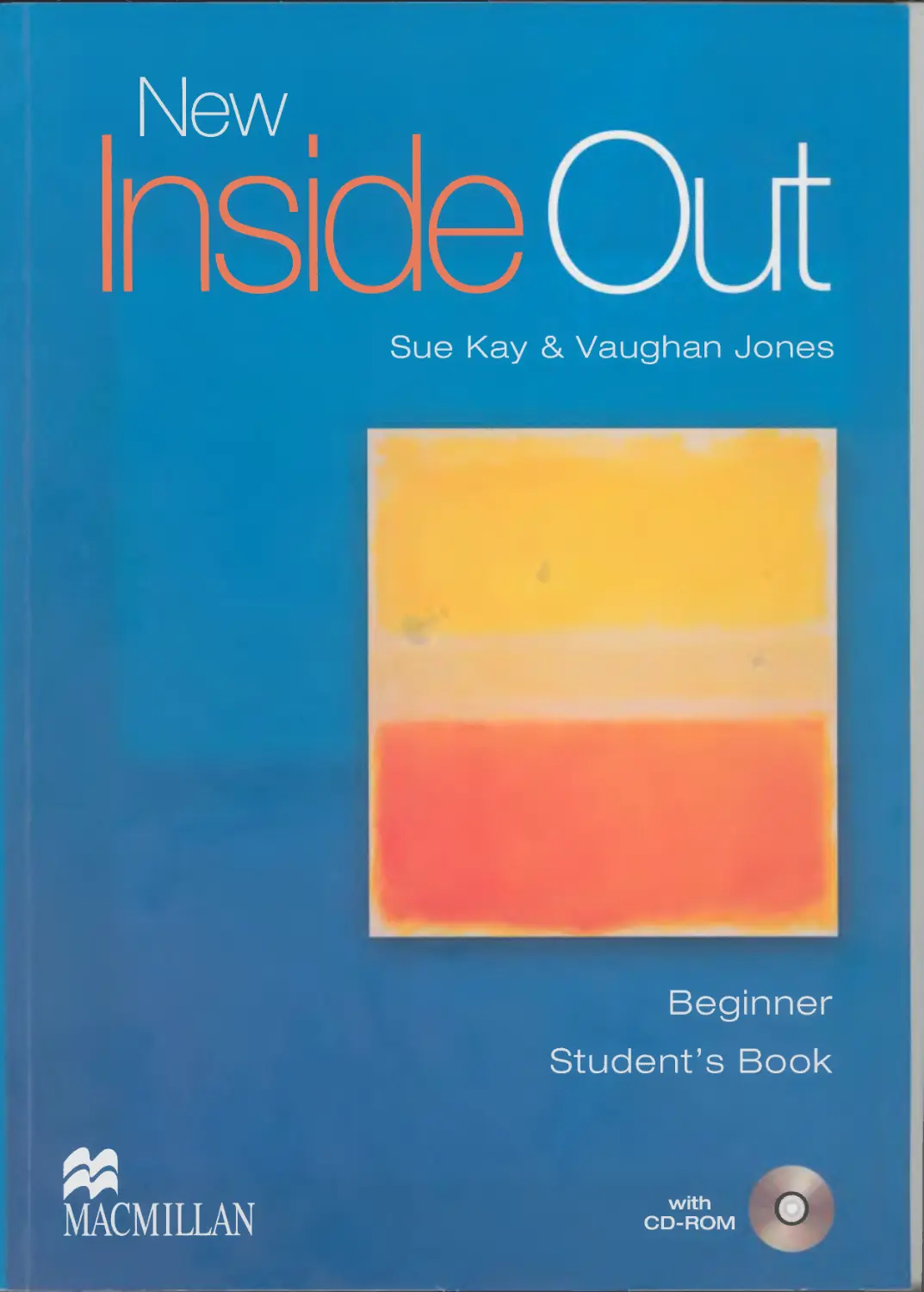
                    New
Inside Out
Sue Kay & Vaughan Jones

Beginner
Student’s Book
MACMILLAN
with
CD-ROM
New,
Inside Out
Sue Kay & Vaughan Jones
with Peter Maggs & Catherine Smith
Beginner
Student’s Book
MACMILLAN
Units & topics Speaking & Qriting	Qeading & Listening texts Grammar, Oocabulary & ©renunciation
page 4	0 Instructions Activities to introduce classroom language including teacher and textbook instructions
Classroom
page 6	1 ID	Exchanging names and	James Bond	© mylyourlhislher. Singular and plural
	Names & numbers	numbers	What's in your bag?	nouns, this/these
	Common objects	Identifying common objects	Useful phrases: Personal	Q Numbers 1-10. Common objects
		СЭ © Capital letters	information	© Alphabet. Vowel sounds
page 12	2 International	Saying where you are from	International pop star	© be: present simple, in/near.
	Countries	Talking about prices	Prices around the world	How much ...?
	Nationalities	СЭ © Punctuation	Useful phrases: In a shop	Q Countries. Nationalities.
	Prices	(question marks and		Numbers 11-100. Prices
		full stops); questions		© Word stress: numbers
page 18	3 Relations	Talking about your family	- • My family (1)	© How old ...? Possessive's. our/their.
	Family	© Someone in your family	My family (2)	have/has
	Introductions	© Punctuation	© Famous families	Q Family
		(apostrophes); description	Useful phrases:	© an + vowel / a + consonant
		(family)	Introductions
page 24	Review A	Pages 24, 25: Grammar / Vocabulary / Pronunciation review
Pages 26, 27: Reading & Listening. Writing (form filling) & Speaking
page 28	4 Favourites Favourites Likes & dislikes	Talking about likes and dislikes © Web profile © Personal web profile	Do you like pasta? © Profile: Nina Frank Useful phrases: Asking for clarification	© Present simple: like / don't like. Adjective + noun word order © Food. Drink. Sport. Colours. Common adjectives © Word stress: famous places
page 34	5 Life Lifestyle Work	Talking about your lifestyle Talking about a dream job СЭ © Drafting, correcting, finalising	© Your life expectancy ' What's your dream job? Useful phrases: On the phone	0 Present simple: I, you, we, they Q Common verbs. Jobs © Stress and intonation in Wh questions
page 40	6 24/7 The time Daily routine	Telling the time Talking about daily routine СЭ © Description (daily routine)	' Time zones © Judge Jules Useful phrases: Greetings	0 The time. Present simple: he, she, it Q Days. Daily routine. Verb phrases with get, go, have © 3rd person verb endings
page 46	Review В	Pages 46,47: Grammar / Vocabulary / Pronunciation review
Pages 48,49: Reading & Listening. Writing (personal profile) & Speaking
page 50	7 NYC	Talking about NYC	$ British people in NYC	0 there is / there are. some/any
	Location	Talking about places to go	© The top five things to	Q Places in a dty. Verb phrases
	City attractions	© A city	do in NYC	with go. US and UK English
		dj) © Linking sentences	Useful phrases: Asking	© Weak forms in There's a ... and
		(and and but); description	about location	There are...
		(city)
page 56	8 Houses	Talking about a home	© Paul McCartney -	0 Object pronouns
	Homes	Giving opinions	the early years	© Rooms and furniture.
	Opinions	СЭ © Punctuation	20 Forthlin Road	Ordinal numbers
		(commas); description	© Places we love and hate	© th sounds
		(house)	Useful phrases: Offering a
drink
। <ШЭ = Workbook. Each unit of the Workbook contains a one-page section which develops practical writing skills.
Units & topics
Speaking & ©riting
©eading & Listening texts Grammar, Oocabulary & pronunciation
page 62
9 Diet	Talking about eating and	© The 3-hour diet	© How often ...? Adverbs of frequency
Diet	drinking habits	© My life in Thailand	0 Food. Drink. Time expressions
Food & drink	Talking about international	Useful phrases: In a cafe	© hl and /i:/ sounds
Cafes	food
	СЭ © Linking sentences (and and or); description
	(meals)
page 68
Review C	Pages 68, 69: Grammar I Pronunciation I Vocabulary review
Pages 70, 71: Reading & Listening. Writing (description of a home) & Speaking
page 72	10 Clothes Clothes Shopping	Talking about clothes Talking about current activities d) © Postcard 	r	• The catwalk Three conversations © Special days Useful phrases: In a clothes shop	© Present continuous 0 Clothes. Verb phrases © ing forms
page 78	11 Events Important events Live8	Talking about important events in your country Talking about Live 8 © Description (event)	World events © Live 8 Useful phrases: Buying tickets	© be: past simple 0 Months. Years. Dates. Adjectives © Word stress: adjectives
page 84	12 Hero Sports \ y'''	Heroes -	Talking about sports and sporting heroes dJ © Life history	© Lance Armstrong • ‘ Heroes in history Useful phrases: Special occasions	© Past simple: affirmative forms. Regular and irregular verbs 0 Sports © Past simple ed endings
page 90 Review D	Pages 90, 91: Grammar / Vocabulary / Pronunciation review
Pages 92, 93: Reading & Listening. Writing (description of a person) & Speaking
page 94	13 Travel	Talking about ways to travel	© The long way round	©	Past simple: negative and question
	Transport	Talking about journeys	 ' My best holiday		forms. Wh questions
	Journeys	Talking about your best	Useful phrases: At a	0	Travel phrases. Time expressions, ago.
	Holidays	holiday	railway station		Holidays
		© Journey dJ © Sequencing; description (trip)		О	Vowel sounds
page 100	14 Circus	Talking about circuses	© Gifford's Circus	©	can and can't for ability.
	Abilities	Talking about ability and	' What's the matter?		How many ...I
	Illness	talent	Useful phrases: Talking	0	Parts of the body. Illness
i \г		© Class talents © Online CV	about illness	о	can and can't
page 106	15 Future	Talking about future plans	© Ten things to do before	©	would like to. Future: (be) going to
	The future	and intentions	you die	0	Time expressions: next
	Lotteries	© Email (future	© Do you know your	о	Word and sentence stress
		plans)	future? A lottery win Useful phrases: Saying goodbye
page 112 Review E
Pages 112,113: Grammar / Vocabulary / Pronunciation review
Pages 114,115: Reading & Listening. Writing (holiday email) & Speaking
Pairwork: Student A page 116 • Pairwork: Student В page 121 • Grammar Extra page 126 • Recordings page 136 •
Phonetic symbols page 143 • Irregular verbs page 143
Instructions
1 * 1.01 Listen and repeat the instructions.
2	1.02 Listen and repeat the instructions.
a) Look at the photos.	b) Listen and repeat.	c) Practise the conversation.
d) Read the text.
e) Compare your sentences.
f) Check your answers.
3
I 1.03 Read and listen to the instructions.
a)	Complete.
b)	^Circle).
c)	Underline.
d)	Tick (»/)
e)	Cross out.
f)	Match.
Hello. My name's Mario.
Hello. My name's (Mario).
Hello. My name's Mario.
i О гП зй 4 О
Hello. Му name's Mario.
1 France
2 Brazil
3 Japan
4 Follow the instructions.
1	Complete the sentence.
2	(Circle) the name.
3	Underline Hello.
4	Tick (/) the correct box.
5	Cross out the incorrect word.
6	Match the numbers.
Hello. My name's
Hello. My name's Tina.
Hello. My name's Karl.
I'm a man (cD-
I'm a woman
Inglish English.
Instructions
1
Grammar my/your/his/her. Singular and plural nouns, this/these
Vocabulary Names. Numbers 1-10. Common objects
Useful phrases Personal information
Grammar
Possessive
determiners
my name
your name
be: contractions
I'm = I am
My name's = My name is
What's = What is
i €> 1.04 Listen and complete.
'What's your name?'
'My name's Bond ...Bond.'
2 •? 1.05 Listen and complete with
my or your.
'Hello. I'm Jinx. What's name?'
'name's Bond ... James Bond.'
'Nice to meet you, James.'
Practise the conversation with a partner.
Pierce Brosnan and Halle Berry in Die Another Day - 2004
Speaking
Speak to other students. Practise the conversation with your names.

Grammar
Pierce Brosnan and Teri Hatcher in Tomorrow Never Dies - 1997
Possessive
determiners
his name
her name
1	1.06 Listen and complete with his (CT) or her (Q).
a)	'What's name?''name's Pierce Brosnan.'
b)	'What's name?''name's Teri Hatcher.'
2 Ask questions about students in your class.
Г What's his name?
name?
Numbers
0 = zero I oh
1	= one
2	= two
3	= three
4	= four
5	= five
6	= six
7	= seven
8	= eight
9	= nine
10	= ten
007 = double oh, seven
Vocabulary
1 $11.07 Listen and repeat the numbers.
2 Complete the lists.
a)	one	two	three
b)	five	four
c)	two	four
d)	one	three	five
* 1.08 Listen, check and repeat.
3 & 1.09 Listen and write the phone numbers.
a)	'What's your home (fr'l) number?' '020
b)	'What's your mobile (^) number?''
Speaking
Names
first name = James
surname = Bond
Ask two students. Complete the information.
What's your
first name?
What's your
surname?
FIRST NAME ______________________________________
SURNAME _________________________________________
HOME _________________________________________
MOBILE _______________________________________
FIRST NAME ______________________________________
SURNAME _________________________________________
tS HOME _________________________________________
® MOBILE ________________________________________
Vocabulary
1 ij* 1.10 Listen and repeat the words.
1 a bag
2 a computer
3 books
4 pens
5 keys
6 a mobile phone
7 a passport
8 a camera
2 Cover the words. Say a number. Your partner says the word.
Grammar
Nouns; this/these 1
Look at the photo above. Underline the correct answer.
Singular
What's this?
It's a pen.
Plural
What are these?
They're pens. Sr Sr Sr
It's = It is
They're = They are
1	'What's this?'
2	'What's this?'
3	'What are these?'
4	'What are these?'
5	'What are these?'
6	'What's this?'
7	'What's this?'
8	'What's this?'
'It's a bag. / They're bags.'
'It's a computer. / They're computers.'
'It's a book. I They're books.'
'It's a pen. / They're pens.'
'It's a key. / They're keys.'
'It's a mobile phone. / They're mobile phones.'
'It's a passport. / They're passports.'
'It's a camera. / They're cameras.'
st 1.11 Listen, check and repeat.
2
Grammar Extra
page 126. Read the explanation and do the exercises.
8
I T
1
ID
Listening
1 4* 1.12 Listen to the conversation. Tick (/) the things in her bag. Tick (/) the things
in his bag.
Her bag	Things	His bag
у	a computer	—
	a camera
	books
—	a mobile phone	—
—	a passport	—
2 What isn't in his bag?
Pronunciation
1
Й 1.13 Listen and repeat the letters.
The alphabet
AB	C D	E F	G
HI	J К	LMNO	P
QR	S	T u	V
W	X	Y	z
2
1.14 Listen and complete with the letters in the box.
A
I О U
1	/vj BCDEGPTV
2	/е/ F L M N S X Z
3	/ет/ _ H J К
4	/и:/ Q _ W
5	/ai/ 	 Y
6	/эи/ _
7	/a:/ R
Repeat the letters.
3
£ 1.15 Listen and number (1-6) the abbreviations as you hear them.
Repeat the abbreviations.
1
9
Useful phrases
1 S 1.16 Read, listen and complete the conversation.
Receptionist: Welcome to The London English School.
What's your name?
Student:	Tusanee.
Receptionist:	Can you spell that, please?
Student:	T-U-S-A-N-E-E.
Receptionist:	And your surname?
Student:	(1) R-0-0.
Receptionist:	Sorry, can you	repeat that, please?
Student:	(2).
Receptionist: Thank you. Miss (3).
Student:	Please call me	Nut.
Receptionist:	OK. Thank you. Nut.
Listen and check.
2 Si.17 Listen and repeat the useful phrases.
a)	Can you spell that, please?
b)	Sorry, can you repeat that, please?
c)	Please call me Nut.
3 Work with a partner. Write a new conversation about one of these students.
Practise the conversation.
Student A: page 116 Student B: page 121
ID
10
Vocabulary Extra
Everyday objects
i
Match the pictures with the words.
Гб
a bag
a book
a camera
a computer
a dictionary
a key
a mobile phone
a passport
a pen
2 Work with a partner. Cover the words.
Look at the pictures. Ask and answer
questions.
Numbers
1 Match the numbers (1-10) with the words
in the box.
eight five four nine еле
seven six ten three two
1	one	6
2		7
3		8
4		9
5		10
2 Dictate three numbers to your partner.
•four £ix ±е.л
Check your partner's numbers.
ID
I T
1
11
International
Grammar be: present simple. Prepositions: in/near. How much ...?
Vocabulary Countries. Nationalities. Numbers 11-100. Prices
Useful phrases In a shop.
Vocabulary
i 1.18 Listen to the introductions in International Pop Star and complete the table.
И Cristina and Julio
Brazil Germany Italy Japan Poland Spain
□ □ □	□ □	□ □	□
1 Italy 2	3	4	6
		5

2 Й 1.19 Listen and repeat the countries.
What's the name of your country in English?
Grammar
be
I'm	I am
You're	You are
He's	He is
She's	She is
It's	It is
We're	We are
They're	They are
1 Complete the questions and answers with I, you, he, she, we or they.
a) 'Is Anna from Germany?'	'Yes, she is.'	'No, she isn't.'
b) 'Is Rosa from Japan?'	'Yes,	is.'	'No,		_ isn't.'
c) 'Is Daniel from Poland?'	'Yes,	is.'	'No,		_ isn't.'
d) 'Are Roberto and Donna from Brazil?' 'Yes,	are.'	'No,	aren't.'
e) 'Are you from Spain?'	'Yes,	am.'	'No,		_'m not.'
f) 'Are you and your teacher from Italy?' 'Yes,	are.'	'No,		_ aren't.'
* 1.20 Listen, check and repeat.
Is Ken from Poland?
Yes, he is.
No, he isn't.
(isn't = is not)
2 Work with a partner. Ask and answer the questions in Exercise 1.
Student A: page 116 Student B: page 121
Pairwork
4
Grammar Extra
page 126. Read the explanation and do the exercises.
I T
2
International
Grammar
Prepositions
in
near
Practise the questions and answers.
2 Complete the sentence.
I'm from. It's (near) in
Speaking
1 Ask three students.
2 Ask questions about students in your class.
International
13
Look at the photos. Underline the correct description.
Vocabulary (1)
1.22 Listen and repeat the nationalities.
d) They're Italian / Spanish.
e) They're American / Japanese.
f) They're German / Italian.

a) She's Spanish / Brazilian,
b) It's German / Polish.
c) He's American / British.
I®* 1.23 Listen, check and repeat.
Vocabulary (2)
Numbers	1	1.24 Listen and repeat the numbers.
11 = eleven 12 = twelve	2	Say the numbers 1-20 with a partner.
13 = thirteen 14 = fourteen	3	Complete each line.
15 = fifteen		a) 21 =	twenty-one 22 = twenty-two 23 = twenty-three
16 = sixteen 17 = seventeen 18 = eighteen 19 = nineteen		b) 34 =	thirty-four 35 = thirty-five 36 =
		c) 47 = d) 111 =	forty-seven 48 = forty-eight 49 =	 one hundred and eleven 112 = one hundred and twelve		113 =
20 = twenty		Й 1.25 Listen and check.
30 = thirty 40 = forty	4	1.26 Listen and join the numbers.
50 = fifty		a)	b)	с)
60 = sixty		о 13	p 30 О 74	о 15 О 24 о 119	О 18	о 17	о 29
70 = seventy 80 = eighty		о 59	<	>66 о 81	о 50 о 83 о 190	о 70	о 80	о 38
90 = ninety		о 98	!> 14 о 40	о 99 о 199 о 7	о 79	о 116	о 160
100 = one hundred		What's the mystery number?
	5	Say a number from 1-199. Your partner says the next three numbers.
14
Pronunciation
1	Match the words with the signs.
a)	euros	£
b)	dollars	€
c)	pounds	$
til 1.27 Listen and repeat the words.
2	Ф 1.28 Circle the price you hear.
a)	($350) $3.15
b)	£5.30 £5.13
c)	€17.75 €70.75
d)	$90.99 $19.99
e)	€18.20 €80.20
f)	€40.40 €14.40
g)	£160.00 £116.00
Listen again and repeat the prices.
Listening
1 W 1.29 Listen and complete the table with the missing prices.

		a cappuccino	a hamburger	a cinema ticket	a night in a 3-star hotel
1	New York	a) $3.00	$3.00	$9.00	$200.00
2	Moscow	$2.50	b)		$5.00	$90.00
3	Rome	$1.25	$3.75	$8.85	$100.00
4	London	$3.40	$3.60	c)		$129.00
5 6	Tokyo	$3.20	$2.50	$16.50	d)
(The prices are in US dollars.)
2 Work with a partner. Complete row 6 in the table with the prices in your city.
Grammar
How much ...?
How much is a cappuccino
in Moscow?
1	Put the words in the correct order.
a)	in Rome? / is / a cappuccino / How much How much is a cappuccino in Rome?
b)	How much / in London? I a hamburger / is
c)	is / a cinema ticket / How much I in Tokyo?
d)	a 3-star hotel / in Moscow? / is / How much
© 1.30 Listen, check and repeat the questions.
2	Work with a partner. Ask and answer the questions in Exercise 1.
3 Look at the table in Listening Exercise 1 and ask your partner more questions.
International
15
Useful phrases
Complete the conversations with the words in the box.
are is these this
'How much is
'Twelve dollars fifty.'
'OK, thanks'
'How much are
'Nine euros'
'OK, thanks'
'How much this?'
'Six euros twenty.'
'OK, thanks.'
'How much these?'
'One hundred and seventy-five euros.'
'Oh! OK, no thanks.'
1.31 Listen and check.
2	* 1.32 Listen and repeat the useful phrases.
a)	How much is this?
b)	How much are these?
3	Work with a partner. Practise the conversations.
16
International
Vocabulary Extra
Countries and nationalities
Look at the photos. For each photo write
a) the country and b) the nationality.
Use the words in the box.
American Spain
Japanese Brazil
the UK the USA
Polioh Italy
Italian Poland
Japan German
Brazilian Germany
British Spanish
Warsaw
Numbers
a) Poland
b) Polish
1 Match the numbers with the words in the box.
eighteen eighty	eleven fifteen
fifty forty fourteen nineteen
ninety one hundred seventeen
seventy	sixteen	sixty	thirteen
thirty	twelve twenty
11	eleven
12
13	_______
14
15
16
17
18
19
20
30 _________
40 _________
50 _________
60 _________
70 ________
80 ________
90 ________
100 _________
2 Dictate three numbers to your partner.
Madrid
a) _____
b) _____
New York
a) ______
b) ______
л1л£±е.£л •f'i-F'ty ол£ I'UArdre.d
Check your partner's numbers.
International
I T
2
17
Relations
Grammar How old ...? Possessive's. our/their. have/has
Vocabulary Family
Useful phrases Introductions
Listening
My rftivirv- My <\cuk-
Helen	William
Wybrotkti". Me,.	S’iSker. СгГ<лП.А.|Т1(Л. Огс<1\<кргу,. My <Ko'3 •
Sam	Luisa	Emma	Hannah	Tom	Max
1.33 Listen to Luisa and match the family words with the names.
1	mother (mum)		Emma
2	father (dad)	x.	Tom
3	brother	^X	William
4	sister	Hannah
5	grandmother (grandma)	’ Helen
6	grandfather (grandpa)	Sam
2 0 1.34 Listen and repeat the family words.
▲ Luisa
3 Complete the family tree.
Luisa's family	cf a) Tom (70) = 9 b)
Key = married to	Cf c) 	(43) = 9 d) Helen (43)
Cf male	1 	     1
9 female	O" e) 	(12) 9 0 Luisa (6)	9g) 	(1)
Grammar
How old...?	1	1.35 Listen to Luisa and complete the questions and answers.
How old are you?	a) 'How old are you?'		'I'm six.'
I'm 24.	b) 'How old is	your brother?'	'He's twelve.'
	c) 'How old _		your sister?'	'	one.'
	d) 'How old _		your mother and father?'	'	forty-three.'
	e) 'How old _		your grandmother?'	'	sixty-eight.'
	f) 'How old _		your grandfather?'	'	seventy.'
2 Work with a partner. Ask and answer the questions in Exercise 1.
18
I T
3
Relations
Grammar
Possessive's I s'
My brother's name is Sam.
(brother's is singular)
My sisters' names are Luisa
and Emma.
(sisters' is plural)
1	Complete the sentences.
a)	Helen is Luisa's mother.
b)	Sam is Luisa's.
c)	Tom is Luisa's.
d)	Emma is Luisa's.
e)	William is Luisa's
f)	Hannah is Luisa's
1.36 Listen, check and repeat.
2	Match the descriptions (a-c) with the names, Emma, Helen and Sam.
a)	His father's name is William, and his sisters' names are Luisa and Emma. Who is he?
b)	Her brother's name is Sam, and her sister's name is Luisa. Who is she?
c)	Her father's name is Tom, and her mother's name is Hannah. Who is she?
Listening
Helen and William
Hannah and Tom
Sam, Luisa and Emma
2 Listen again. Underline the correct word.
a)	Hannah is Tom's husband / wife.
b)	Helen is Tom's son / daughter.
c)	Sam is Tom's grandson / granddaughter.
Vocabulary
i & 1.38 Listen and repeat the family words.
Family
mother	daughter	grandmother	granddaughter	sister	wife
father	son	grandfather	grandson	brother	husband
parents	children	grandparents	grandchildren
2 Write six more sentences about Tom and Luisa's family relations.
9
d"
9 + cf
I Том НалааЬ^ 1мл$ЬалВ.
2 Не1ел aaJ V/illiAM Are LiAi$A£ рАгел±£.
3 Who are you? Write six sentences.
I 1м O|^a£ $ол.
2 1м NaLa^Iia^ broTher.
3 I'm
4 •••
Compare with a partner.
Pairw
Student A: page 116 Student B: page 121
biMihri $ ^галВ^ол.
Relations
i т 3
19
Reading
1 Н 1.39 Read and match the texts (a and b) with
the photos (1 and 2).
a)	This is John Travolta's house in Florida, USA.
He has six cars and two planes. John's wife,
Kelly Preston, is an actor, and they have two
children. Their son's name is Jett, and their
daughter's name is Ella Bleu.
b)	Blythe Danner is an American actor. She has
two children and they're also actors. Her
daughter is Gwyneth Paltrow, and her son is
Jake Paltrow. She has a granddaughter and a
grandson. Their names are Apple Blythe Alison
Martin and Moses Martin.
2 Who says it? Match the sentences (а-d) with the correct names (1—4).
a)	'My mother is an actor. Her name is Blythe Danner.'
b)	'My children are actors. Their names are Gwyneth and Jake.'
c)	'Our son's name is Jett and our daughter's name is Ella Bleu.'
d)	'We live in Florida. Our dad has six cars and two planes.'
1	Jett and Ella Bleu Travolta
2	Gwyneth Paltrow
3	Blythe Danner
4	John Travolta and Kelly Preston
Grammar
Possessive
determiners
I my mother
you your father
he -> his sister
she -> her brother
we -> our children
they their parents
1 Complete the sentences with my, his, her, our or their.
a)	John Travolta and his wife are American.
b)	Blythe Danner and children are actors.
c)	Jake Paltrow and sister are actors.
d)	John Travolta, Kelly Preston and two children live in Florida.
e)	Jett Travolta says,'sister and I are American.parents are from the US;
H 1.40 Listen, check and repeat.
2
Grammar Extra
page 126. Read the explanation and do the exercises.
20
Relations
Grammar
have
I have
You have
He has
She has
It has
We have
They have
i
Underline the correct form.
a)	I has I have one sister and
one brother.
b)	My parents has / have
a dog.
c)	My mother has I have
three brothers.
d)	My grandparents has I have
two houses.
e)	My husband and I has / have
two children.
f)	My father has I have
a Japanese car.
r *1 1.41 Listen, check and repeat.
2 Which sentences are true for you?
Pronunciation
1	1.42 Listen and repeat.
a)	He's a teacher. She's an^ actor.
b)	He has a radio. She has an^iPod.
c)	He has a Fiat. She has an Alfa Romeo.
2 Complete the table with the nouns in the box.
Audi brother dog English dictionary Ericsson mobile phone
Gucci bag IBM computer Italian grandmother passport sister
an + vowel sound	a + consonant sound
an Audi	a brother
* 1.43 Listen, check and repeat.
3 Tell your partner about things you have. Use a or an.
Writing
1 Write a paragraph about someone in your family.
Lourdes И му ^rAndMo±her. му
Mo±he.r ^ Mother. seventy-three.
-Fcom Ve^A de. Pas пелг ^AntAnder
in .£pAii\. _£he Ьа£ -Four children And Seven
<jrAndchildren.
Her huSbAndS плме is JuAn.
2 Compare with a partner.
Relations
Useful phrases
1 A* 1.44 Read and listen to the conversations. Answer the questions.
a)	Who's Ann's brother?
b)	Who's Becky's husband?
Tim
Tim:	This is Ann. She's my sister.
Gerry: Nice to meet you. I'm Gerry.
Ann: Nice to meet you.
Rob: This is Julia. She's Brazilian.
Becky: Nice to meet you. I'm Rob's wife.
Julia: Nice to meet you.
2 •-? 1.45 Listen and repeat the useful phrases.
a)	This is Ann.
b)	Nice to meet you.
c)	I'm Gerry.
3 Complete the conversation with the words in the box.
'm meet Nice Thio to you
Ann: (1) This is Tim.
Julia: (2)to (3)you. I (4)Julia.
Tim: Nice (5)meet (6).
*  1.46 Listen and check.
4 Work in groups of three. Rewrite the conversation with your names.
Practise the conversation.
22
Relations
Vocabulary Extra
Family
1 Complete the sentences with the
words in the box.
brother granddaughter
grandfather husband
mother parents
I________________________
2	Look at the family tree and
answer the questions.
a)	Who is Delia's father?
b)	Who is Fran's daughter?
c)	Who is Charlie's wife?
d)	Who is Fran's grandson?
e)	Who are Ed's grandparents?
f)	Who is Gary7 s grandmother?
3	Write sentences about your family.
Greta is my wife. Rosa is my ...
Alice is Bill's wife.
Bill is Alice's husband.
Alice is Delia's grandmother.
Delia is Alice's.
Ed is Fran's son.
Fran is Ed's
Charlie is Alice and Bill's son.
Alice and Bill are Charlie's
Delia is Ed's sister.
Ed is Delia's
Gary is Charlie's grandson.
Charlie is Gary's.
Family tree
Alice = Bill
Charlie = Fran
F	I
Delia	Ed
Gary
Relations
23
Review A
Grammar
Choose a word in the box to describe each object in
Exercise 2.
Grammar
pages 126 and 127
1 Put the words in the correct order.
a)	your / What's / name / mother's ?
Whnt's your mother's name ?
b)	is / How I she I old ?
c)	is / Where / she / from ?
d)	her / What's / nationality ?
e)	number I What's I phone / her ?
f)	is / Where / now / she ?
Answer the questions. Write sentences.
a) My mother's name is Ana.
2 Write questions and answers.
a)	What's this? It's a car.
b)	What are these? ...
American English German Japanese Polish
a) It’s German.
Complete the sentences with my, your, his, her, our
or their.
William Harry Anne Andrew Edward
Elizabeth Philip Charles Camilla
a)	My name's Charles. This, is my family
b)	We're English.surname's Windsor.
c)	This is my wife.name's Camilla.
d)	These are my sons.names are William
and Harry.
e)	This is my father.name's Philip.
f)	You're an English student. What's name?
5 Complete the sentences about Prince Charles.
a)	His wife's name	is Camilla.
b)	His name	is Elizabeth.
c)	His name	is Philip.
d)	His names are William and Harry.
e)	His name	is Anne.
f)	His names are Andrew and Edward.
6 Spot the mistake! Cross out the incorrect sentence
a or b.
1 а) Му-ноше Tom-.-
b) My name's Tom.
2	a) What is?
b) What's this?
3	a) Where Mario from?
b) Where's Mario from?
4	a) They're from Spain.
b) They're from in Spain.
5	a) I'm twenty.
b) I have twenty years.
6	a) She has two children.
b) She have two children.
24

Vocabulary
1 Complete the instructions with the verbs in the box.
Ask Listen Look Match Practise Work
a)	Listen and repeat.
b)	the conversation.
c)	your partner.
d)	at the photos.
e)	the pictures with the words.
f)	with a partner.
5 Complete the word puzzle.
1	son and ...
2	mother and ...
3	father and ...
4	wife and ...
5	husband and ...
6	grandfather and ...
7	brother and ...
8	sister and ...
9	daughter and ...
10	granddaughter and ...
3	Complete the sentences.
a)	Rome is the capital of Italy.
b)	Tokyo is the capital of.
c)	Madrid is the capital of
d)	Warsaw is the capital of
e)	Brasilia is the capital of.
f)	Berlin is the capital of.
4	Write the prices.
a)	$12.55 Twelve dollars fifty-five
b)	£24.99	_____________
c)	€15.75	*
d)	€37.80	**
e)	$69.19	•	_ _
f)	$149.50	—
What's the name of the famous family?
Pronunciation
1	Look at some words from Units 1-3. Say the words
and add them to the table.
adjective computer description
Germany granddaughter Japanese
possessive relation seventeen singular
A: □ □ □	B: □ □ □	C: □ □ □
adjective	computer	Japanese
2	Underline the stressed syllable in each word.
” 1.47 Listen, check and repeat.
25
Reading & Listening
1	Read the information about Blossoms Hotel. Are the sentences true or false?
a)	Blossoms Hotel is in London.
b)	It's near the train station.
c)	It has nineteen rooms.
d)	A room for one night is 85 euros.
e)	The hotel has a fish restaurant.
SITUATED IN THE HISTORIC
Blossoms
Station
Near train station, museums, galleries
and shops
Nine rooms
Price: one night = £85
Fish restaurant
WELCOME TO
BLOSSOMS HOTEL
Station Street
Bath BAi 1EF
telephone +44(0)1225 420 350
www.blossomshotelbath.co.uk
2	0 1.48 Listen to the conversation. Underline the
correct information.
a)	The man books: (1) one night (2) two nights
(3) three nights.
b)	He's: (1) German (2) American (3) English.
c)	His room number is: (1) 101 (2) 102 (3) 103.
3	Listen again and complete the information on
the form.
BLOSSOMS
HOTEL
FIRST NAME:	A _ n _ 1 _
SURNAME:	S_hwa_ze_e_g_r
NATIONALITY:	—
CITY:	Los Angeles
COUNTRY:	USA
PHONE NUMBER:	001-31 _ -8 _ 3-4 _ 9
PASSPORT number:	489-	-2340
26
w A
Writing & Speaking
1 Complete the rules for capital letters. Use examples
from the Blossoms Hotel form below.
You use capital letters for ...
a)	first names: Susan
b)	surnames:
c)	nationalities:
d)	street names:
e)	cities:
f)	countries:
FIRST NAME:	Susan
SURNAME:	Barclay
NATIONALITY:	British
ADDRESS:	14 Wellington Street
CITY:	Glasgow
country:	Scotland
PHONE NUMBER:	0141-333-622
EMAIL ADDRESS:	susan@barclay.co.uk
PASSPORT NUMBER:	307612377
DATE:	30/06/07
signature:
2 Match the questions (a-g) with the information
(1-7) in the form below.
a)	What's your nationality? 3
b)	What's your surname?
c)	What's your phone number?
d)	What's your address?
e)	What's your email address?
f)	What's your first name?
g)	What's your passport number?
1 FIRST NAME:
2 SURNAME:
3 NATIONALITY:
4 ADDRESS:
CITY:
COUNTRY:
5 PHONE NUMBER:
6 EMAIL ADDRESS:
7 PASSPORT NUMBER:
DATE:
SIGNATURE:
Ask your partner the questions.
Complete the form with their information.
Favourites
Vocabulary
1 Complete the table below.
▲ coffee
▲ wine
▲ Coke
Grammar like / don't like. Adjective + noun word order
Vocabulary Food. Drink. Sport. Colours. Adjectives
Useful phrases Asking for clarification
fruit ►
▲ swimming
▲ Chinese food
** 1.49 Listen, check and repeat.
2 Say a word. Your partner says which list.
28
i т 4
Favourites
Grammar
like
I like pasta. ©
I don't like pizza. ©
(don't = do not)
Do you like pasta?
Yes, I do. ©
No, I don't. ©
1 Й 1.50 Listen and repeat the conversation.
Ann: Do you like pasta?
Beth: No, I don't.
Ann: Do you like pizza?
Beth: No, I don't.
Ann: Do you like Italian food?
Beth: No, I like Chinese food.
Ann: But this is an Italian restaurant!
Beth: Oh!
Practise with a partner.
2 Complete the questions and answers.
a) 'Do you like Italian food?'	'Yes, I do.'	'No, I don't.'
b) '	you like Chinese food?'	'Yes, I	: 'No, i
c) '	you	fish?'	'Yes, I	.' 'No, I
d) '	fruit?'	'Yes,	.' 'No,
e) '	coffee?'	'Yes,	: 'No,
f) '	Coke?'	'Yes,	.' 'No,
e 1.51 Listen, check and repeat.
3 Work with a partner. Ask and answer the questions in Exercise 2.
Ask six more questions.
Reading & Writing
i
1.52 Read the web profile.
PROFILE Nina Frank
Job: Model Nationality: South African
a) Favourite city: Cape Town
b) Favourite actor: George Clooney
c) Favourite singer: Shakira
d) Favourite sport: Swimming
e) Favourite food: Pizza
f) Favourite drink: Malibu and Coke
2	Write questions about Nina's favourite things with What or Who.
a) What's her favourite city?	b) Who's her favourite actor?
1.53 Listen, check and repeat.
3	Work with a partner. Ask and answer the questions in Exercise 2.
4	Change the questions in Exercise 2 from her to your and ask your partner.
Write a web profile for your partner.

Colours
black
white
red
blue
green
yellow
grey
pink
grange
brown
Vocabulary (1)
i e 1.54 Listen and repeat the colours.
What's your favourite colour?
2 Say a number. Your partner says which colour.
3 Ask your partner 'maths' questions.
13
4	5
6	7	8
9	10
Vocabulary (2)
1 Match the descriptions (а-d) with the photos (1-4).
a)	A red bus, black taxis and expensive shops in London.
b)	A big square with old buildings in Moscow.
c)	Blue sky and beautiful people in Rio de Janeiro.
d)	Small houses. Red, orange, blue and yellow walls in Buenos Aires.
H 1.55 Listen and check.
2 Match the adjectives in A with their opposites in B.
A	В
beautiful	expensive
big	old
cheap	ugly
new	small
1.56 Listen, check and repeat.
3
Pairwork
Student A: page 117 Student B: page 122
30
Favourites
Pronunciation
1  • 1.57 Listen and repeat.
a) Venice Munich (Beijing^)
b) Rome Florence Moscow
c) Seville Berlin Warsaw
d) Madrid London Paris
e) Russia France China
0 Cairo Tokyo Milan
2 Listen again and underline the stressed
syllable.
Circle the city or country with a different
stress in each group.
3 Ask your partner questions.
Where's Beijing?
Grammar
Adjective + noun
word order
a red bus
NOT a bus red
black taxis
NOT blacks taxis
1 Put the words in the correct order.
a)	coffee / black / like /I J like black coffee.
b)	I / French / like / films
c)	old / I / buildings I like
1.58 Listen, check and repeat.
d) expensive I like / I / shops
e) I / British I like I don't I food
f) big / like / I / cities / don't
2 Make the sentences true for you.
I don't like black coffee. OR I like white coffee.
3 Combine adjectives and nouns. Write two lists.
Adjectives
American beautiful big black cheap expensive French new old red
Nouns
buildings cars cities coffee films food music restaurants shops wine
I like ...
expensive restaurants
old buildings
I don't like ...
American cars
French music
4
Grammar Extra
paje 128. Read the explanation and do the exercises.
Speaking
Ask your partner questions.
Favourites
i т 4
31
Useful phrases
1 Л 1.59 Read, listen and complete the conversation with help, speak or understand.
3
Complete the conversation.
ooaa»aobll?S
pizza.
Desserts
applet®
ice creara
iych®eS
Waiter:	Can I (1)________you?	I
Customer: Yes, please. What is 'cod'?	\
Waiter:	It's a kind of fish.	1
Customer: I'm sorry. I don't (2)______.
Waiter:	IT'S A KIND OF FISH.
Customer: Can you (3)_________more slowly, please?
Waiter:	IT'S - A - KIND - OF - FISH.
Customer: Oh, OK. One hamburger, please.
Listen and check.
Waiter:	(1)_______I (2)_______you?
Customer: Yes, please. What are 'Lychees'?
Waiter:	They are a kind of fruit.
Customer: I'm sorry. (3)_____________________.
Waiter:	THEY'RE A KIND OF FRUIT.
Customer:	(4)_______you (5)________more slowly, please?
Waiter:	THEY'RE - A - KIND - OF - FRUIT.
Customer: Oh, OK. Ice cream, please.
1.60 Listen, check and repeat.
И 1.61 Listen and repeat the useful phrases.
a)	Can I help you?
b)	What are 'lychees'?
c)	I'm sorry, I don't understand.
d)	Can you speak more slowly, please?
Work with a partner. Practise the conversations.
32	Favourites
Vocabulary Extra
Food and drink
1 Match the pictures with the
words.
coffee
pizza
wine
2 Work with a partner. Cover the
words. Look at the pictures. Ask
and answer questions.
What's this?
It's meat.
Colours
Match the colours with the words.
1	black	О orange
1—	blue	О pink
—	brown	О red
1		green	О white
1	1 L__J	grey	О yellow
Common adjectives
Match the pictures with the words.
6 beautiful
J big
__ cheap
~1
_ expensive
small
U ugly
Favourites
Life
Grammar Present simple: I, you, we, they
Vocabulary Common verbs. Jobs
Useful phrases On the phone
Reading
1 Read and complete the questionnaire.
Your life
expectancy
Tick a or b.
1 You are:
a) male Cf О
b) female 9 О
2 You live in a big city (3 million people +):
a) Yes О
b) No О
3 You have old people in your family (75+):
a) Yes О
b) No □
4 You like your job:
a) Yes О
b) No О
5 You work:
a) inside О
b) outside
6 You eat healthy food:
a) Yes □ b) No □
7 You sleep 6-8 hours:
a) Yes О
b) No □
8 You smoke:
a) Yes О
b) No О
How to score
1:	a)	2	b)	4
2:	a)	2	b)	4
3:	a)	6	b)	2
4:	a)	8	b)	2
5:
6:
7:
8:
a) 1 b) 2
a) 6 b) 2
a) 4 b) 2
a) 0 b) 8
Your score results
30 to 42: Your life expectancy is 100.
20 to 29: Your life expectancy is 75.
10 to 19: Change your life!
2 Compare your score and your answers with a partner.
34
1T 5
Life
Vocabulary
1 Complete the sentences with eat, have, like, live, speak or work.
	in an old house.	swimming.
a)	I live	with my parents.	d) I	 jazz.

	one brother.	English.
b)	I	 an old car.	e) I	 Japanese.

	in an office.	meat.
c)	I	 for IBM.	f) I	 fish.
$1.62	Listen, check and repeat.
2 Make more sentences. Use the phrases in the box.
healthy food in a new apartment my job outside Spanish two children
3 Write six sentences about you. Use the verbs in Exercise 1.
I live ir< a bi/j АрАГ-Ьиал-t. I liAva -three childrers. I work. ...
Grammar
Present simple:
I, you, we, they
i
You speak English.
We don't speak French.
They
Do you speak Chinese?
Yes, I do.
№, I don't.
1 Complete the answers.
a) 'Do you speak Chinese?'	'Yes, I do.'	'No, I don't.’
b) 'Do you smoke?'	'Yes, I do.'	'No, I	.'
c) 'Do you and your family live in a city?' 'Yes, we do.'	'No, we	.'
d) 'Do your friends like football?'	'Yes, they		_ .' 'No, they don't'
e) 'Do you eat meat?'	'Yes,	.'	'No,	:
f) 'Do your parents have a dog?'	'Yes,	.'	'No,	:
1.63 Listen, check and repeat.
2 Work with a partner. Ask and answer the questions in Exercise 1.
3 Put the words in the correct order.
a)	live I you I Where / do ? Where do you live?
b)	Where I you / do / work ?
c)	languages I you I speak I What / do ?
d)	like I What / food / you / do ?
e)	you I music I What I like / do ?
f)	sports / do / What / like / you ?
О 1.64 Listen, check and repeat.
4 Work with a partner. Ask and answer the questions in Exercise 3.
Grammar Extra
page 128. Read the explanation and do the exercises.
Life
I T
5
35
И 1.65 Listen, check and repeat.
2	* 1.66 Listen and repeat more sentences about jobs.
a) 'I'm a flight attendant.'
c) 'I'm a secretary.'
d) 'I'm a farmer.'
b) 'I'm a doctor.'
e) 'I'm a shop assistant.'
3
Who says it? Match the sentences with the jobs in Exercise 2.
a)	'I work in a hospital.' A doctor.
b)	'I work in an office.'
с)	'I work in a shop.'
d)	'I work for British Airways,
e) 'I work for Hello magazine?
f) 'I work outside.'
1.67 Listen, check and repeat.
4	Student A: page 117 Student B: page 122
Life
Pronunciation
i $ 1.68 Listen and repeat the Wh questions. Notice the stress.
A
Where are you from?
Where do you live?
Where do you work?
What do you do?
В
What drinks do you like?
What car do you have?
What music do you like?
What sports do you like?
C
What's your favourite colour?
Who's your favourite actor?
What's your favourite city?
What's your favourite food?
2 Write two more Wh questions.
Practise the questions.
Listening
* 1.69 Listen to interviews with five people (1-5). Put the number
2 Complete the two questions from the interviews.
a)	What you?
b)	What's dream?
К 1.70 Listen, check and repeat.
Speaking
Ask questions and find out the real jobs and the dream jobs of three people in the class.
Life
37
Useful phrases
i й 1.71 Read, listen and match the conversations (a and b) to the pictures (1 and 2).
a) A: Good morning. British Airways.
B: Oh, good morning. Can I speak to Mr Jones, please?
A:	Hold on a minute, please. ... I'm sorry. Mr Jones is out.
B:	Oh, OK. Thank you. Goodbye.
b) C: Hello.
D: Hello. Can I speak to Janet, please?
C: Hold on a minute. JANET!! I'm sorry. She's out.
D: Oh, OK. Thanks. Bye.
2 И 1.72 Listen and repeat the useful phrases.
a)	Can I speak to Mr Jones, please?
b)	Hold on a minute, please.
c)	I'm sorry. He's out.
3 Work with a partner. Write a similar phone conversation for one of these situations
a)	You phone your friend Tom at his house. He's out.
b)	You phone a bank and want to speak to the manager, Mrs Brown. She's out
Practise the conversation.
38
I T
5
Life
Vocabulary Extra
Jobs
Q
1	Match the pictures with the words.
0 an actor
0 an artist
I I a doctor
0 a farmer
0 a flight attendant
0 a football player
[0] a lawyer
О a musician
0 a secretary
0 a shop assistant
О a taxi driver
□ a teacher
2	Work with a partner. Cover the
words. Look at the pictures. Ask
and answer questions.
Life
39
24/7
Grammar The time. Present simple: he, she, it
Vocabulary Days. Daily routine. Verb phrases with get, go, have
Useful phrases Greetings
Listening
i ♦* 1.73 Listen and complete the times on the map of international time zones.
a)	San Francisco 4.00 a.m. c) London	e) Hong Kong
b)	Buenos Aires	d) Moscow	f) Wellington
1.00 a.m. 2.00 a.m. 3.00 a.m. 4.00 a.m. 5.00 a.m. 6.00 a.m. 7.00 a.m. 8.00 a.m. 9.00 a.m. 10.00 a.m. 11.00 a.m. Midday 1.00 p.m. 2.00 p.m. 3.00 p.m. 4.00 p.m. 5.00 p.m. 6.00 p.m. 7.00 p.m. 8.00 p.m. 9.00 p.m. 10.00 p.m. 11.00 p.m. Midnight
2 Complete the table.
What time is it?
a)	4.00 a.m.
b)	9.00 a.m.
c)		.
d)	3.00 p.m.
e)	8.00 p.m.
f)
It's four o'clock in the morning.
-> in the morning.
It's midday.
in the afternoon.
in the evening.
-» It's midnight.
H 1.74 Listen, check and repeat.
3 H 1.75 Listen and repeat the names of the other cities on the map.
24/7
Grammar
The time
What time is it?
It's three o'clock. (J)
It's half past six. (J)
It's quarter to twelve.
Complete the times.
a)	If s two thirty.
b)	It's seven fifty.
c)
d)	It's ten fifteen.
e)	It's five-oh-five.
f)
3:30]
~i:50 ]
3:35]
< n. I c
lU.IJ
To?
83:45
It's half past two.
It's ten to eight.
It's twenty-five to four.
It's quarter to one.
1.77 Listen, check and repeat.
3 Say a time. Your partner says the same time in a different way.
4 Look at the time zones on page 40 and answer the questions.
a)	It's half past nine in the morning in Tokyo. What time is it in Venice?
b)	It's twenty to six in the evening in Brasilia. What time is it in Moscow?
c)	It's ten past two in the afternoon in Bangkok. What time is it in Johannesburg?
Ask your partner similar questions.
Days of the week
Monday	Friday
Tuesday	Saturday
Wednesday	Sunday
Thursday
Vocabulary
i e 1.78 Listen and repeat the days of the week.
2 Say a day of the week. Your partner says the next three days.
Wednesday, Thursday, Friday.
24/7
I T
6
41
Vocabulary
1 H 1.79 Listen and repeat the verb phrases.
get up have a shower go to work have lunch finish work get home have dinner go to bed
2 Ask your partner questions with What time do you ...?
Reading
1	1.80 Read an article about DJ Judge Jules. Answer the questions.
a)	Where does he work?
b)	Whaf s the name of his favourite club?
MV DAV
ON WEEKDRVS
I (1) get up early, have breakfast and take my son to school. Then I go to
the gym. After that I (2)to work in a recording studio. I finish work
at 6.00 p.m. and (3)dinner with my family. We have two young
children, Jake and Phoebe. So we (4)to bed early.
ON SATURDAYS
I (5)to bed in the afternoon and then I (6)to work
in the evening. I work all night in a club. My favourite club is
Gatecrasher in Liverpool, but I work in clubs all round the world.
Visit my website at www.judgejules.net for club dates. I work
hard, but I also (7)a good time.
ON SUNDAYS
I (8)home in the morning, (9)a shower
and (10)lunch with my family. In the afternoon
I relax. I Listen to music and play with my children.
2	Complete the text with get, go or have.
Read and check.
3	Look at these sentences about Judge Jules. Are they true or false?
a)	On weekdays he gets up early.
b)	On weekdays he takes his son to school.
c)	On weekdays he goes to bed in the afternoon.
d)	On Saturdays he finishes work at 6.00 p.m.
e)	On Saturdays he works all night.
f)	On Sundays he has lunch with his family.

Grammar
Present simple:
he, she, it
He works all night.
He doesn't work at home.
(doesn't = does not)
Does she like club music?
Yes, she does.
No, she doesn't.
1 Complete the questions and answers about Judge Jules.
a)	'Does he go to the gym on weekdays?'	'Yes, he does.'	'No, he doesn't.'
b)	'Does he have children?'	'Yes, he		.' 'No, he	.'
c)	'Does he go to bed in the evening on Saturdays?' 'Yes, he		.' 'No, he	.'
d)	'	he work in clubs all round the world?'	'		/	r
e)	'	he like his job?'	'	.'	/	r
f)	'	he get home in the evening on Sundays?' '	.'	/	f
1.81 Listen, check and repeat.
2 Work with a partner. Ask and answer the questions in Exercise 1.
Grammar Extra
3
j.age 128. Read the explanation and do the i
Pairwork
Student A: paje 117 Student B: page 122
Pronunciation
i e 1.82 Listen and repeat the verbs.
A Same number of syllables with he/she/it	В Extra syllable with he/she/it
do - does get - gets go - goes have - has	finish - finishes relax - relaxes
2	1.83 Listen, repeat and add these verbs to the table in Exercise 1.
like - likes read - reads take - takes teach - teaches watch - watches
work - works
Useful phrases
1	1.84 Read and listen to the phone conversation. Answer the questions.
a)	What time is it in New York?
b)	What time is it in Sydney?
Mr Edwards: Hello.
John:	Good morning! Is that Mr Edwards?
Mr Edwards: Who is this?
John:	It's John from New York.
Mr Edwards: What time is it in New York, John?
John:	It's 8.30 in the morning.
Mr Edwards: Oh. Do you know what time it is in Sydney, John?
John:	Er, no. What time is it in Sydney, Mr Edwards?
Mr Edwards: It's 11.30 ... p.m.
John:	Oh, good evening, Mr Edwards.
Mr Edwards: Goodnight, John.
Practise the conversation.
2 Complete with Hello or Goodbye.
Good morning. "I
Good afternoon. > = a) ______ Goodnight. = b) __________
Good evening. J
- * 1.85 Listen and repeat the useful phrases.
3 Work with a partner. Complete a similar phone conversation between Mrs Harper
Los Angeles and her secretary, Jenny, in London.
Mrs Harper: Hello.
Jenny:	Good afternoon! Is that Mrs Harper?
Mrs Harper: Who is this?
Jenny:	It's Jenny ...
Practise the conversation.
24/7
Vocabulary Extra
The day
Match the pictures with the words.
Al morning
.—I
midday
__afternoon
□ evening
l—' midnight
_ night
Daily routine
1 Match the pictures with words
U finish work
__ get home
HI getup
i_ go to bed
C go to work
Г have a shower
__ relax
j study
□ watch TV
2 When do you do these things?
Morning	get up
Afternoon
Evening
Night
45
24/7
Review В
Grammar
4 Match the times with the same meaning.
Grammar
pages 128 and 129
1 Make sentences with I like or I don't like. Use two
words in the box for each picture.
a)	It's six thirty-five.—x 1
b)	It's four ten. | 2
c) It's eleven twenty. / 3
d) It's five forty-five. / 4
e) It's four fifty. I 5
f) If s twelve fifteen. 6
big black cheap citieo coffee dogs
expensive films old pens small wine
It's quarter to six.
It's twenty past eleven
It's ten to five.
It's quarter past twelvt
If s ten past four.
It's twenty-five to seve
Compare your answers with a partner.
5 Complete the description of Aiko's day. Use the vei
in the box in the correct form.
a) I don't like big cities.
finish get		get go	g°	have	have
have		work
Aiko (i) works for an airline. She (2)up
at half past ten in the morning. She (3)a
shower at quarter to eleven. She (4)to
work at quarter past eleven.
She (5)lunch at
quarter to two. She
(6)for six more
hours. She (7)
dinner at nine o’clock
in the evening. She
(8)work at
quarter past ten. She
(9)home at half
past eleven at night.
She (10)to
bed at one o’clock
in the morning.
Tick (/) the sentences that are true for you.
2 Write a question for each sentence.
a)	Do you like big cities?
Ask and answer the questions with a partner.
3 Complete the questions with What, Where or Who.
a)	do you live?
b)	languages do you speak?
c)	do you work?
d)	food do you like?
e)	's your favourite singer?
f)	sports do you like?
Work with a partner. Ask and answer the questions.
6 Spot the mistake! Cross out the incorrect sentence
a or b.
1 a) 'Do you like pizza?' 'Yeo, I like.'
b)	'Do you like pizza?' 'Yes, I do.'
2	a) I like Spanish films.
b) 1 like films Spanish.
3	a) We no speak Chinese.
b) We don't speak Chinese.
4	a) It's fifteen past one.
b) It's quarter past one.
5	a) Does she like music?
b) Does she likes music?
6	a) My mum gets up at 6 a.m.
b) My mum get up at 6 a.m.
46
Vocabulary
4 Make the sentences true for you. Use the verbs in
the box. Add don't where necessary.
1 Underline the 'odd word out' in each group.
a) Chinese food swimming Italian food
b) tennis football meat
c) wine fish spaghetti
d) fruit Coke coffee
e) tea pizza pasta
2 Complete the descriptions with the colours in the box.
eat have like live speak work
a)	I (don't) eat meat.	d)	I	for a company. b)	I	jazz.	e)	I	with my parents. с)	I	a sister.	f)	I	Italian. Compare your answers with a partner.
blue brown green grey orange pink
red yellow
5	Complete the names of the jobs (a-fi.
a)	t a	x i d r i v e r	d)	_rt__st
b)	d___ ct_r	e)	j______rn___1_st
с)	1___wy___r	f)	fl_ght __tt___nd__nt
6	Complete the questions with the phrases in the box.
get home get up go to bed go to work
have a shower have lunch
'On weekdays ...
a) what time do you
b) what time do you
c) what time do you
?'
d)
3 Complete the crossword with the colours in Exercise 2.
what time do you
Work with a partner. Ask and answer the questions.
Pronunciation
1 Look at some words from Units 4-6. Say the words
and add them to the table.
Brazil expensive Fr-ance
musician o'clock relaxes
watches Wednesday
gets Madrid
smokes taxi
A: □	B: □□	C: □□	D: □□□
France	taxi	Brazil	expensive
2 Underline the stressed syllable in each word.
1.86 Listen, check and repeat.
47
Reading & Listening
i
e 1.87 Read the text. Underline the correct information.
a)	Dan lives in: (1) the USA (2) Britain (3) Spain.
b)	Dan has: (1) a dog (2) a house (3) a daughter.
c)	Dan works in: (1) a school (2) a hotel (3) a dub.
d)	In the afternoon Dan: (1) takes Anna to school (2) plays his guitar (3) sleeps.
e)	Dan goes to the dub after: (1) dinner (2) a shower (3) The Simpsons.
—л
5
Hi. My name's Dan. I'm a musician. I play the guitar in a big \ I
jazz dub in New York. I Live in a small apartment with my wife,
Lisa, and my daughter, Anna. Anna has a cat. Her name is Smudge.
I like cats, but I don't Like dogs.
io
15
On weekdays, we wake up early and we have breakfast. Lisa
goes to work at 7.00 a.m. She works at The Four Seasons hotel.
I take Anna to school at 8.30. After that, I go back to bed and
sleep. At 11.30 a.m. I get up, have a shower and have Lunch.
In the afternoon, I play my guitar and I Listen to music. Anna and
Lisa get home at 4.00 p.m. and we relax and watch TV. Anna Loves
The Simpsons. At 6.00 p.m. we have dinner. Then I go to the dub.
I finish work at 12.00 a.m. and go home to bed. At weekends,
I finish work at 1.00 or 2.00 a.m. and get home very Late. I work
hard but I Love my job!

1.88 Listen to the conversation. Are the sentences
true or false?
3 Listen again and complete the information
about Dan.
a)
b)
c)
d)
Paula Fox works for a music magazine.
Paula Fox is in London.
If s three o'clock in the afternoon in New York.
The Night Life is a jazz club.
e) Dan's wife is English.
f) Dan likes London.
Star
Name:
Lives:
Works:
Speaks:
Favourite musician:
Favourite colour:
Favourite city:
Dan Hovey
New York
Favourite food:
Correct the false sentences.
48
w
В
Writing & Speaking
5 Work with a partner. Ask questions with the
question forms in the box.
1 Complete the rules for and and but with the examples
in the box.
Where do you ...? Who's your ...?
What do you ...? What's your ...?
I play my guitar and I lioten to muoie.
I like cats but I don't like dogs.
I don't like classical music but I love jazz.
I don't like coffee and I don't like tea.
a)	You use and to join similar ideas. For example:
+ / + I play my guitar and 1 listen to music.
-I-
b)	You use but to join contrasting ideas. For example:
+ /- ___________
-/+ ____________
2	Underline the correct word in each sentence.
a)	I like jazz and I but I don't like rap.
b)	She has a computer and I but she has a camera.
c)	He speaks Italian and / but he speaks English.
d)	I eat fish and I but I don't eat meat.
e)	We get up and I but we have breakfast.
f)	I don't like yellow and / but I love red.
3	Join the pairs of sentences using and or but.
a)	I watch TV. I relax. I watch TV and 1 relax.
b)	I like tea. I don't like coffee.
с)	I have one sister. I have one brother.
d)	I speak English. I speak Chinese.
e)	I don't have a dog. I have a cat.
f)	I play the piano. I play the guitar.
Make the sentences true for you.
4	Complete the sentences about yourself. Use the
information about Dan Hovey's day on page 48 to
help you.
Hi. My name's. I'm a. I Live.
M r day
On weekdays, I , in the morning and I
After that, I and I.
In the evening, I and I.
At weekends, I, but I don't.
Complete the form with your partner's
information.
Star
Name:	Paula da Silva
Lives:	Rio de Janeiro
Works:	_____________________________
Speaks:	_____________________________
Favourite musician: _____________________________
Favourite city:	_____________________________
Favourite colour: _______________________________
Favourite food: _________________________________
6 Write about your partner using the information in
their Star profile in Exercise 5.
Paida da Silva lives in Rio de Janeiro. She ...
49
English
NYC
Grammar there is / there are. some/any
Vocabulary Places in a city. Verb phrases with go. US and UK
Useful phrases Asking about Location
Vocabulary
1 Match the photos with the names in the box.
1 The Chrysler Building

Brooklyn Bridge Central Park
The Chryoler Building Grand Central Station
The Metropolitan Museum Times Square
The Statue of Liberty
2
3
2.01 Listen, check and repeat.
Work with a partner. What other famous places do
you know in New York City?
© 2.02 Listen and repeat the words.
a bridge a building a lake a museum
a park a river a square a station
a statue a theatre
Find examples in the photos.
There's a bridge in
photo 6.
There's a building in
photo 1.
4
Write a list of famous places in your city or country.
a. bridge. - Il Pbrvte. Vecchio
A biAildir^ - Il Colo^e.o *
5
Say the name of a famous place on
your list. Your partner says what
it is. 4
EL Prado.
NYC
Reading
1 © 2.03 Read and listen to three British people living in NYC. Match the descriptions
(д-c) with the people (1-3).
a)	'I love New York. I live in an old apartment in the East Village, near the university.
1 work in an office near the Hudson river. My favourite place in New York is
Chinatown -1 love Chinese food, and there are some fantastic restaurants.'
b)	'I love New York and I love Manhattan. I live (1)a small apartment (2)
Washington Square Park. I'm a student but at the weekend I work (3)a sports
shop (4)the Chrysler Building. My favourite place (5)New York is the
Hudson Hotel - the cocktails are very good.'
с) '1 love New York. I live (1)an apartment (2)the centre of Greenwich
Village. I work (3)a bank (4)Grand Central Station. My favourite
place (5)New York is Central Park. I love sitting (6)the lake,
Betty
Writing
1	Look again at the sentences in Exercise 1 above. Write a similar description of where
you live and work - but don't write your name.
I love/lwte	I live, ir ...
2	Read other students' sentences. Can you identify the student?
Reading & Writing
nl«
!' •’ «* J!
Go to a show!
There are 38 theatres on
Broadway - something for everyone.
Go for a run in Central Park!
There's a 2.5 kilometre running track
around the lake.
Go out in SoHo!
There are 400 restaurants and bars.
Read the webpage and choose your top thing to do in NYC.
Q f http://www.top-five.corn/nyc
-Jj Home	Shop rjBoernwKs
'"II'X*"™» i
The
top five things to do in
Go to the top of the Empire State Building!
There's a spectacular view of Manhattan.
Go down 5th Avenue!
There are a lot of famous places to visit -
Saks, the Rockefeller Center, Tiffany's ...
Next ►
ей
2 Complete these sentences for a city in your country.
a)	Go to the top	of ... c)	Go for a run in	...	e) Go to ...
b)	Godown...	d)	Go out in...
Compare with a partner.
Grammar
there is / there are
Singular
There's a museum.
There's an old statue.
(There's = There is)
Plural
There are six cafes.
There are some nice bars.
1 Complete the information about
a)	There's a zoo.
b)	36 bridges.
c)	three restaurants.
2.04 Listen, check and repeat.
2 Write sentences about your city.
Central Park with There's or There are.
d)	six cafes.
e)	a museum.
f)	25 million visitors every year.
There’£ a bi<j church. There. Are £оме <jood re£±AurArvt£.
There‘s A bi<j рлгк ...
NYC
Pronunciation
1 Л 2.05 Listen and repeat the chants.
A There's a park. There are some trees. There are some statues. There are some people.	В There's a street. There are some cars. There are some buses. There are some people.
2 Write and practise your own chant. Start with There's a school... or
There's a restaurant... or use your own ideas.
Grammar
Is there? / Are there?
Is there a park?
Yes, there is.
No, there isn't.
Are there any bars?
Yes, there are.
No, there aren't.
1 Complete the questions and answers.
a) 'Is there a station near your house?'	'Yes, there is. ’	'No, there isn’t.'
b) 'Are there any restaurants near your house?' 'Yes, there are.'	'No, there
c) 'Is there a museum in your city?'	'Yes, there		.’ 'No, there
d) 'Is there a park near your house?'	'Yes,	.'	'No,	.'
e) '	there any hotels in your city?'	'	.'	/ /
f) '	there a church near your house?'	'	.'	/ !
2.06 Listen, check and repeat.
2 Work with a partner. Ask and answer the questions in Exercise 1.
Pairwork
Student A: page 118 Student B: page 123
4 Complete the table. Use the words in the box.
airport bars beach cinemas hospital river schools shops square
theatres
	there's ...	/7/ there are some ...	there isn't...	there aren't any ...
Near my house	a beach			schools
In my city		shops	an airport
Compare your answers with a partner.
page 130. Read the explanation and do the exercises.
Grammar Extra
Useful phrases
1 Match the American English words with the British English words.
British English: a cashpoint a chemist'о a toilet an underground station
a) = a pharmacy
a restroom
a chemist's
b)
2.07 Listen, check and repeat.
2 © 2.08 Read and listen to two British tourists in New York. What do they ask for?
Man:	Excuse me. Is (1)
a chemist's (2)here?
Woman: A chemist's?
Man:	Oh, sorry, a pharmacy.
Woman: A (3)? Er, yes -
over there.
Man:	Thanks.
Woman: (4)me. Is (5)
a toilet (6)here?
Man:	A toilet?
Woman: (7), a restroom.
Man:	A restroom?
Woman: Yes, yes, a restroom.
Man:	A restroom? (8)here? No.
Woman: Oh*
3 Complete the two conversations in Exercise 2.
Listen and check.
4 I 2.09 Listen and repeat the useful phrases.
a) Excuse me. Is there a chemist's near here?
b) Yes - over there.
5 Work with a partner. Write a similar conversation about locating a cashpoint or
an underground station.
Practise the conversation.
NYC
Extra
and country
Match the places in the
picture with the words.
14
an airport
a bar
a beach
a bridge
a church
a cinema
a museum
a park
a restaurant
a school
a square
a station
I_I a statue
D a theatre
2 Work with a partner. Cover
the words. Look at the places
in the picture. Ask and answer
questions.
NYC
Houses
Grammar Object pronouns
Vocabulary Rooms and furniture. Ordinal numbers
Useful phrases Offering a drink
Reading
»* 2.10 Listen and repeat the words in the picture.
2 0 2.11 Read and listen to a description of the house in Exercise 1.
Paul McCartney - the early years
This small house was the home of the McCartney family. Downstairs, there's a
(1), a living room, a dining room and a kitchen. (2), there are three
bedrooms. (3)is the small room above the front door. There's also a
bathroom and a (4). The Beatles wrote their first number one hit Love Me Do
in the (5). The house is a museum now, and thousands of tourists visit
each year.
Complete the text with words from Exercise 1.
56
i т 8
Houses
Listening & Vocabulary
i
2.12 Listen to a description of Paul McCartney's house. Number the rooms
in order (1-6).
a)	the living room
b)	the dining room
c)	the kitchen Ш
d) the toilet
e) the bathroom О
f) Paul's bedroom О
2 Work with a partner. How many things can you name? Use the words in the box.
an armchair a bath a bed a carpet chairs a cooker a lamp a shower
a sink a sofa a table a television a toilet a washing machine
Л 2.13 Listen, check and repeat.
3 Look at the photos of Paul McCartney's house. Complete the sentences.
A the kitchen
▲ the living room
a)	There's a washing machine in the kitchen.
b)	There's a carpet in.
c)	There's a bed in.
d)	There's a sofa in.
e)	There's a cooker in.
f)	There's a television in.
t • 2.14 Listen, check and repeat.
4 Make more sentences about Paul McCartney's
house.
There's an armchair in the living room.
▲ Paul's bedroom
Student A: page 118 Student B: page 123
5
Houses
57
Reading
i t* 2.15 Read the article. Match the people (л-c) with the places (1-6).
Places we love and hate
b

Zainab Absullah (dancer)
'I love Paris. I don't like modern
cities. The centre of Paris is very
old and beautiful. I hate airports.
They're big and ugly and hot.'
Antoine Boucher (chef)
'I love my kitchen. It's the best
room in my house. I hate
supermarkets. I do my shopping
on the internet.'
Akane Ishimaru (writer)
'I love my bed. I sleep nine or ten
hours every night. I hate the gym.
I like walking or cycling.'
2	Match the questions with the answers.
a)	Does Zainab like Paris?------- 1
b)	Does Zainab like airports?	---2
c)	Does Antoine like his kitchen?	3
d)	Does Antoine like supermarkets?	4
e)	Does Akane like her bed?	5
f)	Does Akane like the gym?	6
No, she hates it.
Yes, she loves it.
No, he hates them.
No, she hates them.
Yes, she loves it.
Yes, he loves it.
3	Which places do you love or hate? Tell your partner.
58
Houses
Grammar
Pronouns		1 Complete the answers with him, her, it or them.
Subject	Object	a) 'What do you think of supermarkets?'	T like them.'	T don't like		/
he	him	b) 'What do you think of your house?'	T like	.'	T don't like		/
she	her	c) 'What do you think of your city?'	T like	.'	T don't like		/
it they	it them	d) 'What do you think of your neighbours?'	T like	.'	T don't like		/
		e) 'What do you think of David Beckham?'	T like	.'	'I don't like	/
		f) 'What do you think of Hillary Clinton?	T like	.'	T don't like		/
**2.16 Listen, check and repeat.
2 Work with a partner. Ask and answer the questions in Exercise 1.
3 Make a list of places and famous people you love or hate.
Ask your partner's opinion about the places/people on your list.
Ordinal numbers
Iя - first
2"' - second
3" - third
4th - fourth
5th - fifth
6th - sixth
7th - seventh
8th - eighth
9th - ninth
10“ - tenth
Vocabulary
1 W 2.17 Listen and repeat the ordinal numbers.
Say the numbers round the class.
2 Look at the picture and complete the sentences.
a) Mr and Mrs Robinson live on the second floor,
b) Tina Brown lives on the floor.
c)	Mr Taylor lives on the floor.
d)	Robert Turner lives on the floor.
e)	The Smiths live on the floor.
2.18 Listen, check and repeat.
3 Tell your partner about people in your apartment building or an apartment building
you know.
Pronunciation
1 ** 2.19 Listen and repeat the sentences. Notice the pronunciation of 'th' (/0/ and /6/).
	/6/	/0/
a)	The Smiths live in Bath. b)	Their apartment is on the fourth floor. c)	Today is their third child's sixth birthday. d)	Happy birthday, Samantha!	The	Smiths, Bath
2 Is 'th' pronounced /6/ or /0/? Complete the table.
Houses
Useful phrases
1 O 2.20 Read and listen to the conversation. Answer the questions.
a)	What does Mrs Gregg offer Bryan?
b)	What does Bryan want?
Mrs Gregg: Hello, Bryan. Come in.
Bryan:	Hello, Mrs Gregg. Is Jo in?
Mrs Gregg: Come in, come in.
Bryan:	Oh, OK, thanks.
Mrs Gregg: Sit down.
Bryan:	Thanks. Er, is Jo ...?
Mrs Gregg: Would you like a cup of tea?
Bryan:	No, thanks.
Mrs Gregg: Would you like a cup of coffee?
Bryan:	Oh, no, thanks. Um, is Jo ...?
Mrs Gregg: Would you like a glass of water?
Bryan:	No! ... I mean, no, thanks. Mrs Gregg. Where's Jo?
Mrs Gregg: Oh, Jo's out. Now, would you like a ...
2	2.21 Listen and repeat the useful phrases.
a)	Come in.
b)	Is Jo in?
c)	Sit down.
d)	Would you like a cup of tea?
e)	Jo's out.
3 Work with a partner. Write a new conversation. Use different drinks.
a beer	a cup of coffee a glass of water
1 jbfeVrJl	'’=== 1	fl a glass of wine Practise the conversation. 1	1	I 0	1 1	1 / ° * / an orange juice	a cup of tea
Vocabulary Extra
Rooms
Match the rooms in the picture with
the words.
lL the bedroom
i_J the dining room
“1 , , . ,
□ the kitchen
П л r .
_ the living room
Д the bathroom
Furniture
1 Match the pictures with the words.
Й an armchair
Д a bath
abed
□
a carpet
a chair
a cooker
a lamp
a shower
□
a sink
□
□
□
a sofa
a table
a television
a toilet
Д a washing machine
□
2 Work with a partner. Cover the
words. Look at the pictures. Ask
and answer questions.
в
It's a cooker.
What's this?
Houses
U.N I T 8
Diet
Grammar How often ...? Adverbs of frequency
Vocabulary Food. Drink. Time expressions
Useful phrases In a cafe
Reading
2.22 Read the article. Which sentence (a or b) is true?
a)	With the 3-hour diet you eat three meals every day
b)	With the 3-hour diet you eat a meal every three hours.
Are your favourite things in this diet
The 3-hour
Women - do you want to eat ice cream and chocolate and have a body
like Halle Berry? Men - do you want to eat bread and drink beer, and have
a body like Brad Pitt? It’s possible - with the new 3-hour diet!
It’s not WHAT you eat but WHEN you eat. With the 3-hour diet, you
have a small meal or a snack every three hours. It’s possible to eat all your
favourite things and lose one kilo a week!
Breakfast	Snack A	Lunch	Snack В	Dinner	Snack C
1 cereal 2 orange juice 3 coffee 4 eggs 5 bread	6 milk 7 chocolate	8 cola 9 fruit 10 chips 11 a hamburger 12 salad	13 tea 14 biscuits	15 ice cream 16 beer 17 potatoes 18 meat 19 green beans	20 cake
Diet
Vocabulary
1 Complete the lists with words from the 3-hour diet. Write the words in each list in
alphabetical order.
Drinks	Breakfast	Lunch/D inner	Snacks
beer	bread	chips	biscuits
H 2.23 Listen, check and repeat.
2 What food and drink do you have for breakfast, lunch, dinner, snacks? Tell your partner.
Grammar
How often ...?
How often do you drink
coffee?
Every day.
1 Match A with B.
A	В
a) 7 a.m. 10 a.m. 1 p.m. 4 p.m. 7 p.m. 10 p.m. —1
b) Mon, Tues, Wed, Thurs, Fri, Sat, Sun	'ч 2
c)	Mon a.m., Tues a.m., Wed a.m., Thurs a.m. ...	X'~-— 3
d)	Saturday, Saturday, Saturday, Saturday ...	4
e)	Week 1, Week 2, Week3, Week4 ...	5
f)	MfJn, Tfeffe, ’Й*Й1, TShrs, Stff, Sih£	6
Every Saturday.
Every week.
Every three hours.
Every day.
Never.
Every morning.
2.24 Listen, check and repeat.
2 Put the words in the correct order.
a)	ypu / do / drink I How often / coffee ?
/How often do you drink coffee?
b)	beer I How often / do / drink / you ?
c)	you / do / tea / drink / How often ?
d)	hamburgers I How often / do / you I eat ?
e)	How often I eat / do / you I fruit ?
f)	eat / chocolate / you / How often / do ?
2.25 Listen, check and repeat.
3 Work with a partner. Ask and answer the questions in Exercise 2.
Reading
1 H 2.26 Read Mike's weblog. Underline the correct answer.
a)	Mike loves / hates Thai street food.
b)	He says I doesn't say it's cheap and delicious.
c)	He cooks / never cooks at home.
d)	He has / doesn't have Thai soup for breakfast.
e)	His favourite dish is / isn't 'Pad Thai'.
f)	He spends / doesn't spend more than $4 a day.

A -fi Heme Q* Search gj Shop QBwkmerks
Street food in Bangkok
I love Thai street food - it's good and it's cheap and
it's always delicious. I sometimes eat breakfast, lunch
and dinner on the street in Bangkok. In fact, I never
cook at home!
Breakfast
I start with fresh fruit: pineapple, watermelon or
papaya. Then I have soup. Thai soup is very good.
I usually drink water, but I sometimes have a cup
of coffee.
Lunch
I usually start with orange juice. Then I have rice and
eggs or rice and meat.
Dinner
I always have noodles for dinner. 'Pad Thai' is my
favourite dish - it's really good. I usually drink
Chang beer.
The street food in Bangkok is fantastic - I can have
three healthy meals and I don't usually spend more
than $4 a day.
a & _ kb
2
Which is your favourite international food? Tell your partner.
Mike in Bangkok, Thailand
64
I Т 4
Diet
Grammar
Adverbs of frequency
100% always
usually
sometimes
not usually
0% never
I usually drink water.
She doesn't usually
eat meat.
1 Look again at the text on page 64. Make sentences about Mike.
a)	Mike never----
b)	Mike sometimes
c)	Mike always
d)	Mike usually
e)	Mike doesn't usually
1	drinks beer with his dinner.
2	cooks at home.
3	has noodles for dinner.
4	spend more than $4 a day.
5	has a cup of coffee for breakfast.
Ф 2.27 Listen, check and repeat.
2 Complete the sentences about you with an adverb of frequency.
a)	I have bread with my meals.
b)	I have sandwiches for lunch.
с)	I eat snacks between meals.
d)	I drink water with my meals.
e)	I cook lunch on Sundays.
f)	I eat food on the street.
Compare with a partner.
Pronunciation
1 ® 2.28 Listen and repeat the questions. Notice the vowel sounds (/i/ and / ir/).
a) Eat or drink? b) Fish or meat? c) Chips or beans? d) Tea or milk?
2 /i/or/ii/? Complete the table to show the different vowel sounds.
/i:/
drink
2.29 Listen, check and repeat.
Useful phrases
i 2.30 Read, listen and complete the conversation.
	t dr	inks		Cold drinks
	small	medium	large		small	medium	large
Coffee (regular)	$1.75	$2.25	$3.00	Iced tea	$2.00	$2.50	$3.25
Cappuccino	$2.75	$3.25	$4.00	Iced coffee	$1.75	$3.25	$4.00
Espresso	$2.00	$2.50	$3.25	Orange juice	$2.75	$2.25	$2.75
Americano	$2.75	$3.25	$4.00	Milk	$1.50	$2.00	$2.50
Tea	$2.00	$2.50	$3.25	Water	$1.75	$2.25	$2.75
Hot chocolate	$2.75	$3.25	$4.00
Waiter: Next, please.
Andy: Can I have a cappuccino, please?
Waiter: Small, medium or Large?
Andy:	Just a minute, please. (1)	or	?
Bess:	Large.
Andy:	(2)	-
Waiter:	Sugar?
Andy:	Just a minute, please. (3)
Bess:	No, thanks.
Andy:	(4)
Waiter:	Chocolate on top?
Andy:	Just a minute, please.
	(5)	?
Bess:	Yes, please.
Andy:	(6)
Waiter:	Anything else?
Andy:	Yes. Can I have a medium
	Americano with sugar and
	no milk, please?
Waiter:	OK. That's $7.25, please.
Andy:	Here you are.
Waiter:	Thank you. Next, please.
Listen again and check.
2	Й 2.31 Listen and repeat the useful
phrases.
a)	Can I have a cappuccino, please?
b)	Just a minute, please.
c)	Anything else?
d)	That's $7.25, please.
e)	Here you are.
3	Work in groups of three. Write a similar
conversation. Use the menu above.
Practise the conversation.
?
Diet
Vocabulary Extra
Food and drink
1 Match the pictures with the words.
beer
biscuits
bread
cake
cereal
chips
chocolate
cola
egg
green beans
hamburger
ice cream
milk
noodles
orange juice
potatoes
salad
sandwich
soup
sugar
water
2 Write three things from Exercise 1
that you have for each of these
meals.
a)	breakfast
b)	snack
c) lunch
d) dinner
Diet
67
Review С
Grammar
Grammar Ext
pages 130 and 131
1 Complete the sentences with There's or There are.
a)	There are some good restaurants.
b)	a park.
c)	a theatre.
d)	some hotels.
e)	a museum.
f)	some nice shops.
Rewrite the sentences as questions.
a)	Are there any good restaurants?
b)	Is there a park?
Write short answers to the questions about the area
near your school.
a) Yes, there are.
Write a paragraph about the area near your school.
There are some good restaurants. There isn’t a park. ...
2 Match the questions and answers.
a) Do you like cheese? —1
b) Does she like chocolate? x 2
c) Does Manuel like dogs? 3
d) Do they like Thai food? 4
e) Do you like chips?	5
f) Does he like beer?	6
No, I hate them.
Yes, I love it.
Yes, she loves it.
Yes, he loves it.
Yes, they love it.
No, he hates them.
3 Put the adverbs of frequency in order (1-5).
4 Write questions with How often.
a)	you I eat apples How often do you eat apples?
b)	you I drink milk
c)	you I have a snack
d)	you I eat Chinese food
e)	you I drink Thai beer
f)	you / buy fresh fruit
Ask and answer the questions with a partner.
Answer your partner's questions using the words in
the box.
every day every week every morning
(four) times a day (three) times a week
every (Saturday) never
5 Spot the mistake! Cross out the incorrect sentence,
a or b.
1 a) There some nice bars near my house.
b) There are some nice bars near my house.
2 a) Is there bank near here?
b) Is there a bank near here5 6 7
3 a) 'Does she like dogs?' 'Yes, she loves them.'
b) 'Does she like dogs?' 'Yes, she loves it.'
4 a) How often do you eat fish?
b) How often you eat fish?
5 a) I have always breakfast in bed.
b) I always have breakfast in bed.
6 a) He no usually drinks beer.
b) He doesn't usually drink beer.
always sometimes never not usually usually
Pronunciation
100%	------------------------------------► 0%
1 always 2 	3	4	5
Complete the sentences about you with an adverb of
frequency.
a)	I eat meat for lunch.
b)	I drink coffee in the evening.
с)	I have a banana for breakfast.
d)	I have a snack in the morning.
e)	I have noodles for dinner.
f)	I eat in bed.
Compare with a partner. /
1 Look at some words from Units 7-9. Say the words
and add them to the table.
!
biscuit building	cereal	chocolate
delicious fantastic minute museum
possible potato	Saturday theatre
A: □ □	B: □□□	C: □□□
biscuit	cereal	delicious
2 Underline the stressed syllable in each word.
* 2.32 Listen, check and repeat.
68
Vocabulary
1 Complete the crossword with the words for places (2-9) in a city.
бФ 7Ф
2 Complete.
1st	first	6th
2n<^	s		yth
3rd	t	8th
4*		9th
s*		10rtl
3 Match the British English and American English
words.
cashpoint chemist's pharmacy restroom
subway toilet underground ATM
British American
cashpoint ATM
4 Complete the furniture words in each room.
a)	bedroom: bed lamp carpet
b)	dining room: t_bl__ ch _____rs
c)	kitchen: с к r s nk
d) living room: s f ______rmch _____r
e) bathroom: b____th t 1 t
5 Underline the 'odd word ouf in each group.
a)	potato	beer	cola
b)	egg	breakfast	banana
c)	lunch	noodles	dinner
d)	drink	biscuit	bread
e)	soup	cereal	menu
f)	tomato	cake	snack
69
H 2.33 Read the descriptions of three homes in New York.
Match Linda Sondstrum's dream home with one of the three
homes (1-3).
Reading & Listening
i
k. -fi Home 4^ Search ,qJ Shop Q Bookmarks
Nick Sutton New York Properties
Your dream home
Name	Linda Sondstrum	Accommodation type	Apartment
City	New York	Bedroom	2
Area	Centre	Bathroom	2
Other
Big kitchen Near a park
Near restaurants
Send
1	Greenwich Village
A townhouse in the centre of
New York. There are three
bedrooms and two bathrooms.
There's a small kitchen but a big
dining room. The house is near
Grand Central Station - near
restaurants and cafes.
2	Central Park
A city centre apartment. There are
two bedrooms and two bathrooms.
There's a big kitchen and a big
living room. The apartment is near
Central Park and is ten minutes
from Grand Central Station - near
restaurants, cafes and theatres.
3	Queens
A large house in Flushing, Queens -
thirty minutes from Grand Central
Station. There are three bedrooms
and three bathrooms. There's a big
kitchen and a big dining room.
2 Ф 2.34 Listen to Linda and the estate agent, Nick Sutton, and check your answer to Exercise 1.
3 Listen again. Are the sentences true or false? Correct the false sentences.
a)	Linda likes coffee.	d)	There are two baths in the apartment.
b)	The apartment is on the	first floor.	e)	There's a new cooker in the kitchen.
c)	It's in Manhattan.	f)	There are a lot of restaurants in the area.
Writing & Speaking
1	Complete Your dream home with your own ideas.
J О О Q O[
http: ll w w w ,ne w york- properties .corn
] | C^swcli | <d>Q
|Ж -fi Home Search Shop -23 Bookmarks
Your dream home
Name	I	Accommodation type
City	Bedroom
Area	_______________|	Bathroom
Other
Send Q
(3 Д О/ ЙЗЭ
Compare with a partner.
2	Write a short description of your dream home.
My dream home is a sixth-floor apartment in the centre of Paris. It's near the Eiffel Tower. ...
10
Clothes
Grammar Present continuous
Vocabulary Clothes. Verb phrases
Useful phrases In a clothes shop
Listening & Vocabulary
1 Complete the descriptions with the colours in the box.
black blue brown green grey orange red white yellow
1	a black jacket
2	a. T-shirt
3	trousers
4	shoes
1	a hat
2	a top
3	a skirt
4	boots
1	a dress	1
2	shoes	2
3
4
a suit
an tie
a shirt
and trainers
I 2.35 Listen, check and repeat
2 & 2.36 Listen and match the names with the photos (я-d).
Jasmine Kate Jason Leon
3 Ask questions and complete the table for your partner.
Sometimes
Every day
brown shoes
Never
Clothes
a)	Lola and Ana are receptionists in a hotel in Marbella so they always wear blue skirts
and white tops. In this photograph it's fiesta time, so they're wearing traditional
clothes. They're dancing and enjoying the sunshine.
b)	Paolo and Elisa live in Verona, Italy. Paolo is a policeman, so he always wears a
uniform for work. Elisa is a teacher and she usually wears trousers and a jacket. In
this photograph, they're wearing costumes for the Venice carnival. They're having a
great time.
c)	Yuko is a university student. She's twenty years old and she lives with her parents
in Okayama. She usually wears jeans, but in this photograph it's Adult's Day
(Seijin-no-hi), so Yuko's wearing a kimono. She's holding a parasol.
2 Complete the table with information from the texts.
	Job	Clothes they usually wear	Clothes in the photo
Lola and Ana Paolo Elisa Yuko	receptionists	a uniform	a costume
Grammar
Present continuous
Im working
You're working
He's working
She's working
It's working
We're working
They're working
Are you working?
Yes, I am.
No, I'm not.
1 Complete the questions and answers about the photos above.
a)	'Are Lola and Ana wearing blue skirts?' 'Yes, they are.’ 'No, they aren't.'
b)	'Are they dancing?'	'Yes,.' 'No,.'
c)	'Is Paolo wearing a uniform?'	'Yes, he is.' 'No, he isn't.'
d)	'Paolo and Elisa having a great time?' ''	‘'
e)	'Yuko wearing jeans?'	''	''
f)	'she holding a parasol?'	''	''
H 2.38 Listen, check and repeat.
2 Work with a partner. Ask and answer the questions in Exercise 1.
Pairwork
Student A: page 119 Student B: page 124
4
Grammar Extra 1
page 132. Read the explanation
and do the exercises.
Clothes
Pronunciation
<^2 .39 Listen and repeat the chants.
A
Teaching or learning?
Studying or working?
What are you doing?
What are you doing?
В
Eating or drinking?
Sleeping or thinking?
What are you doing?
What are you doing?
C
Running or walking
Listening or talking'
What are you doing
What are you doing
2
Write another chant. Use the verbs in the box.
buy / sell come / go give / take read / write sit / stand stop / start
Practise your chant.
Listening
1 Match the pictures (a-c) with the descriptions (2-3).
1	A boy is playing on a PlayStation. His mother is phoning him from her office.
2	A woman is trying on clothes. Her husband is phoning her from his office.
3	A man is reading a newspaper. His wife is calling him from her office.
2
2.40 Listen to three conversations. Match what the people are doing in the
pictures (a-c) with what they say they are doing (1-3).
1	Tm making dinner/
2	'I'm doing my homework.'
3	'I'm buying fish for dinner.'
Clothes
Speaking
1 Work with a partner. Complete the conversations with your own ideas.
A:	Where are you?
B:	I'm on the train.
A:	Where / go? Where are you going?
B:	I'm going to London.
C:	What are you doing. Dad?
D:	I'm making dinner.
C: What I make?
D:________
E:	What are you doing?
F:	I'm listening to music.
E: What / listen to?
F:________
2 Practise your conversations.
Vocabulary
1	Complete the verb phrases with do, play, read or make.
the housework
a) do
the washing
a coffee
b)	 a phone call
football
c)		the piano
a book
d)		an email
5 2.41 Listen, check and repeat.
2	Make more verb phrases. Use the words in the box.
dinner on a PlayStation a newspaper your homework
3	Mime a verb phrase from Exercise 1. Your partner says what you are doing.
Clothes
Useful phrases
1 €» 2.42 Read and listen to the conversation. Match it to picture a, b, or c.
Shop assistant:	Can I help you?
Customer:	Yes, I'm looking for a dress.
Shop assistant:	A dress?
Customer:	Yes, a dress.
Shop assistant:	What size are you?
Customer:	It's for my wife.
Shop assistant:	What size is she?
Customer:	I think she's medium.
Shop assistant:	What colour?
Customer:	Red.
Shop assistant:	Do you like this one?
Customer:	How much is it?
Shop assistant:	It's £250.
Customer:	And how much is the blue dress over there?
Shop assistant:	It's £70.
Customer:	I prefer the blue dress.
2 H 2.43 Listen and repeat the useful phrases.
a)	Can I help you?
b)	Yes, I'm looking for a dress.
c)	What size are you?
d)	How much is it?
e)	How much is the blue dress over there?
3 Work with a partner. Write a similar conversation for one of the other pictures.
Practise the conversation.
Clothes
□
□
□
□
□
□
□
□
□
Vocabulary Extra
Clothes
1 Match the pictures with the words,
boots
a dress
a hat
a jacket
jeans
a shirt
shoes
a skirt
a suit
a tie
a top
trainers
trousers
a T-shirt
2 Work with a partner. Cover the
words. Look at the pictures. Ask
and answer questions.
Clothes
UNIT 10
77
Events
Grammar be: past simple
Vocabulary Months. Years. Dates. Adjectives
Useful phrases Buying tickets
Months
01 - January
02 - February
03 - March
04 - April
05 - May
06 - June
07 - July
08 - August
09 - September
10	- October
11	- November
12	- December
Vocabulary
1 4# 2.44 Listen and repeat the months.
Ask your partner questions.
2 Complete the table of famous birthdays.
What's the third month?
a)	Bono	10th May	the tenth of May
b)	Paul McCartney	18th June	the eighteenth of June
c)	Neil Armstrong	5th August	—
d)	Madonna	16th August
e)	Ronaldo	22nd September	—
f)	Prince Charles	14th November
Ф 2.45 Listen, check and repeat.
3 Write five birthdays in your family. You write:
ЛЛе: б1*1 March
Say the birthdays to your partner. You say:
My birthday is the sixth of March.
4 Match the years in numbers («-/) with the years in words (1-6).
a)	1969 -x	1	two thousand and five
b)	1975 \	2	nineteen eighty-nine
c)	1989	3	nineteen sixty-nine
d)	1997	4	two thousand and six
e)	2005	5	nineteen seventy-five
f)	2006	6	nineteen ninety-seven
H 2.46 Listen, check and repeat.
5 Write five years in numbers.
/968	1973
Dictate the years to your partner.
Check your partner's years.
78
Events
Listening
1 & 2.47 Listen and repeat the dates.
22nd November 1963 20th July 1969 30th April 1975 9th November 1989
11th February 1990 6th September 1997 2nd July 2005 9th July 2006
2 Match four dates in Exercise 1 with the events in the photos (я-d).
Event: The 2006 World Cup final
TV audience: 3.5 billion (3,500,000,000)
Event: The first Moon landing
TV audience: 500 million (500,000,000)
0 2.48 Listen and check.
SPECTACULAR
Television
Events
Event: Princess Diana’s funeral
TV audience: 2.5 billion (2,500,000,000)
3 Work with a partner. Make a list of important events and dates for your country.
Events
Grammar
be-, past simple	1	Complete the questions and answers.
I was		a) 'Were you at secondary school in 2002?'	'Yes, I was.'	'No, I wasn't.’
you were		b) 'Were you at work yesterday?'	'Yes, I	.'	'No, I	.'
he was she was		c) '	it sunny yesterday?'	'Yes, it	.' 'No, it	.'
it was		d) '	your mother born before 1963?'	'Yes, she	.' 'No, she	.'
we were		e) '	you and your friends in town yesterday?' 'Yes, we	.' 'No, we	.'
they were		f) '	your parents at university in 1975?'	'Yes, they	.' 'No, they
Were you at Live 8?		2.49 Listen, check and repeat.
Yes, I was.
No, I wasn't.	2	Work with a partner. Ask and answer the questions in Exercise 1.
(wasn't = was not)
	3	Student A: page 119 Student B: page 124
4
Grammar Extra 11
page 132. Read the explanation and do the exercises.
Reading
i
2.50 Read some opinions about the Live 8 concerts.
a)	Who was excited?
b)	Who was happy?
c)	Who was lucky?
d)	Who wasn't happy?
LIVE
Juliette Auguste, Paris
The concert was awful. The
musicians were boring, and they
weren't French!
Pietro Crucioli, Rome
The music was excellent. It was
really hot. There was beer,
but it was very expensive.
Yuko Murayama, Tokyo
The concert was amazing. There
were young people and old people.
Japanese people are usually guiet,
but we were very excited.
Olga Ekareva, Moscow
The concert was in Red Sguare,
near the Kremlin. It was great,
and I was happy to be there.
Gary Franz, Berlin
The bands were great. I love
Green Day, and Brian Wilson was
also fantastic - he is the Mozart
of rock music.
Dawn Roberts, London
The concert was wonderful. Elton
John was terrible, but Robbie
Williams and Madonna were
brilliant. I cried!
Randy Schwartz, Philadelphia
The concert was fantastic. The
music was great, but the
political message was more
important.
Amy Rbnsbn, Ontario
Live 8 was amazing. I was lucky
to have a ticket. There were a
lot of people. It was like a
carnival.
2 Read the opinions again. Underline the correct answers.
a)	Japanese people were / weren't very excited.
b)	In Paris the musicians were I weren't French!
c)	It was / wasn't cold in Rome.
d)	Brian Wilson was I wasn't fantastic.
e)	Elton John was / wasn't terrible.
f)	The political message was I wasn't important.
H 2.51 Listen, check and repeat.
80
UNIT И
Events
Vocabulary
1	Match the reactions to the Live 8 concert with
the appropriate person. Put A for Andy or
C for Cathy.
'It was amazing.' H	'It was awful.' 0
'It was boring.' 1		'It was excellent.' О
'It was fantastic.' 1	1	'It was great.' 1 1
'It was terrible.' 1	1	'It was wonderful.' D
Й2.52 Listen, check and repeat.
2	Look at the opinions about Live 8 on page 80.
Complete the sentences with an adjective from
Exercise 1.
a)	In Tokyo, the concert was amazing.
b)	In Paris, the concert was.
c)	In Rome, the music was.
d)	In Berlin, the bands were.
e)	In London, the concert was .
f)	In Philadelphia, the concert was.
•* 2.53 Listen, check and repeat.
3 Make sentences about you.
Andy: 'It was amazing.'
Cathy: 'It was awful.'
I was at a
concert
party
wedding
restaurant
nightclub
night,
weekend.
week
month.
year.
It was
ADJECTIVE.
I	aL a concert lArt мог-th. |-t wa£ amaxia^.
I wa£ aL му dAd £ birThdAy pArty Ia^L week. I± wa£ borirv
Compare your sentences with a partner.
Pronunciation
1	2.54 Listen and repeat the adjectives in the box.
amazing delicious excellent expensive fantastic important
terrible wonderful
2 Put the adjectives in Exercise 1 into list A or B.
A: □□□
excellent
B: □□□
amazing
Underline the stressed syllable in each word.
•A 2.55 Listen, check and repeat.
Events
Useful phrases
1 Ф 2.56 Look at the Arts Centre Events web page. Then listen to the conversation and
underline the correct answer.
a)	She wants to see Shrek I Joao / Coldplay.
b)	She wants to buy one ticket / two tickets I three tickets.
c)	She wants to pay in cash / by cheque / by credit card.
2 Read, listen and complete the conversation with dates, times and numbers from the box.
January 2012	6.30 Friday 13th March. Two 4899 24241836 5800	£20
__________________________________________________________________
Man:
Woman:
Man:
Woman:
Man:
Woman:
Man:
Woman:
Man:
Woman:
Man:
Woman:
Man:
Woman:
Man:
Woman:
Man:
Hello, Box office.
Oh, hello. I'd like to buy tickets for Shrek, please.
When for?
(1) Friday 13th March.
Friday 13th March. What time?
(2)-
How many tickets?
(3), please.
One adult, one child?
Er, no, two adults.
That's (4). How would you
litetajoay?.
By credit card, please.
Can I have your credit card number,
please?
(5)
Can I have the expiry date?
(6)
Thank you.
Listen and check.
3	* 2.57 Listen and repeat the useful phrases.
a)	I'd like to buy tickets for Shrek, please.
b)	How many tickets?
c)	How would you like to pay?
d)	By credit card, please.
4	Work with a partner. Write a conversation for another event at the Arts Centre.
Practise the conversation.
Events
Vocabulary Extra
Common adjectives
1 Match the pictures with the words.
О delicious
□ terrible
2 Put the adjectives in Exercise 1 in
the correct lists. Positive (/)	Negative (X)
delicious	awful
Events
12
Hero
Grammar Past simple: affirmative forms
Vocabulary Sports
Useful phrases Special occasions
Vocabulary
i -I 2.58 Listen and repeat the sports.
basketball cycling football golf sailing
tennis
▲ Lance Armstrong
Match the sporting heroes (a-f) with their sports.
2 Add go or play to the sports in Exercise 1.
play basketball, go cycling, ...
:*• 2.59 Listen, check and repeat.
Speaking
1 Make questions with How often ...? Ask your
partner.
▲ Pele
▲ Maria Sharapova
2 What is your favourite sport? Who is your
sporting hero? Tell your partner.
▲ Ellen MacArthur
84
Reading
i e 2.60 Read the article about Lance Armstrong. How many times did he win
the Tour de France?
Lance Armstron
The early yeans
Lance Armstrong was born on IS"1 September 1971 in Texas in the
USA. His parents got divorced when he was a baby, and his mother
remarried when he was three years old. He got his first bicycle in 1978.
He liked swimming and running, but his favourite sport was cycling. In
1988 he graduated from high school and joined the US Olympic team.
Professional life
In 1992, after the Barcelona Olympics, he became a professional cyclist.
He lost his first important race in San Sebastian in Spain. He finished last!
But after that he won many important races and in 1996 he became the
number one cyclist in the world.
After the 1996 Olympics in Atlanta, he had cancer. He had two operations
and chemotherapy and finally, he recovered. Later, he started the Lance
Armstrong Foundation and helped other people with cancer.
In 1998, he started racing again, and in 1999, he
won the Tour de France for the first time. He won
the Tour de France for the seventh time in 2005
and then retired.
Personal life
In 1997 he got married to Kristin Richard and had
three children. After four years they got divorced,
and in 2004 he started a new relationship with
Sheryl Crow. They separated in 2006.
2 Put these events in Lance Armstrong's life in order (1-5).
b) He got married. c) He separated.
a) He started a new
relationship.
d) He got divorced. e) He had children.
3 Complete the stages of Lance Armstrong's life with dates from the article.
a)	He was born in 1971.
b)	He got his first bicycle in
c)	He graduated from high school in.
d)	He became a professional cyclist in.
e)	He had cancer in.
f)	He got married in.
g)	He started racing again in.
h)	He won the Tour de France for the seventh time in.
Й2 .61 Listen, check and repeat.
Hero
85
Grammar
Past simple
work + ed
I worked
you worked
he worked
she worked
it worked
we worked
they worked
1	Complete the table with the headings in the box.
Delete у and add ied Add ed I d Add consonant + ed
Past simple: spelling rules for regular verbs
a) 		b)		c)
talk talked	study studied	stop stopped
live lived
Add these verbs to the table.
arrive complete cook finish join retire talk try use walk watch	like	phone	plan	I recover
2	Complete the sentences about Lance Armstrong in the past simple.
a)	He (like) liked swimming and running when he was a child.
b)	He (join)the US Olympic team in 1988.
c)	He (finish)last in his first important professional race.
d)	He (recover)from cancer after two operations and chemotherapy.
e)	He (start)a cancer foundation in 1997.
f)	He (retire)in 2005.
Ф 2.62 Listen, check and repeat.
3	Make sentences about yesterday.
a)	I / use I a computer I used a computer.
b)	I / walk I to work
с)	I / plan I a holiday
d)	I / listen I to music
e)	I / cook I the dinner
f)	I / study I English
2.63 Listen, check and repeat.
Tick (f) the sentences that are true for you.
Pronunciation
i й 2.64 Listen and repeat the present and past forms.
A		В
Present	Past	Present	Past
help	helped	start	started
stop	stopped	wait	waited
Which verbs have an extra syllable in the past form?
2 Add the verbs to A or В in Exercise 1.
ask hate join pass play point want watch
2.65 Listen, check and repeat.
86
Grammar
Past simple:
irregular verbs
go - went
I went
you went
he went
she went
it went
we went
they went
i
2
3
i<2.66 Listen and repeat the infinitive and past simple forms of these irregular verbs.
a)
b)
c)
d)
e)
f)
go - went send - sent do - (<di<|
see - saw wear - wore know - knew
say - said read - read get - got
buy - bought think - thought write - wrote
speak - spoke	break - broke	take - took
tell - told sell - sold give - gave
Circle the past simple form which has a different sound in each group.
Student A: page 119 Student B: page 124
Grammar Extra 12
page 132. Read the explanation and do the exercises.
4 Complete the text about Juan Sebastian Elcano in the past simple.
Juan Sebastian Elcano (1 be) was a Spanish explorer. He (2 be)bom in 1476
in the north of Spain. In 1522 he (3 complete)_the first voyage to sail round
the world.
In 1519 the king of Spain (4 send) an expedition to find a route to the East.
Ferdinand Magellan (5 be)the leader of the expedition, and he (6 ask)
Elcano to go with him. They (7 sail)from Spain with five ships.
Magellan (8 die)in the Philippines, but Elcano (9 continue)the voyage.
In 1522 only one ship (10 arrive) _
back in Spain. 270 men (11 start)_
voyage in 1519, but only 18 men
return).
*2 .67 Listen and check. Why is
Juan Sebastian Elcano famous?
Listening
i e 2.68 Listen and write down the order (1-3) in which these famous people are
mentioned.
Leonardo da Vinci
Beethoven
Mother Teresa
2	Complete the sentences in the past simpl^
a)	He (go) went deaf, but he (write) wonderful music.
b)	He (paint)the Mona Lisa and he (design) the first helicopter.
c)	She (live)a very simple life and she (give)all her time and her love to
poor people.
3	Match the sentences with the famous people. Listen again and check.
4	Who is your hero in history? Tell a partner.
Hero
UNIT 12
87
Useful phrases
1 Match the special occasions (1-6) in the box with the greeting cards (a-f) below.
1 a birthday 2 a new baby 3 an important exam
4 a wedding anniversary 5 a new job 6 1st January
2.69 Listen and check.
2 Complete the conversations with the messages in the box.
Congratulations! Happy birthday! Good luck!
Ann: Look! I'm engaged.
Beth: ! When's the
wedding?
Ann: In April.
Cathy: Are you OK?
Dan: No. It's my driving test
today.
Cathy: Oh,!
Eric:	It's my birthday today.
Fran: ! How old are you?
Eric:	Oh, 39 - again.
' I 2.70 Listen and check.
3 Й 2.71 Listen and repeat the useful phrases.
a) Congratulations! b) Good luck! c) ^Happy birthday!
4 Work with a partner. Choose a situation from the box and write a conversation.
You're 21 today. You passed your exam. You're in a race.
Practise the conversation.
5 What was the last special occasion you had? Tell your partner about it.
88
т 12
Hero
Vocabulary Extra
Verb phrases
i
Match the pictures with the words.
0 get divorced
О get married
О go cycling
О go sailing
□ have an operation
О listen to music
О lose a race
D play basketball
О play football
О play golf
О play tennis
О use a computer
О watch TV
О win a race
2 Put the verbs in Exercise 1 into the
past simple.
6 get divorced. - got divorced
Review D
Grammar
Grammar Extr
pages 132 and 133
1 Look at the picture and complete the sentences with
the verbs in the box. Use the present continuous.
drink eat read sleep	speak work
a)	Alice is speaking on the phone.
b)	Bella a cup of tea.
c)	Chris a newspaper.
d)	Delia at her computer.
e)	Ed a sandwich.
f)	Frank in his favourite chair.
2 Complete the questions with Is or Are.
a)	Are Alice and Delia working?
b)	Bella speaking on the phone?
c)	Chris reading a newspaper?
d)	Frank and Ed drinking?
Answer the questions.
a) Yes, they are.
3	Underline the correct word.
Julia: (1) Was / Were you at home yesterday?
Dan: Yes, I (2) was I were. Why?
Julia: (3) Was / Were Joe with you?
Dan: No, he (4) wasn't I weren't.
Julia: (5) Was / Were Sara with you?
Dan: No, she (6) wasn't I weren't.
Julia: (7) Was / Were Kerry and Ben with you?
Dan: Yes, they (8) was I were. Why do you ask?
Julia: Oh, it's not important.
4	Complete the verb table.
Regular verbs		Irregular verbs
Present	Past	Present	Past
stop	(1)		become	(5)
(2)		wanted	(6)		bought
finish	(3)		speak	(7)
(4)		studied	(8)		knew
5	Complete the sentences about the past.
a)	I (be born)in Rome.
b)	When I was young I (have)a red bicycle.
с)	I (start)at my first school in 1990.
d)	I (graduate)from secondary school when
I was sixteen.
e)	On Monday I (go)to the cinema.
f)	Last night I (arrive)home at 12.30.
Change the words in italics to make the sentences
true for you.
On Monday I went to an Indian restaurant.
Compare your sentences with a partner.
6	Spot the mistake! Cross out the incorrect sentence,
a or b.
1	a) I reading a really good book.
b) I'm reading a really good book.
2	a) Is Paul working?
b) Paul's working?
3	a) What you are doing?
b) What are you doing?
4	a) We wasn't happy wifli the hotel.
b) We weren't happy with the hotel.
5	a) The car stopped near the school.
b) The car stop near the school.
6	a) I taked the bus to work.
b) I took the bus to work.
Vocabulary
1 Complete the crossword with the words for clothes.
2	Complete the questions with do, make, play or read.
a)	How many phonecalls do you in a day?
b)	How often do you the housework?
c)	Can you the piano?
d)	Do you books in your free time?
e)	How often do you dinner?
f)	Do you always your homework?
Answer the questions.
Compare your answers with a partner.
3	Underline the correct word.
a)	January is the first / third month.
b)	February is the second / sixth month.
c)	April is the fourth / fifth month.
d)	October is the seventh I tenth month.
e)	November is the eighth / eleventh month.
f)	December is the ninth / twelfth month.
Look at the pictures and write sentences with the
expressions in the box.
goes sailing is playing football
went cycling played basketball plays tennis
4	Complete the sentences with the months in the box.
There is one extra month.
December February January July June
March
a)	New Year's Day is 1*.
b)	Valentine's Day is 14th.
c)	Saint Patrick's Day is 17е".
d)	US Independence Day is 4th
e)	Christmas Day is 25th.
Read out your answers to a partner.
New Year's Day is
the first of January.
a)	Andy I last week Andy played basketball last week.
b)	Britt I now
c)	Carole / for her country
d)	Dan I yesterday
e)	Erica / every week
Pronunciation
1 Look at some words from Units 10-12. Say the words
and add them to the table.
amazing audience	basketball	cheque
fantastic football -helped jacket jeans
September started	yesterday
A: □	B: □□	C: □ □ □	D: □ □ □
cheque	football	audience	amazing
2 Underline the stressed syllable in each word.
2.72 Listen, check and repeat.
91
Reading & Listening
She went to university. О
She had children. О
She became a doctor. □
She got married. О
She was born. И
She went to school. О
1 Ф 2.73 Read the text about Lily Byrne. Put the
events in order (1-6).
a)
b)
c)
d)
e)
f)
My grandmother, Lily, is amazing!
She was born on 6Ih May 1922, in
Ireland. She started school when she was
seven. Her parents were poor, but Lily liked
5 school and was a good student.
She got married to my grandfather, Cyril
Murphy, when she was twenty years old.
They had a son and three daughters.
She went to university in Dublin when
io she was forty. She graduated from
university when she was forty-five and
became a doctor. She went to India and
worked in a hospital. She wanted to help
poor people.
15 Now Lily lives in Dublin again. She has
ten grandchildren. I am her tenth
grandchild, and my name is Lily too!
2	-4 2.74 Listen to Lily talking about her early years.
Are the sentences true or false?
a)	She was born in Dublin. False.
b)	Her father was a doctor.
c)	She started school when she was seven.
d)	The school had one teacher.
e)	She married Mr O'Sullivan.
f)	Her husband was twenty-six when they
got married.
Correct the false sentences.
3	Complete the information about Lily from the text
and the listening.
a)	Lily was born on 6"' May 1922 in Ireland.
b)	She lived in a very house.
c)	She brothers and sisters.
d)	She started school when she was.
e)	She school and books.
Write similar sentences about your early years.
Write one false sentence.
I was born on IO"' March 1988 in Madrid, Spain.
Tell your partner about your early years. Can your
partner guess the false sentence?
Writing & Speaking
1 Match the beginnings and endings with when to
make sentences about Lily Byrne on page 92.
a) - 5 She started school when she was seven.
a)	She	started school —1
b)	She	started university \	2
c)	She	got married	I	3
d)	She	graduated from	\	4
university	5
e)	She	started work on
the farm
she was forty-five.
she was forty.
she was sixteen.
she was twenty,
she was seven.
2	Complete the sentences about yourself.
a)	I started school when I was ...
b)	I met my best friend when ...
с)	I got my first bicycle / car I mobile phone ...
3	Complete An interesting life about a person you
know.
An interesting life -(name)
He/She was born on in (place).
He/She went to school/university in
(place) in(year).
He/She became a in(year).
He/She got married to in(year).
He/She had children.
Now he/she.
Tell your partner about the person.
4	Write a short description of the person. Use when
he/she was + age where possible.
My ^raad-Fa-ther, Paolo, \S aiMaz-ir^!
He was bora or 2CHli May
Song: И/hat A Wonderful World
93
Travel
Grammar Past simple: negative and question forms. Wh questions
Vocabulary Travel phrases. Time expressions, ago. Holidays
Useful phrases At a railway station
Vocabulary
1 - * 3.01 Listen and repeat the travel phrases.
2	3.02 Listen to travel noises (1-8) and write down the appropriate travel phrases.
1 - by motorbike
3
Pairwork
Student A: page 120 Student B: page 125
Reading & Writing
1 Complete the information below with the correct travel phrases.
Round the world!
How?
a)_____
How long?
312 days and one hour
Who?
Robin Knox-Johnston (Britain) -
48,197 kilometres in the Suhaili
When?
14th June 1968 to 22"d April 1969
How?
b)______
How long?
69 days 19 hours 5 minutes
Who?
Mohammed and Neena Salahuddin
Choudhury (India) - 40,750 kilometres
in a Hindustan Contessa Classic
When?
9th September to 17th November 1989
2 Complete the text with the information in Exercise 1.
Robin Knox-Johnston went round the world (1) by boat. He travelled (2)
kilometres. The journey took 312 (3)and one (4). He started the
journey on 14lh (5)1968 and finished on 22nd (6)1969.
3.03 Listen and check.
3 Write a similar text about Mohammed and Neena in Exercise 1.
94
Travel
Reading
3.04 Read the article. Tick (/) the places that Ewan and Charlie visited.
Alaska О Australia О Britain О Canada О Italy О Kazakhstan О
Mongolia О Russia О Siberia I I Spain О Ukraine H the USA О
The long way round
From mid-April to the end of July 2004, actors Ewan McGregor and Charlie
Boorman went from London to New York by motorbike.
They left London on 14th April and travelled 30,395 kilometres through
central Europe, Ukraine, Russia, Kazakhstan, Mongolia, Siberia and Canada.
5 In Siberia there were no roads for part of the journey, so they travelled 933
kilometres by train. They went by air from Magadan in Siberia to Anchorage in
Alaska and continued their journey across Canada and the USA. They arrived
in New York on 29th July.
Ewan and Charlie are Hollywood stars, but they didn’t stay in 5-star hotels.
io At night, they camped or stayed in motels. Sometimes people invited them
into their homes.
They wanted to work with a children’s charity, so they visited UNICEF
projects in Ukraine, Kazakhstan and Mongolia. They met a lot of children
there and made friends for life.
is After the trip they sold their motorbikes for charity and started planning
their next trip.
2
Complete the summary.
(1) Ewan McGregor and Charlie Boorman went round the world by (2)_______. They
travelled (3)____kilometres. It took (4)____and a half months. They started the
journey on 14th (5)____2004 and finished on 29th (6)____2004.
3.05 Listen and check.
What was the last big journey you did? Tell your partner.
In 2006 I went to Florida.
I went by air and ...

Grammar
Past simple	1 Complete the questions and answers about the article on page 95.
They went by motorbike.	a) ‘Did they go round the world by motorbike?' 'Yes, they did.’	'No, they didn’t.’
They didn't stay in hotels.	b) '	they leave London on 14lh May 2004?'	'Yes, they	.' 'No, they
Did you go by bus?	c) '	they travel by car in Siberia?'	'	'	'	'
Yes, I did.	d) '	they arrive in New York on 29th July 2004?' '	'	'	'
No, I didn't.	e) '	they meet a lot of children?'	'	'	'	'
	f) '	they sell their motorbikes?'	'	'	'	'
	M 3.06 Listen, check and repeat.
	2 Work with a partner. Ask and answer the questions in Exercise 1.
3 Complete the table to make it true for today.
Use in or last Use ago
a)	last week	= a week ago
b)	last month	= a month ago
c)	in 2002	= years ago
d)	in = ten years ago
e)	last Saturday = days ago
f)	in February = month(s) ago
6
Vocabulary
3.07 Listen and repeat the words and phrases.
bars a beach a big hotel cold weather discos the family friends
hot weather mountains restaurants sharks shops sightseeing
sports sunbathing a swimming pool a tent
Put the words and phrases in Exercise 1 in a list below.
A good holiday for me ...
a beach
A bad holiday for me ...
cold weather
Compare your lists with a partner.
Travel
Pronunciation
1 Say the words.
a)	what hot 1	ot hat	d)	how	show	g°	though
b)	where hair	here wear	e)	why	buy	way	high
c)	who know	true blue	f)	when	ten	bean	men
2 Underline the word with a different sound in each group in Exercise 1.
Й 3.O8 Listen, check and repeat.
Grammar
Wh questions				1 Write questions about a holiday. Put the subject you in the correct position.
IV/i		subject	verb	a) Where did go? Where did you go?	d)	Who	did	go with ?
Where	did	you	go?	b) Why did go there ?	e)	How	did	travel ?
What How	did did	he they	do? travel?	c) When did go ? - * 3.09 Listen, check and repeat.	f)	What	did	do ?
2 Match the answers in the box with the questions in Exercise 1.
1	By air. 2 Will and Harry. 3 In July. 4 To Ibiza.
5	We swam and went clubbing. 6 Because the hotel was cheap.
a) Where did you go? 4 To Ibiza.
&	3.10 Listen to the conversation, and check.
3 Ask your partner about their last holiday. Use the questions in Exercise 1.
Listening & Speaking
1 H 3.11 A man is talking about his best holiday. Read the questions and listen.
Underline the answers he gives.
a) 'Where was your best holiday?' 'My best holiday was in Paris / the Maldives.'
b) 'When did you go there?' 'It was last December / three years ago.'
c) 'Who did you go with?' 'I went with my wife I five friends.'
d)	'How did you travel?' 'We went by air / by boat.'
e)	'Where did you stay?' 'We stayed in a tent / in a house near the beach.'
f)	'What did you do?' 'We went swimming with sharks / sightseeing.'
g)	'How long did you stay?' 'We stayed for a week / two weeks.'
2 You are going to tell your partner about your best holiday.
•	Ask yourself the questions in Exercise 1.
•	Think about what to say and how to say it.
•	Tell your partner about your best holiday.
Useful phrases
1 I* 3.12 Read, listen and complete the conversation with the numbers in the box.
8.51	12.25 9.03 12
Woman: Can I help you?
Man:	Yes. Can I have some information about the next train to Paris, please?
Woman: The next train to Paris? OK.
Man:	What time does it leave?
Woman: It leaves at (1).
Man:	And what time does it arrive in Paris?
Woman: It arrives in Paris at (2), local time.
Man:	Which platform is it?
Woman: It goes from platform number (3).
Man:	What time is it now, please?
Woman: The time now? It's (4), sir.
Man:	Can I buy a ticket, please?
Woman: A ticket? Yes, over there at the ticket office, sir.
Man:	Oh, dear!
Listen and check.
2 H 3.13 Listen and repeat the useful phrases.
a) Can I have some information about the next train to Paris, please?
b) What time does it leave?
c)	What time does it arrive?
d)	Which platform is it?
e)	Can I buy a ticket, please?
3 Work with a partner. Write
a similar conversation
about the next train to
Brussels. Use the
information below.
Practise the conversation.
Time now 16:12
London to Brussels
Leaves London
Arrives Brussels
Platform number
16:35
20:35 local time
15
Travel
Vocabulary Extra
Holidays
Match the pictures with the words
and expressions.
6 by air
0 by boat
□ by bus
0 by car
I_I by motorbike
0 by train
0 cold weather
0 a mountain
ZU on foot
1 j a road
О sightseeing
О sunbathing
I-1
__, a swimming pool
L_ a tent

Circus
Circus
Grammar can/can't for ability. How many ...?
Vocabulary Parts of the body. Illness
Useful phrases Talking about illness
Reading
i и 3.14 Read the article. Match the names
2
3
of the performers, (a-f) with their photos (1-6).
a) Nell b) Gerald c) Nancy d) Tweedy
e) the Kenyan Boys f) Oleg
GIFFORD'S
CIRCUS
Nell Gifford started her family circus in 2000. It’s a
traditional circus of the 1930s - there are no lions
or elephants, only horses. Every summer, Gifford’s
Circus travels round small villages in England.
5 WHO’S WHO AT GIFFORD’S CIRCUS
Nell Gifford is the owner of the circus. She joined a
circus for a year when she was 18. Then she studied
English literature at Oxford University. She performs
on her Palomino horse.
0 Gerald can’t do any circus tricks, but he’s the
ring-master at Gifford's Circus.
Nancy is a dancer and performer She can dance
15
▲ dancer
and sing and she loves the life of the circus.
Tweedy is a modem clown - children and adults
love him.
It’s an international circus. For example, the acrobats,
the Kenyan Boys, are from Africa, and the strongman,
Oleg, is Russian. Oleg can lift 150 kilogrammes.
Read the article again. Are the sentences
true or false?
a)
b)
c)
d)
e)
f)
Gifford's Circus started in 1930.
Gifford's Circus travels around England.
Nell Gifford went to Oxford University.
Gerald is the name of Nell's horse.
Nancy loves being in a circus.
All the performers are from England.
Correct the false sentences.
When was the last time you went to
a circus? Tell your partner.
The last time I went to a circus
was five years ago. It was great!
▲ strongman
A clown
◄ ring-master
Grammar
can /can't
I
You
He dance.
She Ca,\ play the piano.
It can* speak English.
We
They
1 Complete the questions and answers about Gifford's Circus.
a)	'Can Nell Gifford perform on a horse?'	'Yes,	she can 'No, she can't.’
b)	'Gerald do circus tricks?'	'Yes,	he.' 'No, he.
c)	'Nancy dance and sing?'	' .'	'.'
d)	'the Kenyan Boys do acrobatics?'	'.'	' .'
e)	'deg Uh 150 kilogrammes?'	'.'	'.'
3.15 Listen, check and repeat.
Can you swim?
Yes, I can.
No, I can't.
can't = cannot
2
3
Look at the article on page 100. Answer the questions.
Grammar Extra 1
page 134. Read the explanation and
do the exercises.
What do you know about animals? Complete the following
facts with can or can't.
a)	Cats see in the dark. Cats can see in the dark.
b)	Lions run long distances.
c)	Horses sleep on their feet.
d)	Lions swim.
e)	Horses see colours.
f)	Elephants jump.
Pronunciation
»3 .17 Listen for can (/&/) or can't (Ja:/). Tick (/) the sentence you hear.
a)	E Jim can swim. О Jim can't swim.
b)	О Lance can dance. О Lance can't dance.
с)	О Clive can drive. О Clive can't drive.
d)	О Lee can ski. О Lee can't ski.
e)	О Dell can spell. О Dell can't spell.
f)	О Dwight can write. О Dwight can't write.
Listen again and repeat.
Circus
101
Speaking & Writing
1	Do a survey about class talents.
•	Choose a talent - for example: play the piano.
•	Write a question with can - for example: Can you play the piano?
•	Ask everybody your question and record the answers - for example: play the piano?
Yes SSSSSS No M
Class talents
How many people can ...
Language toolbox
12/12 = everybody
8/12 = most people
4/12 = a few people
0/12 = nobody
2	Report the results of the survey.
Six people can play the piano.
Two people can't play the piano.
Write a paragraph about your class.
1л our c!a$£ everybody сал hype, bub ол1у оле рег^ол сал ride л
tMohorbike. Ei^lrt people слл drAw, bu± Aobody сал ride a horfe..
A -Few people сал ...
102
Circus
Grammar
How many...?	1 Write questions with How many ...?
How many days are there in a week?	a) players / in a basketball team? How many players are there in a basketball team?
Seven.	b)	letters / in the English alphabet? c)	strings / on a violin? d)	days / in September? e)	states / in the USA? f)	sports / in a decathlon? H 3.18 Listen, check and repeat.
2 Work with a partner. Ask and answer the questions in Exercise 1.
3.19 Listen and check your answers.
Pairwo
3
Student A: page 120 Student B: page
Vocabulary
1	3.20 Listen and repeat the parts of the body.
2 Й 3.21 Listen and do the actions.
3 Tell your partner to do some actions.
Touch your nose.

Useful phrases
1 Complete the conversations with the words in the box.
backache headache stomach ache toothache
Alan: What's the matter?
Bella: I have a headache.
Alan: Oh, dear. Take an aspirin.
Bella: Yes, good idea!
Carole: What's the matter?
Dean: I have.
Carole: Oh, dear. Go to the dentist.
Dean: No, thanks. Do you have an aspirin?
Ed:	What's the matter?
Fiona: I have.
Ed:	Oh, dear. Go to the doctor.
Fiona: Yes, good idea.
Greta: What's the matter?
Harry: I have.
Greta: Oh, dear. Where did you have lunch?
Harry: At Fast Burger.
Greta: Ah.
H 3.22 Listen and check.
2 H 3.23 Listen and repeat the useful phrases.
a) What's the matter?
b) I have a headache.
с)	I have toothache.
d)	I have backache.
e)	I have stomach ache.
f)	Oh, dear.
g)	Take an aspirin.
h)	Go to the dentist,
i) Go to the doctor.
j) Yes, good idea.
3 Work with a partner. Practise the conversations in Exercise 1.
104
Circus
Vocabulary Extra
Body
Match the pictures with the words.
H arm
0 back
О ear
О eye
О foot
0 hand
0 head
Z leg
О mouth
О nose
О stomach
Illness
Match the pictures with the words.
@ backache
D headache
L stomach ache
0 toothache

15
Future
Grammar would like to. Future: (be) going to
Vocabulary Time expressions: next
Useful phrases Saying goodbye
II ...
Ten things to do before you die
I'd like to ...
1 do a bungee jump. 0
2 learn to dance the tango. О
3 read The Lord of the Rings. О
4 see the Taj Mahal. О
5 meet the Pope. О
6
7
8
9
10
go to Machu Picchu. О
climb Mount Everest. О
live in New York. О
buy a sports car. О
visit the Pyramids. О
HE FE'.LC
]RR TOLKIEN
2
Reading & Speaking
1 $ 3.24 Read the ten things to do before you die.
Tick (/) the things you'd like to do. Put a cross (X) by the things
you wouldn't like to do.
Use verbs in Exercise 1 to write your own list.
I'd like to read ... I'd like to see ... I'd like to visit...
Compare your list with a partner. Are you similar
or different?
Future
Grammar
would like to
Would you like to Live
in New York?
Yes, I would.
No, I wouldn't.
I’d = I would
He wouldn't =
He would not
1 Complete the table with Do you like ... or Would you like to ...
Question 1:		Question 2:
a) cold weather?	visit Iceland?
b) extreme sports?	do a bungee jump?
c) fast cars?	drive a Ferrari?
d) Shakespeare?	see Hamlet at the Globe theatre in London?
e) the British Royal family?	meet the Queen?
f) travelling?	go round the world?
Answer	Answer
/= Yes, I do.	/= Yes, I would.
X = No, I don't.	X = No, I wouldn't.
3.25 Listen, check and repeat the questions and answers.
2 Work with a partner. Ask and answer the questions in Exerise 1.
3 Underline the correct form.
a)	I like I'd like to go to the Moon.
b)	My mother likes I would like to driving.
с)	I don't like I wouldn't like to be famous.
d)	My father doesn't like I wouldn't like to wine.
e)	I like /'d like to learn to dance salsa.
f)	I like /'d like to live in Canada.
&3.26 Listen, check and repeat.
How many sentences are true for you?
Compare with a partner.
Vocabulary
1 Answer the questions.
a)	What time is it now?
b)	What day is it today?
c)	What day is it tomorrow?
d)	What date is it next Saturday?
e) What month is it next month?
f) What year is it next year?
2	' 3.27 Listen and repeat the questions
about the future.
a)	When is your next birthday?
b)	When is your next dentist appointment?
c) When is your next English lesson?
d)	When is your next holiday?
e)	When is your next trip abroad?
3	Work with a partner. Ask and answer
the questions in Exercise 2.
Future	1^П	107
Reading & Speaking
1 H 3.28 Read and complete the questionnaire.
Do you know
your future?
Read and answer the questions with a tick (/) or a cross (x).
Read the key. Do you agree?
/=	X =
I know	I don’t
know
a)	What are you going to do this evening?
b)	What time are you going to get up tomorrow?
c)	Where are you going to have lunch tomorrow?
d)	What are you going to do next weekend?
e)	What are you going to do for your next birthday?
f)	Where are you going to go for your next holiday?
g)	Where are you going to be next New Year’s Eve?
h)	Where are you going to be in 2020?
Key
Mostly / = You’re organised. You like planning. You like to be in control.
Mostly X = You’re spontaneous. You don’t like planning. You live in
the present.
2 Compare your answers with a partner.
Grammar
Future: (be) going to
Are you going to go out?
Yes, I am.
No, I'm not.
1 Complete the questions and answers.
After the lesson ... a) 'Are you going to go shopping?'		'Yes, I am.’	'No, I'm not.’
b)	'	you going to meet a friend?'	'Yes,	.'	'No,	.'
c)	'	going t° drive home?'	/	Л	/ /
d)	'	to go back to work?'	/ /	/ /
e)	'	phone your friends?'	/ /	/ /
f)	'	have a coffee?'	/ /	/	r
3.29 Listen, check and repeat.
2 Work with a partner. Ask and answer the questions in Exercise 1, and say
I don't know if appropriate.
3	Pairwork
Student A: page 120 Student B: page 125
4
Grammar Extra 1
page 134. Read the explanation and du the exercises.
108
Future
Pronunciation
i * 3.30 Listen and repeat chant A.
A
WHO are you going to TELL?
WHEN are you going to TELL him?
WHY are you going to TELL him?
WHAT'S he going to SAY?
2 Complete chants В and C.
В
WHO you going SEE?
WHEN going SEE them?
WHY going SEE them?
WHAT they going SAY?
C
WHO you MEET?
WHEN MEET her?
WHY MEET?
WHAT'S SAY?
© 3.31 Listen, check and repeat. Practise the chants.
Listening & Speaking
i e 3.32 Listen to an interview with lottery winners, Justin and Kelly, and read the
interviewer's questions below.
Put a tick (/) if Justin and Kelly give the same answer.
Put a cross (X) if Justin and Kelly give a different answer.
a)	How are you going to celebrate? X
b)	Where are you going to go on holiday?
c)	Where are you going to buy a new house?
d)	Who are you going to give money to?
e)	Are you going to be happy?
2 Imagine you are a lottery winner. You have €10 million.
•	Ask yourself the questions in Exercise 1 and make some plans for the future.
•	Tell your partner about your plans for the future.
I'm going to go round the world ...
Useful phrases
i .33 Read, listen and match the conversation with picture a, b or c.
Tim: Bye, Mum. See you in September.
Mum: Goodbye, Tim. Have a good trip.
Tim: Thanks!
Mum: Phone me when you arrive.
Tim: Yes, of course.
Mum: Take care!
Tim: OK. See you. Mum.
Mum: I Love you.
Tim: Yes, I Love you, too.
Mum: Write to us, OK?
Tim: Yes, Mum.
Mum: And send us some photos.
Tim: OK.
Mum: Don't forget.
Tim: No, Mum. See you soon. Bye.
Mum: Goodbye, Tim. ... Take care!
2 I* 3.34 Read, listen and complete conversations a and b.
good holiday Monday See week
a)	Ann: Bye. See you next (1).
Bob: Bye! Have a good (2).
Cathy: Thanks.
Bob: Send us a postcard.
Cathy: Yes, OK! (3)you soon.
b)	Ms Smith: Goodbye, Mr Jones. See you on (4).
Mr Jones: Goodbye, Ms Smith. Have a (5)weekend.
Ms Smith: Thanks. And you.
3	3.35 Listen and repeat the useful phrases.
a)	See you.
b)	See you soon.
c)	See you in September.
d)	Have a good trip.
e)	Thanks. And you.
f)	Take care!
4 Work with a partner. Practise the conversations in Exercises 1 and 2.
Future
110
Vocabulary Extra
Useful phrases: revision
Match the sentences with the pictures.
a)
b)
c)
d)
e)
f)
g)
h)
i)
How much are these? Ш
This is John. ED
Can I speak to Mr Brown, please? О
What time is it in London? □
Excuse me. Is there a bank near here? □
Would you like a cup of tea? EZI
Can I have a cappuccino, please? О
Can I help you? О
It's my English exam today. EZ
What's the matter? EH
2 Match the sentences (a-j) in Exercise 1 with
the responses below.
No, thanks.
Er, yes - over there.
I have toothache.
Nice to meet you.
It's 9.30 in the morning.
Oh, good luck!
Small, medium or large?
Twenty euros.
Yes, I'm looking for a tie.
I'm sorry. He's out.
Listen, check and repeat the
conversations.
3 Work with a partner. Practise three of the
conversations.
LJ 1
□ 2
□ 3
□ 4
□ 5
□ 6
О 7
Ы 8
□ 9
О 10
«Лз.зб
111
Future
Review E
Grammar
3 Complete the questions with the words in the box.
Grammar Extra
pages 134 and 135
1 Look at the pictures and complete the sentences
about Tina and Bob's weekend away. Use the verbs
in the box in the correct form.
ge go not like make not see stay
travel visit not want
a)	Tina and Bob went to Scotland. They_____by train.
b)	They in a hotel.
c)	They the food.
d)	They Loch Ness. They the monster.
e)	They to a pub.
f)	They some new friends. They to leave.
2 Make questions about Tina and Bob's weekend.
a)	travel / by plane? Did they travel by plane?
b)	stay / in a tent?
c)	like / the food?
d)	see / the monster
e)	go / to a disco?
f)	make / some new friends?
g)	want I leave?
Answer the questions.
a) No, they didn't. They travelled by train.
How How many What Where Who
a)	did you go at the weekend?
b)	did you eat for dinner last night?
c)	did you have dinner with?
d)	hours did you sleep last night?
e)	did you travel here today?
Ask and answer the questions with a partner.
4 Write questions with Can you and the verbs + phrases
in the box.
a)	cook spaghetti
b)	do circus tricks
c)	lift thirty kilogrammes
d)	play basketball
e)	read The Lord of the Rings in one day
f)	touch your nose with your foot
a) Can you cook spaghetti?
Ask and answer the questions with a partner.
5 Underline the correct form.
a)	I'd like to meet / I like to meet Brad Pitt some day.
b)	I'm going to read / I'd like to read more books,
but I don't have the time.
с)	I buy / I'm going to buy some new shoes
tomorrow.
d)	I'd like to visit / I like to visit Mexico next year.
e)	I'm going to see / I'd like to see U2 in concert
tomorrow. I have a ticket.
f)	After the lesson tomorrow I like to have /
I'm going to have lunch with my friend.
Tick (/) the sentences which are true for you.
6 Spot the mistake! Cross out the incorrect sentence,
a or b.
1	a) When you start thio book?
b) When did you start this book?
2	a) Did Jan go to Santander by boat?
b) Jan went to Santander by boat?
3	a) I can swim.
b) I can to swim.
4	a) You like a drink?
b) Would you like a drink?
5	a) How many days are there in February?
b) How many days there are in February?
6	a) I am going to watch TV tonight.
b) I am going watch TV tonight.
112
Vocabulary
2
1 Complete the crossword with the words for parts of
the body. What word is in 10?
Complete the travel words.
a)
b)
c)
d)
e)
f)
g)
h)
m_t
b s
__n f_____t
tr_______n
3 Underline the 'odd word out7 in each group.
a)	mountain beach friend
b)	shark bar disco
c)	hotel weather shop
d)	family swimming pool restaurant
e)	sport sightseeing tent
f)	journey road trip
4 Complete the time expressions with ago, in, last
or next.
a)	I moved here in 2004.
b)	year I visited friends in England.
с)	I learnt to drive two years.
d)	I'm going to go shopping Saturday.
e)	I always go on holiday August.
f)	I started English lessons three months.
g)	I didn't do my homework week.
h)	I'd like to go to the cinema month.
Rewrite the sentences so that they are true for you.
a) I moved here in 1993.
Compare with a partner.
Pronunciation
1 Look at some words from Units 13-15. Say the words
and add them to the table.
age arrive bieycle birt-hdoy dangerous
holiday hotel journey mountain nobody
perform weather
A: □□	B: □ □ □	C: □□
birthday	bicycle	ago
2 Underline the stressed syllable in each word.
3.37 Listen, check and repeat.
Reading & Listening
i f» 3.38 Read the article. What does each person in the band do?
British rock band, White Nights, are
going to play two concerts here in Wellington on
24th and 25th January. The band are on a four-month
tour of the world. The tour started in December and
ends in April. Amy sings in the band. She said,
'We're very excited about playing in New Zealand.
It's the first time.' Tom plays the piano. He said, 'My
grandparents live here. I'm going to stay with them.'
Baz plays the guitar. He would like to visit the Те Papa
museum. Oily plays the drums. He said, Tm happy
because it's summer in New Zealand - in January!'
2	Read the article again. Answer the questions.
a)	How many concerts are White Nights going to
play in Wellington?
b)	How long is the tour?
c)	When is the tour going to end?
d)	Who has family in New Zealand?
e)	What would Baz like to do?
f)	Why is Oily happy?
3	Put the word in brackets in the correct place in
the questions.
a)	How long are you going to in New
Zealand ? (stay)
b)	Where are you going to	after	New
Zealand ? (go)
c)	When	did you the tour	? (start)
d)	How	do you usually ? (travel)
e)	What	do you all doing	when	you're not
working ? (like)
4	Йз.39 Listen to the interview with Amy. Check the
questions you wrote in Exercise 3.
5	Listen again. Give Amy's answers to the questions
in Exercise 3.
a)	days.
b)	, Australia.
c)	weeks ago.
d)	Usually by (sometimes by).
e)________________likes sightseeing;_likes sports-_
and I like shopping.
114
Writing & Speaking
1 Read the announcement. What did you win?
Congratulations!
You're a winner
of a round-the-world trip for two people.
Choose four countries anywhere in the
world - stay for one week in each place.
2	Put the words in the correct order.
a)	going to go I are / you / Where ?
b)	you / Why / do / want to go there ?
c)	you / are / going to travel / How ?
d)	are / What / going to do there / you ?
3	Work with a partner. You are going to travel round
the world together. Which four countries would you
like to visit?
Answer the questions in Exercise 2 for each country.
Country 1: We are going to go to Fiji. We want to go there
because it's warm and beautiful. We are going to go by plane
to Fiji and then by boat to the islands. We are going to lie on
the beach in the day and go to discos at night.
Read your ideas to two other students.
Decide together who chose the best round-the-world
tour.
4	Read the email from Oily to his family. Answer the
questions.
In which paragraph (1, 2, 3 or 4) does Oily write about:
a) the weather and the people?
b)	the journey?
c)	what he did today?
d)	what he's going to do tomorrow?
From: Oily Jones
Date: 20 January
To: Mum and Dad
Subject: We’re here!
Dear Mum and Dad
Ф We’re here! We arrived yesterday. The
journey took 18 hours, and we didn’t sleep
- we were so excited!
© It’s really hot - it’s summer here in New
Zealand! We’re having a great time - the
people are really brilliant.
@ Amy and I went to the beach today. I swam
and she read her book. This afternoon we
all went sightseeing. Wellington is a
beautiful city!
@ We are going to play our first concert
tomorrow - very exciting!
Love, Oily xx
5 Write an email from one of the countries you visited
on your round-the-world tour.
Write about:
•	the journey
•	the weather and the people
•	what you did today
•	what you are going to do tomorrow
115
Pairwork: Student A
1 Ask Student В and write the missing names.
Christina
Aguilera
Scarlett
Johansson
Orlando
Bloom
Number 1. What's his name?
Can you spell that?
Unit 2 Ask Student В and write the missing countries.
a)	Claudia Schiffer is from.
b)	Julio and Enrique Iglesias are from
c)	JK Rowling is from Britain.
d)	Bill and Hillary Clinton are from the USA.
e)	Gisele Bundchen is from.
f)	Roman Polanski is from Poland.
Is Claudia Schiffer
from the USA?
Are Julio and Enrique
Iglesias from Brazil?
Unit 3 The people in the photos are in your family. Invent their names and tell Student В about them.
This is Rose. She's my mother. This is Bob.
He's her boyfriend. He's fifty-three.
116
P A I R W 0 R К
STUDENT A
Unit 4 Ask Student В questions and complete the list describing the pictures.
a)	green apples
b)	a Polish passport
c)	old cars
d)	a black coffee
e)	a big dog
f)
g)
h)
i)
Close your book and answer Student B's
questions from memory.
Student B: What's picture e?
Student A: A big dog?
Student B: Yes, that's right. What's picture g?
Student A: Old cars?
Student B: No, ...
A^ I м a zhop A££i£tAivt. I work.
ii\ a ihop.
Ask questions to find out Student B's jobs.
Do you work in an office?
Are you a secretary?
Unit 6 What do you know about Student B?
Write Student B's name in the space below.
Underline the information that you think is true for Student B.
Write questions.
Ask Student В the questions to find out if you are right or wrong.
I think	(Student B's name)...	Questions	У = I'm right! X = I'm wrong!
a)	gets up / doesn't get up early. b)	works / doesn't work in an office. c)	has / doesn't have lunch in a restaurant. d)	finishes / doesn't finish work at 5.00 p.m. e)	goes / doesn't go shopping on Saturdays. f)	likes / doesn't like Sundays.	Do you get up early?	—
Unit 7 Don't look at Student B's photo. Ask questions to find out what is similar
and what is different about your photos. Use the words in the box or your own ideas.
buildings buses cars a church people a river shops a square
a statue a street
Unit 8 Complete the sentences about your home using numbers. Make five true
sentences and one false sentence.
a)	There are rooms.	c)	There are armchairs.	e)	There are beds.
b)	There are bathrooms.	d)	There are sofas.	f)	There are televisions.
Exchange sentences with Student B. Guess which of Student B's sentences is false.
Write T for true or F for false.
Check how many sentences Student В guessed correctly.
Unit 9 Read questions a-e. Complete question/with your own ideas.
Write your answers to the questions in the Me column.
Ask Student В the questions and write their answers in the Student В column.
Compare your answers. Are you the same or different?
Questions	Me	Student В	Same? Different?
a)	How often do you get up early? b)	How often do you have lunch at home? c)	How often do you use the internet? d)	How often do you go out for a meal? e)	How often do you watch television? f)	How often do you	?
118
Unit 10 Describe one woman to Student B. Say what she's wearing and what she's
doing. Student В says which woman you are describing.
Unit 11 Ask Student В questions and complete the information about the famous people.
b) JK Rowling
d) Antonio Banderas
a) Ronaldinho
21st March 1980
Porto Alegre, Brazil
c) Johnny Depp
9th June 1963
Chipping Sodbury,
England
Malaga, Spain
Г
When was
Ronaldinho born?
Unit 12 Read some facts about a sporting hero to Student B. Don't say the person's name!
Student В guesses who it is.
Anna Kournikova Diego Maradona Ellen MacArthur Franz Beckenbauer George Forman
Johan Cruyff Maria Sharapova 'Magic' Johnson Michael Jordan Muhammed Ah Pele
A
She was born on 8th July 1976.
She bought her first boat when she was eleven.
In 2005 she sailed round the world in 71 days.
Who is it? (Ellen MacArthur)
C
He was born on 17th February 1963.
He won six NBA championships.
He won an Olympic Gold Medal in 1992.
Who is it? (Michael Jordan)
В
He was born on 23rd October 1940.
He won the World Cup in 1958,1962 and 1970.
He became Minister for Sport in 1994.
Who is it? (Pele)
s т
119
120
Unit 13 What do you know about Student B's travelling habits?
Write Student B's name in the space below.
Complete the sentences with words from box 1 and box 2.
Ask questions to check your answers. Are you right or wrong?
Student B's name:
a)	He/She (1) always goes to work (2) by bus.
b)	He/She (1)goes on holiday (2).
c)	He/She (1)goes shopping (2).
d)	He/She (1)goes out in the evening (2).
e)	He/She (1)goes to visit his/her family (2)
f)	He/She (1)goes to school (2).
1
always usually
sometimes never
/ = I'm right!
X = I'm wrong!
/
2
by air by bicycle by boat by bus by car on foot by motorbike
by train
Unit 14 What do you know about Student B?
Write Student B's name in the space below.
Complete the sentences (a-f) with a number.
Write questions to check your answers.
Ask Student В the questions to find out if you are right or wrong.
I think		_ (Student B's name) ...	Questions	/ = I'm right! X = I'm wrong!
a) has	sisters.	How many sisters do you have?
b) has	CDs.
c) has			jackets.	—	—
d) wrote _		emails yesterday.	—	—
e) saw			films last month.
f) had			holidays last year.	—	—
Unit
1 5 Imagine you are going to do the following actions.
a)	You are going to go skiing.
b)	You are going to go out with your friends.
c)	You are going to ride a horse.
d)	You are going to make a salad.
e)	You are going to do the washing.
Mime each of your preparations.
Student В guesses what you are going to do.
MiiiiiiiiMiiiiitm
Pairwork: Student В
Unit 1
Ask Student A and write the missing names.
Denzel
Washington
Nicole
Kidman
Johnny
Depp
Number 2. What's her name?
Can you spell that?
Unit 2 Ask Student A and write the missing countries.
a)	Claudia Schiffer is from Germany.
b)	Julio and Enrique Iglesias are from Spain.
c)	JK Rowling is from.
d)	Bill and Hillary Clinton are from
e) Gisele Bundchen is from Brazil.
f) Roman Polanski is from.
Unit 3 The people in the photos are in your family. Invent their names and tell Student A about them.
This is Alan. He's my brother and this is
his wife. Her name's Cherie. This is their
daughter and her name's Lily. She's ten.
T
В
121
Unit 4 Ask Student A questions and complete the list describing the pictures.
a)
b)	______
c)
d)
e)	a big dog
f)	a new building
g) expensive bags
h) a yellow bus
i) a beautiful fish
Close your book and answer Student A's
questions from memory.
Student A: What's picture e?
Student B: A big dog?
Student A: Yes, that's right. Whaf s picture g?
Student B: Old cars?
Student A: No, ...
Unit 5 Write two sentences for each job.
a) Im A doctor. I work ii\ A ho^pitAl.
Ask questions to find out Student A's jobs.
Do you work in an office?
Are you a secretary?
Unit 6 What do you know about Student A?
Write Student A's name in the space below.
Underline the information that you think is true for Student A.
Write questions.
Ask Student A the questions to find out if you are right or wrong.
I think(Student A's name) ...
Questions
/ = I'm right!
X = I'm wrong!
a)	gets up I doesn't get up at 7.00 a.m.
b)	works I doesn't work outside.
c)	has / doesn't have lunch at home.
d)	finishes / doesn't finish work at 7.00 p.m.
e)	goes / doesn't go to the gym on Saturdays.
f)	likes / doesn't like Mondays.
Do you get up at 7.00 a.m?
122
PAIRWORK: STUDENT В
Unit 7 Don't look at Student A's photo. Ask questions to find out what is similar and
what is different about your photos. Use the words in the box or your own ideas.
buildings buses cars a church people a river shops a square
a statue a street
Is there a statue
in your photo?
Are there any people
in your photo?
Unit 8 Complete the sentences about your home using numbers. Make five true
sentences and one false sentence.
a)	There are rooms.	c)	There are armchairs.	e)	There are beds.
b)	There are bathrooms.	d)	There are sofas.	f)	There are televisions.
Exchange sentences with Student A. Guess which of Student A's sentences is false.
Write T for true or F for false.
Check how many sentences Student A guessed correctly.
Unit 9 Read questions a-e. Complete question/with your own ideas.
Write your answers to the questions in the Me column.
Ask Student A the questions and write their answers in the Student A column.
Compare your answers. Are you the same or different?
Questions
Me
Student A
Same? Different?
a) How often do you get up after 10.00 a.m.?
b) How often do you have eggs for breakfast?
c)	How often do you use a cashpoint?
d)	How often do you go out for a drink?
e)	How often do you listen to the radio?
f)	How often do you_______?
123
Unit 10 Describe one woman to Student A. Say what she's wearing and what she's
doing. Student A says which woman who you are describing.
Unit 11
Ask Student A questions and complete the information about the famous people.
c) Johnny Depp
a)	Ronaldinho
21st March 1980
Porto Alegre, Brazil
b)	JK Rowling
31st July 1965
d) Antonio Banderas
10th August 1960
Kentucky, USA
Unit 12 Read some facts about a sporting hero to Student A. Don't say the person's name!
Student A guesses who it is.
Anna Kournikova Diego Maradona Ellen MacArthur Franz Beckenbauer George Forman
Johan Cruyff Maria Sharapova 'Magic' Johnson Michael Jordan Muhammed Ali Pele
1
She was born on 19th April 1987.
She became a professional in 2001.
She won Wimbledon in 2004.
Who is it? (Maria Sharapova)
3
He was born on the 17th January 1942.
He won the world boxing title three times.
He opened the 1996 Olympics in Atlanta.
Who is it? (Muhammed Ali)
2
He was born on 30th October 1960.
He played in Argentina, Spain and Italy.
He became a television presenter in 2005.
Who is it? (Diego Maradona)
Unit 13 What do you know about Student A's travelling habits?
Write Student A's name in the space below.
Complete the sentences with words from box 1 and box 2.
Ask questions to check your answers. Are you right or wrong?
Student A's name:
a)	He/She (1) always goes to work (2) by bus.
b)	He/She (1)goes on holiday (2).
c)	He/She (1)goes shopping (2).
d)	He/She (1)goes out in the evening (2).
e)	He/She (1)goes to visit his/her family (2)
f)	He/She (1)goes to school (2).
/ = I'm right!
X = I'm wrong!
/
always usually
sometimes never
2
by air by bicycle by boat by bus by car on foot by motorbike
by train
Unit 14 What do you know about Student A?
Write Student A's name in the space below.
Complete the sentences (a-f) with a number.
Write questions to check your answers.
Ask Student A the questions to find out if you are right or wrong.
I think		_ (Student A’s name) ...	Questions	/ = I'm right! X = I'm wrong!
a) has	 b) has	 c) has	 d) had	 e) bought _ f) read		_ brothers. _ televisions. _ pairs of jeans. _ cups of coffee yesterday. 	DVDs last month. 	books last month.	How many brothers do you have?	—
Unit 15 Imagine you are going to do the following actions.
a)	You are going to go swimming.
b)	You are going to go on a first date.
c)	You are going to ride a motorbike.
d)	You are going to make an omelette.
e)	You are going to do a parachute jump.
Mime each of your preparations.
Student A guesses what you are going to do.
125
Grammar Extra
Unit 1 Nouns
Irregular forms
Singular	Plural
a person	people
a child	children
a man	men
a woman	women
Regular forms
Singular	Plural	Spelling
a pen	pens	Add s.
a bus	buses	Add es after ch, sh, s, x.
a dictionary	dictionaries	Delete у and add ies after a consonant + y.
You use a with a singular noun. It's a pen. (NOT It's pen.)
a or йи? You use a before a consonant sound: a pen, a bus. You use an before a vowel sound: an^apple, an^exercise.
this/these
Singular	What's this?	It's a dictionary.
Plural	What are these?	They're dictionaries.
You use this to refer to a singular noun.
You use these to refer to a plural noun.
Unit 2 be: present simple
Affirmative	Negative
I'm	I'm not
You're	You aren't
He's 1 She's 1 It's German.	He/She/It isn't Polish.
We're	We aren't
They're	They aren't
Question	Answer Yes	Answer No
Am I Are you Is he / she 1 it English? Are we Are they	Yes, I am. Yes, you are. Yes, he/she/it is. Yes, we are. Yes, they are.	No, I'm not. No, you aren't. No, he/she/it isn't. No, we aren't. No, they aren't.
In questions you put be before
the subject.
Are you English? I Is Pele Brazilian?
(NOT Yoh are English? I Pele is
Brazilian?)
Unit 3 Possessive determiners
Subject pronoun	Possessive determiner
I	my	This is my family.
you	your	Where are your books?
he	his	Charles and his wife.
she	her	Camilla and her husband.
it	its	What's its name?
we	our	This is our house.
they	their	We are their parents.
You use the same possessive determiner for
singular and plural.
Our family / Our friends (NOT Oursfriendo)
You use his for a man and her for a woman.
Bill and his wife = Bill's wife.
Hillary and her husband = Hillary's husband.
Possessive's and s'
You use's for one person.
My brother's school (= I have one brother.)
You use s' for more than one person.
My brothers' school (= I have two brothers.)
126
Unit 1 Exercises
1	Put the words in the correct order.
a)	It's I pen I a . It's a pen.
b)	book I a I It's .
c)	a / computer / It's .
d)	It's I bus I a .
e)	passport I If s I a .
f)	dictionary I a / If s .
2	Rewrite the sentences in Exercise 1 in the plural.
a) They're pens.
3	Look at the pictures. Write questions and answers.
a)	What’s this? It's a bag.
b)	What are these? They're ...
Unit 2 Exercises
1	Write the sentences with contractions.
a)	I am from Brazil.
I’m from Brazil.
b)	You are from Germany.
c)	He is from Italy.
d)	She is from Japan.
e)	They are from Spain.
f)	We are international!
2	Write the sentences in Exercise 1 in the negative.
a) I'm not from Brazil.
3	Make questions.
a)	The Eiffel Tower is in Moscow.
Is the Eiffel Tower in Moscow?
b)	Big Ben is in New York.
c)	The Petronas Towers are in Cairo.
d)	The Brooklyn Bridge is in London.
e)	The Kremlin is in Paris.
f)	The Pyramids are in Kuala Lumpur.
4	Answer the questions in Exercise 3.
a) No, it isn't. It's in Paris.
Unit 3 Exercises
1 Complete the table.
Subject pronoun	Possessive determiner
I	(1) my
you	(2)
she	her
(3)		its
we	(4)
they	(5)
2	Look at the pictures. Underline the correct form.
a)	This is my parent's I parents' house.
b)	This is my mother's I mothers' car.
c)	These are my father's / fathers' cars.
d)	This is my sister's / sisters' university.
e)	These are my sister's I sisters' boyfriends.
f)	These are my brother's / brothers' girlfriends.
3	Rewrite the sentences in Exercise 2 with his, her
or their.
a) This is their house.
EXTRA
127
Unit 4 Adjectives
an expensive car
three expensive cars
You use adjectives before a noun, a big house (NOT я house big)
You don't change adjectives before a plural noun, three expensive cars (NOT three expensives cars)
Unit 5 Present simple: I, you, we, they
Affirmative	Negative
1	I
You	You „
T.T	work.	...	don't work.
We	We
They	They
Question	Answer Yes	Answer No
Doi Do vou ,,	work? Do we Do they	Yes, I do. Yes, you do. Yes, we do. Yes, they do.	No, I don't. No, you don't. No, we don't. No, they don't.
You use do to make questions with all verbs for I, you, we, they.
You put do before the subject. Do you work in a school? (NOT Yoh work in a school?)
You use don't to make negative sentences with all verbs for I, you, we, they.
Unit 6 Present simple: he, she, it
Affirmative	Negative
He/She/It works.	He/She/It doesn't work.
You use does to make questions with all verbs for he, she, it.
You put does before the subject. Does he work in an office? (NOT He works in an office?)
You use doesn't to make negative sentences with all verbs for he, she, it.
Verb	he, she, it	Spelling
live, play, work	lives, plays, works	Add s.
watch, finish	watches, finishes	Add es after ch, sh, s, x.
study	studies	Delete у ancTadd ies after a consonant + y.
do, go, have	does, goes, has	Irregular forms
/t\ be You don't use do or does with be. Are you English? (NOT Do you are English?)
128
G
S
Unit 4 Exercises
1 Write the sentences in the plural.
a)	It's an expensive car.
They're expensive cars.
b)	It's a big city.
c)	It's a Japanese camera.
d)	If s a brown bag.
e)	If s an ugly building.
f)	If s a small hotel.
2	Put the words in the correct order.
a)	have I small / a / I / apartment .
1 have a small apartment.
b)	a / car / new / have I I .
c)	have / Brazilian / I / a / girlfriend .
d)	big / a / family / I / have .
e)	pen / have / a / I / cheap .
f)	old / an / I / computer / have .
3	Tick (/) the sentences in Exercise 2 that are true
for you.
Unit 5 Exercises
1	Write the sentences in the negative.
a)	I speak Polish.
1 don't speak Polish.
b)	I smoke.
с)	I drink beer.
d)	I have a car.
e)	I live with my parents.
f)	I work for my father.
g)	I eat meat.
h)	I like English music.
2	Tick (/) the sentences in Exercise 1 that are true
for you.
3	Put the words in the correct order.
a)	do I kangaroos I live I Where ?
Where do kangaroos live?
b)	penguins / eat / do / What ?
c)	US Presidents / live / do / Where ?
d)	language I Brazilians / do / speak I What ?
e)	TV programmes I watch I you / do / What ?
f)	study / do / English I you I Where ?
4	Answer the questions in Exercise 3. Compare with
a partner.
Unit 6 Exercises
1	Write the present simple forms for he/she/it.
a)	do does
b)	finish
c)	get
d)	go
e)	have
f)	like
g)	study
h)	watch
2	Complete the questions with Do or Does.
a)	Do you work near your English school?
b)	your lesson finish at 8.00 p.m?
c)	your teacher live near the school?
d)	you watch films in class?
e)	your school have a bar?
f)	you study English at home?
3	Answer the questions in Exercise 2.
4	Pete is a postman. Read about his weekdays.
Underline the verbs in the present simple.
T get up at 4.30 a.m. I go to work at 5.30 a.m. and I
finish work at about 1.00 p.m. I get home at 2.00 p.m.
and have lunch at 3.00 p.m. I go to the gym in the
afternoon. I have dinner at 7.00 p.m. and I go to bed
at about 9.30 p.m.'
5 Compare your weekdays with Pete's. Write
sentences.
1 Pete gets up at 4.30 a.m. 1 get up at 7.00 a.m.
2 Pete goes to work ...
Unit 7 there is I there are; some/any
	Affirmative	Negative
Singular Plural	There's a school. There are some people.	There isn't a hospital. There aren't any bars.
	Question	Answer Yes	Answer No
Singular Plural	Is there a doctor? Are there any hotels?	Yes, there is. Yes, there are.	No, there isn't. No, there aren't.
You use there's or there are to say that something or somebody exists.
With plurals you use some in affirmative sentences. There are some people.
With plurals you use any in negative sentences and questions. There aren't any bars.
Are there any hotels?
Unit 8 Object pronouns
Subject pronoun	Object pronoun
I	me	He likes me.
you	you	I love you.
he	him	She hates him.
she	her	He hates her.
it	it	We don't like it.
we	US	Come with us.
they	them	Listen to them.
You use object pronouns in place of nouns. This is John. I love John him.
You use object pronouns after verbs. He likes me. (NOT He me likes.)
Unit 9 Adverbs of frequency
100%
always
usually
sometimes
not usually
0%
never
You use adverbs of frequency before a main verb.
I always have coffee for breakfast. (NOT I have always coffee ...)
He doesn't usually drink beer. (NOT He doesn't drink usually beer.)
/t\ be You use adverbs of frequency after be (am/аге/is). She's always happy. (NOT She always is happy.)
130
s
Unit 7 Exercises
2
1 Match the numbers with the phrases.
Cross out the incorrect form.
a)	7—	minutes in an hour	In our classroom ...
b)	26	\	hours in a day	a)	there are any 1 some dictionaries.
c)	60	- days in a week	b)	there's a / an map of Britain.
d)	50	players in a football team	c)	there are any / some Italian students.
e)	24	states in the USA	d)	there's a / an old CD player.
f)	11	letters in the English alphabet	e)	there's a / an computer.
Write sentences.			f)	there are any / some photos.
a) There are seven days in a week.
3
Write negative sentences for Exercise 2.
a) In our classroom there aren't any dictionaries.
Tick (Z) the sentences in Exercises 2 and 3 that are
true for your classroom.
Unit 8 Exercises
1	Underline the correct pronouns.
a)	I like her, but she I her doesn't like I / me.
b)	You like they / them, but they / them don't like you.
c)	He likes I / me, but I don't like he / him.
d)	She / Her likes you, but you don't like she / her.
e)	We like he / him, but he doesn't like we / us.
f)	They like us, but we / us don't like they / them.
2	Use the key and write four possible answers to each question.
Key
ZZ = 1 like him / her / it / them.
XX = I don't like him I her / it / them.
Z/X = He's / She's I It's I They're OK.
??	= I don't know him / her / it / them.
a) What do you think of the Beatles?
I like them. I don't like them. They re OK I don't know them.
b) What do you think of Brad Pitt?
c)	What do you think of Mariah Carey?
d)	What do you think of rugby?
e)	What do you think of Woody Allen?
f)	What do you think of hip hop?
3 Underline appropriate answers for you in Exercise 2.
Unit 9 Exercises
1	Put the words in the correct order.
a)	Don - at 7.00 a.m. / gets up / usually
Don usually gets up at 7.00 a.m.
b)	Sue - has I always I a big breakfast
c)	Rick - to the gym / sometimes / goes
d)	Dana - to school / usually / takes her children
e)	Kate - have dinner / doesn't usually / before 8.00 p.m.
f) Jack - goes to bed / before midnight / never
2	Replace the names in Exercise 1 with people you know.
Make true sentences.
a) My mother usually gets up at 7.00 a.m.
3 Add adverbs of frequency to make sentences
that are true for you.
a)	I speak English in class.
I always speak English in class.
b)	I use my native language in class.
с)	I write down new English words.
d)	I use my English dictionary.
e)	I study English at home.
f)	I read magazines and books in English.
131
Unit 10 Present continuous
Affirmative	Negative
I'm You're He's / She's / It's working. We're They're	I'm not You aren't He/She/It isn't working. We aren't They aren't
Spelling
Verbs that end in e: live -» living
Verbs that end in one vowel + one consonant:
run running
Question	Answer Yes	Answer No
Ami Are you Is he/she/it working? Are we Are they	Yes, I am. Yes, you are. Yes, he/she/it is. Yes, we are. Yes, they are.	No, I'm not. No, you aren't. No, he/she/it isn't. No, we aren't. No, they aren't.
You use the present continuous to talk about activities in progress now.
Unit 11 be: past simple
Affirmative	Negative
I was	I wasn't
You were	You weren't
He/She/It was good.	He/She/It wasn't good.
We were	We weren't
They were	They weren't
You use was / were to talk about the past.
I was bom in 1960.
They weren't at home yesterday evening.
Was the film good?
Question	Answer Yes	Answer No
Was I Were you Was he/ she/it good? Were we Were they	Yes, I was. Yes, you were. Yes, he / she / it was. Yes, we were. Yes, they were.	No, I wasn't. No, you weren't. No, he/she/it wasn't. No, we weren't. No, they weren't.
Unit 12 Past simple: affirmative forms
Regular verbs
Verbs	Past simple	Spelling
work, like	worked, liked	Add ed/d.
study, try	studied, tried	Delete у and add ied after verbs that end in consonant + y.
stop, plan	stopped, planned	Add consonant + ed for verbs that end in one vowel + one consonant. 1
Irregular verbs: see page 143
You use the past simple to talk about the past.
There is one past form for each verb (except be: was/were - see Unit 11).
11 You I He / She /It/ We / They worked yesterday.
I / You / He / She /It / We / They went to London yesterday.
EXTRA:
Unit 10 Exercises
1 Complete the table.
A	В	C
speak speaking	have having	sit sitting
do 		make 		run
p!ay 		write 		getup
2 Write the ing form of these verbs and add them to the table.
4 Write a question and answer for each picture.
a) What's lie doing?
He’s running.
come dance go learn read sleep stop
study take work
3 Think about your friends and family. What are they doing
now? Write three sentences.
My father's working.
Unit 11 Exercises
1 Write affirmative and negative past simple
sentences with be.
a)	I / at home yesterday afternoon.
I was at home yesterday afternoon.
I wasn't at home yesterday afternoon.
b)	I / in bed at 7.00 a.m. this morning.
c)	It I sunny yesterday.
d)	The Simpsons / on television yesterday evening.
e)	My mother I a student in 1978.
f)	My parents / bom in this country.
2	Tick (Z) the sentences in Exercise 1 that are true
for you.
3	Correct the information about these famous people.
a)	William Shakespeare was a scientist.
No, he wasn't. He was a writer.
b)	Lady Diana Spencer was born in the USA.
c)	Isaac Newton was an actor.
d)	Marilyn Monroe was a writer.
e)	Pablo Picasso and Salvador Dali were born
in France.
f)	Christopher Columbus was Spanish.
4	Write three similar sentences for your partner to
correct.
1 Elvis Presley was German.
Unit 12 Exercises
1 Complete the table for these regular verbs.
Verb	Past simple
work	(1) worked
live	(2)
(3)		stopped
study	(4)
like	(5)
complete	(6)
(7)		tried
(8)		listened
2 Complete the sentences in the past simple with
these irregular verbs.
a)	I said my first word when I was two. (say)
b)	I my first film at the cinema when I was
seven, (see)
с)	I my first CD when I was nine, (buy)
d)	I my first mobile phone when I was twelve,
(get)
e)	I abroad for the first time when I was
fourteen, (go)
f)	I my first English lesson when 1 was
sixteen, (have)
3 Change the ages in Exercise 2 to make the sentences
true for you. Then compare with a partner.
133
Unit 13 Past simple: all forms
Affirmative	Negative
I You He/She/It WOr^ed- We	went They	1 X°U/cr. /м didn't work. He/She/It We	didn't go. They
You use Did to make questions with all verbs except be.
You put Did before the subject.
Did you go shopping? (NOT Yow went shopping?)
You use didn't to make negative sentences with all verbs
except be.
Question	Answer Yes	Answer No
Didi Did you Did he/she/it W°rk? Did we	gO? Did they	Yes, I did. Yes, you did. Yes, he/she/it did. Yes, we did. Yes, they did.	No, I didn't. No, you didn't. No, he/she/it didn't. No, we didn't. No, they didn't.
be You don't use did with be.
Were you at work yesterday?
(NOT Did you be at work
yesterday?)
Unit 14 can
Affirmative	Negative
I You He/She/It can®wim- ,,,	can dance. We They	I You	, He/She/It Can, “ ,,,	can t dance. We They
You use can to talk about ability.
You put can before the subject in questions.
Can you swim? (NOT You can swim?)
Question	Answer Yes	Answer No
Can I Can you Can he/she /it swim? Can we Can they	Yes, I can. Yes, you can. Yes, he / she / it can. Yes, we can. Yes, they can.	No, I can't. No, you can't. No, he/ she/it can't. No, we can't. No, they can't.
bi You don't use to after can.
I can swim. (NOT I can to swim.)
Unit 15 (be) going to
Affirmative	Negative
I'm You're He/She/It's going to come. We're They're	I'm not You aren't He/She/It isn't going to come. We aren't They aren't
You use (be) going to to talk about your
future plans and intentions.
Question	Answer Yes	Answer No
Ami Are you Is he/she/it going to come? Are we Are they	Yes, I am. Yes, you are. Yes, he/she/it is. Yes, we are. Yes, they are.	No, I'm not. No, you aren't. No he/she/it isn't. No, we aren't. No, they aren't.
134
Unit 13 Exercises
1 Write the sentences in the negative.
a)	I had coffee for breakfast.
I didn't have coffee for breakfast.
b)	I went shopping.
c)	i did the housework.
d)	I watched a film on television.
e)	I walked to work.
f)	I bought a newspaper.
g)	I wrote a letter.
h)	I made dinner.
2	Think about yesterday. Tick (Z) the sentences in
Exercise 1 that are true for you.
3	Write past simple questions with you for the
sentences in Exercise 1.
a)	Did you have coffee for breakfast yesterday?
b)	Did you go shopping yesterday?
c)	Did you ...
4	Ask your partner the questions in Exercise 3.
Unit 14 Exercises
1 Write sentences with can and can't.
a)	I / English I not Japanese (speak)
I can speak English, but I can't speak Japanese.
b)	I / a bicycle / not a horse (ride)
с)	I / a car / not a bus (drive)
d)	I / the guitar / not the piano (play)
e)	I / music / not Chinese (read)
f)	I / football/ not tennis (play)
2	Rewrite the sentences in Exercise 1 with and or
but so they are all true for you.
I can speak English and I can speak Japanese.
3	Put the words in the correct order.
a)	help / you / I / Can ?
Can I help you?
b)	me / you / hear / Can ?
c)	dictionary / I / your / Can / use ?
d)	door / Can / answer / the / you ?
e)	salt I Can I the I you / pass ?
f)	cappuccino / have / I / a / Can ?
4	Match the questions (a-f] in Exercise 3 with the
situations (1-6).
a) 1
1 in a shop 2 at the dinner table
3 on a mobile phone 4 in the classroom
5	in a cafe 6 at home
Unit 15 Exercises
1 Write true sentences about tomorrow with
I'm going to or I'm not going to.
a)	sell my house
I'm not going to sell my house tomorrow
b)	get up before 8.00 a.m.
c)	drive a car
d)	play tennis
e)	buy a new mobile phone
f)	walk to work
2 Write questions for the sentences in Exercise 1.
Then ask your partner.
a) Are you going to sell your house tomorrow?
3 Write what these people are going to do this
evening.
a) She's going to watch television.
135
Recordings
Unit 1
H1.04
(J = Jinx; JB = James Bond)
J: What's your name?
JB: My name's Bond ... James Bond.
f 1.05
(J = Jinx; JB = James Bond)
J: Hello. I'm Jinx. What's your name?
JB: My name's Bond ... James Bond.
J: Nice to meet you, James.
Й1.06
a)	'What's his name?'
'His name's Pierce Brosnan.'
b)	'What's her name?'
'Her name's Teri Hatcher.'
1.08
a)	one, two, three, four, five
b)	five, four, three, two, one
c)	two, four, six, eight, ten
d)	one, three, five, seven, nine
# 1.09
a)	'What's your home number?'
'020 -7413-6995.'
b)	'What's your mobile number?'
'07007-856-321.'
1.11
1	'What's this?' 'It's a bag.'
2	'What's this?' 'It's a computer.'
3	'What are these?' 'They're books.'
4	'What are these?' 'They're pens.'
5	'What are these?' 'They're keys.'
6	'What's this?' 'It's a mobile phone.'
7	'What's this?' 'It's a passport.'
8	'What’s this?' 'It's a camera.'
f 1.12
(G = Greg; T = Tina)
G: Hi, Tina.
T: Oh, hi, Greg.
G: What's in your bag?
T: A computer, a camera, three books,
a mobile phone, er ... my passport...
What's in your bag?
G: A mobile phone.
T: Oh. Where's your computer?
G: In my mobile phone.
T: Where's your camera?
G: In my mobile phone.
T: Where's your passport?
G: Passport? Oh no!
I 1.14
1	В, C, D, E, G, P, T, V
2	F, L, M, N, S, X, Z
3	A, H, J, К
4	Q, U, W
5	I, Y
6	О
7	R
€> 1.15
1USA 2 UK 3VIP 4 OK 5 NYC 6 CIA
Unit 2
H 1.18
And now on International Pop Star,
please welcome ..
Number 1 from Italy!
Number 2 from Germany!
Number 3 from Poland!
Number 4 from Japan!
Number 5 from Brazil!
Number 6 from Spain!
€ 1.19
1 Italy 2 Germany
3 Poland
4 Japan 5 Brazil
6 Spain
<1 1.20
a)	'Is Anna from Germany?'
'Yes, she is.' 'No, she isn't.'
b)	'Is Rosa from Japan?'
'Yes, she is.' 'No, she isn't'.
c)	'Is Daniel from Poland?'
'Yes, he is.' 'No, he isn't.'
d)	'Are Roberto and Donna from Brazil?'
'Yes, they are.' 'No they aren't.'
e)	'Are you from Spain?'
'Yes, I am.' 'No, I'm not.'
f)	'Are you and your teacher from Italy?'
'Yes, we are.' 'No, we aren't.'
1.21
a)	'Where are you from?'
'I'm from Paterna. It's near Valencia
in Spain.'
b)	'Where are you from?'
'We're from Niteroi. It's near Rio
de Janeiro in Brazil.'
W 1.23
a)	She's Spanish.
b)	It's Polish.
c)	He's British.
d)	They're Italian.
e)	They're Japanese.
f)	They're German.
f 1.25
a)	twenty-one, twenty-two, twenty-three
b)	thirty-four, thirty-five, thirty-six
c)	forty-seven, forty-eight, forty-nine
d)	one hundred and eleven, one hundred
and twelve, one hundred and thirteen
f 1.26
a)	Join thirty, sixty-six and fourteen. Join
thirteen, thirty and seventy-four.
b)	Join fifteen, fifty and ninety-nine. Join
fifteen and twenty four. Join fifty and
eighty-three. Join ninety-nine and one
hundred and ninety-nine.
c)	Join eighteen, seventy and seventy-
nine. Join eighteen, eighty and one
hundred and sixty. Join one hundred
and sixty, thirty-eight and twenty-nine.
1.28
a)	Three dollars fifty.
b)	Five pounds thirty.
c)	Seventy euros seventy-five.
d)	Nineteen dollars ninety-nine.
e)	Eighty euros twenty.
f)	Forty euros forty.
g)	One hundred and sixteen pounds.
f 1.29
a)	'How much is a cappuccino in
New York?'
'Three dollars.'
b)	'How much is a hamburger in Moscow?'
'One dollar fifty.'
c)	'How much is a cinema ticket in
London?'
'Sixteen dollars fifty.'
d)	'How much is a 3-star hotel in Tokyo?'
'One hundred and seventy-seven
dollars.'
€ 1.30
a) How much is a cappuccino in Rome?
b) How much is a hamburger in London?
c) How much is a cinema ticket in Tokyo?
d) How much is a 3-star hotel in Moscow?
Unit 3
1.33
This is my family and this is me. My name's
Luisa. This is my mum. Her name's Helen.
This is my dad. His name's William. This is
my big brother. His name's Sam, and this is
my baby sister. Her name's Emma. These are
my grandparents. My grandma's name is
Hannah, and my grandpa's name is Tom. Oh,
and this is our dog. His name's Max.
H 1.35
a) 'How old are you?' 'I'm six.'
b) 'How old is your brother?'
'He's twelve.'
c) 'How old is your sister?' 'She's one.'
d) 'How old are your mother and father?'
'They're forty-three.'
e) 'How old is your grandmother?'
'She's sixty-eight.'
f) 'How old is your grandfather?'
'He's seventy.'
# 1.36
a)	Helen is Luisa's mother.
b)	Sam is Luisa's brother.
c)	Tom is Luisa's grandfather.
d)	Emma is Luisa's sister.
e)	William is Luisa's father.
f)	Hannah is Luisa's grandmother.
1.37
(Т = Tom; F = Friend)
T: This is in Italy. This is me, and this is
my wife.
F: Hannah?
T: Yes, that's Hannah. And this is my
daughter getting married.
F: Aah, lovely. What's her name?
T: Helen, and her husband's name is
William.
F: And are these your grandchildren?
T: Yes. This is my grandson, Sam.
F: How old is he?
T: He's twelve. And this is Luisa. She's six.
F: And the baby - how old is he?
T: She. That’s my granddaughter, Emma.
She's one.
1.40
a)	John Travolta and his wife are
American.
b)	Blythe Danner and her children are
actors.
c)	Jake Paltrow and his sister are actors.
d)	John Travolta, Kelly Preston and their
two children live in Florida.
e)	Jett Travolta says, 'My sister and I are
American. Our parents are from
the USA.'
0 1.41
a)	I have one sister and one brother.
b)	My parents have a dog.
c)	My mother has three brothers.
d)	My grandparents have two houses.
e)	My husband and I have two children.
f)	My father has a Japanese car.
€ 1.42
a)	He's a teacher. She's an actor.
b)	He has a radio. She has an iPod.
c)	He has a Fiat. She has an Alfa Romeo.
€11.43
an Audi, an English dictionary, an Ericsson
mobile phone, an IBM computer, an Italian
grandmother
a brother, a dog, a Gucci bag, a passport,
a sister
Review A
$1.47
A:	adjective, Germany, granddaughter,
singular
B:	computer, description, possessive,
relation
C:	Japanese, seventeen
$1.48
(R = Receptionist;
AS = Arnold Schwarzenegger)
R: Good afternoon, sir.
AS: Good afternoon. How much is one
night at this hotel?
R: £85.
AS: Sorry?
R: One night is £85.
AS: Oh, OK. One night, please.
R: What's your first name?
AS: Arnold.
R: Can you spell that?
AS: A-R-N-O-L-D.
R: And your surname?
AS: Schwarzenegger.
R: Sorry. Can you repeat that?
AS: Schwarzenegger.
R: Schwarzenegger? Can you spell that,
please?
AS: S-C-H-W-A-R-Z-E-N-E-G-G-E-R.
R: Sorry. Can you repeat that?
AS: S-C-H-W-A-R-Z-E-N-E-G-G-E-R.
R: Are you American, Mr
Schwarzenegger?
AS: Yes, I am. I'm from Los Angeles.
R: Do you have a phone number?
AS: Yes, it's 001-310-863-429.
R: Your passport number please,
Mr Schwarzenegger.
AS: It's 489-798-2340.
R: Can your repeat that, please?
AS: 489-798-2340.
R: Thank you. Your room number is 103.
Unit 4
’* 1.49
Food: fruit, meat, fish, Italian food,
Chinese food
Drink: Coke, wine, coffee, tea
Sport: swimming, tennis, football
€1.51
a)	'Do you like Italian food?'
'Yes, I do.' 'No, I don't.'
b)	'Do you like Chinese food?'
'Yes, I do.' 'No, I don't.'
c)	'Do you like fish?'
'Yes, I do.' 'No, I don't.'
d)	'Do you like fruit?'
'Yes, I do.' 'No, I don't.'
e)	'Do you like coffee?'
'Yes, I do.' 'No, I don't.'
f)	'Do you like Coke?'
'Yes, I do.' 'No, I don't.'
Й 1.53
a)	What's her favourite city?
b)	Who's her favourite actor?
c)	Who's her favourite singer?
d)	What's her favourite sport?
e)	What's her favourite food?
f)	What's her favourite drink?
♦ 1.55
a)	3 Oxford Street. A red bus, black taxis
and expensive shops in London.
b)	1 Red Square. A big square with old
buildings in Moscow.
c)	4 Copacabana Beach. Blue sky and
beautiful people in Rio de Janeiro.
d)	2 La Boca. Small houses. Red, orange,
blue and yellow walls in Buenos Aires.
I 1.56
beautiful - ugly
big - small
cheap - expensive
new - old
& 1.58
a)	I like black coffee.
b)	I like French films.
с)	I like old buildings.
d)	I like expensive shops.
e)	I don't like British food
f)	I don't like big cities.
Unit 5
$ 1.62
a)	I live in an old house. I live with
my parents.
b)	I have one brother. I have an old car.
с)	I work in an office. I work for IBM.
d)	I like swimming. I like jazz.
e)	I speak English. I speak Japanese.
f)	I eat meat. I eat fish.
Й i.63
a)	'Do you speak Chinese?'
'Yes, I do.' 'No, I don't.'
b)	'Do you smoke?'
'Yes, I do.' 'No, I don't.'
c)	'Do you and your family live in a dty?'
'Yes, we do.' 'No, we don't.'
d)	'Do your friends like football?'
'Yes, they do.' 'No, they don't.'
e)	'Do you eat meat?
'Yes, I do.' 'No, I don't.'
f)	'Do your parents have a dog?'
'Yes, they do.' 'No, they don't.'
‘ * 1.64
a)	Where do you live?
b)	Where do you work?
c)	What languages do you speak?
d)	What food do you like?
e)	What music do you like?
f)	What sports do you like?
Й 1.65
a)	She's a lawyer.
b)	He's a taxi driver.
c)	He's a football player.
d)	He's a pilot.
e)	He's an artist.
f)	She's a musician.
Й 1.67
a)	I work in a hospital. I'm a doctor.
b)	I work in an office. I'm a secretary.
с)	I work in a shop. I'm a shop assistant.
d)	I work for British Airways. I'm a
flight attendant.
e)	I work for Hello magazine. I'm
a journalist.
f)	I work outside. I'm a farmer.
1.69
(I: Interviewer; M: Man; W: Woman)
1	I: Excuse me. What do you do?
Wl: I'm a teacher.
I:	What's your dream job?
Wl: Oh, um, musician.
I:	Thank you.
2	I: Excuse me. What do you do?
Ml: I'm a lawyer.
I:	And what's your dream job?
Ml: My dream job? Football player.
I:	Thank you.
3 I:	Excuse me. What do you do?
М2: I'm a taxi driver.
I:	What's your dream job?
М2: Em, pilot Yes, pilot.
I:	Thank you.
137
4 I: Excuse me. What do you do?
W2: I'm a student.
I:	What's your dream job?
W2: Oh, I don't know. Em, doctor.
No, DJ. No, doctor.
I:	Doctor?
W2: No, DJ.
I:	DJ?
W2: Yes, DJ.
I:	Thank you.
5 I: Excuse me. What do you do?
W3: I'm an actor.
I:	What's your dream job?
W3: My dream job? Actor!
I:	Thank you.
H 1.70
a)	What do you do?
b)	What's your dream job?
Unit 6
Й1.73
a)	'What time is it in San Francisco?'
'It's four o'clock in the morning.'
b)	'What time is it in Buenos Aires?'
'It's nine o'clock in the morning.'
c)	'What time is it in London?'
'It's midday, twelve p.m.'
d)	'What time is it in Moscow?'
'It's three o'clock in the afternoon.'
e)	'What time is it in Hong Kong?'
'It's eight o'clock in the evening.'
f)	'What time is it in Wellington?'
'It's midnight, twelve a.m.'
1.74
a)	Four a.m. It's four o'clock in
the morning.
b)	Nine a.m. It's nine o'clock in
the morning.
c)	Twelve p.m. It's midday.
d)	Three p.m. It's three o'clock in
the afternoon.
e)	Eight p.m. It's eight o'clock in
the evening.
f)	Twelve a.m It's midnight.
<F 1.76
a)	It's twelve o'clock.
b)	It's five past.
c)	It's ten past.
d)	It's quarter past.
e)	It's twenty past.
f)	It's twenty-five past.
g)	It's half past.
h)	It's twenty-five to.
i)	It's twenty to.
j)	It's quarter to.
k)	It's ten to.
1)	It's five to.
$ 1.77
a)	It's two thirty. - It's half past two.
b)	It's seven fifty. - It's ten to eight.
c)	It's three thirty-five. - It's twenty-five
to four.
d)	It's ten fifteen. - It's quarter past ten.
e)	It's five-oh-five. - It's five past five.
f)	It's twelve forty-five. - It's quarter
to one.
1.80
My day, my night
On weekdays
I get up early, have breakfast and take my
son to school. Then I go to the gym. After
that I go to work in a recording studio.
I finish work at 6.00 p.m. and have dinner
with my family. We have two young
children, Jake and Phoebe, so we go to bed
early.
On Saturdays
I go to bed in the afternoon and then I go
to work in the evening. I work all night in
a club. My favourite club is Gatecrasher
in Liverpool, but I work in clubs all round
the world. Visit my website at
www.judgejules.net for club dates. I work
hard, but I also have a good time.
On Sundays
I get home in the morning, have a shower
and have lunch with my family. In the
afternoon I relax. I listen to music and play
with my children.
1.81
a)	'Does he go to the gym on weekdays?'
'Yes, he does.' 'No, he doesn't.'
b)	'Does he have children?'
'Yes, he does.' 'No, he doesn't.'
c)	'Does he go to bed in the evening
on Saturdays?'
'Yes, he does.' 'No, he doesn't.'
d) 'Does he work in clubs all round
the world?'
'Yes, he does.' 'No, he doesn't.'
e) 'Does he like his job?'
'Yes, he does.' 'No, he doesn't.'
f) 'Does he get home in the evening
on Sundays?'
'Yes, he does.' 'No, he doesn't.'
P 1.85
Good morning. Good afternoon.
Good evening, a) Hello.
Goodnight, b) Goodbye.
Review В
♦ 1.86
A: France, gets, smokes
B: taxi, watches, Wednesday
C: Brazil, Madrid, o'clock
D: expensive, musician, relaxes
-* 1.88
(P = Paula; D = Dan)
P: Hello? Is that Dan Hovey?
D: Yes. Who is this?
P: Hi, I'm Paula Fox. I work for Blue Jazz
music magazine in London.
D: Oh. OK. What time is it in London,
Paula?
P: Er, it's three o'clock in the afternoon.
D: Well, Paula it's ten o'clock in the
morning here.
P: Oh ... er, sorry, Dan. Look, can I ask
you some questions for the magazine?
D: Er, yes, OK.
P: Where do you live?
D: Here, in New York.
P: OK. And where do you work?
D: In a jazz club - The Night Life.
P: OK. What languages do you speak?
D: Er, English, and Italian. My wife's
Italian, you see.
P: Oh. And who's your favourite
musician?
D: Chet Baker.
P: Oh, could you spell that, please?
D: C-H-E-T, B-A-K-E-R.
P: Uh huh. And what's your favourite
colour?
D: Er, um ... red.
P: What's your favourite city? Do you like
London?
D: Er, yes, I do. But I love New York!
P: Oh. And what's your favourite food?
D: Steak.
P: OK. And finally, what time do you
get up?
D: 11.30.
P: Oh, yes, sorry! Thank you, Dan.
Goodbye.
D: Goodbye, Paula.
Unit 7
ir* 2.01
1	The Chrysler Building
2	Grand Central Station
3	Central Park
4	Times Square
5	The Metropolitan Museum
6	Brooklyn Bridge
7	The Statue of Liberty
(#2.03
a)	'I love New York. I live in an old
apartment in the East Village, near the
university. I work in an office near the
Hudson river. My favourite place in
New York is Chinatown -1 love
Chinese food, and there are some
fantastic restaurants.'
b)	'I love New York and I love Manhattan
I live in a small apartment near
Washington Square Park. I'm a student
but at the weekend I work in a sports
shop near the Chrysler Building. My
favourite place in New York is the
Hudson Hotel - the cocktails are very
good.'
с)	'I love New York. I live in an apartment
in Greenwich Village. I work in a bank
near Grand Central Station. My
favourite place in New York is Central
Park. I love sitting near the lake,
watching people.'
I 2.04
a)	There's a zoo.
b)	There are 36 bridges.
c)	There are three restaurants.
d)	There are six cafes.
e)	There's a museum.
f)	There are 25 million visitors every year.
138
$ 2.06
a)	'Is there a station near your house?'
'Yes, there is.' 'No, there isn't.'
b)	'Are there any restaurants near your
house?'
'Yes, there are.' 'No, there aren't.'
c) 'Is there a museum in your city?'
'Yes, there is.' 'No, there isn't.'
d) 'Is there a park near your house?'
'Yes, there is.' 'No, there isn't'
e) 'Are there any hotels in your city?'
'Yes, there are.' 'No, there aren't.'
f) 'Is there a church near your house?'
'Yes, there is.' 'No, there isn't'
$2.07
a)	a pharmacy; a chemist's
b)	an ATM; a cashpoint
c)	a subway station; an underground
station
d)	a restroom; a toilet
Unit 8
$ 2.11
Paul McCartney - the early years
This small house was the home of the
McCartney family. Downstairs, there's
a hall, a living room, a dining room and
a kitchen. Upstairs, there are three
bedrooms. Paul's bedroom is the small
room above the front door. There's also
a bathroom and a toilet. The Beatles wrote
their first number one hit Love Me Do in the
living room. The house is a museum now,
and thousands of tourists visit each year.
$2.12
This is 20 Forthlin Road in Liverpool,
Paul McCartney's family home.
This is the kitchen. There's a washing
machine, a sink and a cooker.
This is the dining room. There's a table
with six chairs. Can you imagine dinner
with the McCartney family in this room?
On the walls there are photos of the family.
There's a photo of Paul. He's playing his
guitar.
This is the living room. There's a
television - one of the first. There's an
armchair and a sofa. There's also a lamp
and an old carpet.
There are three small bedrooms. This is
Paul's bedroom. This is his bed and this is
his chair.
This is the bathroom. There's a bath, but
there isn't a shower. And this is the toilet.
$2.13
a)	a washing machine	h)	a sofa
b)	a sink	i)	a lamp
c)	a cooker	j)	a carpet
d)	a table	k)	a bed
e)	chairs	1)	a bath
f)	a television	m)	a shower
g)	an armchair	n)	a toilet
$2.14
a)	There's a washing machine in the
kitchen.
b)	There's a carpet in the living room.
c)	There's a bed in Paul's bedroom.
d)	There's a sofa in the living room.
e)	There's a cooker in the kitchen.
f)	There's a television in the living room.
$2.16
a)	'What do you think of supermarkets?'
'I like them.' 'I don't like them.'
b)	'What do you think of your house?'
'I like it.' 'I don't like it.'
c)	'What do you think of your city?'
'I like it.' 'I don't like it.'
d)	'What do you think of your
neighbours?'
'I like them.' 'I don't like them.'
e)	'What do you think of David
Beckham?'
'I like him.' 'I don't like him.'
f)	'What do you think of Hillary Clinton?'
'I like her.' 'I don't like her.'
$ 2.18
a)	Mr and Mrs Robinson live on the
second floor.
b)	Tina Brown lives on the third floor.
c)	Mr Taylor lives on the first floor.
d)	Robert Turner lives on the fifth floor.
e)	The Smiths live on the fourth floor.
Unit 9
$ 2.23
Drinks: beer, coffee, cola, milk,
orange juice, tea
Breakfast: bread, cereal, eggs
Lunch/Dinner: chips, fruit, green beans, a
hamburger, ice cream, meat, potatoes, salad
Snacks: biscuits, cake, chocolate
$ 2.24
a)	3 Every three hours.
b)	4 Every day.
c)	6 Every morning.
d)	1 Every Saturday.
e)	2 Every week.
f)	5 Never.
*2.25
a)	How often do you drink coffee?
b)	How often do you drink beer?
c)	How often do you drink tea?
d)	How often do you eat hamburgers?
eh How often do you eat fruit?
f) How often do you eat chocolate?
$ 2.27
a)	2 Mike never cooks at home.
b)	5 Mike sometimes has a cup of coffee
for breakfast.
c)	3 Mike always has noodles for dinner.
d)	1 Mike usually drinks beer with his
dinner.
e)	4 Mike doesn't usually spend more
than $4 a day.
$ 2.29
/1/: drink, fish, chips, milk
/i: /: eat, meat, beans, tea
Review C
$2.32
A: biscuit, building, chocolate, minute
B: cereal, possible, Saturday, theatre
C: delicious, fantastic, museum, potato
$ 2.34
(L = Linda; N = Nick)
L: Hello. Nick Sutton?
N: Yes.
L: I'm Linda Sondstrum.
N: Ah, Linda. Thanks for coming in. Would
you like a cup of coffee?
L: Er, can I have cup of tea, please? Sony,
I don't really like coffee.
N: Of course. Now, 1 think I have a place
for you. It's a third-floor apartment in
Manhattan.
L: Great!
N: There are two bedrooms and two
bathrooms. One room has a bath. The
other room has a shower.
L: OK.
N: There's a large kitchen with a new
cooker.
L: Fantastic!
N: And it's very near Central Park!
L: Oh, that's wonderful.
N: Grand Central Station is only ten
minutes away. Oh, and there are lots of
really good restaurants and cafes, near
the apartment. What do you think?
L: I love it! ... Now, how much is it?
N: OK, well, it is in a fantastic location ...
Unit 10
$2.35
a)
1 a black jacket
2 a yellow T-shirt
b)
1 a blue hat	3
2 a green top	4
c)
1 a red dress 2
d)
1 a grey suit
2 an orange tie
3 blue trousers
4 black shoes
a brown skirt
red boots
black shoes
1 a white shirt
I black and white trainers
$ 2.36
Jasmine is wearing a red dress and
black shoes.
Kate is wearing a blue hat, a green top,
a brown skirt and red boots.
Jason is wearing a grey suit, an orange tie,
a white shirt and black and white trainers.
Leon is wearing a black jacket, a yellow
T-shirt, blue trousers and black shoes.
$ 2.38
a)	'Are Lola and Ana wearing blue skirts?'
'Yes, they are.' 'No, they aren't.'
b)	'Are they dancing?'
'Yes, they are.' 'No, they aren't.'
c)	'Is Paolo wearing a uniform?'
'Yes, he is.' 'No, he isn't'
d)	'Are Paolo and Elisa having a great
time?'
'Yes, they are.' 'No, they aren't.'
e)	'Is Yuko wearing jeans?'
'Yes, she is.' 'No, she isn't.'
f)	'Is she holding a parasol?'
'Yes, she is.' 'No, she isn't'
139
2.40
а)	(Н = Husband; W = Wife)
Н: Hello, Kate.
W: Oh, hello, darling.
H: Where are you?
W: Oh, urn, I'm in a shop.
H: What are you doing?
W: I'm buying fish for dinner.
b)	(L = Liz; D = Don)
L: Hello, Don.
D: Oh, hi, Liz.
L: What are you doing?
D: I'm making dinner.
L: Ah, good.
с)	(M = Mother; S = Son)
M: Hello.
S: Hi, Mum.
M: What are you doing?
S:	I'm doing my homework.
M: Good boy.
#*2.41
a)	do the housework, do the washing
b)	make a coffee, make a phone call
c)	play football, play the piano
d)	read a book, read an email
Unit 11
® 2.45
a)	the tenth of May
b)	the eighteenth of June
c)	the fifth of August
d)	the sixteenth of August
e)	the twenty-second of September
f)	the fourteenth of November
Й 2.46
a)	3 nineteen sixty-nine
b)	5 nineteen seventy-five
c)	2 nineteen eighty-nine
d)	6 nineteen ninety-seven
e)	1 two thousand and five
f)	4 two thousand and six
€ 2.48
a)	Welcome to Spectacular Television Events.
Our first event is an important football
match. On 9th July 2006, Italy won the
World Cup in Germany. Three and a half
billion people watched the match on
television. France lost the match on
penalties.
b)	Our next event is Live 8. On 2nd July
2005, three billion people watched the
Live 8 concerts on television. Paul
McCartney, U2, Stevie Wonder, Bjork and
Coldplay were some of the big names at
Live 8 concerts around the world.
c)	The death of Princess Diana was a tragic
event. On 6th September 1997, two and a
half billion people watched her funeral
on television. Prince William was fifteen
years old, and Prince Harry was only
twelve.
d) And finally, were you born when the
first man landed on the Moon? On
20th July 1969 Neil Armstrong said the
famous words, 'That’s one small step for
man, but one giant leap for mankind.'
Five hundred million people watched
the historic event on television.
##2.49
a)	'Were you at secondary school in 2002?'
'Yes, I was.' 'No, I wasn't.'
b)	'Were you at work yesterday?'
'Yes, I was.' 'No, I wasn't.'
c)	'Was it sunny yesterday?'
'Yes, it was.' 'No, it wasn't'
d)	'Was your mother born before 1963?'
'Yes, she was.' 'No, she wasn't.'
e)	'Were you and your friends in town
yesterday?'
'Yes, we were.' 'No, we weren't.'
f)	'Were your parents at university
in 1975?'
'Yes, they were.' 'No, they weren't'
2.51
a)	Japanese people were very excited.
b)	In Paris the musicians weren't French!
c)	It wasn't cold in Rome.
d)	Brian Wilson was fantastic.
e)	Elton John was terrible.
f)	The political message was important.
€ 2.52
(A = Andy; C = Cathy)
A: It was amazing!
C: It was awful!
C: It was boring!
A: It was excellent!
A: It was fantastic!
A: It was great!
C: It was terrible!
A: It was wonderful!
2.53
a)	In Tokyo, the concert was amazing.
b)	In Paris, the concert was awful.
c)	In Rome, the music was excellent
d)	In Berlin, the bands were great.
e)	In London, the concert was wonderful.
f)	In Philadelphia, the concert was
fantastic.
# 2.55
A: excellent, terrible, wonderful
B: amazing, delicious, expensive, fantastic,
important
Unit 12
2.59
play basketball, go cycling, play football,
play golf, go sailing, play tennis
$ 2.61
a)	He was born in 1971.
b)	He got his first bicycle in 1978.
c)	He graduated from high school in 1988.
d)	He became a professional cyclist
in 1992.
e)	He had cancer in 1996.
f)	He got married in 1997.
g)	He started racing again in 1998.
h)	He won the Tour de France for the
seventh time in 2005.
€ 2.62
a)	He liked swimming and running when
he was a child.
b)	He joined the US Olympic team
in 1988.
c)	He finished last in his first important
professional race.
d)	He recovered from cancer after two
operations and chemotherapy.
e)	He started a cancer foundation in 1997.
f)	He retired in 2005.
(fr 2.63
a) I used a computer,
b) I walked to work,
с) I planned a holiday,
d) I listened to music,
e) I cooked the dinner,
f) I studied English.
2.65
A:	ask - asked, join - joined, pass - passed,
play - played, watch - watched
B:	hate - hated, point - pointed,
want - wanted
<0 2.67
Juan Sebastian Elcano was a Spanish
explorer. He was born in 1476 in the north
of Spain. In 1522 he completed the first
voyage round the world.
In 1519 the king of Spain sent an
expedition to find a route to the East.
Ferdinand Magellan was the leader of the
expedition, and he asked Elcano to go with
him. They sailed from Spain with five
ships.
Magellan died in the Philippines, but
Elcano continued the voyage. In 1522 only
one ship arrived back in Spain. 270 men
started the voyage in 1519, but only 18 men
returned.
2.68
(I = Interviewer; P = Pat; E = Eva;
C = Carla)
1 I: Who's your hero in history?
P: Mother Teresa.
I: Why?
P. Because she lived a very simple life
and she gave all her time and her
love to poor people.
2 I: Who's your hero in history?
E: Beethoven.
I: Why?
E: Because he went deaf, but he wrote
wonderful music.
3 I: Who's your hero in history?
C: Leonardo da Vinci.
I: Why?
C: Because he was a genius. He did so
many different things. He painted
the Mona Lisa and he designed the
first helicopter. Also, he was a
vegetarian and he loved animals.
# 2.69
If 30 today! Happy birthday!
2	c It's a boy! Congratulations!
3	b Good luck in your exam!
4	e Happy 25th anniversary!
5 d Good luck in your new job!
6 a Happy New Year!
G S
Review D
♦*2.72
A: cheque, helped, jeans
B- football, jacket, started
C: audience, basketball, yesterday
D: amazing, fantastic, September
** 2.74
I was born in a little house in a village near
Dublin. It was a very small house - very
small - and I had ten brothers and sisters.
My father was a farmer, and life was hard.
My parents were very poor — they had no
money. When I was seven I went to school
in the village. There was one class and one
teacher - Mr O'Sullivan. He was great!
I loved school and I loved books. I wanted
to go to university and become a doctor.
But then when I graduated from school,
I started work on the farm. I was sixteen.
1 got married when I was twenty. My
husband, Cyril, was twenty-five.
Unit 13
*	*3.03
Robin Knox-Johnston went round the
world by boat. He travelled 48,197
kilometres. The journey took 312 days and
one hour. He started the journey on
14* June 1968 and finished on 22nd April
1969.
♦	* 3.05
Ewan McGregor and Charlie Boorman
went round the world by motorbike. They
travelled 30,395 kilometres. It took three
and a half months. They started the journey
on 14* April 2004 and finished on 29* July
2004.
♦	* 3.06
a)	'Did they go round the world by
motorbike?’
'Yes, they did.' 'No, they didn't.’
b)	'Did they leave London on 14* May
2004?’
'Yes, they did.’ 'No, they didn't.'
c) 'Did they travel by car in Siberia?'
'Yes, they did.' 'No, they didn’t.’
d) 'Did the\' arrive in New York on
29* July 2004?'
'Yes, they did.' 'No, they' didn’t.’
e) 'Did they meet a lot of children?'
'Yes, they did.' 'No, they didn't.'
f) 'Did they sell their motorbikes?’
'Yes, they did.' 'No, they didn't.'
** 3.09 and 3.10
(A=Alice; В = Ben)
A:	Where did you go?
B:	To Ibiza.
A:	Why did you go there?
B:	Because the hotel was cheap.
A: When did you go?
B; In July.
A: Who did you go with?
B-	. Will and Harry.
A:	How did you travel?
B:	By air.
A:	What did you do?
B:	We swam and went clubbing.
**3.11
My best hobday was in the Maldives. It
was last year, in December. I went with five
friends. We went by air from London to
Colombo in Sri Lanka and then to the
Maldives. We stayed in a house near the
beach. We went to the beach every day and
one day we went swimming with sharks.
That was amazing. We stayed for two
weeks and we had a great time.
Unit 14
♦*3.15
a)	'Can Nell Gifford perform on a horse?’
'Yes, she can.’ 'No, she can’t.'
b)	'Can Gerald do circus tricks?'
'Yes, he can.' 'No, he can’t.’
c)	'Can Nancy dance and sing?'
'Yes, she can.' 'No, she can't.'
d)	'Can the Kenyan Boys do acrobatics?'
'Yes, they can.' 'No, they can't.'
e)	'Can Oleg lift 150 kilogrammes?'
'Yes, he can.' 'No, he can't.’
♦*3.16
a)	Cats can see in the dark.
b)	Lions can’t run long distances,
c) Horses can sleep on their feet
d) Lions can swim.
e) Horses can see colours.
f) Elephants can't jump.
H 3.17
a)	Jim can swim.
b)	Lance can’t dance.
c)	Clive can drive.
d)	Lee can ski.
e)	Dell can't spell,
f) Dwight can't write.
<* 3.18
a)	How many players are there in
a basketball team?
b)	How many letters are there in the
English alphabet?
c)	How many strings are there on
a violin?
d)	How many days are there in
September?
e)	How many states are there in the USA?
f) How many sports are there in a
decathlon?
H 3.19
a)	There are five players in a basketball
team.
b)	There are twenty-six letters in the
English alphabet.
c)	There are four strings on a violin,
d) There are thirty days in September,
e) There are fifty states in the USA.
f) There are ten sports in a decathlon.
**3.21
Touch your head.
Touch your mouth.
Touch your nose.
Touch your back.
Touch your stomach.
Touch a tooth.
Touch your left ear.
Touch your right eye.
Touch your left arm.
Touch your right foot.
Touch your left leg.
Clap your hands!
Unit 15
**3.25
a)	'Do you like cold weather?'
'Yes I do.' 'No I don't.'
'Would you like to visit Iceland?'
'Yes I would.’ 'No I wouldn't.'
b)	'Do you like extreme sports?'
'Yes I do.' 'No I don't.'
'Would you like to do a bungee jump?'
'Yes I would.' 'No I wouldn't.'
c)	'Do you like fast cars?'
'Yes I do.' 'No I don't.’
'Would you like to drive a Ferrari?’
•Yes I would.’ 'No I wouldn't.'
d)	'Do you like Shakespeare?'
'Yes I do.' 'No I don't.’
'Would you like to see Hamlet at the
Globe theatre in London?'
'Yes I would.’ 'No I wouldn't'
e)	'Do you like the British Royal family?’
'Yes I do.' ТЧо I don't.'
'Would you like to meet the Queen?'
'Yes I would.' 'No I wouldn't.'
f)	'Do you like travelling?’
'Yes I do.’ 'No I don't'
'Would you like to go round the world?'
'Yes I would.’ 'No I wouldn't'
♦*3.26
a)	I'd like to go to the Moon.
b)	My mother likes driving.
с)	I wouldn't like to be famous.
d)	My father doesn't like wine.
e)	I’d like to learn to dance salsa.
f)	I'd like to live in Canada.
♦*3.29
a)	'Are you going to go shopping?'
'Yes, I am.’ 'No, I'm not.’
b)	’Are you going to meet a friend?’
'Yes, I am.' 'No, I'm not.'
c)	'Are you going to drive home?'
'Yes, I am.' 'No, I’m not'
d)	'Are you going to go back to work?'
'Yes, I am.' 'No, I'm not.’
e)	'Are you going to phone your friends?'
'Yes, I am.' 'No, Гт not'
f)	'Are you going to have a coffee?'
'Yes, I am.’ 'No, I'm not.’
•*3.31
В Who are you going to see?
When are you going to see them?
Why are you going to see them?
What are they going to say?
C Who are you going to meet?
When are you going to meet her?
Why are you going to meet her?
What's she going to say?
•#3.32
(I = Interviewer; J = Justin; К = Kelly)
I: Congratulations! You won € 10 million.
How are you going to celebrate?
J: Oh, we're going to have a big party
with all our friends.
K: No, no, we're not going to have a big
party. We're going to have a quiet party
with our family. And then we're going
to go on holiday.
I:	Where are you going to go?
K: To India.
J:	To America.
К:	I want to see the Taj Mahal.
J: And I want to see the Grand Canyon.
I: Um, are you going to buy a new house?
K: Yes, we're going to buy a house
in Spain.
J-. France. We're going to buy a house
in France.
K: Spain.
I: And are you going to give some money
to your family?
K: Yes. We're going to buy a new car for
my mother.
J: A new car for your mother? I want
a new car.
I: Do you think you're going to be
happy?
K: Oh yes! Of course.
J: Hmm!
•#3.36
(M = Man; W = Woman)
a)	W: How much are these?
M: Twenty euros.
b)	W: This is John.
M: Nice to meet you.
с)	M: Can I speak to Mr Brown, please?
W: I'm sorry. He's out.
d)	W: What time is it in London?
M: It's 9.30 in the morning.
e)	M: Excuse me. Is there a bank near
here?
W: Er, yes - over there.
f)	M: Would you like a cup of tea?
W: No, thanks.
g)	M: Can I have a cappuccino, please?
W: Small, medium or large?
h)	W: Can I help you?
M: Yes, I'm looking for a tie.
i)	W: It's my English exam today.
M: Oh, good luck!
j)	M: What's the matter?
W: I have toothache.
Review E
•#3.37
A: birthday, journey, mountain, weather
B: bicycle, dangerous, holiday, nobody
C: ago, arrive, hotel, perform
•#3.39
(D = Darren; A = Amy)
D: I have Amy from White Nights here in
the studio. Amy, welcome.
A: Thanks. It's good to be here.
D: How long are you going to stay in
New Zealand?
A: We're going to stay for six days.
D: Great! Where are you going to go after
New Zealand?
A: We're going to go to Australia. We have
two concerts in Sydney.
D: Ah. When did you start the tour?
A: We started four weeks ago - on
22nd December.
D: Four weeks ago? I see. How do you
usually travel?
A: Usually by plane. We sometimes travel
by car on very short journeys, but we
usually go by plane.
D: What do you all like doing when
you're not working?
A: Well, Baz likes sightseeing - and he
loves museums. Oily likes all sports, so
he usually tries to find somewhere to
swim or play football. Tom and I like
shopping, and that's where we spend
all of our time and money.
D: Thank you very much for coming in,
Amy. I hope you have a good time here
in New Zealand, and please come back
soon.
A: Thank you very much.
G S
Phonetic symbols
Single vowels	Consonants
/I/	fish	/ftj/	/Р/	pen	/реп/
fl:/	bean	/bi:n/	/ь/	bag	/Ьаед/
M	foot	/fut/	Л/	tea	/ti:/
/u:/	shoe	/Ju:/	Id!	dog	/dog/
lei	egg	/ед/	Its/	chip	/ФР/
/э/	mother	/тлбэ/	Мз/	jazz	Afeaez/
/з:/	word	/ward/	/к/	cake	/keik/
/0:/	talk	Дэ:к/	/д/	girl	/дз:1/
/ж/	back	/Ьаек/	Ifl	film	/film/
/л/	bus	/ЬЛ8/	М	verb	/уз:Ь/
/а:/	arm	/а:т/	/е/	thing	/би]/
/о/	top	/top/	/б/ /8/	these snake	/6i:z/ /sneik/
Diphthongs		Лэ/	/г/ /5/	zoo shop	/zu:/ /fop/
Лэ/	ear		/з/	television	/tehvi3an/
lei!	face	/feis/	/т/	map	/таер/
/ее/	tourist	/tuonst/	/п/	name	/пет/
/Э1/	boy	/boi/	А)/	ring	/пд/
/эи/	nose	/nouz/	Ihl	house	/haus/
/ее/	hair	/heel	Д/	leg	Дед/
/аг/	eye	/ai/	/г/	road	/rood/
/аи/	mouth	/таоб/	/w/ Ijl	wine yes	/wain/ /jes/
Stress
Word stress is shown by underlining the stressed syllable:
water, amazing, Japanese.
Letters of the alphabet
/ei/	fl:/	lei	/ai/	/эи/	/и:/	la:/
Aa	Bb	Ff	li	Oo	Qq	Rr
Hh	Cc	LI	Yy		Uu
Jj	Dd	Mm			Ww
Юс	Ее	Nn
	Gg	Ss
	Pp	Xx
	Tt	Zz
	Vv
Irregular verbs
Infinitive	Past simple
be	was/were
become	became
begin	began
break	broke
bring	brought /bro:t/
buy	bought /bo:t/
can	could /kud/
choose	chose
come	came
cost	cost
do	did
draw	drew
drink	drank
drive	drove
eat	ate
fall	fell
feel	felt
find	found
forget	forgot
get	got
give	gave
g°	went
have	had
hear	heard /hs:d/
hold	held
keep	kept
know	knew /nju:/
leave	left
lose	lost
make	made
mean	meant /ment/
meet	met
Pay	paid
put	put
read	read /red/
ride	rode
ring	rang
run	ran
say	said /sed/
see	saw /so:/
sell	sold
send	sent
sit	sat
sleep	slept
speak	spoke
spend	spent
stand	stood
swim	swam
take	took /tuk/
teach	taught /to:t/
tell	told
think	thought /0o:t/
understand	understood
wake	woke
wear	wore /wo:/
win	won /WAtl/
write	wrote
143
New
Inside Out
New Inside Out builds on the recognised strengths of the internationally
successful Inside Out. It combines a renewed commitment to meaningful
presentation, meaningful practice and meaningful communication with:
•	New improved design
•	New engaging content
•	New grammar and vocabulary support
•	New focus on functional language
•	New interactive tasks
Other components of New nside Out
CD-ROM
The CD-ROM included with the Student’s Book
provides a wealth of additional material. It includes
interactive practice activities, material to practise
listening and pronunciation as well as video clips
of the functional language in the Useful phrases
sections of the Student’s Book.
Workbook and Audio CD
The Workbook provides revision and further
practice of all the main points in the Student’s
Book, plus extra listening practice, pronunciation
work and a comprehensive writing course. It also
contains a simplified short story and is available in
with or without key versions.
Teacher’s Book and Test CD
The Teacher’s Book contains step-by-step
teacher’s notes, a wide range of practical teaching
tips, Common European Framework (CEF)
checklists, a bank of extra photocopiable grammar,
vocabulary and communicative activities and a CD
with tests you can edit.
COMMON EUROPEAN FRAMEWORK
Class CD set
The audio CD set contains all the listening material
for the Student’s Book as well as the listening
activities for the tests.
DVD and DVD Teacher’s Book
The new DVD contains interviews, profiles,
documentaries and video diaries to extend the
topics in the Student’s Book. The DVD Teacher’s
Book provides related teaching notes and
worksheets.
www.insideout.net
The new magazine-style website offers
downloadable resources and more information
about New Inside Out.
Cover Image:
Mark Rothko
1903-1970
Yellow on Gold (1959)
Oil on Canvas 170.5 x 159.4 cm
AKG Mark Rothko Foundation / DACS
Al
MACMILLAN
www.macmillanenglish.com
Use your Macmillan Essential
Dictionary with this book.