/


Author: Qvist A.
Tags: history magazine war magazine bringing history to life
ISBN: 2445-6659
Year: 2024


Text
*
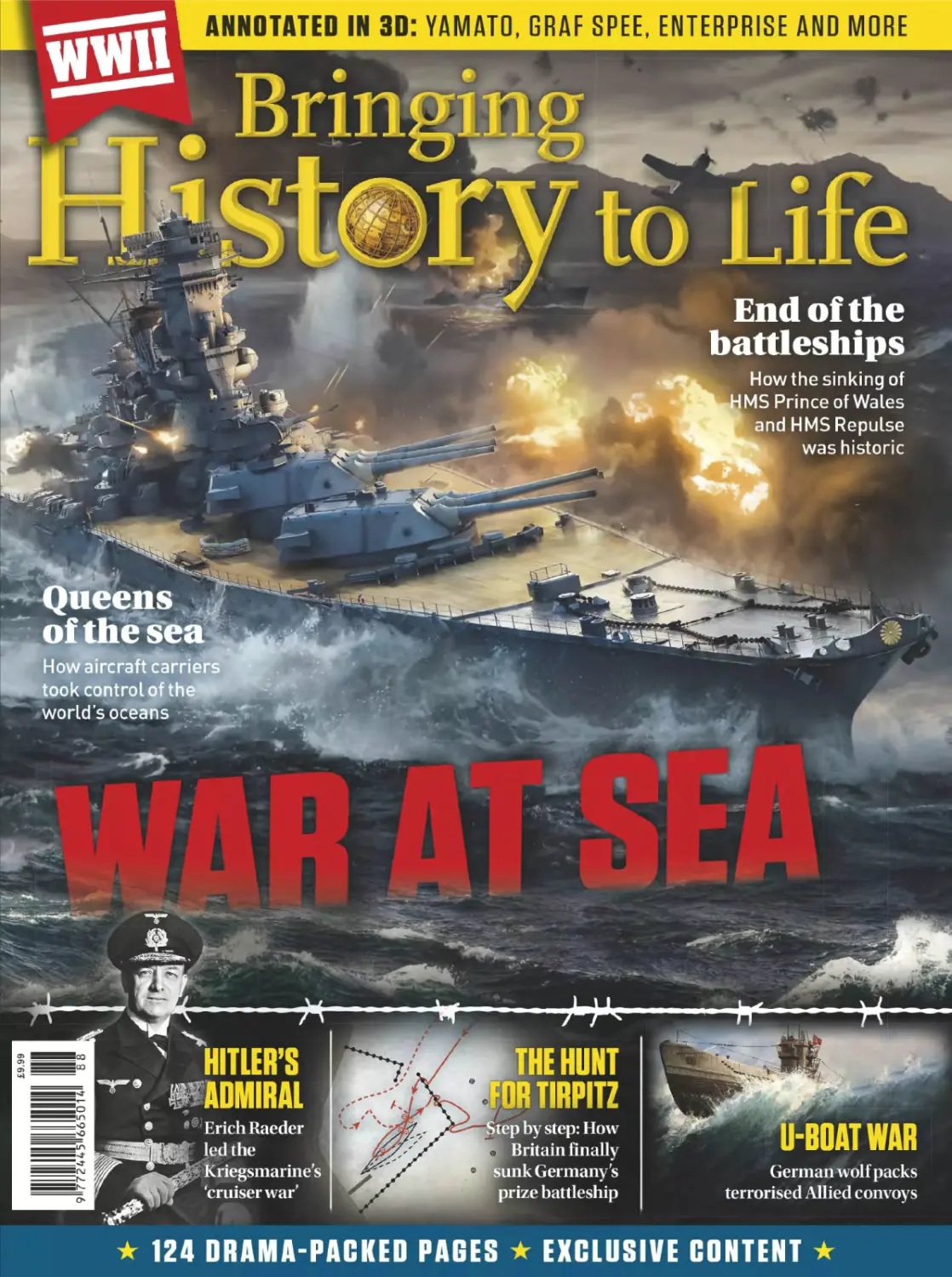
HITLER’S
^ ADMIRAL
•	•• Erich Raeder
jRMftMNLled tlie
Kriegsmarine's
ЯлТГ 'cruiser war’
ПНЕ HUNT
ORTIRPITZ
tepbystep: How
Britain finally
Fsunk Germany's
prize battleship
German wolf packs
terrorised Allied convoys
★ 124 DRAMA-PACKED PAGES ★ EXCLDSIVE CONTENT ★

Deadly beasts
of the oceans
The greatest war machines in history are
without doubt warships. Throughout the
ages, they have spread fear and wonder
around the world - not least because of the
gunboat diplomacy of the great powers. It was
long believed that whoever had the best navy
ruled the seas.
Civilian shipping across the Atlantic was
vital to virtually every
warring party within
Europe. Britain,
in particular, was
dependenton sea
transport and had the
strongest naval fleet
in the world at the
start of the war. With
“Shipping
was vital
to every
warring
party”
the showdown in the Pacific, the balance of
power shifted, and by the end of the war, the
United States held this honour. However,
the US Navy differed radically from the
British due to its development of technology.
In this special issue, we’ve collected our
best articles on World War 11 warships. Read
about gigantic constructions, such as the
Tirpitz and Yamato, about submarine hunting
and convoy warfare, and about the birth of
aircraft carriers and the death of battleships.
Enjoy!
CONTENTS
WMATStA
6 Erich Raeder’s crusade
14 U-boat hunt
24 Hunt for the dreaded
Graf Spee
32 End of the battleships
44 Battle of the convoys
54 Hunting Tirpitz

Commander-in-chief of
the Kriegsmarine, Grand
Admiral Erich Raeder (in
leather coat), inspects the
battlecruiser Gneisenau in
Brest in 1941.
Kriegsmarine 1939-45
The German
naval flag
during World
War II.
CH RAEDER’S
At the outbreak of WWII in 1939, Grand Admiral Erich Raeder
deployed the German navy’s largest warships to the Atlantic.
Their assignment was to sink British merchant ships - but easy
victories were not forthcoming and Raeder paid the price.
Ip t NIKLAS ZETTERLING
7
KRIEGSMARINE 1939-45
Erich Raeder
(1876-1960)
led Germany’s
naval
rearmament
in 1928-39. He
was promoted
to grand
admiral
in 1939.
In June 1941, Grand Admiral Erich Raeder
realised that his strategy for the German navy
wasn’t working. He’d been in command of the
fleet since 1928 and had worked tirelessly to
improve his service branch’s status in the
German Wehrmacht. However, recent events,
coupled with a switch of focus on a new front, meant
an end to Raeder’s plan.
By 27th May, Raeder’s most powerful ship, the
battleship Bismarck, had been sunk on her first
mission. At the same time, something equally
alarming was further undermining the German
naval strategy: most of its supply ships stationed
around the Atlantic had been sunk or captured by
the Allies. Their role had been to make it possible
for German ships to replenish supplies - and in
particular fuel - at sea, enabling them to carry out
operations over longer periods of time and at greater
distances. Finally, the most important incident had
yet to occur, but Raeder was well
potential enemy, German naval command drew up
11 ir’ m V*
• ilAr । r
aware of what was about to happen.
At dawn on 22nd June, the German
armed forces would invade the
Soviet Union, thus concentrating
all resources on the land war.
TO UNDERSTAND WHY these
events had such an impact on
Raeder’s tactics, we need to look
back. The peace agreements after World War I had
meant the German navy had been greatly weakened.
This changed when Hitler came to power in 1933
and Germany began to rearm. In 1935, an agreement
was reached with the United Kingdom that gave
Germany the right to build its own battleships with
a total weight of 35 per cent of that of the British
battleship fleet. Within this total, the Germans were
allowed to build the same number of submarines
as the British, which meant that both countries
had 57 submarines at the outbreak of war in 1939.
Hitler was extremely pleased with the agreement,
which he claimed would rule out a war with Britain
for the next ten years - until 1945. In addition,
the agreement gave such a wide scope for naval
rearmament that budgetary constraints were the
only real limit.
When Hitler changed his mind in early 1939 and
declared that Britain should still be considered a
Plan Z, an ambitious rearmament of its forces due to
be completed by 1945. But even if they’d been fully
deployed, the German Kriegsmarine would still
have not been comparable with the Royal Navy at
the outbreak of war. Plan Z’s time was cut brutally
short, however. When war broke out, resources were
prioritised for the army and air force, and the
ambitious plan was scrapped. After some
discussion, it was decided that those heavy
warships under construction would be completed,
but no new shipbuilding would be started.
The German navy’s numerical inferiority
contributed greatly to the design of Raeder’s
strategy, which had to find a way to strike the
enemy without allowing them to exploit their own
superior forces. Britain was seen as the main enemy
and its advantages included strong naval forces and
excellent access to bases.
THE GERMANS ENVISAGED several ways
to attack British shipping. The first was in the
same manner as in World War I - namely, with
submarines. Plan Z included 190 U-boats, which
may seem a significant figure, but represented a small
proportion of the planned overall investment. One
reason for their low priority was that many believed
that count er measures, such as British sonar, would
make it easy to detect and combat submarines.
Another option was air power, but with the
limited range of aircraft in the 1930s, attacks on
British ports were hardly an option. This left the
option of using surface ships. For operations in
the Atlantic, ships at least the size of a cruiser were
necessary because smaller ships had too small a
range of action. Therefore, the Kriegsmarine
decided to focus on cruiser warfare. This
! ’ ‘	* meant that warships, alone or in small
groups, would attack enemy merchant
“THE GERMAN NAVY’S
NUMERICAL INFERIORITY
CONTRIBUTED GREATLY TO
RAEDER’S STRATEGY”
ships on the high seas, while avoiding combat with
the foe’s superior forces. The aim was to hit British
imports and thus cut off the island nation’s supplies.
At the end of August 1939, only two suitable
ships were available for operations in the Atlantic:
Admiral Graf Spec and Deutschland. They were
then classified as Panzerschiff (armoured ships), but
later redesignated heavy cruisers after the British
nicknamed them pocket battleships. They left
German ports before September 1939 and took up
positions in the Atlantic, where they awaited orders.
At the outbreak of war, Hitler was not yet prepared to
authorise attacks on British shipping, but he quickly
changed his mind. At the end of September, the two
ships received orders to sink British merchant ships.
Once the order was received, they began
searching for suitable victims - Deutschland scoured
the North Atlantic and Admiral Graf Spec operated
in the South Atlantic. However, they enjoyed only
limited success. They captured (or sank) just three ►
KRIEGSMARINE 1939-45
► and nine ships respectively during these operations.
Deutschland managed to return home unharmed,
while Admiral Graf Spee was scuttled by her own
crew after being damaged in action off Uruguay.
The German
cruiser Blucher
is sunk in the
Oslo Fjord on
9th April 1940.
IN THE AUTUMN of 1939, the battleships
Scharnhorst and Gneisenau also attempted to gain
entry to the Atlantic but encountered British naval
forces patrolling the waters between the British
Isles and Iceland. The Home Fleet was in the area to
try to catch the returning Deutschland. It failed
to do so, but its mere presence prompted the two
German battleships to return to Wilhelmshaven.
The German cruiser war in 1939 paid far too little
dividends, with 12 merchant ships sunk at the cost
of one of their own cruisers. A major issue was the
location of German bases on the North Sea coast,
which were easy to block. The invasion of Norway
in April 1940 provided bases along the Norwegian
Atlantic coast, which greatly improved the situation,
but the invasion took a heavy toll, with extensive
ship losses. The most notorious was the sinking of
the brand-new heavy cruiser Blucher at Oscarsborg
in the Oslo Fjord, but numerous destroyers and two
light cruisers were also lost. In addition, several
important ships were so badly damaged that repair
work put them out of action for months.
Finally, the occupation of France the following
month provided useful bases with open water facing
the Atlantic. However, when preparations for an
invasion of Britain (the never-realised Operation
Sea Lion) began in the summer of 1940, much of
the Kriegsmarine’s resources were tied up.
It was only on 23rd October 1940 that German ships
were able to resume operations in the Atlantic. Then
the heavy cruiser Admiral Scheer began a nearly six-
month-long hunt for merchant ships that would take
her as far as the waters north-east of Madagascar in
the Indian Ocean. Just over a month later, another
heavy cruiser, AdmiralHipper, began a months-long
operation in the Atlantic. In addition to these regular
warships, the Germans also sent out converted
merchant ships, known as auxiliary cruisers. They
were armed with older guns mounted in such a way
that they were mostly concealed, enabling the ships
to appear to be neutral merchant ships. This made it
possible to get close to their intended victims while
evading enemy warships.
None of these efforts produced decisive results.
Admiral Scheer sank 17 merchant sh ips and Admiral
Hipper at least eight. These were insignificant figures
compared to the large number of ships transporting-
supplies to and from the British Isles. However,
German naval command could take comfort in the
fact that the operations undertaken so far were on a
small scale and with relatively weak ships. In early
1941, a much bigger operation was planned.
The two battleships Gneisenau and Scharnhorst
would sail from Kiel in what was dubbed Operation
Berlin. This became the textbook example of
German naval cruiser warfare and deserves
close examination. The enterprise began on 22nd
January 1941 when the two battleships left Kiel and
headed for the Danish Great Belt. From there, the
unit proceeded towards the seas south of Iceland.
Gneisenau’s commander, Admiral Liitjens, hoped to
pass through these waters unnoticed to gain access
to the Atlantic convoy routes.
However, the British had received intelligence
indicating that a German breakout was imminent
and the head of the Home Fleet, Admiral Tovey,
took up a position south of Iceland to block the
Germans. At this point of the war, the Germans
had superior radar and detected the British ships in
time, prompting Liitjens to turn towards the Arctic
Ocean, where a supply tanker awaited.
AFTER REPLENISHING HIS fuel supplies, Liitjens
once again headed for the Atlantic Ocean, this
time choosing to pass through the Denmark Strait
between Iceland and Greenland. After topping up his
fuel again from another tanker south of Greenland,
Liitjens could begin his primary mission: finding-
convoys and sinking merchant ships. However,
this proved to be more difficult than expected. The
seas were vast and observation possibilities from a
battleship were limited, even with radar.
When Liitjens spotted a convoy on 8th February, it
turned out to be escorted by the battleship Ramillies.
Engaging with equal or superior ships violated the
orders Liitjens had received. Ramillies with her 38-
cm guns was more heavily armed than both German
battleships, which meant that Liitjens avoided
the convoy instead of attacking it. This tactic was
understandable given the circumstances. Damage to
German ships had to be avoided, as it might reduce
their speed, making them unable to outrun enemy
naval forces and return to home ports for repairs.
The strategy was also based on being able to surprise
convoys. If German ships unnecessarily engaged
in combat, their position was revealed, which the
British could use to redirect other convoys.
The British convoy had observed Gneisenau but
identified her as a small cruiser and thus did not
fully realise the threat. They also believed that the
supposed cruiser was heading home a nd so deployed
naval forces to block her passage to German ports.
While waiting for the British to lower their guard,
Liitjens replenished fuel supplies from tankers
before resuming his search for convoys. On 16th
“HITLER EVEN ORDERED
THAT THE HEAVY SHIPS
BE DISARMED”
February, he was again ready to start searching
along the convoy routes from Halifax in Canada.
After a few days, the first merchant ship was found.
Because it was alone, Liitjens did not attack so as not
to give away his position. He wanted to avoid being
discovered until a whole convoy could be attacked.
ONLY ON 21 ST February, when the Germans were
so far west that they thought the convoys had been
disbanded and the ships were heading for various
ports along the North American eastern seaboard,
did they achieve success. They found and sank five
merchant ships, which was a moderate yield after
weeks of searching. As a result, Liitjens decided to
try his luck on the British convoy routes that ran
along the west coast of Africa instead.
In early March, Liitjens reached the area where
his two battleships would search for victims. Again,
the results were poor. A heavily escorted convoy was
discovered, but in accordance with his instructions,
Liitjens chose not to attack. However, he managed ►
11
Karl Donitz
(1891-
1980) was
Commander
of the
Submarines
from 1935 to
1943, and was
promoted to
grand admiral
in 1943,
succeeding
Erich
Raederas
commander-
in-chief of the
German navy.
► to ensure that U-boats were directed to attack and
sink five of the merchant ships.
After six weeks at sea, Liitjens’s crews were
exhausted, and his ships needed refitting. However,
he wanted to make one last attempt to achieve a
noteworthy success before the naval force headed
back. Again, his eyes fell on the area east of the
American coast. This time the Germans had
better luck. A convoy that had started to split up
was found and several merchant ships were sunk.
Lutjens achieved the success he wanted to end the
operation and then set course for Brest, where his
two battleships arrived on 22nd March.
IN TOTAL, THE two German battleships sank 22
merchant sh ips du ring the operation. Sign ificantly
more would have been needed to seriously threaten
British imports. Despite this, Operation Berlin was
the most successful German operation in the cruiser
war to date.
There were several reasons for its lack of success.
One of the most important was intelligence. It was
difficult for the Germans to get an idea of the tim ing
and speed of the convoys. Tn addition, the possibilities
for observation at sea were limited due to the ocean’s
size and the few German ships available. Although
they enjoyed an advantage in terms of radar, it still
only had a range of just over 20 kilometres.
The fact that several British convoys were heavily
escorted was also a major problem. The cruiser
warfare concept was based on the German ships
having an advantage in terms of speed and range of
action. In most cases, the modern German warships
fulfilled this, but the margins were tight enough
that taking damage could remove these advantages.
Going into battle with a strong convoy escort was
therefore unacceptable.
All in all, the experience of Operation Berlin
revealed that it would be difficult to find suitable
victims in circumstances favourable enough that
they could be attacked in relative safety. In addition,
the Germans feared that the British would also
equip their ships with high-performance radar,
seriously increasing the risk to German cruisers
when attempting to traverse the North Sea. Radar
would also make it easier for the British to track
German supply ships in the Atlantic. Without
those, the German strategy was doomed because
the distances to home ports were so far.
DESPITE THESE CONCERNS, Raeder decided
to continue the cruiser war. After Operation Berlin,
he planned to carry out Operation Rheiniibung,
a combined operation involving Gneisenau and
Scharnhorst, as well as the brand-new battleship
Bismarck and the equally new heavy cruiser Prinz
Eugen. Scharnhorst had suffered damage to her
propulsion machinery, which meant that she would
not be ready for action until the summer of 1941,
while Gneisenau was hit by a torpedo while moored
12
KRIEGSMARINE 1939-45
in Brest. The operation was thus restricted to just
Bismarck and Prinz Eugen.
One reason the German navy pursued the plan
was that the upcoming invasion of the Soviet Union,
Operation Barbarossa, was about to begin. Raeder
wanted a success before attention turned east.
Operation Rheiniibung resulted in a very serious
setback for the Germans and the end of the cruiser
war. Through a series of unfortunate events,
Bismarck became impossible to steer on the evening
of 26th May and was sunk by a superior British naval
force the following day. The loss of the state-of-the-
art battleship was a particularly severe one, and the
setbacks continued. Over the next two weeks, the
British sank or captured most of the German supply
ships in the Atlantic, eliminating the possibility of
refuelling at sea.
Attacks on British convoys had been the primary
focus of the Kriegsmarine in the run-up to World
War II. Raeder had devoted most of his limited
resources to this. By June 1941, it was clear that
the strategy had failed, and this meant, of course,
extremely serious consequences for the supreme
commander of the German navy. There were
several reasons for this, but the key one was that
the strategy had been based on false premises.
First, it assumed the Germans would have an easy
time finding the convoys, while the British would
have a hard time spotting the German ships. But
while the vastness of the Atlantic Ocean and its
frequently poor visibility provided the basis for the
Germans’ ability to avoid detection, it also meant
the convoys were more difficult to find.
Another German dilemma was the need for
greater speed, to make it possible to choose when to
engage and when to avoid combat. In addition, their
ships needed to operate over vast distances without
compromising the requirements for firepower and
strong armour protection. This led the Germans to
use compact propulsion machines that operated at
very high pressures. The systems were advanced
and performed well but weren’t reliable enough.
They needed frequent overhauls, requiring long
periods in the shipyard, which meant that they
could not operate across the Atlantic Ocean to the
extent desired.
OVERALL, IT’S CLEAR that German hopes were
unrealistic. There was little chance of finding the
convoys with the frequency necessary to choke off
British imports. Added tothis was the low avail ability
of German ships. The number of merchant ships
sunk by Germany’s surface fleet was therefore small,
especially compared to what the U-boats achieved.
Tn total, the Germans sank over ten million tonnes of
Allied merchant tonnage throughout the war, with
heavy warships accounting-far less than five per cent
“RAEDER RESIGNED IN PROTEST
AND DONITZ BECAME THE NAVY’S
NEW COMMANDER-IN-CHIEF”
of this figure. Even during the period of Operation
Berlin, the most successful German surface ship
operation, submarines accounted for more than half
of Allied ship losses.
This was the harsh truth that Grand Admiral
Raeder had to face in June 1941, but he appeared
to have been reluctant to write off cruiser warfare
altogether. Proposals to send the new battleship
Tirpitz into the Atlantic were discussed in the
second half of 1941, but never materialised. The
invasion of the Soviet Union also meant that the fuel
supplies provided by Stalin were terminated, which
was another major setback for the German navy.
WHILE ADMIRAL KARL Donitz’s submarines were
increasingly successful in the Atlantic, the remaining
heavy surface ships were moved to Northern
Norway. The idea was that from there they could
be deployed against Allied convoys in the Arctic
Ocean en route to the Soviet ports of Arkhangelsk
and Murmansk. But even in this theatre of war, it
was submarines and aircraft, not surface ships, that
accounted for virtually all Allied merchant tonnage
sunk. In December 1942, the Germans tried to attack
a convoy north of Norway in the Barents Sea. But
difficult weather and the valiant resistance of the
weak British escort meant that the cruisers Admiral
Hipper and Liitzow, along with six destroyers, failed
to sink any of the convoy’s 14 merchant ships.
A furious Hitler chastised Raeder for spending
millions of Reichsmarks on useless artillery ships
while the U-boats performed admirably. Hitler even
ordered that the heavy ships be disarmed, and their
guns installed as coastal artillery. Raeder resigned in
protest and his rival Donitz became the navy’s new
commander-in-chief. Although Donitz persuaded
Hitler not to disarm the fleet as the ships in Norway
tied up considerable Allied escort resources, the
U-boats were finally given top priority.
With the benefit of hindsight, it’s easy to see that
the Kriegsmarine investment in surface-based
ships was misguided in many ways. The resources
allocated were insufficient to give the chosen
strategy a chance of success; it would probably have
been better to invest in submarines. The concept
was an attempt to win despite inferior resources,
but critical flaws in the plan helped ultimately to
undermine cruiser warfare. □
Niklas Zetterling is a military history writer/author.
13
14
A depth charge detonates behind the US
escort ship Spencer on 17th April 1943.
The submarine U-175 had encountered
a convoy south-west of Ireland and
was forced to the surface by the depth
charges before being sunk.

In the early years, no Allied convoy was safe from
German submarines. With the development of
radar, better depth charges and new escort ships,
the Allies managed to reverse the situation - the
hunters became the hunted.
Text: JOHAN LUPANDER
15
BATTLE OF THE ATLANTIC
The British escort destroyer Pelican's
radar screen showed a clear echo as
it moved at top speed through the
dense fog. The radar operator shouted
out bearings and distances, the two
10.5-cm gun turrets swung out on
the stern deck, and the crew set depth charges to
detonate at minimum depth. It was time to surprise
a U-boat on the surface.
The first lookout to spot the target called out.
A few seconds later, the Pelican's guns roared and
hurled their shells at the dark shape, which was
Mixed success
★ The loss ratio shows how many Allied ships were sunk per
German lost submarine. With various technical or tactical
The German type ViIC
submarine U-278 was
launched in 1942 and
'emained active until
the end of the war.
advances, this could change dramatically.
It wasn't all the war’s fault
★ Shipping in the first half of the last century was far more
primitive and risky than today. A full 16 per cent of ship losses
were not due to gunfire; older ships could be wrecked in a
storm, quickly built newer ships could suddenly break apart,
inexperienced navigators could steer ships aground, cargoes
could be displaced with disastrous consequences, ships could
collide during the zigzagging of convoys, or fires could break out
due to the carelessness of tired or inexperienced crew members.
already diving into a cloud of water and foam.
Another salvo cascaded around the submarine’s
conning tower before it disappeared into the depths.
Now the sonar operator took responsibility for
tracking the enemy, noting that the sub was right
ahead. As Pelican crossed the submarine’s wake, her
depth charges slammed out their deadly load, while
the launchers, with their dull thuds, hurled bombs
from the ship. After only a few seconds, the depth
charges began to detonate with a prolonged roar,
sending cascades of water tens of metres into the air.
The Pelican swung round at full rudder and
repeated the attack. Then she pulled away to try to
make sonar contact with the target. The sonic pulses
radiated out, but there was no echo. Instead, a large
patch of diesel oil mixed with floating debris spread
across the surface of the sea. On 6th May 1943, the
Pelican had sunk the German submarine U-438,
ending months of fighting in the North Atlantic that
had caused decisive losses to Germany’s arsenal of
U-boats. But it had been a long road.
THE PERIOD FROM September 1939 to December
1941 saw what German U-boat commanders would
later refer to as the “Happy Time”. They sank or
damaged 1,189 merchant ships at the cost of just
68 lost submarines. The loss ratio - the number
of merchant ships sunk compared to submarines
lost was 17.5. To this should be added more than
1,300 merchant ships sunk in other ways. Thus,
the Allies lost a total of 2,538 merchant ships,
while fewer than 400 new British boats were built.
The submarines also managed to sink 41 British
warships, including two older battleships and three
large aircraft carriers.
The early years of the war proved that the Royal
Navy’s methods and means of anti-submarine
warfare and naval defence were inadequate.
Britain was saved from being totally cut off by
her opponents’ mistakes and lack of resources as
much as by her own efforts. Nevertheless, since the
construction of new merchant ships was thus far
outweighed by the losses, the Germans were well
on their way to achieving their aim of isolating
Britain - which had not been self-sufficient in food
and other commodities for hundreds of years - and
thereby winning the war.
GERMAN U-BOAT COMMANDERS had quickly
realised that the traditional submarine tactic of
attacking in daylight when submerged was far less
effective than attackingat night from the surface. This
allowed the submarine to use its speed advantage,
while its relatively small footprint meant that it was
rarely detected before an attack - escort vessels
still lacked radar. Tn the early years, submarines
mostly operated individually, because there were
16
too few to be grouped in units. However, the idea
of gathering a number of submarines together to
attack a convoy had been posited, and from 1940
it was tried on occasion by a few forward-thinking
U-boat commanders. Although this achieved some
positive results, there were difficulties, some of
which were due to the Germans themselves and
Admiral Donitz’s penchant for micro-managing
his U-boats.
THE WOLF PACK tactic first grouped the available
U-boats in a reconnaissance line, perpendicular
to the known Allied convoy routes. This greatly
increased the chances of finding a convoy, while
providing some solution to the problem of a lack
of aerial reconnaissance (only the Luftwaffe, not
the Kriegsmarine, had long-range reconnaissance
aircraft). The submarine that first sighted a convoy
would not attack but instead shadowed it at a safe
distance, while the composition, position, course
and speed of the convoy was reported by radio to
the submarine command centre. As many subs as
possible were then directed to a point in front of
“THE GERMANS ASSUMED
THEIR ENCRYPTION MACHINE
PROVIDED PROTECTION”
the convoy. In addition to this reporting, Donitz
required frequent status reports from each U-boat.
All this radio traffic was done by Morse code on
the short-wave band. The Germans assumed that
their pioneering Enigma encryption machine
provided adequate protection against Allied signals
intelligence efforts to read the messages. However,
from 1940 onwards - with some interruptions - this
was a completely false assumption. Just as damning,
radio signals from the U-boats were relatively
easily picked up, revealing the subs’ location (less
detectable burst transmission was only introduced
at the end of the war).
Once the submarines had assembled in front
of the convoy, they would launch their attacks in
the evening, usually from the surface. Tactical ►
17
4?
BATTLE OF THE ATLANTIC
► coordination on the spot was neither
possible nor necessary. A number of
attacks from different directions, even
if spread out over a period of time, were
often sufficient to overload and disrupt
the often too-few escort vessels in the
darkness of night.
It would be some time before Allied
anti-submarine warfare capabilities
were developed to deal with the wolf
pack threat.
An RAF Short Sunderland seaplane over
a Canadian convoy of troop carriers on
31st July 1940.
IN 1942, SINKINGS by submarines
reached new highs, although more
were also lost, and the loss ratio
deteriorated to 15 merchant ships sunk for each lost
sub. Submarine warfare began to reach its climax
with a sharp increase in the number of U-boats
pitted against an increasing number of Allied
ships and aircraft, equipped with new weapons
and reconnaissance capabilities, and improved
tactics. No fewer than 86 submarines were sunk,
but despite this, Allied losses of cargo and tanker
ships rose to 1,574. Since construction of new boats
- about a thousand vessels - was still not sufficient
to replace the losses, the situation was critical.
German shipyards, on the other hand, delivered
new submarines at a rate that, despite the losses,
increased their total number from 250 to 400 in
1942. Such growth augured well - from the German
point of view - for a continuation of U-boat warfare
using wolf packs in 1943. On the other hand, there
was little development on the technical side of the
U-boats and their weapons why bother with that
when submarine warfare was going so well?
On the Allied side, new technology and the
availability of specialised escort vessels began
to make themselves felt in the U-boat war.
Improvements in airborne radar and other aids
enabled the British to both find and attack German
U-boats as they passed through the Bay of Biscay
on their way to areas of operation further out
in the Atlantic. It was also possible to organise
independently operating anti-submarine forces of
four to six escort vessels. Several of these achieved
great success - most famously the 2nd Escort
Group under the command of its legendary leader,
Commander John Walker. New escort carriers also
raised hopes that convoys would soon have their
own air defences. However, it took time both to
introduce these improvements and to learn how
to use them, and not everything was in place when
the submarine war reached its peak.
Britain and her allies, May 1941
Germany with allies and occupied
territories, May 1942
German submarine bases in France
Air defence range for convoys in 1941
Air defence range from 1942/43
Allied convoy routes
aZ\
Washington
USA
loston'
Halifax
St John’s
New York
Norfolk
Bermuda/,
Convoy ол/c c
a*Ha'lf^\zves
THE EARLY MONTHS of 1943 were characterised
by a number of convoy battles - skirmishes around a
particular convoy lasting several days and involving ►
The convoys were able |
to rely on better air
defences in the
Western Atlantic after
the US joined Britain
in 1941-42 with other
American nations.
Caracas
Venezuela remained
neutral until 1945 but
supplied large quantities
of oil to the Allies.
Svalbard
BARENTS SEA
NLAN
Mayen
NORWEGIAN SEA
Reykjavik
Trondheim ।
Scapa Flow
Plymouj
Brest
Azores
EDITERRANEAN SE
Casablanca
Tobruk
U-710
Is sunk)
24/4. I
Merchant ship
McKeesport
sunk 29/4.
Battles 4th 6th Mayr^
12 merchant ships and
. 6 U-boats are sunk.
British air patrols
over U-boat routes
to and from bases.
From 1939-45, Germany waged unrestricted
submarine warfare. This meant that many
neutral nations’ shipping was also affected,
but the German wolf packs primarily
pursued the convoys to and from Britain.
Portugal grants Britain
permission to establish
an air base in the
Azores in June 1943.
Britain occupies
Iceland on 10th
May 1940.
In January 1943, the
air base at Gibraltar is
large enough to
house heaw bombers.
ВАУ OF
BISCAY
DENMARK
STRAIT
Where did the U-boats hunt?
In 1939-41, the majority of sinkings took
* place fairly close to the British Isles.
2 As the British got better at anti-submarine
warfare and the US joined the war in 1942,
the sinkings moved to the east coast of the US.
2 By 1943, Allied air defences were so good that
submarines operated mainly in the area
between the ranges of land-based aircraft.
U-boat war
lArkangelsk
Oslon
Stockholi
□ Moscow
Stalingrad
^Bucharest □
□ Madrid
Athens
Lisbon
CH PARNALl (LTJ/ROYAL NAVY/IMPERIAL WAR MUSEUM
The head of the 2nd Escort Group, Commander
John Walker (right), on the bridge of his flagship, the
escort destroyer HMS Starling. Walker became the
British Navy’s most successful submarine hunter.
'Leningrad
SOVIET
l X_^- --
UNION
A □ Paris
(Lorient^-.
^SfNazaire^
p La Pallice»
B° Bordeaux
□ Berlin
E R M Д
^□Warsaw
NY
Г\ AFRICA
Dakar x.
BATTLE OF THE ATLANTIC
NO. 422 SQUADRON RCAF/IMPERIAL WAR MUSEUM
► many U-boats. Sometimes the merchant ship
losses were limited, while on other occasions they
amounted to nearly 20. By March, Allied ship losses
had reached the same horrific levels as the previous
autumn. The Battle of the Atlantic now hung in the
balance. An Allied defeat would immediately affect
the build-up of forces in Britain, and the supply of
materiel in the Mediterranean.
The culmination of these battles, which had
raged throughout the winter and spring, were the
attacks on the ONS 5 convoy in April and May 1943.
They turned the submarine war definitively in the
favour of the Allies.
AT THE END of April, a record number of U-boats
gathered in the North Atlantic to attack the convoys.
Meanwhile, the ongoing intelligence war had shifted
in Germany’s favour after it modified its Enigma
encryption machine so that its cryptographic
messages could not, for the moment, be broken.
However, this did not affect the Allies’ ability to
pinpoint the location of transmitting submarines,
even if the meaning of the signals was obscured.
On 21st April, convoy ONS 5 sailed from Liverpool
on its way to US ports via the northern route near
Iceland. It consisted of 42 merchant ships escorted
by two destroyers, a frigate and four corvettes. The
“ONLY FOUR U-BOATS COULD
CARRY OUT SURFACE ATTACKS
THAT EVENING AND NIGHT”
Germans had anticipated that a convoy would depart
soon and take the northerly route, so several wolf
packs were ordered to gather across the route and
report all contact, but this went unnoticed by British
signals intelligence. Although he had now taken
over as chief of navy high command and handed
leadership of the submarines to his successor,
Admiral Donitz himself was still intensely involved
in the impending battle.
The constant British surveillance of the waters
around the British Isles and Iceland by anti-
submarine aircraft and ships bore fruit on 24th
April when U-710, part of one of the wolf packs,
was surprised by a Catalina plane on the surface
and sunk.
Four days later, the convoy was sighted by U-650,
which reported its position, course and speed to
Donitz. However, the radio traffic that followed
when the wolf pack was ordered to attack and
signalled its observations of the enemy was picked
The German
submarine U-625
under attack
by a Canadian
Short Sunderland
aircraft on 10th
March 1944. The
plane has dropped
depth charges and
towards the bow
of the sub can be
seen machine-
gun fire from the
rear gunner.
up by the escort vessels, so the convoy changed
course in an attempt to lose the enemy. This was
reasonably successful and only four U-boats could
carry out surface attacks that evening and night.
However, these failed completely - only one of
them fired torpedoes, and they missed. Two of the
submarines were damaged, as well, so they had to
break off the battle and head back to base.
The following day, the subs achieved their first
success when U-238 sank a merchant ship in a
conventional underwater attack in broad daylight.
At the same time, another U-boat was so badly
damaged by the convoy’s air defences that it too
had to return to base. It had now become apparent
to British anti-submarine command that convoy
ONS 5 was about to encounter an unusually
large concentration of U-boats and needed
reinforcements. A support group of four destroyers
and a destroyer from another convoy were now
ordered to join ONS 5.
FOR A GOOD part of the year, the weather in
the North Atlantic is dominated by the meeting of
warm and cold air currents, with accompanying
storms and fog. So it was no surprise that a violent
storm over the next few days would leave its mark
on the course of events. In the limited visibility,
the submarines lost contact with the convoy. But the
convoy itself could not stay together in the fog and
began to split up, which meant that several of the
escort ships had problems with fuel shortages as
they followed separate parts of the convoy and
were unable to refuel from the group’s tankers.
On the German side, the pause in action was used
to increase the number of U-boats in the area and
organise a new line of reconnaissance, mainly for
another convoy (SC 128) approaching from the west.
When the storm subsided, the fighting resumed.
Two submarines were damaged by air strikes and
one of them (U-209) disappeared without a trace
a few days later while travelling back to base.
Meanwhile, convoy ONS 5 was targeted again, this
time by U-628. Once more, Donitz concentrated
his forces - well over 40 submarines - against
the convoy. At the same time, four destroyers
had to leave the convoy due to a lack of fuel. As a
replacement, the experienced 1st Escort Group of
five escort destroyers was sent to the area. The need
for them was emphasised by numerous sightings
of U-boats, showing how they were concentrated
against the now partially reassembled convoy
THE EVENING OF 4th May began with the
sinking of a merchant ship. For several hours,
the escort managed to fend off the attacks (which
remained on the surface for as long as possible) and
damaged three submarines, two so badly that they ►
★ In the early years of the war,
a variety of ships were used
to protect the convoys, both
warships (some from WWI)
and armed civilian vessels.
But Britain quickly needed new
ships - and lots of them. There
was an unglamorous solution:
the corvette. This was modelled
on a whaling ship. Production
was facilitated by the fact that
the type was built in a number
of civilian shipyards. They were
small, slower than the German
U-boats in surface mode,
were large, like destroyers, but
not as heavily armed and not
much faster than a merchant
ship. However, they were more
enduring than corvettes on
trans-Atlantic journeys and
became successful and greatly
appreciated in escort groups.
New frigates arrived in 1942
with weapons, speed and range
suited to escort work and anti-
submarine warfare.
From 1943, the US Navy also
rapidly built escort destroyers
similar in size and armament
underpowered, lacked radar
until 1942, and only had a short
range (a problem during Atlantic
crossings). They were also very
uncomfortable and harmful
to crews’ health. Despite this,
corvettes made up over half of
all Royal Navy escort ships in the
Atlantic and 300 or so were built.
But bigger ships were coming:
frigates and sloops. The latter
to the British frigates. They
were simpler and therefore
cheaper to mass produce
than regular destroyers. As an
emergency solution to improve
air defence, some merchant
ships were also equipped with
a short flight deck or catapult
on board. However, they were
replaced as soon as possible by
escort carriers.
The British escort
destroyer HMS
Pelican sank the sub
U-438 during the
ONS 5 convoy battle.
ROVAL navy/imperial war museum
21
. Three key weapons for sub hunters
SONAR
IThe Royal
Navy acquired
usable sonar
(called ASDIC) in the
inter-war years and
installed experimental
models on a number
of ships. This enabled
submerged submarines
to be detected and their
position calculated.
Optimists thus
believed that a possible
submarine threat in any
future war had been
ASDIC display unit from
around 1944.
eliminated. The consequence, however, was that people
were lulled into a false sense of security and turned a blind
eye to the tool’s fundamental shortcomings.
Sonar had a blind zone extending some 400 metres
around the escort vessel. The ship had to sail over the
submarine to drop its bombs, which needed time to sink to
the set depth. This meant that the submarine had at least a
minute and often more to move from its last known position
before the bombs detonated. In this time, the U-boat could
move 100-250 metres.
RADAR
2 With radar, the
Allies had a
technological
advantage that would
be of great importance.
Escort ships were
equipped with radar
in 1941-42, while
submarines lacked this
important tool for most
of the war. In the last
HMS Swiftsure with Type 274
radar installation.
months of 1941, the Royal Navy began to take advantage of
this and other new technological systems and concepts that
completely changed things for the protection of shipping.
Once Type 271 radar had been installed on ships and
people had learned how to use it effectively, it was no longer
a given that submarines could operate unnoticed on the
surface at night or in poor visibility. In good conditions, the
radar could detect a submarine at 10-15 kilometres and
a periscope at one kilometre. This meant that what had
previously often been a quick surface attack under cover of
darkness might now be an encounter with an escort vessel
and gunfire that forced the submarine to dive and abort the
attack, at least for the moment. Anti-submarine aircraft also
began to be fitted with radar.
DEPTH CHARGES
3For several years, the only weapon the
escort ships had against submerged
submarines was a variant of the depth
charge developed during the previous war.
They had several disadvantages:
•	They sank slowly (at about 3 m/s)
and firing them from the stern or over
the side gave the submarine time for
evasive manoeuvres.
•	They had to detonate within a few metres
of the target, which was made more
difficult by the fact that they detonated at
a pre-set depth, regardless of the distance
to the target (in 1939, the Royal Navy's
depth charge had a maximum adjustable
detonation depth of 90 metres, a depth the
German U-boats could easily exceed).
•	The detonation produced a large cloud of
gas in the water that interfered with the
escort vessel’s sonar for several minutes.
In 1942, a new weapon was introduced that
reduced the problem of losing sonar contact
in the final phase of a depth charge
attack. It was the Hedgehog anti-
submarine gun, which fired a swarm
of 24 rockets about 250 metres
ahead of the ship. There, the rockets
sank much faster than a normal depth
charge (7 m/s) and only detonated
if they hit the U-boat hull. They did
not interfere with the sonar if they
missed, but direct hits were required.
22
BATTLE OF THE ATLANTIC
► had to return to base. But in the long run, the convoy
escorts were unable to keep up. One submarine
attacked in front of the convoy and caused confusion
by diving, going beneath the convoy and then
sinking a ship. Three other U-boats reached firing
positions, fired 13 torpedoes and sank or damaged
five merchant ships. The battle continued at dawn,
now with the submarines submerged. Four more
ships fell victim to torpedoes during the day, but
one U-boat was sunk and another badly damaged.
Behind the convoy was a small group of stragglers
protected by a corvette. While this was busy sinking
a first attacker, the next U-boat took the opportunity
to torpedo one of the ships in the group. In the
evening, the battle hung in the balance as a B-24
aircraft helped keep pursuing U-boats at bay. This
was necessary - at dusk, the escort destroyer Tay
counted seven U-boats on the surface, waiting to
launch new attacks in the darkness. At the same
time, Donitz’s headquarters noted that at least 15
U-boats were in contact with the convoy, whose
escort ships were running low on depth charges
after the previous night and day’s fighting.
HOWEVER, THE BATTLE changed character
again when the convoy entered a large area of
thick fog. The submarines - which had no radar -
were operating almost blind and found it extremely
difficult to launch any attacks, while the escort
ships, with their radar, had control of the situation
on the surface. A further factor in the escorts’
favour was that the Germans had not yet figured
out that the British Type 271 radar operated at
centimetre wavelengths. Consequently, the U-boats
had no warning for this frequency range and were
vulnerable to surprise attacks in the fog. One
example was the sinking of U-438, described earlier.
DURING THE NIGHT, the U-boats carried out
some 25 unsuccessful attacks, guided by the sounds
of propellers and engines on their sonar. Four subs
were sunk and three more damaged - one survived
beingrammed. Asthe morningof6th May dawned,
the escort ships had almost run out of depth
charges, but the situation was saved by the arrival
of the 1st Escort Group. Its ships kept the U-boats
atbay, sinking one and damaging at least one more.
When the results of the battles of the previous
nights and days became clear to the Germans,
they immediately decided to suspend the battle for
reorganisation. It turned out that only half of the
U-boats at their disposal were still fit for combat. Six
of them had been sunk while seven submarines had
been so badly damaged that they were now on their
way back to their bases. This was the price of sinking
12 merchant ships - a totally unacceptable loss ratio.
What was also very worrying for the future was that
“THE BATTLE CONTINUED
AT DAWN, NOW WITH THE
SUBMARINES SUBMERGED”
this large collection of U-boats had been defeated
by the convoy’s escort ships (the Germans didn’t
know how much they had been improved), without
any significant input from anti-submarine aircraft.
THUS, FROM MARCH to May 1943, something
drastic happened. The sinking of merchant ships
fell by two thirds, while U-boat losses soared
to an unacceptable level for the Germans. They
doubled and reached a record of 41 submarines
lost in May. The reasons for this turnaround and
its subsequent continuance are many:
•	Increased number of modern escort vessels
•	The escort carriers
•	Better airborne radar
•	Increased ability to intercept and exploit
German radio traffic.
•	Better ship-borne radar
•	Increased radio tracking also from ships
•	Increased number of long-range land-based
anti-submarine aircraft
•	Combating submarines en route to and from
bases in France
ALTHOUGH IT IS now clear that the battle had
been won by the Allies, they could take nothing
for granted. While Admiral Donitz withdrew his
submarines for reorganisation, the US and British
build-up of anti-submarine capability continued
on a number of fronts. It soon turned the U-boats
into hunted animals, still feared, but for the rest of
the war, doing little more than sinking about one
merchant ship for every submarine lost. There had
been a time when the ratio was 30-50 ships per sub
sunk. In spring 1943, the ratio dropped to a level at
which it had never been before, except temporarily,
and would not rise again for the rest of the war.
In the last two years of the war, Allied convoys
crossed the Atlantic and adjacent waters with
relatively low losses. The 272 merchant ships sunk
were offset by the production of around 2,200 new
boats. The price the German submarines had to pay
for fighting to the last against hopeless odds was
another 370 U-boats lost (out of a total of around
780 throughout the war). It’s no wonder that 70 per
cent of all those who served in the Kriegsmarine’s
submarines were killed. П
Johan Lupander is a military history writer
and author.
23
GrafSpee with her 28-cm
guns posed a serious threat
to Allied shipping. Photo from
mid-1939, before departure
for the South Atlantic.
Main text LARS ERICSON WOLKE
Additional text RICHARD ARESCHOI
When the Treaty of Versailles banned Germany from building
large battleships, Hitler’s response was the smaller but heavily
armed ‘pocket battleship’. In autumn 1939, GrafSpee spread
terror in the South Atlantic and was chased across the seas.
When World War II naval
conflicts are mentioned, most
people think of the ruthless
submarine warfare in the
North Atlantic, the hunt for
the largest German warships,
such as Bismarck and Tirpitz, or the great battles
in the Pacific. But the war at sea started a long way
from European and North American waters.
From the outbreak of war in September 1939 to
If the land warfare was characterised by calm,
the situation was the polar opposite in the North ►
the beginning of May 1940, the British, French and
German armies stood and watched each
other along the Franco-German border without
any real fighting breaking out. However, everything
would change with the major German offensive in
the west, which started on 10th May 1940. Just
six weeks later, it led to the fall of France and the
evacuation of the British Army from the continent.
But in autumn 1939, this was still some way off.
In early October, struggling Poland surrendered
to the German and Soviet armies, and the guns
temporarily fell silent even in Eastern Europe.

Germans defied peace treaty
★ Admiral Graf Spee entered
service on 6th January 1936
as one of three Deutschland-
class ships. The class had been
planned in 1920 and was a
consequence of the limitations
of the Versailles Treaty. Under
this, Germany was only allowed
to keep eight obsolete battleships
built between 1902 and 1906, and
they could only be replaced when
20 years old. Also, new builds
could not have a displacement of
more than 10,000 tonnes.
The German naval leadership
under the Weimar Republic was
forced to rethink. Two ship types
were proposed: a monitor-like
coastal defence ship and a lighter
armoured, fast cruiser-like ship.
The second was chosen, albeit
with heavier armour.
To ensure the availability
ofsuitable artillery, the
28-cm calibre was chosen,
although 30.5-cm was allowed.
Officially, the displacement
limit of the peace treaty and
of the Washington Treaty was
respected. In fact, the maximum
displacement of the three ships
was between 14,290 and 16,020
Deutschland was the
first of three ships in
the same class.
tonnes, a fact that only became
known after World War II.
The ships were mainly built for
a trade war against arch-enemy
France, but the British also saw
them as a major threat
► Atlantic and North Sea, where thousands of people
were fighting and dying. The German U-boat
campaign against shipping to the British Isles had
begun and by the end of 1939,114 Allied merchant
ships had been sunk, 37 of them in the Atlantic
and North Sea. Only one German submarine had
been torpedoed, but a further eight had been lost
to mines or depth charges, and at least 33 Allied
ships had been sunk by mines laid by the Germans.
AT THE BEGINNING of the war, it was not only
submarines that posed a threat to Allied shipping.
The bigger German surface vessels - battleships
HISTORIC ARCHIVE
Graf Spee
was named
after Admiral
Maximilian
and cruisers - were also capable of inflicting
heavy losses on Allied merchant ships.
Therefore, these German ships were often
hunted down by Allied naval forces, who
tried to sink them before they could reach
the large convoys and start spreading death
and destruction among merchant ships.
One of these German warships was the
cruiser Admiral Graf Spee. On the very day
that France and Britain declared war on
Germany, 3rd September 1939, she headed
south and quickly reached her intended
area of operation in the South Atlantic.
Graf Spee was accompanied by the supply
ship Altmark. Aboard Graf Spee, her commander,
Captain Hans Langsdorff, did everything he could
to confuse British and French reconnaissance
von Spee
who won the
naval battle of
Coronel, but
was killed in
the Falklands
in 1914.
aircraft. He painted over the ship’s name on the
stern and replaced it with the name of one of her
sister ships, Admiral Scheer. Tn addition, he erected
a dummy gun turret on the bridge to change the
ship’s silhouette. Another deceptive move was to
switch between the British and French flags.
THE FIRST VICTIM of Graf Spee was the British
cargo ship Clement, which was sunk off Pernambuco
in north-eastern Brazil on 30th September 1939.
When the crew was picked up by another ship,
they reported that they had been attacked by the
Admiral Scheer.
The hunt was on. A lone but powerful German
ship wreaking havoc in the South Atlantic could
cause tremendous damage to Allied shipping just
by the latent threat it posed. In the mid-Atlantic,
British naval commanders organised four battle
groups for the hunt. They consisted of one aircraft
carrier, two battleships and two cruisers from the
Royal Navy, and another aircraft carrier and five
cruisers from the French Navy.
On top of that, three battle groups were formed
in the South Atlantic with one aircraft carrier,
one battleship and six cruisers. As if that weren’t
enough, one aircraft carrier and two cruisers were
assigned to scout the southern Indian Ocean. In
addition to these ships, the aircraft carrier Glorious
and the battleship Malaya were ordered to reinforce
the area, along with several destroyers.
Vast expanses of sea had to be scoured and
superior firepower would be required if the
German ship was encountered. But the British and
French effort proved that Graf Spee had already
succeeded in one of her aims, namely to attract
such large numbers of pursuers that the British
and French naval forces around Britain and in the
Mediterranean were considerably weakened.
ON SEVERAL OCCASIONS the British missed
Graf Spec’s position, but then, on l()th October
1939, a French-flagged ship approached the British
ship Huntsman. The commander, Captain Brown,
thought he recognised the French battleship
Dunkerque, but it was a fatal mistake. German
sailors boarded the Huntsman and seized important
information about trade routes in the South Atlantic.
Before sinking the ship, they sent out fake distress
26
calls, giving a false position and stating that the
Huntsman had been torpedoed.
The British now began to suspect (wrongly) that
at least two German surface ships were operating-
in the South Atlantic, and when GrafSpee sank the
steamer Trevanion on 22nd October, their suspicions
were strengthened.
After the attack, GrafSpee went around the Cape
of Good Hope and temporarily hid in the Indian
Ocean. British merchant ships were ordered to send
a distress signal as soon as they feared an attack
by enemy warships. In her new area of operation,
the Graf Spee sank the tanker Africa Shell off the
Mozambique Channel on 15th November, before
returning to the South Atlantic four days later.
ON HIS RETURN, Langsdorff further confused
his opponent; he had a top made for the extra ‘gun
turret’, with 28-centimetre guns, and a funnel, all in
wood. A false bow wave was also painted on the hull
to give the impression that the ship was travelling
faster than it really was. This led to a mix-up with
the British battlecruiser Renown. Adding to the
difficulties, the ship was labelled Graf Spee on one
side and Deutschland - the name of GrafSpee’s other
sister ship - on the other.
ON 2ND DECEMBER, Graf Spee attacked a
British ship, Doric Star, off Walvis Bay in Namibia,
and a distress call was picked up by a steamer off
Saint Helena. The following day, a British cargo
ship, the Tairoa, sank after being attacked by Graf
Spee. From the British naval base at Port Stanley in
the Falkland Islands, ships were sent into Argentine
and Brazilian waters, believing they were chasing
the Admiral Scheer. On 7th December, the British
cargo ship Streonshalh was sunk. This sinking was
the culmination of German activities in the South
Atlantic. Captain Langsdorff now chose to head
for the mouth of the River Plate, also known as
Rio de la Plata, giving the British the impression
that he intended to round Cape Horn and head into
the Pacific. His real intention was to sail home to
Germany and a much-needed shipyard refit.
Finally, at 06.08 on the morning of 13th December,
Commander Sir Henry Harwood on board his
flagship, the cruiser Ajax, could see smoke on the
horizon. At 06.14, the battle began.
Three British cruisers - Exeter, Ajax and Achilles
- now attacked GrafSpee in the mouth of the River
Plate. The German artillery was initially more
HMS Achilles photographed
from the deck of HMS Ajax
The false bow wave that Langsdorff had painted
on Graf Spee.
effective than the British, mainly due to the use
of radar to assess the distance of the ship’s guns.
During the battle, GrafSpee deployed several smoke
screens to make things difficult for the British.
The heavy German naval artillery hammered
at the British cruisers, which struggled to achieve
the same effect with their lighter guns. An officer
on an increasingly damaged Exeter exclaimed in
frustration: “We might just as well be bombarding
her with a lot of bloody snowballs.”
Despite suffering severe damage early on, Exeter
continued to fire on GrafSpee, eventually scoring a
direct hit on the German ship. However, GrafSpee
hit back, both against Exeter and Ajax. Exeter was
eventually taken out of the battle, while Achilles and
Ajax continued to fight, albeit heavily damaged.
Several thousand British and German sailors were
involved, with the ships’ guns taking their toll.
HMNZS ACHILLES WAS
owned by the New Zealand
Navy. On her bridge, Lieutenant
Richard Washbourn suddenly
realised how dangerous the approaching
enemy was, and turned to his commander and
said, “My God, it’s a pocket battleship!” *
Soon after, Achilles was hit by a salvo from Graf
Spee’s heavy guns. Shrapnel peppered the Allied
ship from the waterline to the top of the mast.
Lieutenant Washbourn on the bridge survived,
but red-hot shrapnel tore chunks out of the
commander’s legs before shattering
the knee of a signalling officer.
According to witnesses, the
bridge “resembled a
slaughterhouse on a ►
Q New York
Lisbon
О
Graf Spee’s record
Graf Spee’s route
Sep-Dec 1939
---Pan-American
Security Zone
boundary
• Ships sunk by
Graf Spee
NORTH
ATLANTIC
О Dakar
The cargo ship Ashlea becomes
Graf Spec's third victim. The
photo was taken by Hugo Gustav
Neumann, seaman first class on
the German flagship.
Cape Town
15th Nov
Africa Shell
10th Oct
Huntsman
Buenos
Aires О
SOUTH
A TL A NTIC
7th Dec
Streonshalh
13th Dec Battle
of the River Plate
22nd Oct Travanion
1st Dec
Doric
Star
3rd Dec
Tairoa
The British cargo ship Clement
descends to the sea bed after
being sunk by the Graf Spee. The
moment was documented by
seaman first class Hugo Oehler
from the deck of the flagship.
7th Oct Ashlea э Luanda
5th Oct Newton Beech
17th Dec Graf
Spee sinks
2.000 km
Graf Spee left Wilhelmshaven,
Germany, on 21st August 1939. On
her way south, she sank a total of
nine cargo ships.
First with ground-breaking radar
★ The first marine radar was a
civilian French model fitted to
the passenger ship Normandie
todetect icebergs.
Germany’s military radar
development began in earnest in
1933, and by 1936 the company
GEMA had developed Seetakt,
the world s first marine fire-
control radar. The antenna was
fixed and mounted on the main
rangefinder. In order to turn it,
the entire rangefinder had to
be rotated. The first warship in
the world to be equipped with
radar was Graf Spee, in 1936.
An improved version of Seetakt,
FuMo 22. was introduced in 1939
and Graf Spee sported this type
when she was sunk. The early
radar was sensitive to moisture
and vibrations when firing. The
antenna could also be damaged
by movement in rough seas.
The British were not far behind
in their development and had a
test facility for a naval fire-control
radar ready in December 1939.
The first was installed on the
battleship Nelson in June 1940.
When Graf Spee herself was
sunk, British naval intelligence
personnel were soon on board
to study the radar in order to
develop countermeasures.
Personnel from the American
light cruiser Helena also came
aboard the wreck in early 1940 to
inspect the radar.
28
07.26
07.06
5 km
I_______i
To
Montevideo
Graf Spee
flees.
Exeter,
Ajax, Achilles
07.56
Exeter
\ Ca 07.40
Spee take:
heavy fire.
06.14. The
battle begins.
06.38. Exeter
is badly hit
and leaves
the battle.
Rio DE
LA PLATA
HISTORIC archive
particularly busy day”, with one dead and several
seriously injured officers and sailors.
Despite the Allied losses, the Germans had no
chance to strike out into the Atlantic and Langsdorff
chose to withdraw. Graf Spec sought refuge in the
port of Montevideo, where under international law
she was allowed to stay for 72 hours. The British
tried their best to keep the dreaded warship trapped
in the Uruguayan harbour, but their resources were
too stretched.
On the night of 13th-14th December, Graf Spee
was anchored off the shore of Uruguay’s capital
Montevideo while Allied ships waited further out
to sea. Now Langsdorff did something very strange
from a British point of view: instead of trying to
break through the thin British lines, he kept his
ship close to the Uruguayan harbour. Langsdorff
was able to obtain an extension from the harbour
authorities, which was welcomed by the British, as
it gave them time to strengthen their forces.
The British succeeded in delaying the departure
of Graf Spee in various ways, including allowing
their merchant ships in Montevideo harbour to
sail one by one, thus delaying the departure of the
German pocket battleship by 12 hours each time, in
accordance with international law.
ON 17TH DECEMBER, Langsdorfftelegraphed
Berlin. He wanted to attempt an escape. The reply
from Berlin was clear: both Hitler and Erich Raeder,
head of the navy, supported the initiative, but if it
failed, Graf Spee would be scuttled. At this point,
Langsdorff’s artillery officer confused the three
waiting British cruisers for much more powerful
ships - the aircraft carrier A rk Royal, the battleship

Renown and some destroyers - a fatal
mistake. An attempt to break out was
therefore never made.
Instead, preparations were made
to sink Graf Spec, and only about 40
men were kept on board. The rest
were taken on to the German cargo
ship Tacoma.
At 19.52 on 17th December,
Langsdorff steered Graf Spee towards
the blockade at the mouth of the
River Plate. There she was blown
up by her own crew. As Allied ships
approached the harbour, Graf Spee was already
a burning wreck. On board, the British found a
strange antenna: a state-of-the-art radar system.
THREE DAYS LATER, the naval drama had its
drastic epilogue. In a hotel room in Buenos Aires,
Captain Langsdorff chose to end his life with a shot
to the head. When he was found, he was in uniform
and lying on the German naval flag - according to
unconfirmed reports, it was the imperial flag and
not the Nazi flag. In a farewell letter, Langsdorff
took full responsibility for the sinking of his ship
and declared himself happy to atone with his life:
“I shall face myfate with firm faith in the cause and
the future of the nation and of my Fuhrer.”
For Germany, the battle was not only a military
defeat - above all, it was a propaganda disaster. For
the British, it was a corresponding triumph. □
Lars Ericson Wolke is a professor of military history
at the Swedish Defence University and an author.
The map shows
how Graf
Spee and the
Allied ships
manoeuvred
during the
battle on 13th
December 1939.
Above is Hans
Langsdorff.
Richard Areschoug is a military history writer.
29
GRAF SPEE

The Admiral GrafSpee was designed to take
out any cruiser fast enough to catch up with
the pocket battleship. The ship was heavily
armed for her size.
Eight 15-cm L/55 C/28 rapid-
fireguns in a single turret. —
I
Rangefinder
10.5-cm main rangefinder.
Fire-control radar
FuMG39(gO).
___—Heavy anti-aircraft guns
Six 10.5-cm L/65 C/33
guns in three twin turrets.
Armoured control tower
Ship was controlled from here,
which is where fire-control radar
and main rangefinder were.
Lights
Fourofthem.
Main forward magazine
Maximum of 720 shells for
the 28-cm guns. Charges
and projectiles were
stored separately.
Exhaust pipe _
From engines to funnel.
Power plant
with turbines
Fake bow wave
Gave impression that ship
was travelling at high speed.
Main armament Front triple turret
with 28-cm L/52 C/28 guns. Had a
range of over 30 kilometres.
The crew August 1939 Total 1,055 men
Small boats
Eight lifeboats and
motor launches.
Engines Consisted of four pairs
of double-acting MAN diesels
totalling 54,000 hp. They were
very reliable and gave a range of
8,900 nautical miles at 20 knots.
Maximum speed was 28.5 knots.
39 officers
47 subofficers
950 other personnel divided into ten divisions
**********
**********
**********
ft*******
1 captain
**********
**********
**********
**********
*******
********** ********** ♦♦♦*♦♦♦*** ********** ********** ♦*♦***♦♦** ********** ********** **********
********** ********** ********** ********** ********** ********** **»♦»****» ********** ♦♦♦******♦
********** ********** ********** ********** ********** ********** ********** ********** **********
*******************************************************************************************
************************************************************ ********** ********************
30
Aircraft catapult Originally a Heinkel He 60
was used, but was later replaced by an Arado
Ar 196 reconnaissance plane (pictured). The
photo taken is from the cruiser Admiral Hipper.
Type: Pocket battleship.
Class: Deutschland.
Laid down: 1st October 1932.
Launched: 30th June 1934.
In service: 6th January 1936
until 17th December 1939.
Displacement: 12.000-
16,200 tonnes.
Length: 186 metres.
Width: 21.6 metres.
Draught: 7.4 metres.
Speed: 28.5 knots.
Range: 8,900 nautical miles at
20 knots.
Engines: Eight nine-cylinder
double-acting MAN diesels, two
propellers (40,770kW).
Crew: Maximum 1,150 men.
Armament: 6x 28-cm guns,
8x 15-cm. 6x 10.5-cm, 8x 37-mm
anti-aircraft, 8x 20-mm AA,
8x 533-mm torpedo tubes.
Aircraft: Two Arado Ar 196
— Crane Two cranes to
lift planes when they
landed on the water.
Main armament
Triple turret with
28-cm L/52 C/28
Reserve rangefinder
guns. Had a range of
over 30 kilometres.
Areas reinforced with thicker armour.
Light anti-aircraft guns
Position of the weapons as seen from above.
 Guns  Anti-aircraft Torpedotubes
Eight 3.7-cm L/83 C/30
guns in two rows.
Light anti-
aircraftguns
Twelve 2-cm L/65
guns in a single row.
Torpedo tubes Two
rotatable, armoured
quadruple 53.3 cm
torpedotubes.
19 civil
Aft main magazine
Maximum of 720 shells for the 28-
cm guns. Charges and projectiles
were stored separately.
Waterline
employees
tttttttttt tttttttttt tttttttttt tttttttttt tttttttttt tttttttttt HHHHH tttttttttt tttttttttt HHHHH
tttttttttt
HHHHH НИНИН tttttttttt HHHHH HHHHH ИННИН ИННИН tttttttttt HHHHH HHHHH
HHHHH HHHHH HHHHH HHHHH tttttttttt HHHHH HHHHH HHHHH HHHHH HHHHH
ttttttttt
tttttttttt HHHHH HHHHH tttttttttt HHHHH HHHHH tttttttttt МИНИН tttttttttt tttttttttt
HHHHH tttttttttt ttHHHH tttttttttt tttttttttt tttttttttt tttttttttt tttttttttt tttttttttt tttttttttt
3 hairdressers,
3 cooks. 3 tailors. 3
cobblers. 7 waiters
31
Prince of Wales & Repulse 1941
END OF THE
BATTLESHIPS
Japanese aircraft had placed
the battlecruiser Repulse in a
pincer between two swarms of
torpedoes rushing towards her.
If she yawed to avoid one, she
only became more vulnerable
to the other. This was the
beginning of the end for
British battleships.
Text JOHAN LUPANDER
WLG ADAMS/ROYAL N AVY/IMPERIAL WAR MUSEUM (A29068)
US NATIONAL ARCHIVES
HMS Prince of Wales leaves Singapore
on the evening of 8th December 1941. As
well as the battleship, Force Z consisted
of a battlecruiser and four destroyers.
PRINCE OF WALES & REPULSE 1941
In the early 1930s, Britain embarked on a
major effort to establish a naval base in
Singapore at the southern tip of the Malay
Peninsula to counter the growing threat
from Japan. However, there was a severe
shortage of warships to meet all of Britain’s
naval commitments around the world. When World
War II broke out in September 1939, the Royal
BASSANOLTD
Admiral Tom
Phillips.
Navy’s resources were concentrated in Europe.
What remained for the Far East were only a few
cruisers and destroyers, mostly older vessels.
IN AUTUMN 1940, the threat to Singapore
increased with the occupation of French
Indochina (now Vietnam, Laos and Cambodia)
by Japanese forces. After much deliberation,
it was decided in the autumn of 1941 that the
naval build-up in the area would take the form
of a dedicated operations group - Force G (later
known as Force Z) - consisting of the modern
battleship Prince of Wales, the older battlecruiser
Repulse and the brand-new aircraft carrier
Indomitable. The main aim was to deter Japan from
starting a war in the first place.
However, on 3rd November, the aircraft carrier,
which was off the coast of Jamaica for crew
“ADMIRAL PHILLIPS
ASSESSED THE THREAT
ON THE BASIS THAT NO
BATTLESHIP HAD BEEN
SUNK BY AIRCRAFT
IN OPEN WATER”
G Force. Despite the loss, the British War Cabinet
decided that the bulk of the force would proceed to
the Far East as planned.
ON 8TH DECEMBER 1941, Force G assembled
in Singapore, comprising the two battleships
along with a combined escort of four almost
obsolete destroyers. Although the artillery
capability of the ships was undoubtedly good,
their protection against aircraft was somewhat
more questionable. However, most of the Royal
Navy’s senior commanders - not least the head
of G Force, Admiral Tom Phillips - assessed the
familiarisation, struck a reef and was so badly
aerial threat on the basis that no battleship had yet
Prince of Wales’s deficient air defences
By December 1941, HMS Prince
of Wales, the Royal Navy’s
newest battleship, was in
service and had already become
famous for her action against
the German Bismarck in May
that year. She represented the
best that British shipbuilding
could achieve.
★ In the coming battle, Prince of
Wales’s (and Repulses) anti-aircraft
defences would play a crucial role.
When evaluating them, a number of
facts should be borne in mind. Firing
at aircraft from ships was - and is -
the most difficult artillery problem
imaginable. From a moving platform
- the ship - you have to hit another
(three-dimensionally) moving target -
the aircraft. The problem is complicated
by the fact that the ship can pitch and
roll, and the aircraft can change course
and altitude in a matter of seconds.
Despite recent technological
advances, the problems have still not
been overcome except at short ranges,
where success rates are good. At longer
ranges, anti-aircraft missiles are used.
PRINCE OF WALES was equipped with
what was considered to be the most
sophisticated long-range air defence
system in naval warfare. It consisted of
eight twin turrets with 13-cm general-
purpose guns that could be controlled by
no fewer than four separate anti-aircraft
fire-control systems. They had also been
modified with radar rangefinders. These
were the heaviest all-purpose guns in
the Royal Navy, but the requirement to
combat both surface and air targets
had led to technical solutions that would
prove less than ideal.
The intention was that the 13-cm gun
would be a good compromise between
the shell weight of the light cruiser's
15-cm naval artillery and the rate of fire
of the existing types of 10-cm general-
purpose pieces. However, in order to
fit the intended ships, the gun turrets
had to be made too narrow, making it
difficult to operate the guns and halving
their rate of fire to six to eight rounds per
RGG COOTE/ROYAL NAVY/IMPERIAL WAR MUSEUM (A3904)
minute when many more shells in the
air were needed against aerial targets
(10-cm guns could handle 15-20 rounds
per minute). The shell weight was just
over half that of the 15-cm shell, which
reduced its armour penetration and thus
its usefulness against naval targets.
The shortcomings on the gun side
were matched by problems with the
anti-aircraft fire-control system, which
was also only understood by a limited
number of experts. The system had
been improving since the early 1930s
and had reached the point where aircraft
approaching on a straight course and
at a constant altitude and speed could
be fought with a probability of success
that was not largely due to chance. The
great practical difficulty was that these
basic conditions were at best met only
by bombers in level flight. Against fast-
flying targets at varying speeds, courses
or altitudes, the system was useless.
A FUNDAMENTAL weakness of the
whole fire-control system was that the
shell detonated either on a direct hit
(unlikely) or some time after firing by
means of a small clockwork device when
the target and shell were estimated to
be close together. Setting the device was
done just before loading the shell, when
the central instrument’s calculation of
the required time delay was transferred
to the movement. It then took several
seconds for the shell to be loaded and
fired, during which time the setting
became obsolete. This had to be
compensated for with adjustments. The
problem was only solved a few years
later with the introduction of the fuse.
IN VIEW of these fundamental
problems, it's not surprising that the
choice was often made to fire a barrage
instead - in other words, to fill an area in
the air that the planes were expected to
pass through with the greatest possible
number of detonating shells.
Even the medium-range anti-aircraft
defence system on Prince of Wales had
problems - which were revealed too
late. It consisted of four eight-barrelled
guns with the Vickers 2-pound (40-mm)
anti-aircraft automatic gun, a favourite
subject for newsreel makers with its
barrel recoil. Unfortunately, the gun
had a low muzzle velocity, inadequate
ammunition and insufficient rate of fire.
A single 40-mm Bofors gun had been
installed on the aft deck.
Finally, the short-range air defence
consisted of 20-mm anti-aircraft
automatic guns and 12.7-mm machine
guns, whose practical range - especially
for the machine gun - was very short.
35
PRINCE OF WALES & REPULSE 1941
The Japanese
sub 1-58
shadowed
Force Z.
► Prince of Wales's anti-aircraft defences were of a
high standard.
The war between Japan and Britain broke out on
8th December 1941, coinciding with the Japanese
attack on the US naval base Pearl Harbor (dated
7th December because of the different time zones).
The Japanese attacked multiple targets and landed
on the east coast of the Gulf of Thailand, within
easy reach of the Japanese air bases off Saigon
and the ultimate target of the attack, Singapore.
Thus Britain’s - somewhat optimistic - idea of
deterrence had collapsed, but engagingan invasion
fleet was precisely what Force G was designed to do.
Japanese command knew of the force’s existence
and had taken steps to protect its operations. Two
days before the outbreak of war, they had already
laid a field of a thousand mines and established two
submarine reconnaissance lines.
IN VARIOUS WAYS, the British leadership
in Singapore had a good idea of the Japanese
military resources in the area. The approaching
invasion fleet had been spotted a few days earlier.
However, the threat was not really taken seriously,
as the whole Western attitude to Japanese military
capability had long been a patronising one, to say
the least. This included a serious underestimation of
bomber and torpedo aircraft capabilities, including
the planes’ range. The speed and scale of the entire
Japanese offensive also came as a surprise.
The first Japanese landing on the east coast of
the Malay Peninsula took place on the night of 8th
December (actually 45 minutes before the attack
on Pearl Harbor) and was immediately reported
to British command in Singapore. Together with
Admiral Phillips and his staff, a Force G company
was organised to attack Japanese targets - a landing
fleet in particular - in the Gulf of Thailand. Phillips
requested reconnaissance and fighter protection
from the Royal Air Force, but was told that hostile
airbase operations, as well as the lack of modernity
and numbers of the British aircraft fleet, made it
difficult to meet his requirements.
FORCE G - now known as Force Z - sailed in
the evening of 8th December and, thanks to the
THE NAVT ASSOCIATION OF JAPAN
“THE JAPANESE
MANAGED TO VERIFY
FORCE Z’S POSITION
AND COURSE”
darkness of the night and bad weather, managed
to remain undetected until the afternoon of the
following day. At that point, a Japanese submarine
sighted the force and reported its position, course
and speed. The report was greatly delayed, but
still led to a flurry of Japanese activity with
reconnaissance flights. A strike force of bombers
also took off, although only a few hours of daylight
remained. Confusion reigned as night fell, and the
Japanese only narrowly avoided attacking their own
cruiser force after illuminating it with flares. At the
time, the distance between the cruisers and Force Z
was only eight kilometres, and the light was spotted
by a British destroyer.
The Japanese managed to verify Force Z’s
position and course before wisely recalling their
aircraft to prepare for fresh daylight operations. On
board Prince of Wales, Admiral Phillips correctly
concluded that the element of surprise had been
lost and that the Japanese invasion fleet would now
be dispersed and become too elusive a target. He
therefore decided to cancel the whole operation and
at 20.55 ordered a change of course to the south -
which in the darkness was completely missed by
the Japanese.
ON THE NIGHT of 10 th December, one of those
common wartime misunderstandings occurred
that would have fatal consequences for Force Z.
The small town of Kuantan on the east coast of the
Malay Peninsula, 290 kilometres from Singapore,
was being defended by a poorly trained Indian
infantry brigade. During the evening and night,
it had thought to have been subject to a Japanese
landing attempt, which was repulsed by heavy
fire. When Admiral Phillips received information
about this unconfirmed event around midnight, he
saw an opportunity to give at least some meaning
to Force Z’s operation and ordered a change of
direction to the south-west, towards Kuantan.
There was still complete radio silence, which meant
that Singapore had only a very vague idea of Force
Z’s position and Admiral Phillips’s intentions.
Meanwhile, the Japanese submarine 1-58 sighted
Force Z at midnight and launched an unsuccessful
attack. In the following hours, it managed to
shadow the British battleships on the surface and
noted the change of course to the south-west. The ►
36
^ortfa.
10 dec 11:13
Forsta anfallet
motstyrkaZ.
10 dec 10:15
Styrka Z upptacks
av spaningsplan.
9 dec 19:30 (clrka)
Japanska toipedplan ar nara att anfalla
egna kryssare. En fallskarmsljus ses fr£n
styrka Z son inser att man ar upptackta.
9 dec 20:55
Operationen avbryts.
9 dec 13:45
Styrka Z upptacks av /-65.
8 dec 17:10
Styrka Z lamnar Singapore.
9 dec 07:15
Styrka Z gSr mot nordvast.
10 dec 02:10 Г
Z-58 upptacker
styrka L
9 dec 17:30
Japanska spaningsplan
verifierar styrka Z:s position.
Landstigningar
inteds 00:45
8 december.
10 dec 00:50 N
Styrka Z tar en X
rapport om land-
stigning vid Kuantan.
The search for Force Z
★ Force Z’s objective was to seek
out and combat Japanese ships in
the Gulf of Thailand, but soon the
British ships themselves became
the target of Japanese submarines
and reconnaissance aircraft
Songkhla
Pattani
Kota Bharu
George Town
Kuantan
- Kuala Lumpur
MALACKA
HALVON
(Brittisk koloni)
THAILAND
(Ockuperas av Japan
8 december 1941)
FRANSKA INDOKINA
(Ockuperas av Japan 1940)	B Saigon
HMS Repulse departs from Singapore on 8th
December. The World War I battlecruiser had been
partially modernised during the inter-war years.
Her main artillery was of a high standard, while the
anti-aircraft armament was inadequate, with six
10.2-cm guns and two eight-barrelled two-pounder
anti-aircraft machine guns.
37
Repulse avoids the torpedoes.
Repulse evaded
the first torpedo
attack by changing
course to directly
face the oncoming
torpedoes - a
standard manoeuvre
In this situation.
A Japanese aerial
photograph of the first
attack. Several water
spouts can be seen after
shell impact around Repulse
(bottom), which had just
been hit by a bomb.
but is caught in a pincer
In the pincer attack, a
turn to avoid the
torpedoes from starboard
would expose the ship
to the torpedoes from
port Several well-
executed pincer
attacks by Japanese
torpedo bombers led
to Repulse’s sinking.

PRINCE OF WALES & REPULSE 1941
► observations were signalled by radio, but again
the Japanese communications system was so
inadequate that only parts of the report reached
air force command outside Saigon. However,
the information was sufficient to initiate frantic
preparations for a new attack attempt at dawn.
EARLY IN THE morning, Force Z glimpsed what
was thought to be a Japanese reconnaissance
plane, indicating that it had again been spotted.
Nevertheless, it spent several hours in the early
morning making sure that the waters off Kuantan
were clear of Japanese forces, including aerial
reconnaissance from its own amphibious aircraft.
It was not until after 10.00 that Force Z again
headed south-east to return to Singapore. Shortly
afterwards, three more Japanese reconnaissance
planes were sighted. Now it had definitely been
spotted by the enemy.
After Force Z’s position was again revealed by
I-58’s reports, the three Japanese bomber flotillas
in the Saigon area organised an attack with
commendable speed. At their disposal were 68
slightly older Mitsubishi G3M2 torpedo bombers
(Allied reporting name: Nell) and 26 modern, fast
Mitsubishi G4M1 (Betty) torpedo bombers. The task
now was to allocate resources for reconnaissance,
bombing and torpedo attacks. Nine planes, with
light bomb loads but full fuel tanks, took off at 05.00
to determine the exact position of the enemy. The
urgency and uncertainty of the enemy’s position
meant that 34 planes loaded with bombs and 51
planes each carrying a torpedo took off between
06.30 and 08.00. There was no time to organise a
well-prepared, coordinated attack.
From 10.15, Force Z was shadowed by three
Japanese reconnaissance planes which, through
reports and a homing signal, helped the torpedo
bombers to find their way. However, it would still
be about an hour before the first strike force arrived
on the scene. If the time had been used properly,
Force Z would have had a good chance of surviving
the impending disaster. A British fighter division was
waiting in Singapore to provide air cover for the force.
But Admiral Phillips chose to maintain radio silence
and did not send a request for support.
IT WAS JUST after 11.00 when the first Japanese
bomber squadron of eight planes sighted Force Z.
The planes manoeuvred into position and a moment
later, once assembled, attacked with bombs that
would, among other things, damage the target’s
anti-aircraft defences and pave the way for the
torpedo planes to attack. They approached at a
moderate altitude of 3,000 metres.
Every aspect of the Royal Navy’s ability to meet
the threat from the air was now to be put to the test:
“IT WAS JUST AFTER
11.00 WHEN THE FIRST
JAPANESE BOMBER
SQUADRON OF EIGHT
PLANES SIGHTED FORCE Z”
combat technology, manoeuvring, ship design, fire
control and ammunition protection. And in virtually
every area, there would be serious shortcomings.
The air defence equipment on Prince of Wales
monitored the approaching planes and sent
directional and temperature data to the gun turrets.
This was the kind of attack they
knew how to handle. But up on
the bridge, the domineering
Admiral Phillips intervened
and ordered the whole unit to
make a turn to make it more
difficult for the Japanese
bombers. This was a well-
established method of dealing
with bombing attacks. What
the Admiral did not realise was
that the fire-control calculators
assumed that the ship was on a
straight course and the change
of direction that the Prince of
Wales now initiated immediately
rendered the carefully calculated
measurements fairly useless. As
the guns began to roar, the fire-
H'SrOR(EARCH(VE(2)
control officers desperately tried to make manual
corrections to the system. Given the conditions,
they were reasonably successful - five Japanese
bombers suffered shrapnel damage, but none
were shot down. Despite this, Prince of Wales's
air defences were unable to disrupt the Japanese
bombing of Repulse with her thinner armoured
Mitsubishi G4M1
(Betty) and
Mitsubishi G3M2
(Nell) torpedo
bombers took
partintheattack
on Force Z.
deck. The battlecruiser was hit by a 250-kg bomb,
which did not, however, cause major damage.
SHORTLY AFTER THE bombing, the Prince of
Wales recorded a large new air force on its radar.
It turned out to consist of 16 torpedo-armed Nell
aircraft in two divisions, which began their attack at
11.40. One division - nine aircraft - attacked Prince
of Wales in three groups. Once synchronised, they
swung in towards the port side of the battleship.
The ship was unsure how the attack would develop
and therefore delayed opening fire.
The Japanese torpedo bombers attacked at twice
the speed of their British counterparts. The Prince ►
39
PRINCE OF WALES & REPULSE 1941
► of Wales's fire-control system could not cope with
such a rapid change in distance. Her 13.3-cm guns
therefore switched to firing a barrage, which was
intended to fill the air where the enemy planes
were expected to pass with the greatest possible
number of shells. However, the guns’ relatively
low rate of fire made the barrage too sparse. The
battleship’s 40-mm so-called pom-pom guns should
have provided a relatively good defence against the
Japanese torpedo bombers, but when they opened
fire, a problem was revealed. The automatic feeding
and loading process put such strain on the cartridges
that the shell separated from the cartridge case,
causing first one and then more barrels of the
eight-barrelled guns to fail. Fixing them while the
too few shots from the 13.3-cm artillery and only
spasmodic fire from the pom-pom guns. A single
40-mm Bofors gun worked flawlessly throughout
the battle but could not alone influence the outcome.
Without hesitation, the planes flew through smoke
and tracer fire and dropped their torpedoes at
distances ranging from 600 to 1,500 metres. This
resulted in the time taken to reach their target being
between 30 seconds and just over a minute for the
eight torpedoes (one plane had an unfavourable
target angle and attacked Repulse instead) - not
long enough for the evasive manoeuvre the big
battleship initiated.
Rightly or wrongly, Prince of Wales already had a
reputation for being unlucky. This was reinforced
remaining barrels were firing was not easy.	when one of the first Japanese torpedoes hit the
ship’s most vulnerable points: the rudder and
THE RESULT WAS that the Japanese torpedo propellers. Just six months earlier, a similar aerial
planes’ attack on one of the world’s most modern torpedo hit had hit the rudder of Bismarck and
battleships was met only by the fire of machine guns doomed the German battleship. Now a torpedo’s
and 20-mm automatic cannons, supported by far 150-kilo charge detonated next to one of Prince


gag

40
UNDERWOOD & UNDERWOOD? IMPERIAL WAR MUSEUMS
of Wales's four propeller shafts, blowing off the
propeller and the last shaft-bearing bracket and
bending the entire shaft. The propeller had been
driven by 25,000 horsepower and, as it disappeared,
the warped shaft rushed upwards, breaking the
system of seals and shaft bearings, as well as the
walls of the shaft tunnel leading to the turbine room
some 80 metres further into the ship’s hull. Water
poured in through the tunnel and its destroyed
bulkheads to the turbine room, which quickly began
to fill with water. Water started to leak into the
neighbouring boiler and generator rooms. One or
two further torpedo hits caused moderate damage.
WHILE THE ATTACK on Prince of Wales was still
in progress, 14 more Japanese bombers and torpedo
planes arrived. Both the new planes and one of
the first divisions to arrive chose to focus their
attacks on Repulse. However, she had a couple of
aces up her sleeve that Prince of Wales lacked. First,
Repulse had a distinguished commander, skilled in
“ONE OF THE FIRST JAPANESE
TORPEDOES HIT THE SHIP’S
MOSTVULNERABLE POINTS:
THERUDDER AND PROPELLERS”
manoeuvring. Secondly, she was slightly smaller,
faster and more manoeuvrable. By turning towards
the attacking planes just as they were about to drop
their torpedoes, the ship avoided being hit (see
illustration on page 38). The old rudder machinery
was overloaded with repeated reversals from full
port to full starboard, but continued to function.
About 15 torpedoes were dropped - none hit.
The attacks ended after about 20 minutes. On
board Prince of Wales, the situation was almost
catastrophic as the encroaching water spread
and knocked out more and more of the power ►
Photo taken from a Japanese
aircraft during the attacks on
10th December 1941. On the left is
Prince of Wales in front and Repulse
behind. On the right is a destroyer,
either Electra or Express.
PRINCE OF WALES & REPULSE 1941
► supply. Shortcomings were now revealed not only
in the compactness of the battleship but also in
the structure of the electrical system and backup
procedures. The rudder machinery was knocked
out and the power supply for the lateral movement
of the anti-aircraft guns and the ammunition feeds
was only partially functional. The incoming water
had also caused the ship to I ist, making it difficult to
manoeuvre sideways and to lower the guns for firing
at low-flying targets. As another boiler room began
to fill with water, Prince of Wales's speed dropped to
15 knots. Repulse, however, had survived the initial
attacks with only one bomb hit.
ON BOTH SHIPS, there was now a chance to
tend to those killed or wounded by the Japanese
torpedo planes’ machine gun fire. More ammunition
was produced, minor faults were fixed and
sandwiches were distributed to those who couldn’t
leave their stations.
The lull in the fighting also allowed senior officers
to take stock of the situation. When the commander
of Repulse did not receive a reply from Prince of
Wales when he asked if he could provide some form
of assistance, he took a long overdue decision - he
broke radio silence and sent a situation report to
Singapore at 11.58. The fighter squadron standing
by on behalf of Force Z was then given the go-ahead.
But it would take an hour to reach the battle area.
After about 20 minutes, the two battleships sighted
a large Japanese air force approaching from the south-
east. It was a flotilla of 26 Betty torpedo bombers.
Although the planes were hampered by fuel shortages,
they made short work of the British battleships.
Repulse was subjected to two skilfully executed
pincer attacks. In the first, the old battlecruiser was
hit by a torpedo amidships, where she was relatively
well protected by her underwater anti-torpedo bulge.
Minutes later, the next attack - with the plan to first
feign an attack on Prince of Wales and then quickly
change direction towards the battlecruiser - resulted
in four more hits. Repulse lost all speed and gained a
rapidly increasing list. Nevertheless, she was able to
hold out to the last as her anti-aircraft guns shot down
two attacking aircraft. All hands were ordered on deck
and horrific scenes must have played out as crew deep
in the ship tried to fight their way up through corridors
of armoured doors, which were difficult to open
with the growing list. The extent of the damage and
Repulse's outdated watertight compartmental isation
caused the battlecruiser to capsize and sink just 11
minutes after the first torpedo hit.
MEANWHILE, THE SLOW andunmanoeuvrable
Prince of Wales was almost a sitting duck. The ship
was hit by four more torpedoes and had a new and
increasing list to starboard. Only now did Admiral
Phillips finally break his radio silence and, in
a brief report to Singapore, request help - from
destroyers. In a final bombardment, the Prince of
Wales was hit by a 500-kg bomb, knock ingout her
last working boiler room. She lost speed, came to
a standstill and slowly sank deeper and deeper.
However, it was more than half an hour before
she too finally capsized and sank - just after the
fighters from Singapore arrived.
The three remaining destroyers (one had been
assigned to other duties) that formed the escort of
Force Z now made a commendable effort to rescue
survivors from the sunken battleships. Fortunately,
this work was not disturbed by the Japanese
aircraft, which continued to keep the area under
observation. The weather also remained calm.
The rapid progress of the sinking of Repulse had
left survivors in an area littered with debris floating-
in a large patch of fuel oil. The men in the water -
wearing bulky life jackets - had to make their way
to the side of the rescuing destroyer and cling to the
nets hung over it as best they could. Many did not
make the swim or the final climb. On the Prince of
Could the losses
have been avoided?
★ There is no definite
answer, but it is certain
that the 453rd Squadron
was ready in Singapore
to provide Force Z with
air cover. Had Admiral
Phillips realised the futility
of maintaining radio
silence after the Japanese
reconnaissance planes
began to follow the ships,
the Japanese attacks
would have been met by
the fighters. Such a battle
could have had a different
outcome because the
Japanese bombers had
nofighter escort.
Brewster Buffalo aircraft with the
453rd Squadron in Singapore in 1941.
42
Crew members from the sinking Prince of
Wales are rescued and transferred to the
destroyer HMS Express. Many of those
rescued were taken back to Singapore
and later became prisoners of war after
the fall of the city on 15th February 1942.
Wales, the situation was different. Before the ship
sank, the wounded and spare personnel could be
evacuated directly across a pair of gangways to a
destroyer that had come up alongside the battleship,
until Prince of Wales's list became too great and the
destroyer had to withdraw, after which the rescue
work continued under conditions similar to those
of the Repulse.
LIKE SO MANY disasters, this one was the result
of a series of actions and coincidences, some of
which went back some time. However, a simple act
by Admiral Phillips as late as 10.15 could probably
have changed the course of the battle. The fighter
division off Singapore was intended solely to
provide Force Z with air cover, which was part of
the plan for the whole operation. Nevertheless, the
Admiral maintained an unnecessary radio silence
and, for reasons unknown, the fighter squadron
never received a launch order. Distance and timing
were such that the fighters would have arrived in
time if they’d been launched as soon as the Japanese
reconnaissance plane was sighted. As the Japanese
torpedo bombers had no fighter escort, the battle
could have ended in a Japanese rather than a British
disaster. But Admiral Phillips did not request air
cover. Perhaps he still did not take the threat from
the air seriously.
In total, the Japanese deployed 85 torpedo
bombers in this operation; 66 attacked, achieving
11 torpedo and two bomb hits. Three aircraft were
shot down and one crashed on landing at the home
base. Nine airmen were killed. Against this can be
set the British losses of840 dead (including Admiral
Phillips), in addition to the two large battleships.
The skilful operation by the Japanese bombers
made history. For the first time, a modern battleship
manoeuvring at high speed in the open sea had been
sunk by airborne weapons alone. Despite efforts to
improve their air defences, the list of battleships
sunk by bombers and torpedo planes during the
war would grow much longer. The Japanese had
become the first to show that these ships, once the
undisputed rulers of the seas, were now on their
way to being consigned to the history books. □
Johan Lupander is a military history writer
and author.
43
The British destroyer HMS Ashanti is showered
with a plume of water around 50 metres high
from a detonated depth charge. Convoy PQ18
was attacked in September 1942 by German
bombers and U-boats, losing 13 transport
ships. HMS Eskimo is closest to the camera.
From autumn 1941 to spring 1945, an air and sea war waged
with varying intensity across the Arctic Ocean. Germany’s aim
was to stop Western Allied convoys carrying munitions and
supplies to the Soviet Union. With the Kriegsmarine a constant
threat, huge British resources were committed to the Arctic.
Text: JOHAN LUPANDER
44
Allied support
for the Soviets
Anchorage *
Air transport
Murmansk o|
> ^Arkhangelsk
о Moscow Vladivostok
Basra
★ Just over a month after the German
invasion of the Soviet Union in June 1941,
Britain sent its first convoy of materiel
and supplies to the Soviet Union.
When the United States entered
the war, aid increased significantly.
Three main routes were used for
S the naval convoys - first.to be used
\ was a route from the UK (or US East
/ Coast) to Arkhangelsk or Murmansk
through the Arctic Ocean. Later, two
alternatives became more important:
via the Indian Ocean to Basra in Iraq,
where rail transport began, and directly
from the US West Coast to Vladivostok.
Air transport was also used to ferry
supplies from Alaska to Siberia.
45
ARCTIC CONVOYS 1941-45
In July 1941, Britain and the United States
promised to send aid to the Soviet Union to
prevent a feared Soviet collapse after the
German invasion on 22nd June. The first
convoy of war supplies sailed from Scotland
in August. Later, a diplomatic agreement (the
Moscow Protocol) was reached in which the US
and UK promised 400 fighter planes and 500 tanks
per month by July 1942, as well as a wide range of
other weapons, transport, industrial supplies and
raw materials. Everything was supplied free of
charge from Britain and on credit from the United
States. Initially, a convoy was planned every ten
days in each direction across the Arctic Ocean. As
the Soviet Union lacked both maritime transport
resources and the necessary escort vessels in the
area, the traffic was based entirely on Western
Allied shipping and escort capacity.
Over the following years, the routes expanded
into a worldwide system covering five different
ports of embarkation, yet it was the Arctic Ocean
convoys that became both the most famous and
the most controversial. For more than three years,
an air and sea war waged with varying degrees of
intensity as Germany aimed to halt the traffic by
sinking as many cargo ships as possible.
For six months, convoy traffic in the Arctic
Ocean was uninterrupted. Then, in early 1942, the
Germans realised its importance to maintaining
the Red Army and thus the entire Eastern Front.
Stopping the convoys became a major concern for
the Wehrmacht and they began to base naval and
air forces in Northern Norway. These were mainly
torpedo and dive bombers, along with submarines. In
“STOPPING THE CONVOYS
BECAME A MAJOR CONCERN
FOR THE WEHRMACHT”
practice, surface forces, led by the battleship Tirpitz,
served more as a perpetual threat to shipping as
opposed to an actual fighting force. This was not
without significance, however, as the Royal Navy’s
excessive respect for Tirpitz tied up large forces as a
safeguard - at least two battleships and an aircraft
carrier were, if possible, always on standby.
ALLIED FORCES WERE essentially confined to
operating from bases in Scotland and Iceland. They
comprised mainly naval forces, from battleships,
cruisers and destroyers to minesweepers, gradually
reinforced by escort carriers and their complement
of fighters and anti-submarine aircraft.
In the spring of 1942, a series of battles took place
between Allied convoy escorts and German aircraft
and U-boats. They were conducted in an Arctic
environment that had placed great demands on both
personnel and equipment. The summer months
had uninterrupted daylight, while an equally
long mid-winter period was in almost continuous
darkness. The weather could be very stormy and
changeable due to the relatively warm sea (which
largely didn’t freeze even in winter, due to the Gulf
Stream) colliding with the cold polar air. Weather
conditions limiting visibility were common for the
same reason and made the possession of a properly
functioning radar (which in extreme cases was
also unable to cope with the weather) particularly
valuable. U-boats could take advantage of the sea’s
frequent temperature variations to hide from active
sonar. Ice formation on ships and aircraft was also
a major problem during the winter months.
THE MOST NOTORIOUS of the battles in the
Arctic Ocean was the attack on convoy PQ17, which
was made up of 34 cargo and tanker ships. It sailed on
27th June 1942 from Hval fjord just north of Reykjavik
with a strong close escort against U-boats. This was
made up of six destroyers and frigates plus 12 corvettes
and minesweepers, while protection against air ►
Lend-lease solved war financing
★ The Arctic battles and all the blood
lost - by both naval personnel and
merchant sailors - were just some
of the costs of transporting materiel to
the Soviet Union. The financial costs
have often been identified with the
term ‘lend-lease’, which requires a
more detailed definition.
Shortly after the outbreak of war in
1939, Britain found it difficult to finance
its war effort, not least when buying
munitions from the United States,
who required direct payment courtesy
of its laws and Congress's policy of
remaining neutral. This was resolved
by an agreement in March 1941 in
which the equipment was instead lent
until the end of the war in return for
the UK leasing naval and air bases
inCanada and the Caribbean to the
US. This allowed the Royal Navy to take
on 50 old World War I destroyers from
the US Navy, which were still capable of
acting as convoy escorts.
The term was then applied to all
forms of Allied materiel aid - including
that sent to the Soviet Union, even
though they were financed in different
ways. After the war, the US waived
much of the UK’s debt.
46
Svalbard
Novaya Zemlya
Extent of winter ice
Bear Island
Jan Mayen
Tromi
Murmai
Arkhangelsk
lheim .
Spa pa
iningrad
Moscow
Dublin
London
Because of the winter ice, the Allied convoys were forced to sail closer to Germany’s air bases in Norway.
Convoy PQ17
disperses on
4th July 1942
loykjavik
BELAND
GREAT
BRITAIN
Summer
convoy route.
Battles for
convoy JW51B
on 31st
December 1942
Ships making up convoy PQ17
gather in Hvalfjord, Iceland, at
the end of May 1942. On the
left are the British destroyer
HMS Icarus and the Soviet
tan ker Azerbaijan.
Winter
convoy route
@ German air bases
rJ 1941 borders
9 Convoy routes
2 j with approximate
daily stages
Bergen  Osl°
Klel-^^C.*	\
A ^GYE,R M A (
and occupied territories
ARCTIC CONVOYS 1941-45
► attacks was weaker. Reinforcements included a force
of four heavy cruisers, which followed the convoy
just beyond the horizon, meaning it could join up
within around 30 minutes. There was immense fear
of the German battleship Tirpitz, which could leave
its base in a northern Norwegian fjord and attack
the convoy. Therefore, a distant cover force of two
battleships and an aircraft carrier cruised around
370 kilometres west of the convoy, ready to intervene
if the threat from Tirpitz materialised.
THE CONVOY WAS spotted after four days by
German aerial reconnaissance, which shadowed it
and kept the Wehrmacht informed of its position,
course and speed.
Over the following days, PQ17 was subjected to
several air strikes that sank two ships. However,
this was no worse than anticipated and the plan
for the convoy and its various escorts remained
unchanged. The plan meant that neither cruiser
nor distant cover force would follow the convoy all
the way to Murmansk.
The general directives given to the heads of
these forces were now expanded and modified by
detailed directives from the Admiralty’s chief in
London, Dudley Pound. This wasn’t unprecedented
“THE CONSEQUENCES OF THESE
ORDERS WERE DEVASTATING”
behaviour. At the same time, British naval intelligence
believed it had received clear indications that Tirpitz
was about to sail or had already sailed.
What information these conclusions were based on
has never been made public, but one can speculate on
Soviet aerial reconnaissance, Norwegian observers
on the scene, British submarines or most likely
signals intelligence. In any case, the First Sea Lord,
suffering from a slow-growing brain tumour, was so
concerned by these warnings that he felt the convoy
could be attacked by Tirpitz at any time. In a series
of orders on the evening of 4th July, he commanded
the cruiser and distant cover force to withdraw west,
while the bulk of the convoy’s own escort force was
instructed to leave it and also retreat westwards. The
convoy was then to be dispersed and its cargo ships
would proceed separately to the Soviet port.
THE CONSEQUENCES OF these orders were
devastating for PQ17: the largely unprotected cargo
ships became easy prey for German aircraft and
Admiral Nipper
★ The German heavy cruiser Admiral Hipper made
several North Atlantic raids against merchant
shipping in the early years of the war. The 203-metre
vessel was named after the admiral who led a German
battlecruiser force during the Battle of Skagerrak in
1916. Her main artillery consisted of eight 20-cm guns
housed in four twin turrets. Hipper was sunk in Kiel by
British bombs in the last week of the war in 1945.
submarines. Some 20 more ships were sunk and
only seven reached the Soviet ports. The incident
also had negative repercussions for the continuation
of convoy traffic and for Soviet confidence in the
Royal Navy. It also undermined the US Navy’s trust
in the Royal Navy’s competence, which had serious
consequences for future cooperation.
At the same time, the bottom line was that
Tirpitz - or any other German surface ship - never
posed a direct threat to PQ17. In fact, the German
battleship and some other units had left port in the
early morning of 5th July - several hours after
the panicked British decision was signalled to the
units - only to quickly return to their safe harbours.
PQ17 AND OTHER convoys suffered such heavy
losses - 44 cargo ships were sunk between March
and July alone - that all traffic was suspended.
In September 1942, the Allies ventured another
run. A large and heavily protected convoy including
an escort carrier was able to make it to Arkhangelsk.
The Germans managed to sink almost a third of the
convoy’s cargo ships, but at the cost of heavy losses
(six U-boats and 42 aircraft). Three more convoys
were launched in 1942. The final one of the year -
JW51B - found itself in a frenetic battle on New
Year’s Eve.
The Battle of the Barents Sea began well before
dawn on 31st December 1942. The convoy had passed
south-east of Iceland six days previously, travelling
under the cover of winter darkness to Murmansk
with war supplies. It was now 370 kilometres almost
due north of Norway’s North Cape.
The convoy comprised 14 cargo ships and
tankers, and was surrounded by an escort
force of six destroyers with five corvettes and
minesweepers under the command of Captain
Robert Sherbrooke, commander of the destroyer
Onslow. Reinforcements were provided by a cruiser
As PQ17 dispersed on the evening of 4th July 1942, the convoy’s escort
ships turned back west, leaving the 36 cargo ships unprotected.
force consisting of the light cruisers Sheffield and
Jamaica 50 kilometres north of the convoy. At the
time, the Germans had at their disposal in Northern
Norway the armoured cruiser Liitzow, the heavy
cruiser Admiral Hipper and six destroyers.
When the approaching convoy was sighted by a
U-boat on 30th December, two operational groups
were organised, each with one heavy ship and
three destroyers. The operational plan was based
on a pincer manoeuvre in which one group from
the north (Hipper and three destroyers) would
engage and attract the convoy escorts, while the
other from the south (Liitzow and three destroyers)
would attack the hopefully unprotected cargo ships.
THE GERMAN FORCE commander, Rear Admiral
Oskar Kummetz, was in an awkward position
because of the strict orders he had received from ►
ARCTIC CONVOYS 1941-45
The Heinkel He-
115 was used
as a torpedo
bomber against
the Arctic
convoys. The
slow aircraft
was initially
successful
but ran into
problems
as the Allies
increased their
air defences.
Hitler to avoid combat even with an equal opponent
- Germany’s few heavy warships were too valuable to
risk. This reduced the Germans’ tactical options - for
example, night fighting could not be risked. Another
problem was that the ability of ships and crews had
been eroded by long periods in port, caused by fuel
shortages. This was particularly true of the recently
arrived Liitzow after a refit in Germany.
Another influential factor was that it took place on
one of the darkest days of the year. In the far north,
this meant two and a half hours of shadowy twilight
under grey skies, followed by total darkness. The
weather was relatively calm but it was misty with
frequent snow showers that often reduced visibility
to almost zero. Locating, identifying and measuring
the range to other ships was very difficult. Both
sides had fire-control radars on their ships, but only
the British were able to use them.
On the morning of 31st December, it seemed the
German plan would be successful. Hipper’s destroyers
passed less than 10 km behind the convoy without
sighting it, just before 09.00. At the same time, two of
them were spotted by the British destroyer Obdurate,
which reported this and moved closer. Half an hour
later, the two destroyers became three, and when
Obdurate demanded identification by signal light, the
Germans opened fire. The British destroyer - much
smaller and less heavily armed than the Germans
immediately pulled back. Sherbrooke on Onslow
now led three of his destroyers in the direction of the
muzzle flashes seen in the distance, while the fifth
(Achates) was ordered to lay down smoke between
the enemy and the convoy.
INSTEAD OF ENCOUNTERING German
destroyers, they spotted a large ship heading
towards them in the distance. Only when it turned
to port and revealed its profile did the British
recognise Admiral Hipp er. Meanwhile, the German
cruiser’s 20-centimetre guns blazed as she opened
Admiral Hipper
Cruisers л/
\ Sheffield /
and Jamaica
Acnates
unknown ships
Convoy
JW51B
Position of
vessels at
set time:
э 09.30
J 10.30
11.30
^^lipper
_.	-Destroyers return
_____________ ruaic uicvuin
Destroyers from to investigate
Hippefs force
senates
p
/Lutzov/s force |
Achates »
British destroyers
leave the convoy
M Destroyer Eckholdt
from HippeEs force
\ Ships'fire
Hit ships:
^Onslow
Sunk vessels:
J Eckholdt
JW51B did not lose any transport ships during the
battles of 28th-31st December 1942.
fire - not at Onslow and the other destroyers but at
the more distant Achates. From an artillery point
ofview, the British were almost hopelessly inferior.
Their 10- and 12-centimetre guns could not hope
to break through Hipper’s protective armour. But
the destroyers had torpedoes, which the German
commander knew to be wary of.
A moment earlier, the British cruiser force in the
north had seen the flashes from the gun fire and
headed south. Even at top speed, it would take them
at least an hour to come to the aid of the destroyers
and the convoy.
After only a few minutes, Achates had been badly
hit by fire from Admiral Hipp er. She lost speed and
started to list. Worse, 40 men, including the captain,
were killed. Achates continued to lay down smoke to
hide the convoy for as long as she could, but when
her list reached 60 degrees, the destroyer had to be
abandoned. She sank shortly afterwards. Under the
cover of her smoke, the convoy had turned south to
get as far away from the enemy as possible. They
could not know that they were heading straight
for the southern German group with Liitzow and
three destroyers. After knocking out Achates, the
German cruiser shifted her fire to Onslow, which
was not an easy target between the snow showers
and the smokescreens. When Sherbrooke and his
ship feigned a torpedo attack, the German admiral
chose to withdraw, at least temporarily. He was very
much aware of the orders to exercise caution, and
exposing himself to a torpedo attack in the poor
visibility was a risk he did not dare take.
WHEN THE BATTLE resumed, Onslow was hit,
killing 17 men and severely wounding Captain
Sherbrooke. When the British destroyers turned
southwards, Hipper chose not to follow. Caution
still governed German behaviour.
By this time, the two British light cruisers
Sheffield and Jamaica had reached the battle area.
Just as it started to get light, radar contact was
made with a large target to the south. Once this
was identified as Hipper, the British unexpectedly
opened fire, hitting the German cruiser with a few
bursts. Admiral Kummetz realised that he was now
facing an enemy force of at least equal strength and
increased his speed to escape. In doing so, he also
lost contact with his three destroyers, which had
previously joined his ranks. The confusion was
“GERMANY’S FEW HEAVY
WARSHIPS WERE TOO
VALUABLE TO RISK”
further increased when, in the poor visibility, two of
these destroyers thought that Sheffield and Jamaica
were their own ships (an inexcusable mistake - the
British cruisers had two funnels, Hipper only one)
and manoeuvred to join their line. It took only a
couple of minutes for Sheffield to sink one of them
at close range. Meanwhile, Hipper continued
southwards, firing at British destroyers from long
range and then turning to the north-west. The
British cruisers were then able to fire on her in
turn. After Hipper had been hit a couple of times, the
German commander decided at 11.45 to call off the
battle once and for all, again prompted by Hitler’s
directive for caution.
While these exchanges were goi ng on in the north,
the convoy had continued southwards, protected by
Captain Sherbrooke’s three undamaged destroyers.
He had now handed over command of the force to ►
51
ARCTIC CONVOYS 1941-45
“THE GERMANS HAD MISSED
A GOLDEN OPPORTUNITY
BECAUSE OF HITLER’S
EXCESSIVE CAUTION”
► Obedient's commander. Although darkness had
turned to dawn, visibility remained extremely poor.
Snow showers, the smoke from the burningAchates
and the smoke laid down to mask the cargo ships
all contributed to this. With unbelievable luck for
the British, Liitzow’s force passed in front of the
convoy just three kilometres away at about 10.45
without either group sighting the other - visually
or by radar.
LUTZOW’S FORCE THEN turned eastwards. For
an hour, the Germans occasionally and only faintly
sighted ships to the south-west. These were from the
now-unprotected convoy that was steadily moving
southwards, exposed because its escort destroyers
were no longer between it and the Germans.
Eventually, visibility improved enough for Liitzow
to open fire. The distance was now probably over
10 kilometres, which was still comfortably within
range of her 28-ccntimetrc guns. The time was
11.42. This was the situation for which the whole
German plan had been concocted - to bring one of
their heavy ships within range of the convoy. So far
it had worked well.
The armoured cruiser’s salvo lasted less than
five minutes and was interrupted when Admiral
Kummetz announced on the radio that the northern
group was breaking off the battle and ordered the
southern group to do the same.
Liitzow fired 162 shells, more than half of which
were of the heaviest calibre. Despite this, she did
not secure a single hit. Both German forces now
retreated westwards before returning to their base
in the Altafjord.
The Germans had missed a golden opportunity
because of Hitler’s excessive caution. Liitzow’s
force had had every opportunity to turn south-west
before opening fire, chase the slow and unprotected
convoy, and engage in a slaughter at close range.
The failure of the operation prompted Hitler to
fire Grand Admiral Erich Raeder in a fit of rage; he
also decided to scrap the heavier German ships, a
decision he later reversed. Convoy JW51B arrived
at its destination with no losses. Captain Sherbrooke
survived his injuries, was awarded the Victoria
Cross and later became a rear admiral.
Tn 1943, convoy traffic in the Arctic Ocean was
restricted to the dark half of the year. Major battles
were now rare - a combination of stronger escorts
(usually with one or more escort carriers of their
own) and German shortcomings in resources,
coordination and leadership. Throughout the year
only one cargo ship was lost. In the final days of the
year, however, there was a historic naval battle in
which the German battleship Scharnhorst was sunk.
This was partly due to sheer bad luck on the German
side, but also to its technically inferior radar.
With this threat removed, convoy traffic
continued in full swing throughout 1944. Only the
first convoy of the year suffered losses when three
cargo ships were sunk. These would become the
last of the Arctic War. Well over 300 ships made
the journey during the year without any losses.
This relatively safe route continued to be used
throughout the last months of the war in 1945.
LEND-LEASE AID HAS always been played down
in Soviet historiography, which isn’t surprising
since it tries to present itself as the main bulwark
against Hitler’s Germany, defeating Nazism almost
single-handedly. It’s true that deliveries of pure war
materiel often consisted of weapons that the Western
Allies, for various reasons, did not want themselves:
second-rate fighters such as the P-39, Hurricane and
P-40, or lightly armed tanks such as the Valentine.
However, the figures speak for themselves when it
comes to lorries and locomotives, for example. It
was these deliveries that kept the Red Army going
and freed up Soviet production capacity for arms
manufacturing. In terms of value, the aid amounted
to around 158 billion dollars in today’s money, the
equivalent of half of Sweden’s GDP.
WHILE THE ARCTIC Ocean convoys have become
the most famous, the fact is that the other routes -
through Siberia and via the Persian Gulf through
Iran - accounted for most of the traffic, largely
because they weren’t subject to any military threat.
At 15 per cent of the total, the Arctic convoys,
for whose protection significant military resources
were deployed, did not play a significant role in the
Western Allies’ provision of materiel assistance to
the Soviet Union.
They were, however, more important during the
critical period of 1941-42, when they accounted for
80 per cent of all shipments. However, the 262 cargo
ships that reached the Soviet Union du ring th is time
amounted to no more than 0.5 per centof all deliveries
during the war in terms of volume. The question,
therefore, is whether the main importance of the
Arctic convoys was psychological at a time when
the potential for a forced Soviet peace with Nazi
Germany was more than a theoretical possibility. □
Johan Lupander is a writer on military history.
52
The Arctic battles had little impact
★ In August 1941, the first convoy left the UK for the Soviet Union. By the end of the war, 37 more were sent. But it
was only in the early years that the Arctic convoys made up a significant part of the transport to the Soviet Union.
MATERIEL AID IN COMPARISON
Type of equipment	Lend-lease from Allies	Soviet production
Aeroplanes	20,500	135,000
Locomotives	1,981	92
Tanks	12,300	100,000
Cotton (mil. tonnes)	97	6
Wool (mil. tonnes)	50	164
ARCTIC CONVOYS 1941-45
	1941	1942	1943	1944	1945	Total
Number of convoys	7	14	6	7	4	38
No. of vessels (sailed)	55	290	113	324	113	895
Sunk by planes		36	1			37
Sunk by U-boats		26		2		28
Sunk (other)		1		1		2
Turned back	1	19	10	5		35
No of vessels (arrivals)	54	208	102	316	113	793
IMPORTS BY ROUTE (%)
Season (Jul-Jun)	1941-42	1942-43	1943-44	1944-45	Total
Via Arctic Ocean	79	17	5	10	15
Via Persian Gulf	6	40	40	40	35
Via Siberia	15	43	55	50	50
In addition to these figures, the Soviets also
received 8.000 other combat vehicles (including
half-tracks), 430,000 motor vehicles (mostly
lorries, which were crucial to the Red Army's
transportation) and 11,500 freight wagons.
Of the tanks, 4,102 were US M4 Sherman
models. However, most were light or infantry tanks.
The British Matilda Mk II (1,084 delivered) and
Valentine (3,782) were considered by the Red Army
to be too lightly armed, as was the US М3 Stuart
(1,676). The Sherman’s predecessor, the М3 Lee
(1,386) was also disliked and was nicknamed the
“coffin for seven comrades”.
For all the tables, statistical data on convoys vary from one source to another, partly due to different definitions. The above
figures are based on the Arnold Hauge Convoy Database (www.convoyweb.org.uk/hague/index.html).
Britain’s relentless pursuit of the German
battleship Tirpitz was characterised by bloodlust
and fear. Yet Tirpitz remained anchored in
Norwegian fl ords for most of the war and never
once fired a single shell at Allied shipping.
Text: MAGNUS OLOFSSON
From the Baltic Sea
to the Arctic Ocean
54
55
HUNTING TIRPITZ
Wilhelmshaven, 1st April 1939.
The grey and red hull of a
gigantic partially completed
boat loomed over the 80,000
people lined up in huge,
orderly squares in the port
of Wilhelmshaven, cheering and waving their
swastika flags despite the cold spring wind. They
had travelled from all over Nazi Germany on the
Fuhrer’s orders. It wasn’t every day that Germany
launched a battleship - or that they could catch a
glimpse of Adolf Hitler.
Tirpitz's
launch was
celebrated
with pomp and
circumstance.
ON THE PINE-CLAD platform in the shadow
of the ship’s bow, admirals and generals crowded
around. Next to Hitler stood a lone woman
wearing a cloche cap and fur stole: Mrs Ilse von
Hassell. In photos commemorating the event, she
appeared happy, relaxed. In fact, she didn’t want to
be there. The head of the German Kriegsmarine,
newly promoted Grand Admiral Erich Raeder, had
politely ordered her to attend. She was the daughter
of Grand Admiral Alfred von Tirpitz (1849-1930),
the man who’d created the Imperial German High
Seas Fleet, and Raeder wanted a relative to name the
ship. Von Hassell didn’t dare say otherwise.
She found herself called to the microphone: “By
order of the F iihrer and Supreme Commander of the
Wehrmacht, I christen you with the name Tirpitz,”
she said, before smashing a bottle of Riesling against
the bow. The huge hull slid majestically down the
slipway and into the harbour basin. The spectators
cheered. ‘Deutschland liber alles’ blared from the
loudspeakers. The battleship Tirpitz had launched.
She was still just a hull, but once completed
Tirpitz would become the world’s most modern -
and Europe’s largest - battleship, slightly bigger
than her sister ship Bismarck. Her main artillery of
eight 38-cm guns was more powerful than any Royal
Navy battleship’s armament and she was faster,
too. But her real strength lay in the ship’s 18,700
tonnes of armour, which made up a full 40 per cent
of her total weight. The British didn’t possess a shell
that could penetrate her armour at normal combat
range, never mind any torpedo that could get past
her torpedo bulkheads or bomb that could punch
through her decimetre-thick armoured deck. She
was virtually unsinkable.
Five months to the day after launch, Germany
invaded Poland and World War II broke out. For
the Kriegsmarine, its strategic position was simple.
It was too weak to challenge the Royal Navy in open
battle - the Britons possessed 12 battleships, with
six more under construction, versus Germany’s
four. To sustain the war industry and feed its
population, Britain was entirely dependent on
ocean-bound imports, and German naval command
saw the Kriegsmarine’s primary strategic task as
cutting off Britain’s trade routes. They dubbed their
proposed overseas guerrilla war a ‘cruiser war’.
BRITISH STRATEGISTS FEARED for their
transatlantic lifeline. Just days before the outbreak
of war, First Sea Lord Admiral Sir Dudley Pound
wrote: “Nothing would paralyse our supply system
and seaborne trade so successfully as attack by
surface raiders.” It was through this prism that the
Royal Navy’s seemingly overzealous efforts to hunt
down the pocket battleship Graf Spec and battleship
Bismarck during their operations in the Atlantic
should be viewed. When Bismarck went down on
27th May 1941, Tirpitz, as Nazi Germany’s largest
and most powerful remaining battleship, came to
the attention of Britain’s wartime leaders.
Though she would never fire a single shell at an
Allied ship from her massive guns, the damage the
battleship might do aroused a fear in Britain’s top
brass that bordered on irrational. Tirpitz became
a British obsession, not least for Prime Minister
Winston Churchill. Her very existence forced Britain
to keep strong forces in reserve to meet any possible
outcome. Sinking her would release those forces.
When the first bombing raid on Tirpitz occurred in
July 1940, it was the start of a remarkable chase that
lasted over four years, consumed huge resources and
cost hundreds of lives.
WILHELMSHAVEN, 21ST JULY 1940. The night
sky above the city was illuminated by anti-aircraft
searchlights. The thunder of its anti-aircraft guns
mixed with the engine roar of four Hampden
bombers from RAF Bomber Command. Under cover
of darkness, they swept over the harbour basin at
an altitude of just 10-20 metres in search of the
armoured ships Admiral Scheer and Tirpitz. In their
bomb bays lay modified sea mines with parachutes.
The pilots had to release them so that they detonated
56
Trondheim
SWEDEN
NORWAY
DENMARK
GERMANY
September 1943
Unit: Royal Navy
Scope: 3 midget submarines
Damage to Tirpitz: Major
April 1944-August 1944
Unit: Fleet Air Arm
Scope: 7 air strikes
Damage to Tirpitz: Light
and superficial
October 1942
Unit: Royal Navy
Scope: 2 manned
Chariot torpedoes
Damage to Tirpitz: None
NORWEGIAN SEA
When: March 1942
Unit: Fleet Air Arm
Scope: lair strike
Damage to Tirpitz: None
Air strikes and
submarine raids
February 1943
Unit: Soviet Air Forces
Scope: lair strike
Damage to Tirpitz: None
WILHELMSHAVEN
July 1940-March 1941
Unit: Bomber Command
Scope: 17 air strikes
Damage to Tirpitz: None
October-November 1944
Unit: Bomber Command
Scope: 2 air strikes
Damage to Tirpitz: Capsized
September 1944
Unit: Bomber
Command
Scope: lair strike
Damage to Tirpitz: Major
January 1942-June 1942
Unit: Bomber Command
Scope: 4 air strikes
Damage to Tirpitz: None
KIEL
Mayl941-June 1941
Unit: Bomber Command
Scope: 2 air strikes
Damage to Tirpitz: None
Tirpitz in Kaafjord in 1944
on one of the few times the
British inflicted a hit.
★ The British tried to sink Tirpitz
on 26 different occasions - with air
raids, special bombs, submarines and
manned torpedoes.
library and archivescanada
Churchill
feared that
on the seabed under the lightly armoured
bellies of the warships. It was a very British
plan, original and dangerous. A Hampden
was hit by anti-aircraft fire, then a second
and a third. They lit up in flames, crashed and
exploded. Four crew members died. Eight
others spent years of their lives in German
captivity. Only one Hampden returned home
after dropping its mines haphazardly. Tirpitz
didn’t suffer so much as a scratch.
When Tirpitz slid down the slipway on 1st
April 1939, she was far from finished. She still
lacked a superstructure, armament, captain and
crew. She remained in Wilhelmshaven while work
Tirpitz would
attack British
supply lines.
on her continued. When the war began, Bomber
Command’s instructions prohibited attacks on
German cities, so she was left undisturbed. The
RAF was content to keep an eye on her with
“TIRPITZ BECAME A
BRITISH OBSESSION”
regular aerial photo sweeps. By the summer of 1940,
however, British intelligence concluded that Tirpitz
was almost ready. By then the war was in full swing,
with most of Western Europe in the hands of Nazi
Germany, and Britain seemingly on the brink of
defeat. Bomber Command was unleashed.
On the night of9th-10th July 1940, the first attack
was carried out. Fourteen Hampden bombers flew all
the way from Britain only to miss with every single
bomb. The raid on 20th-21st July was the second.
A few days later, a third raid followed. It failed due
to bad weather. Not long after, Churchill wrote in a
memorandum to the naval and air ministries that ►
57
► Bismarck and Tirpitz were “targets of supreme
Tirpitz’s sister
ship Bismarck
was sunk by
the Royal Navy
in the Atlantic
Ocean on 27th
May 1941.
importance”. The haphazard bombing continued.
From 9th July 1940 until 1st March 1941, Bomber
Command carried out a total of over 500 bombing
raids on Wilhelmshaven or Tirpitz. Ten aircraft were
lost. Not a single bomb or mine hit her.
The explanation was simple enough. Despite
high expectations, Bomber Command was still a
blunt weapon in 1941. Its aircraft’s bomb loads were
not much to brag about. The planes were so slow
and poorly armed that they had to operate at night
to avoid being massacred by Luftwaffe fighters.
The crews lacked the training and equipment to
find their targets. The problem was not that they
couldn’t hit a battleship, but that they often couldn’t
locate the right city or even the right country.
WORK ON TIRPITZ continued, undisturbed by
the enemy’s tragicomic attempts to damage her. On
25th February 1941, she was finally commissioned.
Two months later, she steamed under her own
power through the Kaiser-Wilhelm (now Kiel)
Canal for stationing at Kiel and Gdyna. The latter
city was beyond the reach of Bomber Command,
but Kiel was not. At the cost of three aeroplanes,
Bomber Command managed to destroy a barrage
balloon and wound a Kiel resident over the course
of 129 raids on Tirpitz.
Tirpitz was scheduled to take part in Operation
Rheiniibung, an Atlantic breakout for cruiser
warfare in May, but her first trials showed that she
was suffering from mechanical problems. Raeder
withdrew her from the operation. Her captain, Karl
Topp, protested to a visiting Hitler, who refused
to overrule his grand admiral. Bismarck had to
break out without her sister - with disastrous
consequences. On the ninth day, a fortuitous
torpedo struck near her rudder, rendering the
battleship unsteerable. The Royal Navy sank her
in a veritable hurricane of shells and torpedoes.
After that, Raeder was not prepared to
take any risks with Germany’s most powerful
58
battleship. Tirpitz and her crew members were
left to spend the rest of 1941 undergoing tests and
exercises in the Baltic Sea. It was January 1942
before she was deemed ready for combat. By then,
Hitler had decided to base her in Norway. This was
due to an equally unfounded and irrational fear that
the Allies were planning to invade the country,
occupied by Germany since May 1940.
Raeder did not believe there was such a risk,
but still supported the decision. Bismarck's fate
demonstrated that the Atlantic was dangerous
for German battleships. Another factor also came
into play after Germany invaded the Soviet Union
in June 1941: the Arctic convoys. To support the
country, the Allies began shipping convoys of war
materiel to the Soviet ports of Arkhangelsk and
Murmansk. This naval lifeline was now of the
utmost strategic importance. A battleship based
in Norway could attack the convoys. Moreover, by
her mere presence there, Tirpitz would act as what
naval strategists call a “fleet in being”; even if she
just lay idle in a fjord, the Royal Navy would have
to deploy several heavy ships from the Home Fleet
to counter any possible attack, ships that would
not be able to engage in active operations in the
Mediterranean, Indian Ocean or Pacific.
ON 16TH JANUARY, Tirpitz anchored in
Faettenfjord, less than 30 kilometres from
Trondheim, in a narrow fjord that would be her
base for more than a year and a half. By then,
Britain had been at war with Japan for just over a
month and the ships Tirpitz tied up were needed
in the Far East. In a letter to the First Sea Lord on
22nd January, a harried Churchill wrote somewhat
melodramatically that sinking her was worth “the
loss of 100 machines or 500 airmen”. The only
question was where she lay.
The following day, a British reconnaissance
aircraft located Tirpitz. The report excited Churchill.
“The destruction or even the crippling of this ship is
the greatest event at sea at the present time. No other
target is comparable to it,” he wrote, later adding:
“The whole strategy of the war turns at this period on
this ship, which is holding four times the number of
British capital ships paralysed... I regard the matter
as of the highest urgency and importance.”
The assignment was handed to Bomber
Command. In the dark of night on 30th January
1942, nine Halifax and seven Stirling bombers
took off from Lossiemouth in northern Scotland.
Hopes were high, the weather was atrocious. Only
two planes made it to the Trondheim area, where
one of them dropped its bombs at random through
thick cloud cover. A Stirling was shot down while
Tirpitz remained in her bolthole, undisturbed and
unharmed, still very much a fleet in being.
Article continues on page 62 ►
59
TIRPITZ
The Bismarck class
battleship was the
largest and most
powerful in the
German navy. Tirpitz
and her sister were
to be deployed in the
Atlantic Ocean.
Many of Tirpitz's crew lost their lives
during World War II. In total, 1,120 of
them were killed.
Heavy armour Tirpitz’s armour
protected the ship from attack. The
armour at the waterline was 320 mm
thick. The gun turrets were protected
by 360-mm armour. The main deck was
covered by 100-200-mm armour and
the upper deck by 50-mm armour.
Armament
•12x 2-cm C/30 (12 x single mount), later
increased to 58x 2-cm, many of which are in
C/38 (quadruple mounts).
•16x 3.7-cm SK C/30 (8 dual mounts).
•16x 10.5-cm SK C/33 (8 dual mounts).
•12x 15-cm SK C/28 (6 twin turrets). ----
•8x 38-cm SK C/34 (4 twin turrets). -----
Arado Ar 196 Tirpitz had four
Arado Ar 196s on board. The
aircraft took off using 32-metre-
long catapults, which deployed
like a telescope from the sides of
the ship. The aircraft were used
for reconnaissance missions.
60
Adolf Hitler visiting Wilhelmshaven
before Tirpitz’s launch in 1939.
Tirpitz’s crew camouflaging the
battleship in Faettenfjord.
10.5-cm anti-aircraft ammunition for
the SK C/33 guns on board Tirpitz.
Torpedoes From the
turn of 1941-42, Tirpitz
was also equipped with 8x
503-mm torpedo tubes
(2x quadruple mounts).
Radar When
built, Tirpitz was
equipped with a
radar tower with
a FuMO 23 search
radar. This was later
replaced by a FuMO
26 radar.
Shipyard:
Kriegsmarinewerft,
Wilhelmshaven.
Construction cost: 191.6
million Reichsmark.
Laid down: 2nd Nov 1936.
Launched: 1st April 1939.
Entered service: 25th
February 1941.
Date sunk: 12th
November 1944.
Length: 251.0 metres.
Width: 36.0 metres.
Draught: 10.6 metres.
Displacement: 53,500
tonnes (full load. 1944).
Engine power: 163,026 hp.
Speed: 30.8 knots (57 km/h).
Range: 8,870 nautical miles
at 19 knots.
Crew: 108 officers and 2,500
enlisted men (from 1943).
61
HUNTING TIRPITZ
► WEST OF LOFOTEN, 9th March 1942. It was 09.17
when three Fairey Alabacore biplanes broke through
the cloud cover and descended to 70 metres. In the
Captain
Friedrich Karl
Topp inspects
the sailors on
board Tirpitz
in 1941.
lead-grey sea, Tirpitz moved forward at full speed,
just two kilometres distant. This was how Bismarck's
demise began: with an attack by torpedo planes. This
was a golden opportunity, one of the best the Allies
would have to sink her. Tirpitz's anti-aircraft guns
opened fire with what must have been a deafening
sound: 20- and 37-mm automatic guns, the heavy
105-mm anti-aircraft guns, and the 15-cm guns of
the secondary artillery. Even the huge 38s were now
firing in combat for the first time. The projectiles
whipped the surface of the sea. The pilots, with
desperate courage, flew straight into the firestorm,
dropped even lower and released their torpedoes.
They sped towards Tirpitz at 75 kilometres per hour,
each loaded with 176 kg of Torpex.
Topp didn’t hesitate. He ordered, “Helmsman,
hard-a-port!” The ship turned 35 degrees so that the
torpedoes flew harmlessly by over a hundred metres
astern. It was 09.21 when three more Albacores
released their torpedoes. All missed. A few more
minutes ticked by before six more Albacores came
sweeping in from starboard. Two of the aircraft were
hit and crashed into the sea. The other four managed
to fire their torpedoes before escaping into the clouds.
There was silence. The torpedoes streamed towards
the battleship - and passed in front of her. After nine
minutes, the attack was over. Tirpitz was unharmed.
On the bridge, Vice-Admiral Otto Ciliax turned to
Topp: “You manoeuvred meritoriously, Topp. Lucky
ship!” He removed his own Iron Cross and pinned it
to Topp’s uniform.
Tirpitz had finally, almost halfway into the war,
gone to sea on an offensive mission. A German Fw
200 Condor spotted convoy PQ12:17 ships heading
for Murmansk at around noon on 5th March.
German command also knew that convoy QP8 was
heading in the opposite direction with 15 ships. The
HISTORIC ARCHIVE (2)
Arctic Ocean was full of tempting targets. The Naval
Staff gave Operation Sportpalast (Sports Palace) its
blessing. Ciliax in his role as Commander, Battleships,
personally took command of the naval force.
ON THE MORNING of 6th March, Tirpitz and
three destroyers weighed anchor and headed into
the Norwegian Sea. There was no sign of PQ12
and all that was found of QP8 was a lone straggler.
The destroyers sank her. Turning back towards
Norway to refuel, Tirpitz continued the chase alone
- without ever catching a glimpse of the defenceless
merchant ships. On the evening of 8th March, Ciliax
cancelled the operation.
But the hunters were themselves being hunted.
Three battleships and a battlecruiser under
Admiral Sir John Tovey simultaneously searched
frantically for Tirpitz, However, it was British
signals intelligence that caught her in its net, close
to the Norwegian coast, too close for the battleships
“TIRPITZ'S ANTI-AIRCRAFT
GUNS OPENED FIRE WITH...
A DEAFENING SOUND”
to have a chance to chase her. However, Tovey had
another weapon in his arsenal: the aircraft carrier
HMS Victorious. An attack by her torpedo planes
couldn’t sink Tirpitz but might damage her enough
for Tovey’s heavy ships to catch up with her.
The plan failed because the attack was carried
out with obsolete aircraft flown by poorly trained
crews led by an inexperienced officer. The torpedo
attack on Tirpitz was not carried out according
to the manual: coordinated and from both sides.
Moreover, Tirpitz's huge size fooled the pilots into
releasing their torpedoes at too great a distance,
over a kilometre and a half instead of the prescribed ►
HUNTING TIRPITZ
► one kilometre. The opportunity to do a Bismarck
on Tirpitz thus passed the Home Fleet by. On 13th
March, she anchored again in Faettenfjord.
The attack off Lofoten, however, had frightened
Hitler so much that he now ordered Tirpitz was not to
embark on any further adventures unless the Royal
Navy’s carriers were first neutralised. Raeder was
of the same opinion. In practice, this meant that
Tirpitz was reduced to a fleet in being only. However,
nobody in the British wartime leadership knew this.
They lived under the imagined threat of a breakout
in the Atlantic. And if Tirpitz broke out, sooner or
later she would have to seek shelter for bunkering
and repairs in the French port of Saint-Nazaire, site
of the world’s largest dry dock, as well as the only
one along France’s Atlantic coast large enough for
a battleship. It was where Bismarck had tried to go
when she was sunk du ring her attempted escape.
If the dry dock was destroyed, Tirpitz could no
longer make a break for the Atlantic. But because the
dock was so large that Bomber Command’s bombs
couldn’t damage it, another way had to be found.
COMBINED OPERATIONS HEADQUARTERS,
whose mission was to conduct commando raids on
the mainland, began planning Operation Chariot as
early as January 1942. The result was imaginative
and foolhardy in classic British fashion, practically
a suicide mission. The head of the company,
Lieutenant Colonel Charles Newman, told his men
“WATER FLOODED THE DRY
DOCK, WHICH LAY WRECKED
FOR THE REST OF THE WAR”
again”. They were invited to withdraw. Not one
drew back from the daring plan.
On 26th March 1943, a flotilla comprising the
obsolete destroyer Campbeltown, 16 small motor
boats, a motor gunboat and a motor torpedo boat
departed Falmouth towards German-occupied
France. The guardian angel for fool’s errands did
its job; the squadron was almost inside the port
of Saint-Nazaire before it was discovered, just
after midnight on 28th March. German coastal
artillery began slaughteringthe small ships, packed
with commandos. However, they failed to stop
Campbeltown from running like a kamikaze ship
straight into the dock’s ten-metre-thick lock gates.
Nor did they stop all the commandos. Those who
came ashore quickly blew up the pump house and the
winches of the dry dock gates before escaping into
the countryside, being shot or forced to surrender.
However, it didn’t quite end there. At 05.30,
Saint-Nazaire was shaken by a violent explosion.
Campbeltown was carrying 24 depth charges with
a total of over four tonnes of amatol, embedded in
concrete and fitted with a
The destroyer
Campbeltown
was loaded with
chargesand
rammed the
gates of the
dry dock.
not hundreds, of soldiers and civilians were killed
instantly. The destroyer and caisson doors were
completely destroyed. Water flooded the dry dock,
which lay wrecked for the rest of the war. The price
was high, however, in materiel and human terms.
Fifteen of the 18 small ships were lost. Out of 622
sailors and commandos, 169 were killed. A further
215 became prisoners of war. The British celebrated
with a shower of medals - five Victoria Crosses were
awarded - unaware that the whole operation had
been completely unnecessary, as Tirpitz was already
saddled with a no-breakout clause.
HOWEVER, THE APPARENT success of Operation
Chariot did not detract from the fact that Tirpitz
remained fully operational. And Arctic convoy
season was approaching. The task of sinking her once
again went to Bomber Command. Bitter experience
had shown that the RAF’s armour-piercing bombs
were too weak to penetrate the armoured decks of
heavy German warships. Instead, they decided to test
two new weapons. Neither had been used against a
battleship before. A first wave of aircraft planned to
pulverise Tirpitz with 4,000-pound high-capacity
bombs, each loaded with 1,307 kilograms of amatol.
They’d originally been designed to blow out entire
blocks of flats and were nicknamed blockbusters or
cookies. A second wave would then drop converted
Mark XIX spherical contact mines from 200
metres in the vague hope that it might do “serious
underwater damage”, as Air Chief Marshal Portal
optimistically informed Churchill.
The bombers took off from their bases in Scotland
at 18.00 on 30th March. When they reached the
target area after four hours of flying, Tirpitz was
covered by thick cloud. To avoid giving away the
ship’s position, Topp forbade his anti-aircraft
gunners to open fire. There was no need to do so.
Tirpitz was now protected by land-based anti-
aircraft guns and searchlights. Four aircraft were
shot down over the fjord. Two more were so badly
damaged that they crashed into the sea on their
way home. Only three of the 34 aircraft dropped
their blockbusters. Tirpitz escaped completely.
The failure meant that the whole attack had to
be repeated. The plan was the same except that
the pilots were instructed to drop their bombs at
a height of under 100 metres, lower than Tirpitz's
highest mast. As the ship was in a narrow valley
with steep sides, they also risked flying straight
into a rock face after dropping their mines. The
crews were told that the mission was of the utmost
importance. Churchill himself messaged them to
say “[you] will be proud to tell your grandchildren”.
On 27th April, they set off again. The weather
was perfect for bombing, but despite the RAF’s
best efforts, the aircraft were detected by German
radar. Parts of the first wave got their bombs off.
Then the ship began to be wrapped in a white fog:
haze from chemical smoke generators. Despite
anti-aircraft fire from the beaches and Tirpitz,
most aircraft dropped their bombs. All blockbusters
missed. All mines missed. The most tangible result
of the raids was large quantities of dead fish.
The following night, Bomber Command made a
third attempt. This time the Germans were on alert.
Artificial fog covered the battleship before a single
bomb fell. The aircraft dropped 18 blockbusters and
48 mines without a single hit. The three attacks cost
Bomber Command one Lancaster and 12 Halifax
bombers. Sixty crew members were killed and 18
became prisoners of war. Tirpitz was undamaged
- and now it was spring, the nights were getting
lighter and more dangerous. There was no sign that
Bomber Command could overcome Tirpitz. It was
time for other forces to take over. The next attack,
however, was slow in coming. Before then, just over
two months later, Tirpitz was able to make her most
important active contribution of the entire war.
A blockbuster
bomb is loaded
into a Vickers
Wellington
bomber.
ARCTIC OCEAN, 4TH July 1942. It was evening
as convoy PQ17’s 32 ships travelled at nine knots
across the Arctic Ocean. Tn their holds they carried
enough munitions to equip the army and air force of a
medium-sized country. So far, their journey had gone
as well as could be hoped. Suddenly Coxswain Sidney
A Kerslake of the small anti-submarine trawler
Northern Gem noticed signal flags beinghoisted from
the masts of the convoy’s strong escort of destroyers ►
65
Dance show
for the crew
on the deck
of Tirpitz,
circa 1943.
► and cruisers. Signal lights flashed in all directions. It
was obvious that something big was happening. Soon
it became clear: the convoy was to be dispersed, by
order of the Admiralty. The German High Seas Fleet
had left its Norwegian bases.
“What arc we splitting up for, we’re better off as we
are, on our own we have no chance at all,” Kerslake
exclaimed angrily. He was 22 years old and wanted to
survive the war. He knew that all experience showed
that ships in a convoy were much safer than ships
on their own. Dismay spread throughout the small
warship; it would continue towards the Soviet Union
while the destroyers and cruisers fled back home.
Kerslake thought of his mother. As did many other
men on the doomed merchant ships that were now
spread out across the grey sea.
PQ17 HAD LEFT Iceland on 27th June with 36
merchant ships. By the time the dispersal order
arrived, one had turned back and three had been
sunk. Of the remaining 32, only 11 reached their
“AT LEAST TIRPITZ
GOT TO FIRE HER
MIGHTY 38S”
destination. The rest were sunk by aircraft and
submarines. Two-thirds of their valuable cargo
went to the seabed, and 153 sailors and women died:
blown up, burned, drowned or frozen. Ironically,
Tirpitz was in many ways to blame, even though
she never came close to the convoy.
When the dispersal order was sent, Tirpitz was
at anchor, but not where she usually was. She’d left
Faettenfjord on the evening of 2nd July with orders to
conduct Operation Rosselsprung, an attack on convoy
PQ17. During 4th July, a strong squadron assembled
in Altafjord in Northern Norway. That evening,
Pound received intelligence on Tirpitz's movements.
Aerial reconnaissance had lost her. When he realised
that she could theoretically intercept PQ17 on the
morning of 5th July, he panicked. Although there was
no concrete evidence that Tirpitz had gone to sea, he
ordered PQ17 to disperse.
In fact, both Hitler and Raeder were reluctant
to risk Tirpitz in the operation. Only a report that
the Home Fleet was too far away to intervene in
time made them dare risk Tirpitz. At noon on 5th
June, Raeder gave his orders. Accompanied by two
heavy cruisers and seven destroyers, Tirpitz set off
towards the convoy. It seemed that the day when
the battleship and her crew would finally be able
to contribute to the war was at hand.
But no. First a British reconnaissance plane, then a
submarine spotted her. German signals intelligence
intercepted their reports. The risk to Tirpitz was
not really that great, but it was too great for Raeder.
At 21.00 he gave the order to cancel Rosselsprung.
Tirpitz had been thwarted yet again. Nevertheless,
it was her threat that prompted Pound to disperse
PQ17, allowing German aircraft and submarines to
sink many times the number of ships they’d have
otherwise been able to.
TIRPITZ FINALLY RETURNED to Faettenfjord
on 24th October. By then, the British already had a
plan to attack her there: Operation Title. It involved
smuggling in two Chariot torpedoes - underwater
devices almost seven metres long, each manned by
two frogmen - with crews from a Norwegian trawler
aided by the Norwegian resistance. Near Tirpitz, they
would then sneak up and attach magnetic warheads
to her hull. The risks were staggering. Much could
go wrong. And sure enough, on the evening of 30th
October, the trawler was only 16 km from Tirpitz
when both torpedoes were torn from their tow cables
66
HUNTING TIRPITZ
in a sudden storm. The participants had to flee across
the border to Sweden. During the escape, sailor Bob
Evans was wounded and taken prisoner. He was shot
as a saboteur in Oslo on 19th January 1943, aged 20.
From her anchorage, Tirpitz had devoured another
human life and as usual, by doing nothing other
than simply being there.
For once, there were no direct British plans for
a new attack, and ironically, Tirpitz’s career was
coming to an end anyway - not because of the
Royal Navy or Bomber Command, but because of
Hitler. On New Year’s Eve 1942, a German squadron
made an unsuccessful raid on convoy JW51B in the
Barents Sea. This was the final straw for Hitler. He’d
had enough of his resource-hungry heavy ships and
decided to scrap them. Raeder resigned in protest.
Karl Donitz became the new fleet commander and
managed to get Hitler to back down. Tirpitz thus
remained a fleet in being.
Trapped as they were in their iron castle, Tirpitz
crew lived well; food was plentiful, leisure time
varied, risks low. Yet frustration was spreading
through the ranks. The men wanted to go into battle,
to do someth ingin the great war other than perform
exercises and drills. And one day in the autumn of
1943, Tirpitz actually left her den. “Our excitement
ran high,” one crew member recalled. However, the
purpose of the voyage was anything but glorious: to
knock out a weather station on Spitsbergen, manned
by a hundred exiled Norwegians. At least Tirpitz got
to fire her mighty 38s at targets such as sheds, coal
stores and oil depots. The crew was satisfied that
they had at least done something, an illusion naval
command maintained by awarding every sixth
man the Iron Cross for bravery during the raid on
the weather station. Perhaps the crew would have
celebrated less if they had known that Tirpitz had
just completed her last real mission.
KAAFJORD, 22ND SEPTEMBER 1943.
Tirpitz was ready to sail. An hour earlier, a mini
submarine was discovered next to the ship. It was
vital to get the battleship away from her anchorage
in case the mini sub had laid explosive charges. She
The Chariot torpedo
finally started to move - but too slowly, and too
late. The clock struck 08.12. Eight tonnes
of amatol exploded. The whole
battleship ‘bounced’, almost
lifted out of the water. Men were
tossed around like dolls, breaking
bones, cracking skulls. Deck
plating was torn up, pipes bent,
glass shattered. The ship’s
power was knocked out.
And tonnes of water poured
in through a six-metre
crack in the bottom of the
battleship. The British had ►
was manned by
two frogmen who
delivered the
warhead directly to
the enemy ship.
IMPERIAL WAR MUSEUMS
67
► finally wounded Tirpitz and wounded her badly.
Churchill had not been one to give up easily. After
Operation Title’s failure, he chastised the Admiralty;
Bomber Command and Combined Operations. “It is
a terrible thing that this prize should be waiting and
no one able to think of a way of winning it,” he wrote
in a note in February 1943. By then, the Royal Navy
had already begun planning a new attack with an
entirely new weapon: X-Craft mini submarines. The
steel cigars - barely 16 metres long - were desperately
slow and unbelievably cramped. But each could carry
two enormous explosive charges.
The mission was named Operation Source. The
battleship Scharnhorst and heavy cruiser Liitzow
were also on the target list. After endless training
and meticulous preparation, six submarines, each
with an X-Craft in tow, left their Scottish base
on the afternoon of 11th September. The journey
across the North Atlantic, 15 metres below sea level,
was arduous. One X-Craft sank with all hands, a
second was damaged and had to be scuttled, a third
proved unable to fulfil its part of the operation due
to mechanical problems. Tn the end, only the attack
on Tirpitzcould be carried out. Submarines X-6 and
X-7 managed to get past both booms and torpedo
nets undetected and lay their explosive charges
under the battleship. X-5 developed a fault and was
scuttled shortly after the explosions. The operation
cost nine British sailors their lives, as well as one
German and one Norwegian civilian
who were accidentally shot by trigger-
happy German sailors.
Tirpitz was badly hit. Worst of all.
her engine and propeller shafts were so
badly damaged that the wounded ship
couldn’t move under her own power.
Towing her to a shipyard in Germany
would be like a street race. Donitz and
Hitler decided that the repairs would
be done on site. A wholly unsuccessful
raid by Soviet bombers failed to
disrupt the work and by mid-March 1944, she was
operational again. By this time, Tirpitz was the only
heavy ship in the German navy that wasn’t either
trapped in the Baltic or resting on the seabed.
The Allies had effectively won the Battle of the
Atlantic. But Churchill and the Admiralty were far
from finished with Tirpitz. Had they not been so
enchanted by her, they would have realised that the
Germans were unlikely to risk her on the high seas.
Instead, as early as December 1943, London began
makingnew plans to getrid ofher. The Navy couldn’t
get near her, Bomber Command wasn’t interested.
The task went to the Navy’s Fleet Air Arm.
A crewman
from the Fleet
Air Arm of HMS
Furious writes a
message on his
bomb before a
raid on Tirpitz
in Kaafjord.
KAAFJORD, 3RD APRIL 1944. Tirpitzhad finally
taken to the sea again on a sunny and clear winter
morning. Tt was time to carry out speed tests after
68
KAAFJORD
e
100 m
Xb sunk
TIRPITZ
A/sunk
NORWAY
X5 sunk
X6
X7
Ф British
explosive charges
Ф German depth charges
Anti-submarine nets
Ф
Ф ®
Operation Source
★ On 20th September 1943, midget submarines
X6 and X7 placed explosive charges on Tirpitz in
Kaafjord. The battleship was badly damaged in the
attack. Three midget subs were sunk.

GRAPHIC; JOHNNYOBERG
KAAFJORD
months of repairs. The deck was packed with crew.
Suddenly they appeared in the sky: long-nosed dive
bombers and small fighter-bombers. The air raid
alarm began to sound. The crew rushed to their
stations, but it was too late. The fighter planes dived
down towards the behemoth, guns blazing. It was a
slaughter of all the unprotected men on deck. Then
came the bombs, howling from the sky. One strike
after another: AP (armour-piercing) and SAP (semi-
armour-piercing) bombs, high-explosive and anti-
submarine bombs, all exploded alongthe ship. It was
over in two minutes. Tirpitz lay wreathed in smoke
and artificial fog with a bloody deck and gaping holes.
Operation Tungsten was the Fleet Air Arm’s
first attack on Tirpitz in over two years. The Royal
Navy’s aircraft carriers were finally equipped with
effective aircraft. There was a new 725-kg armour-
piercingbomb that raised high hopes. The operation
proved successful in multiple ways. Twelve bombs
hit the ship. Above the armoured deck, the damage
was extensive. One hundred and twenty-two crew
members were killed and 316 wounded. That
evening, the Admiralty received its first report: “It
is certain that Tirpitz is badly hit by first strike.” The
Norwegian king sent congratulations to the fleet,
Churchill grinned, the press celebrated.
But the roar of victory soon died in their throats.
No bombshad punched through Tirpitz's armoured
“THE OPERATION COST NINE
BRITISH SAILORS THEIR LIVES”
deck, not even the new 725-kg ones. The damage
was superficial. The carriers went out again with
all their escorts, springbecame summer, operation
followed operation: Planet, Brawn, Tiger Claw,
Mascot, Goodwood I-IV. It was as if it was a done
deal. Unless the weather cancelled the operation,
the Germans were forewarned, and the battleship
was enveloped in smoke from its annoying fog
machines. During Goodwood III, two bombs
actually hit her - without doing much damage. In
all, from Tungsten to Goodwood IV, the attacks
cost the Royal Navy 17 aircraft and 40 aircrew. On
top of that, an escort carrier and a corvette were
torpedoed by a German U-boat. Both ships were
lost and 59 sailors were killed. And when August
1944 came to an end, Tirpitz remained in Kaafjord.
HAK0YA, 12TH NOVEMBER 1944. Ensign
Alfred Zuba was reading a book on German history
when the air raid siren went off. He was in the
gunnery fire control section, far below decks, but
immediately knew what it was: Lancaster bombers
with earthquake bombs. Soon the reports came ►
69
HUNTING TIRPITZ
► blaring through his headphones. Altitude: 2,700
metres. When they were still 20 km distant, Tirpitz
opened fire with her main artillery. The whole ship
vibrated with the power of the guns firing off their
nearly one-tonne shells. The lighter guns begin to
clatter. Then the first bombs fell.
The explosions were deafening. The ship shook
and started to list. The lights went out as more bombs
fell. Tirpitz convulsed. Zuba and his comrades in the
fire control section fled. They were four decks down
and water was rushing into the darkness. They hadn’t
gone far when Tirpitz lurched heavily and lay on her
side. Zuba found himself hanging from a pipe over
dark, oily water. He felt his grip loosen amid the
thought that it would be all over in a few minutes.
Then Tirpitz managed one last heave, rolling over on
to her back, bottom up. When the roof became the
floor, Zuba was able to stand on some pipes. He was
still alive, but like hundreds of others, he was now
trapped in the interior of the sinking ship.
AFTER THE FLEET Air Arm’s failure, the task of
sinking Tirpitz reverted to Bomber Command. Much
Operation
Catechism
★ On 12th November
1944, the RAF sent 30
Avro Lancasters, each
loaded with a Tallboy
bomb, to Norway. At
Hakoya, Tirpitz was hit by
at least two of the bombs.
“A POORLY PATCHED-
UP TIRPITZ BEGAN
HER FINAL VOYAGE”
had happened since the unit’s first impotent attack
in the summer of 1941. Bomber Command was now
a vast apparatus of destruction; aircraft, bombers,
navigation equipment, bombsights and crews were so
good in 1944 that the unit could wipe out a medium-
sized German city in a single raid. Most importantly,
there was now a bomb capable of penetrating Tirpitz’s
armoured deck, the Tallboy earthquake bomb.
The operation was named Paravane. The
Lancaster bomber was the only aircraft capable
of carrying a Tallboy, but wasn’t capable of flying
to Kaafjord and back from the UK, so the entire
strike force had to be flown to a Soviet airbase
first. Bad weather resulted in six Lancasters losing
their bearings and crash-landing. Finally, on 15th
September, at least 27 Lancasters were able to set off
for Kaafjord, armed with either Tallboys or another
unusual British invention, the Highball, a bouncing-
mine. As usual, Tirpitz was obscured by fog from
land-based smoke generators; as so often in the past,
bombs had to be dropped at random. The mines
were a flop. The lone Tallboy bomb that hit was not.
It went straight through Tirpitz and exploded
beneath her. The force of the blast completely
destroyed her bow. She was no longer seaworthy. On
23rd September, Donitz gathered his staff in Berlin to
decide the battleship’s fate. Moving her to Germany
was not an option; repairing her in situ would take
an estimated nine months; and in any case, it looked
like the Germans would soon have to flee Northern
Norway from the Soviet army’s advances. The only
role that could be devised for her was to move her
south to Tromso, where she could serve as a floating
battery on the day of the Red Army’s advance and
continue to be a fleet in being.
ON 15TH OCTOBER, a poorly patched-up Tirpitz
began her final voyage. The next day she anchored at
Hakoya, with no protective mountains around her
and no fog generators. The crew realised what was
happening. The talk on deck was that they were now
on “a mission to heaven”. A few days later, British
aerial reconnaissance found her. By then, Allied
intelligence had learnt that Tirpitz was no longer a
threat. But that didn’t matter any more. After five
years of total war, after five years of costly hunting,
both Churchill and the Admiralty wanted blood.
The move to Hakoya brought the Tirpitz so
close to Bomber Command’s bases in the UK that
Lancaster aircraft could reach her - if you removed
70
Tallboy was 6.4
metres high and
weighed 5,448
kilograms. If
dropped from
5,500 metres,
it hit its target
at a speed of
1,200 km/h.
the cockpit armour, all the machine guns and their
ammunition, upgraded the engines and brought
extra fuel onboard. So that’s what the British did. In
the middle of the night on 29 th October, 37 modi fied
Lancasters took off on Operation Obviate. When
the force reached Tirpitz at 08.00 the following
morning, the crews watched helplessly as thick
clouds swept in from the west, just a minute before
the first planes reached their target. They had to
randomly drop their bombs - not one of them hit.
The outcome of the operation was one Lancaster
shot down - its crew was imprisoned in Sweden -
versus damage to Tirpitz’s port propeller shaft and
rudder from a near miss.
Both Tirpitz’s crew and Bomber Command’s
chosen battleship hunters realised that it was only
a matter of time before they all had to go through
the whole process again. Indeed, after midnight
on 12th November, 32 Lancasters took off once
more to fly the long, cold miles to Hakoya. This
time the operation was called Catechism. Over the
target, visibility was “gin clear” according to one
pilot. No smoke or clouds protected her, the anti-
aircraftdefence was ineffective. For eight minutes,
Tallboys rained down. Two of them broke through
the armoured deck and exploded deep inside the
battleship. She began to capsize - then one of
the munitions exploded. Tirpitz flipped over and
lay on her back, the bottom of her rust-coloured hull
now visible above the surface.
THE SAGA OF Tirpitz was over. As it was for 971 of
her crew, whose lives ended that day. Only 87 of all
the men trapped inside the ship’s hull were rescued.
Alfred Zuba was one of them. In Britain, crews
barely had time to land before the celebrations
began. Churchill immediately congratulated the Air
Ministry. The next day, the success filled the front
pages and editorials of the newspapers.
In retrospect, it doesn’t seem like much of a victory.
The war was already over. Tirpitz had hardly been
capable of doing any significant damage since the
summer of 1943 and certainly not after 3rd April
1944. She was irrelevant. But war brings its own logic.
After endless hours of training and planning, after
over a thousand bombing missions, the Operations
Saint-Nazaire, Title and Source, after all the planes
shot down and ships sacrificed, after all the dead,
wounded and prisoners of war, the government,
led by Churchill himself, was not prepared to show
Tirpitz any mercy. When she rolled over on her hack
on 12th November 1944, it was little more than an
empty propaganda victory - and a suitably ironic end
to a ship that led a very strange career. П
Magnus Olofsson is a historian.
71

NATIONAL ARCHIVES AND RECORDS ADMINISTRATION
US aircraft carriers
of Task Force 38
photographed shortly
after arriving in the
Philippines in 1944.
ircraft carriers
lUEENS OF
HE OCEANS
When the war in the Pacific turned at Midway
in June 1942, the golden age of aircraft carriers
began. However, the importance of naval aviation
had already been recognised during World War I.
Text: JOHAN LUPANDER
73
NATIONAL MLSEUM OF NAVAL AVIATION
On 4th June 1942 at 10.20, north-
west of the small island of
Midway in the North Pacific,
nearly 50 US dive bombers
attacked a Japanese carrier force.
The aircraft carrier Kaga
was hit by a 227-kilogram bomb that struck the
flight deck. After the bomb penetrated the deck
and entered the hangar space below, its 90 kg of
explosives detonated. The tightly packed aircraft,
full of fuel and loaded with armed torpedoes, were
showered with glowing shrapnel. The crew was
thrown around below deck, pierced by shards of
metal or crushed by debris. The area near the bomb
bay became a sea of fire that spread throughout the
hangar space, where the warheads of the aircraft
torpedoes began to explode in the heat, tearing
“AS EARLY AS 1914, THERE
WERE CARRIERS WITH
HANGARS FOR SEAPLANES”
apart the upper parts of the ship. Within minutes,
the Kaga had been destroyed by the US bombs and
engulfed in flames as the wreckage plunged below
the waves.
Altitude has always been an advantage in the
military. First and foremost, it has provided a
greater field of view, but it is also easier to move
downhill and, conversely, more difficult to go uphill.
Mountains, hills and ridges were dealt with by hot-
air balloons and airships when developments made
this practical.
The first known use of technical aids was a
French hot-air balloon used for observation during
the Battle of Fleurus (now Belgium) in 1794. In naval
warfare, these innovations were soon adopted and
adapted, and some would remain for some time.
ONCE IT STARTED at the beginning of the
20th century, the development of aircraft carriers
proceeded rapidly. As early as 1914, there were
special aircraft carriers with hangars for several
seaplanes, which took off and landed on the water,
from where they were lifted back on to the ship by
crane. Tn December 1914, the German naval base at
74
AIRCRAFT CARRIERS
The British seaplane Short 184 (top) took off
and landed from the water. Bottom, the depot
ship HMS Engadine.
The British battlecruiser HMS Furious was launched in 1916 but
was soon refitted to include a flight deck at the front and one at
the rear, connected by two narrow runways.
Cuxhaven was attacked with 9-kgbombs by British
seaplanes launched from three such depot ships,
which had transported them across the North Sea
within range of their target. In August 1915, British
Short 184 aircraft made the first successful airborne
torpedo attacks on Turkish ships in the Dardanelles.
This particular type of plane could have played a
decisive role in the Battle of Jutland in May 1916, but
its depot ship, HMS Engadine, only received orders
to launch one of its four aircraft. Inexplicably, this
plane was given a reconnaissance mission to the
north-east, when the most likely direction of
the appearance of German heavy ships was from the
south-east. Nothing should have prevented several
of Engadine’s planes being deployed in this direction,
detecting the entire German fleet and providing the
British admirals with invaluable information about
the enemy in good time by radio.
THE DISADVANTAGES OF planes taking off
from the surface of the sea were already apparent,
and attempts were made to change the situation. A
depot ship was fitted with a 75-metre-long track on
the foredeck for a trolley carrying a seaplane, and
when the ship headed into the wind at top speed
(20 knots), the plane could take off from the ship
itself. Take-off and landing by wheeled aircrafton
stationary ships had been tried in the United States
in around 1911. The British battlecruiser Furious
was rebuilt in a couple of stages so that she had ►
SBD Dauntless dive bomber
moving forward for take-off on
USS Saratoga (CV-3), 1941.
AIRCRAFT CARRIERS
► short flight decks over both the bow and stern, with
narrow runways between them.
It was on her foredeck that the first successful
landing of a wheeled plane on a moving ship was
made in August 1917. On the next attempt, the plane
crashed and the pilot was killed. The aft deck was
unusable for landings because of air turbulence
caused by the ship’s superstructure.
Despite this, Furious formed the first carrier strike
operation, carried out on 19th July 1918 against the
German airship base at Tonder (in present-day
Denmark). Two airships were destroyed, but of the
seven British aircraft involved, one crashed into the
sea during its approach and one disappeared without
trace. Five completed the mission, with three making
emergency landings in Denmark and two returning
to Furious, where they made emergency landings on
the water. At the end of the war, Britain was the only
country to have aircraft carriers (two), but Japan and
the US followed suit over the next few years.
Using battleship hulls freed up by the
1922 Washington Naval Treaty on armaments
limitation, Britain, the United States and Japan
built a number of large aircraft carriers. There
were also new builds of smaller ships, with varying
results, one of which, HMS Argus, was described by
contemporaries as “a small grey dismasted hulk, on
fire aft” or “a wreck, floating bottom up”.
THE 1920S SAW wild variations in the organisation
of aircraft and carrier forces, a process that continued
into the 1930s. A range of aircraft designs also
emerged in response to the practical requirements
of aircraft carrier operations. Many verged on the
ridiculous and did not last long. To increase the
flexibility of take-offs, some US carriers until the
1940s had a catapult that could transversely launch
aircraft directly from the hangar deck. It’s easy to
imagine the problems of crosswinds during flight.
In Britain, the consequence of rivalries between the
various branches of the military was that the Royal
Navy’s aviation was managed, organised and manned
by themselves, while a less than enthusiastic Royal
Air Force was responsible for procuring the aircraft.
To save money, aircraft types were developed to
fulfil such a wide variety of tasks that they were
virtually useless for all of them. For example, the
British Blackburn Skua was intended to serve as
both a fighter and a dive bomber. The result was
that it was too slow and poorly armed to be a
fighter and too small to carry a sufficient bomb load
in its other role. This monoplane had the dubious
distinction of being replaced as a dive bomber by
the Fairey Albacore biplane.
The rearmament of the 1930s resulted in new
carriers - where the experience of previous years
was put into practice - and more new aircraft. The
aircraft carriers that emerged in the period 1936-40
were impressive creations, well over 200 metres long
and with a displacement of 20,000-25,000 tonnes.
They had room for 50-80 planes.
AT THE OUTBREAK of war in 1939, some 20
aircraft carriers were in the service of the major
naval powers, the United States, Great Britain and
Japan. Another half dozen were completed during
the first years of the war.
The principles by which different powers
constructed their aircraft carriers varied. The
Americans and Japanese prioritised combat power
by maximising the number of planes at the expense
of deck armour and underwater protection. The
British, on the other hand, favoured armoured
protection at the expense of aircraft numbers.
At the top of the ships was the flight deck (see
illustration on the next page), on which the aircraft
took off and landed. Below this was the ha ngar deck,
sometimes several storeys high. Here the planes and
their engines were checked, overhauled and repaired.
Before flying, the aircraft could be refuelled, armed
and set up on the hangar deck in the order required
for the mission. They were then lifted to the flight
deck by one of the large lifts. The ceiling height in the
hangar space could exceed five metres and allowed
reserve aircraft to be suspended from the ceiling.
Deep down in the carriers were ammunition
stores filled with bombs and torpedoes, as well as
tanks of high-octane aviation fuel. Many hundreds
of tonnes of explosive and/or flammable substances
were involved. Ship designers tried to protect these
floating ammunition and fuel depots as best they
could. Deck armour, which was usually integrated
into the hangar deck, could protect against bombs.
To prevent, contain and fight fires, there was
equipment for filling the aviation fuel system with
carbon dioxide and dropping fire curtains on the
hangar deck. This was complemented by valve
systems to fill the ammunition stores with water,
and apparatus and pipework to extinguish fires with
foam, carbon dioxide and water. Despite all these
protective measures, wartime experience would
reveal that aircraft carriers could be embarrassingly
vulnerable, especially to torpedoes. Even modern
ships such as the British Ark Royal and the Japanese
Taiho were sunk by a single such hit.
PLANES COULD OPERATE from aircraft
carriers because the ship could travel into the
“IN 1939,20 CARRIERS
WERE IN THE SERVICE OF
THE MAJOR NAVAL POWERS”
wind at high speed, perhaps more than 30 knots.
Thanks to this headwind, the planes could take
off over 75-150 metres. On landing, the planes
were lighter (because the weapons load had been
removed and fuel consumed) and could therefore fly
more slowly. They were stopped quickly when the
aircraft’s tailhook was caught by one of the cables
- up to 14 of them - stretched across the flight deck.
The deceleration was less severe than the sudden
braking of a modern car.
If the take-off of individual aircraft was a
technical matter, it became even more complicated
when entire airborne units had to take off. The
requirement that this be done as quickly and
simultaneously as possible became very difficult
to fulfil if there were several units with different
types of aircraft. The planes could take off at very
short intervals - every ten seconds, say. But if
anything interfered with the take-off procedure,
Article continues on page 80 ►
77
USS ENTERPRISE
The aircraft carrier USS Enterprise participated in more battles against
Japan than any other US ship during World War II. She also received the
most battle star awards - 20. This is what she looked like at the time of
the Battle of Midway in June 1942.
Guns Twol2.7-cm
general purpose guns.
Flight deck Stretched the entire length of the ship.
Here an SBD Dauntless dive bomber is prepared for
Air defence Two four-barrelled 28-
mm anti-aircraft guns.
take-off on the Enterprise flight deck. February 1942.
Midship
aircraft lift
Aft aircraft lift Moved
the planes between the
flight and hangar decks.
Openings on the hangar deck
provided air. Shutters could be
lowered if the weather was bad.
78
SHIP IN NUMBERS
Class: Yorktown.
Launched: 3rd October 1936.
In service: 12th May 1938
until 17th February 1947.
Displacement:
19,800-25,500 tonnes.
Length overall: 251.4 metres.
Maximum width: 33.4 metres.
Draught: 7.9 metres.
Speed: 32.5 knots (60.2 km/h).
Range: 12,500 nautical miles
(23,200 km) at 15 knots.
Crew: 2.200.
Number of aircraft: 80.
Two pilots on the Enterprise flight deck with
their F6F Hellcat fighters. February 1944.
Air defence
Nine20-mm
anti-aircraft
autocannons.
 Aircraft lifts  Hangar deck — Brake cables Barrier nets

Nine in as
many boiler
rooms.
ЛТП An extended
keel prevented
rolling, which
made it easier for
aircraft to take
off and land.
Cross
section
The aircraft
were stored and
serviced on the
hangar deck. Here
a Grumman F4F
Wildcat fighter is
getting a check-
up. October 1941.
79
AIRCRAFT CARRIERS
The second deckload of aircraft is lined up for take-off on the
Enterprise flight deck on the morning of 4th June 1942. These 11
TBD Devastator torpedo planes would be supplemented by another
four (one suffered engine failure) and by ten F4F Wildcat fighters.
USNAVY
►	the aircraft that had already taken off had to wait
longer than necessary, consuming precious fuel in
the process.
For landings, the procedure was to some extent
reversed. Here, the barrier nets that could be
quickly deployed across the flight deck, about two-
thirds of its length from the stern, played a central
role. Their purpose was to intercept - more or less
immediately, sometimes catastrophically - planes
that had failed to land properly.
With a well-drilled crew, who ensured that
landed aircraft were quickly released from the
brake cable and driven over the temporarily lowered
barriers, a plane could land every 20 seconds - when
everything went as planned.
Landing procedures and methods were slightly
different. The Americans and British relied on an
experienced flight officer to direct the landings
from a platform at the stern, using signal paddles.
The Japanese, however, had developed a technical
aid for pilots that was decades ahead of its time.
This system of green and red lights showed the
pilot of the landing aircraft how he was positioned
in relation to the ideal path down to the flight deck.
In 1939, the Japanese Navy was the world leader
in coordinated multi-carrier operations and the
tactical use of air units. It had developed standard
procedures for operating in coordination with
several carriers and organising their air divisions
into all-round attack units (both torpedo and dive
“THANKS TO THIS
HEADWIND, PLANES
COULD TAKE OFF OVER
75-150 METRES”
bombers, with fighter escorts). The US and British
navies only managed to make coordination work
within a carrier air force, as well as between several
aircraft carriers, later on in World War II.
THEREFORE, AFTER VARIOUS attempts to
meet several requirements with only one type of
aircraft, which were astonishing in their lack of
practicality, some specialised types emerged:
•	Fighter planes, which used machine guns and
cannons to combat enemy aircraft, either in defence
oftheirown ships or in escorting planes on missions.
•	Reconnaissance aircraft, which flew as far as
possible to detect enemy naval units at an early stage
or to scout for targets on land.
•	Bomber planes, which were used to combat
enemy ships and land installations. It soon proved
necessary to subdivide this group further:
-	Torpedo planes, which were armed with
torpedoes (bombs were available as an alternative
80
Ship's
direction of
weapon and these were dropped in flight or in a
moderately steep dive).
-	Heavy bombers, which used a particularly difficult
dive to drop bombs weighing up to almost a tonne.
INTHEEARLY stages ofWorld War II, only Great
Britain, the US and Japan had significant aircraft
carrier holdings. It was therefore these countries’
navies that would use them in various theatres of
war, often with considerable success - although
history also shows the flagrant misuse of this
particular weapon.
In the early years of the war, large British aircraft
carriers made valuable contributions:
•	In the spring of 1940 off the coast of Norway, in an
operation that nevertheless ended with the totally
unnecessary loss of the aircraft carrier Glorious due
to an incompetent, inexperienced commander.
•	The pursuit of the German battleship Bismarck in
May 1941, in which torpedo planes from the carrier
Ark Royal scored a decisive torpedo hit.
•	The night-time attack on the Italian battle fleet
in Taranto harbour in November 1940 from the
aircraft carrier Illustrious, in which 21 Swordfish
torpedo planes managed to put three battleships
out of action for some time.
THE WAR SPREAD to the Pacific with one of
the most famous surprise attacks in history - the
Japanese attack on the US naval base at Pearl
Harbor (Hawaii) on the morning of 7th December
1941. From six aircraft carriers, 353 planes took
off and carried out an attack that left four sunk
and three damaged battleships, a couple of hundred
destroyed aircraft, and devastated air bases.
It was an attack of a type and scale that would
not be equalled for years and is probably the best
example in history of simultaneous political and
military surprise. Yet it was a failure in several ways:
•	Militarily, because the main targets of the attack
- two US aircraft carriers - were at sea and thus
escaped the attack.
•	The attack left all of Pearl Harbor’s basic
resources such as dry docks, workshops and fuel
depots untouched.
•	Politically, because its malicious nature (there
was no prior declaration of war) laid the foundation
for the particularly bitter American attitude
towards the Japanese during the war. Famously,
US Admiral William Halsey said: “Before we're
through with them, the Japanese language will be
spoken only in hell”
IN EARLY MAY 1942, the first naval battle in
history in which the combatants’ ships never ►
Take off
every ten
seconds
★ During take-off, the aircraft
carrier moves against
the direction of the wind,
making it easier for the
can take off about
every ten seconds.
travel
planes to take off. Aircraft
waiting to take off in the first
round are lined up at the stern.
They then take off one by one.
On the deck below, the hangar
deck, the second round of
planes is waiting. They are
hoisted up and take off when
the first round has left. f/rsf
If all goes well, planes round
Flight deck
Waiting to be
taken down to
hangar deck
...and
land
every 20
★ When landing, the aircraft carrier
is angled slightly into the wind to
reduce the effect of air turbulence
from the bridge. As the planes land,
their tails are caught by one of the
many brake cables that run across
the flight deck. The aircraft are
then rolled to the bow, where they
are gathered to wait to be hoisted
down to the hangar deck. Once
there, they are gradually moved
aft and parked. If all goes
well, an aircraft can land
approximately every 20 seconds.
Wind
direction
Hangar deck
Landing
Flight deck	Hangar deck
AIRCRAFT CARRIERS
The 'ski-jump' enabled suitable planes to take off
without catapult assistance. Here a British Sea
Harrier FRS1 takes off from HMS Invincible.
The angled deck was introduced in the mid-1950s. It made it
possible to land (red arrow) while other planes took off, via catapult
launches (orange arrow).
“JAPAN ENJOYED ALMOST
UNBELIEVABLE SUCCESSES
UNTIL MARCH 1942”
► sighted each other took place - the Battle of the
Coral Sea, east of Australia. It was fought with
aircraft operating from US and Japanese aircraft
carriers. The battle was a tactical success for the
Japanese but a strategic victory for the Americans.
The Japanese success was simply that they inflicted
greater losses on the enemy than they suffered
themselves. However, the Americans managed to
fend off the threat of an invasion of the south coast
of the island of New Guinea, which in turn would
have given the Japanese a base to directly threaten
Australia. For the first time, the Americans had
succeeded in forcing the Japanese to suspend an
ongoing offensive operation.
AFTER THE SURPRISE attack on the US naval
base at Pearl Harbor, Japan enjoyed almost
unbelievable successes until March 1942, taking
control of a huge area. The Japanese military
leadership then drew up plans for a further offensive
eastwards across the Pacific. One objective was to
conquer Midway, to threaten the Hawaiian Islands
and US-Australian relations.
For the operations, the Japanese naval
commander Admiral Yamamoto divided his fleet
into four separate units. The most important
of these was an aircraft carrier force - called
Kido Butai - consisting of four carriers under
the command of Vice-Admiral Nagumo. Its task
was to support a landing on Midway and, if the
opportunity arose, to engage US naval forces,
particularly aircraft carriers.
In early May, US signals intelligence indicated
that a Japanese offensive eastwards towards
targets in the central Pacific was underway.
Gradually, in what was one of the greatest
intelligence achievements of World War II, a
picture emerged of the operation’s objective, its
timing and the forces to be deployed.
Admiral Chester W Nimitz, commander of the
Pacific Fleet, devised a plan that saw the US aircraft
carriers grouped north-east of Midway, ready to
counter either the Japanese carriers or a landing on
the island.
When comparingthc two naval forces, the Japanese
numerical superiority appears overwhelming - 57
ships against 29. However, the Japanese units were
spread over a large part of the North Pacific, and
the forces that actually met in combat were fairly
Aircraft carrier fleets of major powers (numbers)
	 USA				Great Britain				[• Japan
	1939 Built Underway		1941 Built Underway		1939 Built Underway		1941		1939 Built Underway		1941 Built Underway
							Built	Underway
Heavy	4	1	5	3	5	6	5	2	4	3	6	1
Light	1	1	2	5	2	-	1	1	2	1	3	3
Total	5	2	7	8	7	6	6	3	6	4	9	4
At the beginning of WWII, only the United States, Great Britain and Japan had significant numbers of aircraft carriers.
82
Small carriers made
big difference
Searcher
Comparison between escort
carriers and aircraft carriers.
★ Escort carriers lacked the obvious
glamour of their big sisters as
war-winning weapon systems, but
offered a breadth of use that was
just as important.
The early years of the war showed that
the Royal Navy’s methods and means of
aircraft-based anti-submarine warfare
were inadequate. Convoys needed
their own air defence, against both
submarines and bombers. After trying
some almost panic-stricken emergency
solutions with catapult-launched
‘disposable fighters’ on converted cargo
ships, the British came up with the
concept of the escort carrier in 1941 - a
relatively small, fairly slow and cheap
ship with a limited number of aircraft.
THE IDEA was taken up by the
Americans. In the same year, a dozen
escort carriers were built in the US. The
country built 111 in total during the war
for both its own and British needs -
Britain itself built only a few.
The ships that emerged were only
about 150 metres long, but still had all
the essentials for air operations: space
for 20-30 aircraft, two lifts to take
the planes down to the hangar deck,
and scant but adequate room below
deck. The crews consisted mainly of
newly enlisted conscripts, who in many
cases had not even seen the sea when
they signed up. The principles of flight
operations were the same as for the
large aircraft carriers, but things were
complicated by the small size and low
speed of escort carriers - just 19 knots.
FOR THE main task - finding and
sinking submarines - torpedo and
bomber aircraft were used, which were
equipped with radar from 1944. For
protection and as an aid when attacking
submarines, older fighters were used.
In the Pacific, escort carriers
were responsible for all the tasks
that the large carriers could not
perform - protection of convoys, anti-
submarine warfare, liaison with land
forces, air defence of landing areas,
aircraft transport and so on. Enemy
countermeasures were generally
non-existent or limited to air defence.
Operating from escort carriers in the
Pacific therefore often became a one-
sided war for the aircraft crews.
THAT WAS until early one morning
- 25th October 1944, just east of the
Philippines, where the Americans had
just landed - when the lookouts of an
escort carrier force saw the masts
of the Japanese battle fleet rising above
the horizon. This was the beginning
ofclashes in which the small carriers,
their aircraft and their destroyer
escorts rose to glory in one of the
most unbalanced naval battles
in history - the Battle of Samar.
Their epic effort caused the
Japanese admiral’s resolve to falter
with only a few hours between him
and the poorly protected American
landing fleet, so he ordered the offensive
to be cancelled.
This was truly the escort carriers’
proudest moment. However, their life
was short - the limited dimensions of
the ships could not accommodate the
demands of the jet age, and within ten
years, they had all been scrapped or
converted into cargo ships.
The British escort carrier H MS
Searcher operated in the North
Atlantic and Arctic Ocean, where
rough seas were common.
AIRCRAFT CARRIERS
“NAVAL WARFARE
BETWEEN AIRCRAFT
CARRIERS WAS
SHORT-LIVED”
evenly matched, especially in the crucial aspect
of aircraft. The names of the participating carriers
have become part of history:
•	Japanese: Akagi, Kaga, Hiryu and Soryu (the light
carrier did not participate).
•	US: Enterprise, Yorktown and Hornet.
WITHIN SIX MONTHS of Midway, two
more major battles were fought between
carrier fleets, definitively confirming
the aircraft carrier as the new queen of naval
warfare. The battleship was now reduced to a
secondary role. The operations against Midway
and the Aleutian Islands in June 1942 were
Japan’s last significant strategic offensive
operations of the Pacific War. Japanese naval
aviation and its aircraft carriers continued to
be used for counter-attacks under increasingly
unfavourable conditions, and by October 1944
(the Battle of Cape Engano), the remaining
carriers had been demoted to the status of
aircraftless dummy targets.
However, the phenomenon of naval warfare
between aircraft carriers was historically short-
lived. After the fighting in 1942, it was two years
before further battles of this type took place.
Probably the last battle in which carrier-based
planes at sea attacked enemy aircraft carriers was
fought in October 1944.
Technological development after World War II
was intense, especially during the 1950s. A new
angled deck allowed for simultaneous landings
and steam-powered catapult launches. The steam
catapult gave the new, heavy jets sufficient speed
for take-off, while the landing gear facilitated the
landingof fast planes. Work on the first nuclear-
powered aircraft carrier also got underway.
For more than a decade after the end of the
war in 1945, a number of countries - France,
Canada, Brazil, Argentina, the Netherlands,
Australia, India - each had one or two aircraft
carriers of the smaller World War II model.
When these ships began to reach their end of
life, they were, with few exceptions, retired
without being replaced.
The ability to afford to build new aircraft
carriers and equip them with the necessary
specialised aircraft was reserved
An SBD Dauntless drops a
bomb. The aircraft type was
highly successful, including
sinking four Japanese aircraft
carriers at Midway.
for the major powers: the United
States, the United Kingdom, France and
eventually the Soviet Union and, most recently,
China. The advent of vertical take-off jets and
the somewhat revolutionary ‘ski-jump’ runway
enabled the development of specialised smaller
aircraft carriers. This made it possible for second-
tier military powers, such as Spain and Italy, to
have a ship-based jet component.
Since 1945, aircraft carriers have been actively
deployed in several wars of various kinds: Korea,
Suez, Aden, Vietnam, the Falklands, the Gulf War
and Serbia. With few exceptions, the aircraft
carriers in question have belonged to the US and
British navies. A common denominator has been
that the attacks were mainly directed against land
and air targets.
★ TIP
Get on board!
A total of five
aircraft carriers
have been
preserved as
museums in the
USA. The most
accessible for
UK visitors is the
USS Intrepid,
located in New
York harbour.
IN 1982, HOWEVER, the picture almost
changed. During the Falklands War between
Argentina and Britain, the Royal Navy utilised
its two remaining aircraft carriers, Invincible and
Hermes. The Argentine aircraft carrier Veinticinco
de Mayo was deployed to attack the British ships
after receiving intelligence about their position.
The plan was to attack with eight Skyhawk aircraft
at dawn on 2nd May. However, the operation was
cancelled due to low wind.
The aircraft carrier has remained a vital tool for
the only remaining superpower, the United States.
From nuclear-powered aircraft carriers, some four
times larger than their World War II counterparts,
it is now possible to deploy air combat forces at
short notice almost anywhere in the world. □
Johan Lupander is a military history writer.
85
The pride of the Japanese Empire was the largest
and most heavily armed warship of World War
II, but Yamato came to symbolise the end of the
dominance of artillery ships in naval warfare.
Text: JOHAN LUPANDER
86
i
в
Imagined illustration
of the Yamato as she
manoeuvres away from
US dive-bombing attacks
in the Leyte Gulf.
2
BATTLESHIP YAMATO
Yamato and her sister ships were,
until 1961, the largest warships ever
built. They achieved iconic status
in the Japanese Navy during their
construction and met a widespread
post-war need for a link to the ideals
of Japan’s imperial era. By virtue of their sheer
size and unrivalled armament, they represented
the culmination of artillery ships’ domination of
The ensign of
the Imperial
Japanese Navy.
the seas that had lasted more than 500 years.
Artillery ships - warships with guns as
their main weapons - were first documented
in 1338, when naval warfare was essentially
limited to ramming and boarding. In the
following centuries, shipbuilding and
artillery technology developed to the point
where cannons became the main means of combat.
By the 19th century, battleships and battlecruisers
had emerged as the main carriers of the heaviest
guns. By the end of World War I, the relatively new
means of warfare, the sea mine and torpedo, as well
as their carrier, the submarine, had established
themselves and would be of considerable importance
in future naval wars.
The three dominant naval powers - Great Britain,
the United States and Japan - had all experimented
with basing aircraft on specially designed ships, but
for a long time the prevailing view in naval circles
was that domination of the seas would continue to
be determined by artillery ships, led by battleships.
This view resulted in most of the resources for
new construction being directed towards heavy
artillery ships.
FOR MANY YEARS, the development of new
battleships was influenced by clauses limiting
their weight and gun calibre in a 1922 disarmament
treaty (the Washington Treaty) and its successors.
However, several of the signatories secretly violated
these clauses, not least Japan. It also withdrew from
the agreement in its entirety in 1936, paving the way
for the construction of new battleships, which had
long been anticipated. Some key principles of this
work had been that each individual ship should
be superior to the strongest units of any potential
opponent. No fewer than 23 proposals were on the
drawing board in 1934-37. In the same year that
design work was completed, two new battleships
were ordered, with two more planned for 1939.
THE FIRST TWO were Yamato and her sister
ship Musashi, while the third began as a battleship
but was completed as the aircraft carrier Shinano,
and construction of the fourth was cancelled in
November 1941.
Much effort had been put into the design of
Yamato’s hull. The work was complicated by the
strict restrictions on such things as draught, which
was determined by the dimensions of the available
dry docks. Fifty different hull designs were tested
in a 250-metre-longbasin. Particular attention was
paid to the hydrodynamic design of the underwater
hull. By building a bulbous bow (hitherto found
only on a few fast passenger ships), mounting the
hull plates close together rather than overlapping
in areas subject to a turbulent boundary layer,
and carefully designing the propeller and rudder
systems, it was possible to reduce the hull’s water
resistance at full speed by as much as 10 per cent.
PROPULSION WAS BAS ED on four steam turbines
supplied by 12 boilers. The basic specifications were
fairly conservative, with a working pressure of 25
atmospheres (atm), compared to the American
Iowa’s 41 atm and the German Bismarck's 56 atm.
This meant that Yamato’s machinery was relatively
heavy and space-consuming, which in turn affected
both the layout of the engine rooms and the design
of the torpedo defence system.
Yamato has rightly become famous because of
her main artillery. With a 460-mm calibre, these
guns were the heaviest ever mounted on a warship.
The closest is the British 18-inch gun the 18”/40
Mk I (temporarily installed on a battlecruiser and
on three monitor ships in 1917-18), which had a
slightly smaller calibre of 457 mm. A gun’s
performance is largely dependent on its ►
“MUCH EFFORT HAD BEEN
PUT INTO THE DESIGN OF
YAMATO’S HULL”
Yamato's 460-mm
guns are calibrated
at the Kure naval
base, September
1941. The guns
were called 40-cm
by the Japanese to
hide their true size.
► ammunition, however, and this is where Yamato’s
weapons encountered problems.
THE SECONDARY ARTILLERY consisted of
four triple turrets with 155-mm guns. These were
taken from Mogami-dass light cruisers, which in
turn were re-armed with 20-cm guns. The entire
installation of guns, turrets and barbettes was
lifted out and fitted on the battleships without any
significant modifications.
This meant that vulnerable points were built
into the otherwise well-protected battleship, as
the new gun turrets and barbettes retained their
thin 25-mm armour from the cruisers. This left four
insignificantly protected routes deep into the ship
for aerial bombs and artillery shells in the otherwise
200-mm armoured ship. It can be argued that the
risk of this vulnerability far exceeded the value of
the guns’ firepower, especially as restrictions on
directional speeds made it impossible to operate
them against fast aircraft targets.
Anti-aircraft armament was the weakest point
of Yamato, as it was of all contemporary battleships
(except US ones). Tt consisted of 12 12.7-cm anti-
“THE GUN ITSELF
HADA LIMITED
EFFECTIVE RANGE”
aircraft guns and 24 25-mm anti-aircraft machine
guns, which were increased to 24 and 152 pieces of
these calibres respectively by the end of the war.
The 12-cm guns were excellent artillery pieces,
but their fire control and ammunition could not
cope with anything other than simple targets on
a straight course and constant height and speed.
Otherwise, they had to rely on barrage fire.
The light anti-aircraft weapons had a limited
number of centre sights for the two- and three-
barrel guns; however, they also suffered from
the same limitations as the control system of the
heavy anti-aircraft guns. The gun itself had a
limited effective range, a moderate practical
rate of fire (requiring a magazine change after
15 rounds) and a relatively weak shell. There
was no equivalent of the Allies’ excellent
90
BATTLESHIP YAMATO
Special Japanese
ammunition
40-mm Bofors gun (a machine gun with gyro centre
sight, later with radar support) throughout the war.
NO SHIP EVER had such thick and heavy armour
as Yamato and her sister ships. The aim was to make
them virtually invulnerable to the heaviest naval
artillery available and to one-tonne aerial bombs
dropped from 3-4 kilometres.
One can debate the quality of the armour (mostly
of the British World War I type) and its design (no
thin armour ahead of the main armour to destroy
the armour-piercing nozzles of enemy shells), but the
fact remains: in a ship-to-ship duel with optical
visibility, the armour protection would allow Yamato
to withstand fire from all but the heaviest US shells at
distances over 30 kilometres (where their 32-degree
angle of attack provided an opportunity to penetrate
the Yamato’s deck armour). At the same time, hits
from her own artillery was with a few exceptions
- expected to penetrate the armour of virtually all
US battleships at much shorter ranges.
As for aerial bombs, as expected, the 454 and 227-
kg bombs that hit Yamato and Musashi respectively
did not penetrate their armoured decks.
A REVIEW OF the events of World War II reveals
that artillery fire or bombs were rarely enough to
sink a battleship on their own, even if they rendered
the target completely unfit for combat. Instead, the
great ‘battleship killer’ was the torpedo, whether
fired from submarines or surface ships, or dropped
from planes.
The lessons of the previous world war had already
prompted battleship designers to put a lot of effort
into developing protection against torpedoes and
mines. Despite this, Yamato’s underwater defence
system contained avoidable defects, although this
would not have had a significant impact on the ship’s
ultimate fate.
World War II was a breakthrough era for military
electronics. The importance of radar for air and
Article continues on page 95 ►
★ In 1923, in order to develop
improved armour-piercing
shells, the Japanese carried
out test shots against a
decommissioned battleship.
It was noted that shells
hitting a few dozen metres
in front of the target could
follow a straight path through
the water to hit the target’s
unprotected underwater hull.
The Japanese now
developed an anti-tank shell
(Type 91), whose impact
in water exposed a sharp
armour-piercing nose,
which gave the shell a stable
underwater path. It was
fitted with a fuse with a delay
adapted for passage through
water and then penetration of
the ship's hull (a 0.4-second
delay against the usual 0.025
seconds). In a direct hit on
a well-armoured target, the
shell acted in a similar way
as a normal armoured shell.
Against lightly or moderately
armoured targets, the long
Type 91 anti-tank shell
1.8 m
Cap hat
Aerodynamic
casing
delay meant the shell passed
through the entire target
before detonating, as in the
Battle of Samar. There is
only one example where the
shell worked as intended,
penetrating an ammunition
magazine after passing
through the water. This type
of shell was the main armour-
piercing ammunition for most
Japanese naval guns of 15-cm
calibre and above.
What can be described as
an anti-aircraft shell (San
Shiki or Sanshikidan Type
91/3) was also developed,
in calibres from 15to 46cm.
It was detonated with a
delay fuse and spread a
large number of incendiary
tubes (up to 900) in a cloud
around the detonation point.
Each tube emitted a very
hot, metre-long flame for
a few seconds, which was
thought to be capable of
igniting any aircraft it came
into contact with. Although
several hundred shells of
this type were fired, its
effectiveness appears to
have been negligible.
Type 91/3 anti-aircraft shell
Explosive
Base fuse
Delaying
mechanism
Shock absorption,
preventing
premature
detonation
Hydrodynamic
Up
1.6 m
Shrapnel and
incendiary
tubes
91
^^В	^^В	Yamato her
were the largest and
most heavily armed
artillery ships of WWII.
Japan believed that
size alone and massive
guns were sufficient to
IB	M
ILLUSTRATION: JOHNNY OBERG
Waterline armour
Rangefinder
The rangefinder had
a 15-metre base and
helped guide the main
artillery. ----------
410 mm
Thickness of Yamato’s armour
Waterline
Command bridge
The commander
gave orders by voice
tube, telephone and
pneumatic maiL^>^
Hull cross-section amidships
Yamato’s underwater protection
lacked liquid-filled, dampening
spaces and a thin but flexible
final torpedo bulkhead. Her
relatively heavy armour thus
became a weakness.
30 mm
650 mm
Torpedo protection
'
Gun turrets No 1 and 2
Yamato’s
forward 460-mm guns. The barrels
were 21 m long and the range
of their armoured
shells was 42 km.
Armour-
Ammunition
hoist
Rangefinder
for the guns
Rotating
ammunition
magazine
92
HISTORIC ARCHIVED)
One of Yamato’s triple 25-mm
anti-aircraft guns. The rate of fire
was low: 110-120 rounds per minute.
Yamato was intended to carry the
Mitsubishi F1M1 Pete (above) and
Aichi E13Ai Jake seaplanes.
The senior officers of Yamato
photographed on 5th April 1945, two
days before the battleship was sunk.
Aircraft catapults
Seaplanes were launched
Flight deck Aircraft were
moved via rails across the
deck. There was no hangar.
No 3 gun turret
Yamato’s aft
460-mmguns.
Type 95 fire-control system
The system allowed the anti-aircraft guns
to be remotely controlled.
Type 21 radar
Reconnaissance radar
was mounted on the
Aircraft crane
A 20-metre crane lifted
after they landed.
Anti-aircraft artillery
In 1945, Yamato received
significantly more 25-
mm anti-aircraft guns.
155-mm guns
The guns were mainly
intended for surface targets.
Artillery on deck
Soldiers manning the 25-mm pieces
on deck were protected by no more
than a wall of sandbags.
Launched: 8th August 1940,
ordered March 1937.
In service: 16th December
1941 until 7th April 1945.
Dimensions: 263 m long and
38.9 m wide, 11 m draught.
Displacement: 65,027 tonnes,
71,659 tonnes fully loaded.
Crew: 2.500-2.800 men.
Engine: Four steam turbines,
four three-bladed propellers.
Power source: 12 boilers.
Maximum speed: 27 knots.
Range: 7,200 nautical miles
(13,334 km at 16 knots).
Gun armament (in 1945):
•	9x460 mm
•	6 x 155 mm
•	24 x 127 mm
•	152 x 25 mm (anti-aircraft)
Aircraft: Maximum 7,
2 catapult launchers.
93
“YAMATO WAS REPEATEDLY
TARGETED BY THE
INCREASINGLY NUMEROUS
AND AGGRESSIVE
US SUBMARINES”
Two Nakajima B5N2 Kate
torpedo aircraft above the
naval base at Truk in 1943.
Below is Yamato at anchor.
BATTLESHIP YAMATO
► naval warfare cannot be overestimated. For the
Japanese Navy in general and the super-battleships
in particular, their late and comparatively primitive
adoption of radar technology - not only for
reconnaissance and fire control but also for accurate
shell launch - was a handicap for which they never
managed to compensate. Yamato received the latest
and greatest in radar technology the Japanese could
achieve with German assistance and the imitation
of captured Allied equipment, but her technological
disadvantage was fundamental.
SO, HOW DID this iconic ship fare in service?
Yamato was laid down on 4th November 1937 and
handed over to the Japanese Navy on 16th December
1941. This was an impressively short construction
time when you consider the problems created by
the lack of metal alloy, the extreme secrecy, which
required the shipyard to be shielded by sisal sheets,
and the unusual weight and size of the structural
elements, among other factors.
By May 1942, the crew and the ship’s various
subsystems were readied so that Yamato could
participate as the commander-in-chief’s flagship
in the operation against the US island of Midway.
However, her involvement was fairly modest -
Yamato stayed a reassuring 2,000 kilometres from
the island and had no physical contact with the
enemy. There followed a period of more than two
years of flagship service, mostly in forward base
areas, overhauls and modifications at shipyards in
Japan, and training and exercises to familiarise the
crew members with new equipment.
ALSO COMMON WERE changes of commander
- taking charge of Yamato was apparently seen as
a suitable final step before promotion to the rank
of rear admiral.
However, Yamato was repeatedly targeted
by the increasingly numerous and aggressive US
submarines. Fast warships were often a futile target
for the submarines of the time, but in one case, they
managed to get a successful shot at Yamato. It was
on Christmas Day 1943, north-east of the base area
around Truk Atoll, when a salvo of four torpedoes
from the US submarine Skate hit near the aft gun
turret. The torpedo’s 303-kg Torpex warhead split
the armour along a scam, and more than 3,000
tonnes of water leaked in, including into the gun
turret’s magazine, rendering it unusable. Yamato
was allowed to return home after temporary repairs
in Truk, where she was dry-docked for two weeks
to repair the damage. The encounter revealed that
the battleship’s torpedo protection was inadequate.
There was no opport unity to improve it significantly, ►
Officers
aboard the
Yamato in
1942, with
Admiral
Yamamoto,
sixth from
the left in the
front row.
95
BATTLESHIP YAMATO
Battle of |
Leyte Gulf
Four major clashes during the
battle on 23rd-26th October 1944.
1.	Battle of the Sibuyan Sea.
2.	Battle of Surigao Strait.
3.	Battle of Cape Engano.
4.	Battle of Samar.
X
Northern
Force
Japan
Luzon
Third Fleet,
Halsey
Samar
Mindanao
Sibuyan Sea
Mindoro
•Manila
San Bernardino
Strait
Leyte
Gulf
Panay
Leyte
PHILIPPINES
Negros
Seventh
Fleet,
Kinkaid
So^’°'Ce
► but at least the joint between the upper and middle
waterline armour, which had proved to be a weak
point, was strengthened.
The time in dock was also used to initiate extensive
modifications, in which the two midship 15-cm gun
turrets were replaced by six 12-cm twin pieces and
50 25-mm anti-aircraft machine guns. In addition,
the radar instrumentation, infrared identification
equipment and passive radar detectors were all
upgraded. The work took another two months to
complete with training and familiarisation.
IN JUNE 1944, the US launched a major operation
to recapture the Marianas archipelago, including
famous islands such as Guam, Saipan and Tinian.
The main players in the battles that followed were
aircraft carriers and their planes. However, for the
“YAMATO WAS
SUBJECTED TO TWO
DIVE-BOMBING ATTACKS”
first time, battleship giants were allowed to fire
their guns at the enemy, but only at their aircraft.
A potential battle between the two sides’ battleships
was avoided by the US Navy’s cautious approach
- it rightly saw its task as protecting the invasion
fleet, not trying to create its own Battle of Jutland
in the Pacific.
The Japanese lost most of their remaining air
force - some 600 aircraft - while US losses were
limited to 123 planes. Three Japanese aircraft
carriers were also sunk, two of them by submarines.
The outcome of these battles had major implications
for all future Japanese operations with artillery
ships such as Yamato, because they were now forced
to operate with very little support from their own
air forces.
THE NEXT STAGE ofthe US advance was directed
towards the Philippines in October 1944, with one
main objective: to recapture the Philippines both
as a base for further operations and to liberate
the population ofthe archipelago from Japanese
occupation. The gravity of the threat from the
Japanese point of view gave rise to a plan to repel the
invasion that was desperate in its audacity but also
ingenious. The five separate battles that followed
took place over more than a week, involving 328
warships and 1,900 aircraft, and arc usually referred
to collectively as the Battle of Leyte Gulf. It became
by far the largest naval and air battle ever fought.
The Japanese had a pretty good idea of the
enemy’s intentions and began planning how to
thwart them well in advance. A lack of fuel had
forced the Japanese Navy to concentrate its forces
in ports in northern Borneo as well as in bases at
home. This meant that they would not be able to
respond immediately to a US invasion at its most
sensitive stage, but it protected them from any
pre-emptive attack. The Japanese battle plan, which
correctly anticipated that the enemy would land
in the sheltered Leyte Gulf, included two assault
forces of artillery and torpedo boats (Centre Force
and Southern Force) and a diversionary force of
virtually unmanned aircraft carriers (Northern
Force). Both Yamato and Musashi would be part of
the Centre Force, which had impressive artillery
firepower, with three additional battleships and
seven heavy cruisers.
The Centre Force, commanded by Vice Admiral
Takeo Kurita, would sail eastwards through the
96
Philippine archipelago and approach
Leyte Gulf via the northern San
Bernardino Strait. The Southern
Force would approach Leyte Gulf
from the south-west through
the Surigao Strait, while the <
Northern Force would approach s
the archipelago from the north, §
east of Luzon. It was hoped that В
the Americans would be forced to g
concentrate on that so the other *
forces could reach their objectives
without a fight.
RESPONSIBLE FOR THE remote protection
of the Leyte landing was the US Third Fleet
under the command of Admiral William Halsey.
Its main component was Task Force 38, which
Halsey also effectively commanded. This was
divided into four operational groups and had an
overwhelming force of 16 aircraft carriers, six
battleships, 11 cruisers and - most importantly -
some 1,000 fighter aircraft. In addition, the Seventh
Fleet, including six older battleships and eight
cruisers, together with 16 escort carriers and their
approximately 400 aircraft, would provide close
protection and support for the
landing force.
The US landing on Leyte
Island took place against little
resistance on 20th October. This
marked the start of the Japanese
operation from bases in northern
Borneo and at home. Its goal was
to reach Leyte Gulf at dawn on
25th October.
Marines
disembark
at Leyte.
AS THE JAPANESE Centre
Force sailed into the Sibuyan Sea on the
morning of 24th October, it was subjected to a
series of attacks involving 259 US planes. They
concentrated for some reason on Musashi, which
was sunk after nearly 40 torpedo and bomb hits.
Yamato was subjected to two dive-bombing
attacks, resulting in seven hits. None penetrated
her deck or turret armour, and the water ingress
caused by damage was compensated for. The
other Japanese ships generally escaped with
minor damage, and the Centre Force continued
eastwards towards the San Bernardino Strait
in the evening. Followed by night-flying US
reconnaissance planes until midnight, half an hour ►
97
BATTLESHIP YAMATO
► later the force passed through the strait into the
open sea without encountering any US opposition
and headed south towards the Leyte Gulf, some
seven hours away.
On the night of 25th October, Admiral Halsey,
despite reports from his reconnaissance planes,
judged that the Japanese Centre Force was
no longer a danger and that he could now
concentrate his resources against the newly
discovered threat from the north, using all
three available groups in Task Force 38.
Thus, he left the critical San Bernardino Strait
unguarded, although a Japanese threat to the
invasion fleet at Leyte could only come from
there. Nor did Halsey inform any superior or
subordinate commander of his plans or that
the strait would be left unprotected. Several
members of his staff tried in vain to make him
realise he was leaving a significant hole in the
US defence of the invasion area.
Admiral
Takeo Kurita
decided to
attack the
misidentified
US ships.
That night, the Japanese Centre Force, now
consisting of four battleships and eight cruisers and
destroyers, continued southward. US commanders
outside Halsey’s staff still had no idea of the
emerging threat.
East of the island of Samar were three operations
groups consisting of 12 small escort carriers of the
Seventh Fleet, which were tasked with protecting
the landing fleet against air and submarine
attacks, and supporting the forces ashore with
fighter protection and ground targeting. With over
400 aircraft, it was not an insignificant force, but
it was geared towards anything but combat with
enemy warships. Therefore, the escort carriers
had only a limited number of torpedoes and
armour-piercing bombs. Each carrier group had
an escort of three destroyers and four fighters for
its own protection.
AT 05.23, YAMATO’S aerial reconnaissance radar
picked up echoes in the south-east. They turned out
to be planes taking off from the northernmost of the
three US escort carrier forces. At sunrise half an
hour later, visibility was good, although numerous
rain showers quickly reduced it. At that point, a
number of carriers and their escorts began to be
sighted from the Japanese ships at a distance of 43
kilometres. This was the beginning of one of the
most unequal and confused but heroic naval battles
in history - the Battle of Samar.
The Japanese, after the air raids of the previous
day, had expected to meet overwhelming resistance
on their way to Leyte Gulf, and now misidentified
the enemy ships as a “gigantic enemy task force
includingsix or seven carriers accompanied by many
cruisers and destroyers”. Adding to the confusion,
the planes sent up to report on the situation
and perhaps help with fire control were unable
to make contact with their mother ships. Their
attempts were drowned out by the continuous US
radio traffic.
YAMATO OPENED FIRE with her heavy
guns at 06.58 at a range of about 32 kilometres,
and seemed to hit an aircraft carrier target
with the very first salvo - at least, a lot of black
smoke was visible. It quickly increased in volume
as the US escort sent up a smoke screen, something
that would cause the Japanese gunners great
difficulty throughout the battle, due to their lack of
adequate fire-control radar. The distance between
the forces narrowed and the firing intensified as
A division of Wildcat fighters
takes off from USS Kitkun
Bay during the Battle of
Samar. Torpedo bomber
TBM-1C Avenger on the left.
“ON THE US SIDE, ONE
AIRCRAFT CARRIER WAS
SUNKBY ARTILLERY FIRE”
the Japanese cruisers were also
able to engage.
In the confusion, Admiral
Kurita now made a fundamental
error. He overlooked the fact
that his task was to head for the
Leyte Gulf and attack the US
landing fleet there, for which it
would have been appropriate to
mass his forces in a battle line
on a southerly course and fire on
the newly discovered but quite
insignificant enemy ships as they passed. Instead,
he ordered a “general attack”, with the result that
the Japanese Centre Force broke up into divisional
units of at best a couple of ships, chasing the smoke
and haze-covered Americans.
ALTHOUGH THE COMMANDERS of the
escort carrier groups immediately signalled for
help - with some messages in plain text, to the
delight of the Japanese none was forthcoming
for many hours.
All available aircraft were now deployed
against the enemy ships, sometimes with weapons
intended for land targets. At 07.16, the commander
ofthe northernmost escort carrier force ordered
his three destroyers to counter-attack. With their
ten torpedoes per vessel, they posed a serious
The escort
carrier USS
St Lo explodes
after being hit
by a kamikaze
aircraft.
threat to the Japanese heavy ships, which could
not be ignored. A torpedo salvo threatened Yamato
and forced her first to turn north and then, for ten
minutes, to be locked on this course away from the
battle, between the torpedo lanes. These counter-
attacks were effective in confusing the enemy
and influencing the Japanese
admiral’s decision-making.
The incessant US air attacks
resulted in several Japanese
cruisers being hit by bombs or
torpedoes. In a few cases, fires
broke out near the ships’ own
oxygen-filled torpedoes, which
then exploded in the heat. This
contributed to the sinking of
three of the cruisers.
On the US side, one aircraft
carrier was sunk by artillery fire
and another was badly damaged by no fewer than
18 hits from 20-cm Type 91 armour-piercing shells,
most of which did not detonate but went straight
through the target. The shells left holes half a
metre in size. When land-based Japanese aircraft
intervened, includingthe first organised kamikaze
planes, one of the escort carriers was sent to the
bottom of the sea in a spectacular explosion.
The situation for the head of the Centre Force
as regards his ability to make decisions was
probably more difficult than one might imagine.
Over the past few days, he had seen US submarine
and air attacks reduce his force by as much as a
third. After the promising passage out of the
San Bernardino Strait, they had unexpectedly
encountered US forces that the weary staff
officers on the flagship had both misidentified and ►
Ship’s iconic status lives on today
★ Right from the design stage, Yamato
acquired a special status in Japanese
culture. Her size, speed and power
embodied Japan’s determination
and readiness to defend its interests
against Western powers, especially the
USA. She gave fleet personnel a deep
sense of confidence in the navy. The
symbolic strength of Yamato led some
to believe that the empire would never
fall as long as the ship could fight.
As the post-war Japanese sought to
redefine themselves, Yamato became
a symbol of heroism. More than half a
century after the war, the memory of
Yamato lives on. The name
became a metaphor for the
end of the Japanese empire.
In April 1968, a memorial
tower was erected to
commemorate those who
lost their lives during the
final operation.
In October 1974, a new
science-fiction television
series based on Yamato was
broadcast. It was a great
The film Yamato,
released 2005.
success and led to eight feature films
and four more TV series, the latest
of which was aired in 2017. ln2005.
the Yamato Museum was
opened near the site of the
former Kure shipyards.
On the ground floor of the
museum is a 26-metre-long
model of Yamato
(1:10 scale).
Later that year, a feature
film was released to
commemorate the 60th
anniversary ofthe end of
World War II. The film used
a partial life-size model and tells
the story of the sailors on board the
doomed battleship.
99
overestimated. The Centre Force had disintegrated
into sub-units after Kurita’s ill-fated “general
attack” order, causing him to lose control of
the battle.
The ceaseless attacks by US planes - not only
with bombs and torpedoes but also with machine-
gun fire and rockets - as well as the heroic attacks
by US escort ships against the superior force, could
not fail to have affected Kurita, who had also not
slept for 48 hours.
AT THIS POINT - with the Japanese force almost
past the US ships and only a few hours’ passage
between them and the Leyte Gulf - the Japanese
admiral’s resolve began to waver. At 09.11, he
ordered the battle to be temporarily suspended to
regroup further north, a manoeuvre that took a
couple of hours, during which the US air strikes
continued. Meanwhile, Kurita also received word
that the Southern Force’s overnight attack had
completely failed. If he continued into the Leyte
Gulf, he could therefore expect to encounter an
“THE AMERICANS’ PLAN WAS
TO LET YAMATO GET CLOSER
BEFORE ATTACKING”
intact US defence force. At about 12.30, Kurita
finally decided to retreat, influenced by factors
such as the Americans’ willingness to fight, his
own losses, a perceived strong defence of the
Leyte Gulf and an unwillingness to sacrifice his
ships and their crews in an increasingly hopeless
undertaking. These motives have been elicited
from the various reasons he gave in the few
interviews he granted, some of them long after
the war.
In the evening, the Japanese again managed
to slip back through the San Bernardino Strait
into the islands and straits of the Philippines.
The retreat of the remainder of the Centre Force
in the same direction was relatively successful,
100
BATTLESHIP YAMATO
despite repeated air attacks by Task Force 38.
Yamato was hit by two bombs, which caused
no major damage. In retrospect, when her
performance in the Battle of Samar was checked
with US sources, the fact emerges that none of
the 104 heavy shells she fired found their targets,
despite the initial covering salvo. The hits on
other escort carriers and the sinking of destroyers
were achieved primarily by shots from the six
heavy cruisers.
YAMATO WITHDREW TO the Bruneibasearea
and a month later regrouped at Kure Naval Base in
the Japanese homeland. There she began a month-
long period in dry dock to repair the battle damage
and have a final refit that further increased the
number of automatic anti-aircraft guns.
In March 1945, the US Navy’s attack on naval
targets in the Japanese homeland began with a
240-aircraft carrier strike against Kure itself.
Almost every ship at the base suffered extensive
damage, except for Yamato, which was away on
exercises during part of the raid. She escaped with
a bomb hit that did little damage. Yamato now had
to replenish her ammunition stores and restock
with fuel oil, which meant that some destroyers
were completely depleted of this increasingly
scarce resource. She was then redeployed to
Mitajiri Bay, south-west of Kure, to reduce the
risk of air attacks.
YAMATO’S LAST ACTION came with the US
landing on Okinawa on 1st April 1945, which
drastically increased the threat to the Japanese
homeland. The Japanese ability to influence events
was very limited and essentially took the form of
various types of suicide attack by land, sea and air.
Even Yamato was now seen as a suitable vessel for
a mission against the invasion force, which had
little chance of success due to the total dominance
of the US forces. On the afternoon of 6th April,
Yamato and an escort of one light cruiser and eight
destroyers left port and headed south towards
Okinawa, although by now the Americans had
gained a foothold on the island.
The Japanese force was sighted almost
immediately by a US submarine, and its reports
eliminated any chance of surprise. The US carrier
forces had plenty of time to organise their own
reconnaissance of Yamato and to prepare an attack.
From about 08.30 the following day, US aircraft
- a group of fighters and two radar-equipped
flying boats - began to shadow Yamato from a
safe distance and report her position, course and
speed. Their presence does not appear to have been
significantly affected by the fighter cover of a few
Zeke aircraft that was reportedly in place over the
Japanese naval force from just after dawn until
10.30. The Americans’ plan was to let Yamato get
closer before attacking, because shorter distances
were an advantage against an enemy that did not
have its own attack aircraft, and they could load
the dive bombers with the heaviest bomb they
had at 908 kilograms. A total of 280 planes were
deployed during the day.
Yamato had
a severe list
after being hit
several times.
YAMATO AND HER escort sailed in an anti-
aircraft formation, with the battleship in the
centre and the other ships forming a circle with a
radius of about 1,500 metres around her. Shortly
after 11.00, Yamato’s aerial reconnaissance radar
indicated two large groups 117 kilometres away
on a northerly course. Moments later, eight US
fighter planes began circling above the Japanese
force to clear the airspace of possible defensive
fire. The weather was windy with a cloud base of
over a kilometre and visibility was described as
variable, but often poor. This greatly favoured the
Americans, because the Japanese air defence was
directed entirely visually, while the Americans’
radar-equipped reconnaissance aircraft were able
to maintain contact with their target regardless of
the weather and guide the attack. Torpedo planes
could also hide in the clouds while manoeuvring
into a suitable attack position.
At 12.32, Yamato sighted the first enemy aircraft
and shortly afterwards opened fire with both
46-cm and 12-cm guns. The former fired Type 3
anti-aircraft incendiary/shrapnel grenades. The
volume of fire was considerable but accuracy was ►
101
► no better than in previous battles. The initial
attacks by dive bombers resulted in three to six
hits with 454-kilogram and 227-kg bombs, with
one group hitting around the weak area of the
aft 15-cm gun turret and its barbette, creating
an 18-metre-wide hole and starting fires deep in
the ship near the ammunition stores. These were
never fully extinguished. The greatest danger,
however, came from the torpedo planes. For a
few minutes around 12.45, Yamato was hit by up
to four torpedoes (details vary), all on the port side.
Her torpedo defences were breached, a turbine
room began to fill with water and the ship listed
to port. Counter-filling on the other side ofthe ship
soon eliminated the list. At the same time, some
60 aircraft had begun attacking ships in the
escort force, which naturally reduced its ability
to protect Yamato.
ABOUT TEN MINUTES later, the next air
strike was launched. This time the Americans
concentrated on initially depressing the
Japanese anti-aircraft fire by firing machine
guns and rockets from fighter planes at Yamato.
Immediately afterwards, dive bombers attacked,
making frequent course changes in their dives
towards their target. The Japanese anti-aircraft
defences were ineffective, because neither the
guns’ fire-control instruments nor their lateral
and elevation machinery could cope with the
planes’ rapid changes in course and altitude.
There was a number of bomb hits, but without
causing any significant damage.
The third attack was launched
half an hour later, involving 110
aircraft. Twenty torpedo planes
circled the target at the lower edge
of the cloud cover to achieve the
optimum target angle. In the first
strike, at least three torpedoes
hit amidships on the port side
and in the next strike two
more torpedoes hit, one on the
starboard side. Two boiler rooms
and one turbine room began to fill
with water, and the resulting list was remedied
by filling additional boiler rooms with water.
Yamato’s speed now dropped to 18 knots.
AT AROUND 13.45, the last attack was launched.
Reports from the badly damaged battleship were
increasingly confused, but four more torpedo
hits were supplemented by three bomb hits and
a number of bomb blasts detonating close to the
ship’s side. The last boiler room was now filled with
water, the speed decreased further and Yamato had
an increasing list that could no longer be fixed by
counter-filling. Orders were given to abandon ship
and the Emperor’s portrait was taken down from
the bulkhead and packed for evacuation. When the
battleship reached an 80-degree list, there was
an incredibly loud explosion, probably in the 500
tonnes of ammunition that Yamato was carrying.
This may have been caused by the detonation of
The site
where Yamato
was sunk off
Okinawa.
102
shells as they fell out of their racks. The battleship
had then been hit by about ten aircraft torpedoes
and 13 aerial bombs.
Human losses totalled 3,062 men on the Japanese
side (269 men were saved) and 12 men and ten
aircraft on the American side. The proportions of
losses in the sinking of the Musashi are of the same
order of magnitude. Proposals have been made to
salvage the Yamato (she lies at a depth of more than
300 metres), give the crew’s remains a ceremonial
burial and build a museum around the wreck. So
far, nothing has been done.
YAMATO AND HER sisters were designed
according to a vision of naval warfare that was
rooted in the experience of World War I, and
they were optimised to be superior in ship-to-ship
combat. Their creation reflected the fundamentally
aggressive attitude towards the outside world that
had begun to characterise Japan after her victory
in the 1905 war with Russia. It appears to be a
case of hubris that the Japanese turned a blind
eye to the fact that the country’s gross domestic
product at the time was only one seventh of that
of its predicted main opponent, the United States.
This attitude is best reflected in the then common
assessment of Western culture among Japanese
military personnel: the West was decadent and
lacking in fighting spirit.
ONE CONSEQUENCE OF Yamato’s and
Musashi’s position as almost irreplaceable, iconic
symbols of the power and glory of the Japanese Navy
was their cautious operational use. The battleships
were only put into combat in earnest when
developments in warfare and tactics made their
unique combination of characteristics irrelevant.
During the period of the Pacific War when
battleships were of great importance - the autumn
of 1942 in the battles for Guadalcanal - Japan
would have benefited far more from a number
of modern battleships that were smaller and
cheaper than it dared to risk in an offensive and
probably - at least in the short term - successful
operations. Yamato and her sister ships therefore
represented a very common but erroneous view
of future naval warfare during this period, and an
example of a dubious balance between quantity
and quality. Q
Johan Lupander is a military history writer
andauthor.
Unevenly matched radar
★ The Japanese’s excellent
optical rangefinders and
modern calculators could
theoretically produce
satisfactory shooting results
in good optical visibility. But
on the one occasion when
the Yamato’s guns were used
against naval targets, she
didn’t score a single hit. Allied
battleships had fire-control
radar that could measure
both a target’s bearing and
its distance, regardless of
optical sight, and observe
the water spray from shell
impacts to regulate the fire.
In a hypothetical duel with
the/owa-class US battleships,
their speed advantage would
have enabled them to choose
a combat distance and
conditions (darkness, poor
visibility) in which Yamato
could not see her opponent.
An /owa type would then have
been able to fight her with
salvoes around the Japanese
destroyer Nowake (running at
top speed) at distances up to
35,600 metres.
In addition, the US Mk.l
fire-control calculator was
equipped with continuous
automatic input of the ship’s
position, course and speed.
Ships with this equipment
could turn sharply while firing
without reducing accuracy
for more than a few seconds.
Before, it could take several
minutes before the fire-
control system could again
deliver reliable values for
the direction of the guns. At
long ranges, the shells could
take 1.5 minutes to reach
the target, so freedom of
manoeuvre was tactically
very important. If the
ship could change course
unhindered in the meantime,
she was much more difficult
to hit than if she kept a
radar fire control regardless
straight course.
Yamato’s and Musashi’s
optical rangefinders
were no match for US
fire-control radar.
of visibility conditions, even
at distances over 30,000
metres (the angle of impact
of the shells allowed them
to penetrate Yamato’s deck
armour). This capability
was demonstrated in	।
June 1944 when the	’
Iowa and her sister
ship, the New Jersey, were
able to covertly send
Denmark Strait, 1941
BISMARCK'S
ONLY VICTORY
The German battleship Bismarck and heavy cruiser Prinz
Eugen were set to strike at British convoy traffic across
the Atlantic. In the Denmark Strait between Iceland and
Greenland, they managed to defeat the British ships Hood
and Prince of Wales. It would be a short-lived triumph.
Text: NIKLAS ZETTERLING
he lookouts on HMS Suffolk, a heavy
cruiser in Britain’s Royal Navy, had
a thankless task. The weather in the
Denmark Strait between Iceland and
Greenland was unpredictable, with fog-
banks that helped mask the ship, but
while she might lay hidden at one moment, the fog
might suddenly dissolve to reveal her position in the
next. At these northern latitudes it was still light in
the evening at this time of year, 23 rd May 1941. Her
captain, Robert Meyrick Ellis, kept his ship close to
the fog because he wanted to be able to take cover
if the enemy appeared.
At 19.22, Able Seaman Newell suddenly hooted:
“Ship, bearing Green One Four Oh,” before amending
his sighting to: “Two ships bearing Green One Four ►
► Oh.” Ellis rushed to the starboard side and raised
his binoculars. He immediately spotted the German
battleship Bismarck, followed shortly afterwards by
a heavy cruiser travelling in its wake, Prinz Eugen.
The situation demanded a swift response. Ellis
was told that the distance to the enemy vessels was
13 kilometres. But the fog seemed to be heading
towards his ship. Sure enough, Suffolk was soon
enveloped by the protective fog. The Germans
did not seem to have detected the British cruiser,
perhaps because she’d been difficult to make out
against the fogbank.
Ellis immediately gave orders to report to
the Admiralty that the German battleship and
accompanying cruiser had been sighted. Suffolk
remained hidden in the fog, relying on her radar
to follow the German ships. If only the British
cruiser could shadow the German squadron and
continuously reveal its position, a stronger British
battle cruiser squadron could engage Bismarck and
Prinz Eugen. It was no easy task, as the Germans
were travelling at nearly 30 knots, but Ellis and his
crew did what they could.
AT FIRST GLANCE, it may seem strange that
a German battleship and cruiser were trying to
pass through the Denmark Strait. The distance
from their own bases was great, which made the
endeavour risky. But German naval command had
a clear idea about the operation. It was based on a
concept known as cruiser warfare, its aim to cut off
Britain’s vital imports from other countries. Huge
numbers of convoys travelled across the Atlantic to
British ports, and it was these that were the target
of the Germans’ plans.
The Kriegsmarine had developed the tactic during
the inter-war period. By stationing supply ships in the
Atlantic, German surface ships could stockpile fuel
and other supplies at sea. In this way, they hoped to
conduct sustained operations against Allied convoy
routes and cut off imports to the British Isles.
In the early stages of the war, the Germans
deployed mainly individual ships, such as heavy
cruisers Admiral Scheer, Admiral Graf Spee and
Admiral Hipper. A major incursion was made by the
battleships Scharnhorst and Gneisenau in late 1939,
but they were discovered when the German ships
reached the south-east of Iceland. The commander
of the German force, Admiral Wilhelm Marschall,
promptly cancelled the operation and returned
to Wilhelmshaven.
AFTER THE GERMANS indefinitely postponed
Operation Seelowe (Sea Lion), the planned invasion
of Britain, the Kriegsmarine was able to prioritise
cruiser warfare. Tn January 1941, a new operation,
The British
depended on
convoy traffic
across the
Atlantic, so
protecting
the ships was
critical. Here
an United
States airship
hovers over a
convoy in
June 1943.
106
500 km
ESCORTZONE
NEWFOUNDLAND
Liverpool
London •
GREENLAND
35°
18°
Limit for escort forces
★Western
Approaches
Command
—► Convoys across Atlantic/
British waters 1940-41
--Air support limit from
July 1941
ESCORTZONE \
ICELAND
ESCORTZONE
W*
CANADA
Gibraltar
Atlantic convoy system
★ The Allied convoy system ran from Canada and later the
United States to the UK. The merchant ships were vital to the
British war effort, so escorts and air support were deployed to
protect the convoys from German attacks.


NEWFOUNDLAND
St John’s
Sydney
• Halifax

code-named Berlin, was launched and lasted two
months. Again, Scharnhorst and Gneisenau formed
the force, this time under the command of Admiral
Gunther Liitjens.
Operation Berlin was the first large-scale attempt
by the Germans to halt British convoy traffic across
the Atlantic. The results were mixed. A total of
22 merchant ships were sunk or captured by the
Germans, a meagre figure that would do nothing
to block British shipping. No convoy traffic had felt
compelled to turn back while the German force
operated in the Atlantic.
There were several factors that prevented the
Germans from achieving greater success. One was
the difficulty in locating the convoys. The Germans
had insufficient intelligence and the areas they
needed to search were huge. Another problem
was strong escorts. To the Germans’ surprise,
they encountered British battleships escorting
some of the convoys. Although these were older
battleships, they were armed with 38-cm guns,
while Scharnhorst and Gneisenau carried only
28-cm guns. Moreover, it would be risky to fight
so far out in the Atlantic. If any German ships
were damaged, they would find themselves in
an extremely awkward situation, with the Royal
Navy between them and their homeland. The
importance ofpreserving the warships’full combat
“THEY ENCOUNTERED BRITISH
BATTLESHIPS ESCORTING
SOME OF THE CONVOYS”
effectiveness made the Germans wary of engaging
escorted convoys.
In spring 1941, German High Command prepared
for the large-scale invasion of the Soviet Union,
which was to be launched on 22nd June 1941. Chief of
the Naval Command, Grand Admiral Erich Raeder,
realised that the attack on the Soviet Union would
shift the centre of gravity of German warfare to the
east, where the navy had a secondary role to play. Few
service chiefs would have realised such a situation.
In the spring of 1941, two brand new German
battleships neared completion. The sister ships
Bismarck and Tirpitz were much more heavily
armed and better protected than Scharnhorst and
Gneisenau. The aim was that all four battleships
would be able to carry out a joint operation. With
such a strong force, the Germans hoped to inflict
considerable damage on British shipping.
BUT HOPES FOR a joint operation were dashed.
Gneisenau and Scharnhorst had arrived in the port ►
107
DENMARK STRAIT, 1941
► of Brest in the far west of France after Operation
Berlin. They had suffered damage from air raids
that required repairs. In addition, their engines
were worn out after the two-month voyage and
needed an overhaul. Neither ship would be ready for
action before the summer of 1941. Nor was Tirpitz
fully trimmed before the summer. This left only one
battleship: Bismarck.
In this situation, it might have been wise
to postpone the operation, but there were
several drawbacks. To reach the convoy
routes, the German ships had to pass through
the waters north or south of Iceland. With
summer came lighter nights and less chance
of fog. Since the Germans wanted to sneak out
into the Atlantic undetected, they depended
on night-time darkness and poor visibility. If
the operation didn’t start before June, it would
have to wait until the summer was over, when
the eastern campaign would be in full swing.
After much deliberation, it was decided to conduct
the operation with only Bismarck and Prinz Eugen.
Admiral Liitjens would be in command.
BISMARCK WAS STATIONED in the Baltic Sea
in mid-May 1941 at the naval base in Gotenhafen,
the new German name for the Polish city of
Gdynia. As early as 24th January, Bismarck had
been declared ready for action, and in the spring,
the ship’s commander had conducted exercises to
drill the crew.
It was an overcast morning in Gotenhafen
on 18th May when Bismarck and Prinz Eugen
Bismarck as seen from
the stern of the cruiser
Prinz Eugen, while the two
ships practised towing and
refuelling with a bunker hose,
April-May 1941.
“THE CREW DIDN’T KNOW IF IT
WAS AN EXERCISE... OR SOME
IMPORTANT MISSION”
weighed anchor and sailed out into the Baltic
Sea. The crew didn’t know if it was an exercise,
regrouping or some important mission. Liitjens
briefed - as far as was possible at this stage -
the commanders of Bismarck and Prinz Eugen,
Captain Ernst Lindemann and Vice Admiral
Helmuth Brinkmann respectively, on the
details ofthe forthcoming operation.
After a short voyage, the force paused to
replenish provisions and fuel from supply
ships. The German force headed further west,
hoping to pass through the straits around
Denmark under the cover of darkness. This
Admiral
Giinther
Liitjens.
proved to not quite be the case. As daylight dawned,
the German ships had not yet crossed the Great Belt.
Cloudy skies initially provided protection against
British aerial reconnaissance, but as the Germans
sailed on to the Kattegat, the clouds dissipated.
The risk of being detected increased significantly
and soon enough it became apparent that several
Danish and Swedish fishing vessels were in the
waters. Worse still, the Swedish seaplane cruiser
Gotland was in the Kattegat for firing exercises off
Vinga. At 13.00 on 20th May, the Germans sighted the
Gotland and reported it to German naval command.
The Swedish crew also observed the Germans and
reported two Bismarck-class battleships and three
destroyer escorts. Although the Swedes had mistaken
the cruiser Prinz Eugen for a battleship, the German
operation had nevertheless been compromised.
FOR THE GERMANS, the situation was serious.
Would it be prudent to cancel the operation or
to continue? The answer wasn’t obvious, but an
intelligence report said that the British Home Fleet
remained at its main base at Scapa Flow in the Orkney
Islands. Liitjens chose to continue towards Norway.
The passage through the Skagerrak is not very
wide and a member of the Norwegian Resistance,
Viggo Axelsson, spotted the German vessels off
the south coast of Norway. The Germans were
completely unaware that Axelsson passed on this
intelligence to Britain as they headed towards
Bergen and anchored there on 21st May. However,
they did intercept a British message instructing an
air unit to look out for two German battleships and
three destroyers on a northerly course.
ADMIRAL JOHN TOVEY, commanding the
Home Fleet, had several scenarios to consider. The
most important was to prevent a German advance
towards the Atlantic convoys. For this purpose, he
had several battleships and an aircraft carrier at
his disposal in Scapa Flow. Numerically, he had a
clear advantage over Liitjens’s squadron, but the
fact that he had to cover several options made his
task that much more difficult.
Another problem for Tovey was that some of
his ships were so new that they’d not reached full
combat readiness. The aircraft carrier Victorious
had not received her full complement of aircraft
and crews. The battleship Prince of Wales had not
yet been fully trimmed, meaning that technicians
from the suppliers were still on board making sure
her heavy guns worked.
Unsure of what the Germans were up to, Tovey
decided to compromise between waitingand taking
full-scale action. The cruisers Norfolk and Suffolk,
commanded by Rear Admiral Frederic Wake-
Walker, were to patrol the Denmark Strait between
Iceland and Greenland. Under Vice Admiral
Lancelot Holland, the battleship Prince of Wales and
the battlecruiser Hood sailed from Scapa Flow to
reinforce Wake-Walker’s cruiser force.
Meanwhile, Admiral Liitjens’s force remained
anchored in Norway. Prinz Eugen had a much
shorter range than Bismarck, so Liitjens chose to top
up the cruiser’s fuel supply, but not the battleship’s.
His decision was controversial and would have
serious repercussions later on.
ONE POSSIBLE EXPLANATION could be
that Liitjens wanted to minimise the time
spent in the fjord off Bergen to reduce the risk
of detection. He may also have anticipated that
his ship could replenish its fuel supplies
from one of the German supply vessels
stationed in the Atlantic.
Hopes of avoiding detection were
not realised. ABritish reconnaissance
aircraft had passed over Bergen
and photographed the German ►
DENMARK STRAIT, 1941
SCHERUSZ PH0T0/RIT2AU SCANPIX
One of 12
Wagner
high-pressure
superheated
boilers in
Bismarck’s
engine room.
The powerful
engines gave
the battleship
an advantage.
► ships. Both the Admiralty and Tovey had been
informed. The British decided to launch bombing
raids, but bad weather and darkness prevented them
from finding the German vessels. Under cover of
darkness, the ships had already left Bergen, which
would not be confirmed until 22nd May. By then,
Liitjens had already travelled a long way on his
voyage towards the Denmark Strait.
As Liitjens had not refuelled Bismarck, he
could have chosen to do so from the supply ship
Weissenburg, which was stationed in the Arctic
Ocean. This was not the case. Probably Liitjens
judged, based on the weather forecasts, that
conditions would be favourable for an incursion into
the Atlantic in the coming days. Tt was important
to remain vigilant while the chances of sneaking
out undetected were good. Whatever the reason,
Bismarck and Prinz Eugen kept to their course.
While the Germans sailed in the Norwegian Sea
and up to the eastern part of the Denmark Strait,
it was easy for them to abort the operation if they
were discovered. As they entered the narrower part
of the strait, their risk of being detected increased
and their options shrank. When Able Seaman
Newell of Suffolk sighted the German unit on the
evening of 23rd May, the Germans couldn’t see
the British cruiser, but hydrophones and radar
revealed that Suffolk was following. Soon German
Naval Intelligence Service staff aboard Prinz Eugen
had decoded the message in which Ellis reported
what his ship had observed.
REAR ADMIRAL WAKE-WALKER led the British
cru iser force on board Norfolk. He rushed to support
the Suffolk. Unfortunately, Norfolk had an older radar,
which was blind in several sectors, making it risky to
approach the Germans. On board Bismarck and Prinz
Eugen, the radar and hydrophone operators were able
to track the British cruiser, which was approaching
from the opposite direction.
Knowing that his ship had been spotted by the
British, Liitjens chose to break radio silence and
sent a situation report to Group North. He also
authorised both ship’s commanders to open fire if
the enemy appeared. At 20.30, the alarm went off
on Bismarck, when the radar indicated a ship ahead.
The fog was too dense to allow for firing, but the
distance was rapidly shrinking.
Suddenly the fog cleared and Norfolk appeared
in front of Bismarck, just 6,400 metres away. The
artillery officer, Lieutenant Commander Adalbert
Schneider, immediately gave the order to open
fire. On board Norfolk’s bridge, Wake-Walker and
the ship’s commander, Captain Phillips, saw the
German battleship. A moment later, lightning
flashed from the muzzles of Bismarck’s heavy guns.
On the British ship, orders were immediately
given to turn away and lay down smoke as Norfolk
tried to reach shelter in the fog at maximum speed.
Bismarck managed to fire five salvos, three of which
were successful. Miraculously, though, the cruiser
escaped being hit by anything other than shrapnel
from the German shells.
THE TREMORS FROM the firing caused damage
to Bismarck’s forward radar, prompting Liitjens to
switch the German ships’ positions. Prinz Eugen
took the lead and scanned forwards with her
radar, while the battleship focused on the rear. It
was here where the two British cruisers lurked,
needing to remain close enough not to lose contact,
but far enough away so that it was pointless for the
Germans to open fire.
For Tovey, the situation was now clearer. He
knew that his own force would hardly be able to
catch up with the Germans. However, Vice Admiral
Holland was well placed to attack them, provided
Wake-Walker’s cruisers could maintain contact
110
“NORFOLK TRIED TO
REACH SHELTER IN THE
FOG AT MAXIMUM SPEED”
with the enemy and guide the heavy British ships
towards their targets.
One concern for the British was that Bismarck had
a much greater range than her British counterparts.
At the high speeds at which the ships were travelling,
this could make a big difference. The Germans also
had supply ships in the Atlantic, from which they
could refuel if they lost their pursuers. The British,
on the other hand, had not deployed supply ships,
relying instead on bases in Iceland or Canada. In
this situation, combined with their limited range,
chasing the German ships at high speed could
potentially work against them.
ABOARD HMS HOOD, Vice Admiral Holland
considered how to conduct the impending battle
with the German force. For the time being, he
maintained radio silence, as it was important that
the Germans remained unaware of his presence.
On paper, his force had an advantage, with
a battleship and a battlecruiser against a German
battleship and a cruiser. Holland could also call on
escort destroyers as well as Wake-Walker’s cruisers.
Tn addition, he had a good chance of surprising the
Germans, if Wake-Walker kept in touch.
Wake-Walker’s task was not easy. The Germans
were moving at extremely high speed in a south-
westerly direction, and had it not been for Suffolk's
modern radar, the task might have proved beyond
them. Early on 24th May, Liitjcns’s unit had passed
the narrow part of the Denmark Strait to give
him more room to manoeuvre. It was urgent that
Holland intercept the Germans. If they got further
out into the Atlantic, the chances of catching them
would quickly vanish.
Rear Admiral
Frederic
Wake-Walker
on the bridge
of his flagship
Norfolk,
May 1941.
IN ADDITION TO these considerations, the
projected battle caused headaches for Holland. His
two battleships were quite different. HMS Prince
of Wales was brand new and her guns not fully
trimmed, which could have serious consequences.
The battlecruiser Hood, on the other hand, was
quite old. Construction had begun during World
War 1, when British battlecruisers were sunk during
the Battleof Jutland in 1916 after their ammunition
magazines exploded. Although some ofthe lessons
learned had been incorporated into the design of
HMS Hood, her protective armour was outdated.
As Hood had weak deck armour, Holland wanted
to reduce the distance to the Germans as quickly as
possible, as the projectile paths would be flatter and
thus make the deck less vulnerable. This meant, on
the other hand, that he ran the risk that only the
Article continues on page 114 ►
111
COMBATANTS IN THE
DENMARK STRAIT
Secondary artillery Twelve
15-centimetre guns spread over six
twin turrets. The rate of fire was six to
eight rounds per minute and the guns
had a range of 23.000 metres.
Heavy anti-aircraft battery
Sixteen 10.5-cm guns with a rate of
fire of 18 rounds per minute. Their
range was 17,850 metres.
During the naval battle on 24th May 1941, four ships played the main
roles: Bismarck and Prinz Eugen on the German side, Hood and Prince
of Wales on the British. It led to a short-lived tactical victory.
Main artillery Eight
38-centimetre guns spread over
fourturrets. The turret guns could
be raised and fired independently.
The rate of fire was two or three
shots per minute and the projectiles
weighed 800 kg each. The guns’
range was 35,550 metres. ---------
SB PRINZ EUGEN			t
Type:		Heavy cruiser		★Range in
Into service:	1st August 1940		nautical miles
Width:		21.8 m	i		at 20 knots
Length:	212.5 m	Jg	•w
Displacement:	16,970 tonnes		inmet
Top speed:	33.5 knots	4^ 1
Range:	6,800 NM*
Crew:


		Main artillery: Eight 20.3-centimetre guns. Their range was 33,500 metres.
HMS HOOD
31 knots
5,332 NM
1,419
Type:	Battlecruiser
Into service: 15th May 1920
31.8m
262.3 m
Width:
Length:
Displacement: 42,670tonnes
Top speed:
Range:
Crew:
112
Secondary
air defence
Sixteen
3.7-centimetre
and 18 2-cmguns.
Armour The
strongest sections
of armour protected
Bismarck’s waterline
and gun turrets.
Waterline
a BISMARCK
The main and secondary
Propulsion Bismarcks three triple-
bladed propellers were driven by 12
Wagner superheated steam boilers
and three Brown-Boveri turbines.
Catapult A32-metre-long
double-ended catapult
was used to launch or lift
Bismarck’s four Arado
Ar 196 seaplanes.
ILLUSTRATIONS
HTTPS://WORLOOFWARSHIPS.EU
GRAPHICS: JOHNNY OBERG
Fire control
artillery were directed from three towers.
Each bridge was equipped with stereoscopic
rangefinders, manufactured by Zeiss, and
FuMO 232 radar.
Thickness of armour
19 mm  50-60mm  220
32 mm  130-160 mm -340 mm
Type:	Battleship
Into service:	24th August 1940
Width:	36 m
Length:	251m
Displacement:	41,700 tonnes
Top speed:	30.1 knots
Range:	6,640 NM*
Crew:	2,065
* Range in nautical miles at 24 knots
Main artillery:
Eight 38.1-centimetreguns.
Their range was 30,680 metres.
aS HMS PRINCE OF WALES
Type:	Battleship
Into service:	19th January 1941
Width:	31.4 m
Length:	227.1m
Displacement: 40,642 tonnes
Top speed:	28.3 knots
Range:_______5,740 NM*
Crew:	1,521
★Range in
nautical miles
at 17 knots
Main artillery:
Ten 35.56-cm guns. Their range
was 38,600 metres.

113
DENMARK STRAIT, 1941
► forward artillery could engage the Germans. These
were the kinds of trade-offs that it was Holland’s
job to choose between, but he had no firm evidence
to call on.
“HOLLAND FELT HE HAD
ONLY ONE CHANCE AND
FOR THE BRITISH cruisers in the Denmark
Strait, the situation became even harder at
midnight when visibility deteriorated further.
The Germans laid down smoke and increased
their speed to 30 knots, while intercepting and
deciphering British radio traffic. Soon, decoded
messages revealed that the British had finally lost
contact, to Liitjens’s benefit.
Holland received the radio messages and realised
the dilemma he was in. Unless Wake-Walker’s
cruisers could guide him, his chances of finding
the Germans were extremely slim. They began to
prepare a Walrus reconnaissance aircraft on the
Prince of Wales to search for the Germans as soon
as light and visibility allowed.
Then, at 03.28, Suffolk again made radar contact
with the German force. The Germans, for their part,
also sighted Suffolk, which left Liitjens disappointed.
Perhaps at this point he got the impression that the
British ships were equipped with such advanced
surveillance systems that it was impossible to shake
them off. The Germans had believed the British
lagged behind in the development of radar, but the
incident might have convinced them otherwise.
For Holland, the news that Suffolk had regained
contact with the Germans was not all positive. The
Bismarck opens fire on
HMS Prince of Wales in
the Denmark Strait.
HE HAD TO TAKE IT”
manoeuvres that had taken place while contact was
lost had left him in a less favourable position. He
was now forced to approach the German ships at an
angle that was tactically unsuitable. Furthermore,
he had to maintain 28 knots, the maximum speed
for Prince of Wales, to intercept the Germans. If he
failed to catch up with them before they moved
south of the southern tip of Greenland, they would
be able to turn westwards and use their higher
speed to escape. Holland felt he had only one chance
and he had to take it.
ON BOARD THE British ships, crews prepared for
the comingbattle. Hatches for watertight bulkheads
were closed. Under the gun turrets, lifts hummed
as cordite bags were brought up to be close at hand
when the guns were reloaded after the first shots.
Able Seaman Bob Tilburn, stationed at one of
the 10.2-centimetre guns on the port side of Hood,
pondered the unknown that lay ahead.
“Everyone was prepared as far as they could be,”
he recalled. “Everyone knew that there would be
casualties, but it would be someone else, not you.
No one thought that the Hood would be sunk. No
one gave it a thought. But there would be casualties,
which were to be expected.”
On Prince of Wales, the ship’s commander, Captain
John Leach, gave a short speech to the crew over
the loudspeakers. His speech was followed by the
ship’s chaplain, who prayed: “O Lord thou knowest
how busy we must be today. If we forget thee, do
not thou forget us.”
MEANWHILE, THE WEATHER changed. The
sun began to appear over the horizon in the east,
tingeing the clouds orange. The wind remained
strong and the sea was rough. Large waves from
the north-east broke over the bow of the British
battleships. The cloud cover promised more rain.
For the hardened sailors, this did not attract much
attention, but suddenly, at 05.35, a cry was heard
from the lookout: “Alarm starboard green 40!”
At a great distance, around 27 kilometres, a
suspicious object could be seen. It was Bismarck.
Hood's commander, Commodore Ralph Kerr,
gave the order to send an urgent message to the
Admiralty and the head of the Home Fleet.
Signalman Ted Briggs on Hood's bridge felt
the tension rise. No longer able to keep quiet, the
18-year-old whispered to one of the yeomen next
to him, “How long do you think this is going to last,
Yeo?” After the war, he remembered the question
as being somewhat “silly”, but the NCO looked at
him in surprise and kindly replied, “I think it’ll all
be over within the next couple of hours, Ted.” His
prediction would prove to be accurate.
The Germans already knew that the enemy
was nearby. Their hydrophone operators had
picked up the sound of the British battleships and
signalled the bridge. They did not know exactly
what to expect, but they had a relatively good idea
of the British ships’ movements. Since previous
aerial reconnaissance reports over Scapa Flow had
mistakenly indicated that the Home Fleet’s heavier
ships had remained there when Liitjens had begun
the breakout attempt, the Germans did not believe
any battleships were nearby.
Soon the masts of the British ships became visible
and the Germans assumed that they belonged to
cruisers. It was important to identify the targets
correctly, because the German ships used different
shells depending on whether the target was a
cruiser or a battleship.
The Germans remained on a south-westerly course
for the time being, while the British approached them
from a slight angle. Holland’s original plan was to
approach the Germans in such a way as to cross their
course, but with the loss of contact during the night,
the ship was now positioned diagonally behind the
Germans on their port side. This meant that he was
either forced to start the battle with only the forward
artillery, while trying to reduce the distance, or
he could turn to bring all the guns to bear, but at
the cost of fighting the battle at a great distance.
The latter option was deemed to be unsuitable
by the British.
Instead, Holland decided to try to close the
distance as quickly as possible. When he was
close enough, he planned to turn to port, so that
all his heavy guns could be fired. Liitjens made a
slight turn, so that Bismarck and Prinz Eugen's most
powerful guns could be used from the start. The
Germans remained unsure what ships had recently
been sighted. But they seemed to be prepared for
battle. Gunnery officers Jasper and Schmalenbach, in
the fire-control tower of Prinz Eugen, made a wager
for a bottle of champagne. Jasper argued that the
two ships were cruisers; Schmalenbach, however,
was convinced that they were up against Hood.
Opinions were also divided on Bismarck. Gunnery
officer Schneider judged that the British ships were
cruisers and gave orders accordingly. Commander
Albrecht in the forward fire-control tower objected
on the intercom and claimed they were battleships.
Above: The
last photo of
HMS Hood
in fighting
condition,
taken from
HMS Prince of
Wales. Below:
Vice Admiral
Holland
commanded
Hood.
AN OBVIOUS DISADVANTAGE fortheGermans
was that Prinz Eugen was a cruiser and therefore
much less heavily armed and armoured. On the
other hand, the British ships were travelling against
the wind and waves splashed over the prow, making
range measurements difficult. Instead, fire had to
be directed from the central tower, whose range
instruments weren’t as effective. In addition, there
was a risk that Prince of Wales's guns would suffer
from breakdowns, as the ship was not trimmed.
On board the opposing ships, tensions rose.
The distance gradually decreased as the officers ►
115
DENMARK STRAIT, 1941
► scrutinised the enemy through their binoculars.
Up on Hood's bridge, Ted Briggs wasn’t concerned
with the same details as his officers; he focussed on
his own duties, remembering the Battle of Oran in
the Mediterranean less than a year earlier. Then it
had been a battle against targets sitting idle in port.
What now awaited was something else entirely. He
later recalled that, “My own feelings were a mixture
of apprehension, wild excitement and fear,” but that,
“I do not think there was a soul aboard who did not
consider our mighty Hood and her consort more
than a match for Bismarck and Prinz Eugen."
SEVEN MINUTES REMAINED before the clock
struck 06.00 on the morning of 24th May 1941. Hood
was steaming along at 28 knots when Vice Admiral
Holland gave the order to open fire. A few seconds
later, the battlecruiser’s forward guns flashed.
Four projectiles weighing over 800 kilograms
were launched, meant for the enemy battleship,
which was 23,000 metres away. Not realising
that the German ships had changed places in the
formation, however, Hood directed her shells
towards Prinz Eugen.
On board the German cruiser, the huge muzzle
flashes were observed. “Blast!” exclaimed Jasper on
board Prinz Eugen, who now realised his mistake.
“Those guns are not mounted on any cruiser. They
are battleships.”
Schmalenbach had won his bet with Jasper,
but would he get the chance to claim the bottle
of champagne? On board Bismarck, Schneider
requested permission to open fire. Liitjens hesitated.
His task was not to engage heavy British units. The
purpose of the operation was to attack convoys
without taking unnecessary risks. Should he turn
and try to outrun the British? As he pondered, the
British shells continued their journey towards their
targets. Engineman Josef Statz, who was stationed
in the damage-control centre, heard the roar of the
shells through one of the Bismarck's air intakes. He
recalled: “They literally whipped the noise through
my body. A noise that cannot be described.”
New muzzle flashes appeared from the British
ships, but Liitjens remained unconvinced. Turning
away was risky, as he would only be able to count
on Bismarck's four aft heavy guns. This would be
a huge disadvantage, as it could take time to get
beyond the range of the British ships. Of course,
going into battle was also a major risk, leaving his
ships damaged far from their home ports. Schneider
and Lindemann both wanted to return fire and
eventually Liitjens made his decision: “Open fire!”
On Hood, Able Seaman Tilburn saw Bismarck's
guns being fired and realised that his ship was the
target. On board Bismarck, Captain Miillenheim-
Rechbergwas in the aft fire-control tower. He had
“HE SAW A GREAT PLUME 0
FLAME SHOOT UP ON BOTH
SIDES OF THE BRIDGE”
been assigned to watch Norfolk and Suffolk but
was listening to the orders through his headset.
Schneider directed the fire from the main fire-
control tower. Miillenheim-Rechberg heard that
the first volley was too short, but the second volley
was already on target. Then Miillenheim-Rechberg
heard Schneider’s shout: “Straddling! Full salvos
good rapid!”
The two German ships quickly adjusted their
guns and fired at Hood. Until this point, the
British battlecruiser hadn’t spotted her mistake in
targeting Prinz Eugen instead of Bismarck, but now
that Holland realised his error, he gave the order to
change target. But at that moment, Hood was hit.
“The ship shuddered,” Briggs recalled. A fire had
started in the magazine for the 10.2-centimetre
anti-aircraft guns. Orders went out to put out
the fire, but no sooner had this happened than a
20.3-centimetre shell from Prinz Eugen punched
through the foretop without exploding. The violent
impact caused several soldiers to fall from the mast,
some of whom were dead before they hit the deck.
HOLLAND HAD INTENDED to reduce the
distance of the battle as quickly as possible and then
turn so that all his heavy artillery could be directed
towards the enemy. It was now 06.00 and the battle
had lasted only seven minutes. The distance had
dropped to just over 16,000 metres, which prompted
Holland to order a port tack, so that the rear gun
turrets could also be fired.
Hood began to turn, while the gun crews prepared
the next salvo. The shells from the Bismarck's
fifth salvo were already heading for the British
battlecruiser and as it turned up its broadside,
one of the German shells hit. “1 did not hear any
explosion,” recalled Briggs, who was thrown to the
deck. He saw a great plume of flame shoot up into
the air on both sides of the bridge, as if he were
inside a huge welding torch.
It’s likely the shell from Bismarck had broken
through the armour of the magazine of the rear
10.2-centimetre guns and ignited the cordite
stored there. The pressure from this explosion
shattered surrounding bulkheads and ignited
other magazines. Coxswain French, aboard Prince
of Wales, watched as the second rear gun turret on
the Hood lifted from its bed and rolled off the ship.
Inside the ship, the explosion spread and cracked
the entire hull. Only a few people saw the explosion, ►
116
GREENLAND
23rd May Norfolk and
Suffolk sight the German
squadron and begin
shadowing Bismarck
and Prinz Eugen.
22nd May British
reconnaissance aircraft
confirm that Bismarck
and Prinz Eugen have
departed Bergen.
The hunt for Bismarck
Operation RheinObung was supposed to mark the German
squadron’s foray into the Atlantic with the aim of cutting off
shipping traffic to the British Isles. But in the Denmark Strait,
Bismarck and Prinz Eugen were spotted by British warships.
BRITAIN
FRANCE
Prinz Eugen
SPAIN
24th May Prinz Eugen
manages to escape the
pursuing British with
Bismarck’s support.
26th May British
reconnaissance aircraft
spot Bis ma rck again.
25th May
Bismarck is
attacked by torpedo
planes from the
aircraft carrier
Victorious, but
manages to escape.


Bismarck and Pn
ICELAND
NORWAY
Hood and
Prince of Wales
27th May A
torpedo destroys
Bismarck's
rudder and she
loses the ability
to steer. She is
finally sunk by
Dorsetshire.
IRELAND
Brest
Gibraltar
Bergen
117
“THE GERMAN
CREWS CHEERED AS
HOOD EXPLODED”
► but they had different images of it: “like a vast blow-
lamp”, “a red-white glow, shaped like a funnel”,
“like a bunch of red rhubarb” or “like a long pale
red tongue of fire” Other descriptions included “a
sea of fire shaped like a fan or an inverted cone” and
“a very thin column of fire, reaching between 200
and 300 metres up in the air”. However, everyone
agreed on one thing - no sound was heard.
ON HOOD'S BRIDGE, it took a few seconds for
the disaster to become clear. “The compass is out
of action,” said the officer of the watch in a calm
voice. “Steering’s gone, sir,” reported the helmsman
over the voice tube. “Change over to emergency
steering,” ordered the captain.
What remained of the ship began to list with
increasingspeed. Briggs recalled that there was no
panic and no order to abandon ship. There was
no need for such an order - the situation was obvious.
As the signalman left the bridge, Commander John
War rand let h im pass with a sm ile. In the doorway,
Briggs stopped short and glanced over his shoulder.
He saw Holland huddled in his chair, resigned to his
fate. That was the last Briggs saw before the rising
waters enveloped him.
The German crews cheered as the British
battlecruiser exploded. Miillenheim-Rechberg
could not make out what was being said in the
cacophony of his headset. Instead, he moved to
the port side view and saw something he would
never forget:
“While I was still turning [the director] towards
the Hood, I heard a shout, ‘She’s blowing up!’ ‘She’
- that could only be the Hood! The sight I then
saw is something I shall never forget. At first the
Hood was nowhere to be seen; in her place was a
colossal pillar of black smoke reaching into the sky.
Gradually, at the foot of the pillar, I made out the
bow of the battlecruiser projecting upwards at an
angle, a sure sign that she had broken in two. Then
I saw something I could hardly believe: a flash of
orange coming from her forward gun! Although her
fighting days had ended, the Hood was firing a last
salvo. I felt great respect for those men over there.”
FOR THE MEN on Prince of Wales, the immediate
reaction was to steer clear of the battlecruiser’s
wreckage, but they soon realised that the German
fire would now be directed at them. They didn’t
know it yet, but only three men from Hood - Ted
Briggs, Bill Dundas and Bob Tilburn - would survive
the disaster. The other 1,416 on board followed the
battlecruiser into the depths.
Prince of Wales suffered a firing malfunction
with several of her guns, but worse was to come.
Bismarck switched targets and the first salvo was
already incoming. A shell arrowed into the bridge,
continuing straight through and out the other
Bismarck fires
a volley at
Hood, photo
taken from
Prinz Eugen,
24th May.
118
DENMARK STRAIT, 1941
side, yet without detonating. Nevertheless, most
of the crew there were killed or wounded. The
ship’s commander, Captain Leach, was among
the few survivors. Several hits were recorded.
Radar systems and visibility were destroyed. In
total, the British battleship was hit by four shells
from Bismarck and three from Prinz Eugen. One
of Bismarck's shells hit Prince of Wales below the
waterline, entering the ship and coming to rest
near one of the generator rooms. Fortunately for
the British, it was a dud, but the shell could only
be removed later in dry dock.
The successful strikes from the German ships,
who’d apparently set their sights correctly, coupled
with the misfiring guns, prompted Captain Leach
to call off the battle just four minutes after the
devastating hit on Hood. He veered off to port,
hoping to escape the Germans. On Bismarck,
opinion was divided. Captain Lindemann wanted to
continue the battle and sink the British battleship.
Liitjens, on the other hand, wanted to continue
the operation according to the instructions he’d
received. The Germans also had no idea that they
were facing Prince of Wales with her unreliable
heavy guns. They believed they were up against
sister ship King George V, which had been launched
earlier and was well trimmed.
Liitjens decided to call off the chase. His concern
was that Bismarck had also been hit - by three
shells, none of which caused any damage to the
weapons systems or propulsion machinery. The
ship’s armour was intact, but one of the shells had
hit a fuel oil tank in the bow and continued out the
other side. This had caused Bismarck to take on
water in the forecastle with the loss of around 1,000
tonnes of fuel. In addition, the leaking oil left a trail
in the water behind the ship, making her easier to
track by any pursuers.
Sailors in front
of Hood's
38.1-cmguns,
circa 1940.
Of the ship’s
complement of
1,419 men, only
three survived.
PRINCE OF WALES moved to accompany the
British cruisers shadowing the German unit. It was
hoped that this would enable them to lead the Home
Fleet’s main force into battle with the Germans. As
yet, Admiral Tovey’s ships were too far away, but
if the Germans followed a more southerly course,
there’d be an opportunity for him to intercept them.
The damage to Bismarck left Liitjens deciding
to cancel the operation. With the loss of fuel, the
range was limited and any element of surprise had
obviously gone. Moreover, Liitjens appeared to
believe that British radar made the operation too
risky. He therefore chose to take a more southerly
route, aiming to call at St Nazaire on the French
Atlantic coast. There he would be able to repair the
damage to the bow and refuel.
The German squadron carried on the southerly
course while everything the British could scrape
together was ordered to take up the hunt for ►
119
The aircraft carrier H MS Ark
Royal, with Fairey Swordfish
torpedo aircraft in the air, 1939.
► Bismarck. Several battleships and other warships
had to abandon their duties and set course for the
German ship that sank Hood.
In due course, these measures could have an
effect, but for now Tovey pinned his hopes on the
aircraft carrier Victorious. He hoped to launch
an air strike before nightfall.
BEFORE THAT, THE Germans carried out a
manoeuvre to allow Prinz Eugen to shake her
pursuers and go to a supply ship for refuelling.
Bismarck turned towards the pursuing British and
opened fire, while the German cruiser increased its
speed and escaped. It would survive the entire war.
This left Bismarck utterly alone.
HMS Victorious was brand new but her
aircraft crews weren’t sufficiently trained. It
wasn’t guaranteed that they’d be able to carry
out a successful attack on the German battleship.
Moreover, time was running out before they
came within range so the aircraft could reach the
German battleship. Darkness was approaching, hut
the situation was desperate. Bismarck steamed on
and appeared to have avoided any serious damage
during the battle in the Denmark Strait. Despite the
approaching darkness, Tovey decided to launch an
air attack with the untrained crews.
The mission proved difficult. Flying to Bismarck
was reasonably easy, as Wake-Walker’s ships had
maintained contact, but then they had to hit the
German battleship with torpedoes before finding
their way back to the carrier in the dark. The poorly
“THE NAVY'S LAST HOPE WAS...
TO CARRY OUT AN AIR STRIKE”
prepared pilots carried out the mission as best they
could. They managed to hit the German battleship
with a single torpedo, before returning to try to
locate Victorious in the dark.
The torpedo hit Bismarck amidships where she
was very well protected and it caused no significant
damage. However, the violent manoeuvring and
speed increase during the air raid had damaged
the flooding control arrangements that had been
made near the bow, which created new headaches
for Liitjens.
During the night of 24th-25th May, Wake-Walker
continued to shadow the German battleship. Tovey
hoped to get close enough to engage the battleship
King George V, along with Prince of Wales. This
required maintaining contact, as the weather
continued to limit visibility.
AT 03.00 ON 25th May, Liitjens made a counter-
move. He turned suddenly to starboard and
completed a turn of about 300 degrees, setting a
course to the south-east. So far, Suffolk had kept in
touch thanks to its radar, but because the British
feared German U-boats operating in the area, they
sailed on a zigzag course. Wanting to keep out of
range of Bismarck’s guns even when the battleship
was closest, Suffolk lost radar contact when she was
120
DENMARK STRAIT, 1941
far to port. It was probably at such a moment that
Bismarck turned starboard and escaped.
For Tovey, this was particularly ominous. Without
knowing the Germans’ position, it would take a good
deal of luck to regain contact. Surprisingly, Liitjens
gave him the chance to do so. At 10.12 on 25th May,
Liitjens sent a lengthy message to the German naval
command. Apparently, Liitjens did not believe that
he’d lost his pursuers. He indicated that the enemy
had radar with a range of at least 35 kilometres (a
considerable overestimate), which made operations
of the type being proposed difficult to carry out.
BISMARCK'S TRANSMISSION WAS picked
up by stations in the British Isles, allowing the
German ship to be located. However, a mistake was
made, leading the British to believe that Bismarck
was further south than she was. Liitjens’s mistake
therefore led Tovey to search in the wrong place
and gave Bismarck a substantial lead. Although the
British would realise their mistake, the damage was
already done.
For 24 hours. Bismarck sailed towards the French
Atlantic ports without the British knowing where
she was, but at 10.30 on 26th May, the battleship
was spotted by a reconnaissance aircraft, far off the
west-south-west of Ireland. This was encouraging
for the British, but at the same time the fuel
situation had become acute. Several British ships
were forced to seek port. Tovey was too far away to
catch Bismarck. Only one hope remained.
In Gibraltar was Force H, which had previously
been ordered to leave and head north into the
Atlantic. The force included the aircraft carrier
HMS Ark Royal. The Navy’s last hope was that the
carrier would be able to carry out an air strike before
darkness fell. An attack could be launched as early as
15.00, but the aircraft crews made a serious mistake
and attacked the British cruiser HMS Sheffield
instead. Yet their misfortune turned out to be
lucky. The torpedoes’ magnetic detonators proved
defective and the cruiser remained undamaged.
Time passed before a new attack could be initiated
with new detonators, but another attempt was made.
At around 21.00, the aircraft found Bismarck and
attacked. Four torpedoes hit the German battleship,
three of them doing no significant damage. But the
fourth struck Bismarck’s rudders and made the ship
impossible to steer.
The h it in the rudder section effectively doomed
Bismarck. The British could now catch up with the
ships they needed. In addition, the damage meant
that Bismarck could not keep her course, leaving
her to steer directly towards the enemy. On the
morning of 27th May, the battleships Rodney and
King George V began the final battle. The outcome
was a foregone conclusion. The German battleship
IMPERIAL WARMUSEUM
was hit by a very large number of shells but refused
to sink. The damage weakened Bismarck’s fighting
ability, however, and after an hour of firing, her guns
fell silent. The German battleship still floated, but
orders were given to the crew to scuttle their ship.
Pumps were reversed and watertight hatches were
opened as the surviving crew members abandoned
ship. In the final stages, the British cruiser
Dorsetshire also fired torpedoes that hit Bismarck.
Bismarck’s
surviving
crew are
helped to
board the
Dorsetshire,
27th May
1941.
WH E N TH E BATTLESHIP sank, many of her crew
ended up in the water, or on anything that floated.
It’s impossible to know how many died during the
battle, but it is estimated that over a thousand men
remained in the water. The British began trying
to rescue them, but they had only taken just over
a hundred on board when a lookout spotted a
suspected submarine, leading the British to abort
the rescue operation. In all, only 115 of Bismarck’s
2,000-plus crew survived.
The sinking of the Bismarck was not just the last
voyage for so many seamen - it would also mark the
end of German attempts to attack Atlantic convoys
with battleships. П
Niklas Zetterling is a writer on military history. He is
co-author of Bismarck: The Final Days of Germany’s
Greatest Battleship with Michael Tamelander.
121
Publishing director: Elisabeth Halm0
Editor-in-chief: Ann Qvist
Production: Eva L Strandmose
Cover: Sidse Lange
Translators: Nick Peers, Katharine Davies,
Toni Baxter
Bringing History to Life is published by:
Bonnier Publications International AS,
PB 543,1411 Kolbotn, Norway.
ISSN: 2445-6659
Printed by: Poligrafijas Grupa Mukusala, Latvia
Marketing/Distribution UK and Export:
121-141 Westbourne Terrace, London W2 6QA
0330 390 6464 | hello@marketforce.co.uk
Licensing and Syndication:
Regina Erak-regina.erak@globalworks.co.uk
Tel: +44 (0)7753 811622
All rights reserved. Reproduction in any manner or form is
strictly prohibited without the prior written consent of the
publisher. Whilst every care is taken with the material
submitted to this bookazine, no responsibility can be
accepted for loss or damage. Whilst every effort has been
made to contact all copyright holders, the sources of
some pictures that may be used are varied and, in many
cases, obscure.

Printed matter
3041 0876
The publisher is happy to make good in future editions
any error or omissions brought to their attention. The
publication of any quotes or illustrations for which
authorisation has not been given is unintentional.
BONNIER
Publications International
Cover: World of warships, worldofwarships.eu, Deutsches Bundesarchiv, Johnny Oberg, Augusto Ferrer-Dalmau

WAR AT SEA
Battle of the Atlantic
Allied convoy traffic was threatened by German wolf
packs lurking beneath the ocean's surface.
Floating airfields
Aircraft carriers supplanted battleships as queens
of the ocean during the war.
Denmark Strait, 1941
BISMARCK’S 1
ONLYVICTORY T
History’s largest ever battleship
The Japanese Empire’s flagship Yamato was armed
with the largest guns at sea.
Kriegsmarine’s battleships profiled
Discover more about legendary German ships such
asGrafSpee, Tirpitz and Bismarck.