/


















































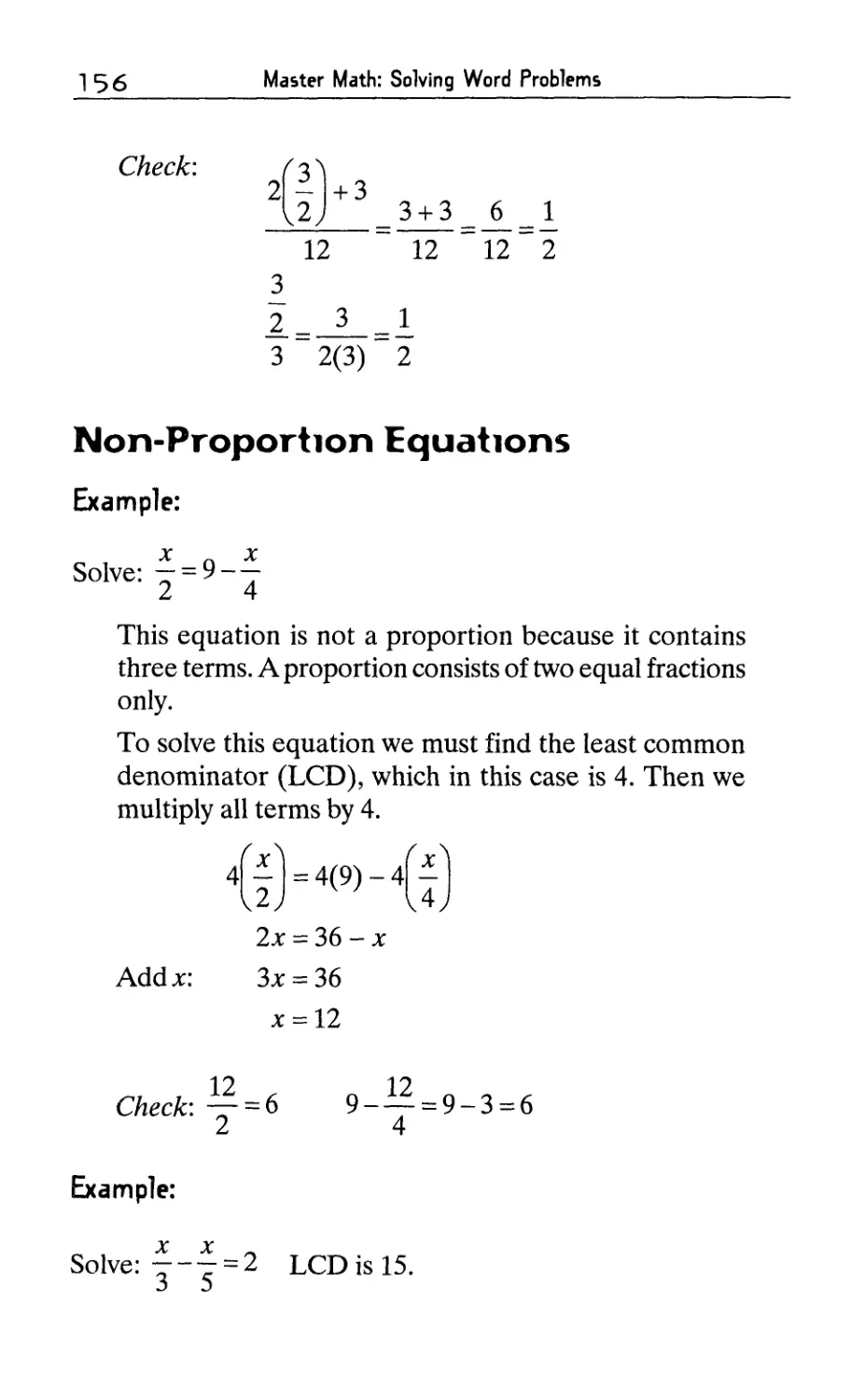
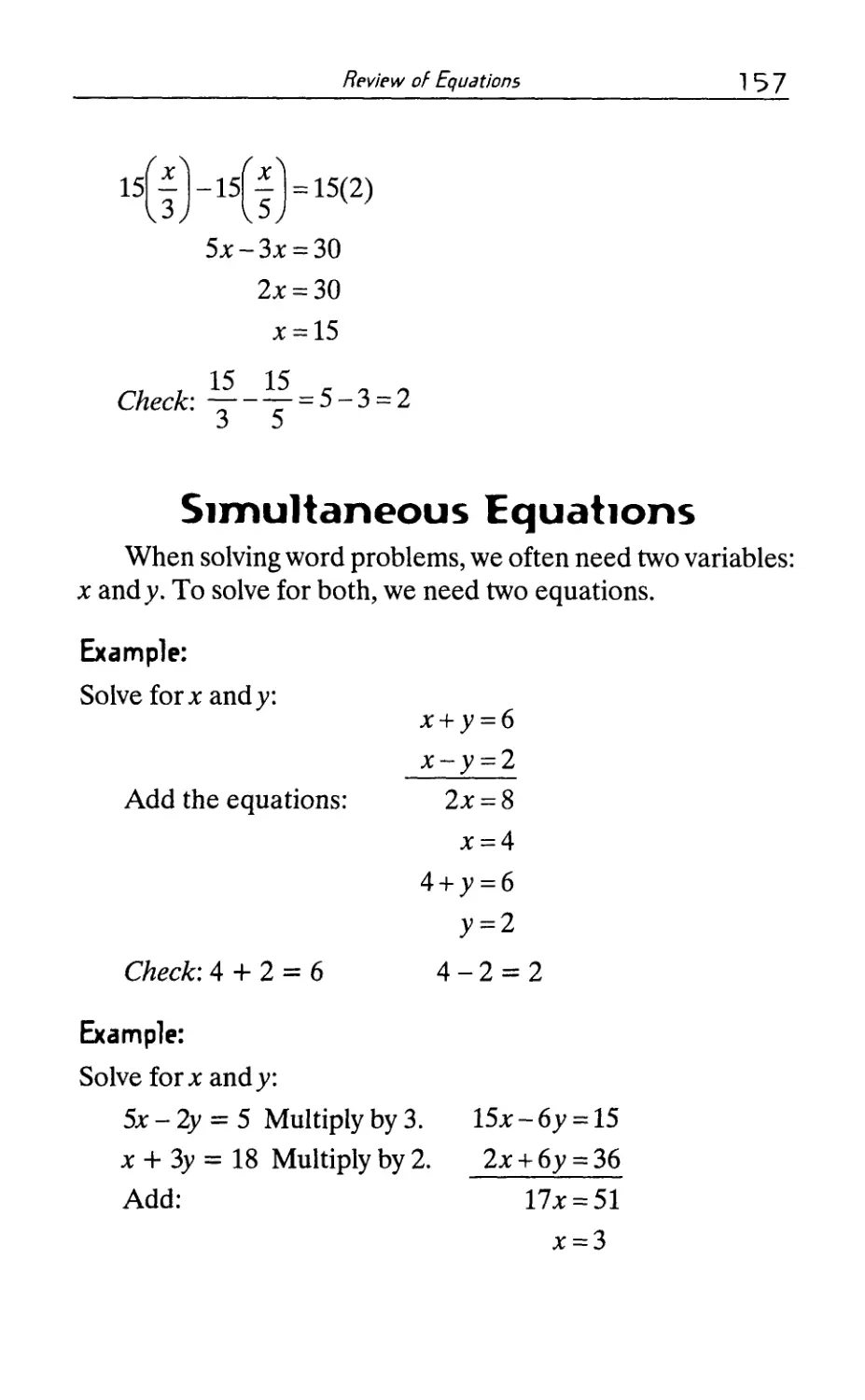

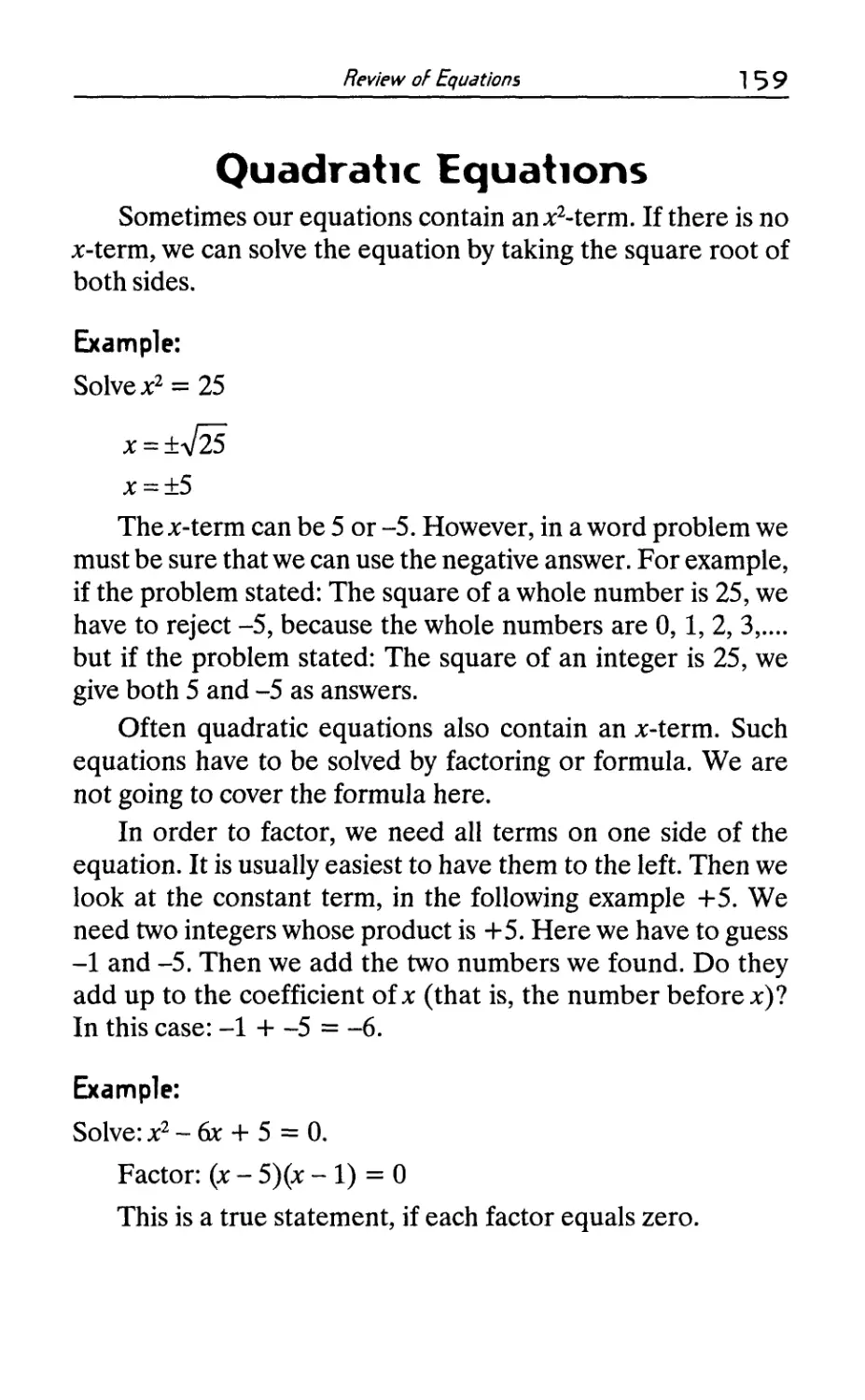


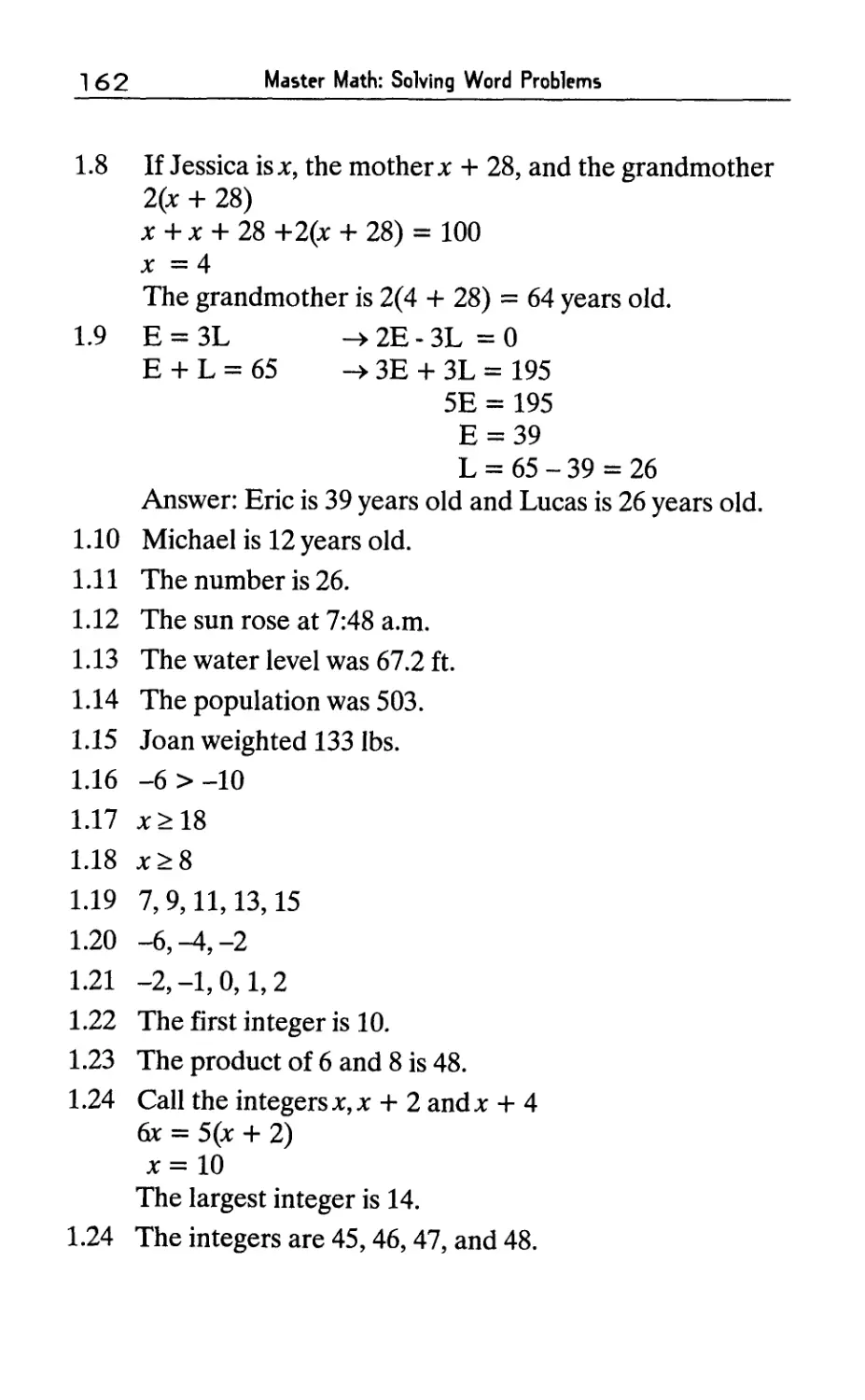



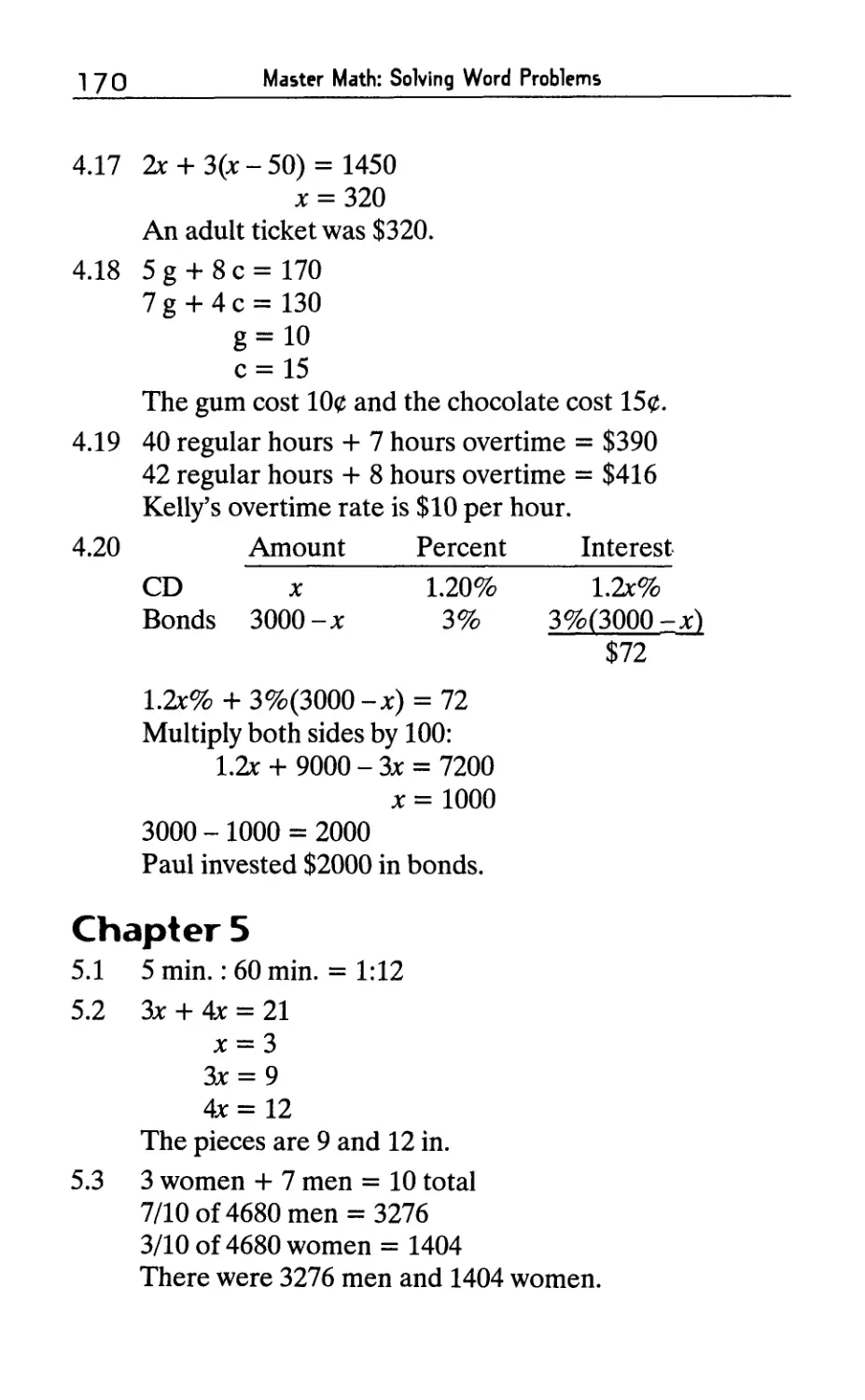
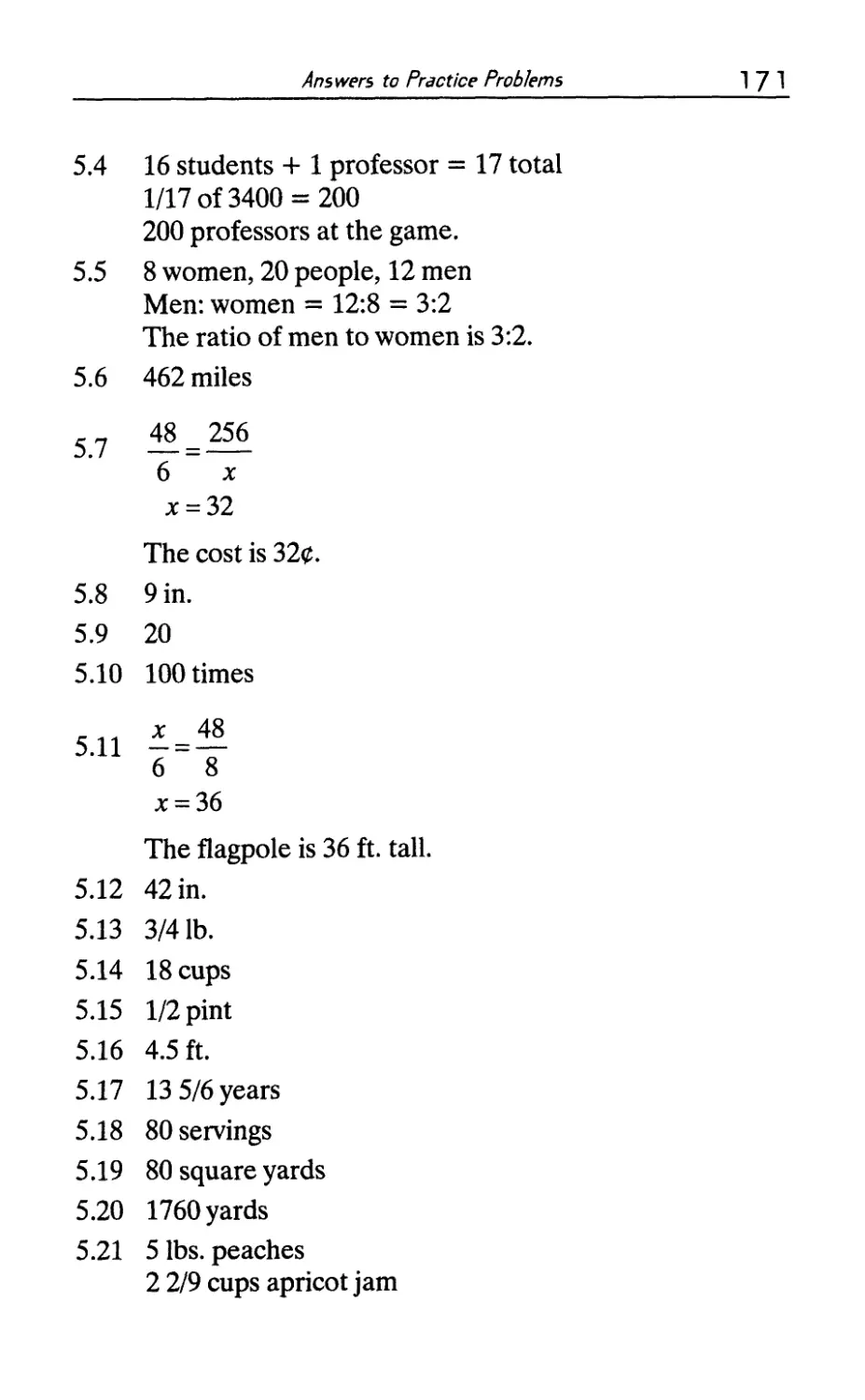
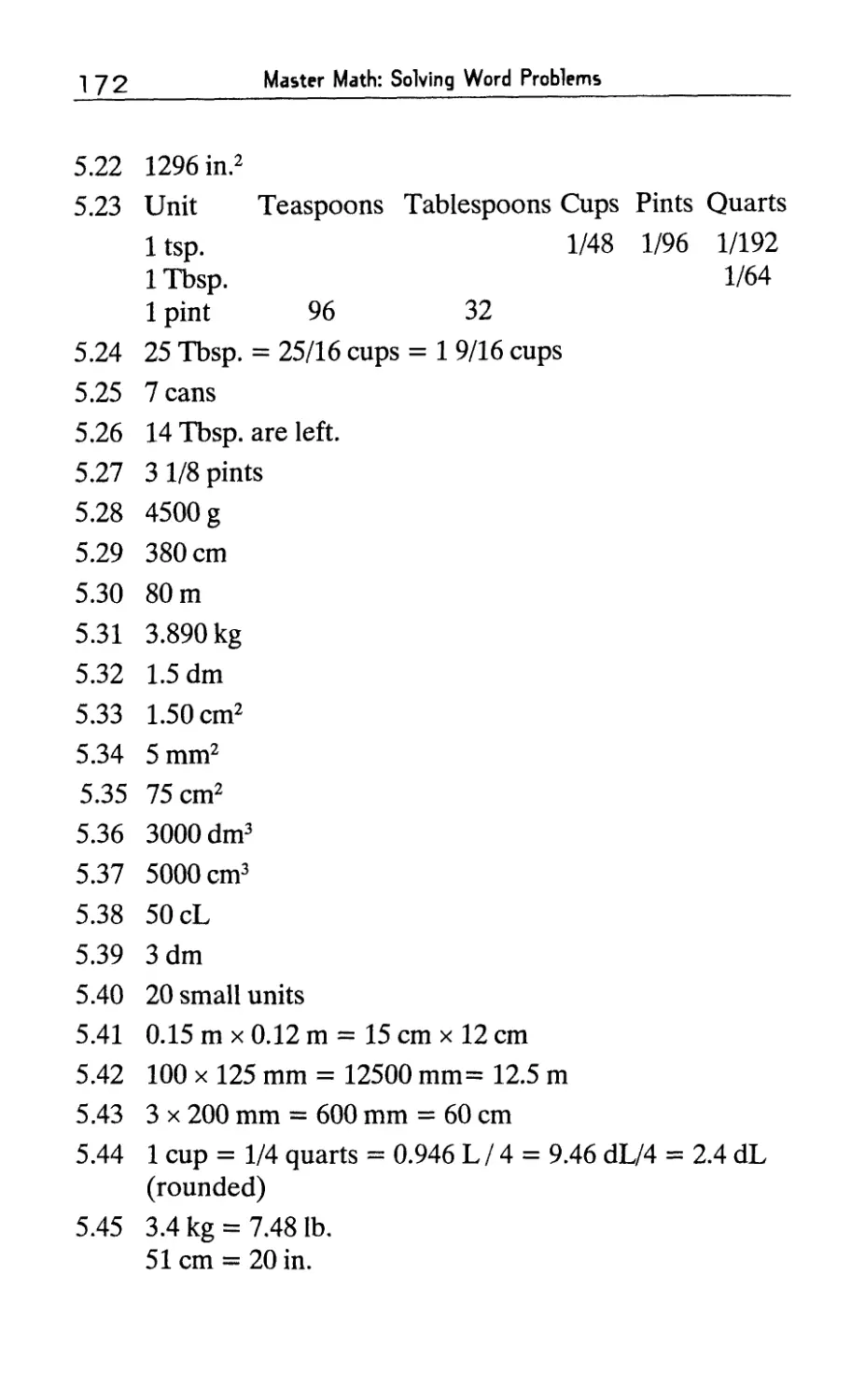

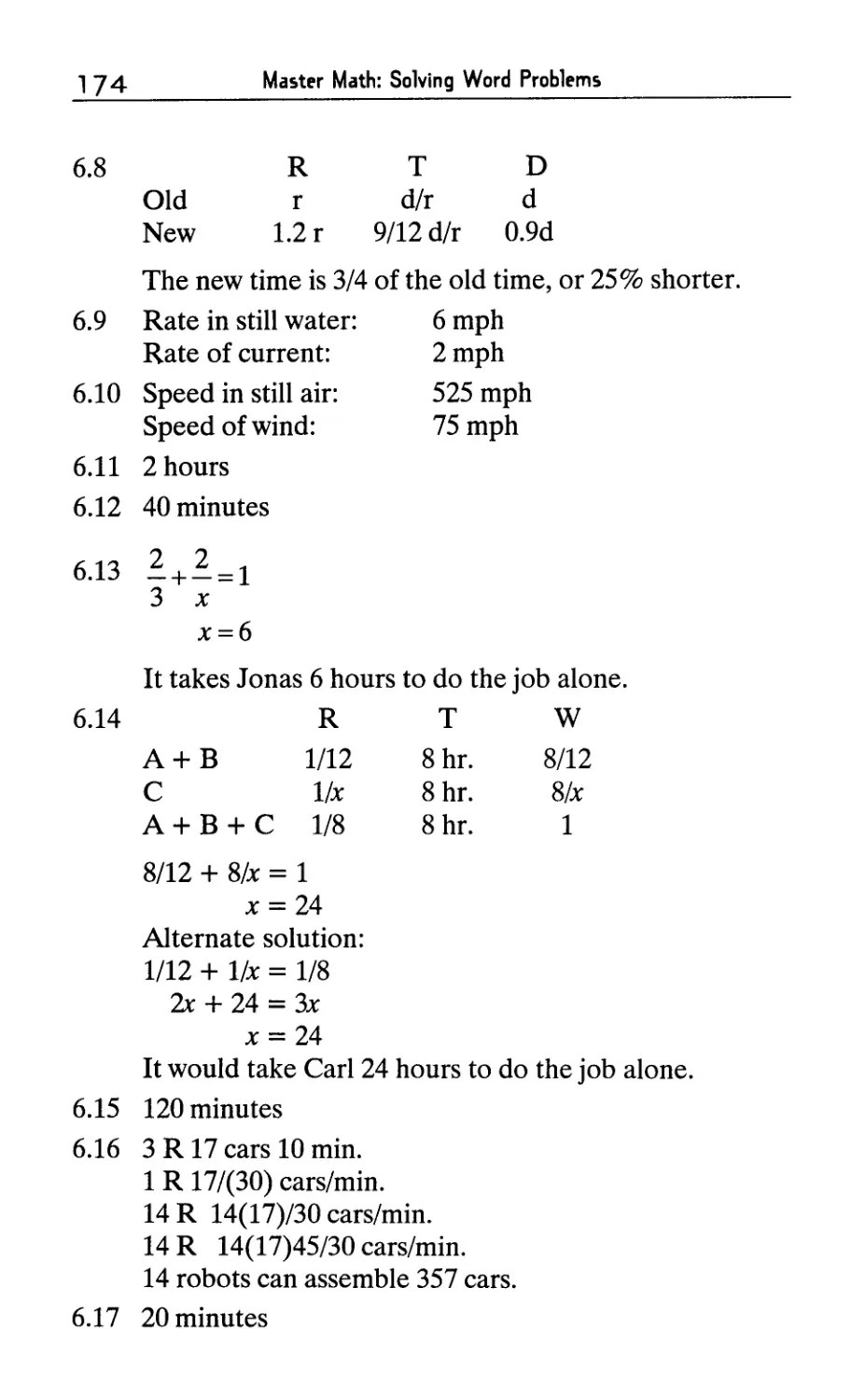





Text
                    Master Math:
Solving Word
Problems
В R I T A I M И E R G U T

Master Math:
Solving Word Problems
Analyze any word problem,
translate it into
mathematical terms, and get
the right answer!
By
Bnta Tirinnergut
CAREER
PRESS
Franklin Lakes, NJ

Copyright © 2003 by Brita Immergut
All rights reserved under the Pan-American and International
Copyright Conventions. This book may not be reproduced, in whole
or in part, in any form or by any means electronic or mechanical,
including photocopying, recording, or by any information storage
and retrieval system now known or hereafter invented, without
written permission from the publisher, The Career Press.
Master Math: Solving Word Problems
Edited by Kristen Parkes
Typeset by Eileen Dow Munson
Cover design by The Visual Group
Printed in the U.S.A. by Book-mart Press
To order this title, please call toll-free 1-800-CAREER-l (NJ and
Canada: 201-848-0310) to order using VISA or MasterCard, or for
further information on books from Career Press.
CAREER
PRESS
The Career Press, Inc., 3 Tice Road, PO Box 687,
Franklin Lakes, NJ 07417
www.careerpress.com
Library of Congress Cataloging-in-Publication Data
Immergut, Brita.
Master math : solving word problems: analyze any word problem, translate it
into mathematical terms, and get the right answer! /by Brita Immergut.
p. cm.
Includes index.
ISBN 1-56414-678-2 (pbk.)
1. Word problems (Mathematics) 2. Problem solving. I. Title.
QA63.I45 2003
510—dc21
2003053228

Go my grandchildren
Michael, Jessica, and Kristina.
I hope you tfill always lole mathematics.
Mormor

This page intentionally left blank

V <.+-
Table of Contents
To the Reader 11
Chapter 1. Simple Equation Problems 13
Length Problems 14
Age Problems 15
Use oF the Words "More Than" and "Less Than" 16
Inequalities Using the Words "At Least" and "At Most" 18
Number Problems 19
Chapter 2. Percents 25
Percents and Decimals 26
Percents and Numbers 29
The Percent Is Included 30
Percent Increase and Decrease 32
Discounts 34
Discounts on Discounts 36

Interest 38
Simple interest 39
Credit Cards 40
Compound Interest 41
Bank Deposits 43
Investments 44
Stocks 45
Bonds 45
ProFit and Loss 49
Chapter 3. Advanced Level Age Problems 49
Chapter 4. Mixing Problems 59
Stamps and Coins 60
Liquids With Different Strengths 62
Diluting Solutions With Water 63

Mixing Metals 65
A Mixed Bag 66
Fruit, Candy, and Money 68
Investments at Different Interest Rates 69
Chapter 5. Measurement Problems 71
Ratio and Proportion 72
Proportion 74
Measurements and Conversions 77
The Customary System 77
The Metric System 82
Conversions Between the Customary and the
Metric System 85
Dimensional Analysis 86
Temperature 87

Chapter 6. Rate Problems
Motion (Speed) Problems
Work Problems
Chapter 7. Statistics and Probability
Averages
Graphs
Probability and Odds
Probability
Odds
Probabilities With "And" and "Or" Statements
The Counting Principle, Permutations, and Combinations
The Fundamental Counting Principle
Permutations
Combinations
Sets
89
90
96
103
104
105
П2
П2
П4
П5
П8
П8
П9
120
120

Chapter 8. Geometry 123
Plane Geometry 124
Angles 124
Perimeter 125
Areas 127
The Pythagorean Theorem 130
Angles and Triangles 131
Exterior Angles 132
Congruent and Similar Triangles 133
Polygons 135
Similar Polygons 136
The Circle 137
Solid Geometry 138
Area 139
Volume 140
Trigonometry 141

Analytic Geometry 145
Appendix. Review of Equations 151
Linear Equations With One Variable I5l
Equations With Denominators 154
Non-Proportion Equations 156
Simultaneous Equations 157
Quadratic Equations 159
Answers to Practice Problems 161
Index 183
About the Author 189

, < + *_^ X^ < n д „
To the Reader
Many people are afraid of word problems. Why is that?
Maybe it's because they remember that they had previous trouble
with word problems. Or they think that they can't understand
word problems because word problems are "difficult." Or they
don't know how to unravel the problem to find out what the
real question is. Or they simply don't know where to start.
In this book you will learn how to overcome those difficul-
difficulties. You will be asked to read the problems slowly and to first
concentrate on the words rather than on the numbers. Then
you will learn how to break down the problem into smaller seg-
segments and to use a simple table to list the known numbers pre-
presented in the problem and the unknown number (usually x)
that you are asked to figure out what it stands for. The solution
for the problem usually involves the use of an equation and,
for those of you who are a bit hazy about equations, you will
find a short refresher in the Appendix.
The problems in this book mostly deal with situations from
daily life: percents and discounts; interest (simple and com-
compound); mixing of liquids and mixing of solids; ratios and pro-
proportions; and measurements in the English (customary) and
the metric system and how to convert from one to the other.
1 1

Master Math: Solving Word Problems
There will also be problems dealing with the motion of cars,
boats, and people at different speeds and how quickly work
gets done. Then we will move on to statistics and probability
problems: averages, graphs, probabilities, and odds. There will
be rolling of dice, tossing of pennies, and drawing of playing
cards.
Finally, you will learn how to solve word problems involv-
involving geometrical figures, such as triangles, polygons, circles,
and cylinders. Some problems will deal with plane geometry,
others with solid geometry, trigonometry, and analytic geom-
geometry. Each chapter contains not only worked-out problems, but
also plenty of practice problems. The answers for the practice
problems are at the end of the book.
I hope that when you are finished with this book you will
feel as one of my former students did who told me: "Before I
took your course I cried because I couldn't solve the word prob-
problems and now I cry because I am so happy that I can solve them."

I
J <._+-* - x *.< тс д ^ I
±. -'"' Chapter 1
Simple Equation
Problems
In order to solve mathematical word problems we often
need to use equations. In this chapter, you will learn how to set
up simple equations to solve different kinds of word problems.
For example, we will cut up a length of board or rope into shorter
and longer pieces and, given the known total length and other
facts, we will calculate the lengths of the pieces cut from it. In
other examples we will calculate the ages of two children once
we know how many years they are apart and what the sum of
their ages is. We will also look at situations where one person
weighs more or less than another and calculate each person's
weight from the information given in the problem.
Then, we will learn the mathematical symbols for inequali-
inequalities, that is, situations where something is greater than or smaller
than something else and also how to solve problems in which
we are told that something is at most so big or that something
costs at least so much.
Finally, we will tackle word problems involving all kinds of
numbers: positive and negative integers, including zero; odd
and even integers; and consecutive integers.
The last example will show you how to solve a problem that
requires the use of a quadratic equation.
13

Master Math: Solving Word Problems
(Note: If you want to brush up on your skills for solving
equations, see the Appendix.)
Length Problems
Example:
Cut a 10-foot (ft.) long piece of wood into two pieces so that
one piece is 2 ft. longer than the other. To solve this problem
you have two choices:
By using algebra:
Call one piece x, then the other piece is x + 2.
Write an equation: jc+x + 2 = 10
Solve the equation: 2x = 8
x = 4
x + 2 = 6
Total = 10
Or by using arithmetic:
10 - 2 = 8 Take away the 2 ft. from the whole piece.
8 -r 2 = 4 Divide the piece by 2.
4 + 2 = 6 Add the 2 ft. to one of the pieces.
Total = 10
The pieces were 4 ft. and 6 ft.
Check your work by adding the pieces. Together they were
10 ft. Read the problem again to check all the facts.
Example:
A length of board was 10 inches shorter than another length.
Together the boards were 20 inches. How long were the boards?

Simple Equation Problems 1 5
Call the long piece x and the short piece x - 10.
2c = 30
jc=15
15 - 10 = 5
The pieces were 5 and 15 in.
Reread the problem. Is it true that the pieces equal 20 in.
when put together? Is one piece 10 in. shorter than the other?
Practice Problems:
1.1 Solve the previous problem by calling the short
piece of board x.
1.2 A 12-ft. rope is cut into three pieces so that the
second piece is 1 ft. longer than the first and the
third piece is 1 ft. longer than the second. How long
are the pieces?
1.3 A 9-ft. board is cut into two pieces so that one piece
is twice the other. How long are the pieces?
1.4 An 80-in. board is to be cut into three pieces so
that one piece is twice another and the third piece
is 10 in. more than the second. Find the length of
each piece.
1.5 Two ropes are together 275 yards long. One rope is
50% longer than the other. How long are the ropes?
Age Problems
Example:
Leah is 2 years older than Tracy. Together the girls are 10 years
old. How old are they?

Master Math: Solving Word Problems
Call Leah's agex. Then Tracy's age is* - 2.
jc+x-2 = 10
2x= 12
x = 6
x - 2 = 4 Leah is 6 years old and Tracy is 4.
Do you recognize this problem as essentially the same as
the first length problem?
Practice Problems:
1.6 Elsa is 7 years younger than Thor. The sum of their
ages is 35. How old are they?
1.7 Kristina's grandmother is 12 times as old as Kristina.
Together they are 91 years. How old is the
grandmother?
1.8 The sum of the ages of Jessica, her mother, and her
grandmother is 100 years. The grandma is twice as
old as the mother. Jessica's mother is 28 years older
than Jessica. How old is grandma?
1.9 The sum of Eric's age and Lucas's age is 65. Two
times Eric's age is the same as three times Lucas's
age. Find the ages of the men.
1.10 Michael's age is multiplied by 7. Then 9 is added.
The result is 93. How old is Michael?
Use of the Words "More Than
and "Less Than
¦ I MdJl"
IT
Beware of keywords! Many people believe that if they see
"more than" in a word problem they must add and with "less
than" they must subtract. That is not always the case. Look at
the following examples:

Simple Equation Problems 1 ~j
Examples:
a) Sue weighs 5 pounds more than Amanda. If Amanda
weighs 103 pounds, how much does Sue weigh?
b) Sue weighs 5 pounds less than Amanda. If Sue weighs
103 pounds, how much does Amanda weigh?
c) A school has an enrollment of 2381 students. This
is 53 students less than last year. What was the
enrollment last year?
d) A school had an enrollment of 2381 students last
year. This is 53 students less than this year. What is
the enrollment this year?
In each of these examples should you add or subtract?
Solutions:
d) Who weighs more? Sue. So we add 5 pounds to
Amanda's 103 pounds.
b) Who weighs more? Amanda. So we add 5 pounds
to Sue's 103 pounds
c) Is the enrollment larger this year? No, it is smaller
by 53 students. We add 53 students to 2381.
d) Last year's enrollment was smaller than this year's.
add 53 to 2381.
Answers:
a) and b) 108 pounds; c) and d) 2434.
Practice Problems:
1.11 Six less than a number is 20. Find the number.
1.12 The sun rose at 7:45 a.m. That is 3 minutes earlier
than yesterday. At what time did the sun rise
yesterday?

1 8 Master Math: Solving Word Problems
1.13 The water level in the reservoir was 67.3 ft. That is
0.1 ft. higher than a month ago. What was the water
level a month ago?
1.14 The population of the village is 487. That is 16
people less than 5 years ago. What was the
population 5 years ago?
1.15 Joan weights 143 pounds. That is 10 pounds more
than she weighed 5 years ago. How much did she
weigh 5 years ago?
Inequalities Using the Words
Tf At Least" and TrAt Most"
The symbols below translate into words the following way:
< is less than.
< is less than or equal to.
> is greater than.
> is equal to or greater than.
In word problems these symbols can also be used to translate:
< at most.
> at least.
Example:
Translate and solve:
1/3 of an unknown number is less than 4.
x/3<4
Multiply both sides by 3: x < 12
The unknown number can be any number smaller than 12.

Simple Equation Problems 1 9
Example:
If a number is subtracted from 10, the result is at most 22.
10-x<22
Subtract 10: -x < 12
Multiply by-1: x>-12
Note: When we multiply or divide an inequality by a
negative number, we must reverse the inequality sign!
Answer:* can be any number that is equal to or greater
than -12.
Practice Problems:
1.16 Compare -6 and -10 by using inequality symbols.
Solve the following inequalities:
1.17 The difference of a number and 7 is greater than or
equal to 11.
1.18 Two times a number subtracted from 19 is less than
or equal to 3.
Number Problems
Number problems deal with numbers, usually integers
(whole numbers, which includes zero, and their negatives). An
equation can be written once the problem has been stated. If
the problem states something special about a number, that
number is usually calledx. Often these numbers deal with con-
consecutive integers, which are integers that follow in order such
as 5, 6, 7,... or -4, -3, -2,... Consecutive odd or even integers
are two numbers apart, such as 2, 4, 6,... or 1, 3, 5,... If you
add 1 -I- 3 + 5 = 9, we have an odd sum of odd numbers, but
1 + 3 + 5 + 7=16.A sum of four odd integers gives an even
sum. Can a sum of even consecutive integers ever be odd?

20 Master Math: Solving Word Problems
Example:
The sum of three consecutive integers is 6. Find the integers.
Call the smallest integer x. Then the others are x + 1
and x + 2
The sum is x + jc + 1 + Jt + 2 or 6.
3x .+ 3 5= 6
3bt = 3
x= 1
x + 1 = 2
л: + 2 = 3
The consecutive integers are 1, 2, and 3.
: 1 + 2 + 3 = 6
Example:
The sum of four consecutive even integers is 44. Find the
integers.
Call the integers x, x + 2, x + 4, x + 6.
The sum isx+x + 2+x + 4+* +
4x + 12 = 44
4jc = 32
x= 8
x + 2 = 10
* + 4 = 12
x + 6 = 14
The four integers are 8,10,12, and 14.
Check: 8 + 10 + 12 + 14 = 44

Simple Equation Problems 2 1
Practice Problems:
1.19 Find five consecutive odd integers whose sum is 55.
1.20 The sum of three consecutive even integers is -12.
Find the integers.
1.21 The sum of five consecutive integers is 0. Find the
integers.
1.22 The sum of four consecutive even integers is 2 more
than five times the first integer. Find the first
integer.
1.23 Two consecutive even integers have a sum of 14.
What is their product?
Some types of number problems may sound more compli-
complicated, but they can also be solved by simple equations.
Example:
Find three consecutive odd integers so that four times the first
integer equals the sum of the other two.
Call the smallest integer x. The others arex + 2
and л: + 4.
4x = x + 2+x + 4
Ax = 2x + 6
The odd integers are: 3, 5, and 7.
Check: 4C) = 12 5 + 7 = 12

22 Master Math: Solving Word Problems
Practice Problems:
1.24 Find the largest of three consecutive even integers
when six times the first integer is equal to five times
the middle integer.
1.25 The sum of four consecutive integers is 186. Find
the integers.
1.26 Find three consecutive even integers such that three
times the first equals the sum of the other two.
1.27 Five times an odd integer plus three times the next
odd integer equals 62. Find the first odd integer.
1.28 Find three even integers, if five times the first
integer, plus twice the second integer, plus the third
integer equals 40.
The following example and practice problems require the
knowledge of how to solve quadratic equations. If you have
never done this, you might want to skip them. However, they
are also explained in the Appendix. All of the following prob-
problems can be solved by factoring.
Example:
The product of two consecutive integers is 20. Find the integers.
Call the integers x and x + 1.
The product is x(x + 1) = 20
x2 + x = 20
x2 + x - 20 = 0
We factor this equation by finding two integers whose
product is -20 and whose sum is 1 (the coefficient of x).
The integers are -4 and 5.

Simple Equation Problems 2 3
(x - 4)(jc + 5) = 0 x - 4 = 0 x + 5 = 0
x = 4 x = -5
jt + 1 = 5 * + l=-4
The consecutive integers are 4 and 5, or -5 and -4.
Note: Quadratic equations always have two possible
solutions.
Practice Problems:
1.29 The product of two consecutive positive integers
is 20. Find the integers.
1.30 One number is 4 more than another number. Their
product is 5. Find the numbers.
1.31 The product of two consecutive odd integers is 15.
Find the integers.
1.32 The product of two numbers is 243. One number is
three times the other one. Find the numbers.
1.33 One number is 2 more than another. Their product
is 440. Find the numbers.

This page intentionally left blank

f
± Chapter 2
Percents
In this chapter you will learn how to solve word problems
that deal with percent (%). In daily life, percents are used all
the time by banks, in statistics, in advertising, in store discounts,
and in many other situations.
We will start with problems involving conversions from
percents to decimals and fractions, and from decimals and frac-
fractions to percents. We also want to calculate percents of num-
numbers (for example, what is 30% of 90) and express the answer
in fractions or decimals.
Then we will solve problems for situations where the per-
percent is already included in the final number. This happens in
grocery and other stores where the sales tax (which is a per-
percentage of the sales price) is included in the total amount of
money you pay. Similarly, some restaurants include a 15% tip
in the total charge.
You will also learn how to calculate percent increases and
decreases. For example, when the subway or bus fare is increased
by 50c from $1.50 to $2.00, what is the percentage increase? Or
when postage stamps are increased from 340 to 37c?
We will then go on to discounts, and discounts on already
discounted items.

26 Master Math: Solving Word Problems
This chapter also deals with interest calculations: interest
paid by banks on your deposit in a savings account and interest
charged by banks and credit card issuers on money you bor-
borrowed or charges on your credit card. The difference between
simple interest and compound interest will also be made clear.
Finally, we will learn about investments in stocks and bonds
and how to calculate gains or losses from these investments.
We will give examples of word problems dealing with other situ-
situations of profit and loss.
Percents and Decimals
The word percent consists of two parts: per and cent. Per
means "divide by" and cent means "hundred."
Example:
a) 100%
b) 50%-
c) 1/2%:
d) 0.25%
= 100 + 100 =
50
100
2 2
= 0.0025
1 (that is, "the whole thing")
2
1 1
nrO no5;
100 200
When a number in decimal form is divided by 100, the
decimal point is moved two steps to the left: 100.0% = 1.00,
50.0% = 0.5,5.0% = 0.05, etc.
Practice Problems:
2.1 Change to a fraction: 1/3%
2.2 Change to a fraction: 4 1/2%
2.3 Change to a decimal: 0.006%

Percents 2 7
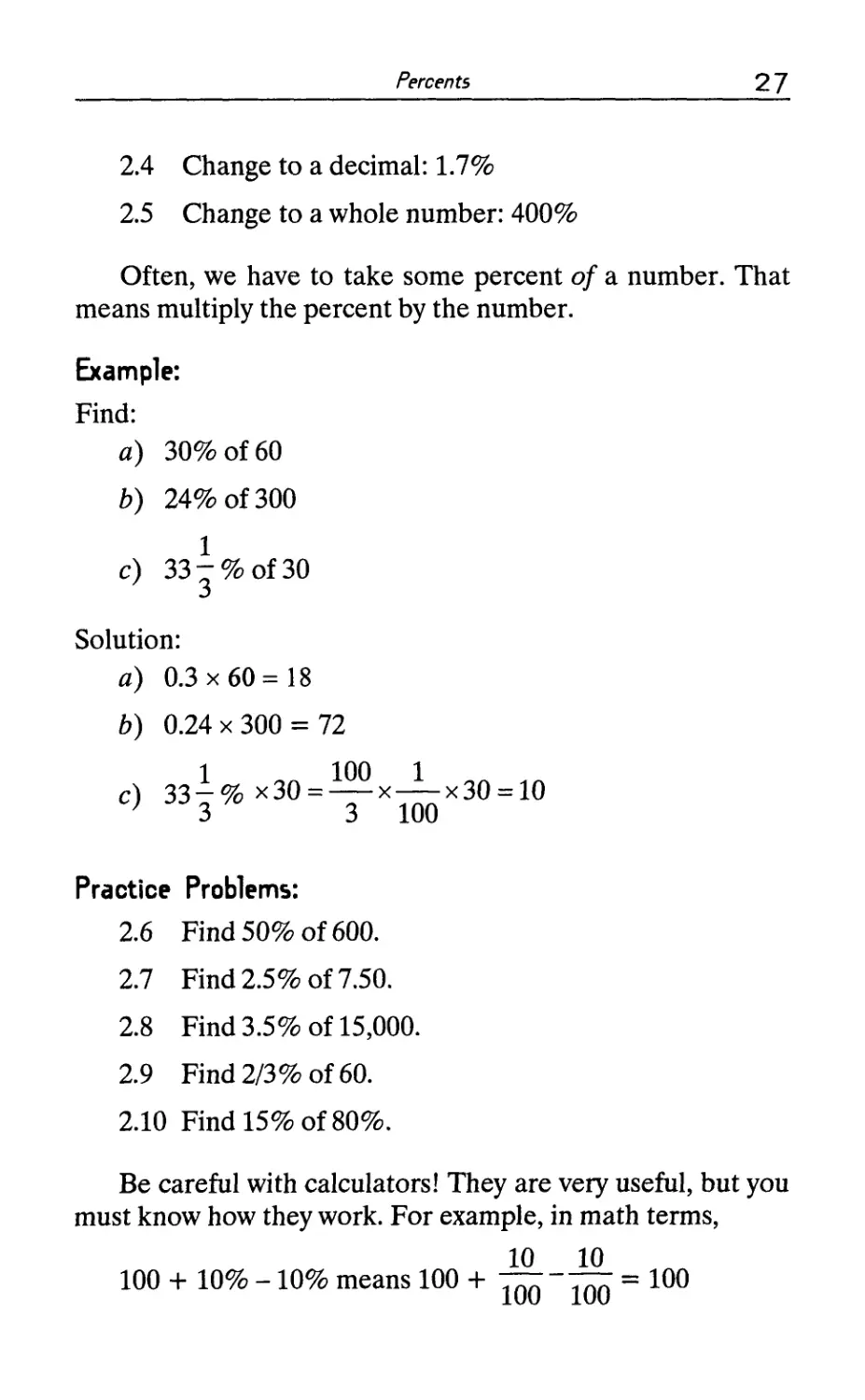
2.4 Change to a decimal: 1.7%
2.5 Change to a whole number: 400%
Often, we have to take some percent of a number. That
means multiply the percent by the number.
Example:
Find:
a) 30% of 60
b) 24% of 300
1
c) 33-% of 30
Solution:
a) 0.3x60=18
b) 0.24x300 = 72
с) Зз|%хЗО = ^
Practice Problems:
2.6 Find 50% of 600.
2.7 Find 2.5% of 7.50.
2.8 Find 3.5% of 15,000.
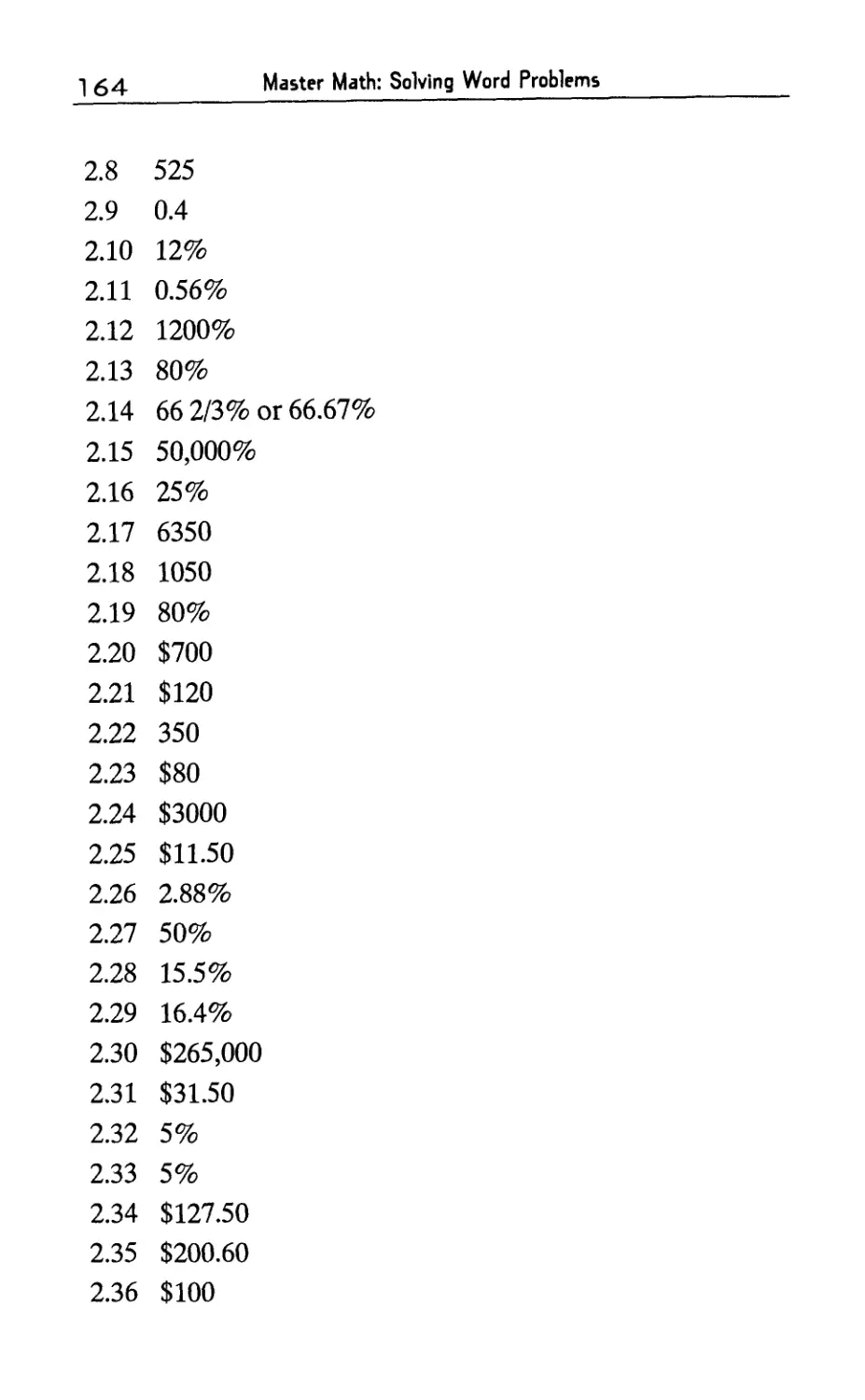
2.9 Find 2/3% of 60.
2.10 Find 15% of 80%.
Be careful with calculators! They are very useful, but you
must know how they work. For example, in math terms,
10 10
100 + 10% -10% means 100 + — -— = 100

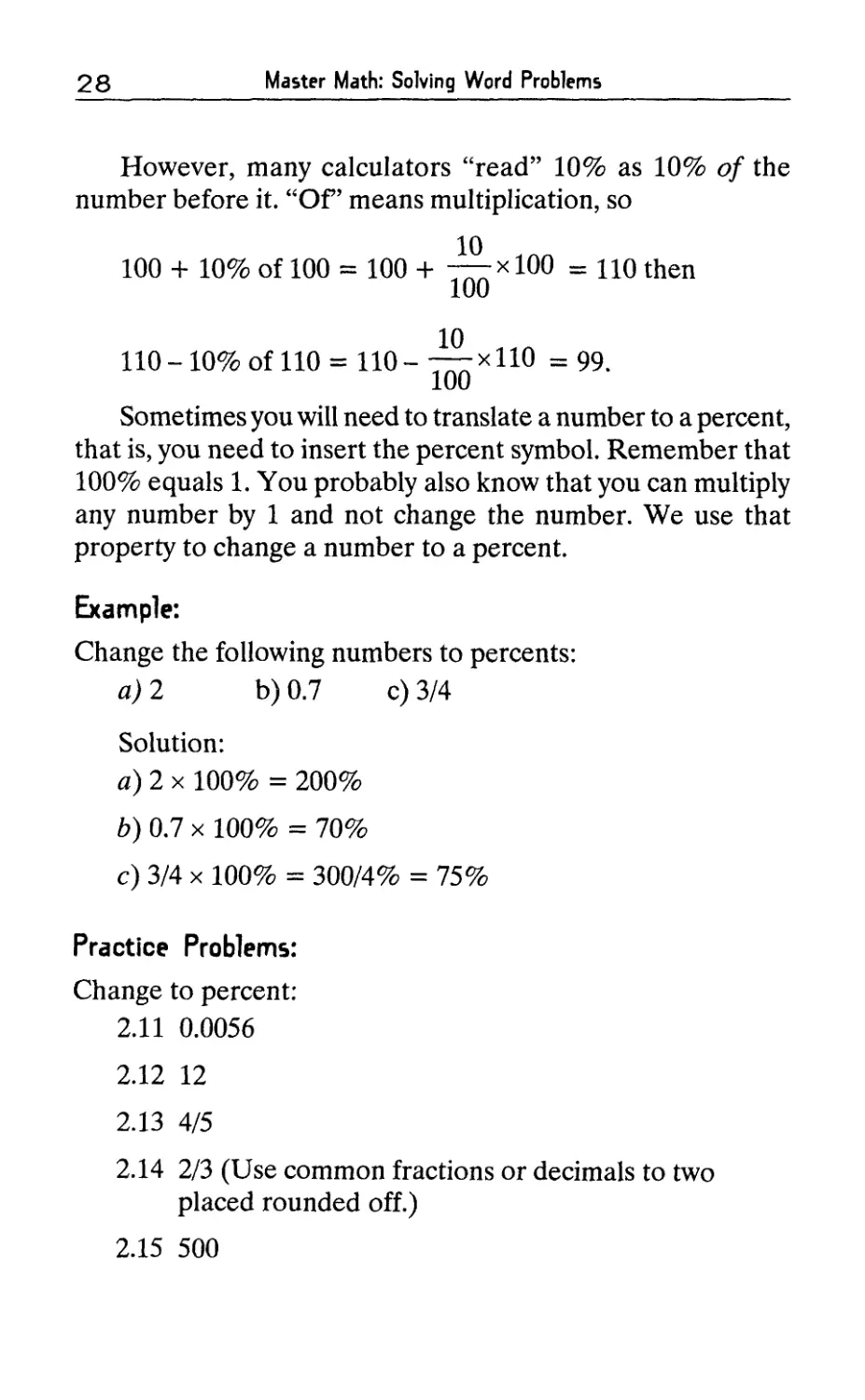
28 Master Math: Solving Word Problems
However, many calculators "read" 10% as 10% of the
number before it. "Of means multiplication, so
100 + 10% of 100 = 100 + — x 100 = no then
110-10% of 110 = 110-— xllO =99.
Sometimes you will need to translate a number to a percent,
that is, you need to insert the percent symbol. Remember that
100% equals 1. You probably also know that you can multiply
any number by 1 and not change the number. We use that
property to change a number to a percent.
Example:
Change the following numbers to percents:
a) 2 b) 0.7 c) 3/4
Solution:
aJx 100% = 200%
b) 0.7 x 100% = 70%
c) 3/4 x 100% = 300/4% = 75%
Practice Problems:
Change to percent:
2.11 0.0056
2.12 12
2.13 4/5
2.14 2/3 (Use common fractions or decimals to two
placed rounded off.)
2.15 500

Percents 2 9
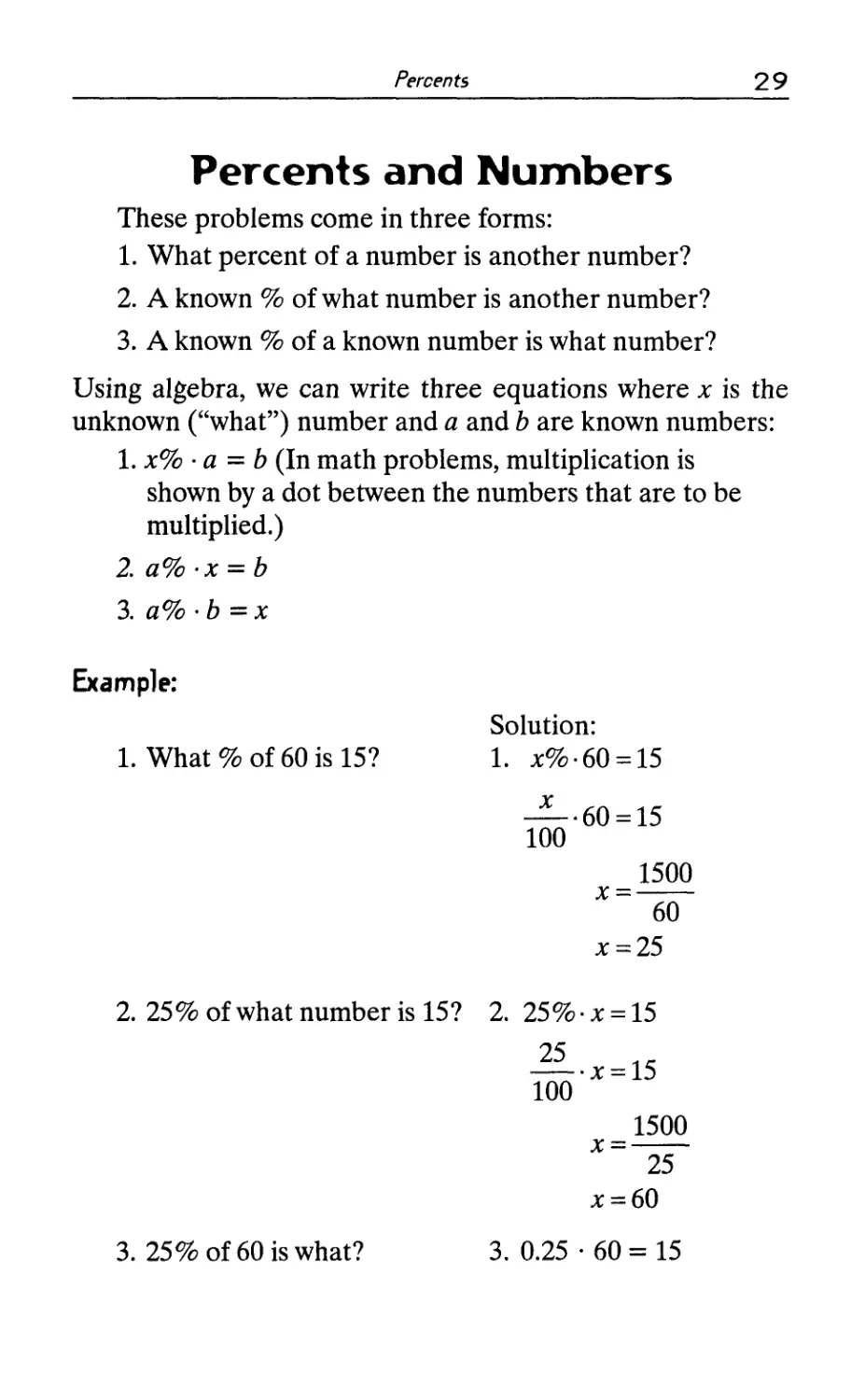
Percents and Numbers
These problems come in three forms:
1. What percent of a number is another number?
2. A known % of what number is another number?
3. A known % of a known number is what number?
Using algebra, we can write three equations where x is the
unknown ("what") number and a and b are known numbers:
1. x% • a = b (In math problems, multiplication is
shown by a dot between the numbers that are to be
multiplied.)
2 a%-x = b
3. a% • b = x
Example:
1. What
%
of 60 is
15?
Solution:
1. x%-60 =
X -60
¦ ou —
100
x =
15
15
1500
60
2. 25% of what number is 15? 2. 25%-x = 15
25 к
jc = 15
100
1500
% —
25
x = 60
3. 25% of 60 is what? 3. 0.25 • 60 = 15

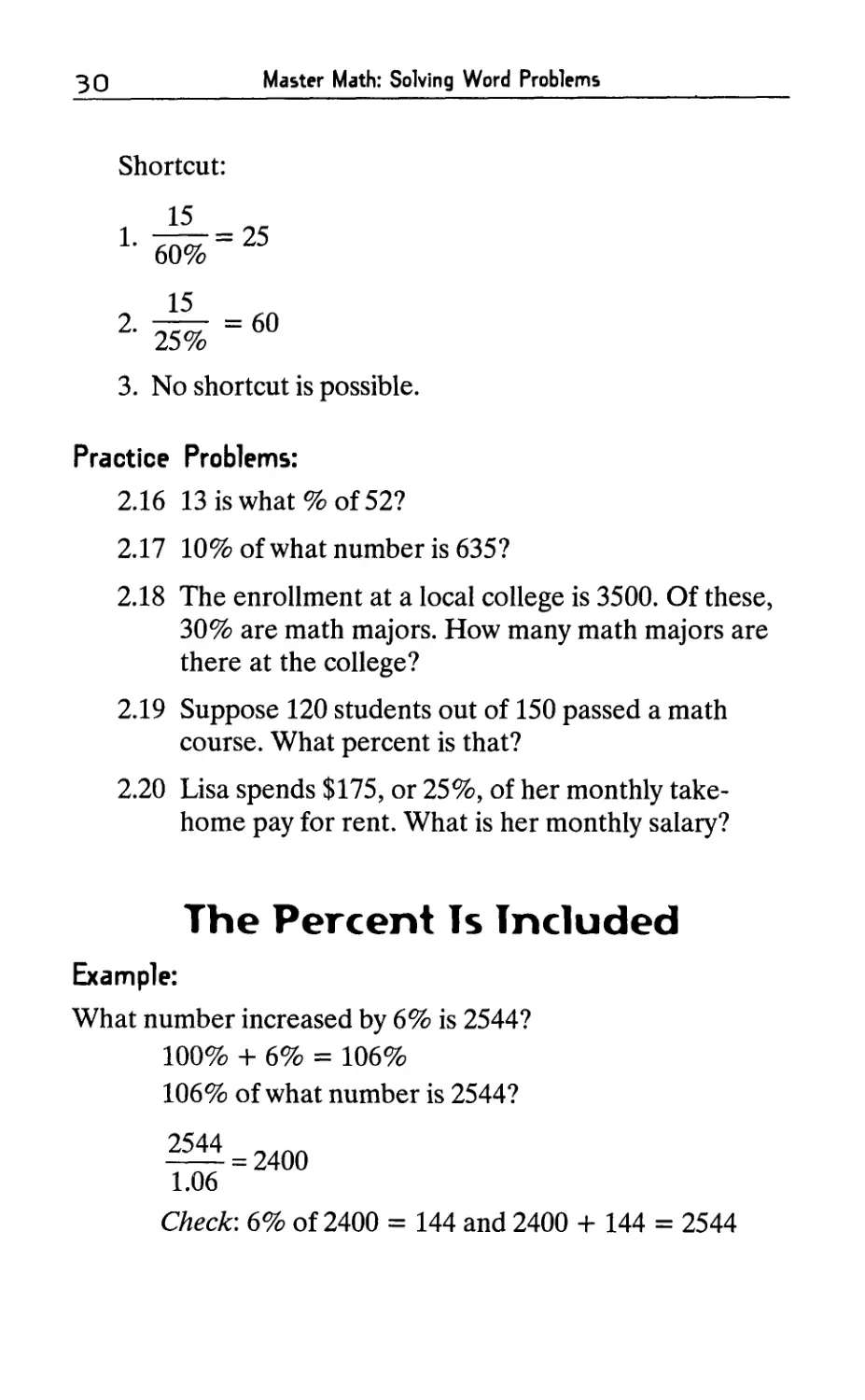
30 Master Math: Solving Word Problems
Shortcut:
1.
2.
3.
15
60% "
15
25% "
25
= 60
No shortcut is possible.
Practice Problems:
2.16 13iswhat%of52?
2.17 10% of what number is 635?
2.18 The enrollment at a local college is 3500. Of these,
30% are math majors. How many math majors are
there at the college?
2.19 Suppose 120 students out of 150 passed a math
course. What percent is that?
2.20 Lisa spends $175, or 25%, of her monthly take-
home pay for rent. What is her monthly salary?
The Percent Is Included
Example:
What number increased by 6% is 2544?
100% + 6% = 106%
106% of what number is 2544?
= 2400
1.06
Check: 6% of 2400 = 144 and 2400 + 144 = 2544

Percents 31
If you prefer, you can use an equation: x + 6% ¦ x = 2544
x + 0.06* = 2544
1.06* = 2544
2544
X~ 1.06
x = 2400
Example:
A merchant counted the money in his cash register and found
that he had $4320. A sales tax of 8% was included. How much
money did the merchant keep and how much did he owe the
government?
Let's analyze the problem:
If his money isx, the tax rate is 8%, and he counted out
$4320, we have: x + 8% • x = 4320
1.08* = 4320
4320
X~ 1.08
x = 4000
Therefore, the merchant keeps $4000 and the govern-
government gets $320.
Shortcut:
4320
Do the division directly without using*:
1.08
Example:
a) Eva paid $23 for a taxi ride with 15% tip included.
How much did the trip itself cost?

32 Master Math: Solving Word Problems
b) $5.40 has been collected for an item with 8% sales
tax included. How much did the item cost before
the tax was included?
Solutions:
23
a) —~z = 20 Answer: $20.00
5.40
b) —— = 5 Answer: $5.00
l.Uo
Practice Problems:
2.21 Bailey paid the bank $127.20 every month to repay
principal on her loan plus 6% interest. How much
was the principal repayment?
2.22 What number increased by 6% of itself is 371?
2.23 An item cost $82.40 including a 3% tax. What was
the cost of the item itself?
2.24 After a salary increase of 4%, Nell's salary was
$3120/month. What was her salary before the
increase?
2.25 The price of a pound of prime steak was increased
by 8% to $12.42. What was the price before the
increase?
Percent Increase and Decrease
Example:
In many problems we have information "before and after." For
example, the price of eggs was $1.29 for a dozen eggs last month
and now it is $1.49. What was the percent increase?

Percents 3 3
The original price of the eggs was $1.29 and the increase
was $1.49 - $1.29 = $0.20. The problem can then be
restated: What % of 1.29 is 0.20?
Equation: x% • 1.29 = 0.20
x = 15.5 (rounded)
The price increased by 15.5%.
Example:
Let's change the problem and pretend that the eggs decreased
from $1.49 to $1.29. What was the percent decrease?
Now the original price is $1.49 and the decrease was
$0.20.
x% ¦ 1.49 = 0.20
x = 13.4 (rounded)
The price decreased by 13.4%.
Practice Problems:
2.26 Jill's monthly salary as a teacher increased from
$2600 to $2675. What was the percent increase?
2.27 During one year the price of a certain stock
decreased from $75.6 a share to $37.5. What was the
percent decrease (rounded to the nearest percent)?
2.28 Ellen paid $29,000 for a new car. After a year, she
found that the value of the car was only $24,500.
Find the percent decrease.
2.29 The enrollment at a community college increased
from 6783 to 7895. What was the percent increase?
2.30 The price of a house increased 6% in one year.
What is the current value of the house, if it was
worth $250,000 before the increase?

34 Master Math: Solving Word Problems
Discounts
Stores often advertise a reduction of their prices with words
such as "off or "discounts."
Example:
The price of a dress was reduced from $200 to $180. What was
the percent of discount?
The discount was $20 and the original price $200. The
problem can be rewritten as "What percent of 200 is
20?"
x% x 200 = 20
jc= 10
The percent of discount is 10%.
Practice Problems:
2.31 A bookstore gives a 10% discount for students.
What does a student pay for a book that originally
cost $35?
2.32 In a certain store, a customer is given a $12.80
discount for a total order of $256. What is the
percent of discount?
2.33 A customer is getting a discount of $13.80 for a
purchase of $276. What is the percent of the
discount?
2.34 A jacket that used to cost $150 is for sale with a
discount of 15%. How much is the jacket now?
2.35 A price club gave a 15% discount on all items on a
certain day. What do you pay for an item that
usually costs $236?

Percents 3 5
Example:
Jane was offered a 10% discount on a purchase and pays $22.50.
How much did the item cost before the discount?
100% - 10% = 90%
Jane paid 90% of the original price.
90%* = 22.50
22.50
_
90%
Answer: $25.00
Shortcut: Do the problem without using x (that is, divide
22.5 by 0.9).
Example:
a) The price of an elegant winter coat with a 20 % end-
of-the-season markdown is $840. What was the price
before the markdown?
b) A discount of 20% gives a sale price of $94. What
was the original price?
c) Gwen bought a dress on sale for $62.50. It was on
sale for 75% off. What was the original price?
Solutions:
a) J^r = 1050 Answer: $1050
80%
94
b) — = 117.5 Answer: $117.50
.8
c) —^- = 250 Answer: $250

36 Master Math: Solving Word Problems
Practice Problems:
2.36 A pair of shoes was discounted with 16% and sold
for $84. What did the shoes cost originally?
2.37 A lady bought a coat marked 20% off for $144. How
much had the coat cost originally?
2.38 The price of a sweater was lowered from $75 to
$63.50. What was the discount in percent?
2.39 Certain movie theaters give discounts of 15% to
senior citizens. If Joe paid $5.10 for his ticket, how
much did he save?
2.40 Millie was thinking of buying a microwave oven.
She saw an ad: Discount 35% (you save $70).
Another ad stated: Discount 45%, (you save $90).
Which oven is cheaper?
Discounts on Discounts
Stores sometimes offer discounts on already discounted
items. For example, an item is offered at a 15% discount, and
then is advertised with an additional 40% discount. Do you get
a discount of 55%?
Let's analyze the problem:
The 15% discount lets you pay 100% -15% = 85%
of the price. Then you get a discount of 40% of 85% of
the price, which is 0.4 x 85% = 34% of the price. The
total discount is 15% + 34% = 49%.
An alternative to solving this problem is: The first
discount lets you pay 85% of the original price. The
second discount lets you pay 100 - 40% = 60% of the
new price. That is 60% of 85%, which is 51% of the
original price. If you pay 51%, you get a 49% discount.

Percents 3 7
Example:
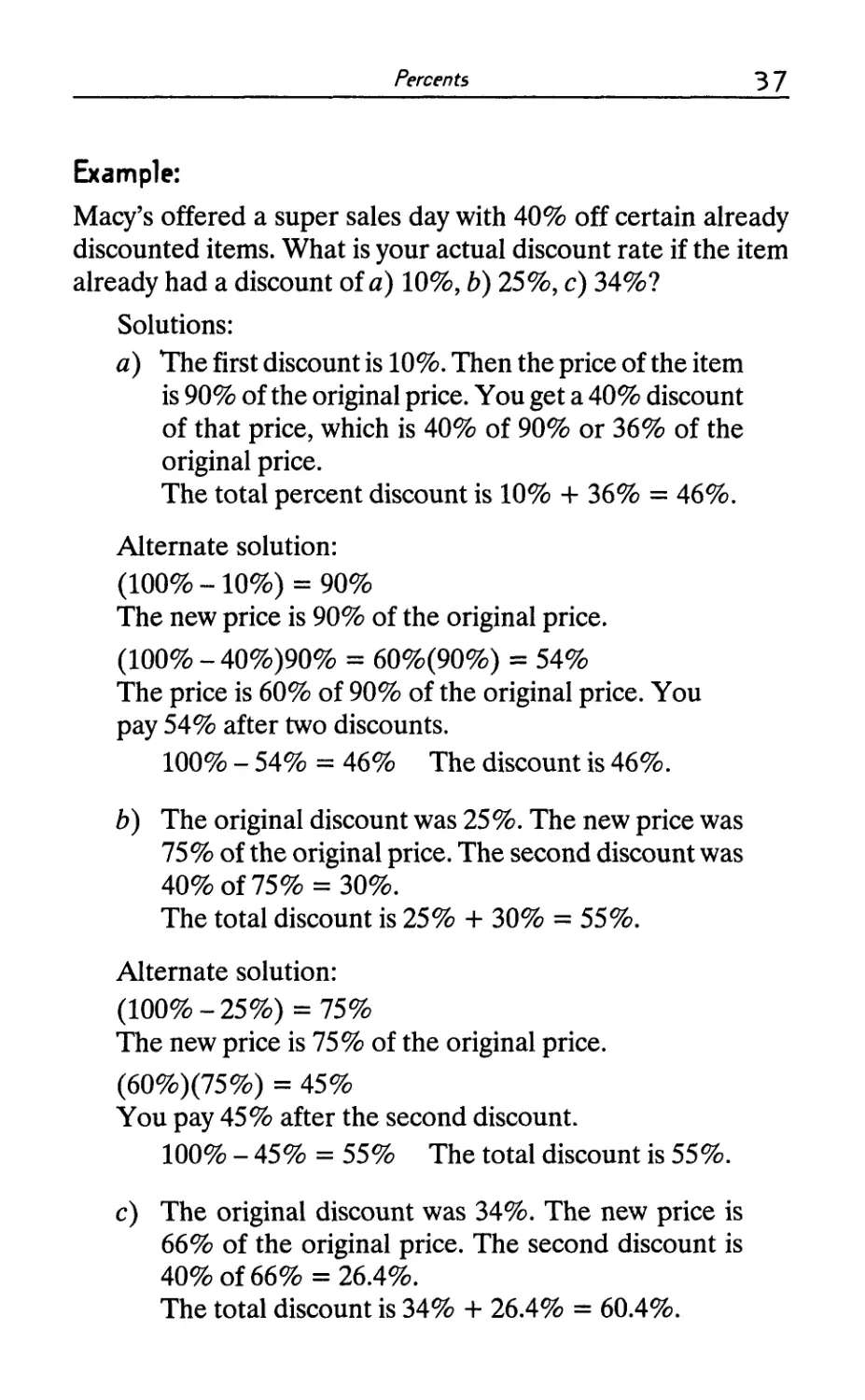
Macy's offered a super sales day with 40% off certain already
discounted items. What is your actual discount rate if the item
already had a discount of a) 10%, b) 25%, c) 34%?
Solutions:
a) The first discount is 10%. Then the price of the item
is 90% of the original price. You get a 40% discount
of that price, which is 40% of 90% or 36% of the
original price.
The total percent discount is 10% + 36% = 46%.
Alternate solution:
A00% - 10%) = 90%
The new price is 90% of the original price.
A00%-40%)90% = 60%(90%) = 54%
The price is 60% of 90% of the original price. You
pay 54% after two discounts.
100% - 54% = 46% The discount is 46%.
b) The original discount was 25%. The new price was
75% of the original price. The second discount was
40%of75% = 30%.
The total discount is 25% + 30% = 55%.
Alternate solution:
A00%-25%) = 75%
The new price is 75% of the original price.
F0%)G5%) = 45%
You pay 45% after the second discount.
100% - 45% = 55% The total discount is 55%.
c) The original discount was 34%. The new price is
66% of the original price. The second discount is
40%of66% = 26.4%.
The total discount is 34% + 26.4% = 60.4%.

38 Master Math: Solving Word Problems
Alternate solution:
A00%-34%) = 66%
The new price is 66% of the original price.
F0%)F6%) = 39.6%
You pay 39.6% after two discounts.
100% - 39.6% = 60.4% The total discount is 60.4%.
Practice Problems:
2.41 How much do you pay for an item that originally
cost $100, if you get two discounts, one of 30% and
one of 40%? Does it matter which discount you use
first?
2.42 An item cost $240. The price was lowered twice, first
with 15% and later with 25%. What was the final
price?
2.43 A radio cost $120. The price was lowered first by
15% and later by 12%. How much was it then?
2.44 A washing machine cost $860. The price was first
lowered by 35% and later by $68. With how many
percent was the price lowered the second time?
2.45 A company has 540 employees. How many
employees will the company have after 2 years if the
number of employees increases by 10% each year?
Interest
When you have a savings account in a bank, you earn
interest. If you borrow money, you pay interest.
Interest can be simple or compound. With simple interest
we multiply the principal (the money we deposit or borrow) by
the interest rate and the time the money is in the bank or used
by us. The interest rate is the percentage per year and the time

Percents 39
is in years. Unfortunately, for our calculations, simple interest
is not often used, but it is a starting point for understanding the
procedure of calculating interest.
Simple Interest
Formula:
I(nterest) = P(rindpal) x r(ate) x t(ime) or/ = Prt
Example:
Find the interest if $1000 is deposited in the bank at 3% simple
interest for five years.
/ = 1000 x 3% x 5 = 1000 x 0.03 x 5 = 150
The interest is $150.
Example:
Find the interest rate if $1000 is kept in the bank for five years
and gives a simple interest of $150.
Use the formula / = Prt: 150 = 1000 rE).
This is an equation; to solve for r, divide both sides by
5000.
= r or r = 0.03 = 3%
5000
Practice Problems:
2.46 Use the interest formula / = Prt to find:
a) r when P = $7500, / = $600, and / = 4 years.
b) t when P = $4000, / = $400, and r = 5%.
2.47 If you borrow $600 for a year and repay the whole
loan at the end of the year with $636 including simple
interest, what rate of interest are you paying?

40 Master Math: Solving Word Problems
2.48 Ed opens an insured money market account with
$500. How much money will he have after 6 months
if the interest rate is 0.75% per year?
2.49 If Ed invests his $500 in a CD (Certificate of
Deposit) account instead, which pays 1.14% per
year, how much money will he have after 6 months?
2.50 Fred borrowed $20,000 for 5 months at a 16%
annual interest rate in order to buy a new car. How
much money will he have to pay back?
Credit Cards
You receive a credit card when a lending institution, such
as a bank, offers to lend you money. Department stores, gasoline
companies, and other institutions also offer credit cards. When
you make a purchase using a credit card, the lender pays the
seller for the item you bought less a small commission B-3%)
and then sends you a bill at the end of the month. The bill usually
lists the date of payment to the seller, the name of the seller,
and the amount. You usually have a choice to pay the entire bill
by a certain listed date or to pay a minimum amount and carry
over the balance owed to your next monthly bill. The statement
from the credit card company also shows how they determine
your finance charge. This is the interest you owe your lender
for the money they have loaned to you by paying the seller for
the item you purchased with your credit card.
Example:
On March 4, you bought books at a bookstore for $21.60. You
also had the New York Times delivered to your home 5 days a
week for $19 billed directly to your credit card on March 9.
Total charges from February 21 to March 21 (statement closing
date) were $40.60. This is the new balance on your credit card.
If you pay by the payment due date of April 15, there will be no
finance charge (that is, no interest to be paid to the lender).

Percents 41
The statement also lists a minimum payment due of $10 to
be paid by the payment due date. If the lender charges you
interest at an annual percentage rate (APR) of 10.15%, what
will be the finance charge on the remaining balance of $40.60 -
$10 = $30.60 on your next bill of April 21, assuming you
purchased no additional items before April 21?
Solution: An annual percentage rate of
10.15% / 365 days = a daily rate of 0.02781%.
The lender lent you
$21.60 from March 4 to March 21 = 18 days
and $19 from March 9 to March 21 = 14 days.
$21.60 x 18 x 0.02781/100 = $0.1081 or 10.810
$19 x 14 x 0.02781/100 = $0.07397 or 7.40
Total finance charge = 180.
Note: If you purchased additional items between the
last closing statement (March 21) and the next one
(April 21) then interest will be charged on the average
daily balance, which includes the additional items.
Practice Problem:
2.51 You have purchased a computer for $1000 on
March 10. The minimum balance was $50 due on
March 21. The APR is 9.5%. What will be the
finance charges for the remaining balance on your
next statement on April 21, assuming you made no
other purchases until then?
Compound Interest
Banks usually use compound interest to calculate the
earnings on our money. For example, if you deposit $100 at a
yearly rate of 2% and it is compounded (interest is added to
the principal) once a year, you have:

42 Master Math: Solving Word Problems
After 1 year: $100 + 2% of $100 = $102
After 2 years: $102 + 2% of $102 = $104.04
After 3 years: $104.04 + 2% of $104.04 = $106.12
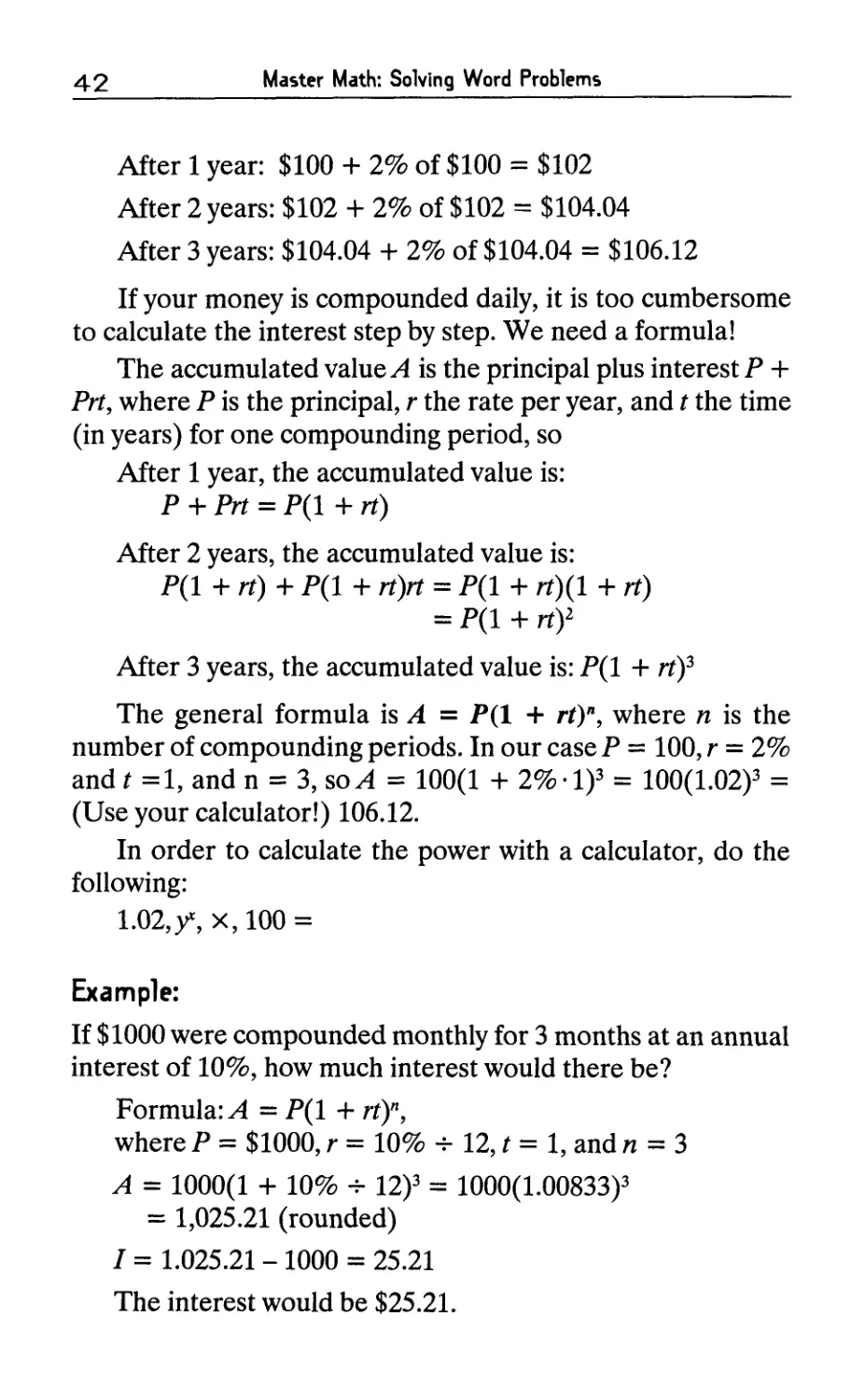
If your money is compounded daily, it is too cumbersome
to calculate the interest step by step. We need a formula!
The accumulated valued is the principal plus interest P +
Prt, where P is the principal, r the rate per year, and t the time
(in years) for one compounding period, so
After 1 year, the accumulated value is:
P + Prt = P(l + rt)
After 2 years, the accumulated value is:
P(l + rt) + P(l + rt)rt = P(l + rt){\ + rt)
= P(l + rtJ
After 3 years, the accumulated value is: P(l + rtK
The general formula is A = P(l + rt)n, where n is the
number of compounding periods. In our case P = 100, r — 2%
and t =1, and n = 3, so Л = 100A + 2%-IK = 100A.02K =
(Use your calculator!) 106.12.
In order to calculate the power with a calculator, do the
following:
1.02,/, x, 100 =
Example:
If $1000 were compounded monthly for 3 months at an annual
interest of 10%, how much interest would there be?
Formula: A = P(l + rt)n,
where P = $1000, r = 10% ¦*- 12, f = 1, and n = 3
A = 1000A + 10% + 12K = 1000A.00833K
= 1,025.21 (rounded)
/ = 1.025.21 - 1000 = 25.21
The interest would be $25.21.

Percents 4 3
The simple interest would have been:
1000 x 10%/12 x 3 = 25 or $25
Practice Problems:
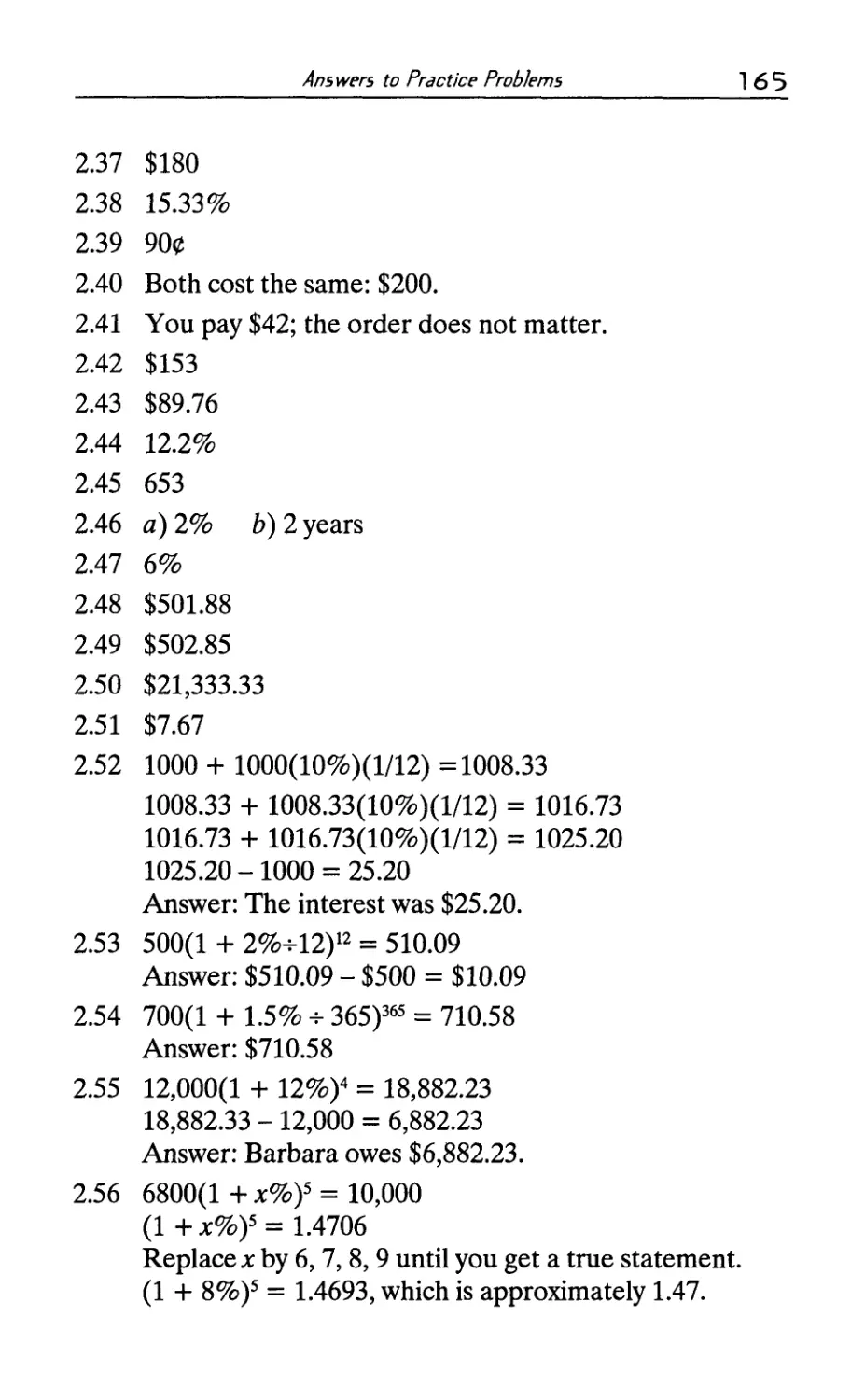
2.52 Redo the example without the formula.
2.53 Calculate the interest on $500 for one year at 2%
compounded monthly.
2.54 Find the new principal if $700 gets a 1.5% interest
compounded daily for one year. Use 365 for the
number of times the money is compounded per
year.
2.55 Barbara borrows $12,000 with an interest of 12%
compounded yearly. How much interest does she
owe after 4 years?
2.56 Viviane bought treasury notes for $6800. They are
supposed to be worth $10,000 after five years. What
is the percent interest if the money is compounded
every year? Is it 6%, 7%, 8%, or 9%?
Hint: Use your calculator to test the different percents.
Bank Deposits
Example:
Leslie deposits part of $3000 in a certificate of deposit (COD)
that pays simple annual interest of 2.71% and the rest in a pass-
passbook savings account that pays 0.75% compounded annually.
If she earns $34.26 in interest in one year totally, how much did
she deposit in her savings account?
Assume she deposited jc dollars in her savings account.
Then she must deposit 3000 -x dollars in her CD.

44 Master Math: Solving Word Problems
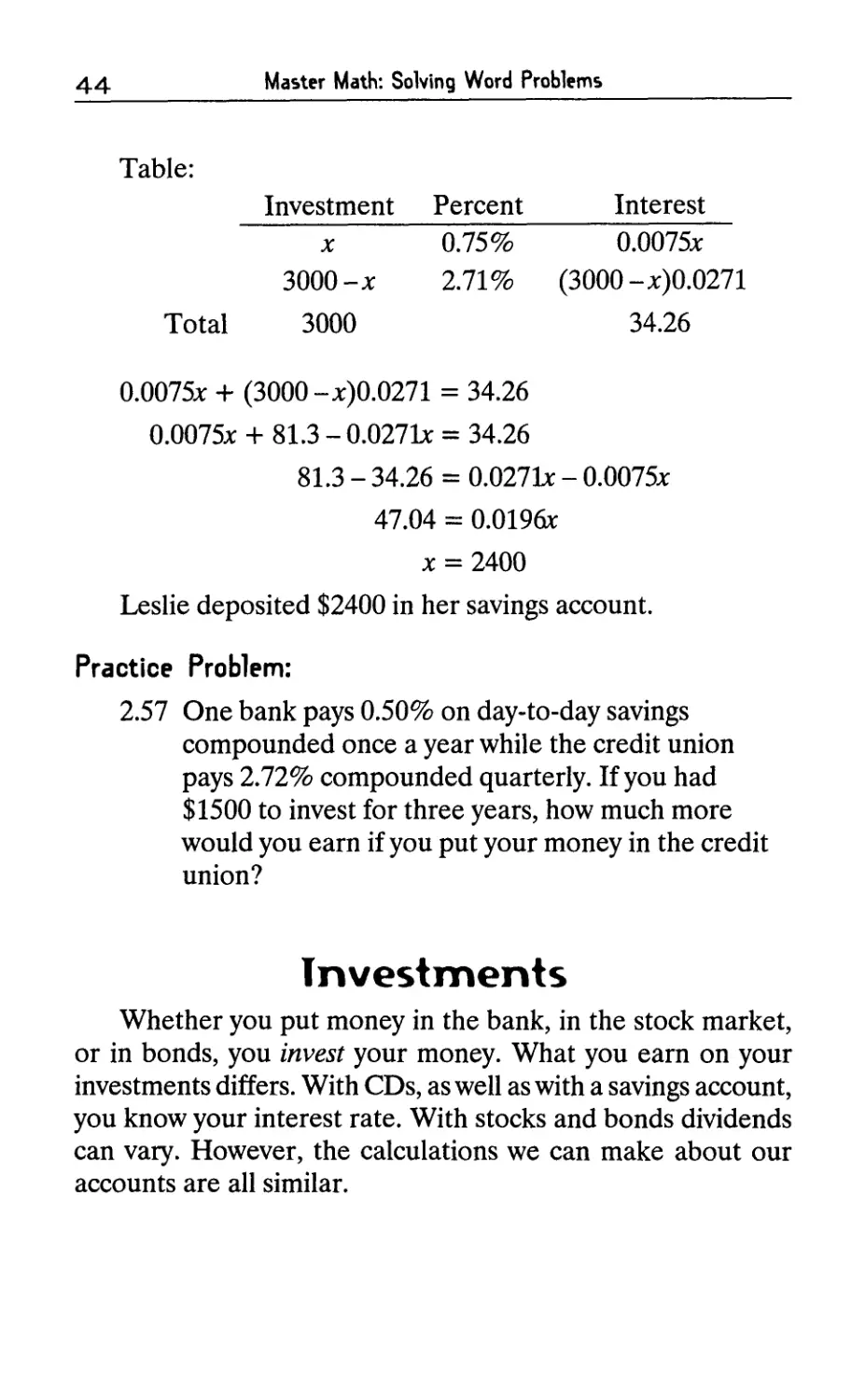
Table:
Investment
*
3000 -*
3000
Percent
0.75%
2.71%
Interest
0.0075*
C000-*H.0271
34.26
Total
0.0075* + C000-*H.0271 = 34.26
0.0075* + 81.3 - 0.027b: = 34.26
81.3 - 34.26 = 0.0271* - 0.0075*
47.04 = 0.0196*
* = 2400
Leslie deposited $2400 in her savings account.
Practice Problem:
2.57 One bank pays 0.50% on day-to-day savings
compounded once a year while the credit union
pays 2.72% compounded quarterly. If you had
$1500 to invest for three years, how much more
would you earn if you put your money in the credit
union?
Investments
Whether you put money in the bank, in the stock market,
or in bonds, you invest your money. What you earn on your
investments differs. With CDs, as well as with a savings account,
you know your interest rate. With stocks and bonds dividends
can vary. However, the calculations we can make about our
accounts are all similar.

Percents 45
Stocks
Stocks are shares in a corporation. The price of each share
will vary according to the perceived value of the share by
investors. When many investors want to buy shares of a certain
company, the price per share goes up. When many investors
want to sell shares of a company, the price per share goes down.
In order to reward shareholders of profitable companies, the
company will declare a dividend, usually on a quarterly basis.
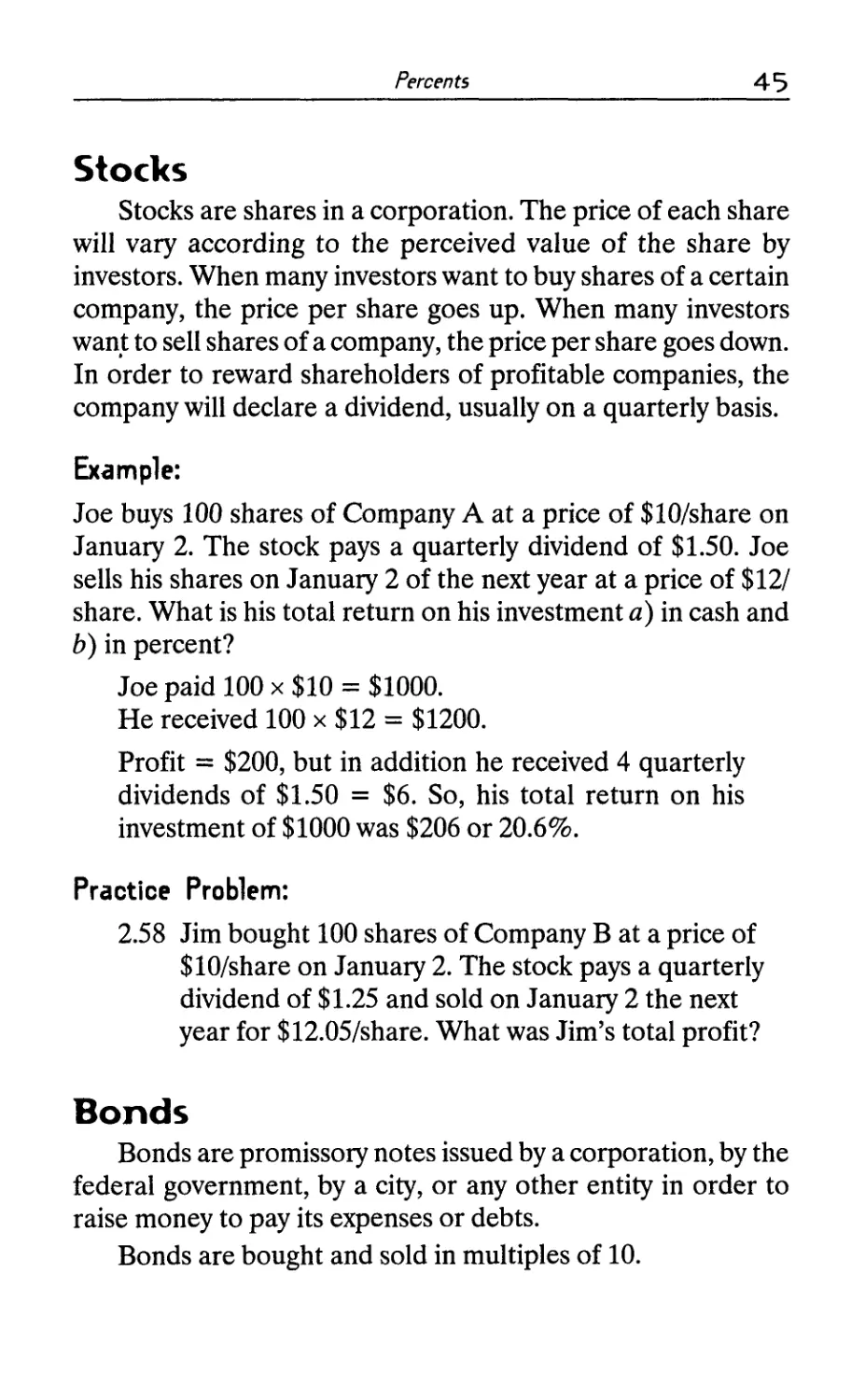
Example:
Joe buys 100 shares of Company A at a price of $10/share on
January 2. The stock pays a quarterly dividend of $1.50. Joe
sells his shares on January 2 of the next year at a price of $12/
share. What is his total return on his investment a) in cash and
b) in percent?
Joe paid 100 x $10 = $1000.
He received 100 x $12 = $1200.
Profit = $200, but in addition he received 4 quarterly
dividends of $1.50 = $6. So, his total return on his
investment of $1000 was $206 or 20.6%.
Practice Problem:
2.58 Jim bought 100 shares of Company В at a price of
$10/share on January 2. The stock pays a quarterly
dividend of $1.25 and sold on January 2 the next
year for $12.05/share. What was Jim's total profit?
Bonds
Bonds are promissory notes issued by a corporation, by the
federal government, by a city, or any other entity in order to
raise money to pay its expenses or debts.
Bonds are bought and sold in multiples of 10.

46 Master Math: Solving Word Problems
Bonds have a "maturity date," that is, the year and date
when the issuer of the bond has to pay the bond holder the
"face value" of the bond. The face value of a bond is $100, but
its actual price will vary according to its quality or "rating," that
is, to what extent bond analysts trust in the ability of the bond
issuer to repay the buyer the face value at maturity, as well as
the interest the issuer pays to the bond holder. An important
quantity to consider when buying or selling a bond is its "yield,"
which is the interest divided by the current price of the bond.
The yield will increase when the price decreases and the yield
will decrease when the price increases. The investor must also
consider whether to buy a tax-free municipal bond or some com-
company bond from which the interest is not tax-free. There are
also junk bonds, which are high-risk (not very safe!) bonds but,
accordingly, pay the buyer a higher interest.
Example:
On January 2, 2003, Mary bought 10 bonds maturing in 2010
and paying 5% interest. She paid $95 for each bond, for a total
of $950. She also bought 10 bonds maturing in 2020 paying 6%
interest for $90 each, a total of $900. If she keeps all 20 bonds
to maturity:
a) How much cash will she receive for the bonds?
b) How much will she have earned in interest by the
end of 2010 and by the end of 2020?
c) What is the yield of the 2010 bonds in 2003 and in
2010? What is the yield of the 2020 bonds in 2003
and in 2020?
Solutions:
a) If she keeps all bonds to maturity, she will receive
the face value for all of them. In 2010 she will
receive 10 x $100 = $1000, in 2020 she will receive
10 x $100 = $1000.

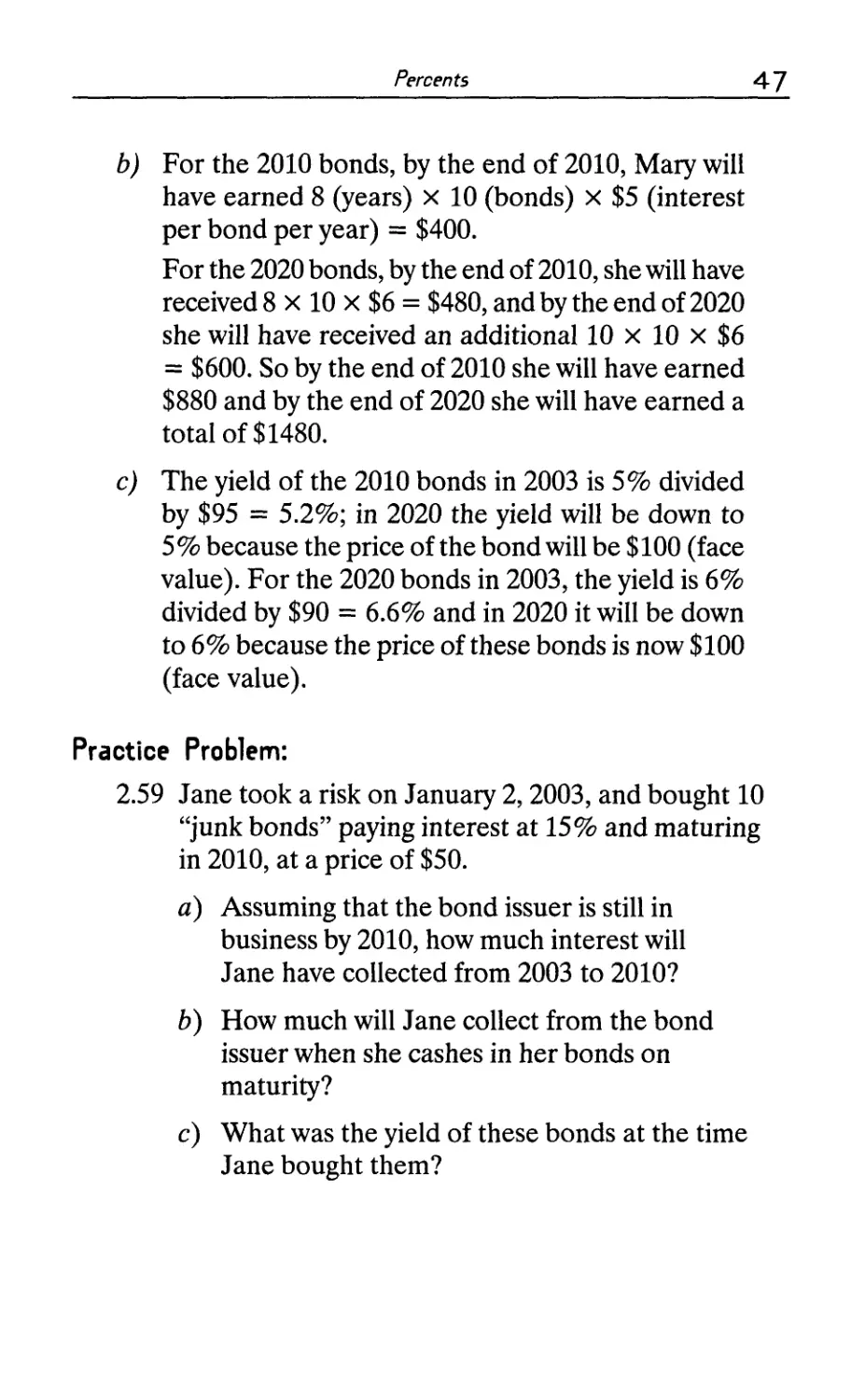
Per cents 47
b) For the 2010 bonds, by the end of 2010, Mary will
have earned 8 (years) x 10 (bonds) x $5 (interest
per bond per year) = $400.
For the 2020 bonds, by the end of 2010, she will have
received 8 x 10 x $6 = $480, and by the end of 2020
she will have received an additional 10 x 10 x $6
= $600. So by the end of 2010 she will have earned
$880 and by the end of 2020 she will have earned a
total of $1480.
c) The yield of the 2010 bonds in 2003 is 5% divided
by $95 = 5.2%; in 2020 the yield will be down to
5% because the price of the bond will be $100 (face
value). For the 2020 bonds in 2003, the yield is 6%
divided by $90 = 6.6% and in 2020 it will be down
to 6% because the price of these bonds is now $100
(face value).
Practice Problem:
2.59 Jane took a risk on January 2, 2003, and bought 10
"junk bonds" paying interest at 15% and maturing
in 2010, at a price of $50.
a) Assuming that the bond issuer is still in
business by 2010, how much interest will
Jane have collected from 2003 to 2010?
b) How much will Jane collect from the bond
issuer when she cashes in her bonds on
maturity?
c) What was the yield of these bonds at the time
Jane bought them?

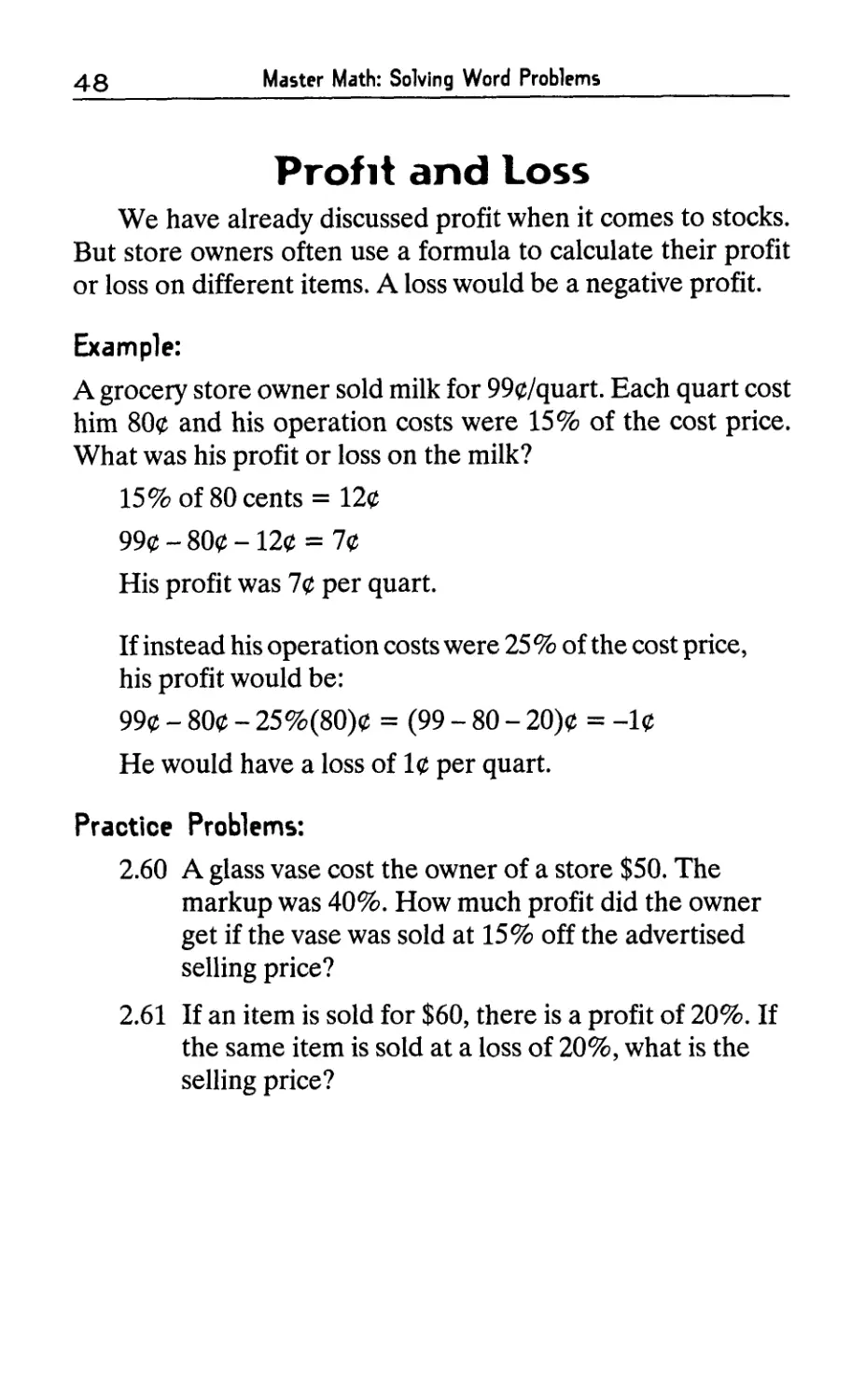
48 Master Math: Solving Word Problems
Profit and Loss
We have already discussed profit when it comes to stocks.
But store owners often use a formula to calculate their profit
or loss on different items. A loss would be a negative profit.
Example:
A grocery store owner sold milk for 990/quart. Each quart cost
him 8O0 and his operation costs were 15% of the cost price.
What was his profit or loss on the milk?
15% of 80 cents = 120
99c-800-Ш = 70
His profit was 70 per quart.
If instead his operation costs were 25% of the cost price,
his profit would be:
990 - 800 - 25%(8OH = (99 - 80 - 20H = -10
He would have a loss of 10 per quart.
Practice Problems:
2.60 A glass vase cost the owner of a store $50. The
markup was 40%. How much profit did the owner
get if the vase was sold at 15% off the advertised
selling price?
2.61 If an item is sold for $60, there is a profit of 20%. If
the same item is sold at a loss of 20%, what is the
selling price?

I
I Chapter 3
Advanced Level Age
Problems
In this chapter we will continue to analyze and solve age-
related word problems, but the ones in the following pages are
more complicated than the ones we solved previously. There-
Therefore, we will have to spend more time to analyze and under-
understand what the question is and how we can set up the equation,
or sometimes two equations, that will help us to come up with
an answer.
As before, these problems involve age differences between
one child and another, between a child and an adult, or more
than two persons, and we will have to read the problems care-
carefully in order to calculate the ages of these persons now, or in a
given number of years.
By setting up tables that list the facts and then generating
equations from these tables, we will be able to solve the prob-
problems and come up with the correct answers. At the end of the
chapter we will learn how to set up quadratic equations needed
to solve certain kinds of problems.
Example:
Alan is 5 years older than Bert. If, in 3 years, Alan's age will be
twice Bert's, how old are Alan and Bert now?
49

50 Master Math: Solving Word Problems
If Bert's age is*, then Alan's age isx + 5. Set up a table:
Name Age now Age in 3 years
Alan
Bert
Alan's age is
Equation:
Bert's age
Check: In
X
X
is:
X
twice
+ 8 =
+ 8 =
2 =
+ 5
X
* + 5 +
л;
B times) Bert's.
= 2(x +
= 2x + <
= X
2 and Alan's
3 years
2 + 3
7 + 3
2x5
3)
6
age is 2 +
= 5
= 10
= 10
3 =x + 8
+ 3
5 = 7
This problem could also have been solved with Alan's age
as*, but keep in mind that if Alan is older than Bert, then Bert
is younger than Alan. Therefore:
Name Age now Age in 3 years
Alan * * + 3
Bert * - 5 *-5 + 3=*-2
Equation: x + 3 = 2(x - 2)
7=x
Alan is 7 and Bert is 7 - 5 = 2.
Example:
Elsa is 7 years younger than Thor. The sum of their ages is 35.
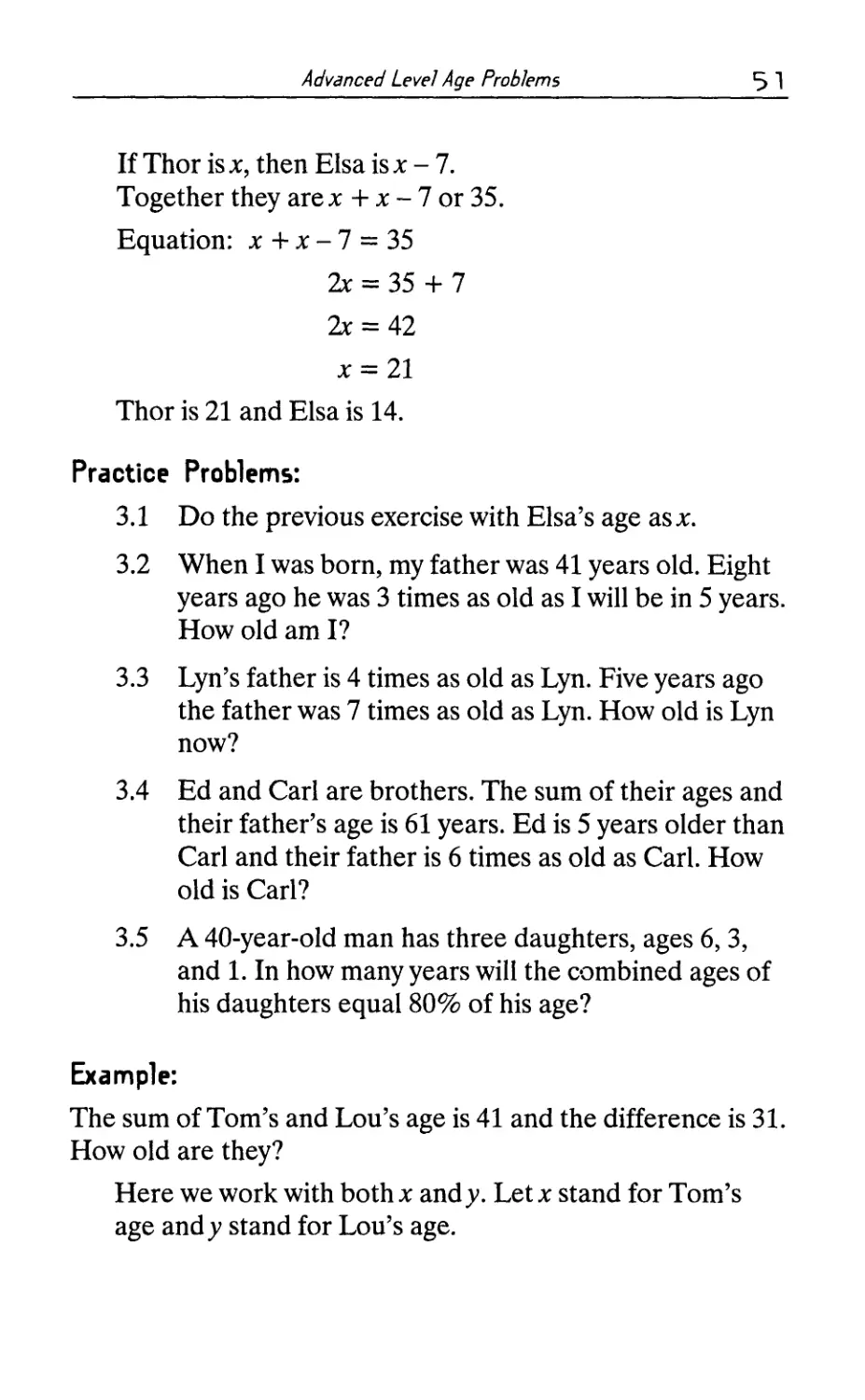
How old are they?

Advanced Level Age Problems
If Thor is x, then Elsa is x - 7.
Together they are x + x -1 or 35.
Equation: x + x - 7 = 35
2t = 35 + 7
2c = 42
jc = 21
Thor is 21 and Elsa is 14.
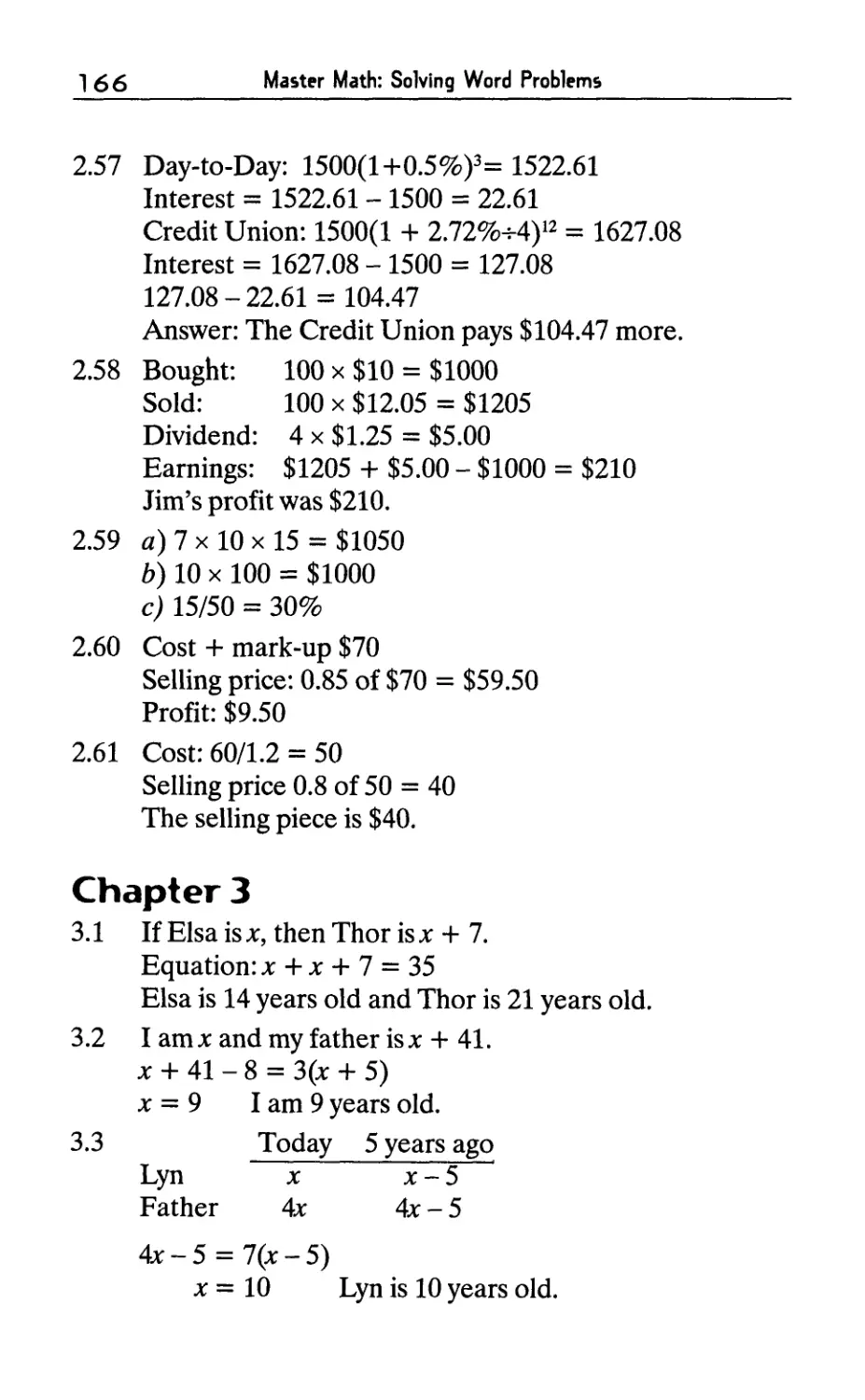
Practice Problems:
3.1 Do the previous exercise with Elsa's age asx.
3.2 When I was born, my father was 41 years old. Eight
years ago he was 3 times as old as I will be in 5 years.
How old am I?
3.3 Lyn's father is 4 times as old as Lyn. Five years ago
the father was 7 times as old as Lyn. How old is Lyn
now?
3.4 Ed and Carl are brothers. The sum of their ages and
their father's age is 61 years. Ed is 5 years older than
Carl and their father is 6 times as old as Carl. How
old is Carl?
3.5 A 40-year-old man has three daughters, ages 6, 3,
and 1. In how many years will the combined ages of
his daughters equal 80% of his age?
Example:
The sum of Tom's and Lou's age is 41 and the difference is 31.
How old are they?
Here we work with both x andy. Let x stand for Tom's
age andy stand for Lou's age.

52 Master Math: Solving Word Problems
Equations: x + у = 41
x-y = 31
Add the equations: 2x = 72
* = 36
Tom is 36 years old and Lou is 41 - 36 = 5 years old.
Now, if the problem were stated differently: The sum of
Lou's age and his father's is 41 and the difference is 31, we must
realize that the father is older. If we call Lou's age x and the
father's age y, we get:
and y-x = 31
2y = 72
у = 36
The father is 36 years old and Lou is 5 years old.
Practice Problems:
Use two variables for practice.
3.6 The difference in age between Brita and her
daughter Eva is 30 years. The sum or their ages is
118. How old is Eva?
3.7 Jack is 3 years older than Susan. The sum of their
ages is 27. Find their ages.
3.8 Glenn is 6 years older than Carla. The sum of twice
Glenn's age and Carla's is 57 years. Find their ages.
3.9 Chris is 7 years younger than Mary. Chris's age
subtracted from three times Mary's age is 43. Find
their ages.
3.10 Ray is 2 years younger than Sig. Three times Sig's
age subtracted from 5 times Ray's age equals Sig's
age. How old are the boys?

Advanced Level Age Problems 5 3
Example:
The ratio of John's age to David's age is 6:5. In 7 years the ratio
will be 7:6. What are their ages now?
A ratio is a comparison of two numbers by division. 6:5
is the same ratio as 12:10, 18:15, etc. Since the ratio is
6:5, -we can call the ages 6x and 5x. (See also Ratio
problems in Chapter 5.)
Set up a table:
Name Age now Age in 7 years
John 6x 6x +1
David 5* 5x +1
The ratio of the ages is then 7:6 and we can set up an
equation:
This is a proportion (two equal ratios), so we can cross
multiply: 6F* + 7) = 7E* +7)
36r + 42 = 35* + 49
jc = 7
John is 6G) = 42 years old and David is 5G) = 35 years old.
Check: In 7 years John will be 49 years old and David 42.
Ratio: 49:42 = 7:6
Alternate solution:
Name
John
David
Age now
X
У
Age in 7 years
X
У
+ 7
+ 7

54 Master Math: Solving Word Problems
Equations: ? = _
У 5
x + l__1
y + l 6
Cross multiply both equations:
5x = 6yor5x-6y = 0 6(jc +7) = Ify + 1)
6* + 42 = 7y + 49
or 6л: - ly = 7
We now have two equations:
Sx - 6y = 0 Multiply by 7: 35* - 42y = 0
6x-ly = 7 Multiply by 6: 36* - 42y = 42
Subtract the first equation from the second: x = 42
5D2) = 6y
35 =y
Practice Problems:
3.11 Adam and Victor are together 15 years old. Victor's
age is 50% of his brother Adam's age. Find the ages
of the boys.
3.12 The ages of the girls Ina, Mina, and Mo are in a
ratio of 4:6:7. Combined the girls are 102 years old.
What are their ages?
3.13 Mark and Mindy are together 84 years old. Three
times Mark's age equals 4 times Mindy's age. How
old are they?
3.14 The ages of Jim and Jon are in the ratio 3:7. If you
multiply Jim's age by 4, you get the same result as
when you add 40 to Jon's age. How old are Jim and
Jon?

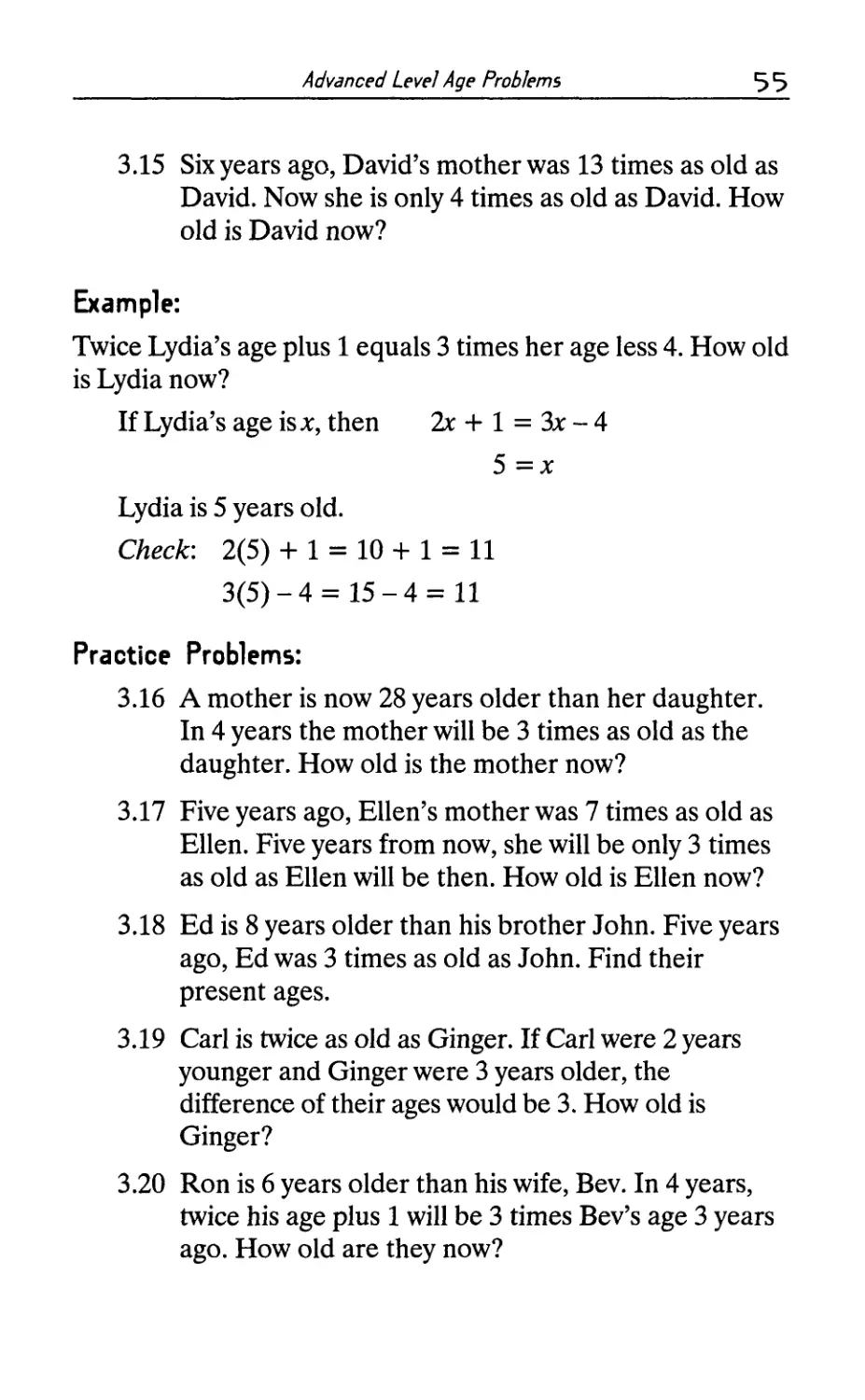
Advanced Level Age Problems 5 5
3.15 Six years ago, David's mother was 13 times as old as
David. Now she is only 4 times as old as David. How
old is David now?
Example:
Twice Lydia's age plus 1 equals 3 times her age less 4. How old
is Lydia now?
If Lydia's age is*, then 7x + 1 = 3x - 4
5=x
Lydia is 5 years old.
Check'. 2E) + 1 = 10 + 1 = 11
3E)-4 = 15-4 = ll
Practice Problems:
3.16 A mother is now 28 years older than her daughter.
In 4 years the mother will be 3 times as old as the
daughter. How old is the mother now?
3.17 Five years ago, Ellen's mother was 7 times as old as
Ellen. Five years from now, she will be only 3 times
as old as Ellen will be then. How old is Ellen now?
3.18 Ed is 8 years older than his brother John. Five years
ago, Ed was 3 times as old as John. Find their
present ages.
3.19 Carl is twice as old as Ginger. If Carl were 2 years
younger and Ginger were 3 years older, the
difference of their ages would be 3. How old is
Ginger?
3.20 Ron is 6 years older than his wife, Bev. In 4 years,
twice his age plus 1 will be 3 times Bev's age 3 years
ago. How old are they now?

56 Master Math: Solving Word Problems
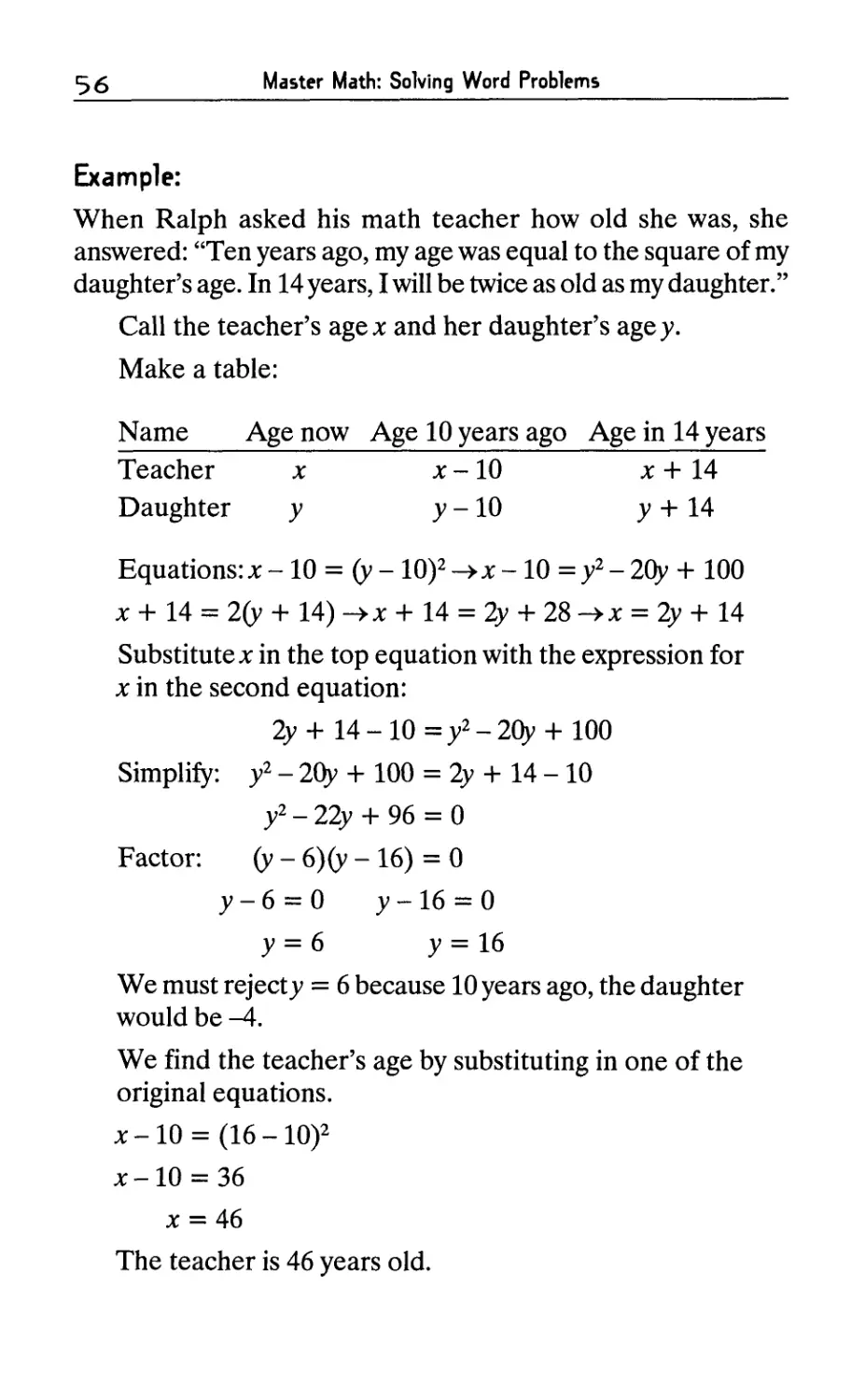
Example:
When Ralph asked his math teacher how old she was, she
answered: "Ten years ago, my age was equal to the square of my
daughter's age. In 14 years, I will be twice as old as my daughter."
Call the teacher's ages and her daughter's agey.
Make a table:
Name Age now Age 10 years ago Age in 14 years
Teacher x x -10 x + 14
Daughter у у -10 у + 14
Equations: х- 10 = (у- 10J—>jc- 10 =y2-20y + 100
x + 14 = 2(y + 14) ->x + 14 = 2y + 28 ->x = 2y + 14
Substitutes in the top equation with the expression for
x in the second equation:
Simplify: y2-20y + 100 = 2y + 14 - 10
y2 - 22y + 96 = 0
Factor: (y - 6)(y - 16) = 0
¦у_6 = 0 у-16 = 0
у = 6 у = 16
We must reject^ = 6 because 10 years ago, the daughter
would be -4.
We find the teacher's age by substituting in one of the
original equations.
s-10 = A6-10J
The teacher is 46 years old.

Advanced Level Age Problems 5 7
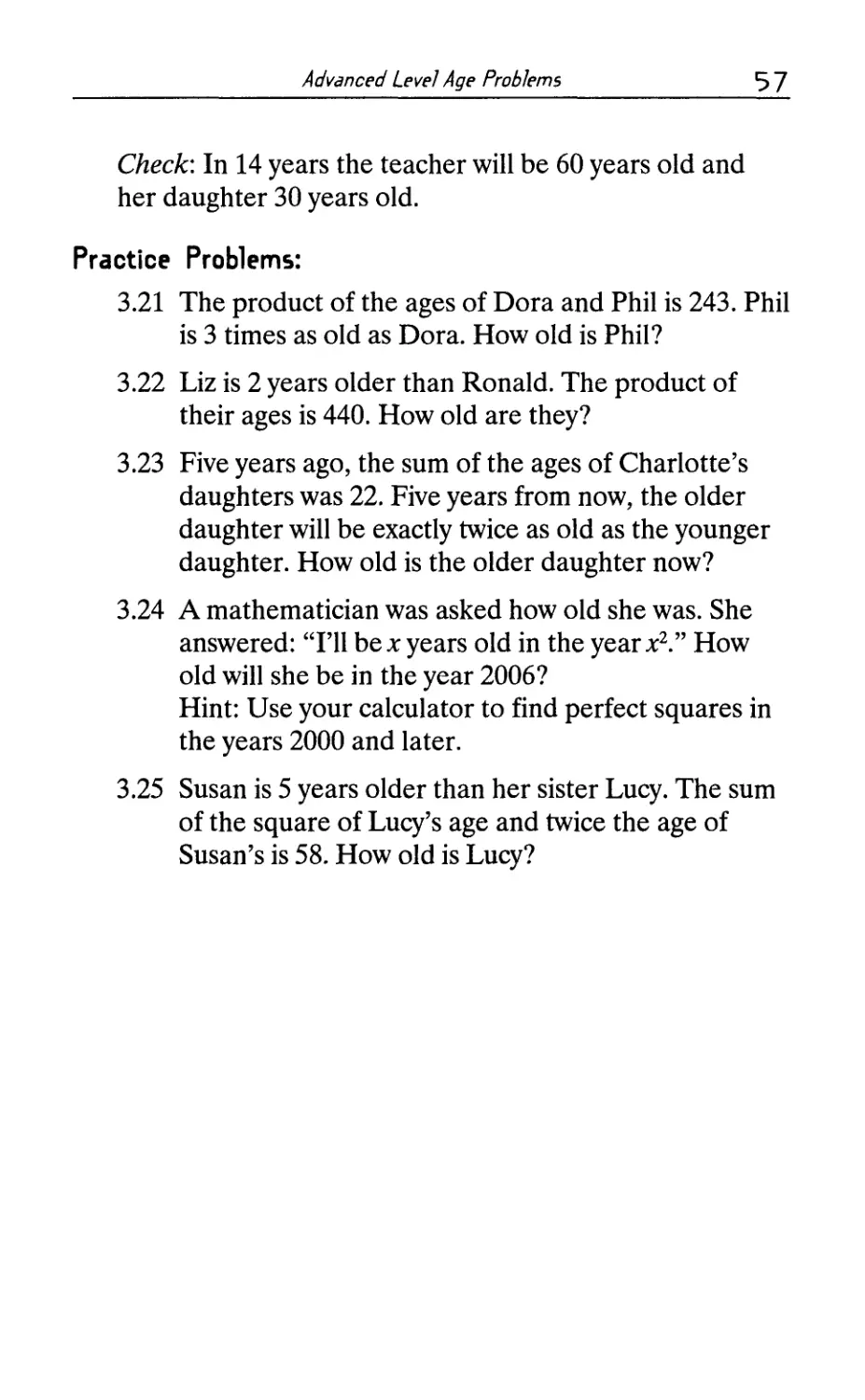
Check: In 14 years the teacher will be 60 years old and
her daughter 30 years old.
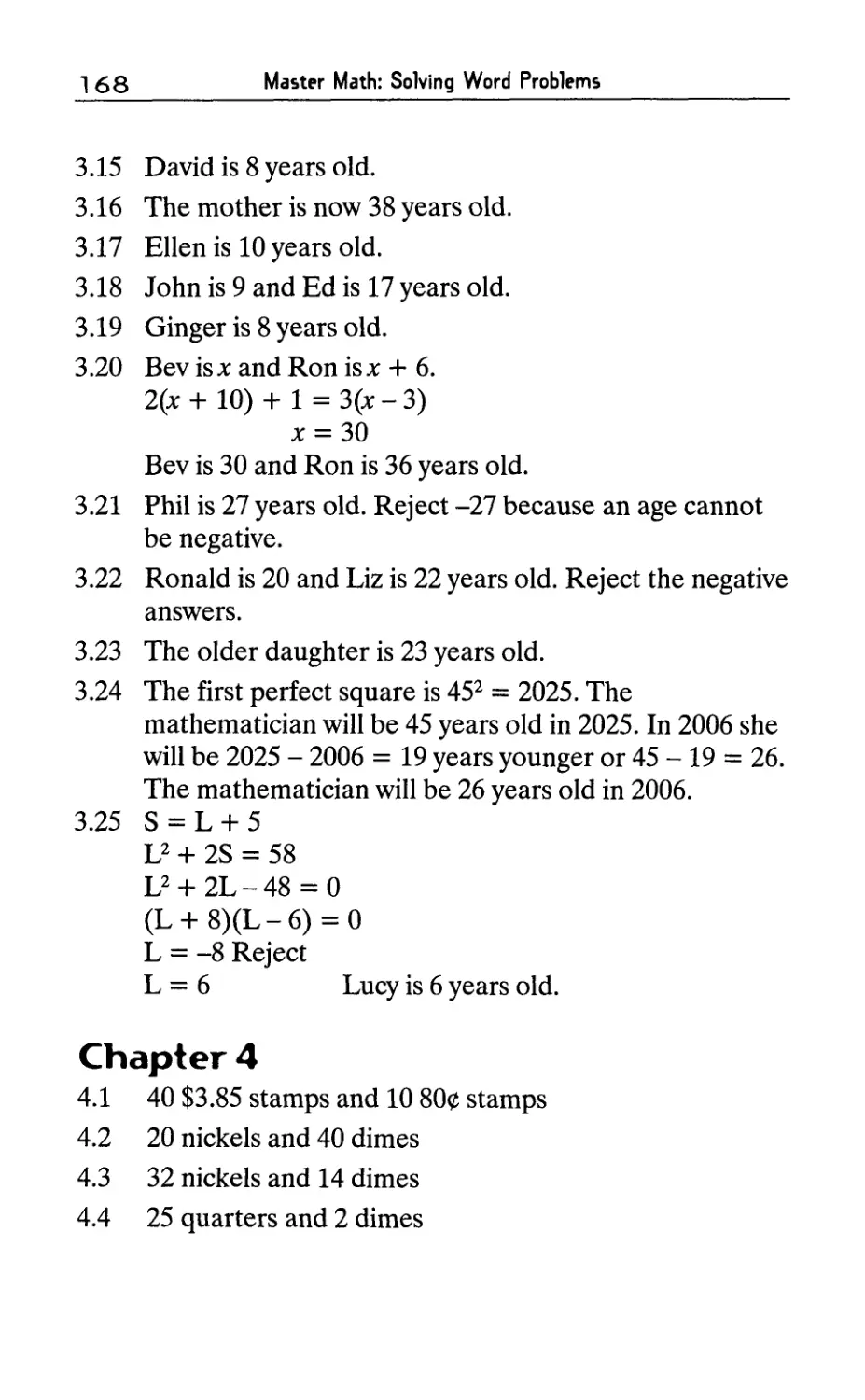
Practice Problems:
3.21 The product of the ages of Dora and Phil is 243. Phil
is 3 times as old as Dora. How old is Phil?
3.22 Liz is 2 years older than Ronald. The product of
their ages is 440. How old are they?
3.23 Five years ago, the sum of the ages of Charlotte's
daughters was 22. Five years from now, the older
daughter will be exactly twice as old as the younger
daughter. How old is the older daughter now?
3.24 A mathematician was asked how old she was. She
answered: "I'll bex years old in the year*2." How
old will she be in the year 2006?
Hint: Use your calculator to find perfect squares in
the years 2000 and later.
3.25 Susan is 5 years older than her sister Lucy. The sum
of the square of Lucy's age and twice the age of
Susan's is 58. How old is Lucy?

This page intentionally left blank

Л x-*S тс д ^
Chapter 4
Mixing Problems
In this chapter we learn to set up equations to solve word
problems that deal with mixtures of various items. For example,
stamps and coins of different denominations. We know the total
number and value of a box full of nickels and dimes but want to
find out how many nickels and how many dimes were mixed
together in the box. Or we want to add water to a certain volume
of concentrated fruit juice to make a larger volume of more
dilute fruit juice. How much water should we add?
We will also deal with problems of mixing metals; for ex-
example, to calculate how much nickel a jeweler has to add to a
quantity of pure gold B4-carat) to make 18-carat gold.
This chapter will also deal with situations involving differ-
differently priced products, such as adult and child admission tick-
tickets, apples and pears, gum and chocolates.
Finally, we will calculate what happens when one part of a
sum of money is invested at one interest rate and the other part
at a different rate.
Note: In all of these mixing problems, it helps to set up a
table that lists all the given facts before trying a solution.
59

60 Master Math: Solving Word Problems
Stamps and Coins
Example:
Ed bought 150 stamps at the post office. Some were 37tf stamps
and some were 80c airmail stamps. He spent a total of $77.
How many stamps of each kind did he buy?
Here we have a choice; one variable or two? Let's start
with one.
Table:
Number of stamps Value @)
*
150-*
Equation:
37*+ 80A50-*) =
37* + 12000-80c =
4300 =
100 =
100 370 stamps
37
80
= 7700
= 7700
= 43*
= *
150-100 = 50 800 stamps
Total Value @)
37*
80A50-*)
7700
If you prefer to work with two variables, we make a
new table:
Number of stamps Value @) Total Value (l)
* 37 37*
_y_ 80 80y
150 7700"

Mixing Problems 6 1
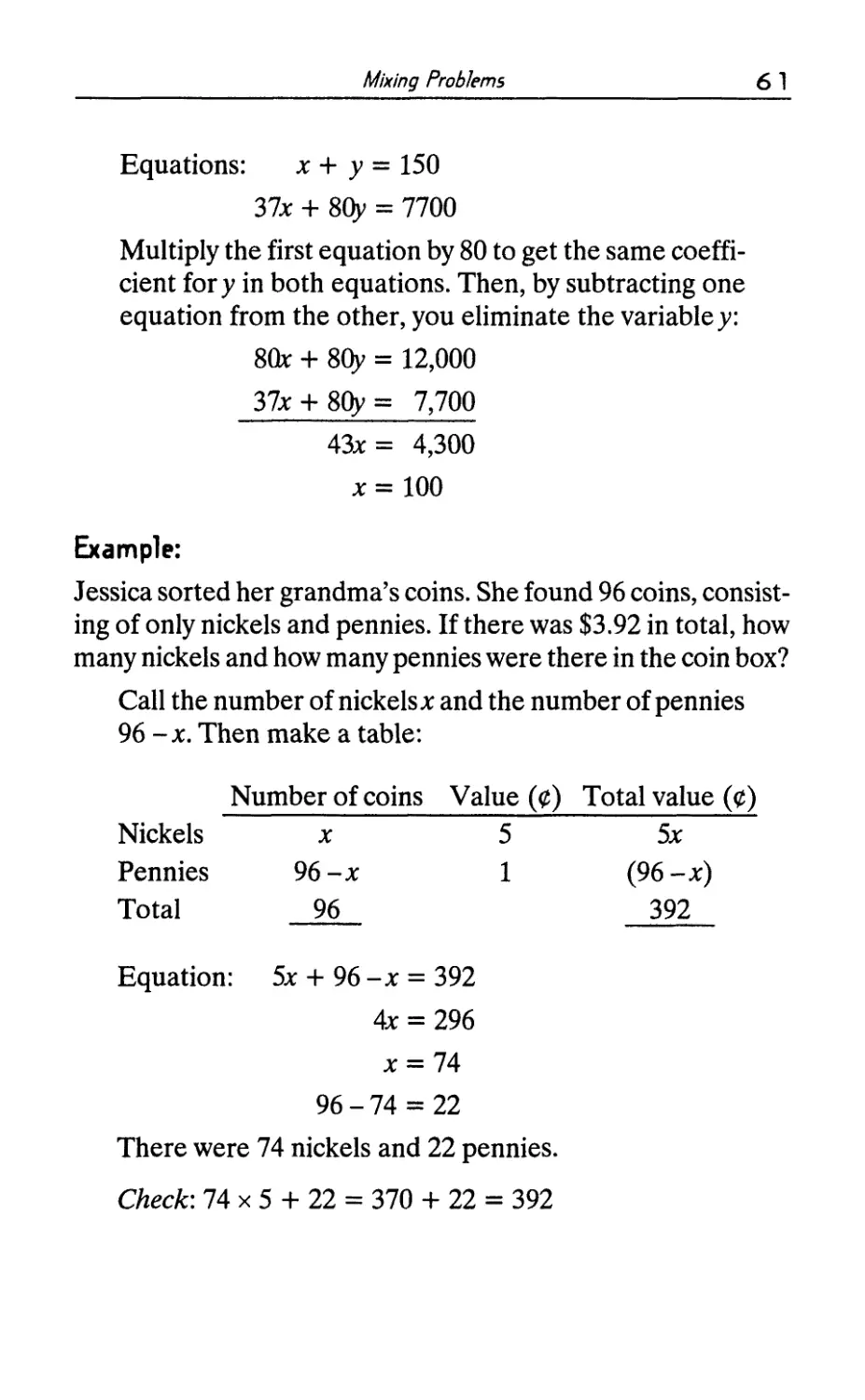
Equations: x + у = 150
37* + 8Qv = 7700
Multiply the first equation by 80 to get the same coeffi-
coefficient for у in both equations. Then, by subtracting one
equation from the other, you eliminate the variable у:
80* + 80y = 12,000
37* + 80y = 7,700
43* = 4,300
* = 100
Example:
Jessica sorted her grandma's coins. She found 96 coins, consist-
consisting of only nickels and pennies. If there was $3.92 in total, how
many nickels and how many pennies were there in the coin box?
Call the number of nickels* and the number of pennies
96 -*. Then make a table:
Number of coins Value @) Total value @)
Nickels * 5 5*
Pennies 96-* 1 (96-*)
Total 96 392
Equation: 5* + 96 -* = 392
4* = 296
* = 74
96-74 = 22
There were 74 nickels and 22 pennies.
Check: 74 x 5 + 22 = 370 + 22 = 392

62 Master Math: Solving Word Problems
Practice Problems:
4.1 Jens bought stamps at the post office. There were
some $3.85 stamps for priority mail and some 80#
stamps. He paid $162.00 for a total of 50 stamps.
How many of each kind did he buy?
4.2 Michael has 60 coins consisting of nickels and dimes.
Their total value was $5.00. How many of each coin
does he have?
4.3 Sarah had $3.00 in nickels and dimes. There were
18 more nickels than dimes. How many coins are
there of each kind?
4.4 A purse contains 27 coins, all quarters and dimes.
The total value of the money is $6.45. How many
coins are there of each kind?
Liquids With Different Strengths
When you mix two liquids, such as vinegar of different
strengths, you get a vinegar solution with yet another strength.
With these problems you set up a table.
Example:
Twenty ounces of vinegar with a strength of 30% was mixed with
40 ounces of a 20% vinegar solution. What was the percentage
of the resulting solution?
Table:
Amount (oz.) Strength (%) Pure Vinegar A00%) (oz.)
20 30 20C0%)oz. = 6
40^ 20 40B0%)oz. = 8
60 x 6 oz. + 8 oz. = 14

Mixing Problems 6 3
Equation: 60(л:%) = 14
60/100* = 14
x = 1400/60
x = 23.3
Answer: The new solution was 23.3%.
Practice Problems:
4.5 How many liters of a 20% alcohol solution must be
added to 80 liters of a 50% alcohol solution to form
a 45% solution?
4.6 How many ounces of pure acid A00%) should be
added to 60 fluid ounces of a 20% acid solution to
obtain a 40% acid solution?
4.7 Forty ounces of a punch containing 30%
pomegranate juice was added to 50 ounces of a
similar punch containing 10% juice. Find the
percent pomegranate juice in the resulting punch.
Diluting Solutions With Water
In a pharmacy or in a chemistry lab one often dilutes a strong
solution with water. You set up tables as above. Keep in mind
that the strength of water is 0%.
Example:
A chemist needs a 10% alcohol solution and has only a 50%
solution. How much water should be added to obtain 10 liters
of the weaker solution?
Make a table:

64 Master Math: Solving Word Problems
Amount Percent Pure alcohol
(liters) (%) A00%)
Alcohol solution x 50 50%r
Water 10 -x 0 0
10 10 100%
Equation: 50%x = 100%
jc = 2
The chemist needs 2 liters of the 50% alcohol solution
and 8 liters of water.
Check: 2 liters of 50% alcohol contains 2E0%)
= 1 liter pure alcohol.
1 liter pure alcohol diluted to 10 liters has a percentage
1/10 = 10%
Practice Problems:
4.8 How much water should be added to 4 liters of 90%
alcohol to make a 40% alcohol solution?
4.9 How many liters of water should be added to 1 liter
of a 20% saline (salt) solution to make a 5% saline
solution?
4.10 How many quarts of 3% milk should be mixed with
100 quarts of 0.5% milk to make a 1.5% milk
solution?
4.11 A pharmacist wants to dilute a 10% hydrogen
peroxide solution to 3%. How much distilled water
must he add to make 5 liters of 3% solution?

Mixing Problems 6 5
Mixing Metals
A jeweler often needs to mix pure metals A00%) such as
gold or silver with other less costly metals. Here we also use
tables very similar to the mixing of liquids.
Example:
How many grams of nickel should be added to 25 grams (g) of
pure gold to give a metal that is 20% gold?
Make a table:
Amount (g) Percent (%) Pure gold (g)
Nickel л: О 0
Gold 25 100 25A00%) g = 25
Total л:+ 25 20 (x + 25J0%
Equation: 25 = (x + 25J0%
25 = 0.2c + 5
20 = 0.2x
x = 100
100 grams of the metal should be added.
Check: A00 + 25J0% = 125@.2) = 25
Practice Problems:
4.12 Silver is to be mixed with nickel. The jeweler
specifies that the mixture should be 60% silver. How
much nickel should be added to 90 g of silver?
4.13 Twenty-four-carat gold is the same as 100% pure
gold. Suppose you have 300 g of 14-carat gold and
want to increase the gold content to 18 carat, how
much pure gold do you have to add?

66 Master Math: Solving Word Problems
A Mixed Bag
Many problems deal with the cost of tickets for shows where
the adult price is more than that for children.
Example:
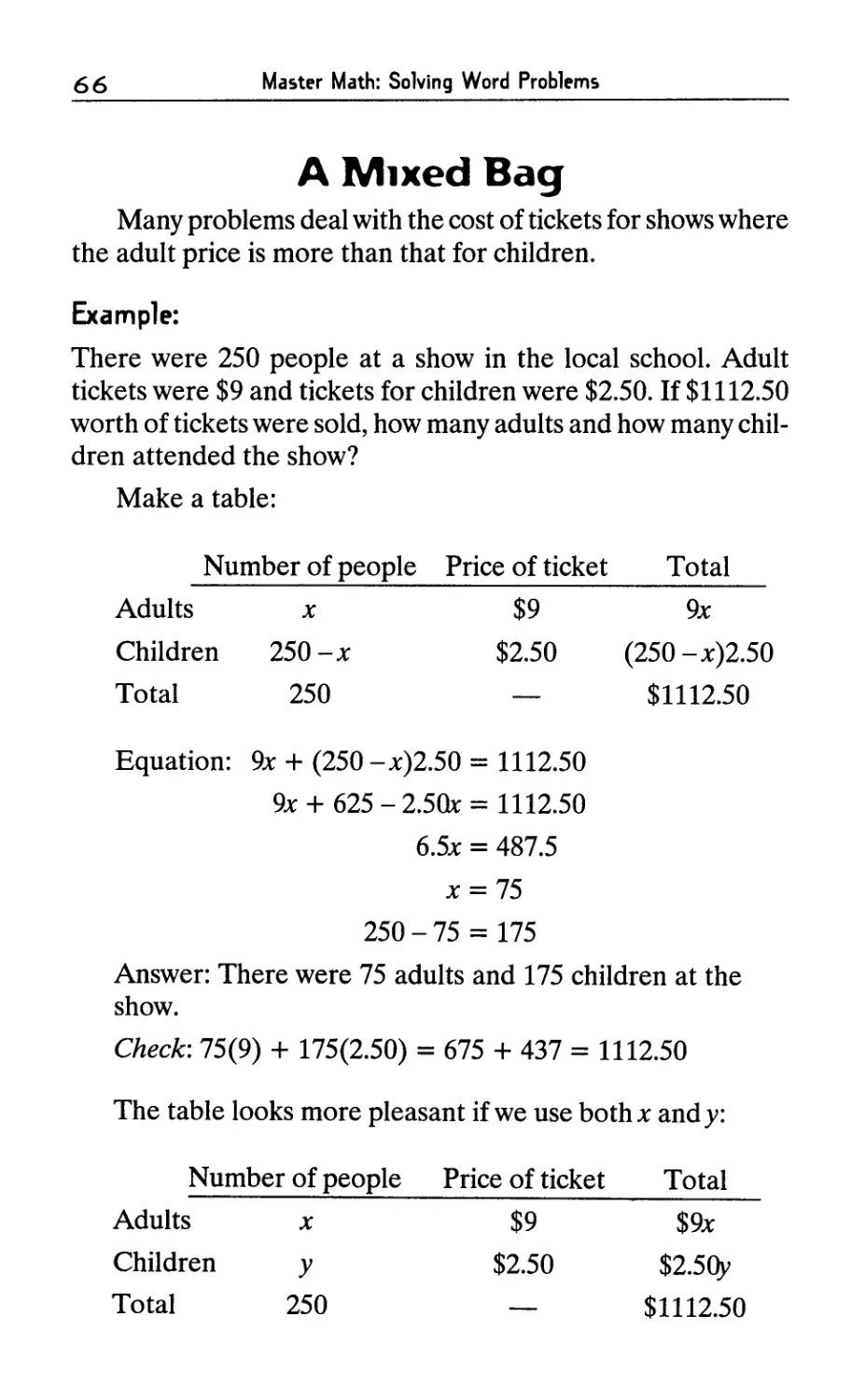
There were 250 people at a show in the local school. Adult
tickets were $9 and tickets for children were $2.50. If $1112.50
worth of tickets were sold, how many adults and how many chil-
children attended the show?
Make a table:
Number of people Price of ticket Total
Adults
Children
Total
X
250 -x
250
$9
$2.50
9x
B50-*J.50
$1112.50
Equation: 9x + B50 -jcJ.50 = 1112.50
9x + 625 -2.50c = 1112.50
6.5jc = 487.5
250-75 = 175
Answer: There were 75 adults and 175 children at the
show.
Check: 75(9) + 175B.50) = 675 + 437 = 1112.50
The table looks more pleasant if we use both* and у:
Number of people Price of ticket Total
Adults x $9 $9*
Children у $2.50 $2.50y
Total 250 — $1112.50

Mixing Problems & ~J
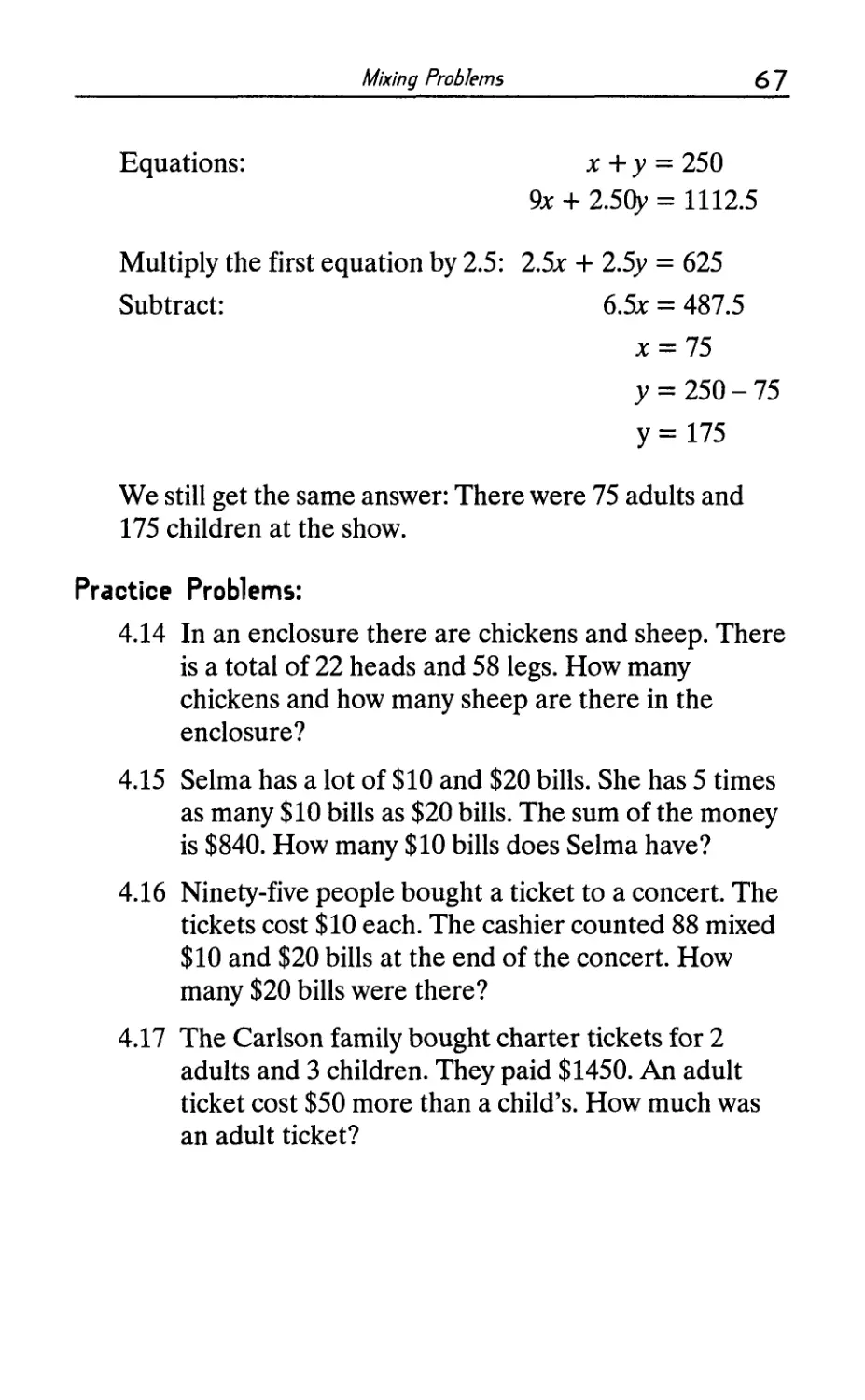
Equations: x + у — 250
9x + 2.50y = 1112.5
Multiply the first equation by 2.5: 2.5л; + 2.5y = 625
Subtract: 6.5* = 487.5
* = 75
y- 250-75
у =175
We still get the same answer: There were 75 adults and
175 children at the show.
Practice Problems:
4.14 In an enclosure there are chickens and sheep. There
is a total of 22 heads and 58 legs. How many
chickens and how many sheep are there in the
enclosure?
4.15 Selma has a lot of $10 and $20 bills. She has 5 times
as many $10 bills as $20 bills. The sum of the money
is $840. How many $10 bills does Selma have?
4.16 Ninety-five people bought a ticket to a concert. The
tickets cost $10 each. The cashier counted 88 mixed
$10 and $20 bills at the end of the concert. How
many $20 bills were there?
4.17 The Carlson family bought charter tickets for 2
adults and 3 children. They paid $1450. An adult
ticket cost $50 more than a child's. How much was
an adult ticket?

68 Master Math: Solving Word Problems
Fruit, Candy, and Money
If we know the total price of a purchase and have enough
information to get more than one equation, we can find the
price of each item that was bought.
Example:
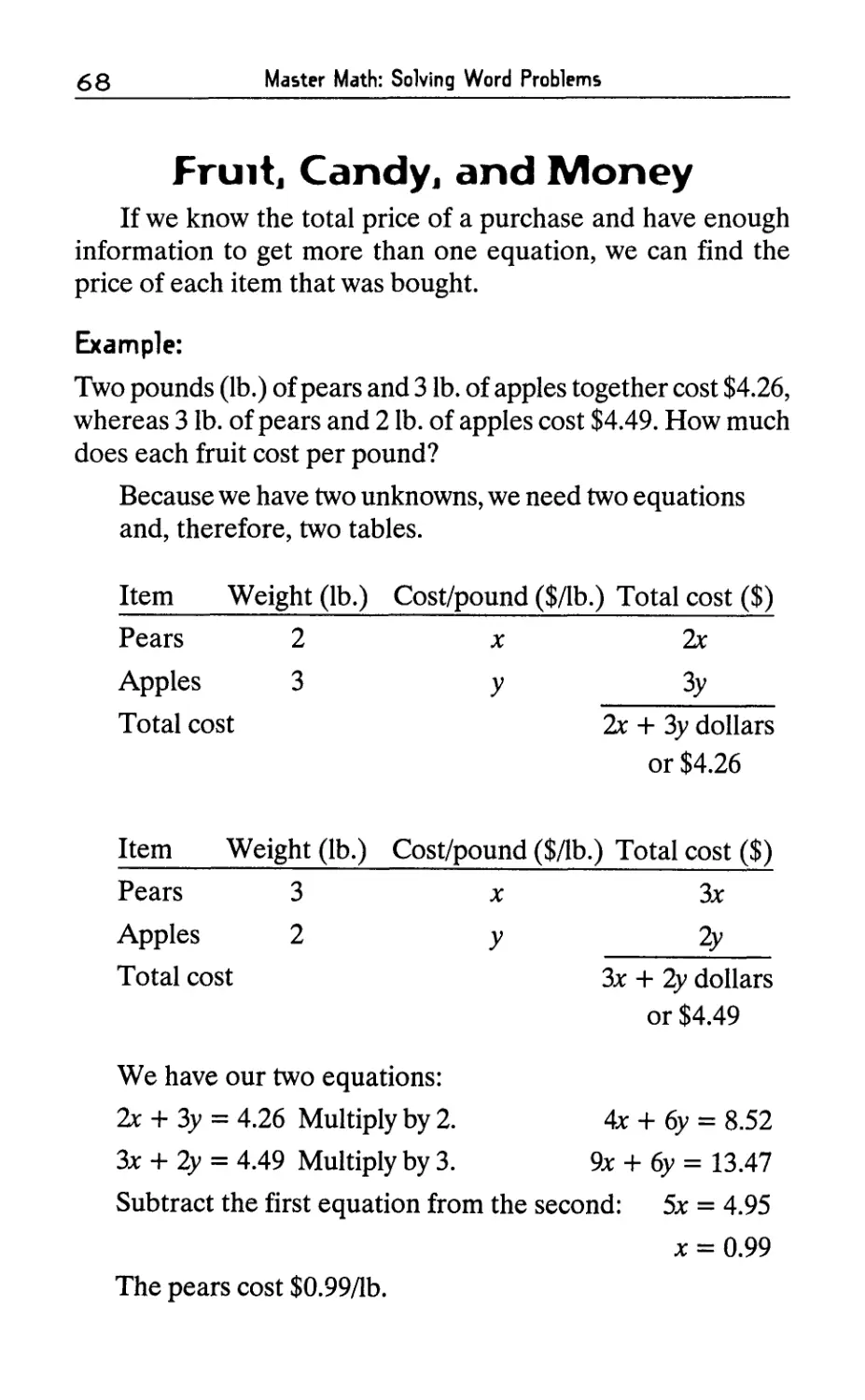
Two pounds (lb.) of pears and 3 lb. of apples together cost $4.26,
whereas 3 lb. of pears and 2 lb. of apples cost $4.49. How much
does each fruit cost per pound?
Because we have two unknowns, we need two equations
and, therefore, two tables.
Item Weight (lb.) Cost/pound ($/lb.) Total cost ($)
Pears 2 x 2x
Apples 3 у Ъу
Total cost 2x + Ъу dollars
or $4.26
Item Weight (lb.) Cost/pound ($/lb.) Total cost ($)
Pears 3 x 3x
Apples 2 у 2y
Total cost 3x + 2y dollars
or $4.49
We have our two equations:
2x + Ъу = 4.26 Multiply by 2. Ax + 6y = 8.52
3x + 2y = 4.49 Multiply by 3. 9x + 6y = 13.47
Subtract the first equation from the second: 5* = 4.95
x = 0.99
The pears cost $0.99/lb.

Mixing Problems 6 9
Insert 0.99 in the first original equation:
2@.99) + Ъу = 4.26
3y = 4.26-1.98
Ъу = 2.28
у = 0.76 The apples cost $0.76/lb.
Practice Problems:
4.18 Andy paid $1.70 for 5 pieces of gum and 8 small
chocolates. Lisa bought 7 pieces of gum and 4 small
chocolates. She paid $1.30. How much did the gum
and the chocolates cost each?
4.19 Kelly works at a grocery store. In one week she
earned $390 for 47 hours, of which 7 hours were
overtime. The next week she earned $416 for 50
hours, of which 8 hours were overtime. What is
Kelly's overtime rate?
Investments at Different
Interest Rates
Example:
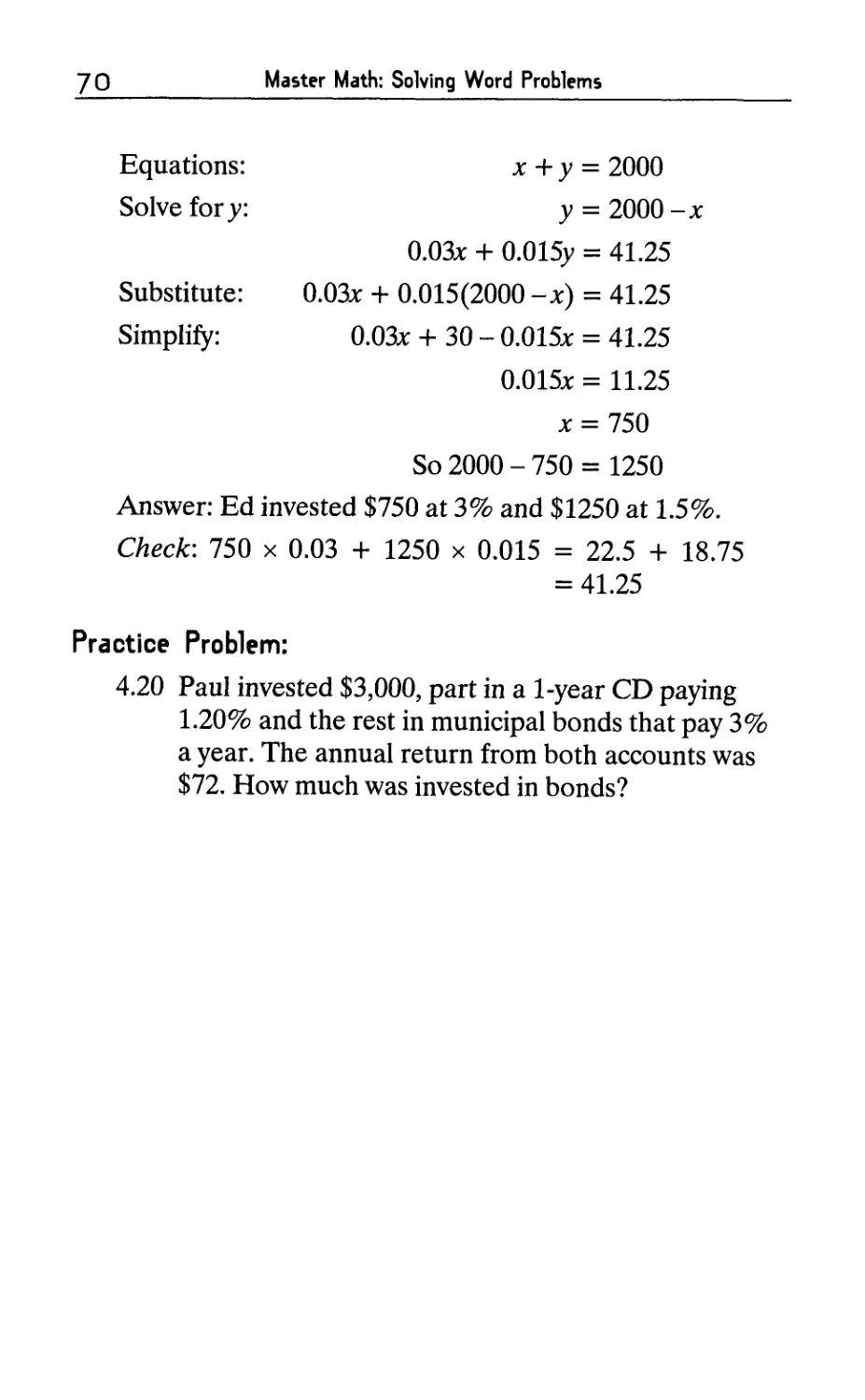
Ed invested $2000: one part at 3% interest and one part at 1.5%
interest. If he got $41.25 simple interest in one year, how much
did he invest at each percentage?
Make a table:
Investment Interest Simple interest(%)
x 3 Ъ%х
у 1.5 1.5%y
Total $2000 41.25

70 Master Math: Solving Word Problems
Equations: x + у = 2000
Solve for у: у = 2000-л:
0.03л: + 0.015у = 41.25
Substitute: 0.03л: + 0.015B000 -х) = 41.25
Simplify: 0.03л: + 30 - 0.015л: = 41.25
0.015л: = 11.25
л: = 750
So 2000 - 750 = 1250
Answer: Ed invested $750 at 3% and $1250 at 1.5%.
Check: 750 x 0.03 + 1250 x 0.015 = 22.5 + 18.75
= 41.25
Practice Problem:
4.20 Paul invested $3,000, part in a 1-year CD paying
1.20% and the rest in municipal bonds that pay 3%
a year. The annual return from both accounts was
$72. How much was invested in bonds?

I
± > Chapter 5
Measurement
Problems
In this chapter we will study different kinds of measurements.
We will begin by comparing measurements in the form of ra-
ratios and proportions. For example, if you are twice as tall as
your little sister, your height is to her height (in a ratio) as 2 is
to 1. If your height is 6 feet (ft.) and your sister's is 3 ft., then
6 is to 3 as 2 is to 1 and that is a proportion. Other examples
will show you how to determine the ratio of girls to boys or
boys to girls in a class if you know how many of each there
are, or to calculate the number of students and professors at
a game if you know the total number and the ratio of students
to professors.
Proportions are also useful to solve everyday problems: Say
you earn $350 in a 5-day week, how long will you have to work
to earn $2100? Or you know that your car gets 20 miles to the
gallon, how many gallons of gas do you need to drive 1000 miles?
We will also use proportions to deal with indirect mea-
measurements. For example, to calculate the height of a flagpole
by the length of its shadow if we know the height of a given
object, say, a person, and the length of the object's shadow.
71

7 2 Master Math: Solving Word Problems
In this chapter, you will also learn the units used in mea-
measuring solids and liquids, areas and volumes, and also tem-
temperature. We will use the customary (English) system and also
the metric system and show you how to convert from one to the
other.
Ratio and Proportion
A ratio is a comparison of two numbers by division. The
symbol for ratio is a colon (:) or a fraction bar (—) or (/).
Example:
Find the ratio of 2 feet to 6 feet.
2:6 or f =4 = 1/3
о 3
The ratio is 1 to 3.
Example:
Find the ratio of 2 ft. to 6 inches (in.).
When we compare two length measures, we usually
convert the unit measures to the same kind.
2 ft. = 24 in.
24 in 4
-rr- = - =4/1
6 in 1
The ratio is 4 to 1.
Example:
In a class there are 15 boys and 18 girls. What is the ratio of я)
boys to girls, b) girls to boys?

Measurement Problems J 3
15 5
a) The ratio of 15 boys to 18 girls is — = —.
lo 0
The ratio of boys to girls is 5:6.
-jo f.
b) The ratio of 18 girls to 15 boys is — = —.
The ratio of girls to boys is 6:5.
Example:
Two numbers are in the ratio 2 to 5. Their sum is 28. Find the
numbers.
We call the numbers 2x and 5x. No matter what л; stands
for, 2x and 5* always are in a ratio of 2 to 5 because we
can reduce by*.
Equation: 2x + 5x = 28
7x = 28 or* = 4
2x = 2D) = 8, and 5* = 5D) = 20
The numbers are 8 and 20.
Check: 8:20 (Reduce by 4) = 2:5, and 8 + 20 = 28
Practice Problems:
5.1 Find the ratio of 5 minutes to 1 hour.
5.2 A 21-inch long ribbon is cut into 2 pieces in a ratio
of 3 to 4. How long are the pieces?
5.3 In a town in Alaska, there are 3 women for every 7
men. How many men and how many women are
there in the town if the total population is 4680?
5.4 The ratio of attendance at a college football game
was 16 students for every professor. If a total of
3400 students and professors attended the game,
how many of them were professors?

74 Master Math: Solving Word Problems
5.5 There are 8 women in a calculus class of 20 people.
Find the ratio of men to women in the class.
Proportion
2 4
Two equal ratios form a proportion. For example, — = —.
In a proportion, usually one of the numbers is unknown, so we
2 x
call that number x. If the example had been — = —, we would
3 о
have to solve for*.
In proportion problems we usually use cross multiplication,
so here we get 6B) = 3(x). (If you need to review this, see the
Appendix for a review of equations.) This method can be used
only when we have a proportion, that is, two equal fractions.
We multiply one denominator by the opposite numerator, in
this case 6 times 2, then we multiply the other denominator
(here 3) by the opposite numerator (here*).
Solve the equation by dividing both sides by 3. The answer
is 4.
Example:
Pat earns $360 in 4 days. How many days will it take her to
earn $450?
Assume it will take* days.
360 450
Set up a proportion: -—— =
Make sure that corresponding items occupy the same
places! Here we have both numerators showing the total
salary and both denominators the days. Case number
one is to the left and case number two to the right.

Measurement Problems ~] 5
Cross multiply: 360c = 4D50)
x = 5, so it takes Pat 5 days to earn $450.
If you prefer, you could set up the problem differently:
$360 4 4 4
$450 = * Reduceby9: - = -
Just by looking at the equation, you can see that* = 5!
This problem could have been done in your head:
$360 - 4 = $90 and $450 ¦*• $90 = 5. However, it is often
useful to set up a problem formally for practice in order
for you to solve more difficult problems you cannot do
in your head.
Example:
Five quarts of ice cream were used to make 70 milkshakes. How
many quarts of ice cream would be needed for 210 milkshakes?
Make a table:
Case 1 Case 2
Quarts 5 quarts
Shakes 70 shakes
Set up a proportion:
Cross multiply:
5
70
5B10)
X
x quarts
210 shakes
X
210
= 7Oc
= 15
Answer: 15 quarts of ice cream are needed.
In your head you could think: 210 is 3 times 70, so we
would need 3 times 5 quarts, which equals 15 quarts.

76
Master Math: Solving Word Problems
Practice Problems:
5.6 A sports utility vehicle can go 350 miles on 25
gallons of gasoline. How far can it go on 33 gallons
of gasoline?
5.7 A 12-oz. can of frozen orange juice costs $2.56 and
makes 48 oz. of diluted juice. What would the price
be for a 6-oz. glass of diluted juice?
5.8 A photograph measuring 6 in. by 8 in. is to be
enlarged so that the longer side is 12 in. What is the
measure of the shorter side?
5.9 The ratio of two numbers is 4:5. Find the smaller
number if the larger is 25.
5.10 A wheel turns 40 times every 2 minutes. At this
speed, how many times will the wheel turn in 5
minutes?
Many proportion problems deal with indirect measure-
measurements. For instance, if you need to measure the height of a tall
tree, instead of climbing up the tree with a huge tape measure,
you can use the fact that sunrays are parallel. So if you can
measure the length of the shadow and that of a known object,
you can use similar right triangles for your investigation.
5 ft.
3 ft.
21ft.
Figure 5.1
See also Chapter 8 (Geometry) about similar triangles.

Measurement Problems ~] ~J
Example:
A flagpole casts a shadow of 21 ft. while a boy 5 ft. tall casts a
shadow of 3 ft. How tall is the flagpole?
Call the height of the flagpolex and set up a proportion:
21 ~ 3
Cross multiply: 3x = 5B1)
x = 35, so the tree is 35 ft. tall.
Practice Problem:
5.11 Liam is 6 ft. tall. He wishes to know how tall the
flagpole at his school is. He measures his own
shadow, which is 8 ft., and the shadow of the
flagpole, which is 48 ft. What is the height of the
flagpole?
Measurements and
Conversions
In the United States, daily life measurements are usually
made in the customary system. Americans inherited the system
from the British. Other countries, as well as most scientists, use
the metric, or SJ. system, which the United States was supposed
to adopt but has not yet.
The Customary System
The conversions among units in the customary system are
as follows:

78 Master Math: Solving Word Problems
Length
1 mile = 5280 feet
1 yard = 3 feet
1 foot = 12 inches
Weight
1 pound = 16 ounces
Volume
1 gallon = 4 quarts
1 quart = 2 pints
1 pint = 2 cups
1 pint = 16 fluid ounces
1 cup = 8 fluid ounces
Example:
How many cups are there in 1 quart?
One quart equals 2 pints, which equals:
2x2 cups = 4 cups
There are 4 cups in one quart.
Practice Problems:
5.12 Convert 3 1/2 feet to inches.
5.13 Convert 12 ounces to pounds.
5.14 Convert 4 1/2 quarts to cups.
5.15 Convert 8 fluid ounces to pints.
Example:
Old people get shorter with age, so old Aunt Clara, who used
to be 5 5/8 ft., shrank to 5 1/2 ft. How much did she shrink?

Measurement Problems ~] 9
Here we have to subtract:
45 11 45 44 1
55/8 feet-5 1/2 feet =y-y = y-y = -ft. or
12 3 , _ .
— = - = 1.5 in.
Z
We could have solved this problem by first changing
the feet to inches by multiplying by 12:
12x — -12x — = ^i^-6x 11 = 67.5-66 = 1.5
8 2 2
Aunt Clara shrunk 1.5 in.
Practice Problems:
5.16 You have a 3-yard long cloth. How much is left if
you cut off 3 pieces that are 1.5 ft. long?
5.17 Michael is 6 7/12 years old, Jessica is 4 1/12 years
old, and Kristina is 3 1/6 years old. What is the sum
of their ages?
Example:
One room in your apartment is 12 ft. by 15 ft. The walls are 9.5
ft. high. How much paint will you need to paint the four walls,
if one gallon is enough for 425 square feet (ft.2)?
Solution: You have four walls, two with a dimension of
12 by 9.5 ft.2 and two of 15 by 9.5 ft.2.
("By" signifies multiplication.)
The total area of the walls is:
2 x 12 x 9.5 + 2 x 15 x 9.5 = 228 + 285 = 513
If your algebra is strong, you could shorten the
calculations to 2 x 9.5A2 + 15) = 19 x 27 = 513.
One gallon of paint covers 425 ft.2, x gallons cover
513 ft.2.

80 Master Math: Solving Word Problems
1 X
Set up a proportion: — = —
Cross multiply: 513 = 425x
x = 513/425
x = 1.2 (rounded)
You need a little more than 1 gallon.
Practice Problems:
5.18 How many 1/2 oz. servings of butter can you get
from a 2 1/2 lb. block of butter?
5.19 How many square yards of carpeting are needed for
a room 24 ft. by 30 ft.?
5.20 Lyn walked 1 mile. How many yards is that?
5.21 To make a tart for 6 people, Karin needs 11/2 lb. of
peaches and 2/3 cup of apricot jam. How much does
she need for 20 people?
5.22 How many square inches are there in one square
yard?
In the kitchen and also in hospitals other conversions are
sometimes used. (See the chart on page 81.)
Example:
How many teaspoonfuls are there in 11/3 tablespoons?
One teaspoon is equivalent to 1/3 Tbsp. and 3 tsp.
equals 1 Tbsp.; therefore, 4 tsp. equal 11/3 Tbsp.

Unit
1 teaspoon
1 tablespoon
1 fluid ounce
lcup
1 pint
Unit
1 teaspoon
1 tablespoon
1 fluid ounce
1 cup
1 pint
Measurement Problems
Teaspoons
1
3
6
48
NA
Cups
NA
1/16
1/8
1
2
Tablespoons
1/3
1
2
16
NA
Pints
NA
1/32
1/16
1/2
1
81
> Fluid Ounces
1/6
1/2
1
8
16
Quarts
NA
NA
1/32
1/4
1/2
NA = Not available. No values are listed in the original table.
Practice Problems:
5.23 Replace all NAs in the previous chart with numbers.
5.24 A recipe for 6 people calls for 5 Tbsp. of oil. How
many cups are needed for 30 people?
5.25 A can of soda contains 12 fluid oz. How many cans
must you buy to fill 10 8-oz. glasses?
5.26 A full bottle of cough syrup contains 8 fluid oz. You
drink 2 Tbsp. How many Tbsp. of syrup are left?
5.27 A man donates 1 pint of blood to a blood bank. A
blood transfusion may require 50 fluid oz. of blood.
How many pints of blood are needed?

82 Master Math: Solving Word Problems
The Metric System
The metric system is built on powers of 10. For example, for
length measures: 1 meter (m) = 10 decimeters (dm) = 100
centimeters (cm) = 1000 millimeters (mm) or written with
powers: 1 m = 10 dm = 102 cm = 103 mm.
Mass (weight) and volume are related in a similar fashion.
The basic unit for length is the meter; for mass, the gram; and
for volume, the liter. All other units are expressed with prefixes:
kilo (k) = thousand 103
hecto (h) = hundred 102
deka (da) = ten 10
deci (d) = tenth 101
centi (c) = hundredth 102
milli (m) = thousandth 103
To convert between units we move the decimal point. Five
kilometers (km) means 5 x 1000 meters = 5000 m. We move
the decimal point 3 steps to the right: 5.000^5000.
Example:
2 dm = 20 cm = 200 mm
3 hg = 30 dag = 300 g
500g = 5hg = 0.5kg
1000 mg = 100 eg = 10 dg = 1 g
Practice Problems:
5.28 Convert 4.5 kg to grams.
5.29 Convert 3.8 m to centimeters.
5.30 Convert 0.08 km to meters.
5.31 Convert 3890 g to kilograms.
5.32 Convert 150 mm to decimeters.

Measurement Problems 8 3
Example:
1 dm x 1 dm = 1 dm2
10 cm x 10 cm = 100 cm2 = ldm2
Because all length measures are 10 apart, the area mea-
measures are 100 apart. For example, 100 square decime-
decimeters equal 1 square meter.
Practice Problems:
5.33 Convert 150 mm2 to cm2.
5.34 Convert 0.05 cm2 to mm2.
5.35 Convert 0.0075 m2 to cm2.
Example:
1000 dm3 = 10 dm x 10 dm x 10 dm = lm x lm x lm = 1 m3
The volume measures are 1000 apart.
For liquids, the measuring unit cubic decimeter has
another name: liter (L).
1 L = 10 dL = 100 cL = 1000 mL
One liter and one quart of liquid are, more or less, the
same.
Practice Problems:
5.36 Convert 3 m3 to cubic decimeters.
5.37 Convert 5 dm3 to cm3.
5.38 Convert 0.5 L to cL.
5.39 A bathtub has a bottom area of 130 dm2. How far up
does the water rise if you put 390 L into the tub?
5.40 Butter, weighing 2 kg, is divided into small units of
1 hg each. How many small units will there be?

84 Master Math: Solving Word Problems
Example:
The scale of a map is 1/2 inch for every 3 miles. How far apart
are 2 towns that are 4 1/4 inches apart on the map?
Table:
Case 1 Case 2
Map 1/2 in.
Real Life 3 miles
Set up a proportion:
Cross multiply:
4 1/4 in.
x miles
1 „ 1
— 4—
2 _ 4
3 x
17
1 4
2-3 x
1 _ 17
6~4*
4x = 17-6
4x = 102
x -25.5 or 251/2
Answer: The distance is 25 1/2 miles.
Practice Problems:
5.41 A dining room is 15 m long and 12 m wide. Find the
dimensions in a scale drawing which is 1:100.
5.42 On a drawing in a scale of 100:1 there is a distance,
which is 125 mm. What is that in real life?
5.43 On a computer screen there is a 3-mm-long bug that
has been enlarged in a scale of 200:1.What is the
size of the bug on the screen?

Measurement Problems 85
Conversions Between the
Customary and the Metric
Systems
You need a table of conversion factors, but don't bother to
memorize these factors. It is important to remember that 1 yard
is a little less than 1 meter, 1 inch is about 2.5 centimeters, 1
pound is a little less than 0.5 kilogram, and 1 quart and 1 liter
are more or less the same.
Length Weight Volume
1 in. = 2.54 cm 1 lb. = 454 g 1 qt. = 0.946 L
1 km = 0.6 mi 1 kg = 2.2 lb. 1 L = 1.06 qt
1 mi. = 1.6 km 1 oz. = 28 g
Example:
Greg is 5 ft. 9 in. tall. What is his height in centimeters?
5 ft. 9 in. = 5 x 12 + 9 = 69 in.
69 x 2.54 cm = 175.26
Answer: Greg is 175 cm. (The decimals are usually
rounded.)
Example:
Convert 500 g to ounces.
500/28 = 17.86 = 18
Answer: 18 oz.
Practice Problems:
5.44 How many deciliters are there in 1 cup?
5.45 The new baby weighed 3.4 kg and was 51 cm long.
Convert these measures to the customary system.

86 Master Math: Solving Word Problems
5.46 How many ounces are there in 100 g?
5.47 A mercury barometer reads 760 mm. Express this
pressure reading in inches.
5.48 If a chemical costs $3.50 a pound, what is the cost of
15 g?
Dimensional Analysis
It is often confusing for people to convert from one unit to
another, especially when many calculations are involved. In
order to lessen the problems with conversions we use dimen-
dimensional analysis. This is very important in scientific calculations.
Keep the measuring units with the numbers and treat them
as if they are numbers that can be reduced. If, for example, you
have Ib. both in the numerator and the denominator, you sim-
simply cross them out. Remember that the "per" means division,
so $per Ib. would be written as $llb.
Example:
Convert $3.00 per pound to Swedish kronor per kilogram. There
are 8.50 kronor in a dollar.
$3 8.50 kr 2.21b.
X X
Reduce:
Ib. $ kg
3 x 8.50 x 2.2 kr 56.1 kr
kg kg
The cost is 56.1 kronor per kilogram.
Practice Problems:
5.49 An airplane flies with a speed of 900 km per hour. If
you use a pen to follow its route on a map that has a
scale of 1:50,000, what is the speed of the pen?

Measurement Problems 8 7
5.50 A skater once skated 10,000 m in a race in the time
14 min. 55.32 sec. Calculate the average speed in
kilometers per hour. Round to a whole number.
5.51 If 150 g of cookies cost $1.25, how much do 5 oz.
cost?
5.52 How many feet are there in a 500 m ice skating
rink?
Temperature
In the customary system, temperature is measured in
Fahrenheit (F) degrees and in the metric system, in Celsius (C)
degrees. In the Fahrenheit system water boils at 212 degrees
and freezes at 32 degrees. In the Celsius system water boils at
100 degrees and freezes at 0 degrees.
Conversion formulas:
Formula 1: С = |(F-32)
Formula 2: F= ^c + 32
Example:
Find the temperature in degrees Celsius if the temperature is
41 °F.
Use Formula 1: C = |D1-32) = ^l = 5
The temperature is 5°C.
Approximation: Subtract 30 from 41 and divide by 2:
41-30 = 11, and 11-2 = 5.5.

88 Master Math: Solving Word Problems
Example:
Find the temperature in degrees Fahrenheit when it is -5°C
outside.
Use Formula 2: F = |(-5) + 32 = -9 + 32 = 23
Approximation: Multiply by 2 and add 30:
-5B) + 30 = -10 + 30 = 20.
These shortcuts are very handy if you travel in a foreign
country. If the temperature is either very high or very low, the
approximation may not be accurate, but it is usually sufficient.
Practice Problems:
5.53 Calculate the temperature in Fahrenheit when the
Celsius temperatures are: a) -40, b) 0, c) 10, and d)
100 degrees.
5.54 Calculate the temperature in Celsius when the
Fahrenheit temperatures are: a) -40, b) -10, c) 32,
d) 212 degrees.
5.55 A babysitter from Europe took the temperature of
the little girl she was watching in the United States.
It showed 100°. The babysitter got very frightened.
Why was that?

x * < .Я Д ^I
Chapter 6
Rate Problems
The word rate is frequently used in word problems. It is
usually accompanied by another word, such as per, for, or in.
For example: miles per hour, interest per year, price per pound
or price for a certain weight, work done per hour or work done
in so many hours.
In this chapter there will be examples of motion problems.
When a car or person moves at a known speed (miles per hour)
we can calculate the distance they will cover if we know the
time it will take. Or knowing the distance and the time it takes,
we can calculate the rate (speed) at which they travel. Or know-
knowing the rate and time, we can calculate the distance.
We will also encounter problems where different objects
(cars, boats, people) move at different rates and in different
directions and where we want to calculate how far apart they
will be in a given time or how long it will take them to cover a
given distance. Or what happens when you row with the current
of the river or against it.
In this chapter you will also learn how to solve work prob-
problems: how long it will take you to complete a certain task when
you know how much you can do in an hour. For example, if you
89

90 Master Math: Solving Word Problems
know that in one hour you can paint half the wall of your living
room (that's your rate), how long will it take you to paint all
four walls? Or if your friend agrees to help you and he paints
twice as fast as you do, how long will it take?
Finally, there are the filling and emptying problems; such
as, how long it takes to fill the bathtub when you forget to close
the drain?
Motion (Speed) Problems
This category includes anything that moves; such as cars,
boats, river currents, and airplanes.
Example:
Beth walked 2 miles in 40 minutes. What was her rate in miles
per hour (mph)?
Here we are given the time in minutes, so we have to
convert that into hours.
There are 60 minutes in 1 hour, so 40 minutes is
40/60 = 2/3 hour.
To get speed per hour we divide 2 miles ¦*¦ 2/3 hour:
2 3
2-ь- = 2х- = 3
3 2
Beth's rate was 3 mph.
Example:
Sheldon drove his car at an average of 55 mph. How far did he
drive in 4 hours?
The formula we can use is: distance = rate x time.
d = 55 x 4 = 220 miles

Rate Problems 9 1
With help of dimensional analysis (see Chapter 5), we
can check if our units are correct.
55 x 4 hours = 55 x 4 miles
hour
(We reduce, or cancel, the unit hours.)
Example:
A car travels east at a speed of 50 mph and a motorcycle travels
west at a speed of 60 mph. If they start at the same time and
place, how long will it take them to be 220 miles apart?
Often with these types of problems it is useful to draw a
picture.
60 mph 50 mph
1
220 miles
Figure 6.1
Make a table and recall that distance traveled equals
time x rate:
Miles per hour is abbreviated
miles , .,
X iiUUIo — IIlllCo
hour
Rate (speed)
(mph)
Car 50
Motorcycle 60
Total
as mph and
Time
(hours)
X
X
Distance
(miles)
50k
«k
220
The total distance traveled is 50* + 60* = 220.
Solve the equation: 11 Or = 220 or* = 2
It took them 2 hours to be 220 miles apart.

92 Master Math: Solving Word Problems
Example:
Use dimensional analysis (Chapter 5) to convert 132 feet per 9
seconds to miles per hour.
Feet must be converted to miles and seconds to hours.
132 feet
9 seconds
132 feet in
1 mile 3600 seconds
5280 feet
9 seconds equals
hour
10 miles
132x3600 miles
9x5280 hours
475200 miles
4750 hours
10 miles
hour
per hour.
Example:
Anne drove to her friend's house at a speed of 55 mph. During
the trip back home, she could only drive 35 mph. It took her 2
hours longer to get home. How many miles is it between Anne's
home and her friend's?
Make a table:
Rate Time Distance
(mph) (hours) (miles)
To the friend 55 x 55r
Back 35 (jc + 2) 35(x + 2)
Note that the distance is the same going there as going
home.
55* = 35(jc + 2)
55* = 35* + 70
2(k = 70
л: = 3.5

Rate Problems 93
Because it took her 3.5 hours to drive at a speed of 55
mph, the distance was:
3.5 x 55 miles = 192.5
Check: 35C.5 + 2) miles = 35E.5) miles = 192.5 miles
Practice Problems:
6.1 If you have walked 2.4 miles in 36 minutes, what was
your average speed in miles per hour?
6.2 Carl and Bill live 54 miles from each other. One day
they decided to bicycle from each others' homes.
Carl bicycles with a speed of 15 mph and Bill with 12
mph. When will they meet and where?
6.3 Beatrice drives her car for 3 hours at a certain
speed, and then increases the speed by 10 mph for
the next 2 hours. The total distance she drove was
270 miles. Determine the two different speeds.
6.4 Hiking up a mountain took 5 hours, but down only
11/2 hours. If the distance each way was 3.3 miles,
determine the difference between the two hiking
rates.
6.5 Ben drove 200 miles at an average rate of 45 mph.
On the return trip his average speed was 55 mph.
What was the average speed for the total trip?
Example:
A bicyclist was training for a race. The training route was 75
miles. If the racer could increase his speed by 5 mph, he could
complete the same course in 3/4 of the time he did earlier. Find
his average rate of speed.

94 Master Math: Solving Word Problems
Table:
Rate(mph) Time(hours) Distance(miles)
Case 1 x у xy = 75
Case2 (x + 5) 3/4y (x + 5) 3/4 у = 75
We have two equations:
xy = 15
(x + 5) 3/4>> = 75 -> 3/4xy + 5C/4> = 75 ->
3xy + 15y = 300 (Multiply both sides by 4.)
Substitute^ = 75 in the previous equation:
3G5) + 15y = 300
225+у = 300
15y = 75
y = 5
It took 5 hours to bicycle 75 miles, so his speed was 15
mph.
Practice Problems:
6.6 A car is driven first on a dirt road at a speed of 30
mph and then on a paved road with a speed of 60
mph. The total trip was 210 miles and took 4 hours.
How long did the car travel on the dirt road?
6.7 Anna and Marie lived 36 km from each other. One
day they decided to bicycle towards each other.
Both started at 10:40 a.m., Anna with a speed of 12
km/h and Marie with a speed of 16 km/h. At what
time did they meet?
6.8 The road between Cortland and Peekskill was old
and crooked. After a new road was built, the
distance between the towns was 10% shorter than

Rate Problems 95
before. The speed of the bus traveling between the
towns increased by 20%. How much shorter (in
percent) is the time it takes for the bus to travel
between the two towns now?
Example:
It takes Jim 3 hours to row 12 miles with the current down-
downstream and it takes him 6 hours to row the same distance against
the current upstream. How fast can Jim row in still water? What
is the speed of the current?
Think of what happens when he rows with the current:
The current pushes him along so he will go faster. On
the other hand, when he rows against the current, he is
hindered by the current and goes slower. If Jim's speed
is x mph and the current's у mph, then the speed with
the current is л: + v and against the current* -y. (Don't
write у -x, because then he would be going backwards!)
Make a table:
Rate Time Distance
(mph) (hours) (miles)
With x + у mph 3 hours (л: +уK miles = 12 miles
Against x -y mph 6 hours (x-yN miles = 12 miles
Recall that parentheses followed or preceded by a
number means multiplication.
We now have two unknowns and two equations:
Solve this system of equations by dividing the first by 3
and the second by 6:

96 Master Math: Solving Word Problems
X +y = 4
x-y = 2
Add the equations: 2x = 6
x = 3
y=l
Jim rows 3 mph in still water and the speed of the
current is 1 mph.
Practice Problems:
6.9 Laura can row 16 miles downstream in 2 hours, but
when she rows the same distance upstream it takes
her 4 hours. Find Laura's rate in still water and the
rate of the current.
6.10 A plane can travel 600 mph with the wind and 450
mph against the wind. Find the speed of the plane in
still air and the speed of the wind.
Work Problems
Work problems are another type of rate problem. If we know
how long it takes a worker to complete a certain task, we know
the rate or which part of the job he can do per hour.
Example:
Lou can stamp 600 envelopes in two hours. What is his rate?
The total job takes 2 hours. Every hour he does 1/2 of
the job. His rate is 1/2 of the total, or he can stamp
— • 600 = 300 envelopes per hour.

Rate Problems 9 7
Example:
It takes Edwin 2 1/4 hours to paint a wall. What is his rate?
The total job takes 2 1/4 hours.
,.114
The rate per hour is: —г = -g- = —
2- - У
4 4
He completes 4/9 of the job every hour.
Check: In 2 hours he completes 8/9 of the job and in 1/4
of an hour he completes the last 1/9 of the job.
Most work word problems deal with two people working
together. Other problems deal with bathtubs that can be filled
in a certain amount of time. Sometimes we leave the outlet
plug open by mistake and then, how long does it take to fill the
tub?
Example:
Anna can paint a room in 6 hours while Barbara can paint the
same room in 4 hours. How long does it take if they work
together?
Make a table:
Name Rate/Hour Time(hours) Total Work
1 x
Anna — x —
о о
„ u 1 x
Barbara — x —
4 4
x x .
Total - + - = 1
6 4
The total job is 1.

98 Master Math: Solving Word Problems
X X
— + — = 1 LCD = 12 (The least common denominator).
Multiply both sides by 12:
5* = 12
2 2
2—hours = 2 hr. + — x 60 min. = 2 hr. 24 min.
The total work time is 2 hours and 24 minutes.
Example:
Steven can wallpaper a room in 4 hours and Evie can wallpaper
the same room in 6 hours. If Steven works alone for 1 hour and
then both Steven and Evie work together to finish the room,
how long will it take them assuming they keep their usual speed?
Make a table:
Name Rate Time Total Work
Steven 1/4 1+x (l+*)l/4
Evie 1/6 x 1/6(jc)
1 v
Equation: ±-^- + - = 1 LCD = 12
4 6
3 + 3x + 2x = 12
5* = 9
* = 9/5
9/5 hours = 1 + 4/5 hour = 108 minutes

Rate Problems 99
Practice Problems:
6.11 Repeat the previous example with Evie working
1 hour alone before Steven starts.
6.12 Jill can fill 300 envelopes per hour, whereas Fritz
can fill this many envelopes in 2 hours. How long
would it take for them to fill 300 envelopes if they
work together?
6.13 It takes Nils 3 hours to mow the lawn but, with the
help of Jonas, he can finish in 2 hours. How long
would it take Jonas to do the job alone?
6.14 If Andrew, Bart, and Carl can wallpaper a house in
8 hours and Andrew and Bart can do it is 12, hours,
how long will it take Carl to do the job alone?
6.15 Petra can do a certain job in 30 minutes and if she
works together with Svea, they can do the same job
in 24 minutes. How long would it take Svea to do it
alone?
Example:
If 3 men can paint 4 houses in 5 days, how many days does it
take for 7 men to paint 14 houses?
We have to suppose that all the men work at the same
speed. Three men can paint 4/5 houses per day and one
14 4
man can paint — x — = — per day. At this rate it takes 7
men x days to paint 14 houses. That means that one
. 1 14
man can paint — x — per day.

TOO Master Math: Solving Word Problems
4 1 14
These two expressions are equal: — = — x —. Reduce
15 7 x
the right side of the equation and we get — = - * —
1 2
— x —
1 X
Cross multiply: Ax - 30, so л: = 7.5
It takes 7 1/2 days to paint these houses.
Practice Problem:
6.16 Robots are used to assemble automobiles in a
factory. Three robots assemble 17 cars in 10
minutes. If all robots assemble cars at the same
speed, how many cars can 14 robots assemble in
45 minutes?
Example:
It takes the hot water tap 30 minutes to fill the bathtub, while
the cold water tap takes 20 minutes. How long would it take to
fill the bathtub if both taps were open? Assume it takes x
minutes.
Make a table:
Rate Time(minutes) Part of bathtub filled
Hot water 1/30 x */30
Cold water 1/20 x */20
Equation: The bathtub is now filled, so we get the
equation: лг/30 + x/20 = 1
30 20
Multiply both sides by 60 (LCD), simplify, and solve.

Rate Problems 1 0 1
5* = 60
* = 12
Answer: It takes 12 minutes to fill the bathtub when
both taps are open.
Example:
In the previous bathtub example, if the drain had been left open
by mistake, how long will it take to fill the bathtub if the drain
can empty the bathtub in 15 minutes?
As before, call the time x and make a table. Note that
the rate when the bathtub is emptied is negative.
Make a table:
Rate Time (minutes) Part of bathtub filled
Hot water 1/30
Cold water 1/20
Drain -1/15
Equation:
XXX
30 + 20"l5~
X
X
X
jc/30
jc/20
-jc/15
Multiply both sides by 60 (LCD), simplify, and solve.
Answer: With the drain open, it takes 60 minutes to fill
the bathtub.

T 02 Master Math: Solving Word Problems
Practice Problems:
6.17 A tank can be filled by an inlet pipe in 15 minutes.
A drain pipe can empty the tank in 60 minutes. How
long does it take to fill the tank if both pipes are
open?
6.18 A.large tank can be filled by one pipe in 20 hours.
A second pipe can fill the tank in 15 hours. If the
first pipe was open for 16 hours and then closed,
how long would it take to fill the tank if the second
inlet pipe was opened after the first was closed?
6.19 It takes 12 minutes to fill a bathtub with water and
half an hour to empty the bathtub through the
outlet. How long will it take until the bathtub
overflows if the inlet taps are open and the plug was
not put in the outlet?

Chapter 7
Д a
Statistics and
Probability
In this chapter we will solve problems that involve the orga-
organization and interpretation of numerical data. When numerical
facts, such as the size of populations, the incomes of various
groups, the number of cases of a disease, and the results on an
exam, are collected, analyzed, and represented in the form of
tables or graphs, we call it statistics.
We will begin with averages—for example, the average age
of a group of students—and also calculate the median, mode,
and range of this group.
Next, you will learn how to illustrate statistical data with
bar graphs and pie diagrams, such as often seen in the newspa-
newspapers or in a financial report from a company.
These bar graphs and pie diagrams can show you how test
scores are distributed among different schools or what percent-
percentage of a club membership are men and women.
The next section of this chapter deals with probability and
odds. When you draw a card out of a pack of cards, what is the
probability that you will draw the queen of spades? Or when
you roll dice, what are the chances that you will get two sixes?
In this chapter you will find many problems that involve rolling
a die, tossing pennies, and picking jellybeans out of a jar.
103

1 04 Master Math: Solving Word Problems
Finally, we get to permutations and combinations and sets.
Take telephone numbers, which, when the area code is included,
have 10 digits: In how many ways can these numbers be
arranged? How many ways can the letters in a word such as
MATHEMATICS be arranged?
Averages
Take, for example, the numbers 1,2,3,4,5. The sum of the
numbers is 15 and there are 5 numbers. The mean of these
numbers is 15 -s- 5 = 3. The median of the numbers is the middle
number, or in this case is 3. The mode is the number that occurs
most frequently. This set of numbers has no mode. The mean,
median, and mode are all different kinds of averages. The most
common average is the mean and that is what we use in daily
life. When we ask, "What is the average age of this class?" what
we want to do is find the mean. The range is the difference
between the highest number and the lowest. It shows the spread
of the data. In this case it is 5 - 1 = 4.
Example:
The scores on a quiz are as follows: 6,9, 8,8,7, 8,10,9,7. Find
the mean, median, and mode.
There are 9 entries, so the mean = F + 9 + 8 + 8 + 7
+ 8 + 10 + 9 + 7) -*- 9 = 72-9 = 8.
To get the median we arrange the numbers in order: 6,
7,7,8,8,8,9,9,10. There are 9 numbers, so the number
in the middle is the fifth, or 8. The median is 8. If the
number of entries is even, the median is considered to
be between the two middle numbers, that is, the mean
of these two numbers.
The number that occurs most frequently is 8, so the
mode is also 8.

Statistics and Probability 105
Mean, median, and mode are all 8.
The range is 10 - 6 = 4.
Practice Problems:
7.1 Find the mean, median, mode(s), and range in the
following sets of numbers:
d) 9,8,2,7,1,1,5,7
b) 8, 9,10, 8, 7, 7, 8, 6, 9,10, 8,7, 8, 9
c) -2,-7,-5,0,-5,-3
7.2 In a choir there were 12 men and 13 women. The
mean average age of the men was 25 years and the
mean average of the women 20 years. Find the
mean age of the group. Hint: Find the total ages of
the men and the total ages of the women first.
7.3 A 39-year-old man joins the group in practice
problem 7.2. What is the new mean of the group?
7.4 In a group of 13 people the mean age is 25 years. A
person who is 36 years leaves the group. What is the
new mean of the group?
7.5 In a business with 45 employees the mean age is 36
years. Two 63-year-olds retire and a 24-year-old is
hired. Find the new mean age.
Graphs
Statistical data are often illustrated with graphs. Take, for
example, a bag of M&Ms that contains 50 candies: 20 light
brown, 10 green, 5 red, 10 yellow, and 5 dark brown. This can
be illustrated in a circle or pie graph the following way:

106
Master Math: Solving Word Problems
Light brown: — = 40%
Green: - =
Red:
»0*
Yellow: - =
Dark brown: — = IQ%
To construct the circle graph, if 100% is the whole circle or
360°, then 40% is 144°, 20% is 72°, and 10% is 36°. These angles
are called central angles, because they have their vertex at the
center of the circle. To mark the angles on the circle you need
a protractor.
Figure 7.1

Statistics and Probability
107
We will not have any exercises with making circle graphs
here but will only learn how to read them.
The same data can also be displayed with a bar graph, where
the horizontal line shows the different kinds of candies and the
vertical line shows the percentages.
50
40
30
20
10
-
1
1
l 1 l 1
Figure 7.2
LB G R Y DB
Example:
If we toss three coins, the following will happen: We get out-
outcomes of 0,1,2, or 3 heads. Pretend that we toss a coin 16 times
and get 0 heads twice, 1 head 5 times, 2 heads 8 times and 3
heads once. Prepare a table of the frequencies and make a bar
graph and a frequency plot, also called a frequency polygon.
The difference between a bar graph and a frequency polygon is
that in the polygon we plot the frequencies as points.
Frequency Distribution
No. of heads Frequency

108
Master Math: Solving Word Problems
Frequency
Figure 7.3
¦I
0 i
3 4
No. of heads
Frequency
Figure 7.4
0 12 3 4
No. of heads
Practice Problems:
7.6 Toss 4 pennies 20 times and record the number of
heads you get. Make a bar graph and a frequency
polygon.
7.7 Find the mean, median, mode, and range for the
following data:
30
40
33
41
70
43
50
36
37
25
51
47
32
18
21

Statistics and Probability 109
7.8 From the following frequency table of points on a
test, find the mean, median, mode, and range.
Make a bar graph.
Number of points
6
7
8
9
10
Frequency
3
5
7
3
2
7.9 Twenty people were employed at a small factory.
The number of sick days reported by each worker
during a certain month were:
3, 3,0,1,2,5,1, 2,4, 3, 2,2,4,2,1, 6,0, 2,1,1
Make a frequency distribution table and draw a bar
graph. Find the mean and the median. What is the
range?
7.10 The results of a 10-question quiz are as follows:
4 6 10 5
5 2 6 3
8 9 8 7
4 7 6 5
7 3 5 4
Make a bar graph and a frequency polygon of the
scores. Find the mean, median, and mode.

1 10
Master Math: Solving Word Problems
Example:
From the following illustration, determine what percent of the
members are girls?
Number
25
20
15
10
5
Figure 7.5
Club Members
Girls
Boys
14 15 16 17 18
Age
Read the bars and get the total number of each kind.
Girls: 7 + 14 + 17 + 13 + 5 = 56
Boys: 11 + 12 +20 + 10 + 9 = 62
Total: 56 + 62 = 118
Girls are 56/118 = 0.47 = 47% (rounded).
There are 47% girls in the club.
Practice Problems:
7.11 The pie chart in Figure 7.6 shows the cost for the
local school during one school year. There were 709
pupils that year and the total cost was $4.3 million.
Determine the cost per pupil for a) salaries for
teachers and b) upkeep of the buildings.

Statistics and Probability
1 1 1
Figure 7.6
12%
After
до% х School
Adminis-
Administration
7.12 In a small country, the population of people over 65
years old was as follows: 652,735 men and 890,597
women. The total population that year was
8,837,496. Determine the central angle that shows
this category of the population in a pie graph.
7.13 According to Figure 7.7, a) what was the amount of
scholarship money awarded in 1986? b) by how
much did the scholarship money increase between
1986 and 1989?
Amount of Scholarship Money Awarded to Graduating
Seniors in 1985-1990
250,000
200,000
150,000
100,000
50,000
Figure 7.7
85 86 87
89 90
Year

Master Math: Solving Word Problems
Probability and Odds
Probability
Probability is a measure of the likelihood of an event to
happen. If something is absolutely A00%) sure to happen, the
probability is 1 and if it is absolutely sure that it will not hap-
happen, the probability is 0. All other probabilities are expressed
as fractions between 0 and 1. The probability of something to
happen and not to happen adds up to 1.
The definition of probability is:
number of favorable outcomes
number of possible outcomes
Example:
Ajar contains 60 jellybeans: 15 pink, 20 white, 5 yellow, and 20
purple. What is the probability of picking a purple jellybean?
There are 20 purple jellybeans out of a total of 60;
therefore, the probability of picking a purple jellybean
is 20/60 = 1/3.
The probability is 1/3.
Practice Problems:
7.14 What is the probability of picking a) a pink,
b) a white, c) a yellow?
7.15 There are 6 white and 4 black balls in a box. What is
the probability of picking up a white ball without
looking?
7.16 A digital clock shows the time every minute. What is
the probability that during a 24-hour period when
you look at the clock all digits showing the time are
the same?

Statistics and Probability 113
Example:
A deck of cards consists of 52 cards. You draw one card. What
is the probability that the card is a king?
To solve this problem you need to know that there are
4 kings in a deck. The probability is 4/52 = 1/13.
Example:
Find the probability of drawing a red card from a deck.
There are 26 red and 26 black cards in a deck. There-
Therefore, the probability of drawing a red card is 26/52 or 1/2.
Example:
Find the probability of drawing a face card.
Face cards are the cards with a picture of a king, queen,
or a jack rather than a card with pictures of clubs, spades,
etc., and numbers. The ace stands for either 1 or 14.
There are 3 x 4 = 12 face cards in a deck; 3 from each
suit and 4 suits.
12/52 = 3/13
The probability of getting a face card is 3/13.
Practice Problems:
7.17 Find the probability of drawing a queen of spades
from a deck of cards.
7.18 Find the probability of drawing a red face card from
a deck of cards.
7.19 A die has 6 faces representing the quantities 1
through 6. If you roll a die, what is the probability
of getting а) а 4, b) an odd number, c) a number less
than 3, d) a number more than 6?

1 "I 4 Master Math: Solving Word Problems
Example:
If a penny is tossed twice, what is the probability of two heads?
The possible outcomes are: head head, head tail, tail
head, tail tail.
Two heads occur once out of four.
The probability of getting two heads is 1/4.
Practice Problems:
7.20 If a penny is tossed three times, what is the
probability of a) three heads, b) two heads, c) no
heads?
7.21 A piggy bank contains 40 pennies, 25 nickels, 15
dimes, and 4 quarters. Find the probability that the
coin is: a) a nickel, b) a penny, c) a nickel or a quarter.
Odds
Odds can be in favor of an event or against it.
The definition of odds in favor is:
number of favorable outcomes
number of unfavorable outcomes
Example:
What are the odds in favor of getting a 3 in one roll of a die?
There is 1 favorable way of getting a 3 and 5 unfavorable
ways. Consequently, the odds are 1 to 5.
What are the odds against getting a 3?
There are 5 unfavorable ways and 1 favorable. The odds
are 5 to 1.

Statistics and Probability 115
Practice Problems:
7.22 On one roll of a die, what are the odds in favor of
getting an even number?
7.23 On one roll of a die, what are the odds against
getting an odd number?
Probabilities With "And" and "Or"
Statements
If you toss a penny, you get either a head (H) or a tail (T).
That is called the outcome. What is the probability of getting
a head on your first toss? You have two possibilities: head or
tail. One event (H) is favorable to you. The probability is 1/2. If
you toss one penny twice or two pennies once, you get the
following outcomes: HH, HT, TH, TT. What is the probability
of getting 2 heads? One outcome (HH) out of 4 is favorable.
The probability is 1/4.
The problem could be stated: What is the probability of
getting first a head and then a second head? 1/2 x 1/2 = 1/4.
The word "and" translates into multiplication.
Example:
You draw a card from a standard deck of cards and then put it
back. Now draw another card from the same deck. What is the
probability that you get a face card both times?
There are 3 face cards of each suit in a deck of cards or
12 in the whole deck, which consists of 52 cards. The
probability of picking one face card is 12/52, or 3/13.
The probability of picking first a face card and then
another face card is 3/13 x 3/13 = 9/169.
Note: If the first card was not put back into the deck,
the second probability would have been 11/51, because
we removed one face card from the deck.

16 Master Math: Solving Word Problems
Practice Problems:
7.24 Find the probability to get first a 6 and then a
3 when you toss a die.
7.25 The probability that a certain event occurs is 30%.
What is the probability that the event occurs twice
in a row? Give the answer in percent.
7.26 Find the probability that you get first get a 1 and
then and even number when you roll a die.
7.27 You toss a coin and roll a die. What is the
probability that you get a head and a 5?
7.28 Ajar contains 3 red marbles, 2 white, and 4 blue.
A marble is chosen at random from the jar and then
replaced. Another marble is chosen, a) Find the
probability that both marbles are white, b) If the
first marble is not replaced, find the probability that
both marbles are blue.
Suppose the problem was: What is the probability of getting
a head on the first toss or on the second toss (I don't care which
one) when I toss a penny? The possible outcomes of two tosses
are HH, HT, TH, and TT. The probability of each outcome is
1/4. One head occurs two times out of four, so the probability is
2/4 = 1/2.
The word "or" indicates that we should add.
Example:
What is the probability of getting 1 or 2 heads when tossing two
pennies?
The probability of 2 heads is written as p(HH) and
equals 1/4. p(HT) = 1/4 and p(TH) = 1/4.
1/4 + 1/4 + 1/4 = 3/4
The probability of getting one or two heads is 3/4.

Statistics and Probability 117
Practice Problems:
7.29 There are 8 green, 7 red, and 10 blue marbles in a
box. What is the probability that the marble is red
or blue if you pick up a marble without looking?
7.30 What is the probability to get a king or a queen
when you pick a card from a deck?
7.31 What is the probability of obtaining a 1 or an even
number on a single roll of a die?
Example:
What is the probability of obtaining a 2 or an even number on a
single roll of a die? Here we have a complication. Because 2 is
an even number it is counted twice. We have to subtract the
probability 1/6 from the sum of the probability of rolling a 2,
which is 1/6, and the probability of getting an even number,
which is 3/6.
The answer is 1/6 + 3/6 - 1/6 = 3/6 = 1/2.
Practice Problems:
7.32 If two dice are rolled, what is the probability that
the outcome is either doubles or that the sum will
be 10?
7.33 Find the probability that when a die is tossed, you
get an odd number or nothing lower than a 5.
7.34 When you roll a die, what is the probability to first
get a 3 and then a 1 or a 2?

Master Math: Solving Word Problems
The Counting Principle,
Permutations, and Combinations
The Fundamental Counting Principle
Assume that there are three ways for an event to happen
and two ways for another event to happen, then the fundamen-
fundamental counting principle tells us that there are 3 x 2 = 6 ways for
both events to happen. If you have 3 pairs of pants and 8 shirts,
how many outfits can you arrange? Each pair of pants can be
combined with 8 different shirts, so 3 pairs of pants can be com-
combined with 8 shirts to form 3 x 8 = 24 different outfits.
Example:
Suppose you are taking a multiple choice test with 5 questions
and there are 4 choices for each answer. How many different
test results can you have?
The first question has 4 possible answers.
The second question has 4 possible answers.
The third question has 4 possible answers.
The fourth question has 4 possible answers.
The fifth question has 4 possible answers.
In total there are 4x4x4x4x4 = 1024 possible test
results.
Practice Problems:
7.35 You have a dating service with 534 women and 216
men. How many different dates can you arrange?
7.36 How many three-digit numbers can be formed from
the digits 2, 3, and 4 if repetition of each digit is
allowed?

Statistics and Probability 119
Permutations
A permutation is an arrangement of things in a definite or-
order. For example, if we have to arrange 4 people in a row, we
can put any one of the 4 people in the first position, one of the
3 remaining people in the next, 2 after that, and 1 in the last
position. The fundamental counting principle tells us to multi-
multiply, so we get 4x3x2x1 = 24 different ways of arranging
these 4 people.
When we work with permutations and combinations we
often use a mathematical concept called a factorial. It is written
as n\ and pronounced «-factorial. When n = 4:
4! =4x3x2x1 = 24
If we have to arrange n things but a of them are alike, we
must divide и! by a!
Example:
In how many ways can 3,5, 6, 6,7 be arranged?
There are 5 numbers with 2 of them that are alike:
5!/2! = 5x4x3x2x1/Bx1) = 60
Practice Problems:
7.37 In how many ways can the names of 5 candidates for
the same office be listed on a ballot?
7.38 In how many ways can the digits 2, 3,5, and 7 be
arranged so that the number is less than 4000 when
the digits cannot be repeated?
7.39 How many even 4-digit numbers can be formed
using the digits 1, 2, 3, and 9 if repetition of digits is
not allowed? Hint'. Determine which digit must be
the fourth.
7.40 The letters in the word CIRCLE are randomly
rearranged. In how many different ways can the
letters be arranged?

1 20 Master Math: Solving Word Problems
Combinations
A combination is a selection of things in which order does
not matter. If the letters A, B, and С are selected two at a time,
we get three possibilities :AB, A C, and ВС. We can use a formula
n !/r! (n - r)!, where n is the number of objects and r the number
of objects selected at a time. In our case n = 3 and r = 2.
3!/2! = 3x2xl/Bxl) = 3
We get 3 combinations of the letters A, B, and C.
Sets
A set is a collection of things called elements. They can be
listed the following way: A set containing the numbers 1,2, and
3 is put in braces: {1, 2, 3}. If a set contains an infinite number
of elements such as the counting numbers, which are the
numbers we count with, we use dots to signify that there are
more numbers than we can list: { 1, 2, 3,...}.
Practice Problems:
7.41 Write in set notation the set of all positive even
integers.
Two sets can intersect, meaning that there are elements that
the sets have in common. Symbol: n.
If two sets do not have any elements in common, the result
is written { } or 0. It is called the empty set.
Example:
Find the intersection of the sets {1, 2, 3, 4,5} and {4, 5, 6}.
{l,2,3,4,5}n{4,5,6} = {4,5}
The intersection is {4,5}.

Statistics and Probability
121
When we list all elements of two sets without repeating
common elements, we get the union of the sets. Symbol: u.
Example:
Find {1,2,3,4,5} u {4,5,6}.
The union is {1, 2, 3,4,5, 6}.
The intersection and union of two sets are often illustrated
by Venn diagrams. These are circles representing the sets. See
Figure 7.8.
Example:
{l,2,3,4,5}n{4,5,6}
Figure 7.8
Practice Problems:
7.42 Find a) the intersection and b) the union of the sets
Л = {1,3,5} andB = {2,4,6,8}.

1 22 Master Math: Solving Word Problems
7.43 In a school there are 387 juniors: 165 take both
chemistry and German, and 258 take Biology and
German. How many students are taking German?
7.44 At a musical audition of 91 people, 32 people said
that they could sing but not dance, 45 could dance
but not sing. How many people could both sing and
dance?
7.45 A car salesman sells 150 cars in a certain month.
Out of these cars 90 have an airbag on the
passenger side, 50 have a car phone, and 30 have
neither an airbag nor a car phone. How many cars
have both an airbag and a car phone?

-i-_x t
Chapter 8
Geometry
In this chapter you will find an introduction to the basics of
plane and solid geometry, trigonometry, and analytic geometry;
that is, the world of angles and triangles, rectangles, squares,
circles, cubes, and cylinders. We will not have to become in-
involved with proofs, but only with word problems that ask for
numerical answers.
In plane geometry, we will calculate areas of triangles and
other planar figures and their perimeters, circumferences, di-
diameters, and radii of circles, and, later on, the volumes of cubes
and cylinders.
You will learn about the Pythagorean Theorem and how
to apply it. You will become acquainted with similar triangles
and how they are used for various calculations.
Then we will move onto problems involving figures with
more than three sides, such as quadrilaterals, polygons (for
example, the Pentagon in Washington, D.C., with five angles
and five sides, is a polygon), and also circles.
In solid geometry you will calculate areas and volumes of
different solid figures, such as cubes and cylinders. In the section
on trigonometry there will be problems involving the three
important functions sine, cosine, and tangent and how to find
123

124 Master Math: Solving Word Problems
their values using a calculator. Finally, in the section on analytic
geometry (also called coordinate geometry), you will learn how
to represent points and equations by their coordinates in a graph
and how to calculate distances between points or areas of
triangles and rectangles formed by these points.
Plane Geometry
This chapter deals with the basics of geometry. There are
no proofs, only calculations. In plane geometry we deal with
lines, rays, and line segments.
A straight line has no beginning, no end, and no size, only
direction. It is represented by a line with arrows. A ray is a part
of a line with a beginning but no end. A line segment is a part of
a line with a beginning and an end.
Straight Line Ray Line Segment
Figure 8.1
Angles
Figure 8.2
Angles are formed by two rays with the same endpoint
(vertex). They are measured in degrees. If the rays coincide, the
angle measure is 0°. When the rays form a straight line, the
angle measure is 180°: This is a straight angle. When the angles
are perpendicular, the angle measure is 90°: This is a right angle.
A right angle looks like the corner of a book or any other
rectangular object. Symbol for angle: Z.

Geometry 125
An angle between 0° and 90° is acute and an angle between
90° and 180° is obtuse. When two angles' measurements add up
to 180°, they are supplementary, and two angles whose mea-
measurements add up to 90° are complementary.
Example:
Find the supplementary angle to 135°.
Two supplementary angles add up to 180°,
so 180-135 = 45.
The angle is 45°.
Practice Problems:
8.1 Find the complementary and supplementary angles
to a) 45°, b) 30°, c) 90°, d) 67°, and e) 75°.
Perimeter
The perimeter of a plane figure is the total length around
it. Think of measuring it with a tape measure.
Example:
A rectangle has a perimeter of 72 inches. If the length is 6 inches
more than the width, find the length and width.
Call the width x. Then the length
is x + 6 and the perimeter is
Ax = 60 Figure 8.3
x = 15
x + 6 = 21
The width is 15 inches and the length is 21 inches.
Check: 15 + 21 + 15 + 21 = 72

1 26 Master Math: Solving Word Problems
Practice Problems:
8.2 Find the dimension of a rectangle whose length is
twice the width and whose perimeter is 42 cm.
8.3 The length of a rectangle is 6 units more than its
width. If the perimeter is 40 units, find the length
and the width.
Example:
The base of an isosceles triangle is 7 inches and the perimeter
is 29 inches. Find the other sides.
An isosceles triangle has two equal sides. The third side
is called the base.
Call each of the equal sides x.
The perimeter is x + x + 1 —
Ъс + l =
2k =
x~
The sides are each 11 inches.
29.
29
22
11
A
/ \
/ \
/ \
7 inches
Figure 8.4
Practice Problems:
8.4 A rectangle has a perimeter of 62 cm. The length of
the rectangle is 5 cm longer than the width. Find the
length and the width of the rectangle.
8.5 Find the perimeter of a square with a side of 5
inches.
8.6 The width in a rectangle is 2/3 of the length and the
perimeter is 15 inches. Find the length and width of
the rectangle.

Geometry
127
8.7 An equilateral triangle (all sides are equal) has the
same perimeter as a square. The side of the triangle
is 1.2 inches longer than the side of the square. Find
the perimeter.
8.8 In the triangle ABC, the side А С is 8 cm longer than
side AS. The side ВС is twice the side AB. The
perimeter of the triangle is 60 cm. How long are the
sides?
Areas
Figure 8.5
The area of a rectangle is length x width.
Example:
A rectangle has a length of 10 cm and a width of 6 cm. Find the
area.
/ x w = 10 cm x 6 cm = 60 cm2 (square centimeters).
Note that all areas are expressed in square units.
Example:
A square has a perimeter of 24 inches. Find the area.
A square is a rectangle with all sides equal. The side is
usually called s, so the area is s x s, or s2.
4s = 24
5 = 6
A = 6 x 6 = 36 in.2
The area is 36 square inches.

128 Master Math: Solving Word Problems
Practice Problems:
8.9 A square has an area of 81 in.2. What is the
perimeter?
8.10 A square has a perimeter that is 3 inches longer
than the perimeter of an equilateral triangle. The
side of the triangle is 1/2 inch longer than that of
the square. Determine the area of the square.
8.11 Two of the sides of a square are increased by 2
inches and the other two sides are shortened by
1 inch. The new rectangle has an area that is equal
to the original square. Find the area.
8.12 The perimeter of a certain rectangle is 24 inches.
If the length is doubled and the width is tripled, the
area is increased by 160 in.2. Find the dimension of
the original rectangle.
8.13 A square has an area of 64 in.2. Two of the sides of
the square are increased by 40% and the other two
sides are shortened by 25%. A rectangle is formed.
How much larger (in percent) is the rectangle than
the square?
The area of a triangle is A = l/2bh where b is the base and h
is the height (or altitude), which is a line segment from the vertex
(corner) opposite the base and perpendicular (under right
angles) to the base. See Figure 8.6.
Figure 8.6

Geometry 129
Any side of the triangle can be considered the base. Each
base has an altitude connected to it.
Example:
Find the area of a triangle with a base of 4 inches and the height
of 3 inches.
Formula: A = — bh
A = iD)C)in.2 = 6in.2
The area is 6 square inches.
Example:
The legs (the sides that form the right angle) of a right triangle
are 5 cm and 8 cm. Find the area.
If one leg of the right triangle is taken as the base, the
other leg is the height.
Area: —5-8 = 20
The area is 20 cm2.
Practice Problems:
8.14 Two sides of a triangle are 15 inches and 20 inches.
The altitude to the longer side is 6 inches. Find the
altitude to the shorter side.
8.15 A triangle has an area of 30 in.2 and an altitude of 5
inches. Find the base belonging to this altitude.

130
Master Math: Solving Word Problems
The Pythagorean Theorem
If the legs of a right triangle are a and b, we have the
relationship a2 + b2 = c2, where с is the hypotenuse (the longest
side). See Figure 8.7.
Figure 8.7
Example:
Find the hypotenuse if the legs are 3 inches and 4 inches.
32 + 42 =9 + 16 = 25 = 52
Answer: The hypotenuse is 5 inches.
Example:
Find the other leg, if one leg is 5 cm and the hypotenuse is 13 cm.
Call the missing side л:.
The leg is 12 cm.
Practice Problems:
8.16 Find the hypotenuse if the legs are 6 and 8 units
each.
8.17 Find the hypotenuse if the legs are 7 and 24 units
each.

Geometry 131
8.18 Find the area of a triangle with sides 3 in., 4 in.,
and 5 in. The altitude to the longest side is 2.4 in.
Can you find two ways of solving this problem?
Hint: What kind of triangle is this?
8.19 Find the missing leg if one leg is 7 and the
hypotenuse is ^65 units.
8.20 A 20-ft.-long ladder stands against a wall. The
bottom of the ladder is 8 ft. from the wall. How high
up on the wall is the ladder?
Angles and Triangles
The sum of the angles in any triangle is 180°.
Example:
If the angles in a triangle are x, 2x, and 3x, find x.
x + Ix + 3* = 180
6x = 180
jc=30
The angle marked x is 30°. The Figure 8.8
other angles are 60°and 90°.
Practice Problems:
8.21 In a triangle the angled is twice angle B. Angle С is
20° more than angle B. Find the angles.
8.22 In the triangle ABC, the angled is three times angle
B. Angle С is 60°. Find angle A
8.23 The ratio of two angles in a triangle is 3:5. The third
angle is 52°. Find the other two angles.

132 Master Math: Solving Word Problems
Exterior Angles
Figure 8.9
If one side of a triangle is extended, the angle formed
between the extended side and the other side is called exterior.
An exterior angle is equal to the sum of the two non-adjacent
angles. In other words,
x = a + C
Example:
How many exterior angles does a triangle have?
Each vertex (corner) can create two exterior angles, and
they are always equal; therefore, there are at most three
different exterior angles.
Example:
Find the exterior angles in a triangle where the angles are 37°,
42°, and 101°.
37° + 42° = 79°
37° + 101° = 138°
42° + 101° = 143°
The exterior angles are 79°, 138°, and 143°.
What is the sum of the three exterior angles in the previous
example? Is that true for all triangles?

Geometry 133
Example:
Find the angles of the following triangle: One exterior angle
is 14* - 6° and the two non-adjacent interior angles are Ix and
5* + 10°.
Ux - 6 = Ix + 5x + 10
14jc - 6 = 12c + 10
2c =16
;c = 8
Exterior: 14(8°) - 6° = 106°
Non-adjacent interior: 7(8°) = 56°
Non-adjacent interior: 5(8°) + 10° = 40° -I- 10° = 50°
Third interior: 180° - 106° = 74°
The angles are 74°, 56°, and 50°.
Practice Problems:
8.24 Triangle ABC is isosceles where A and С are base
angles. The exterior angle at С is 156°. Find angle B.
8.25 In the triangle ЛВС, side AS is extended to D. If the
angle at С is x + 30, the angle at A is 2x + 10, and
the exterior angle at В (CBD) is 4jc + 30, what is the
value of ;c? Note: When you write AB you imply
that you deal with a line segment. In other words, it
is the physical side between Л and В. АВ without the
bar means the measure of the line segment.
Congruent and Similar Triangles
If two triangles are equal in both shape and size, they are
congruent. If one triangle were cut out and moved, it would fit
exactly over the other. Symbol: =.

134
Master Math: Solving Word Problems
Figure 8.10
The concept of congruence is used mainly in proofs. The
concept of similarity is more useful for word problems. Similar
figures have the same shape but not the same size. Symbol: ~.
В
A
С D
Figure 8.11
Similar triangles have the corresponding angles equal and
corresponding sides proportional.
For example, if triangle ABC ~ triangle DEF, then
= ZDZB = ZE ZC = ZF
AB ВС _ AC
DE~ EF~ DF
Example:
In the previous example, if AB = 3, ВС = 4, AC = 5, DE = 6,
what are EF and DF1

Geometry 135
AB
DE
ВС
EF
X-
AC
DF
y-
EF =
Practice
3
6
4
X
= 8
5
У
= 10
8 ar
1
2
1
2
1
2
id DF
Problems:
8.26 In triangle ABC, AB = 3, and ВС = 2 and in the
similar triangle DEF the corresponding sides are x
and3. Find*.
8.27 The sides of a triangle are 7 cm, 10 cm, and 12 cm.
In another triangle, similar to the first, the shortest
side is 10.5 cm. Find the other sides in the second
triangle.
8.28 A boy if 6 ft. tall and his shadow measures 4 ft. At
the same time of day, a tree's shadow is 24 ft. long.
How tall is the tree? Hint: Use two similar right
triangles.
Polygons
The word polygon means many angles. But it is also used
to mean many sides. The simplest polygons are triangles and
then quadrilaterals (four-sided). Here belong the square, the
rectangle, the rhombus, the parallelogram, and the trapezoid.

1 3 6 Master Math: Solving Word Problems
Rhombus Parallelogram
Trapezoid
Figure 8.12
Similar Polygons
If a polygon is enlarged, all sides are enlarged in the same
proportion. What happens to the area?
As an example, take a 2 x 3 rectangle. Its area is 2 times 3 = 6
square units.
Multiply each side by 2. The new rectangle has a width of 4
units and a length of 6 units. Its area is 24 square units, that is,
4 times the original rectangle.
Example:
The ratio of the perimeters in two polygons is 2:3. If the area of
the small polygon is 5 in.2, find the area of the large polygon.
The ratio of the areas is the square of 2:3 or 4:9.
1-1
9~ x
Cross multiply: Ax = 45
x = 11.25
The area is 11.25 in.2.

Geometry 137
Practice Problem:
8.29 A triangle has an area of 12 in.2. If a smaller triangle
is cut off the large ones so that all sides are 1/3 of
the large triangle, what is the area?
The Circle
The circle's perimeter is called the circumference. С = 2nr,
where С is the circumference, n is approximately 3.14, and r is
the radius of the circle. The formula can also be written as С
= nd, where d is the diameter of the circle.
Figure 8.13
The area of the circle is A = nr2.
Example:
Find the circumference and the area of a circle with a radius of
2 inches.
С = 2nr = 2 x 3.14 x 2 in. = 12.56 in.
A = nr2 = 3.14 x BJ in.2 = 12.56 in.2
Practice Problems:
8.30 The circumference of a circle is 20k. Find the radius.

138
Master Math: Solving Word Problems
.31 The wheels of a toy car have a diameter of 1.5 cm.
How far has the car moved when the wheels have
rotated twice?
.32 A semicircle (half circle) has a diameter of 3 inches.
Find the area and perimeter of the semicircle.
.33 A ring is formed from two
concentric circles (circles
with the same center). The
diameter of the inner circle is
3/4 inch and the width of the
ring is 1/4 inch. Find the
plane area of the ring. See
Figure 8.14.
Figure 8.14
Solid Geometry
A rectangular solid looks like a box. It has 6 rectangular
faces, 12 edges, and 8 vertices (corners). Figure 8.15 shows the
box and Figure 8.16 shows the box flattened out.
«Vertex
Edge
Figure 8.15
Figure 8.16

Geometry
139
A cylinder looks like a can. Sometimes it has a top and a
bottom like a can but sometimes it does not.
2тгг
2тгг
Figure 8.17
Area
The area of a rectangular solid equals the sum of the areas
of the 6 faces.
Example:
A rectangular solid has the edges 3 in., 4 in., and 5 in. Find the
total surface area.
There are 2 C x 4) rectangles, 2 C x 5) rectangles, and
2 D x 5) rectangles.
Total area: 2x3x4 in.2 = 24 in.2
2x3x5 in.2 = 30 in.2
2x4x5 in.2 = 40 in.2
The surface area is B4 + 30 + 40) in.2 = 94 in.2
Practice Problems:
8.34 A rectangular solid has edges of 3 in., 5 in., and 7 in.
Determine the total surface area.
8.35 The edge of a cube is 10 cm. What is the total
surface area?

"I 40 Master Math: Solving Word Problems
8.36 If the length of each edge of the rectangular solid in
problem 8.34 is to be increased by 20%, what is the
surface area?
The surface area of a cylinder is as follows. If it has a top
and a bottom, pretend that you remove both with a can opener.
You now have two circles and a top/bottomless cylinder. Slit
this cylinder vertically and flatten it. You have now obtained a
rectangle with a width equal to the height of the cylinder and a
length of 2nr, where r is the radius of the circles that have been
cut out. See Figure 8.17.
Example:
Find the surface area of a cylinder that has a height of 8 in. and
two base areas with diameters of 4 in.
The base areas have each an area of тгD/2J inches =
tiD) inches = 4% inches.
The area of the remaining rectangle is лD)(8) inches
= 32tc inches. Total area: 4n inches + 4тг inches + 32л
inches = 40ti inches
Practice Problems:
8.37 A can is 10 inches high. The base area has a
diameter of 6 inches. Find the total surface area.
Volume
The volume of a rectangular solid is width x length x height.
Example:
A rectangular solid has the edges 3 in., 4 in., and 5 in. Find the
volume.
The width is 3 in., the length is 4 in., and the height is 5 in.
The volume is 3 x 4 x 5 cubic inches (in.3) = 60 in.3.

Geometry 141
Practice Problems:
8.38 Find the volume of a cube with an edge of 5 cm.
Example:
Find the volume of a cylinder that has a height of 8 in. and two
base areas with a diameter of 4 in.
The volume of a cylinder is base x height = nr2xh.
r — 4/2 inches = 2 inches. The radius is half of the
diameter.
h = 8 inches
V=n22xS in.2 = 327i in.2 or approximately 32 x 3.14
which is 100 in.2 (rounded).
Practice Problems:
8.39 A cylinder has a volume of 290 cm3. The radius of
the base cylinder is 5 cm. Determine the height of
the cylinder.
8.40 The circumference of a cylinder is 4тг in. and its height
is 7 in. What is the volume of the cylinder?
Trigonometry
Trigonometry, the study of triangles, has become a major
branch of mathematics. Here we are only looking at the very
basic area of trigonometry, namely the trigonometry of right
triangles.
In Figure 8.18, we have a right triangle with two angles equal
to 45°. You can make your own 45° by folding the corner of a
sheet of writing paper so that the sides (length and width) come
together at a straight edge. With a ruler make two lines parallel
to the side marked leg, as in Figure 8.18.

142
Master Math: Solving Word Problems
Leg
Figure 8.18
The leg next to the 45° angle is adjacent, the leg opposite
the 45° angle is opposite, and the longest side is the hypotenuse.
Measure the legs and the hypotenuses in all three triangles and
fill in the following table.
Make a table:
Name Adjacent Opposite Hypotenuse o/h a/h o/a
Triangle 1
Triangle 2
Triangle 3
Then, using your calculator, determine a/h, o/h, and o/a.
If you have a scientific calculator, find sin(e) 45°, cos(ine)
45°, and tan(gent) 45°. You usually have to key in the angle
first: 45, cos. These are the trigonometric functions and you
probably got very similar answers when you got them from the
triangles.
In all 45° triangles these ratios are the same. All other angles
have the same properties, so you can find the trigonometric
functions by using a calculator or a table.

Geometry
143
It is common to write SOHCAHTOA to help you to
remember which legs in a right triangle give you which identity.
SOH means sine = opposite over hypotenuse, САН means
cosine = adjacent over hypotenuse, and TO A means tangent
= opposite over adjacent.
If you know the value of a certain trigonometric function,
say tangent, you enter the value into your calculator and then
the shift key.
For example, if the value of cosine is 0.5, find the angle. 0.5,
shift, cos gives you 60. Is it true that cos 60° equals 0.5?
Example:
Find sine, cosine, and tangent of ZA and of Z.B.
В
3in.
5 in.
4 in.
Figure 8.19
Determine a rule for the trigonometric functions of the
nonright angles in right triangles.
sin A = 3/5= 0.6 sin В = 4/5 = 0.8
cos Л = 4/5 = 0.8 cos В = 3/5 = 0.6
3/4 tan В = 4/3
Answer: The sine of one angle is equal to the cosine of
the other angle. The tangents are reciprocals.

144
Master Math: Solving Word Problems
Practice Problems:
Use a calculator for these problems.
8.41 Find a) sin 23°, b) cos 62°, c) tan 55°.
8.42 Find the angle that has a) sin equal to 0.5 and b) tan
equal to 1.
8.43 Find the value of x in Figure 8.20.
20
Figure 8.20
8.44 Find the value of a in Figure 8.21.
Figure 8.21
8.45 Find the length of the flagpole in Figure 8.22, if the
shadow is 20 feet. Round to the nearest whole
number.
Flagpole
Figure 8.22
Shadow

Geometry
145
Analytic Geometry
This branch of mathematics is also called coordinate geom-
geometry, because points and equations are represented graphically
in a coordinate plane.
The coordinate plane:
II
В ¦¦
о 1 I l 1 l I l I l I
• -¦
C-
III
I I I I I I I 1 I I l>
" D
IV
Figure 8.23
Two perpendicular number lines divide the plane into four
parts, quadrants I, II, III, and IV. The horizontal number line
is called the лс-axis and the vertical number line is called the y-
axis. Points are represented in the plane with two numbers (x,y)
and are also called ordered pairs.

1 46 Master Math: Solving Word Problems
Example:
Plot the following points:
A: E,3)
B: (-2,4)
C:(-l,-5)
D: C,-2)
Use Figure 8.23 or make your own graph. Start at the
point of intersection of the number lines, the origin, and
move. A positive x tells you to move to the right and a
positive у tells you to move up. A negative* goes to the
left and a negative у goes down. If either* or у is zero,
you get the message: "Stand still." You don't move in
the zero direction.
Practice Problems:
8.46 Plot the following points:
A: @,5)
B: (-3,0)
C: @,0)
D: F,-4)
E: (-7,3)
F: (-4,-4)
8.47 a) Plot D,5) and D,-3). Connect the points.
b) Plot (-2,4) and B,4). Connect the points.
What conclusion can you draw when the ^-numbers
are equal? When they-numbers are equal?

Geometry 147
Example:
Go back to Figure 8.23 or your own graph and find the distance
between the points in 8.47 a and between the points in 8.47 b.
You can find these distances simply by counting the squares
between them or take the difference between in a they-numbers
and in b the jc-numbers.
Practice Problems:
8.48 Find the distance between a) points E,9) and E,5);
b) points E,5) and C,5).
8.49 Find the distance between a) points C,-2) and
C,-7); b) points (-4,-6) and B,-6).
If we have two points in a coordinate system and want to
find the distance between them, we can create a right triangle
and use the Pythagorean Theorem. For example, the points in
practice problem 8.49 form a right triangle with the sides 4 and
2 units. The distance between the points, that is, the hypotenuse
in the right triangle, is
Example:
Find the distance between the points D,-3) and (-2,5).
Make a right triangle on paper or in your mind: The
horizontal leg is 5 - (-3) = 5 + 3 = 8. The vertical leg is
4 _ (_2) = 4 + 2 = 6.
The distance is ^g2 + e2 = V64 + 36 = V100 = 10
The distance is 10 units.

148
Master Math: Solving Word Problems
Practice Problems:
8.50 Find the distance between the points @,-4) and
C,0).
8.51 Find the distance between the points (-2,6) and
D,3).
You can calculate the areas or perimeters of geometric
figures by placing them in a coordinate system. There are many
more things you can investigate with analytic geometry but here
we are limited to a few.
Example:
Find the area of a triangle with vertices (-5,0), C,0), and @,4).
The base of the triangle is 3 - (-5) = 8 and the corre-
corresponding height is 4. Draw a figure to check if this is
right! The area is 8D)/2 square units = 16 square units.
Figure 8.24

Geometry
149
Practice Problems:
8.52 Find the area of a triangle with vertices @,0), A0,0),
and E,3).
8.53 Find the area of a rectangle with vertices E,6),
A3,6), E,2), and A3,2).
Example:
Find the area of a quadrilateral whose vertices are B,3), C,6),
A0,4), and D,2).
Mark the vertices on a coordinate system:
Figure 8.25
Draw horizontal lines through D,2) and C,6). Draw ver-
vertical lines through B,3) and A0,4). Now we have one
rectangle from we can subtract the areas of four right
triangles.

150 Master Math: Solving Word Problems
The rectangle ABCD has vertices B,2), B,6), A0,6),
and A0,2). The area of the rectangle is:
A0 - 2)F - 2) = 8D) = 32 square units
The areas of the right triangles are:
Vertex A: 2(l)/2 = 1 square unit
Vertex B: lC)/2 = 1.5 square units
Vertex C: 7B)/2 = 7 square units
Vertex D: 6B)/2 = 6 square units
Total: 15.5 square units
The area of the quadrilateral is:
C2 - 15.5) square units = 16.5 square units
Practice Problem:
8.54 Find the area of a quadrilateral whose vertices are
(-2,2), B,5), (8,1), and (-1,-2).

4-
Appendix
Review of Equations
The purpose of this appendix is to refresh your memory
about equations and how they are solved.
We start with linear equations (they are called linear because
you get a straight line when you plot the equation on a graph)
with only one variable: x. You will also encounter equations
with denominators. These can be proportions, which consist of
two equal fractions, such as x over 4 equals 2 over 3, or non-
proportions, when there are additional terms in the equation.
The next step is equations with two variables: л: andy. These
are called simultaneous equations, and we solve them to find
out the numbers that x and у represent.
Finally, you learn to solve quadratic equations; they are
called quadratic because they involve a square term, such as*2.
They are solved either by calculating a square root, if there are
only squared terms in the equation, or by factoring.
Linear Equations With One
Variable
When we solve equations, we want to find out what number
x stands for. In other words, we want a new equation that states
x = a number.

1 52 Master Math: Solving Word Problems
Example:
Solve: x + 5 = 7.
Subtract 5 from both sides :x = 2
;: 2 + 5 = 7
Example:
Solve: x - 5 = 7.
Add 5 to both sides: л: = 12
: 12 - 5 = 7
Example:
Solve: 3x = 18. Afote: 3x means 3 times x.
Divide both sides by 3: x = 6
:: 3F) = 18
Example:
x
Solve: — = 18. Note: This means jc divided by 3.
Multiply both sides by 3: 3 [ - j = 3A8)
Check: y
Example:
Solve: 22 = x + 15. Here x is on the right side of the equation
but that does not matter.
Subtract 15 from both sides.
7 =л:огл: = 7
Check: 7 + 15 = 22

Review of Equations 153
Example:
Solve: 2x -11 = 7
Here we have two operations: multiplication and sub-
subtraction. The order of operations in solving equations
is opposite to that in arithmetic. We "undo" what has
been done before.
First add 11 to both sides: 2x = 18
Divide by 2: x = 9
Check: 2(9) -11 = 18 -11 = 7
Example:
Solve: -| + 10 = 14
Subtract 10 from both sides: — = 4
Multiply both sides by 3:
Check: — ¦
Example:
2x
Solve: — + 5 = 15
Subtract 5 from both sides:
Multiply by 3:
Check:

1 54 Master Math: Solving Word Problems
Example:
40-7* = 60-5*
Should we add Ix or 5x? It is easier if we add Ix to both sides,
because then we avoid a minus sign before thex-term.
Add Ix to both sides: 40 = 60 + 2c
Subtract 60 from both sides: -20 = Ix
Divide by 2: -10 = x
Check: Left side = 40 - 7(-10) = 40 + 70 = 110
Multiplying two negatives -> positive.
Right side: 60 - 5(-10) = 60 + 50 = 110
Example:
Solve: 5 + C* - 4) = 7 - Bc - 9)
Remove the parentheses: 5 + Зл;-4 = 7-2х: + 9
Simplify both sides: 1 + 3* = 16 - Ix
Add Ix to both sides: 1 + 5jc = 16
Subtract 1 from both sides: 5* = 15
Divide by 5: x = 3
Check: Left side = 5 + CC) - 4) = 5 + 5 = 10
Right side = 7 - BC) - 9) = 7 - F - 9)
= 7 - (-3) = 7 + 3 = 10
Equations With Denominators
Proportions
Example:
о , x 3
Solve: - = -

Review of Equations
An equation that consists of two equal fractions only
is called a proportion. It is usually solved by cross
multiplication:
7x = 4C)
2c =12
6 3
Check: ~:~~z
Example:
о , 5 10
Solve - = —
x 4
Cross multiply: 5D) = l(k
20 = 10c
Check: | = 2.5 ^ = 2.5
Example:
2л:+ 3 x
Solve:
12 3
Cross multiply: 3B* + 3) = Ylx
9 = 6x
3
x = — or x
2

"I 56 Master Math: Solving Word Problems
Check: f 3 Л
\2) _3 + 3_ 6 _ 1
12 12 ~12~
3
2 _ 3 _ 1
3 ~ 2C) " 2
Non-Proportion Equations
Example:
X r, X
Solve: - = 9-?
This equation is not a proportion because it contains
three terms. A proportion consists of two equal fractions
only.
To solve this equation we must find the least common
denominator (LCD), which in this case is 4. Then we
multiply all terms by 4.
Add*:
Check:
12
2
2jc = 36
3x = 36
л: = 12
= 6
- x
9-
^
Example:
Solve: j-j = 2 LCD is 15.

Review of Equations
15l!J-15lfJ=15B)
я: = 15
Check: j-j = 5-3 =
Simultaneous Equations
When solving word problems, we often need two variables:
x andy. To solve for both, we need two equations.
Example:
Solve for x and y:
x~y-2
Add the equations: 2x = 8
Check: 4 + 2 = 6 4-2 = 2
Example:
Solve for* and>>:
5r - 2y = 5 Multiply by 3. 15x-6y = 15
x + 3y = 18 Multiply by 2. 2л: + 6у = 36
Add: 17* = 51

1 58 Master Math: Solving Word Problems
Replace x in one of the original equations:
y = 5
Check: 5 C) - 2E) = 15 - 10 = 5
3 + 3E) = 3 + 15 = 18
Alternate solution:
Multiply the second equation by 5: 5* + 15y = 90
Subtract the first equation from the second: 5x-2y = 5
17 у = 85
y = 5
5jc - 2E) = 5
5* = 15
x = 3
Example:
Solve for x and у:
у =х + 3
2x+y = 9
Here we could rewrite the first equation as -x + у = 3 but
it is easier to substitute the first equation into the second:
2x +x + 3 = 9
Зд: = 6
x = 2
y=2+3=5
Check: 2B) + 5 = 4 + 5 = 9

Review of Equations 159
Quadratic Equations
Sometimes our equations contain an*2-term. If there is no
x-term, we can solve the equation by taking the square root of
both sides.
Example:
Solve*2 = 25
Thejc-term can be 5 or -5. However, in a word problem we
must be sure that we can use the negative answer. For example,
if the problem stated: The square of a whole number is 25, we
have to reject -5, because the whole numbers are 0,1, 2, 3,....
but if the problem stated: The square of an integer is 25, we
give both 5 and -5 as answers.
Often quadratic equations also contain an x-term. Such
equations have to be solved by factoring or formula. We are
not going to cover the formula here.
In order to factor, we need all terms on one side of the
equation. It is usually easiest to have them to the left. Then we
look at the constant term, in the following example +5. We
need two integers whose product is +5. Here we have to guess
-1 and -5. Then we add the two numbers we found. Do they
add up to the coefficient of л: (that is, the number before*)?
In this case: -1 + -5 = -6.
Example:
Solve:*2-6л+ 5 = 0.
Factor: (* - 5)(x - 1) = 0
This is a true statement, if each factor equals zero.

1 60 Master Math: Solving Word Problems
We set each factor = 0.
x-5=0 *-l=0
x = 5 x — 1
Answer: x can either be 5 or 1.
Example
Solve: x2-6x + 9 = 0
Factor: (x - Ъ)(х - 3) = 0
х-3=0 x-3=0
x = 3 jc = 3
The two solutions are both equal to 3.
Example:
Solve*2+x-2 = 0
Factor: (x - l)(x + 2) = 0.
x-l=0 x+2=0
л: = 1 д: = -2
Check: Их = 1 then I2 + 1 - 2 = 0
If* = -2 then (-2J + (-2) -2 = 4-2-2 = 0
Answer: x = 1 or = -2.

/ <_+
-^.<_ ЯД ^
I
Answers to Practice
Problems
Chapter 1
1.1 *+Jt + 10 = 20
x = 5
x + 10 = 15
The pieces are 5 and 15 in.
1.2 The pieces are 3,4, and 5 ft.
1.3 The pieces are 3 and 6 ft.
1.4 The pieces are called x, 2x, and 2x + 10.
They are 14, 28, and 38 in.
1.5 x + x + 50%* = 275
2.5* = 275
x= 110
1.5x = 165
The ropes are 110 and 165 yards.
1.6 Elsa is 14 years old and Thor is 21 years old.
1.7 The grandmother is 84 years old.
161

162 Master Math: Solving Word Problems
1.8 If Jessica isx, the mother* + 28, and the grandmother
2(x + 28)
jc+jc + 28+2(a: + 28) = 100
x =4
The grandmother is 2D + 28) = 64 years old.
1.9 E = 3L ->2E-3L=0
E + L = 65 -> 3E + 3L = 195
5E = 195
E = 39
L = 65 - 39 = 26
Answer: Eric is 39 years old and Lucas is 26 years old.
1.10 Michael is 12 years old.
1.11 The number is 26.
1.12 The sun rose at 7:48 a.m.
1.13 The water level was 67.2 ft.
1.14 The population was 503.
1.15 Joan weighted 133 lbs.
1.16 -6>-10
1.17 *>18
1.18 *>8
1.19 7,9,11,13,15
1.20 -6,-4,-2
1.21 -2,-1,0,1,2
1.22 The first integer is 10.
1.23 The product of 6 and 8 is 48.
1.24 Call the integers x, x + 2 and x + 4
6x = 5(* + 2)
л: =10
The largest integer is 14.
1.24 The integers are 45,46,47, and 48.

Answers to Practice Problems 163
1.26 Call the integers x, x + 2, x + 4.
The integers are 6, 8, and 10.
1.27 The first odd integer is 7.
1.28 The even integers are 4, 6, and 8.
1.29 Call the integers x and л: + 1
x(x + 1) = 20
x + 5 = 0
x = -5 Reject: jc is a positive integer
jc-4 = 0
x = 4
x + 1 = 5
The consecutive positive integers are 4 and 5.
1.30 4*+ 4) = 5
* = -5 x = 1
л: + 4 = _1 jc + 4 = 5
The numbers are -5 and -1 or 1 and 5.
1.31 The integers are -5 and -3 or 3 and 5.
1.32 The numbers are 9 and 27 or -9 and -27.
1.33 The numbers are -22 and -20 or 20 and 22.
Chapter 2
2.1
2.2
2.3
2.4
2.5
2.6
2.7
1/300
9/200 or 0.045
0.00006
0.017
4
300
0.1875

1 64 Master Math: Solving Word Problems
2.8
2.9
2.10
2.11
2.12
2.13
2.14
2.15
2.16
2.17
2.18
2.19
2.20
2.21
2.22
2.23
2.24
2.25
2.26
2.27
2.28
2.29
2.30
2.31
2.32
2.33
2.34
2.35
2.36
525
0.4
12%
0.56%
1200%
80%
66 2/3% or 66.67%
50,000%
25%
6350
1050
80%
$700
$120
350
$80
$3000
$11.50
2.88%
50%
15.5%
16.4%
$265,000
$31.50
5%
5%
$127.50
$200.60
$100

Answers to Practice Problems 165
2.37 $180
2.38 15.33%
2.39 90C
2.40 Both cost the same: $200.
2.41 You pay $42; the order does not matter.
2.42 $153
2.43 $89.76
2.44 12.2%
2.45 653
2.46 аJ% b) 2 years
2.47 6%
2.48 $501.88
2.49 $502.85
2.50 $21,333.33
2.51 $7.67
2.52 1000 + 1000A0%)(l/12) =1008.33
1008.33 + 1008.33A0%)(l/12) = 1016.73
1016.73 + 1016.73A0%)(l/12) = 1025.20
1025.20-1000 = 25.20
Answer: The interest was $25.20.
2.53 500A + 2%-12I2 = 510.09
Answer: $510.09 - $500 = $10.09
2.54 700A + 1.5% - 365K65 = 710.58
Answer: $710.58
2.55 12,000A + 12%L = 18,882.23
18,882.33 - 12,000 = 6,882.23
Answer: Barbara owes $6,882.23.
2.56 6800A + x%M = 10,000
(l+x%M = 1.4706
Replace* by 6, 7, 8, 9 until you get a true statement.
A + 8%M = 1.4693, which is approximately 1.47.

1 66 Master Math: Solving Word Problems
2.57 Day-to-Day: 1500A+0.5%K= 1522.61
Interest = 1522.61 - 1500 = 22.61
Credit Union: 1500A + 2.72%-4I2 = 1627.08
Interest = 1627.08 - 1500 = 127.08
127.08-22.61 = 104.47
Answer: The Credit Union pays $104.47 more.
2.58 Bought: 100 x $10 = $1000
Sold: 100 x $12.05 = $1205
Dividend: 4 x $1.25 = $5.00
Earnings: $1205 + $5.00 - $1000 = $210
Jim's profit was $210.
2.59 a) 1 x 10 x 15 = $1050
b) 10 x 100 = $1000
c) 15/50 = 30%
2.60 Cost + mark-up $70
Selling price: 0.85 of $70 = $59.50
Profit: $9.50
2.61 Cost: 60/1.2 = 50
Selling price 0.8 of 50 = 40
The selling piece is $40.
Chapter 3
3.1 If Elsa is x, then Thor is x + 7.
Equation: jc + x + 1 — 35
Elsa is 14 years old and Thor is 21 years old.
3.2 I am jc and my father is jc + 41.
x + 41 - 8 = 3(jc + 5)
jc = 9 I am 9 years old.
3.3 Today 5 years ago
Lyn jc jc-5
Father 4jc 4jc - 5
4jc-5 = 7(jc-5)
jc = 10 Lyn is 10 years old.

Answers to Practice Problems 167
3.4 E + С + F = 61
E = C + 5
F = 6C
C + 5 + C + 6C = 61
8C = 56
С = 7 Carl is 7 years old.
3.5 Injcyears: 6+jt + 3+* + l+;t = 0.8D0 + л:)
3x + 10 = 32 + 0.8x
2.2c = 22
x = 10 In 10 years.
3.6 Eva is 44 years old.
3.7 Susan is 12 years old and Jack is 15 years old.
3.8 If Carla isx, then Glenn is* + 6 years old.
x = 15 x + 6 = 21
Carla is 15 years old and Glenn is 21 years old.
3.9 Mary is 18 years old and Chris is 11 years old.
3.10 5R-3S = S
R = S-2
Sig is 10 years old and Ray is 8 years old.
3.11 A + V = 15
V=1/2A->2V = A
2V + V = 15
3V=15
V = 5 Victor is 5 and Adam is 10 years old.
3.12 Ina, Mina, and Mo are 24, 36, and 42 years old.
3.13 If Mark isx and Mindy isy,
then x +y = 84 and 3x = Ay.
Mark is 48 years old and Mindy is 36 years old.
3.14 Jim and Jon are 3x and Ix, respectively.
4C*) = Ix + 40
x = 8
Jim is 3(8) = 24 years old.
Jon is 7(8) = 56 years old.

168 Master Math: Solving Word Problems
3.15 David is 8 years old.
3.16 The mother is now 38 years old.
3.17 Ellen is 10 years old.
3.18 John is 9 and Ed is 17 years old.
3.19 Ginger is 8 years old.
3.20 Bev isx and Ron isx + 6.
2(r + 10) + l = 3(*-3)
x = 30
Bev is 30 and Ron is 36 years old.
3.21 Phil is 27 years old. Reject -27 because an age cannot
be negative.
3.22 Ronald is 20 and Liz is 22 years old. Reject the negative
answers.
3.23 The older daughter is 23 years old.
3.24 The first perfect square is 452 = 2025. The
mathematician will be 45 years old in 2025. In 2006 she
will be 2025 - 2006 = 19 years younger or 45 - 19 = 26.
The mathematician will be 26 years old in 2006.
3.25 S = L + 5
L2 + 2S = 58
L2 + 2L-48 = 0
(L+8)(L-6) = 0
L = -8 Reject
L = 6 Lucy is 6 years old.
Chapter 4
4.1 40 $3.85 stamps and 10 800 stamps
4.2 20 nickels and 40 dimes
4.3 32 nickels and 14 dimes
4.4 25 quarters and 2 dimes

Answers to Practice Problems 169
4.5 20%* + 50%(80) = (80 + *L5%
20c + 50(80) = (80 + *L5
* = 16
16 liters of the 20% solution
4.6 60 oz 20% 60B0%)
*oz 100% 100*%*
60 + * 40% F0 + *L0%
60B0%) + 100% x = F0 + *L0%
Multiply by 100:
60B0) + lOCbt = F0 + *L0
л: = 20
Add 20 oz. pure acid.
4.7 The punch has 19% (rounded) of pomegranate juice.
4.8 5 liters of water
4.9 3 liters of water
4.10 67 quarts (rounded)
4.11 Add 3.5 liters of water.
4.12 60 g of nickel
4.13 300 g 14-c 300A4)
x g 24-c 24*
300 +x 18-c 18C00+*)
300A4)+ 24* = 18C00+*)
* = 200
Add 200 g pure gold.
4.14 A chicken has 2 legs and a sheep has 4 legs.
Total number of heads: * + у = 22
Total number of legs: 2x + Ay = 58
Solve the system of equations:
* = 15 and у = 7
There are 15 chickens and 7 sheep.
4.15 Selmahas60$10bills.
4.16 There were 7 $20 bills.

170
Master Math: Solving Word Problems
4.17 Ъс + 3(х - 50) = 1450
л: = 320
An adult ticket was $320.
4.18 5g + 8c = 170
7g + 4c=130
g = 10
с = 15
The gum cost 10c and the chocolate cost
4.19 40 regular hours + 7 hours overtime = $390
42 regular hours + 8 hours overtime = $416
Kelly's overtime rate is $10 per hour.
4.20 Amount Percent Interest
CD x 1.20% 1.2t%
Bonds 3000 -x 3% 3%C000-x)
$72
3%C000-jc) = 72
Multiply both sides by 100:
1.2c + 9000 - 3* = 7200
x = 1000
3000 - 1000 = 2000
Paul invested $2000 in bonds.
Chapter 5
5.1 5min. :60min. = 1:12
5.2 3x + 4x = 21
jc = 3
3jc = 9
4* =12
The pieces are 9 and 12 in.
5.3 3 women + 7 men = 10 total
7/10 of 4680 men = 3276
3/10 of 4680 women = 1404
There were 3276 men and 1404 women.

Answers to Practice Problems 171
5.4 16 students + 1 professor = 17 total
1/17 of 3400 = 200
200 professors at the game.
5.5 8 women, 20 people, 12 men
Men: women = 12:8 = 3:2
The ratio of men to women is 3:2.
5.6 462 miles
5.7
5.8
5.9
5.10
5.11
5.12
5.13
5.14
5.15
5.16
5.17
5.18
5.19
5.20
5.21
48 256
6 X
The cost is 32tf.
9 in.
20
100 times
?~~8~
jc = 36
The flagpole is 36 ft. tall
42 in.
3/4 lb.
18 cups
1/2 pint
4.5 ft.
13 5/6 years
80 servings
80 square yards
1760 yards
5 lbs. peaches
2 2/9 cups apricot jam

172 Master Math: Solving Word Problems
5.22 1296 in.2
5.23 Unit Teaspoons Tablespoons Cups Pints Quarts
ltsp. 1/48 1/96 1/192
1 Tbsp. 1/64
1 pint 96 32
5.24 25 Tbsp. = 25/16 cups = 1 9/16 cups
5.25 7 cans
5.26 14 Tbsp. are left.
5.27 31/8 pints
5.28 4500 g
5.29 380 cm
5.30 80 m
5.31 3.890 kg
5.32 1.5 dm
5.33 1.50 cm2
5.34 5 mm2
5.35 75 cm2
5.36 3000 dm3
5.37 5000 cm3
5.38 50 cL
5.39 3 dm
5.40 20 small units
5.41 0.15 mx 0.12 m = 15 cm x 12 cm
5.42 100 x 125 mm = 12500 mm= 12.5 m
5.43 3 x 200 mm = 600 mm = 60 cm
5.44 1 cup = 1/4 quarts = 0.946 L / 4 = 9.46 dL/4 = 2.4 dL
(rounded)
5.45 3.4 kg = 7.48 lb.
51 cm = 20 in.

Answers to Practice Problems 173
5.46
5.47
5.48
5.49
5.50
5.51
5.52
5.53
5.54
3.57 oz.
29.9 in.
11.6c
5mm/sec.
40 km/hr.
$1.17
1640 ft.
a) -40
a)-40
bK2
b)-23
cM0
cH
dJ12
d)№
5.55 The babysitter thought that the temperature was
measured in Celsius degrees, not in Fahrenheit.
100 °C = 212 °F, the temperature of boiling water!
Chapter 6
6.1 4 mph
6.2 They meet after 2 hours, 30 miles from Carl's house.
6.3 The speeds are 50 and 60 mph.
6.4 R T D
Up 3.3/5 mph = 0.66 mph 5 hr. 3.3 mi.
Down 3.3/1.5 mph = 2.2 mph 11/2 hr. 3.3 mi.
The difference between the rates is 1.54 mph.
6.5 Total trip: 400 miles
200/45 hr. = 4.4 hr.
200/55 hr. = 3.6 hr.
Total time: 8 hours
Average speed: 400/8 mph = 50 mph
6.6 The car went on the dirt road for 1 hour.
6.7 They met after 1 2/7 hour or 1 hour 17 min.
The time is then 11:57.

у4 Master Math: Solving Word Problems
6.8
6.9
6.10
6.11
6.12
6.13
6.14
6.15
R
Old r
New 1.2 r
The new time is 3/4
Rate in still water:
Rate of current:
Speed in still air:
Speed of wind:
2 hours
40 minutes
2 + 2-l
Ъ + x
x = 6
T D
d/r d
9/12 d/r 0.9d
of the old time, or 25% shorter.
6 mph
2 mph
525 mph
75 mph
It takes Jonas 6 hours to do the job alone.
R
A + В 1/12
С Ух
A + В + С 1/8
8/12 + S/x = 1
Alternate solution:
1/12 + 1/x = 1/8
Ъс + 24 = Зх
л: = 24
T W
8 hr. 8/12
8 hr. S/x
8hr. 1
It would take Carl 24 hours to do the job alone.
120 minutes
6.16 3 R 17 cars 10 min.
1 R 17/C0) cars/min.
14 R 14A7)/30 cars/min.
14 R 14A7L5/30 cars/min.
14 robots can assemble 357 cars.
6.17 20 minutes

Answers to Practice Problems 175
6.18
6.19
3 hours
x/12-jc/30 = 1
л: = 20
It takes 20 minutes.
Chapter 7
7.1
7 0
1 .L
7.3
7.4
7.5
7.6
7.7
7.8
7.9
Mean a) 5
Median 6
Mode 1 and
Range 8
12x25 + 13x20
26
23 (rounded)
24 (rounded)
34.5
b) 8 (rounded) c) -4 (rounded)
8 -4
17 8 -5
4 7
560 22 4
25 22A
The shape of the bar graph and frequency polygon will
depend on the frequency of heads you obtain.
Mean 38.3
Median 37
Mode none
Range 52
Mean 7.8
Median 8
Mode 8
Range 4
Frequency
0
1
2
3
4
5
6
Distribution
2
5
6
3
2
1
1

1 7 6 Master Math: Solving Word Problems
Mean 2.25
Median 2
Range 6
7.10 Mean 5.7
Median 5.5
Mode 5
52% x 4.3
7.11 a) Salaries for teachers ———mil. = $3154
26% x 4.3
b) Upkeep of buildings ———mil. = $1577
7.12 Men + Women over 65:1,543,332
Total population: 8,837,496
1,543,332
8,837,496
7.13 a) $125,000 b) $75,000
ПЛА Л5 1 ,ч20 1 Ч5 1
7.14 a)— = — b)— = - c)— = —
'60 4 '60 3 '60 12
7.15 6/10 = 3/5, or 0.6
7.16 Total number of minutes in 24 hours: 1440 minutes.
Equal digits: 1.11,2.22,3.33,4.44,5.55,11.11.
11.11 occurs once, the others twice during 24 hours.
Probability: 11/1440 = 0.0076 or 0.76%
7.17 1/52
7.18 6/52 = 3/26, or 11.53%
7.19 a) 1/6 b) 3/6 = 1/2 c) 2/6 = 1/3 dH
7.20 a) 1/8 bK/8 c) 1/8
25 40 10 29
7.21 a)— b)— = — c)—
'84 '84 21 '84
7.22 3:3 = 1:1

Answers to Practice Problems 177
7.23 3:3 = 1:1
7.24 ±xI = -L
6 6 36
7.25 30% x 30% = 9%
7.26 i*^
6 6 12
7.27 ±xI = -L
2 6 12
2 2 4 2 11
7.28 a)-x- = — b)-x- = —
9 9 81 9 8 36
7-29 25 25 25
„™ 4 4 8 2
7-30 52 + 52 = 52=l3
731 1 + 1ЛЛ
731 6 6 6 3
7,2 A + 2. i_-±=2
36 36 36 36 9
6 6 6 6 6 3
1A I) 1 1 1
7 34 — —+ — = —x —= —
6U 6) 6 3 18
7.35 534 x 216 = 115,344 dates
7.36 C)C)C) = 27
7.37 5x4x3x2x1 = 120ways

178 Master Math: Solving Word Problems
7.38 B)C)B)A) = 12
7.39 C)B)A)A) = 6
7.40 CIRCLE has 6 letters but 2 are the same.
The number of arrangements is 6!/2! = 360
7.41 {2,4,6,...}
7.42 a) the empty set { } or 0
b) {1,2, 3,4, 5, 6, 8]
7.43 36 students are taking German.
7.44 14 people could both sing and dance.
7.45 20 cars have both an airbag and a car phone.
Chapter 8
8.1 Complementary Supplementary
a) 45° 135°
b) 60° 150°
c) 0° 90°
d) 23° 113°
e) 15° 105°
8.2 w = 7 cml = 14 cm
8.3 w = 7 units 1 = 13 units
8.4 w = 13 cm 1 = 18 cm
8.5 20 in.
8.6 1 = 4.5 in. w = 3 in.
8.7 14.4 in.
8.8 13 cm, 26 cm, and 21 cm
8.9 36 in.
8.10 20.25 in.2
8.11 x2=(x + 2)(x-l)
x = 2
The area is 4 in.2

Answers to Practice Problems 179
8.12 2x + 2y = 24
3* x 2y = 160 + xy
xy = 32
y = 12-x
xA2-*) = 32
x2- Y2x + 32 = 0
y=4 y=8
The sides are 4 in. and 8 in.
8.13 Area of rectangle: 11.2 x 6 = 67.2
5%
64
The area is 5% larger.
8.14 8 in.
8.15 ^ = 30
2
b = 12 inches
8.16 10 units
8.17 25 units
8.18 The area is 6 in.2
36/2 = 6
6 =4
This is a right triangle with the legs 3 in. and 4 in.
8.19 V65-49=Vl6=4
The missing leg is 4 units.
8-20 л/202-82=л/з36=18.3
The ladder is 18.3 feet up on the wall.
8.21 A = 80° 5 = 40° С = 60°

180 Master Math: Solving Word Problems
8.22
8.23
8.24
8.25
8.26
8.27
8.28
8.29
8.30
8.31
8.32
A = 90°
Ъх + 5x + 52
X
= 180
= 16
3A6) = 48
5A6) = 80
The angles are 48° and 80°.
A + В = 156
A = C
A+B+C=
180
Angle Я = 132°
x = 10
л: = 4.5
The sides are
The tree is 36
12/9 = 4/3
The area is 1
г =10
л--1.5-2 = Зл-
А = —п\ —
2 Ы
1
15 and 18 cm.
ft.
1/3 in.2
cm or about 9.
=—7t in.2 =3.5
8
= 1.5яч-3 in. =
4 cm
in.2
7.7 in.
2
The area is approximately 3.5 in.2 and
the perimeter is 7.7 inches.
8.33 Л = 5/8 in.
r = 3/8 in.
The area of the ring is JR2 - r2.
The area is я/4 sq. in. or 0.79 in.2.
8.34 142 in.2
8.35 600 in.2
8.36 204.48 in.2

Answers to Practice Problems 181
8.37 60p + 2(9p) = 78p
The total surface area is 78тг in.2, or
245 in.2.
8.38 125 cm3
8.39 25тг/г = 290
h = 3.7 cm (approximately)
8.40 7Г D)G) = 28ti or 88
88 in.3
8.41 a) 0.39 b) 0.47 c) 1.43
8.42 a) 30° b) 45°
8.43 sin30°=jc/20
*=10
8.44 tan a = 5/5
a = 45
The angle is 45°
8.45 tan60=x/20
x = 34.6
The length of the flagpole is 34.6 ft.
8.46 A is on the + y-axis
J5ison the-x-axis
С is the origin where the axes cross
D is in the IV quadrant
E is in the II quadrant
F is in the III quadrant
8.47 When the x-numbers are equal, the line between points
is vertical.
When the y-numbers are equal, the line is horizontal.
8.48 a) A b) 2
8.49 a) 5 b) 6
8.50 ^9 + 16=5
8.51

182 Master Math: Solving Word Problems
8.52 10 x 3 /2 = 15
15 square units
8.53 A3 - 5)F - 2) = 8D) = 32
32 square units
8.54 Use the example as a model.
The rectangle is 70.
The triangles are 2, 6,12,13.5.
The polygon is 36.5 square units.

J <
Index
Advanced level age problems,
49-57
Age differences, 49
Age problems, 15-16
Analysis, dimensional, 86-87
Analytic geometry, 145-150
Angles and triangles, 131-132
Angles, 124-125
exterior, 132-133
Answers to practice problems,
161-162
Area, 139-140
Areas, 127-129
"At least", 16-18
"At most", 16-18
Averages, 104-105
В
Bag, a mixed, 66-68
Bank deposits, 43-44
Bar graph, 103, 107, 108
Bond, tax-free municipal, 46
Bonds, 45-47
Calculations, interest, 26
Calculators, 27
Candy, fruit, and money, 68-
69
Celsius, 87
centi, 82
Changing numbers to
percents, 28
Chemistry lab, 63
Circle graph, 105, 106
Circle, the, 137-138
Coins, Stamps and, 60-62
Combinations, 118, 120
Compound interest, 41-43
Congruent and similar
triangles, 133-135
Congruent angles, 133-135
183

184
Master Math: Solving Word Problems
Consecutive integers, 13
Conversion, measurements
and, 77-85
Conversions between
Customary and Metric
systems, 85-86
Conversions for hospitals,
80-81
Conversions for kitchens,
80-81
Conversions, percent to
decimals, 25
Counting principle, the
fundamental, 118-119
Credit cards, 40-41
Customary and Metric
systems, conversions
between, 85-86
Customary system, the, 77-82
D
Date, maturity, 46
deci, 82
Decimals,
percents and, 26-29
Decrease and increase,
percent, 32-33
deka, 82
Denominators,
equations with, 154-156
Deposits, bank, 43-44
Diagrams,
pie, 103
Venn, 121
Dimensional analysis, 86-87
Discounts on discounts, 36-38
Discounts, 34-36
Disease, number of cases, 103
Distance with water, 95-96
Distance, 89
Distribution, frequency, 107
Equation problems, simple,
13-23
Equations with denominator,
154-158
Equations with denominators,
154-156
Equations,
linear with one variable,
151-154
non-proportion, 156-157
quadratic, 159-160
review of, 151-160
simultaneous, 157-158
Even and odd integers, 13
Exterior angles, 132-133
F
Face value, 46
Fahrenheit, 87
Frequency distribution, 107
Fruit, candy, and money, 68-
69
Fundamental counting
principle, 118-119
Gains and losses, 26
Geometry, 123-150
analytic, 145-150

Index
185
plane, 124-137
solid, 138-139
Graph,
bar, 103, 107, 108
circle, 105, 106
line, 108
pie, 105, 106
Graphs, 105-112
tables or, 103
H
hecto, 82
Hospitals, conversions for,
80-81
T
Increase and decrease,
percent, 32-33
Indirect measurements, 76
Inequalities, mathematical
symbols for, 13
Integers,
consecutive, 13
even and odd, 13
positive and negative, 13
Interest calculations, 26
Interest rates, 59, 69-70
Interest, 38-44
compound, 41-43
simple, 39-40
Investments at different rates,
69-70
Investments in stocks and
bonds, 26
Investments, 44-48
К
kilo, 82
Kitchens, conversions for, 80-
81
Length problems, 14-15
Line graph, 108
Linear equations with one
variable, 151-154
Liquids with different
strengths, 62-63
Liquids, solids and, 72
Loss, Profit and, 48
Losses, gains and, 26
M
Maturity date, 46
Mean, 104-105
Measurements and
conversions, 77-84
Measurements, indirect, 76
Median, 104-105
Metals,
missing, 59
mixing, 65-66
metric and customary
systems, conversion
between, 85-86
Metric prefixes, 82
Metric system, the, 82-84
Metric system, the, 82-85
milli, 82
Mixed bag, a, 66-68
Mixing metals, 65-66
Mixing problems, 59-70

186
Master Math: Solving Word Problems
Mode, 104-105
Money, candy, and fruit, 68-
69
"More than" and "less than",
examples, 17
"More than" and "less than",
practice problems, 17-18
Motion (speed) problems, 90-
96
Motion problems, 90-96
N
Negative profit, 48
Non-proportion equations,
156-157
Non-proportions, 156-157
Number problems, 19-23
Number to percents,
changing, 28
Numbers, percents and, 29-30
О
Odds, 114-115
probability and, 112-118
Percent decrease and
increase, 32-34
Percent in included, the, 30-32
Percent increase and
decrease, 32-33
Percent is included, 30-32
Percents and decimals, 26-29
Percents and numbers, 29-30
Percents, 25-48
Perimeter, 125-127
Permutations, 119-120
Pharmacy, 63
Pie diagrams, 103
Pie graph, 105, 106
Plane geometry, 124-137
Polygon, 107
Polygons, 135-136
Polygons, similar, 133-135
Population, size of, 103
Positive and negative integers,
13
Practice problem, 100, 137,
41, 45, 47, 77
Practice problems,
16, 19, 21, 22, 23, 27, 28, 32,
33, 34, 36, 38, 39-40, 43, 44,
48, 51, 52, 54, 55, 57, 62, 63,
64, 65, 67, 69, 70, 73-74, 76,
78, 79, 81, 82, 83, 84, 85-86,
86-87, 88, 93, 94, 99, 102,
105, 108-111, 112, 113, 116,
117, 118, 119, 120, 121-122,
126-127, 128-129, 130-131,
137-138, 139-140, 144
Practice problems, answers to,
161-182
Prefixes, metric, 82
Probabilities with "and" or
"or" statements, 115-118
Probability and odds, 103,
112-117
Probability, 112-114
statistics and, 103-122
Problem,
practice, 41, 45, 47, 77,137
Problems,
advanced level age, 49-57

Index
187
age, 15-16 Review of equations, 151-160
length, 14-15
measurement, 71-88 5
mixing, 59-70 s L m? ??
motion (speed), 90-96 Sets 120-122
number, 19-23 Sim/lar { 133_135
^2^32 3^34 36 38 ' Similar P°lygOnS' 13335
39U0 '43 44 48 '51 '52 54 Slmple interCSt' 39°
55, 57, 62, 63, 64, 65, 67, 69,
83°' 8485 86 86 ?'*?
83, 84, 85-86 86-87, 88, 93, Solids and Uqllids> ?2
94, 99, 102, 105, 108-111, Solutions diluted with water,
112,113, 116,117, 118,119, 63.64
120, 121-122, 126-127, s d problems 90_96
128-129, 130-131, 137-138, ^ ^ g9
139-140, 144 Stamps and coins, 59, 60-62
rate, 89-102 Statements, probabilities with
simple equation, 13-23 «ашГ Qr «ог„? и5.п8
speed, 90-96 Statistics and probability,
work, 96-102 103-122
Profit and Loss, 48 Stocks and bonds? investments
Profit, negative, 48 in 26
Proportions, 74-77, 154-156 strengths, liquids with
ratios and, 71 different, 62-63
Pythagorean Theorem, 130 gum -^
Quadratic equations, 159-160 System
Range, 104-105 У§1 '??
Rate problems, 89-102 the'customary, 77-82
Rate' the metric, 82-84
interest, 59
speed, 89 j
Rates,
interest, 69-70 Tables or graPhs> Ю3
investments at different, Tax-free municipal bond, 46
69_70 temperature, 87
Ratio and proportion, 72-74 Temperature, 87-88

1 88 Master Math: Solving Word Problems
Tickets, 66, 67
Triangles, 132-133
angles and, 131-132
congruent and similar,
Trigonometry, 141-144
Use of words, 16-18
Value, face, 46
Venn diagrams, 121
Volume, 140-141
w
Water
(list
solu
65
Words
Work
Y
Yield,
>
itions diluted with, 63
i, use of, 16-18
problems, 96-102
46

д ~
About the Author
Brita Immergut taught mathematics for 30 years in middle
schools, high schools, and colleges. She was a professor of math-
mathematics at LaGuardia Community College of the City Univer-
University of New York. She has conducted workshops and taught
courses for math-anxious adults at schools and organizations.
Professor Immergut received an M.S. in mathematics, physics,
and chemistry from Uppsala University in Sweden and an
Ed.D. in mathematics education from Teachers College, Co-
Columbia University. She is the author of How to Help Your Child
Excel in Math (Career Press) and the co-author of two text-
textbooks for adults: Arithmetic and Algebra.. .Again and An Intro-
Introduction to Algebra: A Workbook for Reading, Writing and
Thinking about Mathematics.
189